window.__IS_SSR__=true
window.__INITIAL_STATE__={
"attachmentsReducer": {
"audio_0": {
"type": "attachments",
"id": "audio_0",
"imgSizes": {
"kqedFullSize": {
"file": "https://ww2.kqed.org/news/wp-content/themes/KQED-unified/img/audio_bgs/background0.jpg"
}
}
},
"audio_1": {
"type": "attachments",
"id": "audio_1",
"imgSizes": {
"kqedFullSize": {
"file": "https://ww2.kqed.org/news/wp-content/themes/KQED-unified/img/audio_bgs/background1.jpg"
}
}
},
"audio_2": {
"type": "attachments",
"id": "audio_2",
"imgSizes": {
"kqedFullSize": {
"file": "https://ww2.kqed.org/news/wp-content/themes/KQED-unified/img/audio_bgs/background2.jpg"
}
}
},
"audio_3": {
"type": "attachments",
"id": "audio_3",
"imgSizes": {
"kqedFullSize": {
"file": "https://ww2.kqed.org/news/wp-content/themes/KQED-unified/img/audio_bgs/background3.jpg"
}
}
},
"audio_4": {
"type": "attachments",
"id": "audio_4",
"imgSizes": {
"kqedFullSize": {
"file": "https://ww2.kqed.org/news/wp-content/themes/KQED-unified/img/audio_bgs/background4.jpg"
}
}
},
"placeholder": {
"type": "attachments",
"id": "placeholder",
"imgSizes": {
"thumbnail": {
"file": "https://cdn.kqed.org/wp-content/uploads/2024/12/KQED-Default-Image-816638274-2000x1333-1-160x107.jpg",
"width": 160,
"height": 107,
"mimeType": "image/jpeg"
},
"medium": {
"file": "https://cdn.kqed.org/wp-content/uploads/2024/12/KQED-Default-Image-816638274-2000x1333-1-800x533.jpg",
"width": 800,
"height": 533,
"mimeType": "image/jpeg"
},
"medium_large": {
"file": "https://cdn.kqed.org/wp-content/uploads/2024/12/KQED-Default-Image-816638274-2000x1333-1-768x512.jpg",
"width": 768,
"height": 512,
"mimeType": "image/jpeg"
},
"large": {
"file": "https://cdn.kqed.org/wp-content/uploads/2024/12/KQED-Default-Image-816638274-2000x1333-1-1020x680.jpg",
"width": 1020,
"height": 680,
"mimeType": "image/jpeg"
},
"1536x1536": {
"file": "https://cdn.kqed.org/wp-content/uploads/2024/12/KQED-Default-Image-816638274-2000x1333-1-1536x1024.jpg",
"width": 1536,
"height": 1024,
"mimeType": "image/jpeg"
},
"fd-lrg": {
"file": "https://cdn.kqed.org/wp-content/uploads/2024/12/KQED-Default-Image-816638274-2000x1333-1-1536x1024.jpg",
"width": 1536,
"height": 1024,
"mimeType": "image/jpeg"
},
"fd-med": {
"file": "https://cdn.kqed.org/wp-content/uploads/2024/12/KQED-Default-Image-816638274-2000x1333-1-1020x680.jpg",
"width": 1020,
"height": 680,
"mimeType": "image/jpeg"
},
"fd-sm": {
"file": "https://cdn.kqed.org/wp-content/uploads/2024/12/KQED-Default-Image-816638274-2000x1333-1-800x533.jpg",
"width": 800,
"height": 533,
"mimeType": "image/jpeg"
},
"post-thumbnail": {
"file": "https://cdn.kqed.org/wp-content/uploads/2024/12/KQED-Default-Image-816638274-2000x1333-1-672x372.jpg",
"width": 672,
"height": 372,
"mimeType": "image/jpeg"
},
"twentyfourteen-full-width": {
"file": "https://cdn.kqed.org/wp-content/uploads/2024/12/KQED-Default-Image-816638274-2000x1333-1-1038x576.jpg",
"width": 1038,
"height": 576,
"mimeType": "image/jpeg"
},
"xxsmall": {
"file": "https://cdn.kqed.org/wp-content/uploads/2024/12/KQED-Default-Image-816638274-2000x1333-1-160x107.jpg",
"width": 160,
"height": 107,
"mimeType": "image/jpeg"
},
"xsmall": {
"file": "https://cdn.kqed.org/wp-content/uploads/2024/12/KQED-Default-Image-816638274-2000x1333-1-672x372.jpg",
"width": 672,
"height": 372,
"mimeType": "image/jpeg"
},
"small": {
"file": "https://cdn.kqed.org/wp-content/uploads/2024/12/KQED-Default-Image-816638274-2000x1333-1-672x372.jpg",
"width": 672,
"height": 372,
"mimeType": "image/jpeg"
},
"xlarge": {
"file": "https://cdn.kqed.org/wp-content/uploads/2024/12/KQED-Default-Image-816638274-2000x1333-1-1020x680.jpg",
"width": 1020,
"height": 680,
"mimeType": "image/jpeg"
},
"full-width": {
"file": "https://cdn.kqed.org/wp-content/uploads/2024/12/KQED-Default-Image-816638274-2000x1333-1-1920x1280.jpg",
"width": 1920,
"height": 1280,
"mimeType": "image/jpeg"
},
"guest-author-32": {
"file": "https://cdn.kqed.org/wp-content/uploads/2025/01/KQED-Default-Image-816638274-1333x1333-1-160x160.jpg",
"width": 32,
"height": 32,
"mimeType": "image/jpeg"
},
"guest-author-50": {
"file": "https://cdn.kqed.org/wp-content/uploads/2025/01/KQED-Default-Image-816638274-1333x1333-1-160x160.jpg",
"width": 50,
"height": 50,
"mimeType": "image/jpeg"
},
"guest-author-64": {
"file": "https://cdn.kqed.org/wp-content/uploads/2025/01/KQED-Default-Image-816638274-1333x1333-1-160x160.jpg",
"width": 64,
"height": 64,
"mimeType": "image/jpeg"
},
"guest-author-96": {
"file": "https://cdn.kqed.org/wp-content/uploads/2025/01/KQED-Default-Image-816638274-1333x1333-1-160x160.jpg",
"width": 96,
"height": 96,
"mimeType": "image/jpeg"
},
"guest-author-128": {
"file": "https://cdn.kqed.org/wp-content/uploads/2025/01/KQED-Default-Image-816638274-1333x1333-1-160x160.jpg",
"width": 128,
"height": 128,
"mimeType": "image/jpeg"
},
"detail": {
"file": "https://cdn.kqed.org/wp-content/uploads/2025/01/KQED-Default-Image-816638274-1333x1333-1-160x160.jpg",
"width": 160,
"height": 160,
"mimeType": "image/jpeg"
},
"kqedFullSize": {
"file": "https://cdn.kqed.org/wp-content/uploads/2024/12/KQED-Default-Image-816638274-2000x1333-1.jpg",
"width": 2000,
"height": 1333
}
}
},
"news_11920443": {
"type": "attachments",
"id": "news_11920443",
"meta": {
"index": "attachments_1716263798",
"site": "news",
"id": "11920443",
"found": true
},
"parent": 11920442,
"imgSizes": {
"twentyfourteen-full-width": {
"file": "https://ww2.kqed.org/app/uploads/sites/10/2022/07/gettyimages-1241959554_custom-c889848f164398c6aa67f644e31d745d8e040607-1038x576.jpg",
"width": 1038,
"mimeType": "image/jpeg",
"height": 576
},
"thumbnail": {
"file": "https://ww2.kqed.org/app/uploads/sites/10/2022/07/gettyimages-1241959554_custom-c889848f164398c6aa67f644e31d745d8e040607-160x101.jpg",
"width": 160,
"mimeType": "image/jpeg",
"height": 101
},
"post-thumbnail": {
"file": "https://ww2.kqed.org/app/uploads/sites/10/2022/07/gettyimages-1241959554_custom-c889848f164398c6aa67f644e31d745d8e040607-672x372.jpg",
"width": 672,
"mimeType": "image/jpeg",
"height": 372
},
"kqedFullSize": {
"file": "https://ww2.kqed.org/app/uploads/sites/10/2022/07/gettyimages-1241959554_custom-c889848f164398c6aa67f644e31d745d8e040607-scaled.jpg",
"width": 2560,
"height": 1619
},
"2048x2048": {
"file": "https://ww2.kqed.org/app/uploads/sites/10/2022/07/gettyimages-1241959554_custom-c889848f164398c6aa67f644e31d745d8e040607-2048x1295.jpg",
"width": 2048,
"mimeType": "image/jpeg",
"height": 1295
},
"large": {
"file": "https://ww2.kqed.org/app/uploads/sites/10/2022/07/gettyimages-1241959554_custom-c889848f164398c6aa67f644e31d745d8e040607-1020x645.jpg",
"width": 1020,
"mimeType": "image/jpeg",
"height": 645
},
"1536x1536": {
"file": "https://ww2.kqed.org/app/uploads/sites/10/2022/07/gettyimages-1241959554_custom-c889848f164398c6aa67f644e31d745d8e040607-1536x971.jpg",
"width": 1536,
"mimeType": "image/jpeg",
"height": 971
},
"full-width": {
"file": "https://ww2.kqed.org/app/uploads/sites/10/2022/07/gettyimages-1241959554_custom-c889848f164398c6aa67f644e31d745d8e040607-1920x1214.jpg",
"width": 1920,
"mimeType": "image/jpeg",
"height": 1214
},
"medium": {
"file": "https://ww2.kqed.org/app/uploads/sites/10/2022/07/gettyimages-1241959554_custom-c889848f164398c6aa67f644e31d745d8e040607-800x506.jpg",
"width": 800,
"mimeType": "image/jpeg",
"height": 506
}
},
"publishDate": 1658782724,
"modified": 1658783350,
"caption": null,
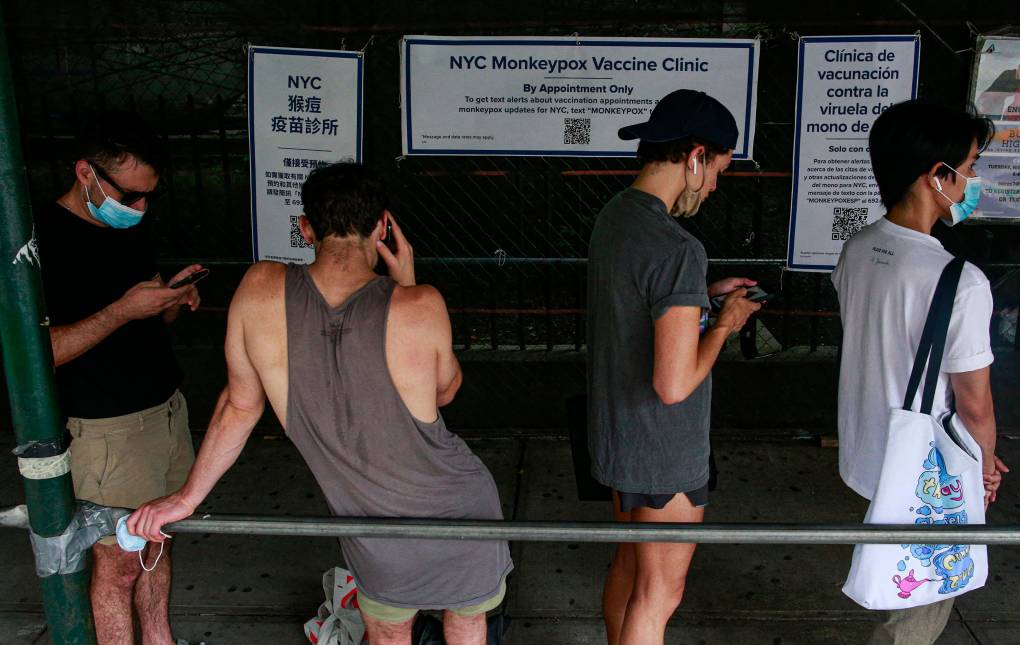
"description": "People wait in line to recieve the Monkeypox vaccine before the opening of a new mass vaccination site at the Bushwick Education Campus in Brooklyn on July 17, 2022, in New York City. - New York, on the US East Coast, has already either administered or scheduled 21,500 vaccines and hopes to speed up the process, promising more than 30,000 jabs for the whole state. ",
"title": "People wait in line to receive the monkeypox vaccine in Brooklyn.",
"credit": "Kena Betancur / AFP via Getty Images",
"status": "inherit",
"altTag": "Four people stand in a line wearing masks.",
"isLoading": false,
"fetchFailed": false
},
"news_11918796": {
"type": "attachments",
"id": "news_11918796",
"meta": {
"index": "attachments_1716263798",
"site": "news",
"id": "11918796",
"found": true
},
"parent": 11918778,
"imgSizes": {
"twentyfourteen-full-width": {
"file": "https://ww2.kqed.org/app/uploads/sites/10/2022/07/GettyImages-1238126010-1038x576.jpg",
"width": 1038,
"mimeType": "image/jpeg",
"height": 576
},
"thumbnail": {
"file": "https://ww2.kqed.org/app/uploads/sites/10/2022/07/GettyImages-1238126010-160x107.jpg",
"width": 160,
"mimeType": "image/jpeg",
"height": 107
},
"post-thumbnail": {
"file": "https://ww2.kqed.org/app/uploads/sites/10/2022/07/GettyImages-1238126010-672x372.jpg",
"width": 672,
"mimeType": "image/jpeg",
"height": 372
},
"kqedFullSize": {
"file": "https://ww2.kqed.org/app/uploads/sites/10/2022/07/GettyImages-1238126010.jpg",
"width": 1920,
"height": 1280
},
"large": {
"file": "https://ww2.kqed.org/app/uploads/sites/10/2022/07/GettyImages-1238126010-1020x680.jpg",
"width": 1020,
"mimeType": "image/jpeg",
"height": 680
},
"1536x1536": {
"file": "https://ww2.kqed.org/app/uploads/sites/10/2022/07/GettyImages-1238126010-1536x1024.jpg",
"width": 1536,
"mimeType": "image/jpeg",
"height": 1024
},
"medium": {
"file": "https://ww2.kqed.org/app/uploads/sites/10/2022/07/GettyImages-1238126010-800x533.jpg",
"width": 800,
"mimeType": "image/jpeg",
"height": 533
}
},
"publishDate": 1657065198,
"modified": 1657129363,
"caption": "A person wearing a flag reading 'My Body My Choice' walks through a rally against vaccine and mask mandates at the state Capitol on Feb. 1, 2022, in Salem, Oregon. After listening to speakers outside the building, the crowd was successful in getting state troopers to let some maskless members into the statehouse.",
"description": null,
"title": "GettyImages-1238126010",
"credit": "Nathan Howard/Getty Images",
"status": "inherit",
"altTag": "A protester rallying against the covid vaccine and mask mandates drapes a flag behind her that reads \"My Body, My Choice\"",
"isLoading": false,
"fetchFailed": false
},
"news_11911301": {
"type": "attachments",
"id": "news_11911301",
"meta": {
"index": "attachments_1716263798",
"site": "news",
"id": "11911301",
"found": true
},
"parent": 11911266,
"imgSizes": {
"twentyfourteen-full-width": {
"file": "https://ww2.kqed.org/app/uploads/sites/10/2022/04/031622_COVID_Kids_Vaccine_Clinic-1038x576.jpg",
"width": 1038,
"mimeType": "image/jpeg",
"height": 576
},
"thumbnail": {
"file": "https://ww2.kqed.org/app/uploads/sites/10/2022/04/031622_COVID_Kids_Vaccine_Clinic-160x107.jpg",
"width": 160,
"mimeType": "image/jpeg",
"height": 107
},
"post-thumbnail": {
"file": "https://ww2.kqed.org/app/uploads/sites/10/2022/04/031622_COVID_Kids_Vaccine_Clinic-672x372.jpg",
"width": 672,
"mimeType": "image/jpeg",
"height": 372
},
"kqedFullSize": {
"file": "https://ww2.kqed.org/app/uploads/sites/10/2022/04/031622_COVID_Kids_Vaccine_Clinic.jpg",
"width": 2000,
"height": 1336
},
"large": {
"file": "https://ww2.kqed.org/app/uploads/sites/10/2022/04/031622_COVID_Kids_Vaccine_Clinic-1020x681.jpg",
"width": 1020,
"mimeType": "image/jpeg",
"height": 681
},
"1536x1536": {
"file": "https://ww2.kqed.org/app/uploads/sites/10/2022/04/031622_COVID_Kids_Vaccine_Clinic-1536x1026.jpg",
"width": 1536,
"mimeType": "image/jpeg",
"height": 1026
},
"full-width": {
"file": "https://ww2.kqed.org/app/uploads/sites/10/2022/04/031622_COVID_Kids_Vaccine_Clinic-1920x1283.jpg",
"width": 1920,
"mimeType": "image/jpeg",
"height": 1283
},
"medium": {
"file": "https://ww2.kqed.org/app/uploads/sites/10/2022/04/031622_COVID_Kids_Vaccine_Clinic-800x534.jpg",
"width": 800,
"mimeType": "image/jpeg",
"height": 534
}
},
"publishDate": 1650047494,
"modified": 1650050884,
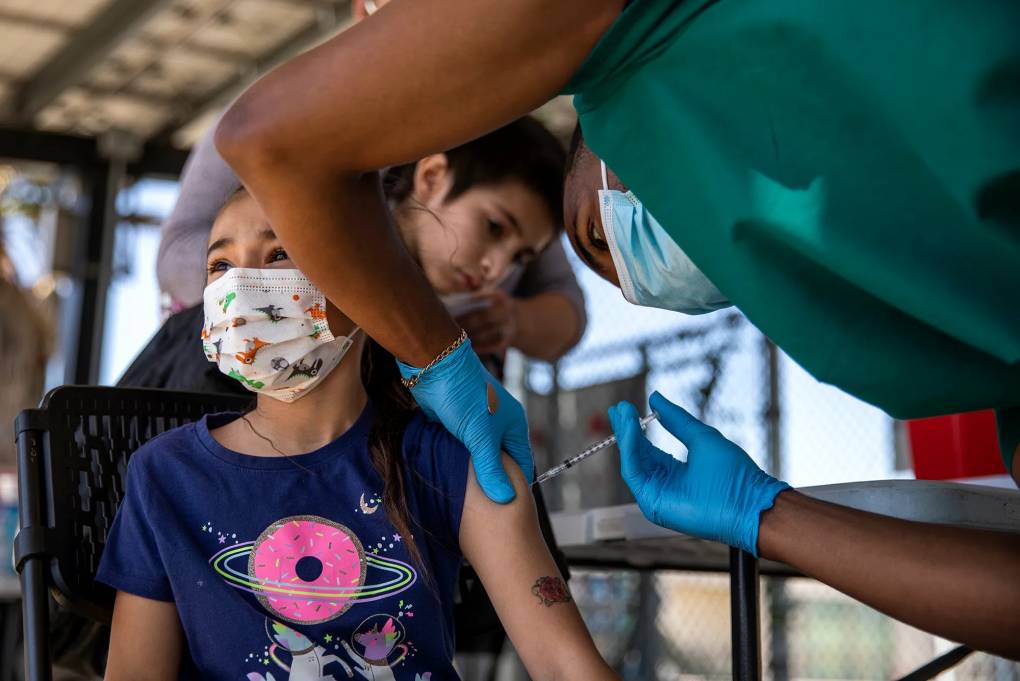
"caption": "Amaya Palestino, 6, receives a COVID-19 vaccine at one of St. John's Well Child and Family Center mobile health clinics in Los Angeles on March 16, 2022.",
"description": null,
"title": "031622_COVID_Kids_Vaccine_Clinic",
"credit": "Alisha Jucevic/CalMatters",
"status": "inherit",
"altTag": "A young girl gets her COVID shot.",
"isLoading": false,
"fetchFailed": false
},
"news_11903520": {
"type": "attachments",
"id": "news_11903520",
"meta": {
"index": "attachments_1716263798",
"site": "news",
"id": "11903520",
"found": true
},
"parent": 11903519,
"imgSizes": {
"twentyfourteen-full-width": {
"file": "https://ww2.kqed.org/app/uploads/sites/10/2022/02/gettyimages-1237841710-0e2d34b5a4a0fac5654ed14f679a263903429e05-1038x576.jpg",
"width": 1038,
"mimeType": "image/jpeg",
"height": 576
},
"thumbnail": {
"file": "https://ww2.kqed.org/app/uploads/sites/10/2022/02/gettyimages-1237841710-0e2d34b5a4a0fac5654ed14f679a263903429e05-160x120.jpg",
"width": 160,
"mimeType": "image/jpeg",
"height": 120
},
"post-thumbnail": {
"file": "https://ww2.kqed.org/app/uploads/sites/10/2022/02/gettyimages-1237841710-0e2d34b5a4a0fac5654ed14f679a263903429e05-672x372.jpg",
"width": 672,
"mimeType": "image/jpeg",
"height": 372
},
"kqedFullSize": {
"file": "https://ww2.kqed.org/app/uploads/sites/10/2022/02/gettyimages-1237841710-0e2d34b5a4a0fac5654ed14f679a263903429e05-scaled-e1643742445285.jpg",
"width": 1920,
"height": 1439
},
"2048x2048": {
"file": "https://ww2.kqed.org/app/uploads/sites/10/2022/02/gettyimages-1237841710-0e2d34b5a4a0fac5654ed14f679a263903429e05-2048x1534.jpg",
"width": 2048,
"mimeType": "image/jpeg",
"height": 1534
},
"large": {
"file": "https://ww2.kqed.org/app/uploads/sites/10/2022/02/gettyimages-1237841710-0e2d34b5a4a0fac5654ed14f679a263903429e05-1020x764.jpg",
"width": 1020,
"mimeType": "image/jpeg",
"height": 764
},
"1536x1536": {
"file": "https://ww2.kqed.org/app/uploads/sites/10/2022/02/gettyimages-1237841710-0e2d34b5a4a0fac5654ed14f679a263903429e05-1536x1151.jpg",
"width": 1536,
"mimeType": "image/jpeg",
"height": 1151
},
"full-width": {
"file": "https://ww2.kqed.org/app/uploads/sites/10/2022/02/gettyimages-1237841710-0e2d34b5a4a0fac5654ed14f679a263903429e05-1920x1438.jpg",
"width": 1920,
"mimeType": "image/jpeg",
"height": 1438
},
"medium": {
"file": "https://ww2.kqed.org/app/uploads/sites/10/2022/02/gettyimages-1237841710-0e2d34b5a4a0fac5654ed14f679a263903429e05-800x599.jpg",
"width": 800,
"mimeType": "image/jpeg",
"height": 599
}
},
"publishDate": 1643740683,
"modified": 1675713358,
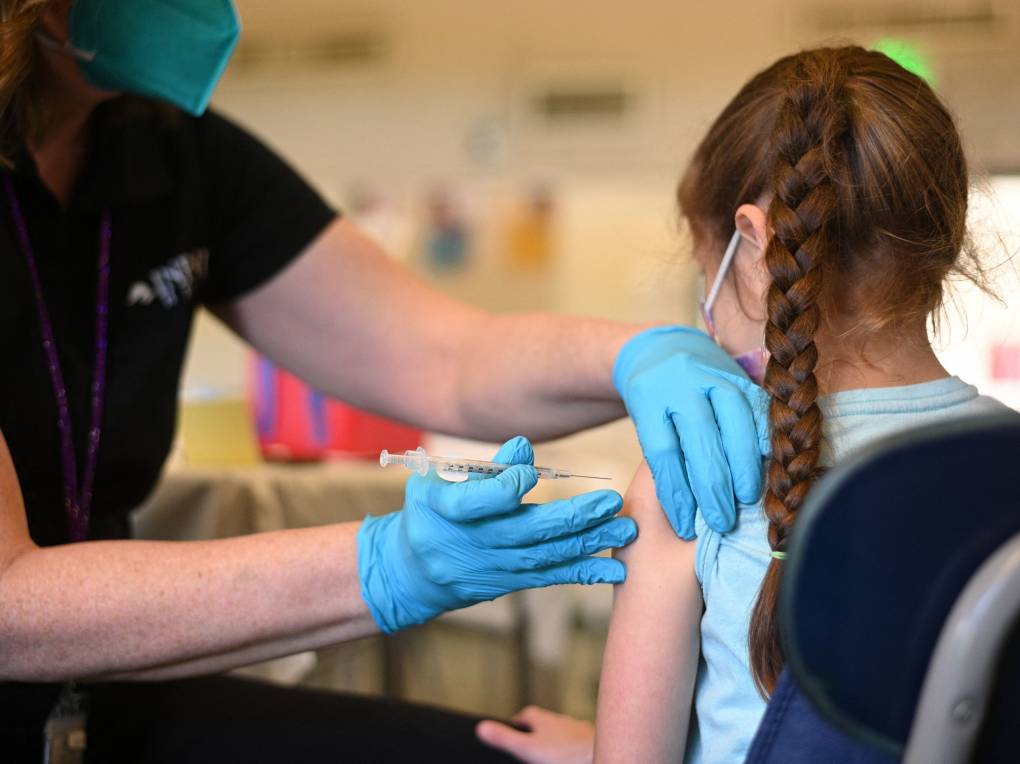
"caption": "A nurse administers a pediatric dose of a COVID-19 vaccine to a girl at an LA Care Health Plan vaccination clinic at Los Angeles Mission College on Jan. 19, 2022.",
"description": "A nurse administers a pediatric dose of a COVID-19 vaccine to a girl at an LA Care Health Plan vaccination clinic at Los Angeles Mission College on Jan. 19, 2022.",
"title": "A nurse administers a pediatric dose of the Covid-19 vaccine to a girl at a L.A. Care Health Plan vaccination clinic at Los Angeles Mission College in the Sylmar neighborhood in Los Angeles, Ca., January 19, 2022.",
"credit": "Robyn Beck/AFP via Getty Images",
"status": "inherit",
"altTag": "young child with braided hair facing away from camera gets vaccination shot in her left arm",
"isLoading": false,
"fetchFailed": false
},
"news_11902667": {
"type": "attachments",
"id": "news_11902667",
"meta": {
"index": "attachments_1716263798",
"site": "news",
"id": "11902667",
"found": true
},
"parent": 11902655,
"imgSizes": {
"twentyfourteen-full-width": {
"file": "https://ww2.kqed.org/app/uploads/sites/10/2022/01/personal_012522_final-1038x576.png",
"width": 1038,
"mimeType": "image/png",
"height": 576
},
"thumbnail": {
"file": "https://ww2.kqed.org/app/uploads/sites/10/2022/01/personal_012522_final-160x107.png",
"width": 160,
"mimeType": "image/png",
"height": 107
},
"post-thumbnail": {
"file": "https://ww2.kqed.org/app/uploads/sites/10/2022/01/personal_012522_final-672x372.png",
"width": 672,
"mimeType": "image/png",
"height": 372
},
"kqedFullSize": {
"file": "https://ww2.kqed.org/app/uploads/sites/10/2022/01/personal_012522_final.png",
"width": 1920,
"height": 1287
},
"large": {
"file": "https://ww2.kqed.org/app/uploads/sites/10/2022/01/personal_012522_final-1020x684.png",
"width": 1020,
"mimeType": "image/png",
"height": 684
},
"1536x1536": {
"file": "https://ww2.kqed.org/app/uploads/sites/10/2022/01/personal_012522_final-1536x1030.png",
"width": 1536,
"mimeType": "image/png",
"height": 1030
},
"medium": {
"file": "https://ww2.kqed.org/app/uploads/sites/10/2022/01/personal_012522_final-800x536.png",
"width": 800,
"mimeType": "image/png",
"height": 536
}
},
"publishDate": 1643154553,
"modified": 1643154697,
"caption": null,
"description": null,
"title": "personal_012522_final",
"credit": null,
"status": "inherit",
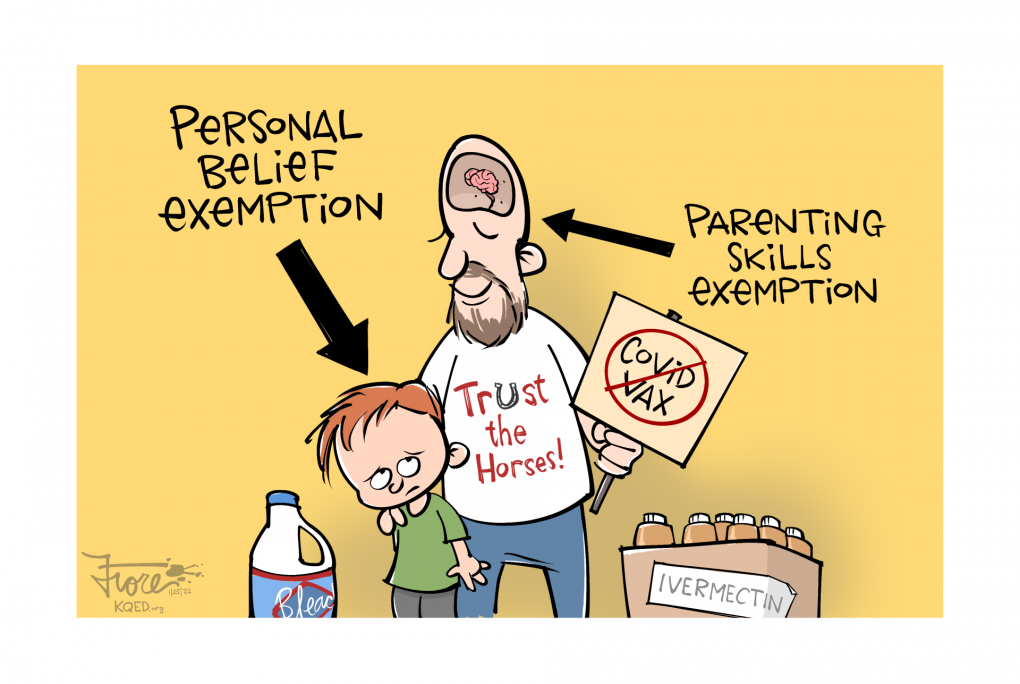
"altTag": "Cartoon: an anti-vaccine parent with anti-vax signs and phony covid cures stands next to his child. An arrow pointing at the child reads, \"personal belief exemption.\" The arrow pointing at the shrunken brain of the parent reads, \"parenting skills exemption.\"",
"isLoading": false,
"fetchFailed": false
},
"news_11901546": {
"type": "attachments",
"id": "news_11901546",
"meta": {
"index": "attachments_1716263798",
"site": "news",
"id": "11901546",
"found": true
},
"parent": 11901518,
"imgSizes": {
"twentyfourteen-full-width": {
"file": "https://ww2.kqed.org/app/uploads/sites/10/2022/01/cases_011122_final-1038x576.png",
"width": 1038,
"mimeType": "image/png",
"height": 576
},
"thumbnail": {
"file": "https://ww2.kqed.org/app/uploads/sites/10/2022/01/cases_011122_final-160x111.png",
"width": 160,
"mimeType": "image/png",
"height": 111
},
"post-thumbnail": {
"file": "https://ww2.kqed.org/app/uploads/sites/10/2022/01/cases_011122_final-672x372.png",
"width": 672,
"mimeType": "image/png",
"height": 372
},
"kqedFullSize": {
"file": "https://ww2.kqed.org/app/uploads/sites/10/2022/01/cases_011122_final.png",
"width": 1920,
"height": 1334
},
"large": {
"file": "https://ww2.kqed.org/app/uploads/sites/10/2022/01/cases_011122_final-1020x709.png",
"width": 1020,
"mimeType": "image/png",
"height": 709
},
"1536x1536": {
"file": "https://ww2.kqed.org/app/uploads/sites/10/2022/01/cases_011122_final-1536x1067.png",
"width": 1536,
"mimeType": "image/png",
"height": 1067
},
"medium": {
"file": "https://ww2.kqed.org/app/uploads/sites/10/2022/01/cases_011122_final-800x556.png",
"width": 800,
"mimeType": "image/png",
"height": 556
}
},
"publishDate": 1642025838,
"modified": 1642025983,
"caption": null,
"description": null,
"title": "cases_011122_final",
"credit": null,
"status": "inherit",
"altTag": "Cartoon: masked school kids in front of upwardly sloping red lines on graphs. The first says, \"omicron cases,\" the next one says, \"cases of zoom flashback,\" followed by \"fear of closing classrooms,\" \"appreciation of in-person school\" and \"prayers to keep school open.\"",
"isLoading": false,
"fetchFailed": false
},
"news_11901120": {
"type": "attachments",
"id": "news_11901120",
"meta": {
"index": "attachments_1716263798",
"site": "news",
"id": "11901120",
"found": true
},
"parent": 11901101,
"imgSizes": {
"twentyfourteen-full-width": {
"file": "https://ww2.kqed.org/app/uploads/sites/10/2022/01/RS50699_004_SanFrancisco_COVIDVaccinations_08172021-qut-1038x576.jpg",
"width": 1038,
"mimeType": "image/jpeg",
"height": 576
},
"thumbnail": {
"file": "https://ww2.kqed.org/app/uploads/sites/10/2022/01/RS50699_004_SanFrancisco_COVIDVaccinations_08172021-qut-160x107.jpg",
"width": 160,
"mimeType": "image/jpeg",
"height": 107
},
"post-thumbnail": {
"file": "https://ww2.kqed.org/app/uploads/sites/10/2022/01/RS50699_004_SanFrancisco_COVIDVaccinations_08172021-qut-672x372.jpg",
"width": 672,
"mimeType": "image/jpeg",
"height": 372
},
"kqedFullSize": {
"file": "https://ww2.kqed.org/app/uploads/sites/10/2022/01/RS50699_004_SanFrancisco_COVIDVaccinations_08172021-qut.jpg",
"width": 1920,
"height": 1280
},
"large": {
"file": "https://ww2.kqed.org/app/uploads/sites/10/2022/01/RS50699_004_SanFrancisco_COVIDVaccinations_08172021-qut-1020x680.jpg",
"width": 1020,
"mimeType": "image/jpeg",
"height": 680
},
"1536x1536": {
"file": "https://ww2.kqed.org/app/uploads/sites/10/2022/01/RS50699_004_SanFrancisco_COVIDVaccinations_08172021-qut-1536x1024.jpg",
"width": 1536,
"mimeType": "image/jpeg",
"height": 1024
},
"medium": {
"file": "https://ww2.kqed.org/app/uploads/sites/10/2022/01/RS50699_004_SanFrancisco_COVIDVaccinations_08172021-qut-800x533.jpg",
"width": 800,
"mimeType": "image/jpeg",
"height": 533
}
},
"publishDate": 1641590560,
"modified": 1641601398,
"caption": "A registered nurse administers a COVID-19 vaccine at the Southeast Health Center in San Francisco's Bayview neighborhood on Aug. 17, 2021.",
"description": null,
"title": "RS50699_004_SanFrancisco_COVIDVaccinations_08172021-qut",
"credit": "Beth LaBerge/KQED",
"status": "inherit",
"altTag": "A masked nurse leans over to give a COVID vaccine dose to a man sitting down wearing a mask.",
"isLoading": false,
"fetchFailed": false
},
"news_11900967": {
"type": "attachments",
"id": "news_11900967",
"meta": {
"index": "attachments_1716263798",
"site": "news",
"id": "11900967",
"found": true
},
"parent": 11890031,
"imgSizes": {
"twentyfourteen-full-width": {
"file": "https://ww2.kqed.org/app/uploads/sites/10/2021/10/RS52992_GettyImages-1237563534-qut-1038x576.jpg",
"width": 1038,
"mimeType": "image/jpeg",
"height": 576
},
"thumbnail": {
"file": "https://ww2.kqed.org/app/uploads/sites/10/2021/10/RS52992_GettyImages-1237563534-qut-160x107.jpg",
"width": 160,
"mimeType": "image/jpeg",
"height": 107
},
"post-thumbnail": {
"file": "https://ww2.kqed.org/app/uploads/sites/10/2021/10/RS52992_GettyImages-1237563534-qut-672x372.jpg",
"width": 672,
"mimeType": "image/jpeg",
"height": 372
},
"kqedFullSize": {
"file": "https://ww2.kqed.org/app/uploads/sites/10/2021/10/RS52992_GettyImages-1237563534-qut.jpg",
"width": 1920,
"height": 1278
},
"large": {
"file": "https://ww2.kqed.org/app/uploads/sites/10/2021/10/RS52992_GettyImages-1237563534-qut-1020x679.jpg",
"width": 1020,
"mimeType": "image/jpeg",
"height": 679
},
"1536x1536": {
"file": "https://ww2.kqed.org/app/uploads/sites/10/2021/10/RS52992_GettyImages-1237563534-qut-1536x1022.jpg",
"width": 1536,
"mimeType": "image/jpeg",
"height": 1022
},
"medium": {
"file": "https://ww2.kqed.org/app/uploads/sites/10/2021/10/RS52992_GettyImages-1237563534-qut-800x533.jpg",
"width": 800,
"mimeType": "image/jpeg",
"height": 533
}
},
"publishDate": 1641496276,
"modified": 1677088673,
"caption": "Children age 12-15 years old receive a Pfizer-BioNTech Covid-19 vaccine booster at Hartford Hospital in Hartford, Connecticut on January 6, 2022. ",
"description": null,
"title": "US-virus-HEALTH-vaccines",
"credit": "Joseph Prezioso/AFP via Getty Images",
"status": "inherit",
"altTag": "A health care worker wearing a brown shirt crouches to administer a COVID booster shot to a young person seated in a chair wearing a shirt that says \"SWIMMING.\"",
"isLoading": false,
"fetchFailed": false
},
"news_11900065": {
"type": "attachments",
"id": "news_11900065",
"meta": {
"index": "attachments_1716263798",
"site": "news",
"id": "11900065",
"found": true
},
"parent": 11900053,
"imgSizes": {
"twentyfourteen-full-width": {
"file": "https://ww2.kqed.org/app/uploads/sites/10/2021/12/GettyImages-1237257420-1038x576.jpg",
"width": 1038,
"mimeType": "image/jpeg",
"height": 576
},
"thumbnail": {
"file": "https://ww2.kqed.org/app/uploads/sites/10/2021/12/GettyImages-1237257420-160x107.jpg",
"width": 160,
"mimeType": "image/jpeg",
"height": 107
},
"post-thumbnail": {
"file": "https://ww2.kqed.org/app/uploads/sites/10/2021/12/GettyImages-1237257420-672x372.jpg",
"width": 672,
"mimeType": "image/jpeg",
"height": 372
},
"kqedFullSize": {
"file": "https://ww2.kqed.org/app/uploads/sites/10/2021/12/GettyImages-1237257420-scaled.jpg",
"width": 2560,
"height": 1707
},
"2048x2048": {
"file": "https://ww2.kqed.org/app/uploads/sites/10/2021/12/GettyImages-1237257420-2048x1365.jpg",
"width": 2048,
"mimeType": "image/jpeg",
"height": 1365
},
"large": {
"file": "https://ww2.kqed.org/app/uploads/sites/10/2021/12/GettyImages-1237257420-1020x680.jpg",
"width": 1020,
"mimeType": "image/jpeg",
"height": 680
},
"1536x1536": {
"file": "https://ww2.kqed.org/app/uploads/sites/10/2021/12/GettyImages-1237257420-1536x1024.jpg",
"width": 1536,
"mimeType": "image/jpeg",
"height": 1024
},
"full-width": {
"file": "https://ww2.kqed.org/app/uploads/sites/10/2021/12/GettyImages-1237257420-1920x1280.jpg",
"width": 1920,
"mimeType": "image/jpeg",
"height": 1280
},
"medium": {
"file": "https://ww2.kqed.org/app/uploads/sites/10/2021/12/GettyImages-1237257420-800x533.jpg",
"width": 800,
"mimeType": "image/jpeg",
"height": 533
}
},
"publishDate": 1640206099,
"modified": 1640206218,
"caption": "Licensed Vocational Nurse Eloisa Flores prepares a dose of a COVID-19 vaccine at a vaccination clinic in Los Angeles on December 15, 2021.",
"description": "Licensed Vocational Nurse Eloisa Flores prepares a dose of a COVID-19 vaccine at a vaccination clinic in Los Angeles on December 15, 2021.",
"title": "US-HEALTH-VIRUS-VACCINES",
"credit": "Frederic J. Brown/AFP via Getty Images",
"status": "inherit",
"altTag": "Eloisa Flores wears a face mask as she fills a syringe with a vaccine dose. She works outside and behind her is a mural.",
"isLoading": false,
"fetchFailed": false
},
"news_11897945": {
"type": "attachments",
"id": "news_11897945",
"meta": {
"index": "attachments_1716263798",
"site": "news",
"id": "11897945",
"found": true
},
"parent": 11897919,
"imgSizes": {
"twentyfourteen-full-width": {
"file": "https://ww2.kqed.org/app/uploads/sites/10/2021/12/GettyImages-1351114790-1024x576.jpg",
"width": 1024,
"mimeType": "image/jpeg",
"height": 576
},
"thumbnail": {
"file": "https://ww2.kqed.org/app/uploads/sites/10/2021/12/GettyImages-1351114790-160x105.jpg",
"width": 160,
"mimeType": "image/jpeg",
"height": 105
},
"post-thumbnail": {
"file": "https://ww2.kqed.org/app/uploads/sites/10/2021/12/GettyImages-1351114790-672x372.jpg",
"width": 672,
"mimeType": "image/jpeg",
"height": 372
},
"kqedFullSize": {
"file": "https://ww2.kqed.org/app/uploads/sites/10/2021/12/GettyImages-1351114790.jpg",
"width": 1024,
"height": 674
},
"large": {
"file": "https://ww2.kqed.org/app/uploads/sites/10/2021/12/GettyImages-1351114790-1020x671.jpg",
"width": 1020,
"mimeType": "image/jpeg",
"height": 671
},
"medium": {
"file": "https://ww2.kqed.org/app/uploads/sites/10/2021/12/GettyImages-1351114790-800x527.jpg",
"width": 800,
"mimeType": "image/jpeg",
"height": 527
}
},
"publishDate": 1638492139,
"modified": 1638495983,
"caption": "Eight-year-old Ava Onaissi receives a pediatric Pfizer COVID-19 vaccination during a vaccine clinic at Emmanuel Baptist Church on Nov. 3, 2021, in San José, California.",
"description": null,
"title": "Vaccinations Offered For Children Age 5-11 At A Church In San Jose",
"credit": "Justin Sullivan/Getty Images",
"status": "inherit",
"altTag": "A young girl wearing a mask gets vaccinated.",
"isLoading": false,
"fetchFailed": false
},
"news_11898187": {
"type": "attachments",
"id": "news_11898187",
"meta": {
"index": "attachments_1716263798",
"site": "news",
"id": "11898187",
"found": true
},
"parent": 11898181,
"imgSizes": {
"twentyfourteen-full-width": {
"file": "https://ww2.kqed.org/app/uploads/sites/10/2021/12/corrective_120621_final-1038x576.png",
"width": 1038,
"mimeType": "image/png",
"height": 576
},
"thumbnail": {
"file": "https://ww2.kqed.org/app/uploads/sites/10/2021/12/corrective_120621_final-160x113.png",
"width": 160,
"mimeType": "image/png",
"height": 113
},
"post-thumbnail": {
"file": "https://ww2.kqed.org/app/uploads/sites/10/2021/12/corrective_120621_final-672x372.png",
"width": 672,
"mimeType": "image/png",
"height": 372
},
"kqedFullSize": {
"file": "https://ww2.kqed.org/app/uploads/sites/10/2021/12/corrective_120621_final.png",
"width": 1920,
"height": 1357
},
"large": {
"file": "https://ww2.kqed.org/app/uploads/sites/10/2021/12/corrective_120621_final-1020x721.png",
"width": 1020,
"mimeType": "image/png",
"height": 721
},
"1536x1536": {
"file": "https://ww2.kqed.org/app/uploads/sites/10/2021/12/corrective_120621_final-1536x1086.png",
"width": 1536,
"mimeType": "image/png",
"height": 1086
},
"medium": {
"file": "https://ww2.kqed.org/app/uploads/sites/10/2021/12/corrective_120621_final-800x565.png",
"width": 800,
"mimeType": "image/png",
"height": 565
}
},
"publishDate": 1638827016,
"modified": 1638827092,
"caption": null,
"description": null,
"title": "corrective_120621_final",
"credit": null,
"status": "inherit",
"altTag": "Cartoon: two parents wearing dunce caps sit in the corner next to a chalkboard with \"I will not send my kids to school with covid\" all over it. One parent says, \"at least the 'corrective action' is confidential.\"",
"isLoading": false,
"fetchFailed": false
},
"news_11897771": {
"type": "attachments",
"id": "news_11897771",
"meta": {
"index": "attachments_1716263798",
"site": "news",
"id": "11897771",
"found": true
},
"parent": 11897761,
"imgSizes": {
"twentyfourteen-full-width": {
"file": "https://ww2.kqed.org/app/uploads/sites/10/2021/12/omicron_120121_final-1038x576.png",
"width": 1038,
"mimeType": "image/png",
"height": 576
},
"thumbnail": {
"file": "https://ww2.kqed.org/app/uploads/sites/10/2021/12/omicron_120121_final-160x102.png",
"width": 160,
"mimeType": "image/png",
"height": 102
},
"post-thumbnail": {
"file": "https://ww2.kqed.org/app/uploads/sites/10/2021/12/omicron_120121_final-672x372.png",
"width": 672,
"mimeType": "image/png",
"height": 372
},
"kqedFullSize": {
"file": "https://ww2.kqed.org/app/uploads/sites/10/2021/12/omicron_120121_final.png",
"width": 1920,
"height": 1229
},
"large": {
"file": "https://ww2.kqed.org/app/uploads/sites/10/2021/12/omicron_120121_final-1020x653.png",
"width": 1020,
"mimeType": "image/png",
"height": 653
},
"1536x1536": {
"file": "https://ww2.kqed.org/app/uploads/sites/10/2021/12/omicron_120121_final-1536x983.png",
"width": 1536,
"mimeType": "image/png",
"height": 983
},
"medium": {
"file": "https://ww2.kqed.org/app/uploads/sites/10/2021/12/omicron_120121_final-800x512.png",
"width": 800,
"mimeType": "image/png",
"height": 512
}
},
"publishDate": 1638387256,
"modified": 1638387376,
"caption": null,
"description": null,
"title": "omicron_120121_final",
"credit": null,
"status": "inherit",
"altTag": "Cartoon: word bubbles read, \"how do you pronounce it?\" by the word \"omicron.\" Pronunciation reads: oh-ma-cron, oh-mih-krahn, oh-krahp-again, oh-ma-don't-panic, oh-ma-vaccinate-your-kids, on-my-way-to-get-a-booster.",
"isLoading": false,
"fetchFailed": false
}
},
"audioPlayerReducer": {
"postId": "stream_live",
"isPaused": true,
"isPlaying": false,
"pfsActive": false,
"pledgeModalIsOpen": true,
"playerDrawerIsOpen": false,
"liveAudioPlayStartedAt": 0,
"liveAudioPlayContext": ""
},
"authorsReducer": {
"byline_news_11920442": {
"type": "authors",
"id": "byline_news_11920442",
"meta": {
"override": true
},
"slug": "byline_news_11920442",
"name": "Becky Sullivan",
"isLoading": false
},
"byline_news_11918778": {
"type": "authors",
"id": "byline_news_11918778",
"meta": {
"override": true
},
"slug": "byline_news_11918778",
"name": "Rachel Bluth",
"isLoading": false
},
"byline_news_11911266": {
"type": "authors",
"id": "byline_news_11911266",
"meta": {
"override": true
},
"slug": "byline_news_11911266",
"name": "\u003ca href=\"https://calmatters.org/author/elizabeth-aguilera/\">Elizabeth Aguilera\u003c/a>",
"isLoading": false
},
"byline_news_11903519": {
"type": "authors",
"id": "byline_news_11903519",
"meta": {
"override": true
},
"slug": "byline_news_11903519",
"name": "Rob Stein",
"isLoading": false
},
"byline_news_11901101": {
"type": "authors",
"id": "byline_news_11901101",
"meta": {
"override": true
},
"slug": "byline_news_11901101",
"name": "\u003ca href=\"https://calmatters.org/author/kristen-hwang/\">Kristen Hwang\u003c/a> and \u003ca href=\"https://calmatters.org/author/anaibarra/\">Ana B. Ibarra\u003c/a>",
"isLoading": false
},
"byline_news_11900053": {
"type": "authors",
"id": "byline_news_11900053",
"meta": {
"override": true
},
"slug": "byline_news_11900053",
"name": "\u003ca href=\"https://www.npr.org/people/348778932/michaeleen-doucleff\">Michaeleen Doucleff\u003c/a>",
"isLoading": false
},
"byline_news_11899840": {
"type": "authors",
"id": "byline_news_11899840",
"meta": {
"override": true
},
"slug": "byline_news_11899840",
"name": "\u003ca href=\"//edsource.org/author/atadayon”\">Ali Tadayon\u003c/a>",
"isLoading": false
},
"markfiore": {
"type": "authors",
"id": "3236",
"meta": {
"index": "authors_1716337520",
"id": "3236",
"found": true
},
"name": "Mark Fiore",
"firstName": "Mark",
"lastName": "Fiore",
"slug": "markfiore",
"email": "mark@markfiore.com",
"display_author_email": false,
"staff_mastheads": [
"news"
],
"title": "KQED News Cartoonist",
"bio": "\u003ca href=\"http://www.MarkFiore.com\">MarkFiore.com\u003c/a> | \u003ca href=\"https://twitter.com/markfiore\">Follow on Twitter\u003c/a> | \u003ca href=\"https://www.facebook.com/pages/Mark-Fiore-Animated-Political-Cartoons/94451707396?ref=bookmarks\">Facebook\u003c/a> | \u003ca href=\"mailto:mark@markfiore.com\">email\u003c/a>\r\n\r\nPulitzer Prize-winner, Mark Fiore, who the Wall Street Journal has called “the undisputed guru of the form,” creates animated political cartoons in San Francisco, where his work has been featured regularly on the San Francisco Chronicle’s web site, SFGate.com. His work has appeared on Newsweek.com, Slate.com, CBSNews.com, MotherJones.com, DailyKos.com and NPR’s web site. Fiore’s political animation has appeared on CNN, Frontline, Bill Moyers Journal, Salon.com and cable and broadcast outlets across the globe.\r\n\r\nBeginning his professional life by drawing traditional political cartoons for newspapers, Fiore’s work appeared in publications ranging from the Washington Post to the Los Angeles Times. In the late 1990s, he began to experiment with animating political cartoons and, after a short stint at the San Jose Mercury News as their staff cartoonist, Fiore devoted all his energies to animation.\r\nGrowing up in California, Fiore also spent a good portion of his life in the backwoods of Idaho. It was this combination that shaped him politically. Mark majored in political science at Colorado College, where, in a perfect send-off for a cartoonist, he received his diploma in 1991 as commencement speaker Dick Cheney smiled approvingly.\r\nMark Fiore was awarded the Pulitzer Prize for political cartooning in 2010, a Robert F. Kennedy Journalism Award in 2004 and has twice received an Online Journalism Award for commentary from the Online News Association (2002, 2008). Fiore has received two awards for his work in new media from the National Cartoonists Society (2001, 2002), and in 2006 received The James Madison Freedom of Information Award from The Society of Professional Journalists.",
"avatar": "https://secure.gravatar.com/avatar/fc4e2a612b15b67bad0c6f0e1db4ca9b?s=600&d=blank&r=g",
"twitter": "MarkFiore",
"facebook": null,
"instagram": "https://www.instagram.com/markfiore/?hl=en",
"linkedin": null,
"sites": [
{
"site": "arts",
"roles": [
"contributor"
]
},
{
"site": "news",
"roles": [
"editor"
]
},
{
"site": "futureofyou",
"roles": [
"editor"
]
},
{
"site": "science",
"roles": [
"editor"
]
}
],
"headData": {
"title": "Mark Fiore | KQED",
"description": "KQED News Cartoonist",
"ogImgSrc": "https://secure.gravatar.com/avatar/fc4e2a612b15b67bad0c6f0e1db4ca9b?s=600&d=blank&r=g",
"twImgSrc": "https://secure.gravatar.com/avatar/fc4e2a612b15b67bad0c6f0e1db4ca9b?s=600&d=blank&r=g"
},
"isLoading": false,
"link": "/author/markfiore"
},
"carlysevern": {
"type": "authors",
"id": "3243",
"meta": {
"index": "authors_1716337520",
"id": "3243",
"found": true
},
"name": "Carly Severn",
"firstName": "Carly",
"lastName": "Severn",
"slug": "carlysevern",
"email": "csevern@kqed.org",
"display_author_email": false,
"staff_mastheads": [
"news"
],
"title": "Senior Editor, Audience News ",
"bio": "Carly is KQED's Senior Editor of Audience News on the Digital News team, and has reported for the California Report Magazine, Bay Curious and KQED Arts. She's formerly the host of \u003ca href=\"http://ww2.kqed.org/pop/category/the-cooler/\" rel=\"noopener noreferrer\">The Cooler\u003c/a> podcast.",
"avatar": "https://secure.gravatar.com/avatar/54037bf5c128fe678f0ef26cec97a93f2e7f220a22d7285703328f12c42c1b1d?s=600&d=blank&r=g",
"twitter": "teacupinthebay",
"bluesky": null,
"facebook": null,
"instagram": null,
"linkedin": null,
"sites": [
{
"site": "",
"roles": [
"editor"
]
},
{
"site": "arts",
"roles": [
"editor"
]
},
{
"site": "news",
"roles": [
"administrator"
]
},
{
"site": "pop",
"roles": [
"editor"
]
},
{
"site": "futureofyou",
"roles": [
"editor"
]
},
{
"site": "about",
"roles": [
"administrator"
]
},
{
"site": "mindshift",
"roles": [
"editor"
]
},
{
"site": "bayareabites",
"roles": [
"editor"
]
},
{
"site": "stateofhealth",
"roles": [
"editor"
]
},
{
"site": "science",
"roles": [
"editor"
]
},
{
"site": "food",
"roles": [
"contributor"
]
},
{
"site": "forum",
"roles": [
"editor"
]
},
{
"site": "perspectives",
"roles": [
"administrator"
]
},
{
"site": "liveblog",
"roles": [
"editor"
]
}
],
"headData": {
"title": "Carly Severn | KQED",
"description": "Senior Editor, Audience News ",
"ogImgSrc": "https://secure.gravatar.com/avatar/54037bf5c128fe678f0ef26cec97a93f2e7f220a22d7285703328f12c42c1b1d?s=600&d=blank&r=g",
"twImgSrc": "https://secure.gravatar.com/avatar/54037bf5c128fe678f0ef26cec97a93f2e7f220a22d7285703328f12c42c1b1d?s=600&d=blank&r=g"
},
"isLoading": false,
"link": "/author/carlysevern"
}
},
"pagesReducer": {
"news_tag_vaccines": {
"type": "terms",
"id": "news_981",
"meta": {
"index": "terms_1716263798",
"site": "news",
"id": "981",
"score": 8.668567
},
"name": "Vaccines",
"slug": "vaccines",
"taxonomy": "tag",
"description": null,
"featImg": null,
"headData": {
"title": "Vaccines | KQED News",
"description": null,
"ogTitle": null,
"ogDescription": null,
"ogImgId": null,
"twTitle": null,
"twDescription": null,
"twImgId": null
},
"ttid": 991,
"isLoading": false,
"title": "Vaccines",
"pageMeta": {
"site": "news",
"WpPageTemplate": "page-topic-editorial",
"currentPage": 4
},
"blocks": [
{
"blockName": "kqed/post-list",
"attrs": {
"layout": "cardArticle2",
"query": "posts/news?tag=vaccines",
"seeMore": false,
"paginated": true,
"page": 4
}
},
{
"blockName": "kqed/ad"
}
]
}
},
"pfsSessionReducer": {},
"postsReducer": {
"stream_live": {
"type": "live",
"id": "stream_live",
"audioUrl": "https://streams.kqed.org/kqedradio",
"title": "Live Stream",
"excerpt": "Live Stream information currently unavailable.",
"link": "/radio",
"featImg": "",
"label": {
"name": "KQED Live",
"link": "/"
}
},
"stream_kqedNewscast": {
"type": "posts",
"id": "stream_kqedNewscast",
"audioUrl": "https://www.kqed.org/.stream/anon/radio/RDnews/newscast.mp3?_=1",
"title": "KQED Newscast",
"featImg": "",
"label": {
"name": "88.5 FM",
"link": "/"
}
},
"news_11920442": {
"type": "posts",
"id": "news_11920442",
"meta": {
"index": "posts_1716263798",
"site": "news",
"id": "11920442",
"score": null,
"sort": [
1658790425000
]
},
"guestAuthors": [],
"slug": "epidemiologists-warn-the-u-s-reaches-a-critical-moment-to-contain-monkeypox",
"title": "Epidemiologists Warn the US Reaches a Critical Moment to Contain Monkeypox",
"publishDate": 1658790425,
"format": "standard",
"headTitle": "Epidemiologists Warn the US Reaches a Critical Moment to Contain Monkeypox | KQED",
"labelTerm": {},
"content": "\u003cp>On the heels of a public health emergency declaration from the World Health Organization, epidemiologists and public health experts warn the U.S. is running out of time to contain a monkeypox outbreak that has infected nearly 3,000 Americans.\u003c/p>\n\u003cp>“We’re losing daylight,” UCLA epidemiologist Anne Rimoin, who has studied monkeypox for decades, told NPR. “Every day that we aren’t continuing to push forward on all fronts, the less likely it is that we will be able to contain it.”\u003c/p>\n\u003cp>U.S. officials have \u003ca href=\"https://www.npr.org/2022/07/19/1112043780/monkeypox-keeps-spreading-heres-what-authorities-are-doing-to-stop-it\">already expanded testing\u003c/a>, made tens of thousands of vaccines available and made \u003ca href=\"https://www.whitehouse.gov/briefing-room/statements-releases/2022/06/28/fact-sheet-biden-harris-administrations-monkeypox-outbreak-response/\">plans to release another 1.6 million doses\u003c/a> in the coming months.\u003c/p>\n\u003cp>But the limited supplies have not matched demand, \u003ca href=\"https://www.npr.org/2022/07/09/1110667122/there-has-been-a-shortage-of-testing-and-vaccines-for-monkeypox\">some health officials have reported\u003c/a>. And despite limited testing, case numbers have grown so rapidly in recent weeks that a larger response may be necessary to contain the outbreak, experts say – if containment is still possible.[pullquote size=\"medium\" align=\"right\" citation=\"Anne Rimoin, UCLA epidemiologist\"]‘I absolutely think that it can be contained. But whether it will be depends upon the resources dedicated to doing this and the speed with which we can act.’[/pullquote]\u003c/p>\n\u003cp>“It’s going to be tough, but that needs to still be the goal,” Dr. Preeti Malani, an infectious disease specialist at the University of Michigan, told NPR. “What we do in the coming days and weeks will really determine where we are a few months from now.”\u003c/p>\n\u003ch2>The U.S. is closing in on 3,000 cases of monkeypox\u003c/h2>\n\u003cp>Over the weekend, \u003ca href=\"https://www.npr.org/2022/07/23/1113183728/monkeypox-global-health-emergency-who\">the World Health Organization declared the outbreak a public health emergency\u003c/a>. Biden administration officials have said they are discussing whether to declare an emergency in the U.S.\u003c/p>\n\u003cp>[ad fullwidth]\u003c/p>\n\u003cp>The discussions represent a change of tone from \u003ca href=\"https://www.npr.org/sections/goatsandsoda/2022/05/18/927043767/rare-monkeypox-outbreak-in-u-k-and-europe-what-is-it-and-should-we-worry\">the beginning of the outbreak in May\u003c/a>. Then, there were only a handful of cases outside of Africa, where the disease is endemic, and health officials in the U.S. and around the world expressed confidence that the disease was containable.\u003c/p>\n\u003cp>As of Friday afternoon, \u003ca href=\"https://www.cdc.gov/poxvirus/monkeypox/response/2022/us-map.html\">the CDC had reported\u003c/a> 2,891 cases of monkeypox in the U.S. – a number \u003ca href=\"https://www.npr.org/sections/health-shots/2022/06/25/1107416457/monkeypox-outbreak-in-us\">more than 10 times higher than a month ago\u003c/a>.\u003c/p>\n\u003cp>The CDC had tests available before this outbreak began – a significant difference from COVID-19 – but \u003ca href=\"https://www.npr.org/sections/health-shots/2022/06/25/1107416457/monkeypox-outbreak-in-us\">experts have complained that the agency is testing cases at too slow a pace\u003c/a>. The Biden administration began shipping tests to commercial laboratories \u003ca href=\"https://www.hhs.gov/about/news/2022/06/22/hhs-expanding-monkeypox-testing-capacity-five-commercial-laboratory-companies.html\">in late June\u003c/a>, with the expectation that testing capacity would be “ramped up” through the month of July.\u003c/p>\n\u003cp>“We are way behind in a lot of aspects, including rapid testing and access to treatment for those patients who might need treatment,” Malani said.\u003c/p>\n\u003cp>More robust contact tracing, too, could help combat the virus.\u003c/p>\n\u003cp>“Ultimately, we cannot vaccinate and treat our way out of monkeypox,” Malani said. “Prevention is critical.”\u003c/p>\n\u003cp>Monkeypox has a long incubation period, she said. After an initial exposure, it can be weeks before symptoms develop. An early heads-up from a robust contact tracing effort could help people exposed to monkeypox isolate and seek tests or vaccines before symptoms appear.\u003c/p>\n\u003cp>The virus most often spreads through prolonged physical contact. It is not a sexually transmitted disease; it can spread through non-sexual physical contact, or by handling clothes or bedding used by an infected person. The disease can also spread via respiratory droplets.\u003c/p>\n\u003cp>Like in other Western countries, the outbreak in the U.S. has mostly affected men who have sex with other men. But the CDC has also reported infections in \u003ca href=\"https://emergency.cdc.gov/coca/ppt/2022/062922_slides.pdf\">a small number of cisgender women\u003c/a>. And on Friday, the agency announced the outbreak’s first documented cases in children – a toddler in California and an infant whose family was traveling in Washington, D.C.\u003c/p>\n\u003ch2>Lessons from COVID-19\u003c/h2>\n\u003cp>The monkeypox outbreak arrived at a time when public awareness of infectious disease is high, experts pointed out. The COVID pandemic has made Americans familiar with public health concepts like isolation, rapid testing and contact tracing.\u003c/p>\n\u003cp>But other lessons from COVID have seemingly not stuck – like how early and how forcefully to take action when an outbreak is still constrained to a handful of people.\u003c/p>\n\u003cp>“I hate to say this, but I feel like ‘here we go again,'” Rebecca Fischer, an infectious disease specialist at Texas A&M University, told NPR.\u003c/p>\n\u003cp>Researchers are quick to point out that \u003ca href=\"https://www.npr.org/2022/05/24/1101003523/monkeypox-covid-19-differences\">the two diseases are very different\u003c/a>. They belong to different families of virus and require different levels of contact to spread. Overall, COVID is more transmissible.\u003c/p>\n\u003cp>[aside label=\"More monkeypox coverage\" tag=\"monkeypox\"] Many of COVID’s lessons could be applied to any infectious disease, Fischer said.\u003c/p>\n\u003cp>“Public health thought that we had learned this great thing – that we need to respond aggressively up front, and with a lot of resources and a lot of attention up front, if we hope to curtail and contain,” Fischer said. “And I get the sense that sort of aggressive upfront action didn’t really happen.”\u003c/p>\n\u003cp>Still, public health officials and epidemiologists alike say that containment could be within reach.\u003c/p>\n\u003cp>Unlike COVID, monkeypox was already a known quantity to researchers before the current outbreak. The disease was first discovered in humans more than 50 years ago, and its similarity to smallpox means smallpox treatments and vaccines are also effective against monkeypox. The U.S. has millions of doses already stockpiled.\u003c/p>\n\u003cp>\u003c/p>\n\u003cp>“I absolutely think that it can be contained. But whether it will be depends upon the resources dedicated to doing this and the speed with which we can act,” said Rimoin of UCLA. “It really will require a major concerted effort locally, nationally and globally.”\u003c/p>\n\u003cdiv class=\"fullattribution\">Copyright 2022 NPR. To see more, visit \u003ca href=\"https://www.npr.org\">NPR.org\u003c/a>.\u003cimg decoding=\"async\" src=\"https://www.google-analytics.com/__utm.gif?utmac=UA-5828686-4&utmdt=Epidemiologists+warn+the+U.S.+reaches+a+critical+moment+to+contain+monkeypox&utme=8(APIKey)9(MDAxOTAwOTE4MDEyMTkxMDAzNjczZDljZA004)\">\u003c/div>\n\n",
"blocks": [],
"excerpt": "Cases in the U.S. are 10 times higher than they were a month ago. Researchers advise that the coming days and weeks will be crucial as to whether the outbreak can be contained. ",
"status": "publish",
"parent": 0,
"modified": 1726005680,
"stats": {
"hasAudio": false,
"hasVideo": false,
"hasChartOrMap": false,
"iframeSrcs": [],
"hasGoogleForm": false,
"hasGallery": false,
"hasHearkenModule": false,
"hasPolis": false,
"paragraphCount": 26,
"wordCount": 988
},
"headData": {
"title": "Epidemiologists Warn the US Reaches a Critical Moment to Contain Monkeypox | KQED",
"description": "Cases in the U.S. are 10 times higher than they were a month ago. Researchers advise that the coming days and weeks will be crucial as to whether the outbreak can be contained. ",
"ogTitle": "",
"ogDescription": "",
"ogImgId": "",
"twTitle": "",
"twDescription": "",
"twImgId": "",
"schema": {
"@context": "https://schema.org",
"@type": "NewsArticle",
"headline": "Epidemiologists Warn the US Reaches a Critical Moment to Contain Monkeypox",
"datePublished": "2022-07-25T16:07:05-07:00",
"dateModified": "2024-09-10T15:01:20-07:00",
"image": "https://cdn.kqed.org/wp-content/uploads/2020/02/KQED-OG-Image@1x.png",
"isAccessibleForFree": "True",
"publisher": {
"@type": "NewsMediaOrganization",
"@id": "https://www.kqed.org/#organization",
"name": "KQED",
"logo": "https://cdn.kqed.org/wp-content/uploads/2020/02/KQED-OG-Image@1x.png",
"url": "https://www.kqed.org",
"sameAs": [
"https://www.facebook.com/KQED",
"https://twitter.com/KQED",
"https://www.instagram.com/kqed/",
"https://www.tiktok.com/@kqedofficial",
"https://www.linkedin.com/company/kqed",
"https://www.youtube.com/channel/UCeC0IOo7i1P_61zVUWbJ4nw"
]
}
}
},
"source": "NPR",
"sourceUrl": "https://www.npr.org/",
"sticky": false,
"nprImageCredit": "Kena Betancur",
"nprByline": "Becky Sullivan",
"nprImageAgency": "AFP via Getty Images",
"nprStoryId": "1113282334",
"nprApiLink": "http://api.npr.org/query?id=1113282334&apiKey=MDAxOTAwOTE4MDEyMTkxMDAzNjczZDljZA004",
"nprHtmlLink": "https://www.npr.org/2022/07/25/1113282334/monkeypox-outbreak-covid-lessons-epidemiologists?ft=nprml&f=1113282334",
"nprRetrievedStory": "1",
"nprPubDate": "Mon, 25 Jul 2022 05:01:00 -0400",
"nprStoryDate": "Mon, 25 Jul 2022 05:01:46 -0400",
"nprLastModifiedDate": "Mon, 25 Jul 2022 05:01:46 -0400",
"excludeFromSiteSearch": "Include",
"showOnAuthorArchivePages": "No",
"path": "/news/11920442/epidemiologists-warn-the-u-s-reaches-a-critical-moment-to-contain-monkeypox",
"audioTrackLength": null,
"parsedContent": [
{
"type": "contentString",
"content": "\u003cdiv class=\"post-body\">\u003cp>\u003cp>On the heels of a public health emergency declaration from the World Health Organization, epidemiologists and public health experts warn the U.S. is running out of time to contain a monkeypox outbreak that has infected nearly 3,000 Americans.\u003c/p>\n\u003cp>“We’re losing daylight,” UCLA epidemiologist Anne Rimoin, who has studied monkeypox for decades, told NPR. “Every day that we aren’t continuing to push forward on all fronts, the less likely it is that we will be able to contain it.”\u003c/p>\n\u003cp>U.S. officials have \u003ca href=\"https://www.npr.org/2022/07/19/1112043780/monkeypox-keeps-spreading-heres-what-authorities-are-doing-to-stop-it\">already expanded testing\u003c/a>, made tens of thousands of vaccines available and made \u003ca href=\"https://www.whitehouse.gov/briefing-room/statements-releases/2022/06/28/fact-sheet-biden-harris-administrations-monkeypox-outbreak-response/\">plans to release another 1.6 million doses\u003c/a> in the coming months.\u003c/p>\n\u003cp>But the limited supplies have not matched demand, \u003ca href=\"https://www.npr.org/2022/07/09/1110667122/there-has-been-a-shortage-of-testing-and-vaccines-for-monkeypox\">some health officials have reported\u003c/a>. And despite limited testing, case numbers have grown so rapidly in recent weeks that a larger response may be necessary to contain the outbreak, experts say – if containment is still possible.\u003c/p>\u003c/div>",
"attributes": {
"named": {},
"numeric": []
}
},
{
"type": "component",
"content": "‘I absolutely think that it can be contained. But whether it will be depends upon the resources dedicated to doing this and the speed with which we can act.’",
"name": "pullquote",
"attributes": {
"named": {
"size": "medium",
"align": "right",
"citation": "Anne Rimoin, UCLA epidemiologist",
"label": ""
},
"numeric": []
}
},
{
"type": "contentString",
"content": "\u003cdiv class=\"post-body\">\u003cp>\u003c/p>\n\u003cp>“It’s going to be tough, but that needs to still be the goal,” Dr. Preeti Malani, an infectious disease specialist at the University of Michigan, told NPR. “What we do in the coming days and weeks will really determine where we are a few months from now.”\u003c/p>\n\u003ch2>The U.S. is closing in on 3,000 cases of monkeypox\u003c/h2>\n\u003cp>Over the weekend, \u003ca href=\"https://www.npr.org/2022/07/23/1113183728/monkeypox-global-health-emergency-who\">the World Health Organization declared the outbreak a public health emergency\u003c/a>. Biden administration officials have said they are discussing whether to declare an emergency in the U.S.\u003c/p>\n\u003cp>\u003c/p>\u003c/div>",
"attributes": {
"named": {},
"numeric": []
}
},
{
"type": "component",
"content": "",
"name": "ad",
"attributes": {
"named": {
"label": "fullwidth"
},
"numeric": [
"fullwidth"
]
}
},
{
"type": "contentString",
"content": "\u003cdiv class=\"post-body\">\u003cp>\u003c/p>\n\u003cp>The discussions represent a change of tone from \u003ca href=\"https://www.npr.org/sections/goatsandsoda/2022/05/18/927043767/rare-monkeypox-outbreak-in-u-k-and-europe-what-is-it-and-should-we-worry\">the beginning of the outbreak in May\u003c/a>. Then, there were only a handful of cases outside of Africa, where the disease is endemic, and health officials in the U.S. and around the world expressed confidence that the disease was containable.\u003c/p>\n\u003cp>As of Friday afternoon, \u003ca href=\"https://www.cdc.gov/poxvirus/monkeypox/response/2022/us-map.html\">the CDC had reported\u003c/a> 2,891 cases of monkeypox in the U.S. – a number \u003ca href=\"https://www.npr.org/sections/health-shots/2022/06/25/1107416457/monkeypox-outbreak-in-us\">more than 10 times higher than a month ago\u003c/a>.\u003c/p>\n\u003cp>The CDC had tests available before this outbreak began – a significant difference from COVID-19 – but \u003ca href=\"https://www.npr.org/sections/health-shots/2022/06/25/1107416457/monkeypox-outbreak-in-us\">experts have complained that the agency is testing cases at too slow a pace\u003c/a>. The Biden administration began shipping tests to commercial laboratories \u003ca href=\"https://www.hhs.gov/about/news/2022/06/22/hhs-expanding-monkeypox-testing-capacity-five-commercial-laboratory-companies.html\">in late June\u003c/a>, with the expectation that testing capacity would be “ramped up” through the month of July.\u003c/p>\n\u003cp>“We are way behind in a lot of aspects, including rapid testing and access to treatment for those patients who might need treatment,” Malani said.\u003c/p>\n\u003cp>More robust contact tracing, too, could help combat the virus.\u003c/p>\n\u003cp>“Ultimately, we cannot vaccinate and treat our way out of monkeypox,” Malani said. “Prevention is critical.”\u003c/p>\n\u003cp>Monkeypox has a long incubation period, she said. After an initial exposure, it can be weeks before symptoms develop. An early heads-up from a robust contact tracing effort could help people exposed to monkeypox isolate and seek tests or vaccines before symptoms appear.\u003c/p>\n\u003cp>The virus most often spreads through prolonged physical contact. It is not a sexually transmitted disease; it can spread through non-sexual physical contact, or by handling clothes or bedding used by an infected person. The disease can also spread via respiratory droplets.\u003c/p>\n\u003cp>Like in other Western countries, the outbreak in the U.S. has mostly affected men who have sex with other men. But the CDC has also reported infections in \u003ca href=\"https://emergency.cdc.gov/coca/ppt/2022/062922_slides.pdf\">a small number of cisgender women\u003c/a>. And on Friday, the agency announced the outbreak’s first documented cases in children – a toddler in California and an infant whose family was traveling in Washington, D.C.\u003c/p>\n\u003ch2>Lessons from COVID-19\u003c/h2>\n\u003cp>The monkeypox outbreak arrived at a time when public awareness of infectious disease is high, experts pointed out. The COVID pandemic has made Americans familiar with public health concepts like isolation, rapid testing and contact tracing.\u003c/p>\n\u003cp>But other lessons from COVID have seemingly not stuck – like how early and how forcefully to take action when an outbreak is still constrained to a handful of people.\u003c/p>\n\u003cp>“I hate to say this, but I feel like ‘here we go again,'” Rebecca Fischer, an infectious disease specialist at Texas A&M University, told NPR.\u003c/p>\n\u003cp>Researchers are quick to point out that \u003ca href=\"https://www.npr.org/2022/05/24/1101003523/monkeypox-covid-19-differences\">the two diseases are very different\u003c/a>. They belong to different families of virus and require different levels of contact to spread. Overall, COVID is more transmissible.\u003c/p>\n\u003cp>\u003c/p>\u003c/div>",
"attributes": {
"named": {},
"numeric": []
}
},
{
"type": "component",
"content": "",
"name": "aside",
"attributes": {
"named": {
"label": "More monkeypox coverage ",
"tag": "monkeypox"
},
"numeric": []
}
},
{
"type": "contentString",
"content": "\u003cdiv class=\"post-body\">\u003cp> Many of COVID’s lessons could be applied to any infectious disease, Fischer said.\u003c/p>\n\u003cp>“Public health thought that we had learned this great thing – that we need to respond aggressively up front, and with a lot of resources and a lot of attention up front, if we hope to curtail and contain,” Fischer said. “And I get the sense that sort of aggressive upfront action didn’t really happen.”\u003c/p>\n\u003cp>Still, public health officials and epidemiologists alike say that containment could be within reach.\u003c/p>\n\u003cp>Unlike COVID, monkeypox was already a known quantity to researchers before the current outbreak. The disease was first discovered in humans more than 50 years ago, and its similarity to smallpox means smallpox treatments and vaccines are also effective against monkeypox. The U.S. has millions of doses already stockpiled.\u003c/p>\n\u003cp>\u003c/p>\n\u003cp>“I absolutely think that it can be contained. But whether it will be depends upon the resources dedicated to doing this and the speed with which we can act,” said Rimoin of UCLA. “It really will require a major concerted effort locally, nationally and globally.”\u003c/p>\n\u003cdiv class=\"fullattribution\">Copyright 2022 NPR. To see more, visit \u003ca href=\"https://www.npr.org\">NPR.org\u003c/a>.\u003cimg decoding=\"async\" src=\"https://www.google-analytics.com/__utm.gif?utmac=UA-5828686-4&utmdt=Epidemiologists+warn+the+U.S.+reaches+a+critical+moment+to+contain+monkeypox&utme=8(APIKey)9(MDAxOTAwOTE4MDEyMTkxMDAzNjczZDljZA004)\">\u003c/div>\n\n\u003c/div>\u003c/p>",
"attributes": {
"named": {},
"numeric": []
}
}
],
"link": "/news/11920442/epidemiologists-warn-the-u-s-reaches-a-critical-moment-to-contain-monkeypox",
"authors": [
"byline_news_11920442"
],
"categories": [
"news_457",
"news_8"
],
"tags": [
"news_27626",
"news_18543",
"news_31133",
"news_981"
],
"featImg": "news_11920443",
"label": "source_news_11920442"
},
"news_11918778": {
"type": "posts",
"id": "news_11918778",
"meta": {
"index": "posts_1716263798",
"site": "news",
"id": "11918778",
"score": null,
"sort": [
1657067160000
]
},
"guestAuthors": [],
"slug": "my-body-my-choice-how-vaccine-foes-co-opted-the-abortion-rallying-cry",
"title": "'My Body, My Choice': How Vaccine Foes Co-Opted the Abortion-Rights Rallying Cry",
"publishDate": 1657067160,
"format": "standard",
"headTitle": "‘My Body, My Choice’: How Vaccine Foes Co-Opted the Abortion-Rights Rallying Cry | KQED",
"labelTerm": {},
"content": "\u003cp>In the shadow of LA’s art deco City Hall, musicians jammed onstage, kids got their faces painted, and families picnicked on lawn chairs. Amid the festivity, people waved flags, sported T-shirts, and sold buttons — all emblazoned with a familiar slogan: “My Body, My Choice.”\u003c/p>\n\u003cp>This wasn’t an abortion-rights rally. It wasn’t a protest against the recent \u003ca href=\"https://www.supremecourt.gov/opinions/21pdf/19-1392_6j37.pdf\">U.S. Supreme Court ruling\u003c/a> that gutted Roe v. Wade. It was the “Defeat the Mandates Rally,” a jubilant gathering of anti-vaccine activists in April to protest the few remaining COVID-19 guidelines, such as mask mandates on mass transit and vaccination requirements for health care workers.\u003c/p>\n\u003cp>Similar scenes have played out across the country during the pandemic. Armed with the language of the abortion-rights movement, anti-vaccine forces have converged with right-leaning causes to protest COVID precautions.\u003c/p>\n\u003cp>And they’re succeeding. Vaccine opponents have appropriated “My Body, My Choice,” a slogan that has been inextricably linked to reproductive rights for nearly half a century, to fight mask and vaccine mandates across the country — including \u003ca href=\"https://khn.org/news/article/california-politics-covid-vaccine-mandates-pandemic-fatigue/\">in California, where lawmakers had vowed to adopt the toughest vaccine requirements in the U.S.\u003c/a>\u003c/p>\n\u003cp>As the anti-vaccine contingent has notched successes, the abortion-rights movement has taken hit after hit, culminating in the June 24 Supreme Court decision that ended the federal constitutional right to abortion. The ruling leaves it up to states to decide, and \u003ca href=\"https://www.guttmacher.org/article/2021/10/26-states-are-certain-or-likely-ban-abortion-without-roe-heres-which-ones-and-why\">up to 26 states are expected to ban or severely limit abortion\u003c/a> in the coming months.\u003c/p>\n\u003cp>[ad fullwidth]\u003c/p>\n\u003cp>Now that anti-vaccination groups have laid claim to “My Body, My Choice,” abortion-rights groups are distancing themselves from it — marking a stunning annexation of political messaging.\u003c/p>\n\u003cp>“It’s a really savvy co-option of reproductive rights and the movement’s framing of the issue,” said Lisa Ikemoto, a law professor at the University of California, Davis, Feminist Research Institute. “It strengthens the meaning of choice in the anti-vaccine space and detracts from the meaning of that word in the reproductive rights space.”\u003c/p>\n\u003cp>Framing the decision to vaccinate as a singularly personal one also obscures its public health consequences, Ikemoto said, because vaccines are used to protect not just one person but a community of people by stopping the spread of a disease to those who can’t protect themselves.\u003c/p>\n\u003cp>[pullquote size='medium' align='right' citation=\"Lisa Ikemoto, law professor, University of California, Davis, Feminist Research Institute\"]‘It’s a really savvy co-option of reproductive rights and the movement’s framing of the issue. It strengthens the meaning of choice in the anti-vaccine space and detracts from the meaning of that word in the reproductive rights space.’[/pullquote]\u003c/p>\n\u003cp>Celinda Lake, a Democratic strategist and pollster based in Washington, D.C., said “My Body, My Choice” is no longer polling well with Democrats because they associate it with anti-vaccination sentiment.\u003c/p>\n\u003cp>“What’s really unique about this is that you don’t usually see one side’s base adopting the message of the other side’s base — and succeeding,” she said. “That’s what makes this so fascinating.”\u003c/p>\n\u003cp>Jodi Hicks, president of Planned Parenthood Affiliates of California, acknowledged that the appropriation of abortion-rights terminology has worked against the reproductive rights movement. “In this moment, to co-opt that messaging and distract from the work that we’re doing, and using it to spread misinformation, is frustrating and it’s disappointing,” Hicks said.\u003c/p>\n\u003cp>She said the movement was already gravitating away from the phrase. Even where abortion is legal, she said, some patients can’t “choose” to get one because of financial or other barriers. The movement is now focusing more heavily on access to health care, using catchphrases such as “Bans Off Our Bodies” and “Say Abortion,” Hicks said.\u003c/p>\n\u003cp>Vaccination hasn’t always been this political, said Jennifer Reich, a sociology professor at the University of Colorado, Denver, who has written \u003ca href=\"https://nyupress.org/9781479812790/calling-the-shots/\">a book about why parents refuse vaccines for their kids\u003c/a>. Opposition to vaccines grew in the 1980s among parents concerned about school vaccine requirements. Those parents said they didn’t have enough information about vaccines’ potential harmful effects, but it wasn’t partisan at the time, Reich said.[pullquote size='medium' align='left' citation=\"Jodi Hicks, president, Planned Parenthood Affiliates of California\"]‘In this moment, to co-opt that messaging and distract from the work that we’re doing, and using it to spread misinformation, is frustrating and it’s disappointing.’[/pullquote]The issue exploded onto the political scene after \u003ca href=\"https://blogs.cdc.gov/publichealthmatters/2015/12/year-in-review-measles-linked-to-disneyland/\">a measles outbreak tied to Disneyland sickened at least 140 people in 2014 and 2015\u003c/a>. When California lawmakers moved to prohibit parents from claiming \u003ca href=\"https://leginfo.legislature.ca.gov/faces/billTextClient.xhtml?bill_id=201520160SB277\">personal belief exemptions\u003c/a> for required childhood vaccines, opponents organized around the idea of “medical choice” and “medical freedom.” Those opponents spanned the political spectrum, Reich said.\u003c/p>\n\u003cp>Then came COVID. The Trump administration politicized the pandemic from the outset, starting with masks and stay-at-home orders. Republican leaders and white evangelicals implemented that strategy on the ground, Reich said, arguing against vaccine mandates when COVID vaccines were still only theoretical — scaring people with rhetoric about the loss of personal choice and images of vaccine passports.\u003c/p>\n\u003cp>They gained traction despite an obvious inconsistency, she said: Often, the same people who oppose vaccine requirements — arguing that it’s a matter of choice — are against abortion rights.\u003c/p>\n\u003cp>“What’s really changed is that in the last two or so years, it’s become highly partisan,” Reich said.\u003c/p>\n\u003cp>Joshua Coleman leads V Is for Vaccine, a group that opposes vaccine mandates. He said he deploys the phrase strategically depending on which state he’s working in.\u003c/p>\n\u003cp>“In a state or a city that is more pro-life, they’re not going to connect with that messaging. They don’t believe in full bodily autonomy,” Coleman said.[aside label=\"More Stories\" tag=\"anti-vaccine\"]But in places like California, he takes his “My Body, My Choice” rhetoric where he thinks it will be effective, like the annual Women’s March, where he says he can sometimes get feminists to consider his perspective.\u003c/p>\n\u003cp>Perception of the word “choice” has changed over time, said Alyssa Wulf, a cognitive linguist based in Oakland. The word now evokes an image of an isolated decision that doesn’t affect the broader community, she said. It can frame an abortion seeker as self-centered, and a vaccine rejector as an individual making a personal health choice, Wulf said.\u003c/p>\n\u003cp>Beyond linguistics, anti-vaccination activists are playing politics, intentionally trolling the abortion-rights groups by using their words against them, Wulf said. “I really believe there’s a little bit of an ‘eff you’ in that,” Wulf said. “We’re going to take your phrase.”\u003c/p>\n\u003cp>Tom Blodget, a retired Spanish-language instructor from Chico, sported a “My Body, My Choice” shirt — complete with an image of a cartoon syringe — at the Defeat the Mandates Rally in Los Angeles. It was “an ironic thing,” he said, meant to expose what he sees as the hypocrisy of Democrats who support both abortion and vaccine mandates. Blodget said he is “pro-life” and believes that COVID vaccines are not immunizations but a form of gene therapy, which is not true.\u003c/p>\n\u003cp>For Blodget, and many other anti-vaccination activists, there is no inconsistency in this position. Abortion is not a personal health decision akin to getting a shot, they say: It is simply murder.\u003c/p>\n\u003cp>“Women say they can have an abortion because it’s their body,” Blodget said. “If that’s a valid thing for a lot of people, why should I have to take an injection of some concoction?”\u003c/p>\n\u003cp>About a week later and nearly 400 miles to the north in Sacramento, state lawmakers heard testimony on bills about abortion and COVID vaccines. Two protests, one against abortion rights and one against vaccine mandates, converged. Truckers from the “People’s Convoy,” a group that opposes COVID mandates that had been touring the country with its message of “medical freedom,” testified against a bill that would stop police from investigating miscarriages as murders. Anti-abortion-rights activists lined up to oppose a bill that would update reporting requirements to the state’s vaccine registry.\u003c/p>\n\u003cp>“My Body, My Choice” was ubiquitous: Kids petting police horses in front of the Capitol wore T-shirts with the slogan, and truckers watching a sword dance toted signs above their heads.\u003c/p>\n\u003cp>At the time, two tough legislative proposals to mandate COVID vaccines for schoolchildren and most workers had already been shelved without a vote. One controversial vaccination proposal remained: \u003ca href=\"https://leginfo.legislature.ca.gov/faces/billTextClient.xhtml?bill_id=202120220SB866\">a bill to allow children 12 and older to get COVID vaccines without parental consent\u003c/a>.\u003c/p>\n\u003cp>Lawmakers have since watered down the measure, raising the minimum age to 15, and it awaits crucial votes. They have shifted their attention to the latest political earthquake: abortion.\u003c/p>\n\u003cp>[ad floatright]\u003c/p>\n\u003cp>\u003cem>This story was produced by \u003ca href=\"https://khn.org/\">Kaiser Health News\u003c/a>, which publishes \u003ca href=\"https://californiahealthline.org/\">California Healthline\u003c/a>, an editorially independent service of the California Health Care Foundation.\u003c/em>\u003c/p>\n\n",
"blocks": [],
"excerpt": "Anti-vaccine advocates discovered a catchy, succinct, and potent slogan. Its unlikely source: the abortion-rights movement.",
"status": "publish",
"parent": 0,
"modified": 1740613878,
"stats": {
"hasAudio": false,
"hasVideo": false,
"hasChartOrMap": false,
"iframeSrcs": [],
"hasGoogleForm": false,
"hasGallery": false,
"hasHearkenModule": false,
"hasPolis": false,
"paragraphCount": 31,
"wordCount": 1601
},
"headData": {
"title": "'My Body, My Choice': How Vaccine Foes Co-Opted the Abortion-Rights Rallying Cry | KQED",
"description": "Anti-vaccine advocates discovered a catchy, succinct, and potent slogan. Its unlikely source: the abortion-rights movement.",
"ogTitle": "",
"ogDescription": "",
"ogImgId": "",
"twTitle": "",
"twDescription": "",
"twImgId": "",
"schema": {
"@context": "https://schema.org",
"@type": "NewsArticle",
"headline": "'My Body, My Choice': How Vaccine Foes Co-Opted the Abortion-Rights Rallying Cry",
"datePublished": "2022-07-05T17:26:00-07:00",
"dateModified": "2025-02-26T15:51:18-08:00",
"image": "https://cdn.kqed.org/wp-content/uploads/2020/02/KQED-OG-Image@1x.png",
"isAccessibleForFree": "True",
"publisher": {
"@type": "NewsMediaOrganization",
"@id": "https://www.kqed.org/#organization",
"name": "KQED",
"logo": "https://cdn.kqed.org/wp-content/uploads/2020/02/KQED-OG-Image@1x.png",
"url": "https://www.kqed.org",
"sameAs": [
"https://www.facebook.com/KQED",
"https://twitter.com/KQED",
"https://www.instagram.com/kqed/",
"https://www.tiktok.com/@kqedofficial",
"https://www.linkedin.com/company/kqed",
"https://www.youtube.com/channel/UCeC0IOo7i1P_61zVUWbJ4nw"
]
}
}
},
"source": "Kaiser Health News",
"sourceUrl": "https://californiahealthline.org/news/article/my-body-my-choice-slogan-abortion-rights-anti-vaccine/",
"sticky": false,
"nprByline": "Rachel Bluth",
"excludeFromSiteSearch": "Include",
"showOnAuthorArchivePages": "No",
"path": "/news/11918778/my-body-my-choice-how-vaccine-foes-co-opted-the-abortion-rallying-cry",
"audioTrackLength": null,
"parsedContent": [
{
"type": "contentString",
"content": "\u003cdiv class=\"post-body\">\u003cp>\u003cp>In the shadow of LA’s art deco City Hall, musicians jammed onstage, kids got their faces painted, and families picnicked on lawn chairs. Amid the festivity, people waved flags, sported T-shirts, and sold buttons — all emblazoned with a familiar slogan: “My Body, My Choice.”\u003c/p>\n\u003cp>This wasn’t an abortion-rights rally. It wasn’t a protest against the recent \u003ca href=\"https://www.supremecourt.gov/opinions/21pdf/19-1392_6j37.pdf\">U.S. Supreme Court ruling\u003c/a> that gutted Roe v. Wade. It was the “Defeat the Mandates Rally,” a jubilant gathering of anti-vaccine activists in April to protest the few remaining COVID-19 guidelines, such as mask mandates on mass transit and vaccination requirements for health care workers.\u003c/p>\n\u003cp>Similar scenes have played out across the country during the pandemic. Armed with the language of the abortion-rights movement, anti-vaccine forces have converged with right-leaning causes to protest COVID precautions.\u003c/p>\n\u003cp>And they’re succeeding. Vaccine opponents have appropriated “My Body, My Choice,” a slogan that has been inextricably linked to reproductive rights for nearly half a century, to fight mask and vaccine mandates across the country — including \u003ca href=\"https://khn.org/news/article/california-politics-covid-vaccine-mandates-pandemic-fatigue/\">in California, where lawmakers had vowed to adopt the toughest vaccine requirements in the U.S.\u003c/a>\u003c/p>\n\u003cp>As the anti-vaccine contingent has notched successes, the abortion-rights movement has taken hit after hit, culminating in the June 24 Supreme Court decision that ended the federal constitutional right to abortion. The ruling leaves it up to states to decide, and \u003ca href=\"https://www.guttmacher.org/article/2021/10/26-states-are-certain-or-likely-ban-abortion-without-roe-heres-which-ones-and-why\">up to 26 states are expected to ban or severely limit abortion\u003c/a> in the coming months.\u003c/p>\n\u003cp>\u003c/p>\u003c/div>",
"attributes": {
"named": {},
"numeric": []
}
},
{
"type": "component",
"content": "",
"name": "ad",
"attributes": {
"named": {
"label": "fullwidth"
},
"numeric": [
"fullwidth"
]
}
},
{
"type": "contentString",
"content": "\u003cdiv class=\"post-body\">\u003cp>\u003c/p>\n\u003cp>Now that anti-vaccination groups have laid claim to “My Body, My Choice,” abortion-rights groups are distancing themselves from it — marking a stunning annexation of political messaging.\u003c/p>\n\u003cp>“It’s a really savvy co-option of reproductive rights and the movement’s framing of the issue,” said Lisa Ikemoto, a law professor at the University of California, Davis, Feminist Research Institute. “It strengthens the meaning of choice in the anti-vaccine space and detracts from the meaning of that word in the reproductive rights space.”\u003c/p>\n\u003cp>Framing the decision to vaccinate as a singularly personal one also obscures its public health consequences, Ikemoto said, because vaccines are used to protect not just one person but a community of people by stopping the spread of a disease to those who can’t protect themselves.\u003c/p>\n\u003cp>\u003c/p>\u003c/div>",
"attributes": {
"named": {},
"numeric": []
}
},
{
"type": "component",
"content": "‘It’s a really savvy co-option of reproductive rights and the movement’s framing of the issue. It strengthens the meaning of choice in the anti-vaccine space and detracts from the meaning of that word in the reproductive rights space.’",
"name": "pullquote",
"attributes": {
"named": {
"size": "medium",
"align": "right",
"citation": "Lisa Ikemoto, law professor, University of California, Davis, Feminist Research Institute",
"label": ""
},
"numeric": []
}
},
{
"type": "contentString",
"content": "\u003cdiv class=\"post-body\">\u003cp>\u003c/p>\n\u003cp>Celinda Lake, a Democratic strategist and pollster based in Washington, D.C., said “My Body, My Choice” is no longer polling well with Democrats because they associate it with anti-vaccination sentiment.\u003c/p>\n\u003cp>“What’s really unique about this is that you don’t usually see one side’s base adopting the message of the other side’s base — and succeeding,” she said. “That’s what makes this so fascinating.”\u003c/p>\n\u003cp>Jodi Hicks, president of Planned Parenthood Affiliates of California, acknowledged that the appropriation of abortion-rights terminology has worked against the reproductive rights movement. “In this moment, to co-opt that messaging and distract from the work that we’re doing, and using it to spread misinformation, is frustrating and it’s disappointing,” Hicks said.\u003c/p>\n\u003cp>She said the movement was already gravitating away from the phrase. Even where abortion is legal, she said, some patients can’t “choose” to get one because of financial or other barriers. The movement is now focusing more heavily on access to health care, using catchphrases such as “Bans Off Our Bodies” and “Say Abortion,” Hicks said.\u003c/p>\n\u003cp>Vaccination hasn’t always been this political, said Jennifer Reich, a sociology professor at the University of Colorado, Denver, who has written \u003ca href=\"https://nyupress.org/9781479812790/calling-the-shots/\">a book about why parents refuse vaccines for their kids\u003c/a>. Opposition to vaccines grew in the 1980s among parents concerned about school vaccine requirements. Those parents said they didn’t have enough information about vaccines’ potential harmful effects, but it wasn’t partisan at the time, Reich said.\u003c/p>\u003c/div>",
"attributes": {
"named": {},
"numeric": []
}
},
{
"type": "component",
"content": "‘In this moment, to co-opt that messaging and distract from the work that we’re doing, and using it to spread misinformation, is frustrating and it’s disappointing.’",
"name": "pullquote",
"attributes": {
"named": {
"size": "medium",
"align": "left",
"citation": "Jodi Hicks, president, Planned Parenthood Affiliates of California",
"label": ""
},
"numeric": []
}
},
{
"type": "contentString",
"content": "\u003cdiv class=\"post-body\">\u003cp>The issue exploded onto the political scene after \u003ca href=\"https://blogs.cdc.gov/publichealthmatters/2015/12/year-in-review-measles-linked-to-disneyland/\">a measles outbreak tied to Disneyland sickened at least 140 people in 2014 and 2015\u003c/a>. When California lawmakers moved to prohibit parents from claiming \u003ca href=\"https://leginfo.legislature.ca.gov/faces/billTextClient.xhtml?bill_id=201520160SB277\">personal belief exemptions\u003c/a> for required childhood vaccines, opponents organized around the idea of “medical choice” and “medical freedom.” Those opponents spanned the political spectrum, Reich said.\u003c/p>\n\u003cp>Then came COVID. The Trump administration politicized the pandemic from the outset, starting with masks and stay-at-home orders. Republican leaders and white evangelicals implemented that strategy on the ground, Reich said, arguing against vaccine mandates when COVID vaccines were still only theoretical — scaring people with rhetoric about the loss of personal choice and images of vaccine passports.\u003c/p>\n\u003cp>They gained traction despite an obvious inconsistency, she said: Often, the same people who oppose vaccine requirements — arguing that it’s a matter of choice — are against abortion rights.\u003c/p>\n\u003cp>“What’s really changed is that in the last two or so years, it’s become highly partisan,” Reich said.\u003c/p>\n\u003cp>Joshua Coleman leads V Is for Vaccine, a group that opposes vaccine mandates. He said he deploys the phrase strategically depending on which state he’s working in.\u003c/p>\n\u003cp>“In a state or a city that is more pro-life, they’re not going to connect with that messaging. They don’t believe in full bodily autonomy,” Coleman said.\u003c/p>\u003c/div>",
"attributes": {
"named": {},
"numeric": []
}
},
{
"type": "component",
"content": "",
"name": "aside",
"attributes": {
"named": {
"label": "More Stories ",
"tag": "anti-vaccine"
},
"numeric": []
}
},
{
"type": "contentString",
"content": "\u003cdiv class=\"post-body\">\u003cp>But in places like California, he takes his “My Body, My Choice” rhetoric where he thinks it will be effective, like the annual Women’s March, where he says he can sometimes get feminists to consider his perspective.\u003c/p>\n\u003cp>Perception of the word “choice” has changed over time, said Alyssa Wulf, a cognitive linguist based in Oakland. The word now evokes an image of an isolated decision that doesn’t affect the broader community, she said. It can frame an abortion seeker as self-centered, and a vaccine rejector as an individual making a personal health choice, Wulf said.\u003c/p>\n\u003cp>Beyond linguistics, anti-vaccination activists are playing politics, intentionally trolling the abortion-rights groups by using their words against them, Wulf said. “I really believe there’s a little bit of an ‘eff you’ in that,” Wulf said. “We’re going to take your phrase.”\u003c/p>\n\u003cp>Tom Blodget, a retired Spanish-language instructor from Chico, sported a “My Body, My Choice” shirt — complete with an image of a cartoon syringe — at the Defeat the Mandates Rally in Los Angeles. It was “an ironic thing,” he said, meant to expose what he sees as the hypocrisy of Democrats who support both abortion and vaccine mandates. Blodget said he is “pro-life” and believes that COVID vaccines are not immunizations but a form of gene therapy, which is not true.\u003c/p>\n\u003cp>For Blodget, and many other anti-vaccination activists, there is no inconsistency in this position. Abortion is not a personal health decision akin to getting a shot, they say: It is simply murder.\u003c/p>\n\u003cp>“Women say they can have an abortion because it’s their body,” Blodget said. “If that’s a valid thing for a lot of people, why should I have to take an injection of some concoction?”\u003c/p>\n\u003cp>About a week later and nearly 400 miles to the north in Sacramento, state lawmakers heard testimony on bills about abortion and COVID vaccines. Two protests, one against abortion rights and one against vaccine mandates, converged. Truckers from the “People’s Convoy,” a group that opposes COVID mandates that had been touring the country with its message of “medical freedom,” testified against a bill that would stop police from investigating miscarriages as murders. Anti-abortion-rights activists lined up to oppose a bill that would update reporting requirements to the state’s vaccine registry.\u003c/p>\n\u003cp>“My Body, My Choice” was ubiquitous: Kids petting police horses in front of the Capitol wore T-shirts with the slogan, and truckers watching a sword dance toted signs above their heads.\u003c/p>\n\u003cp>At the time, two tough legislative proposals to mandate COVID vaccines for schoolchildren and most workers had already been shelved without a vote. One controversial vaccination proposal remained: \u003ca href=\"https://leginfo.legislature.ca.gov/faces/billTextClient.xhtml?bill_id=202120220SB866\">a bill to allow children 12 and older to get COVID vaccines without parental consent\u003c/a>.\u003c/p>\n\u003cp>Lawmakers have since watered down the measure, raising the minimum age to 15, and it awaits crucial votes. They have shifted their attention to the latest political earthquake: abortion.\u003c/p>\n\u003cp>\u003c/p>\u003c/div>",
"attributes": {
"named": {},
"numeric": []
}
},
{
"type": "component",
"content": "",
"name": "ad",
"attributes": {
"named": {
"label": "floatright"
},
"numeric": [
"floatright"
]
}
},
{
"type": "contentString",
"content": "\u003cdiv class=\"post-body\">\u003cp>\u003c/p>\n\u003cp>\u003cem>This story was produced by \u003ca href=\"https://khn.org/\">Kaiser Health News\u003c/a>, which publishes \u003ca href=\"https://californiahealthline.org/\">California Healthline\u003c/a>, an editorially independent service of the California Health Care Foundation.\u003c/em>\u003c/p>\n\n\u003c/div>\u003c/p>",
"attributes": {
"named": {},
"numeric": []
}
}
],
"link": "/news/11918778/my-body-my-choice-how-vaccine-foes-co-opted-the-abortion-rallying-cry",
"authors": [
"byline_news_11918778"
],
"categories": [
"news_8"
],
"tags": [
"news_22880",
"news_29120",
"news_27989",
"news_27504",
"news_981"
],
"featImg": "news_11918796",
"label": "source_news_11918778"
},
"news_11911266": {
"type": "posts",
"id": "news_11911266",
"meta": {
"index": "posts_1716263798",
"site": "news",
"id": "11911266",
"score": null,
"sort": [
1650047656000
]
},
"guestAuthors": [],
"slug": "california-delays-covid-vaccine-mandates-for-kids-in-school",
"title": "California Delays COVID Vaccine Mandates for Kids in School",
"publishDate": 1650047656,
"format": "standard",
"headTitle": "California Delays COVID Vaccine Mandates for Kids in School | KQED",
"labelTerm": {
"term": 18481,
"site": "news"
},
"content": "\u003cp>Although more than three-quarters of California adults are vaccinated against COVID-19, opinions are more divided when it comes to vaccinating children. That sentiment played out Thursday when first, the author of a bill that would have mandated vaccines for all children pulled the legislation, and then again when state health officials pushed back the date of their student vaccine mandate.\u003c/p>\n\u003cp>It was a striking shift for a state that had been \u003ca href=\"https://www.latimes.com/california/story/2021-10-01/newsom-sets-covid-vaccine-mandate-across-california-schools\">the nation’s first to announce a planned K-12 COVID-19 mandate\u003c/a>.\u003c/p>\n\u003cp>\u003ca href=\"https://leginfo.legislature.ca.gov/faces/billTextClient.xhtml?bill_id=202120220SB871\">Senate Bill 871\u003c/a> by Sen. Richard Pan, a Sacramento Democrat who chairs the Senate Health Committee, would have added COVID-19 vaccines to the list of inoculations California students are required to get in order to attend K-12 schools. The bill would have precluded personal belief exemptions, allowing only students with a rare medical exemption from a doctor to avoid getting the shot.\u003c/p>\n\u003cp>In sidelining his own bill, Pan said the focus needs to be on making sure families can access the vaccine for their children.\u003c/p>\n\u003cp>Within hours, the California Department of Public Health announced it would not begin the process of adding the COVID-19 vaccine to the list of mandated childhood vaccines for K-12 public and private school students because it has not yet been fully approved by the federal Food and Drug Administration. Previously the state \u003ca href=\"https://www.gov.ca.gov/2021/10/01/california-becomes-first-state-in-nation-to-announce-covid-19-vaccine-requirements-for-schools/\">had intended to require it for the upcoming 2022-23 school year\u003c/a>, but now that won’t happen until at least July 1, 2023.\u003c/p>\n\u003cp>[ad fullwidth]\u003c/p>\n\u003cp>The health department said in a statement that even after COVID vaccines for kids receive full approval, it would also consider the recommendations of a Centers for Disease Control and Prevention vaccine advisory committee and the American Academy of Pediatrics and American Academy of Family Physicians before issuing a school vaccine requirement.\u003c/p>\n\u003cp>Support for Pan’s bill has been wavering for several weeks. Last month, another member of the Senate Health Committee, Democratic Sen. Connie Leyva of Chino, told the group Stand Up Ontario, in the Inland Empire, that \u003ca href=\"https://www.instagram.com/tv/CbB869zFrvi/?utm_source=ig_web_button_share_sheet\">she was not going to vote for the bill\u003c/a>.\u003c/p>\n\u003cp>She said she told Pan, “I just don’t think it’s the right time. We are too divided in the community. I think this bill is too divisive.”\u003c/p>\n\u003cp>GOP political consultant Mike Madrid said legislators pull bills for many reasons, including a lack of support or because there is another way to reach the same goal.\u003c/p>\n\u003cp>[aside label=\"related coverage\" tag=\"vaccine-mandates\"]“If a better way to solve it is access without the acrimony of mandate, that is fine,” he said. “The point isn’t to disagree, it’s to get to a point where we have public health protections.”\u003c/p>\n\u003cp>Pan’s bill was one of \u003ca href=\"https://calmatters.org/health/coronavirus/2022/03/california-vaccine-laws/\">eight aggressive COVID-19-related bills\u003c/a> introduced as part of a slate from the Legislature’s vaccine working group, made up of Democratic lawmakers. Among the bills still alive in the Legislature are proposals that would punish doctors who share misinformation, require schools to \u003ca href=\"https://leginfo.legislature.ca.gov/faces/billStatusClient.xhtml?bill_id=202120220SB1479\">continue regular COVID testing\u003c/a>, and change how the state’s vaccination registry works. Also still in play: a bill that would allow 12- to 17-year-olds to get \u003ca href=\"https://leginfo.legislature.ca.gov/faces/billStatusClient.xhtml?bill_id=202120220SB866\">vaccinated without parental consent\u003c/a>.\u003c/p>\n\u003cp>In August, the COVID vaccine received full approval from the FDA for people 16 and older. Children as young as 5 also can receive it, but only under the FDA’s emergency use authorization. \u003ca href=\"https://covid19.ca.gov/vaccination-progress-data/#age-ethnicity\">About two-thirds\u003c/a> of 12- to 17-year-olds in California have been vaccinated, but the numbers are much lower for kids 5 to 11, with only about one-third vaccinated.\u003c/p>\n\u003cp>Citing the low COVID vaccination rate among younger children, Pan said a mandate is not a priority until the state can make the vaccine more accessible. He said that in his experience, as a pediatrician, when parents ask about vaccinations they want to see their child’s doctor. But many doctor’s offices don’t offer the COVID vaccine and have instead been referring families to drug stores or vaccination sites that are often not child-centric.\u003c/p>\n\u003cp>“The challenge is that we are not getting vaccines into essentially the places where people normally get vaccines for their children,” he said, referring to pediatricians’ offices. “We still have a long way to go.”\u003c/p>\n\u003cp>A \u003ca href=\"https://escholarship.org/uc/item/0669t7s7\">Berkeley IGS poll released in late February\u003c/a> found that two-thirds of California voters supported requiring the COVID-19 vaccine for K-12 students. But there is a big split along party lines: Democrats and liberals overwhelmingly support a mandate while only about a quarter of conservatives and Republicans do.\u003c/p>\n\u003cp>Among parents, two-thirds said they felt having their kids vaccinated was essential or important, while 26% percent said it was “either not too or not at all important.” This question did not address the mandate.\u003c/p>\n\u003cp>Pan’s legislation was the second of the working group’s bills to be sidelined by its original author. A proposal to require all people who work, including contractors, to be vaccinated also was pulled.\u003c/p>\n\u003cp>Critics have been pushing back, arguing that the bills are burdensome and infringe on health and privacy rights — and no bill was more controversial than Pan’s. Many parents who opposed it said that parents should get to choose whether to vaccinate their children, especially when the vaccine does not fully prevent transmission and it’s still unclear how long it remains effective against the virus.\u003c/p>\n\u003cp>“We did not feel it was the appropriate policy for children with respect to COVID-19 at this time,” said Christina Hildebrand, head of A Voice for Choice. The group advocates for parental choice and has worked since 2015 to keep personal belief exemptions for various vaccines in place. She points to the low rate of COVID vaccination among 5- to 11-year-olds as a reason to hold off on a mandate.\u003c/p>\n\u003cp>“Those parents have had ample opportunity to get their children vaccinated, but the parents are hesitant,” she said.\u003c/p>\n\u003cp>Pan said it’s difficult to require something that two-thirds of young children have yet to receive. “Mandates are good at getting you to that final bit when we are at 80% and have to get to 90, not when you are below half,” he said. “If you are that far behind, there’s a reason. Some of it is people have questions and want to get them answered, and they want to hear from the person they have been going to for a long time to get vaccinated.”\u003c/p>\n\u003cp>Pan, though, said his bill is certainly not dead. He intends to watch vaccination rates and said it could be something he brings back later.\u003c/p>\n\u003cp>Madrid, the GOP consultant, said the bills signal the possibility of future vaccine mandates as the world becomes more globalized and pandemics happen more frequently.\u003c/p>\n\u003cp>[ad floatright]\u003c/p>\n\u003cp>“There is an appetite to have more protection for public health and not less,” he said. “You give it a year and study how you can make it work if you are going to pass legislation this broad and sweeping. You have to make sure you get it right the first time.”\u003c/p>\n\n",
"blocks": [],
"excerpt": "State health officials said a COVID vaccine mandate for students in older grades — which was expected for the upcoming school year — wouldn't be implemented until at least the fall of 2023. ",
"status": "publish",
"parent": 0,
"modified": 1740699322,
"stats": {
"hasAudio": false,
"hasVideo": false,
"hasChartOrMap": false,
"iframeSrcs": [],
"hasGoogleForm": false,
"hasGallery": false,
"hasHearkenModule": false,
"hasPolis": false,
"paragraphCount": 26,
"wordCount": 1242
},
"headData": {
"title": "California Delays COVID Vaccine Mandates for Kids in School | KQED",
"description": "State health officials said a COVID vaccine mandate for students in older grades — which was expected for the upcoming school year — wouldn't be implemented until at least the fall of 2023. ",
"ogTitle": "",
"ogDescription": "",
"ogImgId": "",
"twTitle": "",
"twDescription": "",
"twImgId": "",
"schema": {
"@context": "https://schema.org",
"@type": "NewsArticle",
"headline": "California Delays COVID Vaccine Mandates for Kids in School",
"datePublished": "2022-04-15T11:34:16-07:00",
"dateModified": "2025-02-27T15:35:22-08:00",
"image": "https://cdn.kqed.org/wp-content/uploads/2020/02/KQED-OG-Image@1x.png",
"isAccessibleForFree": "True",
"publisher": {
"@type": "NewsMediaOrganization",
"@id": "https://www.kqed.org/#organization",
"name": "KQED",
"logo": "https://cdn.kqed.org/wp-content/uploads/2020/02/KQED-OG-Image@1x.png",
"url": "https://www.kqed.org",
"sameAs": [
"https://www.facebook.com/KQED",
"https://twitter.com/KQED",
"https://www.instagram.com/kqed/",
"https://www.tiktok.com/@kqedofficial",
"https://www.linkedin.com/company/kqed",
"https://www.youtube.com/channel/UCeC0IOo7i1P_61zVUWbJ4nw"
]
}
}
},
"sticky": false,
"nprByline": "\u003ca href=\"https://calmatters.org/author/elizabeth-aguilera/\">Elizabeth Aguilera\u003c/a>",
"excludeFromSiteSearch": "Include",
"showOnAuthorArchivePages": "No",
"path": "/news/11911266/california-delays-covid-vaccine-mandates-for-kids-in-school",
"audioTrackLength": null,
"parsedContent": [
{
"type": "contentString",
"content": "\u003cdiv class=\"post-body\">\u003cp>\u003cp>Although more than three-quarters of California adults are vaccinated against COVID-19, opinions are more divided when it comes to vaccinating children. That sentiment played out Thursday when first, the author of a bill that would have mandated vaccines for all children pulled the legislation, and then again when state health officials pushed back the date of their student vaccine mandate.\u003c/p>\n\u003cp>It was a striking shift for a state that had been \u003ca href=\"https://www.latimes.com/california/story/2021-10-01/newsom-sets-covid-vaccine-mandate-across-california-schools\">the nation’s first to announce a planned K-12 COVID-19 mandate\u003c/a>.\u003c/p>\n\u003cp>\u003ca href=\"https://leginfo.legislature.ca.gov/faces/billTextClient.xhtml?bill_id=202120220SB871\">Senate Bill 871\u003c/a> by Sen. Richard Pan, a Sacramento Democrat who chairs the Senate Health Committee, would have added COVID-19 vaccines to the list of inoculations California students are required to get in order to attend K-12 schools. The bill would have precluded personal belief exemptions, allowing only students with a rare medical exemption from a doctor to avoid getting the shot.\u003c/p>\n\u003cp>In sidelining his own bill, Pan said the focus needs to be on making sure families can access the vaccine for their children.\u003c/p>\n\u003cp>Within hours, the California Department of Public Health announced it would not begin the process of adding the COVID-19 vaccine to the list of mandated childhood vaccines for K-12 public and private school students because it has not yet been fully approved by the federal Food and Drug Administration. Previously the state \u003ca href=\"https://www.gov.ca.gov/2021/10/01/california-becomes-first-state-in-nation-to-announce-covid-19-vaccine-requirements-for-schools/\">had intended to require it for the upcoming 2022-23 school year\u003c/a>, but now that won’t happen until at least July 1, 2023.\u003c/p>\n\u003cp>\u003c/p>\u003c/div>",
"attributes": {
"named": {},
"numeric": []
}
},
{
"type": "component",
"content": "",
"name": "ad",
"attributes": {
"named": {
"label": "fullwidth"
},
"numeric": [
"fullwidth"
]
}
},
{
"type": "contentString",
"content": "\u003cdiv class=\"post-body\">\u003cp>\u003c/p>\n\u003cp>The health department said in a statement that even after COVID vaccines for kids receive full approval, it would also consider the recommendations of a Centers for Disease Control and Prevention vaccine advisory committee and the American Academy of Pediatrics and American Academy of Family Physicians before issuing a school vaccine requirement.\u003c/p>\n\u003cp>Support for Pan’s bill has been wavering for several weeks. Last month, another member of the Senate Health Committee, Democratic Sen. Connie Leyva of Chino, told the group Stand Up Ontario, in the Inland Empire, that \u003ca href=\"https://www.instagram.com/tv/CbB869zFrvi/?utm_source=ig_web_button_share_sheet\">she was not going to vote for the bill\u003c/a>.\u003c/p>\n\u003cp>She said she told Pan, “I just don’t think it’s the right time. We are too divided in the community. I think this bill is too divisive.”\u003c/p>\n\u003cp>GOP political consultant Mike Madrid said legislators pull bills for many reasons, including a lack of support or because there is another way to reach the same goal.\u003c/p>\n\u003cp>\u003c/p>\u003c/div>",
"attributes": {
"named": {},
"numeric": []
}
},
{
"type": "component",
"content": "",
"name": "aside",
"attributes": {
"named": {
"label": "related coverage ",
"tag": "vaccine-mandates"
},
"numeric": []
}
},
{
"type": "contentString",
"content": "\u003cdiv class=\"post-body\">\u003cp>“If a better way to solve it is access without the acrimony of mandate, that is fine,” he said. “The point isn’t to disagree, it’s to get to a point where we have public health protections.”\u003c/p>\n\u003cp>Pan’s bill was one of \u003ca href=\"https://calmatters.org/health/coronavirus/2022/03/california-vaccine-laws/\">eight aggressive COVID-19-related bills\u003c/a> introduced as part of a slate from the Legislature’s vaccine working group, made up of Democratic lawmakers. Among the bills still alive in the Legislature are proposals that would punish doctors who share misinformation, require schools to \u003ca href=\"https://leginfo.legislature.ca.gov/faces/billStatusClient.xhtml?bill_id=202120220SB1479\">continue regular COVID testing\u003c/a>, and change how the state’s vaccination registry works. Also still in play: a bill that would allow 12- to 17-year-olds to get \u003ca href=\"https://leginfo.legislature.ca.gov/faces/billStatusClient.xhtml?bill_id=202120220SB866\">vaccinated without parental consent\u003c/a>.\u003c/p>\n\u003cp>In August, the COVID vaccine received full approval from the FDA for people 16 and older. Children as young as 5 also can receive it, but only under the FDA’s emergency use authorization. \u003ca href=\"https://covid19.ca.gov/vaccination-progress-data/#age-ethnicity\">About two-thirds\u003c/a> of 12- to 17-year-olds in California have been vaccinated, but the numbers are much lower for kids 5 to 11, with only about one-third vaccinated.\u003c/p>\n\u003cp>Citing the low COVID vaccination rate among younger children, Pan said a mandate is not a priority until the state can make the vaccine more accessible. He said that in his experience, as a pediatrician, when parents ask about vaccinations they want to see their child’s doctor. But many doctor’s offices don’t offer the COVID vaccine and have instead been referring families to drug stores or vaccination sites that are often not child-centric.\u003c/p>\n\u003cp>“The challenge is that we are not getting vaccines into essentially the places where people normally get vaccines for their children,” he said, referring to pediatricians’ offices. “We still have a long way to go.”\u003c/p>\n\u003cp>A \u003ca href=\"https://escholarship.org/uc/item/0669t7s7\">Berkeley IGS poll released in late February\u003c/a> found that two-thirds of California voters supported requiring the COVID-19 vaccine for K-12 students. But there is a big split along party lines: Democrats and liberals overwhelmingly support a mandate while only about a quarter of conservatives and Republicans do.\u003c/p>\n\u003cp>Among parents, two-thirds said they felt having their kids vaccinated was essential or important, while 26% percent said it was “either not too or not at all important.” This question did not address the mandate.\u003c/p>\n\u003cp>Pan’s legislation was the second of the working group’s bills to be sidelined by its original author. A proposal to require all people who work, including contractors, to be vaccinated also was pulled.\u003c/p>\n\u003cp>Critics have been pushing back, arguing that the bills are burdensome and infringe on health and privacy rights — and no bill was more controversial than Pan’s. Many parents who opposed it said that parents should get to choose whether to vaccinate their children, especially when the vaccine does not fully prevent transmission and it’s still unclear how long it remains effective against the virus.\u003c/p>\n\u003cp>“We did not feel it was the appropriate policy for children with respect to COVID-19 at this time,” said Christina Hildebrand, head of A Voice for Choice. The group advocates for parental choice and has worked since 2015 to keep personal belief exemptions for various vaccines in place. She points to the low rate of COVID vaccination among 5- to 11-year-olds as a reason to hold off on a mandate.\u003c/p>\n\u003cp>“Those parents have had ample opportunity to get their children vaccinated, but the parents are hesitant,” she said.\u003c/p>\n\u003cp>Pan said it’s difficult to require something that two-thirds of young children have yet to receive. “Mandates are good at getting you to that final bit when we are at 80% and have to get to 90, not when you are below half,” he said. “If you are that far behind, there’s a reason. Some of it is people have questions and want to get them answered, and they want to hear from the person they have been going to for a long time to get vaccinated.”\u003c/p>\n\u003cp>Pan, though, said his bill is certainly not dead. He intends to watch vaccination rates and said it could be something he brings back later.\u003c/p>\n\u003cp>Madrid, the GOP consultant, said the bills signal the possibility of future vaccine mandates as the world becomes more globalized and pandemics happen more frequently.\u003c/p>\n\u003cp>\u003c/p>\u003c/div>",
"attributes": {
"named": {},
"numeric": []
}
},
{
"type": "component",
"content": "",
"name": "ad",
"attributes": {
"named": {
"label": "floatright"
},
"numeric": [
"floatright"
]
}
},
{
"type": "contentString",
"content": "\u003cdiv class=\"post-body\">\u003cp>\u003c/p>\n\u003cp>“There is an appetite to have more protection for public health and not less,” he said. “You give it a year and study how you can make it work if you are going to pass legislation this broad and sweeping. You have to make sure you get it right the first time.”\u003c/p>\n\n\u003c/div>\u003c/p>",
"attributes": {
"named": {},
"numeric": []
}
}
],
"link": "/news/11911266/california-delays-covid-vaccine-mandates-for-kids-in-school",
"authors": [
"byline_news_11911266"
],
"categories": [
"news_457",
"news_8"
],
"tags": [
"news_28801",
"news_18543",
"news_5831",
"news_981"
],
"affiliates": [
"news_20286",
"news_18481"
],
"featImg": "news_11911301",
"label": "news_18481"
},
"news_11903519": {
"type": "posts",
"id": "news_11903519",
"meta": {
"index": "posts_1716263798",
"site": "news",
"id": "11903519",
"score": null,
"sort": [
1643742854000
]
},
"guestAuthors": [],
"slug": "pfizer-covid-vaccine-for-children-under-5-could-be-ready-this-month",
"title": "Pfizer COVID Vaccine for Children Under 5 Could Be Ready This Month",
"publishDate": 1643742854,
"format": "standard",
"headTitle": "Pfizer COVID Vaccine for Children Under 5 Could Be Ready This Month | KQED",
"labelTerm": {},
"content": "\u003cp>\u003ci>\u003cspan style=\"font-weight: 400\">Updated 4 p.m. Tuesday\u003c/span>\u003c/i>\u003c/p>\n\u003cp>The last age group of the population unable to get a COVID-19 vaccine may soon be able to do so — and much earlier than anticipated.\u003c/p>\n\u003cp>Pfizer-BioNTech on Tuesday \u003ca href=\"https://www.pfizer.com/news/press-release/press-release-detail/pfizer-and-biontech-initiate-rolling-submission-emergency\">filed a submission\u003c/a> for emergency use authorization to the Food and Drug Administration for a vaccine regimen designed for use in children age 6 months to 5 years.\u003c/p>\n\u003cp>“Having a safe and effective vaccine available for children in this age group is a priority for the agency and we’re committed to a timely review of the data,” said acting FDA Commissioner Janet Woodcock.\u003c/p>\n\u003cp>[ad fullwidth]\u003c/p>\n\u003cp>The FDA \u003ca href=\"https://www.fda.gov/news-events/press-announcements/coronavirus-covid-19-update-fda-advisory-committee-meeting-discuss-request-authorization-pfizer\">announced a Feb. 15 meeting\u003c/a> of its advisory committee to discuss the request for an emergency use authorization.\u003c/p>\n\u003cp>Clinical trials last fall showed that the low doses of the vaccine generated protection in children up to 2 years old but failed to do so in kids age 2-5. The companies \u003ca href=\"https://www.npr.org/sections/coronavirus-live-updates/2021/12/17/1065200225/pfizer-third-dose-covid-vaccine-infants-young-children\">announced in December\u003c/a> they’d add a third dose to its trials, which would delay the submission to the FDA.\u003c/p>\n\u003cp>[aside label='Coronavirus Resources' tag='coronavirus-resources-and-explainers']Emergency use authorization could allow children to begin a two-dose regimen, which would prepare children between 2 and 5 years old to receive a third shot when the data demonstrates it’s effective.\u003c/p>\n\u003cp>“By now they probably have more information on whether the two shots provided any protection at all,” said Dr. Bob Wachter, chair of the UCSF Department of Medicine.\u003c/p>\n\u003cp>“It seems likely the third shot will be necessary … but you can’t get shot #3 until you’ve [had] shots 1 and 2,” he wrote in an email Monday night.\u003c/p>\n\u003cp>The FDA authorized the companies’ vaccine for children age 5 through 11 last October, but use among children remains significantly lower than the overall population. According to data from the Centers for Disease Control and Prevention, only 21.6% of children 5-11 are fully vaccinated.\u003c/p>\n\u003cp>“The key question is whether the parents of younger children will get their kids vaccinated,” said Dr. Celine Gounder, clinical assistant professor at NYU Langone Health. “Parents are relatively more hesitant to get their young children vaccinated than themselves.”\u003c/p>\n\u003cp>Gounder predicted vaccination rates for the younger group of children would mirror that of the group already authorized for the doses.\u003c/p>\n\u003cdiv class=\"fullattribution\">Copyright 2022 NPR. To see more, visit \u003ca href=\"https://www.npr.org\">NPR.org\u003c/a>.\u003cimg decoding=\"async\" src=\"https://www.google-analytics.com/__utm.gif?utmac=UA-5828686-4&utmdt=COVID-19+vaccine+for+young+kids+could+be+ready+this+month&utme=8(APIKey)9(MDAxOTAwOTE4MDEyMTkxMDAzNjczZDljZA004)\">\u003c/div>\n\u003cp>\u003c/p>\n",
"blocks": [],
"excerpt": "Pfizer-BioNTech on Tuesday filed for emergency use authorization with the Food and Drug Administration.",
"status": "publish",
"parent": 0,
"modified": 1721131642,
"stats": {
"hasAudio": false,
"hasVideo": false,
"hasChartOrMap": false,
"iframeSrcs": [],
"hasGoogleForm": false,
"hasGallery": false,
"hasHearkenModule": false,
"hasPolis": false,
"paragraphCount": 14,
"wordCount": 409
},
"headData": {
"title": "Pfizer COVID Vaccine for Children Under 5 Could Be Ready This Month | KQED",
"description": "Pfizer-BioNTech on Tuesday filed for emergency use authorization with the Food and Drug Administration.",
"ogTitle": "",
"ogDescription": "",
"ogImgId": "",
"twTitle": "",
"twDescription": "",
"twImgId": "",
"schema": {
"@context": "https://schema.org",
"@type": "NewsArticle",
"headline": "Pfizer COVID Vaccine for Children Under 5 Could Be Ready This Month",
"datePublished": "2022-02-01T11:14:14-08:00",
"dateModified": "2024-07-16T05:07:22-07:00",
"image": "https://cdn.kqed.org/wp-content/uploads/2020/02/KQED-OG-Image@1x.png",
"isAccessibleForFree": "True",
"publisher": {
"@type": "NewsMediaOrganization",
"@id": "https://www.kqed.org/#organization",
"name": "KQED",
"logo": "https://cdn.kqed.org/wp-content/uploads/2020/02/KQED-OG-Image@1x.png",
"url": "https://www.kqed.org",
"sameAs": [
"https://www.facebook.com/KQED",
"https://twitter.com/KQED",
"https://www.instagram.com/kqed/",
"https://www.tiktok.com/@kqedofficial",
"https://www.linkedin.com/company/kqed",
"https://www.youtube.com/channel/UCeC0IOo7i1P_61zVUWbJ4nw"
]
}
}
},
"source": "NPR",
"sourceUrl": "https://www.npr.org/",
"sticky": false,
"nprImageCredit": "ROBYN BECK",
"nprByline": "Rob Stein",
"nprImageAgency": "AFP via Getty Images",
"nprStoryId": "1077180611",
"nprApiLink": "http://api.npr.org/query?id=1077180611&apiKey=MDAxOTAwOTE4MDEyMTkxMDAzNjczZDljZA004",
"nprHtmlLink": "https://www.npr.org/2022/02/01/1077180611/pfizer-under-5?ft=nprml&f=1077180611",
"nprRetrievedStory": "1",
"nprPubDate": "Tue, 01 Feb 2022 12:19:00 -0500",
"nprStoryDate": "Tue, 01 Feb 2022 02:49:00 -0500",
"nprLastModifiedDate": "Tue, 01 Feb 2022 07:42:54 -0500",
"nprAudio": "https://ondemand.npr.org/anon.npr-mp3/npr/me/2022/02/20220201_me_covid-19_vaccine_for_young_kids_could_be_ready_this_month.mp3?orgId=1&topicId=1128&d=261&p=3&story=1077180611&ft=nprml&f=1077180611",
"nprAudioM3u": "http://api.npr.org/m3u/11077198412-2c1e58.m3u?orgId=1&topicId=1128&d=261&p=3&story=1077180611&ft=nprml&f=1077180611",
"excludeFromSiteSearch": "Include",
"showOnAuthorArchivePages": "No",
"path": "/news/11903519/pfizer-covid-vaccine-for-children-under-5-could-be-ready-this-month",
"audioUrl": "https://ondemand.npr.org/anon.npr-mp3/npr/me/2022/02/20220201_me_covid-19_vaccine_for_young_kids_could_be_ready_this_month.mp3?orgId=1&topicId=1128&d=261&p=3&story=1077180611&ft=nprml&f=1077180611",
"audioTrackLength": null,
"parsedContent": [
{
"type": "contentString",
"content": "\u003cdiv class=\"post-body\">\u003cp>\u003cp>\u003ci>\u003cspan style=\"font-weight: 400\">Updated 4 p.m. Tuesday\u003c/span>\u003c/i>\u003c/p>\n\u003cp>The last age group of the population unable to get a COVID-19 vaccine may soon be able to do so — and much earlier than anticipated.\u003c/p>\n\u003cp>Pfizer-BioNTech on Tuesday \u003ca href=\"https://www.pfizer.com/news/press-release/press-release-detail/pfizer-and-biontech-initiate-rolling-submission-emergency\">filed a submission\u003c/a> for emergency use authorization to the Food and Drug Administration for a vaccine regimen designed for use in children age 6 months to 5 years.\u003c/p>\n\u003cp>“Having a safe and effective vaccine available for children in this age group is a priority for the agency and we’re committed to a timely review of the data,” said acting FDA Commissioner Janet Woodcock.\u003c/p>\n\u003cp>\u003c/p>\u003c/div>",
"attributes": {
"named": {},
"numeric": []
}
},
{
"type": "component",
"content": "",
"name": "ad",
"attributes": {
"named": {
"label": "fullwidth"
},
"numeric": [
"fullwidth"
]
}
},
{
"type": "contentString",
"content": "\u003cdiv class=\"post-body\">\u003cp>\u003c/p>\n\u003cp>The FDA \u003ca href=\"https://www.fda.gov/news-events/press-announcements/coronavirus-covid-19-update-fda-advisory-committee-meeting-discuss-request-authorization-pfizer\">announced a Feb. 15 meeting\u003c/a> of its advisory committee to discuss the request for an emergency use authorization.\u003c/p>\n\u003cp>Clinical trials last fall showed that the low doses of the vaccine generated protection in children up to 2 years old but failed to do so in kids age 2-5. The companies \u003ca href=\"https://www.npr.org/sections/coronavirus-live-updates/2021/12/17/1065200225/pfizer-third-dose-covid-vaccine-infants-young-children\">announced in December\u003c/a> they’d add a third dose to its trials, which would delay the submission to the FDA.\u003c/p>\n\u003cp>\u003c/p>\u003c/div>",
"attributes": {
"named": {},
"numeric": []
}
},
{
"type": "component",
"content": "",
"name": "aside",
"attributes": {
"named": {
"label": "Coronavirus Resources ",
"tag": "coronavirus-resources-and-explainers"
},
"numeric": []
}
},
{
"type": "contentString",
"content": "\u003cdiv class=\"post-body\">\u003cp>Emergency use authorization could allow children to begin a two-dose regimen, which would prepare children between 2 and 5 years old to receive a third shot when the data demonstrates it’s effective.\u003c/p>\n\u003cp>“By now they probably have more information on whether the two shots provided any protection at all,” said Dr. Bob Wachter, chair of the UCSF Department of Medicine.\u003c/p>\n\u003cp>“It seems likely the third shot will be necessary … but you can’t get shot #3 until you’ve [had] shots 1 and 2,” he wrote in an email Monday night.\u003c/p>\n\u003cp>The FDA authorized the companies’ vaccine for children age 5 through 11 last October, but use among children remains significantly lower than the overall population. According to data from the Centers for Disease Control and Prevention, only 21.6% of children 5-11 are fully vaccinated.\u003c/p>\n\u003cp>“The key question is whether the parents of younger children will get their kids vaccinated,” said Dr. Celine Gounder, clinical assistant professor at NYU Langone Health. “Parents are relatively more hesitant to get their young children vaccinated than themselves.”\u003c/p>\n\u003cp>Gounder predicted vaccination rates for the younger group of children would mirror that of the group already authorized for the doses.\u003c/p>\n\u003cdiv class=\"fullattribution\">Copyright 2022 NPR. To see more, visit \u003ca href=\"https://www.npr.org\">NPR.org\u003c/a>.\u003cimg decoding=\"async\" src=\"https://www.google-analytics.com/__utm.gif?utmac=UA-5828686-4&utmdt=COVID-19+vaccine+for+young+kids+could+be+ready+this+month&utme=8(APIKey)9(MDAxOTAwOTE4MDEyMTkxMDAzNjczZDljZA004)\">\u003c/div>\n\u003cp>\u003c/p>\n\u003c/div>\u003c/p>",
"attributes": {
"named": {},
"numeric": []
}
}
],
"link": "/news/11903519/pfizer-covid-vaccine-for-children-under-5-could-be-ready-this-month",
"authors": [
"byline_news_11903519"
],
"categories": [
"news_457",
"news_8"
],
"tags": [
"news_2043",
"news_28801",
"news_27504",
"news_17762",
"news_981"
],
"featImg": "news_11903520",
"label": "source_news_11903519"
},
"news_11902655": {
"type": "posts",
"id": "news_11902655",
"meta": {
"index": "posts_1716263798",
"site": "news",
"id": "11902655",
"score": null,
"sort": [
1643157533000
]
},
"guestAuthors": [],
"slug": "nothing-personal",
"title": "Nothing Personal ...",
"publishDate": 1643157533,
"format": "aside",
"headTitle": "Nothing Personal … | KQED",
"labelTerm": {
"term": 18515,
"site": "news"
},
"content": "\u003cp>\u003ca href=\"https://ww2.kqed.org/app/uploads/sites/10/2022/01/personal_012522_final.png\">\u003cimg loading=\"lazy\" decoding=\"async\" class=\"alignnone size-full wp-image-11902667\" src=\"https://ww2.kqed.org/app/uploads/sites/10/2022/01/personal_012522_final.png\" alt='Cartoon: an anti-vaccine parent with anti-vax signs and phony covid cures stands next to his child. An arrow pointing at the child reads, \"personal belief exemption.\" The arrow pointing at the shrunken brain of the parent reads, \"parenting skills exemption.\"' width=\"1920\" height=\"1287\" srcset=\"https://cdn.kqed.org/wp-content/uploads/sites/10/2022/01/personal_012522_final.png 1920w, https://cdn.kqed.org/wp-content/uploads/sites/10/2022/01/personal_012522_final-800x536.png 800w, https://cdn.kqed.org/wp-content/uploads/sites/10/2022/01/personal_012522_final-1020x684.png 1020w, https://cdn.kqed.org/wp-content/uploads/sites/10/2022/01/personal_012522_final-160x107.png 160w, https://cdn.kqed.org/wp-content/uploads/sites/10/2022/01/personal_012522_final-1536x1030.png 1536w\" sizes=\"auto, (max-width: 1920px) 100vw, 1920px\">\u003c/a>\u003c/p>\n\u003cp>The \u003ca href=\"https://calmatters.org/newsletters/whatmatters/2022/01/california-vaccine-mandate-children/\">bill Democratic state Sen. Richard Pan introduced on Monday\u003c/a> would require all California students in grades K-12 to be vaccinated against COVID-19 by Jan. 1, 2023, eliminating the personal belief exemption.\u003c/p>\n\u003cp>Pan’s bill goes a step further than \u003ca href=\"https://www.kqed.org/news/11890715/newsom-enacts-first-in-nation-statewide-student-vaccine-mandate\">Gov. Gavin Newsom’s mandate announced in the fall\u003c/a>, which allows for personal belief exemptions.\u003c/p>\n\u003cp>In this era of rampant anti-science misinformation, a personal belief exemption is far too easy of an out, and it only serves to sabotage herd immunity and prolong the pandemic.\u003c/p>\n\u003cp>Sorry, if you really want to put yourself, your kids and others at risk, you’re going to need a much better reason than “personal belief.”\u003c/p>\n\u003cp>[ad fullwidth]\u003c/p>\n\u003cp>\u003c/p>\n",
"blocks": [],
"excerpt": "The bill Democratic state Sen. Richard Pan introduced on Monday would require all California students in grades K-12 to be vaccinated against COVID-19, eliminating the personal belief exemption.",
"status": "publish",
"parent": 0,
"modified": 1740699586,
"stats": {
"hasAudio": false,
"hasVideo": false,
"hasChartOrMap": false,
"iframeSrcs": [],
"hasGoogleForm": false,
"hasGallery": false,
"hasHearkenModule": false,
"hasPolis": false,
"paragraphCount": 7,
"wordCount": 127
},
"headData": {
"title": "Nothing Personal ... | KQED",
"description": "The bill Democratic state Sen. Richard Pan introduced on Monday would require all California students in grades K-12 to be vaccinated against COVID-19, eliminating the personal belief exemption.",
"ogTitle": "",
"ogDescription": "",
"ogImgId": "",
"twTitle": "",
"twDescription": "",
"twImgId": "",
"schema": {
"@context": "https://schema.org",
"@type": "NewsArticle",
"headline": "Nothing Personal ...",
"datePublished": "2022-01-25T16:38:53-08:00",
"dateModified": "2025-02-27T15:39:46-08:00",
"image": "https://cdn.kqed.org/wp-content/uploads/2020/02/KQED-OG-Image@1x.png",
"isAccessibleForFree": "True",
"publisher": {
"@type": "NewsMediaOrganization",
"@id": "https://www.kqed.org/#organization",
"name": "KQED",
"logo": "https://cdn.kqed.org/wp-content/uploads/2020/02/KQED-OG-Image@1x.png",
"url": "https://www.kqed.org",
"sameAs": [
"https://www.facebook.com/KQED",
"https://twitter.com/KQED",
"https://www.instagram.com/kqed/",
"https://www.tiktok.com/@kqedofficial",
"https://www.linkedin.com/company/kqed",
"https://www.youtube.com/channel/UCeC0IOo7i1P_61zVUWbJ4nw"
]
}
}
},
"sticky": false,
"excludeFromSiteSearch": "Include",
"path": "/news/11902655/nothing-personal",
"audioTrackLength": null,
"parsedContent": [
{
"type": "contentString",
"content": "\u003cdiv class=\"post-body\">\u003cp>\u003cp>\u003ca href=\"https://ww2.kqed.org/app/uploads/sites/10/2022/01/personal_012522_final.png\">\u003cimg loading=\"lazy\" decoding=\"async\" class=\"alignnone size-full wp-image-11902667\" src=\"https://ww2.kqed.org/app/uploads/sites/10/2022/01/personal_012522_final.png\" alt='Cartoon: an anti-vaccine parent with anti-vax signs and phony covid cures stands next to his child. An arrow pointing at the child reads, \"personal belief exemption.\" The arrow pointing at the shrunken brain of the parent reads, \"parenting skills exemption.\"' width=\"1920\" height=\"1287\" srcset=\"https://cdn.kqed.org/wp-content/uploads/sites/10/2022/01/personal_012522_final.png 1920w, https://cdn.kqed.org/wp-content/uploads/sites/10/2022/01/personal_012522_final-800x536.png 800w, https://cdn.kqed.org/wp-content/uploads/sites/10/2022/01/personal_012522_final-1020x684.png 1020w, https://cdn.kqed.org/wp-content/uploads/sites/10/2022/01/personal_012522_final-160x107.png 160w, https://cdn.kqed.org/wp-content/uploads/sites/10/2022/01/personal_012522_final-1536x1030.png 1536w\" sizes=\"auto, (max-width: 1920px) 100vw, 1920px\">\u003c/a>\u003c/p>\n\u003cp>The \u003ca href=\"https://calmatters.org/newsletters/whatmatters/2022/01/california-vaccine-mandate-children/\">bill Democratic state Sen. Richard Pan introduced on Monday\u003c/a> would require all California students in grades K-12 to be vaccinated against COVID-19 by Jan. 1, 2023, eliminating the personal belief exemption.\u003c/p>\n\u003cp>Pan’s bill goes a step further than \u003ca href=\"https://www.kqed.org/news/11890715/newsom-enacts-first-in-nation-statewide-student-vaccine-mandate\">Gov. Gavin Newsom’s mandate announced in the fall\u003c/a>, which allows for personal belief exemptions.\u003c/p>\n\u003cp>In this era of rampant anti-science misinformation, a personal belief exemption is far too easy of an out, and it only serves to sabotage herd immunity and prolong the pandemic.\u003c/p>\n\u003cp>Sorry, if you really want to put yourself, your kids and others at risk, you’re going to need a much better reason than “personal belief.”\u003c/p>\n\u003cp>\u003c/p>\u003c/div>",
"attributes": {
"named": {},
"numeric": []
}
},
{
"type": "component",
"content": "",
"name": "ad",
"attributes": {
"named": {
"label": "fullwidth"
},
"numeric": [
"fullwidth"
]
}
},
{
"type": "contentString",
"content": "\u003cdiv class=\"post-body\">\u003cp>\u003c/p>\n\u003cp>\u003c/p>\n\u003c/div>\u003c/p>",
"attributes": {
"named": {},
"numeric": []
}
}
],
"link": "/news/11902655/nothing-personal",
"authors": [
"3236"
],
"series": [
"news_18515"
],
"categories": [
"news_18540",
"news_457",
"news_13"
],
"tags": [
"news_27350",
"news_28801",
"news_27504",
"news_16",
"news_20949",
"news_27660",
"news_5831",
"news_981"
],
"featImg": "news_11902667",
"label": "news_18515"
},
"news_11901518": {
"type": "posts",
"id": "news_11901518",
"meta": {
"index": "posts_1716263798",
"site": "news",
"id": "11901518",
"score": null,
"sort": [
1642029681000
]
},
"guestAuthors": [],
"slug": "stay-in-school-please",
"title": "Stay in School ... Please",
"publishDate": 1642029681,
"format": "aside",
"headTitle": "Stay in School … Please | KQED",
"labelTerm": {
"term": 18515,
"site": "news"
},
"content": "\u003cp>\u003ca href=\"https://ww2.kqed.org/app/uploads/sites/10/2022/01/cases_011122_final.png\">\u003cimg loading=\"lazy\" decoding=\"async\" class=\"alignnone size-full wp-image-11901546\" src=\"https://ww2.kqed.org/app/uploads/sites/10/2022/01/cases_011122_final.png\" alt='Cartoon: masked school kids in front of upwardly sloping red lines on graphs. The first says, \"omicron cases,\" the next one says, \"cases of zoom flashback,\" followed by \"fear of closing classrooms,\" \"appreciation of in-person school\" and \"prayers to keep school open.\"' width=\"1920\" height=\"1334\" srcset=\"https://cdn.kqed.org/wp-content/uploads/sites/10/2022/01/cases_011122_final.png 1920w, https://cdn.kqed.org/wp-content/uploads/sites/10/2022/01/cases_011122_final-800x556.png 800w, https://cdn.kqed.org/wp-content/uploads/sites/10/2022/01/cases_011122_final-1020x709.png 1020w, https://cdn.kqed.org/wp-content/uploads/sites/10/2022/01/cases_011122_final-160x111.png 160w, https://cdn.kqed.org/wp-content/uploads/sites/10/2022/01/cases_011122_final-1536x1067.png 1536w\" sizes=\"auto, (max-width: 1920px) 100vw, 1920px\">\u003c/a>Amid staff shortages and student absences, \u003ca href=\"https://bit.ly/fiorebayschools\">schools and families in the Bay Area are struggling to adapt\u003c/a> as the surge of omicron cases continues.\u003c/p>\n\u003cp>Fortunately we live in a region that has a \u003ca href=\"https://twitter.com/Bob_Wachter/status/1480972956100534278\">relatively high COVID-19 vaccination rate\u003c/a>, so even though the variant is spreading rapidly, that \u003ca href=\"https://www.sfgate.com/bayarea/article/COVID-San-Francisco-staff-shortage-UCSF-16758335.php\">isn’t translating to intubations and deaths\u003c/a> like we’ve seen at previous points in the pandemic.\u003c/p>\n\u003cp>It appears that most schools in the Bay Area and across California are determined to keep in-person learning going — although I am definitely having Zoom and remote-learning pod flashbacks.\u003c/p>\n\u003cp>Thanks to vaccines and face masks, it looks like kids will be able to keep learning in their classrooms.\u003c/p>\n\u003cp>Fingers crossed …\u003c/p>\n\u003cp>[ad fullwidth]\u003c/p>\n\u003cp>\u003c/p>\n",
"blocks": [],
"excerpt": "Amid staff shortages and student absences, schools and families in the Bay Area are struggling to adapt as the surge of omicron cases continues.",
"status": "publish",
"parent": 0,
"modified": 1740615333,
"stats": {
"hasAudio": false,
"hasVideo": false,
"hasChartOrMap": false,
"iframeSrcs": [],
"hasGoogleForm": false,
"hasGallery": false,
"hasHearkenModule": false,
"hasPolis": false,
"paragraphCount": 7,
"wordCount": 123
},
"headData": {
"title": "Stay in School ... Please | KQED",
"description": "Amid staff shortages and student absences, schools and families in the Bay Area are struggling to adapt as the surge of omicron cases continues.",
"ogTitle": "",
"ogDescription": "",
"ogImgId": "",
"twTitle": "",
"twDescription": "",
"twImgId": "",
"schema": {
"@context": "https://schema.org",
"@type": "NewsArticle",
"headline": "Stay in School ... Please",
"datePublished": "2022-01-12T15:21:21-08:00",
"dateModified": "2025-02-26T16:15:33-08:00",
"image": "https://cdn.kqed.org/wp-content/uploads/2020/02/KQED-OG-Image@1x.png",
"isAccessibleForFree": "True",
"publisher": {
"@type": "NewsMediaOrganization",
"@id": "https://www.kqed.org/#organization",
"name": "KQED",
"logo": "https://cdn.kqed.org/wp-content/uploads/2020/02/KQED-OG-Image@1x.png",
"url": "https://www.kqed.org",
"sameAs": [
"https://www.facebook.com/KQED",
"https://twitter.com/KQED",
"https://www.instagram.com/kqed/",
"https://www.tiktok.com/@kqedofficial",
"https://www.linkedin.com/company/kqed",
"https://www.youtube.com/channel/UCeC0IOo7i1P_61zVUWbJ4nw"
]
}
}
},
"sticky": false,
"excludeFromSiteSearch": "Include",
"path": "/news/11901518/stay-in-school-please",
"audioTrackLength": null,
"parsedContent": [
{
"type": "contentString",
"content": "\u003cdiv class=\"post-body\">\u003cp>\u003cp>\u003ca href=\"https://ww2.kqed.org/app/uploads/sites/10/2022/01/cases_011122_final.png\">\u003cimg loading=\"lazy\" decoding=\"async\" class=\"alignnone size-full wp-image-11901546\" src=\"https://ww2.kqed.org/app/uploads/sites/10/2022/01/cases_011122_final.png\" alt='Cartoon: masked school kids in front of upwardly sloping red lines on graphs. The first says, \"omicron cases,\" the next one says, \"cases of zoom flashback,\" followed by \"fear of closing classrooms,\" \"appreciation of in-person school\" and \"prayers to keep school open.\"' width=\"1920\" height=\"1334\" srcset=\"https://cdn.kqed.org/wp-content/uploads/sites/10/2022/01/cases_011122_final.png 1920w, https://cdn.kqed.org/wp-content/uploads/sites/10/2022/01/cases_011122_final-800x556.png 800w, https://cdn.kqed.org/wp-content/uploads/sites/10/2022/01/cases_011122_final-1020x709.png 1020w, https://cdn.kqed.org/wp-content/uploads/sites/10/2022/01/cases_011122_final-160x111.png 160w, https://cdn.kqed.org/wp-content/uploads/sites/10/2022/01/cases_011122_final-1536x1067.png 1536w\" sizes=\"auto, (max-width: 1920px) 100vw, 1920px\">\u003c/a>Amid staff shortages and student absences, \u003ca href=\"https://bit.ly/fiorebayschools\">schools and families in the Bay Area are struggling to adapt\u003c/a> as the surge of omicron cases continues.\u003c/p>\n\u003cp>Fortunately we live in a region that has a \u003ca href=\"https://twitter.com/Bob_Wachter/status/1480972956100534278\">relatively high COVID-19 vaccination rate\u003c/a>, so even though the variant is spreading rapidly, that \u003ca href=\"https://www.sfgate.com/bayarea/article/COVID-San-Francisco-staff-shortage-UCSF-16758335.php\">isn’t translating to intubations and deaths\u003c/a> like we’ve seen at previous points in the pandemic.\u003c/p>\n\u003cp>It appears that most schools in the Bay Area and across California are determined to keep in-person learning going — although I am definitely having Zoom and remote-learning pod flashbacks.\u003c/p>\n\u003cp>Thanks to vaccines and face masks, it looks like kids will be able to keep learning in their classrooms.\u003c/p>\n\u003cp>Fingers crossed …\u003c/p>\n\u003cp>\u003c/p>\u003c/div>",
"attributes": {
"named": {},
"numeric": []
}
},
{
"type": "component",
"content": "",
"name": "ad",
"attributes": {
"named": {
"label": "fullwidth"
},
"numeric": [
"fullwidth"
]
}
},
{
"type": "contentString",
"content": "\u003cdiv class=\"post-body\">\u003cp>\u003c/p>\n\u003cp>\u003c/p>\n\u003c/div>\u003c/p>",
"attributes": {
"named": {},
"numeric": []
}
}
],
"link": "/news/11901518/stay-in-school-please",
"authors": [
"3236"
],
"series": [
"news_18515"
],
"categories": [
"news_21291"
],
"tags": [
"news_27350",
"news_27989",
"news_28801",
"news_27504",
"news_20949",
"news_30305",
"news_30306",
"news_20661",
"news_27660",
"news_19960",
"news_28515",
"news_981"
],
"featImg": "news_11901546",
"label": "news_18515"
},
"news_11901101": {
"type": "posts",
"id": "news_11901101",
"meta": {
"index": "posts_1716263798",
"site": "news",
"id": "11901101",
"score": null,
"sort": [
1641601768000
]
},
"guestAuthors": [],
"slug": "fewer-than-40-of-californians-have-gotten-a-booster-in-most-counties-and-its-not-about-availability",
"title": "Fewer Than 40% of Californians Have Gotten a Booster in Most Counties — And It's Not About Availability",
"publishDate": 1641601768,
"format": "standard",
"headTitle": "Fewer Than 40% of Californians Have Gotten a Booster in Most Counties — And It’s Not About Availability | KQED",
"labelTerm": {},
"content": "\u003cp>Hospitals are at capacity. COVID-19 infections are at record highs. Testing lines stretch for hours. Yet even as the omicron variant batters the state, only 38% of vaccinated Californians have gotten a booster shot.\u003c/p>\n\u003cp>As with initial vaccinations, acceptance of the booster shot has varied throughout California: Counties in the far north and rural areas continue to see lower numbers, with as few as 23% of vaccinated people getting a booster in Mariposa, Colusa and Merced counties, according to a CalMatters analysis of \u003ca href=\"https://data.ca.gov/dataset/covid-19-vaccine-progress-dashboard-data\">state data\u003c/a>.\u003c/p>\n\u003cp>The Bay Area boasts the highest rate, at 55%, although only three counties have more than half of their vaccinated populations boosted: San Francisco, Marin and San Mateo. In 19 California counties, fewer than a third of eligible residents are boosted.\u003c/p>\n\u003cp>In Imperial County — the border community that \u003ca href=\"https://calmatters.org/health/coronavirus/2021/08/imperial-county-vaccination-rate/\">led the state in vaccination rates\u003c/a> last spring after it was hit hard by the virus — only a quarter of eligible residents have gotten a booster shot. The health officer there blames “pandemic fatigue.”\u003c/p>\n\u003cp>[ad fullwidth]\u003c/p>\n\u003cp>“I do think there’s been some fatigue after nearly two years of this pandemic, not just in Imperial County, but everywhere,” said County Health Officer Dr. Stephen Munday. “People want to get back to their normal lives. They want to go to work, they want to take care of their families. It’s kind of like, well, gosh, I got my two doses, why do I have to get another one?”\u003c/p>\n\u003cp>It’s not just in rural counties where a majority of people haven’t yet gotten the extra shot: Los Angeles, Kern, Santa Barbara and 28 other counties have lower booster rates than the 38% statewide average. Major population centers such as San Diego, San Bernardino and Riverside are lagging behind.\u003c/p>\n\u003cp>[aside postID=news_11890031 hero='https://ww2.kqed.org/app/uploads/sites/10/2021/10/RS52992_GettyImages-1237563534-qut-1038x576.jpg']State and federal recommendations for booster shots have changed several times, making them difficult for the public to follow. Current guidance advises a booster for all adults, while children as young as 12 can only get an additional Pfizer shot. Immunocompromised children as young as 5 also are eligible for another Pfizer dose.\u003c/p>\n\u003cp>Studies show an additional dose can double protection against infection and is highly effective in preventing severe disease and hospitalization even against the omicron variant, said UCSF epidemiologist George Rutherford.\u003c/p>\n\u003cp>“Run, don’t walk, to go get your boosters,” Fresno County Health Officer Dr. Rais Vohra said.\u003c/p>\n\u003cp>Most older adults throughout the state have listened to the advice: Nearly 64% have been boosted. In Marin County, as many as 80% of those 65 and older have been boosted, and only four counties have boosted fewer than half of their older populations.\u003c/p>\n\u003cp>\u003c!-- iframe plugin v.4.3 wordpress.org/plugins/iframe/ -->\u003cbr>\n\u003ciframe loading=\"lazy\" src=\"https://flo.uri.sh/visualisation/8321358/embed#?secret=xq5ApaV3LC\" data-secret=\"xq5ApaV3LC\" frameborder=\"0\" scrolling=\"no\" height=\"575\" width=\"800\" class=\"iframe-class\">\u003c/iframe>\u003c/p>\n\u003cp>But for younger Californians, getting an additional dose is far less common. Only 47% of those age 50-64 have been boosted. Forty-four counties have boosted fewer than half their populations in this age group.\u003c/p>\n\u003cp>“The case spikes are being driven by the unvaccinated, which are 25 to 45 years old, largely,” Rutherford said. “That’s where we’re seeing the majority of cases, and that’s where the majority of unvaccinated or under-vaccinated people are.”\u003c/p>\n\u003cp>Unlike early in the pandemic when vaccines were limited, the slow booster uptake has little to do with availability. “There’s a very robust supply,” said Imperial County Health Officer Munday.\u003c/p>\n\u003cp>According to the state health department, California’s stockpile currently has \u003ca href=\"https://covid19.ca.gov/vaccination-progress-data/\">5.6 million available doses\u003c/a> — a 39-day supply. \u003ca href=\"https://myturn.ca.gov/\">MyTurn\u003c/a>, the state’s vaccination portal, recently added booster appointments for children age 12-15.\u003c/p>\n\u003cp>“Omicron is here. We can’t abandon the tools that have allowed California to be one of the safest states throughout the pandemic. Those are vaccines and boosters,” Health and Human Services Secretary Dr. Mark Ghaly said during an update Wednesday.\u003c/p>\n\u003cp>Total hospitalizations are approaching 51,000 people, a number just shy of the peak capacity reached during last winter’s surge. Approximately \u003ca href=\"https://calmatters.org/health/coronavirus/2020/04/california-coronavirus-covid-patient-hospitalization-data-icu/\">8,000 of those patients represent COVID-19 cases\u003c/a>.\u003c/p>\n\u003cp>“To those who haven’t been vaccinated at all: Get your vaccine as quickly as you can. And those who have been vaccinated but haven’t been boosted, please consider getting boosted,” Ghaly said.\u003c/p>\n\u003cp>[aside postID=news_11900736 hero='https://ww2.kqed.org/app/uploads/sites/10/2022/01/Screen-Shot-2022-01-07-at-12.57.01-PM-1020x777.png']In Fresno, where COVID-19 has prompted deployment of the National Guard, many health care workers are unable to work due to COVID-19 exposure or infection, further straining their hospital system, officials said.\u003c/p>\n\u003cp>Only a third of eligible residents in Fresno County are currently boosted, according to state data.\u003c/p>\n\u003cp>“The boosted vaccination population is fending off the omicron infections really quickly,” Vohra said. “For the unvaccinated folks, they basically are the ones who are super vulnerable, and those are the ones we’re worried about because they’re the ones that land in the hospitals and ICU.”\u003c/p>\n\u003cp>North of Fresno, officials in sparsely populated Mariposa County are relying heavily on the state’s MyTurn portal to distribute booster shots. Fewer than a quarter of eligible residents have been boosted.\u003c/p>\n\u003cp>County Health Officer Dr. Eric Sergienko said mass vaccination clinics have subsided due to decreased demand, fewer resources and privacy concerns in their small community.\u003c/p>\n\u003cp>“Rather than doing clinics with hundreds, we have clinics through MyTurn that are booked out with 30 to 100 people at our scheduled clinics on Tuesdays and Thursday,” Sergienko said.\u003c/p>\n\u003cp>Cases and hospitalizations in Mariposa County have trended younger with a majority of cases occurring among those age 20-40 and a majority of hospitalizations among unvaccinated people age 40-55, department spokesperson Lizz Darcy said.\u003c/p>\n\u003cp>The statewide surge in infections and hospitalizations is expected to peak during the third week of January, experts say. Hospitalizations remain substantially \u003ca href=\"https://calmatters.org/health/coronavirus/2020/04/california-coronavirus-covid-patient-hospitalization-data-icu/\">below pre-vaccine levels.\u003c/a>\u003c/p>\n\u003cp>Community organizations and health centers, which have been at the forefront of vaccine education and distribution, say interest in the booster has increased during this current surge.\u003c/p>\n\u003cp>“It seems our community is much more receptive to receiving the booster than they were originally to get the first dose,” said Bryant Macias, emergency relief supervisor at the United Farm Workers Foundation, which has advocated for priority doses for farmworkers and \u003ca href=\"https://calmatters.org/health/coronavirus/2021/03/california-farmworkers-vaccine-obstacles/\">helped organize clinics\u003c/a>.\u003c/p>\n\u003cp>“The main challenges we have identified are individuals not knowing how long they need to wait before getting the booster shot, whether or not they can get a booster that is different from their initial vaccine, and some folks only wanting the booster if it’s the same kind as their initial dose.”\u003c/p>\n\u003cp>In agricultural counties, like those in the Central Valley, workplace vaccine clinics played an important role in increasing access last spring. Those events for boosters may not be as visible yet because it’s the off season for many crops. But they’re in the plans, said Irene de Barraicua, director of operations with Líderes Campesinas, a nonprofit network of farmworkers based in Oxnard.\u003c/p>\n\u003cp>“We’ve heard from counties and workgroups that are enthusiastic about continuing these efforts,” she said.\u003c/p>\n\u003cp>[ad floatright]\u003c/p>\n",
"blocks": [],
"excerpt": "In 19 California counties, fewer than a third of residents vaccinated against COVID are boosted. In some counties, it's fewer than 25%. One health official blames 'pandemic fatigue.'",
"status": "publish",
"parent": 0,
"modified": 1740614123,
"stats": {
"hasAudio": false,
"hasVideo": false,
"hasChartOrMap": true,
"iframeSrcs": [
"https://flo.uri.sh/visualisation/8321358/embed#"
],
"hasGoogleForm": false,
"hasGallery": false,
"hasHearkenModule": false,
"hasPolis": false,
"paragraphCount": 33,
"wordCount": 1247
},
"headData": {
"title": "Fewer Than 40% of Californians Have Gotten a Booster in Most Counties — And It's Not About Availability | KQED",
"description": "In 19 California counties, fewer than a third of residents vaccinated against COVID are boosted. In some counties, it's fewer than 25%. One health official blames 'pandemic fatigue.'",
"ogTitle": "",
"ogDescription": "",
"ogImgId": "",
"twTitle": "",
"twDescription": "",
"twImgId": "",
"schema": {
"@context": "https://schema.org",
"@type": "NewsArticle",
"headline": "Fewer Than 40% of Californians Have Gotten a Booster in Most Counties — And It's Not About Availability",
"datePublished": "2022-01-07T16:29:28-08:00",
"dateModified": "2025-02-26T15:55:23-08:00",
"image": "https://cdn.kqed.org/wp-content/uploads/2020/02/KQED-OG-Image@1x.png",
"isAccessibleForFree": "True",
"publisher": {
"@type": "NewsMediaOrganization",
"@id": "https://www.kqed.org/#organization",
"name": "KQED",
"logo": "https://cdn.kqed.org/wp-content/uploads/2020/02/KQED-OG-Image@1x.png",
"url": "https://www.kqed.org",
"sameAs": [
"https://www.facebook.com/KQED",
"https://twitter.com/KQED",
"https://www.instagram.com/kqed/",
"https://www.tiktok.com/@kqedofficial",
"https://www.linkedin.com/company/kqed",
"https://www.youtube.com/channel/UCeC0IOo7i1P_61zVUWbJ4nw"
]
}
}
},
"source": "Calmatters",
"sourceUrl": "https://calmatters.org/",
"sticky": false,
"nprByline": "\u003ca href=\"https://calmatters.org/author/kristen-hwang/\">Kristen Hwang\u003c/a> and \u003ca href=\"https://calmatters.org/author/anaibarra/\">Ana B. Ibarra\u003c/a>",
"excludeFromSiteSearch": "Include",
"showOnAuthorArchivePages": "No",
"path": "/news/11901101/fewer-than-40-of-californians-have-gotten-a-booster-in-most-counties-and-its-not-about-availability",
"audioTrackLength": null,
"parsedContent": [
{
"type": "contentString",
"content": "\u003cdiv class=\"post-body\">\u003cp>\u003cp>Hospitals are at capacity. COVID-19 infections are at record highs. Testing lines stretch for hours. Yet even as the omicron variant batters the state, only 38% of vaccinated Californians have gotten a booster shot.\u003c/p>\n\u003cp>As with initial vaccinations, acceptance of the booster shot has varied throughout California: Counties in the far north and rural areas continue to see lower numbers, with as few as 23% of vaccinated people getting a booster in Mariposa, Colusa and Merced counties, according to a CalMatters analysis of \u003ca href=\"https://data.ca.gov/dataset/covid-19-vaccine-progress-dashboard-data\">state data\u003c/a>.\u003c/p>\n\u003cp>The Bay Area boasts the highest rate, at 55%, although only three counties have more than half of their vaccinated populations boosted: San Francisco, Marin and San Mateo. In 19 California counties, fewer than a third of eligible residents are boosted.\u003c/p>\n\u003cp>In Imperial County — the border community that \u003ca href=\"https://calmatters.org/health/coronavirus/2021/08/imperial-county-vaccination-rate/\">led the state in vaccination rates\u003c/a> last spring after it was hit hard by the virus — only a quarter of eligible residents have gotten a booster shot. The health officer there blames “pandemic fatigue.”\u003c/p>\n\u003cp>\u003c/p>\u003c/div>",
"attributes": {
"named": {},
"numeric": []
}
},
{
"type": "component",
"content": "",
"name": "ad",
"attributes": {
"named": {
"label": "fullwidth"
},
"numeric": [
"fullwidth"
]
}
},
{
"type": "contentString",
"content": "\u003cdiv class=\"post-body\">\u003cp>\u003c/p>\n\u003cp>“I do think there’s been some fatigue after nearly two years of this pandemic, not just in Imperial County, but everywhere,” said County Health Officer Dr. Stephen Munday. “People want to get back to their normal lives. They want to go to work, they want to take care of their families. It’s kind of like, well, gosh, I got my two doses, why do I have to get another one?”\u003c/p>\n\u003cp>It’s not just in rural counties where a majority of people haven’t yet gotten the extra shot: Los Angeles, Kern, Santa Barbara and 28 other counties have lower booster rates than the 38% statewide average. Major population centers such as San Diego, San Bernardino and Riverside are lagging behind.\u003c/p>\n\u003cp>\u003c/p>\u003c/div>",
"attributes": {
"named": {},
"numeric": []
}
},
{
"type": "component",
"content": "",
"name": "aside",
"attributes": {
"named": {
"postid": "news_11890031",
"hero": "https://ww2.kqed.org/app/uploads/sites/10/2021/10/RS52992_GettyImages-1237563534-qut-1038x576.jpg",
"label": ""
},
"numeric": []
}
},
{
"type": "contentString",
"content": "\u003cdiv class=\"post-body\">\u003cp>State and federal recommendations for booster shots have changed several times, making them difficult for the public to follow. Current guidance advises a booster for all adults, while children as young as 12 can only get an additional Pfizer shot. Immunocompromised children as young as 5 also are eligible for another Pfizer dose.\u003c/p>\n\u003cp>Studies show an additional dose can double protection against infection and is highly effective in preventing severe disease and hospitalization even against the omicron variant, said UCSF epidemiologist George Rutherford.\u003c/p>\n\u003cp>“Run, don’t walk, to go get your boosters,” Fresno County Health Officer Dr. Rais Vohra said.\u003c/p>\n\u003cp>Most older adults throughout the state have listened to the advice: Nearly 64% have been boosted. In Marin County, as many as 80% of those 65 and older have been boosted, and only four counties have boosted fewer than half of their older populations.\u003c/p>\n\u003cp>\u003c!-- iframe plugin v.4.3 wordpress.org/plugins/iframe/ -->\u003cbr>\n\u003ciframe loading=\"lazy\" src=\"https://flo.uri.sh/visualisation/8321358/embed#?secret=xq5ApaV3LC\" data-secret=\"xq5ApaV3LC\" frameborder=\"0\" scrolling=\"no\" height=\"575\" width=\"800\" class=\"iframe-class\">\u003c/iframe>\u003c/p>\n\u003cp>But for younger Californians, getting an additional dose is far less common. Only 47% of those age 50-64 have been boosted. Forty-four counties have boosted fewer than half their populations in this age group.\u003c/p>\n\u003cp>“The case spikes are being driven by the unvaccinated, which are 25 to 45 years old, largely,” Rutherford said. “That’s where we’re seeing the majority of cases, and that’s where the majority of unvaccinated or under-vaccinated people are.”\u003c/p>\n\u003cp>Unlike early in the pandemic when vaccines were limited, the slow booster uptake has little to do with availability. “There’s a very robust supply,” said Imperial County Health Officer Munday.\u003c/p>\n\u003cp>According to the state health department, California’s stockpile currently has \u003ca href=\"https://covid19.ca.gov/vaccination-progress-data/\">5.6 million available doses\u003c/a> — a 39-day supply. \u003ca href=\"https://myturn.ca.gov/\">MyTurn\u003c/a>, the state’s vaccination portal, recently added booster appointments for children age 12-15.\u003c/p>\n\u003cp>“Omicron is here. We can’t abandon the tools that have allowed California to be one of the safest states throughout the pandemic. Those are vaccines and boosters,” Health and Human Services Secretary Dr. Mark Ghaly said during an update Wednesday.\u003c/p>\n\u003cp>Total hospitalizations are approaching 51,000 people, a number just shy of the peak capacity reached during last winter’s surge. Approximately \u003ca href=\"https://calmatters.org/health/coronavirus/2020/04/california-coronavirus-covid-patient-hospitalization-data-icu/\">8,000 of those patients represent COVID-19 cases\u003c/a>.\u003c/p>\n\u003cp>“To those who haven’t been vaccinated at all: Get your vaccine as quickly as you can. And those who have been vaccinated but haven’t been boosted, please consider getting boosted,” Ghaly said.\u003c/p>\n\u003cp>\u003c/p>\u003c/div>",
"attributes": {
"named": {},
"numeric": []
}
},
{
"type": "component",
"content": "",
"name": "aside",
"attributes": {
"named": {
"postid": "news_11900736",
"hero": "https://ww2.kqed.org/app/uploads/sites/10/2022/01/Screen-Shot-2022-01-07-at-12.57.01-PM-1020x777.png",
"label": ""
},
"numeric": []
}
},
{
"type": "contentString",
"content": "\u003cdiv class=\"post-body\">\u003cp>In Fresno, where COVID-19 has prompted deployment of the National Guard, many health care workers are unable to work due to COVID-19 exposure or infection, further straining their hospital system, officials said.\u003c/p>\n\u003cp>Only a third of eligible residents in Fresno County are currently boosted, according to state data.\u003c/p>\n\u003cp>“The boosted vaccination population is fending off the omicron infections really quickly,” Vohra said. “For the unvaccinated folks, they basically are the ones who are super vulnerable, and those are the ones we’re worried about because they’re the ones that land in the hospitals and ICU.”\u003c/p>\n\u003cp>North of Fresno, officials in sparsely populated Mariposa County are relying heavily on the state’s MyTurn portal to distribute booster shots. Fewer than a quarter of eligible residents have been boosted.\u003c/p>\n\u003cp>County Health Officer Dr. Eric Sergienko said mass vaccination clinics have subsided due to decreased demand, fewer resources and privacy concerns in their small community.\u003c/p>\n\u003cp>“Rather than doing clinics with hundreds, we have clinics through MyTurn that are booked out with 30 to 100 people at our scheduled clinics on Tuesdays and Thursday,” Sergienko said.\u003c/p>\n\u003cp>Cases and hospitalizations in Mariposa County have trended younger with a majority of cases occurring among those age 20-40 and a majority of hospitalizations among unvaccinated people age 40-55, department spokesperson Lizz Darcy said.\u003c/p>\n\u003cp>The statewide surge in infections and hospitalizations is expected to peak during the third week of January, experts say. Hospitalizations remain substantially \u003ca href=\"https://calmatters.org/health/coronavirus/2020/04/california-coronavirus-covid-patient-hospitalization-data-icu/\">below pre-vaccine levels.\u003c/a>\u003c/p>\n\u003cp>Community organizations and health centers, which have been at the forefront of vaccine education and distribution, say interest in the booster has increased during this current surge.\u003c/p>\n\u003cp>“It seems our community is much more receptive to receiving the booster than they were originally to get the first dose,” said Bryant Macias, emergency relief supervisor at the United Farm Workers Foundation, which has advocated for priority doses for farmworkers and \u003ca href=\"https://calmatters.org/health/coronavirus/2021/03/california-farmworkers-vaccine-obstacles/\">helped organize clinics\u003c/a>.\u003c/p>\n\u003cp>“The main challenges we have identified are individuals not knowing how long they need to wait before getting the booster shot, whether or not they can get a booster that is different from their initial vaccine, and some folks only wanting the booster if it’s the same kind as their initial dose.”\u003c/p>\n\u003cp>In agricultural counties, like those in the Central Valley, workplace vaccine clinics played an important role in increasing access last spring. Those events for boosters may not be as visible yet because it’s the off season for many crops. But they’re in the plans, said Irene de Barraicua, director of operations with Líderes Campesinas, a nonprofit network of farmworkers based in Oxnard.\u003c/p>\n\u003cp>“We’ve heard from counties and workgroups that are enthusiastic about continuing these efforts,” she said.\u003c/p>\n\u003cp>\u003c/p>\u003c/div>",
"attributes": {
"named": {},
"numeric": []
}
},
{
"type": "component",
"content": "",
"name": "ad",
"attributes": {
"named": {
"label": "floatright"
},
"numeric": [
"floatright"
]
}
},
{
"type": "contentString",
"content": "\u003cdiv class=\"post-body\">\u003cp>\u003c/p>\n\u003c/div>\u003c/p>",
"attributes": {
"named": {},
"numeric": []
}
}
],
"link": "/news/11901101/fewer-than-40-of-californians-have-gotten-a-booster-in-most-counties-and-its-not-about-availability",
"authors": [
"byline_news_11901101"
],
"categories": [
"news_457",
"news_8"
],
"tags": [
"news_29759",
"news_18538",
"news_27350",
"news_27989",
"news_28801",
"news_18543",
"news_981"
],
"affiliates": [
"news_18481"
],
"featImg": "news_11901120",
"label": "source_news_11901101"
},
"news_11890031": {
"type": "posts",
"id": "news_11890031",
"meta": {
"index": "posts_1716263798",
"site": "news",
"id": "11890031",
"score": null,
"sort": [
1641496222000
]
},
"guestAuthors": [],
"slug": "where-can-i-get-a-pfizer-covid-booster-shot-near-me-heres-whos-eligible",
"title": "Where Can I Get a Moderna, Johnson & Johnson or Pfizer COVID Booster Shot Near Me? ",
"publishDate": 1641496222,
"format": "image",
"headTitle": "Where Can I Get a Moderna, Johnson & Johnson or Pfizer COVID Booster Shot Near Me? | KQED",
"labelTerm": {
"site": "news"
},
"content": "\u003cp>\u003cem>Updated Thursday, Jan. 6\u003c/em>\u003c/p>\n\u003cp>\u003cstrong>What to know about COVID vaccine boosters if your first vaccine was:\u003c/strong>\u003c/p>\n\u003cul>\n\u003cli>\u003cstrong>\u003ca href=\"#JJ\">Johnson & Johnson \u003c/a>\u003c/strong>\u003c/li>\n\u003cli>\u003cstrong>\u003ca href=\"#moderna\">Moderna \u003c/a>\u003c/strong>\u003c/li>\n\u003cli>\u003cstrong>\u003ca href=\"#pfizer\">Pfizer\u003c/a>\u003c/strong>\u003c/li>\n\u003c/ul>\n\u003cp>Moderna booster shots, Pfizer booster shots and Johnson & Johnson booster shots of the COVID-19 vaccine are now available, following a \u003ca href=\"https://www.cdc.gov/media/releases/2021/p1021-covid-booster.html\">thorough in-depth review process \u003c/a>from the Food and Drug Administration and the Centers for Disease Control and Prevention.\u003c/p>\n\u003cp>All eligible people in the United States are now being urged to \u003ca href=\"https://www.kqed.org/news/11900053/omicron-cases-are-on-the-rise-but-booster-shots-are-the-best-defense-we-have\">get their booster shots in light of the omicron variant\u003c/a>. Boosters were originally recommended only for certain groups. But now, \u003cem>everyone\u003c/em> in California age 18 and over is being urged to get a COVID booster shot this winter — and \u003ca href=\"https://apnews.com/article/coronavirus-boosters-adults-cdc-fda-pfizer-moderna-34aabde2c1c5a88c7763fa1dac77df5f\">the CDC approved the same expansion nationwide.\u003c/a>\u003c/p>\n\u003cp>The most recent developments on COVID boosters are around the Pfizer booster shot specifically. The CDC has now authorized Pfizer COVID booster shots for kids age 12-15 at least five months after their last shot. The CDC also has \u003ca href=\"https://www.cdc.gov/media/releases/2022/s0104-Pfizer-Booster.html\">officially reduced the amount of time it recommends\u003c/a> for \u003cem>everyone\u003c/em> to get a Pfizer booster shot after their last Pfizer vaccine dose, to five months down from six. \u003ca href=\"#pfizer\">Read more about Pfizer booster shots.\u003c/a>\u003c/p>\n\u003cp>\u003cstrong>Skip to:\u003c/strong>\u003c/p>\n\u003cul>\n\u003cli>\u003cstrong>\u003ca href=\"#mix\">Can I “mix and match” COVID booster shots?\u003c/a>\u003c/strong>\u003c/li>\n\u003cli>\u003cstrong>\u003ca href=\"#where\">Where can I find a COVID booster shot near me?\u003c/a>\u003c/strong>\u003c/li>\n\u003c/ul>\n\u003cp>Keep reading for what you need to know about every COVID booster shot. And remember, whichever shot you get, your initial COVID vaccine or your vaccine booster shot will always be free. You do not need health insurance to be vaccinated. You also will not be asked for proof of citizenship or about your immigration status. Getting a COVID vaccine \u003ca href=\"https://www.uscis.gov/green-card/green-card-processes-and-procedures/public-charge/public-charge-resources\">does not make you a public charge\u003c/a> and won’t affect any current or future green card applications.\u003c/p>\n\u003ch3>\u003ca id=\"mix\">\u003c/a>Can I “mix and match” COVID vaccines for my booster shot?\u003c/h3>\n\u003cp>Booster shots for all three COVID vaccines being used in the United States are available — and you \u003cem>can\u003c/em> “mix and match” brands.\u003c/p>\n\u003cp>The CDC says that \u003ca href=\"https://www.cdc.gov/media/releases/2021/p1021-covid-booster.html\">you can go ahead and choose which vaccine to get for your booster dose\u003c/a>. “Some people may have a preference for the vaccine type that they originally received, and others may prefer to get a different booster,” says the CDC.\u003c/p>\n\u003cp>So, \u003cem>should\u003c/em> you mix and match your booster? \u003ca href=\"https://www.theatlantic.com/health/archive/2021/10/cdc-booster-choice-mix-and-match/620461/\">The CDC and the FDA are basically leaving the choice to you \u003c/a>— and isn’t (yet) telling Americans which possible vaccine-and-booster combinations might be best.\u003c/p>\n\u003cp>“It’s \u003ca href=\"https://www.reuters.com/world/us/americans-can-mix-match-covid-19-boosters-original-vaccine-recommended-fauci-2021-10-22/\">generally recommended that you get the booster that is the original regimen\u003c/a> that you got in the first place,” White House chief medical adviser Dr. Anthony Fauci told CNN. But he also confirmed that mixing and matching was entirely possible “for one reason or other — and there may be different circumstances with people, availability or just different personal choices.”\u003c/p>\n\u003cp>Whatever you decide to do, make sure that you not only check whether you’re eligible to receive a booster, but that enough time has passed between your first shot(s) to get your booster.\u003c/p>\n\u003cp>Keep reading for the exact time period you need to wait after getting a Pfizer, Moderna or J&J vaccine to get a booster. And remember: COVID booster shots are only available to people age 18 and older, even though young people age 12 and older can get Pfizer for their first two doses.\u003c/p>\n\u003cfigure id=\"attachment_11890214\" class=\"wp-caption alignnone\" style=\"max-width: 2560px\">\u003cimg loading=\"lazy\" decoding=\"async\" class=\"size-full wp-image-11890214\" src=\"https://ww2.kqed.org/app/uploads/sites/10/2021/09/GettyImages-1234768670-scaled.jpg\" alt=\"A man sitting on a large porch lifts up his sleeve as he awaits his vaccine, beside a woman in an orange safety vest preparing the vaccine.\" width=\"2560\" height=\"1703\" srcset=\"https://cdn.kqed.org/wp-content/uploads/sites/10/2021/09/GettyImages-1234768670-scaled.jpg 2560w, https://cdn.kqed.org/wp-content/uploads/sites/10/2021/09/GettyImages-1234768670-800x532.jpg 800w, https://cdn.kqed.org/wp-content/uploads/sites/10/2021/09/GettyImages-1234768670-1020x679.jpg 1020w, https://cdn.kqed.org/wp-content/uploads/sites/10/2021/09/GettyImages-1234768670-160x106.jpg 160w, https://cdn.kqed.org/wp-content/uploads/sites/10/2021/09/GettyImages-1234768670-1536x1022.jpg 1536w, https://cdn.kqed.org/wp-content/uploads/sites/10/2021/09/GettyImages-1234768670-2048x1362.jpg 2048w, https://cdn.kqed.org/wp-content/uploads/sites/10/2021/09/GettyImages-1234768670-1920x1277.jpg 1920w\" sizes=\"auto, (max-width: 2560px) 100vw, 2560px\">\u003cfigcaption class=\"wp-caption-text\">A nurse prepares a first dose of the Pfizer coronavirus vaccine for Jose Luis Sánchez at a clinic in Pasadena, California, on Aug. 19, 2021. The clinic is one of the first in the city to offer “supplemental” third coronavirus shots to people with immunological conditions, according to organizers. \u003ccite>(Robyn Beck/AFP via Getty Images)\u003c/cite>\u003c/figcaption>\u003c/figure>\n\u003ch3>\u003ca id=\"JJ\">\u003c/a>I got the Johnson & Johnson COVID vaccine. Am I eligible for the Johnson & Johnson booster?\u003c/h3>\n\u003cp>The full name of the J&J vaccine is the Johnson & Johnson/Janssen COVID-19 vaccine.\u003c/p>\n\u003cp>Unlike the Pfizer and Moderna boosters, which were originally only offered to certain groups, \u003cem>everyone\u003c/em> age 18 and over who got the Johnson & Johnson single-shot vaccine is eligible to get a Johnson & Johnson booster.\u003c/p>\n\u003cp>If that’s you, you can get a Johnson & Johnson booster shot at least two months after your first dose of the Johnson & Johnson vaccine.\u003c/p>\n\u003cp>Because \u003ca href=\"#mix\">the CDC allows mixing-and-matching of COVID boosters\u003c/a>, if you originally got the Johnson & Johnson vaccine you can get a Johnson & Johnson booster shot, or choose to \u003ca href=\"#pfizer\">get a Pfizer booster shot \u003c/a>or \u003ca href=\"#moderna\">a Moderna booster shot \u003c/a>instead.\u003c/p>\n\u003cul>\n\u003cli>\u003cstrong>\u003ca href=\"#where\">Find a Johnson & Johnson COVID booster shot near you.\u003c/a>\u003c/strong>\u003c/li>\n\u003c/ul>\n\u003ch3>\u003ca id=\"moderna\">\u003c/a>I got the Moderna COVID vaccine. Am I eligible for the Moderna booster?\u003c/h3>\n\u003cp>Moderna COVID vaccine booster shots are available for people age 18 and over at least six months after their second dose of the Moderna vaccine. \u003ca href=\"https://www.fda.gov/news-events/press-announcements/coronavirus-covid-19-update-fda-takes-additional-actions-use-booster-dose-covid-19-vaccines\">The Moderna booster shot is half the dose\u003c/a> of the shots given in the original vaccination series.\u003c/p>\n\u003cp>Because \u003ca href=\"#mix\">the CDC allows mixing-and-matching of COVID boosters\u003c/a>, if you originally got the Moderna vaccine, you can get a Moderna booster shot, or choose to \u003ca href=\"#pfizer\">get a Pfizer booster shot \u003c/a>instead. You could also get a Moderna booster shot if you got Pfizer initially.\u003c/p>\n\u003cp>The federal endorsement of Moderna booster shots was originally split into two types: people whom the FDA and CDC say \u003cem>should\u003c/em> get a booster shot, and people whom those agencies say \u003ci>may \u003c/i>get one if they want one. (The Pfizer booster shots had the same eligibility groups as the Moderna booster shots.)\u003c/p>\n\u003cp>But now, the CDC recommends booster shots for everyone age 18 and over, especially those age 50 and over.\u003c/p>\n\u003cul>\n\u003cli>\u003cstrong>\u003ca href=\"#where\">Find a Moderna COVID booster shot near you.\u003c/a>\u003c/strong>\u003c/li>\n\u003c/ul>\n\u003cfigure id=\"attachment_11890217\" class=\"wp-caption alignnone\" style=\"max-width: 2560px\">\u003cimg loading=\"lazy\" decoding=\"async\" class=\"wp-image-11890217 size-full\" src=\"https://ww2.kqed.org/app/uploads/sites/10/2021/09/GettyImages-1234768450-scaled.jpg\" alt=\"A close-up of a hand gripping a vaccination card and writing on it with a pen.\" width=\"2560\" height=\"1704\" srcset=\"https://cdn.kqed.org/wp-content/uploads/sites/10/2021/09/GettyImages-1234768450-scaled.jpg 2560w, https://cdn.kqed.org/wp-content/uploads/sites/10/2021/09/GettyImages-1234768450-800x532.jpg 800w, https://cdn.kqed.org/wp-content/uploads/sites/10/2021/09/GettyImages-1234768450-1020x679.jpg 1020w, https://cdn.kqed.org/wp-content/uploads/sites/10/2021/09/GettyImages-1234768450-160x106.jpg 160w, https://cdn.kqed.org/wp-content/uploads/sites/10/2021/09/GettyImages-1234768450-1536x1022.jpg 1536w, https://cdn.kqed.org/wp-content/uploads/sites/10/2021/09/GettyImages-1234768450-2048x1363.jpg 2048w, https://cdn.kqed.org/wp-content/uploads/sites/10/2021/09/GettyImages-1234768450-1920x1278.jpg 1920w\" sizes=\"auto, (max-width: 2560px) 100vw, 2560px\">\u003cfigcaption class=\"wp-caption-text\">A nurse marks a coronavirus vaccination card with a third, booster dose of Pfizer, at a vaccine clinic in Pasadena, California, on Aug. 19, 2021. \u003ccite>(Robyn Beck/AFP via Getty Images))\u003c/cite>\u003c/figcaption>\u003c/figure>\n\u003ch3>\u003ca id=\"pfizer\">\u003c/a>I got the Pfizer COVID vaccine. Am I eligible for the Pfizer booster?\u003c/h3>\n\u003cp>Pfizer COVID vaccine booster shots are now available to everyone age 12 and over at least five months after their second dose of the Pfizer vaccine. (\u003ca href=\"https://www.cdc.gov/media/releases/2022/s0104-Pfizer-Booster.html\">The previously recommended time to wait for a Pfizer booster was at least six months.\u003c/a>)\u003c/p>\n\u003cp>You may see the Pfizer-BioNTech COVID-19 vaccine also referred to as Comirnaty. This is the brand name of this particular vaccine.\u003c/p>\n\u003cp>Because \u003ca href=\"#mix\">the CDC allows mixing-and-matching of COVID boosters\u003c/a>, if you originally got the Pfizer vaccine, you can get a Pfizer booster shot, or choose to \u003ca href=\"#moderna\">get a Moderna booster shot \u003c/a>instead. You could also get a Pfizer booster shot if you got Moderna initially.\u003c/p>\n\u003cp>The federal endorsement of Pfizer booster shots was originally split into two types: people whom the FDA and CDC say \u003cem>should\u003c/em> get a booster shot, and people whom those agencies say \u003ci>may \u003c/i>get one if they want one. (The Moderna booster shots had the same eligibility groups as the Pfizer booster shots.)\u003c/p>\n\u003cp>But now, the CDC recommends booster shots for everyone age 18 and over, especially those age 50 and over. The CDC has now authorized Pfizer COVID booster shots for kids age 12-15 at least five months after their last shot.\u003c/p>\n\u003ch3>\u003ca id=\"where\">\u003c/a>Where can I find a Moderna, Johnson & Johnson or Pfizer booster shot near me if I’m eligible?\u003c/h3>\n\u003cp>Don’t assume you’ll be proactively contacted about getting your COVID-19 vaccine booster.\u003c/p>\n\u003cp>Remember that a certain location may only be offering a certain type of booster, whether that’s Moderna, Pfizer or J&J. Make sure that the location you’re walking into or making an appointment for offers the type of vaccine you need or want. \u003ca href=\"#mix\">Read more about “mixing and matching” COVID vaccines boosters.\u003c/a>\u003c/p>\n\u003cp>Make sure that enough time has passed between your first shot(s) and your booster. When you’re making an appointment for a booster shot, you’ll likely be asked for the date of your last COVID vaccine dose, to ensure you’re not getting your booster shot too soon.\u003c/p>\n\u003cp>Demand for booster shots may be higher as Thanksgiving and the December holidays approach. So if you’re having difficulty finding an appointment for a booster shot near you, keep trying a mix of the following routes:\u003c/p>\n\u003cp>\u003cstrong>1. Find a Moderna, Johnson & Johnson or Pfizer booster shot through My Turn.\u003c/strong>\u003c/p>\n\u003cp>\u003ca href=\"https://myturn.ca.gov/\">My Turn is the state’s tool\u003c/a> that allows Californians to schedule vaccination appointments, as supplies allow. You can also try to \u003ca href=\"https://myturn.ca.gov/clinic.html\">find a walk-in appointment through My Turn.\u003c/a>\u003c/p>\n\u003cp>\u003ca href=\"https://myturn.ca.gov/\">Visit the My Turn page\u003c/a> and select “Make an Appointment.” My Turn will ask you for your information, and then for a ZIP code or location you’d like to use to search for vaccine appointments. You can give your home location, or you can input other locations to see which sites are available farther from your home.\u003c/p>\n\u003cp>When you find and schedule an appointment for a vaccination site through My Turn, the California Department of Public Health says you don’t necessarily need to be a resident or a worker in that particular county where the vaccination site is based. So don’t worry if My Turn is suggesting appointments in a county other than the one where you live or work.\u003c/p>\n\u003cp>If you can’t travel to a clinic for your booster shot because of health or transportation issues, you can note this when registering on My Turn, and representatives from the California Department of Public Health will call you to arrange an in-home visit or transportation.\u003c/p>\n\u003cp>If you’re trying to find an appointment at a certain location and can’t see it in the search results, try searching on My Turn for that site’s \u003cem>exact\u003c/em> ZIP code, rather than your own. Remember that if you’re not seeing a specific site in the search results, it might just be because of low supply or lack of available appointments. You’ll also be shown a lot of pharmacy results: Keep scrolling through them to make sure you’re not missing clinic results hidden among them.\u003c/p>\n\u003cp>My Turn will ask you to provide a cellphone number and an email address. The state says this is so you can use two-factor authentication to doubly confirm your identity and make your appointment, and to prevent bots from automatically scooping up available appointments online.\u003c/p>\n\u003cp>If you don’t have an email address or a cellphone number, or you have questions, you can call the California COVID-19 hotline at (833) 422-4255 (Monday-Friday 8 a.m.-8 p.m., Saturday and Sunday 8 a.m.-5 p.m PT) and sign up over the phone. Both English-speaking and Spanish-speaking operators are available. Callers needing information in other languages will be connected to a translation service that offers assistance in over 250 languages.\u003c/p>\n\u003cfigure id=\"attachment_11889661\" class=\"wp-caption alignnone\" style=\"max-width: 1920px\">\u003cimg loading=\"lazy\" decoding=\"async\" class=\"size-full wp-image-11889661\" src=\"https://ww2.kqed.org/app/uploads/sites/10/2021/09/michigan_shot_gettyimages-1234850852-8f2a1402d5a0ab808313f55bdac52f950c8ad974-scaled-e1632414475184.jpg\" alt=\"Blue-gloved hands administer a vaccine into a shoulder.\" width=\"1920\" height=\"1440\">\u003cfigcaption class=\"wp-caption-text\">Rufus Peoples receives his booster dose of the Pfizer-BioNTech coronavirus vaccine during an Oakland County Health Department vaccination clinic at the Southfield Pavilion on Aug. 24, 2021, in Southfield, Michigan. \u003ccite>(Emily Elconin/Getty Images)\u003c/cite>\u003c/figcaption>\u003c/figure>\n\u003cp>\u003cstrong>2. Find a Moderna, Johnson & Johnson or Pfizer booster shot through your county.\u003c/strong>\u003c/p>\n\u003cp>\u003ca href=\"https://www.kqed.org/news/11855623/where-can-i-get-a-covid-19-vaccine-in-the-bay-area-your-questions-answered#county\">Visit your county’s public health website \u003c/a>to learn how your county is vaccinating its residents. If the county you work in is different from your county of residence, it’s also likely you can get vaccinated there. The availability of vaccination appointments will be based on the doses that the state has supplied to your county.\u003c/p>\n\u003cp>You can also sign up to receive notifications via email from your county to know when there is greater appointment availability. \u003ca href=\"https://www.kqed.org/news/11855623/where-can-i-get-a-covid-19-vaccine-in-the-bay-area-your-questions-answered#county\">Find your Bay Area county in our list.\u003c/a>\u003c/p>\n\u003cp>\u003cstrong>3. Find a Moderna, Johnson & Johnson or Pfizer booster shot through your health care provider.\u003c/strong>\u003c/p>\n\u003cp>If you have health insurance, check with your provider to see whether they can offer you your booster shot. If you don’t have health insurance but get medical care through a city- or county-run provider, you can check with that location.\u003c/p>\n\u003cp>As well as trying to talk with your health care provider directly, check the website of your provider to see whether they’re offering the ability to make appointments, and sign up for their vaccine notifications if they’re offering them.\u003c/p>\n\u003cp>\u003cstrong>4. Find a Moderna, Johnson & Johnson or Pfizer booster shot through a local pharmacy.\u003c/strong>\u003c/p>\n\u003cp>Several pharmacy chains are offering online appointments for the coronavirus vaccine booster, and some also offer walk-in boosters with no appointment:\u003c/p>\n\u003cul>\n\u003cli>\u003ca href=\"https://www.cvs.com/immunizations/covid-19-vaccine?icid=cvs-home-hero1-banner-1-link2-coronavirus-vaccine\">CVS COVID-19 vaccine appointments \u003c/a>\u003c/li>\n\u003cli>\u003ca href=\"https://www.riteaid.com/pharmacy/covid-qualifier?utm_source=state&utm_medium=web&utm_campaign=Covid19&utm_content=Covid19scheduler_CA_2_12_21\">Rite Aid COVID-19 vaccine appointments\u003c/a>\u003c/li>\n\u003cli>\u003ca href=\"https://www.mhealthappointments.com/covidappt\">Safeway (Albertsons) COVID-19 vaccine appointments\u003c/a>\u003c/li>\n\u003cli>\u003ca href=\"https://www.walgreens.com/findcare/vaccination/covid-19?ban=covid_vaccine_landing_schedule\">Walgreens COVID-19 vaccine appointments\u003c/a>, or call (800) WALGREENS/(800) 925-4733\u003c/li>\n\u003cli>\u003ca href=\"https://costcorx.appointment-plus.com/appointments/book?section=typeOfVaccine&workflow=default\">Costco’s COVID-19 vaccine appointments\u003c/a>\u003c/li>\n\u003c/ul>\n\u003cp>[ad fullwidth]\u003c/p>\n\u003ch3>\u003ca id=\"immunocompromised\">\u003c/a>How is this different from the third shots that were already available?\u003c/h3>\n\u003cp>Immunocompromised people who already got two doses of the Pfizer or Moderna vaccine can get a third shot to boost their protection from COVID-19. You might hear these also called booster shots, or additional shots, or third shots.\u003c/p>\n\u003cp>Right now, only a very small group of people with compromised immune systems qualify for the third dose, and people with other conditions like diabetes or heart disease are not currently included. \u003ca href=\"https://www.cdc.gov/coronavirus/2019-ncov/vaccines/recommendations/immuno.html\">Read the CDC’s list clarifying exactly who is eligible.\u003c/a>\u003c/p>\n\u003cp>If you qualify, you can receive a third shot of the Pfizer or Moderna COVID vaccine at least 28 days after your second Pfizer or Moderna shot. (This is different from the recently approved Pfizer booster shots for more people detailed above, which are administered at least six months after a person’s second Pfizer shot.)\u003c/p>\n\u003cp>If you’re immunocompromised, you can \u003ca href=\"https://myturn.ca.gov/\">make an appointment for a third shot through the state’s My Turn site\u003c/a>, by hitting the “3rd Dose Scheduling” button.\u003c/p>\n\u003cp>\u003ca href=\"https://www.cvs.com/immunizations/covid-19-vaccine\">CVS\u003c/a> and \u003ca href=\"https://www.walgreens.com/topic/promotion/covid-vaccine.jsp#guidlines\">Walgreens\u003c/a> are offering a third dose to eligible immunocompromised people. \u003ca href=\"https://www.cvs.com/immunizations/covid-19-vaccine\">Make an appointment through CVS\u003c/a>, or \u003ca href=\"https://www.walgreens.com/topic/promotion/covid-vaccine.jsp#guidlines\">make an appointment through Walgreens\u003c/a>.\u003c/p>\n\u003cp>Bay Area counties are also offering these third shots to eligible immunocompromised people.\u003ca href=\"https://www.kqed.org/news/11855623/where-can-i-get-a-covid-19-vaccine-in-the-bay-area-your-questions-answered#county\"> Check your county’s vaccine webpage.\u003c/a>\u003c/p>\n\u003ch3>Why are booster shots controversial for some?\u003c/h3>\n\u003cp>The booster shot process has been an often controversial one. President Biden’s August announcement originally stated that all Americans would be offered a booster shot starting the week of Sept. 20, which led to \u003ca href=\"https://www.kqed.org/news/11888748/covid-vaccine-boosters-were-meant-to-roll-out-this-week-what-happened\">disagreement within the FDA and the CDC around who — if anyone — should be offered these extra shots\u003c/a>.\u003c/p>\n\u003cp>Amid all this is also the ethical issue of Americans getting third shots of the COVID-19 vaccine while so many other people around the world have been unable to access even their first dose.\u003c/p>\n\u003cp>Top scientists at the World Health Organization met the White House’s August announcement on booster shots with bitter objections. “We’re planning to hand out extra life jackets to people who already have life jackets, while we’re leaving other people to drown without a single life jacket,” \u003ca href=\"https://www.kqed.org/news/11885531/covid-booster-shots-to-roll-out-in-september-in-the-u-s-health-officials-say\">said Dr. Michael Ryan\u003c/a>, executive director of the WHO’s emergencies program.\u003c/p>\n\u003cp>\u003cem>This story was first published on Sept. 28. KQED’s Carlos Cabrera-Lomelí contributed to this story.\u003c/em>\u003c/p>\n\u003cp>[ad floatright]\u003c/p>\n",
"blocks": [],
"excerpt": "Pfizer booster shots are now available to everyone age 12 and up, and Moderna and J&J booster shots are available for all those 18 and up. Here's where you can find a booster shot near you.",
"status": "publish",
"parent": 0,
"modified": 1740615348,
"stats": {
"hasAudio": false,
"hasVideo": false,
"hasChartOrMap": false,
"iframeSrcs": [],
"hasGoogleForm": false,
"hasGallery": false,
"hasHearkenModule": false,
"hasPolis": false,
"paragraphCount": 58,
"wordCount": 2585
},
"headData": {
"title": "Where Can I Get a Moderna, Johnson & Johnson or Pfizer COVID Booster Shot Near Me? | KQED",
"description": "Pfizer booster shots are now available to everyone age 12 and up, and Moderna and J&J booster shots are available for all those 18 and up. Here's where you can find a booster shot near you.",
"ogTitle": "",
"ogDescription": "",
"ogImgId": "",
"twTitle": "",
"twDescription": "",
"twImgId": "",
"schema": {
"@context": "https://schema.org",
"@type": "NewsArticle",
"headline": "Where Can I Get a Moderna, Johnson & Johnson or Pfizer COVID Booster Shot Near Me? ",
"datePublished": "2022-01-06T11:10:22-08:00",
"dateModified": "2025-02-26T16:15:48-08:00",
"image": "https://cdn.kqed.org/wp-content/uploads/2020/02/KQED-OG-Image@1x.png",
"isAccessibleForFree": "True",
"publisher": {
"@type": "NewsMediaOrganization",
"@id": "https://www.kqed.org/#organization",
"name": "KQED",
"logo": "https://cdn.kqed.org/wp-content/uploads/2020/02/KQED-OG-Image@1x.png",
"url": "https://www.kqed.org",
"sameAs": [
"https://www.facebook.com/KQED",
"https://twitter.com/KQED",
"https://www.instagram.com/kqed/",
"https://www.tiktok.com/@kqedofficial",
"https://www.linkedin.com/company/kqed",
"https://www.youtube.com/channel/UCeC0IOo7i1P_61zVUWbJ4nw"
]
}
}
},
"sticky": false,
"excludeFromSiteSearch": "Include",
"path": "/news/11890031/where-can-i-get-a-pfizer-covid-booster-shot-near-me-heres-whos-eligible",
"audioTrackLength": null,
"parsedContent": [
{
"type": "contentString",
"content": "\u003cdiv class=\"post-body\">\u003cp>\u003cp>\u003cem>Updated Thursday, Jan. 6\u003c/em>\u003c/p>\n\u003cp>\u003cstrong>What to know about COVID vaccine boosters if your first vaccine was:\u003c/strong>\u003c/p>\n\u003cul>\n\u003cli>\u003cstrong>\u003ca href=\"#JJ\">Johnson & Johnson \u003c/a>\u003c/strong>\u003c/li>\n\u003cli>\u003cstrong>\u003ca href=\"#moderna\">Moderna \u003c/a>\u003c/strong>\u003c/li>\n\u003cli>\u003cstrong>\u003ca href=\"#pfizer\">Pfizer\u003c/a>\u003c/strong>\u003c/li>\n\u003c/ul>\n\u003cp>Moderna booster shots, Pfizer booster shots and Johnson & Johnson booster shots of the COVID-19 vaccine are now available, following a \u003ca href=\"https://www.cdc.gov/media/releases/2021/p1021-covid-booster.html\">thorough in-depth review process \u003c/a>from the Food and Drug Administration and the Centers for Disease Control and Prevention.\u003c/p>\n\u003cp>All eligible people in the United States are now being urged to \u003ca href=\"https://www.kqed.org/news/11900053/omicron-cases-are-on-the-rise-but-booster-shots-are-the-best-defense-we-have\">get their booster shots in light of the omicron variant\u003c/a>. Boosters were originally recommended only for certain groups. But now, \u003cem>everyone\u003c/em> in California age 18 and over is being urged to get a COVID booster shot this winter — and \u003ca href=\"https://apnews.com/article/coronavirus-boosters-adults-cdc-fda-pfizer-moderna-34aabde2c1c5a88c7763fa1dac77df5f\">the CDC approved the same expansion nationwide.\u003c/a>\u003c/p>\n\u003cp>The most recent developments on COVID boosters are around the Pfizer booster shot specifically. The CDC has now authorized Pfizer COVID booster shots for kids age 12-15 at least five months after their last shot. The CDC also has \u003ca href=\"https://www.cdc.gov/media/releases/2022/s0104-Pfizer-Booster.html\">officially reduced the amount of time it recommends\u003c/a> for \u003cem>everyone\u003c/em> to get a Pfizer booster shot after their last Pfizer vaccine dose, to five months down from six. \u003ca href=\"#pfizer\">Read more about Pfizer booster shots.\u003c/a>\u003c/p>\n\u003cp>\u003cstrong>Skip to:\u003c/strong>\u003c/p>\n\u003cul>\n\u003cli>\u003cstrong>\u003ca href=\"#mix\">Can I “mix and match” COVID booster shots?\u003c/a>\u003c/strong>\u003c/li>\n\u003cli>\u003cstrong>\u003ca href=\"#where\">Where can I find a COVID booster shot near me?\u003c/a>\u003c/strong>\u003c/li>\n\u003c/ul>\n\u003cp>Keep reading for what you need to know about every COVID booster shot. And remember, whichever shot you get, your initial COVID vaccine or your vaccine booster shot will always be free. You do not need health insurance to be vaccinated. You also will not be asked for proof of citizenship or about your immigration status. Getting a COVID vaccine \u003ca href=\"https://www.uscis.gov/green-card/green-card-processes-and-procedures/public-charge/public-charge-resources\">does not make you a public charge\u003c/a> and won’t affect any current or future green card applications.\u003c/p>\n\u003ch3>\u003ca id=\"mix\">\u003c/a>Can I “mix and match” COVID vaccines for my booster shot?\u003c/h3>\n\u003cp>Booster shots for all three COVID vaccines being used in the United States are available — and you \u003cem>can\u003c/em> “mix and match” brands.\u003c/p>\n\u003cp>The CDC says that \u003ca href=\"https://www.cdc.gov/media/releases/2021/p1021-covid-booster.html\">you can go ahead and choose which vaccine to get for your booster dose\u003c/a>. “Some people may have a preference for the vaccine type that they originally received, and others may prefer to get a different booster,” says the CDC.\u003c/p>\n\u003cp>So, \u003cem>should\u003c/em> you mix and match your booster? \u003ca href=\"https://www.theatlantic.com/health/archive/2021/10/cdc-booster-choice-mix-and-match/620461/\">The CDC and the FDA are basically leaving the choice to you \u003c/a>— and isn’t (yet) telling Americans which possible vaccine-and-booster combinations might be best.\u003c/p>\n\u003cp>“It’s \u003ca href=\"https://www.reuters.com/world/us/americans-can-mix-match-covid-19-boosters-original-vaccine-recommended-fauci-2021-10-22/\">generally recommended that you get the booster that is the original regimen\u003c/a> that you got in the first place,” White House chief medical adviser Dr. Anthony Fauci told CNN. But he also confirmed that mixing and matching was entirely possible “for one reason or other — and there may be different circumstances with people, availability or just different personal choices.”\u003c/p>\n\u003cp>Whatever you decide to do, make sure that you not only check whether you’re eligible to receive a booster, but that enough time has passed between your first shot(s) to get your booster.\u003c/p>\n\u003cp>Keep reading for the exact time period you need to wait after getting a Pfizer, Moderna or J&J vaccine to get a booster. And remember: COVID booster shots are only available to people age 18 and older, even though young people age 12 and older can get Pfizer for their first two doses.\u003c/p>\n\u003cfigure id=\"attachment_11890214\" class=\"wp-caption alignnone\" style=\"max-width: 2560px\">\u003cimg loading=\"lazy\" decoding=\"async\" class=\"size-full wp-image-11890214\" src=\"https://ww2.kqed.org/app/uploads/sites/10/2021/09/GettyImages-1234768670-scaled.jpg\" alt=\"A man sitting on a large porch lifts up his sleeve as he awaits his vaccine, beside a woman in an orange safety vest preparing the vaccine.\" width=\"2560\" height=\"1703\" srcset=\"https://cdn.kqed.org/wp-content/uploads/sites/10/2021/09/GettyImages-1234768670-scaled.jpg 2560w, https://cdn.kqed.org/wp-content/uploads/sites/10/2021/09/GettyImages-1234768670-800x532.jpg 800w, https://cdn.kqed.org/wp-content/uploads/sites/10/2021/09/GettyImages-1234768670-1020x679.jpg 1020w, https://cdn.kqed.org/wp-content/uploads/sites/10/2021/09/GettyImages-1234768670-160x106.jpg 160w, https://cdn.kqed.org/wp-content/uploads/sites/10/2021/09/GettyImages-1234768670-1536x1022.jpg 1536w, https://cdn.kqed.org/wp-content/uploads/sites/10/2021/09/GettyImages-1234768670-2048x1362.jpg 2048w, https://cdn.kqed.org/wp-content/uploads/sites/10/2021/09/GettyImages-1234768670-1920x1277.jpg 1920w\" sizes=\"auto, (max-width: 2560px) 100vw, 2560px\">\u003cfigcaption class=\"wp-caption-text\">A nurse prepares a first dose of the Pfizer coronavirus vaccine for Jose Luis Sánchez at a clinic in Pasadena, California, on Aug. 19, 2021. The clinic is one of the first in the city to offer “supplemental” third coronavirus shots to people with immunological conditions, according to organizers. \u003ccite>(Robyn Beck/AFP via Getty Images)\u003c/cite>\u003c/figcaption>\u003c/figure>\n\u003ch3>\u003ca id=\"JJ\">\u003c/a>I got the Johnson & Johnson COVID vaccine. Am I eligible for the Johnson & Johnson booster?\u003c/h3>\n\u003cp>The full name of the J&J vaccine is the Johnson & Johnson/Janssen COVID-19 vaccine.\u003c/p>\n\u003cp>Unlike the Pfizer and Moderna boosters, which were originally only offered to certain groups, \u003cem>everyone\u003c/em> age 18 and over who got the Johnson & Johnson single-shot vaccine is eligible to get a Johnson & Johnson booster.\u003c/p>\n\u003cp>If that’s you, you can get a Johnson & Johnson booster shot at least two months after your first dose of the Johnson & Johnson vaccine.\u003c/p>\n\u003cp>Because \u003ca href=\"#mix\">the CDC allows mixing-and-matching of COVID boosters\u003c/a>, if you originally got the Johnson & Johnson vaccine you can get a Johnson & Johnson booster shot, or choose to \u003ca href=\"#pfizer\">get a Pfizer booster shot \u003c/a>or \u003ca href=\"#moderna\">a Moderna booster shot \u003c/a>instead.\u003c/p>\n\u003cul>\n\u003cli>\u003cstrong>\u003ca href=\"#where\">Find a Johnson & Johnson COVID booster shot near you.\u003c/a>\u003c/strong>\u003c/li>\n\u003c/ul>\n\u003ch3>\u003ca id=\"moderna\">\u003c/a>I got the Moderna COVID vaccine. Am I eligible for the Moderna booster?\u003c/h3>\n\u003cp>Moderna COVID vaccine booster shots are available for people age 18 and over at least six months after their second dose of the Moderna vaccine. \u003ca href=\"https://www.fda.gov/news-events/press-announcements/coronavirus-covid-19-update-fda-takes-additional-actions-use-booster-dose-covid-19-vaccines\">The Moderna booster shot is half the dose\u003c/a> of the shots given in the original vaccination series.\u003c/p>\n\u003cp>Because \u003ca href=\"#mix\">the CDC allows mixing-and-matching of COVID boosters\u003c/a>, if you originally got the Moderna vaccine, you can get a Moderna booster shot, or choose to \u003ca href=\"#pfizer\">get a Pfizer booster shot \u003c/a>instead. You could also get a Moderna booster shot if you got Pfizer initially.\u003c/p>\n\u003cp>The federal endorsement of Moderna booster shots was originally split into two types: people whom the FDA and CDC say \u003cem>should\u003c/em> get a booster shot, and people whom those agencies say \u003ci>may \u003c/i>get one if they want one. (The Pfizer booster shots had the same eligibility groups as the Moderna booster shots.)\u003c/p>\n\u003cp>But now, the CDC recommends booster shots for everyone age 18 and over, especially those age 50 and over.\u003c/p>\n\u003cul>\n\u003cli>\u003cstrong>\u003ca href=\"#where\">Find a Moderna COVID booster shot near you.\u003c/a>\u003c/strong>\u003c/li>\n\u003c/ul>\n\u003cfigure id=\"attachment_11890217\" class=\"wp-caption alignnone\" style=\"max-width: 2560px\">\u003cimg loading=\"lazy\" decoding=\"async\" class=\"wp-image-11890217 size-full\" src=\"https://ww2.kqed.org/app/uploads/sites/10/2021/09/GettyImages-1234768450-scaled.jpg\" alt=\"A close-up of a hand gripping a vaccination card and writing on it with a pen.\" width=\"2560\" height=\"1704\" srcset=\"https://cdn.kqed.org/wp-content/uploads/sites/10/2021/09/GettyImages-1234768450-scaled.jpg 2560w, https://cdn.kqed.org/wp-content/uploads/sites/10/2021/09/GettyImages-1234768450-800x532.jpg 800w, https://cdn.kqed.org/wp-content/uploads/sites/10/2021/09/GettyImages-1234768450-1020x679.jpg 1020w, https://cdn.kqed.org/wp-content/uploads/sites/10/2021/09/GettyImages-1234768450-160x106.jpg 160w, https://cdn.kqed.org/wp-content/uploads/sites/10/2021/09/GettyImages-1234768450-1536x1022.jpg 1536w, https://cdn.kqed.org/wp-content/uploads/sites/10/2021/09/GettyImages-1234768450-2048x1363.jpg 2048w, https://cdn.kqed.org/wp-content/uploads/sites/10/2021/09/GettyImages-1234768450-1920x1278.jpg 1920w\" sizes=\"auto, (max-width: 2560px) 100vw, 2560px\">\u003cfigcaption class=\"wp-caption-text\">A nurse marks a coronavirus vaccination card with a third, booster dose of Pfizer, at a vaccine clinic in Pasadena, California, on Aug. 19, 2021. \u003ccite>(Robyn Beck/AFP via Getty Images))\u003c/cite>\u003c/figcaption>\u003c/figure>\n\u003ch3>\u003ca id=\"pfizer\">\u003c/a>I got the Pfizer COVID vaccine. Am I eligible for the Pfizer booster?\u003c/h3>\n\u003cp>Pfizer COVID vaccine booster shots are now available to everyone age 12 and over at least five months after their second dose of the Pfizer vaccine. (\u003ca href=\"https://www.cdc.gov/media/releases/2022/s0104-Pfizer-Booster.html\">The previously recommended time to wait for a Pfizer booster was at least six months.\u003c/a>)\u003c/p>\n\u003cp>You may see the Pfizer-BioNTech COVID-19 vaccine also referred to as Comirnaty. This is the brand name of this particular vaccine.\u003c/p>\n\u003cp>Because \u003ca href=\"#mix\">the CDC allows mixing-and-matching of COVID boosters\u003c/a>, if you originally got the Pfizer vaccine, you can get a Pfizer booster shot, or choose to \u003ca href=\"#moderna\">get a Moderna booster shot \u003c/a>instead. You could also get a Pfizer booster shot if you got Moderna initially.\u003c/p>\n\u003cp>The federal endorsement of Pfizer booster shots was originally split into two types: people whom the FDA and CDC say \u003cem>should\u003c/em> get a booster shot, and people whom those agencies say \u003ci>may \u003c/i>get one if they want one. (The Moderna booster shots had the same eligibility groups as the Pfizer booster shots.)\u003c/p>\n\u003cp>But now, the CDC recommends booster shots for everyone age 18 and over, especially those age 50 and over. The CDC has now authorized Pfizer COVID booster shots for kids age 12-15 at least five months after their last shot.\u003c/p>\n\u003ch3>\u003ca id=\"where\">\u003c/a>Where can I find a Moderna, Johnson & Johnson or Pfizer booster shot near me if I’m eligible?\u003c/h3>\n\u003cp>Don’t assume you’ll be proactively contacted about getting your COVID-19 vaccine booster.\u003c/p>\n\u003cp>Remember that a certain location may only be offering a certain type of booster, whether that’s Moderna, Pfizer or J&J. Make sure that the location you’re walking into or making an appointment for offers the type of vaccine you need or want. \u003ca href=\"#mix\">Read more about “mixing and matching” COVID vaccines boosters.\u003c/a>\u003c/p>\n\u003cp>Make sure that enough time has passed between your first shot(s) and your booster. When you’re making an appointment for a booster shot, you’ll likely be asked for the date of your last COVID vaccine dose, to ensure you’re not getting your booster shot too soon.\u003c/p>\n\u003cp>Demand for booster shots may be higher as Thanksgiving and the December holidays approach. So if you’re having difficulty finding an appointment for a booster shot near you, keep trying a mix of the following routes:\u003c/p>\n\u003cp>\u003cstrong>1. Find a Moderna, Johnson & Johnson or Pfizer booster shot through My Turn.\u003c/strong>\u003c/p>\n\u003cp>\u003ca href=\"https://myturn.ca.gov/\">My Turn is the state’s tool\u003c/a> that allows Californians to schedule vaccination appointments, as supplies allow. You can also try to \u003ca href=\"https://myturn.ca.gov/clinic.html\">find a walk-in appointment through My Turn.\u003c/a>\u003c/p>\n\u003cp>\u003ca href=\"https://myturn.ca.gov/\">Visit the My Turn page\u003c/a> and select “Make an Appointment.” My Turn will ask you for your information, and then for a ZIP code or location you’d like to use to search for vaccine appointments. You can give your home location, or you can input other locations to see which sites are available farther from your home.\u003c/p>\n\u003cp>When you find and schedule an appointment for a vaccination site through My Turn, the California Department of Public Health says you don’t necessarily need to be a resident or a worker in that particular county where the vaccination site is based. So don’t worry if My Turn is suggesting appointments in a county other than the one where you live or work.\u003c/p>\n\u003cp>If you can’t travel to a clinic for your booster shot because of health or transportation issues, you can note this when registering on My Turn, and representatives from the California Department of Public Health will call you to arrange an in-home visit or transportation.\u003c/p>\n\u003cp>If you’re trying to find an appointment at a certain location and can’t see it in the search results, try searching on My Turn for that site’s \u003cem>exact\u003c/em> ZIP code, rather than your own. Remember that if you’re not seeing a specific site in the search results, it might just be because of low supply or lack of available appointments. You’ll also be shown a lot of pharmacy results: Keep scrolling through them to make sure you’re not missing clinic results hidden among them.\u003c/p>\n\u003cp>My Turn will ask you to provide a cellphone number and an email address. The state says this is so you can use two-factor authentication to doubly confirm your identity and make your appointment, and to prevent bots from automatically scooping up available appointments online.\u003c/p>\n\u003cp>If you don’t have an email address or a cellphone number, or you have questions, you can call the California COVID-19 hotline at (833) 422-4255 (Monday-Friday 8 a.m.-8 p.m., Saturday and Sunday 8 a.m.-5 p.m PT) and sign up over the phone. Both English-speaking and Spanish-speaking operators are available. Callers needing information in other languages will be connected to a translation service that offers assistance in over 250 languages.\u003c/p>\n\u003cfigure id=\"attachment_11889661\" class=\"wp-caption alignnone\" style=\"max-width: 1920px\">\u003cimg loading=\"lazy\" decoding=\"async\" class=\"size-full wp-image-11889661\" src=\"https://ww2.kqed.org/app/uploads/sites/10/2021/09/michigan_shot_gettyimages-1234850852-8f2a1402d5a0ab808313f55bdac52f950c8ad974-scaled-e1632414475184.jpg\" alt=\"Blue-gloved hands administer a vaccine into a shoulder.\" width=\"1920\" height=\"1440\">\u003cfigcaption class=\"wp-caption-text\">Rufus Peoples receives his booster dose of the Pfizer-BioNTech coronavirus vaccine during an Oakland County Health Department vaccination clinic at the Southfield Pavilion on Aug. 24, 2021, in Southfield, Michigan. \u003ccite>(Emily Elconin/Getty Images)\u003c/cite>\u003c/figcaption>\u003c/figure>\n\u003cp>\u003cstrong>2. Find a Moderna, Johnson & Johnson or Pfizer booster shot through your county.\u003c/strong>\u003c/p>\n\u003cp>\u003ca href=\"https://www.kqed.org/news/11855623/where-can-i-get-a-covid-19-vaccine-in-the-bay-area-your-questions-answered#county\">Visit your county’s public health website \u003c/a>to learn how your county is vaccinating its residents. If the county you work in is different from your county of residence, it’s also likely you can get vaccinated there. The availability of vaccination appointments will be based on the doses that the state has supplied to your county.\u003c/p>\n\u003cp>You can also sign up to receive notifications via email from your county to know when there is greater appointment availability. \u003ca href=\"https://www.kqed.org/news/11855623/where-can-i-get-a-covid-19-vaccine-in-the-bay-area-your-questions-answered#county\">Find your Bay Area county in our list.\u003c/a>\u003c/p>\n\u003cp>\u003cstrong>3. Find a Moderna, Johnson & Johnson or Pfizer booster shot through your health care provider.\u003c/strong>\u003c/p>\n\u003cp>If you have health insurance, check with your provider to see whether they can offer you your booster shot. If you don’t have health insurance but get medical care through a city- or county-run provider, you can check with that location.\u003c/p>\n\u003cp>As well as trying to talk with your health care provider directly, check the website of your provider to see whether they’re offering the ability to make appointments, and sign up for their vaccine notifications if they’re offering them.\u003c/p>\n\u003cp>\u003cstrong>4. Find a Moderna, Johnson & Johnson or Pfizer booster shot through a local pharmacy.\u003c/strong>\u003c/p>\n\u003cp>Several pharmacy chains are offering online appointments for the coronavirus vaccine booster, and some also offer walk-in boosters with no appointment:\u003c/p>\n\u003cul>\n\u003cli>\u003ca href=\"https://www.cvs.com/immunizations/covid-19-vaccine?icid=cvs-home-hero1-banner-1-link2-coronavirus-vaccine\">CVS COVID-19 vaccine appointments \u003c/a>\u003c/li>\n\u003cli>\u003ca href=\"https://www.riteaid.com/pharmacy/covid-qualifier?utm_source=state&utm_medium=web&utm_campaign=Covid19&utm_content=Covid19scheduler_CA_2_12_21\">Rite Aid COVID-19 vaccine appointments\u003c/a>\u003c/li>\n\u003cli>\u003ca href=\"https://www.mhealthappointments.com/covidappt\">Safeway (Albertsons) COVID-19 vaccine appointments\u003c/a>\u003c/li>\n\u003cli>\u003ca href=\"https://www.walgreens.com/findcare/vaccination/covid-19?ban=covid_vaccine_landing_schedule\">Walgreens COVID-19 vaccine appointments\u003c/a>, or call (800) WALGREENS/(800) 925-4733\u003c/li>\n\u003cli>\u003ca href=\"https://costcorx.appointment-plus.com/appointments/book?section=typeOfVaccine&workflow=default\">Costco’s COVID-19 vaccine appointments\u003c/a>\u003c/li>\n\u003c/ul>\n\u003cp>\u003c/p>\u003c/div>",
"attributes": {
"named": {},
"numeric": []
}
},
{
"type": "component",
"content": "",
"name": "ad",
"attributes": {
"named": {
"label": "fullwidth"
},
"numeric": [
"fullwidth"
]
}
},
{
"type": "contentString",
"content": "\u003cdiv class=\"post-body\">\u003cp>\u003c/p>\n\u003ch3>\u003ca id=\"immunocompromised\">\u003c/a>How is this different from the third shots that were already available?\u003c/h3>\n\u003cp>Immunocompromised people who already got two doses of the Pfizer or Moderna vaccine can get a third shot to boost their protection from COVID-19. You might hear these also called booster shots, or additional shots, or third shots.\u003c/p>\n\u003cp>Right now, only a very small group of people with compromised immune systems qualify for the third dose, and people with other conditions like diabetes or heart disease are not currently included. \u003ca href=\"https://www.cdc.gov/coronavirus/2019-ncov/vaccines/recommendations/immuno.html\">Read the CDC’s list clarifying exactly who is eligible.\u003c/a>\u003c/p>\n\u003cp>If you qualify, you can receive a third shot of the Pfizer or Moderna COVID vaccine at least 28 days after your second Pfizer or Moderna shot. (This is different from the recently approved Pfizer booster shots for more people detailed above, which are administered at least six months after a person’s second Pfizer shot.)\u003c/p>\n\u003cp>If you’re immunocompromised, you can \u003ca href=\"https://myturn.ca.gov/\">make an appointment for a third shot through the state’s My Turn site\u003c/a>, by hitting the “3rd Dose Scheduling” button.\u003c/p>\n\u003cp>\u003ca href=\"https://www.cvs.com/immunizations/covid-19-vaccine\">CVS\u003c/a> and \u003ca href=\"https://www.walgreens.com/topic/promotion/covid-vaccine.jsp#guidlines\">Walgreens\u003c/a> are offering a third dose to eligible immunocompromised people. \u003ca href=\"https://www.cvs.com/immunizations/covid-19-vaccine\">Make an appointment through CVS\u003c/a>, or \u003ca href=\"https://www.walgreens.com/topic/promotion/covid-vaccine.jsp#guidlines\">make an appointment through Walgreens\u003c/a>.\u003c/p>\n\u003cp>Bay Area counties are also offering these third shots to eligible immunocompromised people.\u003ca href=\"https://www.kqed.org/news/11855623/where-can-i-get-a-covid-19-vaccine-in-the-bay-area-your-questions-answered#county\"> Check your county’s vaccine webpage.\u003c/a>\u003c/p>\n\u003ch3>Why are booster shots controversial for some?\u003c/h3>\n\u003cp>The booster shot process has been an often controversial one. President Biden’s August announcement originally stated that all Americans would be offered a booster shot starting the week of Sept. 20, which led to \u003ca href=\"https://www.kqed.org/news/11888748/covid-vaccine-boosters-were-meant-to-roll-out-this-week-what-happened\">disagreement within the FDA and the CDC around who — if anyone — should be offered these extra shots\u003c/a>.\u003c/p>\n\u003cp>Amid all this is also the ethical issue of Americans getting third shots of the COVID-19 vaccine while so many other people around the world have been unable to access even their first dose.\u003c/p>\n\u003cp>Top scientists at the World Health Organization met the White House’s August announcement on booster shots with bitter objections. “We’re planning to hand out extra life jackets to people who already have life jackets, while we’re leaving other people to drown without a single life jacket,” \u003ca href=\"https://www.kqed.org/news/11885531/covid-booster-shots-to-roll-out-in-september-in-the-u-s-health-officials-say\">said Dr. Michael Ryan\u003c/a>, executive director of the WHO’s emergencies program.\u003c/p>\n\u003cp>\u003cem>This story was first published on Sept. 28. KQED’s Carlos Cabrera-Lomelí contributed to this story.\u003c/em>\u003c/p>\n\u003cp>\u003c/p>\u003c/div>",
"attributes": {
"named": {},
"numeric": []
}
},
{
"type": "component",
"content": "",
"name": "ad",
"attributes": {
"named": {
"label": "floatright"
},
"numeric": [
"floatright"
]
}
},
{
"type": "contentString",
"content": "\u003cdiv class=\"post-body\">\u003cp>\u003c/p>\n\u003c/div>\u003c/p>",
"attributes": {
"named": {},
"numeric": []
}
}
],
"link": "/news/11890031/where-can-i-get-a-pfizer-covid-booster-shot-near-me-heres-whos-eligible",
"authors": [
"3243"
],
"categories": [
"news_457",
"news_8"
],
"tags": [
"news_29914",
"news_27350",
"news_27989",
"news_28801",
"news_27626",
"news_981"
],
"featImg": "news_11900967",
"label": "news"
},
"news_11900053": {
"type": "posts",
"id": "news_11900053",
"meta": {
"index": "posts_1716263798",
"site": "news",
"id": "11900053",
"score": null,
"sort": [
1640219704000
]
},
"guestAuthors": [],
"slug": "omicron-cases-are-on-the-rise-but-booster-shots-are-the-best-defense-we-have",
"title": "Omicron Cases Are on the Rise. But Booster Shots Are Still the Best Defense We Have",
"publishDate": 1640219704,
"format": "standard",
"headTitle": "Omicron Cases Are on the Rise. But Booster Shots Are Still the Best Defense We Have | KQED",
"labelTerm": {
"term": 253,
"site": "news"
},
"content": "\u003cp>Several nights ago, my husband texted me questions while traveling.\u003c/p>\n\u003cp>Does my vaccine not work anymore?\u003c/p>\n\u003cp>Should I get a booster even though it’s been only four months since my second shot?\u003c/p>\n\u003cp>[aside postID=\"news_11896107\" hero=\"https://ww2.kqed.org/app/uploads/sites/10/2021/11/GettyImages-1234850823-1020x680.jpg\"]“Excellent questions,” I thought. One thing is crystal clear about the highly mutated omicron variant of the coronavirus: It has a huge ability to bypass immune protection and cause breakthrough infections.\u003c/p>\n\u003cp>Here’s what you need to know about how well the vaccines are working in the face of the omicron variant and the best timing for getting your booster shot.\u003c/p>\n\u003cp>\u003cem>Don’t have time to read the whole guide? Here’s a quick breakdown. Click on the links below to skip to a specific section:\u003c/em>\u003c/p>\n\u003cul>\n\u003cli>\u003ca href=\"#still\">\u003cstrong>Does my COVID-19 vaccine not work anymore?\u003c/strong>\u003c/a>\u003c/li>\n\u003cli>\u003ca href=\"#much\">How much does a booster shot help?\u003c/a>\u003c/li>\n\u003cli>\u003ca href=\"#wait\">\u003cstrong>Do I have to wait six months from my original vaccine to get a booster shot?\u003c/strong>\u003c/a>\u003c/li>\n\u003cli>\u003ca href=\"#work\">How does a booster work against omicron?\u003c/a>\u003c/li>\n\u003cli>\u003ca href=\"#fast\">\u003cstrong>How fast will the booster work?\u003c/strong>\u003c/a>\u003c/li>\n\u003cli>\u003ca href=\"#donde\">How long will the protection from the booster last?\u003c/a>\u003c/li>\n\u003c/ul>\n\u003cp>[ad fullwidth]\u003c/p>\n\u003ch3>\u003ca id=\"still\">\u003c/a>Does my COVID-19 vaccine not work anymore?\u003c/h3>\n\u003cp>Yes and no.\u003c/p>\n\u003cp>Two shots of a vaccine — whether it’s Pfizer or Moderna — do still offer protection against severe disease, researchers in South Africa have found. In a study with about 78,000 omicron cases, getting two shots of Pfizer cut a person’s risk of hospitalization by about 70% across all age groups. That’s compared with a 90% reduction of risk with the delta variant, but it does indicate that the vaccines are still working really well to keep people out of the hospital. The effectiveness against omicron seems to hold up in older people as well, although it declines a bit, to about 60%.\u003c/p>\n\u003cp>But when it comes to stopping an infection, two shots isn’t enough, the researchers found. The vaccine’s effectiveness against an infection with omicron was only about 30%, which means breakthrough infections will be extremely common with this new variant.\u003c/p>\n\u003cfigure id=\"attachment_11900064\" class=\"wp-caption alignnone\" style=\"max-width: 2560px\">\u003cimg loading=\"lazy\" decoding=\"async\" class=\"size-full wp-image-11900064\" src=\"https://ww2.kqed.org/app/uploads/sites/10/2021/12/GettyImages-1237257297-scaled.jpg\" alt='A small glass vial on a table with a label that reads, \"Moderna OCVID-19 Vaccine.\"' width=\"2560\" height=\"1707\" srcset=\"https://cdn.kqed.org/wp-content/uploads/sites/10/2021/12/GettyImages-1237257297-scaled.jpg 2560w, https://cdn.kqed.org/wp-content/uploads/sites/10/2021/12/GettyImages-1237257297-800x533.jpg 800w, https://cdn.kqed.org/wp-content/uploads/sites/10/2021/12/GettyImages-1237257297-1020x680.jpg 1020w, https://cdn.kqed.org/wp-content/uploads/sites/10/2021/12/GettyImages-1237257297-160x107.jpg 160w, https://cdn.kqed.org/wp-content/uploads/sites/10/2021/12/GettyImages-1237257297-1536x1024.jpg 1536w, https://cdn.kqed.org/wp-content/uploads/sites/10/2021/12/GettyImages-1237257297-2048x1365.jpg 2048w, https://cdn.kqed.org/wp-content/uploads/sites/10/2021/12/GettyImages-1237257297-1920x1280.jpg 1920w\" sizes=\"auto, (max-width: 2560px) 100vw, 2560px\">\u003cfigcaption class=\"wp-caption-text\">A dose of the Moderna COVID-19 vaccine awaits administration at a vaccination clinic in Los Angeles on December 15, 2021. \u003ccite>(Frederic J. Brown/AFP via Getty Images)\u003c/cite>\u003c/figcaption>\u003c/figure>\n\u003ch3>\u003ca id=\"much\">\u003c/a>How much does the booster help?\u003c/h3>\n\u003cp>Probably a lot — against infection.\u003c/p>\n\u003cp>The problem with only two shots of the vaccine is that most of the antibodies your body generates don’t have the potency to neutralize omicron when it first attacks your upper respiratory tract. That means you could easily get a breakthrough infection. (The good news is that for most people, the immune system does kick in to fight off severe disease once memory cells activate.)\u003c/p>\n\u003cp>Laboratory studies have shown that antibodies, after only two shots, are 40 to 50 times less potent against omicron than against previous variants.\u003c/p>\n\u003cp>[aside postID=\"news_11900014\" hero=\"https://ww2.kqed.org/app/uploads/sites/10/2021/12/GettyImages-1236892674-1020x601.jpg\"]“We found that only 32% of people who received Moderna, even if it was recently, had detectable neutralization ability against omicron,” says immunologist \u003ca href=\"https://connects.catalyst.harvard.edu/Profiles/display/Person/89685\">Wilfredo Garcia Beltran\u003c/a>, who’s a fellow at the Ragon Institute of Massachusetts General Hospital.\u003c/p>\n\u003cp>But after the booster shot, that percentage goes up dramatically, he says: “If you boost everyone, the numbers look amazing.”\u003c/p>\n\u003cp>After the booster shot, the amount of neutralization potency against omicron rose to a level close to what Garcia Beltran observed against the delta variant. “I think this finding is suggestive that we’re inducing really good neutralization against omicron with a booster,” he says.\u003c/p>\n\u003cp>And those laboratory findings fit with what health officials have observed in the U.K.: “Moderate to high vaccine effectiveness of 70 to 75% is seen in the early period after a booster dose,” the U.K. Health Security Agency reported two weeks ago.\u003c/p>\n\u003cp>Altogether, these studies show that a third dose gives you the best chance of preventing an omicron infection this winter. For some young and healthy people, catching a mild case of omicron might not be that big of a burden, but a booster still reduces your risk of spreading it to older loved ones or other vulnerable people.\u003c/p>\n\u003cp>“We definitely need to give this to everyone if we want to prevent omicron from spreading like wildfire — or at least, curtail its spread,” Garcia Beltran says.\u003c/p>\n\u003cfigure id=\"attachment_11900060\" class=\"wp-caption alignnone\" style=\"max-width: 2560px\">\u003cimg loading=\"lazy\" decoding=\"async\" class=\"size-full wp-image-11900060\" src=\"https://ww2.kqed.org/app/uploads/sites/10/2021/12/GettyImages-1234768450-scaled.jpg\" alt=\"A small piece of paper with dates of vaccinations, held by a hand with a pen.\" width=\"2560\" height=\"1704\" srcset=\"https://cdn.kqed.org/wp-content/uploads/sites/10/2021/12/GettyImages-1234768450-scaled.jpg 2560w, https://cdn.kqed.org/wp-content/uploads/sites/10/2021/12/GettyImages-1234768450-800x532.jpg 800w, https://cdn.kqed.org/wp-content/uploads/sites/10/2021/12/GettyImages-1234768450-1020x679.jpg 1020w, https://cdn.kqed.org/wp-content/uploads/sites/10/2021/12/GettyImages-1234768450-160x106.jpg 160w, https://cdn.kqed.org/wp-content/uploads/sites/10/2021/12/GettyImages-1234768450-1536x1022.jpg 1536w, https://cdn.kqed.org/wp-content/uploads/sites/10/2021/12/GettyImages-1234768450-2048x1363.jpg 2048w, https://cdn.kqed.org/wp-content/uploads/sites/10/2021/12/GettyImages-1234768450-1920x1278.jpg 1920w\" sizes=\"auto, (max-width: 2560px) 100vw, 2560px\">\u003cfigcaption class=\"wp-caption-text\">A nurse marks a vaccination card with a booster dose at a vaccine clinic on August 19, 2021 at Tournament House in Pasadena. \u003ccite>(Robyn Beck/AFP via Getty Images)\u003c/cite>\u003c/figcaption>\u003c/figure>\n\u003ch3>\u003ca id=\"wait\">\u003c/a>I got my primary dose four months ago and was told to wait until six months for a booster. Do I have to wait, or can I get a booster now?\u003c/h3>\n\u003cp>Officially, adults are eligible for a booster two months after the J&J vaccine and six months after your second dose of Pfizer or Moderna. Right now, that’s still the official recommendation.\u003c/p>\n\u003cp>However, because two shots provide such little protection against infection with omicron, doctors and scientists are shifting their recommendation a bit about the timing of the booster after the mRNA vaccines.\u003c/p>\n\u003cp>“In the setting of a new variant — and wanting a higher degree of protection for the holidays, then I do think that clinical judgment could involve boosting a bit earlier,” says \u003ca href=\"https://www.bidmc.org/research/research-by-department/medicine/center-for-virology-and-vaccine-research/barouch-laboratory\">Dr. Daniel Barouch\u003c/a>, who runs the Center for Virology and Vaccine Research at Beth Israel Deaconess Medical Center in Boston.\u003c/p>\n\u003cp>The original six-month recommendation is based on “the ideal spacing between three-dose vaccine regimens,” Dr. Monica Gandhi, an infectious disease specialist at UCSF, writes in an email to NPR. “Zero, one and six months is what we use for so many three-dose vaccines.”\u003c/p>\n\u003cp>But with omicron about to surge, she says, getting a boost in antibodies earlier might be worth it.\u003c/p>\n\u003cp>“There is probably no harm in speeding up to boost antibodies,” she writes, just as long as you wait at least three months from the second shot.\u003c/p>\n\u003cp>This is especially true for people who are at high risk for severe disease or live with someone who is.\u003c/p>\n\u003cp>In fact, Germany’s vaccine authority recently recommended that Germans get their boosters after three months in light of omicron.\u003c/p>\n\u003cp>But Barouch cautions against speeding up the booster too much.\u003c/p>\n\u003cp>“I wouldn’t boost too much earlier,” he says. “For example, I wouldn’t boost a month or two after the initial vaccine or vaccines. But if somebody is in the second half of the six-month time frame, and if they really feel like they would benefit from a higher level of protection, then I don’t see a downside in getting boosted a bit earlier.”\u003c/p>\n\u003cfigure id=\"attachment_11900062\" class=\"wp-caption alignnone\" style=\"max-width: 2560px\">\u003cimg loading=\"lazy\" decoding=\"async\" class=\"size-full wp-image-11900062\" src=\"https://ww2.kqed.org/app/uploads/sites/10/2021/12/GettyImages-1234838497-scaled.jpg\" alt=\"A person wears a face mask and glove as they handle the vial and syringe.\" width=\"2560\" height=\"1710\" srcset=\"https://cdn.kqed.org/wp-content/uploads/sites/10/2021/12/GettyImages-1234838497-scaled.jpg 2560w, https://cdn.kqed.org/wp-content/uploads/sites/10/2021/12/GettyImages-1234838497-800x534.jpg 800w, https://cdn.kqed.org/wp-content/uploads/sites/10/2021/12/GettyImages-1234838497-1020x681.jpg 1020w, https://cdn.kqed.org/wp-content/uploads/sites/10/2021/12/GettyImages-1234838497-160x107.jpg 160w, https://cdn.kqed.org/wp-content/uploads/sites/10/2021/12/GettyImages-1234838497-1536x1026.jpg 1536w, https://cdn.kqed.org/wp-content/uploads/sites/10/2021/12/GettyImages-1234838497-2048x1368.jpg 2048w, https://cdn.kqed.org/wp-content/uploads/sites/10/2021/12/GettyImages-1234838497-1920x1283.jpg 1920w\" sizes=\"auto, (max-width: 2560px) 100vw, 2560px\">\u003cfigcaption class=\"wp-caption-text\">A nurse fills a syringe with a Pfize COVID-19 vaccine at a pop up clinic in Los Angeles, August 23, 2021. \u003ccite>(Robyn Beck/AFP via Getty Images)\u003c/cite>\u003c/figcaption>\u003c/figure>\n\u003ch3>\u003ca id=\"work\">\u003c/a>How does a booster work to improve protection against a new variant like omicron? And why do we have to wait several months to get one?\u003c/h3>\n\u003cp>Improved immunity is not just about having more antibodies; it’s also about having the kind of antibodies that can actually take down omicron. For your body to generate those specific antibodies, it takes time — at least three months after the first two shots.\u003c/p>\n\u003cp>You see, right after your first two shots of the vaccine, your immune system rushes and makes a burst of antibodies. But these antibodies aren’t so great. They especially aren’t good at fighting off new coronavirus variants, says immunologist Ali Ellebedy at the Washington University School of Medicine. “That initial group isn’t very well trained.”\u003c/p>\n\u003cp>[aside postID=\"news_11890031\" hero=\"https://ww2.kqed.org/app/uploads/sites/10/2021/09/RS52115_GettyImages-1344323369-qut.jpg\"]The level of these antibodies starts to go down after about a month, and then your body gets to work to “train” these antibodies, Ellebedy says. Special immune cells, called B cells, go into your lymph nodes and start to improve the potency of the antibodies. Eventually, over time, through a process called B cell maturation, these B cells develop new antibodies that not only can recognize and neutralize the original variant of virus (which it saw in the vaccine) but also future variants, such as omicron.\u003c/p>\n\u003cp>“To protect you from future exposures, you want to have the best, well-equipped ‘soldiers,’ and the way our immune system does this is through this process of refinement in our lymph nodes,” Ellebedy says.\u003c/p>\n\u003cp>“This process takes time. It can take months.”\u003c/p>\n\u003cp>But if you get a booster before this process is finished, the shot will essentially amplify the “untrained” antibodies.\u003c/p>\n\u003cp>So if you wait at least three months, the third dose of the vaccine will amplify the “well-trained” antibodies, which are potent against not just omicron, but also possibly the next variant after that.\u003c/p>\n\u003cp>“There are studies that do show that the longer the period between vaccinations, the more robust the response to second immunization and that makes sense immunologically,” Ellebedy writes in an email to NPR.\u003c/p>\n\u003cp>“However, that does not mean that an earlier immunization will not be beneficial or harmful in any way. Actually, in the middle of a pandemic one can argue that a three-month or four-month booster makes more sense,” she adds. “Getting that before being exposed to the real virus is always a plus.”\u003c/p>\n\u003cfigure id=\"attachment_11900059\" class=\"wp-caption alignnone\" style=\"max-width: 2560px\">\u003cimg loading=\"lazy\" decoding=\"async\" class=\"size-full wp-image-11900059\" src=\"https://ww2.kqed.org/app/uploads/sites/10/2021/12/GettyImages-1234732715-scaled.jpg\" alt=\"A nurse vaccinates a person who is sitting down on a chair, while two other people sit on chairs, looking on.\" width=\"2560\" height=\"1556\" srcset=\"https://cdn.kqed.org/wp-content/uploads/sites/10/2021/12/GettyImages-1234732715-scaled.jpg 2560w, https://cdn.kqed.org/wp-content/uploads/sites/10/2021/12/GettyImages-1234732715-800x486.jpg 800w, https://cdn.kqed.org/wp-content/uploads/sites/10/2021/12/GettyImages-1234732715-1020x620.jpg 1020w, https://cdn.kqed.org/wp-content/uploads/sites/10/2021/12/GettyImages-1234732715-160x97.jpg 160w, https://cdn.kqed.org/wp-content/uploads/sites/10/2021/12/GettyImages-1234732715-1536x934.jpg 1536w, https://cdn.kqed.org/wp-content/uploads/sites/10/2021/12/GettyImages-1234732715-2048x1245.jpg 2048w, https://cdn.kqed.org/wp-content/uploads/sites/10/2021/12/GettyImages-1234732715-1920x1167.jpg 1920w\" sizes=\"auto, (max-width: 2560px) 100vw, 2560px\">\u003cfigcaption class=\"wp-caption-text\">Just vaccinated people sit and wait for 15 minutes of monitoring at a vaccination clinic in Los Angeles on August 17, 2021. \u003ccite>(Frederic J. Brown/AFP via Getty Images)\u003c/cite>\u003c/figcaption>\u003c/figure>\n\u003ch3>\u003ca id=\"fast\">\u003c/a>How fast will the booster work?\u003c/h3>\n\u003cp>The boosters work a bit faster than the original course of the vaccine because your body isn’t starting from scratch, says \u003ca href=\"https://www.southshorehealth.org/find-a-doctor/simone-s-wildes\">Dr. Simone Wildes\u003c/a>, who’s an infectious disease doctor at South Shore Health in Massachusetts.\u003c/p>\n\u003cp>“You already have some antibodies,” she says. “So I would anticipate that within a week or so after the booster, you’re going to have pretty significant levels of antibodies, but you’re not going to get to the maximum levels until the 14-day mark.”\u003c/p>\n\u003cp>So if you go get vaccinated today, you will have some antibody protection by New Year’s.\u003c/p>\n\u003ch3>\u003ca id=\"long\">\u003c/a>How long will the protection from the booster last?\u003c/h3>\n\u003cp>Nobody knows how long protection from infection will last. One preliminary study suggests it will start to wane about three months after the booster shot, as has been the case with the delta variant.\u003c/p>\n\u003cp>There’s no information about how long protection against severe disease will last after a booster, but given the durability observed with only two shots, it’s likely to be quite durable — much more than protection against infection.\u003cbr>\n[ad fullwidth]\u003c/p>\n\u003cp>[ad floatright]\u003c/p>\n",
"blocks": [],
"excerpt": "Our guide has answers to questions like: How does a COVID-19 booster shot work against omicron? How fast will the booster work? When should I get a booster shot? How can boosters protect us against coronavirus variants?",
"status": "publish",
"parent": 0,
"modified": 1740615357,
"stats": {
"hasAudio": false,
"hasVideo": false,
"hasChartOrMap": false,
"iframeSrcs": [],
"hasGoogleForm": false,
"hasGallery": false,
"hasHearkenModule": false,
"hasPolis": false,
"paragraphCount": 44,
"wordCount": 1859
},
"headData": {
"title": "Omicron Cases Are on the Rise. But Booster Shots Are Still the Best Defense We Have | KQED",
"description": "Our guide has answers to questions like: How does a COVID-19 booster shot work against omicron? How fast will the booster work? When should I get a booster shot? How can boosters protect us against coronavirus variants?",
"ogTitle": "Omicron Cases Are on the Rise. But Booster Shots Are Still the Best Defense We Have",
"ogDescription": "",
"ogImgId": "",
"twTitle": "Omicron Cases Are on the Rise. But Booster Shots Are Still the Best Defense We Have",
"twDescription": "",
"twImgId": "",
"schema": {
"@context": "https://schema.org",
"@type": "NewsArticle",
"headline": "Omicron Cases Are on the Rise. But Booster Shots Are Still the Best Defense We Have",
"datePublished": "2021-12-22T16:35:04-08:00",
"dateModified": "2025-02-26T16:15:57-08:00",
"image": "https://cdn.kqed.org/wp-content/uploads/2020/02/KQED-OG-Image@1x.png",
"isAccessibleForFree": "True",
"publisher": {
"@type": "NewsMediaOrganization",
"@id": "https://www.kqed.org/#organization",
"name": "KQED",
"logo": "https://cdn.kqed.org/wp-content/uploads/2020/02/KQED-OG-Image@1x.png",
"url": "https://www.kqed.org",
"sameAs": [
"https://www.facebook.com/KQED",
"https://twitter.com/KQED",
"https://www.instagram.com/kqed/",
"https://www.tiktok.com/@kqedofficial",
"https://www.linkedin.com/company/kqed",
"https://www.youtube.com/channel/UCeC0IOo7i1P_61zVUWbJ4nw"
]
}
}
},
"sticky": false,
"nprByline": "\u003ca href=\"https://www.npr.org/people/348778932/michaeleen-doucleff\">Michaeleen Doucleff\u003c/a>",
"excludeFromSiteSearch": "Include",
"showOnAuthorArchivePages": "No",
"path": "/news/11900053/omicron-cases-are-on-the-rise-but-booster-shots-are-the-best-defense-we-have",
"audioTrackLength": null,
"parsedContent": [
{
"type": "contentString",
"content": "\u003cdiv class=\"post-body\">\u003cp>\u003cp>Several nights ago, my husband texted me questions while traveling.\u003c/p>\n\u003cp>Does my vaccine not work anymore?\u003c/p>\n\u003cp>Should I get a booster even though it’s been only four months since my second shot?\u003c/p>\n\u003cp>\u003c/p>\u003c/div>",
"attributes": {
"named": {},
"numeric": []
}
},
{
"type": "component",
"content": "",
"name": "aside",
"attributes": {
"named": {
"postid": "news_11896107",
"hero": "https://ww2.kqed.org/app/uploads/sites/10/2021/11/GettyImages-1234850823-1020x680.jpg",
"label": ""
},
"numeric": []
}
},
{
"type": "contentString",
"content": "\u003cdiv class=\"post-body\">\u003cp>“Excellent questions,” I thought. One thing is crystal clear about the highly mutated omicron variant of the coronavirus: It has a huge ability to bypass immune protection and cause breakthrough infections.\u003c/p>\n\u003cp>Here’s what you need to know about how well the vaccines are working in the face of the omicron variant and the best timing for getting your booster shot.\u003c/p>\n\u003cp>\u003cem>Don’t have time to read the whole guide? Here’s a quick breakdown. Click on the links below to skip to a specific section:\u003c/em>\u003c/p>\n\u003cul>\n\u003cli>\u003ca href=\"#still\">\u003cstrong>Does my COVID-19 vaccine not work anymore?\u003c/strong>\u003c/a>\u003c/li>\n\u003cli>\u003ca href=\"#much\">How much does a booster shot help?\u003c/a>\u003c/li>\n\u003cli>\u003ca href=\"#wait\">\u003cstrong>Do I have to wait six months from my original vaccine to get a booster shot?\u003c/strong>\u003c/a>\u003c/li>\n\u003cli>\u003ca href=\"#work\">How does a booster work against omicron?\u003c/a>\u003c/li>\n\u003cli>\u003ca href=\"#fast\">\u003cstrong>How fast will the booster work?\u003c/strong>\u003c/a>\u003c/li>\n\u003cli>\u003ca href=\"#donde\">How long will the protection from the booster last?\u003c/a>\u003c/li>\n\u003c/ul>\n\u003cp>\u003c/p>\u003c/div>",
"attributes": {
"named": {},
"numeric": []
}
},
{
"type": "component",
"content": "",
"name": "ad",
"attributes": {
"named": {
"label": "fullwidth"
},
"numeric": [
"fullwidth"
]
}
},
{
"type": "contentString",
"content": "\u003cdiv class=\"post-body\">\u003cp>\u003c/p>\n\u003ch3>\u003ca id=\"still\">\u003c/a>Does my COVID-19 vaccine not work anymore?\u003c/h3>\n\u003cp>Yes and no.\u003c/p>\n\u003cp>Two shots of a vaccine — whether it’s Pfizer or Moderna — do still offer protection against severe disease, researchers in South Africa have found. In a study with about 78,000 omicron cases, getting two shots of Pfizer cut a person’s risk of hospitalization by about 70% across all age groups. That’s compared with a 90% reduction of risk with the delta variant, but it does indicate that the vaccines are still working really well to keep people out of the hospital. The effectiveness against omicron seems to hold up in older people as well, although it declines a bit, to about 60%.\u003c/p>\n\u003cp>But when it comes to stopping an infection, two shots isn’t enough, the researchers found. The vaccine’s effectiveness against an infection with omicron was only about 30%, which means breakthrough infections will be extremely common with this new variant.\u003c/p>\n\u003cfigure id=\"attachment_11900064\" class=\"wp-caption alignnone\" style=\"max-width: 2560px\">\u003cimg loading=\"lazy\" decoding=\"async\" class=\"size-full wp-image-11900064\" src=\"https://ww2.kqed.org/app/uploads/sites/10/2021/12/GettyImages-1237257297-scaled.jpg\" alt='A small glass vial on a table with a label that reads, \"Moderna OCVID-19 Vaccine.\"' width=\"2560\" height=\"1707\" srcset=\"https://cdn.kqed.org/wp-content/uploads/sites/10/2021/12/GettyImages-1237257297-scaled.jpg 2560w, https://cdn.kqed.org/wp-content/uploads/sites/10/2021/12/GettyImages-1237257297-800x533.jpg 800w, https://cdn.kqed.org/wp-content/uploads/sites/10/2021/12/GettyImages-1237257297-1020x680.jpg 1020w, https://cdn.kqed.org/wp-content/uploads/sites/10/2021/12/GettyImages-1237257297-160x107.jpg 160w, https://cdn.kqed.org/wp-content/uploads/sites/10/2021/12/GettyImages-1237257297-1536x1024.jpg 1536w, https://cdn.kqed.org/wp-content/uploads/sites/10/2021/12/GettyImages-1237257297-2048x1365.jpg 2048w, https://cdn.kqed.org/wp-content/uploads/sites/10/2021/12/GettyImages-1237257297-1920x1280.jpg 1920w\" sizes=\"auto, (max-width: 2560px) 100vw, 2560px\">\u003cfigcaption class=\"wp-caption-text\">A dose of the Moderna COVID-19 vaccine awaits administration at a vaccination clinic in Los Angeles on December 15, 2021. \u003ccite>(Frederic J. Brown/AFP via Getty Images)\u003c/cite>\u003c/figcaption>\u003c/figure>\n\u003ch3>\u003ca id=\"much\">\u003c/a>How much does the booster help?\u003c/h3>\n\u003cp>Probably a lot — against infection.\u003c/p>\n\u003cp>The problem with only two shots of the vaccine is that most of the antibodies your body generates don’t have the potency to neutralize omicron when it first attacks your upper respiratory tract. That means you could easily get a breakthrough infection. (The good news is that for most people, the immune system does kick in to fight off severe disease once memory cells activate.)\u003c/p>\n\u003cp>Laboratory studies have shown that antibodies, after only two shots, are 40 to 50 times less potent against omicron than against previous variants.\u003c/p>\n\u003cp>\u003c/p>\u003c/div>",
"attributes": {
"named": {},
"numeric": []
}
},
{
"type": "component",
"content": "",
"name": "aside",
"attributes": {
"named": {
"postid": "news_11900014",
"hero": "https://ww2.kqed.org/app/uploads/sites/10/2021/12/GettyImages-1236892674-1020x601.jpg",
"label": ""
},
"numeric": []
}
},
{
"type": "contentString",
"content": "\u003cdiv class=\"post-body\">\u003cp>“We found that only 32% of people who received Moderna, even if it was recently, had detectable neutralization ability against omicron,” says immunologist \u003ca href=\"https://connects.catalyst.harvard.edu/Profiles/display/Person/89685\">Wilfredo Garcia Beltran\u003c/a>, who’s a fellow at the Ragon Institute of Massachusetts General Hospital.\u003c/p>\n\u003cp>But after the booster shot, that percentage goes up dramatically, he says: “If you boost everyone, the numbers look amazing.”\u003c/p>\n\u003cp>After the booster shot, the amount of neutralization potency against omicron rose to a level close to what Garcia Beltran observed against the delta variant. “I think this finding is suggestive that we’re inducing really good neutralization against omicron with a booster,” he says.\u003c/p>\n\u003cp>And those laboratory findings fit with what health officials have observed in the U.K.: “Moderate to high vaccine effectiveness of 70 to 75% is seen in the early period after a booster dose,” the U.K. Health Security Agency reported two weeks ago.\u003c/p>\n\u003cp>Altogether, these studies show that a third dose gives you the best chance of preventing an omicron infection this winter. For some young and healthy people, catching a mild case of omicron might not be that big of a burden, but a booster still reduces your risk of spreading it to older loved ones or other vulnerable people.\u003c/p>\n\u003cp>“We definitely need to give this to everyone if we want to prevent omicron from spreading like wildfire — or at least, curtail its spread,” Garcia Beltran says.\u003c/p>\n\u003cfigure id=\"attachment_11900060\" class=\"wp-caption alignnone\" style=\"max-width: 2560px\">\u003cimg loading=\"lazy\" decoding=\"async\" class=\"size-full wp-image-11900060\" src=\"https://ww2.kqed.org/app/uploads/sites/10/2021/12/GettyImages-1234768450-scaled.jpg\" alt=\"A small piece of paper with dates of vaccinations, held by a hand with a pen.\" width=\"2560\" height=\"1704\" srcset=\"https://cdn.kqed.org/wp-content/uploads/sites/10/2021/12/GettyImages-1234768450-scaled.jpg 2560w, https://cdn.kqed.org/wp-content/uploads/sites/10/2021/12/GettyImages-1234768450-800x532.jpg 800w, https://cdn.kqed.org/wp-content/uploads/sites/10/2021/12/GettyImages-1234768450-1020x679.jpg 1020w, https://cdn.kqed.org/wp-content/uploads/sites/10/2021/12/GettyImages-1234768450-160x106.jpg 160w, https://cdn.kqed.org/wp-content/uploads/sites/10/2021/12/GettyImages-1234768450-1536x1022.jpg 1536w, https://cdn.kqed.org/wp-content/uploads/sites/10/2021/12/GettyImages-1234768450-2048x1363.jpg 2048w, https://cdn.kqed.org/wp-content/uploads/sites/10/2021/12/GettyImages-1234768450-1920x1278.jpg 1920w\" sizes=\"auto, (max-width: 2560px) 100vw, 2560px\">\u003cfigcaption class=\"wp-caption-text\">A nurse marks a vaccination card with a booster dose at a vaccine clinic on August 19, 2021 at Tournament House in Pasadena. \u003ccite>(Robyn Beck/AFP via Getty Images)\u003c/cite>\u003c/figcaption>\u003c/figure>\n\u003ch3>\u003ca id=\"wait\">\u003c/a>I got my primary dose four months ago and was told to wait until six months for a booster. Do I have to wait, or can I get a booster now?\u003c/h3>\n\u003cp>Officially, adults are eligible for a booster two months after the J&J vaccine and six months after your second dose of Pfizer or Moderna. Right now, that’s still the official recommendation.\u003c/p>\n\u003cp>However, because two shots provide such little protection against infection with omicron, doctors and scientists are shifting their recommendation a bit about the timing of the booster after the mRNA vaccines.\u003c/p>\n\u003cp>“In the setting of a new variant — and wanting a higher degree of protection for the holidays, then I do think that clinical judgment could involve boosting a bit earlier,” says \u003ca href=\"https://www.bidmc.org/research/research-by-department/medicine/center-for-virology-and-vaccine-research/barouch-laboratory\">Dr. Daniel Barouch\u003c/a>, who runs the Center for Virology and Vaccine Research at Beth Israel Deaconess Medical Center in Boston.\u003c/p>\n\u003cp>The original six-month recommendation is based on “the ideal spacing between three-dose vaccine regimens,” Dr. Monica Gandhi, an infectious disease specialist at UCSF, writes in an email to NPR. “Zero, one and six months is what we use for so many three-dose vaccines.”\u003c/p>\n\u003cp>But with omicron about to surge, she says, getting a boost in antibodies earlier might be worth it.\u003c/p>\n\u003cp>“There is probably no harm in speeding up to boost antibodies,” she writes, just as long as you wait at least three months from the second shot.\u003c/p>\n\u003cp>This is especially true for people who are at high risk for severe disease or live with someone who is.\u003c/p>\n\u003cp>In fact, Germany’s vaccine authority recently recommended that Germans get their boosters after three months in light of omicron.\u003c/p>\n\u003cp>But Barouch cautions against speeding up the booster too much.\u003c/p>\n\u003cp>“I wouldn’t boost too much earlier,” he says. “For example, I wouldn’t boost a month or two after the initial vaccine or vaccines. But if somebody is in the second half of the six-month time frame, and if they really feel like they would benefit from a higher level of protection, then I don’t see a downside in getting boosted a bit earlier.”\u003c/p>\n\u003cfigure id=\"attachment_11900062\" class=\"wp-caption alignnone\" style=\"max-width: 2560px\">\u003cimg loading=\"lazy\" decoding=\"async\" class=\"size-full wp-image-11900062\" src=\"https://ww2.kqed.org/app/uploads/sites/10/2021/12/GettyImages-1234838497-scaled.jpg\" alt=\"A person wears a face mask and glove as they handle the vial and syringe.\" width=\"2560\" height=\"1710\" srcset=\"https://cdn.kqed.org/wp-content/uploads/sites/10/2021/12/GettyImages-1234838497-scaled.jpg 2560w, https://cdn.kqed.org/wp-content/uploads/sites/10/2021/12/GettyImages-1234838497-800x534.jpg 800w, https://cdn.kqed.org/wp-content/uploads/sites/10/2021/12/GettyImages-1234838497-1020x681.jpg 1020w, https://cdn.kqed.org/wp-content/uploads/sites/10/2021/12/GettyImages-1234838497-160x107.jpg 160w, https://cdn.kqed.org/wp-content/uploads/sites/10/2021/12/GettyImages-1234838497-1536x1026.jpg 1536w, https://cdn.kqed.org/wp-content/uploads/sites/10/2021/12/GettyImages-1234838497-2048x1368.jpg 2048w, https://cdn.kqed.org/wp-content/uploads/sites/10/2021/12/GettyImages-1234838497-1920x1283.jpg 1920w\" sizes=\"auto, (max-width: 2560px) 100vw, 2560px\">\u003cfigcaption class=\"wp-caption-text\">A nurse fills a syringe with a Pfize COVID-19 vaccine at a pop up clinic in Los Angeles, August 23, 2021. \u003ccite>(Robyn Beck/AFP via Getty Images)\u003c/cite>\u003c/figcaption>\u003c/figure>\n\u003ch3>\u003ca id=\"work\">\u003c/a>How does a booster work to improve protection against a new variant like omicron? And why do we have to wait several months to get one?\u003c/h3>\n\u003cp>Improved immunity is not just about having more antibodies; it’s also about having the kind of antibodies that can actually take down omicron. For your body to generate those specific antibodies, it takes time — at least three months after the first two shots.\u003c/p>\n\u003cp>You see, right after your first two shots of the vaccine, your immune system rushes and makes a burst of antibodies. But these antibodies aren’t so great. They especially aren’t good at fighting off new coronavirus variants, says immunologist Ali Ellebedy at the Washington University School of Medicine. “That initial group isn’t very well trained.”\u003c/p>\n\u003cp>\u003c/p>\u003c/div>",
"attributes": {
"named": {},
"numeric": []
}
},
{
"type": "component",
"content": "",
"name": "aside",
"attributes": {
"named": {
"postid": "news_11890031",
"hero": "https://ww2.kqed.org/app/uploads/sites/10/2021/09/RS52115_GettyImages-1344323369-qut.jpg",
"label": ""
},
"numeric": []
}
},
{
"type": "contentString",
"content": "\u003cdiv class=\"post-body\">\u003cp>The level of these antibodies starts to go down after about a month, and then your body gets to work to “train” these antibodies, Ellebedy says. Special immune cells, called B cells, go into your lymph nodes and start to improve the potency of the antibodies. Eventually, over time, through a process called B cell maturation, these B cells develop new antibodies that not only can recognize and neutralize the original variant of virus (which it saw in the vaccine) but also future variants, such as omicron.\u003c/p>\n\u003cp>“To protect you from future exposures, you want to have the best, well-equipped ‘soldiers,’ and the way our immune system does this is through this process of refinement in our lymph nodes,” Ellebedy says.\u003c/p>\n\u003cp>“This process takes time. It can take months.”\u003c/p>\n\u003cp>But if you get a booster before this process is finished, the shot will essentially amplify the “untrained” antibodies.\u003c/p>\n\u003cp>So if you wait at least three months, the third dose of the vaccine will amplify the “well-trained” antibodies, which are potent against not just omicron, but also possibly the next variant after that.\u003c/p>\n\u003cp>“There are studies that do show that the longer the period between vaccinations, the more robust the response to second immunization and that makes sense immunologically,” Ellebedy writes in an email to NPR.\u003c/p>\n\u003cp>“However, that does not mean that an earlier immunization will not be beneficial or harmful in any way. Actually, in the middle of a pandemic one can argue that a three-month or four-month booster makes more sense,” she adds. “Getting that before being exposed to the real virus is always a plus.”\u003c/p>\n\u003cfigure id=\"attachment_11900059\" class=\"wp-caption alignnone\" style=\"max-width: 2560px\">\u003cimg loading=\"lazy\" decoding=\"async\" class=\"size-full wp-image-11900059\" src=\"https://ww2.kqed.org/app/uploads/sites/10/2021/12/GettyImages-1234732715-scaled.jpg\" alt=\"A nurse vaccinates a person who is sitting down on a chair, while two other people sit on chairs, looking on.\" width=\"2560\" height=\"1556\" srcset=\"https://cdn.kqed.org/wp-content/uploads/sites/10/2021/12/GettyImages-1234732715-scaled.jpg 2560w, https://cdn.kqed.org/wp-content/uploads/sites/10/2021/12/GettyImages-1234732715-800x486.jpg 800w, https://cdn.kqed.org/wp-content/uploads/sites/10/2021/12/GettyImages-1234732715-1020x620.jpg 1020w, https://cdn.kqed.org/wp-content/uploads/sites/10/2021/12/GettyImages-1234732715-160x97.jpg 160w, https://cdn.kqed.org/wp-content/uploads/sites/10/2021/12/GettyImages-1234732715-1536x934.jpg 1536w, https://cdn.kqed.org/wp-content/uploads/sites/10/2021/12/GettyImages-1234732715-2048x1245.jpg 2048w, https://cdn.kqed.org/wp-content/uploads/sites/10/2021/12/GettyImages-1234732715-1920x1167.jpg 1920w\" sizes=\"auto, (max-width: 2560px) 100vw, 2560px\">\u003cfigcaption class=\"wp-caption-text\">Just vaccinated people sit and wait for 15 minutes of monitoring at a vaccination clinic in Los Angeles on August 17, 2021. \u003ccite>(Frederic J. Brown/AFP via Getty Images)\u003c/cite>\u003c/figcaption>\u003c/figure>\n\u003ch3>\u003ca id=\"fast\">\u003c/a>How fast will the booster work?\u003c/h3>\n\u003cp>The boosters work a bit faster than the original course of the vaccine because your body isn’t starting from scratch, says \u003ca href=\"https://www.southshorehealth.org/find-a-doctor/simone-s-wildes\">Dr. Simone Wildes\u003c/a>, who’s an infectious disease doctor at South Shore Health in Massachusetts.\u003c/p>\n\u003cp>“You already have some antibodies,” she says. “So I would anticipate that within a week or so after the booster, you’re going to have pretty significant levels of antibodies, but you’re not going to get to the maximum levels until the 14-day mark.”\u003c/p>\n\u003cp>So if you go get vaccinated today, you will have some antibody protection by New Year’s.\u003c/p>\n\u003ch3>\u003ca id=\"long\">\u003c/a>How long will the protection from the booster last?\u003c/h3>\n\u003cp>Nobody knows how long protection from infection will last. One preliminary study suggests it will start to wane about three months after the booster shot, as has been the case with the delta variant.\u003c/p>\n\u003cp>There’s no information about how long protection against severe disease will last after a booster, but given the durability observed with only two shots, it’s likely to be quite durable — much more than protection against infection.\u003cbr>\n\u003c/p>\u003c/div>",
"attributes": {
"named": {},
"numeric": []
}
},
{
"type": "component",
"content": "",
"name": "ad",
"attributes": {
"named": {
"label": "fullwidth"
},
"numeric": [
"fullwidth"
]
}
},
{
"type": "contentString",
"content": "\u003cdiv class=\"post-body\">\u003cp>\u003c/p>\n\u003cp>\u003c/p>\u003c/div>",
"attributes": {
"named": {},
"numeric": []
}
},
{
"type": "component",
"content": "",
"name": "ad",
"attributes": {
"named": {
"label": "floatright"
},
"numeric": [
"floatright"
]
}
},
{
"type": "contentString",
"content": "\u003cdiv class=\"post-body\">\u003cp>\u003c/p>\n\u003c/div>\u003c/p>",
"attributes": {
"named": {},
"numeric": []
}
}
],
"link": "/news/11900053/omicron-cases-are-on-the-rise-but-booster-shots-are-the-best-defense-we-have",
"authors": [
"byline_news_11900053"
],
"categories": [
"news_8"
],
"tags": [
"news_27350",
"news_27646",
"news_28801",
"news_30304",
"news_27504",
"news_29644",
"news_21405",
"news_30305",
"news_30306",
"news_981"
],
"affiliates": [
"news_253"
],
"featImg": "news_11900065",
"label": "news_253"
},
"news_11899840": {
"type": "posts",
"id": "news_11899840",
"meta": {
"index": "posts_1716263798",
"site": "news",
"id": "11899840",
"score": null,
"sort": [
1640031662000
]
},
"guestAuthors": [],
"slug": "some-california-school-districts-are-pushing-back-vaccine-mandate-deadlines",
"title": "Some California School Districts Are Pushing Back Vaccine Mandate Deadlines",
"publishDate": 1640031662,
"format": "standard",
"headTitle": "Some California School Districts Are Pushing Back Vaccine Mandate Deadlines | KQED",
"labelTerm": {},
"content": "\u003cp>Unprepared to add \u003ca href=\"https://edsource.org/2021/thousands-of-california-students-still-lack-proof-of-vaccination-despite-school-deadlines/664510\">thousands of students\u003c/a> to their independent study programs, several large California school districts opted this week to roll back their vaccine mandate deadlines.\u003c/p>\n\u003cp>West Contra Costa Unified board members \u003ca href=\"https://edsource.org/updates/west-contra-costa-unified-pushes-back-covid-19-vaccine-mandate-deadline\">voted Wednesday to push their vaccine deadline back\u003c/a> from Jan. 3 to Feb. 18, while ramping up outreach to get more students vaccinated. Thousands of families had not submitted their children’s COVID-19 vaccine verifications to continue in-person instruction.\u003c/p>\n\u003cp>Just the day before, Los Angeles Unified’s school board \u003ca href=\"https://edsource.org/updates/la-unified-pushes-back-deadline-for-covid-19-vaccine-mandate\">voted to give students age 12 and older until fall 2022\u003c/a> to receive both doses of the vaccine. By doing so they scrapped their original deadline — the start of the spring 2021 semester, Jan. 10 — and aligned with the state’s vaccine mandate timeline.\u003c/p>\n\u003cp>Though anti-vaccine and anti-vaccine-mandate groups are declaring the deadline delay a win, school board members have made it clear that the decisions were not made to appease them. Rather, as Los Angeles Unified school board member Jackie Goldberg said Tuesday, the decisions were made to avoid destabilizing the school environment for both vaccinated and unvaccinated students, since \u003ca href=\"https://www.latimes.com/california/story/2021-09-27/independent-study-california-lausd\">independent study programs like LA’s City of Angels remain short-staffed\u003c/a>.\u003c/p>\n\u003cp>“I want to tell those of you who come and say you think you’ve pushed us back: No, you didn’t,” Goldberg said. “The mandate remains.”\u003c/p>\n\u003cp>[ad fullwidth]\u003c/p>\n\u003cp>West Contra Costa Unified Superintendent Kenneth “Chris” Hurst said the district would not have been prepared to offer independent study to the 6,743 students age 12 and older who had not verified their vaccination status as of Monday. The district’s independent study program already had \u003ca href=\"https://edsource.org/2021/bay-area-district-among-first-in-state-to-keep-distance-learning-even-after-campuses-reopen/647422\">a wait list of 365 students\u003c/a> this week.\u003c/p>\n\u003cp>Not offering those students \u003ca href=\"https://edsource.org/2021/quick-guide-what-is-independent-study-in-california/659197\">independent study\u003c/a> would have violated state law. Assembly Bill 130 requires districts to offer independent study for the 2021-22 school year to all students who seek it as an alternative to in-person instruction.\u003c/p>\n\u003cp>[pullquote size=\"medium\" align=\"right\" citation=\"Jackie Goldberg, Los Angeles Unified School District board member\"]‘I want to tell those of you who come and say you think you’ve pushed us back: No, you didn’t.’[/pullquote]\u003c/p>\n\u003cp>West Contra Costa and Los Angeles are only the latest to delay vaccine deadlines in school districts statewide.\u003c/p>\n\u003cp>Oakland Unified pushed back its deadline from Jan. 1 to Jan. 31, after only 60% of the district’s students age 12 and older — about 6,000 — were fully vaccinated by Dec. 1, \u003ca class=\"external\" href=\"https://oaklandside.org/2021/12/02/oaklands-student-vaccine-mandate-starts-jan-31-what-you-need-to-know/\" target=\"_blank\" rel=\"noopener noreferrer\">Oaklandside reported\u003c/a>.\u003c/p>\n\u003cp>Sacramento City Unified’s deadline was Nov. 30, but \u003ca class=\"external\" href=\"https://www.sacbee.com/article256262992.html\" target=\"_blank\" rel=\"noopener noreferrer\">less than 30%\u003c/a> of students reported their vaccine status by then. The district will give students until Feb. 1 to get vaccinated or be assigned to independent study.\u003c/p>\n\u003cp>California Department of Public Health officials said they will be working with local health departments and districts throughout the state to ramp up student vaccinations in the coming months.\u003c/p>\n\u003cp>“We are hopeful many families will see the benefits of vaccination and move forward with the decision to get their children protected against this deadly virus,” CDPH officials said via email.\u003c/p>\n\u003cp>Gov. Gavin Newsom’s office said it is “closely monitoring” the vaccine mandates of districts that adopted stricter timelines than the state’s. Newsom’s office also decried the attempt by anti-vaccination groups to “politicize” the vaccine and the virus.\u003c/p>\n\u003cp>The \u003ca href=\"https://edsource.org/2021/california-to-require-covid-vaccine-for-all-students-newsom-says/661843\">state’s vaccine mandate\u003c/a> will follow the federal Food and Drug Administration’s full approval of the COVID vaccine for each age group and is expected to go into effect in July 2022.\u003c/p>\n\u003cp>Currently, only the Pfizer vaccine is \u003ca class=\"external\" href=\"https://www.fda.gov/news-events/press-announcements/fda-approves-first-covid-19-vaccine\" target=\"_blank\" rel=\"noopener noreferrer\">fully approved\u003c/a> for people 16 and older. The Pfizer vaccine also has emergency authorization for use in children age 12 to 16. LA Unified, West Contra Costa Unified, Oakland Unified and others adopted even stricter timelines.[aside tag=\"education\" label=\"More education coverage\"]\u003c/p>\n\u003cp>LA Unified school board member Nick Melvoin this week said the logistical nightmare of transferring thousands of students to independent study amid a \u003ca class=\"external\" href=\"https://learningpolicyinstitute.org/sites/default/files/product-files/A_Coming_Crisis_in_Teaching_REPORT.pdf\" target=\"_blank\" rel=\"noopener noreferrer\">national teacher shortage\u003c/a> is the “result of lack of support from the state.”\u003c/p>\n\u003cp>Goldberg concurred that LA Unified might be in “a different place right now” if the state had given districts \u003cb>“\u003c/b>more choices of what to do with the unvaccinated [other than long-term independent study] than they have thus far,” or if the district had received more funding to entice teachers with better pay.\u003c/p>\n\u003cp>State Sen. Richard Pan, D-Sacramento, said in an interview with EdSource that legislators will be looking at ways to help districts in this predicament during the upcoming legislative session. That means addressing how the state can help districts build up their independent study capacity and what rules may be making that more difficult. Legislators will also be looking to update rules around immunization, and making databases more accessible to schools, so that vaccine verification is easier on families. As it is, families currently have to verify their children’s vaccination status with their district even though that information is already available at the state level.\u003c/p>\n\u003cp>“I’m sure [verification and independent study] will be a significant focus in this coming legislative session,” Pan said. “It doesn’t look like COVID is going away anytime soon. … We can’t have another school year still hampered because we haven’t addressed these issues. We need to get these kids educated.”\u003c/p>\n\u003cp>\u003c/p>\n\u003cp>\u003ci data-stringify-type=\"italic\">\u003ca class=\"c-link\" href=\"https://edsource.org/2021/several-school-districts-push-back-vaccine-mandate-deadlines/664786\" target=\"_blank\" rel=\"noopener noreferrer\" data-stringify-link=\"https://edsource.org/2021/districts-anticipate-major-hits-to-their-2022-23-budgets-as-enrollments-drop/662448\" data-sk=\"tooltip_parent\">This story originally appeared in EdSource.\u003c/a>\u003c/i>\u003c/p>\n\n",
"blocks": [],
"excerpt": "West Contra Costa, Los Angeles, Sacramento and Oakland school districts are among those pushing back their vaccine deadlines statewide. ",
"status": "publish",
"parent": 0,
"modified": 1740699588,
"stats": {
"hasAudio": false,
"hasVideo": false,
"hasChartOrMap": false,
"iframeSrcs": [],
"hasGoogleForm": false,
"hasGallery": false,
"hasHearkenModule": false,
"hasPolis": false,
"paragraphCount": 23,
"wordCount": 948
},
"headData": {
"title": "Some California School Districts Are Pushing Back Vaccine Mandate Deadlines | KQED",
"description": "West Contra Costa, Los Angeles, Sacramento and Oakland school districts are among those pushing back their vaccine deadlines statewide. ",
"ogTitle": "",
"ogDescription": "",
"ogImgId": "",
"twTitle": "",
"twDescription": "",
"twImgId": "",
"schema": {
"@context": "https://schema.org",
"@type": "NewsArticle",
"headline": "Some California School Districts Are Pushing Back Vaccine Mandate Deadlines",
"datePublished": "2021-12-20T12:21:02-08:00",
"dateModified": "2025-02-27T15:39:48-08:00",
"image": "https://cdn.kqed.org/wp-content/uploads/2020/02/KQED-OG-Image@1x.png",
"isAccessibleForFree": "True",
"publisher": {
"@type": "NewsMediaOrganization",
"@id": "https://www.kqed.org/#organization",
"name": "KQED",
"logo": "https://cdn.kqed.org/wp-content/uploads/2020/02/KQED-OG-Image@1x.png",
"url": "https://www.kqed.org",
"sameAs": [
"https://www.facebook.com/KQED",
"https://twitter.com/KQED",
"https://www.instagram.com/kqed/",
"https://www.tiktok.com/@kqedofficial",
"https://www.linkedin.com/company/kqed",
"https://www.youtube.com/channel/UCeC0IOo7i1P_61zVUWbJ4nw"
]
}
}
},
"source": "EdSource",
"sourceUrl": "https://edsource.org/",
"sticky": false,
"nprByline": "\u003ca href=\"//edsource.org/author/atadayon”\">Ali Tadayon\u003c/a>",
"excludeFromSiteSearch": "Include",
"showOnAuthorArchivePages": "No",
"path": "/news/11899840/some-california-school-districts-are-pushing-back-vaccine-mandate-deadlines",
"audioTrackLength": null,
"parsedContent": [
{
"type": "contentString",
"content": "\u003cdiv class=\"post-body\">\u003cp>\u003cp>Unprepared to add \u003ca href=\"https://edsource.org/2021/thousands-of-california-students-still-lack-proof-of-vaccination-despite-school-deadlines/664510\">thousands of students\u003c/a> to their independent study programs, several large California school districts opted this week to roll back their vaccine mandate deadlines.\u003c/p>\n\u003cp>West Contra Costa Unified board members \u003ca href=\"https://edsource.org/updates/west-contra-costa-unified-pushes-back-covid-19-vaccine-mandate-deadline\">voted Wednesday to push their vaccine deadline back\u003c/a> from Jan. 3 to Feb. 18, while ramping up outreach to get more students vaccinated. Thousands of families had not submitted their children’s COVID-19 vaccine verifications to continue in-person instruction.\u003c/p>\n\u003cp>Just the day before, Los Angeles Unified’s school board \u003ca href=\"https://edsource.org/updates/la-unified-pushes-back-deadline-for-covid-19-vaccine-mandate\">voted to give students age 12 and older until fall 2022\u003c/a> to receive both doses of the vaccine. By doing so they scrapped their original deadline — the start of the spring 2021 semester, Jan. 10 — and aligned with the state’s vaccine mandate timeline.\u003c/p>\n\u003cp>Though anti-vaccine and anti-vaccine-mandate groups are declaring the deadline delay a win, school board members have made it clear that the decisions were not made to appease them. Rather, as Los Angeles Unified school board member Jackie Goldberg said Tuesday, the decisions were made to avoid destabilizing the school environment for both vaccinated and unvaccinated students, since \u003ca href=\"https://www.latimes.com/california/story/2021-09-27/independent-study-california-lausd\">independent study programs like LA’s City of Angels remain short-staffed\u003c/a>.\u003c/p>\n\u003cp>“I want to tell those of you who come and say you think you’ve pushed us back: No, you didn’t,” Goldberg said. “The mandate remains.”\u003c/p>\n\u003cp>\u003c/p>\u003c/div>",
"attributes": {
"named": {},
"numeric": []
}
},
{
"type": "component",
"content": "",
"name": "ad",
"attributes": {
"named": {
"label": "fullwidth"
},
"numeric": [
"fullwidth"
]
}
},
{
"type": "contentString",
"content": "\u003cdiv class=\"post-body\">\u003cp>\u003c/p>\n\u003cp>West Contra Costa Unified Superintendent Kenneth “Chris” Hurst said the district would not have been prepared to offer independent study to the 6,743 students age 12 and older who had not verified their vaccination status as of Monday. The district’s independent study program already had \u003ca href=\"https://edsource.org/2021/bay-area-district-among-first-in-state-to-keep-distance-learning-even-after-campuses-reopen/647422\">a wait list of 365 students\u003c/a> this week.\u003c/p>\n\u003cp>Not offering those students \u003ca href=\"https://edsource.org/2021/quick-guide-what-is-independent-study-in-california/659197\">independent study\u003c/a> would have violated state law. Assembly Bill 130 requires districts to offer independent study for the 2021-22 school year to all students who seek it as an alternative to in-person instruction.\u003c/p>\n\u003cp>\u003c/p>\u003c/div>",
"attributes": {
"named": {},
"numeric": []
}
},
{
"type": "component",
"content": "‘I want to tell those of you who come and say you think you’ve pushed us back: No, you didn’t.’",
"name": "pullquote",
"attributes": {
"named": {
"size": "medium",
"align": "right",
"citation": "Jackie Goldberg, Los Angeles Unified School District board member",
"label": ""
},
"numeric": []
}
},
{
"type": "contentString",
"content": "\u003cdiv class=\"post-body\">\u003cp>\u003c/p>\n\u003cp>West Contra Costa and Los Angeles are only the latest to delay vaccine deadlines in school districts statewide.\u003c/p>\n\u003cp>Oakland Unified pushed back its deadline from Jan. 1 to Jan. 31, after only 60% of the district’s students age 12 and older — about 6,000 — were fully vaccinated by Dec. 1, \u003ca class=\"external\" href=\"https://oaklandside.org/2021/12/02/oaklands-student-vaccine-mandate-starts-jan-31-what-you-need-to-know/\" target=\"_blank\" rel=\"noopener noreferrer\">Oaklandside reported\u003c/a>.\u003c/p>\n\u003cp>Sacramento City Unified’s deadline was Nov. 30, but \u003ca class=\"external\" href=\"https://www.sacbee.com/article256262992.html\" target=\"_blank\" rel=\"noopener noreferrer\">less than 30%\u003c/a> of students reported their vaccine status by then. The district will give students until Feb. 1 to get vaccinated or be assigned to independent study.\u003c/p>\n\u003cp>California Department of Public Health officials said they will be working with local health departments and districts throughout the state to ramp up student vaccinations in the coming months.\u003c/p>\n\u003cp>“We are hopeful many families will see the benefits of vaccination and move forward with the decision to get their children protected against this deadly virus,” CDPH officials said via email.\u003c/p>\n\u003cp>Gov. Gavin Newsom’s office said it is “closely monitoring” the vaccine mandates of districts that adopted stricter timelines than the state’s. Newsom’s office also decried the attempt by anti-vaccination groups to “politicize” the vaccine and the virus.\u003c/p>\n\u003cp>The \u003ca href=\"https://edsource.org/2021/california-to-require-covid-vaccine-for-all-students-newsom-says/661843\">state’s vaccine mandate\u003c/a> will follow the federal Food and Drug Administration’s full approval of the COVID vaccine for each age group and is expected to go into effect in July 2022.\u003c/p>\n\u003cp>Currently, only the Pfizer vaccine is \u003ca class=\"external\" href=\"https://www.fda.gov/news-events/press-announcements/fda-approves-first-covid-19-vaccine\" target=\"_blank\" rel=\"noopener noreferrer\">fully approved\u003c/a> for people 16 and older. The Pfizer vaccine also has emergency authorization for use in children age 12 to 16. LA Unified, West Contra Costa Unified, Oakland Unified and others adopted even stricter timelines.\u003c/p>\u003c/div>",
"attributes": {
"named": {},
"numeric": []
}
},
{
"type": "component",
"content": "",
"name": "aside",
"attributes": {
"named": {
"tag": "education",
"label": "More education coverage "
},
"numeric": []
}
},
{
"type": "contentString",
"content": "\u003cdiv class=\"post-body\">\u003cp>\u003c/p>\n\u003cp>LA Unified school board member Nick Melvoin this week said the logistical nightmare of transferring thousands of students to independent study amid a \u003ca class=\"external\" href=\"https://learningpolicyinstitute.org/sites/default/files/product-files/A_Coming_Crisis_in_Teaching_REPORT.pdf\" target=\"_blank\" rel=\"noopener noreferrer\">national teacher shortage\u003c/a> is the “result of lack of support from the state.”\u003c/p>\n\u003cp>Goldberg concurred that LA Unified might be in “a different place right now” if the state had given districts \u003cb>“\u003c/b>more choices of what to do with the unvaccinated [other than long-term independent study] than they have thus far,” or if the district had received more funding to entice teachers with better pay.\u003c/p>\n\u003cp>State Sen. Richard Pan, D-Sacramento, said in an interview with EdSource that legislators will be looking at ways to help districts in this predicament during the upcoming legislative session. That means addressing how the state can help districts build up their independent study capacity and what rules may be making that more difficult. Legislators will also be looking to update rules around immunization, and making databases more accessible to schools, so that vaccine verification is easier on families. As it is, families currently have to verify their children’s vaccination status with their district even though that information is already available at the state level.\u003c/p>\n\u003cp>“I’m sure [verification and independent study] will be a significant focus in this coming legislative session,” Pan said. “It doesn’t look like COVID is going away anytime soon. … We can’t have another school year still hampered because we haven’t addressed these issues. We need to get these kids educated.”\u003c/p>\n\u003cp>\u003c/p>\n\u003cp>\u003ci data-stringify-type=\"italic\">\u003ca class=\"c-link\" href=\"https://edsource.org/2021/several-school-districts-push-back-vaccine-mandate-deadlines/664786\" target=\"_blank\" rel=\"noopener noreferrer\" data-stringify-link=\"https://edsource.org/2021/districts-anticipate-major-hits-to-their-2022-23-budgets-as-enrollments-drop/662448\" data-sk=\"tooltip_parent\">This story originally appeared in EdSource.\u003c/a>\u003c/i>\u003c/p>\n\n\u003c/div>\u003c/p>",
"attributes": {
"named": {},
"numeric": []
}
}
],
"link": "/news/11899840/some-california-school-districts-are-pushing-back-vaccine-mandate-deadlines",
"authors": [
"byline_news_11899840"
],
"categories": [
"news_18540",
"news_8"
],
"tags": [
"news_20013",
"news_24808",
"news_1826",
"news_5831",
"news_95",
"news_2998",
"news_981"
],
"featImg": "news_11897945",
"label": "source_news_11899840"
},
"news_11898181": {
"type": "posts",
"id": "news_11898181",
"meta": {
"index": "posts_1716263798",
"site": "news",
"id": "11898181",
"score": null,
"sort": [
1638830323000
]
},
"guestAuthors": [],
"slug": "detention-for-parents",
"title": "Detention for Parents",
"publishDate": 1638830323,
"format": "aside",
"headTitle": "Detention for Parents | KQED",
"labelTerm": {
"term": 18515,
"site": "news"
},
"content": "\u003cp>\u003ca href=\"https://ww2.kqed.org/app/uploads/sites/10/2021/12/corrective_120621_final.png\">\u003cimg loading=\"lazy\" decoding=\"async\" class=\"alignnone size-full wp-image-11898187\" src=\"https://ww2.kqed.org/app/uploads/sites/10/2021/12/corrective_120621_final.png\" alt=\"Cartoon: two parents wearing dunce caps sit in the corner next to a chalkboard with "I will not send my kids to school with covid" all over it. One parent says, "at least the 'corrective action' is confidential."\" width=\"1920\" height=\"1357\" srcset=\"https://cdn.kqed.org/wp-content/uploads/sites/10/2021/12/corrective_120621_final.png 1920w, https://cdn.kqed.org/wp-content/uploads/sites/10/2021/12/corrective_120621_final-800x565.png 800w, https://cdn.kqed.org/wp-content/uploads/sites/10/2021/12/corrective_120621_final-1020x721.png 1020w, https://cdn.kqed.org/wp-content/uploads/sites/10/2021/12/corrective_120621_final-160x113.png 160w, https://cdn.kqed.org/wp-content/uploads/sites/10/2021/12/corrective_120621_final-1536x1086.png 1536w\" sizes=\"auto, (max-width: 1920px) 100vw, 1920px\">\u003c/a>\u003c/p>\n\u003cp>The \u003ca href=\"https://bit.ly/fiorecovidparents\">Marin County couple who knowingly sent their child to school with COVID\u003c/a> in Corte Madera were issued a “corrective action” by the school district.\u003c/p>\n\u003cp>The superintendent of the Larkspur-Corte Madera School District, Brett Geithman, said the action was confidential.\u003c/p>\n\u003cp>Luckily, only a handful of students were infected (thank you, face masks!) as a result of the parents’ thoughtless actions. Still, \u003ca href=\"https://www.kqed.org/news/11898110/marin-county-school-district-issues-corrective-action-against-parents-who-sent-children-to-school-with-covid\">about 75 students were exposed to the virus from the eight cases\u003c/a>, the superintendent said.\u003c/p>\n\u003cp>I sure hope the corrective action involves writing heartfelt, handwritten apologies to all the people who live in the school district … and all the grandparents, children not yet vaccinated and people who are immunocompromised who could’ve been exposed.\u003c/p>\n\u003cp>[ad fullwidth]\u003c/p>\u003cp>\u003c/p>\n",
"blocks": [],
"excerpt": "The Marin County parents who knowingly sent their children to school with COVID were issued a \"corrective action\" by the school district. ",
"status": "publish",
"parent": 0,
"modified": 1740615359,
"stats": {
"hasAudio": false,
"hasVideo": false,
"hasChartOrMap": false,
"iframeSrcs": [],
"hasGoogleForm": false,
"hasGallery": false,
"hasHearkenModule": false,
"hasPolis": false,
"paragraphCount": 7,
"wordCount": 123
},
"headData": {
"title": "Detention for Parents | KQED",
"description": "The Marin County parents who knowingly sent their children to school with COVID were issued a "corrective action" by the school district. ",
"ogTitle": "",
"ogDescription": "",
"ogImgId": "",
"twTitle": "",
"twDescription": "",
"twImgId": "",
"schema": {
"@context": "https://schema.org",
"@type": "NewsArticle",
"headline": "Detention for Parents",
"datePublished": "2021-12-06T14:38:43-08:00",
"dateModified": "2025-02-26T16:15:59-08:00",
"image": "https://cdn.kqed.org/wp-content/uploads/2020/02/KQED-OG-Image@1x.png",
"isAccessibleForFree": "True",
"publisher": {
"@type": "NewsMediaOrganization",
"@id": "https://www.kqed.org/#organization",
"name": "KQED",
"logo": "https://cdn.kqed.org/wp-content/uploads/2020/02/KQED-OG-Image@1x.png",
"url": "https://www.kqed.org",
"sameAs": [
"https://www.facebook.com/KQED",
"https://twitter.com/KQED",
"https://www.instagram.com/kqed/",
"https://www.tiktok.com/@kqedofficial",
"https://www.linkedin.com/company/kqed",
"https://www.youtube.com/channel/UCeC0IOo7i1P_61zVUWbJ4nw"
]
}
}
},
"sticky": false,
"excludeFromSiteSearch": "Include",
"path": "/news/11898181/detention-for-parents",
"audioTrackLength": null,
"parsedContent": [
{
"type": "contentString",
"content": "\u003cdiv class=\"post-body\">\u003cp>\u003cp>\u003ca href=\"https://ww2.kqed.org/app/uploads/sites/10/2021/12/corrective_120621_final.png\">\u003cimg loading=\"lazy\" decoding=\"async\" class=\"alignnone size-full wp-image-11898187\" src=\"https://ww2.kqed.org/app/uploads/sites/10/2021/12/corrective_120621_final.png\" alt=\"Cartoon: two parents wearing dunce caps sit in the corner next to a chalkboard with "I will not send my kids to school with covid" all over it. One parent says, "at least the 'corrective action' is confidential."\" width=\"1920\" height=\"1357\" srcset=\"https://cdn.kqed.org/wp-content/uploads/sites/10/2021/12/corrective_120621_final.png 1920w, https://cdn.kqed.org/wp-content/uploads/sites/10/2021/12/corrective_120621_final-800x565.png 800w, https://cdn.kqed.org/wp-content/uploads/sites/10/2021/12/corrective_120621_final-1020x721.png 1020w, https://cdn.kqed.org/wp-content/uploads/sites/10/2021/12/corrective_120621_final-160x113.png 160w, https://cdn.kqed.org/wp-content/uploads/sites/10/2021/12/corrective_120621_final-1536x1086.png 1536w\" sizes=\"auto, (max-width: 1920px) 100vw, 1920px\">\u003c/a>\u003c/p>\n\u003cp>The \u003ca href=\"https://bit.ly/fiorecovidparents\">Marin County couple who knowingly sent their child to school with COVID\u003c/a> in Corte Madera were issued a “corrective action” by the school district.\u003c/p>\n\u003cp>The superintendent of the Larkspur-Corte Madera School District, Brett Geithman, said the action was confidential.\u003c/p>\n\u003cp>Luckily, only a handful of students were infected (thank you, face masks!) as a result of the parents’ thoughtless actions. Still, \u003ca href=\"https://www.kqed.org/news/11898110/marin-county-school-district-issues-corrective-action-against-parents-who-sent-children-to-school-with-covid\">about 75 students were exposed to the virus from the eight cases\u003c/a>, the superintendent said.\u003c/p>\n\u003cp>I sure hope the corrective action involves writing heartfelt, handwritten apologies to all the people who live in the school district … and all the grandparents, children not yet vaccinated and people who are immunocompromised who could’ve been exposed.\u003c/p>\n\u003cp>\u003c/p>\u003c/div>",
"attributes": {
"named": {},
"numeric": []
}
},
{
"type": "component",
"content": "",
"name": "ad",
"attributes": {
"named": {
"label": "fullwidth"
},
"numeric": [
"fullwidth"
]
}
},
{
"type": "contentString",
"content": "\u003cdiv class=\"post-body\">\u003cp>\u003c/p>\u003cp>\u003c/p>\n\u003c/div>\u003c/p>",
"attributes": {
"named": {},
"numeric": []
}
}
],
"link": "/news/11898181/detention-for-parents",
"authors": [
"3236"
],
"series": [
"news_18515"
],
"categories": [
"news_457"
],
"tags": [
"news_27350",
"news_27989",
"news_28801",
"news_27504",
"news_3463",
"news_3729",
"news_20949",
"news_27660",
"news_981"
],
"featImg": "news_11898187",
"label": "news_18515"
},
"news_11897761": {
"type": "posts",
"id": "news_11897761",
"meta": {
"index": "posts_1716263798",
"site": "news",
"id": "11897761",
"score": null,
"sort": [
1638388849000
]
},
"guestAuthors": [],
"slug": "many-ways-to-pronounce-many-ways-to-protect",
"title": "Many Ways to Pronounce, Many Ways to Protect",
"publishDate": 1638388849,
"format": "aside",
"headTitle": "Many Ways to Pronounce, Many Ways to Protect | KQED",
"labelTerm": {
"term": 18515,
"site": "news"
},
"content": "\u003cp>\u003ca href=\"https://ww2.kqed.org/app/uploads/sites/10/2021/12/omicron_120121_final.png\">\u003cimg loading=\"lazy\" decoding=\"async\" class=\"alignnone size-full wp-image-11897771\" src=\"https://ww2.kqed.org/app/uploads/sites/10/2021/12/omicron_120121_final.png\" alt=\"Cartoon: word bubbles read, "how do you pronounce it?" by the word "omicron." Pronunciation reads: oh-ma-cron, oh-mih-krahn, oh-krahp-again, oh-ma-don't-panic, oh-ma-vaccinate-your-kids, on-my-way-to-get-a-booster.\" width=\"1920\" height=\"1229\" srcset=\"https://cdn.kqed.org/wp-content/uploads/sites/10/2021/12/omicron_120121_final.png 1920w, https://cdn.kqed.org/wp-content/uploads/sites/10/2021/12/omicron_120121_final-800x512.png 800w, https://cdn.kqed.org/wp-content/uploads/sites/10/2021/12/omicron_120121_final-1020x653.png 1020w, https://cdn.kqed.org/wp-content/uploads/sites/10/2021/12/omicron_120121_final-160x102.png 160w, https://cdn.kqed.org/wp-content/uploads/sites/10/2021/12/omicron_120121_final-1536x983.png 1536w\" sizes=\"auto, (max-width: 1920px) 100vw, 1920px\">\u003c/a>With the \u003ca href=\"https://www.kqed.org/science/1977807/first-u-s-case-of-omicron-variant-found-in-california\">first U.S. case of the omicron variant now identified in San Francisco\u003c/a>, public health experts say that \u003ca href=\"https://bit.ly/fioreomicronsf02\">vaccines and booster shots are still your best defenses against COVID\u003c/a>.\u003c/p>\n\u003cp>Much is unknown about the new variant that was first detected in South Africa, and we’ll soon learn more about how infectious it is and what level of protection existing vaccines offer.\u003c/p>\n\u003cp>But one thing seems pretty certain: People have been pronouncing “omicron” in a myriad of ways (\u003ca href=\"https://twitter.com/juliachanb/status/1466087722917892096\">it’s “OH-mi-krahn,” but it depends on who you ask\u003c/a>).\u003c/p>\n\u003cp>Fortunately, there are even \u003cem>more\u003c/em> ways to protect yourself from COVID, from social distancing to face masks to vaccines.\u003c/p>\n\u003cp>Stay safe, and stay calm …\u003c/p>\n\u003cp>[ad fullwidth]\u003c/p>\n\u003cp>\u003c/p>\n",
"blocks": [],
"excerpt": "With the omicron variant now identified in San Francisco, public health experts say vaccines and booster shots are still your best defenses against COVID.",
"status": "publish",
"parent": 0,
"modified": 1740615366,
"stats": {
"hasAudio": false,
"hasVideo": false,
"hasChartOrMap": false,
"iframeSrcs": [],
"hasGoogleForm": false,
"hasGallery": false,
"hasHearkenModule": false,
"hasPolis": false,
"paragraphCount": 7,
"wordCount": 125
},
"headData": {
"title": "Many Ways to Pronounce, Many Ways to Protect | KQED",
"description": "With the omicron variant now identified in San Francisco, public health experts say vaccines and booster shots are still your best defenses against COVID.",
"ogTitle": "",
"ogDescription": "",
"ogImgId": "",
"twTitle": "",
"twDescription": "",
"twImgId": "",
"schema": {
"@context": "https://schema.org",
"@type": "NewsArticle",
"headline": "Many Ways to Pronounce, Many Ways to Protect",
"datePublished": "2021-12-01T12:00:49-08:00",
"dateModified": "2025-02-26T16:16:06-08:00",
"image": "https://cdn.kqed.org/wp-content/uploads/2020/02/KQED-OG-Image@1x.png",
"isAccessibleForFree": "True",
"publisher": {
"@type": "NewsMediaOrganization",
"@id": "https://www.kqed.org/#organization",
"name": "KQED",
"logo": "https://cdn.kqed.org/wp-content/uploads/2020/02/KQED-OG-Image@1x.png",
"url": "https://www.kqed.org",
"sameAs": [
"https://www.facebook.com/KQED",
"https://twitter.com/KQED",
"https://www.instagram.com/kqed/",
"https://www.tiktok.com/@kqedofficial",
"https://www.linkedin.com/company/kqed",
"https://www.youtube.com/channel/UCeC0IOo7i1P_61zVUWbJ4nw"
]
}
}
},
"sticky": false,
"excludeFromSiteSearch": "Include",
"path": "/news/11897761/many-ways-to-pronounce-many-ways-to-protect",
"audioTrackLength": null,
"parsedContent": [
{
"type": "contentString",
"content": "\u003cdiv class=\"post-body\">\u003cp>\u003cp>\u003ca href=\"https://ww2.kqed.org/app/uploads/sites/10/2021/12/omicron_120121_final.png\">\u003cimg loading=\"lazy\" decoding=\"async\" class=\"alignnone size-full wp-image-11897771\" src=\"https://ww2.kqed.org/app/uploads/sites/10/2021/12/omicron_120121_final.png\" alt=\"Cartoon: word bubbles read, "how do you pronounce it?" by the word "omicron." Pronunciation reads: oh-ma-cron, oh-mih-krahn, oh-krahp-again, oh-ma-don't-panic, oh-ma-vaccinate-your-kids, on-my-way-to-get-a-booster.\" width=\"1920\" height=\"1229\" srcset=\"https://cdn.kqed.org/wp-content/uploads/sites/10/2021/12/omicron_120121_final.png 1920w, https://cdn.kqed.org/wp-content/uploads/sites/10/2021/12/omicron_120121_final-800x512.png 800w, https://cdn.kqed.org/wp-content/uploads/sites/10/2021/12/omicron_120121_final-1020x653.png 1020w, https://cdn.kqed.org/wp-content/uploads/sites/10/2021/12/omicron_120121_final-160x102.png 160w, https://cdn.kqed.org/wp-content/uploads/sites/10/2021/12/omicron_120121_final-1536x983.png 1536w\" sizes=\"auto, (max-width: 1920px) 100vw, 1920px\">\u003c/a>With the \u003ca href=\"https://www.kqed.org/science/1977807/first-u-s-case-of-omicron-variant-found-in-california\">first U.S. case of the omicron variant now identified in San Francisco\u003c/a>, public health experts say that \u003ca href=\"https://bit.ly/fioreomicronsf02\">vaccines and booster shots are still your best defenses against COVID\u003c/a>.\u003c/p>\n\u003cp>Much is unknown about the new variant that was first detected in South Africa, and we’ll soon learn more about how infectious it is and what level of protection existing vaccines offer.\u003c/p>\n\u003cp>But one thing seems pretty certain: People have been pronouncing “omicron” in a myriad of ways (\u003ca href=\"https://twitter.com/juliachanb/status/1466087722917892096\">it’s “OH-mi-krahn,” but it depends on who you ask\u003c/a>).\u003c/p>\n\u003cp>Fortunately, there are even \u003cem>more\u003c/em> ways to protect yourself from COVID, from social distancing to face masks to vaccines.\u003c/p>\n\u003cp>Stay safe, and stay calm …\u003c/p>\n\u003cp>\u003c/p>\u003c/div>",
"attributes": {
"named": {},
"numeric": []
}
},
{
"type": "component",
"content": "",
"name": "ad",
"attributes": {
"named": {
"label": "fullwidth"
},
"numeric": [
"fullwidth"
]
}
},
{
"type": "contentString",
"content": "\u003cdiv class=\"post-body\">\u003cp>\u003c/p>\n\u003cp>\u003c/p>\n\u003c/div>\u003c/p>",
"attributes": {
"named": {},
"numeric": []
}
}
],
"link": "/news/11897761/many-ways-to-pronounce-many-ways-to-protect",
"authors": [
"3236"
],
"series": [
"news_18515"
],
"categories": [
"news_457"
],
"tags": [
"news_29759",
"news_29914",
"news_27350",
"news_28801",
"news_30304",
"news_27504",
"news_18543",
"news_20949",
"news_30305",
"news_30306",
"news_27660",
"news_981"
],
"featImg": "news_11897771",
"label": "news_18515"
}
},
"podcastsReducer": {
"isFetching": false,
"fetchFailed": false,
"hasFetched": false,
"podcasts": {}
},
"radioProgramsReducer": {
"isFetching": false,
"fetchFailed": false,
"hasFetched": false,
"radioPrograms": {}
},
"radioSearchSegmentsReducer": {},
"programsReducer": {
"all-things-considered": {
"id": "all-things-considered",
"title": "All Things Considered",
"info": "Every weekday, \u003cem>All Things Considered\u003c/em> hosts Robert Siegel, Audie Cornish, Ari Shapiro, and Kelly McEvers present the program's trademark mix of news, interviews, commentaries, reviews, and offbeat features. Michel Martin hosts on the weekends.",
"airtime": "MON-FRI 1pm-2pm, 4:30pm-6:30pm\u003cbr />SAT-SUN 5pm-6pm",
"imageSrc": "https://cdn.kqed.org/wp-content/uploads/2024/04/All-Things-Considered-Podcast-Tile-360x360-1.jpg",
"officialWebsiteLink": "https://www.npr.org/programs/all-things-considered/",
"meta": {
"site": "news",
"source": "npr"
},
"link": "/radio/program/all-things-considered"
},
"american-suburb-podcast": {
"id": "american-suburb-podcast",
"title": "American Suburb: The Podcast",
"tagline": "The flip side of gentrification, told through one town",
"info": "Gentrification is changing cities across America, forcing people from neighborhoods they have long called home. Call them the displaced. Now those priced out of the Bay Area are looking for a better life in an unlikely place. American Suburb follows this migration to one California town along the Delta, 45 miles from San Francisco. But is this once sleepy suburb ready for them?",
"imageSrc": "https://cdn.kqed.org/wp-content/uploads/2024/04/American-Suburb-Podcast-Tile-703x703-1.jpg",
"officialWebsiteLink": "/news/series/american-suburb-podcast",
"meta": {
"site": "news",
"source": "kqed",
"order": 19
},
"link": "/news/series/american-suburb-podcast/",
"subscribe": {
"npr": "https://rpb3r.app.goo.gl/RBrW",
"apple": "https://itunes.apple.com/WebObjects/MZStore.woa/wa/viewPodcast?mt=2&id=1287748328",
"tuneIn": "https://tunein.com/radio/American-Suburb-p1086805/",
"rss": "https://ww2.kqed.org/news/series/american-suburb-podcast/feed/podcast",
"google": "https://podcasts.google.com/feed/aHR0cHM6Ly9mZWVkcy5tZWdhcGhvbmUuZm0vS1FJTkMzMDExODgxNjA5"
}
},
"baycurious": {
"id": "baycurious",
"title": "Bay Curious",
"tagline": "Exploring the Bay Area, one question at a time",
"info": "KQED’s new podcast, Bay Curious, gets to the bottom of the mysteries — both profound and peculiar — that give the Bay Area its unique identity. And we’ll do it with your help! You ask the questions. You decide what Bay Curious investigates. And you join us on the journey to find the answers.",
"imageSrc": "https://cdn.kqed.org/wp-content/uploads/2024/04/Bay-Curious-Podcast-Tile-703x703-1.jpg",
"imageAlt": "KQED Bay Curious",
"officialWebsiteLink": "/news/series/baycurious",
"meta": {
"site": "news",
"source": "kqed",
"order": 3
},
"link": "/podcasts/baycurious",
"subscribe": {
"apple": "https://podcasts.apple.com/us/podcast/bay-curious/id1172473406",
"npr": "https://www.npr.org/podcasts/500557090/bay-curious",
"rss": "https://ww2.kqed.org/news/category/bay-curious-podcast/feed/podcast",
"amazon": "https://music.amazon.com/podcasts/9a90d476-aa04-455d-9a4c-0871ed6216d4/bay-curious",
"stitcher": "https://www.stitcher.com/podcast/kqed/bay-curious",
"spotify": "https://open.spotify.com/show/6O76IdmhixfijmhTZLIJ8k"
}
},
"bbc-world-service": {
"id": "bbc-world-service",
"title": "BBC World Service",
"info": "The day's top stories from BBC News compiled twice daily in the week, once at weekends.",
"airtime": "MON-FRI 9pm-10pm, TUE-FRI 1am-2am",
"imageSrc": "https://cdn.kqed.org/wp-content/uploads/2024/04/BBC-World-Service-Podcast-Tile-360x360-1.jpg",
"officialWebsiteLink": "https://www.bbc.co.uk/sounds/play/live:bbc_world_service",
"meta": {
"site": "news",
"source": "BBC World Service"
},
"link": "/radio/program/bbc-world-service",
"subscribe": {
"apple": "https://itunes.apple.com/us/podcast/global-news-podcast/id135067274?mt=2",
"tuneIn": "https://tunein.com/radio/BBC-World-Service-p455581/",
"rss": "https://podcasts.files.bbci.co.uk/p02nq0gn.rss"
}
},
"californiareport": {
"id": "californiareport",
"title": "The California Report",
"tagline": "California, day by day",
"info": "KQED’s statewide radio news program providing daily coverage of issues, trends and public policy decisions.",
"imageSrc": "https://cdn.kqed.org/wp-content/uploads/2024/04/The-California-Report-Podcast-Tile-703x703-1.jpg",
"imageAlt": "KQED The California Report",
"officialWebsiteLink": "/californiareport",
"meta": {
"site": "news",
"source": "kqed",
"order": 8
},
"link": "/californiareport",
"subscribe": {
"apple": "https://podcasts.apple.com/us/podcast/kqeds-the-california-report/id79681292",
"amazon": "https://music.amazon.com/podcasts/26099305-72af-4542-9dde-ac1807fe36d5/kqed-s-the-california-report",
"npr": "https://www.npr.org/podcasts/432285393/the-california-report",
"stitcher": "https://www.stitcher.com/podcast/kqedfm-kqeds-the-california-report-podcast-8838",
"rss": "https://ww2.kqed.org/news/tag/tcram/feed/podcast"
}
},
"californiareportmagazine": {
"id": "californiareportmagazine",
"title": "The California Report Magazine",
"tagline": "Your state, your stories",
"info": "Every week, The California Report Magazine takes you on a road trip for the ears: to visit the places and meet the people who make California unique. The in-depth storytelling podcast from the California Report.",
"airtime": "FRI 4:30pm-5pm, 6:30pm-7pm, 11pm-11:30pm",
"imageSrc": "https://cdn.kqed.org/wp-content/uploads/2024/04/The-California-Report-Magazine-Podcast-Tile-703x703-1.jpg",
"imageAlt": "KQED The California Report Magazine",
"officialWebsiteLink": "/californiareportmagazine",
"meta": {
"site": "news",
"source": "kqed",
"order": 10
},
"link": "/californiareportmagazine",
"subscribe": {
"apple": "https://podcasts.apple.com/us/podcast/the-california-report-magazine/id1314750545",
"google": "https://podcasts.google.com/feed/aHR0cHM6Ly9mZWVkcy5tZWdhcGhvbmUuZm0vS1FJTkM3NjkwNjk1OTAz",
"npr": "https://www.npr.org/podcasts/564733126/the-california-report-magazine",
"stitcher": "https://www.stitcher.com/podcast/kqed/the-california-report-magazine",
"rss": "https://ww2.kqed.org/news/tag/tcrmag/feed/podcast"
}
},
"city-arts": {
"id": "city-arts",
"title": "City Arts & Lectures",
"info": "A one-hour radio program to hear celebrated writers, artists and thinkers address contemporary ideas and values, often discussing the creative process. Please note: tapes or transcripts are not available",
"imageSrc": "https://ww2.kqed.org/radio/wp-content/uploads/sites/50/2018/05/cityartsandlecture-300x300.jpg",
"officialWebsiteLink": "https://www.cityarts.net/",
"airtime": "SUN 1pm-2pm, TUE 10pm, WED 1am",
"meta": {
"site": "news",
"source": "City Arts & Lectures"
},
"link": "https://www.cityarts.net",
"subscribe": {
"tuneIn": "https://tunein.com/radio/City-Arts-and-Lectures-p692/",
"rss": "https://www.cityarts.net/feed/"
}
},
"closealltabs": {
"id": "closealltabs",
"title": "Close All Tabs",
"tagline": "Your irreverent guide to the trends redefining our world",
"info": "Close All Tabs breaks down how digital culture shapes our world through thoughtful insights and irreverent humor.",
"imageSrc": "https://cdn.kqed.org/wp-content/uploads/2025/02/CAT_2_Tile-scaled.jpg",
"imageAlt": "KQED Close All Tabs",
"officialWebsiteLink": "/podcasts/closealltabs",
"meta": {
"site": "news",
"source": "kqed",
"order": 1
},
"link": "/podcasts/closealltabs",
"subscribe": {
"apple": "https://podcasts.apple.com/us/podcast/close-all-tabs/id214663465",
"rss": "https://feeds.megaphone.fm/KQINC6993880386",
"amazon": "https://music.amazon.com/podcasts/92d9d4ac-67a3-4eed-b10a-fb45d45b1ef2/close-all-tabs",
"spotify": "https://open.spotify.com/show/6LAJFHnGK1pYXYzv6SIol6?si=deb0cae19813417c"
}
},
"code-switch-life-kit": {
"id": "code-switch-life-kit",
"title": "Code Switch / Life Kit",
"info": "\u003cem>Code Switch\u003c/em>, which listeners will hear in the first part of the hour, has fearless and much-needed conversations about race. Hosted by journalists of color, the show tackles the subject of race head-on, exploring how it impacts every part of society — from politics and pop culture to history, sports and more.\u003cbr />\u003cbr />\u003cem>Life Kit\u003c/em>, which will be in the second part of the hour, guides you through spaces and feelings no one prepares you for — from finances to mental health, from workplace microaggressions to imposter syndrome, from relationships to parenting. The show features experts with real world experience and shares their knowledge. Because everyone needs a little help being human.\u003cbr />\u003cbr />\u003ca href=\"https://www.npr.org/podcasts/510312/codeswitch\">\u003cem>Code Switch\u003c/em> offical site and podcast\u003c/a>\u003cbr />\u003ca href=\"https://www.npr.org/lifekit\">\u003cem>Life Kit\u003c/em> offical site and podcast\u003c/a>\u003cbr />",
"airtime": "SUN 9pm-10pm",
"imageSrc": "https://cdn.kqed.org/wp-content/uploads/2024/04/Code-Switch-Life-Kit-Podcast-Tile-360x360-1.jpg",
"meta": {
"site": "radio",
"source": "npr"
},
"link": "/radio/program/code-switch-life-kit",
"subscribe": {
"apple": "https://podcasts.apple.com/podcast/1112190608?mt=2&at=11l79Y&ct=nprdirectory",
"google": "https://podcasts.google.com/feed/aHR0cHM6Ly93d3cubnByLm9yZy9yc3MvcG9kY2FzdC5waHA_aWQ9NTEwMzEy",
"spotify": "https://open.spotify.com/show/3bExJ9JQpkwNhoHvaIIuyV",
"rss": "https://feeds.npr.org/510312/podcast.xml"
}
},
"commonwealth-club": {
"id": "commonwealth-club",
"title": "Commonwealth Club of California Podcast",
"info": "The Commonwealth Club of California is the nation's oldest and largest public affairs forum. As a non-partisan forum, The Club brings to the public airwaves diverse viewpoints on important topics. The Club's weekly radio broadcast - the oldest in the U.S., dating back to 1924 - is carried across the nation on public radio stations and is now podcasting. Our website archive features audio of our recent programs, as well as selected speeches from our long and distinguished history. This podcast feed is usually updated twice a week and is always un-edited.",
"airtime": "THU 10pm, FRI 1am",
"imageSrc": "https://cdn.kqed.org/wp-content/uploads/2024/04/Commonwealth-Club-Podcast-Tile-360x360-1.jpg",
"officialWebsiteLink": "https://www.commonwealthclub.org/podcasts",
"meta": {
"site": "news",
"source": "Commonwealth Club of California"
},
"link": "/radio/program/commonwealth-club",
"subscribe": {
"apple": "https://itunes.apple.com/us/podcast/commonwealth-club-of-california-podcast/id976334034?mt=2",
"google": "https://podcasts.google.com/feed/aHR0cDovL3d3dy5jb21tb253ZWFsdGhjbHViLm9yZy9hdWRpby9wb2RjYXN0L3dlZWtseS54bWw",
"tuneIn": "https://tunein.com/radio/Commonwealth-Club-of-California-p1060/"
}
},
"forum": {
"id": "forum",
"title": "Forum",
"tagline": "The conversation starts here",
"info": "KQED’s live call-in program discussing local, state, national and international issues, as well as in-depth interviews.",
"airtime": "MON-FRI 9am-11am, 10pm-11pm",
"imageSrc": "https://cdn.kqed.org/wp-content/uploads/2024/04/Forum-Podcast-Tile-703x703-1.jpg",
"imageAlt": "KQED Forum with Mina Kim and Alexis Madrigal",
"officialWebsiteLink": "/forum",
"meta": {
"site": "news",
"source": "kqed",
"order": 9
},
"link": "/forum",
"subscribe": {
"apple": "https://podcasts.apple.com/us/podcast/kqeds-forum/id73329719",
"google": "https://podcasts.google.com/feed/aHR0cHM6Ly9mZWVkcy5tZWdhcGhvbmUuZm0vS1FJTkM5NTU3MzgxNjMz",
"npr": "https://www.npr.org/podcasts/432307980/forum",
"stitcher": "https://www.stitcher.com/podcast/kqedfm-kqeds-forum-podcast",
"rss": "https://feeds.megaphone.fm/KQINC9557381633"
}
},
"freakonomics-radio": {
"id": "freakonomics-radio",
"title": "Freakonomics Radio",
"info": "Freakonomics Radio is a one-hour award-winning podcast and public-radio project hosted by Stephen Dubner, with co-author Steve Levitt as a regular guest. It is produced in partnership with WNYC.",
"imageSrc": "https://ww2.kqed.org/news/wp-content/uploads/sites/10/2018/05/freakonomicsRadio.png",
"officialWebsiteLink": "http://freakonomics.com/",
"airtime": "SUN 1am-2am, SAT 3pm-4pm",
"meta": {
"site": "radio",
"source": "WNYC"
},
"link": "/radio/program/freakonomics-radio",
"subscribe": {
"npr": "https://rpb3r.app.goo.gl/4s8b",
"apple": "https://itunes.apple.com/us/podcast/freakonomics-radio/id354668519",
"tuneIn": "https://tunein.com/podcasts/WNYC-Podcasts/Freakonomics-Radio-p272293/",
"rss": "https://feeds.feedburner.com/freakonomicsradio"
}
},
"fresh-air": {
"id": "fresh-air",
"title": "Fresh Air",
"info": "Hosted by Terry Gross, \u003cem>Fresh Air from WHYY\u003c/em> is the Peabody Award-winning weekday magazine of contemporary arts and issues. One of public radio's most popular programs, Fresh Air features intimate conversations with today's biggest luminaries.",
"airtime": "MON-FRI 7pm-8pm",
"imageSrc": "https://cdn.kqed.org/wp-content/uploads/2024/04/Fresh-Air-Podcast-Tile-360x360-1.jpg",
"officialWebsiteLink": "https://www.npr.org/programs/fresh-air/",
"meta": {
"site": "radio",
"source": "npr"
},
"link": "/radio/program/fresh-air",
"subscribe": {
"npr": "https://rpb3r.app.goo.gl/4s8b",
"apple": "https://itunes.apple.com/WebObjects/MZStore.woa/wa/viewPodcast?s=143441&mt=2&id=214089682&at=11l79Y&ct=nprdirectory",
"tuneIn": "https://tunein.com/radio/Fresh-Air-p17/",
"rss": "https://feeds.npr.org/381444908/podcast.xml"
}
},
"here-and-now": {
"id": "here-and-now",
"title": "Here & Now",
"info": "A live production of NPR and WBUR Boston, in collaboration with stations across the country, Here & Now reflects the fluid world of news as it's happening in the middle of the day, with timely, in-depth news, interviews and conversation. Hosted by Robin Young, Jeremy Hobson and Tonya Mosley.",
"airtime": "MON-THU 11am-12pm",
"imageSrc": "https://cdn.kqed.org/wp-content/uploads/2024/04/Here-And-Now-Podcast-Tile-360x360-1.jpg",
"officialWebsiteLink": "http://www.wbur.org/hereandnow",
"meta": {
"site": "news",
"source": "npr"
},
"link": "/radio/program/here-and-now",
"subsdcribe": {
"apple": "https://itunes.apple.com/WebObjects/MZStore.woa/wa/viewPodcast?mt=2&id=426698661",
"tuneIn": "https://tunein.com/radio/Here--Now-p211/",
"rss": "https://feeds.npr.org/510051/podcast.xml"
}
},
"hidden-brain": {
"id": "hidden-brain",
"title": "Hidden Brain",
"info": "Shankar Vedantam uses science and storytelling to reveal the unconscious patterns that drive human behavior, shape our choices and direct our relationships.",
"imageSrc": "https://ww2.kqed.org/radio/wp-content/uploads/sites/50/2018/05/hiddenbrain.jpg",
"officialWebsiteLink": "https://www.npr.org/series/423302056/hidden-brain",
"airtime": "SUN 7pm-8pm",
"meta": {
"site": "news",
"source": "NPR"
},
"link": "/radio/program/hidden-brain",
"subscribe": {
"apple": "https://itunes.apple.com/us/podcast/hidden-brain/id1028908750?mt=2",
"tuneIn": "https://tunein.com/podcasts/Science-Podcasts/Hidden-Brain-p787503/",
"rss": "https://feeds.npr.org/510308/podcast.xml"
}
},
"how-i-built-this": {
"id": "how-i-built-this",
"title": "How I Built This with Guy Raz",
"info": "Guy Raz dives into the stories behind some of the world's best known companies. How I Built This weaves a narrative journey about innovators, entrepreneurs and idealists—and the movements they built.",
"imageSrc": "https://ww2.kqed.org/news/wp-content/uploads/sites/10/2018/05/howIBuiltThis.png",
"officialWebsiteLink": "https://www.npr.org/podcasts/510313/how-i-built-this",
"airtime": "SUN 7:30pm-8pm",
"meta": {
"site": "news",
"source": "npr"
},
"link": "/radio/program/how-i-built-this",
"subscribe": {
"npr": "https://rpb3r.app.goo.gl/3zxy",
"apple": "https://itunes.apple.com/us/podcast/how-i-built-this-with-guy-raz/id1150510297?mt=2",
"tuneIn": "https://tunein.com/podcasts/Arts--Culture-Podcasts/How-I-Built-This-p910896/",
"rss": "https://feeds.npr.org/510313/podcast.xml"
}
},
"hyphenacion": {
"id": "hyphenacion",
"title": "Hyphenación",
"tagline": "Where conversation and cultura meet",
"info": "What kind of no sabo word is Hyphenación? For us, it’s about living within a hyphenation. Like being a third-gen Mexican-American from the Texas border now living that Bay Area Chicano life. Like Xorje! Each week we bring together a couple of hyphenated Latinos to talk all about personal life choices: family, careers, relationships, belonging … everything is on the table. ",
"imageSrc": "https://cdn.kqed.org/wp-content/uploads/2025/03/Hyphenacion_FinalAssets_PodcastTile.png",
"imageAlt": "KQED Hyphenación",
"officialWebsiteLink": "/podcasts/hyphenacion",
"meta": {
"site": "news",
"source": "kqed",
"order": 15
},
"link": "/podcasts/hyphenacion",
"subscribe": {
"apple": "https://podcasts.apple.com/us/podcast/hyphenaci%C3%B3n/id1191591838",
"spotify": "https://open.spotify.com/show/2p3Fifq96nw9BPcmFdIq0o?si=39209f7b25774f38",
"youtube": "https://www.youtube.com/c/kqedarts",
"amazon": "https://music.amazon.com/podcasts/6c3dd23c-93fb-4aab-97ba-1725fa6315f1/hyphenaci%C3%B3n",
"rss": "https://feeds.megaphone.fm/KQINC2275451163"
}
},
"jerrybrown": {
"id": "jerrybrown",
"title": "The Political Mind of Jerry Brown",
"tagline": "Lessons from a lifetime in politics",
"info": "The Political Mind of Jerry Brown brings listeners the wisdom of the former Governor, Mayor, and presidential candidate. Scott Shafer interviewed Brown for more than 40 hours, covering the former governor's life and half-century in the political game – and Brown has some lessons he'd like to share. ",
"imageSrc": "https://cdn.kqed.org/wp-content/uploads/2024/04/The-Political-Mind-of-Jerry-Brown-Podcast-Tile-703x703-1.jpg",
"imageAlt": "KQED The Political Mind of Jerry Brown",
"officialWebsiteLink": "/podcasts/jerrybrown",
"meta": {
"site": "news",
"source": "kqed",
"order": 18
},
"link": "/podcasts/jerrybrown",
"subscribe": {
"npr": "https://www.npr.org/podcasts/790253322/the-political-mind-of-jerry-brown",
"apple": "https://itunes.apple.com/us/podcast/id1492194549",
"rss": "https://ww2.kqed.org/news/series/jerrybrown/feed/podcast/",
"tuneIn": "http://tun.in/pjGcK",
"stitcher": "https://www.stitcher.com/podcast/kqed/the-political-mind-of-jerry-brown",
"spotify": "https://open.spotify.com/show/54C1dmuyFyKMFttY6X2j6r?si=K8SgRCoISNK6ZbjpXrX5-w",
"amazon": "https://music.amazon.com/podcasts/44420f75-3b0e-4301-ab3b-16da6b09e543/the-political-mind-of-jerry-brown"
}
},
"latino-usa": {
"id": "latino-usa",
"title": "Latino USA",
"airtime": "MON 1am-2am, SUN 6pm-7pm",
"info": "Latino USA, the radio journal of news and culture, is the only national, English-language radio program produced from a Latino perspective.",
"imageSrc": "https://ww2.kqed.org/radio/wp-content/uploads/sites/50/2018/04/latinoUsa.jpg",
"officialWebsiteLink": "http://latinousa.org/",
"meta": {
"site": "news",
"source": "npr"
},
"link": "/radio/program/latino-usa",
"subscribe": {
"npr": "https://rpb3r.app.goo.gl/xtTd",
"apple": "https://itunes.apple.com/WebObjects/MZStore.woa/wa/viewPodcast?s=143441&mt=2&id=79681317&at=11l79Y&ct=nprdirectory",
"tuneIn": "https://tunein.com/radio/Latino-USA-p621/",
"rss": "https://feeds.npr.org/510016/podcast.xml"
}
},
"marketplace": {
"id": "marketplace",
"title": "Marketplace",
"info": "Our flagship program, helmed by Kai Ryssdal, examines what the day in money delivered, through stories, conversations, newsworthy numbers and more. Updated Monday through Friday at about 3:30 p.m. PT.",
"airtime": "MON-FRI 4pm-4:30pm, MON-WED 6:30pm-7pm",
"imageSrc": "https://cdn.kqed.org/wp-content/uploads/2024/04/Marketplace-Podcast-Tile-360x360-1.jpg",
"officialWebsiteLink": "https://www.marketplace.org/",
"meta": {
"site": "news",
"source": "American Public Media"
},
"link": "/radio/program/marketplace",
"subscribe": {
"apple": "https://itunes.apple.com/WebObjects/MZStore.woa/wa/viewPodcast?s=143441&mt=2&id=201853034&at=11l79Y&ct=nprdirectory",
"tuneIn": "https://tunein.com/radio/APM-Marketplace-p88/",
"rss": "https://feeds.publicradio.org/public_feeds/marketplace-pm/rss/rss"
}
},
"masters-of-scale": {
"id": "masters-of-scale",
"title": "Masters of Scale",
"info": "Masters of Scale is an original podcast in which LinkedIn co-founder and Greylock Partner Reid Hoffman sets out to describe and prove theories that explain how great entrepreneurs take their companies from zero to a gazillion in ingenious fashion.",
"airtime": "Every other Wednesday June 12 through October 16 at 8pm (repeats Thursdays at 2am)",
"imageSrc": "https://cdn.kqed.org/wp-content/uploads/2024/04/Masters-of-Scale-Podcast-Tile-360x360-1.jpg",
"officialWebsiteLink": "https://mastersofscale.com/",
"meta": {
"site": "radio",
"source": "WaitWhat"
},
"link": "/radio/program/masters-of-scale",
"subscribe": {
"apple": "http://mastersofscale.app.link/",
"rss": "https://rss.art19.com/masters-of-scale"
}
},
"mindshift": {
"id": "mindshift",
"title": "MindShift",
"tagline": "A podcast about the future of learning and how we raise our kids",
"info": "The MindShift podcast explores the innovations in education that are shaping how kids learn. Hosts Ki Sung and Katrina Schwartz introduce listeners to educators, researchers, parents and students who are developing effective ways to improve how kids learn. We cover topics like how fed-up administrators are developing surprising tactics to deal with classroom disruptions; how listening to podcasts are helping kids develop reading skills; the consequences of overparenting; and why interdisciplinary learning can engage students on all ends of the traditional achievement spectrum. This podcast is part of the MindShift education site, a division of KQED News. KQED is an NPR/PBS member station based in San Francisco. You can also visit the MindShift website for episodes and supplemental blog posts or tweet us \u003ca href=\"https://twitter.com/MindShiftKQED\">@MindShiftKQED\u003c/a> or visit us at \u003ca href=\"/mindshift\">MindShift.KQED.org\u003c/a>",
"imageSrc": "https://cdn.kqed.org/wp-content/uploads/2024/04/Mindshift-Podcast-Tile-703x703-1.jpg",
"imageAlt": "KQED MindShift: How We Will Learn",
"officialWebsiteLink": "/mindshift/",
"meta": {
"site": "news",
"source": "kqed",
"order": 12
},
"link": "/podcasts/mindshift",
"subscribe": {
"apple": "https://podcasts.apple.com/us/podcast/mindshift-podcast/id1078765985",
"google": "https://podcasts.google.com/feed/aHR0cHM6Ly9mZWVkcy5tZWdhcGhvbmUuZm0vS1FJTkM1NzY0NjAwNDI5",
"npr": "https://www.npr.org/podcasts/464615685/mind-shift-podcast",
"stitcher": "https://www.stitcher.com/podcast/kqed/stories-teachers-share",
"spotify": "https://open.spotify.com/show/0MxSpNYZKNprFLCl7eEtyx"
}
},
"morning-edition": {
"id": "morning-edition",
"title": "Morning Edition",
"info": "\u003cem>Morning Edition\u003c/em> takes listeners around the country and the world with multi-faceted stories and commentaries every weekday. Hosts Steve Inskeep, David Greene and Rachel Martin bring you the latest breaking news and features to prepare you for the day.",
"airtime": "MON-FRI 3am-9am",
"imageSrc": "https://cdn.kqed.org/wp-content/uploads/2024/04/Morning-Edition-Podcast-Tile-360x360-1.jpg",
"officialWebsiteLink": "https://www.npr.org/programs/morning-edition/",
"meta": {
"site": "news",
"source": "npr"
},
"link": "/radio/program/morning-edition"
},
"onourwatch": {
"id": "onourwatch",
"title": "On Our Watch",
"tagline": "Deeply-reported investigative journalism",
"info": "For decades, the process for how police police themselves has been inconsistent – if not opaque. In some states, like California, these proceedings were completely hidden. After a new police transparency law unsealed scores of internal affairs files, our reporters set out to examine these cases and the shadow world of police discipline. On Our Watch brings listeners into the rooms where officers are questioned and witnesses are interrogated to find out who this system is really protecting. Is it the officers, or the public they've sworn to serve?",
"imageSrc": "https://cdn.kqed.org/wp-content/uploads/2024/04/On-Our-Watch-Podcast-Tile-703x703-1.jpg",
"imageAlt": "On Our Watch from NPR and KQED",
"officialWebsiteLink": "/podcasts/onourwatch",
"meta": {
"site": "news",
"source": "kqed",
"order": 11
},
"link": "/podcasts/onourwatch",
"subscribe": {
"apple": "https://podcasts.apple.com/podcast/id1567098962",
"google": "https://podcasts.google.com/feed/aHR0cHM6Ly9mZWVkcy5ucHIub3JnLzUxMDM2MC9wb2RjYXN0LnhtbD9zYz1nb29nbGVwb2RjYXN0cw",
"npr": "https://rpb3r.app.goo.gl/onourwatch",
"spotify": "https://open.spotify.com/show/0OLWoyizopu6tY1XiuX70x",
"tuneIn": "https://tunein.com/radio/On-Our-Watch-p1436229/",
"stitcher": "https://www.stitcher.com/show/on-our-watch",
"rss": "https://feeds.npr.org/510360/podcast.xml"
}
},
"on-the-media": {
"id": "on-the-media",
"title": "On The Media",
"info": "Our weekly podcast explores how the media 'sausage' is made, casts an incisive eye on fluctuations in the marketplace of ideas, and examines threats to the freedom of information and expression in America and abroad. For one hour a week, the show tries to lift the veil from the process of \"making media,\" especially news media, because it's through that lens that we see the world and the world sees us",
"airtime": "SUN 2pm-3pm, MON 12am-1am",
"imageSrc": "https://ww2.kqed.org/radio/wp-content/uploads/sites/50/2018/04/onTheMedia.png",
"officialWebsiteLink": "https://www.wnycstudios.org/shows/otm",
"meta": {
"site": "news",
"source": "wnyc"
},
"link": "/radio/program/on-the-media",
"subscribe": {
"apple": "https://itunes.apple.com/us/podcast/on-the-media/id73330715?mt=2",
"tuneIn": "https://tunein.com/radio/On-the-Media-p69/",
"rss": "http://feeds.wnyc.org/onthemedia"
}
},
"pbs-newshour": {
"id": "pbs-newshour",
"title": "PBS NewsHour",
"info": "Analysis, background reports and updates from the PBS NewsHour putting today's news in context.",
"airtime": "MON-FRI 3pm-4pm",
"imageSrc": "https://cdn.kqed.org/wp-content/uploads/2024/04/PBS-News-Hour-Podcast-Tile-360x360-1.jpg",
"officialWebsiteLink": "https://www.pbs.org/newshour/",
"meta": {
"site": "news",
"source": "pbs"
},
"link": "/radio/program/pbs-newshour",
"subscribe": {
"apple": "https://itunes.apple.com/us/podcast/pbs-newshour-full-show/id394432287?mt=2",
"tuneIn": "https://tunein.com/radio/PBS-NewsHour---Full-Show-p425698/",
"rss": "https://www.pbs.org/newshour/feeds/rss/podcasts/show"
}
},
"perspectives": {
"id": "perspectives",
"title": "Perspectives",
"tagline": "KQED's series of daily listener commentaries since 1991",
"info": "KQED's series of daily listener commentaries since 1991.",
"imageSrc": "https://cdn.kqed.org/wp-content/uploads/2025/01/Perspectives_Tile_Final.jpg",
"imageAlt": "KQED Perspectives",
"officialWebsiteLink": "/perspectives/",
"meta": {
"site": "radio",
"source": "kqed",
"order": 14
},
"link": "/perspectives",
"subscribe": {
"apple": "https://podcasts.apple.com/us/podcast/id73801135",
"npr": "https://www.npr.org/podcasts/432309616/perspectives",
"rss": "https://ww2.kqed.org/perspectives/category/perspectives/feed/",
"google": "https://podcasts.google.com/feed/aHR0cHM6Ly93dzIua3FlZC5vcmcvcGVyc3BlY3RpdmVzL2NhdGVnb3J5L3BlcnNwZWN0aXZlcy9mZWVkLw"
}
},
"planet-money": {
"id": "planet-money",
"title": "Planet Money",
"info": "The economy explained. Imagine you could call up a friend and say, Meet me at the bar and tell me what's going on with the economy. Now imagine that's actually a fun evening.",
"airtime": "SUN 3pm-4pm",
"imageSrc": "https://ww2.kqed.org/radio/wp-content/uploads/sites/50/2018/04/planetmoney.jpg",
"officialWebsiteLink": "https://www.npr.org/sections/money/",
"meta": {
"site": "news",
"source": "npr"
},
"link": "/radio/program/planet-money",
"subscribe": {
"npr": "https://rpb3r.app.goo.gl/M4f5",
"apple": "https://itunes.apple.com/us/podcast/planet-money/id290783428?mt=2",
"tuneIn": "https://tunein.com/podcasts/Business--Economics-Podcasts/Planet-Money-p164680/",
"rss": "https://feeds.npr.org/510289/podcast.xml"
}
},
"politicalbreakdown": {
"id": "politicalbreakdown",
"title": "Political Breakdown",
"tagline": "Politics from a personal perspective",
"info": "Political Breakdown is a new series that explores the political intersection of California and the nation. Each week hosts Scott Shafer and Marisa Lagos are joined with a new special guest to unpack politics -- with personality — and offer an insider’s glimpse at how politics happens.",
"airtime": "THU 6:30pm-7pm",
"imageSrc": "https://cdn.kqed.org/wp-content/uploads/2024/04/Political-Breakdown-2024-Podcast-Tile-703x703-1.jpg",
"imageAlt": "KQED Political Breakdown",
"officialWebsiteLink": "/podcasts/politicalbreakdown",
"meta": {
"site": "radio",
"source": "kqed",
"order": 5
},
"link": "/podcasts/politicalbreakdown",
"subscribe": {
"apple": "https://podcasts.apple.com/us/podcast/political-breakdown/id1327641087",
"amazon": "https://music.amazon.com/podcasts/e0c2d153-ad36-4c8d-901d-f1da6a724824/political-breakdown",
"npr": "https://www.npr.org/podcasts/572155894/political-breakdown",
"stitcher": "https://www.stitcher.com/podcast/kqed/political-breakdown",
"spotify": "https://open.spotify.com/show/07RVyIjIdk2WDuVehvBMoN",
"rss": "https://ww2.kqed.org/news/tag/political-breakdown/feed/podcast"
}
},
"possible": {
"id": "possible",
"title": "Possible",
"info": "Possible is hosted by entrepreneur Reid Hoffman and writer Aria Finger. Together in Possible, Hoffman and Finger lead enlightening discussions about building a brighter collective future. The show features interviews with visionary guests like Trevor Noah, Sam Altman and Janette Sadik-Khan. Possible paints an optimistic portrait of the world we can create through science, policy, business, art and our shared humanity. It asks: What if everything goes right for once? How can we get there? Each episode also includes a short fiction story generated by advanced AI GPT-4, serving as a thought-provoking springboard to speculate how humanity could leverage technology for good.",
"airtime": "SUN 2pm",
"imageSrc": "https://cdn.kqed.org/wp-content/uploads/2024/04/Possible-Podcast-Tile-360x360-1.jpg",
"officialWebsiteLink": "https://www.possible.fm/",
"meta": {
"site": "news",
"source": "Possible"
},
"link": "/radio/program/possible",
"subscribe": {
"apple": "https://podcasts.apple.com/us/podcast/possible/id1677184070",
"spotify": "https://open.spotify.com/show/730YpdUSNlMyPQwNnyjp4k"
}
},
"pri-the-world": {
"id": "pri-the-world",
"title": "PRI's The World: Latest Edition",
"info": "Each weekday, host Marco Werman and his team of producers bring you the world's most interesting stories in an hour of radio that reminds us just how small our planet really is.",
"airtime": "MON-FRI 2pm-3pm",
"imageSrc": "https://cdn.kqed.org/wp-content/uploads/2024/04/The-World-Podcast-Tile-360x360-1.jpg",
"officialWebsiteLink": "https://www.pri.org/programs/the-world",
"meta": {
"site": "news",
"source": "PRI"
},
"link": "/radio/program/pri-the-world",
"subscribe": {
"apple": "https://itunes.apple.com/us/podcast/pris-the-world-latest-edition/id278196007?mt=2",
"tuneIn": "https://tunein.com/podcasts/News--Politics-Podcasts/PRIs-The-World-p24/",
"rss": "http://feeds.feedburner.com/pri/theworld"
}
},
"radiolab": {
"id": "radiolab",
"title": "Radiolab",
"info": "A two-time Peabody Award-winner, Radiolab is an investigation told through sounds and stories, and centered around one big idea. In the Radiolab world, information sounds like music and science and culture collide. Hosted by Jad Abumrad and Robert Krulwich, the show is designed for listeners who demand skepticism, but appreciate wonder. WNYC Studios is the producer of other leading podcasts including Freakonomics Radio, Death, Sex & Money, On the Media and many more.",
"airtime": "SUN 12am-1am, SAT 2pm-3pm",
"imageSrc": "https://ww2.kqed.org/radio/wp-content/uploads/sites/50/2018/04/radiolab1400.png",
"officialWebsiteLink": "https://www.wnycstudios.org/shows/radiolab/",
"meta": {
"site": "science",
"source": "WNYC"
},
"link": "/radio/program/radiolab",
"subscribe": {
"apple": "https://itunes.apple.com/us/podcast/radiolab/id152249110?mt=2",
"tuneIn": "https://tunein.com/radio/RadioLab-p68032/",
"rss": "https://feeds.wnyc.org/radiolab"
}
},
"reveal": {
"id": "reveal",
"title": "Reveal",
"info": "Created by The Center for Investigative Reporting and PRX, Reveal is public radios first one-hour weekly radio show and podcast dedicated to investigative reporting. Credible, fact based and without a partisan agenda, Reveal combines the power and artistry of driveway moment storytelling with data-rich reporting on critically important issues. The result is stories that inform and inspire, arming our listeners with information to right injustices, hold the powerful accountable and improve lives.Reveal is hosted by Al Letson and showcases the award-winning work of CIR and newsrooms large and small across the nation. In a radio and podcast market crowded with choices, Reveal focuses on important and often surprising stories that illuminate the world for our listeners.",
"airtime": "SAT 4pm-5pm",
"imageSrc": "https://ww2.kqed.org/radio/wp-content/uploads/sites/50/2018/04/reveal300px.png",
"officialWebsiteLink": "https://www.revealnews.org/episodes/",
"meta": {
"site": "news",
"source": "npr"
},
"link": "/radio/program/reveal",
"subscribe": {
"apple": "https://itunes.apple.com/us/podcast/reveal/id886009669",
"tuneIn": "https://tunein.com/radio/Reveal-p679597/",
"rss": "http://feeds.revealradio.org/revealpodcast"
}
},
"rightnowish": {
"id": "rightnowish",
"title": "Rightnowish",
"tagline": "Art is where you find it",
"info": "Rightnowish digs into life in the Bay Area right now… ish. Journalist Pendarvis Harshaw takes us to galleries painted on the sides of liquor stores in West Oakland. We'll dance in warehouses in the Bayview, make smoothies with kids in South Berkeley, and listen to classical music in a 1984 Cutlass Supreme in Richmond. Every week, Pen talks to movers and shakers about how the Bay Area shapes what they create, and how they shape the place we call home.",
"imageSrc": "https://cdn.kqed.org/wp-content/uploads/2024/04/Rightnowish-Podcast-Tile-500x500-1.jpg",
"imageAlt": "KQED Rightnowish with Pendarvis Harshaw",
"officialWebsiteLink": "/podcasts/rightnowish",
"meta": {
"site": "arts",
"source": "kqed",
"order": 16
},
"link": "/podcasts/rightnowish",
"subscribe": {
"npr": "https://www.npr.org/podcasts/721590300/rightnowish",
"rss": "https://ww2.kqed.org/arts/programs/rightnowish/feed/podcast",
"apple": "https://podcasts.apple.com/us/podcast/rightnowish/id1482187648",
"stitcher": "https://www.stitcher.com/podcast/kqed/rightnowish",
"google": "https://podcasts.google.com/feed/aHR0cHM6Ly9mZWVkcy5tZWdhcGhvbmUuZm0vS1FJTkMxMjU5MTY3NDc4",
"spotify": "https://open.spotify.com/show/7kEJuafTzTVan7B78ttz1I"
}
},
"science-friday": {
"id": "science-friday",
"title": "Science Friday",
"info": "Science Friday is a weekly science talk show, broadcast live over public radio stations nationwide. Each week, the show focuses on science topics that are in the news and tries to bring an educated, balanced discussion to bear on the scientific issues at hand. Panels of expert guests join host Ira Flatow, a veteran science journalist, to discuss science and to take questions from listeners during the call-in portion of the program.",
"airtime": "FRI 11am-1pm",
"imageSrc": "https://cdn.kqed.org/wp-content/uploads/2024/04/Science-Friday-Podcast-Tile-360x360-1.jpg",
"officialWebsiteLink": "https://www.wnycstudios.org/shows/science-friday",
"meta": {
"site": "news",
"source": "npr"
},
"link": "/radio/program/science-friday",
"subscribe": {
"apple": "https://itunes.apple.com/WebObjects/MZStore.woa/wa/viewPodcast?s=143441&mt=2&id=73329284&at=11l79Y&ct=nprdirectory",
"tuneIn": "https://tunein.com/radio/Science-Friday-p394/",
"rss": "http://feeds.wnyc.org/science-friday"
}
},
"snap-judgment": {
"id": "snap-judgment",
"title": "Snap Judgment",
"tagline": "Real stories with killer beats",
"info": "The Snap Judgment radio show and podcast mixes real stories with killer beats to produce cinematic, dramatic radio. Snap's musical brand of storytelling dares listeners to see the world through the eyes of another. This is storytelling... with a BEAT!! Snap first aired on public radio stations nationwide in July 2010. Today, Snap Judgment airs on over 450 public radio stations and is brought to the airwaves by KQED & PRX.",
"airtime": "SAT 1pm-2pm, 9pm-10pm",
"imageSrc": "https://cdn.kqed.org/wp-content/uploads/2024/05/Snap-Judgment-Podcast-Tile-703x703-1.jpg",
"imageAlt": "KQED Snap Judgment",
"officialWebsiteLink": "https://snapjudgment.org",
"meta": {
"site": "arts",
"source": "kqed",
"order": 4
},
"link": "https://snapjudgment.org",
"subscribe": {
"apple": "https://podcasts.apple.com/us/podcast/snap-judgment/id283657561",
"npr": "https://www.npr.org/podcasts/449018144/snap-judgment",
"stitcher": "https://www.pandora.com/podcast/snap-judgment/PC:241?source=stitcher-sunset",
"spotify": "https://open.spotify.com/show/3Cct7ZWmxHNAtLgBTqjC5v",
"rss": "https://snap.feed.snapjudgment.org/"
}
},
"soldout": {
"id": "soldout",
"title": "SOLD OUT: Rethinking Housing in America",
"tagline": "A new future for housing",
"info": "Sold Out: Rethinking Housing in America",
"imageSrc": "https://cdn.kqed.org/wp-content/uploads/2024/04/Sold-Out-Podcast-Tile-703x703-1.jpg",
"imageAlt": "KQED Sold Out: Rethinking Housing in America",
"officialWebsiteLink": "/podcasts/soldout",
"meta": {
"site": "news",
"source": "kqed",
"order": 13
},
"link": "/podcasts/soldout",
"subscribe": {
"npr": "https://www.npr.org/podcasts/911586047/s-o-l-d-o-u-t-a-new-future-for-housing",
"apple": "https://podcasts.apple.com/us/podcast/introducing-sold-out-rethinking-housing-in-america/id1531354937",
"rss": "https://feeds.megaphone.fm/soldout",
"spotify": "https://open.spotify.com/show/38dTBSk2ISFoPiyYNoKn1X",
"stitcher": "https://www.stitcher.com/podcast/kqed/sold-out-rethinking-housing-in-america",
"tunein": "https://tunein.com/radio/SOLD-OUT-Rethinking-Housing-in-America-p1365871/"
}
},
"spooked": {
"id": "spooked",
"title": "Spooked",
"tagline": "True-life supernatural stories",
"info": "",
"imageSrc": "https://cdn.kqed.org/wp-content/uploads/2024/10/Spooked-Podcast-Tile-703x703-1.jpg",
"imageAlt": "KQED Spooked",
"officialWebsiteLink": "https://spookedpodcast.org/",
"meta": {
"site": "news",
"source": "kqed",
"order": 7
},
"link": "https://spookedpodcast.org/",
"subscribe": {
"apple": "https://podcasts.apple.com/us/podcast/spooked/id1279361017",
"npr": "https://www.npr.org/podcasts/549547848/snap-judgment-presents-spooked",
"spotify": "https://open.spotify.com/show/76571Rfl3m7PLJQZKQIGCT",
"rss": "https://feeds.simplecast.com/TBotaapn"
}
},
"tech-nation": {
"id": "tech-nation",
"title": "Tech Nation Radio Podcast",
"info": "Tech Nation is a weekly public radio program, hosted by Dr. Moira Gunn. Founded in 1993, it has grown from a simple interview show to a multi-faceted production, featuring conversations with noted technology and science leaders, and a weekly science and technology-related commentary.",
"airtime": "FRI 10pm",
"imageSrc": "https://cdn.kqed.org/wp-content/uploads/2024/04/Tech-Nation-Radio-Podcast-Tile-360x360-1.jpg",
"officialWebsiteLink": "http://technation.podomatic.com/",
"meta": {
"site": "science",
"source": "Tech Nation Media"
},
"link": "/radio/program/tech-nation",
"subscribe": {
"rss": "https://technation.podomatic.com/rss2.xml"
}
},
"ted-radio-hour": {
"id": "ted-radio-hour",
"title": "TED Radio Hour",
"info": "The TED Radio Hour is a journey through fascinating ideas, astonishing inventions, fresh approaches to old problems, and new ways to think and create.",
"airtime": "SUN 3pm-4pm, SAT 10pm-11pm",
"imageSrc": "https://ww2.kqed.org/radio/wp-content/uploads/sites/50/2018/04/tedRadioHour.jpg",
"officialWebsiteLink": "https://www.npr.org/programs/ted-radio-hour/?showDate=2018-06-22",
"meta": {
"site": "news",
"source": "npr"
},
"link": "/radio/program/ted-radio-hour",
"subscribe": {
"npr": "https://rpb3r.app.goo.gl/8vsS",
"apple": "https://itunes.apple.com/WebObjects/MZStore.woa/wa/viewPodcast?s=143441&mt=2&id=523121474&at=11l79Y&ct=nprdirectory",
"tuneIn": "https://tunein.com/radio/TED-Radio-Hour-p418021/",
"rss": "https://feeds.npr.org/510298/podcast.xml"
}
},
"thebay": {
"id": "thebay",
"title": "The Bay",
"tagline": "Local news to keep you rooted",
"info": "Host Devin Katayama walks you through the biggest story of the day with reporters and newsmakers.",
"imageSrc": "https://cdn.kqed.org/wp-content/uploads/2024/04/The-Bay-Podcast-Tile-703x703-1.jpg",
"imageAlt": "KQED The Bay",
"officialWebsiteLink": "/podcasts/thebay",
"meta": {
"site": "radio",
"source": "kqed",
"order": 2
},
"link": "/podcasts/thebay",
"subscribe": {
"apple": "https://podcasts.apple.com/us/podcast/the-bay/id1350043452",
"amazon": "https://music.amazon.com/podcasts/d800ea4c-7a2c-42f2-b861-edaf78a5db0b/the-bay",
"npr": "https://www.npr.org/podcasts/586725995/the-bay",
"stitcher": "https://www.stitcher.com/podcast/kqed/the-bay",
"spotify": "https://open.spotify.com/show/4BIKBKIujizLHlIlBNaAqQ",
"rss": "https://feeds.megaphone.fm/KQINC8259786327"
}
},
"thelatest": {
"id": "thelatest",
"title": "The Latest",
"tagline": "Trusted local news in real time",
"info": "",
"imageSrc": "https://cdn.kqed.org/wp-content/uploads/2025/05/The-Latest-2025-Podcast-Tile-703x703-1.jpg",
"imageAlt": "KQED The Latest",
"officialWebsiteLink": "/thelatest",
"meta": {
"site": "news",
"source": "kqed",
"order": 6
},
"link": "/thelatest",
"subscribe": {
"apple": "https://podcasts.apple.com/us/podcast/the-latest-from-kqed/id1197721799",
"npr": "https://www.npr.org/podcasts/1257949365/the-latest-from-k-q-e-d",
"spotify": "https://open.spotify.com/show/5KIIXMgM9GTi5AepwOYvIZ?si=bd3053fec7244dba",
"rss": "https://feeds.megaphone.fm/KQINC9137121918"
}
},
"theleap": {
"id": "theleap",
"title": "The Leap",
"tagline": "What if you closed your eyes, and jumped?",
"info": "Stories about people making dramatic, risky changes, told by award-winning public radio reporter Judy Campbell.",
"imageSrc": "https://cdn.kqed.org/wp-content/uploads/2024/04/The-Leap-Podcast-Tile-703x703-1.jpg",
"imageAlt": "KQED The Leap",
"officialWebsiteLink": "/podcasts/theleap",
"meta": {
"site": "news",
"source": "kqed",
"order": 17
},
"link": "/podcasts/theleap",
"subscribe": {
"apple": "https://podcasts.apple.com/us/podcast/the-leap/id1046668171",
"npr": "https://www.npr.org/podcasts/447248267/the-leap",
"stitcher": "https://www.stitcher.com/podcast/kqed/the-leap",
"spotify": "https://open.spotify.com/show/3sSlVHHzU0ytLwuGs1SD1U",
"rss": "https://ww2.kqed.org/news/programs/the-leap/feed/podcast"
}
},
"the-moth-radio-hour": {
"id": "the-moth-radio-hour",
"title": "The Moth Radio Hour",
"info": "Since its launch in 1997, The Moth has presented thousands of true stories, told live and without notes, to standing-room-only crowds worldwide. Moth storytellers stand alone, under a spotlight, with only a microphone and a roomful of strangers. The storyteller and the audience embark on a high-wire act of shared experience which is both terrifying and exhilarating. Since 2008, The Moth podcast has featured many of our favorite stories told live on Moth stages around the country. For information on all of our programs and live events, visit themoth.org.",
"airtime": "SAT 8pm-9pm and SUN 11am-12pm",
"imageSrc": "https://ww2.kqed.org/radio/wp-content/uploads/sites/50/2018/04/theMoth.jpg",
"officialWebsiteLink": "https://themoth.org/",
"meta": {
"site": "arts",
"source": "prx"
},
"link": "/radio/program/the-moth-radio-hour",
"subscribe": {
"apple": "https://itunes.apple.com/us/podcast/the-moth-podcast/id275699983?mt=2",
"tuneIn": "https://tunein.com/radio/The-Moth-p273888/",
"rss": "http://feeds.themoth.org/themothpodcast"
}
},
"the-new-yorker-radio-hour": {
"id": "the-new-yorker-radio-hour",
"title": "The New Yorker Radio Hour",
"info": "The New Yorker Radio Hour is a weekly program presented by the magazine's editor, David Remnick, and produced by WNYC Studios and The New Yorker. Each episode features a diverse mix of interviews, profiles, storytelling, and an occasional burst of humor inspired by the magazine, and shaped by its writers, artists, and editors. This isn't a radio version of a magazine, but something all its own, reflecting the rich possibilities of audio storytelling and conversation. Theme music for the show was composed and performed by Merrill Garbus of tUnE-YArDs.",
"airtime": "SAT 10am-11am",
"imageSrc": "https://cdn.kqed.org/wp-content/uploads/2024/04/The-New-Yorker-Podcast-Tile-360x360-1.jpg",
"officialWebsiteLink": "https://www.wnycstudios.org/shows/tnyradiohour",
"meta": {
"site": "arts",
"source": "WNYC"
},
"link": "/radio/program/the-new-yorker-radio-hour",
"subscribe": {
"apple": "https://itunes.apple.com/us/podcast/id1050430296",
"tuneIn": "https://tunein.com/podcasts/WNYC-Podcasts/New-Yorker-Radio-Hour-p803804/",
"rss": "https://feeds.feedburner.com/newyorkerradiohour"
}
},
"the-sam-sanders-show": {
"id": "the-sam-sanders-show",
"title": "The Sam Sanders Show",
"info": "One of public radio's most dynamic voices, Sam Sanders helped launch The NPR Politics Podcast and hosted NPR's hit show It's Been A Minute. Now, the award-winning host returns with something brand new, The Sam Sanders Show. Every week, Sam Sanders and friends dig into the culture that shapes our lives: what's driving the biggest trends, how artists really think, and even the memes you can't stop scrolling past. Sam is beloved for his way of unpacking the world and bringing you up close to fresh currents and engaging conversations. The Sam Sanders Show is smart, funny and always a good time.",
"airtime": "FRI 12-1pm AND SAT 11am-12pm",
"imageSrc": "https://cdn.kqed.org/wp-content/uploads/2025/11/The-Sam-Sanders-Show-Podcast-Tile-400x400-1.jpg",
"officialWebsiteLink": "https://www.kcrw.com/shows/the-sam-sanders-show/latest",
"meta": {
"site": "arts",
"source": "KCRW"
},
"link": "https://www.kcrw.com/shows/the-sam-sanders-show/latest",
"subscribe": {
"rss": "https://feed.cdnstream1.com/zjb/feed/download/ac/28/59/ac28594c-e1d0-4231-8728-61865cdc80e8.xml"
}
},
"the-splendid-table": {
"id": "the-splendid-table",
"title": "The Splendid Table",
"info": "\u003cem>The Splendid Table\u003c/em> hosts our nation's conversations about cooking, sustainability and food culture.",
"imageSrc": "https://cdn.kqed.org/wp-content/uploads/2024/04/The-Splendid-Table-Podcast-Tile-360x360-1.jpg",
"officialWebsiteLink": "https://www.splendidtable.org/",
"airtime": "SUN 10-11 pm",
"meta": {
"site": "radio",
"source": "npr"
},
"link": "/radio/program/the-splendid-table"
},
"this-american-life": {
"id": "this-american-life",
"title": "This American Life",
"info": "This American Life is a weekly public radio show, heard by 2.2 million people on more than 500 stations. Another 2.5 million people download the weekly podcast. It is hosted by Ira Glass, produced in collaboration with Chicago Public Media, delivered to stations by PRX The Public Radio Exchange, and has won all of the major broadcasting awards.",
"airtime": "SAT 12pm-1pm, 7pm-8pm",
"imageSrc": "https://ww2.kqed.org/radio/wp-content/uploads/sites/50/2018/04/thisAmericanLife.png",
"officialWebsiteLink": "https://www.thisamericanlife.org/",
"meta": {
"site": "news",
"source": "wbez"
},
"link": "/radio/program/this-american-life",
"subscribe": {
"apple": "https://itunes.apple.com/WebObjects/MZStore.woa/wa/viewPodcast?s=143441&mt=2&id=201671138&at=11l79Y&ct=nprdirectory",
"rss": "https://www.thisamericanlife.org/podcast/rss.xml"
}
},
"tinydeskradio": {
"id": "tinydeskradio",
"title": "Tiny Desk Radio",
"info": "We're bringing the best of Tiny Desk to the airwaves, only on public radio.",
"airtime": "SUN 8pm and SAT 9pm",
"imageSrc": "https://cdn.kqed.org/wp-content/uploads/2025/04/300x300-For-Member-Station-Logo-Tiny-Desk-Radio-@2x.png",
"officialWebsiteLink": "https://www.npr.org/series/g-s1-52030/tiny-desk-radio",
"meta": {
"site": "news",
"source": "npr"
},
"link": "/radio/program/tinydeskradio",
"subscribe": {
"rss": "https://feeds.npr.org/g-s1-52030/rss.xml"
}
},
"wait-wait-dont-tell-me": {
"id": "wait-wait-dont-tell-me",
"title": "Wait Wait... Don't Tell Me!",
"info": "Peter Sagal and Bill Kurtis host the weekly NPR News quiz show alongside some of the best and brightest news and entertainment personalities.",
"airtime": "SUN 10am-11am, SAT 11am-12pm, SAT 6pm-7pm",
"imageSrc": "https://cdn.kqed.org/wp-content/uploads/2024/04/Wait-Wait-Podcast-Tile-300x300-1.jpg",
"officialWebsiteLink": "https://www.npr.org/programs/wait-wait-dont-tell-me/",
"meta": {
"site": "news",
"source": "npr"
},
"link": "/radio/program/wait-wait-dont-tell-me",
"subscribe": {
"npr": "https://rpb3r.app.goo.gl/Xogv",
"apple": "https://itunes.apple.com/WebObjects/MZStore.woa/wa/viewPodcast?s=143441&mt=2&id=121493804&at=11l79Y&ct=nprdirectory",
"tuneIn": "https://tunein.com/radio/Wait-Wait-Dont-Tell-Me-p46/",
"rss": "https://feeds.npr.org/344098539/podcast.xml"
}
},
"weekend-edition-saturday": {
"id": "weekend-edition-saturday",
"title": "Weekend Edition Saturday",
"info": "Weekend Edition Saturday wraps up the week's news and offers a mix of analysis and features on a wide range of topics, including arts, sports, entertainment, and human interest stories. The two-hour program is hosted by NPR's Peabody Award-winning Scott Simon.",
"airtime": "SAT 5am-10am",
"imageSrc": "https://cdn.kqed.org/wp-content/uploads/2024/04/Weekend-Edition-Podcast-Tile-360x360-1.jpg",
"officialWebsiteLink": "https://www.npr.org/programs/weekend-edition-saturday/",
"meta": {
"site": "news",
"source": "npr"
},
"link": "/radio/program/weekend-edition-saturday"
},
"weekend-edition-sunday": {
"id": "weekend-edition-sunday",
"title": "Weekend Edition Sunday",
"info": "Weekend Edition Sunday features interviews with newsmakers, artists, scientists, politicians, musicians, writers, theologians and historians. The program has covered news events from Nelson Mandela's 1990 release from a South African prison to the capture of Saddam Hussein.",
"airtime": "SUN 5am-10am",
"imageSrc": "https://cdn.kqed.org/wp-content/uploads/2024/04/Weekend-Edition-Podcast-Tile-360x360-1.jpg",
"officialWebsiteLink": "https://www.npr.org/programs/weekend-edition-sunday/",
"meta": {
"site": "news",
"source": "npr"
},
"link": "/radio/program/weekend-edition-sunday"
}
},
"racesReducer": {},
"racesGenElectionReducer": {},
"racesGenElection2026Reducer": {},
"radioSchedulesReducer": {},
"listsReducer": {
"posts/news?tag=vaccines": {
"isFetching": false,
"latestQuery": {
"from": 36,
"size": 12
},
"vitalsOnly": false,
"totalRequested": 12,
"isLoading": false,
"isLoadingMore": true,
"total": {
"value": 180,
"relation": "eq"
},
"items": [
"news_11920442",
"news_11918778",
"news_11911266",
"news_11903519",
"news_11902655",
"news_11901518",
"news_11901101",
"news_11890031",
"news_11900053",
"news_11899840",
"news_11898181",
"news_11897761"
],
"complete": true
}
},
"recallGuideReducer": {
"intros": {},
"policy": {},
"candidates": {}
},
"savedArticleReducer": {
"articles": [],
"status": {}
},
"newslettersReducer": {
"isFetching": false,
"fetchFailed": false,
"hasFetched": false,
"newsletters": {},
"isSubscribing": false,
"isUnsubscribing": false,
"subscribedNewsletters": {}
},
"termsReducer": {
"about": {
"name": "About",
"type": "terms",
"id": "about",
"slug": "about",
"link": "/about",
"taxonomy": "site"
},
"arts": {
"name": "Arts & Culture",
"grouping": [
"arts",
"pop",
"trulyca"
],
"description": "KQED Arts provides daily in-depth coverage of the Bay Area's music, art, film, performing arts, literature and arts news, as well as cultural commentary and criticism.",
"type": "terms",
"id": "arts",
"slug": "arts",
"link": "/arts",
"taxonomy": "site"
},
"artschool": {
"name": "Art School",
"parent": "arts",
"type": "terms",
"id": "artschool",
"slug": "artschool",
"link": "/artschool",
"taxonomy": "site"
},
"bayareabites": {
"name": "KQED food",
"grouping": [
"food",
"bayareabites",
"checkplease"
],
"parent": "food",
"type": "terms",
"id": "bayareabites",
"slug": "bayareabites",
"link": "/food",
"taxonomy": "site"
},
"bayareahiphop": {
"name": "Bay Area Hiphop",
"type": "terms",
"id": "bayareahiphop",
"slug": "bayareahiphop",
"link": "/bayareahiphop",
"taxonomy": "site"
},
"campaign21": {
"name": "Campaign 21",
"type": "terms",
"id": "campaign21",
"slug": "campaign21",
"link": "/campaign21",
"taxonomy": "site"
},
"careers": {
"name": "Careers",
"type": "terms",
"id": "careers",
"slug": "careers",
"link": "/careers",
"taxonomy": "site"
},
"checkplease": {
"name": "KQED food",
"grouping": [
"food",
"bayareabites",
"checkplease"
],
"parent": "food",
"type": "terms",
"id": "checkplease",
"slug": "checkplease",
"link": "/food",
"taxonomy": "site"
},
"education": {
"name": "Education",
"grouping": [
"education"
],
"type": "terms",
"id": "education",
"slug": "education",
"link": "/education",
"taxonomy": "site"
},
"elections": {
"name": "Elections",
"type": "terms",
"id": "elections",
"slug": "elections",
"link": "/elections",
"taxonomy": "site"
},
"events": {
"name": "Events",
"type": "terms",
"id": "events",
"slug": "events",
"link": "/events",
"taxonomy": "site"
},
"event": {
"name": "Event",
"alias": "events",
"type": "terms",
"id": "event",
"slug": "event",
"link": "/event",
"taxonomy": "site"
},
"filmschoolshorts": {
"name": "Film School Shorts",
"type": "terms",
"id": "filmschoolshorts",
"slug": "filmschoolshorts",
"link": "/filmschoolshorts",
"taxonomy": "site"
},
"food": {
"name": "KQED food",
"grouping": [
"food",
"bayareabites",
"checkplease"
],
"type": "terms",
"id": "food",
"slug": "food",
"link": "/food",
"taxonomy": "site"
},
"forum": {
"name": "Forum",
"relatedContentQuery": "posts/forum?",
"parent": "news",
"type": "terms",
"id": "forum",
"slug": "forum",
"link": "/forum",
"taxonomy": "site"
},
"futureofyou": {
"name": "Future of You",
"grouping": [
"science",
"futureofyou"
],
"parent": "science",
"type": "terms",
"id": "futureofyou",
"slug": "futureofyou",
"link": "/futureofyou",
"taxonomy": "site"
},
"jpepinheart": {
"name": "KQED food",
"relatedContentQuery": "posts/food,bayareabites,checkplease",
"parent": "food",
"type": "terms",
"id": "jpepinheart",
"slug": "jpepinheart",
"link": "/food",
"taxonomy": "site"
},
"liveblog": {
"name": "Live Blog",
"type": "terms",
"id": "liveblog",
"slug": "liveblog",
"link": "/liveblog",
"taxonomy": "site"
},
"livetv": {
"name": "Live TV",
"parent": "tv",
"type": "terms",
"id": "livetv",
"slug": "livetv",
"link": "/livetv",
"taxonomy": "site"
},
"lowdown": {
"name": "The Lowdown",
"relatedContentQuery": "posts/lowdown?",
"parent": "news",
"type": "terms",
"id": "lowdown",
"slug": "lowdown",
"link": "/lowdown",
"taxonomy": "site"
},
"mindshift": {
"name": "Mindshift",
"parent": "news",
"description": "MindShift explores the future of education by highlighting the innovative – and sometimes counterintuitive – ways educators and parents are helping all children succeed.",
"type": "terms",
"id": "mindshift",
"slug": "mindshift",
"link": "/mindshift",
"taxonomy": "site"
},
"news": {
"name": "News",
"grouping": [
"news",
"forum"
],
"type": "terms",
"id": "news",
"slug": "news",
"link": "/news",
"taxonomy": "site"
},
"newsletters": {
"name": "newsletters",
"type": "terms",
"id": "newsletters",
"slug": "newsletters",
"link": "/newsletters",
"taxonomy": "site"
},
"perspectives": {
"name": "Perspectives",
"parent": "radio",
"type": "terms",
"id": "perspectives",
"slug": "perspectives",
"link": "/perspectives",
"taxonomy": "site"
},
"podcasts": {
"name": "Podcasts",
"type": "terms",
"id": "podcasts",
"slug": "podcasts",
"link": "/podcasts",
"taxonomy": "site"
},
"pop": {
"name": "Pop",
"parent": "arts",
"type": "terms",
"id": "pop",
"slug": "pop",
"link": "/pop",
"taxonomy": "site"
},
"pressroom": {
"name": "Pressroom",
"type": "terms",
"id": "pressroom",
"slug": "pressroom",
"link": "/pressroom",
"taxonomy": "site"
},
"quest": {
"name": "Quest",
"parent": "science",
"type": "terms",
"id": "quest",
"slug": "quest",
"link": "/quest",
"taxonomy": "site"
},
"radio": {
"name": "Radio",
"grouping": [
"forum",
"perspectives"
],
"description": "Listen to KQED Public Radio – home of Forum and The California Report – on 88.5 FM in San Francisco, 89.3 FM in Sacramento, 88.3 FM in Santa Rosa and 88.1 FM in Martinez.",
"type": "terms",
"id": "radio",
"slug": "radio",
"link": "/radio",
"taxonomy": "site"
},
"root": {
"name": "KQED",
"image": "https://ww2.kqed.org/app/uploads/2020/02/KQED-OG-Image@1x.png",
"imageWidth": 1200,
"imageHeight": 630,
"headData": {
"title": "KQED | News, Radio, Podcasts, TV | Public Media for Northern California",
"description": "KQED provides public radio, television, and independent reporting on issues that matter to the Bay Area. We’re the NPR and PBS member station for Northern California."
},
"type": "terms",
"id": "root",
"slug": "root",
"link": "/root",
"taxonomy": "site"
},
"science": {
"name": "Science",
"grouping": [
"science",
"futureofyou"
],
"description": "KQED Science brings you award-winning science and environment coverage from the Bay Area and beyond.",
"type": "terms",
"id": "science",
"slug": "science",
"link": "/science",
"taxonomy": "site"
},
"stateofhealth": {
"name": "State of Health",
"parent": "science",
"type": "terms",
"id": "stateofhealth",
"slug": "stateofhealth",
"link": "/stateofhealth",
"taxonomy": "site"
},
"support": {
"name": "Support",
"type": "terms",
"id": "support",
"slug": "support",
"link": "/support",
"taxonomy": "site"
},
"thedolist": {
"name": "The Do List",
"parent": "arts",
"type": "terms",
"id": "thedolist",
"slug": "thedolist",
"link": "/thedolist",
"taxonomy": "site"
},
"trulyca": {
"name": "Truly CA",
"grouping": [
"arts",
"pop",
"trulyca"
],
"parent": "arts",
"type": "terms",
"id": "trulyca",
"slug": "trulyca",
"link": "/trulyca",
"taxonomy": "site"
},
"tv": {
"name": "TV",
"type": "terms",
"id": "tv",
"slug": "tv",
"link": "/tv",
"taxonomy": "site"
},
"voterguide": {
"name": "Voter Guide",
"parent": "elections",
"alias": "elections",
"type": "terms",
"id": "voterguide",
"slug": "voterguide",
"link": "/voterguide",
"taxonomy": "site"
},
"guiaelectoral": {
"name": "Guia Electoral",
"parent": "elections",
"alias": "elections",
"type": "terms",
"id": "guiaelectoral",
"slug": "guiaelectoral",
"link": "/guiaelectoral",
"taxonomy": "site"
},
"news_tag_vaccines": {
"isLoading": true
},
"news_981": {
"type": "terms",
"id": "news_981",
"meta": {
"index": "terms_1716263798",
"site": "news",
"id": "981",
"found": true
},
"relationships": {},
"name": "Vaccines",
"slug": "vaccines",
"taxonomy": "tag",
"description": null,
"featImg": null,
"headData": {
"title": "Vaccines | KQED News",
"description": null,
"ogTitle": null,
"ogDescription": null,
"ogImgId": null,
"twTitle": null,
"twDescription": null,
"twImgId": null
},
"ttid": 991,
"isLoading": false,
"link": "/news/tag/vaccines"
},
"source_news_11920442": {
"type": "terms",
"id": "source_news_11920442",
"meta": {
"override": true
},
"name": "NPR",
"link": "https://www.npr.org/",
"isLoading": false
},
"source_news_11918778": {
"type": "terms",
"id": "source_news_11918778",
"meta": {
"override": true
},
"name": "Kaiser Health News",
"link": "https://californiahealthline.org/news/article/my-body-my-choice-slogan-abortion-rights-anti-vaccine/",
"isLoading": false
},
"source_news_11903519": {
"type": "terms",
"id": "source_news_11903519",
"meta": {
"override": true
},
"name": "NPR",
"link": "https://www.npr.org/",
"isLoading": false
},
"source_news_11901101": {
"type": "terms",
"id": "source_news_11901101",
"meta": {
"override": true
},
"name": "Calmatters",
"link": "https://calmatters.org/",
"isLoading": false
},
"source_news_11899840": {
"type": "terms",
"id": "source_news_11899840",
"meta": {
"override": true
},
"name": "EdSource",
"link": "https://edsource.org/",
"isLoading": false
},
"news_457": {
"type": "terms",
"id": "news_457",
"meta": {
"index": "terms_1716263798",
"site": "news",
"id": "457",
"found": true
},
"relationships": {},
"featImg": null,
"name": "Health",
"description": null,
"taxonomy": "category",
"headData": {
"twImgId": null,
"twTitle": null,
"ogTitle": null,
"ogImgId": null,
"twDescription": null,
"description": null,
"title": "Health Archives | KQED News",
"ogDescription": null
},
"ttid": 16998,
"slug": "health",
"isLoading": false,
"link": "/news/category/health"
},
"news_8": {
"type": "terms",
"id": "news_8",
"meta": {
"index": "terms_1716263798",
"site": "news",
"id": "8",
"found": true
},
"relationships": {},
"featImg": null,
"name": "News",
"description": null,
"taxonomy": "category",
"headData": {
"twImgId": null,
"twTitle": null,
"ogTitle": null,
"ogImgId": null,
"twDescription": null,
"description": null,
"title": "News Archives | KQED News",
"ogDescription": null
},
"ttid": 8,
"slug": "news",
"isLoading": false,
"link": "/news/category/news"
},
"news_27626": {
"type": "terms",
"id": "news_27626",
"meta": {
"index": "terms_1716263798",
"site": "news",
"id": "27626",
"found": true
},
"relationships": {},
"featImg": null,
"name": "featured-news",
"description": null,
"taxonomy": "tag",
"headData": {
"twImgId": null,
"twTitle": null,
"ogTitle": null,
"ogImgId": null,
"twDescription": null,
"description": null,
"title": "featured-news Archives | KQED News",
"ogDescription": null
},
"ttid": 27643,
"slug": "featured-news",
"isLoading": false,
"link": "/news/tag/featured-news"
},
"news_18543": {
"type": "terms",
"id": "news_18543",
"meta": {
"index": "terms_1716263798",
"site": "news",
"id": "18543",
"found": true
},
"relationships": {},
"featImg": null,
"name": "Health",
"description": null,
"taxonomy": "tag",
"headData": {
"twImgId": null,
"twTitle": null,
"ogTitle": null,
"ogImgId": null,
"twDescription": null,
"description": null,
"title": "Health Archives | KQED News",
"ogDescription": null
},
"ttid": 466,
"slug": "health",
"isLoading": false,
"link": "/news/tag/health"
},
"news_31133": {
"type": "terms",
"id": "news_31133",
"meta": {
"index": "terms_1716263798",
"site": "news",
"id": "31133",
"found": true
},
"relationships": {},
"featImg": null,
"name": "Monkeypox",
"description": null,
"taxonomy": "tag",
"headData": {
"twImgId": null,
"twTitle": null,
"ogTitle": null,
"ogImgId": null,
"twDescription": null,
"description": null,
"title": "Monkeypox Archives | KQED News",
"ogDescription": null
},
"ttid": 31150,
"slug": "monkeypox",
"isLoading": false,
"link": "/news/tag/monkeypox"
},
"news_22880": {
"type": "terms",
"id": "news_22880",
"meta": {
"index": "terms_1716263798",
"site": "news",
"id": "22880",
"found": true
},
"relationships": {},
"featImg": null,
"name": "abortion rights",
"description": null,
"taxonomy": "tag",
"headData": {
"twImgId": null,
"twTitle": null,
"ogTitle": null,
"ogImgId": null,
"twDescription": null,
"description": null,
"title": "abortion rights Archives | KQED News",
"ogDescription": null
},
"ttid": 22897,
"slug": "abortion-rights",
"isLoading": false,
"link": "/news/tag/abortion-rights"
},
"news_29120": {
"type": "terms",
"id": "news_29120",
"meta": {
"index": "terms_1716263798",
"site": "news",
"id": "29120",
"found": true
},
"relationships": {},
"featImg": null,
"name": "anti-vaxxers",
"description": null,
"taxonomy": "tag",
"headData": {
"twImgId": null,
"twTitle": null,
"ogTitle": null,
"ogImgId": null,
"twDescription": null,
"description": null,
"title": "anti-vaxxers Archives | KQED News",
"ogDescription": null
},
"ttid": 29137,
"slug": "anti-vaxxers",
"isLoading": false,
"link": "/news/tag/anti-vaxxers"
},
"news_27989": {
"type": "terms",
"id": "news_27989",
"meta": {
"index": "terms_1716263798",
"site": "news",
"id": "27989",
"found": true
},
"relationships": {},
"featImg": null,
"name": "covid",
"description": null,
"taxonomy": "tag",
"headData": {
"twImgId": null,
"twTitle": null,
"ogTitle": null,
"ogImgId": null,
"twDescription": null,
"description": null,
"title": "covid Archives | KQED News",
"ogDescription": null
},
"ttid": 28006,
"slug": "covid",
"isLoading": false,
"link": "/news/tag/covid"
},
"news_27504": {
"type": "terms",
"id": "news_27504",
"meta": {
"index": "terms_1716263798",
"site": "news",
"id": "27504",
"found": true
},
"relationships": {},
"featImg": null,
"name": "covid-19",
"description": null,
"taxonomy": "tag",
"headData": {
"twImgId": null,
"twTitle": null,
"ogTitle": null,
"ogImgId": null,
"twDescription": null,
"description": null,
"title": "covid-19 Archives | KQED News",
"ogDescription": null
},
"ttid": 27521,
"slug": "covid-19",
"isLoading": false,
"link": "/news/tag/covid-19"
},
"news_28801": {
"type": "terms",
"id": "news_28801",
"meta": {
"index": "terms_1716263798",
"site": "news",
"id": "28801",
"found": true
},
"relationships": {},
"name": "COVID vaccines",
"slug": "covid-vaccines",
"taxonomy": "tag",
"description": null,
"featImg": null,
"headData": {
"title": "COVID vaccines | KQED News",
"description": null,
"ogTitle": null,
"ogDescription": null,
"ogImgId": null,
"twTitle": null,
"twDescription": null,
"twImgId": null
},
"ttid": 28818,
"isLoading": false,
"link": "/news/tag/covid-vaccines"
},
"news_5831": {
"type": "terms",
"id": "news_5831",
"meta": {
"index": "terms_1716263798",
"site": "news",
"id": "5831",
"found": true
},
"relationships": {},
"featImg": null,
"name": "Richard Pan",
"description": null,
"taxonomy": "tag",
"headData": {
"twImgId": null,
"twTitle": null,
"ogTitle": null,
"ogImgId": null,
"twDescription": null,
"description": null,
"title": "Richard Pan Archives | KQED News",
"ogDescription": null
},
"ttid": 5855,
"slug": "richard-pan",
"isLoading": false,
"link": "/news/tag/richard-pan"
},
"news_20286": {
"type": "terms",
"id": "news_20286",
"meta": {
"index": "terms_1716263798",
"site": "news",
"id": "20286",
"found": true
},
"relationships": {},
"featImg": null,
"name": "California Healthline",
"description": null,
"taxonomy": "affiliate",
"headData": {
"twImgId": null,
"twTitle": null,
"ogTitle": null,
"ogImgId": null,
"twDescription": null,
"description": null,
"title": "California Healthline Archives | KQED Arts",
"ogDescription": null
},
"ttid": 20303,
"slug": "california-healthline",
"isLoading": false,
"link": "/news/affiliate/california-healthline"
},
"news_18481": {
"type": "terms",
"id": "news_18481",
"meta": {
"index": "terms_1716263798",
"site": "news",
"id": "18481",
"found": true
},
"relationships": {},
"featImg": null,
"name": "CALmatters",
"description": null,
"taxonomy": "affiliate",
"headData": {
"twImgId": null,
"twTitle": null,
"ogTitle": null,
"ogImgId": null,
"twDescription": null,
"description": null,
"title": "CALmatters Archives | KQED Arts",
"ogDescription": null
},
"ttid": 18515,
"slug": "calmatters",
"isLoading": false,
"link": "/news/affiliate/calmatters"
},
"news_2043": {
"type": "terms",
"id": "news_2043",
"meta": {
"index": "terms_1716263798",
"site": "news",
"id": "2043",
"found": true
},
"relationships": {},
"featImg": null,
"name": "children",
"description": null,
"taxonomy": "tag",
"headData": {
"twImgId": null,
"twTitle": null,
"ogTitle": null,
"ogImgId": null,
"twDescription": null,
"description": null,
"title": "children Archives | KQED News",
"ogDescription": null
},
"ttid": 2058,
"slug": "children",
"isLoading": false,
"link": "/news/tag/children"
},
"news_17762": {
"type": "terms",
"id": "news_17762",
"meta": {
"index": "terms_1716263798",
"site": "news",
"id": "17762",
"found": true
},
"relationships": {},
"featImg": null,
"name": "kids",
"description": null,
"taxonomy": "tag",
"headData": {
"twImgId": null,
"twTitle": null,
"ogTitle": null,
"ogImgId": null,
"twDescription": null,
"description": null,
"title": "kids Archives | KQED News",
"ogDescription": null
},
"ttid": 17796,
"slug": "kids",
"isLoading": false,
"link": "/news/tag/kids"
},
"news_18515": {
"type": "terms",
"id": "news_18515",
"meta": {
"index": "terms_1716263798",
"site": "news",
"id": "18515",
"found": true
},
"relationships": {},
"featImg": "https://ww2.kqed.org/app/uploads/sites/10/2015/09/DrawnBayHeader.jpg",
"name": "Mark Fiore: Drawn to the Bay",
"description": "\"Mark Fiore: Drawn to the Bay\" is a look at the Bay Area through the eyes of a longtime local cartoonist. Sometimes current, sometimes quirky, always interesting and engaging, you can find Drawn to the Bay here and on KQED’s Facebook, Twitter and Instagram feeds Monday through Friday. Mark Fiore is a Pulitzer Prize-winning political animator and cartoonist who hatched in California before the Intertubes were even invented.\r\n",
"taxonomy": "series",
"headData": {
"twImgId": null,
"twTitle": null,
"ogTitle": null,
"ogImgId": null,
"twDescription": null,
"description": "\"Mark Fiore: Drawn to the Bay\" is a look at the Bay Area through the eyes of a longtime local cartoonist. Sometimes current, sometimes quirky, always interesting and engaging, you can find Drawn to the Bay here and on KQED’s Facebook, Twitter and Instagram feeds Monday through Friday. Mark Fiore is a Pulitzer Prize-winning political animator and cartoonist who hatched in California before the Intertubes were even invented.",
"title": "Mark Fiore: Drawn to the Bay Archives | KQED News",
"ogDescription": null
},
"ttid": 18549,
"slug": "mark-fiore-drawn-to-the-bay",
"isLoading": false,
"link": "/news/series/mark-fiore-drawn-to-the-bay"
},
"news_18540": {
"type": "terms",
"id": "news_18540",
"meta": {
"index": "terms_1716263798",
"site": "news",
"id": "18540",
"found": true
},
"relationships": {},
"featImg": null,
"name": "Education",
"description": null,
"taxonomy": "category",
"headData": {
"twImgId": null,
"twTitle": null,
"ogTitle": null,
"ogImgId": null,
"twDescription": null,
"description": null,
"title": "Education Archives | KQED News",
"ogDescription": null
},
"ttid": 2595,
"slug": "education",
"isLoading": false,
"link": "/news/category/education"
},
"news_13": {
"type": "terms",
"id": "news_13",
"meta": {
"index": "terms_1716263798",
"site": "news",
"id": "13",
"found": true
},
"relationships": {},
"name": "Politics",
"slug": "politics",
"taxonomy": "category",
"description": null,
"featImg": null,
"headData": {
"title": "Politics | KQED News",
"description": null,
"ogTitle": null,
"ogDescription": null,
"ogImgId": null,
"twTitle": null,
"twDescription": null,
"twImgId": null
},
"ttid": 13,
"isLoading": false,
"link": "/news/category/politics"
},
"news_27350": {
"type": "terms",
"id": "news_27350",
"meta": {
"index": "terms_1716263798",
"site": "news",
"id": "27350",
"found": true
},
"relationships": {},
"featImg": null,
"name": "coronavirus",
"description": null,
"taxonomy": "tag",
"headData": {
"twImgId": null,
"twTitle": null,
"ogTitle": null,
"ogImgId": null,
"twDescription": null,
"description": null,
"title": "coronavirus Archives | KQED News",
"ogDescription": null
},
"ttid": 27367,
"slug": "coronavirus",
"isLoading": false,
"link": "/news/tag/coronavirus"
},
"news_16": {
"type": "terms",
"id": "news_16",
"meta": {
"index": "terms_1716263798",
"site": "news",
"id": "16",
"found": true
},
"relationships": {},
"featImg": null,
"name": "Gavin Newsom",
"description": null,
"taxonomy": "tag",
"headData": {
"twImgId": null,
"twTitle": null,
"ogTitle": null,
"ogImgId": null,
"twDescription": null,
"description": null,
"title": "Gavin Newsom Archives | KQED News",
"ogDescription": null
},
"ttid": 16,
"slug": "gavin-newsom",
"isLoading": false,
"link": "/news/tag/gavin-newsom"
},
"news_20949": {
"type": "terms",
"id": "news_20949",
"meta": {
"index": "terms_1716263798",
"site": "news",
"id": "20949",
"found": true
},
"relationships": {},
"featImg": null,
"name": "mark-fiore-drawn-to-the-bay-featured",
"description": null,
"taxonomy": "tag",
"headData": {
"twImgId": null,
"twTitle": null,
"ogTitle": null,
"ogImgId": null,
"twDescription": null,
"description": null,
"title": "mark-fiore-drawn-to-the-bay-featured Archives | KQED News",
"ogDescription": null
},
"ttid": 20966,
"slug": "mark-fiore-drawn-to-the-bay-featured",
"isLoading": false,
"link": "/news/tag/mark-fiore-drawn-to-the-bay-featured"
},
"news_27660": {
"type": "terms",
"id": "news_27660",
"meta": {
"index": "terms_1716263798",
"site": "news",
"id": "27660",
"found": true
},
"relationships": {},
"featImg": null,
"name": "pandemic",
"description": null,
"taxonomy": "tag",
"headData": {
"twImgId": null,
"twTitle": null,
"ogTitle": null,
"ogImgId": null,
"twDescription": null,
"description": null,
"title": "pandemic Archives | KQED News",
"ogDescription": null
},
"ttid": 27677,
"slug": "pandemic",
"isLoading": false,
"link": "/news/tag/pandemic"
},
"news_21291": {
"type": "terms",
"id": "news_21291",
"meta": {
"index": "terms_1716263798",
"site": "news",
"id": "21291",
"found": true
},
"relationships": {},
"featImg": null,
"name": "Uncategorized",
"description": null,
"taxonomy": "category",
"headData": {
"twImgId": null,
"twTitle": null,
"ogTitle": null,
"ogImgId": null,
"twDescription": null,
"description": null,
"title": "Uncategorized Archives | KQED News",
"ogDescription": null
},
"ttid": 21308,
"slug": "uncategorized",
"isLoading": false,
"link": "/news/category/uncategorized"
},
"news_30305": {
"type": "terms",
"id": "news_30305",
"meta": {
"index": "terms_1716263798",
"site": "news",
"id": "30305",
"found": true
},
"relationships": {},
"featImg": null,
"name": "omicron",
"description": null,
"taxonomy": "tag",
"headData": {
"twImgId": null,
"twTitle": null,
"ogTitle": null,
"ogImgId": null,
"twDescription": null,
"description": null,
"title": "omicron Archives | KQED News",
"ogDescription": null
},
"ttid": 30322,
"slug": "omicron",
"isLoading": false,
"link": "/news/tag/omicron"
},
"news_30306": {
"type": "terms",
"id": "news_30306",
"meta": {
"index": "terms_1716263798",
"site": "news",
"id": "30306",
"found": true
},
"relationships": {},
"featImg": null,
"name": "omicron variant",
"description": null,
"taxonomy": "tag",
"headData": {
"twImgId": null,
"twTitle": null,
"ogTitle": null,
"ogImgId": null,
"twDescription": null,
"description": null,
"title": "omicron variant Archives | KQED News",
"ogDescription": null
},
"ttid": 30323,
"slug": "omicron-variant",
"isLoading": false,
"link": "/news/tag/omicron-variant"
},
"news_20661": {
"type": "terms",
"id": "news_20661",
"meta": {
"index": "terms_1716263798",
"site": "news",
"id": "20661",
"found": true
},
"relationships": {},
"featImg": null,
"name": "online learning",
"description": null,
"taxonomy": "tag",
"headData": {
"twImgId": null,
"twTitle": null,
"ogTitle": null,
"ogImgId": null,
"twDescription": null,
"description": null,
"title": "online learning Archives | KQED News",
"ogDescription": null
},
"ttid": 20678,
"slug": "online-learning",
"isLoading": false,
"link": "/news/tag/online-learning"
},
"news_19960": {
"type": "terms",
"id": "news_19960",
"meta": {
"index": "terms_1716263798",
"site": "news",
"id": "19960",
"found": true
},
"relationships": {},
"featImg": null,
"name": "public health",
"description": null,
"taxonomy": "tag",
"headData": {
"twImgId": null,
"twTitle": null,
"ogTitle": null,
"ogImgId": null,
"twDescription": null,
"description": null,
"title": "public health Archives | KQED News",
"ogDescription": null
},
"ttid": 19977,
"slug": "public-health",
"isLoading": false,
"link": "/news/tag/public-health"
},
"news_28515": {
"type": "terms",
"id": "news_28515",
"meta": {
"index": "terms_1716263798",
"site": "news",
"id": "28515",
"found": true
},
"relationships": {},
"featImg": null,
"name": "remote learning",
"description": null,
"taxonomy": "tag",
"headData": {
"twImgId": null,
"twTitle": null,
"ogTitle": null,
"ogImgId": null,
"twDescription": null,
"description": null,
"title": "remote learning Archives | KQED News",
"ogDescription": null
},
"ttid": 28532,
"slug": "remote-learning",
"isLoading": false,
"link": "/news/tag/remote-learning"
},
"news_29759": {
"type": "terms",
"id": "news_29759",
"meta": {
"index": "terms_1716263798",
"site": "news",
"id": "29759",
"found": true
},
"relationships": {},
"featImg": null,
"name": "booster shot",
"description": null,
"taxonomy": "tag",
"headData": {
"twImgId": null,
"twTitle": null,
"ogTitle": null,
"ogImgId": null,
"twDescription": null,
"description": null,
"title": "booster shot Archives | KQED News",
"ogDescription": null
},
"ttid": 29776,
"slug": "booster-shot",
"isLoading": false,
"link": "/news/tag/booster-shot"
},
"news_18538": {
"type": "terms",
"id": "news_18538",
"meta": {
"index": "terms_1716263798",
"site": "news",
"id": "18538",
"found": true
},
"relationships": {},
"featImg": null,
"name": "California",
"description": null,
"taxonomy": "tag",
"headData": {
"twImgId": null,
"twTitle": null,
"ogTitle": null,
"ogImgId": null,
"twDescription": null,
"description": null,
"title": "California Archives | KQED News",
"ogDescription": null
},
"ttid": 31,
"slug": "california",
"isLoading": false,
"link": "/news/tag/california"
},
"news_29914": {
"type": "terms",
"id": "news_29914",
"meta": {
"index": "terms_1716263798",
"site": "news",
"id": "29914",
"found": true
},
"relationships": {},
"featImg": null,
"name": "booster shots",
"description": null,
"taxonomy": "tag",
"headData": {
"twImgId": null,
"twTitle": null,
"ogTitle": null,
"ogImgId": null,
"twDescription": null,
"description": null,
"title": "booster shots Archives | KQED News",
"ogDescription": null
},
"ttid": 29931,
"slug": "booster-shots",
"isLoading": false,
"link": "/news/tag/booster-shots"
},
"news_27646": {
"type": "terms",
"id": "news_27646",
"meta": {
"index": "terms_1716263798",
"site": "news",
"id": "27646",
"found": true
},
"relationships": {},
"featImg": null,
"name": "coronavirus testing",
"description": null,
"taxonomy": "tag",
"headData": {
"twImgId": null,
"twTitle": null,
"ogTitle": null,
"ogImgId": null,
"twDescription": null,
"description": null,
"title": "coronavirus testing Archives | KQED News",
"ogDescription": null
},
"ttid": 27663,
"slug": "coronavirus-testing",
"isLoading": false,
"link": "/news/tag/coronavirus-testing"
},
"news_30304": {
"type": "terms",
"id": "news_30304",
"meta": {
"index": "terms_1716263798",
"site": "news",
"id": "30304",
"found": true
},
"relationships": {},
"featImg": null,
"name": "covid variants",
"description": null,
"taxonomy": "tag",
"headData": {
"twImgId": null,
"twTitle": null,
"ogTitle": null,
"ogImgId": null,
"twDescription": null,
"description": null,
"title": "covid variants Archives | KQED News",
"ogDescription": null
},
"ttid": 30321,
"slug": "covid-variants",
"isLoading": false,
"link": "/news/tag/covid-variants"
},
"news_29644": {
"type": "terms",
"id": "news_29644",
"meta": {
"index": "terms_1716263798",
"site": "news",
"id": "29644",
"found": true
},
"relationships": {},
"featImg": null,
"name": "delta variant",
"description": null,
"taxonomy": "tag",
"headData": {
"twImgId": null,
"twTitle": null,
"ogTitle": null,
"ogImgId": null,
"twDescription": null,
"description": null,
"title": "delta variant Archives | KQED News",
"ogDescription": null
},
"ttid": 29661,
"slug": "delta-variant",
"isLoading": false,
"link": "/news/tag/delta-variant"
},
"news_21405": {
"type": "terms",
"id": "news_21405",
"meta": {
"index": "terms_1716263798",
"site": "news",
"id": "21405",
"found": true
},
"relationships": {},
"featImg": null,
"name": "equity",
"description": null,
"taxonomy": "tag",
"headData": {
"twImgId": null,
"twTitle": null,
"ogTitle": null,
"ogImgId": null,
"twDescription": null,
"description": null,
"title": "equity Archives | KQED News",
"ogDescription": null
},
"ttid": 21422,
"slug": "equity",
"isLoading": false,
"link": "/news/tag/equity"
},
"news_253": {
"type": "terms",
"id": "news_253",
"meta": {
"index": "terms_1716263798",
"site": "news",
"id": "253",
"found": true
},
"relationships": {},
"featImg": null,
"name": "NPR",
"description": null,
"taxonomy": "affiliate",
"headData": {
"twImgId": null,
"twTitle": null,
"ogTitle": null,
"ogImgId": null,
"twDescription": null,
"description": "KQED is the NPR station for the Bay Area, providing award-winning news, programming, and community engagement.",
"title": "NPR Archives - Get the Latest News and Reports from California | KQED",
"ogDescription": null
},
"ttid": 7083,
"slug": "npr",
"isLoading": false,
"link": "/news/affiliate/npr"
},
"news_20013": {
"type": "terms",
"id": "news_20013",
"meta": {
"index": "terms_1716263798",
"site": "news",
"id": "20013",
"found": true
},
"relationships": {},
"featImg": null,
"name": "education",
"description": null,
"taxonomy": "tag",
"headData": {
"twImgId": null,
"twTitle": null,
"ogTitle": null,
"ogImgId": null,
"twDescription": null,
"description": null,
"title": "education Archives | KQED News",
"ogDescription": null
},
"ttid": 20030,
"slug": "education",
"isLoading": false,
"link": "/news/tag/education"
},
"news_24808": {
"type": "terms",
"id": "news_24808",
"meta": {
"index": "terms_1716263798",
"site": "news",
"id": "24808",
"found": true
},
"relationships": {},
"featImg": null,
"name": "Los Angeles Unified School District",
"description": null,
"taxonomy": "tag",
"headData": {
"twImgId": null,
"twTitle": null,
"ogTitle": null,
"ogImgId": null,
"twDescription": null,
"description": null,
"title": "Los Angeles Unified School District Archives | KQED News",
"ogDescription": null
},
"ttid": 24825,
"slug": "los-angeles-unified-school-district",
"isLoading": false,
"link": "/news/tag/los-angeles-unified-school-district"
},
"news_1826": {
"type": "terms",
"id": "news_1826",
"meta": {
"index": "terms_1716263798",
"site": "news",
"id": "1826",
"found": true
},
"relationships": {},
"featImg": null,
"name": "Oakland Unified School District",
"description": null,
"taxonomy": "tag",
"headData": {
"twImgId": null,
"twTitle": null,
"ogTitle": null,
"ogImgId": null,
"twDescription": null,
"description": null,
"title": "Oakland Unified School District Archives | KQED News",
"ogDescription": null
},
"ttid": 1841,
"slug": "oakland-unified-school-district",
"isLoading": false,
"link": "/news/tag/oakland-unified-school-district"
},
"news_95": {
"type": "terms",
"id": "news_95",
"meta": {
"index": "terms_1716263798",
"site": "news",
"id": "95",
"found": true
},
"relationships": {},
"featImg": null,
"name": "Sacramento",
"description": null,
"taxonomy": "tag",
"headData": {
"twImgId": null,
"twTitle": null,
"ogTitle": null,
"ogImgId": null,
"twDescription": null,
"description": null,
"title": "Sacramento Archives | KQED News",
"ogDescription": null
},
"ttid": 411,
"slug": "sacramento",
"isLoading": false,
"link": "/news/tag/sacramento"
},
"news_2998": {
"type": "terms",
"id": "news_2998",
"meta": {
"index": "terms_1716263798",
"site": "news",
"id": "2998",
"found": true
},
"relationships": {},
"featImg": null,
"name": "schools",
"description": null,
"taxonomy": "tag",
"headData": {
"twImgId": null,
"twTitle": null,
"ogTitle": null,
"ogImgId": null,
"twDescription": null,
"description": null,
"title": "schools Archives | KQED News",
"ogDescription": null
},
"ttid": 3016,
"slug": "schools",
"isLoading": false,
"link": "/news/tag/schools"
},
"news_3463": {
"type": "terms",
"id": "news_3463",
"meta": {
"index": "terms_1716263798",
"site": "news",
"id": "3463",
"found": true
},
"relationships": {},
"name": "Larkspur",
"slug": "larkspur",
"taxonomy": "tag",
"description": null,
"featImg": null,
"headData": {
"title": "Larkspur | KQED News",
"description": null,
"ogTitle": null,
"ogDescription": null,
"ogImgId": null,
"twTitle": null,
"twDescription": null,
"twImgId": null,
"metaRobotsNoIndex": "noindex"
},
"ttid": 3481,
"isLoading": false,
"link": "/news/tag/larkspur"
},
"news_3729": {
"type": "terms",
"id": "news_3729",
"meta": {
"index": "terms_1716263798",
"site": "news",
"id": "3729",
"found": true
},
"relationships": {},
"featImg": null,
"name": "Marin County",
"description": null,
"taxonomy": "tag",
"headData": {
"twImgId": null,
"twTitle": null,
"ogTitle": null,
"ogImgId": null,
"twDescription": null,
"description": null,
"title": "Marin County Archives | KQED News",
"ogDescription": null
},
"ttid": 3747,
"slug": "marin-county",
"isLoading": false,
"link": "/news/tag/marin-county"
}
},
"userPermissionsReducer": {
"wpLoggedIn": false
},
"eventsReducer": {},
"fssReducer": {},
"tvDailyScheduleReducer": {},
"tvWeeklyScheduleReducer": {},
"tvPrimetimeScheduleReducer": {},
"tvMonthlyScheduleReducer": {},
"userAccountReducer": {
"user": {
"email": null,
"emailStatus": "EMAIL_UNVALIDATED",
"loggedStatus": "LOGGED_OUT",
"loggingChecked": false,
"articles": [],
"firstName": null,
"lastName": null,
"phoneNumber": null,
"fetchingMembership": false,
"membershipError": false,
"memberships": [
{
"id": null,
"startDate": null,
"firstName": null,
"lastName": null,
"familyNumber": null,
"memberNumber": null,
"memberSince": null,
"expirationDate": null,
"pfsEligible": false,
"isSustaining": false,
"membershipLevel": "Prospect",
"membershipStatus": "Non Member",
"lastGiftDate": null,
"renewalDate": null,
"lastDonationAmount": null
}
]
},
"authModal": {
"isOpen": false,
"view": "LANDING_VIEW"
},
"error": null
},
"youthMediaReducer": {},
"checkPleaseReducer": {
"filterData": {
"region": {
"key": "Restaurant Region",
"filters": [
"Any Region"
]
},
"cuisine": {
"key": "Restaurant Cuisine",
"filters": [
"Any Cuisine"
]
}
},
"restaurantDataById": {},
"restaurantIdsSorted": [],
"error": null
},
"userAgentReducer": {
"userAgent": "Mozilla/5.0 AppleWebKit/537.36 (KHTML, like Gecko; compatible; ClaudeBot/1.0; +claudebot@anthropic.com)",
"isBot": true
},
"requestOutcomesReducer": {
"notFound": []
}
}