window.__IS_SSR__=true
window.__INITIAL_STATE__={
"attachmentsReducer": {
"audio_0": {
"type": "attachments",
"id": "audio_0",
"imgSizes": {
"kqedFullSize": {
"file": "https://ww2.kqed.org/news/wp-content/themes/KQED-unified/img/audio_bgs/background0.jpg"
}
}
},
"audio_1": {
"type": "attachments",
"id": "audio_1",
"imgSizes": {
"kqedFullSize": {
"file": "https://ww2.kqed.org/news/wp-content/themes/KQED-unified/img/audio_bgs/background1.jpg"
}
}
},
"audio_2": {
"type": "attachments",
"id": "audio_2",
"imgSizes": {
"kqedFullSize": {
"file": "https://ww2.kqed.org/news/wp-content/themes/KQED-unified/img/audio_bgs/background2.jpg"
}
}
},
"audio_3": {
"type": "attachments",
"id": "audio_3",
"imgSizes": {
"kqedFullSize": {
"file": "https://ww2.kqed.org/news/wp-content/themes/KQED-unified/img/audio_bgs/background3.jpg"
}
}
},
"audio_4": {
"type": "attachments",
"id": "audio_4",
"imgSizes": {
"kqedFullSize": {
"file": "https://ww2.kqed.org/news/wp-content/themes/KQED-unified/img/audio_bgs/background4.jpg"
}
}
},
"placeholder": {
"type": "attachments",
"id": "placeholder",
"imgSizes": {
"thumbnail": {
"file": "https://cdn.kqed.org/wp-content/uploads/2024/12/KQED-Default-Image-816638274-2000x1333-1-160x107.jpg",
"width": 160,
"height": 107,
"mimeType": "image/jpeg"
},
"medium": {
"file": "https://cdn.kqed.org/wp-content/uploads/2024/12/KQED-Default-Image-816638274-2000x1333-1-800x533.jpg",
"width": 800,
"height": 533,
"mimeType": "image/jpeg"
},
"medium_large": {
"file": "https://cdn.kqed.org/wp-content/uploads/2024/12/KQED-Default-Image-816638274-2000x1333-1-768x512.jpg",
"width": 768,
"height": 512,
"mimeType": "image/jpeg"
},
"large": {
"file": "https://cdn.kqed.org/wp-content/uploads/2024/12/KQED-Default-Image-816638274-2000x1333-1-1020x680.jpg",
"width": 1020,
"height": 680,
"mimeType": "image/jpeg"
},
"1536x1536": {
"file": "https://cdn.kqed.org/wp-content/uploads/2024/12/KQED-Default-Image-816638274-2000x1333-1-1536x1024.jpg",
"width": 1536,
"height": 1024,
"mimeType": "image/jpeg"
},
"fd-lrg": {
"file": "https://cdn.kqed.org/wp-content/uploads/2024/12/KQED-Default-Image-816638274-2000x1333-1-1536x1024.jpg",
"width": 1536,
"height": 1024,
"mimeType": "image/jpeg"
},
"fd-med": {
"file": "https://cdn.kqed.org/wp-content/uploads/2024/12/KQED-Default-Image-816638274-2000x1333-1-1020x680.jpg",
"width": 1020,
"height": 680,
"mimeType": "image/jpeg"
},
"fd-sm": {
"file": "https://cdn.kqed.org/wp-content/uploads/2024/12/KQED-Default-Image-816638274-2000x1333-1-800x533.jpg",
"width": 800,
"height": 533,
"mimeType": "image/jpeg"
},
"post-thumbnail": {
"file": "https://cdn.kqed.org/wp-content/uploads/2024/12/KQED-Default-Image-816638274-2000x1333-1-672x372.jpg",
"width": 672,
"height": 372,
"mimeType": "image/jpeg"
},
"twentyfourteen-full-width": {
"file": "https://cdn.kqed.org/wp-content/uploads/2024/12/KQED-Default-Image-816638274-2000x1333-1-1038x576.jpg",
"width": 1038,
"height": 576,
"mimeType": "image/jpeg"
},
"xxsmall": {
"file": "https://cdn.kqed.org/wp-content/uploads/2024/12/KQED-Default-Image-816638274-2000x1333-1-160x107.jpg",
"width": 160,
"height": 107,
"mimeType": "image/jpeg"
},
"xsmall": {
"file": "https://cdn.kqed.org/wp-content/uploads/2024/12/KQED-Default-Image-816638274-2000x1333-1-672x372.jpg",
"width": 672,
"height": 372,
"mimeType": "image/jpeg"
},
"small": {
"file": "https://cdn.kqed.org/wp-content/uploads/2024/12/KQED-Default-Image-816638274-2000x1333-1-672x372.jpg",
"width": 672,
"height": 372,
"mimeType": "image/jpeg"
},
"xlarge": {
"file": "https://cdn.kqed.org/wp-content/uploads/2024/12/KQED-Default-Image-816638274-2000x1333-1-1020x680.jpg",
"width": 1020,
"height": 680,
"mimeType": "image/jpeg"
},
"full-width": {
"file": "https://cdn.kqed.org/wp-content/uploads/2024/12/KQED-Default-Image-816638274-2000x1333-1-1920x1280.jpg",
"width": 1920,
"height": 1280,
"mimeType": "image/jpeg"
},
"guest-author-32": {
"file": "https://cdn.kqed.org/wp-content/uploads/2025/01/KQED-Default-Image-816638274-1333x1333-1-160x160.jpg",
"width": 32,
"height": 32,
"mimeType": "image/jpeg"
},
"guest-author-50": {
"file": "https://cdn.kqed.org/wp-content/uploads/2025/01/KQED-Default-Image-816638274-1333x1333-1-160x160.jpg",
"width": 50,
"height": 50,
"mimeType": "image/jpeg"
},
"guest-author-64": {
"file": "https://cdn.kqed.org/wp-content/uploads/2025/01/KQED-Default-Image-816638274-1333x1333-1-160x160.jpg",
"width": 64,
"height": 64,
"mimeType": "image/jpeg"
},
"guest-author-96": {
"file": "https://cdn.kqed.org/wp-content/uploads/2025/01/KQED-Default-Image-816638274-1333x1333-1-160x160.jpg",
"width": 96,
"height": 96,
"mimeType": "image/jpeg"
},
"guest-author-128": {
"file": "https://cdn.kqed.org/wp-content/uploads/2025/01/KQED-Default-Image-816638274-1333x1333-1-160x160.jpg",
"width": 128,
"height": 128,
"mimeType": "image/jpeg"
},
"detail": {
"file": "https://cdn.kqed.org/wp-content/uploads/2025/01/KQED-Default-Image-816638274-1333x1333-1-160x160.jpg",
"width": 160,
"height": 160,
"mimeType": "image/jpeg"
},
"kqedFullSize": {
"file": "https://cdn.kqed.org/wp-content/uploads/2024/12/KQED-Default-Image-816638274-2000x1333-1.jpg",
"width": 2000,
"height": 1333
}
}
},
"news_11831919": {
"type": "attachments",
"id": "news_11831919",
"meta": {
"index": "attachments_1716263798",
"site": "news",
"id": "11831919",
"found": true
},
"parent": 11831812,
"imgSizes": {
"apple_news_ca_landscape_5_5": {
"file": "https://ww2.kqed.org/app/uploads/sites/10/2020/08/San-Quentin-Main-Gate-COVID-prison-releases-1044x783.jpg",
"width": 1044,
"mimeType": "image/jpeg",
"height": 783
},
"apple_news_ca_square_4_0": {
"file": "https://ww2.kqed.org/app/uploads/sites/10/2020/08/San-Quentin-Main-Gate-COVID-prison-releases-470x470.jpg",
"width": 470,
"mimeType": "image/jpeg",
"height": 470
},
"twentyfourteen-full-width": {
"file": "https://ww2.kqed.org/app/uploads/sites/10/2020/08/San-Quentin-Main-Gate-COVID-prison-releases-1038x576.jpg",
"width": 1038,
"mimeType": "image/jpeg",
"height": 576
},
"thumbnail": {
"file": "https://ww2.kqed.org/app/uploads/sites/10/2020/08/San-Quentin-Main-Gate-COVID-prison-releases-160x104.jpg",
"width": 160,
"mimeType": "image/jpeg",
"height": 104
},
"post-thumbnail": {
"file": "https://ww2.kqed.org/app/uploads/sites/10/2020/08/San-Quentin-Main-Gate-COVID-prison-releases-672x372.jpg",
"width": 672,
"mimeType": "image/jpeg",
"height": 372
},
"kqedFullSize": {
"file": "https://ww2.kqed.org/app/uploads/sites/10/2020/08/San-Quentin-Main-Gate-COVID-prison-releases.jpg",
"width": 1920,
"height": 1250
},
"apple_news_ca_landscape_4_7": {
"file": "https://ww2.kqed.org/app/uploads/sites/10/2020/08/San-Quentin-Main-Gate-COVID-prison-releases-632x474.jpg",
"width": 632,
"mimeType": "image/jpeg",
"height": 474
},
"large": {
"file": "https://ww2.kqed.org/app/uploads/sites/10/2020/08/San-Quentin-Main-Gate-COVID-prison-releases-1020x664.jpg",
"width": 1020,
"mimeType": "image/jpeg",
"height": 664
},
"apple_news_ca_landscape_4_0": {
"file": "https://ww2.kqed.org/app/uploads/sites/10/2020/08/San-Quentin-Main-Gate-COVID-prison-releases-536x402.jpg",
"width": 536,
"mimeType": "image/jpeg",
"height": 402
},
"apple_news_ca_portrait_12_9": {
"file": "https://ww2.kqed.org/app/uploads/sites/10/2020/08/San-Quentin-Main-Gate-COVID-prison-releases-1122x1250.jpg",
"width": 1122,
"mimeType": "image/jpeg",
"height": 1250
},
"medium": {
"file": "https://ww2.kqed.org/app/uploads/sites/10/2020/08/San-Quentin-Main-Gate-COVID-prison-releases-800x521.jpg",
"width": 800,
"mimeType": "image/jpeg",
"height": 521
},
"apple_news_ca_portrait_4_0": {
"file": "https://ww2.kqed.org/app/uploads/sites/10/2020/08/San-Quentin-Main-Gate-COVID-prison-releases-354x472.jpg",
"width": 354,
"mimeType": "image/jpeg",
"height": 472
},
"apple_news_ca_portrait_9_7": {
"file": "https://ww2.kqed.org/app/uploads/sites/10/2020/08/San-Quentin-Main-Gate-COVID-prison-releases-840x1120.jpg",
"width": 840,
"mimeType": "image/jpeg",
"height": 1120
},
"apple_news_ca_landscape_12_9": {
"file": "https://ww2.kqed.org/app/uploads/sites/10/2020/08/San-Quentin-Main-Gate-COVID-prison-releases-1832x1250.jpg",
"width": 1832,
"mimeType": "image/jpeg",
"height": 1250
},
"apple_news_ca_square_9_7": {
"file": "https://ww2.kqed.org/app/uploads/sites/10/2020/08/San-Quentin-Main-Gate-COVID-prison-releases-1104x1104.jpg",
"width": 1104,
"mimeType": "image/jpeg",
"height": 1104
},
"1536x1536": {
"file": "https://ww2.kqed.org/app/uploads/sites/10/2020/08/San-Quentin-Main-Gate-COVID-prison-releases-1536x1000.jpg",
"width": 1536,
"mimeType": "image/jpeg",
"height": 1000
},
"apple_news_ca_portrait_4_7": {
"file": "https://ww2.kqed.org/app/uploads/sites/10/2020/08/San-Quentin-Main-Gate-COVID-prison-releases-414x552.jpg",
"width": 414,
"mimeType": "image/jpeg",
"height": 552
},
"apple_news_ca_square_12_9": {
"file": "https://ww2.kqed.org/app/uploads/sites/10/2020/08/San-Quentin-Main-Gate-COVID-prison-releases-1472x1250.jpg",
"width": 1472,
"mimeType": "image/jpeg",
"height": 1250
},
"apple_news_ca_portrait_5_5": {
"file": "https://ww2.kqed.org/app/uploads/sites/10/2020/08/San-Quentin-Main-Gate-COVID-prison-releases-687x916.jpg",
"width": 687,
"mimeType": "image/jpeg",
"height": 916
},
"apple_news_ca_square_4_7": {
"file": "https://ww2.kqed.org/app/uploads/sites/10/2020/08/San-Quentin-Main-Gate-COVID-prison-releases-550x550.jpg",
"width": 550,
"mimeType": "image/jpeg",
"height": 550
},
"apple_news_ca_landscape_9_7": {
"file": "https://ww2.kqed.org/app/uploads/sites/10/2020/08/San-Quentin-Main-Gate-COVID-prison-releases-1376x1032.jpg",
"width": 1376,
"mimeType": "image/jpeg",
"height": 1032
},
"apple_news_ca_square_5_5": {
"file": "https://ww2.kqed.org/app/uploads/sites/10/2020/08/San-Quentin-Main-Gate-COVID-prison-releases-912x912.jpg",
"width": 912,
"mimeType": "image/jpeg",
"height": 912
}
},
"publishDate": 1596588203,
"modified": 1638221612,
"caption": "A California Department of Corrections and Rehabilitation officer wears a protective mask as he stands guard at the front gate of San Quentin State Prison on June 29, 2020. ",
"description": "A California Department of Corrections and Rehabilitation (CDCR) officer wears a protective mask as he stands guard at the front gate of San Quentin State Prison on June 29, 2020. A COVID-19 outbreak has ravaged the prison's population.",
"title": "Coronavirus Cases Surge To Over A Thousand At San Quentin Prison",
"credit": "Justin Sullivan/Getty Images",
"status": "inherit",
"altTag": "A man stands with a mask at the entrance to San Quentin State Prison.",
"isLoading": false,
"fetchFailed": false
},
"news_11896896": {
"type": "attachments",
"id": "news_11896896",
"meta": {
"index": "attachments_1716263798",
"site": "news",
"id": "11896896",
"found": true
},
"parent": 11896682,
"imgSizes": {
"twentyfourteen-full-width": {
"file": "https://ww2.kqed.org/app/uploads/sites/10/2021/11/RS52564_IMG_5118-qut-1020x765-1-986x576.jpg",
"width": 986,
"mimeType": "image/jpeg",
"height": 576
},
"thumbnail": {
"file": "https://ww2.kqed.org/app/uploads/sites/10/2021/11/RS52564_IMG_5118-qut-1020x765-1-160x107.jpg",
"width": 160,
"mimeType": "image/jpeg",
"height": 107
},
"post-thumbnail": {
"file": "https://ww2.kqed.org/app/uploads/sites/10/2021/11/RS52564_IMG_5118-qut-1020x765-1-672x372.jpg",
"width": 672,
"mimeType": "image/jpeg",
"height": 372
},
"kqedFullSize": {
"file": "https://ww2.kqed.org/app/uploads/sites/10/2021/11/RS52564_IMG_5118-qut-1020x765-1.jpg",
"width": 986,
"height": 658
},
"medium": {
"file": "https://ww2.kqed.org/app/uploads/sites/10/2021/11/RS52564_IMG_5118-qut-1020x765-1-800x534.jpg",
"width": 800,
"mimeType": "image/jpeg",
"height": 534
}
},
"publishDate": 1637357272,
"modified": 1637793551,
"caption": "Oakland International High School (OIHS) community school manager Madenh Hassan registers students to be vaccinated at a pop-up vaccine clinic on campus. The district's student vaccination mandate kicks in January 1, 2022.",
"description": "Oakland International High School community school manager Madenh Hassan registers students to be vaccinated at a pop up vaccine clinic on campus.",
"title": "RS52564_IMG_5118-qut-1020x765",
"credit": "Vanessa Rancaño/KQED",
"status": "inherit",
"altTag": "A student wearing a facemask stands in front of a table in a school courtyard and shows their phone to an administrator who is sitting down.",
"isLoading": false,
"fetchFailed": false
},
"news_11895578": {
"type": "attachments",
"id": "news_11895578",
"meta": {
"index": "attachments_1716263798",
"site": "news",
"id": "11895578",
"found": true
},
"parent": 11895573,
"imgSizes": {
"twentyfourteen-full-width": {
"file": "https://ww2.kqed.org/app/uploads/sites/10/2021/11/superamazing_110821_final-1038x576.png",
"width": 1038,
"mimeType": "image/png",
"height": 576
},
"thumbnail": {
"file": "https://ww2.kqed.org/app/uploads/sites/10/2021/11/superamazing_110821_final-160x111.png",
"width": 160,
"mimeType": "image/png",
"height": 111
},
"post-thumbnail": {
"file": "https://ww2.kqed.org/app/uploads/sites/10/2021/11/superamazing_110821_final-672x372.png",
"width": 672,
"mimeType": "image/png",
"height": 372
},
"kqedFullSize": {
"file": "https://ww2.kqed.org/app/uploads/sites/10/2021/11/superamazing_110821_final.png",
"width": 1920,
"height": 1332
},
"large": {
"file": "https://ww2.kqed.org/app/uploads/sites/10/2021/11/superamazing_110821_final-1020x708.png",
"width": 1020,
"mimeType": "image/png",
"height": 708
},
"1536x1536": {
"file": "https://ww2.kqed.org/app/uploads/sites/10/2021/11/superamazing_110821_final-1536x1066.png",
"width": 1536,
"mimeType": "image/png",
"height": 1066
},
"medium": {
"file": "https://ww2.kqed.org/app/uploads/sites/10/2021/11/superamazing_110821_final-800x555.png",
"width": 800,
"mimeType": "image/png",
"height": 555
}
},
"publishDate": 1636415476,
"modified": 1636484710,
"caption": null,
"description": null,
"title": "superamazing_110821_final",
"credit": null,
"status": "inherit",
"altTag": "Cartoon: A boy dressed as a superhero under a sign that reads, \"Superamazing Boy! Helping defeat a deadly pandemic with his supercharged immune system!\" Kids in the background say, \"I can't wait to get the shot, too!\"",
"isLoading": false,
"fetchFailed": false
},
"news_11895202": {
"type": "attachments",
"id": "news_11895202",
"meta": {
"index": "attachments_1716263798",
"site": "news",
"id": "11895202",
"found": true
},
"parent": 11895201,
"imgSizes": {
"twentyfourteen-full-width": {
"file": "https://ww2.kqed.org/app/uploads/sites/10/2021/11/gettyimages-1235410296-12f60b0c81ba9ab4d49788c9cfb22fe001f40d57-1038x576.jpg",
"width": 1038,
"mimeType": "image/jpeg",
"height": 576
},
"thumbnail": {
"file": "https://ww2.kqed.org/app/uploads/sites/10/2021/11/gettyimages-1235410296-12f60b0c81ba9ab4d49788c9cfb22fe001f40d57-160x120.jpg",
"width": 160,
"mimeType": "image/jpeg",
"height": 120
},
"post-thumbnail": {
"file": "https://ww2.kqed.org/app/uploads/sites/10/2021/11/gettyimages-1235410296-12f60b0c81ba9ab4d49788c9cfb22fe001f40d57-672x372.jpg",
"width": 672,
"mimeType": "image/jpeg",
"height": 372
},
"kqedFullSize": {
"file": "https://ww2.kqed.org/app/uploads/sites/10/2021/11/gettyimages-1235410296-12f60b0c81ba9ab4d49788c9cfb22fe001f40d57-scaled.jpg",
"width": 2560,
"height": 1920
},
"2048x2048": {
"file": "https://ww2.kqed.org/app/uploads/sites/10/2021/11/gettyimages-1235410296-12f60b0c81ba9ab4d49788c9cfb22fe001f40d57-2048x1536.jpg",
"width": 2048,
"mimeType": "image/jpeg",
"height": 1536
},
"large": {
"file": "https://ww2.kqed.org/app/uploads/sites/10/2021/11/gettyimages-1235410296-12f60b0c81ba9ab4d49788c9cfb22fe001f40d57-1020x765.jpg",
"width": 1020,
"mimeType": "image/jpeg",
"height": 765
},
"1536x1536": {
"file": "https://ww2.kqed.org/app/uploads/sites/10/2021/11/gettyimages-1235410296-12f60b0c81ba9ab4d49788c9cfb22fe001f40d57-1536x1152.jpg",
"width": 1536,
"mimeType": "image/jpeg",
"height": 1152
},
"full-width": {
"file": "https://ww2.kqed.org/app/uploads/sites/10/2021/11/gettyimages-1235410296-12f60b0c81ba9ab4d49788c9cfb22fe001f40d57-1920x1440.jpg",
"width": 1920,
"mimeType": "image/jpeg",
"height": 1440
},
"medium": {
"file": "https://ww2.kqed.org/app/uploads/sites/10/2021/11/gettyimages-1235410296-12f60b0c81ba9ab4d49788c9cfb22fe001f40d57-800x600.jpg",
"width": 800,
"mimeType": "image/jpeg",
"height": 600
}
},
"publishDate": 1636063587,
"modified": 1636074188,
"caption": "A man approaches a van from a COVID-19 vaccine mobile clinic hosted by McDonald's and the California Department of Public Health on Sept. 21, 2021, in Los Angeles.",
"description": "A man approaches a van from a Covid-19 vaccine mobile clinic hosted by McDonald's and the California Department of the Public Health on September 21, 2021 in Los Angeles, California. - California leads the nation with the lowest rate of Covid-19 transmission as unvaccinated people continue to be more likely infected and hospitalized than those vaccinated. (Photo by Frederic J. BROWN / AFP) (Photo by FREDERIC J. BROWN/AFP via Getty Images)",
"title": "A man approaches a van from a COVID-19 vaccine mobile clinic hosted by McDonald's and the California Department of the Public Health in September in Los Angeles.",
"credit": "Frederic J. Brown/AFP via Getty Images",
"status": "inherit",
"altTag": "A man approaches a blue van parked outside a McDonald's that says \"COVID-19 MOBILE FLEET.\"",
"isLoading": false,
"fetchFailed": false
},
"news_11894984": {
"type": "attachments",
"id": "news_11894984",
"meta": {
"index": "attachments_1716263798",
"site": "news",
"id": "11894984",
"found": true
},
"parent": 11894983,
"imgSizes": {
"twentyfourteen-full-width": {
"file": "https://ww2.kqed.org/app/uploads/sites/10/2021/11/ap_21294837037646-bc68994bd87165627b4ab20dd7f8cf49248798ec-1038x576.jpg",
"width": 1038,
"mimeType": "image/jpeg",
"height": 576
},
"thumbnail": {
"file": "https://ww2.kqed.org/app/uploads/sites/10/2021/11/ap_21294837037646-bc68994bd87165627b4ab20dd7f8cf49248798ec-160x120.jpg",
"width": 160,
"mimeType": "image/jpeg",
"height": 120
},
"post-thumbnail": {
"file": "https://ww2.kqed.org/app/uploads/sites/10/2021/11/ap_21294837037646-bc68994bd87165627b4ab20dd7f8cf49248798ec-672x372.jpg",
"width": 672,
"mimeType": "image/jpeg",
"height": 372
},
"kqedFullSize": {
"file": "https://ww2.kqed.org/app/uploads/sites/10/2021/11/ap_21294837037646-bc68994bd87165627b4ab20dd7f8cf49248798ec-scaled.jpg",
"width": 2560,
"height": 1920
},
"2048x2048": {
"file": "https://ww2.kqed.org/app/uploads/sites/10/2021/11/ap_21294837037646-bc68994bd87165627b4ab20dd7f8cf49248798ec-2048x1536.jpg",
"width": 2048,
"mimeType": "image/jpeg",
"height": 1536
},
"large": {
"file": "https://ww2.kqed.org/app/uploads/sites/10/2021/11/ap_21294837037646-bc68994bd87165627b4ab20dd7f8cf49248798ec-1020x765.jpg",
"width": 1020,
"mimeType": "image/jpeg",
"height": 765
},
"1536x1536": {
"file": "https://ww2.kqed.org/app/uploads/sites/10/2021/11/ap_21294837037646-bc68994bd87165627b4ab20dd7f8cf49248798ec-1536x1152.jpg",
"width": 1536,
"mimeType": "image/jpeg",
"height": 1152
},
"full-width": {
"file": "https://ww2.kqed.org/app/uploads/sites/10/2021/11/ap_21294837037646-bc68994bd87165627b4ab20dd7f8cf49248798ec-1920x1440.jpg",
"width": 1920,
"mimeType": "image/jpeg",
"height": 1440
},
"medium": {
"file": "https://ww2.kqed.org/app/uploads/sites/10/2021/11/ap_21294837037646-bc68994bd87165627b4ab20dd7f8cf49248798ec-800x600.jpg",
"width": 800,
"mimeType": "image/jpeg",
"height": 600
}
},
"publishDate": 1635973822,
"modified": 1636036985,
"caption": "Colin Sweeney, 12, gets a shot of the Pfizer COVID-19 vaccine as his mother Nicole pats his shoulder at the First Baptist Church of Pasadena in Pasadena, California. ",
"description": "Colin Sweeney, 12, gets a shot of the Pfizer COVID-19 vaccine as his mother Nicole pats his shoulder at the First Baptist Church of Pasadena in Pasadena, California. ",
"title": "Colin Sweeney, 12, got a shot of the Pfizer COVID-19 vaccine as his mother, Nicole, stands by in Pasadena, Calif., in May. As of this week, kids aged 5 to 11 can also get vaccinated against COVID-19.",
"credit": "AP Photo/Marcio Jose Sanchez",
"status": "inherit",
"altTag": "In the shade beside a parking garage, a masked boy looks away from a health care worker in a bright orange vest and plastic face shield crouched at his left shoulder, as a woman in a mask lays her hand on the boy's right shoulder.",
"isLoading": false,
"fetchFailed": false
},
"news_11895024": {
"type": "attachments",
"id": "news_11895024",
"meta": {
"index": "attachments_1716263798",
"site": "news",
"id": "11895024",
"found": true
},
"parent": 11895014,
"imgSizes": {
"twentyfourteen-full-width": {
"file": "https://ww2.kqed.org/app/uploads/sites/10/2021/11/GettyImages-1236327448-1024x576.jpg",
"width": 1024,
"mimeType": "image/jpeg",
"height": 576
},
"thumbnail": {
"file": "https://ww2.kqed.org/app/uploads/sites/10/2021/11/GettyImages-1236327448-160x107.jpg",
"width": 160,
"mimeType": "image/jpeg",
"height": 107
},
"post-thumbnail": {
"file": "https://ww2.kqed.org/app/uploads/sites/10/2021/11/GettyImages-1236327448-672x372.jpg",
"width": 672,
"mimeType": "image/jpeg",
"height": 372
},
"kqedFullSize": {
"file": "https://ww2.kqed.org/app/uploads/sites/10/2021/11/GettyImages-1236327448.jpg",
"width": 1024,
"height": 683
},
"large": {
"file": "https://ww2.kqed.org/app/uploads/sites/10/2021/11/GettyImages-1236327448-1020x680.jpg",
"width": 1020,
"mimeType": "image/jpeg",
"height": 680
},
"medium": {
"file": "https://ww2.kqed.org/app/uploads/sites/10/2021/11/GettyImages-1236327448-800x534.jpg",
"width": 800,
"mimeType": "image/jpeg",
"height": 534
}
},
"publishDate": 1635980085,
"modified": 1636038686,
"caption": "A 7-year-old child holds a sticker she received after getting the Pfizer-BioNTech COVID-19 vaccine at the Child Health Associates office in Novi, Michigan, on Nov. 3, 2021. ",
"description": null,
"title": "US-HEALTH-VIRUS-VACCINE-CHILDREN-PFIZER",
"credit": "JEFF KOWALSKY/AFP via Getty Images",
"status": "inherit",
"altTag": "We can see the dark pink mask and light pink shirt of a child, who holds holds a yellow and blue sticker that says, \"I got my COVID-19 Vaccine.\"",
"isLoading": false,
"fetchFailed": false
},
"news_11894671": {
"type": "attachments",
"id": "news_11894671",
"meta": {
"index": "attachments_1716263798",
"site": "news",
"id": "11894671",
"found": true
},
"parent": 11894546,
"imgSizes": {
"twentyfourteen-full-width": {
"file": "https://ww2.kqed.org/app/uploads/sites/10/2021/11/RS52294_GettyImages-1234717012-qut-1038x576.jpg",
"width": 1038,
"mimeType": "image/jpeg",
"height": 576
},
"thumbnail": {
"file": "https://ww2.kqed.org/app/uploads/sites/10/2021/11/RS52294_GettyImages-1234717012-qut-160x106.jpg",
"width": 160,
"mimeType": "image/jpeg",
"height": 106
},
"post-thumbnail": {
"file": "https://ww2.kqed.org/app/uploads/sites/10/2021/11/RS52294_GettyImages-1234717012-qut-672x372.jpg",
"width": 672,
"mimeType": "image/jpeg",
"height": 372
},
"kqedFullSize": {
"file": "https://ww2.kqed.org/app/uploads/sites/10/2021/11/RS52294_GettyImages-1234717012-qut.jpg",
"width": 1920,
"height": 1277
},
"large": {
"file": "https://ww2.kqed.org/app/uploads/sites/10/2021/11/RS52294_GettyImages-1234717012-qut-1020x678.jpg",
"width": 1020,
"mimeType": "image/jpeg",
"height": 678
},
"1536x1536": {
"file": "https://ww2.kqed.org/app/uploads/sites/10/2021/11/RS52294_GettyImages-1234717012-qut-1536x1022.jpg",
"width": 1536,
"mimeType": "image/jpeg",
"height": 1022
},
"medium": {
"file": "https://ww2.kqed.org/app/uploads/sites/10/2021/11/RS52294_GettyImages-1234717012-qut-800x532.jpg",
"width": 800,
"mimeType": "image/jpeg",
"height": 532
}
},
"publishDate": 1635811581,
"modified": 1635955396,
"caption": "A parent adjusts her son's face covering as they wait to enter Grant Elementary School in Los Angeles, California, Aug. 16, 2021, the first day of the school year.",
"description": null,
"title": "pediatric-covid-vaccine-kids-pfizer",
"credit": "ROBYN BECK/AFP via Getty Images",
"status": "inherit",
"altTag": "A parent wearing a beige-colored hijab and patterned shirt adjusts her son's blue face covering outside the gates to his school.",
"isLoading": false,
"fetchFailed": false
},
"news_11894599": {
"type": "attachments",
"id": "news_11894599",
"meta": {
"index": "attachments_1716263798",
"site": "news",
"id": "11894599",
"found": true
},
"parent": 11894578,
"imgSizes": {
"twentyfourteen-full-width": {
"file": "https://ww2.kqed.org/app/uploads/sites/10/2021/11/GettyImages-1217248287-1024x576.jpg",
"width": 1024,
"mimeType": "image/jpeg",
"height": 576
},
"thumbnail": {
"file": "https://ww2.kqed.org/app/uploads/sites/10/2021/11/GettyImages-1217248287-160x103.jpg",
"width": 160,
"mimeType": "image/jpeg",
"height": 103
},
"post-thumbnail": {
"file": "https://ww2.kqed.org/app/uploads/sites/10/2021/11/GettyImages-1217248287-672x372.jpg",
"width": 672,
"mimeType": "image/jpeg",
"height": 372
},
"kqedFullSize": {
"file": "https://ww2.kqed.org/app/uploads/sites/10/2021/11/GettyImages-1217248287.jpg",
"width": 1024,
"height": 661
},
"large": {
"file": "https://ww2.kqed.org/app/uploads/sites/10/2021/11/GettyImages-1217248287-1020x658.jpg",
"width": 1020,
"mimeType": "image/jpeg",
"height": 658
},
"medium": {
"file": "https://ww2.kqed.org/app/uploads/sites/10/2021/11/GettyImages-1217248287-800x516.jpg",
"width": 800,
"mimeType": "image/jpeg",
"height": 516
}
},
"publishDate": 1635803145,
"modified": 1635875000,
"caption": "People wear masks as they wait in a shelter for a San Francisco MUNI bus on April 6, 2020.",
"description": null,
"title": "San Francisco's Muni To Cut Majority Of Service During Coronavirus Shutdown",
"credit": "Justin Sullivan/Getty Images",
"status": "inherit",
"altTag": "People wear masks as they wait in a bus shelter as a red and gray bus pulls up.",
"isLoading": false,
"fetchFailed": false
},
"news_11894592": {
"type": "attachments",
"id": "news_11894592",
"meta": {
"index": "attachments_1716263798",
"site": "news",
"id": "11894592",
"found": true
},
"parent": 11894530,
"imgSizes": {
"twentyfourteen-full-width": {
"file": "https://ww2.kqed.org/app/uploads/sites/10/2021/11/pexels-august-de-richelieu-4261252-1038x576.jpg",
"width": 1038,
"mimeType": "image/jpeg",
"height": 576
},
"thumbnail": {
"file": "https://ww2.kqed.org/app/uploads/sites/10/2021/11/pexels-august-de-richelieu-4261252-160x107.jpg",
"width": 160,
"mimeType": "image/jpeg",
"height": 107
},
"post-thumbnail": {
"file": "https://ww2.kqed.org/app/uploads/sites/10/2021/11/pexels-august-de-richelieu-4261252-672x372.jpg",
"width": 672,
"mimeType": "image/jpeg",
"height": 372
},
"kqedFullSize": {
"file": "https://ww2.kqed.org/app/uploads/sites/10/2021/11/pexels-august-de-richelieu-4261252.jpg",
"width": 1920,
"height": 1281
},
"large": {
"file": "https://ww2.kqed.org/app/uploads/sites/10/2021/11/pexels-august-de-richelieu-4261252-1020x681.jpg",
"width": 1020,
"mimeType": "image/jpeg",
"height": 681
},
"1536x1536": {
"file": "https://ww2.kqed.org/app/uploads/sites/10/2021/11/pexels-august-de-richelieu-4261252-1536x1025.jpg",
"width": 1536,
"mimeType": "image/jpeg",
"height": 1025
},
"medium": {
"file": "https://ww2.kqed.org/app/uploads/sites/10/2021/11/pexels-august-de-richelieu-4261252-800x534.jpg",
"width": 800,
"mimeType": "image/jpeg",
"height": 534
}
},
"publishDate": 1635802622,
"modified": 1635889897,
"caption": "Parents and caregivers have been eagerly awaiting the arrival of COVID vaccines for kids age 5-11.",
"description": null,
"title": "pexels-august-de-richelieu-4261252",
"credit": "August de Richelieu/Pexels",
"status": "inherit",
"altTag": "A woman helps a young girl put on a black cloth face mask with cat whiskers.",
"isLoading": false,
"fetchFailed": false
},
"news_11893854": {
"type": "attachments",
"id": "news_11893854",
"meta": {
"index": "attachments_1716263798",
"site": "news",
"id": "11893854",
"found": true
},
"parent": 11893828,
"imgSizes": {
"twentyfourteen-full-width": {
"file": "https://ww2.kqed.org/app/uploads/sites/10/2021/10/GettyImages-1232892937-1024x576.jpg",
"width": 1024,
"mimeType": "image/jpeg",
"height": 576
},
"thumbnail": {
"file": "https://ww2.kqed.org/app/uploads/sites/10/2021/10/GettyImages-1232892937-160x107.jpg",
"width": 160,
"mimeType": "image/jpeg",
"height": 107
},
"post-thumbnail": {
"file": "https://ww2.kqed.org/app/uploads/sites/10/2021/10/GettyImages-1232892937-672x372.jpg",
"width": 672,
"mimeType": "image/jpeg",
"height": 372
},
"kqedFullSize": {
"file": "https://ww2.kqed.org/app/uploads/sites/10/2021/10/GettyImages-1232892937.jpg",
"width": 1024,
"height": 683
},
"large": {
"file": "https://ww2.kqed.org/app/uploads/sites/10/2021/10/GettyImages-1232892937-1020x680.jpg",
"width": 1020,
"mimeType": "image/jpeg",
"height": 680
},
"medium": {
"file": "https://ww2.kqed.org/app/uploads/sites/10/2021/10/GettyImages-1232892937-800x534.jpg",
"width": 800,
"mimeType": "image/jpeg",
"height": 534
}
},
"publishDate": 1635284912,
"modified": 1635887744,
"caption": "The FDA and CDC have authorized the Pfizer COVID-19 vaccine for kids ages 5 to 11. Teens, like the 17-year-old pictured, are already eligible for the vaccine.",
"description": null,
"title": "US-HEALTH-VIRUS-VACCINE",
"credit": "Patrick T. Fallon/AFP via Getty Images",
"status": "inherit",
"altTag": "A teen girl wearing glasses and a mask, sleeve rolled up, looks past a nurse with blue gloves who grips her shoulder with one hand and injects her with the other.",
"isLoading": false,
"fetchFailed": false
},
"news_11893513": {
"type": "attachments",
"id": "news_11893513",
"meta": {
"index": "attachments_1716263798",
"site": "news",
"id": "11893513",
"found": true
},
"parent": 11893508,
"imgSizes": {
"twentyfourteen-full-width": {
"file": "https://ww2.kqed.org/app/uploads/sites/10/2021/10/RS52116_GettyImages-1235410409-qut-1038x576.jpg",
"width": 1038,
"mimeType": "image/jpeg",
"height": 576
},
"thumbnail": {
"file": "https://ww2.kqed.org/app/uploads/sites/10/2021/10/RS52116_GettyImages-1235410409-qut-160x94.jpg",
"width": 160,
"mimeType": "image/jpeg",
"height": 94
},
"post-thumbnail": {
"file": "https://ww2.kqed.org/app/uploads/sites/10/2021/10/RS52116_GettyImages-1235410409-qut-672x372.jpg",
"width": 672,
"mimeType": "image/jpeg",
"height": 372
},
"kqedFullSize": {
"file": "https://ww2.kqed.org/app/uploads/sites/10/2021/10/RS52116_GettyImages-1235410409-qut.jpg",
"width": 1920,
"height": 1123
},
"large": {
"file": "https://ww2.kqed.org/app/uploads/sites/10/2021/10/RS52116_GettyImages-1235410409-qut-1020x597.jpg",
"width": 1020,
"mimeType": "image/jpeg",
"height": 597
},
"1536x1536": {
"file": "https://ww2.kqed.org/app/uploads/sites/10/2021/10/RS52116_GettyImages-1235410409-qut-1536x898.jpg",
"width": 1536,
"mimeType": "image/jpeg",
"height": 898
},
"medium": {
"file": "https://ww2.kqed.org/app/uploads/sites/10/2021/10/RS52116_GettyImages-1235410409-qut-800x468.jpg",
"width": 800,
"mimeType": "image/jpeg",
"height": 468
}
},
"publishDate": 1635013642,
"modified": 1635200241,
"caption": "A five-dose vial of the Pfizer COVID-19 vaccine is displayed at a mobile clinic hosted by McDonald's and the California Department of Public Health on Sept. 21, 2021, in Los Angeles. ",
"description": null,
"title": "US-HEALTH-VIRUS-VACCINES",
"credit": "Frederic J. Brown/AFP via Getty Images",
"status": "inherit",
"altTag": "A finger and thumb hold up a purple-capped Pfizer vaccine vial.",
"isLoading": false,
"fetchFailed": false
},
"news_11893298": {
"type": "attachments",
"id": "news_11893298",
"meta": {
"index": "attachments_1716263798",
"site": "news",
"id": "11893298",
"found": true
},
"parent": 11893282,
"imgSizes": {
"twentyfourteen-full-width": {
"file": "https://ww2.kqed.org/app/uploads/sites/10/2021/10/animal_102121_final-1038x576.png",
"width": 1038,
"mimeType": "image/png",
"height": 576
},
"thumbnail": {
"file": "https://ww2.kqed.org/app/uploads/sites/10/2021/10/animal_102121_final-160x102.png",
"width": 160,
"mimeType": "image/png",
"height": 102
},
"post-thumbnail": {
"file": "https://ww2.kqed.org/app/uploads/sites/10/2021/10/animal_102121_final-672x372.png",
"width": 672,
"mimeType": "image/png",
"height": 372
},
"kqedFullSize": {
"file": "https://ww2.kqed.org/app/uploads/sites/10/2021/10/animal_102121_final.png",
"width": 1920,
"height": 1226
},
"large": {
"file": "https://ww2.kqed.org/app/uploads/sites/10/2021/10/animal_102121_final-1020x651.png",
"width": 1020,
"mimeType": "image/png",
"height": 651
},
"1536x1536": {
"file": "https://ww2.kqed.org/app/uploads/sites/10/2021/10/animal_102121_final-1536x981.png",
"width": 1536,
"mimeType": "image/png",
"height": 981
},
"medium": {
"file": "https://ww2.kqed.org/app/uploads/sites/10/2021/10/animal_102121_final-800x511.png",
"width": 800,
"mimeType": "image/png",
"height": 511
}
},
"publishDate": 1634855029,
"modified": 1634863709,
"caption": null,
"description": null,
"title": "animal_102121_final",
"credit": null,
"status": "inherit",
"altTag": "Cartoon: An In-N-Out \"double-double\" burger, an \"animal style\" burger and a \"Trump style\" In-N-Out spokesperson raging about the SF vaccine mandate.",
"isLoading": false,
"fetchFailed": false
}
},
"audioPlayerReducer": {
"postId": "stream_live",
"isPaused": true,
"isPlaying": false,
"pfsActive": false,
"pledgeModalIsOpen": true,
"playerDrawerIsOpen": false,
"liveAudioPlayStartedAt": 0,
"liveAudioPlayContext": ""
},
"authorsReducer": {
"byline_news_11897498": {
"type": "authors",
"id": "byline_news_11897498",
"meta": {
"override": true
},
"slug": "byline_news_11897498",
"name": "Don Thompson \u003cbr> Associated Press",
"isLoading": false
},
"byline_news_11895201": {
"type": "authors",
"id": "byline_news_11895201",
"meta": {
"override": true
},
"slug": "byline_news_11895201",
"name": "Andrea Hsu",
"isLoading": false
},
"byline_news_11894983": {
"type": "authors",
"id": "byline_news_11894983",
"meta": {
"override": true
},
"slug": "byline_news_11894983",
"name": "Selena Simmons-Duffin",
"isLoading": false
},
"byline_news_11895014": {
"type": "authors",
"id": "byline_news_11895014",
"meta": {
"override": true
},
"slug": "byline_news_11895014",
"name": "Jocelyn Gecker and Terence Chea ",
"isLoading": false
},
"byline_news_11893828": {
"type": "authors",
"id": "byline_news_11893828",
"meta": {
"override": true
},
"slug": "byline_news_11893828",
"name": "Lauran Neergaard and Matthew Perrone\u003cbr>The Associated Press",
"isLoading": false
},
"byline_news_11893508": {
"type": "authors",
"id": "byline_news_11893508",
"meta": {
"override": true
},
"slug": "byline_news_11893508",
"name": "Lauran Neergaard and Matthew Perrone \u003cbr> Associated Press",
"isLoading": false
},
"matthewgreen": {
"type": "authors",
"id": "1263",
"meta": {
"index": "authors_1716337520",
"id": "1263",
"found": true
},
"name": "Matthew Green",
"firstName": "Matthew",
"lastName": "Green",
"slug": "matthewgreen",
"email": "mgreen@kqed.org",
"display_author_email": false,
"staff_mastheads": [],
"title": "KQED Editor/Reporter",
"bio": "Matthew Green is a digital media producer for KQED News. He previously produced \u003ca href=\"http://www.kqed.org/lowdown\">The Lowdown\u003c/a>, KQED’s multimedia news education blog. Matthew's written for numerous Bay Area publications, including the Oakland Tribune and San Francisco Chronicle. He also taught journalism classes at Fremont High School in East Oakland.\r\n\r\nEmail: mgreen@kqed.org; Twitter: @MGreenKQED",
"avatar": "https://secure.gravatar.com/avatar/3bf498d1267ca02c8494f33d8cfc575e?s=600&d=blank&r=g",
"twitter": "MGreenKQED",
"facebook": null,
"instagram": null,
"linkedin": null,
"sites": [
{
"site": "news",
"roles": []
},
{
"site": "lowdown",
"roles": []
},
{
"site": "science",
"roles": []
},
{
"site": "education",
"roles": []
},
{
"site": "quest",
"roles": []
},
{
"site": "liveblog",
"roles": []
}
],
"headData": {
"title": "Matthew Green | KQED",
"description": "KQED Editor/Reporter",
"ogImgSrc": "https://secure.gravatar.com/avatar/3bf498d1267ca02c8494f33d8cfc575e?s=600&d=blank&r=g",
"twImgSrc": "https://secure.gravatar.com/avatar/3bf498d1267ca02c8494f33d8cfc575e?s=600&d=blank&r=g"
},
"isLoading": false,
"link": "/author/matthewgreen"
},
"markfiore": {
"type": "authors",
"id": "3236",
"meta": {
"index": "authors_1716337520",
"id": "3236",
"found": true
},
"name": "Mark Fiore",
"firstName": "Mark",
"lastName": "Fiore",
"slug": "markfiore",
"email": "mark@markfiore.com",
"display_author_email": false,
"staff_mastheads": [
"news"
],
"title": "KQED News Cartoonist",
"bio": "\u003ca href=\"http://www.MarkFiore.com\">MarkFiore.com\u003c/a> | \u003ca href=\"https://twitter.com/markfiore\">Follow on Twitter\u003c/a> | \u003ca href=\"https://www.facebook.com/pages/Mark-Fiore-Animated-Political-Cartoons/94451707396?ref=bookmarks\">Facebook\u003c/a> | \u003ca href=\"mailto:mark@markfiore.com\">email\u003c/a>\r\n\r\nPulitzer Prize-winner, Mark Fiore, who the Wall Street Journal has called “the undisputed guru of the form,” creates animated political cartoons in San Francisco, where his work has been featured regularly on the San Francisco Chronicle’s web site, SFGate.com. His work has appeared on Newsweek.com, Slate.com, CBSNews.com, MotherJones.com, DailyKos.com and NPR’s web site. Fiore’s political animation has appeared on CNN, Frontline, Bill Moyers Journal, Salon.com and cable and broadcast outlets across the globe.\r\n\r\nBeginning his professional life by drawing traditional political cartoons for newspapers, Fiore’s work appeared in publications ranging from the Washington Post to the Los Angeles Times. In the late 1990s, he began to experiment with animating political cartoons and, after a short stint at the San Jose Mercury News as their staff cartoonist, Fiore devoted all his energies to animation.\r\nGrowing up in California, Fiore also spent a good portion of his life in the backwoods of Idaho. It was this combination that shaped him politically. Mark majored in political science at Colorado College, where, in a perfect send-off for a cartoonist, he received his diploma in 1991 as commencement speaker Dick Cheney smiled approvingly.\r\nMark Fiore was awarded the Pulitzer Prize for political cartooning in 2010, a Robert F. Kennedy Journalism Award in 2004 and has twice received an Online Journalism Award for commentary from the Online News Association (2002, 2008). Fiore has received two awards for his work in new media from the National Cartoonists Society (2001, 2002), and in 2006 received The James Madison Freedom of Information Award from The Society of Professional Journalists.",
"avatar": "https://secure.gravatar.com/avatar/fc4e2a612b15b67bad0c6f0e1db4ca9b?s=600&d=blank&r=g",
"twitter": "MarkFiore",
"facebook": null,
"instagram": "https://www.instagram.com/markfiore/?hl=en",
"linkedin": null,
"sites": [
{
"site": "arts",
"roles": [
"contributor"
]
},
{
"site": "news",
"roles": [
"editor"
]
},
{
"site": "futureofyou",
"roles": [
"editor"
]
},
{
"site": "science",
"roles": [
"editor"
]
}
],
"headData": {
"title": "Mark Fiore | KQED",
"description": "KQED News Cartoonist",
"ogImgSrc": "https://secure.gravatar.com/avatar/fc4e2a612b15b67bad0c6f0e1db4ca9b?s=600&d=blank&r=g",
"twImgSrc": "https://secure.gravatar.com/avatar/fc4e2a612b15b67bad0c6f0e1db4ca9b?s=600&d=blank&r=g"
},
"isLoading": false,
"link": "/author/markfiore"
},
"carlysevern": {
"type": "authors",
"id": "3243",
"meta": {
"index": "authors_1716337520",
"id": "3243",
"found": true
},
"name": "Carly Severn",
"firstName": "Carly",
"lastName": "Severn",
"slug": "carlysevern",
"email": "csevern@kqed.org",
"display_author_email": false,
"staff_mastheads": [
"news"
],
"title": "Senior Editor, Audience News ",
"bio": "Carly is KQED's Senior Editor of Audience News on the Digital News team, and has reported for the California Report Magazine, Bay Curious and KQED Arts. She's formerly the host of \u003ca href=\"http://ww2.kqed.org/pop/category/the-cooler/\" rel=\"noopener noreferrer\">The Cooler\u003c/a> podcast.",
"avatar": "https://secure.gravatar.com/avatar/54037bf5c128fe678f0ef26cec97a93f2e7f220a22d7285703328f12c42c1b1d?s=600&d=blank&r=g",
"twitter": "teacupinthebay",
"bluesky": null,
"facebook": null,
"instagram": null,
"linkedin": null,
"sites": [
{
"site": "",
"roles": [
"editor"
]
},
{
"site": "arts",
"roles": [
"editor"
]
},
{
"site": "news",
"roles": [
"administrator"
]
},
{
"site": "pop",
"roles": [
"editor"
]
},
{
"site": "futureofyou",
"roles": [
"editor"
]
},
{
"site": "about",
"roles": [
"administrator"
]
},
{
"site": "mindshift",
"roles": [
"editor"
]
},
{
"site": "bayareabites",
"roles": [
"editor"
]
},
{
"site": "stateofhealth",
"roles": [
"editor"
]
},
{
"site": "science",
"roles": [
"editor"
]
},
{
"site": "food",
"roles": [
"contributor"
]
},
{
"site": "forum",
"roles": [
"editor"
]
},
{
"site": "perspectives",
"roles": [
"administrator"
]
},
{
"site": "liveblog",
"roles": [
"editor"
]
}
],
"headData": {
"title": "Carly Severn | KQED",
"description": "Senior Editor, Audience News ",
"ogImgSrc": "https://secure.gravatar.com/avatar/54037bf5c128fe678f0ef26cec97a93f2e7f220a22d7285703328f12c42c1b1d?s=600&d=blank&r=g",
"twImgSrc": "https://secure.gravatar.com/avatar/54037bf5c128fe678f0ef26cec97a93f2e7f220a22d7285703328f12c42c1b1d?s=600&d=blank&r=g"
},
"isLoading": false,
"link": "/author/carlysevern"
},
"vrancano": {
"type": "authors",
"id": "11276",
"meta": {
"index": "authors_1716337520",
"id": "11276",
"found": true
},
"name": "Vanessa Rancaño",
"firstName": "Vanessa",
"lastName": "Rancaño",
"slug": "vrancano",
"email": "vrancano@kqed.org",
"display_author_email": false,
"staff_mastheads": [
"news"
],
"title": "Reporter",
"bio": "Vanessa Rancaño is a features reporter for KQED. She’s also covered homelessness and education for the station and reported from the Central Valley. Her work has aired across public radio, from flagship national news shows to longform narrative podcasts. Before taking up a mic, she worked as a freelance print journalist. She’s been recognized with a number of national and regional awards. Vanessa grew up in California's Central Valley. She's a former NPR Kroc Fellow, and a graduate of the UC Berkeley Graduate School of Journalism.",
"avatar": "https://secure.gravatar.com/avatar/b3a383dfb0e7ee1c17568f2cf067904ab654d6e3de9743fc661f3c788ade1bed?s=600&d=blank&r=g",
"twitter": "vanessarancano",
"bluesky": null,
"facebook": null,
"instagram": null,
"linkedin": null,
"sites": [
{
"site": "arts",
"roles": [
"editor"
]
},
{
"site": "news",
"roles": [
"editor"
]
},
{
"site": "liveblog",
"roles": [
"contributor"
]
}
],
"headData": {
"title": "Vanessa Rancaño | KQED",
"description": "Reporter",
"ogImgSrc": "https://secure.gravatar.com/avatar/b3a383dfb0e7ee1c17568f2cf067904ab654d6e3de9743fc661f3c788ade1bed?s=600&d=blank&r=g",
"twImgSrc": "https://secure.gravatar.com/avatar/b3a383dfb0e7ee1c17568f2cf067904ab654d6e3de9743fc661f3c788ade1bed?s=600&d=blank&r=g"
},
"isLoading": false,
"link": "/author/vrancano"
},
"lblanco": {
"type": "authors",
"id": "11357",
"meta": {
"index": "authors_1716337520",
"id": "11357",
"found": true
},
"name": "Lina Blanco",
"firstName": "Lina",
"lastName": "Blanco",
"slug": "lblanco",
"email": "lblanco@kqed.org",
"display_author_email": false,
"staff_mastheads": [],
"title": null,
"bio": "Lina was a Senior Engagement Platforms Manager for KQED News, producing engagement strategies on social media at \u003ca href=\"https://twitter.com/KQEDnews\">@KQEDNews, \u003c/a>via \u003ca href=\"https://www.kqed.org/about/newsletters/\">KQED's daily newsletter\u003c/a> as well as texting campaigns with KQED readers and listeners. She also co-produces for KQED's bilingual news hub \u003ca href=\"https://www.instagram.com/kqedenespanol/\">KQED en Español\u003c/a>.\r\n\r\nLina previously worked for \u003ca href=\"https://kqed.org/arts\">KQED Arts\u003c/a> — supporting audience engagement efforts on the weekly \u003ca href=\"https://www.kqed.org/podcasts/rightnowish\">\u003cem>Rightnowish\u003c/em> \u003c/a>podcast, Webby-winning video series \u003ca href=\"https://www.kqed.org/if-cities-could-dance\">\u003cem>If Cities Could Dance\u003c/em>\u003c/a>, and daily Arts & Culture reporting. She won a \u003ca href=\"https://www.kqed.org/pressroom/10884/murrow\">National 2019 Edward R. Murrow Award for Excellence in Social Media\u003c/a> for KQED's series \u003cem>The Hustle\u003c/em>.\r\n\r\nBefore KQED, Lina worked as a graphic designer and digital storytelling facilitator at the \u003ca href=\"https://www.nativehealth.org/\">Native American Health Center\u003c/a>.\r\n\r\nShe's mom to a senior Chihuahua (plus one black cat) and lives in West Sonoma County on a small farmstead.",
"avatar": "https://secure.gravatar.com/avatar/77ec326d67223c38a436b87bcfd2a2e8?s=600&d=mm&r=g",
"twitter": "LinaBlanco",
"facebook": null,
"instagram": null,
"linkedin": null,
"sites": [
{
"site": "arts",
"roles": [
"subscriber"
]
},
{
"site": "news",
"roles": [
"subscriber"
]
},
{
"site": "pop",
"roles": [
"administrator"
]
},
{
"site": "about",
"roles": [
"administrator"
]
},
{
"site": "bayareabites",
"roles": [
"editor"
]
},
{
"site": "science",
"roles": [
"editor"
]
},
{
"site": "checkplease",
"roles": [
"editor"
]
},
{
"site": "food",
"roles": []
},
{
"site": "perspectives",
"roles": [
"editor"
]
}
],
"headData": {
"title": "Lina Blanco | KQED",
"description": null,
"ogImgSrc": "https://secure.gravatar.com/avatar/77ec326d67223c38a436b87bcfd2a2e8?s=600&d=mm&r=g",
"twImgSrc": "https://secure.gravatar.com/avatar/77ec326d67223c38a436b87bcfd2a2e8?s=600&d=mm&r=g"
},
"isLoading": false,
"link": "/author/lblanco"
},
"swhitney": {
"type": "authors",
"id": "11784",
"meta": {
"index": "authors_1716337520",
"id": "11784",
"found": true
},
"name": "Spencer Whitney",
"firstName": "Spencer",
"lastName": "Whitney",
"slug": "swhitney",
"email": "swhitney@kqed.org",
"display_author_email": false,
"staff_mastheads": [],
"title": "KQED Digital Editor",
"bio": "Spencer Whitney is currently a Digital Editor for KQED News. Prior to joining KQED News, Spencer worked as the Multimedia Editor at the Oakland Post and an Assistant Editor in the Editorial department at the San Francisco Chronicle. He attended Howard University as an undergraduate and interned with SiriusXM. He also attended UC Berkeley's Graduate School of Journalism and had the opportunity to write for the hyperlocal news sites Richmond Confidential and Oakland North.",
"avatar": "https://secure.gravatar.com/avatar/e33ff4fd8b8f0d2796f36472fb32607ca8fc46ef5e537dcfdbdee688d8ea5b80?s=600&d=mm&r=g",
"twitter": null,
"bluesky": null,
"facebook": null,
"instagram": null,
"linkedin": null,
"sites": [
{
"site": "arts",
"roles": [
"editor"
]
},
{
"site": "news",
"roles": [
"editor"
]
},
{
"site": "science",
"roles": [
"editor"
]
},
{
"site": "perspectives",
"roles": [
"editor"
]
}
],
"headData": {
"title": "Spencer Whitney | KQED",
"description": "KQED Digital Editor",
"ogImgSrc": "https://secure.gravatar.com/avatar/e33ff4fd8b8f0d2796f36472fb32607ca8fc46ef5e537dcfdbdee688d8ea5b80?s=600&d=mm&r=g",
"twImgSrc": "https://secure.gravatar.com/avatar/e33ff4fd8b8f0d2796f36472fb32607ca8fc46ef5e537dcfdbdee688d8ea5b80?s=600&d=mm&r=g"
},
"isLoading": false,
"link": "/author/swhitney"
}
},
"pagesReducer": {
"news_tag_vaccines": {
"type": "terms",
"id": "news_981",
"meta": {
"index": "terms_1716263798",
"site": "news",
"id": "981",
"score": 8.668567
},
"name": "Vaccines",
"slug": "vaccines",
"taxonomy": "tag",
"description": null,
"featImg": null,
"headData": {
"title": "Vaccines | KQED News",
"description": null,
"ogTitle": null,
"ogDescription": null,
"ogImgId": null,
"twTitle": null,
"twDescription": null,
"twImgId": null
},
"ttid": 991,
"isLoading": false,
"title": "Vaccines",
"pageMeta": {
"site": "news",
"WpPageTemplate": "page-topic-editorial",
"currentPage": 5
},
"blocks": [
{
"blockName": "kqed/post-list",
"attrs": {
"layout": "cardArticle2",
"query": "posts/news?tag=vaccines",
"seeMore": false,
"paginated": true,
"page": 5
}
},
{
"blockName": "kqed/ad"
}
]
}
},
"pfsSessionReducer": {},
"postsReducer": {
"stream_live": {
"type": "live",
"id": "stream_live",
"audioUrl": "https://streams.kqed.org/kqedradio",
"title": "Live Stream",
"excerpt": "Live Stream information currently unavailable.",
"link": "/radio",
"featImg": "",
"label": {
"name": "KQED Live",
"link": "/"
}
},
"stream_kqedNewscast": {
"type": "posts",
"id": "stream_kqedNewscast",
"audioUrl": "https://www.kqed.org/.stream/anon/radio/RDnews/newscast.mp3?_=1",
"title": "KQED Newscast",
"featImg": "",
"label": {
"name": "88.5 FM",
"link": "/"
}
},
"news_11897498": {
"type": "posts",
"id": "news_11897498",
"meta": {
"index": "posts_1716263798",
"site": "news",
"id": "11897498",
"score": null,
"sort": [
1638046783000
]
},
"guestAuthors": [],
"slug": "court-blocks-covid-19-vaccine-mandate-for-california-prisons",
"title": "Court Blocks COVID-19 Vaccine Mandate for California Prisons",
"publishDate": 1638046783,
"format": "standard",
"headTitle": "Court Blocks COVID-19 Vaccine Mandate for California Prisons | KQED",
"labelTerm": {
"site": "news"
},
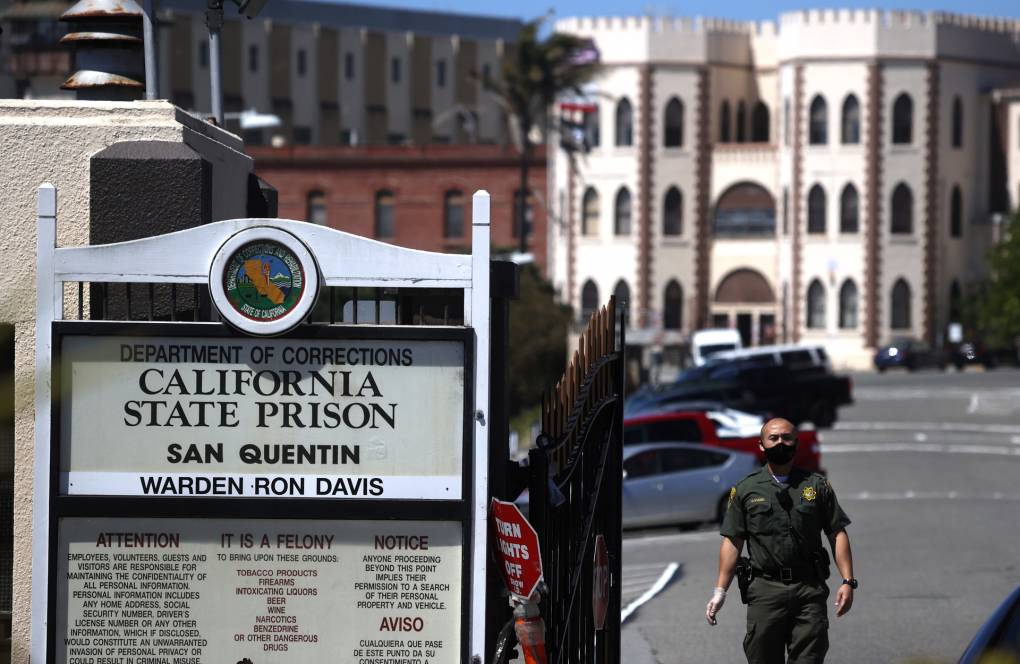
"content": "\u003cp>A federal appeals court on Friday temporarily blocked an order that all California prison workers must be vaccinated against the coronavirus or have a religious or medical exemption. [pullquote] The stay ‘puts both the prison staff and the incarcerated population at greater risk of infection,’ said Don Specter, director of the nonprofit Prison Law Office, which represents incarcerated individuals in a long-running lawsuit over medical conditions in state prisons.[/pullquote]\u003c/p>\n\u003cp>A panel of the 9th U.S. Circuit Court of Appeals granted a request for a stay of September’s lower court order pending an appeal. It also sped up the hearing process by setting a Dec. 13 deadline for opening briefs.\u003c/p>\n\u003cp>The vaccination mandate was supposed to have taken effect by Jan. 12, but the appellate court stay blocks enforcement until sometime in March, when the appeal hearing will be scheduled.\u003c/p>\n\u003cp>The judge who issued the vaccination mandate followed the recommendation of a court-appointed receiver who was chosen to manage the state prison health care system after a federal judge in 2005 found that California failed to provide adequate medical care to prisoners.\u003c/p>\n\u003cp>In addition to requiring COVID-19 shots for prison workers, U.S. District Judge Jon Tigar required vaccinations or exemptions for incarcerated people who want in-person visits or who work outside prisons, including incarcerated firefighters.\u003c/p>\n\u003cp>[ad fullwidth]\u003c/p>\n\u003cp>The stay “puts both the prison staff and the incarcerated population at greater risk of infection,” said Don Specter, director of the nonprofit Prison Law Office, which represents incarcerated people in a long-running lawsuit over medical conditions in state prisons.\u003c/p>\n\u003cp>The mandate was opposed by the state’s prison agency and Gov. Gavin Newsom, even though his administration previously had ordered vaccinations or testing for all state employees, including correctional employees.\u003c/p>\n\u003cp>The politically powerful California Correctional Peace Officers Association had argued that the mandate could create staff shortages if employees refused to comply. [aside tag=\"san-quentin\" label=\"More Related Stories\"]\u003c/p>\n\u003cp>Messages to the governor’s office and corrections officials seeking comment on Friday’s stay weren’t immediately returned.\u003c/p>\n\u003cp>The original vaccination order was designed to head off another COVID-19 outbreak like the one that killed 28 incarcerated people and a correctional officer at San Quentin State Prison last year.\u003c/p>\n\u003cp>“Once the virus enters a facility, it is very difficult to contain, and the dominant route by which it enters a prison is through infected staff,” Tigar said.\u003c/p>\n\u003cp>\u003c/p>\n\u003cp>More than 50,000 incarcerated people in California — more than half of the state’s total incarcerated population — have had a confirmed case of COVID-19, and at least 242 have died from the disease, according to California Department of Corrections and Rehabilitation statistics.\u003c/p>\n\n",
"blocks": [],
"excerpt": "The vaccination mandate was supposed to have taken effect by Jan. 12, but the appellate court stay blocks enforcement until sometime in March, when the appeal hearing will be scheduled.",
"status": "publish",
"parent": 0,
"modified": 1740613513,
"stats": {
"hasAudio": false,
"hasVideo": false,
"hasChartOrMap": false,
"iframeSrcs": [],
"hasGoogleForm": false,
"hasGallery": false,
"hasHearkenModule": false,
"hasPolis": false,
"paragraphCount": 14,
"wordCount": 463
},
"headData": {
"title": "Court Blocks COVID-19 Vaccine Mandate for California Prisons | KQED",
"description": "The vaccination mandate was supposed to have taken effect by Jan. 12, but the appellate court stay blocks enforcement until sometime in March, when the appeal hearing will be scheduled.",
"ogTitle": "",
"ogDescription": "",
"ogImgId": "",
"twTitle": "",
"twDescription": "",
"twImgId": "",
"schema": {
"@context": "https://schema.org",
"@type": "NewsArticle",
"headline": "Court Blocks COVID-19 Vaccine Mandate for California Prisons",
"datePublished": "2021-11-27T12:59:43-08:00",
"dateModified": "2025-02-26T15:45:13-08:00",
"image": "https://cdn.kqed.org/wp-content/uploads/2020/02/KQED-OG-Image@1x.png",
"isAccessibleForFree": "True",
"publisher": {
"@type": "NewsMediaOrganization",
"@id": "https://www.kqed.org/#organization",
"name": "KQED",
"logo": "https://cdn.kqed.org/wp-content/uploads/2020/02/KQED-OG-Image@1x.png",
"url": "https://www.kqed.org",
"sameAs": [
"https://www.facebook.com/KQED",
"https://twitter.com/KQED",
"https://www.instagram.com/kqed/",
"https://www.tiktok.com/@kqedofficial",
"https://www.linkedin.com/company/kqed",
"https://www.youtube.com/channel/UCeC0IOo7i1P_61zVUWbJ4nw"
]
}
}
},
"sticky": false,
"nprByline": "Don Thompson \u003cbr> Associated Press",
"excludeFromSiteSearch": "Include",
"showOnAuthorArchivePages": "No",
"path": "/news/11897498/court-blocks-covid-19-vaccine-mandate-for-california-prisons",
"audioTrackLength": null,
"parsedContent": [
{
"type": "contentString",
"content": "\u003cdiv class=\"post-body\">\u003cp>\u003cp>A federal appeals court on Friday temporarily blocked an order that all California prison workers must be vaccinated against the coronavirus or have a religious or medical exemption. \u003c/p>\u003c/div>",
"attributes": {
"named": {},
"numeric": []
}
},
{
"type": "component",
"content": " The stay ‘puts both the prison staff and the incarcerated population at greater risk of infection,’ said Don Specter, director of the nonprofit Prison Law Office, which represents incarcerated individuals in a long-running lawsuit over medical conditions in state prisons.",
"name": "pullquote",
"attributes": {
"named": {
"label": ""
},
"numeric": []
}
},
{
"type": "contentString",
"content": "\u003cdiv class=\"post-body\">\u003cp>\u003c/p>\n\u003cp>A panel of the 9th U.S. Circuit Court of Appeals granted a request for a stay of September’s lower court order pending an appeal. It also sped up the hearing process by setting a Dec. 13 deadline for opening briefs.\u003c/p>\n\u003cp>The vaccination mandate was supposed to have taken effect by Jan. 12, but the appellate court stay blocks enforcement until sometime in March, when the appeal hearing will be scheduled.\u003c/p>\n\u003cp>The judge who issued the vaccination mandate followed the recommendation of a court-appointed receiver who was chosen to manage the state prison health care system after a federal judge in 2005 found that California failed to provide adequate medical care to prisoners.\u003c/p>\n\u003cp>In addition to requiring COVID-19 shots for prison workers, U.S. District Judge Jon Tigar required vaccinations or exemptions for incarcerated people who want in-person visits or who work outside prisons, including incarcerated firefighters.\u003c/p>\n\u003cp>\u003c/p>\u003c/div>",
"attributes": {
"named": {},
"numeric": []
}
},
{
"type": "component",
"content": "",
"name": "ad",
"attributes": {
"named": {
"label": "fullwidth"
},
"numeric": [
"fullwidth"
]
}
},
{
"type": "contentString",
"content": "\u003cdiv class=\"post-body\">\u003cp>\u003c/p>\n\u003cp>The stay “puts both the prison staff and the incarcerated population at greater risk of infection,” said Don Specter, director of the nonprofit Prison Law Office, which represents incarcerated people in a long-running lawsuit over medical conditions in state prisons.\u003c/p>\n\u003cp>The mandate was opposed by the state’s prison agency and Gov. Gavin Newsom, even though his administration previously had ordered vaccinations or testing for all state employees, including correctional employees.\u003c/p>\n\u003cp>The politically powerful California Correctional Peace Officers Association had argued that the mandate could create staff shortages if employees refused to comply. \u003c/p>\u003c/div>",
"attributes": {
"named": {},
"numeric": []
}
},
{
"type": "component",
"content": "",
"name": "aside",
"attributes": {
"named": {
"tag": "san-quentin",
"label": "More Related Stories "
},
"numeric": []
}
},
{
"type": "contentString",
"content": "\u003cdiv class=\"post-body\">\u003cp>\u003c/p>\n\u003cp>Messages to the governor’s office and corrections officials seeking comment on Friday’s stay weren’t immediately returned.\u003c/p>\n\u003cp>The original vaccination order was designed to head off another COVID-19 outbreak like the one that killed 28 incarcerated people and a correctional officer at San Quentin State Prison last year.\u003c/p>\n\u003cp>“Once the virus enters a facility, it is very difficult to contain, and the dominant route by which it enters a prison is through infected staff,” Tigar said.\u003c/p>\n\u003cp>\u003c/p>\n\u003cp>More than 50,000 incarcerated people in California — more than half of the state’s total incarcerated population — have had a confirmed case of COVID-19, and at least 242 have died from the disease, according to California Department of Corrections and Rehabilitation statistics.\u003c/p>\n\n\u003c/div>\u003c/p>",
"attributes": {
"named": {},
"numeric": []
}
}
],
"link": "/news/11897498/court-blocks-covid-19-vaccine-mandate-for-california-prisons",
"authors": [
"byline_news_11897498"
],
"categories": [
"news_6188",
"news_8"
],
"tags": [
"news_18538",
"news_1629",
"news_27504",
"news_27626",
"news_2842",
"news_1471",
"news_486",
"news_981"
],
"featImg": "news_11831919",
"label": "news"
},
"news_11896682": {
"type": "posts",
"id": "news_11896682",
"meta": {
"index": "posts_1716263798",
"site": "news",
"id": "11896682",
"score": null,
"sort": [
1637589645000
]
},
"guestAuthors": [],
"slug": "what-immigrant-students-and-educators-in-oakland-are-doing-to-boost-vaccination-rates-at-schools",
"title": "What Immigrant Students and Educators in Oakland Are Doing to Boost Vaccination Rates at Schools",
"publishDate": 1637589645,
"format": "audio",
"headTitle": "What Immigrant Students and Educators in Oakland Are Doing to Boost Vaccination Rates at Schools | KQED",
"labelTerm": {
"site": "news"
},
"content": "\u003cp>Oakland students age 12 and older have less than two months left to get their COVID-19 shots before the school \u003ca href=\"https://www.ousd.org/Page/21114\">district’s vaccine mandate kicks in on Jan. 1\u003c/a>. As of late October, about 60% of district students had gotten at least one dose, according to district officials.\u003c/p>\n\u003cp>But some schools are facing more obstacles than others in making sure their students get vaccinated. At Oakland International High School, which serves immigrant students who’ve recently arrived from around the world, administrators estimated only 47% of students had gotten at least their first dose as of early November.\u003c/p>\n\u003cp>They point to misinformation about the vaccine and language barriers as hurdles they need to work through to boost their numbers.\u003c/p>\n\u003cp>“We feel like we’ve been put in a situation where, for better or worse, we have to round up students and really very strongly recommend that they get the vaccine,” says OIHS principal Veronica Garcia. “The stakes are very high.”\u003c/p>\n\u003cp>Students who aren’t vaccinated and don’t get an exemption must either transfer to the district’s independent study program — distance learning — or be disenrolled.\u003c/p>\n\u003cfigure id=\"attachment_11896899\" class=\"wp-caption alignnone\" style=\"max-width: 1009px\">\u003cimg loading=\"lazy\" decoding=\"async\" class=\"size-full wp-image-11896899\" src=\"https://ww2.kqed.org/app/uploads/sites/10/2021/11/RS52568_IMG_5127-qut-1020x765-1.jpg\" alt=\"A close-up of a clamshell billboard that reads, "Today's vaccine: Pfizer."\" width=\"1009\" height=\"673\" srcset=\"https://cdn.kqed.org/wp-content/uploads/sites/10/2021/11/RS52568_IMG_5127-qut-1020x765-1.jpg 1009w, https://cdn.kqed.org/wp-content/uploads/sites/10/2021/11/RS52568_IMG_5127-qut-1020x765-1-800x534.jpg 800w, https://cdn.kqed.org/wp-content/uploads/sites/10/2021/11/RS52568_IMG_5127-qut-1020x765-1-160x107.jpg 160w\" sizes=\"auto, (max-width: 1009px) 100vw, 1009px\">\u003cfigcaption class=\"wp-caption-text\">OIHS staff organized a pop-up vaccine clinic on campus to encourage more students to get vaccinated. Some school officials say there are other reasons getting a vaccine is complicated. For example, undocumented students worry about being asked to show documentation. \u003ccite>(Vanessa Rancaño/KQED)\u003c/cite>\u003c/figcaption>\u003c/figure>\n\u003cp>Garcia worries the \u003ca href=\"https://www.kqed.org/news/11887194/in-oakland-distance-learners-face-confusion-teacher-shortage\" target=\"_blank\" rel=\"noopener noreferrer\">district’s distance learning program isn’t equipped\u003c/a> to serve newcomers. \u003ca href=\"http://laschoolreport.com/learning-loss-in-california-new-analysis-digs-into-how-students-particularly-english-learners-are-falling-behind-during-the-pandemic/\">English-language learners suffered some of the worst academic consequences\u003c/a> of Zoom-based school.\u003c/p>\n\u003cp>“It’s a terrible choice, right?” she says.\u003c/p>\n\u003cp>She says there aren’t enough resources to provide culturally relevant and accurate information on the vaccines to students and families, who tend to live in Oakland ZIP codes with lower vaccination rates.\u003cstrong> \u003c/strong>\u003c/p>\n\u003cp>[aside postID=\"news_11855640\" hero=\"https://ww2.kqed.org/app/uploads/sites/10/2021/01/Oakland-Mam-Aguilar-1020x680.jpg\"]“There’s just \u003ca href=\"https://www.kqed.org/news/11855640/how-native-speakers-are-helping-1300-mam-students-in-oakland-through-remote-learning\" target=\"_blank\" rel=\"noopener noreferrer\">not a lot of consistent support with Mam language translation\u003c/a>,” she says, referring to a Mayan tongue used by some half million people, primarily in Guatemala. “There just aren’t a lot of culturally competent people out there in the field that can provide information to our Arabic-speaking families, for example, who have their own specific concerns about the vaccine or our families that speak Tigrinya.”\u003c/p>\n\u003cp>So one November morning, it’s case manager Ricardo Jaramillo’s job to round up unvaccinated students. He walks the school hallways checking, and rechecking, his list of names.\u003c/p>\n\u003cp>He dips into a classroom and comes out with 18-year-old Edras Sanchez from Honduras. Like all the students at this high school, Sanchez is new to the country, and Jaramillo wants to ensure he understands the district’s vaccine mandate so he can stay in school. Come January first, Jaramillo explains, Sanchez will need an exemption to come to school if he’s still not vaccinated.\u003c/p>\n\u003cfigure id=\"attachment_11896901\" class=\"wp-caption alignnone\" style=\"max-width: 957px\">\u003cimg loading=\"lazy\" decoding=\"async\" class=\"size-full wp-image-11896901\" src=\"https://ww2.kqed.org/app/uploads/sites/10/2021/11/RS52563_IMG_5115-qut-1020x765-1.jpg\" alt=\"Two people discuss and look at documents as they stand outside in a school courtyard.\" width=\"957\" height=\"637\" srcset=\"https://cdn.kqed.org/wp-content/uploads/sites/10/2021/11/RS52563_IMG_5115-qut-1020x765-1.jpg 957w, https://cdn.kqed.org/wp-content/uploads/sites/10/2021/11/RS52563_IMG_5115-qut-1020x765-1-800x532.jpg 800w, https://cdn.kqed.org/wp-content/uploads/sites/10/2021/11/RS52563_IMG_5115-qut-1020x765-1-160x106.jpg 160w\" sizes=\"auto, (max-width: 957px) 100vw, 957px\">\u003cfigcaption class=\"wp-caption-text\">OIHS staff review lists of unvaccinated students at a pop-up vaccine clinic on campus. Besides organizing this clinic, staff also have been giving presentations in classes, providing information in students’ native languages, and calling home to make sure families have accurate information about the vaccine. \u003ccite>(Vanessa Rancaño/KQED)\u003c/cite>\u003c/figcaption>\u003c/figure>\n\u003cp>Sanchez has been avoiding the shot. “I’m scared,” he says. “I hear the vaccine is getting people sick.” He’s worried about the side effects and has a lot of questions about how vaccines work.\u003c/p>\n\u003cp>Community school manager Madenh Hassan, who’s responsible for helping with things like students’ mental health, medical and legal needs, says there are other reasons getting a vaccine is complicated for her students. Those who are undocumented worry about being asked to show their documentation, plus they’re still learning their way around this country.\u003c/p>\n\u003cp>[aside postID=\"news_11896107\" hero=\"https://ww2.kqed.org/app/uploads/sites/10/2021/11/GettyImages-1234850823-1020x680.jpg\"]“It’s really challenging being a newcomer and really understanding how to have a conversation about my needs,” she says. “Even just saying it’s available everywhere, that means almost nothing to students. Like, ‘I need you to walk me here and show me and me to feel comfortable knowing you’re somebody I trust.'”\u003c/p>\n\u003cp>In October the school held a vaccine clinic on campus and only 30 students got shots, principal Garcia says. Since then, staff have upped their outreach efforts. They’ve been giving presentations in classes, providing information in students’ native languages, and calling home.\u003c/p>\n\u003cp>Case managers like Jaramillo are also having lots of one-on-one conversations with students like Sanchez. Outside his classroom, he asks Jaramillo, “Are there any risks associated with the vaccine?”\u003c/p>\n\u003cp>Jaramillo explains they’re minimal and points out that he’s gotten two doses himself. To his surprise, Sanchez agrees to head over to the pop-up vaccine clinic the school is holding that day. Most students turn down the offer.\u003c/p>\n\u003cfigure id=\"attachment_11896902\" class=\"wp-caption alignnone\" style=\"max-width: 1009px\">\u003cimg loading=\"lazy\" decoding=\"async\" class=\"size-full wp-image-11896902\" src=\"https://ww2.kqed.org/app/uploads/sites/10/2021/11/RS52567_IMG_5129-qut-1020x765-1.jpg\" alt=\"Two high schoolers wearing facemasks stand close together and face the camera.\" width=\"1009\" height=\"672\" srcset=\"https://cdn.kqed.org/wp-content/uploads/sites/10/2021/11/RS52567_IMG_5129-qut-1020x765-1.jpg 1009w, https://cdn.kqed.org/wp-content/uploads/sites/10/2021/11/RS52567_IMG_5129-qut-1020x765-1-800x533.jpg 800w, https://cdn.kqed.org/wp-content/uploads/sites/10/2021/11/RS52567_IMG_5129-qut-1020x765-1-160x107.jpg 160w\" sizes=\"auto, (max-width: 1009px) 100vw, 1009px\">\u003cfigcaption class=\"wp-caption-text\">Some OIHS students, like Ronaldo Aguilar and Anibal Godinez, have been encouraging their fellow students to get vaccinated. They say they don’t want any of their classmates to have to go back to distance learning. \u003ccite>(Vanessa Rancaño/KQED)\u003c/cite>\u003c/figcaption>\u003c/figure>\n\u003cp>Eighteen-year-old Ronaldo Aguilar and fellow student Anibal Godinez, 17, say they’re doing their part to encourage hesitant classmates to get the shot. And it’s not just about health; they don’t want to see their peers end up in distance learning. “In-person [school] is better,” Aguilar says. “That’s why we need to get the vaccine.”\u003c/p>\n\u003cp>OIHS administrators hoped to get 100 students vaccinated at a clinic held on November 10. In the end, 72 people got shots, and some of those were staff members getting boosters.\u003c/p>\n\u003cp>[pullquote align=\"right\" size=\"medium\" citation=\"Ronaldo Aguilar, OIHS student\"]‘In-person [school] is better … that’s why we need to get the vaccine.’[/pullquote]At Rudsdale Newcomer High School, the other district campus dedicated solely to serving new immigrant students, assistant principal Emma Batten-Bowman says she’s had more success.\u003c/p>\n\u003cp>She estimates around 75% of her students are vaccinated. That’s in part because they tend to be older, and many of them hold jobs that require them to be vaccinated. But she also credits the robust support system she’s been able to put in place at the school through her own grant writing and other efforts.\u003c/p>\n\u003cp>“It just feels like we’re creating a lot of stuff on our own instead of getting that from the district,” she says. “They should be sending folks that speak Spanish and Mam to talk about the vaccine and to meet with families.”\u003c/p>\n\u003cp>Instead, she’s relied in part on her AmeriCorps volunteers to accompany students to vaccination appointments. “Most schools just don’t have the capacity for that kind of outreach,” Batten-Bowman says, “and that’s the kind of outreach it really takes.”\u003c/p>\n\u003cfigure id=\"attachment_11896897\" class=\"wp-caption alignnone\" style=\"max-width: 970px\">\u003cimg loading=\"lazy\" decoding=\"async\" class=\"size-full wp-image-11896897\" src=\"https://ww2.kqed.org/app/uploads/sites/10/2021/11/RS52569_IMG_5132-qut-1020x765-1.jpg\" alt=\"Some students are sitting in chairs, in line formation, outside in a school courtyard.\" width=\"970\" height=\"647\" srcset=\"https://cdn.kqed.org/wp-content/uploads/sites/10/2021/11/RS52569_IMG_5132-qut-1020x765-1.jpg 970w, https://cdn.kqed.org/wp-content/uploads/sites/10/2021/11/RS52569_IMG_5132-qut-1020x765-1-800x534.jpg 800w, https://cdn.kqed.org/wp-content/uploads/sites/10/2021/11/RS52569_IMG_5132-qut-1020x765-1-160x107.jpg 160w\" sizes=\"auto, (max-width: 970px) 100vw, 970px\">\u003cfigcaption class=\"wp-caption-text\">OIHS students wait to be vaccinated at a pop-up vaccine clinic on campus. \u003ccite>(Vanessa Rancaño/KQED)\u003c/cite>\u003c/figcaption>\u003c/figure>\n\u003cp>Oakland Unified partnered with the county \u003ca href=\"https://www.ousd.org/Page/21210\" target=\"_blank\" rel=\"noopener noreferrer\">to bring vaccination clinics to some campuses\u003c/a>, held district-wide info sessions online and made an \u003ca href=\"https://www.ousd.org/Page/20983\" target=\"_blank\" rel=\"noopener noreferrer\">informational video available there in several languages\u003c/a>, including Mam, but Batten-Bowman says those aren’t accessible for many families. The district has designated this week “\u003ca href=\"https://www.ousd.org/Page/21238\" target=\"_blank\" rel=\"noopener noreferrer\">Vaccination Education Week\u003c/a>” and is encouraging teachers to dedicate lessons to vaccine education.\u003c/p>\n\u003cp>[aside label ='Related Coverage' tag='vaccine-hesitancy']Students who don’t get vaccinated will be able to keep going to school if they can \u003ca href=\"https://www.ousd.org/Page/21239\" target=\"_blank\" rel=\"noopener noreferrer\">get a doctor’s note granting them a medical or personal belief exemption\u003c/a>. But Batten-Bowman and Oakland International’s Garcia say that won’t be easy for many of their students, who don’t have regular medical care.\u003c/p>\n\u003cp>“There’s no guarantee that we can help them access doctors to get a waiver,” Garcia says.\u003c/p>\n\u003cp>And if they can’t, she worries too many will end up in distance learning classes that don’t meet their needs, or pushed out of school altogether. With the deadline approaching, Garcia is planning another vaccine clinic for next month.\u003cbr>\n[ad fullwidth]\u003c/p>\n\u003cp>[ad floatright]\u003c/p>\n",
"blocks": [],
"excerpt": "For Oakland's newcomer immigrant students, disinformation and language barriers are just one extra hurdle to getting the COVID-19 vaccine. ",
"status": "publish",
"parent": 0,
"modified": 1740699595,
"stats": {
"hasAudio": false,
"hasVideo": false,
"hasChartOrMap": false,
"iframeSrcs": [],
"hasGoogleForm": false,
"hasGallery": false,
"hasHearkenModule": false,
"hasPolis": false,
"paragraphCount": 28,
"wordCount": 1446
},
"headData": {
"title": "What Immigrant Students and Educators in Oakland Are Doing to Boost Vaccination Rates at Schools | KQED",
"description": "For Oakland's newcomer immigrant students, disinformation and language barriers are just one extra hurdle to getting the COVID-19 vaccine. ",
"ogTitle": "",
"ogDescription": "",
"ogImgId": "",
"twTitle": "",
"twDescription": "",
"twImgId": "",
"schema": {
"@context": "https://schema.org",
"@type": "NewsArticle",
"headline": "What Immigrant Students and Educators in Oakland Are Doing to Boost Vaccination Rates at Schools",
"datePublished": "2021-11-22T06:00:45-08:00",
"dateModified": "2025-02-27T15:39:55-08:00",
"image": "https://cdn.kqed.org/wp-content/uploads/2020/02/KQED-OG-Image@1x.png",
"isAccessibleForFree": "True",
"publisher": {
"@type": "NewsMediaOrganization",
"@id": "https://www.kqed.org/#organization",
"name": "KQED",
"logo": "https://cdn.kqed.org/wp-content/uploads/2020/02/KQED-OG-Image@1x.png",
"url": "https://www.kqed.org",
"sameAs": [
"https://www.facebook.com/KQED",
"https://twitter.com/KQED",
"https://www.instagram.com/kqed/",
"https://www.tiktok.com/@kqedofficial",
"https://www.linkedin.com/company/kqed",
"https://www.youtube.com/channel/UCeC0IOo7i1P_61zVUWbJ4nw"
]
}
}
},
"audioUrl": "https://traffic.omny.fm/d/clips/0af137ef-751e-4b19-a055-aaef00d2d578/ffca7e9f-6831-4[…]f-aaef00f5a073/8de61e2b-08b5-4a8a-88c6-ade4012cc269/audio.mp3",
"sticky": false,
"excludeFromSiteSearch": "Include",
"path": "/news/11896682/what-immigrant-students-and-educators-in-oakland-are-doing-to-boost-vaccination-rates-at-schools",
"audioTrackLength": null,
"parsedContent": [
{
"type": "contentString",
"content": "\u003cdiv class=\"post-body\">\u003cp>\u003cp>Oakland students age 12 and older have less than two months left to get their COVID-19 shots before the school \u003ca href=\"https://www.ousd.org/Page/21114\">district’s vaccine mandate kicks in on Jan. 1\u003c/a>. As of late October, about 60% of district students had gotten at least one dose, according to district officials.\u003c/p>\n\u003cp>But some schools are facing more obstacles than others in making sure their students get vaccinated. At Oakland International High School, which serves immigrant students who’ve recently arrived from around the world, administrators estimated only 47% of students had gotten at least their first dose as of early November.\u003c/p>\n\u003cp>They point to misinformation about the vaccine and language barriers as hurdles they need to work through to boost their numbers.\u003c/p>\n\u003cp>“We feel like we’ve been put in a situation where, for better or worse, we have to round up students and really very strongly recommend that they get the vaccine,” says OIHS principal Veronica Garcia. “The stakes are very high.”\u003c/p>\n\u003cp>Students who aren’t vaccinated and don’t get an exemption must either transfer to the district’s independent study program — distance learning — or be disenrolled.\u003c/p>\n\u003cfigure id=\"attachment_11896899\" class=\"wp-caption alignnone\" style=\"max-width: 1009px\">\u003cimg loading=\"lazy\" decoding=\"async\" class=\"size-full wp-image-11896899\" src=\"https://ww2.kqed.org/app/uploads/sites/10/2021/11/RS52568_IMG_5127-qut-1020x765-1.jpg\" alt=\"A close-up of a clamshell billboard that reads, "Today's vaccine: Pfizer."\" width=\"1009\" height=\"673\" srcset=\"https://cdn.kqed.org/wp-content/uploads/sites/10/2021/11/RS52568_IMG_5127-qut-1020x765-1.jpg 1009w, https://cdn.kqed.org/wp-content/uploads/sites/10/2021/11/RS52568_IMG_5127-qut-1020x765-1-800x534.jpg 800w, https://cdn.kqed.org/wp-content/uploads/sites/10/2021/11/RS52568_IMG_5127-qut-1020x765-1-160x107.jpg 160w\" sizes=\"auto, (max-width: 1009px) 100vw, 1009px\">\u003cfigcaption class=\"wp-caption-text\">OIHS staff organized a pop-up vaccine clinic on campus to encourage more students to get vaccinated. Some school officials say there are other reasons getting a vaccine is complicated. For example, undocumented students worry about being asked to show documentation. \u003ccite>(Vanessa Rancaño/KQED)\u003c/cite>\u003c/figcaption>\u003c/figure>\n\u003cp>Garcia worries the \u003ca href=\"https://www.kqed.org/news/11887194/in-oakland-distance-learners-face-confusion-teacher-shortage\" target=\"_blank\" rel=\"noopener noreferrer\">district’s distance learning program isn’t equipped\u003c/a> to serve newcomers. \u003ca href=\"http://laschoolreport.com/learning-loss-in-california-new-analysis-digs-into-how-students-particularly-english-learners-are-falling-behind-during-the-pandemic/\">English-language learners suffered some of the worst academic consequences\u003c/a> of Zoom-based school.\u003c/p>\n\u003cp>“It’s a terrible choice, right?” she says.\u003c/p>\n\u003cp>She says there aren’t enough resources to provide culturally relevant and accurate information on the vaccines to students and families, who tend to live in Oakland ZIP codes with lower vaccination rates.\u003cstrong> \u003c/strong>\u003c/p>\n\u003cp>\u003c/p>\u003c/div>",
"attributes": {
"named": {},
"numeric": []
}
},
{
"type": "component",
"content": "",
"name": "aside",
"attributes": {
"named": {
"postid": "news_11855640",
"hero": "https://ww2.kqed.org/app/uploads/sites/10/2021/01/Oakland-Mam-Aguilar-1020x680.jpg",
"label": ""
},
"numeric": []
}
},
{
"type": "contentString",
"content": "\u003cdiv class=\"post-body\">\u003cp>“There’s just \u003ca href=\"https://www.kqed.org/news/11855640/how-native-speakers-are-helping-1300-mam-students-in-oakland-through-remote-learning\" target=\"_blank\" rel=\"noopener noreferrer\">not a lot of consistent support with Mam language translation\u003c/a>,” she says, referring to a Mayan tongue used by some half million people, primarily in Guatemala. “There just aren’t a lot of culturally competent people out there in the field that can provide information to our Arabic-speaking families, for example, who have their own specific concerns about the vaccine or our families that speak Tigrinya.”\u003c/p>\n\u003cp>So one November morning, it’s case manager Ricardo Jaramillo’s job to round up unvaccinated students. He walks the school hallways checking, and rechecking, his list of names.\u003c/p>\n\u003cp>He dips into a classroom and comes out with 18-year-old Edras Sanchez from Honduras. Like all the students at this high school, Sanchez is new to the country, and Jaramillo wants to ensure he understands the district’s vaccine mandate so he can stay in school. Come January first, Jaramillo explains, Sanchez will need an exemption to come to school if he’s still not vaccinated.\u003c/p>\n\u003cfigure id=\"attachment_11896901\" class=\"wp-caption alignnone\" style=\"max-width: 957px\">\u003cimg loading=\"lazy\" decoding=\"async\" class=\"size-full wp-image-11896901\" src=\"https://ww2.kqed.org/app/uploads/sites/10/2021/11/RS52563_IMG_5115-qut-1020x765-1.jpg\" alt=\"Two people discuss and look at documents as they stand outside in a school courtyard.\" width=\"957\" height=\"637\" srcset=\"https://cdn.kqed.org/wp-content/uploads/sites/10/2021/11/RS52563_IMG_5115-qut-1020x765-1.jpg 957w, https://cdn.kqed.org/wp-content/uploads/sites/10/2021/11/RS52563_IMG_5115-qut-1020x765-1-800x532.jpg 800w, https://cdn.kqed.org/wp-content/uploads/sites/10/2021/11/RS52563_IMG_5115-qut-1020x765-1-160x106.jpg 160w\" sizes=\"auto, (max-width: 957px) 100vw, 957px\">\u003cfigcaption class=\"wp-caption-text\">OIHS staff review lists of unvaccinated students at a pop-up vaccine clinic on campus. Besides organizing this clinic, staff also have been giving presentations in classes, providing information in students’ native languages, and calling home to make sure families have accurate information about the vaccine. \u003ccite>(Vanessa Rancaño/KQED)\u003c/cite>\u003c/figcaption>\u003c/figure>\n\u003cp>Sanchez has been avoiding the shot. “I’m scared,” he says. “I hear the vaccine is getting people sick.” He’s worried about the side effects and has a lot of questions about how vaccines work.\u003c/p>\n\u003cp>Community school manager Madenh Hassan, who’s responsible for helping with things like students’ mental health, medical and legal needs, says there are other reasons getting a vaccine is complicated for her students. Those who are undocumented worry about being asked to show their documentation, plus they’re still learning their way around this country.\u003c/p>\n\u003cp>\u003c/p>\u003c/div>",
"attributes": {
"named": {},
"numeric": []
}
},
{
"type": "component",
"content": "",
"name": "aside",
"attributes": {
"named": {
"postid": "news_11896107",
"hero": "https://ww2.kqed.org/app/uploads/sites/10/2021/11/GettyImages-1234850823-1020x680.jpg",
"label": ""
},
"numeric": []
}
},
{
"type": "contentString",
"content": "\u003cdiv class=\"post-body\">\u003cp>“It’s really challenging being a newcomer and really understanding how to have a conversation about my needs,” she says. “Even just saying it’s available everywhere, that means almost nothing to students. Like, ‘I need you to walk me here and show me and me to feel comfortable knowing you’re somebody I trust.'”\u003c/p>\n\u003cp>In October the school held a vaccine clinic on campus and only 30 students got shots, principal Garcia says. Since then, staff have upped their outreach efforts. They’ve been giving presentations in classes, providing information in students’ native languages, and calling home.\u003c/p>\n\u003cp>Case managers like Jaramillo are also having lots of one-on-one conversations with students like Sanchez. Outside his classroom, he asks Jaramillo, “Are there any risks associated with the vaccine?”\u003c/p>\n\u003cp>Jaramillo explains they’re minimal and points out that he’s gotten two doses himself. To his surprise, Sanchez agrees to head over to the pop-up vaccine clinic the school is holding that day. Most students turn down the offer.\u003c/p>\n\u003cfigure id=\"attachment_11896902\" class=\"wp-caption alignnone\" style=\"max-width: 1009px\">\u003cimg loading=\"lazy\" decoding=\"async\" class=\"size-full wp-image-11896902\" src=\"https://ww2.kqed.org/app/uploads/sites/10/2021/11/RS52567_IMG_5129-qut-1020x765-1.jpg\" alt=\"Two high schoolers wearing facemasks stand close together and face the camera.\" width=\"1009\" height=\"672\" srcset=\"https://cdn.kqed.org/wp-content/uploads/sites/10/2021/11/RS52567_IMG_5129-qut-1020x765-1.jpg 1009w, https://cdn.kqed.org/wp-content/uploads/sites/10/2021/11/RS52567_IMG_5129-qut-1020x765-1-800x533.jpg 800w, https://cdn.kqed.org/wp-content/uploads/sites/10/2021/11/RS52567_IMG_5129-qut-1020x765-1-160x107.jpg 160w\" sizes=\"auto, (max-width: 1009px) 100vw, 1009px\">\u003cfigcaption class=\"wp-caption-text\">Some OIHS students, like Ronaldo Aguilar and Anibal Godinez, have been encouraging their fellow students to get vaccinated. They say they don’t want any of their classmates to have to go back to distance learning. \u003ccite>(Vanessa Rancaño/KQED)\u003c/cite>\u003c/figcaption>\u003c/figure>\n\u003cp>Eighteen-year-old Ronaldo Aguilar and fellow student Anibal Godinez, 17, say they’re doing their part to encourage hesitant classmates to get the shot. And it’s not just about health; they don’t want to see their peers end up in distance learning. “In-person [school] is better,” Aguilar says. “That’s why we need to get the vaccine.”\u003c/p>\n\u003cp>OIHS administrators hoped to get 100 students vaccinated at a clinic held on November 10. In the end, 72 people got shots, and some of those were staff members getting boosters.\u003c/p>\n\u003cp>\u003c/p>\u003c/div>",
"attributes": {
"named": {},
"numeric": []
}
},
{
"type": "component",
"content": "‘In-person [school] is better … that’s why we need to get the vaccine.’",
"name": "pullquote",
"attributes": {
"named": {
"align": "right",
"size": "medium",
"citation": "Ronaldo Aguilar, OIHS student",
"label": ""
},
"numeric": []
}
},
{
"type": "contentString",
"content": "\u003cdiv class=\"post-body\">\u003cp>At Rudsdale Newcomer High School, the other district campus dedicated solely to serving new immigrant students, assistant principal Emma Batten-Bowman says she’s had more success.\u003c/p>\n\u003cp>She estimates around 75% of her students are vaccinated. That’s in part because they tend to be older, and many of them hold jobs that require them to be vaccinated. But she also credits the robust support system she’s been able to put in place at the school through her own grant writing and other efforts.\u003c/p>\n\u003cp>“It just feels like we’re creating a lot of stuff on our own instead of getting that from the district,” she says. “They should be sending folks that speak Spanish and Mam to talk about the vaccine and to meet with families.”\u003c/p>\n\u003cp>Instead, she’s relied in part on her AmeriCorps volunteers to accompany students to vaccination appointments. “Most schools just don’t have the capacity for that kind of outreach,” Batten-Bowman says, “and that’s the kind of outreach it really takes.”\u003c/p>\n\u003cfigure id=\"attachment_11896897\" class=\"wp-caption alignnone\" style=\"max-width: 970px\">\u003cimg loading=\"lazy\" decoding=\"async\" class=\"size-full wp-image-11896897\" src=\"https://ww2.kqed.org/app/uploads/sites/10/2021/11/RS52569_IMG_5132-qut-1020x765-1.jpg\" alt=\"Some students are sitting in chairs, in line formation, outside in a school courtyard.\" width=\"970\" height=\"647\" srcset=\"https://cdn.kqed.org/wp-content/uploads/sites/10/2021/11/RS52569_IMG_5132-qut-1020x765-1.jpg 970w, https://cdn.kqed.org/wp-content/uploads/sites/10/2021/11/RS52569_IMG_5132-qut-1020x765-1-800x534.jpg 800w, https://cdn.kqed.org/wp-content/uploads/sites/10/2021/11/RS52569_IMG_5132-qut-1020x765-1-160x107.jpg 160w\" sizes=\"auto, (max-width: 970px) 100vw, 970px\">\u003cfigcaption class=\"wp-caption-text\">OIHS students wait to be vaccinated at a pop-up vaccine clinic on campus. \u003ccite>(Vanessa Rancaño/KQED)\u003c/cite>\u003c/figcaption>\u003c/figure>\n\u003cp>Oakland Unified partnered with the county \u003ca href=\"https://www.ousd.org/Page/21210\" target=\"_blank\" rel=\"noopener noreferrer\">to bring vaccination clinics to some campuses\u003c/a>, held district-wide info sessions online and made an \u003ca href=\"https://www.ousd.org/Page/20983\" target=\"_blank\" rel=\"noopener noreferrer\">informational video available there in several languages\u003c/a>, including Mam, but Batten-Bowman says those aren’t accessible for many families. The district has designated this week “\u003ca href=\"https://www.ousd.org/Page/21238\" target=\"_blank\" rel=\"noopener noreferrer\">Vaccination Education Week\u003c/a>” and is encouraging teachers to dedicate lessons to vaccine education.\u003c/p>\n\u003cp>\u003c/p>\u003c/div>",
"attributes": {
"named": {},
"numeric": []
}
},
{
"type": "component",
"content": "",
"name": "aside",
"attributes": {
"named": {
"label": "Related Coverage ",
"tag": "vaccine-hesitancy"
},
"numeric": []
}
},
{
"type": "contentString",
"content": "\u003cdiv class=\"post-body\">\u003cp>Students who don’t get vaccinated will be able to keep going to school if they can \u003ca href=\"https://www.ousd.org/Page/21239\" target=\"_blank\" rel=\"noopener noreferrer\">get a doctor’s note granting them a medical or personal belief exemption\u003c/a>. But Batten-Bowman and Oakland International’s Garcia say that won’t be easy for many of their students, who don’t have regular medical care.\u003c/p>\n\u003cp>“There’s no guarantee that we can help them access doctors to get a waiver,” Garcia says.\u003c/p>\n\u003cp>And if they can’t, she worries too many will end up in distance learning classes that don’t meet their needs, or pushed out of school altogether. With the deadline approaching, Garcia is planning another vaccine clinic for next month.\u003cbr>\n\u003c/p>\u003c/div>",
"attributes": {
"named": {},
"numeric": []
}
},
{
"type": "component",
"content": "",
"name": "ad",
"attributes": {
"named": {
"label": "fullwidth"
},
"numeric": [
"fullwidth"
]
}
},
{
"type": "contentString",
"content": "\u003cdiv class=\"post-body\">\u003cp>\u003c/p>\n\u003cp>\u003c/p>\u003c/div>",
"attributes": {
"named": {},
"numeric": []
}
},
{
"type": "component",
"content": "",
"name": "ad",
"attributes": {
"named": {
"label": "floatright"
},
"numeric": [
"floatright"
]
}
},
{
"type": "contentString",
"content": "\u003cdiv class=\"post-body\">\u003cp>\u003c/p>\n\u003c/div>\u003c/p>",
"attributes": {
"named": {},
"numeric": []
}
}
],
"link": "/news/11896682/what-immigrant-students-and-educators-in-oakland-are-doing-to-boost-vaccination-rates-at-schools",
"authors": [
"11276"
],
"categories": [
"news_18540",
"news_457",
"news_8"
],
"tags": [
"news_27626",
"news_1826",
"news_3228",
"news_981"
],
"featImg": "news_11896896",
"label": "news"
},
"news_11895573": {
"type": "posts",
"id": "news_11895573",
"meta": {
"index": "posts_1716263798",
"site": "news",
"id": "11895573",
"score": null,
"sort": [
1636462835000
]
},
"guestAuthors": [],
"slug": "so-many-small-superheroes",
"title": "So Many Small Superheroes",
"publishDate": 1636462835,
"format": "aside",
"headTitle": "So Many Small Superheroes | KQED",
"labelTerm": {
"term": 18515,
"site": "news"
},
"content": "\u003cp>\u003ca href=\"https://ww2.kqed.org/app/uploads/sites/10/2021/11/superamazing_110821_final.png\">\u003cimg loading=\"lazy\" decoding=\"async\" class=\"alignnone size-full wp-image-11895578\" src=\"https://ww2.kqed.org/app/uploads/sites/10/2021/11/superamazing_110821_final.png\" alt=\"Cartoon: a boy dressed as a superhero under a sign that reads, "Superamazing Boy! Helping defeat a deadly pandemic with his supercharged immune system!" Kids in the background say, "I can't wait to get the shot, too!"\" width=\"1920\" height=\"1332\" srcset=\"https://cdn.kqed.org/wp-content/uploads/sites/10/2021/11/superamazing_110821_final.png 1920w, https://cdn.kqed.org/wp-content/uploads/sites/10/2021/11/superamazing_110821_final-800x555.png 800w, https://cdn.kqed.org/wp-content/uploads/sites/10/2021/11/superamazing_110821_final-1020x708.png 1020w, https://cdn.kqed.org/wp-content/uploads/sites/10/2021/11/superamazing_110821_final-160x111.png 160w, https://cdn.kqed.org/wp-content/uploads/sites/10/2021/11/superamazing_110821_final-1536x1066.png 1536w\" sizes=\"auto, (max-width: 1920px) 100vw, 1920px\">\u003c/a>\u003c/p>\n\u003cp>Health providers, counties and clinics are rolling out COVID vaccines for kids age 5-11 across the Bay Area.\u003c/p>\n\u003cp>\u003ca href=\"https://bit.ly/fiorekidvaccinestickers\">Here’s a handy guide with more information about where to get the Pfizer vaccine\u003c/a>.\u003c/p>\n\u003cp>And once those kids get their shot, \u003ca href=\"https://www.kqed.org/news/11895373/hey-kids-your-i-got-vaccinated-stickers-are-here\">they deserve a sticker\u003c/a>!\u003c/p>\n\u003cp>[ad fullwidth]\u003c/p>\u003cp>\u003c/p>\n",
"blocks": [],
"excerpt": "Health providers, counties and clinics are rolling out COVID vaccines for kids age 5-11 across the Bay Area. Here's a handy guide with more info about where to get the Pfizer vaccine. ",
"status": "publish",
"parent": 0,
"modified": 1740615382,
"stats": {
"hasAudio": false,
"hasVideo": false,
"hasChartOrMap": false,
"iframeSrcs": [],
"hasGoogleForm": false,
"hasGallery": false,
"hasHearkenModule": false,
"hasPolis": false,
"paragraphCount": 6,
"wordCount": 48
},
"headData": {
"title": "So Many Small Superheroes | KQED",
"description": "Health providers, counties and clinics are rolling out COVID vaccines for kids age 5-11 across the Bay Area. Here's a handy guide with more info about where to get the Pfizer vaccine. ",
"ogTitle": "",
"ogDescription": "",
"ogImgId": "",
"twTitle": "",
"twDescription": "",
"twImgId": "",
"schema": {
"@context": "https://schema.org",
"@type": "NewsArticle",
"headline": "So Many Small Superheroes",
"datePublished": "2021-11-09T05:00:35-08:00",
"dateModified": "2025-02-26T16:16:22-08:00",
"image": "https://cdn.kqed.org/wp-content/uploads/2020/02/KQED-OG-Image@1x.png",
"isAccessibleForFree": "True",
"publisher": {
"@type": "NewsMediaOrganization",
"@id": "https://www.kqed.org/#organization",
"name": "KQED",
"logo": "https://cdn.kqed.org/wp-content/uploads/2020/02/KQED-OG-Image@1x.png",
"url": "https://www.kqed.org",
"sameAs": [
"https://www.facebook.com/KQED",
"https://twitter.com/KQED",
"https://www.instagram.com/kqed/",
"https://www.tiktok.com/@kqedofficial",
"https://www.linkedin.com/company/kqed",
"https://www.youtube.com/channel/UCeC0IOo7i1P_61zVUWbJ4nw"
]
}
}
},
"sticky": false,
"excludeFromSiteSearch": "Include",
"path": "/news/11895573/so-many-small-superheroes",
"audioTrackLength": null,
"parsedContent": [
{
"type": "contentString",
"content": "\u003cdiv class=\"post-body\">\u003cp>\u003cp>\u003ca href=\"https://ww2.kqed.org/app/uploads/sites/10/2021/11/superamazing_110821_final.png\">\u003cimg loading=\"lazy\" decoding=\"async\" class=\"alignnone size-full wp-image-11895578\" src=\"https://ww2.kqed.org/app/uploads/sites/10/2021/11/superamazing_110821_final.png\" alt=\"Cartoon: a boy dressed as a superhero under a sign that reads, "Superamazing Boy! Helping defeat a deadly pandemic with his supercharged immune system!" Kids in the background say, "I can't wait to get the shot, too!"\" width=\"1920\" height=\"1332\" srcset=\"https://cdn.kqed.org/wp-content/uploads/sites/10/2021/11/superamazing_110821_final.png 1920w, https://cdn.kqed.org/wp-content/uploads/sites/10/2021/11/superamazing_110821_final-800x555.png 800w, https://cdn.kqed.org/wp-content/uploads/sites/10/2021/11/superamazing_110821_final-1020x708.png 1020w, https://cdn.kqed.org/wp-content/uploads/sites/10/2021/11/superamazing_110821_final-160x111.png 160w, https://cdn.kqed.org/wp-content/uploads/sites/10/2021/11/superamazing_110821_final-1536x1066.png 1536w\" sizes=\"auto, (max-width: 1920px) 100vw, 1920px\">\u003c/a>\u003c/p>\n\u003cp>Health providers, counties and clinics are rolling out COVID vaccines for kids age 5-11 across the Bay Area.\u003c/p>\n\u003cp>\u003ca href=\"https://bit.ly/fiorekidvaccinestickers\">Here’s a handy guide with more information about where to get the Pfizer vaccine\u003c/a>.\u003c/p>\n\u003cp>And once those kids get their shot, \u003ca href=\"https://www.kqed.org/news/11895373/hey-kids-your-i-got-vaccinated-stickers-are-here\">they deserve a sticker\u003c/a>!\u003c/p>\n\u003cp>\u003c/p>\u003c/div>",
"attributes": {
"named": {},
"numeric": []
}
},
{
"type": "component",
"content": "",
"name": "ad",
"attributes": {
"named": {
"label": "fullwidth"
},
"numeric": [
"fullwidth"
]
}
},
{
"type": "contentString",
"content": "\u003cdiv class=\"post-body\">\u003cp>\u003c/p>\u003cp>\u003c/p>\n\u003c/div>\u003c/p>",
"attributes": {
"named": {},
"numeric": []
}
}
],
"link": "/news/11895573/so-many-small-superheroes",
"authors": [
"3236"
],
"series": [
"news_18515"
],
"categories": [
"news_457",
"news_8",
"news_13"
],
"tags": [
"news_2043",
"news_27350",
"news_28801",
"news_27504",
"news_18543",
"news_20949",
"news_27660",
"news_981"
],
"featImg": "news_11895578",
"label": "news_18515"
},
"news_11895201": {
"type": "posts",
"id": "news_11895201",
"meta": {
"index": "posts_1716263798",
"site": "news",
"id": "11895201",
"score": null,
"sort": [
1636065174000
]
},
"guestAuthors": [],
"slug": "bidens-vaccine-rules-for-100-million-workers-are-here-these-are-the-details",
"title": "Biden's Vaccine Rules for 100 Million Workers Are Here. These Are the Details",
"publishDate": 1636065174,
"format": "standard",
"headTitle": "Biden’s Vaccine Rules for 100 Million Workers Are Here. These Are the Details | KQED",
"labelTerm": {},
"content": "\u003cp>In early September, President Biden announced he was taking steps to get more Americans vaccinated and turn the tide on COVID-19.\u003c/p>\n\u003cp>On Thursday, the administration rolled out two of those steps — two different vaccine rules covering more than 100 million workers.\u003c/p>\n\u003cp>Here are the details:\u003c/p>\n\u003cp>\u003cstrong>Deadline is Jan. 4\u003c/strong>: The first rule, issued by the Occupational Safety and Health Administration, covers companies with 100 or more employees, applying to an estimated 84 million workers. Companies must ensure that their workers are either fully vaccinated against COVID-19 by Jan. 4 or that they test negative for COVID-19 at least once a week. The rule will take effect as soon as it’s published in the Federal Register.\u003c/p>\n\u003cp>\u003cstrong>Workers must get paid time off to get vaccinated\u003c/strong>: Under the OSHA rule, employers must pay workers for the time it takes to get vaccinated and provide sick leave for workers to recover from any side effects.\u003c/p>\n\u003cp>\u003cstrong>Employers don’t need to pay for testing\u003c/strong>: In a move that appears designed to push workers to choose vaccinations over testing, the rule does not require employers to pay for or provide testing to workers who decline the vaccine. However, collective bargaining agreements or other circumstances may dictate otherwise.\u003c/p>\n\u003cp>\u003cb data-stringify-type=\"bold\">Unvaccinated workers must wear masks while on the job.\u003c/b>\u003c/p>\n\u003cp>\u003cstrong>Health care workers don’t have testing option under separate rule\u003c/strong>: A second rule issued by the Centers for Medicare and Medicaid Services requires some 17 million health care workers to be vaccinated by the same deadline, Jan. 4, but with no option for weekly testing in lieu of vaccination. The rule covers all employees — clinical and nonclinical — at about 76,000 health care facilities that receive federal funding from Medicare or Medicaid.[aside postID=news_11890435,news_11891270,news_11892850 label='Related Posts']\u003c/p>\n\u003cp>Earlier, Biden had ordered federal workers and contractors to be vaccinated, with no testing option. Federal workers have until Nov. 22 to get the shots, while federal contractors have until Jan. 4.\u003c/p>\n\u003ch3>Vaccine requirements have proved successful, but a backlash is expected\u003c/h3>\n\u003cp>In rolling out the new rules, Biden administration officials said vaccine requirements are good for the economy and hailed \u003ca href=\"https://www.npr.org/2021/10/07/1043332198/employer-vaccine-mandates-success-workers-get-shots-to-keep-jobs\">the success of vaccine mandates\u003c/a>, with only a small fraction of workers choosing to leave their jobs rather than comply. Employers from Tyson Foods to the Houston Methodist hospital system have reported vaccination rates topping 96%.\u003c/p>\n\u003cp>But well before the details of the rules were released, there was backlash from Republican-led states, with two dozen state attorneys general threatening to sue the Biden administration.\u003c/p>\n\u003cp>In a letter addressed to Biden on Sept. 16, \u003ca href=\"https://ago.wv.gov/Documents/AGs'%20letter%20to%20Pres.%20Biden%20on%20vaccine%20mandate%20(FINAL)%20(02715056xD2C78).PDF\">they warned that a vaccine requirement would drive further skepticism of the COVID-19 vaccines and cause some workers to leave their jobs\u003c/a>, further straining an “already-too-tight labor market.” They also asserted that an OSHA rule would be illegal and disputed the notion that COVID-19 is a work-related hazard that falls under the agency’s jurisdiction.\u003c/p>\n\u003cp>Companies covered by the OSHA rule can challenge it in court, and challenges are expected in the coming days.\u003c/p>\n\u003cp>This week, the Biden administration was quick to lay out its legal authority in issuing the rule, citing the responsibility OSHA has to provide workers with safe and healthy working conditions and to act quickly when workers are found to be facing grave danger.\u003c/p>\n\u003cp>“A virus that has killed more than 745,000 Americans, with more than 70,000 new cases per day currently, is clearly a health hazard that poses a grave danger to workers,” said a senior administration official.\u003c/p>\n\u003cp>Workplace outbreaks large and small have been documented, particularly in the first year of the pandemic. A congressional committee recently found that 59,000 meatpacking workers were infected with COVID-19 and that at least 269 of them died.\u003c/p>\n\u003ch3>The federal government is largely relying on companies to self-enforce the rule\u003c/h3>\n\u003cp>In the case of the OSHA rule, \u003ca href=\"https://www.npr.org/2021/10/03/1042227032/how-a-small-government-agency-will-enforce-the-vaccine-mandate-for-80-million-wo\">enforcement will largely fall to companies\u003c/a> themselves. With only a couple thousand state and federal OSHA inspectors nationwide, there is no mechanism for checking up on millions of workplaces to see whether they are in fact keeping vaccination and testing records.\u003c/p>\n\u003cp>Rather, OSHA inspectors will mostly respond to employee complaints and add COVID-related inspections to their to-do lists when they are already on-site somewhere. Employers who violate the rule can face fines of up to $13,653 per violation for serious violations and 10 times that for willful or repeated violations.\u003c/p>\n\u003cp>There is an additional step some states will have to take before the vaccine-or-test rule takes effect: Twenty-one states and Puerto Rico have OSHA-approved state plans that govern workplace safety. Within 30 days, those states must enact rules of their own that are at least as effective as the federal rule.\u003c/p>\n\u003cp>Last month, the Labor Department threatened to revoke the state plans of three states — Arizona, South Carolina and Utah — that had not yet adopted an emergency rule issued by OSHA in June aimed at protecting health care workers.\u003c/p>\n\u003cp>While those same states and others could similarly delay the implementation of the federal vaccine-or-test rule, employers there may decide to move forward on their own.\u003c/p>\n\u003cdiv class=\"fullattribution\">Copyright 2021 NPR. To see more, visit npr.org.\u003cimg decoding=\"async\" src=\"https://www.google-analytics.com/__utm.gif?utmac=UA-5828686-4&utmdt=Biden%27s+vaccine+rules+for+100+million+workers+are+here.+These+are+the+details&utme=8(APIKey)9(MDAxOTAwOTE4MDEyMTkxMDAzNjczZDljZA004)\">\u003c/div>\n\u003cp>[ad fullwidth]\u003c/p>\n\u003cp>\u003c/p>\n",
"blocks": [],
"excerpt": "Companies with at least 100 employees must ensure their workers get a COVID-19 vaccine or undergo weekly testing. Some 17 million health care workers face a vaccine mandate with no testing option.",
"status": "publish",
"parent": 0,
"modified": 1740699490,
"stats": {
"hasAudio": false,
"hasVideo": false,
"hasChartOrMap": false,
"iframeSrcs": [],
"hasGoogleForm": false,
"hasGallery": false,
"hasHearkenModule": false,
"hasPolis": false,
"paragraphCount": 23,
"wordCount": 889
},
"headData": {
"title": "Biden's Vaccine Rules for 100 Million Workers Are Here. These Are the Details | KQED",
"description": "Companies with at least 100 employees must ensure their workers get a COVID-19 vaccine or undergo weekly testing. Some 17 million health care workers face a vaccine mandate with no testing option.",
"ogTitle": "",
"ogDescription": "",
"ogImgId": "",
"twTitle": "",
"twDescription": "",
"twImgId": "",
"schema": {
"@context": "https://schema.org",
"@type": "NewsArticle",
"headline": "Biden's Vaccine Rules for 100 Million Workers Are Here. These Are the Details",
"datePublished": "2021-11-04T15:32:54-07:00",
"dateModified": "2025-02-27T15:38:10-08:00",
"image": "https://cdn.kqed.org/wp-content/uploads/2020/02/KQED-OG-Image@1x.png",
"isAccessibleForFree": "True",
"publisher": {
"@type": "NewsMediaOrganization",
"@id": "https://www.kqed.org/#organization",
"name": "KQED",
"logo": "https://cdn.kqed.org/wp-content/uploads/2020/02/KQED-OG-Image@1x.png",
"url": "https://www.kqed.org",
"sameAs": [
"https://www.facebook.com/KQED",
"https://twitter.com/KQED",
"https://www.instagram.com/kqed/",
"https://www.tiktok.com/@kqedofficial",
"https://www.linkedin.com/company/kqed",
"https://www.youtube.com/channel/UCeC0IOo7i1P_61zVUWbJ4nw"
]
}
}
},
"source": "NPR",
"sourceUrl": "https://www.npr.org/",
"sticky": false,
"nprImageCredit": "Frederic J. Brown",
"nprByline": "Andrea Hsu",
"nprImageAgency": "AFP via Getty Images",
"nprStoryId": "1048939858",
"nprApiLink": "http://api.npr.org/query?id=1048939858&apiKey=MDAxOTAwOTE4MDEyMTkxMDAzNjczZDljZA004",
"nprHtmlLink": "https://www.npr.org/2021/11/04/1048939858/osha-biden-vaccine-mandate-employers-100-workers?ft=nprml&f=1048939858",
"nprRetrievedStory": "1",
"nprPubDate": "Thu, 04 Nov 2021 11:58:00 -0400",
"nprStoryDate": "Thu, 04 Nov 2021 08:45:51 -0400",
"nprLastModifiedDate": "Thu, 04 Nov 2021 11:58:29 -0400",
"excludeFromSiteSearch": "Include",
"path": "/news/11895201/bidens-vaccine-rules-for-100-million-workers-are-here-these-are-the-details",
"audioTrackLength": null,
"parsedContent": [
{
"type": "contentString",
"content": "\u003cdiv class=\"post-body\">\u003cp>\u003cp>In early September, President Biden announced he was taking steps to get more Americans vaccinated and turn the tide on COVID-19.\u003c/p>\n\u003cp>On Thursday, the administration rolled out two of those steps — two different vaccine rules covering more than 100 million workers.\u003c/p>\n\u003cp>Here are the details:\u003c/p>\n\u003cp>\u003cstrong>Deadline is Jan. 4\u003c/strong>: The first rule, issued by the Occupational Safety and Health Administration, covers companies with 100 or more employees, applying to an estimated 84 million workers. Companies must ensure that their workers are either fully vaccinated against COVID-19 by Jan. 4 or that they test negative for COVID-19 at least once a week. The rule will take effect as soon as it’s published in the Federal Register.\u003c/p>\n\u003cp>\u003cstrong>Workers must get paid time off to get vaccinated\u003c/strong>: Under the OSHA rule, employers must pay workers for the time it takes to get vaccinated and provide sick leave for workers to recover from any side effects.\u003c/p>\n\u003cp>\u003cstrong>Employers don’t need to pay for testing\u003c/strong>: In a move that appears designed to push workers to choose vaccinations over testing, the rule does not require employers to pay for or provide testing to workers who decline the vaccine. However, collective bargaining agreements or other circumstances may dictate otherwise.\u003c/p>\n\u003cp>\u003cb data-stringify-type=\"bold\">Unvaccinated workers must wear masks while on the job.\u003c/b>\u003c/p>\n\u003cp>\u003cstrong>Health care workers don’t have testing option under separate rule\u003c/strong>: A second rule issued by the Centers for Medicare and Medicaid Services requires some 17 million health care workers to be vaccinated by the same deadline, Jan. 4, but with no option for weekly testing in lieu of vaccination. The rule covers all employees — clinical and nonclinical — at about 76,000 health care facilities that receive federal funding from Medicare or Medicaid.\u003c/p>\u003c/div>",
"attributes": {
"named": {},
"numeric": []
}
},
{
"type": "component",
"content": "",
"name": "aside",
"attributes": {
"named": {
"postid": "news_11890435,news_11891270,news_11892850",
"label": "Related Posts "
},
"numeric": []
}
},
{
"type": "contentString",
"content": "\u003cdiv class=\"post-body\">\u003cp>\u003c/p>\n\u003cp>Earlier, Biden had ordered federal workers and contractors to be vaccinated, with no testing option. Federal workers have until Nov. 22 to get the shots, while federal contractors have until Jan. 4.\u003c/p>\n\u003ch3>Vaccine requirements have proved successful, but a backlash is expected\u003c/h3>\n\u003cp>In rolling out the new rules, Biden administration officials said vaccine requirements are good for the economy and hailed \u003ca href=\"https://www.npr.org/2021/10/07/1043332198/employer-vaccine-mandates-success-workers-get-shots-to-keep-jobs\">the success of vaccine mandates\u003c/a>, with only a small fraction of workers choosing to leave their jobs rather than comply. Employers from Tyson Foods to the Houston Methodist hospital system have reported vaccination rates topping 96%.\u003c/p>\n\u003cp>But well before the details of the rules were released, there was backlash from Republican-led states, with two dozen state attorneys general threatening to sue the Biden administration.\u003c/p>\n\u003cp>In a letter addressed to Biden on Sept. 16, \u003ca href=\"https://ago.wv.gov/Documents/AGs'%20letter%20to%20Pres.%20Biden%20on%20vaccine%20mandate%20(FINAL)%20(02715056xD2C78).PDF\">they warned that a vaccine requirement would drive further skepticism of the COVID-19 vaccines and cause some workers to leave their jobs\u003c/a>, further straining an “already-too-tight labor market.” They also asserted that an OSHA rule would be illegal and disputed the notion that COVID-19 is a work-related hazard that falls under the agency’s jurisdiction.\u003c/p>\n\u003cp>Companies covered by the OSHA rule can challenge it in court, and challenges are expected in the coming days.\u003c/p>\n\u003cp>This week, the Biden administration was quick to lay out its legal authority in issuing the rule, citing the responsibility OSHA has to provide workers with safe and healthy working conditions and to act quickly when workers are found to be facing grave danger.\u003c/p>\n\u003cp>“A virus that has killed more than 745,000 Americans, with more than 70,000 new cases per day currently, is clearly a health hazard that poses a grave danger to workers,” said a senior administration official.\u003c/p>\n\u003cp>Workplace outbreaks large and small have been documented, particularly in the first year of the pandemic. A congressional committee recently found that 59,000 meatpacking workers were infected with COVID-19 and that at least 269 of them died.\u003c/p>\n\u003ch3>The federal government is largely relying on companies to self-enforce the rule\u003c/h3>\n\u003cp>In the case of the OSHA rule, \u003ca href=\"https://www.npr.org/2021/10/03/1042227032/how-a-small-government-agency-will-enforce-the-vaccine-mandate-for-80-million-wo\">enforcement will largely fall to companies\u003c/a> themselves. With only a couple thousand state and federal OSHA inspectors nationwide, there is no mechanism for checking up on millions of workplaces to see whether they are in fact keeping vaccination and testing records.\u003c/p>\n\u003cp>Rather, OSHA inspectors will mostly respond to employee complaints and add COVID-related inspections to their to-do lists when they are already on-site somewhere. Employers who violate the rule can face fines of up to $13,653 per violation for serious violations and 10 times that for willful or repeated violations.\u003c/p>\n\u003cp>There is an additional step some states will have to take before the vaccine-or-test rule takes effect: Twenty-one states and Puerto Rico have OSHA-approved state plans that govern workplace safety. Within 30 days, those states must enact rules of their own that are at least as effective as the federal rule.\u003c/p>\n\u003cp>Last month, the Labor Department threatened to revoke the state plans of three states — Arizona, South Carolina and Utah — that had not yet adopted an emergency rule issued by OSHA in June aimed at protecting health care workers.\u003c/p>\n\u003cp>While those same states and others could similarly delay the implementation of the federal vaccine-or-test rule, employers there may decide to move forward on their own.\u003c/p>\n\u003cdiv class=\"fullattribution\">Copyright 2021 NPR. To see more, visit npr.org.\u003cimg decoding=\"async\" src=\"https://www.google-analytics.com/__utm.gif?utmac=UA-5828686-4&utmdt=Biden%27s+vaccine+rules+for+100+million+workers+are+here.+These+are+the+details&utme=8(APIKey)9(MDAxOTAwOTE4MDEyMTkxMDAzNjczZDljZA004)\">\u003c/div>\n\u003cp>\u003c/p>\u003c/div>",
"attributes": {
"named": {},
"numeric": []
}
},
{
"type": "component",
"content": "",
"name": "ad",
"attributes": {
"named": {
"label": "fullwidth"
},
"numeric": [
"fullwidth"
]
}
},
{
"type": "contentString",
"content": "\u003cdiv class=\"post-body\">\u003cp>\u003c/p>\n\u003cp>\u003c/p>\n\u003c/div>\u003c/p>",
"attributes": {
"named": {},
"numeric": []
}
}
],
"link": "/news/11895201/bidens-vaccine-rules-for-100-million-workers-are-here-these-are-the-details",
"authors": [
"byline_news_11895201"
],
"categories": [
"news_457",
"news_8"
],
"tags": [
"news_3818",
"news_981"
],
"featImg": "news_11895202",
"label": "source_news_11895201"
},
"news_11894983": {
"type": "posts",
"id": "news_11894983",
"meta": {
"index": "posts_1716263798",
"site": "news",
"id": "11894983",
"score": null,
"sort": [
1635982660000
]
},
"guestAuthors": [],
"slug": "covid-vaccines-kids-why-doctors-say-dont-wait-and-other-faqs",
"title": "COVID Vaccines and Kids: Why Doctors Say Don't Wait, and Other FAQ",
"publishDate": 1635982660,
"format": "standard",
"headTitle": "COVID Vaccines and Kids: Why Doctors Say Don’t Wait, and Other FAQ | KQED",
"labelTerm": {
"site": "news"
},
"content": "\u003cp>\u003cem>This story will be updated as more of your questions come in. \u003ca href=\"#ask\">Tell us what you need to know.\u003c/a>\u003c/em>\u003c/p>\n\u003cp>\u003ca href=\"https://www.kqed.org/news/11894546/pfizer-covid-vaccine-kids-5-11-near-me\">Pediatric COVID vaccines for kids age 5-11\u003c/a> are finally here. And naturally, parents and caregivers have a lot of questions when it comes to vaccinating their children.\u003c/p>\n\u003cp>We talked to pediatricians and looked at the data to provide answers to common questions on families’ minds right now.\u003c/p>\n\u003cp>\u003cstrong>Skip to the answers for common questions:\u003c/strong>\u003c/p>\n\u003cul>\n\u003cli>\u003cstrong>\u003ca href=\"#impact\">How does getting COVID actually affect kids?\u003c/a>\u003c/strong>\u003c/li>\n\u003cli>\u003cstrong>\u003ca href=\"#efficacy\">How well does the COVID-19 vaccine work for kids?\u003c/a>\u003c/strong>\u003c/li>\n\u003cli>\u003cstrong>\u003ca href=\"#sideeffects\">What are the common side effects, and which should I worry about?\u003c/a>\u003c/strong>\u003c/li>\n\u003cli>\u003cstrong>\u003ca href=\"#wait\">Should I wait to vaccinate my kid?\u003c/a>\u003c/strong>\u003c/li>\n\u003cli>\u003cstrong>\u003ca href=\"#eleven\">If my kid is 11, should we wait to get them the higher, adult dose at age 12?\u003c/a>\u003c/strong>\u003c/li>\n\u003c/ul>\n\u003cp>Don’t see your question answered in this story? \u003ca href=\"#ask\">Send us your question.\u003c/a>\u003c/p>\n\u003ch3>\u003ca id=\"impact\">\u003c/a>I’ve heard COVID is mild for most kids. Do they really need to be vaccinated?\u003c/h3>\n\u003cp>It’s true that most children infected with the virus have only mild symptoms and that children rarely die from the disease. But scientists and health officials recommending the shot emphasize that vaccination could prevent many infections, as well as disruptions to schooling, hospitalizations and rare but severe complications of the disease.\u003c/p>\n\u003cp>\u003ca href=\"https://www.cdc.gov/vaccines/acip/meetings/downloads/slides-2021-11-2-3/03-COVID-Jefferson-508.pdf\">More than 8,300\u003c/a> kids age 5 to 11 have been hospitalized with COVID-19 because of serious illness. According to a CDC analysis, the number of children and adolescents \u003ca href=\"https://www.cdc.gov/mmwr/volumes/70/wr/mm7036e2.htm\">admitted to the hospital increased nearly fivefold\u003c/a> over the summer months amid the delta surge.\u003cspan style=\"font-weight: 400\">[aside postID=news_11894546 hero='https://ww2.kqed.org/app/uploads/sites/10/2021/11/RS52294_GettyImages-1234717012-qut.jpg']\u003c/span>\u003c/p>\n\u003cp>In addition, more than \u003ca href=\"https://covid.cdc.gov/covid-data-tracker/#mis-national-surveillance\">5,200 children and teens have developed MIS-C\u003c/a>, or multisystem inflammatory syndrome in children, a condition linked to COVID-19 that often leads to ICU admission. The median age of kids getting MIS-C is 9 years old.\u003c/p>\n\u003cp>It’s hard to predict which kids who get COVID-19 will be struck with severe COVID-19 or MIS-C. In one \u003ca href=\"https://jamanetwork.com/journals/jamanetworkopen/fullarticle/2778347\">CDC analysis of hospitalization records\u003c/a>, roughly 30% of kids hospitalized with COVID-19 had no underlying health conditions that would have put them at increased risk.\u003c/p>\n\u003cp>“Everything about this virus is unpredictable,” says \u003ca href=\"https://providerdirectory.uabmedicine.org/provider/David+Kimberlin/570550\">Dr. David Kimberlin\u003c/a>, an infectious disease pediatrician at the University of Alabama at Birmingham. “And we need to do everything we can to protect ourselves and to protect our children against what this virus is very capable of doing.”\u003c/p>\n\u003cp>Black, Native American and Latino children were three times more likely to be hospitalized than white children, \u003ca href=\"https://www.fda.gov/media/153508/download\">according to the CDC\u003c/a>.\u003c/p>\n\u003cp>At least \u003ca href=\"https://covid.cdc.gov/covid-data-tracker/#demographics\">791 children have died \u003c/a>from COVID-19, including 172 children age 5 to 11. “I have sat beside the bed of patients who are struggling to breathe,” says Kimberlin. His hospital has treated many adolescents who were old enough to be vaccinated but hadn’t been and then ended up on ventilators or ECMO, extracorporeal membrane oxygenation. In this situation, he says, parents are grieving. “And in the back of their mind, they also know [it] could have been prevented,” Kimberlin says.\u003c/p>\n\u003cp>For some clinicians, the argument for vaccination comes down to the idea that no child should ever die from a disease that could have been prevented by simply getting a shot. “COVID-19 is now a vaccine-preventable disease from my perspective,” said \u003ca href=\"https://www.fda.gov/media/136851/download\">Dr. Amanda Cohn\u003c/a>, during last week’s FDA advisory committee that voted in favor of authorizing the vaccine for younger kids.\u003c/p>\n\u003cp>“It’s the \u003ca href=\"https://www.fda.gov/media/153508/download\">eighth highest killer\u003c/a> of kids in this age group over the past year,” Cohn said. “The use of this vaccine will prevent deaths, ICU admissions and will prevent significant long-term adverse outcomes in children.”\u003c/p>\n\u003ch3>\u003ca id=\"efficacy\">\u003c/a>How well does the COVID-19 vaccine work for kids?\u003c/h3>\n\u003cp>A clinical trial conducted by Pfizer and BioNTech studied a 10-microgram vaccine dose in children age 5 to 11. This is a third of the dose given to adults and children 12 and older. The lower dose was chosen to minimize side effects but still prompt a strong immune response, according to the vaccine makers.\u003c/p>\n\u003cp>The data the drug companies presented to the FDA showed that the vaccine was 90.7% effective against symptomatic COVID-19. The antibody response to the vaccine was comparable to the one seen in people 16 to 25 years old.\u003c/p>\n\u003cp>Pediatricians also point to real-world data on the effectiveness of the vaccines in 12- to 17-year-olds. Amid the recent delta surge, hospitalization rates were \u003ca href=\"https://www.cdc.gov/mmwr/volumes/70/wr/mm7036e2.htm\">about 10 times higher\u003c/a> in unvaccinated adolescents than vaccinated ones, according to a recent CDC analysis.\u003c/p>\n\u003ch3>\u003ca id=\"sideeffects\">\u003c/a>What are the common side effects?\u003c/h3>\n\u003cp>No new safety problems were identified in the companies’ studies of this vaccine.\u003c/p>\n\u003cp>The most \u003ca href=\"https://www.fda.gov/media/153510/download\">common side effects\u003c/a> documented in the study were similar to those other age groups have had with COVID-19 vaccines. The most common were pain at the injection site, fatigue and headache and muscle aches. Kids who get the vaccine feel “ultimately fine in two or three days,” says \u003ca href=\"https://www.dukehealth.org/find-doctors-physicians/ibukunoluwa-c-kalu-md\">Dr. Ibukunoluwa Kalu\u003c/a>, a pediatrician and infectious disease specialist at Duke University.\u003c/p>\n\u003cp>When it comes to rare immediate allergic reactions to the COVID-19 vaccine, UCSF infectious disease specialist Dr. Peter Chin-Hong says there are already checks in place to catch these: namely, the 15-minute observation period after your child’s COVID vaccination, during which you and your child will be asked to stay at the vaccination site.\u003c/p>\n\u003cp>Back at home, at what point should a parent or caregiver call a child’s pediatrician about side effects after the COVID vaccine? Chin-Hong says to look for symptoms that persist for more than a day and get worse, not better — especially if it’s a fever.\u003c/p>\n\u003ch3>Should I be concerned about serious side effects, especially myocarditis?\u003c/h3>\n\u003cp>In very rare cases, following vaccination with mRNA vaccines made by Pfizer and Moderna, people have developed inflammation of the heart muscle, which is known as myocarditis. In Pfizer’s clinical trial for 5- to 11-year-olds, there were no cases of myocarditis, although the company acknowledged that the trials were not big enough to pick up such rare events.\u003c/p>\n\u003cp>Myocarditis after vaccination is “very, very rare,” explains Kimberlin. And it’s usually short-lived. In most instances, adolescents who’ve developed myocarditis have improved quickly. “The management of it usually is taking some ibuprofen — some Advil,” Kimberlin says.\u003c/p>\n\u003cp>Rates of post-vaccination myocarditis are expected to be lower in young kids than those observed in teens. Myocarditis, which can also occur after bacterial and viral infections, including COVID-19, is generally significantly less common among younger children. That’s partly because the condition is linked with puberty hormones, explains pediatrician \u003ca href=\"https://drnicolebaldwin.com/\">Nicole Baldwin\u003c/a>, who practices in Cincinnati.\u003c/p>\n\u003cp>And the smaller dose size for younger kids may also reduce the risk, Kalu adds. “The physiology behind why they saw some of the post-vaccine myocarditis seems to be related to how the immune system is reacting to the vaccine. It’s mounting a protective level of antibody, but maybe a little overzealous in those efforts,” she says.\u003c/p>\n\u003cp>Of 877 reports of vaccine-related myocarditis in people under 30, no deaths have been confirmed, according to data presented at the CDC’s advisory meeting Tuesday. Dr. Matthew Oster, who studies myocarditis for the CDC and is a pediatric cardiologist at Children’s Healthcare of Atlanta, explained that COVID-19 itself can cause myocarditis and other heart-related issues, as well as MIS-C, which often affects the heart.\u003c/p>\n\u003cp>“The bottom line is, getting COVID, I think, is much riskier to the heart than getting this vaccine,” Oster said.\u003c/p>\n\u003ch3>\u003ca id=\"wait\">\u003c/a>Can’t I just wait a bit to see how vaccinations go before I vaccinate my kid?\u003c/h3>\n\u003cp>Many pediatricians urge parents not to wait — first of all because their children will still be at risk for getting sick from COVID-19. “You can’t wait until millions and millions of doses are given before you decide, because this virus is going to take every opportunity it can to infect someone,” says \u003ca href=\"https://www.feinberg.northwestern.edu/faculty-profiles/az/profile.html?xid=17154\">Dr. Tina Tan\u003c/a>, pediatrician and infectious disease specialist at Northwestern and Lurie Children’s Hospital of Chicago.\u003c/p>\n\u003cp>Even though COVID-19 cases are trending downward, 90% of counties in the U.S. are still classified by the CDC as \u003ca href=\"https://covid.cdc.gov/covid-data-tracker/#county-view\">having “high” or “substantial” viral spread\u003c/a>.\u003c/p>\n\u003cp>“Because the delta variant is that much more transmissible, kids can get delta and can get quite sick from it,” says Tan. “You cannot predict — in a normal healthy child — who’s going to get very sick and who’s not. [Vaccinating] is the best way to protect your child against getting severe COVID illness.”\u003c/p>\n\u003cp>Acting FDA Commissioner Janet Woodcock made a similar point when she was asked about parents who wanted to wait to vaccinate their kids in a \u003ca href=\"https://www.youtube.com/watch?v=WLbGnS-kqTY\">press conference Friday\u003c/a>. “As a parent, if I had young children in this age group, I would get them vaccinated now,” she said.\u003c/p>\n\u003ch3>Are there some kids who might be at higher risk and want to hurry to get vaccinated?\u003c/h3>\n\u003cp>Certain families should consider getting in the front of the line for shots, Kalu says.\u003c/p>\n\u003cp>One group that should not delay, she says, are “kids that have conditions that may put them at higher risk for severe disease — and that could be as simple as obesity, chronic respiratory conditions, maybe even kidney disease or high blood pressure.”\u003c/p>\n\u003cp>For families with babies or grandparents or other vulnerable people — like an immunocompromised family member — at home, vaccinating your young children as soon as they’re eligible will help keep those people safe.\u003c/p>\n\u003cp>And if you live in an area where the weather is getting chilly, that’s going to mean people being indoors more often, which raises your risk of catching COVID-19.\u003c/p>\n\u003cp>Especially if you are having family members or friends in for the holidays, keep in mind that “it is safer to gather in a fully vaccinated environment than not,” Kalu says. “So even in just the interest of keeping your small community safe as you gather over the holidays, it may be good to get kids vaccinated prior to that.”\u003c/p>\n\u003cp>Baldwin agrees. “If we’re getting these kids vaccinated now before they go hug Grandma and Grandpa [during the holidays], that can offer additional protection to our more vulnerable population,” she says.\u003c/p>\n\u003ch3>If my child already had COVID-19, do they need this shot? Don’t they have immunity?\u003c/h3>\n\u003cp>Even for kids who’ve already had COVID-19, pediatricians say it’s still beneficial to get the vaccine. “We don’t yet really understand the duration of immunity when it comes to kids,” Baldwin explains. Often kids get mild infections, so “we don’t know what that correlates to in terms of antibody levels and how long [they are] going to be protected,” she says.\u003c/p>\n\u003cp>For kids who’ve had a very recent COVID-19 infection, she says, she understands why parents may not be the first to rush out and get the vaccine. It’s probable that their children have immunity in the months following the illness. But, ultimately, she says the vaccine is the best way to ensure strong and lasting protection against the virus.\u003c/p>\n\u003cp>Some parents might be tempted to get their child’s antibody levels tested, but Dr. Kate Russell Woodworth, a medical epidemiologist with the CDC, said at a CDC advisers’ meeting Tuesday that those tests aren’t a reliable way to determine whether a person is protected from reinfection. The CDC \u003ca href=\"https://www.cdc.gov/coronavirus/2019-ncov/lab/resources/antibody-tests-guidelines.html\">recommends against\u003c/a> using them for vaccination decisions.\u003c/p>\n\u003ch3>\u003ca id=\"eleven\">\u003c/a>If my kid is 11, should we wait to get them the higher, adult dose at age 12?\u003c/h3>\n\u003cp>“I would not advise waiting,” says Baldwin. “I think it’s important for parents to understand [that in clinical trials] the lower dosage provided as robust an immune response as the higher dosage did in older kids with less side effects.”\u003c/p>\n\u003cp>Baldwin says if your child has a 12th birthday coming up very soon, she says it’s OK to wait, but the dose provided in the children’s formulation is enough to protect them from the virus.\u003c/p>\n\u003cp>If your child turns 12 between their first and second dose, the \u003ca href=\"https://www.aappublications.org/news/2021/10/29/townhall102921\">American Academy of Pediatrics suggests\u003c/a> sticking with the lower, 10-microgram dose for both shots.\u003c/p>\n\u003ch3>What if my child is used to wearing a mask by now? Can’t I just rely on that for prevention?\u003c/h3>\n\u003cp>Masks have proven to be a key tool for preventing outbreaks in schools, but some experts point out that indoor masking can’t go on forever.\u003c/p>\n\u003cp>“We actually have to open back up,” \u003ca href=\"https://profiles.stanford.edu/hayley-gans\">Dr. Hayley Gans\u003c/a>, pediatrician and infectious disease specialist at Stanford University and \u003ca href=\"https://www.stanfordchildrens.org/\">Lucile Packard Children’s Hospital\u003c/a>, said during the FDA advisory meeting. “We can’t forever have mitigation — particularly in schools — and children need to return to a more open life, as we all do.”\u003c/p>\n\u003cp>As cases continue to drop across the country, mask mandates may be lifted, which could increase the likelihood that — especially unvaccinated — kids could get COVID-19.\u003c/p>\n\u003cp>[ad fullwidth]\u003c/p>\n\u003ch3>\u003ca id=\"ask\">\u003c/a>Tell us: What else do you need to know about COVID vaccines for kids?\u003c/h3>\n\u003cp>[hearken id=\"8833\" src=\"https://modules.wearehearken.com/kqed/embed/8833.js\"]\u003c/p>\n\u003cdiv class=\"fullattribution\">Copyright 2021 NPR. To see more, visit npr.org.\u003cimg decoding=\"async\" src=\"https://www.google-analytics.com/__utm.gif?utmac=UA-5828686-4&utmdt=Some+parents+want+to+wait+to+vaccinate+their+kids.+Here%27s+why+doctors+say+do+it+now&utme=8(APIKey)9(MDAxOTAwOTE4MDEyMTkxMDAzNjczZDljZA004)\">\u003c/div>\n\u003cdiv>\u003c/div>\n\u003cdiv>\u003cem>This story contains additional reporting by KQED’s Carly Severn\u003c/em>\u003c/div>\n\u003cp>[ad floatright]\u003c/p>\n",
"blocks": [],
"excerpt": "What you need to know about the safety and efficacy of the COVID vaccine for kids age 5-11, and how to think about the risks and benefits of vaccinating your child.",
"status": "publish",
"parent": 0,
"modified": 1726006139,
"stats": {
"hasAudio": false,
"hasVideo": false,
"hasChartOrMap": false,
"iframeSrcs": [],
"hasGoogleForm": false,
"hasGallery": false,
"hasHearkenModule": true,
"hasPolis": false,
"paragraphCount": 49,
"wordCount": 2333
},
"headData": {
"title": "COVID Vaccines and Kids: Why Doctors Say Don't Wait, and Other FAQ | KQED",
"description": "What you need to know about the safety and efficacy of the COVID vaccine for kids age 5-11, and how to think about the risks and benefits of vaccinating your child.",
"ogTitle": "",
"ogDescription": "",
"ogImgId": "",
"twTitle": "",
"twDescription": "",
"twImgId": "",
"schema": {
"@context": "https://schema.org",
"@type": "NewsArticle",
"headline": "COVID Vaccines and Kids: Why Doctors Say Don't Wait, and Other FAQ",
"datePublished": "2021-11-03T16:37:40-07:00",
"dateModified": "2024-09-10T15:08:59-07:00",
"image": "https://cdn.kqed.org/wp-content/uploads/2020/02/KQED-OG-Image@1x.png",
"isAccessibleForFree": "True",
"publisher": {
"@type": "NewsMediaOrganization",
"@id": "https://www.kqed.org/#organization",
"name": "KQED",
"logo": "https://cdn.kqed.org/wp-content/uploads/2020/02/KQED-OG-Image@1x.png",
"url": "https://www.kqed.org",
"sameAs": [
"https://www.facebook.com/KQED",
"https://twitter.com/KQED",
"https://www.instagram.com/kqed/",
"https://www.tiktok.com/@kqedofficial",
"https://www.linkedin.com/company/kqed",
"https://www.youtube.com/channel/UCeC0IOo7i1P_61zVUWbJ4nw"
]
}
}
},
"sticky": false,
"nprImageCredit": "Marcio Jose Sanchez",
"nprByline": "Selena Simmons-Duffin",
"nprImageAgency": "AP",
"nprStoryId": "1051299050",
"nprApiLink": "http://api.npr.org/query?id=1051299050&apiKey=MDAxOTAwOTE4MDEyMTkxMDAzNjczZDljZA004",
"nprHtmlLink": "https://www.npr.org/sections/health-shots/2021/11/03/1051299050/covid-vaccine-kids-5-11?ft=nprml&f=1051299050",
"nprRetrievedStory": "1",
"nprPubDate": "Wed, 03 Nov 2021 15:52:00 -0400",
"nprStoryDate": "Wed, 03 Nov 2021 11:04:07 -0400",
"nprLastModifiedDate": "Wed, 03 Nov 2021 15:52:09 -0400",
"excludeFromSiteSearch": "Include",
"path": "/news/11894983/covid-vaccines-kids-why-doctors-say-dont-wait-and-other-faqs",
"audioTrackLength": null,
"parsedContent": [
{
"type": "contentString",
"content": "\u003cdiv class=\"post-body\">\u003cp>\u003cp>\u003cem>This story will be updated as more of your questions come in. \u003ca href=\"#ask\">Tell us what you need to know.\u003c/a>\u003c/em>\u003c/p>\n\u003cp>\u003ca href=\"https://www.kqed.org/news/11894546/pfizer-covid-vaccine-kids-5-11-near-me\">Pediatric COVID vaccines for kids age 5-11\u003c/a> are finally here. And naturally, parents and caregivers have a lot of questions when it comes to vaccinating their children.\u003c/p>\n\u003cp>We talked to pediatricians and looked at the data to provide answers to common questions on families’ minds right now.\u003c/p>\n\u003cp>\u003cstrong>Skip to the answers for common questions:\u003c/strong>\u003c/p>\n\u003cul>\n\u003cli>\u003cstrong>\u003ca href=\"#impact\">How does getting COVID actually affect kids?\u003c/a>\u003c/strong>\u003c/li>\n\u003cli>\u003cstrong>\u003ca href=\"#efficacy\">How well does the COVID-19 vaccine work for kids?\u003c/a>\u003c/strong>\u003c/li>\n\u003cli>\u003cstrong>\u003ca href=\"#sideeffects\">What are the common side effects, and which should I worry about?\u003c/a>\u003c/strong>\u003c/li>\n\u003cli>\u003cstrong>\u003ca href=\"#wait\">Should I wait to vaccinate my kid?\u003c/a>\u003c/strong>\u003c/li>\n\u003cli>\u003cstrong>\u003ca href=\"#eleven\">If my kid is 11, should we wait to get them the higher, adult dose at age 12?\u003c/a>\u003c/strong>\u003c/li>\n\u003c/ul>\n\u003cp>Don’t see your question answered in this story? \u003ca href=\"#ask\">Send us your question.\u003c/a>\u003c/p>\n\u003ch3>\u003ca id=\"impact\">\u003c/a>I’ve heard COVID is mild for most kids. Do they really need to be vaccinated?\u003c/h3>\n\u003cp>It’s true that most children infected with the virus have only mild symptoms and that children rarely die from the disease. But scientists and health officials recommending the shot emphasize that vaccination could prevent many infections, as well as disruptions to schooling, hospitalizations and rare but severe complications of the disease.\u003c/p>\n\u003cp>\u003ca href=\"https://www.cdc.gov/vaccines/acip/meetings/downloads/slides-2021-11-2-3/03-COVID-Jefferson-508.pdf\">More than 8,300\u003c/a> kids age 5 to 11 have been hospitalized with COVID-19 because of serious illness. According to a CDC analysis, the number of children and adolescents \u003ca href=\"https://www.cdc.gov/mmwr/volumes/70/wr/mm7036e2.htm\">admitted to the hospital increased nearly fivefold\u003c/a> over the summer months amid the delta surge.\u003cspan style=\"font-weight: 400\">\u003c/p>\u003c/div>",
"attributes": {
"named": {},
"numeric": []
}
},
{
"type": "component",
"content": "",
"name": "aside",
"attributes": {
"named": {
"postid": "news_11894546",
"hero": "https://ww2.kqed.org/app/uploads/sites/10/2021/11/RS52294_GettyImages-1234717012-qut.jpg",
"label": ""
},
"numeric": []
}
},
{
"type": "contentString",
"content": "\u003cdiv class=\"post-body\">\u003cp>\u003c/span>\u003c/p>\n\u003cp>In addition, more than \u003ca href=\"https://covid.cdc.gov/covid-data-tracker/#mis-national-surveillance\">5,200 children and teens have developed MIS-C\u003c/a>, or multisystem inflammatory syndrome in children, a condition linked to COVID-19 that often leads to ICU admission. The median age of kids getting MIS-C is 9 years old.\u003c/p>\n\u003cp>It’s hard to predict which kids who get COVID-19 will be struck with severe COVID-19 or MIS-C. In one \u003ca href=\"https://jamanetwork.com/journals/jamanetworkopen/fullarticle/2778347\">CDC analysis of hospitalization records\u003c/a>, roughly 30% of kids hospitalized with COVID-19 had no underlying health conditions that would have put them at increased risk.\u003c/p>\n\u003cp>“Everything about this virus is unpredictable,” says \u003ca href=\"https://providerdirectory.uabmedicine.org/provider/David+Kimberlin/570550\">Dr. David Kimberlin\u003c/a>, an infectious disease pediatrician at the University of Alabama at Birmingham. “And we need to do everything we can to protect ourselves and to protect our children against what this virus is very capable of doing.”\u003c/p>\n\u003cp>Black, Native American and Latino children were three times more likely to be hospitalized than white children, \u003ca href=\"https://www.fda.gov/media/153508/download\">according to the CDC\u003c/a>.\u003c/p>\n\u003cp>At least \u003ca href=\"https://covid.cdc.gov/covid-data-tracker/#demographics\">791 children have died \u003c/a>from COVID-19, including 172 children age 5 to 11. “I have sat beside the bed of patients who are struggling to breathe,” says Kimberlin. His hospital has treated many adolescents who were old enough to be vaccinated but hadn’t been and then ended up on ventilators or ECMO, extracorporeal membrane oxygenation. In this situation, he says, parents are grieving. “And in the back of their mind, they also know [it] could have been prevented,” Kimberlin says.\u003c/p>\n\u003cp>For some clinicians, the argument for vaccination comes down to the idea that no child should ever die from a disease that could have been prevented by simply getting a shot. “COVID-19 is now a vaccine-preventable disease from my perspective,” said \u003ca href=\"https://www.fda.gov/media/136851/download\">Dr. Amanda Cohn\u003c/a>, during last week’s FDA advisory committee that voted in favor of authorizing the vaccine for younger kids.\u003c/p>\n\u003cp>“It’s the \u003ca href=\"https://www.fda.gov/media/153508/download\">eighth highest killer\u003c/a> of kids in this age group over the past year,” Cohn said. “The use of this vaccine will prevent deaths, ICU admissions and will prevent significant long-term adverse outcomes in children.”\u003c/p>\n\u003ch3>\u003ca id=\"efficacy\">\u003c/a>How well does the COVID-19 vaccine work for kids?\u003c/h3>\n\u003cp>A clinical trial conducted by Pfizer and BioNTech studied a 10-microgram vaccine dose in children age 5 to 11. This is a third of the dose given to adults and children 12 and older. The lower dose was chosen to minimize side effects but still prompt a strong immune response, according to the vaccine makers.\u003c/p>\n\u003cp>The data the drug companies presented to the FDA showed that the vaccine was 90.7% effective against symptomatic COVID-19. The antibody response to the vaccine was comparable to the one seen in people 16 to 25 years old.\u003c/p>\n\u003cp>Pediatricians also point to real-world data on the effectiveness of the vaccines in 12- to 17-year-olds. Amid the recent delta surge, hospitalization rates were \u003ca href=\"https://www.cdc.gov/mmwr/volumes/70/wr/mm7036e2.htm\">about 10 times higher\u003c/a> in unvaccinated adolescents than vaccinated ones, according to a recent CDC analysis.\u003c/p>\n\u003ch3>\u003ca id=\"sideeffects\">\u003c/a>What are the common side effects?\u003c/h3>\n\u003cp>No new safety problems were identified in the companies’ studies of this vaccine.\u003c/p>\n\u003cp>The most \u003ca href=\"https://www.fda.gov/media/153510/download\">common side effects\u003c/a> documented in the study were similar to those other age groups have had with COVID-19 vaccines. The most common were pain at the injection site, fatigue and headache and muscle aches. Kids who get the vaccine feel “ultimately fine in two or three days,” says \u003ca href=\"https://www.dukehealth.org/find-doctors-physicians/ibukunoluwa-c-kalu-md\">Dr. Ibukunoluwa Kalu\u003c/a>, a pediatrician and infectious disease specialist at Duke University.\u003c/p>\n\u003cp>When it comes to rare immediate allergic reactions to the COVID-19 vaccine, UCSF infectious disease specialist Dr. Peter Chin-Hong says there are already checks in place to catch these: namely, the 15-minute observation period after your child’s COVID vaccination, during which you and your child will be asked to stay at the vaccination site.\u003c/p>\n\u003cp>Back at home, at what point should a parent or caregiver call a child’s pediatrician about side effects after the COVID vaccine? Chin-Hong says to look for symptoms that persist for more than a day and get worse, not better — especially if it’s a fever.\u003c/p>\n\u003ch3>Should I be concerned about serious side effects, especially myocarditis?\u003c/h3>\n\u003cp>In very rare cases, following vaccination with mRNA vaccines made by Pfizer and Moderna, people have developed inflammation of the heart muscle, which is known as myocarditis. In Pfizer’s clinical trial for 5- to 11-year-olds, there were no cases of myocarditis, although the company acknowledged that the trials were not big enough to pick up such rare events.\u003c/p>\n\u003cp>Myocarditis after vaccination is “very, very rare,” explains Kimberlin. And it’s usually short-lived. In most instances, adolescents who’ve developed myocarditis have improved quickly. “The management of it usually is taking some ibuprofen — some Advil,” Kimberlin says.\u003c/p>\n\u003cp>Rates of post-vaccination myocarditis are expected to be lower in young kids than those observed in teens. Myocarditis, which can also occur after bacterial and viral infections, including COVID-19, is generally significantly less common among younger children. That’s partly because the condition is linked with puberty hormones, explains pediatrician \u003ca href=\"https://drnicolebaldwin.com/\">Nicole Baldwin\u003c/a>, who practices in Cincinnati.\u003c/p>\n\u003cp>And the smaller dose size for younger kids may also reduce the risk, Kalu adds. “The physiology behind why they saw some of the post-vaccine myocarditis seems to be related to how the immune system is reacting to the vaccine. It’s mounting a protective level of antibody, but maybe a little overzealous in those efforts,” she says.\u003c/p>\n\u003cp>Of 877 reports of vaccine-related myocarditis in people under 30, no deaths have been confirmed, according to data presented at the CDC’s advisory meeting Tuesday. Dr. Matthew Oster, who studies myocarditis for the CDC and is a pediatric cardiologist at Children’s Healthcare of Atlanta, explained that COVID-19 itself can cause myocarditis and other heart-related issues, as well as MIS-C, which often affects the heart.\u003c/p>\n\u003cp>“The bottom line is, getting COVID, I think, is much riskier to the heart than getting this vaccine,” Oster said.\u003c/p>\n\u003ch3>\u003ca id=\"wait\">\u003c/a>Can’t I just wait a bit to see how vaccinations go before I vaccinate my kid?\u003c/h3>\n\u003cp>Many pediatricians urge parents not to wait — first of all because their children will still be at risk for getting sick from COVID-19. “You can’t wait until millions and millions of doses are given before you decide, because this virus is going to take every opportunity it can to infect someone,” says \u003ca href=\"https://www.feinberg.northwestern.edu/faculty-profiles/az/profile.html?xid=17154\">Dr. Tina Tan\u003c/a>, pediatrician and infectious disease specialist at Northwestern and Lurie Children’s Hospital of Chicago.\u003c/p>\n\u003cp>Even though COVID-19 cases are trending downward, 90% of counties in the U.S. are still classified by the CDC as \u003ca href=\"https://covid.cdc.gov/covid-data-tracker/#county-view\">having “high” or “substantial” viral spread\u003c/a>.\u003c/p>\n\u003cp>“Because the delta variant is that much more transmissible, kids can get delta and can get quite sick from it,” says Tan. “You cannot predict — in a normal healthy child — who’s going to get very sick and who’s not. [Vaccinating] is the best way to protect your child against getting severe COVID illness.”\u003c/p>\n\u003cp>Acting FDA Commissioner Janet Woodcock made a similar point when she was asked about parents who wanted to wait to vaccinate their kids in a \u003ca href=\"https://www.youtube.com/watch?v=WLbGnS-kqTY\">press conference Friday\u003c/a>. “As a parent, if I had young children in this age group, I would get them vaccinated now,” she said.\u003c/p>\n\u003ch3>Are there some kids who might be at higher risk and want to hurry to get vaccinated?\u003c/h3>\n\u003cp>Certain families should consider getting in the front of the line for shots, Kalu says.\u003c/p>\n\u003cp>One group that should not delay, she says, are “kids that have conditions that may put them at higher risk for severe disease — and that could be as simple as obesity, chronic respiratory conditions, maybe even kidney disease or high blood pressure.”\u003c/p>\n\u003cp>For families with babies or grandparents or other vulnerable people — like an immunocompromised family member — at home, vaccinating your young children as soon as they’re eligible will help keep those people safe.\u003c/p>\n\u003cp>And if you live in an area where the weather is getting chilly, that’s going to mean people being indoors more often, which raises your risk of catching COVID-19.\u003c/p>\n\u003cp>Especially if you are having family members or friends in for the holidays, keep in mind that “it is safer to gather in a fully vaccinated environment than not,” Kalu says. “So even in just the interest of keeping your small community safe as you gather over the holidays, it may be good to get kids vaccinated prior to that.”\u003c/p>\n\u003cp>Baldwin agrees. “If we’re getting these kids vaccinated now before they go hug Grandma and Grandpa [during the holidays], that can offer additional protection to our more vulnerable population,” she says.\u003c/p>\n\u003ch3>If my child already had COVID-19, do they need this shot? Don’t they have immunity?\u003c/h3>\n\u003cp>Even for kids who’ve already had COVID-19, pediatricians say it’s still beneficial to get the vaccine. “We don’t yet really understand the duration of immunity when it comes to kids,” Baldwin explains. Often kids get mild infections, so “we don’t know what that correlates to in terms of antibody levels and how long [they are] going to be protected,” she says.\u003c/p>\n\u003cp>For kids who’ve had a very recent COVID-19 infection, she says, she understands why parents may not be the first to rush out and get the vaccine. It’s probable that their children have immunity in the months following the illness. But, ultimately, she says the vaccine is the best way to ensure strong and lasting protection against the virus.\u003c/p>\n\u003cp>Some parents might be tempted to get their child’s antibody levels tested, but Dr. Kate Russell Woodworth, a medical epidemiologist with the CDC, said at a CDC advisers’ meeting Tuesday that those tests aren’t a reliable way to determine whether a person is protected from reinfection. The CDC \u003ca href=\"https://www.cdc.gov/coronavirus/2019-ncov/lab/resources/antibody-tests-guidelines.html\">recommends against\u003c/a> using them for vaccination decisions.\u003c/p>\n\u003ch3>\u003ca id=\"eleven\">\u003c/a>If my kid is 11, should we wait to get them the higher, adult dose at age 12?\u003c/h3>\n\u003cp>“I would not advise waiting,” says Baldwin. “I think it’s important for parents to understand [that in clinical trials] the lower dosage provided as robust an immune response as the higher dosage did in older kids with less side effects.”\u003c/p>\n\u003cp>Baldwin says if your child has a 12th birthday coming up very soon, she says it’s OK to wait, but the dose provided in the children’s formulation is enough to protect them from the virus.\u003c/p>\n\u003cp>If your child turns 12 between their first and second dose, the \u003ca href=\"https://www.aappublications.org/news/2021/10/29/townhall102921\">American Academy of Pediatrics suggests\u003c/a> sticking with the lower, 10-microgram dose for both shots.\u003c/p>\n\u003ch3>What if my child is used to wearing a mask by now? Can’t I just rely on that for prevention?\u003c/h3>\n\u003cp>Masks have proven to be a key tool for preventing outbreaks in schools, but some experts point out that indoor masking can’t go on forever.\u003c/p>\n\u003cp>“We actually have to open back up,” \u003ca href=\"https://profiles.stanford.edu/hayley-gans\">Dr. Hayley Gans\u003c/a>, pediatrician and infectious disease specialist at Stanford University and \u003ca href=\"https://www.stanfordchildrens.org/\">Lucile Packard Children’s Hospital\u003c/a>, said during the FDA advisory meeting. “We can’t forever have mitigation — particularly in schools — and children need to return to a more open life, as we all do.”\u003c/p>\n\u003cp>As cases continue to drop across the country, mask mandates may be lifted, which could increase the likelihood that — especially unvaccinated — kids could get COVID-19.\u003c/p>\n\u003cp>\u003c/p>\u003c/div>",
"attributes": {
"named": {},
"numeric": []
}
},
{
"type": "component",
"content": "",
"name": "ad",
"attributes": {
"named": {
"label": "fullwidth"
},
"numeric": [
"fullwidth"
]
}
},
{
"type": "contentString",
"content": "\u003cdiv class=\"post-body\">\u003cp>\u003c/p>\n\u003ch3>\u003ca id=\"ask\">\u003c/a>Tell us: What else do you need to know about COVID vaccines for kids?\u003c/h3>\n\u003cp>\u003c/p>\u003c/div>",
"attributes": {
"named": {},
"numeric": []
}
},
{
"type": "component",
"content": "",
"name": "hearken",
"attributes": {
"named": {
"id": "8833",
"src": "https://modules.wearehearken.com/kqed/embed/8833.js",
"label": ""
},
"numeric": []
}
},
{
"type": "contentString",
"content": "\u003cdiv class=\"post-body\">\u003cp>\u003c/p>\n\u003cdiv class=\"fullattribution\">Copyright 2021 NPR. To see more, visit npr.org.\u003cimg decoding=\"async\" src=\"https://www.google-analytics.com/__utm.gif?utmac=UA-5828686-4&utmdt=Some+parents+want+to+wait+to+vaccinate+their+kids.+Here%27s+why+doctors+say+do+it+now&utme=8(APIKey)9(MDAxOTAwOTE4MDEyMTkxMDAzNjczZDljZA004)\">\u003c/div>\n\u003cdiv>\u003c/div>\n\u003cdiv>\u003cem>This story contains additional reporting by KQED’s Carly Severn\u003c/em>\u003c/div>\n\u003cp>\u003c/p>\u003c/div>",
"attributes": {
"named": {},
"numeric": []
}
},
{
"type": "component",
"content": "",
"name": "ad",
"attributes": {
"named": {
"label": "floatright"
},
"numeric": [
"floatright"
]
}
},
{
"type": "contentString",
"content": "\u003cdiv class=\"post-body\">\u003cp>\u003c/p>\n\u003c/div>\u003c/p>",
"attributes": {
"named": {},
"numeric": []
}
}
],
"link": "/news/11894983/covid-vaccines-kids-why-doctors-say-dont-wait-and-other-faqs",
"authors": [
"byline_news_11894983"
],
"categories": [
"news_457",
"news_8"
],
"tags": [
"news_27350",
"news_27989",
"news_18543",
"news_981"
],
"featImg": "news_11894984",
"label": "news"
},
"news_11895014": {
"type": "posts",
"id": "news_11895014",
"meta": {
"index": "posts_1716263798",
"site": "news",
"id": "11895014",
"score": null,
"sort": [
1635981117000
]
},
"guestAuthors": [],
"slug": "child-vaccinations-begin-in-california-with-toys-and-gifts",
"title": "Child Vaccinations Begin in California With Toys and Gifts",
"publishDate": 1635981117,
"format": "standard",
"headTitle": "Child Vaccinations Begin in California With Toys and Gifts | KQED",
"labelTerm": {
"site": "news"
},
"content": "\u003cp>Scavenger hunts and blow-up animals greeted children at some of California’s vaccination sites Wednesday as children age 5 to 11 got their first COVID-19 shots a day after the federal government approved kid-size doses of the vaccinations.\u003c/p>\n\u003cp>One enthusiastic 11-year-old summed up his experience in a word. “Amazing!” said sixth grader Raghab Vist. “I’ve been waiting a really long time to get vaccinated.”\u003c/p>\n\u003cp>Vist and his father, Hemant, who went to a vaccine clinic in San José, spoke of all the things they looked forward to doing again: eating in a restaurant, taking a train and traveling to family favorites like Disneyland. “It’s a very important milestone for us,” Hemant said.\u003c/p>\n\u003cp>As part of an ambitious plan to offer coronavirus vaccinations to California’s 3.5 million children in that age group, the state intends to offer the vaccines at locations including school clinics, pharmacies, pediatrician offices and county sites, many of which will launch in the coming days. Health officials said they are expecting 1.2 million initial doses of the pediatric vaccine.[aside postID=news_11894138,news_11893985,news_11894903 label='Related Posts']\u003c/p>\n\u003cp>Santa Clara County, where San José is located, starting doling out shots early Wednesday, and appointments quickly booked up. The county expects to receive about 55,000 doses this week and will open additional clinics at 80 school sites and send out mobile vaccine teams to lower-income neighborhoods.\u003c/p>\n\u003cp>“We know that a lot of parents are anxious to get their children vaccinated with the holidays coming up,” said Dr. Jennifer Tong, who oversees the county’s mass vaccination program. “We received our shipment of vaccine yesterday, and we didn’t have any good reason to sit on it. So we said, let’s get this show on the road.”\u003c/p>\n\u003cp>Many of Santa Clara’s county sites were decorated with kid-friendly motifs like animals and included games like scavenger hunts, while others handed out coloring books, prizes and stickers to newly vaccinated young people.\u003c/p>\n\u003cp>Some pop-up clinics in Los Angeles County also started giving doses to children on Wednesday, the county department of health said. The county is the nation’s most populous with 10 million residents, including about 900,000 children between 5 and 11 years old.\u003c/p>\n\u003cp>California’s vaccination website, \u003ca href=\"http://myturn.ca.gov\">My Turn\u003c/a>, is expected to start offering appointments for this age group Thursday. Several other counties, including Contra Costa and Marin in Northern California, planned to begin their rollout at mass vaccination sites this weekend.\u003c/p>\n\u003cp>California has one of the highest vaccination rates in the country, but a vocal minority remains skeptical of both the vaccine and the government’s assurances of its safety.[pullquote size=\"medium\" align=\"right\" citation=\"Dr. Jennifer Tong\"]‘We know that a lot of parents are anxious to get their children vaccinated with the holidays coming up.’[/pullquote]Last month, more than 1,000 people gathered at the state Capitol to protest vaccine mandates.\u003c/p>\n\u003cp>California has had some of the strictest masking and vaccination requirements in the country, but new cases and hospitalizations have been climbing again. In the last two weeks new cases have risen by 11% and the number of hospitalizations has increased by more than 200. State models predict continued increases in hospitalizations as colder weather and holidays drive people inside.\u003c/p>\n\u003cp>Gov. Gavin Newsom announced last month that California would have the nation’s first coronavirus vaccine mandate for schoolchildren — about 6.7 million public and private school students in the nation’s most populous state — once the federal government has given final approval for the shots. The mandate will be phased in and likely will not take full effect until next July.\u003c/p>\n\u003cp>Newsom hailed the new availability Wednesday, saying the pandemic “has taken a heavy toll on the well-being of our kids.”\u003c/p>\n\u003cfigure id=\"attachment_11895021\" class=\"wp-caption aligncenter\" style=\"max-width: 1920px\">\u003ca href=\"https://ww2.kqed.org/app/uploads/sites/10/2021/11/GettyImages-1232872860-scaled-e1635980341609.jpg\">\u003cimg loading=\"lazy\" decoding=\"async\" class=\"wp-image-11895021 size-full\" src=\"https://ww2.kqed.org/app/uploads/sites/10/2021/11/GettyImages-1232872860-scaled-e1635980341609.jpg\" alt=\"A boy wearing glasses looks at a nurse who is pushing a needle into his arm.\" width=\"1920\" height=\"1133\">\u003c/a>\u003cfigcaption class=\"wp-caption-text\">Oliver Barr, 13, receives his COVID-19 vaccine administered by medical assistant Karina Cisneros from St. John’s Well Child & Family Center at Abraham Lincoln High School in Los Angeles on May 13, 2021, on the first day of availability of the vaccine for the 12- to 15-year-old age group. \u003ccite>(Frederic J. Brown/AFP via Getty Images)\u003c/cite>\u003c/figcaption>\u003c/figure>\n\u003cp>Kid-sized doses of the Pfizer-BioNTech vaccine cleared two final hurdles Tuesday: a recommendation from advisers with the Centers for Disease Control and Prevention, followed by a green light from Dr. Rochelle Walensky, director of the CDC.\u003c/p>\n\u003cp>The federal government has promised enough vaccine to protect the nation’s 28 million kids in this age group, with many enthusiastic parents rushing to get their younger children inoculated before the holiday season.\u003c/p>\n\u003cp>Some Kaiser Permanente hospitals in Northern California will start offering the Pfizer COVID-19 vaccine to children as soon as Monday, officials said.\u003c/p>\n\u003cp>“Now parents can kind of take a collective sigh of relief,” said Dr. Keedra McNeill, a Kaiser pediatrician and mother of two daughters age 6 and 8.\u003c/p>\n\u003cp>Kaiser, one of the nation’s largest health care providers, participated in the Pfizer pediatric vaccine trial in Northern California, which found the vaccine for children age 5 to 11 had an efficacy rate of over 90%, said Dr. Nicola Klein, director of the chain’s vaccine study center.\u003c/p>\n\u003cp>“We’ve been doing clinical trials for 30 years and I feel very comfortable and confident that the clinical trials that were done for these children, children ages 5 to 11 were … done with the same high-quality standards that have been done for all the other vaccines that we’ve been studying for the last 30 years,” she said.\u003c/p>\n\u003cp>In Marin County, officials expect to be able to vaccinate 1,000 children per day at rotating sites, while Contra Costa County plans to open clinics Saturday to start doling out the 20,000 doses of the pediatric vaccine expected this week.\u003c/p>\n\u003cp>“I know a lot of parents have been waiting a long time to be able to get their younger kids vaccinated,” said Diane Burgis, chair of the Contra Costa County Board of Supervisors. “We’re almost there. If everything goes right, parents will be able to get their children fully vaccinated before the winter holidays.”\u003c/p>\n\u003cp>\u003cem>Jocelyn Gecker reported from San Francisco. Associated Press writer Olga R. Rodriguez contributed to this article.\u003c/em>\u003c/p>\n\u003cp>[ad fullwidth]\u003c/p>\n\u003cp>\u003c/p>\n",
"blocks": [],
"excerpt": "School clinics, pharmacies, pediatrician's offices and county sites are gearing up to offer coronavirus vaccinations to California's 3.5 million children age 5 to 11. ",
"status": "publish",
"parent": 0,
"modified": 1740699328,
"stats": {
"hasAudio": false,
"hasVideo": false,
"hasChartOrMap": false,
"iframeSrcs": [],
"hasGoogleForm": false,
"hasGallery": false,
"hasHearkenModule": false,
"hasPolis": false,
"paragraphCount": 24,
"wordCount": 1089
},
"headData": {
"title": "Child Vaccinations Begin in California With Toys and Gifts | KQED",
"description": "School clinics, pharmacies, pediatrician's offices and county sites are gearing up to offer coronavirus vaccinations to California's 3.5 million children age 5 to 11. ",
"ogTitle": "",
"ogDescription": "",
"ogImgId": "",
"twTitle": "",
"twDescription": "",
"twImgId": "",
"schema": {
"@context": "https://schema.org",
"@type": "NewsArticle",
"headline": "Child Vaccinations Begin in California With Toys and Gifts",
"datePublished": "2021-11-03T16:11:57-07:00",
"dateModified": "2025-02-27T15:35:28-08:00",
"image": "https://cdn.kqed.org/wp-content/uploads/2020/02/KQED-OG-Image@1x.png",
"isAccessibleForFree": "True",
"publisher": {
"@type": "NewsMediaOrganization",
"@id": "https://www.kqed.org/#organization",
"name": "KQED",
"logo": "https://cdn.kqed.org/wp-content/uploads/2020/02/KQED-OG-Image@1x.png",
"url": "https://www.kqed.org",
"sameAs": [
"https://www.facebook.com/KQED",
"https://twitter.com/KQED",
"https://www.instagram.com/kqed/",
"https://www.tiktok.com/@kqedofficial",
"https://www.linkedin.com/company/kqed",
"https://www.youtube.com/channel/UCeC0IOo7i1P_61zVUWbJ4nw"
]
}
}
},
"sticky": false,
"nprByline": "Jocelyn Gecker and Terence Chea ",
"excludeFromSiteSearch": "Include",
"path": "/news/11895014/child-vaccinations-begin-in-california-with-toys-and-gifts",
"audioTrackLength": null,
"parsedContent": [
{
"type": "contentString",
"content": "\u003cdiv class=\"post-body\">\u003cp>\u003cp>Scavenger hunts and blow-up animals greeted children at some of California’s vaccination sites Wednesday as children age 5 to 11 got their first COVID-19 shots a day after the federal government approved kid-size doses of the vaccinations.\u003c/p>\n\u003cp>One enthusiastic 11-year-old summed up his experience in a word. “Amazing!” said sixth grader Raghab Vist. “I’ve been waiting a really long time to get vaccinated.”\u003c/p>\n\u003cp>Vist and his father, Hemant, who went to a vaccine clinic in San José, spoke of all the things they looked forward to doing again: eating in a restaurant, taking a train and traveling to family favorites like Disneyland. “It’s a very important milestone for us,” Hemant said.\u003c/p>\n\u003cp>As part of an ambitious plan to offer coronavirus vaccinations to California’s 3.5 million children in that age group, the state intends to offer the vaccines at locations including school clinics, pharmacies, pediatrician offices and county sites, many of which will launch in the coming days. Health officials said they are expecting 1.2 million initial doses of the pediatric vaccine.\u003c/p>\u003c/div>",
"attributes": {
"named": {},
"numeric": []
}
},
{
"type": "component",
"content": "",
"name": "aside",
"attributes": {
"named": {
"postid": "news_11894138,news_11893985,news_11894903",
"label": "Related Posts "
},
"numeric": []
}
},
{
"type": "contentString",
"content": "\u003cdiv class=\"post-body\">\u003cp>\u003c/p>\n\u003cp>Santa Clara County, where San José is located, starting doling out shots early Wednesday, and appointments quickly booked up. The county expects to receive about 55,000 doses this week and will open additional clinics at 80 school sites and send out mobile vaccine teams to lower-income neighborhoods.\u003c/p>\n\u003cp>“We know that a lot of parents are anxious to get their children vaccinated with the holidays coming up,” said Dr. Jennifer Tong, who oversees the county’s mass vaccination program. “We received our shipment of vaccine yesterday, and we didn’t have any good reason to sit on it. So we said, let’s get this show on the road.”\u003c/p>\n\u003cp>Many of Santa Clara’s county sites were decorated with kid-friendly motifs like animals and included games like scavenger hunts, while others handed out coloring books, prizes and stickers to newly vaccinated young people.\u003c/p>\n\u003cp>Some pop-up clinics in Los Angeles County also started giving doses to children on Wednesday, the county department of health said. The county is the nation’s most populous with 10 million residents, including about 900,000 children between 5 and 11 years old.\u003c/p>\n\u003cp>California’s vaccination website, \u003ca href=\"http://myturn.ca.gov\">My Turn\u003c/a>, is expected to start offering appointments for this age group Thursday. Several other counties, including Contra Costa and Marin in Northern California, planned to begin their rollout at mass vaccination sites this weekend.\u003c/p>\n\u003cp>California has one of the highest vaccination rates in the country, but a vocal minority remains skeptical of both the vaccine and the government’s assurances of its safety.\u003c/p>\u003c/div>",
"attributes": {
"named": {},
"numeric": []
}
},
{
"type": "component",
"content": "‘We know that a lot of parents are anxious to get their children vaccinated with the holidays coming up.’",
"name": "pullquote",
"attributes": {
"named": {
"size": "medium",
"align": "right",
"citation": "Dr. Jennifer Tong",
"label": ""
},
"numeric": []
}
},
{
"type": "contentString",
"content": "\u003cdiv class=\"post-body\">\u003cp>Last month, more than 1,000 people gathered at the state Capitol to protest vaccine mandates.\u003c/p>\n\u003cp>California has had some of the strictest masking and vaccination requirements in the country, but new cases and hospitalizations have been climbing again. In the last two weeks new cases have risen by 11% and the number of hospitalizations has increased by more than 200. State models predict continued increases in hospitalizations as colder weather and holidays drive people inside.\u003c/p>\n\u003cp>Gov. Gavin Newsom announced last month that California would have the nation’s first coronavirus vaccine mandate for schoolchildren — about 6.7 million public and private school students in the nation’s most populous state — once the federal government has given final approval for the shots. The mandate will be phased in and likely will not take full effect until next July.\u003c/p>\n\u003cp>Newsom hailed the new availability Wednesday, saying the pandemic “has taken a heavy toll on the well-being of our kids.”\u003c/p>\n\u003cfigure id=\"attachment_11895021\" class=\"wp-caption aligncenter\" style=\"max-width: 1920px\">\u003ca href=\"https://ww2.kqed.org/app/uploads/sites/10/2021/11/GettyImages-1232872860-scaled-e1635980341609.jpg\">\u003cimg loading=\"lazy\" decoding=\"async\" class=\"wp-image-11895021 size-full\" src=\"https://ww2.kqed.org/app/uploads/sites/10/2021/11/GettyImages-1232872860-scaled-e1635980341609.jpg\" alt=\"A boy wearing glasses looks at a nurse who is pushing a needle into his arm.\" width=\"1920\" height=\"1133\">\u003c/a>\u003cfigcaption class=\"wp-caption-text\">Oliver Barr, 13, receives his COVID-19 vaccine administered by medical assistant Karina Cisneros from St. John’s Well Child & Family Center at Abraham Lincoln High School in Los Angeles on May 13, 2021, on the first day of availability of the vaccine for the 12- to 15-year-old age group. \u003ccite>(Frederic J. Brown/AFP via Getty Images)\u003c/cite>\u003c/figcaption>\u003c/figure>\n\u003cp>Kid-sized doses of the Pfizer-BioNTech vaccine cleared two final hurdles Tuesday: a recommendation from advisers with the Centers for Disease Control and Prevention, followed by a green light from Dr. Rochelle Walensky, director of the CDC.\u003c/p>\n\u003cp>The federal government has promised enough vaccine to protect the nation’s 28 million kids in this age group, with many enthusiastic parents rushing to get their younger children inoculated before the holiday season.\u003c/p>\n\u003cp>Some Kaiser Permanente hospitals in Northern California will start offering the Pfizer COVID-19 vaccine to children as soon as Monday, officials said.\u003c/p>\n\u003cp>“Now parents can kind of take a collective sigh of relief,” said Dr. Keedra McNeill, a Kaiser pediatrician and mother of two daughters age 6 and 8.\u003c/p>\n\u003cp>Kaiser, one of the nation’s largest health care providers, participated in the Pfizer pediatric vaccine trial in Northern California, which found the vaccine for children age 5 to 11 had an efficacy rate of over 90%, said Dr. Nicola Klein, director of the chain’s vaccine study center.\u003c/p>\n\u003cp>“We’ve been doing clinical trials for 30 years and I feel very comfortable and confident that the clinical trials that were done for these children, children ages 5 to 11 were … done with the same high-quality standards that have been done for all the other vaccines that we’ve been studying for the last 30 years,” she said.\u003c/p>\n\u003cp>In Marin County, officials expect to be able to vaccinate 1,000 children per day at rotating sites, while Contra Costa County plans to open clinics Saturday to start doling out the 20,000 doses of the pediatric vaccine expected this week.\u003c/p>\n\u003cp>“I know a lot of parents have been waiting a long time to be able to get their younger kids vaccinated,” said Diane Burgis, chair of the Contra Costa County Board of Supervisors. “We’re almost there. If everything goes right, parents will be able to get their children fully vaccinated before the winter holidays.”\u003c/p>\n\u003cp>\u003cem>Jocelyn Gecker reported from San Francisco. Associated Press writer Olga R. Rodriguez contributed to this article.\u003c/em>\u003c/p>\n\u003cp>\u003c/p>\u003c/div>",
"attributes": {
"named": {},
"numeric": []
}
},
{
"type": "component",
"content": "",
"name": "ad",
"attributes": {
"named": {
"label": "fullwidth"
},
"numeric": [
"fullwidth"
]
}
},
{
"type": "contentString",
"content": "\u003cdiv class=\"post-body\">\u003cp>\u003c/p>\n\u003cp>\u003c/p>\n\u003c/div>\u003c/p>",
"attributes": {
"named": {},
"numeric": []
}
}
],
"link": "/news/11895014/child-vaccinations-begin-in-california-with-toys-and-gifts",
"authors": [
"byline_news_11895014"
],
"categories": [
"news_457",
"news_8"
],
"tags": [
"news_25537",
"news_28801",
"news_981"
],
"featImg": "news_11895024",
"label": "news"
},
"news_11894546": {
"type": "posts",
"id": "news_11894546",
"meta": {
"index": "posts_1716263798",
"site": "news",
"id": "11894546",
"score": null,
"sort": [
1635955523000
]
},
"guestAuthors": [],
"slug": "pfizer-covid-vaccine-kids-5-11-near-me",
"title": "Where Can I Get a Pfizer COVID Vaccine for Kids Age 5-11 Near Me? ",
"publishDate": 1635955523,
"format": "image",
"headTitle": "Where Can I Get a Pfizer COVID Vaccine for Kids Age 5-11 Near Me? | KQED",
"labelTerm": {
"site": "news"
},
"content": "\u003cp>\u003ca href=\"https://www.kqed.org/news/11894855/cdc-recommends-pfizers-covid-vaccine-for-children-ages-5-to-11\">Pfizer COVID vaccines are now available for children\u003c/a> age 5-11 in California.\u003c/p>\n\u003cul>\n\u003cli>\u003cstrong>\u003ca href=\"https://www.kqed.org/news/11855623/where-can-i-get-a-covid-19-vaccine-in-the-bay-area-your-questions-answered\">Looking for COVID vaccines for adults or young people age 12 or over instead? \u003c/a>\u003c/strong>\u003c/li>\n\u003c/ul>\n\u003cp>Following \u003ca href=\"https://www.kqed.org/news/11894855/cdc-recommends-pfizers-covid-vaccine-for-children-ages-5-to-11\">a thorough in-depth review process from the Food and Drug Administration and the Centers for Disease Control and Prevention\u003c/a>, these pediatric shots are being rolled out around the state. Read on for what parents and caregivers need to know about finding a COVID vaccine for kids age 5-11.\u003c/p>\n\u003cp>\u003cstrong>Skip to:\u003c/strong>\u003c/p>\n\u003cul>\n\u003cli>\u003cstrong>\u003ca href=\"#where\">Where can I find a COVID vaccine for a kid age 5-11 near me?\u003c/a>\u003c/strong>\u003c/li>\n\u003cli>\u003cstrong>\u003ca href=\"#ask\">Don’t see your question answered here? Tell us what you need to know.\u003c/a>\u003c/strong>\u003c/li>\n\u003c/ul>\n\u003cp>Whether it’s a child’s shot, an adult’s shot or a booster shot, a COVID vaccine will always be free. You or your child do not need health insurance to be vaccinated.\u003c/p>\n\u003cp>You or your child also will not be asked for proof of citizenship or about your immigration status. Getting a COVID vaccine \u003ca href=\"https://www.uscis.gov/green-card/green-card-processes-and-procedures/public-charge/public-charge-resources\">does not make you or your child a public charge\u003c/a> and won’t affect any current or future green card applications.\u003c/p>\n\u003ch3>What to know about Pfizer COVID vaccines for kids age 5-11\u003c/h3>\n\u003cp>\u003cstrong>Kids in this age group can only get Pfizer … for now.\u003c/strong>\u003c/p>\n\u003cp>Currently, \u003ca href=\"https://www.kqed.org/news/11894855/cdc-recommends-pfizers-covid-vaccine-for-children-ages-5-to-11\">only the Pfizer COVID vaccine has been authorized\u003c/a> by the FDA and the CDC for use in children age 5-11.\u003c/p>\n\u003cp>You may see the Pfizer-BioNTech COVID-19 vaccine also referred to as Comirnaty. This is the brand name of this particular vaccine.\u003c/p>\n\u003cp>\u003cstrong>The COVID vaccine dose for kids age 5-11 is lower\u003c/strong>\u003c/p>\n\u003cp>Children in this age group will be offered a lower dose of the Pfizer COVID vaccine than the dose offered to adults and young people over 12. This lower dose — which you might hear being called the pediatric dose — is one-third of the adult dose.[aside postID=news_11894983 hero='https://ww2.kqed.org/app/uploads/sites/10/2021/11/ap_21294837037646-bc68994bd87165627b4ab20dd7f8cf49248798ec-1020x765.jpg']\u003c/p>\n\u003cp>If you’re wondering why the lower dose of Pfizer’s COVID vaccine is given according to a child’s age, and not their body mass — as with some other pediatric medicines — it’s actually all about the age of a kid’s \u003cem>immune system\u003c/em>, says Dr. Peter Chin-Hong, an infectious disease specialist at UCSF. And generally, over the age of six months, a young immune system is “more agile,” he says.\u003c/p>\n\u003cp>“If you have a larger kid and a smaller kid [age 2-5], that immune system is going to be very, very responsive regardless of their weight,” says Dr. Chin-Hong.\u003c/p>\n\u003cfigure id=\"attachment_11894592\" class=\"wp-caption alignnone\" style=\"max-width: 1920px\">\u003cimg loading=\"lazy\" decoding=\"async\" class=\"size-full wp-image-11894592\" src=\"https://ww2.kqed.org/app/uploads/sites/10/2021/11/pexels-august-de-richelieu-4261252.jpg\" alt=\"A woman helps a young girl put on a black cloth face mask with cat whiskers.\" width=\"1920\" height=\"1281\" srcset=\"https://cdn.kqed.org/wp-content/uploads/sites/10/2021/11/pexels-august-de-richelieu-4261252.jpg 1920w, https://cdn.kqed.org/wp-content/uploads/sites/10/2021/11/pexels-august-de-richelieu-4261252-800x534.jpg 800w, https://cdn.kqed.org/wp-content/uploads/sites/10/2021/11/pexels-august-de-richelieu-4261252-1020x681.jpg 1020w, https://cdn.kqed.org/wp-content/uploads/sites/10/2021/11/pexels-august-de-richelieu-4261252-160x107.jpg 160w, https://cdn.kqed.org/wp-content/uploads/sites/10/2021/11/pexels-august-de-richelieu-4261252-1536x1025.jpg 1536w\" sizes=\"auto, (max-width: 1920px) 100vw, 1920px\">\u003cfigcaption class=\"wp-caption-text\">COVID vaccines for kids age 5-11are finally here. \u003ccite>(August de Richelieu/Pexels)\u003c/cite>\u003c/figcaption>\u003c/figure>\n\u003cp>\u003cstrong>Kids 5-11 will get two doses of the COVID vaccine\u003c/strong>\u003c/p>\n\u003cp>Like the adult version, the Pfizer COVID vaccine for kids age 5-11 is given in two doses, three weeks (or 21 days) apart. This means that when you make an appointment for a first dose of the Pfizer COVID vaccine for a child age 5-11, you’ll also make an appointment for another dose three weeks later. Make sure you know when and where your child will be getting that second dose.\u003c/p>\n\u003cp>\u003cstrong>It’s safe for kids to get other vaccinations at the same time\u003c/strong>\u003c/p>\n\u003cp>If you feel your child will be comfortable receiving more than one vaccination in a single sitting, \u003ca href=\"https://www.kqed.org/news/11887909/when-to-get-your-2021-flu-shot-and-how-it-works-with-covid-vaccines\">the CDC says it’s safe to receive the COVID vaccine and other vaccinations\u003c/a> — like a flu shot — at the same time.\u003c/p>\n\u003cp>\u003cstrong>Like in adults, mild side effects can happen …\u003c/strong>\u003cb>\u003c/b>\u003c/p>\n\u003cp>In the initial trials, says Dr. Chin-Hong, the lower dose of the Pfizer COVID vaccines for kids age 5-11 actually appears to have resulted in \u003cem>lower\u003c/em> instances of side effects. That said, parents and caregivers should still expect that their child might experience some of \u003ca href=\"https://www.cdc.gov/coronavirus/2019-ncov/vaccines/expect/after.html\">the usual COVID vaccine side effects often experienced by adults\u003c/a> — redness and soreness in the arm, fatigue, fever, chills and headache — “though at a lower prevalence,” says Chin-Hong.\u003c/p>\n\u003cp>The 15-minute observation period after a child’s COVID vaccination, during which you and your child will be asked to stay at the vaccination site, is intended to catch any rare allergic responses.\u003c/p>\n\u003cp>At what point should a parent or caregiver call a child’s pediatrician about side effects back at home after the COVID vaccine? Chin-Hong says to look for symptoms that persist for more than a day and get worse, not better — especially if it’s a fever.\u003c/p>\n\u003cp>… \u003cstrong>and the severe side effects you may have heard about are highly rare.\u003c/strong>\u003c/p>\n\u003cp>The “really, really rare” side effect of the COVID vaccine in younger adults, says Chin-Hong, is \u003ca href=\"https://www.cdc.gov/coronavirus/2019-ncov/vaccines/safety/myocarditis.html\">myocarditis and pericarditis\u003c/a>: “inflammation of the heart muscle and the lining of the heart that will be manifested in kids as potential chest pain or palpitations.” But he stresses that the rareness of the side effect means that it’s “not a source of worry.”\u003c/p>\n\u003cp>“With a lower dose, I’m not really sure it’s going to be happening,” says Chin-Hong. \u003ca href=\"https://www.nytimes.com/2021/11/01/health/covid-kids-children.html\">Read more from the New York Times about the rareness of heart problems after COVID vaccination.\u003c/a>\u003c/p>\n\u003cp>Have more questions about kids and the COVID vaccine?\u003ca href=\"https://www.kqed.org/news/11894983/covid-vaccines-kids-why-doctors-say-dont-wait-and-other-faqs\"> Read answers to FAQs direct from medical experts.\u003c/a>\u003c/p>\n\u003cfigure id=\"attachment_11890217\" class=\"wp-caption alignnone\" style=\"max-width: 2560px\">\u003cimg loading=\"lazy\" decoding=\"async\" class=\"wp-image-11890217 size-full\" src=\"https://ww2.kqed.org/app/uploads/sites/10/2021/09/GettyImages-1234768450-scaled.jpg\" alt=\"A close-up of a hand gripping a vaccination card and writing on it with a pen.\" width=\"2560\" height=\"1704\" srcset=\"https://cdn.kqed.org/wp-content/uploads/sites/10/2021/09/GettyImages-1234768450-scaled.jpg 2560w, https://cdn.kqed.org/wp-content/uploads/sites/10/2021/09/GettyImages-1234768450-800x532.jpg 800w, https://cdn.kqed.org/wp-content/uploads/sites/10/2021/09/GettyImages-1234768450-1020x679.jpg 1020w, https://cdn.kqed.org/wp-content/uploads/sites/10/2021/09/GettyImages-1234768450-160x106.jpg 160w, https://cdn.kqed.org/wp-content/uploads/sites/10/2021/09/GettyImages-1234768450-1536x1022.jpg 1536w, https://cdn.kqed.org/wp-content/uploads/sites/10/2021/09/GettyImages-1234768450-2048x1363.jpg 2048w, https://cdn.kqed.org/wp-content/uploads/sites/10/2021/09/GettyImages-1234768450-1920x1278.jpg 1920w\" sizes=\"auto, (max-width: 2560px) 100vw, 2560px\">\u003cfigcaption class=\"wp-caption-text\">A nurse marks a coronavirus vaccination card with a third, booster dose of Pfizer, at a vaccine clinic in Pasadena, California, on Aug. 19, 2021. \u003ccite>(Robyn Beck/AFP via Getty Images))\u003c/cite>\u003c/figcaption>\u003c/figure>\n\u003ch3>\u003ca id=\"where\">\u003c/a>Where can I find a Pfizer COVID vaccine for kids age 5-11?\u003c/h3>\n\u003cp>There are several ways to find your child a Pfizer COVID vaccine. Don’t assume you’ll be proactively contacted about your child’s COVID vaccine.\u003c/p>\n\u003cp>Different providers, clinics and counties are rolling out COVID vaccines for kids at different speeds — so if you’re finding the process of trying to get an appointment for your child confusing, or are frustrated by initial lack of availability, you’re not alone. Availability will hopefully improve as providers receive more pediatric doses.\u003c/p>\n\u003cp>Demand for kids’ COVID vaccines will be high, especially in the first few weeks. It may also take certain websites and clinics a little while to make appointments available in these first few days. If you don’t see appointments available at your chosen pharmacy, clinic or vaccination site, keep checking back.\u003c/p>\n\u003cp>Remember, your child will need two doses of the Pfizer COVID vaccine, three weeks apart. When making an appointment for their first dose, be sure that you and your child will be able to attend that second appointment. This is especially important as the November and December holidays get closer, and many families choose to travel during this period.\u003c/p>\n\u003cp>If you have the choice, \u003cem>where\u003c/em> should you get your child vaccinated against COVID? You know your kid best, so you might consider choosing an environment that you think will work best for them and their comfort level. That could be a large vaccine clinic where they can see grown-ups also getting their shots; a small exam room for more privacy; or in a vehicle in a drive-up appointment, where your child may not even have to unbuckle their seat belt.\u003c/p>\n\u003cp>What if your child is nervous about getting their COVID vaccine? \u003cb>\u003c/b>“Just like we talked to kids about why they should wear masks, I think having buy-in and a discussion before the vaccination could be helpful,” advises UCSF’s Dr. Chin-Hong. He notes that some children might be most at ease getting their shot from a trusted, regular provider like their usual pediatrician.\u003c/p>\n\u003cp>Chin-Hong also recommends considering “normalizing” a child’s booster shot by getting your own adult COVID booster shot at the same time, if you’re eligible — or even another vaccination like the flu shot.\u003c/p>\n\u003cp>\u003cb>\u003c/b>\u003cem>“\u003c/em>And of course, there’s always the lollipop and leftover Halloween candy and nice Band-Aids with Dora the Explorer,” he says.\u003c/p>\n\u003cp>\u003cstrong>1. Find a Pfizer COVID vaccine for kids 5-11 through your child’s pediatrician or health care provider.\u003c/strong>\u003c/p>\n\u003cp>If your family has health insurance, check with your child’s pediatrician or your health care provider to see whether they can offer your child the Pfizer COVID vaccine shot. If you don’t have health insurance but get medical care through a city- or county-run provider, you can check with that location.\u003c/p>\n\u003cp>As well as trying to talk with your health care provider directly, check the website of your provider (for example, Kaiser Permanente) to see whether they’re offering the ability to make appointments, and sign up for any available notifications.\u003c/p>\n\u003cp>\u003cstrong>2. Find a Pfizer COVID vaccine for kids 5-11 through a local pharmacy.\u003c/strong>\u003c/p>\n\u003cp>Several pharmacy chains are offering online appointments for the Pfizer COVID vaccine for kids age 5-11.\u003c/p>\n\u003cul>\n\u003cli>\u003ca href=\"https://www.cvs.com/immunizations/covid-19-vaccine?icid=cvs-home-hero1-banner-1-link2-coronavirus-vaccine\">CVS COVID-19 vaccine appointments \u003c/a>\u003c/li>\n\u003cli>\u003ca href=\"https://www.riteaid.com/pharmacy/covid-qualifier?utm_source=state&utm_medium=web&utm_campaign=Covid19&utm_content=Covid19scheduler_CA_2_12_21\">Rite Aid COVID-19 vaccine appointments\u003c/a>\u003c/li>\n\u003cli>\u003ca href=\"https://www.mhealthappointments.com/covidappt\">Safeway (Albertsons) COVID-19 vaccine appointments\u003c/a>\u003c/li>\n\u003cli>\u003ca href=\"https://www.walgreens.com/findcare/vaccination/covid-19?ban=covid_vaccine_landing_schedule\">Walgreens COVID-19 vaccine appointments\u003c/a>, or call (800) WALGREENS/(800) 925-4733\u003c/li>\n\u003cli>\u003ca href=\"https://costcorx.appointment-plus.com/appointments/book?section=typeOfVaccine&workflow=default\">Costco’s COVID-19 vaccine appointments\u003c/a>\u003c/li>\n\u003c/ul>\n\u003cp>Some pharmacies may later also offer walk-in vaccinations with no appointment according to availability.\u003c/p>\n\u003cfigure id=\"attachment_11893854\" class=\"wp-caption alignnone\" style=\"max-width: 1024px\">\u003cimg loading=\"lazy\" decoding=\"async\" class=\"size-full wp-image-11893854\" src=\"https://ww2.kqed.org/app/uploads/sites/10/2021/10/GettyImages-1232892937.jpg\" alt=\"A teen girl wearing glasses and a mask, sleeve rolled up, looks past a nurse with blue gloves who grips her shoulder with one hand and injects her with the other.\" width=\"1024\" height=\"683\" srcset=\"https://cdn.kqed.org/wp-content/uploads/sites/10/2021/10/GettyImages-1232892937.jpg 1024w, https://cdn.kqed.org/wp-content/uploads/sites/10/2021/10/GettyImages-1232892937-800x534.jpg 800w, https://cdn.kqed.org/wp-content/uploads/sites/10/2021/10/GettyImages-1232892937-1020x680.jpg 1020w, https://cdn.kqed.org/wp-content/uploads/sites/10/2021/10/GettyImages-1232892937-160x107.jpg 160w\" sizes=\"auto, (max-width: 1024px) 100vw, 1024px\">\u003cfigcaption class=\"wp-caption-text\">The FDA and CDC have authorized the Pfizer COVID-19 vaccine for kids ages 5 to 11. Teens, like the 17-year-old pictured, are already eligible for the vaccine. \u003ccite>(Patrick T. Fallon/AFP via Getty Images)\u003c/cite>\u003c/figcaption>\u003c/figure>\n\u003cp>\u003cstrong>3. Find a Pfizer COVID vaccine for kids 5-11 through My Turn.\u003c/strong>\u003c/p>\n\u003cp>\u003ca href=\"https://myturn.ca.gov/\">My Turn is the state’s tool\u003c/a> that allows Californians to schedule vaccination appointments, as supplies allow. Appointments for kids age 5-11 will be available on My Turn starting November 4.\u003c/p>\n\u003cp>\u003ca href=\"https://myturn.ca.gov/\">Visit the My Turn page\u003c/a> and select “Make an Appointment.” My Turn will ask for your child’s information, and then for a ZIP code or location you’d like to use to search for vaccine appointments. You can give your home location, or you can input other locations to see which sites are available farther from your home.\u003c/p>\n\u003cp>When you find and schedule an appointment for a vaccination site through My Turn, the California Department of Public Health says you don’t necessarily need to be a resident in that particular county where the vaccination site is based. So don’t worry if My Turn is suggesting appointments in a county other than the one where you live or work.\u003c/p>\n\u003cp>If you can’t travel to a clinic for your child’s COVID vaccine because of health or transportation issues, you can note this when registering on My Turn, and representatives from the California Department of Public Health will call you to arrange an in-home visit or transportation.\u003c/p>\n\u003cp>If you’re trying to find an appointment at a certain location and can’t see it in the search results, try searching on My Turn for that site’s \u003cem>exact\u003c/em> ZIP code, rather than your own. Remember that if you’re not seeing a specific site in the search results, it might just be because of low supply or lack of available appointments. You’ll also be shown a lot of pharmacy results: Keep scrolling through them to make sure you’re not missing clinic results hidden among them.\u003c/p>\n\u003cp>My Turn will ask you to provide a cellphone number and an email address. The state says this is so you can use two-factor authentication to doubly confirm your identity and make your appointment, and to prevent bots from automatically scooping up available appointments online.\u003c/p>\n\u003cp>If you don’t have an email address or a cellphone number, or you have questions, you can call the California COVID-19 hotline at (833) 422-4255 (Monday-Friday 8 a.m.-8 p.m., Saturday and Sunday 8 a.m.-5 p.m PT) and sign up over the phone. Both English-speaking and Spanish-speaking operators are available. Callers needing information in other languages will be connected to a translation service that offers assistance in over 250 languages.\u003c/p>\n\u003cp>\u003cstrong>4. Find a Pfizer COVID vaccine for kids 5-11 through your county’s public health website.\u003c/strong>\u003c/p>\n\u003cp>\u003ca href=\"https://www.kqed.org/news/11855623/where-can-i-get-a-covid-19-vaccine-in-the-bay-area-your-questions-answered#county\">Visit your county’s public health website \u003c/a>to learn how your county is vaccinating its residents, and if they’ve begun to offer COVID vaccines to kids age 5-11 yet . The availability of vaccination appointments will be based on the doses that the state has supplied to your county. Your county may also be offering in-school vaccinations for kids.\u003c/p>\n\u003cp>You can sign up to receive notifications via email from your county to know when there is greater appointment availability. \u003ca href=\"https://www.kqed.org/news/11855623/where-can-i-get-a-covid-19-vaccine-in-the-bay-area-your-questions-answered#county\">Find your Bay Area county in our list:\u003c/a>\u003c/p>\n\u003cul>\n\u003cli>\u003ca href=\"https://covid-19.acgov.org/vaccines\">Alameda County COVID-19 Vaccines\u003c/a> (you can also call the Alameda County Community Vaccination POD hotline: 510-208-4VAX [4829])\u003c/li>\n\u003cli>\u003ca href=\"https://www.cityofberkeley.info/covid19-vaccine/\">City of Berkeley COVID-19 Vaccines \u003c/a>(please note: the city of Berkeley has its own public health department, but also \u003ca href=\"https://www.cityofberkeley.info/covid19-vaccine/#signup\">recommends residents\u003c/a> sign up for Alameda County’s notifications.)\u003c/li>\n\u003cli>\u003ca href=\"https://covidvaccine.cchealth.org/COVIDVaccine/\">Contra Costa County COVID-19 Vaccines \u003c/a>(or call Contra Costa Health Services: 1-833-829-2626)\u003c/li>\n\u003cli>\u003ca href=\"https://coronavirus.marinhhs.org/vaccine/pediatrics\">Marin County’s Pediatric COVID-19 Vaccines \u003c/a>(Marin residents without internet access can call 833-641-1988, and Marin says that people eligible to get help from this call center are ages 65 or older, living with disabilities and ages 18 or older, in need of home care or personal assistance, need language interpretation including ASL, have limited or no internet access or need help arranging transportation.)\u003c/li>\n\u003cli>\u003ca href=\"https://www.countyofnapa.org/3096/COVID-19-Vaccines\">Napa County COVID-19 Vaccines\u003c/a> (or call the Napa County Public Information Call Center: 707-253-4540.)\u003c/li>\n\u003cli>\u003ca href=\"https://sf.gov/covid-19-vaccine-san-francisco\">City and County of San Francisco COVID-19 Vaccines\u003c/a> (or call the San Francisco call center designed to help people who are 65 and older and those with disabilities who are unable to easily access the internet or schedule an appointment through their provider: 628-652-2700.)\u003c/li>\n\u003cli>\u003ca href=\"https://www.smchealth.org/covid-19-vaccination-program-overview\">San Mateo County COVID-19 Vaccines\u003c/a>\u003c/li>\n\u003cli>\u003ca href=\"https://covid19.sccgov.org/covid-19-vaccine-information\">Santa Clara County COVID-19 Vaccines\u003c/a> (contains links to \u003ca href=\"https://www.sccgov.org/sites/covid19/Pages/COVID19-vaccine-information-for-public.aspx#myturn\">vaccine sign-up pages \u003c/a>and phone numbers for various local medical providers.)\u003c/li>\n\u003cli>\u003ca href=\"https://solanocounty.com/depts/ph/coronavirus_links/covid_19_vaccines.asp\">Solano County COVID-19 Vaccines\u003c/a> (contains \u003ca href=\"https://solanocounty.com/depts/ph/coronavirus_links/covid_19_vaccines.asp\">a provider-by-provider list of phone numbers\u003c/a> to call about COVID-19 vaccines.)\u003c/li>\n\u003cli>\u003ca href=\"https://socoemergency.org/emergency/novel-coronavirus/vaccine-information/\">Sonoma County COVID-19 Vaccines\u003c/a> (contains \u003ca href=\"https://socoemergency.org/emergency/novel-coronavirus/vaccine-information/clinics/\">a provider-by-provider list of phone numbers\u003c/a> to call about COVID-19 vaccines.)\u003c/li>\n\u003c/ul>\n\u003cp>[ad fullwidth]\u003c/p>\n\u003ch3>\u003ca id=\"ask\">\u003c/a>Tell us: What else do you need to know about COVID vaccines for kids?\u003c/h3>\n\u003cp>[hearken id=\"8833\" src=\"https://modules.wearehearken.com/kqed/embed/8833.js\"]\u003c/p>\n\u003cp>[ad floatright]\u003c/p>\n",
"blocks": [],
"excerpt": "From Walgreens and CVS to your own county, Pfizer COVID vaccines for kids age 5-11 are now being offered in California. Here's how to find a pediatric COVID vaccine for children under 12 near you.",
"status": "publish",
"parent": 0,
"modified": 1740615387,
"stats": {
"hasAudio": false,
"hasVideo": false,
"hasChartOrMap": false,
"iframeSrcs": [],
"hasGoogleForm": false,
"hasGallery": false,
"hasHearkenModule": true,
"hasPolis": false,
"paragraphCount": 52,
"wordCount": 2477
},
"headData": {
"title": "Where Can I Get a Pfizer COVID Vaccine for Kids Age 5-11 Near Me? | KQED",
"description": "From Walgreens and CVS to your own county, Pfizer COVID vaccines for kids age 5-11 are now being offered in California. Here's how to find a pediatric COVID vaccine for children under 12 near you.",
"ogTitle": "",
"ogDescription": "",
"ogImgId": "",
"twTitle": "",
"twDescription": "",
"twImgId": "",
"schema": {
"@context": "https://schema.org",
"@type": "NewsArticle",
"headline": "Where Can I Get a Pfizer COVID Vaccine for Kids Age 5-11 Near Me? ",
"datePublished": "2021-11-03T09:05:23-07:00",
"dateModified": "2025-02-26T16:16:27-08:00",
"image": "https://cdn.kqed.org/wp-content/uploads/2020/02/KQED-OG-Image@1x.png",
"isAccessibleForFree": "True",
"publisher": {
"@type": "NewsMediaOrganization",
"@id": "https://www.kqed.org/#organization",
"name": "KQED",
"logo": "https://cdn.kqed.org/wp-content/uploads/2020/02/KQED-OG-Image@1x.png",
"url": "https://www.kqed.org",
"sameAs": [
"https://www.facebook.com/KQED",
"https://twitter.com/KQED",
"https://www.instagram.com/kqed/",
"https://www.tiktok.com/@kqedofficial",
"https://www.linkedin.com/company/kqed",
"https://www.youtube.com/channel/UCeC0IOo7i1P_61zVUWbJ4nw"
]
}
}
},
"sticky": false,
"excludeFromSiteSearch": "Include",
"path": "/news/11894546/pfizer-covid-vaccine-kids-5-11-near-me",
"audioTrackLength": null,
"parsedContent": [
{
"type": "contentString",
"content": "\u003cdiv class=\"post-body\">\u003cp>\u003cp>\u003ca href=\"https://www.kqed.org/news/11894855/cdc-recommends-pfizers-covid-vaccine-for-children-ages-5-to-11\">Pfizer COVID vaccines are now available for children\u003c/a> age 5-11 in California.\u003c/p>\n\u003cul>\n\u003cli>\u003cstrong>\u003ca href=\"https://www.kqed.org/news/11855623/where-can-i-get-a-covid-19-vaccine-in-the-bay-area-your-questions-answered\">Looking for COVID vaccines for adults or young people age 12 or over instead? \u003c/a>\u003c/strong>\u003c/li>\n\u003c/ul>\n\u003cp>Following \u003ca href=\"https://www.kqed.org/news/11894855/cdc-recommends-pfizers-covid-vaccine-for-children-ages-5-to-11\">a thorough in-depth review process from the Food and Drug Administration and the Centers for Disease Control and Prevention\u003c/a>, these pediatric shots are being rolled out around the state. Read on for what parents and caregivers need to know about finding a COVID vaccine for kids age 5-11.\u003c/p>\n\u003cp>\u003cstrong>Skip to:\u003c/strong>\u003c/p>\n\u003cul>\n\u003cli>\u003cstrong>\u003ca href=\"#where\">Where can I find a COVID vaccine for a kid age 5-11 near me?\u003c/a>\u003c/strong>\u003c/li>\n\u003cli>\u003cstrong>\u003ca href=\"#ask\">Don’t see your question answered here? Tell us what you need to know.\u003c/a>\u003c/strong>\u003c/li>\n\u003c/ul>\n\u003cp>Whether it’s a child’s shot, an adult’s shot or a booster shot, a COVID vaccine will always be free. You or your child do not need health insurance to be vaccinated.\u003c/p>\n\u003cp>You or your child also will not be asked for proof of citizenship or about your immigration status. Getting a COVID vaccine \u003ca href=\"https://www.uscis.gov/green-card/green-card-processes-and-procedures/public-charge/public-charge-resources\">does not make you or your child a public charge\u003c/a> and won’t affect any current or future green card applications.\u003c/p>\n\u003ch3>What to know about Pfizer COVID vaccines for kids age 5-11\u003c/h3>\n\u003cp>\u003cstrong>Kids in this age group can only get Pfizer … for now.\u003c/strong>\u003c/p>\n\u003cp>Currently, \u003ca href=\"https://www.kqed.org/news/11894855/cdc-recommends-pfizers-covid-vaccine-for-children-ages-5-to-11\">only the Pfizer COVID vaccine has been authorized\u003c/a> by the FDA and the CDC for use in children age 5-11.\u003c/p>\n\u003cp>You may see the Pfizer-BioNTech COVID-19 vaccine also referred to as Comirnaty. This is the brand name of this particular vaccine.\u003c/p>\n\u003cp>\u003cstrong>The COVID vaccine dose for kids age 5-11 is lower\u003c/strong>\u003c/p>\n\u003cp>Children in this age group will be offered a lower dose of the Pfizer COVID vaccine than the dose offered to adults and young people over 12. This lower dose — which you might hear being called the pediatric dose — is one-third of the adult dose.\u003c/p>\u003c/div>",
"attributes": {
"named": {},
"numeric": []
}
},
{
"type": "component",
"content": "",
"name": "aside",
"attributes": {
"named": {
"postid": "news_11894983",
"hero": "https://ww2.kqed.org/app/uploads/sites/10/2021/11/ap_21294837037646-bc68994bd87165627b4ab20dd7f8cf49248798ec-1020x765.jpg",
"label": ""
},
"numeric": []
}
},
{
"type": "contentString",
"content": "\u003cdiv class=\"post-body\">\u003cp>\u003c/p>\n\u003cp>If you’re wondering why the lower dose of Pfizer’s COVID vaccine is given according to a child’s age, and not their body mass — as with some other pediatric medicines — it’s actually all about the age of a kid’s \u003cem>immune system\u003c/em>, says Dr. Peter Chin-Hong, an infectious disease specialist at UCSF. And generally, over the age of six months, a young immune system is “more agile,” he says.\u003c/p>\n\u003cp>“If you have a larger kid and a smaller kid [age 2-5], that immune system is going to be very, very responsive regardless of their weight,” says Dr. Chin-Hong.\u003c/p>\n\u003cfigure id=\"attachment_11894592\" class=\"wp-caption alignnone\" style=\"max-width: 1920px\">\u003cimg loading=\"lazy\" decoding=\"async\" class=\"size-full wp-image-11894592\" src=\"https://ww2.kqed.org/app/uploads/sites/10/2021/11/pexels-august-de-richelieu-4261252.jpg\" alt=\"A woman helps a young girl put on a black cloth face mask with cat whiskers.\" width=\"1920\" height=\"1281\" srcset=\"https://cdn.kqed.org/wp-content/uploads/sites/10/2021/11/pexels-august-de-richelieu-4261252.jpg 1920w, https://cdn.kqed.org/wp-content/uploads/sites/10/2021/11/pexels-august-de-richelieu-4261252-800x534.jpg 800w, https://cdn.kqed.org/wp-content/uploads/sites/10/2021/11/pexels-august-de-richelieu-4261252-1020x681.jpg 1020w, https://cdn.kqed.org/wp-content/uploads/sites/10/2021/11/pexels-august-de-richelieu-4261252-160x107.jpg 160w, https://cdn.kqed.org/wp-content/uploads/sites/10/2021/11/pexels-august-de-richelieu-4261252-1536x1025.jpg 1536w\" sizes=\"auto, (max-width: 1920px) 100vw, 1920px\">\u003cfigcaption class=\"wp-caption-text\">COVID vaccines for kids age 5-11are finally here. \u003ccite>(August de Richelieu/Pexels)\u003c/cite>\u003c/figcaption>\u003c/figure>\n\u003cp>\u003cstrong>Kids 5-11 will get two doses of the COVID vaccine\u003c/strong>\u003c/p>\n\u003cp>Like the adult version, the Pfizer COVID vaccine for kids age 5-11 is given in two doses, three weeks (or 21 days) apart. This means that when you make an appointment for a first dose of the Pfizer COVID vaccine for a child age 5-11, you’ll also make an appointment for another dose three weeks later. Make sure you know when and where your child will be getting that second dose.\u003c/p>\n\u003cp>\u003cstrong>It’s safe for kids to get other vaccinations at the same time\u003c/strong>\u003c/p>\n\u003cp>If you feel your child will be comfortable receiving more than one vaccination in a single sitting, \u003ca href=\"https://www.kqed.org/news/11887909/when-to-get-your-2021-flu-shot-and-how-it-works-with-covid-vaccines\">the CDC says it’s safe to receive the COVID vaccine and other vaccinations\u003c/a> — like a flu shot — at the same time.\u003c/p>\n\u003cp>\u003cstrong>Like in adults, mild side effects can happen …\u003c/strong>\u003cb>\u003c/b>\u003c/p>\n\u003cp>In the initial trials, says Dr. Chin-Hong, the lower dose of the Pfizer COVID vaccines for kids age 5-11 actually appears to have resulted in \u003cem>lower\u003c/em> instances of side effects. That said, parents and caregivers should still expect that their child might experience some of \u003ca href=\"https://www.cdc.gov/coronavirus/2019-ncov/vaccines/expect/after.html\">the usual COVID vaccine side effects often experienced by adults\u003c/a> — redness and soreness in the arm, fatigue, fever, chills and headache — “though at a lower prevalence,” says Chin-Hong.\u003c/p>\n\u003cp>The 15-minute observation period after a child’s COVID vaccination, during which you and your child will be asked to stay at the vaccination site, is intended to catch any rare allergic responses.\u003c/p>\n\u003cp>At what point should a parent or caregiver call a child’s pediatrician about side effects back at home after the COVID vaccine? Chin-Hong says to look for symptoms that persist for more than a day and get worse, not better — especially if it’s a fever.\u003c/p>\n\u003cp>… \u003cstrong>and the severe side effects you may have heard about are highly rare.\u003c/strong>\u003c/p>\n\u003cp>The “really, really rare” side effect of the COVID vaccine in younger adults, says Chin-Hong, is \u003ca href=\"https://www.cdc.gov/coronavirus/2019-ncov/vaccines/safety/myocarditis.html\">myocarditis and pericarditis\u003c/a>: “inflammation of the heart muscle and the lining of the heart that will be manifested in kids as potential chest pain or palpitations.” But he stresses that the rareness of the side effect means that it’s “not a source of worry.”\u003c/p>\n\u003cp>“With a lower dose, I’m not really sure it’s going to be happening,” says Chin-Hong. \u003ca href=\"https://www.nytimes.com/2021/11/01/health/covid-kids-children.html\">Read more from the New York Times about the rareness of heart problems after COVID vaccination.\u003c/a>\u003c/p>\n\u003cp>Have more questions about kids and the COVID vaccine?\u003ca href=\"https://www.kqed.org/news/11894983/covid-vaccines-kids-why-doctors-say-dont-wait-and-other-faqs\"> Read answers to FAQs direct from medical experts.\u003c/a>\u003c/p>\n\u003cfigure id=\"attachment_11890217\" class=\"wp-caption alignnone\" style=\"max-width: 2560px\">\u003cimg loading=\"lazy\" decoding=\"async\" class=\"wp-image-11890217 size-full\" src=\"https://ww2.kqed.org/app/uploads/sites/10/2021/09/GettyImages-1234768450-scaled.jpg\" alt=\"A close-up of a hand gripping a vaccination card and writing on it with a pen.\" width=\"2560\" height=\"1704\" srcset=\"https://cdn.kqed.org/wp-content/uploads/sites/10/2021/09/GettyImages-1234768450-scaled.jpg 2560w, https://cdn.kqed.org/wp-content/uploads/sites/10/2021/09/GettyImages-1234768450-800x532.jpg 800w, https://cdn.kqed.org/wp-content/uploads/sites/10/2021/09/GettyImages-1234768450-1020x679.jpg 1020w, https://cdn.kqed.org/wp-content/uploads/sites/10/2021/09/GettyImages-1234768450-160x106.jpg 160w, https://cdn.kqed.org/wp-content/uploads/sites/10/2021/09/GettyImages-1234768450-1536x1022.jpg 1536w, https://cdn.kqed.org/wp-content/uploads/sites/10/2021/09/GettyImages-1234768450-2048x1363.jpg 2048w, https://cdn.kqed.org/wp-content/uploads/sites/10/2021/09/GettyImages-1234768450-1920x1278.jpg 1920w\" sizes=\"auto, (max-width: 2560px) 100vw, 2560px\">\u003cfigcaption class=\"wp-caption-text\">A nurse marks a coronavirus vaccination card with a third, booster dose of Pfizer, at a vaccine clinic in Pasadena, California, on Aug. 19, 2021. \u003ccite>(Robyn Beck/AFP via Getty Images))\u003c/cite>\u003c/figcaption>\u003c/figure>\n\u003ch3>\u003ca id=\"where\">\u003c/a>Where can I find a Pfizer COVID vaccine for kids age 5-11?\u003c/h3>\n\u003cp>There are several ways to find your child a Pfizer COVID vaccine. Don’t assume you’ll be proactively contacted about your child’s COVID vaccine.\u003c/p>\n\u003cp>Different providers, clinics and counties are rolling out COVID vaccines for kids at different speeds — so if you’re finding the process of trying to get an appointment for your child confusing, or are frustrated by initial lack of availability, you’re not alone. Availability will hopefully improve as providers receive more pediatric doses.\u003c/p>\n\u003cp>Demand for kids’ COVID vaccines will be high, especially in the first few weeks. It may also take certain websites and clinics a little while to make appointments available in these first few days. If you don’t see appointments available at your chosen pharmacy, clinic or vaccination site, keep checking back.\u003c/p>\n\u003cp>Remember, your child will need two doses of the Pfizer COVID vaccine, three weeks apart. When making an appointment for their first dose, be sure that you and your child will be able to attend that second appointment. This is especially important as the November and December holidays get closer, and many families choose to travel during this period.\u003c/p>\n\u003cp>If you have the choice, \u003cem>where\u003c/em> should you get your child vaccinated against COVID? You know your kid best, so you might consider choosing an environment that you think will work best for them and their comfort level. That could be a large vaccine clinic where they can see grown-ups also getting their shots; a small exam room for more privacy; or in a vehicle in a drive-up appointment, where your child may not even have to unbuckle their seat belt.\u003c/p>\n\u003cp>What if your child is nervous about getting their COVID vaccine? \u003cb>\u003c/b>“Just like we talked to kids about why they should wear masks, I think having buy-in and a discussion before the vaccination could be helpful,” advises UCSF’s Dr. Chin-Hong. He notes that some children might be most at ease getting their shot from a trusted, regular provider like their usual pediatrician.\u003c/p>\n\u003cp>Chin-Hong also recommends considering “normalizing” a child’s booster shot by getting your own adult COVID booster shot at the same time, if you’re eligible — or even another vaccination like the flu shot.\u003c/p>\n\u003cp>\u003cb>\u003c/b>\u003cem>“\u003c/em>And of course, there’s always the lollipop and leftover Halloween candy and nice Band-Aids with Dora the Explorer,” he says.\u003c/p>\n\u003cp>\u003cstrong>1. Find a Pfizer COVID vaccine for kids 5-11 through your child’s pediatrician or health care provider.\u003c/strong>\u003c/p>\n\u003cp>If your family has health insurance, check with your child’s pediatrician or your health care provider to see whether they can offer your child the Pfizer COVID vaccine shot. If you don’t have health insurance but get medical care through a city- or county-run provider, you can check with that location.\u003c/p>\n\u003cp>As well as trying to talk with your health care provider directly, check the website of your provider (for example, Kaiser Permanente) to see whether they’re offering the ability to make appointments, and sign up for any available notifications.\u003c/p>\n\u003cp>\u003cstrong>2. Find a Pfizer COVID vaccine for kids 5-11 through a local pharmacy.\u003c/strong>\u003c/p>\n\u003cp>Several pharmacy chains are offering online appointments for the Pfizer COVID vaccine for kids age 5-11.\u003c/p>\n\u003cul>\n\u003cli>\u003ca href=\"https://www.cvs.com/immunizations/covid-19-vaccine?icid=cvs-home-hero1-banner-1-link2-coronavirus-vaccine\">CVS COVID-19 vaccine appointments \u003c/a>\u003c/li>\n\u003cli>\u003ca href=\"https://www.riteaid.com/pharmacy/covid-qualifier?utm_source=state&utm_medium=web&utm_campaign=Covid19&utm_content=Covid19scheduler_CA_2_12_21\">Rite Aid COVID-19 vaccine appointments\u003c/a>\u003c/li>\n\u003cli>\u003ca href=\"https://www.mhealthappointments.com/covidappt\">Safeway (Albertsons) COVID-19 vaccine appointments\u003c/a>\u003c/li>\n\u003cli>\u003ca href=\"https://www.walgreens.com/findcare/vaccination/covid-19?ban=covid_vaccine_landing_schedule\">Walgreens COVID-19 vaccine appointments\u003c/a>, or call (800) WALGREENS/(800) 925-4733\u003c/li>\n\u003cli>\u003ca href=\"https://costcorx.appointment-plus.com/appointments/book?section=typeOfVaccine&workflow=default\">Costco’s COVID-19 vaccine appointments\u003c/a>\u003c/li>\n\u003c/ul>\n\u003cp>Some pharmacies may later also offer walk-in vaccinations with no appointment according to availability.\u003c/p>\n\u003cfigure id=\"attachment_11893854\" class=\"wp-caption alignnone\" style=\"max-width: 1024px\">\u003cimg loading=\"lazy\" decoding=\"async\" class=\"size-full wp-image-11893854\" src=\"https://ww2.kqed.org/app/uploads/sites/10/2021/10/GettyImages-1232892937.jpg\" alt=\"A teen girl wearing glasses and a mask, sleeve rolled up, looks past a nurse with blue gloves who grips her shoulder with one hand and injects her with the other.\" width=\"1024\" height=\"683\" srcset=\"https://cdn.kqed.org/wp-content/uploads/sites/10/2021/10/GettyImages-1232892937.jpg 1024w, https://cdn.kqed.org/wp-content/uploads/sites/10/2021/10/GettyImages-1232892937-800x534.jpg 800w, https://cdn.kqed.org/wp-content/uploads/sites/10/2021/10/GettyImages-1232892937-1020x680.jpg 1020w, https://cdn.kqed.org/wp-content/uploads/sites/10/2021/10/GettyImages-1232892937-160x107.jpg 160w\" sizes=\"auto, (max-width: 1024px) 100vw, 1024px\">\u003cfigcaption class=\"wp-caption-text\">The FDA and CDC have authorized the Pfizer COVID-19 vaccine for kids ages 5 to 11. Teens, like the 17-year-old pictured, are already eligible for the vaccine. \u003ccite>(Patrick T. Fallon/AFP via Getty Images)\u003c/cite>\u003c/figcaption>\u003c/figure>\n\u003cp>\u003cstrong>3. Find a Pfizer COVID vaccine for kids 5-11 through My Turn.\u003c/strong>\u003c/p>\n\u003cp>\u003ca href=\"https://myturn.ca.gov/\">My Turn is the state’s tool\u003c/a> that allows Californians to schedule vaccination appointments, as supplies allow. Appointments for kids age 5-11 will be available on My Turn starting November 4.\u003c/p>\n\u003cp>\u003ca href=\"https://myturn.ca.gov/\">Visit the My Turn page\u003c/a> and select “Make an Appointment.” My Turn will ask for your child’s information, and then for a ZIP code or location you’d like to use to search for vaccine appointments. You can give your home location, or you can input other locations to see which sites are available farther from your home.\u003c/p>\n\u003cp>When you find and schedule an appointment for a vaccination site through My Turn, the California Department of Public Health says you don’t necessarily need to be a resident in that particular county where the vaccination site is based. So don’t worry if My Turn is suggesting appointments in a county other than the one where you live or work.\u003c/p>\n\u003cp>If you can’t travel to a clinic for your child’s COVID vaccine because of health or transportation issues, you can note this when registering on My Turn, and representatives from the California Department of Public Health will call you to arrange an in-home visit or transportation.\u003c/p>\n\u003cp>If you’re trying to find an appointment at a certain location and can’t see it in the search results, try searching on My Turn for that site’s \u003cem>exact\u003c/em> ZIP code, rather than your own. Remember that if you’re not seeing a specific site in the search results, it might just be because of low supply or lack of available appointments. You’ll also be shown a lot of pharmacy results: Keep scrolling through them to make sure you’re not missing clinic results hidden among them.\u003c/p>\n\u003cp>My Turn will ask you to provide a cellphone number and an email address. The state says this is so you can use two-factor authentication to doubly confirm your identity and make your appointment, and to prevent bots from automatically scooping up available appointments online.\u003c/p>\n\u003cp>If you don’t have an email address or a cellphone number, or you have questions, you can call the California COVID-19 hotline at (833) 422-4255 (Monday-Friday 8 a.m.-8 p.m., Saturday and Sunday 8 a.m.-5 p.m PT) and sign up over the phone. Both English-speaking and Spanish-speaking operators are available. Callers needing information in other languages will be connected to a translation service that offers assistance in over 250 languages.\u003c/p>\n\u003cp>\u003cstrong>4. Find a Pfizer COVID vaccine for kids 5-11 through your county’s public health website.\u003c/strong>\u003c/p>\n\u003cp>\u003ca href=\"https://www.kqed.org/news/11855623/where-can-i-get-a-covid-19-vaccine-in-the-bay-area-your-questions-answered#county\">Visit your county’s public health website \u003c/a>to learn how your county is vaccinating its residents, and if they’ve begun to offer COVID vaccines to kids age 5-11 yet . The availability of vaccination appointments will be based on the doses that the state has supplied to your county. Your county may also be offering in-school vaccinations for kids.\u003c/p>\n\u003cp>You can sign up to receive notifications via email from your county to know when there is greater appointment availability. \u003ca href=\"https://www.kqed.org/news/11855623/where-can-i-get-a-covid-19-vaccine-in-the-bay-area-your-questions-answered#county\">Find your Bay Area county in our list:\u003c/a>\u003c/p>\n\u003cul>\n\u003cli>\u003ca href=\"https://covid-19.acgov.org/vaccines\">Alameda County COVID-19 Vaccines\u003c/a> (you can also call the Alameda County Community Vaccination POD hotline: 510-208-4VAX [4829])\u003c/li>\n\u003cli>\u003ca href=\"https://www.cityofberkeley.info/covid19-vaccine/\">City of Berkeley COVID-19 Vaccines \u003c/a>(please note: the city of Berkeley has its own public health department, but also \u003ca href=\"https://www.cityofberkeley.info/covid19-vaccine/#signup\">recommends residents\u003c/a> sign up for Alameda County’s notifications.)\u003c/li>\n\u003cli>\u003ca href=\"https://covidvaccine.cchealth.org/COVIDVaccine/\">Contra Costa County COVID-19 Vaccines \u003c/a>(or call Contra Costa Health Services: 1-833-829-2626)\u003c/li>\n\u003cli>\u003ca href=\"https://coronavirus.marinhhs.org/vaccine/pediatrics\">Marin County’s Pediatric COVID-19 Vaccines \u003c/a>(Marin residents without internet access can call 833-641-1988, and Marin says that people eligible to get help from this call center are ages 65 or older, living with disabilities and ages 18 or older, in need of home care or personal assistance, need language interpretation including ASL, have limited or no internet access or need help arranging transportation.)\u003c/li>\n\u003cli>\u003ca href=\"https://www.countyofnapa.org/3096/COVID-19-Vaccines\">Napa County COVID-19 Vaccines\u003c/a> (or call the Napa County Public Information Call Center: 707-253-4540.)\u003c/li>\n\u003cli>\u003ca href=\"https://sf.gov/covid-19-vaccine-san-francisco\">City and County of San Francisco COVID-19 Vaccines\u003c/a> (or call the San Francisco call center designed to help people who are 65 and older and those with disabilities who are unable to easily access the internet or schedule an appointment through their provider: 628-652-2700.)\u003c/li>\n\u003cli>\u003ca href=\"https://www.smchealth.org/covid-19-vaccination-program-overview\">San Mateo County COVID-19 Vaccines\u003c/a>\u003c/li>\n\u003cli>\u003ca href=\"https://covid19.sccgov.org/covid-19-vaccine-information\">Santa Clara County COVID-19 Vaccines\u003c/a> (contains links to \u003ca href=\"https://www.sccgov.org/sites/covid19/Pages/COVID19-vaccine-information-for-public.aspx#myturn\">vaccine sign-up pages \u003c/a>and phone numbers for various local medical providers.)\u003c/li>\n\u003cli>\u003ca href=\"https://solanocounty.com/depts/ph/coronavirus_links/covid_19_vaccines.asp\">Solano County COVID-19 Vaccines\u003c/a> (contains \u003ca href=\"https://solanocounty.com/depts/ph/coronavirus_links/covid_19_vaccines.asp\">a provider-by-provider list of phone numbers\u003c/a> to call about COVID-19 vaccines.)\u003c/li>\n\u003cli>\u003ca href=\"https://socoemergency.org/emergency/novel-coronavirus/vaccine-information/\">Sonoma County COVID-19 Vaccines\u003c/a> (contains \u003ca href=\"https://socoemergency.org/emergency/novel-coronavirus/vaccine-information/clinics/\">a provider-by-provider list of phone numbers\u003c/a> to call about COVID-19 vaccines.)\u003c/li>\n\u003c/ul>\n\u003cp>\u003c/p>\u003c/div>",
"attributes": {
"named": {},
"numeric": []
}
},
{
"type": "component",
"content": "",
"name": "ad",
"attributes": {
"named": {
"label": "fullwidth"
},
"numeric": [
"fullwidth"
]
}
},
{
"type": "contentString",
"content": "\u003cdiv class=\"post-body\">\u003cp>\u003c/p>\n\u003ch3>\u003ca id=\"ask\">\u003c/a>Tell us: What else do you need to know about COVID vaccines for kids?\u003c/h3>\n\u003cp>\u003c/p>\u003c/div>",
"attributes": {
"named": {},
"numeric": []
}
},
{
"type": "component",
"content": "",
"name": "hearken",
"attributes": {
"named": {
"id": "8833",
"src": "https://modules.wearehearken.com/kqed/embed/8833.js",
"label": ""
},
"numeric": []
}
},
{
"type": "contentString",
"content": "\u003cdiv class=\"post-body\">\u003cp>\u003c/p>\n\u003cp>\u003c/p>\u003c/div>",
"attributes": {
"named": {},
"numeric": []
}
},
{
"type": "component",
"content": "",
"name": "ad",
"attributes": {
"named": {
"label": "floatright"
},
"numeric": [
"floatright"
]
}
},
{
"type": "contentString",
"content": "\u003cdiv class=\"post-body\">\u003cp>\u003c/p>\n\u003c/div>\u003c/p>",
"attributes": {
"named": {},
"numeric": []
}
}
],
"link": "/news/11894546/pfizer-covid-vaccine-kids-5-11-near-me",
"authors": [
"3243"
],
"categories": [
"news_457",
"news_8"
],
"tags": [
"news_29914",
"news_27350",
"news_27989",
"news_28801",
"news_18543",
"news_981"
],
"featImg": "news_11894671",
"label": "news"
},
"news_11894578": {
"type": "posts",
"id": "news_11894578",
"meta": {
"index": "posts_1716263798",
"site": "news",
"id": "11894578",
"score": null,
"sort": [
1635816545000
]
},
"guestAuthors": [],
"slug": "most-sf-city-employees-met-mondays-vaccine-deadline-but-nearly-1000-holdouts-risk-losing-their-jobs",
"title": "Most SF City Employees Met Monday's COVID Vaccine Deadline, But Over 900 Holdouts Risk Losing Their Jobs",
"publishDate": 1635816545,
"format": "standard",
"headTitle": "Most SF City Employees Met Monday’s COVID Vaccine Deadline, But Over 900 Holdouts Risk Losing Their Jobs | KQED",
"labelTerm": {
"site": "news"
},
"content": "\u003cp>Today was the big day.\u003c/p>\n\u003cp>As of Monday, more than 97% of San Francisco’s roughly 35,000 public employees had met the city’s Nov. 1 deadline to get fully vaccinated against the coronavirus, according to the city’s Department of Human Resources.\u003c/p>\n\u003cp>But that also means nearly 950 city employees — many of whom are essential front-line workers — have yet to comply with the mandate. Of those, close to 200 temporary employees are now likely out of a job, and some 750 civil service employees have been placed on paid administrative leave and await due process hearings — likely held within the month — to determine whether they qualify for religious or medical exemptions.\u003c/p>\n\u003cp>Those who don’t qualify could eventually lose their jobs, said Mawuli Tugbenyoh, chief of policy for the city’s Department of Human Resources.\u003c/p>\n\u003cp>“It’s never been the city’s goal at any point in this process to separate anyone from city service,” he said, noting that the city will continue to encourage its permanent employees to get vaccinated, and that there will be no penalty for missing the deadline if they do it soon. “The goal is to make sure we are protecting workplaces and employees, as well as the communities we serve in San Francisco.”\u003c/p>\n\u003cp>[ad fullwidth]\u003c/p>\n\u003cp>Those workers forced to go on leave include almost 100 transit operators, as well as roughly 60 police officers, 20 sheriff’s deputies and 15 fire department staff, according to the mayor’s office.\u003c/p>\n\u003cp>“Muni certainly at this point has the highest number of unvaccinated employees,” Tugbenyoh said.\u003c/p>\n\u003cp>Due to that sudden drop in available MUNI operators, the \u003ca href=\"https://www.sfmta.com/blog/vaccine-related-service-changes-go-effect-november-1\">SFMTA on Monday began temporarily suspending “short” service on four Muni lines \u003c/a>— the buses that run on segments of longer routes. They include: 1 California Short, 14R Mission Rapid Short (weekdays only), 30 Stockton Short, and 49 Van Ness Short (weekends only).\u003c/p>\n\u003cp>Roger Marenco, president of the Transport Workers Union Local 250A, said the union has been doing everything it can to educate its members with facts, not opinions, about the vaccine, and is optimistic the number of unvaccinated transit operators will be sliced in half by the end of the month.\u003c/p>\n\u003cp>“There are some members who have yet to have their exemptions heard,” said Marenco. “Once that the process is over, we will have a much clearer number on who is left.”[aside postID=news_11890407,news_11893011,news_11892080 label='Related Posts']The deadline comes four months after \u003ca href=\"https://www.nytimes.com/2021/06/24/world/san-francisco-vaccine-mandate.html\">San Francisco became one of the first major cities in the country to announce a vaccine mandate for all city workers\u003c/a>.\u003c/p>\n\u003cp>Since then, the employee vaccination rate has jumped by 30%, Mayor London Breed said in a statement on Friday.\u003c/p>\n\u003cp>“This mandate is all about protecting the health of the public and of our workforce, and it is working,” Breed said.\u003c/p>\n\u003cp>Fully vaccinated city-employed office workers are now required to return to the office for at least two days a week. Breed said she hopes their return, along with the city’s high vaccination rate and relaxed mask mandate, will encourage the private sector to bring their employees back as well.\u003c/p>\n\u003cp>“We will continue to work with our labor partners to get the last remaining people vaccinated, but we are confident a fully vaccinated workforce is in the best interest of the public, our workers, and the recovery of our City,” Breed said.\u003c/p>\n\u003cp>In light of the deadline, the \u003ca href=\"https://www.blackemployeesalliance.com/\">Black Employees Alliance and Coalition Against Anti-Blackness\u003c/a> on Monday admonished the city’s leadership for denying accommodations to more than 20 of its members who it said should have qualified for medical or religious exemptions.\u003c/p>\n\u003cp>“While we support Mayor Breed’s leadership, we believe her touting of the City’s 97% vaccination rate as a success (while many in her workforce are losing their livelihoods due to the City’s hardlined position requiring vaccinations) – is soulless, callous, and unscrupulous,” the group said in a statement.\u003c/p>\n\u003cp>It said the vaccine mandate has had a “disproportionate impact on the City and County’s Black employees” and called the city’s handling of the situation “egregious, irresponsible, and tragic.”\u003c/p>\n\u003cp>“If they are approving [remote] work for certain people and terminating positions for others, we want to know why,” said Dante King, one of the group’s co-founders. He said his group intends to submit a public records request to see who has been granted or denied exemptions and if there are obvious racial disparities.\u003c/p>\n\u003cp>\u003c/p>\n\u003cp>“It’s an ethics issue. When you look at Contra Costa County approving [almost all] exemptions requests and San Francisco has approved none for our members,” King added. “The leadership is being immoral.”\u003c/p>\n\n",
"blocks": [],
"excerpt": "More than 97% of San Francisco's nearly 35,000 public employees met Monday's deadline. Most city workers who have still not gotten their shots have been placed on paid administrative leave, awaiting hearings to determine their job status.",
"status": "publish",
"parent": 0,
"modified": 1740699331,
"stats": {
"hasAudio": false,
"hasVideo": false,
"hasChartOrMap": false,
"iframeSrcs": [],
"hasGoogleForm": false,
"hasGallery": false,
"hasHearkenModule": false,
"hasPolis": false,
"paragraphCount": 21,
"wordCount": 827
},
"headData": {
"title": "Most SF City Employees Met Monday's COVID Vaccine Deadline, But Over 900 Holdouts Risk Losing Their Jobs | KQED",
"description": "More than 97% of San Francisco's nearly 35,000 public employees met Monday's deadline. Most city workers who have still not gotten their shots have been placed on paid administrative leave, awaiting hearings to determine their job status.",
"ogTitle": "",
"ogDescription": "",
"ogImgId": "",
"twTitle": "",
"twDescription": "",
"twImgId": "",
"schema": {
"@context": "https://schema.org",
"@type": "NewsArticle",
"headline": "Most SF City Employees Met Monday's COVID Vaccine Deadline, But Over 900 Holdouts Risk Losing Their Jobs",
"datePublished": "2021-11-01T18:29:05-07:00",
"dateModified": "2025-02-27T15:35:31-08:00",
"image": "https://cdn.kqed.org/wp-content/uploads/2020/02/KQED-OG-Image@1x.png",
"isAccessibleForFree": "True",
"publisher": {
"@type": "NewsMediaOrganization",
"@id": "https://www.kqed.org/#organization",
"name": "KQED",
"logo": "https://cdn.kqed.org/wp-content/uploads/2020/02/KQED-OG-Image@1x.png",
"url": "https://www.kqed.org",
"sameAs": [
"https://www.facebook.com/KQED",
"https://twitter.com/KQED",
"https://www.instagram.com/kqed/",
"https://www.tiktok.com/@kqedofficial",
"https://www.linkedin.com/company/kqed",
"https://www.youtube.com/channel/UCeC0IOo7i1P_61zVUWbJ4nw"
]
}
}
},
"audioUrl": "https://traffic.omny.fm/d/clips/0af137ef-751e-4b19-a055-aaef00d2d578/ffca7e9f-6831-41c5-bcaf-aaef00f5a073/7577277a-d97e-4ea9-a6fb-add5011afa91/audio.mp3",
"sticky": false,
"excludeFromSiteSearch": "Include",
"path": "/news/11894578/most-sf-city-employees-met-mondays-vaccine-deadline-but-nearly-1000-holdouts-risk-losing-their-jobs",
"audioTrackLength": null,
"parsedContent": [
{
"type": "contentString",
"content": "\u003cdiv class=\"post-body\">\u003cp>\u003cp>Today was the big day.\u003c/p>\n\u003cp>As of Monday, more than 97% of San Francisco’s roughly 35,000 public employees had met the city’s Nov. 1 deadline to get fully vaccinated against the coronavirus, according to the city’s Department of Human Resources.\u003c/p>\n\u003cp>But that also means nearly 950 city employees — many of whom are essential front-line workers — have yet to comply with the mandate. Of those, close to 200 temporary employees are now likely out of a job, and some 750 civil service employees have been placed on paid administrative leave and await due process hearings — likely held within the month — to determine whether they qualify for religious or medical exemptions.\u003c/p>\n\u003cp>Those who don’t qualify could eventually lose their jobs, said Mawuli Tugbenyoh, chief of policy for the city’s Department of Human Resources.\u003c/p>\n\u003cp>“It’s never been the city’s goal at any point in this process to separate anyone from city service,” he said, noting that the city will continue to encourage its permanent employees to get vaccinated, and that there will be no penalty for missing the deadline if they do it soon. “The goal is to make sure we are protecting workplaces and employees, as well as the communities we serve in San Francisco.”\u003c/p>\n\u003cp>\u003c/p>\u003c/div>",
"attributes": {
"named": {},
"numeric": []
}
},
{
"type": "component",
"content": "",
"name": "ad",
"attributes": {
"named": {
"label": "fullwidth"
},
"numeric": [
"fullwidth"
]
}
},
{
"type": "contentString",
"content": "\u003cdiv class=\"post-body\">\u003cp>\u003c/p>\n\u003cp>Those workers forced to go on leave include almost 100 transit operators, as well as roughly 60 police officers, 20 sheriff’s deputies and 15 fire department staff, according to the mayor’s office.\u003c/p>\n\u003cp>“Muni certainly at this point has the highest number of unvaccinated employees,” Tugbenyoh said.\u003c/p>\n\u003cp>Due to that sudden drop in available MUNI operators, the \u003ca href=\"https://www.sfmta.com/blog/vaccine-related-service-changes-go-effect-november-1\">SFMTA on Monday began temporarily suspending “short” service on four Muni lines \u003c/a>— the buses that run on segments of longer routes. They include: 1 California Short, 14R Mission Rapid Short (weekdays only), 30 Stockton Short, and 49 Van Ness Short (weekends only).\u003c/p>\n\u003cp>Roger Marenco, president of the Transport Workers Union Local 250A, said the union has been doing everything it can to educate its members with facts, not opinions, about the vaccine, and is optimistic the number of unvaccinated transit operators will be sliced in half by the end of the month.\u003c/p>\n\u003cp>“There are some members who have yet to have their exemptions heard,” said Marenco. “Once that the process is over, we will have a much clearer number on who is left.”\u003c/p>\u003c/div>",
"attributes": {
"named": {},
"numeric": []
}
},
{
"type": "component",
"content": "",
"name": "aside",
"attributes": {
"named": {
"postid": "news_11890407,news_11893011,news_11892080",
"label": "Related Posts "
},
"numeric": []
}
},
{
"type": "contentString",
"content": "\u003cdiv class=\"post-body\">\u003cp>The deadline comes four months after \u003ca href=\"https://www.nytimes.com/2021/06/24/world/san-francisco-vaccine-mandate.html\">San Francisco became one of the first major cities in the country to announce a vaccine mandate for all city workers\u003c/a>.\u003c/p>\n\u003cp>Since then, the employee vaccination rate has jumped by 30%, Mayor London Breed said in a statement on Friday.\u003c/p>\n\u003cp>“This mandate is all about protecting the health of the public and of our workforce, and it is working,” Breed said.\u003c/p>\n\u003cp>Fully vaccinated city-employed office workers are now required to return to the office for at least two days a week. Breed said she hopes their return, along with the city’s high vaccination rate and relaxed mask mandate, will encourage the private sector to bring their employees back as well.\u003c/p>\n\u003cp>“We will continue to work with our labor partners to get the last remaining people vaccinated, but we are confident a fully vaccinated workforce is in the best interest of the public, our workers, and the recovery of our City,” Breed said.\u003c/p>\n\u003cp>In light of the deadline, the \u003ca href=\"https://www.blackemployeesalliance.com/\">Black Employees Alliance and Coalition Against Anti-Blackness\u003c/a> on Monday admonished the city’s leadership for denying accommodations to more than 20 of its members who it said should have qualified for medical or religious exemptions.\u003c/p>\n\u003cp>“While we support Mayor Breed’s leadership, we believe her touting of the City’s 97% vaccination rate as a success (while many in her workforce are losing their livelihoods due to the City’s hardlined position requiring vaccinations) – is soulless, callous, and unscrupulous,” the group said in a statement.\u003c/p>\n\u003cp>It said the vaccine mandate has had a “disproportionate impact on the City and County’s Black employees” and called the city’s handling of the situation “egregious, irresponsible, and tragic.”\u003c/p>\n\u003cp>“If they are approving [remote] work for certain people and terminating positions for others, we want to know why,” said Dante King, one of the group’s co-founders. He said his group intends to submit a public records request to see who has been granted or denied exemptions and if there are obvious racial disparities.\u003c/p>\n\u003cp>\u003c/p>\n\u003cp>“It’s an ethics issue. When you look at Contra Costa County approving [almost all] exemptions requests and San Francisco has approved none for our members,” King added. “The leadership is being immoral.”\u003c/p>\n\n\u003c/div>\u003c/p>",
"attributes": {
"named": {},
"numeric": []
}
}
],
"link": "/news/11894578/most-sf-city-employees-met-mondays-vaccine-deadline-but-nearly-1000-holdouts-risk-losing-their-jobs",
"authors": [
"11784",
"1263"
],
"categories": [
"news_1758",
"news_457",
"news_8"
],
"tags": [
"news_28801",
"news_27626",
"news_18543",
"news_6931",
"news_981"
],
"featImg": "news_11894599",
"label": "news"
},
"news_11894530": {
"type": "posts",
"id": "news_11894530",
"meta": {
"index": "posts_1716263798",
"site": "news",
"id": "11894530",
"score": null,
"sort": [
1635803983000
]
},
"guestAuthors": [],
"slug": "pfizer-covid-vaccines-for-kids-5-11-might-almost-be-here-what-questions-do-you-have",
"title": "Pfizer COVID Vaccines for Kids 5-11 Might Almost Be Here. What Questions Do You Have?",
"publishDate": 1635803983,
"format": "standard",
"headTitle": "Pfizer COVID Vaccines for Kids 5-11 Might Almost Be Here. What Questions Do You Have? | KQED",
"labelTerm": {
"site": "news"
},
"content": "\u003cp>Skip to:\u003c/p>\n\u003cul>\n\u003cli>\u003cstrong>\u003ca href=\"#questions\">What questions do you have about COVID vaccines for kids?\u003c/a>\u003c/strong>\u003c/li>\n\u003c/ul>\n\u003cp>Many parents and caregivers of young children have been eagerly waiting for U.S. health officials to officially authorize the Pfizer COVID vaccine for kids age 5-11.\u003c/p>\n\u003cp>Wondering when the vaccine will be available for kids? Depending on whether the CDC makes their final decision this week, children age 5-11 could begin getting vaccinations as early as next week, with the first little ones in line to be fully vaccinated by mid-December.\u003c/p>\n\u003cp>As California \u003ca href=\"https://www.kqed.org/news/11894030/california-prepares-for-rollout-of-pfizer-vaccine-for-younger-kids-ahead-of-likely-cdc-approval\" target=\"_blank\" rel=\"noopener noreferrer\">prepares for a statewide vaccine rollout for kids\u003c/a>, we know you may be wanting to gather as much information as you can about vaccinating the young kids in your home against COVID.\u003c/p>\n\u003cp>So we’re here to answer your questions, to help you and your loved ones feel prepared about children’s Pfizer COVID vaccines. Send us your question below, and you could see it answered in KQED’s reporting.\u003c/p>\n\u003ch3>\u003cstrong>\u003ca id=\"questions\">\u003c/a>\u003cbr>\nWhat questions do you have about children’s COVID-19 vaccines?\u003c/strong>\u003c/h3>\n\u003cp>[hearken id=\"8833\" src=\"https://modules.wearehearken.com/kqed/embed/8833.js\"]\u003cbr>\n[ad fullwidth]\u003c/p>\n\u003cp>\u003c/p>\n",
"blocks": [],
"excerpt": "As California prepares for a statewide rollout of COVID vaccines to kids age 5-11, we're here to answer any questions you have about the process. ",
"status": "publish",
"parent": 0,
"modified": 1740613530,
"stats": {
"hasAudio": false,
"hasVideo": false,
"hasChartOrMap": false,
"iframeSrcs": [],
"hasGoogleForm": false,
"hasGallery": false,
"hasHearkenModule": true,
"hasPolis": false,
"paragraphCount": 7,
"wordCount": 188
},
"headData": {
"title": "Pfizer COVID Vaccines for Kids 5-11 Might Almost Be Here. What Questions Do You Have? | KQED",
"description": "As California prepares for a statewide rollout of COVID vaccines to kids age 5-11, we're here to answer any questions you have about the process. ",
"ogTitle": "",
"ogDescription": "",
"ogImgId": "",
"twTitle": "",
"twDescription": "",
"twImgId": "",
"schema": {
"@context": "https://schema.org",
"@type": "NewsArticle",
"headline": "Pfizer COVID Vaccines for Kids 5-11 Might Almost Be Here. What Questions Do You Have?",
"datePublished": "2021-11-01T14:59:43-07:00",
"dateModified": "2025-02-26T15:45:30-08:00",
"image": "https://cdn.kqed.org/wp-content/uploads/2020/02/KQED-OG-Image@1x.png",
"isAccessibleForFree": "True",
"publisher": {
"@type": "NewsMediaOrganization",
"@id": "https://www.kqed.org/#organization",
"name": "KQED",
"logo": "https://cdn.kqed.org/wp-content/uploads/2020/02/KQED-OG-Image@1x.png",
"url": "https://www.kqed.org",
"sameAs": [
"https://www.facebook.com/KQED",
"https://twitter.com/KQED",
"https://www.instagram.com/kqed/",
"https://www.tiktok.com/@kqedofficial",
"https://www.linkedin.com/company/kqed",
"https://www.youtube.com/channel/UCeC0IOo7i1P_61zVUWbJ4nw"
]
}
}
},
"sticky": false,
"excludeFromSiteSearch": "Include",
"path": "/news/11894530/pfizer-covid-vaccines-for-kids-5-11-might-almost-be-here-what-questions-do-you-have",
"audioTrackLength": null,
"parsedContent": [
{
"type": "contentString",
"content": "\u003cdiv class=\"post-body\">\u003cp>\u003cp>Skip to:\u003c/p>\n\u003cul>\n\u003cli>\u003cstrong>\u003ca href=\"#questions\">What questions do you have about COVID vaccines for kids?\u003c/a>\u003c/strong>\u003c/li>\n\u003c/ul>\n\u003cp>Many parents and caregivers of young children have been eagerly waiting for U.S. health officials to officially authorize the Pfizer COVID vaccine for kids age 5-11.\u003c/p>\n\u003cp>Wondering when the vaccine will be available for kids? Depending on whether the CDC makes their final decision this week, children age 5-11 could begin getting vaccinations as early as next week, with the first little ones in line to be fully vaccinated by mid-December.\u003c/p>\n\u003cp>As California \u003ca href=\"https://www.kqed.org/news/11894030/california-prepares-for-rollout-of-pfizer-vaccine-for-younger-kids-ahead-of-likely-cdc-approval\" target=\"_blank\" rel=\"noopener noreferrer\">prepares for a statewide vaccine rollout for kids\u003c/a>, we know you may be wanting to gather as much information as you can about vaccinating the young kids in your home against COVID.\u003c/p>\n\u003cp>So we’re here to answer your questions, to help you and your loved ones feel prepared about children’s Pfizer COVID vaccines. Send us your question below, and you could see it answered in KQED’s reporting.\u003c/p>\n\u003ch3>\u003cstrong>\u003ca id=\"questions\">\u003c/a>\u003cbr>\nWhat questions do you have about children’s COVID-19 vaccines?\u003c/strong>\u003c/h3>\n\u003cp>\u003c/p>\u003c/div>",
"attributes": {
"named": {},
"numeric": []
}
},
{
"type": "component",
"content": "",
"name": "hearken",
"attributes": {
"named": {
"id": "8833",
"src": "https://modules.wearehearken.com/kqed/embed/8833.js",
"label": ""
},
"numeric": []
}
},
{
"type": "contentString",
"content": "\u003cdiv class=\"post-body\">\u003cp>\u003cbr>\n\u003c/p>\u003c/div>",
"attributes": {
"named": {},
"numeric": []
}
},
{
"type": "component",
"content": "",
"name": "ad",
"attributes": {
"named": {
"label": "fullwidth"
},
"numeric": [
"fullwidth"
]
}
},
{
"type": "contentString",
"content": "\u003cdiv class=\"post-body\">\u003cp>\u003c/p>\n\u003cp>\u003c/p>\n\u003c/div>\u003c/p>",
"attributes": {
"named": {},
"numeric": []
}
}
],
"link": "/news/11894530/pfizer-covid-vaccines-for-kids-5-11-might-almost-be-here-what-questions-do-you-have",
"authors": [
"11357",
"3243"
],
"categories": [
"news_457",
"news_8",
"news_356"
],
"tags": [
"news_27350",
"news_27989",
"news_27504",
"news_18543",
"news_981"
],
"featImg": "news_11894592",
"label": "news"
},
"news_11893828": {
"type": "posts",
"id": "news_11893828",
"meta": {
"index": "posts_1716263798",
"site": "news",
"id": "11893828",
"score": null,
"sort": [
1635285876000
]
},
"guestAuthors": [],
"slug": "fda-panel-endorses-pfizer-covid-vaccine-for-kids-ages-5-11",
"title": "FDA Panel Endorses Pfizer COVID Vaccine for Kids Ages 5-11",
"publishDate": 1635285876,
"format": "standard",
"headTitle": "FDA Panel Endorses Pfizer COVID Vaccine for Kids Ages 5-11 | KQED",
"labelTerm": {
"site": "news"
},
"content": "\u003cp>\u003cstrong>Skip to:\u003c/strong>\u003c/p>\n\u003cul>\n\u003cli>\u003cstrong>\u003ca href=\"#when\">When might vaccines be available for kids age 5-11?\u003c/a>\u003c/strong>\u003c/li>\n\u003c/ul>\n\u003cp>A panel of U.S. health advisers on Tuesday endorsed kid-size doses of Pfizer’s COVID-19 vaccine, moving the U.S. closer to rolling out vaccinations for children age 5 to 11.\u003c/p>\n\u003cp>The Food and Drug Administration advisory panel voted unanimously (with one abstention) that the vaccine’s benefits in preventing COVID-19 for that age group outweigh any potential risks — including a heart-related side effect that’s been very rare in young adults who received a much higher dose.\u003c/p>\n\u003cp>The FDA isn’t bound by the panel’s recommendation and is expected to make its own decision within days.\u003c/p>\n\u003ch3>\u003ca id=\"when\">\u003c/a>What’s next\u003c/h3>\n\u003cp>If the FDA fully authorizes the kid-size doses, there’s still another step: Next week, the Centers for Disease Control and Prevention will have to decide whether to recommend the shots and which youngsters should get them.\u003c/p>\n\u003cp>\u003cstrong>For parents or caregivers wondering what’s next, the full review process for green-lighting a kid-size doze of the Pfizer vaccination includes four key steps:\u003c/strong>\u003c/p>\n\u003col class=\"p-rich_text_list p-rich_text_list__bullet\" data-stringify-type=\"unordered-list\" data-indent=\"0\" data-border=\"false\" data-border-radius-top-cap=\"false\" data-border-radius-bottom-cap=\"false\">\n\u003cli data-stringify-indent=\"0\" data-stringify-border=\"0\">FDA panel review — \u003cem>endorsed Tuesday, Oct. 26\u003c/em>\u003c/li>\n\u003cli data-stringify-indent=\"0\" data-stringify-border=\"0\">FDA agency review\u003c/li>\n\u003cli data-stringify-indent=\"0\" data-stringify-border=\"0\">CDC panel review — \u003cem>scheduled for the week of Nov. 1 \u003c/em>\u003c/li>\n\u003cli data-stringify-indent=\"0\" data-stringify-border=\"0\">CDC agency review\u003c/li>\n\u003c/ol>\n\u003cp>If the FDA authorizes the shots following the FDA panel’s endorsement, the Centers for Disease Control and Prevention will make additional recommendations on who should receive them the first week of November.\u003c/p>\n\u003cp>Children could begin getting vaccinations early next month, with the first youngsters in line fully protected by mid-December.\u003c/p>\n\u003cp>[aside postID=news_11891383 hero='https://ww2.kqed.org/app/uploads/sites/10/2021/09/RS48261_013_Oakland_SchoolReopening_03302021-qut-1020x680.jpeg']\u003c/p>\n\u003ch3>What could a COVID-19 vaccine for kids look like?\u003c/h3>\n\u003cp>States are getting ready to roll out shots for little arms — in special orange-capped vials to distinguish them from adult vaccines — as soon as the government gives the OK. More than 25,000 pediatricians and other primary care providers have signed up so far to offer vaccinations.\u003c/p>\n\u003cp>The dose for young children is just one-third of the Pfizer shot already recommended for everyone 12 and older. Moderna also is studying its vaccine for young children.\u003c/p>\n\u003cp>Full-strength shots made by Pfizer and its partner BioNTech are already recommended for everyone 12 and older, but pediatricians and many parents are clamoring for protection for younger children. The extra-contagious delta variant has caused an alarming rise in pediatric infections — and families are frustrated with school quarantines and having to say no to sleepovers and other rites of childhood to keep the virus at bay.\u003c/p>\n\u003ch3>How did the FDA panel reach its consensus on vaccines for kids?\u003c/h3>\n\u003cp>While children are at lower risk of severe COVID-19 than older people, 5- to 11-year-olds still have faced substantial illness — including over 8,300 hospitalizations, about a third requiring intensive care, and nearly 100 deaths, FDA vaccine chief Dr. Peter Marks told the advisory panel.\u003c/p>\n\u003cp>“I want to acknowledge the fact that there are strong feelings” among the public for and against child vaccinations, Marks added, noting that the discussion would be on scientific data ,”not about vaccine mandates, which are left to other entities outside of FDA.”\u003c/p>\n\u003cp>A study of elementary schoolchildren found that the Pfizer shots are nearly 91% effective at preventing symptomatic infection — even though the youngsters received just a third of the dose given to teens and adults.\u003c/p>\n\u003cp class=\"Component-root-0-2-61 Component-p-0-2-52\">In a \u003ca href=\"https://www.kqed.org/news/11893508/fda-closer-to-approving-pfizer-vaccine-for-young-kids\" target=\"_blank\" rel=\"noopener noreferrer\">preliminary analysis last week, Food and Drug Administration reviewers said that protection would “clearly outweigh”\u003c/a> the risk of a very rare side effect in almost all scenarios of the pandemic.\u003c/p>\n\u003cp>Pfizer’s study tracked 2,268 children age 5 to 11 who got two shots three weeks apart of either a placebo or the kid dose. Vaccinated youngsters developed levels of virus-fighting antibodies just as strong as teens and young adults who got the full-strength shots.\u003c/p>\n\u003cp>And so far, 16 kids given placebo shots developed symptomatic COVID-19 compared to three vaccinated youngsters, meaning the vaccine was nearly 91% effective. Most of the study data was collected in the U.S. during August and September as the delta variant surged.\u003c/p>\n\u003cp>The kid dosage also proved safe, with similar or fewer temporary side effects — such as sore arms, fever or achiness — than those that teens experience. Pfizer more recently enrolled another 2,300 youngsters into the study at the FDA’s request, and preliminary safety data has shown no red flags.\u003c/p>\n\u003cp>The study isn’t large enough to detect any infrequent side effects, such as the heart inflammation that occasionally occurs after the second dose, mostly in young men and teen boys.\u003c/p>\n\u003cp>The FDA analysis calculated that in most scenarios of the continuing pandemic, the vaccine would prevent roughly 200 to 250 COVID-19 hospitalizations for every 1 million youngsters vaccinated, with about 58 hospitalizations for heart inflammation. The side effect risk is based on levels in teens, and Pfizer expects it to be far lower in youngsters getting the kid-size dose.\u003c/p>\n\u003cp>\u003cem>Watch the full FDA panel review for Pfizer’s COVID vaccine for kids from Oct. 26 below. \u003c/em>\u003c/p>\n\u003cp>\u003ciframe loading=\"lazy\" title=\"FDA panel reviews Pfizer's COVID vaccine for kids\" width=\"640\" height=\"360\" src=\"https://www.youtube.com/embed/5jaVcjERV8k?feature=oembed\" frameborder=\"0\" allow=\"accelerometer; autoplay; clipboard-write; encrypted-media; gyroscope; picture-in-picture; web-share\" referrerpolicy=\"strict-origin-when-cross-origin\" allowfullscreen>\u003c/iframe>\u003c/p>\n\u003cp>[ad fullwidth]\u003c/p>\n\u003cp>\u003c/p>\n",
"blocks": [],
"excerpt": "If the FDA fully authorizes the kid-size COVID vaccine doses, there's still another step: Next week, the CDC will decide whether to recommend the shots and which ages of young people should get them.",
"status": "publish",
"parent": 0,
"modified": 1740614150,
"stats": {
"hasAudio": false,
"hasVideo": true,
"hasChartOrMap": false,
"iframeSrcs": [],
"hasGoogleForm": false,
"hasGallery": false,
"hasHearkenModule": false,
"hasPolis": false,
"paragraphCount": 24,
"wordCount": 885
},
"headData": {
"title": "FDA Panel Endorses Pfizer COVID Vaccine for Kids Ages 5-11 | KQED",
"description": "If the FDA fully authorizes the kid-size COVID vaccine doses, there's still another step: Next week, the CDC will decide whether to recommend the shots and which ages of young people should get them.",
"ogTitle": "",
"ogDescription": "",
"ogImgId": "",
"twTitle": "",
"twDescription": "",
"twImgId": "",
"schema": {
"@context": "https://schema.org",
"@type": "NewsArticle",
"headline": "FDA Panel Endorses Pfizer COVID Vaccine for Kids Ages 5-11",
"datePublished": "2021-10-26T15:04:36-07:00",
"dateModified": "2025-02-26T15:55:50-08:00",
"image": "https://cdn.kqed.org/wp-content/uploads/2020/02/KQED-OG-Image@1x.png",
"isAccessibleForFree": "True",
"publisher": {
"@type": "NewsMediaOrganization",
"@id": "https://www.kqed.org/#organization",
"name": "KQED",
"logo": "https://cdn.kqed.org/wp-content/uploads/2020/02/KQED-OG-Image@1x.png",
"url": "https://www.kqed.org",
"sameAs": [
"https://www.facebook.com/KQED",
"https://twitter.com/KQED",
"https://www.instagram.com/kqed/",
"https://www.tiktok.com/@kqedofficial",
"https://www.linkedin.com/company/kqed",
"https://www.youtube.com/channel/UCeC0IOo7i1P_61zVUWbJ4nw"
]
}
}
},
"sticky": false,
"nprByline": "Lauran Neergaard and Matthew Perrone\u003cbr>The Associated Press",
"path": "/news/11893828/fda-panel-endorses-pfizer-covid-vaccine-for-kids-ages-5-11",
"audioTrackLength": null,
"parsedContent": [
{
"type": "contentString",
"content": "\u003cdiv class=\"post-body\">\u003cp>\u003cp>\u003cstrong>Skip to:\u003c/strong>\u003c/p>\n\u003cul>\n\u003cli>\u003cstrong>\u003ca href=\"#when\">When might vaccines be available for kids age 5-11?\u003c/a>\u003c/strong>\u003c/li>\n\u003c/ul>\n\u003cp>A panel of U.S. health advisers on Tuesday endorsed kid-size doses of Pfizer’s COVID-19 vaccine, moving the U.S. closer to rolling out vaccinations for children age 5 to 11.\u003c/p>\n\u003cp>The Food and Drug Administration advisory panel voted unanimously (with one abstention) that the vaccine’s benefits in preventing COVID-19 for that age group outweigh any potential risks — including a heart-related side effect that’s been very rare in young adults who received a much higher dose.\u003c/p>\n\u003cp>The FDA isn’t bound by the panel’s recommendation and is expected to make its own decision within days.\u003c/p>\n\u003ch3>\u003ca id=\"when\">\u003c/a>What’s next\u003c/h3>\n\u003cp>If the FDA fully authorizes the kid-size doses, there’s still another step: Next week, the Centers for Disease Control and Prevention will have to decide whether to recommend the shots and which youngsters should get them.\u003c/p>\n\u003cp>\u003cstrong>For parents or caregivers wondering what’s next, the full review process for green-lighting a kid-size doze of the Pfizer vaccination includes four key steps:\u003c/strong>\u003c/p>\n\u003col class=\"p-rich_text_list p-rich_text_list__bullet\" data-stringify-type=\"unordered-list\" data-indent=\"0\" data-border=\"false\" data-border-radius-top-cap=\"false\" data-border-radius-bottom-cap=\"false\">\n\u003cli data-stringify-indent=\"0\" data-stringify-border=\"0\">FDA panel review — \u003cem>endorsed Tuesday, Oct. 26\u003c/em>\u003c/li>\n\u003cli data-stringify-indent=\"0\" data-stringify-border=\"0\">FDA agency review\u003c/li>\n\u003cli data-stringify-indent=\"0\" data-stringify-border=\"0\">CDC panel review — \u003cem>scheduled for the week of Nov. 1 \u003c/em>\u003c/li>\n\u003cli data-stringify-indent=\"0\" data-stringify-border=\"0\">CDC agency review\u003c/li>\n\u003c/ol>\n\u003cp>If the FDA authorizes the shots following the FDA panel’s endorsement, the Centers for Disease Control and Prevention will make additional recommendations on who should receive them the first week of November.\u003c/p>\n\u003cp>Children could begin getting vaccinations early next month, with the first youngsters in line fully protected by mid-December.\u003c/p>\n\u003cp>\u003c/p>\u003c/div>",
"attributes": {
"named": {},
"numeric": []
}
},
{
"type": "component",
"content": "",
"name": "aside",
"attributes": {
"named": {
"postid": "news_11891383",
"hero": "https://ww2.kqed.org/app/uploads/sites/10/2021/09/RS48261_013_Oakland_SchoolReopening_03302021-qut-1020x680.jpeg",
"label": ""
},
"numeric": []
}
},
{
"type": "contentString",
"content": "\u003cdiv class=\"post-body\">\u003cp>\u003c/p>\n\u003ch3>What could a COVID-19 vaccine for kids look like?\u003c/h3>\n\u003cp>States are getting ready to roll out shots for little arms — in special orange-capped vials to distinguish them from adult vaccines — as soon as the government gives the OK. More than 25,000 pediatricians and other primary care providers have signed up so far to offer vaccinations.\u003c/p>\n\u003cp>The dose for young children is just one-third of the Pfizer shot already recommended for everyone 12 and older. Moderna also is studying its vaccine for young children.\u003c/p>\n\u003cp>Full-strength shots made by Pfizer and its partner BioNTech are already recommended for everyone 12 and older, but pediatricians and many parents are clamoring for protection for younger children. The extra-contagious delta variant has caused an alarming rise in pediatric infections — and families are frustrated with school quarantines and having to say no to sleepovers and other rites of childhood to keep the virus at bay.\u003c/p>\n\u003ch3>How did the FDA panel reach its consensus on vaccines for kids?\u003c/h3>\n\u003cp>While children are at lower risk of severe COVID-19 than older people, 5- to 11-year-olds still have faced substantial illness — including over 8,300 hospitalizations, about a third requiring intensive care, and nearly 100 deaths, FDA vaccine chief Dr. Peter Marks told the advisory panel.\u003c/p>\n\u003cp>“I want to acknowledge the fact that there are strong feelings” among the public for and against child vaccinations, Marks added, noting that the discussion would be on scientific data ,”not about vaccine mandates, which are left to other entities outside of FDA.”\u003c/p>\n\u003cp>A study of elementary schoolchildren found that the Pfizer shots are nearly 91% effective at preventing symptomatic infection — even though the youngsters received just a third of the dose given to teens and adults.\u003c/p>\n\u003cp class=\"Component-root-0-2-61 Component-p-0-2-52\">In a \u003ca href=\"https://www.kqed.org/news/11893508/fda-closer-to-approving-pfizer-vaccine-for-young-kids\" target=\"_blank\" rel=\"noopener noreferrer\">preliminary analysis last week, Food and Drug Administration reviewers said that protection would “clearly outweigh”\u003c/a> the risk of a very rare side effect in almost all scenarios of the pandemic.\u003c/p>\n\u003cp>Pfizer’s study tracked 2,268 children age 5 to 11 who got two shots three weeks apart of either a placebo or the kid dose. Vaccinated youngsters developed levels of virus-fighting antibodies just as strong as teens and young adults who got the full-strength shots.\u003c/p>\n\u003cp>And so far, 16 kids given placebo shots developed symptomatic COVID-19 compared to three vaccinated youngsters, meaning the vaccine was nearly 91% effective. Most of the study data was collected in the U.S. during August and September as the delta variant surged.\u003c/p>\n\u003cp>The kid dosage also proved safe, with similar or fewer temporary side effects — such as sore arms, fever or achiness — than those that teens experience. Pfizer more recently enrolled another 2,300 youngsters into the study at the FDA’s request, and preliminary safety data has shown no red flags.\u003c/p>\n\u003cp>The study isn’t large enough to detect any infrequent side effects, such as the heart inflammation that occasionally occurs after the second dose, mostly in young men and teen boys.\u003c/p>\n\u003cp>The FDA analysis calculated that in most scenarios of the continuing pandemic, the vaccine would prevent roughly 200 to 250 COVID-19 hospitalizations for every 1 million youngsters vaccinated, with about 58 hospitalizations for heart inflammation. The side effect risk is based on levels in teens, and Pfizer expects it to be far lower in youngsters getting the kid-size dose.\u003c/p>\n\u003cp>\u003cem>Watch the full FDA panel review for Pfizer’s COVID vaccine for kids from Oct. 26 below. \u003c/em>\u003c/p>\n\u003cp>\u003ciframe loading=\"lazy\" title=\"FDA panel reviews Pfizer's COVID vaccine for kids\" width=\"640\" height=\"360\" src=\"https://www.youtube.com/embed/5jaVcjERV8k?feature=oembed\" frameborder=\"0\" allow=\"accelerometer; autoplay; clipboard-write; encrypted-media; gyroscope; picture-in-picture; web-share\" referrerpolicy=\"strict-origin-when-cross-origin\" allowfullscreen>\u003c/iframe>\u003c/p>\n\u003cp>\u003c/p>\u003c/div>",
"attributes": {
"named": {},
"numeric": []
}
},
{
"type": "component",
"content": "",
"name": "ad",
"attributes": {
"named": {
"label": "fullwidth"
},
"numeric": [
"fullwidth"
]
}
},
{
"type": "contentString",
"content": "\u003cdiv class=\"post-body\">\u003cp>\u003c/p>\n\u003cp>\u003c/p>\n\u003c/div>\u003c/p>",
"attributes": {
"named": {},
"numeric": []
}
}
],
"link": "/news/11893828/fda-panel-endorses-pfizer-covid-vaccine-for-kids-ages-5-11",
"authors": [
"byline_news_11893828"
],
"categories": [
"news_457",
"news_8",
"news_356"
],
"tags": [
"news_28801",
"news_981"
],
"featImg": "news_11893854",
"label": "news"
},
"news_11893508": {
"type": "posts",
"id": "news_11893508",
"meta": {
"index": "posts_1716263798",
"site": "news",
"id": "11893508",
"score": null,
"sort": [
1635019202000
]
},
"guestAuthors": [],
"slug": "fda-closer-to-approving-pfizer-vaccine-for-young-kids",
"title": "FDA Closer to Approving Pfizer Vaccine for Young Kids",
"publishDate": 1635019202,
"format": "standard",
"headTitle": "FDA Closer to Approving Pfizer Vaccine for Young Kids | KQED",
"labelTerm": {
"site": "news"
},
"content": "\u003cp>Federal health regulators said late Friday that kid-size doses of Pfizer’s COVID-19 vaccine appear highly effective at preventing symptomatic infections in elementary school children and caused no unexpected safety issues, as the U.S. weighs beginning vaccinations in youngsters.\u003c/p>\n\u003cp>The Food and Drug Administration posted its analysis of Pfizer’s data ahead of a public meeting next week to debate whether the shots are ready for the nation’s roughly 28 million children age 5 to 11. The agency will ask a panel of outside vaccine experts to vote on that question.\u003c/p>\n\u003cp>In their analysis, FDA scientists concluded that in almost every scenario the vaccine’s benefit for preventing hospitalizations and death from COVID-19 would outweigh any serious potential side effects in children. But agency reviewers stopped short of calling for Pfizer’s shot to be authorized. [aside postID=\"science_1976827\"]\u003c/p>\n\u003cp>The agency will put that question to its panel of independent advisers next Tuesday and weigh their advice before making its own decision.\u003c/p>\n\u003cp>If the FDA authorizes the shots, the Centers for Disease Control and Prevention will make additional recommendations on who should receive them the first week of November. Children could begin getting vaccinations early next month — with the first youngsters in line fully protected by mid-December.\u003c/p>\n\u003cp>[ad fullwidth]\u003c/p>\n\u003cp>Full-strength Pfizer shots already are recommended for anyone 12 or older, but pediatricians and many parents are anxiously awaiting protection for younger children to stem infections from the extra-contagious delta variant and help keep kids in school.\u003c/p>\n\u003cp>[pullquote]The FDA review affirmed results from Pfizer posted earlier in the day showing that the two-dose shot was nearly 91% effective at preventing symptomatic infection in young children. [/pullquote]\u003cbr>\nThe FDA review affirmed results from Pfizer posted earlier in the day showing that the two-dose shot was nearly 91% effective at preventing symptomatic infection in young children. Researchers calculated the figure based on 16 COVID-19 cases in youngsters given placebo shots versus three cases among vaccinated children. There were no severe illnesses reported among any of the youngsters, but the vaccinated ones had much milder symptoms than their unvaccinated counterparts.\u003c/p>\n\u003cp>Most of the study data was collected in the U.S. during August and September, when the delta variant had become the dominant COVID-19 strain.\u003c/p>\n\u003cp>The FDA review found no new or unexpected side effects. Those that did occur mostly consisted of sore arms, fever or achiness.\u003c/p>\n\u003cp>However, FDA scientists noted that the study wasn’t large enough to detect extremely rare side effects, including myocarditis, a type of heart inflammation that occasionally occurs after the second dose.\u003c/p>\n\u003cp>The agency used statistical modeling to try to predict how many hospitalizations and deaths from COVID-19 the vaccine would prevent versus the number of potential heart side effects it might cause. In four scenarios of the pandemic, the vaccine clearly prevented more hospitalizations than would be expected from the heart side effect. Only when virus cases were extremely low could the vaccine cause more hospitalizations than it would prevent. But overall, regulators concluded that the vaccine’s protective benefits “would clearly outweigh” its risks.[aside tag=\"pfizer\" label=\"More Related Stories\"]\u003c/p>\n\u003cp>While children run a lower risk of severe illness or death than older people, COVID-19 has killed more than 630 Americans 18 and under, according to the CDC. Nearly 6.2 million children have been infected with the coronavirus, more than 1.1 million in the last six weeks as the delta variant surged, the American Academy of Pediatrics says.\u003c/p>\n\u003cp>The Biden administration has purchased enough kid-size doses — in special, orange-capped vials to distinguish them from adult vaccine — for the nation’s 5- to 11-year-olds. If the vaccine is cleared, millions of doses will be promptly shipped around the country, along with kid-size needles.\u003c/p>\n\u003cp>More than 25,000 pediatricians and primary care providers already have signed up to get the shots into little arms.\u003c/p>\n\u003cp>___\u003c/p>\n\u003cp>\u003cem>AP medical writer Lindsey Tanner contributed to this story.\u003c/em>\u003c/p>\n\u003cp>\u003cem>___\u003c/em>\u003c/p>\n\u003cp>\u003c/p>\n\u003cp>\u003cem>The Associated Press Health and Science Department receives support from the Howard Hughes Medical Institute’s Department of Science Education. The AP is solely responsible for all content.\u003c/em>\u003c/p>\n\n",
"blocks": [],
"excerpt": "If the FDA authorizes the shots, the Centers for Disease Control and Prevention will make additional recommendations on who should receive them the first week of November. ",
"status": "publish",
"parent": 0,
"modified": 1740613542,
"stats": {
"hasAudio": false,
"hasVideo": false,
"hasChartOrMap": false,
"iframeSrcs": [],
"hasGoogleForm": false,
"hasGallery": false,
"hasHearkenModule": false,
"hasPolis": false,
"paragraphCount": 20,
"wordCount": 712
},
"headData": {
"title": "FDA Closer to Approving Pfizer Vaccine for Young Kids | KQED",
"description": "If the FDA authorizes the shots, the Centers for Disease Control and Prevention will make additional recommendations on who should receive them the first week of November. ",
"ogTitle": "",
"ogDescription": "",
"ogImgId": "",
"twTitle": "",
"twDescription": "",
"twImgId": "",
"schema": {
"@context": "https://schema.org",
"@type": "NewsArticle",
"headline": "FDA Closer to Approving Pfizer Vaccine for Young Kids",
"datePublished": "2021-10-23T13:00:02-07:00",
"dateModified": "2025-02-26T15:45:42-08:00",
"image": "https://cdn.kqed.org/wp-content/uploads/2020/02/KQED-OG-Image@1x.png",
"isAccessibleForFree": "True",
"publisher": {
"@type": "NewsMediaOrganization",
"@id": "https://www.kqed.org/#organization",
"name": "KQED",
"logo": "https://cdn.kqed.org/wp-content/uploads/2020/02/KQED-OG-Image@1x.png",
"url": "https://www.kqed.org",
"sameAs": [
"https://www.facebook.com/KQED",
"https://twitter.com/KQED",
"https://www.instagram.com/kqed/",
"https://www.tiktok.com/@kqedofficial",
"https://www.linkedin.com/company/kqed",
"https://www.youtube.com/channel/UCeC0IOo7i1P_61zVUWbJ4nw"
]
}
}
},
"sticky": false,
"nprByline": "Lauran Neergaard and Matthew Perrone \u003cbr> Associated Press",
"path": "/news/11893508/fda-closer-to-approving-pfizer-vaccine-for-young-kids",
"audioTrackLength": null,
"parsedContent": [
{
"type": "contentString",
"content": "\u003cdiv class=\"post-body\">\u003cp>\u003cp>Federal health regulators said late Friday that kid-size doses of Pfizer’s COVID-19 vaccine appear highly effective at preventing symptomatic infections in elementary school children and caused no unexpected safety issues, as the U.S. weighs beginning vaccinations in youngsters.\u003c/p>\n\u003cp>The Food and Drug Administration posted its analysis of Pfizer’s data ahead of a public meeting next week to debate whether the shots are ready for the nation’s roughly 28 million children age 5 to 11. The agency will ask a panel of outside vaccine experts to vote on that question.\u003c/p>\n\u003cp>In their analysis, FDA scientists concluded that in almost every scenario the vaccine’s benefit for preventing hospitalizations and death from COVID-19 would outweigh any serious potential side effects in children. But agency reviewers stopped short of calling for Pfizer’s shot to be authorized. \u003c/p>\u003c/div>",
"attributes": {
"named": {},
"numeric": []
}
},
{
"type": "component",
"content": "",
"name": "aside",
"attributes": {
"named": {
"postid": "science_1976827",
"label": ""
},
"numeric": []
}
},
{
"type": "contentString",
"content": "\u003cdiv class=\"post-body\">\u003cp>\u003c/p>\n\u003cp>The agency will put that question to its panel of independent advisers next Tuesday and weigh their advice before making its own decision.\u003c/p>\n\u003cp>If the FDA authorizes the shots, the Centers for Disease Control and Prevention will make additional recommendations on who should receive them the first week of November. Children could begin getting vaccinations early next month — with the first youngsters in line fully protected by mid-December.\u003c/p>\n\u003cp>\u003c/p>\u003c/div>",
"attributes": {
"named": {},
"numeric": []
}
},
{
"type": "component",
"content": "",
"name": "ad",
"attributes": {
"named": {
"label": "fullwidth"
},
"numeric": [
"fullwidth"
]
}
},
{
"type": "contentString",
"content": "\u003cdiv class=\"post-body\">\u003cp>\u003c/p>\n\u003cp>Full-strength Pfizer shots already are recommended for anyone 12 or older, but pediatricians and many parents are anxiously awaiting protection for younger children to stem infections from the extra-contagious delta variant and help keep kids in school.\u003c/p>\n\u003cp>\u003c/p>\u003c/div>",
"attributes": {
"named": {},
"numeric": []
}
},
{
"type": "component",
"content": "The FDA review affirmed results from Pfizer posted earlier in the day showing that the two-dose shot was nearly 91% effective at preventing symptomatic infection in young children. ",
"name": "pullquote",
"attributes": {
"named": {
"label": ""
},
"numeric": []
}
},
{
"type": "contentString",
"content": "\u003cdiv class=\"post-body\">\u003cp>\u003cbr>\nThe FDA review affirmed results from Pfizer posted earlier in the day showing that the two-dose shot was nearly 91% effective at preventing symptomatic infection in young children. Researchers calculated the figure based on 16 COVID-19 cases in youngsters given placebo shots versus three cases among vaccinated children. There were no severe illnesses reported among any of the youngsters, but the vaccinated ones had much milder symptoms than their unvaccinated counterparts.\u003c/p>\n\u003cp>Most of the study data was collected in the U.S. during August and September, when the delta variant had become the dominant COVID-19 strain.\u003c/p>\n\u003cp>The FDA review found no new or unexpected side effects. Those that did occur mostly consisted of sore arms, fever or achiness.\u003c/p>\n\u003cp>However, FDA scientists noted that the study wasn’t large enough to detect extremely rare side effects, including myocarditis, a type of heart inflammation that occasionally occurs after the second dose.\u003c/p>\n\u003cp>The agency used statistical modeling to try to predict how many hospitalizations and deaths from COVID-19 the vaccine would prevent versus the number of potential heart side effects it might cause. In four scenarios of the pandemic, the vaccine clearly prevented more hospitalizations than would be expected from the heart side effect. Only when virus cases were extremely low could the vaccine cause more hospitalizations than it would prevent. But overall, regulators concluded that the vaccine’s protective benefits “would clearly outweigh” its risks.\u003c/p>\u003c/div>",
"attributes": {
"named": {},
"numeric": []
}
},
{
"type": "component",
"content": "",
"name": "aside",
"attributes": {
"named": {
"tag": "pfizer",
"label": "More Related Stories "
},
"numeric": []
}
},
{
"type": "contentString",
"content": "\u003cdiv class=\"post-body\">\u003cp>\u003c/p>\n\u003cp>While children run a lower risk of severe illness or death than older people, COVID-19 has killed more than 630 Americans 18 and under, according to the CDC. Nearly 6.2 million children have been infected with the coronavirus, more than 1.1 million in the last six weeks as the delta variant surged, the American Academy of Pediatrics says.\u003c/p>\n\u003cp>The Biden administration has purchased enough kid-size doses — in special, orange-capped vials to distinguish them from adult vaccine — for the nation’s 5- to 11-year-olds. If the vaccine is cleared, millions of doses will be promptly shipped around the country, along with kid-size needles.\u003c/p>\n\u003cp>More than 25,000 pediatricians and primary care providers already have signed up to get the shots into little arms.\u003c/p>\n\u003cp>___\u003c/p>\n\u003cp>\u003cem>AP medical writer Lindsey Tanner contributed to this story.\u003c/em>\u003c/p>\n\u003cp>\u003cem>___\u003c/em>\u003c/p>\n\u003cp>\u003c/p>\n\u003cp>\u003cem>The Associated Press Health and Science Department receives support from the Howard Hughes Medical Institute’s Department of Science Education. The AP is solely responsible for all content.\u003c/em>\u003c/p>\n\n\u003c/div>\u003c/p>",
"attributes": {
"named": {},
"numeric": []
}
}
],
"link": "/news/11893508/fda-closer-to-approving-pfizer-vaccine-for-young-kids",
"authors": [
"byline_news_11893508"
],
"categories": [
"news_457",
"news_8",
"news_356"
],
"tags": [
"news_27989",
"news_27504",
"news_18543",
"news_981"
],
"featImg": "news_11893513",
"label": "news"
},
"news_11893282": {
"type": "posts",
"id": "news_11893282",
"meta": {
"index": "posts_1716263798",
"site": "news",
"id": "11893282",
"score": null,
"sort": [
1634858319000
]
},
"guestAuthors": [],
"slug": "would-you-like-fries-with-your-rage",
"title": "Would You Like Fries With Your Rage?",
"publishDate": 1634858319,
"format": "aside",
"headTitle": "Would You Like Fries With Your Rage? | KQED",
"labelTerm": {},
"content": "\u003cp>\u003ca href=\"https://ww2.kqed.org/app/uploads/sites/10/2021/10/animal_102121_final.png\">\u003cimg loading=\"lazy\" decoding=\"async\" class=\"alignnone size-full wp-image-11893298\" src=\"https://ww2.kqed.org/app/uploads/sites/10/2021/10/animal_102121_final.png\" alt='Cartoon: we see an In-N-Out \"double-double\" burger, an \"animal style\" burger and a \"Trump style\" In-N-Out spokesman raging about the S.F. vaccine mandate.' width=\"1920\" height=\"1226\" srcset=\"https://cdn.kqed.org/wp-content/uploads/sites/10/2021/10/animal_102121_final.png 1920w, https://cdn.kqed.org/wp-content/uploads/sites/10/2021/10/animal_102121_final-800x511.png 800w, https://cdn.kqed.org/wp-content/uploads/sites/10/2021/10/animal_102121_final-1020x651.png 1020w, https://cdn.kqed.org/wp-content/uploads/sites/10/2021/10/animal_102121_final-160x102.png 160w, https://cdn.kqed.org/wp-content/uploads/sites/10/2021/10/animal_102121_final-1536x981.png 1536w\" sizes=\"auto, (max-width: 1920px) 100vw, 1920px\">\u003c/a>The San Francisco Department of Public Health \u003ca href=\"https://bit.ly/fioreinnoutvaccines\">shut down the city’s only In-N-Out Burger location\u003c/a> — at Fisherman’s Wharf — because the fast-food chain was refusing to check customers’ vaccination status.\u003c/p>\n\u003cp>Corporate headquarters was \u003cem>not\u003c/em> happy and used the occasion to unleash a barrage of Trumpian grievances about the injustice of a public health department telling a fast-food corporation what to do.\u003c/p>\n\u003cp>The rage was seasoned, of course, with righteous proclamations that the company would not “segregate customers” and refuses to “discriminate against customers.”\u003c/p>\n\u003cp>The former Anti-Vaxxer-in-Chief would be proud.\u003c/p>\n\u003cp>[ad fullwidth]\u003c/p>\u003cp>\u003c/p>\n",
"blocks": [],
"excerpt": "The San Francisco Department of Public Health shut down In-N-Out Burger's location at Fisherman's Wharf because the fast-food chain was refusing to check customers' vaccination status.",
"status": "publish",
"parent": 0,
"modified": 1740699493,
"stats": {
"hasAudio": false,
"hasVideo": false,
"hasChartOrMap": false,
"iframeSrcs": [],
"hasGoogleForm": false,
"hasGallery": false,
"hasHearkenModule": false,
"hasPolis": false,
"paragraphCount": 6,
"wordCount": 108
},
"headData": {
"title": "Would You Like Fries With Your Rage? | KQED",
"description": "The San Francisco Department of Public Health shut down In-N-Out Burger's location at Fisherman's Wharf because the fast-food chain was refusing to check customers' vaccination status.",
"ogTitle": "",
"ogDescription": "",
"ogImgId": "",
"twTitle": "",
"twDescription": "",
"twImgId": "",
"schema": {
"@context": "https://schema.org",
"@type": "NewsArticle",
"headline": "Would You Like Fries With Your Rage?",
"datePublished": "2021-10-21T16:18:39-07:00",
"dateModified": "2025-02-27T15:38:13-08:00",
"image": "https://cdn.kqed.org/wp-content/uploads/2020/02/KQED-OG-Image@1x.png",
"isAccessibleForFree": "True",
"publisher": {
"@type": "NewsMediaOrganization",
"@id": "https://www.kqed.org/#organization",
"name": "KQED",
"logo": "https://cdn.kqed.org/wp-content/uploads/2020/02/KQED-OG-Image@1x.png",
"url": "https://www.kqed.org",
"sameAs": [
"https://www.facebook.com/KQED",
"https://twitter.com/KQED",
"https://www.instagram.com/kqed/",
"https://www.tiktok.com/@kqedofficial",
"https://www.linkedin.com/company/kqed",
"https://www.youtube.com/channel/UCeC0IOo7i1P_61zVUWbJ4nw"
]
}
}
},
"source": "Food",
"sourceUrl": "/food/",
"sticky": false,
"path": "/news/11893282/would-you-like-fries-with-your-rage",
"audioTrackLength": null,
"parsedContent": [
{
"type": "contentString",
"content": "\u003cdiv class=\"post-body\">\u003cp>\u003cp>\u003ca href=\"https://ww2.kqed.org/app/uploads/sites/10/2021/10/animal_102121_final.png\">\u003cimg loading=\"lazy\" decoding=\"async\" class=\"alignnone size-full wp-image-11893298\" src=\"https://ww2.kqed.org/app/uploads/sites/10/2021/10/animal_102121_final.png\" alt='Cartoon: we see an In-N-Out \"double-double\" burger, an \"animal style\" burger and a \"Trump style\" In-N-Out spokesman raging about the S.F. vaccine mandate.' width=\"1920\" height=\"1226\" srcset=\"https://cdn.kqed.org/wp-content/uploads/sites/10/2021/10/animal_102121_final.png 1920w, https://cdn.kqed.org/wp-content/uploads/sites/10/2021/10/animal_102121_final-800x511.png 800w, https://cdn.kqed.org/wp-content/uploads/sites/10/2021/10/animal_102121_final-1020x651.png 1020w, https://cdn.kqed.org/wp-content/uploads/sites/10/2021/10/animal_102121_final-160x102.png 160w, https://cdn.kqed.org/wp-content/uploads/sites/10/2021/10/animal_102121_final-1536x981.png 1536w\" sizes=\"auto, (max-width: 1920px) 100vw, 1920px\">\u003c/a>The San Francisco Department of Public Health \u003ca href=\"https://bit.ly/fioreinnoutvaccines\">shut down the city’s only In-N-Out Burger location\u003c/a> — at Fisherman’s Wharf — because the fast-food chain was refusing to check customers’ vaccination status.\u003c/p>\n\u003cp>Corporate headquarters was \u003cem>not\u003c/em> happy and used the occasion to unleash a barrage of Trumpian grievances about the injustice of a public health department telling a fast-food corporation what to do.\u003c/p>\n\u003cp>The rage was seasoned, of course, with righteous proclamations that the company would not “segregate customers” and refuses to “discriminate against customers.”\u003c/p>\n\u003cp>The former Anti-Vaxxer-in-Chief would be proud.\u003c/p>\n\u003cp>\u003c/p>\u003c/div>",
"attributes": {
"named": {},
"numeric": []
}
},
{
"type": "component",
"content": "",
"name": "ad",
"attributes": {
"named": {
"label": "fullwidth"
},
"numeric": [
"fullwidth"
]
}
},
{
"type": "contentString",
"content": "\u003cdiv class=\"post-body\">\u003cp>\u003c/p>\u003cp>\u003c/p>\n\u003c/div>\u003c/p>",
"attributes": {
"named": {},
"numeric": []
}
}
],
"link": "/news/11893282/would-you-like-fries-with-your-rage",
"authors": [
"3236"
],
"series": [
"news_18515"
],
"categories": [
"news_24114",
"news_457",
"news_6188",
"news_8",
"news_13"
],
"tags": [
"news_27350",
"news_28801",
"news_27504",
"news_3019",
"news_20949",
"news_27660",
"news_26203",
"news_981"
],
"featImg": "news_11893298",
"label": "source_news_11893282"
}
},
"podcastsReducer": {
"isFetching": false,
"fetchFailed": false,
"hasFetched": false,
"podcasts": {}
},
"radioProgramsReducer": {
"isFetching": false,
"fetchFailed": false,
"hasFetched": false,
"radioPrograms": {}
},
"radioSearchSegmentsReducer": {},
"programsReducer": {
"all-things-considered": {
"id": "all-things-considered",
"title": "All Things Considered",
"info": "Every weekday, \u003cem>All Things Considered\u003c/em> hosts Robert Siegel, Audie Cornish, Ari Shapiro, and Kelly McEvers present the program's trademark mix of news, interviews, commentaries, reviews, and offbeat features. Michel Martin hosts on the weekends.",
"airtime": "MON-FRI 1pm-2pm, 4:30pm-6:30pm\u003cbr />SAT-SUN 5pm-6pm",
"imageSrc": "https://cdn.kqed.org/wp-content/uploads/2024/04/All-Things-Considered-Podcast-Tile-360x360-1.jpg",
"officialWebsiteLink": "https://www.npr.org/programs/all-things-considered/",
"meta": {
"site": "news",
"source": "npr"
},
"link": "/radio/program/all-things-considered"
},
"american-suburb-podcast": {
"id": "american-suburb-podcast",
"title": "American Suburb: The Podcast",
"tagline": "The flip side of gentrification, told through one town",
"info": "Gentrification is changing cities across America, forcing people from neighborhoods they have long called home. Call them the displaced. Now those priced out of the Bay Area are looking for a better life in an unlikely place. American Suburb follows this migration to one California town along the Delta, 45 miles from San Francisco. But is this once sleepy suburb ready for them?",
"imageSrc": "https://cdn.kqed.org/wp-content/uploads/2024/04/American-Suburb-Podcast-Tile-703x703-1.jpg",
"officialWebsiteLink": "/news/series/american-suburb-podcast",
"meta": {
"site": "news",
"source": "kqed",
"order": 19
},
"link": "/news/series/american-suburb-podcast/",
"subscribe": {
"npr": "https://rpb3r.app.goo.gl/RBrW",
"apple": "https://itunes.apple.com/WebObjects/MZStore.woa/wa/viewPodcast?mt=2&id=1287748328",
"tuneIn": "https://tunein.com/radio/American-Suburb-p1086805/",
"rss": "https://ww2.kqed.org/news/series/american-suburb-podcast/feed/podcast",
"google": "https://podcasts.google.com/feed/aHR0cHM6Ly9mZWVkcy5tZWdhcGhvbmUuZm0vS1FJTkMzMDExODgxNjA5"
}
},
"baycurious": {
"id": "baycurious",
"title": "Bay Curious",
"tagline": "Exploring the Bay Area, one question at a time",
"info": "KQED’s new podcast, Bay Curious, gets to the bottom of the mysteries — both profound and peculiar — that give the Bay Area its unique identity. And we’ll do it with your help! You ask the questions. You decide what Bay Curious investigates. And you join us on the journey to find the answers.",
"imageSrc": "https://cdn.kqed.org/wp-content/uploads/2024/04/Bay-Curious-Podcast-Tile-703x703-1.jpg",
"imageAlt": "KQED Bay Curious",
"officialWebsiteLink": "/news/series/baycurious",
"meta": {
"site": "news",
"source": "kqed",
"order": 3
},
"link": "/podcasts/baycurious",
"subscribe": {
"apple": "https://podcasts.apple.com/us/podcast/bay-curious/id1172473406",
"npr": "https://www.npr.org/podcasts/500557090/bay-curious",
"rss": "https://ww2.kqed.org/news/category/bay-curious-podcast/feed/podcast",
"amazon": "https://music.amazon.com/podcasts/9a90d476-aa04-455d-9a4c-0871ed6216d4/bay-curious",
"stitcher": "https://www.stitcher.com/podcast/kqed/bay-curious",
"spotify": "https://open.spotify.com/show/6O76IdmhixfijmhTZLIJ8k"
}
},
"bbc-world-service": {
"id": "bbc-world-service",
"title": "BBC World Service",
"info": "The day's top stories from BBC News compiled twice daily in the week, once at weekends.",
"airtime": "MON-FRI 9pm-10pm, TUE-FRI 1am-2am",
"imageSrc": "https://cdn.kqed.org/wp-content/uploads/2024/04/BBC-World-Service-Podcast-Tile-360x360-1.jpg",
"officialWebsiteLink": "https://www.bbc.co.uk/sounds/play/live:bbc_world_service",
"meta": {
"site": "news",
"source": "BBC World Service"
},
"link": "/radio/program/bbc-world-service",
"subscribe": {
"apple": "https://itunes.apple.com/us/podcast/global-news-podcast/id135067274?mt=2",
"tuneIn": "https://tunein.com/radio/BBC-World-Service-p455581/",
"rss": "https://podcasts.files.bbci.co.uk/p02nq0gn.rss"
}
},
"californiareport": {
"id": "californiareport",
"title": "The California Report",
"tagline": "California, day by day",
"info": "KQED’s statewide radio news program providing daily coverage of issues, trends and public policy decisions.",
"imageSrc": "https://cdn.kqed.org/wp-content/uploads/2024/04/The-California-Report-Podcast-Tile-703x703-1.jpg",
"imageAlt": "KQED The California Report",
"officialWebsiteLink": "/californiareport",
"meta": {
"site": "news",
"source": "kqed",
"order": 8
},
"link": "/californiareport",
"subscribe": {
"apple": "https://podcasts.apple.com/us/podcast/kqeds-the-california-report/id79681292",
"amazon": "https://music.amazon.com/podcasts/26099305-72af-4542-9dde-ac1807fe36d5/kqed-s-the-california-report",
"npr": "https://www.npr.org/podcasts/432285393/the-california-report",
"stitcher": "https://www.stitcher.com/podcast/kqedfm-kqeds-the-california-report-podcast-8838",
"rss": "https://ww2.kqed.org/news/tag/tcram/feed/podcast"
}
},
"californiareportmagazine": {
"id": "californiareportmagazine",
"title": "The California Report Magazine",
"tagline": "Your state, your stories",
"info": "Every week, The California Report Magazine takes you on a road trip for the ears: to visit the places and meet the people who make California unique. The in-depth storytelling podcast from the California Report.",
"airtime": "FRI 4:30pm-5pm, 6:30pm-7pm, 11pm-11:30pm",
"imageSrc": "https://cdn.kqed.org/wp-content/uploads/2024/04/The-California-Report-Magazine-Podcast-Tile-703x703-1.jpg",
"imageAlt": "KQED The California Report Magazine",
"officialWebsiteLink": "/californiareportmagazine",
"meta": {
"site": "news",
"source": "kqed",
"order": 10
},
"link": "/californiareportmagazine",
"subscribe": {
"apple": "https://podcasts.apple.com/us/podcast/the-california-report-magazine/id1314750545",
"google": "https://podcasts.google.com/feed/aHR0cHM6Ly9mZWVkcy5tZWdhcGhvbmUuZm0vS1FJTkM3NjkwNjk1OTAz",
"npr": "https://www.npr.org/podcasts/564733126/the-california-report-magazine",
"stitcher": "https://www.stitcher.com/podcast/kqed/the-california-report-magazine",
"rss": "https://ww2.kqed.org/news/tag/tcrmag/feed/podcast"
}
},
"city-arts": {
"id": "city-arts",
"title": "City Arts & Lectures",
"info": "A one-hour radio program to hear celebrated writers, artists and thinkers address contemporary ideas and values, often discussing the creative process. Please note: tapes or transcripts are not available",
"imageSrc": "https://ww2.kqed.org/radio/wp-content/uploads/sites/50/2018/05/cityartsandlecture-300x300.jpg",
"officialWebsiteLink": "https://www.cityarts.net/",
"airtime": "SUN 1pm-2pm, TUE 10pm, WED 1am",
"meta": {
"site": "news",
"source": "City Arts & Lectures"
},
"link": "https://www.cityarts.net",
"subscribe": {
"tuneIn": "https://tunein.com/radio/City-Arts-and-Lectures-p692/",
"rss": "https://www.cityarts.net/feed/"
}
},
"closealltabs": {
"id": "closealltabs",
"title": "Close All Tabs",
"tagline": "Your irreverent guide to the trends redefining our world",
"info": "Close All Tabs breaks down how digital culture shapes our world through thoughtful insights and irreverent humor.",
"imageSrc": "https://cdn.kqed.org/wp-content/uploads/2025/02/CAT_2_Tile-scaled.jpg",
"imageAlt": "KQED Close All Tabs",
"officialWebsiteLink": "/podcasts/closealltabs",
"meta": {
"site": "news",
"source": "kqed",
"order": 1
},
"link": "/podcasts/closealltabs",
"subscribe": {
"apple": "https://podcasts.apple.com/us/podcast/close-all-tabs/id214663465",
"rss": "https://feeds.megaphone.fm/KQINC6993880386",
"amazon": "https://music.amazon.com/podcasts/92d9d4ac-67a3-4eed-b10a-fb45d45b1ef2/close-all-tabs",
"spotify": "https://open.spotify.com/show/6LAJFHnGK1pYXYzv6SIol6?si=deb0cae19813417c"
}
},
"code-switch-life-kit": {
"id": "code-switch-life-kit",
"title": "Code Switch / Life Kit",
"info": "\u003cem>Code Switch\u003c/em>, which listeners will hear in the first part of the hour, has fearless and much-needed conversations about race. Hosted by journalists of color, the show tackles the subject of race head-on, exploring how it impacts every part of society — from politics and pop culture to history, sports and more.\u003cbr />\u003cbr />\u003cem>Life Kit\u003c/em>, which will be in the second part of the hour, guides you through spaces and feelings no one prepares you for — from finances to mental health, from workplace microaggressions to imposter syndrome, from relationships to parenting. The show features experts with real world experience and shares their knowledge. Because everyone needs a little help being human.\u003cbr />\u003cbr />\u003ca href=\"https://www.npr.org/podcasts/510312/codeswitch\">\u003cem>Code Switch\u003c/em> offical site and podcast\u003c/a>\u003cbr />\u003ca href=\"https://www.npr.org/lifekit\">\u003cem>Life Kit\u003c/em> offical site and podcast\u003c/a>\u003cbr />",
"airtime": "SUN 9pm-10pm",
"imageSrc": "https://cdn.kqed.org/wp-content/uploads/2024/04/Code-Switch-Life-Kit-Podcast-Tile-360x360-1.jpg",
"meta": {
"site": "radio",
"source": "npr"
},
"link": "/radio/program/code-switch-life-kit",
"subscribe": {
"apple": "https://podcasts.apple.com/podcast/1112190608?mt=2&at=11l79Y&ct=nprdirectory",
"google": "https://podcasts.google.com/feed/aHR0cHM6Ly93d3cubnByLm9yZy9yc3MvcG9kY2FzdC5waHA_aWQ9NTEwMzEy",
"spotify": "https://open.spotify.com/show/3bExJ9JQpkwNhoHvaIIuyV",
"rss": "https://feeds.npr.org/510312/podcast.xml"
}
},
"commonwealth-club": {
"id": "commonwealth-club",
"title": "Commonwealth Club of California Podcast",
"info": "The Commonwealth Club of California is the nation's oldest and largest public affairs forum. As a non-partisan forum, The Club brings to the public airwaves diverse viewpoints on important topics. The Club's weekly radio broadcast - the oldest in the U.S., dating back to 1924 - is carried across the nation on public radio stations and is now podcasting. Our website archive features audio of our recent programs, as well as selected speeches from our long and distinguished history. This podcast feed is usually updated twice a week and is always un-edited.",
"airtime": "THU 10pm, FRI 1am",
"imageSrc": "https://cdn.kqed.org/wp-content/uploads/2024/04/Commonwealth-Club-Podcast-Tile-360x360-1.jpg",
"officialWebsiteLink": "https://www.commonwealthclub.org/podcasts",
"meta": {
"site": "news",
"source": "Commonwealth Club of California"
},
"link": "/radio/program/commonwealth-club",
"subscribe": {
"apple": "https://itunes.apple.com/us/podcast/commonwealth-club-of-california-podcast/id976334034?mt=2",
"google": "https://podcasts.google.com/feed/aHR0cDovL3d3dy5jb21tb253ZWFsdGhjbHViLm9yZy9hdWRpby9wb2RjYXN0L3dlZWtseS54bWw",
"tuneIn": "https://tunein.com/radio/Commonwealth-Club-of-California-p1060/"
}
},
"forum": {
"id": "forum",
"title": "Forum",
"tagline": "The conversation starts here",
"info": "KQED’s live call-in program discussing local, state, national and international issues, as well as in-depth interviews.",
"airtime": "MON-FRI 9am-11am, 10pm-11pm",
"imageSrc": "https://cdn.kqed.org/wp-content/uploads/2024/04/Forum-Podcast-Tile-703x703-1.jpg",
"imageAlt": "KQED Forum with Mina Kim and Alexis Madrigal",
"officialWebsiteLink": "/forum",
"meta": {
"site": "news",
"source": "kqed",
"order": 9
},
"link": "/forum",
"subscribe": {
"apple": "https://podcasts.apple.com/us/podcast/kqeds-forum/id73329719",
"google": "https://podcasts.google.com/feed/aHR0cHM6Ly9mZWVkcy5tZWdhcGhvbmUuZm0vS1FJTkM5NTU3MzgxNjMz",
"npr": "https://www.npr.org/podcasts/432307980/forum",
"stitcher": "https://www.stitcher.com/podcast/kqedfm-kqeds-forum-podcast",
"rss": "https://feeds.megaphone.fm/KQINC9557381633"
}
},
"freakonomics-radio": {
"id": "freakonomics-radio",
"title": "Freakonomics Radio",
"info": "Freakonomics Radio is a one-hour award-winning podcast and public-radio project hosted by Stephen Dubner, with co-author Steve Levitt as a regular guest. It is produced in partnership with WNYC.",
"imageSrc": "https://ww2.kqed.org/news/wp-content/uploads/sites/10/2018/05/freakonomicsRadio.png",
"officialWebsiteLink": "http://freakonomics.com/",
"airtime": "SUN 1am-2am, SAT 3pm-4pm",
"meta": {
"site": "radio",
"source": "WNYC"
},
"link": "/radio/program/freakonomics-radio",
"subscribe": {
"npr": "https://rpb3r.app.goo.gl/4s8b",
"apple": "https://itunes.apple.com/us/podcast/freakonomics-radio/id354668519",
"tuneIn": "https://tunein.com/podcasts/WNYC-Podcasts/Freakonomics-Radio-p272293/",
"rss": "https://feeds.feedburner.com/freakonomicsradio"
}
},
"fresh-air": {
"id": "fresh-air",
"title": "Fresh Air",
"info": "Hosted by Terry Gross, \u003cem>Fresh Air from WHYY\u003c/em> is the Peabody Award-winning weekday magazine of contemporary arts and issues. One of public radio's most popular programs, Fresh Air features intimate conversations with today's biggest luminaries.",
"airtime": "MON-FRI 7pm-8pm",
"imageSrc": "https://cdn.kqed.org/wp-content/uploads/2024/04/Fresh-Air-Podcast-Tile-360x360-1.jpg",
"officialWebsiteLink": "https://www.npr.org/programs/fresh-air/",
"meta": {
"site": "radio",
"source": "npr"
},
"link": "/radio/program/fresh-air",
"subscribe": {
"npr": "https://rpb3r.app.goo.gl/4s8b",
"apple": "https://itunes.apple.com/WebObjects/MZStore.woa/wa/viewPodcast?s=143441&mt=2&id=214089682&at=11l79Y&ct=nprdirectory",
"tuneIn": "https://tunein.com/radio/Fresh-Air-p17/",
"rss": "https://feeds.npr.org/381444908/podcast.xml"
}
},
"here-and-now": {
"id": "here-and-now",
"title": "Here & Now",
"info": "A live production of NPR and WBUR Boston, in collaboration with stations across the country, Here & Now reflects the fluid world of news as it's happening in the middle of the day, with timely, in-depth news, interviews and conversation. Hosted by Robin Young, Jeremy Hobson and Tonya Mosley.",
"airtime": "MON-THU 11am-12pm",
"imageSrc": "https://cdn.kqed.org/wp-content/uploads/2024/04/Here-And-Now-Podcast-Tile-360x360-1.jpg",
"officialWebsiteLink": "http://www.wbur.org/hereandnow",
"meta": {
"site": "news",
"source": "npr"
},
"link": "/radio/program/here-and-now",
"subsdcribe": {
"apple": "https://itunes.apple.com/WebObjects/MZStore.woa/wa/viewPodcast?mt=2&id=426698661",
"tuneIn": "https://tunein.com/radio/Here--Now-p211/",
"rss": "https://feeds.npr.org/510051/podcast.xml"
}
},
"hidden-brain": {
"id": "hidden-brain",
"title": "Hidden Brain",
"info": "Shankar Vedantam uses science and storytelling to reveal the unconscious patterns that drive human behavior, shape our choices and direct our relationships.",
"imageSrc": "https://ww2.kqed.org/radio/wp-content/uploads/sites/50/2018/05/hiddenbrain.jpg",
"officialWebsiteLink": "https://www.npr.org/series/423302056/hidden-brain",
"airtime": "SUN 7pm-8pm",
"meta": {
"site": "news",
"source": "NPR"
},
"link": "/radio/program/hidden-brain",
"subscribe": {
"apple": "https://itunes.apple.com/us/podcast/hidden-brain/id1028908750?mt=2",
"tuneIn": "https://tunein.com/podcasts/Science-Podcasts/Hidden-Brain-p787503/",
"rss": "https://feeds.npr.org/510308/podcast.xml"
}
},
"how-i-built-this": {
"id": "how-i-built-this",
"title": "How I Built This with Guy Raz",
"info": "Guy Raz dives into the stories behind some of the world's best known companies. How I Built This weaves a narrative journey about innovators, entrepreneurs and idealists—and the movements they built.",
"imageSrc": "https://ww2.kqed.org/news/wp-content/uploads/sites/10/2018/05/howIBuiltThis.png",
"officialWebsiteLink": "https://www.npr.org/podcasts/510313/how-i-built-this",
"airtime": "SUN 7:30pm-8pm",
"meta": {
"site": "news",
"source": "npr"
},
"link": "/radio/program/how-i-built-this",
"subscribe": {
"npr": "https://rpb3r.app.goo.gl/3zxy",
"apple": "https://itunes.apple.com/us/podcast/how-i-built-this-with-guy-raz/id1150510297?mt=2",
"tuneIn": "https://tunein.com/podcasts/Arts--Culture-Podcasts/How-I-Built-This-p910896/",
"rss": "https://feeds.npr.org/510313/podcast.xml"
}
},
"hyphenacion": {
"id": "hyphenacion",
"title": "Hyphenación",
"tagline": "Where conversation and cultura meet",
"info": "What kind of no sabo word is Hyphenación? For us, it’s about living within a hyphenation. Like being a third-gen Mexican-American from the Texas border now living that Bay Area Chicano life. Like Xorje! Each week we bring together a couple of hyphenated Latinos to talk all about personal life choices: family, careers, relationships, belonging … everything is on the table. ",
"imageSrc": "https://cdn.kqed.org/wp-content/uploads/2025/03/Hyphenacion_FinalAssets_PodcastTile.png",
"imageAlt": "KQED Hyphenación",
"officialWebsiteLink": "/podcasts/hyphenacion",
"meta": {
"site": "news",
"source": "kqed",
"order": 15
},
"link": "/podcasts/hyphenacion",
"subscribe": {
"apple": "https://podcasts.apple.com/us/podcast/hyphenaci%C3%B3n/id1191591838",
"spotify": "https://open.spotify.com/show/2p3Fifq96nw9BPcmFdIq0o?si=39209f7b25774f38",
"youtube": "https://www.youtube.com/c/kqedarts",
"amazon": "https://music.amazon.com/podcasts/6c3dd23c-93fb-4aab-97ba-1725fa6315f1/hyphenaci%C3%B3n",
"rss": "https://feeds.megaphone.fm/KQINC2275451163"
}
},
"jerrybrown": {
"id": "jerrybrown",
"title": "The Political Mind of Jerry Brown",
"tagline": "Lessons from a lifetime in politics",
"info": "The Political Mind of Jerry Brown brings listeners the wisdom of the former Governor, Mayor, and presidential candidate. Scott Shafer interviewed Brown for more than 40 hours, covering the former governor's life and half-century in the political game – and Brown has some lessons he'd like to share. ",
"imageSrc": "https://cdn.kqed.org/wp-content/uploads/2024/04/The-Political-Mind-of-Jerry-Brown-Podcast-Tile-703x703-1.jpg",
"imageAlt": "KQED The Political Mind of Jerry Brown",
"officialWebsiteLink": "/podcasts/jerrybrown",
"meta": {
"site": "news",
"source": "kqed",
"order": 18
},
"link": "/podcasts/jerrybrown",
"subscribe": {
"npr": "https://www.npr.org/podcasts/790253322/the-political-mind-of-jerry-brown",
"apple": "https://itunes.apple.com/us/podcast/id1492194549",
"rss": "https://ww2.kqed.org/news/series/jerrybrown/feed/podcast/",
"tuneIn": "http://tun.in/pjGcK",
"stitcher": "https://www.stitcher.com/podcast/kqed/the-political-mind-of-jerry-brown",
"spotify": "https://open.spotify.com/show/54C1dmuyFyKMFttY6X2j6r?si=K8SgRCoISNK6ZbjpXrX5-w",
"amazon": "https://music.amazon.com/podcasts/44420f75-3b0e-4301-ab3b-16da6b09e543/the-political-mind-of-jerry-brown"
}
},
"latino-usa": {
"id": "latino-usa",
"title": "Latino USA",
"airtime": "MON 1am-2am, SUN 6pm-7pm",
"info": "Latino USA, the radio journal of news and culture, is the only national, English-language radio program produced from a Latino perspective.",
"imageSrc": "https://ww2.kqed.org/radio/wp-content/uploads/sites/50/2018/04/latinoUsa.jpg",
"officialWebsiteLink": "http://latinousa.org/",
"meta": {
"site": "news",
"source": "npr"
},
"link": "/radio/program/latino-usa",
"subscribe": {
"npr": "https://rpb3r.app.goo.gl/xtTd",
"apple": "https://itunes.apple.com/WebObjects/MZStore.woa/wa/viewPodcast?s=143441&mt=2&id=79681317&at=11l79Y&ct=nprdirectory",
"tuneIn": "https://tunein.com/radio/Latino-USA-p621/",
"rss": "https://feeds.npr.org/510016/podcast.xml"
}
},
"marketplace": {
"id": "marketplace",
"title": "Marketplace",
"info": "Our flagship program, helmed by Kai Ryssdal, examines what the day in money delivered, through stories, conversations, newsworthy numbers and more. Updated Monday through Friday at about 3:30 p.m. PT.",
"airtime": "MON-FRI 4pm-4:30pm, MON-WED 6:30pm-7pm",
"imageSrc": "https://cdn.kqed.org/wp-content/uploads/2024/04/Marketplace-Podcast-Tile-360x360-1.jpg",
"officialWebsiteLink": "https://www.marketplace.org/",
"meta": {
"site": "news",
"source": "American Public Media"
},
"link": "/radio/program/marketplace",
"subscribe": {
"apple": "https://itunes.apple.com/WebObjects/MZStore.woa/wa/viewPodcast?s=143441&mt=2&id=201853034&at=11l79Y&ct=nprdirectory",
"tuneIn": "https://tunein.com/radio/APM-Marketplace-p88/",
"rss": "https://feeds.publicradio.org/public_feeds/marketplace-pm/rss/rss"
}
},
"masters-of-scale": {
"id": "masters-of-scale",
"title": "Masters of Scale",
"info": "Masters of Scale is an original podcast in which LinkedIn co-founder and Greylock Partner Reid Hoffman sets out to describe and prove theories that explain how great entrepreneurs take their companies from zero to a gazillion in ingenious fashion.",
"airtime": "Every other Wednesday June 12 through October 16 at 8pm (repeats Thursdays at 2am)",
"imageSrc": "https://cdn.kqed.org/wp-content/uploads/2024/04/Masters-of-Scale-Podcast-Tile-360x360-1.jpg",
"officialWebsiteLink": "https://mastersofscale.com/",
"meta": {
"site": "radio",
"source": "WaitWhat"
},
"link": "/radio/program/masters-of-scale",
"subscribe": {
"apple": "http://mastersofscale.app.link/",
"rss": "https://rss.art19.com/masters-of-scale"
}
},
"mindshift": {
"id": "mindshift",
"title": "MindShift",
"tagline": "A podcast about the future of learning and how we raise our kids",
"info": "The MindShift podcast explores the innovations in education that are shaping how kids learn. Hosts Ki Sung and Katrina Schwartz introduce listeners to educators, researchers, parents and students who are developing effective ways to improve how kids learn. We cover topics like how fed-up administrators are developing surprising tactics to deal with classroom disruptions; how listening to podcasts are helping kids develop reading skills; the consequences of overparenting; and why interdisciplinary learning can engage students on all ends of the traditional achievement spectrum. This podcast is part of the MindShift education site, a division of KQED News. KQED is an NPR/PBS member station based in San Francisco. You can also visit the MindShift website for episodes and supplemental blog posts or tweet us \u003ca href=\"https://twitter.com/MindShiftKQED\">@MindShiftKQED\u003c/a> or visit us at \u003ca href=\"/mindshift\">MindShift.KQED.org\u003c/a>",
"imageSrc": "https://cdn.kqed.org/wp-content/uploads/2024/04/Mindshift-Podcast-Tile-703x703-1.jpg",
"imageAlt": "KQED MindShift: How We Will Learn",
"officialWebsiteLink": "/mindshift/",
"meta": {
"site": "news",
"source": "kqed",
"order": 12
},
"link": "/podcasts/mindshift",
"subscribe": {
"apple": "https://podcasts.apple.com/us/podcast/mindshift-podcast/id1078765985",
"google": "https://podcasts.google.com/feed/aHR0cHM6Ly9mZWVkcy5tZWdhcGhvbmUuZm0vS1FJTkM1NzY0NjAwNDI5",
"npr": "https://www.npr.org/podcasts/464615685/mind-shift-podcast",
"stitcher": "https://www.stitcher.com/podcast/kqed/stories-teachers-share",
"spotify": "https://open.spotify.com/show/0MxSpNYZKNprFLCl7eEtyx"
}
},
"morning-edition": {
"id": "morning-edition",
"title": "Morning Edition",
"info": "\u003cem>Morning Edition\u003c/em> takes listeners around the country and the world with multi-faceted stories and commentaries every weekday. Hosts Steve Inskeep, David Greene and Rachel Martin bring you the latest breaking news and features to prepare you for the day.",
"airtime": "MON-FRI 3am-9am",
"imageSrc": "https://cdn.kqed.org/wp-content/uploads/2024/04/Morning-Edition-Podcast-Tile-360x360-1.jpg",
"officialWebsiteLink": "https://www.npr.org/programs/morning-edition/",
"meta": {
"site": "news",
"source": "npr"
},
"link": "/radio/program/morning-edition"
},
"onourwatch": {
"id": "onourwatch",
"title": "On Our Watch",
"tagline": "Deeply-reported investigative journalism",
"info": "For decades, the process for how police police themselves has been inconsistent – if not opaque. In some states, like California, these proceedings were completely hidden. After a new police transparency law unsealed scores of internal affairs files, our reporters set out to examine these cases and the shadow world of police discipline. On Our Watch brings listeners into the rooms where officers are questioned and witnesses are interrogated to find out who this system is really protecting. Is it the officers, or the public they've sworn to serve?",
"imageSrc": "https://cdn.kqed.org/wp-content/uploads/2024/04/On-Our-Watch-Podcast-Tile-703x703-1.jpg",
"imageAlt": "On Our Watch from NPR and KQED",
"officialWebsiteLink": "/podcasts/onourwatch",
"meta": {
"site": "news",
"source": "kqed",
"order": 11
},
"link": "/podcasts/onourwatch",
"subscribe": {
"apple": "https://podcasts.apple.com/podcast/id1567098962",
"google": "https://podcasts.google.com/feed/aHR0cHM6Ly9mZWVkcy5ucHIub3JnLzUxMDM2MC9wb2RjYXN0LnhtbD9zYz1nb29nbGVwb2RjYXN0cw",
"npr": "https://rpb3r.app.goo.gl/onourwatch",
"spotify": "https://open.spotify.com/show/0OLWoyizopu6tY1XiuX70x",
"tuneIn": "https://tunein.com/radio/On-Our-Watch-p1436229/",
"stitcher": "https://www.stitcher.com/show/on-our-watch",
"rss": "https://feeds.npr.org/510360/podcast.xml"
}
},
"on-the-media": {
"id": "on-the-media",
"title": "On The Media",
"info": "Our weekly podcast explores how the media 'sausage' is made, casts an incisive eye on fluctuations in the marketplace of ideas, and examines threats to the freedom of information and expression in America and abroad. For one hour a week, the show tries to lift the veil from the process of \"making media,\" especially news media, because it's through that lens that we see the world and the world sees us",
"airtime": "SUN 2pm-3pm, MON 12am-1am",
"imageSrc": "https://ww2.kqed.org/radio/wp-content/uploads/sites/50/2018/04/onTheMedia.png",
"officialWebsiteLink": "https://www.wnycstudios.org/shows/otm",
"meta": {
"site": "news",
"source": "wnyc"
},
"link": "/radio/program/on-the-media",
"subscribe": {
"apple": "https://itunes.apple.com/us/podcast/on-the-media/id73330715?mt=2",
"tuneIn": "https://tunein.com/radio/On-the-Media-p69/",
"rss": "http://feeds.wnyc.org/onthemedia"
}
},
"pbs-newshour": {
"id": "pbs-newshour",
"title": "PBS NewsHour",
"info": "Analysis, background reports and updates from the PBS NewsHour putting today's news in context.",
"airtime": "MON-FRI 3pm-4pm",
"imageSrc": "https://cdn.kqed.org/wp-content/uploads/2024/04/PBS-News-Hour-Podcast-Tile-360x360-1.jpg",
"officialWebsiteLink": "https://www.pbs.org/newshour/",
"meta": {
"site": "news",
"source": "pbs"
},
"link": "/radio/program/pbs-newshour",
"subscribe": {
"apple": "https://itunes.apple.com/us/podcast/pbs-newshour-full-show/id394432287?mt=2",
"tuneIn": "https://tunein.com/radio/PBS-NewsHour---Full-Show-p425698/",
"rss": "https://www.pbs.org/newshour/feeds/rss/podcasts/show"
}
},
"perspectives": {
"id": "perspectives",
"title": "Perspectives",
"tagline": "KQED's series of daily listener commentaries since 1991",
"info": "KQED's series of daily listener commentaries since 1991.",
"imageSrc": "https://cdn.kqed.org/wp-content/uploads/2025/01/Perspectives_Tile_Final.jpg",
"imageAlt": "KQED Perspectives",
"officialWebsiteLink": "/perspectives/",
"meta": {
"site": "radio",
"source": "kqed",
"order": 14
},
"link": "/perspectives",
"subscribe": {
"apple": "https://podcasts.apple.com/us/podcast/id73801135",
"npr": "https://www.npr.org/podcasts/432309616/perspectives",
"rss": "https://ww2.kqed.org/perspectives/category/perspectives/feed/",
"google": "https://podcasts.google.com/feed/aHR0cHM6Ly93dzIua3FlZC5vcmcvcGVyc3BlY3RpdmVzL2NhdGVnb3J5L3BlcnNwZWN0aXZlcy9mZWVkLw"
}
},
"planet-money": {
"id": "planet-money",
"title": "Planet Money",
"info": "The economy explained. Imagine you could call up a friend and say, Meet me at the bar and tell me what's going on with the economy. Now imagine that's actually a fun evening.",
"airtime": "SUN 3pm-4pm",
"imageSrc": "https://ww2.kqed.org/radio/wp-content/uploads/sites/50/2018/04/planetmoney.jpg",
"officialWebsiteLink": "https://www.npr.org/sections/money/",
"meta": {
"site": "news",
"source": "npr"
},
"link": "/radio/program/planet-money",
"subscribe": {
"npr": "https://rpb3r.app.goo.gl/M4f5",
"apple": "https://itunes.apple.com/us/podcast/planet-money/id290783428?mt=2",
"tuneIn": "https://tunein.com/podcasts/Business--Economics-Podcasts/Planet-Money-p164680/",
"rss": "https://feeds.npr.org/510289/podcast.xml"
}
},
"politicalbreakdown": {
"id": "politicalbreakdown",
"title": "Political Breakdown",
"tagline": "Politics from a personal perspective",
"info": "Political Breakdown is a new series that explores the political intersection of California and the nation. Each week hosts Scott Shafer and Marisa Lagos are joined with a new special guest to unpack politics -- with personality — and offer an insider’s glimpse at how politics happens.",
"airtime": "THU 6:30pm-7pm",
"imageSrc": "https://cdn.kqed.org/wp-content/uploads/2024/04/Political-Breakdown-2024-Podcast-Tile-703x703-1.jpg",
"imageAlt": "KQED Political Breakdown",
"officialWebsiteLink": "/podcasts/politicalbreakdown",
"meta": {
"site": "radio",
"source": "kqed",
"order": 5
},
"link": "/podcasts/politicalbreakdown",
"subscribe": {
"apple": "https://podcasts.apple.com/us/podcast/political-breakdown/id1327641087",
"amazon": "https://music.amazon.com/podcasts/e0c2d153-ad36-4c8d-901d-f1da6a724824/political-breakdown",
"npr": "https://www.npr.org/podcasts/572155894/political-breakdown",
"stitcher": "https://www.stitcher.com/podcast/kqed/political-breakdown",
"spotify": "https://open.spotify.com/show/07RVyIjIdk2WDuVehvBMoN",
"rss": "https://ww2.kqed.org/news/tag/political-breakdown/feed/podcast"
}
},
"possible": {
"id": "possible",
"title": "Possible",
"info": "Possible is hosted by entrepreneur Reid Hoffman and writer Aria Finger. Together in Possible, Hoffman and Finger lead enlightening discussions about building a brighter collective future. The show features interviews with visionary guests like Trevor Noah, Sam Altman and Janette Sadik-Khan. Possible paints an optimistic portrait of the world we can create through science, policy, business, art and our shared humanity. It asks: What if everything goes right for once? How can we get there? Each episode also includes a short fiction story generated by advanced AI GPT-4, serving as a thought-provoking springboard to speculate how humanity could leverage technology for good.",
"airtime": "SUN 2pm",
"imageSrc": "https://cdn.kqed.org/wp-content/uploads/2024/04/Possible-Podcast-Tile-360x360-1.jpg",
"officialWebsiteLink": "https://www.possible.fm/",
"meta": {
"site": "news",
"source": "Possible"
},
"link": "/radio/program/possible",
"subscribe": {
"apple": "https://podcasts.apple.com/us/podcast/possible/id1677184070",
"spotify": "https://open.spotify.com/show/730YpdUSNlMyPQwNnyjp4k"
}
},
"pri-the-world": {
"id": "pri-the-world",
"title": "PRI's The World: Latest Edition",
"info": "Each weekday, host Marco Werman and his team of producers bring you the world's most interesting stories in an hour of radio that reminds us just how small our planet really is.",
"airtime": "MON-FRI 2pm-3pm",
"imageSrc": "https://cdn.kqed.org/wp-content/uploads/2024/04/The-World-Podcast-Tile-360x360-1.jpg",
"officialWebsiteLink": "https://www.pri.org/programs/the-world",
"meta": {
"site": "news",
"source": "PRI"
},
"link": "/radio/program/pri-the-world",
"subscribe": {
"apple": "https://itunes.apple.com/us/podcast/pris-the-world-latest-edition/id278196007?mt=2",
"tuneIn": "https://tunein.com/podcasts/News--Politics-Podcasts/PRIs-The-World-p24/",
"rss": "http://feeds.feedburner.com/pri/theworld"
}
},
"radiolab": {
"id": "radiolab",
"title": "Radiolab",
"info": "A two-time Peabody Award-winner, Radiolab is an investigation told through sounds and stories, and centered around one big idea. In the Radiolab world, information sounds like music and science and culture collide. Hosted by Jad Abumrad and Robert Krulwich, the show is designed for listeners who demand skepticism, but appreciate wonder. WNYC Studios is the producer of other leading podcasts including Freakonomics Radio, Death, Sex & Money, On the Media and many more.",
"airtime": "SUN 12am-1am, SAT 2pm-3pm",
"imageSrc": "https://ww2.kqed.org/radio/wp-content/uploads/sites/50/2018/04/radiolab1400.png",
"officialWebsiteLink": "https://www.wnycstudios.org/shows/radiolab/",
"meta": {
"site": "science",
"source": "WNYC"
},
"link": "/radio/program/radiolab",
"subscribe": {
"apple": "https://itunes.apple.com/us/podcast/radiolab/id152249110?mt=2",
"tuneIn": "https://tunein.com/radio/RadioLab-p68032/",
"rss": "https://feeds.wnyc.org/radiolab"
}
},
"reveal": {
"id": "reveal",
"title": "Reveal",
"info": "Created by The Center for Investigative Reporting and PRX, Reveal is public radios first one-hour weekly radio show and podcast dedicated to investigative reporting. Credible, fact based and without a partisan agenda, Reveal combines the power and artistry of driveway moment storytelling with data-rich reporting on critically important issues. The result is stories that inform and inspire, arming our listeners with information to right injustices, hold the powerful accountable and improve lives.Reveal is hosted by Al Letson and showcases the award-winning work of CIR and newsrooms large and small across the nation. In a radio and podcast market crowded with choices, Reveal focuses on important and often surprising stories that illuminate the world for our listeners.",
"airtime": "SAT 4pm-5pm",
"imageSrc": "https://ww2.kqed.org/radio/wp-content/uploads/sites/50/2018/04/reveal300px.png",
"officialWebsiteLink": "https://www.revealnews.org/episodes/",
"meta": {
"site": "news",
"source": "npr"
},
"link": "/radio/program/reveal",
"subscribe": {
"apple": "https://itunes.apple.com/us/podcast/reveal/id886009669",
"tuneIn": "https://tunein.com/radio/Reveal-p679597/",
"rss": "http://feeds.revealradio.org/revealpodcast"
}
},
"rightnowish": {
"id": "rightnowish",
"title": "Rightnowish",
"tagline": "Art is where you find it",
"info": "Rightnowish digs into life in the Bay Area right now… ish. Journalist Pendarvis Harshaw takes us to galleries painted on the sides of liquor stores in West Oakland. We'll dance in warehouses in the Bayview, make smoothies with kids in South Berkeley, and listen to classical music in a 1984 Cutlass Supreme in Richmond. Every week, Pen talks to movers and shakers about how the Bay Area shapes what they create, and how they shape the place we call home.",
"imageSrc": "https://cdn.kqed.org/wp-content/uploads/2024/04/Rightnowish-Podcast-Tile-500x500-1.jpg",
"imageAlt": "KQED Rightnowish with Pendarvis Harshaw",
"officialWebsiteLink": "/podcasts/rightnowish",
"meta": {
"site": "arts",
"source": "kqed",
"order": 16
},
"link": "/podcasts/rightnowish",
"subscribe": {
"npr": "https://www.npr.org/podcasts/721590300/rightnowish",
"rss": "https://ww2.kqed.org/arts/programs/rightnowish/feed/podcast",
"apple": "https://podcasts.apple.com/us/podcast/rightnowish/id1482187648",
"stitcher": "https://www.stitcher.com/podcast/kqed/rightnowish",
"google": "https://podcasts.google.com/feed/aHR0cHM6Ly9mZWVkcy5tZWdhcGhvbmUuZm0vS1FJTkMxMjU5MTY3NDc4",
"spotify": "https://open.spotify.com/show/7kEJuafTzTVan7B78ttz1I"
}
},
"science-friday": {
"id": "science-friday",
"title": "Science Friday",
"info": "Science Friday is a weekly science talk show, broadcast live over public radio stations nationwide. Each week, the show focuses on science topics that are in the news and tries to bring an educated, balanced discussion to bear on the scientific issues at hand. Panels of expert guests join host Ira Flatow, a veteran science journalist, to discuss science and to take questions from listeners during the call-in portion of the program.",
"airtime": "FRI 11am-1pm",
"imageSrc": "https://cdn.kqed.org/wp-content/uploads/2024/04/Science-Friday-Podcast-Tile-360x360-1.jpg",
"officialWebsiteLink": "https://www.wnycstudios.org/shows/science-friday",
"meta": {
"site": "news",
"source": "npr"
},
"link": "/radio/program/science-friday",
"subscribe": {
"apple": "https://itunes.apple.com/WebObjects/MZStore.woa/wa/viewPodcast?s=143441&mt=2&id=73329284&at=11l79Y&ct=nprdirectory",
"tuneIn": "https://tunein.com/radio/Science-Friday-p394/",
"rss": "http://feeds.wnyc.org/science-friday"
}
},
"snap-judgment": {
"id": "snap-judgment",
"title": "Snap Judgment",
"tagline": "Real stories with killer beats",
"info": "The Snap Judgment radio show and podcast mixes real stories with killer beats to produce cinematic, dramatic radio. Snap's musical brand of storytelling dares listeners to see the world through the eyes of another. This is storytelling... with a BEAT!! Snap first aired on public radio stations nationwide in July 2010. Today, Snap Judgment airs on over 450 public radio stations and is brought to the airwaves by KQED & PRX.",
"airtime": "SAT 1pm-2pm, 9pm-10pm",
"imageSrc": "https://cdn.kqed.org/wp-content/uploads/2024/05/Snap-Judgment-Podcast-Tile-703x703-1.jpg",
"imageAlt": "KQED Snap Judgment",
"officialWebsiteLink": "https://snapjudgment.org",
"meta": {
"site": "arts",
"source": "kqed",
"order": 4
},
"link": "https://snapjudgment.org",
"subscribe": {
"apple": "https://podcasts.apple.com/us/podcast/snap-judgment/id283657561",
"npr": "https://www.npr.org/podcasts/449018144/snap-judgment",
"stitcher": "https://www.pandora.com/podcast/snap-judgment/PC:241?source=stitcher-sunset",
"spotify": "https://open.spotify.com/show/3Cct7ZWmxHNAtLgBTqjC5v",
"rss": "https://snap.feed.snapjudgment.org/"
}
},
"soldout": {
"id": "soldout",
"title": "SOLD OUT: Rethinking Housing in America",
"tagline": "A new future for housing",
"info": "Sold Out: Rethinking Housing in America",
"imageSrc": "https://cdn.kqed.org/wp-content/uploads/2024/04/Sold-Out-Podcast-Tile-703x703-1.jpg",
"imageAlt": "KQED Sold Out: Rethinking Housing in America",
"officialWebsiteLink": "/podcasts/soldout",
"meta": {
"site": "news",
"source": "kqed",
"order": 13
},
"link": "/podcasts/soldout",
"subscribe": {
"npr": "https://www.npr.org/podcasts/911586047/s-o-l-d-o-u-t-a-new-future-for-housing",
"apple": "https://podcasts.apple.com/us/podcast/introducing-sold-out-rethinking-housing-in-america/id1531354937",
"rss": "https://feeds.megaphone.fm/soldout",
"spotify": "https://open.spotify.com/show/38dTBSk2ISFoPiyYNoKn1X",
"stitcher": "https://www.stitcher.com/podcast/kqed/sold-out-rethinking-housing-in-america",
"tunein": "https://tunein.com/radio/SOLD-OUT-Rethinking-Housing-in-America-p1365871/"
}
},
"spooked": {
"id": "spooked",
"title": "Spooked",
"tagline": "True-life supernatural stories",
"info": "",
"imageSrc": "https://cdn.kqed.org/wp-content/uploads/2024/10/Spooked-Podcast-Tile-703x703-1.jpg",
"imageAlt": "KQED Spooked",
"officialWebsiteLink": "https://spookedpodcast.org/",
"meta": {
"site": "news",
"source": "kqed",
"order": 7
},
"link": "https://spookedpodcast.org/",
"subscribe": {
"apple": "https://podcasts.apple.com/us/podcast/spooked/id1279361017",
"npr": "https://www.npr.org/podcasts/549547848/snap-judgment-presents-spooked",
"spotify": "https://open.spotify.com/show/76571Rfl3m7PLJQZKQIGCT",
"rss": "https://feeds.simplecast.com/TBotaapn"
}
},
"tech-nation": {
"id": "tech-nation",
"title": "Tech Nation Radio Podcast",
"info": "Tech Nation is a weekly public radio program, hosted by Dr. Moira Gunn. Founded in 1993, it has grown from a simple interview show to a multi-faceted production, featuring conversations with noted technology and science leaders, and a weekly science and technology-related commentary.",
"airtime": "FRI 10pm",
"imageSrc": "https://cdn.kqed.org/wp-content/uploads/2024/04/Tech-Nation-Radio-Podcast-Tile-360x360-1.jpg",
"officialWebsiteLink": "http://technation.podomatic.com/",
"meta": {
"site": "science",
"source": "Tech Nation Media"
},
"link": "/radio/program/tech-nation",
"subscribe": {
"rss": "https://technation.podomatic.com/rss2.xml"
}
},
"ted-radio-hour": {
"id": "ted-radio-hour",
"title": "TED Radio Hour",
"info": "The TED Radio Hour is a journey through fascinating ideas, astonishing inventions, fresh approaches to old problems, and new ways to think and create.",
"airtime": "SUN 3pm-4pm, SAT 10pm-11pm",
"imageSrc": "https://ww2.kqed.org/radio/wp-content/uploads/sites/50/2018/04/tedRadioHour.jpg",
"officialWebsiteLink": "https://www.npr.org/programs/ted-radio-hour/?showDate=2018-06-22",
"meta": {
"site": "news",
"source": "npr"
},
"link": "/radio/program/ted-radio-hour",
"subscribe": {
"npr": "https://rpb3r.app.goo.gl/8vsS",
"apple": "https://itunes.apple.com/WebObjects/MZStore.woa/wa/viewPodcast?s=143441&mt=2&id=523121474&at=11l79Y&ct=nprdirectory",
"tuneIn": "https://tunein.com/radio/TED-Radio-Hour-p418021/",
"rss": "https://feeds.npr.org/510298/podcast.xml"
}
},
"thebay": {
"id": "thebay",
"title": "The Bay",
"tagline": "Local news to keep you rooted",
"info": "Host Devin Katayama walks you through the biggest story of the day with reporters and newsmakers.",
"imageSrc": "https://cdn.kqed.org/wp-content/uploads/2024/04/The-Bay-Podcast-Tile-703x703-1.jpg",
"imageAlt": "KQED The Bay",
"officialWebsiteLink": "/podcasts/thebay",
"meta": {
"site": "radio",
"source": "kqed",
"order": 2
},
"link": "/podcasts/thebay",
"subscribe": {
"apple": "https://podcasts.apple.com/us/podcast/the-bay/id1350043452",
"amazon": "https://music.amazon.com/podcasts/d800ea4c-7a2c-42f2-b861-edaf78a5db0b/the-bay",
"npr": "https://www.npr.org/podcasts/586725995/the-bay",
"stitcher": "https://www.stitcher.com/podcast/kqed/the-bay",
"spotify": "https://open.spotify.com/show/4BIKBKIujizLHlIlBNaAqQ",
"rss": "https://feeds.megaphone.fm/KQINC8259786327"
}
},
"thelatest": {
"id": "thelatest",
"title": "The Latest",
"tagline": "Trusted local news in real time",
"info": "",
"imageSrc": "https://cdn.kqed.org/wp-content/uploads/2025/05/The-Latest-2025-Podcast-Tile-703x703-1.jpg",
"imageAlt": "KQED The Latest",
"officialWebsiteLink": "/thelatest",
"meta": {
"site": "news",
"source": "kqed",
"order": 6
},
"link": "/thelatest",
"subscribe": {
"apple": "https://podcasts.apple.com/us/podcast/the-latest-from-kqed/id1197721799",
"npr": "https://www.npr.org/podcasts/1257949365/the-latest-from-k-q-e-d",
"spotify": "https://open.spotify.com/show/5KIIXMgM9GTi5AepwOYvIZ?si=bd3053fec7244dba",
"rss": "https://feeds.megaphone.fm/KQINC9137121918"
}
},
"theleap": {
"id": "theleap",
"title": "The Leap",
"tagline": "What if you closed your eyes, and jumped?",
"info": "Stories about people making dramatic, risky changes, told by award-winning public radio reporter Judy Campbell.",
"imageSrc": "https://cdn.kqed.org/wp-content/uploads/2024/04/The-Leap-Podcast-Tile-703x703-1.jpg",
"imageAlt": "KQED The Leap",
"officialWebsiteLink": "/podcasts/theleap",
"meta": {
"site": "news",
"source": "kqed",
"order": 17
},
"link": "/podcasts/theleap",
"subscribe": {
"apple": "https://podcasts.apple.com/us/podcast/the-leap/id1046668171",
"npr": "https://www.npr.org/podcasts/447248267/the-leap",
"stitcher": "https://www.stitcher.com/podcast/kqed/the-leap",
"spotify": "https://open.spotify.com/show/3sSlVHHzU0ytLwuGs1SD1U",
"rss": "https://ww2.kqed.org/news/programs/the-leap/feed/podcast"
}
},
"the-moth-radio-hour": {
"id": "the-moth-radio-hour",
"title": "The Moth Radio Hour",
"info": "Since its launch in 1997, The Moth has presented thousands of true stories, told live and without notes, to standing-room-only crowds worldwide. Moth storytellers stand alone, under a spotlight, with only a microphone and a roomful of strangers. The storyteller and the audience embark on a high-wire act of shared experience which is both terrifying and exhilarating. Since 2008, The Moth podcast has featured many of our favorite stories told live on Moth stages around the country. For information on all of our programs and live events, visit themoth.org.",
"airtime": "SAT 8pm-9pm and SUN 11am-12pm",
"imageSrc": "https://ww2.kqed.org/radio/wp-content/uploads/sites/50/2018/04/theMoth.jpg",
"officialWebsiteLink": "https://themoth.org/",
"meta": {
"site": "arts",
"source": "prx"
},
"link": "/radio/program/the-moth-radio-hour",
"subscribe": {
"apple": "https://itunes.apple.com/us/podcast/the-moth-podcast/id275699983?mt=2",
"tuneIn": "https://tunein.com/radio/The-Moth-p273888/",
"rss": "http://feeds.themoth.org/themothpodcast"
}
},
"the-new-yorker-radio-hour": {
"id": "the-new-yorker-radio-hour",
"title": "The New Yorker Radio Hour",
"info": "The New Yorker Radio Hour is a weekly program presented by the magazine's editor, David Remnick, and produced by WNYC Studios and The New Yorker. Each episode features a diverse mix of interviews, profiles, storytelling, and an occasional burst of humor inspired by the magazine, and shaped by its writers, artists, and editors. This isn't a radio version of a magazine, but something all its own, reflecting the rich possibilities of audio storytelling and conversation. Theme music for the show was composed and performed by Merrill Garbus of tUnE-YArDs.",
"airtime": "SAT 10am-11am",
"imageSrc": "https://cdn.kqed.org/wp-content/uploads/2024/04/The-New-Yorker-Podcast-Tile-360x360-1.jpg",
"officialWebsiteLink": "https://www.wnycstudios.org/shows/tnyradiohour",
"meta": {
"site": "arts",
"source": "WNYC"
},
"link": "/radio/program/the-new-yorker-radio-hour",
"subscribe": {
"apple": "https://itunes.apple.com/us/podcast/id1050430296",
"tuneIn": "https://tunein.com/podcasts/WNYC-Podcasts/New-Yorker-Radio-Hour-p803804/",
"rss": "https://feeds.feedburner.com/newyorkerradiohour"
}
},
"the-sam-sanders-show": {
"id": "the-sam-sanders-show",
"title": "The Sam Sanders Show",
"info": "One of public radio's most dynamic voices, Sam Sanders helped launch The NPR Politics Podcast and hosted NPR's hit show It's Been A Minute. Now, the award-winning host returns with something brand new, The Sam Sanders Show. Every week, Sam Sanders and friends dig into the culture that shapes our lives: what's driving the biggest trends, how artists really think, and even the memes you can't stop scrolling past. Sam is beloved for his way of unpacking the world and bringing you up close to fresh currents and engaging conversations. The Sam Sanders Show is smart, funny and always a good time.",
"airtime": "FRI 12-1pm AND SAT 11am-12pm",
"imageSrc": "https://cdn.kqed.org/wp-content/uploads/2025/11/The-Sam-Sanders-Show-Podcast-Tile-400x400-1.jpg",
"officialWebsiteLink": "https://www.kcrw.com/shows/the-sam-sanders-show/latest",
"meta": {
"site": "arts",
"source": "KCRW"
},
"link": "https://www.kcrw.com/shows/the-sam-sanders-show/latest",
"subscribe": {
"rss": "https://feed.cdnstream1.com/zjb/feed/download/ac/28/59/ac28594c-e1d0-4231-8728-61865cdc80e8.xml"
}
},
"the-splendid-table": {
"id": "the-splendid-table",
"title": "The Splendid Table",
"info": "\u003cem>The Splendid Table\u003c/em> hosts our nation's conversations about cooking, sustainability and food culture.",
"imageSrc": "https://cdn.kqed.org/wp-content/uploads/2024/04/The-Splendid-Table-Podcast-Tile-360x360-1.jpg",
"officialWebsiteLink": "https://www.splendidtable.org/",
"airtime": "SUN 10-11 pm",
"meta": {
"site": "radio",
"source": "npr"
},
"link": "/radio/program/the-splendid-table"
},
"this-american-life": {
"id": "this-american-life",
"title": "This American Life",
"info": "This American Life is a weekly public radio show, heard by 2.2 million people on more than 500 stations. Another 2.5 million people download the weekly podcast. It is hosted by Ira Glass, produced in collaboration with Chicago Public Media, delivered to stations by PRX The Public Radio Exchange, and has won all of the major broadcasting awards.",
"airtime": "SAT 12pm-1pm, 7pm-8pm",
"imageSrc": "https://ww2.kqed.org/radio/wp-content/uploads/sites/50/2018/04/thisAmericanLife.png",
"officialWebsiteLink": "https://www.thisamericanlife.org/",
"meta": {
"site": "news",
"source": "wbez"
},
"link": "/radio/program/this-american-life",
"subscribe": {
"apple": "https://itunes.apple.com/WebObjects/MZStore.woa/wa/viewPodcast?s=143441&mt=2&id=201671138&at=11l79Y&ct=nprdirectory",
"rss": "https://www.thisamericanlife.org/podcast/rss.xml"
}
},
"tinydeskradio": {
"id": "tinydeskradio",
"title": "Tiny Desk Radio",
"info": "We're bringing the best of Tiny Desk to the airwaves, only on public radio.",
"airtime": "SUN 8pm and SAT 9pm",
"imageSrc": "https://cdn.kqed.org/wp-content/uploads/2025/04/300x300-For-Member-Station-Logo-Tiny-Desk-Radio-@2x.png",
"officialWebsiteLink": "https://www.npr.org/series/g-s1-52030/tiny-desk-radio",
"meta": {
"site": "news",
"source": "npr"
},
"link": "/radio/program/tinydeskradio",
"subscribe": {
"rss": "https://feeds.npr.org/g-s1-52030/rss.xml"
}
},
"wait-wait-dont-tell-me": {
"id": "wait-wait-dont-tell-me",
"title": "Wait Wait... Don't Tell Me!",
"info": "Peter Sagal and Bill Kurtis host the weekly NPR News quiz show alongside some of the best and brightest news and entertainment personalities.",
"airtime": "SUN 10am-11am, SAT 11am-12pm, SAT 6pm-7pm",
"imageSrc": "https://cdn.kqed.org/wp-content/uploads/2024/04/Wait-Wait-Podcast-Tile-300x300-1.jpg",
"officialWebsiteLink": "https://www.npr.org/programs/wait-wait-dont-tell-me/",
"meta": {
"site": "news",
"source": "npr"
},
"link": "/radio/program/wait-wait-dont-tell-me",
"subscribe": {
"npr": "https://rpb3r.app.goo.gl/Xogv",
"apple": "https://itunes.apple.com/WebObjects/MZStore.woa/wa/viewPodcast?s=143441&mt=2&id=121493804&at=11l79Y&ct=nprdirectory",
"tuneIn": "https://tunein.com/radio/Wait-Wait-Dont-Tell-Me-p46/",
"rss": "https://feeds.npr.org/344098539/podcast.xml"
}
},
"weekend-edition-saturday": {
"id": "weekend-edition-saturday",
"title": "Weekend Edition Saturday",
"info": "Weekend Edition Saturday wraps up the week's news and offers a mix of analysis and features on a wide range of topics, including arts, sports, entertainment, and human interest stories. The two-hour program is hosted by NPR's Peabody Award-winning Scott Simon.",
"airtime": "SAT 5am-10am",
"imageSrc": "https://cdn.kqed.org/wp-content/uploads/2024/04/Weekend-Edition-Podcast-Tile-360x360-1.jpg",
"officialWebsiteLink": "https://www.npr.org/programs/weekend-edition-saturday/",
"meta": {
"site": "news",
"source": "npr"
},
"link": "/radio/program/weekend-edition-saturday"
},
"weekend-edition-sunday": {
"id": "weekend-edition-sunday",
"title": "Weekend Edition Sunday",
"info": "Weekend Edition Sunday features interviews with newsmakers, artists, scientists, politicians, musicians, writers, theologians and historians. The program has covered news events from Nelson Mandela's 1990 release from a South African prison to the capture of Saddam Hussein.",
"airtime": "SUN 5am-10am",
"imageSrc": "https://cdn.kqed.org/wp-content/uploads/2024/04/Weekend-Edition-Podcast-Tile-360x360-1.jpg",
"officialWebsiteLink": "https://www.npr.org/programs/weekend-edition-sunday/",
"meta": {
"site": "news",
"source": "npr"
},
"link": "/radio/program/weekend-edition-sunday"
}
},
"racesReducer": {},
"racesGenElectionReducer": {},
"racesGenElection2026Reducer": {},
"radioSchedulesReducer": {},
"listsReducer": {
"posts/news?tag=vaccines": {
"isFetching": false,
"latestQuery": {
"from": 48,
"size": 12
},
"vitalsOnly": false,
"totalRequested": 12,
"isLoading": false,
"isLoadingMore": true,
"total": {
"value": 180,
"relation": "eq"
},
"items": [
"news_11897498",
"news_11896682",
"news_11895573",
"news_11895201",
"news_11894983",
"news_11895014",
"news_11894546",
"news_11894578",
"news_11894530",
"news_11893828",
"news_11893508",
"news_11893282"
],
"complete": true
}
},
"recallGuideReducer": {
"intros": {},
"policy": {},
"candidates": {}
},
"savedArticleReducer": {
"articles": [],
"status": {}
},
"newslettersReducer": {
"isFetching": false,
"fetchFailed": false,
"hasFetched": false,
"newsletters": {},
"isSubscribing": false,
"isUnsubscribing": false,
"subscribedNewsletters": {}
},
"termsReducer": {
"about": {
"name": "About",
"type": "terms",
"id": "about",
"slug": "about",
"link": "/about",
"taxonomy": "site"
},
"arts": {
"name": "Arts & Culture",
"grouping": [
"arts",
"pop",
"trulyca"
],
"description": "KQED Arts provides daily in-depth coverage of the Bay Area's music, art, film, performing arts, literature and arts news, as well as cultural commentary and criticism.",
"type": "terms",
"id": "arts",
"slug": "arts",
"link": "/arts",
"taxonomy": "site"
},
"artschool": {
"name": "Art School",
"parent": "arts",
"type": "terms",
"id": "artschool",
"slug": "artschool",
"link": "/artschool",
"taxonomy": "site"
},
"bayareabites": {
"name": "KQED food",
"grouping": [
"food",
"bayareabites",
"checkplease"
],
"parent": "food",
"type": "terms",
"id": "bayareabites",
"slug": "bayareabites",
"link": "/food",
"taxonomy": "site"
},
"bayareahiphop": {
"name": "Bay Area Hiphop",
"type": "terms",
"id": "bayareahiphop",
"slug": "bayareahiphop",
"link": "/bayareahiphop",
"taxonomy": "site"
},
"campaign21": {
"name": "Campaign 21",
"type": "terms",
"id": "campaign21",
"slug": "campaign21",
"link": "/campaign21",
"taxonomy": "site"
},
"careers": {
"name": "Careers",
"type": "terms",
"id": "careers",
"slug": "careers",
"link": "/careers",
"taxonomy": "site"
},
"checkplease": {
"name": "KQED food",
"grouping": [
"food",
"bayareabites",
"checkplease"
],
"parent": "food",
"type": "terms",
"id": "checkplease",
"slug": "checkplease",
"link": "/food",
"taxonomy": "site"
},
"education": {
"name": "Education",
"grouping": [
"education"
],
"type": "terms",
"id": "education",
"slug": "education",
"link": "/education",
"taxonomy": "site"
},
"elections": {
"name": "Elections",
"type": "terms",
"id": "elections",
"slug": "elections",
"link": "/elections",
"taxonomy": "site"
},
"events": {
"name": "Events",
"type": "terms",
"id": "events",
"slug": "events",
"link": "/events",
"taxonomy": "site"
},
"event": {
"name": "Event",
"alias": "events",
"type": "terms",
"id": "event",
"slug": "event",
"link": "/event",
"taxonomy": "site"
},
"filmschoolshorts": {
"name": "Film School Shorts",
"type": "terms",
"id": "filmschoolshorts",
"slug": "filmschoolshorts",
"link": "/filmschoolshorts",
"taxonomy": "site"
},
"food": {
"name": "KQED food",
"grouping": [
"food",
"bayareabites",
"checkplease"
],
"type": "terms",
"id": "food",
"slug": "food",
"link": "/food",
"taxonomy": "site"
},
"forum": {
"name": "Forum",
"relatedContentQuery": "posts/forum?",
"parent": "news",
"type": "terms",
"id": "forum",
"slug": "forum",
"link": "/forum",
"taxonomy": "site"
},
"futureofyou": {
"name": "Future of You",
"grouping": [
"science",
"futureofyou"
],
"parent": "science",
"type": "terms",
"id": "futureofyou",
"slug": "futureofyou",
"link": "/futureofyou",
"taxonomy": "site"
},
"jpepinheart": {
"name": "KQED food",
"relatedContentQuery": "posts/food,bayareabites,checkplease",
"parent": "food",
"type": "terms",
"id": "jpepinheart",
"slug": "jpepinheart",
"link": "/food",
"taxonomy": "site"
},
"liveblog": {
"name": "Live Blog",
"type": "terms",
"id": "liveblog",
"slug": "liveblog",
"link": "/liveblog",
"taxonomy": "site"
},
"livetv": {
"name": "Live TV",
"parent": "tv",
"type": "terms",
"id": "livetv",
"slug": "livetv",
"link": "/livetv",
"taxonomy": "site"
},
"lowdown": {
"name": "The Lowdown",
"relatedContentQuery": "posts/lowdown?",
"parent": "news",
"type": "terms",
"id": "lowdown",
"slug": "lowdown",
"link": "/lowdown",
"taxonomy": "site"
},
"mindshift": {
"name": "Mindshift",
"parent": "news",
"description": "MindShift explores the future of education by highlighting the innovative – and sometimes counterintuitive – ways educators and parents are helping all children succeed.",
"type": "terms",
"id": "mindshift",
"slug": "mindshift",
"link": "/mindshift",
"taxonomy": "site"
},
"news": {
"name": "News",
"grouping": [
"news",
"forum"
],
"type": "terms",
"id": "news",
"slug": "news",
"link": "/news",
"taxonomy": "site"
},
"newsletters": {
"name": "newsletters",
"type": "terms",
"id": "newsletters",
"slug": "newsletters",
"link": "/newsletters",
"taxonomy": "site"
},
"perspectives": {
"name": "Perspectives",
"parent": "radio",
"type": "terms",
"id": "perspectives",
"slug": "perspectives",
"link": "/perspectives",
"taxonomy": "site"
},
"podcasts": {
"name": "Podcasts",
"type": "terms",
"id": "podcasts",
"slug": "podcasts",
"link": "/podcasts",
"taxonomy": "site"
},
"pop": {
"name": "Pop",
"parent": "arts",
"type": "terms",
"id": "pop",
"slug": "pop",
"link": "/pop",
"taxonomy": "site"
},
"pressroom": {
"name": "Pressroom",
"type": "terms",
"id": "pressroom",
"slug": "pressroom",
"link": "/pressroom",
"taxonomy": "site"
},
"quest": {
"name": "Quest",
"parent": "science",
"type": "terms",
"id": "quest",
"slug": "quest",
"link": "/quest",
"taxonomy": "site"
},
"radio": {
"name": "Radio",
"grouping": [
"forum",
"perspectives"
],
"description": "Listen to KQED Public Radio – home of Forum and The California Report – on 88.5 FM in San Francisco, 89.3 FM in Sacramento, 88.3 FM in Santa Rosa and 88.1 FM in Martinez.",
"type": "terms",
"id": "radio",
"slug": "radio",
"link": "/radio",
"taxonomy": "site"
},
"root": {
"name": "KQED",
"image": "https://ww2.kqed.org/app/uploads/2020/02/KQED-OG-Image@1x.png",
"imageWidth": 1200,
"imageHeight": 630,
"headData": {
"title": "KQED | News, Radio, Podcasts, TV | Public Media for Northern California",
"description": "KQED provides public radio, television, and independent reporting on issues that matter to the Bay Area. We’re the NPR and PBS member station for Northern California."
},
"type": "terms",
"id": "root",
"slug": "root",
"link": "/root",
"taxonomy": "site"
},
"science": {
"name": "Science",
"grouping": [
"science",
"futureofyou"
],
"description": "KQED Science brings you award-winning science and environment coverage from the Bay Area and beyond.",
"type": "terms",
"id": "science",
"slug": "science",
"link": "/science",
"taxonomy": "site"
},
"stateofhealth": {
"name": "State of Health",
"parent": "science",
"type": "terms",
"id": "stateofhealth",
"slug": "stateofhealth",
"link": "/stateofhealth",
"taxonomy": "site"
},
"support": {
"name": "Support",
"type": "terms",
"id": "support",
"slug": "support",
"link": "/support",
"taxonomy": "site"
},
"thedolist": {
"name": "The Do List",
"parent": "arts",
"type": "terms",
"id": "thedolist",
"slug": "thedolist",
"link": "/thedolist",
"taxonomy": "site"
},
"trulyca": {
"name": "Truly CA",
"grouping": [
"arts",
"pop",
"trulyca"
],
"parent": "arts",
"type": "terms",
"id": "trulyca",
"slug": "trulyca",
"link": "/trulyca",
"taxonomy": "site"
},
"tv": {
"name": "TV",
"type": "terms",
"id": "tv",
"slug": "tv",
"link": "/tv",
"taxonomy": "site"
},
"voterguide": {
"name": "Voter Guide",
"parent": "elections",
"alias": "elections",
"type": "terms",
"id": "voterguide",
"slug": "voterguide",
"link": "/voterguide",
"taxonomy": "site"
},
"guiaelectoral": {
"name": "Guia Electoral",
"parent": "elections",
"alias": "elections",
"type": "terms",
"id": "guiaelectoral",
"slug": "guiaelectoral",
"link": "/guiaelectoral",
"taxonomy": "site"
},
"news_tag_vaccines": {
"isLoading": true
},
"news_981": {
"type": "terms",
"id": "news_981",
"meta": {
"index": "terms_1716263798",
"site": "news",
"id": "981",
"found": true
},
"relationships": {},
"name": "Vaccines",
"slug": "vaccines",
"taxonomy": "tag",
"description": null,
"featImg": null,
"headData": {
"title": "Vaccines | KQED News",
"description": null,
"ogTitle": null,
"ogDescription": null,
"ogImgId": null,
"twTitle": null,
"twDescription": null,
"twImgId": null
},
"ttid": 991,
"isLoading": false,
"link": "/news/tag/vaccines"
},
"source_news_11895201": {
"type": "terms",
"id": "source_news_11895201",
"meta": {
"override": true
},
"name": "NPR",
"link": "https://www.npr.org/",
"isLoading": false
},
"source_news_11893282": {
"type": "terms",
"id": "source_news_11893282",
"meta": {
"override": true
},
"name": "Food",
"link": "/food/",
"isLoading": false
},
"news_6188": {
"type": "terms",
"id": "news_6188",
"meta": {
"index": "terms_1716263798",
"site": "news",
"id": "6188",
"found": true
},
"relationships": {},
"featImg": null,
"name": "Law and Justice",
"description": null,
"taxonomy": "category",
"headData": {
"twImgId": null,
"twTitle": null,
"ogTitle": null,
"ogImgId": null,
"twDescription": null,
"description": null,
"title": "Law and Justice Archives | KQED News",
"ogDescription": null
},
"ttid": 6212,
"slug": "law-and-justice",
"isLoading": false,
"link": "/news/category/law-and-justice"
},
"news_8": {
"type": "terms",
"id": "news_8",
"meta": {
"index": "terms_1716263798",
"site": "news",
"id": "8",
"found": true
},
"relationships": {},
"featImg": null,
"name": "News",
"description": null,
"taxonomy": "category",
"headData": {
"twImgId": null,
"twTitle": null,
"ogTitle": null,
"ogImgId": null,
"twDescription": null,
"description": null,
"title": "News Archives | KQED News",
"ogDescription": null
},
"ttid": 8,
"slug": "news",
"isLoading": false,
"link": "/news/category/news"
},
"news_18538": {
"type": "terms",
"id": "news_18538",
"meta": {
"index": "terms_1716263798",
"site": "news",
"id": "18538",
"found": true
},
"relationships": {},
"featImg": null,
"name": "California",
"description": null,
"taxonomy": "tag",
"headData": {
"twImgId": null,
"twTitle": null,
"ogTitle": null,
"ogImgId": null,
"twDescription": null,
"description": null,
"title": "California Archives | KQED News",
"ogDescription": null
},
"ttid": 31,
"slug": "california",
"isLoading": false,
"link": "/news/tag/california"
},
"news_1629": {
"type": "terms",
"id": "news_1629",
"meta": {
"index": "terms_1716263798",
"site": "news",
"id": "1629",
"found": true
},
"relationships": {},
"featImg": null,
"name": "CDCR",
"description": null,
"taxonomy": "tag",
"headData": {
"twImgId": null,
"twTitle": null,
"ogTitle": null,
"ogImgId": null,
"twDescription": null,
"description": null,
"title": "CDCR Archives | KQED News",
"ogDescription": null
},
"ttid": 1641,
"slug": "cdcr",
"isLoading": false,
"link": "/news/tag/cdcr"
},
"news_27504": {
"type": "terms",
"id": "news_27504",
"meta": {
"index": "terms_1716263798",
"site": "news",
"id": "27504",
"found": true
},
"relationships": {},
"featImg": null,
"name": "covid-19",
"description": null,
"taxonomy": "tag",
"headData": {
"twImgId": null,
"twTitle": null,
"ogTitle": null,
"ogImgId": null,
"twDescription": null,
"description": null,
"title": "covid-19 Archives | KQED News",
"ogDescription": null
},
"ttid": 27521,
"slug": "covid-19",
"isLoading": false,
"link": "/news/tag/covid-19"
},
"news_27626": {
"type": "terms",
"id": "news_27626",
"meta": {
"index": "terms_1716263798",
"site": "news",
"id": "27626",
"found": true
},
"relationships": {},
"featImg": null,
"name": "featured-news",
"description": null,
"taxonomy": "tag",
"headData": {
"twImgId": null,
"twTitle": null,
"ogTitle": null,
"ogImgId": null,
"twDescription": null,
"description": null,
"title": "featured-news Archives | KQED News",
"ogDescription": null
},
"ttid": 27643,
"slug": "featured-news",
"isLoading": false,
"link": "/news/tag/featured-news"
},
"news_2842": {
"type": "terms",
"id": "news_2842",
"meta": {
"index": "terms_1716263798",
"site": "news",
"id": "2842",
"found": true
},
"relationships": {},
"featImg": null,
"name": "incarceration",
"description": null,
"taxonomy": "tag",
"headData": {
"twImgId": null,
"twTitle": null,
"ogTitle": null,
"ogImgId": null,
"twDescription": null,
"description": null,
"title": "incarceration Archives | KQED News",
"ogDescription": null
},
"ttid": 2860,
"slug": "incarceration",
"isLoading": false,
"link": "/news/tag/incarceration"
},
"news_1471": {
"type": "terms",
"id": "news_1471",
"meta": {
"index": "terms_1716263798",
"site": "news",
"id": "1471",
"found": true
},
"relationships": {},
"featImg": null,
"name": "prisons",
"description": null,
"taxonomy": "tag",
"headData": {
"twImgId": null,
"twTitle": null,
"ogTitle": null,
"ogImgId": null,
"twDescription": null,
"description": null,
"title": "prisons Archives | KQED News",
"ogDescription": null
},
"ttid": 1483,
"slug": "prisons",
"isLoading": false,
"link": "/news/tag/prisons"
},
"news_486": {
"type": "terms",
"id": "news_486",
"meta": {
"index": "terms_1716263798",
"site": "news",
"id": "486",
"found": true
},
"relationships": {},
"featImg": null,
"name": "San Quentin",
"description": null,
"taxonomy": "tag",
"headData": {
"twImgId": null,
"twTitle": null,
"ogTitle": null,
"ogImgId": null,
"twDescription": null,
"description": null,
"title": "San Quentin Archives | KQED News",
"ogDescription": null
},
"ttid": 495,
"slug": "san-quentin",
"isLoading": false,
"link": "/news/tag/san-quentin"
},
"news_18540": {
"type": "terms",
"id": "news_18540",
"meta": {
"index": "terms_1716263798",
"site": "news",
"id": "18540",
"found": true
},
"relationships": {},
"featImg": null,
"name": "Education",
"description": null,
"taxonomy": "category",
"headData": {
"twImgId": null,
"twTitle": null,
"ogTitle": null,
"ogImgId": null,
"twDescription": null,
"description": null,
"title": "Education Archives | KQED News",
"ogDescription": null
},
"ttid": 2595,
"slug": "education",
"isLoading": false,
"link": "/news/category/education"
},
"news_457": {
"type": "terms",
"id": "news_457",
"meta": {
"index": "terms_1716263798",
"site": "news",
"id": "457",
"found": true
},
"relationships": {},
"featImg": null,
"name": "Health",
"description": null,
"taxonomy": "category",
"headData": {
"twImgId": null,
"twTitle": null,
"ogTitle": null,
"ogImgId": null,
"twDescription": null,
"description": null,
"title": "Health Archives | KQED News",
"ogDescription": null
},
"ttid": 16998,
"slug": "health",
"isLoading": false,
"link": "/news/category/health"
},
"news_1826": {
"type": "terms",
"id": "news_1826",
"meta": {
"index": "terms_1716263798",
"site": "news",
"id": "1826",
"found": true
},
"relationships": {},
"featImg": null,
"name": "Oakland Unified School District",
"description": null,
"taxonomy": "tag",
"headData": {
"twImgId": null,
"twTitle": null,
"ogTitle": null,
"ogImgId": null,
"twDescription": null,
"description": null,
"title": "Oakland Unified School District Archives | KQED News",
"ogDescription": null
},
"ttid": 1841,
"slug": "oakland-unified-school-district",
"isLoading": false,
"link": "/news/tag/oakland-unified-school-district"
},
"news_3228": {
"type": "terms",
"id": "news_3228",
"meta": {
"index": "terms_1716263798",
"site": "news",
"id": "3228",
"found": true
},
"relationships": {},
"featImg": null,
"name": "vaccination",
"description": null,
"taxonomy": "tag",
"headData": {
"twImgId": null,
"twTitle": null,
"ogTitle": null,
"ogImgId": null,
"twDescription": null,
"description": null,
"title": "vaccination Archives | KQED News",
"ogDescription": null
},
"ttid": 3246,
"slug": "vaccination",
"isLoading": false,
"link": "/news/tag/vaccination"
},
"news_18515": {
"type": "terms",
"id": "news_18515",
"meta": {
"index": "terms_1716263798",
"site": "news",
"id": "18515",
"found": true
},
"relationships": {},
"featImg": "https://ww2.kqed.org/app/uploads/sites/10/2015/09/DrawnBayHeader.jpg",
"name": "Mark Fiore: Drawn to the Bay",
"description": "\"Mark Fiore: Drawn to the Bay\" is a look at the Bay Area through the eyes of a longtime local cartoonist. Sometimes current, sometimes quirky, always interesting and engaging, you can find Drawn to the Bay here and on KQED’s Facebook, Twitter and Instagram feeds Monday through Friday. Mark Fiore is a Pulitzer Prize-winning political animator and cartoonist who hatched in California before the Intertubes were even invented.\r\n",
"taxonomy": "series",
"headData": {
"twImgId": null,
"twTitle": null,
"ogTitle": null,
"ogImgId": null,
"twDescription": null,
"description": "\"Mark Fiore: Drawn to the Bay\" is a look at the Bay Area through the eyes of a longtime local cartoonist. Sometimes current, sometimes quirky, always interesting and engaging, you can find Drawn to the Bay here and on KQED’s Facebook, Twitter and Instagram feeds Monday through Friday. Mark Fiore is a Pulitzer Prize-winning political animator and cartoonist who hatched in California before the Intertubes were even invented.",
"title": "Mark Fiore: Drawn to the Bay Archives | KQED News",
"ogDescription": null
},
"ttid": 18549,
"slug": "mark-fiore-drawn-to-the-bay",
"isLoading": false,
"link": "/news/series/mark-fiore-drawn-to-the-bay"
},
"news_13": {
"type": "terms",
"id": "news_13",
"meta": {
"index": "terms_1716263798",
"site": "news",
"id": "13",
"found": true
},
"relationships": {},
"name": "Politics",
"slug": "politics",
"taxonomy": "category",
"description": null,
"featImg": null,
"headData": {
"title": "Politics | KQED News",
"description": null,
"ogTitle": null,
"ogDescription": null,
"ogImgId": null,
"twTitle": null,
"twDescription": null,
"twImgId": null
},
"ttid": 13,
"isLoading": false,
"link": "/news/category/politics"
},
"news_2043": {
"type": "terms",
"id": "news_2043",
"meta": {
"index": "terms_1716263798",
"site": "news",
"id": "2043",
"found": true
},
"relationships": {},
"featImg": null,
"name": "children",
"description": null,
"taxonomy": "tag",
"headData": {
"twImgId": null,
"twTitle": null,
"ogTitle": null,
"ogImgId": null,
"twDescription": null,
"description": null,
"title": "children Archives | KQED News",
"ogDescription": null
},
"ttid": 2058,
"slug": "children",
"isLoading": false,
"link": "/news/tag/children"
},
"news_27350": {
"type": "terms",
"id": "news_27350",
"meta": {
"index": "terms_1716263798",
"site": "news",
"id": "27350",
"found": true
},
"relationships": {},
"featImg": null,
"name": "coronavirus",
"description": null,
"taxonomy": "tag",
"headData": {
"twImgId": null,
"twTitle": null,
"ogTitle": null,
"ogImgId": null,
"twDescription": null,
"description": null,
"title": "coronavirus Archives | KQED News",
"ogDescription": null
},
"ttid": 27367,
"slug": "coronavirus",
"isLoading": false,
"link": "/news/tag/coronavirus"
},
"news_28801": {
"type": "terms",
"id": "news_28801",
"meta": {
"index": "terms_1716263798",
"site": "news",
"id": "28801",
"found": true
},
"relationships": {},
"name": "COVID vaccines",
"slug": "covid-vaccines",
"taxonomy": "tag",
"description": null,
"featImg": null,
"headData": {
"title": "COVID vaccines | KQED News",
"description": null,
"ogTitle": null,
"ogDescription": null,
"ogImgId": null,
"twTitle": null,
"twDescription": null,
"twImgId": null
},
"ttid": 28818,
"isLoading": false,
"link": "/news/tag/covid-vaccines"
},
"news_18543": {
"type": "terms",
"id": "news_18543",
"meta": {
"index": "terms_1716263798",
"site": "news",
"id": "18543",
"found": true
},
"relationships": {},
"featImg": null,
"name": "Health",
"description": null,
"taxonomy": "tag",
"headData": {
"twImgId": null,
"twTitle": null,
"ogTitle": null,
"ogImgId": null,
"twDescription": null,
"description": null,
"title": "Health Archives | KQED News",
"ogDescription": null
},
"ttid": 466,
"slug": "health",
"isLoading": false,
"link": "/news/tag/health"
},
"news_20949": {
"type": "terms",
"id": "news_20949",
"meta": {
"index": "terms_1716263798",
"site": "news",
"id": "20949",
"found": true
},
"relationships": {},
"featImg": null,
"name": "mark-fiore-drawn-to-the-bay-featured",
"description": null,
"taxonomy": "tag",
"headData": {
"twImgId": null,
"twTitle": null,
"ogTitle": null,
"ogImgId": null,
"twDescription": null,
"description": null,
"title": "mark-fiore-drawn-to-the-bay-featured Archives | KQED News",
"ogDescription": null
},
"ttid": 20966,
"slug": "mark-fiore-drawn-to-the-bay-featured",
"isLoading": false,
"link": "/news/tag/mark-fiore-drawn-to-the-bay-featured"
},
"news_27660": {
"type": "terms",
"id": "news_27660",
"meta": {
"index": "terms_1716263798",
"site": "news",
"id": "27660",
"found": true
},
"relationships": {},
"featImg": null,
"name": "pandemic",
"description": null,
"taxonomy": "tag",
"headData": {
"twImgId": null,
"twTitle": null,
"ogTitle": null,
"ogImgId": null,
"twDescription": null,
"description": null,
"title": "pandemic Archives | KQED News",
"ogDescription": null
},
"ttid": 27677,
"slug": "pandemic",
"isLoading": false,
"link": "/news/tag/pandemic"
},
"news_3818": {
"type": "terms",
"id": "news_3818",
"meta": {
"index": "terms_1716263798",
"site": "news",
"id": "3818",
"found": true
},
"relationships": {},
"featImg": null,
"name": "OSHA",
"description": null,
"taxonomy": "tag",
"headData": {
"twImgId": null,
"twTitle": null,
"ogTitle": null,
"ogImgId": null,
"twDescription": null,
"description": null,
"title": "OSHA Archives | KQED News",
"ogDescription": null
},
"ttid": 3837,
"slug": "osha",
"isLoading": false,
"link": "/news/tag/osha"
},
"news_27989": {
"type": "terms",
"id": "news_27989",
"meta": {
"index": "terms_1716263798",
"site": "news",
"id": "27989",
"found": true
},
"relationships": {},
"featImg": null,
"name": "covid",
"description": null,
"taxonomy": "tag",
"headData": {
"twImgId": null,
"twTitle": null,
"ogTitle": null,
"ogImgId": null,
"twDescription": null,
"description": null,
"title": "covid Archives | KQED News",
"ogDescription": null
},
"ttid": 28006,
"slug": "covid",
"isLoading": false,
"link": "/news/tag/covid"
},
"news_25537": {
"type": "terms",
"id": "news_25537",
"meta": {
"index": "terms_1716263798",
"site": "news",
"id": "25537",
"found": true
},
"relationships": {},
"featImg": null,
"name": "childhood vaccinations",
"description": null,
"taxonomy": "tag",
"headData": {
"twImgId": null,
"twTitle": null,
"ogTitle": null,
"ogImgId": null,
"twDescription": null,
"description": null,
"title": "childhood vaccinations Archives | KQED News",
"ogDescription": null
},
"ttid": 25554,
"slug": "childhood-vaccinations",
"isLoading": false,
"link": "/news/tag/childhood-vaccinations"
},
"news_29914": {
"type": "terms",
"id": "news_29914",
"meta": {
"index": "terms_1716263798",
"site": "news",
"id": "29914",
"found": true
},
"relationships": {},
"featImg": null,
"name": "booster shots",
"description": null,
"taxonomy": "tag",
"headData": {
"twImgId": null,
"twTitle": null,
"ogTitle": null,
"ogImgId": null,
"twDescription": null,
"description": null,
"title": "booster shots Archives | KQED News",
"ogDescription": null
},
"ttid": 29931,
"slug": "booster-shots",
"isLoading": false,
"link": "/news/tag/booster-shots"
},
"news_1758": {
"type": "terms",
"id": "news_1758",
"meta": {
"index": "terms_1716263798",
"site": "news",
"id": "1758",
"found": true
},
"relationships": {},
"featImg": null,
"name": "Economy",
"description": null,
"taxonomy": "category",
"headData": {
"twImgId": null,
"twTitle": null,
"ogTitle": null,
"ogImgId": null,
"twDescription": null,
"description": "Full coverage of the economy",
"title": "Economy Archives | KQED News",
"ogDescription": null
},
"ttid": 2648,
"slug": "economy",
"isLoading": false,
"link": "/news/category/economy"
},
"news_6931": {
"type": "terms",
"id": "news_6931",
"meta": {
"index": "terms_1716263798",
"site": "news",
"id": "6931",
"found": true
},
"relationships": {},
"featImg": null,
"name": "London Breed",
"description": null,
"taxonomy": "tag",
"headData": {
"twImgId": null,
"twTitle": null,
"ogTitle": null,
"ogImgId": null,
"twDescription": null,
"description": null,
"title": "London Breed Archives | KQED News",
"ogDescription": null
},
"ttid": 6955,
"slug": "london-breed",
"isLoading": false,
"link": "/news/tag/london-breed"
},
"news_356": {
"type": "terms",
"id": "news_356",
"meta": {
"index": "terms_1716263798",
"site": "news",
"id": "356",
"found": true
},
"relationships": {},
"featImg": null,
"name": "Science",
"description": null,
"taxonomy": "category",
"headData": {
"twImgId": null,
"twTitle": null,
"ogTitle": null,
"ogImgId": null,
"twDescription": null,
"description": null,
"title": "Science Archives | KQED News",
"ogDescription": null
},
"ttid": 364,
"slug": "science",
"isLoading": false,
"link": "/news/category/science"
},
"news_24114": {
"type": "terms",
"id": "news_24114",
"meta": {
"index": "terms_1716263798",
"site": "news",
"id": "24114",
"found": true
},
"relationships": {},
"featImg": null,
"name": "Food",
"description": null,
"taxonomy": "category",
"headData": {
"twImgId": null,
"twTitle": null,
"ogTitle": null,
"ogImgId": null,
"twDescription": null,
"description": null,
"title": "Food Archives | KQED News",
"ogDescription": null
},
"ttid": 24131,
"slug": "food",
"isLoading": false,
"link": "/news/category/food"
},
"news_3019": {
"type": "terms",
"id": "news_3019",
"meta": {
"index": "terms_1716263798",
"site": "news",
"id": "3019",
"found": true
},
"relationships": {},
"featImg": null,
"name": "In-N-Out burger",
"description": null,
"taxonomy": "tag",
"headData": {
"twImgId": null,
"twTitle": null,
"ogTitle": null,
"ogImgId": null,
"twDescription": null,
"description": null,
"title": "In-N-Out burger Archives | KQED News",
"ogDescription": null
},
"ttid": 3037,
"slug": "in-n-out-burger",
"isLoading": false,
"link": "/news/tag/in-n-out-burger"
},
"news_26203": {
"type": "terms",
"id": "news_26203",
"meta": {
"index": "terms_1716263798",
"site": "news",
"id": "26203",
"found": true
},
"relationships": {},
"featImg": null,
"name": "San Francisco Department of Public Health",
"description": null,
"taxonomy": "tag",
"headData": {
"twImgId": null,
"twTitle": null,
"ogTitle": null,
"ogImgId": null,
"twDescription": null,
"description": null,
"title": "San Francisco Department of Public Health Archives | KQED News",
"ogDescription": null
},
"ttid": 26220,
"slug": "san-francisco-department-of-public-health",
"isLoading": false,
"link": "/news/tag/san-francisco-department-of-public-health"
}
},
"userPermissionsReducer": {
"wpLoggedIn": false
},
"eventsReducer": {},
"fssReducer": {},
"tvDailyScheduleReducer": {},
"tvWeeklyScheduleReducer": {},
"tvPrimetimeScheduleReducer": {},
"tvMonthlyScheduleReducer": {},
"userAccountReducer": {
"user": {
"email": null,
"emailStatus": "EMAIL_UNVALIDATED",
"loggedStatus": "LOGGED_OUT",
"loggingChecked": false,
"articles": [],
"firstName": null,
"lastName": null,
"phoneNumber": null,
"fetchingMembership": false,
"membershipError": false,
"memberships": [
{
"id": null,
"startDate": null,
"firstName": null,
"lastName": null,
"familyNumber": null,
"memberNumber": null,
"memberSince": null,
"expirationDate": null,
"pfsEligible": false,
"isSustaining": false,
"membershipLevel": "Prospect",
"membershipStatus": "Non Member",
"lastGiftDate": null,
"renewalDate": null,
"lastDonationAmount": null
}
]
},
"authModal": {
"isOpen": false,
"view": "LANDING_VIEW"
},
"error": null
},
"youthMediaReducer": {},
"checkPleaseReducer": {
"filterData": {
"region": {
"key": "Restaurant Region",
"filters": [
"Any Region"
]
},
"cuisine": {
"key": "Restaurant Cuisine",
"filters": [
"Any Cuisine"
]
}
},
"restaurantDataById": {},
"restaurantIdsSorted": [],
"error": null
},
"userAgentReducer": {
"userAgent": "Mozilla/5.0 AppleWebKit/537.36 (KHTML, like Gecko; compatible; ClaudeBot/1.0; +claudebot@anthropic.com)",
"isBot": true
},
"requestOutcomesReducer": {
"notFound": []
}
}