window.__IS_SSR__=true
window.__INITIAL_STATE__={
"attachmentsReducer": {
"audio_0": {
"type": "attachments",
"id": "audio_0",
"imgSizes": {
"kqedFullSize": {
"file": "https://ww2.kqed.org/news/wp-content/themes/KQED-unified/img/audio_bgs/background0.jpg"
}
}
},
"audio_1": {
"type": "attachments",
"id": "audio_1",
"imgSizes": {
"kqedFullSize": {
"file": "https://ww2.kqed.org/news/wp-content/themes/KQED-unified/img/audio_bgs/background1.jpg"
}
}
},
"audio_2": {
"type": "attachments",
"id": "audio_2",
"imgSizes": {
"kqedFullSize": {
"file": "https://ww2.kqed.org/news/wp-content/themes/KQED-unified/img/audio_bgs/background2.jpg"
}
}
},
"audio_3": {
"type": "attachments",
"id": "audio_3",
"imgSizes": {
"kqedFullSize": {
"file": "https://ww2.kqed.org/news/wp-content/themes/KQED-unified/img/audio_bgs/background3.jpg"
}
}
},
"audio_4": {
"type": "attachments",
"id": "audio_4",
"imgSizes": {
"kqedFullSize": {
"file": "https://ww2.kqed.org/news/wp-content/themes/KQED-unified/img/audio_bgs/background4.jpg"
}
}
},
"placeholder": {
"type": "attachments",
"id": "placeholder",
"imgSizes": {
"thumbnail": {
"file": "https://cdn.kqed.org/wp-content/uploads/2024/12/KQED-Default-Image-816638274-2000x1333-1-160x107.jpg",
"width": 160,
"height": 107,
"mimeType": "image/jpeg"
},
"medium": {
"file": "https://cdn.kqed.org/wp-content/uploads/2024/12/KQED-Default-Image-816638274-2000x1333-1-800x533.jpg",
"width": 800,
"height": 533,
"mimeType": "image/jpeg"
},
"medium_large": {
"file": "https://cdn.kqed.org/wp-content/uploads/2024/12/KQED-Default-Image-816638274-2000x1333-1-768x512.jpg",
"width": 768,
"height": 512,
"mimeType": "image/jpeg"
},
"large": {
"file": "https://cdn.kqed.org/wp-content/uploads/2024/12/KQED-Default-Image-816638274-2000x1333-1-1020x680.jpg",
"width": 1020,
"height": 680,
"mimeType": "image/jpeg"
},
"1536x1536": {
"file": "https://cdn.kqed.org/wp-content/uploads/2024/12/KQED-Default-Image-816638274-2000x1333-1-1536x1024.jpg",
"width": 1536,
"height": 1024,
"mimeType": "image/jpeg"
},
"fd-lrg": {
"file": "https://cdn.kqed.org/wp-content/uploads/2024/12/KQED-Default-Image-816638274-2000x1333-1-1536x1024.jpg",
"width": 1536,
"height": 1024,
"mimeType": "image/jpeg"
},
"fd-med": {
"file": "https://cdn.kqed.org/wp-content/uploads/2024/12/KQED-Default-Image-816638274-2000x1333-1-1020x680.jpg",
"width": 1020,
"height": 680,
"mimeType": "image/jpeg"
},
"fd-sm": {
"file": "https://cdn.kqed.org/wp-content/uploads/2024/12/KQED-Default-Image-816638274-2000x1333-1-800x533.jpg",
"width": 800,
"height": 533,
"mimeType": "image/jpeg"
},
"post-thumbnail": {
"file": "https://cdn.kqed.org/wp-content/uploads/2024/12/KQED-Default-Image-816638274-2000x1333-1-672x372.jpg",
"width": 672,
"height": 372,
"mimeType": "image/jpeg"
},
"twentyfourteen-full-width": {
"file": "https://cdn.kqed.org/wp-content/uploads/2024/12/KQED-Default-Image-816638274-2000x1333-1-1038x576.jpg",
"width": 1038,
"height": 576,
"mimeType": "image/jpeg"
},
"xxsmall": {
"file": "https://cdn.kqed.org/wp-content/uploads/2024/12/KQED-Default-Image-816638274-2000x1333-1-160x107.jpg",
"width": 160,
"height": 107,
"mimeType": "image/jpeg"
},
"xsmall": {
"file": "https://cdn.kqed.org/wp-content/uploads/2024/12/KQED-Default-Image-816638274-2000x1333-1-672x372.jpg",
"width": 672,
"height": 372,
"mimeType": "image/jpeg"
},
"small": {
"file": "https://cdn.kqed.org/wp-content/uploads/2024/12/KQED-Default-Image-816638274-2000x1333-1-672x372.jpg",
"width": 672,
"height": 372,
"mimeType": "image/jpeg"
},
"xlarge": {
"file": "https://cdn.kqed.org/wp-content/uploads/2024/12/KQED-Default-Image-816638274-2000x1333-1-1020x680.jpg",
"width": 1020,
"height": 680,
"mimeType": "image/jpeg"
},
"full-width": {
"file": "https://cdn.kqed.org/wp-content/uploads/2024/12/KQED-Default-Image-816638274-2000x1333-1-1920x1280.jpg",
"width": 1920,
"height": 1280,
"mimeType": "image/jpeg"
},
"guest-author-32": {
"file": "https://cdn.kqed.org/wp-content/uploads/2025/01/KQED-Default-Image-816638274-1333x1333-1-160x160.jpg",
"width": 32,
"height": 32,
"mimeType": "image/jpeg"
},
"guest-author-50": {
"file": "https://cdn.kqed.org/wp-content/uploads/2025/01/KQED-Default-Image-816638274-1333x1333-1-160x160.jpg",
"width": 50,
"height": 50,
"mimeType": "image/jpeg"
},
"guest-author-64": {
"file": "https://cdn.kqed.org/wp-content/uploads/2025/01/KQED-Default-Image-816638274-1333x1333-1-160x160.jpg",
"width": 64,
"height": 64,
"mimeType": "image/jpeg"
},
"guest-author-96": {
"file": "https://cdn.kqed.org/wp-content/uploads/2025/01/KQED-Default-Image-816638274-1333x1333-1-160x160.jpg",
"width": 96,
"height": 96,
"mimeType": "image/jpeg"
},
"guest-author-128": {
"file": "https://cdn.kqed.org/wp-content/uploads/2025/01/KQED-Default-Image-816638274-1333x1333-1-160x160.jpg",
"width": 128,
"height": 128,
"mimeType": "image/jpeg"
},
"detail": {
"file": "https://cdn.kqed.org/wp-content/uploads/2025/01/KQED-Default-Image-816638274-1333x1333-1-160x160.jpg",
"width": 160,
"height": 160,
"mimeType": "image/jpeg"
},
"kqedFullSize": {
"file": "https://cdn.kqed.org/wp-content/uploads/2024/12/KQED-Default-Image-816638274-2000x1333-1.jpg",
"width": 2000,
"height": 1333
}
}
},
"news_11923545": {
"type": "attachments",
"id": "news_11923545",
"meta": {
"index": "attachments_1716263798",
"site": "news",
"id": "11923545",
"found": true
},
"parent": 0,
"imgSizes": {
"twentyfourteen-full-width": {
"file": "https://ww2.kqed.org/app/uploads/sites/10/2022/08/6.21.22-Vision-Act-Rally_Joyce-Xi-7-scaled-e1661451509669-1038x576.jpg",
"width": 1038,
"mimeType": "image/jpeg",
"height": 576
},
"thumbnail": {
"file": "https://ww2.kqed.org/app/uploads/sites/10/2022/08/6.21.22-Vision-Act-Rally_Joyce-Xi-7-scaled-e1661451509669-160x102.jpg",
"width": 160,
"mimeType": "image/jpeg",
"height": 102
},
"post-thumbnail": {
"file": "https://ww2.kqed.org/app/uploads/sites/10/2022/08/6.21.22-Vision-Act-Rally_Joyce-Xi-7-scaled-e1661451509669-672x372.jpg",
"width": 672,
"mimeType": "image/jpeg",
"height": 372
},
"kqedFullSize": {
"file": "https://ww2.kqed.org/app/uploads/sites/10/2022/08/6.21.22-Vision-Act-Rally_Joyce-Xi-7-scaled-e1661451509669.jpg",
"width": 2540,
"height": 1612
},
"2048x2048": {
"file": "https://ww2.kqed.org/app/uploads/sites/10/2022/08/6.21.22-Vision-Act-Rally_Joyce-Xi-7-scaled-e1661451509669-2048x1300.jpg",
"width": 2048,
"mimeType": "image/jpeg",
"height": 1300
},
"large": {
"file": "https://ww2.kqed.org/app/uploads/sites/10/2022/08/6.21.22-Vision-Act-Rally_Joyce-Xi-7-scaled-e1661451509669-1020x647.jpg",
"width": 1020,
"mimeType": "image/jpeg",
"height": 647
},
"1536x1536": {
"file": "https://ww2.kqed.org/app/uploads/sites/10/2022/08/6.21.22-Vision-Act-Rally_Joyce-Xi-7-scaled-e1661451509669-1536x975.jpg",
"width": 1536,
"mimeType": "image/jpeg",
"height": 975
},
"full-width": {
"file": "https://ww2.kqed.org/app/uploads/sites/10/2022/08/6.21.22-Vision-Act-Rally_Joyce-Xi-7-scaled-e1661451509669-1920x1219.jpg",
"width": 1920,
"mimeType": "image/jpeg",
"height": 1219
},
"medium": {
"file": "https://ww2.kqed.org/app/uploads/sites/10/2022/08/6.21.22-Vision-Act-Rally_Joyce-Xi-7-scaled-e1661451509669-800x508.jpg",
"width": 800,
"mimeType": "image/jpeg",
"height": 508
}
},
"publishDate": 1661447263,
"modified": 1661452518,
"caption": "Immigrant advocates rally for the passage of the VISION Act, in Sacramento on June 21, 2022. The bill would end the transfer of immigrants to U.S. Immigration and Customs Enforcement when they are released from California prisons.\n\n",
"description": null,
"title": "6.21.22 Vision Act Rally_Joyce Xi-7",
"credit": "Photo by Joyce Xi, courtesy of the Asian Law Caucus",
"status": "inherit",
"altTag": "Demonstrators stand in a group, holding signs and photos. One sign says: 'Gov. Newsom Pass The #VisionAct Keep Families Together'",
"isLoading": false,
"fetchFailed": false
},
"news_11885336": {
"type": "attachments",
"id": "news_11885336",
"meta": {
"index": "attachments_1716263798",
"site": "news",
"id": "11885336",
"found": true
},
"parent": 11885170,
"imgSizes": {
"twentyfourteen-full-width": {
"file": "https://ww2.kqed.org/app/uploads/sites/10/2021/08/GettyImages-1334497034-1038x576.jpg",
"width": 1038,
"mimeType": "image/jpeg",
"height": 576
},
"thumbnail": {
"file": "https://ww2.kqed.org/app/uploads/sites/10/2021/08/GettyImages-1334497034-160x107.jpg",
"width": 160,
"mimeType": "image/jpeg",
"height": 107
},
"post-thumbnail": {
"file": "https://ww2.kqed.org/app/uploads/sites/10/2021/08/GettyImages-1334497034-672x372.jpg",
"width": 672,
"mimeType": "image/jpeg",
"height": 372
},
"kqedFullSize": {
"file": "https://ww2.kqed.org/app/uploads/sites/10/2021/08/GettyImages-1334497034-scaled.jpg",
"width": 2560,
"height": 1706
},
"2048x2048": {
"file": "https://ww2.kqed.org/app/uploads/sites/10/2021/08/GettyImages-1334497034-2048x1365.jpg",
"width": 2048,
"mimeType": "image/jpeg",
"height": 1365
},
"large": {
"file": "https://ww2.kqed.org/app/uploads/sites/10/2021/08/GettyImages-1334497034-1020x680.jpg",
"width": 1020,
"mimeType": "image/jpeg",
"height": 680
},
"1536x1536": {
"file": "https://ww2.kqed.org/app/uploads/sites/10/2021/08/GettyImages-1334497034-1536x1024.jpg",
"width": 1536,
"mimeType": "image/jpeg",
"height": 1024
},
"full-width": {
"file": "https://ww2.kqed.org/app/uploads/sites/10/2021/08/GettyImages-1334497034-1920x1280.jpg",
"width": 1920,
"mimeType": "image/jpeg",
"height": 1280
},
"medium": {
"file": "https://ww2.kqed.org/app/uploads/sites/10/2021/08/GettyImages-1334497034-800x533.jpg",
"width": 800,
"mimeType": "image/jpeg",
"height": 533
}
},
"publishDate": 1629156919,
"modified": 1629159633,
"caption": "The Afghan Embassy stands in a leafy, quiet neighborhood in the northwest section of Washington, D.C., on Aug. 16, 2021. ",
"description": null,
"title": "Embassy Of Afghanistan In Washington DC",
"credit": "Chip Somodevilla/Getty Images",
"status": "inherit",
"altTag": "Embassy Of Afghanistan In Washington DC",
"isLoading": false,
"fetchFailed": false
},
"news_11919750": {
"type": "attachments",
"id": "news_11919750",
"meta": {
"index": "attachments_1716263798",
"site": "news",
"id": "11919750",
"found": true
},
"parent": 11919749,
"imgSizes": {
"twentyfourteen-full-width": {
"file": "https://ww2.kqed.org/app/uploads/sites/10/2022/07/RS42010_GettyImages-450371257-qut-1038x576.jpg",
"width": 1038,
"mimeType": "image/jpeg",
"height": 576
},
"thumbnail": {
"file": "https://ww2.kqed.org/app/uploads/sites/10/2022/07/RS42010_GettyImages-450371257-qut-160x107.jpg",
"width": 160,
"mimeType": "image/jpeg",
"height": 107
},
"post-thumbnail": {
"file": "https://ww2.kqed.org/app/uploads/sites/10/2022/07/RS42010_GettyImages-450371257-qut-672x372.jpg",
"width": 672,
"mimeType": "image/jpeg",
"height": 372
},
"kqedFullSize": {
"file": "https://ww2.kqed.org/app/uploads/sites/10/2022/07/RS42010_GettyImages-450371257-qut.jpg",
"width": 1920,
"height": 1280
},
"large": {
"file": "https://ww2.kqed.org/app/uploads/sites/10/2022/07/RS42010_GettyImages-450371257-qut-1020x680.jpg",
"width": 1020,
"mimeType": "image/jpeg",
"height": 680
},
"1536x1536": {
"file": "https://ww2.kqed.org/app/uploads/sites/10/2022/07/RS42010_GettyImages-450371257-qut-1536x1024.jpg",
"width": 1536,
"mimeType": "image/jpeg",
"height": 1024
},
"medium": {
"file": "https://ww2.kqed.org/app/uploads/sites/10/2022/07/RS42010_GettyImages-450371257-qut-800x533.jpg",
"width": 800,
"mimeType": "image/jpeg",
"height": 533
}
},
"publishDate": 1657985315,
"modified": 1658173597,
"caption": "Guards prepare to escort an immigrant detainee from his 'segregation cell' back into the general population at the Adelanto detention facility on November 15, 2013, in Adelanto. The facility is managed by the private GEO Group. ",
"description": null,
"title": "ICE Holds Immigrants At Adelanto Detention Facility",
"credit": "John Moore/Getty Images",
"status": "inherit",
"altTag": "A wide shot of two men wearing blue standing in front of a green door at a detention facility.",
"isLoading": false,
"fetchFailed": false
},
"news_11919168": {
"type": "attachments",
"id": "news_11919168",
"meta": {
"index": "attachments_1716263798",
"site": "news",
"id": "11919168",
"found": true
},
"parent": 11919161,
"imgSizes": {
"twentyfourteen-full-width": {
"file": "https://ww2.kqed.org/app/uploads/sites/10/2022/07/IMG_0397-1020x680-1-1020x576.jpeg",
"width": 1020,
"mimeType": "image/jpeg",
"height": 576
},
"thumbnail": {
"file": "https://ww2.kqed.org/app/uploads/sites/10/2022/07/IMG_0397-1020x680-1-160x107.jpeg",
"width": 160,
"mimeType": "image/jpeg",
"height": 107
},
"post-thumbnail": {
"file": "https://ww2.kqed.org/app/uploads/sites/10/2022/07/IMG_0397-1020x680-1-672x372.jpeg",
"width": 672,
"mimeType": "image/jpeg",
"height": 372
},
"kqedFullSize": {
"file": "https://ww2.kqed.org/app/uploads/sites/10/2022/07/IMG_0397-1020x680-1.jpeg",
"width": 1020,
"height": 680
},
"medium": {
"file": "https://ww2.kqed.org/app/uploads/sites/10/2022/07/IMG_0397-1020x680-1-800x533.jpeg",
"width": 800,
"mimeType": "image/jpeg",
"height": 533
}
},
"publishDate": 1657323732,
"modified": 1657328465,
"caption": "Protesters hold signs outside the Mesa Verde ICE Processing Center in Bakersfield on June 4, 2020. Detainees Mohamed Mousa and Pedro Figueroa said they were moved to solitary confinement after signing a declaration on June 28, 2022, that they were joining a peaceful work stoppage by ICE detainees who are paid $1 a day to clean dorms and bathrooms.",
"description": null,
"title": "IMG_0397-1020x680",
"credit": "Tania Bernal/California Immigrant Youth Justice Alliance",
"status": "inherit",
"altTag": null,
"isLoading": false,
"fetchFailed": false
},
"news_11918420": {
"type": "attachments",
"id": "news_11918420",
"meta": {
"index": "attachments_1716263798",
"site": "news",
"id": "11918420",
"found": true
},
"parent": 11918317,
"imgSizes": {
"twentyfourteen-full-width": {
"file": "https://ww2.kqed.org/app/uploads/sites/10/2022/06/FarmworkersIlloVignet-1038x576.jpg",
"width": 1038,
"mimeType": "image/jpeg",
"height": 576
},
"thumbnail": {
"file": "https://ww2.kqed.org/app/uploads/sites/10/2022/06/FarmworkersIlloVignet-160x103.jpg",
"width": 160,
"mimeType": "image/jpeg",
"height": 103
},
"post-thumbnail": {
"file": "https://ww2.kqed.org/app/uploads/sites/10/2022/06/FarmworkersIlloVignet-672x372.jpg",
"width": 672,
"mimeType": "image/jpeg",
"height": 372
},
"kqedFullSize": {
"file": "https://ww2.kqed.org/app/uploads/sites/10/2022/06/FarmworkersIlloVignet.jpg",
"width": 1920,
"height": 1240
},
"large": {
"file": "https://ww2.kqed.org/app/uploads/sites/10/2022/06/FarmworkersIlloVignet-1020x659.jpg",
"width": 1020,
"mimeType": "image/jpeg",
"height": 659
},
"1536x1536": {
"file": "https://ww2.kqed.org/app/uploads/sites/10/2022/06/FarmworkersIlloVignet-1536x992.jpg",
"width": 1536,
"mimeType": "image/jpeg",
"height": 992
},
"medium": {
"file": "https://ww2.kqed.org/app/uploads/sites/10/2022/06/FarmworkersIlloVignet-800x517.jpg",
"width": 800,
"mimeType": "image/jpeg",
"height": 517
}
},
"publishDate": 1656543213,
"modified": 1656701270,
"caption": "What's it like for immigrant farmworkers to report an unfair labor practice in California? Labor rights advocates say laborers with H-2A visas are vulnerable to retaliation not just from their employers but from recruiters that connect them to jobs in the future.",
"description": null,
"title": "FarmworkersIlloVignet",
"credit": "Anna Vignet/KQED",
"status": "inherit",
"altTag": "colorful illustration shows farmworkers working between rows of grape vines under a blistering hot sun",
"isLoading": false,
"fetchFailed": false
},
"news_11917737": {
"type": "attachments",
"id": "news_11917737",
"meta": {
"index": "attachments_1716263798",
"site": "news",
"id": "11917737",
"found": true
},
"parent": 11917687,
"imgSizes": {
"twentyfourteen-full-width": {
"file": "https://ww2.kqed.org/app/uploads/sites/10/2022/06/RS56770_GettyImages-1241480114-qut-1038x576.jpg",
"width": 1038,
"mimeType": "image/jpeg",
"height": 576
},
"thumbnail": {
"file": "https://ww2.kqed.org/app/uploads/sites/10/2022/06/RS56770_GettyImages-1241480114-qut-160x107.jpg",
"width": 160,
"mimeType": "image/jpeg",
"height": 107
},
"post-thumbnail": {
"file": "https://ww2.kqed.org/app/uploads/sites/10/2022/06/RS56770_GettyImages-1241480114-qut-672x372.jpg",
"width": 672,
"mimeType": "image/jpeg",
"height": 372
},
"kqedFullSize": {
"file": "https://ww2.kqed.org/app/uploads/sites/10/2022/06/RS56770_GettyImages-1241480114-qut.jpg",
"width": 1280,
"height": 853
},
"large": {
"file": "https://ww2.kqed.org/app/uploads/sites/10/2022/06/RS56770_GettyImages-1241480114-qut-1020x680.jpg",
"width": 1020,
"mimeType": "image/jpeg",
"height": 680
},
"medium": {
"file": "https://ww2.kqed.org/app/uploads/sites/10/2022/06/RS56770_GettyImages-1241480114-qut-800x533.jpg",
"width": 800,
"mimeType": "image/jpeg",
"height": 533
}
},
"publishDate": 1656016526,
"modified": 1656016565,
"caption": "Burials of quake victims continue in the second day, in the district of Giyan, in Afghanistan on June 23, 2022. A powerful earthquake struck Afghanistan's eastern Paktika province on June 22, killing more than 1,150 people. The bodies collected from the rubble were brought to the Giyan Central Mosque, where the funeral prayer was performed, and then they were distributed to the villages and buried. ",
"description": null,
"title": "Burials of quake victims continue in Afghanistan",
"credit": "Photo by Bilal Guler/Anadolu Agency via Getty Images",
"status": "inherit",
"altTag": "Several people stand and sit near to bodies covered in blankets",
"isLoading": false,
"fetchFailed": false
},
"news_11917627": {
"type": "attachments",
"id": "news_11917627",
"meta": {
"index": "attachments_1716263798",
"site": "news",
"id": "11917627",
"found": true
},
"parent": 11917597,
"imgSizes": {
"twentyfourteen-full-width": {
"file": "https://ww2.kqed.org/app/uploads/sites/10/2022/06/GoldenStateAnnex-1038x576.jpg",
"width": 1038,
"mimeType": "image/jpeg",
"height": 576
},
"thumbnail": {
"file": "https://ww2.kqed.org/app/uploads/sites/10/2022/06/GoldenStateAnnex-160x110.jpg",
"width": 160,
"mimeType": "image/jpeg",
"height": 110
},
"post-thumbnail": {
"file": "https://ww2.kqed.org/app/uploads/sites/10/2022/06/GoldenStateAnnex-672x372.jpg",
"width": 672,
"mimeType": "image/jpeg",
"height": 372
},
"kqedFullSize": {
"file": "https://ww2.kqed.org/app/uploads/sites/10/2022/06/GoldenStateAnnex.jpg",
"width": 1778,
"height": 1217
},
"large": {
"file": "https://ww2.kqed.org/app/uploads/sites/10/2022/06/GoldenStateAnnex-1020x698.jpg",
"width": 1020,
"mimeType": "image/jpeg",
"height": 698
},
"1536x1536": {
"file": "https://ww2.kqed.org/app/uploads/sites/10/2022/06/GoldenStateAnnex-1536x1051.jpg",
"width": 1536,
"mimeType": "image/jpeg",
"height": 1051
},
"medium": {
"file": "https://ww2.kqed.org/app/uploads/sites/10/2022/06/GoldenStateAnnex-800x548.jpg",
"width": 800,
"mimeType": "image/jpeg",
"height": 548
}
},
"publishDate": 1655939837,
"modified": 1655940831,
"caption": "Protesters gathered outside the Golden State Annex immigrant detention center in McFarland, Calif. on May 29, 2022. The event was part of a statewide effort to call attention to conditions for immigrant detainees.",
"description": null,
"title": "Golden State Annex",
"credit": "Courtesy of Joyce Xi and the Dignity Not Detention coalition",
"status": "inherit",
"altTag": "Signage for The Golden State Annex immigrant detention center in the forefront. Protesters are in the background.",
"isLoading": false,
"fetchFailed": false
},
"news_11917148": {
"type": "attachments",
"id": "news_11917148",
"meta": {
"index": "attachments_1716263798",
"site": "news",
"id": "11917148",
"found": true
},
"parent": 11917125,
"imgSizes": {
"twentyfourteen-full-width": {
"file": "https://ww2.kqed.org/app/uploads/sites/10/2022/06/RS56564_001_KQED_JuHongHayward_06062022-qut-1038x576.jpg",
"width": 1038,
"mimeType": "image/jpeg",
"height": 576
},
"thumbnail": {
"file": "https://ww2.kqed.org/app/uploads/sites/10/2022/06/RS56564_001_KQED_JuHongHayward_06062022-qut-160x107.jpg",
"width": 160,
"mimeType": "image/jpeg",
"height": 107
},
"post-thumbnail": {
"file": "https://ww2.kqed.org/app/uploads/sites/10/2022/06/RS56564_001_KQED_JuHongHayward_06062022-qut-672x372.jpg",
"width": 672,
"mimeType": "image/jpeg",
"height": 372
},
"kqedFullSize": {
"file": "https://ww2.kqed.org/app/uploads/sites/10/2022/06/RS56564_001_KQED_JuHongHayward_06062022-qut.jpg",
"width": 1920,
"height": 1280
},
"large": {
"file": "https://ww2.kqed.org/app/uploads/sites/10/2022/06/RS56564_001_KQED_JuHongHayward_06062022-qut-1020x680.jpg",
"width": 1020,
"mimeType": "image/jpeg",
"height": 680
},
"1536x1536": {
"file": "https://ww2.kqed.org/app/uploads/sites/10/2022/06/RS56564_001_KQED_JuHongHayward_06062022-qut-1536x1024.jpg",
"width": 1536,
"mimeType": "image/jpeg",
"height": 1024
},
"medium": {
"file": "https://ww2.kqed.org/app/uploads/sites/10/2022/06/RS56564_001_KQED_JuHongHayward_06062022-qut-800x533.jpg",
"width": 800,
"mimeType": "image/jpeg",
"height": 533
}
},
"publishDate": 1655249259,
"modified": 1655328466,
"caption": "Ju Hong poses for a portrait at the Hayward Public Library, where he often can be found studying, on June 6, 2022.",
"description": null,
"title": "RS56564_001_KQED_JuHongHayward_06062022-qut",
"credit": "Beth LaBerge/KQED",
"status": "inherit",
"altTag": "A young, clean-shaven Asian man in a navy baseball cap with white lettering saying “Crew” and a navy sweatshirt over a white T-shirt stands outdoors with his arms loose in front of him, left hand over his right wrist, in front of a plate glass wall. Through the glass, bookshelves and overhead fluorescent lights are visible; a sticker that says “Hope” in white cursive letters is visible on the glass. Between the man and the wall are the tops of green ferns. The man is standing tall, his posture casual, and he smiles simply and directly at the camera.",
"isLoading": false,
"fetchFailed": false
},
"news_11914798": {
"type": "attachments",
"id": "news_11914798",
"meta": {
"index": "attachments_1716263798",
"site": "news",
"id": "11914798",
"found": true
},
"parent": 11914791,
"imgSizes": {
"twentyfourteen-full-width": {
"file": "https://ww2.kqed.org/app/uploads/sites/10/2022/05/GettyImages-1318690366-1038x576.jpg",
"width": 1038,
"mimeType": "image/jpeg",
"height": 576
},
"thumbnail": {
"file": "https://ww2.kqed.org/app/uploads/sites/10/2022/05/GettyImages-1318690366-160x107.jpg",
"width": 160,
"mimeType": "image/jpeg",
"height": 107
},
"post-thumbnail": {
"file": "https://ww2.kqed.org/app/uploads/sites/10/2022/05/GettyImages-1318690366-672x372.jpg",
"width": 672,
"mimeType": "image/jpeg",
"height": 372
},
"kqedFullSize": {
"file": "https://ww2.kqed.org/app/uploads/sites/10/2022/05/GettyImages-1318690366-scaled.jpg",
"width": 2560,
"height": 1707
},
"2048x2048": {
"file": "https://ww2.kqed.org/app/uploads/sites/10/2022/05/GettyImages-1318690366-2048x1365.jpg",
"width": 2048,
"mimeType": "image/jpeg",
"height": 1365
},
"large": {
"file": "https://ww2.kqed.org/app/uploads/sites/10/2022/05/GettyImages-1318690366-1020x680.jpg",
"width": 1020,
"mimeType": "image/jpeg",
"height": 680
},
"1536x1536": {
"file": "https://ww2.kqed.org/app/uploads/sites/10/2022/05/GettyImages-1318690366-1536x1024.jpg",
"width": 1536,
"mimeType": "image/jpeg",
"height": 1024
},
"full-width": {
"file": "https://ww2.kqed.org/app/uploads/sites/10/2022/05/GettyImages-1318690366-1920x1280.jpg",
"width": 1920,
"mimeType": "image/jpeg",
"height": 1280
},
"medium": {
"file": "https://ww2.kqed.org/app/uploads/sites/10/2022/05/GettyImages-1318690366-800x533.jpg",
"width": 800,
"mimeType": "image/jpeg",
"height": 533
}
},
"publishDate": 1653089375,
"modified": 1653338120,
"caption": "Asuncion Ponce, a farmworker originally from Mexico, cleans up his yard on May 17, 2021, in Fresno. Ponce has been a farmworker for 33 years after coming to the US from Puebla, Mexico.",
"description": "Asuncion Ponce, a farm worker originally from Mexico, cleans up his yard on May 17, 2021 in Fresno. Ponce has been a farm worker for 33 years after coming to the U.S. from Puebla, Mexico. ",
"title": "Congress Considers Legislation To Provide Legal Protections For Undocumented Farm Workers",
"credit": "Michael M. Santiago/Getty Images",
"status": "inherit",
"altTag": "A middle-aged Latino man with short hair and a gray mustache, wearing a white T-shirt and a black baseball hat, lifts a handful of green yard waste with both hands toward the camera. He looks down at what could be a pile of similar green waste, blurred in the foreground. He stands in the backyard of a one-story, peach-colored house, with a wooden fence behind him and pink, flowering trees rising beyond it in the next yard.",
"isLoading": false,
"fetchFailed": false
},
"news_11914058": {
"type": "attachments",
"id": "news_11914058",
"meta": {
"index": "attachments_1716263798",
"site": "news",
"id": "11914058",
"found": true
},
"parent": 11913155,
"imgSizes": {
"twentyfourteen-full-width": {
"file": "https://ww2.kqed.org/app/uploads/sites/10/2022/05/RS55739_IMG_6585-qut-1020x765-1-1038x576.jpg",
"width": 1038,
"mimeType": "image/jpeg",
"height": 576
},
"thumbnail": {
"file": "https://ww2.kqed.org/app/uploads/sites/10/2022/05/RS55739_IMG_6585-qut-1020x765-1-160x120.jpg",
"width": 160,
"mimeType": "image/jpeg",
"height": 120
},
"post-thumbnail": {
"file": "https://ww2.kqed.org/app/uploads/sites/10/2022/05/RS55739_IMG_6585-qut-1020x765-1-672x372.jpg",
"width": 672,
"mimeType": "image/jpeg",
"height": 372
},
"kqedFullSize": {
"file": "https://ww2.kqed.org/app/uploads/sites/10/2022/05/RS55739_IMG_6585-qut-1020x765-1.jpg",
"width": 1920,
"height": 1440
},
"large": {
"file": "https://ww2.kqed.org/app/uploads/sites/10/2022/05/RS55739_IMG_6585-qut-1020x765-1-1020x765.jpg",
"width": 1020,
"mimeType": "image/jpeg",
"height": 765
},
"1536x1536": {
"file": "https://ww2.kqed.org/app/uploads/sites/10/2022/05/RS55739_IMG_6585-qut-1020x765-1-1536x1152.jpg",
"width": 1536,
"mimeType": "image/jpeg",
"height": 1152
},
"medium": {
"file": "https://ww2.kqed.org/app/uploads/sites/10/2022/05/RS55739_IMG_6585-qut-1020x765-1-800x600.jpg",
"width": 800,
"mimeType": "image/jpeg",
"height": 600
}
},
"publishDate": 1652466905,
"modified": 1652466939,
"caption": "At 78 years old, Jane Sorensen manages two popular cover bands in Sonoma County and sings with a third. ",
"description": null,
"title": "RS55739_IMG_6585-qut-1020x765",
"credit": "Chloe Veltman/KQED",
"status": "inherit",
"altTag": "A woman stands outside with purplish hair and wearing a black jacket with a necklace.",
"isLoading": false,
"fetchFailed": false
},
"news_11912841": {
"type": "attachments",
"id": "news_11912841",
"meta": {
"index": "attachments_1716263798",
"site": "news",
"id": "11912841",
"found": true
},
"parent": 0,
"imgSizes": {
"twentyfourteen-full-width": {
"file": "https://ww2.kqed.org/app/uploads/sites/10/2022/05/DEISY-1-1-1020x576.jpg",
"width": 1020,
"mimeType": "image/jpeg",
"height": 576
},
"thumbnail": {
"file": "https://ww2.kqed.org/app/uploads/sites/10/2022/05/DEISY-1-1-160x114.jpg",
"width": 160,
"mimeType": "image/jpeg",
"height": 114
},
"post-thumbnail": {
"file": "https://ww2.kqed.org/app/uploads/sites/10/2022/05/DEISY-1-1-672x372.jpg",
"width": 672,
"mimeType": "image/jpeg",
"height": 372
},
"kqedFullSize": {
"file": "https://ww2.kqed.org/app/uploads/sites/10/2022/05/DEISY-1-1.jpg",
"width": 1020,
"height": 728
},
"medium": {
"file": "https://ww2.kqed.org/app/uploads/sites/10/2022/05/DEISY-1-1-800x571.jpg",
"width": 800,
"mimeType": "image/jpeg",
"height": 571
}
},
"publishDate": 1651452507,
"modified": 1651536510,
"caption": "En un parque infantil de San Francisco, el 22 de noviembre de 2021, Deisy Ramírez reflexiona sobre cómo encontró seguridad aquí después de huir del cautiverio en Guatemala.",
"description": null,
"title": "DEISY 1",
"credit": "Tyche Hendricks/KQED",
"status": "inherit",
"altTag": "Una mujer con abrigo blanco está parada en un parque infantil.",
"isLoading": false,
"fetchFailed": false
}
},
"audioPlayerReducer": {
"postId": "stream_live",
"isPaused": true,
"isPlaying": false,
"pfsActive": false,
"pledgeModalIsOpen": true,
"playerDrawerIsOpen": false,
"liveAudioPlayStartedAt": 0,
"liveAudioPlayContext": ""
},
"authorsReducer": {
"byline_news_11914800": {
"type": "authors",
"id": "byline_news_11914800",
"meta": {
"override": true
},
"slug": "byline_news_11914800",
"name": "Tyche Hendricks",
"isLoading": false
},
"kqed": {
"type": "authors",
"id": "236",
"meta": {
"index": "authors_1716337520",
"id": "236",
"found": true
},
"name": "KQED News Staff",
"firstName": "KQED News Staff",
"lastName": null,
"slug": "kqed",
"email": "faq@kqed.org",
"display_author_email": false,
"staff_mastheads": [],
"title": null,
"bio": null,
"avatar": "https://secure.gravatar.com/avatar/ef0e801a68c4c54afa9180db14084167?s=600&d=blank&r=g",
"twitter": null,
"facebook": null,
"instagram": null,
"linkedin": null,
"sites": [
{
"site": "arts",
"roles": [
"contributor"
]
},
{
"site": "news",
"roles": [
"editor"
]
},
{
"site": "futureofyou",
"roles": [
"author"
]
}
],
"headData": {
"title": "KQED News Staff | KQED",
"description": null,
"ogImgSrc": "https://secure.gravatar.com/avatar/ef0e801a68c4c54afa9180db14084167?s=600&d=blank&r=g",
"twImgSrc": "https://secure.gravatar.com/avatar/ef0e801a68c4c54afa9180db14084167?s=600&d=blank&r=g"
},
"isLoading": false,
"link": "/author/kqed"
},
"rachael-myrow": {
"type": "authors",
"id": "251",
"meta": {
"index": "authors_1716337520",
"id": "251",
"found": true
},
"name": "Rachael Myrow",
"firstName": "Rachael",
"lastName": "Myrow",
"slug": "rachael-myrow",
"email": "rmyrow@kqed.org",
"display_author_email": true,
"staff_mastheads": [
"news"
],
"title": "Senior Editor of KQED's Silicon Valley News Desk",
"bio": "• I write and edit stories about how Silicon Valley power and policies shape everyday life in California. I’m also passionate about making Bay Area history and culture more accessible to a broad public. • I’ve been a journalist for most of my life, starting in high school with The Franklin Press in Los Angeles, where I grew up. While earning my first degree in English at UC Berkeley, I got my start in public radio at KALX-FM. After completing a second degree in journalism at Cal, I landed my first professional job at Marketplace, then moved on to KPCC (now LAist), and then KQED, where I hosted The California Report for more than seven years. • My reporting has appeared on NPR, The World, WBUR’s \u003ci>Here & Now\u003c/i>, and the BBC. I also guest host for KQED’s \u003ci>Forum\u003c/i>, as well as the Commonwealth Club in San Francisco. • I speak periodically on media, democracy and technology issues, and do voiceover work for documentaries and educational video projects. • Outside of the studio, you'll find me hiking Bay Area trails and whipping up Insta-ready meals in my kitchen. • I do not accept gifts, money, or favors from anyone connected to my reporting, I don't pay people for information, and I do not support or donate to political causes. • I strive to treat the people I report on with fairness, honesty, and respect. I also recognize there are often multiple sides to a story and work to verify information through multiple sources and documentation. If I get something wrong, I correct it.",
"avatar": "https://secure.gravatar.com/avatar/87bf8cb5874e045cdff430523a6d48b1?s=600&d=blank&r=g",
"twitter": "rachaelmyrow",
"facebook": null,
"instagram": null,
"linkedin": "https://www.linkedin.com/in/rachaelmyrow/",
"sites": [
{
"site": "arts",
"roles": [
"administrator"
]
},
{
"site": "news",
"roles": [
"edit_others_posts",
"editor"
]
},
{
"site": "futureofyou",
"roles": [
"editor"
]
},
{
"site": "bayareabites",
"roles": [
"editor"
]
},
{
"site": "stateofhealth",
"roles": [
"editor"
]
},
{
"site": "science",
"roles": [
"editor"
]
},
{
"site": "food",
"roles": [
"editor"
]
},
{
"site": "forum",
"roles": [
"editor"
]
},
{
"site": "liveblog",
"roles": [
"author"
]
}
],
"headData": {
"title": "Rachael Myrow | KQED",
"description": "Senior Editor of KQED's Silicon Valley News Desk",
"ogImgSrc": "https://secure.gravatar.com/avatar/87bf8cb5874e045cdff430523a6d48b1?s=600&d=blank&r=g",
"twImgSrc": "https://secure.gravatar.com/avatar/87bf8cb5874e045cdff430523a6d48b1?s=600&d=blank&r=g"
},
"isLoading": false,
"link": "/author/rachael-myrow"
},
"tychehendricks": {
"type": "authors",
"id": "259",
"meta": {
"index": "authors_1716337520",
"id": "259",
"found": true
},
"name": "Tyche Hendricks",
"firstName": "Tyche",
"lastName": "Hendricks",
"slug": "tychehendricks",
"email": "thendricks@kqed.org",
"display_author_email": true,
"staff_mastheads": [
"news"
],
"title": "KQED Senior Editor, Immigration",
"bio": "\u003cspan style=\"font-weight: 400;\">Tyche Hendricks is KQED’s senior editor for immigration, leading coverage of the policy and politics that affect California’s immigrant communities. Her work for KQED’s radio and online audiences is also carried on NPR and other national outlets. She has been recognized with awards from the Radio and Television News Directors Association, the Society for Professional Journalists; the Education Writers Association; the Best of the West and the National Federation of Community Broadcasters. Before joining KQED in 2010, Tyche spent more than a dozen years as a newspaper reporter, notably at the \u003c/span>\u003ci>\u003cspan style=\"font-weight: 400;\">San Francisco Chronicle\u003c/span>\u003c/i>\u003cspan style=\"font-weight: 400;\">. At different times she has covered criminal justice, government and politics and urban planning. Tyche has taught in the MFA Creative Writing program at the University of San Francisco and at UC Berkeley’s Graduate School of Journalism, where she was co-director of a national immigration symposium for professional journalists. She is the author of \u003c/span>\u003ci>\u003cspan style=\"font-weight: 400;\">The Wind Doesn't Need a Passport: Stories from the U.S.-Mexico Borderlands\u003c/span>\u003c/i>\u003cspan style=\"font-weight: 400;\"> (University of California Press). \u003c/span>",
"avatar": "https://secure.gravatar.com/avatar/b8ee458e2731c2d43df86882ce17267e?s=600&d=blank&r=g",
"twitter": "tychehendricks",
"facebook": null,
"instagram": null,
"linkedin": null,
"sites": [
{
"site": "news",
"roles": [
"editor"
]
},
{
"site": "stateofhealth",
"roles": [
"editor"
]
}
],
"headData": {
"title": "Tyche Hendricks | KQED",
"description": "KQED Senior Editor, Immigration",
"ogImgSrc": "https://secure.gravatar.com/avatar/b8ee458e2731c2d43df86882ce17267e?s=600&d=blank&r=g",
"twImgSrc": "https://secure.gravatar.com/avatar/b8ee458e2731c2d43df86882ce17267e?s=600&d=blank&r=g"
},
"isLoading": false,
"link": "/author/tychehendricks"
},
"ecruzguevarra": {
"type": "authors",
"id": "8654",
"meta": {
"index": "authors_1716337520",
"id": "8654",
"found": true
},
"name": "Ericka Cruz Guevarra",
"firstName": "Ericka",
"lastName": "Cruz Guevarra",
"slug": "ecruzguevarra",
"email": "ecruzguevarra@kqed.org",
"display_author_email": true,
"staff_mastheads": [
"news"
],
"title": "Producer, The Bay Podcast",
"bio": "Ericka Cruz Guevarra is host of \u003ca href=\"https://www.kqed.org/podcasts/thebay\">\u003cem>The Bay\u003c/em>\u003c/a> podcast at KQED. Before host, she was the show’s producer. Her work in that capacity includes a three-part reported series on policing in Vallejo, which won a 2020 excellence in journalism award from the Society of Professional Journalists. Ericka has worked as a breaking news reporter at Oregon Public Broadcasting, helped produce the Code Switch podcast, and was KQED’s inaugural Raul Ramirez Diversity Fund intern. She’s also an alumna of NPR’s Next Generation Radio program. Send her an email if you have strong feelings about whether Fairfield and Suisun City are the Bay. Ericka is represented by SAG-AFTRA.",
"avatar": "https://secure.gravatar.com/avatar/25e5ab8d3d53fad2dcc7bb2b5c506b1a?s=600&d=blank&r=g",
"twitter": "NotoriousECG",
"facebook": null,
"instagram": null,
"linkedin": null,
"sites": [
{
"site": "arts",
"roles": [
"subscriber"
]
},
{
"site": "news",
"roles": [
"editor",
"manage_categories"
]
},
{
"site": "futureofyou",
"roles": [
"subscriber"
]
},
{
"site": "stateofhealth",
"roles": [
"subscriber"
]
},
{
"site": "science",
"roles": [
"editor"
]
},
{
"site": "forum",
"roles": [
"subscriber"
]
}
],
"headData": {
"title": "Ericka Cruz Guevarra | KQED",
"description": "Producer, The Bay Podcast",
"ogImgSrc": "https://secure.gravatar.com/avatar/25e5ab8d3d53fad2dcc7bb2b5c506b1a?s=600&d=blank&r=g",
"twImgSrc": "https://secure.gravatar.com/avatar/25e5ab8d3d53fad2dcc7bb2b5c506b1a?s=600&d=blank&r=g"
},
"isLoading": false,
"link": "/author/ecruzguevarra"
},
"fjhabvala": {
"type": "authors",
"id": "8659",
"meta": {
"index": "authors_1716337520",
"id": "8659",
"found": true
},
"name": "Farida Jhabvala Romero",
"firstName": "Farida",
"lastName": "Jhabvala Romero",
"slug": "fjhabvala",
"email": "fjhabvala@kqed.org",
"display_author_email": true,
"staff_mastheads": [
"news"
],
"title": "KQED Contributor",
"bio": "\u003cspan style=\"font-weight: 400;\">Farida Jhabvala Romero is a Labor Correspondent for KQED. She previously covered immigration. Farida was \u003ca href=\"https://www.ccnma.org/2022-most-influential-latina-journalists\">named\u003c/a> one of the 10 Most Influential Latina Journalists in California in 2022 by the California Chicano News Media Association. Her work has won awards from the Society of Professional Journalists (Northern California), as well as a national and regional Edward M. Murrow Award for the collaborative reporting projects “Dangerous Air” and “Graying California.” \u003c/span>\u003cspan style=\"font-weight: 400;\">Before joining KQED, Farida worked as a producer at Radio Bilingüe, a national public radio network. Farida earned her master’s degree in journalism from Stanford University.\u003c/span>",
"avatar": "https://secure.gravatar.com/avatar/c3ab27c5554b67b478f80971e515aa02?s=600&d=blank&r=g",
"twitter": "FaridaJhabvala",
"facebook": null,
"instagram": null,
"linkedin": "https://www.linkedin.com/in/faridajhabvala/",
"sites": [
{
"site": "news",
"roles": [
"editor"
]
},
{
"site": "stateofhealth",
"roles": [
"author"
]
}
],
"headData": {
"title": "Farida Jhabvala Romero | KQED",
"description": "KQED Contributor",
"ogImgSrc": "https://secure.gravatar.com/avatar/c3ab27c5554b67b478f80971e515aa02?s=600&d=blank&r=g",
"twImgSrc": "https://secure.gravatar.com/avatar/c3ab27c5554b67b478f80971e515aa02?s=600&d=blank&r=g"
},
"isLoading": false,
"link": "/author/fjhabvala"
},
"amontecillo": {
"type": "authors",
"id": "11649",
"meta": {
"index": "authors_1716337520",
"id": "11649",
"found": true
},
"name": "Alan Montecillo",
"firstName": "Alan",
"lastName": "Montecillo",
"slug": "amontecillo",
"email": "amontecillo@kqed.org",
"display_author_email": false,
"staff_mastheads": [
"news"
],
"title": "KQED Contributor",
"bio": "Alan Montecillo is the senior editor of \u003cem>\u003ca href=\"http://kqed.org/thebay\">The Bay\u003c/a>, \u003c/em> KQED's local news podcast. Before moving to the Bay Area, he worked as a senior talk show producer for WILL in Champaign-Urbana, Illinois and at Oregon Public Broadcasting in Portland, Oregon. He has won journalism awards from the Society of Professional Journalists Northern California, the Public Media Journalists Association, The Signal Awards, and has also received a regional Edward R. Murrow award. Alan is a Filipino American from Hong Kong and a graduate of Reed College.",
"avatar": "https://secure.gravatar.com/avatar/d5e4e7a76481969ccba76f4e2b5ccabc?s=600&d=blank&r=g",
"twitter": "alanmontecillo",
"facebook": null,
"instagram": null,
"linkedin": null,
"sites": [
{
"site": "",
"roles": [
"editor"
]
},
{
"site": "news",
"roles": [
"editor",
"manage_categories"
]
}
],
"headData": {
"title": "Alan Montecillo | KQED",
"description": "KQED Contributor",
"ogImgSrc": "https://secure.gravatar.com/avatar/d5e4e7a76481969ccba76f4e2b5ccabc?s=600&d=blank&r=g",
"twImgSrc": "https://secure.gravatar.com/avatar/d5e4e7a76481969ccba76f4e2b5ccabc?s=600&d=blank&r=g"
},
"isLoading": false,
"link": "/author/amontecillo"
},
"ccabreralomeli": {
"type": "authors",
"id": "11708",
"meta": {
"index": "authors_1716337520",
"id": "11708",
"found": true
},
"name": "Carlos Cabrera-Lomelí",
"firstName": "Carlos",
"lastName": "Cabrera-Lomelí",
"slug": "ccabreralomeli",
"email": "ccabreralomeli@KQED.org",
"display_author_email": true,
"staff_mastheads": [
"news"
],
"title": "Community Reporter",
"bio": "Carlos Cabrera-Lomelí is a community reporter with KQED's digital engagement team. He also reports and co-produces for KQED's bilingual news hub KQED en Español. He grew up in San Francisco's Mission District and has previously worked with Univision, 48 Hills and REFORMA in Mexico City.",
"avatar": "https://secure.gravatar.com/avatar/e95ff80bb2eaf18a8f2af4dcf7ffb54b?s=600&d=mm&r=g",
"twitter": "@LomeliCabrera",
"facebook": null,
"instagram": null,
"linkedin": null,
"sites": [
{
"site": "arts",
"roles": [
"editor"
]
},
{
"site": "news",
"roles": [
"editor"
]
},
{
"site": "about",
"roles": [
"editor"
]
},
{
"site": "science",
"roles": [
"editor"
]
},
{
"site": "perspectives",
"roles": [
"editor"
]
},
{
"site": "elections",
"roles": [
"editor"
]
},
{
"site": "liveblog",
"roles": [
"contributor"
]
}
],
"headData": {
"title": "Carlos Cabrera-Lomelí | KQED",
"description": "Community Reporter",
"ogImgSrc": "https://secure.gravatar.com/avatar/e95ff80bb2eaf18a8f2af4dcf7ffb54b?s=600&d=mm&r=g",
"twImgSrc": "https://secure.gravatar.com/avatar/e95ff80bb2eaf18a8f2af4dcf7ffb54b?s=600&d=mm&r=g"
},
"isLoading": false,
"link": "/author/ccabreralomeli"
},
"cbeale": {
"type": "authors",
"id": "11749",
"meta": {
"index": "authors_1716337520",
"id": "11749",
"found": true
},
"name": "Christopher Beale",
"firstName": "Christopher",
"lastName": "Beale",
"slug": "cbeale",
"email": "cbeale@kqed.org",
"display_author_email": true,
"staff_mastheads": [
"news"
],
"title": "Engineer/Producer/Reporter",
"bio": "\u003ca href=\"https://linktr.ee/realchrisjbeale\" rel=\"noopener noreferrer\">Christopher J. Beale\u003c/a> is an award winning journalist, audio engineer, and media host living in San Francisco. \r\n\r\nChristopher works primarily as an audio engineer at KQED and serves as the sound designer for both the Bay Curious and Rightnowish podcasts. He is the host and producer of the LGBTQIA podcast and radio segment \u003ca href=\"https://stereotypespodcast.org\">Stereotypes\u003c/a>.",
"avatar": "https://secure.gravatar.com/avatar/dc485bf84788eb7e7414eb638e72407e?s=600&d=blank&r=g",
"twitter": "realchrisjbeale",
"facebook": null,
"instagram": "http://instagram.com/realchrisjbeale",
"linkedin": null,
"sites": [
{
"site": "arts",
"roles": [
"contributor"
]
},
{
"site": "news",
"roles": [
"editor"
]
},
{
"site": "forum",
"roles": [
"editor"
]
}
],
"headData": {
"title": "Christopher Beale | KQED",
"description": "Engineer/Producer/Reporter",
"ogImgSrc": "https://secure.gravatar.com/avatar/dc485bf84788eb7e7414eb638e72407e?s=600&d=blank&r=g",
"twImgSrc": "https://secure.gravatar.com/avatar/dc485bf84788eb7e7414eb638e72407e?s=600&d=blank&r=g"
},
"isLoading": false,
"link": "/author/cbeale"
},
"mesquinca": {
"type": "authors",
"id": "11802",
"meta": {
"index": "authors_1716337520",
"id": "11802",
"found": true
},
"name": "Maria Esquinca",
"firstName": "Maria",
"lastName": "Esquinca",
"slug": "mesquinca",
"email": "mesquinca@kqed.org",
"display_author_email": false,
"staff_mastheads": [],
"title": "Producer, The Bay",
"bio": "María Esquinca is a producer of The Bay. Before that, she was a New York Women’s Foundation IGNITE Fellow at Latino USA. She worked at Radio Bilingue where she covered the San Joaquin Valley. Maria has interned at WLRN, News 21, The New York Times Student Journalism Institute and at Crain’s Detroit Business as a Dow Jones News Fund Business Reporting Intern. She is an MFA graduate from the University of Miami. In 2017, she graduated from the Walter Cronkite School of Journalism and Mass Communication with a Master of Mass Communication. A fronteriza, she was born in Ciudad Juárez, Chihuahua, Mexico and grew up in El Paso, Texas.",
"avatar": "https://secure.gravatar.com/avatar/77cedba18aae91da775038ba06dcd8d0?s=600&d=blank&r=g",
"twitter": "@m_esquinca",
"facebook": null,
"instagram": null,
"linkedin": null,
"sites": [
{
"site": "news",
"roles": []
}
],
"headData": {
"title": "Maria Esquinca | KQED",
"description": "Producer, The Bay",
"ogImgSrc": "https://secure.gravatar.com/avatar/77cedba18aae91da775038ba06dcd8d0?s=600&d=blank&r=g",
"twImgSrc": "https://secure.gravatar.com/avatar/77cedba18aae91da775038ba06dcd8d0?s=600&d=blank&r=g"
},
"isLoading": false,
"link": "/author/mesquinca"
}
},
"pagesReducer": {
"news_tag_immigration": {
"type": "terms",
"id": "news_20202",
"meta": {
"index": "terms_1716263798",
"site": "news",
"id": "20202",
"score": 6.9038835
},
"featImg": null,
"name": "immigration",
"description": null,
"taxonomy": "tag",
"headData": {
"twImgId": null,
"twTitle": null,
"ogTitle": null,
"ogImgId": null,
"twDescription": null,
"description": null,
"title": "immigration Archives | KQED News",
"ogDescription": null
},
"ttid": 20219,
"slug": "immigration",
"isLoading": false,
"title": "immigration",
"pageMeta": {
"site": "news",
"WpPageTemplate": "page-topic-editorial",
"currentPage": 49
},
"blocks": [
{
"blockName": "kqed/post-list",
"attrs": {
"layout": "cardArticle2",
"query": "posts/news?tag=immigration",
"seeMore": false,
"paginated": true,
"page": 49
}
},
{
"blockName": "kqed/ad"
}
]
}
},
"pfsSessionReducer": {},
"postsReducer": {
"stream_live": {
"type": "live",
"id": "stream_live",
"audioUrl": "https://streams.kqed.org/kqedradio",
"title": "Live Stream",
"excerpt": "Live Stream information currently unavailable.",
"link": "/radio",
"featImg": "",
"label": {
"name": "KQED Live",
"link": "/"
}
},
"stream_kqedNewscast": {
"type": "posts",
"id": "stream_kqedNewscast",
"audioUrl": "https://www.kqed.org/.stream/anon/radio/RDnews/newscast.mp3?_=1",
"title": "KQED Newscast",
"featImg": "",
"label": {
"name": "88.5 FM",
"link": "/"
}
},
"news_11923465": {
"type": "posts",
"id": "news_11923465",
"meta": {
"index": "posts_1716263798",
"site": "news",
"id": "11923465",
"score": null,
"sort": [
1661443245000
]
},
"guestAuthors": [],
"slug": "immigrant-advocates-make-final-push-to-pass-bill-ending-prison-to-ice-transfers-in-california",
"title": "Immigrant Advocates Make Final Push to Pass Bill Ending Prison-to-ICE Transfers in California",
"publishDate": 1661443245,
"format": "standard",
"headTitle": "Immigrant Advocates Make Final Push to Pass Bill Ending Prison-to-ICE Transfers in California | KQED",
"labelTerm": {
"site": "news"
},
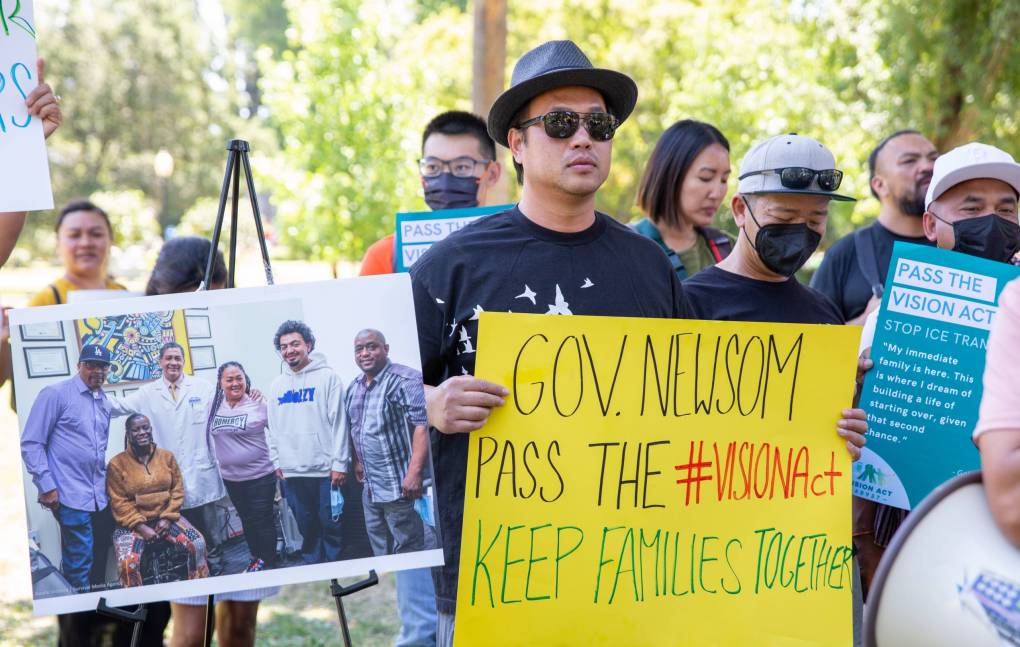
"content": "\u003cp>California immigrant advocates are making a final push to persuade state lawmakers to pass a bill that would end the practice of transferring noncitizens to immigration custody when they’re released from jail or prison — legislation that would go further than California’s existing so-called “sanctuary state” law.\u003c/p>\n\u003cp>The bill, known as the VISION Act, overwhelmingly passed the state Assembly last year but fell short of the 21 votes needed for Senate passage, so it carried over as a “two-year bill.” Now it’s awaiting a floor vote in the state Senate before the legislative session concludes at the end of August.\u003c/p>\n\u003cp>The bill’s backers are looking for support from three more senators, and they’ve been \u003ca href=\"https://vietrise.org/wp-content/uploads/sites/38/2022/08/2022.08.16_OC-Elected-Officials-Support-the-VISION-Act.pdf\">sending letters\u003c/a> and \u003ca href=\"https://sanfernandosun.com/2022/08/10/valley-organizations-urge-hertzberg-to-support-the-vision-act/\">holding rallies\u003c/a> in the districts of several Democrats still on the fence. If the session ends without a vote, the bill will die.\u003c/p>\n\u003cp>Late Tuesday, the authors made amendments to \u003ca href=\"https://leginfo.legislature.ca.gov/faces/billTextClient.xhtml?bill_id=202120220AB937\">AB 937\u003c/a> that they hope will address concerns from Democratic senators who pulled back their support last year over opposition from law enforcement groups. One change would allow the state parole board to notify ICE if an immigrant who was released on parole is later convicted of a serious new offense.\u003c/p>\n\u003cp>At a recent press conference, Assemblymember Wendy Carrillo, the bill’s author, emphasized that it would still require incarcerated immigrants to serve their sentences. But under the VISION Act, state and local officials would no longer hand them over to U.S. Immigration and Customs Enforcement upon release, unless served with a warrant issued by a judge. State and local officials would also stop tracking the birthplace of offenders in their criminal records systems.\u003c/p>\n\u003cp>[ad fullwidth]\u003c/p>\n\u003cp>“If individuals have served their time, have paid their debt to society, regardless of where you are born you have a right to restart your life,” she said. “That is the societal contract that we have. And California should not be in the business of collaborating with ICE.”\u003c/p>\n\u003cp>On average, \u003ca href=\"https://leginfo.legislature.ca.gov/faces/billAnalysisClient.xhtml?bill_id=202120220AB937\">nearly 1,600 people come out of state prison each year with an immigration hold\u003c/a> that leads to their transfer to ICE to be deported, according to an estimate by state Senate staff.[pullquote align=\"right\" size=\"medium\" citation=\"California Assemblymember Wendy Carrillo\"]‘If individuals have served their time, have paid their debt to society, regardless of where you are born, you have a right to restart your life. That is the societal contract that we have.’[/pullquote]The VISION Act would close a loophole in an earlier law, the 2018 California Values Act, \u003ca href=\"https://leginfo.legislature.ca.gov/faces/billNavClient.xhtml?bill_id=201720180SB54\">SB 54\u003c/a>, sometimes known as the “sanctuary state” law, which limited police and sheriff’s departments from collaborating with U.S. Immigration and Customs Enforcement, with exceptions for a wide range of crimes, from violent felonies to certain misdemeanors. The Values Act didn’t prohibit transfers to ICE by prisons, but the VISION Act would.\u003c/p>\n\u003cp>Police and sheriff’s groups oppose the bill. They point to federal law, which says immigrants, even those who are legal with green cards, can be deported if they’ve committed a so-called “aggravated felony,” from a long list of crimes that includes some misdemeanors. And they say it’s safer for ICE to take custody of a person inside a locked facility than to arrest them at their home or a public location.\u003c/p>\n\u003cp>“This proposed legislation puts local law enforcement in a no-win situation, having to choose between state and federal laws,” the Police Officers Research Association of California said in a statement last year.\u003c/p>\n\u003cp>And in a joint statement, \u003ca href=\"https://ct3.blob.core.windows.net/21blobs/58984f34-e091-4208-93db-4e804b666038\">law enforcement groups noted that the VISION Act would prevent them\u003c/a> from notifying immigration authorities of the release of people who had served sentences for crimes such as rape, murder and torture.\u003c/p>\n\u003cp>“We are also not arguing that immigrants somehow pose any more threat than citizens or asking to involve immigration authorities in low-level offenses. However, there should be a point, in the most egregious cases, where we do not provide protections for dangerous persons from enforcement,” the statement said.\u003c/p>\n\u003cp>But advocates for the bill say it’s not California’s responsibility to do the work of immigration enforcement, and ICE can still bring deportation proceedings against someone whether or not they’re incarcerated. They point to other states — including Oregon and Illinois — which have passed laws to end most prison-to-ICE transfers.\u003c/p>\n\u003cp>“In California, we’re always proud to say that we’re the first when it comes to social justice,” said veteran civil rights and labor organizer Dolores Huerta. “Well, now we’re not the first, because other states have already taken care of this issue. … It’s time for us to act.”[pullquote align=\"right\" size=\"medium\" citation=\"Sandra Castañeda, Los Angeles resident\"]‘I thought I would never say this, but prison is better than this place.’[/pullquote]Huerta called the transfers “double jeopardy” because people often wind up spending additional months or years in ICE detention, where it’s more difficult to mount a defense against deportation.\u003c/p>\n\u003cp>Los Angeles resident Sandra Castañeda lived through that. When her conviction for a murder she didn’t commit was vacated last summer, she thought she’d be going home after 19 years in prison. Instead, she was handed to ICE and held for a year in a private detention center in rural Georgia. She said she saw many women there give up their cases in desperation and accept deportation, because they couldn’t bear the conditions.\u003c/p>\n\u003cp>“I thought I would never say this, but prison is better than this place,” Castañeda said last month in a phone call from the Stewart Detention Center in Lumpkin, Ga. “In prison you have a routine. You have a job, there’s classes, there’s things to do. … Here, you’re stuck in a dorm with 23 people, all day, every day.”\u003c/p>\n\u003cp>Castañeda was released this month with the help of a pro bono lawyer, Anoop Prasad of the Asian Law Caucus in San Francisco. An immigration judge ruled that she’s not deportable because she no longer has an aggravated felony on her record.\u003c/p>\n\u003cp>Castañeda’s conviction was wiped away by a California judge after the Legislature eliminated the state’s “felony murder” rule, which had allowed her to be charged with murder because she was driving a car out of which a fatal shot was fired, even though she had no indication that her passenger would shoot. But Prasad noted that Castañeda also earned a commutation from Gov. Gavin Newsom because of her exemplary behavior in prison.\u003c/p>\n\u003cp>“For the governor on the one hand to be like, ‘I’m granting clemency. You’re a model for other incarcerated people.’ And then in the next breath to say, ‘Oh, call up ICE and have this person deported,’” makes no sense, Prasad said. “California needs to end this hypocrisy of working with an agency that’s so cruel.”\u003c/p>\n\u003cp>A UC San Diego poll last summer found \u003ca href=\"https://usipc.ucsd.edu/publications/usipc-vision-act-final-20210803.pdf\">two-thirds of California voters supported the VISION Act\u003c/a>.\u003c/p>\n\u003cp>The bill could go to a vote in the state Senate next week. Newsom has not given any indication of whether he will sign the bill if it reaches his desk.\u003c/p>\n\u003cp>[ad floatright]\u003c/p>\n\u003cp>\u003cem>Aug. 26 Correction: A previous version of this story mischaracterized SB 54, the California Values Act, saying it allowed police and sheriffs to collaborate with ICE only in cases of immigrants convicted of serious or violent crimes. In fact, the law allows them to do so when a person has been convicted (or in some cases charged) with a long list of crimes, including some misdemeanors.\u003c/em>\u003c/p>\n\n",
"blocks": [],
"excerpt": "Backers of the VISION Act, moving through the state Senate this month, say noncitizens released from prison should not be handed over for deportation.",
"status": "publish",
"parent": 0,
"modified": 1721158596,
"stats": {
"hasAudio": false,
"hasVideo": false,
"hasChartOrMap": false,
"iframeSrcs": [],
"hasGoogleForm": false,
"hasGallery": false,
"hasHearkenModule": false,
"hasPolis": false,
"paragraphCount": 23,
"wordCount": 1353
},
"headData": {
"title": "Immigrant Advocates Make Final Push to Pass Bill Ending Prison-to-ICE Transfers in California | KQED",
"description": "Backers of the VISION Act, moving through the state Senate this month, say noncitizens released from prison should not be handed over for deportation.",
"ogTitle": "",
"ogDescription": "",
"ogImgId": "",
"twTitle": "",
"twDescription": "",
"twImgId": "",
"schema": {
"@context": "https://schema.org",
"@type": "NewsArticle",
"headline": "Immigrant Advocates Make Final Push to Pass Bill Ending Prison-to-ICE Transfers in California",
"datePublished": "2022-08-25T09:00:45-07:00",
"dateModified": "2024-07-16T12:36:36-07:00",
"image": "https://cdn.kqed.org/wp-content/uploads/2020/02/KQED-OG-Image@1x.png",
"isAccessibleForFree": "True",
"publisher": {
"@type": "NewsMediaOrganization",
"@id": "https://www.kqed.org/#organization",
"name": "KQED",
"logo": "https://cdn.kqed.org/wp-content/uploads/2020/02/KQED-OG-Image@1x.png",
"url": "https://www.kqed.org",
"sameAs": [
"https://www.facebook.com/KQED",
"https://twitter.com/KQED",
"https://www.instagram.com/kqed/",
"https://www.tiktok.com/@kqedofficial",
"https://www.linkedin.com/company/kqed",
"https://www.youtube.com/channel/UCeC0IOo7i1P_61zVUWbJ4nw"
]
}
}
},
"audioUrl": "https://traffic.omny.fm/d/clips/0af137ef-751e-4b19-a055-aaef00d2d578/ffca7e9f-6831-4[…]f-aaef00f5a073/ef0bfdc7-39e8-4fc2-84ec-aefb0125f855/audio.mp3",
"sticky": false,
"excludeFromSiteSearch": "Include",
"path": "/news/11923465/immigrant-advocates-make-final-push-to-pass-bill-ending-prison-to-ice-transfers-in-california",
"audioTrackLength": null,
"parsedContent": [
{
"type": "contentString",
"content": "\u003cdiv class=\"post-body\">\u003cp>\u003cp>California immigrant advocates are making a final push to persuade state lawmakers to pass a bill that would end the practice of transferring noncitizens to immigration custody when they’re released from jail or prison — legislation that would go further than California’s existing so-called “sanctuary state” law.\u003c/p>\n\u003cp>The bill, known as the VISION Act, overwhelmingly passed the state Assembly last year but fell short of the 21 votes needed for Senate passage, so it carried over as a “two-year bill.” Now it’s awaiting a floor vote in the state Senate before the legislative session concludes at the end of August.\u003c/p>\n\u003cp>The bill’s backers are looking for support from three more senators, and they’ve been \u003ca href=\"https://vietrise.org/wp-content/uploads/sites/38/2022/08/2022.08.16_OC-Elected-Officials-Support-the-VISION-Act.pdf\">sending letters\u003c/a> and \u003ca href=\"https://sanfernandosun.com/2022/08/10/valley-organizations-urge-hertzberg-to-support-the-vision-act/\">holding rallies\u003c/a> in the districts of several Democrats still on the fence. If the session ends without a vote, the bill will die.\u003c/p>\n\u003cp>Late Tuesday, the authors made amendments to \u003ca href=\"https://leginfo.legislature.ca.gov/faces/billTextClient.xhtml?bill_id=202120220AB937\">AB 937\u003c/a> that they hope will address concerns from Democratic senators who pulled back their support last year over opposition from law enforcement groups. One change would allow the state parole board to notify ICE if an immigrant who was released on parole is later convicted of a serious new offense.\u003c/p>\n\u003cp>At a recent press conference, Assemblymember Wendy Carrillo, the bill’s author, emphasized that it would still require incarcerated immigrants to serve their sentences. But under the VISION Act, state and local officials would no longer hand them over to U.S. Immigration and Customs Enforcement upon release, unless served with a warrant issued by a judge. State and local officials would also stop tracking the birthplace of offenders in their criminal records systems.\u003c/p>\n\u003cp>\u003c/p>\u003c/div>",
"attributes": {
"named": {},
"numeric": []
}
},
{
"type": "component",
"content": "",
"name": "ad",
"attributes": {
"named": {
"label": "fullwidth"
},
"numeric": [
"fullwidth"
]
}
},
{
"type": "contentString",
"content": "\u003cdiv class=\"post-body\">\u003cp>\u003c/p>\n\u003cp>“If individuals have served their time, have paid their debt to society, regardless of where you are born you have a right to restart your life,” she said. “That is the societal contract that we have. And California should not be in the business of collaborating with ICE.”\u003c/p>\n\u003cp>On average, \u003ca href=\"https://leginfo.legislature.ca.gov/faces/billAnalysisClient.xhtml?bill_id=202120220AB937\">nearly 1,600 people come out of state prison each year with an immigration hold\u003c/a> that leads to their transfer to ICE to be deported, according to an estimate by state Senate staff.\u003c/p>\u003c/div>",
"attributes": {
"named": {},
"numeric": []
}
},
{
"type": "component",
"content": "‘If individuals have served their time, have paid their debt to society, regardless of where you are born, you have a right to restart your life. That is the societal contract that we have.’",
"name": "pullquote",
"attributes": {
"named": {
"align": "right",
"size": "medium",
"citation": "California Assemblymember Wendy Carrillo",
"label": ""
},
"numeric": []
}
},
{
"type": "contentString",
"content": "\u003cdiv class=\"post-body\">\u003cp>The VISION Act would close a loophole in an earlier law, the 2018 California Values Act, \u003ca href=\"https://leginfo.legislature.ca.gov/faces/billNavClient.xhtml?bill_id=201720180SB54\">SB 54\u003c/a>, sometimes known as the “sanctuary state” law, which limited police and sheriff’s departments from collaborating with U.S. Immigration and Customs Enforcement, with exceptions for a wide range of crimes, from violent felonies to certain misdemeanors. The Values Act didn’t prohibit transfers to ICE by prisons, but the VISION Act would.\u003c/p>\n\u003cp>Police and sheriff’s groups oppose the bill. They point to federal law, which says immigrants, even those who are legal with green cards, can be deported if they’ve committed a so-called “aggravated felony,” from a long list of crimes that includes some misdemeanors. And they say it’s safer for ICE to take custody of a person inside a locked facility than to arrest them at their home or a public location.\u003c/p>\n\u003cp>“This proposed legislation puts local law enforcement in a no-win situation, having to choose between state and federal laws,” the Police Officers Research Association of California said in a statement last year.\u003c/p>\n\u003cp>And in a joint statement, \u003ca href=\"https://ct3.blob.core.windows.net/21blobs/58984f34-e091-4208-93db-4e804b666038\">law enforcement groups noted that the VISION Act would prevent them\u003c/a> from notifying immigration authorities of the release of people who had served sentences for crimes such as rape, murder and torture.\u003c/p>\n\u003cp>“We are also not arguing that immigrants somehow pose any more threat than citizens or asking to involve immigration authorities in low-level offenses. However, there should be a point, in the most egregious cases, where we do not provide protections for dangerous persons from enforcement,” the statement said.\u003c/p>\n\u003cp>But advocates for the bill say it’s not California’s responsibility to do the work of immigration enforcement, and ICE can still bring deportation proceedings against someone whether or not they’re incarcerated. They point to other states — including Oregon and Illinois — which have passed laws to end most prison-to-ICE transfers.\u003c/p>\n\u003cp>“In California, we’re always proud to say that we’re the first when it comes to social justice,” said veteran civil rights and labor organizer Dolores Huerta. “Well, now we’re not the first, because other states have already taken care of this issue. … It’s time for us to act.”\u003c/p>\u003c/div>",
"attributes": {
"named": {},
"numeric": []
}
},
{
"type": "component",
"content": "‘I thought I would never say this, but prison is better than this place.’",
"name": "pullquote",
"attributes": {
"named": {
"align": "right",
"size": "medium",
"citation": "Sandra Castañeda, Los Angeles resident",
"label": ""
},
"numeric": []
}
},
{
"type": "contentString",
"content": "\u003cdiv class=\"post-body\">\u003cp>Huerta called the transfers “double jeopardy” because people often wind up spending additional months or years in ICE detention, where it’s more difficult to mount a defense against deportation.\u003c/p>\n\u003cp>Los Angeles resident Sandra Castañeda lived through that. When her conviction for a murder she didn’t commit was vacated last summer, she thought she’d be going home after 19 years in prison. Instead, she was handed to ICE and held for a year in a private detention center in rural Georgia. She said she saw many women there give up their cases in desperation and accept deportation, because they couldn’t bear the conditions.\u003c/p>\n\u003cp>“I thought I would never say this, but prison is better than this place,” Castañeda said last month in a phone call from the Stewart Detention Center in Lumpkin, Ga. “In prison you have a routine. You have a job, there’s classes, there’s things to do. … Here, you’re stuck in a dorm with 23 people, all day, every day.”\u003c/p>\n\u003cp>Castañeda was released this month with the help of a pro bono lawyer, Anoop Prasad of the Asian Law Caucus in San Francisco. An immigration judge ruled that she’s not deportable because she no longer has an aggravated felony on her record.\u003c/p>\n\u003cp>Castañeda’s conviction was wiped away by a California judge after the Legislature eliminated the state’s “felony murder” rule, which had allowed her to be charged with murder because she was driving a car out of which a fatal shot was fired, even though she had no indication that her passenger would shoot. But Prasad noted that Castañeda also earned a commutation from Gov. Gavin Newsom because of her exemplary behavior in prison.\u003c/p>\n\u003cp>“For the governor on the one hand to be like, ‘I’m granting clemency. You’re a model for other incarcerated people.’ And then in the next breath to say, ‘Oh, call up ICE and have this person deported,’” makes no sense, Prasad said. “California needs to end this hypocrisy of working with an agency that’s so cruel.”\u003c/p>\n\u003cp>A UC San Diego poll last summer found \u003ca href=\"https://usipc.ucsd.edu/publications/usipc-vision-act-final-20210803.pdf\">two-thirds of California voters supported the VISION Act\u003c/a>.\u003c/p>\n\u003cp>The bill could go to a vote in the state Senate next week. Newsom has not given any indication of whether he will sign the bill if it reaches his desk.\u003c/p>\n\u003cp>\u003c/p>\u003c/div>",
"attributes": {
"named": {},
"numeric": []
}
},
{
"type": "component",
"content": "",
"name": "ad",
"attributes": {
"named": {
"label": "floatright"
},
"numeric": [
"floatright"
]
}
},
{
"type": "contentString",
"content": "\u003cdiv class=\"post-body\">\u003cp>\u003c/p>\n\u003cp>\u003cem>Aug. 26 Correction: A previous version of this story mischaracterized SB 54, the California Values Act, saying it allowed police and sheriffs to collaborate with ICE only in cases of immigrants convicted of serious or violent crimes. In fact, the law allows them to do so when a person has been convicted (or in some cases charged) with a long list of crimes, including some misdemeanors.\u003c/em>\u003c/p>\n\n\u003c/div>\u003c/p>",
"attributes": {
"named": {},
"numeric": []
}
}
],
"link": "/news/11923465/immigrant-advocates-make-final-push-to-pass-bill-ending-prison-to-ice-transfers-in-california",
"authors": [
"259"
],
"categories": [
"news_1169",
"news_8",
"news_13"
],
"tags": [
"news_3149",
"news_18123",
"news_886",
"news_23883",
"news_21027",
"news_20202",
"news_25409",
"news_20750",
"news_3883",
"news_20529"
],
"featImg": "news_11923545",
"label": "news"
},
"news_11922707": {
"type": "posts",
"id": "news_11922707",
"meta": {
"index": "posts_1716263798",
"site": "news",
"id": "11922707",
"score": null,
"sort": [
1660730423000
]
},
"parent": 0,
"labelTerm": {},
"blocks": [],
"publishDate": 1660730423,
"format": "audio",
"title": "A Year Later, One Afghan Family’s Resettlement in the Bay",
"headTitle": "A Year Later, One Afghan Family’s Resettlement in the Bay | KQED",
"content": "\u003cp>\u003cspan style=\"font-weight: 400\">It’s been one year since the Taliban took control of Kabul. Millions of Afghans have fled the country, in many cases becoming separated from their families in the process.\u003c/span>\u003c/p>\n\u003cp>\u003cspan style=\"font-weight: 400\">Thousands of refugees have since come to northern California, thanks to the help of resettlement agencies and Afghan community organizations. But many are still in limbo, as they try to secure permanent legal status while also juggling daily life in the Bay Area and staying connected with people back with Afghanistan.\u003c/span>\u003c/p>\n\u003cp>\u003cb>Guest: \u003c/b>\u003cspan style=\"font-weight: 400\">\u003ca href=\"https://twitter.com/tychehendricks\">Tyche Hendricks\u003c/a>, KQED senior immigration editor\u003c/span>\u003c/p>\n\u003cp>\u003ca href=\"https://bit.ly/3c4Tk2Q\">\u003cem>Read the transcript\u003c/em>\u003c/a>\u003c/p>\n\u003cp>\u003cb>Links:\u003c/b>\u003c/p>\n\u003cul>\n\u003cli style=\"font-weight: 400\">\u003cspan style=\"font-weight: 400\">\u003ca href=\"https://www.kqed.org/news/11917687/we-are-all-very-devastated-bay-area-afghans-scramble-to-contact-family-after-earthquake\">‘We Are All Very Devastated’: Bay Area Afghans Scramble to Contact Family After Earthquake\u003c/a>\u003c/span>\u003c/li>\n\u003c/ul>\n\u003cp id=\"embed-code\" class=\"inconsolata\">\n\u003c!-- iframe plugin v.4.3 wordpress.org/plugins/iframe/ -->\u003cbr>\n\u003ciframe loading=\"lazy\" frameborder=\"0\" height=\"200\" scrolling=\"no\" src=\"https://playlist.megaphone.fm?e=KQINC6465270126&light=true\" width=\"100%\" class=\"iframe-class\">\u003c/iframe>\u003c/p>\n\u003cp>[ad fullwidth]\u003c/p>\u003cp>\u003c/p>\n",
"stats": {
"hasVideo": false,
"hasChartOrMap": false,
"hasAudio": true,
"hasPolis": false,
"wordCount": 111,
"hasGoogleForm": false,
"hasGallery": false,
"hasHearkenModule": false,
"iframeSrcs": [],
"paragraphCount": 7
},
"modified": 1700690415,
"excerpt": null,
"headData": {
"twImgId": "",
"twTitle": "",
"ogTitle": "",
"ogImgId": "",
"twDescription": "",
"description": "It’s been one year since the Taliban took control of Kabul. Millions of Afghans have fled the country, in many cases becoming separated from their families in the process. Thousands of refugees have since come to northern California, thanks to the help of resettlement agencies and Afghan community organizations. But many are still in limbo,",
"title": "A Year Later, One Afghan Family’s Resettlement in the Bay | KQED",
"ogDescription": "",
"schema": {
"@context": "https://schema.org",
"@type": "NewsArticle",
"headline": "A Year Later, One Afghan Family’s Resettlement in the Bay",
"datePublished": "2022-08-17T03:00:23-07:00",
"dateModified": "2023-11-22T14:00:15-08:00",
"image": "https://cdn.kqed.org/wp-content/uploads/2020/02/KQED-OG-Image@1x.png",
"isAccessibleForFree": "True",
"publisher": {
"@type": "NewsMediaOrganization",
"@id": "https://www.kqed.org/#organization",
"name": "KQED",
"logo": "https://cdn.kqed.org/wp-content/uploads/2020/02/KQED-OG-Image@1x.png",
"url": "https://www.kqed.org",
"sameAs": [
"https://www.facebook.com/KQED",
"https://twitter.com/KQED",
"https://www.instagram.com/kqed/",
"https://www.tiktok.com/@kqedofficial",
"https://www.linkedin.com/company/kqed",
"https://www.youtube.com/channel/UCeC0IOo7i1P_61zVUWbJ4nw"
]
}
}
},
"guestAuthors": [],
"slug": "afghan-family-resettlement",
"status": "publish",
"sourceUrl": "https://www.kqed.org/podcasts/thebay",
"audioUrl": "https://www.podtrac.com/pts/redirect.mp3/traffic.megaphone.fm/KQINC6465270126.mp3?updated=1660697680",
"excludeFromSiteSearch": "Include",
"source": "The Bay",
"path": "/news/11922707/afghan-family-resettlement",
"audioTrackLength": null,
"parsedContent": [
{
"type": "contentString",
"content": "\u003cdiv class=\"post-body\">\u003cp>\u003cp>\u003cspan style=\"font-weight: 400\">It’s been one year since the Taliban took control of Kabul. Millions of Afghans have fled the country, in many cases becoming separated from their families in the process.\u003c/span>\u003c/p>\n\u003cp>\u003cspan style=\"font-weight: 400\">Thousands of refugees have since come to northern California, thanks to the help of resettlement agencies and Afghan community organizations. But many are still in limbo, as they try to secure permanent legal status while also juggling daily life in the Bay Area and staying connected with people back with Afghanistan.\u003c/span>\u003c/p>\n\u003cp>\u003cb>Guest: \u003c/b>\u003cspan style=\"font-weight: 400\">\u003ca href=\"https://twitter.com/tychehendricks\">Tyche Hendricks\u003c/a>, KQED senior immigration editor\u003c/span>\u003c/p>\n\u003cp>\u003ca href=\"https://bit.ly/3c4Tk2Q\">\u003cem>Read the transcript\u003c/em>\u003c/a>\u003c/p>\n\u003cp>\u003cb>Links:\u003c/b>\u003c/p>\n\u003cul>\n\u003cli style=\"font-weight: 400\">\u003cspan style=\"font-weight: 400\">\u003ca href=\"https://www.kqed.org/news/11917687/we-are-all-very-devastated-bay-area-afghans-scramble-to-contact-family-after-earthquake\">‘We Are All Very Devastated’: Bay Area Afghans Scramble to Contact Family After Earthquake\u003c/a>\u003c/span>\u003c/li>\n\u003c/ul>\n\u003cp id=\"embed-code\" class=\"inconsolata\">\n\u003c!-- iframe plugin v.4.3 wordpress.org/plugins/iframe/ -->\u003cbr>\n\u003ciframe loading=\"lazy\" frameborder=\"0\" height=\"200\" scrolling=\"no\" src=\"https://playlist.megaphone.fm?e=KQINC6465270126&light=true\" width=\"100%\" class=\"iframe-class\">\u003c/iframe>\u003c/p>\n\u003cp>\u003c/p>\u003c/div>",
"attributes": {
"named": {},
"numeric": []
}
},
{
"type": "component",
"content": "",
"name": "ad",
"attributes": {
"named": {
"label": "fullwidth"
},
"numeric": [
"fullwidth"
]
}
},
{
"type": "contentString",
"content": "\u003cdiv class=\"post-body\">\u003cp>\u003c/p>\u003cp>\u003c/p>\n\u003c/div>\u003c/p>",
"attributes": {
"named": {},
"numeric": []
}
}
],
"link": "/news/11922707/afghan-family-resettlement",
"authors": [
"8654",
"259",
"11802",
"11649"
],
"programs": [
"news_28779"
],
"categories": [
"news_8",
"news_33520"
],
"tags": [
"news_19537",
"news_20202",
"news_22598"
],
"featImg": "news_11885336",
"label": "source_news_11922707"
},
"news_11919749": {
"type": "posts",
"id": "news_11919749",
"meta": {
"index": "posts_1716263798",
"site": "news",
"id": "11919749",
"score": null,
"sort": [
1657992790000
]
},
"guestAuthors": [],
"slug": "ice-detainees-making-1-a-day-sue-over-alleged-wage-theft",
"title": "ICE Detainees Making $1 a Day Sue Over Alleged Wage Theft",
"publishDate": 1657992790,
"format": "standard",
"headTitle": "ICE Detainees Making $1 a Day Sue Over Alleged Wage Theft | KQED",
"labelTerm": {
"site": "news"
},
"content": "\u003cp>A multibillion-dollar private prison company has allegedly maximized profits by coercing immigrant detainees locked up at two of its facilities in California to work for $1 a day, according to a class-action lawsuit filed July 13 in federal court in Fresno.\u003c/p>\n\u003cp>The \u003ca href=\"https://drive.google.com/file/d/1qODBJRe2MOSHmTL0MIru7NG2lyKfcJ_R/view\" target=\"_blank\" rel=\"noopener noreferrer\">legal challenge\u003c/a> accuses The GEO Group, a long-time contractor for U.S. Immigration and Customs Enforcement, with “systematic and unlawful wage theft, unjust enrichment and forced labor” at the Mesa Verde ICE Processing Facility in Bakersfield and the nearby Golden State Annex in McFarland.\u003c/p>\n\u003cp>The plaintiffs — nine ICE detainees who brought the lawsuit on behalf of other immigrants also jailed at the facilities — seek to recover unpaid wages, and for GEO to compensate its detained workforce with at least California’s minimum wage of $15 per hour.\u003c/p>\n\u003cp>GEO pays the paltry daily rate of $1 to detainees who volunteer to clean dormitories and dining halls, do laundry, assist detainees with disabilities and do other tasks to maintain the facilities, according to the lawsuit.\u003c/p>\n\u003cp>“We are civilians, we are being employed like this and I believe the right thing to do is give us what California has decided as its minimum wage to employees,” said Pedro Figueroa, 33, who until recently swept floors and scrubbed bathrooms at Mesa Verde for 40 hours per week. “We are fed up with all the injustices here.”\u003c/p>\n\u003cp>[ad fullwidth]\u003c/p>\n\u003cp>Some detainees say they participate in the cleaning program to be able to afford phone calls with loved ones or commissary items, like dental floss and tortillas, which are not provided by the facility. The lawsuit argues that the program is not truly voluntary because GEO staffers may threaten or punish detainees with disciplinary action or loss of recreation, commissary, library and telephone access if they protest the inadequate pay, according to Gay Grunfeld, one of the attorneys representing the plaintiffs. [pullquote size=\"medium\" align=\"right\" citation=\"Gay Grunfeld, attorney\"]‘It’s shocking. These workers are forced to do an eight-hour shift for $1 a day.’[/pullquote]\u003c/p>\n\u003cp>“They are being forced to work under threat of sanctions,” said Grunfeld of the San Francisco law firm Rosen Bien Galvan & Grunfeld. “It’s shocking. These workers are forced to do an eight-hour shift for $1 a day. So that’s a blatant violation of California minimum wage laws and other labor protections.”\u003c/p>\n\u003cp>The complaint comes after Figueroa and other detainees joined a months-long labor strike by immigrants held at the two GEO-run detention centers to protest wages, unfair treatment and other issues, according to immigrant advocates.\u003c/p>\n\u003cp>Figueroa, the father of four children who are U.S. citizens, \u003ca href=\"https://www.kqed.org/news/11919161/ice-detainees-protested-1-a-day-wage-now-theyre-in-solitary-confinement\">was held in a small, windowless cell for about a week\u003c/a> at Mesa Verde, which he said was retaliation for backing the work stoppage.[aside postID=news_11919161]Mohamed Mousa, a detainee who announced his support for the strike on June 28, remains in solitary confinement at the facility after more than two weeks, according to his attorney, Kelsey Morales, with the Alameda County Public Defender’s Office.\u003c/p>\n\u003cp>Additional court cases in California and other states allege GEO and other for-profit operators of immigration detention centers have engaged in forced labor and minimum wage violations. Last year, a federal judge in Washington state ordered GEO to pay $23 million for failing to compensate detained workers with minimum wage at a facility in Tacoma. The Florida-based company reportedly shut down its worker program and is seeking to reverse the ruling before the Ninth U.S. Circuit Court of Appeals, which is now considering the case.\u003c/p>\n\u003cp>A spokesperson for GEO has repeatedly denied the existence of a labor strike at either facility. He rejected the allegations by detainees as “completely without merit,” and said that ICE guidelines for the detention centers require detainees to keep their personal living areas clean. [aside tag=\"immigration\" label=\"More Related Stories\"]“The allegations brought in this lawsuit are similar to those brought in previous cases involving the federal government’s Voluntary Work Program, which GEO is contractually required to implement and administer on behalf of ICE,” the spokesperson said, adding that the company will vigorously defend itself against the accusations in court.\u003c/p>\n\u003cp>ICE declined to comment on the lawsuit.\u003c/p>\n\u003cp>Christina Cano, a spokesperson with the Department of Industrial Relations, which oversees investigations of potential wage theft, said detained immigrant workers in California are considered “employees” and are entitled to pursue civil remedy for unpaid wages, based on a ruling by a federal judge in 2018.\u003c/p>\n\u003cp>\u003c/p>\n\u003cp>GEO, a multinational company that operates four out of seven immigration detention centers in California, made more than $3 billion per year in revenues in 2018, 2019 and 2020, according to the lawsuit. Contracts with ICE accounted for about 28% of its revenues in 2019 and 2020.\u003c/p>\n\n",
"blocks": [],
"excerpt": "The legal challenge accuses The GEO Group, a long-time contractor for US Immigration and Customs Enforcement, with 'systematic and unlawful wage theft, unjust enrichment and forced labor.' ",
"status": "publish",
"parent": 0,
"modified": 1721157166,
"stats": {
"hasAudio": false,
"hasVideo": false,
"hasChartOrMap": false,
"iframeSrcs": [],
"hasGoogleForm": false,
"hasGallery": false,
"hasHearkenModule": false,
"hasPolis": false,
"paragraphCount": 16,
"wordCount": 822
},
"headData": {
"title": "ICE Detainees Making $1 a Day Sue Over Alleged Wage Theft | KQED",
"description": "The legal challenge accuses The GEO Group, a long-time contractor for US Immigration and Customs Enforcement, with 'systematic and unlawful wage theft, unjust enrichment and forced labor.' ",
"ogTitle": "",
"ogDescription": "",
"ogImgId": "",
"twTitle": "",
"twDescription": "",
"twImgId": "",
"schema": {
"@context": "https://schema.org",
"@type": "NewsArticle",
"headline": "ICE Detainees Making $1 a Day Sue Over Alleged Wage Theft",
"datePublished": "2022-07-16T10:33:10-07:00",
"dateModified": "2024-07-16T12:12:46-07:00",
"image": "https://cdn.kqed.org/wp-content/uploads/2020/02/KQED-OG-Image@1x.png",
"isAccessibleForFree": "True",
"publisher": {
"@type": "NewsMediaOrganization",
"@id": "https://www.kqed.org/#organization",
"name": "KQED",
"logo": "https://cdn.kqed.org/wp-content/uploads/2020/02/KQED-OG-Image@1x.png",
"url": "https://www.kqed.org",
"sameAs": [
"https://www.facebook.com/KQED",
"https://twitter.com/KQED",
"https://www.instagram.com/kqed/",
"https://www.tiktok.com/@kqedofficial",
"https://www.linkedin.com/company/kqed",
"https://www.youtube.com/channel/UCeC0IOo7i1P_61zVUWbJ4nw"
]
}
}
},
"audioUrl": "https://traffic.omny.fm/d/clips/0af137ef-751e-4b19-a055-aaef00d2d578/ffca7e9f-6831-41c5-bcaf-aaef00f5a073/e9f59ab2-3041-4637-97cc-aed7012db475/audio.mp3",
"sticky": false,
"excludeFromSiteSearch": "Include",
"path": "/news/11919749/ice-detainees-making-1-a-day-sue-over-alleged-wage-theft",
"audioTrackLength": null,
"parsedContent": [
{
"type": "contentString",
"content": "\u003cdiv class=\"post-body\">\u003cp>\u003cp>A multibillion-dollar private prison company has allegedly maximized profits by coercing immigrant detainees locked up at two of its facilities in California to work for $1 a day, according to a class-action lawsuit filed July 13 in federal court in Fresno.\u003c/p>\n\u003cp>The \u003ca href=\"https://drive.google.com/file/d/1qODBJRe2MOSHmTL0MIru7NG2lyKfcJ_R/view\" target=\"_blank\" rel=\"noopener noreferrer\">legal challenge\u003c/a> accuses The GEO Group, a long-time contractor for U.S. Immigration and Customs Enforcement, with “systematic and unlawful wage theft, unjust enrichment and forced labor” at the Mesa Verde ICE Processing Facility in Bakersfield and the nearby Golden State Annex in McFarland.\u003c/p>\n\u003cp>The plaintiffs — nine ICE detainees who brought the lawsuit on behalf of other immigrants also jailed at the facilities — seek to recover unpaid wages, and for GEO to compensate its detained workforce with at least California’s minimum wage of $15 per hour.\u003c/p>\n\u003cp>GEO pays the paltry daily rate of $1 to detainees who volunteer to clean dormitories and dining halls, do laundry, assist detainees with disabilities and do other tasks to maintain the facilities, according to the lawsuit.\u003c/p>\n\u003cp>“We are civilians, we are being employed like this and I believe the right thing to do is give us what California has decided as its minimum wage to employees,” said Pedro Figueroa, 33, who until recently swept floors and scrubbed bathrooms at Mesa Verde for 40 hours per week. “We are fed up with all the injustices here.”\u003c/p>\n\u003cp>\u003c/p>\u003c/div>",
"attributes": {
"named": {},
"numeric": []
}
},
{
"type": "component",
"content": "",
"name": "ad",
"attributes": {
"named": {
"label": "fullwidth"
},
"numeric": [
"fullwidth"
]
}
},
{
"type": "contentString",
"content": "\u003cdiv class=\"post-body\">\u003cp>\u003c/p>\n\u003cp>Some detainees say they participate in the cleaning program to be able to afford phone calls with loved ones or commissary items, like dental floss and tortillas, which are not provided by the facility. The lawsuit argues that the program is not truly voluntary because GEO staffers may threaten or punish detainees with disciplinary action or loss of recreation, commissary, library and telephone access if they protest the inadequate pay, according to Gay Grunfeld, one of the attorneys representing the plaintiffs. \u003c/p>\u003c/div>",
"attributes": {
"named": {},
"numeric": []
}
},
{
"type": "component",
"content": "‘It’s shocking. These workers are forced to do an eight-hour shift for $1 a day.’",
"name": "pullquote",
"attributes": {
"named": {
"size": "medium",
"align": "right",
"citation": "Gay Grunfeld, attorney",
"label": ""
},
"numeric": []
}
},
{
"type": "contentString",
"content": "\u003cdiv class=\"post-body\">\u003cp>\u003c/p>\n\u003cp>“They are being forced to work under threat of sanctions,” said Grunfeld of the San Francisco law firm Rosen Bien Galvan & Grunfeld. “It’s shocking. These workers are forced to do an eight-hour shift for $1 a day. So that’s a blatant violation of California minimum wage laws and other labor protections.”\u003c/p>\n\u003cp>The complaint comes after Figueroa and other detainees joined a months-long labor strike by immigrants held at the two GEO-run detention centers to protest wages, unfair treatment and other issues, according to immigrant advocates.\u003c/p>\n\u003cp>Figueroa, the father of four children who are U.S. citizens, \u003ca href=\"https://www.kqed.org/news/11919161/ice-detainees-protested-1-a-day-wage-now-theyre-in-solitary-confinement\">was held in a small, windowless cell for about a week\u003c/a> at Mesa Verde, which he said was retaliation for backing the work stoppage.\u003c/p>\u003c/div>",
"attributes": {
"named": {},
"numeric": []
}
},
{
"type": "component",
"content": "",
"name": "aside",
"attributes": {
"named": {
"postid": "news_11919161",
"label": ""
},
"numeric": []
}
},
{
"type": "contentString",
"content": "\u003cdiv class=\"post-body\">\u003cp>Mohamed Mousa, a detainee who announced his support for the strike on June 28, remains in solitary confinement at the facility after more than two weeks, according to his attorney, Kelsey Morales, with the Alameda County Public Defender’s Office.\u003c/p>\n\u003cp>Additional court cases in California and other states allege GEO and other for-profit operators of immigration detention centers have engaged in forced labor and minimum wage violations. Last year, a federal judge in Washington state ordered GEO to pay $23 million for failing to compensate detained workers with minimum wage at a facility in Tacoma. The Florida-based company reportedly shut down its worker program and is seeking to reverse the ruling before the Ninth U.S. Circuit Court of Appeals, which is now considering the case.\u003c/p>\n\u003cp>A spokesperson for GEO has repeatedly denied the existence of a labor strike at either facility. He rejected the allegations by detainees as “completely without merit,” and said that ICE guidelines for the detention centers require detainees to keep their personal living areas clean. \u003c/p>\u003c/div>",
"attributes": {
"named": {},
"numeric": []
}
},
{
"type": "component",
"content": "",
"name": "aside",
"attributes": {
"named": {
"tag": "immigration",
"label": "More Related Stories "
},
"numeric": []
}
},
{
"type": "contentString",
"content": "\u003cdiv class=\"post-body\">\u003cp>“The allegations brought in this lawsuit are similar to those brought in previous cases involving the federal government’s Voluntary Work Program, which GEO is contractually required to implement and administer on behalf of ICE,” the spokesperson said, adding that the company will vigorously defend itself against the accusations in court.\u003c/p>\n\u003cp>ICE declined to comment on the lawsuit.\u003c/p>\n\u003cp>Christina Cano, a spokesperson with the Department of Industrial Relations, which oversees investigations of potential wage theft, said detained immigrant workers in California are considered “employees” and are entitled to pursue civil remedy for unpaid wages, based on a ruling by a federal judge in 2018.\u003c/p>\n\u003cp>\u003c/p>\n\u003cp>GEO, a multinational company that operates four out of seven immigration detention centers in California, made more than $3 billion per year in revenues in 2018, 2019 and 2020, according to the lawsuit. Contracts with ICE accounted for about 28% of its revenues in 2019 and 2020.\u003c/p>\n\n\u003c/div>\u003c/p>",
"attributes": {
"named": {},
"numeric": []
}
}
],
"link": "/news/11919749/ice-detainees-making-1-a-day-sue-over-alleged-wage-theft",
"authors": [
"8659"
],
"categories": [
"news_1169",
"news_8"
],
"tags": [
"news_21027",
"news_20202",
"news_19904",
"news_17968"
],
"featImg": "news_11919750",
"label": "news"
},
"news_11919161": {
"type": "posts",
"id": "news_11919161",
"meta": {
"index": "posts_1716263798",
"site": "news",
"id": "11919161",
"score": null,
"sort": [
1657325661000
]
},
"guestAuthors": [],
"slug": "ice-detainees-protested-1-a-day-wage-now-theyre-in-solitary-confinement",
"title": "ICE Detainees Protested $1-a-Day Wage. Now They're in Solitary Confinement",
"publishDate": 1657325661,
"format": "standard",
"headTitle": "ICE Detainees Protested $1-a-Day Wage. Now They’re in Solitary Confinement | KQED",
"labelTerm": {
"term": 72,
"site": "news"
},
"content": "\u003cp>\u003cstrong>Update, 5 p.m. July 11: \u003c/strong>Mesa Verde ICE Processing Center staff moved Pedro Figueroa out of solitary confinement on July 8, shortly after KQED published this story, according to his attorney. Mohamed Mousa remains in what’s officially known as “administrative segregation,” his attorney said. Both men were found guilty of “inciting or engaging in a demonstration,” charges allegedly related to a monthslong labor strike by immigration detainees seeking higher wages.\u003c/p>\n\u003cp>A spokesman with The GEO Group, which operates the immigration detention center, declined to confirm the status of the men, and referred questions to ICE. The agency did not immediately respond to a request for comment.\u003c/p>\n\u003cp>\u003cstrong>Original story, July 8:\u003c/strong>\u003cbr>\nTwo immigrant detainees have been held in solitary confinement for over a week for backing a labor strike seeking better wages and conditions at the privately run facility where they are held in Bakersfield, the men told KQED.\u003c/p>\n\u003cp>The alleged retaliation fuels fear and intimidation, according to interviews with the men, their attorneys and advocates.\u003c/p>\n\u003cp>Mohamed Mousa and Pedro Figueroa said they were moved to a restricted housing unit after signing a declaration on June 28 that they and 15 others were joining a months-long peaceful work stoppage by U.S. Immigration and Customs Enforcement detainees who are paid $1 a day to clean dormitories and bathrooms.\u003c/p>\n\u003cp>[pullquote size=\"medium\" align=\"right\" citation=\"Pedro Figueroa, ICE detainee\"]‘I chose not to work and voice my opinion respectfully, and that’s within my right … What did I do wrong?’[/pullquote]Employees with The GEO Group, a large private prison company that operates the Mesa Verde ICE Processing Center in Bakersfield, transferred the men separately to “administrative segregation” on June 29 and June 30, according to GEO forms viewed by KQED.\u003c/p>\n\u003cp>“This is what they’re doing to retaliate against people who speak up. This is what they’re doing to intimidate us, which I am intimidated,” Figueroa, 33, said by phone as he sat in what he described as a small, windowless cell detainees refer to as “the hole.”\u003c/p>\n\u003cp>“I chose not to work and voice my opinion respectfully, and that’s within my right,” added Figueroa, a former incarcerated firefighter who battled the massive August Complex fire in 2020. “I’m trying to understand, what did I do wrong?”\u003c/p>\n\u003cp>[ad fullwidth]\u003c/p>\n\u003cp>Documents show GEO staffers charged Figueroa and Mousa with “inciting or engaging in a demonstration” and “conduct that disrupts/interferes with the security or operation of the facility.” Both are \u003ca href=\"https://www.ice.gov/doclib/detention-standards/2011/pbnds2011r2016.pdf\">labeled as high offenses under ICE guidelines\u003c/a> for the detention center.\u003c/p>\n\u003cp>Figueroa and Mousa said they are kept in their cells — about 6 by 12 feet, with a sink, toilet and a cot — for 22 hours a day or longer.\u003c/p>\n\u003cp>“It gives you anxiety, raises your stress level. It raises your depression level,” said Mousa, a 41-year-old immigrant from Egypt and former film student in Los Angeles. “It’s a terrible place to be. It’s like they dig a grave and throw you in.”\u003c/p>\n\u003cp>Upon request, Mousa and Figueroa have access to a phone and an electronic tablet, which guards push through a slit in the room’s metal door. Calls and entertainment, such as music or books, may cost anywhere between $0.03 and $0.11 per minute, the detainees said.\u003c/p>\n\u003cp>A spokesperson for GEO, \u003ca href=\"https://www.businesswire.com/news/home/20220502005931/en/The-GEO-Group-Reports-First-Quarter-2022-Results\">which reported total revenues of $551 million in the first quarter of 2022\u003c/a>, rebuffed allegations that the detainees are being punished for protesting their working and living conditions.\u003c/p>\n\u003cp>The strikers, including more than a dozen so-called “housing porters,” are calling for California’s $15 per hour minimum wage, fair treatment by Mesa Verde’s administration and more nutritious meals, among other demands. Some detainees at the facility have refused to work since April 28, but their demands have been largely ignored by GEO and ICE, said Esperanza Cuautle, a community organizer with Pangea Legal Services.\u003c/p>\n\u003cfigure id=\"attachment_11919181\" class=\"wp-caption alignright\" style=\"max-width: 648px\">\u003cimg loading=\"lazy\" decoding=\"async\" class=\"size-full wp-image-11919181\" src=\"https://ww2.kqed.org/app/uploads/sites/10/2022/07/RS57176_Pedro_Firecamp.jpeg\" alt=\"a smiling bald man holds a chainsaw wearing work clothing\" width=\"648\" height=\"1017\" srcset=\"https://cdn.kqed.org/wp-content/uploads/sites/10/2022/07/RS57176_Pedro_Firecamp.jpeg 648w, https://cdn.kqed.org/wp-content/uploads/sites/10/2022/07/RS57176_Pedro_Firecamp-160x251.jpeg 160w\" sizes=\"(max-width: 648px) 100vw, 648px\">\u003cfigcaption class=\"wp-caption-text\">Pedro Figueroa poses at the Antelope Fire camp in Siskiyou County in 2021. When he was incarcerated, before his ICE detention, Figueroa won a spot in the California Department of Corrections and Rehabilitation’s fire camp program, and helped battle wildfires. \u003ccite>(Courtesy of the Figueroa family)\u003c/cite>\u003c/figcaption>\u003c/figure>\n\u003cp>The GEO spokesperson repeatedly denied a labor strike is taking place at Mesa Verde and \u003ca href=\"https://www.kqed.org/news/11917597/immigrant-detainees-strike-over-working-conditions-california-regulators-investigate\">Golden State Annex, a nearby detention center also operated by the multinational company\u003c/a>, arguing that the detained workers are part of a voluntary program. But he declined to answer what demonstration or disruption the detainees were charged with engaging in.\u003c/p>\n\u003cp>“We continue to strongly reject these baseless allegations,” said the spokesperson for the Florida-based company. “Our facilities, including the Mesa Verde ICE Processing Center, provide high-quality services in accordance with all federal contract requirements.\u003c/p>\n\u003cp>“The Mesa Verde ICE Processing Center is maintained in accordance with all applicable federal sanitation standards, with or without the contributions of Voluntary Work Program participants.”\u003c/p>\n\u003cp>Mesa Verde currently detains 51 men, according to \u003ca href=\"https://www.ice.gov/detain/detention-management\">ICE’s most recent detention statistics\u003c/a>. Figueroa and Mousa were arrested by the agency after being released from state prisons for felony convictions, according to court records and their attorneys.\u003c/p>\n\u003cp>Figueroa, however, felt no choice but to take a plea deal and continues to maintain his innocence, according to his lawyer, Katie Kavanagh, with the California Collaborative for Immigrant Justice.\u003c/p>\n\u003cp>Mousa entered the U.S. lawfully in 2006, and has since been granted protections against deportation by two separate immigration judges, but ICE has appealed, said Kelsey Morales, an immigration attorney with the Alameda County Public Defender’s Office.\u003c/p>\n\u003cp>Figueroa, the father of four children born in the U.S., was brought to the country as a baby. He grew up in Orange County, according to Kavanagh.\u003c/p>\n\u003cp>Detainees often opt to work for $1 a day to help their families afford what they describe as costly phone calls and commissary items such as dental floss and tortillas — and to ensure clean living areas, which they say no other janitorial service maintains at Mesa Verde.\u003c/p>\n\u003cp>[pullquote size=\"medium\" align=\"right\" citation=\"Eunice Cho, attorney, ACLU\"]‘These private prison companies are profiting by millions of dollars every year by using these volunteer work programs.’[/pullquote]In California, immigrant detainees paid $1 a day in privately run facilities are entitled to pursue civil remedy for unpaid wages, and are considered “employees” based on a ruling by a federal judge in 2018, said Christina Cano, a spokesperson with the Department of Industrial Relations, which oversees the enforcement of minimum wage laws.\u003c/p>\n\u003cp>Nationwide, for-profit operators of immigration detention centers commonly use the voluntary work program to do cleaning, maintenance, laundry and other tasks that keep facilities running, saving money on labor costs, according to Eunice Cho, an attorney with the ACLU National Prison Project in Washington, D.C.\u003c/p>\n\u003cp>“These private prison companies are profiting by millions of dollars every year by using these volunteer work programs,” Cho said. “Private prison companies have often used punishment to ask for more people to perform labor, doing things like threatening and putting people into solitary confinement, denying food.”\u003c/p>\n\u003cp>Courts in California, Washington and other states are currently deciding whether these labor practices constitute illegal forced labor or minimum wage law violations, and whether companies like GEO are accountable, according to Cho.\u003c/p>\n\u003cp>[aside postID=news_11917597 hero='https://ww2.kqed.org/app/uploads/sites/10/2022/06/GoldenStateAnnex-1020x698.jpg']Moreover, immigrants who are detained by the federal government while they fight deportation — a civil, not criminal proceeding — have the right to freedom of speech, she added.\u003c/p>\n\u003cp>“It’s long settled that the First Amendment prohibits the use of solitary confinement as punishment for speaking up against conditions of confinement in prisons and detention centers,” Cho said.\u003c/p>\n\u003cp>It’s unclear whether ICE agrees. ICE did not return requests for comment on the rule, the labor strike or retaliation allegations.\u003c/p>\n\u003cp>But the reports of potentially exploitative work and retaliation at Mesa Verde are “alarming,” said a spokesperson for U.S. Senator Alex Padilla, D-Calif.\u003c/p>\n\u003cp>“Our office is working to gather additional information and ensure there is proper oversight,” she said in a statement.\u003c/p>\n\u003cp>Likewise, South Bay Congressmember Zoe Lofgren, D-San José, who chairs the Subcommittee on Immigration and Citizenship, said she has “long been concerned” about immigration authorities’ use of for-profit prisons and conditions for detainees.\u003c/p>\n\u003cp>“These new allegations are troubling, yet sadly unsurprising,” said Lofgren, who \u003ca href=\"https://lofgren.house.gov/media/press-releases/lofgren-correa-ca-dems-urge-dhs-close-three-ice-detention-centers\">led 22 Democratic colleagues in urging the Biden administration to close three detention centers in California\u003c/a>, including one operated by GEO. “I take these allegations seriously and expect a complete and thorough investigation.”\u003c/p>\n\u003cp>[ad floatright]\u003c/p>\n",
"blocks": [],
"excerpt": "Two immigrant detainees have been held in solitary confinement for over a week for backing a labor strike seeking better wages and conditions at the privately run facility where they're held in Bakersfield, the men told KQED.",
"status": "publish",
"parent": 0,
"modified": 1721133697,
"stats": {
"hasAudio": false,
"hasVideo": false,
"hasChartOrMap": false,
"iframeSrcs": [],
"hasGoogleForm": false,
"hasGallery": false,
"hasHearkenModule": false,
"hasPolis": false,
"paragraphCount": 35,
"wordCount": 1498
},
"headData": {
"title": "ICE Detainees Protested $1-a-Day Wage. Now They're in Solitary Confinement | KQED",
"description": "Two immigrant detainees have been held in solitary confinement for over a week for backing a labor strike seeking better wages and conditions at the privately run facility where they're held in Bakersfield, the men told KQED.",
"ogTitle": "",
"ogDescription": "",
"ogImgId": "",
"twTitle": "",
"twDescription": "",
"twImgId": "",
"schema": {
"@context": "https://schema.org",
"@type": "NewsArticle",
"headline": "ICE Detainees Protested $1-a-Day Wage. Now They're in Solitary Confinement",
"datePublished": "2022-07-08T17:14:21-07:00",
"dateModified": "2024-07-16T05:41:37-07:00",
"image": "https://cdn.kqed.org/wp-content/uploads/2020/02/KQED-OG-Image@1x.png",
"isAccessibleForFree": "True",
"publisher": {
"@type": "NewsMediaOrganization",
"@id": "https://www.kqed.org/#organization",
"name": "KQED",
"logo": "https://cdn.kqed.org/wp-content/uploads/2020/02/KQED-OG-Image@1x.png",
"url": "https://www.kqed.org",
"sameAs": [
"https://www.facebook.com/KQED",
"https://twitter.com/KQED",
"https://www.instagram.com/kqed/",
"https://www.tiktok.com/@kqedofficial",
"https://www.linkedin.com/company/kqed",
"https://www.youtube.com/channel/UCeC0IOo7i1P_61zVUWbJ4nw"
]
}
}
},
"audioUrl": "https://traffic.omny.fm/d/clips/0af137ef-751e-4b19-a055-aaef00d2d578/ffca7e9f-6831-41c5-bcaf-aaef00f5a073/e8314c12-ff36-44c7-962b-aecb010de8ab/audio.mp3",
"sticky": false,
"excludeFromSiteSearch": "Include",
"path": "/news/11919161/ice-detainees-protested-1-a-day-wage-now-theyre-in-solitary-confinement",
"audioTrackLength": null,
"parsedContent": [
{
"type": "contentString",
"content": "\u003cdiv class=\"post-body\">\u003cp>\u003cp>\u003cstrong>Update, 5 p.m. July 11: \u003c/strong>Mesa Verde ICE Processing Center staff moved Pedro Figueroa out of solitary confinement on July 8, shortly after KQED published this story, according to his attorney. Mohamed Mousa remains in what’s officially known as “administrative segregation,” his attorney said. Both men were found guilty of “inciting or engaging in a demonstration,” charges allegedly related to a monthslong labor strike by immigration detainees seeking higher wages.\u003c/p>\n\u003cp>A spokesman with The GEO Group, which operates the immigration detention center, declined to confirm the status of the men, and referred questions to ICE. The agency did not immediately respond to a request for comment.\u003c/p>\n\u003cp>\u003cstrong>Original story, July 8:\u003c/strong>\u003cbr>\nTwo immigrant detainees have been held in solitary confinement for over a week for backing a labor strike seeking better wages and conditions at the privately run facility where they are held in Bakersfield, the men told KQED.\u003c/p>\n\u003cp>The alleged retaliation fuels fear and intimidation, according to interviews with the men, their attorneys and advocates.\u003c/p>\n\u003cp>Mohamed Mousa and Pedro Figueroa said they were moved to a restricted housing unit after signing a declaration on June 28 that they and 15 others were joining a months-long peaceful work stoppage by U.S. Immigration and Customs Enforcement detainees who are paid $1 a day to clean dormitories and bathrooms.\u003c/p>\n\u003cp>\u003c/p>\u003c/div>",
"attributes": {
"named": {},
"numeric": []
}
},
{
"type": "component",
"content": "‘I chose not to work and voice my opinion respectfully, and that’s within my right … What did I do wrong?’",
"name": "pullquote",
"attributes": {
"named": {
"size": "medium",
"align": "right",
"citation": "Pedro Figueroa, ICE detainee",
"label": ""
},
"numeric": []
}
},
{
"type": "contentString",
"content": "\u003cdiv class=\"post-body\">\u003cp>Employees with The GEO Group, a large private prison company that operates the Mesa Verde ICE Processing Center in Bakersfield, transferred the men separately to “administrative segregation” on June 29 and June 30, according to GEO forms viewed by KQED.\u003c/p>\n\u003cp>“This is what they’re doing to retaliate against people who speak up. This is what they’re doing to intimidate us, which I am intimidated,” Figueroa, 33, said by phone as he sat in what he described as a small, windowless cell detainees refer to as “the hole.”\u003c/p>\n\u003cp>“I chose not to work and voice my opinion respectfully, and that’s within my right,” added Figueroa, a former incarcerated firefighter who battled the massive August Complex fire in 2020. “I’m trying to understand, what did I do wrong?”\u003c/p>\n\u003cp>\u003c/p>\u003c/div>",
"attributes": {
"named": {},
"numeric": []
}
},
{
"type": "component",
"content": "",
"name": "ad",
"attributes": {
"named": {
"label": "fullwidth"
},
"numeric": [
"fullwidth"
]
}
},
{
"type": "contentString",
"content": "\u003cdiv class=\"post-body\">\u003cp>\u003c/p>\n\u003cp>Documents show GEO staffers charged Figueroa and Mousa with “inciting or engaging in a demonstration” and “conduct that disrupts/interferes with the security or operation of the facility.” Both are \u003ca href=\"https://www.ice.gov/doclib/detention-standards/2011/pbnds2011r2016.pdf\">labeled as high offenses under ICE guidelines\u003c/a> for the detention center.\u003c/p>\n\u003cp>Figueroa and Mousa said they are kept in their cells — about 6 by 12 feet, with a sink, toilet and a cot — for 22 hours a day or longer.\u003c/p>\n\u003cp>“It gives you anxiety, raises your stress level. It raises your depression level,” said Mousa, a 41-year-old immigrant from Egypt and former film student in Los Angeles. “It’s a terrible place to be. It’s like they dig a grave and throw you in.”\u003c/p>\n\u003cp>Upon request, Mousa and Figueroa have access to a phone and an electronic tablet, which guards push through a slit in the room’s metal door. Calls and entertainment, such as music or books, may cost anywhere between $0.03 and $0.11 per minute, the detainees said.\u003c/p>\n\u003cp>A spokesperson for GEO, \u003ca href=\"https://www.businesswire.com/news/home/20220502005931/en/The-GEO-Group-Reports-First-Quarter-2022-Results\">which reported total revenues of $551 million in the first quarter of 2022\u003c/a>, rebuffed allegations that the detainees are being punished for protesting their working and living conditions.\u003c/p>\n\u003cp>The strikers, including more than a dozen so-called “housing porters,” are calling for California’s $15 per hour minimum wage, fair treatment by Mesa Verde’s administration and more nutritious meals, among other demands. Some detainees at the facility have refused to work since April 28, but their demands have been largely ignored by GEO and ICE, said Esperanza Cuautle, a community organizer with Pangea Legal Services.\u003c/p>\n\u003cfigure id=\"attachment_11919181\" class=\"wp-caption alignright\" style=\"max-width: 648px\">\u003cimg loading=\"lazy\" decoding=\"async\" class=\"size-full wp-image-11919181\" src=\"https://ww2.kqed.org/app/uploads/sites/10/2022/07/RS57176_Pedro_Firecamp.jpeg\" alt=\"a smiling bald man holds a chainsaw wearing work clothing\" width=\"648\" height=\"1017\" srcset=\"https://cdn.kqed.org/wp-content/uploads/sites/10/2022/07/RS57176_Pedro_Firecamp.jpeg 648w, https://cdn.kqed.org/wp-content/uploads/sites/10/2022/07/RS57176_Pedro_Firecamp-160x251.jpeg 160w\" sizes=\"(max-width: 648px) 100vw, 648px\">\u003cfigcaption class=\"wp-caption-text\">Pedro Figueroa poses at the Antelope Fire camp in Siskiyou County in 2021. When he was incarcerated, before his ICE detention, Figueroa won a spot in the California Department of Corrections and Rehabilitation’s fire camp program, and helped battle wildfires. \u003ccite>(Courtesy of the Figueroa family)\u003c/cite>\u003c/figcaption>\u003c/figure>\n\u003cp>The GEO spokesperson repeatedly denied a labor strike is taking place at Mesa Verde and \u003ca href=\"https://www.kqed.org/news/11917597/immigrant-detainees-strike-over-working-conditions-california-regulators-investigate\">Golden State Annex, a nearby detention center also operated by the multinational company\u003c/a>, arguing that the detained workers are part of a voluntary program. But he declined to answer what demonstration or disruption the detainees were charged with engaging in.\u003c/p>\n\u003cp>“We continue to strongly reject these baseless allegations,” said the spokesperson for the Florida-based company. “Our facilities, including the Mesa Verde ICE Processing Center, provide high-quality services in accordance with all federal contract requirements.\u003c/p>\n\u003cp>“The Mesa Verde ICE Processing Center is maintained in accordance with all applicable federal sanitation standards, with or without the contributions of Voluntary Work Program participants.”\u003c/p>\n\u003cp>Mesa Verde currently detains 51 men, according to \u003ca href=\"https://www.ice.gov/detain/detention-management\">ICE’s most recent detention statistics\u003c/a>. Figueroa and Mousa were arrested by the agency after being released from state prisons for felony convictions, according to court records and their attorneys.\u003c/p>\n\u003cp>Figueroa, however, felt no choice but to take a plea deal and continues to maintain his innocence, according to his lawyer, Katie Kavanagh, with the California Collaborative for Immigrant Justice.\u003c/p>\n\u003cp>Mousa entered the U.S. lawfully in 2006, and has since been granted protections against deportation by two separate immigration judges, but ICE has appealed, said Kelsey Morales, an immigration attorney with the Alameda County Public Defender’s Office.\u003c/p>\n\u003cp>Figueroa, the father of four children born in the U.S., was brought to the country as a baby. He grew up in Orange County, according to Kavanagh.\u003c/p>\n\u003cp>Detainees often opt to work for $1 a day to help their families afford what they describe as costly phone calls and commissary items such as dental floss and tortillas — and to ensure clean living areas, which they say no other janitorial service maintains at Mesa Verde.\u003c/p>\n\u003cp>\u003c/p>\u003c/div>",
"attributes": {
"named": {},
"numeric": []
}
},
{
"type": "component",
"content": "‘These private prison companies are profiting by millions of dollars every year by using these volunteer work programs.’",
"name": "pullquote",
"attributes": {
"named": {
"size": "medium",
"align": "right",
"citation": "Eunice Cho, attorney, ACLU",
"label": ""
},
"numeric": []
}
},
{
"type": "contentString",
"content": "\u003cdiv class=\"post-body\">\u003cp>In California, immigrant detainees paid $1 a day in privately run facilities are entitled to pursue civil remedy for unpaid wages, and are considered “employees” based on a ruling by a federal judge in 2018, said Christina Cano, a spokesperson with the Department of Industrial Relations, which oversees the enforcement of minimum wage laws.\u003c/p>\n\u003cp>Nationwide, for-profit operators of immigration detention centers commonly use the voluntary work program to do cleaning, maintenance, laundry and other tasks that keep facilities running, saving money on labor costs, according to Eunice Cho, an attorney with the ACLU National Prison Project in Washington, D.C.\u003c/p>\n\u003cp>“These private prison companies are profiting by millions of dollars every year by using these volunteer work programs,” Cho said. “Private prison companies have often used punishment to ask for more people to perform labor, doing things like threatening and putting people into solitary confinement, denying food.”\u003c/p>\n\u003cp>Courts in California, Washington and other states are currently deciding whether these labor practices constitute illegal forced labor or minimum wage law violations, and whether companies like GEO are accountable, according to Cho.\u003c/p>\n\u003cp>\u003c/p>\u003c/div>",
"attributes": {
"named": {},
"numeric": []
}
},
{
"type": "component",
"content": "",
"name": "aside",
"attributes": {
"named": {
"postid": "news_11917597",
"hero": "https://ww2.kqed.org/app/uploads/sites/10/2022/06/GoldenStateAnnex-1020x698.jpg",
"label": ""
},
"numeric": []
}
},
{
"type": "contentString",
"content": "\u003cdiv class=\"post-body\">\u003cp>Moreover, immigrants who are detained by the federal government while they fight deportation — a civil, not criminal proceeding — have the right to freedom of speech, she added.\u003c/p>\n\u003cp>“It’s long settled that the First Amendment prohibits the use of solitary confinement as punishment for speaking up against conditions of confinement in prisons and detention centers,” Cho said.\u003c/p>\n\u003cp>It’s unclear whether ICE agrees. ICE did not return requests for comment on the rule, the labor strike or retaliation allegations.\u003c/p>\n\u003cp>But the reports of potentially exploitative work and retaliation at Mesa Verde are “alarming,” said a spokesperson for U.S. Senator Alex Padilla, D-Calif.\u003c/p>\n\u003cp>“Our office is working to gather additional information and ensure there is proper oversight,” she said in a statement.\u003c/p>\n\u003cp>Likewise, South Bay Congressmember Zoe Lofgren, D-San José, who chairs the Subcommittee on Immigration and Citizenship, said she has “long been concerned” about immigration authorities’ use of for-profit prisons and conditions for detainees.\u003c/p>\n\u003cp>“These new allegations are troubling, yet sadly unsurprising,” said Lofgren, who \u003ca href=\"https://lofgren.house.gov/media/press-releases/lofgren-correa-ca-dems-urge-dhs-close-three-ice-detention-centers\">led 22 Democratic colleagues in urging the Biden administration to close three detention centers in California\u003c/a>, including one operated by GEO. “I take these allegations seriously and expect a complete and thorough investigation.”\u003c/p>\n\u003cp>\u003c/p>\u003c/div>",
"attributes": {
"named": {},
"numeric": []
}
},
{
"type": "component",
"content": "",
"name": "ad",
"attributes": {
"named": {
"label": "floatright"
},
"numeric": [
"floatright"
]
}
},
{
"type": "contentString",
"content": "\u003cdiv class=\"post-body\">\u003cp>\u003c/p>\n\u003c/div>\u003c/p>",
"attributes": {
"named": {},
"numeric": []
}
}
],
"link": "/news/11919161/ice-detainees-protested-1-a-day-wage-now-theyre-in-solitary-confinement",
"authors": [
"8659"
],
"programs": [
"news_72"
],
"categories": [
"news_1169",
"news_6188",
"news_8",
"news_13"
],
"tags": [
"news_18538",
"news_24253",
"news_24238",
"news_21027",
"news_6884",
"news_20202",
"news_19904",
"news_3113"
],
"featImg": "news_11919168",
"label": "news_72"
},
"news_11918317": {
"type": "posts",
"id": "news_11918317",
"meta": {
"index": "posts_1716263798",
"site": "news",
"id": "11918317",
"score": null,
"sort": [
1656617513000
]
},
"guestAuthors": [],
"slug": "blacklisted-for-speaking-up-how-california-farmworkers-fighting-abuses-are-vulnerable-to-retaliation",
"title": "Blacklisted for Speaking Up: How California Farmworkers Fighting Abuses Are Vulnerable to Retaliation",
"publishDate": 1656617513,
"format": "standard",
"headTitle": "Blacklisted for Speaking Up: How California Farmworkers Fighting Abuses Are Vulnerable to Retaliation | KQED",
"labelTerm": {
"site": "news"
},
"content": "\u003cp>\u003ca href=\"https://www.kqed.org/news/11919450/trabajar-con-una-visa-h-2a-en-estados-unidos-represalias-derechos\">\u003cem>Leer en español\u003c/em>\u003c/a>\u003c/p>\n\u003cp>[dropcap]A[/dropcap] pair of boots, shirts and pants.\u003c/p>\n\u003cp>That’s what Samuel left in the room he shared with other field workers at Mauritson Farms in Healdsburg, in the heart of Sonoma County’s wine country, last October.\u003c/p>\n\u003cp>He was heading back to his family in his hometown in Oaxaca, Mexico. The harvest had ended and his H-2A visa would soon expire.\u003c/p>\n\u003cp>He started working at Mauritson Farms in 2019 with an H-2A visa, \u003ca href=\"https://www.uscis.gov/working-in-the-united-states/temporary-workers/h-2a-temporary-agricultural-workers\">which lets agricultural workers stay in the U.S. for limited periods of time\u003c/a>. The program was modeled off the Bracero Program, which was created in 1942, thanks to an agreement between the U.S. and Mexican governments that brought Mexican workers to American farms. Labor rights groups point out that \u003ca href=\"https://www.npr.org/sections/thesalt/2018/07/31/634442195/when-the-u-s-government-tried-to-replace-migrant-farmworkers-with-high-schoolers\">many of those braceros experienced wage theft, physical abuse and terrible working and living conditions\u003c/a>.\u003c/p>\n\u003cp>Through the H-2A program, Samuel and a group of other young men from towns and rural communities in and around the Sola de Vega district in Oaxaca have come to California for years — from February through October — to work at Mauritson Farms, which owns and controls the vineyards that produce Mauritson Wines.\u003c/p>\n\u003cp>He left his belongings in Healdsburg with plans to come back in 2022. But he was never rehired by Mauritson Farms.\u003c/p>\n\u003cp>[ad fullwidth]\u003c/p>\n\u003cp>At the end of the 2021 growing season, Samuel and five other workers from Oaxaca spoke up against what \u003ca href=\"#workplace\">they believed to be unfair and unsafe working conditions they had experienced for the past three years\u003c/a>. They said they were asked to work on extremely hot days without adequate protections against the heat, that hours of their pay were docked for unjustified reasons and that they suffered verbal abuse from the foreman who supervised them.\u003c/p>\n\u003cp>With the support of the labor rights group North Bay Jobs With Justice, the group of six workers met with Cameron Mauritson, manager of the vineyard, in October to explain what they were experiencing.\u003c/p>\n\u003cp>“He apologized to us and said he was really sorry that this had happened at his company,” said Kevin, who also was at the meeting and worked alongside Samuel for the same period of time. “He promised that he would hire us again.”\u003c/p>\n\u003cp>For Samuel and Kevin — whose real names KQED is not using due to their fears of employment loss — this promise represented a lot more than a job offer for the next year. It signaled that the group could feel comfortable speaking out against unsafe working conditions and that Mauritson wouldn’t do what they feared the most: retaliate against them by not hiring them again.\u003c/p>\n\u003cp>“We left our things [at Mauritson Farms] believing we would come back,” Samuel said. “But none of it was true.”\u003c/p>\n\u003cfigure id=\"attachment_11918388\" class=\"wp-caption aligncenter\" style=\"max-width: 1920px\">\u003cimg loading=\"lazy\" decoding=\"async\" class=\"wp-image-11918388 size-full\" src=\"https://ww2.kqed.org/app/uploads/sites/10/2022/06/RS45142_017_KQED_Napa_VineyardFarmWorkers_09302020-qut.jpg\" alt=\"A grapevine in a field. The grapes are ripe and ready to pick.\" width=\"1920\" height=\"1280\" srcset=\"https://cdn.kqed.org/wp-content/uploads/sites/10/2022/06/RS45142_017_KQED_Napa_VineyardFarmWorkers_09302020-qut.jpg 1920w, https://cdn.kqed.org/wp-content/uploads/sites/10/2022/06/RS45142_017_KQED_Napa_VineyardFarmWorkers_09302020-qut-800x533.jpg 800w, https://cdn.kqed.org/wp-content/uploads/sites/10/2022/06/RS45142_017_KQED_Napa_VineyardFarmWorkers_09302020-qut-1020x680.jpg 1020w, https://cdn.kqed.org/wp-content/uploads/sites/10/2022/06/RS45142_017_KQED_Napa_VineyardFarmWorkers_09302020-qut-160x107.jpg 160w, https://cdn.kqed.org/wp-content/uploads/sites/10/2022/06/RS45142_017_KQED_Napa_VineyardFarmWorkers_09302020-qut-1536x1024.jpg 1536w\" sizes=\"(max-width: 1920px) 100vw, 1920px\">\u003cfigcaption class=\"wp-caption-text\">Samuel and Kevin started coming to California in 2019 with H-2A visas. They would come in February and leave at the end of the grape harvest season in October. They now wait in their hometowns in Oaxaca to hear what an ALRB investigation finds. \u003ccite>(Beth LaBerge/KQED)\u003c/cite>\u003c/figcaption>\u003c/figure>\n\u003cp>Out of the six workers who met with Mauritson in October, none was called back to work in 2022, despite their completion of an application with Cierto Global, the company’s third-party recruiter service. Both Samuel and Kevin believe they were not rehired because they told management about unsafe working conditions they were experiencing in Mauritson’s vineyards, a right protected by California labor standards.\u003c/p>\n\u003cp>North Bay Jobs With Justice representatives said they have reached out to Mauritson several times since February without receiving a response. Mauritson also declined KQED’s request for an interview.\u003c/p>\n\u003cp>On February 7, North Bay Jobs With Justice filed an unfair labor practice charge on behalf of the six workers with the California Agricultural Labor Relations Board (ALRB), the state agency that investigates possible workplace abuses in the agricultural industry. The charge \u003ca href=\"https://ww2.kqed.org/app/uploads/sites/10/2022/06/3.3.22-ULP-Against-Employer-Mauritson-Farms-Inc..pdf\">states that Mauritson Farms discriminated against the workers\u003c/a> by “refusing to rehire them because they engaged in protected concerted activity.”\u003c/p>\n\u003cp>As the ALRB investigation moves forward, Samuel and Kevin spend their days taking on whatever work they can get in Oaxaca and looking for different farming jobs in the U.S., but with little luck. The window to receive an H-2A visa this year has closed, so they must look for jobs that don’t offer visas. With their remaining savings depleted and families to feed, time is running out to make enough money to survive.\u003c/p>\n\u003cp>California, home to the country’s largest agriculture sector, also has the nation’s third-most H-2A workers. Last year, \u003ca href=\"https://s3.documentcloud.org/documents/22082364/h2a-statistics.pdf\">more than 32,000 H-2A laborers from around the world worked in the state supporting the agriculture industry\u003c/a>. And even though California has an extensive system of agencies and regulations meant to protect these workers, H-2A immigrants are still extremely vulnerable to illegal retaliation by their employers.\u003c/p>\n\u003cp>To bring foreign workers to the U.S., many H-2A employers use a network of both formal and informal recruiters that operate both inside and outside the country. Workers like Samuel and Kevin depend on these recruiters to find jobs in the U.S. and navigate the visa application process.\u003c/p>\n\u003cp>But when a worker speaks up about illegal labor practices, advocates say these recruiters often make sure the worker is blacklisted across the industry — making it harder for these laborers to find another job in the U.S. and for agricultural industry and labor agencies, who only have jurisdiction in the U.S., to enforce anti-retaliation rules.\u003c/p>\n\u003cfigure id=\"attachment_11918390\" class=\"wp-caption aligncenter\" style=\"max-width: 1920px\">\u003cimg loading=\"lazy\" decoding=\"async\" class=\"size-full wp-image-11918390\" src=\"https://ww2.kqed.org/app/uploads/sites/10/2022/06/RS45137_011_KQED_Napa_VineyardFarmWorkers_09302020-qut.jpg\" alt=\"Rows of grapevines in a field. In the background, a worker can be seen picking grapes.\" width=\"1920\" height=\"1280\" srcset=\"https://cdn.kqed.org/wp-content/uploads/sites/10/2022/06/RS45137_011_KQED_Napa_VineyardFarmWorkers_09302020-qut.jpg 1920w, https://cdn.kqed.org/wp-content/uploads/sites/10/2022/06/RS45137_011_KQED_Napa_VineyardFarmWorkers_09302020-qut-800x533.jpg 800w, https://cdn.kqed.org/wp-content/uploads/sites/10/2022/06/RS45137_011_KQED_Napa_VineyardFarmWorkers_09302020-qut-1020x680.jpg 1020w, https://cdn.kqed.org/wp-content/uploads/sites/10/2022/06/RS45137_011_KQED_Napa_VineyardFarmWorkers_09302020-qut-160x107.jpg 160w, https://cdn.kqed.org/wp-content/uploads/sites/10/2022/06/RS45137_011_KQED_Napa_VineyardFarmWorkers_09302020-qut-1536x1024.jpg 1536w\" sizes=\"(max-width: 1920px) 100vw, 1920px\">\u003cfigcaption class=\"wp-caption-text\">More than 4,200 laborers from around the world come to work in California with an H-2A visa. Most of them are employed in the agricultural industry. While these workers are protected by the same labor laws as anybody else, labor advocates say they are especially vulnerable to retaliation if they speak up against what they consider to be unfair or unsafe labor practices. \u003ccite>(Beth LaBerge/KQED)\u003c/cite>\u003c/figcaption>\u003c/figure>\n\u003ch2>‘Employers do retaliate’ even though it’s illegal\u003c/h2>\n\u003cp>Cynthia Rice has worked as a labor rights attorney for over 20 years. She’s now the director of litigation, advocacy and training at California Rural Legal Assistance, a nonprofit law firm that provides free legal aid across the state. She’s represented dozens of agricultural workers in cases involving dangerous working conditions, wage theft and retaliation.\u003c/p>\n\u003cp>At the start of each conversation with a new client, she makes one point clear.\u003c/p>\n\u003cp>“Retaliation is illegal,” she said, while adding that, “we never say the employer can’t retaliate against you because of course the employer can retaliate against you. It’s just illegal and employers do retaliate.”\u003c/p>\n\u003cp>Thanks to decades of farmworker- and immigrant-led organizing, California has several agencies that enforce labor laws, including anti-retaliation rules. The ALRB was created after then-Gov. Jerry Brown signed the \u003ca href=\"https://www.alrb.ca.gov/forms-publications/fact-sheets/fact-sheet-english/\">California Agricultural Labor Relations Act\u003c/a> in 1975, which guaranteed collective bargaining rights for farmworkers. Additionally, the \u003ca href=\"https://www.dir.ca.gov/dlse/\">California Labor Commissioner’s Office\u003c/a> investigates underpaid or missing wages, and the \u003ca href=\"https://www.dir.ca.gov/dosh/\">California Occupational Safety and Health Standards Board\u003c/a> (Cal/OSHA) enforces workplace safety rules like \u003ca href=\"https://www.kqed.org/news/11886628/feeling-the-heat-how-workers-can-advocate-for-safer-working-conditions-under-the-sun\">heat protections for outdoor workers\u003c/a>.\u003c/p>\n\u003cp>[pullquote align=\"right\" size=\"medium\" citation=\"Cynthia Rice, director of litigation, advocacy and training, California Rural Legal Assistance\"]‘We never say the employer can’t retaliate against you because of course the employer can retaliate against you.’[/pullquote]At the federal level, the Department of Labor processes job orders for the H-2A program and enforces employment contracts and the federal laws meant to protect guest workers. The department’s \u003ca href=\"https://www.dol.gov/agencies/whd\">Wage and Hour Division\u003c/a> investigates cases where employers may not be paying their workers properly or failing to provide housing, transportation or meals, \u003ca href=\"https://www.dol.gov/sites/dolgov/files/WHD/legacy/files/whdfs26.pdf\">which is required by the federal government\u003c/a>.\u003c/p>\n\u003cp>Many immigrant farmworkers Rice has worked with come to her after they’ve been terminated or when they’re about to go back to their home countries after the harvest season. “Then they talk about the hours that were shaved or the meals and restrooms that they didn’t get,” she explained.\u003c/p>\n\u003cp>But waiting until the end of harvest season to file a claim with the ALRB or other labor agencies is usually too late, she said, particularly for H-2A workers who typically have to leave the U.S. soon after. It gives attorneys like Rice very limited time to collect evidence and testimony before the worker heads back to their home country, which usually complicates communication as many H-2A holders come from rural communities in Mexico, Central America and the Caribbean, with limited access to the internet and telephone reception.\u003c/p>\n\u003cp>So why wait until the very last moment to speak up?\u003c/p>\n\u003cp>Retaliation can mean losing your job (and with that, your H-2A visa) after speaking up, but it can also include intimidation or punishment. Samuel remembers when his crew was working the fields in temperatures exceeding 95 degrees. “There were times where we felt so dehydrated that we were going to pass out,” he said. “We felt we wanted to vomit.”\u003c/p>\n\u003cp>[aside postID=\"news_11886628\" hero=\"https://ww2.kqed.org/app/uploads/sites/10/2021/08/RS50596_019_SanFrancisco_HeatWaveImpacts_08062021-qut-1020x680.jpg\"]\u003ca id=\"workplace\">\u003c/a>When he’d tell the foreman how he and others were feeling, Samuel said the foreman would laugh at them and tell them to keep working. Kevin said that there were many hot days where the workers didn’t have any of the heat protections required by California law. “When it was 90, 95 degrees, we didn’t have any shady spots to have a glass of water or rest for a bit,” he said.\u003c/p>\n\u003cp>When outside temperatures exceed 80 degrees, \u003ca href=\"https://www.kqed.org/news/11886628/feeling-the-heat-how-workers-can-advocate-for-safer-working-conditions-under-the-sun\">Cal/OSHA requires employers to provide their workers with sufficient water, shade and rest\u003c/a>. That means each employee should be able to drink at least one quart of water per hour and request breaks in the shade whenever they feel the need to. But a 2021 NPR investigation found that even with these protections in place, \u003ca href=\"https://www.kqed.org/news/11886402/why-california-workers-are-still-dying-from-heat-despite-protections\">nearly four dozen California workers died from heatstroke\u003c/a> and other heat-related illnesses within a 10-year period.\u003c/p>\n\u003cp>Cal/OSHA has stated that heat-related deaths can be prevented, but the agency has struggled with understaffing for years, \u003ca href=\"https://www.kqed.org/news/11886402/why-california-workers-are-still-dying-from-heat-despite-protections\">making it harder for it to enforce its rules across California’s thousands of farms\u003c/a>. So in many cases, the responsibility of protecting workers from heat falls solely on the employer.\u003c/p>\n\u003ch2>A network of retaliation in the US — and abroad\u003c/h2>\n\u003cp>A 2020 report by the migrant rights group Centro de los Derechos del Migrante \u003ca href=\"https://cdmigrante.org/wp-content/uploads/2020/04/Ripe-for-Reform.pdf\">shows that it’s common for H-2A employers nationwide to intimidate workers to exert greater control over them\u003c/a> and prevent them from feeling safe enough to speak up while they’re employed. Out of 100 former H-2A workers the organization spoke to, 100% of them experienced at least one serious legal violation and 94% experienced three or more serious legal violations.\u003c/p>\n\u003cp>Rice from CRLA points out that H-2A employers have an incredible amount of control over workers. An employer \u003ca href=\"https://www.dol.gov/sites/dolgov/files/WHD/legacy/files/whdfs26.pdf\">must provide housing, meals and transportation to and from the work site\u003c/a>. Because many workers don’t have a U.S. driver’s license or their own vehicle, they also depend on their bosses for transportation to go grocery shopping, to receive medical care and for other essential activities.\u003c/p>\n\u003cp>“A worker who is experiencing bad working conditions can always vote with his or her feet, right?” Rice said. “Well, that’s not true for H-2A workers.”\u003c/p>\n\u003cp>[aside postID=\"news_11886402\" hero=\"https://ww2.kqed.org/app/uploads/sites/10/2021/08/DSCF1773-1020x680.jpg\"]“The program is really closer to a kind of indentured servitude that we had in prior decades under sharecropper relationships post-emancipation,” she added. “There is such a dependency that the worker has on the employer and you can’t really say that they’re free to engage in activity anywhere else.”\u003c/p>\n\u003cp>Abusive employers can exert control over workers even when they are no longer living in the U.S. In order to find employees, many H-2A employers depend on third-party recruiters that operate all over the world. The recruitment process is rife with abuse, as some recruiters charge workers exorbitant amounts to connect them with American companies, \u003ca href=\"https://cdmigrante.org/wp-content/uploads/2020/04/Ripe-for-Reform.pdf\">some practice debt bondage and others mislead workers entirely about job opportunities\u003c/a>. Additionally, a 2015 report by the U.S. Government Accountability Office (GAO) \u003ca href=\"https://ww2.kqed.org/app/uploads/sites/10/2022/06/gao-2015-report-on-h2a-program-668875.pdf\">found that recruiters often blacklist any worker who speaks up about abuses to their employer\u003c/a>.\u003c/p>\n\u003cp>These recruiters, which range from informal one-person operations to multinational corporations, usually work for several employers spread out across the U.S. So when recruiters blacklist a worker, they’re not just doing so for one employer but potentially for whole sectors of the agriculture industry.\u003c/p>\n\u003cp>Rice has seen this happen several times with clients who spoke up about an employer in one state, only to later have trouble finding a job in other states.\u003c/p>\n\u003cp>“The first thing that the employer does once a worker has complained about wages or working conditions,” she said, “is go back to the recruiter and say, ‘I don’t want to hire this guy next year because they complained about me,’ and that affects not only recruitment for that particular employer, but also for all of the employers that a recruiter has a relationship with.”\u003c/p>\n\u003cp>Even when workers have returned to their countries of origin, the possibility of being blacklisted still exists. In the \u003ca href=\"https://cdn.kqed.org/wp-content/uploads/sites/10/2022/06/gao-2015-report-on-h2a-program-668875.pdf\">2015 GAO report\u003c/a>, federal officials traveled to Mexico to talk to former H-2A workers and noted that laborers were concerned about being seen talking to U.S. investigators in their hometowns because “people walking by could possibly see and report them to the local recruiter.”\u003c/p>\n\u003cp>[pullquote align=\"right\" size=\"medium\" citation=\"Elizabeth Strater, director of strategic campaigns, United Farm Workers\"]‘There is a tremendous amount of control over access to those [H-2A] visas [exerted by recruiters] within the communities of origin.’[/pullquote]The United Farm Workers union, which operates nationwide, also has noticed this phenomenon. Elizabeth Strater, director of strategic campaigns with the UFW, said many Jamaican H-2A workers in the U.S. will stick it out with a bad employer for a whole year just to stay within the recruitment pool for the next year. “There is also a tremendous amount of control over access to those visas [exerted by recruiters] within the communities of origin,” she said.\u003c/p>\n\u003cp>When Mauritson Farms first hired their crew in 2019, Samuel and Kevin say that the company arranged the recruitment process directly, using WhatsApp to coordinate. But in 2022, the vineyard switched to using a third-party recruiter, Cierto Global, a multinational farm labor contractor that was dubbed an “ethical recruiter” by the Biden administration earlier this year.\u003c/p>\n\u003cp>But Samuel and Kevin still worry that they now will have a much harder time finding a job in agriculture in the U.S. “I think [Mauritson] didn’t want any more problems to come up for them anymore,” Kevin said, “so they brought on the recruiter to be more selective.”\u003c/p>\n\u003ch2>Regulating the recruiter network\u003c/h2>\n\u003cp>How can labor officials prevent retaliation by American companies against H-2A workers if it happens outside the U.S.?\u003c/p>\n\u003cp>The GAO report points out that because recruitment happens outside the U.S., there’s very little federal oversight. Although the Department of Homeland Security keeps track of every incoming H-2A immigrant, there’s no federal database that tracks which agents are recruiting them.\u003c/p>\n\u003cp>[pullquote align=\"right\" size=\"medium\" citation=\"Ruben Lugo, regional enforcement coordinator, Department of Labor\"]‘Our enforcement authority is just in the United States. We can’t regulate what these third-party recruiters are doing.’[/pullquote]State agencies like California’s ALRB, which is currently investigating the Mauritson case, also have a hard time enforcing anti-retaliation laws in these situations. Regional director Jessica Arciniega shared that these types of situations are difficult for her agency due to jurisdictional limitations, but in certain cases, this sort of retaliation can fit into an ongoing unfair labor practice investigation.\u003c/p>\n\u003cp>“If there is evidence that the recruiter was an agent of the employer, then it may be part of something that we investigate,” she said.\u003c/p>\n\u003cp>At the federal level, Department of Labor officials are constrained by their jurisdiction. “Our enforcement authority is just in the United States. We can’t regulate what these third-party recruiters are doing, let’s just say, in Mexico,” said Ruben Lugo, regional enforcement coordinator.\u003c/p>\n\u003cp>However, Lugo explains, if a group of workers reported a breach of contract to the Department of Labor by their employer, and the following year none of the workers who were cooperating with the investigation were rehired, “then we can clearly discern that these workers were retaliated [against].”\u003c/p>\n\u003cp>In this situation, the federal government can order the employer to rehire the affected workers. In cases involving wage theft, officials also can require companies to pay back what they owe workers, along with civil penalties. For repeat offenders, authorities can even remove an employer from the H-2A program.\u003c/p>\n\u003cp>But at the end of the day, these consequences apply only for agriculture companies in the U.S., not recruiters abroad. In 2018, over 90% of H-2A workers were from Mexico and the \u003ca href=\"https://ww2.kqed.org/app/uploads/sites/10/2022/06/gao-2015-report-on-h2a-program-668875.pdf\">2018 GOA report\u003c/a> shows that the recruiter network operates extensively throughout that country.\u003c/p>\n\u003cp>[aside label='More Labor Coverage' tag='labor-rights']Migrant worker advocates argue that the Mexican government, along with the governments of other countries H-2A immigrants travel from, should be more proactive about regulating the activities of these recruiters and educating workers on what their labor rights are before they leave for the U.S.\u003c/p>\n\u003cp>But Mexican officials KQED spoke to pushed back, arguing that isn’t the responsibility of the Mexican government — despite millions of dollars flowing back to Mexico each year as remittances from Mexican nationals working for the U.S. agriculture industry.\u003c/p>\n\u003cp>“H-2A visas are not part of a binational program,” said Remedios Gómez Arnau, consul general of Mexico in San Francisco. The Mexican government has no part in the hiring process and only plays a role through its consular system once Mexican nationals are in American territory, she added.\u003c/p>\n\u003cp>“Once somebody leaves Mexico and enters another country using a visa, then that’s when we can figure out here if the national approaches a consulate and tells us what their issue is,” she said. “But before that, Mexican authorities don’t know who is being hired by who.”\u003c/p>\n\u003cfigure id=\"attachment_11918371\" class=\"wp-caption aligncenter\" style=\"max-width: 2560px\">\u003cimg loading=\"lazy\" decoding=\"async\" class=\"wp-image-11918371 size-full\" src=\"https://ww2.kqed.org/app/uploads/sites/10/2022/06/DSC02464-1-scaled.jpeg\" alt='A group of people protest outside an office building. Many are holding signs, one says in Spanish, \"Pago extra por peligros\" or \"hazard pay\" in English.' width=\"2560\" height=\"1710\" srcset=\"https://cdn.kqed.org/wp-content/uploads/sites/10/2022/06/DSC02464-1-scaled.jpeg 2560w, https://cdn.kqed.org/wp-content/uploads/sites/10/2022/06/DSC02464-1-800x534.jpeg 800w, https://cdn.kqed.org/wp-content/uploads/sites/10/2022/06/DSC02464-1-1020x681.jpeg 1020w, https://cdn.kqed.org/wp-content/uploads/sites/10/2022/06/DSC02464-1-160x107.jpeg 160w, https://cdn.kqed.org/wp-content/uploads/sites/10/2022/06/DSC02464-1-1536x1026.jpeg 1536w, https://cdn.kqed.org/wp-content/uploads/sites/10/2022/06/DSC02464-1-2048x1368.jpeg 2048w, https://cdn.kqed.org/wp-content/uploads/sites/10/2022/06/DSC02464-1-1920x1282.jpeg 1920w\" sizes=\"(max-width: 2560px) 100vw, 2560px\">\u003cfigcaption class=\"wp-caption-text\">Farmworkers and organizers with the labor rights group North Bay Jobs With Justice picket outside the Department of Emergency Management of Sonoma County on June 9, 2022. A coalition of workers and organizers have pushed Sonoma County officials for months to put into place five safety standards, meant to protect workers as wildfires intensify due to climate change, including hazard pay for farm laborers who work in wildfire evacuation zones. \u003ccite>(Courtesy of Derek Knowles)\u003c/cite>\u003c/figcaption>\u003c/figure>\n\u003ch2>‘The way we protect workers must change’\u003c/h2>\n\u003cp>Samuel and Kevin don’t regret speaking up.\u003c/p>\n\u003cp>“We’re acting within our rights,” Samuel said. “It’s not just one worker who spoke up but many.”\u003c/p>\n\u003cp>For the team at North Bay Jobs With Justice who have been working with this group of workers since last year, this case could set a precedent for the fight to protect farmworkers in wine country and the rest of California against retaliation and unsafe labor practices.\u003c/p>\n\u003cp>If the ALRB finds that Mauritson did retaliate against its workers, that could encourage other workers across the region to report their own experiences to labor officials, said Ana Salgado, community co-chair of the NBJWJ board. That could potentially fuel the movement for greater worker protections ahead of wildfire season.\u003c/p>\n\u003cp>A coalition of worker advocacy groups, including NBJWJ, \u003ca href=\"https://actionnetwork.org/petitions/farmworkers-deserve-safety-and-respect-in-sonoma-county?source=ig\">have pushed Sonoma County officials for months to put into place five safety standards\u003c/a> meant to protect workers as wildfires intensify due to climate change. These include providing safety and fire evacuation training in the workers’ first languages, including Indigenous languages, and allowing independent community observers to assess the safety of workers out in the field, so that workers are not alone when they report unsafe conditions.\u003c/p>\n\u003cp>“The Earth is changing, and the way we protect workers must change as well,” said Salgado in Spanish.\u003c/p>\n\u003cfigure id=\"attachment_11918370\" class=\"wp-caption aligncenter\" style=\"max-width: 2560px\">\u003cimg loading=\"lazy\" decoding=\"async\" class=\"wp-image-11918370 size-full\" src=\"https://ww2.kqed.org/app/uploads/sites/10/2022/06/DSC02491-scaled.jpeg\" alt=\"A group of people play the drums outside of an office building.\" width=\"2560\" height=\"1710\" srcset=\"https://cdn.kqed.org/wp-content/uploads/sites/10/2022/06/DSC02491-scaled.jpeg 2560w, https://cdn.kqed.org/wp-content/uploads/sites/10/2022/06/DSC02491-800x534.jpeg 800w, https://cdn.kqed.org/wp-content/uploads/sites/10/2022/06/DSC02491-1020x681.jpeg 1020w, https://cdn.kqed.org/wp-content/uploads/sites/10/2022/06/DSC02491-160x107.jpeg 160w, https://cdn.kqed.org/wp-content/uploads/sites/10/2022/06/DSC02491-1536x1026.jpeg 1536w, https://cdn.kqed.org/wp-content/uploads/sites/10/2022/06/DSC02491-2048x1368.jpeg 2048w, https://cdn.kqed.org/wp-content/uploads/sites/10/2022/06/DSC02491-1920x1282.jpeg 1920w\" sizes=\"(max-width: 2560px) 100vw, 2560px\">\u003cfigcaption class=\"wp-caption-text\">Protesters gathered outside the Department of Emergency Management of Sonoma County on June 9, 2022, to demand greater protections for farmworkers before the onset of wildfire season. Organizers point out that climate change will only worsen in the coming years and insist that officials expand labor regulations to better protect workers as global temperatures increase. \u003ccite>(Courtesy of Derek Knowles)\u003c/cite>\u003c/figcaption>\u003c/figure>\n\u003cp>Beyond Sonoma County, migrant rights advocates also are proposing structural reforms to the H-2A program to hold both employers and recruiters accountable for retaliation. Centro de los Derechos del Migrante has recommended that Congress approve legislation that reforms the recruitment process and ensures that workers who have suffered a labor rights violation in the U.S. can still access legal services once they’ve left the country. They’re also encouraging federal agencies, including the Department of Labor, to create a database accessible to workers that keeps track of H-2A employers and their recruiters.\u003c/p>\n\u003cp>[pullquote align=\"right\" size=\"medium\" citation=\"Ana Salgado, community co-chair, North Bay Jobs With Justice\"]‘The Earth is changing, and the way we protect workers must change as well.’[/pullquote]Cynthia Rice, attorney with the CRLA, points out a loophole in the existing accountability mechanism for H-2A employers: When a worker sues their company for an illegal labor practice, that company can settle the lawsuit and avoid admitting they violated labor law.\u003c/p>\n\u003cp>“Because there has not been any admission of liability or wrongdoing, that employer can get another H-2A order the next year,” Rice said. If federal officials took into consideration which companies are settling lawsuits year after year when it decides which ones get to stay in the H-2A program, it could prevent employers who don’t protect their workers from staying.\u003c/p>\n\u003cp>Reforming the program isn’t just necessary to better protect H-2A workers, Rice said, but also would benefit American workers. When H-2A workers are more vulnerable to retaliation, that makes them more attractive to hire, since employers know they can exploit them without having to fear the same consequences they’d face in hiring Americans.\u003c/p>\n\u003cp>[pullquote align=\"right\" size=\"medium\" citation=\"Kevin, former H-2A worker\"]‘We felt awful with the abuse we received, so we set out to learn what the employer actually needs to do.’[/pullquote]While he waits to hear the ALRB’s decision, Kevin has been sharing everything he’s learned in the past year with friends who are considering working in the U.S. He doesn’t want others to go through the same things he did.\u003c/p>\n\u003cp>“We were happy with the job we had over there because it gave us the economic means to send money back to our families and save for a home or a business,” he said. But he added that doesn’t justify how he was treated: “We felt awful with the abuse we received, so we set out to learn what the employer actually needs to do.”\u003c/p>\n\u003cp>\u003cem>This story has been updated.\u003c/em>\u003c/p>\n\u003cp>[ad floatright]\u003c/p>\n",
"blocks": [],
"excerpt": "What's it like for immigrant farmworkers to report an unfair labor practice? Advocates say laborers with H-2A visas are vulnerable to retaliation not just from their employers but from recruiters that connect them to jobs in the future.",
"status": "publish",
"parent": 0,
"modified": 1721133809,
"stats": {
"hasAudio": false,
"hasVideo": false,
"hasChartOrMap": false,
"iframeSrcs": [],
"hasGoogleForm": false,
"hasGallery": false,
"hasHearkenModule": false,
"hasPolis": false,
"paragraphCount": 70,
"wordCount": 4023
},
"headData": {
"title": "Blacklisted for Speaking Up: How California Farmworkers Fighting Abuses Are Vulnerable to Retaliation | KQED",
"description": "What's it like for immigrant farmworkers to report an unfair labor practice? Advocates say laborers with H-2A visas are vulnerable to retaliation not just from their employers but from recruiters that connect them to jobs in the future.",
"ogTitle": "",
"ogDescription": "",
"ogImgId": "",
"twTitle": "",
"twDescription": "",
"twImgId": "",
"schema": {
"@context": "https://schema.org",
"@type": "NewsArticle",
"headline": "Blacklisted for Speaking Up: How California Farmworkers Fighting Abuses Are Vulnerable to Retaliation",
"datePublished": "2022-06-30T12:31:53-07:00",
"dateModified": "2024-07-16T05:43:29-07:00",
"image": "https://cdn.kqed.org/wp-content/uploads/2020/02/KQED-OG-Image@1x.png",
"isAccessibleForFree": "True",
"publisher": {
"@type": "NewsMediaOrganization",
"@id": "https://www.kqed.org/#organization",
"name": "KQED",
"logo": "https://cdn.kqed.org/wp-content/uploads/2020/02/KQED-OG-Image@1x.png",
"url": "https://www.kqed.org",
"sameAs": [
"https://www.facebook.com/KQED",
"https://twitter.com/KQED",
"https://www.instagram.com/kqed/",
"https://www.tiktok.com/@kqedofficial",
"https://www.linkedin.com/company/kqed",
"https://www.youtube.com/channel/UCeC0IOo7i1P_61zVUWbJ4nw"
]
}
}
},
"audioUrl": "https://traffic.omny.fm/d/clips/0af137ef-751e-4b19-a055-aaef00d2d578/ffca7e9f-6831-41c5-bcaf-aaef00f5a073/04ca2167-999b-4f7b-b9e1-aed1012ae3f7/audio.mp3",
"sticky": false,
"excludeFromSiteSearch": "Include",
"path": "/news/11918317/blacklisted-for-speaking-up-how-california-farmworkers-fighting-abuses-are-vulnerable-to-retaliation",
"audioTrackLength": null,
"parsedContent": [
{
"type": "contentString",
"content": "\u003cdiv class=\"post-body\">\u003cp>\u003cp>\u003ca href=\"https://www.kqed.org/news/11919450/trabajar-con-una-visa-h-2a-en-estados-unidos-represalias-derechos\">\u003cem>Leer en español\u003c/em>\u003c/a>\u003c/p>\n\u003cp>\u003c/p>\u003cp>\u003cspan class=\"utils-parseShortcode-shortcodes-__dropcapShortcode__dropcap\">A\u003c/span>\u003c/p>\u003cp> pair of boots, shirts and pants.\u003c/p>\n\u003cp>That’s what Samuel left in the room he shared with other field workers at Mauritson Farms in Healdsburg, in the heart of Sonoma County’s wine country, last October.\u003c/p>\n\u003cp>He was heading back to his family in his hometown in Oaxaca, Mexico. The harvest had ended and his H-2A visa would soon expire.\u003c/p>\n\u003cp>He started working at Mauritson Farms in 2019 with an H-2A visa, \u003ca href=\"https://www.uscis.gov/working-in-the-united-states/temporary-workers/h-2a-temporary-agricultural-workers\">which lets agricultural workers stay in the U.S. for limited periods of time\u003c/a>. The program was modeled off the Bracero Program, which was created in 1942, thanks to an agreement between the U.S. and Mexican governments that brought Mexican workers to American farms. Labor rights groups point out that \u003ca href=\"https://www.npr.org/sections/thesalt/2018/07/31/634442195/when-the-u-s-government-tried-to-replace-migrant-farmworkers-with-high-schoolers\">many of those braceros experienced wage theft, physical abuse and terrible working and living conditions\u003c/a>.\u003c/p>\n\u003cp>Through the H-2A program, Samuel and a group of other young men from towns and rural communities in and around the Sola de Vega district in Oaxaca have come to California for years — from February through October — to work at Mauritson Farms, which owns and controls the vineyards that produce Mauritson Wines.\u003c/p>\n\u003cp>He left his belongings in Healdsburg with plans to come back in 2022. But he was never rehired by Mauritson Farms.\u003c/p>\n\u003cp>\u003c/p>\u003c/div>",
"attributes": {
"named": {},
"numeric": []
}
},
{
"type": "component",
"content": "",
"name": "ad",
"attributes": {
"named": {
"label": "fullwidth"
},
"numeric": [
"fullwidth"
]
}
},
{
"type": "contentString",
"content": "\u003cdiv class=\"post-body\">\u003cp>\u003c/p>\n\u003cp>At the end of the 2021 growing season, Samuel and five other workers from Oaxaca spoke up against what \u003ca href=\"#workplace\">they believed to be unfair and unsafe working conditions they had experienced for the past three years\u003c/a>. They said they were asked to work on extremely hot days without adequate protections against the heat, that hours of their pay were docked for unjustified reasons and that they suffered verbal abuse from the foreman who supervised them.\u003c/p>\n\u003cp>With the support of the labor rights group North Bay Jobs With Justice, the group of six workers met with Cameron Mauritson, manager of the vineyard, in October to explain what they were experiencing.\u003c/p>\n\u003cp>“He apologized to us and said he was really sorry that this had happened at his company,” said Kevin, who also was at the meeting and worked alongside Samuel for the same period of time. “He promised that he would hire us again.”\u003c/p>\n\u003cp>For Samuel and Kevin — whose real names KQED is not using due to their fears of employment loss — this promise represented a lot more than a job offer for the next year. It signaled that the group could feel comfortable speaking out against unsafe working conditions and that Mauritson wouldn’t do what they feared the most: retaliate against them by not hiring them again.\u003c/p>\n\u003cp>“We left our things [at Mauritson Farms] believing we would come back,” Samuel said. “But none of it was true.”\u003c/p>\n\u003cfigure id=\"attachment_11918388\" class=\"wp-caption aligncenter\" style=\"max-width: 1920px\">\u003cimg loading=\"lazy\" decoding=\"async\" class=\"wp-image-11918388 size-full\" src=\"https://ww2.kqed.org/app/uploads/sites/10/2022/06/RS45142_017_KQED_Napa_VineyardFarmWorkers_09302020-qut.jpg\" alt=\"A grapevine in a field. The grapes are ripe and ready to pick.\" width=\"1920\" height=\"1280\" srcset=\"https://cdn.kqed.org/wp-content/uploads/sites/10/2022/06/RS45142_017_KQED_Napa_VineyardFarmWorkers_09302020-qut.jpg 1920w, https://cdn.kqed.org/wp-content/uploads/sites/10/2022/06/RS45142_017_KQED_Napa_VineyardFarmWorkers_09302020-qut-800x533.jpg 800w, https://cdn.kqed.org/wp-content/uploads/sites/10/2022/06/RS45142_017_KQED_Napa_VineyardFarmWorkers_09302020-qut-1020x680.jpg 1020w, https://cdn.kqed.org/wp-content/uploads/sites/10/2022/06/RS45142_017_KQED_Napa_VineyardFarmWorkers_09302020-qut-160x107.jpg 160w, https://cdn.kqed.org/wp-content/uploads/sites/10/2022/06/RS45142_017_KQED_Napa_VineyardFarmWorkers_09302020-qut-1536x1024.jpg 1536w\" sizes=\"(max-width: 1920px) 100vw, 1920px\">\u003cfigcaption class=\"wp-caption-text\">Samuel and Kevin started coming to California in 2019 with H-2A visas. They would come in February and leave at the end of the grape harvest season in October. They now wait in their hometowns in Oaxaca to hear what an ALRB investigation finds. \u003ccite>(Beth LaBerge/KQED)\u003c/cite>\u003c/figcaption>\u003c/figure>\n\u003cp>Out of the six workers who met with Mauritson in October, none was called back to work in 2022, despite their completion of an application with Cierto Global, the company’s third-party recruiter service. Both Samuel and Kevin believe they were not rehired because they told management about unsafe working conditions they were experiencing in Mauritson’s vineyards, a right protected by California labor standards.\u003c/p>\n\u003cp>North Bay Jobs With Justice representatives said they have reached out to Mauritson several times since February without receiving a response. Mauritson also declined KQED’s request for an interview.\u003c/p>\n\u003cp>On February 7, North Bay Jobs With Justice filed an unfair labor practice charge on behalf of the six workers with the California Agricultural Labor Relations Board (ALRB), the state agency that investigates possible workplace abuses in the agricultural industry. The charge \u003ca href=\"https://ww2.kqed.org/app/uploads/sites/10/2022/06/3.3.22-ULP-Against-Employer-Mauritson-Farms-Inc..pdf\">states that Mauritson Farms discriminated against the workers\u003c/a> by “refusing to rehire them because they engaged in protected concerted activity.”\u003c/p>\n\u003cp>As the ALRB investigation moves forward, Samuel and Kevin spend their days taking on whatever work they can get in Oaxaca and looking for different farming jobs in the U.S., but with little luck. The window to receive an H-2A visa this year has closed, so they must look for jobs that don’t offer visas. With their remaining savings depleted and families to feed, time is running out to make enough money to survive.\u003c/p>\n\u003cp>California, home to the country’s largest agriculture sector, also has the nation’s third-most H-2A workers. Last year, \u003ca href=\"https://s3.documentcloud.org/documents/22082364/h2a-statistics.pdf\">more than 32,000 H-2A laborers from around the world worked in the state supporting the agriculture industry\u003c/a>. And even though California has an extensive system of agencies and regulations meant to protect these workers, H-2A immigrants are still extremely vulnerable to illegal retaliation by their employers.\u003c/p>\n\u003cp>To bring foreign workers to the U.S., many H-2A employers use a network of both formal and informal recruiters that operate both inside and outside the country. Workers like Samuel and Kevin depend on these recruiters to find jobs in the U.S. and navigate the visa application process.\u003c/p>\n\u003cp>But when a worker speaks up about illegal labor practices, advocates say these recruiters often make sure the worker is blacklisted across the industry — making it harder for these laborers to find another job in the U.S. and for agricultural industry and labor agencies, who only have jurisdiction in the U.S., to enforce anti-retaliation rules.\u003c/p>\n\u003cfigure id=\"attachment_11918390\" class=\"wp-caption aligncenter\" style=\"max-width: 1920px\">\u003cimg loading=\"lazy\" decoding=\"async\" class=\"size-full wp-image-11918390\" src=\"https://ww2.kqed.org/app/uploads/sites/10/2022/06/RS45137_011_KQED_Napa_VineyardFarmWorkers_09302020-qut.jpg\" alt=\"Rows of grapevines in a field. In the background, a worker can be seen picking grapes.\" width=\"1920\" height=\"1280\" srcset=\"https://cdn.kqed.org/wp-content/uploads/sites/10/2022/06/RS45137_011_KQED_Napa_VineyardFarmWorkers_09302020-qut.jpg 1920w, https://cdn.kqed.org/wp-content/uploads/sites/10/2022/06/RS45137_011_KQED_Napa_VineyardFarmWorkers_09302020-qut-800x533.jpg 800w, https://cdn.kqed.org/wp-content/uploads/sites/10/2022/06/RS45137_011_KQED_Napa_VineyardFarmWorkers_09302020-qut-1020x680.jpg 1020w, https://cdn.kqed.org/wp-content/uploads/sites/10/2022/06/RS45137_011_KQED_Napa_VineyardFarmWorkers_09302020-qut-160x107.jpg 160w, https://cdn.kqed.org/wp-content/uploads/sites/10/2022/06/RS45137_011_KQED_Napa_VineyardFarmWorkers_09302020-qut-1536x1024.jpg 1536w\" sizes=\"(max-width: 1920px) 100vw, 1920px\">\u003cfigcaption class=\"wp-caption-text\">More than 4,200 laborers from around the world come to work in California with an H-2A visa. Most of them are employed in the agricultural industry. While these workers are protected by the same labor laws as anybody else, labor advocates say they are especially vulnerable to retaliation if they speak up against what they consider to be unfair or unsafe labor practices. \u003ccite>(Beth LaBerge/KQED)\u003c/cite>\u003c/figcaption>\u003c/figure>\n\u003ch2>‘Employers do retaliate’ even though it’s illegal\u003c/h2>\n\u003cp>Cynthia Rice has worked as a labor rights attorney for over 20 years. She’s now the director of litigation, advocacy and training at California Rural Legal Assistance, a nonprofit law firm that provides free legal aid across the state. She’s represented dozens of agricultural workers in cases involving dangerous working conditions, wage theft and retaliation.\u003c/p>\n\u003cp>At the start of each conversation with a new client, she makes one point clear.\u003c/p>\n\u003cp>“Retaliation is illegal,” she said, while adding that, “we never say the employer can’t retaliate against you because of course the employer can retaliate against you. It’s just illegal and employers do retaliate.”\u003c/p>\n\u003cp>Thanks to decades of farmworker- and immigrant-led organizing, California has several agencies that enforce labor laws, including anti-retaliation rules. The ALRB was created after then-Gov. Jerry Brown signed the \u003ca href=\"https://www.alrb.ca.gov/forms-publications/fact-sheets/fact-sheet-english/\">California Agricultural Labor Relations Act\u003c/a> in 1975, which guaranteed collective bargaining rights for farmworkers. Additionally, the \u003ca href=\"https://www.dir.ca.gov/dlse/\">California Labor Commissioner’s Office\u003c/a> investigates underpaid or missing wages, and the \u003ca href=\"https://www.dir.ca.gov/dosh/\">California Occupational Safety and Health Standards Board\u003c/a> (Cal/OSHA) enforces workplace safety rules like \u003ca href=\"https://www.kqed.org/news/11886628/feeling-the-heat-how-workers-can-advocate-for-safer-working-conditions-under-the-sun\">heat protections for outdoor workers\u003c/a>.\u003c/p>\n\u003cp>\u003c/p>\u003c/div>",
"attributes": {
"named": {},
"numeric": []
}
},
{
"type": "component",
"content": "‘We never say the employer can’t retaliate against you because of course the employer can retaliate against you.’",
"name": "pullquote",
"attributes": {
"named": {
"align": "right",
"size": "medium",
"citation": "Cynthia Rice, director of litigation, advocacy and training, California Rural Legal Assistance",
"label": ""
},
"numeric": []
}
},
{
"type": "contentString",
"content": "\u003cdiv class=\"post-body\">\u003cp>At the federal level, the Department of Labor processes job orders for the H-2A program and enforces employment contracts and the federal laws meant to protect guest workers. The department’s \u003ca href=\"https://www.dol.gov/agencies/whd\">Wage and Hour Division\u003c/a> investigates cases where employers may not be paying their workers properly or failing to provide housing, transportation or meals, \u003ca href=\"https://www.dol.gov/sites/dolgov/files/WHD/legacy/files/whdfs26.pdf\">which is required by the federal government\u003c/a>.\u003c/p>\n\u003cp>Many immigrant farmworkers Rice has worked with come to her after they’ve been terminated or when they’re about to go back to their home countries after the harvest season. “Then they talk about the hours that were shaved or the meals and restrooms that they didn’t get,” she explained.\u003c/p>\n\u003cp>But waiting until the end of harvest season to file a claim with the ALRB or other labor agencies is usually too late, she said, particularly for H-2A workers who typically have to leave the U.S. soon after. It gives attorneys like Rice very limited time to collect evidence and testimony before the worker heads back to their home country, which usually complicates communication as many H-2A holders come from rural communities in Mexico, Central America and the Caribbean, with limited access to the internet and telephone reception.\u003c/p>\n\u003cp>So why wait until the very last moment to speak up?\u003c/p>\n\u003cp>Retaliation can mean losing your job (and with that, your H-2A visa) after speaking up, but it can also include intimidation or punishment. Samuel remembers when his crew was working the fields in temperatures exceeding 95 degrees. “There were times where we felt so dehydrated that we were going to pass out,” he said. “We felt we wanted to vomit.”\u003c/p>\n\u003cp>\u003c/p>\u003c/div>",
"attributes": {
"named": {},
"numeric": []
}
},
{
"type": "component",
"content": "",
"name": "aside",
"attributes": {
"named": {
"postid": "news_11886628",
"hero": "https://ww2.kqed.org/app/uploads/sites/10/2021/08/RS50596_019_SanFrancisco_HeatWaveImpacts_08062021-qut-1020x680.jpg",
"label": ""
},
"numeric": []
}
},
{
"type": "contentString",
"content": "\u003cdiv class=\"post-body\">\u003cp>\u003ca id=\"workplace\">\u003c/a>When he’d tell the foreman how he and others were feeling, Samuel said the foreman would laugh at them and tell them to keep working. Kevin said that there were many hot days where the workers didn’t have any of the heat protections required by California law. “When it was 90, 95 degrees, we didn’t have any shady spots to have a glass of water or rest for a bit,” he said.\u003c/p>\n\u003cp>When outside temperatures exceed 80 degrees, \u003ca href=\"https://www.kqed.org/news/11886628/feeling-the-heat-how-workers-can-advocate-for-safer-working-conditions-under-the-sun\">Cal/OSHA requires employers to provide their workers with sufficient water, shade and rest\u003c/a>. That means each employee should be able to drink at least one quart of water per hour and request breaks in the shade whenever they feel the need to. But a 2021 NPR investigation found that even with these protections in place, \u003ca href=\"https://www.kqed.org/news/11886402/why-california-workers-are-still-dying-from-heat-despite-protections\">nearly four dozen California workers died from heatstroke\u003c/a> and other heat-related illnesses within a 10-year period.\u003c/p>\n\u003cp>Cal/OSHA has stated that heat-related deaths can be prevented, but the agency has struggled with understaffing for years, \u003ca href=\"https://www.kqed.org/news/11886402/why-california-workers-are-still-dying-from-heat-despite-protections\">making it harder for it to enforce its rules across California’s thousands of farms\u003c/a>. So in many cases, the responsibility of protecting workers from heat falls solely on the employer.\u003c/p>\n\u003ch2>A network of retaliation in the US — and abroad\u003c/h2>\n\u003cp>A 2020 report by the migrant rights group Centro de los Derechos del Migrante \u003ca href=\"https://cdmigrante.org/wp-content/uploads/2020/04/Ripe-for-Reform.pdf\">shows that it’s common for H-2A employers nationwide to intimidate workers to exert greater control over them\u003c/a> and prevent them from feeling safe enough to speak up while they’re employed. Out of 100 former H-2A workers the organization spoke to, 100% of them experienced at least one serious legal violation and 94% experienced three or more serious legal violations.\u003c/p>\n\u003cp>Rice from CRLA points out that H-2A employers have an incredible amount of control over workers. An employer \u003ca href=\"https://www.dol.gov/sites/dolgov/files/WHD/legacy/files/whdfs26.pdf\">must provide housing, meals and transportation to and from the work site\u003c/a>. Because many workers don’t have a U.S. driver’s license or their own vehicle, they also depend on their bosses for transportation to go grocery shopping, to receive medical care and for other essential activities.\u003c/p>\n\u003cp>“A worker who is experiencing bad working conditions can always vote with his or her feet, right?” Rice said. “Well, that’s not true for H-2A workers.”\u003c/p>\n\u003cp>\u003c/p>\u003c/div>",
"attributes": {
"named": {},
"numeric": []
}
},
{
"type": "component",
"content": "",
"name": "aside",
"attributes": {
"named": {
"postid": "news_11886402",
"hero": "https://ww2.kqed.org/app/uploads/sites/10/2021/08/DSCF1773-1020x680.jpg",
"label": ""
},
"numeric": []
}
},
{
"type": "contentString",
"content": "\u003cdiv class=\"post-body\">\u003cp>“The program is really closer to a kind of indentured servitude that we had in prior decades under sharecropper relationships post-emancipation,” she added. “There is such a dependency that the worker has on the employer and you can’t really say that they’re free to engage in activity anywhere else.”\u003c/p>\n\u003cp>Abusive employers can exert control over workers even when they are no longer living in the U.S. In order to find employees, many H-2A employers depend on third-party recruiters that operate all over the world. The recruitment process is rife with abuse, as some recruiters charge workers exorbitant amounts to connect them with American companies, \u003ca href=\"https://cdmigrante.org/wp-content/uploads/2020/04/Ripe-for-Reform.pdf\">some practice debt bondage and others mislead workers entirely about job opportunities\u003c/a>. Additionally, a 2015 report by the U.S. Government Accountability Office (GAO) \u003ca href=\"https://ww2.kqed.org/app/uploads/sites/10/2022/06/gao-2015-report-on-h2a-program-668875.pdf\">found that recruiters often blacklist any worker who speaks up about abuses to their employer\u003c/a>.\u003c/p>\n\u003cp>These recruiters, which range from informal one-person operations to multinational corporations, usually work for several employers spread out across the U.S. So when recruiters blacklist a worker, they’re not just doing so for one employer but potentially for whole sectors of the agriculture industry.\u003c/p>\n\u003cp>Rice has seen this happen several times with clients who spoke up about an employer in one state, only to later have trouble finding a job in other states.\u003c/p>\n\u003cp>“The first thing that the employer does once a worker has complained about wages or working conditions,” she said, “is go back to the recruiter and say, ‘I don’t want to hire this guy next year because they complained about me,’ and that affects not only recruitment for that particular employer, but also for all of the employers that a recruiter has a relationship with.”\u003c/p>\n\u003cp>Even when workers have returned to their countries of origin, the possibility of being blacklisted still exists. In the \u003ca href=\"https://cdn.kqed.org/wp-content/uploads/sites/10/2022/06/gao-2015-report-on-h2a-program-668875.pdf\">2015 GAO report\u003c/a>, federal officials traveled to Mexico to talk to former H-2A workers and noted that laborers were concerned about being seen talking to U.S. investigators in their hometowns because “people walking by could possibly see and report them to the local recruiter.”\u003c/p>\n\u003cp>\u003c/p>\u003c/div>",
"attributes": {
"named": {},
"numeric": []
}
},
{
"type": "component",
"content": "‘There is a tremendous amount of control over access to those [H-2A] visas [exerted by recruiters] within the communities of origin.’",
"name": "pullquote",
"attributes": {
"named": {
"align": "right",
"size": "medium",
"citation": "Elizabeth Strater, director of strategic campaigns, United Farm Workers",
"label": ""
},
"numeric": []
}
},
{
"type": "contentString",
"content": "\u003cdiv class=\"post-body\">\u003cp>The United Farm Workers union, which operates nationwide, also has noticed this phenomenon. Elizabeth Strater, director of strategic campaigns with the UFW, said many Jamaican H-2A workers in the U.S. will stick it out with a bad employer for a whole year just to stay within the recruitment pool for the next year. “There is also a tremendous amount of control over access to those visas [exerted by recruiters] within the communities of origin,” she said.\u003c/p>\n\u003cp>When Mauritson Farms first hired their crew in 2019, Samuel and Kevin say that the company arranged the recruitment process directly, using WhatsApp to coordinate. But in 2022, the vineyard switched to using a third-party recruiter, Cierto Global, a multinational farm labor contractor that was dubbed an “ethical recruiter” by the Biden administration earlier this year.\u003c/p>\n\u003cp>But Samuel and Kevin still worry that they now will have a much harder time finding a job in agriculture in the U.S. “I think [Mauritson] didn’t want any more problems to come up for them anymore,” Kevin said, “so they brought on the recruiter to be more selective.”\u003c/p>\n\u003ch2>Regulating the recruiter network\u003c/h2>\n\u003cp>How can labor officials prevent retaliation by American companies against H-2A workers if it happens outside the U.S.?\u003c/p>\n\u003cp>The GAO report points out that because recruitment happens outside the U.S., there’s very little federal oversight. Although the Department of Homeland Security keeps track of every incoming H-2A immigrant, there’s no federal database that tracks which agents are recruiting them.\u003c/p>\n\u003cp>\u003c/p>\u003c/div>",
"attributes": {
"named": {},
"numeric": []
}
},
{
"type": "component",
"content": "‘Our enforcement authority is just in the United States. We can’t regulate what these third-party recruiters are doing.’",
"name": "pullquote",
"attributes": {
"named": {
"align": "right",
"size": "medium",
"citation": "Ruben Lugo, regional enforcement coordinator, Department of Labor",
"label": ""
},
"numeric": []
}
},
{
"type": "contentString",
"content": "\u003cdiv class=\"post-body\">\u003cp>State agencies like California’s ALRB, which is currently investigating the Mauritson case, also have a hard time enforcing anti-retaliation laws in these situations. Regional director Jessica Arciniega shared that these types of situations are difficult for her agency due to jurisdictional limitations, but in certain cases, this sort of retaliation can fit into an ongoing unfair labor practice investigation.\u003c/p>\n\u003cp>“If there is evidence that the recruiter was an agent of the employer, then it may be part of something that we investigate,” she said.\u003c/p>\n\u003cp>At the federal level, Department of Labor officials are constrained by their jurisdiction. “Our enforcement authority is just in the United States. We can’t regulate what these third-party recruiters are doing, let’s just say, in Mexico,” said Ruben Lugo, regional enforcement coordinator.\u003c/p>\n\u003cp>However, Lugo explains, if a group of workers reported a breach of contract to the Department of Labor by their employer, and the following year none of the workers who were cooperating with the investigation were rehired, “then we can clearly discern that these workers were retaliated [against].”\u003c/p>\n\u003cp>In this situation, the federal government can order the employer to rehire the affected workers. In cases involving wage theft, officials also can require companies to pay back what they owe workers, along with civil penalties. For repeat offenders, authorities can even remove an employer from the H-2A program.\u003c/p>\n\u003cp>But at the end of the day, these consequences apply only for agriculture companies in the U.S., not recruiters abroad. In 2018, over 90% of H-2A workers were from Mexico and the \u003ca href=\"https://ww2.kqed.org/app/uploads/sites/10/2022/06/gao-2015-report-on-h2a-program-668875.pdf\">2018 GOA report\u003c/a> shows that the recruiter network operates extensively throughout that country.\u003c/p>\n\u003cp>\u003c/p>\u003c/div>",
"attributes": {
"named": {},
"numeric": []
}
},
{
"type": "component",
"content": "",
"name": "aside",
"attributes": {
"named": {
"label": "More Labor Coverage ",
"tag": "labor-rights"
},
"numeric": []
}
},
{
"type": "contentString",
"content": "\u003cdiv class=\"post-body\">\u003cp>Migrant worker advocates argue that the Mexican government, along with the governments of other countries H-2A immigrants travel from, should be more proactive about regulating the activities of these recruiters and educating workers on what their labor rights are before they leave for the U.S.\u003c/p>\n\u003cp>But Mexican officials KQED spoke to pushed back, arguing that isn’t the responsibility of the Mexican government — despite millions of dollars flowing back to Mexico each year as remittances from Mexican nationals working for the U.S. agriculture industry.\u003c/p>\n\u003cp>“H-2A visas are not part of a binational program,” said Remedios Gómez Arnau, consul general of Mexico in San Francisco. The Mexican government has no part in the hiring process and only plays a role through its consular system once Mexican nationals are in American territory, she added.\u003c/p>\n\u003cp>“Once somebody leaves Mexico and enters another country using a visa, then that’s when we can figure out here if the national approaches a consulate and tells us what their issue is,” she said. “But before that, Mexican authorities don’t know who is being hired by who.”\u003c/p>\n\u003cfigure id=\"attachment_11918371\" class=\"wp-caption aligncenter\" style=\"max-width: 2560px\">\u003cimg loading=\"lazy\" decoding=\"async\" class=\"wp-image-11918371 size-full\" src=\"https://ww2.kqed.org/app/uploads/sites/10/2022/06/DSC02464-1-scaled.jpeg\" alt='A group of people protest outside an office building. Many are holding signs, one says in Spanish, \"Pago extra por peligros\" or \"hazard pay\" in English.' width=\"2560\" height=\"1710\" srcset=\"https://cdn.kqed.org/wp-content/uploads/sites/10/2022/06/DSC02464-1-scaled.jpeg 2560w, https://cdn.kqed.org/wp-content/uploads/sites/10/2022/06/DSC02464-1-800x534.jpeg 800w, https://cdn.kqed.org/wp-content/uploads/sites/10/2022/06/DSC02464-1-1020x681.jpeg 1020w, https://cdn.kqed.org/wp-content/uploads/sites/10/2022/06/DSC02464-1-160x107.jpeg 160w, https://cdn.kqed.org/wp-content/uploads/sites/10/2022/06/DSC02464-1-1536x1026.jpeg 1536w, https://cdn.kqed.org/wp-content/uploads/sites/10/2022/06/DSC02464-1-2048x1368.jpeg 2048w, https://cdn.kqed.org/wp-content/uploads/sites/10/2022/06/DSC02464-1-1920x1282.jpeg 1920w\" sizes=\"(max-width: 2560px) 100vw, 2560px\">\u003cfigcaption class=\"wp-caption-text\">Farmworkers and organizers with the labor rights group North Bay Jobs With Justice picket outside the Department of Emergency Management of Sonoma County on June 9, 2022. A coalition of workers and organizers have pushed Sonoma County officials for months to put into place five safety standards, meant to protect workers as wildfires intensify due to climate change, including hazard pay for farm laborers who work in wildfire evacuation zones. \u003ccite>(Courtesy of Derek Knowles)\u003c/cite>\u003c/figcaption>\u003c/figure>\n\u003ch2>‘The way we protect workers must change’\u003c/h2>\n\u003cp>Samuel and Kevin don’t regret speaking up.\u003c/p>\n\u003cp>“We’re acting within our rights,” Samuel said. “It’s not just one worker who spoke up but many.”\u003c/p>\n\u003cp>For the team at North Bay Jobs With Justice who have been working with this group of workers since last year, this case could set a precedent for the fight to protect farmworkers in wine country and the rest of California against retaliation and unsafe labor practices.\u003c/p>\n\u003cp>If the ALRB finds that Mauritson did retaliate against its workers, that could encourage other workers across the region to report their own experiences to labor officials, said Ana Salgado, community co-chair of the NBJWJ board. That could potentially fuel the movement for greater worker protections ahead of wildfire season.\u003c/p>\n\u003cp>A coalition of worker advocacy groups, including NBJWJ, \u003ca href=\"https://actionnetwork.org/petitions/farmworkers-deserve-safety-and-respect-in-sonoma-county?source=ig\">have pushed Sonoma County officials for months to put into place five safety standards\u003c/a> meant to protect workers as wildfires intensify due to climate change. These include providing safety and fire evacuation training in the workers’ first languages, including Indigenous languages, and allowing independent community observers to assess the safety of workers out in the field, so that workers are not alone when they report unsafe conditions.\u003c/p>\n\u003cp>“The Earth is changing, and the way we protect workers must change as well,” said Salgado in Spanish.\u003c/p>\n\u003cfigure id=\"attachment_11918370\" class=\"wp-caption aligncenter\" style=\"max-width: 2560px\">\u003cimg loading=\"lazy\" decoding=\"async\" class=\"wp-image-11918370 size-full\" src=\"https://ww2.kqed.org/app/uploads/sites/10/2022/06/DSC02491-scaled.jpeg\" alt=\"A group of people play the drums outside of an office building.\" width=\"2560\" height=\"1710\" srcset=\"https://cdn.kqed.org/wp-content/uploads/sites/10/2022/06/DSC02491-scaled.jpeg 2560w, https://cdn.kqed.org/wp-content/uploads/sites/10/2022/06/DSC02491-800x534.jpeg 800w, https://cdn.kqed.org/wp-content/uploads/sites/10/2022/06/DSC02491-1020x681.jpeg 1020w, https://cdn.kqed.org/wp-content/uploads/sites/10/2022/06/DSC02491-160x107.jpeg 160w, https://cdn.kqed.org/wp-content/uploads/sites/10/2022/06/DSC02491-1536x1026.jpeg 1536w, https://cdn.kqed.org/wp-content/uploads/sites/10/2022/06/DSC02491-2048x1368.jpeg 2048w, https://cdn.kqed.org/wp-content/uploads/sites/10/2022/06/DSC02491-1920x1282.jpeg 1920w\" sizes=\"(max-width: 2560px) 100vw, 2560px\">\u003cfigcaption class=\"wp-caption-text\">Protesters gathered outside the Department of Emergency Management of Sonoma County on June 9, 2022, to demand greater protections for farmworkers before the onset of wildfire season. Organizers point out that climate change will only worsen in the coming years and insist that officials expand labor regulations to better protect workers as global temperatures increase. \u003ccite>(Courtesy of Derek Knowles)\u003c/cite>\u003c/figcaption>\u003c/figure>\n\u003cp>Beyond Sonoma County, migrant rights advocates also are proposing structural reforms to the H-2A program to hold both employers and recruiters accountable for retaliation. Centro de los Derechos del Migrante has recommended that Congress approve legislation that reforms the recruitment process and ensures that workers who have suffered a labor rights violation in the U.S. can still access legal services once they’ve left the country. They’re also encouraging federal agencies, including the Department of Labor, to create a database accessible to workers that keeps track of H-2A employers and their recruiters.\u003c/p>\n\u003cp>\u003c/p>\u003c/div>",
"attributes": {
"named": {},
"numeric": []
}
},
{
"type": "component",
"content": "‘The Earth is changing, and the way we protect workers must change as well.’",
"name": "pullquote",
"attributes": {
"named": {
"align": "right",
"size": "medium",
"citation": "Ana Salgado, community co-chair, North Bay Jobs With Justice",
"label": ""
},
"numeric": []
}
},
{
"type": "contentString",
"content": "\u003cdiv class=\"post-body\">\u003cp>Cynthia Rice, attorney with the CRLA, points out a loophole in the existing accountability mechanism for H-2A employers: When a worker sues their company for an illegal labor practice, that company can settle the lawsuit and avoid admitting they violated labor law.\u003c/p>\n\u003cp>“Because there has not been any admission of liability or wrongdoing, that employer can get another H-2A order the next year,” Rice said. If federal officials took into consideration which companies are settling lawsuits year after year when it decides which ones get to stay in the H-2A program, it could prevent employers who don’t protect their workers from staying.\u003c/p>\n\u003cp>Reforming the program isn’t just necessary to better protect H-2A workers, Rice said, but also would benefit American workers. When H-2A workers are more vulnerable to retaliation, that makes them more attractive to hire, since employers know they can exploit them without having to fear the same consequences they’d face in hiring Americans.\u003c/p>\n\u003cp>\u003c/p>\u003c/div>",
"attributes": {
"named": {},
"numeric": []
}
},
{
"type": "component",
"content": "‘We felt awful with the abuse we received, so we set out to learn what the employer actually needs to do.’",
"name": "pullquote",
"attributes": {
"named": {
"align": "right",
"size": "medium",
"citation": "Kevin, former H-2A worker",
"label": ""
},
"numeric": []
}
},
{
"type": "contentString",
"content": "\u003cdiv class=\"post-body\">\u003cp>While he waits to hear the ALRB’s decision, Kevin has been sharing everything he’s learned in the past year with friends who are considering working in the U.S. He doesn’t want others to go through the same things he did.\u003c/p>\n\u003cp>“We were happy with the job we had over there because it gave us the economic means to send money back to our families and save for a home or a business,” he said. But he added that doesn’t justify how he was treated: “We felt awful with the abuse we received, so we set out to learn what the employer actually needs to do.”\u003c/p>\n\u003cp>\u003cem>This story has been updated.\u003c/em>\u003c/p>\n\u003cp>\u003c/p>\u003c/div>",
"attributes": {
"named": {},
"numeric": []
}
},
{
"type": "component",
"content": "",
"name": "ad",
"attributes": {
"named": {
"label": "floatright"
},
"numeric": [
"floatright"
]
}
},
{
"type": "contentString",
"content": "\u003cdiv class=\"post-body\">\u003cp>\u003c/p>\n\u003c/div>\u003c/p>",
"attributes": {
"named": {},
"numeric": []
}
}
],
"link": "/news/11918317/blacklisted-for-speaking-up-how-california-farmworkers-fighting-abuses-are-vulnerable-to-retaliation",
"authors": [
"11708"
],
"categories": [
"news_1169",
"news_6188",
"news_28250",
"news_8",
"news_13"
],
"tags": [
"news_4092",
"news_20546",
"news_27626",
"news_20202",
"news_19904",
"news_29865",
"news_31269",
"news_23478",
"news_31275",
"news_4463",
"news_1275",
"news_21765",
"news_6926",
"news_21991"
],
"featImg": "news_11918420",
"label": "news"
},
"news_11917687": {
"type": "posts",
"id": "news_11917687",
"meta": {
"index": "posts_1716263798",
"site": "news",
"id": "11917687",
"score": null,
"sort": [
1656016664000
]
},
"guestAuthors": [],
"slug": "we-are-all-very-devastated-bay-area-afghans-scramble-to-contact-family-after-earthquake",
"title": "'We Are All Very Devastated': Bay Area Afghans Scramble to Contact Family After Earthquake",
"publishDate": 1656016664,
"format": "standard",
"headTitle": "‘We Are All Very Devastated’: Bay Area Afghans Scramble to Contact Family After Earthquake | KQED",
"labelTerm": {
"site": "news"
},
"content": "\u003cp>Bay Area Afghans are scrambling to contact family members in eastern Afghanistan, after a 5.9 magnitude earthquake struck southwest of the city of Khost Wednesday, killing more than 1,000 people. Community leaders here say they fear that, under the Taliban government, the relief effort will be challenging.\u003c/p>\n\u003cp>Fouzia Azizi, the director of refugee services for \u003ca href=\"https://jfcs-eastbay.org\" target=\"_blank\" rel=\"noopener noreferrer\">Jewish Family and Community Services- East Bay\u003c/a>, said she learned of the earthquake early Wednesday morning from the Facebook post of a relative in Afghanistan. Then she and her staff started reaching out to Bay Area clients originally from the affected region, including one man whose wife and children are still living there.\u003c/p>\n\u003cp>“Thank God his family is doing fine, but they felt the earthquake really bad,” Azizi said. “And they confirmed it’s extremely chaotic there; it’s just chaos.” [pullquote size=\"medium\" align=\"right\" citation=\"Freshta Kohgadai, United Afghan Association\"]‘We are all very devastated. We feel the people of Afghanistan can’t catch a break. Their situation just continues to worsen.’[/pullquote]\u003c/p>\n\u003cp>The mountainous eastern provinces of Paktika and Khost, where the earthquake hit, were Taliban strongholds even during the U.S. occupation, and the region was a war zone for many years, she said.\u003c/p>\n\u003cp>Since the U.S. withdrew and the Taliban took over the national government in August, international aid has dried up and food is scarce. As of last month, \u003ca href=\"https://news.un.org/en/story/2022/05/1117812\" target=\"_blank\" rel=\"noopener noreferrer\">20 million Afghans\u003c/a> – nearly half the population – were facing acute hunger, according to the United Nations. To suffer a devastating earthquake on top of that is another layer of unimaginable hardship, said Azizi.\u003c/p>\n\u003cp>[ad fullwidth]\u003c/p>\n\u003cp>“Right now in Afghanistan, people are already starving, children are starving. There is not enough food,” she said. “Such a crisis at this point is just heartbreaking.” Other Bay Area Afghans were also struggling to come to terms with the impact of the quake, which destroyed entire villages and left hundreds of people trapped under collapsed buildings.[aside tag=\"afghanistan, afghan\" label=\"More Related Stories\"]\u003c/p>\n\u003cp>“We are all very devastated,” said Freshta Kohgadai of the \u003ca href=\"https://unitedafgassociation.org\" target=\"_blank\" rel=\"noopener noreferrer\">United Afghan Association\u003c/a>. “We feel the people of Afghanistan can’t catch a break. Their situation just continues to worsen.”\u003c/p>\n\u003cp>Rather than her own local organization, Kohgadai suggested channeling donations to \u003ca href=\"https://aseelapp.com/en_us/\" target=\"_blank\" rel=\"noopener noreferrer\">Aseel\u003c/a>, an e-commerce marketplace for Afghan artisans that has pivoted in the past year to distributing packages of food and medicine in Afghanistan.\u003c/p>\n\u003cp>A lot of Afghans in the Bay Area are still just trying to be sure their relatives back home are okay, said Hayward City Councilmember Aisha Wahab, who’s the daughter of Afghan refugees.\u003c/p>\n\u003cp>When it comes to sending aid, local grassroots groups are likely to fundraise, but larger international organizations are better equipped to handle the logistics of disaster response, she said.\u003c/p>\n\u003cp>“The problem is that a lot of these institutions left Afghanistan and kind of turned their back on it,” said Wahab. [pullquote size=\"medium\" align=\"right\" citation=\"Aisha Wahab, Hayward City Councilmember\"]‘It’s important to step up when a natural disaster takes place, and there are millions of people currently already starving.… This is a test of everybody’s diplomacy and making sure that we are prioritizing human life over politics.’[/pullquote]\u003c/p>\n\u003cp>Wahab fears the emergency response will be slow unless the U.S. decides to set aside its hostility toward the Taliban and help with relief.\u003c/p>\n\u003cp>“The United States must stand on the right side of history,” said Wahab. “It’s important to step up when a natural disaster takes place, and there are millions of people currently already starving.… This is a test of everybody’s diplomacy and making sure that we are prioritizing human life over politics.”\u003c/p>\n\u003cp>In a \u003ca href=\"https://www.state.gov/devastating-earthquake-in-afghanistan/\" target=\"_blank\" rel=\"noopener noreferrer\">statement\u003c/a> Wednesday, U.S. Secretary of State Antony Blinken said “U.S. humanitarian partners,” were sending medical teams and other assistance. The United States suspended diplomatic relations with Afghanistan last August but has continued to channel humanitarian aid through non-governmental and international organizations.\u003c/p>\n\u003ch3>How to Help:\u003c/h3>\n\u003cp>Here are some organizations with a track record of working in Afghanistan, and what they say they’re doing to respond to the earthquake.\u003c/p>\n\u003cp>\u003ca href=\"https://aseelapp.com/en_us/earthquake.html\" target=\"_blank\" rel=\"noopener noreferrer\">Aseel\u003c/a> is assembling tents and packages of food and emergency supplies to distribute in the earthquake zone.\u003c/p>\n\u003cp>\u003ca href=\"https://www.doctorswithoutborders.org/what-we-do/where-we-work/afghanistan\" target=\"_blank\" rel=\"noopener noreferrer\">Doctors Without Borders\u003c/a> runs a large maternity hospital in Khost province, and is coordinating with authorities and other groups on earthquake response.\u003c/p>\n\u003cp>\u003ca href=\"https://www.rescue.org/country/afghanistan\" target=\"_blank\" rel=\"noopener noreferrer\">International Rescue Committee\u003c/a> has deployed mobile health teams and is working with authorities to distribute support, including cash assistance.\u003c/p>\n\u003cp>\u003ca href=\"https://www.redcross.org/about-us/news-and-events/news/2022/red-crescent-teams-respond-to-afghanistan-earthquake.html\" target=\"_blank\" rel=\"noopener noreferrer\">Red Cross\u003c/a> is supporting the Afghan Red Crescent, which has branches in every province, including Khost and Paktika, and is sending ambulances and truckloads of food and relief supplies to the affected areas.\u003c/p>\n\u003cp>\u003ca href=\"https://www.unicef.org/press-releases/thousands-children-risk-after-devastating-earthquake-hits-eastern-afghanistan\" target=\"_blank\" rel=\"noopener noreferrer\">UNICEF\u003c/a> has dispatched health and nutrition teams to the affected provinces and is distributing tents, blankets and hygiene supplies.\u003c/p>\n\u003cp>\u003c/p>\n\u003cp>\u003ca href=\"https://wiseafghanistan.org\" target=\"_blank\" rel=\"noopener noreferrer\">WISE Afghanistan\u003c/a> is an Afghan-led women’s empowerment organization that has health brigades in all five regions of Afghanistan.\u003c/p>\n\n",
"blocks": [],
"excerpt": "After a 5.9 magnitude earthquake killed more than 1,000 people in Afghanistan Wednesday, Bay Area Afghans called for international support. Here are some ways to help.",
"status": "publish",
"parent": 0,
"modified": 1721158042,
"stats": {
"hasAudio": false,
"hasVideo": false,
"hasChartOrMap": false,
"iframeSrcs": [],
"hasGoogleForm": false,
"hasGallery": false,
"hasHearkenModule": false,
"hasPolis": false,
"paragraphCount": 23,
"wordCount": 854
},
"headData": {
"title": "'We Are All Very Devastated': Bay Area Afghans Scramble to Contact Family After Earthquake | KQED",
"description": "After a 5.9 magnitude earthquake killed more than 1,000 people in Afghanistan Wednesday, Bay Area Afghans called for international support. Here are some ways to help.",
"ogTitle": "",
"ogDescription": "",
"ogImgId": "",
"twTitle": "",
"twDescription": "",
"twImgId": "",
"schema": {
"@context": "https://schema.org",
"@type": "NewsArticle",
"headline": "'We Are All Very Devastated': Bay Area Afghans Scramble to Contact Family After Earthquake",
"datePublished": "2022-06-23T13:37:44-07:00",
"dateModified": "2024-07-16T12:27:22-07:00",
"image": "https://cdn.kqed.org/wp-content/uploads/2020/02/KQED-OG-Image@1x.png",
"isAccessibleForFree": "True",
"publisher": {
"@type": "NewsMediaOrganization",
"@id": "https://www.kqed.org/#organization",
"name": "KQED",
"logo": "https://cdn.kqed.org/wp-content/uploads/2020/02/KQED-OG-Image@1x.png",
"url": "https://www.kqed.org",
"sameAs": [
"https://www.facebook.com/KQED",
"https://twitter.com/KQED",
"https://www.instagram.com/kqed/",
"https://www.tiktok.com/@kqedofficial",
"https://www.linkedin.com/company/kqed",
"https://www.youtube.com/channel/UCeC0IOo7i1P_61zVUWbJ4nw"
]
}
}
},
"audioUrl": "https://traffic.omny.fm/d/clips/0af137ef-751e-4b19-a055-aaef00d2d578/ffca7e9f-6831-4[…]f-aaef00f5a073/b0ae9d9c-e3a5-4b95-a28b-aebd000608b7/audio.mp3",
"sticky": false,
"excludeFromSiteSearch": "Include",
"path": "/news/11917687/we-are-all-very-devastated-bay-area-afghans-scramble-to-contact-family-after-earthquake",
"audioTrackLength": null,
"parsedContent": [
{
"type": "contentString",
"content": "\u003cdiv class=\"post-body\">\u003cp>\u003cp>Bay Area Afghans are scrambling to contact family members in eastern Afghanistan, after a 5.9 magnitude earthquake struck southwest of the city of Khost Wednesday, killing more than 1,000 people. Community leaders here say they fear that, under the Taliban government, the relief effort will be challenging.\u003c/p>\n\u003cp>Fouzia Azizi, the director of refugee services for \u003ca href=\"https://jfcs-eastbay.org\" target=\"_blank\" rel=\"noopener noreferrer\">Jewish Family and Community Services- East Bay\u003c/a>, said she learned of the earthquake early Wednesday morning from the Facebook post of a relative in Afghanistan. Then she and her staff started reaching out to Bay Area clients originally from the affected region, including one man whose wife and children are still living there.\u003c/p>\n\u003cp>“Thank God his family is doing fine, but they felt the earthquake really bad,” Azizi said. “And they confirmed it’s extremely chaotic there; it’s just chaos.” \u003c/p>\u003c/div>",
"attributes": {
"named": {},
"numeric": []
}
},
{
"type": "component",
"content": "‘We are all very devastated. We feel the people of Afghanistan can’t catch a break. Their situation just continues to worsen.’",
"name": "pullquote",
"attributes": {
"named": {
"size": "medium",
"align": "right",
"citation": "Freshta Kohgadai, United Afghan Association",
"label": ""
},
"numeric": []
}
},
{
"type": "contentString",
"content": "\u003cdiv class=\"post-body\">\u003cp>\u003c/p>\n\u003cp>The mountainous eastern provinces of Paktika and Khost, where the earthquake hit, were Taliban strongholds even during the U.S. occupation, and the region was a war zone for many years, she said.\u003c/p>\n\u003cp>Since the U.S. withdrew and the Taliban took over the national government in August, international aid has dried up and food is scarce. As of last month, \u003ca href=\"https://news.un.org/en/story/2022/05/1117812\" target=\"_blank\" rel=\"noopener noreferrer\">20 million Afghans\u003c/a> – nearly half the population – were facing acute hunger, according to the United Nations. To suffer a devastating earthquake on top of that is another layer of unimaginable hardship, said Azizi.\u003c/p>\n\u003cp>\u003c/p>\u003c/div>",
"attributes": {
"named": {},
"numeric": []
}
},
{
"type": "component",
"content": "",
"name": "ad",
"attributes": {
"named": {
"label": "fullwidth"
},
"numeric": [
"fullwidth"
]
}
},
{
"type": "contentString",
"content": "\u003cdiv class=\"post-body\">\u003cp>\u003c/p>\n\u003cp>“Right now in Afghanistan, people are already starving, children are starving. There is not enough food,” she said. “Such a crisis at this point is just heartbreaking.” Other Bay Area Afghans were also struggling to come to terms with the impact of the quake, which destroyed entire villages and left hundreds of people trapped under collapsed buildings.\u003c/p>\u003c/div>",
"attributes": {
"named": {},
"numeric": []
}
},
{
"type": "component",
"content": "",
"name": "aside",
"attributes": {
"named": {
"tag": "afghanistan, afghan",
"label": "More Related Stories "
},
"numeric": []
}
},
{
"type": "contentString",
"content": "\u003cdiv class=\"post-body\">\u003cp>\u003c/p>\n\u003cp>“We are all very devastated,” said Freshta Kohgadai of the \u003ca href=\"https://unitedafgassociation.org\" target=\"_blank\" rel=\"noopener noreferrer\">United Afghan Association\u003c/a>. “We feel the people of Afghanistan can’t catch a break. Their situation just continues to worsen.”\u003c/p>\n\u003cp>Rather than her own local organization, Kohgadai suggested channeling donations to \u003ca href=\"https://aseelapp.com/en_us/\" target=\"_blank\" rel=\"noopener noreferrer\">Aseel\u003c/a>, an e-commerce marketplace for Afghan artisans that has pivoted in the past year to distributing packages of food and medicine in Afghanistan.\u003c/p>\n\u003cp>A lot of Afghans in the Bay Area are still just trying to be sure their relatives back home are okay, said Hayward City Councilmember Aisha Wahab, who’s the daughter of Afghan refugees.\u003c/p>\n\u003cp>When it comes to sending aid, local grassroots groups are likely to fundraise, but larger international organizations are better equipped to handle the logistics of disaster response, she said.\u003c/p>\n\u003cp>“The problem is that a lot of these institutions left Afghanistan and kind of turned their back on it,” said Wahab. \u003c/p>\u003c/div>",
"attributes": {
"named": {},
"numeric": []
}
},
{
"type": "component",
"content": "‘It’s important to step up when a natural disaster takes place, and there are millions of people currently already starving.… This is a test of everybody’s diplomacy and making sure that we are prioritizing human life over politics.’",
"name": "pullquote",
"attributes": {
"named": {
"size": "medium",
"align": "right",
"citation": "Aisha Wahab, Hayward City Councilmember",
"label": ""
},
"numeric": []
}
},
{
"type": "contentString",
"content": "\u003cdiv class=\"post-body\">\u003cp>\u003c/p>\n\u003cp>Wahab fears the emergency response will be slow unless the U.S. decides to set aside its hostility toward the Taliban and help with relief.\u003c/p>\n\u003cp>“The United States must stand on the right side of history,” said Wahab. “It’s important to step up when a natural disaster takes place, and there are millions of people currently already starving.… This is a test of everybody’s diplomacy and making sure that we are prioritizing human life over politics.”\u003c/p>\n\u003cp>In a \u003ca href=\"https://www.state.gov/devastating-earthquake-in-afghanistan/\" target=\"_blank\" rel=\"noopener noreferrer\">statement\u003c/a> Wednesday, U.S. Secretary of State Antony Blinken said “U.S. humanitarian partners,” were sending medical teams and other assistance. The United States suspended diplomatic relations with Afghanistan last August but has continued to channel humanitarian aid through non-governmental and international organizations.\u003c/p>\n\u003ch3>How to Help:\u003c/h3>\n\u003cp>Here are some organizations with a track record of working in Afghanistan, and what they say they’re doing to respond to the earthquake.\u003c/p>\n\u003cp>\u003ca href=\"https://aseelapp.com/en_us/earthquake.html\" target=\"_blank\" rel=\"noopener noreferrer\">Aseel\u003c/a> is assembling tents and packages of food and emergency supplies to distribute in the earthquake zone.\u003c/p>\n\u003cp>\u003ca href=\"https://www.doctorswithoutborders.org/what-we-do/where-we-work/afghanistan\" target=\"_blank\" rel=\"noopener noreferrer\">Doctors Without Borders\u003c/a> runs a large maternity hospital in Khost province, and is coordinating with authorities and other groups on earthquake response.\u003c/p>\n\u003cp>\u003ca href=\"https://www.rescue.org/country/afghanistan\" target=\"_blank\" rel=\"noopener noreferrer\">International Rescue Committee\u003c/a> has deployed mobile health teams and is working with authorities to distribute support, including cash assistance.\u003c/p>\n\u003cp>\u003ca href=\"https://www.redcross.org/about-us/news-and-events/news/2022/red-crescent-teams-respond-to-afghanistan-earthquake.html\" target=\"_blank\" rel=\"noopener noreferrer\">Red Cross\u003c/a> is supporting the Afghan Red Crescent, which has branches in every province, including Khost and Paktika, and is sending ambulances and truckloads of food and relief supplies to the affected areas.\u003c/p>\n\u003cp>\u003ca href=\"https://www.unicef.org/press-releases/thousands-children-risk-after-devastating-earthquake-hits-eastern-afghanistan\" target=\"_blank\" rel=\"noopener noreferrer\">UNICEF\u003c/a> has dispatched health and nutrition teams to the affected provinces and is distributing tents, blankets and hygiene supplies.\u003c/p>\n\u003cp>\u003c/p>\n\u003cp>\u003ca href=\"https://wiseafghanistan.org\" target=\"_blank\" rel=\"noopener noreferrer\">WISE Afghanistan\u003c/a> is an Afghan-led women’s empowerment organization that has health brigades in all five regions of Afghanistan.\u003c/p>\n\n\u003c/div>\u003c/p>",
"attributes": {
"named": {},
"numeric": []
}
}
],
"link": "/news/11917687/we-are-all-very-devastated-bay-area-afghans-scramble-to-contact-family-after-earthquake",
"authors": [
"259"
],
"categories": [
"news_1169",
"news_8"
],
"tags": [
"news_19537",
"news_1386",
"news_1012",
"news_66",
"news_20202",
"news_25296",
"news_20463"
],
"featImg": "news_11917737",
"label": "news"
},
"news_11917597": {
"type": "posts",
"id": "news_11917597",
"meta": {
"index": "posts_1716263798",
"site": "news",
"id": "11917597",
"score": null,
"sort": [
1655944579000
]
},
"guestAuthors": [],
"slug": "immigrant-detainees-strike-over-working-conditions-california-regulators-investigate",
"title": "Immigrant Detainees Strike Over Working Conditions, California Regulators Investigate",
"publishDate": 1655944579,
"format": "standard",
"headTitle": "Immigrant Detainees Strike Over Working Conditions, California Regulators Investigate | KQED",
"labelTerm": {
"site": "news"
},
"content": "\u003cp>Dozens of immigrants who clean dormitories and bathrooms for just $1 a day while locked up at federal detention centers in California are waging a labor strike.\u003c/p>\n\u003cp>The detainees, who are being held at two privately run facilities in the Bakersfield area as they fight deportation, have been protesting compensation well below the state’s $15/hour minimum wage for weeks. These workers, known as “housing porters,” are also demanding the private operator of these facilities address alleged hazardous conditions, inedible food and other issues.\u003c/p>\n\u003cp>[pullquote size='medium' align='right' citation=\"Statement from Golden State Annex strikers\"]‘We are being exploited for our labor and are being paid $1 per day to clean the dormitories. Meanwhile, private prison corporations like The GEO Group receive tens of millions each year to accommodate us detained in ICE custody.’[/pullquote]\u003c/p>\n\u003cp>Both of the U.S. Immigration and Customs Enforcement facilities facing a work stoppage — Golden State Annex in McFarland since June 6 and the Mesa Verde ICE Processing Center in Bakersfield for 55 days, according to immigrant advocates — are operated by \u003ca href=\"https://www.geogroup.com/\">The GEO Group\u003c/a>, one of the largest for-profit prison companies in the U.S.\u003c/p>\n\u003cp>“We are being exploited for our labor and are being paid $1 per day to clean the dormitories,” strikers at Golden State Annex said in a statement released last week. “Meanwhile, private prison corporations like The GEO Group receive tens of millions each year to accommodate us detained in ICE custody.”\u003c/p>\n\u003cp>Many detainees participate in the volunteer working program to afford what they say are high-cost phone calls and commissary items such as dental floss and tortillas.\u003c/p>\n\u003cp>GEO, which runs four out of seven active immigration detention centers in California, \u003ca href=\"https://www.businesswire.com/news/home/20220502005931/en/The-GEO-Group-Reports-First-Quarter-2022-Results\">reported\u003c/a> total revenues of $551 million in the first quarter of 2022. The Florida-based company also operates secure facilities in the United Kingdom, Australia and South Africa.\u003c/p>\n\u003cp>[ad fullwidth]\u003c/p>\n\u003ch3>State regulators launch investigation\u003c/h3>\n\u003cp>The labor strikes come as California’s Division of Occupational Safety and Health, also known as Cal/OSHA, is investigating conditions for workers detained at Golden State Annex, in response to a complaint alleging serious violations at the facility.\u003c/p>\n\u003cp>The complaint to Cal/OSHA, which was filed by the California Collaborative for Immigrant Justice last month on behalf of seven detainees, charges that they work and live in a toxic environment that includes black mold patches up to 10 inches wide in the showers, and black fibrous dust particles that HVAC vents spew into the dormitories.\u003c/p>\n\u003cp>The company has also allegedly failed to provide these workers with proper protective equipment, cleaning materials and training on how to handle mold-infested areas, according to the complaint.\u003c/p>\n\u003cp>“The environment here is very, very unsanitary,” said Garcia, one of the housing porters who complained to state regulators. “The mold in the showers… is very dangerous, we shouldn’t be cleaning there. We’ve raised the issue countless times with the administration with no result, no solution.”\u003c/p>\n\u003cp>[pullquote size='medium' align='left' citation=\"Housing Porter Garcia\"]‘The environment here is very, very unsanitary. The mold in the showers… is very dangerous, we shouldn’t be cleaning there. We’ve raised the issue countless times with the administration with no result, no solution.’[/pullquote]\u003c/p>\n\u003cp>KQED is not using the full names of complainants, who have requested anonymity from Cal/OSHA during its investigation because they fear retaliation during detention.\u003c/p>\n\u003cp>The agency, which declined to comment on its inspection, has six months to issue citations if any violations are found.\u003c/p>\n\u003cp>A California bill enacted last year, \u003ca href=\"https://leginfo.legislature.ca.gov/faces/billTextClient.xhtml?bill_id=202120220AB263\">AB 263\u003c/a>, clarifies that private operators of immigrant detention centers must follow all state occupational health and safety regulations and public health orders.\u003c/p>\n\u003cp>Vladimir, who was included in the complaint, said he developed a persistent cough and shortness of breath while working at Golden State Annex. He said X-ray images revealed a dark spot in one of his lungs, but it remains undiagnosed. He fears it is connected to exposure to mold.\u003c/p>\n\u003cp>Breathing mold spores can lead to asthma, respiratory infections, cough and difficulty breathing, according to the \u003ca href=\"https://www.cdph.ca.gov/Programs/CCDPHP/DEODC/EHLB/AQS/Pages/Mold.aspx#HealthEffects\">California Department of Public Health\u003c/a>.\u003c/p>\n\u003cp>“I am afraid because my lung has been impacted. I have problems breathing,” the father of five said in Spanish. “The dust and mold are bad for our health and unfortunately, we are in a place where it feels that they don’t care about our health.”\u003c/p>\n\u003ch3>The GEO Group responds\u003c/h3>\n\u003cp>A spokesperson for GEO said the company strongly rejects the allegations while also denying a strike is taking place.\u003c/p>\n\u003cp>“Our ICE Processing Centers, including the Golden State Annex, are maintained in accordance with all applicable federal sanitation standards, with or without the contributions of Voluntary Work Program participants,” the spokesman said in a statement. “Choosing not to participate in a voluntary program cannot constitute a labor strike.”\u003c/p>\n\u003cp>[pullquote size='medium' align='right' citation=\"Legal Director Lisa Knox, California Collaborative for Immigrant Justice\"]‘We want California to use its authority to protect the health and safety of these workers. And that means going in to inspect the facility. And we want them to take appropriate action, be that fines, be that requiring GEO to address some of these issues.”’[/pullquote]\u003c/p>\n\u003cp>The company also rejected the allegation that Golden State Annex has not adequately implemented COVID-19 protections required for employers in California. State \u003ca href=\"https://www.dir.ca.gov/title8/3205.html\">rules\u003c/a> include notifying employees within one business day if they were exposed to an infected person, and training workers on the employer’s policies to protect them from virus hazards.\u003c/p>\n\u003cp>Attorney Lisa Knox, who helped detainees submit the Cal/OSHA complaint, said GEO’s health and safety record shows the company can’t be trusted to fix current problems at detention centers on its own.\u003c/p>\n\u003cp>“We want California to use its authority to protect the health and safety of these workers. And that means going in to inspect the facility,” said Knox, legal director at the California Collaborative for Immigrant Justice. “And we want them to take appropriate action, be that fines, be that requiring GEO to address some of these issues.”\u003c/p>\n\u003cp>Knox and other advocates have requested that California’s attorney general investigate additional potential labor issues at the detention center, such as minimum wage violations.\u003c/p>\n\u003cp>A spokesperson for California Attorney General Rob Bonta’s Office said the office is reviewing that request, but declined to comment further.\u003c/p>\n\u003cp>“To protect its integrity, we’re unable to comment on a potential or ongoing investigation,” the spokesperson wrote in an email.\u003c/p>\n\u003cp>A federal judge in Riverside ruled earlier this year that detainees working at another GEO-run facility in Southern California are considered employees under state law, Knox said.\u003c/p>\n\u003ch3>Is it wage theft? Dispute playing out in other states\u003c/h3>\n\u003cp>Last fall, a federal judge in Washington state ordered GEO to pay \u003ca href=\"https://www.seattletimes.com/business/private-prison-company-ordered-to-pay-23-2m-in-tacoma-detainee-minimum-wage-cases/#:~:text=The%20first%20trial%20ended%20in,and%20awarding%20the%20back%20pay\">$23.2 million\u003c/a> for failing to pay minimum wage to immigrant detainees who volunteered to cook and clean for $1 a day while held at a facility in Tacoma. The lawsuit was brought by Washington state’s attorney general and other plaintiffs.\u003c/p>\n\u003cp>GEO responded to the ruling by \u003ca href=\"https://www.knkx.org/law/2021-11-05/geo-group-halts-work-program-at-tacoma-jail-instead-of-upping-detainee-pay\">reportedly\u003c/a> closing its worker program at the Tacoma detention center. The company is seeking to reverse the judge’s order before the 9th U.S. Circuit Court of Appeals, arguing that states lack the authority to dictate how much to pay detainees because the work program they volunteer for is established by the federal government and is paid for by federal dollars.\u003c/p>\n\u003cp>[aside label=\"More Stories\" tag=\"immigrant-detention\"]\u003c/p>\n\u003cp>Last month, Bonta joined more than a dozen other attorney generals to support the state of Washington in the ongoing lawsuit against GEO.\u003c/p>\n\u003cp>“Washington’s Minimum Wage Act advances the important public interest states have in protecting their workers and the broader community from the economic burdens that result from unscrupulous and exploitative employment practices,” according to the \u003ca href=\"https://oag.ca.gov/news/press-releases/attorney-general-bonta-leads-multistate-coalition-defense-state-minimum-wage\">brief\u003c/a> filed with the Ninth Circuit Court of Appeals last month.\u003c/p>\n\u003cp>Cal/OSHA has inspected at least one other immigration detention center in the state for worksite violations. After a guard at the Otay Mesa Detention Center in San Diego died of COVID-19 last year, the agency \u003ca href=\"https://www.osha.gov/pls/imis/establishment.inspection_detail?id=1530188.015\">fined\u003c/a> the facility’s operator, CoreCivic Inc., more than $23,000 for, in part, failing to meet reporting requirements about the death, according to agency records. CoreCivic contested the fines, and the case remains open.\u003c/p>\n\u003cp>Immigrant advocates say Cal/OSHA’s inspection of Golden State Annex is the first in California to be prompted by a complaint on behalf of detained workers.\u003c/p>\n\u003cp>[ad floatright]\u003c/p>\n",
"blocks": [],
"excerpt": "The detainees, known as 'housing porters,' clean dormitories and bathrooms for $1 a day. They are demanding that the company operating the detention facilities address alleged hazardous conditions, inedible food and other issues.",
"status": "publish",
"parent": 0,
"modified": 1721158757,
"stats": {
"hasAudio": false,
"hasVideo": false,
"hasChartOrMap": false,
"iframeSrcs": [],
"hasGoogleForm": false,
"hasGallery": false,
"hasHearkenModule": false,
"hasPolis": false,
"paragraphCount": 37,
"wordCount": 1468
},
"headData": {
"title": "Immigrant Detainees Strike Over Working Conditions, California Regulators Investigate | KQED",
"description": "The detainees, known as 'housing porters,' clean dormitories and bathrooms for $1 a day. They are demanding that the company operating the detention facilities address alleged hazardous conditions, inedible food and other issues.",
"ogTitle": "",
"ogDescription": "",
"ogImgId": "",
"twTitle": "",
"twDescription": "",
"twImgId": "",
"schema": {
"@context": "https://schema.org",
"@type": "NewsArticle",
"headline": "Immigrant Detainees Strike Over Working Conditions, California Regulators Investigate",
"datePublished": "2022-06-22T17:36:19-07:00",
"dateModified": "2024-07-16T12:39:17-07:00",
"image": "https://cdn.kqed.org/wp-content/uploads/2020/02/KQED-OG-Image@1x.png",
"isAccessibleForFree": "True",
"publisher": {
"@type": "NewsMediaOrganization",
"@id": "https://www.kqed.org/#organization",
"name": "KQED",
"logo": "https://cdn.kqed.org/wp-content/uploads/2020/02/KQED-OG-Image@1x.png",
"url": "https://www.kqed.org",
"sameAs": [
"https://www.facebook.com/KQED",
"https://twitter.com/KQED",
"https://www.instagram.com/kqed/",
"https://www.tiktok.com/@kqedofficial",
"https://www.linkedin.com/company/kqed",
"https://www.youtube.com/channel/UCeC0IOo7i1P_61zVUWbJ4nw"
]
}
}
},
"audioUrl": "https://traffic.omny.fm/d/clips/0af137ef-751e-4b19-a055-aaef00d2d578/ffca7e9f-6831-4[…]f-aaef00f5a073/1dde7aae-33a6-423f-bbff-aeb700fc13da/audio.mp3",
"sticky": false,
"excludeFromSiteSearch": "Include",
"path": "/news/11917597/immigrant-detainees-strike-over-working-conditions-california-regulators-investigate",
"audioTrackLength": null,
"parsedContent": [
{
"type": "contentString",
"content": "\u003cdiv class=\"post-body\">\u003cp>\u003cp>Dozens of immigrants who clean dormitories and bathrooms for just $1 a day while locked up at federal detention centers in California are waging a labor strike.\u003c/p>\n\u003cp>The detainees, who are being held at two privately run facilities in the Bakersfield area as they fight deportation, have been protesting compensation well below the state’s $15/hour minimum wage for weeks. These workers, known as “housing porters,” are also demanding the private operator of these facilities address alleged hazardous conditions, inedible food and other issues.\u003c/p>\n\u003cp>\u003c/p>\u003c/div>",
"attributes": {
"named": {},
"numeric": []
}
},
{
"type": "component",
"content": "‘We are being exploited for our labor and are being paid $1 per day to clean the dormitories. Meanwhile, private prison corporations like The GEO Group receive tens of millions each year to accommodate us detained in ICE custody.’",
"name": "pullquote",
"attributes": {
"named": {
"size": "medium",
"align": "right",
"citation": "Statement from Golden State Annex strikers",
"label": ""
},
"numeric": []
}
},
{
"type": "contentString",
"content": "\u003cdiv class=\"post-body\">\u003cp>\u003c/p>\n\u003cp>Both of the U.S. Immigration and Customs Enforcement facilities facing a work stoppage — Golden State Annex in McFarland since June 6 and the Mesa Verde ICE Processing Center in Bakersfield for 55 days, according to immigrant advocates — are operated by \u003ca href=\"https://www.geogroup.com/\">The GEO Group\u003c/a>, one of the largest for-profit prison companies in the U.S.\u003c/p>\n\u003cp>“We are being exploited for our labor and are being paid $1 per day to clean the dormitories,” strikers at Golden State Annex said in a statement released last week. “Meanwhile, private prison corporations like The GEO Group receive tens of millions each year to accommodate us detained in ICE custody.”\u003c/p>\n\u003cp>Many detainees participate in the volunteer working program to afford what they say are high-cost phone calls and commissary items such as dental floss and tortillas.\u003c/p>\n\u003cp>GEO, which runs four out of seven active immigration detention centers in California, \u003ca href=\"https://www.businesswire.com/news/home/20220502005931/en/The-GEO-Group-Reports-First-Quarter-2022-Results\">reported\u003c/a> total revenues of $551 million in the first quarter of 2022. The Florida-based company also operates secure facilities in the United Kingdom, Australia and South Africa.\u003c/p>\n\u003cp>\u003c/p>\u003c/div>",
"attributes": {
"named": {},
"numeric": []
}
},
{
"type": "component",
"content": "",
"name": "ad",
"attributes": {
"named": {
"label": "fullwidth"
},
"numeric": [
"fullwidth"
]
}
},
{
"type": "contentString",
"content": "\u003cdiv class=\"post-body\">\u003cp>\u003c/p>\n\u003ch3>State regulators launch investigation\u003c/h3>\n\u003cp>The labor strikes come as California’s Division of Occupational Safety and Health, also known as Cal/OSHA, is investigating conditions for workers detained at Golden State Annex, in response to a complaint alleging serious violations at the facility.\u003c/p>\n\u003cp>The complaint to Cal/OSHA, which was filed by the California Collaborative for Immigrant Justice last month on behalf of seven detainees, charges that they work and live in a toxic environment that includes black mold patches up to 10 inches wide in the showers, and black fibrous dust particles that HVAC vents spew into the dormitories.\u003c/p>\n\u003cp>The company has also allegedly failed to provide these workers with proper protective equipment, cleaning materials and training on how to handle mold-infested areas, according to the complaint.\u003c/p>\n\u003cp>“The environment here is very, very unsanitary,” said Garcia, one of the housing porters who complained to state regulators. “The mold in the showers… is very dangerous, we shouldn’t be cleaning there. We’ve raised the issue countless times with the administration with no result, no solution.”\u003c/p>\n\u003cp>\u003c/p>\u003c/div>",
"attributes": {
"named": {},
"numeric": []
}
},
{
"type": "component",
"content": "‘The environment here is very, very unsanitary. The mold in the showers… is very dangerous, we shouldn’t be cleaning there. We’ve raised the issue countless times with the administration with no result, no solution.’",
"name": "pullquote",
"attributes": {
"named": {
"size": "medium",
"align": "left",
"citation": "Housing Porter Garcia",
"label": ""
},
"numeric": []
}
},
{
"type": "contentString",
"content": "\u003cdiv class=\"post-body\">\u003cp>\u003c/p>\n\u003cp>KQED is not using the full names of complainants, who have requested anonymity from Cal/OSHA during its investigation because they fear retaliation during detention.\u003c/p>\n\u003cp>The agency, which declined to comment on its inspection, has six months to issue citations if any violations are found.\u003c/p>\n\u003cp>A California bill enacted last year, \u003ca href=\"https://leginfo.legislature.ca.gov/faces/billTextClient.xhtml?bill_id=202120220AB263\">AB 263\u003c/a>, clarifies that private operators of immigrant detention centers must follow all state occupational health and safety regulations and public health orders.\u003c/p>\n\u003cp>Vladimir, who was included in the complaint, said he developed a persistent cough and shortness of breath while working at Golden State Annex. He said X-ray images revealed a dark spot in one of his lungs, but it remains undiagnosed. He fears it is connected to exposure to mold.\u003c/p>\n\u003cp>Breathing mold spores can lead to asthma, respiratory infections, cough and difficulty breathing, according to the \u003ca href=\"https://www.cdph.ca.gov/Programs/CCDPHP/DEODC/EHLB/AQS/Pages/Mold.aspx#HealthEffects\">California Department of Public Health\u003c/a>.\u003c/p>\n\u003cp>“I am afraid because my lung has been impacted. I have problems breathing,” the father of five said in Spanish. “The dust and mold are bad for our health and unfortunately, we are in a place where it feels that they don’t care about our health.”\u003c/p>\n\u003ch3>The GEO Group responds\u003c/h3>\n\u003cp>A spokesperson for GEO said the company strongly rejects the allegations while also denying a strike is taking place.\u003c/p>\n\u003cp>“Our ICE Processing Centers, including the Golden State Annex, are maintained in accordance with all applicable federal sanitation standards, with or without the contributions of Voluntary Work Program participants,” the spokesman said in a statement. “Choosing not to participate in a voluntary program cannot constitute a labor strike.”\u003c/p>\n\u003cp>\u003c/p>\u003c/div>",
"attributes": {
"named": {},
"numeric": []
}
},
{
"type": "component",
"content": "‘We want California to use its authority to protect the health and safety of these workers. And that means going in to inspect the facility. And we want them to take appropriate action, be that fines, be that requiring GEO to address some of these issues.”’",
"name": "pullquote",
"attributes": {
"named": {
"size": "medium",
"align": "right",
"citation": "Legal Director Lisa Knox, California Collaborative for Immigrant Justice",
"label": ""
},
"numeric": []
}
},
{
"type": "contentString",
"content": "\u003cdiv class=\"post-body\">\u003cp>\u003c/p>\n\u003cp>The company also rejected the allegation that Golden State Annex has not adequately implemented COVID-19 protections required for employers in California. State \u003ca href=\"https://www.dir.ca.gov/title8/3205.html\">rules\u003c/a> include notifying employees within one business day if they were exposed to an infected person, and training workers on the employer’s policies to protect them from virus hazards.\u003c/p>\n\u003cp>Attorney Lisa Knox, who helped detainees submit the Cal/OSHA complaint, said GEO’s health and safety record shows the company can’t be trusted to fix current problems at detention centers on its own.\u003c/p>\n\u003cp>“We want California to use its authority to protect the health and safety of these workers. And that means going in to inspect the facility,” said Knox, legal director at the California Collaborative for Immigrant Justice. “And we want them to take appropriate action, be that fines, be that requiring GEO to address some of these issues.”\u003c/p>\n\u003cp>Knox and other advocates have requested that California’s attorney general investigate additional potential labor issues at the detention center, such as minimum wage violations.\u003c/p>\n\u003cp>A spokesperson for California Attorney General Rob Bonta’s Office said the office is reviewing that request, but declined to comment further.\u003c/p>\n\u003cp>“To protect its integrity, we’re unable to comment on a potential or ongoing investigation,” the spokesperson wrote in an email.\u003c/p>\n\u003cp>A federal judge in Riverside ruled earlier this year that detainees working at another GEO-run facility in Southern California are considered employees under state law, Knox said.\u003c/p>\n\u003ch3>Is it wage theft? Dispute playing out in other states\u003c/h3>\n\u003cp>Last fall, a federal judge in Washington state ordered GEO to pay \u003ca href=\"https://www.seattletimes.com/business/private-prison-company-ordered-to-pay-23-2m-in-tacoma-detainee-minimum-wage-cases/#:~:text=The%20first%20trial%20ended%20in,and%20awarding%20the%20back%20pay\">$23.2 million\u003c/a> for failing to pay minimum wage to immigrant detainees who volunteered to cook and clean for $1 a day while held at a facility in Tacoma. The lawsuit was brought by Washington state’s attorney general and other plaintiffs.\u003c/p>\n\u003cp>GEO responded to the ruling by \u003ca href=\"https://www.knkx.org/law/2021-11-05/geo-group-halts-work-program-at-tacoma-jail-instead-of-upping-detainee-pay\">reportedly\u003c/a> closing its worker program at the Tacoma detention center. The company is seeking to reverse the judge’s order before the 9th U.S. Circuit Court of Appeals, arguing that states lack the authority to dictate how much to pay detainees because the work program they volunteer for is established by the federal government and is paid for by federal dollars.\u003c/p>\n\u003cp>\u003c/p>\u003c/div>",
"attributes": {
"named": {},
"numeric": []
}
},
{
"type": "component",
"content": "",
"name": "aside",
"attributes": {
"named": {
"label": "More Stories ",
"tag": "immigrant-detention"
},
"numeric": []
}
},
{
"type": "contentString",
"content": "\u003cdiv class=\"post-body\">\u003cp>\u003c/p>\n\u003cp>Last month, Bonta joined more than a dozen other attorney generals to support the state of Washington in the ongoing lawsuit against GEO.\u003c/p>\n\u003cp>“Washington’s Minimum Wage Act advances the important public interest states have in protecting their workers and the broader community from the economic burdens that result from unscrupulous and exploitative employment practices,” according to the \u003ca href=\"https://oag.ca.gov/news/press-releases/attorney-general-bonta-leads-multistate-coalition-defense-state-minimum-wage\">brief\u003c/a> filed with the Ninth Circuit Court of Appeals last month.\u003c/p>\n\u003cp>Cal/OSHA has inspected at least one other immigration detention center in the state for worksite violations. After a guard at the Otay Mesa Detention Center in San Diego died of COVID-19 last year, the agency \u003ca href=\"https://www.osha.gov/pls/imis/establishment.inspection_detail?id=1530188.015\">fined\u003c/a> the facility’s operator, CoreCivic Inc., more than $23,000 for, in part, failing to meet reporting requirements about the death, according to agency records. CoreCivic contested the fines, and the case remains open.\u003c/p>\n\u003cp>Immigrant advocates say Cal/OSHA’s inspection of Golden State Annex is the first in California to be prompted by a complaint on behalf of detained workers.\u003c/p>\n\u003cp>\u003c/p>\u003c/div>",
"attributes": {
"named": {},
"numeric": []
}
},
{
"type": "component",
"content": "",
"name": "ad",
"attributes": {
"named": {
"label": "floatright"
},
"numeric": [
"floatright"
]
}
},
{
"type": "contentString",
"content": "\u003cdiv class=\"post-body\">\u003cp>\u003c/p>\n\u003c/div>\u003c/p>",
"attributes": {
"named": {},
"numeric": []
}
}
],
"link": "/news/11917597/immigrant-detainees-strike-over-working-conditions-california-regulators-investigate",
"authors": [
"8659"
],
"categories": [
"news_1169",
"news_8"
],
"tags": [
"news_6145",
"news_27626",
"news_24238",
"news_21027",
"news_6884",
"news_23687",
"news_22215",
"news_20202"
],
"featImg": "news_11917627",
"label": "news"
},
"news_11917125": {
"type": "posts",
"id": "news_11917125",
"meta": {
"index": "posts_1716263798",
"site": "news",
"id": "11917125",
"score": null,
"sort": [
1655307112000
]
},
"parent": 0,
"labelTerm": {
"site": "news"
},
"blocks": [],
"publishDate": 1655307112,
"format": "standard",
"disqusTitle": "'I'm Still Vulnerable': Bay Area Dreamers on 10-Year DACA Anniversary",
"title": "'I'm Still Vulnerable': Bay Area Dreamers on 10-Year DACA Anniversary",
"headTitle": "KQED News",
"content": "\u003cp>Hayward resident Ju Hong remembers when President Barack Obama signed an executive order aimed at protecting young undocumented immigrants like himself from deportation. It was June 15, 2012, and Hong was a UC Berkeley senior, studying in a coffee shop next to campus when he got the news.\u003c/p>\n\u003cp>“All of a sudden, my friends are texting me,” he said. “And people are saying, ‘Hey, check out Obama's new announcement.’”\u003c/p>\n\u003cp>He applied right away, and he said the \u003ca href=\"https://www.uscis.gov/DACA\">Deferred Action for Childhood Arrivals\u003c/a> program, or DACA, was a game-changer. It not only shielded him from deportation but also provided a renewable, two-year work permit. It was the first quasi-legal status he’d had since he was 11 and his family came to the Bay Area from South Korea on a temporary visa and stayed after it expired.[pullquote size=\"medium\" align=\"right\" citation=\"Ju Hong, DACA recipient\"]'It's very frustrating, and it's tiring too, sometimes, to wait for politicians to prioritize the immigrant community.'[/pullquote]\u003c/p>\n\u003cp>Hong, 32, was able to get work in nonprofit organizations, and then went on for a master’s degree and started building a career as a staff member in state and local government agencies.\u003c/p>\n\u003cp>\u003cstrong>“\u003c/strong>I had the opportunity to earn income, to support myself and my family while getting generous benefits like health care that you get through an employer,” he said. “My mental and physical well-being improved dramatically.”\u003c/p>\n\u003cp>This week marks the 10th anniversary of DACA. Over the decade it has \u003ca href=\"https://www.uscis.gov/sites/default/files/document/reports/DACA_performancedata_fy2022_qtr1.pdf\">benefited roughly 835,000\u003c/a> young undocumented immigrants who were brought to the U.S. as children. More than a quarter of them call California home.\u003c/p>\n\u003cp>But today, DACA’s future is uncertain. And so is the future of the people who’ve come to rely on it, including Hong.\u003c/p>\n\u003cp>Last year, he was working for Alameda County as a grants administrator. But \u003ca href=\"https://www.kqed.org/news/11881855/tired-of-living-in-limbo-daca-application-backlog-puts-immigrant-lives-on-hold\">his work permit expired\u003c/a> when his DACA renewal application got caught in a federal backlog. And overnight, Hong was let go from his job.\u003c/p>\n\u003cp>“It was a wake-up call for me that I'm still vulnerable, that I'm still in this limbo status,” he said. “DACA is still temporary.”[aside postID=\"news_11913665,news_11885260,news_11881855\" label=\"Related Posts\"]\u003c/p>\n\u003cp>Hong mobilized, and got 600 supporters to call Congress. Within days, his DACA protection was renewed. And he probably could have gotten his job back. But after that experience, he decided to work full-time for immigrants’ rights. Today, he’s the director of \u003ca href=\"https://www.labor.ucla.edu/what-we-do/dream-resource-center/\">UCLA’s Dream Resource Center\u003c/a>, which supports undocumented students.\u003c/p>\n\u003cp>He’s committed to the work, and pushing for a path to citizenship for all 11 million undocumented immigrants in the country — including his mother and older sister. But it wears on him.\u003c/p>\n\u003cp>“It's very frustrating, and it’s tiring, too, sometimes, to wait for politicians to prioritize the immigrant community,” said Hong. “It's a lot of mixed emotions as we're entering into this 10th-year DACA anniversary.”\u003c/p>\n\u003cp>DACA was always a stopgap measure: an executive action Obama took because Congress hadn’t passed the Dream Act, which would offer permanent legal residence — that path to citizenship — for young undocumented immigrants brought to the country as children.\u003c/p>\n\u003cp>Obama was persuaded to act after years of outspoken activism by \"Dreamers\" — young undocumented immigrants who’d grown up in the U.S. and were yearning to build a life here legally.\u003c/p>\n\u003ch2>Coming out and risking deportation\u003c/h2>\n\u003cp>Yahaira Carrillo was one of those activists. She was 7 when her mother brought her from Mexico to California so they could reunite with Carrillo’s dad. He was a farmworker in the Central Valley, and later found a job in a bakery in Napa, the same town where her mother worked as a cleaner at a nursing home.\u003c/p>\n\u003cfigure id=\"attachment_11917177\" class=\"wp-caption aligncenter\" style=\"max-width: 800px\">\u003ca href=\"https://ww2.kqed.org/app/uploads/sites/10/2022/06/RS24952_20170414_YahairaCarrillo_Credit_BertJohnson-3-qut.jpg\">\u003cimg class=\"wp-image-11917177 size-medium\" src=\"https://ww2.kqed.org/app/uploads/sites/10/2022/06/RS24952_20170414_YahairaCarrillo_Credit_BertJohnson-3-qut-800x533.jpg\" alt=\"A Latina woman with long, thick, wavy dark brown hair and a gold hoop earring looks directly at the camera, unsmiling. She wears a black long-sleeved top. In the blurry background is an interior brick wall and another woman, facing away, sitting at a wooden desk with a laptop.\" width=\"800\" height=\"533\" srcset=\"https://ww2.kqed.org/app/uploads/sites/10/2022/06/RS24952_20170414_YahairaCarrillo_Credit_BertJohnson-3-qut-800x533.jpg 800w, https://ww2.kqed.org/app/uploads/sites/10/2022/06/RS24952_20170414_YahairaCarrillo_Credit_BertJohnson-3-qut-1020x680.jpg 1020w, https://ww2.kqed.org/app/uploads/sites/10/2022/06/RS24952_20170414_YahairaCarrillo_Credit_BertJohnson-3-qut-160x107.jpg 160w, https://ww2.kqed.org/app/uploads/sites/10/2022/06/RS24952_20170414_YahairaCarrillo_Credit_BertJohnson-3-qut-1536x1024.jpg 1536w, https://ww2.kqed.org/app/uploads/sites/10/2022/06/RS24952_20170414_YahairaCarrillo_Credit_BertJohnson-3-qut.jpg 1920w\" sizes=\"(max-width: 800px) 100vw, 800px\">\u003c/a>\u003cfigcaption class=\"wp-caption-text\">Yahaira Carrillo was photographed in the East Bay Community Law Center office on April 14, 2017. \u003ccite>(Bert Johnson/KQED)\u003c/cite>\u003c/figcaption>\u003c/figure>\n\u003cp>Carrillo, 37, came of age with the stifling awareness that her family was always in danger. She said her parents taught her to drive when she was 9 so that if anything happened to them, she could reach safety with other relatives.\u003c/p>\n\u003cp>“It felt like you could go to work and end up deported, you could go to the market and end up deported,” she said. “I didn’t want to live with that hanging over my head.”\u003c/p>\n\u003cp>After years of keeping her head down and striving to be a model student, Carrillo began organizing for the Dream Act. Then, in 2010, she took a bold step: She and four other college students staged a sit-in at the Arizona office of the late Senator John McCain — and she was arrested. She says she risked deportation with the sit-in because she was at the end of her rope.\u003c/p>\n\u003cp>“I was feeling like I was going to be stuck,” she said. “And that all of my personal effort, but also all of my mother's effort in trying to provide for me, was going to be wasted.\"\u003c/p>\n\u003cp>Carrillo had come out of the closet once already, telling her loved ones she was queer. \u003ca href=\"https://www.kqed.org/news/11405917/queer-and-undocumented-a-powerful-force-in-the-dreamer-movement\">Along with other LGBTQ+ immigrant advocates\u003c/a>, she realized there was a similar power in having the courage to come out as undocumented.\u003c/p>\n\u003cp>“The sit-in at Sen. McCain's office was a more extreme version of that, of really scaling it up a notch,” she said. “But it started from coming out of the shadows and it was very much steeped in queer history and of coming out and sharing our stories.”\u003c/p>\n\u003cp>When DACA was created, Carrillo applied, but she got rejected. The program has strict requirements to prove you’ve been in the U.S. continuously since 2007. And not everyone can come up with all the school records, utility bills and other paperwork to document their presence for every single month.\u003c/p>\n\u003cp>Carrillo did eventually get permanent residence, as the result of a terrible circumstance: She was a survivor of domestic violence. Her lawyer told her about one of the only avenues for undocumented people to become legal immigrants: Under a 2000 law, crime victims are eligible for a U visa, and later a green card, if they cooperate with the police. She can apply for citizenship next year.\u003c/p>\n\u003cp>Others are not so fortunate. The Dream Act was first introduced in Congress in 2001, but despite strong support from voters of both parties in public opinion polls, it has never been enacted. A \u003ca href=\"https://www.congress.gov/bill/117th-congress/house-bill/6\">version of the bill\u003c/a> passed the House of Representatives last year — and could benefit 2.3 million \"Dreamers.\" But it’s stuck in the U.S. Senate.\u003c/p>\n\u003cp>California Democratic Senator Alex Padilla has been trying to break the logjam, with bipartisan talks.\u003c/p>\n\u003cp>“What frustrates me the most is a lot of my Republican colleagues will tell me in private that they're supportive of Dreamers but don't seem to be willing to say so or act accordingly publicly when it comes to being able to support legislation,” Padilla told KQED. “So the fact that we’ve resumed negotiations is encouraging, and I'm going to keep pressing for it until we get it done.\u003cem>”\u003c/em>\u003c/p>\n\u003cp>It’s unclear, though, that he can win over the 10 or more Republicans he would need for the bill to pass.\u003c/p>\n\u003ch2>A pivotal moment with DACA's future at stake\u003c/h2>\n\u003cp>Meanwhile, DACA has survived in the courts, but barely. In 2017 President Trump declared an end to the program. Legal challenges went all the way up to the U.S. Supreme Court, and in 2020 the justices ruled that Trump’s termination had violated proper procedure, so DACA could stand.\u003c/p>\n\u003cp>Now \u003ca href=\"https://www.kqed.org/news/11881668/after-texas-court-ruling-whats-the-future-for-young-immigrants-and-daca-recipients\">another case, filed by Texas and six other states, is challenging the program’s legality\u003c/a>. Last year a federal judge in Texas blocked the government from considering new DACA applications as the case proceeds. The U.S. Court of Appeals for the Fifth Circuit will hear the case on July 6, and it could reach the Supreme Court next year.\u003c/p>\n\u003cp>University of Pennsylvania sociologist \u003ca href=\"https://sociology.sas.upenn.edu/people/roberto-gonzales\">Roberto Gonzales \u003c/a>has followed the life paths of hundreds of undocumented young people in Los Angeles. He says this is a pivotal moment.\u003c/p>\n\u003cp>“The question becomes, do we make good on the promise of DACA that has really catapulted young adults in this country into better lives? Or do we leave them without answers to their future?” asked Gonzales. “It's a critical question right now. And I think it will really define this contemporary moment.”\u003c/p>\n\u003cp>Gonzales called DACA “probably the most successful policy of immigrant integration in the last several decades.” And, he said, it’s not just \"Dreamers\" like Hong who will lose out if the program is wiped away. It’s a loss for the whole country to forfeit their talents and the contributions they make to the economy and their communities.\u003c/p>\n\u003cp>“Immigration has always been a contentious issue,” he said. “And that issue has been framed around this question of who belongs in the ‘we’ of our nation.”\u003c/p>\n\u003ch2>Twelve days too late\u003c/h2>\n\u003cp>As the years go by, fewer and fewer young people can qualify for DACA. That’s because the rules say an immigrant has to have been in the U.S. since June 15, 2007. By some estimates, \u003ca href=\"https://www.fwd.us/news/undocumented-high-school-graduates/\">the majority of this year’s 100,000 undocumented high school graduates\u003c/a> have missed the program’s cutoff date.\u003c/p>\n\u003cp>Jennifer is a 20-year-old high school graduate in Oakland. She came from El Salvador with her grandmother when she was 5. We’re not using her last name because she’s undocumented.\u003c/p>\n\u003cp>“I didn't qualify for it because I came here 12 days too late,” she said. “It made me feel really sad, very disappointed, because I really had high hopes for it, thinking that it was going to work out.”\u003c/p>\n\u003cp>Jennifer says she wants to go to college and study for a job in the health professions, a plan that was inspired by an aunt who became a doctor. For now, she’s getting by working in a fast food restaurant, under the table.\u003c/p>\n\u003cp>[ad fullwidth]\u003c/p>\n\u003cp>[ad floatright]\u003c/p>\n",
"disqusIdentifier": "11917125 https://ww2.kqed.org/news/?p=11917125",
"disqusUrl": "https://ww2.kqed.org/news/2022/06/15/bay-area-daca-recipients-have-mixed-emotions-on-10-year-anniversary/",
"stats": {
"hasVideo": false,
"hasChartOrMap": false,
"hasAudio": false,
"hasPolis": false,
"wordCount": 1766,
"hasGoogleForm": false,
"hasGallery": false,
"hasHearkenModule": false,
"iframeSrcs": [],
"paragraphCount": 39
},
"modified": 1655507760,
"excerpt": "DACA recipients have temporary protection but no path to citizenship in sight. And for young undocumented immigrants who came to the US as children after June 15, 2007, DACA is not even an option.",
"headData": {
"twImgId": "",
"twTitle": "",
"ogTitle": "",
"ogImgId": "",
"twDescription": "",
"description": "DACA recipients have temporary protection but no path to citizenship in sight. And for young undocumented immigrants who came to the US as children after June 15, 2007, DACA is not even an option.",
"title": "'I'm Still Vulnerable': Bay Area Dreamers on 10-Year DACA Anniversary | KQED",
"ogDescription": "",
"schema": {
"@context": "https://schema.org",
"@type": "NewsArticle",
"headline": "'I'm Still Vulnerable': Bay Area Dreamers on 10-Year DACA Anniversary",
"datePublished": "2022-06-15T08:31:52-07:00",
"dateModified": "2022-06-17T16:16:00-07:00",
"image": "https://cdn.kqed.org/wp-content/uploads/2020/02/KQED-OG-Image@1x.png",
"isAccessibleForFree": "True",
"publisher": {
"@type": "NewsMediaOrganization",
"@id": "https://www.kqed.org/#organization",
"name": "KQED",
"logo": "https://cdn.kqed.org/wp-content/uploads/2020/02/KQED-OG-Image@1x.png",
"url": "https://www.kqed.org",
"sameAs": [
"https://www.facebook.com/KQED",
"https://twitter.com/KQED",
"https://www.instagram.com/kqed/",
"https://www.tiktok.com/@kqedofficial",
"https://www.linkedin.com/company/kqed",
"https://www.youtube.com/channel/UCeC0IOo7i1P_61zVUWbJ4nw"
]
}
}
},
"guestAuthors": [],
"slug": "bay-area-daca-recipients-have-mixed-emotions-on-10-year-anniversary",
"status": "publish",
"audioUrl": "https://traffic.omny.fm/d/clips/0af137ef-751e-4b19-a055-aaef00d2d578/ffca7e9f-6831-4[…]f-aaef00f5a073/a4ace28f-ade5-4583-93df-aeb30135e138/audio.mp3",
"excludeFromSiteSearch": "Include",
"path": "/news/11917125/bay-area-daca-recipients-have-mixed-emotions-on-10-year-anniversary",
"audioTrackLength": null,
"parsedContent": [
{
"type": "contentString",
"content": "\u003cdiv class=\"post-body\">\u003cp>\u003cp>Hayward resident Ju Hong remembers when President Barack Obama signed an executive order aimed at protecting young undocumented immigrants like himself from deportation. It was June 15, 2012, and Hong was a UC Berkeley senior, studying in a coffee shop next to campus when he got the news.\u003c/p>\n\u003cp>“All of a sudden, my friends are texting me,” he said. “And people are saying, ‘Hey, check out Obama's new announcement.’”\u003c/p>\n\u003cp>He applied right away, and he said the \u003ca href=\"https://www.uscis.gov/DACA\">Deferred Action for Childhood Arrivals\u003c/a> program, or DACA, was a game-changer. It not only shielded him from deportation but also provided a renewable, two-year work permit. It was the first quasi-legal status he’d had since he was 11 and his family came to the Bay Area from South Korea on a temporary visa and stayed after it expired.\u003c/p>\u003c/div>",
"attributes": {
"named": {},
"numeric": []
}
},
{
"type": "component",
"content": "'It's very frustrating, and it's tiring too, sometimes, to wait for politicians to prioritize the immigrant community.'",
"name": "pullquote",
"attributes": {
"named": {
"size": "medium",
"align": "right",
"citation": "Ju Hong, DACA recipient",
"label": ""
},
"numeric": []
}
},
{
"type": "contentString",
"content": "\u003cdiv class=\"post-body\">\u003cp>\u003c/p>\n\u003cp>Hong, 32, was able to get work in nonprofit organizations, and then went on for a master’s degree and started building a career as a staff member in state and local government agencies.\u003c/p>\n\u003cp>\u003cstrong>“\u003c/strong>I had the opportunity to earn income, to support myself and my family while getting generous benefits like health care that you get through an employer,” he said. “My mental and physical well-being improved dramatically.”\u003c/p>\n\u003cp>This week marks the 10th anniversary of DACA. Over the decade it has \u003ca href=\"https://www.uscis.gov/sites/default/files/document/reports/DACA_performancedata_fy2022_qtr1.pdf\">benefited roughly 835,000\u003c/a> young undocumented immigrants who were brought to the U.S. as children. More than a quarter of them call California home.\u003c/p>\n\u003cp>But today, DACA’s future is uncertain. And so is the future of the people who’ve come to rely on it, including Hong.\u003c/p>\n\u003cp>Last year, he was working for Alameda County as a grants administrator. But \u003ca href=\"https://www.kqed.org/news/11881855/tired-of-living-in-limbo-daca-application-backlog-puts-immigrant-lives-on-hold\">his work permit expired\u003c/a> when his DACA renewal application got caught in a federal backlog. And overnight, Hong was let go from his job.\u003c/p>\n\u003cp>“It was a wake-up call for me that I'm still vulnerable, that I'm still in this limbo status,” he said. “DACA is still temporary.”\u003c/p>\u003c/div>",
"attributes": {
"named": {},
"numeric": []
}
},
{
"type": "component",
"content": "",
"name": "aside",
"attributes": {
"named": {
"postid": "news_11913665,news_11885260,news_11881855",
"label": "Related Posts "
},
"numeric": []
}
},
{
"type": "contentString",
"content": "\u003cdiv class=\"post-body\">\u003cp>\u003c/p>\n\u003cp>Hong mobilized, and got 600 supporters to call Congress. Within days, his DACA protection was renewed. And he probably could have gotten his job back. But after that experience, he decided to work full-time for immigrants’ rights. Today, he’s the director of \u003ca href=\"https://www.labor.ucla.edu/what-we-do/dream-resource-center/\">UCLA’s Dream Resource Center\u003c/a>, which supports undocumented students.\u003c/p>\n\u003cp>He’s committed to the work, and pushing for a path to citizenship for all 11 million undocumented immigrants in the country — including his mother and older sister. But it wears on him.\u003c/p>\n\u003cp>“It's very frustrating, and it’s tiring, too, sometimes, to wait for politicians to prioritize the immigrant community,” said Hong. “It's a lot of mixed emotions as we're entering into this 10th-year DACA anniversary.”\u003c/p>\n\u003cp>DACA was always a stopgap measure: an executive action Obama took because Congress hadn’t passed the Dream Act, which would offer permanent legal residence — that path to citizenship — for young undocumented immigrants brought to the country as children.\u003c/p>\n\u003cp>Obama was persuaded to act after years of outspoken activism by \"Dreamers\" — young undocumented immigrants who’d grown up in the U.S. and were yearning to build a life here legally.\u003c/p>\n\u003ch2>Coming out and risking deportation\u003c/h2>\n\u003cp>Yahaira Carrillo was one of those activists. She was 7 when her mother brought her from Mexico to California so they could reunite with Carrillo’s dad. He was a farmworker in the Central Valley, and later found a job in a bakery in Napa, the same town where her mother worked as a cleaner at a nursing home.\u003c/p>\n\u003cfigure id=\"attachment_11917177\" class=\"wp-caption aligncenter\" style=\"max-width: 800px\">\u003ca href=\"https://ww2.kqed.org/app/uploads/sites/10/2022/06/RS24952_20170414_YahairaCarrillo_Credit_BertJohnson-3-qut.jpg\">\u003cimg class=\"wp-image-11917177 size-medium\" src=\"https://ww2.kqed.org/app/uploads/sites/10/2022/06/RS24952_20170414_YahairaCarrillo_Credit_BertJohnson-3-qut-800x533.jpg\" alt=\"A Latina woman with long, thick, wavy dark brown hair and a gold hoop earring looks directly at the camera, unsmiling. She wears a black long-sleeved top. In the blurry background is an interior brick wall and another woman, facing away, sitting at a wooden desk with a laptop.\" width=\"800\" height=\"533\" srcset=\"https://ww2.kqed.org/app/uploads/sites/10/2022/06/RS24952_20170414_YahairaCarrillo_Credit_BertJohnson-3-qut-800x533.jpg 800w, https://ww2.kqed.org/app/uploads/sites/10/2022/06/RS24952_20170414_YahairaCarrillo_Credit_BertJohnson-3-qut-1020x680.jpg 1020w, https://ww2.kqed.org/app/uploads/sites/10/2022/06/RS24952_20170414_YahairaCarrillo_Credit_BertJohnson-3-qut-160x107.jpg 160w, https://ww2.kqed.org/app/uploads/sites/10/2022/06/RS24952_20170414_YahairaCarrillo_Credit_BertJohnson-3-qut-1536x1024.jpg 1536w, https://ww2.kqed.org/app/uploads/sites/10/2022/06/RS24952_20170414_YahairaCarrillo_Credit_BertJohnson-3-qut.jpg 1920w\" sizes=\"(max-width: 800px) 100vw, 800px\">\u003c/a>\u003cfigcaption class=\"wp-caption-text\">Yahaira Carrillo was photographed in the East Bay Community Law Center office on April 14, 2017. \u003ccite>(Bert Johnson/KQED)\u003c/cite>\u003c/figcaption>\u003c/figure>\n\u003cp>Carrillo, 37, came of age with the stifling awareness that her family was always in danger. She said her parents taught her to drive when she was 9 so that if anything happened to them, she could reach safety with other relatives.\u003c/p>\n\u003cp>“It felt like you could go to work and end up deported, you could go to the market and end up deported,” she said. “I didn’t want to live with that hanging over my head.”\u003c/p>\n\u003cp>After years of keeping her head down and striving to be a model student, Carrillo began organizing for the Dream Act. Then, in 2010, she took a bold step: She and four other college students staged a sit-in at the Arizona office of the late Senator John McCain — and she was arrested. She says she risked deportation with the sit-in because she was at the end of her rope.\u003c/p>\n\u003cp>“I was feeling like I was going to be stuck,” she said. “And that all of my personal effort, but also all of my mother's effort in trying to provide for me, was going to be wasted.\"\u003c/p>\n\u003cp>Carrillo had come out of the closet once already, telling her loved ones she was queer. \u003ca href=\"https://www.kqed.org/news/11405917/queer-and-undocumented-a-powerful-force-in-the-dreamer-movement\">Along with other LGBTQ+ immigrant advocates\u003c/a>, she realized there was a similar power in having the courage to come out as undocumented.\u003c/p>\n\u003cp>“The sit-in at Sen. McCain's office was a more extreme version of that, of really scaling it up a notch,” she said. “But it started from coming out of the shadows and it was very much steeped in queer history and of coming out and sharing our stories.”\u003c/p>\n\u003cp>When DACA was created, Carrillo applied, but she got rejected. The program has strict requirements to prove you’ve been in the U.S. continuously since 2007. And not everyone can come up with all the school records, utility bills and other paperwork to document their presence for every single month.\u003c/p>\n\u003cp>Carrillo did eventually get permanent residence, as the result of a terrible circumstance: She was a survivor of domestic violence. Her lawyer told her about one of the only avenues for undocumented people to become legal immigrants: Under a 2000 law, crime victims are eligible for a U visa, and later a green card, if they cooperate with the police. She can apply for citizenship next year.\u003c/p>\n\u003cp>Others are not so fortunate. The Dream Act was first introduced in Congress in 2001, but despite strong support from voters of both parties in public opinion polls, it has never been enacted. A \u003ca href=\"https://www.congress.gov/bill/117th-congress/house-bill/6\">version of the bill\u003c/a> passed the House of Representatives last year — and could benefit 2.3 million \"Dreamers.\" But it’s stuck in the U.S. Senate.\u003c/p>\n\u003cp>California Democratic Senator Alex Padilla has been trying to break the logjam, with bipartisan talks.\u003c/p>\n\u003cp>“What frustrates me the most is a lot of my Republican colleagues will tell me in private that they're supportive of Dreamers but don't seem to be willing to say so or act accordingly publicly when it comes to being able to support legislation,” Padilla told KQED. “So the fact that we’ve resumed negotiations is encouraging, and I'm going to keep pressing for it until we get it done.\u003cem>”\u003c/em>\u003c/p>\n\u003cp>It’s unclear, though, that he can win over the 10 or more Republicans he would need for the bill to pass.\u003c/p>\n\u003ch2>A pivotal moment with DACA's future at stake\u003c/h2>\n\u003cp>Meanwhile, DACA has survived in the courts, but barely. In 2017 President Trump declared an end to the program. Legal challenges went all the way up to the U.S. Supreme Court, and in 2020 the justices ruled that Trump’s termination had violated proper procedure, so DACA could stand.\u003c/p>\n\u003cp>Now \u003ca href=\"https://www.kqed.org/news/11881668/after-texas-court-ruling-whats-the-future-for-young-immigrants-and-daca-recipients\">another case, filed by Texas and six other states, is challenging the program’s legality\u003c/a>. Last year a federal judge in Texas blocked the government from considering new DACA applications as the case proceeds. The U.S. Court of Appeals for the Fifth Circuit will hear the case on July 6, and it could reach the Supreme Court next year.\u003c/p>\n\u003cp>University of Pennsylvania sociologist \u003ca href=\"https://sociology.sas.upenn.edu/people/roberto-gonzales\">Roberto Gonzales \u003c/a>has followed the life paths of hundreds of undocumented young people in Los Angeles. He says this is a pivotal moment.\u003c/p>\n\u003cp>“The question becomes, do we make good on the promise of DACA that has really catapulted young adults in this country into better lives? Or do we leave them without answers to their future?” asked Gonzales. “It's a critical question right now. And I think it will really define this contemporary moment.”\u003c/p>\n\u003cp>Gonzales called DACA “probably the most successful policy of immigrant integration in the last several decades.” And, he said, it’s not just \"Dreamers\" like Hong who will lose out if the program is wiped away. It’s a loss for the whole country to forfeit their talents and the contributions they make to the economy and their communities.\u003c/p>\n\u003cp>“Immigration has always been a contentious issue,” he said. “And that issue has been framed around this question of who belongs in the ‘we’ of our nation.”\u003c/p>\n\u003ch2>Twelve days too late\u003c/h2>\n\u003cp>As the years go by, fewer and fewer young people can qualify for DACA. That’s because the rules say an immigrant has to have been in the U.S. since June 15, 2007. By some estimates, \u003ca href=\"https://www.fwd.us/news/undocumented-high-school-graduates/\">the majority of this year’s 100,000 undocumented high school graduates\u003c/a> have missed the program’s cutoff date.\u003c/p>\n\u003cp>Jennifer is a 20-year-old high school graduate in Oakland. She came from El Salvador with her grandmother when she was 5. We’re not using her last name because she’s undocumented.\u003c/p>\n\u003cp>“I didn't qualify for it because I came here 12 days too late,” she said. “It made me feel really sad, very disappointed, because I really had high hopes for it, thinking that it was going to work out.”\u003c/p>\n\u003cp>Jennifer says she wants to go to college and study for a job in the health professions, a plan that was inspired by an aunt who became a doctor. For now, she’s getting by working in a fast food restaurant, under the table.\u003c/p>\n\u003cp>\u003c/p>\u003c/div>",
"attributes": {
"named": {},
"numeric": []
}
},
{
"type": "component",
"content": "",
"name": "ad",
"attributes": {
"named": {
"label": "fullwidth"
},
"numeric": [
"fullwidth"
]
}
},
{
"type": "contentString",
"content": "\u003cdiv class=\"post-body\">\u003cp>\u003c/p>\n\u003cp>\u003c/p>\u003c/div>",
"attributes": {
"named": {},
"numeric": []
}
},
{
"type": "component",
"content": "",
"name": "ad",
"attributes": {
"named": {
"label": "floatright"
},
"numeric": [
"floatright"
]
}
},
{
"type": "contentString",
"content": "\u003cdiv class=\"post-body\">\u003cp>\u003c/p>\n\u003c/div>\u003c/p>",
"attributes": {
"named": {},
"numeric": []
}
}
],
"link": "/news/11917125/bay-area-daca-recipients-have-mixed-emotions-on-10-year-anniversary",
"authors": [
"259"
],
"categories": [
"news_1169",
"news_8"
],
"tags": [
"news_20226",
"news_278",
"news_27626",
"news_20202"
],
"featImg": "news_11917148",
"label": "news"
},
"news_11914800": {
"type": "posts",
"id": "news_11914800",
"meta": {
"index": "posts_1716263798",
"site": "news",
"id": "11914800",
"score": null,
"sort": [
1653310869000
]
},
"parent": 0,
"labelTerm": {},
"blocks": [],
"publishDate": 1653310869,
"format": "standard",
"disqusTitle": "Newsom Wants to Expand Medi-Cal to All Undocumented Immigrants by 2024. Advocates Say They Need It Sooner",
"title": "Newsom Wants to Expand Medi-Cal to All Undocumented Immigrants by 2024. Advocates Say They Need It Sooner",
"headTitle": "KQED News",
"content": "\u003cp>California immigrant advocates applauded Gov. Gavin Newsom's budget proposal that would make this the first state in the nation to extend safety-net health care coverage to all residents, regardless of immigration status. But with a $97 billion surplus projected in the governor's May budget revision, they say it's time for state leaders to go even further to strengthen the social safety net for unauthorized immigrants, many of whom have played an essential role as frontline workers during the COVID-19 pandemic.\u003c/p>\n\u003cp>\"The fact that we have such a huge surplus is because we have widening inequality, because the rich did so well,\" said Alexis Castro, government affairs director at the California Immigrant Policy Center, referring to the fact that much of the surplus revenue comes from income taxes on high earnings and capital gains from investments. \"Can we use that to invest in those that were most impacted, that are at the front lines, that are really the backbone of our communities?\"\u003c/p>\n\u003cp>But even with an unprecedented budget surplus, plans to further expand social programs will have to contend with a state spending limit approved by voters in 1979, along with uncertainty about where the state economy is headed and resistance from fiscal conservatives.\u003c/p>\n\u003cp>Since 2016, California has expanded Medi-Cal to undocumented children and, beginning this month, adults over age 50. Newsom's plan, first announced in January, would cover the last remaining group: roughly 700,000 undocumented adults, age 26 to 49, at a cost of $800 million next year and $2.7 billion in future years.\u003c/p>\n\u003cp>If the governor's Medi-Cal expansion is enacted, though, it won't take effect until 2024. Castro and other advocates want it in place sooner. They say the pandemic showed why everyone needs access to medical care, particularly the uninsured immigrants who grew, processed and distributed food, and who worked in construction, cleaning and child care through shelter-in-place orders.\u003c/p>\n\u003cp>[ad fullwidth]\u003c/p>\n\u003cp>A USC study last year of 2020 COVID-19 deaths in California found that working-age Latino immigrants were 11 times more likely to die from the disease than U.S.-born non-Hispanic adults.\u003c/p>\n\u003cp>Castro's group and others back a plan by Senate Democrats to spend an extra $1 billion to accelerate the Medi-Cal expansion to June 2023.\u003c/p>\n\u003cp>\u003cspan style=\"font-weight: 400\">They also are endorsing Democrats' proposals to use the additional surplus in the following ways:\u003c/span>\u003c/p>\n\u003cul>\n\u003cli style=\"font-weight: 400\">\u003cspan style=\"font-weight: 400\">$284 million to expand nutrition assistance under the Food for All bill to undocumented immigrants of all ages (not just those over 55, as Newsom proposes).\u003c/span>\u003c/li>\n\u003cli style=\"font-weight: 400\">\u003cspan style=\"font-weight: 400\">$400 million to increase the state's \u003c/span>\u003ca href=\"https://www.ftb.ca.gov/file/personal/credits/california-earned-income-tax-credit.html\">\u003cspan style=\"font-weight: 400\">earned income tax credit\u003c/span>\u003c/a>\u003cspan style=\"font-weight: 400\"> to a minimum of $255 for workers who earn less than $30,000 a year.\u003c/span>\u003c/li>\n\u003cli style=\"font-weight: 400\">\u003cspan style=\"font-weight: 400\">An expansion of the state's young child tax credit, for families with children under 6.\u003c/span>\u003c/li>\n\u003c/ul>\n\u003cp>In addition, a statewide network of more than 100 immigrant and labor advocacy groups, dubbed the Safety Net for All Coalition, is getting behind a bill, AB 2847, that would put $690 million into a pilot program to fund unemployment insurance for undocumented workers. California employers contribute to the state unemployment insurance trust fund on behalf of undocumented workers, but those workers are ineligible for its benefits.\u003c/p>\n\u003cp>Growing up in Calexico with a single mother who was a farmworker, Castro said he experienced firsthand the importance of the social safety net when his mom lost her job.\u003c/p>\n\u003cp>\"I know what it's like to need these services — what it's like to need food assistance, unemployment benefits, Medi-Cal — to be able to not so much thrive, but to be able to survive,\" he said.\u003c/p>\n\u003cfigure id=\"attachment_11914810\" class=\"wp-caption aligncenter\" style=\"max-width: 800px\">\u003ca href=\"https://ww2.kqed.org/app/uploads/sites/10/2022/05/GettyImages-1232637005-scaled.jpg\">\u003cimg class=\"size-medium wp-image-11914810\" src=\"https://ww2.kqed.org/app/uploads/sites/10/2022/05/GettyImages-1232637005-800x533.jpg\" alt='Amid a crowd of people wearing caps and face masks, one person wearing a black hoodie with the word \"justice\" in rainbow colors holds a sign reading \"Reforma Migratoria Ahora!\"' width=\"800\" height=\"533\" srcset=\"https://ww2.kqed.org/app/uploads/sites/10/2022/05/GettyImages-1232637005-800x533.jpg 800w, https://ww2.kqed.org/app/uploads/sites/10/2022/05/GettyImages-1232637005-1020x680.jpg 1020w, https://ww2.kqed.org/app/uploads/sites/10/2022/05/GettyImages-1232637005-160x107.jpg 160w, https://ww2.kqed.org/app/uploads/sites/10/2022/05/GettyImages-1232637005-1536x1024.jpg 1536w, https://ww2.kqed.org/app/uploads/sites/10/2022/05/GettyImages-1232637005-2048x1365.jpg 2048w, https://ww2.kqed.org/app/uploads/sites/10/2022/05/GettyImages-1232637005-1920x1280.jpg 1920w\" sizes=\"(max-width: 800px) 100vw, 800px\">\u003c/a>\u003cfigcaption class=\"wp-caption-text\">Latino immigrant children call for immigration reform as a coalition of activist groups and labor unions participate in a May Day march for workers' and human rights in Los Angeles, on May 1, 2021. \u003ccite>(DAVID MCNEW/AFP via Getty Images)\u003c/cite>\u003c/figcaption>\u003c/figure>\n\u003cp>In California, 1 in 4 residents was born in another country, and roughly 2 million Californians are unauthorized immigrants — most of whom have been here for over a decade and have no clear way to obtain legal status. Lawmakers have gradually made more state benefits available to these immigrants, who are denied many federal services. Access to everything from college financial aid to legal services to pandemic relief has been the result of persistent organizing by pro-immigrant advocacy groups in the state.\u003c/p>\n\u003cp>Eduardo Garcia, senior policy manager with the Latino Community Foundation, is calling on the governor to embrace the Senate Democrats' proposals to target funding to the state's lower-income residents, including unauthorized immigrants, rather than use $11.5 billion for a gas tax rebate for all vehicle owners, as Newsom proposed in the May budget revision.\u003c/p>\n\u003cp>\"We actually see that as a missed opportunity to help some of the most vulnerable Californians, many of whom we know don't own a vehicle,\" said Garcia. \"We actually think there are other initiatives to help reduce poverty in the state that must be taken seriously into consideration in time for the final budget.\"\u003c/p>\n\u003cp>The 1979 spending restriction, known as the Gann limit, is likely to be a huge hurdle. It says the state may not spend more per capita than it did in 1978, adjusted for inflation. There are some exceptions, including for infrastructure and tax rebates. But the state's legislative analyst says Newsom's current budget proposal is already $3.5 billion over the limit.\u003c/p>\n\u003cp>\"The surplus is so large that it's putting us up against, if not over, this proposition for state appropriations,\" said Gabriel Petek, the legislative analyst. \"In our judgment, that's going to force the Legislature to have to make some trade-offs.\"\u003c/p>\n\u003cp>The gas tax rebate isn't affected by the Gann limit, he said, but spending more on the social safety net will only make the imbalance worse.\u003c/p>\n\u003cp>\"If the Legislature wanted to increase spending on some social services, our recommendation would be for them to consider reducing other types of services,\" he said. \"It is a difficult set of choices.\"\u003c/p>\n\u003cp>Beyond that, lawmakers and the governor need to keep an eye on the overall economy, which Petek says is at risk of falling into a recession, as the U.S. Federal Reserve raises interest rates in an effort to rein in inflation.\u003c/p>\n\u003cp>If Californians' incomes drop in the coming year, tax revenues will, too, forcing cuts to programs that were expanded when times were flush, pointed out Andrew Pederson, capitol director for Govern for California, a nonprofit organization working to counter the influence of special interests in Sacramento.\u003c/p>\n\u003cp>\"It's not comfortable to fall off a fiscal cliff,\" said Pederson. \"That's where programs funded with one-time funding tend to fold up and people are left empty-handed. So we tend to take a more conservative approach when it comes to these things.\"\u003c/p>\n\u003cp>Republican consultant Mike Madrid argues that a lot of the unexpected revenue should be refunded.\u003c/p>\n\u003cp>\"California, unfortunately, I think, is becoming a state with a tax system that is overly reliant on very high-income earners and is extraordinarily generous to very low-income earners,\" he said. \"I do think with this size of a surplus, there needs to be some sort of rebate or refund back to the taxpayers who paid it.\"\u003c/p>\n\u003cp>But Madrid also said the pandemic showed the importance of providing health care for all Californians, even at taxpayer expense.\u003c/p>\n\u003cp>\"We've learned: contagion, public health — it's all intertwined. Viruses don't care if you're undocumented or not,\" he said. \"We also, I think, realize that there's some benefit to ensuring that everybody in our society around us, regardless of status, is healthy.\"\u003c/p>\n\u003cp>As state lawmakers hammer out their version of a budget bill this month and then negotiate with the governor on a version he's willing to sign by the June 30 deadline, the debate over extending services to undocumented immigrants builds on a political consensus that's been growing for more than a decade: that immigrants, regardless of status, are an integral part of California's economic and social fabric.\u003c/p>\n\u003cp>[ad floatright]\u003c/p>\n\u003cp>\"California is actually leading in a lot of ways,\" said Garcia. \"But at the same time, we have a historic budget surplus. We can afford to include these essential workers in the safety net. … We think that this budget has to reflect the values that we have as a state.\"\u003c/p>\n\n",
"disqusIdentifier": "11914800 https://ww2.kqed.org/news/?p=11914800",
"disqusUrl": "https://ww2.kqed.org/news/2022/05/23/newsom-wants-to-expand-medi-cal-to-all-undocumented-immigrants-by-2024-advocates-say-they-need-it-sooner/",
"stats": {
"hasVideo": false,
"hasChartOrMap": false,
"hasAudio": false,
"hasPolis": false,
"wordCount": 1408,
"hasGoogleForm": false,
"hasGallery": false,
"hasHearkenModule": false,
"iframeSrcs": [],
"paragraphCount": 29
},
"modified": 1653423250,
"excerpt": "Advocates for undocumented immigrants are fighting for bills that would strengthen the social safety net for people who were essential frontline workers during the COVID-19 pandemic.",
"headData": {
"twImgId": "",
"twTitle": "",
"ogTitle": "",
"ogImgId": "",
"twDescription": "",
"description": "Advocates for undocumented immigrants are fighting for bills that would strengthen the social safety net for people who were essential frontline workers during the COVID-19 pandemic.",
"title": "Newsom Wants to Expand Medi-Cal to All Undocumented Immigrants by 2024. Advocates Say They Need It Sooner | KQED",
"ogDescription": "",
"schema": {
"@context": "https://schema.org",
"@type": "NewsArticle",
"headline": "Newsom Wants to Expand Medi-Cal to All Undocumented Immigrants by 2024. Advocates Say They Need It Sooner",
"datePublished": "2022-05-23T06:01:09-07:00",
"dateModified": "2022-05-24T13:14:10-07:00",
"image": "https://cdn.kqed.org/wp-content/uploads/2020/02/KQED-OG-Image@1x.png",
"isAccessibleForFree": "True",
"publisher": {
"@type": "NewsMediaOrganization",
"@id": "https://www.kqed.org/#organization",
"name": "KQED",
"logo": "https://cdn.kqed.org/wp-content/uploads/2020/02/KQED-OG-Image@1x.png",
"url": "https://www.kqed.org",
"sameAs": [
"https://www.facebook.com/KQED",
"https://twitter.com/KQED",
"https://www.instagram.com/kqed/",
"https://www.tiktok.com/@kqedofficial",
"https://www.linkedin.com/company/kqed",
"https://www.youtube.com/channel/UCeC0IOo7i1P_61zVUWbJ4nw"
]
}
}
},
"guestAuthors": [],
"slug": "newsom-wants-to-expand-medi-cal-to-all-undocumented-immigrants-by-2024-advocates-say-they-need-it-sooner",
"status": "publish",
"audioUrl": "https://traffic.omny.fm/d/clips/0af137ef-751e-4b19-a055-aaef00d2d578/ffca7e9f-6831-4[…]f-aaef00f5a073/94dd1bca-8017-4f99-9eaa-ae9a0109e1ec/audio.mp3",
"nprByline": "Tyche Hendricks",
"excludeFromSiteSearch": "Include",
"source": "News",
"showOnAuthorArchivePages": "No",
"path": "/news/11914800/newsom-wants-to-expand-medi-cal-to-all-undocumented-immigrants-by-2024-advocates-say-they-need-it-sooner",
"audioTrackLength": null,
"parsedContent": [
{
"type": "contentString",
"content": "\u003cdiv class=\"post-body\">\u003cp>\u003cp>California immigrant advocates applauded Gov. Gavin Newsom's budget proposal that would make this the first state in the nation to extend safety-net health care coverage to all residents, regardless of immigration status. But with a $97 billion surplus projected in the governor's May budget revision, they say it's time for state leaders to go even further to strengthen the social safety net for unauthorized immigrants, many of whom have played an essential role as frontline workers during the COVID-19 pandemic.\u003c/p>\n\u003cp>\"The fact that we have such a huge surplus is because we have widening inequality, because the rich did so well,\" said Alexis Castro, government affairs director at the California Immigrant Policy Center, referring to the fact that much of the surplus revenue comes from income taxes on high earnings and capital gains from investments. \"Can we use that to invest in those that were most impacted, that are at the front lines, that are really the backbone of our communities?\"\u003c/p>\n\u003cp>But even with an unprecedented budget surplus, plans to further expand social programs will have to contend with a state spending limit approved by voters in 1979, along with uncertainty about where the state economy is headed and resistance from fiscal conservatives.\u003c/p>\n\u003cp>Since 2016, California has expanded Medi-Cal to undocumented children and, beginning this month, adults over age 50. Newsom's plan, first announced in January, would cover the last remaining group: roughly 700,000 undocumented adults, age 26 to 49, at a cost of $800 million next year and $2.7 billion in future years.\u003c/p>\n\u003cp>If the governor's Medi-Cal expansion is enacted, though, it won't take effect until 2024. Castro and other advocates want it in place sooner. They say the pandemic showed why everyone needs access to medical care, particularly the uninsured immigrants who grew, processed and distributed food, and who worked in construction, cleaning and child care through shelter-in-place orders.\u003c/p>\n\u003cp>\u003c/p>\u003c/div>",
"attributes": {
"named": {},
"numeric": []
}
},
{
"type": "component",
"content": "",
"name": "ad",
"attributes": {
"named": {
"label": "fullwidth"
},
"numeric": [
"fullwidth"
]
}
},
{
"type": "contentString",
"content": "\u003cdiv class=\"post-body\">\u003cp>\u003c/p>\n\u003cp>A USC study last year of 2020 COVID-19 deaths in California found that working-age Latino immigrants were 11 times more likely to die from the disease than U.S.-born non-Hispanic adults.\u003c/p>\n\u003cp>Castro's group and others back a plan by Senate Democrats to spend an extra $1 billion to accelerate the Medi-Cal expansion to June 2023.\u003c/p>\n\u003cp>\u003cspan style=\"font-weight: 400\">They also are endorsing Democrats' proposals to use the additional surplus in the following ways:\u003c/span>\u003c/p>\n\u003cul>\n\u003cli style=\"font-weight: 400\">\u003cspan style=\"font-weight: 400\">$284 million to expand nutrition assistance under the Food for All bill to undocumented immigrants of all ages (not just those over 55, as Newsom proposes).\u003c/span>\u003c/li>\n\u003cli style=\"font-weight: 400\">\u003cspan style=\"font-weight: 400\">$400 million to increase the state's \u003c/span>\u003ca href=\"https://www.ftb.ca.gov/file/personal/credits/california-earned-income-tax-credit.html\">\u003cspan style=\"font-weight: 400\">earned income tax credit\u003c/span>\u003c/a>\u003cspan style=\"font-weight: 400\"> to a minimum of $255 for workers who earn less than $30,000 a year.\u003c/span>\u003c/li>\n\u003cli style=\"font-weight: 400\">\u003cspan style=\"font-weight: 400\">An expansion of the state's young child tax credit, for families with children under 6.\u003c/span>\u003c/li>\n\u003c/ul>\n\u003cp>In addition, a statewide network of more than 100 immigrant and labor advocacy groups, dubbed the Safety Net for All Coalition, is getting behind a bill, AB 2847, that would put $690 million into a pilot program to fund unemployment insurance for undocumented workers. California employers contribute to the state unemployment insurance trust fund on behalf of undocumented workers, but those workers are ineligible for its benefits.\u003c/p>\n\u003cp>Growing up in Calexico with a single mother who was a farmworker, Castro said he experienced firsthand the importance of the social safety net when his mom lost her job.\u003c/p>\n\u003cp>\"I know what it's like to need these services — what it's like to need food assistance, unemployment benefits, Medi-Cal — to be able to not so much thrive, but to be able to survive,\" he said.\u003c/p>\n\u003cfigure id=\"attachment_11914810\" class=\"wp-caption aligncenter\" style=\"max-width: 800px\">\u003ca href=\"https://ww2.kqed.org/app/uploads/sites/10/2022/05/GettyImages-1232637005-scaled.jpg\">\u003cimg class=\"size-medium wp-image-11914810\" src=\"https://ww2.kqed.org/app/uploads/sites/10/2022/05/GettyImages-1232637005-800x533.jpg\" alt='Amid a crowd of people wearing caps and face masks, one person wearing a black hoodie with the word \"justice\" in rainbow colors holds a sign reading \"Reforma Migratoria Ahora!\"' width=\"800\" height=\"533\" srcset=\"https://ww2.kqed.org/app/uploads/sites/10/2022/05/GettyImages-1232637005-800x533.jpg 800w, https://ww2.kqed.org/app/uploads/sites/10/2022/05/GettyImages-1232637005-1020x680.jpg 1020w, https://ww2.kqed.org/app/uploads/sites/10/2022/05/GettyImages-1232637005-160x107.jpg 160w, https://ww2.kqed.org/app/uploads/sites/10/2022/05/GettyImages-1232637005-1536x1024.jpg 1536w, https://ww2.kqed.org/app/uploads/sites/10/2022/05/GettyImages-1232637005-2048x1365.jpg 2048w, https://ww2.kqed.org/app/uploads/sites/10/2022/05/GettyImages-1232637005-1920x1280.jpg 1920w\" sizes=\"(max-width: 800px) 100vw, 800px\">\u003c/a>\u003cfigcaption class=\"wp-caption-text\">Latino immigrant children call for immigration reform as a coalition of activist groups and labor unions participate in a May Day march for workers' and human rights in Los Angeles, on May 1, 2021. \u003ccite>(DAVID MCNEW/AFP via Getty Images)\u003c/cite>\u003c/figcaption>\u003c/figure>\n\u003cp>In California, 1 in 4 residents was born in another country, and roughly 2 million Californians are unauthorized immigrants — most of whom have been here for over a decade and have no clear way to obtain legal status. Lawmakers have gradually made more state benefits available to these immigrants, who are denied many federal services. Access to everything from college financial aid to legal services to pandemic relief has been the result of persistent organizing by pro-immigrant advocacy groups in the state.\u003c/p>\n\u003cp>Eduardo Garcia, senior policy manager with the Latino Community Foundation, is calling on the governor to embrace the Senate Democrats' proposals to target funding to the state's lower-income residents, including unauthorized immigrants, rather than use $11.5 billion for a gas tax rebate for all vehicle owners, as Newsom proposed in the May budget revision.\u003c/p>\n\u003cp>\"We actually see that as a missed opportunity to help some of the most vulnerable Californians, many of whom we know don't own a vehicle,\" said Garcia. \"We actually think there are other initiatives to help reduce poverty in the state that must be taken seriously into consideration in time for the final budget.\"\u003c/p>\n\u003cp>The 1979 spending restriction, known as the Gann limit, is likely to be a huge hurdle. It says the state may not spend more per capita than it did in 1978, adjusted for inflation. There are some exceptions, including for infrastructure and tax rebates. But the state's legislative analyst says Newsom's current budget proposal is already $3.5 billion over the limit.\u003c/p>\n\u003cp>\"The surplus is so large that it's putting us up against, if not over, this proposition for state appropriations,\" said Gabriel Petek, the legislative analyst. \"In our judgment, that's going to force the Legislature to have to make some trade-offs.\"\u003c/p>\n\u003cp>The gas tax rebate isn't affected by the Gann limit, he said, but spending more on the social safety net will only make the imbalance worse.\u003c/p>\n\u003cp>\"If the Legislature wanted to increase spending on some social services, our recommendation would be for them to consider reducing other types of services,\" he said. \"It is a difficult set of choices.\"\u003c/p>\n\u003cp>Beyond that, lawmakers and the governor need to keep an eye on the overall economy, which Petek says is at risk of falling into a recession, as the U.S. Federal Reserve raises interest rates in an effort to rein in inflation.\u003c/p>\n\u003cp>If Californians' incomes drop in the coming year, tax revenues will, too, forcing cuts to programs that were expanded when times were flush, pointed out Andrew Pederson, capitol director for Govern for California, a nonprofit organization working to counter the influence of special interests in Sacramento.\u003c/p>\n\u003cp>\"It's not comfortable to fall off a fiscal cliff,\" said Pederson. \"That's where programs funded with one-time funding tend to fold up and people are left empty-handed. So we tend to take a more conservative approach when it comes to these things.\"\u003c/p>\n\u003cp>Republican consultant Mike Madrid argues that a lot of the unexpected revenue should be refunded.\u003c/p>\n\u003cp>\"California, unfortunately, I think, is becoming a state with a tax system that is overly reliant on very high-income earners and is extraordinarily generous to very low-income earners,\" he said. \"I do think with this size of a surplus, there needs to be some sort of rebate or refund back to the taxpayers who paid it.\"\u003c/p>\n\u003cp>But Madrid also said the pandemic showed the importance of providing health care for all Californians, even at taxpayer expense.\u003c/p>\n\u003cp>\"We've learned: contagion, public health — it's all intertwined. Viruses don't care if you're undocumented or not,\" he said. \"We also, I think, realize that there's some benefit to ensuring that everybody in our society around us, regardless of status, is healthy.\"\u003c/p>\n\u003cp>As state lawmakers hammer out their version of a budget bill this month and then negotiate with the governor on a version he's willing to sign by the June 30 deadline, the debate over extending services to undocumented immigrants builds on a political consensus that's been growing for more than a decade: that immigrants, regardless of status, are an integral part of California's economic and social fabric.\u003c/p>\n\u003cp>\u003c/p>\u003c/div>",
"attributes": {
"named": {},
"numeric": []
}
},
{
"type": "component",
"content": "",
"name": "ad",
"attributes": {
"named": {
"label": "floatright"
},
"numeric": [
"floatright"
]
}
},
{
"type": "contentString",
"content": "\u003cdiv class=\"post-body\">\u003cp>\u003c/p>\n\u003cp>\"California is actually leading in a lot of ways,\" said Garcia. \"But at the same time, we have a historic budget surplus. We can afford to include these essential workers in the safety net. … We think that this budget has to reflect the values that we have as a state.\"\u003c/p>\n\n\u003c/div>\u003c/p>",
"attributes": {
"named": {},
"numeric": []
}
}
],
"link": "/news/11914800/newsom-wants-to-expand-medi-cal-to-all-undocumented-immigrants-by-2024-advocates-say-they-need-it-sooner",
"authors": [
"byline_news_11914800"
],
"categories": [
"news_1758",
"news_1169",
"news_8",
"news_13"
],
"tags": [
"news_27626",
"news_20202",
"news_70",
"news_244"
],
"featImg": "news_11914798",
"label": "source_news_11914800"
},
"news_11914005": {
"type": "posts",
"id": "news_11914005",
"meta": {
"index": "posts_1716263798",
"site": "news",
"id": "11914005",
"score": null,
"sort": [
1652475400000
]
},
"guestAuthors": [],
"slug": "california-dreamers-psych-ward-nurse-turned-bandleader-waiting-a-lifetime-for-a-green-card",
"title": "Psych Ward Nurse Turned Bandleader",
"publishDate": 1652475400,
"format": "standard",
"headTitle": "Psych Ward Nurse Turned Bandleader | KQED",
"labelTerm": {},
"content": "\u003cp>\u003cem>\u003ca href=\"http://itunes.apple.com/us/podcast/the-california-report-magazine/id1314750545?mt=2\" target=\"_blank\" rel=\"noopener noreferrer\">Listen to this and more in-depth storytelling by subscribing to The California Report Magazine podcast.\u003c/a>\u003c/em>\u003c/p>\n\u003ch2>\u003ca href=\"https://ww2.kqed.org/news/2022/05/13/how-a-santa-rosa-psych-ward-nurse-became-one-of-the-bay-areas-most-unique-bandleaders/\">How a Santa Rosa Psych Ward Nurse Became One of the Bay Area’s Most Tenacious Bandleaders\u003c/a>\u003c/h2>\n\u003cp class=\"x_MsoNormal\">We’ve been bringing you stories about Californians who are finding their passions, creating connections, and lifting up their communities. A few months ago, KQED culture reporter Chloe Veltman headed out with friends to a restaurant in the Sonoma County town of Guerneville. There was a cover band\u003ci data-stringify-type=\"italic\"> \u003c/i>playing called “Suzi’s Last Resort.” Chloe was blown away by how charismatic and fun the group was, and got even more excited when she learned about the woman behind the music. How she started her showbiz career when she was pushing forty and how, at nearly eighty, she’s still at it. Chloe knew she had to track the bandleader down and bottle her magic.\u003c/p>\n\u003cp>[ad fullwidth]\u003c/p>\n\u003cp>\u003c/p>\n",
"blocks": [],
"excerpt": null,
"status": "publish",
"parent": 0,
"modified": 1749252414,
"stats": {
"hasAudio": false,
"hasVideo": false,
"hasChartOrMap": false,
"iframeSrcs": [],
"hasGoogleForm": false,
"hasGallery": false,
"hasHearkenModule": false,
"hasPolis": false,
"paragraphCount": 3,
"wordCount": 156
},
"headData": {
"title": "Psych Ward Nurse Turned Bandleader | KQED",
"description": "Listen to this and more in-depth storytelling by subscribing to The California Report Magazine podcast. How a Santa Rosa Psych Ward Nurse Became One of the Bay Area's Most Tenacious Bandleaders We’ve been bringing you stories about Californians who are finding their passions, creating connections, and lifting up their communities. A few months ago, KQED culture reporter Chloe Veltman headed out with friends to a restaurant in the Sonoma County town of Guerneville. There was a cover band playing called “Suzi’s Last Resort.” Chloe was blown away by how charismatic and fun the group was, and got even more excited when",
"ogTitle": "",
"ogDescription": "",
"ogImgId": "",
"twTitle": "",
"twDescription": "",
"twImgId": "",
"schema": {
"@context": "https://schema.org",
"@type": "NewsArticle",
"headline": "Psych Ward Nurse Turned Bandleader",
"datePublished": "2022-05-13T13:56:40-07:00",
"dateModified": "2025-06-06T16:26:54-07:00",
"image": "https://cdn.kqed.org/wp-content/uploads/2020/02/KQED-OG-Image@1x.png",
"isAccessibleForFree": "True",
"publisher": {
"@type": "NewsMediaOrganization",
"@id": "https://www.kqed.org/#organization",
"name": "KQED",
"logo": "https://cdn.kqed.org/wp-content/uploads/2020/02/KQED-OG-Image@1x.png",
"url": "https://www.kqed.org",
"sameAs": [
"https://www.facebook.com/KQED",
"https://twitter.com/KQED",
"https://www.instagram.com/kqed/",
"https://www.tiktok.com/@kqedofficial",
"https://www.linkedin.com/company/kqed",
"https://www.youtube.com/channel/UCeC0IOo7i1P_61zVUWbJ4nw"
]
}
}
},
"source": "The California Report Magazine",
"sourceUrl": "https://www.kqed.org/news/tag/tcrmag/ ",
"audioUrl": "https://www.podtrac.com/pts/redirect.mp3/traffic.megaphone.fm/KQINC2733901048.mp3?updated=1652398236",
"sticky": false,
"templateType": "standard",
"featuredImageType": "standard",
"excludeFromSiteSearch": "Include",
"articleAge": "0",
"path": "/news/11914005/california-dreamers-psych-ward-nurse-turned-bandleader-waiting-a-lifetime-for-a-green-card",
"audioTrackLength": null,
"parsedContent": [
{
"type": "contentString",
"content": "\u003cdiv class=\"post-body\">\u003cp>\u003cp>\u003cem>\u003ca href=\"http://itunes.apple.com/us/podcast/the-california-report-magazine/id1314750545?mt=2\" target=\"_blank\" rel=\"noopener noreferrer\">Listen to this and more in-depth storytelling by subscribing to The California Report Magazine podcast.\u003c/a>\u003c/em>\u003c/p>\n\u003ch2>\u003ca href=\"https://ww2.kqed.org/news/2022/05/13/how-a-santa-rosa-psych-ward-nurse-became-one-of-the-bay-areas-most-unique-bandleaders/\">How a Santa Rosa Psych Ward Nurse Became One of the Bay Area’s Most Tenacious Bandleaders\u003c/a>\u003c/h2>\n\u003cp class=\"x_MsoNormal\">We’ve been bringing you stories about Californians who are finding their passions, creating connections, and lifting up their communities. A few months ago, KQED culture reporter Chloe Veltman headed out with friends to a restaurant in the Sonoma County town of Guerneville. There was a cover band\u003ci data-stringify-type=\"italic\"> \u003c/i>playing called “Suzi’s Last Resort.” Chloe was blown away by how charismatic and fun the group was, and got even more excited when she learned about the woman behind the music. How she started her showbiz career when she was pushing forty and how, at nearly eighty, she’s still at it. Chloe knew she had to track the bandleader down and bottle her magic.\u003c/p>\n\u003cp>\u003c/p>\u003c/div>",
"attributes": {
"named": {},
"numeric": []
}
},
{
"type": "component",
"content": "",
"name": "ad",
"attributes": {
"named": {
"label": "fullwidth"
},
"numeric": [
"fullwidth"
]
}
},
{
"type": "contentString",
"content": "\u003cdiv class=\"post-body\">\u003cp>\u003c/p>\n\u003cp>\u003c/p>\n\u003c/div>\u003c/p>",
"attributes": {
"named": {},
"numeric": []
}
}
],
"link": "/news/11914005/california-dreamers-psych-ward-nurse-turned-bandleader-waiting-a-lifetime-for-a-green-card",
"authors": [
"236"
],
"programs": [
"news_72",
"news_26731"
],
"categories": [
"news_1169",
"news_8",
"news_33520"
],
"tags": [
"news_18538",
"news_20415",
"news_20202",
"news_1425"
],
"featImg": "news_11914058",
"label": "source_news_11914005"
},
"news_11912836": {
"type": "posts",
"id": "news_11912836",
"meta": {
"index": "posts_1716263798",
"site": "news",
"id": "11912836",
"score": null,
"sort": [
1651579230000
]
},
"guestAuthors": [],
"slug": "para-inmigrantes-que-huyen-de-la-violencia-de-genero-el-camino-hacia-el-asilo-en-los-estados-unidos-es-largo",
"title": "Para inmigrantes que huyen de la violencia de género, el camino hacia el asilo en los Estados Unidos es largo",
"publishDate": 1651579230,
"format": "standard",
"headTitle": "Para inmigrantes que huyen de la violencia de género, el camino hacia el asilo en los Estados Unidos es largo | KQED",
"labelTerm": {},
"content": "\u003cp>\u003cem>\u003ca href=\"https://www.kqed.org/news/11910789/for-guatemalan-women-fleeing-gender-based-violence-a-long-road-to-asylum-in-us\">Leer en inglés\u003c/a>\u003c/em>\u003c/p>\n\u003cp>Deisy Ramírez se despertó antes del amanecer el día de su audiencia final de asilo el pasado noviembre. Estaba temblando de nervios, pero se levantó y se preparó una taza de té para calmarse. Su destino estaba en manos de uno de los jueces de inmigración más duros de San Francisco.\u003c/p>\n\u003cp>Ramírez y su abogado se habían preparado tres veces para que ella declarara, pero cada vez, la audiencia programada se pospuso debido a la pandemia del COVID-19. Revisar lo que había vivido cada vez seguía siendo algo desgarrador.\u003c/p>\n\u003cp>Ramírez, de 24 años, creció en el altiplano rural de la provincia de San Marcos, en Guatemala. Es una de ocho hijos, y dijo que su padre a menudo golpeaba a su madre y maltrataba a sus hijas. Cuando Ramírez tenía 14 años, dijo, su padre la vendió a Ernesto y Eugenia Cinto, los propietarios de un bar donde él solía beber. Estaba a 30 minutos a pie de su casa.\u003cbr>\n[ad fullwidth]\u003cbr>\nEsta familia la aprisionó, exigiendo que cocinara, limpiara y sirviera a los clientes del bar sin pagarle. Dijo que fue obligada a mantener una relación sexual con el hijo de la pareja, Dembler Cinto, de 18 años, que la golpeaba y violaba habitualmente. Este engendró sus dos hijos.\u003c/p>\n\u003cp>“Me trataron como una esclava”, dijo. “Estuve muy asustada todo el tiempo”.\u003c/p>\n\u003cp>Ramírez es una de las miles de personas que buscan protección frente a la violencia de género en un sistema de asilo estadounidense que fue eviscerado durante la presidencia de Donald Trump y que solo ha sido restaurado parcialmente por el presidente Joe Biden.\u003c/p>\n\u003cp>[pullquote align=\"right\" size=\"medium\" citation=\"Deisy Ramírez\"]‘Me trataron como una esclava”, dijo. “Estuve muy asustada todo el tiempo.’[/pullquote]El gobierno de Biden se está preparando para levantar el Título 42, la normativa de salud pública que se desplegó en marzo de 2020 al comienzo de la pandemia para expulsar a los solicitantes de asilo en las fronteras de los Estados Unidos. Pero el presidente Biden aún no ha cumplido su promesa de aclarar los motivos por los que las personas pueden solicitar asilo.\u003c/p>\n\u003cp>Hace más de un año, el presidente prometió una \u003ca href=\"https://www.whitehouse.gov/briefing-room/presidential-actions/2021/02/02/executive-order-creating-a-comprehensive-regional-framework-to-address-the-causes-of-migration-to-manage-migration-throughout-north-and-central-america-and-to-provide-safe-and-orderly-processing/\">pauta que detallaría quién puede ser considerado miembro de un “grupo social particular”\u003c/a> (enlace sólo en inglés), una categoría de asilo ambigua que proviene de una convención internacional de refugiados de 1951. Los defensores de inmigrantes esperan que la nueva definición incluya a las personas que han sufrido violencia de género, y afirman que el retraso está poniendo a mujeres como Ramírez, que han huido de la persecución infligida específicamente por ser mujeres, en riesgo de sufrir más violencia.\u003c/p>\n\u003cp>En 2019, cuando Ramírez tenía 21 años, logró escapar de Guatemala con sus hijos, que entonces tenían 3 y 5 años.\u003c/p>\n\u003cp>Una vez que llegó a San Francisco, Ramírez pasó seis meses buscando un abogado que la ayudara a presentar su caso ante el tribunal de inmigración. Finalmente, encontró ayuda gratuita en el \u003ca href=\"https://www.centrolegal.org/?lang=es\">Centro Legal de la Raza\u003c/a>, una organización sin fines de lucro de Oakland, \u003ca href=\"https://trac.syr.edu/phptools/immigration/asyfile/\">una asistencia crucial de la que carecen muchos solicitantes de asilo\u003c/a> (enlace sólo en inglés).\u003c/p>\n\u003cp>Mónica Valencia, su abogada del Centro Legal, reforzó la solicitud de asilo de Ramírez con más de 500 páginas de documentos, incluyendo informes sobre las condiciones del país y declaraciones juradas de expertos.\u003c/p>\n\u003cp>Pero mientras se preparaba para ir al tribunal la tensa madrugada del 17 de noviembre, Ramírez sabía que tendría que contar su historia en voz alta y pedir protección al juez Joseph Park.\u003c/p>\n\u003cp>Park fue nombrado juez en 2017 por el entonces fiscal general Jeff Sessions. En sus primeros tres años como juez, \u003ca href=\"https://trac.syr.edu/immigration/reports/judgereports/00526SFR/index.html\">Park denegó casi el 87% de los casos de asilo que se le presentaron\u003c/a> (enlace sólo en inglés), mucho más que la tasa promedio de denegación del 67% a nivel nacional.\u003c/p>\n\u003cp>Según la ley de asilo estadounidense, Ramírez tendría que convencer a Park de tener un temor bien fundado a la persecución en Guatemala por uno de los cinco motivos: raza, religión, nacionalidad, opinión política o pertenecer a un grupo social determinado, y además tendría que demostrar que su gobierno tuvo responsabilidad en esta persecución o no la había protegido.\u003c/p>\n\u003cp>Valencia presentó el testimonio de un experto en el caso de Ramírez, demostrando que la violencia doméstica, la violación, \u003ca href=\"https://apps.who.int/iris/bitstream/handle/10665/77421/WHO_RHR_12.38_eng.pdf\">el feminicidio\u003c/a> (enlace sólo en inglés) y el matrimonio forzado, incluyendo a los padres que venden a sus hijas para que se casen a temprana edad, son prácticas comunes en Guatemala y se tratan con impunidad.\u003c/p>\n\u003cp>[pullquote align=\"right\" size=\"medium\" citation=\"Karen Musalo, Directora del Centro de Estudios sobre Género y Refugiados de la Facultad de Derecho UC Hastings\"]‘La idea de la protección de los refugiados es que la comunidad internacional protege a las personas cuando su gobierno les falla.’[/pullquote]Ella basó el caso en parte en un fallo anterior, conocido como \u003ca href=\"https://harvardlawreview.org/wp-content/uploads/2015/05/Matter-of-ARCG.pdf\">Matter of ARCG\u003c/a> (enlace sólo en inglés), el cual catalogó a las mujeres guatemaltecas que huían de la violencia doméstica como miembros de un grupo social particular con motivos para solicitar asilo. Pero ese argumento iba en contra de la manera en que se interpretó la ley de asilo durante el mandato de Trump.\u003c/p>\n\u003cp>En 2018, \u003ca href=\"https://www.justice.gov/eoir/page/file/1070866/download\">Sessions anuló esa norma y dictaminó\u003c/a> (enlace sólo en inglés) que la violencia doméstica, y otras “actividades criminales privadas”, no eran generalmente motivo de asilo. Un grupo de jueces de inmigración jubilados calificó el fallo de Sessions como “\u003ca href=\"https://www.aila.org/infonet/retired-ijs-and-former-members-of-the-bia-issue\">una afrenta al estado de derecho\u003c/a>” (enlace sólo en inglés). Los académicos dicen \u003ca href=\"https://www.americanbar.org/groups/crsj/publications/human_rights_magazine_home/immigration/the-history-and-future-of-gender-asylum-law/\">que revocó más de tres décadas de derecho estadounidense e internacional de refugiados\u003c/a> (enlace sólo en inglés) que reconoce a víctimas de la violencia de género como elegibles para la protección.\u003c/p>\n\u003cp>“Antes se pensaba que las cosas que le ocurrían a la gente en la intimidad de sus hogares no eran motivo de preocupación para los derechos humanos”, dijo Karen Musalo, directora del Centro de Estudios de Género y Refugiados de la Facultad de Derecho de la Universidad de California Hastings. “Así que las mujeres podían morir quemadas, golpeadas y asesinadas”.\u003c/p>\n\u003cp>Pero desde la década de los 80, la comprensión de los derechos humanos ha evolucionado para reconocer que “los derechos de las mujeres son derechos humanos y los gobiernos tienen la responsabilidad de proteger los derechos humanos de sus ciudadanos”, dijo Musalo.\u003c/p>\n\u003cp>“La idea de protección a refugiados es que la comunidad internacional proteja a las personas cuando su gobierno les falla”, añadió.\u003c/p>\n\u003cp>En junio del 2021, Merrick Garland, el fiscal general del presidente Biden, \u003ca href=\"https://www.justice.gov/asg/page/file/1404826/download\">revocó las decisiones de Sessions sobre la violencia doméstica\u003c/a> (enlace sólo en inglés). Y en el último año, los jueces de inmigración, incluido Park, \u003ca href=\"https://trac.syr.edu/immigration/reports/667/\">han aprobado una mayor proporción de solicitudes de asilo\u003c/a>.\u003c/p>\n\u003cp>[aside postID=\"news_11859436\" hero=\"https://ww2.kqed.org/app/uploads/sites/10/2021/02/Honduras-Road-Main-1020x581-1.jpg\"]Sin embargo, las decisiones jurídicas sobre el asilo aún pueden verse influidas por las inclinaciones políticas de futuros gobiernos. Esto se debe a que los tribunales de inmigración no son independientes del Departamento de Justicia, y además, \u003ca href=\"https://lawreview.law.miami.edu/wp-content/uploads/2016/06/em_Matter-of-A-R-C-G-__em_-and-Domestic-Violence-Asylum_-A-Glimmer-of-Hope-Amidst-a-Continuing-Need-for-Reform.pdf\">el gobierno aún no define claramente\u003c/a> (enlace sólo en inglés) la categoría de asilo, “grupo social particular”. Está \u003ca href=\"https://lawreview.law.miami.edu/wp-content/uploads/2016/06/em_Matter-of-A-R-C-G-__em_-and-Domestic-Violence-Asylum_-A-Glimmer-of-Hope-Amidst-a-Continuing-Need-for-Reform.pdf\">mal definida\u003c/a>.\u003c/p>\n\u003cp>En su segunda semana en el cargo, \u003ca href=\"https://www.whitehouse.gov/briefing-room/presidential-actions/2021/02/02/executive-order-creating-a-comprehensive-regional-framework-to-address-the-causes-of-migration-to-manage-migration-throughout-north-and-central-america-and-to-provide-safe-and-orderly-processing/\">Biden emitió una orden ejecutiva\u003c/a> (enlace sólo en inglés) en la que prometía revisar, en un plazo de seis meses, si las protecciones estadounidenses para las personas que huyen de la violencia doméstica o de las bandas criminales son “coherentes con las normas internacionales.” La orden \u003ca href=\"https://www.reginfo.gov/public/do/eAgendaViewRule?pubId=202104&RIN=1615-AC65\">también prometía una nueva norma\u003c/a> (enlace sólo en inglés), en un plazo de nueve meses, para definir “grupo social particular”.\u003c/p>\n\u003cp>Pero más de un año después, la revisión y la norma no están a la vista, y los solicitantes de asilo como Deisy Ramírez se enfrentan a una situación turbia en los tribunales de inmigración, mientras los jueces se enfrentan a una acumulación de casos agravada por la pandemia.\u003c/p>\n\u003cp>El retraso en la definición de los motivos de asilo, al igual que el retraso de Biden en terminar la aplicación del Título 42 en la frontera, refleja una tensión entre aquellos en la administración que quieren impulsar posiciones humanitarias, y aquellos que temen que el retroceso de las políticas restrictivas de la era de Trump podría perjudicar a los demócratas en las elecciones intermedias al Congreso, dijo Musalo.\u003c/p>\n\u003cfigure id=\"attachment_11912965\" class=\"wp-caption aligncenter\" style=\"max-width: 1020px\">\u003cimg loading=\"lazy\" decoding=\"async\" class=\"size-full wp-image-11912965\" src=\"https://ww2.kqed.org/app/uploads/sites/10/2022/05/RS55043_IMG_4347-qut-1-1020x729-1.jpg\" alt=\"Una mujer con un abrigo blanco está sentada en un parque para niños.\" width=\"1020\" height=\"729\" srcset=\"https://cdn.kqed.org/wp-content/uploads/sites/10/2022/05/RS55043_IMG_4347-qut-1-1020x729-1.jpg 1020w, https://cdn.kqed.org/wp-content/uploads/sites/10/2022/05/RS55043_IMG_4347-qut-1-1020x729-1-800x572.jpg 800w, https://cdn.kqed.org/wp-content/uploads/sites/10/2022/05/RS55043_IMG_4347-qut-1-1020x729-1-160x114.jpg 160w\" sizes=\"(max-width: 1020px) 100vw, 1020px\">\u003cfigcaption class=\"wp-caption-text\">Deisy Ramírez dice que sus hijos le dieron la fuerza para liberarse de una relación abusiva en la que estaba retenida contra su voluntad. \u003ccite>(Tyche Hendricks/KQED)\u003c/cite>\u003c/figcaption>\u003c/figure>\n\u003ch3>\u003cstrong>Revivir el trauma en los tribunales\u003c/strong>\u003c/h3>\n\u003cp>Ramírez se preparaba para su día en el tribunal, no seguía estas sutilezas legales y políticas. Sólo sabía que ella y sus hijos habían sufrido horrores en Guatemala y que habían huido a los Estados Unidos en busca de seguridad.\u003c/p>\n\u003cp>“Fue la decisión más difícil que he tomado”, dijo. “Pensé, ‘¿Qué voy a hacer si me encuentran? Me van a matar, y podrían matar a los niños, podrían hacerles daño, podrían venderlos'”.\u003c/p>\n\u003cp>La mañana de su audiencia, Ramírez se puso una falda larga y floreada, se peinó su pelo castaño que le llegaba hasta la cintura y consiguió que la llevaran al juzgado ubicado en el centro de San Francisco. Pasó por el detector de metales y tomó el ascensor hasta el cuarto piso. El tribunal estaba vacío, salvo por dos abogados y un asistente de su equipo jurídico. Ramírez también me había permitido asistir a esta sensible audiencia que cambiaría su vida.\u003c/p>\n\u003cp>Un empleado inició un enlace de vídeo que conectaría al juez y al intérprete del tribunal, y marcó la línea telefónica para el fiscal del Servicio de Inmigración y Control de Aduanas de Estados Unidos (ICE, por sus siglas en inglés). Luego volvió a caminar por el pasillo vacío hacia su oficina.\u003c/p>\n\u003cp>El revestimiento de madera color marrón de las paredes de la sala estaba rayado y arañado. En el respaldo de uno de los bancos de madera para espectadores, alguien había grabado las palabras “amor” y “feliz”.\u003c/p>\n\u003cp>Park apareció en un gran monitor de vídeo y explicó el procedimiento. Su voz estaba distorsionada, como si hablara desde el fondo de una piscina, pero cuando la intérprete repetía sus palabras en español, su voz era clara.\u003c/p>\n\u003cp>Durante la siguiente hora y media, Valencia guió a Ramírez a través de su desgarrador testimonio.\u003c/p>\n\u003cp>“¿Por qué cree que su padre la vendió a la familia Cinto?”, preguntó Valencia.\u003c/p>\n\u003cp>“Mi padre me dijo que nosotras, como mujeres, no valíamos nada”, respondió Ramírez. “Y que le pertenecíamos como su propiedad”.\u003c/p>\n\u003cp>“¿Estás casada con Dembler Cinto?”, preguntó Valencia.\u003c/p>\n\u003cp>[pullquote align=\"right\" size=\"medium\" citation=\"Deisy Ramírez\"]‘No quería que [mis hijos] sufrieran lo mismo que yo, porque eso te marca, de verdad, para toda la vida.’[/pullquote]“No. Cuando tenía 14 años me obligaron a estar con él”, dijo Ramírez. “Sus padres me dijeron, cuando mi padre me dejó, que sería su mujer”.\u003c/p>\n\u003cp>“¿Qué tipo de palabras usaba cuando abusaba de ti?”, preguntó Valencia.\u003c/p>\n\u003cp>“Dijo que las mujeres habían nacido para servir a los hombres”, respondió Ramírez, con la voz quebrada. “Dijo que yo era una puta y que era su esclava”.\u003c/p>\n\u003cp>“¿Alguna vez hubo marcas físicas en tu cuerpo?”, preguntó la abogada.\u003c/p>\n\u003cp>“Sí, cada vez que me hacía daño tenía moretones en las piernas y en los brazos, en la cintura y en la cara”, respondió Ramírez. “Me sangraba la nariz y la boca”.\u003c/p>\n\u003cp>Ramírez describió años de servidumbre forzada, lenguaje degradante y palizas y violaciones regulares. Dijo que se le exigía que llevara poca ropa cuando trabajaba en el bar, donde los hombres le tocaban el cuerpo. En algunas ocasiones, dijo, llegaron agentes de policía y bebieron en el bar.\u003c/p>\n\u003cp>“Podían ver que era una niña de 14 años que estaba golpeada”, dijo Ramírez. “Y nunca intentaron ayudar”.\u003c/p>\n\u003cp>Además, nunca había visto a la policía ayudar a las mujeres maltratadas. Cuando Ramírez aún vivía en su casa, dijo que su madre había acudido a la policía tras recibir una paliza sangrienta de su padre, pero los agentes dijeron que era un asunto doméstico y no intervinieron, al igual que ignoraron a otras mujeres del barrio que sufrían abusos.\u003c/p>\n\u003cp>Ramírez dijo que normalmente la encerraban en la casa y que Dembler Cinto la amenazaba con que si alguna vez le contaba a alguien sobre el trato que recibía o intentaba irse, la mataría y le haría daño a los niños.\u003c/p>\n\u003cp>El relato de las experiencias traumáticas fue agotador. Para ayudarla a mantenerse firme, me dijo Ramírez más tarde, Valencia le había enseñado ejercicios de respiración.\u003c/p>\n\u003cp>“Siempre terminaba nuestras conversaciones con un ejercicio para que yo supiera que estaba en un lugar seguro”, dijo Ramírez. “Sus palabras me ayudaron mucho”.\u003c/p>\n\u003cp>“Son técnicas de enraizamiento para volver a tu cuerpo”, dijo Valencia, que practica la meditación.\u003c/p>\n\u003cp>Ramírez dijo que la práctica la ayudó a reunir el valor para contar su historia en el tribunal. Pero su mayor valor lo encontró tres años antes, cuando escapó de la familia Cinto.\u003c/p>\n\u003cfigure id=\"attachment_11912964\" class=\"wp-caption aligncenter\" style=\"max-width: 1020px\">\u003cimg loading=\"lazy\" decoding=\"async\" class=\"size-full wp-image-11912964\" src=\"https://ww2.kqed.org/app/uploads/sites/10/2022/05/RS55044_IMG_4382-qut-1020x728-1.jpg\" alt=\"Una madre ve a sus pequeñas hijas jugar en un parque. La madre sonríe.\" width=\"1020\" height=\"728\" srcset=\"https://cdn.kqed.org/wp-content/uploads/sites/10/2022/05/RS55044_IMG_4382-qut-1020x728-1.jpg 1020w, https://cdn.kqed.org/wp-content/uploads/sites/10/2022/05/RS55044_IMG_4382-qut-1020x728-1-800x571.jpg 800w, https://cdn.kqed.org/wp-content/uploads/sites/10/2022/05/RS55044_IMG_4382-qut-1020x728-1-160x114.jpg 160w\" sizes=\"(max-width: 1020px) 100vw, 1020px\">\u003cfigcaption class=\"wp-caption-text\">Deisy Ramírez observa a sus hijos jugar en un parque infantil en San Francisco el 22 de noviembre de 2021. “Sólo se es niño una vez”, dice Ramírez, que pasó gran parte de su propia infancia en régimen de servidumbre. \u003ccite>(Tyche Hendricks/KQED)\u003c/cite>\u003c/figcaption>\u003c/figure>\n\u003ch3>\u003cstrong>La fuga\u003c/strong>\u003c/h3>\n\u003cp>Fueron sus hijas, Stefany y Alexis, quienes le dieron la fuerza para liberarse, dijo. Cuando pasaron de ser bebés a niños, su padre se volvió cada vez más abusivo, azotándolas con un cinturón.\u003c/p>\n\u003cp>“Era muy difícil ver cómo les pegaba, cómo les hablaba”, dijo. “No quería que sufrieran lo mismo que yo, porque eso te deja cicatrices, realmente, para toda la vida”.\u003c/p>\n\u003cp>Mientras sus hijas crecían, Ramírez también se transformó de ser una adolescente a una mujer. Una mañana vio su oportunidad y la aprovechó.\u003c/p>\n\u003cp>[pullquote align=\"right\" size=\"medium\" citation=\"Deisy Ramírez\"]‘Me dije: Es hoy. Si no lo intento hoy, ¿entonces cuándo?’[/pullquote]“Me dije: ‘Es hoy. Si no lo intento hoy, ¿entonces cuándo?'”, dijo.\u003c/p>\n\u003cp>Ese día de febrero del 2019, dijo que Dembler Cinto y su padre habían salido a comprar licor para surtir el bar y su madre estaba de compras. Con una hora rara a solas, Ramírez dijo que tomó un fajo de dinero en efectivo de Dembler, agarró a las niñas y se subieron a una camioneta que tenía una ruta diaria que conducía a los pobladores a Coatepeque, una ciudad más grande ubicada a 40 minutos de distancia.\u003c/p>\n\u003cp>“A partir de ahí, mi idea era llegar a México. Porque si me quedo en Guatemala, me van a encontrar más rápido”, me dijo.\u003c/p>\n\u003cp>Al principio, Ramírez tenía mucho miedo de hablar con la gente. Tocaba las puertas y se ofrecía a lavar la ropa a cambio de comida o dinero. A veces, ella y las niñas dormían en las estaciones de autobús bajo tan sólo con una cobija. Pero también conocieron a extraños amables que les ayudaron, y Ramírez dijo que se dió cuenta de que había gente en la que podía confiar.\u003c/p>\n\u003cp>Ramírez compró un teléfono móvil y llamó a su madre. Era la primera vez que hablaban en años, y se enteró de que varios de sus hermanos se habían trasladado a San Francisco, huyendo de la violencia en su país en cuanto pudieron salir.\u003c/p>\n\u003cp>“Mi madre me dio el número de mi hermana porque sabía que necesitaba ayuda”, dijo.\u003cbr>\nAsí que Ramírez se fue rumbo a la frontera entre Estados Unidos y México, y cuando llegó allí, les dio el número de teléfono de su hermana a los agentes fronterizos.\u003c/p>\n\u003cp>“Mi hermana les dijo que tenía una habitación donde mis hijas y yo podíamos quedarnos. Fue como si se cayera el cielo, porque realmente no tenía ni idea de lo que iba a hacer”, dijo Ramírez. “Pero ella nos abrió las puertas. Y luego me ayudó a encontrar trabajo y a empezar a estabilizarme”.\u003c/p>\n\u003ch3>\u003cstrong>Asilo concedido\u003c/strong>\u003c/h3>\n\u003cp>Al concluir la audiencia de asilo, Valencia se centró en unos últimos puntos cruciales para probar su caso ante el juez.\u003c/p>\n\u003cp>“¿Alguna vez pidió ayuda?”, preguntó la abogada.\u003c/p>\n\u003cp>“No”, dijo Ramírez. “Tenía miedo de que si volvía a casa, mi padre me llevaría de nuevo con la familia Cinto. Decía que eran mis dueños”.\u003c/p>\n\u003cp>Ramírez explicó que no tenía ninguna base para confiar en que las autoridades locales la protegerían, y que no creía que pudiera estar segura en ningún lugar de Guatemala.\u003c/p>\n\u003cp>“En Guatemala se trata mal a las mujeres”, dijo Ramírez.\u003c/p>\n\u003cp>La fiscal del ICE, Juliet Boss, dijo que no iba a interrogar a Ramírez, lo cual sorprendió a Valencia\u003c/p>\n\u003cp>“Ella ha cubierto todo”, dijo Boss al juez.\u003c/p>\n\u003cp>Dijo que si Ramírez ganaba su caso, el gobierno no apelaría. Esto concuerda con las \u003ca href=\"https://www.ice.gov/doclib/about/offices/opla/OPLA-immigration-enforcement_interim-guidance.pdf\">directrices de la administración Biden\u003c/a> (enlace sólo en inglés) del año pasado, en las que se pedía a los abogados del ICE que usaran su discreción para decidir a quién procesar, pero no era lo que el equipo del Centro Legal esperaba de los normalmente agresivos fiscales del ICE.\u003c/p>\n\u003cp>[aside postID=\"news_11856583\" hero=\"https://ww2.kqed.org/app/uploads/sites/10/2021/01/Oakland-Mam-Aguilar-1020x680-1.jpg\"]Luego llegó el turno del juez. Ramírez y sus abogados miraron el monitor de vídeo en el que Park estaba sentado con su toga negra. De los 40 jueces del tribunal de San Francisco, sabían que él era uno de los menos propensos a conceder el asilo. Si Ramírez perdía, podría ser deportada.\u003c/p>\n\u003cp>“Señora, hemos escuchado su testimonio”, dijo Park. “El tribunal ha determinado que usted es elegible y merece asilo a discreción del tribunal. Así que usted y sus hijos serán asilados en los Estados Unidos”.\u003c/p>\n\u003cp>Tras un agradecimiento de Ramírez y unas cuantas formalidades, la señal de vídeo se apagó. Ramírez y sus abogados se quedaron solos en la sala. Se levantaron y se abrazaron. Todos lloraron.\u003c/p>\n\u003cp>“Gracias, gracias, gracias”, dijo Ramírez. “Son realmente personas muy especiales”.\u003c/p>\n\u003cp>Las mujeres recogieron sus abrigos, sus documentos y pasaron por delante de los guardias de seguridad y salieron a la calle. Mientras se dirigían a una cafetería Peet’s cercana para celebrarlo, comenzaron a charlar.\u003c/p>\n\u003cp>“Estaba nerviosa por este juez”, dijo Valencia. “El caso de Deisy es el más fuerte de asilo que he argumentado, pero él tiene fama de ser duro”.\u003c/p>\n\u003cp>Y añadió: “Nunca había estado frente a un fiscal del ICE que se negara a interrogar”.\u003c/p>\n\u003cp>En el mostrador, Ramírez pidió un chocolate caliente con crema batida.\u003c/p>\n\u003cp>Era el tercer caso de asilo que el equipo de Centro Legal ganaba en sólo cuatro días, dijo la colega de Valencia, Abby Sullivan Engen, y probablemente el resultado de las interpretaciones más generosas de la ley de asilo por parte de la administración Biden.\u003c/p>\n\u003cp>Unas semanas más tarde, otra clienta, también una mujer que huía de la violencia de género en Guatemala, obtuvo el asilo de un juez de inmigración de San Francisco igualmente duro.\u003c/p>\n\u003cp>Iris Diéguez declaró que estuvo casada con un policía guatemalteco que la violó y amenazó y que, cuando consiguió una orden de alejamiento, los compañeros de su marido se negaban a hacer cumplir la orden.\u003c/p>\n\u003cp>La jueza Julie Nelson reconoció que Diéguez debía haberse sentido frustrada ya que llevaba esperando su día en el tribunal desde el 2013.\u003c/p>\n\u003cp>“Pero”, le dijo a Engen, la abogada, “puede funcionar a su favor, dados los cambios en la ley”.\u003c/p>\n\u003cp>Al concluir la audiencia, Nelson explicó su razonamiento a Diéguez.\u003c/p>\n\u003cp>“Usted ha argumentado que fue perjudicada porque formaba parte del grupo social de mujeres guatemaltecas… sí encuentro que es un grupo social particular reconocible, basado en la ley”, dijo. “Y sí encuentro que usted testificó de manera creíble que [su esposo] y otros la trataron de la manera en que lo hicieron debido a su animadversión hacia las mujeres guatemaltecas y a usted como mujer guatemalteca”.\u003c/p>\n\u003cp>Entonces Nelson concedió asilo a Diéguez y a su hija.\u003c/p>\n\u003cp>Ramírez y Diéguez tienen ahora la seguridad de saber que pueden vivir permanentemente en los Estados Unidos. Pero los defensores dicen que hay demasiados solicitantes de asilo que se quedan sin saber cuáles son sus posibilidades de protección, porque el gobierno de Biden no ha emitido la norma que prometió en febrero de 2021 para aclarar los motivos de asilo basados en la pertenencia a un “grupo social particular”.\u003c/p>\n\u003cp>“Creo que será más claro para los solicitantes y será más claro para los adjudicatarios”, dijo Musalo. “Hará que las cosas funcionen mejor”.\u003c/p>\n\u003cfigure id=\"attachment_11912963\" class=\"wp-caption aligncenter\" style=\"max-width: 1020px\">\u003cimg loading=\"lazy\" decoding=\"async\" class=\"size-full wp-image-11912963\" src=\"https://ww2.kqed.org/app/uploads/sites/10/2022/05/RS55045_IMG_4334-copy-qut-1020x729-1.jpg\" alt=\"Una madre ve a sus pequeñas hijas jugar en un parque.\" width=\"1020\" height=\"729\" srcset=\"https://cdn.kqed.org/wp-content/uploads/sites/10/2022/05/RS55045_IMG_4334-copy-qut-1020x729-1.jpg 1020w, https://cdn.kqed.org/wp-content/uploads/sites/10/2022/05/RS55045_IMG_4334-copy-qut-1020x729-1-800x572.jpg 800w, https://cdn.kqed.org/wp-content/uploads/sites/10/2022/05/RS55045_IMG_4334-copy-qut-1020x729-1-160x114.jpg 160w\" sizes=\"(max-width: 1020px) 100vw, 1020px\">\u003cfigcaption class=\"wp-caption-text\">Deisy Ramírez dice que la protección del asilo le permitirá centrarse en reconstruir su vida y crear un hogar seguro para sus hijas. \u003ccite>(Tyche Hendricks/KQED)\u003c/cite>\u003c/figcaption>\u003c/figure>\n\u003ch3>\u003cstrong>Una mejor vida en San Francisco\u003c/strong>\u003c/h3>\n\u003cp>Ahora que ya tiene asilo, y pronto una tarjeta de residencia que la establece como residente permanente en los Estados Unidos, Ramírez puede evaluar la nueva vida que está construyendo para su familia.\u003c/p>\n\u003cp>Me reuní con ella unos días después de la audiencia de asilo en su casa del distrito Bayview de San Francisco, y nos dirigimos a un parque cercano.\u003c/p>\n\u003cp>Mientras caminábamos por la calle bajo el sol otoñal, Stefany y Alexis, que ahora tienen 8 y 6 años, brincaban por delante. Las niñas se detuvieron para admirar una procesión de hormigas que escalaban por el tronco de un árbol, y luego se echaron a correr cuando llegamos al parque infantil.\u003c/p>\n\u003cp>[aside label='Más en español' tag='kqed-en-espanol']“Son inseparables”, dijo Ramírez. “No sé si es por lo que han pasado, pero lo hacen todo juntas”.\u003c/p>\n\u003cp>Mientras caminábamos, Ramírez empujaba un cochecito (también conocido como una carriola). Sus hijas tienen ahora una hermanita, Irma. Nos sentamos en un banco del parque, y ella rebotaba a la bebé sobre sus piernas y me contó cómo conoció al padre de Irma.\u003c/p>\n\u003cp>En San Francisco, Ramírez comenzó a asistir a la iglesia de su hermana. Allí conoció a otros guatemaltecos, entre ellos a Cristian Aguilar, un joven que había sido compañero de juegos de su infancia en su pueblo de San José Chibuj. Ramírez dice que Aguilar se convirtió en un amigo de confianza. Con el tiempo, su vínculo se convirtió en amor y se casaron.\u003c/p>\n\u003cp>“Al principio fue muy difícil”, dijo. “Pero siempre me dio una sensación de seguridad. Y es maravilloso con mis hijas. Se sienten muy cómodas con él”.\u003c/p>\n\u003cp>Aguilar trabaja como mensajero médico, llevando sangre entre hospitales y clínicas. El costo de la vida en San Francisco es elevado, pero se las arreglan compartiendo la casa de cuatro dormitorios con sus padres y hermanos, lo que hace que el hogar sea de 10 personas.\u003c/p>\n\u003cp>Esperan tener su lugar propio algún día, y Ramírez, que sólo estudió hasta el séptimo grado en Guatemala, espera eventualmente volver a la escuela y encontrar un buen trabajo. Sabe que en éste país es difícil mantener a una familia con un solo ingreso.\u003c/p>\n\u003cp>Por ahora, sin embargo, Ramírez está enfocada en recuperarse. Ha acudido a un psicólogo y está estableciendo relaciones con sus hermanos y su madre, que, según ella, sigue sufriendo abusos en su país. Ramírez no ha hablado con su padre, así que quizá nunca sepa por qué la vendió a los Cinto. Tal vez fue una forma de cubrir su cuenta de bar, dijo. Sólo quiere dejar todo atrás.\u003c/p>\n\u003cp>Lo más importante para Ramírez es el bienestar de sus hijos, y sabe que eso está relacionado con su propia condición de mujer.\u003c/p>\n\u003cp>“Aquí, en Estados Unidos, las mujeres son libres, son iguales, pueden hacer cualquier cosa”, dijo. “Aquí tengo oportunidades que serían imposibles en Guatemala. Y mi hija, mis hijos, estarán seguros aquí”.\u003c/p>\n\u003cp>Las lleva al parque infantil casi todos los días.\u003c/p>\n\u003cp>“Quiero que sus mentes estén en paz para que puedan disfrutar de su infancia”, dijo. “Porque sólo se es niño una vez en la vida. Y creo que merecen ser felices”.\u003c/p>\n\u003chr>\n\u003cp>\u003cem>Este artículo fue traducido por la periodista, \u003ca href=\"https://twitter.com/soytapatia\">María Peña\u003c/a> y editado por el periodista, \u003ca href=\"https://www.kqed.org/author/ccabreralomeli\">Carlos Cabrera-Lomelí\u003c/a>.\u003c/em>\u003c/p>\n\u003cp>[ad fullwidth]\u003c/p>\n\u003cp>[ad floatright]\u003c/p>\n",
"blocks": [],
"excerpt": "Al inicio de su gobierno, el presidente Joe Biden prometió aclarar el proceso para solicitar el asilo. Pero más de un año ha pasado y estos cambios no se han visto, lo que pone a varios solicitantes de asilo en situaciones complicadas.",
"status": "publish",
"parent": 0,
"modified": 1721156628,
"stats": {
"hasAudio": false,
"hasVideo": false,
"hasChartOrMap": false,
"iframeSrcs": [],
"hasGoogleForm": false,
"hasGallery": false,
"hasHearkenModule": false,
"hasPolis": false,
"paragraphCount": 101,
"wordCount": 5107
},
"headData": {
"title": "Para inmigrantes que huyen de la violencia de género, el camino hacia el asilo en los Estados Unidos es largo | KQED",
"description": "Al inicio de su gobierno, el presidente Joe Biden prometió aclarar el proceso para solicitar el asilo. Pero más de un año ha pasado y estos cambios no se han visto, lo que pone a varios solicitantes de asilo en situaciones complicadas.",
"ogTitle": "",
"ogDescription": "",
"ogImgId": "",
"twTitle": "",
"twDescription": "",
"twImgId": "",
"schema": {
"@context": "https://schema.org",
"@type": "NewsArticle",
"headline": "Para inmigrantes que huyen de la violencia de género, el camino hacia el asilo en los Estados Unidos es largo",
"datePublished": "2022-05-03T05:00:30-07:00",
"dateModified": "2024-07-16T12:03:48-07:00",
"image": "https://cdn.kqed.org/wp-content/uploads/2020/02/KQED-OG-Image@1x.png",
"isAccessibleForFree": "True",
"publisher": {
"@type": "NewsMediaOrganization",
"@id": "https://www.kqed.org/#organization",
"name": "KQED",
"logo": "https://cdn.kqed.org/wp-content/uploads/2020/02/KQED-OG-Image@1x.png",
"url": "https://www.kqed.org",
"sameAs": [
"https://www.facebook.com/KQED",
"https://twitter.com/KQED",
"https://www.instagram.com/kqed/",
"https://www.tiktok.com/@kqedofficial",
"https://www.linkedin.com/company/kqed",
"https://www.youtube.com/channel/UCeC0IOo7i1P_61zVUWbJ4nw"
]
}
}
},
"source": "KQED en Español",
"sourceUrl": "https://www.kqed.org/kqedenespanol",
"sticky": false,
"excludeFromSiteSearch": "Include",
"path": "/news/11912836/para-inmigrantes-que-huyen-de-la-violencia-de-genero-el-camino-hacia-el-asilo-en-los-estados-unidos-es-largo",
"audioTrackLength": null,
"parsedContent": [
{
"type": "contentString",
"content": "\u003cdiv class=\"post-body\">\u003cp>\u003cp>\u003cem>\u003ca href=\"https://www.kqed.org/news/11910789/for-guatemalan-women-fleeing-gender-based-violence-a-long-road-to-asylum-in-us\">Leer en inglés\u003c/a>\u003c/em>\u003c/p>\n\u003cp>Deisy Ramírez se despertó antes del amanecer el día de su audiencia final de asilo el pasado noviembre. Estaba temblando de nervios, pero se levantó y se preparó una taza de té para calmarse. Su destino estaba en manos de uno de los jueces de inmigración más duros de San Francisco.\u003c/p>\n\u003cp>Ramírez y su abogado se habían preparado tres veces para que ella declarara, pero cada vez, la audiencia programada se pospuso debido a la pandemia del COVID-19. Revisar lo que había vivido cada vez seguía siendo algo desgarrador.\u003c/p>\n\u003cp>Ramírez, de 24 años, creció en el altiplano rural de la provincia de San Marcos, en Guatemala. Es una de ocho hijos, y dijo que su padre a menudo golpeaba a su madre y maltrataba a sus hijas. Cuando Ramírez tenía 14 años, dijo, su padre la vendió a Ernesto y Eugenia Cinto, los propietarios de un bar donde él solía beber. Estaba a 30 minutos a pie de su casa.\u003cbr>\n\u003c/p>\u003c/div>",
"attributes": {
"named": {},
"numeric": []
}
},
{
"type": "component",
"content": "",
"name": "ad",
"attributes": {
"named": {
"label": "fullwidth"
},
"numeric": [
"fullwidth"
]
}
},
{
"type": "contentString",
"content": "\u003cdiv class=\"post-body\">\u003cp>\u003cbr>\nEsta familia la aprisionó, exigiendo que cocinara, limpiara y sirviera a los clientes del bar sin pagarle. Dijo que fue obligada a mantener una relación sexual con el hijo de la pareja, Dembler Cinto, de 18 años, que la golpeaba y violaba habitualmente. Este engendró sus dos hijos.\u003c/p>\n\u003cp>“Me trataron como una esclava”, dijo. “Estuve muy asustada todo el tiempo”.\u003c/p>\n\u003cp>Ramírez es una de las miles de personas que buscan protección frente a la violencia de género en un sistema de asilo estadounidense que fue eviscerado durante la presidencia de Donald Trump y que solo ha sido restaurado parcialmente por el presidente Joe Biden.\u003c/p>\n\u003cp>\u003c/p>\u003c/div>",
"attributes": {
"named": {},
"numeric": []
}
},
{
"type": "component",
"content": "‘Me trataron como una esclava”, dijo. “Estuve muy asustada todo el tiempo.’",
"name": "pullquote",
"attributes": {
"named": {
"align": "right",
"size": "medium",
"citation": "Deisy Ramírez",
"label": ""
},
"numeric": []
}
},
{
"type": "contentString",
"content": "\u003cdiv class=\"post-body\">\u003cp>El gobierno de Biden se está preparando para levantar el Título 42, la normativa de salud pública que se desplegó en marzo de 2020 al comienzo de la pandemia para expulsar a los solicitantes de asilo en las fronteras de los Estados Unidos. Pero el presidente Biden aún no ha cumplido su promesa de aclarar los motivos por los que las personas pueden solicitar asilo.\u003c/p>\n\u003cp>Hace más de un año, el presidente prometió una \u003ca href=\"https://www.whitehouse.gov/briefing-room/presidential-actions/2021/02/02/executive-order-creating-a-comprehensive-regional-framework-to-address-the-causes-of-migration-to-manage-migration-throughout-north-and-central-america-and-to-provide-safe-and-orderly-processing/\">pauta que detallaría quién puede ser considerado miembro de un “grupo social particular”\u003c/a> (enlace sólo en inglés), una categoría de asilo ambigua que proviene de una convención internacional de refugiados de 1951. Los defensores de inmigrantes esperan que la nueva definición incluya a las personas que han sufrido violencia de género, y afirman que el retraso está poniendo a mujeres como Ramírez, que han huido de la persecución infligida específicamente por ser mujeres, en riesgo de sufrir más violencia.\u003c/p>\n\u003cp>En 2019, cuando Ramírez tenía 21 años, logró escapar de Guatemala con sus hijos, que entonces tenían 3 y 5 años.\u003c/p>\n\u003cp>Una vez que llegó a San Francisco, Ramírez pasó seis meses buscando un abogado que la ayudara a presentar su caso ante el tribunal de inmigración. Finalmente, encontró ayuda gratuita en el \u003ca href=\"https://www.centrolegal.org/?lang=es\">Centro Legal de la Raza\u003c/a>, una organización sin fines de lucro de Oakland, \u003ca href=\"https://trac.syr.edu/phptools/immigration/asyfile/\">una asistencia crucial de la que carecen muchos solicitantes de asilo\u003c/a> (enlace sólo en inglés).\u003c/p>\n\u003cp>Mónica Valencia, su abogada del Centro Legal, reforzó la solicitud de asilo de Ramírez con más de 500 páginas de documentos, incluyendo informes sobre las condiciones del país y declaraciones juradas de expertos.\u003c/p>\n\u003cp>Pero mientras se preparaba para ir al tribunal la tensa madrugada del 17 de noviembre, Ramírez sabía que tendría que contar su historia en voz alta y pedir protección al juez Joseph Park.\u003c/p>\n\u003cp>Park fue nombrado juez en 2017 por el entonces fiscal general Jeff Sessions. En sus primeros tres años como juez, \u003ca href=\"https://trac.syr.edu/immigration/reports/judgereports/00526SFR/index.html\">Park denegó casi el 87% de los casos de asilo que se le presentaron\u003c/a> (enlace sólo en inglés), mucho más que la tasa promedio de denegación del 67% a nivel nacional.\u003c/p>\n\u003cp>Según la ley de asilo estadounidense, Ramírez tendría que convencer a Park de tener un temor bien fundado a la persecución en Guatemala por uno de los cinco motivos: raza, religión, nacionalidad, opinión política o pertenecer a un grupo social determinado, y además tendría que demostrar que su gobierno tuvo responsabilidad en esta persecución o no la había protegido.\u003c/p>\n\u003cp>Valencia presentó el testimonio de un experto en el caso de Ramírez, demostrando que la violencia doméstica, la violación, \u003ca href=\"https://apps.who.int/iris/bitstream/handle/10665/77421/WHO_RHR_12.38_eng.pdf\">el feminicidio\u003c/a> (enlace sólo en inglés) y el matrimonio forzado, incluyendo a los padres que venden a sus hijas para que se casen a temprana edad, son prácticas comunes en Guatemala y se tratan con impunidad.\u003c/p>\n\u003cp>\u003c/p>\u003c/div>",
"attributes": {
"named": {},
"numeric": []
}
},
{
"type": "component",
"content": "‘La idea de la protección de los refugiados es que la comunidad internacional protege a las personas cuando su gobierno les falla.’",
"name": "pullquote",
"attributes": {
"named": {
"align": "right",
"size": "medium",
"citation": "Karen Musalo, Directora del Centro de Estudios sobre Género y Refugiados de la Facultad de Derecho UC Hastings",
"label": ""
},
"numeric": []
}
},
{
"type": "contentString",
"content": "\u003cdiv class=\"post-body\">\u003cp>Ella basó el caso en parte en un fallo anterior, conocido como \u003ca href=\"https://harvardlawreview.org/wp-content/uploads/2015/05/Matter-of-ARCG.pdf\">Matter of ARCG\u003c/a> (enlace sólo en inglés), el cual catalogó a las mujeres guatemaltecas que huían de la violencia doméstica como miembros de un grupo social particular con motivos para solicitar asilo. Pero ese argumento iba en contra de la manera en que se interpretó la ley de asilo durante el mandato de Trump.\u003c/p>\n\u003cp>En 2018, \u003ca href=\"https://www.justice.gov/eoir/page/file/1070866/download\">Sessions anuló esa norma y dictaminó\u003c/a> (enlace sólo en inglés) que la violencia doméstica, y otras “actividades criminales privadas”, no eran generalmente motivo de asilo. Un grupo de jueces de inmigración jubilados calificó el fallo de Sessions como “\u003ca href=\"https://www.aila.org/infonet/retired-ijs-and-former-members-of-the-bia-issue\">una afrenta al estado de derecho\u003c/a>” (enlace sólo en inglés). Los académicos dicen \u003ca href=\"https://www.americanbar.org/groups/crsj/publications/human_rights_magazine_home/immigration/the-history-and-future-of-gender-asylum-law/\">que revocó más de tres décadas de derecho estadounidense e internacional de refugiados\u003c/a> (enlace sólo en inglés) que reconoce a víctimas de la violencia de género como elegibles para la protección.\u003c/p>\n\u003cp>“Antes se pensaba que las cosas que le ocurrían a la gente en la intimidad de sus hogares no eran motivo de preocupación para los derechos humanos”, dijo Karen Musalo, directora del Centro de Estudios de Género y Refugiados de la Facultad de Derecho de la Universidad de California Hastings. “Así que las mujeres podían morir quemadas, golpeadas y asesinadas”.\u003c/p>\n\u003cp>Pero desde la década de los 80, la comprensión de los derechos humanos ha evolucionado para reconocer que “los derechos de las mujeres son derechos humanos y los gobiernos tienen la responsabilidad de proteger los derechos humanos de sus ciudadanos”, dijo Musalo.\u003c/p>\n\u003cp>“La idea de protección a refugiados es que la comunidad internacional proteja a las personas cuando su gobierno les falla”, añadió.\u003c/p>\n\u003cp>En junio del 2021, Merrick Garland, el fiscal general del presidente Biden, \u003ca href=\"https://www.justice.gov/asg/page/file/1404826/download\">revocó las decisiones de Sessions sobre la violencia doméstica\u003c/a> (enlace sólo en inglés). Y en el último año, los jueces de inmigración, incluido Park, \u003ca href=\"https://trac.syr.edu/immigration/reports/667/\">han aprobado una mayor proporción de solicitudes de asilo\u003c/a>.\u003c/p>\n\u003cp>\u003c/p>\u003c/div>",
"attributes": {
"named": {},
"numeric": []
}
},
{
"type": "component",
"content": "",
"name": "aside",
"attributes": {
"named": {
"postid": "news_11859436",
"hero": "https://ww2.kqed.org/app/uploads/sites/10/2021/02/Honduras-Road-Main-1020x581-1.jpg",
"label": ""
},
"numeric": []
}
},
{
"type": "contentString",
"content": "\u003cdiv class=\"post-body\">\u003cp>Sin embargo, las decisiones jurídicas sobre el asilo aún pueden verse influidas por las inclinaciones políticas de futuros gobiernos. Esto se debe a que los tribunales de inmigración no son independientes del Departamento de Justicia, y además, \u003ca href=\"https://lawreview.law.miami.edu/wp-content/uploads/2016/06/em_Matter-of-A-R-C-G-__em_-and-Domestic-Violence-Asylum_-A-Glimmer-of-Hope-Amidst-a-Continuing-Need-for-Reform.pdf\">el gobierno aún no define claramente\u003c/a> (enlace sólo en inglés) la categoría de asilo, “grupo social particular”. Está \u003ca href=\"https://lawreview.law.miami.edu/wp-content/uploads/2016/06/em_Matter-of-A-R-C-G-__em_-and-Domestic-Violence-Asylum_-A-Glimmer-of-Hope-Amidst-a-Continuing-Need-for-Reform.pdf\">mal definida\u003c/a>.\u003c/p>\n\u003cp>En su segunda semana en el cargo, \u003ca href=\"https://www.whitehouse.gov/briefing-room/presidential-actions/2021/02/02/executive-order-creating-a-comprehensive-regional-framework-to-address-the-causes-of-migration-to-manage-migration-throughout-north-and-central-america-and-to-provide-safe-and-orderly-processing/\">Biden emitió una orden ejecutiva\u003c/a> (enlace sólo en inglés) en la que prometía revisar, en un plazo de seis meses, si las protecciones estadounidenses para las personas que huyen de la violencia doméstica o de las bandas criminales son “coherentes con las normas internacionales.” La orden \u003ca href=\"https://www.reginfo.gov/public/do/eAgendaViewRule?pubId=202104&RIN=1615-AC65\">también prometía una nueva norma\u003c/a> (enlace sólo en inglés), en un plazo de nueve meses, para definir “grupo social particular”.\u003c/p>\n\u003cp>Pero más de un año después, la revisión y la norma no están a la vista, y los solicitantes de asilo como Deisy Ramírez se enfrentan a una situación turbia en los tribunales de inmigración, mientras los jueces se enfrentan a una acumulación de casos agravada por la pandemia.\u003c/p>\n\u003cp>El retraso en la definición de los motivos de asilo, al igual que el retraso de Biden en terminar la aplicación del Título 42 en la frontera, refleja una tensión entre aquellos en la administración que quieren impulsar posiciones humanitarias, y aquellos que temen que el retroceso de las políticas restrictivas de la era de Trump podría perjudicar a los demócratas en las elecciones intermedias al Congreso, dijo Musalo.\u003c/p>\n\u003cfigure id=\"attachment_11912965\" class=\"wp-caption aligncenter\" style=\"max-width: 1020px\">\u003cimg loading=\"lazy\" decoding=\"async\" class=\"size-full wp-image-11912965\" src=\"https://ww2.kqed.org/app/uploads/sites/10/2022/05/RS55043_IMG_4347-qut-1-1020x729-1.jpg\" alt=\"Una mujer con un abrigo blanco está sentada en un parque para niños.\" width=\"1020\" height=\"729\" srcset=\"https://cdn.kqed.org/wp-content/uploads/sites/10/2022/05/RS55043_IMG_4347-qut-1-1020x729-1.jpg 1020w, https://cdn.kqed.org/wp-content/uploads/sites/10/2022/05/RS55043_IMG_4347-qut-1-1020x729-1-800x572.jpg 800w, https://cdn.kqed.org/wp-content/uploads/sites/10/2022/05/RS55043_IMG_4347-qut-1-1020x729-1-160x114.jpg 160w\" sizes=\"(max-width: 1020px) 100vw, 1020px\">\u003cfigcaption class=\"wp-caption-text\">Deisy Ramírez dice que sus hijos le dieron la fuerza para liberarse de una relación abusiva en la que estaba retenida contra su voluntad. \u003ccite>(Tyche Hendricks/KQED)\u003c/cite>\u003c/figcaption>\u003c/figure>\n\u003ch3>\u003cstrong>Revivir el trauma en los tribunales\u003c/strong>\u003c/h3>\n\u003cp>Ramírez se preparaba para su día en el tribunal, no seguía estas sutilezas legales y políticas. Sólo sabía que ella y sus hijos habían sufrido horrores en Guatemala y que habían huido a los Estados Unidos en busca de seguridad.\u003c/p>\n\u003cp>“Fue la decisión más difícil que he tomado”, dijo. “Pensé, ‘¿Qué voy a hacer si me encuentran? Me van a matar, y podrían matar a los niños, podrían hacerles daño, podrían venderlos'”.\u003c/p>\n\u003cp>La mañana de su audiencia, Ramírez se puso una falda larga y floreada, se peinó su pelo castaño que le llegaba hasta la cintura y consiguió que la llevaran al juzgado ubicado en el centro de San Francisco. Pasó por el detector de metales y tomó el ascensor hasta el cuarto piso. El tribunal estaba vacío, salvo por dos abogados y un asistente de su equipo jurídico. Ramírez también me había permitido asistir a esta sensible audiencia que cambiaría su vida.\u003c/p>\n\u003cp>Un empleado inició un enlace de vídeo que conectaría al juez y al intérprete del tribunal, y marcó la línea telefónica para el fiscal del Servicio de Inmigración y Control de Aduanas de Estados Unidos (ICE, por sus siglas en inglés). Luego volvió a caminar por el pasillo vacío hacia su oficina.\u003c/p>\n\u003cp>El revestimiento de madera color marrón de las paredes de la sala estaba rayado y arañado. En el respaldo de uno de los bancos de madera para espectadores, alguien había grabado las palabras “amor” y “feliz”.\u003c/p>\n\u003cp>Park apareció en un gran monitor de vídeo y explicó el procedimiento. Su voz estaba distorsionada, como si hablara desde el fondo de una piscina, pero cuando la intérprete repetía sus palabras en español, su voz era clara.\u003c/p>\n\u003cp>Durante la siguiente hora y media, Valencia guió a Ramírez a través de su desgarrador testimonio.\u003c/p>\n\u003cp>“¿Por qué cree que su padre la vendió a la familia Cinto?”, preguntó Valencia.\u003c/p>\n\u003cp>“Mi padre me dijo que nosotras, como mujeres, no valíamos nada”, respondió Ramírez. “Y que le pertenecíamos como su propiedad”.\u003c/p>\n\u003cp>“¿Estás casada con Dembler Cinto?”, preguntó Valencia.\u003c/p>\n\u003cp>\u003c/p>\u003c/div>",
"attributes": {
"named": {},
"numeric": []
}
},
{
"type": "component",
"content": "‘No quería que [mis hijos] sufrieran lo mismo que yo, porque eso te marca, de verdad, para toda la vida.’",
"name": "pullquote",
"attributes": {
"named": {
"align": "right",
"size": "medium",
"citation": "Deisy Ramírez",
"label": ""
},
"numeric": []
}
},
{
"type": "contentString",
"content": "\u003cdiv class=\"post-body\">\u003cp>“No. Cuando tenía 14 años me obligaron a estar con él”, dijo Ramírez. “Sus padres me dijeron, cuando mi padre me dejó, que sería su mujer”.\u003c/p>\n\u003cp>“¿Qué tipo de palabras usaba cuando abusaba de ti?”, preguntó Valencia.\u003c/p>\n\u003cp>“Dijo que las mujeres habían nacido para servir a los hombres”, respondió Ramírez, con la voz quebrada. “Dijo que yo era una puta y que era su esclava”.\u003c/p>\n\u003cp>“¿Alguna vez hubo marcas físicas en tu cuerpo?”, preguntó la abogada.\u003c/p>\n\u003cp>“Sí, cada vez que me hacía daño tenía moretones en las piernas y en los brazos, en la cintura y en la cara”, respondió Ramírez. “Me sangraba la nariz y la boca”.\u003c/p>\n\u003cp>Ramírez describió años de servidumbre forzada, lenguaje degradante y palizas y violaciones regulares. Dijo que se le exigía que llevara poca ropa cuando trabajaba en el bar, donde los hombres le tocaban el cuerpo. En algunas ocasiones, dijo, llegaron agentes de policía y bebieron en el bar.\u003c/p>\n\u003cp>“Podían ver que era una niña de 14 años que estaba golpeada”, dijo Ramírez. “Y nunca intentaron ayudar”.\u003c/p>\n\u003cp>Además, nunca había visto a la policía ayudar a las mujeres maltratadas. Cuando Ramírez aún vivía en su casa, dijo que su madre había acudido a la policía tras recibir una paliza sangrienta de su padre, pero los agentes dijeron que era un asunto doméstico y no intervinieron, al igual que ignoraron a otras mujeres del barrio que sufrían abusos.\u003c/p>\n\u003cp>Ramírez dijo que normalmente la encerraban en la casa y que Dembler Cinto la amenazaba con que si alguna vez le contaba a alguien sobre el trato que recibía o intentaba irse, la mataría y le haría daño a los niños.\u003c/p>\n\u003cp>El relato de las experiencias traumáticas fue agotador. Para ayudarla a mantenerse firme, me dijo Ramírez más tarde, Valencia le había enseñado ejercicios de respiración.\u003c/p>\n\u003cp>“Siempre terminaba nuestras conversaciones con un ejercicio para que yo supiera que estaba en un lugar seguro”, dijo Ramírez. “Sus palabras me ayudaron mucho”.\u003c/p>\n\u003cp>“Son técnicas de enraizamiento para volver a tu cuerpo”, dijo Valencia, que practica la meditación.\u003c/p>\n\u003cp>Ramírez dijo que la práctica la ayudó a reunir el valor para contar su historia en el tribunal. Pero su mayor valor lo encontró tres años antes, cuando escapó de la familia Cinto.\u003c/p>\n\u003cfigure id=\"attachment_11912964\" class=\"wp-caption aligncenter\" style=\"max-width: 1020px\">\u003cimg loading=\"lazy\" decoding=\"async\" class=\"size-full wp-image-11912964\" src=\"https://ww2.kqed.org/app/uploads/sites/10/2022/05/RS55044_IMG_4382-qut-1020x728-1.jpg\" alt=\"Una madre ve a sus pequeñas hijas jugar en un parque. La madre sonríe.\" width=\"1020\" height=\"728\" srcset=\"https://cdn.kqed.org/wp-content/uploads/sites/10/2022/05/RS55044_IMG_4382-qut-1020x728-1.jpg 1020w, https://cdn.kqed.org/wp-content/uploads/sites/10/2022/05/RS55044_IMG_4382-qut-1020x728-1-800x571.jpg 800w, https://cdn.kqed.org/wp-content/uploads/sites/10/2022/05/RS55044_IMG_4382-qut-1020x728-1-160x114.jpg 160w\" sizes=\"(max-width: 1020px) 100vw, 1020px\">\u003cfigcaption class=\"wp-caption-text\">Deisy Ramírez observa a sus hijos jugar en un parque infantil en San Francisco el 22 de noviembre de 2021. “Sólo se es niño una vez”, dice Ramírez, que pasó gran parte de su propia infancia en régimen de servidumbre. \u003ccite>(Tyche Hendricks/KQED)\u003c/cite>\u003c/figcaption>\u003c/figure>\n\u003ch3>\u003cstrong>La fuga\u003c/strong>\u003c/h3>\n\u003cp>Fueron sus hijas, Stefany y Alexis, quienes le dieron la fuerza para liberarse, dijo. Cuando pasaron de ser bebés a niños, su padre se volvió cada vez más abusivo, azotándolas con un cinturón.\u003c/p>\n\u003cp>“Era muy difícil ver cómo les pegaba, cómo les hablaba”, dijo. “No quería que sufrieran lo mismo que yo, porque eso te deja cicatrices, realmente, para toda la vida”.\u003c/p>\n\u003cp>Mientras sus hijas crecían, Ramírez también se transformó de ser una adolescente a una mujer. Una mañana vio su oportunidad y la aprovechó.\u003c/p>\n\u003cp>\u003c/p>\u003c/div>",
"attributes": {
"named": {},
"numeric": []
}
},
{
"type": "component",
"content": "‘Me dije: Es hoy. Si no lo intento hoy, ¿entonces cuándo?’",
"name": "pullquote",
"attributes": {
"named": {
"align": "right",
"size": "medium",
"citation": "Deisy Ramírez",
"label": ""
},
"numeric": []
}
},
{
"type": "contentString",
"content": "\u003cdiv class=\"post-body\">\u003cp>“Me dije: ‘Es hoy. Si no lo intento hoy, ¿entonces cuándo?'”, dijo.\u003c/p>\n\u003cp>Ese día de febrero del 2019, dijo que Dembler Cinto y su padre habían salido a comprar licor para surtir el bar y su madre estaba de compras. Con una hora rara a solas, Ramírez dijo que tomó un fajo de dinero en efectivo de Dembler, agarró a las niñas y se subieron a una camioneta que tenía una ruta diaria que conducía a los pobladores a Coatepeque, una ciudad más grande ubicada a 40 minutos de distancia.\u003c/p>\n\u003cp>“A partir de ahí, mi idea era llegar a México. Porque si me quedo en Guatemala, me van a encontrar más rápido”, me dijo.\u003c/p>\n\u003cp>Al principio, Ramírez tenía mucho miedo de hablar con la gente. Tocaba las puertas y se ofrecía a lavar la ropa a cambio de comida o dinero. A veces, ella y las niñas dormían en las estaciones de autobús bajo tan sólo con una cobija. Pero también conocieron a extraños amables que les ayudaron, y Ramírez dijo que se dió cuenta de que había gente en la que podía confiar.\u003c/p>\n\u003cp>Ramírez compró un teléfono móvil y llamó a su madre. Era la primera vez que hablaban en años, y se enteró de que varios de sus hermanos se habían trasladado a San Francisco, huyendo de la violencia en su país en cuanto pudieron salir.\u003c/p>\n\u003cp>“Mi madre me dio el número de mi hermana porque sabía que necesitaba ayuda”, dijo.\u003cbr>\nAsí que Ramírez se fue rumbo a la frontera entre Estados Unidos y México, y cuando llegó allí, les dio el número de teléfono de su hermana a los agentes fronterizos.\u003c/p>\n\u003cp>“Mi hermana les dijo que tenía una habitación donde mis hijas y yo podíamos quedarnos. Fue como si se cayera el cielo, porque realmente no tenía ni idea de lo que iba a hacer”, dijo Ramírez. “Pero ella nos abrió las puertas. Y luego me ayudó a encontrar trabajo y a empezar a estabilizarme”.\u003c/p>\n\u003ch3>\u003cstrong>Asilo concedido\u003c/strong>\u003c/h3>\n\u003cp>Al concluir la audiencia de asilo, Valencia se centró en unos últimos puntos cruciales para probar su caso ante el juez.\u003c/p>\n\u003cp>“¿Alguna vez pidió ayuda?”, preguntó la abogada.\u003c/p>\n\u003cp>“No”, dijo Ramírez. “Tenía miedo de que si volvía a casa, mi padre me llevaría de nuevo con la familia Cinto. Decía que eran mis dueños”.\u003c/p>\n\u003cp>Ramírez explicó que no tenía ninguna base para confiar en que las autoridades locales la protegerían, y que no creía que pudiera estar segura en ningún lugar de Guatemala.\u003c/p>\n\u003cp>“En Guatemala se trata mal a las mujeres”, dijo Ramírez.\u003c/p>\n\u003cp>La fiscal del ICE, Juliet Boss, dijo que no iba a interrogar a Ramírez, lo cual sorprendió a Valencia\u003c/p>\n\u003cp>“Ella ha cubierto todo”, dijo Boss al juez.\u003c/p>\n\u003cp>Dijo que si Ramírez ganaba su caso, el gobierno no apelaría. Esto concuerda con las \u003ca href=\"https://www.ice.gov/doclib/about/offices/opla/OPLA-immigration-enforcement_interim-guidance.pdf\">directrices de la administración Biden\u003c/a> (enlace sólo en inglés) del año pasado, en las que se pedía a los abogados del ICE que usaran su discreción para decidir a quién procesar, pero no era lo que el equipo del Centro Legal esperaba de los normalmente agresivos fiscales del ICE.\u003c/p>\n\u003cp>\u003c/p>\u003c/div>",
"attributes": {
"named": {},
"numeric": []
}
},
{
"type": "component",
"content": "",
"name": "aside",
"attributes": {
"named": {
"postid": "news_11856583",
"hero": "https://ww2.kqed.org/app/uploads/sites/10/2021/01/Oakland-Mam-Aguilar-1020x680-1.jpg",
"label": ""
},
"numeric": []
}
},
{
"type": "contentString",
"content": "\u003cdiv class=\"post-body\">\u003cp>Luego llegó el turno del juez. Ramírez y sus abogados miraron el monitor de vídeo en el que Park estaba sentado con su toga negra. De los 40 jueces del tribunal de San Francisco, sabían que él era uno de los menos propensos a conceder el asilo. Si Ramírez perdía, podría ser deportada.\u003c/p>\n\u003cp>“Señora, hemos escuchado su testimonio”, dijo Park. “El tribunal ha determinado que usted es elegible y merece asilo a discreción del tribunal. Así que usted y sus hijos serán asilados en los Estados Unidos”.\u003c/p>\n\u003cp>Tras un agradecimiento de Ramírez y unas cuantas formalidades, la señal de vídeo se apagó. Ramírez y sus abogados se quedaron solos en la sala. Se levantaron y se abrazaron. Todos lloraron.\u003c/p>\n\u003cp>“Gracias, gracias, gracias”, dijo Ramírez. “Son realmente personas muy especiales”.\u003c/p>\n\u003cp>Las mujeres recogieron sus abrigos, sus documentos y pasaron por delante de los guardias de seguridad y salieron a la calle. Mientras se dirigían a una cafetería Peet’s cercana para celebrarlo, comenzaron a charlar.\u003c/p>\n\u003cp>“Estaba nerviosa por este juez”, dijo Valencia. “El caso de Deisy es el más fuerte de asilo que he argumentado, pero él tiene fama de ser duro”.\u003c/p>\n\u003cp>Y añadió: “Nunca había estado frente a un fiscal del ICE que se negara a interrogar”.\u003c/p>\n\u003cp>En el mostrador, Ramírez pidió un chocolate caliente con crema batida.\u003c/p>\n\u003cp>Era el tercer caso de asilo que el equipo de Centro Legal ganaba en sólo cuatro días, dijo la colega de Valencia, Abby Sullivan Engen, y probablemente el resultado de las interpretaciones más generosas de la ley de asilo por parte de la administración Biden.\u003c/p>\n\u003cp>Unas semanas más tarde, otra clienta, también una mujer que huía de la violencia de género en Guatemala, obtuvo el asilo de un juez de inmigración de San Francisco igualmente duro.\u003c/p>\n\u003cp>Iris Diéguez declaró que estuvo casada con un policía guatemalteco que la violó y amenazó y que, cuando consiguió una orden de alejamiento, los compañeros de su marido se negaban a hacer cumplir la orden.\u003c/p>\n\u003cp>La jueza Julie Nelson reconoció que Diéguez debía haberse sentido frustrada ya que llevaba esperando su día en el tribunal desde el 2013.\u003c/p>\n\u003cp>“Pero”, le dijo a Engen, la abogada, “puede funcionar a su favor, dados los cambios en la ley”.\u003c/p>\n\u003cp>Al concluir la audiencia, Nelson explicó su razonamiento a Diéguez.\u003c/p>\n\u003cp>“Usted ha argumentado que fue perjudicada porque formaba parte del grupo social de mujeres guatemaltecas… sí encuentro que es un grupo social particular reconocible, basado en la ley”, dijo. “Y sí encuentro que usted testificó de manera creíble que [su esposo] y otros la trataron de la manera en que lo hicieron debido a su animadversión hacia las mujeres guatemaltecas y a usted como mujer guatemalteca”.\u003c/p>\n\u003cp>Entonces Nelson concedió asilo a Diéguez y a su hija.\u003c/p>\n\u003cp>Ramírez y Diéguez tienen ahora la seguridad de saber que pueden vivir permanentemente en los Estados Unidos. Pero los defensores dicen que hay demasiados solicitantes de asilo que se quedan sin saber cuáles son sus posibilidades de protección, porque el gobierno de Biden no ha emitido la norma que prometió en febrero de 2021 para aclarar los motivos de asilo basados en la pertenencia a un “grupo social particular”.\u003c/p>\n\u003cp>“Creo que será más claro para los solicitantes y será más claro para los adjudicatarios”, dijo Musalo. “Hará que las cosas funcionen mejor”.\u003c/p>\n\u003cfigure id=\"attachment_11912963\" class=\"wp-caption aligncenter\" style=\"max-width: 1020px\">\u003cimg loading=\"lazy\" decoding=\"async\" class=\"size-full wp-image-11912963\" src=\"https://ww2.kqed.org/app/uploads/sites/10/2022/05/RS55045_IMG_4334-copy-qut-1020x729-1.jpg\" alt=\"Una madre ve a sus pequeñas hijas jugar en un parque.\" width=\"1020\" height=\"729\" srcset=\"https://cdn.kqed.org/wp-content/uploads/sites/10/2022/05/RS55045_IMG_4334-copy-qut-1020x729-1.jpg 1020w, https://cdn.kqed.org/wp-content/uploads/sites/10/2022/05/RS55045_IMG_4334-copy-qut-1020x729-1-800x572.jpg 800w, https://cdn.kqed.org/wp-content/uploads/sites/10/2022/05/RS55045_IMG_4334-copy-qut-1020x729-1-160x114.jpg 160w\" sizes=\"(max-width: 1020px) 100vw, 1020px\">\u003cfigcaption class=\"wp-caption-text\">Deisy Ramírez dice que la protección del asilo le permitirá centrarse en reconstruir su vida y crear un hogar seguro para sus hijas. \u003ccite>(Tyche Hendricks/KQED)\u003c/cite>\u003c/figcaption>\u003c/figure>\n\u003ch3>\u003cstrong>Una mejor vida en San Francisco\u003c/strong>\u003c/h3>\n\u003cp>Ahora que ya tiene asilo, y pronto una tarjeta de residencia que la establece como residente permanente en los Estados Unidos, Ramírez puede evaluar la nueva vida que está construyendo para su familia.\u003c/p>\n\u003cp>Me reuní con ella unos días después de la audiencia de asilo en su casa del distrito Bayview de San Francisco, y nos dirigimos a un parque cercano.\u003c/p>\n\u003cp>Mientras caminábamos por la calle bajo el sol otoñal, Stefany y Alexis, que ahora tienen 8 y 6 años, brincaban por delante. Las niñas se detuvieron para admirar una procesión de hormigas que escalaban por el tronco de un árbol, y luego se echaron a correr cuando llegamos al parque infantil.\u003c/p>\n\u003cp>\u003c/p>\u003c/div>",
"attributes": {
"named": {},
"numeric": []
}
},
{
"type": "component",
"content": "",
"name": "aside",
"attributes": {
"named": {
"label": "Más en español ",
"tag": "kqed-en-espanol"
},
"numeric": []
}
},
{
"type": "contentString",
"content": "\u003cdiv class=\"post-body\">\u003cp>“Son inseparables”, dijo Ramírez. “No sé si es por lo que han pasado, pero lo hacen todo juntas”.\u003c/p>\n\u003cp>Mientras caminábamos, Ramírez empujaba un cochecito (también conocido como una carriola). Sus hijas tienen ahora una hermanita, Irma. Nos sentamos en un banco del parque, y ella rebotaba a la bebé sobre sus piernas y me contó cómo conoció al padre de Irma.\u003c/p>\n\u003cp>En San Francisco, Ramírez comenzó a asistir a la iglesia de su hermana. Allí conoció a otros guatemaltecos, entre ellos a Cristian Aguilar, un joven que había sido compañero de juegos de su infancia en su pueblo de San José Chibuj. Ramírez dice que Aguilar se convirtió en un amigo de confianza. Con el tiempo, su vínculo se convirtió en amor y se casaron.\u003c/p>\n\u003cp>“Al principio fue muy difícil”, dijo. “Pero siempre me dio una sensación de seguridad. Y es maravilloso con mis hijas. Se sienten muy cómodas con él”.\u003c/p>\n\u003cp>Aguilar trabaja como mensajero médico, llevando sangre entre hospitales y clínicas. El costo de la vida en San Francisco es elevado, pero se las arreglan compartiendo la casa de cuatro dormitorios con sus padres y hermanos, lo que hace que el hogar sea de 10 personas.\u003c/p>\n\u003cp>Esperan tener su lugar propio algún día, y Ramírez, que sólo estudió hasta el séptimo grado en Guatemala, espera eventualmente volver a la escuela y encontrar un buen trabajo. Sabe que en éste país es difícil mantener a una familia con un solo ingreso.\u003c/p>\n\u003cp>Por ahora, sin embargo, Ramírez está enfocada en recuperarse. Ha acudido a un psicólogo y está estableciendo relaciones con sus hermanos y su madre, que, según ella, sigue sufriendo abusos en su país. Ramírez no ha hablado con su padre, así que quizá nunca sepa por qué la vendió a los Cinto. Tal vez fue una forma de cubrir su cuenta de bar, dijo. Sólo quiere dejar todo atrás.\u003c/p>\n\u003cp>Lo más importante para Ramírez es el bienestar de sus hijos, y sabe que eso está relacionado con su propia condición de mujer.\u003c/p>\n\u003cp>“Aquí, en Estados Unidos, las mujeres son libres, son iguales, pueden hacer cualquier cosa”, dijo. “Aquí tengo oportunidades que serían imposibles en Guatemala. Y mi hija, mis hijos, estarán seguros aquí”.\u003c/p>\n\u003cp>Las lleva al parque infantil casi todos los días.\u003c/p>\n\u003cp>“Quiero que sus mentes estén en paz para que puedan disfrutar de su infancia”, dijo. “Porque sólo se es niño una vez en la vida. Y creo que merecen ser felices”.\u003c/p>\n\u003chr>\n\u003cp>\u003cem>Este artículo fue traducido por la periodista, \u003ca href=\"https://twitter.com/soytapatia\">María Peña\u003c/a> y editado por el periodista, \u003ca href=\"https://www.kqed.org/author/ccabreralomeli\">Carlos Cabrera-Lomelí\u003c/a>.\u003c/em>\u003c/p>\n\u003cp>\u003c/p>\u003c/div>",
"attributes": {
"named": {},
"numeric": []
}
},
{
"type": "component",
"content": "",
"name": "ad",
"attributes": {
"named": {
"label": "fullwidth"
},
"numeric": [
"fullwidth"
]
}
},
{
"type": "contentString",
"content": "\u003cdiv class=\"post-body\">\u003cp>\u003c/p>\n\u003cp>\u003c/p>\u003c/div>",
"attributes": {
"named": {},
"numeric": []
}
},
{
"type": "component",
"content": "",
"name": "ad",
"attributes": {
"named": {
"label": "floatright"
},
"numeric": [
"floatright"
]
}
},
{
"type": "contentString",
"content": "\u003cdiv class=\"post-body\">\u003cp>\u003c/p>\n\u003c/div>\u003c/p>",
"attributes": {
"named": {},
"numeric": []
}
}
],
"link": "/news/11912836/para-inmigrantes-que-huyen-de-la-violencia-de-genero-el-camino-hacia-el-asilo-en-los-estados-unidos-es-largo",
"authors": [
"259"
],
"categories": [
"news_1169",
"news_28523",
"news_6188"
],
"tags": [
"news_23087",
"news_26233",
"news_28586",
"news_21691",
"news_20202",
"news_28535",
"news_28790",
"news_28640",
"news_20377",
"news_717",
"news_27775",
"news_28444",
"news_25409",
"news_38"
],
"featImg": "news_11912841",
"label": "source_news_11912836"
},
"news_11912027": {
"type": "posts",
"id": "news_11912027",
"meta": {
"index": "posts_1716263798",
"site": "news",
"id": "11912027",
"score": null,
"sort": [
1650880841000
]
},
"guestAuthors": [],
"slug": "a-visa-immigration-crisis-is-hitting-silicon-valley",
"title": "An Immigrant Visa Problem Is Hitting Silicon Valley",
"publishDate": 1650880841,
"format": "audio",
"headTitle": "An Immigrant Visa Problem Is Hitting Silicon Valley | KQED",
"labelTerm": {},
"content": "\u003cp>For many families waiting decades for the right to live and work permanently in the U.S. through the crazy, byzantine rules of America’s immigration system, a special nightmare occurs when a child turns 21—they age out of their parent’s work visas and are at risk for deportation. \u003c/p>\n\u003cp>In California, there are over 40,000 ‘Documented Dreamers’ aging out and labeled foreign nationals, with few options for permanent residency. And in Silicon Valley, where tech companies run on immigrant labor, this crisis is hitting especially hard.\u003c/p>\n\u003cp>\u003cb>Guest: \u003c/b>\u003cspan style=\"font-weight: 400\">\u003ca href=\"https://www.kqed.org/author/rachael-myrow\" target=\"_blank\" rel=\"noopener noreferrer\">Rachael Myrow\u003c/a>, Senior Editor, Silicon Valley desk for KQED\u003c/span>\u003c/p>\n\u003cp>\u003ca href=\"https://bit.ly/3MrsA94\" target=\"_blank\" rel=\"noopener noreferrer\">Read the transcript.\u003c/a>\u003c/p>\n\u003cp id=\"embed-code\" class=\"inconsolata\">\n\u003c!-- iframe plugin v.4.3 wordpress.org/plugins/iframe/ -->\u003cbr>\n\u003ciframe loading=\"lazy\" frameborder=\"0\" height=\"200\" scrolling=\"no\" src=\"https://playlist.megaphone.fm?e=KQINC3706091190\" width=\"100%\" class=\"iframe-class\">\u003c/iframe>\n\u003c/p>\n\u003cp>[ad fullwidth]\u003c/p>\n\u003cp>\u003c/p>\n\u003cp> \u003c/p>\n\n",
"blocks": [],
"excerpt": null,
"status": "publish",
"parent": 0,
"modified": 1740179002,
"stats": {
"hasAudio": true,
"hasVideo": false,
"hasChartOrMap": false,
"iframeSrcs": [],
"hasGoogleForm": false,
"hasGallery": false,
"hasHearkenModule": false,
"hasPolis": false,
"paragraphCount": 6,
"wordCount": 111
},
"headData": {
"title": "An Immigrant Visa Problem Is Hitting Silicon Valley | KQED",
"description": "For many families waiting decades for the right to live and work permanently in the U.S. through the crazy, byzantine rules of America’s immigration system, a special nightmare occurs when a child turns 21—they age out of their parent’s work visas and are at risk for deportation. In California, there are over 40,000 ‘Documented Dreamers' aging out and labeled foreign nationals, with few options for permanent residency. And in Silicon Valley, where tech companies run on immigrant labor, this crisis is hitting especially hard. Guest: Rachael Myrow, Senior Editor, Silicon Valley desk for KQED Read the transcript. ",
"ogTitle": "",
"ogDescription": "",
"ogImgId": "",
"twTitle": "",
"twDescription": "",
"twImgId": "",
"schema": {
"@context": "https://schema.org",
"@type": "NewsArticle",
"headline": "An Immigrant Visa Problem Is Hitting Silicon Valley",
"datePublished": "2022-04-25T03:00:41-07:00",
"dateModified": "2025-02-21T15:03:22-08:00",
"image": "https://cdn.kqed.org/wp-content/uploads/2020/02/KQED-OG-Image@1x.png",
"isAccessibleForFree": "True",
"publisher": {
"@type": "NewsMediaOrganization",
"@id": "https://www.kqed.org/#organization",
"name": "KQED",
"logo": "https://cdn.kqed.org/wp-content/uploads/2020/02/KQED-OG-Image@1x.png",
"url": "https://www.kqed.org",
"sameAs": [
"https://www.facebook.com/KQED",
"https://twitter.com/KQED",
"https://www.instagram.com/kqed/",
"https://www.tiktok.com/@kqedofficial",
"https://www.linkedin.com/company/kqed",
"https://www.youtube.com/channel/UCeC0IOo7i1P_61zVUWbJ4nw"
]
}
}
},
"source": "The Bay",
"sourceUrl": "https://www.kqed.org/podcasts/thebay",
"audioUrl": "https://www.podtrac.com/pts/redirect.mp3/traffic.megaphone.fm/KQINC3706091190.mp3?updated=1650906659",
"sticky": false,
"excludeFromSiteSearch": "Include",
"path": "/news/11912027/a-visa-immigration-crisis-is-hitting-silicon-valley",
"audioTrackLength": null,
"parsedContent": [
{
"type": "contentString",
"content": "\u003cdiv class=\"post-body\">\u003cp>\u003cp>For many families waiting decades for the right to live and work permanently in the U.S. through the crazy, byzantine rules of America’s immigration system, a special nightmare occurs when a child turns 21—they age out of their parent’s work visas and are at risk for deportation. \u003c/p>\n\u003cp>In California, there are over 40,000 ‘Documented Dreamers’ aging out and labeled foreign nationals, with few options for permanent residency. And in Silicon Valley, where tech companies run on immigrant labor, this crisis is hitting especially hard.\u003c/p>\n\u003cp>\u003cb>Guest: \u003c/b>\u003cspan style=\"font-weight: 400\">\u003ca href=\"https://www.kqed.org/author/rachael-myrow\" target=\"_blank\" rel=\"noopener noreferrer\">Rachael Myrow\u003c/a>, Senior Editor, Silicon Valley desk for KQED\u003c/span>\u003c/p>\n\u003cp>\u003ca href=\"https://bit.ly/3MrsA94\" target=\"_blank\" rel=\"noopener noreferrer\">Read the transcript.\u003c/a>\u003c/p>\n\u003cp id=\"embed-code\" class=\"inconsolata\">\n\u003c!-- iframe plugin v.4.3 wordpress.org/plugins/iframe/ -->\u003cbr>\n\u003ciframe loading=\"lazy\" frameborder=\"0\" height=\"200\" scrolling=\"no\" src=\"https://playlist.megaphone.fm?e=KQINC3706091190\" width=\"100%\" class=\"iframe-class\">\u003c/iframe>\n\u003c/p>\n\u003cp>\u003c/p>\u003c/div>",
"attributes": {
"named": {},
"numeric": []
}
},
{
"type": "component",
"content": "",
"name": "ad",
"attributes": {
"named": {
"label": "fullwidth"
},
"numeric": [
"fullwidth"
]
}
},
{
"type": "contentString",
"content": "\u003cdiv class=\"post-body\">\u003cp>\u003c/p>\n\u003cp>\u003c/p>\n\u003cp> \u003c/p>\n\n\u003c/div>\u003c/p>",
"attributes": {
"named": {},
"numeric": []
}
}
],
"link": "/news/11912027/a-visa-immigration-crisis-is-hitting-silicon-valley",
"authors": [
"8654",
"251",
"11802",
"11749"
],
"programs": [
"news_28779"
],
"categories": [
"news_1169",
"news_8",
"news_33520",
"news_248"
],
"tags": [
"news_27626",
"news_28145",
"news_20202",
"news_1631",
"news_22598"
],
"featImg": "news_11912028",
"label": "source_news_11912027"
}
},
"podcastsReducer": {
"isFetching": false,
"fetchFailed": false,
"hasFetched": false,
"podcasts": {}
},
"radioProgramsReducer": {
"isFetching": false,
"fetchFailed": false,
"hasFetched": false,
"radioPrograms": {}
},
"programsReducer": {
"all-things-considered": {
"id": "all-things-considered",
"title": "All Things Considered",
"info": "Every weekday, \u003cem>All Things Considered\u003c/em> hosts Robert Siegel, Audie Cornish, Ari Shapiro, and Kelly McEvers present the program's trademark mix of news, interviews, commentaries, reviews, and offbeat features. Michel Martin hosts on the weekends.",
"airtime": "MON-FRI 1pm-2pm, 4:30pm-6:30pm\u003cbr />SAT-SUN 5pm-6pm",
"imageSrc": "https://cdn.kqed.org/wp-content/uploads/2024/04/All-Things-Considered-Podcast-Tile-360x360-1.jpg",
"officialWebsiteLink": "https://www.npr.org/programs/all-things-considered/",
"meta": {
"site": "news",
"source": "npr"
},
"link": "/radio/program/all-things-considered"
},
"american-suburb-podcast": {
"id": "american-suburb-podcast",
"title": "American Suburb: The Podcast",
"tagline": "The flip side of gentrification, told through one town",
"info": "Gentrification is changing cities across America, forcing people from neighborhoods they have long called home. Call them the displaced. Now those priced out of the Bay Area are looking for a better life in an unlikely place. American Suburb follows this migration to one California town along the Delta, 45 miles from San Francisco. But is this once sleepy suburb ready for them?",
"imageSrc": "https://cdn.kqed.org/wp-content/uploads/2024/04/American-Suburb-Podcast-Tile-703x703-1.jpg",
"officialWebsiteLink": "/news/series/american-suburb-podcast",
"meta": {
"site": "news",
"source": "kqed",
"order": 19
},
"link": "/news/series/american-suburb-podcast/",
"subscribe": {
"npr": "https://rpb3r.app.goo.gl/RBrW",
"apple": "https://itunes.apple.com/WebObjects/MZStore.woa/wa/viewPodcast?mt=2&id=1287748328",
"tuneIn": "https://tunein.com/radio/American-Suburb-p1086805/",
"rss": "https://ww2.kqed.org/news/series/american-suburb-podcast/feed/podcast",
"google": "https://podcasts.google.com/feed/aHR0cHM6Ly9mZWVkcy5tZWdhcGhvbmUuZm0vS1FJTkMzMDExODgxNjA5"
}
},
"baycurious": {
"id": "baycurious",
"title": "Bay Curious",
"tagline": "Exploring the Bay Area, one question at a time",
"info": "KQED’s new podcast, Bay Curious, gets to the bottom of the mysteries — both profound and peculiar — that give the Bay Area its unique identity. And we’ll do it with your help! You ask the questions. You decide what Bay Curious investigates. And you join us on the journey to find the answers.",
"imageSrc": "https://cdn.kqed.org/wp-content/uploads/2024/04/Bay-Curious-Podcast-Tile-703x703-1.jpg",
"imageAlt": "KQED Bay Curious",
"officialWebsiteLink": "/news/series/baycurious",
"meta": {
"site": "news",
"source": "kqed",
"order": 3
},
"link": "/podcasts/baycurious",
"subscribe": {
"apple": "https://podcasts.apple.com/us/podcast/bay-curious/id1172473406",
"npr": "https://www.npr.org/podcasts/500557090/bay-curious",
"rss": "https://ww2.kqed.org/news/category/bay-curious-podcast/feed/podcast",
"amazon": "https://music.amazon.com/podcasts/9a90d476-aa04-455d-9a4c-0871ed6216d4/bay-curious",
"stitcher": "https://www.stitcher.com/podcast/kqed/bay-curious",
"spotify": "https://open.spotify.com/show/6O76IdmhixfijmhTZLIJ8k"
}
},
"bbc-world-service": {
"id": "bbc-world-service",
"title": "BBC World Service",
"info": "The day's top stories from BBC News compiled twice daily in the week, once at weekends.",
"airtime": "MON-FRI 9pm-10pm, TUE-FRI 1am-2am",
"imageSrc": "https://cdn.kqed.org/wp-content/uploads/2024/04/BBC-World-Service-Podcast-Tile-360x360-1.jpg",
"officialWebsiteLink": "https://www.bbc.co.uk/sounds/play/live:bbc_world_service",
"meta": {
"site": "news",
"source": "BBC World Service"
},
"link": "/radio/program/bbc-world-service",
"subscribe": {
"apple": "https://itunes.apple.com/us/podcast/global-news-podcast/id135067274?mt=2",
"tuneIn": "https://tunein.com/radio/BBC-World-Service-p455581/",
"rss": "https://podcasts.files.bbci.co.uk/p02nq0gn.rss"
}
},
"californiareport": {
"id": "californiareport",
"title": "The California Report",
"tagline": "California, day by day",
"info": "KQED’s statewide radio news program providing daily coverage of issues, trends and public policy decisions.",
"imageSrc": "https://cdn.kqed.org/wp-content/uploads/2024/04/The-California-Report-Podcast-Tile-703x703-1.jpg",
"imageAlt": "KQED The California Report",
"officialWebsiteLink": "/californiareport",
"meta": {
"site": "news",
"source": "kqed",
"order": 8
},
"link": "/californiareport",
"subscribe": {
"apple": "https://podcasts.apple.com/us/podcast/kqeds-the-california-report/id79681292",
"amazon": "https://music.amazon.com/podcasts/26099305-72af-4542-9dde-ac1807fe36d5/kqed-s-the-california-report",
"npr": "https://www.npr.org/podcasts/432285393/the-california-report",
"stitcher": "https://www.stitcher.com/podcast/kqedfm-kqeds-the-california-report-podcast-8838",
"rss": "https://ww2.kqed.org/news/tag/tcram/feed/podcast"
}
},
"californiareportmagazine": {
"id": "californiareportmagazine",
"title": "The California Report Magazine",
"tagline": "Your state, your stories",
"info": "Every week, The California Report Magazine takes you on a road trip for the ears: to visit the places and meet the people who make California unique. The in-depth storytelling podcast from the California Report.",
"airtime": "FRI 4:30pm-5pm, 6:30pm-7pm, 11pm-11:30pm",
"imageSrc": "https://cdn.kqed.org/wp-content/uploads/2024/04/The-California-Report-Magazine-Podcast-Tile-703x703-1.jpg",
"imageAlt": "KQED The California Report Magazine",
"officialWebsiteLink": "/californiareportmagazine",
"meta": {
"site": "news",
"source": "kqed",
"order": 10
},
"link": "/californiareportmagazine",
"subscribe": {
"apple": "https://podcasts.apple.com/us/podcast/the-california-report-magazine/id1314750545",
"google": "https://podcasts.google.com/feed/aHR0cHM6Ly9mZWVkcy5tZWdhcGhvbmUuZm0vS1FJTkM3NjkwNjk1OTAz",
"npr": "https://www.npr.org/podcasts/564733126/the-california-report-magazine",
"stitcher": "https://www.stitcher.com/podcast/kqed/the-california-report-magazine",
"rss": "https://ww2.kqed.org/news/tag/tcrmag/feed/podcast"
}
},
"city-arts": {
"id": "city-arts",
"title": "City Arts & Lectures",
"info": "A one-hour radio program to hear celebrated writers, artists and thinkers address contemporary ideas and values, often discussing the creative process. Please note: tapes or transcripts are not available",
"imageSrc": "https://ww2.kqed.org/radio/wp-content/uploads/sites/50/2018/05/cityartsandlecture-300x300.jpg",
"officialWebsiteLink": "https://www.cityarts.net/",
"airtime": "SUN 1pm-2pm, TUE 10pm, WED 1am",
"meta": {
"site": "news",
"source": "City Arts & Lectures"
},
"link": "https://www.cityarts.net",
"subscribe": {
"tuneIn": "https://tunein.com/radio/City-Arts-and-Lectures-p692/",
"rss": "https://www.cityarts.net/feed/"
}
},
"closealltabs": {
"id": "closealltabs",
"title": "Close All Tabs",
"tagline": "Your irreverent guide to the trends redefining our world",
"info": "Close All Tabs breaks down how digital culture shapes our world through thoughtful insights and irreverent humor.",
"imageSrc": "https://cdn.kqed.org/wp-content/uploads/2025/02/CAT_2_Tile-scaled.jpg",
"imageAlt": "KQED Close All Tabs",
"officialWebsiteLink": "/podcasts/closealltabs",
"meta": {
"site": "news",
"source": "kqed",
"order": 1
},
"link": "/podcasts/closealltabs",
"subscribe": {
"apple": "https://podcasts.apple.com/us/podcast/close-all-tabs/id214663465",
"rss": "https://feeds.megaphone.fm/KQINC6993880386",
"amazon": "https://music.amazon.com/podcasts/92d9d4ac-67a3-4eed-b10a-fb45d45b1ef2/close-all-tabs",
"spotify": "https://open.spotify.com/show/6LAJFHnGK1pYXYzv6SIol6?si=deb0cae19813417c"
}
},
"code-switch-life-kit": {
"id": "code-switch-life-kit",
"title": "Code Switch / Life Kit",
"info": "\u003cem>Code Switch\u003c/em>, which listeners will hear in the first part of the hour, has fearless and much-needed conversations about race. Hosted by journalists of color, the show tackles the subject of race head-on, exploring how it impacts every part of society — from politics and pop culture to history, sports and more.\u003cbr />\u003cbr />\u003cem>Life Kit\u003c/em>, which will be in the second part of the hour, guides you through spaces and feelings no one prepares you for — from finances to mental health, from workplace microaggressions to imposter syndrome, from relationships to parenting. The show features experts with real world experience and shares their knowledge. Because everyone needs a little help being human.\u003cbr />\u003cbr />\u003ca href=\"https://www.npr.org/podcasts/510312/codeswitch\">\u003cem>Code Switch\u003c/em> offical site and podcast\u003c/a>\u003cbr />\u003ca href=\"https://www.npr.org/lifekit\">\u003cem>Life Kit\u003c/em> offical site and podcast\u003c/a>\u003cbr />",
"airtime": "SUN 9pm-10pm",
"imageSrc": "https://cdn.kqed.org/wp-content/uploads/2024/04/Code-Switch-Life-Kit-Podcast-Tile-360x360-1.jpg",
"meta": {
"site": "radio",
"source": "npr"
},
"link": "/radio/program/code-switch-life-kit",
"subscribe": {
"apple": "https://podcasts.apple.com/podcast/1112190608?mt=2&at=11l79Y&ct=nprdirectory",
"google": "https://podcasts.google.com/feed/aHR0cHM6Ly93d3cubnByLm9yZy9yc3MvcG9kY2FzdC5waHA_aWQ9NTEwMzEy",
"spotify": "https://open.spotify.com/show/3bExJ9JQpkwNhoHvaIIuyV",
"rss": "https://feeds.npr.org/510312/podcast.xml"
}
},
"commonwealth-club": {
"id": "commonwealth-club",
"title": "Commonwealth Club of California Podcast",
"info": "The Commonwealth Club of California is the nation's oldest and largest public affairs forum. As a non-partisan forum, The Club brings to the public airwaves diverse viewpoints on important topics. The Club's weekly radio broadcast - the oldest in the U.S., dating back to 1924 - is carried across the nation on public radio stations and is now podcasting. Our website archive features audio of our recent programs, as well as selected speeches from our long and distinguished history. This podcast feed is usually updated twice a week and is always un-edited.",
"airtime": "THU 10pm, FRI 1am",
"imageSrc": "https://cdn.kqed.org/wp-content/uploads/2024/04/Commonwealth-Club-Podcast-Tile-360x360-1.jpg",
"officialWebsiteLink": "https://www.commonwealthclub.org/podcasts",
"meta": {
"site": "news",
"source": "Commonwealth Club of California"
},
"link": "/radio/program/commonwealth-club",
"subscribe": {
"apple": "https://itunes.apple.com/us/podcast/commonwealth-club-of-california-podcast/id976334034?mt=2",
"google": "https://podcasts.google.com/feed/aHR0cDovL3d3dy5jb21tb253ZWFsdGhjbHViLm9yZy9hdWRpby9wb2RjYXN0L3dlZWtseS54bWw",
"tuneIn": "https://tunein.com/radio/Commonwealth-Club-of-California-p1060/"
}
},
"forum": {
"id": "forum",
"title": "Forum",
"tagline": "The conversation starts here",
"info": "KQED’s live call-in program discussing local, state, national and international issues, as well as in-depth interviews.",
"airtime": "MON-FRI 9am-11am, 10pm-11pm",
"imageSrc": "https://cdn.kqed.org/wp-content/uploads/2024/04/Forum-Podcast-Tile-703x703-1.jpg",
"imageAlt": "KQED Forum with Mina Kim and Alexis Madrigal",
"officialWebsiteLink": "/forum",
"meta": {
"site": "news",
"source": "kqed",
"order": 9
},
"link": "/forum",
"subscribe": {
"apple": "https://podcasts.apple.com/us/podcast/kqeds-forum/id73329719",
"google": "https://podcasts.google.com/feed/aHR0cHM6Ly9mZWVkcy5tZWdhcGhvbmUuZm0vS1FJTkM5NTU3MzgxNjMz",
"npr": "https://www.npr.org/podcasts/432307980/forum",
"stitcher": "https://www.stitcher.com/podcast/kqedfm-kqeds-forum-podcast",
"rss": "https://feeds.megaphone.fm/KQINC9557381633"
}
},
"freakonomics-radio": {
"id": "freakonomics-radio",
"title": "Freakonomics Radio",
"info": "Freakonomics Radio is a one-hour award-winning podcast and public-radio project hosted by Stephen Dubner, with co-author Steve Levitt as a regular guest. It is produced in partnership with WNYC.",
"imageSrc": "https://ww2.kqed.org/news/wp-content/uploads/sites/10/2018/05/freakonomicsRadio.png",
"officialWebsiteLink": "http://freakonomics.com/",
"airtime": "SUN 1am-2am, SAT 3pm-4pm",
"meta": {
"site": "radio",
"source": "WNYC"
},
"link": "/radio/program/freakonomics-radio",
"subscribe": {
"npr": "https://rpb3r.app.goo.gl/4s8b",
"apple": "https://itunes.apple.com/us/podcast/freakonomics-radio/id354668519",
"tuneIn": "https://tunein.com/podcasts/WNYC-Podcasts/Freakonomics-Radio-p272293/",
"rss": "https://feeds.feedburner.com/freakonomicsradio"
}
},
"fresh-air": {
"id": "fresh-air",
"title": "Fresh Air",
"info": "Hosted by Terry Gross, \u003cem>Fresh Air from WHYY\u003c/em> is the Peabody Award-winning weekday magazine of contemporary arts and issues. One of public radio's most popular programs, Fresh Air features intimate conversations with today's biggest luminaries.",
"airtime": "MON-FRI 7pm-8pm",
"imageSrc": "https://cdn.kqed.org/wp-content/uploads/2024/04/Fresh-Air-Podcast-Tile-360x360-1.jpg",
"officialWebsiteLink": "https://www.npr.org/programs/fresh-air/",
"meta": {
"site": "radio",
"source": "npr"
},
"link": "/radio/program/fresh-air",
"subscribe": {
"npr": "https://rpb3r.app.goo.gl/4s8b",
"apple": "https://itunes.apple.com/WebObjects/MZStore.woa/wa/viewPodcast?s=143441&mt=2&id=214089682&at=11l79Y&ct=nprdirectory",
"tuneIn": "https://tunein.com/radio/Fresh-Air-p17/",
"rss": "https://feeds.npr.org/381444908/podcast.xml"
}
},
"here-and-now": {
"id": "here-and-now",
"title": "Here & Now",
"info": "A live production of NPR and WBUR Boston, in collaboration with stations across the country, Here & Now reflects the fluid world of news as it's happening in the middle of the day, with timely, in-depth news, interviews and conversation. Hosted by Robin Young, Jeremy Hobson and Tonya Mosley.",
"airtime": "MON-THU 11am-12pm",
"imageSrc": "https://cdn.kqed.org/wp-content/uploads/2024/04/Here-And-Now-Podcast-Tile-360x360-1.jpg",
"officialWebsiteLink": "http://www.wbur.org/hereandnow",
"meta": {
"site": "news",
"source": "npr"
},
"link": "/radio/program/here-and-now",
"subsdcribe": {
"apple": "https://itunes.apple.com/WebObjects/MZStore.woa/wa/viewPodcast?mt=2&id=426698661",
"tuneIn": "https://tunein.com/radio/Here--Now-p211/",
"rss": "https://feeds.npr.org/510051/podcast.xml"
}
},
"hidden-brain": {
"id": "hidden-brain",
"title": "Hidden Brain",
"info": "Shankar Vedantam uses science and storytelling to reveal the unconscious patterns that drive human behavior, shape our choices and direct our relationships.",
"imageSrc": "https://ww2.kqed.org/radio/wp-content/uploads/sites/50/2018/05/hiddenbrain.jpg",
"officialWebsiteLink": "https://www.npr.org/series/423302056/hidden-brain",
"airtime": "SUN 7pm-8pm",
"meta": {
"site": "news",
"source": "NPR"
},
"link": "/radio/program/hidden-brain",
"subscribe": {
"apple": "https://itunes.apple.com/us/podcast/hidden-brain/id1028908750?mt=2",
"tuneIn": "https://tunein.com/podcasts/Science-Podcasts/Hidden-Brain-p787503/",
"rss": "https://feeds.npr.org/510308/podcast.xml"
}
},
"how-i-built-this": {
"id": "how-i-built-this",
"title": "How I Built This with Guy Raz",
"info": "Guy Raz dives into the stories behind some of the world's best known companies. How I Built This weaves a narrative journey about innovators, entrepreneurs and idealists—and the movements they built.",
"imageSrc": "https://ww2.kqed.org/news/wp-content/uploads/sites/10/2018/05/howIBuiltThis.png",
"officialWebsiteLink": "https://www.npr.org/podcasts/510313/how-i-built-this",
"airtime": "SUN 7:30pm-8pm",
"meta": {
"site": "news",
"source": "npr"
},
"link": "/radio/program/how-i-built-this",
"subscribe": {
"npr": "https://rpb3r.app.goo.gl/3zxy",
"apple": "https://itunes.apple.com/us/podcast/how-i-built-this-with-guy-raz/id1150510297?mt=2",
"tuneIn": "https://tunein.com/podcasts/Arts--Culture-Podcasts/How-I-Built-This-p910896/",
"rss": "https://feeds.npr.org/510313/podcast.xml"
}
},
"hyphenacion": {
"id": "hyphenacion",
"title": "Hyphenación",
"tagline": "Where conversation and cultura meet",
"info": "What kind of no sabo word is Hyphenación? For us, it’s about living within a hyphenation. Like being a third-gen Mexican-American from the Texas border now living that Bay Area Chicano life. Like Xorje! Each week we bring together a couple of hyphenated Latinos to talk all about personal life choices: family, careers, relationships, belonging … everything is on the table. ",
"imageSrc": "https://cdn.kqed.org/wp-content/uploads/2025/03/Hyphenacion_FinalAssets_PodcastTile.png",
"imageAlt": "KQED Hyphenación",
"officialWebsiteLink": "/podcasts/hyphenacion",
"meta": {
"site": "news",
"source": "kqed",
"order": 15
},
"link": "/podcasts/hyphenacion",
"subscribe": {
"apple": "https://podcasts.apple.com/us/podcast/hyphenaci%C3%B3n/id1191591838",
"spotify": "https://open.spotify.com/show/2p3Fifq96nw9BPcmFdIq0o?si=39209f7b25774f38",
"youtube": "https://www.youtube.com/c/kqedarts",
"amazon": "https://music.amazon.com/podcasts/6c3dd23c-93fb-4aab-97ba-1725fa6315f1/hyphenaci%C3%B3n",
"rss": "https://feeds.megaphone.fm/KQINC2275451163"
}
},
"jerrybrown": {
"id": "jerrybrown",
"title": "The Political Mind of Jerry Brown",
"tagline": "Lessons from a lifetime in politics",
"info": "The Political Mind of Jerry Brown brings listeners the wisdom of the former Governor, Mayor, and presidential candidate. Scott Shafer interviewed Brown for more than 40 hours, covering the former governor's life and half-century in the political game – and Brown has some lessons he'd like to share. ",
"imageSrc": "https://cdn.kqed.org/wp-content/uploads/2024/04/The-Political-Mind-of-Jerry-Brown-Podcast-Tile-703x703-1.jpg",
"imageAlt": "KQED The Political Mind of Jerry Brown",
"officialWebsiteLink": "/podcasts/jerrybrown",
"meta": {
"site": "news",
"source": "kqed",
"order": 18
},
"link": "/podcasts/jerrybrown",
"subscribe": {
"npr": "https://www.npr.org/podcasts/790253322/the-political-mind-of-jerry-brown",
"apple": "https://itunes.apple.com/us/podcast/id1492194549",
"rss": "https://ww2.kqed.org/news/series/jerrybrown/feed/podcast/",
"tuneIn": "http://tun.in/pjGcK",
"stitcher": "https://www.stitcher.com/podcast/kqed/the-political-mind-of-jerry-brown",
"spotify": "https://open.spotify.com/show/54C1dmuyFyKMFttY6X2j6r?si=K8SgRCoISNK6ZbjpXrX5-w",
"amazon": "https://music.amazon.com/podcasts/44420f75-3b0e-4301-ab3b-16da6b09e543/the-political-mind-of-jerry-brown"
}
},
"latino-usa": {
"id": "latino-usa",
"title": "Latino USA",
"airtime": "MON 1am-2am, SUN 6pm-7pm",
"info": "Latino USA, the radio journal of news and culture, is the only national, English-language radio program produced from a Latino perspective.",
"imageSrc": "https://ww2.kqed.org/radio/wp-content/uploads/sites/50/2018/04/latinoUsa.jpg",
"officialWebsiteLink": "http://latinousa.org/",
"meta": {
"site": "news",
"source": "npr"
},
"link": "/radio/program/latino-usa",
"subscribe": {
"npr": "https://rpb3r.app.goo.gl/xtTd",
"apple": "https://itunes.apple.com/WebObjects/MZStore.woa/wa/viewPodcast?s=143441&mt=2&id=79681317&at=11l79Y&ct=nprdirectory",
"tuneIn": "https://tunein.com/radio/Latino-USA-p621/",
"rss": "https://feeds.npr.org/510016/podcast.xml"
}
},
"marketplace": {
"id": "marketplace",
"title": "Marketplace",
"info": "Our flagship program, helmed by Kai Ryssdal, examines what the day in money delivered, through stories, conversations, newsworthy numbers and more. Updated Monday through Friday at about 3:30 p.m. PT.",
"airtime": "MON-FRI 4pm-4:30pm, MON-WED 6:30pm-7pm",
"imageSrc": "https://cdn.kqed.org/wp-content/uploads/2024/04/Marketplace-Podcast-Tile-360x360-1.jpg",
"officialWebsiteLink": "https://www.marketplace.org/",
"meta": {
"site": "news",
"source": "American Public Media"
},
"link": "/radio/program/marketplace",
"subscribe": {
"apple": "https://itunes.apple.com/WebObjects/MZStore.woa/wa/viewPodcast?s=143441&mt=2&id=201853034&at=11l79Y&ct=nprdirectory",
"tuneIn": "https://tunein.com/radio/APM-Marketplace-p88/",
"rss": "https://feeds.publicradio.org/public_feeds/marketplace-pm/rss/rss"
}
},
"masters-of-scale": {
"id": "masters-of-scale",
"title": "Masters of Scale",
"info": "Masters of Scale is an original podcast in which LinkedIn co-founder and Greylock Partner Reid Hoffman sets out to describe and prove theories that explain how great entrepreneurs take their companies from zero to a gazillion in ingenious fashion.",
"airtime": "Every other Wednesday June 12 through October 16 at 8pm (repeats Thursdays at 2am)",
"imageSrc": "https://cdn.kqed.org/wp-content/uploads/2024/04/Masters-of-Scale-Podcast-Tile-360x360-1.jpg",
"officialWebsiteLink": "https://mastersofscale.com/",
"meta": {
"site": "radio",
"source": "WaitWhat"
},
"link": "/radio/program/masters-of-scale",
"subscribe": {
"apple": "http://mastersofscale.app.link/",
"rss": "https://rss.art19.com/masters-of-scale"
}
},
"mindshift": {
"id": "mindshift",
"title": "MindShift",
"tagline": "A podcast about the future of learning and how we raise our kids",
"info": "The MindShift podcast explores the innovations in education that are shaping how kids learn. Hosts Ki Sung and Katrina Schwartz introduce listeners to educators, researchers, parents and students who are developing effective ways to improve how kids learn. We cover topics like how fed-up administrators are developing surprising tactics to deal with classroom disruptions; how listening to podcasts are helping kids develop reading skills; the consequences of overparenting; and why interdisciplinary learning can engage students on all ends of the traditional achievement spectrum. This podcast is part of the MindShift education site, a division of KQED News. KQED is an NPR/PBS member station based in San Francisco. You can also visit the MindShift website for episodes and supplemental blog posts or tweet us \u003ca href=\"https://twitter.com/MindShiftKQED\">@MindShiftKQED\u003c/a> or visit us at \u003ca href=\"/mindshift\">MindShift.KQED.org\u003c/a>",
"imageSrc": "https://cdn.kqed.org/wp-content/uploads/2024/04/Mindshift-Podcast-Tile-703x703-1.jpg",
"imageAlt": "KQED MindShift: How We Will Learn",
"officialWebsiteLink": "/mindshift/",
"meta": {
"site": "news",
"source": "kqed",
"order": 12
},
"link": "/podcasts/mindshift",
"subscribe": {
"apple": "https://podcasts.apple.com/us/podcast/mindshift-podcast/id1078765985",
"google": "https://podcasts.google.com/feed/aHR0cHM6Ly9mZWVkcy5tZWdhcGhvbmUuZm0vS1FJTkM1NzY0NjAwNDI5",
"npr": "https://www.npr.org/podcasts/464615685/mind-shift-podcast",
"stitcher": "https://www.stitcher.com/podcast/kqed/stories-teachers-share",
"spotify": "https://open.spotify.com/show/0MxSpNYZKNprFLCl7eEtyx"
}
},
"morning-edition": {
"id": "morning-edition",
"title": "Morning Edition",
"info": "\u003cem>Morning Edition\u003c/em> takes listeners around the country and the world with multi-faceted stories and commentaries every weekday. Hosts Steve Inskeep, David Greene and Rachel Martin bring you the latest breaking news and features to prepare you for the day.",
"airtime": "MON-FRI 3am-9am",
"imageSrc": "https://cdn.kqed.org/wp-content/uploads/2024/04/Morning-Edition-Podcast-Tile-360x360-1.jpg",
"officialWebsiteLink": "https://www.npr.org/programs/morning-edition/",
"meta": {
"site": "news",
"source": "npr"
},
"link": "/radio/program/morning-edition"
},
"onourwatch": {
"id": "onourwatch",
"title": "On Our Watch",
"tagline": "Deeply-reported investigative journalism",
"info": "For decades, the process for how police police themselves has been inconsistent – if not opaque. In some states, like California, these proceedings were completely hidden. After a new police transparency law unsealed scores of internal affairs files, our reporters set out to examine these cases and the shadow world of police discipline. On Our Watch brings listeners into the rooms where officers are questioned and witnesses are interrogated to find out who this system is really protecting. Is it the officers, or the public they've sworn to serve?",
"imageSrc": "https://cdn.kqed.org/wp-content/uploads/2024/04/On-Our-Watch-Podcast-Tile-703x703-1.jpg",
"imageAlt": "On Our Watch from NPR and KQED",
"officialWebsiteLink": "/podcasts/onourwatch",
"meta": {
"site": "news",
"source": "kqed",
"order": 11
},
"link": "/podcasts/onourwatch",
"subscribe": {
"apple": "https://podcasts.apple.com/podcast/id1567098962",
"google": "https://podcasts.google.com/feed/aHR0cHM6Ly9mZWVkcy5ucHIub3JnLzUxMDM2MC9wb2RjYXN0LnhtbD9zYz1nb29nbGVwb2RjYXN0cw",
"npr": "https://rpb3r.app.goo.gl/onourwatch",
"spotify": "https://open.spotify.com/show/0OLWoyizopu6tY1XiuX70x",
"tuneIn": "https://tunein.com/radio/On-Our-Watch-p1436229/",
"stitcher": "https://www.stitcher.com/show/on-our-watch",
"rss": "https://feeds.npr.org/510360/podcast.xml"
}
},
"on-the-media": {
"id": "on-the-media",
"title": "On The Media",
"info": "Our weekly podcast explores how the media 'sausage' is made, casts an incisive eye on fluctuations in the marketplace of ideas, and examines threats to the freedom of information and expression in America and abroad. For one hour a week, the show tries to lift the veil from the process of \"making media,\" especially news media, because it's through that lens that we see the world and the world sees us",
"airtime": "SUN 2pm-3pm, MON 12am-1am",
"imageSrc": "https://ww2.kqed.org/radio/wp-content/uploads/sites/50/2018/04/onTheMedia.png",
"officialWebsiteLink": "https://www.wnycstudios.org/shows/otm",
"meta": {
"site": "news",
"source": "wnyc"
},
"link": "/radio/program/on-the-media",
"subscribe": {
"apple": "https://itunes.apple.com/us/podcast/on-the-media/id73330715?mt=2",
"tuneIn": "https://tunein.com/radio/On-the-Media-p69/",
"rss": "http://feeds.wnyc.org/onthemedia"
}
},
"pbs-newshour": {
"id": "pbs-newshour",
"title": "PBS NewsHour",
"info": "Analysis, background reports and updates from the PBS NewsHour putting today's news in context.",
"airtime": "MON-FRI 3pm-4pm",
"imageSrc": "https://cdn.kqed.org/wp-content/uploads/2024/04/PBS-News-Hour-Podcast-Tile-360x360-1.jpg",
"officialWebsiteLink": "https://www.pbs.org/newshour/",
"meta": {
"site": "news",
"source": "pbs"
},
"link": "/radio/program/pbs-newshour",
"subscribe": {
"apple": "https://itunes.apple.com/us/podcast/pbs-newshour-full-show/id394432287?mt=2",
"tuneIn": "https://tunein.com/radio/PBS-NewsHour---Full-Show-p425698/",
"rss": "https://www.pbs.org/newshour/feeds/rss/podcasts/show"
}
},
"perspectives": {
"id": "perspectives",
"title": "Perspectives",
"tagline": "KQED's series of daily listener commentaries since 1991",
"info": "KQED's series of daily listener commentaries since 1991.",
"imageSrc": "https://cdn.kqed.org/wp-content/uploads/2025/01/Perspectives_Tile_Final.jpg",
"imageAlt": "KQED Perspectives",
"officialWebsiteLink": "/perspectives/",
"meta": {
"site": "radio",
"source": "kqed",
"order": 14
},
"link": "/perspectives",
"subscribe": {
"apple": "https://podcasts.apple.com/us/podcast/id73801135",
"npr": "https://www.npr.org/podcasts/432309616/perspectives",
"rss": "https://ww2.kqed.org/perspectives/category/perspectives/feed/",
"google": "https://podcasts.google.com/feed/aHR0cHM6Ly93dzIua3FlZC5vcmcvcGVyc3BlY3RpdmVzL2NhdGVnb3J5L3BlcnNwZWN0aXZlcy9mZWVkLw"
}
},
"planet-money": {
"id": "planet-money",
"title": "Planet Money",
"info": "The economy explained. Imagine you could call up a friend and say, Meet me at the bar and tell me what's going on with the economy. Now imagine that's actually a fun evening.",
"airtime": "SUN 3pm-4pm",
"imageSrc": "https://ww2.kqed.org/radio/wp-content/uploads/sites/50/2018/04/planetmoney.jpg",
"officialWebsiteLink": "https://www.npr.org/sections/money/",
"meta": {
"site": "news",
"source": "npr"
},
"link": "/radio/program/planet-money",
"subscribe": {
"npr": "https://rpb3r.app.goo.gl/M4f5",
"apple": "https://itunes.apple.com/us/podcast/planet-money/id290783428?mt=2",
"tuneIn": "https://tunein.com/podcasts/Business--Economics-Podcasts/Planet-Money-p164680/",
"rss": "https://feeds.npr.org/510289/podcast.xml"
}
},
"politicalbreakdown": {
"id": "politicalbreakdown",
"title": "Political Breakdown",
"tagline": "Politics from a personal perspective",
"info": "Political Breakdown is a new series that explores the political intersection of California and the nation. Each week hosts Scott Shafer and Marisa Lagos are joined with a new special guest to unpack politics -- with personality — and offer an insider’s glimpse at how politics happens.",
"airtime": "THU 6:30pm-7pm",
"imageSrc": "https://cdn.kqed.org/wp-content/uploads/2024/04/Political-Breakdown-2024-Podcast-Tile-703x703-1.jpg",
"imageAlt": "KQED Political Breakdown",
"officialWebsiteLink": "/podcasts/politicalbreakdown",
"meta": {
"site": "radio",
"source": "kqed",
"order": 5
},
"link": "/podcasts/politicalbreakdown",
"subscribe": {
"apple": "https://podcasts.apple.com/us/podcast/political-breakdown/id1327641087",
"amazon": "https://music.amazon.com/podcasts/e0c2d153-ad36-4c8d-901d-f1da6a724824/political-breakdown",
"npr": "https://www.npr.org/podcasts/572155894/political-breakdown",
"stitcher": "https://www.stitcher.com/podcast/kqed/political-breakdown",
"spotify": "https://open.spotify.com/show/07RVyIjIdk2WDuVehvBMoN",
"rss": "https://ww2.kqed.org/news/tag/political-breakdown/feed/podcast"
}
},
"possible": {
"id": "possible",
"title": "Possible",
"info": "Possible is hosted by entrepreneur Reid Hoffman and writer Aria Finger. Together in Possible, Hoffman and Finger lead enlightening discussions about building a brighter collective future. The show features interviews with visionary guests like Trevor Noah, Sam Altman and Janette Sadik-Khan. Possible paints an optimistic portrait of the world we can create through science, policy, business, art and our shared humanity. It asks: What if everything goes right for once? How can we get there? Each episode also includes a short fiction story generated by advanced AI GPT-4, serving as a thought-provoking springboard to speculate how humanity could leverage technology for good.",
"airtime": "SUN 2pm",
"imageSrc": "https://cdn.kqed.org/wp-content/uploads/2024/04/Possible-Podcast-Tile-360x360-1.jpg",
"officialWebsiteLink": "https://www.possible.fm/",
"meta": {
"site": "news",
"source": "Possible"
},
"link": "/radio/program/possible",
"subscribe": {
"apple": "https://podcasts.apple.com/us/podcast/possible/id1677184070",
"spotify": "https://open.spotify.com/show/730YpdUSNlMyPQwNnyjp4k"
}
},
"pri-the-world": {
"id": "pri-the-world",
"title": "PRI's The World: Latest Edition",
"info": "Each weekday, host Marco Werman and his team of producers bring you the world's most interesting stories in an hour of radio that reminds us just how small our planet really is.",
"airtime": "MON-FRI 2pm-3pm",
"imageSrc": "https://cdn.kqed.org/wp-content/uploads/2024/04/The-World-Podcast-Tile-360x360-1.jpg",
"officialWebsiteLink": "https://www.pri.org/programs/the-world",
"meta": {
"site": "news",
"source": "PRI"
},
"link": "/radio/program/pri-the-world",
"subscribe": {
"apple": "https://itunes.apple.com/us/podcast/pris-the-world-latest-edition/id278196007?mt=2",
"tuneIn": "https://tunein.com/podcasts/News--Politics-Podcasts/PRIs-The-World-p24/",
"rss": "http://feeds.feedburner.com/pri/theworld"
}
},
"radiolab": {
"id": "radiolab",
"title": "Radiolab",
"info": "A two-time Peabody Award-winner, Radiolab is an investigation told through sounds and stories, and centered around one big idea. In the Radiolab world, information sounds like music and science and culture collide. Hosted by Jad Abumrad and Robert Krulwich, the show is designed for listeners who demand skepticism, but appreciate wonder. WNYC Studios is the producer of other leading podcasts including Freakonomics Radio, Death, Sex & Money, On the Media and many more.",
"airtime": "SUN 12am-1am, SAT 2pm-3pm",
"imageSrc": "https://ww2.kqed.org/radio/wp-content/uploads/sites/50/2018/04/radiolab1400.png",
"officialWebsiteLink": "https://www.wnycstudios.org/shows/radiolab/",
"meta": {
"site": "science",
"source": "WNYC"
},
"link": "/radio/program/radiolab",
"subscribe": {
"apple": "https://itunes.apple.com/us/podcast/radiolab/id152249110?mt=2",
"tuneIn": "https://tunein.com/radio/RadioLab-p68032/",
"rss": "https://feeds.wnyc.org/radiolab"
}
},
"reveal": {
"id": "reveal",
"title": "Reveal",
"info": "Created by The Center for Investigative Reporting and PRX, Reveal is public radios first one-hour weekly radio show and podcast dedicated to investigative reporting. Credible, fact based and without a partisan agenda, Reveal combines the power and artistry of driveway moment storytelling with data-rich reporting on critically important issues. The result is stories that inform and inspire, arming our listeners with information to right injustices, hold the powerful accountable and improve lives.Reveal is hosted by Al Letson and showcases the award-winning work of CIR and newsrooms large and small across the nation. In a radio and podcast market crowded with choices, Reveal focuses on important and often surprising stories that illuminate the world for our listeners.",
"airtime": "SAT 4pm-5pm",
"imageSrc": "https://ww2.kqed.org/radio/wp-content/uploads/sites/50/2018/04/reveal300px.png",
"officialWebsiteLink": "https://www.revealnews.org/episodes/",
"meta": {
"site": "news",
"source": "npr"
},
"link": "/radio/program/reveal",
"subscribe": {
"apple": "https://itunes.apple.com/us/podcast/reveal/id886009669",
"tuneIn": "https://tunein.com/radio/Reveal-p679597/",
"rss": "http://feeds.revealradio.org/revealpodcast"
}
},
"rightnowish": {
"id": "rightnowish",
"title": "Rightnowish",
"tagline": "Art is where you find it",
"info": "Rightnowish digs into life in the Bay Area right now… ish. Journalist Pendarvis Harshaw takes us to galleries painted on the sides of liquor stores in West Oakland. We'll dance in warehouses in the Bayview, make smoothies with kids in South Berkeley, and listen to classical music in a 1984 Cutlass Supreme in Richmond. Every week, Pen talks to movers and shakers about how the Bay Area shapes what they create, and how they shape the place we call home.",
"imageSrc": "https://cdn.kqed.org/wp-content/uploads/2024/04/Rightnowish-Podcast-Tile-500x500-1.jpg",
"imageAlt": "KQED Rightnowish with Pendarvis Harshaw",
"officialWebsiteLink": "/podcasts/rightnowish",
"meta": {
"site": "arts",
"source": "kqed",
"order": 16
},
"link": "/podcasts/rightnowish",
"subscribe": {
"npr": "https://www.npr.org/podcasts/721590300/rightnowish",
"rss": "https://ww2.kqed.org/arts/programs/rightnowish/feed/podcast",
"apple": "https://podcasts.apple.com/us/podcast/rightnowish/id1482187648",
"stitcher": "https://www.stitcher.com/podcast/kqed/rightnowish",
"google": "https://podcasts.google.com/feed/aHR0cHM6Ly9mZWVkcy5tZWdhcGhvbmUuZm0vS1FJTkMxMjU5MTY3NDc4",
"spotify": "https://open.spotify.com/show/7kEJuafTzTVan7B78ttz1I"
}
},
"science-friday": {
"id": "science-friday",
"title": "Science Friday",
"info": "Science Friday is a weekly science talk show, broadcast live over public radio stations nationwide. Each week, the show focuses on science topics that are in the news and tries to bring an educated, balanced discussion to bear on the scientific issues at hand. Panels of expert guests join host Ira Flatow, a veteran science journalist, to discuss science and to take questions from listeners during the call-in portion of the program.",
"airtime": "FRI 11am-1pm",
"imageSrc": "https://cdn.kqed.org/wp-content/uploads/2024/04/Science-Friday-Podcast-Tile-360x360-1.jpg",
"officialWebsiteLink": "https://www.wnycstudios.org/shows/science-friday",
"meta": {
"site": "news",
"source": "npr"
},
"link": "/radio/program/science-friday",
"subscribe": {
"apple": "https://itunes.apple.com/WebObjects/MZStore.woa/wa/viewPodcast?s=143441&mt=2&id=73329284&at=11l79Y&ct=nprdirectory",
"tuneIn": "https://tunein.com/radio/Science-Friday-p394/",
"rss": "http://feeds.wnyc.org/science-friday"
}
},
"snap-judgment": {
"id": "snap-judgment",
"title": "Snap Judgment",
"tagline": "Real stories with killer beats",
"info": "The Snap Judgment radio show and podcast mixes real stories with killer beats to produce cinematic, dramatic radio. Snap's musical brand of storytelling dares listeners to see the world through the eyes of another. This is storytelling... with a BEAT!! Snap first aired on public radio stations nationwide in July 2010. Today, Snap Judgment airs on over 450 public radio stations and is brought to the airwaves by KQED & PRX.",
"airtime": "SAT 1pm-2pm, 9pm-10pm",
"imageSrc": "https://cdn.kqed.org/wp-content/uploads/2024/05/Snap-Judgment-Podcast-Tile-703x703-1.jpg",
"imageAlt": "KQED Snap Judgment",
"officialWebsiteLink": "https://snapjudgment.org",
"meta": {
"site": "arts",
"source": "kqed",
"order": 4
},
"link": "https://snapjudgment.org",
"subscribe": {
"apple": "https://podcasts.apple.com/us/podcast/snap-judgment/id283657561",
"npr": "https://www.npr.org/podcasts/449018144/snap-judgment",
"stitcher": "https://www.pandora.com/podcast/snap-judgment/PC:241?source=stitcher-sunset",
"spotify": "https://open.spotify.com/show/3Cct7ZWmxHNAtLgBTqjC5v",
"rss": "https://snap.feed.snapjudgment.org/"
}
},
"soldout": {
"id": "soldout",
"title": "SOLD OUT: Rethinking Housing in America",
"tagline": "A new future for housing",
"info": "Sold Out: Rethinking Housing in America",
"imageSrc": "https://cdn.kqed.org/wp-content/uploads/2024/04/Sold-Out-Podcast-Tile-703x703-1.jpg",
"imageAlt": "KQED Sold Out: Rethinking Housing in America",
"officialWebsiteLink": "/podcasts/soldout",
"meta": {
"site": "news",
"source": "kqed",
"order": 13
},
"link": "/podcasts/soldout",
"subscribe": {
"npr": "https://www.npr.org/podcasts/911586047/s-o-l-d-o-u-t-a-new-future-for-housing",
"apple": "https://podcasts.apple.com/us/podcast/introducing-sold-out-rethinking-housing-in-america/id1531354937",
"rss": "https://feeds.megaphone.fm/soldout",
"spotify": "https://open.spotify.com/show/38dTBSk2ISFoPiyYNoKn1X",
"stitcher": "https://www.stitcher.com/podcast/kqed/sold-out-rethinking-housing-in-america",
"tunein": "https://tunein.com/radio/SOLD-OUT-Rethinking-Housing-in-America-p1365871/"
}
},
"spooked": {
"id": "spooked",
"title": "Spooked",
"tagline": "True-life supernatural stories",
"info": "",
"imageSrc": "https://cdn.kqed.org/wp-content/uploads/2024/10/Spooked-Podcast-Tile-703x703-1.jpg",
"imageAlt": "KQED Spooked",
"officialWebsiteLink": "https://spookedpodcast.org/",
"meta": {
"site": "news",
"source": "kqed",
"order": 7
},
"link": "https://spookedpodcast.org/",
"subscribe": {
"apple": "https://podcasts.apple.com/us/podcast/spooked/id1279361017",
"npr": "https://www.npr.org/podcasts/549547848/snap-judgment-presents-spooked",
"spotify": "https://open.spotify.com/show/76571Rfl3m7PLJQZKQIGCT",
"rss": "https://feeds.simplecast.com/TBotaapn"
}
},
"tech-nation": {
"id": "tech-nation",
"title": "Tech Nation Radio Podcast",
"info": "Tech Nation is a weekly public radio program, hosted by Dr. Moira Gunn. Founded in 1993, it has grown from a simple interview show to a multi-faceted production, featuring conversations with noted technology and science leaders, and a weekly science and technology-related commentary.",
"airtime": "FRI 10pm",
"imageSrc": "https://cdn.kqed.org/wp-content/uploads/2024/04/Tech-Nation-Radio-Podcast-Tile-360x360-1.jpg",
"officialWebsiteLink": "http://technation.podomatic.com/",
"meta": {
"site": "science",
"source": "Tech Nation Media"
},
"link": "/radio/program/tech-nation",
"subscribe": {
"rss": "https://technation.podomatic.com/rss2.xml"
}
},
"ted-radio-hour": {
"id": "ted-radio-hour",
"title": "TED Radio Hour",
"info": "The TED Radio Hour is a journey through fascinating ideas, astonishing inventions, fresh approaches to old problems, and new ways to think and create.",
"airtime": "SUN 3pm-4pm, SAT 10pm-11pm",
"imageSrc": "https://ww2.kqed.org/radio/wp-content/uploads/sites/50/2018/04/tedRadioHour.jpg",
"officialWebsiteLink": "https://www.npr.org/programs/ted-radio-hour/?showDate=2018-06-22",
"meta": {
"site": "news",
"source": "npr"
},
"link": "/radio/program/ted-radio-hour",
"subscribe": {
"npr": "https://rpb3r.app.goo.gl/8vsS",
"apple": "https://itunes.apple.com/WebObjects/MZStore.woa/wa/viewPodcast?s=143441&mt=2&id=523121474&at=11l79Y&ct=nprdirectory",
"tuneIn": "https://tunein.com/radio/TED-Radio-Hour-p418021/",
"rss": "https://feeds.npr.org/510298/podcast.xml"
}
},
"thebay": {
"id": "thebay",
"title": "The Bay",
"tagline": "Local news to keep you rooted",
"info": "Host Devin Katayama walks you through the biggest story of the day with reporters and newsmakers.",
"imageSrc": "https://cdn.kqed.org/wp-content/uploads/2024/04/The-Bay-Podcast-Tile-703x703-1.jpg",
"imageAlt": "KQED The Bay",
"officialWebsiteLink": "/podcasts/thebay",
"meta": {
"site": "radio",
"source": "kqed",
"order": 2
},
"link": "/podcasts/thebay",
"subscribe": {
"apple": "https://podcasts.apple.com/us/podcast/the-bay/id1350043452",
"amazon": "https://music.amazon.com/podcasts/d800ea4c-7a2c-42f2-b861-edaf78a5db0b/the-bay",
"npr": "https://www.npr.org/podcasts/586725995/the-bay",
"stitcher": "https://www.stitcher.com/podcast/kqed/the-bay",
"spotify": "https://open.spotify.com/show/4BIKBKIujizLHlIlBNaAqQ",
"rss": "https://feeds.megaphone.fm/KQINC8259786327"
}
},
"thelatest": {
"id": "thelatest",
"title": "The Latest",
"tagline": "Trusted local news in real time",
"info": "",
"imageSrc": "https://cdn.kqed.org/wp-content/uploads/2025/05/The-Latest-2025-Podcast-Tile-703x703-1.jpg",
"imageAlt": "KQED The Latest",
"officialWebsiteLink": "/thelatest",
"meta": {
"site": "news",
"source": "kqed",
"order": 6
},
"link": "/thelatest",
"subscribe": {
"apple": "https://podcasts.apple.com/us/podcast/the-latest-from-kqed/id1197721799",
"npr": "https://www.npr.org/podcasts/1257949365/the-latest-from-k-q-e-d",
"spotify": "https://open.spotify.com/show/5KIIXMgM9GTi5AepwOYvIZ?si=bd3053fec7244dba",
"rss": "https://feeds.megaphone.fm/KQINC9137121918"
}
},
"theleap": {
"id": "theleap",
"title": "The Leap",
"tagline": "What if you closed your eyes, and jumped?",
"info": "Stories about people making dramatic, risky changes, told by award-winning public radio reporter Judy Campbell.",
"imageSrc": "https://cdn.kqed.org/wp-content/uploads/2024/04/The-Leap-Podcast-Tile-703x703-1.jpg",
"imageAlt": "KQED The Leap",
"officialWebsiteLink": "/podcasts/theleap",
"meta": {
"site": "news",
"source": "kqed",
"order": 17
},
"link": "/podcasts/theleap",
"subscribe": {
"apple": "https://podcasts.apple.com/us/podcast/the-leap/id1046668171",
"npr": "https://www.npr.org/podcasts/447248267/the-leap",
"stitcher": "https://www.stitcher.com/podcast/kqed/the-leap",
"spotify": "https://open.spotify.com/show/3sSlVHHzU0ytLwuGs1SD1U",
"rss": "https://ww2.kqed.org/news/programs/the-leap/feed/podcast"
}
},
"the-moth-radio-hour": {
"id": "the-moth-radio-hour",
"title": "The Moth Radio Hour",
"info": "Since its launch in 1997, The Moth has presented thousands of true stories, told live and without notes, to standing-room-only crowds worldwide. Moth storytellers stand alone, under a spotlight, with only a microphone and a roomful of strangers. The storyteller and the audience embark on a high-wire act of shared experience which is both terrifying and exhilarating. Since 2008, The Moth podcast has featured many of our favorite stories told live on Moth stages around the country. For information on all of our programs and live events, visit themoth.org.",
"airtime": "SAT 8pm-9pm and SUN 11am-12pm",
"imageSrc": "https://ww2.kqed.org/radio/wp-content/uploads/sites/50/2018/04/theMoth.jpg",
"officialWebsiteLink": "https://themoth.org/",
"meta": {
"site": "arts",
"source": "prx"
},
"link": "/radio/program/the-moth-radio-hour",
"subscribe": {
"apple": "https://itunes.apple.com/us/podcast/the-moth-podcast/id275699983?mt=2",
"tuneIn": "https://tunein.com/radio/The-Moth-p273888/",
"rss": "http://feeds.themoth.org/themothpodcast"
}
},
"the-new-yorker-radio-hour": {
"id": "the-new-yorker-radio-hour",
"title": "The New Yorker Radio Hour",
"info": "The New Yorker Radio Hour is a weekly program presented by the magazine's editor, David Remnick, and produced by WNYC Studios and The New Yorker. Each episode features a diverse mix of interviews, profiles, storytelling, and an occasional burst of humor inspired by the magazine, and shaped by its writers, artists, and editors. This isn't a radio version of a magazine, but something all its own, reflecting the rich possibilities of audio storytelling and conversation. Theme music for the show was composed and performed by Merrill Garbus of tUnE-YArDs.",
"airtime": "SAT 10am-11am",
"imageSrc": "https://cdn.kqed.org/wp-content/uploads/2024/04/The-New-Yorker-Podcast-Tile-360x360-1.jpg",
"officialWebsiteLink": "https://www.wnycstudios.org/shows/tnyradiohour",
"meta": {
"site": "arts",
"source": "WNYC"
},
"link": "/radio/program/the-new-yorker-radio-hour",
"subscribe": {
"apple": "https://itunes.apple.com/us/podcast/id1050430296",
"tuneIn": "https://tunein.com/podcasts/WNYC-Podcasts/New-Yorker-Radio-Hour-p803804/",
"rss": "https://feeds.feedburner.com/newyorkerradiohour"
}
},
"the-sam-sanders-show": {
"id": "the-sam-sanders-show",
"title": "The Sam Sanders Show",
"info": "One of public radio's most dynamic voices, Sam Sanders helped launch The NPR Politics Podcast and hosted NPR's hit show It's Been A Minute. Now, the award-winning host returns with something brand new, The Sam Sanders Show. Every week, Sam Sanders and friends dig into the culture that shapes our lives: what's driving the biggest trends, how artists really think, and even the memes you can't stop scrolling past. Sam is beloved for his way of unpacking the world and bringing you up close to fresh currents and engaging conversations. The Sam Sanders Show is smart, funny and always a good time.",
"airtime": "FRI 12-1pm AND SAT 11am-12pm",
"imageSrc": "https://cdn.kqed.org/wp-content/uploads/2025/11/The-Sam-Sanders-Show-Podcast-Tile-400x400-1.jpg",
"officialWebsiteLink": "https://www.kcrw.com/shows/the-sam-sanders-show/latest",
"meta": {
"site": "arts",
"source": "KCRW"
},
"link": "https://www.kcrw.com/shows/the-sam-sanders-show/latest",
"subscribe": {
"rss": "https://feed.cdnstream1.com/zjb/feed/download/ac/28/59/ac28594c-e1d0-4231-8728-61865cdc80e8.xml"
}
},
"the-splendid-table": {
"id": "the-splendid-table",
"title": "The Splendid Table",
"info": "\u003cem>The Splendid Table\u003c/em> hosts our nation's conversations about cooking, sustainability and food culture.",
"imageSrc": "https://cdn.kqed.org/wp-content/uploads/2024/04/The-Splendid-Table-Podcast-Tile-360x360-1.jpg",
"officialWebsiteLink": "https://www.splendidtable.org/",
"airtime": "SUN 10-11 pm",
"meta": {
"site": "radio",
"source": "npr"
},
"link": "/radio/program/the-splendid-table"
},
"this-american-life": {
"id": "this-american-life",
"title": "This American Life",
"info": "This American Life is a weekly public radio show, heard by 2.2 million people on more than 500 stations. Another 2.5 million people download the weekly podcast. It is hosted by Ira Glass, produced in collaboration with Chicago Public Media, delivered to stations by PRX The Public Radio Exchange, and has won all of the major broadcasting awards.",
"airtime": "SAT 12pm-1pm, 7pm-8pm",
"imageSrc": "https://ww2.kqed.org/radio/wp-content/uploads/sites/50/2018/04/thisAmericanLife.png",
"officialWebsiteLink": "https://www.thisamericanlife.org/",
"meta": {
"site": "news",
"source": "wbez"
},
"link": "/radio/program/this-american-life",
"subscribe": {
"apple": "https://itunes.apple.com/WebObjects/MZStore.woa/wa/viewPodcast?s=143441&mt=2&id=201671138&at=11l79Y&ct=nprdirectory",
"rss": "https://www.thisamericanlife.org/podcast/rss.xml"
}
},
"tinydeskradio": {
"id": "tinydeskradio",
"title": "Tiny Desk Radio",
"info": "We're bringing the best of Tiny Desk to the airwaves, only on public radio.",
"airtime": "SUN 8pm and SAT 9pm",
"imageSrc": "https://cdn.kqed.org/wp-content/uploads/2025/04/300x300-For-Member-Station-Logo-Tiny-Desk-Radio-@2x.png",
"officialWebsiteLink": "https://www.npr.org/series/g-s1-52030/tiny-desk-radio",
"meta": {
"site": "news",
"source": "npr"
},
"link": "/radio/program/tinydeskradio",
"subscribe": {
"rss": "https://feeds.npr.org/g-s1-52030/rss.xml"
}
},
"wait-wait-dont-tell-me": {
"id": "wait-wait-dont-tell-me",
"title": "Wait Wait... Don't Tell Me!",
"info": "Peter Sagal and Bill Kurtis host the weekly NPR News quiz show alongside some of the best and brightest news and entertainment personalities.",
"airtime": "SUN 10am-11am, SAT 11am-12pm, SAT 6pm-7pm",
"imageSrc": "https://cdn.kqed.org/wp-content/uploads/2024/04/Wait-Wait-Podcast-Tile-300x300-1.jpg",
"officialWebsiteLink": "https://www.npr.org/programs/wait-wait-dont-tell-me/",
"meta": {
"site": "news",
"source": "npr"
},
"link": "/radio/program/wait-wait-dont-tell-me",
"subscribe": {
"npr": "https://rpb3r.app.goo.gl/Xogv",
"apple": "https://itunes.apple.com/WebObjects/MZStore.woa/wa/viewPodcast?s=143441&mt=2&id=121493804&at=11l79Y&ct=nprdirectory",
"tuneIn": "https://tunein.com/radio/Wait-Wait-Dont-Tell-Me-p46/",
"rss": "https://feeds.npr.org/344098539/podcast.xml"
}
},
"weekend-edition-saturday": {
"id": "weekend-edition-saturday",
"title": "Weekend Edition Saturday",
"info": "Weekend Edition Saturday wraps up the week's news and offers a mix of analysis and features on a wide range of topics, including arts, sports, entertainment, and human interest stories. The two-hour program is hosted by NPR's Peabody Award-winning Scott Simon.",
"airtime": "SAT 5am-10am",
"imageSrc": "https://cdn.kqed.org/wp-content/uploads/2024/04/Weekend-Edition-Podcast-Tile-360x360-1.jpg",
"officialWebsiteLink": "https://www.npr.org/programs/weekend-edition-saturday/",
"meta": {
"site": "news",
"source": "npr"
},
"link": "/radio/program/weekend-edition-saturday"
},
"weekend-edition-sunday": {
"id": "weekend-edition-sunday",
"title": "Weekend Edition Sunday",
"info": "Weekend Edition Sunday features interviews with newsmakers, artists, scientists, politicians, musicians, writers, theologians and historians. The program has covered news events from Nelson Mandela's 1990 release from a South African prison to the capture of Saddam Hussein.",
"airtime": "SUN 5am-10am",
"imageSrc": "https://cdn.kqed.org/wp-content/uploads/2024/04/Weekend-Edition-Podcast-Tile-360x360-1.jpg",
"officialWebsiteLink": "https://www.npr.org/programs/weekend-edition-sunday/",
"meta": {
"site": "news",
"source": "npr"
},
"link": "/radio/program/weekend-edition-sunday"
}
},
"racesReducer": {},
"racesGenElectionReducer": {},
"racesGenElection2026Reducer": {},
"radioSchedulesReducer": {},
"listsReducer": {
"posts/news?tag=immigration": {
"isFetching": false,
"latestQuery": {
"from": 576,
"size": 12
},
"vitalsOnly": false,
"totalRequested": 12,
"isLoading": false,
"isLoadingMore": true,
"total": {
"value": 1098,
"relation": "eq"
},
"items": [
"news_11923465",
"news_11922707",
"news_11919749",
"news_11919161",
"news_11918317",
"news_11917687",
"news_11917597",
"news_11917125",
"news_11914800",
"news_11914005",
"news_11912836",
"news_11912027"
],
"complete": true
}
},
"recallGuideReducer": {
"intros": {},
"policy": {},
"candidates": {}
},
"savedArticleReducer": {
"articles": [],
"status": {}
},
"newslettersReducer": {
"isFetching": false,
"fetchFailed": false,
"hasFetched": false,
"newsletters": {},
"isSubscribing": false,
"isUnsubscribing": false,
"subscribedNewsletters": {}
},
"termsReducer": {
"about": {
"name": "About",
"type": "terms",
"id": "about",
"slug": "about",
"link": "/about",
"taxonomy": "site"
},
"arts": {
"name": "Arts & Culture",
"grouping": [
"arts",
"pop",
"trulyca"
],
"description": "KQED Arts provides daily in-depth coverage of the Bay Area's music, art, film, performing arts, literature and arts news, as well as cultural commentary and criticism.",
"type": "terms",
"id": "arts",
"slug": "arts",
"link": "/arts",
"taxonomy": "site"
},
"artschool": {
"name": "Art School",
"parent": "arts",
"type": "terms",
"id": "artschool",
"slug": "artschool",
"link": "/artschool",
"taxonomy": "site"
},
"bayareabites": {
"name": "KQED food",
"grouping": [
"food",
"bayareabites",
"checkplease"
],
"parent": "food",
"type": "terms",
"id": "bayareabites",
"slug": "bayareabites",
"link": "/food",
"taxonomy": "site"
},
"bayareahiphop": {
"name": "Bay Area Hiphop",
"type": "terms",
"id": "bayareahiphop",
"slug": "bayareahiphop",
"link": "/bayareahiphop",
"taxonomy": "site"
},
"campaign21": {
"name": "Campaign 21",
"type": "terms",
"id": "campaign21",
"slug": "campaign21",
"link": "/campaign21",
"taxonomy": "site"
},
"careers": {
"name": "Careers",
"type": "terms",
"id": "careers",
"slug": "careers",
"link": "/careers",
"taxonomy": "site"
},
"checkplease": {
"name": "KQED food",
"grouping": [
"food",
"bayareabites",
"checkplease"
],
"parent": "food",
"type": "terms",
"id": "checkplease",
"slug": "checkplease",
"link": "/food",
"taxonomy": "site"
},
"education": {
"name": "Education",
"grouping": [
"education"
],
"type": "terms",
"id": "education",
"slug": "education",
"link": "/education",
"taxonomy": "site"
},
"elections": {
"name": "Elections",
"type": "terms",
"id": "elections",
"slug": "elections",
"link": "/elections",
"taxonomy": "site"
},
"events": {
"name": "Events",
"type": "terms",
"id": "events",
"slug": "events",
"link": "/events",
"taxonomy": "site"
},
"event": {
"name": "Event",
"alias": "events",
"type": "terms",
"id": "event",
"slug": "event",
"link": "/event",
"taxonomy": "site"
},
"filmschoolshorts": {
"name": "Film School Shorts",
"type": "terms",
"id": "filmschoolshorts",
"slug": "filmschoolshorts",
"link": "/filmschoolshorts",
"taxonomy": "site"
},
"food": {
"name": "KQED food",
"grouping": [
"food",
"bayareabites",
"checkplease"
],
"type": "terms",
"id": "food",
"slug": "food",
"link": "/food",
"taxonomy": "site"
},
"forum": {
"name": "Forum",
"relatedContentQuery": "posts/forum?",
"parent": "news",
"type": "terms",
"id": "forum",
"slug": "forum",
"link": "/forum",
"taxonomy": "site"
},
"futureofyou": {
"name": "Future of You",
"grouping": [
"science",
"futureofyou"
],
"parent": "science",
"type": "terms",
"id": "futureofyou",
"slug": "futureofyou",
"link": "/futureofyou",
"taxonomy": "site"
},
"jpepinheart": {
"name": "KQED food",
"relatedContentQuery": "posts/food,bayareabites,checkplease",
"parent": "food",
"type": "terms",
"id": "jpepinheart",
"slug": "jpepinheart",
"link": "/food",
"taxonomy": "site"
},
"liveblog": {
"name": "Live Blog",
"type": "terms",
"id": "liveblog",
"slug": "liveblog",
"link": "/liveblog",
"taxonomy": "site"
},
"livetv": {
"name": "Live TV",
"parent": "tv",
"type": "terms",
"id": "livetv",
"slug": "livetv",
"link": "/livetv",
"taxonomy": "site"
},
"lowdown": {
"name": "The Lowdown",
"relatedContentQuery": "posts/lowdown?",
"parent": "news",
"type": "terms",
"id": "lowdown",
"slug": "lowdown",
"link": "/lowdown",
"taxonomy": "site"
},
"mindshift": {
"name": "Mindshift",
"parent": "news",
"description": "MindShift explores the future of education by highlighting the innovative – and sometimes counterintuitive – ways educators and parents are helping all children succeed.",
"type": "terms",
"id": "mindshift",
"slug": "mindshift",
"link": "/mindshift",
"taxonomy": "site"
},
"news": {
"name": "News",
"grouping": [
"news",
"forum"
],
"type": "terms",
"id": "news",
"slug": "news",
"link": "/news",
"taxonomy": "site"
},
"newsletters": {
"name": "newsletters",
"type": "terms",
"id": "newsletters",
"slug": "newsletters",
"link": "/newsletters",
"taxonomy": "site"
},
"perspectives": {
"name": "Perspectives",
"parent": "radio",
"type": "terms",
"id": "perspectives",
"slug": "perspectives",
"link": "/perspectives",
"taxonomy": "site"
},
"podcasts": {
"name": "Podcasts",
"type": "terms",
"id": "podcasts",
"slug": "podcasts",
"link": "/podcasts",
"taxonomy": "site"
},
"pop": {
"name": "Pop",
"parent": "arts",
"type": "terms",
"id": "pop",
"slug": "pop",
"link": "/pop",
"taxonomy": "site"
},
"pressroom": {
"name": "Pressroom",
"type": "terms",
"id": "pressroom",
"slug": "pressroom",
"link": "/pressroom",
"taxonomy": "site"
},
"quest": {
"name": "Quest",
"parent": "science",
"type": "terms",
"id": "quest",
"slug": "quest",
"link": "/quest",
"taxonomy": "site"
},
"radio": {
"name": "Radio",
"grouping": [
"forum",
"perspectives"
],
"description": "Listen to KQED Public Radio – home of Forum and The California Report – on 88.5 FM in San Francisco, 89.3 FM in Sacramento, 88.3 FM in Santa Rosa and 88.1 FM in Martinez.",
"type": "terms",
"id": "radio",
"slug": "radio",
"link": "/radio",
"taxonomy": "site"
},
"root": {
"name": "KQED",
"image": "https://ww2.kqed.org/app/uploads/2020/02/KQED-OG-Image@1x.png",
"imageWidth": 1200,
"imageHeight": 630,
"headData": {
"title": "KQED | News, Radio, Podcasts, TV | Public Media for Northern California",
"description": "KQED provides public radio, television, and independent reporting on issues that matter to the Bay Area. We’re the NPR and PBS member station for Northern California."
},
"type": "terms",
"id": "root",
"slug": "root",
"link": "/root",
"taxonomy": "site"
},
"science": {
"name": "Science",
"grouping": [
"science",
"futureofyou"
],
"description": "KQED Science brings you award-winning science and environment coverage from the Bay Area and beyond.",
"type": "terms",
"id": "science",
"slug": "science",
"link": "/science",
"taxonomy": "site"
},
"stateofhealth": {
"name": "State of Health",
"parent": "science",
"type": "terms",
"id": "stateofhealth",
"slug": "stateofhealth",
"link": "/stateofhealth",
"taxonomy": "site"
},
"support": {
"name": "Support",
"type": "terms",
"id": "support",
"slug": "support",
"link": "/support",
"taxonomy": "site"
},
"thedolist": {
"name": "The Do List",
"parent": "arts",
"type": "terms",
"id": "thedolist",
"slug": "thedolist",
"link": "/thedolist",
"taxonomy": "site"
},
"trulyca": {
"name": "Truly CA",
"grouping": [
"arts",
"pop",
"trulyca"
],
"parent": "arts",
"type": "terms",
"id": "trulyca",
"slug": "trulyca",
"link": "/trulyca",
"taxonomy": "site"
},
"tv": {
"name": "TV",
"type": "terms",
"id": "tv",
"slug": "tv",
"link": "/tv",
"taxonomy": "site"
},
"voterguide": {
"name": "Voter Guide",
"parent": "elections",
"alias": "elections",
"type": "terms",
"id": "voterguide",
"slug": "voterguide",
"link": "/voterguide",
"taxonomy": "site"
},
"guiaelectoral": {
"name": "Guia Electoral",
"parent": "elections",
"alias": "elections",
"type": "terms",
"id": "guiaelectoral",
"slug": "guiaelectoral",
"link": "/guiaelectoral",
"taxonomy": "site"
},
"news_tag_immigration": {
"isLoading": true
},
"news_20202": {
"type": "terms",
"id": "news_20202",
"meta": {
"index": "terms_1716263798",
"site": "news",
"id": "20202",
"found": true
},
"relationships": {},
"featImg": null,
"name": "immigration",
"description": null,
"taxonomy": "tag",
"headData": {
"twImgId": null,
"twTitle": null,
"ogTitle": null,
"ogImgId": null,
"twDescription": null,
"description": null,
"title": "immigration Archives | KQED News",
"ogDescription": null
},
"ttid": 20219,
"slug": "immigration",
"isLoading": false,
"link": "/news/tag/immigration"
},
"source_news_11922707": {
"type": "terms",
"id": "source_news_11922707",
"meta": {
"override": true
},
"name": "The Bay",
"link": "https://www.kqed.org/podcasts/thebay",
"isLoading": false
},
"source_news_11914800": {
"type": "terms",
"id": "source_news_11914800",
"meta": {
"override": true
},
"name": "News",
"isLoading": false
},
"source_news_11914005": {
"type": "terms",
"id": "source_news_11914005",
"meta": {
"override": true
},
"name": "The California Report Magazine",
"link": "https://www.kqed.org/news/tag/tcrmag/ ",
"isLoading": false
},
"source_news_11912836": {
"type": "terms",
"id": "source_news_11912836",
"meta": {
"override": true
},
"name": "KQED en Español",
"link": "https://www.kqed.org/kqedenespanol",
"isLoading": false
},
"source_news_11912027": {
"type": "terms",
"id": "source_news_11912027",
"meta": {
"override": true
},
"name": "The Bay",
"link": "https://www.kqed.org/podcasts/thebay",
"isLoading": false
},
"news_1169": {
"type": "terms",
"id": "news_1169",
"meta": {
"index": "terms_1716263798",
"site": "news",
"id": "1169",
"found": true
},
"relationships": {},
"featImg": null,
"name": "Immigration",
"description": null,
"taxonomy": "category",
"headData": {
"twImgId": null,
"twTitle": null,
"ogTitle": null,
"ogImgId": null,
"twDescription": null,
"description": null,
"title": "Immigration Archives | KQED News",
"ogDescription": null
},
"ttid": 1180,
"slug": "immigration",
"isLoading": false,
"link": "/news/category/immigration"
},
"news_8": {
"type": "terms",
"id": "news_8",
"meta": {
"index": "terms_1716263798",
"site": "news",
"id": "8",
"found": true
},
"relationships": {},
"featImg": null,
"name": "News",
"description": null,
"taxonomy": "category",
"headData": {
"twImgId": null,
"twTitle": null,
"ogTitle": null,
"ogImgId": null,
"twDescription": null,
"description": null,
"title": "News Archives | KQED News",
"ogDescription": null
},
"ttid": 8,
"slug": "news",
"isLoading": false,
"link": "/news/category/news"
},
"news_13": {
"type": "terms",
"id": "news_13",
"meta": {
"index": "terms_1716263798",
"site": "news",
"id": "13",
"found": true
},
"relationships": {},
"name": "Politics",
"slug": "politics",
"taxonomy": "category",
"description": null,
"featImg": null,
"headData": {
"title": "Politics | KQED News",
"description": null,
"ogTitle": null,
"ogDescription": null,
"ogImgId": null,
"twTitle": null,
"twDescription": null,
"twImgId": null
},
"ttid": 13,
"isLoading": false,
"link": "/news/category/politics"
},
"news_3149": {
"type": "terms",
"id": "news_3149",
"meta": {
"index": "terms_1716263798",
"site": "news",
"id": "3149",
"found": true
},
"relationships": {},
"featImg": null,
"name": "California State Prison",
"description": null,
"taxonomy": "tag",
"headData": {
"twImgId": null,
"twTitle": null,
"ogTitle": null,
"ogImgId": null,
"twDescription": null,
"description": null,
"title": "California State Prison Archives | KQED News",
"ogDescription": null
},
"ttid": 3167,
"slug": "california-state-prison",
"isLoading": false,
"link": "/news/tag/california-state-prison"
},
"news_18123": {
"type": "terms",
"id": "news_18123",
"meta": {
"index": "terms_1716263798",
"site": "news",
"id": "18123",
"found": true
},
"relationships": {},
"featImg": null,
"name": "deportation",
"description": null,
"taxonomy": "tag",
"headData": {
"twImgId": null,
"twTitle": null,
"ogTitle": null,
"ogImgId": null,
"twDescription": null,
"description": null,
"title": "deportation Archives | KQED News",
"ogDescription": null
},
"ttid": 18157,
"slug": "deportation",
"isLoading": false,
"link": "/news/tag/deportation"
},
"news_886": {
"type": "terms",
"id": "news_886",
"meta": {
"index": "terms_1716263798",
"site": "news",
"id": "886",
"found": true
},
"relationships": {},
"name": "Dolores Huerta",
"slug": "dolores-huerta",
"taxonomy": "tag",
"description": null,
"featImg": null,
"headData": {
"title": "Dolores Huerta | KQED News",
"description": null,
"ogTitle": null,
"ogDescription": null,
"ogImgId": null,
"twTitle": null,
"twDescription": null,
"twImgId": null,
"metaRobotsNoIndex": "noindex"
},
"ttid": 896,
"isLoading": false,
"link": "/news/tag/dolores-huerta"
},
"news_23883": {
"type": "terms",
"id": "news_23883",
"meta": {
"index": "terms_1716263798",
"site": "news",
"id": "23883",
"found": true
},
"relationships": {},
"featImg": null,
"name": "felony murder",
"description": null,
"taxonomy": "tag",
"headData": {
"twImgId": null,
"twTitle": null,
"ogTitle": null,
"ogImgId": null,
"twDescription": null,
"description": null,
"title": "felony murder Archives | KQED News",
"ogDescription": null
},
"ttid": 23900,
"slug": "felony-murder",
"isLoading": false,
"link": "/news/tag/felony-murder"
},
"news_21027": {
"type": "terms",
"id": "news_21027",
"meta": {
"index": "terms_1716263798",
"site": "news",
"id": "21027",
"found": true
},
"relationships": {},
"featImg": null,
"name": "ICE",
"description": null,
"taxonomy": "tag",
"headData": {
"twImgId": null,
"twTitle": null,
"ogTitle": null,
"ogImgId": null,
"twDescription": null,
"description": null,
"title": "ICE Archives | KQED News",
"ogDescription": null
},
"ttid": 21044,
"slug": "ice",
"isLoading": false,
"link": "/news/tag/ice"
},
"news_25409": {
"type": "terms",
"id": "news_25409",
"meta": {
"index": "terms_1716263798",
"site": "news",
"id": "25409",
"found": true
},
"relationships": {},
"featImg": null,
"name": "Latinx",
"description": null,
"taxonomy": "tag",
"headData": {
"twImgId": null,
"twTitle": null,
"ogTitle": null,
"ogImgId": null,
"twDescription": null,
"description": null,
"title": "Latinx Archives | KQED News",
"ogDescription": null
},
"ttid": 25426,
"slug": "latinx",
"isLoading": false,
"link": "/news/tag/latinx"
},
"news_20750": {
"type": "terms",
"id": "news_20750",
"meta": {
"index": "terms_1716263798",
"site": "news",
"id": "20750",
"found": true
},
"relationships": {},
"featImg": null,
"name": "SB 54",
"description": null,
"taxonomy": "tag",
"headData": {
"twImgId": null,
"twTitle": null,
"ogTitle": null,
"ogImgId": null,
"twDescription": null,
"description": null,
"title": "SB 54 Archives | KQED News",
"ogDescription": null
},
"ttid": 20767,
"slug": "sb-54",
"isLoading": false,
"link": "/news/tag/sb-54"
},
"news_3883": {
"type": "terms",
"id": "news_3883",
"meta": {
"index": "terms_1716263798",
"site": "news",
"id": "3883",
"found": true
},
"relationships": {},
"featImg": null,
"name": "State Senate",
"description": null,
"taxonomy": "tag",
"headData": {
"twImgId": null,
"twTitle": null,
"ogTitle": null,
"ogImgId": null,
"twDescription": null,
"description": null,
"title": "State Senate Archives | KQED News",
"ogDescription": null
},
"ttid": 3902,
"slug": "state-senate",
"isLoading": false,
"link": "/news/tag/state-senate"
},
"news_20529": {
"type": "terms",
"id": "news_20529",
"meta": {
"index": "terms_1716263798",
"site": "news",
"id": "20529",
"found": true
},
"relationships": {},
"featImg": null,
"name": "U.S. Immigration and Customs Enforcement",
"description": null,
"taxonomy": "tag",
"headData": {
"twImgId": null,
"twTitle": null,
"ogTitle": null,
"ogImgId": null,
"twDescription": null,
"description": null,
"title": "U.S. Immigration and Customs Enforcement Archives | KQED News",
"ogDescription": null
},
"ttid": 20546,
"slug": "u-s-immigration-and-customs-enforcement",
"isLoading": false,
"link": "/news/tag/u-s-immigration-and-customs-enforcement"
},
"news_28779": {
"type": "terms",
"id": "news_28779",
"meta": {
"index": "terms_1716263798",
"site": "news",
"id": "28779",
"found": true
},
"relationships": {},
"featImg": null,
"name": "The Bay",
"description": null,
"taxonomy": "program",
"headData": {
"twImgId": null,
"twTitle": null,
"ogTitle": null,
"ogImgId": null,
"twDescription": null,
"description": "The Bay is a daily news and culture program from KQED that covers the latest headlines, trends, and stories that matter to the Bay Area.",
"title": "The Bay Area Archives | KQED",
"ogDescription": null
},
"ttid": 28796,
"slug": "the-bay",
"isLoading": false,
"link": "/news/program/the-bay"
},
"news_33520": {
"type": "terms",
"id": "news_33520",
"meta": {
"index": "terms_1716263798",
"site": "news",
"id": "33520",
"found": true
},
"relationships": {},
"featImg": null,
"name": "Podcast",
"description": null,
"taxonomy": "category",
"headData": {
"twImgId": null,
"twTitle": null,
"ogTitle": null,
"ogImgId": null,
"twDescription": null,
"description": null,
"title": "Podcast Archives | KQED News",
"ogDescription": null
},
"ttid": 33537,
"slug": "podcast",
"isLoading": false,
"link": "/news/category/podcast"
},
"news_19537": {
"type": "terms",
"id": "news_19537",
"meta": {
"index": "terms_1716263798",
"site": "news",
"id": "19537",
"found": true
},
"relationships": {},
"featImg": null,
"name": "Afghanistan",
"description": null,
"taxonomy": "tag",
"headData": {
"twImgId": null,
"twTitle": null,
"ogTitle": null,
"ogImgId": null,
"twDescription": null,
"description": null,
"title": "Afghanistan Archives | KQED News",
"ogDescription": null
},
"ttid": 19554,
"slug": "afghanistan",
"isLoading": false,
"link": "/news/tag/afghanistan"
},
"news_22598": {
"type": "terms",
"id": "news_22598",
"meta": {
"index": "terms_1716263798",
"site": "news",
"id": "22598",
"found": true
},
"relationships": {},
"featImg": null,
"name": "The Bay",
"description": "\u003cimg class=\"alignnone size-medium wp-image-11638190\" src=\"https://ww2.kqed.org/news/wp-content/uploads/sites/10/2018/02/TheBay_1200x6301.png\" alt=\"\" />\r\n\u003cbr/>\r\n\r\nEvery good story starts local. So that’s where we start. \u003ci>The Bay\u003c/i> is storytelling for daily news. KQED host Devin Katayama talks with reporters to help us make sense of what’s happening in the Bay Area. One story. One conversation. One idea.\r\n\r\n\u003cstrong>Subscribe to The Bay:\u003c/strong>\r\n\r\n\u003ca href=\"https://itunes.apple.com/us/podcast/the-bay/id1350043452?mt=2\">\u003cimg src=\"https://ww2.kqed.org/news/wp-content/uploads/sites/10/2018/01/Listen_on_Apple_Podcasts_sRGB_US-e1515635079510.png\" />\u003c/a>",
"taxonomy": "tag",
"headData": {
"twImgId": null,
"twTitle": null,
"ogTitle": null,
"ogImgId": null,
"twDescription": null,
"description": "Every good story starts local. So that’s where we start. The Bay is storytelling for daily news. KQED host Devin Katayama talks with reporters to help us make sense of what’s happening in the Bay Area. One story. One conversation. One idea. Subscribe to The Bay:",
"title": "The Bay Archives | KQED News",
"ogDescription": null
},
"ttid": 22615,
"slug": "the-bay",
"isLoading": false,
"link": "/news/tag/the-bay"
},
"news_19904": {
"type": "terms",
"id": "news_19904",
"meta": {
"index": "terms_1716263798",
"site": "news",
"id": "19904",
"found": true
},
"relationships": {},
"name": "Labor",
"slug": "labor",
"taxonomy": "tag",
"description": null,
"featImg": null,
"headData": {
"title": "Labor | KQED News",
"description": null,
"ogTitle": null,
"ogDescription": null,
"ogImgId": null,
"twTitle": null,
"twDescription": null,
"twImgId": null
},
"ttid": 19921,
"isLoading": false,
"link": "/news/tag/labor"
},
"news_17968": {
"type": "terms",
"id": "news_17968",
"meta": {
"index": "terms_1716263798",
"site": "news",
"id": "17968",
"found": true
},
"relationships": {},
"name": "Politics",
"slug": "politics",
"taxonomy": "tag",
"description": null,
"featImg": null,
"headData": {
"title": "Politics | KQED News",
"description": null,
"ogTitle": null,
"ogDescription": null,
"ogImgId": null,
"twTitle": null,
"twDescription": null,
"twImgId": null
},
"ttid": 18002,
"isLoading": false,
"link": "/news/tag/politics"
},
"news_72": {
"type": "terms",
"id": "news_72",
"meta": {
"index": "terms_1716263798",
"site": "news",
"id": "72",
"found": true
},
"relationships": {},
"featImg": "https://ww2.kqed.org/app/uploads/sites/10/2014/10/TCR-2-Logo-Web-Banners-03.png",
"name": "The California Report",
"description": null,
"taxonomy": "program",
"headData": {
"twImgId": null,
"twTitle": null,
"ogTitle": null,
"ogImgId": null,
"twDescription": null,
"description": null,
"title": "The California Report Archives | KQED News",
"ogDescription": null
},
"ttid": 6969,
"slug": "the-california-report",
"isLoading": false,
"link": "/news/program/the-california-report"
},
"news_6188": {
"type": "terms",
"id": "news_6188",
"meta": {
"index": "terms_1716263798",
"site": "news",
"id": "6188",
"found": true
},
"relationships": {},
"featImg": null,
"name": "Law and Justice",
"description": null,
"taxonomy": "category",
"headData": {
"twImgId": null,
"twTitle": null,
"ogTitle": null,
"ogImgId": null,
"twDescription": null,
"description": null,
"title": "Law and Justice Archives | KQED News",
"ogDescription": null
},
"ttid": 6212,
"slug": "law-and-justice",
"isLoading": false,
"link": "/news/category/law-and-justice"
},
"news_18538": {
"type": "terms",
"id": "news_18538",
"meta": {
"index": "terms_1716263798",
"site": "news",
"id": "18538",
"found": true
},
"relationships": {},
"featImg": null,
"name": "California",
"description": null,
"taxonomy": "tag",
"headData": {
"twImgId": null,
"twTitle": null,
"ogTitle": null,
"ogImgId": null,
"twDescription": null,
"description": null,
"title": "California Archives | KQED News",
"ogDescription": null
},
"ttid": 31,
"slug": "california",
"isLoading": false,
"link": "/news/tag/california"
},
"news_24253": {
"type": "terms",
"id": "news_24253",
"meta": {
"index": "terms_1716263798",
"site": "news",
"id": "24253",
"found": true
},
"relationships": {},
"featImg": null,
"name": "detention",
"description": null,
"taxonomy": "tag",
"headData": {
"twImgId": null,
"twTitle": null,
"ogTitle": null,
"ogImgId": null,
"twDescription": null,
"description": null,
"title": "detention Archives | KQED News",
"ogDescription": null
},
"ttid": 24270,
"slug": "detention",
"isLoading": false,
"link": "/news/tag/detention"
},
"news_24238": {
"type": "terms",
"id": "news_24238",
"meta": {
"index": "terms_1716263798",
"site": "news",
"id": "24238",
"found": true
},
"relationships": {},
"featImg": null,
"name": "GEO Group",
"description": null,
"taxonomy": "tag",
"headData": {
"twImgId": null,
"twTitle": null,
"ogTitle": null,
"ogImgId": null,
"twDescription": null,
"description": null,
"title": "GEO Group Archives | KQED News",
"ogDescription": null
},
"ttid": 24255,
"slug": "geo-group",
"isLoading": false,
"link": "/news/tag/geo-group"
},
"news_6884": {
"type": "terms",
"id": "news_6884",
"meta": {
"index": "terms_1716263798",
"site": "news",
"id": "6884",
"found": true
},
"relationships": {},
"featImg": null,
"name": "ICE detention",
"description": null,
"taxonomy": "tag",
"headData": {
"twImgId": null,
"twTitle": null,
"ogTitle": null,
"ogImgId": null,
"twDescription": null,
"description": null,
"title": "ICE detention Archives | KQED News",
"ogDescription": null
},
"ttid": 6908,
"slug": "ice-detention",
"isLoading": false,
"link": "/news/tag/ice-detention"
},
"news_3113": {
"type": "terms",
"id": "news_3113",
"meta": {
"index": "terms_1716263798",
"site": "news",
"id": "3113",
"found": true
},
"relationships": {},
"featImg": null,
"name": "solitary confinement",
"description": null,
"taxonomy": "tag",
"headData": {
"twImgId": null,
"twTitle": null,
"ogTitle": null,
"ogImgId": null,
"twDescription": null,
"description": null,
"title": "solitary confinement Archives | KQED News",
"ogDescription": null
},
"ttid": 3131,
"slug": "solitary-confinement",
"isLoading": false,
"link": "/news/tag/solitary-confinement"
},
"news_28250": {
"type": "terms",
"id": "news_28250",
"meta": {
"index": "terms_1716263798",
"site": "news",
"id": "28250",
"found": true
},
"relationships": {},
"featImg": null,
"name": "Local",
"description": null,
"taxonomy": "category",
"headData": {
"twImgId": null,
"twTitle": null,
"ogTitle": null,
"ogImgId": null,
"twDescription": null,
"description": null,
"title": "Local Archives | KQED News",
"ogDescription": null
},
"ttid": 28267,
"slug": "local",
"isLoading": false,
"link": "/news/category/local"
},
"news_4092": {
"type": "terms",
"id": "news_4092",
"meta": {
"index": "terms_1716263798",
"site": "news",
"id": "4092",
"found": true
},
"relationships": {},
"featImg": null,
"name": "agriculture",
"description": null,
"taxonomy": "tag",
"headData": {
"twImgId": null,
"twTitle": null,
"ogTitle": null,
"ogImgId": null,
"twDescription": null,
"description": null,
"title": "agriculture Archives | KQED News",
"ogDescription": null
},
"ttid": 4111,
"slug": "agriculture-2",
"isLoading": false,
"link": "/news/tag/agriculture-2"
},
"news_20546": {
"type": "terms",
"id": "news_20546",
"meta": {
"index": "terms_1716263798",
"site": "news",
"id": "20546",
"found": true
},
"relationships": {},
"featImg": null,
"name": "Department of Labor",
"description": null,
"taxonomy": "tag",
"headData": {
"twImgId": null,
"twTitle": null,
"ogTitle": null,
"ogImgId": null,
"twDescription": null,
"description": null,
"title": "Department of Labor Archives | KQED News",
"ogDescription": null
},
"ttid": 20563,
"slug": "department-of-labor",
"isLoading": false,
"link": "/news/tag/department-of-labor"
},
"news_27626": {
"type": "terms",
"id": "news_27626",
"meta": {
"index": "terms_1716263798",
"site": "news",
"id": "27626",
"found": true
},
"relationships": {},
"featImg": null,
"name": "featured-news",
"description": null,
"taxonomy": "tag",
"headData": {
"twImgId": null,
"twTitle": null,
"ogTitle": null,
"ogImgId": null,
"twDescription": null,
"description": null,
"title": "featured-news Archives | KQED News",
"ogDescription": null
},
"ttid": 27643,
"slug": "featured-news",
"isLoading": false,
"link": "/news/tag/featured-news"
},
"news_29865": {
"type": "terms",
"id": "news_29865",
"meta": {
"index": "terms_1716263798",
"site": "news",
"id": "29865",
"found": true
},
"relationships": {},
"featImg": null,
"name": "labor rights",
"description": null,
"taxonomy": "tag",
"headData": {
"twImgId": null,
"twTitle": null,
"ogTitle": null,
"ogImgId": null,
"twDescription": null,
"description": null,
"title": "labor rights Archives | KQED News",
"ogDescription": null
},
"ttid": 29882,
"slug": "labor-rights",
"isLoading": false,
"link": "/news/tag/labor-rights"
},
"news_31269": {
"type": "terms",
"id": "news_31269",
"meta": {
"index": "terms_1716263798",
"site": "news",
"id": "31269",
"found": true
},
"relationships": {},
"name": "Mauritson Wines",
"slug": "mauritson-wines",
"taxonomy": "tag",
"description": null,
"featImg": null,
"headData": {
"title": "Mauritson Wines | KQED News",
"description": null,
"ogTitle": null,
"ogDescription": null,
"ogImgId": null,
"twTitle": null,
"twDescription": null,
"twImgId": null,
"metaRobotsNoIndex": "noindex"
},
"ttid": 31286,
"isLoading": false,
"link": "/news/tag/mauritson-wines"
},
"news_23478": {
"type": "terms",
"id": "news_23478",
"meta": {
"index": "terms_1716263798",
"site": "news",
"id": "23478",
"found": true
},
"relationships": {},
"name": "Oaxaca",
"slug": "oaxaca",
"taxonomy": "tag",
"description": null,
"featImg": null,
"headData": {
"title": "Oaxaca | KQED News",
"description": null,
"ogTitle": null,
"ogDescription": null,
"ogImgId": null,
"twTitle": null,
"twDescription": null,
"twImgId": null,
"metaRobotsNoIndex": "noindex"
},
"ttid": 23495,
"isLoading": false,
"link": "/news/tag/oaxaca"
},
"news_31275": {
"type": "terms",
"id": "news_31275",
"meta": {
"index": "terms_1716263798",
"site": "news",
"id": "31275",
"found": true
},
"relationships": {},
"featImg": null,
"name": "retaliation",
"description": null,
"taxonomy": "tag",
"headData": {
"twImgId": null,
"twTitle": null,
"ogTitle": null,
"ogImgId": null,
"twDescription": null,
"description": null,
"title": "retaliation Archives | KQED News",
"ogDescription": null
},
"ttid": 31292,
"slug": "retaliation",
"isLoading": false,
"link": "/news/tag/retaliation"
},
"news_4463": {
"type": "terms",
"id": "news_4463",
"meta": {
"index": "terms_1716263798",
"site": "news",
"id": "4463",
"found": true
},
"relationships": {},
"featImg": null,
"name": "wildfires",
"description": null,
"taxonomy": "tag",
"headData": {
"twImgId": null,
"twTitle": null,
"ogTitle": null,
"ogImgId": null,
"twDescription": null,
"description": null,
"title": "wildfires Archives | KQED News",
"ogDescription": null
},
"ttid": 4482,
"slug": "wildfires",
"isLoading": false,
"link": "/news/tag/wildfires"
},
"news_1275": {
"type": "terms",
"id": "news_1275",
"meta": {
"index": "terms_1716263798",
"site": "news",
"id": "1275",
"found": true
},
"relationships": {},
"featImg": null,
"name": "wine",
"description": null,
"taxonomy": "tag",
"headData": {
"twImgId": null,
"twTitle": null,
"ogTitle": null,
"ogImgId": null,
"twDescription": null,
"description": null,
"title": "wine Archives | KQED News",
"ogDescription": null
},
"ttid": 1287,
"slug": "wine",
"isLoading": false,
"link": "/news/tag/wine"
},
"news_21765": {
"type": "terms",
"id": "news_21765",
"meta": {
"index": "terms_1716263798",
"site": "news",
"id": "21765",
"found": true
},
"relationships": {},
"featImg": null,
"name": "wine country",
"description": null,
"taxonomy": "tag",
"headData": {
"twImgId": null,
"twTitle": null,
"ogTitle": null,
"ogImgId": null,
"twDescription": null,
"description": null,
"title": "wine country Archives | KQED News",
"ogDescription": null
},
"ttid": 21782,
"slug": "wine-country",
"isLoading": false,
"link": "/news/tag/wine-country"
},
"news_6926": {
"type": "terms",
"id": "news_6926",
"meta": {
"index": "terms_1716263798",
"site": "news",
"id": "6926",
"found": true
},
"relationships": {},
"featImg": null,
"name": "wine industry",
"description": null,
"taxonomy": "tag",
"headData": {
"twImgId": null,
"twTitle": null,
"ogTitle": null,
"ogImgId": null,
"twDescription": null,
"description": null,
"title": "wine industry Archives | KQED News",
"ogDescription": null
},
"ttid": 6950,
"slug": "wine-industry",
"isLoading": false,
"link": "/news/tag/wine-industry"
},
"news_21991": {
"type": "terms",
"id": "news_21991",
"meta": {
"index": "terms_1716263798",
"site": "news",
"id": "21991",
"found": true
},
"relationships": {},
"featImg": null,
"name": "wineries",
"description": null,
"taxonomy": "tag",
"headData": {
"twImgId": null,
"twTitle": null,
"ogTitle": null,
"ogImgId": null,
"twDescription": null,
"description": null,
"title": "wineries Archives | KQED News",
"ogDescription": null
},
"ttid": 22008,
"slug": "wineries",
"isLoading": false,
"link": "/news/tag/wineries"
},
"news_1386": {
"type": "terms",
"id": "news_1386",
"meta": {
"index": "terms_1716263798",
"site": "news",
"id": "1386",
"found": true
},
"relationships": {},
"featImg": null,
"name": "Bay Area",
"description": null,
"taxonomy": "tag",
"headData": {
"twImgId": null,
"twTitle": null,
"ogTitle": null,
"ogImgId": null,
"twDescription": null,
"description": null,
"title": "Bay Area Archives | KQED News",
"ogDescription": null
},
"ttid": 1398,
"slug": "bay-area",
"isLoading": false,
"link": "/news/tag/bay-area"
},
"news_1012": {
"type": "terms",
"id": "news_1012",
"meta": {
"index": "terms_1716263798",
"site": "news",
"id": "1012",
"found": true
},
"relationships": {},
"featImg": null,
"name": "earthquake",
"description": null,
"taxonomy": "tag",
"headData": {
"twImgId": null,
"twTitle": null,
"ogTitle": null,
"ogImgId": null,
"twDescription": null,
"description": null,
"title": "earthquake Archives | KQED News",
"ogDescription": null
},
"ttid": 1022,
"slug": "earthquake",
"isLoading": false,
"link": "/news/tag/earthquake"
},
"news_66": {
"type": "terms",
"id": "news_66",
"meta": {
"index": "terms_1716263798",
"site": "news",
"id": "66",
"found": true
},
"relationships": {},
"featImg": null,
"name": "Fremont",
"description": null,
"taxonomy": "tag",
"headData": {
"twImgId": null,
"twTitle": null,
"ogTitle": null,
"ogImgId": null,
"twDescription": null,
"description": null,
"title": "Fremont Archives | KQED News",
"ogDescription": null
},
"ttid": 67,
"slug": "fremont",
"isLoading": false,
"link": "/news/tag/fremont"
},
"news_25296": {
"type": "terms",
"id": "news_25296",
"meta": {
"index": "terms_1716263798",
"site": "news",
"id": "25296",
"found": true
},
"relationships": {},
"featImg": null,
"name": "migration",
"description": null,
"taxonomy": "tag",
"headData": {
"twImgId": null,
"twTitle": null,
"ogTitle": null,
"ogImgId": null,
"twDescription": null,
"description": null,
"title": "migration Archives | KQED News",
"ogDescription": null
},
"ttid": 25313,
"slug": "migration",
"isLoading": false,
"link": "/news/tag/migration"
},
"news_20463": {
"type": "terms",
"id": "news_20463",
"meta": {
"index": "terms_1716263798",
"site": "news",
"id": "20463",
"found": true
},
"relationships": {},
"featImg": null,
"name": "refugee",
"description": null,
"taxonomy": "tag",
"headData": {
"twImgId": null,
"twTitle": null,
"ogTitle": null,
"ogImgId": null,
"twDescription": null,
"description": null,
"title": "refugee Archives | KQED News",
"ogDescription": null
},
"ttid": 20480,
"slug": "refugee",
"isLoading": false,
"link": "/news/tag/refugee"
},
"news_6145": {
"type": "terms",
"id": "news_6145",
"meta": {
"index": "terms_1716263798",
"site": "news",
"id": "6145",
"found": true
},
"relationships": {},
"featImg": null,
"name": "Cal-OSHA",
"description": null,
"taxonomy": "tag",
"headData": {
"twImgId": null,
"twTitle": null,
"ogTitle": null,
"ogImgId": null,
"twDescription": null,
"description": null,
"title": "Cal-OSHA Archives | KQED News",
"ogDescription": null
},
"ttid": 6169,
"slug": "cal-osha",
"isLoading": false,
"link": "/news/tag/cal-osha"
},
"news_23687": {
"type": "terms",
"id": "news_23687",
"meta": {
"index": "terms_1716263798",
"site": "news",
"id": "23687",
"found": true
},
"relationships": {},
"featImg": null,
"name": "immigrant detention",
"description": null,
"taxonomy": "tag",
"headData": {
"twImgId": null,
"twTitle": null,
"ogTitle": null,
"ogImgId": null,
"twDescription": null,
"description": null,
"title": "immigrant detention Archives | KQED News",
"ogDescription": null
},
"ttid": 23704,
"slug": "immigrant-detention",
"isLoading": false,
"link": "/news/tag/immigrant-detention"
},
"news_22215": {
"type": "terms",
"id": "news_22215",
"meta": {
"index": "terms_1716263798",
"site": "news",
"id": "22215",
"found": true
},
"relationships": {},
"featImg": null,
"name": "immigrant detention centers",
"description": null,
"taxonomy": "tag",
"headData": {
"twImgId": null,
"twTitle": null,
"ogTitle": null,
"ogImgId": null,
"twDescription": null,
"description": null,
"title": "immigrant detention centers Archives | KQED News",
"ogDescription": null
},
"ttid": 22232,
"slug": "immigrant-detention-centers",
"isLoading": false,
"link": "/news/tag/immigrant-detention-centers"
},
"news_20226": {
"type": "terms",
"id": "news_20226",
"meta": {
"index": "terms_1716263798",
"site": "news",
"id": "20226",
"found": true
},
"relationships": {},
"featImg": null,
"name": "DACA",
"description": null,
"taxonomy": "tag",
"headData": {
"twImgId": null,
"twTitle": null,
"ogTitle": null,
"ogImgId": null,
"twDescription": null,
"description": null,
"title": "DACA Archives | KQED News",
"ogDescription": null
},
"ttid": 20243,
"slug": "daca",
"isLoading": false,
"link": "/news/tag/daca"
},
"news_278": {
"type": "terms",
"id": "news_278",
"meta": {
"index": "terms_1716263798",
"site": "news",
"id": "278",
"found": true
},
"relationships": {},
"featImg": null,
"name": "DREAM Act",
"description": null,
"taxonomy": "tag",
"headData": {
"twImgId": null,
"twTitle": null,
"ogTitle": null,
"ogImgId": null,
"twDescription": null,
"description": null,
"title": "DREAM Act Archives | KQED News",
"ogDescription": null
},
"ttid": 286,
"slug": "dream-act",
"isLoading": false,
"link": "/news/tag/dream-act"
},
"news_1758": {
"type": "terms",
"id": "news_1758",
"meta": {
"index": "terms_1716263798",
"site": "news",
"id": "1758",
"found": true
},
"relationships": {},
"featImg": null,
"name": "Economy",
"description": null,
"taxonomy": "category",
"headData": {
"twImgId": null,
"twTitle": null,
"ogTitle": null,
"ogImgId": null,
"twDescription": null,
"description": "Full coverage of the economy",
"title": "Economy Archives | KQED News",
"ogDescription": null
},
"ttid": 2648,
"slug": "economy",
"isLoading": false,
"link": "/news/category/economy"
},
"news_70": {
"type": "terms",
"id": "news_70",
"meta": {
"index": "terms_1716263798",
"site": "news",
"id": "70",
"found": true
},
"relationships": {},
"featImg": null,
"name": "state budget",
"description": null,
"taxonomy": "tag",
"headData": {
"twImgId": null,
"twTitle": null,
"ogTitle": null,
"ogImgId": null,
"twDescription": null,
"description": null,
"title": "state budget Archives | KQED News",
"ogDescription": null
},
"ttid": 71,
"slug": "state-budget",
"isLoading": false,
"link": "/news/tag/state-budget"
},
"news_244": {
"type": "terms",
"id": "news_244",
"meta": {
"index": "terms_1716263798",
"site": "news",
"id": "244",
"found": true
},
"relationships": {},
"featImg": null,
"name": "undocumented immigrants",
"description": null,
"taxonomy": "tag",
"headData": {
"twImgId": null,
"twTitle": null,
"ogTitle": null,
"ogImgId": null,
"twDescription": null,
"description": null,
"title": "undocumented immigrants Archives | KQED News",
"ogDescription": null
},
"ttid": 252,
"slug": "undocumented-immigrants",
"isLoading": false,
"link": "/news/tag/undocumented-immigrants"
},
"news_26731": {
"type": "terms",
"id": "news_26731",
"meta": {
"index": "terms_1716263798",
"site": "news",
"id": "26731",
"found": true
},
"relationships": {},
"featImg": null,
"name": "The California Report Magazine",
"description": null,
"taxonomy": "program",
"headData": {
"twImgId": null,
"twTitle": null,
"ogTitle": null,
"ogImgId": null,
"twDescription": null,
"description": null,
"title": "The California Report Magazine Archives | KQED News",
"ogDescription": null
},
"ttid": 26748,
"slug": "the-california-report-magazine",
"isLoading": false,
"link": "/news/program/the-california-report-magazine"
},
"news_20415": {
"type": "terms",
"id": "news_20415",
"meta": {
"index": "terms_1716263798",
"site": "news",
"id": "20415",
"found": true
},
"relationships": {},
"featImg": null,
"name": "dreamers",
"description": null,
"taxonomy": "tag",
"headData": {
"twImgId": null,
"twTitle": null,
"ogTitle": null,
"ogImgId": null,
"twDescription": null,
"description": null,
"title": "dreamers Archives | KQED News",
"ogDescription": null
},
"ttid": 20432,
"slug": "dreamers",
"isLoading": false,
"link": "/news/tag/dreamers"
},
"news_1425": {
"type": "terms",
"id": "news_1425",
"meta": {
"index": "terms_1716263798",
"site": "news",
"id": "1425",
"found": true
},
"relationships": {},
"featImg": null,
"name": "music",
"description": null,
"taxonomy": "tag",
"headData": {
"twImgId": null,
"twTitle": null,
"ogTitle": null,
"ogImgId": null,
"twDescription": null,
"description": null,
"title": "music Archives | KQED News",
"ogDescription": null
},
"ttid": 1437,
"slug": "music",
"isLoading": false,
"link": "/news/tag/music"
},
"news_28523": {
"type": "terms",
"id": "news_28523",
"meta": {
"index": "terms_1716263798",
"site": "news",
"id": "28523",
"found": true
},
"relationships": {},
"featImg": null,
"name": "KQED en Español",
"description": null,
"taxonomy": "category",
"headData": {
"twImgId": null,
"twTitle": null,
"ogTitle": null,
"ogImgId": null,
"twDescription": null,
"description": null,
"title": "KQED en Español Archives | KQED News",
"ogDescription": null
},
"ttid": 28540,
"slug": "kqed-en-espanol",
"isLoading": false,
"link": "/news/category/kqed-en-espanol"
},
"news_23087": {
"type": "terms",
"id": "news_23087",
"meta": {
"index": "terms_1716263798",
"site": "news",
"id": "23087",
"found": true
},
"relationships": {},
"featImg": null,
"name": "Asylum",
"description": null,
"taxonomy": "tag",
"headData": {
"twImgId": null,
"twTitle": null,
"ogTitle": null,
"ogImgId": null,
"twDescription": null,
"description": null,
"title": "Asylum Archives | KQED News",
"ogDescription": null
},
"ttid": 23104,
"slug": "asylum",
"isLoading": false,
"link": "/news/tag/asylum"
},
"news_26233": {
"type": "terms",
"id": "news_26233",
"meta": {
"index": "terms_1716263798",
"site": "news",
"id": "26233",
"found": true
},
"relationships": {},
"featImg": null,
"name": "asylum seeker",
"description": null,
"taxonomy": "tag",
"headData": {
"twImgId": null,
"twTitle": null,
"ogTitle": null,
"ogImgId": null,
"twDescription": null,
"description": null,
"title": "asylum seeker Archives | KQED News",
"ogDescription": null
},
"ttid": 26250,
"slug": "asylum-seeker",
"isLoading": false,
"link": "/news/tag/asylum-seeker"
},
"news_28586": {
"type": "terms",
"id": "news_28586",
"meta": {
"index": "terms_1716263798",
"site": "news",
"id": "28586",
"found": true
},
"relationships": {},
"featImg": null,
"name": "en español",
"description": null,
"taxonomy": "tag",
"headData": {
"twImgId": null,
"twTitle": null,
"ogTitle": null,
"ogImgId": null,
"twDescription": null,
"description": null,
"title": "en español Archives | KQED News",
"ogDescription": null
},
"ttid": 28603,
"slug": "en-espanol",
"isLoading": false,
"link": "/news/tag/en-espanol"
},
"news_21691": {
"type": "terms",
"id": "news_21691",
"meta": {
"index": "terms_1716263798",
"site": "news",
"id": "21691",
"found": true
},
"relationships": {},
"featImg": null,
"name": "Guatemala",
"description": null,
"taxonomy": "tag",
"headData": {
"twImgId": null,
"twTitle": null,
"ogTitle": null,
"ogImgId": null,
"twDescription": null,
"description": null,
"title": "Guatemala Archives | KQED News",
"ogDescription": null
},
"ttid": 21708,
"slug": "guatemala",
"isLoading": false,
"link": "/news/tag/guatemala"
},
"news_28535": {
"type": "terms",
"id": "news_28535",
"meta": {
"index": "terms_1716263798",
"site": "news",
"id": "28535",
"found": true
},
"relationships": {},
"featImg": null,
"name": "inmigración",
"description": null,
"taxonomy": "tag",
"headData": {
"twImgId": null,
"twTitle": null,
"ogTitle": null,
"ogImgId": null,
"twDescription": null,
"description": null,
"title": "inmigración Archives | KQED News",
"ogDescription": null
},
"ttid": 28552,
"slug": "inmigracion",
"isLoading": false,
"link": "/news/tag/inmigracion"
},
"news_28790": {
"type": "terms",
"id": "news_28790",
"meta": {
"index": "terms_1716263798",
"site": "news",
"id": "28790",
"found": true
},
"relationships": {},
"featImg": null,
"name": "inmigrantes",
"description": null,
"taxonomy": "tag",
"headData": {
"twImgId": null,
"twTitle": null,
"ogTitle": null,
"ogImgId": null,
"twDescription": null,
"description": null,
"title": "inmigrantes Archives | KQED News",
"ogDescription": null
},
"ttid": 28807,
"slug": "inmigrantes",
"isLoading": false,
"link": "/news/tag/inmigrantes"
},
"news_28640": {
"type": "terms",
"id": "news_28640",
"meta": {
"index": "terms_1716263798",
"site": "news",
"id": "28640",
"found": true
},
"relationships": {},
"featImg": null,
"name": "inmigrantes indocumentados",
"description": null,
"taxonomy": "tag",
"headData": {
"twImgId": null,
"twTitle": null,
"ogTitle": null,
"ogImgId": null,
"twDescription": null,
"description": null,
"title": "inmigrantes indocumentados Archives | KQED News",
"ogDescription": null
},
"ttid": 28657,
"slug": "inmigrantes-indocumentados",
"isLoading": false,
"link": "/news/tag/inmigrantes-indocumentados"
},
"news_20377": {
"type": "terms",
"id": "news_20377",
"meta": {
"index": "terms_1716263798",
"site": "news",
"id": "20377",
"found": true
},
"relationships": {},
"featImg": null,
"name": "jeff sessions",
"description": null,
"taxonomy": "tag",
"headData": {
"twImgId": null,
"twTitle": null,
"ogTitle": null,
"ogImgId": null,
"twDescription": null,
"description": null,
"title": "jeff sessions Archives | KQED News",
"ogDescription": null
},
"ttid": 20394,
"slug": "jeff-sessions",
"isLoading": false,
"link": "/news/tag/jeff-sessions"
},
"news_717": {
"type": "terms",
"id": "news_717",
"meta": {
"index": "terms_1716263798",
"site": "news",
"id": "717",
"found": true
},
"relationships": {},
"featImg": null,
"name": "Joe Biden",
"description": null,
"taxonomy": "tag",
"headData": {
"twImgId": null,
"twTitle": null,
"ogTitle": null,
"ogImgId": null,
"twDescription": null,
"description": null,
"title": "Joe Biden Archives | KQED News",
"ogDescription": null
},
"ttid": 726,
"slug": "joe-biden",
"isLoading": false,
"link": "/news/tag/joe-biden"
},
"news_27775": {
"type": "terms",
"id": "news_27775",
"meta": {
"index": "terms_1716263798",
"site": "news",
"id": "27775",
"found": true
},
"relationships": {},
"featImg": null,
"name": "kqed en español",
"description": null,
"taxonomy": "tag",
"headData": {
"twImgId": null,
"twTitle": null,
"ogTitle": null,
"ogImgId": null,
"twDescription": null,
"description": null,
"title": "kqed en español Archives | KQED News",
"ogDescription": null
},
"ttid": 27792,
"slug": "kqed-en-espanol",
"isLoading": false,
"link": "/news/tag/kqed-en-espanol"
},
"news_28444": {
"type": "terms",
"id": "news_28444",
"meta": {
"index": "terms_1716263798",
"site": "news",
"id": "28444",
"found": true
},
"relationships": {},
"featImg": null,
"name": "kqedenespanol",
"description": null,
"taxonomy": "tag",
"headData": {
"twImgId": null,
"twTitle": null,
"ogTitle": null,
"ogImgId": null,
"twDescription": null,
"description": null,
"title": "kqedenespanol Archives | KQED News",
"ogDescription": null
},
"ttid": 28461,
"slug": "kqedenespanol",
"isLoading": false,
"link": "/news/tag/kqedenespanol"
},
"news_38": {
"type": "terms",
"id": "news_38",
"meta": {
"index": "terms_1716263798",
"site": "news",
"id": "38",
"found": true
},
"relationships": {},
"featImg": null,
"name": "San Francisco",
"description": null,
"taxonomy": "tag",
"headData": {
"twImgId": null,
"twTitle": null,
"ogTitle": null,
"ogImgId": null,
"twDescription": null,
"description": null,
"title": "San Francisco Archives | KQED News",
"ogDescription": null
},
"ttid": 58,
"slug": "san-francisco",
"isLoading": false,
"link": "/news/tag/san-francisco"
},
"news_248": {
"type": "terms",
"id": "news_248",
"meta": {
"index": "terms_1716263798",
"site": "news",
"id": "248",
"found": true
},
"relationships": {},
"featImg": null,
"name": "Technology",
"description": null,
"taxonomy": "category",
"headData": {
"twImgId": null,
"twTitle": null,
"ogTitle": null,
"ogImgId": null,
"twDescription": null,
"description": null,
"title": "Technology Archives | KQED News",
"ogDescription": null
},
"ttid": 256,
"slug": "technology",
"isLoading": false,
"link": "/news/category/technology"
},
"news_28145": {
"type": "terms",
"id": "news_28145",
"meta": {
"index": "terms_1716263798",
"site": "news",
"id": "28145",
"found": true
},
"relationships": {},
"featImg": null,
"name": "H1B visas",
"description": null,
"taxonomy": "tag",
"headData": {
"twImgId": null,
"twTitle": null,
"ogTitle": null,
"ogImgId": null,
"twDescription": null,
"description": null,
"title": "H1B visas Archives | KQED News",
"ogDescription": null
},
"ttid": 28162,
"slug": "h1b-visas",
"isLoading": false,
"link": "/news/tag/h1b-visas"
},
"news_1631": {
"type": "terms",
"id": "news_1631",
"meta": {
"index": "terms_1716263798",
"site": "news",
"id": "1631",
"found": true
},
"relationships": {},
"name": "Technology",
"slug": "technology",
"taxonomy": "tag",
"description": null,
"featImg": null,
"headData": {
"title": "Technology | KQED News",
"description": null,
"ogTitle": null,
"ogDescription": null,
"ogImgId": null,
"twTitle": null,
"twDescription": null,
"twImgId": null
},
"ttid": 1643,
"isLoading": false,
"link": "/news/tag/technology"
}
},
"userPermissionsReducer": {
"wpLoggedIn": false
},
"eventsReducer": {},
"fssReducer": {},
"tvDailyScheduleReducer": {},
"tvWeeklyScheduleReducer": {},
"tvPrimetimeScheduleReducer": {},
"tvMonthlyScheduleReducer": {},
"userAccountReducer": {
"user": {
"email": null,
"emailStatus": "EMAIL_UNVALIDATED",
"loggedStatus": "LOGGED_OUT",
"loggingChecked": false,
"articles": [],
"firstName": null,
"lastName": null,
"phoneNumber": null,
"fetchingMembership": false,
"membershipError": false,
"memberships": [
{
"id": null,
"startDate": null,
"firstName": null,
"lastName": null,
"familyNumber": null,
"memberNumber": null,
"memberSince": null,
"expirationDate": null,
"pfsEligible": false,
"isSustaining": false,
"membershipLevel": "Prospect",
"membershipStatus": "Non Member",
"lastGiftDate": null,
"renewalDate": null,
"lastDonationAmount": null
}
]
},
"authModal": {
"isOpen": false,
"view": "LANDING_VIEW"
},
"error": null
},
"youthMediaReducer": {},
"checkPleaseReducer": {
"filterData": {
"region": {
"key": "Restaurant Region",
"filters": [
"Any Region"
]
},
"cuisine": {
"key": "Restaurant Cuisine",
"filters": [
"Any Cuisine"
]
}
},
"restaurantDataById": {},
"restaurantIdsSorted": [],
"error": null
},
"userAgentReducer": {
"userAgent": "Mozilla/5.0 AppleWebKit/537.36 (KHTML, like Gecko; compatible; ClaudeBot/1.0; +claudebot@anthropic.com)",
"isBot": true
}
}