window.__IS_SSR__=true
window.__INITIAL_STATE__={
"attachmentsReducer": {
"audio_0": {
"type": "attachments",
"id": "audio_0",
"imgSizes": {
"kqedFullSize": {
"file": "https://ww2.kqed.org/news/wp-content/themes/KQED-unified/img/audio_bgs/background0.jpg"
}
}
},
"audio_1": {
"type": "attachments",
"id": "audio_1",
"imgSizes": {
"kqedFullSize": {
"file": "https://ww2.kqed.org/news/wp-content/themes/KQED-unified/img/audio_bgs/background1.jpg"
}
}
},
"audio_2": {
"type": "attachments",
"id": "audio_2",
"imgSizes": {
"kqedFullSize": {
"file": "https://ww2.kqed.org/news/wp-content/themes/KQED-unified/img/audio_bgs/background2.jpg"
}
}
},
"audio_3": {
"type": "attachments",
"id": "audio_3",
"imgSizes": {
"kqedFullSize": {
"file": "https://ww2.kqed.org/news/wp-content/themes/KQED-unified/img/audio_bgs/background3.jpg"
}
}
},
"audio_4": {
"type": "attachments",
"id": "audio_4",
"imgSizes": {
"kqedFullSize": {
"file": "https://ww2.kqed.org/news/wp-content/themes/KQED-unified/img/audio_bgs/background4.jpg"
}
}
},
"placeholder": {
"type": "attachments",
"id": "placeholder",
"imgSizes": {
"thumbnail": {
"file": "https://cdn.kqed.org/wp-content/uploads/2024/12/KQED-Default-Image-816638274-2000x1333-1-160x107.jpg",
"width": 160,
"height": 107,
"mimeType": "image/jpeg"
},
"medium": {
"file": "https://cdn.kqed.org/wp-content/uploads/2024/12/KQED-Default-Image-816638274-2000x1333-1-800x533.jpg",
"width": 800,
"height": 533,
"mimeType": "image/jpeg"
},
"medium_large": {
"file": "https://cdn.kqed.org/wp-content/uploads/2024/12/KQED-Default-Image-816638274-2000x1333-1-768x512.jpg",
"width": 768,
"height": 512,
"mimeType": "image/jpeg"
},
"large": {
"file": "https://cdn.kqed.org/wp-content/uploads/2024/12/KQED-Default-Image-816638274-2000x1333-1-1020x680.jpg",
"width": 1020,
"height": 680,
"mimeType": "image/jpeg"
},
"1536x1536": {
"file": "https://cdn.kqed.org/wp-content/uploads/2024/12/KQED-Default-Image-816638274-2000x1333-1-1536x1024.jpg",
"width": 1536,
"height": 1024,
"mimeType": "image/jpeg"
},
"fd-lrg": {
"file": "https://cdn.kqed.org/wp-content/uploads/2024/12/KQED-Default-Image-816638274-2000x1333-1-1536x1024.jpg",
"width": 1536,
"height": 1024,
"mimeType": "image/jpeg"
},
"fd-med": {
"file": "https://cdn.kqed.org/wp-content/uploads/2024/12/KQED-Default-Image-816638274-2000x1333-1-1020x680.jpg",
"width": 1020,
"height": 680,
"mimeType": "image/jpeg"
},
"fd-sm": {
"file": "https://cdn.kqed.org/wp-content/uploads/2024/12/KQED-Default-Image-816638274-2000x1333-1-800x533.jpg",
"width": 800,
"height": 533,
"mimeType": "image/jpeg"
},
"post-thumbnail": {
"file": "https://cdn.kqed.org/wp-content/uploads/2024/12/KQED-Default-Image-816638274-2000x1333-1-672x372.jpg",
"width": 672,
"height": 372,
"mimeType": "image/jpeg"
},
"twentyfourteen-full-width": {
"file": "https://cdn.kqed.org/wp-content/uploads/2024/12/KQED-Default-Image-816638274-2000x1333-1-1038x576.jpg",
"width": 1038,
"height": 576,
"mimeType": "image/jpeg"
},
"xxsmall": {
"file": "https://cdn.kqed.org/wp-content/uploads/2024/12/KQED-Default-Image-816638274-2000x1333-1-160x107.jpg",
"width": 160,
"height": 107,
"mimeType": "image/jpeg"
},
"xsmall": {
"file": "https://cdn.kqed.org/wp-content/uploads/2024/12/KQED-Default-Image-816638274-2000x1333-1-672x372.jpg",
"width": 672,
"height": 372,
"mimeType": "image/jpeg"
},
"small": {
"file": "https://cdn.kqed.org/wp-content/uploads/2024/12/KQED-Default-Image-816638274-2000x1333-1-672x372.jpg",
"width": 672,
"height": 372,
"mimeType": "image/jpeg"
},
"xlarge": {
"file": "https://cdn.kqed.org/wp-content/uploads/2024/12/KQED-Default-Image-816638274-2000x1333-1-1020x680.jpg",
"width": 1020,
"height": 680,
"mimeType": "image/jpeg"
},
"full-width": {
"file": "https://cdn.kqed.org/wp-content/uploads/2024/12/KQED-Default-Image-816638274-2000x1333-1-1920x1280.jpg",
"width": 1920,
"height": 1280,
"mimeType": "image/jpeg"
},
"guest-author-32": {
"file": "https://cdn.kqed.org/wp-content/uploads/2025/01/KQED-Default-Image-816638274-1333x1333-1-160x160.jpg",
"width": 32,
"height": 32,
"mimeType": "image/jpeg"
},
"guest-author-50": {
"file": "https://cdn.kqed.org/wp-content/uploads/2025/01/KQED-Default-Image-816638274-1333x1333-1-160x160.jpg",
"width": 50,
"height": 50,
"mimeType": "image/jpeg"
},
"guest-author-64": {
"file": "https://cdn.kqed.org/wp-content/uploads/2025/01/KQED-Default-Image-816638274-1333x1333-1-160x160.jpg",
"width": 64,
"height": 64,
"mimeType": "image/jpeg"
},
"guest-author-96": {
"file": "https://cdn.kqed.org/wp-content/uploads/2025/01/KQED-Default-Image-816638274-1333x1333-1-160x160.jpg",
"width": 96,
"height": 96,
"mimeType": "image/jpeg"
},
"guest-author-128": {
"file": "https://cdn.kqed.org/wp-content/uploads/2025/01/KQED-Default-Image-816638274-1333x1333-1-160x160.jpg",
"width": 128,
"height": 128,
"mimeType": "image/jpeg"
},
"detail": {
"file": "https://cdn.kqed.org/wp-content/uploads/2025/01/KQED-Default-Image-816638274-1333x1333-1-160x160.jpg",
"width": 160,
"height": 160,
"mimeType": "image/jpeg"
},
"kqedFullSize": {
"file": "https://cdn.kqed.org/wp-content/uploads/2024/12/KQED-Default-Image-816638274-2000x1333-1.jpg",
"width": 2000,
"height": 1333
}
}
},
"news_11936471": {
"type": "attachments",
"id": "news_11936471",
"meta": {
"index": "attachments_1716263798",
"site": "news",
"id": "11936471",
"found": true
},
"parent": 11936453,
"imgSizes": {
"twentyfourteen-full-width": {
"file": "https://ww2.kqed.org/app/uploads/sites/10/2022/12/GettyImages-1245732182-1024x576.jpg",
"width": 1024,
"mimeType": "image/jpeg",
"height": 576
},
"thumbnail": {
"file": "https://ww2.kqed.org/app/uploads/sites/10/2022/12/GettyImages-1245732182-160x107.jpg",
"width": 160,
"mimeType": "image/jpeg",
"height": 107
},
"post-thumbnail": {
"file": "https://ww2.kqed.org/app/uploads/sites/10/2022/12/GettyImages-1245732182-672x372.jpg",
"width": 672,
"mimeType": "image/jpeg",
"height": 372
},
"kqedFullSize": {
"file": "https://ww2.kqed.org/app/uploads/sites/10/2022/12/GettyImages-1245732182.jpg",
"width": 1024,
"height": 683
},
"large": {
"file": "https://ww2.kqed.org/app/uploads/sites/10/2022/12/GettyImages-1245732182-1020x680.jpg",
"width": 1020,
"mimeType": "image/jpeg",
"height": 680
},
"medium": {
"file": "https://ww2.kqed.org/app/uploads/sites/10/2022/12/GettyImages-1245732182-800x534.jpg",
"width": 800,
"mimeType": "image/jpeg",
"height": 534
}
},
"publishDate": 1672344122,
"modified": 1672344273,
"caption": "View of a fence on the US-Mexico border at the San Ysidro crossing port seen from Tijuana, Baja California state, Mexico, on Dec. 19, 2022.",
"description": null,
"title": "MEXICO-US-MIGRATION-BORDER-TITLE 42",
"credit": "Guillermo Arias/AFP via Getty Images",
"status": "inherit",
"altTag": "A view of a border with a Mexican and US flag and high steel barriers.",
"isLoading": false,
"fetchFailed": false
},
"news_11936087": {
"type": "attachments",
"id": "news_11936087",
"meta": {
"index": "attachments_1716263798",
"site": "news",
"id": "11936087",
"found": true
},
"title": "A border fence stands along the U.S.-Mexico border",
"publishDate": 1671653236,
"status": "inherit",
"parent": 11936012,
"modified": 1671655534,
"caption": "A US Border Patrol vehicle sits parked next to a secondary fence along the US-Mexico border in San Diego.",
"credit": "Daniel Acker/Bloomberg via Getty Images",
"altTag": "A border patrol vehicle in partial view behind a tall border fence.",
"description": null,
"imgSizes": {
"medium": {
"file": "https://cdn.kqed.org/wp-content/uploads/sites/10/2022/12/GettyImages-915911080-800x533.jpg",
"width": 800,
"height": 533,
"mimeType": "image/jpeg"
},
"large": {
"file": "https://cdn.kqed.org/wp-content/uploads/sites/10/2022/12/GettyImages-915911080-1020x680.jpg",
"width": 1020,
"height": 680,
"mimeType": "image/jpeg"
},
"thumbnail": {
"file": "https://cdn.kqed.org/wp-content/uploads/sites/10/2022/12/GettyImages-915911080-160x107.jpg",
"width": 160,
"height": 107,
"mimeType": "image/jpeg"
},
"1536x1536": {
"file": "https://cdn.kqed.org/wp-content/uploads/sites/10/2022/12/GettyImages-915911080-1536x1024.jpg",
"width": 1536,
"height": 1024,
"mimeType": "image/jpeg"
},
"2048x2048": {
"file": "https://cdn.kqed.org/wp-content/uploads/sites/10/2022/12/GettyImages-915911080-2048x1365.jpg",
"width": 2048,
"height": 1365,
"mimeType": "image/jpeg"
},
"post-thumbnail": {
"file": "https://cdn.kqed.org/wp-content/uploads/sites/10/2022/12/GettyImages-915911080-672x372.jpg",
"width": 672,
"height": 372,
"mimeType": "image/jpeg"
},
"twentyfourteen-full-width": {
"file": "https://cdn.kqed.org/wp-content/uploads/sites/10/2022/12/GettyImages-915911080-1038x576.jpg",
"width": 1038,
"height": 576,
"mimeType": "image/jpeg"
},
"full-width": {
"file": "https://cdn.kqed.org/wp-content/uploads/sites/10/2022/12/GettyImages-915911080-1920x1280.jpg",
"width": 1920,
"height": 1280,
"mimeType": "image/jpeg"
},
"kqedFullSize": {
"file": "https://cdn.kqed.org/wp-content/uploads/sites/10/2022/12/GettyImages-915911080-e1737482651615.jpg",
"width": 2000,
"height": 1333
}
},
"isLoading": false,
"fetchFailed": false
},
"news_11934900": {
"type": "attachments",
"id": "news_11934900",
"meta": {
"index": "attachments_1716263798",
"site": "news",
"id": "11934900",
"found": true
},
"parent": 11934879,
"imgSizes": {
"twentyfourteen-full-width": {
"file": "https://ww2.kqed.org/app/uploads/sites/10/2022/12/RS26121_yubajail-qut-1038x576.jpg",
"width": 1038,
"mimeType": "image/jpeg",
"height": 576
},
"thumbnail": {
"file": "https://ww2.kqed.org/app/uploads/sites/10/2022/12/RS26121_yubajail-qut-160x120.jpg",
"width": 160,
"mimeType": "image/jpeg",
"height": 120
},
"post-thumbnail": {
"file": "https://ww2.kqed.org/app/uploads/sites/10/2022/12/RS26121_yubajail-qut-672x372.jpg",
"width": 672,
"mimeType": "image/jpeg",
"height": 372
},
"kqedFullSize": {
"file": "https://ww2.kqed.org/app/uploads/sites/10/2022/12/RS26121_yubajail-qut.jpg",
"width": 1920,
"height": 1441
},
"large": {
"file": "https://ww2.kqed.org/app/uploads/sites/10/2022/12/RS26121_yubajail-qut-1020x766.jpg",
"width": 1020,
"mimeType": "image/jpeg",
"height": 766
},
"1536x1536": {
"file": "https://ww2.kqed.org/app/uploads/sites/10/2022/12/RS26121_yubajail-qut-1536x1153.jpg",
"width": 1536,
"mimeType": "image/jpeg",
"height": 1153
},
"medium": {
"file": "https://ww2.kqed.org/app/uploads/sites/10/2022/12/RS26121_yubajail-qut-800x600.jpg",
"width": 800,
"mimeType": "image/jpeg",
"height": 600
}
},
"publishDate": 1670633272,
"modified": 1670635462,
"caption": "The entrance to the Yuba County Jail in Marysville, July 28, 2017.",
"description": null,
"title": "RS26121_yubajail-qut",
"credit": "Lisa Pickoff-White/KQED",
"status": "inherit",
"altTag": "The outside of Yuba County Jail, the main entrance, a glass door in a drab old beige colored building with some bushes by the door.",
"isLoading": false,
"fetchFailed": false
},
"news_11906773": {
"type": "attachments",
"id": "news_11906773",
"meta": {
"index": "attachments_1716263798",
"site": "news",
"id": "11906773",
"found": true
},
"parent": 11906764,
"imgSizes": {
"twentyfourteen-full-width": {
"file": "https://ww2.kqed.org/app/uploads/sites/10/2022/02/pexels-vojtech-okenka-392018-1038x576.jpg",
"width": 1038,
"mimeType": "image/jpeg",
"height": 576
},
"thumbnail": {
"file": "https://ww2.kqed.org/app/uploads/sites/10/2022/02/pexels-vojtech-okenka-392018-160x107.jpg",
"width": 160,
"mimeType": "image/jpeg",
"height": 107
},
"post-thumbnail": {
"file": "https://ww2.kqed.org/app/uploads/sites/10/2022/02/pexels-vojtech-okenka-392018-672x372.jpg",
"width": 672,
"mimeType": "image/jpeg",
"height": 372
},
"kqedFullSize": {
"file": "https://ww2.kqed.org/app/uploads/sites/10/2022/02/pexels-vojtech-okenka-392018.jpg",
"width": 1920,
"height": 1280
},
"large": {
"file": "https://ww2.kqed.org/app/uploads/sites/10/2022/02/pexels-vojtech-okenka-392018-1020x680.jpg",
"width": 1020,
"mimeType": "image/jpeg",
"height": 680
},
"1536x1536": {
"file": "https://ww2.kqed.org/app/uploads/sites/10/2022/02/pexels-vojtech-okenka-392018-1536x1024.jpg",
"width": 1536,
"mimeType": "image/jpeg",
"height": 1024
},
"medium": {
"file": "https://ww2.kqed.org/app/uploads/sites/10/2022/02/pexels-vojtech-okenka-392018-800x533.jpg",
"width": 800,
"mimeType": "image/jpeg",
"height": 533
}
},
"publishDate": 1646087734,
"modified": 1670020270,
"caption": null,
"description": null,
"title": "edd-unemployment",
"credit": "Vojtech Okenka/Pexels",
"status": "inherit",
"altTag": "A person's right hand holds a pen between their fingers, and operates a Apple Mac mouse at the same time",
"isLoading": false,
"fetchFailed": false
},
"news_11932745": {
"type": "attachments",
"id": "news_11932745",
"meta": {
"index": "attachments_1716263798",
"site": "news",
"id": "11932745",
"found": true
},
"parent": 11932620,
"imgSizes": {
"twentyfourteen-full-width": {
"file": "https://ww2.kqed.org/app/uploads/sites/10/2022/11/GettyImages-450371283-1024x576.jpg",
"width": 1024,
"mimeType": "image/jpeg",
"height": 576
},
"thumbnail": {
"file": "https://ww2.kqed.org/app/uploads/sites/10/2022/11/GettyImages-450371283-160x107.jpg",
"width": 160,
"mimeType": "image/jpeg",
"height": 107
},
"post-thumbnail": {
"file": "https://ww2.kqed.org/app/uploads/sites/10/2022/11/GettyImages-450371283-672x372.jpg",
"width": 672,
"mimeType": "image/jpeg",
"height": 372
},
"kqedFullSize": {
"file": "https://ww2.kqed.org/app/uploads/sites/10/2022/11/GettyImages-450371283.jpg",
"width": 1024,
"height": 683
},
"large": {
"file": "https://ww2.kqed.org/app/uploads/sites/10/2022/11/GettyImages-450371283-1020x680.jpg",
"width": 1020,
"mimeType": "image/jpeg",
"height": 680
},
"medium": {
"file": "https://ww2.kqed.org/app/uploads/sites/10/2022/11/GettyImages-450371283-800x534.jpg",
"width": 800,
"mimeType": "image/jpeg",
"height": 534
}
},
"publishDate": 1668809536,
"modified": 1668809563,
"caption": "Immigrant detainees at the Adelanto ICE Processing Center, which is owned and operated by the GEO Group. Detainees have been striking for several months at two other for-profit detention centers owned by the company, and some say they've been retaliated against with solitary confinement.",
"description": null,
"title": "ICE Holds Immigrants At Adelanto Detention Facility",
"credit": "John Moore/Getty Images",
"status": "inherit",
"altTag": null,
"isLoading": false,
"fetchFailed": false
},
"news_11932680": {
"type": "attachments",
"id": "news_11932680",
"meta": {
"index": "attachments_1716263798",
"site": "news",
"id": "11932680",
"found": true
},
"parent": 11932678,
"imgSizes": {
"twentyfourteen-full-width": {
"file": "https://ww2.kqed.org/app/uploads/sites/10/2022/11/GettyImages-1244858044-1038x576.jpg",
"width": 1038,
"mimeType": "image/jpeg",
"height": 576
},
"thumbnail": {
"file": "https://ww2.kqed.org/app/uploads/sites/10/2022/11/GettyImages-1244858044-160x107.jpg",
"width": 160,
"mimeType": "image/jpeg",
"height": 107
},
"post-thumbnail": {
"file": "https://ww2.kqed.org/app/uploads/sites/10/2022/11/GettyImages-1244858044-672x372.jpg",
"width": 672,
"mimeType": "image/jpeg",
"height": 372
},
"kqedFullSize": {
"file": "https://ww2.kqed.org/app/uploads/sites/10/2022/11/GettyImages-1244858044-scaled.jpg",
"width": 2560,
"height": 1707
},
"2048x2048": {
"file": "https://ww2.kqed.org/app/uploads/sites/10/2022/11/GettyImages-1244858044-2048x1365.jpg",
"width": 2048,
"mimeType": "image/jpeg",
"height": 1365
},
"large": {
"file": "https://ww2.kqed.org/app/uploads/sites/10/2022/11/GettyImages-1244858044-1020x680.jpg",
"width": 1020,
"mimeType": "image/jpeg",
"height": 680
},
"1536x1536": {
"file": "https://ww2.kqed.org/app/uploads/sites/10/2022/11/GettyImages-1244858044-1536x1024.jpg",
"width": 1536,
"mimeType": "image/jpeg",
"height": 1024
},
"full-width": {
"file": "https://ww2.kqed.org/app/uploads/sites/10/2022/11/GettyImages-1244858044-1920x1280.jpg",
"width": 1920,
"mimeType": "image/jpeg",
"height": 1280
},
"medium": {
"file": "https://ww2.kqed.org/app/uploads/sites/10/2022/11/GettyImages-1244858044-800x533.jpg",
"width": 800,
"mimeType": "image/jpeg",
"height": 533
}
},
"publishDate": 1668781845,
"modified": 1668781946,
"caption": "Protestors hold a march outside of the U.S. Capitol Building calling for a pathway to citizenship on November 17th, 2022 in Washington, DC. ",
"description": null,
"title": "DACA Protest in in Washington",
"credit": "Nathan Posner/Anadolu Agency via Getty Images",
"status": "inherit",
"altTag": "Marchers stand in the foreground, one holds a sign that reads \"Stop ignorance not immigrants.\" The Capitol building is in the background.",
"isLoading": false,
"fetchFailed": false
},
"news_11930674": {
"type": "attachments",
"id": "news_11930674",
"meta": {
"index": "attachments_1716263798",
"site": "news",
"id": "11930674",
"found": true
},
"parent": 11928870,
"imgSizes": {
"twentyfourteen-full-width": {
"file": "https://ww2.kqed.org/app/uploads/sites/10/2022/10/RS59249_Early_Voting_009-qut-1038x576.jpg",
"width": 1038,
"mimeType": "image/jpeg",
"height": 576
},
"thumbnail": {
"file": "https://ww2.kqed.org/app/uploads/sites/10/2022/10/RS59249_Early_Voting_009-qut-160x107.jpg",
"width": 160,
"mimeType": "image/jpeg",
"height": 107
},
"post-thumbnail": {
"file": "https://ww2.kqed.org/app/uploads/sites/10/2022/10/RS59249_Early_Voting_009-qut-672x372.jpg",
"width": 672,
"mimeType": "image/jpeg",
"height": 372
},
"kqedFullSize": {
"file": "https://ww2.kqed.org/app/uploads/sites/10/2022/10/RS59249_Early_Voting_009-qut.jpg",
"width": 1920,
"height": 1282
},
"large": {
"file": "https://ww2.kqed.org/app/uploads/sites/10/2022/10/RS59249_Early_Voting_009-qut-1020x681.jpg",
"width": 1020,
"mimeType": "image/jpeg",
"height": 681
},
"1536x1536": {
"file": "https://ww2.kqed.org/app/uploads/sites/10/2022/10/RS59249_Early_Voting_009-qut-1536x1026.jpg",
"width": 1536,
"mimeType": "image/jpeg",
"height": 1026
},
"medium": {
"file": "https://ww2.kqed.org/app/uploads/sites/10/2022/10/RS59249_Early_Voting_009-qut-800x534.jpg",
"width": 800,
"mimeType": "image/jpeg",
"height": 534
}
},
"publishDate": 1667245296,
"modified": 1667245346,
"caption": "An official ballot drop box during early voting at City Hall in San Francisco on Oct. 11, 2022.",
"description": null,
"title": "KQED_EarlyVoting",
"credit": "Marlena Sloss/KQED",
"status": "inherit",
"altTag": "Bright red box reading 'official ballot drop box' on a bright blue table",
"isLoading": false,
"fetchFailed": false
},
"news_11928603": {
"type": "attachments",
"id": "news_11928603",
"meta": {
"index": "attachments_1716263798",
"site": "news",
"id": "11928603",
"found": true
},
"parent": 11928582,
"imgSizes": {
"twentyfourteen-full-width": {
"file": "https://ww2.kqed.org/app/uploads/sites/10/2022/10/Screen-Shot-2022-10-12-at-12.47.33-PM-1038x576.png",
"width": 1038,
"mimeType": "image/png",
"height": 576
},
"thumbnail": {
"file": "https://ww2.kqed.org/app/uploads/sites/10/2022/10/Screen-Shot-2022-10-12-at-12.47.33-PM-160x104.png",
"width": 160,
"mimeType": "image/png",
"height": 104
},
"post-thumbnail": {
"file": "https://ww2.kqed.org/app/uploads/sites/10/2022/10/Screen-Shot-2022-10-12-at-12.47.33-PM-672x372.png",
"width": 672,
"mimeType": "image/png",
"height": 372
},
"kqedFullSize": {
"file": "https://ww2.kqed.org/app/uploads/sites/10/2022/10/Screen-Shot-2022-10-12-at-12.47.33-PM.png",
"width": 2370,
"height": 1540
},
"2048x2048": {
"file": "https://ww2.kqed.org/app/uploads/sites/10/2022/10/Screen-Shot-2022-10-12-at-12.47.33-PM-2048x1331.png",
"width": 2048,
"mimeType": "image/png",
"height": 1331
},
"large": {
"file": "https://ww2.kqed.org/app/uploads/sites/10/2022/10/Screen-Shot-2022-10-12-at-12.47.33-PM-1020x663.png",
"width": 1020,
"mimeType": "image/png",
"height": 663
},
"1536x1536": {
"file": "https://ww2.kqed.org/app/uploads/sites/10/2022/10/Screen-Shot-2022-10-12-at-12.47.33-PM-1536x998.png",
"width": 1536,
"mimeType": "image/png",
"height": 998
},
"full-width": {
"file": "https://ww2.kqed.org/app/uploads/sites/10/2022/10/Screen-Shot-2022-10-12-at-12.47.33-PM-1920x1248.png",
"width": 1920,
"mimeType": "image/png",
"height": 1248
},
"medium": {
"file": "https://ww2.kqed.org/app/uploads/sites/10/2022/10/Screen-Shot-2022-10-12-at-12.47.33-PM-800x520.png",
"width": 800,
"mimeType": "image/png",
"height": 520
}
},
"publishDate": 1665604266,
"modified": 1665608090,
"caption": "Yusbely Delgado Medrano, a UC Davis College Corps fellow, speaks during a swearing-in ceremony for the fellows in Sacramento on Oct. 7, 2022.",
"description": null,
"title": "Screen Shot 2022-10-12 at 12.47.33 PM",
"credit": "Rahul Lal/CalMatters",
"status": "inherit",
"altTag": "A woman stands at a podium wearing a white t-shirt that says \"College Corps.\"",
"isLoading": false,
"fetchFailed": false
},
"news_11926003": {
"type": "attachments",
"id": "news_11926003",
"meta": {
"index": "attachments_1716263798",
"site": "news",
"id": "11926003",
"found": true
},
"parent": 0,
"imgSizes": {
"twentyfourteen-full-width": {
"file": "https://ww2.kqed.org/app/uploads/sites/10/2022/09/RS58667_Split-image-Mag-9.16.22-qut-1038x576.jpg",
"width": 1038,
"mimeType": "image/jpeg",
"height": 576
},
"thumbnail": {
"file": "https://ww2.kqed.org/app/uploads/sites/10/2022/09/RS58667_Split-image-Mag-9.16.22-qut-160x90.jpg",
"width": 160,
"mimeType": "image/jpeg",
"height": 90
},
"post-thumbnail": {
"file": "https://ww2.kqed.org/app/uploads/sites/10/2022/09/RS58667_Split-image-Mag-9.16.22-qut-672x372.jpg",
"width": 672,
"mimeType": "image/jpeg",
"height": 372
},
"kqedFullSize": {
"file": "https://ww2.kqed.org/app/uploads/sites/10/2022/09/RS58667_Split-image-Mag-9.16.22-qut.jpg",
"width": 1920,
"height": 1080
},
"large": {
"file": "https://ww2.kqed.org/app/uploads/sites/10/2022/09/RS58667_Split-image-Mag-9.16.22-qut-1020x574.jpg",
"width": 1020,
"mimeType": "image/jpeg",
"height": 574
},
"1536x1536": {
"file": "https://ww2.kqed.org/app/uploads/sites/10/2022/09/RS58667_Split-image-Mag-9.16.22-qut-1536x864.jpg",
"width": 1536,
"mimeType": "image/jpeg",
"height": 864
},
"medium": {
"file": "https://ww2.kqed.org/app/uploads/sites/10/2022/09/RS58667_Split-image-Mag-9.16.22-qut-800x450.jpg",
"width": 800,
"mimeType": "image/jpeg",
"height": 450
}
},
"publishDate": 1663354334,
"modified": 1663354391,
"caption": "Pioneering Asian-American actress Anna May Wong (left) poses with a cut rose. Wong's image will appear on the quarter this year; she is the first Asian-American to appear on U.S. currency. Emmett Chen-Ran (right) with his mother, Yanfei Ran, in China in 2001 or 2002. When Chen-Ran told his parents he is transgender in high school, he grappled with whether he should tell them in the language he knows best, English, or in their native Chinese.",
"description": "Pioneering Asian-American actress Anna May Wong (left) poses with a cut rose. Wong's image will appear on the quarter this year; she is the first Asian-American to appear on U.S. currency. Emmett Chen-Ran (right) with his mother, Yanfei Ran, in China in 2001 or 2002. When Chen-Ran told his parents he is transgender in high school, he grappled with whether he should tell them in the language he knows best, English, or in their native Chinese.",
"title": "RS58667_Split image Mag 9.16.22-qut",
"credit": "(Courtesy of General Photographic Agency/Getty Images and Emmett Chen-Ran)",
"status": "inherit",
"altTag": null,
"isLoading": false,
"fetchFailed": false
},
"news_11925813": {
"type": "attachments",
"id": "news_11925813",
"meta": {
"index": "attachments_1716263798",
"site": "news",
"id": "11925813",
"found": true
},
"title": "RS56703_20220529-16-44-13--qut",
"publishDate": 1663272506,
"status": "inherit",
"parent": 11925791,
"modified": 1783031966,
"caption": "Protesters gathered outside the Golden State Annex immigrant detention center in McFarland, on May 29, 2022. The event was part of a statewide effort to call attention to conditions for immigrant detainees.",
"credit": "Courtesy of Joyce Xi and the Dignity Not Detention Coalition",
"altTag": "A large sign outside that says \"GEO Golden State.\"",
"description": null,
"imgSizes": {
"medium": {
"file": "https://cdn.kqed.org/wp-content/uploads/sites/10/2022/09/RS56703_20220529-16-44-13-qut-800x533.jpg",
"width": 800,
"height": 533,
"mimeType": "image/jpeg"
},
"large": {
"file": "https://cdn.kqed.org/wp-content/uploads/sites/10/2022/09/RS56703_20220529-16-44-13-qut-1020x680.jpg",
"width": 1020,
"height": 680,
"mimeType": "image/jpeg"
},
"thumbnail": {
"file": "https://cdn.kqed.org/wp-content/uploads/sites/10/2022/09/RS56703_20220529-16-44-13-qut-160x107.jpg",
"width": 160,
"height": 107,
"mimeType": "image/jpeg"
},
"1536x1536": {
"file": "https://cdn.kqed.org/wp-content/uploads/sites/10/2022/09/RS56703_20220529-16-44-13-qut-1536x1024.jpg",
"width": 1536,
"height": 1024,
"mimeType": "image/jpeg"
},
"post-thumbnail": {
"file": "https://cdn.kqed.org/wp-content/uploads/sites/10/2022/09/RS56703_20220529-16-44-13-qut-672x372.jpg",
"width": 672,
"height": 372,
"mimeType": "image/jpeg"
},
"twentyfourteen-full-width": {
"file": "https://cdn.kqed.org/wp-content/uploads/sites/10/2022/09/RS56703_20220529-16-44-13-qut-1038x576.jpg",
"width": 1038,
"height": 576,
"mimeType": "image/jpeg"
},
"kqedFullSize": {
"file": "https://cdn.kqed.org/wp-content/uploads/sites/10/2022/09/RS56703_20220529-16-44-13-qut.jpg",
"width": 1920,
"height": 1280
}
},
"isLoading": false,
"fetchFailed": false
},
"news_11886642": {
"type": "attachments",
"id": "news_11886642",
"meta": {
"index": "attachments_1716263798",
"site": "news",
"id": "11886642",
"found": true
},
"parent": 11886628,
"imgSizes": {
"twentyfourteen-full-width": {
"file": "https://ww2.kqed.org/app/uploads/sites/10/2021/08/RS50596_019_SanFrancisco_HeatWaveImpacts_08062021-qut-1038x576.jpg",
"width": 1038,
"mimeType": "image/jpeg",
"height": 576
},
"thumbnail": {
"file": "https://ww2.kqed.org/app/uploads/sites/10/2021/08/RS50596_019_SanFrancisco_HeatWaveImpacts_08062021-qut-160x107.jpg",
"width": 160,
"mimeType": "image/jpeg",
"height": 107
},
"post-thumbnail": {
"file": "https://ww2.kqed.org/app/uploads/sites/10/2021/08/RS50596_019_SanFrancisco_HeatWaveImpacts_08062021-qut-672x372.jpg",
"width": 672,
"mimeType": "image/jpeg",
"height": 372
},
"kqedFullSize": {
"file": "https://ww2.kqed.org/app/uploads/sites/10/2021/08/RS50596_019_SanFrancisco_HeatWaveImpacts_08062021-qut.jpg",
"width": 1920,
"height": 1280
},
"large": {
"file": "https://ww2.kqed.org/app/uploads/sites/10/2021/08/RS50596_019_SanFrancisco_HeatWaveImpacts_08062021-qut-1020x680.jpg",
"width": 1020,
"mimeType": "image/jpeg",
"height": 680
},
"1536x1536": {
"file": "https://ww2.kqed.org/app/uploads/sites/10/2021/08/RS50596_019_SanFrancisco_HeatWaveImpacts_08062021-qut-1536x1024.jpg",
"width": 1536,
"mimeType": "image/jpeg",
"height": 1024
},
"medium": {
"file": "https://ww2.kqed.org/app/uploads/sites/10/2021/08/RS50596_019_SanFrancisco_HeatWaveImpacts_08062021-qut-800x533.jpg",
"width": 800,
"mimeType": "image/jpeg",
"height": 533
}
},
"publishDate": 1630102713,
"modified": 1631130530,
"caption": "Felipe Reyes serves tacos de canasta on Mission Street in San Francisco on Aug. 6, 2021. Reyes works outside every day, and this summer has worked several days when temperatures have topped 90 degrees Fahrenheit.",
"description": "Felipe Reyes serves tacos de canasta on Mission Street in San Francisco on August 6, 2021.",
"title": "RS50596_019_SanFrancisco_HeatWaveImpacts_08062021-qut",
"credit": "Beth LaBerge/KQED",
"status": "inherit",
"altTag": "A food vendor stands behind his basket where he keeps his tacos wrapped, wearing gloves and standing in the shade on a sunny day.",
"isLoading": false,
"fetchFailed": false
},
"news_11924503": {
"type": "attachments",
"id": "news_11924503",
"meta": {
"index": "attachments_1716263798",
"site": "news",
"id": "11924503",
"found": true
},
"parent": 11924388,
"imgSizes": {
"twentyfourteen-full-width": {
"file": "https://ww2.kqed.org/app/uploads/sites/10/2022/09/6.21.22-Vision-Act-Rally_Joyce-Xi-46-1-1038x576.jpg",
"width": 1038,
"mimeType": "image/jpeg",
"height": 576
},
"thumbnail": {
"file": "https://ww2.kqed.org/app/uploads/sites/10/2022/09/6.21.22-Vision-Act-Rally_Joyce-Xi-46-1-160x101.jpg",
"width": 160,
"mimeType": "image/jpeg",
"height": 101
},
"post-thumbnail": {
"file": "https://ww2.kqed.org/app/uploads/sites/10/2022/09/6.21.22-Vision-Act-Rally_Joyce-Xi-46-1-672x372.jpg",
"width": 672,
"mimeType": "image/jpeg",
"height": 372
},
"kqedFullSize": {
"file": "https://ww2.kqed.org/app/uploads/sites/10/2022/09/6.21.22-Vision-Act-Rally_Joyce-Xi-46-1-scaled.jpg",
"width": 2560,
"height": 1616
},
"2048x2048": {
"file": "https://ww2.kqed.org/app/uploads/sites/10/2022/09/6.21.22-Vision-Act-Rally_Joyce-Xi-46-1-2048x1292.jpg",
"width": 2048,
"mimeType": "image/jpeg",
"height": 1292
},
"large": {
"file": "https://ww2.kqed.org/app/uploads/sites/10/2022/09/6.21.22-Vision-Act-Rally_Joyce-Xi-46-1-1020x644.jpg",
"width": 1020,
"mimeType": "image/jpeg",
"height": 644
},
"1536x1536": {
"file": "https://ww2.kqed.org/app/uploads/sites/10/2022/09/6.21.22-Vision-Act-Rally_Joyce-Xi-46-1-1536x969.jpg",
"width": 1536,
"mimeType": "image/jpeg",
"height": 969
},
"full-width": {
"file": "https://ww2.kqed.org/app/uploads/sites/10/2022/09/6.21.22-Vision-Act-Rally_Joyce-Xi-46-1-1920x1212.jpg",
"width": 1920,
"mimeType": "image/jpeg",
"height": 1212
},
"medium": {
"file": "https://ww2.kqed.org/app/uploads/sites/10/2022/09/6.21.22-Vision-Act-Rally_Joyce-Xi-46-1-800x505.jpg",
"width": 800,
"mimeType": "image/jpeg",
"height": 505
}
},
"publishDate": 1662132849,
"modified": 1662132990,
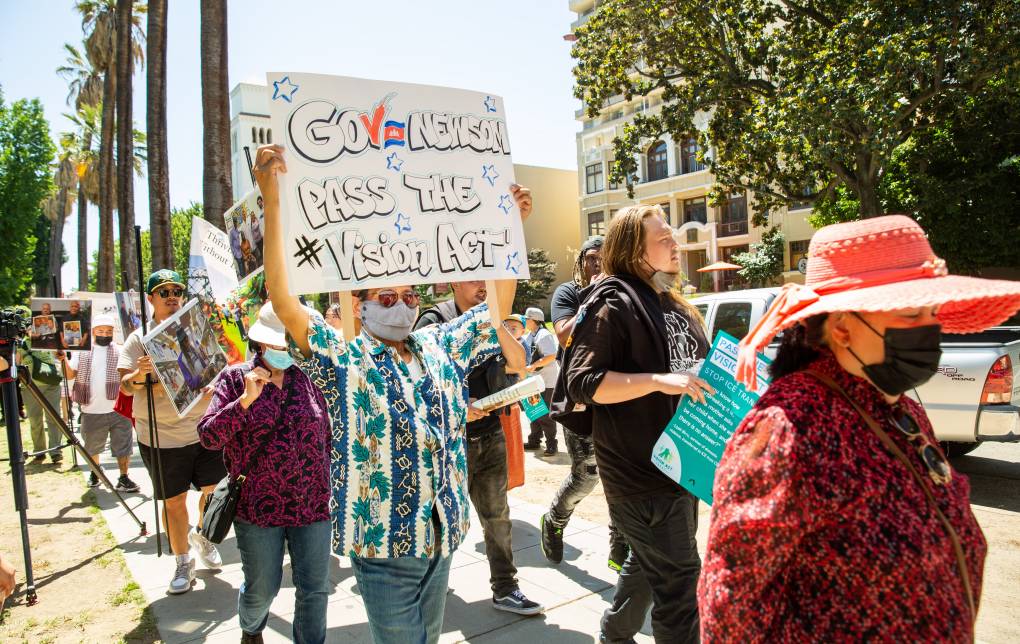
"caption": "Immigration activists rally in Sacramento on June 21, 2022, urging lawmakers to pass the VISION Act, which would have stopped prison-to-ICE transfers in California.",
"description": null,
"title": "6.21.22 Vision Act Rally_Joyce Xi-46",
"credit": "Joyce Xi, courtesy of the Asian Law Caucus",
"status": "inherit",
"altTag": "A groups of people march down the street. One woman holds a sign that says: 'Gov. Newsom Pass the #VISION ACT.'",
"isLoading": false,
"fetchFailed": false
}
},
"audioPlayerReducer": {
"postId": "stream_live",
"isPaused": true,
"isPlaying": false,
"pfsActive": false,
"pledgeModalIsOpen": true,
"playerDrawerIsOpen": false,
"liveAudioPlayStartedAt": 0,
"liveAudioPlayContext": ""
},
"authorsReducer": {
"byline_news_11936453": {
"type": "authors",
"id": "byline_news_11936453",
"meta": {
"override": true
},
"slug": "byline_news_11936453",
"name": "\u003ca href=\"https://calmatters.org/author/wendy-fry/\">Wendy Fry\u003c/a>",
"isLoading": false
},
"byline_news_11936012": {
"type": "authors",
"id": "byline_news_11936012",
"meta": {
"override": true
},
"slug": "byline_news_11936012",
"name": "Elliot Spagat\u003cbr>The Associated Press",
"isLoading": false
},
"byline_news_11928582": {
"type": "authors",
"id": "byline_news_11928582",
"meta": {
"override": true
},
"slug": "byline_news_11928582",
"name": "Carmen González",
"isLoading": false
},
"byline_news_11926009": {
"type": "authors",
"id": "byline_news_11926009",
"meta": {
"override": true
},
"slug": "byline_news_11926009",
"name": "KQED News Staff",
"isLoading": false
},
"byline_news_11924388": {
"type": "authors",
"id": "byline_news_11924388",
"meta": {
"override": true
},
"slug": "byline_news_11924388",
"name": "Don Thompson\u003cbr>The Associated Press",
"isLoading": false
},
"kqed": {
"type": "authors",
"id": "236",
"meta": {
"index": "authors_1716337520",
"id": "236",
"found": true
},
"name": "KQED News Staff",
"firstName": "KQED News Staff",
"lastName": null,
"slug": "kqed",
"email": "faq@kqed.org",
"display_author_email": false,
"staff_mastheads": [],
"title": null,
"bio": null,
"avatar": "https://secure.gravatar.com/avatar/ef0e801a68c4c54afa9180db14084167?s=600&d=blank&r=g",
"twitter": null,
"facebook": null,
"instagram": null,
"linkedin": null,
"sites": [
{
"site": "arts",
"roles": [
"contributor"
]
},
{
"site": "news",
"roles": [
"editor"
]
},
{
"site": "futureofyou",
"roles": [
"author"
]
}
],
"headData": {
"title": "KQED News Staff | KQED",
"description": null,
"ogImgSrc": "https://secure.gravatar.com/avatar/ef0e801a68c4c54afa9180db14084167?s=600&d=blank&r=g",
"twImgSrc": "https://secure.gravatar.com/avatar/ef0e801a68c4c54afa9180db14084167?s=600&d=blank&r=g"
},
"isLoading": false,
"link": "/author/kqed"
},
"rachael-myrow": {
"type": "authors",
"id": "251",
"meta": {
"index": "authors_1716337520",
"id": "251",
"found": true
},
"name": "Rachael Myrow",
"firstName": "Rachael",
"lastName": "Myrow",
"slug": "rachael-myrow",
"email": "rmyrow@kqed.org",
"display_author_email": true,
"staff_mastheads": [
"news"
],
"title": "Senior Editor of KQED's Silicon Valley News Desk",
"bio": "• I write and edit stories about how Silicon Valley power and policies shape everyday life in California. I’m also passionate about making Bay Area history and culture more accessible to a broad public. • I’ve been a journalist for most of my life, starting in high school with The Franklin Press in Los Angeles, where I grew up. While earning my first degree in English at UC Berkeley, I got my start in public radio at KALX-FM. After completing a second degree in journalism at Cal, I landed my first professional job at Marketplace, then moved on to KPCC (now LAist), and then KQED, where I hosted The California Report for more than seven years. • My reporting has appeared on NPR, The World, WBUR’s \u003ci>Here & Now\u003c/i>, and the BBC. I also guest host for KQED’s \u003ci>Forum\u003c/i>, as well as the Commonwealth Club in San Francisco. • I speak periodically on media, democracy and technology issues, and do voiceover work for documentaries and educational video projects. • Outside of the studio, you'll find me hiking Bay Area trails and whipping up Insta-ready meals in my kitchen. • I do not accept gifts, money, or favors from anyone connected to my reporting, I don't pay people for information, and I do not support or donate to political causes. • I strive to treat the people I report on with fairness, honesty, and respect. I also recognize there are often multiple sides to a story and work to verify information through multiple sources and documentation. If I get something wrong, I correct it.",
"avatar": "https://secure.gravatar.com/avatar/87bf8cb5874e045cdff430523a6d48b1?s=600&d=blank&r=g",
"twitter": "rachaelmyrow",
"facebook": null,
"instagram": null,
"linkedin": "https://www.linkedin.com/in/rachaelmyrow/",
"sites": [
{
"site": "arts",
"roles": [
"administrator"
]
},
{
"site": "news",
"roles": [
"edit_others_posts",
"editor"
]
},
{
"site": "futureofyou",
"roles": [
"editor"
]
},
{
"site": "bayareabites",
"roles": [
"editor"
]
},
{
"site": "stateofhealth",
"roles": [
"editor"
]
},
{
"site": "science",
"roles": [
"editor"
]
},
{
"site": "food",
"roles": [
"editor"
]
},
{
"site": "forum",
"roles": [
"editor"
]
},
{
"site": "liveblog",
"roles": [
"author"
]
}
],
"headData": {
"title": "Rachael Myrow | KQED",
"description": "Senior Editor of KQED's Silicon Valley News Desk",
"ogImgSrc": "https://secure.gravatar.com/avatar/87bf8cb5874e045cdff430523a6d48b1?s=600&d=blank&r=g",
"twImgSrc": "https://secure.gravatar.com/avatar/87bf8cb5874e045cdff430523a6d48b1?s=600&d=blank&r=g"
},
"isLoading": false,
"link": "/author/rachael-myrow"
},
"tychehendricks": {
"type": "authors",
"id": "259",
"meta": {
"index": "authors_1716337520",
"id": "259",
"found": true
},
"name": "Tyche Hendricks",
"firstName": "Tyche",
"lastName": "Hendricks",
"slug": "tychehendricks",
"email": "thendricks@kqed.org",
"display_author_email": true,
"staff_mastheads": [
"news"
],
"title": "KQED Senior Editor, Immigration",
"bio": "\u003cspan style=\"font-weight: 400;\">Tyche Hendricks is KQED’s senior editor for immigration, leading coverage of the policy and politics that affect California’s immigrant communities. Her work for KQED’s radio and online audiences is also carried on NPR and other national outlets. She has been recognized with awards from the Radio and Television News Directors Association, the Society for Professional Journalists; the Education Writers Association; the Best of the West and the National Federation of Community Broadcasters. Before joining KQED in 2010, Tyche spent more than a dozen years as a newspaper reporter, notably at the \u003c/span>\u003ci>\u003cspan style=\"font-weight: 400;\">San Francisco Chronicle\u003c/span>\u003c/i>\u003cspan style=\"font-weight: 400;\">. At different times she has covered criminal justice, government and politics and urban planning. Tyche has taught in the MFA Creative Writing program at the University of San Francisco and at UC Berkeley’s Graduate School of Journalism, where she was co-director of a national immigration symposium for professional journalists. She is the author of \u003c/span>\u003ci>\u003cspan style=\"font-weight: 400;\">The Wind Doesn't Need a Passport: Stories from the U.S.-Mexico Borderlands\u003c/span>\u003c/i>\u003cspan style=\"font-weight: 400;\"> (University of California Press). \u003c/span>",
"avatar": "https://secure.gravatar.com/avatar/b8ee458e2731c2d43df86882ce17267e?s=600&d=blank&r=g",
"twitter": "tychehendricks",
"facebook": null,
"instagram": null,
"linkedin": null,
"sites": [
{
"site": "news",
"roles": [
"editor"
]
},
{
"site": "stateofhealth",
"roles": [
"editor"
]
}
],
"headData": {
"title": "Tyche Hendricks | KQED",
"description": "KQED Senior Editor, Immigration",
"ogImgSrc": "https://secure.gravatar.com/avatar/b8ee458e2731c2d43df86882ce17267e?s=600&d=blank&r=g",
"twImgSrc": "https://secure.gravatar.com/avatar/b8ee458e2731c2d43df86882ce17267e?s=600&d=blank&r=g"
},
"isLoading": false,
"link": "/author/tychehendricks"
},
"ecruzguevarra": {
"type": "authors",
"id": "8654",
"meta": {
"index": "authors_1716337520",
"id": "8654",
"found": true
},
"name": "Ericka Cruz Guevarra",
"firstName": "Ericka",
"lastName": "Cruz Guevarra",
"slug": "ecruzguevarra",
"email": "ecruzguevarra@kqed.org",
"display_author_email": true,
"staff_mastheads": [
"news"
],
"title": "Producer, The Bay Podcast",
"bio": "Ericka Cruz Guevarra is host of \u003ca href=\"https://www.kqed.org/podcasts/thebay\">\u003cem>The Bay\u003c/em>\u003c/a> podcast at KQED. Before host, she was the show’s producer. Her work in that capacity includes a three-part reported series on policing in Vallejo, which won a 2020 excellence in journalism award from the Society of Professional Journalists. Ericka has worked as a breaking news reporter at Oregon Public Broadcasting, helped produce the Code Switch podcast, and was KQED’s inaugural Raul Ramirez Diversity Fund intern. She’s also an alumna of NPR’s Next Generation Radio program. Send her an email if you have strong feelings about whether Fairfield and Suisun City are the Bay. Ericka is represented by SAG-AFTRA.",
"avatar": "https://secure.gravatar.com/avatar/25e5ab8d3d53fad2dcc7bb2b5c506b1a?s=600&d=blank&r=g",
"twitter": "NotoriousECG",
"facebook": null,
"instagram": null,
"linkedin": null,
"sites": [
{
"site": "arts",
"roles": [
"subscriber"
]
},
{
"site": "news",
"roles": [
"editor",
"manage_categories"
]
},
{
"site": "futureofyou",
"roles": [
"subscriber"
]
},
{
"site": "stateofhealth",
"roles": [
"subscriber"
]
},
{
"site": "science",
"roles": [
"editor"
]
},
{
"site": "forum",
"roles": [
"subscriber"
]
}
],
"headData": {
"title": "Ericka Cruz Guevarra | KQED",
"description": "Producer, The Bay Podcast",
"ogImgSrc": "https://secure.gravatar.com/avatar/25e5ab8d3d53fad2dcc7bb2b5c506b1a?s=600&d=blank&r=g",
"twImgSrc": "https://secure.gravatar.com/avatar/25e5ab8d3d53fad2dcc7bb2b5c506b1a?s=600&d=blank&r=g"
},
"isLoading": false,
"link": "/author/ecruzguevarra"
},
"fjhabvala": {
"type": "authors",
"id": "8659",
"meta": {
"index": "authors_1716337520",
"id": "8659",
"found": true
},
"name": "Farida Jhabvala Romero",
"firstName": "Farida",
"lastName": "Jhabvala Romero",
"slug": "fjhabvala",
"email": "fjhabvala@kqed.org",
"display_author_email": true,
"staff_mastheads": [
"news"
],
"title": "KQED Contributor",
"bio": "\u003cspan style=\"font-weight: 400;\">Farida Jhabvala Romero is a Labor Correspondent for KQED. She previously covered immigration. Farida was \u003ca href=\"https://www.ccnma.org/2022-most-influential-latina-journalists\">named\u003c/a> one of the 10 Most Influential Latina Journalists in California in 2022 by the California Chicano News Media Association. Her work has won awards from the Society of Professional Journalists (Northern California), as well as a national and regional Edward M. Murrow Award for the collaborative reporting projects “Dangerous Air” and “Graying California.” \u003c/span>\u003cspan style=\"font-weight: 400;\">Before joining KQED, Farida worked as a producer at Radio Bilingüe, a national public radio network. Farida earned her master’s degree in journalism from Stanford University.\u003c/span>",
"avatar": "https://secure.gravatar.com/avatar/c3ab27c5554b67b478f80971e515aa02?s=600&d=blank&r=g",
"twitter": "FaridaJhabvala",
"facebook": null,
"instagram": null,
"linkedin": "https://www.linkedin.com/in/faridajhabvala/",
"sites": [
{
"site": "news",
"roles": [
"editor"
]
},
{
"site": "stateofhealth",
"roles": [
"author"
]
}
],
"headData": {
"title": "Farida Jhabvala Romero | KQED",
"description": "KQED Contributor",
"ogImgSrc": "https://secure.gravatar.com/avatar/c3ab27c5554b67b478f80971e515aa02?s=600&d=blank&r=g",
"twImgSrc": "https://secure.gravatar.com/avatar/c3ab27c5554b67b478f80971e515aa02?s=600&d=blank&r=g"
},
"isLoading": false,
"link": "/author/fjhabvala"
},
"amontecillo": {
"type": "authors",
"id": "11649",
"meta": {
"index": "authors_1716337520",
"id": "11649",
"found": true
},
"name": "Alan Montecillo",
"firstName": "Alan",
"lastName": "Montecillo",
"slug": "amontecillo",
"email": "amontecillo@kqed.org",
"display_author_email": false,
"staff_mastheads": [
"news"
],
"title": "KQED Contributor",
"bio": "Alan Montecillo is the senior editor of \u003cem>\u003ca href=\"http://kqed.org/thebay\">The Bay\u003c/a>, \u003c/em> KQED's local news podcast. Before moving to the Bay Area, he worked as a senior talk show producer for WILL in Champaign-Urbana, Illinois and at Oregon Public Broadcasting in Portland, Oregon. He has won journalism awards from the Society of Professional Journalists Northern California, the Public Media Journalists Association, The Signal Awards, and has also received a regional Edward R. Murrow award. Alan is a Filipino American from Hong Kong and a graduate of Reed College.",
"avatar": "https://secure.gravatar.com/avatar/d5e4e7a76481969ccba76f4e2b5ccabc?s=600&d=blank&r=g",
"twitter": "alanmontecillo",
"facebook": null,
"instagram": null,
"linkedin": null,
"sites": [
{
"site": "",
"roles": [
"editor"
]
},
{
"site": "news",
"roles": [
"editor",
"manage_categories"
]
}
],
"headData": {
"title": "Alan Montecillo | KQED",
"description": "KQED Contributor",
"ogImgSrc": "https://secure.gravatar.com/avatar/d5e4e7a76481969ccba76f4e2b5ccabc?s=600&d=blank&r=g",
"twImgSrc": "https://secure.gravatar.com/avatar/d5e4e7a76481969ccba76f4e2b5ccabc?s=600&d=blank&r=g"
},
"isLoading": false,
"link": "/author/amontecillo"
},
"ccabreralomeli": {
"type": "authors",
"id": "11708",
"meta": {
"index": "authors_1716337520",
"id": "11708",
"found": true
},
"name": "Carlos Cabrera-Lomelí",
"firstName": "Carlos",
"lastName": "Cabrera-Lomelí",
"slug": "ccabreralomeli",
"email": "ccabreralomeli@KQED.org",
"display_author_email": true,
"staff_mastheads": [
"news"
],
"title": "Community Reporter",
"bio": "Carlos Cabrera-Lomelí is a community reporter with KQED's digital engagement team. He also reports and co-produces for KQED's bilingual news hub KQED en Español. He grew up in San Francisco's Mission District and has previously worked with Univision, 48 Hills and REFORMA in Mexico City.",
"avatar": "https://secure.gravatar.com/avatar/e95ff80bb2eaf18a8f2af4dcf7ffb54b?s=600&d=mm&r=g",
"twitter": "@LomeliCabrera",
"facebook": null,
"instagram": null,
"linkedin": null,
"sites": [
{
"site": "arts",
"roles": [
"editor"
]
},
{
"site": "news",
"roles": [
"editor"
]
},
{
"site": "about",
"roles": [
"editor"
]
},
{
"site": "science",
"roles": [
"editor"
]
},
{
"site": "perspectives",
"roles": [
"editor"
]
},
{
"site": "elections",
"roles": [
"editor"
]
},
{
"site": "liveblog",
"roles": [
"contributor"
]
}
],
"headData": {
"title": "Carlos Cabrera-Lomelí | KQED",
"description": "Community Reporter",
"ogImgSrc": "https://secure.gravatar.com/avatar/e95ff80bb2eaf18a8f2af4dcf7ffb54b?s=600&d=mm&r=g",
"twImgSrc": "https://secure.gravatar.com/avatar/e95ff80bb2eaf18a8f2af4dcf7ffb54b?s=600&d=mm&r=g"
},
"isLoading": false,
"link": "/author/ccabreralomeli"
},
"afinney": {
"type": "authors",
"id": "11772",
"meta": {
"index": "authors_1716337520",
"id": "11772",
"found": true
},
"name": "Annelise Finney",
"firstName": "Annelise",
"lastName": "Finney",
"slug": "afinney",
"email": "afinney@kqed.org",
"display_author_email": true,
"staff_mastheads": [
"news"
],
"title": "Reporter",
"bio": "Annelise reports on reparations in California and East Bay politics. She co-produced the Sunday Music Drop, a limited-term radio series featuring Bay Area musicians that aired between Sept 2022 and Oct 2024. She joined KQED in 2021 as a general assignment reporter and is an alumna of KALW's Audio Academy. She was born and raised in the East Bay. She is currently away from KQED completing a year-long reporting project in Berlin, Germany as a Alexander Von Humboldt German Chancellor Fellow.",
"avatar": "https://secure.gravatar.com/avatar/5fded66cae47704cdfc5021cde0f3aa4?s=600&d=blank&r=g",
"twitter": null,
"facebook": null,
"instagram": null,
"linkedin": null,
"sites": [
{
"site": "news",
"roles": [
"editor"
]
},
{
"site": "liveblog",
"roles": [
"author"
]
}
],
"headData": {
"title": "Annelise Finney | KQED",
"description": "Reporter",
"ogImgSrc": "https://secure.gravatar.com/avatar/5fded66cae47704cdfc5021cde0f3aa4?s=600&d=blank&r=g",
"twImgSrc": "https://secure.gravatar.com/avatar/5fded66cae47704cdfc5021cde0f3aa4?s=600&d=blank&r=g"
},
"isLoading": false,
"link": "/author/afinney"
},
"mesquinca": {
"type": "authors",
"id": "11802",
"meta": {
"index": "authors_1716337520",
"id": "11802",
"found": true
},
"name": "Maria Esquinca",
"firstName": "Maria",
"lastName": "Esquinca",
"slug": "mesquinca",
"email": "mesquinca@kqed.org",
"display_author_email": false,
"staff_mastheads": [],
"title": "Producer, The Bay",
"bio": "María Esquinca is a producer of The Bay. Before that, she was a New York Women’s Foundation IGNITE Fellow at Latino USA. She worked at Radio Bilingue where she covered the San Joaquin Valley. Maria has interned at WLRN, News 21, The New York Times Student Journalism Institute and at Crain’s Detroit Business as a Dow Jones News Fund Business Reporting Intern. She is an MFA graduate from the University of Miami. In 2017, she graduated from the Walter Cronkite School of Journalism and Mass Communication with a Master of Mass Communication. A fronteriza, she was born in Ciudad Juárez, Chihuahua, Mexico and grew up in El Paso, Texas.",
"avatar": "https://secure.gravatar.com/avatar/77cedba18aae91da775038ba06dcd8d0?s=600&d=blank&r=g",
"twitter": "@m_esquinca",
"facebook": null,
"instagram": null,
"linkedin": null,
"sites": [
{
"site": "news",
"roles": []
}
],
"headData": {
"title": "Maria Esquinca | KQED",
"description": "Producer, The Bay",
"ogImgSrc": "https://secure.gravatar.com/avatar/77cedba18aae91da775038ba06dcd8d0?s=600&d=blank&r=g",
"twImgSrc": "https://secure.gravatar.com/avatar/77cedba18aae91da775038ba06dcd8d0?s=600&d=blank&r=g"
},
"isLoading": false,
"link": "/author/mesquinca"
}
},
"pagesReducer": {
"news_tag_immigration": {
"type": "terms",
"id": "news_20202",
"meta": {
"index": "terms_1716263798",
"site": "news",
"id": "20202",
"score": 6.90447
},
"featImg": null,
"name": "immigration",
"description": null,
"taxonomy": "tag",
"headData": {
"twImgId": null,
"twTitle": null,
"ogTitle": null,
"ogImgId": null,
"twDescription": null,
"description": null,
"title": "immigration Archives | KQED News",
"ogDescription": null
},
"ttid": 20219,
"slug": "immigration",
"isLoading": false,
"title": "immigration",
"pageMeta": {
"site": "news",
"WpPageTemplate": "page-topic-editorial",
"currentPage": 48
},
"blocks": [
{
"blockName": "kqed/post-list",
"attrs": {
"layout": "cardArticle2",
"query": "posts/news?tag=immigration",
"seeMore": false,
"paginated": true,
"page": 48
}
},
{
"blockName": "kqed/ad"
}
]
}
},
"pfsSessionReducer": {},
"postsReducer": {
"stream_live": {
"type": "live",
"id": "stream_live",
"audioUrl": "https://streams.kqed.org/kqedradio",
"title": "Live Stream",
"excerpt": "Live Stream information currently unavailable.",
"link": "/radio",
"featImg": "",
"label": {
"name": "KQED Live",
"link": "/"
}
},
"stream_kqedNewscast": {
"type": "posts",
"id": "stream_kqedNewscast",
"audioUrl": "https://www.kqed.org/.stream/anon/radio/RDnews/newscast.mp3?_=1",
"title": "KQED Newscast",
"featImg": "",
"label": {
"name": "88.5 FM",
"link": "/"
}
},
"news_11936453": {
"type": "posts",
"id": "news_11936453",
"meta": {
"index": "posts_1716263798",
"site": "news",
"id": "11936453",
"score": null,
"sort": [
1672344375000
]
},
"guestAuthors": [],
"slug": "border-confusion-and-financial-woes-loom-as-california-braces-for-lifting-of-title-42-in-new-year",
"title": "Border Confusion and Financial Woes Loom as California Braces for Lifting of Title 42 in New Year",
"publishDate": 1672344375,
"format": "standard",
"headTitle": "Border Confusion and Financial Woes Loom as California Braces for Lifting of Title 42 in New Year | KQED",
"labelTerm": {
"term": 18481,
"site": "news"
},
"content": "\u003cp>The Supreme Court’s latest move allows \u003ca href=\"https://www.nytimes.com/2022/12/27/us/politics/title-42-border-supreme-court.html\">a short-term reprieve to an anticipated increase in asylum seekers trying to cross from Mexico\u003c/a> into California and other states, but recent confusion at the border is a preview of what may soon come should a pandemic-era measure known as Title 42 be lifted in 2023.\u003c/p>\n\u003cp>The situation, and its use as a political backdrop, has prompted local officials to ask what state resources will be available next year with California facing a potential budget shortfall and the possibility that Title 42 will end.\u003c/p>\n\u003cp>Title 42 is a Trump-era immigration policy that has continued under President Joe Biden. It allows border agents to rapidly expel migrants at official ports of entry during public health emergencies. The policy has resulted in the expulsion of tens of thousands of people seeking asylum and has discouraged many others from crossing the border.[aside label=\"Related Stories\" postID=\"news_11936012,news_11910789,news_11936184\"]The policy states that if the U.S. surgeon general determines there is a communicable disease in another country, \u003ca href=\"https://www.law.cornell.edu/uscode/text/42/265\">health officials have the authority, with the approval of the president, to prohibit\u003c/a> “the introduction of persons and property from such countries or places” for as long as health officials determine that action is necessary.\u003c/p>\n\u003cp>The measure had been set to lift last week by order of a federal court, which would have allowed many asylum-seekers waiting in limbo at the border to go ahead and cross into the United States. Some experts say that because smugglers in Mexico use any shift in U.S. immigration policy to exploit migrants, mere conversation about the possibility of lifting Title 42 triggered even more people to try to cross into the U.S. in recent weeks.\u003c/p>\n\u003cp>The \u003ca href=\"https://www.supremecourt.gov/opinions/22pdf/22a544_n758.pdf\">Supreme Court’s brief order (PDF)\u003c/a> Tuesday stayed — meaning delayed — the trial judge’s ruling that would have lifted Title 42 until the high court hears arguments in the case in February. The political and legal ping-pong in the case is hard enough for U.S. audiences to follow, making it nearly impossible to explain south of the border.\u003c/p>\n\u003cp>The Supreme Court’s order is a response to a request filed by 19 Republican-led states that they be heard in the case. It does not overrule the lower court’s decision that Title 42 is illegal; it merely leaves the measure in place while the legal challenges play out in court.\u003c/p>\n\u003cp>The federal court order that was supposed to lift Title 42 came as a result of a lawsuit brought by the American Civil Liberties Union on behalf of asylum-seeking families. Asylum is a protection codified in international law for foreign nationals who meet the legal definition of “refugee.” The United Nations 1951 Convention and 1967 Protocol define refugees as people unable or unwilling to return to their home country, and who cannot obtain protection in that country, due to past persecution or a well-founded fear of being persecuted in the future “on account of race, religion, nationality, membership in a particular social group, or political opinion.” Congress incorporated this definition into U.S. immigration law in the Refugee Act of 1980.\u003c/p>\n\u003cp>For those stuck in Mexico because of Title 42, waiting can be perilous. Human Rights First has documented more than 13,000 attacks on asylum seekers waiting in Mexico during the Biden administration.\u003c/p>\n\u003cfigure id=\"attachment_11936462\" class=\"wp-caption alignnone\" style=\"max-width: 800px\">\u003cimg loading=\"lazy\" decoding=\"async\" class=\"size-medium wp-image-11936462\" src=\"https://ww2.kqed.org/app/uploads/sites/10/2022/12/122222-Title-42-Migrants-MC-CM-08-copy-800x533.jpg\" alt=\"Latinx migrants of various ages from adults to children look on with concerned expressions as they stand next to white steel barriers.\" width=\"800\" height=\"533\" srcset=\"https://cdn.kqed.org/wp-content/uploads/sites/10/2022/12/122222-Title-42-Migrants-MC-CM-08-copy-800x533.jpg 800w, https://cdn.kqed.org/wp-content/uploads/sites/10/2022/12/122222-Title-42-Migrants-MC-CM-08-copy-1020x680.jpg 1020w, https://cdn.kqed.org/wp-content/uploads/sites/10/2022/12/122222-Title-42-Migrants-MC-CM-08-copy-160x107.jpg 160w, https://cdn.kqed.org/wp-content/uploads/sites/10/2022/12/122222-Title-42-Migrants-MC-CM-08-copy-1536x1024.jpg 1536w, https://cdn.kqed.org/wp-content/uploads/sites/10/2022/12/122222-Title-42-Migrants-MC-CM-08-copy-1920x1280.jpg 1920w, https://cdn.kqed.org/wp-content/uploads/sites/10/2022/12/122222-Title-42-Migrants-MC-CM-08-copy.jpg 2000w\" sizes=\"(max-width: 800px) 100vw, 800px\">\u003cfigcaption class=\"wp-caption-text\">Migrants wait in line while California border activists organize the group to enter the U.S. and seek asylum through the Chaparral entryway in Tijuana, Mexico on Dec. 22, 2022. \u003ccite>(Carlos A. Moreno for CalMatters)\u003c/cite>\u003c/figcaption>\u003c/figure>\n\u003cp>Because it takes time for news of shifts in U.S. immigration policy to reach areas in rural Mexico and Central America, the numbers of migrants arriving in Tijuana and San Diego this week in anticipation of the end of Title 42 could be elevated right now — and it may take some time before those numbers drop-off as news travels, experts said. Migration numbers typically increase through the first half of the year before dropping off in the summer.\u003c/p>\n\u003cp>San Diego County Supervisor Joel Anderson, a former Republican state senator, was among a group of political leaders who recently complained that the state and federal governments have not provided the funds local leaders have requested to handle the expected influx of asylum seekers and other migrants.\u003c/p>\n\u003cp>“We’re not even talking about whether these are good policies or not,” he said. “But whatever the policy is, we become the targets of it. We’re willing to step up, but they have to step up, too, by giving us the resources we need to deal with it.”\u003c/p>\n\u003cp>He joined several local Republican and Democratic leaders in San Diego in urging in letters and news conferences that the state and the feds should provide more support ahead of the expected end of Title 42.\u003c/p>\n\u003cp>Local officials pointed to needing more funding for schools, hospitals, and police services, among other resources, if Title 42 eventually lifts. The near constant legal back-and-forth has also provided a convenient conversation starter for politicians wanting to debate larger immigration policy issues.\u003c/p>\n\u003cp>“With the state budget projecting a $25 billion deficit, I’d like to know what the plan is for our schools and to help lift all of our students,” said Andrew Hayes, board president of the Lakeside school district in rural eastern San Diego. Hayes said increases in immigration causes strains to the local educational systems because students fleeing persecution in other countries often have increased mental health needs and sometimes require special instruction.\u003c/p>\n\u003cp>San Diego County Supervisors Nathan Fletcher and Nora Vargas, both Democrats, wrote to Alejandro Mayorkas, the U.S. homeland security secretary, on December 19, also requesting federal resources and “a comprehensive plan to ensure humane entry into the United States for those seeking asylum into our country.”\u003c/p>\n\u003cp>“When Title 42 is lifted, we will need additional resources and personnel on the ground to process and arrange for the onward travel of asylum seekers to their final destination,” they wrote. ”We will also need the federal government to set up temporary shelters on federal property to ensure access to needed social and health services. Our hospitals, our public health department, our social services, and our homeless service providers are already at maximum capacity serving vulnerable residents in San Diego.”\u003c/p>\n\u003ch2>El Cajon not ‘the governor’s neighborhood’\u003c/h2>\n\u003cp>Title 42 policy’s end “will likely increase” migration flows, the Department of Homeland Security officially said last week.\u003c/p>\n\u003cp>The burden will unfairly fall on a few border cities, Anderson said.\u003c/p>\n\u003cp>“They’re not talking about releasing people into Sacramento or putting people in the governor’s neighborhood,” said Anderson. “No, they’re talking about releasing people right here in El Cajon, where the median household income is just over $58,000 per year.”\u003c/p>\n\u003cp>Gov. Gavin Newsom’s office responded that the state has done what it can to support local jurisdictions.[pullquote align=\"right\" size=\"medium\" citation=\"Joel Anderson, supervisor, San Diego County\"]‘It is irresponsible to ask the City of El Cajon to shoulder the burden and costs necessary to address the needs of these individuals without assistance from the [state] and federal government.’[/pullquote]“While the federal government is responsible for immigration, California has invested more than any other state to ensure the safety and dignity of asylum seekers. Roughly $1 billion has been invested to provide critical services to migrants, including medical screenings, vaccinations, temporary shelter, food, clothes, and other aid. However, with looming budget deficits, the state cannot continue to fund these efforts at scale without significant support from Congress,” said Daniel Lopez, the deputy communications director for Newsom.\u003c/p>\n\u003cp>“The state has advocated for additional resources to help communities like San Diego provide services to recently arrived migrants,” Lopez added.\u003c/p>\n\u003cp>Anderson wrote to Gov. Gavin Newsom on December 14 complaining that a plan that San Diego County officials proposed to the state was rejected. Though he declined to discuss the plan’s specifics, he said it included opening a temporary emergency shelter, providing food, clothing, healthcare and wrap-around services.\u003c/p>\n\u003cp>“It is irresponsible to ask the City of El Cajon to shoulder the burden and costs necessary to address the needs of these individuals without assistance from the State and federal government,” wrote Anderson in the letter.\u003c/p>\n\u003cp>For his part, Newsom has been complaining of a lack of federal support for asylum seekers and immigrants.\u003c/p>\n\u003cp>Newsom said earlier this month that, because of the federal government’s lackluster support, the state has had to spend nearly $1 billion in the last three years, working with nonprofits to provide immigrants released from federal detention with health screenings, temporary shelter and help connecting with sponsors. The immigrants had been held at nine facilities in Imperial, San Diego and Riverside counties.\u003c/p>\n\u003cp>“With the respect to the federal government, we’ve been doing their job for the last few years at scale,” Newsom said. “But we cannot continue to absorb that responsibility.”\u003c/p>\n\u003cp>The state Legislative Analyst’s Office recently said in its annual forecast that Newsom and the Democratic Party-controlled Legislature are facing a \u003ca href=\"https://calmatters.org/california-divide/2022/12/california-budget-deficit-safety-net/\">$24 billion projected budget deficit\u003c/a> for the next fiscal year.\u003c/p>\n\u003cp>If the state enters a recession the outlook is even worse, with revenues predicted to fall short by $30 billion to $50 billion. The governor signed a record-breaking \u003ca href=\"https://calmatters.org/politics/2022/06/california-budget-deal-2/\">$308 billion budget\u003c/a> in June.[pullquote align=\"right\" size=\"medium\" citation=\"Gov. Gavin Newsom\"]‘With the respect to the federal government, we’ve been doing their job for the last few years at scale. But we cannot continue to absorb that responsibility.’[/pullquote]Advocates say that while migrants sometimes require services when they first enter the country, research shows they ultimately contribute to the larger economy. In California undocumented immigrants collectively pay $3.1 billion a year in state and local taxes, according to the \u003ca href=\"https://itep.sfo2.digitaloceanspaces.com/ITEP-2017-Undocumented-Immigrants-State-and-Local-Contributions.pdf\">Institute on Taxation and Economic Policy (PDF)\u003c/a>.\u003c/p>\n\u003cp>Meanwhile, some migrants in Mexico last week expressed disappointment, concern and confusion about the delay in lifting Title 42.\u003c/p>\n\u003cp>Several people said they had left shelters with the expectation that the order would be released last week and now they had no place to go.\u003c/p>\n\u003cp>However, the scene outside El Chaparral, a pedestrian border crossing between San Ysidro and Tijuana that has been closed since the pandemic began, looked far different than images coming out of Texas. There, members of the National Guard, armed with rifles, have put up razor wire and are blocking migrants from entering the United States.\u003c/p>\n\u003ch2>Waiting patiently, but getting desperate\u003c/h2>\n\u003cp>Here in Baja California, just south of San Diego, migrants wearing masks stood patiently in lines last week waiting for services or to receive news about any policy changes that may impact their ability to cross the border. The flow of people in the area was orderly, mirroring any other normal mid-week day during the lunch hour.\u003c/p>\n\u003cp>A migrant from Michoacán said being out on the streets in Tijuana was extremely uncomfortable for his wife, who has been diagnosed with a brain tumor. He asked not to be named because people in Tijuana were looking for him, putting him in danger.\u003c/p>\n\u003cp>“We haven’t been able to receive any help from anywhere,” he said. “We’re getting desperate.”\u003c/p>\n\u003cp>Anderson said that the county was willing to welcome asylum seekers “with open arms,” but it needs more funds to do it.\u003c/p>\n\u003cp>“Even if it’s only 10 more people coming in, that’s 10 people too many without additional funding because we already have so many people living on our streets needing services,” he said.\u003c/p>\n\u003cfigure id=\"attachment_11936463\" class=\"wp-caption alignnone\" style=\"max-width: 800px\">\u003cimg loading=\"lazy\" decoding=\"async\" class=\"size-medium wp-image-11936463\" src=\"https://ww2.kqed.org/app/uploads/sites/10/2022/12/122222-Title-42-Migrants-MC-CM-05-copy-800x533.jpg\" alt=\"A migrant mother with her baby in her arms and her daughter by her side sit among other asylum seekers in a crowded room with iron bars on windows.\" width=\"800\" height=\"533\" srcset=\"https://cdn.kqed.org/wp-content/uploads/sites/10/2022/12/122222-Title-42-Migrants-MC-CM-05-copy-800x533.jpg 800w, https://cdn.kqed.org/wp-content/uploads/sites/10/2022/12/122222-Title-42-Migrants-MC-CM-05-copy-1020x680.jpg 1020w, https://cdn.kqed.org/wp-content/uploads/sites/10/2022/12/122222-Title-42-Migrants-MC-CM-05-copy-160x107.jpg 160w, https://cdn.kqed.org/wp-content/uploads/sites/10/2022/12/122222-Title-42-Migrants-MC-CM-05-copy-1536x1024.jpg 1536w, https://cdn.kqed.org/wp-content/uploads/sites/10/2022/12/122222-Title-42-Migrants-MC-CM-05-copy.jpg 1568w\" sizes=\"(max-width: 800px) 100vw, 800px\">\u003cfigcaption class=\"wp-caption-text\">Migrants line up to get health services near the free non-profit clinic in Tijuana, Mexico on Dec. 22, 2022. \u003ccite>(Carlos A. Moreno/CalMatters)\u003c/cite>\u003c/figcaption>\u003c/figure>\n\u003cp>Newsom toured a state-funded migrant center that provides services to asylum seekers near the Imperial County border with Mexico on December 12. There the governor criticized Republicans in Congress for politicizing immigration while failing to support comprehensive reforms.\u003c/p>\n\u003cp>The Department of Homeland Security said it plans to boost resources at the border, “increasing processing efficiency, imposing consequences for unlawful entry, bolstering nonprofit capacity, targeting smugglers and working with international partners,” a DHS spokesperson said Thursday.\u003c/p>\n\u003cp>If Title 42 is ultimately lifted, the process for processing migrants at the border would return to the way it was before the start of the pandemic.\u003c/p>\n\u003cp>Asylum seekers who don’t have prior permission to be in the country would have to pass what’s called a “credible fear” test. They would have to prove to a processing agent or asylum officer that they have a well-founded fear that if they are deported home, they would face persecution.\u003c/p>\n\u003cp>After that test, migrants would either be removed from the country, detained in immigration custody or released into the U.S. to wait while their asylum cases make their way through immigration court — a \u003ca href=\"https://trac.syr.edu/immigration/reports/672/\">process that can take years\u003c/a>.\u003c/p>\n\u003cp>[ad fullwidth]\u003c/p>\n\u003cp>[ad floatright]\u003c/p>\n",
"blocks": [],
"excerpt": "With a projected budget deficit of $24 billion for the next fiscal year and a possible recession, California has yet to figure out how to meet the needs of an influx of migrants when Title 42 ends.",
"status": "publish",
"parent": 0,
"modified": 1721136169,
"stats": {
"hasAudio": false,
"hasVideo": false,
"hasChartOrMap": false,
"iframeSrcs": [],
"hasGoogleForm": false,
"hasGallery": false,
"hasHearkenModule": false,
"hasPolis": false,
"paragraphCount": 43,
"wordCount": 2244
},
"headData": {
"title": "Border Confusion and Financial Woes Loom as California Braces for Lifting of Title 42 in New Year | KQED",
"description": "With a projected budget deficit of $24 billion for the next fiscal year and a possible recession, California has yet to figure out how to meet the needs of an influx of migrants when Title 42 ends.",
"ogTitle": "",
"ogDescription": "",
"ogImgId": "",
"twTitle": "",
"twDescription": "",
"twImgId": "",
"schema": {
"@context": "https://schema.org",
"@type": "NewsArticle",
"headline": "Border Confusion and Financial Woes Loom as California Braces for Lifting of Title 42 in New Year",
"datePublished": "2022-12-29T12:06:15-08:00",
"dateModified": "2024-07-16T06:22:49-07:00",
"image": "https://cdn.kqed.org/wp-content/uploads/2020/02/KQED-OG-Image@1x.png",
"isAccessibleForFree": "True",
"publisher": {
"@type": "NewsMediaOrganization",
"@id": "https://www.kqed.org/#organization",
"name": "KQED",
"logo": "https://cdn.kqed.org/wp-content/uploads/2020/02/KQED-OG-Image@1x.png",
"url": "https://www.kqed.org",
"sameAs": [
"https://www.facebook.com/KQED",
"https://twitter.com/KQED",
"https://www.instagram.com/kqed/",
"https://www.tiktok.com/@kqedofficial",
"https://www.linkedin.com/company/kqed",
"https://www.youtube.com/channel/UCeC0IOo7i1P_61zVUWbJ4nw"
]
}
}
},
"sticky": false,
"nprByline": "\u003ca href=\"https://calmatters.org/author/wendy-fry/\">Wendy Fry\u003c/a>",
"excludeFromSiteSearch": "Include",
"showOnAuthorArchivePages": "No",
"articleAge": "0",
"path": "/news/11936453/border-confusion-and-financial-woes-loom-as-california-braces-for-lifting-of-title-42-in-new-year",
"audioTrackLength": null,
"parsedContent": [
{
"type": "contentString",
"content": "\u003cdiv class=\"post-body\">\u003cp>\u003cp>The Supreme Court’s latest move allows \u003ca href=\"https://www.nytimes.com/2022/12/27/us/politics/title-42-border-supreme-court.html\">a short-term reprieve to an anticipated increase in asylum seekers trying to cross from Mexico\u003c/a> into California and other states, but recent confusion at the border is a preview of what may soon come should a pandemic-era measure known as Title 42 be lifted in 2023.\u003c/p>\n\u003cp>The situation, and its use as a political backdrop, has prompted local officials to ask what state resources will be available next year with California facing a potential budget shortfall and the possibility that Title 42 will end.\u003c/p>\n\u003cp>Title 42 is a Trump-era immigration policy that has continued under President Joe Biden. It allows border agents to rapidly expel migrants at official ports of entry during public health emergencies. The policy has resulted in the expulsion of tens of thousands of people seeking asylum and has discouraged many others from crossing the border.\u003c/p>\u003c/div>",
"attributes": {
"named": {},
"numeric": []
}
},
{
"type": "component",
"content": "",
"name": "aside",
"attributes": {
"named": {
"label": "Related Stories ",
"postid": "news_11936012,news_11910789,news_11936184"
},
"numeric": []
}
},
{
"type": "contentString",
"content": "\u003cdiv class=\"post-body\">\u003cp>The policy states that if the U.S. surgeon general determines there is a communicable disease in another country, \u003ca href=\"https://www.law.cornell.edu/uscode/text/42/265\">health officials have the authority, with the approval of the president, to prohibit\u003c/a> “the introduction of persons and property from such countries or places” for as long as health officials determine that action is necessary.\u003c/p>\n\u003cp>The measure had been set to lift last week by order of a federal court, which would have allowed many asylum-seekers waiting in limbo at the border to go ahead and cross into the United States. Some experts say that because smugglers in Mexico use any shift in U.S. immigration policy to exploit migrants, mere conversation about the possibility of lifting Title 42 triggered even more people to try to cross into the U.S. in recent weeks.\u003c/p>\n\u003cp>The \u003ca href=\"https://www.supremecourt.gov/opinions/22pdf/22a544_n758.pdf\">Supreme Court’s brief order (PDF)\u003c/a> Tuesday stayed — meaning delayed — the trial judge’s ruling that would have lifted Title 42 until the high court hears arguments in the case in February. The political and legal ping-pong in the case is hard enough for U.S. audiences to follow, making it nearly impossible to explain south of the border.\u003c/p>\n\u003cp>The Supreme Court’s order is a response to a request filed by 19 Republican-led states that they be heard in the case. It does not overrule the lower court’s decision that Title 42 is illegal; it merely leaves the measure in place while the legal challenges play out in court.\u003c/p>\n\u003cp>The federal court order that was supposed to lift Title 42 came as a result of a lawsuit brought by the American Civil Liberties Union on behalf of asylum-seeking families. Asylum is a protection codified in international law for foreign nationals who meet the legal definition of “refugee.” The United Nations 1951 Convention and 1967 Protocol define refugees as people unable or unwilling to return to their home country, and who cannot obtain protection in that country, due to past persecution or a well-founded fear of being persecuted in the future “on account of race, religion, nationality, membership in a particular social group, or political opinion.” Congress incorporated this definition into U.S. immigration law in the Refugee Act of 1980.\u003c/p>\n\u003cp>For those stuck in Mexico because of Title 42, waiting can be perilous. Human Rights First has documented more than 13,000 attacks on asylum seekers waiting in Mexico during the Biden administration.\u003c/p>\n\u003cfigure id=\"attachment_11936462\" class=\"wp-caption alignnone\" style=\"max-width: 800px\">\u003cimg loading=\"lazy\" decoding=\"async\" class=\"size-medium wp-image-11936462\" src=\"https://ww2.kqed.org/app/uploads/sites/10/2022/12/122222-Title-42-Migrants-MC-CM-08-copy-800x533.jpg\" alt=\"Latinx migrants of various ages from adults to children look on with concerned expressions as they stand next to white steel barriers.\" width=\"800\" height=\"533\" srcset=\"https://cdn.kqed.org/wp-content/uploads/sites/10/2022/12/122222-Title-42-Migrants-MC-CM-08-copy-800x533.jpg 800w, https://cdn.kqed.org/wp-content/uploads/sites/10/2022/12/122222-Title-42-Migrants-MC-CM-08-copy-1020x680.jpg 1020w, https://cdn.kqed.org/wp-content/uploads/sites/10/2022/12/122222-Title-42-Migrants-MC-CM-08-copy-160x107.jpg 160w, https://cdn.kqed.org/wp-content/uploads/sites/10/2022/12/122222-Title-42-Migrants-MC-CM-08-copy-1536x1024.jpg 1536w, https://cdn.kqed.org/wp-content/uploads/sites/10/2022/12/122222-Title-42-Migrants-MC-CM-08-copy-1920x1280.jpg 1920w, https://cdn.kqed.org/wp-content/uploads/sites/10/2022/12/122222-Title-42-Migrants-MC-CM-08-copy.jpg 2000w\" sizes=\"(max-width: 800px) 100vw, 800px\">\u003cfigcaption class=\"wp-caption-text\">Migrants wait in line while California border activists organize the group to enter the U.S. and seek asylum through the Chaparral entryway in Tijuana, Mexico on Dec. 22, 2022. \u003ccite>(Carlos A. Moreno for CalMatters)\u003c/cite>\u003c/figcaption>\u003c/figure>\n\u003cp>Because it takes time for news of shifts in U.S. immigration policy to reach areas in rural Mexico and Central America, the numbers of migrants arriving in Tijuana and San Diego this week in anticipation of the end of Title 42 could be elevated right now — and it may take some time before those numbers drop-off as news travels, experts said. Migration numbers typically increase through the first half of the year before dropping off in the summer.\u003c/p>\n\u003cp>San Diego County Supervisor Joel Anderson, a former Republican state senator, was among a group of political leaders who recently complained that the state and federal governments have not provided the funds local leaders have requested to handle the expected influx of asylum seekers and other migrants.\u003c/p>\n\u003cp>“We’re not even talking about whether these are good policies or not,” he said. “But whatever the policy is, we become the targets of it. We’re willing to step up, but they have to step up, too, by giving us the resources we need to deal with it.”\u003c/p>\n\u003cp>He joined several local Republican and Democratic leaders in San Diego in urging in letters and news conferences that the state and the feds should provide more support ahead of the expected end of Title 42.\u003c/p>\n\u003cp>Local officials pointed to needing more funding for schools, hospitals, and police services, among other resources, if Title 42 eventually lifts. The near constant legal back-and-forth has also provided a convenient conversation starter for politicians wanting to debate larger immigration policy issues.\u003c/p>\n\u003cp>“With the state budget projecting a $25 billion deficit, I’d like to know what the plan is for our schools and to help lift all of our students,” said Andrew Hayes, board president of the Lakeside school district in rural eastern San Diego. Hayes said increases in immigration causes strains to the local educational systems because students fleeing persecution in other countries often have increased mental health needs and sometimes require special instruction.\u003c/p>\n\u003cp>San Diego County Supervisors Nathan Fletcher and Nora Vargas, both Democrats, wrote to Alejandro Mayorkas, the U.S. homeland security secretary, on December 19, also requesting federal resources and “a comprehensive plan to ensure humane entry into the United States for those seeking asylum into our country.”\u003c/p>\n\u003cp>“When Title 42 is lifted, we will need additional resources and personnel on the ground to process and arrange for the onward travel of asylum seekers to their final destination,” they wrote. ”We will also need the federal government to set up temporary shelters on federal property to ensure access to needed social and health services. Our hospitals, our public health department, our social services, and our homeless service providers are already at maximum capacity serving vulnerable residents in San Diego.”\u003c/p>\n\u003ch2>El Cajon not ‘the governor’s neighborhood’\u003c/h2>\n\u003cp>Title 42 policy’s end “will likely increase” migration flows, the Department of Homeland Security officially said last week.\u003c/p>\n\u003cp>The burden will unfairly fall on a few border cities, Anderson said.\u003c/p>\n\u003cp>“They’re not talking about releasing people into Sacramento or putting people in the governor’s neighborhood,” said Anderson. “No, they’re talking about releasing people right here in El Cajon, where the median household income is just over $58,000 per year.”\u003c/p>\n\u003cp>Gov. Gavin Newsom’s office responded that the state has done what it can to support local jurisdictions.\u003c/p>\u003c/div>",
"attributes": {
"named": {},
"numeric": []
}
},
{
"type": "component",
"content": "‘It is irresponsible to ask the City of El Cajon to shoulder the burden and costs necessary to address the needs of these individuals without assistance from the [state] and federal government.’",
"name": "pullquote",
"attributes": {
"named": {
"align": "right",
"size": "medium",
"citation": "Joel Anderson, supervisor, San Diego County",
"label": ""
},
"numeric": []
}
},
{
"type": "contentString",
"content": "\u003cdiv class=\"post-body\">\u003cp>“While the federal government is responsible for immigration, California has invested more than any other state to ensure the safety and dignity of asylum seekers. Roughly $1 billion has been invested to provide critical services to migrants, including medical screenings, vaccinations, temporary shelter, food, clothes, and other aid. However, with looming budget deficits, the state cannot continue to fund these efforts at scale without significant support from Congress,” said Daniel Lopez, the deputy communications director for Newsom.\u003c/p>\n\u003cp>“The state has advocated for additional resources to help communities like San Diego provide services to recently arrived migrants,” Lopez added.\u003c/p>\n\u003cp>Anderson wrote to Gov. Gavin Newsom on December 14 complaining that a plan that San Diego County officials proposed to the state was rejected. Though he declined to discuss the plan’s specifics, he said it included opening a temporary emergency shelter, providing food, clothing, healthcare and wrap-around services.\u003c/p>\n\u003cp>“It is irresponsible to ask the City of El Cajon to shoulder the burden and costs necessary to address the needs of these individuals without assistance from the State and federal government,” wrote Anderson in the letter.\u003c/p>\n\u003cp>For his part, Newsom has been complaining of a lack of federal support for asylum seekers and immigrants.\u003c/p>\n\u003cp>Newsom said earlier this month that, because of the federal government’s lackluster support, the state has had to spend nearly $1 billion in the last three years, working with nonprofits to provide immigrants released from federal detention with health screenings, temporary shelter and help connecting with sponsors. The immigrants had been held at nine facilities in Imperial, San Diego and Riverside counties.\u003c/p>\n\u003cp>“With the respect to the federal government, we’ve been doing their job for the last few years at scale,” Newsom said. “But we cannot continue to absorb that responsibility.”\u003c/p>\n\u003cp>The state Legislative Analyst’s Office recently said in its annual forecast that Newsom and the Democratic Party-controlled Legislature are facing a \u003ca href=\"https://calmatters.org/california-divide/2022/12/california-budget-deficit-safety-net/\">$24 billion projected budget deficit\u003c/a> for the next fiscal year.\u003c/p>\n\u003cp>If the state enters a recession the outlook is even worse, with revenues predicted to fall short by $30 billion to $50 billion. The governor signed a record-breaking \u003ca href=\"https://calmatters.org/politics/2022/06/california-budget-deal-2/\">$308 billion budget\u003c/a> in June.\u003c/p>\u003c/div>",
"attributes": {
"named": {},
"numeric": []
}
},
{
"type": "component",
"content": "‘With the respect to the federal government, we’ve been doing their job for the last few years at scale. But we cannot continue to absorb that responsibility.’",
"name": "pullquote",
"attributes": {
"named": {
"align": "right",
"size": "medium",
"citation": "Gov. Gavin Newsom",
"label": ""
},
"numeric": []
}
},
{
"type": "contentString",
"content": "\u003cdiv class=\"post-body\">\u003cp>Advocates say that while migrants sometimes require services when they first enter the country, research shows they ultimately contribute to the larger economy. In California undocumented immigrants collectively pay $3.1 billion a year in state and local taxes, according to the \u003ca href=\"https://itep.sfo2.digitaloceanspaces.com/ITEP-2017-Undocumented-Immigrants-State-and-Local-Contributions.pdf\">Institute on Taxation and Economic Policy (PDF)\u003c/a>.\u003c/p>\n\u003cp>Meanwhile, some migrants in Mexico last week expressed disappointment, concern and confusion about the delay in lifting Title 42.\u003c/p>\n\u003cp>Several people said they had left shelters with the expectation that the order would be released last week and now they had no place to go.\u003c/p>\n\u003cp>However, the scene outside El Chaparral, a pedestrian border crossing between San Ysidro and Tijuana that has been closed since the pandemic began, looked far different than images coming out of Texas. There, members of the National Guard, armed with rifles, have put up razor wire and are blocking migrants from entering the United States.\u003c/p>\n\u003ch2>Waiting patiently, but getting desperate\u003c/h2>\n\u003cp>Here in Baja California, just south of San Diego, migrants wearing masks stood patiently in lines last week waiting for services or to receive news about any policy changes that may impact their ability to cross the border. The flow of people in the area was orderly, mirroring any other normal mid-week day during the lunch hour.\u003c/p>\n\u003cp>A migrant from Michoacán said being out on the streets in Tijuana was extremely uncomfortable for his wife, who has been diagnosed with a brain tumor. He asked not to be named because people in Tijuana were looking for him, putting him in danger.\u003c/p>\n\u003cp>“We haven’t been able to receive any help from anywhere,” he said. “We’re getting desperate.”\u003c/p>\n\u003cp>Anderson said that the county was willing to welcome asylum seekers “with open arms,” but it needs more funds to do it.\u003c/p>\n\u003cp>“Even if it’s only 10 more people coming in, that’s 10 people too many without additional funding because we already have so many people living on our streets needing services,” he said.\u003c/p>\n\u003cfigure id=\"attachment_11936463\" class=\"wp-caption alignnone\" style=\"max-width: 800px\">\u003cimg loading=\"lazy\" decoding=\"async\" class=\"size-medium wp-image-11936463\" src=\"https://ww2.kqed.org/app/uploads/sites/10/2022/12/122222-Title-42-Migrants-MC-CM-05-copy-800x533.jpg\" alt=\"A migrant mother with her baby in her arms and her daughter by her side sit among other asylum seekers in a crowded room with iron bars on windows.\" width=\"800\" height=\"533\" srcset=\"https://cdn.kqed.org/wp-content/uploads/sites/10/2022/12/122222-Title-42-Migrants-MC-CM-05-copy-800x533.jpg 800w, https://cdn.kqed.org/wp-content/uploads/sites/10/2022/12/122222-Title-42-Migrants-MC-CM-05-copy-1020x680.jpg 1020w, https://cdn.kqed.org/wp-content/uploads/sites/10/2022/12/122222-Title-42-Migrants-MC-CM-05-copy-160x107.jpg 160w, https://cdn.kqed.org/wp-content/uploads/sites/10/2022/12/122222-Title-42-Migrants-MC-CM-05-copy-1536x1024.jpg 1536w, https://cdn.kqed.org/wp-content/uploads/sites/10/2022/12/122222-Title-42-Migrants-MC-CM-05-copy.jpg 1568w\" sizes=\"(max-width: 800px) 100vw, 800px\">\u003cfigcaption class=\"wp-caption-text\">Migrants line up to get health services near the free non-profit clinic in Tijuana, Mexico on Dec. 22, 2022. \u003ccite>(Carlos A. Moreno/CalMatters)\u003c/cite>\u003c/figcaption>\u003c/figure>\n\u003cp>Newsom toured a state-funded migrant center that provides services to asylum seekers near the Imperial County border with Mexico on December 12. There the governor criticized Republicans in Congress for politicizing immigration while failing to support comprehensive reforms.\u003c/p>\n\u003cp>The Department of Homeland Security said it plans to boost resources at the border, “increasing processing efficiency, imposing consequences for unlawful entry, bolstering nonprofit capacity, targeting smugglers and working with international partners,” a DHS spokesperson said Thursday.\u003c/p>\n\u003cp>If Title 42 is ultimately lifted, the process for processing migrants at the border would return to the way it was before the start of the pandemic.\u003c/p>\n\u003cp>Asylum seekers who don’t have prior permission to be in the country would have to pass what’s called a “credible fear” test. They would have to prove to a processing agent or asylum officer that they have a well-founded fear that if they are deported home, they would face persecution.\u003c/p>\n\u003cp>After that test, migrants would either be removed from the country, detained in immigration custody or released into the U.S. to wait while their asylum cases make their way through immigration court — a \u003ca href=\"https://trac.syr.edu/immigration/reports/672/\">process that can take years\u003c/a>.\u003c/p>\n\u003cp>\u003c/p>\u003c/div>",
"attributes": {
"named": {},
"numeric": []
}
},
{
"type": "component",
"content": "",
"name": "ad",
"attributes": {
"named": {
"label": "fullwidth"
},
"numeric": [
"fullwidth"
]
}
},
{
"type": "contentString",
"content": "\u003cdiv class=\"post-body\">\u003cp>\u003c/p>\n\u003cp>\u003c/p>\u003c/div>",
"attributes": {
"named": {},
"numeric": []
}
},
{
"type": "component",
"content": "",
"name": "ad",
"attributes": {
"named": {
"label": "floatright"
},
"numeric": [
"floatright"
]
}
},
{
"type": "contentString",
"content": "\u003cdiv class=\"post-body\">\u003cp>\u003c/p>\n\u003c/div>\u003c/p>",
"attributes": {
"named": {},
"numeric": []
}
}
],
"link": "/news/11936453/border-confusion-and-financial-woes-loom-as-california-braces-for-lifting-of-title-42-in-new-year",
"authors": [
"byline_news_11936453"
],
"categories": [
"news_1758",
"news_1169",
"news_6188",
"news_8",
"news_13"
],
"tags": [
"news_26233",
"news_20202",
"news_17968",
"news_28844",
"news_19006",
"news_30868"
],
"affiliates": [
"news_18481"
],
"featImg": "news_11936471",
"label": "news_18481"
},
"news_11936012": {
"type": "posts",
"id": "news_11936012",
"meta": {
"index": "posts_1716263798",
"site": "news",
"id": "11936012",
"score": null,
"sort": [
1671656403000
]
},
"guestAuthors": [],
"slug": "questions-loom-over-what-comes-next-when-trump-era-asylum-limits-end",
"title": "Questions Loom Over What Comes Next When Trump-Era Asylum Limits End",
"publishDate": 1671656403,
"format": "standard",
"headTitle": "Questions Loom Over What Comes Next When Trump-Era Asylum Limits End | KQED",
"labelTerm": {
"site": "news"
},
"content": "\u003cp>Show up at a border crossing with Mexico and ask a U.S. official for asylum? Sign up online? Go to a U.S. embassy or consulate?\u003c/p>\n\u003cp>The Biden administration has been conspicuously silent about how migrants should enter the United States when Trump-era asylum limits end, fueling rumors, confusion and doubts about the government’s readiness despite more than two years to prepare.\u003c/p>\n\u003cp>“I absolutely wish that we had more information to share with folks,” said Kate Clark, senior director for immigration services at Jewish Family Service of San Diego, which has facilitated travel within the United States for more than 110,000 migrants released from custody since October 2018.\u003c/p>\n\u003cp>Migrants have been denied rights to seek asylum under U.S. and international law 2.5 million times since March 2020 on grounds of preventing COVID-19 under a public-health rule that was scheduled to expire Wednesday until U.S. Supreme Court Chief Justice John Roberts ordered a temporary hold. Title 42 has been applied disproportionately to those from countries that Mexico agrees to take back: Guatemala, Honduras, El Salvador and more recently Venezuela, in addition to Mexico. People from those countries are expected to drive an anticipated increase in asylum claims once the rule is lifted.[pullquote align=\"right\" size=\"medium\" citation=\"Nicolas Palazzo, attorney, Las Americas Immigrant Advocacy Center\"]‘ … [S]omeone applying for admission on CBP One is going to be given a date that is like a year out. Realistically, can they tell me with a straight face that they expect people to wait that long?’[/pullquote]Many expect the government to use CBP One, an online platform for appointment registration that was introduced in 2020. The U.S. Customs and Border Protection mobile app has had limited use for people applying for travel permits and for those tracking U.S. immigration court hearings under the now-defunct “Remain in Mexico” policy.\u003c/p>\n\u003cp>It’s expected that migrants using the app would make appointments to seek asylum in the United States, but would have to remain outside the country until their slotted time and date.\u003c/p>\n\u003cp>CBP One, which some advocacy groups oppose over data privacy concerns, may be impractical for migrants without internet access or language skills. The agency also must get the word out.\u003c/p>\n\u003cp>Nicolas Palazzo, an attorney with Las Americas Immigrant Advocacy Center in El Paso, Texas, said he worries scammers will charge migrants to sign them up and that CBP’s limited processing capacity will result in intolerable waits.\u003c/p>\n\u003cp>“Unless they plan to ramp that up significantly, someone applying for admission on CBP One is going to be given a date that is like a year out,” Palazzo said. “Realistically, can they tell me with a straight face that they expect people to wait that long?”\u003c/p>\n\u003cp>Mohamad Reza Taran, 56, left Iran on Nov. 26 after converting to Christianity and flew to Tijuana, Mexico, where U.S. border inspectors at a San Diego crossing turned him away when he asked for asylum.\u003c/p>\n\u003cp>The computer technician planned to wait to see whether he would get in immediately after Title 42 is lifted and, if not, said he would cross the border illegally, perhaps by climbing the border wall in San Diego or walking across flat desert in Yuma, Arizona. He has family in Los Angeles and sees the United States as his only option.\u003c/p>\n\u003cp>“I have nothing here,” Taran said in an interview outside a church in Tijuana, where he was searching for people who could instruct him on U.S. policies.\u003c/p>\n\u003cp>U.S. Rep. Henry Cuellar, a Texas Democrat, said CBP officials told him last week that they hoped, to the greatest possible extent, to funnel asylum-seekers through official crossings and turn back to Mexico anyone who crosses the border illegally. Doing so would likely be challenged in court because asylum law says people who enter illegally are entitled to seek protection.[aside label=\"Related Stories\" postID=\"news_11918517,news_11910789,news_11909334\"]No one disputes that the Border Patrol is woefully ill-equipped for processing — even while Title 42 kept a lid on numbers.\u003c/p>\n\u003cp>The Border Patrol paroled nearly 450,000 migrants in the United States through October — including 68,837 in October and 95,191 in September — sparing its agents the time-consuming work of issuing orders to appear in immigration court. According to a Government Accountability Office report, it typically takes at least two hours to prepare a court case, compared to a half-hour to release someone on parole.\u003c/p>\n\u003cp>Migrants paroled by Border Patrol agents are allowed to move freely within the United States and told to report to U.S. Immigration and Customs Enforcement offices at their final destinations, typically in two months.\u003c/p>\n\u003cp>The GAO report, released in September, details how the processing work dumped on ICE has hamstrung employees. As of March, ICE scheduled 15,100 appointments for families to complete processing as far out as March 2024. One ICE office reported up to 500 people a day showing up in person, most without appointments.\u003c/p>\n\u003cp>After families get a court appearance, they contend with a court system that is backlogged by more than 2 million cases, resulting in waits of several years for judges to reach decisions.\u003c/p>\n\u003cp>Waiting two years just to get on the court docket reflects a “totally collapsed” system, said Theresa Cardinal Brown, managing director of immigration and cross-border policy for the Bipartisan Policy Center.\u003c/p>\n\u003cp>Online registration using CBP One would be “antithetical to the whole concept of asylum” because it could force people to wait in unsafe places, said Melissa Crow, litigation director for the Center for Gender and Refugee Studies at the University of California Hastings College of the Law.\u003c/p>\n\u003cp>Crow and others believe CBP could process far more people than they have been.\u003c/p>\n\u003cp>Earlier this year, the agency processed up to about 1,000 Ukrainians a day at San Diego’s San Ysidro border crossing, about three times its custody capacity.\u003c/p>\n\u003cp>Since the pandemic, migrants released in San Diego have been housed in motels until leaving, usually on a flight to family and friends east of the Mississippi River, Clark said. To prepare for the end of Title 42, Jewish Family Service opened a building for families to snack, watch television and play in a courtyard after they book travel, freeing up motel rooms for new arrivals. Clark likens it to an “airport lounge.”\u003c/p>\n\u003cp>CBP has been releasing more migrants to Jewish Family Service through exemptions to the asylum limits — about 200 to 250 a day, Clark said. Others are housed by the Catholic Charities Diocese of San Diego.\u003c/p>\n\u003cp>“It’s a day we’ve been working toward for some time,” Clark said Monday, having heard nothing from CBP about how migrants will be processed after asylum limits end. She anticipates more releases but doesn’t know how many.\u003c/p>\n\u003cp>[ad fullwidth]\u003c/p>\n\u003cp>[ad floatright]\u003c/p>\n",
"blocks": [],
"excerpt": "The Biden administration has been conspicuously silent about how migrants should enter the United States when Title 42 ends, fueling rumors, confusion and doubts about the government's readiness despite more than two years to prepare.",
"status": "publish",
"parent": 0,
"modified": 1721132520,
"stats": {
"hasAudio": false,
"hasVideo": false,
"hasChartOrMap": false,
"iframeSrcs": [],
"hasGoogleForm": false,
"hasGallery": false,
"hasHearkenModule": false,
"hasPolis": false,
"paragraphCount": 25,
"wordCount": 1174
},
"headData": {
"title": "Questions Loom Over What Comes Next When Trump-Era Asylum Limits End | KQED",
"description": "The Biden administration has been conspicuously silent about how migrants should enter the United States when Title 42 ends, fueling rumors, confusion and doubts about the government's readiness despite more than two years to prepare.",
"ogTitle": "",
"ogDescription": "",
"ogImgId": "",
"twTitle": "",
"twDescription": "",
"twImgId": "",
"schema": {
"@context": "https://schema.org",
"@type": "NewsArticle",
"headline": "Questions Loom Over What Comes Next When Trump-Era Asylum Limits End",
"datePublished": "2022-12-21T13:00:03-08:00",
"dateModified": "2024-07-16T05:22:00-07:00",
"image": "https://cdn.kqed.org/wp-content/uploads/2020/02/KQED-OG-Image@1x.png",
"isAccessibleForFree": "True",
"publisher": {
"@type": "NewsMediaOrganization",
"@id": "https://www.kqed.org/#organization",
"name": "KQED",
"logo": "https://cdn.kqed.org/wp-content/uploads/2020/02/KQED-OG-Image@1x.png",
"url": "https://www.kqed.org",
"sameAs": [
"https://www.facebook.com/KQED",
"https://twitter.com/KQED",
"https://www.instagram.com/kqed/",
"https://www.tiktok.com/@kqedofficial",
"https://www.linkedin.com/company/kqed",
"https://www.youtube.com/channel/UCeC0IOo7i1P_61zVUWbJ4nw"
]
}
}
},
"sticky": false,
"nprByline": "Elliot Spagat\u003cbr>The Associated Press",
"excludeFromSiteSearch": "Include",
"showOnAuthorArchivePages": "No",
"articleAge": "0",
"path": "/news/11936012/questions-loom-over-what-comes-next-when-trump-era-asylum-limits-end",
"audioTrackLength": null,
"parsedContent": [
{
"type": "contentString",
"content": "\u003cdiv class=\"post-body\">\u003cp>\u003cp>Show up at a border crossing with Mexico and ask a U.S. official for asylum? Sign up online? Go to a U.S. embassy or consulate?\u003c/p>\n\u003cp>The Biden administration has been conspicuously silent about how migrants should enter the United States when Trump-era asylum limits end, fueling rumors, confusion and doubts about the government’s readiness despite more than two years to prepare.\u003c/p>\n\u003cp>“I absolutely wish that we had more information to share with folks,” said Kate Clark, senior director for immigration services at Jewish Family Service of San Diego, which has facilitated travel within the United States for more than 110,000 migrants released from custody since October 2018.\u003c/p>\n\u003cp>Migrants have been denied rights to seek asylum under U.S. and international law 2.5 million times since March 2020 on grounds of preventing COVID-19 under a public-health rule that was scheduled to expire Wednesday until U.S. Supreme Court Chief Justice John Roberts ordered a temporary hold. Title 42 has been applied disproportionately to those from countries that Mexico agrees to take back: Guatemala, Honduras, El Salvador and more recently Venezuela, in addition to Mexico. People from those countries are expected to drive an anticipated increase in asylum claims once the rule is lifted.\u003c/p>\u003c/div>",
"attributes": {
"named": {},
"numeric": []
}
},
{
"type": "component",
"content": "‘ … [S]omeone applying for admission on CBP One is going to be given a date that is like a year out. Realistically, can they tell me with a straight face that they expect people to wait that long?’",
"name": "pullquote",
"attributes": {
"named": {
"align": "right",
"size": "medium",
"citation": "Nicolas Palazzo, attorney, Las Americas Immigrant Advocacy Center",
"label": ""
},
"numeric": []
}
},
{
"type": "contentString",
"content": "\u003cdiv class=\"post-body\">\u003cp>Many expect the government to use CBP One, an online platform for appointment registration that was introduced in 2020. The U.S. Customs and Border Protection mobile app has had limited use for people applying for travel permits and for those tracking U.S. immigration court hearings under the now-defunct “Remain in Mexico” policy.\u003c/p>\n\u003cp>It’s expected that migrants using the app would make appointments to seek asylum in the United States, but would have to remain outside the country until their slotted time and date.\u003c/p>\n\u003cp>CBP One, which some advocacy groups oppose over data privacy concerns, may be impractical for migrants without internet access or language skills. The agency also must get the word out.\u003c/p>\n\u003cp>Nicolas Palazzo, an attorney with Las Americas Immigrant Advocacy Center in El Paso, Texas, said he worries scammers will charge migrants to sign them up and that CBP’s limited processing capacity will result in intolerable waits.\u003c/p>\n\u003cp>“Unless they plan to ramp that up significantly, someone applying for admission on CBP One is going to be given a date that is like a year out,” Palazzo said. “Realistically, can they tell me with a straight face that they expect people to wait that long?”\u003c/p>\n\u003cp>Mohamad Reza Taran, 56, left Iran on Nov. 26 after converting to Christianity and flew to Tijuana, Mexico, where U.S. border inspectors at a San Diego crossing turned him away when he asked for asylum.\u003c/p>\n\u003cp>The computer technician planned to wait to see whether he would get in immediately after Title 42 is lifted and, if not, said he would cross the border illegally, perhaps by climbing the border wall in San Diego or walking across flat desert in Yuma, Arizona. He has family in Los Angeles and sees the United States as his only option.\u003c/p>\n\u003cp>“I have nothing here,” Taran said in an interview outside a church in Tijuana, where he was searching for people who could instruct him on U.S. policies.\u003c/p>\n\u003cp>U.S. Rep. Henry Cuellar, a Texas Democrat, said CBP officials told him last week that they hoped, to the greatest possible extent, to funnel asylum-seekers through official crossings and turn back to Mexico anyone who crosses the border illegally. Doing so would likely be challenged in court because asylum law says people who enter illegally are entitled to seek protection.\u003c/p>\u003c/div>",
"attributes": {
"named": {},
"numeric": []
}
},
{
"type": "component",
"content": "",
"name": "aside",
"attributes": {
"named": {
"label": "Related Stories ",
"postid": "news_11918517,news_11910789,news_11909334"
},
"numeric": []
}
},
{
"type": "contentString",
"content": "\u003cdiv class=\"post-body\">\u003cp>No one disputes that the Border Patrol is woefully ill-equipped for processing — even while Title 42 kept a lid on numbers.\u003c/p>\n\u003cp>The Border Patrol paroled nearly 450,000 migrants in the United States through October — including 68,837 in October and 95,191 in September — sparing its agents the time-consuming work of issuing orders to appear in immigration court. According to a Government Accountability Office report, it typically takes at least two hours to prepare a court case, compared to a half-hour to release someone on parole.\u003c/p>\n\u003cp>Migrants paroled by Border Patrol agents are allowed to move freely within the United States and told to report to U.S. Immigration and Customs Enforcement offices at their final destinations, typically in two months.\u003c/p>\n\u003cp>The GAO report, released in September, details how the processing work dumped on ICE has hamstrung employees. As of March, ICE scheduled 15,100 appointments for families to complete processing as far out as March 2024. One ICE office reported up to 500 people a day showing up in person, most without appointments.\u003c/p>\n\u003cp>After families get a court appearance, they contend with a court system that is backlogged by more than 2 million cases, resulting in waits of several years for judges to reach decisions.\u003c/p>\n\u003cp>Waiting two years just to get on the court docket reflects a “totally collapsed” system, said Theresa Cardinal Brown, managing director of immigration and cross-border policy for the Bipartisan Policy Center.\u003c/p>\n\u003cp>Online registration using CBP One would be “antithetical to the whole concept of asylum” because it could force people to wait in unsafe places, said Melissa Crow, litigation director for the Center for Gender and Refugee Studies at the University of California Hastings College of the Law.\u003c/p>\n\u003cp>Crow and others believe CBP could process far more people than they have been.\u003c/p>\n\u003cp>Earlier this year, the agency processed up to about 1,000 Ukrainians a day at San Diego’s San Ysidro border crossing, about three times its custody capacity.\u003c/p>\n\u003cp>Since the pandemic, migrants released in San Diego have been housed in motels until leaving, usually on a flight to family and friends east of the Mississippi River, Clark said. To prepare for the end of Title 42, Jewish Family Service opened a building for families to snack, watch television and play in a courtyard after they book travel, freeing up motel rooms for new arrivals. Clark likens it to an “airport lounge.”\u003c/p>\n\u003cp>CBP has been releasing more migrants to Jewish Family Service through exemptions to the asylum limits — about 200 to 250 a day, Clark said. Others are housed by the Catholic Charities Diocese of San Diego.\u003c/p>\n\u003cp>“It’s a day we’ve been working toward for some time,” Clark said Monday, having heard nothing from CBP about how migrants will be processed after asylum limits end. She anticipates more releases but doesn’t know how many.\u003c/p>\n\u003cp>\u003c/p>\u003c/div>",
"attributes": {
"named": {},
"numeric": []
}
},
{
"type": "component",
"content": "",
"name": "ad",
"attributes": {
"named": {
"label": "fullwidth"
},
"numeric": [
"fullwidth"
]
}
},
{
"type": "contentString",
"content": "\u003cdiv class=\"post-body\">\u003cp>\u003c/p>\n\u003cp>\u003c/p>\u003c/div>",
"attributes": {
"named": {},
"numeric": []
}
},
{
"type": "component",
"content": "",
"name": "ad",
"attributes": {
"named": {
"label": "floatright"
},
"numeric": [
"floatright"
]
}
},
{
"type": "contentString",
"content": "\u003cdiv class=\"post-body\">\u003cp>\u003c/p>\n\u003c/div>\u003c/p>",
"attributes": {
"named": {},
"numeric": []
}
}
],
"link": "/news/11936012/questions-loom-over-what-comes-next-when-trump-era-asylum-limits-end",
"authors": [
"byline_news_11936012"
],
"categories": [
"news_1169",
"news_8"
],
"tags": [
"news_23653",
"news_20202",
"news_30868"
],
"featImg": "news_11936087",
"label": "news"
},
"news_11934879": {
"type": "posts",
"id": "news_11934879",
"meta": {
"index": "posts_1716263798",
"site": "news",
"id": "11934879",
"score": null,
"sort": [
1670635697000
]
},
"parent": 0,
"labelTerm": {
"site": "news"
},
"blocks": [],
"publishDate": 1670635697,
"format": "standard",
"title": "'Waste of Federal Funds': ICE Ends Contract With Northern California Jail After Years of Outrage Over Conditions",
"headTitle": "KQED News",
"content": "\u003cp>Federal immigration officials are terminating their detention contract with a Northern California county jail, the last public facility in the state to hold immigrants fighting deportation, KQED has learned. The news comes after years of public outcry over substandard and dangerous conditions in the facility.\u003c/p>\n\u003cp>A spokesperson for U.S. Immigration and Customs Enforcement said Friday the agency has provided the Yuba County Jail in Marysville 60 days' notice and will terminate the $8.7 million-a-year contract on Feb. 8.[pullquote align=\"right\" size=\"medium\" citation=\"US Rep. Zoe Lofgren (D-San José)\"]'ICE has made the proper decision to terminate its contract with the Yuba County Jail. The facility consistently failed to meet ICE's own detention standards and was a waste of federal funds.'[/pullquote]“It’s in the agency’s best interest to terminate agreements with an operationally unnecessary facility and utilize taxpayer resources more efficiently by housing noncitizens at other locations,” the spokesperson said in a statement.\u003c/p>\n\u003cp>ICE is currently holding just four people at the jail, though it is paying for a nightly minimum of 150 beds. For two months in 2021, no ICE detainees were housed there.\u003c/p>\n\u003cp>U.S. Rep. Zoe Lofgren (D-San José) applauded the news, saying, “ICE has made the proper decision to terminate its contract with the Yuba County Jail. The facility consistently \u003ca href=\"https://www.ice.gov/doclib/foia/odo-compliance-inspections/yubaCoJailMarysvilleCA_Apr5-9_2021.pdf\">failed to meet ICE’s own detention standards (PDF)\u003c/a> and was a waste of federal funds.”\u003c/p>\n\u003cp>Lofgren was one of 24 California Democratic members of Congress who \u003ca href=\"https://lofgren.house.gov/media/press-releases/lofgren-correa-ca-dems-urge-dhs-close-three-ice-detention-centers\">sent a letter to ICE last year\u003c/a> calling on the agency to stop using Yuba and two privately run detention facilities in the state.\u003c/p>\n\u003cfigure id=\"attachment_11934903\" class=\"wp-caption alignright\" style=\"max-width: 1920px\">\u003cimg class=\"size-full wp-image-11934903\" src=\"https://ww2.kqed.org/app/uploads/sites/10/2022/12/RS52945_IMG_4596-qut.jpg\" alt='Protesters on street hold a banner that reads \"Not One More Detention, Not One More Deportation\"' width=\"1920\" height=\"1440\" srcset=\"https://ww2.kqed.org/app/uploads/sites/10/2022/12/RS52945_IMG_4596-qut.jpg 1920w, https://ww2.kqed.org/app/uploads/sites/10/2022/12/RS52945_IMG_4596-qut-800x600.jpg 800w, https://ww2.kqed.org/app/uploads/sites/10/2022/12/RS52945_IMG_4596-qut-1020x765.jpg 1020w, https://ww2.kqed.org/app/uploads/sites/10/2022/12/RS52945_IMG_4596-qut-160x120.jpg 160w, https://ww2.kqed.org/app/uploads/sites/10/2022/12/RS52945_IMG_4596-qut-1536x1152.jpg 1536w\" sizes=\"(max-width: 1920px) 100vw, 1920px\">\u003cfigcaption class=\"wp-caption-text\">More than a dozen people gather by ICE offices in San Francisco on Dec. 15, 2021. They called on the agency to terminate its detention contract with Yuba County Jail. \u003ccite>(Farida Jhabvala Romero/KQED)\u003c/cite>\u003c/figcaption>\u003c/figure>\n\u003cp>The letter read, in part: “Those detained at Yuba have experienced a lack of medical care, broken hygiene facilities, unsanitary conditions including mold and insects, spoiled food, and excessive use of solitary confinement, leading to repeat protests and hunger strikes, when formal complaints were mishandled. In July 2020, guards retaliated against two men peacefully protesting poor conditions related to COVID-19 by ripping up their mattresses and denying them access to phone calls, mail, and soap.”\u003c/p>\n\u003cp>The Yuba County Jail has been under the supervision of a federal judge since 1979, in a \u003ca href=\"https://rbgg.com/wp-content/uploads/Yuba-CountyAmended-Consent-Decree-FINAL-08-10-18.pdf\">consent decree (PDF)\u003c/a> requiring the facility to correct deficiencies in medical and mental health care and access to exercise and recreation.\u003c/p>\n\u003cp>Immigrant rights advocates, who have \u003ca href=\"https://www.kqed.org/news/11899490/protestors-demand-ice-stop-using-yuba-jail-to-detain-undocumented-migrants\">pushed for years to close the facility\u003c/a> and other immigration detention centers, celebrated the news.\u003c/p>\n\u003cp>“I'm overwhelmed with joy and a lot of emotion,” said Edwin Carmona-Cruz of the California Collaborative for Immigrant Justice. “This is really years in the making.”[aside label=\"Related Stories\" postID=\"news_11835611,news_11597341,news_11917597\"]Carmona-Cruz, whose group is part of the \u003ca href=\"https://www.ccijustice.org/yuba-liberation-coalition\">Yuba Liberation Coalition\u003c/a>, credited the courage of detained immigrants who waged hunger strikes and spoke out about medical neglect and other dangers.\u003c/p>\n\u003cp>“This also reminds me of all of the people that we fought to get out,” he said. “This victory is really for them, because they came out publicly about the conditions inside, risking retaliation.”\u003c/p>\n\u003cp>Yuba County, meanwhile, will lose a multimillion-dollar revenue stream from the ICE contract, which dates back to 1994. It has ensured ICE a “guaranteed minimum” of 150 beds at all times, at the rate of $158.13 a day per bed, regardless of whether or not they are occupied, according to an April 28, 2020, \u003ca href=\"https://www.aclunc.org/sites/default/files/Received_2022.02.02_2012_2020_IGSA_Contract_Amendments.pdf\">contract modification (PDF)\u003c/a> between ICE and the county.\u003c/p>\n\u003cp>The \u003ca href=\"https://www.kqed.org/news/11597341/these-immigrants-and-their-county-jailer-need-each-other-to-survive-will-they-make-it\">revenue has helped the rural county\u003c/a>, north of Sacramento, weather economic downturns over the years. But at one point during the COVID-19 pandemic, all ICE detainees were released, partly due to a federal court order aimed at \u003ca href=\"https://www.kqed.org/news/11835611/ice-detainees-at-yuba-jail-press-for-covid-19-protections\">preventing an outbreak\u003c/a> of the virus inside.\u003c/p>\n\u003cp>“Before COVID restrictions, our jail averaged close to 175 detainees,” said Yuba County Sheriff Wendell Anderson in a statement Friday. “That number has gradually decreased and it’s understandable that it no longer fiscally makes sense for ICE to continue the contract.”\u003c/p>\n\u003cp>Under President Joe Biden, the Department of Homeland Security has discontinued use of several other ICE detention facilities, including ones in Massachusetts, Georgia, Alabama and Florida. Most recently, ICE announced it is terminating its contract with the Berks County immigrant detention center in Pennsylvania, effective at the end of January.\u003c/p>\n\u003cp>ICE has adopted wider use of so-called “\u003ca href=\"https://www.ice.gov/detain/detention-management\">alternatives to detention\u003c/a>,” including GPS ankle monitors, under the Biden administration, but roughly 30,000 people are currently in ICE custody.\u003c/p>\n\u003cfigure id=\"attachment_11934902\" class=\"wp-caption alignright\" style=\"max-width: 640px\">\u003cimg class=\"size-full wp-image-11934902\" src=\"https://ww2.kqed.org/app/uploads/sites/10/2022/12/RS26106_G-H-I-Hallways-rec_d-11-10-15-qut.jpg\" alt=\"A barred cell in Yuba jail.\" width=\"640\" height=\"427\" srcset=\"https://ww2.kqed.org/app/uploads/sites/10/2022/12/RS26106_G-H-I-Hallways-rec_d-11-10-15-qut.jpg 640w, https://ww2.kqed.org/app/uploads/sites/10/2022/12/RS26106_G-H-I-Hallways-rec_d-11-10-15-qut-160x107.jpg 160w\" sizes=\"(max-width: 640px) 100vw, 640px\">\u003cfigcaption class=\"wp-caption-text\">The hallway leading to sections of the jail, including the H-tank, where several inmates have tried to commit suicide by hanging themselves from bars. \u003ccite>(Courtesy of Rosen Bien Galvan and Grunfeld LLP)\u003c/cite>\u003c/figcaption>\u003c/figure>\n\u003cp>In California all the remaining ICE detention facilities are operated by large private prison companies. They include the Otay Mesa Detention Center in San Diego and the Adelanto facility in San Bernardino County, which Lofgren and other members of Congress \u003ca href=\"https://lofgren.house.gov/media/press-releases/lofgren-correa-ca-dems-urge-dhs-close-three-ice-detention-centers\">flagged in a letter to DHS last year\u003c/a> for “dire conditions.” And they include the Mesa Verde and Golden State Annex facilities, which were the subject of \u003ca href=\"https://lofgren.house.gov/media/press-releases/lofgren-padilla-correa-ca-dems-call-dhs-investigation-ca-detention-centers\">another letter\u003c/a> from Democratic members to DHS Secretary Alejandro Mayorkas in September, raising alarm about “abusive and retaliatory” treatment of detainees. That letter cited \u003ca href=\"https://www.kqed.org/news/11917597/immigrant-detainees-strike-over-working-conditions-california-regulators-investigate\">KQED’s reporting\u003c/a> on a labor strike by detained immigrants.\u003c/p>\n\u003cp>In its statement on the contract termination with Yuba County, ICE said it “works to ensure an appropriate detention footprint and will continue to evaluate the operation of each of its facilities to ensure its resources are effectively utilized.”\u003c/p>\n\u003cp>Advocates, meanwhile, insist ICE should not be locking up any immigrants going through deportation proceedings. ICE detention is not a punishment for a crime, it’s a form of civil detention, though it commonly feels punitive for those incarcerated.\u003c/p>\n\u003cp>“People who are fighting immigration cases don't need to be detained. There is absolutely no reason,” said Carmona-Cruz. “People fight their cases in the community with their families every single day without having to be in detention.”\u003c/p>\n\u003cp>[ad fullwidth]\u003c/p>\n\u003cp>\u003c/p>\n",
"stats": {
"hasVideo": false,
"hasChartOrMap": false,
"hasAudio": false,
"hasPolis": false,
"wordCount": 1068,
"hasGoogleForm": false,
"hasGallery": false,
"hasHearkenModule": false,
"iframeSrcs": [],
"paragraphCount": 21
},
"modified": 1670637339,
"excerpt": "Federal immigration officials are terminating their detention contract with a Northern California county jail, the last public facility in the state to hold immigrants fighting deportation, KQED has learned.",
"headData": {
"twImgId": "",
"twTitle": "",
"ogTitle": "",
"ogImgId": "",
"twDescription": "",
"description": "Federal immigration officials are terminating their detention contract with a Northern California county jail, the last public facility in the state to hold immigrants fighting deportation, KQED has learned.",
"title": "'Waste of Federal Funds': ICE Ends Contract With Northern California Jail After Years of Outrage Over Conditions | KQED",
"ogDescription": "",
"schema": {
"@context": "https://schema.org",
"@type": "NewsArticle",
"headline": "'Waste of Federal Funds': ICE Ends Contract With Northern California Jail After Years of Outrage Over Conditions",
"datePublished": "2022-12-09T17:28:17-08:00",
"dateModified": "2022-12-09T17:55:39-08:00",
"image": "https://cdn.kqed.org/wp-content/uploads/2020/02/KQED-OG-Image@1x.png",
"isAccessibleForFree": "True",
"publisher": {
"@type": "NewsMediaOrganization",
"@id": "https://www.kqed.org/#organization",
"name": "KQED",
"logo": "https://cdn.kqed.org/wp-content/uploads/2020/02/KQED-OG-Image@1x.png",
"url": "https://www.kqed.org",
"sameAs": [
"https://www.facebook.com/KQED",
"https://twitter.com/KQED",
"https://www.instagram.com/kqed/",
"https://www.tiktok.com/@kqedofficial",
"https://www.linkedin.com/company/kqed",
"https://www.youtube.com/channel/UCeC0IOo7i1P_61zVUWbJ4nw"
]
}
}
},
"guestAuthors": [],
"slug": "waste-of-federal-funds-ice-ends-contract-with-norcal-jail-after-years-of-outrage-over-conditions",
"status": "publish",
"audioUrl": "https://traffic.omny.fm/d/clips/0af137ef-751e-4b19-a055-aaef00d2d578/ffca7e9f-6831-4[…]f-aaef00f5a073/24e93ecd-1859-4b2b-84c0-af66010b03a9/audio.mp3",
"excludeFromSiteSearch": "Include",
"path": "/news/11934879/waste-of-federal-funds-ice-ends-contract-with-norcal-jail-after-years-of-outrage-over-conditions",
"audioTrackLength": null,
"parsedContent": [
{
"type": "contentString",
"content": "\u003cdiv class=\"post-body\">\u003cp>\u003cp>Federal immigration officials are terminating their detention contract with a Northern California county jail, the last public facility in the state to hold immigrants fighting deportation, KQED has learned. The news comes after years of public outcry over substandard and dangerous conditions in the facility.\u003c/p>\n\u003cp>A spokesperson for U.S. Immigration and Customs Enforcement said Friday the agency has provided the Yuba County Jail in Marysville 60 days' notice and will terminate the $8.7 million-a-year contract on Feb. 8.\u003c/p>\u003c/div>",
"attributes": {
"named": {},
"numeric": []
}
},
{
"type": "component",
"content": "'ICE has made the proper decision to terminate its contract with the Yuba County Jail. The facility consistently failed to meet ICE's own detention standards and was a waste of federal funds.'",
"name": "pullquote",
"attributes": {
"named": {
"align": "right",
"size": "medium",
"citation": "US Rep. Zoe Lofgren (D-San José)",
"label": ""
},
"numeric": []
}
},
{
"type": "contentString",
"content": "\u003cdiv class=\"post-body\">\u003cp>“It’s in the agency’s best interest to terminate agreements with an operationally unnecessary facility and utilize taxpayer resources more efficiently by housing noncitizens at other locations,” the spokesperson said in a statement.\u003c/p>\n\u003cp>ICE is currently holding just four people at the jail, though it is paying for a nightly minimum of 150 beds. For two months in 2021, no ICE detainees were housed there.\u003c/p>\n\u003cp>U.S. Rep. Zoe Lofgren (D-San José) applauded the news, saying, “ICE has made the proper decision to terminate its contract with the Yuba County Jail. The facility consistently \u003ca href=\"https://www.ice.gov/doclib/foia/odo-compliance-inspections/yubaCoJailMarysvilleCA_Apr5-9_2021.pdf\">failed to meet ICE’s own detention standards (PDF)\u003c/a> and was a waste of federal funds.”\u003c/p>\n\u003cp>Lofgren was one of 24 California Democratic members of Congress who \u003ca href=\"https://lofgren.house.gov/media/press-releases/lofgren-correa-ca-dems-urge-dhs-close-three-ice-detention-centers\">sent a letter to ICE last year\u003c/a> calling on the agency to stop using Yuba and two privately run detention facilities in the state.\u003c/p>\n\u003cfigure id=\"attachment_11934903\" class=\"wp-caption alignright\" style=\"max-width: 1920px\">\u003cimg class=\"size-full wp-image-11934903\" src=\"https://ww2.kqed.org/app/uploads/sites/10/2022/12/RS52945_IMG_4596-qut.jpg\" alt='Protesters on street hold a banner that reads \"Not One More Detention, Not One More Deportation\"' width=\"1920\" height=\"1440\" srcset=\"https://ww2.kqed.org/app/uploads/sites/10/2022/12/RS52945_IMG_4596-qut.jpg 1920w, https://ww2.kqed.org/app/uploads/sites/10/2022/12/RS52945_IMG_4596-qut-800x600.jpg 800w, https://ww2.kqed.org/app/uploads/sites/10/2022/12/RS52945_IMG_4596-qut-1020x765.jpg 1020w, https://ww2.kqed.org/app/uploads/sites/10/2022/12/RS52945_IMG_4596-qut-160x120.jpg 160w, https://ww2.kqed.org/app/uploads/sites/10/2022/12/RS52945_IMG_4596-qut-1536x1152.jpg 1536w\" sizes=\"(max-width: 1920px) 100vw, 1920px\">\u003cfigcaption class=\"wp-caption-text\">More than a dozen people gather by ICE offices in San Francisco on Dec. 15, 2021. They called on the agency to terminate its detention contract with Yuba County Jail. \u003ccite>(Farida Jhabvala Romero/KQED)\u003c/cite>\u003c/figcaption>\u003c/figure>\n\u003cp>The letter read, in part: “Those detained at Yuba have experienced a lack of medical care, broken hygiene facilities, unsanitary conditions including mold and insects, spoiled food, and excessive use of solitary confinement, leading to repeat protests and hunger strikes, when formal complaints were mishandled. In July 2020, guards retaliated against two men peacefully protesting poor conditions related to COVID-19 by ripping up their mattresses and denying them access to phone calls, mail, and soap.”\u003c/p>\n\u003cp>The Yuba County Jail has been under the supervision of a federal judge since 1979, in a \u003ca href=\"https://rbgg.com/wp-content/uploads/Yuba-CountyAmended-Consent-Decree-FINAL-08-10-18.pdf\">consent decree (PDF)\u003c/a> requiring the facility to correct deficiencies in medical and mental health care and access to exercise and recreation.\u003c/p>\n\u003cp>Immigrant rights advocates, who have \u003ca href=\"https://www.kqed.org/news/11899490/protestors-demand-ice-stop-using-yuba-jail-to-detain-undocumented-migrants\">pushed for years to close the facility\u003c/a> and other immigration detention centers, celebrated the news.\u003c/p>\n\u003cp>“I'm overwhelmed with joy and a lot of emotion,” said Edwin Carmona-Cruz of the California Collaborative for Immigrant Justice. “This is really years in the making.”\u003c/p>\u003c/div>",
"attributes": {
"named": {},
"numeric": []
}
},
{
"type": "component",
"content": "",
"name": "aside",
"attributes": {
"named": {
"label": "Related Stories ",
"postid": "news_11835611,news_11597341,news_11917597"
},
"numeric": []
}
},
{
"type": "contentString",
"content": "\u003cdiv class=\"post-body\">\u003cp>Carmona-Cruz, whose group is part of the \u003ca href=\"https://www.ccijustice.org/yuba-liberation-coalition\">Yuba Liberation Coalition\u003c/a>, credited the courage of detained immigrants who waged hunger strikes and spoke out about medical neglect and other dangers.\u003c/p>\n\u003cp>“This also reminds me of all of the people that we fought to get out,” he said. “This victory is really for them, because they came out publicly about the conditions inside, risking retaliation.”\u003c/p>\n\u003cp>Yuba County, meanwhile, will lose a multimillion-dollar revenue stream from the ICE contract, which dates back to 1994. It has ensured ICE a “guaranteed minimum” of 150 beds at all times, at the rate of $158.13 a day per bed, regardless of whether or not they are occupied, according to an April 28, 2020, \u003ca href=\"https://www.aclunc.org/sites/default/files/Received_2022.02.02_2012_2020_IGSA_Contract_Amendments.pdf\">contract modification (PDF)\u003c/a> between ICE and the county.\u003c/p>\n\u003cp>The \u003ca href=\"https://www.kqed.org/news/11597341/these-immigrants-and-their-county-jailer-need-each-other-to-survive-will-they-make-it\">revenue has helped the rural county\u003c/a>, north of Sacramento, weather economic downturns over the years. But at one point during the COVID-19 pandemic, all ICE detainees were released, partly due to a federal court order aimed at \u003ca href=\"https://www.kqed.org/news/11835611/ice-detainees-at-yuba-jail-press-for-covid-19-protections\">preventing an outbreak\u003c/a> of the virus inside.\u003c/p>\n\u003cp>“Before COVID restrictions, our jail averaged close to 175 detainees,” said Yuba County Sheriff Wendell Anderson in a statement Friday. “That number has gradually decreased and it’s understandable that it no longer fiscally makes sense for ICE to continue the contract.”\u003c/p>\n\u003cp>Under President Joe Biden, the Department of Homeland Security has discontinued use of several other ICE detention facilities, including ones in Massachusetts, Georgia, Alabama and Florida. Most recently, ICE announced it is terminating its contract with the Berks County immigrant detention center in Pennsylvania, effective at the end of January.\u003c/p>\n\u003cp>ICE has adopted wider use of so-called “\u003ca href=\"https://www.ice.gov/detain/detention-management\">alternatives to detention\u003c/a>,” including GPS ankle monitors, under the Biden administration, but roughly 30,000 people are currently in ICE custody.\u003c/p>\n\u003cfigure id=\"attachment_11934902\" class=\"wp-caption alignright\" style=\"max-width: 640px\">\u003cimg class=\"size-full wp-image-11934902\" src=\"https://ww2.kqed.org/app/uploads/sites/10/2022/12/RS26106_G-H-I-Hallways-rec_d-11-10-15-qut.jpg\" alt=\"A barred cell in Yuba jail.\" width=\"640\" height=\"427\" srcset=\"https://ww2.kqed.org/app/uploads/sites/10/2022/12/RS26106_G-H-I-Hallways-rec_d-11-10-15-qut.jpg 640w, https://ww2.kqed.org/app/uploads/sites/10/2022/12/RS26106_G-H-I-Hallways-rec_d-11-10-15-qut-160x107.jpg 160w\" sizes=\"(max-width: 640px) 100vw, 640px\">\u003cfigcaption class=\"wp-caption-text\">The hallway leading to sections of the jail, including the H-tank, where several inmates have tried to commit suicide by hanging themselves from bars. \u003ccite>(Courtesy of Rosen Bien Galvan and Grunfeld LLP)\u003c/cite>\u003c/figcaption>\u003c/figure>\n\u003cp>In California all the remaining ICE detention facilities are operated by large private prison companies. They include the Otay Mesa Detention Center in San Diego and the Adelanto facility in San Bernardino County, which Lofgren and other members of Congress \u003ca href=\"https://lofgren.house.gov/media/press-releases/lofgren-correa-ca-dems-urge-dhs-close-three-ice-detention-centers\">flagged in a letter to DHS last year\u003c/a> for “dire conditions.” And they include the Mesa Verde and Golden State Annex facilities, which were the subject of \u003ca href=\"https://lofgren.house.gov/media/press-releases/lofgren-padilla-correa-ca-dems-call-dhs-investigation-ca-detention-centers\">another letter\u003c/a> from Democratic members to DHS Secretary Alejandro Mayorkas in September, raising alarm about “abusive and retaliatory” treatment of detainees. That letter cited \u003ca href=\"https://www.kqed.org/news/11917597/immigrant-detainees-strike-over-working-conditions-california-regulators-investigate\">KQED’s reporting\u003c/a> on a labor strike by detained immigrants.\u003c/p>\n\u003cp>In its statement on the contract termination with Yuba County, ICE said it “works to ensure an appropriate detention footprint and will continue to evaluate the operation of each of its facilities to ensure its resources are effectively utilized.”\u003c/p>\n\u003cp>Advocates, meanwhile, insist ICE should not be locking up any immigrants going through deportation proceedings. ICE detention is not a punishment for a crime, it’s a form of civil detention, though it commonly feels punitive for those incarcerated.\u003c/p>\n\u003cp>“People who are fighting immigration cases don't need to be detained. There is absolutely no reason,” said Carmona-Cruz. “People fight their cases in the community with their families every single day without having to be in detention.”\u003c/p>\n\u003cp>\u003c/p>\u003c/div>",
"attributes": {
"named": {},
"numeric": []
}
},
{
"type": "component",
"content": "",
"name": "ad",
"attributes": {
"named": {
"label": "fullwidth"
},
"numeric": [
"fullwidth"
]
}
},
{
"type": "contentString",
"content": "\u003cdiv class=\"post-body\">\u003cp>\u003c/p>\n\u003cp>\u003c/p>\n\u003c/div>\u003c/p>",
"attributes": {
"named": {},
"numeric": []
}
}
],
"link": "/news/11934879/waste-of-federal-funds-ice-ends-contract-with-norcal-jail-after-years-of-outrage-over-conditions",
"authors": [
"259"
],
"categories": [
"news_1169",
"news_6188",
"news_8",
"news_13"
],
"tags": [
"news_21027",
"news_20202",
"news_25025"
],
"featImg": "news_11934900",
"label": "news"
},
"news_11933923": {
"type": "posts",
"id": "news_11933923",
"meta": {
"index": "posts_1716263798",
"site": "news",
"id": "11933923",
"score": null,
"sort": [
1670238011000
]
},
"guestAuthors": [],
"slug": "a-frantic-job-hunt-for-h-1b-visa-holders-in-tech",
"title": "A Frantic Job Hunt for H-1B Visa Holders in Tech",
"publishDate": 1670238011,
"format": "audio",
"headTitle": "A Frantic Job Hunt for H-1B Visa Holders in Tech | KQED",
"labelTerm": {},
"content": "\u003cp>\u003cspan style=\"font-weight: 400\">Silicon Valley companies rely on thousands of H-1B visa holders who have come to the Bay Area from all over the world. H-1B visas grant temporary status to work and live in the U.S. But in the wake of mass layoffs in the tech industry, visa holders have 60 days to find a new job or face the threat of deportation.\u003c/span>\u003c/p>\n\u003cp>\u003cb>Guest: \u003c/b>\u003cspan style=\"font-weight: 400\">\u003ca href=\"https://twitter.com/rachaelmyrow\">Rachael Myrow\u003c/a>, KQED Silicon Valley senior editor\u003c/span>\u003c/p>\n\u003cp>\u003c!-- iframe plugin v.4.3 wordpress.org/plugins/iframe/ -->\u003cbr>\n\u003ciframe loading=\"lazy\" frameborder=\"0\" height=\"200\" scrolling=\"no\" src=\"https://playlist.megaphone.fm?e=KQINC9801237366\" width=\"100%\" class=\"iframe-class\">\u003c/iframe>\u003c/p>\n\u003cp>\u003ca href=\"http://bit.ly/3VDT1NT\">\u003cem>Read the transcript\u003c/em>\u003c/a>\u003c/p>\n\u003cp>Links:\u003c/p>\n\u003cul>\n\u003cli>\u003ca href=\"https://www.kqed.org/news/11933511/mass-bay-area-tech-layoffs-thrust-thousands-of-h-1b-visa-holders-into-frantic-job-hunt\" target=\"_blank\" rel=\"noopener noreferrer\">Mass Bay Area Tech Layoffs Thrust Thousands of H-1B Visa Holders Into Frantic Job Hunt\u003c/a>\u003c/li>\n\u003cli class=\"li1\">\u003cspan class=\"s1\">\u003cb>\u003c/b>\u003ca href=\"https://kqed.org/thebaysurvey\">\u003cspan class=\"s2\">\u003cb>Survey: Help Make The Bay Even Better\u003c/b>!\u003c/span>\u003c/a>\u003c/span>\u003c/li>\n\u003c/ul>\n\u003cp>[ad fullwidth]\u003c/p>\u003cp>\u003c/p>\n",
"blocks": [],
"excerpt": "In the wake of tech layoffs, many H-1B visa holders are scrambling to find a job or face deportation.",
"status": "publish",
"parent": 0,
"modified": 1740178998,
"stats": {
"hasAudio": true,
"hasVideo": false,
"hasChartOrMap": false,
"iframeSrcs": [],
"hasGoogleForm": false,
"hasGallery": false,
"hasHearkenModule": false,
"hasPolis": false,
"paragraphCount": 7,
"wordCount": 102
},
"headData": {
"title": "A Frantic Job Hunt for H-1B Visa Holders in Tech | KQED",
"description": "In the wake of tech layoffs, many H-1B visa holders are scrambling to find a job or face deportation.",
"ogTitle": "",
"ogDescription": "",
"ogImgId": "",
"twTitle": "",
"twDescription": "",
"twImgId": "",
"schema": {
"@context": "https://schema.org",
"@type": "NewsArticle",
"headline": "A Frantic Job Hunt for H-1B Visa Holders in Tech",
"datePublished": "2022-12-05T03:00:11-08:00",
"dateModified": "2025-02-21T15:03:18-08:00",
"image": "https://cdn.kqed.org/wp-content/uploads/2020/02/KQED-OG-Image@1x.png",
"isAccessibleForFree": "True",
"publisher": {
"@type": "NewsMediaOrganization",
"@id": "https://www.kqed.org/#organization",
"name": "KQED",
"logo": "https://cdn.kqed.org/wp-content/uploads/2020/02/KQED-OG-Image@1x.png",
"url": "https://www.kqed.org",
"sameAs": [
"https://www.facebook.com/KQED",
"https://twitter.com/KQED",
"https://www.instagram.com/kqed/",
"https://www.tiktok.com/@kqedofficial",
"https://www.linkedin.com/company/kqed",
"https://www.youtube.com/channel/UCeC0IOo7i1P_61zVUWbJ4nw"
]
}
}
},
"source": "The Bay",
"sourceUrl": "https://www.kqed.org/podcasts/thebay",
"audioUrl": "https://www.podtrac.com/pts/redirect.mp3/traffic.megaphone.fm/KQINC9801237366.mp3?updated=1670027010",
"sticky": false,
"excludeFromSiteSearch": "Include",
"articleAge": "0",
"path": "/news/11933923/a-frantic-job-hunt-for-h-1b-visa-holders-in-tech",
"audioTrackLength": null,
"parsedContent": [
{
"type": "contentString",
"content": "\u003cdiv class=\"post-body\">\u003cp>\u003cp>\u003cspan style=\"font-weight: 400\">Silicon Valley companies rely on thousands of H-1B visa holders who have come to the Bay Area from all over the world. H-1B visas grant temporary status to work and live in the U.S. But in the wake of mass layoffs in the tech industry, visa holders have 60 days to find a new job or face the threat of deportation.\u003c/span>\u003c/p>\n\u003cp>\u003cb>Guest: \u003c/b>\u003cspan style=\"font-weight: 400\">\u003ca href=\"https://twitter.com/rachaelmyrow\">Rachael Myrow\u003c/a>, KQED Silicon Valley senior editor\u003c/span>\u003c/p>\n\u003cp>\u003c!-- iframe plugin v.4.3 wordpress.org/plugins/iframe/ -->\u003cbr>\n\u003ciframe loading=\"lazy\" frameborder=\"0\" height=\"200\" scrolling=\"no\" src=\"https://playlist.megaphone.fm?e=KQINC9801237366\" width=\"100%\" class=\"iframe-class\">\u003c/iframe>\u003c/p>\n\u003cp>\u003ca href=\"http://bit.ly/3VDT1NT\">\u003cem>Read the transcript\u003c/em>\u003c/a>\u003c/p>\n\u003cp>Links:\u003c/p>\n\u003cul>\n\u003cli>\u003ca href=\"https://www.kqed.org/news/11933511/mass-bay-area-tech-layoffs-thrust-thousands-of-h-1b-visa-holders-into-frantic-job-hunt\" target=\"_blank\" rel=\"noopener noreferrer\">Mass Bay Area Tech Layoffs Thrust Thousands of H-1B Visa Holders Into Frantic Job Hunt\u003c/a>\u003c/li>\n\u003cli class=\"li1\">\u003cspan class=\"s1\">\u003cb>\u003c/b>\u003ca href=\"https://kqed.org/thebaysurvey\">\u003cspan class=\"s2\">\u003cb>Survey: Help Make The Bay Even Better\u003c/b>!\u003c/span>\u003c/a>\u003c/span>\u003c/li>\n\u003c/ul>\n\u003cp>\u003c/p>\u003c/div>",
"attributes": {
"named": {},
"numeric": []
}
},
{
"type": "component",
"content": "",
"name": "ad",
"attributes": {
"named": {
"label": "fullwidth"
},
"numeric": [
"fullwidth"
]
}
},
{
"type": "contentString",
"content": "\u003cdiv class=\"post-body\">\u003cp>\u003c/p>\u003cp>\u003c/p>\n\u003c/div>\u003c/p>",
"attributes": {
"named": {},
"numeric": []
}
}
],
"link": "/news/11933923/a-frantic-job-hunt-for-h-1b-visa-holders-in-tech",
"authors": [
"8654",
"251",
"11649"
],
"programs": [
"news_28779"
],
"categories": [
"news_1169",
"news_8",
"news_33520",
"news_248"
],
"tags": [
"news_20202",
"news_1631",
"news_22598"
],
"featImg": "news_11906773",
"label": "source_news_11933923"
},
"news_11932620": {
"type": "posts",
"id": "news_11932620",
"meta": {
"index": "posts_1716263798",
"site": "news",
"id": "11932620",
"score": null,
"sort": [
1668814214000
]
},
"guestAuthors": [],
"slug": "the-promise-of-california-stories-of-detention-and-freedom",
"title": "The Promise of California: Stories of Detention and Freedom",
"publishDate": 1668814214,
"format": "audio",
"headTitle": "The Promise of California: Stories of Detention and Freedom | KQED",
"labelTerm": {
"term": 26731,
"site": "news"
},
"content": "\u003cp>\u003cem>\u003ca href=\"http://itunes.apple.com/us/podcast/the-california-report-magazine/id1314750545?mt=2\" target=\"_blank\" rel=\"noopener noreferrer\">Listen to this and more in-depth storytelling by subscribing to The California Report Magazine podcast.\u003c/a>\u003c/em>\u003c/p>\n\u003ch2>\u003cb data-stringify-type=\"bold\">Immigrant Detainees Continue Strike Over ‘Slavery’ Wages of $1 a Day, Report Retaliation\u003c/b>\u003c/h2>\n\u003cp>Immigrants held in ICE detention centers often hold jobs in those facilities: scrubbing toilets, cleaning showers, sweeping dorms, folding laundry, even working as barbers. Those positions often only pay a dollar a day. For the last several months, some of the immigrant detainees in two facilities in and around Bakersfield have gone on strike, demanding better pay and working conditions. Host Sasha Khokha talks with KQED’s labor correspondent Farida Jhabvala Romero, who has been talking with immigrants from inside detention. They say they’ve been retaliated against for going on strike. Farida explains how their complaints eventually led members of Congress to call for an investigation.\u003c/p>\n\u003ch2>\u003ca href=\"https://www.kqed.org/news/11929233/california-becomes-first-sanctuary-state-for-transgender-youth-seeking-medical-care\">\u003cb data-stringify-type=\"bold\">California Becomes First Sanctuary State for Transgender Youth Seeking Medical Care\u003c/b>\u003c/a>\u003c/h2>\n\u003cp>A new law declares California a safe state for families who want to come here to get hormones or puberty blockers for transgender kids. The law protects parents who have nonbinary or trans kids and want gender-affirming care for them. This year, 21 states have tried to restrict or ban medical care for trans kids. Some efforts penalize parents for affirming their children’s gender identity, while other efforts criminalize doctors who treat gender dysphoria. KQED’s health correspondent Lesley McClurg brings us the story of one family from Texas who just upended their life and moved to California to protect their child.\u003c/p>\n\u003cp>[ad fullwidth]\u003c/p>\n\u003cp>\u003c/p>\n",
"blocks": [],
"excerpt": "Dozens of immigrant detainees in a facility in Bakersfield have gone on a labor strike, saying they deserve better wages for the work they do inside the detention center.",
"status": "publish",
"parent": 0,
"modified": 1721132632,
"stats": {
"hasAudio": false,
"hasVideo": false,
"hasChartOrMap": false,
"iframeSrcs": [],
"hasGoogleForm": false,
"hasGallery": false,
"hasHearkenModule": false,
"hasPolis": false,
"paragraphCount": 5,
"wordCount": 259
},
"headData": {
"title": "The Promise of California: Stories of Detention and Freedom | KQED",
"description": "Dozens of immigrant detainees in a facility in Bakersfield have gone on a labor strike, saying they deserve better wages for the work they do inside the detention center.",
"ogTitle": "",
"ogDescription": "",
"ogImgId": "",
"twTitle": "",
"twDescription": "",
"twImgId": "",
"schema": {
"@context": "https://schema.org",
"@type": "NewsArticle",
"headline": "The Promise of California: Stories of Detention and Freedom",
"datePublished": "2022-11-18T15:30:14-08:00",
"dateModified": "2024-07-16T05:23:52-07:00",
"image": "https://cdn.kqed.org/wp-content/uploads/2020/02/KQED-OG-Image@1x.png",
"isAccessibleForFree": "True",
"publisher": {
"@type": "NewsMediaOrganization",
"@id": "https://www.kqed.org/#organization",
"name": "KQED",
"logo": "https://cdn.kqed.org/wp-content/uploads/2020/02/KQED-OG-Image@1x.png",
"url": "https://www.kqed.org",
"sameAs": [
"https://www.facebook.com/KQED",
"https://twitter.com/KQED",
"https://www.instagram.com/kqed/",
"https://www.tiktok.com/@kqedofficial",
"https://www.linkedin.com/company/kqed",
"https://www.youtube.com/channel/UCeC0IOo7i1P_61zVUWbJ4nw"
]
}
}
},
"audioUrl": "https://www.podtrac.com/pts/redirect.mp3/traffic.megaphone.fm/KQINC8337953191.mp3?updated=1668803740",
"sticky": false,
"excludeFromSiteSearch": "Include",
"showOnAuthorArchivePages": "No",
"path": "/news/11932620/the-promise-of-california-stories-of-detention-and-freedom",
"audioTrackLength": null,
"parsedContent": [
{
"type": "contentString",
"content": "\u003cdiv class=\"post-body\">\u003cp>\u003cp>\u003cem>\u003ca href=\"http://itunes.apple.com/us/podcast/the-california-report-magazine/id1314750545?mt=2\" target=\"_blank\" rel=\"noopener noreferrer\">Listen to this and more in-depth storytelling by subscribing to The California Report Magazine podcast.\u003c/a>\u003c/em>\u003c/p>\n\u003ch2>\u003cb data-stringify-type=\"bold\">Immigrant Detainees Continue Strike Over ‘Slavery’ Wages of $1 a Day, Report Retaliation\u003c/b>\u003c/h2>\n\u003cp>Immigrants held in ICE detention centers often hold jobs in those facilities: scrubbing toilets, cleaning showers, sweeping dorms, folding laundry, even working as barbers. Those positions often only pay a dollar a day. For the last several months, some of the immigrant detainees in two facilities in and around Bakersfield have gone on strike, demanding better pay and working conditions. Host Sasha Khokha talks with KQED’s labor correspondent Farida Jhabvala Romero, who has been talking with immigrants from inside detention. They say they’ve been retaliated against for going on strike. Farida explains how their complaints eventually led members of Congress to call for an investigation.\u003c/p>\n\u003ch2>\u003ca href=\"https://www.kqed.org/news/11929233/california-becomes-first-sanctuary-state-for-transgender-youth-seeking-medical-care\">\u003cb data-stringify-type=\"bold\">California Becomes First Sanctuary State for Transgender Youth Seeking Medical Care\u003c/b>\u003c/a>\u003c/h2>\n\u003cp>A new law declares California a safe state for families who want to come here to get hormones or puberty blockers for transgender kids. The law protects parents who have nonbinary or trans kids and want gender-affirming care for them. This year, 21 states have tried to restrict or ban medical care for trans kids. Some efforts penalize parents for affirming their children’s gender identity, while other efforts criminalize doctors who treat gender dysphoria. KQED’s health correspondent Lesley McClurg brings us the story of one family from Texas who just upended their life and moved to California to protect their child.\u003c/p>\n\u003cp>\u003c/p>\u003c/div>",
"attributes": {
"named": {},
"numeric": []
}
},
{
"type": "component",
"content": "",
"name": "ad",
"attributes": {
"named": {
"label": "fullwidth"
},
"numeric": [
"fullwidth"
]
}
},
{
"type": "contentString",
"content": "\u003cdiv class=\"post-body\">\u003cp>\u003c/p>\n\u003cp>\u003c/p>\n\u003c/div>\u003c/p>",
"attributes": {
"named": {},
"numeric": []
}
}
],
"link": "/news/11932620/the-promise-of-california-stories-of-detention-and-freedom",
"authors": [
"236"
],
"programs": [
"news_72",
"news_26731"
],
"categories": [
"news_8"
],
"tags": [
"news_6884",
"news_20202",
"news_2486"
],
"featImg": "news_11932745",
"label": "news_26731"
},
"news_11932678": {
"type": "posts",
"id": "news_11932678",
"meta": {
"index": "posts_1716263798",
"site": "news",
"id": "11932678",
"score": null,
"sort": [
1668785034000
]
},
"parent": 0,
"labelTerm": {},
"blocks": [],
"publishDate": 1668785034,
"format": "audio",
"title": "Farmworkers Rally In Washington D.C. Calling for Path to Citizenship",
"headTitle": "Farmworkers Rally In Washington D.C. Calling for Path to Citizenship | KQED",
"content": "\u003ch2>Bill Could Give Legal Status to Undocumented Agricultural Workers\u003c/h2>\n\u003cp>\u003cspan style=\"font-weight: 400\">Hundreds of California farmworkers and growers are rallying in Washington this week. They’re supporting a bipartisan bill that would create a pathway to citizenship for the nation’s undocumented farmworkers.\u003c/span>\u003cbr>\n\u003cem>Reporter: Joshua Yeager, KVPR\u003c/em>\u003c/p>\n\u003ch2>A UC Researcher Shares Why He’s Striking\u003c/h2>\n\u003cp>The University of California academic workers’ strike continues today and could stretch into the Thanksgiving holiday and beyond. Hear from one striking researcher who’s been on the picket line all week.\u003cbr>\n\u003cem>Reporter: Laura Fitzgerald\u003c/em>\u003c/p>\n\u003ch2>Striking Immigrant Detainees Accuse Jailers of Abuse, Retaliation\u003c/h2>\n\u003cp>In a preview of our sister show, The California Report Magazine this week \u003cspan style=\"font-weight: 400\">checks in on immigrant detainees who say they were retaliated against for waging a labor strike at the two facilities where they’re held. One man says he faced 40 days in solitary confinement for supporting the strike. \u003c/span>\u003cbr>\n\u003cem>Reporter: Farida Jhabvala Romero, KQED\u003c/em>\u003c/p>\n\u003cp>[ad fullwidth]\u003c/p>\u003cp>\u003c/p>\n",
"stats": {
"hasVideo": false,
"hasChartOrMap": false,
"hasAudio": false,
"hasPolis": false,
"wordCount": 161,
"hasGoogleForm": false,
"hasGallery": false,
"hasHearkenModule": false,
"iframeSrcs": [],
"paragraphCount": 5
},
"modified": 1701974456,
"excerpt": null,
"headData": {
"twImgId": "",
"twTitle": "",
"ogTitle": "",
"ogImgId": "",
"twDescription": "",
"description": "Bill Could Give Legal Status to Undocumented Agricultural Workers Hundreds of California farmworkers and growers are rallying in Washington this week. They’re supporting a bipartisan bill that would create a pathway to citizenship for the nation’s undocumented farmworkers. Reporter: Joshua Yeager, KVPR A UC Researcher Shares Why He’s Striking The University of California academic workers’ strike continues today and could stretch into the Thanksgiving holiday and beyond. Hear from one striking researcher who’s been on the picket line all week. Reporter: Laura Fitzgerald Striking Immigrant Detainees Accuse Jailers of Abuse, Retaliation In a preview of our sister show, The California",
"title": "Farmworkers Rally In Washington D.C. Calling for Path to Citizenship | KQED",
"ogDescription": "",
"schema": {
"@context": "https://schema.org",
"@type": "NewsArticle",
"headline": "Farmworkers Rally In Washington D.C. Calling for Path to Citizenship",
"datePublished": "2022-11-18T07:23:54-08:00",
"dateModified": "2023-12-07T10:40:56-08:00",
"image": "https://cdn.kqed.org/wp-content/uploads/2020/02/KQED-OG-Image@1x.png",
"isAccessibleForFree": "True",
"publisher": {
"@type": "NewsMediaOrganization",
"@id": "https://www.kqed.org/#organization",
"name": "KQED",
"logo": "https://cdn.kqed.org/wp-content/uploads/2020/02/KQED-OG-Image@1x.png",
"url": "https://www.kqed.org",
"sameAs": [
"https://www.facebook.com/KQED",
"https://twitter.com/KQED",
"https://www.instagram.com/kqed/",
"https://www.tiktok.com/@kqedofficial",
"https://www.linkedin.com/company/kqed",
"https://www.youtube.com/channel/UCeC0IOo7i1P_61zVUWbJ4nw"
]
}
}
},
"guestAuthors": [],
"slug": "farmworkers-rally-in-washington-d-c-calling-for-path-to-citizenship",
"status": "publish",
"sourceUrl": "https://www.kqed.org/news/tag/tcrarchive/",
"audioUrl": "https://www.podtrac.com/pts/redirect.mp3/traffic.megaphone.fm/KQINC9316945291.mp3?updated=1668785270",
"excludeFromSiteSearch": "Include",
"sticky": false,
"source": "Morning Report",
"path": "/news/11932678/farmworkers-rally-in-washington-d-c-calling-for-path-to-citizenship",
"audioTrackLength": null,
"parsedContent": [
{
"type": "contentString",
"content": "\u003cdiv class=\"post-body\">\u003cp>\u003ch2>Bill Could Give Legal Status to Undocumented Agricultural Workers\u003c/h2>\n\u003cp>\u003cspan style=\"font-weight: 400\">Hundreds of California farmworkers and growers are rallying in Washington this week. They’re supporting a bipartisan bill that would create a pathway to citizenship for the nation’s undocumented farmworkers.\u003c/span>\u003cbr>\n\u003cem>Reporter: Joshua Yeager, KVPR\u003c/em>\u003c/p>\n\u003ch2>A UC Researcher Shares Why He’s Striking\u003c/h2>\n\u003cp>The University of California academic workers’ strike continues today and could stretch into the Thanksgiving holiday and beyond. Hear from one striking researcher who’s been on the picket line all week.\u003cbr>\n\u003cem>Reporter: Laura Fitzgerald\u003c/em>\u003c/p>\n\u003ch2>Striking Immigrant Detainees Accuse Jailers of Abuse, Retaliation\u003c/h2>\n\u003cp>In a preview of our sister show, The California Report Magazine this week \u003cspan style=\"font-weight: 400\">checks in on immigrant detainees who say they were retaliated against for waging a labor strike at the two facilities where they’re held. One man says he faced 40 days in solitary confinement for supporting the strike. \u003c/span>\u003cbr>\n\u003cem>Reporter: Farida Jhabvala Romero, KQED\u003c/em>\u003c/p>\n\u003cp>\u003c/p>\u003c/div>",
"attributes": {
"named": {},
"numeric": []
}
},
{
"type": "component",
"content": "",
"name": "ad",
"attributes": {
"named": {
"label": "fullwidth"
},
"numeric": [
"fullwidth"
]
}
},
{
"type": "contentString",
"content": "\u003cdiv class=\"post-body\">\u003cp>\u003c/p>\u003cp>\u003c/p>\n\u003c/div>\u003c/p>",
"attributes": {
"named": {},
"numeric": []
}
}
],
"link": "/news/11932678/farmworkers-rally-in-washington-d-c-calling-for-path-to-citizenship",
"authors": [
"236"
],
"programs": [
"news_72"
],
"categories": [
"news_21291"
],
"tags": [
"news_18538",
"news_21027",
"news_20202",
"news_21998",
"news_21268",
"news_206"
],
"featImg": "news_11932680",
"label": "source_news_11932678"
},
"news_11931194": {
"type": "posts",
"id": "news_11931194",
"meta": {
"index": "posts_1716263798",
"site": "news",
"id": "11931194",
"score": null,
"sort": [
1667818834000
]
},
"guestAuthors": [],
"slug": "in-oakland-measure-s-would-open-the-door-to-noncitizen-voting-in-school-board-elections",
"title": "In Oakland, Measure S Would Open the Door to Noncitizen Voting in School Board Elections",
"publishDate": 1667818834,
"format": "audio",
"headTitle": "In Oakland, Measure S Would Open the Door to Noncitizen Voting in School Board Elections | KQED",
"labelTerm": {},
"content": "\u003cp>\u003cspan style=\"font-weight: 400\">In the past few years, a handful of California cities have explored allowing noncitizens to vote in various local elections. The most famous example has been San Francisco, which passed a measure allowing noncitizen parents of public school students to vote for school board.\u003c/span>\u003c/p>\n\u003cp>\u003cspan style=\"font-weight: 400\">This momentum to expand the vote has stalled as of late, thanks to lawsuits brought forward by a conservative group based in Southern California. Nevertheless, Oakland voters are about to weigh in on Measure S, which would amend the city charter to let the city council legalize noncitizen voting in school board elections.\u003c/span>\u003c/p>\n\u003cp>\u003cb>Guest: \u003c/b>\u003cspan style=\"font-weight: 400\">\u003ca href=\"https://twitter.com/sharkfinney\">Annelise Finney\u003c/a>, KQED reporter/producer\u003c/span>\u003c/p>\n\u003cdiv class=\"card card--enclosed grey\">\n\u003cp id=\"embed-code\" class=\"inconsolata\">\n\u003c!-- iframe plugin v.4.3 wordpress.org/plugins/iframe/ -->\u003cbr>\n\u003ciframe loading=\"lazy\" frameborder=\"0\" height=\"200\" scrolling=\"no\" src=\"https://playlist.megaphone.fm?e=KQINC5153618940&light=true\" width=\"100%\" class=\"iframe-class\">\u003c/iframe>\n\u003c/p>\n\u003cp>\u003ca href=\"https://bit.ly/3iJVojA\">\u003cem>Read the transcript\u003c/em>\u003c/a>\u003c/p>\n\u003c/div>\n\u003cp>\u003cb>Links:\u003c/b>\u003c/p>\n\u003cul>\n\u003cli style=\"font-weight: 400\">\u003ca href=\"https://t.co/eoXlVm9yr0\">\u003cspan style=\"font-weight: 400\">Playlist: The Bay x Bay Curious’ Prop Fest\u003c/span>\u003c/a>\u003c/li>\n\u003cli style=\"font-weight: 400\">\u003ca href=\"https://www.kqed.org/voterguide\">\u003cspan style=\"font-weight: 400\">KQED’s Voter Guide\u003c/span>\u003c/a>\u003c/li>\n\u003c/ul>\n\u003cp>[ad fullwidth]\u003c/p>\u003cp>\u003c/p>\n",
"blocks": [],
"excerpt": null,
"status": "publish",
"parent": 0,
"modified": 1721131963,
"stats": {
"hasAudio": true,
"hasVideo": false,
"hasChartOrMap": false,
"iframeSrcs": [],
"hasGoogleForm": false,
"hasGallery": false,
"hasHearkenModule": false,
"hasPolis": false,
"paragraphCount": 7,
"wordCount": 123
},
"headData": {
"title": "In Oakland, Measure S Would Open the Door to Noncitizen Voting in School Board Elections | KQED",
"description": "In the past few years, a handful of California cities have explored allowing noncitizens to vote in various local elections. The most famous example has been San Francisco, which passed a measure allowing noncitizen parents of public school students to vote for school board. This momentum to expand the vote has stalled as of late,",
"ogTitle": "",
"ogDescription": "",
"ogImgId": "",
"twTitle": "",
"twDescription": "",
"twImgId": "",
"schema": {
"@context": "https://schema.org",
"@type": "NewsArticle",
"headline": "In Oakland, Measure S Would Open the Door to Noncitizen Voting in School Board Elections",
"datePublished": "2022-11-07T03:00:34-08:00",
"dateModified": "2024-07-16T05:12:43-07:00",
"image": "https://cdn.kqed.org/wp-content/uploads/2020/02/KQED-OG-Image@1x.png",
"isAccessibleForFree": "True",
"publisher": {
"@type": "NewsMediaOrganization",
"@id": "https://www.kqed.org/#organization",
"name": "KQED",
"logo": "https://cdn.kqed.org/wp-content/uploads/2020/02/KQED-OG-Image@1x.png",
"url": "https://www.kqed.org",
"sameAs": [
"https://www.facebook.com/KQED",
"https://twitter.com/KQED",
"https://www.instagram.com/kqed/",
"https://www.tiktok.com/@kqedofficial",
"https://www.linkedin.com/company/kqed",
"https://www.youtube.com/channel/UCeC0IOo7i1P_61zVUWbJ4nw"
]
}
}
},
"source": "The Bay",
"sourceUrl": "https://www.kqed.org/podcasts/thebay",
"audioUrl": "https://www.podtrac.com/pts/redirect.mp3/traffic.megaphone.fm/KQINC5153618940.mp3",
"sticky": false,
"excludeFromSiteSearch": "Include",
"articleAge": "0",
"path": "/news/11931194/in-oakland-measure-s-would-open-the-door-to-noncitizen-voting-in-school-board-elections",
"audioTrackLength": null,
"parsedContent": [
{
"type": "contentString",
"content": "\u003cdiv class=\"post-body\">\u003cp>\u003cp>\u003cspan style=\"font-weight: 400\">In the past few years, a handful of California cities have explored allowing noncitizens to vote in various local elections. The most famous example has been San Francisco, which passed a measure allowing noncitizen parents of public school students to vote for school board.\u003c/span>\u003c/p>\n\u003cp>\u003cspan style=\"font-weight: 400\">This momentum to expand the vote has stalled as of late, thanks to lawsuits brought forward by a conservative group based in Southern California. Nevertheless, Oakland voters are about to weigh in on Measure S, which would amend the city charter to let the city council legalize noncitizen voting in school board elections.\u003c/span>\u003c/p>\n\u003cp>\u003cb>Guest: \u003c/b>\u003cspan style=\"font-weight: 400\">\u003ca href=\"https://twitter.com/sharkfinney\">Annelise Finney\u003c/a>, KQED reporter/producer\u003c/span>\u003c/p>\n\u003cdiv class=\"card card--enclosed grey\">\n\u003cp id=\"embed-code\" class=\"inconsolata\">\n\u003c!-- iframe plugin v.4.3 wordpress.org/plugins/iframe/ -->\u003cbr>\n\u003ciframe loading=\"lazy\" frameborder=\"0\" height=\"200\" scrolling=\"no\" src=\"https://playlist.megaphone.fm?e=KQINC5153618940&light=true\" width=\"100%\" class=\"iframe-class\">\u003c/iframe>\n\u003c/p>\n\u003cp>\u003ca href=\"https://bit.ly/3iJVojA\">\u003cem>Read the transcript\u003c/em>\u003c/a>\u003c/p>\n\u003c/div>\n\u003cp>\u003cb>Links:\u003c/b>\u003c/p>\n\u003cul>\n\u003cli style=\"font-weight: 400\">\u003ca href=\"https://t.co/eoXlVm9yr0\">\u003cspan style=\"font-weight: 400\">Playlist: The Bay x Bay Curious’ Prop Fest\u003c/span>\u003c/a>\u003c/li>\n\u003cli style=\"font-weight: 400\">\u003ca href=\"https://www.kqed.org/voterguide\">\u003cspan style=\"font-weight: 400\">KQED’s Voter Guide\u003c/span>\u003c/a>\u003c/li>\n\u003c/ul>\n\u003cp>\u003c/p>\u003c/div>",
"attributes": {
"named": {},
"numeric": []
}
},
{
"type": "component",
"content": "",
"name": "ad",
"attributes": {
"named": {
"label": "fullwidth"
},
"numeric": [
"fullwidth"
]
}
},
{
"type": "contentString",
"content": "\u003cdiv class=\"post-body\">\u003cp>\u003c/p>\u003cp>\u003c/p>\n\u003c/div>\u003c/p>",
"attributes": {
"named": {},
"numeric": []
}
}
],
"link": "/news/11931194/in-oakland-measure-s-would-open-the-door-to-noncitizen-voting-in-school-board-elections",
"authors": [
"8654",
"11772",
"11802",
"11649"
],
"programs": [
"news_28779"
],
"categories": [
"news_8",
"news_33520"
],
"tags": [
"news_20013",
"news_30879",
"news_20202",
"news_22598"
],
"featImg": "news_11930674",
"label": "source_news_11931194"
},
"news_11928582": {
"type": "posts",
"id": "news_11928582",
"meta": {
"index": "posts_1716263798",
"site": "news",
"id": "11928582",
"score": null,
"sort": [
1665609796000
]
},
"guestAuthors": [],
"slug": "for-many-undocumented-students-jobs-can-be-hard-to-find-this-state-program-could-help",
"title": "For Many Undocumented Students, Jobs Can Be Hard to Find. This State Program Could Help",
"publishDate": 1665609796,
"format": "standard",
"headTitle": "For Many Undocumented Students, Jobs Can Be Hard to Find. This State Program Could Help | KQED",
"labelTerm": {},
"content": "\u003cp>Natalia Angeles always knew she was going to college despite being undocumented, so giving up the chance to attend a four-year university straight out of high school was not easy. But when the acceptance came from the University of California, Riverside, she quickly realized that without being able to work legally, she couldn’t afford to attend.\u003c/p>\n\u003cp>“I didn’t know what resources to look for when it came to helping me with school and stuff,” said Angeles. “And then when I noticed that UC Riverside was not the perfect fit for me financially, I decided to just do community college.”\u003c/p>\n\u003cp>Angeles attended East Los Angeles College, then eventually transferred to Long Beach State. A local nonprofit helped Angeles, a skilled photographer, find work taking portraits for $45 each. She uses the money to cover her out-of-pocket costs, but is unsure of how she will earn money to pay for school in the future.[pullquote size=\"medium\" align=\"right\" citation=\"Josh Fryday, chief service officer, state of California\"]‘Historically, unfortunately, service has excluded people. We hope, with this program, that the message that we’re sending from California is clear, which is that we really value our Dreamers.’[/pullquote]\u003c/p>\n\u003cp>Working part time — or even full time — is an important part of many students’ college plans, especially as living costs in California continue to rise. But California’s estimated 75,000 undocumented students don’t qualify for federal work-study programs or most job opportunities, and many struggle to make ends meet.\u003c/p>\n\u003cp>A new state service program launched last week, \u003ca href=\"https://www.californiavolunteers.ca.gov/californiansforall-college-corps/\">#CaliforniansForAll College Corps\u003c/a>, will give hundreds of them an opportunity to earn money for college while doing community service. It’s the latest of a number of efforts California has made to help undocumented students pay for college.\u003c/p>\n\u003cp>\u003ca href=\"https://calmatters.org/education/2022/02/california-volunteer-college/\">College Corps fellows\u003c/a> will learn from community-based organizations, taking on projects in the public schools, tackling food insecurity and combating climate change. Fellows receive as much as $10,000 for completing a year of service, which includes a living allowance and an education award.[aside postID=\"news_11925358,news_11923249,news_11914800\" label=\"Related Posts\"]“Our global goal is to engage more people in service and have more people work in the community to solve big problems,” said Josh Fryday, California’s chief service officer, whose office runs College Corps.\u003c/p>\n\u003cp>With 3,200 spots to fill, College Corps has welcomed about 570 fellows who are AB 540 California Dream Act students, meaning they lack legal residency in California but attended high school here and qualify for resident tuition. It launched the same week that a federal appeals court ruled that Deferred Action for Childhood Arrivals, a program that gives work permits and protection from deportation to some undocumented students who arrived in the country as children, violates immigration law.\u003c/p>\n\u003cp>The \u003ca href=\"https://calmatters.org/immigration/2020/06/supreme-court-daca-decision-trump-dreamers/\">ongoing legal battles over DACA\u003c/a> have ratcheted up stress for undocumented students. In a 2020 survey of about 1,300 undocumented college students in California, \u003ca href=\"https://cpb-us-e2.wpmucdn.com/sites.uci.edu/dist/4/3807/files/2020/12/State_Of_Undocumented_Students_2020report.pdf\">96% reported worrying about not having enough money to pay for things\u003c/a>, with 60% worrying a lot of the time, almost always or always.\u003c/p>\n\u003cp>“Historically, unfortunately, service has excluded people. We hope, with this program, that the message that we’re sending from California is clear, which is that we really value our Dreamers,” said Fryday. “We know how much they can contribute to making this world a better place for us all.”\u003c/p>\n\u003cp>Yusbely Delgado Medrano, a student at the University of California, Davis, told CalMatters how thankful she was for opportunities like College Corps. Delgado Medrano has wanted to be a pediatrician since high school, but during her sophomore year, she said, her father told her she might not be able to because of her immigration status. Delgado Medrano persisted, taking advanced placement classes and applying for DACA.\u003c/p>\n\u003cp>“I had my whole life planned,” she said.\u003c/p>\n\u003cp>Then, just before she started at UC Davis, a federal judge blocked new applicants to the DACA program. Delgado Medrano applied for a campus job after being told they accepted AB 540 students like her. But after going through training, she said, she learned she wasn’t eligible.\u003c/p>\n\u003cp>“It was a very upsetting time,” she said.\u003c/p>\n\u003cp>As one of the 2022-2023 College Corps fellows, Delgado Medrano is now creating a program for sixth grade students in local schools. “Our mission is to encourage low-income students to go into college,” she said.\u003c/p>\n\u003cfigure id=\"attachment_11928604\" class=\"wp-caption aligncenter\" style=\"max-width: 800px\">\u003ca href=\"https://ww2.kqed.org/app/uploads/sites/10/2022/10/Screen-Shot-2022-10-12-at-12.47.46-PM.png\">\u003cimg loading=\"lazy\" decoding=\"async\" class=\"size-medium wp-image-11928604\" src=\"https://ww2.kqed.org/app/uploads/sites/10/2022/10/Screen-Shot-2022-10-12-at-12.47.46-PM-800x534.png\" alt=\"Several people wearing white t-shirts in an auditorium applaud.\" width=\"800\" height=\"534\" srcset=\"https://cdn.kqed.org/wp-content/uploads/sites/10/2022/10/Screen-Shot-2022-10-12-at-12.47.46-PM-800x534.png 800w, https://cdn.kqed.org/wp-content/uploads/sites/10/2022/10/Screen-Shot-2022-10-12-at-12.47.46-PM-1020x680.png 1020w, https://cdn.kqed.org/wp-content/uploads/sites/10/2022/10/Screen-Shot-2022-10-12-at-12.47.46-PM-160x107.png 160w, https://cdn.kqed.org/wp-content/uploads/sites/10/2022/10/Screen-Shot-2022-10-12-at-12.47.46-PM-1536x1025.png 1536w, https://cdn.kqed.org/wp-content/uploads/sites/10/2022/10/Screen-Shot-2022-10-12-at-12.47.46-PM.png 1544w\" sizes=\"(max-width: 800px) 100vw, 800px\">\u003c/a>\u003cfigcaption class=\"wp-caption-text\">College Corps fellows applaud speakers during their swearing-in ceremony in Sacramento on Oct. 7, 2022. \u003ccite>(Rahul Lal/CalMatters)\u003c/cite>\u003c/figcaption>\u003c/figure>\n\u003cp>Before California put in place policies to support undocumented students who wanted to attend college, students had to come up with creative ways to pay for their education, said Eric Yang, coordinator of UC Riverside’s Undocumented Student Programs. Those included crowdfunding and seeking out private scholarships that did not require citizenship.\u003c/p>\n\u003cp>“It was basically the Wild, Wild West, where everybody was sort of on their own,” Yang said. “Even though many people were going through the same thing, there just wasn’t enough unification across the institutions and in the state.”\u003c/p>\n\u003cp>That drastically changed with the passing of Assembly Bill 540 in 2001, exempting some students who attended California high schools but were not legal California residents from paying nonresident tuition at public universities. The 2011 California Dream Act made those same students eligible for state financial aid.\u003c/p>\n\u003cp>Yet undocumented students still struggle financially. Student centers for undocumented students across universities work with local nonprofits and their own institutions to disseminate information about professional opportunities through flyers, social media or just word of mouth.\u003c/p>\n\u003cp>“Some (undocumented students) will pay out of pocket, with potential work under the table,” said Yang.\u003c/p>\n\u003cp>In 2019, the California Student Aid Commission launched the California Dream Act Service Incentive Grant Program, allowing lower-income California Dream Act students with a minimum high school GPA of 2.00 to perform community service and receive as much as $2,250 per semester.\u003c/p>\n\u003cp>The program had space for 2,500 students, but \u003ca href=\"https://lao.ca.gov/Publications/Report/4548\">only 100 had signed up by fall of 2021\u003c/a>, according to a report from the California Legislative Analyst’s Office. The pandemic had disrupted service opportunities, and students might have been looking for higher-paying gigs, the report found. This program is now merging with College Corps.\u003c/p>\n\u003cp>College Corps was intentional about working with trusted messengers to reach the undocumented community, said Fryday.\u003c/p>\n\u003cp>“We did a lot of outreach in multiple languages,” he said. “We did a lot of specific Spanish earned media and interviews to make sure that we’re reaching parents of these students, which we found to be a very effective way to motivate students.”\u003c/p>\n\u003cp>College Corps hopes to use its success as leverage to get the state Legislature to expand the program to more college campuses, Fryday said.\u003c/p>\n\u003cp>Delgado Medrano said it’s sometimes hard navigating the maze of career preparation and figuring out which opportunities are open to AB 540 students. “I wish I could live my life without these small things. I wish I could enjoy my time at Davis. But I can’t because I have to read the fine print,” she said.\u003c/p>\n\u003cp>Still, she hasn’t given up on her goal of becoming a pediatrician. Because she wouldn’t qualify for a medical license now, she said, she plans to start by getting her master’s degree in counseling or psychology and gaining more experience working with children.\u003c/p>\n\u003cp>“I know as long as I follow the track, it will eventually pay off in the end,” she said.\u003c/p>\n\u003cp>\u003cem>Carmen González is a fellow with the \u003ca href=\"http://www.calmatters.org/projects/college-journalism-network\">CalMatters College Journalism Network\u003c/a>, a collaboration between CalMatters and student journalists from across California. This story and other higher education coverage are supported by the College Futures Foundation.\u003c/em>\u003c/p>\n\u003cp>[ad fullwidth]\u003c/p>\n\u003cp>[ad floatright]\u003c/p>\n",
"blocks": [],
"excerpt": "A new state service program called College Corps will give hundreds of undocumented students as much as $10,000 per year to perform community service in areas including K-12 education, food insecurity and climate action.",
"status": "publish",
"parent": 0,
"modified": 1721135257,
"stats": {
"hasAudio": false,
"hasVideo": false,
"hasChartOrMap": false,
"iframeSrcs": [],
"hasGoogleForm": false,
"hasGallery": false,
"hasHearkenModule": false,
"hasPolis": false,
"paragraphCount": 30,
"wordCount": 1352
},
"headData": {
"title": "For Many Undocumented Students, Jobs Can Be Hard to Find. This State Program Could Help | KQED",
"description": "A new state service program called College Corps will give hundreds of undocumented students as much as $10,000 per year to perform community service in areas including K-12 education, food insecurity and climate action.",
"ogTitle": "",
"ogDescription": "",
"ogImgId": "",
"twTitle": "",
"twDescription": "",
"twImgId": "",
"schema": {
"@context": "https://schema.org",
"@type": "NewsArticle",
"headline": "For Many Undocumented Students, Jobs Can Be Hard to Find. This State Program Could Help",
"datePublished": "2022-10-12T14:23:16-07:00",
"dateModified": "2024-07-16T06:07:37-07:00",
"image": "https://cdn.kqed.org/wp-content/uploads/2020/02/KQED-OG-Image@1x.png",
"isAccessibleForFree": "True",
"publisher": {
"@type": "NewsMediaOrganization",
"@id": "https://www.kqed.org/#organization",
"name": "KQED",
"logo": "https://cdn.kqed.org/wp-content/uploads/2020/02/KQED-OG-Image@1x.png",
"url": "https://www.kqed.org",
"sameAs": [
"https://www.facebook.com/KQED",
"https://twitter.com/KQED",
"https://www.instagram.com/kqed/",
"https://www.tiktok.com/@kqedofficial",
"https://www.linkedin.com/company/kqed",
"https://www.youtube.com/channel/UCeC0IOo7i1P_61zVUWbJ4nw"
]
}
}
},
"source": "CalMatters",
"sourceUrl": "https://calmatters.org/",
"sticky": false,
"nprByline": "Carmen González",
"excludeFromSiteSearch": "Include",
"showOnAuthorArchivePages": "No",
"path": "/news/11928582/for-many-undocumented-students-jobs-can-be-hard-to-find-this-state-program-could-help",
"audioTrackLength": null,
"parsedContent": [
{
"type": "contentString",
"content": "\u003cdiv class=\"post-body\">\u003cp>\u003cp>Natalia Angeles always knew she was going to college despite being undocumented, so giving up the chance to attend a four-year university straight out of high school was not easy. But when the acceptance came from the University of California, Riverside, she quickly realized that without being able to work legally, she couldn’t afford to attend.\u003c/p>\n\u003cp>“I didn’t know what resources to look for when it came to helping me with school and stuff,” said Angeles. “And then when I noticed that UC Riverside was not the perfect fit for me financially, I decided to just do community college.”\u003c/p>\n\u003cp>Angeles attended East Los Angeles College, then eventually transferred to Long Beach State. A local nonprofit helped Angeles, a skilled photographer, find work taking portraits for $45 each. She uses the money to cover her out-of-pocket costs, but is unsure of how she will earn money to pay for school in the future.\u003c/p>\u003c/div>",
"attributes": {
"named": {},
"numeric": []
}
},
{
"type": "component",
"content": "‘Historically, unfortunately, service has excluded people. We hope, with this program, that the message that we’re sending from California is clear, which is that we really value our Dreamers.’",
"name": "pullquote",
"attributes": {
"named": {
"size": "medium",
"align": "right",
"citation": "Josh Fryday, chief service officer, state of California",
"label": ""
},
"numeric": []
}
},
{
"type": "contentString",
"content": "\u003cdiv class=\"post-body\">\u003cp>\u003c/p>\n\u003cp>Working part time — or even full time — is an important part of many students’ college plans, especially as living costs in California continue to rise. But California’s estimated 75,000 undocumented students don’t qualify for federal work-study programs or most job opportunities, and many struggle to make ends meet.\u003c/p>\n\u003cp>A new state service program launched last week, \u003ca href=\"https://www.californiavolunteers.ca.gov/californiansforall-college-corps/\">#CaliforniansForAll College Corps\u003c/a>, will give hundreds of them an opportunity to earn money for college while doing community service. It’s the latest of a number of efforts California has made to help undocumented students pay for college.\u003c/p>\n\u003cp>\u003ca href=\"https://calmatters.org/education/2022/02/california-volunteer-college/\">College Corps fellows\u003c/a> will learn from community-based organizations, taking on projects in the public schools, tackling food insecurity and combating climate change. Fellows receive as much as $10,000 for completing a year of service, which includes a living allowance and an education award.\u003c/p>\u003c/div>",
"attributes": {
"named": {},
"numeric": []
}
},
{
"type": "component",
"content": "",
"name": "aside",
"attributes": {
"named": {
"postid": "news_11925358,news_11923249,news_11914800",
"label": "Related Posts "
},
"numeric": []
}
},
{
"type": "contentString",
"content": "\u003cdiv class=\"post-body\">\u003cp>“Our global goal is to engage more people in service and have more people work in the community to solve big problems,” said Josh Fryday, California’s chief service officer, whose office runs College Corps.\u003c/p>\n\u003cp>With 3,200 spots to fill, College Corps has welcomed about 570 fellows who are AB 540 California Dream Act students, meaning they lack legal residency in California but attended high school here and qualify for resident tuition. It launched the same week that a federal appeals court ruled that Deferred Action for Childhood Arrivals, a program that gives work permits and protection from deportation to some undocumented students who arrived in the country as children, violates immigration law.\u003c/p>\n\u003cp>The \u003ca href=\"https://calmatters.org/immigration/2020/06/supreme-court-daca-decision-trump-dreamers/\">ongoing legal battles over DACA\u003c/a> have ratcheted up stress for undocumented students. In a 2020 survey of about 1,300 undocumented college students in California, \u003ca href=\"https://cpb-us-e2.wpmucdn.com/sites.uci.edu/dist/4/3807/files/2020/12/State_Of_Undocumented_Students_2020report.pdf\">96% reported worrying about not having enough money to pay for things\u003c/a>, with 60% worrying a lot of the time, almost always or always.\u003c/p>\n\u003cp>“Historically, unfortunately, service has excluded people. We hope, with this program, that the message that we’re sending from California is clear, which is that we really value our Dreamers,” said Fryday. “We know how much they can contribute to making this world a better place for us all.”\u003c/p>\n\u003cp>Yusbely Delgado Medrano, a student at the University of California, Davis, told CalMatters how thankful she was for opportunities like College Corps. Delgado Medrano has wanted to be a pediatrician since high school, but during her sophomore year, she said, her father told her she might not be able to because of her immigration status. Delgado Medrano persisted, taking advanced placement classes and applying for DACA.\u003c/p>\n\u003cp>“I had my whole life planned,” she said.\u003c/p>\n\u003cp>Then, just before she started at UC Davis, a federal judge blocked new applicants to the DACA program. Delgado Medrano applied for a campus job after being told they accepted AB 540 students like her. But after going through training, she said, she learned she wasn’t eligible.\u003c/p>\n\u003cp>“It was a very upsetting time,” she said.\u003c/p>\n\u003cp>As one of the 2022-2023 College Corps fellows, Delgado Medrano is now creating a program for sixth grade students in local schools. “Our mission is to encourage low-income students to go into college,” she said.\u003c/p>\n\u003cfigure id=\"attachment_11928604\" class=\"wp-caption aligncenter\" style=\"max-width: 800px\">\u003ca href=\"https://ww2.kqed.org/app/uploads/sites/10/2022/10/Screen-Shot-2022-10-12-at-12.47.46-PM.png\">\u003cimg loading=\"lazy\" decoding=\"async\" class=\"size-medium wp-image-11928604\" src=\"https://ww2.kqed.org/app/uploads/sites/10/2022/10/Screen-Shot-2022-10-12-at-12.47.46-PM-800x534.png\" alt=\"Several people wearing white t-shirts in an auditorium applaud.\" width=\"800\" height=\"534\" srcset=\"https://cdn.kqed.org/wp-content/uploads/sites/10/2022/10/Screen-Shot-2022-10-12-at-12.47.46-PM-800x534.png 800w, https://cdn.kqed.org/wp-content/uploads/sites/10/2022/10/Screen-Shot-2022-10-12-at-12.47.46-PM-1020x680.png 1020w, https://cdn.kqed.org/wp-content/uploads/sites/10/2022/10/Screen-Shot-2022-10-12-at-12.47.46-PM-160x107.png 160w, https://cdn.kqed.org/wp-content/uploads/sites/10/2022/10/Screen-Shot-2022-10-12-at-12.47.46-PM-1536x1025.png 1536w, https://cdn.kqed.org/wp-content/uploads/sites/10/2022/10/Screen-Shot-2022-10-12-at-12.47.46-PM.png 1544w\" sizes=\"(max-width: 800px) 100vw, 800px\">\u003c/a>\u003cfigcaption class=\"wp-caption-text\">College Corps fellows applaud speakers during their swearing-in ceremony in Sacramento on Oct. 7, 2022. \u003ccite>(Rahul Lal/CalMatters)\u003c/cite>\u003c/figcaption>\u003c/figure>\n\u003cp>Before California put in place policies to support undocumented students who wanted to attend college, students had to come up with creative ways to pay for their education, said Eric Yang, coordinator of UC Riverside’s Undocumented Student Programs. Those included crowdfunding and seeking out private scholarships that did not require citizenship.\u003c/p>\n\u003cp>“It was basically the Wild, Wild West, where everybody was sort of on their own,” Yang said. “Even though many people were going through the same thing, there just wasn’t enough unification across the institutions and in the state.”\u003c/p>\n\u003cp>That drastically changed with the passing of Assembly Bill 540 in 2001, exempting some students who attended California high schools but were not legal California residents from paying nonresident tuition at public universities. The 2011 California Dream Act made those same students eligible for state financial aid.\u003c/p>\n\u003cp>Yet undocumented students still struggle financially. Student centers for undocumented students across universities work with local nonprofits and their own institutions to disseminate information about professional opportunities through flyers, social media or just word of mouth.\u003c/p>\n\u003cp>“Some (undocumented students) will pay out of pocket, with potential work under the table,” said Yang.\u003c/p>\n\u003cp>In 2019, the California Student Aid Commission launched the California Dream Act Service Incentive Grant Program, allowing lower-income California Dream Act students with a minimum high school GPA of 2.00 to perform community service and receive as much as $2,250 per semester.\u003c/p>\n\u003cp>The program had space for 2,500 students, but \u003ca href=\"https://lao.ca.gov/Publications/Report/4548\">only 100 had signed up by fall of 2021\u003c/a>, according to a report from the California Legislative Analyst’s Office. The pandemic had disrupted service opportunities, and students might have been looking for higher-paying gigs, the report found. This program is now merging with College Corps.\u003c/p>\n\u003cp>College Corps was intentional about working with trusted messengers to reach the undocumented community, said Fryday.\u003c/p>\n\u003cp>“We did a lot of outreach in multiple languages,” he said. “We did a lot of specific Spanish earned media and interviews to make sure that we’re reaching parents of these students, which we found to be a very effective way to motivate students.”\u003c/p>\n\u003cp>College Corps hopes to use its success as leverage to get the state Legislature to expand the program to more college campuses, Fryday said.\u003c/p>\n\u003cp>Delgado Medrano said it’s sometimes hard navigating the maze of career preparation and figuring out which opportunities are open to AB 540 students. “I wish I could live my life without these small things. I wish I could enjoy my time at Davis. But I can’t because I have to read the fine print,” she said.\u003c/p>\n\u003cp>Still, she hasn’t given up on her goal of becoming a pediatrician. Because she wouldn’t qualify for a medical license now, she said, she plans to start by getting her master’s degree in counseling or psychology and gaining more experience working with children.\u003c/p>\n\u003cp>“I know as long as I follow the track, it will eventually pay off in the end,” she said.\u003c/p>\n\u003cp>\u003cem>Carmen González is a fellow with the \u003ca href=\"http://www.calmatters.org/projects/college-journalism-network\">CalMatters College Journalism Network\u003c/a>, a collaboration between CalMatters and student journalists from across California. This story and other higher education coverage are supported by the College Futures Foundation.\u003c/em>\u003c/p>\n\u003cp>\u003c/p>\u003c/div>",
"attributes": {
"named": {},
"numeric": []
}
},
{
"type": "component",
"content": "",
"name": "ad",
"attributes": {
"named": {
"label": "fullwidth"
},
"numeric": [
"fullwidth"
]
}
},
{
"type": "contentString",
"content": "\u003cdiv class=\"post-body\">\u003cp>\u003c/p>\n\u003cp>\u003c/p>\u003c/div>",
"attributes": {
"named": {},
"numeric": []
}
},
{
"type": "component",
"content": "",
"name": "ad",
"attributes": {
"named": {
"label": "floatright"
},
"numeric": [
"floatright"
]
}
},
{
"type": "contentString",
"content": "\u003cdiv class=\"post-body\">\u003cp>\u003c/p>\n\u003c/div>\u003c/p>",
"attributes": {
"named": {},
"numeric": []
}
}
],
"link": "/news/11928582/for-many-undocumented-students-jobs-can-be-hard-to-find-this-state-program-could-help",
"authors": [
"byline_news_11928582"
],
"categories": [
"news_8"
],
"tags": [
"news_1350",
"news_20226",
"news_20202"
],
"affiliates": [
"news_18481"
],
"featImg": "news_11928603",
"label": "source_news_11928582"
},
"news_11926009": {
"type": "posts",
"id": "news_11926009",
"meta": {
"index": "posts_1716263798",
"site": "news",
"id": "11926009",
"score": null,
"sort": [
1663360045000
]
},
"guestAuthors": [],
"slug": "hollywoods-first-chinese-american-star-pronouns-lost-in-translation",
"title": "Hollywood's First Chinese American Star + Pronouns Lost in Translation",
"publishDate": 1663360045,
"format": "standard",
"headTitle": "Hollywood’s First Chinese American Star + Pronouns Lost in Translation | KQED",
"labelTerm": {
"term": 26731,
"site": "news"
},
"content": "\u003cp>\u003ca href=\"https://ww2.kqed.org/news/2022/09/16/she-fought-racism-in-early-hollywood-now-shell-be-the-first-asian-american-on-us-currency/\">\u003cstrong>She Fought Racism in Early Hollywood. Now She’ll Be the First Asian American on US Currency\u003c/strong>\u003c/a>\u003c/p>\n\u003cp>The pioneering Asian American actress Anna May Wong is one of five American women the U.S. Mint is recognizing this year with an image on the American quarter, and the first Asian American to appear on U.S. currency. Wong was born in Los Angeles in 1905, and she grew up helping out at her father’s laundromat. When the film industry moved from New York to Hollywood, she started skipping school to visit movie sets. She would eventually go on to become Hollywood’s first Chinese American movie star. Wong fought the ever-present obstacle of institutional racism in the film industry to forge a remarkable career that spanned 40 years. Host Sasha Khokha talks about Wong’s legacy with Nancy Wang Yeun, a sociologist and expert on race in Hollywood.\u003c/p>\n\u003cp>\u003cstrong>Lost in Translation\u003c/strong>\u003c/p>\n\u003cp>What is it like to talk about your gender identity in different languages? What happens when the pronouns for “he” and “she” in a particular language are similar, or even identical? We meet Emmett Chen-Ran, who decided during his senior year of high school to tell his parents he is transgender. While he grappled with whether they would accept and understand him, there was another challenge: deciding what language he should use to tell them – English or Chinese? The California Report Magazine’s former intern Izzy Bloom and reporter Elena Neale-Sacks bring us this story, which first aired on \u003ca href=\"https://www.npr.org/transcripts/1115176145\">NPR’s Code Switch\u003c/a>.\u003c/p>\n\u003cp>[ad fullwidth]\u003c/p>\u003cp>\u003c/p>\n",
"blocks": [],
"excerpt": null,
"status": "publish",
"parent": 0,
"modified": 1735856394,
"stats": {
"hasAudio": false,
"hasVideo": false,
"hasChartOrMap": false,
"iframeSrcs": [],
"hasGoogleForm": false,
"hasGallery": false,
"hasHearkenModule": false,
"hasPolis": false,
"paragraphCount": 6,
"wordCount": 271
},
"headData": {
"title": "Hollywood's First Chinese American Star + Pronouns Lost in Translation | KQED",
"description": "She Fought Racism in Early Hollywood. Now She'll Be the First Asian American on US Currency The pioneering Asian American actress Anna May Wong is one of five American women the U.S. Mint is recognizing this year with an image on the American quarter, and the first Asian American to appear on U.S. currency. Wong was born in Los Angeles in 1905, and she grew up helping out at her father's laundromat. When the film industry moved from New York to Hollywood, she started skipping school to visit movie sets. She would eventually go on to become Hollywood’s first Chinese",
"ogTitle": "",
"ogDescription": "",
"ogImgId": "",
"twTitle": "",
"twDescription": "",
"twImgId": "",
"schema": {
"@context": "https://schema.org",
"@type": "NewsArticle",
"headline": "Hollywood's First Chinese American Star + Pronouns Lost in Translation",
"datePublished": "2022-09-16T13:27:25-07:00",
"dateModified": "2025-01-02T14:19:54-08:00",
"image": "https://cdn.kqed.org/wp-content/uploads/2020/02/KQED-OG-Image@1x.png",
"isAccessibleForFree": "True",
"publisher": {
"@type": "NewsMediaOrganization",
"@id": "https://www.kqed.org/#organization",
"name": "KQED",
"logo": "https://cdn.kqed.org/wp-content/uploads/2020/02/KQED-OG-Image@1x.png",
"url": "https://www.kqed.org",
"sameAs": [
"https://www.facebook.com/KQED",
"https://twitter.com/KQED",
"https://www.instagram.com/kqed/",
"https://www.tiktok.com/@kqedofficial",
"https://www.linkedin.com/company/kqed",
"https://www.youtube.com/channel/UCeC0IOo7i1P_61zVUWbJ4nw"
]
}
}
},
"audioUrl": "https://www.podtrac.com/pts/redirect.mp3/traffic.megaphone.fm/KQINC8516851929.mp3?updated=1663360063",
"sticky": false,
"nprByline": "KQED News Staff",
"templateType": "standard",
"featuredImageType": "standard",
"excludeFromSiteSearch": "Include",
"showOnAuthorArchivePages": "Yes",
"articleAge": "0",
"path": "/news/11926009/hollywoods-first-chinese-american-star-pronouns-lost-in-translation",
"audioTrackLength": null,
"parsedContent": [
{
"type": "contentString",
"content": "\u003cdiv class=\"post-body\">\u003cp>\u003cp>\u003ca href=\"https://ww2.kqed.org/news/2022/09/16/she-fought-racism-in-early-hollywood-now-shell-be-the-first-asian-american-on-us-currency/\">\u003cstrong>She Fought Racism in Early Hollywood. Now She’ll Be the First Asian American on US Currency\u003c/strong>\u003c/a>\u003c/p>\n\u003cp>The pioneering Asian American actress Anna May Wong is one of five American women the U.S. Mint is recognizing this year with an image on the American quarter, and the first Asian American to appear on U.S. currency. Wong was born in Los Angeles in 1905, and she grew up helping out at her father’s laundromat. When the film industry moved from New York to Hollywood, she started skipping school to visit movie sets. She would eventually go on to become Hollywood’s first Chinese American movie star. Wong fought the ever-present obstacle of institutional racism in the film industry to forge a remarkable career that spanned 40 years. Host Sasha Khokha talks about Wong’s legacy with Nancy Wang Yeun, a sociologist and expert on race in Hollywood.\u003c/p>\n\u003cp>\u003cstrong>Lost in Translation\u003c/strong>\u003c/p>\n\u003cp>What is it like to talk about your gender identity in different languages? What happens when the pronouns for “he” and “she” in a particular language are similar, or even identical? We meet Emmett Chen-Ran, who decided during his senior year of high school to tell his parents he is transgender. While he grappled with whether they would accept and understand him, there was another challenge: deciding what language he should use to tell them – English or Chinese? The California Report Magazine’s former intern Izzy Bloom and reporter Elena Neale-Sacks bring us this story, which first aired on \u003ca href=\"https://www.npr.org/transcripts/1115176145\">NPR’s Code Switch\u003c/a>.\u003c/p>\n\u003cp>\u003c/p>\u003c/div>",
"attributes": {
"named": {},
"numeric": []
}
},
{
"type": "component",
"content": "",
"name": "ad",
"attributes": {
"named": {
"label": "fullwidth"
},
"numeric": [
"fullwidth"
]
}
},
{
"type": "contentString",
"content": "\u003cdiv class=\"post-body\">\u003cp>\u003c/p>\u003cp>\u003c/p>\n\u003c/div>\u003c/p>",
"attributes": {
"named": {},
"numeric": []
}
}
],
"link": "/news/11926009/hollywoods-first-chinese-american-star-pronouns-lost-in-translation",
"authors": [
"byline_news_11926009"
],
"programs": [
"news_72",
"news_26731"
],
"categories": [
"news_1169",
"news_8",
"news_33520"
],
"tags": [
"news_29182",
"news_31655",
"news_5396",
"news_20202",
"news_20004",
"news_24732"
],
"featImg": "news_11926003",
"label": "news_26731"
},
"news_11925791": {
"type": "posts",
"id": "news_11925791",
"meta": {
"index": "posts_1716263798",
"site": "news",
"id": "11925791",
"score": null,
"sort": [
1663280520000
]
},
"guestAuthors": [],
"slug": "california-lawmakers-call-for-investigation-into-detainee-complaints-of-solitary-confinement",
"title": "California Lawmakers Call for Investigation Into Detainee Complaints of Solitary Confinement",
"publishDate": 1663280520,
"format": "standard",
"headTitle": "California Lawmakers Call for Investigation Into Detainee Complaints of Solitary Confinement | KQED",
"labelTerm": {
"site": "news"
},
"content": "\u003cp>\u003cspan style=\"font-weight: 400\">More than a dozen California members of Congress called this week on the Biden administration to investigate a civil liberties complaint by immigrant detainees who allege they have been punished — including with solitary confinement — for participating in a peaceful labor strike at two for-profit facilities around Bakersfield. \u003c/span>\u003c/p>\n\u003cp>\u003cspan style=\"font-weight: 400\">In their \u003c/span>\u003cspan style=\"font-weight: 400\">letter\u003c/span>\u003cspan style=\"font-weight: 400\"> to the heads of the U.S. Department of Homeland Security, as well as Immigration and Customs Enforcement, \u003ca href=\"https://lofgren.house.gov/sites/lofgren.house.gov/files/9.14.22%20-%20ICE%20CA%20Facility%20Follow%20up%20Letter%20Final.pdf\">the lawmakers said it’s critical for these agencies to conduct a review\u003c/a> of reported “disturbing conditions and abusive and retaliatory behavior towards detainees.” \u003c/span>\u003c/p>\n\u003cp>\u003cspan style=\"font-weight: 400\">“We want a complete investigation,” Zoe Lofgren (D-San José), who chairs the House Subcommittee on Immigration and Citizenship, told KQED. “If they determine that these allegations are correct, we believe that the contract for these facilities should be terminated.”\u003c/span>[pullquote size=\"medium\" align=\"right\" citation=\"Pedro Figueroa, detainee, Mesa Verde ICE Processing Center\"]‘We’re the ones that have to experience the mistreatment or even retaliation when we do speak up.’[/pullquote]\u003c/p>\n\u003cp>\u003cspan style=\"font-weight: 400\">Nine men detained at the Mesa Verde ICE Processing Center and Golden State Annex, which are operated by the prison company The GEO Group, \u003ca href=\"https://www.ccijustice.org/laf-09-12-2022-mv-gsa\">filed a complaint\u003c/a> Tuesday with the Department of Homeland Security’s Office for Civil Rights and Civil Liberties. \u003c/span>\u003c/p>\n\u003cp>\u003cspan style=\"font-weight: 400\">Six of them said ICE and GEO staff placed them in solitary confinement because they supported a months-long labor strike seeking California’s minimum wage, instead of the $1 a day detainees are paid to clean dorms and bathrooms at the facilities. \u003c/span>\u003c/p>\n\u003cp>\u003cspan style=\"font-weight: 400\">The men also allege officials engaged in retaliation by taking away access to commissary items, and declined to investigate other grievances by detainees. The complaint was submitted by the California Collaborative for Immigrant Justice, the ACLU of Northern California and other immigrant rights organizations.\u003c/span>[aside postID=\"news_11923753,news_11919161,news_11923465\" label=\"Related Posts\"]This week, detainees at a third privately run facility in Calexico complained to DHS’s civil rights office that \u003ca href=\"https://www.ccijustice.org/laf-09-13\">they were locked up in solitary confinement for voicing concerns about poor conditions\u003c/a>, which the operating company, Management and Training Corporation, denies. That detention center, Imperial Regional Detention Facility\u003cb data-stringify-type=\"bold\">,\u003c/b> was flagged in 2020 by \u003ca href=\"https://www.oig.dhs.gov/sites/default/files/assets/2020-12/OIG-21-12-Dec20.pdf\">agency inspectors who found two detainees had been kept in isolation for more than 300 days\u003c/a>.\u003c/p>\n\u003cp>\u003cspan style=\"font-weight: 400\">This comes as Gov. Gavin Newsom is considering AB 2632, a bill approved by state lawmakers that would significantly restrict the use of solitary confinement for all incarcerated people, including immigrant detainees. If signed by Newsom, the bill would align California with United Nations rules that say prolonged solitary confinement lasting longer than 15 days can amount to torture and should be banned in most cases. \u003c/span>\u003c/p>\n\u003cp>\u003cspan style=\"font-weight: 400\">One complainant held at Mesa Verde, Mohamed Mousa, \u003c/span>\u003cspan style=\"font-weight: 400\">told KQED\u003c/span>\u003cspan style=\"font-weight: 400\">\u003ca href=\"https://www.kqed.org/news/11923753/ice-overusing-solitary-confinement-in-california-lawmakers-worry\"> he was forced to remain in solitary confinement for more than 40 days\u003c/a> beginning in late June, shortly after he joined the work stoppage.\u003c/span>\u003c/p>\n\u003cp>\u003cspan style=\"font-weight: 400\">Another striker at the facility, Pedro Figueroa, said he was isolated for more than a week.\u003c/span>\u003c/p>\n\u003cp>\u003cspan style=\"font-weight: 400\">“We’re the ones that have to experience the mistreatment or even retaliation when we do speak up,” said Figueroa, 33, who also signed on to \u003ca href=\"https://www.kqed.org/news/11919749/ice-detainees-making-1-a-day-sue-over-alleged-wage-theft\">a recent lawsuit accusing GEO of systemic wage theft and forced labor\u003c/a>, which the company denies.\u003c/span>\u003c/p>\n\u003cp>\u003cspan style=\"font-weight: 400\">“If we allow it, then they just get away with it,” Figueroa added. “But we are humans. We shouldn’t allow those things, so we have to speak up.”\u003c/span>\u003c/p>\n\u003cp>\u003cspan style=\"font-weight: 400\">Both men were moved to segregation under charges of “inciting or engaging in a demonstration,” as well as “conduct that disrupts/interferes with the security or operation of the facility,” according to GEO documents reviewed by KQED.\u003c/span>\u003c/p>\n\u003cp>\u003cspan style=\"font-weight: 400\">ICE arrested Figueroa in 2021 and Mousa in 2019 upon their release from state prisons. Figueroa pled guilty to voluntary manslaughter in 2015, while Mousa’s convictions include felony assault in 2017 and possession of a firearm in 2019. Both men are fighting deportation. \u003c/span>\u003c/p>\n\u003cp>\u003cspan style=\"font-weight: 400\">According to ICE, placing a detainee in segregation is a serious step that should be used only when necessary and after careful consideration of alternatives. \u003c/span>\u003c/p>\n\u003cp>\u003cspan style=\"font-weight: 400\">But between 2013 and 2019, the agency recorded more than 13,700 segregation placements nationwide that lasted longer than 14 consecutive days or involved vulnerable detainees, such as those who are pregnant or mentally ill. That figure could be higher, as ICE fails to track the full use of segregation at its more than 200 detention centers across the country, according to a report by DHS’s Office of Inspector General. \u003c/span>\u003c/p>\n\u003cp>\u003ca href=\"https://www.kqed.org/news/11923753/ice-overusing-solitary-confinement-in-california-lawmakers-worry\">\u003cspan style=\"font-weight: 400\">ICE has committed to implementing the watchdog agency’s recommendations\u003c/span>\u003c/a> to improve its supervision of solitary confinement by October 31.\u003c/p>\n\u003cp>\u003cspan style=\"font-weight: 400\">The federal complaint by detainees at Mesa Verde and Golden State requests oversight agencies, including the recently created Office of the Immigration Detention Ombudsman, to recommend disciplinary measures for staffers who undertook or approved the alleged retaliation. Complainants also urged their release from detention, and for ICE to \u003ca href=\"https://www.ice.gov/doclib/detention-standards/2011/2-2.pdf\">stop considering participation in a demonstration as a high offense\u003c/a>.\u003c/span>\u003c/p>\n\u003cp>\u003cspan style=\"font-weight: 400\">A GEO spokesperson vehemently denied the allegations of retaliation, and said the company is committed to ensuring “a safe and humane environment” in all of their facilities, including a total of four detention centers in California.\u003c/span>\u003c/p>\n\u003cp>\u003cspan style=\"font-weight: 400\">“GEO has a zero-tolerance policy with respect to staff misconduct. Any alleged misconduct by GEO staff is promptly investigated and addressed,” the spokesperson said in a statement, adding that the company is required to follow ICE’s strict standards, including for the use of segregation. \u003c/span>\u003c/p>\n\u003cp>\u003cspan style=\"font-weight: 400\">“These baseless \u003c/span>\u003cspan style=\"font-weight: 400\">allegations are being instigated \u003c/span>\u003cspan style=\"font-weight: 400\">by politically motivated individuals and groups who use the media to promote their anti-detention agenda,” they said. “Their efforts are part of a long-standing radical campaign to attack ICE contractors, abolish ICE\u003c/span>\u003cspan style=\"font-weight: 400\">, and end \u003c/span>\u003cspan style=\"font-weight: 400\">federal immigration detention by pro\u003c/span>\u003cspan style=\"font-weight: 400\">xy.”\u003c/span>\u003c/p>\n\u003cp>\u003cspan style=\"font-weight: 400\">The GEO spokesperson has repeatedly denied that a labor strike is taking place at the facilities, arguing that the work program is voluntary and in compliance with ICE’s guidelines that detainees be compensated “at least” $1 per workday. \u003ca href=\"https://scholarlycommons.law.case.edu/cgi/viewcontent.cgi?article=4726&context=caselrev\">Congress can change the rate, but hasn’t done so since 1978.\u003c/a>\u003c/span>\u003c/p>\n\u003cp>\u003cspan style=\"font-weight: 400\">An ICE spokesperson did not comment directly on the complaint or the letter by lawmakers, but said the agency takes allegations of misconduct very seriously. \u003c/span>\u003c/p>\n\u003cp>\u003cspan style=\"font-weight: 400\">“\u003c/span>\u003cspan style=\"font-weight: 400\">When a complaint is received, it is investigated thoroughly to determine veracity and ensure comprehensive standards, which ICE is required to follow, are strictly maintained, and enforced,” the spokesperson wrote in a statement. “ICE fully respects the rights of all people to voice their opinion without interference, including through peaceful assembly and protest.”\u003c/span>\u003c/p>\n\u003cp>\u003cspan style=\"font-weight: 400\">DHS did not immediately return a request for comment. \u003c/span>\u003c/p>\n\u003cp>[ad fullwidth]\u003c/p>\n\u003cp>[ad floatright]\u003c/p>\n",
"blocks": [],
"excerpt": "Several California members of Congress called on the Biden administration to investigate a civil liberties complaint by immigrant detainees who allege they've been punished for participating in a peaceful labor strike at two for-profit facilities around Bakersfield.",
"status": "publish",
"parent": 0,
"modified": 1721158752,
"stats": {
"hasAudio": false,
"hasVideo": false,
"hasChartOrMap": false,
"iframeSrcs": [],
"hasGoogleForm": false,
"hasGallery": false,
"hasHearkenModule": false,
"hasPolis": false,
"paragraphCount": 26,
"wordCount": 1147
},
"headData": {
"title": "California Lawmakers Call for Investigation Into Detainee Complaints of Solitary Confinement | KQED",
"description": "Several California members of Congress called on the Biden administration to investigate a civil liberties complaint by immigrant detainees who allege they've been punished for participating in a peaceful labor strike at two for-profit facilities around Bakersfield.",
"ogTitle": "",
"ogDescription": "",
"ogImgId": "",
"twTitle": "",
"twDescription": "",
"twImgId": "",
"schema": {
"@context": "https://schema.org",
"@type": "NewsArticle",
"headline": "California Lawmakers Call for Investigation Into Detainee Complaints of Solitary Confinement",
"datePublished": "2022-09-15T15:22:00-07:00",
"dateModified": "2024-07-16T12:39:12-07:00",
"image": "https://cdn.kqed.org/wp-content/uploads/2020/02/KQED-OG-Image@1x.png",
"isAccessibleForFree": "True",
"publisher": {
"@type": "NewsMediaOrganization",
"@id": "https://www.kqed.org/#organization",
"name": "KQED",
"logo": "https://cdn.kqed.org/wp-content/uploads/2020/02/KQED-OG-Image@1x.png",
"url": "https://www.kqed.org",
"sameAs": [
"https://www.facebook.com/KQED",
"https://twitter.com/KQED",
"https://www.instagram.com/kqed/",
"https://www.tiktok.com/@kqedofficial",
"https://www.linkedin.com/company/kqed",
"https://www.youtube.com/channel/UCeC0IOo7i1P_61zVUWbJ4nw"
]
}
}
},
"audioUrl": "https://traffic.omny.fm/d/clips/0af137ef-751e-4b19-a055-aaef00d2d578/ffca7e9f-6831-4[…]f-aaef00f5a073/9f8610a0-78f7-4a7e-98ef-af10010f0686/audio.mp3",
"sticky": false,
"excludeFromSiteSearch": "Include",
"path": "/news/11925791/california-lawmakers-call-for-investigation-into-detainee-complaints-of-solitary-confinement",
"audioTrackLength": null,
"parsedContent": [
{
"type": "contentString",
"content": "\u003cdiv class=\"post-body\">\u003cp>\u003cp>\u003cspan style=\"font-weight: 400\">More than a dozen California members of Congress called this week on the Biden administration to investigate a civil liberties complaint by immigrant detainees who allege they have been punished — including with solitary confinement — for participating in a peaceful labor strike at two for-profit facilities around Bakersfield. \u003c/span>\u003c/p>\n\u003cp>\u003cspan style=\"font-weight: 400\">In their \u003c/span>\u003cspan style=\"font-weight: 400\">letter\u003c/span>\u003cspan style=\"font-weight: 400\"> to the heads of the U.S. Department of Homeland Security, as well as Immigration and Customs Enforcement, \u003ca href=\"https://lofgren.house.gov/sites/lofgren.house.gov/files/9.14.22%20-%20ICE%20CA%20Facility%20Follow%20up%20Letter%20Final.pdf\">the lawmakers said it’s critical for these agencies to conduct a review\u003c/a> of reported “disturbing conditions and abusive and retaliatory behavior towards detainees.” \u003c/span>\u003c/p>\n\u003cp>\u003cspan style=\"font-weight: 400\">“We want a complete investigation,” Zoe Lofgren (D-San José), who chairs the House Subcommittee on Immigration and Citizenship, told KQED. “If they determine that these allegations are correct, we believe that the contract for these facilities should be terminated.”\u003c/span>\u003c/p>\u003c/div>",
"attributes": {
"named": {},
"numeric": []
}
},
{
"type": "component",
"content": "‘We’re the ones that have to experience the mistreatment or even retaliation when we do speak up.’",
"name": "pullquote",
"attributes": {
"named": {
"size": "medium",
"align": "right",
"citation": "Pedro Figueroa, detainee, Mesa Verde ICE Processing Center",
"label": ""
},
"numeric": []
}
},
{
"type": "contentString",
"content": "\u003cdiv class=\"post-body\">\u003cp>\u003c/p>\n\u003cp>\u003cspan style=\"font-weight: 400\">Nine men detained at the Mesa Verde ICE Processing Center and Golden State Annex, which are operated by the prison company The GEO Group, \u003ca href=\"https://www.ccijustice.org/laf-09-12-2022-mv-gsa\">filed a complaint\u003c/a> Tuesday with the Department of Homeland Security’s Office for Civil Rights and Civil Liberties. \u003c/span>\u003c/p>\n\u003cp>\u003cspan style=\"font-weight: 400\">Six of them said ICE and GEO staff placed them in solitary confinement because they supported a months-long labor strike seeking California’s minimum wage, instead of the $1 a day detainees are paid to clean dorms and bathrooms at the facilities. \u003c/span>\u003c/p>\n\u003cp>\u003cspan style=\"font-weight: 400\">The men also allege officials engaged in retaliation by taking away access to commissary items, and declined to investigate other grievances by detainees. The complaint was submitted by the California Collaborative for Immigrant Justice, the ACLU of Northern California and other immigrant rights organizations.\u003c/span>\u003c/p>\u003c/div>",
"attributes": {
"named": {},
"numeric": []
}
},
{
"type": "component",
"content": "",
"name": "aside",
"attributes": {
"named": {
"postid": "news_11923753,news_11919161,news_11923465",
"label": "Related Posts "
},
"numeric": []
}
},
{
"type": "contentString",
"content": "\u003cdiv class=\"post-body\">\u003cp>This week, detainees at a third privately run facility in Calexico complained to DHS’s civil rights office that \u003ca href=\"https://www.ccijustice.org/laf-09-13\">they were locked up in solitary confinement for voicing concerns about poor conditions\u003c/a>, which the operating company, Management and Training Corporation, denies. That detention center, Imperial Regional Detention Facility\u003cb data-stringify-type=\"bold\">,\u003c/b> was flagged in 2020 by \u003ca href=\"https://www.oig.dhs.gov/sites/default/files/assets/2020-12/OIG-21-12-Dec20.pdf\">agency inspectors who found two detainees had been kept in isolation for more than 300 days\u003c/a>.\u003c/p>\n\u003cp>\u003cspan style=\"font-weight: 400\">This comes as Gov. Gavin Newsom is considering AB 2632, a bill approved by state lawmakers that would significantly restrict the use of solitary confinement for all incarcerated people, including immigrant detainees. If signed by Newsom, the bill would align California with United Nations rules that say prolonged solitary confinement lasting longer than 15 days can amount to torture and should be banned in most cases. \u003c/span>\u003c/p>\n\u003cp>\u003cspan style=\"font-weight: 400\">One complainant held at Mesa Verde, Mohamed Mousa, \u003c/span>\u003cspan style=\"font-weight: 400\">told KQED\u003c/span>\u003cspan style=\"font-weight: 400\">\u003ca href=\"https://www.kqed.org/news/11923753/ice-overusing-solitary-confinement-in-california-lawmakers-worry\"> he was forced to remain in solitary confinement for more than 40 days\u003c/a> beginning in late June, shortly after he joined the work stoppage.\u003c/span>\u003c/p>\n\u003cp>\u003cspan style=\"font-weight: 400\">Another striker at the facility, Pedro Figueroa, said he was isolated for more than a week.\u003c/span>\u003c/p>\n\u003cp>\u003cspan style=\"font-weight: 400\">“We’re the ones that have to experience the mistreatment or even retaliation when we do speak up,” said Figueroa, 33, who also signed on to \u003ca href=\"https://www.kqed.org/news/11919749/ice-detainees-making-1-a-day-sue-over-alleged-wage-theft\">a recent lawsuit accusing GEO of systemic wage theft and forced labor\u003c/a>, which the company denies.\u003c/span>\u003c/p>\n\u003cp>\u003cspan style=\"font-weight: 400\">“If we allow it, then they just get away with it,” Figueroa added. “But we are humans. We shouldn’t allow those things, so we have to speak up.”\u003c/span>\u003c/p>\n\u003cp>\u003cspan style=\"font-weight: 400\">Both men were moved to segregation under charges of “inciting or engaging in a demonstration,” as well as “conduct that disrupts/interferes with the security or operation of the facility,” according to GEO documents reviewed by KQED.\u003c/span>\u003c/p>\n\u003cp>\u003cspan style=\"font-weight: 400\">ICE arrested Figueroa in 2021 and Mousa in 2019 upon their release from state prisons. Figueroa pled guilty to voluntary manslaughter in 2015, while Mousa’s convictions include felony assault in 2017 and possession of a firearm in 2019. Both men are fighting deportation. \u003c/span>\u003c/p>\n\u003cp>\u003cspan style=\"font-weight: 400\">According to ICE, placing a detainee in segregation is a serious step that should be used only when necessary and after careful consideration of alternatives. \u003c/span>\u003c/p>\n\u003cp>\u003cspan style=\"font-weight: 400\">But between 2013 and 2019, the agency recorded more than 13,700 segregation placements nationwide that lasted longer than 14 consecutive days or involved vulnerable detainees, such as those who are pregnant or mentally ill. That figure could be higher, as ICE fails to track the full use of segregation at its more than 200 detention centers across the country, according to a report by DHS’s Office of Inspector General. \u003c/span>\u003c/p>\n\u003cp>\u003ca href=\"https://www.kqed.org/news/11923753/ice-overusing-solitary-confinement-in-california-lawmakers-worry\">\u003cspan style=\"font-weight: 400\">ICE has committed to implementing the watchdog agency’s recommendations\u003c/span>\u003c/a> to improve its supervision of solitary confinement by October 31.\u003c/p>\n\u003cp>\u003cspan style=\"font-weight: 400\">The federal complaint by detainees at Mesa Verde and Golden State requests oversight agencies, including the recently created Office of the Immigration Detention Ombudsman, to recommend disciplinary measures for staffers who undertook or approved the alleged retaliation. Complainants also urged their release from detention, and for ICE to \u003ca href=\"https://www.ice.gov/doclib/detention-standards/2011/2-2.pdf\">stop considering participation in a demonstration as a high offense\u003c/a>.\u003c/span>\u003c/p>\n\u003cp>\u003cspan style=\"font-weight: 400\">A GEO spokesperson vehemently denied the allegations of retaliation, and said the company is committed to ensuring “a safe and humane environment” in all of their facilities, including a total of four detention centers in California.\u003c/span>\u003c/p>\n\u003cp>\u003cspan style=\"font-weight: 400\">“GEO has a zero-tolerance policy with respect to staff misconduct. Any alleged misconduct by GEO staff is promptly investigated and addressed,” the spokesperson said in a statement, adding that the company is required to follow ICE’s strict standards, including for the use of segregation. \u003c/span>\u003c/p>\n\u003cp>\u003cspan style=\"font-weight: 400\">“These baseless \u003c/span>\u003cspan style=\"font-weight: 400\">allegations are being instigated \u003c/span>\u003cspan style=\"font-weight: 400\">by politically motivated individuals and groups who use the media to promote their anti-detention agenda,” they said. “Their efforts are part of a long-standing radical campaign to attack ICE contractors, abolish ICE\u003c/span>\u003cspan style=\"font-weight: 400\">, and end \u003c/span>\u003cspan style=\"font-weight: 400\">federal immigration detention by pro\u003c/span>\u003cspan style=\"font-weight: 400\">xy.”\u003c/span>\u003c/p>\n\u003cp>\u003cspan style=\"font-weight: 400\">The GEO spokesperson has repeatedly denied that a labor strike is taking place at the facilities, arguing that the work program is voluntary and in compliance with ICE’s guidelines that detainees be compensated “at least” $1 per workday. \u003ca href=\"https://scholarlycommons.law.case.edu/cgi/viewcontent.cgi?article=4726&context=caselrev\">Congress can change the rate, but hasn’t done so since 1978.\u003c/a>\u003c/span>\u003c/p>\n\u003cp>\u003cspan style=\"font-weight: 400\">An ICE spokesperson did not comment directly on the complaint or the letter by lawmakers, but said the agency takes allegations of misconduct very seriously. \u003c/span>\u003c/p>\n\u003cp>\u003cspan style=\"font-weight: 400\">“\u003c/span>\u003cspan style=\"font-weight: 400\">When a complaint is received, it is investigated thoroughly to determine veracity and ensure comprehensive standards, which ICE is required to follow, are strictly maintained, and enforced,” the spokesperson wrote in a statement. “ICE fully respects the rights of all people to voice their opinion without interference, including through peaceful assembly and protest.”\u003c/span>\u003c/p>\n\u003cp>\u003cspan style=\"font-weight: 400\">DHS did not immediately return a request for comment. \u003c/span>\u003c/p>\n\u003cp>\u003c/p>\u003c/div>",
"attributes": {
"named": {},
"numeric": []
}
},
{
"type": "component",
"content": "",
"name": "ad",
"attributes": {
"named": {
"label": "fullwidth"
},
"numeric": [
"fullwidth"
]
}
},
{
"type": "contentString",
"content": "\u003cdiv class=\"post-body\">\u003cp>\u003c/p>\n\u003cp>\u003c/p>\u003c/div>",
"attributes": {
"named": {},
"numeric": []
}
},
{
"type": "component",
"content": "",
"name": "ad",
"attributes": {
"named": {
"label": "floatright"
},
"numeric": [
"floatright"
]
}
},
{
"type": "contentString",
"content": "\u003cdiv class=\"post-body\">\u003cp>\u003c/p>\n\u003c/div>\u003c/p>",
"attributes": {
"named": {},
"numeric": []
}
}
],
"link": "/news/11925791/california-lawmakers-call-for-investigation-into-detainee-complaints-of-solitary-confinement",
"authors": [
"8659"
],
"categories": [
"news_8"
],
"tags": [
"news_350",
"news_27626",
"news_21027",
"news_20202"
],
"featImg": "news_11925813",
"label": "news"
},
"news_11886628": {
"type": "posts",
"id": "news_11886628",
"meta": {
"index": "posts_1716263798",
"site": "news",
"id": "11886628",
"score": null,
"sort": [
1662555622000
]
},
"guestAuthors": [],
"slug": "feeling-the-heat-how-workers-can-advocate-for-safer-working-conditions-under-the-sun",
"title": "Feeling the Heat: How Outdoor Workers Can Advocate for Safer Conditions on the Job",
"publishDate": 1662555622,
"format": "standard",
"headTitle": "Feeling the Heat: How Outdoor Workers Can Advocate for Safer Conditions on the Job | KQED",
"labelTerm": {
"site": "news"
},
"content": "\u003cp>\u003ca href=\"https://www.kqed.org/news/11955907/derechos-laborales-ola-de-calor\">Leer en español\u003c/a>\u003c/p>\n\u003cp>\u003cem>Don’t have time to read the whole guide? Click on the links below to skip to a specific section:\u003c/em>\u003c/p>\n\u003cul>\n\u003cli>\u003ca href=\"#protections\">\u003cstrong>If I work outside in California, what protections do I have during dangerously hot weather?\u003c/strong>\u003c/a>\u003c/li>\n\u003cli>\u003ca href=\"#talk\">\u003cstrong>How should I talk to my employer about these protections?\u003c/strong>\u003c/a>\u003c/li>\n\u003cli>\u003ca href=\"#still\">\u003cstrong>What can I do if my employer still doesn’t provide these protections?\u003c/strong>\u003c/a>\u003c/li>\n\u003cli>\u003ca href=\"#report\">\u003cstrong>What can I do if my employer retaliated against me for speaking up?\u003c/strong>\u003c/a>\u003c/li>\n\u003cli>\u003ca href=\"#options\">\u003cstrong>What are my other options here?\u003c/strong>\u003c/a>\u003c/li>\n\u003c/ul>\n\u003cp>The Bay Area is experiencing an intense heat wave this September with \u003ca href=\"https://twitter.com/NWSBayArea/status/1567316722000207872\">several cities registering all-time record temperatures\u003c/a>. On September 6, San José reached 109 degrees, while Santa Rosa topped 115 degrees.\u003c/p>\n\u003cp>Although some residents are able to work in air-conditioned offices or homes to avoid the worst of the heat, many essential workers — including construction workers, farm laborers and delivery people — have to remain outdoors, exposed to the most intense heat.\u003c/p>\n\u003cp>In California, employers are legally required to provide all outdoor workers with four things to prevent heat-related illness: access to fresh water, shade, breaks and an emergency response plan.\u003c/p>\n\u003cp>But KQED has spoken to various outdoor workers who say that bringing up their rights with their employer isn’t so easy. For some, \u003ca href=\"https://www.kqed.org/news/11918317/blacklisted-for-speaking-up-how-california-farmworkers-fighting-abuses-are-vulnerable-to-retaliation\">the risk of losing their job for speaking up against an unsafe workplace is always present\u003c/a> while others are unsure whether they are eligible for these protections due to their contract or immigration status.\u003c/p>\n\u003cp>That’s despite \u003ca href=\"https://www.99calor.org/english.html\">rules established by the California Occupational Safety and Health Standards Board\u003c/a> (Cal/OSHA) that are meant to protect all outdoor employees in California, regardless of their immigration or employment status. But still, that doesn’t make some workers feel any more comfortable talking to their bosses.\u003c/p>\n\u003cp>“That’s a real concern,” said David Hornung, Cal/OSHA’s heat and agriculture program coordinator: “workers not wanting to ask for their worker protections because of their concern of retaliation.”\u003c/p>\n\u003cp>If you’re working outside during a heat wave and your employer isn’t providing you with the required protections, there are a number of things you can do, even if you don’t feel comfortable bringing things up directly with your supervisor.\u003cbr>\n[ad fullwidth]\u003c/p>\n\u003ch2>\u003ca id=\"protections\">\u003c/a>What are the Cal/OSHA protections?\u003c/h2>\n\u003cp>In July 2006, a major \u003ca href=\"https://oehha.ca.gov/epic/impacts-biological-systems/heat-related-mortality-and-morbidity\">heat wave in California resulted in at least 140 deaths\u003c/a> over two weeks, the highest fatality rate on record from a single heat event, prompting state regulators to strengthen protections.\u003c/p>\n\u003cp>[aside label ='Related Coverage' tag='california-workers']“The employer must provide drinking water that is fresh, cool and free so that each worker has a sufficient amount to drink,” said Angela Yahaira Breining, a staff attorney with the Workers’ Rights program at Centro Legal de la Raza in Oakland.\u003c/p>\n\u003cp>California defines a “sufficient” drinking supply as at least one quart of water per hour. And even if workers bring their own water bottles, employers must still have enough water available on site.\u003c/p>\n\u003cp>When temperatures rise above 80 degrees, employers must also provide an area with enough shade to accommodate every worker on-site. But, Breining adds, workers also have the right to request breaks in the shade — regardless of temperature — whenever they feel the need to.\u003c/p>\n\u003cp>And when temperatures rise over 95 degrees, “employers or supervisors must observe these employees regularly,” Breining said.\u003c/p>\n\u003cp>Having a supervisor on-site, she explains, is key to setting up a communication system that can swing into action if a worker starts to feel sick. “If someone is getting a headache, having them sit down, making sure that there is a safe way of communicating with higher-ups, and having an emergency plan in place,” she said.\u003c/p>\n\u003cp>Setting up an emergency plan is the next requirement for employers, says Hornung from Cal/OSHA. That includes “training for all the employees so they recognize the signs and symptoms of heat illness in themselves or in their co-workers.”\u003c/p>\n\u003cfigure id=\"attachment_11886992\" class=\"wp-caption aligncenter\" style=\"max-width: 1920px\">\u003cimg loading=\"lazy\" decoding=\"async\" class=\"wp-image-11886992 size-full\" src=\"https://ww2.kqed.org/app/uploads/sites/10/2021/08/RS50584_007_SanFrancisco_HeatWaveImpacts_08062021-qut.jpg\" alt=\"A man, face concealed by a tarp, sit surrounded by bundles of dried red beans, shelling them into a bucket in his lap.\" width=\"1920\" height=\"1280\" srcset=\"https://cdn.kqed.org/wp-content/uploads/sites/10/2021/08/RS50584_007_SanFrancisco_HeatWaveImpacts_08062021-qut.jpg 1920w, https://cdn.kqed.org/wp-content/uploads/sites/10/2021/08/RS50584_007_SanFrancisco_HeatWaveImpacts_08062021-qut-800x533.jpg 800w, https://cdn.kqed.org/wp-content/uploads/sites/10/2021/08/RS50584_007_SanFrancisco_HeatWaveImpacts_08062021-qut-1020x680.jpg 1020w, https://cdn.kqed.org/wp-content/uploads/sites/10/2021/08/RS50584_007_SanFrancisco_HeatWaveImpacts_08062021-qut-160x107.jpg 160w, https://cdn.kqed.org/wp-content/uploads/sites/10/2021/08/RS50584_007_SanFrancisco_HeatWaveImpacts_08062021-qut-1536x1024.jpg 1536w\" sizes=\"auto, (max-width: 1920px) 100vw, 1920px\">\u003cfigcaption class=\"wp-caption-text\">A vendor sitting in the back of a tarp-covered truck in San Francisco’s Mission District shells beans on Aug. 6, 2021. \u003ccite>(Beth LaBerge/KQED)\u003c/cite>\u003c/figcaption>\u003c/figure>\n\u003ch2>Whom do these heat protections apply to?\u003c/h2>\n\u003cp>A misconception Hornung says he often hears is that Cal/OSHA rules only apply to certain industries.\u003c/p>\n\u003cp>“It applies to all outdoor workers, not just agriculture,” he said. “It applies to construction workers, gardeners, landscapers, maintenance people and anyone driving around in trucks that don’t have air-conditioning.”\u003c/p>\n\u003cp>Another common misconception, Hornung adds, is that the protections apply only to citizens or employees with valid immigration status.\u003c/p>\n\u003cp>[aside postID=\"news_11878134\" hero=\"https://ww2.kqed.org/app/uploads/sites/10/2021/06/RS49883_GettyImages-1270893851-qut-1020x680.jpg\"]“California law for workplace safety is great because it protects all workers regardless of immigration status,” he said. “So whether you are here with the right papers or not, you are still protected by our regulations.”\u003c/p>\n\u003cp>But for people who work informally, things are a bit trickier and often depend on the situation.\u003c/p>\n\u003cp>Hornung explains that Cal/OSHA first needs to verify that there is an “employee-employer relationship” — in other words, that the worker has provided labor in exchange for payment. This can include workers who lack a formal contract.\u003c/p>\n\u003cp>“If an employee is paid by an employer, then that establishes an employer-employee relationship,” said Hornung.\u003c/p>\n\u003cp>But the heat protections don’t apply to someone who is self-employed through an informal business, like fruit cart owners who sell their own produce.\u003c/p>\n\u003ch2>\u003ca id=\"talk\">\u003c/a>If my boss is not following Cal/OSHA regulations, how should I bring it up?\u003c/h2>\n\u003cp>Although it may be difficult for some workers to approach their supervisors, California labor laws prohibit employers from retaliating against workers who raise concerns about unsafe working conditions.\u003c/p>\n\u003cp>“It’s unlawful for an employer to retaliate against this — speaking about a workplace right they are entitled to,” said Breining, the workers’ rights attorney.\u003c/p>\n\u003cp>She recommends workers document in writing everything that’s going on, including keeping track of the dates and places that their bosses haven’t followed regulations. And she suggests workers also address their employers in writing, in the form of a text message, an email or a traditional letter.\u003c/p>\n\u003cp>“Specifically say what it is that you are requesting,” she said. “Are you requesting for the employer to provide training, to see what the heat illness prevention plan is or to request these cooldown breaks?”\u003c/p>\n\u003cp>Documenting every time an employer does not follow heat regulations can be useful later on if a worker decides to file a complaint with Cal/OSHA, Breining says.\u003c/p>\n\u003cp>Meanwhile, Hornung suggests that workers who fear immediate retaliation first discuss the issue with their peers to build additional support. “So rather than you as an individual asking your boss, try to get your co-workers to ask as a group,” he said.\u003c/p>\n\u003cp>However, the fact that retaliation is illegal doesn’t prevent an employer from retaliating against workers who speak up against an unsafe workplace, says Cynthia Rice, director of litigation, advocacy and training at California Rural Legal Assistance, a group that provides free legal aid to agricultural workers.\u003c/p>\n\u003cp>“We never say the employer can’t retaliate against you because of course the employer can retaliate against you,” she told KQED. If you believe your employer fired you or cut your hours or wages because you spoke up for a safe workplace, \u003ca href=\"#report\">\u003cstrong>you can report this behavior to labor officials, who can start an investigation\u003c/strong>\u003c/a>.\u003c/p>\n\u003cfigure id=\"attachment_11887210\" class=\"wp-caption aligncenter\" style=\"max-width: 1920px\">\u003cimg loading=\"lazy\" decoding=\"async\" class=\"wp-image-11887210 size-full\" src=\"https://ww2.kqed.org/app/uploads/sites/10/2021/09/RS50606_031_SanFrancisco_HeatWaveImpacts_08062021-qut.jpg\" alt=\"Clear plastic tubs of brightly colored fruit beneath an awning, with a city block in the background.\" width=\"1920\" height=\"1280\" srcset=\"https://cdn.kqed.org/wp-content/uploads/sites/10/2021/09/RS50606_031_SanFrancisco_HeatWaveImpacts_08062021-qut.jpg 1920w, https://cdn.kqed.org/wp-content/uploads/sites/10/2021/09/RS50606_031_SanFrancisco_HeatWaveImpacts_08062021-qut-800x533.jpg 800w, https://cdn.kqed.org/wp-content/uploads/sites/10/2021/09/RS50606_031_SanFrancisco_HeatWaveImpacts_08062021-qut-1020x680.jpg 1020w, https://cdn.kqed.org/wp-content/uploads/sites/10/2021/09/RS50606_031_SanFrancisco_HeatWaveImpacts_08062021-qut-160x107.jpg 160w, https://cdn.kqed.org/wp-content/uploads/sites/10/2021/09/RS50606_031_SanFrancisco_HeatWaveImpacts_08062021-qut-1536x1024.jpg 1536w\" sizes=\"auto, (max-width: 1920px) 100vw, 1920px\">\u003cfigcaption class=\"wp-caption-text\">A vendor sells cut fruit underneath an umbrella in San Francisco’s Mission District on Aug. 6, 2021. \u003ccite>(Beth LaBerge/KQED)\u003c/cite>\u003c/figcaption>\u003c/figure>\n\u003ch2>\u003ca id=\"still\">\u003c/a>My boss didn’t listen to me. What do I do now?\u003c/h2>\n\u003cp>If an employer is still unwilling to provide required heat protections, the next step may be to file a complaint with Cal/OSHA, a process that can be completed anonymously.\u003c/p>\n\u003cp>The agency has several Bay Area field offices workers can contact directly to file a report, based on where their work sites are located.\u003c/p>\n\u003cul>\n\u003cli>San Francisco workers can call (415) 557-0100.\u003c/li>\n\u003cli>San Mateo County workers can call the Foster City office at (650) 573-3812. This office also accommodates workers in some Santa Clara locations, including Palo Alto, Mountain View and Sunnyvale.\u003c/li>\n\u003cli>Most workers in Santa Clara County can call the Fremont office at (510) 794-2521.\u003c/li>\n\u003cli>Alameda County workers can call the Oakland office at (510) 622-2916.\u003c/li>\n\u003cli>North Bay workers — in Sonoma, Napa, Solano, Marin and Contra Costa counties — can call the American Canyon office at (707) 649-3700.\u003c/li>\n\u003c/ul>\n\u003cp>There’s also a statewide heat help line, which offers assistance in both English and Spanish (and can connect workers to assistance in other languages): (833) 579-0927.\u003c/p>\n\u003cp>When filing a complaint, you’ll be asked questions about your employer or company, including the name, location and number of workers on site, how many hours you work in a day and what the safety issue is. This is when having a written record of past incidents or requests is especially useful.\u003c/p>\n\u003cp>While providing your name is optional, Hornung from Cal/OSHA says that if you provide your contact information, you can be notified when the report was received and if Cal/OSHA will look into the situation.\u003c/p>\n\u003cp>If Cal/OSHA takes up your case, the agency will assign an inspector to your work site who will speak to both employers and employees. Hornung says the inspection can take up to six months, although it often takes less.\u003c/p>\n\u003cfigure id=\"attachment_11887034\" class=\"wp-caption aligncenter\" style=\"max-width: 1920px\">\u003ca href=\"https://ww2.kqed.org/app/uploads/sites/10/2021/08/RS50579_002_SanFrancisco_HeatWaveImpacts_08062021-qut.jpg\">\u003cimg loading=\"lazy\" decoding=\"async\" class=\"wp-image-11887034 size-full\" src=\"https://ww2.kqed.org/app/uploads/sites/10/2021/08/RS50579_002_SanFrancisco_HeatWaveImpacts_08062021-qut.jpg\" alt=\"A close-up of a worker's hands shelling long beans.\" width=\"1920\" height=\"1280\" srcset=\"https://cdn.kqed.org/wp-content/uploads/sites/10/2021/08/RS50579_002_SanFrancisco_HeatWaveImpacts_08062021-qut.jpg 1920w, https://cdn.kqed.org/wp-content/uploads/sites/10/2021/08/RS50579_002_SanFrancisco_HeatWaveImpacts_08062021-qut-800x533.jpg 800w, https://cdn.kqed.org/wp-content/uploads/sites/10/2021/08/RS50579_002_SanFrancisco_HeatWaveImpacts_08062021-qut-1020x680.jpg 1020w, https://cdn.kqed.org/wp-content/uploads/sites/10/2021/08/RS50579_002_SanFrancisco_HeatWaveImpacts_08062021-qut-160x107.jpg 160w, https://cdn.kqed.org/wp-content/uploads/sites/10/2021/08/RS50579_002_SanFrancisco_HeatWaveImpacts_08062021-qut-1536x1024.jpg 1536w\" sizes=\"auto, (max-width: 1920px) 100vw, 1920px\">\u003c/a>\u003cfigcaption class=\"wp-caption-text\">A vendor takes shelter from the sun while shelling beans in San Francisco on Aug. 6, 2021. David Hornung from Cal/OSHA says that state heat protections apply to every person who works outdoors — not just agricultural workers. \u003ccite>(Beth LaBerge/KQED)\u003c/cite>\u003c/figcaption>\u003c/figure>\n\u003cp>“If there were any violations of the California code of regulations,” he said, “then the employer would be cited for those violations and those citations would have a monetary penalty.” The employer would also have to resolve whatever issue is putting workers at risk.\u003c/p>\n\u003cp>\u003ca id=\"report\">\u003c/a>If your employer decides to retaliate against you during this time and either threatens you, cuts your hours or fires you, that’s grounds for a retaliation complaint with the state Labor Commissioner’s Office. You can \u003ca href=\"https://www.dir.ca.gov/dlse/rci_osha_complaint.htm\">file a retaliation complaint online\u003c/a>; by calling (714) 558-4913; or through \u003ca href=\"mailto:oshaRetaliation@dir.ca.gov\">email\u003c/a>.\u003c/p>\n\u003cp>“If [your employer] retaliates against you, you have a remedy,” said Breining. “They can reinstate you, there’s penalties for retaliation, there’s back wages you can get.”\u003c/p>\n\u003cp>If you are an agricultural worker, another option is filing an unfair labor practice charge against your employer with the state’s Agricultural Labor Relations Board (ALRB). The ALRB investigates potential unfair labor practices including retaliation by an employer against a worker who reports unsafe working conditions.\u003c/p>\n\u003cp>At least two workers must come together to file a charge with the ALRB. You can \u003ca href=\"https://www.alrb.ca.gov/wp-content/uploads/sites/196/2018/05/alrb_form38_en.pdf\">file a charge using this form\u003c/a> and then send it, either though the mail or fax, to the closest ALRB office. In the Bay Area, \u003ca href=\"https://www.alrb.ca.gov/contact-us/\">the regional ALRB office is in Santa Rosa\u003c/a>:\u003c/p>\n\u003cp>606 Healdsburg Avenue\u003cbr>\nSanta Rosa, CA 95401\u003cbr>\nPhone: (707) 527-3256\u003cbr>\nFax: (707) 576-2360\u003c/p>\n\u003ch2>\u003ca id=\"options\">\u003c/a>What are my other options?\u003c/h2>\n\u003cp>Last summer, \u003ca href=\"https://www.kqed.org/news/11875988/minimal-to-non-existent-safety-inspector-shortage-worsened-in-pandemic-leaving-california-workers-vulnerable\">workers at an Oakland fast food restaurant filed a workplace COVID-19 safety complaint\u003c/a> with Cal/OSHA against their employer, alleging unsafe working conditions Agency officials responded nine months later saying no violations had been found — even as the employees who filed the original report claim that inspectors never reached out to them.\u003c/p>\n\u003cp>[aside postID=\"news_11875988\" hero=\"https://ww2.kqed.org/app/uploads/sites/10/2021/06/RS49630_GettyImages-1231067411-qut-1020x600.jpg\"]\u003ca href=\"https://calmatters.org/california-divide/2020/10/cal-osha-response-covid-complaints/\">Understaffing has plagued Cal/OSHA\u003c/a> for years, and that has only been exacerbated during the pandemic, limiting the agency’s ability to investigate claims.\u003c/p>\n\u003cp>That said, \u003ca href=\"https://www.dir.ca.gov/dosh/COVID19citations.html\">the agency has already issued hundreds of citations this year\u003c/a> to employers who have not adhered to workplace regulations — so filing a claim can in some cases produce an outcome.\u003c/p>\n\u003cp>But there are additional steps you can take.\u003c/p>\n\u003cp>Breining, the workers’ rights attorney, points out that there are multiple legal aid offices around the Bay Area that can support employees throughout the complaint process and offer additional legal assistance, most of the time at no cost — including her office, Centro Legal de la Raza.\u003c/p>\n\u003cp>“We’re more than happy to help [workers] make the complaint or help make them make a demand letter if they don’t really want to go through this more formal process,” she said.\u003c/p>\n\u003cp>Breining adds that in many cases, workers reach out to her office after their employers have already retaliated against them or they have already suffered heat-related illness. While Centro Legal can still provide assistance, she encourages workers to seek aid before things go wrong.\u003c/p>\n\u003cp>“We prefer to help when it’s actually happening so that you don’t have to do some of the difficult legal processes after the fact,” she said.\u003c/p>\n\u003cp>Here are some organizations that offer free legal aid to workers in the Bay Area:\u003c/p>\n\u003cul>\n\u003cli>\u003ca href=\"https://legalaidatwork.org/\">Legal Aid at Work\u003c/a>: (415) 864-8208\u003c/li>\n\u003cli>\u003ca href=\"https://www.advancingjustice-alc.org/\">Asian Americans Advancing Justice/Asian Law Caucus\u003c/a>: (415) 896-1701\u003c/li>\n\u003cli>\u003ca href=\"https://www.centrolegal.org/\">Centro Legal de la Raza\u003c/a> (Oakland): (510) 437-1554\u003c/li>\n\u003cli>\u003ca href=\"https://lrcl.org/\">La Raza Centro Legal\u003c/a> (San Francisco): (415) 575-3500\u003c/li>\n\u003cli>\u003ca href=\"https://www.tuwu.org/\">Trabajadores Unidos Workers United\u003c/a>: (415) 621-4155\u003c/li>\n\u003cli>\u003ca href=\"http://streetlevelhealthproject.org/\">Street Level Health Project\u003c/a>: (510) 533-9906\u003c/li>\n\u003cli>\u003ca href=\"https://crla.org\">California Rural Legal Assistance\u003c/a>: (800) 337-0690\u003c/li>\n\u003c/ul>\n\u003cp>\u003cem>A version of this story was originally published on Sept. 8, 2021. This post includes reporting from KQED’s Farida Jhabvala Romero.\u003c/em>\u003c/p>\n\u003cp>[ad floatright]\u003c/p>\n",
"blocks": [],
"excerpt": "A step-by-step guide to asking your employer for protections against the heat. California law mandates protections for all outdoor workers — regardless of immigration status or work arrangement.",
"status": "publish",
"parent": 0,
"modified": 1740182269,
"stats": {
"hasAudio": false,
"hasVideo": false,
"hasChartOrMap": false,
"iframeSrcs": [],
"hasGoogleForm": false,
"hasGallery": false,
"hasHearkenModule": false,
"hasPolis": false,
"paragraphCount": 55,
"wordCount": 2327
},
"headData": {
"title": "Feeling the Heat: How Outdoor Workers Can Advocate for Safer Conditions on the Job | KQED",
"description": "A step-by-step guide to asking your employer for protections against the heat. California law mandates protections for all outdoor workers — regardless of immigration status or work arrangement.",
"ogTitle": "",
"ogDescription": "",
"ogImgId": "",
"twTitle": "",
"twDescription": "",
"twImgId": "",
"schema": {
"@context": "https://schema.org",
"@type": "NewsArticle",
"headline": "Feeling the Heat: How Outdoor Workers Can Advocate for Safer Conditions on the Job",
"datePublished": "2022-09-07T06:00:22-07:00",
"dateModified": "2025-02-21T15:57:49-08:00",
"image": "https://cdn.kqed.org/wp-content/uploads/2020/02/KQED-OG-Image@1x.png",
"isAccessibleForFree": "True",
"publisher": {
"@type": "NewsMediaOrganization",
"@id": "https://www.kqed.org/#organization",
"name": "KQED",
"logo": "https://cdn.kqed.org/wp-content/uploads/2020/02/KQED-OG-Image@1x.png",
"url": "https://www.kqed.org",
"sameAs": [
"https://www.facebook.com/KQED",
"https://twitter.com/KQED",
"https://www.instagram.com/kqed/",
"https://www.tiktok.com/@kqedofficial",
"https://www.linkedin.com/company/kqed",
"https://www.youtube.com/channel/UCeC0IOo7i1P_61zVUWbJ4nw"
]
}
}
},
"sticky": false,
"excludeFromSiteSearch": "Include",
"articleAge": "0",
"path": "/news/11886628/feeling-the-heat-how-workers-can-advocate-for-safer-working-conditions-under-the-sun",
"audioTrackLength": null,
"parsedContent": [
{
"type": "contentString",
"content": "\u003cdiv class=\"post-body\">\u003cp>\u003cp>\u003ca href=\"https://www.kqed.org/news/11955907/derechos-laborales-ola-de-calor\">Leer en español\u003c/a>\u003c/p>\n\u003cp>\u003cem>Don’t have time to read the whole guide? Click on the links below to skip to a specific section:\u003c/em>\u003c/p>\n\u003cul>\n\u003cli>\u003ca href=\"#protections\">\u003cstrong>If I work outside in California, what protections do I have during dangerously hot weather?\u003c/strong>\u003c/a>\u003c/li>\n\u003cli>\u003ca href=\"#talk\">\u003cstrong>How should I talk to my employer about these protections?\u003c/strong>\u003c/a>\u003c/li>\n\u003cli>\u003ca href=\"#still\">\u003cstrong>What can I do if my employer still doesn’t provide these protections?\u003c/strong>\u003c/a>\u003c/li>\n\u003cli>\u003ca href=\"#report\">\u003cstrong>What can I do if my employer retaliated against me for speaking up?\u003c/strong>\u003c/a>\u003c/li>\n\u003cli>\u003ca href=\"#options\">\u003cstrong>What are my other options here?\u003c/strong>\u003c/a>\u003c/li>\n\u003c/ul>\n\u003cp>The Bay Area is experiencing an intense heat wave this September with \u003ca href=\"https://twitter.com/NWSBayArea/status/1567316722000207872\">several cities registering all-time record temperatures\u003c/a>. On September 6, San José reached 109 degrees, while Santa Rosa topped 115 degrees.\u003c/p>\n\u003cp>Although some residents are able to work in air-conditioned offices or homes to avoid the worst of the heat, many essential workers — including construction workers, farm laborers and delivery people — have to remain outdoors, exposed to the most intense heat.\u003c/p>\n\u003cp>In California, employers are legally required to provide all outdoor workers with four things to prevent heat-related illness: access to fresh water, shade, breaks and an emergency response plan.\u003c/p>\n\u003cp>But KQED has spoken to various outdoor workers who say that bringing up their rights with their employer isn’t so easy. For some, \u003ca href=\"https://www.kqed.org/news/11918317/blacklisted-for-speaking-up-how-california-farmworkers-fighting-abuses-are-vulnerable-to-retaliation\">the risk of losing their job for speaking up against an unsafe workplace is always present\u003c/a> while others are unsure whether they are eligible for these protections due to their contract or immigration status.\u003c/p>\n\u003cp>That’s despite \u003ca href=\"https://www.99calor.org/english.html\">rules established by the California Occupational Safety and Health Standards Board\u003c/a> (Cal/OSHA) that are meant to protect all outdoor employees in California, regardless of their immigration or employment status. But still, that doesn’t make some workers feel any more comfortable talking to their bosses.\u003c/p>\n\u003cp>“That’s a real concern,” said David Hornung, Cal/OSHA’s heat and agriculture program coordinator: “workers not wanting to ask for their worker protections because of their concern of retaliation.”\u003c/p>\n\u003cp>If you’re working outside during a heat wave and your employer isn’t providing you with the required protections, there are a number of things you can do, even if you don’t feel comfortable bringing things up directly with your supervisor.\u003cbr>\n\u003c/p>\u003c/div>",
"attributes": {
"named": {},
"numeric": []
}
},
{
"type": "component",
"content": "",
"name": "ad",
"attributes": {
"named": {
"label": "fullwidth"
},
"numeric": [
"fullwidth"
]
}
},
{
"type": "contentString",
"content": "\u003cdiv class=\"post-body\">\u003cp>\u003c/p>\n\u003ch2>\u003ca id=\"protections\">\u003c/a>What are the Cal/OSHA protections?\u003c/h2>\n\u003cp>In July 2006, a major \u003ca href=\"https://oehha.ca.gov/epic/impacts-biological-systems/heat-related-mortality-and-morbidity\">heat wave in California resulted in at least 140 deaths\u003c/a> over two weeks, the highest fatality rate on record from a single heat event, prompting state regulators to strengthen protections.\u003c/p>\n\u003cp>\u003c/p>\u003c/div>",
"attributes": {
"named": {},
"numeric": []
}
},
{
"type": "component",
"content": "",
"name": "aside",
"attributes": {
"named": {
"label": "Related Coverage ",
"tag": "california-workers"
},
"numeric": []
}
},
{
"type": "contentString",
"content": "\u003cdiv class=\"post-body\">\u003cp>“The employer must provide drinking water that is fresh, cool and free so that each worker has a sufficient amount to drink,” said Angela Yahaira Breining, a staff attorney with the Workers’ Rights program at Centro Legal de la Raza in Oakland.\u003c/p>\n\u003cp>California defines a “sufficient” drinking supply as at least one quart of water per hour. And even if workers bring their own water bottles, employers must still have enough water available on site.\u003c/p>\n\u003cp>When temperatures rise above 80 degrees, employers must also provide an area with enough shade to accommodate every worker on-site. But, Breining adds, workers also have the right to request breaks in the shade — regardless of temperature — whenever they feel the need to.\u003c/p>\n\u003cp>And when temperatures rise over 95 degrees, “employers or supervisors must observe these employees regularly,” Breining said.\u003c/p>\n\u003cp>Having a supervisor on-site, she explains, is key to setting up a communication system that can swing into action if a worker starts to feel sick. “If someone is getting a headache, having them sit down, making sure that there is a safe way of communicating with higher-ups, and having an emergency plan in place,” she said.\u003c/p>\n\u003cp>Setting up an emergency plan is the next requirement for employers, says Hornung from Cal/OSHA. That includes “training for all the employees so they recognize the signs and symptoms of heat illness in themselves or in their co-workers.”\u003c/p>\n\u003cfigure id=\"attachment_11886992\" class=\"wp-caption aligncenter\" style=\"max-width: 1920px\">\u003cimg loading=\"lazy\" decoding=\"async\" class=\"wp-image-11886992 size-full\" src=\"https://ww2.kqed.org/app/uploads/sites/10/2021/08/RS50584_007_SanFrancisco_HeatWaveImpacts_08062021-qut.jpg\" alt=\"A man, face concealed by a tarp, sit surrounded by bundles of dried red beans, shelling them into a bucket in his lap.\" width=\"1920\" height=\"1280\" srcset=\"https://cdn.kqed.org/wp-content/uploads/sites/10/2021/08/RS50584_007_SanFrancisco_HeatWaveImpacts_08062021-qut.jpg 1920w, https://cdn.kqed.org/wp-content/uploads/sites/10/2021/08/RS50584_007_SanFrancisco_HeatWaveImpacts_08062021-qut-800x533.jpg 800w, https://cdn.kqed.org/wp-content/uploads/sites/10/2021/08/RS50584_007_SanFrancisco_HeatWaveImpacts_08062021-qut-1020x680.jpg 1020w, https://cdn.kqed.org/wp-content/uploads/sites/10/2021/08/RS50584_007_SanFrancisco_HeatWaveImpacts_08062021-qut-160x107.jpg 160w, https://cdn.kqed.org/wp-content/uploads/sites/10/2021/08/RS50584_007_SanFrancisco_HeatWaveImpacts_08062021-qut-1536x1024.jpg 1536w\" sizes=\"auto, (max-width: 1920px) 100vw, 1920px\">\u003cfigcaption class=\"wp-caption-text\">A vendor sitting in the back of a tarp-covered truck in San Francisco’s Mission District shells beans on Aug. 6, 2021. \u003ccite>(Beth LaBerge/KQED)\u003c/cite>\u003c/figcaption>\u003c/figure>\n\u003ch2>Whom do these heat protections apply to?\u003c/h2>\n\u003cp>A misconception Hornung says he often hears is that Cal/OSHA rules only apply to certain industries.\u003c/p>\n\u003cp>“It applies to all outdoor workers, not just agriculture,” he said. “It applies to construction workers, gardeners, landscapers, maintenance people and anyone driving around in trucks that don’t have air-conditioning.”\u003c/p>\n\u003cp>Another common misconception, Hornung adds, is that the protections apply only to citizens or employees with valid immigration status.\u003c/p>\n\u003cp>\u003c/p>\u003c/div>",
"attributes": {
"named": {},
"numeric": []
}
},
{
"type": "component",
"content": "",
"name": "aside",
"attributes": {
"named": {
"postid": "news_11878134",
"hero": "https://ww2.kqed.org/app/uploads/sites/10/2021/06/RS49883_GettyImages-1270893851-qut-1020x680.jpg",
"label": ""
},
"numeric": []
}
},
{
"type": "contentString",
"content": "\u003cdiv class=\"post-body\">\u003cp>“California law for workplace safety is great because it protects all workers regardless of immigration status,” he said. “So whether you are here with the right papers or not, you are still protected by our regulations.”\u003c/p>\n\u003cp>But for people who work informally, things are a bit trickier and often depend on the situation.\u003c/p>\n\u003cp>Hornung explains that Cal/OSHA first needs to verify that there is an “employee-employer relationship” — in other words, that the worker has provided labor in exchange for payment. This can include workers who lack a formal contract.\u003c/p>\n\u003cp>“If an employee is paid by an employer, then that establishes an employer-employee relationship,” said Hornung.\u003c/p>\n\u003cp>But the heat protections don’t apply to someone who is self-employed through an informal business, like fruit cart owners who sell their own produce.\u003c/p>\n\u003ch2>\u003ca id=\"talk\">\u003c/a>If my boss is not following Cal/OSHA regulations, how should I bring it up?\u003c/h2>\n\u003cp>Although it may be difficult for some workers to approach their supervisors, California labor laws prohibit employers from retaliating against workers who raise concerns about unsafe working conditions.\u003c/p>\n\u003cp>“It’s unlawful for an employer to retaliate against this — speaking about a workplace right they are entitled to,” said Breining, the workers’ rights attorney.\u003c/p>\n\u003cp>She recommends workers document in writing everything that’s going on, including keeping track of the dates and places that their bosses haven’t followed regulations. And she suggests workers also address their employers in writing, in the form of a text message, an email or a traditional letter.\u003c/p>\n\u003cp>“Specifically say what it is that you are requesting,” she said. “Are you requesting for the employer to provide training, to see what the heat illness prevention plan is or to request these cooldown breaks?”\u003c/p>\n\u003cp>Documenting every time an employer does not follow heat regulations can be useful later on if a worker decides to file a complaint with Cal/OSHA, Breining says.\u003c/p>\n\u003cp>Meanwhile, Hornung suggests that workers who fear immediate retaliation first discuss the issue with their peers to build additional support. “So rather than you as an individual asking your boss, try to get your co-workers to ask as a group,” he said.\u003c/p>\n\u003cp>However, the fact that retaliation is illegal doesn’t prevent an employer from retaliating against workers who speak up against an unsafe workplace, says Cynthia Rice, director of litigation, advocacy and training at California Rural Legal Assistance, a group that provides free legal aid to agricultural workers.\u003c/p>\n\u003cp>“We never say the employer can’t retaliate against you because of course the employer can retaliate against you,” she told KQED. If you believe your employer fired you or cut your hours or wages because you spoke up for a safe workplace, \u003ca href=\"#report\">\u003cstrong>you can report this behavior to labor officials, who can start an investigation\u003c/strong>\u003c/a>.\u003c/p>\n\u003cfigure id=\"attachment_11887210\" class=\"wp-caption aligncenter\" style=\"max-width: 1920px\">\u003cimg loading=\"lazy\" decoding=\"async\" class=\"wp-image-11887210 size-full\" src=\"https://ww2.kqed.org/app/uploads/sites/10/2021/09/RS50606_031_SanFrancisco_HeatWaveImpacts_08062021-qut.jpg\" alt=\"Clear plastic tubs of brightly colored fruit beneath an awning, with a city block in the background.\" width=\"1920\" height=\"1280\" srcset=\"https://cdn.kqed.org/wp-content/uploads/sites/10/2021/09/RS50606_031_SanFrancisco_HeatWaveImpacts_08062021-qut.jpg 1920w, https://cdn.kqed.org/wp-content/uploads/sites/10/2021/09/RS50606_031_SanFrancisco_HeatWaveImpacts_08062021-qut-800x533.jpg 800w, https://cdn.kqed.org/wp-content/uploads/sites/10/2021/09/RS50606_031_SanFrancisco_HeatWaveImpacts_08062021-qut-1020x680.jpg 1020w, https://cdn.kqed.org/wp-content/uploads/sites/10/2021/09/RS50606_031_SanFrancisco_HeatWaveImpacts_08062021-qut-160x107.jpg 160w, https://cdn.kqed.org/wp-content/uploads/sites/10/2021/09/RS50606_031_SanFrancisco_HeatWaveImpacts_08062021-qut-1536x1024.jpg 1536w\" sizes=\"auto, (max-width: 1920px) 100vw, 1920px\">\u003cfigcaption class=\"wp-caption-text\">A vendor sells cut fruit underneath an umbrella in San Francisco’s Mission District on Aug. 6, 2021. \u003ccite>(Beth LaBerge/KQED)\u003c/cite>\u003c/figcaption>\u003c/figure>\n\u003ch2>\u003ca id=\"still\">\u003c/a>My boss didn’t listen to me. What do I do now?\u003c/h2>\n\u003cp>If an employer is still unwilling to provide required heat protections, the next step may be to file a complaint with Cal/OSHA, a process that can be completed anonymously.\u003c/p>\n\u003cp>The agency has several Bay Area field offices workers can contact directly to file a report, based on where their work sites are located.\u003c/p>\n\u003cul>\n\u003cli>San Francisco workers can call (415) 557-0100.\u003c/li>\n\u003cli>San Mateo County workers can call the Foster City office at (650) 573-3812. This office also accommodates workers in some Santa Clara locations, including Palo Alto, Mountain View and Sunnyvale.\u003c/li>\n\u003cli>Most workers in Santa Clara County can call the Fremont office at (510) 794-2521.\u003c/li>\n\u003cli>Alameda County workers can call the Oakland office at (510) 622-2916.\u003c/li>\n\u003cli>North Bay workers — in Sonoma, Napa, Solano, Marin and Contra Costa counties — can call the American Canyon office at (707) 649-3700.\u003c/li>\n\u003c/ul>\n\u003cp>There’s also a statewide heat help line, which offers assistance in both English and Spanish (and can connect workers to assistance in other languages): (833) 579-0927.\u003c/p>\n\u003cp>When filing a complaint, you’ll be asked questions about your employer or company, including the name, location and number of workers on site, how many hours you work in a day and what the safety issue is. This is when having a written record of past incidents or requests is especially useful.\u003c/p>\n\u003cp>While providing your name is optional, Hornung from Cal/OSHA says that if you provide your contact information, you can be notified when the report was received and if Cal/OSHA will look into the situation.\u003c/p>\n\u003cp>If Cal/OSHA takes up your case, the agency will assign an inspector to your work site who will speak to both employers and employees. Hornung says the inspection can take up to six months, although it often takes less.\u003c/p>\n\u003cfigure id=\"attachment_11887034\" class=\"wp-caption aligncenter\" style=\"max-width: 1920px\">\u003ca href=\"https://ww2.kqed.org/app/uploads/sites/10/2021/08/RS50579_002_SanFrancisco_HeatWaveImpacts_08062021-qut.jpg\">\u003cimg loading=\"lazy\" decoding=\"async\" class=\"wp-image-11887034 size-full\" src=\"https://ww2.kqed.org/app/uploads/sites/10/2021/08/RS50579_002_SanFrancisco_HeatWaveImpacts_08062021-qut.jpg\" alt=\"A close-up of a worker's hands shelling long beans.\" width=\"1920\" height=\"1280\" srcset=\"https://cdn.kqed.org/wp-content/uploads/sites/10/2021/08/RS50579_002_SanFrancisco_HeatWaveImpacts_08062021-qut.jpg 1920w, https://cdn.kqed.org/wp-content/uploads/sites/10/2021/08/RS50579_002_SanFrancisco_HeatWaveImpacts_08062021-qut-800x533.jpg 800w, https://cdn.kqed.org/wp-content/uploads/sites/10/2021/08/RS50579_002_SanFrancisco_HeatWaveImpacts_08062021-qut-1020x680.jpg 1020w, https://cdn.kqed.org/wp-content/uploads/sites/10/2021/08/RS50579_002_SanFrancisco_HeatWaveImpacts_08062021-qut-160x107.jpg 160w, https://cdn.kqed.org/wp-content/uploads/sites/10/2021/08/RS50579_002_SanFrancisco_HeatWaveImpacts_08062021-qut-1536x1024.jpg 1536w\" sizes=\"auto, (max-width: 1920px) 100vw, 1920px\">\u003c/a>\u003cfigcaption class=\"wp-caption-text\">A vendor takes shelter from the sun while shelling beans in San Francisco on Aug. 6, 2021. David Hornung from Cal/OSHA says that state heat protections apply to every person who works outdoors — not just agricultural workers. \u003ccite>(Beth LaBerge/KQED)\u003c/cite>\u003c/figcaption>\u003c/figure>\n\u003cp>“If there were any violations of the California code of regulations,” he said, “then the employer would be cited for those violations and those citations would have a monetary penalty.” The employer would also have to resolve whatever issue is putting workers at risk.\u003c/p>\n\u003cp>\u003ca id=\"report\">\u003c/a>If your employer decides to retaliate against you during this time and either threatens you, cuts your hours or fires you, that’s grounds for a retaliation complaint with the state Labor Commissioner’s Office. You can \u003ca href=\"https://www.dir.ca.gov/dlse/rci_osha_complaint.htm\">file a retaliation complaint online\u003c/a>; by calling (714) 558-4913; or through \u003ca href=\"mailto:oshaRetaliation@dir.ca.gov\">email\u003c/a>.\u003c/p>\n\u003cp>“If [your employer] retaliates against you, you have a remedy,” said Breining. “They can reinstate you, there’s penalties for retaliation, there’s back wages you can get.”\u003c/p>\n\u003cp>If you are an agricultural worker, another option is filing an unfair labor practice charge against your employer with the state’s Agricultural Labor Relations Board (ALRB). The ALRB investigates potential unfair labor practices including retaliation by an employer against a worker who reports unsafe working conditions.\u003c/p>\n\u003cp>At least two workers must come together to file a charge with the ALRB. You can \u003ca href=\"https://www.alrb.ca.gov/wp-content/uploads/sites/196/2018/05/alrb_form38_en.pdf\">file a charge using this form\u003c/a> and then send it, either though the mail or fax, to the closest ALRB office. In the Bay Area, \u003ca href=\"https://www.alrb.ca.gov/contact-us/\">the regional ALRB office is in Santa Rosa\u003c/a>:\u003c/p>\n\u003cp>606 Healdsburg Avenue\u003cbr>\nSanta Rosa, CA 95401\u003cbr>\nPhone: (707) 527-3256\u003cbr>\nFax: (707) 576-2360\u003c/p>\n\u003ch2>\u003ca id=\"options\">\u003c/a>What are my other options?\u003c/h2>\n\u003cp>Last summer, \u003ca href=\"https://www.kqed.org/news/11875988/minimal-to-non-existent-safety-inspector-shortage-worsened-in-pandemic-leaving-california-workers-vulnerable\">workers at an Oakland fast food restaurant filed a workplace COVID-19 safety complaint\u003c/a> with Cal/OSHA against their employer, alleging unsafe working conditions Agency officials responded nine months later saying no violations had been found — even as the employees who filed the original report claim that inspectors never reached out to them.\u003c/p>\n\u003cp>\u003c/p>\u003c/div>",
"attributes": {
"named": {},
"numeric": []
}
},
{
"type": "component",
"content": "",
"name": "aside",
"attributes": {
"named": {
"postid": "news_11875988",
"hero": "https://ww2.kqed.org/app/uploads/sites/10/2021/06/RS49630_GettyImages-1231067411-qut-1020x600.jpg",
"label": ""
},
"numeric": []
}
},
{
"type": "contentString",
"content": "\u003cdiv class=\"post-body\">\u003cp>\u003ca href=\"https://calmatters.org/california-divide/2020/10/cal-osha-response-covid-complaints/\">Understaffing has plagued Cal/OSHA\u003c/a> for years, and that has only been exacerbated during the pandemic, limiting the agency’s ability to investigate claims.\u003c/p>\n\u003cp>That said, \u003ca href=\"https://www.dir.ca.gov/dosh/COVID19citations.html\">the agency has already issued hundreds of citations this year\u003c/a> to employers who have not adhered to workplace regulations — so filing a claim can in some cases produce an outcome.\u003c/p>\n\u003cp>But there are additional steps you can take.\u003c/p>\n\u003cp>Breining, the workers’ rights attorney, points out that there are multiple legal aid offices around the Bay Area that can support employees throughout the complaint process and offer additional legal assistance, most of the time at no cost — including her office, Centro Legal de la Raza.\u003c/p>\n\u003cp>“We’re more than happy to help [workers] make the complaint or help make them make a demand letter if they don’t really want to go through this more formal process,” she said.\u003c/p>\n\u003cp>Breining adds that in many cases, workers reach out to her office after their employers have already retaliated against them or they have already suffered heat-related illness. While Centro Legal can still provide assistance, she encourages workers to seek aid before things go wrong.\u003c/p>\n\u003cp>“We prefer to help when it’s actually happening so that you don’t have to do some of the difficult legal processes after the fact,” she said.\u003c/p>\n\u003cp>Here are some organizations that offer free legal aid to workers in the Bay Area:\u003c/p>\n\u003cul>\n\u003cli>\u003ca href=\"https://legalaidatwork.org/\">Legal Aid at Work\u003c/a>: (415) 864-8208\u003c/li>\n\u003cli>\u003ca href=\"https://www.advancingjustice-alc.org/\">Asian Americans Advancing Justice/Asian Law Caucus\u003c/a>: (415) 896-1701\u003c/li>\n\u003cli>\u003ca href=\"https://www.centrolegal.org/\">Centro Legal de la Raza\u003c/a> (Oakland): (510) 437-1554\u003c/li>\n\u003cli>\u003ca href=\"https://lrcl.org/\">La Raza Centro Legal\u003c/a> (San Francisco): (415) 575-3500\u003c/li>\n\u003cli>\u003ca href=\"https://www.tuwu.org/\">Trabajadores Unidos Workers United\u003c/a>: (415) 621-4155\u003c/li>\n\u003cli>\u003ca href=\"http://streetlevelhealthproject.org/\">Street Level Health Project\u003c/a>: (510) 533-9906\u003c/li>\n\u003cli>\u003ca href=\"https://crla.org\">California Rural Legal Assistance\u003c/a>: (800) 337-0690\u003c/li>\n\u003c/ul>\n\u003cp>\u003cem>A version of this story was originally published on Sept. 8, 2021. This post includes reporting from KQED’s Farida Jhabvala Romero.\u003c/em>\u003c/p>\n\u003cp>\u003c/p>\u003c/div>",
"attributes": {
"named": {},
"numeric": []
}
},
{
"type": "component",
"content": "",
"name": "ad",
"attributes": {
"named": {
"label": "floatright"
},
"numeric": [
"floatright"
]
}
},
{
"type": "contentString",
"content": "\u003cdiv class=\"post-body\">\u003cp>\u003c/p>\n\u003c/div>\u003c/p>",
"attributes": {
"named": {},
"numeric": []
}
}
],
"link": "/news/11886628/feeling-the-heat-how-workers-can-advocate-for-safer-working-conditions-under-the-sun",
"authors": [
"11708"
],
"categories": [
"news_1169",
"news_6188",
"news_8"
],
"tags": [
"news_29593",
"news_5043",
"news_26115",
"news_27698",
"news_29044",
"news_27626",
"news_2929",
"news_18578",
"news_20202",
"news_19904",
"news_29865",
"news_24100"
],
"featImg": "news_11886642",
"label": "news"
},
"news_11924388": {
"type": "posts",
"id": "news_11924388",
"meta": {
"index": "posts_1716263798",
"site": "news",
"id": "11924388",
"score": null,
"sort": [
1662069904000
]
},
"guestAuthors": [],
"slug": "effort-to-block-prison-to-ice-transfers-in-california-fails-in-final-hours-of-legislative-session",
"title": "Effort to Block Prison-to-ICE Transfers in California Fails in Final Hours of Legislative Session",
"publishDate": 1662069904,
"format": "standard",
"headTitle": "Effort to Block Prison-to-ICE Transfers in California Fails in Final Hours of Legislative Session | KQED",
"labelTerm": {
"site": "news"
},
"content": "\u003cp>California lawmakers rejected a bill that would have blocked state prisons and jails from transferring noncitizens to federal immigration custody after the completion of their sentences.\u003c/p>\n\u003cp>The so-called \u003ca class=\"Link\" href=\"https://leginfo.legislature.ca.gov/faces/billTextClient.xhtml?bill_id=202120220AB937\" target=\"_blank\" rel=\"noopener noreferrer\">VISION Act\u003c/a>, which overwhelmingly passed the state Assembly last year, fell three votes short of the 21 needed for approval in the Senate late Wednesday, as lawmakers rushed to wrap up the legislative session.\u003c/p>\n\u003cp>Gov. Gavin Newsom vetoed similar legislation in 2019, saying then that it could “negatively impact prison operations.” The measure also faced stiff opposition from Republican lawmakers and law enforcement organizations, citing public safety concerns.\u003c/p>\n\u003cp>The Peace Officers Research Association of California said the bill would put “local law enforcement in a no-win situation, having to choose between state and federal laws.”\u003c/p>\n\u003cp>State law prohibits local police and sheriffs from cooperating with U.S. Immigration and Customs Enforcement for some crimes, but those rules don’t apply to the prison system.\u003c/p>\n\u003cp>[ad fullwidth]\u003c/p>\n\u003cp>The state transferred more than 1,400 incarcerated people to immigration authorities in 2020, according to the \u003ca href=\"https://www.asianprisonersupport.com/\">Asian Prisoner Support Committee\u003c/a>, an advocacy group.\u003c/p>\n\u003cp>State corrections officials estimated that the bill, had it become law, could have cost the state an additional $22 million a year to supervise more than 2,500 parolees who otherwise would have been deported.\u003c/p>\n\u003cp>Illinois, Oregon and Washington, D.C., have already ended such transfers, as have at least eight California counties.\u003c/p>\n\u003cp>State Sen. Susan Eggman, of Stockton, was among the few Democrats who also opposed the bill.\u003c/p>\n\u003cp>“Our immigration system is broken. It needs to be fixed. I can’t do that at my level,” Eggman said, noting her background as a trained social worker and someone who firmly believes in redemption. “But on this bill, I cannot support it … because at the end of the day, the job I do have is to ensure my community is safe and to do everything I can to ensure the safety of my constituents.”\u003c/p>\n\u003cp>The transfer issue \u003ca href=\"https://www.kqed.org/news/11923465/immigrant-advocates-make-final-push-to-pass-bill-ending-prison-to-ice-transfers-in-california\">had drawn increased attention\u003c/a> in recent years after a number of noncitizen \u003ca href=\"https://apnews.com/article/bills-california-immigration-united-states-prisons-a9e4543eb6c5dbb662f09cfc4fe618f3\">incarcerated firefighters\u003c/a>, who risked their lives battling California blazes, were subsequently turned over to ICE when their sentences ended.\u003c/p>\n\u003cp>[aside label=\"related coverage\" tag=\"vision-act\"]“Whether you are an American citizen or … a refugee, if you have served your time, you have a right to be treated equally in the state of California,” Assemblymember Wendy Carrillo, D-Los Angeles, argued in support of her bill, AB 937, in advance of the Senate’s consideration. She said the state’s current policy “has created a dual justice system” that allows for deportations.\u003c/p>\n\u003cp>Supporters in the Senate said it’s unfair that people who have served their time are subjected to more punishment because they are not citizens, a process they argue effectively inflicts “double punishment.” Many are U.S. residents who fled Southeast Asia as children with their families after the Vietnam War and landed in impoverished and violent neighborhoods, they said.\u003c/p>\n\u003cp>Activists rallied unsuccessfully last month to \u003ca href=\"https://www.sfchronicle.com/eastbay/article/He-barely-remembers-Cambodia-He-may-be-deported-17378205.php\">stop immigration officials from deporting Phoeun You\u003c/a>, a man who had been granted parole earlier this year after spending a quarter century behind bars at San Quentin State Prison for a 1995 homicide. You, 48, was sent to Cambodia, a country he hadn’t set foot in since he was 4 years old, when his family fled the Khmer Rouge genocide in the 1970s.\u003c/p>\n\u003cp>“Yes, they made mistakes as young people and they were incarcerated and punished, but have transformed decades later,” said state Sen. Richard Pan, D-Sacramento. “It’s time to end this violence against the AAPI community.”\u003c/p>\n\u003cp>State Sen. Scott Wiener, D-San Francisco, said the California Department of Corrections and Rehabilitation is being “incredibly arrogant” and basically “flipping us the bird” when lawmakers and voters have the power to set sentences for crimes.\u003c/p>\n\u003cp>“They paid their debt to the state of California, they did their time,” Wiener said.\u003c/p>\n\u003cp>More than 300 faith leaders signed a letter supporting the bill, which also had the backing of United Farm Workers co-founder Dolores Huerta.\u003c/p>\n\u003cp>“What is happening right now is totally inhumane,” Huerta said during an online news conference before the Senate’s consideration. “This is double jeopardy.”\u003c/p>\n\u003cp>The bill’s supporters held it out as another litmus test for Newsom, a Democrat frequently mentioned as a possible presidential contender.\u003c/p>\n\u003cp>Salvador Sarmiento, legislative director for the National Day Laborer Organizing Network, said the measure “is a test whether Gavin Newsom is the type of leadership the country needs right now.”\u003c/p>\n\u003cp>\u003c/p>\n\u003cp>\u003cem>KQED’s Matthew Green and Tyche Hendricks contributed reporting to this story.\u003c/em>\u003c/p>\n\n",
"blocks": [],
"excerpt": "The so-called VISION Act, which overwhelmingly passed the state Assembly last year, fell three votes short of the 21 needed for approval in the Senate.",
"status": "publish",
"parent": 0,
"modified": 1721158592,
"stats": {
"hasAudio": false,
"hasVideo": false,
"hasChartOrMap": false,
"iframeSrcs": [],
"hasGoogleForm": false,
"hasGallery": false,
"hasHearkenModule": false,
"hasPolis": false,
"paragraphCount": 24,
"wordCount": 805
},
"headData": {
"title": "Effort to Block Prison-to-ICE Transfers in California Fails in Final Hours of Legislative Session | KQED",
"description": "The so-called VISION Act, which overwhelmingly passed the state Assembly last year, fell three votes short of the 21 needed for approval in the Senate.",
"ogTitle": "",
"ogDescription": "",
"ogImgId": "",
"twTitle": "",
"twDescription": "",
"twImgId": "",
"schema": {
"@context": "https://schema.org",
"@type": "NewsArticle",
"headline": "Effort to Block Prison-to-ICE Transfers in California Fails in Final Hours of Legislative Session",
"datePublished": "2022-09-01T15:05:04-07:00",
"dateModified": "2024-07-16T12:36:32-07:00",
"image": "https://cdn.kqed.org/wp-content/uploads/2020/02/KQED-OG-Image@1x.png",
"isAccessibleForFree": "True",
"publisher": {
"@type": "NewsMediaOrganization",
"@id": "https://www.kqed.org/#organization",
"name": "KQED",
"logo": "https://cdn.kqed.org/wp-content/uploads/2020/02/KQED-OG-Image@1x.png",
"url": "https://www.kqed.org",
"sameAs": [
"https://www.facebook.com/KQED",
"https://twitter.com/KQED",
"https://www.instagram.com/kqed/",
"https://www.tiktok.com/@kqedofficial",
"https://www.linkedin.com/company/kqed",
"https://www.youtube.com/channel/UCeC0IOo7i1P_61zVUWbJ4nw"
]
}
}
},
"audioUrl": "https://traffic.omny.fm/d/clips/0af137ef-751e-4b19-a055-aaef00d2d578/ffca7e9f-6831-4[…]f-aaef00f5a073/fc4c520d-b748-4265-8128-af04010a5f2d/audio.mp3",
"sticky": false,
"nprByline": "Don Thompson\u003cbr>The Associated Press",
"excludeFromSiteSearch": "Include",
"showOnAuthorArchivePages": "No",
"path": "/news/11924388/effort-to-block-prison-to-ice-transfers-in-california-fails-in-final-hours-of-legislative-session",
"audioTrackLength": null,
"parsedContent": [
{
"type": "contentString",
"content": "\u003cdiv class=\"post-body\">\u003cp>\u003cp>California lawmakers rejected a bill that would have blocked state prisons and jails from transferring noncitizens to federal immigration custody after the completion of their sentences.\u003c/p>\n\u003cp>The so-called \u003ca class=\"Link\" href=\"https://leginfo.legislature.ca.gov/faces/billTextClient.xhtml?bill_id=202120220AB937\" target=\"_blank\" rel=\"noopener noreferrer\">VISION Act\u003c/a>, which overwhelmingly passed the state Assembly last year, fell three votes short of the 21 needed for approval in the Senate late Wednesday, as lawmakers rushed to wrap up the legislative session.\u003c/p>\n\u003cp>Gov. Gavin Newsom vetoed similar legislation in 2019, saying then that it could “negatively impact prison operations.” The measure also faced stiff opposition from Republican lawmakers and law enforcement organizations, citing public safety concerns.\u003c/p>\n\u003cp>The Peace Officers Research Association of California said the bill would put “local law enforcement in a no-win situation, having to choose between state and federal laws.”\u003c/p>\n\u003cp>State law prohibits local police and sheriffs from cooperating with U.S. Immigration and Customs Enforcement for some crimes, but those rules don’t apply to the prison system.\u003c/p>\n\u003cp>\u003c/p>\u003c/div>",
"attributes": {
"named": {},
"numeric": []
}
},
{
"type": "component",
"content": "",
"name": "ad",
"attributes": {
"named": {
"label": "fullwidth"
},
"numeric": [
"fullwidth"
]
}
},
{
"type": "contentString",
"content": "\u003cdiv class=\"post-body\">\u003cp>\u003c/p>\n\u003cp>The state transferred more than 1,400 incarcerated people to immigration authorities in 2020, according to the \u003ca href=\"https://www.asianprisonersupport.com/\">Asian Prisoner Support Committee\u003c/a>, an advocacy group.\u003c/p>\n\u003cp>State corrections officials estimated that the bill, had it become law, could have cost the state an additional $22 million a year to supervise more than 2,500 parolees who otherwise would have been deported.\u003c/p>\n\u003cp>Illinois, Oregon and Washington, D.C., have already ended such transfers, as have at least eight California counties.\u003c/p>\n\u003cp>State Sen. Susan Eggman, of Stockton, was among the few Democrats who also opposed the bill.\u003c/p>\n\u003cp>“Our immigration system is broken. It needs to be fixed. I can’t do that at my level,” Eggman said, noting her background as a trained social worker and someone who firmly believes in redemption. “But on this bill, I cannot support it … because at the end of the day, the job I do have is to ensure my community is safe and to do everything I can to ensure the safety of my constituents.”\u003c/p>\n\u003cp>The transfer issue \u003ca href=\"https://www.kqed.org/news/11923465/immigrant-advocates-make-final-push-to-pass-bill-ending-prison-to-ice-transfers-in-california\">had drawn increased attention\u003c/a> in recent years after a number of noncitizen \u003ca href=\"https://apnews.com/article/bills-california-immigration-united-states-prisons-a9e4543eb6c5dbb662f09cfc4fe618f3\">incarcerated firefighters\u003c/a>, who risked their lives battling California blazes, were subsequently turned over to ICE when their sentences ended.\u003c/p>\n\u003cp>\u003c/p>\u003c/div>",
"attributes": {
"named": {},
"numeric": []
}
},
{
"type": "component",
"content": "",
"name": "aside",
"attributes": {
"named": {
"label": "related coverage ",
"tag": "vision-act"
},
"numeric": []
}
},
{
"type": "contentString",
"content": "\u003cdiv class=\"post-body\">\u003cp>“Whether you are an American citizen or … a refugee, if you have served your time, you have a right to be treated equally in the state of California,” Assemblymember Wendy Carrillo, D-Los Angeles, argued in support of her bill, AB 937, in advance of the Senate’s consideration. She said the state’s current policy “has created a dual justice system” that allows for deportations.\u003c/p>\n\u003cp>Supporters in the Senate said it’s unfair that people who have served their time are subjected to more punishment because they are not citizens, a process they argue effectively inflicts “double punishment.” Many are U.S. residents who fled Southeast Asia as children with their families after the Vietnam War and landed in impoverished and violent neighborhoods, they said.\u003c/p>\n\u003cp>Activists rallied unsuccessfully last month to \u003ca href=\"https://www.sfchronicle.com/eastbay/article/He-barely-remembers-Cambodia-He-may-be-deported-17378205.php\">stop immigration officials from deporting Phoeun You\u003c/a>, a man who had been granted parole earlier this year after spending a quarter century behind bars at San Quentin State Prison for a 1995 homicide. You, 48, was sent to Cambodia, a country he hadn’t set foot in since he was 4 years old, when his family fled the Khmer Rouge genocide in the 1970s.\u003c/p>\n\u003cp>“Yes, they made mistakes as young people and they were incarcerated and punished, but have transformed decades later,” said state Sen. Richard Pan, D-Sacramento. “It’s time to end this violence against the AAPI community.”\u003c/p>\n\u003cp>State Sen. Scott Wiener, D-San Francisco, said the California Department of Corrections and Rehabilitation is being “incredibly arrogant” and basically “flipping us the bird” when lawmakers and voters have the power to set sentences for crimes.\u003c/p>\n\u003cp>“They paid their debt to the state of California, they did their time,” Wiener said.\u003c/p>\n\u003cp>More than 300 faith leaders signed a letter supporting the bill, which also had the backing of United Farm Workers co-founder Dolores Huerta.\u003c/p>\n\u003cp>“What is happening right now is totally inhumane,” Huerta said during an online news conference before the Senate’s consideration. “This is double jeopardy.”\u003c/p>\n\u003cp>The bill’s supporters held it out as another litmus test for Newsom, a Democrat frequently mentioned as a possible presidential contender.\u003c/p>\n\u003cp>Salvador Sarmiento, legislative director for the National Day Laborer Organizing Network, said the measure “is a test whether Gavin Newsom is the type of leadership the country needs right now.”\u003c/p>\n\u003cp>\u003c/p>\n\u003cp>\u003cem>KQED’s Matthew Green and Tyche Hendricks contributed reporting to this story.\u003c/em>\u003c/p>\n\n\u003c/div>\u003c/p>",
"attributes": {
"named": {},
"numeric": []
}
}
],
"link": "/news/11924388/effort-to-block-prison-to-ice-transfers-in-california-fails-in-final-hours-of-legislative-session",
"authors": [
"byline_news_11924388"
],
"categories": [
"news_1169",
"news_6188",
"news_8"
],
"tags": [
"news_616",
"news_1629",
"news_21027",
"news_20202",
"news_20584"
],
"featImg": "news_11924503",
"label": "news"
}
},
"podcastsReducer": {
"isFetching": false,
"fetchFailed": false,
"hasFetched": false,
"podcasts": {}
},
"radioProgramsReducer": {
"isFetching": false,
"fetchFailed": false,
"hasFetched": false,
"radioPrograms": {}
},
"programsReducer": {
"all-things-considered": {
"id": "all-things-considered",
"title": "All Things Considered",
"info": "Every weekday, \u003cem>All Things Considered\u003c/em> hosts Robert Siegel, Audie Cornish, Ari Shapiro, and Kelly McEvers present the program's trademark mix of news, interviews, commentaries, reviews, and offbeat features. Michel Martin hosts on the weekends.",
"airtime": "MON-FRI 1pm-2pm, 4:30pm-6:30pm\u003cbr />SAT-SUN 5pm-6pm",
"imageSrc": "https://cdn.kqed.org/wp-content/uploads/2024/04/All-Things-Considered-Podcast-Tile-360x360-1.jpg",
"officialWebsiteLink": "https://www.npr.org/programs/all-things-considered/",
"meta": {
"site": "news",
"source": "npr"
},
"link": "/radio/program/all-things-considered"
},
"american-suburb-podcast": {
"id": "american-suburb-podcast",
"title": "American Suburb: The Podcast",
"tagline": "The flip side of gentrification, told through one town",
"info": "Gentrification is changing cities across America, forcing people from neighborhoods they have long called home. Call them the displaced. Now those priced out of the Bay Area are looking for a better life in an unlikely place. American Suburb follows this migration to one California town along the Delta, 45 miles from San Francisco. But is this once sleepy suburb ready for them?",
"imageSrc": "https://cdn.kqed.org/wp-content/uploads/2024/04/American-Suburb-Podcast-Tile-703x703-1.jpg",
"officialWebsiteLink": "/news/series/american-suburb-podcast",
"meta": {
"site": "news",
"source": "kqed",
"order": 19
},
"link": "/news/series/american-suburb-podcast/",
"subscribe": {
"npr": "https://rpb3r.app.goo.gl/RBrW",
"apple": "https://itunes.apple.com/WebObjects/MZStore.woa/wa/viewPodcast?mt=2&id=1287748328",
"tuneIn": "https://tunein.com/radio/American-Suburb-p1086805/",
"rss": "https://ww2.kqed.org/news/series/american-suburb-podcast/feed/podcast",
"google": "https://podcasts.google.com/feed/aHR0cHM6Ly9mZWVkcy5tZWdhcGhvbmUuZm0vS1FJTkMzMDExODgxNjA5"
}
},
"baycurious": {
"id": "baycurious",
"title": "Bay Curious",
"tagline": "Exploring the Bay Area, one question at a time",
"info": "KQED’s new podcast, Bay Curious, gets to the bottom of the mysteries — both profound and peculiar — that give the Bay Area its unique identity. And we’ll do it with your help! You ask the questions. You decide what Bay Curious investigates. And you join us on the journey to find the answers.",
"imageSrc": "https://cdn.kqed.org/wp-content/uploads/2024/04/Bay-Curious-Podcast-Tile-703x703-1.jpg",
"imageAlt": "KQED Bay Curious",
"officialWebsiteLink": "/news/series/baycurious",
"meta": {
"site": "news",
"source": "kqed",
"order": 3
},
"link": "/podcasts/baycurious",
"subscribe": {
"apple": "https://podcasts.apple.com/us/podcast/bay-curious/id1172473406",
"npr": "https://www.npr.org/podcasts/500557090/bay-curious",
"rss": "https://ww2.kqed.org/news/category/bay-curious-podcast/feed/podcast",
"amazon": "https://music.amazon.com/podcasts/9a90d476-aa04-455d-9a4c-0871ed6216d4/bay-curious",
"stitcher": "https://www.stitcher.com/podcast/kqed/bay-curious",
"spotify": "https://open.spotify.com/show/6O76IdmhixfijmhTZLIJ8k"
}
},
"bbc-world-service": {
"id": "bbc-world-service",
"title": "BBC World Service",
"info": "The day's top stories from BBC News compiled twice daily in the week, once at weekends.",
"airtime": "MON-FRI 9pm-10pm, TUE-FRI 1am-2am",
"imageSrc": "https://cdn.kqed.org/wp-content/uploads/2024/04/BBC-World-Service-Podcast-Tile-360x360-1.jpg",
"officialWebsiteLink": "https://www.bbc.co.uk/sounds/play/live:bbc_world_service",
"meta": {
"site": "news",
"source": "BBC World Service"
},
"link": "/radio/program/bbc-world-service",
"subscribe": {
"apple": "https://itunes.apple.com/us/podcast/global-news-podcast/id135067274?mt=2",
"tuneIn": "https://tunein.com/radio/BBC-World-Service-p455581/",
"rss": "https://podcasts.files.bbci.co.uk/p02nq0gn.rss"
}
},
"californiareport": {
"id": "californiareport",
"title": "The California Report",
"tagline": "California, day by day",
"info": "KQED’s statewide radio news program providing daily coverage of issues, trends and public policy decisions.",
"imageSrc": "https://cdn.kqed.org/wp-content/uploads/2024/04/The-California-Report-Podcast-Tile-703x703-1.jpg",
"imageAlt": "KQED The California Report",
"officialWebsiteLink": "/californiareport",
"meta": {
"site": "news",
"source": "kqed",
"order": 8
},
"link": "/californiareport",
"subscribe": {
"apple": "https://podcasts.apple.com/us/podcast/kqeds-the-california-report/id79681292",
"amazon": "https://music.amazon.com/podcasts/26099305-72af-4542-9dde-ac1807fe36d5/kqed-s-the-california-report",
"npr": "https://www.npr.org/podcasts/432285393/the-california-report",
"stitcher": "https://www.stitcher.com/podcast/kqedfm-kqeds-the-california-report-podcast-8838",
"rss": "https://ww2.kqed.org/news/tag/tcram/feed/podcast"
}
},
"californiareportmagazine": {
"id": "californiareportmagazine",
"title": "The California Report Magazine",
"tagline": "Your state, your stories",
"info": "Every week, The California Report Magazine takes you on a road trip for the ears: to visit the places and meet the people who make California unique. The in-depth storytelling podcast from the California Report.",
"airtime": "FRI 4:30pm-5pm, 6:30pm-7pm, 11pm-11:30pm",
"imageSrc": "https://cdn.kqed.org/wp-content/uploads/2024/04/The-California-Report-Magazine-Podcast-Tile-703x703-1.jpg",
"imageAlt": "KQED The California Report Magazine",
"officialWebsiteLink": "/californiareportmagazine",
"meta": {
"site": "news",
"source": "kqed",
"order": 10
},
"link": "/californiareportmagazine",
"subscribe": {
"apple": "https://podcasts.apple.com/us/podcast/the-california-report-magazine/id1314750545",
"google": "https://podcasts.google.com/feed/aHR0cHM6Ly9mZWVkcy5tZWdhcGhvbmUuZm0vS1FJTkM3NjkwNjk1OTAz",
"npr": "https://www.npr.org/podcasts/564733126/the-california-report-magazine",
"stitcher": "https://www.stitcher.com/podcast/kqed/the-california-report-magazine",
"rss": "https://ww2.kqed.org/news/tag/tcrmag/feed/podcast"
}
},
"city-arts": {
"id": "city-arts",
"title": "City Arts & Lectures",
"info": "A one-hour radio program to hear celebrated writers, artists and thinkers address contemporary ideas and values, often discussing the creative process. Please note: tapes or transcripts are not available",
"imageSrc": "https://ww2.kqed.org/radio/wp-content/uploads/sites/50/2018/05/cityartsandlecture-300x300.jpg",
"officialWebsiteLink": "https://www.cityarts.net/",
"airtime": "SUN 1pm-2pm, TUE 10pm, WED 1am",
"meta": {
"site": "news",
"source": "City Arts & Lectures"
},
"link": "https://www.cityarts.net",
"subscribe": {
"tuneIn": "https://tunein.com/radio/City-Arts-and-Lectures-p692/",
"rss": "https://www.cityarts.net/feed/"
}
},
"closealltabs": {
"id": "closealltabs",
"title": "Close All Tabs",
"tagline": "Your irreverent guide to the trends redefining our world",
"info": "Close All Tabs breaks down how digital culture shapes our world through thoughtful insights and irreverent humor.",
"imageSrc": "https://cdn.kqed.org/wp-content/uploads/2025/02/CAT_2_Tile-scaled.jpg",
"imageAlt": "KQED Close All Tabs",
"officialWebsiteLink": "/podcasts/closealltabs",
"meta": {
"site": "news",
"source": "kqed",
"order": 1
},
"link": "/podcasts/closealltabs",
"subscribe": {
"apple": "https://podcasts.apple.com/us/podcast/close-all-tabs/id214663465",
"rss": "https://feeds.megaphone.fm/KQINC6993880386",
"amazon": "https://music.amazon.com/podcasts/92d9d4ac-67a3-4eed-b10a-fb45d45b1ef2/close-all-tabs",
"spotify": "https://open.spotify.com/show/6LAJFHnGK1pYXYzv6SIol6?si=deb0cae19813417c"
}
},
"code-switch-life-kit": {
"id": "code-switch-life-kit",
"title": "Code Switch / Life Kit",
"info": "\u003cem>Code Switch\u003c/em>, which listeners will hear in the first part of the hour, has fearless and much-needed conversations about race. Hosted by journalists of color, the show tackles the subject of race head-on, exploring how it impacts every part of society — from politics and pop culture to history, sports and more.\u003cbr />\u003cbr />\u003cem>Life Kit\u003c/em>, which will be in the second part of the hour, guides you through spaces and feelings no one prepares you for — from finances to mental health, from workplace microaggressions to imposter syndrome, from relationships to parenting. The show features experts with real world experience and shares their knowledge. Because everyone needs a little help being human.\u003cbr />\u003cbr />\u003ca href=\"https://www.npr.org/podcasts/510312/codeswitch\">\u003cem>Code Switch\u003c/em> offical site and podcast\u003c/a>\u003cbr />\u003ca href=\"https://www.npr.org/lifekit\">\u003cem>Life Kit\u003c/em> offical site and podcast\u003c/a>\u003cbr />",
"airtime": "SUN 9pm-10pm",
"imageSrc": "https://cdn.kqed.org/wp-content/uploads/2024/04/Code-Switch-Life-Kit-Podcast-Tile-360x360-1.jpg",
"meta": {
"site": "radio",
"source": "npr"
},
"link": "/radio/program/code-switch-life-kit",
"subscribe": {
"apple": "https://podcasts.apple.com/podcast/1112190608?mt=2&at=11l79Y&ct=nprdirectory",
"google": "https://podcasts.google.com/feed/aHR0cHM6Ly93d3cubnByLm9yZy9yc3MvcG9kY2FzdC5waHA_aWQ9NTEwMzEy",
"spotify": "https://open.spotify.com/show/3bExJ9JQpkwNhoHvaIIuyV",
"rss": "https://feeds.npr.org/510312/podcast.xml"
}
},
"commonwealth-club": {
"id": "commonwealth-club",
"title": "Commonwealth Club of California Podcast",
"info": "The Commonwealth Club of California is the nation's oldest and largest public affairs forum. As a non-partisan forum, The Club brings to the public airwaves diverse viewpoints on important topics. The Club's weekly radio broadcast - the oldest in the U.S., dating back to 1924 - is carried across the nation on public radio stations and is now podcasting. Our website archive features audio of our recent programs, as well as selected speeches from our long and distinguished history. This podcast feed is usually updated twice a week and is always un-edited.",
"airtime": "THU 10pm, FRI 1am",
"imageSrc": "https://cdn.kqed.org/wp-content/uploads/2024/04/Commonwealth-Club-Podcast-Tile-360x360-1.jpg",
"officialWebsiteLink": "https://www.commonwealthclub.org/podcasts",
"meta": {
"site": "news",
"source": "Commonwealth Club of California"
},
"link": "/radio/program/commonwealth-club",
"subscribe": {
"apple": "https://itunes.apple.com/us/podcast/commonwealth-club-of-california-podcast/id976334034?mt=2",
"google": "https://podcasts.google.com/feed/aHR0cDovL3d3dy5jb21tb253ZWFsdGhjbHViLm9yZy9hdWRpby9wb2RjYXN0L3dlZWtseS54bWw",
"tuneIn": "https://tunein.com/radio/Commonwealth-Club-of-California-p1060/"
}
},
"forum": {
"id": "forum",
"title": "Forum",
"tagline": "The conversation starts here",
"info": "KQED’s live call-in program discussing local, state, national and international issues, as well as in-depth interviews.",
"airtime": "MON-FRI 9am-11am, 10pm-11pm",
"imageSrc": "https://cdn.kqed.org/wp-content/uploads/2024/04/Forum-Podcast-Tile-703x703-1.jpg",
"imageAlt": "KQED Forum with Mina Kim and Alexis Madrigal",
"officialWebsiteLink": "/forum",
"meta": {
"site": "news",
"source": "kqed",
"order": 9
},
"link": "/forum",
"subscribe": {
"apple": "https://podcasts.apple.com/us/podcast/kqeds-forum/id73329719",
"google": "https://podcasts.google.com/feed/aHR0cHM6Ly9mZWVkcy5tZWdhcGhvbmUuZm0vS1FJTkM5NTU3MzgxNjMz",
"npr": "https://www.npr.org/podcasts/432307980/forum",
"stitcher": "https://www.stitcher.com/podcast/kqedfm-kqeds-forum-podcast",
"rss": "https://feeds.megaphone.fm/KQINC9557381633"
}
},
"freakonomics-radio": {
"id": "freakonomics-radio",
"title": "Freakonomics Radio",
"info": "Freakonomics Radio is a one-hour award-winning podcast and public-radio project hosted by Stephen Dubner, with co-author Steve Levitt as a regular guest. It is produced in partnership with WNYC.",
"imageSrc": "https://ww2.kqed.org/news/wp-content/uploads/sites/10/2018/05/freakonomicsRadio.png",
"officialWebsiteLink": "http://freakonomics.com/",
"airtime": "SUN 1am-2am, SAT 3pm-4pm",
"meta": {
"site": "radio",
"source": "WNYC"
},
"link": "/radio/program/freakonomics-radio",
"subscribe": {
"npr": "https://rpb3r.app.goo.gl/4s8b",
"apple": "https://itunes.apple.com/us/podcast/freakonomics-radio/id354668519",
"tuneIn": "https://tunein.com/podcasts/WNYC-Podcasts/Freakonomics-Radio-p272293/",
"rss": "https://feeds.feedburner.com/freakonomicsradio"
}
},
"fresh-air": {
"id": "fresh-air",
"title": "Fresh Air",
"info": "Hosted by Terry Gross, \u003cem>Fresh Air from WHYY\u003c/em> is the Peabody Award-winning weekday magazine of contemporary arts and issues. One of public radio's most popular programs, Fresh Air features intimate conversations with today's biggest luminaries.",
"airtime": "MON-FRI 7pm-8pm",
"imageSrc": "https://cdn.kqed.org/wp-content/uploads/2024/04/Fresh-Air-Podcast-Tile-360x360-1.jpg",
"officialWebsiteLink": "https://www.npr.org/programs/fresh-air/",
"meta": {
"site": "radio",
"source": "npr"
},
"link": "/radio/program/fresh-air",
"subscribe": {
"npr": "https://rpb3r.app.goo.gl/4s8b",
"apple": "https://itunes.apple.com/WebObjects/MZStore.woa/wa/viewPodcast?s=143441&mt=2&id=214089682&at=11l79Y&ct=nprdirectory",
"tuneIn": "https://tunein.com/radio/Fresh-Air-p17/",
"rss": "https://feeds.npr.org/381444908/podcast.xml"
}
},
"here-and-now": {
"id": "here-and-now",
"title": "Here & Now",
"info": "A live production of NPR and WBUR Boston, in collaboration with stations across the country, Here & Now reflects the fluid world of news as it's happening in the middle of the day, with timely, in-depth news, interviews and conversation. Hosted by Robin Young, Jeremy Hobson and Tonya Mosley.",
"airtime": "MON-THU 11am-12pm",
"imageSrc": "https://cdn.kqed.org/wp-content/uploads/2024/04/Here-And-Now-Podcast-Tile-360x360-1.jpg",
"officialWebsiteLink": "http://www.wbur.org/hereandnow",
"meta": {
"site": "news",
"source": "npr"
},
"link": "/radio/program/here-and-now",
"subsdcribe": {
"apple": "https://itunes.apple.com/WebObjects/MZStore.woa/wa/viewPodcast?mt=2&id=426698661",
"tuneIn": "https://tunein.com/radio/Here--Now-p211/",
"rss": "https://feeds.npr.org/510051/podcast.xml"
}
},
"hidden-brain": {
"id": "hidden-brain",
"title": "Hidden Brain",
"info": "Shankar Vedantam uses science and storytelling to reveal the unconscious patterns that drive human behavior, shape our choices and direct our relationships.",
"imageSrc": "https://ww2.kqed.org/radio/wp-content/uploads/sites/50/2018/05/hiddenbrain.jpg",
"officialWebsiteLink": "https://www.npr.org/series/423302056/hidden-brain",
"airtime": "SUN 7pm-8pm",
"meta": {
"site": "news",
"source": "NPR"
},
"link": "/radio/program/hidden-brain",
"subscribe": {
"apple": "https://itunes.apple.com/us/podcast/hidden-brain/id1028908750?mt=2",
"tuneIn": "https://tunein.com/podcasts/Science-Podcasts/Hidden-Brain-p787503/",
"rss": "https://feeds.npr.org/510308/podcast.xml"
}
},
"how-i-built-this": {
"id": "how-i-built-this",
"title": "How I Built This with Guy Raz",
"info": "Guy Raz dives into the stories behind some of the world's best known companies. How I Built This weaves a narrative journey about innovators, entrepreneurs and idealists—and the movements they built.",
"imageSrc": "https://ww2.kqed.org/news/wp-content/uploads/sites/10/2018/05/howIBuiltThis.png",
"officialWebsiteLink": "https://www.npr.org/podcasts/510313/how-i-built-this",
"airtime": "SUN 7:30pm-8pm",
"meta": {
"site": "news",
"source": "npr"
},
"link": "/radio/program/how-i-built-this",
"subscribe": {
"npr": "https://rpb3r.app.goo.gl/3zxy",
"apple": "https://itunes.apple.com/us/podcast/how-i-built-this-with-guy-raz/id1150510297?mt=2",
"tuneIn": "https://tunein.com/podcasts/Arts--Culture-Podcasts/How-I-Built-This-p910896/",
"rss": "https://feeds.npr.org/510313/podcast.xml"
}
},
"hyphenacion": {
"id": "hyphenacion",
"title": "Hyphenación",
"tagline": "Where conversation and cultura meet",
"info": "What kind of no sabo word is Hyphenación? For us, it’s about living within a hyphenation. Like being a third-gen Mexican-American from the Texas border now living that Bay Area Chicano life. Like Xorje! Each week we bring together a couple of hyphenated Latinos to talk all about personal life choices: family, careers, relationships, belonging … everything is on the table. ",
"imageSrc": "https://cdn.kqed.org/wp-content/uploads/2025/03/Hyphenacion_FinalAssets_PodcastTile.png",
"imageAlt": "KQED Hyphenación",
"officialWebsiteLink": "/podcasts/hyphenacion",
"meta": {
"site": "news",
"source": "kqed",
"order": 15
},
"link": "/podcasts/hyphenacion",
"subscribe": {
"apple": "https://podcasts.apple.com/us/podcast/hyphenaci%C3%B3n/id1191591838",
"spotify": "https://open.spotify.com/show/2p3Fifq96nw9BPcmFdIq0o?si=39209f7b25774f38",
"youtube": "https://www.youtube.com/c/kqedarts",
"amazon": "https://music.amazon.com/podcasts/6c3dd23c-93fb-4aab-97ba-1725fa6315f1/hyphenaci%C3%B3n",
"rss": "https://feeds.megaphone.fm/KQINC2275451163"
}
},
"jerrybrown": {
"id": "jerrybrown",
"title": "The Political Mind of Jerry Brown",
"tagline": "Lessons from a lifetime in politics",
"info": "The Political Mind of Jerry Brown brings listeners the wisdom of the former Governor, Mayor, and presidential candidate. Scott Shafer interviewed Brown for more than 40 hours, covering the former governor's life and half-century in the political game – and Brown has some lessons he'd like to share. ",
"imageSrc": "https://cdn.kqed.org/wp-content/uploads/2024/04/The-Political-Mind-of-Jerry-Brown-Podcast-Tile-703x703-1.jpg",
"imageAlt": "KQED The Political Mind of Jerry Brown",
"officialWebsiteLink": "/podcasts/jerrybrown",
"meta": {
"site": "news",
"source": "kqed",
"order": 18
},
"link": "/podcasts/jerrybrown",
"subscribe": {
"npr": "https://www.npr.org/podcasts/790253322/the-political-mind-of-jerry-brown",
"apple": "https://itunes.apple.com/us/podcast/id1492194549",
"rss": "https://ww2.kqed.org/news/series/jerrybrown/feed/podcast/",
"tuneIn": "http://tun.in/pjGcK",
"stitcher": "https://www.stitcher.com/podcast/kqed/the-political-mind-of-jerry-brown",
"spotify": "https://open.spotify.com/show/54C1dmuyFyKMFttY6X2j6r?si=K8SgRCoISNK6ZbjpXrX5-w",
"amazon": "https://music.amazon.com/podcasts/44420f75-3b0e-4301-ab3b-16da6b09e543/the-political-mind-of-jerry-brown"
}
},
"latino-usa": {
"id": "latino-usa",
"title": "Latino USA",
"airtime": "MON 1am-2am, SUN 6pm-7pm",
"info": "Latino USA, the radio journal of news and culture, is the only national, English-language radio program produced from a Latino perspective.",
"imageSrc": "https://ww2.kqed.org/radio/wp-content/uploads/sites/50/2018/04/latinoUsa.jpg",
"officialWebsiteLink": "http://latinousa.org/",
"meta": {
"site": "news",
"source": "npr"
},
"link": "/radio/program/latino-usa",
"subscribe": {
"npr": "https://rpb3r.app.goo.gl/xtTd",
"apple": "https://itunes.apple.com/WebObjects/MZStore.woa/wa/viewPodcast?s=143441&mt=2&id=79681317&at=11l79Y&ct=nprdirectory",
"tuneIn": "https://tunein.com/radio/Latino-USA-p621/",
"rss": "https://feeds.npr.org/510016/podcast.xml"
}
},
"marketplace": {
"id": "marketplace",
"title": "Marketplace",
"info": "Our flagship program, helmed by Kai Ryssdal, examines what the day in money delivered, through stories, conversations, newsworthy numbers and more. Updated Monday through Friday at about 3:30 p.m. PT.",
"airtime": "MON-FRI 4pm-4:30pm, MON-WED 6:30pm-7pm",
"imageSrc": "https://cdn.kqed.org/wp-content/uploads/2024/04/Marketplace-Podcast-Tile-360x360-1.jpg",
"officialWebsiteLink": "https://www.marketplace.org/",
"meta": {
"site": "news",
"source": "American Public Media"
},
"link": "/radio/program/marketplace",
"subscribe": {
"apple": "https://itunes.apple.com/WebObjects/MZStore.woa/wa/viewPodcast?s=143441&mt=2&id=201853034&at=11l79Y&ct=nprdirectory",
"tuneIn": "https://tunein.com/radio/APM-Marketplace-p88/",
"rss": "https://feeds.publicradio.org/public_feeds/marketplace-pm/rss/rss"
}
},
"masters-of-scale": {
"id": "masters-of-scale",
"title": "Masters of Scale",
"info": "Masters of Scale is an original podcast in which LinkedIn co-founder and Greylock Partner Reid Hoffman sets out to describe and prove theories that explain how great entrepreneurs take their companies from zero to a gazillion in ingenious fashion.",
"airtime": "Every other Wednesday June 12 through October 16 at 8pm (repeats Thursdays at 2am)",
"imageSrc": "https://cdn.kqed.org/wp-content/uploads/2024/04/Masters-of-Scale-Podcast-Tile-360x360-1.jpg",
"officialWebsiteLink": "https://mastersofscale.com/",
"meta": {
"site": "radio",
"source": "WaitWhat"
},
"link": "/radio/program/masters-of-scale",
"subscribe": {
"apple": "http://mastersofscale.app.link/",
"rss": "https://rss.art19.com/masters-of-scale"
}
},
"mindshift": {
"id": "mindshift",
"title": "MindShift",
"tagline": "A podcast about the future of learning and how we raise our kids",
"info": "The MindShift podcast explores the innovations in education that are shaping how kids learn. Hosts Ki Sung and Katrina Schwartz introduce listeners to educators, researchers, parents and students who are developing effective ways to improve how kids learn. We cover topics like how fed-up administrators are developing surprising tactics to deal with classroom disruptions; how listening to podcasts are helping kids develop reading skills; the consequences of overparenting; and why interdisciplinary learning can engage students on all ends of the traditional achievement spectrum. This podcast is part of the MindShift education site, a division of KQED News. KQED is an NPR/PBS member station based in San Francisco. You can also visit the MindShift website for episodes and supplemental blog posts or tweet us \u003ca href=\"https://twitter.com/MindShiftKQED\">@MindShiftKQED\u003c/a> or visit us at \u003ca href=\"/mindshift\">MindShift.KQED.org\u003c/a>",
"imageSrc": "https://cdn.kqed.org/wp-content/uploads/2024/04/Mindshift-Podcast-Tile-703x703-1.jpg",
"imageAlt": "KQED MindShift: How We Will Learn",
"officialWebsiteLink": "/mindshift/",
"meta": {
"site": "news",
"source": "kqed",
"order": 12
},
"link": "/podcasts/mindshift",
"subscribe": {
"apple": "https://podcasts.apple.com/us/podcast/mindshift-podcast/id1078765985",
"google": "https://podcasts.google.com/feed/aHR0cHM6Ly9mZWVkcy5tZWdhcGhvbmUuZm0vS1FJTkM1NzY0NjAwNDI5",
"npr": "https://www.npr.org/podcasts/464615685/mind-shift-podcast",
"stitcher": "https://www.stitcher.com/podcast/kqed/stories-teachers-share",
"spotify": "https://open.spotify.com/show/0MxSpNYZKNprFLCl7eEtyx"
}
},
"morning-edition": {
"id": "morning-edition",
"title": "Morning Edition",
"info": "\u003cem>Morning Edition\u003c/em> takes listeners around the country and the world with multi-faceted stories and commentaries every weekday. Hosts Steve Inskeep, David Greene and Rachel Martin bring you the latest breaking news and features to prepare you for the day.",
"airtime": "MON-FRI 3am-9am",
"imageSrc": "https://cdn.kqed.org/wp-content/uploads/2024/04/Morning-Edition-Podcast-Tile-360x360-1.jpg",
"officialWebsiteLink": "https://www.npr.org/programs/morning-edition/",
"meta": {
"site": "news",
"source": "npr"
},
"link": "/radio/program/morning-edition"
},
"onourwatch": {
"id": "onourwatch",
"title": "On Our Watch",
"tagline": "Deeply-reported investigative journalism",
"info": "For decades, the process for how police police themselves has been inconsistent – if not opaque. In some states, like California, these proceedings were completely hidden. After a new police transparency law unsealed scores of internal affairs files, our reporters set out to examine these cases and the shadow world of police discipline. On Our Watch brings listeners into the rooms where officers are questioned and witnesses are interrogated to find out who this system is really protecting. Is it the officers, or the public they've sworn to serve?",
"imageSrc": "https://cdn.kqed.org/wp-content/uploads/2024/04/On-Our-Watch-Podcast-Tile-703x703-1.jpg",
"imageAlt": "On Our Watch from NPR and KQED",
"officialWebsiteLink": "/podcasts/onourwatch",
"meta": {
"site": "news",
"source": "kqed",
"order": 11
},
"link": "/podcasts/onourwatch",
"subscribe": {
"apple": "https://podcasts.apple.com/podcast/id1567098962",
"google": "https://podcasts.google.com/feed/aHR0cHM6Ly9mZWVkcy5ucHIub3JnLzUxMDM2MC9wb2RjYXN0LnhtbD9zYz1nb29nbGVwb2RjYXN0cw",
"npr": "https://rpb3r.app.goo.gl/onourwatch",
"spotify": "https://open.spotify.com/show/0OLWoyizopu6tY1XiuX70x",
"tuneIn": "https://tunein.com/radio/On-Our-Watch-p1436229/",
"stitcher": "https://www.stitcher.com/show/on-our-watch",
"rss": "https://feeds.npr.org/510360/podcast.xml"
}
},
"on-the-media": {
"id": "on-the-media",
"title": "On The Media",
"info": "Our weekly podcast explores how the media 'sausage' is made, casts an incisive eye on fluctuations in the marketplace of ideas, and examines threats to the freedom of information and expression in America and abroad. For one hour a week, the show tries to lift the veil from the process of \"making media,\" especially news media, because it's through that lens that we see the world and the world sees us",
"airtime": "SUN 2pm-3pm, MON 12am-1am",
"imageSrc": "https://ww2.kqed.org/radio/wp-content/uploads/sites/50/2018/04/onTheMedia.png",
"officialWebsiteLink": "https://www.wnycstudios.org/shows/otm",
"meta": {
"site": "news",
"source": "wnyc"
},
"link": "/radio/program/on-the-media",
"subscribe": {
"apple": "https://itunes.apple.com/us/podcast/on-the-media/id73330715?mt=2",
"tuneIn": "https://tunein.com/radio/On-the-Media-p69/",
"rss": "http://feeds.wnyc.org/onthemedia"
}
},
"pbs-newshour": {
"id": "pbs-newshour",
"title": "PBS NewsHour",
"info": "Analysis, background reports and updates from the PBS NewsHour putting today's news in context.",
"airtime": "MON-FRI 3pm-4pm",
"imageSrc": "https://cdn.kqed.org/wp-content/uploads/2024/04/PBS-News-Hour-Podcast-Tile-360x360-1.jpg",
"officialWebsiteLink": "https://www.pbs.org/newshour/",
"meta": {
"site": "news",
"source": "pbs"
},
"link": "/radio/program/pbs-newshour",
"subscribe": {
"apple": "https://itunes.apple.com/us/podcast/pbs-newshour-full-show/id394432287?mt=2",
"tuneIn": "https://tunein.com/radio/PBS-NewsHour---Full-Show-p425698/",
"rss": "https://www.pbs.org/newshour/feeds/rss/podcasts/show"
}
},
"perspectives": {
"id": "perspectives",
"title": "Perspectives",
"tagline": "KQED's series of daily listener commentaries since 1991",
"info": "KQED's series of daily listener commentaries since 1991.",
"imageSrc": "https://cdn.kqed.org/wp-content/uploads/2025/01/Perspectives_Tile_Final.jpg",
"imageAlt": "KQED Perspectives",
"officialWebsiteLink": "/perspectives/",
"meta": {
"site": "radio",
"source": "kqed",
"order": 14
},
"link": "/perspectives",
"subscribe": {
"apple": "https://podcasts.apple.com/us/podcast/id73801135",
"npr": "https://www.npr.org/podcasts/432309616/perspectives",
"rss": "https://ww2.kqed.org/perspectives/category/perspectives/feed/",
"google": "https://podcasts.google.com/feed/aHR0cHM6Ly93dzIua3FlZC5vcmcvcGVyc3BlY3RpdmVzL2NhdGVnb3J5L3BlcnNwZWN0aXZlcy9mZWVkLw"
}
},
"planet-money": {
"id": "planet-money",
"title": "Planet Money",
"info": "The economy explained. Imagine you could call up a friend and say, Meet me at the bar and tell me what's going on with the economy. Now imagine that's actually a fun evening.",
"airtime": "SUN 3pm-4pm",
"imageSrc": "https://ww2.kqed.org/radio/wp-content/uploads/sites/50/2018/04/planetmoney.jpg",
"officialWebsiteLink": "https://www.npr.org/sections/money/",
"meta": {
"site": "news",
"source": "npr"
},
"link": "/radio/program/planet-money",
"subscribe": {
"npr": "https://rpb3r.app.goo.gl/M4f5",
"apple": "https://itunes.apple.com/us/podcast/planet-money/id290783428?mt=2",
"tuneIn": "https://tunein.com/podcasts/Business--Economics-Podcasts/Planet-Money-p164680/",
"rss": "https://feeds.npr.org/510289/podcast.xml"
}
},
"politicalbreakdown": {
"id": "politicalbreakdown",
"title": "Political Breakdown",
"tagline": "Politics from a personal perspective",
"info": "Political Breakdown is a new series that explores the political intersection of California and the nation. Each week hosts Scott Shafer and Marisa Lagos are joined with a new special guest to unpack politics -- with personality — and offer an insider’s glimpse at how politics happens.",
"airtime": "THU 6:30pm-7pm",
"imageSrc": "https://cdn.kqed.org/wp-content/uploads/2024/04/Political-Breakdown-2024-Podcast-Tile-703x703-1.jpg",
"imageAlt": "KQED Political Breakdown",
"officialWebsiteLink": "/podcasts/politicalbreakdown",
"meta": {
"site": "radio",
"source": "kqed",
"order": 5
},
"link": "/podcasts/politicalbreakdown",
"subscribe": {
"apple": "https://podcasts.apple.com/us/podcast/political-breakdown/id1327641087",
"amazon": "https://music.amazon.com/podcasts/e0c2d153-ad36-4c8d-901d-f1da6a724824/political-breakdown",
"npr": "https://www.npr.org/podcasts/572155894/political-breakdown",
"stitcher": "https://www.stitcher.com/podcast/kqed/political-breakdown",
"spotify": "https://open.spotify.com/show/07RVyIjIdk2WDuVehvBMoN",
"rss": "https://ww2.kqed.org/news/tag/political-breakdown/feed/podcast"
}
},
"possible": {
"id": "possible",
"title": "Possible",
"info": "Possible is hosted by entrepreneur Reid Hoffman and writer Aria Finger. Together in Possible, Hoffman and Finger lead enlightening discussions about building a brighter collective future. The show features interviews with visionary guests like Trevor Noah, Sam Altman and Janette Sadik-Khan. Possible paints an optimistic portrait of the world we can create through science, policy, business, art and our shared humanity. It asks: What if everything goes right for once? How can we get there? Each episode also includes a short fiction story generated by advanced AI GPT-4, serving as a thought-provoking springboard to speculate how humanity could leverage technology for good.",
"airtime": "SUN 2pm",
"imageSrc": "https://cdn.kqed.org/wp-content/uploads/2024/04/Possible-Podcast-Tile-360x360-1.jpg",
"officialWebsiteLink": "https://www.possible.fm/",
"meta": {
"site": "news",
"source": "Possible"
},
"link": "/radio/program/possible",
"subscribe": {
"apple": "https://podcasts.apple.com/us/podcast/possible/id1677184070",
"spotify": "https://open.spotify.com/show/730YpdUSNlMyPQwNnyjp4k"
}
},
"pri-the-world": {
"id": "pri-the-world",
"title": "PRI's The World: Latest Edition",
"info": "Each weekday, host Marco Werman and his team of producers bring you the world's most interesting stories in an hour of radio that reminds us just how small our planet really is.",
"airtime": "MON-FRI 2pm-3pm",
"imageSrc": "https://cdn.kqed.org/wp-content/uploads/2024/04/The-World-Podcast-Tile-360x360-1.jpg",
"officialWebsiteLink": "https://www.pri.org/programs/the-world",
"meta": {
"site": "news",
"source": "PRI"
},
"link": "/radio/program/pri-the-world",
"subscribe": {
"apple": "https://itunes.apple.com/us/podcast/pris-the-world-latest-edition/id278196007?mt=2",
"tuneIn": "https://tunein.com/podcasts/News--Politics-Podcasts/PRIs-The-World-p24/",
"rss": "http://feeds.feedburner.com/pri/theworld"
}
},
"radiolab": {
"id": "radiolab",
"title": "Radiolab",
"info": "A two-time Peabody Award-winner, Radiolab is an investigation told through sounds and stories, and centered around one big idea. In the Radiolab world, information sounds like music and science and culture collide. Hosted by Jad Abumrad and Robert Krulwich, the show is designed for listeners who demand skepticism, but appreciate wonder. WNYC Studios is the producer of other leading podcasts including Freakonomics Radio, Death, Sex & Money, On the Media and many more.",
"airtime": "SUN 12am-1am, SAT 2pm-3pm",
"imageSrc": "https://ww2.kqed.org/radio/wp-content/uploads/sites/50/2018/04/radiolab1400.png",
"officialWebsiteLink": "https://www.wnycstudios.org/shows/radiolab/",
"meta": {
"site": "science",
"source": "WNYC"
},
"link": "/radio/program/radiolab",
"subscribe": {
"apple": "https://itunes.apple.com/us/podcast/radiolab/id152249110?mt=2",
"tuneIn": "https://tunein.com/radio/RadioLab-p68032/",
"rss": "https://feeds.wnyc.org/radiolab"
}
},
"reveal": {
"id": "reveal",
"title": "Reveal",
"info": "Created by The Center for Investigative Reporting and PRX, Reveal is public radios first one-hour weekly radio show and podcast dedicated to investigative reporting. Credible, fact based and without a partisan agenda, Reveal combines the power and artistry of driveway moment storytelling with data-rich reporting on critically important issues. The result is stories that inform and inspire, arming our listeners with information to right injustices, hold the powerful accountable and improve lives.Reveal is hosted by Al Letson and showcases the award-winning work of CIR and newsrooms large and small across the nation. In a radio and podcast market crowded with choices, Reveal focuses on important and often surprising stories that illuminate the world for our listeners.",
"airtime": "SAT 4pm-5pm",
"imageSrc": "https://ww2.kqed.org/radio/wp-content/uploads/sites/50/2018/04/reveal300px.png",
"officialWebsiteLink": "https://www.revealnews.org/episodes/",
"meta": {
"site": "news",
"source": "npr"
},
"link": "/radio/program/reveal",
"subscribe": {
"apple": "https://itunes.apple.com/us/podcast/reveal/id886009669",
"tuneIn": "https://tunein.com/radio/Reveal-p679597/",
"rss": "http://feeds.revealradio.org/revealpodcast"
}
},
"rightnowish": {
"id": "rightnowish",
"title": "Rightnowish",
"tagline": "Art is where you find it",
"info": "Rightnowish digs into life in the Bay Area right now… ish. Journalist Pendarvis Harshaw takes us to galleries painted on the sides of liquor stores in West Oakland. We'll dance in warehouses in the Bayview, make smoothies with kids in South Berkeley, and listen to classical music in a 1984 Cutlass Supreme in Richmond. Every week, Pen talks to movers and shakers about how the Bay Area shapes what they create, and how they shape the place we call home.",
"imageSrc": "https://cdn.kqed.org/wp-content/uploads/2024/04/Rightnowish-Podcast-Tile-500x500-1.jpg",
"imageAlt": "KQED Rightnowish with Pendarvis Harshaw",
"officialWebsiteLink": "/podcasts/rightnowish",
"meta": {
"site": "arts",
"source": "kqed",
"order": 16
},
"link": "/podcasts/rightnowish",
"subscribe": {
"npr": "https://www.npr.org/podcasts/721590300/rightnowish",
"rss": "https://ww2.kqed.org/arts/programs/rightnowish/feed/podcast",
"apple": "https://podcasts.apple.com/us/podcast/rightnowish/id1482187648",
"stitcher": "https://www.stitcher.com/podcast/kqed/rightnowish",
"google": "https://podcasts.google.com/feed/aHR0cHM6Ly9mZWVkcy5tZWdhcGhvbmUuZm0vS1FJTkMxMjU5MTY3NDc4",
"spotify": "https://open.spotify.com/show/7kEJuafTzTVan7B78ttz1I"
}
},
"science-friday": {
"id": "science-friday",
"title": "Science Friday",
"info": "Science Friday is a weekly science talk show, broadcast live over public radio stations nationwide. Each week, the show focuses on science topics that are in the news and tries to bring an educated, balanced discussion to bear on the scientific issues at hand. Panels of expert guests join host Ira Flatow, a veteran science journalist, to discuss science and to take questions from listeners during the call-in portion of the program.",
"airtime": "FRI 11am-1pm",
"imageSrc": "https://cdn.kqed.org/wp-content/uploads/2024/04/Science-Friday-Podcast-Tile-360x360-1.jpg",
"officialWebsiteLink": "https://www.wnycstudios.org/shows/science-friday",
"meta": {
"site": "news",
"source": "npr"
},
"link": "/radio/program/science-friday",
"subscribe": {
"apple": "https://itunes.apple.com/WebObjects/MZStore.woa/wa/viewPodcast?s=143441&mt=2&id=73329284&at=11l79Y&ct=nprdirectory",
"tuneIn": "https://tunein.com/radio/Science-Friday-p394/",
"rss": "http://feeds.wnyc.org/science-friday"
}
},
"snap-judgment": {
"id": "snap-judgment",
"title": "Snap Judgment",
"tagline": "Real stories with killer beats",
"info": "The Snap Judgment radio show and podcast mixes real stories with killer beats to produce cinematic, dramatic radio. Snap's musical brand of storytelling dares listeners to see the world through the eyes of another. This is storytelling... with a BEAT!! Snap first aired on public radio stations nationwide in July 2010. Today, Snap Judgment airs on over 450 public radio stations and is brought to the airwaves by KQED & PRX.",
"airtime": "SAT 1pm-2pm, 9pm-10pm",
"imageSrc": "https://cdn.kqed.org/wp-content/uploads/2024/05/Snap-Judgment-Podcast-Tile-703x703-1.jpg",
"imageAlt": "KQED Snap Judgment",
"officialWebsiteLink": "https://snapjudgment.org",
"meta": {
"site": "arts",
"source": "kqed",
"order": 4
},
"link": "https://snapjudgment.org",
"subscribe": {
"apple": "https://podcasts.apple.com/us/podcast/snap-judgment/id283657561",
"npr": "https://www.npr.org/podcasts/449018144/snap-judgment",
"stitcher": "https://www.pandora.com/podcast/snap-judgment/PC:241?source=stitcher-sunset",
"spotify": "https://open.spotify.com/show/3Cct7ZWmxHNAtLgBTqjC5v",
"rss": "https://snap.feed.snapjudgment.org/"
}
},
"soldout": {
"id": "soldout",
"title": "SOLD OUT: Rethinking Housing in America",
"tagline": "A new future for housing",
"info": "Sold Out: Rethinking Housing in America",
"imageSrc": "https://cdn.kqed.org/wp-content/uploads/2024/04/Sold-Out-Podcast-Tile-703x703-1.jpg",
"imageAlt": "KQED Sold Out: Rethinking Housing in America",
"officialWebsiteLink": "/podcasts/soldout",
"meta": {
"site": "news",
"source": "kqed",
"order": 13
},
"link": "/podcasts/soldout",
"subscribe": {
"npr": "https://www.npr.org/podcasts/911586047/s-o-l-d-o-u-t-a-new-future-for-housing",
"apple": "https://podcasts.apple.com/us/podcast/introducing-sold-out-rethinking-housing-in-america/id1531354937",
"rss": "https://feeds.megaphone.fm/soldout",
"spotify": "https://open.spotify.com/show/38dTBSk2ISFoPiyYNoKn1X",
"stitcher": "https://www.stitcher.com/podcast/kqed/sold-out-rethinking-housing-in-america",
"tunein": "https://tunein.com/radio/SOLD-OUT-Rethinking-Housing-in-America-p1365871/"
}
},
"spooked": {
"id": "spooked",
"title": "Spooked",
"tagline": "True-life supernatural stories",
"info": "",
"imageSrc": "https://cdn.kqed.org/wp-content/uploads/2024/10/Spooked-Podcast-Tile-703x703-1.jpg",
"imageAlt": "KQED Spooked",
"officialWebsiteLink": "https://spookedpodcast.org/",
"meta": {
"site": "news",
"source": "kqed",
"order": 7
},
"link": "https://spookedpodcast.org/",
"subscribe": {
"apple": "https://podcasts.apple.com/us/podcast/spooked/id1279361017",
"npr": "https://www.npr.org/podcasts/549547848/snap-judgment-presents-spooked",
"spotify": "https://open.spotify.com/show/76571Rfl3m7PLJQZKQIGCT",
"rss": "https://feeds.simplecast.com/TBotaapn"
}
},
"tech-nation": {
"id": "tech-nation",
"title": "Tech Nation Radio Podcast",
"info": "Tech Nation is a weekly public radio program, hosted by Dr. Moira Gunn. Founded in 1993, it has grown from a simple interview show to a multi-faceted production, featuring conversations with noted technology and science leaders, and a weekly science and technology-related commentary.",
"airtime": "FRI 10pm",
"imageSrc": "https://cdn.kqed.org/wp-content/uploads/2024/04/Tech-Nation-Radio-Podcast-Tile-360x360-1.jpg",
"officialWebsiteLink": "http://technation.podomatic.com/",
"meta": {
"site": "science",
"source": "Tech Nation Media"
},
"link": "/radio/program/tech-nation",
"subscribe": {
"rss": "https://technation.podomatic.com/rss2.xml"
}
},
"ted-radio-hour": {
"id": "ted-radio-hour",
"title": "TED Radio Hour",
"info": "The TED Radio Hour is a journey through fascinating ideas, astonishing inventions, fresh approaches to old problems, and new ways to think and create.",
"airtime": "SUN 3pm-4pm, SAT 10pm-11pm",
"imageSrc": "https://ww2.kqed.org/radio/wp-content/uploads/sites/50/2018/04/tedRadioHour.jpg",
"officialWebsiteLink": "https://www.npr.org/programs/ted-radio-hour/?showDate=2018-06-22",
"meta": {
"site": "news",
"source": "npr"
},
"link": "/radio/program/ted-radio-hour",
"subscribe": {
"npr": "https://rpb3r.app.goo.gl/8vsS",
"apple": "https://itunes.apple.com/WebObjects/MZStore.woa/wa/viewPodcast?s=143441&mt=2&id=523121474&at=11l79Y&ct=nprdirectory",
"tuneIn": "https://tunein.com/radio/TED-Radio-Hour-p418021/",
"rss": "https://feeds.npr.org/510298/podcast.xml"
}
},
"thebay": {
"id": "thebay",
"title": "The Bay",
"tagline": "Local news to keep you rooted",
"info": "Host Devin Katayama walks you through the biggest story of the day with reporters and newsmakers.",
"imageSrc": "https://cdn.kqed.org/wp-content/uploads/2024/04/The-Bay-Podcast-Tile-703x703-1.jpg",
"imageAlt": "KQED The Bay",
"officialWebsiteLink": "/podcasts/thebay",
"meta": {
"site": "radio",
"source": "kqed",
"order": 2
},
"link": "/podcasts/thebay",
"subscribe": {
"apple": "https://podcasts.apple.com/us/podcast/the-bay/id1350043452",
"amazon": "https://music.amazon.com/podcasts/d800ea4c-7a2c-42f2-b861-edaf78a5db0b/the-bay",
"npr": "https://www.npr.org/podcasts/586725995/the-bay",
"stitcher": "https://www.stitcher.com/podcast/kqed/the-bay",
"spotify": "https://open.spotify.com/show/4BIKBKIujizLHlIlBNaAqQ",
"rss": "https://feeds.megaphone.fm/KQINC8259786327"
}
},
"thelatest": {
"id": "thelatest",
"title": "The Latest",
"tagline": "Trusted local news in real time",
"info": "",
"imageSrc": "https://cdn.kqed.org/wp-content/uploads/2025/05/The-Latest-2025-Podcast-Tile-703x703-1.jpg",
"imageAlt": "KQED The Latest",
"officialWebsiteLink": "/thelatest",
"meta": {
"site": "news",
"source": "kqed",
"order": 6
},
"link": "/thelatest",
"subscribe": {
"apple": "https://podcasts.apple.com/us/podcast/the-latest-from-kqed/id1197721799",
"npr": "https://www.npr.org/podcasts/1257949365/the-latest-from-k-q-e-d",
"spotify": "https://open.spotify.com/show/5KIIXMgM9GTi5AepwOYvIZ?si=bd3053fec7244dba",
"rss": "https://feeds.megaphone.fm/KQINC9137121918"
}
},
"theleap": {
"id": "theleap",
"title": "The Leap",
"tagline": "What if you closed your eyes, and jumped?",
"info": "Stories about people making dramatic, risky changes, told by award-winning public radio reporter Judy Campbell.",
"imageSrc": "https://cdn.kqed.org/wp-content/uploads/2024/04/The-Leap-Podcast-Tile-703x703-1.jpg",
"imageAlt": "KQED The Leap",
"officialWebsiteLink": "/podcasts/theleap",
"meta": {
"site": "news",
"source": "kqed",
"order": 17
},
"link": "/podcasts/theleap",
"subscribe": {
"apple": "https://podcasts.apple.com/us/podcast/the-leap/id1046668171",
"npr": "https://www.npr.org/podcasts/447248267/the-leap",
"stitcher": "https://www.stitcher.com/podcast/kqed/the-leap",
"spotify": "https://open.spotify.com/show/3sSlVHHzU0ytLwuGs1SD1U",
"rss": "https://ww2.kqed.org/news/programs/the-leap/feed/podcast"
}
},
"the-moth-radio-hour": {
"id": "the-moth-radio-hour",
"title": "The Moth Radio Hour",
"info": "Since its launch in 1997, The Moth has presented thousands of true stories, told live and without notes, to standing-room-only crowds worldwide. Moth storytellers stand alone, under a spotlight, with only a microphone and a roomful of strangers. The storyteller and the audience embark on a high-wire act of shared experience which is both terrifying and exhilarating. Since 2008, The Moth podcast has featured many of our favorite stories told live on Moth stages around the country. For information on all of our programs and live events, visit themoth.org.",
"airtime": "SAT 8pm-9pm and SUN 11am-12pm",
"imageSrc": "https://ww2.kqed.org/radio/wp-content/uploads/sites/50/2018/04/theMoth.jpg",
"officialWebsiteLink": "https://themoth.org/",
"meta": {
"site": "arts",
"source": "prx"
},
"link": "/radio/program/the-moth-radio-hour",
"subscribe": {
"apple": "https://itunes.apple.com/us/podcast/the-moth-podcast/id275699983?mt=2",
"tuneIn": "https://tunein.com/radio/The-Moth-p273888/",
"rss": "http://feeds.themoth.org/themothpodcast"
}
},
"the-new-yorker-radio-hour": {
"id": "the-new-yorker-radio-hour",
"title": "The New Yorker Radio Hour",
"info": "The New Yorker Radio Hour is a weekly program presented by the magazine's editor, David Remnick, and produced by WNYC Studios and The New Yorker. Each episode features a diverse mix of interviews, profiles, storytelling, and an occasional burst of humor inspired by the magazine, and shaped by its writers, artists, and editors. This isn't a radio version of a magazine, but something all its own, reflecting the rich possibilities of audio storytelling and conversation. Theme music for the show was composed and performed by Merrill Garbus of tUnE-YArDs.",
"airtime": "SAT 10am-11am",
"imageSrc": "https://cdn.kqed.org/wp-content/uploads/2024/04/The-New-Yorker-Podcast-Tile-360x360-1.jpg",
"officialWebsiteLink": "https://www.wnycstudios.org/shows/tnyradiohour",
"meta": {
"site": "arts",
"source": "WNYC"
},
"link": "/radio/program/the-new-yorker-radio-hour",
"subscribe": {
"apple": "https://itunes.apple.com/us/podcast/id1050430296",
"tuneIn": "https://tunein.com/podcasts/WNYC-Podcasts/New-Yorker-Radio-Hour-p803804/",
"rss": "https://feeds.feedburner.com/newyorkerradiohour"
}
},
"the-sam-sanders-show": {
"id": "the-sam-sanders-show",
"title": "The Sam Sanders Show",
"info": "One of public radio's most dynamic voices, Sam Sanders helped launch The NPR Politics Podcast and hosted NPR's hit show It's Been A Minute. Now, the award-winning host returns with something brand new, The Sam Sanders Show. Every week, Sam Sanders and friends dig into the culture that shapes our lives: what's driving the biggest trends, how artists really think, and even the memes you can't stop scrolling past. Sam is beloved for his way of unpacking the world and bringing you up close to fresh currents and engaging conversations. The Sam Sanders Show is smart, funny and always a good time.",
"airtime": "FRI 12-1pm AND SAT 11am-12pm",
"imageSrc": "https://cdn.kqed.org/wp-content/uploads/2025/11/The-Sam-Sanders-Show-Podcast-Tile-400x400-1.jpg",
"officialWebsiteLink": "https://www.kcrw.com/shows/the-sam-sanders-show/latest",
"meta": {
"site": "arts",
"source": "KCRW"
},
"link": "https://www.kcrw.com/shows/the-sam-sanders-show/latest",
"subscribe": {
"rss": "https://feed.cdnstream1.com/zjb/feed/download/ac/28/59/ac28594c-e1d0-4231-8728-61865cdc80e8.xml"
}
},
"the-splendid-table": {
"id": "the-splendid-table",
"title": "The Splendid Table",
"info": "\u003cem>The Splendid Table\u003c/em> hosts our nation's conversations about cooking, sustainability and food culture.",
"imageSrc": "https://cdn.kqed.org/wp-content/uploads/2024/04/The-Splendid-Table-Podcast-Tile-360x360-1.jpg",
"officialWebsiteLink": "https://www.splendidtable.org/",
"airtime": "SUN 10-11 pm",
"meta": {
"site": "radio",
"source": "npr"
},
"link": "/radio/program/the-splendid-table"
},
"this-american-life": {
"id": "this-american-life",
"title": "This American Life",
"info": "This American Life is a weekly public radio show, heard by 2.2 million people on more than 500 stations. Another 2.5 million people download the weekly podcast. It is hosted by Ira Glass, produced in collaboration with Chicago Public Media, delivered to stations by PRX The Public Radio Exchange, and has won all of the major broadcasting awards.",
"airtime": "SAT 12pm-1pm, 7pm-8pm",
"imageSrc": "https://ww2.kqed.org/radio/wp-content/uploads/sites/50/2018/04/thisAmericanLife.png",
"officialWebsiteLink": "https://www.thisamericanlife.org/",
"meta": {
"site": "news",
"source": "wbez"
},
"link": "/radio/program/this-american-life",
"subscribe": {
"apple": "https://itunes.apple.com/WebObjects/MZStore.woa/wa/viewPodcast?s=143441&mt=2&id=201671138&at=11l79Y&ct=nprdirectory",
"rss": "https://www.thisamericanlife.org/podcast/rss.xml"
}
},
"tinydeskradio": {
"id": "tinydeskradio",
"title": "Tiny Desk Radio",
"info": "We're bringing the best of Tiny Desk to the airwaves, only on public radio.",
"airtime": "SUN 8pm and SAT 9pm",
"imageSrc": "https://cdn.kqed.org/wp-content/uploads/2025/04/300x300-For-Member-Station-Logo-Tiny-Desk-Radio-@2x.png",
"officialWebsiteLink": "https://www.npr.org/series/g-s1-52030/tiny-desk-radio",
"meta": {
"site": "news",
"source": "npr"
},
"link": "/radio/program/tinydeskradio",
"subscribe": {
"rss": "https://feeds.npr.org/g-s1-52030/rss.xml"
}
},
"wait-wait-dont-tell-me": {
"id": "wait-wait-dont-tell-me",
"title": "Wait Wait... Don't Tell Me!",
"info": "Peter Sagal and Bill Kurtis host the weekly NPR News quiz show alongside some of the best and brightest news and entertainment personalities.",
"airtime": "SUN 10am-11am, SAT 11am-12pm, SAT 6pm-7pm",
"imageSrc": "https://cdn.kqed.org/wp-content/uploads/2024/04/Wait-Wait-Podcast-Tile-300x300-1.jpg",
"officialWebsiteLink": "https://www.npr.org/programs/wait-wait-dont-tell-me/",
"meta": {
"site": "news",
"source": "npr"
},
"link": "/radio/program/wait-wait-dont-tell-me",
"subscribe": {
"npr": "https://rpb3r.app.goo.gl/Xogv",
"apple": "https://itunes.apple.com/WebObjects/MZStore.woa/wa/viewPodcast?s=143441&mt=2&id=121493804&at=11l79Y&ct=nprdirectory",
"tuneIn": "https://tunein.com/radio/Wait-Wait-Dont-Tell-Me-p46/",
"rss": "https://feeds.npr.org/344098539/podcast.xml"
}
},
"weekend-edition-saturday": {
"id": "weekend-edition-saturday",
"title": "Weekend Edition Saturday",
"info": "Weekend Edition Saturday wraps up the week's news and offers a mix of analysis and features on a wide range of topics, including arts, sports, entertainment, and human interest stories. The two-hour program is hosted by NPR's Peabody Award-winning Scott Simon.",
"airtime": "SAT 5am-10am",
"imageSrc": "https://cdn.kqed.org/wp-content/uploads/2024/04/Weekend-Edition-Podcast-Tile-360x360-1.jpg",
"officialWebsiteLink": "https://www.npr.org/programs/weekend-edition-saturday/",
"meta": {
"site": "news",
"source": "npr"
},
"link": "/radio/program/weekend-edition-saturday"
},
"weekend-edition-sunday": {
"id": "weekend-edition-sunday",
"title": "Weekend Edition Sunday",
"info": "Weekend Edition Sunday features interviews with newsmakers, artists, scientists, politicians, musicians, writers, theologians and historians. The program has covered news events from Nelson Mandela's 1990 release from a South African prison to the capture of Saddam Hussein.",
"airtime": "SUN 5am-10am",
"imageSrc": "https://cdn.kqed.org/wp-content/uploads/2024/04/Weekend-Edition-Podcast-Tile-360x360-1.jpg",
"officialWebsiteLink": "https://www.npr.org/programs/weekend-edition-sunday/",
"meta": {
"site": "news",
"source": "npr"
},
"link": "/radio/program/weekend-edition-sunday"
}
},
"racesReducer": {},
"racesGenElectionReducer": {},
"racesGenElection2026Reducer": {},
"radioSchedulesReducer": {},
"listsReducer": {
"posts/news?tag=immigration": {
"isFetching": false,
"latestQuery": {
"from": 564,
"size": 12
},
"vitalsOnly": false,
"totalRequested": 12,
"isLoading": false,
"isLoadingMore": true,
"total": {
"value": 1098,
"relation": "eq"
},
"items": [
"news_11936453",
"news_11936012",
"news_11934879",
"news_11933923",
"news_11932620",
"news_11932678",
"news_11931194",
"news_11928582",
"news_11926009",
"news_11925791",
"news_11886628",
"news_11924388"
],
"complete": true
}
},
"recallGuideReducer": {
"intros": {},
"policy": {},
"candidates": {}
},
"savedArticleReducer": {
"articles": [],
"status": {}
},
"newslettersReducer": {
"isFetching": false,
"fetchFailed": false,
"hasFetched": false,
"newsletters": {},
"isSubscribing": false,
"isUnsubscribing": false,
"subscribedNewsletters": {}
},
"termsReducer": {
"about": {
"name": "About",
"type": "terms",
"id": "about",
"slug": "about",
"link": "/about",
"taxonomy": "site"
},
"arts": {
"name": "Arts & Culture",
"grouping": [
"arts",
"pop",
"trulyca"
],
"description": "KQED Arts provides daily in-depth coverage of the Bay Area's music, art, film, performing arts, literature and arts news, as well as cultural commentary and criticism.",
"type": "terms",
"id": "arts",
"slug": "arts",
"link": "/arts",
"taxonomy": "site"
},
"artschool": {
"name": "Art School",
"parent": "arts",
"type": "terms",
"id": "artschool",
"slug": "artschool",
"link": "/artschool",
"taxonomy": "site"
},
"bayareabites": {
"name": "KQED food",
"grouping": [
"food",
"bayareabites",
"checkplease"
],
"parent": "food",
"type": "terms",
"id": "bayareabites",
"slug": "bayareabites",
"link": "/food",
"taxonomy": "site"
},
"bayareahiphop": {
"name": "Bay Area Hiphop",
"type": "terms",
"id": "bayareahiphop",
"slug": "bayareahiphop",
"link": "/bayareahiphop",
"taxonomy": "site"
},
"campaign21": {
"name": "Campaign 21",
"type": "terms",
"id": "campaign21",
"slug": "campaign21",
"link": "/campaign21",
"taxonomy": "site"
},
"careers": {
"name": "Careers",
"type": "terms",
"id": "careers",
"slug": "careers",
"link": "/careers",
"taxonomy": "site"
},
"checkplease": {
"name": "KQED food",
"grouping": [
"food",
"bayareabites",
"checkplease"
],
"parent": "food",
"type": "terms",
"id": "checkplease",
"slug": "checkplease",
"link": "/food",
"taxonomy": "site"
},
"education": {
"name": "Education",
"grouping": [
"education"
],
"type": "terms",
"id": "education",
"slug": "education",
"link": "/education",
"taxonomy": "site"
},
"elections": {
"name": "Elections",
"type": "terms",
"id": "elections",
"slug": "elections",
"link": "/elections",
"taxonomy": "site"
},
"events": {
"name": "Events",
"type": "terms",
"id": "events",
"slug": "events",
"link": "/events",
"taxonomy": "site"
},
"event": {
"name": "Event",
"alias": "events",
"type": "terms",
"id": "event",
"slug": "event",
"link": "/event",
"taxonomy": "site"
},
"filmschoolshorts": {
"name": "Film School Shorts",
"type": "terms",
"id": "filmschoolshorts",
"slug": "filmschoolshorts",
"link": "/filmschoolshorts",
"taxonomy": "site"
},
"food": {
"name": "KQED food",
"grouping": [
"food",
"bayareabites",
"checkplease"
],
"type": "terms",
"id": "food",
"slug": "food",
"link": "/food",
"taxonomy": "site"
},
"forum": {
"name": "Forum",
"relatedContentQuery": "posts/forum?",
"parent": "news",
"type": "terms",
"id": "forum",
"slug": "forum",
"link": "/forum",
"taxonomy": "site"
},
"futureofyou": {
"name": "Future of You",
"grouping": [
"science",
"futureofyou"
],
"parent": "science",
"type": "terms",
"id": "futureofyou",
"slug": "futureofyou",
"link": "/futureofyou",
"taxonomy": "site"
},
"jpepinheart": {
"name": "KQED food",
"relatedContentQuery": "posts/food,bayareabites,checkplease",
"parent": "food",
"type": "terms",
"id": "jpepinheart",
"slug": "jpepinheart",
"link": "/food",
"taxonomy": "site"
},
"liveblog": {
"name": "Live Blog",
"type": "terms",
"id": "liveblog",
"slug": "liveblog",
"link": "/liveblog",
"taxonomy": "site"
},
"livetv": {
"name": "Live TV",
"parent": "tv",
"type": "terms",
"id": "livetv",
"slug": "livetv",
"link": "/livetv",
"taxonomy": "site"
},
"lowdown": {
"name": "The Lowdown",
"relatedContentQuery": "posts/lowdown?",
"parent": "news",
"type": "terms",
"id": "lowdown",
"slug": "lowdown",
"link": "/lowdown",
"taxonomy": "site"
},
"mindshift": {
"name": "Mindshift",
"parent": "news",
"description": "MindShift explores the future of education by highlighting the innovative – and sometimes counterintuitive – ways educators and parents are helping all children succeed.",
"type": "terms",
"id": "mindshift",
"slug": "mindshift",
"link": "/mindshift",
"taxonomy": "site"
},
"news": {
"name": "News",
"grouping": [
"news",
"forum"
],
"type": "terms",
"id": "news",
"slug": "news",
"link": "/news",
"taxonomy": "site"
},
"newsletters": {
"name": "newsletters",
"type": "terms",
"id": "newsletters",
"slug": "newsletters",
"link": "/newsletters",
"taxonomy": "site"
},
"perspectives": {
"name": "Perspectives",
"parent": "radio",
"type": "terms",
"id": "perspectives",
"slug": "perspectives",
"link": "/perspectives",
"taxonomy": "site"
},
"podcasts": {
"name": "Podcasts",
"type": "terms",
"id": "podcasts",
"slug": "podcasts",
"link": "/podcasts",
"taxonomy": "site"
},
"pop": {
"name": "Pop",
"parent": "arts",
"type": "terms",
"id": "pop",
"slug": "pop",
"link": "/pop",
"taxonomy": "site"
},
"pressroom": {
"name": "Pressroom",
"type": "terms",
"id": "pressroom",
"slug": "pressroom",
"link": "/pressroom",
"taxonomy": "site"
},
"quest": {
"name": "Quest",
"parent": "science",
"type": "terms",
"id": "quest",
"slug": "quest",
"link": "/quest",
"taxonomy": "site"
},
"radio": {
"name": "Radio",
"grouping": [
"forum",
"perspectives"
],
"description": "Listen to KQED Public Radio – home of Forum and The California Report – on 88.5 FM in San Francisco, 89.3 FM in Sacramento, 88.3 FM in Santa Rosa and 88.1 FM in Martinez.",
"type": "terms",
"id": "radio",
"slug": "radio",
"link": "/radio",
"taxonomy": "site"
},
"root": {
"name": "KQED",
"image": "https://ww2.kqed.org/app/uploads/2020/02/KQED-OG-Image@1x.png",
"imageWidth": 1200,
"imageHeight": 630,
"headData": {
"title": "KQED | News, Radio, Podcasts, TV | Public Media for Northern California",
"description": "KQED provides public radio, television, and independent reporting on issues that matter to the Bay Area. We’re the NPR and PBS member station for Northern California."
},
"type": "terms",
"id": "root",
"slug": "root",
"link": "/root",
"taxonomy": "site"
},
"science": {
"name": "Science",
"grouping": [
"science",
"futureofyou"
],
"description": "KQED Science brings you award-winning science and environment coverage from the Bay Area and beyond.",
"type": "terms",
"id": "science",
"slug": "science",
"link": "/science",
"taxonomy": "site"
},
"stateofhealth": {
"name": "State of Health",
"parent": "science",
"type": "terms",
"id": "stateofhealth",
"slug": "stateofhealth",
"link": "/stateofhealth",
"taxonomy": "site"
},
"support": {
"name": "Support",
"type": "terms",
"id": "support",
"slug": "support",
"link": "/support",
"taxonomy": "site"
},
"thedolist": {
"name": "The Do List",
"parent": "arts",
"type": "terms",
"id": "thedolist",
"slug": "thedolist",
"link": "/thedolist",
"taxonomy": "site"
},
"trulyca": {
"name": "Truly CA",
"grouping": [
"arts",
"pop",
"trulyca"
],
"parent": "arts",
"type": "terms",
"id": "trulyca",
"slug": "trulyca",
"link": "/trulyca",
"taxonomy": "site"
},
"tv": {
"name": "TV",
"type": "terms",
"id": "tv",
"slug": "tv",
"link": "/tv",
"taxonomy": "site"
},
"voterguide": {
"name": "Voter Guide",
"parent": "elections",
"alias": "elections",
"type": "terms",
"id": "voterguide",
"slug": "voterguide",
"link": "/voterguide",
"taxonomy": "site"
},
"guiaelectoral": {
"name": "Guia Electoral",
"parent": "elections",
"alias": "elections",
"type": "terms",
"id": "guiaelectoral",
"slug": "guiaelectoral",
"link": "/guiaelectoral",
"taxonomy": "site"
},
"news_tag_immigration": {
"isLoading": true
},
"news_20202": {
"type": "terms",
"id": "news_20202",
"meta": {
"index": "terms_1716263798",
"site": "news",
"id": "20202",
"found": true
},
"relationships": {},
"featImg": null,
"name": "immigration",
"description": null,
"taxonomy": "tag",
"headData": {
"twImgId": null,
"twTitle": null,
"ogTitle": null,
"ogImgId": null,
"twDescription": null,
"description": null,
"title": "immigration Archives | KQED News",
"ogDescription": null
},
"ttid": 20219,
"slug": "immigration",
"isLoading": false,
"link": "/news/tag/immigration"
},
"source_news_11933923": {
"type": "terms",
"id": "source_news_11933923",
"meta": {
"override": true
},
"name": "The Bay",
"link": "https://www.kqed.org/podcasts/thebay",
"isLoading": false
},
"source_news_11932678": {
"type": "terms",
"id": "source_news_11932678",
"meta": {
"override": true
},
"name": "Morning Report",
"link": "https://www.kqed.org/news/tag/tcrarchive/",
"isLoading": false
},
"source_news_11931194": {
"type": "terms",
"id": "source_news_11931194",
"meta": {
"override": true
},
"name": "The Bay",
"link": "https://www.kqed.org/podcasts/thebay",
"isLoading": false
},
"source_news_11928582": {
"type": "terms",
"id": "source_news_11928582",
"meta": {
"override": true
},
"name": "CalMatters",
"link": "https://calmatters.org/",
"isLoading": false
},
"news_1758": {
"type": "terms",
"id": "news_1758",
"meta": {
"index": "terms_1716263798",
"site": "news",
"id": "1758",
"found": true
},
"relationships": {},
"featImg": null,
"name": "Economy",
"description": null,
"taxonomy": "category",
"headData": {
"twImgId": null,
"twTitle": null,
"ogTitle": null,
"ogImgId": null,
"twDescription": null,
"description": "Full coverage of the economy",
"title": "Economy Archives | KQED News",
"ogDescription": null
},
"ttid": 2648,
"slug": "economy",
"isLoading": false,
"link": "/news/category/economy"
},
"news_1169": {
"type": "terms",
"id": "news_1169",
"meta": {
"index": "terms_1716263798",
"site": "news",
"id": "1169",
"found": true
},
"relationships": {},
"featImg": null,
"name": "Immigration",
"description": null,
"taxonomy": "category",
"headData": {
"twImgId": null,
"twTitle": null,
"ogTitle": null,
"ogImgId": null,
"twDescription": null,
"description": null,
"title": "Immigration Archives | KQED News",
"ogDescription": null
},
"ttid": 1180,
"slug": "immigration",
"isLoading": false,
"link": "/news/category/immigration"
},
"news_6188": {
"type": "terms",
"id": "news_6188",
"meta": {
"index": "terms_1716263798",
"site": "news",
"id": "6188",
"found": true
},
"relationships": {},
"featImg": null,
"name": "Law and Justice",
"description": null,
"taxonomy": "category",
"headData": {
"twImgId": null,
"twTitle": null,
"ogTitle": null,
"ogImgId": null,
"twDescription": null,
"description": null,
"title": "Law and Justice Archives | KQED News",
"ogDescription": null
},
"ttid": 6212,
"slug": "law-and-justice",
"isLoading": false,
"link": "/news/category/law-and-justice"
},
"news_8": {
"type": "terms",
"id": "news_8",
"meta": {
"index": "terms_1716263798",
"site": "news",
"id": "8",
"found": true
},
"relationships": {},
"featImg": null,
"name": "News",
"description": null,
"taxonomy": "category",
"headData": {
"twImgId": null,
"twTitle": null,
"ogTitle": null,
"ogImgId": null,
"twDescription": null,
"description": null,
"title": "News Archives | KQED News",
"ogDescription": null
},
"ttid": 8,
"slug": "news",
"isLoading": false,
"link": "/news/category/news"
},
"news_13": {
"type": "terms",
"id": "news_13",
"meta": {
"index": "terms_1716263798",
"site": "news",
"id": "13",
"found": true
},
"relationships": {},
"name": "Politics",
"slug": "politics",
"taxonomy": "category",
"description": null,
"featImg": null,
"headData": {
"title": "Politics | KQED News",
"description": null,
"ogTitle": null,
"ogDescription": null,
"ogImgId": null,
"twTitle": null,
"twDescription": null,
"twImgId": null
},
"ttid": 13,
"isLoading": false,
"link": "/news/category/politics"
},
"news_26233": {
"type": "terms",
"id": "news_26233",
"meta": {
"index": "terms_1716263798",
"site": "news",
"id": "26233",
"found": true
},
"relationships": {},
"featImg": null,
"name": "asylum seeker",
"description": null,
"taxonomy": "tag",
"headData": {
"twImgId": null,
"twTitle": null,
"ogTitle": null,
"ogImgId": null,
"twDescription": null,
"description": null,
"title": "asylum seeker Archives | KQED News",
"ogDescription": null
},
"ttid": 26250,
"slug": "asylum-seeker",
"isLoading": false,
"link": "/news/tag/asylum-seeker"
},
"news_17968": {
"type": "terms",
"id": "news_17968",
"meta": {
"index": "terms_1716263798",
"site": "news",
"id": "17968",
"found": true
},
"relationships": {},
"name": "Politics",
"slug": "politics",
"taxonomy": "tag",
"description": null,
"featImg": null,
"headData": {
"title": "Politics | KQED News",
"description": null,
"ogTitle": null,
"ogDescription": null,
"ogImgId": null,
"twTitle": null,
"twDescription": null,
"twImgId": null
},
"ttid": 18002,
"isLoading": false,
"link": "/news/tag/politics"
},
"news_28844": {
"type": "terms",
"id": "news_28844",
"meta": {
"index": "terms_1716263798",
"site": "news",
"id": "28844",
"found": true
},
"relationships": {},
"featImg": null,
"name": "recession",
"description": null,
"taxonomy": "tag",
"headData": {
"twImgId": null,
"twTitle": null,
"ogTitle": null,
"ogImgId": null,
"twDescription": null,
"description": null,
"title": "recession Archives | KQED News",
"ogDescription": null
},
"ttid": 28861,
"slug": "recession",
"isLoading": false,
"link": "/news/tag/recession"
},
"news_19006": {
"type": "terms",
"id": "news_19006",
"meta": {
"index": "terms_1716263798",
"site": "news",
"id": "19006",
"found": true
},
"relationships": {},
"featImg": null,
"name": "refugees",
"description": null,
"taxonomy": "tag",
"headData": {
"twImgId": null,
"twTitle": null,
"ogTitle": null,
"ogImgId": null,
"twDescription": null,
"description": null,
"title": "refugees Archives | KQED News",
"ogDescription": null
},
"ttid": 19023,
"slug": "refugees",
"isLoading": false,
"link": "/news/tag/refugees"
},
"news_30868": {
"type": "terms",
"id": "news_30868",
"meta": {
"index": "terms_1716263798",
"site": "news",
"id": "30868",
"found": true
},
"relationships": {},
"featImg": null,
"name": "Title 42",
"description": null,
"taxonomy": "tag",
"headData": {
"twImgId": null,
"twTitle": null,
"ogTitle": null,
"ogImgId": null,
"twDescription": null,
"description": null,
"title": "Title 42 Archives | KQED News",
"ogDescription": null
},
"ttid": 30885,
"slug": "title-42",
"isLoading": false,
"link": "/news/tag/title-42"
},
"news_18481": {
"type": "terms",
"id": "news_18481",
"meta": {
"index": "terms_1716263798",
"site": "news",
"id": "18481",
"found": true
},
"relationships": {},
"featImg": null,
"name": "CALmatters",
"description": null,
"taxonomy": "affiliate",
"headData": {
"twImgId": null,
"twTitle": null,
"ogTitle": null,
"ogImgId": null,
"twDescription": null,
"description": null,
"title": "CALmatters Archives | KQED Arts",
"ogDescription": null
},
"ttid": 18515,
"slug": "calmatters",
"isLoading": false,
"link": "/news/affiliate/calmatters"
},
"news_23653": {
"type": "terms",
"id": "news_23653",
"meta": {
"index": "terms_1716263798",
"site": "news",
"id": "23653",
"found": true
},
"relationships": {},
"featImg": null,
"name": "Asylum-seekers",
"description": null,
"taxonomy": "tag",
"headData": {
"twImgId": null,
"twTitle": null,
"ogTitle": null,
"ogImgId": null,
"twDescription": null,
"description": null,
"title": "Asylum-seekers Archives | KQED News",
"ogDescription": null
},
"ttid": 23670,
"slug": "asylum-seekers",
"isLoading": false,
"link": "/news/tag/asylum-seekers"
},
"news_21027": {
"type": "terms",
"id": "news_21027",
"meta": {
"index": "terms_1716263798",
"site": "news",
"id": "21027",
"found": true
},
"relationships": {},
"featImg": null,
"name": "ICE",
"description": null,
"taxonomy": "tag",
"headData": {
"twImgId": null,
"twTitle": null,
"ogTitle": null,
"ogImgId": null,
"twDescription": null,
"description": null,
"title": "ICE Archives | KQED News",
"ogDescription": null
},
"ttid": 21044,
"slug": "ice",
"isLoading": false,
"link": "/news/tag/ice"
},
"news_25025": {
"type": "terms",
"id": "news_25025",
"meta": {
"index": "terms_1716263798",
"site": "news",
"id": "25025",
"found": true
},
"relationships": {},
"featImg": null,
"name": "Yuba County Jail",
"description": null,
"taxonomy": "tag",
"headData": {
"twImgId": null,
"twTitle": null,
"ogTitle": null,
"ogImgId": null,
"twDescription": null,
"description": null,
"title": "Yuba County Jail Archives | KQED News",
"ogDescription": null
},
"ttid": 25042,
"slug": "yuba-county-jail",
"isLoading": false,
"link": "/news/tag/yuba-county-jail"
},
"news_28779": {
"type": "terms",
"id": "news_28779",
"meta": {
"index": "terms_1716263798",
"site": "news",
"id": "28779",
"found": true
},
"relationships": {},
"featImg": null,
"name": "The Bay",
"description": null,
"taxonomy": "program",
"headData": {
"twImgId": null,
"twTitle": null,
"ogTitle": null,
"ogImgId": null,
"twDescription": null,
"description": "The Bay is a daily news and culture program from KQED that covers the latest headlines, trends, and stories that matter to the Bay Area.",
"title": "The Bay Area Archives | KQED",
"ogDescription": null
},
"ttid": 28796,
"slug": "the-bay",
"isLoading": false,
"link": "/news/program/the-bay"
},
"news_33520": {
"type": "terms",
"id": "news_33520",
"meta": {
"index": "terms_1716263798",
"site": "news",
"id": "33520",
"found": true
},
"relationships": {},
"featImg": null,
"name": "Podcast",
"description": null,
"taxonomy": "category",
"headData": {
"twImgId": null,
"twTitle": null,
"ogTitle": null,
"ogImgId": null,
"twDescription": null,
"description": null,
"title": "Podcast Archives | KQED News",
"ogDescription": null
},
"ttid": 33537,
"slug": "podcast",
"isLoading": false,
"link": "/news/category/podcast"
},
"news_248": {
"type": "terms",
"id": "news_248",
"meta": {
"index": "terms_1716263798",
"site": "news",
"id": "248",
"found": true
},
"relationships": {},
"featImg": null,
"name": "Technology",
"description": null,
"taxonomy": "category",
"headData": {
"twImgId": null,
"twTitle": null,
"ogTitle": null,
"ogImgId": null,
"twDescription": null,
"description": null,
"title": "Technology Archives | KQED News",
"ogDescription": null
},
"ttid": 256,
"slug": "technology",
"isLoading": false,
"link": "/news/category/technology"
},
"news_1631": {
"type": "terms",
"id": "news_1631",
"meta": {
"index": "terms_1716263798",
"site": "news",
"id": "1631",
"found": true
},
"relationships": {},
"name": "Technology",
"slug": "technology",
"taxonomy": "tag",
"description": null,
"featImg": null,
"headData": {
"title": "Technology | KQED News",
"description": null,
"ogTitle": null,
"ogDescription": null,
"ogImgId": null,
"twTitle": null,
"twDescription": null,
"twImgId": null
},
"ttid": 1643,
"isLoading": false,
"link": "/news/tag/technology"
},
"news_22598": {
"type": "terms",
"id": "news_22598",
"meta": {
"index": "terms_1716263798",
"site": "news",
"id": "22598",
"found": true
},
"relationships": {},
"featImg": null,
"name": "The Bay",
"description": "\u003cimg class=\"alignnone size-medium wp-image-11638190\" src=\"https://ww2.kqed.org/news/wp-content/uploads/sites/10/2018/02/TheBay_1200x6301.png\" alt=\"\" />\r\n\u003cbr/>\r\n\r\nEvery good story starts local. So that’s where we start. \u003ci>The Bay\u003c/i> is storytelling for daily news. KQED host Devin Katayama talks with reporters to help us make sense of what’s happening in the Bay Area. One story. One conversation. One idea.\r\n\r\n\u003cstrong>Subscribe to The Bay:\u003c/strong>\r\n\r\n\u003ca href=\"https://itunes.apple.com/us/podcast/the-bay/id1350043452?mt=2\">\u003cimg src=\"https://ww2.kqed.org/news/wp-content/uploads/sites/10/2018/01/Listen_on_Apple_Podcasts_sRGB_US-e1515635079510.png\" />\u003c/a>",
"taxonomy": "tag",
"headData": {
"twImgId": null,
"twTitle": null,
"ogTitle": null,
"ogImgId": null,
"twDescription": null,
"description": "Every good story starts local. So that’s where we start. The Bay is storytelling for daily news. KQED host Devin Katayama talks with reporters to help us make sense of what’s happening in the Bay Area. One story. One conversation. One idea. Subscribe to The Bay:",
"title": "The Bay Archives | KQED News",
"ogDescription": null
},
"ttid": 22615,
"slug": "the-bay",
"isLoading": false,
"link": "/news/tag/the-bay"
},
"news_72": {
"type": "terms",
"id": "news_72",
"meta": {
"index": "terms_1716263798",
"site": "news",
"id": "72",
"found": true
},
"relationships": {},
"featImg": "https://ww2.kqed.org/app/uploads/sites/10/2014/10/TCR-2-Logo-Web-Banners-03.png",
"name": "The California Report",
"description": null,
"taxonomy": "program",
"headData": {
"twImgId": null,
"twTitle": null,
"ogTitle": null,
"ogImgId": null,
"twDescription": null,
"description": null,
"title": "The California Report Archives | KQED News",
"ogDescription": null
},
"ttid": 6969,
"slug": "the-california-report",
"isLoading": false,
"link": "/news/program/the-california-report"
},
"news_26731": {
"type": "terms",
"id": "news_26731",
"meta": {
"index": "terms_1716263798",
"site": "news",
"id": "26731",
"found": true
},
"relationships": {},
"featImg": null,
"name": "The California Report Magazine",
"description": null,
"taxonomy": "program",
"headData": {
"twImgId": null,
"twTitle": null,
"ogTitle": null,
"ogImgId": null,
"twDescription": null,
"description": null,
"title": "The California Report Magazine Archives | KQED News",
"ogDescription": null
},
"ttid": 26748,
"slug": "the-california-report-magazine",
"isLoading": false,
"link": "/news/program/the-california-report-magazine"
},
"news_6884": {
"type": "terms",
"id": "news_6884",
"meta": {
"index": "terms_1716263798",
"site": "news",
"id": "6884",
"found": true
},
"relationships": {},
"featImg": null,
"name": "ICE detention",
"description": null,
"taxonomy": "tag",
"headData": {
"twImgId": null,
"twTitle": null,
"ogTitle": null,
"ogImgId": null,
"twDescription": null,
"description": null,
"title": "ICE detention Archives | KQED News",
"ogDescription": null
},
"ttid": 6908,
"slug": "ice-detention",
"isLoading": false,
"link": "/news/tag/ice-detention"
},
"news_2486": {
"type": "terms",
"id": "news_2486",
"meta": {
"index": "terms_1716263798",
"site": "news",
"id": "2486",
"found": true
},
"relationships": {},
"featImg": null,
"name": "transgender",
"description": null,
"taxonomy": "tag",
"headData": {
"twImgId": null,
"twTitle": null,
"ogTitle": null,
"ogImgId": null,
"twDescription": null,
"description": null,
"title": "transgender Archives | KQED News",
"ogDescription": null
},
"ttid": 2501,
"slug": "transgender",
"isLoading": false,
"link": "/news/tag/transgender"
},
"news_21291": {
"type": "terms",
"id": "news_21291",
"meta": {
"index": "terms_1716263798",
"site": "news",
"id": "21291",
"found": true
},
"relationships": {},
"featImg": null,
"name": "Uncategorized",
"description": null,
"taxonomy": "category",
"headData": {
"twImgId": null,
"twTitle": null,
"ogTitle": null,
"ogImgId": null,
"twDescription": null,
"description": null,
"title": "Uncategorized Archives | KQED News",
"ogDescription": null
},
"ttid": 21308,
"slug": "uncategorized",
"isLoading": false,
"link": "/news/category/uncategorized"
},
"news_18538": {
"type": "terms",
"id": "news_18538",
"meta": {
"index": "terms_1716263798",
"site": "news",
"id": "18538",
"found": true
},
"relationships": {},
"featImg": null,
"name": "California",
"description": null,
"taxonomy": "tag",
"headData": {
"twImgId": null,
"twTitle": null,
"ogTitle": null,
"ogImgId": null,
"twDescription": null,
"description": null,
"title": "California Archives | KQED News",
"ogDescription": null
},
"ttid": 31,
"slug": "california",
"isLoading": false,
"link": "/news/tag/california"
},
"news_21998": {
"type": "terms",
"id": "news_21998",
"meta": {
"index": "terms_1716263798",
"site": "news",
"id": "21998",
"found": true
},
"relationships": {},
"featImg": null,
"name": "TCRAM",
"description": null,
"taxonomy": "tag",
"headData": {
"twImgId": null,
"twTitle": null,
"ogTitle": null,
"ogImgId": null,
"twDescription": null,
"description": null,
"title": "TCRAM Archives | KQED News",
"ogDescription": null
},
"ttid": 22015,
"slug": "tcram",
"isLoading": false,
"link": "/news/tag/tcram"
},
"news_21268": {
"type": "terms",
"id": "news_21268",
"meta": {
"index": "terms_1716263798",
"site": "news",
"id": "21268",
"found": true
},
"relationships": {},
"featImg": null,
"name": "tcrarchive",
"description": null,
"taxonomy": "tag",
"headData": {
"twImgId": null,
"twTitle": null,
"ogTitle": null,
"ogImgId": null,
"twDescription": null,
"description": null,
"title": "tcrarchive Archives | KQED News",
"ogDescription": null
},
"ttid": 21285,
"slug": "tcrarchive",
"isLoading": false,
"link": "/news/tag/tcrarchive"
},
"news_206": {
"type": "terms",
"id": "news_206",
"meta": {
"index": "terms_1716263798",
"site": "news",
"id": "206",
"found": true
},
"relationships": {},
"featImg": null,
"name": "University of California",
"description": null,
"taxonomy": "tag",
"headData": {
"twImgId": null,
"twTitle": null,
"ogTitle": null,
"ogImgId": null,
"twDescription": null,
"description": null,
"title": "University of California Archives | KQED News",
"ogDescription": null
},
"ttid": 214,
"slug": "university-of-california",
"isLoading": false,
"link": "/news/tag/university-of-california"
},
"news_20013": {
"type": "terms",
"id": "news_20013",
"meta": {
"index": "terms_1716263798",
"site": "news",
"id": "20013",
"found": true
},
"relationships": {},
"featImg": null,
"name": "education",
"description": null,
"taxonomy": "tag",
"headData": {
"twImgId": null,
"twTitle": null,
"ogTitle": null,
"ogImgId": null,
"twDescription": null,
"description": null,
"title": "education Archives | KQED News",
"ogDescription": null
},
"ttid": 20030,
"slug": "education",
"isLoading": false,
"link": "/news/tag/education"
},
"news_30879": {
"type": "terms",
"id": "news_30879",
"meta": {
"index": "terms_1716263798",
"site": "news",
"id": "30879",
"found": true
},
"relationships": {},
"name": "Election 2022",
"slug": "election-2022",
"taxonomy": "tag",
"description": null,
"featImg": null,
"headData": {
"title": "Election 2022 | KQED News",
"description": null,
"ogTitle": null,
"ogDescription": null,
"ogImgId": null,
"twTitle": null,
"twDescription": null,
"twImgId": null
},
"ttid": 30896,
"isLoading": false,
"link": "/news/tag/election-2022"
},
"news_1350": {
"type": "terms",
"id": "news_1350",
"meta": {
"index": "terms_1716263798",
"site": "news",
"id": "1350",
"found": true
},
"relationships": {},
"featImg": null,
"name": "California Dream Act",
"description": null,
"taxonomy": "tag",
"headData": {
"twImgId": null,
"twTitle": null,
"ogTitle": null,
"ogImgId": null,
"twDescription": null,
"description": null,
"title": "California Dream Act Archives | KQED News",
"ogDescription": null
},
"ttid": 1362,
"slug": "california-dream-act",
"isLoading": false,
"link": "/news/tag/california-dream-act"
},
"news_20226": {
"type": "terms",
"id": "news_20226",
"meta": {
"index": "terms_1716263798",
"site": "news",
"id": "20226",
"found": true
},
"relationships": {},
"featImg": null,
"name": "DACA",
"description": null,
"taxonomy": "tag",
"headData": {
"twImgId": null,
"twTitle": null,
"ogTitle": null,
"ogImgId": null,
"twDescription": null,
"description": null,
"title": "DACA Archives | KQED News",
"ogDescription": null
},
"ttid": 20243,
"slug": "daca",
"isLoading": false,
"link": "/news/tag/daca"
},
"news_29182": {
"type": "terms",
"id": "news_29182",
"meta": {
"index": "terms_1716263798",
"site": "news",
"id": "29182",
"found": true
},
"relationships": {},
"featImg": null,
"name": "AAPI",
"description": null,
"taxonomy": "tag",
"headData": {
"twImgId": null,
"twTitle": null,
"ogTitle": null,
"ogImgId": null,
"twDescription": null,
"description": null,
"title": "AAPI Archives | KQED News",
"ogDescription": null
},
"ttid": 29199,
"slug": "aapi",
"isLoading": false,
"link": "/news/tag/aapi"
},
"news_31655": {
"type": "terms",
"id": "news_31655",
"meta": {
"index": "terms_1716263798",
"site": "news",
"id": "31655",
"found": true
},
"relationships": {},
"featImg": null,
"name": "Chinese American",
"description": null,
"taxonomy": "tag",
"headData": {
"twImgId": null,
"twTitle": null,
"ogTitle": null,
"ogImgId": null,
"twDescription": null,
"description": null,
"title": "Chinese American Archives | KQED News",
"ogDescription": null
},
"ttid": 31672,
"slug": "chinese-american",
"isLoading": false,
"link": "/news/tag/chinese-american"
},
"news_5396": {
"type": "terms",
"id": "news_5396",
"meta": {
"index": "terms_1716263798",
"site": "news",
"id": "5396",
"found": true
},
"relationships": {},
"featImg": null,
"name": "hollywood",
"description": null,
"taxonomy": "tag",
"headData": {
"twImgId": null,
"twTitle": null,
"ogTitle": null,
"ogImgId": null,
"twDescription": null,
"description": null,
"title": "hollywood Archives | KQED News",
"ogDescription": null
},
"ttid": 5419,
"slug": "hollywood",
"isLoading": false,
"link": "/news/tag/hollywood"
},
"news_20004": {
"type": "terms",
"id": "news_20004",
"meta": {
"index": "terms_1716263798",
"site": "news",
"id": "20004",
"found": true
},
"relationships": {},
"featImg": null,
"name": "LGBTQ",
"description": null,
"taxonomy": "tag",
"headData": {
"twImgId": null,
"twTitle": null,
"ogTitle": null,
"ogImgId": null,
"twDescription": null,
"description": null,
"title": "LGBTQ Archives | KQED News",
"ogDescription": null
},
"ttid": 20021,
"slug": "lgbtq",
"isLoading": false,
"link": "/news/tag/lgbtq"
},
"news_24732": {
"type": "terms",
"id": "news_24732",
"meta": {
"index": "terms_1716263798",
"site": "news",
"id": "24732",
"found": true
},
"relationships": {},
"featImg": null,
"name": "nonbinary",
"description": null,
"taxonomy": "tag",
"headData": {
"twImgId": null,
"twTitle": null,
"ogTitle": null,
"ogImgId": null,
"twDescription": null,
"description": null,
"title": "nonbinary Archives | KQED News",
"ogDescription": null
},
"ttid": 24749,
"slug": "nonbinary",
"isLoading": false,
"link": "/news/tag/nonbinary"
},
"news_350": {
"type": "terms",
"id": "news_350",
"meta": {
"index": "terms_1716263798",
"site": "news",
"id": "350",
"found": true
},
"relationships": {},
"featImg": null,
"name": "ACLU",
"description": null,
"taxonomy": "tag",
"headData": {
"twImgId": null,
"twTitle": null,
"ogTitle": null,
"ogImgId": null,
"twDescription": null,
"description": null,
"title": "ACLU Archives | KQED News",
"ogDescription": null
},
"ttid": 358,
"slug": "aclu",
"isLoading": false,
"link": "/news/tag/aclu"
},
"news_27626": {
"type": "terms",
"id": "news_27626",
"meta": {
"index": "terms_1716263798",
"site": "news",
"id": "27626",
"found": true
},
"relationships": {},
"featImg": null,
"name": "featured-news",
"description": null,
"taxonomy": "tag",
"headData": {
"twImgId": null,
"twTitle": null,
"ogTitle": null,
"ogImgId": null,
"twDescription": null,
"description": null,
"title": "featured-news Archives | KQED News",
"ogDescription": null
},
"ttid": 27643,
"slug": "featured-news",
"isLoading": false,
"link": "/news/tag/featured-news"
},
"news_29593": {
"type": "terms",
"id": "news_29593",
"meta": {
"index": "terms_1716263798",
"site": "news",
"id": "29593",
"found": true
},
"relationships": {},
"name": "California Occupational Safety and Health Standards Board",
"slug": "california-occupational-safety-and-health-standards-board",
"taxonomy": "tag",
"description": null,
"featImg": null,
"headData": {
"title": "California Occupational Safety and Health Standards Board | KQED News",
"description": null,
"ogTitle": null,
"ogDescription": null,
"ogImgId": null,
"twTitle": null,
"twDescription": null,
"twImgId": null,
"metaRobotsNoIndex": "noindex"
},
"ttid": 29610,
"isLoading": false,
"link": "/news/tag/california-occupational-safety-and-health-standards-board"
},
"news_5043": {
"type": "terms",
"id": "news_5043",
"meta": {
"index": "terms_1716263798",
"site": "news",
"id": "5043",
"found": true
},
"relationships": {},
"featImg": null,
"name": "CalOSHA",
"description": null,
"taxonomy": "tag",
"headData": {
"twImgId": null,
"twTitle": null,
"ogTitle": null,
"ogImgId": null,
"twDescription": null,
"description": null,
"title": "CalOSHA Archives | KQED News",
"ogDescription": null
},
"ttid": 5063,
"slug": "calosha",
"isLoading": false,
"link": "/news/tag/calosha"
},
"news_26115": {
"type": "terms",
"id": "news_26115",
"meta": {
"index": "terms_1716263798",
"site": "news",
"id": "26115",
"found": true
},
"relationships": {},
"featImg": null,
"name": "domestic workers",
"description": null,
"taxonomy": "tag",
"headData": {
"twImgId": null,
"twTitle": null,
"ogTitle": null,
"ogImgId": null,
"twDescription": null,
"description": null,
"title": "domestic workers Archives | KQED News",
"ogDescription": null
},
"ttid": 26132,
"slug": "domestic-workers",
"isLoading": false,
"link": "/news/tag/domestic-workers"
},
"news_27698": {
"type": "terms",
"id": "news_27698",
"meta": {
"index": "terms_1716263798",
"site": "news",
"id": "27698",
"found": true
},
"relationships": {},
"featImg": null,
"name": "essential workers",
"description": null,
"taxonomy": "tag",
"headData": {
"twImgId": null,
"twTitle": null,
"ogTitle": null,
"ogImgId": null,
"twDescription": null,
"description": null,
"title": "essential workers Archives | KQED News",
"ogDescription": null
},
"ttid": 27715,
"slug": "essential-workers",
"isLoading": false,
"link": "/news/tag/essential-workers"
},
"news_29044": {
"type": "terms",
"id": "news_29044",
"meta": {
"index": "terms_1716263798",
"site": "news",
"id": "29044",
"found": true
},
"relationships": {},
"featImg": null,
"name": "fast food workers",
"description": null,
"taxonomy": "tag",
"headData": {
"twImgId": null,
"twTitle": null,
"ogTitle": null,
"ogImgId": null,
"twDescription": null,
"description": null,
"title": "fast food workers Archives | KQED News",
"ogDescription": null
},
"ttid": 29061,
"slug": "fast-food-workers",
"isLoading": false,
"link": "/news/tag/fast-food-workers"
},
"news_2929": {
"type": "terms",
"id": "news_2929",
"meta": {
"index": "terms_1716263798",
"site": "news",
"id": "2929",
"found": true
},
"relationships": {},
"featImg": null,
"name": "heat",
"description": null,
"taxonomy": "tag",
"headData": {
"twImgId": null,
"twTitle": null,
"ogTitle": null,
"ogImgId": null,
"twDescription": null,
"description": null,
"title": "heat Archives | KQED News",
"ogDescription": null
},
"ttid": 2947,
"slug": "heat",
"isLoading": false,
"link": "/news/tag/heat"
},
"news_18578": {
"type": "terms",
"id": "news_18578",
"meta": {
"index": "terms_1716263798",
"site": "news",
"id": "18578",
"found": true
},
"relationships": {},
"featImg": null,
"name": "heat wave",
"description": null,
"taxonomy": "tag",
"headData": {
"twImgId": null,
"twTitle": null,
"ogTitle": null,
"ogImgId": null,
"twDescription": null,
"description": null,
"title": "heat wave Archives | KQED News",
"ogDescription": null
},
"ttid": 18595,
"slug": "heat-wave",
"isLoading": false,
"link": "/news/tag/heat-wave"
},
"news_19904": {
"type": "terms",
"id": "news_19904",
"meta": {
"index": "terms_1716263798",
"site": "news",
"id": "19904",
"found": true
},
"relationships": {},
"name": "Labor",
"slug": "labor",
"taxonomy": "tag",
"description": null,
"featImg": null,
"headData": {
"title": "Labor | KQED News",
"description": null,
"ogTitle": null,
"ogDescription": null,
"ogImgId": null,
"twTitle": null,
"twDescription": null,
"twImgId": null
},
"ttid": 19921,
"isLoading": false,
"link": "/news/tag/labor"
},
"news_29865": {
"type": "terms",
"id": "news_29865",
"meta": {
"index": "terms_1716263798",
"site": "news",
"id": "29865",
"found": true
},
"relationships": {},
"featImg": null,
"name": "labor rights",
"description": null,
"taxonomy": "tag",
"headData": {
"twImgId": null,
"twTitle": null,
"ogTitle": null,
"ogImgId": null,
"twDescription": null,
"description": null,
"title": "labor rights Archives | KQED News",
"ogDescription": null
},
"ttid": 29882,
"slug": "labor-rights",
"isLoading": false,
"link": "/news/tag/labor-rights"
},
"news_24100": {
"type": "terms",
"id": "news_24100",
"meta": {
"index": "terms_1716263798",
"site": "news",
"id": "24100",
"found": true
},
"relationships": {},
"featImg": null,
"name": "workers' compensation",
"description": null,
"taxonomy": "tag",
"headData": {
"twImgId": null,
"twTitle": null,
"ogTitle": null,
"ogImgId": null,
"twDescription": null,
"description": null,
"title": "workers' compensation Archives | KQED News",
"ogDescription": null
},
"ttid": 24117,
"slug": "workers-compensation",
"isLoading": false,
"link": "/news/tag/workers-compensation"
},
"news_616": {
"type": "terms",
"id": "news_616",
"meta": {
"index": "terms_1716263798",
"site": "news",
"id": "616",
"found": true
},
"relationships": {},
"featImg": null,
"name": "California prisons",
"description": null,
"taxonomy": "tag",
"headData": {
"twImgId": null,
"twTitle": null,
"ogTitle": null,
"ogImgId": null,
"twDescription": null,
"description": null,
"title": "California prisons Archives | KQED News",
"ogDescription": null
},
"ttid": 625,
"slug": "california-prisons",
"isLoading": false,
"link": "/news/tag/california-prisons"
},
"news_1629": {
"type": "terms",
"id": "news_1629",
"meta": {
"index": "terms_1716263798",
"site": "news",
"id": "1629",
"found": true
},
"relationships": {},
"featImg": null,
"name": "CDCR",
"description": null,
"taxonomy": "tag",
"headData": {
"twImgId": null,
"twTitle": null,
"ogTitle": null,
"ogImgId": null,
"twDescription": null,
"description": null,
"title": "CDCR Archives | KQED News",
"ogDescription": null
},
"ttid": 1641,
"slug": "cdcr",
"isLoading": false,
"link": "/news/tag/cdcr"
},
"news_20584": {
"type": "terms",
"id": "news_20584",
"meta": {
"index": "terms_1716263798",
"site": "news",
"id": "20584",
"found": true
},
"relationships": {},
"featImg": null,
"name": "immigration detention",
"description": null,
"taxonomy": "tag",
"headData": {
"twImgId": null,
"twTitle": null,
"ogTitle": null,
"ogImgId": null,
"twDescription": null,
"description": null,
"title": "immigration detention Archives | KQED News",
"ogDescription": null
},
"ttid": 20601,
"slug": "immigration-detention",
"isLoading": false,
"link": "/news/tag/immigration-detention"
}
},
"userPermissionsReducer": {
"wpLoggedIn": false
},
"eventsReducer": {},
"fssReducer": {},
"tvDailyScheduleReducer": {},
"tvWeeklyScheduleReducer": {},
"tvPrimetimeScheduleReducer": {},
"tvMonthlyScheduleReducer": {},
"userAccountReducer": {
"user": {
"email": null,
"emailStatus": "EMAIL_UNVALIDATED",
"loggedStatus": "LOGGED_OUT",
"loggingChecked": false,
"articles": [],
"firstName": null,
"lastName": null,
"phoneNumber": null,
"fetchingMembership": false,
"membershipError": false,
"memberships": [
{
"id": null,
"startDate": null,
"firstName": null,
"lastName": null,
"familyNumber": null,
"memberNumber": null,
"memberSince": null,
"expirationDate": null,
"pfsEligible": false,
"isSustaining": false,
"membershipLevel": "Prospect",
"membershipStatus": "Non Member",
"lastGiftDate": null,
"renewalDate": null,
"lastDonationAmount": null
}
]
},
"authModal": {
"isOpen": false,
"view": "LANDING_VIEW"
},
"error": null
},
"youthMediaReducer": {},
"checkPleaseReducer": {
"filterData": {
"region": {
"key": "Restaurant Region",
"filters": [
"Any Region"
]
},
"cuisine": {
"key": "Restaurant Cuisine",
"filters": [
"Any Cuisine"
]
}
},
"restaurantDataById": {},
"restaurantIdsSorted": [],
"error": null
},
"userAgentReducer": {
"userAgent": "Mozilla/5.0 AppleWebKit/537.36 (KHTML, like Gecko; compatible; ClaudeBot/1.0; +claudebot@anthropic.com)",
"isBot": true
}
}