window.__IS_SSR__=true
window.__INITIAL_STATE__={
"attachmentsReducer": {
"audio_0": {
"type": "attachments",
"id": "audio_0",
"imgSizes": {
"kqedFullSize": {
"file": "https://ww2.kqed.org/news/wp-content/themes/KQED-unified/img/audio_bgs/background0.jpg"
}
}
},
"audio_1": {
"type": "attachments",
"id": "audio_1",
"imgSizes": {
"kqedFullSize": {
"file": "https://ww2.kqed.org/news/wp-content/themes/KQED-unified/img/audio_bgs/background1.jpg"
}
}
},
"audio_2": {
"type": "attachments",
"id": "audio_2",
"imgSizes": {
"kqedFullSize": {
"file": "https://ww2.kqed.org/news/wp-content/themes/KQED-unified/img/audio_bgs/background2.jpg"
}
}
},
"audio_3": {
"type": "attachments",
"id": "audio_3",
"imgSizes": {
"kqedFullSize": {
"file": "https://ww2.kqed.org/news/wp-content/themes/KQED-unified/img/audio_bgs/background3.jpg"
}
}
},
"audio_4": {
"type": "attachments",
"id": "audio_4",
"imgSizes": {
"kqedFullSize": {
"file": "https://ww2.kqed.org/news/wp-content/themes/KQED-unified/img/audio_bgs/background4.jpg"
}
}
},
"placeholder": {
"type": "attachments",
"id": "placeholder",
"imgSizes": {
"thumbnail": {
"file": "https://cdn.kqed.org/wp-content/uploads/2024/12/KQED-Default-Image-816638274-2000x1333-1-160x107.jpg",
"width": 160,
"height": 107,
"mimeType": "image/jpeg"
},
"medium": {
"file": "https://cdn.kqed.org/wp-content/uploads/2024/12/KQED-Default-Image-816638274-2000x1333-1-800x533.jpg",
"width": 800,
"height": 533,
"mimeType": "image/jpeg"
},
"medium_large": {
"file": "https://cdn.kqed.org/wp-content/uploads/2024/12/KQED-Default-Image-816638274-2000x1333-1-768x512.jpg",
"width": 768,
"height": 512,
"mimeType": "image/jpeg"
},
"large": {
"file": "https://cdn.kqed.org/wp-content/uploads/2024/12/KQED-Default-Image-816638274-2000x1333-1-1020x680.jpg",
"width": 1020,
"height": 680,
"mimeType": "image/jpeg"
},
"1536x1536": {
"file": "https://cdn.kqed.org/wp-content/uploads/2024/12/KQED-Default-Image-816638274-2000x1333-1-1536x1024.jpg",
"width": 1536,
"height": 1024,
"mimeType": "image/jpeg"
},
"fd-lrg": {
"file": "https://cdn.kqed.org/wp-content/uploads/2024/12/KQED-Default-Image-816638274-2000x1333-1-1536x1024.jpg",
"width": 1536,
"height": 1024,
"mimeType": "image/jpeg"
},
"fd-med": {
"file": "https://cdn.kqed.org/wp-content/uploads/2024/12/KQED-Default-Image-816638274-2000x1333-1-1020x680.jpg",
"width": 1020,
"height": 680,
"mimeType": "image/jpeg"
},
"fd-sm": {
"file": "https://cdn.kqed.org/wp-content/uploads/2024/12/KQED-Default-Image-816638274-2000x1333-1-800x533.jpg",
"width": 800,
"height": 533,
"mimeType": "image/jpeg"
},
"post-thumbnail": {
"file": "https://cdn.kqed.org/wp-content/uploads/2024/12/KQED-Default-Image-816638274-2000x1333-1-672x372.jpg",
"width": 672,
"height": 372,
"mimeType": "image/jpeg"
},
"twentyfourteen-full-width": {
"file": "https://cdn.kqed.org/wp-content/uploads/2024/12/KQED-Default-Image-816638274-2000x1333-1-1038x576.jpg",
"width": 1038,
"height": 576,
"mimeType": "image/jpeg"
},
"xxsmall": {
"file": "https://cdn.kqed.org/wp-content/uploads/2024/12/KQED-Default-Image-816638274-2000x1333-1-160x107.jpg",
"width": 160,
"height": 107,
"mimeType": "image/jpeg"
},
"xsmall": {
"file": "https://cdn.kqed.org/wp-content/uploads/2024/12/KQED-Default-Image-816638274-2000x1333-1-672x372.jpg",
"width": 672,
"height": 372,
"mimeType": "image/jpeg"
},
"small": {
"file": "https://cdn.kqed.org/wp-content/uploads/2024/12/KQED-Default-Image-816638274-2000x1333-1-672x372.jpg",
"width": 672,
"height": 372,
"mimeType": "image/jpeg"
},
"xlarge": {
"file": "https://cdn.kqed.org/wp-content/uploads/2024/12/KQED-Default-Image-816638274-2000x1333-1-1020x680.jpg",
"width": 1020,
"height": 680,
"mimeType": "image/jpeg"
},
"full-width": {
"file": "https://cdn.kqed.org/wp-content/uploads/2024/12/KQED-Default-Image-816638274-2000x1333-1-1920x1280.jpg",
"width": 1920,
"height": 1280,
"mimeType": "image/jpeg"
},
"guest-author-32": {
"file": "https://cdn.kqed.org/wp-content/uploads/2025/01/KQED-Default-Image-816638274-1333x1333-1-160x160.jpg",
"width": 32,
"height": 32,
"mimeType": "image/jpeg"
},
"guest-author-50": {
"file": "https://cdn.kqed.org/wp-content/uploads/2025/01/KQED-Default-Image-816638274-1333x1333-1-160x160.jpg",
"width": 50,
"height": 50,
"mimeType": "image/jpeg"
},
"guest-author-64": {
"file": "https://cdn.kqed.org/wp-content/uploads/2025/01/KQED-Default-Image-816638274-1333x1333-1-160x160.jpg",
"width": 64,
"height": 64,
"mimeType": "image/jpeg"
},
"guest-author-96": {
"file": "https://cdn.kqed.org/wp-content/uploads/2025/01/KQED-Default-Image-816638274-1333x1333-1-160x160.jpg",
"width": 96,
"height": 96,
"mimeType": "image/jpeg"
},
"guest-author-128": {
"file": "https://cdn.kqed.org/wp-content/uploads/2025/01/KQED-Default-Image-816638274-1333x1333-1-160x160.jpg",
"width": 128,
"height": 128,
"mimeType": "image/jpeg"
},
"detail": {
"file": "https://cdn.kqed.org/wp-content/uploads/2025/01/KQED-Default-Image-816638274-1333x1333-1-160x160.jpg",
"width": 160,
"height": 160,
"mimeType": "image/jpeg"
},
"kqedFullSize": {
"file": "https://cdn.kqed.org/wp-content/uploads/2024/12/KQED-Default-Image-816638274-2000x1333-1.jpg",
"width": 2000,
"height": 1333
}
}
},
"news_11870750": {
"type": "attachments",
"id": "news_11870750",
"meta": {
"index": "attachments_1716263798",
"site": "news",
"id": "11870750",
"found": true
},
"parent": 11870739,
"imgSizes": {
"twentyfourteen-full-width": {
"file": "https://ww2.kqed.org/app/uploads/sites/10/2021/04/1920_Newsom_Bonta-copy-1038x576.jpg",
"width": 1038,
"mimeType": "image/jpeg",
"height": 576
},
"thumbnail": {
"file": "https://ww2.kqed.org/app/uploads/sites/10/2021/04/1920_Newsom_Bonta-copy-160x90.jpg",
"width": 160,
"mimeType": "image/jpeg",
"height": 90
},
"post-thumbnail": {
"file": "https://ww2.kqed.org/app/uploads/sites/10/2021/04/1920_Newsom_Bonta-copy-672x372.jpg",
"width": 672,
"mimeType": "image/jpeg",
"height": 372
},
"kqedFullSize": {
"file": "https://ww2.kqed.org/app/uploads/sites/10/2021/04/1920_Newsom_Bonta-copy-scaled.jpg",
"width": 2560,
"height": 1440
},
"2048x2048": {
"file": "https://ww2.kqed.org/app/uploads/sites/10/2021/04/1920_Newsom_Bonta-copy-2048x1152.jpg",
"width": 2048,
"mimeType": "image/jpeg",
"height": 1152
},
"large": {
"file": "https://ww2.kqed.org/app/uploads/sites/10/2021/04/1920_Newsom_Bonta-copy-1020x574.jpg",
"width": 1020,
"mimeType": "image/jpeg",
"height": 574
},
"1536x1536": {
"file": "https://ww2.kqed.org/app/uploads/sites/10/2021/04/1920_Newsom_Bonta-copy-1536x864.jpg",
"width": 1536,
"mimeType": "image/jpeg",
"height": 864
},
"full-width": {
"file": "https://ww2.kqed.org/app/uploads/sites/10/2021/04/1920_Newsom_Bonta-copy-1920x1080.jpg",
"width": 1920,
"mimeType": "image/jpeg",
"height": 1080
},
"medium": {
"file": "https://ww2.kqed.org/app/uploads/sites/10/2021/04/1920_Newsom_Bonta-copy-800x450.jpg",
"width": 800,
"mimeType": "image/jpeg",
"height": 450
}
},
"publishDate": 1619121578,
"modified": 1619122329,
"caption": "Rob Bonta and Gov. Gavin Newsom bump elbows at a press conference in San Francisco on March 24, 2021, where Gov. Newsom announced his nomination for California attorney general.",
"description": null,
"title": "1920_Newsom_Bonta copy",
"credit": "Beth LaBerge/KQED ",
"status": "inherit",
"altTag": null,
"isLoading": false,
"fetchFailed": false
},
"news_11870606": {
"type": "attachments",
"id": "news_11870606",
"meta": {
"index": "attachments_1716263798",
"site": "news",
"id": "11870606",
"found": true
},
"parent": 11870600,
"imgSizes": {
"twentyfourteen-full-width": {
"file": "https://ww2.kqed.org/app/uploads/sites/10/2021/04/1920_RS8413_reservoir-full-1038x576.jpg",
"width": 1038,
"mimeType": "image/jpeg",
"height": 576
},
"thumbnail": {
"file": "https://ww2.kqed.org/app/uploads/sites/10/2021/04/1920_RS8413_reservoir-full-160x90.jpg",
"width": 160,
"mimeType": "image/jpeg",
"height": 90
},
"post-thumbnail": {
"file": "https://ww2.kqed.org/app/uploads/sites/10/2021/04/1920_RS8413_reservoir-full-672x372.jpg",
"width": 672,
"mimeType": "image/jpeg",
"height": 372
},
"kqedFullSize": {
"file": "https://ww2.kqed.org/app/uploads/sites/10/2021/04/1920_RS8413_reservoir-full-scaled.jpg",
"width": 2560,
"height": 1440
},
"2048x2048": {
"file": "https://ww2.kqed.org/app/uploads/sites/10/2021/04/1920_RS8413_reservoir-full-2048x1152.jpg",
"width": 2048,
"mimeType": "image/jpeg",
"height": 1152
},
"large": {
"file": "https://ww2.kqed.org/app/uploads/sites/10/2021/04/1920_RS8413_reservoir-full-1020x574.jpg",
"width": 1020,
"mimeType": "image/jpeg",
"height": 574
},
"1536x1536": {
"file": "https://ww2.kqed.org/app/uploads/sites/10/2021/04/1920_RS8413_reservoir-full-1536x864.jpg",
"width": 1536,
"mimeType": "image/jpeg",
"height": 864
},
"full-width": {
"file": "https://ww2.kqed.org/app/uploads/sites/10/2021/04/1920_RS8413_reservoir-full-1920x1080.jpg",
"width": 1920,
"mimeType": "image/jpeg",
"height": 1080
},
"medium": {
"file": "https://ww2.kqed.org/app/uploads/sites/10/2021/04/1920_RS8413_reservoir-full-800x450.jpg",
"width": 800,
"mimeType": "image/jpeg",
"height": 450
}
},
"publishDate": 1619043596,
"modified": 1619043680,
"caption": "A security guard walks the perimeter of the Almaden Reservoir on January 28, 2014 in San Jose, California. At the time, California was in its third straight year of drought conditions. ",
"description": null,
"title": "California Drought Dries Up Bay Area Reservoirs",
"credit": "Justin Sullivan/Getty Images",
"status": "inherit",
"altTag": null,
"isLoading": false,
"fetchFailed": false
},
"news_11870073": {
"type": "attachments",
"id": "news_11870073",
"meta": {
"index": "attachments_1716263798",
"site": "news",
"id": "11870073",
"found": true
},
"parent": 11870072,
"imgSizes": {
"twentyfourteen-full-width": {
"file": "https://ww2.kqed.org/app/uploads/sites/10/2021/04/ap21038079522650_custom-674a7354d9a98288f268243a5d48704a86c8de83-1038x576.jpg",
"width": 1038,
"mimeType": "image/jpeg",
"height": 576
},
"thumbnail": {
"file": "https://ww2.kqed.org/app/uploads/sites/10/2021/04/ap21038079522650_custom-674a7354d9a98288f268243a5d48704a86c8de83-160x103.jpg",
"width": 160,
"mimeType": "image/jpeg",
"height": 103
},
"post-thumbnail": {
"file": "https://ww2.kqed.org/app/uploads/sites/10/2021/04/ap21038079522650_custom-674a7354d9a98288f268243a5d48704a86c8de83-672x372.jpg",
"width": 672,
"mimeType": "image/jpeg",
"height": 372
},
"kqedFullSize": {
"file": "https://ww2.kqed.org/app/uploads/sites/10/2021/04/ap21038079522650_custom-674a7354d9a98288f268243a5d48704a86c8de83-scaled.jpg",
"width": 2560,
"height": 1648
},
"2048x2048": {
"file": "https://ww2.kqed.org/app/uploads/sites/10/2021/04/ap21038079522650_custom-674a7354d9a98288f268243a5d48704a86c8de83-2048x1319.jpg",
"width": 2048,
"mimeType": "image/jpeg",
"height": 1319
},
"large": {
"file": "https://ww2.kqed.org/app/uploads/sites/10/2021/04/ap21038079522650_custom-674a7354d9a98288f268243a5d48704a86c8de83-1020x657.jpg",
"width": 1020,
"mimeType": "image/jpeg",
"height": 657
},
"1536x1536": {
"file": "https://ww2.kqed.org/app/uploads/sites/10/2021/04/ap21038079522650_custom-674a7354d9a98288f268243a5d48704a86c8de83-1536x989.jpg",
"width": 1536,
"mimeType": "image/jpeg",
"height": 989
},
"full-width": {
"file": "https://ww2.kqed.org/app/uploads/sites/10/2021/04/ap21038079522650_custom-674a7354d9a98288f268243a5d48704a86c8de83-1920x1236.jpg",
"width": 1920,
"mimeType": "image/jpeg",
"height": 1236
},
"medium": {
"file": "https://ww2.kqed.org/app/uploads/sites/10/2021/04/ap21038079522650_custom-674a7354d9a98288f268243a5d48704a86c8de83-800x515.jpg",
"width": 800,
"mimeType": "image/jpeg",
"height": 515
}
},
"publishDate": 1618864809,
"modified": 1618865174,
"caption": "President Biden signs an executive order on immigration in February in the Oval Office.",
"description": "President Biden signs an executive order on immigration in February in the Oval Office.",
"title": "President Biden signs an executive order on immigration in February in the Oval Office.",
"credit": "Evan Vucci/AP",
"status": "inherit",
"altTag": null,
"isLoading": false,
"fetchFailed": false
},
"news_11869875": {
"type": "attachments",
"id": "news_11869875",
"meta": {
"index": "attachments_1716263798",
"site": "news",
"id": "11869875",
"found": true
},
"parent": 11869618,
"imgSizes": {
"twentyfourteen-full-width": {
"file": "https://ww2.kqed.org/app/uploads/sites/10/2021/04/EricAndHankWarner-1038x576.jpg",
"width": 1038,
"mimeType": "image/jpeg",
"height": 576
},
"thumbnail": {
"file": "https://ww2.kqed.org/app/uploads/sites/10/2021/04/EricAndHankWarner-160x118.jpg",
"width": 160,
"mimeType": "image/jpeg",
"height": 118
},
"post-thumbnail": {
"file": "https://ww2.kqed.org/app/uploads/sites/10/2021/04/EricAndHankWarner-672x372.jpg",
"width": 672,
"mimeType": "image/jpeg",
"height": 372
},
"kqedFullSize": {
"file": "https://ww2.kqed.org/app/uploads/sites/10/2021/04/EricAndHankWarner.jpg",
"width": 1146,
"height": 842
},
"large": {
"file": "https://ww2.kqed.org/app/uploads/sites/10/2021/04/EricAndHankWarner-1020x749.jpg",
"width": 1020,
"mimeType": "image/jpeg",
"height": 749
},
"medium": {
"file": "https://ww2.kqed.org/app/uploads/sites/10/2021/04/EricAndHankWarner-800x588.jpg",
"width": 800,
"mimeType": "image/jpeg",
"height": 588
}
},
"publishDate": 1618599758,
"modified": 1618599791,
"caption": "Hank Warner, right, visiting his brother Eric at San Quentin State Prison in 2016.",
"description": null,
"title": "EricAndHankWarner",
"credit": "Courtesy Hank Warner",
"status": "inherit",
"altTag": null,
"isLoading": false,
"fetchFailed": false
},
"news_11869710": {
"type": "attachments",
"id": "news_11869710",
"meta": {
"index": "attachments_1716263798",
"site": "news",
"id": "11869710",
"found": true
},
"parent": 11869694,
"imgSizes": {
"twentyfourteen-full-width": {
"file": "https://ww2.kqed.org/app/uploads/sites/10/2021/04/RS48565_GettyImages-1232164082-qut-1038x576.jpg",
"width": 1038,
"mimeType": "image/jpeg",
"height": 576
},
"thumbnail": {
"file": "https://ww2.kqed.org/app/uploads/sites/10/2021/04/RS48565_GettyImages-1232164082-qut-160x107.jpg",
"width": 160,
"mimeType": "image/jpeg",
"height": 107
},
"post-thumbnail": {
"file": "https://ww2.kqed.org/app/uploads/sites/10/2021/04/RS48565_GettyImages-1232164082-qut-672x372.jpg",
"width": 672,
"mimeType": "image/jpeg",
"height": 372
},
"kqedFullSize": {
"file": "https://ww2.kqed.org/app/uploads/sites/10/2021/04/RS48565_GettyImages-1232164082-qut.jpg",
"width": 1920,
"height": 1280
},
"large": {
"file": "https://ww2.kqed.org/app/uploads/sites/10/2021/04/RS48565_GettyImages-1232164082-qut-1020x680.jpg",
"width": 1020,
"mimeType": "image/jpeg",
"height": 680
},
"1536x1536": {
"file": "https://ww2.kqed.org/app/uploads/sites/10/2021/04/RS48565_GettyImages-1232164082-qut-1536x1024.jpg",
"width": 1536,
"mimeType": "image/jpeg",
"height": 1024
},
"medium": {
"file": "https://ww2.kqed.org/app/uploads/sites/10/2021/04/RS48565_GettyImages-1232164082-qut-800x533.jpg",
"width": 800,
"mimeType": "image/jpeg",
"height": 533
}
},
"publishDate": 1618528838,
"modified": 1618531413,
"caption": "Laid-off employees and workers with Unite Here 11 protest outside the closed Four Points by Sheraton LAX hotel as they call for an investigation by the U.S. Small Business Administration into the use of Paycheck Protection Program loan funds on April 7, 2021 in Los Angeles. A bill lawmakers passed on Thursday would require some laid-off hospitality workers to be offered their jobs back.",
"description": "Laid-off employees and workers with Unite Here 11 protest outside the closed Four Points by Sheraton LAX hotel as they call for an investigation by the US Small Business Administration into the use of Paycheck Protection Program loan funds on April 7, 2021 in Los Angeles. A bill lawmakers passed on Thursday would require some laid-off hospitality workers to be offered their jobs back.",
"title": "US-WORKERS-HOTEL-LOAN",
"credit": "Patrick T. Fallon/AFP via Getty Images",
"status": "inherit",
"altTag": null,
"isLoading": false,
"fetchFailed": false
},
"news_11869585": {
"type": "attachments",
"id": "news_11869585",
"meta": {
"index": "attachments_1716263798",
"site": "news",
"id": "11869585",
"found": true
},
"parent": 11869250,
"imgSizes": {
"twentyfourteen-full-width": {
"file": "https://ww2.kqed.org/app/uploads/sites/10/2021/04/RS48524_005_KQED_HousingisKey_04142021-qut-1038x576.jpg",
"width": 1038,
"mimeType": "image/jpeg",
"height": 576
},
"thumbnail": {
"file": "https://ww2.kqed.org/app/uploads/sites/10/2021/04/RS48524_005_KQED_HousingisKey_04142021-qut-160x107.jpg",
"width": 160,
"mimeType": "image/jpeg",
"height": 107
},
"post-thumbnail": {
"file": "https://ww2.kqed.org/app/uploads/sites/10/2021/04/RS48524_005_KQED_HousingisKey_04142021-qut-672x372.jpg",
"width": 672,
"mimeType": "image/jpeg",
"height": 372
},
"kqedFullSize": {
"file": "https://ww2.kqed.org/app/uploads/sites/10/2021/04/RS48524_005_KQED_HousingisKey_04142021-qut.jpg",
"width": 1920,
"height": 1280
},
"large": {
"file": "https://ww2.kqed.org/app/uploads/sites/10/2021/04/RS48524_005_KQED_HousingisKey_04142021-qut-1020x680.jpg",
"width": 1020,
"mimeType": "image/jpeg",
"height": 680
},
"1536x1536": {
"file": "https://ww2.kqed.org/app/uploads/sites/10/2021/04/RS48524_005_KQED_HousingisKey_04142021-qut-1536x1024.jpg",
"width": 1536,
"mimeType": "image/jpeg",
"height": 1024
},
"medium": {
"file": "https://ww2.kqed.org/app/uploads/sites/10/2021/04/RS48524_005_KQED_HousingisKey_04142021-qut-800x533.jpg",
"width": 800,
"mimeType": "image/jpeg",
"height": 533
}
},
"publishDate": 1618448478,
"modified": 1618519118,
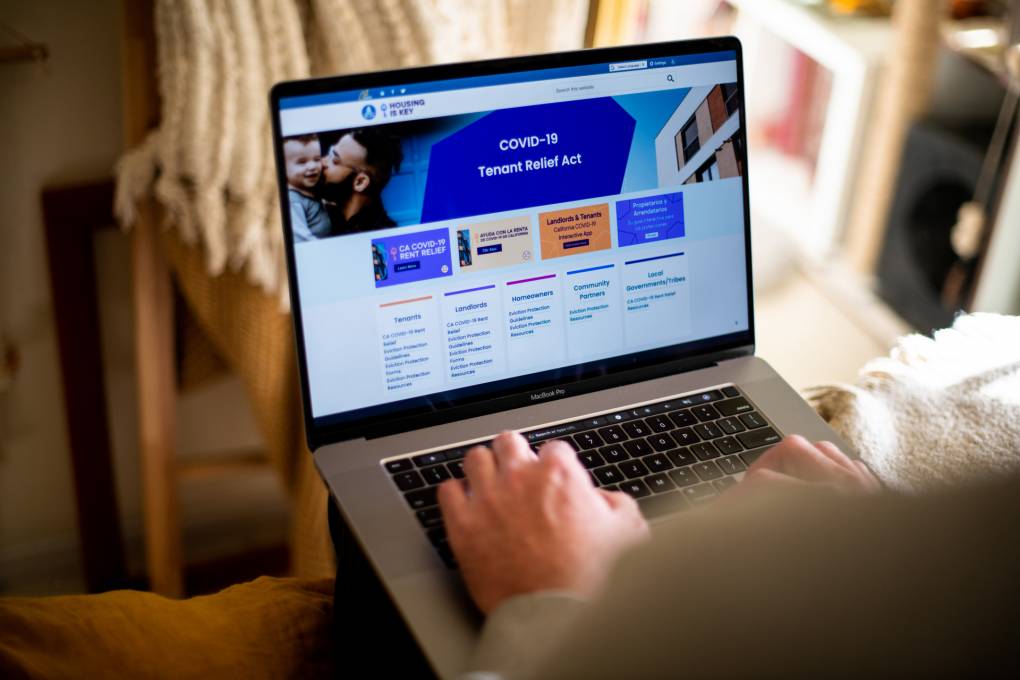
"caption": "More than 20 organizations that help tenants stay housed are saying the state’s Housing Is Key rent relief website isn't natively available in multiple languages, including Spanish and Cantonese. ",
"description": "More than 20 organizations that help tenants stay housed are saying the state’s Housing is Key rent relief website isn't natively available in multiple languages, including Spanish and Cantonese. ",
"title": "RS48524_005_KQED_HousingisKey_04142021-qut",
"credit": "Beth LaBerge/KQED",
"status": "inherit",
"altTag": "A person accessing the 'Housing is Key' website.",
"isLoading": false,
"fetchFailed": false
},
"news_11869564": {
"type": "attachments",
"id": "news_11869564",
"meta": {
"index": "attachments_1716263798",
"site": "news",
"id": "11869564",
"found": true
},
"parent": 11869522,
"imgSizes": {
"twentyfourteen-full-width": {
"file": "https://ww2.kqed.org/app/uploads/sites/10/2021/04/RS45669_004_KQED_Berkeley_PollingPlace_11012020-qut-1038x576.jpg",
"width": 1038,
"mimeType": "image/jpeg",
"height": 576
},
"thumbnail": {
"file": "https://ww2.kqed.org/app/uploads/sites/10/2021/04/RS45669_004_KQED_Berkeley_PollingPlace_11012020-qut-160x107.jpg",
"width": 160,
"mimeType": "image/jpeg",
"height": 107
},
"post-thumbnail": {
"file": "https://ww2.kqed.org/app/uploads/sites/10/2021/04/RS45669_004_KQED_Berkeley_PollingPlace_11012020-qut-672x372.jpg",
"width": 672,
"mimeType": "image/jpeg",
"height": 372
},
"kqedFullSize": {
"file": "https://ww2.kqed.org/app/uploads/sites/10/2021/04/RS45669_004_KQED_Berkeley_PollingPlace_11012020-qut.jpg",
"width": 1920,
"height": 1280
},
"large": {
"file": "https://ww2.kqed.org/app/uploads/sites/10/2021/04/RS45669_004_KQED_Berkeley_PollingPlace_11012020-qut-1020x680.jpg",
"width": 1020,
"mimeType": "image/jpeg",
"height": 680
},
"1536x1536": {
"file": "https://ww2.kqed.org/app/uploads/sites/10/2021/04/RS45669_004_KQED_Berkeley_PollingPlace_11012020-qut-1536x1024.jpg",
"width": 1536,
"mimeType": "image/jpeg",
"height": 1024
},
"medium": {
"file": "https://ww2.kqed.org/app/uploads/sites/10/2021/04/RS45669_004_KQED_Berkeley_PollingPlace_11012020-qut-800x533.jpg",
"width": 800,
"mimeType": "image/jpeg",
"height": 533
}
},
"publishDate": 1618442276,
"modified": 1618453933,
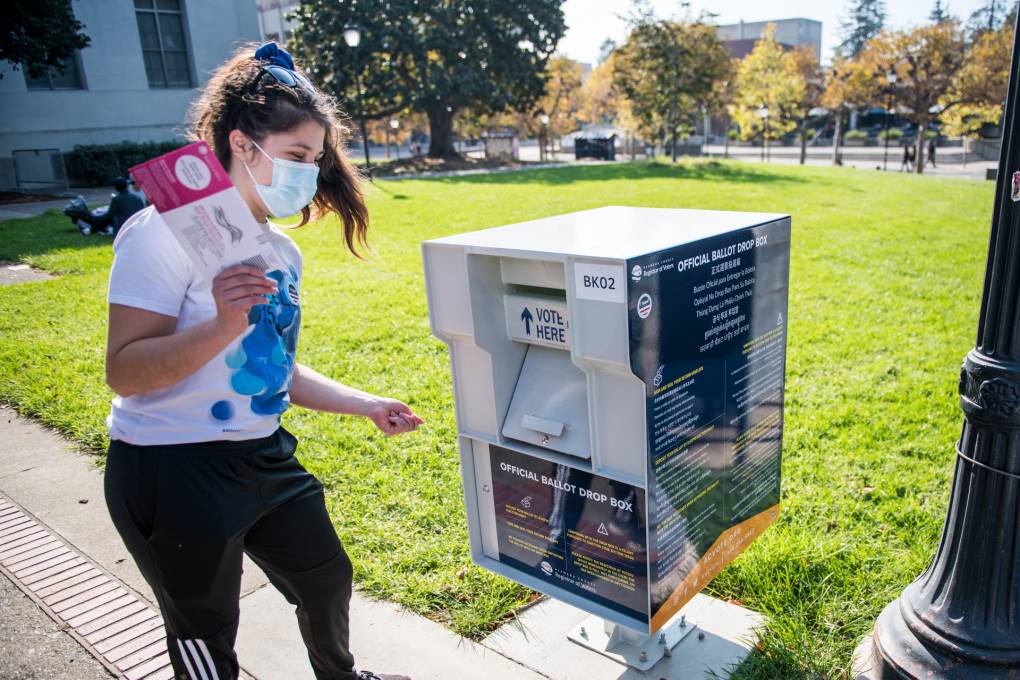
"caption": "A UC Berkeley student drops off a mail-in ballot at the official ballot dropbox on the campus on Nov. 1, 2020.",
"description": null,
"title": "RS45669_004_KQED_Berkeley_PollingPlace_11012020-qut",
"credit": "Beth LaBerge/KQED",
"status": "inherit",
"altTag": null,
"isLoading": false,
"fetchFailed": false
},
"news_11869279": {
"type": "attachments",
"id": "news_11869279",
"meta": {
"index": "attachments_1716263798",
"site": "news",
"id": "11869279",
"found": true
},
"parent": 11869265,
"imgSizes": {
"twentyfourteen-full-width": {
"file": "https://ww2.kqed.org/app/uploads/sites/10/2021/04/GettyImages-1306576537-1038x576.jpg",
"width": 1038,
"mimeType": "image/jpeg",
"height": 576
},
"thumbnail": {
"file": "https://ww2.kqed.org/app/uploads/sites/10/2021/04/GettyImages-1306576537-160x113.jpg",
"width": 160,
"mimeType": "image/jpeg",
"height": 113
},
"post-thumbnail": {
"file": "https://ww2.kqed.org/app/uploads/sites/10/2021/04/GettyImages-1306576537-672x372.jpg",
"width": 672,
"mimeType": "image/jpeg",
"height": 372
},
"kqedFullSize": {
"file": "https://ww2.kqed.org/app/uploads/sites/10/2021/04/GettyImages-1306576537-scaled.jpg",
"width": 2560,
"height": 1802
},
"2048x2048": {
"file": "https://ww2.kqed.org/app/uploads/sites/10/2021/04/GettyImages-1306576537-2048x1441.jpg",
"width": 2048,
"mimeType": "image/jpeg",
"height": 1441
},
"large": {
"file": "https://ww2.kqed.org/app/uploads/sites/10/2021/04/GettyImages-1306576537-1020x718.jpg",
"width": 1020,
"mimeType": "image/jpeg",
"height": 718
},
"1536x1536": {
"file": "https://ww2.kqed.org/app/uploads/sites/10/2021/04/GettyImages-1306576537-1536x1081.jpg",
"width": 1536,
"mimeType": "image/jpeg",
"height": 1081
},
"full-width": {
"file": "https://ww2.kqed.org/app/uploads/sites/10/2021/04/GettyImages-1306576537-1920x1351.jpg",
"width": 1920,
"mimeType": "image/jpeg",
"height": 1351
},
"medium": {
"file": "https://ww2.kqed.org/app/uploads/sites/10/2021/04/GettyImages-1306576537-800x563.jpg",
"width": 800,
"mimeType": "image/jpeg",
"height": 563
}
},
"publishDate": 1618343086,
"modified": 1618434942,
"caption": "A dose of the new one-shot Johnson & Johnson COVID-19 vaccine is prepared at a vaccination event March 11, 2021 in Los Angeles, California. ",
"description": "A dose of the new one-shot Johnson & Johnson COVID-19 vaccine is prepared at a vaccination event March 11, 2021 in Los Angeles, California.",
"title": "California Health Officials Host Johnson & Johnson Vaccination Event In Los Angeles",
"credit": "Mario Tama/Getty Images",
"status": "inherit",
"altTag": null,
"isLoading": false,
"fetchFailed": false
},
"news_11200300": {
"type": "attachments",
"id": "news_11200300",
"meta": {
"index": "attachments_1716263798",
"site": "news",
"id": "11200300",
"found": true
},
"parent": 11200063,
"imgSizes": {
"small": {
"file": "https://ww2.kqed.org/app/uploads/sites/10/2016/12/ScotusBldg-520x347.jpg",
"width": 520,
"mimeType": "image/jpeg",
"height": 347
},
"twentyfourteen-full-width": {
"file": "https://ww2.kqed.org/app/uploads/sites/10/2016/12/ScotusBldg-1038x576.jpg",
"width": 1038,
"mimeType": "image/jpeg",
"height": 576
},
"thumbnail": {
"file": "https://ww2.kqed.org/app/uploads/sites/10/2016/12/ScotusBldg-160x107.jpg",
"width": 160,
"mimeType": "image/jpeg",
"height": 107
},
"fd-sm": {
"file": "https://ww2.kqed.org/app/uploads/sites/10/2016/12/ScotusBldg-960x640.jpg",
"width": 960,
"mimeType": "image/jpeg",
"height": 640
},
"post-thumbnail": {
"file": "https://ww2.kqed.org/app/uploads/sites/10/2016/12/ScotusBldg-672x372.jpg",
"width": 672,
"mimeType": "image/jpeg",
"height": 372
},
"xsmall": {
"file": "https://ww2.kqed.org/app/uploads/sites/10/2016/12/ScotusBldg-375x250.jpg",
"width": 375,
"mimeType": "image/jpeg",
"height": 250
},
"kqedFullSize": {
"file": "https://ww2.kqed.org/app/uploads/sites/10/2016/12/ScotusBldg.jpg",
"width": 1920,
"height": 1280
},
"large": {
"file": "https://ww2.kqed.org/app/uploads/sites/10/2016/12/ScotusBldg-1020x680.jpg",
"width": 1020,
"mimeType": "image/jpeg",
"height": 680
},
"xlarge": {
"file": "https://ww2.kqed.org/app/uploads/sites/10/2016/12/ScotusBldg-1180x787.jpg",
"width": 1180,
"mimeType": "image/jpeg",
"height": 787
},
"guest-author-50": {
"file": "https://ww2.kqed.org/app/uploads/sites/10/2016/12/ScotusBldg-50x50.jpg",
"width": 50,
"mimeType": "image/jpeg",
"height": 50
},
"guest-author-96": {
"file": "https://ww2.kqed.org/app/uploads/sites/10/2016/12/ScotusBldg-96x96.jpg",
"width": 96,
"mimeType": "image/jpeg",
"height": 96
},
"medium": {
"file": "https://ww2.kqed.org/app/uploads/sites/10/2016/12/ScotusBldg-800x533.jpg",
"width": 800,
"mimeType": "image/jpeg",
"height": 533
},
"guest-author-64": {
"file": "https://ww2.kqed.org/app/uploads/sites/10/2016/12/ScotusBldg-64x64.jpg",
"width": 64,
"mimeType": "image/jpeg",
"height": 64
},
"guest-author-32": {
"file": "https://ww2.kqed.org/app/uploads/sites/10/2016/12/ScotusBldg-32x32.jpg",
"width": 32,
"mimeType": "image/jpeg",
"height": 32
},
"jmtc-small-thumb": {
"file": "https://ww2.kqed.org/app/uploads/sites/10/2016/12/ScotusBldg-280x150.jpg",
"width": 280,
"mimeType": "image/jpeg",
"height": 150
},
"fd-lrg": {
"file": "https://ww2.kqed.org/app/uploads/sites/10/2016/12/ScotusBldg-1920x1280.jpg",
"width": 1920,
"mimeType": "image/jpeg",
"height": 1280
},
"fd-med": {
"file": "https://ww2.kqed.org/app/uploads/sites/10/2016/12/ScotusBldg-1180x787.jpg",
"width": 1180,
"mimeType": "image/jpeg",
"height": 787
},
"full-width": {
"file": "https://ww2.kqed.org/app/uploads/sites/10/2016/12/ScotusBldg-1920x1280.jpg",
"width": 1920,
"mimeType": "image/jpeg",
"height": 1280
},
"detail": {
"file": "https://ww2.kqed.org/app/uploads/sites/10/2016/12/ScotusBldg-150x150.jpg",
"width": 150,
"mimeType": "image/jpeg",
"height": 150
},
"guest-author-128": {
"file": "https://ww2.kqed.org/app/uploads/sites/10/2016/12/ScotusBldg-128x128.jpg",
"width": 128,
"mimeType": "image/jpeg",
"height": 128
},
"xxsmall": {
"file": "https://ww2.kqed.org/app/uploads/sites/10/2016/12/ScotusBldg-240x160.jpg",
"width": 240,
"mimeType": "image/jpeg",
"height": 160
}
},
"publishDate": 1480633710,
"modified": 1480633746,
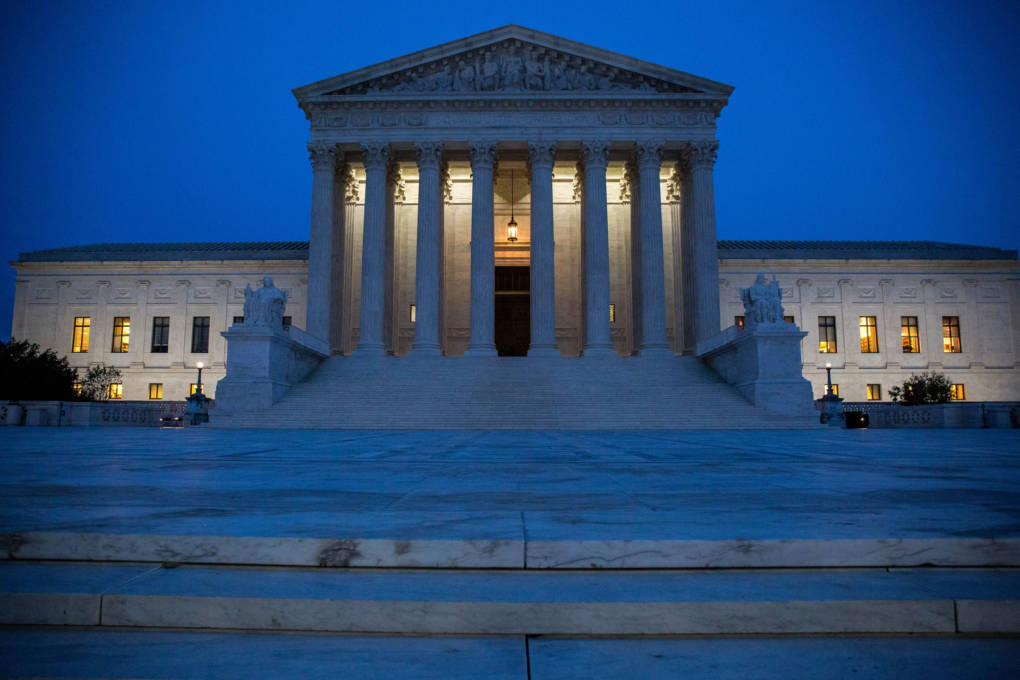
"caption": "The U.S. Supreme Court in Washington, D.C.",
"description": "The U.S. Supreme Court in Washington, D.C.",
"title": "scotusbldg",
"credit": "Zach Gibson/Getty Images",
"status": "inherit",
"isLoading": false,
"fetchFailed": false
},
"news_11860725": {
"type": "attachments",
"id": "news_11860725",
"meta": {
"index": "attachments_1716263798",
"site": "news",
"id": "11860725",
"found": true
},
"parent": 11860470,
"imgSizes": {
"apple_news_ca_landscape_5_5": {
"file": "https://ww2.kqed.org/app/uploads/sites/10/2021/02/RS40456_GettyImages-480337041-qut-1044x783.jpg",
"width": 1044,
"mimeType": "image/jpeg",
"height": 783
},
"apple_news_ca_square_4_0": {
"file": "https://ww2.kqed.org/app/uploads/sites/10/2021/02/RS40456_GettyImages-480337041-qut-470x470.jpg",
"width": 470,
"mimeType": "image/jpeg",
"height": 470
},
"twentyfourteen-full-width": {
"file": "https://ww2.kqed.org/app/uploads/sites/10/2021/02/RS40456_GettyImages-480337041-qut-1038x576.jpg",
"width": 1038,
"mimeType": "image/jpeg",
"height": 576
},
"thumbnail": {
"file": "https://ww2.kqed.org/app/uploads/sites/10/2021/02/RS40456_GettyImages-480337041-qut-160x107.jpg",
"width": 160,
"mimeType": "image/jpeg",
"height": 107
},
"post-thumbnail": {
"file": "https://ww2.kqed.org/app/uploads/sites/10/2021/02/RS40456_GettyImages-480337041-qut-672x372.jpg",
"width": 672,
"mimeType": "image/jpeg",
"height": 372
},
"kqedFullSize": {
"file": "https://ww2.kqed.org/app/uploads/sites/10/2021/02/RS40456_GettyImages-480337041-qut.jpg",
"width": 1920,
"height": 1281
},
"apple_news_ca_landscape_4_7": {
"file": "https://ww2.kqed.org/app/uploads/sites/10/2021/02/RS40456_GettyImages-480337041-qut-632x474.jpg",
"width": 632,
"mimeType": "image/jpeg",
"height": 474
},
"large": {
"file": "https://ww2.kqed.org/app/uploads/sites/10/2021/02/RS40456_GettyImages-480337041-qut-1020x681.jpg",
"width": 1020,
"mimeType": "image/jpeg",
"height": 681
},
"apple_news_ca_landscape_4_0": {
"file": "https://ww2.kqed.org/app/uploads/sites/10/2021/02/RS40456_GettyImages-480337041-qut-536x402.jpg",
"width": 536,
"mimeType": "image/jpeg",
"height": 402
},
"apple_news_ca_portrait_12_9": {
"file": "https://ww2.kqed.org/app/uploads/sites/10/2021/02/RS40456_GettyImages-480337041-qut-1122x1281.jpg",
"width": 1122,
"mimeType": "image/jpeg",
"height": 1281
},
"medium": {
"file": "https://ww2.kqed.org/app/uploads/sites/10/2021/02/RS40456_GettyImages-480337041-qut-800x534.jpg",
"width": 800,
"mimeType": "image/jpeg",
"height": 534
},
"apple_news_ca_portrait_4_0": {
"file": "https://ww2.kqed.org/app/uploads/sites/10/2021/02/RS40456_GettyImages-480337041-qut-354x472.jpg",
"width": 354,
"mimeType": "image/jpeg",
"height": 472
},
"apple_news_ca_portrait_9_7": {
"file": "https://ww2.kqed.org/app/uploads/sites/10/2021/02/RS40456_GettyImages-480337041-qut-840x1120.jpg",
"width": 840,
"mimeType": "image/jpeg",
"height": 1120
},
"apple_news_ca_landscape_12_9": {
"file": "https://ww2.kqed.org/app/uploads/sites/10/2021/02/RS40456_GettyImages-480337041-qut-1832x1281.jpg",
"width": 1832,
"mimeType": "image/jpeg",
"height": 1281
},
"apple_news_ca_square_9_7": {
"file": "https://ww2.kqed.org/app/uploads/sites/10/2021/02/RS40456_GettyImages-480337041-qut-1104x1104.jpg",
"width": 1104,
"mimeType": "image/jpeg",
"height": 1104
},
"1536x1536": {
"file": "https://ww2.kqed.org/app/uploads/sites/10/2021/02/RS40456_GettyImages-480337041-qut-1536x1025.jpg",
"width": 1536,
"mimeType": "image/jpeg",
"height": 1025
},
"apple_news_ca_portrait_4_7": {
"file": "https://ww2.kqed.org/app/uploads/sites/10/2021/02/RS40456_GettyImages-480337041-qut-414x552.jpg",
"width": 414,
"mimeType": "image/jpeg",
"height": 552
},
"apple_news_ca_square_12_9": {
"file": "https://ww2.kqed.org/app/uploads/sites/10/2021/02/RS40456_GettyImages-480337041-qut-1472x1281.jpg",
"width": 1472,
"mimeType": "image/jpeg",
"height": 1281
},
"apple_news_ca_portrait_5_5": {
"file": "https://ww2.kqed.org/app/uploads/sites/10/2021/02/RS40456_GettyImages-480337041-qut-687x916.jpg",
"width": 687,
"mimeType": "image/jpeg",
"height": 916
},
"apple_news_ca_square_4_7": {
"file": "https://ww2.kqed.org/app/uploads/sites/10/2021/02/RS40456_GettyImages-480337041-qut-550x550.jpg",
"width": 550,
"mimeType": "image/jpeg",
"height": 550
},
"apple_news_ca_landscape_9_7": {
"file": "https://ww2.kqed.org/app/uploads/sites/10/2021/02/RS40456_GettyImages-480337041-qut-1376x1032.jpg",
"width": 1376,
"mimeType": "image/jpeg",
"height": 1032
},
"apple_news_ca_square_5_5": {
"file": "https://ww2.kqed.org/app/uploads/sites/10/2021/02/RS40456_GettyImages-480337041-qut-912x912.jpg",
"width": 912,
"mimeType": "image/jpeg",
"height": 912
}
},
"publishDate": 1613590360,
"modified": 1613590741,
"caption": "The bill, authored by state Sens. Scott Wiener, D-San Francisco, and Monique Limón, D-Santa Barbara, would prohibit new permits for hydraulic fracturing, known as fracking, and block companies from renewing existing permits for the controversial technique.",
"description": "The bill, authored by state Sens. Scott Wiener, D-San Francisco, and Monique Limón, D-Santa Barbara, would prohibit new permits for hydraulic fracturing, known as fracking, and block companies from renewing existing permits for the controversial technique.",
"title": null,
"credit": "David McNew/Getty Images",
"status": "inherit",
"altTag": "Pump jacks in 2014 over the Monterey Shale formation",
"isLoading": false,
"fetchFailed": false
},
"news_11868975": {
"type": "attachments",
"id": "news_11868975",
"meta": {
"index": "attachments_1716263798",
"site": "news",
"id": "11868975",
"found": true
},
"parent": 11868969,
"imgSizes": {
"twentyfourteen-full-width": {
"file": "https://ww2.kqed.org/app/uploads/sites/10/2021/04/04_RS48457_028_SanFrancisco_IndiaFarmerProtest_04102021-qut-1038x576.jpg",
"width": 1038,
"mimeType": "image/jpeg",
"height": 576
},
"thumbnail": {
"file": "https://ww2.kqed.org/app/uploads/sites/10/2021/04/04_RS48457_028_SanFrancisco_IndiaFarmerProtest_04102021-qut-160x107.jpg",
"width": 160,
"mimeType": "image/jpeg",
"height": 107
},
"post-thumbnail": {
"file": "https://ww2.kqed.org/app/uploads/sites/10/2021/04/04_RS48457_028_SanFrancisco_IndiaFarmerProtest_04102021-qut-672x372.jpg",
"width": 672,
"mimeType": "image/jpeg",
"height": 372
},
"kqedFullSize": {
"file": "https://ww2.kqed.org/app/uploads/sites/10/2021/04/04_RS48457_028_SanFrancisco_IndiaFarmerProtest_04102021-qut.jpg",
"width": 1920,
"height": 1280
},
"large": {
"file": "https://ww2.kqed.org/app/uploads/sites/10/2021/04/04_RS48457_028_SanFrancisco_IndiaFarmerProtest_04102021-qut-1020x680.jpg",
"width": 1020,
"mimeType": "image/jpeg",
"height": 680
},
"1536x1536": {
"file": "https://ww2.kqed.org/app/uploads/sites/10/2021/04/04_RS48457_028_SanFrancisco_IndiaFarmerProtest_04102021-qut-1536x1024.jpg",
"width": 1536,
"mimeType": "image/jpeg",
"height": 1024
},
"medium": {
"file": "https://ww2.kqed.org/app/uploads/sites/10/2021/04/04_RS48457_028_SanFrancisco_IndiaFarmerProtest_04102021-qut-800x533.jpg",
"width": 800,
"mimeType": "image/jpeg",
"height": 533
}
},
"publishDate": 1618157611,
"modified": 1618244481,
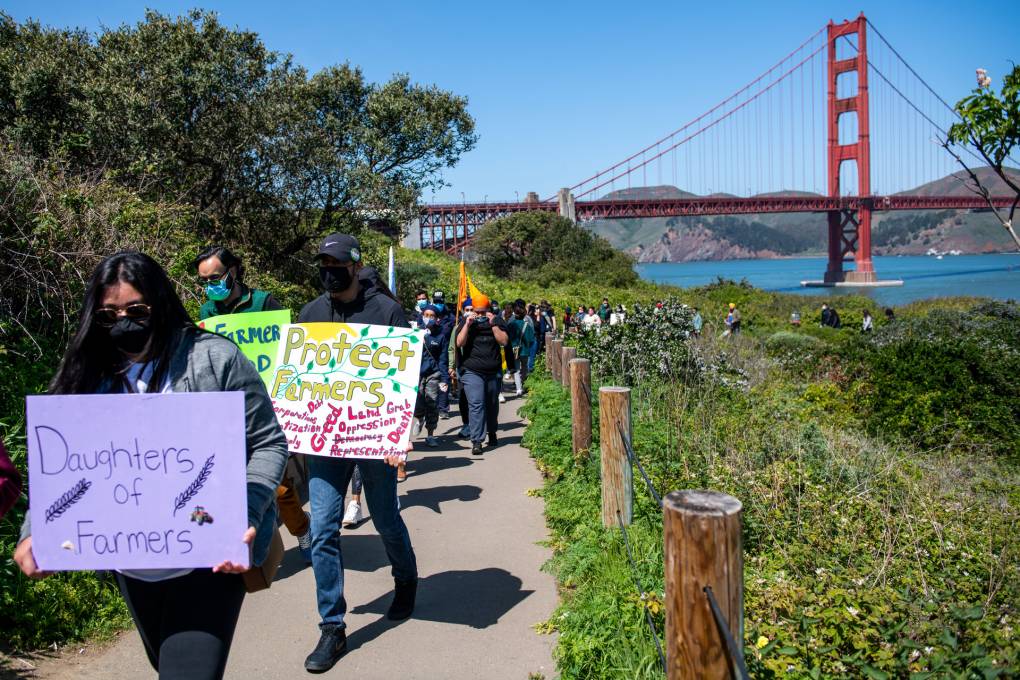
"caption": "Demonstrators march from Crissy Field to the Golden Gate Bridge in solidarity with farmers in India on April 10, 2021.",
"description": "Demonstrators march from Crissy Field to the Golden Gate Bridge in solidarity with farmers in India on April 10, 2021.",
"title": "04_RS48457_028_SanFrancisco_IndiaFarmerProtest_04102021-qut",
"credit": "Beth LaBerge/KQED",
"status": "inherit",
"altTag": null,
"isLoading": false,
"fetchFailed": false
},
"news_11852386": {
"type": "attachments",
"id": "news_11852386",
"meta": {
"index": "attachments_1716263798",
"site": "news",
"id": "11852386",
"found": true
},
"parent": 11844742,
"imgSizes": {
"apple_news_ca_square_4_0": {
"file": "https://ww2.kqed.org/app/uploads/sites/10/2020/12/LUNA-featured-edit-1020x574-1-470x470.jpg",
"width": 470,
"mimeType": "image/jpeg",
"height": 470
},
"thumbnail": {
"file": "https://ww2.kqed.org/app/uploads/sites/10/2020/12/LUNA-featured-edit-1020x574-1-160x90.jpg",
"width": 160,
"mimeType": "image/jpeg",
"height": 90
},
"post-thumbnail": {
"file": "https://ww2.kqed.org/app/uploads/sites/10/2020/12/LUNA-featured-edit-1020x574-1-672x372.jpg",
"width": 672,
"mimeType": "image/jpeg",
"height": 372
},
"kqedFullSize": {
"file": "https://ww2.kqed.org/app/uploads/sites/10/2020/12/LUNA-featured-edit-1020x574-1.jpg",
"width": 1020,
"height": 574
},
"apple_news_ca_landscape_4_7": {
"file": "https://ww2.kqed.org/app/uploads/sites/10/2020/12/LUNA-featured-edit-1020x574-1-632x474.jpg",
"width": 632,
"mimeType": "image/jpeg",
"height": 474
},
"apple_news_ca_landscape_4_0": {
"file": "https://ww2.kqed.org/app/uploads/sites/10/2020/12/LUNA-featured-edit-1020x574-1-536x402.jpg",
"width": 536,
"mimeType": "image/jpeg",
"height": 402
},
"medium": {
"file": "https://ww2.kqed.org/app/uploads/sites/10/2020/12/LUNA-featured-edit-1020x574-1-800x450.jpg",
"width": 800,
"mimeType": "image/jpeg",
"height": 450
},
"apple_news_ca_portrait_4_0": {
"file": "https://ww2.kqed.org/app/uploads/sites/10/2020/12/LUNA-featured-edit-1020x574-1-354x472.jpg",
"width": 354,
"mimeType": "image/jpeg",
"height": 472
},
"apple_news_ca_portrait_9_7": {
"file": "https://ww2.kqed.org/app/uploads/sites/10/2020/12/LUNA-featured-edit-1020x574-1-840x574.jpg",
"width": 840,
"mimeType": "image/jpeg",
"height": 574
},
"apple_news_ca_portrait_4_7": {
"file": "https://ww2.kqed.org/app/uploads/sites/10/2020/12/LUNA-featured-edit-1020x574-1-414x552.jpg",
"width": 414,
"mimeType": "image/jpeg",
"height": 552
},
"apple_news_ca_portrait_5_5": {
"file": "https://ww2.kqed.org/app/uploads/sites/10/2020/12/LUNA-featured-edit-1020x574-1-687x574.jpg",
"width": 687,
"mimeType": "image/jpeg",
"height": 574
},
"apple_news_ca_square_4_7": {
"file": "https://ww2.kqed.org/app/uploads/sites/10/2020/12/LUNA-featured-edit-1020x574-1-550x550.jpg",
"width": 550,
"mimeType": "image/jpeg",
"height": 550
},
"apple_news_ca_square_5_5": {
"file": "https://ww2.kqed.org/app/uploads/sites/10/2020/12/LUNA-featured-edit-1020x574-1-912x574.jpg",
"width": 912,
"mimeType": "image/jpeg",
"height": 574
}
},
"publishDate": 1608619592,
"modified": 1608620055,
"caption": "Luna Guzmán left Guatemala four years ago with the goal of reaching California. She had to face violence and sexual harassment while she was detained in a migrant detention center near San Diego and was later infected with COVID-19 while she waited for her asylum process in Tijuana.",
"description": "Luna Guzmán left Guatemala four years ago with the goal of reaching California. She had to face violence and sexual harassment while she was detained in a migrant detention center near San Diego and was later infected with COVID-19 while she waited for her asylum process in Tijuana.",
"title": "LUNA-featured-edit-1020x574",
"credit": "Courtest of Luna Guzmán",
"status": "inherit",
"altTag": null,
"isLoading": false,
"fetchFailed": false
}
},
"audioPlayerReducer": {
"postId": "stream_live",
"isPaused": true,
"isPlaying": false,
"pfsActive": false,
"pledgeModalIsOpen": true,
"playerDrawerIsOpen": false,
"liveAudioPlayStartedAt": 0,
"liveAudioPlayContext": ""
},
"authorsReducer": {
"byline_news_11870739": {
"type": "authors",
"id": "byline_news_11870739",
"meta": {
"override": true
},
"slug": "byline_news_11870739",
"name": "Don Thompson \u003cbr> Associated Press",
"isLoading": false
},
"byline_news_11870600": {
"type": "authors",
"id": "byline_news_11870600",
"meta": {
"override": true
},
"slug": "byline_news_11870600",
"name": "Kathleen Ronayne and John Antczak \u003cbr> Associated Press",
"isLoading": false
},
"byline_news_11870072": {
"type": "authors",
"id": "byline_news_11870072",
"meta": {
"override": true
},
"slug": "byline_news_11870072",
"name": "\u003ca href=\"https://www.npr.org/people/159989569/joel-rose\">Joel Rose\u003c/a>",
"isLoading": false
},
"byline_news_11869618": {
"type": "authors",
"id": "byline_news_11869618",
"meta": {
"override": true
},
"slug": "byline_news_11869618",
"name": "Hank Warner",
"isLoading": false
},
"byline_news_11869694": {
"type": "authors",
"id": "byline_news_11869694",
"meta": {
"override": true
},
"slug": "byline_news_11869694",
"name": "Adam Beam\u003cbr />Associated Press",
"isLoading": false
},
"byline_news_11869265": {
"type": "authors",
"id": "byline_news_11869265",
"meta": {
"override": true
},
"slug": "byline_news_11869265",
"name": "Kathleen Ronayne and Janie Har\u003cbr />Associated Press",
"isLoading": false
},
"byline_news_11869040": {
"type": "authors",
"id": "byline_news_11869040",
"meta": {
"override": true
},
"slug": "byline_news_11869040",
"name": "\u003ca href=\"https://www.npr.org/people/2101289/nina-totenberg\">Nina Totenberg\u003c/a>",
"isLoading": false
},
"byline_news_11844742": {
"type": "authors",
"id": "byline_news_11844742",
"meta": {
"override": true
},
"slug": "byline_news_11844742",
"name": "\u003ca href=\"https://www.kqed.org/author/sasha-khokha\">Sasha Khokha\u003c/a> and \u003ca href=\"http://erin-mcintyre.com/\">Erin Siegal McIntyre\u003c/a>",
"isLoading": false
},
"gmarzorati": {
"type": "authors",
"id": "227",
"meta": {
"index": "authors_1716337520",
"id": "227",
"found": true
},
"name": "Guy Marzorati",
"firstName": "Guy",
"lastName": "Marzorati",
"slug": "gmarzorati",
"email": "gmarzorati@KQED.org",
"display_author_email": true,
"staff_mastheads": [
"news"
],
"title": "Correspondent",
"bio": "Guy Marzorati is a correspondent on KQED's California Politics and Government Desk, based in San Jose. A graduate of Santa Clara University, Guy joined KQED in 2013. He reports on state and local politics and produces KQED's digital voter guide.",
"avatar": "https://secure.gravatar.com/avatar/e7038b8dbfd55b104369b76b1cd0b9de?s=600&d=blank&r=g",
"twitter": "guymarzorati",
"facebook": null,
"instagram": null,
"linkedin": null,
"sites": [
{
"site": "",
"roles": [
"editor"
]
},
{
"site": "news",
"roles": [
"editor"
]
},
{
"site": "science",
"roles": [
"editor"
]
},
{
"site": "forum",
"roles": [
"editor"
]
},
{
"site": "elections",
"roles": [
"editor"
]
},
{
"site": "liveblog",
"roles": [
"editor"
]
}
],
"headData": {
"title": "Guy Marzorati | KQED",
"description": "Correspondent",
"ogImgSrc": "https://secure.gravatar.com/avatar/e7038b8dbfd55b104369b76b1cd0b9de?s=600&d=blank&r=g",
"twImgSrc": "https://secure.gravatar.com/avatar/e7038b8dbfd55b104369b76b1cd0b9de?s=600&d=blank&r=g"
},
"isLoading": false,
"link": "/author/gmarzorati"
},
"tgoldberg": {
"type": "authors",
"id": "258",
"meta": {
"index": "authors_1716337520",
"id": "258",
"found": true
},
"name": "Ted Goldberg",
"firstName": "Ted",
"lastName": "Goldberg",
"slug": "tgoldberg",
"email": "tgoldberg@kqed.org",
"display_author_email": true,
"staff_mastheads": [
"news"
],
"title": "KQED Managing Editor, News and Newscasts",
"bio": "Ted Goldberg is Managing Editor of News and Newscasts at KQED. His main reporting beat is the Bay Area's oil refining industry.\r\n\r\nPrior to joining KQED in 2014, Ted worked at CBS News and WCBS AM in New York and Bay City News and KCBS Radio in San Francisco. He graduated from Oberlin College in Ohio in 1998.",
"avatar": "https://secure.gravatar.com/avatar/30ce2e4fe89135e104f89be2394d16225b9d36c121b5b3cb7651ce642978b96f?s=600&d=blank&r=g",
"twitter": "TedrickG",
"bluesky": null,
"facebook": null,
"instagram": null,
"linkedin": null,
"sites": [
{
"site": "news",
"roles": [
"editor"
]
},
{
"site": "science",
"roles": [
"editor"
]
}
],
"headData": {
"title": "Ted Goldberg | KQED",
"description": "KQED Managing Editor, News and Newscasts",
"ogImgSrc": "https://secure.gravatar.com/avatar/30ce2e4fe89135e104f89be2394d16225b9d36c121b5b3cb7651ce642978b96f?s=600&d=blank&r=g",
"twImgSrc": "https://secure.gravatar.com/avatar/30ce2e4fe89135e104f89be2394d16225b9d36c121b5b3cb7651ce642978b96f?s=600&d=blank&r=g"
},
"isLoading": false,
"link": "/author/tgoldberg"
},
"lsarah": {
"type": "authors",
"id": "11626",
"meta": {
"index": "authors_1716337520",
"id": "11626",
"found": true
},
"name": "Lakshmi Sarah",
"firstName": "Lakshmi",
"lastName": "Sarah",
"slug": "lsarah",
"email": "lsarah@kqed.org",
"display_author_email": false,
"staff_mastheads": [],
"title": "Digital Producer",
"bio": "Lakshmi Sarah is an educator, author and journalist with a focus on innovative storytelling. She has worked with newspapers, radio and magazines from Ahmedabad, India to Los Angeles, California. She has written and produced for Die Zeit, Global Voices, AJ+, KQED, Fusion Media Group and the New York Times.",
"avatar": "https://secure.gravatar.com/avatar/652dcaecd8b28826fc17a8b2d6bb4e93?s=600&d=blank&r=g",
"twitter": "lakitalki",
"facebook": null,
"instagram": "https://www.instagram.com/laki.talki/",
"linkedin": "https://www.linkedin.com/in/lakisarah/",
"sites": [
{
"site": "arts",
"roles": []
},
{
"site": "news",
"roles": []
},
{
"site": "bayareabites",
"roles": []
},
{
"site": "science",
"roles": []
}
],
"headData": {
"title": "Lakshmi Sarah | KQED",
"description": "Digital Producer",
"ogImgSrc": "https://secure.gravatar.com/avatar/652dcaecd8b28826fc17a8b2d6bb4e93?s=600&d=blank&r=g",
"twImgSrc": "https://secure.gravatar.com/avatar/652dcaecd8b28826fc17a8b2d6bb4e93?s=600&d=blank&r=g"
},
"isLoading": false,
"link": "/author/lsarah"
},
"jchang": {
"type": "authors",
"id": "11642",
"meta": {
"index": "authors_1716337520",
"id": "11642",
"found": true
},
"name": "Julie Chang",
"firstName": "Julie",
"lastName": "Chang",
"slug": "jchang",
"email": "jchang@kqed.org",
"display_author_email": false,
"staff_mastheads": [
"news"
],
"title": "KQED Contributor",
"bio": "Julie Chang is a reporter and producer (and occasional anchor) with the radio and digital teams at KQED. Before KQED, she worked at WAMU 88.5 in Washington D.C. and 89.3 KPCC in Los Angeles County. Her work has been featured on NPR’s Morning Edition and All Things Considered, Here & Now, the New York Times, and more. Julie graduated from UC Berkeley’s Graduate School of Journalism. She previously taught English at Pasadena City College, Fullerton College and Cal Poly Pomona. Julie earned her M.A. in English from Cal Poly Pomona and her B.A. in English from UCI with a minor in criminology.",
"avatar": "https://secure.gravatar.com/avatar/a7afce94ef127082c5475116b4a3b77d?s=600&d=blank&r=g",
"twitter": "BayAreaJulie",
"facebook": null,
"instagram": null,
"linkedin": "https://www.linkedin.com/in/julieyc/",
"sites": [
{
"site": "",
"roles": [
"editor"
]
},
{
"site": "news",
"roles": [
"author"
]
},
{
"site": "science",
"roles": [
"editor"
]
}
],
"headData": {
"title": "Julie Chang | KQED",
"description": "KQED Contributor",
"ogImgSrc": "https://secure.gravatar.com/avatar/a7afce94ef127082c5475116b4a3b77d?s=600&d=blank&r=g",
"twImgSrc": "https://secure.gravatar.com/avatar/a7afce94ef127082c5475116b4a3b77d?s=600&d=blank&r=g"
},
"isLoading": false,
"link": "/author/jchang"
},
"blaberge": {
"type": "authors",
"id": "11667",
"meta": {
"index": "authors_1716337520",
"id": "11667",
"found": true
},
"name": "Beth LaBerge",
"firstName": "Beth",
"lastName": "LaBerge",
"slug": "blaberge",
"email": "blaberge@KQED.org",
"display_author_email": true,
"staff_mastheads": [
"news"
],
"title": "Photographer, News",
"bio": "Beth LaBerge is a visual journalist for \u003ca href=\"https://www.kqed.org/news\">KQED News\u003c/a>.",
"avatar": "https://secure.gravatar.com/avatar/15e224cd55918d1876693b8280954875?s=600&d=blank&r=g",
"twitter": null,
"facebook": null,
"instagram": "https://www.instagram.com/bethlaberge/",
"linkedin": null,
"sites": [
{
"site": "arts",
"roles": [
"editor"
]
},
{
"site": "news",
"roles": [
"editor"
]
},
{
"site": "science",
"roles": [
"editor",
"contributor",
"author"
]
},
{
"site": "liveblog",
"roles": [
"editor"
]
}
],
"headData": {
"title": "Beth LaBerge | KQED",
"description": "Photographer, News",
"ogImgSrc": "https://secure.gravatar.com/avatar/15e224cd55918d1876693b8280954875?s=600&d=blank&r=g",
"twImgSrc": "https://secure.gravatar.com/avatar/15e224cd55918d1876693b8280954875?s=600&d=blank&r=g"
},
"isLoading": false,
"link": "/author/blaberge"
},
"jrodriguez": {
"type": "authors",
"id": "11690",
"meta": {
"index": "authors_1716337520",
"id": "11690",
"found": true
},
"name": "Joe Fitzgerald Rodriguez",
"firstName": "Joe",
"lastName": "Fitzgerald Rodriguez",
"slug": "jrodriguez",
"email": "jrodriguez@kqed.org",
"display_author_email": true,
"staff_mastheads": [
"news"
],
"title": "Reporter and Producer",
"bio": "Joe Fitzgerald Rodriguez is a reporter and digital producer for KQED covering politics. Joe most recently wrote for the \u003cem>San Francisco Examiner\u003c/em> as a political columnist covering The City. He was raised in San Francisco and has spent his reporting career in his beloved, foggy, city by the bay. Joe was 12-years-old when he conducted his first interview in journalism, grilling former San Francisco Mayor Willie Brown for the Marina Middle School newspaper, \u003cem>The Penguin Press, \u003c/em>and he continues to report on the San Francisco Bay Area to this day.",
"avatar": "https://secure.gravatar.com/avatar/2247beb0564c1e9c62228d5649d2edac?s=600&d=blank&r=g",
"twitter": "FitztheReporter",
"facebook": null,
"instagram": "https://www.instagram.com/fitzthereporter/",
"linkedin": null,
"sites": [
{
"site": "",
"roles": [
"editor"
]
},
{
"site": "arts",
"roles": [
"editor"
]
},
{
"site": "news",
"roles": [
"editor"
]
},
{
"site": "science",
"roles": [
"editor"
]
},
{
"site": "elections",
"roles": [
"editor"
]
},
{
"site": "liveblog",
"roles": [
"editor"
]
}
],
"headData": {
"title": "Joe Fitzgerald Rodriguez | KQED",
"description": "Reporter and Producer",
"ogImgSrc": "https://secure.gravatar.com/avatar/2247beb0564c1e9c62228d5649d2edac?s=600&d=blank&r=g",
"twImgSrc": "https://secure.gravatar.com/avatar/2247beb0564c1e9c62228d5649d2edac?s=600&d=blank&r=g"
},
"isLoading": false,
"link": "/author/jrodriguez"
}
},
"pagesReducer": {
"news_tag_california": {
"type": "terms",
"id": "news_18538",
"meta": {
"index": "terms_1716263798",
"site": "news",
"id": "18538",
"score": 6.8456693
},
"featImg": null,
"name": "California",
"description": null,
"taxonomy": "tag",
"headData": {
"twImgId": null,
"twTitle": null,
"ogTitle": null,
"ogImgId": null,
"twDescription": null,
"description": null,
"title": "California Archives | KQED News",
"ogDescription": null
},
"ttid": 31,
"slug": "california",
"isLoading": false,
"title": "California",
"pageMeta": {
"site": "news",
"WpPageTemplate": "page-topic-editorial",
"currentPage": 182
},
"blocks": [
{
"blockName": "kqed/post-list",
"attrs": {
"layout": "cardArticle2",
"query": "posts/news?tag=california",
"seeMore": false,
"paginated": true,
"page": 182
}
},
{
"blockName": "kqed/ad"
}
]
}
},
"pfsSessionReducer": {},
"postsReducer": {
"stream_live": {
"type": "live",
"id": "stream_live",
"audioUrl": "https://streams.kqed.org/kqedradio",
"title": "Live Stream",
"excerpt": "Live Stream information currently unavailable.",
"link": "/radio",
"featImg": "",
"label": {
"name": "KQED Live",
"link": "/"
}
},
"stream_kqedNewscast": {
"type": "posts",
"id": "stream_kqedNewscast",
"audioUrl": "https://www.kqed.org/.stream/anon/radio/RDnews/newscast.mp3?_=1",
"title": "KQED Newscast",
"featImg": "",
"label": {
"name": "88.5 FM",
"link": "/"
}
},
"news_11870739": {
"type": "posts",
"id": "news_11870739",
"meta": {
"index": "posts_1716263798",
"site": "news",
"id": "11870739",
"score": null,
"sort": [
1619123159000
]
},
"guestAuthors": [],
"slug": "california-confirms-rob-bonta-as-first-filipino-american-attorney-general",
"title": "California Confirms Rob Bonta as First Filipino American Attorney General",
"publishDate": 1619123159,
"format": "standard",
"headTitle": "California Confirms Rob Bonta as First Filipino American Attorney General | KQED",
"labelTerm": {
"site": "news"
},
"content": "\u003cp>California lawmakers on Thursday approved the state’s first Filipino American to hold the top law enforcement job in the nation’s most populous state, saying the progressive Democrat is taking office during a critical debate over racial justice and the changing role of police.\u003c/p>\n\u003cp>Rob Bonta becomes California’s second attorney general of Asian descent, after Kamala Harris. Harris’ rise to U.S. senator and now vice president illustrates the prominence of the job. [pullquote size=\"medium\" align=\"right\" citation=\"Rob Bonta, attorney general of California\"]‘To fight for everyday folks, the vulnerable, the voiceless, the disadvantaged, those who need a champion, those who are hurting, being abused, and to push back and fight back against those in power who are overreaching that power or abusing that power … That’s the job.’[/pullquote]\u003c/p>\n\u003cp>“It’s the right choice at the right time,” said state Sen. Dave Min, D-Irvine. “Our Asian American community is experiencing unprecedented levels of hate and violence. We’ve seen at the same time that our state and nation are grappling with a wide array of challenges on racial unrest, domestic terrorism, a surge in gun violence and the need for meaningful law enforcement reforms.”\u003c/p>\n\u003cp>Democratic Gov. Gavin Newsom nominated Bonta, 49, a Democratic assemblyman from the east San Francisco Bay Area city of Alameda, to succeed Xavier Becerra. He resigned to become the U.S. Health and Human Services secretary.\u003c/p>\n\u003cp>The Assembly approved Bonta’s nomination on a 62-0 vote with Republicans abstaining, while the Senate followed on a 29-6 roll call with three additional Republicans not voting.\u003c/p>\n\u003cp>[ad fullwidth]\u003c/p>\n\u003cp>GOP Caucus Chairwoman Sen. Patricia Bates, R-Laguna Niguel, said Republicans remain concerned about Bonta’s progressive track record since he was elected to the Assembly in 2012, but were reassured by his promise “that he is very committed to a bipartisan role on issues that do affect our constituents.”\u003c/p>\n\u003cp>Republicans didn’t support his nomination, Bates said, “but do want to recognize a commitment and a passion that he will bring to this assignment, and we wish him well and we very much look forward to working with him in the coming years.” [aside label=\"related coverage\" tag=\"rob-bonta\"]\u003c/p>\n\u003cp>Bonta will be up for election with other statewide officials next year.\u003c/p>\n\u003cp>He takes office during a time of “a very strong examining of our justice system and whether it has really truly been just,” said state Sen. Nancy Skinner, D-Bekeley. \u003c/p>\n\u003cp>Bonta will be responsible for enforcing laws that the Legislature has recently enacted “through the lens of racial equity,” Skinner said, including a law requiring his office to investigate police shootings that result in the deaths of unarmed civilians.\u003c/p>\n\u003cp>Bonta said after his confirmation that he views the attorney general as “the people’s attorney.”\u003c/p>\n\u003cp>\u003c/p>\n\u003cp>“To fight for everyday folks, the vulnerable, the voiceless, the disadvantaged, those who need a champion, those who are hurting, being abused, and to push back and fight back against those in power who are overreaching that power or abusing that power,” he said. “That’s the job.”\u003c/p>\n\n",
"blocks": [],
"excerpt": "'To fight for everyday folks, the vulnerable, the voiceless, the disadvantaged, those who need a champion ... and fight back against those in power who are overreaching that power or abusing that power,' Rob Bonta said. 'That’s the job.'",
"status": "publish",
"parent": 0,
"modified": 1727137018,
"stats": {
"hasAudio": false,
"hasVideo": false,
"hasChartOrMap": false,
"iframeSrcs": [],
"hasGoogleForm": false,
"hasGallery": false,
"hasHearkenModule": false,
"hasPolis": false,
"paragraphCount": 14,
"wordCount": 546
},
"headData": {
"title": "California Confirms Rob Bonta as First Filipino American Attorney General | KQED",
"description": "'To fight for everyday folks, the vulnerable, the voiceless, the disadvantaged, those who need a champion ... and fight back against those in power who are overreaching that power or abusing that power,' Rob Bonta said. 'That’s the job.'",
"ogTitle": "",
"ogDescription": "",
"ogImgId": "",
"twTitle": "",
"twDescription": "",
"twImgId": "",
"schema": {
"@context": "https://schema.org",
"@type": "NewsArticle",
"headline": "California Confirms Rob Bonta as First Filipino American Attorney General",
"datePublished": "2021-04-22T13:25:59-07:00",
"dateModified": "2024-09-23T17:16:58-07:00",
"image": "https://cdn.kqed.org/wp-content/uploads/2020/02/KQED-OG-Image@1x.png",
"isAccessibleForFree": "True",
"publisher": {
"@type": "NewsMediaOrganization",
"@id": "https://www.kqed.org/#organization",
"name": "KQED",
"logo": "https://cdn.kqed.org/wp-content/uploads/2020/02/KQED-OG-Image@1x.png",
"url": "https://www.kqed.org",
"sameAs": [
"https://www.facebook.com/KQED",
"https://twitter.com/KQED",
"https://www.instagram.com/kqed/",
"https://www.tiktok.com/@kqedofficial",
"https://www.linkedin.com/company/kqed",
"https://www.youtube.com/channel/UCeC0IOo7i1P_61zVUWbJ4nw"
]
}
}
},
"sticky": false,
"nprByline": "Don Thompson \u003cbr> Associated Press",
"path": "/news/11870739/california-confirms-rob-bonta-as-first-filipino-american-attorney-general",
"audioTrackLength": null,
"parsedContent": [
{
"type": "contentString",
"content": "\u003cdiv class=\"post-body\">\u003cp>\u003cp>California lawmakers on Thursday approved the state’s first Filipino American to hold the top law enforcement job in the nation’s most populous state, saying the progressive Democrat is taking office during a critical debate over racial justice and the changing role of police.\u003c/p>\n\u003cp>Rob Bonta becomes California’s second attorney general of Asian descent, after Kamala Harris. Harris’ rise to U.S. senator and now vice president illustrates the prominence of the job. \u003c/p>\u003c/div>",
"attributes": {
"named": {},
"numeric": []
}
},
{
"type": "component",
"content": "‘To fight for everyday folks, the vulnerable, the voiceless, the disadvantaged, those who need a champion, those who are hurting, being abused, and to push back and fight back against those in power who are overreaching that power or abusing that power … That’s the job.’",
"name": "pullquote",
"attributes": {
"named": {
"size": "medium",
"align": "right",
"citation": "Rob Bonta, attorney general of California",
"label": ""
},
"numeric": []
}
},
{
"type": "contentString",
"content": "\u003cdiv class=\"post-body\">\u003cp>\u003c/p>\n\u003cp>“It’s the right choice at the right time,” said state Sen. Dave Min, D-Irvine. “Our Asian American community is experiencing unprecedented levels of hate and violence. We’ve seen at the same time that our state and nation are grappling with a wide array of challenges on racial unrest, domestic terrorism, a surge in gun violence and the need for meaningful law enforcement reforms.”\u003c/p>\n\u003cp>Democratic Gov. Gavin Newsom nominated Bonta, 49, a Democratic assemblyman from the east San Francisco Bay Area city of Alameda, to succeed Xavier Becerra. He resigned to become the U.S. Health and Human Services secretary.\u003c/p>\n\u003cp>The Assembly approved Bonta’s nomination on a 62-0 vote with Republicans abstaining, while the Senate followed on a 29-6 roll call with three additional Republicans not voting.\u003c/p>\n\u003cp>\u003c/p>\u003c/div>",
"attributes": {
"named": {},
"numeric": []
}
},
{
"type": "component",
"content": "",
"name": "ad",
"attributes": {
"named": {
"label": "fullwidth"
},
"numeric": [
"fullwidth"
]
}
},
{
"type": "contentString",
"content": "\u003cdiv class=\"post-body\">\u003cp>\u003c/p>\n\u003cp>GOP Caucus Chairwoman Sen. Patricia Bates, R-Laguna Niguel, said Republicans remain concerned about Bonta’s progressive track record since he was elected to the Assembly in 2012, but were reassured by his promise “that he is very committed to a bipartisan role on issues that do affect our constituents.”\u003c/p>\n\u003cp>Republicans didn’t support his nomination, Bates said, “but do want to recognize a commitment and a passion that he will bring to this assignment, and we wish him well and we very much look forward to working with him in the coming years.” \u003c/p>\u003c/div>",
"attributes": {
"named": {},
"numeric": []
}
},
{
"type": "component",
"content": "",
"name": "aside",
"attributes": {
"named": {
"label": "related coverage ",
"tag": "rob-bonta"
},
"numeric": []
}
},
{
"type": "contentString",
"content": "\u003cdiv class=\"post-body\">\u003cp>\u003c/p>\n\u003cp>Bonta will be up for election with other statewide officials next year.\u003c/p>\n\u003cp>He takes office during a time of “a very strong examining of our justice system and whether it has really truly been just,” said state Sen. Nancy Skinner, D-Bekeley. \u003c/p>\n\u003cp>Bonta will be responsible for enforcing laws that the Legislature has recently enacted “through the lens of racial equity,” Skinner said, including a law requiring his office to investigate police shootings that result in the deaths of unarmed civilians.\u003c/p>\n\u003cp>Bonta said after his confirmation that he views the attorney general as “the people’s attorney.”\u003c/p>\n\u003cp>\u003c/p>\n\u003cp>“To fight for everyday folks, the vulnerable, the voiceless, the disadvantaged, those who need a champion, those who are hurting, being abused, and to push back and fight back against those in power who are overreaching that power or abusing that power,” he said. “That’s the job.”\u003c/p>\n\n\u003c/div>\u003c/p>",
"attributes": {
"named": {},
"numeric": []
}
}
],
"link": "/news/11870739/california-confirms-rob-bonta-as-first-filipino-american-attorney-general",
"authors": [
"byline_news_11870739"
],
"categories": [
"news_8",
"news_13"
],
"tags": [
"news_18538",
"news_20855",
"news_5056",
"news_17968",
"news_3674"
],
"featImg": "news_11870750",
"label": "news"
},
"news_11870600": {
"type": "posts",
"id": "news_11870600",
"meta": {
"index": "posts_1716263798",
"site": "news",
"id": "11870600",
"score": null,
"sort": [
1619045121000
]
},
"guestAuthors": [],
"slug": "newsom-declares-drought-emergency-in-2-counties-as-state-sees-fourth-driest-year",
"title": "Newsom Declares Drought Emergency in 2 Counties as State Sees Fourth-Driest Year",
"publishDate": 1619045121,
"format": "standard",
"headTitle": "Newsom Declares Drought Emergency in 2 Counties as State Sees Fourth-Driest Year | KQED",
"labelTerm": {
"site": "news"
},
"content": "\u003cp>Standing in the dry, cracked bottom of what should have been a more watery Lake Mendocino, Gov. Gavin Newsom declared an emergency executive order Wednesday in two Northern California counties in response to drought conditions affecting much of the state and the West Coast.\u003c/p>\n\u003cp>The announcement affects Mendocino and Sonoma counties, where Newsom says drought conditions are especially bad, but it falls far short of a statewide declaration despite some regions seeking one. The state, which is now in its second year of drought conditions, is bracing for another devastating wildfire season after a winter with little precipitation. [pullquote size=\"medium\" align=\"right\" citation=\"Karla Nemeth, director of the California Department of Water Resources\"]‘If you’re in a different part of the state, you probably need to know that this will one day happen to you’[/pullquote]\u003c/p>\n\u003cp>“Oftentimes we overstate the word historic, but this is indeed an historic moment, certainly historic for this particular lake, Mendocino, which is at 43% of its capacity this time of year,” Newsom said, standing where 40 feet of lake water was supposed to be.\u003c/p>\n\u003cp>The order allows the state to prepare for the expected effects of the water shortage more quickly and to take swifter action in restricting and managing usage. State regulators have issued letters to roughly 700 vineyards, residential suppliers, farmers and others with water rights to the Russian River that they may have their water curtailed, said Grant Davis, general manager for Sonoma Water, which manages water in the region.\u003c/p>\n\u003cp>State officials at Wednesday’s briefing said the order could expand statewide, and likely will, given conditions.\u003c/p>\n\u003cp>[ad fullwidth]\u003c/p>\n\u003cp>“If you’re in a different part of the state, you probably need to know that this will one day happen to you,” said Karla Nemeth, director of the California Department of Water Resources.\u003c/p>\n\u003cp>The department says this is the fourth-driest year on record statewide, especially in the northern two-thirds of the state. But Newsom said urban Californians are also using 16% less water than they were at the start of the last major drought from 2012 to 2016, and he urged residents to conserve.\u003c/p>\n\u003cp>“We’ve barely been out of those drought conditions and here we are entering back into these drought conditions,” he said.[aside tag=\"drought, water, climate-change\" label=\"More Related Stories\"]\u003c/p>\n\u003cp>The Russian River watershed is unique in that it relies much more on falling precipitation as it is “geographically isolated” from larger water systems in the state, said Wade Crowfoot, the state’s natural resources secretary.\u003c/p>\n\u003cp>Farmers and leaders in Central Valley counties are pleading with the governor to declare a statewide emergency, saying they desperately need water.\u003c/p>\n\u003cp>Local water districts are already taking action against dry conditions, with the district serving a chunk of Marin County telling residents they’ll have to stop washing vehicles at home and filling backyard pools starting next month, or face fines.\u003c/p>\n\u003cp>Newsom said he’s not anticipating issuing mandates but added, “I am very clear that we’re gaming out everything.”\u003c/p>\n\u003cp>About three-quarters of the western United States is in what is called a megadrought, he said.\u003c/p>\n\u003cp>Last week, hundreds of farmers who rely on a massive irrigation project spanning the Oregon-California border were told they’ll get a fraction of the water deliveries they need as federal regulators attempt to balance agriculture against federally threatened and endangered fish species central to the heritage of several tribes.\u003c/p>\n\u003cp>\u003c/p>\n\u003cp>\u003cem>John Antczak reported from Los Angeles. AP writer Janie Har contributed from San Francisco.\u003c/em>\u003c/p>\n\n",
"blocks": [],
"excerpt": "Standing in what should have been a more watery Lake Mendocino, Gov. Gavin Newsom declared an emergency executive order in Mendocino and Sonoma counties in response to drought conditions affecting much of the state and the West Coast.",
"status": "publish",
"parent": 0,
"modified": 1726001071,
"stats": {
"hasAudio": false,
"hasVideo": false,
"hasChartOrMap": false,
"iframeSrcs": [],
"hasGoogleForm": false,
"hasGallery": false,
"hasHearkenModule": false,
"hasPolis": false,
"paragraphCount": 17,
"wordCount": 609
},
"headData": {
"title": "Newsom Declares Drought Emergency in 2 Counties as State Sees Fourth-Driest Year | KQED",
"description": "Standing in what should have been a more watery Lake Mendocino, Gov. Gavin Newsom declared an emergency executive order in Mendocino and Sonoma counties in response to drought conditions affecting much of the state and the West Coast.",
"ogTitle": "",
"ogDescription": "",
"ogImgId": "",
"twTitle": "",
"twDescription": "",
"twImgId": "",
"schema": {
"@context": "https://schema.org",
"@type": "NewsArticle",
"headline": "Newsom Declares Drought Emergency in 2 Counties as State Sees Fourth-Driest Year",
"datePublished": "2021-04-21T15:45:21-07:00",
"dateModified": "2024-09-10T13:44:31-07:00",
"image": "https://cdn.kqed.org/wp-content/uploads/2020/02/KQED-OG-Image@1x.png",
"isAccessibleForFree": "True",
"publisher": {
"@type": "NewsMediaOrganization",
"@id": "https://www.kqed.org/#organization",
"name": "KQED",
"logo": "https://cdn.kqed.org/wp-content/uploads/2020/02/KQED-OG-Image@1x.png",
"url": "https://www.kqed.org",
"sameAs": [
"https://www.facebook.com/KQED",
"https://twitter.com/KQED",
"https://www.instagram.com/kqed/",
"https://www.tiktok.com/@kqedofficial",
"https://www.linkedin.com/company/kqed",
"https://www.youtube.com/channel/UCeC0IOo7i1P_61zVUWbJ4nw"
]
}
}
},
"sticky": false,
"nprByline": "Kathleen Ronayne and John Antczak \u003cbr> Associated Press",
"path": "/news/11870600/newsom-declares-drought-emergency-in-2-counties-as-state-sees-fourth-driest-year",
"audioTrackLength": null,
"parsedContent": [
{
"type": "contentString",
"content": "\u003cdiv class=\"post-body\">\u003cp>\u003cp>Standing in the dry, cracked bottom of what should have been a more watery Lake Mendocino, Gov. Gavin Newsom declared an emergency executive order Wednesday in two Northern California counties in response to drought conditions affecting much of the state and the West Coast.\u003c/p>\n\u003cp>The announcement affects Mendocino and Sonoma counties, where Newsom says drought conditions are especially bad, but it falls far short of a statewide declaration despite some regions seeking one. The state, which is now in its second year of drought conditions, is bracing for another devastating wildfire season after a winter with little precipitation. \u003c/p>\u003c/div>",
"attributes": {
"named": {},
"numeric": []
}
},
{
"type": "component",
"content": "‘If you’re in a different part of the state, you probably need to know that this will one day happen to you’",
"name": "pullquote",
"attributes": {
"named": {
"size": "medium",
"align": "right",
"citation": "Karla Nemeth, director of the California Department of Water Resources",
"label": ""
},
"numeric": []
}
},
{
"type": "contentString",
"content": "\u003cdiv class=\"post-body\">\u003cp>\u003c/p>\n\u003cp>“Oftentimes we overstate the word historic, but this is indeed an historic moment, certainly historic for this particular lake, Mendocino, which is at 43% of its capacity this time of year,” Newsom said, standing where 40 feet of lake water was supposed to be.\u003c/p>\n\u003cp>The order allows the state to prepare for the expected effects of the water shortage more quickly and to take swifter action in restricting and managing usage. State regulators have issued letters to roughly 700 vineyards, residential suppliers, farmers and others with water rights to the Russian River that they may have their water curtailed, said Grant Davis, general manager for Sonoma Water, which manages water in the region.\u003c/p>\n\u003cp>State officials at Wednesday’s briefing said the order could expand statewide, and likely will, given conditions.\u003c/p>\n\u003cp>\u003c/p>\u003c/div>",
"attributes": {
"named": {},
"numeric": []
}
},
{
"type": "component",
"content": "",
"name": "ad",
"attributes": {
"named": {
"label": "fullwidth"
},
"numeric": [
"fullwidth"
]
}
},
{
"type": "contentString",
"content": "\u003cdiv class=\"post-body\">\u003cp>\u003c/p>\n\u003cp>“If you’re in a different part of the state, you probably need to know that this will one day happen to you,” said Karla Nemeth, director of the California Department of Water Resources.\u003c/p>\n\u003cp>The department says this is the fourth-driest year on record statewide, especially in the northern two-thirds of the state. But Newsom said urban Californians are also using 16% less water than they were at the start of the last major drought from 2012 to 2016, and he urged residents to conserve.\u003c/p>\n\u003cp>“We’ve barely been out of those drought conditions and here we are entering back into these drought conditions,” he said.\u003c/p>\u003c/div>",
"attributes": {
"named": {},
"numeric": []
}
},
{
"type": "component",
"content": "",
"name": "aside",
"attributes": {
"named": {
"tag": "drought, water, climate-change",
"label": "More Related Stories "
},
"numeric": []
}
},
{
"type": "contentString",
"content": "\u003cdiv class=\"post-body\">\u003cp>\u003c/p>\n\u003cp>The Russian River watershed is unique in that it relies much more on falling precipitation as it is “geographically isolated” from larger water systems in the state, said Wade Crowfoot, the state’s natural resources secretary.\u003c/p>\n\u003cp>Farmers and leaders in Central Valley counties are pleading with the governor to declare a statewide emergency, saying they desperately need water.\u003c/p>\n\u003cp>Local water districts are already taking action against dry conditions, with the district serving a chunk of Marin County telling residents they’ll have to stop washing vehicles at home and filling backyard pools starting next month, or face fines.\u003c/p>\n\u003cp>Newsom said he’s not anticipating issuing mandates but added, “I am very clear that we’re gaming out everything.”\u003c/p>\n\u003cp>About three-quarters of the western United States is in what is called a megadrought, he said.\u003c/p>\n\u003cp>Last week, hundreds of farmers who rely on a massive irrigation project spanning the Oregon-California border were told they’ll get a fraction of the water deliveries they need as federal regulators attempt to balance agriculture against federally threatened and endangered fish species central to the heritage of several tribes.\u003c/p>\n\u003cp>\u003c/p>\n\u003cp>\u003cem>John Antczak reported from Los Angeles. AP writer Janie Har contributed from San Francisco.\u003c/em>\u003c/p>\n\n\u003c/div>\u003c/p>",
"attributes": {
"named": {},
"numeric": []
}
}
],
"link": "/news/11870600/newsom-declares-drought-emergency-in-2-counties-as-state-sees-fourth-driest-year",
"authors": [
"byline_news_11870600"
],
"categories": [
"news_34165",
"news_19906",
"news_8"
],
"tags": [
"news_31711",
"news_18538",
"news_255",
"news_17601",
"news_16",
"news_18543",
"news_2062",
"news_21766"
],
"featImg": "news_11870606",
"label": "news"
},
"news_11870072": {
"type": "posts",
"id": "news_11870072",
"meta": {
"index": "posts_1716263798",
"site": "news",
"id": "11870072",
"score": null,
"sort": [
1618865566000
]
},
"guestAuthors": [],
"slug": "immigration-agencies-ordered-not-to-use-term-illegal-alien-under-new-biden-policy",
"title": "Immigration Agencies Ordered Not to Use Term 'Illegal Alien' Under New Biden Policy",
"publishDate": 1618865566,
"format": "standard",
"headTitle": "Immigration Agencies Ordered Not to Use Term ‘Illegal Alien’ Under New Biden Policy | KQED",
"labelTerm": {},
"content": "\u003cp>The Biden administration is ordering U.S. immigration enforcement agencies to change how they talk about immigrants.\u003c/p>\n\u003cp>The terms “illegal alien” and “assimilation” are out — replaced by “undocumented noncitizen” and “integration.”\u003c/p>\n\u003cp>The new guidance is laid out in a pair of detailed memos sent Monday by the heads of U.S. Immigration and Customs Enforcement and Customs and Border Protection, part of a broader effort by the Biden administration to roll back the previous administration’s hard-line policies and build what they call a more “humane” immigration system.\u003c/p>\n\u003cp>“We set a tone and example for our country and partners across the world,” Troy Miller, the top official at Customs and Border Protection, said in his memo. “We enforce our nation’s laws while also maintaining the dignity of every individual with whom we interact. The words we use matter and will serve to further confer that dignity to those in our custody.”\u003c/p>\n\u003cp>The new guidance mirrors an earlier change in language at U.S Citizenship and Immigration Services, the agency in charge of legal immigration. \u003c/p>\n\u003cp>The word “alien” is used throughout U.S. immigration law. But the White House is seeking to replace it as part of \u003ca href=\"https://www.npr.org/sections/inauguration-day-live-updates/2021/01/20/958626092/on-immigration-biden-goes-big-in-opening-bid-to-congress\">a sweeping overhaul bill\u003c/a> it sent to Congress. \u003c/p>\n\u003cp>[ad fullwidth]\u003c/p>\n\u003cp>The new guidance acknowledges that immigration authorities may still use the term when filling out required forms. But both memos emphasize that agents and officers should begin using the new terminology in internal communications and external correspondence immediately. \u003c/p>\n\u003cp>Under former President Donald Trump, ICE officers and agents had wide latitude to arrest anyone they encountered living in the country illegally, spreading fear and confusion in immigrant communities. \u003c/p>\n\u003cp>[aside label='Immigration Coverage' tag='immigration']The Biden administration \u003ca href=\"https://www.npr.org/2021/02/18/969083367/biden-tells-ice-to-chill-new-rules-limit-who-immigration-agents-target-for-arres\">has placed sharp new limits\u003c/a> on whom ICE can arrest, detain and deport. \u003c/p>\n\u003cp>“As an essential steward of a more secure and humane immigration system, ICE will set a tone and example for our country for years,” wrote Tae Johnson, ICE’s acting director in his memo announcing the new language guidance. \u003c/p>\n\u003cp>“The way that we choose to communicate is critical to enforcing the nation’s laws while respecting the humanity and dignity of those individuals with whom we interact.” \u003c/p>\n\u003cdiv class=\"fullattribution\">Copyright 2021 NPR. To see more, visit \u003ca href=\"https://www.npr.org\">NPR.org\u003c/a>.\u003cimg decoding=\"async\" src=\"https://www.google-analytics.com/__utm.gif?utmac=UA-5828686-4&utmdt=Immigration+Agencies+Ordered+Not+To+Use+Term+%27Illegal+Alien%27+Under+New+Biden+Policy&utme=8(APIKey)9(MDAxOTAwOTE4MDEyMTkxMDAzNjczZDljZA004)\">\u003c/div>\n\u003cp>\u003c/p>\n",
"blocks": [],
"excerpt": "The Biden administration is ordering U.S. immigration enforcement agencies to change how they talk about immigrants, part of a broader effort to build a more 'humane' immigration system.",
"status": "publish",
"parent": 0,
"modified": 1738715369,
"stats": {
"hasAudio": false,
"hasVideo": false,
"hasChartOrMap": false,
"iframeSrcs": [],
"hasGoogleForm": false,
"hasGallery": false,
"hasHearkenModule": false,
"hasPolis": false,
"paragraphCount": 13,
"wordCount": 398
},
"headData": {
"title": "Immigration Agencies Ordered Not to Use Term 'Illegal Alien' Under New Biden Policy | KQED",
"description": "The Biden administration is ordering U.S. immigration enforcement agencies to change how they talk about immigrants, part of a broader effort to build a more 'humane' immigration system.",
"ogTitle": "",
"ogDescription": "",
"ogImgId": "",
"twTitle": "",
"twDescription": "",
"twImgId": "",
"schema": {
"@context": "https://schema.org",
"@type": "NewsArticle",
"headline": "Immigration Agencies Ordered Not to Use Term 'Illegal Alien' Under New Biden Policy",
"datePublished": "2021-04-19T13:52:46-07:00",
"dateModified": "2025-02-04T16:29:29-08:00",
"image": "https://cdn.kqed.org/wp-content/uploads/2020/02/KQED-OG-Image@1x.png",
"isAccessibleForFree": "True",
"publisher": {
"@type": "NewsMediaOrganization",
"@id": "https://www.kqed.org/#organization",
"name": "KQED",
"logo": "https://cdn.kqed.org/wp-content/uploads/2020/02/KQED-OG-Image@1x.png",
"url": "https://www.kqed.org",
"sameAs": [
"https://www.facebook.com/KQED",
"https://twitter.com/KQED",
"https://www.instagram.com/kqed/",
"https://www.tiktok.com/@kqedofficial",
"https://www.linkedin.com/company/kqed",
"https://www.youtube.com/channel/UCeC0IOo7i1P_61zVUWbJ4nw"
]
}
}
},
"source": "NPR",
"sourceUrl": "https://www.npr.org/",
"sticky": false,
"nprImageCredit": "Evan Vucci",
"nprByline": "\u003ca href=\"https://www.npr.org/people/159989569/joel-rose\">Joel Rose\u003c/a>",
"nprImageAgency": "AP",
"nprStoryId": "988789487",
"nprApiLink": "http://api.npr.org/query?id=988789487&apiKey=MDAxOTAwOTE4MDEyMTkxMDAzNjczZDljZA004",
"nprHtmlLink": "https://www.npr.org/2021/04/19/988789487/immigration-agencies-ordered-not-to-use-term-illegal-alien-under-new-biden-polic?ft=nprml&f=988789487",
"nprRetrievedStory": "1",
"nprPubDate": "Mon, 19 Apr 2021 16:28:00 -0400",
"nprStoryDate": "Mon, 19 Apr 2021 14:51:08 -0400",
"nprLastModifiedDate": "Mon, 19 Apr 2021 16:28:35 -0400",
"path": "/news/11870072/immigration-agencies-ordered-not-to-use-term-illegal-alien-under-new-biden-policy",
"audioTrackLength": null,
"parsedContent": [
{
"type": "contentString",
"content": "\u003cdiv class=\"post-body\">\u003cp>\u003cp>The Biden administration is ordering U.S. immigration enforcement agencies to change how they talk about immigrants.\u003c/p>\n\u003cp>The terms “illegal alien” and “assimilation” are out — replaced by “undocumented noncitizen” and “integration.”\u003c/p>\n\u003cp>The new guidance is laid out in a pair of detailed memos sent Monday by the heads of U.S. Immigration and Customs Enforcement and Customs and Border Protection, part of a broader effort by the Biden administration to roll back the previous administration’s hard-line policies and build what they call a more “humane” immigration system.\u003c/p>\n\u003cp>“We set a tone and example for our country and partners across the world,” Troy Miller, the top official at Customs and Border Protection, said in his memo. “We enforce our nation’s laws while also maintaining the dignity of every individual with whom we interact. The words we use matter and will serve to further confer that dignity to those in our custody.”\u003c/p>\n\u003cp>The new guidance mirrors an earlier change in language at U.S Citizenship and Immigration Services, the agency in charge of legal immigration. \u003c/p>\n\u003cp>The word “alien” is used throughout U.S. immigration law. But the White House is seeking to replace it as part of \u003ca href=\"https://www.npr.org/sections/inauguration-day-live-updates/2021/01/20/958626092/on-immigration-biden-goes-big-in-opening-bid-to-congress\">a sweeping overhaul bill\u003c/a> it sent to Congress. \u003c/p>\n\u003cp>\u003c/p>\u003c/div>",
"attributes": {
"named": {},
"numeric": []
}
},
{
"type": "component",
"content": "",
"name": "ad",
"attributes": {
"named": {
"label": "fullwidth"
},
"numeric": [
"fullwidth"
]
}
},
{
"type": "contentString",
"content": "\u003cdiv class=\"post-body\">\u003cp>\u003c/p>\n\u003cp>The new guidance acknowledges that immigration authorities may still use the term when filling out required forms. But both memos emphasize that agents and officers should begin using the new terminology in internal communications and external correspondence immediately. \u003c/p>\n\u003cp>Under former President Donald Trump, ICE officers and agents had wide latitude to arrest anyone they encountered living in the country illegally, spreading fear and confusion in immigrant communities. \u003c/p>\n\u003cp>\u003c/p>\u003c/div>",
"attributes": {
"named": {},
"numeric": []
}
},
{
"type": "component",
"content": "",
"name": "aside",
"attributes": {
"named": {
"label": "Immigration Coverage ",
"tag": "immigration"
},
"numeric": []
}
},
{
"type": "contentString",
"content": "\u003cdiv class=\"post-body\">\u003cp>The Biden administration \u003ca href=\"https://www.npr.org/2021/02/18/969083367/biden-tells-ice-to-chill-new-rules-limit-who-immigration-agents-target-for-arres\">has placed sharp new limits\u003c/a> on whom ICE can arrest, detain and deport. \u003c/p>\n\u003cp>“As an essential steward of a more secure and humane immigration system, ICE will set a tone and example for our country for years,” wrote Tae Johnson, ICE’s acting director in his memo announcing the new language guidance. \u003c/p>\n\u003cp>“The way that we choose to communicate is critical to enforcing the nation’s laws while respecting the humanity and dignity of those individuals with whom we interact.” \u003c/p>\n\u003cdiv class=\"fullattribution\">Copyright 2021 NPR. To see more, visit \u003ca href=\"https://www.npr.org\">NPR.org\u003c/a>.\u003cimg decoding=\"async\" src=\"https://www.google-analytics.com/__utm.gif?utmac=UA-5828686-4&utmdt=Immigration+Agencies+Ordered+Not+To+Use+Term+%27Illegal+Alien%27+Under+New+Biden+Policy&utme=8(APIKey)9(MDAxOTAwOTE4MDEyMTkxMDAzNjczZDljZA004)\">\u003c/div>\n\u003cp>\u003c/p>\n\u003c/div>\u003c/p>",
"attributes": {
"named": {},
"numeric": []
}
}
],
"link": "/news/11870072/immigration-agencies-ordered-not-to-use-term-illegal-alien-under-new-biden-policy",
"authors": [
"byline_news_11870072"
],
"categories": [
"news_1169",
"news_6188",
"news_8",
"news_13"
],
"tags": [
"news_18538",
"news_20202",
"news_717",
"news_17968",
"news_25305",
"news_244"
],
"featImg": "news_11870073",
"label": "source_news_11870072"
},
"news_11869618": {
"type": "posts",
"id": "news_11869618",
"meta": {
"index": "posts_1716263798",
"site": "news",
"id": "11869618",
"score": null,
"sort": [
1618611324000
]
},
"guestAuthors": [],
"slug": "he-left-his-legacy-losing-a-brother-to-covid-in-san-quentin",
"title": "'He Left His Legacy': Losing a Brother to COVID in San Quentin",
"publishDate": 1618611324,
"format": "audio",
"headTitle": "‘He Left His Legacy’: Losing a Brother to COVID in San Quentin | KQED",
"labelTerm": {
"term": 26731,
"site": "news"
},
"content": "\u003cp>\u003cem>More than 60,000 Californians have died from COVID-19. This week, \u003ca href=\"https://podcasts.apple.com/us/podcast/the-california-report-magazine/id1314750545?mt=2\">The California Report Magazine\u003c/a> is launching a series to remember some of them. Our first tribute is to Eric Warner, who died of COVID-19 in San Quentin State Prison at age 57. He was born and raised in San Francisco, the son of Filipino immigrants. He was a barber, a boxer and a beloved brother. Eric’s older brother Hank brings us this tribute.\u003c/em>\u003c/p>\n\u003cp>[dropcap]H[/dropcap]aving an only brother incarcerated for life leaves a hole in your heart. You long for sibling companionship. And guard your secret for fear of shame.\u003c/p>\n\u003cp>Growing up, we collected pollywogs after big rains. We adventured new horizons on bikes, imitated major leaguers in the schoolyard. Life was simple. We happily sang along to Don McLean’s “American Pie,” oblivious to the foreshadowing of things to come.\u003c/p>\n\u003cp>By our teenage years, Eric and I drifted in opposite directions. As adults, I only saw him at times of crisis, like when he lost his leg in a tragic car accident, or when I visited him at county jails and hard-to-reach penitentiaries.\u003c/p>\n\u003cfigure id=\"attachment_11869891\" class=\"wp-caption aligncenter\" style=\"max-width: 800px\">\u003cimg loading=\"lazy\" decoding=\"async\" class=\"size-full wp-image-11869891\" src=\"https://ww2.kqed.org/app/uploads/sites/10/2021/04/YoungBrothersAtHome.jpg\" alt=\"\" width=\"800\" height=\"594\" srcset=\"https://cdn.kqed.org/wp-content/uploads/sites/10/2021/04/YoungBrothersAtHome.jpg 800w, https://cdn.kqed.org/wp-content/uploads/sites/10/2021/04/YoungBrothersAtHome-160x119.jpg 160w\" sizes=\"auto, (max-width: 800px) 100vw, 800px\">\u003cfigcaption class=\"wp-caption-text\">Eric and Hank Warner were born just two years apart. Their mom loved to dress them as twins. \u003ccite>(Courtesy Hank Warner)\u003c/cite>\u003c/figcaption>\u003c/figure>\n\u003cp>As he began serving his life sentence, we reconnected through hand-written letters.\u003c/p>\n\u003cp>I committed to helping Eric survive. He needed a life of meaning and purpose. For more than 20 years, we talked about spiritual guidance and emotional fulfillment. Like workout partners, we had a regimen for building his mental and emotional strength.\u003c/p>\n\u003cp>Complete transformation came after he graduated from rehabilitation programs. San Quentin’s intense workshops gave Eric the tools to conquer his demons. He learned how to live a life of redemption.\u003c/p>\n\u003cfigure id=\"attachment_11869808\" class=\"wp-caption alignright\" style=\"max-width: 393px\">\u003cimg loading=\"lazy\" decoding=\"async\" class=\"size-full wp-image-11869808\" src=\"https://ww2.kqed.org/app/uploads/sites/10/2021/04/20-Ages-31-33-Eric-Hank-Brooklyn-Bridge-NYC.jpeg\" alt=\"\" width=\"393\" height=\"555\" srcset=\"https://cdn.kqed.org/wp-content/uploads/sites/10/2021/04/20-Ages-31-33-Eric-Hank-Brooklyn-Bridge-NYC.jpeg 393w, https://cdn.kqed.org/wp-content/uploads/sites/10/2021/04/20-Ages-31-33-Eric-Hank-Brooklyn-Bridge-NYC-160x226.jpeg 160w\" sizes=\"auto, (max-width: 393px) 100vw, 393px\">\u003cfigcaption class=\"wp-caption-text\">Eric and Hank at the Brooklyn Bridge in New York City. \u003ccite>(Courtesy of Hank Warner.)\u003c/cite>\u003c/figcaption>\u003c/figure>\n\u003cp>“E” – as he was known in the pen – studied law in the prison library. He handled his own appeal and successfully reduced his life sentence. But California’s three strikes law, the root problem to over-sentencing and deadly overpopulation in prisons, prevented him from ever seeing freedom.\u003c/p>\n\u003cp>His resolve would not be broken. E used his valuable new skills to help hundreds of incarcerated men fight for their legal rights. He became known as the “Prison Lawyer.”\u003c/p>\n\u003cp>“Now, think about advocacy from prison,” said \u003ca href=\"https://www.kqed.org/news/11829407/were-talking-about-human-beings-released-from-san-quentin-adnan-khan-advocates-for-people-still-inside\">Adnan Khan\u003c/a> in a \u003ca href=\"https://www.facebook.com/akhan1437/videos/305013667279266/?d=n\">tribute video to Eric on Facebook.\u003c/a> Khan was formerly incarcerated himself and now runs a national organization called \u003ca href=\"https://restorecal.org/\">Re:Store Justice.\u003c/a>\u003c/p>\n\u003cp>“From a level-four prison. Doesn’t have a law degree. A dude serving a life sentence, but passionate about helping people,” Khan said. “He helped others. Never charged no one, and said, ‘Just don’t forget me when you get out.’ That’s who Eric was, and is.”\u003c/p>\n\u003cp>In addition to me, Eric had Amanda, his fiancee.\u003c/p>\n\u003cp>They met when a close friend introduced his sister-in-law to Eric over the phone. Love letters and phone calls quickly ensued. They inspired one another to live with dignity. Amanda had late-stage cancer.\u003c/p>\n\u003cfigure id=\"attachment_11869812\" class=\"wp-caption alignnone\" style=\"max-width: 800px\">\u003cimg loading=\"lazy\" decoding=\"async\" class=\"size-medium wp-image-11869812\" src=\"https://ww2.kqed.org/app/uploads/sites/10/2021/04/33-Amandas-Visit-2019-800x558.jpeg\" alt=\"\" width=\"800\" height=\"558\" srcset=\"https://cdn.kqed.org/wp-content/uploads/sites/10/2021/04/33-Amandas-Visit-2019-800x558.jpeg 800w, https://cdn.kqed.org/wp-content/uploads/sites/10/2021/04/33-Amandas-Visit-2019-1020x711.jpeg 1020w, https://cdn.kqed.org/wp-content/uploads/sites/10/2021/04/33-Amandas-Visit-2019-160x112.jpeg 160w, https://cdn.kqed.org/wp-content/uploads/sites/10/2021/04/33-Amandas-Visit-2019-1536x1071.jpeg 1536w, https://cdn.kqed.org/wp-content/uploads/sites/10/2021/04/33-Amandas-Visit-2019.jpeg 1650w\" sizes=\"auto, (max-width: 800px) 100vw, 800px\">\u003cfigcaption class=\"wp-caption-text\">Hank Warner and Eric’s fiancee, Amanda, visiting him in San Quentin in 2019. She died soon after this visit. \u003ccite>(Courtesy of Hank Warner.)\u003c/cite>\u003c/figcaption>\u003c/figure>\n\u003cp>It was the only time they met in person. It was magical. I had never seen my brother this happy. That was back in 2019.\u003c/p>\n\u003cp>Eric talked about their love story, and read a letter to Amanda, in this documentary called “Resilience” — made by Khan and other incarcerated men learning to be filmmakers inside San Quentin:\u003c/p>\n\u003cp>https://www.youtube.com/watch?v=ttDcatgnKKQ\u003c/p>\n\u003cp>Last summer, when I saw on the news that there was a \u003ca href=\"https://www.kqed.org/news/11826469/shocking-heartbreaking-san-quentin-coronavirus-outbreak-alarms-health-officials\">COVID outbreak in San Quentin\u003c/a>, my heart sank. I didn’t hear from Eric for weeks. We normally talked on the phone every Sunday. But there were no phone calls, no letters, no news.\u003c/p>\n\u003cp>On July 18, 2020, I received a call from a nurse. Eric was hospitalized. He made it out of prison, only to end up in a hospital close to where we grew up. He had been in the ICU for over a week.\u003c/p>\n\u003cp>Facetime was the only way we could visit. Eric’s face, dominated by an air mask, filled my iPad screen. The whooshing sound of the breathing machine drowned out his voice. He gasped for life with every breath. Our visits lasted only a few minutes. I was his cheerleader and soother.\u003c/p>\n\u003cp>It was just the two of us for seven days, and then he passed.\u003c/p>\n\u003cfigure id=\"attachment_11869806\" class=\"wp-caption aligncenter\" style=\"max-width: 800px\">\u003cimg loading=\"lazy\" decoding=\"async\" class=\"size-medium wp-image-11869806\" src=\"https://ww2.kqed.org/app/uploads/sites/10/2021/04/12-BMX-was-Erics-favorite-sport-800x921.jpg\" alt=\"\" width=\"800\" height=\"921\" srcset=\"https://cdn.kqed.org/wp-content/uploads/sites/10/2021/04/12-BMX-was-Erics-favorite-sport-800x921.jpg 800w, https://cdn.kqed.org/wp-content/uploads/sites/10/2021/04/12-BMX-was-Erics-favorite-sport-1020x1174.jpg 1020w, https://cdn.kqed.org/wp-content/uploads/sites/10/2021/04/12-BMX-was-Erics-favorite-sport-160x184.jpg 160w, https://cdn.kqed.org/wp-content/uploads/sites/10/2021/04/12-BMX-was-Erics-favorite-sport.jpg 1126w\" sizes=\"auto, (max-width: 800px) 100vw, 800px\">\u003cfigcaption class=\"wp-caption-text\">BMX was Eric’s favorite sport. \u003ccite>(Courtesy of Hank Warner.)\u003c/cite>\u003c/figcaption>\u003c/figure>\n\u003cp>Soon after Eric died, I received an overwhelming number of texts and phone messages. Formerly incarcerated men and prison staffers reached out to express their condolences.\u003c/p>\n\u003cp>All had to let me know how much Eric meant to them.\u003c/p>\n\u003cp>https://twitter.com/akhan1437/status/1341868668733456385?s=20\u003c/p>\n\u003cp>I couldn’t understand what motivated these people to reach out to me. I didn’t think anyone cared.\u003c/p>\n\u003cp>A few weeks later, these same men organized a memorial to honor my brother. More than a dozen friends from San Quentin showed up. Many more couldn’t be there.\u003c/p>\n\u003cp>“Eric will always be remembered by friends and family as a kind and warm hearted person. And he was loved by so many,” said Chanton Bun, his friend and former cellmate.\u003c/p>\n\u003cp>[aside postID=arts_13889012 hero='https://ww2.kqed.org/app/uploads/sites/2/2020/11/eric-warner-1920-x-1080-1020x574.jpg']One by one, each person told me what Eric meant to them; how he helped them survive in prison and prepared them to get out.\u003c/p>\n\u003cp>Then it hit me – my brother helped so many men reach freedom – in every sense. It was like they owed their lives to him. This blew my mind!\u003c/p>\n\u003cp>Now that some time has passed, I am relieved to say that the hole in my heart is mending. I no longer feel ashamed. I admire my brother for shedding past demons and creating a meaningful life by serving others. Eric’s life may have been taken by COVID, but his spirit will live on. He left his legacy.\u003c/p>\n\u003cp>I am proud of my brother Eric William Warner.\u003c/p>\n\u003cp>\u003cem>Hank Warner lives in the Los Angeles area. He shared this tribute to his brother, Eric. \u003c/em>\u003c/p>\n\u003cp>\u003cem>If you’d like to honor a loved one from a vulnerable community who died from COVID, we’d like to give you space to remember them in your own voice. \u003ca href=\"https://www.kqed.org/news/11865034/memorializing-those-lost-to-covid\">Tell us their story\u003c/a>.\u003c/em>\u003c/p>\n\u003cp>[ad fullwidth]\u003c/p>\n\u003cp>[ad floatright]\u003c/p>\n",
"blocks": [],
"excerpt": "Eric Warner died of COVID in San Quentin State Prison at age 57. He was born and raised in San Francisco, the son of Filipino immigrants. His older brother Hank brings us this tribute.",
"status": "publish",
"parent": 0,
"modified": 1738778238,
"stats": {
"hasAudio": false,
"hasVideo": true,
"hasChartOrMap": false,
"iframeSrcs": [],
"hasGoogleForm": false,
"hasGallery": false,
"hasHearkenModule": false,
"hasPolis": false,
"paragraphCount": 32,
"wordCount": 1133
},
"headData": {
"title": "'He Left His Legacy': Losing a Brother to COVID in San Quentin | KQED",
"description": "Eric Warner died of COVID in San Quentin State Prison at age 57. He was born and raised in San Francisco, the son of Filipino immigrants. His older brother Hank brings us this tribute.",
"ogTitle": "",
"ogDescription": "",
"ogImgId": "",
"twTitle": "",
"twDescription": "",
"twImgId": "",
"schema": {
"@context": "https://schema.org",
"@type": "NewsArticle",
"headline": "'He Left His Legacy': Losing a Brother to COVID in San Quentin",
"datePublished": "2021-04-16T15:15:24-07:00",
"dateModified": "2025-02-05T09:57:18-08:00",
"image": "https://cdn.kqed.org/wp-content/uploads/2020/02/KQED-OG-Image@1x.png",
"isAccessibleForFree": "True",
"publisher": {
"@type": "NewsMediaOrganization",
"@id": "https://www.kqed.org/#organization",
"name": "KQED",
"logo": "https://cdn.kqed.org/wp-content/uploads/2020/02/KQED-OG-Image@1x.png",
"url": "https://www.kqed.org",
"sameAs": [
"https://www.facebook.com/KQED",
"https://twitter.com/KQED",
"https://www.instagram.com/kqed/",
"https://www.tiktok.com/@kqedofficial",
"https://www.linkedin.com/company/kqed",
"https://www.youtube.com/channel/UCeC0IOo7i1P_61zVUWbJ4nw"
]
}
}
},
"audioUrl": "https://traffic.omny.fm/d/clips/0af137ef-751e-4b19-a055-aaef00d2d578/ffca7e9f-6831-41c5-bcaf-aaef00f5a073/128ff8d5-5f5d-4edd-bfb7-ad0c0140ff1b/audio.mp3",
"sticky": false,
"nprByline": "Hank Warner",
"excludeFromSiteSearch": "Include",
"showOnAuthorArchivePages": "No",
"path": "/news/11869618/he-left-his-legacy-losing-a-brother-to-covid-in-san-quentin",
"audioTrackLength": null,
"parsedContent": [
{
"type": "contentString",
"content": "\u003cdiv class=\"post-body\">\u003cp>\u003cp>\u003cem>More than 60,000 Californians have died from COVID-19. This week, \u003ca href=\"https://podcasts.apple.com/us/podcast/the-california-report-magazine/id1314750545?mt=2\">The California Report Magazine\u003c/a> is launching a series to remember some of them. Our first tribute is to Eric Warner, who died of COVID-19 in San Quentin State Prison at age 57. He was born and raised in San Francisco, the son of Filipino immigrants. He was a barber, a boxer and a beloved brother. Eric’s older brother Hank brings us this tribute.\u003c/em>\u003c/p>\n\u003cp>\u003c/p>\u003cp>\u003cspan class=\"utils-parseShortcode-shortcodes-__dropcapShortcode__dropcap\">H\u003c/span>\u003c/p>\u003cp>aving an only brother incarcerated for life leaves a hole in your heart. You long for sibling companionship. And guard your secret for fear of shame.\u003c/p>\n\u003cp>Growing up, we collected pollywogs after big rains. We adventured new horizons on bikes, imitated major leaguers in the schoolyard. Life was simple. We happily sang along to Don McLean’s “American Pie,” oblivious to the foreshadowing of things to come.\u003c/p>\n\u003cp>By our teenage years, Eric and I drifted in opposite directions. As adults, I only saw him at times of crisis, like when he lost his leg in a tragic car accident, or when I visited him at county jails and hard-to-reach penitentiaries.\u003c/p>\n\u003cfigure id=\"attachment_11869891\" class=\"wp-caption aligncenter\" style=\"max-width: 800px\">\u003cimg loading=\"lazy\" decoding=\"async\" class=\"size-full wp-image-11869891\" src=\"https://ww2.kqed.org/app/uploads/sites/10/2021/04/YoungBrothersAtHome.jpg\" alt=\"\" width=\"800\" height=\"594\" srcset=\"https://cdn.kqed.org/wp-content/uploads/sites/10/2021/04/YoungBrothersAtHome.jpg 800w, https://cdn.kqed.org/wp-content/uploads/sites/10/2021/04/YoungBrothersAtHome-160x119.jpg 160w\" sizes=\"auto, (max-width: 800px) 100vw, 800px\">\u003cfigcaption class=\"wp-caption-text\">Eric and Hank Warner were born just two years apart. Their mom loved to dress them as twins. \u003ccite>(Courtesy Hank Warner)\u003c/cite>\u003c/figcaption>\u003c/figure>\n\u003cp>As he began serving his life sentence, we reconnected through hand-written letters.\u003c/p>\n\u003cp>I committed to helping Eric survive. He needed a life of meaning and purpose. For more than 20 years, we talked about spiritual guidance and emotional fulfillment. Like workout partners, we had a regimen for building his mental and emotional strength.\u003c/p>\n\u003cp>Complete transformation came after he graduated from rehabilitation programs. San Quentin’s intense workshops gave Eric the tools to conquer his demons. He learned how to live a life of redemption.\u003c/p>\n\u003cfigure id=\"attachment_11869808\" class=\"wp-caption alignright\" style=\"max-width: 393px\">\u003cimg loading=\"lazy\" decoding=\"async\" class=\"size-full wp-image-11869808\" src=\"https://ww2.kqed.org/app/uploads/sites/10/2021/04/20-Ages-31-33-Eric-Hank-Brooklyn-Bridge-NYC.jpeg\" alt=\"\" width=\"393\" height=\"555\" srcset=\"https://cdn.kqed.org/wp-content/uploads/sites/10/2021/04/20-Ages-31-33-Eric-Hank-Brooklyn-Bridge-NYC.jpeg 393w, https://cdn.kqed.org/wp-content/uploads/sites/10/2021/04/20-Ages-31-33-Eric-Hank-Brooklyn-Bridge-NYC-160x226.jpeg 160w\" sizes=\"auto, (max-width: 393px) 100vw, 393px\">\u003cfigcaption class=\"wp-caption-text\">Eric and Hank at the Brooklyn Bridge in New York City. \u003ccite>(Courtesy of Hank Warner.)\u003c/cite>\u003c/figcaption>\u003c/figure>\n\u003cp>“E” – as he was known in the pen – studied law in the prison library. He handled his own appeal and successfully reduced his life sentence. But California’s three strikes law, the root problem to over-sentencing and deadly overpopulation in prisons, prevented him from ever seeing freedom.\u003c/p>\n\u003cp>His resolve would not be broken. E used his valuable new skills to help hundreds of incarcerated men fight for their legal rights. He became known as the “Prison Lawyer.”\u003c/p>\n\u003cp>“Now, think about advocacy from prison,” said \u003ca href=\"https://www.kqed.org/news/11829407/were-talking-about-human-beings-released-from-san-quentin-adnan-khan-advocates-for-people-still-inside\">Adnan Khan\u003c/a> in a \u003ca href=\"https://www.facebook.com/akhan1437/videos/305013667279266/?d=n\">tribute video to Eric on Facebook.\u003c/a> Khan was formerly incarcerated himself and now runs a national organization called \u003ca href=\"https://restorecal.org/\">Re:Store Justice.\u003c/a>\u003c/p>\n\u003cp>“From a level-four prison. Doesn’t have a law degree. A dude serving a life sentence, but passionate about helping people,” Khan said. “He helped others. Never charged no one, and said, ‘Just don’t forget me when you get out.’ That’s who Eric was, and is.”\u003c/p>\n\u003cp>In addition to me, Eric had Amanda, his fiancee.\u003c/p>\n\u003cp>They met when a close friend introduced his sister-in-law to Eric over the phone. Love letters and phone calls quickly ensued. They inspired one another to live with dignity. Amanda had late-stage cancer.\u003c/p>\n\u003cfigure id=\"attachment_11869812\" class=\"wp-caption alignnone\" style=\"max-width: 800px\">\u003cimg loading=\"lazy\" decoding=\"async\" class=\"size-medium wp-image-11869812\" src=\"https://ww2.kqed.org/app/uploads/sites/10/2021/04/33-Amandas-Visit-2019-800x558.jpeg\" alt=\"\" width=\"800\" height=\"558\" srcset=\"https://cdn.kqed.org/wp-content/uploads/sites/10/2021/04/33-Amandas-Visit-2019-800x558.jpeg 800w, https://cdn.kqed.org/wp-content/uploads/sites/10/2021/04/33-Amandas-Visit-2019-1020x711.jpeg 1020w, https://cdn.kqed.org/wp-content/uploads/sites/10/2021/04/33-Amandas-Visit-2019-160x112.jpeg 160w, https://cdn.kqed.org/wp-content/uploads/sites/10/2021/04/33-Amandas-Visit-2019-1536x1071.jpeg 1536w, https://cdn.kqed.org/wp-content/uploads/sites/10/2021/04/33-Amandas-Visit-2019.jpeg 1650w\" sizes=\"auto, (max-width: 800px) 100vw, 800px\">\u003cfigcaption class=\"wp-caption-text\">Hank Warner and Eric’s fiancee, Amanda, visiting him in San Quentin in 2019. She died soon after this visit. \u003ccite>(Courtesy of Hank Warner.)\u003c/cite>\u003c/figcaption>\u003c/figure>\n\u003cp>It was the only time they met in person. It was magical. I had never seen my brother this happy. That was back in 2019.\u003c/p>\n\u003cp>Eric talked about their love story, and read a letter to Amanda, in this documentary called “Resilience” — made by Khan and other incarcerated men learning to be filmmakers inside San Quentin:\u003c/p>\u003c/p>\u003cp>\u003cspan class='utils-parseShortcode-shortcodes-__youtubeShortcode__embedYoutube'>\n \u003cspan class='utils-parseShortcode-shortcodes-__youtubeShortcode__embedYoutubeInside'>\n \u003ciframe\n loading='lazy'\n class='utils-parseShortcode-shortcodes-__youtubeShortcode__youtubePlayer'\n type='text/html'\n src='//www.youtube.com/embed/ttDcatgnKKQ'\n title='//www.youtube.com/embed/ttDcatgnKKQ'\n allowfullscreen='true'\n style='border:0;'>\u003c/iframe>\n \u003c/span>\n \u003c/span>\u003c/p>\u003cp>\u003cp>Last summer, when I saw on the news that there was a \u003ca href=\"https://www.kqed.org/news/11826469/shocking-heartbreaking-san-quentin-coronavirus-outbreak-alarms-health-officials\">COVID outbreak in San Quentin\u003c/a>, my heart sank. I didn’t hear from Eric for weeks. We normally talked on the phone every Sunday. But there were no phone calls, no letters, no news.\u003c/p>\n\u003cp>On July 18, 2020, I received a call from a nurse. Eric was hospitalized. He made it out of prison, only to end up in a hospital close to where we grew up. He had been in the ICU for over a week.\u003c/p>\n\u003cp>Facetime was the only way we could visit. Eric’s face, dominated by an air mask, filled my iPad screen. The whooshing sound of the breathing machine drowned out his voice. He gasped for life with every breath. Our visits lasted only a few minutes. I was his cheerleader and soother.\u003c/p>\n\u003cp>It was just the two of us for seven days, and then he passed.\u003c/p>\n\u003cfigure id=\"attachment_11869806\" class=\"wp-caption aligncenter\" style=\"max-width: 800px\">\u003cimg loading=\"lazy\" decoding=\"async\" class=\"size-medium wp-image-11869806\" src=\"https://ww2.kqed.org/app/uploads/sites/10/2021/04/12-BMX-was-Erics-favorite-sport-800x921.jpg\" alt=\"\" width=\"800\" height=\"921\" srcset=\"https://cdn.kqed.org/wp-content/uploads/sites/10/2021/04/12-BMX-was-Erics-favorite-sport-800x921.jpg 800w, https://cdn.kqed.org/wp-content/uploads/sites/10/2021/04/12-BMX-was-Erics-favorite-sport-1020x1174.jpg 1020w, https://cdn.kqed.org/wp-content/uploads/sites/10/2021/04/12-BMX-was-Erics-favorite-sport-160x184.jpg 160w, https://cdn.kqed.org/wp-content/uploads/sites/10/2021/04/12-BMX-was-Erics-favorite-sport.jpg 1126w\" sizes=\"auto, (max-width: 800px) 100vw, 800px\">\u003cfigcaption class=\"wp-caption-text\">BMX was Eric’s favorite sport. \u003ccite>(Courtesy of Hank Warner.)\u003c/cite>\u003c/figcaption>\u003c/figure>\n\u003cp>Soon after Eric died, I received an overwhelming number of texts and phone messages. Formerly incarcerated men and prison staffers reached out to express their condolences.\u003c/p>\n\u003cp>All had to let me know how much Eric meant to them.\u003c/p>\u003c/p>\u003c/div>",
"attributes": {
"named": {},
"numeric": []
}
},
{
"type": "component",
"content": "",
"name": "singleTwitterStatus",
"attributes": {
"named": {
"id": "1341868668733456385"
},
"numeric": []
}
},
{
"type": "contentString",
"content": "\u003cdiv class=\"post-body\">\u003cp>\n\u003cp>I couldn’t understand what motivated these people to reach out to me. I didn’t think anyone cared.\u003c/p>\n\u003cp>A few weeks later, these same men organized a memorial to honor my brother. More than a dozen friends from San Quentin showed up. Many more couldn’t be there.\u003c/p>\n\u003cp>“Eric will always be remembered by friends and family as a kind and warm hearted person. And he was loved by so many,” said Chanton Bun, his friend and former cellmate.\u003c/p>\n\u003cp>\u003c/p>\u003c/div>",
"attributes": {
"named": {},
"numeric": []
}
},
{
"type": "component",
"content": "",
"name": "aside",
"attributes": {
"named": {
"postid": "arts_13889012",
"hero": "https://ww2.kqed.org/app/uploads/sites/2/2020/11/eric-warner-1920-x-1080-1020x574.jpg",
"label": ""
},
"numeric": []
}
},
{
"type": "contentString",
"content": "\u003cdiv class=\"post-body\">\u003cp>One by one, each person told me what Eric meant to them; how he helped them survive in prison and prepared them to get out.\u003c/p>\n\u003cp>Then it hit me – my brother helped so many men reach freedom – in every sense. It was like they owed their lives to him. This blew my mind!\u003c/p>\n\u003cp>Now that some time has passed, I am relieved to say that the hole in my heart is mending. I no longer feel ashamed. I admire my brother for shedding past demons and creating a meaningful life by serving others. Eric’s life may have been taken by COVID, but his spirit will live on. He left his legacy.\u003c/p>\n\u003cp>I am proud of my brother Eric William Warner.\u003c/p>\n\u003cp>\u003cem>Hank Warner lives in the Los Angeles area. He shared this tribute to his brother, Eric. \u003c/em>\u003c/p>\n\u003cp>\u003cem>If you’d like to honor a loved one from a vulnerable community who died from COVID, we’d like to give you space to remember them in your own voice. \u003ca href=\"https://www.kqed.org/news/11865034/memorializing-those-lost-to-covid\">Tell us their story\u003c/a>.\u003c/em>\u003c/p>\n\u003cp>\u003c/p>\u003c/div>",
"attributes": {
"named": {},
"numeric": []
}
},
{
"type": "component",
"content": "",
"name": "ad",
"attributes": {
"named": {
"label": "fullwidth"
},
"numeric": [
"fullwidth"
]
}
},
{
"type": "contentString",
"content": "\u003cdiv class=\"post-body\">\u003cp>\u003c/p>\n\u003cp>\u003c/p>\u003c/div>",
"attributes": {
"named": {},
"numeric": []
}
},
{
"type": "component",
"content": "",
"name": "ad",
"attributes": {
"named": {
"label": "floatright"
},
"numeric": [
"floatright"
]
}
},
{
"type": "contentString",
"content": "\u003cdiv class=\"post-body\">\u003cp>\u003c/p>\n\u003c/div>\u003c/p>",
"attributes": {
"named": {},
"numeric": []
}
}
],
"link": "/news/11869618/he-left-his-legacy-losing-a-brother-to-covid-in-san-quentin",
"authors": [
"byline_news_11869618"
],
"programs": [
"news_26731"
],
"categories": [
"news_457",
"news_6188",
"news_8"
],
"tags": [
"news_29216",
"news_18538",
"news_27504",
"news_28005",
"news_5056",
"news_6327",
"news_4",
"news_22012",
"news_1773",
"news_1471",
"news_38",
"news_23",
"news_1331"
],
"featImg": "news_11869875",
"label": "news_26731"
},
"news_11869694": {
"type": "posts",
"id": "news_11869694",
"meta": {
"index": "posts_1716263798",
"site": "news",
"id": "11869694",
"score": null,
"sort": [
1618529141000
]
},
"guestAuthors": [],
"slug": "some-laid-off-workers-must-be-offered-their-jobs-back-under-bill-sent-to-newsom",
"title": "Some Laid-Off Workers Must Be Offered Their Jobs Back Under Bill Sent to Newsom",
"publishDate": 1618529141,
"format": "standard",
"headTitle": "Some Laid-Off Workers Must Be Offered Their Jobs Back Under Bill Sent to Newsom | KQED",
"labelTerm": {
"site": "news"
},
"content": "\u003cp>As more businesses reopen across California as coronavirus cases decline, the Legislature on Thursday passed a bill requiring some hotels and other hospitality companies to offer laid-off workers their jobs back.\u003c/p>\n\u003cp>Hospitality companies were some of the hardest hit by the state’s stay-at-home order, with no people to stay in hotels while empty office buildings and deserted airports needed fewer janitors and food service workers.\u003c/p>\n\u003cp>Gov. Gavin Newsom has been relaxing coronavirus restrictions as more people are getting vaccinated and the number of new cases declines. If things continue to improve, Newsom said he will lift all restrictions on June 15.\u003c/p>\n\u003cp>With companies preparing to resume normal operations, Democrats who control the Legislature said they wanted to make sure laid-off hospitality workers are first in line to get their old jobs back. \u003ca href=\"https://leginfo.legislature.ca.gov/faces/billNavClient.xhtml?bill_id=202120220SB93\">Senate Bill 93\u003c/a> requires hotels, private clubs and janitorial service companies to let their former employees know when their jobs are available again and give them five days to decide on whether they want to come back.\u003c/p>\n\u003cp>The Legislature passed a similar bill last year. But Newsom vetoed it, saying it was too broad and put too much of a burden on struggling businesses.\u003c/p>\n\u003cp>Lawmakers made revisions this year to change Newsom’s mind.\u003c/p>\n\u003cp>[ad fullwidth]\u003c/p>\n\u003cp>For one thing, the new bill only applies to workers who had their job for at least six months before the pandemic started and were laid off specifically because of the pandemic. Also, laid-off workers cannot file lawsuits to enforce the law. Instead, the Division of Labor Standards has “exclusive jurisdiction” to enforce it. And the bill will automatically expire on Dec. 31, 2024, unless lawmakers agree to extend it.\u003c/p>\n\u003cp>Newsom has not said if he will sign this bill into law. But lawmakers used the budget process to pass the bill, meaning the governor’s office was part of the negotiations.\u003c/p>\n\u003cp>[aside label='More Labor Coverage' tag='labor']The bill applies to hotels with 50 or more rooms, and event centers – including stadiums, arenas, racetracks and convention centers – that have at least 50,000 square feet or 1,000 seats used for public performances or meetings.\u003c/p>\n\u003cp>Businesses that don’t comply could be hit with fines of $500 per employee per day. \u003c/p>\n\u003cp>Assemblyman Heath Flora, R-Ripon, said most companies don’t need to be forced to rehire their former workers, saying many will be eager to do so because those workers are already trained.\u003c/p>\n\u003cp>“But to put the burden, to the fines, the fees, the liability on the employer is unacceptable,” Flora said on Monday during a debate on the bill in the Assembly.\u003c/p>\n\u003cp>Democrats said the the bill protects workers. State Sen. Nancy Skinner, D-Berkeley, said women lost more jobs and left the workforce in greater numbers than men during the pandemic.\u003c/p>\n\u003cp>“So you could also look at this bill as a very important bill to get women back in the workplace,” she said.\u003c/p>\n\u003cp>\u003c/p>\n",
"blocks": [],
"excerpt": "The bill lawmakers passed on Thursday applies to hospitality employees who had their jobs at least six months before the pandemic started and who lost their jobs because of it.",
"status": "publish",
"parent": 0,
"modified": 1722643811,
"stats": {
"hasAudio": false,
"hasVideo": false,
"hasChartOrMap": false,
"iframeSrcs": [],
"hasGoogleForm": false,
"hasGallery": false,
"hasHearkenModule": false,
"hasPolis": false,
"paragraphCount": 16,
"wordCount": 505
},
"headData": {
"title": "Some Laid-Off Workers Must Be Offered Their Jobs Back Under Bill Sent to Newsom | KQED",
"description": "The bill lawmakers passed on Thursday applies to hospitality employees who had their jobs at least six months before the pandemic started and who lost their jobs because of it.",
"ogTitle": "",
"ogDescription": "",
"ogImgId": "",
"twTitle": "",
"twDescription": "",
"twImgId": "",
"schema": {
"@context": "https://schema.org",
"@type": "NewsArticle",
"headline": "Some Laid-Off Workers Must Be Offered Their Jobs Back Under Bill Sent to Newsom",
"datePublished": "2021-04-15T16:25:41-07:00",
"dateModified": "2024-08-02T17:10:11-07:00",
"image": "https://cdn.kqed.org/wp-content/uploads/2020/02/KQED-OG-Image@1x.png",
"isAccessibleForFree": "True",
"publisher": {
"@type": "NewsMediaOrganization",
"@id": "https://www.kqed.org/#organization",
"name": "KQED",
"logo": "https://cdn.kqed.org/wp-content/uploads/2020/02/KQED-OG-Image@1x.png",
"url": "https://www.kqed.org",
"sameAs": [
"https://www.facebook.com/KQED",
"https://twitter.com/KQED",
"https://www.instagram.com/kqed/",
"https://www.tiktok.com/@kqedofficial",
"https://www.linkedin.com/company/kqed",
"https://www.youtube.com/channel/UCeC0IOo7i1P_61zVUWbJ4nw"
]
}
}
},
"sticky": false,
"nprByline": "Adam Beam\u003cbr />Associated Press",
"path": "/news/11869694/some-laid-off-workers-must-be-offered-their-jobs-back-under-bill-sent-to-newsom",
"audioTrackLength": null,
"parsedContent": [
{
"type": "contentString",
"content": "\u003cdiv class=\"post-body\">\u003cp>\u003cp>As more businesses reopen across California as coronavirus cases decline, the Legislature on Thursday passed a bill requiring some hotels and other hospitality companies to offer laid-off workers their jobs back.\u003c/p>\n\u003cp>Hospitality companies were some of the hardest hit by the state’s stay-at-home order, with no people to stay in hotels while empty office buildings and deserted airports needed fewer janitors and food service workers.\u003c/p>\n\u003cp>Gov. Gavin Newsom has been relaxing coronavirus restrictions as more people are getting vaccinated and the number of new cases declines. If things continue to improve, Newsom said he will lift all restrictions on June 15.\u003c/p>\n\u003cp>With companies preparing to resume normal operations, Democrats who control the Legislature said they wanted to make sure laid-off hospitality workers are first in line to get their old jobs back. \u003ca href=\"https://leginfo.legislature.ca.gov/faces/billNavClient.xhtml?bill_id=202120220SB93\">Senate Bill 93\u003c/a> requires hotels, private clubs and janitorial service companies to let their former employees know when their jobs are available again and give them five days to decide on whether they want to come back.\u003c/p>\n\u003cp>The Legislature passed a similar bill last year. But Newsom vetoed it, saying it was too broad and put too much of a burden on struggling businesses.\u003c/p>\n\u003cp>Lawmakers made revisions this year to change Newsom’s mind.\u003c/p>\n\u003cp>\u003c/p>\u003c/div>",
"attributes": {
"named": {},
"numeric": []
}
},
{
"type": "component",
"content": "",
"name": "ad",
"attributes": {
"named": {
"label": "fullwidth"
},
"numeric": [
"fullwidth"
]
}
},
{
"type": "contentString",
"content": "\u003cdiv class=\"post-body\">\u003cp>\u003c/p>\n\u003cp>For one thing, the new bill only applies to workers who had their job for at least six months before the pandemic started and were laid off specifically because of the pandemic. Also, laid-off workers cannot file lawsuits to enforce the law. Instead, the Division of Labor Standards has “exclusive jurisdiction” to enforce it. And the bill will automatically expire on Dec. 31, 2024, unless lawmakers agree to extend it.\u003c/p>\n\u003cp>Newsom has not said if he will sign this bill into law. But lawmakers used the budget process to pass the bill, meaning the governor’s office was part of the negotiations.\u003c/p>\n\u003cp>\u003c/p>\u003c/div>",
"attributes": {
"named": {},
"numeric": []
}
},
{
"type": "component",
"content": "",
"name": "aside",
"attributes": {
"named": {
"label": "More Labor Coverage ",
"tag": "labor"
},
"numeric": []
}
},
{
"type": "contentString",
"content": "\u003cdiv class=\"post-body\">\u003cp>The bill applies to hotels with 50 or more rooms, and event centers – including stadiums, arenas, racetracks and convention centers – that have at least 50,000 square feet or 1,000 seats used for public performances or meetings.\u003c/p>\n\u003cp>Businesses that don’t comply could be hit with fines of $500 per employee per day. \u003c/p>\n\u003cp>Assemblyman Heath Flora, R-Ripon, said most companies don’t need to be forced to rehire their former workers, saying many will be eager to do so because those workers are already trained.\u003c/p>\n\u003cp>“But to put the burden, to the fines, the fees, the liability on the employer is unacceptable,” Flora said on Monday during a debate on the bill in the Assembly.\u003c/p>\n\u003cp>Democrats said the the bill protects workers. State Sen. Nancy Skinner, D-Berkeley, said women lost more jobs and left the workforce in greater numbers than men during the pandemic.\u003c/p>\n\u003cp>“So you could also look at this bill as a very important bill to get women back in the workplace,” she said.\u003c/p>\n\u003cp>\u003c/p>\n\u003c/div>\u003c/p>",
"attributes": {
"named": {},
"numeric": []
}
}
],
"link": "/news/11869694/some-laid-off-workers-must-be-offered-their-jobs-back-under-bill-sent-to-newsom",
"authors": [
"byline_news_11869694"
],
"categories": [
"news_1758",
"news_8"
],
"tags": [
"news_18538",
"news_27350",
"news_21749",
"news_16",
"news_18543",
"news_6114",
"news_19904",
"news_17968",
"news_4569"
],
"featImg": "news_11869710",
"label": "news"
},
"news_11869250": {
"type": "posts",
"id": "news_11869250",
"meta": {
"index": "posts_1716263798",
"site": "news",
"id": "11869250",
"score": null,
"sort": [
1618513479000
]
},
"guestAuthors": [],
"slug": "a-discriminatory-barrier-californias-rent-relief-website-lacks-translations-advocates-say",
"title": "A 'Discriminatory Barrier': California's Rent Relief Website Lacks Translations, Advocates Say",
"publishDate": 1618513479,
"format": "standard",
"headTitle": "A ‘Discriminatory Barrier’: California’s Rent Relief Website Lacks Translations, Advocates Say | KQED",
"labelTerm": {
"site": "news"
},
"content": "\u003cp>Tens of thousands of tenants in San Francisco are eligible to apply for $2.6 billion in rent relief available in California, but many find it difficult — or even impossible — for one simple reason.\u003c/p>\n\u003cp>They can’t read the application website.\u003c/p>\n\u003cp>More than 20 organizations that help tenants stay housed are saying the state’s Housing Is Key rent relief \u003ca href=\"https://housing.ca.gov/\">website\u003c/a> isn’t natively available in multiple languages, including Spanish and Cantonese. The advocates say it’s a failure by state officials, and are calling for an overhaul to make the website more accessible for renters and landlords who are monolingual in a language other than English.\u003c/p>\n\u003cp>[pullquote size='medium' align='right' citation='Shaw San Liu, executive director of the Chinese Progressive Association']‘This rent relief access is an early warning sign of how important it is for all levels of government to make sure these relief programs really are taking into consideration racial inequities … It’s a bit shocking to have to have this conversation in 2021.’[/pullquote]\u003c/p>\n\u003cp>Shaw San Liu, executive director of the Chinese Progressive Association, said the people who could be shut out of the rent relief application process by these barriers are those who need it most — people in Latino and Asian communities who often work in restaurants, hotels and other industries that bore the brunt of the pandemic-induced economic crisis.\u003c/p>\n\u003cp>“This rent relief access is an early warning sign of how important it is for all levels of government to make sure these relief programs really are taking into consideration racial inequities and language access and cultural barriers,” she said. “It’s a little bit shocking to have to have this conversation in 2021.” \u003c/p>\n\u003cp>Organizations pushing to reform the website include the San Francisco Anti-Displacement Coalition, Causa Justa Just Cause, the Chinese Progressive Association, Chinatown Community Development Center, Tenants Together and the Bill Sorro Housing Program.\u003c/p>\n\u003cp>They jointly wrote to the California Department of Housing and Community Development on April 13, saying the barriers to the state’s application process “directly and indirectly discriminates against applicants who are not English proficient and the significant number of BIPOC households who lack reliable or consistent internet.”\u003c/p>\n\u003cp>Karen Naungayan, a spokesperson for the California Department of Housing and Community Development, which runs the Housing Is Key website, said they recognized many of the group’s concerns, which they said they had also identified internally.\u003c/p>\n\u003cp>“Work was already underway to address these concerns,” Naungayan said.\u003c/p>\n\u003cp>Those changes include providing paper applications in languages other than English for the first time and new language on the website encouraging people struggling with Google Translate to call in to the state for support. They’re also planning changes to the call-in center to include a welcome message in multiple languages.\u003c/p>\n\u003cp>California tenants owe between $400 million and $2 billion, according to different estimates. \u003c/p>\n\u003cp>[ad fullwidth]\u003c/p>\n\u003cp>The rent relief comes via federal funding, with a framework passed by state lawmakers in March, and is aimed at keeping people housed during the pandemic.\u003c/p>\n\u003cp>As of March 15, landlords with low-income tenants who have fallen behind on rent because of the pandemic were \u003ca href=\"https://www.kqed.org/news/11864513/rent-relief-in-california-how-to-apply-and-what-you-could-get\">able to apply for relief\u003c/a>. They are eligible to receive up to 80% of all back rent between April 1, 2020 and March 31, 2021. Landlords must also agree to forgive the remaining 20% of the rent, and they cannot try to collect the unpaid rent in small claims court or use it to justify an eviction.\u003c/p>\n\u003cp>For the process to work, both landlords and tenants need to navigate the Housing Is Key website.\u003c/p>\n\u003cp>While the website does offer limited access in multiple languages, advocates say it’s insufficiently integrated into the website.\u003c/p>\n\u003cp>Instead of offering sections written in native languages, the website relies on a Google Translate pulldown menu, which reads “select language” in English. You have to read English to find the translation button.\u003c/p>\n\u003cp>The application process, then, is rife with “English language walls” where Google Translate fails, and people applying for rent relief must know some English to proceed with their applications — like buttons that aren’t translated by Google because they are static JPEG images, or maps with pop-up text that aren’t translated by Google because of how they’re designed. \u003c/p>\n\u003cp>[aside label='More Housing Coverage' tag='housing']Molly Goldberg, a coordinator with the San Francisco Anti-Displacement Coalition, said, “We’re happy to hear how our feedback may be motivating some change, and we’ll continue to raise these issues until they’re actually implemented.”\u003c/p>\n\u003cp>But advocates said a number of concerns they raised are not part of the state’s changes, which the coalition learned of only after the state made comments to KQED — and which the state did not bring to the organizations.\u003c/p>\n\u003cp>The biggest concern, Goldberg said, is the continued use of Google Translate. Using higher-quality human-translated web pages is “not a huge lift with a completely static site. But they haven’t said they’re planning to do that, so there’ll still be a two-tiered system for people who want to access the system in a language other than English.”\u003c/p>\n\u003cp>Rita Lui is a housing counselor at San Francisco’s Chinatown Community Development Center. Lui’s job is to help tenants with all of the issues they face every day, from navigating rent payment to dealing with landlords who won’t fix a sink.\u003c/p>\n\u003cp>But now Lui, and three other housing counselors at CCDC, each spend five hours weekly helping tenants navigate the Housing Is Key website.\u003c/p>\n\u003cp>“It takes a lot of time,” Lui told KQED. That’s time she could be spending helping tenants with myriad other issues. She described the website as just plain confusing.\u003c/p>\n\u003cp>“Even for a housing counselor who reads English, it took us a while to understand the interface and the application,” Lui said. “The application is very long.”\u003c/p>\n\u003cp>The website is also difficult to navigate for older tenants who speak any language, the organizations’ leaders allege, since there are numerous minor but impactful technological barriers for seniors who tend to be less technologically savvy. \u003c/p>\n\u003cp>[pullquote size='medium' align='right' citation='Rita Lui, Chinatown Community Development Center housing counselor']‘Even for a housing counselor who reads English, it took us a while to understand the interface and the application.’[/pullquote]And Lui can’t print out applications for seniors who are less web-savvy to fill out themselves. \u003c/p>\n\u003cp>“One of my clients, even though she can read and speak English, opening an application requires you to register an email online. Even though she has an email, she feels pretty confused and helpless,” Lui said.\u003c/p>\n\u003cp>While the state is now encouraging those struggling with the website to call in to a helpline, Lui said that process can be confusing, even frustrating.\u003c/p>\n\u003cp>“The menu is all in English,” Lui said. The menu does say ‘for English press one, or for Cantonese press two, for Spanish press three,’ but it says those all in English. If you don’t understand English at all, you can’t understand the word, you don’t understand when to press.”\u003c/p>\n\u003cp>The state is in the process of updating the call-in line to include a welcome message in multiple languages, according to Naungayan, from the California Department of Housing and Community Development.\u003c/p>\n\u003cp>Lui said she also faced difficulties once she connected with a live, real human person to ask for help filling out the application. She decided to test the system, and pretend she didn’t speak English. She asked for help in Cantonese, asking the operator for someone who speaks “\u003cem>zung-man\u003c/em>” — essentially asking for someone who speaks Chinese, in either Cantonese or Mandarin.\u003c/p>\n\u003cp>“The operator hung up on me,” Lui said.\u003c/p>\n\u003cp>When she called back and asked for “Chinese” in English, they found her an interpreter.\u003c/p>\n\u003cp>Should these accessibility issues be excused by the state’s having to put together a rent relief website in a tight time frame, amid a once-in-a-generation pandemic?\u003c/p>\n\u003cp>Advocates say no. \u003c/p>\n\u003cp>They point to \u003ca href=\"https://www.ac-housingsecure.org/?locale=en\">Alameda County’s website for its own rent relief program\u003c/a>. The site is multilingual, and, advocates say, it’s easy to read, and easy to print, and they urge the state to do more to emulate it.\u003c/p>\n\u003cp>[ad floatright]\u003c/p>\n",
"blocks": [],
"excerpt": "More than 20 organizations that help tenants stay housed say the state's Housing Is Key rent relief website isn't natively available in multiple languages, including Spanish and Cantonese.",
"status": "publish",
"parent": 0,
"modified": 1721128344,
"stats": {
"hasAudio": false,
"hasVideo": false,
"hasChartOrMap": false,
"iframeSrcs": [],
"hasGoogleForm": false,
"hasGallery": false,
"hasHearkenModule": false,
"hasPolis": false,
"paragraphCount": 39,
"wordCount": 1459
},
"headData": {
"title": "A 'Discriminatory Barrier': California's Rent Relief Website Lacks Translations, Advocates Say | KQED",
"description": "More than 20 organizations that help tenants stay housed say the state's Housing Is Key rent relief website isn't natively available in multiple languages, including Spanish and Cantonese.",
"ogTitle": "",
"ogDescription": "",
"ogImgId": "",
"twTitle": "",
"twDescription": "",
"twImgId": "",
"schema": {
"@context": "https://schema.org",
"@type": "NewsArticle",
"headline": "A 'Discriminatory Barrier': California's Rent Relief Website Lacks Translations, Advocates Say",
"datePublished": "2021-04-15T12:04:39-07:00",
"dateModified": "2024-07-16T04:12:24-07:00",
"image": "https://cdn.kqed.org/wp-content/uploads/2020/02/KQED-OG-Image@1x.png",
"isAccessibleForFree": "True",
"publisher": {
"@type": "NewsMediaOrganization",
"@id": "https://www.kqed.org/#organization",
"name": "KQED",
"logo": "https://cdn.kqed.org/wp-content/uploads/2020/02/KQED-OG-Image@1x.png",
"url": "https://www.kqed.org",
"sameAs": [
"https://www.facebook.com/KQED",
"https://twitter.com/KQED",
"https://www.instagram.com/kqed/",
"https://www.tiktok.com/@kqedofficial",
"https://www.linkedin.com/company/kqed",
"https://www.youtube.com/channel/UCeC0IOo7i1P_61zVUWbJ4nw"
]
}
}
},
"sticky": false,
"templateType": "standard",
"featuredImageType": "standard",
"path": "/news/11869250/a-discriminatory-barrier-californias-rent-relief-website-lacks-translations-advocates-say",
"audioTrackLength": null,
"parsedContent": [
{
"type": "contentString",
"content": "\u003cdiv class=\"post-body\">\u003cp>\u003cp>Tens of thousands of tenants in San Francisco are eligible to apply for $2.6 billion in rent relief available in California, but many find it difficult — or even impossible — for one simple reason.\u003c/p>\n\u003cp>They can’t read the application website.\u003c/p>\n\u003cp>More than 20 organizations that help tenants stay housed are saying the state’s Housing Is Key rent relief \u003ca href=\"https://housing.ca.gov/\">website\u003c/a> isn’t natively available in multiple languages, including Spanish and Cantonese. The advocates say it’s a failure by state officials, and are calling for an overhaul to make the website more accessible for renters and landlords who are monolingual in a language other than English.\u003c/p>\n\u003cp>\u003c/p>\u003c/div>",
"attributes": {
"named": {},
"numeric": []
}
},
{
"type": "component",
"content": "‘This rent relief access is an early warning sign of how important it is for all levels of government to make sure these relief programs really are taking into consideration racial inequities … It’s a bit shocking to have to have this conversation in 2021.’",
"name": "pullquote",
"attributes": {
"named": {
"size": "medium",
"align": "right",
"citation": "Shaw San Liu, executive director of the Chinese Progressive Association",
"label": ""
},
"numeric": []
}
},
{
"type": "contentString",
"content": "\u003cdiv class=\"post-body\">\u003cp>\u003c/p>\n\u003cp>Shaw San Liu, executive director of the Chinese Progressive Association, said the people who could be shut out of the rent relief application process by these barriers are those who need it most — people in Latino and Asian communities who often work in restaurants, hotels and other industries that bore the brunt of the pandemic-induced economic crisis.\u003c/p>\n\u003cp>“This rent relief access is an early warning sign of how important it is for all levels of government to make sure these relief programs really are taking into consideration racial inequities and language access and cultural barriers,” she said. “It’s a little bit shocking to have to have this conversation in 2021.” \u003c/p>\n\u003cp>Organizations pushing to reform the website include the San Francisco Anti-Displacement Coalition, Causa Justa Just Cause, the Chinese Progressive Association, Chinatown Community Development Center, Tenants Together and the Bill Sorro Housing Program.\u003c/p>\n\u003cp>They jointly wrote to the California Department of Housing and Community Development on April 13, saying the barriers to the state’s application process “directly and indirectly discriminates against applicants who are not English proficient and the significant number of BIPOC households who lack reliable or consistent internet.”\u003c/p>\n\u003cp>Karen Naungayan, a spokesperson for the California Department of Housing and Community Development, which runs the Housing Is Key website, said they recognized many of the group’s concerns, which they said they had also identified internally.\u003c/p>\n\u003cp>“Work was already underway to address these concerns,” Naungayan said.\u003c/p>\n\u003cp>Those changes include providing paper applications in languages other than English for the first time and new language on the website encouraging people struggling with Google Translate to call in to the state for support. They’re also planning changes to the call-in center to include a welcome message in multiple languages.\u003c/p>\n\u003cp>California tenants owe between $400 million and $2 billion, according to different estimates. \u003c/p>\n\u003cp>\u003c/p>\u003c/div>",
"attributes": {
"named": {},
"numeric": []
}
},
{
"type": "component",
"content": "",
"name": "ad",
"attributes": {
"named": {
"label": "fullwidth"
},
"numeric": [
"fullwidth"
]
}
},
{
"type": "contentString",
"content": "\u003cdiv class=\"post-body\">\u003cp>\u003c/p>\n\u003cp>The rent relief comes via federal funding, with a framework passed by state lawmakers in March, and is aimed at keeping people housed during the pandemic.\u003c/p>\n\u003cp>As of March 15, landlords with low-income tenants who have fallen behind on rent because of the pandemic were \u003ca href=\"https://www.kqed.org/news/11864513/rent-relief-in-california-how-to-apply-and-what-you-could-get\">able to apply for relief\u003c/a>. They are eligible to receive up to 80% of all back rent between April 1, 2020 and March 31, 2021. Landlords must also agree to forgive the remaining 20% of the rent, and they cannot try to collect the unpaid rent in small claims court or use it to justify an eviction.\u003c/p>\n\u003cp>For the process to work, both landlords and tenants need to navigate the Housing Is Key website.\u003c/p>\n\u003cp>While the website does offer limited access in multiple languages, advocates say it’s insufficiently integrated into the website.\u003c/p>\n\u003cp>Instead of offering sections written in native languages, the website relies on a Google Translate pulldown menu, which reads “select language” in English. You have to read English to find the translation button.\u003c/p>\n\u003cp>The application process, then, is rife with “English language walls” where Google Translate fails, and people applying for rent relief must know some English to proceed with their applications — like buttons that aren’t translated by Google because they are static JPEG images, or maps with pop-up text that aren’t translated by Google because of how they’re designed. \u003c/p>\n\u003cp>\u003c/p>\u003c/div>",
"attributes": {
"named": {},
"numeric": []
}
},
{
"type": "component",
"content": "",
"name": "aside",
"attributes": {
"named": {
"label": "More Housing Coverage ",
"tag": "housing"
},
"numeric": []
}
},
{
"type": "contentString",
"content": "\u003cdiv class=\"post-body\">\u003cp>Molly Goldberg, a coordinator with the San Francisco Anti-Displacement Coalition, said, “We’re happy to hear how our feedback may be motivating some change, and we’ll continue to raise these issues until they’re actually implemented.”\u003c/p>\n\u003cp>But advocates said a number of concerns they raised are not part of the state’s changes, which the coalition learned of only after the state made comments to KQED — and which the state did not bring to the organizations.\u003c/p>\n\u003cp>The biggest concern, Goldberg said, is the continued use of Google Translate. Using higher-quality human-translated web pages is “not a huge lift with a completely static site. But they haven’t said they’re planning to do that, so there’ll still be a two-tiered system for people who want to access the system in a language other than English.”\u003c/p>\n\u003cp>Rita Lui is a housing counselor at San Francisco’s Chinatown Community Development Center. Lui’s job is to help tenants with all of the issues they face every day, from navigating rent payment to dealing with landlords who won’t fix a sink.\u003c/p>\n\u003cp>But now Lui, and three other housing counselors at CCDC, each spend five hours weekly helping tenants navigate the Housing Is Key website.\u003c/p>\n\u003cp>“It takes a lot of time,” Lui told KQED. That’s time she could be spending helping tenants with myriad other issues. She described the website as just plain confusing.\u003c/p>\n\u003cp>“Even for a housing counselor who reads English, it took us a while to understand the interface and the application,” Lui said. “The application is very long.”\u003c/p>\n\u003cp>The website is also difficult to navigate for older tenants who speak any language, the organizations’ leaders allege, since there are numerous minor but impactful technological barriers for seniors who tend to be less technologically savvy. \u003c/p>\n\u003cp>\u003c/p>\u003c/div>",
"attributes": {
"named": {},
"numeric": []
}
},
{
"type": "component",
"content": "‘Even for a housing counselor who reads English, it took us a while to understand the interface and the application.’",
"name": "pullquote",
"attributes": {
"named": {
"size": "medium",
"align": "right",
"citation": "Rita Lui, Chinatown Community Development Center housing counselor",
"label": ""
},
"numeric": []
}
},
{
"type": "contentString",
"content": "\u003cdiv class=\"post-body\">\u003cp>And Lui can’t print out applications for seniors who are less web-savvy to fill out themselves. \u003c/p>\n\u003cp>“One of my clients, even though she can read and speak English, opening an application requires you to register an email online. Even though she has an email, she feels pretty confused and helpless,” Lui said.\u003c/p>\n\u003cp>While the state is now encouraging those struggling with the website to call in to a helpline, Lui said that process can be confusing, even frustrating.\u003c/p>\n\u003cp>“The menu is all in English,” Lui said. The menu does say ‘for English press one, or for Cantonese press two, for Spanish press three,’ but it says those all in English. If you don’t understand English at all, you can’t understand the word, you don’t understand when to press.”\u003c/p>\n\u003cp>The state is in the process of updating the call-in line to include a welcome message in multiple languages, according to Naungayan, from the California Department of Housing and Community Development.\u003c/p>\n\u003cp>Lui said she also faced difficulties once she connected with a live, real human person to ask for help filling out the application. She decided to test the system, and pretend she didn’t speak English. She asked for help in Cantonese, asking the operator for someone who speaks “\u003cem>zung-man\u003c/em>” — essentially asking for someone who speaks Chinese, in either Cantonese or Mandarin.\u003c/p>\n\u003cp>“The operator hung up on me,” Lui said.\u003c/p>\n\u003cp>When she called back and asked for “Chinese” in English, they found her an interpreter.\u003c/p>\n\u003cp>Should these accessibility issues be excused by the state’s having to put together a rent relief website in a tight time frame, amid a once-in-a-generation pandemic?\u003c/p>\n\u003cp>Advocates say no. \u003c/p>\n\u003cp>They point to \u003ca href=\"https://www.ac-housingsecure.org/?locale=en\">Alameda County’s website for its own rent relief program\u003c/a>. The site is multilingual, and, advocates say, it’s easy to read, and easy to print, and they urge the state to do more to emulate it.\u003c/p>\n\u003cp>\u003c/p>\u003c/div>",
"attributes": {
"named": {},
"numeric": []
}
},
{
"type": "component",
"content": "",
"name": "ad",
"attributes": {
"named": {
"label": "floatright"
},
"numeric": [
"floatright"
]
}
},
{
"type": "contentString",
"content": "\u003cdiv class=\"post-body\">\u003cp>\u003c/p>\n\u003c/div>\u003c/p>",
"attributes": {
"named": {},
"numeric": []
}
}
],
"link": "/news/11869250/a-discriminatory-barrier-californias-rent-relief-website-lacks-translations-advocates-say",
"authors": [
"11690"
],
"categories": [
"news_6266",
"news_8"
],
"tags": [
"news_18538",
"news_27350",
"news_27504",
"news_1775",
"news_21428"
],
"featImg": "news_11869585",
"label": "news"
},
"news_11869522": {
"type": "posts",
"id": "news_11869522",
"meta": {
"index": "posts_1716263798",
"site": "news",
"id": "11869522",
"score": null,
"sort": [
1618471806000
]
},
"guestAuthors": [],
"slug": "touting-voter-turnout-vote-by-mail-advocates-seek-permanent-change-to-california-elections",
"title": "Touting High Turnout, Vote-by-Mail Advocates Seek Permanent Change to California Elections",
"publishDate": 1618471806,
"format": "audio",
"headTitle": "Touting High Turnout, Vote-by-Mail Advocates Seek Permanent Change to California Elections | KQED",
"labelTerm": {
"term": 72,
"site": "news"
},
"content": "\u003cp>With fights brewing in state legislatures across the country over proposed restrictions on voting, California lawmakers are moving in the opposite direction — advancing an expansion of mail-in voting that would transform future elections in the state.\u003c/p>\n\u003cp>In 2020, California enacted a universal vote-by-mail system, with supporters arguing that the policy was crucial to prevent voters from crowding and spreading COVID-19 at the polls.\u003c/p>\n\u003cp>[pullquote align=\"right\" size=\"medium\" citation=\"Eric McGhee, Public Policy Institute of California\"]‘If your goal is to increase turnout, mailing a ballot to every voter probably accomplishes most of the turnout benefits.’[/pullquote]\u003c/p>\n\u003cp>But with the pandemic waning in the state, advocates are pointing to the historic turnout and \u003ca href=\"https://www.kqed.org/news/11847064/inside-californias-pandemic-election-how-covid-19-changes-could-shape-the-future-of-voting\" target=\"_blank\" rel=\"noopener noreferrer\">smooth administration\u003c/a> of last year’s election in California, in a bid to make those voting changes permanent.\u003c/p>\n\u003cp>“If your goal is to increase turnout, mailing a ballot to every voter probably accomplishes most of the turnout benefits,” said Eric McGhee, senior fellow with the Public Policy Institute of California, which \u003ca href=\"https://www.ppic.org/publication/vote-by-mail-and-voter-turnout-in-the-pandemic-election/\" target=\"_blank\" rel=\"noopener noreferrer\">released a study this week\u003c/a> detailing the turnout effects of mail-in voting.\u003c/p>\n\u003cp>Legislation that would direct counties to send every registered voter a ballot by default in all future elections faces its first hearing in the state Assembly on Thursday.\u003c/p>\n\u003cp>The push for increased mail-in voting in California stands in contrast to moves by some Republican-controlled state legislatures across the country to restrict access to the ballot. Many proposals were launched in response to false claims of voter fraud in the 2020 election. According to the \u003ca href=\"https://www.brennancenter.org/our-work/research-reports/voting-laws-roundup-march-2021\" target=\"_blank\" rel=\"noopener noreferrer\">Brennan Center for Justice\u003c/a>, more than 350 restrictive bills have recently been introduced, and five have already been signed into law.\u003c/p>\n\u003cp>Before 2020, vote-by-mail expansion “wasn’t really a political fight,” said Sylvia Albert, voting and elections program director at the advocacy group Common Cause.\u003c/p>\n\u003cp>“These provisions have been passed in red, blue and purple states for years,” Albert said. “It’s really just now that we’re seeing a division where states that are improving access are generally Democratic-controlled and states that are attempting to suppress the vote are generally Republican-controlled.”\u003c/p>\n\u003cp>In February, Gov. Gavin Newsom \u003ca href=\"https://www.kqed.org/news/11860552/state-legislature-votes-to-extend-universal-vote-by-mail-through-2021\" target=\"_blank\" rel=\"noopener noreferrer\">signed legislation\u003c/a> to ensure voters will receive a ballot in the mail by default for all elections held in 2021.\u003c/p>\n\u003cp>\u003ca href=\"https://leginfo.legislature.ca.gov/faces/billTextClient.xhtml?bill_id=202120220AB37\" target=\"_blank\" rel=\"noopener noreferrer\">Assembly Bill 37\u003c/a>, which will be heard by the Assembly Committee on Elections, would make California the sixth state in the country to enact a permanent universal vote-by-mail policy. If it passes, in-person voting would still remain an option.\u003c/p>\n\u003cp>The bill would also allow counties to begin processing (but not counting) ballots a month before Election Day, and allow ballots mailed by Election Day to count if they are received by election officials within a week.\u003c/p>\n\u003cp>“While we see so many efforts in other states to make it harder for people to vote, let’s have California be a real example of what works well,” said Assemblymember Marc Berman, D-Menlo Park, the bill’s author.\u003c/p>\n\u003cp>Berman wrote the legislation that piloted a universal vote-by-mail system in California in 2020. That bill, which gained the support of nine Republicans in the Legislature, \u003ca href=\"https://www.kqed.org/news/11825137/state-legislature-approves-bill-to-mail-all-california-voters-a-ballot\" target=\"_blank\" rel=\"noopener noreferrer\">was trumpeted as a way to make voting at home\u003c/a> easy and safe during the pandemic.\u003c/p>\n\u003cp>Now, members of the GOP are likely to argue that long-term shifts toward voting at home are unnecessary as coronavirus cases fall. No Republican lawmaker voted in support of extending the vote-by-mail provisions through the end of the 2021.\u003c/p>\n\u003cp>Supporters of Berman’s bill are touting mail-in voting as a way to maintain the historic levels of voter participation seen in the 2020 election. Over 80% of registered voters cast a ballot in California, the highest mark since 1976.\u003cbr>\n[ad fullwidth]\u003cbr>\nThe PPIC report released this week found that sending every voter a ballot is the most effective strategy to boost voter participation. While a competitive presidential election led to a jump in turnout in nearly every state compared to 2016, states that shifted to universal mail balloting, including Utah, Hawaii and California, saw the largest average increases.\u003c/p>\n\u003cp>Other vote-by-mail provisions enacted across the county, such as removing the need for a reason to receive a mail ballot, or mailing all voters an application to sign up for it, had less effect on turnout, said McGhee, one of the report’s authors.\u003c/p>\n\u003cp>The impact of receiving a mail ballot was felt especially by California voters who previously cast ballots in person at their local precinct. Turnout among those new mail voters increased by an estimated 10.6%, the study found.\u003c/p>\n\u003cp>Sending every voter a ballot is not a panacea for boosting voter participation in all elections, however.\u003c/p>\n\u003cp>Last week, just 21% of registered voters in San Diego’s 79th Assembly District voted in a special election, despite every one of them receiving a ballot in the mail.\u003c/p>\n\u003cp>[aside label=\"related coverage\" tag=\"mail-in-voting\"]“It is pretty consistent that turnout is lower for these special elections,” said Cynthia Paes, San Diego’s interim registrar of voters, who noted that 62,000 voters cast a mail ballot, compared with just 1,650 who showed up to vote in person.\u003c/p>\n\u003cp>“Our registered voters tend to appreciate the convenience of voting by mail,” she added.\u003c/p>\n\u003cp>Some voting rights advocates argue that turnout is not the only benchmark for a successful election, and the PPIC report did not include data on turnout among specific demographic groups in 2020.\u003c/p>\n\u003cp>“When we’re thinking about who is most impacted by election policy, really look to folks like voters with disabilities,” said Lucille Wenegieme, director of communications with the National Vote at Home Institute. “What we’ve seen year over year is that gap does close for voters with disabilities when you’re able to create more access to voting by mail.”\u003c/p>\n\u003cp>A continuation of universal mail-in voting is likely in California, though some questions remain over how the system will work.\u003c/p>\n\u003cp>County registrars will likely request more money if they are asked to mail ballots as well as open voting locations in future years. And it remains to be seen whether changes to in-person voting piloted in 2020, such as requirements for some counties to open voting locations for multiple days, will be here to stay.\u003c/p>\n\u003cp>A coalition of voting rights groups has asked Berman to include funding in his bill for educational outreach about mail-in voting, along with options for voters to request translated ballots, and enhanced ballot tracking systems.\u003c/p>\n\u003cp>“While universal mailing of ballots is important to expand voter access, it is not without risks that may disproportionately impact underrepresented Californians and those to whom vote-by-mail is unfamiliar,” said Carol Moon Goldberg, president of the League of Women Voters of California.\u003c/p>\n\u003cp>[ad floatright]\u003c/p>\n",
"blocks": [],
"excerpt": "On the heels of historic 2020 voter turnout in California, a newly introduced bill would send every registered voter a ballot by default in all future elections.",
"status": "publish",
"parent": 0,
"modified": 1721129033,
"stats": {
"hasAudio": false,
"hasVideo": false,
"hasChartOrMap": false,
"iframeSrcs": [],
"hasGoogleForm": false,
"hasGallery": false,
"hasHearkenModule": false,
"hasPolis": false,
"paragraphCount": 29,
"wordCount": 1170
},
"headData": {
"title": "Touting High Turnout, Vote-by-Mail Advocates Seek Permanent Change to California Elections | KQED",
"description": "On the heels of historic 2020 voter turnout in California, a newly introduced bill would send every registered voter a ballot by default in all future elections.",
"ogTitle": "",
"ogDescription": "",
"ogImgId": "",
"twTitle": "",
"twDescription": "",
"twImgId": "",
"schema": {
"@context": "https://schema.org",
"@type": "NewsArticle",
"headline": "Touting High Turnout, Vote-by-Mail Advocates Seek Permanent Change to California Elections",
"datePublished": "2021-04-15T00:30:06-07:00",
"dateModified": "2024-07-16T04:23:53-07:00",
"image": "https://cdn.kqed.org/wp-content/uploads/2020/02/KQED-OG-Image@1x.png",
"isAccessibleForFree": "True",
"publisher": {
"@type": "NewsMediaOrganization",
"@id": "https://www.kqed.org/#organization",
"name": "KQED",
"logo": "https://cdn.kqed.org/wp-content/uploads/2020/02/KQED-OG-Image@1x.png",
"url": "https://www.kqed.org",
"sameAs": [
"https://www.facebook.com/KQED",
"https://twitter.com/KQED",
"https://www.instagram.com/kqed/",
"https://www.tiktok.com/@kqedofficial",
"https://www.linkedin.com/company/kqed",
"https://www.youtube.com/channel/UCeC0IOo7i1P_61zVUWbJ4nw"
]
}
}
},
"audioUrl": "https://traffic.omny.fm/d/clips/0af137ef-751e-4b19-a055-aaef00d2d578/ffca7e9f-6831-41c5-bcaf-aaef00f5a073/b5221d3a-1193-4018-93a2-ad0b011110de/audio.mp3",
"sticky": false,
"path": "/news/11869522/touting-voter-turnout-vote-by-mail-advocates-seek-permanent-change-to-california-elections",
"audioDuration": 106000,
"audioTrackLength": null,
"parsedContent": [
{
"type": "contentString",
"content": "\u003cdiv class=\"post-body\">\u003cp>\u003cp>With fights brewing in state legislatures across the country over proposed restrictions on voting, California lawmakers are moving in the opposite direction — advancing an expansion of mail-in voting that would transform future elections in the state.\u003c/p>\n\u003cp>In 2020, California enacted a universal vote-by-mail system, with supporters arguing that the policy was crucial to prevent voters from crowding and spreading COVID-19 at the polls.\u003c/p>\n\u003cp>\u003c/p>\u003c/div>",
"attributes": {
"named": {},
"numeric": []
}
},
{
"type": "component",
"content": "‘If your goal is to increase turnout, mailing a ballot to every voter probably accomplishes most of the turnout benefits.’",
"name": "pullquote",
"attributes": {
"named": {
"align": "right",
"size": "medium",
"citation": "Eric McGhee, Public Policy Institute of California",
"label": ""
},
"numeric": []
}
},
{
"type": "contentString",
"content": "\u003cdiv class=\"post-body\">\u003cp>\u003c/p>\n\u003cp>But with the pandemic waning in the state, advocates are pointing to the historic turnout and \u003ca href=\"https://www.kqed.org/news/11847064/inside-californias-pandemic-election-how-covid-19-changes-could-shape-the-future-of-voting\" target=\"_blank\" rel=\"noopener noreferrer\">smooth administration\u003c/a> of last year’s election in California, in a bid to make those voting changes permanent.\u003c/p>\n\u003cp>“If your goal is to increase turnout, mailing a ballot to every voter probably accomplishes most of the turnout benefits,” said Eric McGhee, senior fellow with the Public Policy Institute of California, which \u003ca href=\"https://www.ppic.org/publication/vote-by-mail-and-voter-turnout-in-the-pandemic-election/\" target=\"_blank\" rel=\"noopener noreferrer\">released a study this week\u003c/a> detailing the turnout effects of mail-in voting.\u003c/p>\n\u003cp>Legislation that would direct counties to send every registered voter a ballot by default in all future elections faces its first hearing in the state Assembly on Thursday.\u003c/p>\n\u003cp>The push for increased mail-in voting in California stands in contrast to moves by some Republican-controlled state legislatures across the country to restrict access to the ballot. Many proposals were launched in response to false claims of voter fraud in the 2020 election. According to the \u003ca href=\"https://www.brennancenter.org/our-work/research-reports/voting-laws-roundup-march-2021\" target=\"_blank\" rel=\"noopener noreferrer\">Brennan Center for Justice\u003c/a>, more than 350 restrictive bills have recently been introduced, and five have already been signed into law.\u003c/p>\n\u003cp>Before 2020, vote-by-mail expansion “wasn’t really a political fight,” said Sylvia Albert, voting and elections program director at the advocacy group Common Cause.\u003c/p>\n\u003cp>“These provisions have been passed in red, blue and purple states for years,” Albert said. “It’s really just now that we’re seeing a division where states that are improving access are generally Democratic-controlled and states that are attempting to suppress the vote are generally Republican-controlled.”\u003c/p>\n\u003cp>In February, Gov. Gavin Newsom \u003ca href=\"https://www.kqed.org/news/11860552/state-legislature-votes-to-extend-universal-vote-by-mail-through-2021\" target=\"_blank\" rel=\"noopener noreferrer\">signed legislation\u003c/a> to ensure voters will receive a ballot in the mail by default for all elections held in 2021.\u003c/p>\n\u003cp>\u003ca href=\"https://leginfo.legislature.ca.gov/faces/billTextClient.xhtml?bill_id=202120220AB37\" target=\"_blank\" rel=\"noopener noreferrer\">Assembly Bill 37\u003c/a>, which will be heard by the Assembly Committee on Elections, would make California the sixth state in the country to enact a permanent universal vote-by-mail policy. If it passes, in-person voting would still remain an option.\u003c/p>\n\u003cp>The bill would also allow counties to begin processing (but not counting) ballots a month before Election Day, and allow ballots mailed by Election Day to count if they are received by election officials within a week.\u003c/p>\n\u003cp>“While we see so many efforts in other states to make it harder for people to vote, let’s have California be a real example of what works well,” said Assemblymember Marc Berman, D-Menlo Park, the bill’s author.\u003c/p>\n\u003cp>Berman wrote the legislation that piloted a universal vote-by-mail system in California in 2020. That bill, which gained the support of nine Republicans in the Legislature, \u003ca href=\"https://www.kqed.org/news/11825137/state-legislature-approves-bill-to-mail-all-california-voters-a-ballot\" target=\"_blank\" rel=\"noopener noreferrer\">was trumpeted as a way to make voting at home\u003c/a> easy and safe during the pandemic.\u003c/p>\n\u003cp>Now, members of the GOP are likely to argue that long-term shifts toward voting at home are unnecessary as coronavirus cases fall. No Republican lawmaker voted in support of extending the vote-by-mail provisions through the end of the 2021.\u003c/p>\n\u003cp>Supporters of Berman’s bill are touting mail-in voting as a way to maintain the historic levels of voter participation seen in the 2020 election. Over 80% of registered voters cast a ballot in California, the highest mark since 1976.\u003cbr>\n\u003c/p>\u003c/div>",
"attributes": {
"named": {},
"numeric": []
}
},
{
"type": "component",
"content": "",
"name": "ad",
"attributes": {
"named": {
"label": "fullwidth"
},
"numeric": [
"fullwidth"
]
}
},
{
"type": "contentString",
"content": "\u003cdiv class=\"post-body\">\u003cp>\u003cbr>\nThe PPIC report released this week found that sending every voter a ballot is the most effective strategy to boost voter participation. While a competitive presidential election led to a jump in turnout in nearly every state compared to 2016, states that shifted to universal mail balloting, including Utah, Hawaii and California, saw the largest average increases.\u003c/p>\n\u003cp>Other vote-by-mail provisions enacted across the county, such as removing the need for a reason to receive a mail ballot, or mailing all voters an application to sign up for it, had less effect on turnout, said McGhee, one of the report’s authors.\u003c/p>\n\u003cp>The impact of receiving a mail ballot was felt especially by California voters who previously cast ballots in person at their local precinct. Turnout among those new mail voters increased by an estimated 10.6%, the study found.\u003c/p>\n\u003cp>Sending every voter a ballot is not a panacea for boosting voter participation in all elections, however.\u003c/p>\n\u003cp>Last week, just 21% of registered voters in San Diego’s 79th Assembly District voted in a special election, despite every one of them receiving a ballot in the mail.\u003c/p>\n\u003cp>\u003c/p>\u003c/div>",
"attributes": {
"named": {},
"numeric": []
}
},
{
"type": "component",
"content": "",
"name": "aside",
"attributes": {
"named": {
"label": "related coverage ",
"tag": "mail-in-voting"
},
"numeric": []
}
},
{
"type": "contentString",
"content": "\u003cdiv class=\"post-body\">\u003cp>“It is pretty consistent that turnout is lower for these special elections,” said Cynthia Paes, San Diego’s interim registrar of voters, who noted that 62,000 voters cast a mail ballot, compared with just 1,650 who showed up to vote in person.\u003c/p>\n\u003cp>“Our registered voters tend to appreciate the convenience of voting by mail,” she added.\u003c/p>\n\u003cp>Some voting rights advocates argue that turnout is not the only benchmark for a successful election, and the PPIC report did not include data on turnout among specific demographic groups in 2020.\u003c/p>\n\u003cp>“When we’re thinking about who is most impacted by election policy, really look to folks like voters with disabilities,” said Lucille Wenegieme, director of communications with the National Vote at Home Institute. “What we’ve seen year over year is that gap does close for voters with disabilities when you’re able to create more access to voting by mail.”\u003c/p>\n\u003cp>A continuation of universal mail-in voting is likely in California, though some questions remain over how the system will work.\u003c/p>\n\u003cp>County registrars will likely request more money if they are asked to mail ballots as well as open voting locations in future years. And it remains to be seen whether changes to in-person voting piloted in 2020, such as requirements for some counties to open voting locations for multiple days, will be here to stay.\u003c/p>\n\u003cp>A coalition of voting rights groups has asked Berman to include funding in his bill for educational outreach about mail-in voting, along with options for voters to request translated ballots, and enhanced ballot tracking systems.\u003c/p>\n\u003cp>“While universal mailing of ballots is important to expand voter access, it is not without risks that may disproportionately impact underrepresented Californians and those to whom vote-by-mail is unfamiliar,” said Carol Moon Goldberg, president of the League of Women Voters of California.\u003c/p>\n\u003cp>\u003c/p>\u003c/div>",
"attributes": {
"named": {},
"numeric": []
}
},
{
"type": "component",
"content": "",
"name": "ad",
"attributes": {
"named": {
"label": "floatright"
},
"numeric": [
"floatright"
]
}
},
{
"type": "contentString",
"content": "\u003cdiv class=\"post-body\">\u003cp>\u003c/p>\n\u003c/div>\u003c/p>",
"attributes": {
"named": {},
"numeric": []
}
}
],
"link": "/news/11869522/touting-voter-turnout-vote-by-mail-advocates-seek-permanent-change-to-california-elections",
"authors": [
"227"
],
"programs": [
"news_72"
],
"categories": [
"news_8",
"news_13"
],
"tags": [
"news_18538",
"news_28403",
"news_17968",
"news_19319",
"news_2027"
],
"featImg": "news_11869564",
"label": "news_72"
},
"news_11869265": {
"type": "posts",
"id": "news_11869265",
"meta": {
"index": "posts_1716263798",
"site": "news",
"id": "11869265",
"score": null,
"sort": [
1618344828000
]
},
"guestAuthors": [],
"slug": "california-bay-area-counties-pause-use-of-johnson-johnson-vaccine-following-federal-recommendation",
"title": "California, Bay Area Counties Pause Use of Johnson & Johnson Vaccine Following Federal Recommendation",
"publishDate": 1618344828,
"format": "standard",
"headTitle": "California, Bay Area Counties Pause Use of Johnson & Johnson Vaccine Following Federal Recommendation | KQED",
"labelTerm": {
"site": "news"
},
"content": "\u003cp>California state officials directed counties and other providers on Tuesday to \u003ca href=\"https://www.kqed.org/news/11869210/u-s-recommends-pausing-use-of-johnson-johnson-vaccine-over-blood-clot-concerns\">pause use of the Johnson & Johnson vaccine\u003c/a> as recommended by the Centers for Disease Control and Prevention and the Food and Drug Administration as agencies examine a possible and rare side effect that can cause blood clots.\u003c/p>\n\u003cp>On a visit to Butte County this morning, Gov. Gavin Newsom said that J&J vaccines represent about 4% of the state’s weekly allocation of vaccines from the federal government.\u003c/p>\n\u003cp>\u003cspan style=\"font-weight: 400\">“We are mindful that with the J&J, our ability to do as much as we had anticipated this week and over the next few weeks is impacted,” he said. “but our medium and long term goals are not.”\u003c/span>\u003c/p>\n\u003cp>The governor’s office also said on social media that the pause will not affect plans to open vaccination to all eligible teens and adults as scheduled on Thursday or its broader plan to reopen California’s economy in mid-June.\u003c/p>\n\u003cblockquote class=\"twitter-tweet\">\n\u003cp dir=\"ltr\" lang=\"en\">CA will follow CDC & FDA recommendations to temporarily pause use of the J&J COVID-19 vaccine, out of an abundance of caution.\u003c/p>\n\u003cp>Our vaccine allocations will not be significantly impacted.\u003c/p>\n\u003cp>Californians 16+ are eligible on April 15 and we remain set to fully reopen on June 15.\u003c/p>\n\u003cp>— Office of the Governor of California (@CAgovernor) \u003ca href=\"https://twitter.com/CAgovernor/status/1382016031275687943?ref_src=twsrc%5Etfw\">April 13, 2021\u003c/a>\u003c/p>\u003c/blockquote>\n\u003cp>Several Bay Area counties have already announced temporary halts to the use of the one-dose J&J vaccine. As of publication, this list includes San Francisco, Santa Clara, Alameda, Contra Costa, San Mateo, Sonoma, Alameda and Solano counties.\u003c/p>\n\u003cp>In Southern California, the city of Los Angeles has also announced its intention to pause the use of this vaccine.\u003c/p>\n\u003cp>The San Francisco COVID Command Center informed through its own statement that out of the 33,000 doses of the J&J vaccine that the city has administered so far, there are no reported cases of blood clotting.\u003c/p>\n\u003cp>“As this adverse event is reported to be extremely rare with just over six reported cases nationwide, we do not believe there is cause for immediate alarm,” city officials said, adding that anyone who has received the J&J vaccine should contact their care provider if they experience severe headache, abdominal pain, leg pain or shortness of breath within three weeks after vaccination.\u003c/p>\n\u003cp>Only 5% of the doses San Francisco received this week are of the J&J vaccine. Similarly, other counties have indicated that this vaccine makes up a very small proportion of their supplies.\u003c/p>\n\u003cp>In Marin County, J&J doses account for less than 3% of the county’s cumulative vaccine allocation, according to health officials. The county expects to use Pfizer and Moderna doses instead in its efforts to vaccinate harder-to-reach groups.\u003c/p>\n\u003cp>Similarly, Santa Clara County said in its own statement that it “anticipates being able to cover all scheduled appointments with the Pfizer or Moderna vaccines.”\u003c/p>\n\u003cp>[pullquote align=\"right\" size=\"medium\" citation=\"San Francisco COVID Command Center\"]‘The Pfizer and Moderna vaccines … are proven to be highly effective at preventing hospitalization or death from COVID-19.’[/pullquote]Contra Costa County, for its part, has made it clear that it does not plan to cancel any vaccination appointments, and residents who have already made an appointment should still show up to their vaccination time. The county also shared that it does not know of any cases of blood clots connected to the COVID-19 vaccines it has already administered.\u003c/p>\n\u003cp>However, the counties were clear in pointing out the safety of the other two vaccines. “The Pfizer and Moderna vaccines … are proven to be highly effective at preventing hospitalization or death from COVID-19,” said the San Francisco COVID Command Center.\u003c/p>\n\u003cp>The pause on J&J vaccines may now make it more difficult for public health officials to promote the use of this type of vaccine. Newsom and other high-profile California officials publicly received shots of the J&J vaccine in an attempt to demonstrate to the public that it was safe.\u003c/p>\n\u003cp>\u003cspan style=\"font-weight: 400\">“We’ve administered some 6.85 million doses of the J&J vaccine but you’ve had 6 recorded incidents of serious conditions,” Newsom said today. \u003c/span>\u003c/p>\n\u003cp>\u003cspan style=\"font-weight: 400\">“Six. That’s one in quite literally a million. I had the J&J vaccine. I had no side effects, whatsoever.”\u003c/span>\u003c/p>\n\u003cp>[aside postID=\"science_1972627\" hero=\"https://ww2.kqed.org/app/uploads/sites/35/2021/02/RS47031_GettyImages-1230936684-qut-1020x668.jpg\"]But production issues have plagued the vaccine. State public health officials last week warned of significant drops in shipments, from 575,000 J&J doses last week to 67,000 doses this week and 22,000 doses next week.\u003c/p>\n\u003cp>As a result, California will receive 2 million doses of all vaccine doses this week and 1.9 million doses next week, in addition to doses provided directly to pharmacies and community health clinics by the federal government.\u003c/p>\n\u003cp>The CDC and the FDA said Tuesday they were investigating clots in six women that emerged in the days after they were vaccinated, in combination with reduced platelet counts. Federal officials recommended pausing use of the vaccine until they know more.\u003c/p>\n\u003cp>More than 6.8 million doses of the J&J vaccine have been administered in the U.S., the vast majority with no or mild side effects.\u003c/p>\n\u003cp>[aside label ='Related Coverage' tag='vaccines,vaccine']A CDC committee will meet Wednesday to discuss the cases, and the FDA has also launched an investigation.\u003c/p>\n\u003cp>State epidemiologist Dr. Erica Pan also said California will convene a regional scientific safety workgroup to review information provided by the federal government. The review group created by California and joined by Nevada, Washington and Oregon, approved the J&J vaccine for use in the states on March 3. California got its first shipment of the shots that week.\u003c/p>\n\u003cp>Newsom, a Democrat, created the group amid fears that former President Donald Trump’s administration would politicize the approval process. The group reviewed the FDA’s approval of the shot and deemed it safe and effective.\u003c/p>\n\u003cp>\u003cem>This post has been updated and\u003c/em>\u003cem> includes reporting from KQED’s \u003ca href=\"https://www.kqed.org/author/katewolffe\">Kate Wolffe\u003c/a>, \u003ca href=\"https://www.kqed.org/author/parcuni\">Peter Arcuni\u003c/a> and \u003ca href=\"https://www.kqed.org/author/tgoldberg\">Ted Goldberg\u003c/a>.\u003c/em>\u003cbr>\n[ad fullwidth]\u003c/p>\n\u003cp>\u003c/p>\n",
"blocks": [],
"excerpt": "Several Bay Area counties have announced that they will pause the use of the Johnson & Johnson vaccine according to federal recommendations. However, counties do not expect this to impact vaccine supply.",
"status": "publish",
"parent": 0,
"modified": 1740699691,
"stats": {
"hasAudio": false,
"hasVideo": false,
"hasChartOrMap": false,
"iframeSrcs": [],
"hasGoogleForm": false,
"hasGallery": false,
"hasHearkenModule": false,
"hasPolis": false,
"paragraphCount": 28,
"wordCount": 1059
},
"headData": {
"title": "California, Bay Area Counties Pause Use of Johnson & Johnson Vaccine Following Federal Recommendation | KQED",
"description": "Several Bay Area counties have announced that they will pause the use of the Johnson & Johnson vaccine according to federal recommendations. However, counties do not expect this to impact vaccine supply.",
"ogTitle": "",
"ogDescription": "",
"ogImgId": "",
"twTitle": "",
"twDescription": "",
"twImgId": "",
"schema": {
"@context": "https://schema.org",
"@type": "NewsArticle",
"headline": "California, Bay Area Counties Pause Use of Johnson & Johnson Vaccine Following Federal Recommendation",
"datePublished": "2021-04-13T13:13:48-07:00",
"dateModified": "2025-02-27T15:41:31-08:00",
"image": "https://cdn.kqed.org/wp-content/uploads/2020/02/KQED-OG-Image@1x.png",
"isAccessibleForFree": "True",
"publisher": {
"@type": "NewsMediaOrganization",
"@id": "https://www.kqed.org/#organization",
"name": "KQED",
"logo": "https://cdn.kqed.org/wp-content/uploads/2020/02/KQED-OG-Image@1x.png",
"url": "https://www.kqed.org",
"sameAs": [
"https://www.facebook.com/KQED",
"https://twitter.com/KQED",
"https://www.instagram.com/kqed/",
"https://www.tiktok.com/@kqedofficial",
"https://www.linkedin.com/company/kqed",
"https://www.youtube.com/channel/UCeC0IOo7i1P_61zVUWbJ4nw"
]
}
}
},
"sticky": false,
"nprByline": "Kathleen Ronayne and Janie Har\u003cbr />Associated Press",
"path": "/news/11869265/california-bay-area-counties-pause-use-of-johnson-johnson-vaccine-following-federal-recommendation",
"audioTrackLength": null,
"parsedContent": [
{
"type": "contentString",
"content": "\u003cdiv class=\"post-body\">\u003cp>\u003cp>California state officials directed counties and other providers on Tuesday to \u003ca href=\"https://www.kqed.org/news/11869210/u-s-recommends-pausing-use-of-johnson-johnson-vaccine-over-blood-clot-concerns\">pause use of the Johnson & Johnson vaccine\u003c/a> as recommended by the Centers for Disease Control and Prevention and the Food and Drug Administration as agencies examine a possible and rare side effect that can cause blood clots.\u003c/p>\n\u003cp>On a visit to Butte County this morning, Gov. Gavin Newsom said that J&J vaccines represent about 4% of the state’s weekly allocation of vaccines from the federal government.\u003c/p>\n\u003cp>\u003cspan style=\"font-weight: 400\">“We are mindful that with the J&J, our ability to do as much as we had anticipated this week and over the next few weeks is impacted,” he said. “but our medium and long term goals are not.”\u003c/span>\u003c/p>\n\u003cp>The governor’s office also said on social media that the pause will not affect plans to open vaccination to all eligible teens and adults as scheduled on Thursday or its broader plan to reopen California’s economy in mid-June.\u003c/p>\n\u003cblockquote class=\"twitter-tweet\">\n\u003cp dir=\"ltr\" lang=\"en\">CA will follow CDC & FDA recommendations to temporarily pause use of the J&J COVID-19 vaccine, out of an abundance of caution.\u003c/p>\n\u003cp>Our vaccine allocations will not be significantly impacted.\u003c/p>\n\u003cp>Californians 16+ are eligible on April 15 and we remain set to fully reopen on June 15.\u003c/p>\n\u003cp>— Office of the Governor of California (@CAgovernor) \u003ca href=\"https://twitter.com/CAgovernor/status/1382016031275687943?ref_src=twsrc%5Etfw\">April 13, 2021\u003c/a>\u003c/p>\u003c/blockquote>\n\u003cp>Several Bay Area counties have already announced temporary halts to the use of the one-dose J&J vaccine. As of publication, this list includes San Francisco, Santa Clara, Alameda, Contra Costa, San Mateo, Sonoma, Alameda and Solano counties.\u003c/p>\n\u003cp>In Southern California, the city of Los Angeles has also announced its intention to pause the use of this vaccine.\u003c/p>\n\u003cp>The San Francisco COVID Command Center informed through its own statement that out of the 33,000 doses of the J&J vaccine that the city has administered so far, there are no reported cases of blood clotting.\u003c/p>\n\u003cp>“As this adverse event is reported to be extremely rare with just over six reported cases nationwide, we do not believe there is cause for immediate alarm,” city officials said, adding that anyone who has received the J&J vaccine should contact their care provider if they experience severe headache, abdominal pain, leg pain or shortness of breath within three weeks after vaccination.\u003c/p>\n\u003cp>Only 5% of the doses San Francisco received this week are of the J&J vaccine. Similarly, other counties have indicated that this vaccine makes up a very small proportion of their supplies.\u003c/p>\n\u003cp>In Marin County, J&J doses account for less than 3% of the county’s cumulative vaccine allocation, according to health officials. The county expects to use Pfizer and Moderna doses instead in its efforts to vaccinate harder-to-reach groups.\u003c/p>\n\u003cp>Similarly, Santa Clara County said in its own statement that it “anticipates being able to cover all scheduled appointments with the Pfizer or Moderna vaccines.”\u003c/p>\n\u003cp>\u003c/p>\u003c/div>",
"attributes": {
"named": {},
"numeric": []
}
},
{
"type": "component",
"content": "‘The Pfizer and Moderna vaccines … are proven to be highly effective at preventing hospitalization or death from COVID-19.’",
"name": "pullquote",
"attributes": {
"named": {
"align": "right",
"size": "medium",
"citation": "San Francisco COVID Command Center",
"label": ""
},
"numeric": []
}
},
{
"type": "contentString",
"content": "\u003cdiv class=\"post-body\">\u003cp>Contra Costa County, for its part, has made it clear that it does not plan to cancel any vaccination appointments, and residents who have already made an appointment should still show up to their vaccination time. The county also shared that it does not know of any cases of blood clots connected to the COVID-19 vaccines it has already administered.\u003c/p>\n\u003cp>However, the counties were clear in pointing out the safety of the other two vaccines. “The Pfizer and Moderna vaccines … are proven to be highly effective at preventing hospitalization or death from COVID-19,” said the San Francisco COVID Command Center.\u003c/p>\n\u003cp>The pause on J&J vaccines may now make it more difficult for public health officials to promote the use of this type of vaccine. Newsom and other high-profile California officials publicly received shots of the J&J vaccine in an attempt to demonstrate to the public that it was safe.\u003c/p>\n\u003cp>\u003cspan style=\"font-weight: 400\">“We’ve administered some 6.85 million doses of the J&J vaccine but you’ve had 6 recorded incidents of serious conditions,” Newsom said today. \u003c/span>\u003c/p>\n\u003cp>\u003cspan style=\"font-weight: 400\">“Six. That’s one in quite literally a million. I had the J&J vaccine. I had no side effects, whatsoever.”\u003c/span>\u003c/p>\n\u003cp>\u003c/p>\u003c/div>",
"attributes": {
"named": {},
"numeric": []
}
},
{
"type": "component",
"content": "",
"name": "aside",
"attributes": {
"named": {
"postid": "science_1972627",
"hero": "https://ww2.kqed.org/app/uploads/sites/35/2021/02/RS47031_GettyImages-1230936684-qut-1020x668.jpg",
"label": ""
},
"numeric": []
}
},
{
"type": "contentString",
"content": "\u003cdiv class=\"post-body\">\u003cp>But production issues have plagued the vaccine. State public health officials last week warned of significant drops in shipments, from 575,000 J&J doses last week to 67,000 doses this week and 22,000 doses next week.\u003c/p>\n\u003cp>As a result, California will receive 2 million doses of all vaccine doses this week and 1.9 million doses next week, in addition to doses provided directly to pharmacies and community health clinics by the federal government.\u003c/p>\n\u003cp>The CDC and the FDA said Tuesday they were investigating clots in six women that emerged in the days after they were vaccinated, in combination with reduced platelet counts. Federal officials recommended pausing use of the vaccine until they know more.\u003c/p>\n\u003cp>More than 6.8 million doses of the J&J vaccine have been administered in the U.S., the vast majority with no or mild side effects.\u003c/p>\n\u003cp>\u003c/p>\u003c/div>",
"attributes": {
"named": {},
"numeric": []
}
},
{
"type": "component",
"content": "",
"name": "aside",
"attributes": {
"named": {
"label": "Related Coverage ",
"tag": "vaccines,vaccine"
},
"numeric": []
}
},
{
"type": "contentString",
"content": "\u003cdiv class=\"post-body\">\u003cp>A CDC committee will meet Wednesday to discuss the cases, and the FDA has also launched an investigation.\u003c/p>\n\u003cp>State epidemiologist Dr. Erica Pan also said California will convene a regional scientific safety workgroup to review information provided by the federal government. The review group created by California and joined by Nevada, Washington and Oregon, approved the J&J vaccine for use in the states on March 3. California got its first shipment of the shots that week.\u003c/p>\n\u003cp>Newsom, a Democrat, created the group amid fears that former President Donald Trump’s administration would politicize the approval process. The group reviewed the FDA’s approval of the shot and deemed it safe and effective.\u003c/p>\n\u003cp>\u003cem>This post has been updated and\u003c/em>\u003cem> includes reporting from KQED’s \u003ca href=\"https://www.kqed.org/author/katewolffe\">Kate Wolffe\u003c/a>, \u003ca href=\"https://www.kqed.org/author/parcuni\">Peter Arcuni\u003c/a> and \u003ca href=\"https://www.kqed.org/author/tgoldberg\">Ted Goldberg\u003c/a>.\u003c/em>\u003cbr>\n\u003c/p>\u003c/div>",
"attributes": {
"named": {},
"numeric": []
}
},
{
"type": "component",
"content": "",
"name": "ad",
"attributes": {
"named": {
"label": "fullwidth"
},
"numeric": [
"fullwidth"
]
}
},
{
"type": "contentString",
"content": "\u003cdiv class=\"post-body\">\u003cp>\u003c/p>\n\u003cp>\u003c/p>\n\u003c/div>\u003c/p>",
"attributes": {
"named": {},
"numeric": []
}
}
],
"link": "/news/11869265/california-bay-area-counties-pause-use-of-johnson-johnson-vaccine-following-federal-recommendation",
"authors": [
"byline_news_11869265"
],
"categories": [
"news_457",
"news_8",
"news_356"
],
"tags": [
"news_18538",
"news_1467",
"news_27350",
"news_28801",
"news_27626",
"news_16",
"news_29348",
"news_3729",
"news_38",
"news_18188",
"news_981"
],
"featImg": "news_11869279",
"label": "news"
},
"news_11869040": {
"type": "posts",
"id": "news_11869040",
"meta": {
"index": "posts_1716263798",
"site": "news",
"id": "11869040",
"score": null,
"sort": [
1618261455000
]
},
"guestAuthors": [],
"slug": "for-the-fifth-time-supreme-court-rules-against-california-health-restrictions-in-shadow-docket-hearing",
"title": "For the Fifth Time, Supreme Court Rules Against California Health Restrictions in 'Shadow Docket' Hearing",
"publishDate": 1618261455,
"format": "standard",
"headTitle": "For the Fifth Time, Supreme Court Rules Against California Health Restrictions in ‘Shadow Docket’ Hearing | KQED",
"labelTerm": {},
"content": "\u003cp>For the fifth time, the U.S. Supreme Court has sided with religious adherents and against California’s COVID-19 restrictions.\u003c/p>\n\u003cp>In a ruling released last Friday night, the court barred the state from enforcing a rule that for now limits both religious and non-religious gatherings in homes to no more than three households.\u003c/p>\n\u003cp>While this regulation restricted both secular and non-secular activities, faith leaders worried that it would unfairly target small-scale religious gatherings, like Bible study groups.\u003c/p>\n\u003cp>“Meeting together at home is more than studying the Bible, it’s more like a therapeutic healing process,” said Jp Samuel, pastor at The Spectrum Church in San Jose.\u003c/p>\n\u003cp>Spectrum was one of the churches that sued state and local authorities last November in a separate case to bring down Santa Clara County’s ban on indoor worship services. The Supreme Court ended up siding with the churches in that lawsuit as well.\u003c/p>\n\u003cp>[ad fullwidth]\u003c/p>\n\u003cp>Samuel applauds the Supreme Court’s decision on this latest case and calls it “something that’s really been long overdue.” He cites the increase in mental health issues during the pandemic as another reason why small religious gatherings are needed.\u003c/p>\n\u003cp>“We understand the risks and enforce masks and social distancing,” he said, “but just let people get together and have a therapeutic reconnecting with one another.”\u003c/p>\n\u003cp>The court’s unsigned order came on a 5-4 vote. Chief Justice John Roberts cast his lot with the dissenters, but failed to join their opinion. He noted simply that he would have left the lower court order intact.\u003c/p>\n\u003cp>[pullquote align=\"right\" size=\"medium\" citation=\"Rory Little, professor at UC Hastings College of the Law\"]‘These cases were decided without full briefing, without oral argument and without the normal considerations we give to constitutional issues.’[/pullquote]A panel of the 9th U.S. Circuit Court of Appeals ruled that because the state treated both secular and non-secular groups alike when it came to home gatherings, the state restriction was constitutional. The appeals court panel declined to temporarily block its own order pending appeal.\u003c/p>\n\u003cp>But even as home worshippers appealed to the Supreme Court, the state said it was in the process of modifying its rules as part of its ongoing process of easing restrictions by April 15.\u003c/p>\n\u003cp>None of that satisfied the Supreme Court majority, including Justices Clarence Thomas, Samuel Alito, and former President Donald Trump’s three appointees, Neil Gorsuch, Brett Kavanaugh and Amy Coney Barrett.\u003c/p>\n\u003cp>On Monday, Rory Little, professor at UC Hastings College of the Law, \u003ca href=\"https://www.kqed.org/forum/2010101882923/should-the-supreme-court-expand-a-bipartisan-commission-tackles-the-question\">pointed out on KQED’s Forum\u003c/a> that this ruling was not part of the court’s main docket of cases.\u003c/p>\n\u003cp>Instead, the court took it up as part of its “shadow docket” — cases processed rapidly because the court \u003ca href=\"https://www.abajournal.com/web/article/scotus-shadow-docket-draws-increasing-scrutiny\">considers them an “emergency.”\u003c/a>\u003c/p>\n\u003cp>“These cases were decided without full briefing, without oral argument and without the normal considerations we give to constitutional issues,” Little said.\u003c/p>\n\u003cp>He expressed concern that the court is making late-night types of rulings without regular court proceedings that may also impact secular activities.\u003c/p>\n\u003cp>Thanks to the ruling, non-religious gatherings with more than three households will also be permitted once again.\u003c/p>\n\u003cp>[aside tag=\"religion, church, religious freedom\" label=\"Related Coverage\"]In dissent, Justice Elena Kagan, joined by Justices Stephen Breyer and Sonia Sotomayor, noted that California had applied the same restrictions to both secular and non-secular gatherings. Kagan pointed out that just because the state does allow larger gatherings at hair salons and other retail venues does not invalidate the home gathering limit.\u003c/p>\n\u003cp>“The law does not require that the state equally treat apples and watermelons,” Kagan wrote, noting that people remain for longer periods in private homes, tend to gather more closely and that homes do not typically have air purification systems or other protections that have been adopted by most businesses.\u003c/p>\n\u003cp>The majority “once more commands California to ignore its own experts’ scientific findings, thus impairing the state’s effort to address a public health emergency,” Kagan said.\u003c/p>\n\u003cp>\u003c/p>\n\u003cp>\u003cem>This post includes reporting from KQED’s \u003ca href=\"https://www.kqed.org/author/rdillon\">Raquel Maria Dillon\u003c/a> and \u003ca href=\"https://www.kqed.org/author/ccabreralomeli\">Carlos Cabrera-Lomelí\u003c/a>.\u003c/em>\u003c/p>\n\n",
"blocks": [],
"excerpt": "Religious and non-religious gatherings in homes will be permitted in California once again thanks to a late-night Friday Supreme Court ruling.",
"status": "publish",
"parent": 0,
"modified": 1721128605,
"stats": {
"hasAudio": false,
"hasVideo": false,
"hasChartOrMap": false,
"iframeSrcs": [],
"hasGoogleForm": false,
"hasGallery": false,
"hasHearkenModule": false,
"hasPolis": false,
"paragraphCount": 22,
"wordCount": 718
},
"headData": {
"title": "For the Fifth Time, Supreme Court Rules Against California Health Restrictions in 'Shadow Docket' Hearing | KQED",
"description": "Religious and non-religious gatherings in homes will be permitted in California once again thanks to a late-night Friday Supreme Court ruling.",
"ogTitle": "",
"ogDescription": "",
"ogImgId": "",
"twTitle": "",
"twDescription": "",
"twImgId": "",
"schema": {
"@context": "https://schema.org",
"@type": "NewsArticle",
"headline": "For the Fifth Time, Supreme Court Rules Against California Health Restrictions in 'Shadow Docket' Hearing",
"datePublished": "2021-04-12T14:04:15-07:00",
"dateModified": "2024-07-16T04:16:45-07:00",
"image": "https://cdn.kqed.org/wp-content/uploads/2020/02/KQED-OG-Image@1x.png",
"isAccessibleForFree": "True",
"publisher": {
"@type": "NewsMediaOrganization",
"@id": "https://www.kqed.org/#organization",
"name": "KQED",
"logo": "https://cdn.kqed.org/wp-content/uploads/2020/02/KQED-OG-Image@1x.png",
"url": "https://www.kqed.org",
"sameAs": [
"https://www.facebook.com/KQED",
"https://twitter.com/KQED",
"https://www.instagram.com/kqed/",
"https://www.tiktok.com/@kqedofficial",
"https://www.linkedin.com/company/kqed",
"https://www.youtube.com/channel/UCeC0IOo7i1P_61zVUWbJ4nw"
]
}
}
},
"source": "NPR",
"sourceUrl": "https://www.npr.org/",
"sticky": false,
"nprByline": "\u003ca href=\"https://www.npr.org/people/2101289/nina-totenberg\">Nina Totenberg\u003c/a>",
"path": "/news/11869040/for-the-fifth-time-supreme-court-rules-against-california-health-restrictions-in-shadow-docket-hearing",
"audioTrackLength": null,
"parsedContent": [
{
"type": "contentString",
"content": "\u003cdiv class=\"post-body\">\u003cp>\u003cp>For the fifth time, the U.S. Supreme Court has sided with religious adherents and against California’s COVID-19 restrictions.\u003c/p>\n\u003cp>In a ruling released last Friday night, the court barred the state from enforcing a rule that for now limits both religious and non-religious gatherings in homes to no more than three households.\u003c/p>\n\u003cp>While this regulation restricted both secular and non-secular activities, faith leaders worried that it would unfairly target small-scale religious gatherings, like Bible study groups.\u003c/p>\n\u003cp>“Meeting together at home is more than studying the Bible, it’s more like a therapeutic healing process,” said Jp Samuel, pastor at The Spectrum Church in San Jose.\u003c/p>\n\u003cp>Spectrum was one of the churches that sued state and local authorities last November in a separate case to bring down Santa Clara County’s ban on indoor worship services. The Supreme Court ended up siding with the churches in that lawsuit as well.\u003c/p>\n\u003cp>\u003c/p>\u003c/div>",
"attributes": {
"named": {},
"numeric": []
}
},
{
"type": "component",
"content": "",
"name": "ad",
"attributes": {
"named": {
"label": "fullwidth"
},
"numeric": [
"fullwidth"
]
}
},
{
"type": "contentString",
"content": "\u003cdiv class=\"post-body\">\u003cp>\u003c/p>\n\u003cp>Samuel applauds the Supreme Court’s decision on this latest case and calls it “something that’s really been long overdue.” He cites the increase in mental health issues during the pandemic as another reason why small religious gatherings are needed.\u003c/p>\n\u003cp>“We understand the risks and enforce masks and social distancing,” he said, “but just let people get together and have a therapeutic reconnecting with one another.”\u003c/p>\n\u003cp>The court’s unsigned order came on a 5-4 vote. Chief Justice John Roberts cast his lot with the dissenters, but failed to join their opinion. He noted simply that he would have left the lower court order intact.\u003c/p>\n\u003cp>\u003c/p>\u003c/div>",
"attributes": {
"named": {},
"numeric": []
}
},
{
"type": "component",
"content": "‘These cases were decided without full briefing, without oral argument and without the normal considerations we give to constitutional issues.’",
"name": "pullquote",
"attributes": {
"named": {
"align": "right",
"size": "medium",
"citation": "Rory Little, professor at UC Hastings College of the Law",
"label": ""
},
"numeric": []
}
},
{
"type": "contentString",
"content": "\u003cdiv class=\"post-body\">\u003cp>A panel of the 9th U.S. Circuit Court of Appeals ruled that because the state treated both secular and non-secular groups alike when it came to home gatherings, the state restriction was constitutional. The appeals court panel declined to temporarily block its own order pending appeal.\u003c/p>\n\u003cp>But even as home worshippers appealed to the Supreme Court, the state said it was in the process of modifying its rules as part of its ongoing process of easing restrictions by April 15.\u003c/p>\n\u003cp>None of that satisfied the Supreme Court majority, including Justices Clarence Thomas, Samuel Alito, and former President Donald Trump’s three appointees, Neil Gorsuch, Brett Kavanaugh and Amy Coney Barrett.\u003c/p>\n\u003cp>On Monday, Rory Little, professor at UC Hastings College of the Law, \u003ca href=\"https://www.kqed.org/forum/2010101882923/should-the-supreme-court-expand-a-bipartisan-commission-tackles-the-question\">pointed out on KQED’s Forum\u003c/a> that this ruling was not part of the court’s main docket of cases.\u003c/p>\n\u003cp>Instead, the court took it up as part of its “shadow docket” — cases processed rapidly because the court \u003ca href=\"https://www.abajournal.com/web/article/scotus-shadow-docket-draws-increasing-scrutiny\">considers them an “emergency.”\u003c/a>\u003c/p>\n\u003cp>“These cases were decided without full briefing, without oral argument and without the normal considerations we give to constitutional issues,” Little said.\u003c/p>\n\u003cp>He expressed concern that the court is making late-night types of rulings without regular court proceedings that may also impact secular activities.\u003c/p>\n\u003cp>Thanks to the ruling, non-religious gatherings with more than three households will also be permitted once again.\u003c/p>\n\u003cp>\u003c/p>\u003c/div>",
"attributes": {
"named": {},
"numeric": []
}
},
{
"type": "component",
"content": "",
"name": "aside",
"attributes": {
"named": {
"tag": "religion, church, religious freedom",
"label": "Related Coverage "
},
"numeric": []
}
},
{
"type": "contentString",
"content": "\u003cdiv class=\"post-body\">\u003cp>In dissent, Justice Elena Kagan, joined by Justices Stephen Breyer and Sonia Sotomayor, noted that California had applied the same restrictions to both secular and non-secular gatherings. Kagan pointed out that just because the state does allow larger gatherings at hair salons and other retail venues does not invalidate the home gathering limit.\u003c/p>\n\u003cp>“The law does not require that the state equally treat apples and watermelons,” Kagan wrote, noting that people remain for longer periods in private homes, tend to gather more closely and that homes do not typically have air purification systems or other protections that have been adopted by most businesses.\u003c/p>\n\u003cp>The majority “once more commands California to ignore its own experts’ scientific findings, thus impairing the state’s effort to address a public health emergency,” Kagan said.\u003c/p>\n\u003cp>\u003c/p>\n\u003cp>\u003cem>This post includes reporting from KQED’s \u003ca href=\"https://www.kqed.org/author/rdillon\">Raquel Maria Dillon\u003c/a> and \u003ca href=\"https://www.kqed.org/author/ccabreralomeli\">Carlos Cabrera-Lomelí\u003c/a>.\u003c/em>\u003c/p>\n\n\u003c/div>\u003c/p>",
"attributes": {
"named": {},
"numeric": []
}
}
],
"link": "/news/11869040/for-the-fifth-time-supreme-court-rules-against-california-health-restrictions-in-shadow-docket-hearing",
"authors": [
"byline_news_11869040"
],
"categories": [
"news_8"
],
"tags": [
"news_18538",
"news_22060",
"news_856",
"news_932",
"news_1172"
],
"featImg": "news_11200300",
"label": "source_news_11869040"
},
"news_11868815": {
"type": "posts",
"id": "news_11868815",
"meta": {
"index": "posts_1716263798",
"site": "news",
"id": "11868815",
"score": null,
"sort": [
1618260610000
]
},
"parent": 0,
"labelTerm": {
"site": "news"
},
"blocks": [],
"publishDate": 1618260610,
"format": "standard",
"disqusTitle": "California Could Phase Out Fracking, Other Oil Drilling Under Bill Headed for First Test in Legislature",
"title": "California Could Phase Out Fracking, Other Oil Drilling Under Bill Headed for First Test in Legislature",
"headTitle": "KQED News",
"content": "\u003cp>Legislation that would gradually phase out fracking and other extraction methods that account for most of California's petroleum production faces its first big test in Sacramento on Tuesday.\u003c/p>\n\u003cp>The nine-member Senate Natural Resources and Water Committee is set to vote on a proposal, \u003ca href=\"https://leginfo.legislature.ca.gov/faces/billNavClient.xhtml?bill_id=202120220SB467\" target=\"_blank\" rel=\"noopener noreferrer\">Senate Bill 467\u003c/a>, that would bar new permits for hydraulic fracturing, cyclic steaming, steam flooding and water flooding.\u003c/p>\n\u003cp>The legislation would begin taking effect in 2023 and also prohibit renewing existing permits for fracking and the other targeted methods, which \u003ca href=\"https://leginfo.legislature.ca.gov/faces/billAnalysisClient.xhtml?bill_id=202120220SB467#\" target=\"_blank\" rel=\"noopener noreferrer\">a committee bill analysis\u003c/a> says accounts for an estimated 80% to 95% of the state's oil production.\u003c/p>\n\u003cp>In its current form, the measure would ban all the targeted methods by 2035.\u003c/p>\n\u003cp>[pullquote size=\"medium\" align=\"right\" citation=\"State Sen. Scott Wiener, co-author of SB 467\"]'It will be a huge political lift to get it across the finish line'[/pullquote]The bill would also ban issuance of new permits for drilling or other oil production activities within 2,500 feet of homes, schools and health care facilities.\u003c/p>\n\u003cp>The proposal would fundamentally shift energy policy in California, which \u003ca href=\"https://www.eia.gov/dnav/pet/hist/LeafHandler.ashx?n=PET&s=MCRFPCA1&f=A\" target=\"_blank\" rel=\"noopener noreferrer\">produced 144 million barrels of oil last year\u003c/a> — seventh highest in the United States.\u003c/p>\n\u003cp>Getting the bill to the governor's desk will not be easy.\u003c/p>\n\u003cp>\"It will be a huge political lift to get it across the finish line,\" said state Sen. Scott Wiener, D-San Francisco, one of the bill's co-authors.\u003c/p>\n\u003cp>Whether the bill gets past its first committee hearing will depend on the votes of several Democrats on the panel.\u003c/p>\n\u003cp>[ad fullwidth]\u003c/p>\n\u003cp>Three panel members are expected to vote yes on the bill. State Sens. Monique Limón, D-Santa Barbara, and Ben Allen, D-Santa Monica, are among the proposal's co-authors. State Sen. Henry Stern, D-Los Angeles, the panel's chairman, has been an \u003ca href=\"https://www.kqed.org/news/11839879/not-just-fracking-cut-all-oil-drilling-in-california-says-key-lawmaker\" target=\"_blank\" rel=\"noopener noreferrer\">outspoken advocate for cutting California oil production\u003c/a> as long as workers in the industry are not abandoned.\u003c/p>\n\u003cp>The two Republicans on the committee, state Sens. Shannon Grove, R-Bakersfield, and Brian Jones, R-El Cajon, are expected to vote no.\u003c/p>\n\u003cp>That leaves state Sens. Susan Talamantes Eggman, D-Stockton, Ben Hueso, D-Chula Vista, Bob Hertzberg, D-Van Nuys, and John Laird, D-Santa Cruz.\u003c/p>\n\u003cp>Eggman, Hueso and Hertzberg are considered more moderate and business friendly than some of their Democratic colleagues on the panel. In fact, Hueso and Hertzberg were among members of the same committee who last August \u003ca href=\"https://jacobinmag.com/2020/09/california-democrats-oil-gas-fracking-ab345\" target=\"_blank\" rel=\"noopener noreferrer\">voted against a proposal to create new setback requirements\u003c/a> for drilling near communities.\u003c/p>\n\u003cp>Laird served as secretary of the state's Natural Resources Agency under former Gov. Jerry Brown from 2011 to 2019. The agency oversees the California Geologic Energy Management Division, which regulates oil and gas drilling.\u003c/p>\n\u003cp>Efforts to ban fracking in California have failed in the past, but this one may get support from the state's top elected official. Last September, Gov. Gavin Newsom called on lawmakers to develop legislation to end the issuance of new fracking licenses by 2024.\u003c/p>\n\u003cfigure id=\"attachment_11869103\" class=\"wp-caption aligncenter\" style=\"max-width: 1920px\">\u003cimg class=\"size-full wp-image-11869103\" src=\"https://ww2.kqed.org/app/uploads/sites/10/2021/04/RS38189_460368_ME_0724_Oil_Spill_Newsom_004.IK-qut.jpg\" alt=\"\" width=\"1920\" height=\"1280\" srcset=\"https://ww2.kqed.org/app/uploads/sites/10/2021/04/RS38189_460368_ME_0724_Oil_Spill_Newsom_004.IK-qut.jpg 1920w, https://ww2.kqed.org/app/uploads/sites/10/2021/04/RS38189_460368_ME_0724_Oil_Spill_Newsom_004.IK-qut-800x533.jpg 800w, https://ww2.kqed.org/app/uploads/sites/10/2021/04/RS38189_460368_ME_0724_Oil_Spill_Newsom_004.IK-qut-1020x680.jpg 1020w, https://ww2.kqed.org/app/uploads/sites/10/2021/04/RS38189_460368_ME_0724_Oil_Spill_Newsom_004.IK-qut-160x107.jpg 160w, https://ww2.kqed.org/app/uploads/sites/10/2021/04/RS38189_460368_ME_0724_Oil_Spill_Newsom_004.IK-qut-1536x1024.jpg 1536w\" sizes=\"(max-width: 1920px) 100vw, 1920px\">\u003cfigcaption class=\"wp-caption-text\">Gov. Gavin Newsom tours Chevron's Cymric oil field west of Bakersfield in July 2019, where a spill of more than 800,000 gallons flowed into a dry creek bed. \u003ccite>(Irfan Khan/Los Angeles Times)\u003c/cite>\u003c/figcaption>\u003c/figure>\n\u003cp>In February, Wiener and Limón \u003ca href=\"https://www.kqed.org/news/11860470/california-lawmakers-propose-ban-on-fracking-other-oil-drilling-methods\" target=\"_blank\" rel=\"noopener noreferrer\">unveiled their proposal\u003c/a>. The measure has drawn strong support from environmental justice and climate change activists.\u003c/p>\n\u003cp>\"SB 467 presents a vision for California's energy future,\" said Kobi Naseck with the Center on Race, Poverty and the Environment, which is based in Emeryville and the Kern County town of Delano. The group is one of the bill's sponsors.\u003c/p>\n\u003cp>\"At the hearing on Tuesday, we'll be watching to see which senators are ready to protect the millions of Californians living on the front lines of oil and gas extraction and which are still willing to believe fossil fuel executives' lies, in denial about the climate emergency, and vote against their constituents,\" Naseck said.\u003c/p>\n\u003cp>Environmental activists have long argued that the oil industry contributes to climate change and hurts the environment and the health of people living near wells and other production facilities. They say fracking and other methods can increase earthquake activity, pollute the air and water, and carries the risk of \u003ca href=\"https://www.kqed.org/news/11769850/state-launches-probe-into-oil-field-spills-including-one-that-started-in-2003\" target=\"_blank\" rel=\"noopener noreferrer\">significant uncontrolled crude petroleum releases\u003c/a> like one that has continued for nearly two decades in Kern County's Cymric oil field.\u003c/p>\n\u003cp>[aside label='Related Coverage' tag='oil-drilling']The industry's perspective could not be more different.\u003c/p>\n\u003cp>The bill \"would result in a near complete shutdown of California's oil and gas production industry, will cost the state billions in lost revenue and legal liability and will lead to massive job loss,\" the Western States Petroleum Association wrote in comments to the committee.\u003c/p>\n\u003cp>That group and another that represents the industry, the California Independent Petroleum Association, say that curtailing oil production will drive up the cost of gasoline, increase the state's reliance on foreign oil sources and kill jobs in Kern County and other oil-producing areas.\u003c/p>\n\u003cp>Opposition also comes from a long list of labor unions and San Joaquin Valley business and community groups.\u003c/p>\n\u003cp>\"We ask you to stand with California's blue-collar families and stop enabling extremist politics at the expense of the livelihood of working families,\" the State Building and Construction Trades Council of California said in its comments on the bill.\u003c/p>\n\u003cp>Fracking uses water and chemicals injected at high pressure into underground rock formations to shatter them and make it easier to recover crude petroleum trapped there. Cyclic steaming is a method by which crews inject high-pressure steam deep underground, again to break up rock formations and ease extraction of oil.\u003c/p>\n\u003cp>Steam flooding is a related technique that raises the temperature of deposits of thick crude oil. Water flooding involves injecting water into oil wells to maintain pressure in an underground reservoir. It is also used to push oil toward wells. State officials say there are more than 4,000 active water flooding wells in California.\u003c/p>\n\u003cp>\u003c/p>\n",
"disqusIdentifier": "11868815 https://ww2.kqed.org/news/?p=11868815",
"disqusUrl": "https://ww2.kqed.org/news/2021/04/12/california-could-phase-out-fracking-other-oil-drilling-under-bill-headed-to-legislature/",
"stats": {
"hasVideo": false,
"hasChartOrMap": false,
"hasAudio": false,
"hasPolis": false,
"wordCount": 1002,
"hasGoogleForm": false,
"hasGallery": false,
"hasHearkenModule": false,
"iframeSrcs": [],
"paragraphCount": 28
},
"modified": 1618270234,
"excerpt": "The fate of the bill, which faces its first big test in the Legislature on Tuesday, rests in the hands of several moderate, business-friendly Democrats.",
"headData": {
"twImgId": "",
"twTitle": "",
"ogTitle": "",
"ogImgId": "",
"twDescription": "",
"description": "The fate of the bill, which faces its first big test in the Legislature on Tuesday, rests in the hands of several moderate, business-friendly Democrats.",
"title": "California Could Phase Out Fracking, Other Oil Drilling Under Bill Headed for First Test in Legislature | KQED",
"ogDescription": "",
"schema": {
"@context": "https://schema.org",
"@type": "NewsArticle",
"headline": "California Could Phase Out Fracking, Other Oil Drilling Under Bill Headed for First Test in Legislature",
"datePublished": "2021-04-12T13:50:10-07:00",
"dateModified": "2021-04-12T16:30:34-07:00",
"image": "https://cdn.kqed.org/wp-content/uploads/2020/02/KQED-OG-Image@1x.png",
"isAccessibleForFree": "True",
"publisher": {
"@type": "NewsMediaOrganization",
"@id": "https://www.kqed.org/#organization",
"name": "KQED",
"logo": "https://cdn.kqed.org/wp-content/uploads/2020/02/KQED-OG-Image@1x.png",
"url": "https://www.kqed.org",
"sameAs": [
"https://www.facebook.com/KQED",
"https://twitter.com/KQED",
"https://www.instagram.com/kqed/",
"https://www.tiktok.com/@kqedofficial",
"https://www.linkedin.com/company/kqed",
"https://www.youtube.com/channel/UCeC0IOo7i1P_61zVUWbJ4nw"
]
}
}
},
"guestAuthors": [],
"slug": "california-could-phase-out-fracking-other-oil-drilling-under-bill-headed-to-legislature",
"status": "publish",
"path": "/news/11868815/california-could-phase-out-fracking-other-oil-drilling-under-bill-headed-to-legislature",
"audioTrackLength": null,
"parsedContent": [
{
"type": "contentString",
"content": "\u003cdiv class=\"post-body\">\u003cp>\u003cp>Legislation that would gradually phase out fracking and other extraction methods that account for most of California's petroleum production faces its first big test in Sacramento on Tuesday.\u003c/p>\n\u003cp>The nine-member Senate Natural Resources and Water Committee is set to vote on a proposal, \u003ca href=\"https://leginfo.legislature.ca.gov/faces/billNavClient.xhtml?bill_id=202120220SB467\" target=\"_blank\" rel=\"noopener noreferrer\">Senate Bill 467\u003c/a>, that would bar new permits for hydraulic fracturing, cyclic steaming, steam flooding and water flooding.\u003c/p>\n\u003cp>The legislation would begin taking effect in 2023 and also prohibit renewing existing permits for fracking and the other targeted methods, which \u003ca href=\"https://leginfo.legislature.ca.gov/faces/billAnalysisClient.xhtml?bill_id=202120220SB467#\" target=\"_blank\" rel=\"noopener noreferrer\">a committee bill analysis\u003c/a> says accounts for an estimated 80% to 95% of the state's oil production.\u003c/p>\n\u003cp>In its current form, the measure would ban all the targeted methods by 2035.\u003c/p>\n\u003cp>\u003c/p>\u003c/div>",
"attributes": {
"named": {},
"numeric": []
}
},
{
"type": "component",
"content": "'It will be a huge political lift to get it across the finish line'",
"name": "pullquote",
"attributes": {
"named": {
"size": "medium",
"align": "right",
"citation": "State Sen. Scott Wiener, co-author of SB 467",
"label": ""
},
"numeric": []
}
},
{
"type": "contentString",
"content": "\u003cdiv class=\"post-body\">\u003cp>The bill would also ban issuance of new permits for drilling or other oil production activities within 2,500 feet of homes, schools and health care facilities.\u003c/p>\n\u003cp>The proposal would fundamentally shift energy policy in California, which \u003ca href=\"https://www.eia.gov/dnav/pet/hist/LeafHandler.ashx?n=PET&s=MCRFPCA1&f=A\" target=\"_blank\" rel=\"noopener noreferrer\">produced 144 million barrels of oil last year\u003c/a> — seventh highest in the United States.\u003c/p>\n\u003cp>Getting the bill to the governor's desk will not be easy.\u003c/p>\n\u003cp>\"It will be a huge political lift to get it across the finish line,\" said state Sen. Scott Wiener, D-San Francisco, one of the bill's co-authors.\u003c/p>\n\u003cp>Whether the bill gets past its first committee hearing will depend on the votes of several Democrats on the panel.\u003c/p>\n\u003cp>\u003c/p>\u003c/div>",
"attributes": {
"named": {},
"numeric": []
}
},
{
"type": "component",
"content": "",
"name": "ad",
"attributes": {
"named": {
"label": "fullwidth"
},
"numeric": [
"fullwidth"
]
}
},
{
"type": "contentString",
"content": "\u003cdiv class=\"post-body\">\u003cp>\u003c/p>\n\u003cp>Three panel members are expected to vote yes on the bill. State Sens. Monique Limón, D-Santa Barbara, and Ben Allen, D-Santa Monica, are among the proposal's co-authors. State Sen. Henry Stern, D-Los Angeles, the panel's chairman, has been an \u003ca href=\"https://www.kqed.org/news/11839879/not-just-fracking-cut-all-oil-drilling-in-california-says-key-lawmaker\" target=\"_blank\" rel=\"noopener noreferrer\">outspoken advocate for cutting California oil production\u003c/a> as long as workers in the industry are not abandoned.\u003c/p>\n\u003cp>The two Republicans on the committee, state Sens. Shannon Grove, R-Bakersfield, and Brian Jones, R-El Cajon, are expected to vote no.\u003c/p>\n\u003cp>That leaves state Sens. Susan Talamantes Eggman, D-Stockton, Ben Hueso, D-Chula Vista, Bob Hertzberg, D-Van Nuys, and John Laird, D-Santa Cruz.\u003c/p>\n\u003cp>Eggman, Hueso and Hertzberg are considered more moderate and business friendly than some of their Democratic colleagues on the panel. In fact, Hueso and Hertzberg were among members of the same committee who last August \u003ca href=\"https://jacobinmag.com/2020/09/california-democrats-oil-gas-fracking-ab345\" target=\"_blank\" rel=\"noopener noreferrer\">voted against a proposal to create new setback requirements\u003c/a> for drilling near communities.\u003c/p>\n\u003cp>Laird served as secretary of the state's Natural Resources Agency under former Gov. Jerry Brown from 2011 to 2019. The agency oversees the California Geologic Energy Management Division, which regulates oil and gas drilling.\u003c/p>\n\u003cp>Efforts to ban fracking in California have failed in the past, but this one may get support from the state's top elected official. Last September, Gov. Gavin Newsom called on lawmakers to develop legislation to end the issuance of new fracking licenses by 2024.\u003c/p>\n\u003cfigure id=\"attachment_11869103\" class=\"wp-caption aligncenter\" style=\"max-width: 1920px\">\u003cimg class=\"size-full wp-image-11869103\" src=\"https://ww2.kqed.org/app/uploads/sites/10/2021/04/RS38189_460368_ME_0724_Oil_Spill_Newsom_004.IK-qut.jpg\" alt=\"\" width=\"1920\" height=\"1280\" srcset=\"https://ww2.kqed.org/app/uploads/sites/10/2021/04/RS38189_460368_ME_0724_Oil_Spill_Newsom_004.IK-qut.jpg 1920w, https://ww2.kqed.org/app/uploads/sites/10/2021/04/RS38189_460368_ME_0724_Oil_Spill_Newsom_004.IK-qut-800x533.jpg 800w, https://ww2.kqed.org/app/uploads/sites/10/2021/04/RS38189_460368_ME_0724_Oil_Spill_Newsom_004.IK-qut-1020x680.jpg 1020w, https://ww2.kqed.org/app/uploads/sites/10/2021/04/RS38189_460368_ME_0724_Oil_Spill_Newsom_004.IK-qut-160x107.jpg 160w, https://ww2.kqed.org/app/uploads/sites/10/2021/04/RS38189_460368_ME_0724_Oil_Spill_Newsom_004.IK-qut-1536x1024.jpg 1536w\" sizes=\"(max-width: 1920px) 100vw, 1920px\">\u003cfigcaption class=\"wp-caption-text\">Gov. Gavin Newsom tours Chevron's Cymric oil field west of Bakersfield in July 2019, where a spill of more than 800,000 gallons flowed into a dry creek bed. \u003ccite>(Irfan Khan/Los Angeles Times)\u003c/cite>\u003c/figcaption>\u003c/figure>\n\u003cp>In February, Wiener and Limón \u003ca href=\"https://www.kqed.org/news/11860470/california-lawmakers-propose-ban-on-fracking-other-oil-drilling-methods\" target=\"_blank\" rel=\"noopener noreferrer\">unveiled their proposal\u003c/a>. The measure has drawn strong support from environmental justice and climate change activists.\u003c/p>\n\u003cp>\"SB 467 presents a vision for California's energy future,\" said Kobi Naseck with the Center on Race, Poverty and the Environment, which is based in Emeryville and the Kern County town of Delano. The group is one of the bill's sponsors.\u003c/p>\n\u003cp>\"At the hearing on Tuesday, we'll be watching to see which senators are ready to protect the millions of Californians living on the front lines of oil and gas extraction and which are still willing to believe fossil fuel executives' lies, in denial about the climate emergency, and vote against their constituents,\" Naseck said.\u003c/p>\n\u003cp>Environmental activists have long argued that the oil industry contributes to climate change and hurts the environment and the health of people living near wells and other production facilities. They say fracking and other methods can increase earthquake activity, pollute the air and water, and carries the risk of \u003ca href=\"https://www.kqed.org/news/11769850/state-launches-probe-into-oil-field-spills-including-one-that-started-in-2003\" target=\"_blank\" rel=\"noopener noreferrer\">significant uncontrolled crude petroleum releases\u003c/a> like one that has continued for nearly two decades in Kern County's Cymric oil field.\u003c/p>\n\u003cp>\u003c/p>\u003c/div>",
"attributes": {
"named": {},
"numeric": []
}
},
{
"type": "component",
"content": "",
"name": "aside",
"attributes": {
"named": {
"label": "Related Coverage ",
"tag": "oil-drilling"
},
"numeric": []
}
},
{
"type": "contentString",
"content": "\u003cdiv class=\"post-body\">\u003cp>The industry's perspective could not be more different.\u003c/p>\n\u003cp>The bill \"would result in a near complete shutdown of California's oil and gas production industry, will cost the state billions in lost revenue and legal liability and will lead to massive job loss,\" the Western States Petroleum Association wrote in comments to the committee.\u003c/p>\n\u003cp>That group and another that represents the industry, the California Independent Petroleum Association, say that curtailing oil production will drive up the cost of gasoline, increase the state's reliance on foreign oil sources and kill jobs in Kern County and other oil-producing areas.\u003c/p>\n\u003cp>Opposition also comes from a long list of labor unions and San Joaquin Valley business and community groups.\u003c/p>\n\u003cp>\"We ask you to stand with California's blue-collar families and stop enabling extremist politics at the expense of the livelihood of working families,\" the State Building and Construction Trades Council of California said in its comments on the bill.\u003c/p>\n\u003cp>Fracking uses water and chemicals injected at high pressure into underground rock formations to shatter them and make it easier to recover crude petroleum trapped there. Cyclic steaming is a method by which crews inject high-pressure steam deep underground, again to break up rock formations and ease extraction of oil.\u003c/p>\n\u003cp>Steam flooding is a related technique that raises the temperature of deposits of thick crude oil. Water flooding involves injecting water into oil wells to maintain pressure in an underground reservoir. It is also used to push oil toward wells. State officials say there are more than 4,000 active water flooding wells in California.\u003c/p>\n\u003cp>\u003c/p>\n\u003c/div>\u003c/p>",
"attributes": {
"named": {},
"numeric": []
}
}
],
"link": "/news/11868815/california-could-phase-out-fracking-other-oil-drilling-under-bill-headed-to-legislature",
"authors": [
"258"
],
"categories": [
"news_1758",
"news_19906",
"news_457",
"news_6188",
"news_8",
"news_13",
"news_356"
],
"tags": [
"news_18538",
"news_20023",
"news_28199",
"news_3605",
"news_3111",
"news_4198",
"news_17781",
"news_17968",
"news_2920",
"news_3187"
],
"featImg": "news_11860725",
"label": "news"
},
"news_11868969": {
"type": "posts",
"id": "news_11868969",
"meta": {
"index": "posts_1716263798",
"site": "news",
"id": "11868969",
"score": null,
"sort": [
1618172476000
]
},
"guestAuthors": [],
"slug": "the-same-hands-that-feed-us-san-franciscans-rally-in-solidarity-with-indias-farmers-protest",
"title": "'The Same Hands That Feed Us': San Franciscans Rally in Solidarity With India's Farmers Protest",
"publishDate": 1618172476,
"format": "standard",
"headTitle": "‘The Same Hands That Feed Us’: San Franciscans Rally in Solidarity With India’s Farmers Protest | KQED",
"labelTerm": {
"site": "news"
},
"content": "\u003cp>Hundreds of people demonstrated at the Golden Gate Bridge on Saturday to show solidarity with farmers in India.\u003c/p>\n\u003cp>Thousands of farmers have been camped out at the edges of India’s capital of New Delhi for more than four months now — more recently drawing attention from the likes of celebrities such as \u003ca href=\"https://www.bbc.com/news/world-asia-india-55931894\" target=\"_blank\" rel=\"noopener noreferrer\">Rihanna\u003c/a> and more local figures, like San Francisco’s \u003ca href=\"https://twitter.com/meenaharris/status/1357376550803369986\" target=\"_blank\" rel=\"noopener noreferrer\">Meena Harris,\u003c/a> the niece of Vice President Harris.\u003c/p>\n\u003cp>For many protesting in solidarity, the issues are personal. [pullquote size=\"medium\" align=\"right\" citation=\"Mandee Banga, from San Francisco\"]‘Those people out on the borders of New Delhi are actually our grandparents, our grandmothers, our uncles, our aunts, our mothers … We want to show them we’re here for them because those are the same hands that feed us.’[/pullquote]\u003c/p>\n\u003cp>“Those people out on the borders of New Delhi are actually our grandparents, our grandmothers, our uncles, our aunts, our mothers,” said Mandee Banga, who is from San Francisco. “We want to show them we’re here for them because those are the same hands that feed us.”\u003c/p>\n\u003cp>Amar Singh, who is from San Jose, said he also has aunts and uncles protesting in India. The people are protesting on local highways there for miles and miles, he said.\u003c/p>\n\u003cp>[ad fullwidth]\u003c/p>\n\u003cp>“It’s equivalent of 101 from the San Francisco airport to San Jose … full of farmers, that’s what’s been going on for the past four months,” Singh said.\u003c/p>\n\u003cp>These recent protests in India initially began over a set of farm bills that critics say would make it harder for farmers to earn a living wage. As author Mallika Kaur \u003ca href=\"https://www.kqed.org/news/11849926/why-farmers-drove-a-tractor-to-protest-at-the-indian-consulate-in-san-francisco\" target=\"_blank\" rel=\"noopener noreferrer\">told KQED in December\u003c/a>, “The spark might be the new laws, but the pain and outrage is decades old and due to devastating policies that have taken too many lives the [Indian] state considers expendable.”\u003c/p>\n\u003cp>Because many have traveled several miles to reach the protest, Singh said many on the front lines in New Delhi have been returning home to do fieldwork, and are then going back to the protests — rotating to continue protesting and farming. [aside postID=news_11850784,news_11849926]\u003c/p>\n\u003cp>“When I remember what they’re going through, it just really energizes me, gives me that much more motivation,” Singh said. “If they’re being suppressed, I’ll be the voice.” Prime Minister Narendra Modi has been \u003ca href=\"https://www.nytimes.com/2021/02/03/world/asia/india-modi-farmer-protest-censorship.html\" target=\"_blank\" rel=\"noopener noreferrer\">criticized for blocking the internet to quell the protests and for using a heavy hand when it comes to punishing dissent and journalists\u003c/a>.\u003c/p>\n\u003cp>Speaking to the crowd, Harbir K. Bhatia encouraged people to keep the conversation alive. She called on both American leadership and Indian leadership to listen and understand the perspective of those protesting in India. Bhatia reminded the crowd of the importance of the bills passed by India’s Modi government, as well as the more recent history of farmer suicides.\u003c/p>\n\u003cp>“They’re dying because they cannot make ends meet, they cannot pay back their loans,” she said, adding that “more than 65% of India’s population are dealing with farming either as workers or farm owners.”\u003c/p>\n\u003cp>Bhatia also brought it back to something tangible. “If anybody here opens up their cabinet, there is a spice that’s from India,” she said, connecting the global spice trade to the importance of farmers.\u003c/p>\n\u003cp>“If the largest democracy does not follow democratic principles … it will affect this nation [U.S.],” she said.\u003c/p>\n\u003cp>\u003c/p>\n\u003cp>Bhatia finished her speech by asking the audience what they would be doing to support farmers in India. “Are you telling your local officials, are you calling your city council members? … What are you doing to help this movement?”\u003c/p>\n\u003cfigure id=\"attachment_11868972\" class=\"wp-caption alignnone\" style=\"max-width: 800px\">\u003cimg loading=\"lazy\" decoding=\"async\" class=\"size-medium wp-image-11868972\" src=\"https://ww2.kqed.org/app/uploads/sites/10/2021/04/01_RS48444_008_SanFrancisco_IndiaFarmerProtest_04102021-qut-800x533.jpg\" alt=\"\" width=\"800\" height=\"533\" srcset=\"https://cdn.kqed.org/wp-content/uploads/sites/10/2021/04/01_RS48444_008_SanFrancisco_IndiaFarmerProtest_04102021-qut-800x533.jpg 800w, https://cdn.kqed.org/wp-content/uploads/sites/10/2021/04/01_RS48444_008_SanFrancisco_IndiaFarmerProtest_04102021-qut-1020x680.jpg 1020w, https://cdn.kqed.org/wp-content/uploads/sites/10/2021/04/01_RS48444_008_SanFrancisco_IndiaFarmerProtest_04102021-qut-160x107.jpg 160w, https://cdn.kqed.org/wp-content/uploads/sites/10/2021/04/01_RS48444_008_SanFrancisco_IndiaFarmerProtest_04102021-qut-1536x1024.jpg 1536w, https://cdn.kqed.org/wp-content/uploads/sites/10/2021/04/01_RS48444_008_SanFrancisco_IndiaFarmerProtest_04102021-qut.jpg 1920w\" sizes=\"(max-width: 800px) 100vw, 800px\">\u003cfigcaption class=\"wp-caption-text\">Brianna Kaur is a member of the \u003ca href=\"https://www.influencedbysikhi.com/our-story\" target=\"_blank\" rel=\"noopener noreferrer\">Black Sikh Initiative\u003c/a> advocating for inclusivity for Black, Dalit and other marginalized voices. ‘It doesn’t have to directly affect you or your community in order for you to care,’ she said. ‘It’s more important to physically show up. I am Black and Sikh — there’s no where else I’d want to be,’ she said on April 10, 2021. ‘We’re going to continue to show up until the farmers bill is thrown out completely.’ \u003ccite>(Beth LaBerge/KQED)\u003c/cite>\u003c/figcaption>\u003c/figure>\n\u003cfigure id=\"attachment_11868973\" class=\"wp-caption alignnone\" style=\"max-width: 800px\">\u003cimg loading=\"lazy\" decoding=\"async\" class=\"size-medium wp-image-11868973\" src=\"https://ww2.kqed.org/app/uploads/sites/10/2021/04/02_RS48447_011_SanFrancisco_IndiaFarmerProtest_04102021-qut-800x533.jpg\" alt=\"\" width=\"800\" height=\"533\" srcset=\"https://cdn.kqed.org/wp-content/uploads/sites/10/2021/04/02_RS48447_011_SanFrancisco_IndiaFarmerProtest_04102021-qut-800x533.jpg 800w, https://cdn.kqed.org/wp-content/uploads/sites/10/2021/04/02_RS48447_011_SanFrancisco_IndiaFarmerProtest_04102021-qut-1020x679.jpg 1020w, https://cdn.kqed.org/wp-content/uploads/sites/10/2021/04/02_RS48447_011_SanFrancisco_IndiaFarmerProtest_04102021-qut-160x107.jpg 160w, https://cdn.kqed.org/wp-content/uploads/sites/10/2021/04/02_RS48447_011_SanFrancisco_IndiaFarmerProtest_04102021-qut-1536x1022.jpg 1536w, https://cdn.kqed.org/wp-content/uploads/sites/10/2021/04/02_RS48447_011_SanFrancisco_IndiaFarmerProtest_04102021-qut.jpg 1920w\" sizes=\"(max-width: 800px) 100vw, 800px\">\u003cfigcaption class=\"wp-caption-text\">Twin sisters Mehakk Kaur and Meharr Kaur Natt rap about the struggle of farmers in India during a rally near the Gate Bridge in San Francisco on April 10, 2021. \u003ccite>(Beth LaBerge/KQED)\u003c/cite>\u003c/figcaption>\u003c/figure>\n\u003cfigure id=\"attachment_11868974\" class=\"wp-caption alignnone\" style=\"max-width: 800px\">\u003cimg loading=\"lazy\" decoding=\"async\" class=\"size-medium wp-image-11868974\" src=\"https://ww2.kqed.org/app/uploads/sites/10/2021/04/03_RS48453_020_SanFrancisco_IndiaFarmerProtest_04102021-qut-800x533.jpg\" alt=\"\" width=\"800\" height=\"533\" srcset=\"https://cdn.kqed.org/wp-content/uploads/sites/10/2021/04/03_RS48453_020_SanFrancisco_IndiaFarmerProtest_04102021-qut-800x533.jpg 800w, https://cdn.kqed.org/wp-content/uploads/sites/10/2021/04/03_RS48453_020_SanFrancisco_IndiaFarmerProtest_04102021-qut-1020x679.jpg 1020w, https://cdn.kqed.org/wp-content/uploads/sites/10/2021/04/03_RS48453_020_SanFrancisco_IndiaFarmerProtest_04102021-qut-160x107.jpg 160w, https://cdn.kqed.org/wp-content/uploads/sites/10/2021/04/03_RS48453_020_SanFrancisco_IndiaFarmerProtest_04102021-qut-1536x1022.jpg 1536w, https://cdn.kqed.org/wp-content/uploads/sites/10/2021/04/03_RS48453_020_SanFrancisco_IndiaFarmerProtest_04102021-qut.jpg 1920w\" sizes=\"(max-width: 800px) 100vw, 800px\">\u003cfigcaption class=\"wp-caption-text\">A demonstrator holds a sign saying ‘330 deaths, 136 days, repeal the 3 bills Modi’ as protesters march from Crissy Field to the Golden Gate Bridge on April 10, 2021 in solidarity with farmers in India. \u003ccite>(Beth LaBerge/KQED)\u003c/cite>\u003c/figcaption>\u003c/figure>\n\u003cfigure id=\"attachment_11868977\" class=\"wp-caption alignnone\" style=\"max-width: 800px\">\u003cimg loading=\"lazy\" decoding=\"async\" class=\"size-medium wp-image-11868977\" src=\"https://ww2.kqed.org/app/uploads/sites/10/2021/04/06_RS48470_042_SanFrancisco_IndiaFarmerProtest_04102021-qut-800x533.jpg\" alt=\"\" width=\"800\" height=\"533\" srcset=\"https://cdn.kqed.org/wp-content/uploads/sites/10/2021/04/06_RS48470_042_SanFrancisco_IndiaFarmerProtest_04102021-qut-800x533.jpg 800w, https://cdn.kqed.org/wp-content/uploads/sites/10/2021/04/06_RS48470_042_SanFrancisco_IndiaFarmerProtest_04102021-qut-1020x679.jpg 1020w, https://cdn.kqed.org/wp-content/uploads/sites/10/2021/04/06_RS48470_042_SanFrancisco_IndiaFarmerProtest_04102021-qut-160x107.jpg 160w, https://cdn.kqed.org/wp-content/uploads/sites/10/2021/04/06_RS48470_042_SanFrancisco_IndiaFarmerProtest_04102021-qut-1536x1022.jpg 1536w, https://cdn.kqed.org/wp-content/uploads/sites/10/2021/04/06_RS48470_042_SanFrancisco_IndiaFarmerProtest_04102021-qut.jpg 1920w\" sizes=\"(max-width: 800px) 100vw, 800px\">\u003cfigcaption class=\"wp-caption-text\">Demonstrators listen to speakers before marching on the Golden Gate Bridge during a rally on April 10, 2021 in solidarity with farmers in India. \u003ccite>(Beth LaBerge/KQED)\u003c/cite>\u003c/figcaption>\u003c/figure>\n\u003cfigure id=\"attachment_11868978\" class=\"wp-caption alignnone\" style=\"max-width: 800px\">\u003cimg loading=\"lazy\" decoding=\"async\" class=\"size-medium wp-image-11868978\" src=\"https://ww2.kqed.org/app/uploads/sites/10/2021/04/07_RS48474_046_SanFrancisco_IndiaFarmerProtest_04102021-qut-800x533.jpg\" alt=\"\" width=\"800\" height=\"533\" srcset=\"https://cdn.kqed.org/wp-content/uploads/sites/10/2021/04/07_RS48474_046_SanFrancisco_IndiaFarmerProtest_04102021-qut-800x533.jpg 800w, https://cdn.kqed.org/wp-content/uploads/sites/10/2021/04/07_RS48474_046_SanFrancisco_IndiaFarmerProtest_04102021-qut-1020x679.jpg 1020w, https://cdn.kqed.org/wp-content/uploads/sites/10/2021/04/07_RS48474_046_SanFrancisco_IndiaFarmerProtest_04102021-qut-160x107.jpg 160w, https://cdn.kqed.org/wp-content/uploads/sites/10/2021/04/07_RS48474_046_SanFrancisco_IndiaFarmerProtest_04102021-qut-1536x1022.jpg 1536w, https://cdn.kqed.org/wp-content/uploads/sites/10/2021/04/07_RS48474_046_SanFrancisco_IndiaFarmerProtest_04102021-qut.jpg 1920w\" sizes=\"(max-width: 800px) 100vw, 800px\">\u003cfigcaption class=\"wp-caption-text\">Neha Jammu wears a face mask that says, ‘I Stand with Farmers,’ during a rally in solidarity with farmers in India on April 10, 2021 in San Francisco. \u003ccite>(Beth LaBerge/KQED)\u003c/cite>\u003c/figcaption>\u003c/figure>\n\u003cfigure id=\"attachment_11868979\" class=\"wp-caption alignnone\" style=\"max-width: 800px\">\u003cimg loading=\"lazy\" decoding=\"async\" class=\"size-medium wp-image-11868979\" src=\"https://ww2.kqed.org/app/uploads/sites/10/2021/04/08_RS48446_010_SanFrancisco_IndiaFarmerProtest_04102021-qut-800x533.jpg\" alt=\"\" width=\"800\" height=\"533\" srcset=\"https://cdn.kqed.org/wp-content/uploads/sites/10/2021/04/08_RS48446_010_SanFrancisco_IndiaFarmerProtest_04102021-qut-800x533.jpg 800w, https://cdn.kqed.org/wp-content/uploads/sites/10/2021/04/08_RS48446_010_SanFrancisco_IndiaFarmerProtest_04102021-qut-1020x679.jpg 1020w, https://cdn.kqed.org/wp-content/uploads/sites/10/2021/04/08_RS48446_010_SanFrancisco_IndiaFarmerProtest_04102021-qut-160x107.jpg 160w, https://cdn.kqed.org/wp-content/uploads/sites/10/2021/04/08_RS48446_010_SanFrancisco_IndiaFarmerProtest_04102021-qut-1536x1022.jpg 1536w, https://cdn.kqed.org/wp-content/uploads/sites/10/2021/04/08_RS48446_010_SanFrancisco_IndiaFarmerProtest_04102021-qut.jpg 1920w\" sizes=\"(max-width: 800px) 100vw, 800px\">\u003cfigcaption class=\"wp-caption-text\">Demonstrators march from Crissy Field to the Golden Gate Bridge in solidarity with farmers in India on April 10, 2021. \u003ccite>(Beth LaBerge/KQED)\u003c/cite>\u003c/figcaption>\u003c/figure>\n\n",
"blocks": [],
"excerpt": "Hundreds of people demonstrated at the Golden Gate Bridge on Saturday to show solidarity with farmers in India.",
"status": "publish",
"parent": 0,
"modified": 1721157144,
"stats": {
"hasAudio": false,
"hasVideo": false,
"hasChartOrMap": false,
"iframeSrcs": [],
"hasGoogleForm": false,
"hasGallery": false,
"hasHearkenModule": false,
"hasPolis": false,
"paragraphCount": 16,
"wordCount": 901
},
"headData": {
"title": "'The Same Hands That Feed Us': San Franciscans Rally in Solidarity With India's Farmers Protest | KQED",
"description": "Hundreds of people demonstrated at the Golden Gate Bridge on Saturday to show solidarity with farmers in India.",
"ogTitle": "",
"ogDescription": "",
"ogImgId": "",
"twTitle": "",
"twDescription": "",
"twImgId": "",
"schema": {
"@context": "https://schema.org",
"@type": "NewsArticle",
"headline": "'The Same Hands That Feed Us': San Franciscans Rally in Solidarity With India's Farmers Protest",
"datePublished": "2021-04-11T13:21:16-07:00",
"dateModified": "2024-07-16T12:12:24-07:00",
"image": "https://cdn.kqed.org/wp-content/uploads/2020/02/KQED-OG-Image@1x.png",
"isAccessibleForFree": "True",
"publisher": {
"@type": "NewsMediaOrganization",
"@id": "https://www.kqed.org/#organization",
"name": "KQED",
"logo": "https://cdn.kqed.org/wp-content/uploads/2020/02/KQED-OG-Image@1x.png",
"url": "https://www.kqed.org",
"sameAs": [
"https://www.facebook.com/KQED",
"https://twitter.com/KQED",
"https://www.instagram.com/kqed/",
"https://www.tiktok.com/@kqedofficial",
"https://www.linkedin.com/company/kqed",
"https://www.youtube.com/channel/UCeC0IOo7i1P_61zVUWbJ4nw"
]
}
}
},
"sticky": false,
"path": "/news/11868969/the-same-hands-that-feed-us-san-franciscans-rally-in-solidarity-with-indias-farmers-protest",
"audioTrackLength": null,
"parsedContent": [
{
"type": "contentString",
"content": "\u003cdiv class=\"post-body\">\u003cp>\u003cp>Hundreds of people demonstrated at the Golden Gate Bridge on Saturday to show solidarity with farmers in India.\u003c/p>\n\u003cp>Thousands of farmers have been camped out at the edges of India’s capital of New Delhi for more than four months now — more recently drawing attention from the likes of celebrities such as \u003ca href=\"https://www.bbc.com/news/world-asia-india-55931894\" target=\"_blank\" rel=\"noopener noreferrer\">Rihanna\u003c/a> and more local figures, like San Francisco’s \u003ca href=\"https://twitter.com/meenaharris/status/1357376550803369986\" target=\"_blank\" rel=\"noopener noreferrer\">Meena Harris,\u003c/a> the niece of Vice President Harris.\u003c/p>\n\u003cp>For many protesting in solidarity, the issues are personal. \u003c/p>\u003c/div>",
"attributes": {
"named": {},
"numeric": []
}
},
{
"type": "component",
"content": "‘Those people out on the borders of New Delhi are actually our grandparents, our grandmothers, our uncles, our aunts, our mothers … We want to show them we’re here for them because those are the same hands that feed us.’",
"name": "pullquote",
"attributes": {
"named": {
"size": "medium",
"align": "right",
"citation": "Mandee Banga, from San Francisco",
"label": ""
},
"numeric": []
}
},
{
"type": "contentString",
"content": "\u003cdiv class=\"post-body\">\u003cp>\u003c/p>\n\u003cp>“Those people out on the borders of New Delhi are actually our grandparents, our grandmothers, our uncles, our aunts, our mothers,” said Mandee Banga, who is from San Francisco. “We want to show them we’re here for them because those are the same hands that feed us.”\u003c/p>\n\u003cp>Amar Singh, who is from San Jose, said he also has aunts and uncles protesting in India. The people are protesting on local highways there for miles and miles, he said.\u003c/p>\n\u003cp>\u003c/p>\u003c/div>",
"attributes": {
"named": {},
"numeric": []
}
},
{
"type": "component",
"content": "",
"name": "ad",
"attributes": {
"named": {
"label": "fullwidth"
},
"numeric": [
"fullwidth"
]
}
},
{
"type": "contentString",
"content": "\u003cdiv class=\"post-body\">\u003cp>\u003c/p>\n\u003cp>“It’s equivalent of 101 from the San Francisco airport to San Jose … full of farmers, that’s what’s been going on for the past four months,” Singh said.\u003c/p>\n\u003cp>These recent protests in India initially began over a set of farm bills that critics say would make it harder for farmers to earn a living wage. As author Mallika Kaur \u003ca href=\"https://www.kqed.org/news/11849926/why-farmers-drove-a-tractor-to-protest-at-the-indian-consulate-in-san-francisco\" target=\"_blank\" rel=\"noopener noreferrer\">told KQED in December\u003c/a>, “The spark might be the new laws, but the pain and outrage is decades old and due to devastating policies that have taken too many lives the [Indian] state considers expendable.”\u003c/p>\n\u003cp>Because many have traveled several miles to reach the protest, Singh said many on the front lines in New Delhi have been returning home to do fieldwork, and are then going back to the protests — rotating to continue protesting and farming. \u003c/p>\u003c/div>",
"attributes": {
"named": {},
"numeric": []
}
},
{
"type": "component",
"content": "",
"name": "aside",
"attributes": {
"named": {
"postid": "news_11850784,news_11849926",
"label": ""
},
"numeric": []
}
},
{
"type": "contentString",
"content": "\u003cdiv class=\"post-body\">\u003cp>\u003c/p>\n\u003cp>“When I remember what they’re going through, it just really energizes me, gives me that much more motivation,” Singh said. “If they’re being suppressed, I’ll be the voice.” Prime Minister Narendra Modi has been \u003ca href=\"https://www.nytimes.com/2021/02/03/world/asia/india-modi-farmer-protest-censorship.html\" target=\"_blank\" rel=\"noopener noreferrer\">criticized for blocking the internet to quell the protests and for using a heavy hand when it comes to punishing dissent and journalists\u003c/a>.\u003c/p>\n\u003cp>Speaking to the crowd, Harbir K. Bhatia encouraged people to keep the conversation alive. She called on both American leadership and Indian leadership to listen and understand the perspective of those protesting in India. Bhatia reminded the crowd of the importance of the bills passed by India’s Modi government, as well as the more recent history of farmer suicides.\u003c/p>\n\u003cp>“They’re dying because they cannot make ends meet, they cannot pay back their loans,” she said, adding that “more than 65% of India’s population are dealing with farming either as workers or farm owners.”\u003c/p>\n\u003cp>Bhatia also brought it back to something tangible. “If anybody here opens up their cabinet, there is a spice that’s from India,” she said, connecting the global spice trade to the importance of farmers.\u003c/p>\n\u003cp>“If the largest democracy does not follow democratic principles … it will affect this nation [U.S.],” she said.\u003c/p>\n\u003cp>\u003c/p>\n\u003cp>Bhatia finished her speech by asking the audience what they would be doing to support farmers in India. “Are you telling your local officials, are you calling your city council members? … What are you doing to help this movement?”\u003c/p>\n\u003cfigure id=\"attachment_11868972\" class=\"wp-caption alignnone\" style=\"max-width: 800px\">\u003cimg loading=\"lazy\" decoding=\"async\" class=\"size-medium wp-image-11868972\" src=\"https://ww2.kqed.org/app/uploads/sites/10/2021/04/01_RS48444_008_SanFrancisco_IndiaFarmerProtest_04102021-qut-800x533.jpg\" alt=\"\" width=\"800\" height=\"533\" srcset=\"https://cdn.kqed.org/wp-content/uploads/sites/10/2021/04/01_RS48444_008_SanFrancisco_IndiaFarmerProtest_04102021-qut-800x533.jpg 800w, https://cdn.kqed.org/wp-content/uploads/sites/10/2021/04/01_RS48444_008_SanFrancisco_IndiaFarmerProtest_04102021-qut-1020x680.jpg 1020w, https://cdn.kqed.org/wp-content/uploads/sites/10/2021/04/01_RS48444_008_SanFrancisco_IndiaFarmerProtest_04102021-qut-160x107.jpg 160w, https://cdn.kqed.org/wp-content/uploads/sites/10/2021/04/01_RS48444_008_SanFrancisco_IndiaFarmerProtest_04102021-qut-1536x1024.jpg 1536w, https://cdn.kqed.org/wp-content/uploads/sites/10/2021/04/01_RS48444_008_SanFrancisco_IndiaFarmerProtest_04102021-qut.jpg 1920w\" sizes=\"(max-width: 800px) 100vw, 800px\">\u003cfigcaption class=\"wp-caption-text\">Brianna Kaur is a member of the \u003ca href=\"https://www.influencedbysikhi.com/our-story\" target=\"_blank\" rel=\"noopener noreferrer\">Black Sikh Initiative\u003c/a> advocating for inclusivity for Black, Dalit and other marginalized voices. ‘It doesn’t have to directly affect you or your community in order for you to care,’ she said. ‘It’s more important to physically show up. I am Black and Sikh — there’s no where else I’d want to be,’ she said on April 10, 2021. ‘We’re going to continue to show up until the farmers bill is thrown out completely.’ \u003ccite>(Beth LaBerge/KQED)\u003c/cite>\u003c/figcaption>\u003c/figure>\n\u003cfigure id=\"attachment_11868973\" class=\"wp-caption alignnone\" style=\"max-width: 800px\">\u003cimg loading=\"lazy\" decoding=\"async\" class=\"size-medium wp-image-11868973\" src=\"https://ww2.kqed.org/app/uploads/sites/10/2021/04/02_RS48447_011_SanFrancisco_IndiaFarmerProtest_04102021-qut-800x533.jpg\" alt=\"\" width=\"800\" height=\"533\" srcset=\"https://cdn.kqed.org/wp-content/uploads/sites/10/2021/04/02_RS48447_011_SanFrancisco_IndiaFarmerProtest_04102021-qut-800x533.jpg 800w, https://cdn.kqed.org/wp-content/uploads/sites/10/2021/04/02_RS48447_011_SanFrancisco_IndiaFarmerProtest_04102021-qut-1020x679.jpg 1020w, https://cdn.kqed.org/wp-content/uploads/sites/10/2021/04/02_RS48447_011_SanFrancisco_IndiaFarmerProtest_04102021-qut-160x107.jpg 160w, https://cdn.kqed.org/wp-content/uploads/sites/10/2021/04/02_RS48447_011_SanFrancisco_IndiaFarmerProtest_04102021-qut-1536x1022.jpg 1536w, https://cdn.kqed.org/wp-content/uploads/sites/10/2021/04/02_RS48447_011_SanFrancisco_IndiaFarmerProtest_04102021-qut.jpg 1920w\" sizes=\"(max-width: 800px) 100vw, 800px\">\u003cfigcaption class=\"wp-caption-text\">Twin sisters Mehakk Kaur and Meharr Kaur Natt rap about the struggle of farmers in India during a rally near the Gate Bridge in San Francisco on April 10, 2021. \u003ccite>(Beth LaBerge/KQED)\u003c/cite>\u003c/figcaption>\u003c/figure>\n\u003cfigure id=\"attachment_11868974\" class=\"wp-caption alignnone\" style=\"max-width: 800px\">\u003cimg loading=\"lazy\" decoding=\"async\" class=\"size-medium wp-image-11868974\" src=\"https://ww2.kqed.org/app/uploads/sites/10/2021/04/03_RS48453_020_SanFrancisco_IndiaFarmerProtest_04102021-qut-800x533.jpg\" alt=\"\" width=\"800\" height=\"533\" srcset=\"https://cdn.kqed.org/wp-content/uploads/sites/10/2021/04/03_RS48453_020_SanFrancisco_IndiaFarmerProtest_04102021-qut-800x533.jpg 800w, https://cdn.kqed.org/wp-content/uploads/sites/10/2021/04/03_RS48453_020_SanFrancisco_IndiaFarmerProtest_04102021-qut-1020x679.jpg 1020w, https://cdn.kqed.org/wp-content/uploads/sites/10/2021/04/03_RS48453_020_SanFrancisco_IndiaFarmerProtest_04102021-qut-160x107.jpg 160w, https://cdn.kqed.org/wp-content/uploads/sites/10/2021/04/03_RS48453_020_SanFrancisco_IndiaFarmerProtest_04102021-qut-1536x1022.jpg 1536w, https://cdn.kqed.org/wp-content/uploads/sites/10/2021/04/03_RS48453_020_SanFrancisco_IndiaFarmerProtest_04102021-qut.jpg 1920w\" sizes=\"(max-width: 800px) 100vw, 800px\">\u003cfigcaption class=\"wp-caption-text\">A demonstrator holds a sign saying ‘330 deaths, 136 days, repeal the 3 bills Modi’ as protesters march from Crissy Field to the Golden Gate Bridge on April 10, 2021 in solidarity with farmers in India. \u003ccite>(Beth LaBerge/KQED)\u003c/cite>\u003c/figcaption>\u003c/figure>\n\u003cfigure id=\"attachment_11868977\" class=\"wp-caption alignnone\" style=\"max-width: 800px\">\u003cimg loading=\"lazy\" decoding=\"async\" class=\"size-medium wp-image-11868977\" src=\"https://ww2.kqed.org/app/uploads/sites/10/2021/04/06_RS48470_042_SanFrancisco_IndiaFarmerProtest_04102021-qut-800x533.jpg\" alt=\"\" width=\"800\" height=\"533\" srcset=\"https://cdn.kqed.org/wp-content/uploads/sites/10/2021/04/06_RS48470_042_SanFrancisco_IndiaFarmerProtest_04102021-qut-800x533.jpg 800w, https://cdn.kqed.org/wp-content/uploads/sites/10/2021/04/06_RS48470_042_SanFrancisco_IndiaFarmerProtest_04102021-qut-1020x679.jpg 1020w, https://cdn.kqed.org/wp-content/uploads/sites/10/2021/04/06_RS48470_042_SanFrancisco_IndiaFarmerProtest_04102021-qut-160x107.jpg 160w, https://cdn.kqed.org/wp-content/uploads/sites/10/2021/04/06_RS48470_042_SanFrancisco_IndiaFarmerProtest_04102021-qut-1536x1022.jpg 1536w, https://cdn.kqed.org/wp-content/uploads/sites/10/2021/04/06_RS48470_042_SanFrancisco_IndiaFarmerProtest_04102021-qut.jpg 1920w\" sizes=\"(max-width: 800px) 100vw, 800px\">\u003cfigcaption class=\"wp-caption-text\">Demonstrators listen to speakers before marching on the Golden Gate Bridge during a rally on April 10, 2021 in solidarity with farmers in India. \u003ccite>(Beth LaBerge/KQED)\u003c/cite>\u003c/figcaption>\u003c/figure>\n\u003cfigure id=\"attachment_11868978\" class=\"wp-caption alignnone\" style=\"max-width: 800px\">\u003cimg loading=\"lazy\" decoding=\"async\" class=\"size-medium wp-image-11868978\" src=\"https://ww2.kqed.org/app/uploads/sites/10/2021/04/07_RS48474_046_SanFrancisco_IndiaFarmerProtest_04102021-qut-800x533.jpg\" alt=\"\" width=\"800\" height=\"533\" srcset=\"https://cdn.kqed.org/wp-content/uploads/sites/10/2021/04/07_RS48474_046_SanFrancisco_IndiaFarmerProtest_04102021-qut-800x533.jpg 800w, https://cdn.kqed.org/wp-content/uploads/sites/10/2021/04/07_RS48474_046_SanFrancisco_IndiaFarmerProtest_04102021-qut-1020x679.jpg 1020w, https://cdn.kqed.org/wp-content/uploads/sites/10/2021/04/07_RS48474_046_SanFrancisco_IndiaFarmerProtest_04102021-qut-160x107.jpg 160w, https://cdn.kqed.org/wp-content/uploads/sites/10/2021/04/07_RS48474_046_SanFrancisco_IndiaFarmerProtest_04102021-qut-1536x1022.jpg 1536w, https://cdn.kqed.org/wp-content/uploads/sites/10/2021/04/07_RS48474_046_SanFrancisco_IndiaFarmerProtest_04102021-qut.jpg 1920w\" sizes=\"(max-width: 800px) 100vw, 800px\">\u003cfigcaption class=\"wp-caption-text\">Neha Jammu wears a face mask that says, ‘I Stand with Farmers,’ during a rally in solidarity with farmers in India on April 10, 2021 in San Francisco. \u003ccite>(Beth LaBerge/KQED)\u003c/cite>\u003c/figcaption>\u003c/figure>\n\u003cfigure id=\"attachment_11868979\" class=\"wp-caption alignnone\" style=\"max-width: 800px\">\u003cimg loading=\"lazy\" decoding=\"async\" class=\"size-medium wp-image-11868979\" src=\"https://ww2.kqed.org/app/uploads/sites/10/2021/04/08_RS48446_010_SanFrancisco_IndiaFarmerProtest_04102021-qut-800x533.jpg\" alt=\"\" width=\"800\" height=\"533\" srcset=\"https://cdn.kqed.org/wp-content/uploads/sites/10/2021/04/08_RS48446_010_SanFrancisco_IndiaFarmerProtest_04102021-qut-800x533.jpg 800w, https://cdn.kqed.org/wp-content/uploads/sites/10/2021/04/08_RS48446_010_SanFrancisco_IndiaFarmerProtest_04102021-qut-1020x679.jpg 1020w, https://cdn.kqed.org/wp-content/uploads/sites/10/2021/04/08_RS48446_010_SanFrancisco_IndiaFarmerProtest_04102021-qut-160x107.jpg 160w, https://cdn.kqed.org/wp-content/uploads/sites/10/2021/04/08_RS48446_010_SanFrancisco_IndiaFarmerProtest_04102021-qut-1536x1022.jpg 1536w, https://cdn.kqed.org/wp-content/uploads/sites/10/2021/04/08_RS48446_010_SanFrancisco_IndiaFarmerProtest_04102021-qut.jpg 1920w\" sizes=\"(max-width: 800px) 100vw, 800px\">\u003cfigcaption class=\"wp-caption-text\">Demonstrators march from Crissy Field to the Golden Gate Bridge in solidarity with farmers in India on April 10, 2021. \u003ccite>(Beth LaBerge/KQED)\u003c/cite>\u003c/figcaption>\u003c/figure>\n\n\u003c/div>\u003c/p>",
"attributes": {
"named": {},
"numeric": []
}
}
],
"link": "/news/11868969/the-same-hands-that-feed-us-san-franciscans-rally-in-solidarity-with-indias-farmers-protest",
"authors": [
"11642",
"11667",
"11626"
],
"categories": [
"news_28250",
"news_8"
],
"tags": [
"news_18538",
"news_745",
"news_38",
"news_20242"
],
"featImg": "news_11868975",
"label": "news"
},
"news_11844742": {
"type": "posts",
"id": "news_11844742",
"meta": {
"index": "posts_1716263798",
"site": "news",
"id": "11844742",
"score": null,
"sort": [
1618011040000
]
},
"guestAuthors": [],
"slug": "a-butterfly-with-my-wings-cut-off-a-transgender-asylum-seekers-quest-to-come-to-california",
"title": "‘A Butterfly With My Wings Cut Off’: A Transgender Asylum Seeker’s Quest to Come to California",
"publishDate": 1618011040,
"format": "audio",
"headTitle": "‘A Butterfly With My Wings Cut Off’: A Transgender Asylum Seeker’s Quest to Come to California | KQED",
"labelTerm": {
"term": 26731,
"site": "news"
},
"content": "\u003cp>\u003ca href=\"https://www.kqed.org/news/11852044/una-mariposa-con-las-alas-rotas-la-busqueda-de-una-solicitante-de-asilo-transgenera-para-llegar-a-california\">\u003cem>Leer en español\u003c/em>\u003c/a>\u003c/p>\n\u003cp>\u003cem>Since \u003ca href=\"https://podcasts.apple.com/us/podcast/the-california-report-magazine/id1314750545?mt=2\">The California Report Magazine\u003c/a> first aired this documentary in December 2020, dozens of listeners reached out to help Luna Guzmán with messages of encouragement and support. In May, 2021, Luna was \u003ca href=\"https://www.kqed.org/news/11876583/living-my-dream-after-years-transgender-asylum-seeker-finally-makes-it-to-the-us\">finally able to make it to the US\u003c/a>, where she is now waiting for another chance to go before an immigration judge and ask for protection.\u003c/em>\u003c/p>\n\u003cp>[dropcap]W[/dropcap]hen she turned 15, like so many girls in her town in Guatemala, Luna Guzmán celebrated with a quinceañera.\u003c/p>\n\u003cp>“My friend lent me the dress because she saw the way I used to cry every time we passed the dress shop on the way to school, with all those beautiful dresses,” she said in Spanish. “I would just press my hand up against the glass and stare at them for a long time.”\u003c/p>\n\u003cp>The dress she borrowed was turquoise, with a long skirt. She took off her tennies, put on heels and a tiara, and danced with her friends.\u003c/p>\n\u003cp>There was a cake, bottles of champagne and chambelanes, boys who dressed up in suits to escort her into the secret party at a friend’s house. No one was there from Luna’s family, because they couldn’t fathom her as a transgender girl.\u003c/p>\n\u003cp>[pullquote size=\"medium\" align=\"right\" citation=\"Luna Guzmán\"]‘The teacher would always ask my mom, ‘Listen, can’t you change your son? Can you take him to a psychologist? A psychiatrist? It’s making my school look bad.’[/pullquote]Moments from that birthday party still linger in Luna’s memory as a time when she truly felt delight and freedom. It was something to be savored again and again as the next decade began to unfold, even as she put back on her soccer jerseys and tried to look like the boy she knew she wasn’t inside. Even as she dealt with brutal violence and decided to take a tremendous risk and leave everything behind in Guatemala to try to find a life in California. The memories were one place in the world where she could imagine being safe, being herself.\u003c/p>\n\u003cp>We first met Luna two years ago at a migrant shelter in Tijuana and have stayed in touch with her as she’s journeyed across the border, spent months in U.S. Immigration and Customs Enforcement detention, and sought shelter in Mexico. We’ve spent weeks frantically trying to reach her in an intensive care unit, after she left a voice message that she had been diagnosed with a severe case of COVID-19. “Thank you for telling my story,” she rasped through labored breaths, her voice barely recognizable. “If I die, I hope that one day people will remember something about me.”\u003c/p>\n\u003cp>https://www.youtube.com/watch?v=8-aYksXNNUA\u003c/p>\n\u003ch3>\u003cstrong>‘Can’t You Change Your Son?’\u003c/strong>\u003c/h3>\n\u003cp>Luna grew up on the outskirts of a small city in Central Guatemala, in a house cobbled together from sticks and newspaper. Her mom sold french fries from a cart, and Luna helped care for her three siblings, including a brother with developmental disabilities. Her dad wasn’t part of her life.\u003c/p>\n\u003cp>She said she was a voracious reader, spending hours in the town library. At school she would play dress up with the other girls. Luna would transform into a butterfly, her wings made from pieces of cardboard she scavenged on the street.\u003c/p>\n\u003cp>“The teacher would always ask my mom, ‘Listen, can’t you change your son? Can you take him to a psychologist? A psychiatrist? It’s making my school look bad,’ ” she recalled.\u003c/p>\n\u003cp>[ad fullwidth]\u003c/p>\n\u003cp>Luna said her mom defended her at first. When she came out as gay at age 14, her mom gave a toast with some agua de jamaica. But as Luna got older, she said her mom disapproved of the dresses and the heels. Her son, dressing like a woman? For her, that went against nature. So Luna put back on the soccer jerseys and shorts.\u003c/p>\n\u003cp>“The hurtful things she said to me, I understand them better now,” said Luna. “She just wanted to protect me.”\u003c/p>\n\u003cfigure id=\"attachment_11849344\" class=\"wp-caption alignnone\" style=\"max-width: 800px\">\u003cimg loading=\"lazy\" decoding=\"async\" class=\"size-medium wp-image-11849344\" src=\"https://ww2.kqed.org/app/uploads/sites/10/2020/12/RS45761__MG_2008_crop-qut_v2-800x613.jpg\" alt=\"Luna Guzmán has spent most of her life fighting to be accepted as a transgender woman. She said she has often experienced brutal violence when she expresses her true gender identity as a woman.\" width=\"800\" height=\"613\" srcset=\"https://cdn.kqed.org/wp-content/uploads/sites/10/2020/12/RS45761__MG_2008_crop-qut_v2-800x613.jpg 800w, https://cdn.kqed.org/wp-content/uploads/sites/10/2020/12/RS45761__MG_2008_crop-qut_v2-1020x781.jpg 1020w, https://cdn.kqed.org/wp-content/uploads/sites/10/2020/12/RS45761__MG_2008_crop-qut_v2-160x123.jpg 160w, https://cdn.kqed.org/wp-content/uploads/sites/10/2020/12/RS45761__MG_2008_crop-qut_v2-1536x1177.jpg 1536w, https://cdn.kqed.org/wp-content/uploads/sites/10/2020/12/RS45761__MG_2008_crop-qut_v2.jpg 1856w\" sizes=\"auto, (max-width: 800px) 100vw, 800px\">\u003cfigcaption class=\"wp-caption-text\">Luna Guzmán has spent most of her life fighting to be accepted as a transgender woman. She said she has often experienced brutal violence when she expresses her true gender identity as a woman. \u003ccite>(Erin Siegal McIntyre)\u003c/cite>\u003c/figcaption>\u003c/figure>\n\u003cp>\u003cstrong>October 2007\u003c/strong>\u003c/p>\n\u003cp>When Luna was 13, just on the cusp of adolescence, she said she was raped by an older man who was a neighbor.\u003c/p>\n\u003cp>“I would ask, why me? Tell me — if anyone is up there — explain it to me,” she sighed. “I still haven’t gotten an answer to this day.”\u003c/p>\n\u003cp>Soon after, Luna said she was trafficked into prostitution. Some powerful men in her town forced her into a trafficking ring. The clients? Older men who would pay hundreds of U.S. dollars to sleep with young boys and transgender girls.\u003c/p>\n\u003cp>\u003ca href=\"https://www.reuters.com/article/us-guatemala-humantrafficking/guatemala-closes-its-eyes-to-rampant-child-sex-trafficking-u-n-idUSKCN0YU29V\">Sex trafficking is rampant in Guatemala\u003c/a>, and the United Nations has denounced the shocking number of children forced into trafficking rings because of poverty.\u003c/p>\n\u003cp>But there was no one to help. The traffickers, Luna said, had connections with the police and top public officials in town. “If anyone tried to denounce them or file a complaint, they’d throw it in the trash,” she said.\u003c/p>\n\u003cp>Many of the kids trafficked in the ring, she said, were infected with sexually transmitted diseases. When she was 16, Luna said she found out she was HIV-positive. Harassment from people in town, who had already thrown rocks at her and told her to stay away from their children, intensified. Once, she remembered, some people beat her up so badly they broke her collarbone, telling her they wanted her to behave like a “real man.”\u003c/p>\n\u003cp>“My town is so small, there was no information about sexual orientation or HIV,” Luna said. “No information about anything. It’s so close-minded.”\u003c/p>\n\u003cp>When she turned 19, she said, she was still occasionally forced into sex work. But as she reached adulthood, she started to take some small steps to wrest back control of her life. She signed up for a training course to become a volunteer firefighter.\u003c/p>\n\u003cfigure id=\"attachment_11849342\" class=\"wp-caption alignnone\" style=\"max-width: 800px\">\u003cimg loading=\"lazy\" decoding=\"async\" class=\"size-medium wp-image-11849342\" src=\"https://ww2.kqed.org/app/uploads/sites/10/2020/12/IMG_0768_v3-800x450.jpg\" alt=\"Luna Guzmán worked as a fire fighter in her home town. She said she left the department after experiencing harassment and homophobic threats.\" width=\"800\" height=\"450\" srcset=\"https://cdn.kqed.org/wp-content/uploads/sites/10/2020/12/IMG_0768_v3-800x450.jpg 800w, https://cdn.kqed.org/wp-content/uploads/sites/10/2020/12/IMG_0768_v3-1020x574.jpg 1020w, https://cdn.kqed.org/wp-content/uploads/sites/10/2020/12/IMG_0768_v3-160x90.jpg 160w, https://cdn.kqed.org/wp-content/uploads/sites/10/2020/12/IMG_0768_v3.jpg 1500w\" sizes=\"auto, (max-width: 800px) 100vw, 800px\">\u003cfigcaption class=\"wp-caption-text\">Luna Guzmán worked as a firefighter in her hometown. She said she left the department after experiencing harassment and homophobic threats. \u003ccite>(Cortesía de Luna Guzmán )\u003c/cite>\u003c/figcaption>\u003c/figure>\n\u003cp>\u003cstrong>November 2014\u003c/strong>\u003c/p>\n\u003cp>Luna graduated from the firefighting program. She felt powerful rescuing people from car accidents and hosing down burning buildings.\u003c/p>\n\u003cp>But then, she said, the other firefighters found out she was HIV-positive, and began taunting her with homophobic slurs.\u003c/p>\n\u003cp>She dreamed about a way out and set her sights on California. She’d seen videos of San Francisco’s massive pride parade. She knew in California she couldn’t be fired or evicted for being transgender, would have the right to get an ID in the name she wants to use, and use the restroom that matches her gender identity. She also hoped it was a place where she could earn enough money to pay for her transition.\u003c/p>\n\u003cp>\u003cstrong>January 2017 \u003c/strong>\u003c/p>\n\u003cp>Luna left her family, the fire department, the neighbors, the pimps. She was 22 years old.\u003c/p>\n\u003cp>She leaped onto that famous train migrants call \u003ca href=\"https://www.npr.org/sections/parallels/2014/06/05/318905712/riding-the-beast-across-mexico-to-the-u-s-border\">La Bestia\u003c/a>, or “the beast,” which travels north from Mexico’s southern border. She didn’t wear dresses on the journey. As she’s done for most of her life, she kept her hair short and wore men’s T-shirts and shorts, for safety.\u003c/p>\n\u003cfigure id=\"attachment_11849343\" class=\"wp-caption alignnone\" style=\"max-width: 694px\">\u003cimg loading=\"lazy\" decoding=\"async\" class=\"size-full wp-image-11849343\" src=\"https://ww2.kqed.org/app/uploads/sites/10/2020/12/LUNA-TRAIN-2019-03-30-12-57-30_cropped_v2.jpg\" alt=\"Luna Guzmán rides a train heading from Guatemala through Mexico in 2017. She traveled with several other LGBTQ migrants and said that at one point they were attacked by men armed with machetes. \" width=\"694\" height=\"390\" srcset=\"https://cdn.kqed.org/wp-content/uploads/sites/10/2020/12/LUNA-TRAIN-2019-03-30-12-57-30_cropped_v2.jpg 694w, https://cdn.kqed.org/wp-content/uploads/sites/10/2020/12/LUNA-TRAIN-2019-03-30-12-57-30_cropped_v2-160x90.jpg 160w\" sizes=\"auto, (max-width: 694px) 100vw, 694px\">\u003cfigcaption class=\"wp-caption-text\">Luna Guzmán rides a train heading from Guatemala through Mexico in 2017. She traveled with several other LGBTQ migrants and said that at one point they were attacked by men armed with machetes. \u003ccite>(Cortesía de Luna Guzmán)\u003c/cite>\u003c/figcaption>\u003c/figure>\n\u003ch3>\u003cstrong>\u003cstrong>Crossing the Border But Not Finding Safety \u003c/strong> \u003c/strong>\u003c/h3>\n\u003cp>\u003cstrong>August 2017\u003c/strong>\u003c/p>\n\u003cp>When Luna reached the U.S.-Mexico border crossing at Otay Mesa near San Diego, she told an officer she was running away from homophobic violence in Guatemala and was requesting asylum. But her hopes that she would feel protected as soon as she crossed into the U.S. vanished.\u003c/p>\n\u003cp>“They took me into some offices. About 30 minutes later, they arrested me. Put chains on my hands, my feet, my waist,” she recalled. “They treat you like a criminal, just for asking for help. It feels horrible, like you’re nothing.”\u003c/p>\n\u003cp>Border officials don’t decide on asylum requests — that happens later — but they are responsible for the transfer of detainees to ICE custody, where they’ll eventually speak with an asylum officer. However, border officials didn’t check the box on Luna’s intake form indicating that she identified as LGBT, nor the box indicating that she could be at increased risk of sexual abuse in detention.\u003c/p>\n\u003cfigure id=\"attachment_11846822\" class=\"wp-caption alignnone\" style=\"max-width: 800px\">\u003cimg loading=\"lazy\" decoding=\"async\" class=\"size-medium wp-image-11846822\" src=\"https://ww2.kqed.org/app/uploads/sites/10/2020/11/Detainee-Assess-Form-screen-shot-800x490.png\" alt=\"U.S. Customs and Border Patrol “Detainee Assessment” form dated Aug. 9, 2017. Although Luna Guzmán clearly told officials she feared homophobic violence, they did not check the box noting that she identified as LGBTQ. \" width=\"800\" height=\"490\" srcset=\"https://cdn.kqed.org/wp-content/uploads/sites/10/2020/11/Detainee-Assess-Form-screen-shot-800x490.png 800w, https://cdn.kqed.org/wp-content/uploads/sites/10/2020/11/Detainee-Assess-Form-screen-shot-1020x624.png 1020w, https://cdn.kqed.org/wp-content/uploads/sites/10/2020/11/Detainee-Assess-Form-screen-shot-160x98.png 160w, https://cdn.kqed.org/wp-content/uploads/sites/10/2020/11/Detainee-Assess-Form-screen-shot.png 1428w\" sizes=\"auto, (max-width: 800px) 100vw, 800px\">\u003cfigcaption class=\"wp-caption-text\">U.S. Customs and Border Protection ‘Detainee Assessment’ form dated Aug. 9, 2017. Although Luna Guzmán clearly told officials she feared homophobic violence, they did not check the box noting that she identified as LGBTQ. \u003ccite>(Solicitud de información bajo la Ley por la Libertad de la Información)\u003c/cite>\u003c/figcaption>\u003c/figure>\n\u003cp>That’s where things started to go wrong for her. ICE eventually assigned Luna a bed in a crowded men’s unit at the Otay Mesa Detention Center.\u003c/p>\n\u003cp>Ten days after she arrived at the border asking for help, an asylum officer with U.S. Citizenship and Immigration Services conducted a “credible fear” interview. That’s when Luna told her she also dressed as a woman at times. The officer found her story credible.\u003c/p>\n\u003cp>A few weeks later, a transgender Latina organization based near Los Angeles called \u003ca href=\"https://www.facebook.com/LasCrisantemas/?ref=page_internal\">Las Crisantemas\u003c/a> sent a letter of support to the immigration court identifying Luna as a trans woman.\u003c/p>\n\u003cp>But Luna was never moved to a special detention unit for transgender women, despite the fact that in 2015 ICE had agreed to \u003ca href=\"https://www.ice.gov/news/releases/ice-issues-new-guidance-care-transgender-individuals-custody\">improve standards for transgender detainees\u003c/a>, including access to separate detention units away from the general population.\u003c/p>\n\u003cp>[pullquote size=\"medium\" align=\"right\" citation=\"Luna Guzmán\"]‘They treat you like a criminal, just for asking for help. It feels horrible, like you’re nothing.’[/pullquote]\u003c/p>\n\u003cp>“They did not put her into the protective custody that is required by their own standards,” said Allegra Love, an attorney with the \u003ca href=\"http://www.santafedreamersproject.org/transdetention\">Santa Fe Dreamers Project\u003c/a>, which has represented hundreds of transgender women in detention over the last few years. She was never Luna’s lawyer, but we asked her to review Luna’s case after KQED sued ICE to obtain her immigration records.\u003c/p>\n\u003cp>“If someone expresses to them, ‘Hey, look, I am trans, I have gender dysphoria. I am not the gender you think I am,’ then the government has this responsibility acknowledged by their own hand to take that seriously and protect people from heightened danger,” said Love.\u003c/p>\n\u003cp>But Luna would spend months in the men’s unit before her asylum case could be fully heard — months when she said she was repeatedly harassed and belittled by the other detainees.\u003c/p>\n\u003cfigure id=\"attachment_11846829\" class=\"wp-caption alignnone\" style=\"max-width: 800px\">\u003cimg loading=\"lazy\" decoding=\"async\" class=\"size-medium wp-image-11846829\" src=\"https://ww2.kqed.org/app/uploads/sites/10/2020/11/RS45759__MG_0162-qut-800x533.jpg\" alt=\"Layers of security fencing at Otay Mesa immigration Detention Facility just east of San Diego, where Luna Guzmán was held for eight months while waiting to present her asylum claim.\" width=\"800\" height=\"533\" srcset=\"https://cdn.kqed.org/wp-content/uploads/sites/10/2020/11/RS45759__MG_0162-qut-800x533.jpg 800w, https://cdn.kqed.org/wp-content/uploads/sites/10/2020/11/RS45759__MG_0162-qut-1020x680.jpg 1020w, https://cdn.kqed.org/wp-content/uploads/sites/10/2020/11/RS45759__MG_0162-qut-160x107.jpg 160w, https://cdn.kqed.org/wp-content/uploads/sites/10/2020/11/RS45759__MG_0162-qut-1536x1024.jpg 1536w, https://cdn.kqed.org/wp-content/uploads/sites/10/2020/11/RS45759__MG_0162-qut.jpg 1920w\" sizes=\"auto, (max-width: 800px) 100vw, 800px\">\u003cfigcaption class=\"wp-caption-text\">Layers of security fencing at Otay Mesa Detention Center just east of San Diego, where Luna Guzmán was held for eight months while waiting to present her asylum claim. \u003ccite>(Erin Siegal McIntyre)\u003c/cite>\u003c/figcaption>\u003c/figure>\n\u003ch3>\u003cstrong>Backlogged Immigration Court, Long Months in Detention\u003c/strong>\u003c/h3>\n\u003cp>\u003cstrong>November 2017\u003c/strong>\u003c/p>\n\u003cp>Luna appeared before immigration Judge Olga Attia, appointed to the immigration court in 2017 by former Attorney General Jeff Sessions. Luna was assigned an interpreter, but no lawyer. If she had wanted one, she would have had to find and pay for one herself.\u003c/p>\n\u003cp>In the audio recordings of her hearings at the immigration court, Luna told the judge she was worried about being detained for so long.\u003c/p>\n\u003cp>“I don’t always get the medicine I need for my chronic condition [HIV],” she said.\u003c/p>\n\u003cp>“Unfortunately, I don’t have jurisdiction over such matters,” Attia told her. “You need to bring this to the attention of the detention officers.”\u003c/p>\n\u003cp>\u003cstrong>January 2018\u003c/strong>\u003c/p>\n\u003cp>Luna was in detention for five months before she was able to officially present her asylum application to Judge Attia. Then the judge informed her there were no available appointments to hear the merits of her case for another five months.\u003c/p>\n\u003cp>\u003cstrong>February 2018\u003c/strong>\u003c/p>\n\u003cp>After six months in detention, Luna was eligible to get out on bond. ICE attorneys didn’t object as she had no criminal history. The judge set the bond at $4,500, but like many asylum seekers, she had no way to pay that kind of money.\u003c/p>\n\u003cp>Luna pleaded with the judge. “It’s hurting me, psychologically,” she said. “I’ve never been locked up, your honor.”\u003c/p>\n\u003cp>\u003cstrong>March 2018\u003c/strong>\u003c/p>\n\u003cp>Unable to tolerate being in detention in a men’s unit any longer, Luna did something she never expected to do. She gave up on her asylum case and asked to be deported right away.\u003c/p>\n\u003cp>“It’s been eight months since I was detained at the detention center, your honor,” she said through an interpreter. “I feel alone. I don’t have the words to explain to you.”\u003c/p>\n\u003cp>Even as Attia accepted the withdrawal of Luna’s asylum application, it wasn’t clear that the judge understood that Luna was transgender. Even after the interpreter explained that Luna was referring to herself in the feminine pronoun, Attia kept calling Luna “sir.”\u003c/p>\n\u003cp>“I can only imagine the loss of hope that someone experiences when they’re fleeing a country where the reason their life is in danger is because their institutions refuse to acknowledge who they are,” said Love, the attorney who has represented dozens of transgender detainees from Central America. “Then to arrive with a hopeful feeling in a place where they think they are going to have a different treatment, and then to have law enforcement officers and judges — officers of the court — immediately reject them as well.”\u003c/p>\n\u003cp>Even if Luna had decided to stay in detention and pursue her asylum claim, the odds were against her, especially without a lawyer. During the last year of the Obama administration, 55% of all asylum applications were denied. Under the Trump administration, those numbers jumped to a record high of 72% in 2020, according to data from \u003ca href=\"https://trac.syr.edu/whatsnew/email.201028.html\">Syracuse University’s TRAC project\u003c/a>.\u003c/p>\n\u003cp>For asylum seekers from Guatemala, the rate is even higher: 85.8% of those applications are denied.\u003c/p>\n\u003cp>\u003cstrong>April 2018\u003c/strong>\u003c/p>\n\u003cp>On the plane ICE chartered to transport Luna and other detainees back to Guatemala, she recalled, she had a panic attack, shaking so badly she could barely walk onto the tarmac when she landed in Guatemala City.\u003c/p>\n\u003cp>She said she went to stay with her sister, who had married an evangelical Christian. After a few days, however, she said her sister gave her some money and asked her to leave.\u003c/p>\n\u003cp>“You don’t have a home with me as a sister,” Luna remembered her saying. “Only as a brother.”\u003c/p>\n\u003cp>\u003cstrong>November 2018\u003c/strong>\u003c/p>\n\u003cp>Luna had left Guatemala and had gradually made her way back to the U.S.-Mexico border, hoping to find her way to California again. We met Luna while she was staying at \u003ca href=\"https://www.facebook.com/CasadelMigranteTijuana/\">Casa del Migrante\u003c/a>, a migrant shelter in Tijuana.\u003c/p>\n\u003cp>[pullquote size=\"medium\" align=\"right\" citation=\"Luna Guzmán\"]‘I am a transgender woman. I’m not going to live dressed as a boy my whole life. One day soon I want everyone who knows me to say, “Luna made it. She fought for her dreams and they came true.”‘[/pullquote]\u003c/p>\n\u003cp>She said she was trying to make it as a dishwasher in a restaurant where the owner kept making homophobic comments. She was also scrambling to find a clinic to get her HIV medication without a Mexican ID.\u003c/p>\n\u003cp>The soles of her tennis shoes were wearing thin, and she was wearing a soccer jersey, her hair buzzed short.\u003c/p>\n\u003cp>“I am a transgender woman. I’m not going to live dressed as a boy my whole life,” Luna told us. “One day soon I want everyone who knows me to say, ‘Luna made it. She fought for her dreams and they came true.’ ”\u003c/p>\n\u003cfigure id=\"attachment_11846832\" class=\"wp-caption alignnone\" style=\"max-width: 800px\">\u003cimg loading=\"lazy\" decoding=\"async\" class=\"size-medium wp-image-11846832\" src=\"https://ww2.kqed.org/app/uploads/sites/10/2020/11/RS45762__MG_2087-qut-800x533.jpg\" alt=\"Luna Guzmán stands in front of a mural in Tijuana. As a child, she often dressed up as a butterfly. In detention, she said she felt like a “butterfly with its wings cut off.”\" width=\"800\" height=\"533\" srcset=\"https://cdn.kqed.org/wp-content/uploads/sites/10/2020/11/RS45762__MG_2087-qut-800x533.jpg 800w, https://cdn.kqed.org/wp-content/uploads/sites/10/2020/11/RS45762__MG_2087-qut-1020x680.jpg 1020w, https://cdn.kqed.org/wp-content/uploads/sites/10/2020/11/RS45762__MG_2087-qut-160x107.jpg 160w, https://cdn.kqed.org/wp-content/uploads/sites/10/2020/11/RS45762__MG_2087-qut-1536x1024.jpg 1536w, https://cdn.kqed.org/wp-content/uploads/sites/10/2020/11/RS45762__MG_2087-qut.jpg 1920w\" sizes=\"auto, (max-width: 800px) 100vw, 800px\">\u003cfigcaption class=\"wp-caption-text\">Luna Guzmán stands in front of a mural in Tijuana. As a child, she often dressed up as a butterfly. In detention, she said she felt like a “butterfly with its wings cut off.” \u003ccite>(Erin Siegal McIntyre)\u003c/cite>\u003c/figcaption>\u003c/figure>\n\u003cp>\u003cstrong>January 2019\u003c/strong>\u003c/p>\n\u003cp>A month later, Luna messaged via WhatsApp to say she knew her dream of coming to California was probably over, because she had given up her asylum case the year before.\u003c/p>\n\u003cp>But then, a few weeks later, she sent a video of herself standing someplace windy, with the border wall far behind her.\u003c/p>\n\u003cp>“Look!” she exclaimed. “I crossed! I’ll see you in San Francisco, by the Golden Gate bridge, for a coffee.”\u003c/p>\n\u003cp>Then the WhatsApp feed went quiet for weeks.\u003c/p>\n\u003cp>\u003cstrong>February 2019\u003c/strong>\u003c/p>\n\u003cp>Finally, we got a collect call from Otay Mesa Detention Center. Over the scratchy phone line, Luna said she was in the same cell and the same bed where she had stayed the year before.\u003c/p>\n\u003cp>“I feel like a butterfly who’s had her wings cut off,” she said.\u003c/p>\n\u003ch3>\u003cstrong>‘I’ve Been a Prisoner in My Own Body, Now I’m a Prisoner Here’\u003c/strong>\u003c/h3>\n\u003cp>\u003cstrong>March 12, 2019\u003c/strong>\u003c/p>\n\u003cp>After Luna had been detained for about six weeks, ICE granted us permission to interview her in person at Otay Mesa.\u003c/p>\n\u003cp>We followed a guard to a waiting room with other families. A sign above one guard’s gray metal desk proclaimed “Hope is the anchor for the soul. Be grateful.”\u003c/p>\n\u003cp>When they called our names, we walked down past a heavy door, to where Luna sat in a tiny room. She wore blue crocs, brown socks and a blue uniform with “detainee” emblazoned on the back in white letters.\u003c/p>\n\u003cfigure id=\"attachment_11846827\" class=\"wp-caption alignnone\" style=\"max-width: 800px\">\u003cimg loading=\"lazy\" decoding=\"async\" class=\"size-medium wp-image-11846827\" src=\"https://ww2.kqed.org/app/uploads/sites/10/2020/11/RS45757__MG_0143-qut-800x533.jpg\" alt=\"The California Report’s Sasha Khokha interviews Luna Guzmán inside Otay Mesa Detention Center in March 2019. \" width=\"800\" height=\"533\" srcset=\"https://cdn.kqed.org/wp-content/uploads/sites/10/2020/11/RS45757__MG_0143-qut-800x533.jpg 800w, https://cdn.kqed.org/wp-content/uploads/sites/10/2020/11/RS45757__MG_0143-qut-1020x680.jpg 1020w, https://cdn.kqed.org/wp-content/uploads/sites/10/2020/11/RS45757__MG_0143-qut-160x107.jpg 160w, https://cdn.kqed.org/wp-content/uploads/sites/10/2020/11/RS45757__MG_0143-qut-1536x1024.jpg 1536w, https://cdn.kqed.org/wp-content/uploads/sites/10/2020/11/RS45757__MG_0143-qut.jpg 1920w\" sizes=\"auto, (max-width: 800px) 100vw, 800px\">\u003cfigcaption class=\"wp-caption-text\">The California Report’s Sasha Khokha interviews Luna Guzmán inside Otay Mesa Detention Center in March 2019. \u003ccite>(Erin Siegal McIntyre.)\u003c/cite>\u003c/figcaption>\u003c/figure>\n\u003cp>She looked gaunt and exhausted, but her eyes were still bright. Her hair was shorn super-short. She had to cut it all off after a bully hacked off a chunk of it with a razor, she said.\u003c/p>\n\u003cp>“He told me he couldn’t stand homosexuals and whipped out the razor,” she said. “He told me if I complained to the guards, it would be worse.”\u003c/p>\n\u003cp>Luna said that happened at the Metropolitan Correctional Facility, a federal jail in San Diego, where she had been held for about a week after Border Patrol agents picked her up. She was charged there with the federal crime of illegally reentering the U.S., after President Trump ramped up prosecutions under a “zero tolerance” policy.\u003c/p>\n\u003cp>But the sexual harassment at the ICE detention facility, she said, was even worse.\u003c/p>\n\u003cp>“Some people here, they touch your butt, your breasts, they look at you when you’re taking a shower,” she said. “They flash us. I don’t want to be here anymore. I know if I complain they won’t listen to me.”\u003c/p>\n\u003cp>Luna told us she couldn’t afford to buy shampoo or snacks from the detention center commissary. She said other inmates offered to buy them for her, in exchange for sexual favors.\u003c/p>\n\u003cp>“I’m not going to do something I don’t want to do for a cup of soup that costs 60 cents,” she said. “I’m not going to have sex with anyone here. There’s discrimination on the outside. But here, it’s a different world. It’s worse. … You have nowhere to go to get away from it. You’re trapped.”\u003c/p>\n\u003cp>A \u003ca href=\"https://www.americanprogress.org/issues/lgbtq-rights/news/2018/05/30/451294/ices-rejection-rules-placing-lgbt-immigrants-severe-risk-sexual-abuse/\">2018 study \u003c/a>found that LGBT immigrants are nearly 100 times more likely to be sexually harassed or assaulted in ICE detention.\u003c/p>\n\u003cp>“I’ve been a prisoner in my own body, I’m now a prisoner here,” Luna said.\u003c/p>\n\u003cp>She told us she didn’t want to cry in front of us. She wanted to be the strong person who had impressed us with her courage and tenacity when we met her in Tijuana four months earlier.\u003c/p>\n\u003cp>But after our interview, we peeked back through a window of the tiny room. Her head was on the table, and she was sobbing.\u003c/p>\n\u003cfigure id=\"attachment_11846828\" class=\"wp-caption alignnone\" style=\"max-width: 800px\">\u003cimg loading=\"lazy\" decoding=\"async\" class=\"size-medium wp-image-11846828\" src=\"https://ww2.kqed.org/app/uploads/sites/10/2020/11/RS45758__MG_0156-qut-800x533.jpg\" alt=\"Luna Guzmán puts her head down and cries after her interview with reporters Sasha Khokha and Erin Siegal McIntyre. \" width=\"800\" height=\"533\" srcset=\"https://cdn.kqed.org/wp-content/uploads/sites/10/2020/11/RS45758__MG_0156-qut-800x533.jpg 800w, https://cdn.kqed.org/wp-content/uploads/sites/10/2020/11/RS45758__MG_0156-qut-1020x680.jpg 1020w, https://cdn.kqed.org/wp-content/uploads/sites/10/2020/11/RS45758__MG_0156-qut-160x107.jpg 160w, https://cdn.kqed.org/wp-content/uploads/sites/10/2020/11/RS45758__MG_0156-qut-1536x1024.jpg 1536w, https://cdn.kqed.org/wp-content/uploads/sites/10/2020/11/RS45758__MG_0156-qut.jpg 1920w\" sizes=\"auto, (max-width: 800px) 100vw, 800px\">\u003cfigcaption class=\"wp-caption-text\">Luna Guzmán puts her head down and cries after her interview with reporters Sasha Khokha and Erin Siegal McIntyre. \u003ccite>(Erin Siegal McIntyre. )\u003c/cite>\u003c/figcaption>\u003c/figure>\n\u003cp>Luna’s second stint in detention only lasted a couple months. ICE moved to deport her as soon as possible: She had re-entered the U.S. by climbing the border fence and violated the five-year bar on re-entry imposed on her when she was deported the first time. Now, she was barred from returning to the U.S. for 20 years.\u003c/p>\n\u003cp>This was her second time in detention, and she still had no lawyer. No one to tell her about an alternative to asylum — something called “\u003ca href=\"https://www.justia.com/lgbtq/immigration/transgender-rights/\">withholding of removal,\u003c/a>” which has allowed some transgender women from Central America to stay in the U.S.\u003c/p>\n\u003cp>“If she had partnered with a skilled asylum lawyer, we would be having a really different conversation right now about her,” said Love. “We might be talking about her now in 2020, enrolling in community college or, you know, getting her first apartment or, in fact, getting her legal permanent residence in the United States and having a green card. But instead, she was not provided with the due process that she was owed.”\u003c/p>\n\u003cp> \u003c/p>\n\u003ch3>\u003cstrong>‘It’s Not Safe For You To Stay in Guatemala’\u003c/strong>\u003c/h3>\n\u003cp>\u003cstrong>March 27, 2019\u003c/strong>\u003c/p>\n\u003cp>Luna was deported a second time to Guatemala City. KQED hired a film crew to meet her when she got off the plane.\u003c/p>\n\u003cp>She counted out four U.S. dollar bills from a plastic bag marked “personal property” — money she said she earned working in the laundry at the detention center. She brushed her hand over her face, as if to make it all go away.\u003c/p>\n\u003cp>Then she headed to \u003ca href=\"https://asociacionlambda.com/\">Asociación Lambda\u003c/a>, an LGBT organization in Guatemala City that helps deportees, but after hearing her story, an intake worker told Luna it was unsafe for her to stay in Guatemala.\u003c/p>\n\u003cp>“Your profile is very high risk,” he said.\u003c/p>\n\u003cp>He didn’t need to remind her about the \u003ca href=\"https://www.pri.org/stories/2020-02-13/ice-deported-trans-asylum-seeker-she-was-killed-el-salvador\">trans women who’ve been murdered\u003c/a> recently after being deported back to Central America. He also said he worried the traffickers from her hometown might have connections in Guatemala City and could track her down.\u003c/p>\n\u003cp>He arranged for a safe house in a secret location, but Luna decided to leave after just one night there. She refused to feel locked up again.\u003c/p>\n\u003cp>By now we’d been reporting on Luna’s story for five months. Some transgender California Report listeners in Modesto who heard one of the stories even reached out to her and sent her $80, money that helped her get out of Guatemala again and start another journey back to the border. They also put together a drag performance that they dedicated to her.\u003c/p>\n\u003cp>https://www.youtube.com/embed/XkR9vHtM9T8\u003c/p>\n\u003cp>\u003cstrong>April-July 2019\u003c/strong>\u003c/p>\n\u003cp>After a few more months, Luna found her way out of Guatemala and back to Mexico. She applied for a humanitarian visa to stay temporarily and found a job making tortillas in a restaurant in Tapachula. She met some new friends, other transgender migrants.\u003c/p>\n\u003cp>Soon, emboldened by her new friends, she decided to dress as a woman again, for dinner with them at a local cafe.\u003c/p>\n\u003cp>Then she called at 6 a.m. the next morning, crying. She said she had been raped by five armed men, who abducted her while she was waiting alone for a taxi after dinner. She said they beat her, kicking her in the kidneys, where she was recovering from a recent infection.\u003c/p>\n\u003cp>“Why is that every time I show the person I really am, does it go so wrong?” she sobbed. “Why is life so hard?”\u003c/p>\n\u003cp>She said she was too afraid to file a complaint with the Mexican police, that they would probably do nothing but laugh at her and say homophobic things. She sent me a Facebook post about the \u003ca href=\"https://www.diariodelsur.com.mx/local/gobierno-de-chiapas-complice-en-crimenes-de-odio-y-violencia-activistas-3949418.html\">death of a gay activist, Juan Ruiz Nicolas\u003c/a>, who was assassinated in Tapachula, the town where she was staying near the Guatemala border.\u003c/p>\n\u003cp>[pullquote size=\"small\" align=\"right\" citation=\"Allegra Love, attorney with Santa Fe Dreamers Project\"]‘If [Luna] had partnered with a skilled asylum lawyer, we would be having a really different conversation right now about her. We might be talking about her now in 2020, enrolling in community college … getting her first apartment or, in fact, getting her legal permanent residence in the United States.’[/pullquote]\u003c/p>\n\u003cp>Because she didn’t report the rape to anyone, it’s hard to confirm that Luna was assaulted. This is part of the paradox for asylum seekers. They’re expected to document and prove the horrible things that have happened to them, but all too often, the act of reporting these abuses could put them in more danger.\u003c/p>\n\u003cp>Of course, as journalists, we’ve done our best to vet her story. KQED even sued the Department of Homeland Security to obtain Luna’s records. But when it comes to what happened to Luna in Guatemala or Mexico, there’s no way to prove the trafficking and the violence. She’s been in transit so long, living on the street and in shelters, that she has little documentation of her life. Still, Luna’s story is consistent with what advocates and investigations into the treatment of transgender and \u003ca href=\"https://www.rollcall.com/2020/09/24/house-report-medical-neglect-falsified-records-harmed-detained-immigrants/\">HIV-positive immigration detainees\u003c/a> have found. Much of it is also echoed in her asylum application and in her health records.\u003c/p>\n\u003cp>Luna eventually received a temporary humanitarian visa and Mexican identification card, good for one year. The Mexican government sent her back to Tijuana, to a safe house for LGBT refugees called \u003ca href=\"https://casaarcoiris.org/en/\">Casa Arcoiris\u003c/a>, or rainbow house.\u003c/p>\n\u003cfigure id=\"attachment_11846833\" class=\"wp-caption alignnone\" style=\"max-width: 800px\">\u003cimg loading=\"lazy\" decoding=\"async\" class=\"size-medium wp-image-11846833\" src=\"https://ww2.kqed.org/app/uploads/sites/10/2020/11/RS45763__MG_2127-qut-800x533.jpg\" alt=\"Luna Guzmán walks through Tijuana with friends from Casa Arco Iris, a shelter for LGBTQ refugees from around the world waiting in Mexico to seek asylum in the U.S.\" width=\"800\" height=\"533\" srcset=\"https://cdn.kqed.org/wp-content/uploads/sites/10/2020/11/RS45763__MG_2127-qut-800x533.jpg 800w, https://cdn.kqed.org/wp-content/uploads/sites/10/2020/11/RS45763__MG_2127-qut-1020x680.jpg 1020w, https://cdn.kqed.org/wp-content/uploads/sites/10/2020/11/RS45763__MG_2127-qut-160x107.jpg 160w, https://cdn.kqed.org/wp-content/uploads/sites/10/2020/11/RS45763__MG_2127-qut-1536x1024.jpg 1536w, https://cdn.kqed.org/wp-content/uploads/sites/10/2020/11/RS45763__MG_2127-qut.jpg 1920w\" sizes=\"auto, (max-width: 800px) 100vw, 800px\">\u003cfigcaption class=\"wp-caption-text\">Luna Guzmán walks through Tijuana with friends from Casa Arcoiris, a shelter for LGBTQ refugees from around the world waiting in Mexico to seek asylum in the U.S. \u003ccite>(Erin Siegal McIntyre)\u003c/cite>\u003c/figcaption>\u003c/figure>\n\u003cp>\u003cstrong>October 2019\u003c/strong>\u003c/p>\n\u003cp>In October, we decided to visit her again in Tijuana to see how she was doing. But we couldn’t meet her at the safe house where she was staying, because they wanted to keep the location secret.\u003c/p>\n\u003cp>Instead, we met up with Luna and some of her new shelter-mates at a huge supermarket where they were shopping for dried beans, carrots and cabbage. They each took turns cooking a meal from their home country for the other residents.\u003c/p>\n\u003cp>One nonbinary friend from Honduras, who didn’t want to give their name for safety, said Luna is beloved in the house.\u003c/p>\n\u003cp>“Everybody loves her. She’s shared her history, so much we have in common,” they said. “We’ve become like family.”\u003c/p>\n\u003cp>That community, that stability, had changed things for Luna. She was wearing dresses and lipstick more often, laughing more with her new friends.\u003c/p>\n\u003cfigure id=\"attachment_11846825\" class=\"wp-caption alignnone\" style=\"max-width: 800px\">\u003cimg loading=\"lazy\" decoding=\"async\" class=\"size-medium wp-image-11846825\" src=\"https://ww2.kqed.org/app/uploads/sites/10/2020/11/Luna_diptych-800x632.jpg\" alt=\"In Tijuana, Luna Guzmán has been able to express and explore her gender identity more openly.\" width=\"800\" height=\"632\" srcset=\"https://cdn.kqed.org/wp-content/uploads/sites/10/2020/11/Luna_diptych-800x632.jpg 800w, https://cdn.kqed.org/wp-content/uploads/sites/10/2020/11/Luna_diptych-1020x805.jpg 1020w, https://cdn.kqed.org/wp-content/uploads/sites/10/2020/11/Luna_diptych-160x126.jpg 160w, https://cdn.kqed.org/wp-content/uploads/sites/10/2020/11/Luna_diptych.jpg 1368w\" sizes=\"auto, (max-width: 800px) 100vw, 800px\">\u003cfigcaption class=\"wp-caption-text\">In Tijuana, Luna Guzmán has been able to express and explore her gender identity more openly. \u003ccite>(Courtesy of Luna Guzmán)\u003c/cite>\u003c/figcaption>\u003c/figure>\n\u003cp>But she got serious again when she took us to see the section of border fence where she crossed the last time she came to California. She pointed to squirrels and dragonflies flitting between the slats of the fence, between countries, without even knowing it.\u003c/p>\n\u003cp>“It’s only we humans that don’t have that freedom,” she said.\u003c/p>\n\u003cp>We asked what she thought about as she gazed through the bars of the fence to California.\u003c/p>\n\u003cp>“This wall kills your dreams. It takes away everything,” she said. “I told myself that when I climbed over this wall. I would leave my past behind. I would be reborn. That’s California, but I can’t get there. One day I will. It might be 2050, or 2100, but I will get there.”\u003c/p>\n\u003cfigure id=\"attachment_11846830\" class=\"wp-caption alignnone\" style=\"max-width: 800px\">\u003cimg loading=\"lazy\" decoding=\"async\" class=\"size-medium wp-image-11846830\" src=\"https://ww2.kqed.org/app/uploads/sites/10/2020/11/RS45760__MG_1096-qut-800x533.jpg\" alt=\"Luna Guzmán stands at the border fence in Tijuana, at the section she had climbed across in January 2019 during her second attempt to immigrate to California. She had been deported the year before after giving up her asylum claim, unable to withstand long months of detention and sexual harassment at the detention center.\" width=\"800\" height=\"533\" srcset=\"https://cdn.kqed.org/wp-content/uploads/sites/10/2020/11/RS45760__MG_1096-qut-800x533.jpg 800w, https://cdn.kqed.org/wp-content/uploads/sites/10/2020/11/RS45760__MG_1096-qut-1020x680.jpg 1020w, https://cdn.kqed.org/wp-content/uploads/sites/10/2020/11/RS45760__MG_1096-qut-160x107.jpg 160w, https://cdn.kqed.org/wp-content/uploads/sites/10/2020/11/RS45760__MG_1096-qut-1536x1024.jpg 1536w, https://cdn.kqed.org/wp-content/uploads/sites/10/2020/11/RS45760__MG_1096-qut.jpg 1920w\" sizes=\"auto, (max-width: 800px) 100vw, 800px\">\u003cfigcaption class=\"wp-caption-text\">Luna Guzmán stands at the border fence in Tijuana, at the section she had climbed across in January 2019 during her second attempt to immigrate to California. She had been deported the year before after giving up her asylum claim, unable to withstand long months of detention and sexual harassment at the detention center. \u003ccite>(Erin Siegal McIntyre)\u003c/cite>\u003c/figcaption>\u003c/figure>\n\u003ch3>‘Thank You for Telling My Story’\u003c/h3>\n\u003cp>\u003cstrong>March 2020\u003c/strong>\u003c/p>\n\u003cp>When the COVID-19 outbreak arrived in Mexico, Luna left us a voicemail that she planned to shelter in place with a friend outside of Ensenada.\u003c/p>\n\u003cp>We talked about her relief that she was far away from the Otay Mesa Detention Center, which turned out to have one of the \u003ca href=\"https://www.kqed.org/news/11816707/man-dies-of-covid-19-in-san-diego-ice-detention-center-lawyers-say\">biggest outbreaks of COVID-19\u003c/a>. That, ironically, being deported may have saved her life.\u003c/p>\n\u003cp>On the other hand, if she had still been in detention, she might have been released to a sponsor in the U.S. — as some other transgender detainees have been — to avoid the risk of getting coronavirus.\u003c/p>\n\u003cp>But a month later, in April, Luna left a voice memo. Her breathing was so heavy and ragged it was hard to understand. She said she was in the ICU at the public hospital in Tijuana, sick with COVID-19. They were about to put her on a respirator.\u003c/p>\n\u003cp>“Thank you for everything,” she rasped. “For wanting to tell my story. Hopefully people will remember a little bit about me.”\u003c/p>\n\u003cp>Then, as has happened so many times over the last two years, the WhatsApp feed with Luna went quiet for weeks.\u003c/p>\n\u003cp>Finally, after several weeks in the hospital, Luna left another message from her hospital bed.\u003c/p>\n\u003cp>They had taken her off the ventilator.\u003c/p>\n\u003cp>“Oh God, I thought I was gonna die,” she breathed. “But nope, Luna, she’s still here, resisting everything. I’ve got a lot more life in me. A lot I still want to say.”\u003c/p>\n\u003cp>\u003cstrong>November 2020\u003c/strong>\u003c/p>\n\u003cp>Luna left us a voice message, saying the Mexican government just extended her humanitarian visa for another year. Still, it’s been difficult for her to work and pay her rent in Tijuana. She has lingering symptoms from COVID-19, including fatigue, difficulty breathing and sore vocal cords. Her immune system is also struggling to fight HIV. She’s worried her body isn’t strong enough to fight off another virus, so is staying at home as much as possible to avoid getting reinfected with COVID-19.\u003c/p>\n\u003cp>Luna also said she and other migrants are celebrating Joe Biden’s win and hoping that he will make good on his campaign pledge to “end President Trump’s detrimental asylum policies,” which included making it harder for LGBTQ migrants to seek protection.\u003c/p>\n\u003cp>Luna said she’s ready to try for asylum in the U.S. again if things change with the new administration.\u003c/p>\n\u003cp>“We’re warriors, and we’ve gotten through a lot of tough situations,” Luna said.\u003c/p>\n\u003cp>\u003cstrong>April 2021\u003c/strong>\u003c/p>\n\u003cp>Luna is still dealing with the after-effects of COVID-19. She gets out of breath easily and has to use an inhaler.\u003c/p>\n\u003cp>With the help of donations from listeners, she’s been able to find stable housing in Tijuana, where she’s working part time as a dishwasher. On April 8, Luna proudly graduated from a 12-week course in gardening, nutrition and cooking for migrants on the border.\u003c/p>\n\u003cp>https://twitter.com/Lareinaluna31/status/1380357337186140162?s=20\u003c/p>\n\u003cp>She’s sitting tight, waiting for a chance to work with an immigration lawyer to try to reopen her case. She said as more asylum seekers waiting at the border are getting a chance to present their claims, she’s hopeful the transgender migrants among them will find conditions in detention improved under the Biden administration.\u003c/p>\n\u003cp>\u003cstrong>May 2021\u003c/strong>\u003c/p>\n\u003cp>Luna calls and leaves a voice message, nearly shrieking with excitement. \u003c/p>\n\u003cp>“I am in the US! I am in San Diego. I was able to cross yesterday!”\u003c/p>\n\u003cp>This time, she had the help of an attorney, from the Oakland-based Transgender Law Center, who helped her with an application for humanitarian parole. And it was approved, allowing her to come into the United States while she waits for another chance to go in front of an immigration judge and ask for protection. \u003c/p>\n\u003cp>[aside postID=news_11876583 hero='https://ww2.kqed.org/app/uploads/sites/10/2021/06/Luna-Times-Square-1-1020x876.jpg']The Queer Detainee Empowerment Project in New York City agreed to sponsor Luna. They are helping her with housing, medical care and finding a lawyer to represent her in immigration court. \u003c/p>\n\u003cp>They sent her a plane ticket for travel from San Diego to JFK – and she boarded a flight May 17 after quarantining at a hotel in San Diego and taking a COVID test. \u003c/p>\n\u003cp>When she arrived in New York, a volunteer took her to a shelter that houses transgender women in Jamaica, Queens. She’ll eventually be able to get her own apartment, through a program in New York City that guarantees housing for people living with HIV. With her humanitarian parole status, Luna is eligible for Medicaid in New York, which can help her get HIV meds, hormones or eventually, gender-affirming surgery. QDEP can help her with English-language classes and mental health services, too. \u003c/p>\n\u003cp>She’ll still have to present her case in front of an immigration judge in New York. But this time, she’ll have a lawyer to represent her. With the pandemic, the backlog of immigration cases could take many months – even years to resolve.\u003c/p>\n\u003cp>While Luna is waiting, she can start to live the life she’s dreamed about. She’s been sending us videos of her dancing to street musicians in Times Square, and wearing her new pink high tops to take the subway.\u003c/p>\n\u003cp>“I’m living my dream, right?” Luna said in a recent voice message. “I may not be in California, but I am in New York. I know the universe will bring good things, and I’m going to be OK.”\u003c/p>\n\u003cp>\u003cem>This story was originally published on Dec. 4, 2020 and last updated on June 4, 2021.\u003c/em>\u003c/p>\n\u003cp>\u003cem>This project was supported by a grant from the \u003ca href=\"https://www.iwmf.org/\">International Women’s Media Foundation\u003c/a>. Their Reporting Grants for Women’s Stories Program is funded by the Secular Society. Luna Guzmán’s voice in English in the audio documentary was performed by pioneering transgender actress \u003ca href=\"https://www.imdb.com/name/nm10656367/\">Zoey Luna.\u003c/a>\u003c/em>\u003c/p>\n\u003cp>[ad floatright]\u003c/p>\n",
"blocks": [],
"excerpt": "We spent two years following Luna Guzmán’s harrowing journey as she fights for her dream of coming to California.",
"status": "publish",
"parent": 0,
"modified": 1739493737,
"stats": {
"hasAudio": false,
"hasVideo": true,
"hasChartOrMap": false,
"iframeSrcs": [],
"hasGoogleForm": false,
"hasGallery": false,
"hasHearkenModule": false,
"hasPolis": false,
"paragraphCount": 155,
"wordCount": 5986
},
"headData": {
"title": "‘A Butterfly With My Wings Cut Off’: A Transgender Asylum Seeker’s Quest to Come to California | KQED",
"description": "We spent two years following Luna Guzmán’s harrowing journey as she fights for her dream of coming to California.",
"ogTitle": "",
"ogDescription": "",
"ogImgId": "",
"twTitle": "",
"twDescription": "",
"twImgId": "",
"schema": {
"@context": "https://schema.org",
"@type": "NewsArticle",
"headline": "‘A Butterfly With My Wings Cut Off’: A Transgender Asylum Seeker’s Quest to Come to California",
"datePublished": "2021-04-09T16:30:40-07:00",
"dateModified": "2025-02-13T16:42:17-08:00",
"image": "https://cdn.kqed.org/wp-content/uploads/2020/02/KQED-OG-Image@1x.png",
"isAccessibleForFree": "True",
"publisher": {
"@type": "NewsMediaOrganization",
"@id": "https://www.kqed.org/#organization",
"name": "KQED",
"logo": "https://cdn.kqed.org/wp-content/uploads/2020/02/KQED-OG-Image@1x.png",
"url": "https://www.kqed.org",
"sameAs": [
"https://www.facebook.com/KQED",
"https://twitter.com/KQED",
"https://www.instagram.com/kqed/",
"https://www.tiktok.com/@kqedofficial",
"https://www.linkedin.com/company/kqed",
"https://www.youtube.com/channel/UCeC0IOo7i1P_61zVUWbJ4nw"
]
}
}
},
"audioUrl": "https://www.podtrac.com/pts/redirect.mp3/traffic.megaphone.fm/KQINC9472731956.mp3",
"sticky": false,
"nprByline": "\u003ca href=\"https://www.kqed.org/author/sasha-khokha\">Sasha Khokha\u003c/a> and \u003ca href=\"http://erin-mcintyre.com/\">Erin Siegal McIntyre\u003c/a>",
"path": "/news/11844742/a-butterfly-with-my-wings-cut-off-a-transgender-asylum-seekers-quest-to-come-to-california",
"audioDuration": 2518000,
"audioTrackLength": null,
"parsedContent": [
{
"type": "contentString",
"content": "\u003cdiv class=\"post-body\">\u003cp>\u003cp>\u003ca href=\"https://www.kqed.org/news/11852044/una-mariposa-con-las-alas-rotas-la-busqueda-de-una-solicitante-de-asilo-transgenera-para-llegar-a-california\">\u003cem>Leer en español\u003c/em>\u003c/a>\u003c/p>\n\u003cp>\u003cem>Since \u003ca href=\"https://podcasts.apple.com/us/podcast/the-california-report-magazine/id1314750545?mt=2\">The California Report Magazine\u003c/a> first aired this documentary in December 2020, dozens of listeners reached out to help Luna Guzmán with messages of encouragement and support. In May, 2021, Luna was \u003ca href=\"https://www.kqed.org/news/11876583/living-my-dream-after-years-transgender-asylum-seeker-finally-makes-it-to-the-us\">finally able to make it to the US\u003c/a>, where she is now waiting for another chance to go before an immigration judge and ask for protection.\u003c/em>\u003c/p>\n\u003cp>\u003c/p>\u003cp>\u003cspan class=\"utils-parseShortcode-shortcodes-__dropcapShortcode__dropcap\">W\u003c/span>\u003c/p>\u003cp>hen she turned 15, like so many girls in her town in Guatemala, Luna Guzmán celebrated with a quinceañera.\u003c/p>\n\u003cp>“My friend lent me the dress because she saw the way I used to cry every time we passed the dress shop on the way to school, with all those beautiful dresses,” she said in Spanish. “I would just press my hand up against the glass and stare at them for a long time.”\u003c/p>\n\u003cp>The dress she borrowed was turquoise, with a long skirt. She took off her tennies, put on heels and a tiara, and danced with her friends.\u003c/p>\n\u003cp>There was a cake, bottles of champagne and chambelanes, boys who dressed up in suits to escort her into the secret party at a friend’s house. No one was there from Luna’s family, because they couldn’t fathom her as a transgender girl.\u003c/p>\n\u003cp>\u003c/p>\u003c/div>",
"attributes": {
"named": {},
"numeric": []
}
},
{
"type": "component",
"content": "‘The teacher would always ask my mom, ‘Listen, can’t you change your son? Can you take him to a psychologist? A psychiatrist? It’s making my school look bad.’",
"name": "pullquote",
"attributes": {
"named": {
"size": "medium",
"align": "right",
"citation": "Luna Guzmán",
"label": ""
},
"numeric": []
}
},
{
"type": "contentString",
"content": "\u003cdiv class=\"post-body\">\u003cp>Moments from that birthday party still linger in Luna’s memory as a time when she truly felt delight and freedom. It was something to be savored again and again as the next decade began to unfold, even as she put back on her soccer jerseys and tried to look like the boy she knew she wasn’t inside. Even as she dealt with brutal violence and decided to take a tremendous risk and leave everything behind in Guatemala to try to find a life in California. The memories were one place in the world where she could imagine being safe, being herself.\u003c/p>\n\u003cp>We first met Luna two years ago at a migrant shelter in Tijuana and have stayed in touch with her as she’s journeyed across the border, spent months in U.S. Immigration and Customs Enforcement detention, and sought shelter in Mexico. We’ve spent weeks frantically trying to reach her in an intensive care unit, after she left a voice message that she had been diagnosed with a severe case of COVID-19. “Thank you for telling my story,” she rasped through labored breaths, her voice barely recognizable. “If I die, I hope that one day people will remember something about me.”\u003c/p>\u003c/p>\u003cp>\u003cspan class='utils-parseShortcode-shortcodes-__youtubeShortcode__embedYoutube'>\n \u003cspan class='utils-parseShortcode-shortcodes-__youtubeShortcode__embedYoutubeInside'>\n \u003ciframe\n loading='lazy'\n class='utils-parseShortcode-shortcodes-__youtubeShortcode__youtubePlayer'\n type='text/html'\n src='//www.youtube.com/embed/8-aYksXNNUA'\n title='//www.youtube.com/embed/8-aYksXNNUA'\n allowfullscreen='true'\n style='border:0;'>\u003c/iframe>\n \u003c/span>\n \u003c/span>\u003c/p>\u003cp>\u003ch3>\u003cstrong>‘Can’t You Change Your Son?’\u003c/strong>\u003c/h3>\n\u003cp>Luna grew up on the outskirts of a small city in Central Guatemala, in a house cobbled together from sticks and newspaper. Her mom sold french fries from a cart, and Luna helped care for her three siblings, including a brother with developmental disabilities. Her dad wasn’t part of her life.\u003c/p>\n\u003cp>She said she was a voracious reader, spending hours in the town library. At school she would play dress up with the other girls. Luna would transform into a butterfly, her wings made from pieces of cardboard she scavenged on the street.\u003c/p>\n\u003cp>“The teacher would always ask my mom, ‘Listen, can’t you change your son? Can you take him to a psychologist? A psychiatrist? It’s making my school look bad,’ ” she recalled.\u003c/p>\n\u003cp>\u003c/p>\u003c/div>",
"attributes": {
"named": {},
"numeric": []
}
},
{
"type": "component",
"content": "",
"name": "ad",
"attributes": {
"named": {
"label": "fullwidth"
},
"numeric": [
"fullwidth"
]
}
},
{
"type": "contentString",
"content": "\u003cdiv class=\"post-body\">\u003cp>\u003c/p>\n\u003cp>Luna said her mom defended her at first. When she came out as gay at age 14, her mom gave a toast with some agua de jamaica. But as Luna got older, she said her mom disapproved of the dresses and the heels. Her son, dressing like a woman? For her, that went against nature. So Luna put back on the soccer jerseys and shorts.\u003c/p>\n\u003cp>“The hurtful things she said to me, I understand them better now,” said Luna. “She just wanted to protect me.”\u003c/p>\n\u003cfigure id=\"attachment_11849344\" class=\"wp-caption alignnone\" style=\"max-width: 800px\">\u003cimg loading=\"lazy\" decoding=\"async\" class=\"size-medium wp-image-11849344\" src=\"https://ww2.kqed.org/app/uploads/sites/10/2020/12/RS45761__MG_2008_crop-qut_v2-800x613.jpg\" alt=\"Luna Guzmán has spent most of her life fighting to be accepted as a transgender woman. She said she has often experienced brutal violence when she expresses her true gender identity as a woman.\" width=\"800\" height=\"613\" srcset=\"https://cdn.kqed.org/wp-content/uploads/sites/10/2020/12/RS45761__MG_2008_crop-qut_v2-800x613.jpg 800w, https://cdn.kqed.org/wp-content/uploads/sites/10/2020/12/RS45761__MG_2008_crop-qut_v2-1020x781.jpg 1020w, https://cdn.kqed.org/wp-content/uploads/sites/10/2020/12/RS45761__MG_2008_crop-qut_v2-160x123.jpg 160w, https://cdn.kqed.org/wp-content/uploads/sites/10/2020/12/RS45761__MG_2008_crop-qut_v2-1536x1177.jpg 1536w, https://cdn.kqed.org/wp-content/uploads/sites/10/2020/12/RS45761__MG_2008_crop-qut_v2.jpg 1856w\" sizes=\"auto, (max-width: 800px) 100vw, 800px\">\u003cfigcaption class=\"wp-caption-text\">Luna Guzmán has spent most of her life fighting to be accepted as a transgender woman. She said she has often experienced brutal violence when she expresses her true gender identity as a woman. \u003ccite>(Erin Siegal McIntyre)\u003c/cite>\u003c/figcaption>\u003c/figure>\n\u003cp>\u003cstrong>October 2007\u003c/strong>\u003c/p>\n\u003cp>When Luna was 13, just on the cusp of adolescence, she said she was raped by an older man who was a neighbor.\u003c/p>\n\u003cp>“I would ask, why me? Tell me — if anyone is up there — explain it to me,” she sighed. “I still haven’t gotten an answer to this day.”\u003c/p>\n\u003cp>Soon after, Luna said she was trafficked into prostitution. Some powerful men in her town forced her into a trafficking ring. The clients? Older men who would pay hundreds of U.S. dollars to sleep with young boys and transgender girls.\u003c/p>\n\u003cp>\u003ca href=\"https://www.reuters.com/article/us-guatemala-humantrafficking/guatemala-closes-its-eyes-to-rampant-child-sex-trafficking-u-n-idUSKCN0YU29V\">Sex trafficking is rampant in Guatemala\u003c/a>, and the United Nations has denounced the shocking number of children forced into trafficking rings because of poverty.\u003c/p>\n\u003cp>But there was no one to help. The traffickers, Luna said, had connections with the police and top public officials in town. “If anyone tried to denounce them or file a complaint, they’d throw it in the trash,” she said.\u003c/p>\n\u003cp>Many of the kids trafficked in the ring, she said, were infected with sexually transmitted diseases. When she was 16, Luna said she found out she was HIV-positive. Harassment from people in town, who had already thrown rocks at her and told her to stay away from their children, intensified. Once, she remembered, some people beat her up so badly they broke her collarbone, telling her they wanted her to behave like a “real man.”\u003c/p>\n\u003cp>“My town is so small, there was no information about sexual orientation or HIV,” Luna said. “No information about anything. It’s so close-minded.”\u003c/p>\n\u003cp>When she turned 19, she said, she was still occasionally forced into sex work. But as she reached adulthood, she started to take some small steps to wrest back control of her life. She signed up for a training course to become a volunteer firefighter.\u003c/p>\n\u003cfigure id=\"attachment_11849342\" class=\"wp-caption alignnone\" style=\"max-width: 800px\">\u003cimg loading=\"lazy\" decoding=\"async\" class=\"size-medium wp-image-11849342\" src=\"https://ww2.kqed.org/app/uploads/sites/10/2020/12/IMG_0768_v3-800x450.jpg\" alt=\"Luna Guzmán worked as a fire fighter in her home town. She said she left the department after experiencing harassment and homophobic threats.\" width=\"800\" height=\"450\" srcset=\"https://cdn.kqed.org/wp-content/uploads/sites/10/2020/12/IMG_0768_v3-800x450.jpg 800w, https://cdn.kqed.org/wp-content/uploads/sites/10/2020/12/IMG_0768_v3-1020x574.jpg 1020w, https://cdn.kqed.org/wp-content/uploads/sites/10/2020/12/IMG_0768_v3-160x90.jpg 160w, https://cdn.kqed.org/wp-content/uploads/sites/10/2020/12/IMG_0768_v3.jpg 1500w\" sizes=\"auto, (max-width: 800px) 100vw, 800px\">\u003cfigcaption class=\"wp-caption-text\">Luna Guzmán worked as a firefighter in her hometown. She said she left the department after experiencing harassment and homophobic threats. \u003ccite>(Cortesía de Luna Guzmán )\u003c/cite>\u003c/figcaption>\u003c/figure>\n\u003cp>\u003cstrong>November 2014\u003c/strong>\u003c/p>\n\u003cp>Luna graduated from the firefighting program. She felt powerful rescuing people from car accidents and hosing down burning buildings.\u003c/p>\n\u003cp>But then, she said, the other firefighters found out she was HIV-positive, and began taunting her with homophobic slurs.\u003c/p>\n\u003cp>She dreamed about a way out and set her sights on California. She’d seen videos of San Francisco’s massive pride parade. She knew in California she couldn’t be fired or evicted for being transgender, would have the right to get an ID in the name she wants to use, and use the restroom that matches her gender identity. She also hoped it was a place where she could earn enough money to pay for her transition.\u003c/p>\n\u003cp>\u003cstrong>January 2017 \u003c/strong>\u003c/p>\n\u003cp>Luna left her family, the fire department, the neighbors, the pimps. She was 22 years old.\u003c/p>\n\u003cp>She leaped onto that famous train migrants call \u003ca href=\"https://www.npr.org/sections/parallels/2014/06/05/318905712/riding-the-beast-across-mexico-to-the-u-s-border\">La Bestia\u003c/a>, or “the beast,” which travels north from Mexico’s southern border. She didn’t wear dresses on the journey. As she’s done for most of her life, she kept her hair short and wore men’s T-shirts and shorts, for safety.\u003c/p>\n\u003cfigure id=\"attachment_11849343\" class=\"wp-caption alignnone\" style=\"max-width: 694px\">\u003cimg loading=\"lazy\" decoding=\"async\" class=\"size-full wp-image-11849343\" src=\"https://ww2.kqed.org/app/uploads/sites/10/2020/12/LUNA-TRAIN-2019-03-30-12-57-30_cropped_v2.jpg\" alt=\"Luna Guzmán rides a train heading from Guatemala through Mexico in 2017. She traveled with several other LGBTQ migrants and said that at one point they were attacked by men armed with machetes. \" width=\"694\" height=\"390\" srcset=\"https://cdn.kqed.org/wp-content/uploads/sites/10/2020/12/LUNA-TRAIN-2019-03-30-12-57-30_cropped_v2.jpg 694w, https://cdn.kqed.org/wp-content/uploads/sites/10/2020/12/LUNA-TRAIN-2019-03-30-12-57-30_cropped_v2-160x90.jpg 160w\" sizes=\"auto, (max-width: 694px) 100vw, 694px\">\u003cfigcaption class=\"wp-caption-text\">Luna Guzmán rides a train heading from Guatemala through Mexico in 2017. She traveled with several other LGBTQ migrants and said that at one point they were attacked by men armed with machetes. \u003ccite>(Cortesía de Luna Guzmán)\u003c/cite>\u003c/figcaption>\u003c/figure>\n\u003ch3>\u003cstrong>\u003cstrong>Crossing the Border But Not Finding Safety \u003c/strong> \u003c/strong>\u003c/h3>\n\u003cp>\u003cstrong>August 2017\u003c/strong>\u003c/p>\n\u003cp>When Luna reached the U.S.-Mexico border crossing at Otay Mesa near San Diego, she told an officer she was running away from homophobic violence in Guatemala and was requesting asylum. But her hopes that she would feel protected as soon as she crossed into the U.S. vanished.\u003c/p>\n\u003cp>“They took me into some offices. About 30 minutes later, they arrested me. Put chains on my hands, my feet, my waist,” she recalled. “They treat you like a criminal, just for asking for help. It feels horrible, like you’re nothing.”\u003c/p>\n\u003cp>Border officials don’t decide on asylum requests — that happens later — but they are responsible for the transfer of detainees to ICE custody, where they’ll eventually speak with an asylum officer. However, border officials didn’t check the box on Luna’s intake form indicating that she identified as LGBT, nor the box indicating that she could be at increased risk of sexual abuse in detention.\u003c/p>\n\u003cfigure id=\"attachment_11846822\" class=\"wp-caption alignnone\" style=\"max-width: 800px\">\u003cimg loading=\"lazy\" decoding=\"async\" class=\"size-medium wp-image-11846822\" src=\"https://ww2.kqed.org/app/uploads/sites/10/2020/11/Detainee-Assess-Form-screen-shot-800x490.png\" alt=\"U.S. Customs and Border Patrol “Detainee Assessment” form dated Aug. 9, 2017. Although Luna Guzmán clearly told officials she feared homophobic violence, they did not check the box noting that she identified as LGBTQ. \" width=\"800\" height=\"490\" srcset=\"https://cdn.kqed.org/wp-content/uploads/sites/10/2020/11/Detainee-Assess-Form-screen-shot-800x490.png 800w, https://cdn.kqed.org/wp-content/uploads/sites/10/2020/11/Detainee-Assess-Form-screen-shot-1020x624.png 1020w, https://cdn.kqed.org/wp-content/uploads/sites/10/2020/11/Detainee-Assess-Form-screen-shot-160x98.png 160w, https://cdn.kqed.org/wp-content/uploads/sites/10/2020/11/Detainee-Assess-Form-screen-shot.png 1428w\" sizes=\"auto, (max-width: 800px) 100vw, 800px\">\u003cfigcaption class=\"wp-caption-text\">U.S. Customs and Border Protection ‘Detainee Assessment’ form dated Aug. 9, 2017. Although Luna Guzmán clearly told officials she feared homophobic violence, they did not check the box noting that she identified as LGBTQ. \u003ccite>(Solicitud de información bajo la Ley por la Libertad de la Información)\u003c/cite>\u003c/figcaption>\u003c/figure>\n\u003cp>That’s where things started to go wrong for her. ICE eventually assigned Luna a bed in a crowded men’s unit at the Otay Mesa Detention Center.\u003c/p>\n\u003cp>Ten days after she arrived at the border asking for help, an asylum officer with U.S. Citizenship and Immigration Services conducted a “credible fear” interview. That’s when Luna told her she also dressed as a woman at times. The officer found her story credible.\u003c/p>\n\u003cp>A few weeks later, a transgender Latina organization based near Los Angeles called \u003ca href=\"https://www.facebook.com/LasCrisantemas/?ref=page_internal\">Las Crisantemas\u003c/a> sent a letter of support to the immigration court identifying Luna as a trans woman.\u003c/p>\n\u003cp>But Luna was never moved to a special detention unit for transgender women, despite the fact that in 2015 ICE had agreed to \u003ca href=\"https://www.ice.gov/news/releases/ice-issues-new-guidance-care-transgender-individuals-custody\">improve standards for transgender detainees\u003c/a>, including access to separate detention units away from the general population.\u003c/p>\n\u003cp>\u003c/p>\u003c/div>",
"attributes": {
"named": {},
"numeric": []
}
},
{
"type": "component",
"content": "‘They treat you like a criminal, just for asking for help. It feels horrible, like you’re nothing.’",
"name": "pullquote",
"attributes": {
"named": {
"size": "medium",
"align": "right",
"citation": "Luna Guzmán",
"label": ""
},
"numeric": []
}
},
{
"type": "contentString",
"content": "\u003cdiv class=\"post-body\">\u003cp>\u003c/p>\n\u003cp>“They did not put her into the protective custody that is required by their own standards,” said Allegra Love, an attorney with the \u003ca href=\"http://www.santafedreamersproject.org/transdetention\">Santa Fe Dreamers Project\u003c/a>, which has represented hundreds of transgender women in detention over the last few years. She was never Luna’s lawyer, but we asked her to review Luna’s case after KQED sued ICE to obtain her immigration records.\u003c/p>\n\u003cp>“If someone expresses to them, ‘Hey, look, I am trans, I have gender dysphoria. I am not the gender you think I am,’ then the government has this responsibility acknowledged by their own hand to take that seriously and protect people from heightened danger,” said Love.\u003c/p>\n\u003cp>But Luna would spend months in the men’s unit before her asylum case could be fully heard — months when she said she was repeatedly harassed and belittled by the other detainees.\u003c/p>\n\u003cfigure id=\"attachment_11846829\" class=\"wp-caption alignnone\" style=\"max-width: 800px\">\u003cimg loading=\"lazy\" decoding=\"async\" class=\"size-medium wp-image-11846829\" src=\"https://ww2.kqed.org/app/uploads/sites/10/2020/11/RS45759__MG_0162-qut-800x533.jpg\" alt=\"Layers of security fencing at Otay Mesa immigration Detention Facility just east of San Diego, where Luna Guzmán was held for eight months while waiting to present her asylum claim.\" width=\"800\" height=\"533\" srcset=\"https://cdn.kqed.org/wp-content/uploads/sites/10/2020/11/RS45759__MG_0162-qut-800x533.jpg 800w, https://cdn.kqed.org/wp-content/uploads/sites/10/2020/11/RS45759__MG_0162-qut-1020x680.jpg 1020w, https://cdn.kqed.org/wp-content/uploads/sites/10/2020/11/RS45759__MG_0162-qut-160x107.jpg 160w, https://cdn.kqed.org/wp-content/uploads/sites/10/2020/11/RS45759__MG_0162-qut-1536x1024.jpg 1536w, https://cdn.kqed.org/wp-content/uploads/sites/10/2020/11/RS45759__MG_0162-qut.jpg 1920w\" sizes=\"auto, (max-width: 800px) 100vw, 800px\">\u003cfigcaption class=\"wp-caption-text\">Layers of security fencing at Otay Mesa Detention Center just east of San Diego, where Luna Guzmán was held for eight months while waiting to present her asylum claim. \u003ccite>(Erin Siegal McIntyre)\u003c/cite>\u003c/figcaption>\u003c/figure>\n\u003ch3>\u003cstrong>Backlogged Immigration Court, Long Months in Detention\u003c/strong>\u003c/h3>\n\u003cp>\u003cstrong>November 2017\u003c/strong>\u003c/p>\n\u003cp>Luna appeared before immigration Judge Olga Attia, appointed to the immigration court in 2017 by former Attorney General Jeff Sessions. Luna was assigned an interpreter, but no lawyer. If she had wanted one, she would have had to find and pay for one herself.\u003c/p>\n\u003cp>In the audio recordings of her hearings at the immigration court, Luna told the judge she was worried about being detained for so long.\u003c/p>\n\u003cp>“I don’t always get the medicine I need for my chronic condition [HIV],” she said.\u003c/p>\n\u003cp>“Unfortunately, I don’t have jurisdiction over such matters,” Attia told her. “You need to bring this to the attention of the detention officers.”\u003c/p>\n\u003cp>\u003cstrong>January 2018\u003c/strong>\u003c/p>\n\u003cp>Luna was in detention for five months before she was able to officially present her asylum application to Judge Attia. Then the judge informed her there were no available appointments to hear the merits of her case for another five months.\u003c/p>\n\u003cp>\u003cstrong>February 2018\u003c/strong>\u003c/p>\n\u003cp>After six months in detention, Luna was eligible to get out on bond. ICE attorneys didn’t object as she had no criminal history. The judge set the bond at $4,500, but like many asylum seekers, she had no way to pay that kind of money.\u003c/p>\n\u003cp>Luna pleaded with the judge. “It’s hurting me, psychologically,” she said. “I’ve never been locked up, your honor.”\u003c/p>\n\u003cp>\u003cstrong>March 2018\u003c/strong>\u003c/p>\n\u003cp>Unable to tolerate being in detention in a men’s unit any longer, Luna did something she never expected to do. She gave up on her asylum case and asked to be deported right away.\u003c/p>\n\u003cp>“It’s been eight months since I was detained at the detention center, your honor,” she said through an interpreter. “I feel alone. I don’t have the words to explain to you.”\u003c/p>\n\u003cp>Even as Attia accepted the withdrawal of Luna’s asylum application, it wasn’t clear that the judge understood that Luna was transgender. Even after the interpreter explained that Luna was referring to herself in the feminine pronoun, Attia kept calling Luna “sir.”\u003c/p>\n\u003cp>“I can only imagine the loss of hope that someone experiences when they’re fleeing a country where the reason their life is in danger is because their institutions refuse to acknowledge who they are,” said Love, the attorney who has represented dozens of transgender detainees from Central America. “Then to arrive with a hopeful feeling in a place where they think they are going to have a different treatment, and then to have law enforcement officers and judges — officers of the court — immediately reject them as well.”\u003c/p>\n\u003cp>Even if Luna had decided to stay in detention and pursue her asylum claim, the odds were against her, especially without a lawyer. During the last year of the Obama administration, 55% of all asylum applications were denied. Under the Trump administration, those numbers jumped to a record high of 72% in 2020, according to data from \u003ca href=\"https://trac.syr.edu/whatsnew/email.201028.html\">Syracuse University’s TRAC project\u003c/a>.\u003c/p>\n\u003cp>For asylum seekers from Guatemala, the rate is even higher: 85.8% of those applications are denied.\u003c/p>\n\u003cp>\u003cstrong>April 2018\u003c/strong>\u003c/p>\n\u003cp>On the plane ICE chartered to transport Luna and other detainees back to Guatemala, she recalled, she had a panic attack, shaking so badly she could barely walk onto the tarmac when she landed in Guatemala City.\u003c/p>\n\u003cp>She said she went to stay with her sister, who had married an evangelical Christian. After a few days, however, she said her sister gave her some money and asked her to leave.\u003c/p>\n\u003cp>“You don’t have a home with me as a sister,” Luna remembered her saying. “Only as a brother.”\u003c/p>\n\u003cp>\u003cstrong>November 2018\u003c/strong>\u003c/p>\n\u003cp>Luna had left Guatemala and had gradually made her way back to the U.S.-Mexico border, hoping to find her way to California again. We met Luna while she was staying at \u003ca href=\"https://www.facebook.com/CasadelMigranteTijuana/\">Casa del Migrante\u003c/a>, a migrant shelter in Tijuana.\u003c/p>\n\u003cp>\u003c/p>\u003c/div>",
"attributes": {
"named": {},
"numeric": []
}
},
{
"type": "component",
"content": "‘I am a transgender woman. I’m not going to live dressed as a boy my whole life. One day soon I want everyone who knows me to say, “Luna made it. She fought for her dreams and they came true.”‘",
"name": "pullquote",
"attributes": {
"named": {
"size": "medium",
"align": "right",
"citation": "Luna Guzmán",
"label": ""
},
"numeric": []
}
},
{
"type": "contentString",
"content": "\u003cdiv class=\"post-body\">\u003cp>\u003c/p>\n\u003cp>She said she was trying to make it as a dishwasher in a restaurant where the owner kept making homophobic comments. She was also scrambling to find a clinic to get her HIV medication without a Mexican ID.\u003c/p>\n\u003cp>The soles of her tennis shoes were wearing thin, and she was wearing a soccer jersey, her hair buzzed short.\u003c/p>\n\u003cp>“I am a transgender woman. I’m not going to live dressed as a boy my whole life,” Luna told us. “One day soon I want everyone who knows me to say, ‘Luna made it. She fought for her dreams and they came true.’ ”\u003c/p>\n\u003cfigure id=\"attachment_11846832\" class=\"wp-caption alignnone\" style=\"max-width: 800px\">\u003cimg loading=\"lazy\" decoding=\"async\" class=\"size-medium wp-image-11846832\" src=\"https://ww2.kqed.org/app/uploads/sites/10/2020/11/RS45762__MG_2087-qut-800x533.jpg\" alt=\"Luna Guzmán stands in front of a mural in Tijuana. As a child, she often dressed up as a butterfly. In detention, she said she felt like a “butterfly with its wings cut off.”\" width=\"800\" height=\"533\" srcset=\"https://cdn.kqed.org/wp-content/uploads/sites/10/2020/11/RS45762__MG_2087-qut-800x533.jpg 800w, https://cdn.kqed.org/wp-content/uploads/sites/10/2020/11/RS45762__MG_2087-qut-1020x680.jpg 1020w, https://cdn.kqed.org/wp-content/uploads/sites/10/2020/11/RS45762__MG_2087-qut-160x107.jpg 160w, https://cdn.kqed.org/wp-content/uploads/sites/10/2020/11/RS45762__MG_2087-qut-1536x1024.jpg 1536w, https://cdn.kqed.org/wp-content/uploads/sites/10/2020/11/RS45762__MG_2087-qut.jpg 1920w\" sizes=\"auto, (max-width: 800px) 100vw, 800px\">\u003cfigcaption class=\"wp-caption-text\">Luna Guzmán stands in front of a mural in Tijuana. As a child, she often dressed up as a butterfly. In detention, she said she felt like a “butterfly with its wings cut off.” \u003ccite>(Erin Siegal McIntyre)\u003c/cite>\u003c/figcaption>\u003c/figure>\n\u003cp>\u003cstrong>January 2019\u003c/strong>\u003c/p>\n\u003cp>A month later, Luna messaged via WhatsApp to say she knew her dream of coming to California was probably over, because she had given up her asylum case the year before.\u003c/p>\n\u003cp>But then, a few weeks later, she sent a video of herself standing someplace windy, with the border wall far behind her.\u003c/p>\n\u003cp>“Look!” she exclaimed. “I crossed! I’ll see you in San Francisco, by the Golden Gate bridge, for a coffee.”\u003c/p>\n\u003cp>Then the WhatsApp feed went quiet for weeks.\u003c/p>\n\u003cp>\u003cstrong>February 2019\u003c/strong>\u003c/p>\n\u003cp>Finally, we got a collect call from Otay Mesa Detention Center. Over the scratchy phone line, Luna said she was in the same cell and the same bed where she had stayed the year before.\u003c/p>\n\u003cp>“I feel like a butterfly who’s had her wings cut off,” she said.\u003c/p>\n\u003ch3>\u003cstrong>‘I’ve Been a Prisoner in My Own Body, Now I’m a Prisoner Here’\u003c/strong>\u003c/h3>\n\u003cp>\u003cstrong>March 12, 2019\u003c/strong>\u003c/p>\n\u003cp>After Luna had been detained for about six weeks, ICE granted us permission to interview her in person at Otay Mesa.\u003c/p>\n\u003cp>We followed a guard to a waiting room with other families. A sign above one guard’s gray metal desk proclaimed “Hope is the anchor for the soul. Be grateful.”\u003c/p>\n\u003cp>When they called our names, we walked down past a heavy door, to where Luna sat in a tiny room. She wore blue crocs, brown socks and a blue uniform with “detainee” emblazoned on the back in white letters.\u003c/p>\n\u003cfigure id=\"attachment_11846827\" class=\"wp-caption alignnone\" style=\"max-width: 800px\">\u003cimg loading=\"lazy\" decoding=\"async\" class=\"size-medium wp-image-11846827\" src=\"https://ww2.kqed.org/app/uploads/sites/10/2020/11/RS45757__MG_0143-qut-800x533.jpg\" alt=\"The California Report’s Sasha Khokha interviews Luna Guzmán inside Otay Mesa Detention Center in March 2019. \" width=\"800\" height=\"533\" srcset=\"https://cdn.kqed.org/wp-content/uploads/sites/10/2020/11/RS45757__MG_0143-qut-800x533.jpg 800w, https://cdn.kqed.org/wp-content/uploads/sites/10/2020/11/RS45757__MG_0143-qut-1020x680.jpg 1020w, https://cdn.kqed.org/wp-content/uploads/sites/10/2020/11/RS45757__MG_0143-qut-160x107.jpg 160w, https://cdn.kqed.org/wp-content/uploads/sites/10/2020/11/RS45757__MG_0143-qut-1536x1024.jpg 1536w, https://cdn.kqed.org/wp-content/uploads/sites/10/2020/11/RS45757__MG_0143-qut.jpg 1920w\" sizes=\"auto, (max-width: 800px) 100vw, 800px\">\u003cfigcaption class=\"wp-caption-text\">The California Report’s Sasha Khokha interviews Luna Guzmán inside Otay Mesa Detention Center in March 2019. \u003ccite>(Erin Siegal McIntyre.)\u003c/cite>\u003c/figcaption>\u003c/figure>\n\u003cp>She looked gaunt and exhausted, but her eyes were still bright. Her hair was shorn super-short. She had to cut it all off after a bully hacked off a chunk of it with a razor, she said.\u003c/p>\n\u003cp>“He told me he couldn’t stand homosexuals and whipped out the razor,” she said. “He told me if I complained to the guards, it would be worse.”\u003c/p>\n\u003cp>Luna said that happened at the Metropolitan Correctional Facility, a federal jail in San Diego, where she had been held for about a week after Border Patrol agents picked her up. She was charged there with the federal crime of illegally reentering the U.S., after President Trump ramped up prosecutions under a “zero tolerance” policy.\u003c/p>\n\u003cp>But the sexual harassment at the ICE detention facility, she said, was even worse.\u003c/p>\n\u003cp>“Some people here, they touch your butt, your breasts, they look at you when you’re taking a shower,” she said. “They flash us. I don’t want to be here anymore. I know if I complain they won’t listen to me.”\u003c/p>\n\u003cp>Luna told us she couldn’t afford to buy shampoo or snacks from the detention center commissary. She said other inmates offered to buy them for her, in exchange for sexual favors.\u003c/p>\n\u003cp>“I’m not going to do something I don’t want to do for a cup of soup that costs 60 cents,” she said. “I’m not going to have sex with anyone here. There’s discrimination on the outside. But here, it’s a different world. It’s worse. … You have nowhere to go to get away from it. You’re trapped.”\u003c/p>\n\u003cp>A \u003ca href=\"https://www.americanprogress.org/issues/lgbtq-rights/news/2018/05/30/451294/ices-rejection-rules-placing-lgbt-immigrants-severe-risk-sexual-abuse/\">2018 study \u003c/a>found that LGBT immigrants are nearly 100 times more likely to be sexually harassed or assaulted in ICE detention.\u003c/p>\n\u003cp>“I’ve been a prisoner in my own body, I’m now a prisoner here,” Luna said.\u003c/p>\n\u003cp>She told us she didn’t want to cry in front of us. She wanted to be the strong person who had impressed us with her courage and tenacity when we met her in Tijuana four months earlier.\u003c/p>\n\u003cp>But after our interview, we peeked back through a window of the tiny room. Her head was on the table, and she was sobbing.\u003c/p>\n\u003cfigure id=\"attachment_11846828\" class=\"wp-caption alignnone\" style=\"max-width: 800px\">\u003cimg loading=\"lazy\" decoding=\"async\" class=\"size-medium wp-image-11846828\" src=\"https://ww2.kqed.org/app/uploads/sites/10/2020/11/RS45758__MG_0156-qut-800x533.jpg\" alt=\"Luna Guzmán puts her head down and cries after her interview with reporters Sasha Khokha and Erin Siegal McIntyre. \" width=\"800\" height=\"533\" srcset=\"https://cdn.kqed.org/wp-content/uploads/sites/10/2020/11/RS45758__MG_0156-qut-800x533.jpg 800w, https://cdn.kqed.org/wp-content/uploads/sites/10/2020/11/RS45758__MG_0156-qut-1020x680.jpg 1020w, https://cdn.kqed.org/wp-content/uploads/sites/10/2020/11/RS45758__MG_0156-qut-160x107.jpg 160w, https://cdn.kqed.org/wp-content/uploads/sites/10/2020/11/RS45758__MG_0156-qut-1536x1024.jpg 1536w, https://cdn.kqed.org/wp-content/uploads/sites/10/2020/11/RS45758__MG_0156-qut.jpg 1920w\" sizes=\"auto, (max-width: 800px) 100vw, 800px\">\u003cfigcaption class=\"wp-caption-text\">Luna Guzmán puts her head down and cries after her interview with reporters Sasha Khokha and Erin Siegal McIntyre. \u003ccite>(Erin Siegal McIntyre. )\u003c/cite>\u003c/figcaption>\u003c/figure>\n\u003cp>Luna’s second stint in detention only lasted a couple months. ICE moved to deport her as soon as possible: She had re-entered the U.S. by climbing the border fence and violated the five-year bar on re-entry imposed on her when she was deported the first time. Now, she was barred from returning to the U.S. for 20 years.\u003c/p>\n\u003cp>This was her second time in detention, and she still had no lawyer. No one to tell her about an alternative to asylum — something called “\u003ca href=\"https://www.justia.com/lgbtq/immigration/transgender-rights/\">withholding of removal,\u003c/a>” which has allowed some transgender women from Central America to stay in the U.S.\u003c/p>\n\u003cp>“If she had partnered with a skilled asylum lawyer, we would be having a really different conversation right now about her,” said Love. “We might be talking about her now in 2020, enrolling in community college or, you know, getting her first apartment or, in fact, getting her legal permanent residence in the United States and having a green card. But instead, she was not provided with the due process that she was owed.”\u003c/p>\n\u003cp> \u003c/p>\n\u003ch3>\u003cstrong>‘It’s Not Safe For You To Stay in Guatemala’\u003c/strong>\u003c/h3>\n\u003cp>\u003cstrong>March 27, 2019\u003c/strong>\u003c/p>\n\u003cp>Luna was deported a second time to Guatemala City. KQED hired a film crew to meet her when she got off the plane.\u003c/p>\n\u003cp>She counted out four U.S. dollar bills from a plastic bag marked “personal property” — money she said she earned working in the laundry at the detention center. She brushed her hand over her face, as if to make it all go away.\u003c/p>\n\u003cp>Then she headed to \u003ca href=\"https://asociacionlambda.com/\">Asociación Lambda\u003c/a>, an LGBT organization in Guatemala City that helps deportees, but after hearing her story, an intake worker told Luna it was unsafe for her to stay in Guatemala.\u003c/p>\n\u003cp>“Your profile is very high risk,” he said.\u003c/p>\n\u003cp>He didn’t need to remind her about the \u003ca href=\"https://www.pri.org/stories/2020-02-13/ice-deported-trans-asylum-seeker-she-was-killed-el-salvador\">trans women who’ve been murdered\u003c/a> recently after being deported back to Central America. He also said he worried the traffickers from her hometown might have connections in Guatemala City and could track her down.\u003c/p>\n\u003cp>He arranged for a safe house in a secret location, but Luna decided to leave after just one night there. She refused to feel locked up again.\u003c/p>\n\u003cp>By now we’d been reporting on Luna’s story for five months. Some transgender California Report listeners in Modesto who heard one of the stories even reached out to her and sent her $80, money that helped her get out of Guatemala again and start another journey back to the border. They also put together a drag performance that they dedicated to her.\u003c/p>\u003c/p>\u003cp>\u003cspan class='utils-parseShortcode-shortcodes-__youtubeShortcode__embedYoutube'>\n \u003cspan class='utils-parseShortcode-shortcodes-__youtubeShortcode__embedYoutubeInside'>\n \u003ciframe\n loading='lazy'\n class='utils-parseShortcode-shortcodes-__youtubeShortcode__youtubePlayer'\n type='text/html'\n src='//www.youtube.com/embed/XkR9vHtM9T8'\n title='//www.youtube.com/embed/XkR9vHtM9T8'\n allowfullscreen='true'\n style='border:0;'>\u003c/iframe>\n \u003c/span>\n \u003c/span>\u003c/p>\u003cp>\u003cp>\u003cstrong>April-July 2019\u003c/strong>\u003c/p>\n\u003cp>After a few more months, Luna found her way out of Guatemala and back to Mexico. She applied for a humanitarian visa to stay temporarily and found a job making tortillas in a restaurant in Tapachula. She met some new friends, other transgender migrants.\u003c/p>\n\u003cp>Soon, emboldened by her new friends, she decided to dress as a woman again, for dinner with them at a local cafe.\u003c/p>\n\u003cp>Then she called at 6 a.m. the next morning, crying. She said she had been raped by five armed men, who abducted her while she was waiting alone for a taxi after dinner. She said they beat her, kicking her in the kidneys, where she was recovering from a recent infection.\u003c/p>\n\u003cp>“Why is that every time I show the person I really am, does it go so wrong?” she sobbed. “Why is life so hard?”\u003c/p>\n\u003cp>She said she was too afraid to file a complaint with the Mexican police, that they would probably do nothing but laugh at her and say homophobic things. She sent me a Facebook post about the \u003ca href=\"https://www.diariodelsur.com.mx/local/gobierno-de-chiapas-complice-en-crimenes-de-odio-y-violencia-activistas-3949418.html\">death of a gay activist, Juan Ruiz Nicolas\u003c/a>, who was assassinated in Tapachula, the town where she was staying near the Guatemala border.\u003c/p>\n\u003cp>\u003c/p>\u003c/div>",
"attributes": {
"named": {},
"numeric": []
}
},
{
"type": "component",
"content": "‘If [Luna] had partnered with a skilled asylum lawyer, we would be having a really different conversation right now about her. We might be talking about her now in 2020, enrolling in community college … getting her first apartment or, in fact, getting her legal permanent residence in the United States.’",
"name": "pullquote",
"attributes": {
"named": {
"size": "small",
"align": "right",
"citation": "Allegra Love, attorney with Santa Fe Dreamers Project",
"label": ""
},
"numeric": []
}
},
{
"type": "contentString",
"content": "\u003cdiv class=\"post-body\">\u003cp>\u003c/p>\n\u003cp>Because she didn’t report the rape to anyone, it’s hard to confirm that Luna was assaulted. This is part of the paradox for asylum seekers. They’re expected to document and prove the horrible things that have happened to them, but all too often, the act of reporting these abuses could put them in more danger.\u003c/p>\n\u003cp>Of course, as journalists, we’ve done our best to vet her story. KQED even sued the Department of Homeland Security to obtain Luna’s records. But when it comes to what happened to Luna in Guatemala or Mexico, there’s no way to prove the trafficking and the violence. She’s been in transit so long, living on the street and in shelters, that she has little documentation of her life. Still, Luna’s story is consistent with what advocates and investigations into the treatment of transgender and \u003ca href=\"https://www.rollcall.com/2020/09/24/house-report-medical-neglect-falsified-records-harmed-detained-immigrants/\">HIV-positive immigration detainees\u003c/a> have found. Much of it is also echoed in her asylum application and in her health records.\u003c/p>\n\u003cp>Luna eventually received a temporary humanitarian visa and Mexican identification card, good for one year. The Mexican government sent her back to Tijuana, to a safe house for LGBT refugees called \u003ca href=\"https://casaarcoiris.org/en/\">Casa Arcoiris\u003c/a>, or rainbow house.\u003c/p>\n\u003cfigure id=\"attachment_11846833\" class=\"wp-caption alignnone\" style=\"max-width: 800px\">\u003cimg loading=\"lazy\" decoding=\"async\" class=\"size-medium wp-image-11846833\" src=\"https://ww2.kqed.org/app/uploads/sites/10/2020/11/RS45763__MG_2127-qut-800x533.jpg\" alt=\"Luna Guzmán walks through Tijuana with friends from Casa Arco Iris, a shelter for LGBTQ refugees from around the world waiting in Mexico to seek asylum in the U.S.\" width=\"800\" height=\"533\" srcset=\"https://cdn.kqed.org/wp-content/uploads/sites/10/2020/11/RS45763__MG_2127-qut-800x533.jpg 800w, https://cdn.kqed.org/wp-content/uploads/sites/10/2020/11/RS45763__MG_2127-qut-1020x680.jpg 1020w, https://cdn.kqed.org/wp-content/uploads/sites/10/2020/11/RS45763__MG_2127-qut-160x107.jpg 160w, https://cdn.kqed.org/wp-content/uploads/sites/10/2020/11/RS45763__MG_2127-qut-1536x1024.jpg 1536w, https://cdn.kqed.org/wp-content/uploads/sites/10/2020/11/RS45763__MG_2127-qut.jpg 1920w\" sizes=\"auto, (max-width: 800px) 100vw, 800px\">\u003cfigcaption class=\"wp-caption-text\">Luna Guzmán walks through Tijuana with friends from Casa Arcoiris, a shelter for LGBTQ refugees from around the world waiting in Mexico to seek asylum in the U.S. \u003ccite>(Erin Siegal McIntyre)\u003c/cite>\u003c/figcaption>\u003c/figure>\n\u003cp>\u003cstrong>October 2019\u003c/strong>\u003c/p>\n\u003cp>In October, we decided to visit her again in Tijuana to see how she was doing. But we couldn’t meet her at the safe house where she was staying, because they wanted to keep the location secret.\u003c/p>\n\u003cp>Instead, we met up with Luna and some of her new shelter-mates at a huge supermarket where they were shopping for dried beans, carrots and cabbage. They each took turns cooking a meal from their home country for the other residents.\u003c/p>\n\u003cp>One nonbinary friend from Honduras, who didn’t want to give their name for safety, said Luna is beloved in the house.\u003c/p>\n\u003cp>“Everybody loves her. She’s shared her history, so much we have in common,” they said. “We’ve become like family.”\u003c/p>\n\u003cp>That community, that stability, had changed things for Luna. She was wearing dresses and lipstick more often, laughing more with her new friends.\u003c/p>\n\u003cfigure id=\"attachment_11846825\" class=\"wp-caption alignnone\" style=\"max-width: 800px\">\u003cimg loading=\"lazy\" decoding=\"async\" class=\"size-medium wp-image-11846825\" src=\"https://ww2.kqed.org/app/uploads/sites/10/2020/11/Luna_diptych-800x632.jpg\" alt=\"In Tijuana, Luna Guzmán has been able to express and explore her gender identity more openly.\" width=\"800\" height=\"632\" srcset=\"https://cdn.kqed.org/wp-content/uploads/sites/10/2020/11/Luna_diptych-800x632.jpg 800w, https://cdn.kqed.org/wp-content/uploads/sites/10/2020/11/Luna_diptych-1020x805.jpg 1020w, https://cdn.kqed.org/wp-content/uploads/sites/10/2020/11/Luna_diptych-160x126.jpg 160w, https://cdn.kqed.org/wp-content/uploads/sites/10/2020/11/Luna_diptych.jpg 1368w\" sizes=\"auto, (max-width: 800px) 100vw, 800px\">\u003cfigcaption class=\"wp-caption-text\">In Tijuana, Luna Guzmán has been able to express and explore her gender identity more openly. \u003ccite>(Courtesy of Luna Guzmán)\u003c/cite>\u003c/figcaption>\u003c/figure>\n\u003cp>But she got serious again when she took us to see the section of border fence where she crossed the last time she came to California. She pointed to squirrels and dragonflies flitting between the slats of the fence, between countries, without even knowing it.\u003c/p>\n\u003cp>“It’s only we humans that don’t have that freedom,” she said.\u003c/p>\n\u003cp>We asked what she thought about as she gazed through the bars of the fence to California.\u003c/p>\n\u003cp>“This wall kills your dreams. It takes away everything,” she said. “I told myself that when I climbed over this wall. I would leave my past behind. I would be reborn. That’s California, but I can’t get there. One day I will. It might be 2050, or 2100, but I will get there.”\u003c/p>\n\u003cfigure id=\"attachment_11846830\" class=\"wp-caption alignnone\" style=\"max-width: 800px\">\u003cimg loading=\"lazy\" decoding=\"async\" class=\"size-medium wp-image-11846830\" src=\"https://ww2.kqed.org/app/uploads/sites/10/2020/11/RS45760__MG_1096-qut-800x533.jpg\" alt=\"Luna Guzmán stands at the border fence in Tijuana, at the section she had climbed across in January 2019 during her second attempt to immigrate to California. She had been deported the year before after giving up her asylum claim, unable to withstand long months of detention and sexual harassment at the detention center.\" width=\"800\" height=\"533\" srcset=\"https://cdn.kqed.org/wp-content/uploads/sites/10/2020/11/RS45760__MG_1096-qut-800x533.jpg 800w, https://cdn.kqed.org/wp-content/uploads/sites/10/2020/11/RS45760__MG_1096-qut-1020x680.jpg 1020w, https://cdn.kqed.org/wp-content/uploads/sites/10/2020/11/RS45760__MG_1096-qut-160x107.jpg 160w, https://cdn.kqed.org/wp-content/uploads/sites/10/2020/11/RS45760__MG_1096-qut-1536x1024.jpg 1536w, https://cdn.kqed.org/wp-content/uploads/sites/10/2020/11/RS45760__MG_1096-qut.jpg 1920w\" sizes=\"auto, (max-width: 800px) 100vw, 800px\">\u003cfigcaption class=\"wp-caption-text\">Luna Guzmán stands at the border fence in Tijuana, at the section she had climbed across in January 2019 during her second attempt to immigrate to California. She had been deported the year before after giving up her asylum claim, unable to withstand long months of detention and sexual harassment at the detention center. \u003ccite>(Erin Siegal McIntyre)\u003c/cite>\u003c/figcaption>\u003c/figure>\n\u003ch3>‘Thank You for Telling My Story’\u003c/h3>\n\u003cp>\u003cstrong>March 2020\u003c/strong>\u003c/p>\n\u003cp>When the COVID-19 outbreak arrived in Mexico, Luna left us a voicemail that she planned to shelter in place with a friend outside of Ensenada.\u003c/p>\n\u003cp>We talked about her relief that she was far away from the Otay Mesa Detention Center, which turned out to have one of the \u003ca href=\"https://www.kqed.org/news/11816707/man-dies-of-covid-19-in-san-diego-ice-detention-center-lawyers-say\">biggest outbreaks of COVID-19\u003c/a>. That, ironically, being deported may have saved her life.\u003c/p>\n\u003cp>On the other hand, if she had still been in detention, she might have been released to a sponsor in the U.S. — as some other transgender detainees have been — to avoid the risk of getting coronavirus.\u003c/p>\n\u003cp>But a month later, in April, Luna left a voice memo. Her breathing was so heavy and ragged it was hard to understand. She said she was in the ICU at the public hospital in Tijuana, sick with COVID-19. They were about to put her on a respirator.\u003c/p>\n\u003cp>“Thank you for everything,” she rasped. “For wanting to tell my story. Hopefully people will remember a little bit about me.”\u003c/p>\n\u003cp>Then, as has happened so many times over the last two years, the WhatsApp feed with Luna went quiet for weeks.\u003c/p>\n\u003cp>Finally, after several weeks in the hospital, Luna left another message from her hospital bed.\u003c/p>\n\u003cp>They had taken her off the ventilator.\u003c/p>\n\u003cp>“Oh God, I thought I was gonna die,” she breathed. “But nope, Luna, she’s still here, resisting everything. I’ve got a lot more life in me. A lot I still want to say.”\u003c/p>\n\u003cp>\u003cstrong>November 2020\u003c/strong>\u003c/p>\n\u003cp>Luna left us a voice message, saying the Mexican government just extended her humanitarian visa for another year. Still, it’s been difficult for her to work and pay her rent in Tijuana. She has lingering symptoms from COVID-19, including fatigue, difficulty breathing and sore vocal cords. Her immune system is also struggling to fight HIV. She’s worried her body isn’t strong enough to fight off another virus, so is staying at home as much as possible to avoid getting reinfected with COVID-19.\u003c/p>\n\u003cp>Luna also said she and other migrants are celebrating Joe Biden’s win and hoping that he will make good on his campaign pledge to “end President Trump’s detrimental asylum policies,” which included making it harder for LGBTQ migrants to seek protection.\u003c/p>\n\u003cp>Luna said she’s ready to try for asylum in the U.S. again if things change with the new administration.\u003c/p>\n\u003cp>“We’re warriors, and we’ve gotten through a lot of tough situations,” Luna said.\u003c/p>\n\u003cp>\u003cstrong>April 2021\u003c/strong>\u003c/p>\n\u003cp>Luna is still dealing with the after-effects of COVID-19. She gets out of breath easily and has to use an inhaler.\u003c/p>\n\u003cp>With the help of donations from listeners, she’s been able to find stable housing in Tijuana, where she’s working part time as a dishwasher. On April 8, Luna proudly graduated from a 12-week course in gardening, nutrition and cooking for migrants on the border.\u003c/p>\u003c/p>\u003c/div>",
"attributes": {
"named": {},
"numeric": []
}
},
{
"type": "component",
"content": "",
"name": "singleTwitterStatus",
"attributes": {
"named": {
"id": "1380357337186140162"
},
"numeric": []
}
},
{
"type": "contentString",
"content": "\u003cdiv class=\"post-body\">\u003cp>\n\u003cp>She’s sitting tight, waiting for a chance to work with an immigration lawyer to try to reopen her case. She said as more asylum seekers waiting at the border are getting a chance to present their claims, she’s hopeful the transgender migrants among them will find conditions in detention improved under the Biden administration.\u003c/p>\n\u003cp>\u003cstrong>May 2021\u003c/strong>\u003c/p>\n\u003cp>Luna calls and leaves a voice message, nearly shrieking with excitement. \u003c/p>\n\u003cp>“I am in the US! I am in San Diego. I was able to cross yesterday!”\u003c/p>\n\u003cp>This time, she had the help of an attorney, from the Oakland-based Transgender Law Center, who helped her with an application for humanitarian parole. And it was approved, allowing her to come into the United States while she waits for another chance to go in front of an immigration judge and ask for protection. \u003c/p>\n\u003cp>\u003c/p>\u003c/div>",
"attributes": {
"named": {},
"numeric": []
}
},
{
"type": "component",
"content": "",
"name": "aside",
"attributes": {
"named": {
"postid": "news_11876583",
"hero": "https://ww2.kqed.org/app/uploads/sites/10/2021/06/Luna-Times-Square-1-1020x876.jpg",
"label": ""
},
"numeric": []
}
},
{
"type": "contentString",
"content": "\u003cdiv class=\"post-body\">\u003cp>The Queer Detainee Empowerment Project in New York City agreed to sponsor Luna. They are helping her with housing, medical care and finding a lawyer to represent her in immigration court. \u003c/p>\n\u003cp>They sent her a plane ticket for travel from San Diego to JFK – and she boarded a flight May 17 after quarantining at a hotel in San Diego and taking a COVID test. \u003c/p>\n\u003cp>When she arrived in New York, a volunteer took her to a shelter that houses transgender women in Jamaica, Queens. She’ll eventually be able to get her own apartment, through a program in New York City that guarantees housing for people living with HIV. With her humanitarian parole status, Luna is eligible for Medicaid in New York, which can help her get HIV meds, hormones or eventually, gender-affirming surgery. QDEP can help her with English-language classes and mental health services, too. \u003c/p>\n\u003cp>She’ll still have to present her case in front of an immigration judge in New York. But this time, she’ll have a lawyer to represent her. With the pandemic, the backlog of immigration cases could take many months – even years to resolve.\u003c/p>\n\u003cp>While Luna is waiting, she can start to live the life she’s dreamed about. She’s been sending us videos of her dancing to street musicians in Times Square, and wearing her new pink high tops to take the subway.\u003c/p>\n\u003cp>“I’m living my dream, right?” Luna said in a recent voice message. “I may not be in California, but I am in New York. I know the universe will bring good things, and I’m going to be OK.”\u003c/p>\n\u003cp>\u003cem>This story was originally published on Dec. 4, 2020 and last updated on June 4, 2021.\u003c/em>\u003c/p>\n\u003cp>\u003cem>This project was supported by a grant from the \u003ca href=\"https://www.iwmf.org/\">International Women’s Media Foundation\u003c/a>. Their Reporting Grants for Women’s Stories Program is funded by the Secular Society. Luna Guzmán’s voice in English in the audio documentary was performed by pioneering transgender actress \u003ca href=\"https://www.imdb.com/name/nm10656367/\">Zoey Luna.\u003c/a>\u003c/em>\u003c/p>\n\u003cp>\u003c/p>\u003c/div>",
"attributes": {
"named": {},
"numeric": []
}
},
{
"type": "component",
"content": "",
"name": "ad",
"attributes": {
"named": {
"label": "floatright"
},
"numeric": [
"floatright"
]
}
},
{
"type": "contentString",
"content": "\u003cdiv class=\"post-body\">\u003cp>\u003c/p>\n\u003c/div>\u003c/p>",
"attributes": {
"named": {},
"numeric": []
}
}
],
"link": "/news/11844742/a-butterfly-with-my-wings-cut-off-a-transgender-asylum-seekers-quest-to-come-to-california",
"authors": [
"byline_news_11844742"
],
"programs": [
"news_26731"
],
"categories": [
"news_457",
"news_1169",
"news_8"
],
"tags": [
"news_23087",
"news_23653",
"news_20458",
"news_18538",
"news_20575",
"news_24253",
"news_27626",
"news_21691",
"news_21027",
"news_20202",
"news_20004",
"news_1435",
"news_23797",
"news_24942",
"news_2486",
"news_244"
],
"featImg": "news_11852386",
"label": "news_26731"
}
},
"podcastsReducer": {
"isFetching": false,
"fetchFailed": false,
"hasFetched": false,
"podcasts": {}
},
"radioProgramsReducer": {
"isFetching": false,
"fetchFailed": false,
"hasFetched": false,
"radioPrograms": {}
},
"programsReducer": {
"all-things-considered": {
"id": "all-things-considered",
"title": "All Things Considered",
"info": "Every weekday, \u003cem>All Things Considered\u003c/em> hosts Robert Siegel, Audie Cornish, Ari Shapiro, and Kelly McEvers present the program's trademark mix of news, interviews, commentaries, reviews, and offbeat features. Michel Martin hosts on the weekends.",
"airtime": "MON-FRI 1pm-2pm, 4:30pm-6:30pm\u003cbr />SAT-SUN 5pm-6pm",
"imageSrc": "https://cdn.kqed.org/wp-content/uploads/2024/04/All-Things-Considered-Podcast-Tile-360x360-1.jpg",
"officialWebsiteLink": "https://www.npr.org/programs/all-things-considered/",
"meta": {
"site": "news",
"source": "npr"
},
"link": "/radio/program/all-things-considered"
},
"american-suburb-podcast": {
"id": "american-suburb-podcast",
"title": "American Suburb: The Podcast",
"tagline": "The flip side of gentrification, told through one town",
"info": "Gentrification is changing cities across America, forcing people from neighborhoods they have long called home. Call them the displaced. Now those priced out of the Bay Area are looking for a better life in an unlikely place. American Suburb follows this migration to one California town along the Delta, 45 miles from San Francisco. But is this once sleepy suburb ready for them?",
"imageSrc": "https://cdn.kqed.org/wp-content/uploads/2024/04/American-Suburb-Podcast-Tile-703x703-1.jpg",
"officialWebsiteLink": "/news/series/american-suburb-podcast",
"meta": {
"site": "news",
"source": "kqed",
"order": 19
},
"link": "/news/series/american-suburb-podcast/",
"subscribe": {
"npr": "https://rpb3r.app.goo.gl/RBrW",
"apple": "https://itunes.apple.com/WebObjects/MZStore.woa/wa/viewPodcast?mt=2&id=1287748328",
"tuneIn": "https://tunein.com/radio/American-Suburb-p1086805/",
"rss": "https://ww2.kqed.org/news/series/american-suburb-podcast/feed/podcast",
"google": "https://podcasts.google.com/feed/aHR0cHM6Ly9mZWVkcy5tZWdhcGhvbmUuZm0vS1FJTkMzMDExODgxNjA5"
}
},
"baycurious": {
"id": "baycurious",
"title": "Bay Curious",
"tagline": "Exploring the Bay Area, one question at a time",
"info": "KQED’s new podcast, Bay Curious, gets to the bottom of the mysteries — both profound and peculiar — that give the Bay Area its unique identity. And we’ll do it with your help! You ask the questions. You decide what Bay Curious investigates. And you join us on the journey to find the answers.",
"imageSrc": "https://cdn.kqed.org/wp-content/uploads/2024/04/Bay-Curious-Podcast-Tile-703x703-1.jpg",
"imageAlt": "KQED Bay Curious",
"officialWebsiteLink": "/news/series/baycurious",
"meta": {
"site": "news",
"source": "kqed",
"order": 3
},
"link": "/podcasts/baycurious",
"subscribe": {
"apple": "https://podcasts.apple.com/us/podcast/bay-curious/id1172473406",
"npr": "https://www.npr.org/podcasts/500557090/bay-curious",
"rss": "https://ww2.kqed.org/news/category/bay-curious-podcast/feed/podcast",
"amazon": "https://music.amazon.com/podcasts/9a90d476-aa04-455d-9a4c-0871ed6216d4/bay-curious",
"stitcher": "https://www.stitcher.com/podcast/kqed/bay-curious",
"spotify": "https://open.spotify.com/show/6O76IdmhixfijmhTZLIJ8k"
}
},
"bbc-world-service": {
"id": "bbc-world-service",
"title": "BBC World Service",
"info": "The day's top stories from BBC News compiled twice daily in the week, once at weekends.",
"airtime": "MON-FRI 9pm-10pm, TUE-FRI 1am-2am",
"imageSrc": "https://cdn.kqed.org/wp-content/uploads/2024/04/BBC-World-Service-Podcast-Tile-360x360-1.jpg",
"officialWebsiteLink": "https://www.bbc.co.uk/sounds/play/live:bbc_world_service",
"meta": {
"site": "news",
"source": "BBC World Service"
},
"link": "/radio/program/bbc-world-service",
"subscribe": {
"apple": "https://itunes.apple.com/us/podcast/global-news-podcast/id135067274?mt=2",
"tuneIn": "https://tunein.com/radio/BBC-World-Service-p455581/",
"rss": "https://podcasts.files.bbci.co.uk/p02nq0gn.rss"
}
},
"californiareport": {
"id": "californiareport",
"title": "The California Report",
"tagline": "California, day by day",
"info": "KQED’s statewide radio news program providing daily coverage of issues, trends and public policy decisions.",
"imageSrc": "https://cdn.kqed.org/wp-content/uploads/2024/04/The-California-Report-Podcast-Tile-703x703-1.jpg",
"imageAlt": "KQED The California Report",
"officialWebsiteLink": "/californiareport",
"meta": {
"site": "news",
"source": "kqed",
"order": 8
},
"link": "/californiareport",
"subscribe": {
"apple": "https://podcasts.apple.com/us/podcast/kqeds-the-california-report/id79681292",
"amazon": "https://music.amazon.com/podcasts/26099305-72af-4542-9dde-ac1807fe36d5/kqed-s-the-california-report",
"npr": "https://www.npr.org/podcasts/432285393/the-california-report",
"stitcher": "https://www.stitcher.com/podcast/kqedfm-kqeds-the-california-report-podcast-8838",
"rss": "https://ww2.kqed.org/news/tag/tcram/feed/podcast"
}
},
"californiareportmagazine": {
"id": "californiareportmagazine",
"title": "The California Report Magazine",
"tagline": "Your state, your stories",
"info": "Every week, The California Report Magazine takes you on a road trip for the ears: to visit the places and meet the people who make California unique. The in-depth storytelling podcast from the California Report.",
"airtime": "FRI 4:30pm-5pm, 6:30pm-7pm, 11pm-11:30pm",
"imageSrc": "https://cdn.kqed.org/wp-content/uploads/2024/04/The-California-Report-Magazine-Podcast-Tile-703x703-1.jpg",
"imageAlt": "KQED The California Report Magazine",
"officialWebsiteLink": "/californiareportmagazine",
"meta": {
"site": "news",
"source": "kqed",
"order": 10
},
"link": "/californiareportmagazine",
"subscribe": {
"apple": "https://podcasts.apple.com/us/podcast/the-california-report-magazine/id1314750545",
"google": "https://podcasts.google.com/feed/aHR0cHM6Ly9mZWVkcy5tZWdhcGhvbmUuZm0vS1FJTkM3NjkwNjk1OTAz",
"npr": "https://www.npr.org/podcasts/564733126/the-california-report-magazine",
"stitcher": "https://www.stitcher.com/podcast/kqed/the-california-report-magazine",
"rss": "https://ww2.kqed.org/news/tag/tcrmag/feed/podcast"
}
},
"city-arts": {
"id": "city-arts",
"title": "City Arts & Lectures",
"info": "A one-hour radio program to hear celebrated writers, artists and thinkers address contemporary ideas and values, often discussing the creative process. Please note: tapes or transcripts are not available",
"imageSrc": "https://ww2.kqed.org/radio/wp-content/uploads/sites/50/2018/05/cityartsandlecture-300x300.jpg",
"officialWebsiteLink": "https://www.cityarts.net/",
"airtime": "SUN 1pm-2pm, TUE 10pm, WED 1am",
"meta": {
"site": "news",
"source": "City Arts & Lectures"
},
"link": "https://www.cityarts.net",
"subscribe": {
"tuneIn": "https://tunein.com/radio/City-Arts-and-Lectures-p692/",
"rss": "https://www.cityarts.net/feed/"
}
},
"closealltabs": {
"id": "closealltabs",
"title": "Close All Tabs",
"tagline": "Your irreverent guide to the trends redefining our world",
"info": "Close All Tabs breaks down how digital culture shapes our world through thoughtful insights and irreverent humor.",
"imageSrc": "https://cdn.kqed.org/wp-content/uploads/2025/02/CAT_2_Tile-scaled.jpg",
"imageAlt": "KQED Close All Tabs",
"officialWebsiteLink": "/podcasts/closealltabs",
"meta": {
"site": "news",
"source": "kqed",
"order": 1
},
"link": "/podcasts/closealltabs",
"subscribe": {
"apple": "https://podcasts.apple.com/us/podcast/close-all-tabs/id214663465",
"rss": "https://feeds.megaphone.fm/KQINC6993880386",
"amazon": "https://music.amazon.com/podcasts/92d9d4ac-67a3-4eed-b10a-fb45d45b1ef2/close-all-tabs",
"spotify": "https://open.spotify.com/show/6LAJFHnGK1pYXYzv6SIol6?si=deb0cae19813417c"
}
},
"code-switch-life-kit": {
"id": "code-switch-life-kit",
"title": "Code Switch / Life Kit",
"info": "\u003cem>Code Switch\u003c/em>, which listeners will hear in the first part of the hour, has fearless and much-needed conversations about race. Hosted by journalists of color, the show tackles the subject of race head-on, exploring how it impacts every part of society — from politics and pop culture to history, sports and more.\u003cbr />\u003cbr />\u003cem>Life Kit\u003c/em>, which will be in the second part of the hour, guides you through spaces and feelings no one prepares you for — from finances to mental health, from workplace microaggressions to imposter syndrome, from relationships to parenting. The show features experts with real world experience and shares their knowledge. Because everyone needs a little help being human.\u003cbr />\u003cbr />\u003ca href=\"https://www.npr.org/podcasts/510312/codeswitch\">\u003cem>Code Switch\u003c/em> offical site and podcast\u003c/a>\u003cbr />\u003ca href=\"https://www.npr.org/lifekit\">\u003cem>Life Kit\u003c/em> offical site and podcast\u003c/a>\u003cbr />",
"airtime": "SUN 9pm-10pm",
"imageSrc": "https://cdn.kqed.org/wp-content/uploads/2024/04/Code-Switch-Life-Kit-Podcast-Tile-360x360-1.jpg",
"meta": {
"site": "radio",
"source": "npr"
},
"link": "/radio/program/code-switch-life-kit",
"subscribe": {
"apple": "https://podcasts.apple.com/podcast/1112190608?mt=2&at=11l79Y&ct=nprdirectory",
"google": "https://podcasts.google.com/feed/aHR0cHM6Ly93d3cubnByLm9yZy9yc3MvcG9kY2FzdC5waHA_aWQ9NTEwMzEy",
"spotify": "https://open.spotify.com/show/3bExJ9JQpkwNhoHvaIIuyV",
"rss": "https://feeds.npr.org/510312/podcast.xml"
}
},
"commonwealth-club": {
"id": "commonwealth-club",
"title": "Commonwealth Club of California Podcast",
"info": "The Commonwealth Club of California is the nation's oldest and largest public affairs forum. As a non-partisan forum, The Club brings to the public airwaves diverse viewpoints on important topics. The Club's weekly radio broadcast - the oldest in the U.S., dating back to 1924 - is carried across the nation on public radio stations and is now podcasting. Our website archive features audio of our recent programs, as well as selected speeches from our long and distinguished history. This podcast feed is usually updated twice a week and is always un-edited.",
"airtime": "THU 10pm, FRI 1am",
"imageSrc": "https://cdn.kqed.org/wp-content/uploads/2024/04/Commonwealth-Club-Podcast-Tile-360x360-1.jpg",
"officialWebsiteLink": "https://www.commonwealthclub.org/podcasts",
"meta": {
"site": "news",
"source": "Commonwealth Club of California"
},
"link": "/radio/program/commonwealth-club",
"subscribe": {
"apple": "https://itunes.apple.com/us/podcast/commonwealth-club-of-california-podcast/id976334034?mt=2",
"google": "https://podcasts.google.com/feed/aHR0cDovL3d3dy5jb21tb253ZWFsdGhjbHViLm9yZy9hdWRpby9wb2RjYXN0L3dlZWtseS54bWw",
"tuneIn": "https://tunein.com/radio/Commonwealth-Club-of-California-p1060/"
}
},
"forum": {
"id": "forum",
"title": "Forum",
"tagline": "The conversation starts here",
"info": "KQED’s live call-in program discussing local, state, national and international issues, as well as in-depth interviews.",
"airtime": "MON-FRI 9am-11am, 10pm-11pm",
"imageSrc": "https://cdn.kqed.org/wp-content/uploads/2024/04/Forum-Podcast-Tile-703x703-1.jpg",
"imageAlt": "KQED Forum with Mina Kim and Alexis Madrigal",
"officialWebsiteLink": "/forum",
"meta": {
"site": "news",
"source": "kqed",
"order": 9
},
"link": "/forum",
"subscribe": {
"apple": "https://podcasts.apple.com/us/podcast/kqeds-forum/id73329719",
"google": "https://podcasts.google.com/feed/aHR0cHM6Ly9mZWVkcy5tZWdhcGhvbmUuZm0vS1FJTkM5NTU3MzgxNjMz",
"npr": "https://www.npr.org/podcasts/432307980/forum",
"stitcher": "https://www.stitcher.com/podcast/kqedfm-kqeds-forum-podcast",
"rss": "https://feeds.megaphone.fm/KQINC9557381633"
}
},
"freakonomics-radio": {
"id": "freakonomics-radio",
"title": "Freakonomics Radio",
"info": "Freakonomics Radio is a one-hour award-winning podcast and public-radio project hosted by Stephen Dubner, with co-author Steve Levitt as a regular guest. It is produced in partnership with WNYC.",
"imageSrc": "https://ww2.kqed.org/news/wp-content/uploads/sites/10/2018/05/freakonomicsRadio.png",
"officialWebsiteLink": "http://freakonomics.com/",
"airtime": "SUN 1am-2am, SAT 3pm-4pm",
"meta": {
"site": "radio",
"source": "WNYC"
},
"link": "/radio/program/freakonomics-radio",
"subscribe": {
"npr": "https://rpb3r.app.goo.gl/4s8b",
"apple": "https://itunes.apple.com/us/podcast/freakonomics-radio/id354668519",
"tuneIn": "https://tunein.com/podcasts/WNYC-Podcasts/Freakonomics-Radio-p272293/",
"rss": "https://feeds.feedburner.com/freakonomicsradio"
}
},
"fresh-air": {
"id": "fresh-air",
"title": "Fresh Air",
"info": "Hosted by Terry Gross, \u003cem>Fresh Air from WHYY\u003c/em> is the Peabody Award-winning weekday magazine of contemporary arts and issues. One of public radio's most popular programs, Fresh Air features intimate conversations with today's biggest luminaries.",
"airtime": "MON-FRI 7pm-8pm",
"imageSrc": "https://cdn.kqed.org/wp-content/uploads/2024/04/Fresh-Air-Podcast-Tile-360x360-1.jpg",
"officialWebsiteLink": "https://www.npr.org/programs/fresh-air/",
"meta": {
"site": "radio",
"source": "npr"
},
"link": "/radio/program/fresh-air",
"subscribe": {
"npr": "https://rpb3r.app.goo.gl/4s8b",
"apple": "https://itunes.apple.com/WebObjects/MZStore.woa/wa/viewPodcast?s=143441&mt=2&id=214089682&at=11l79Y&ct=nprdirectory",
"tuneIn": "https://tunein.com/radio/Fresh-Air-p17/",
"rss": "https://feeds.npr.org/381444908/podcast.xml"
}
},
"here-and-now": {
"id": "here-and-now",
"title": "Here & Now",
"info": "A live production of NPR and WBUR Boston, in collaboration with stations across the country, Here & Now reflects the fluid world of news as it's happening in the middle of the day, with timely, in-depth news, interviews and conversation. Hosted by Robin Young, Jeremy Hobson and Tonya Mosley.",
"airtime": "MON-THU 11am-12pm",
"imageSrc": "https://cdn.kqed.org/wp-content/uploads/2024/04/Here-And-Now-Podcast-Tile-360x360-1.jpg",
"officialWebsiteLink": "http://www.wbur.org/hereandnow",
"meta": {
"site": "news",
"source": "npr"
},
"link": "/radio/program/here-and-now",
"subsdcribe": {
"apple": "https://itunes.apple.com/WebObjects/MZStore.woa/wa/viewPodcast?mt=2&id=426698661",
"tuneIn": "https://tunein.com/radio/Here--Now-p211/",
"rss": "https://feeds.npr.org/510051/podcast.xml"
}
},
"hidden-brain": {
"id": "hidden-brain",
"title": "Hidden Brain",
"info": "Shankar Vedantam uses science and storytelling to reveal the unconscious patterns that drive human behavior, shape our choices and direct our relationships.",
"imageSrc": "https://ww2.kqed.org/radio/wp-content/uploads/sites/50/2018/05/hiddenbrain.jpg",
"officialWebsiteLink": "https://www.npr.org/series/423302056/hidden-brain",
"airtime": "SUN 7pm-8pm",
"meta": {
"site": "news",
"source": "NPR"
},
"link": "/radio/program/hidden-brain",
"subscribe": {
"apple": "https://itunes.apple.com/us/podcast/hidden-brain/id1028908750?mt=2",
"tuneIn": "https://tunein.com/podcasts/Science-Podcasts/Hidden-Brain-p787503/",
"rss": "https://feeds.npr.org/510308/podcast.xml"
}
},
"how-i-built-this": {
"id": "how-i-built-this",
"title": "How I Built This with Guy Raz",
"info": "Guy Raz dives into the stories behind some of the world's best known companies. How I Built This weaves a narrative journey about innovators, entrepreneurs and idealists—and the movements they built.",
"imageSrc": "https://ww2.kqed.org/news/wp-content/uploads/sites/10/2018/05/howIBuiltThis.png",
"officialWebsiteLink": "https://www.npr.org/podcasts/510313/how-i-built-this",
"airtime": "SUN 7:30pm-8pm",
"meta": {
"site": "news",
"source": "npr"
},
"link": "/radio/program/how-i-built-this",
"subscribe": {
"npr": "https://rpb3r.app.goo.gl/3zxy",
"apple": "https://itunes.apple.com/us/podcast/how-i-built-this-with-guy-raz/id1150510297?mt=2",
"tuneIn": "https://tunein.com/podcasts/Arts--Culture-Podcasts/How-I-Built-This-p910896/",
"rss": "https://feeds.npr.org/510313/podcast.xml"
}
},
"hyphenacion": {
"id": "hyphenacion",
"title": "Hyphenación",
"tagline": "Where conversation and cultura meet",
"info": "What kind of no sabo word is Hyphenación? For us, it’s about living within a hyphenation. Like being a third-gen Mexican-American from the Texas border now living that Bay Area Chicano life. Like Xorje! Each week we bring together a couple of hyphenated Latinos to talk all about personal life choices: family, careers, relationships, belonging … everything is on the table. ",
"imageSrc": "https://cdn.kqed.org/wp-content/uploads/2025/03/Hyphenacion_FinalAssets_PodcastTile.png",
"imageAlt": "KQED Hyphenación",
"officialWebsiteLink": "/podcasts/hyphenacion",
"meta": {
"site": "news",
"source": "kqed",
"order": 15
},
"link": "/podcasts/hyphenacion",
"subscribe": {
"apple": "https://podcasts.apple.com/us/podcast/hyphenaci%C3%B3n/id1191591838",
"spotify": "https://open.spotify.com/show/2p3Fifq96nw9BPcmFdIq0o?si=39209f7b25774f38",
"youtube": "https://www.youtube.com/c/kqedarts",
"amazon": "https://music.amazon.com/podcasts/6c3dd23c-93fb-4aab-97ba-1725fa6315f1/hyphenaci%C3%B3n",
"rss": "https://feeds.megaphone.fm/KQINC2275451163"
}
},
"jerrybrown": {
"id": "jerrybrown",
"title": "The Political Mind of Jerry Brown",
"tagline": "Lessons from a lifetime in politics",
"info": "The Political Mind of Jerry Brown brings listeners the wisdom of the former Governor, Mayor, and presidential candidate. Scott Shafer interviewed Brown for more than 40 hours, covering the former governor's life and half-century in the political game – and Brown has some lessons he'd like to share. ",
"imageSrc": "https://cdn.kqed.org/wp-content/uploads/2024/04/The-Political-Mind-of-Jerry-Brown-Podcast-Tile-703x703-1.jpg",
"imageAlt": "KQED The Political Mind of Jerry Brown",
"officialWebsiteLink": "/podcasts/jerrybrown",
"meta": {
"site": "news",
"source": "kqed",
"order": 18
},
"link": "/podcasts/jerrybrown",
"subscribe": {
"npr": "https://www.npr.org/podcasts/790253322/the-political-mind-of-jerry-brown",
"apple": "https://itunes.apple.com/us/podcast/id1492194549",
"rss": "https://ww2.kqed.org/news/series/jerrybrown/feed/podcast/",
"tuneIn": "http://tun.in/pjGcK",
"stitcher": "https://www.stitcher.com/podcast/kqed/the-political-mind-of-jerry-brown",
"spotify": "https://open.spotify.com/show/54C1dmuyFyKMFttY6X2j6r?si=K8SgRCoISNK6ZbjpXrX5-w",
"amazon": "https://music.amazon.com/podcasts/44420f75-3b0e-4301-ab3b-16da6b09e543/the-political-mind-of-jerry-brown"
}
},
"latino-usa": {
"id": "latino-usa",
"title": "Latino USA",
"airtime": "MON 1am-2am, SUN 6pm-7pm",
"info": "Latino USA, the radio journal of news and culture, is the only national, English-language radio program produced from a Latino perspective.",
"imageSrc": "https://ww2.kqed.org/radio/wp-content/uploads/sites/50/2018/04/latinoUsa.jpg",
"officialWebsiteLink": "http://latinousa.org/",
"meta": {
"site": "news",
"source": "npr"
},
"link": "/radio/program/latino-usa",
"subscribe": {
"npr": "https://rpb3r.app.goo.gl/xtTd",
"apple": "https://itunes.apple.com/WebObjects/MZStore.woa/wa/viewPodcast?s=143441&mt=2&id=79681317&at=11l79Y&ct=nprdirectory",
"tuneIn": "https://tunein.com/radio/Latino-USA-p621/",
"rss": "https://feeds.npr.org/510016/podcast.xml"
}
},
"marketplace": {
"id": "marketplace",
"title": "Marketplace",
"info": "Our flagship program, helmed by Kai Ryssdal, examines what the day in money delivered, through stories, conversations, newsworthy numbers and more. Updated Monday through Friday at about 3:30 p.m. PT.",
"airtime": "MON-FRI 4pm-4:30pm, MON-WED 6:30pm-7pm",
"imageSrc": "https://cdn.kqed.org/wp-content/uploads/2024/04/Marketplace-Podcast-Tile-360x360-1.jpg",
"officialWebsiteLink": "https://www.marketplace.org/",
"meta": {
"site": "news",
"source": "American Public Media"
},
"link": "/radio/program/marketplace",
"subscribe": {
"apple": "https://itunes.apple.com/WebObjects/MZStore.woa/wa/viewPodcast?s=143441&mt=2&id=201853034&at=11l79Y&ct=nprdirectory",
"tuneIn": "https://tunein.com/radio/APM-Marketplace-p88/",
"rss": "https://feeds.publicradio.org/public_feeds/marketplace-pm/rss/rss"
}
},
"masters-of-scale": {
"id": "masters-of-scale",
"title": "Masters of Scale",
"info": "Masters of Scale is an original podcast in which LinkedIn co-founder and Greylock Partner Reid Hoffman sets out to describe and prove theories that explain how great entrepreneurs take their companies from zero to a gazillion in ingenious fashion.",
"airtime": "Every other Wednesday June 12 through October 16 at 8pm (repeats Thursdays at 2am)",
"imageSrc": "https://cdn.kqed.org/wp-content/uploads/2024/04/Masters-of-Scale-Podcast-Tile-360x360-1.jpg",
"officialWebsiteLink": "https://mastersofscale.com/",
"meta": {
"site": "radio",
"source": "WaitWhat"
},
"link": "/radio/program/masters-of-scale",
"subscribe": {
"apple": "http://mastersofscale.app.link/",
"rss": "https://rss.art19.com/masters-of-scale"
}
},
"mindshift": {
"id": "mindshift",
"title": "MindShift",
"tagline": "A podcast about the future of learning and how we raise our kids",
"info": "The MindShift podcast explores the innovations in education that are shaping how kids learn. Hosts Ki Sung and Katrina Schwartz introduce listeners to educators, researchers, parents and students who are developing effective ways to improve how kids learn. We cover topics like how fed-up administrators are developing surprising tactics to deal with classroom disruptions; how listening to podcasts are helping kids develop reading skills; the consequences of overparenting; and why interdisciplinary learning can engage students on all ends of the traditional achievement spectrum. This podcast is part of the MindShift education site, a division of KQED News. KQED is an NPR/PBS member station based in San Francisco. You can also visit the MindShift website for episodes and supplemental blog posts or tweet us \u003ca href=\"https://twitter.com/MindShiftKQED\">@MindShiftKQED\u003c/a> or visit us at \u003ca href=\"/mindshift\">MindShift.KQED.org\u003c/a>",
"imageSrc": "https://cdn.kqed.org/wp-content/uploads/2024/04/Mindshift-Podcast-Tile-703x703-1.jpg",
"imageAlt": "KQED MindShift: How We Will Learn",
"officialWebsiteLink": "/mindshift/",
"meta": {
"site": "news",
"source": "kqed",
"order": 12
},
"link": "/podcasts/mindshift",
"subscribe": {
"apple": "https://podcasts.apple.com/us/podcast/mindshift-podcast/id1078765985",
"google": "https://podcasts.google.com/feed/aHR0cHM6Ly9mZWVkcy5tZWdhcGhvbmUuZm0vS1FJTkM1NzY0NjAwNDI5",
"npr": "https://www.npr.org/podcasts/464615685/mind-shift-podcast",
"stitcher": "https://www.stitcher.com/podcast/kqed/stories-teachers-share",
"spotify": "https://open.spotify.com/show/0MxSpNYZKNprFLCl7eEtyx"
}
},
"morning-edition": {
"id": "morning-edition",
"title": "Morning Edition",
"info": "\u003cem>Morning Edition\u003c/em> takes listeners around the country and the world with multi-faceted stories and commentaries every weekday. Hosts Steve Inskeep, David Greene and Rachel Martin bring you the latest breaking news and features to prepare you for the day.",
"airtime": "MON-FRI 3am-9am",
"imageSrc": "https://cdn.kqed.org/wp-content/uploads/2024/04/Morning-Edition-Podcast-Tile-360x360-1.jpg",
"officialWebsiteLink": "https://www.npr.org/programs/morning-edition/",
"meta": {
"site": "news",
"source": "npr"
},
"link": "/radio/program/morning-edition"
},
"onourwatch": {
"id": "onourwatch",
"title": "On Our Watch",
"tagline": "Deeply-reported investigative journalism",
"info": "For decades, the process for how police police themselves has been inconsistent – if not opaque. In some states, like California, these proceedings were completely hidden. After a new police transparency law unsealed scores of internal affairs files, our reporters set out to examine these cases and the shadow world of police discipline. On Our Watch brings listeners into the rooms where officers are questioned and witnesses are interrogated to find out who this system is really protecting. Is it the officers, or the public they've sworn to serve?",
"imageSrc": "https://cdn.kqed.org/wp-content/uploads/2024/04/On-Our-Watch-Podcast-Tile-703x703-1.jpg",
"imageAlt": "On Our Watch from NPR and KQED",
"officialWebsiteLink": "/podcasts/onourwatch",
"meta": {
"site": "news",
"source": "kqed",
"order": 11
},
"link": "/podcasts/onourwatch",
"subscribe": {
"apple": "https://podcasts.apple.com/podcast/id1567098962",
"google": "https://podcasts.google.com/feed/aHR0cHM6Ly9mZWVkcy5ucHIub3JnLzUxMDM2MC9wb2RjYXN0LnhtbD9zYz1nb29nbGVwb2RjYXN0cw",
"npr": "https://rpb3r.app.goo.gl/onourwatch",
"spotify": "https://open.spotify.com/show/0OLWoyizopu6tY1XiuX70x",
"tuneIn": "https://tunein.com/radio/On-Our-Watch-p1436229/",
"stitcher": "https://www.stitcher.com/show/on-our-watch",
"rss": "https://feeds.npr.org/510360/podcast.xml"
}
},
"on-the-media": {
"id": "on-the-media",
"title": "On The Media",
"info": "Our weekly podcast explores how the media 'sausage' is made, casts an incisive eye on fluctuations in the marketplace of ideas, and examines threats to the freedom of information and expression in America and abroad. For one hour a week, the show tries to lift the veil from the process of \"making media,\" especially news media, because it's through that lens that we see the world and the world sees us",
"airtime": "SUN 2pm-3pm, MON 12am-1am",
"imageSrc": "https://ww2.kqed.org/radio/wp-content/uploads/sites/50/2018/04/onTheMedia.png",
"officialWebsiteLink": "https://www.wnycstudios.org/shows/otm",
"meta": {
"site": "news",
"source": "wnyc"
},
"link": "/radio/program/on-the-media",
"subscribe": {
"apple": "https://itunes.apple.com/us/podcast/on-the-media/id73330715?mt=2",
"tuneIn": "https://tunein.com/radio/On-the-Media-p69/",
"rss": "http://feeds.wnyc.org/onthemedia"
}
},
"pbs-newshour": {
"id": "pbs-newshour",
"title": "PBS NewsHour",
"info": "Analysis, background reports and updates from the PBS NewsHour putting today's news in context.",
"airtime": "MON-FRI 3pm-4pm",
"imageSrc": "https://cdn.kqed.org/wp-content/uploads/2024/04/PBS-News-Hour-Podcast-Tile-360x360-1.jpg",
"officialWebsiteLink": "https://www.pbs.org/newshour/",
"meta": {
"site": "news",
"source": "pbs"
},
"link": "/radio/program/pbs-newshour",
"subscribe": {
"apple": "https://itunes.apple.com/us/podcast/pbs-newshour-full-show/id394432287?mt=2",
"tuneIn": "https://tunein.com/radio/PBS-NewsHour---Full-Show-p425698/",
"rss": "https://www.pbs.org/newshour/feeds/rss/podcasts/show"
}
},
"perspectives": {
"id": "perspectives",
"title": "Perspectives",
"tagline": "KQED's series of daily listener commentaries since 1991",
"info": "KQED's series of daily listener commentaries since 1991.",
"imageSrc": "https://cdn.kqed.org/wp-content/uploads/2025/01/Perspectives_Tile_Final.jpg",
"imageAlt": "KQED Perspectives",
"officialWebsiteLink": "/perspectives/",
"meta": {
"site": "radio",
"source": "kqed",
"order": 14
},
"link": "/perspectives",
"subscribe": {
"apple": "https://podcasts.apple.com/us/podcast/id73801135",
"npr": "https://www.npr.org/podcasts/432309616/perspectives",
"rss": "https://ww2.kqed.org/perspectives/category/perspectives/feed/",
"google": "https://podcasts.google.com/feed/aHR0cHM6Ly93dzIua3FlZC5vcmcvcGVyc3BlY3RpdmVzL2NhdGVnb3J5L3BlcnNwZWN0aXZlcy9mZWVkLw"
}
},
"planet-money": {
"id": "planet-money",
"title": "Planet Money",
"info": "The economy explained. Imagine you could call up a friend and say, Meet me at the bar and tell me what's going on with the economy. Now imagine that's actually a fun evening.",
"airtime": "SUN 3pm-4pm",
"imageSrc": "https://ww2.kqed.org/radio/wp-content/uploads/sites/50/2018/04/planetmoney.jpg",
"officialWebsiteLink": "https://www.npr.org/sections/money/",
"meta": {
"site": "news",
"source": "npr"
},
"link": "/radio/program/planet-money",
"subscribe": {
"npr": "https://rpb3r.app.goo.gl/M4f5",
"apple": "https://itunes.apple.com/us/podcast/planet-money/id290783428?mt=2",
"tuneIn": "https://tunein.com/podcasts/Business--Economics-Podcasts/Planet-Money-p164680/",
"rss": "https://feeds.npr.org/510289/podcast.xml"
}
},
"politicalbreakdown": {
"id": "politicalbreakdown",
"title": "Political Breakdown",
"tagline": "Politics from a personal perspective",
"info": "Political Breakdown is a new series that explores the political intersection of California and the nation. Each week hosts Scott Shafer and Marisa Lagos are joined with a new special guest to unpack politics -- with personality — and offer an insider’s glimpse at how politics happens.",
"airtime": "THU 6:30pm-7pm",
"imageSrc": "https://cdn.kqed.org/wp-content/uploads/2024/04/Political-Breakdown-2024-Podcast-Tile-703x703-1.jpg",
"imageAlt": "KQED Political Breakdown",
"officialWebsiteLink": "/podcasts/politicalbreakdown",
"meta": {
"site": "radio",
"source": "kqed",
"order": 5
},
"link": "/podcasts/politicalbreakdown",
"subscribe": {
"apple": "https://podcasts.apple.com/us/podcast/political-breakdown/id1327641087",
"amazon": "https://music.amazon.com/podcasts/e0c2d153-ad36-4c8d-901d-f1da6a724824/political-breakdown",
"npr": "https://www.npr.org/podcasts/572155894/political-breakdown",
"stitcher": "https://www.stitcher.com/podcast/kqed/political-breakdown",
"spotify": "https://open.spotify.com/show/07RVyIjIdk2WDuVehvBMoN",
"rss": "https://ww2.kqed.org/news/tag/political-breakdown/feed/podcast"
}
},
"possible": {
"id": "possible",
"title": "Possible",
"info": "Possible is hosted by entrepreneur Reid Hoffman and writer Aria Finger. Together in Possible, Hoffman and Finger lead enlightening discussions about building a brighter collective future. The show features interviews with visionary guests like Trevor Noah, Sam Altman and Janette Sadik-Khan. Possible paints an optimistic portrait of the world we can create through science, policy, business, art and our shared humanity. It asks: What if everything goes right for once? How can we get there? Each episode also includes a short fiction story generated by advanced AI GPT-4, serving as a thought-provoking springboard to speculate how humanity could leverage technology for good.",
"airtime": "SUN 2pm",
"imageSrc": "https://cdn.kqed.org/wp-content/uploads/2024/04/Possible-Podcast-Tile-360x360-1.jpg",
"officialWebsiteLink": "https://www.possible.fm/",
"meta": {
"site": "news",
"source": "Possible"
},
"link": "/radio/program/possible",
"subscribe": {
"apple": "https://podcasts.apple.com/us/podcast/possible/id1677184070",
"spotify": "https://open.spotify.com/show/730YpdUSNlMyPQwNnyjp4k"
}
},
"pri-the-world": {
"id": "pri-the-world",
"title": "PRI's The World: Latest Edition",
"info": "Each weekday, host Marco Werman and his team of producers bring you the world's most interesting stories in an hour of radio that reminds us just how small our planet really is.",
"airtime": "MON-FRI 2pm-3pm",
"imageSrc": "https://cdn.kqed.org/wp-content/uploads/2024/04/The-World-Podcast-Tile-360x360-1.jpg",
"officialWebsiteLink": "https://www.pri.org/programs/the-world",
"meta": {
"site": "news",
"source": "PRI"
},
"link": "/radio/program/pri-the-world",
"subscribe": {
"apple": "https://itunes.apple.com/us/podcast/pris-the-world-latest-edition/id278196007?mt=2",
"tuneIn": "https://tunein.com/podcasts/News--Politics-Podcasts/PRIs-The-World-p24/",
"rss": "http://feeds.feedburner.com/pri/theworld"
}
},
"radiolab": {
"id": "radiolab",
"title": "Radiolab",
"info": "A two-time Peabody Award-winner, Radiolab is an investigation told through sounds and stories, and centered around one big idea. In the Radiolab world, information sounds like music and science and culture collide. Hosted by Jad Abumrad and Robert Krulwich, the show is designed for listeners who demand skepticism, but appreciate wonder. WNYC Studios is the producer of other leading podcasts including Freakonomics Radio, Death, Sex & Money, On the Media and many more.",
"airtime": "SUN 12am-1am, SAT 2pm-3pm",
"imageSrc": "https://ww2.kqed.org/radio/wp-content/uploads/sites/50/2018/04/radiolab1400.png",
"officialWebsiteLink": "https://www.wnycstudios.org/shows/radiolab/",
"meta": {
"site": "science",
"source": "WNYC"
},
"link": "/radio/program/radiolab",
"subscribe": {
"apple": "https://itunes.apple.com/us/podcast/radiolab/id152249110?mt=2",
"tuneIn": "https://tunein.com/radio/RadioLab-p68032/",
"rss": "https://feeds.wnyc.org/radiolab"
}
},
"reveal": {
"id": "reveal",
"title": "Reveal",
"info": "Created by The Center for Investigative Reporting and PRX, Reveal is public radios first one-hour weekly radio show and podcast dedicated to investigative reporting. Credible, fact based and without a partisan agenda, Reveal combines the power and artistry of driveway moment storytelling with data-rich reporting on critically important issues. The result is stories that inform and inspire, arming our listeners with information to right injustices, hold the powerful accountable and improve lives.Reveal is hosted by Al Letson and showcases the award-winning work of CIR and newsrooms large and small across the nation. In a radio and podcast market crowded with choices, Reveal focuses on important and often surprising stories that illuminate the world for our listeners.",
"airtime": "SAT 4pm-5pm",
"imageSrc": "https://ww2.kqed.org/radio/wp-content/uploads/sites/50/2018/04/reveal300px.png",
"officialWebsiteLink": "https://www.revealnews.org/episodes/",
"meta": {
"site": "news",
"source": "npr"
},
"link": "/radio/program/reveal",
"subscribe": {
"apple": "https://itunes.apple.com/us/podcast/reveal/id886009669",
"tuneIn": "https://tunein.com/radio/Reveal-p679597/",
"rss": "http://feeds.revealradio.org/revealpodcast"
}
},
"rightnowish": {
"id": "rightnowish",
"title": "Rightnowish",
"tagline": "Art is where you find it",
"info": "Rightnowish digs into life in the Bay Area right now… ish. Journalist Pendarvis Harshaw takes us to galleries painted on the sides of liquor stores in West Oakland. We'll dance in warehouses in the Bayview, make smoothies with kids in South Berkeley, and listen to classical music in a 1984 Cutlass Supreme in Richmond. Every week, Pen talks to movers and shakers about how the Bay Area shapes what they create, and how they shape the place we call home.",
"imageSrc": "https://cdn.kqed.org/wp-content/uploads/2024/04/Rightnowish-Podcast-Tile-500x500-1.jpg",
"imageAlt": "KQED Rightnowish with Pendarvis Harshaw",
"officialWebsiteLink": "/podcasts/rightnowish",
"meta": {
"site": "arts",
"source": "kqed",
"order": 16
},
"link": "/podcasts/rightnowish",
"subscribe": {
"npr": "https://www.npr.org/podcasts/721590300/rightnowish",
"rss": "https://ww2.kqed.org/arts/programs/rightnowish/feed/podcast",
"apple": "https://podcasts.apple.com/us/podcast/rightnowish/id1482187648",
"stitcher": "https://www.stitcher.com/podcast/kqed/rightnowish",
"google": "https://podcasts.google.com/feed/aHR0cHM6Ly9mZWVkcy5tZWdhcGhvbmUuZm0vS1FJTkMxMjU5MTY3NDc4",
"spotify": "https://open.spotify.com/show/7kEJuafTzTVan7B78ttz1I"
}
},
"science-friday": {
"id": "science-friday",
"title": "Science Friday",
"info": "Science Friday is a weekly science talk show, broadcast live over public radio stations nationwide. Each week, the show focuses on science topics that are in the news and tries to bring an educated, balanced discussion to bear on the scientific issues at hand. Panels of expert guests join host Ira Flatow, a veteran science journalist, to discuss science and to take questions from listeners during the call-in portion of the program.",
"airtime": "FRI 11am-1pm",
"imageSrc": "https://cdn.kqed.org/wp-content/uploads/2024/04/Science-Friday-Podcast-Tile-360x360-1.jpg",
"officialWebsiteLink": "https://www.wnycstudios.org/shows/science-friday",
"meta": {
"site": "news",
"source": "npr"
},
"link": "/radio/program/science-friday",
"subscribe": {
"apple": "https://itunes.apple.com/WebObjects/MZStore.woa/wa/viewPodcast?s=143441&mt=2&id=73329284&at=11l79Y&ct=nprdirectory",
"tuneIn": "https://tunein.com/radio/Science-Friday-p394/",
"rss": "http://feeds.wnyc.org/science-friday"
}
},
"snap-judgment": {
"id": "snap-judgment",
"title": "Snap Judgment",
"tagline": "Real stories with killer beats",
"info": "The Snap Judgment radio show and podcast mixes real stories with killer beats to produce cinematic, dramatic radio. Snap's musical brand of storytelling dares listeners to see the world through the eyes of another. This is storytelling... with a BEAT!! Snap first aired on public radio stations nationwide in July 2010. Today, Snap Judgment airs on over 450 public radio stations and is brought to the airwaves by KQED & PRX.",
"airtime": "SAT 1pm-2pm, 9pm-10pm",
"imageSrc": "https://cdn.kqed.org/wp-content/uploads/2024/05/Snap-Judgment-Podcast-Tile-703x703-1.jpg",
"imageAlt": "KQED Snap Judgment",
"officialWebsiteLink": "https://snapjudgment.org",
"meta": {
"site": "arts",
"source": "kqed",
"order": 4
},
"link": "https://snapjudgment.org",
"subscribe": {
"apple": "https://podcasts.apple.com/us/podcast/snap-judgment/id283657561",
"npr": "https://www.npr.org/podcasts/449018144/snap-judgment",
"stitcher": "https://www.pandora.com/podcast/snap-judgment/PC:241?source=stitcher-sunset",
"spotify": "https://open.spotify.com/show/3Cct7ZWmxHNAtLgBTqjC5v",
"rss": "https://snap.feed.snapjudgment.org/"
}
},
"soldout": {
"id": "soldout",
"title": "SOLD OUT: Rethinking Housing in America",
"tagline": "A new future for housing",
"info": "Sold Out: Rethinking Housing in America",
"imageSrc": "https://cdn.kqed.org/wp-content/uploads/2024/04/Sold-Out-Podcast-Tile-703x703-1.jpg",
"imageAlt": "KQED Sold Out: Rethinking Housing in America",
"officialWebsiteLink": "/podcasts/soldout",
"meta": {
"site": "news",
"source": "kqed",
"order": 13
},
"link": "/podcasts/soldout",
"subscribe": {
"npr": "https://www.npr.org/podcasts/911586047/s-o-l-d-o-u-t-a-new-future-for-housing",
"apple": "https://podcasts.apple.com/us/podcast/introducing-sold-out-rethinking-housing-in-america/id1531354937",
"rss": "https://feeds.megaphone.fm/soldout",
"spotify": "https://open.spotify.com/show/38dTBSk2ISFoPiyYNoKn1X",
"stitcher": "https://www.stitcher.com/podcast/kqed/sold-out-rethinking-housing-in-america",
"tunein": "https://tunein.com/radio/SOLD-OUT-Rethinking-Housing-in-America-p1365871/"
}
},
"spooked": {
"id": "spooked",
"title": "Spooked",
"tagline": "True-life supernatural stories",
"info": "",
"imageSrc": "https://cdn.kqed.org/wp-content/uploads/2024/10/Spooked-Podcast-Tile-703x703-1.jpg",
"imageAlt": "KQED Spooked",
"officialWebsiteLink": "https://spookedpodcast.org/",
"meta": {
"site": "news",
"source": "kqed",
"order": 7
},
"link": "https://spookedpodcast.org/",
"subscribe": {
"apple": "https://podcasts.apple.com/us/podcast/spooked/id1279361017",
"npr": "https://www.npr.org/podcasts/549547848/snap-judgment-presents-spooked",
"spotify": "https://open.spotify.com/show/76571Rfl3m7PLJQZKQIGCT",
"rss": "https://feeds.simplecast.com/TBotaapn"
}
},
"tech-nation": {
"id": "tech-nation",
"title": "Tech Nation Radio Podcast",
"info": "Tech Nation is a weekly public radio program, hosted by Dr. Moira Gunn. Founded in 1993, it has grown from a simple interview show to a multi-faceted production, featuring conversations with noted technology and science leaders, and a weekly science and technology-related commentary.",
"airtime": "FRI 10pm",
"imageSrc": "https://cdn.kqed.org/wp-content/uploads/2024/04/Tech-Nation-Radio-Podcast-Tile-360x360-1.jpg",
"officialWebsiteLink": "http://technation.podomatic.com/",
"meta": {
"site": "science",
"source": "Tech Nation Media"
},
"link": "/radio/program/tech-nation",
"subscribe": {
"rss": "https://technation.podomatic.com/rss2.xml"
}
},
"ted-radio-hour": {
"id": "ted-radio-hour",
"title": "TED Radio Hour",
"info": "The TED Radio Hour is a journey through fascinating ideas, astonishing inventions, fresh approaches to old problems, and new ways to think and create.",
"airtime": "SUN 3pm-4pm, SAT 10pm-11pm",
"imageSrc": "https://ww2.kqed.org/radio/wp-content/uploads/sites/50/2018/04/tedRadioHour.jpg",
"officialWebsiteLink": "https://www.npr.org/programs/ted-radio-hour/?showDate=2018-06-22",
"meta": {
"site": "news",
"source": "npr"
},
"link": "/radio/program/ted-radio-hour",
"subscribe": {
"npr": "https://rpb3r.app.goo.gl/8vsS",
"apple": "https://itunes.apple.com/WebObjects/MZStore.woa/wa/viewPodcast?s=143441&mt=2&id=523121474&at=11l79Y&ct=nprdirectory",
"tuneIn": "https://tunein.com/radio/TED-Radio-Hour-p418021/",
"rss": "https://feeds.npr.org/510298/podcast.xml"
}
},
"thebay": {
"id": "thebay",
"title": "The Bay",
"tagline": "Local news to keep you rooted",
"info": "Host Devin Katayama walks you through the biggest story of the day with reporters and newsmakers.",
"imageSrc": "https://cdn.kqed.org/wp-content/uploads/2024/04/The-Bay-Podcast-Tile-703x703-1.jpg",
"imageAlt": "KQED The Bay",
"officialWebsiteLink": "/podcasts/thebay",
"meta": {
"site": "radio",
"source": "kqed",
"order": 2
},
"link": "/podcasts/thebay",
"subscribe": {
"apple": "https://podcasts.apple.com/us/podcast/the-bay/id1350043452",
"amazon": "https://music.amazon.com/podcasts/d800ea4c-7a2c-42f2-b861-edaf78a5db0b/the-bay",
"npr": "https://www.npr.org/podcasts/586725995/the-bay",
"stitcher": "https://www.stitcher.com/podcast/kqed/the-bay",
"spotify": "https://open.spotify.com/show/4BIKBKIujizLHlIlBNaAqQ",
"rss": "https://feeds.megaphone.fm/KQINC8259786327"
}
},
"thelatest": {
"id": "thelatest",
"title": "The Latest",
"tagline": "Trusted local news in real time",
"info": "",
"imageSrc": "https://cdn.kqed.org/wp-content/uploads/2025/05/The-Latest-2025-Podcast-Tile-703x703-1.jpg",
"imageAlt": "KQED The Latest",
"officialWebsiteLink": "/thelatest",
"meta": {
"site": "news",
"source": "kqed",
"order": 6
},
"link": "/thelatest",
"subscribe": {
"apple": "https://podcasts.apple.com/us/podcast/the-latest-from-kqed/id1197721799",
"npr": "https://www.npr.org/podcasts/1257949365/the-latest-from-k-q-e-d",
"spotify": "https://open.spotify.com/show/5KIIXMgM9GTi5AepwOYvIZ?si=bd3053fec7244dba",
"rss": "https://feeds.megaphone.fm/KQINC9137121918"
}
},
"theleap": {
"id": "theleap",
"title": "The Leap",
"tagline": "What if you closed your eyes, and jumped?",
"info": "Stories about people making dramatic, risky changes, told by award-winning public radio reporter Judy Campbell.",
"imageSrc": "https://cdn.kqed.org/wp-content/uploads/2024/04/The-Leap-Podcast-Tile-703x703-1.jpg",
"imageAlt": "KQED The Leap",
"officialWebsiteLink": "/podcasts/theleap",
"meta": {
"site": "news",
"source": "kqed",
"order": 17
},
"link": "/podcasts/theleap",
"subscribe": {
"apple": "https://podcasts.apple.com/us/podcast/the-leap/id1046668171",
"npr": "https://www.npr.org/podcasts/447248267/the-leap",
"stitcher": "https://www.stitcher.com/podcast/kqed/the-leap",
"spotify": "https://open.spotify.com/show/3sSlVHHzU0ytLwuGs1SD1U",
"rss": "https://ww2.kqed.org/news/programs/the-leap/feed/podcast"
}
},
"the-moth-radio-hour": {
"id": "the-moth-radio-hour",
"title": "The Moth Radio Hour",
"info": "Since its launch in 1997, The Moth has presented thousands of true stories, told live and without notes, to standing-room-only crowds worldwide. Moth storytellers stand alone, under a spotlight, with only a microphone and a roomful of strangers. The storyteller and the audience embark on a high-wire act of shared experience which is both terrifying and exhilarating. Since 2008, The Moth podcast has featured many of our favorite stories told live on Moth stages around the country. For information on all of our programs and live events, visit themoth.org.",
"airtime": "SAT 8pm-9pm and SUN 11am-12pm",
"imageSrc": "https://ww2.kqed.org/radio/wp-content/uploads/sites/50/2018/04/theMoth.jpg",
"officialWebsiteLink": "https://themoth.org/",
"meta": {
"site": "arts",
"source": "prx"
},
"link": "/radio/program/the-moth-radio-hour",
"subscribe": {
"apple": "https://itunes.apple.com/us/podcast/the-moth-podcast/id275699983?mt=2",
"tuneIn": "https://tunein.com/radio/The-Moth-p273888/",
"rss": "http://feeds.themoth.org/themothpodcast"
}
},
"the-new-yorker-radio-hour": {
"id": "the-new-yorker-radio-hour",
"title": "The New Yorker Radio Hour",
"info": "The New Yorker Radio Hour is a weekly program presented by the magazine's editor, David Remnick, and produced by WNYC Studios and The New Yorker. Each episode features a diverse mix of interviews, profiles, storytelling, and an occasional burst of humor inspired by the magazine, and shaped by its writers, artists, and editors. This isn't a radio version of a magazine, but something all its own, reflecting the rich possibilities of audio storytelling and conversation. Theme music for the show was composed and performed by Merrill Garbus of tUnE-YArDs.",
"airtime": "SAT 10am-11am",
"imageSrc": "https://cdn.kqed.org/wp-content/uploads/2024/04/The-New-Yorker-Podcast-Tile-360x360-1.jpg",
"officialWebsiteLink": "https://www.wnycstudios.org/shows/tnyradiohour",
"meta": {
"site": "arts",
"source": "WNYC"
},
"link": "/radio/program/the-new-yorker-radio-hour",
"subscribe": {
"apple": "https://itunes.apple.com/us/podcast/id1050430296",
"tuneIn": "https://tunein.com/podcasts/WNYC-Podcasts/New-Yorker-Radio-Hour-p803804/",
"rss": "https://feeds.feedburner.com/newyorkerradiohour"
}
},
"the-sam-sanders-show": {
"id": "the-sam-sanders-show",
"title": "The Sam Sanders Show",
"info": "One of public radio's most dynamic voices, Sam Sanders helped launch The NPR Politics Podcast and hosted NPR's hit show It's Been A Minute. Now, the award-winning host returns with something brand new, The Sam Sanders Show. Every week, Sam Sanders and friends dig into the culture that shapes our lives: what's driving the biggest trends, how artists really think, and even the memes you can't stop scrolling past. Sam is beloved for his way of unpacking the world and bringing you up close to fresh currents and engaging conversations. The Sam Sanders Show is smart, funny and always a good time.",
"airtime": "FRI 12-1pm AND SAT 11am-12pm",
"imageSrc": "https://cdn.kqed.org/wp-content/uploads/2025/11/The-Sam-Sanders-Show-Podcast-Tile-400x400-1.jpg",
"officialWebsiteLink": "https://www.kcrw.com/shows/the-sam-sanders-show/latest",
"meta": {
"site": "arts",
"source": "KCRW"
},
"link": "https://www.kcrw.com/shows/the-sam-sanders-show/latest",
"subscribe": {
"rss": "https://feed.cdnstream1.com/zjb/feed/download/ac/28/59/ac28594c-e1d0-4231-8728-61865cdc80e8.xml"
}
},
"the-splendid-table": {
"id": "the-splendid-table",
"title": "The Splendid Table",
"info": "\u003cem>The Splendid Table\u003c/em> hosts our nation's conversations about cooking, sustainability and food culture.",
"imageSrc": "https://cdn.kqed.org/wp-content/uploads/2024/04/The-Splendid-Table-Podcast-Tile-360x360-1.jpg",
"officialWebsiteLink": "https://www.splendidtable.org/",
"airtime": "SUN 10-11 pm",
"meta": {
"site": "radio",
"source": "npr"
},
"link": "/radio/program/the-splendid-table"
},
"this-american-life": {
"id": "this-american-life",
"title": "This American Life",
"info": "This American Life is a weekly public radio show, heard by 2.2 million people on more than 500 stations. Another 2.5 million people download the weekly podcast. It is hosted by Ira Glass, produced in collaboration with Chicago Public Media, delivered to stations by PRX The Public Radio Exchange, and has won all of the major broadcasting awards.",
"airtime": "SAT 12pm-1pm, 7pm-8pm",
"imageSrc": "https://ww2.kqed.org/radio/wp-content/uploads/sites/50/2018/04/thisAmericanLife.png",
"officialWebsiteLink": "https://www.thisamericanlife.org/",
"meta": {
"site": "news",
"source": "wbez"
},
"link": "/radio/program/this-american-life",
"subscribe": {
"apple": "https://itunes.apple.com/WebObjects/MZStore.woa/wa/viewPodcast?s=143441&mt=2&id=201671138&at=11l79Y&ct=nprdirectory",
"rss": "https://www.thisamericanlife.org/podcast/rss.xml"
}
},
"tinydeskradio": {
"id": "tinydeskradio",
"title": "Tiny Desk Radio",
"info": "We're bringing the best of Tiny Desk to the airwaves, only on public radio.",
"airtime": "SUN 8pm and SAT 9pm",
"imageSrc": "https://cdn.kqed.org/wp-content/uploads/2025/04/300x300-For-Member-Station-Logo-Tiny-Desk-Radio-@2x.png",
"officialWebsiteLink": "https://www.npr.org/series/g-s1-52030/tiny-desk-radio",
"meta": {
"site": "news",
"source": "npr"
},
"link": "/radio/program/tinydeskradio",
"subscribe": {
"rss": "https://feeds.npr.org/g-s1-52030/rss.xml"
}
},
"wait-wait-dont-tell-me": {
"id": "wait-wait-dont-tell-me",
"title": "Wait Wait... Don't Tell Me!",
"info": "Peter Sagal and Bill Kurtis host the weekly NPR News quiz show alongside some of the best and brightest news and entertainment personalities.",
"airtime": "SUN 10am-11am, SAT 11am-12pm, SAT 6pm-7pm",
"imageSrc": "https://cdn.kqed.org/wp-content/uploads/2024/04/Wait-Wait-Podcast-Tile-300x300-1.jpg",
"officialWebsiteLink": "https://www.npr.org/programs/wait-wait-dont-tell-me/",
"meta": {
"site": "news",
"source": "npr"
},
"link": "/radio/program/wait-wait-dont-tell-me",
"subscribe": {
"npr": "https://rpb3r.app.goo.gl/Xogv",
"apple": "https://itunes.apple.com/WebObjects/MZStore.woa/wa/viewPodcast?s=143441&mt=2&id=121493804&at=11l79Y&ct=nprdirectory",
"tuneIn": "https://tunein.com/radio/Wait-Wait-Dont-Tell-Me-p46/",
"rss": "https://feeds.npr.org/344098539/podcast.xml"
}
},
"weekend-edition-saturday": {
"id": "weekend-edition-saturday",
"title": "Weekend Edition Saturday",
"info": "Weekend Edition Saturday wraps up the week's news and offers a mix of analysis and features on a wide range of topics, including arts, sports, entertainment, and human interest stories. The two-hour program is hosted by NPR's Peabody Award-winning Scott Simon.",
"airtime": "SAT 5am-10am",
"imageSrc": "https://cdn.kqed.org/wp-content/uploads/2024/04/Weekend-Edition-Podcast-Tile-360x360-1.jpg",
"officialWebsiteLink": "https://www.npr.org/programs/weekend-edition-saturday/",
"meta": {
"site": "news",
"source": "npr"
},
"link": "/radio/program/weekend-edition-saturday"
},
"weekend-edition-sunday": {
"id": "weekend-edition-sunday",
"title": "Weekend Edition Sunday",
"info": "Weekend Edition Sunday features interviews with newsmakers, artists, scientists, politicians, musicians, writers, theologians and historians. The program has covered news events from Nelson Mandela's 1990 release from a South African prison to the capture of Saddam Hussein.",
"airtime": "SUN 5am-10am",
"imageSrc": "https://cdn.kqed.org/wp-content/uploads/2024/04/Weekend-Edition-Podcast-Tile-360x360-1.jpg",
"officialWebsiteLink": "https://www.npr.org/programs/weekend-edition-sunday/",
"meta": {
"site": "news",
"source": "npr"
},
"link": "/radio/program/weekend-edition-sunday"
}
},
"racesReducer": {},
"racesGenElectionReducer": {},
"racesGenElection2026Reducer": {},
"radioSchedulesReducer": {},
"listsReducer": {
"posts/news?tag=california": {
"isFetching": false,
"latestQuery": {
"from": 2172,
"size": 12
},
"vitalsOnly": false,
"totalRequested": 12,
"isLoading": false,
"isLoadingMore": true,
"total": {
"value": 2769,
"relation": "eq"
},
"items": [
"news_11870739",
"news_11870600",
"news_11870072",
"news_11869618",
"news_11869694",
"news_11869250",
"news_11869522",
"news_11869265",
"news_11869040",
"news_11868815",
"news_11868969",
"news_11844742"
],
"complete": true
}
},
"recallGuideReducer": {
"intros": {},
"policy": {},
"candidates": {}
},
"savedArticleReducer": {
"articles": [],
"status": {}
},
"newslettersReducer": {
"isFetching": false,
"fetchFailed": false,
"hasFetched": false,
"newsletters": {},
"isSubscribing": false,
"isUnsubscribing": false,
"subscribedNewsletters": {}
},
"termsReducer": {
"about": {
"name": "About",
"type": "terms",
"id": "about",
"slug": "about",
"link": "/about",
"taxonomy": "site"
},
"arts": {
"name": "Arts & Culture",
"grouping": [
"arts",
"pop",
"trulyca"
],
"description": "KQED Arts provides daily in-depth coverage of the Bay Area's music, art, film, performing arts, literature and arts news, as well as cultural commentary and criticism.",
"type": "terms",
"id": "arts",
"slug": "arts",
"link": "/arts",
"taxonomy": "site"
},
"artschool": {
"name": "Art School",
"parent": "arts",
"type": "terms",
"id": "artschool",
"slug": "artschool",
"link": "/artschool",
"taxonomy": "site"
},
"bayareabites": {
"name": "KQED food",
"grouping": [
"food",
"bayareabites",
"checkplease"
],
"parent": "food",
"type": "terms",
"id": "bayareabites",
"slug": "bayareabites",
"link": "/food",
"taxonomy": "site"
},
"bayareahiphop": {
"name": "Bay Area Hiphop",
"type": "terms",
"id": "bayareahiphop",
"slug": "bayareahiphop",
"link": "/bayareahiphop",
"taxonomy": "site"
},
"campaign21": {
"name": "Campaign 21",
"type": "terms",
"id": "campaign21",
"slug": "campaign21",
"link": "/campaign21",
"taxonomy": "site"
},
"careers": {
"name": "Careers",
"type": "terms",
"id": "careers",
"slug": "careers",
"link": "/careers",
"taxonomy": "site"
},
"checkplease": {
"name": "KQED food",
"grouping": [
"food",
"bayareabites",
"checkplease"
],
"parent": "food",
"type": "terms",
"id": "checkplease",
"slug": "checkplease",
"link": "/food",
"taxonomy": "site"
},
"education": {
"name": "Education",
"grouping": [
"education"
],
"type": "terms",
"id": "education",
"slug": "education",
"link": "/education",
"taxonomy": "site"
},
"elections": {
"name": "Elections",
"type": "terms",
"id": "elections",
"slug": "elections",
"link": "/elections",
"taxonomy": "site"
},
"events": {
"name": "Events",
"type": "terms",
"id": "events",
"slug": "events",
"link": "/events",
"taxonomy": "site"
},
"event": {
"name": "Event",
"alias": "events",
"type": "terms",
"id": "event",
"slug": "event",
"link": "/event",
"taxonomy": "site"
},
"filmschoolshorts": {
"name": "Film School Shorts",
"type": "terms",
"id": "filmschoolshorts",
"slug": "filmschoolshorts",
"link": "/filmschoolshorts",
"taxonomy": "site"
},
"food": {
"name": "KQED food",
"grouping": [
"food",
"bayareabites",
"checkplease"
],
"type": "terms",
"id": "food",
"slug": "food",
"link": "/food",
"taxonomy": "site"
},
"forum": {
"name": "Forum",
"relatedContentQuery": "posts/forum?",
"parent": "news",
"type": "terms",
"id": "forum",
"slug": "forum",
"link": "/forum",
"taxonomy": "site"
},
"futureofyou": {
"name": "Future of You",
"grouping": [
"science",
"futureofyou"
],
"parent": "science",
"type": "terms",
"id": "futureofyou",
"slug": "futureofyou",
"link": "/futureofyou",
"taxonomy": "site"
},
"jpepinheart": {
"name": "KQED food",
"relatedContentQuery": "posts/food,bayareabites,checkplease",
"parent": "food",
"type": "terms",
"id": "jpepinheart",
"slug": "jpepinheart",
"link": "/food",
"taxonomy": "site"
},
"liveblog": {
"name": "Live Blog",
"type": "terms",
"id": "liveblog",
"slug": "liveblog",
"link": "/liveblog",
"taxonomy": "site"
},
"livetv": {
"name": "Live TV",
"parent": "tv",
"type": "terms",
"id": "livetv",
"slug": "livetv",
"link": "/livetv",
"taxonomy": "site"
},
"lowdown": {
"name": "The Lowdown",
"relatedContentQuery": "posts/lowdown?",
"parent": "news",
"type": "terms",
"id": "lowdown",
"slug": "lowdown",
"link": "/lowdown",
"taxonomy": "site"
},
"mindshift": {
"name": "Mindshift",
"parent": "news",
"description": "MindShift explores the future of education by highlighting the innovative – and sometimes counterintuitive – ways educators and parents are helping all children succeed.",
"type": "terms",
"id": "mindshift",
"slug": "mindshift",
"link": "/mindshift",
"taxonomy": "site"
},
"news": {
"name": "News",
"grouping": [
"news",
"forum"
],
"type": "terms",
"id": "news",
"slug": "news",
"link": "/news",
"taxonomy": "site"
},
"newsletters": {
"name": "newsletters",
"type": "terms",
"id": "newsletters",
"slug": "newsletters",
"link": "/newsletters",
"taxonomy": "site"
},
"perspectives": {
"name": "Perspectives",
"parent": "radio",
"type": "terms",
"id": "perspectives",
"slug": "perspectives",
"link": "/perspectives",
"taxonomy": "site"
},
"podcasts": {
"name": "Podcasts",
"type": "terms",
"id": "podcasts",
"slug": "podcasts",
"link": "/podcasts",
"taxonomy": "site"
},
"pop": {
"name": "Pop",
"parent": "arts",
"type": "terms",
"id": "pop",
"slug": "pop",
"link": "/pop",
"taxonomy": "site"
},
"pressroom": {
"name": "Pressroom",
"type": "terms",
"id": "pressroom",
"slug": "pressroom",
"link": "/pressroom",
"taxonomy": "site"
},
"quest": {
"name": "Quest",
"parent": "science",
"type": "terms",
"id": "quest",
"slug": "quest",
"link": "/quest",
"taxonomy": "site"
},
"radio": {
"name": "Radio",
"grouping": [
"forum",
"perspectives"
],
"description": "Listen to KQED Public Radio – home of Forum and The California Report – on 88.5 FM in San Francisco, 89.3 FM in Sacramento, 88.3 FM in Santa Rosa and 88.1 FM in Martinez.",
"type": "terms",
"id": "radio",
"slug": "radio",
"link": "/radio",
"taxonomy": "site"
},
"root": {
"name": "KQED",
"image": "https://ww2.kqed.org/app/uploads/2020/02/KQED-OG-Image@1x.png",
"imageWidth": 1200,
"imageHeight": 630,
"headData": {
"title": "KQED | News, Radio, Podcasts, TV | Public Media for Northern California",
"description": "KQED provides public radio, television, and independent reporting on issues that matter to the Bay Area. We’re the NPR and PBS member station for Northern California."
},
"type": "terms",
"id": "root",
"slug": "root",
"link": "/root",
"taxonomy": "site"
},
"science": {
"name": "Science",
"grouping": [
"science",
"futureofyou"
],
"description": "KQED Science brings you award-winning science and environment coverage from the Bay Area and beyond.",
"type": "terms",
"id": "science",
"slug": "science",
"link": "/science",
"taxonomy": "site"
},
"stateofhealth": {
"name": "State of Health",
"parent": "science",
"type": "terms",
"id": "stateofhealth",
"slug": "stateofhealth",
"link": "/stateofhealth",
"taxonomy": "site"
},
"support": {
"name": "Support",
"type": "terms",
"id": "support",
"slug": "support",
"link": "/support",
"taxonomy": "site"
},
"thedolist": {
"name": "The Do List",
"parent": "arts",
"type": "terms",
"id": "thedolist",
"slug": "thedolist",
"link": "/thedolist",
"taxonomy": "site"
},
"trulyca": {
"name": "Truly CA",
"grouping": [
"arts",
"pop",
"trulyca"
],
"parent": "arts",
"type": "terms",
"id": "trulyca",
"slug": "trulyca",
"link": "/trulyca",
"taxonomy": "site"
},
"tv": {
"name": "TV",
"type": "terms",
"id": "tv",
"slug": "tv",
"link": "/tv",
"taxonomy": "site"
},
"voterguide": {
"name": "Voter Guide",
"parent": "elections",
"alias": "elections",
"type": "terms",
"id": "voterguide",
"slug": "voterguide",
"link": "/voterguide",
"taxonomy": "site"
},
"guiaelectoral": {
"name": "Guia Electoral",
"parent": "elections",
"alias": "elections",
"type": "terms",
"id": "guiaelectoral",
"slug": "guiaelectoral",
"link": "/guiaelectoral",
"taxonomy": "site"
},
"news_tag_california": {
"isLoading": true
},
"news_18538": {
"type": "terms",
"id": "news_18538",
"meta": {
"index": "terms_1716263798",
"site": "news",
"id": "18538",
"found": true
},
"relationships": {},
"featImg": null,
"name": "California",
"description": null,
"taxonomy": "tag",
"headData": {
"twImgId": null,
"twTitle": null,
"ogTitle": null,
"ogImgId": null,
"twDescription": null,
"description": null,
"title": "California Archives | KQED News",
"ogDescription": null
},
"ttid": 31,
"slug": "california",
"isLoading": false,
"link": "/news/tag/california"
},
"source_news_11870072": {
"type": "terms",
"id": "source_news_11870072",
"meta": {
"override": true
},
"name": "NPR",
"link": "https://www.npr.org/",
"isLoading": false
},
"source_news_11869040": {
"type": "terms",
"id": "source_news_11869040",
"meta": {
"override": true
},
"name": "NPR",
"link": "https://www.npr.org/",
"isLoading": false
},
"news_8": {
"type": "terms",
"id": "news_8",
"meta": {
"index": "terms_1716263798",
"site": "news",
"id": "8",
"found": true
},
"relationships": {},
"featImg": null,
"name": "News",
"description": null,
"taxonomy": "category",
"headData": {
"twImgId": null,
"twTitle": null,
"ogTitle": null,
"ogImgId": null,
"twDescription": null,
"description": null,
"title": "News Archives | KQED News",
"ogDescription": null
},
"ttid": 8,
"slug": "news",
"isLoading": false,
"link": "/news/category/news"
},
"news_13": {
"type": "terms",
"id": "news_13",
"meta": {
"index": "terms_1716263798",
"site": "news",
"id": "13",
"found": true
},
"relationships": {},
"name": "Politics",
"slug": "politics",
"taxonomy": "category",
"description": null,
"featImg": null,
"headData": {
"title": "Politics | KQED News",
"description": null,
"ogTitle": null,
"ogDescription": null,
"ogImgId": null,
"twTitle": null,
"twDescription": null,
"twImgId": null
},
"ttid": 13,
"isLoading": false,
"link": "/news/category/politics"
},
"news_20855": {
"type": "terms",
"id": "news_20855",
"meta": {
"index": "terms_1716263798",
"site": "news",
"id": "20855",
"found": true
},
"relationships": {},
"featImg": null,
"name": "Filipino",
"description": null,
"taxonomy": "tag",
"headData": {
"twImgId": null,
"twTitle": null,
"ogTitle": null,
"ogImgId": null,
"twDescription": null,
"description": null,
"title": "Filipino Archives | KQED News",
"ogDescription": null
},
"ttid": 20872,
"slug": "filipino",
"isLoading": false,
"link": "/news/tag/filipino"
},
"news_5056": {
"type": "terms",
"id": "news_5056",
"meta": {
"index": "terms_1716263798",
"site": "news",
"id": "5056",
"found": true
},
"relationships": {},
"featImg": null,
"name": "Filipino Americans",
"description": null,
"taxonomy": "tag",
"headData": {
"twImgId": null,
"twTitle": null,
"ogTitle": null,
"ogImgId": null,
"twDescription": null,
"description": null,
"title": "Filipino Americans Archives | KQED News",
"ogDescription": null
},
"ttid": 5077,
"slug": "filipino-americans",
"isLoading": false,
"link": "/news/tag/filipino-americans"
},
"news_17968": {
"type": "terms",
"id": "news_17968",
"meta": {
"index": "terms_1716263798",
"site": "news",
"id": "17968",
"found": true
},
"relationships": {},
"name": "Politics",
"slug": "politics",
"taxonomy": "tag",
"description": null,
"featImg": null,
"headData": {
"title": "Politics | KQED News",
"description": null,
"ogTitle": null,
"ogDescription": null,
"ogImgId": null,
"twTitle": null,
"twDescription": null,
"twImgId": null
},
"ttid": 18002,
"isLoading": false,
"link": "/news/tag/politics"
},
"news_3674": {
"type": "terms",
"id": "news_3674",
"meta": {
"index": "terms_1716263798",
"site": "news",
"id": "3674",
"found": true
},
"relationships": {},
"featImg": null,
"name": "Rob Bonta",
"description": null,
"taxonomy": "tag",
"headData": {
"twImgId": null,
"twTitle": null,
"ogTitle": null,
"ogImgId": null,
"twDescription": null,
"description": null,
"title": "Rob Bonta Archives | KQED News",
"ogDescription": null
},
"ttid": 3692,
"slug": "rob-bonta",
"isLoading": false,
"link": "/news/tag/rob-bonta"
},
"news_34165": {
"type": "terms",
"id": "news_34165",
"meta": {
"index": "terms_1716263798",
"site": "news",
"id": "34165",
"found": true
},
"relationships": {},
"name": "Climate",
"slug": "climate",
"taxonomy": "category",
"description": null,
"featImg": null,
"headData": {
"title": "Climate Archives | KQED News",
"description": null,
"ogTitle": null,
"ogDescription": null,
"ogImgId": null,
"twTitle": null,
"twDescription": null,
"twImgId": null
},
"ttid": 34182,
"isLoading": false,
"link": "/news/category/climate"
},
"news_19906": {
"type": "terms",
"id": "news_19906",
"meta": {
"index": "terms_1716263798",
"site": "news",
"id": "19906",
"found": true
},
"relationships": {},
"featImg": null,
"name": "Environment",
"description": null,
"taxonomy": "category",
"headData": {
"twImgId": null,
"twTitle": null,
"ogTitle": null,
"ogImgId": null,
"twDescription": null,
"description": null,
"title": "Environment Archives | KQED News",
"ogDescription": null
},
"ttid": 19923,
"slug": "environment",
"isLoading": false,
"link": "/news/category/environment"
},
"news_31711": {
"type": "terms",
"id": "news_31711",
"meta": {
"index": "terms_1716263798",
"site": "news",
"id": "31711",
"found": true
},
"relationships": {},
"name": "#water",
"slug": "water",
"taxonomy": "tag",
"description": null,
"featImg": null,
"headData": {
"title": "#water | KQED News",
"description": null,
"ogTitle": null,
"ogDescription": null,
"ogImgId": null,
"twTitle": null,
"twDescription": null,
"twImgId": null
},
"ttid": 31728,
"isLoading": false,
"link": "/news/tag/water"
},
"news_255": {
"type": "terms",
"id": "news_255",
"meta": {
"index": "terms_1716263798",
"site": "news",
"id": "255",
"found": true
},
"relationships": {},
"featImg": null,
"name": "climate change",
"description": null,
"taxonomy": "tag",
"headData": {
"twImgId": null,
"twTitle": null,
"ogTitle": null,
"ogImgId": null,
"twDescription": null,
"description": null,
"title": "climate change Archives | KQED News",
"ogDescription": null
},
"ttid": 263,
"slug": "climate-change",
"isLoading": false,
"link": "/news/tag/climate-change"
},
"news_17601": {
"type": "terms",
"id": "news_17601",
"meta": {
"index": "terms_1716263798",
"site": "news",
"id": "17601",
"found": true
},
"relationships": {},
"featImg": null,
"name": "Drought",
"description": null,
"taxonomy": "tag",
"headData": {
"twImgId": null,
"twTitle": null,
"ogTitle": null,
"ogImgId": null,
"twDescription": null,
"description": null,
"title": "Drought Archives | KQED News",
"ogDescription": null
},
"ttid": 17635,
"slug": "drought",
"isLoading": false,
"link": "/news/tag/drought"
},
"news_16": {
"type": "terms",
"id": "news_16",
"meta": {
"index": "terms_1716263798",
"site": "news",
"id": "16",
"found": true
},
"relationships": {},
"featImg": null,
"name": "Gavin Newsom",
"description": null,
"taxonomy": "tag",
"headData": {
"twImgId": null,
"twTitle": null,
"ogTitle": null,
"ogImgId": null,
"twDescription": null,
"description": null,
"title": "Gavin Newsom Archives | KQED News",
"ogDescription": null
},
"ttid": 16,
"slug": "gavin-newsom",
"isLoading": false,
"link": "/news/tag/gavin-newsom"
},
"news_18543": {
"type": "terms",
"id": "news_18543",
"meta": {
"index": "terms_1716263798",
"site": "news",
"id": "18543",
"found": true
},
"relationships": {},
"featImg": null,
"name": "Health",
"description": null,
"taxonomy": "tag",
"headData": {
"twImgId": null,
"twTitle": null,
"ogTitle": null,
"ogImgId": null,
"twDescription": null,
"description": null,
"title": "Health Archives | KQED News",
"ogDescription": null
},
"ttid": 466,
"slug": "health",
"isLoading": false,
"link": "/news/tag/health"
},
"news_2062": {
"type": "terms",
"id": "news_2062",
"meta": {
"index": "terms_1716263798",
"site": "news",
"id": "2062",
"found": true
},
"relationships": {},
"featImg": null,
"name": "Mendocino",
"description": null,
"taxonomy": "tag",
"headData": {
"twImgId": null,
"twTitle": null,
"ogTitle": null,
"ogImgId": null,
"twDescription": null,
"description": null,
"title": "Mendocino Archives | KQED News",
"ogDescription": null
},
"ttid": 2077,
"slug": "mendocino",
"isLoading": false,
"link": "/news/tag/mendocino"
},
"news_21766": {
"type": "terms",
"id": "news_21766",
"meta": {
"index": "terms_1716263798",
"site": "news",
"id": "21766",
"found": true
},
"relationships": {},
"featImg": null,
"name": "Sonoma",
"description": null,
"taxonomy": "tag",
"headData": {
"twImgId": null,
"twTitle": null,
"ogTitle": null,
"ogImgId": null,
"twDescription": null,
"description": null,
"title": "Sonoma Archives | KQED News",
"ogDescription": null
},
"ttid": 21783,
"slug": "sonoma",
"isLoading": false,
"link": "/news/tag/sonoma"
},
"news_1169": {
"type": "terms",
"id": "news_1169",
"meta": {
"index": "terms_1716263798",
"site": "news",
"id": "1169",
"found": true
},
"relationships": {},
"featImg": null,
"name": "Immigration",
"description": null,
"taxonomy": "category",
"headData": {
"twImgId": null,
"twTitle": null,
"ogTitle": null,
"ogImgId": null,
"twDescription": null,
"description": null,
"title": "Immigration Archives | KQED News",
"ogDescription": null
},
"ttid": 1180,
"slug": "immigration",
"isLoading": false,
"link": "/news/category/immigration"
},
"news_6188": {
"type": "terms",
"id": "news_6188",
"meta": {
"index": "terms_1716263798",
"site": "news",
"id": "6188",
"found": true
},
"relationships": {},
"featImg": null,
"name": "Law and Justice",
"description": null,
"taxonomy": "category",
"headData": {
"twImgId": null,
"twTitle": null,
"ogTitle": null,
"ogImgId": null,
"twDescription": null,
"description": null,
"title": "Law and Justice Archives | KQED News",
"ogDescription": null
},
"ttid": 6212,
"slug": "law-and-justice",
"isLoading": false,
"link": "/news/category/law-and-justice"
},
"news_20202": {
"type": "terms",
"id": "news_20202",
"meta": {
"index": "terms_1716263798",
"site": "news",
"id": "20202",
"found": true
},
"relationships": {},
"featImg": null,
"name": "immigration",
"description": null,
"taxonomy": "tag",
"headData": {
"twImgId": null,
"twTitle": null,
"ogTitle": null,
"ogImgId": null,
"twDescription": null,
"description": null,
"title": "immigration Archives | KQED News",
"ogDescription": null
},
"ttid": 20219,
"slug": "immigration",
"isLoading": false,
"link": "/news/tag/immigration"
},
"news_717": {
"type": "terms",
"id": "news_717",
"meta": {
"index": "terms_1716263798",
"site": "news",
"id": "717",
"found": true
},
"relationships": {},
"featImg": null,
"name": "Joe Biden",
"description": null,
"taxonomy": "tag",
"headData": {
"twImgId": null,
"twTitle": null,
"ogTitle": null,
"ogImgId": null,
"twDescription": null,
"description": null,
"title": "Joe Biden Archives | KQED News",
"ogDescription": null
},
"ttid": 726,
"slug": "joe-biden",
"isLoading": false,
"link": "/news/tag/joe-biden"
},
"news_25305": {
"type": "terms",
"id": "news_25305",
"meta": {
"index": "terms_1716263798",
"site": "news",
"id": "25305",
"found": true
},
"relationships": {},
"featImg": null,
"name": "undocumented immigrant",
"description": null,
"taxonomy": "tag",
"headData": {
"twImgId": null,
"twTitle": null,
"ogTitle": null,
"ogImgId": null,
"twDescription": null,
"description": null,
"title": "undocumented immigrant Archives | KQED News",
"ogDescription": null
},
"ttid": 25322,
"slug": "undocumented-immigrant",
"isLoading": false,
"link": "/news/tag/undocumented-immigrant"
},
"news_244": {
"type": "terms",
"id": "news_244",
"meta": {
"index": "terms_1716263798",
"site": "news",
"id": "244",
"found": true
},
"relationships": {},
"featImg": null,
"name": "undocumented immigrants",
"description": null,
"taxonomy": "tag",
"headData": {
"twImgId": null,
"twTitle": null,
"ogTitle": null,
"ogImgId": null,
"twDescription": null,
"description": null,
"title": "undocumented immigrants Archives | KQED News",
"ogDescription": null
},
"ttid": 252,
"slug": "undocumented-immigrants",
"isLoading": false,
"link": "/news/tag/undocumented-immigrants"
},
"news_26731": {
"type": "terms",
"id": "news_26731",
"meta": {
"index": "terms_1716263798",
"site": "news",
"id": "26731",
"found": true
},
"relationships": {},
"featImg": null,
"name": "The California Report Magazine",
"description": null,
"taxonomy": "program",
"headData": {
"twImgId": null,
"twTitle": null,
"ogTitle": null,
"ogImgId": null,
"twDescription": null,
"description": null,
"title": "The California Report Magazine Archives | KQED News",
"ogDescription": null
},
"ttid": 26748,
"slug": "the-california-report-magazine",
"isLoading": false,
"link": "/news/program/the-california-report-magazine"
},
"news_457": {
"type": "terms",
"id": "news_457",
"meta": {
"index": "terms_1716263798",
"site": "news",
"id": "457",
"found": true
},
"relationships": {},
"featImg": null,
"name": "Health",
"description": null,
"taxonomy": "category",
"headData": {
"twImgId": null,
"twTitle": null,
"ogTitle": null,
"ogImgId": null,
"twDescription": null,
"description": null,
"title": "Health Archives | KQED News",
"ogDescription": null
},
"ttid": 16998,
"slug": "health",
"isLoading": false,
"link": "/news/category/health"
},
"news_29216": {
"type": "terms",
"id": "news_29216",
"meta": {
"index": "terms_1716263798",
"site": "news",
"id": "29216",
"found": true
},
"relationships": {},
"name": "A Year of COVID",
"slug": "a-year-of-covid",
"taxonomy": "tag",
"description": null,
"featImg": null,
"headData": {
"title": "A Year of COVID | KQED News",
"description": null,
"ogTitle": null,
"ogDescription": null,
"ogImgId": null,
"twTitle": null,
"twDescription": null,
"twImgId": null,
"metaRobotsNoIndex": "noindex"
},
"ttid": 29233,
"isLoading": false,
"link": "/news/tag/a-year-of-covid"
},
"news_27504": {
"type": "terms",
"id": "news_27504",
"meta": {
"index": "terms_1716263798",
"site": "news",
"id": "27504",
"found": true
},
"relationships": {},
"featImg": null,
"name": "covid-19",
"description": null,
"taxonomy": "tag",
"headData": {
"twImgId": null,
"twTitle": null,
"ogTitle": null,
"ogImgId": null,
"twDescription": null,
"description": null,
"title": "covid-19 Archives | KQED News",
"ogDescription": null
},
"ttid": 27521,
"slug": "covid-19",
"isLoading": false,
"link": "/news/tag/covid-19"
},
"news_28005": {
"type": "terms",
"id": "news_28005",
"meta": {
"index": "terms_1716263798",
"site": "news",
"id": "28005",
"found": true
},
"relationships": {},
"featImg": null,
"name": "covid-19 deaths",
"description": null,
"taxonomy": "tag",
"headData": {
"twImgId": null,
"twTitle": null,
"ogTitle": null,
"ogImgId": null,
"twDescription": null,
"description": null,
"title": "covid-19 deaths Archives | KQED News",
"ogDescription": null
},
"ttid": 28022,
"slug": "covid-19-deaths",
"isLoading": false,
"link": "/news/tag/covid-19-deaths"
},
"news_6327": {
"type": "terms",
"id": "news_6327",
"meta": {
"index": "terms_1716263798",
"site": "news",
"id": "6327",
"found": true
},
"relationships": {},
"featImg": null,
"name": "Lifers",
"description": null,
"taxonomy": "tag",
"headData": {
"twImgId": null,
"twTitle": null,
"ogTitle": null,
"ogImgId": null,
"twDescription": null,
"description": null,
"title": "Lifers Archives | KQED News",
"ogDescription": null
},
"ttid": 6351,
"slug": "lifers",
"isLoading": false,
"link": "/news/tag/lifers"
},
"news_4": {
"type": "terms",
"id": "news_4",
"meta": {
"index": "terms_1716263798",
"site": "news",
"id": "4",
"found": true
},
"relationships": {},
"featImg": null,
"name": "los angeles",
"description": null,
"taxonomy": "tag",
"headData": {
"twImgId": null,
"twTitle": null,
"ogTitle": null,
"ogImgId": null,
"twDescription": null,
"description": null,
"title": "los angeles Archives | KQED News",
"ogDescription": null
},
"ttid": 4,
"slug": "los-angeles",
"isLoading": false,
"link": "/news/tag/los-angeles"
},
"news_22012": {
"type": "terms",
"id": "news_22012",
"meta": {
"index": "terms_1716263798",
"site": "news",
"id": "22012",
"found": true
},
"relationships": {},
"featImg": null,
"name": "obituaries",
"description": null,
"taxonomy": "tag",
"headData": {
"twImgId": null,
"twTitle": null,
"ogTitle": null,
"ogImgId": null,
"twDescription": null,
"description": null,
"title": "obituaries Archives | KQED News",
"ogDescription": null
},
"ttid": 22029,
"slug": "obituaries",
"isLoading": false,
"link": "/news/tag/obituaries"
},
"news_1773": {
"type": "terms",
"id": "news_1773",
"meta": {
"index": "terms_1716263798",
"site": "news",
"id": "1773",
"found": true
},
"relationships": {},
"featImg": null,
"name": "obituary",
"description": null,
"taxonomy": "tag",
"headData": {
"twImgId": null,
"twTitle": null,
"ogTitle": null,
"ogImgId": null,
"twDescription": null,
"description": null,
"title": "obituary Archives | KQED News",
"ogDescription": null
},
"ttid": 1788,
"slug": "obituary",
"isLoading": false,
"link": "/news/tag/obituary"
},
"news_1471": {
"type": "terms",
"id": "news_1471",
"meta": {
"index": "terms_1716263798",
"site": "news",
"id": "1471",
"found": true
},
"relationships": {},
"featImg": null,
"name": "prisons",
"description": null,
"taxonomy": "tag",
"headData": {
"twImgId": null,
"twTitle": null,
"ogTitle": null,
"ogImgId": null,
"twDescription": null,
"description": null,
"title": "prisons Archives | KQED News",
"ogDescription": null
},
"ttid": 1483,
"slug": "prisons",
"isLoading": false,
"link": "/news/tag/prisons"
},
"news_38": {
"type": "terms",
"id": "news_38",
"meta": {
"index": "terms_1716263798",
"site": "news",
"id": "38",
"found": true
},
"relationships": {},
"featImg": null,
"name": "San Francisco",
"description": null,
"taxonomy": "tag",
"headData": {
"twImgId": null,
"twTitle": null,
"ogTitle": null,
"ogImgId": null,
"twDescription": null,
"description": null,
"title": "San Francisco Archives | KQED News",
"ogDescription": null
},
"ttid": 58,
"slug": "san-francisco",
"isLoading": false,
"link": "/news/tag/san-francisco"
},
"news_23": {
"type": "terms",
"id": "news_23",
"meta": {
"index": "terms_1716263798",
"site": "news",
"id": "23",
"found": true
},
"relationships": {},
"featImg": null,
"name": "San Quentin State Prison",
"description": null,
"taxonomy": "tag",
"headData": {
"twImgId": null,
"twTitle": null,
"ogTitle": null,
"ogImgId": null,
"twDescription": null,
"description": null,
"title": "San Quentin State Prison Archives | KQED News",
"ogDescription": null
},
"ttid": 23,
"slug": "san-quentin-state-prison",
"isLoading": false,
"link": "/news/tag/san-quentin-state-prison"
},
"news_1331": {
"type": "terms",
"id": "news_1331",
"meta": {
"index": "terms_1716263798",
"site": "news",
"id": "1331",
"found": true
},
"relationships": {},
"featImg": null,
"name": "Three Strikes Law",
"description": null,
"taxonomy": "tag",
"headData": {
"twImgId": null,
"twTitle": null,
"ogTitle": null,
"ogImgId": null,
"twDescription": null,
"description": null,
"title": "Three Strikes Law Archives | KQED News",
"ogDescription": null
},
"ttid": 1343,
"slug": "three-strikes-law",
"isLoading": false,
"link": "/news/tag/three-strikes-law"
},
"news_1758": {
"type": "terms",
"id": "news_1758",
"meta": {
"index": "terms_1716263798",
"site": "news",
"id": "1758",
"found": true
},
"relationships": {},
"featImg": null,
"name": "Economy",
"description": null,
"taxonomy": "category",
"headData": {
"twImgId": null,
"twTitle": null,
"ogTitle": null,
"ogImgId": null,
"twDescription": null,
"description": "Full coverage of the economy",
"title": "Economy Archives | KQED News",
"ogDescription": null
},
"ttid": 2648,
"slug": "economy",
"isLoading": false,
"link": "/news/category/economy"
},
"news_27350": {
"type": "terms",
"id": "news_27350",
"meta": {
"index": "terms_1716263798",
"site": "news",
"id": "27350",
"found": true
},
"relationships": {},
"featImg": null,
"name": "coronavirus",
"description": null,
"taxonomy": "tag",
"headData": {
"twImgId": null,
"twTitle": null,
"ogTitle": null,
"ogImgId": null,
"twDescription": null,
"description": null,
"title": "coronavirus Archives | KQED News",
"ogDescription": null
},
"ttid": 27367,
"slug": "coronavirus",
"isLoading": false,
"link": "/news/tag/coronavirus"
},
"news_21749": {
"type": "terms",
"id": "news_21749",
"meta": {
"index": "terms_1716263798",
"site": "news",
"id": "21749",
"found": true
},
"relationships": {},
"featImg": null,
"name": "employment",
"description": null,
"taxonomy": "tag",
"headData": {
"twImgId": null,
"twTitle": null,
"ogTitle": null,
"ogImgId": null,
"twDescription": null,
"description": null,
"title": "employment Archives | KQED News",
"ogDescription": null
},
"ttid": 21766,
"slug": "employment",
"isLoading": false,
"link": "/news/tag/employment"
},
"news_6114": {
"type": "terms",
"id": "news_6114",
"meta": {
"index": "terms_1716263798",
"site": "news",
"id": "6114",
"found": true
},
"relationships": {},
"featImg": null,
"name": "hotels",
"description": null,
"taxonomy": "tag",
"headData": {
"twImgId": null,
"twTitle": null,
"ogTitle": null,
"ogImgId": null,
"twDescription": null,
"description": null,
"title": "hotels Archives | KQED News",
"ogDescription": null
},
"ttid": 6138,
"slug": "hotels",
"isLoading": false,
"link": "/news/tag/hotels"
},
"news_19904": {
"type": "terms",
"id": "news_19904",
"meta": {
"index": "terms_1716263798",
"site": "news",
"id": "19904",
"found": true
},
"relationships": {},
"name": "Labor",
"slug": "labor",
"taxonomy": "tag",
"description": null,
"featImg": null,
"headData": {
"title": "Labor | KQED News",
"description": null,
"ogTitle": null,
"ogDescription": null,
"ogImgId": null,
"twTitle": null,
"twDescription": null,
"twImgId": null
},
"ttid": 19921,
"isLoading": false,
"link": "/news/tag/labor"
},
"news_4569": {
"type": "terms",
"id": "news_4569",
"meta": {
"index": "terms_1716263798",
"site": "news",
"id": "4569",
"found": true
},
"relationships": {},
"featImg": null,
"name": "Workers",
"description": null,
"taxonomy": "tag",
"headData": {
"twImgId": null,
"twTitle": null,
"ogTitle": null,
"ogImgId": null,
"twDescription": null,
"description": null,
"title": "Workers Archives | KQED News",
"ogDescription": null
},
"ttid": 4588,
"slug": "workers",
"isLoading": false,
"link": "/news/tag/workers"
},
"news_6266": {
"type": "terms",
"id": "news_6266",
"meta": {
"index": "terms_1716263798",
"site": "news",
"id": "6266",
"found": true
},
"relationships": {},
"featImg": null,
"name": "Housing",
"description": null,
"taxonomy": "category",
"headData": {
"twImgId": null,
"twTitle": null,
"ogTitle": null,
"ogImgId": null,
"twDescription": null,
"description": null,
"title": "Housing Archives | KQED News",
"ogDescription": null
},
"ttid": 6290,
"slug": "housing",
"isLoading": false,
"link": "/news/category/housing"
},
"news_1775": {
"type": "terms",
"id": "news_1775",
"meta": {
"index": "terms_1716263798",
"site": "news",
"id": "1775",
"found": true
},
"relationships": {},
"featImg": null,
"name": "housing",
"description": null,
"taxonomy": "tag",
"headData": {
"twImgId": null,
"twTitle": null,
"ogTitle": null,
"ogImgId": null,
"twDescription": null,
"description": null,
"title": "housing Archives | KQED News",
"ogDescription": null
},
"ttid": 1790,
"slug": "housing",
"isLoading": false,
"link": "/news/tag/housing"
},
"news_21428": {
"type": "terms",
"id": "news_21428",
"meta": {
"index": "terms_1716263798",
"site": "news",
"id": "21428",
"found": true
},
"relationships": {},
"featImg": null,
"name": "public access",
"description": null,
"taxonomy": "tag",
"headData": {
"twImgId": null,
"twTitle": null,
"ogTitle": null,
"ogImgId": null,
"twDescription": null,
"description": null,
"title": "public access Archives | KQED News",
"ogDescription": null
},
"ttid": 21445,
"slug": "public-access",
"isLoading": false,
"link": "/news/tag/public-access"
},
"news_72": {
"type": "terms",
"id": "news_72",
"meta": {
"index": "terms_1716263798",
"site": "news",
"id": "72",
"found": true
},
"relationships": {},
"featImg": "https://ww2.kqed.org/app/uploads/sites/10/2014/10/TCR-2-Logo-Web-Banners-03.png",
"name": "The California Report",
"description": null,
"taxonomy": "program",
"headData": {
"twImgId": null,
"twTitle": null,
"ogTitle": null,
"ogImgId": null,
"twDescription": null,
"description": null,
"title": "The California Report Archives | KQED News",
"ogDescription": null
},
"ttid": 6969,
"slug": "the-california-report",
"isLoading": false,
"link": "/news/program/the-california-report"
},
"news_28403": {
"type": "terms",
"id": "news_28403",
"meta": {
"index": "terms_1716263798",
"site": "news",
"id": "28403",
"found": true
},
"relationships": {},
"featImg": null,
"name": "mail-in voting",
"description": null,
"taxonomy": "tag",
"headData": {
"twImgId": null,
"twTitle": null,
"ogTitle": null,
"ogImgId": null,
"twDescription": null,
"description": null,
"title": "mail-in voting Archives | KQED News",
"ogDescription": null
},
"ttid": 28420,
"slug": "mail-in-voting",
"isLoading": false,
"link": "/news/tag/mail-in-voting"
},
"news_19319": {
"type": "terms",
"id": "news_19319",
"meta": {
"index": "terms_1716263798",
"site": "news",
"id": "19319",
"found": true
},
"relationships": {},
"featImg": null,
"name": "vote-by-mail",
"description": null,
"taxonomy": "tag",
"headData": {
"twImgId": null,
"twTitle": null,
"ogTitle": null,
"ogImgId": null,
"twDescription": null,
"description": null,
"title": "vote-by-mail Archives | KQED News",
"ogDescription": null
},
"ttid": 19336,
"slug": "vote-by-mail",
"isLoading": false,
"link": "/news/tag/vote-by-mail"
},
"news_2027": {
"type": "terms",
"id": "news_2027",
"meta": {
"index": "terms_1716263798",
"site": "news",
"id": "2027",
"found": true
},
"relationships": {},
"featImg": null,
"name": "voting",
"description": null,
"taxonomy": "tag",
"headData": {
"twImgId": null,
"twTitle": null,
"ogTitle": null,
"ogImgId": null,
"twDescription": null,
"description": null,
"title": "voting Archives | KQED News",
"ogDescription": null
},
"ttid": 2042,
"slug": "voting",
"isLoading": false,
"link": "/news/tag/voting"
},
"news_356": {
"type": "terms",
"id": "news_356",
"meta": {
"index": "terms_1716263798",
"site": "news",
"id": "356",
"found": true
},
"relationships": {},
"featImg": null,
"name": "Science",
"description": null,
"taxonomy": "category",
"headData": {
"twImgId": null,
"twTitle": null,
"ogTitle": null,
"ogImgId": null,
"twDescription": null,
"description": null,
"title": "Science Archives | KQED News",
"ogDescription": null
},
"ttid": 364,
"slug": "science",
"isLoading": false,
"link": "/news/category/science"
},
"news_1467": {
"type": "terms",
"id": "news_1467",
"meta": {
"index": "terms_1716263798",
"site": "news",
"id": "1467",
"found": true
},
"relationships": {},
"featImg": null,
"name": "Contra Costa County",
"description": null,
"taxonomy": "tag",
"headData": {
"twImgId": null,
"twTitle": null,
"ogTitle": null,
"ogImgId": null,
"twDescription": null,
"description": null,
"title": "Contra Costa County Archives | KQED News",
"ogDescription": null
},
"ttid": 1479,
"slug": "contra-costa-county",
"isLoading": false,
"link": "/news/tag/contra-costa-county"
},
"news_28801": {
"type": "terms",
"id": "news_28801",
"meta": {
"index": "terms_1716263798",
"site": "news",
"id": "28801",
"found": true
},
"relationships": {},
"name": "COVID vaccines",
"slug": "covid-vaccines",
"taxonomy": "tag",
"description": null,
"featImg": null,
"headData": {
"title": "COVID vaccines | KQED News",
"description": null,
"ogTitle": null,
"ogDescription": null,
"ogImgId": null,
"twTitle": null,
"twDescription": null,
"twImgId": null
},
"ttid": 28818,
"isLoading": false,
"link": "/news/tag/covid-vaccines"
},
"news_27626": {
"type": "terms",
"id": "news_27626",
"meta": {
"index": "terms_1716263798",
"site": "news",
"id": "27626",
"found": true
},
"relationships": {},
"featImg": null,
"name": "featured-news",
"description": null,
"taxonomy": "tag",
"headData": {
"twImgId": null,
"twTitle": null,
"ogTitle": null,
"ogImgId": null,
"twDescription": null,
"description": null,
"title": "featured-news Archives | KQED News",
"ogDescription": null
},
"ttid": 27643,
"slug": "featured-news",
"isLoading": false,
"link": "/news/tag/featured-news"
},
"news_29348": {
"type": "terms",
"id": "news_29348",
"meta": {
"index": "terms_1716263798",
"site": "news",
"id": "29348",
"found": true
},
"relationships": {},
"featImg": null,
"name": "johnson & johnson",
"description": null,
"taxonomy": "tag",
"headData": {
"twImgId": null,
"twTitle": null,
"ogTitle": null,
"ogImgId": null,
"twDescription": null,
"description": null,
"title": "johnson & johnson Archives | KQED News",
"ogDescription": null
},
"ttid": 29365,
"slug": "johnson-johnson",
"isLoading": false,
"link": "/news/tag/johnson-johnson"
},
"news_3729": {
"type": "terms",
"id": "news_3729",
"meta": {
"index": "terms_1716263798",
"site": "news",
"id": "3729",
"found": true
},
"relationships": {},
"featImg": null,
"name": "Marin County",
"description": null,
"taxonomy": "tag",
"headData": {
"twImgId": null,
"twTitle": null,
"ogTitle": null,
"ogImgId": null,
"twDescription": null,
"description": null,
"title": "Marin County Archives | KQED News",
"ogDescription": null
},
"ttid": 3747,
"slug": "marin-county",
"isLoading": false,
"link": "/news/tag/marin-county"
},
"news_18188": {
"type": "terms",
"id": "news_18188",
"meta": {
"index": "terms_1716263798",
"site": "news",
"id": "18188",
"found": true
},
"relationships": {},
"featImg": null,
"name": "Santa Clara County",
"description": null,
"taxonomy": "tag",
"headData": {
"twImgId": null,
"twTitle": null,
"ogTitle": null,
"ogImgId": null,
"twDescription": null,
"description": null,
"title": "Santa Clara County Archives | KQED News",
"ogDescription": null
},
"ttid": 18222,
"slug": "santa-clara-county",
"isLoading": false,
"link": "/news/tag/santa-clara-county"
},
"news_981": {
"type": "terms",
"id": "news_981",
"meta": {
"index": "terms_1716263798",
"site": "news",
"id": "981",
"found": true
},
"relationships": {},
"name": "Vaccines",
"slug": "vaccines",
"taxonomy": "tag",
"description": null,
"featImg": null,
"headData": {
"title": "Vaccines | KQED News",
"description": null,
"ogTitle": null,
"ogDescription": null,
"ogImgId": null,
"twTitle": null,
"twDescription": null,
"twImgId": null
},
"ttid": 991,
"isLoading": false,
"link": "/news/tag/vaccines"
},
"news_22060": {
"type": "terms",
"id": "news_22060",
"meta": {
"index": "terms_1716263798",
"site": "news",
"id": "22060",
"found": true
},
"relationships": {},
"featImg": null,
"name": "church",
"description": null,
"taxonomy": "tag",
"headData": {
"twImgId": null,
"twTitle": null,
"ogTitle": null,
"ogImgId": null,
"twDescription": null,
"description": null,
"title": "church Archives | KQED News",
"ogDescription": null
},
"ttid": 22077,
"slug": "church",
"isLoading": false,
"link": "/news/tag/church"
},
"news_856": {
"type": "terms",
"id": "news_856",
"meta": {
"index": "terms_1716263798",
"site": "news",
"id": "856",
"found": true
},
"relationships": {},
"featImg": null,
"name": "Religion",
"description": null,
"taxonomy": "tag",
"headData": {
"twImgId": null,
"twTitle": null,
"ogTitle": null,
"ogImgId": null,
"twDescription": null,
"description": null,
"title": "Religion Archives | KQED News",
"ogDescription": null
},
"ttid": 866,
"slug": "religion",
"isLoading": false,
"link": "/news/tag/religion"
},
"news_932": {
"type": "terms",
"id": "news_932",
"meta": {
"index": "terms_1716263798",
"site": "news",
"id": "932",
"found": true
},
"relationships": {},
"featImg": null,
"name": "supreme court",
"description": null,
"taxonomy": "tag",
"headData": {
"twImgId": null,
"twTitle": null,
"ogTitle": null,
"ogImgId": null,
"twDescription": null,
"description": null,
"title": "supreme court Archives | KQED News",
"ogDescription": null
},
"ttid": 942,
"slug": "supreme-court",
"isLoading": false,
"link": "/news/tag/supreme-court"
},
"news_1172": {
"type": "terms",
"id": "news_1172",
"meta": {
"index": "terms_1716263798",
"site": "news",
"id": "1172",
"found": true
},
"relationships": {},
"featImg": null,
"name": "U.S. Supreme Court",
"description": null,
"taxonomy": "tag",
"headData": {
"twImgId": null,
"twTitle": null,
"ogTitle": null,
"ogImgId": null,
"twDescription": null,
"description": null,
"title": "U.S. Supreme Court Archives | KQED News",
"ogDescription": null
},
"ttid": 1183,
"slug": "u-s-supreme-court",
"isLoading": false,
"link": "/news/tag/u-s-supreme-court"
},
"news_20023": {
"type": "terms",
"id": "news_20023",
"meta": {
"index": "terms_1716263798",
"site": "news",
"id": "20023",
"found": true
},
"relationships": {},
"featImg": null,
"name": "environment",
"description": null,
"taxonomy": "tag",
"headData": {
"twImgId": null,
"twTitle": null,
"ogTitle": null,
"ogImgId": null,
"twDescription": null,
"description": null,
"title": "environment Archives | KQED News",
"ogDescription": null
},
"ttid": 20040,
"slug": "environment",
"isLoading": false,
"link": "/news/tag/environment"
},
"news_28199": {
"type": "terms",
"id": "news_28199",
"meta": {
"index": "terms_1716263798",
"site": "news",
"id": "28199",
"found": true
},
"relationships": {},
"featImg": null,
"name": "featured-science",
"description": null,
"taxonomy": "tag",
"headData": {
"twImgId": null,
"twTitle": null,
"ogTitle": null,
"ogImgId": null,
"twDescription": null,
"description": null,
"title": "featured-science Archives | KQED News",
"ogDescription": null
},
"ttid": 28216,
"slug": "featured-science",
"isLoading": false,
"link": "/news/tag/featured-science"
},
"news_3605": {
"type": "terms",
"id": "news_3605",
"meta": {
"index": "terms_1716263798",
"site": "news",
"id": "3605",
"found": true
},
"relationships": {},
"featImg": null,
"name": "fracking",
"description": null,
"taxonomy": "tag",
"headData": {
"twImgId": null,
"twTitle": null,
"ogTitle": null,
"ogImgId": null,
"twDescription": null,
"description": null,
"title": "fracking Archives | KQED News",
"ogDescription": null
},
"ttid": 3623,
"slug": "fracking",
"isLoading": false,
"link": "/news/tag/fracking"
},
"news_3111": {
"type": "terms",
"id": "news_3111",
"meta": {
"index": "terms_1716263798",
"site": "news",
"id": "3111",
"found": true
},
"relationships": {},
"featImg": null,
"name": "oil",
"description": null,
"taxonomy": "tag",
"headData": {
"twImgId": null,
"twTitle": null,
"ogTitle": null,
"ogImgId": null,
"twDescription": null,
"description": null,
"title": "oil Archives | KQED News",
"ogDescription": null
},
"ttid": 3129,
"slug": "oil",
"isLoading": false,
"link": "/news/tag/oil"
},
"news_4198": {
"type": "terms",
"id": "news_4198",
"meta": {
"index": "terms_1716263798",
"site": "news",
"id": "4198",
"found": true
},
"relationships": {},
"featImg": null,
"name": "oil and gas",
"description": null,
"taxonomy": "tag",
"headData": {
"twImgId": null,
"twTitle": null,
"ogTitle": null,
"ogImgId": null,
"twDescription": null,
"description": null,
"title": "oil and gas Archives | KQED News",
"ogDescription": null
},
"ttid": 4217,
"slug": "oil-and-gas",
"isLoading": false,
"link": "/news/tag/oil-and-gas"
},
"news_17781": {
"type": "terms",
"id": "news_17781",
"meta": {
"index": "terms_1716263798",
"site": "news",
"id": "17781",
"found": true
},
"relationships": {},
"featImg": null,
"name": "oil drilling",
"description": null,
"taxonomy": "tag",
"headData": {
"twImgId": null,
"twTitle": null,
"ogTitle": null,
"ogImgId": null,
"twDescription": null,
"description": null,
"title": "oil drilling Archives | KQED News",
"ogDescription": null
},
"ttid": 17815,
"slug": "oil-drilling",
"isLoading": false,
"link": "/news/tag/oil-drilling"
},
"news_2920": {
"type": "terms",
"id": "news_2920",
"meta": {
"index": "terms_1716263798",
"site": "news",
"id": "2920",
"found": true
},
"relationships": {},
"featImg": null,
"name": "pollution",
"description": null,
"taxonomy": "tag",
"headData": {
"twImgId": null,
"twTitle": null,
"ogTitle": null,
"ogImgId": null,
"twDescription": null,
"description": null,
"title": "pollution Archives | KQED News",
"ogDescription": null
},
"ttid": 2938,
"slug": "pollution",
"isLoading": false,
"link": "/news/tag/pollution"
},
"news_3187": {
"type": "terms",
"id": "news_3187",
"meta": {
"index": "terms_1716263798",
"site": "news",
"id": "3187",
"found": true
},
"relationships": {},
"featImg": null,
"name": "science",
"description": null,
"taxonomy": "tag",
"headData": {
"twImgId": null,
"twTitle": null,
"ogTitle": null,
"ogImgId": null,
"twDescription": null,
"description": null,
"title": "science Archives | KQED News",
"ogDescription": null
},
"ttid": 3205,
"slug": "science-2",
"isLoading": false,
"link": "/news/tag/science-2"
},
"news_28250": {
"type": "terms",
"id": "news_28250",
"meta": {
"index": "terms_1716263798",
"site": "news",
"id": "28250",
"found": true
},
"relationships": {},
"featImg": null,
"name": "Local",
"description": null,
"taxonomy": "category",
"headData": {
"twImgId": null,
"twTitle": null,
"ogTitle": null,
"ogImgId": null,
"twDescription": null,
"description": null,
"title": "Local Archives | KQED News",
"ogDescription": null
},
"ttid": 28267,
"slug": "local",
"isLoading": false,
"link": "/news/category/local"
},
"news_745": {
"type": "terms",
"id": "news_745",
"meta": {
"index": "terms_1716263798",
"site": "news",
"id": "745",
"found": true
},
"relationships": {},
"featImg": null,
"name": "protests",
"description": null,
"taxonomy": "tag",
"headData": {
"twImgId": null,
"twTitle": null,
"ogTitle": null,
"ogImgId": null,
"twDescription": null,
"description": null,
"title": "protests Archives | KQED News",
"ogDescription": null
},
"ttid": 754,
"slug": "protests",
"isLoading": false,
"link": "/news/tag/protests"
},
"news_20242": {
"type": "terms",
"id": "news_20242",
"meta": {
"index": "terms_1716263798",
"site": "news",
"id": "20242",
"found": true
},
"relationships": {},
"featImg": null,
"name": "Sikh",
"description": null,
"taxonomy": "tag",
"headData": {
"twImgId": null,
"twTitle": null,
"ogTitle": null,
"ogImgId": null,
"twDescription": null,
"description": null,
"title": "Sikh Archives | KQED News",
"ogDescription": null
},
"ttid": 20259,
"slug": "sikh",
"isLoading": false,
"link": "/news/tag/sikh"
},
"news_23087": {
"type": "terms",
"id": "news_23087",
"meta": {
"index": "terms_1716263798",
"site": "news",
"id": "23087",
"found": true
},
"relationships": {},
"featImg": null,
"name": "Asylum",
"description": null,
"taxonomy": "tag",
"headData": {
"twImgId": null,
"twTitle": null,
"ogTitle": null,
"ogImgId": null,
"twDescription": null,
"description": null,
"title": "Asylum Archives | KQED News",
"ogDescription": null
},
"ttid": 23104,
"slug": "asylum",
"isLoading": false,
"link": "/news/tag/asylum"
},
"news_23653": {
"type": "terms",
"id": "news_23653",
"meta": {
"index": "terms_1716263798",
"site": "news",
"id": "23653",
"found": true
},
"relationships": {},
"featImg": null,
"name": "Asylum-seekers",
"description": null,
"taxonomy": "tag",
"headData": {
"twImgId": null,
"twTitle": null,
"ogTitle": null,
"ogImgId": null,
"twDescription": null,
"description": null,
"title": "Asylum-seekers Archives | KQED News",
"ogDescription": null
},
"ttid": 23670,
"slug": "asylum-seekers",
"isLoading": false,
"link": "/news/tag/asylum-seekers"
},
"news_20458": {
"type": "terms",
"id": "news_20458",
"meta": {
"index": "terms_1716263798",
"site": "news",
"id": "20458",
"found": true
},
"relationships": {},
"featImg": null,
"name": "border",
"description": null,
"taxonomy": "tag",
"headData": {
"twImgId": null,
"twTitle": null,
"ogTitle": null,
"ogImgId": null,
"twDescription": null,
"description": null,
"title": "border Archives | KQED News",
"ogDescription": null
},
"ttid": 20475,
"slug": "border",
"isLoading": false,
"link": "/news/tag/border"
},
"news_20575": {
"type": "terms",
"id": "news_20575",
"meta": {
"index": "terms_1716263798",
"site": "news",
"id": "20575",
"found": true
},
"relationships": {},
"featImg": null,
"name": "Central America",
"description": null,
"taxonomy": "tag",
"headData": {
"twImgId": null,
"twTitle": null,
"ogTitle": null,
"ogImgId": null,
"twDescription": null,
"description": null,
"title": "Central America Archives | KQED News",
"ogDescription": null
},
"ttid": 20592,
"slug": "central-america",
"isLoading": false,
"link": "/news/tag/central-america"
},
"news_24253": {
"type": "terms",
"id": "news_24253",
"meta": {
"index": "terms_1716263798",
"site": "news",
"id": "24253",
"found": true
},
"relationships": {},
"featImg": null,
"name": "detention",
"description": null,
"taxonomy": "tag",
"headData": {
"twImgId": null,
"twTitle": null,
"ogTitle": null,
"ogImgId": null,
"twDescription": null,
"description": null,
"title": "detention Archives | KQED News",
"ogDescription": null
},
"ttid": 24270,
"slug": "detention",
"isLoading": false,
"link": "/news/tag/detention"
},
"news_21691": {
"type": "terms",
"id": "news_21691",
"meta": {
"index": "terms_1716263798",
"site": "news",
"id": "21691",
"found": true
},
"relationships": {},
"featImg": null,
"name": "Guatemala",
"description": null,
"taxonomy": "tag",
"headData": {
"twImgId": null,
"twTitle": null,
"ogTitle": null,
"ogImgId": null,
"twDescription": null,
"description": null,
"title": "Guatemala Archives | KQED News",
"ogDescription": null
},
"ttid": 21708,
"slug": "guatemala",
"isLoading": false,
"link": "/news/tag/guatemala"
},
"news_21027": {
"type": "terms",
"id": "news_21027",
"meta": {
"index": "terms_1716263798",
"site": "news",
"id": "21027",
"found": true
},
"relationships": {},
"featImg": null,
"name": "ICE",
"description": null,
"taxonomy": "tag",
"headData": {
"twImgId": null,
"twTitle": null,
"ogTitle": null,
"ogImgId": null,
"twDescription": null,
"description": null,
"title": "ICE Archives | KQED News",
"ogDescription": null
},
"ttid": 21044,
"slug": "ice",
"isLoading": false,
"link": "/news/tag/ice"
},
"news_20004": {
"type": "terms",
"id": "news_20004",
"meta": {
"index": "terms_1716263798",
"site": "news",
"id": "20004",
"found": true
},
"relationships": {},
"featImg": null,
"name": "LGBTQ",
"description": null,
"taxonomy": "tag",
"headData": {
"twImgId": null,
"twTitle": null,
"ogTitle": null,
"ogImgId": null,
"twDescription": null,
"description": null,
"title": "LGBTQ Archives | KQED News",
"ogDescription": null
},
"ttid": 20021,
"slug": "lgbtq",
"isLoading": false,
"link": "/news/tag/lgbtq"
},
"news_1435": {
"type": "terms",
"id": "news_1435",
"meta": {
"index": "terms_1716263798",
"site": "news",
"id": "1435",
"found": true
},
"relationships": {},
"featImg": null,
"name": "Modesto",
"description": null,
"taxonomy": "tag",
"headData": {
"twImgId": null,
"twTitle": null,
"ogTitle": null,
"ogImgId": null,
"twDescription": null,
"description": null,
"title": "Modesto Archives | KQED News",
"ogDescription": null
},
"ttid": 1447,
"slug": "modesto",
"isLoading": false,
"link": "/news/tag/modesto"
},
"news_23797": {
"type": "terms",
"id": "news_23797",
"meta": {
"index": "terms_1716263798",
"site": "news",
"id": "23797",
"found": true
},
"relationships": {},
"featImg": null,
"name": "Otay Mesa",
"description": null,
"taxonomy": "tag",
"headData": {
"twImgId": null,
"twTitle": null,
"ogTitle": null,
"ogImgId": null,
"twDescription": null,
"description": null,
"title": "Otay Mesa Archives | KQED News",
"ogDescription": null
},
"ttid": 23814,
"slug": "otay-mesa",
"isLoading": false,
"link": "/news/tag/otay-mesa"
},
"news_24942": {
"type": "terms",
"id": "news_24942",
"meta": {
"index": "terms_1716263798",
"site": "news",
"id": "24942",
"found": true
},
"relationships": {},
"featImg": null,
"name": "San Diego-Tijuana Border",
"description": null,
"taxonomy": "tag",
"headData": {
"twImgId": null,
"twTitle": null,
"ogTitle": null,
"ogImgId": null,
"twDescription": null,
"description": null,
"title": "San Diego-Tijuana Border Archives | KQED News",
"ogDescription": null
},
"ttid": 24959,
"slug": "san-diego-tijuana-border",
"isLoading": false,
"link": "/news/tag/san-diego-tijuana-border"
},
"news_2486": {
"type": "terms",
"id": "news_2486",
"meta": {
"index": "terms_1716263798",
"site": "news",
"id": "2486",
"found": true
},
"relationships": {},
"featImg": null,
"name": "transgender",
"description": null,
"taxonomy": "tag",
"headData": {
"twImgId": null,
"twTitle": null,
"ogTitle": null,
"ogImgId": null,
"twDescription": null,
"description": null,
"title": "transgender Archives | KQED News",
"ogDescription": null
},
"ttid": 2501,
"slug": "transgender",
"isLoading": false,
"link": "/news/tag/transgender"
}
},
"userPermissionsReducer": {
"wpLoggedIn": false
},
"eventsReducer": {},
"fssReducer": {},
"tvDailyScheduleReducer": {},
"tvWeeklyScheduleReducer": {},
"tvPrimetimeScheduleReducer": {},
"tvMonthlyScheduleReducer": {},
"userAccountReducer": {
"user": {
"email": null,
"emailStatus": "EMAIL_UNVALIDATED",
"loggedStatus": "LOGGED_OUT",
"loggingChecked": false,
"articles": [],
"firstName": null,
"lastName": null,
"phoneNumber": null,
"fetchingMembership": false,
"membershipError": false,
"memberships": [
{
"id": null,
"startDate": null,
"firstName": null,
"lastName": null,
"familyNumber": null,
"memberNumber": null,
"memberSince": null,
"expirationDate": null,
"pfsEligible": false,
"isSustaining": false,
"membershipLevel": "Prospect",
"membershipStatus": "Non Member",
"lastGiftDate": null,
"renewalDate": null,
"lastDonationAmount": null
}
]
},
"authModal": {
"isOpen": false,
"view": "LANDING_VIEW"
},
"error": null
},
"youthMediaReducer": {},
"checkPleaseReducer": {
"filterData": {
"region": {
"key": "Restaurant Region",
"filters": [
"Any Region"
]
},
"cuisine": {
"key": "Restaurant Cuisine",
"filters": [
"Any Cuisine"
]
}
},
"restaurantDataById": {},
"restaurantIdsSorted": [],
"error": null
},
"userAgentReducer": {
"userAgent": "Mozilla/5.0 AppleWebKit/537.36 (KHTML, like Gecko; compatible; ClaudeBot/1.0; +claudebot@anthropic.com)",
"isBot": true
}
}