window.__IS_SSR__=true
window.__INITIAL_STATE__={
"attachmentsReducer": {
"audio_0": {
"type": "attachments",
"id": "audio_0",
"imgSizes": {
"kqedFullSize": {
"file": "https://ww2.kqed.org/news/wp-content/themes/KQED-unified/img/audio_bgs/background0.jpg"
}
}
},
"audio_1": {
"type": "attachments",
"id": "audio_1",
"imgSizes": {
"kqedFullSize": {
"file": "https://ww2.kqed.org/news/wp-content/themes/KQED-unified/img/audio_bgs/background1.jpg"
}
}
},
"audio_2": {
"type": "attachments",
"id": "audio_2",
"imgSizes": {
"kqedFullSize": {
"file": "https://ww2.kqed.org/news/wp-content/themes/KQED-unified/img/audio_bgs/background2.jpg"
}
}
},
"audio_3": {
"type": "attachments",
"id": "audio_3",
"imgSizes": {
"kqedFullSize": {
"file": "https://ww2.kqed.org/news/wp-content/themes/KQED-unified/img/audio_bgs/background3.jpg"
}
}
},
"audio_4": {
"type": "attachments",
"id": "audio_4",
"imgSizes": {
"kqedFullSize": {
"file": "https://ww2.kqed.org/news/wp-content/themes/KQED-unified/img/audio_bgs/background4.jpg"
}
}
},
"placeholder": {
"type": "attachments",
"id": "placeholder",
"imgSizes": {
"thumbnail": {
"file": "https://cdn.kqed.org/wp-content/uploads/2024/12/KQED-Default-Image-816638274-2000x1333-1-160x107.jpg",
"width": 160,
"height": 107,
"mimeType": "image/jpeg"
},
"medium": {
"file": "https://cdn.kqed.org/wp-content/uploads/2024/12/KQED-Default-Image-816638274-2000x1333-1-800x533.jpg",
"width": 800,
"height": 533,
"mimeType": "image/jpeg"
},
"medium_large": {
"file": "https://cdn.kqed.org/wp-content/uploads/2024/12/KQED-Default-Image-816638274-2000x1333-1-768x512.jpg",
"width": 768,
"height": 512,
"mimeType": "image/jpeg"
},
"large": {
"file": "https://cdn.kqed.org/wp-content/uploads/2024/12/KQED-Default-Image-816638274-2000x1333-1-1020x680.jpg",
"width": 1020,
"height": 680,
"mimeType": "image/jpeg"
},
"1536x1536": {
"file": "https://cdn.kqed.org/wp-content/uploads/2024/12/KQED-Default-Image-816638274-2000x1333-1-1536x1024.jpg",
"width": 1536,
"height": 1024,
"mimeType": "image/jpeg"
},
"fd-lrg": {
"file": "https://cdn.kqed.org/wp-content/uploads/2024/12/KQED-Default-Image-816638274-2000x1333-1-1536x1024.jpg",
"width": 1536,
"height": 1024,
"mimeType": "image/jpeg"
},
"fd-med": {
"file": "https://cdn.kqed.org/wp-content/uploads/2024/12/KQED-Default-Image-816638274-2000x1333-1-1020x680.jpg",
"width": 1020,
"height": 680,
"mimeType": "image/jpeg"
},
"fd-sm": {
"file": "https://cdn.kqed.org/wp-content/uploads/2024/12/KQED-Default-Image-816638274-2000x1333-1-800x533.jpg",
"width": 800,
"height": 533,
"mimeType": "image/jpeg"
},
"post-thumbnail": {
"file": "https://cdn.kqed.org/wp-content/uploads/2024/12/KQED-Default-Image-816638274-2000x1333-1-672x372.jpg",
"width": 672,
"height": 372,
"mimeType": "image/jpeg"
},
"twentyfourteen-full-width": {
"file": "https://cdn.kqed.org/wp-content/uploads/2024/12/KQED-Default-Image-816638274-2000x1333-1-1038x576.jpg",
"width": 1038,
"height": 576,
"mimeType": "image/jpeg"
},
"xxsmall": {
"file": "https://cdn.kqed.org/wp-content/uploads/2024/12/KQED-Default-Image-816638274-2000x1333-1-160x107.jpg",
"width": 160,
"height": 107,
"mimeType": "image/jpeg"
},
"xsmall": {
"file": "https://cdn.kqed.org/wp-content/uploads/2024/12/KQED-Default-Image-816638274-2000x1333-1-672x372.jpg",
"width": 672,
"height": 372,
"mimeType": "image/jpeg"
},
"small": {
"file": "https://cdn.kqed.org/wp-content/uploads/2024/12/KQED-Default-Image-816638274-2000x1333-1-672x372.jpg",
"width": 672,
"height": 372,
"mimeType": "image/jpeg"
},
"xlarge": {
"file": "https://cdn.kqed.org/wp-content/uploads/2024/12/KQED-Default-Image-816638274-2000x1333-1-1020x680.jpg",
"width": 1020,
"height": 680,
"mimeType": "image/jpeg"
},
"full-width": {
"file": "https://cdn.kqed.org/wp-content/uploads/2024/12/KQED-Default-Image-816638274-2000x1333-1-1920x1280.jpg",
"width": 1920,
"height": 1280,
"mimeType": "image/jpeg"
},
"guest-author-32": {
"file": "https://cdn.kqed.org/wp-content/uploads/2025/01/KQED-Default-Image-816638274-1333x1333-1-160x160.jpg",
"width": 32,
"height": 32,
"mimeType": "image/jpeg"
},
"guest-author-50": {
"file": "https://cdn.kqed.org/wp-content/uploads/2025/01/KQED-Default-Image-816638274-1333x1333-1-160x160.jpg",
"width": 50,
"height": 50,
"mimeType": "image/jpeg"
},
"guest-author-64": {
"file": "https://cdn.kqed.org/wp-content/uploads/2025/01/KQED-Default-Image-816638274-1333x1333-1-160x160.jpg",
"width": 64,
"height": 64,
"mimeType": "image/jpeg"
},
"guest-author-96": {
"file": "https://cdn.kqed.org/wp-content/uploads/2025/01/KQED-Default-Image-816638274-1333x1333-1-160x160.jpg",
"width": 96,
"height": 96,
"mimeType": "image/jpeg"
},
"guest-author-128": {
"file": "https://cdn.kqed.org/wp-content/uploads/2025/01/KQED-Default-Image-816638274-1333x1333-1-160x160.jpg",
"width": 128,
"height": 128,
"mimeType": "image/jpeg"
},
"detail": {
"file": "https://cdn.kqed.org/wp-content/uploads/2025/01/KQED-Default-Image-816638274-1333x1333-1-160x160.jpg",
"width": 160,
"height": 160,
"mimeType": "image/jpeg"
},
"kqedFullSize": {
"file": "https://cdn.kqed.org/wp-content/uploads/2024/12/KQED-Default-Image-816638274-2000x1333-1.jpg",
"width": 2000,
"height": 1333
}
}
},
"news_11872996": {
"type": "attachments",
"id": "news_11872996",
"meta": {
"index": "attachments_1716263798",
"site": "news",
"id": "11872996",
"found": true
},
"parent": 11872993,
"imgSizes": {
"twentyfourteen-full-width": {
"file": "https://ww2.kqed.org/app/uploads/sites/10/2021/05/cute_051021_final-1038x576.png",
"width": 1038,
"mimeType": "image/png",
"height": 576
},
"thumbnail": {
"file": "https://ww2.kqed.org/app/uploads/sites/10/2021/05/cute_051021_final-160x117.png",
"width": 160,
"mimeType": "image/png",
"height": 117
},
"post-thumbnail": {
"file": "https://ww2.kqed.org/app/uploads/sites/10/2021/05/cute_051021_final-672x372.png",
"width": 672,
"mimeType": "image/png",
"height": 372
},
"kqedFullSize": {
"file": "https://ww2.kqed.org/app/uploads/sites/10/2021/05/cute_051021_final.png",
"width": 1920,
"height": 1398
},
"large": {
"file": "https://ww2.kqed.org/app/uploads/sites/10/2021/05/cute_051021_final-1020x743.png",
"width": 1020,
"mimeType": "image/png",
"height": 743
},
"1536x1536": {
"file": "https://ww2.kqed.org/app/uploads/sites/10/2021/05/cute_051021_final-1536x1118.png",
"width": 1536,
"mimeType": "image/png",
"height": 1118
},
"medium": {
"file": "https://ww2.kqed.org/app/uploads/sites/10/2021/05/cute_051021_final-800x583.png",
"width": 800,
"mimeType": "image/png",
"height": 583
}
},
"publishDate": 1620681634,
"modified": 1620681704,
"caption": null,
"description": null,
"title": "cute_051021_final",
"credit": null,
"status": "inherit",
"altTag": "A Mark Fiore cartoon showing Governor Newsom standing atop a huge pile of cash representing the state budget surplus. Newsom, looking down at the small crowd running for governor against him (including John Cox's bear), says, \"cute bear.\"",
"isLoading": false,
"fetchFailed": false
},
"news_11872842": {
"type": "attachments",
"id": "news_11872842",
"meta": {
"index": "attachments_1716263798",
"site": "news",
"id": "11872842",
"found": true
},
"parent": 11872830,
"imgSizes": {
"twentyfourteen-full-width": {
"file": "https://ww2.kqed.org/app/uploads/sites/10/2021/05/RS48086_030_SanFrancisco_NewsomBontaPressConference_03242021-qut-1038x576.jpg",
"width": 1038,
"mimeType": "image/jpeg",
"height": 576
},
"thumbnail": {
"file": "https://ww2.kqed.org/app/uploads/sites/10/2021/05/RS48086_030_SanFrancisco_NewsomBontaPressConference_03242021-qut-160x107.jpg",
"width": 160,
"mimeType": "image/jpeg",
"height": 107
},
"post-thumbnail": {
"file": "https://ww2.kqed.org/app/uploads/sites/10/2021/05/RS48086_030_SanFrancisco_NewsomBontaPressConference_03242021-qut-672x372.jpg",
"width": 672,
"mimeType": "image/jpeg",
"height": 372
},
"kqedFullSize": {
"file": "https://ww2.kqed.org/app/uploads/sites/10/2021/05/RS48086_030_SanFrancisco_NewsomBontaPressConference_03242021-qut.jpg",
"width": 1920,
"height": 1278
},
"large": {
"file": "https://ww2.kqed.org/app/uploads/sites/10/2021/05/RS48086_030_SanFrancisco_NewsomBontaPressConference_03242021-qut-1020x679.jpg",
"width": 1020,
"mimeType": "image/jpeg",
"height": 679
},
"1536x1536": {
"file": "https://ww2.kqed.org/app/uploads/sites/10/2021/05/RS48086_030_SanFrancisco_NewsomBontaPressConference_03242021-qut-1536x1022.jpg",
"width": 1536,
"mimeType": "image/jpeg",
"height": 1022
},
"medium": {
"file": "https://ww2.kqed.org/app/uploads/sites/10/2021/05/RS48086_030_SanFrancisco_NewsomBontaPressConference_03242021-qut-800x533.jpg",
"width": 800,
"mimeType": "image/jpeg",
"height": 533
}
},
"publishDate": 1620433244,
"modified": 1620433553,
"caption": "California Attorney General Rob Bonta, pictured in San Francisco on March 24, announced an \"effort to increase transparency\" into police shooting and misconduct records Friday, while omitting that his office is withholding the most crucial files.",
"description": null,
"title": "RS48086_030_SanFrancisco_NewsomBontaPressConference_03242021-qut",
"credit": "Beth LaBerge/KQED",
"status": "inherit",
"altTag": null,
"isLoading": false,
"fetchFailed": false
},
"news_11872776": {
"type": "attachments",
"id": "news_11872776",
"meta": {
"index": "attachments_1716263798",
"site": "news",
"id": "11872776",
"found": true
},
"parent": 11872755,
"imgSizes": {
"twentyfourteen-full-width": {
"file": "https://ww2.kqed.org/app/uploads/sites/10/2021/05/1920_GettyImages-1230733110-1038x576.jpg",
"width": 1038,
"mimeType": "image/jpeg",
"height": 576
},
"thumbnail": {
"file": "https://ww2.kqed.org/app/uploads/sites/10/2021/05/1920_GettyImages-1230733110-160x90.jpg",
"width": 160,
"mimeType": "image/jpeg",
"height": 90
},
"post-thumbnail": {
"file": "https://ww2.kqed.org/app/uploads/sites/10/2021/05/1920_GettyImages-1230733110-672x372.jpg",
"width": 672,
"mimeType": "image/jpeg",
"height": 372
},
"kqedFullSize": {
"file": "https://ww2.kqed.org/app/uploads/sites/10/2021/05/1920_GettyImages-1230733110.jpg",
"width": 1920,
"height": 1080
},
"large": {
"file": "https://ww2.kqed.org/app/uploads/sites/10/2021/05/1920_GettyImages-1230733110-1020x574.jpg",
"width": 1020,
"mimeType": "image/jpeg",
"height": 574
},
"1536x1536": {
"file": "https://ww2.kqed.org/app/uploads/sites/10/2021/05/1920_GettyImages-1230733110-1536x864.jpg",
"width": 1536,
"mimeType": "image/jpeg",
"height": 864
},
"medium": {
"file": "https://ww2.kqed.org/app/uploads/sites/10/2021/05/1920_GettyImages-1230733110-800x450.jpg",
"width": 800,
"mimeType": "image/jpeg",
"height": 450
}
},
"publishDate": 1620417759,
"modified": 1620418174,
"caption": "State officials say a declining birth rate, plus reductions in international immigration and an increase in deaths because of the coronavirus, led to the state’s first ever year-over-year population loss. File photo: People arrive in their vehicles to receive COVID-19 vaccines at the Fairplex in Pomona, California on January 22, 2021. ",
"description": null,
"title": "1920_GettyImages-1230733110",
"credit": "Photo by Frederic J. Brown/AFP via Getty Images",
"status": "inherit",
"altTag": null,
"isLoading": false,
"fetchFailed": false
},
"news_11872636": {
"type": "attachments",
"id": "news_11872636",
"meta": {
"index": "attachments_1716263798",
"site": "news",
"id": "11872636",
"found": true
},
"parent": 11872571,
"imgSizes": {
"twentyfourteen-full-width": {
"file": "https://ww2.kqed.org/app/uploads/sites/10/2021/05/courtesy_tiktok_01-1020x673-1-1010x576.jpeg",
"width": 1010,
"mimeType": "image/jpeg",
"height": 576
},
"thumbnail": {
"file": "https://ww2.kqed.org/app/uploads/sites/10/2021/05/courtesy_tiktok_01-1020x673-1-160x107.jpeg",
"width": 160,
"mimeType": "image/jpeg",
"height": 107
},
"post-thumbnail": {
"file": "https://ww2.kqed.org/app/uploads/sites/10/2021/05/courtesy_tiktok_01-1020x673-1-672x372.jpeg",
"width": 672,
"mimeType": "image/jpeg",
"height": 372
},
"kqedFullSize": {
"file": "https://ww2.kqed.org/app/uploads/sites/10/2021/05/courtesy_tiktok_01-1020x673-1.jpeg",
"width": 1010,
"height": 673
},
"medium": {
"file": "https://ww2.kqed.org/app/uploads/sites/10/2021/05/courtesy_tiktok_01-1020x673-1-800x533.jpeg",
"width": 800,
"mimeType": "image/jpeg",
"height": 533
}
},
"publishDate": 1620339965,
"modified": 1620340474,
"caption": "Jesús Morales, influencer de TikTok, ha proporcionado más de $90 mil a vendedores ambulantes en el sur de California desde que comienzó la pandemia.",
"description": "Una imagen de Jesús Morales, influencer de TikTok, y un vendedor ambulante. El vendedor lleva puesto un sombrero para protegerse del sol y en sus manos unos billetes que Morales le dio.",
"title": "courtesy_tiktok_01-1020x673",
"credit": "Cortesía de Jesús Morales",
"status": "inherit",
"altTag": "Una imagen de Jesús Morales, influencer de TikTok, y un vendedor ambulante. El vendedor lleva puesto un sombrero para protegerse del sol y en sus manos unos billetes que Morales le dio.",
"isLoading": false,
"fetchFailed": false
},
"news_11872545": {
"type": "attachments",
"id": "news_11872545",
"meta": {
"index": "attachments_1716263798",
"site": "news",
"id": "11872545",
"found": true
},
"parent": 11872529,
"imgSizes": {
"twentyfourteen-full-width": {
"file": "https://ww2.kqed.org/app/uploads/sites/10/2021/05/courtesy_tiktok_02-1038x576.jpg",
"width": 1038,
"mimeType": "image/jpeg",
"height": 576
},
"thumbnail": {
"file": "https://ww2.kqed.org/app/uploads/sites/10/2021/05/courtesy_tiktok_02-160x90.jpg",
"width": 160,
"mimeType": "image/jpeg",
"height": 90
},
"post-thumbnail": {
"file": "https://ww2.kqed.org/app/uploads/sites/10/2021/05/courtesy_tiktok_02-672x372.jpg",
"width": 672,
"mimeType": "image/jpeg",
"height": 372
},
"kqedFullSize": {
"file": "https://ww2.kqed.org/app/uploads/sites/10/2021/05/courtesy_tiktok_02.jpg",
"width": 1920,
"height": 1080
},
"large": {
"file": "https://ww2.kqed.org/app/uploads/sites/10/2021/05/courtesy_tiktok_02-1020x574.jpg",
"width": 1020,
"mimeType": "image/jpeg",
"height": 574
},
"1536x1536": {
"file": "https://ww2.kqed.org/app/uploads/sites/10/2021/05/courtesy_tiktok_02-1536x864.jpg",
"width": 1536,
"mimeType": "image/jpeg",
"height": 864
},
"medium": {
"file": "https://ww2.kqed.org/app/uploads/sites/10/2021/05/courtesy_tiktok_02-800x450.jpg",
"width": 800,
"mimeType": "image/jpeg",
"height": 450
}
},
"publishDate": 1620326435,
"modified": 1620326464,
"caption": "TikTok influencer Jesus Morales has provided more than $90,000 to street vendors since the beginning of the pandemic.",
"description": null,
"title": "courtesy_tiktok_02",
"credit": "Photo courtesy of Jesus Morales",
"status": "inherit",
"altTag": null,
"isLoading": false,
"fetchFailed": false
},
"news_11872488": {
"type": "attachments",
"id": "news_11872488",
"meta": {
"index": "attachments_1716263798",
"site": "news",
"id": "11872488",
"found": true
},
"parent": 11872416,
"imgSizes": {
"twentyfourteen-full-width": {
"file": "https://ww2.kqed.org/app/uploads/sites/10/2021/05/RS48900_GettyImages-1200421693-qut-1038x576.jpg",
"width": 1038,
"mimeType": "image/jpeg",
"height": 576
},
"thumbnail": {
"file": "https://ww2.kqed.org/app/uploads/sites/10/2021/05/RS48900_GettyImages-1200421693-qut-160x111.jpg",
"width": 160,
"mimeType": "image/jpeg",
"height": 111
},
"post-thumbnail": {
"file": "https://ww2.kqed.org/app/uploads/sites/10/2021/05/RS48900_GettyImages-1200421693-qut-672x372.jpg",
"width": 672,
"mimeType": "image/jpeg",
"height": 372
},
"kqedFullSize": {
"file": "https://ww2.kqed.org/app/uploads/sites/10/2021/05/RS48900_GettyImages-1200421693-qut.jpg",
"width": 1920,
"height": 1328
},
"large": {
"file": "https://ww2.kqed.org/app/uploads/sites/10/2021/05/RS48900_GettyImages-1200421693-qut-1020x706.jpg",
"width": 1020,
"mimeType": "image/jpeg",
"height": 706
},
"1536x1536": {
"file": "https://ww2.kqed.org/app/uploads/sites/10/2021/05/RS48900_GettyImages-1200421693-qut-1536x1062.jpg",
"width": 1536,
"mimeType": "image/jpeg",
"height": 1062
},
"medium": {
"file": "https://ww2.kqed.org/app/uploads/sites/10/2021/05/RS48900_GettyImages-1200421693-qut-800x553.jpg",
"width": 800,
"mimeType": "image/jpeg",
"height": 553
}
},
"publishDate": 1620316226,
"modified": 1620318551,
"caption": "Caitlyn Jenner, who gave her first TV interview since announcing she was running for governor to FOX's Sean Hannity on Wednesday, pictured in 2020.",
"description": "Caitlyn Jenner, who gave her first TV interview since announcing she was running for governor to FOX's Sean Hannity on Wednesday, pictured in 2020.",
"title": "4th Annual Women's March LA: Women Rising",
"credit": "Chelsea Guglielmino/Getty Images",
"status": "inherit",
"altTag": "Caityln Jenner at podium with arms raised",
"isLoading": false,
"fetchFailed": false
},
"news_11872076": {
"type": "attachments",
"id": "news_11872076",
"meta": {
"index": "attachments_1716263798",
"site": "news",
"id": "11872076",
"found": true
},
"parent": 11872046,
"imgSizes": {
"twentyfourteen-full-width": {
"file": "https://ww2.kqed.org/app/uploads/sites/10/2021/05/RS48881_GettyImages-1231697879-qut-1038x576.jpg",
"width": 1038,
"mimeType": "image/jpeg",
"height": 576
},
"thumbnail": {
"file": "https://ww2.kqed.org/app/uploads/sites/10/2021/05/RS48881_GettyImages-1231697879-qut-160x107.jpg",
"width": 160,
"mimeType": "image/jpeg",
"height": 107
},
"post-thumbnail": {
"file": "https://ww2.kqed.org/app/uploads/sites/10/2021/05/RS48881_GettyImages-1231697879-qut-672x372.jpg",
"width": 672,
"mimeType": "image/jpeg",
"height": 372
},
"kqedFullSize": {
"file": "https://ww2.kqed.org/app/uploads/sites/10/2021/05/RS48881_GettyImages-1231697879-qut.jpg",
"width": 1920,
"height": 1280
},
"large": {
"file": "https://ww2.kqed.org/app/uploads/sites/10/2021/05/RS48881_GettyImages-1231697879-qut-1020x680.jpg",
"width": 1020,
"mimeType": "image/jpeg",
"height": 680
},
"1536x1536": {
"file": "https://ww2.kqed.org/app/uploads/sites/10/2021/05/RS48881_GettyImages-1231697879-qut-1536x1024.jpg",
"width": 1536,
"mimeType": "image/jpeg",
"height": 1024
},
"medium": {
"file": "https://ww2.kqed.org/app/uploads/sites/10/2021/05/RS48881_GettyImages-1231697879-qut-800x533.jpg",
"width": 800,
"mimeType": "image/jpeg",
"height": 533
}
},
"publishDate": 1620080696,
"modified": 1620086748,
"caption": "A syringe is filled with a dose of the Johnson & Johnson/Janssen COVID-19 vaccine at a vaccination site organized by the United Farm Workers, Kern Medical and the Kern County Latino COVID-19 Task Force on March 13, 2021 in Delano. The San Joaquin Valley is home to some of the least vaccinated counties in California.",
"description": "A syringe is filled with a dose of the Johnson & Johnson Janssen COVID-19 vaccine at a vaccination site organized by the United Farm Workers, Kern Medical and the Kern County Latino COVID-19 Task Force on March 13, 2021 in Delano. The San Joaquin Valley is home to some of the least vaccinated counties in California.",
"title": "US-HEALTH-VIRUS-VACCINE",
"credit": "Patrick T. Fallon/AFP via Getty Images",
"status": "inherit",
"altTag": "worker fills a syringe",
"isLoading": false,
"fetchFailed": false
},
"news_11871869": {
"type": "attachments",
"id": "news_11871869",
"meta": {
"index": "attachments_1716263798",
"site": "news",
"id": "11871869",
"found": true
},
"parent": 11871848,
"imgSizes": {
"twentyfourteen-full-width": {
"file": "https://ww2.kqed.org/app/uploads/sites/10/2021/04/RS46899_002_SanJose_AntiEvictionProtest_01272021-qut-1038x576.jpeg",
"width": 1038,
"mimeType": "image/jpeg",
"height": 576
},
"thumbnail": {
"file": "https://ww2.kqed.org/app/uploads/sites/10/2021/04/RS46899_002_SanJose_AntiEvictionProtest_01272021-qut-160x107.jpeg",
"width": 160,
"mimeType": "image/jpeg",
"height": 107
},
"post-thumbnail": {
"file": "https://ww2.kqed.org/app/uploads/sites/10/2021/04/RS46899_002_SanJose_AntiEvictionProtest_01272021-qut-672x372.jpeg",
"width": 672,
"mimeType": "image/jpeg",
"height": 372
},
"kqedFullSize": {
"file": "https://ww2.kqed.org/app/uploads/sites/10/2021/04/RS46899_002_SanJose_AntiEvictionProtest_01272021-qut.jpeg",
"width": 1920,
"height": 1280
},
"large": {
"file": "https://ww2.kqed.org/app/uploads/sites/10/2021/04/RS46899_002_SanJose_AntiEvictionProtest_01272021-qut-1020x680.jpeg",
"width": 1020,
"mimeType": "image/jpeg",
"height": 680
},
"1536x1536": {
"file": "https://ww2.kqed.org/app/uploads/sites/10/2021/04/RS46899_002_SanJose_AntiEvictionProtest_01272021-qut-1536x1024.jpeg",
"width": 1536,
"mimeType": "image/jpeg",
"height": 1024
},
"medium": {
"file": "https://ww2.kqed.org/app/uploads/sites/10/2021/04/RS46899_002_SanJose_AntiEvictionProtest_01272021-qut-800x533.jpeg",
"width": 800,
"mimeType": "image/jpeg",
"height": 533
}
},
"publishDate": 1619813315,
"modified": 1619813341,
"caption": "Cynthia Fong, from Housing Rights San Francisco, wears a mask that says, 'Cancel Rent, Cancel Debt' in front of the Santa Clara Superior Court in San Jose on Jan. 27, 2021.",
"description": null,
"title": "RS46899_002_SanJose_AntiEvictionProtest_01272021-qut",
"credit": "Beth LaBerge/KQED",
"status": "inherit",
"altTag": null,
"isLoading": false,
"fetchFailed": false
},
"news_11871373": {
"type": "attachments",
"id": "news_11871373",
"meta": {
"index": "attachments_1716263798",
"site": "news",
"id": "11871373",
"found": true
},
"parent": 11871329,
"imgSizes": {
"twentyfourteen-full-width": {
"file": "https://ww2.kqed.org/app/uploads/sites/10/2021/04/RS48818_GettyImages-1232554389-qut-1038x576.jpg",
"width": 1038,
"mimeType": "image/jpeg",
"height": 576
},
"thumbnail": {
"file": "https://ww2.kqed.org/app/uploads/sites/10/2021/04/RS48818_GettyImages-1232554389-qut-160x107.jpg",
"width": 160,
"mimeType": "image/jpeg",
"height": 107
},
"post-thumbnail": {
"file": "https://ww2.kqed.org/app/uploads/sites/10/2021/04/RS48818_GettyImages-1232554389-qut-672x372.jpg",
"width": 672,
"mimeType": "image/jpeg",
"height": 372
},
"kqedFullSize": {
"file": "https://ww2.kqed.org/app/uploads/sites/10/2021/04/RS48818_GettyImages-1232554389-qut.jpg",
"width": 1920,
"height": 1280
},
"large": {
"file": "https://ww2.kqed.org/app/uploads/sites/10/2021/04/RS48818_GettyImages-1232554389-qut-1020x680.jpg",
"width": 1020,
"mimeType": "image/jpeg",
"height": 680
},
"1536x1536": {
"file": "https://ww2.kqed.org/app/uploads/sites/10/2021/04/RS48818_GettyImages-1232554389-qut-1536x1024.jpg",
"width": 1536,
"mimeType": "image/jpeg",
"height": 1024
},
"medium": {
"file": "https://ww2.kqed.org/app/uploads/sites/10/2021/04/RS48818_GettyImages-1232554389-qut-800x533.jpg",
"width": 800,
"mimeType": "image/jpeg",
"height": 533
}
},
"publishDate": 1619557619,
"modified": 1619557682,
"caption": "A patient uses an oxygen mask inside a banquet hall temporarily converted into a COVID ward in New Delhi on April 27, 2021.",
"description": null,
"title": "INDIA-HEALTH-VIRUS",
"credit": "MONEY SHARMA/AFP via Getty Images",
"status": "inherit",
"altTag": null,
"isLoading": false,
"fetchFailed": false
},
"news_11871245": {
"type": "attachments",
"id": "news_11871245",
"meta": {
"index": "attachments_1716263798",
"site": "news",
"id": "11871245",
"found": true
},
"parent": 11870959,
"imgSizes": {
"twentyfourteen-full-width": {
"file": "https://ww2.kqed.org/app/uploads/sites/10/2021/04/RS48060_004_SanFrancisco_NewsomBontaPressConference_03242021-qut-1038x576.jpg",
"width": 1038,
"mimeType": "image/jpeg",
"height": 576
},
"thumbnail": {
"file": "https://ww2.kqed.org/app/uploads/sites/10/2021/04/RS48060_004_SanFrancisco_NewsomBontaPressConference_03242021-qut-160x107.jpg",
"width": 160,
"mimeType": "image/jpeg",
"height": 107
},
"post-thumbnail": {
"file": "https://ww2.kqed.org/app/uploads/sites/10/2021/04/RS48060_004_SanFrancisco_NewsomBontaPressConference_03242021-qut-672x372.jpg",
"width": 672,
"mimeType": "image/jpeg",
"height": 372
},
"kqedFullSize": {
"file": "https://ww2.kqed.org/app/uploads/sites/10/2021/04/RS48060_004_SanFrancisco_NewsomBontaPressConference_03242021-qut.jpg",
"width": 1920,
"height": 1278
},
"large": {
"file": "https://ww2.kqed.org/app/uploads/sites/10/2021/04/RS48060_004_SanFrancisco_NewsomBontaPressConference_03242021-qut-1020x679.jpg",
"width": 1020,
"mimeType": "image/jpeg",
"height": 679
},
"1536x1536": {
"file": "https://ww2.kqed.org/app/uploads/sites/10/2021/04/RS48060_004_SanFrancisco_NewsomBontaPressConference_03242021-qut-1536x1022.jpg",
"width": 1536,
"mimeType": "image/jpeg",
"height": 1022
},
"medium": {
"file": "https://ww2.kqed.org/app/uploads/sites/10/2021/04/RS48060_004_SanFrancisco_NewsomBontaPressConference_03242021-qut-800x533.jpg",
"width": 800,
"mimeType": "image/jpeg",
"height": 533
}
},
"publishDate": 1619476077,
"modified": 1626132929,
"caption": "Gov. Gavin Newsom at a press conference in San Francisco on March 24, 2021.",
"description": "Gov. Gavin Newsom, pictured at a press conference in San Francisco on March 24, 2021.",
"title": "RS48060_004_SanFrancisco_NewsomBontaPressConference_03242021-qut",
"credit": "Beth LaBerge/KQED",
"status": "inherit",
"altTag": "Newsom speaking",
"isLoading": false,
"fetchFailed": false
},
"news_11855888": {
"type": "attachments",
"id": "news_11855888",
"meta": {
"index": "attachments_1716263798",
"site": "news",
"id": "11855888",
"found": true
},
"parent": 11855880,
"imgSizes": {
"apple_news_ca_landscape_5_5": {
"file": "https://ww2.kqed.org/app/uploads/sites/10/2021/01/RS35164_02052019_capitol-qut-1044x783.jpg",
"width": 1044,
"mimeType": "image/jpeg",
"height": 783
},
"apple_news_ca_square_4_0": {
"file": "https://ww2.kqed.org/app/uploads/sites/10/2021/01/RS35164_02052019_capitol-qut-470x470.jpg",
"width": 470,
"mimeType": "image/jpeg",
"height": 470
},
"twentyfourteen-full-width": {
"file": "https://ww2.kqed.org/app/uploads/sites/10/2021/01/RS35164_02052019_capitol-qut-1038x576.jpg",
"width": 1038,
"mimeType": "image/jpeg",
"height": 576
},
"thumbnail": {
"file": "https://ww2.kqed.org/app/uploads/sites/10/2021/01/RS35164_02052019_capitol-qut-160x107.jpg",
"width": 160,
"mimeType": "image/jpeg",
"height": 107
},
"post-thumbnail": {
"file": "https://ww2.kqed.org/app/uploads/sites/10/2021/01/RS35164_02052019_capitol-qut-672x372.jpg",
"width": 672,
"mimeType": "image/jpeg",
"height": 372
},
"kqedFullSize": {
"file": "https://ww2.kqed.org/app/uploads/sites/10/2021/01/RS35164_02052019_capitol-qut.jpg",
"width": 1920,
"height": 1280
},
"apple_news_ca_landscape_4_7": {
"file": "https://ww2.kqed.org/app/uploads/sites/10/2021/01/RS35164_02052019_capitol-qut-632x474.jpg",
"width": 632,
"mimeType": "image/jpeg",
"height": 474
},
"large": {
"file": "https://ww2.kqed.org/app/uploads/sites/10/2021/01/RS35164_02052019_capitol-qut-1020x680.jpg",
"width": 1020,
"mimeType": "image/jpeg",
"height": 680
},
"apple_news_ca_landscape_4_0": {
"file": "https://ww2.kqed.org/app/uploads/sites/10/2021/01/RS35164_02052019_capitol-qut-536x402.jpg",
"width": 536,
"mimeType": "image/jpeg",
"height": 402
},
"apple_news_ca_portrait_12_9": {
"file": "https://ww2.kqed.org/app/uploads/sites/10/2021/01/RS35164_02052019_capitol-qut-1122x1280.jpg",
"width": 1122,
"mimeType": "image/jpeg",
"height": 1280
},
"medium": {
"file": "https://ww2.kqed.org/app/uploads/sites/10/2021/01/RS35164_02052019_capitol-qut-800x533.jpg",
"width": 800,
"mimeType": "image/jpeg",
"height": 533
},
"apple_news_ca_portrait_4_0": {
"file": "https://ww2.kqed.org/app/uploads/sites/10/2021/01/RS35164_02052019_capitol-qut-354x472.jpg",
"width": 354,
"mimeType": "image/jpeg",
"height": 472
},
"apple_news_ca_portrait_9_7": {
"file": "https://ww2.kqed.org/app/uploads/sites/10/2021/01/RS35164_02052019_capitol-qut-840x1120.jpg",
"width": 840,
"mimeType": "image/jpeg",
"height": 1120
},
"apple_news_ca_landscape_12_9": {
"file": "https://ww2.kqed.org/app/uploads/sites/10/2021/01/RS35164_02052019_capitol-qut-1832x1280.jpg",
"width": 1832,
"mimeType": "image/jpeg",
"height": 1280
},
"apple_news_ca_square_9_7": {
"file": "https://ww2.kqed.org/app/uploads/sites/10/2021/01/RS35164_02052019_capitol-qut-1104x1104.jpg",
"width": 1104,
"mimeType": "image/jpeg",
"height": 1104
},
"1536x1536": {
"file": "https://ww2.kqed.org/app/uploads/sites/10/2021/01/RS35164_02052019_capitol-qut-1536x1024.jpg",
"width": 1536,
"mimeType": "image/jpeg",
"height": 1024
},
"apple_news_ca_portrait_4_7": {
"file": "https://ww2.kqed.org/app/uploads/sites/10/2021/01/RS35164_02052019_capitol-qut-414x552.jpg",
"width": 414,
"mimeType": "image/jpeg",
"height": 552
},
"apple_news_ca_square_12_9": {
"file": "https://ww2.kqed.org/app/uploads/sites/10/2021/01/RS35164_02052019_capitol-qut-1472x1280.jpg",
"width": 1472,
"mimeType": "image/jpeg",
"height": 1280
},
"apple_news_ca_portrait_5_5": {
"file": "https://ww2.kqed.org/app/uploads/sites/10/2021/01/RS35164_02052019_capitol-qut-687x916.jpg",
"width": 687,
"mimeType": "image/jpeg",
"height": 916
},
"apple_news_ca_square_4_7": {
"file": "https://ww2.kqed.org/app/uploads/sites/10/2021/01/RS35164_02052019_capitol-qut-550x550.jpg",
"width": 550,
"mimeType": "image/jpeg",
"height": 550
},
"apple_news_ca_landscape_9_7": {
"file": "https://ww2.kqed.org/app/uploads/sites/10/2021/01/RS35164_02052019_capitol-qut-1376x1032.jpg",
"width": 1376,
"mimeType": "image/jpeg",
"height": 1032
},
"apple_news_ca_square_5_5": {
"file": "https://ww2.kqed.org/app/uploads/sites/10/2021/01/RS35164_02052019_capitol-qut-912x912.jpg",
"width": 912,
"mimeType": "image/jpeg",
"height": 912
}
},
"publishDate": 1611020198,
"modified": 1619473203,
"caption": "The U.S. Capitol Building seen on Feb. 5, 2019 in Washington, D.C. ",
"description": null,
"title": "President Trump Delivers State Of The Union Address To Joint Session Of Congress",
"credit": "Zach Gibson/Getty Images",
"status": "inherit",
"altTag": null,
"isLoading": false,
"fetchFailed": false
},
"news_11871096": {
"type": "attachments",
"id": "news_11871096",
"meta": {
"index": "attachments_1716263798",
"site": "news",
"id": "11871096",
"found": true
},
"parent": 11871064,
"imgSizes": {
"twentyfourteen-full-width": {
"file": "https://ww2.kqed.org/app/uploads/sites/10/2021/04/RS48808_047_Berkeley_JocelynForemanSigningCeremony_04232021-qut-1038x576.jpg",
"width": 1038,
"mimeType": "image/jpeg",
"height": 576
},
"thumbnail": {
"file": "https://ww2.kqed.org/app/uploads/sites/10/2021/04/RS48808_047_Berkeley_JocelynForemanSigningCeremony_04232021-qut-160x107.jpg",
"width": 160,
"mimeType": "image/jpeg",
"height": 107
},
"post-thumbnail": {
"file": "https://ww2.kqed.org/app/uploads/sites/10/2021/04/RS48808_047_Berkeley_JocelynForemanSigningCeremony_04232021-qut-672x372.jpg",
"width": 672,
"mimeType": "image/jpeg",
"height": 372
},
"kqedFullSize": {
"file": "https://ww2.kqed.org/app/uploads/sites/10/2021/04/RS48808_047_Berkeley_JocelynForemanSigningCeremony_04232021-qut.jpg",
"width": 1920,
"height": 1280
},
"large": {
"file": "https://ww2.kqed.org/app/uploads/sites/10/2021/04/RS48808_047_Berkeley_JocelynForemanSigningCeremony_04232021-qut-1020x680.jpg",
"width": 1020,
"mimeType": "image/jpeg",
"height": 680
},
"1536x1536": {
"file": "https://ww2.kqed.org/app/uploads/sites/10/2021/04/RS48808_047_Berkeley_JocelynForemanSigningCeremony_04232021-qut-1536x1024.jpg",
"width": 1536,
"mimeType": "image/jpeg",
"height": 1024
},
"medium": {
"file": "https://ww2.kqed.org/app/uploads/sites/10/2021/04/RS48808_047_Berkeley_JocelynForemanSigningCeremony_04232021-qut-800x533.jpg",
"width": 800,
"mimeType": "image/jpeg",
"height": 533
}
},
"publishDate": 1619367620,
"modified": 1619367646,
"caption": "Jocelyn Foreman poses with a Community Land Trust agreement during a signing ceremony and celebration at Malcolm X Elementary School in Berkeley on April 23, 2021.",
"description": "Jocelyn Foreman poses with a Community Land Trust agreement during a signing ceremony and celebration at Malcolm X Elementary School in Berkeley on April 23, 2021.",
"title": "RS48808_047_Berkeley_JocelynForemanSigningCeremony_04232021-qut",
"credit": "Beth LaBerge/KQED",
"status": "inherit",
"altTag": null,
"isLoading": false,
"fetchFailed": false
}
},
"audioPlayerReducer": {
"postId": "stream_live",
"isPaused": true,
"isPlaying": false,
"pfsActive": false,
"pledgeModalIsOpen": true,
"playerDrawerIsOpen": false,
"liveAudioPlayStartedAt": 0,
"liveAudioPlayContext": ""
},
"authorsReducer": {
"byline_news_11872755": {
"type": "authors",
"id": "byline_news_11872755",
"meta": {
"override": true
},
"slug": "byline_news_11872755",
"name": "Adam Beam \u003cbr> Associated Press",
"isLoading": false
},
"byline_news_11872571": {
"type": "authors",
"id": "byline_news_11872571",
"meta": {
"override": true
},
"slug": "byline_news_11872571",
"name": "\u003ca href=\"https://calmatters.org/author/jacqueline-garcia/\">Jacqueline García\u003c/a>",
"isLoading": false
},
"byline_news_11872529": {
"type": "authors",
"id": "byline_news_11872529",
"meta": {
"override": true
},
"slug": "byline_news_11872529",
"name": "Jacqueline Garcia",
"isLoading": false
},
"byline_news_11871848": {
"type": "authors",
"id": "byline_news_11871848",
"meta": {
"override": true
},
"slug": "byline_news_11871848",
"name": "Nigel Duara ",
"isLoading": false
},
"gmarzorati": {
"type": "authors",
"id": "227",
"meta": {
"index": "authors_1716337520",
"id": "227",
"found": true
},
"name": "Guy Marzorati",
"firstName": "Guy",
"lastName": "Marzorati",
"slug": "gmarzorati",
"email": "gmarzorati@KQED.org",
"display_author_email": true,
"staff_mastheads": [
"news"
],
"title": "Correspondent",
"bio": "Guy Marzorati is a correspondent on KQED's California Politics and Government Desk, based in San Jose. A graduate of Santa Clara University, Guy joined KQED in 2013. He reports on state and local politics and produces KQED's digital voter guide.",
"avatar": "https://secure.gravatar.com/avatar/e7038b8dbfd55b104369b76b1cd0b9de?s=600&d=blank&r=g",
"twitter": "guymarzorati",
"facebook": null,
"instagram": null,
"linkedin": null,
"sites": [
{
"site": "",
"roles": [
"editor"
]
},
{
"site": "news",
"roles": [
"editor"
]
},
{
"site": "science",
"roles": [
"editor"
]
},
{
"site": "forum",
"roles": [
"editor"
]
},
{
"site": "elections",
"roles": [
"editor"
]
},
{
"site": "liveblog",
"roles": [
"editor"
]
}
],
"headData": {
"title": "Guy Marzorati | KQED",
"description": "Correspondent",
"ogImgSrc": "https://secure.gravatar.com/avatar/e7038b8dbfd55b104369b76b1cd0b9de?s=600&d=blank&r=g",
"twImgSrc": "https://secure.gravatar.com/avatar/e7038b8dbfd55b104369b76b1cd0b9de?s=600&d=blank&r=g"
},
"isLoading": false,
"link": "/author/gmarzorati"
},
"kqednewsstaffandwires": {
"type": "authors",
"id": "237",
"meta": {
"index": "authors_1716337520",
"id": "237",
"found": true
},
"name": "KQED News Staff and Wires",
"firstName": "KQED News Staff and Wires",
"lastName": null,
"slug": "kqednewsstaffandwires",
"email": "onlinenewsstaff@kqed.org",
"display_author_email": false,
"staff_mastheads": [],
"title": null,
"bio": null,
"avatar": "https://secure.gravatar.com/avatar/72295af8ebbfbd19a4948f5271285664?s=600&d=blank&r=g",
"twitter": null,
"facebook": null,
"instagram": null,
"linkedin": null,
"sites": [
{
"site": "arts",
"roles": [
"contributor"
]
},
{
"site": "news",
"roles": [
"contributor"
]
},
{
"site": "lowdown",
"roles": [
"author"
]
},
{
"site": "stateofhealth",
"roles": [
"contributor"
]
},
{
"site": "food",
"roles": [
"author"
]
}
],
"headData": {
"title": "KQED News Staff and Wires | KQED",
"description": null,
"ogImgSrc": "https://secure.gravatar.com/avatar/72295af8ebbfbd19a4948f5271285664?s=600&d=blank&r=g",
"twImgSrc": "https://secure.gravatar.com/avatar/72295af8ebbfbd19a4948f5271285664?s=600&d=blank&r=g"
},
"isLoading": false,
"link": "/author/kqednewsstaffandwires"
},
"scottshafer": {
"type": "authors",
"id": "255",
"meta": {
"index": "authors_1716337520",
"id": "255",
"found": true
},
"name": "Scott Shafer",
"firstName": "Scott",
"lastName": "Shafer",
"slug": "scottshafer",
"email": "sshafer@kqed.org",
"display_author_email": false,
"staff_mastheads": [
"news"
],
"title": "KQED Contributor",
"bio": "Scott Shafer is a senior editor with the KQED Politics and Government desk. He is co-host of Political Breakdown, the award-winning radio show and podcast with a personal take on the world of politics. Scott came to KQED in 1998 to host the statewide\u003cem> California Report\u003c/em>. Prior to that he had extended stints in politics and government\u003cem>.\u003c/em> He uses that inside experience at KQED in his, reporting, hosting and analysis for the politics desk. Scott collaborated \u003cem>Political Breakdown a\u003c/em>nd on \u003cem>The Political Mind of Jerry Brown, \u003c/em>an eight-part series about the life and extraordinary political career of the former governor. For fun, he plays water polo with the San Francisco Tsunami.",
"avatar": "https://secure.gravatar.com/avatar/a62ebae45b79d7aed1a39a0e3bf68104?s=600&d=blank&r=g",
"twitter": "scottshafer",
"bluesky": null,
"facebook": null,
"instagram": null,
"linkedin": null,
"sites": [
{
"site": "news",
"roles": [
"editor"
]
},
{
"site": "stateofhealth",
"roles": [
"author"
]
},
{
"site": "science",
"roles": [
"author"
]
},
{
"site": "forum",
"roles": [
"subscriber"
]
},
{
"site": "liveblog",
"roles": [
"author"
]
}
],
"headData": {
"title": "Scott Shafer | KQED",
"description": "KQED Contributor",
"ogImgSrc": "https://secure.gravatar.com/avatar/a62ebae45b79d7aed1a39a0e3bf68104?s=600&d=blank&r=g",
"twImgSrc": "https://secure.gravatar.com/avatar/a62ebae45b79d7aed1a39a0e3bf68104?s=600&d=blank&r=g"
},
"isLoading": false,
"link": "/author/scottshafer"
},
"aemslie": {
"type": "authors",
"id": "3206",
"meta": {
"index": "authors_1716337520",
"id": "3206",
"found": true
},
"name": "Alex Emslie",
"firstName": "Alex",
"lastName": "Emslie",
"slug": "aemslie",
"email": "aemslie@kqed.org",
"display_author_email": true,
"staff_mastheads": [
"news"
],
"title": "KQED Senior Editor",
"bio": "Alex Emslie is senior editor of talent and development at KQED, where he manages dozens of early career journalists and oversees news department internships.\r\n\r\nHe is a former carpenter and proud graduate of City College of San Francisco and San Francisco State University, where he studied journalism and criminal justice before joining KQED in 2013.\r\n\r\nAlex produced investigative journalism focused on \u003ca href=\"https://www.kqed.org/news/11667594/the-trials-of-marvin-mutch-video\">criminal justice\u003c/a> and policing for most of a decade. He has broken major stories about \u003ca href=\"https://www.kqed.org/news/135682/amid-a-series-of-vallejo-police-shootings-one-officers-name-stands-out\">police use of deadly force\u003c/a>, \u003ca href=\"https://www.kqed.org/news/10454955/racist-texts-prompt-sfpd-internal-investigation\">officer misconduct\u003c/a> and \u003ca href=\"https://www.kqed.org/news/11712239/terrorist-or-troll-judge-to-weigh-whether-oakland-man-really-intended-to-attack-bay-area\">other\u003c/a> \u003ca href=\"https://www.kqed.org/news/11221414/hayward-paid-159000-to-husband-of-retired-police-chief-documents-show\">high\u003c/a>-\u003ca href=\"https://www.kqed.org/news/10622762/the-forgotten-tracking-two-homicides-in-san-francisco-public-housing\">profile\u003c/a> \u003ca href=\"https://www.kqed.org/news/11624516/federal-agency-promoted-ranger-just-months-after-his-gun-was-stolen-and-used-in-steinle-killing\">cases\u003c/a>. He co-founded the \u003ca href=\"https://projects.scpr.org/california-reporting-project/\">California Reporting Project\u003c/a> in 2019 to obtain and report on previously confidential police internal investigations. The effort produced well over 100 original stories and changed the course of multiple criminal cases.\r\n\r\nHis work has been recognized with numerous journalism awards, including a national Edward R. Murrow award for several years of \u003ca href=\"https://www.kqed.org/news/11688481/sfpd-officers-in-mario-woods-case-recount-shooting-in-newly-filed-depositions\">reporting\u003c/a> on the San Francisco Police shooting of Mario Woods. His \u003ca href=\"https://www.kqed.org/news/147854/half-of-those-killed-by-san-francisco-police-are-mentally-ill\">reporting\u003c/a> on police killings of people in psychiatric crisis was cited in amicus briefs before the U.S. Supreme Court.\r\n\r\nAlex now enjoys mentoring the next generation of journalists at KQED.",
"avatar": "https://secure.gravatar.com/avatar/e691e65209f20e9da202bd730ead5663?s=600&d=blank&r=g",
"twitter": "SFNewsReporter",
"facebook": null,
"instagram": null,
"linkedin": null,
"sites": [
{
"site": "arts",
"roles": [
"editor"
]
},
{
"site": "news",
"roles": [
"editor"
]
},
{
"site": "mindshift",
"roles": [
"editor"
]
},
{
"site": "stateofhealth",
"roles": [
"editor"
]
},
{
"site": "science",
"roles": [
"administrator"
]
}
],
"headData": {
"title": "Alex Emslie | KQED",
"description": "KQED Senior Editor",
"ogImgSrc": "https://secure.gravatar.com/avatar/e691e65209f20e9da202bd730ead5663?s=600&d=blank&r=g",
"twImgSrc": "https://secure.gravatar.com/avatar/e691e65209f20e9da202bd730ead5663?s=600&d=blank&r=g"
},
"isLoading": false,
"link": "/author/aemslie"
},
"markfiore": {
"type": "authors",
"id": "3236",
"meta": {
"index": "authors_1716337520",
"id": "3236",
"found": true
},
"name": "Mark Fiore",
"firstName": "Mark",
"lastName": "Fiore",
"slug": "markfiore",
"email": "mark@markfiore.com",
"display_author_email": false,
"staff_mastheads": [
"news"
],
"title": "KQED News Cartoonist",
"bio": "\u003ca href=\"http://www.MarkFiore.com\">MarkFiore.com\u003c/a> | \u003ca href=\"https://twitter.com/markfiore\">Follow on Twitter\u003c/a> | \u003ca href=\"https://www.facebook.com/pages/Mark-Fiore-Animated-Political-Cartoons/94451707396?ref=bookmarks\">Facebook\u003c/a> | \u003ca href=\"mailto:mark@markfiore.com\">email\u003c/a>\r\n\r\nPulitzer Prize-winner, Mark Fiore, who the Wall Street Journal has called “the undisputed guru of the form,” creates animated political cartoons in San Francisco, where his work has been featured regularly on the San Francisco Chronicle’s web site, SFGate.com. His work has appeared on Newsweek.com, Slate.com, CBSNews.com, MotherJones.com, DailyKos.com and NPR’s web site. Fiore’s political animation has appeared on CNN, Frontline, Bill Moyers Journal, Salon.com and cable and broadcast outlets across the globe.\r\n\r\nBeginning his professional life by drawing traditional political cartoons for newspapers, Fiore’s work appeared in publications ranging from the Washington Post to the Los Angeles Times. In the late 1990s, he began to experiment with animating political cartoons and, after a short stint at the San Jose Mercury News as their staff cartoonist, Fiore devoted all his energies to animation.\r\nGrowing up in California, Fiore also spent a good portion of his life in the backwoods of Idaho. It was this combination that shaped him politically. Mark majored in political science at Colorado College, where, in a perfect send-off for a cartoonist, he received his diploma in 1991 as commencement speaker Dick Cheney smiled approvingly.\r\nMark Fiore was awarded the Pulitzer Prize for political cartooning in 2010, a Robert F. Kennedy Journalism Award in 2004 and has twice received an Online Journalism Award for commentary from the Online News Association (2002, 2008). Fiore has received two awards for his work in new media from the National Cartoonists Society (2001, 2002), and in 2006 received The James Madison Freedom of Information Award from The Society of Professional Journalists.",
"avatar": "https://secure.gravatar.com/avatar/fc4e2a612b15b67bad0c6f0e1db4ca9b?s=600&d=blank&r=g",
"twitter": "MarkFiore",
"facebook": null,
"instagram": "https://www.instagram.com/markfiore/?hl=en",
"linkedin": null,
"sites": [
{
"site": "arts",
"roles": [
"contributor"
]
},
{
"site": "news",
"roles": [
"editor"
]
},
{
"site": "futureofyou",
"roles": [
"editor"
]
},
{
"site": "science",
"roles": [
"editor"
]
}
],
"headData": {
"title": "Mark Fiore | KQED",
"description": "KQED News Cartoonist",
"ogImgSrc": "https://secure.gravatar.com/avatar/fc4e2a612b15b67bad0c6f0e1db4ca9b?s=600&d=blank&r=g",
"twImgSrc": "https://secure.gravatar.com/avatar/fc4e2a612b15b67bad0c6f0e1db4ca9b?s=600&d=blank&r=g"
},
"isLoading": false,
"link": "/author/markfiore"
},
"ahall": {
"type": "authors",
"id": "11490",
"meta": {
"index": "authors_1716337520",
"id": "11490",
"found": true
},
"name": "Alex Hall",
"firstName": "Alex",
"lastName": "Hall",
"slug": "ahall",
"email": "ahall@kqed.org",
"display_author_email": false,
"staff_mastheads": [
"news"
],
"title": "KQED Enterprise & Accountability Reporter",
"bio": "Alex Hall is KQED's Enterprise and Accountability Reporter. She previously covered the Central Valley for five years from KQED's bureau in Fresno. Before joining KQED, Alex was an investigative reporting fellow at Wisconsin Public Radio and the Wisconsin Center for Investigative Journalism. She has also worked as a bilingual producer for NPR's investigative unit and freelance video producer for Reuters TV on the Latin America desk. She got her start in journalism in South America, where she worked as a radio producer and Spanish-English translator for CNN Chile. Her documentary and investigation into the series of deadly COVID-19 outbreaks at Foster Farms won a national Edward R. Murrow award and was named an Investigative Reporters & Editors award finalist. Alex's reporting for Reveal on the Wisconsin dairy industry's reliance on undocumented immigrant labor was made into a film, Los Lecheros, which won a regional Edward R. Murrow award for best news documentary.",
"avatar": "https://secure.gravatar.com/avatar/defcbeb88b0bf591ff9af41f22644051?s=600&d=blank&r=g",
"twitter": "@chalexhall",
"facebook": null,
"instagram": null,
"linkedin": null,
"sites": [
{
"site": "news",
"roles": [
"editor"
]
},
{
"site": "liveblog",
"roles": [
"author"
]
}
],
"headData": {
"title": "Alex Hall | KQED",
"description": "KQED Enterprise & Accountability Reporter",
"ogImgSrc": "https://secure.gravatar.com/avatar/defcbeb88b0bf591ff9af41f22644051?s=600&d=blank&r=g",
"twImgSrc": "https://secure.gravatar.com/avatar/defcbeb88b0bf591ff9af41f22644051?s=600&d=blank&r=g"
},
"isLoading": false,
"link": "/author/ahall"
},
"ebaldassari": {
"type": "authors",
"id": "11652",
"meta": {
"index": "authors_1716337520",
"id": "11652",
"found": true
},
"name": "Erin Baldassari",
"firstName": "Erin",
"lastName": "Baldassari",
"slug": "ebaldassari",
"email": "ebaldassari@KQED.org",
"display_author_email": true,
"staff_mastheads": [
"news"
],
"title": "Staff Writer",
"bio": "Erin Baldassari covers housing for KQED. She's a former print journalist and most recently worked as the transportation reporter for the \u003cem>Mercury News\u003c/em> and \u003cem>East Bay Times. \u003c/em>There, she focused on how the Bay Area’s housing shortage has changed the way people move around the region. She also served on the \u003cem>East Bay Times\u003c/em>’ 2017 Pulitzer Prize-winning team for coverage of the Ghost Ship Fire in Oakland. Prior to that, Erin worked as a breaking news and general assignment reporter for a variety of outlets in the Bay Area and the greater Boston area. A Tufts University alumna, Erin grew up in the foothills of the Sierra Nevada mountains and in Sonoma County. She is a life-long KQED listener.",
"avatar": "https://secure.gravatar.com/avatar/660ce35d088ca54ad606d7e941abc652?s=600&d=mm&r=g",
"twitter": "e_baldi",
"facebook": null,
"instagram": null,
"linkedin": null,
"sites": [
{
"site": "news",
"roles": [
"edit_others_posts",
"editor"
]
},
{
"site": "science",
"roles": [
"editor"
]
},
{
"site": "liveblog",
"roles": [
"editor"
]
}
],
"headData": {
"title": "Erin Baldassari | KQED",
"description": "Staff Writer",
"ogImgSrc": "https://secure.gravatar.com/avatar/660ce35d088ca54ad606d7e941abc652?s=600&d=mm&r=g",
"twImgSrc": "https://secure.gravatar.com/avatar/660ce35d088ca54ad606d7e941abc652?s=600&d=mm&r=g"
},
"isLoading": false,
"link": "/author/ebaldassari"
},
"akazmi": {
"type": "authors",
"id": "11728",
"meta": {
"index": "authors_1716337520",
"id": "11728",
"found": true
},
"name": "Arooba Kazmi",
"firstName": "Arooba",
"lastName": "Kazmi",
"slug": "akazmi",
"email": "akazmi@kqed.org",
"display_author_email": false,
"staff_mastheads": [],
"title": "KQED Contributor",
"bio": "Arooba Kazmi is a graduate student at Columbia Journalism School focusing on narrative writing and longform journalism. She completed her undergrad at San Jose State University, where she focused on broadcast storytelling and covered the refugee crisis over a three week study abroad trip to Greece and Italy. Upon graduation, Arooba worked at KCBS Radio as a production assistant and discovered her fondness for broadcast writing. She is interested in covering social issues including politics, race, gender inequality. When Arooba is not working, she is binging shows on Netflix, eating out with her friends, occasionally traveling or reading romance novels.",
"avatar": "https://secure.gravatar.com/avatar/7e9cde039988ebab26c72082dd34008d?s=600&d=blank&r=g",
"twitter": "https://twitter.com/AroobaKazmi",
"facebook": null,
"instagram": null,
"linkedin": null,
"sites": [
{
"site": "news",
"roles": [
"subscriber"
]
}
],
"headData": {
"title": "Arooba Kazmi | KQED",
"description": "KQED Contributor",
"ogImgSrc": "https://secure.gravatar.com/avatar/7e9cde039988ebab26c72082dd34008d?s=600&d=blank&r=g",
"twImgSrc": "https://secure.gravatar.com/avatar/7e9cde039988ebab26c72082dd34008d?s=600&d=blank&r=g"
},
"isLoading": false,
"link": "/author/akazmi"
}
},
"pagesReducer": {
"news_tag_california": {
"type": "terms",
"id": "news_18538",
"meta": {
"index": "terms_1716263798",
"site": "news",
"id": "18538",
"score": 6.8450828
},
"featImg": null,
"name": "California",
"description": null,
"taxonomy": "tag",
"headData": {
"twImgId": null,
"twTitle": null,
"ogTitle": null,
"ogImgId": null,
"twDescription": null,
"description": null,
"title": "California Archives | KQED News",
"ogDescription": null
},
"ttid": 31,
"slug": "california",
"isLoading": false,
"title": "California",
"pageMeta": {
"site": "news",
"WpPageTemplate": "page-topic-editorial",
"currentPage": 181
},
"blocks": [
{
"blockName": "kqed/post-list",
"attrs": {
"layout": "cardArticle2",
"query": "posts/news?tag=california",
"seeMore": false,
"paginated": true,
"page": 181
}
},
{
"blockName": "kqed/ad"
}
]
}
},
"pfsSessionReducer": {},
"postsReducer": {
"stream_live": {
"type": "live",
"id": "stream_live",
"audioUrl": "https://streams.kqed.org/kqedradio",
"title": "Live Stream",
"excerpt": "Live Stream information currently unavailable.",
"link": "/radio",
"featImg": "",
"label": {
"name": "KQED Live",
"link": "/"
}
},
"stream_kqedNewscast": {
"type": "posts",
"id": "stream_kqedNewscast",
"audioUrl": "https://www.kqed.org/.stream/anon/radio/RDnews/newscast.mp3?_=1",
"title": "KQED Newscast",
"featImg": "",
"label": {
"name": "88.5 FM",
"link": "/"
}
},
"news_11872993": {
"type": "posts",
"id": "news_11872993",
"meta": {
"index": "posts_1716263798",
"site": "news",
"id": "11872993",
"score": null,
"sort": [
1620683257000
]
},
"parent": 0,
"labelTerm": {
"site": "news",
"term": 18515
},
"blocks": [],
"publishDate": 1620683257,
"format": "standard",
"disqusTitle": "Bigger Than a Bear",
"title": "Bigger Than a Bear",
"headTitle": "Mark Fiore: Drawn to the Bay | KQED News",
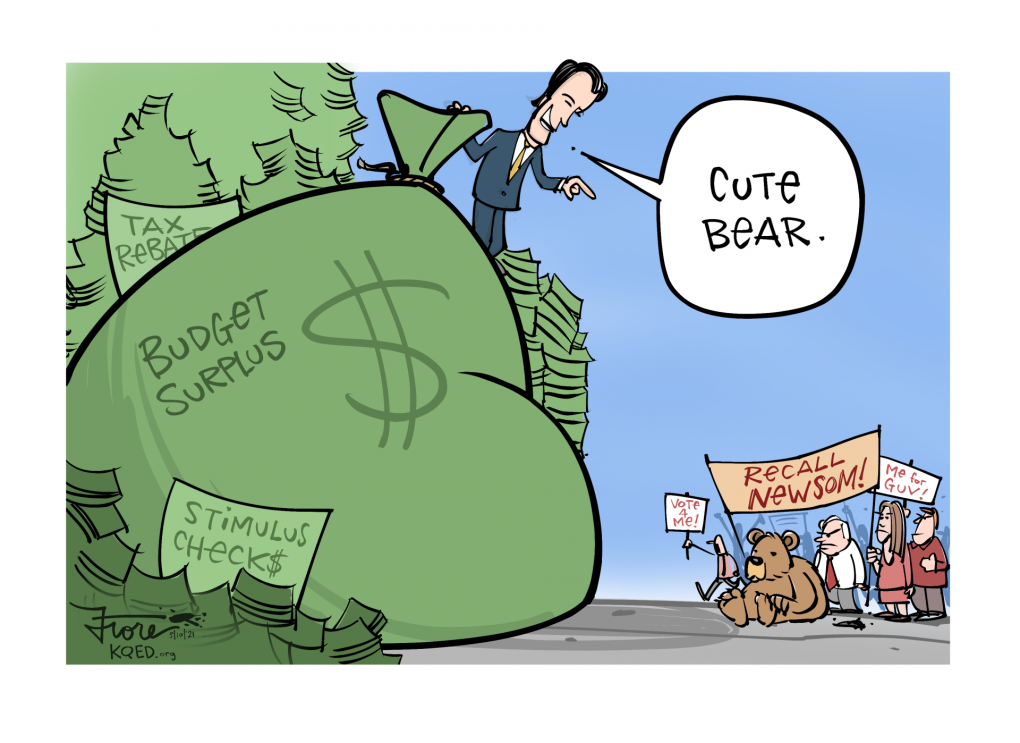
"content": "\u003cp>Gov. Gavin Newsom on Monday proposed a \u003ca href=\"http://bit.ly/fioreexpandstimulus\">big expansion\u003c/a> of the state's economic stimulus plan, which would mean a $600 payment to every California household making up to $75,000 per year. Previously, the $600 checks were slated to go only to Californians making up to $30,000 per year.\u003c/p>\n\u003cp>Thanks to a booming stock market and money that has flowed to California from the American Rescue Plan, the state's budget has ballooned from the dire early days of the pandemic.\u003c/p>\n\u003cp>In other words, things are looking up ... unless you're running for governor against Newsom.\u003c/p>\n\u003cp>Meanwhile, John Cox is still pinning his hopes for a successful campaign on a \u003ca href=\"https://www.kqed.org/news/11872483/the-campaign-bearly-started\">poor, rented bear\u003c/a>.\u003c/p>\n\u003cp>[ad fullwidth]\u003c/p>\n\u003cp>\u003c/p>\n",
"disqusIdentifier": "11872993 https://ww2.kqed.org/news/?p=11872993",
"disqusUrl": "https://ww2.kqed.org/news/2021/05/10/bigger-than-a-bear/",
"stats": {
"hasVideo": false,
"hasChartOrMap": false,
"hasAudio": false,
"hasPolis": false,
"wordCount": 117,
"hasGoogleForm": false,
"hasGallery": false,
"hasHearkenModule": false,
"iframeSrcs": [],
"paragraphCount": 6
},
"modified": 1620684464,
"excerpt": "Gov. Gavin Newsom announced on Monday a big expansion of the state's economic stimulus plan, which could mean two-thirds of Californians will get cash payments of at least $600.",
"headData": {
"twImgId": "",
"twTitle": "",
"ogTitle": "",
"ogImgId": "",
"twDescription": "",
"description": "Gov. Gavin Newsom announced on Monday a big expansion of the state's economic stimulus plan, which could mean two-thirds of Californians will get cash payments of at least $600.",
"title": "Bigger Than a Bear | KQED",
"ogDescription": "",
"schema": {
"@context": "https://schema.org",
"@type": "NewsArticle",
"headline": "Bigger Than a Bear",
"datePublished": "2021-05-10T14:47:37-07:00",
"dateModified": "2021-05-10T15:07:44-07:00",
"image": "https://cdn.kqed.org/wp-content/uploads/2020/02/KQED-OG-Image@1x.png",
"isAccessibleForFree": "True",
"publisher": {
"@type": "NewsMediaOrganization",
"@id": "https://www.kqed.org/#organization",
"name": "KQED",
"logo": "https://cdn.kqed.org/wp-content/uploads/2020/02/KQED-OG-Image@1x.png",
"url": "https://www.kqed.org",
"sameAs": [
"https://www.facebook.com/KQED",
"https://twitter.com/KQED",
"https://www.instagram.com/kqed/",
"https://www.tiktok.com/@kqedofficial",
"https://www.linkedin.com/company/kqed",
"https://www.youtube.com/channel/UCeC0IOo7i1P_61zVUWbJ4nw"
]
}
}
},
"guestAuthors": [],
"slug": "bigger-than-a-bear",
"status": "publish",
"path": "/news/11872993/bigger-than-a-bear",
"audioTrackLength": null,
"parsedContent": [
{
"type": "contentString",
"content": "\u003cdiv class=\"post-body\">\u003cp>\u003cp>Gov. Gavin Newsom on Monday proposed a \u003ca href=\"http://bit.ly/fioreexpandstimulus\">big expansion\u003c/a> of the state's economic stimulus plan, which would mean a $600 payment to every California household making up to $75,000 per year. Previously, the $600 checks were slated to go only to Californians making up to $30,000 per year.\u003c/p>\n\u003cp>Thanks to a booming stock market and money that has flowed to California from the American Rescue Plan, the state's budget has ballooned from the dire early days of the pandemic.\u003c/p>\n\u003cp>In other words, things are looking up ... unless you're running for governor against Newsom.\u003c/p>\n\u003cp>Meanwhile, John Cox is still pinning his hopes for a successful campaign on a \u003ca href=\"https://www.kqed.org/news/11872483/the-campaign-bearly-started\">poor, rented bear\u003c/a>.\u003c/p>\n\u003cp>\u003c/p>\u003c/div>",
"attributes": {
"named": {},
"numeric": []
}
},
{
"type": "component",
"content": "",
"name": "ad",
"attributes": {
"named": {
"label": "fullwidth"
},
"numeric": [
"fullwidth"
]
}
},
{
"type": "contentString",
"content": "\u003cdiv class=\"post-body\">\u003cp>\u003c/p>\n\u003cp>\u003c/p>\n\u003c/div>\u003c/p>",
"attributes": {
"named": {},
"numeric": []
}
}
],
"link": "/news/11872993/bigger-than-a-bear",
"authors": [
"3236"
],
"series": [
"news_18515"
],
"categories": [
"news_1758"
],
"tags": [
"news_29447",
"news_18538",
"news_402",
"news_16",
"news_20737",
"news_20949",
"news_28988",
"news_21509"
],
"featImg": "news_11872996",
"label": "news_18515"
},
"news_11872830": {
"type": "posts",
"id": "news_11872830",
"meta": {
"index": "posts_1716263798",
"site": "news",
"id": "11872830",
"score": null,
"sort": [
1620435432000
]
},
"parent": 0,
"labelTerm": {
"site": "news"
},
"blocks": [],
"publishDate": 1620435432,
"format": "standard",
"disqusTitle": "New California AG Continues to Withhold Important Police Records Despite 'Effort to Increase Transparency'",
"title": "New California AG Continues to Withhold Important Police Records Despite 'Effort to Increase Transparency'",
"headTitle": "KQED News",
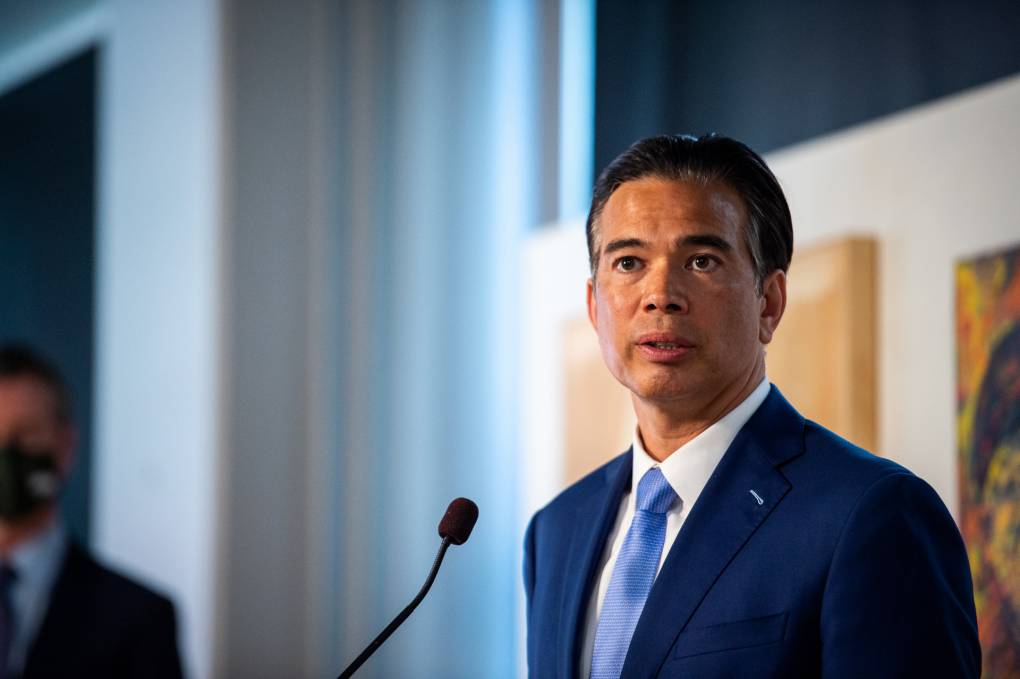
"content": "\u003cp>California's new Attorney General Rob Bonta announced an \"effort to increase transparency\" and \"accelerate\" the release of police use-of-force and misconduct records Friday, well over two years after a landmark police transparency law granted public access to those files and KQED requested them via the state Public Records Act.\u003c/p>\n\u003cp>But Bonta's \u003ca href=\"https://oag.ca.gov/news/press-releases/effort-increase-transparency-attorney-general-bonta-accelerate-release-peace\">press release\u003c/a> glosses over or completely omits aspects of long-running litigation brought by KQED and the First Amendment Coalition, including the California Department of Justice's continued withholding of some of the most crucial files related to potential crimes committed by police officers, according to attorneys involved in the case.\u003c/p>\n\u003cp>\"For decades, peace officer misconduct records have been shrouded in secrecy,\" Bonta said in a press release. \"At the California Department of Justice, we know it's on us to set the standard and we're ready to take on this important challenge.\"\u003c/p>\n\u003cp>The announcement comes amid an ongoing lawsuit filed by the First Amendment Coalition and KQED in early 2019, after Bonta's predecessor Xavier Becerra refused to provide state-level records on police shootings, sexual assault and dishonesty by law enforcement.\u003c/p>\n\u003cp>[aside postID=\"news_11730624,news_11747908,news_11798901\" label=\"The Fight Over Police Records\"]\"We are glad the Attorney General has now expressed a commitment to transparency and we would welcome that approach in this case,\" said David Snyder, executive director of the First Amendment Coalition. \"We look forward to finally seeing the public records we requested more than two years ago.\"\u003c/p>\n\u003cp>But the attorney general didn't decide to speed up the release of records on his own. That was ordered by a judge, according to KQED's attorney Thomas Burke.\u003c/p>\n\u003cp>\"This schedule is something that the court ordered in this litigation,\" Burke said. \"But we look forward to what purports to be a new commitment to transparency by the attorney general.\"\u003c/p>\n\u003cp>The files released by the attorney general's office so far have consisted of police incident reports and other documents created by local law enforcement agencies. But FAC and KQED's litigation has exposed that the the state Department of Justice also conducts reviews of decisions by local prosecutors in at least some police shooting cases, as well as other cases that may involve criminal misconduct by law enforcement officers.\u003c/p>\n\u003cp>[ad fullwidth]\u003c/p>\n\u003cp>\"They have made it clear that they plan to withhold the attorney general reports about whether or not shootings were appropriate,\" Burke said of the so-called \"conflict review\" files that Bonta's office has argued are exempt from disclosure. \"If the attorney general is serious about transparency, he ought to act to make sure that he is making those reviews public.\"\u003c/p>\n\u003cp>\"Attorney General Bonta is committed to transparency,\" the Attorney General's press office wrote in response to a request for comment. \"The Attorney General is taking a look at the issues here and the pending litigation that is involved. This is his second week in office and today's update reflects the importance of this issue to him.\"\u003c/p>\n\u003cp>Bonta's announcement goes on to say that the Attorney General's Office will provide all the responsive records created by local police and sheriff's departments by Sept. 26. A month later, the attorney general is ordered to produce a list of all records it has withheld from production.\u003c/p>\n\u003cp>And by mid-November, KQED, FAC and the Attorney General's Office are scheduled to be back in San Francisco Superior Court to argue \"any remaining legal disputes concerning the production,\" according to Judge Richard Ulmer's order issued Friday.\u003c/p>\n\u003cp>\u003c/p>\n",
"disqusIdentifier": "11872830 https://ww2.kqed.org/news/?p=11872830",
"disqusUrl": "https://ww2.kqed.org/news/2021/05/07/new-california-ag-continues-to-withhold-important-police-records-despite-effort-to-increase-transparency/",
"stats": {
"hasVideo": false,
"hasChartOrMap": false,
"hasAudio": false,
"hasPolis": false,
"wordCount": 591,
"hasGoogleForm": false,
"hasGallery": false,
"hasHearkenModule": false,
"iframeSrcs": [],
"paragraphCount": 14
},
"modified": 1620667873,
"excerpt": "An announcement by Attorney General Rob Bonta glosses over his office's continued withholding of some of the most crucial files related to potential crimes committed by police officers.",
"headData": {
"twImgId": "",
"twTitle": "",
"ogTitle": "",
"ogImgId": "",
"twDescription": "",
"description": "An announcement by Attorney General Rob Bonta glosses over his office's continued withholding of some of the most crucial files related to potential crimes committed by police officers.",
"title": "New California AG Continues to Withhold Important Police Records Despite 'Effort to Increase Transparency' | KQED",
"ogDescription": "",
"schema": {
"@context": "https://schema.org",
"@type": "NewsArticle",
"headline": "New California AG Continues to Withhold Important Police Records Despite 'Effort to Increase Transparency'",
"datePublished": "2021-05-07T17:57:12-07:00",
"dateModified": "2021-05-10T10:31:13-07:00",
"image": "https://cdn.kqed.org/wp-content/uploads/2020/02/KQED-OG-Image@1x.png",
"isAccessibleForFree": "True",
"publisher": {
"@type": "NewsMediaOrganization",
"@id": "https://www.kqed.org/#organization",
"name": "KQED",
"logo": "https://cdn.kqed.org/wp-content/uploads/2020/02/KQED-OG-Image@1x.png",
"url": "https://www.kqed.org",
"sameAs": [
"https://www.facebook.com/KQED",
"https://twitter.com/KQED",
"https://www.instagram.com/kqed/",
"https://www.tiktok.com/@kqedofficial",
"https://www.linkedin.com/company/kqed",
"https://www.youtube.com/channel/UCeC0IOo7i1P_61zVUWbJ4nw"
]
}
}
},
"guestAuthors": [],
"slug": "new-california-ag-continues-to-withhold-important-police-records-despite-effort-to-increase-transparency",
"status": "publish",
"path": "/news/11872830/new-california-ag-continues-to-withhold-important-police-records-despite-effort-to-increase-transparency",
"audioTrackLength": null,
"parsedContent": [
{
"type": "contentString",
"content": "\u003cdiv class=\"post-body\">\u003cp>\u003cp>California's new Attorney General Rob Bonta announced an \"effort to increase transparency\" and \"accelerate\" the release of police use-of-force and misconduct records Friday, well over two years after a landmark police transparency law granted public access to those files and KQED requested them via the state Public Records Act.\u003c/p>\n\u003cp>But Bonta's \u003ca href=\"https://oag.ca.gov/news/press-releases/effort-increase-transparency-attorney-general-bonta-accelerate-release-peace\">press release\u003c/a> glosses over or completely omits aspects of long-running litigation brought by KQED and the First Amendment Coalition, including the California Department of Justice's continued withholding of some of the most crucial files related to potential crimes committed by police officers, according to attorneys involved in the case.\u003c/p>\n\u003cp>\"For decades, peace officer misconduct records have been shrouded in secrecy,\" Bonta said in a press release. \"At the California Department of Justice, we know it's on us to set the standard and we're ready to take on this important challenge.\"\u003c/p>\n\u003cp>The announcement comes amid an ongoing lawsuit filed by the First Amendment Coalition and KQED in early 2019, after Bonta's predecessor Xavier Becerra refused to provide state-level records on police shootings, sexual assault and dishonesty by law enforcement.\u003c/p>\n\u003cp>\u003c/p>\u003c/div>",
"attributes": {
"named": {},
"numeric": []
}
},
{
"type": "component",
"content": "",
"name": "aside",
"attributes": {
"named": {
"postid": "news_11730624,news_11747908,news_11798901",
"label": "The Fight Over Police Records "
},
"numeric": []
}
},
{
"type": "contentString",
"content": "\u003cdiv class=\"post-body\">\u003cp>\"We are glad the Attorney General has now expressed a commitment to transparency and we would welcome that approach in this case,\" said David Snyder, executive director of the First Amendment Coalition. \"We look forward to finally seeing the public records we requested more than two years ago.\"\u003c/p>\n\u003cp>But the attorney general didn't decide to speed up the release of records on his own. That was ordered by a judge, according to KQED's attorney Thomas Burke.\u003c/p>\n\u003cp>\"This schedule is something that the court ordered in this litigation,\" Burke said. \"But we look forward to what purports to be a new commitment to transparency by the attorney general.\"\u003c/p>\n\u003cp>The files released by the attorney general's office so far have consisted of police incident reports and other documents created by local law enforcement agencies. But FAC and KQED's litigation has exposed that the the state Department of Justice also conducts reviews of decisions by local prosecutors in at least some police shooting cases, as well as other cases that may involve criminal misconduct by law enforcement officers.\u003c/p>\n\u003cp>\u003c/p>\u003c/div>",
"attributes": {
"named": {},
"numeric": []
}
},
{
"type": "component",
"content": "",
"name": "ad",
"attributes": {
"named": {
"label": "fullwidth"
},
"numeric": [
"fullwidth"
]
}
},
{
"type": "contentString",
"content": "\u003cdiv class=\"post-body\">\u003cp>\u003c/p>\n\u003cp>\"They have made it clear that they plan to withhold the attorney general reports about whether or not shootings were appropriate,\" Burke said of the so-called \"conflict review\" files that Bonta's office has argued are exempt from disclosure. \"If the attorney general is serious about transparency, he ought to act to make sure that he is making those reviews public.\"\u003c/p>\n\u003cp>\"Attorney General Bonta is committed to transparency,\" the Attorney General's press office wrote in response to a request for comment. \"The Attorney General is taking a look at the issues here and the pending litigation that is involved. This is his second week in office and today's update reflects the importance of this issue to him.\"\u003c/p>\n\u003cp>Bonta's announcement goes on to say that the Attorney General's Office will provide all the responsive records created by local police and sheriff's departments by Sept. 26. A month later, the attorney general is ordered to produce a list of all records it has withheld from production.\u003c/p>\n\u003cp>And by mid-November, KQED, FAC and the Attorney General's Office are scheduled to be back in San Francisco Superior Court to argue \"any remaining legal disputes concerning the production,\" according to Judge Richard Ulmer's order issued Friday.\u003c/p>\n\u003cp>\u003c/p>\n\u003c/div>\u003c/p>",
"attributes": {
"named": {},
"numeric": []
}
}
],
"link": "/news/11872830/new-california-ag-continues-to-withhold-important-police-records-despite-effort-to-increase-transparency",
"authors": [
"3206"
],
"categories": [
"news_6188",
"news_8",
"news_13"
],
"tags": [
"news_18538",
"news_24767",
"news_24770",
"news_24725",
"news_17968",
"news_3674",
"news_25132",
"news_20378"
],
"featImg": "news_11872842",
"label": "news"
},
"news_11872755": {
"type": "posts",
"id": "news_11872755",
"meta": {
"index": "posts_1716263798",
"site": "news",
"id": "11872755",
"score": null,
"sort": [
1620420672000
]
},
"guestAuthors": [],
"slug": "california-reports-first-ever-yearly-population-decline",
"title": "California Reports First Ever Yearly Population Decline",
"publishDate": 1620420672,
"format": "standard",
"headTitle": "California Reports First Ever Yearly Population Decline | KQED",
"labelTerm": {
"site": "news"
},
"content": "\u003cp>California’s population fell by more than 182,000 people in 2020, marking the first year-over-year loss ever recorded for the nation’s most populous state.\u003c/p>\n\u003cp>State officials announced Friday that California’s population dipped 0.46% to just under 39.5 million people from January 2020 to January 2021.\u003c/p>\n\u003cp>The news comes one week after the U.S. Census Bureau announced a paltry population growth for California, resulting in the state losing a congressional seat for the first time because it grew more slowly than other states over the past decade.\u003c/p>\n\u003cp>But the census numbers reflect the state’s population in April 2020. The new state numbers released Friday reflect the state’s population as of January 2021.\u003c/p>\n\u003cp>California became a state in 1850 on the heels of a gold rush that prompted people to seek their fortune out west. The population soared following World War II with the help of a robust defense and aerospace industry. It boomed again in the 1980s and 1990s as technology companies put Silicon Valley on the map.\u003c/p>\n\u003cp>[ad fullwidth]\u003c/p>\n\u003cp>But the growth slowed after the end of the Cold War in the 1990s when the federal government cut back on defense spending and again in the years before the Great Recession in the late 2000s.\u003c/p>\n\u003cp>State officials say California has seen more people leave than move in from other states for much of the last three decades. However, that had been offset by international immigration and births so that California continued to grow.\u003c/p>\n\u003cp>That changed in 2020. State officials say a declining birth rate, plus reductions in international immigration and an increase in deaths because of the coronavirus, led to the state’s first ever year-over-year population loss.\u003c/p>\n\u003cp>California had a negative international migration in 2020, which state officials say was a direct impact from the Trump administration’s decision to stop issuing new visas for much of that year. Coronavirus restrictions around the world also caused about a 29% decline in international students coming to California, or about 53,000 people. [aside tag=\"census, california\" label=\"More Related Stories\"]\u003c/p>\n\u003cp>Plus, about 51,000 people died from the coronavirus in California last year. That’s a 19% increase above the state’s average death rate for the past three years. In all, 51 of the state’s 58 counties posted death rates above the three-year average — including 12 that had increases of 20% or more.\u003c/p>\n\u003cp>In a news release, the California Department of Finance said it expects the state to return to a “slightly positive annual growth” for the 2021 calendar year. Those numbers will be released next May.\u003c/p>\n\u003cp>The state’s population has become a political issue this year in light of the effort to recall Gov. Gavin Newsom, with Republicans blaming high taxes and the governor’s policies for people fleeing the state. From 2010 to 2020, about 6.1 million people left California for other states compared to about 4.9 million people who moved to California from other states, according to an analysis of census data by the Public Policy Institute of California.\u003c/p>\n\u003cp>\u003c/p>\n\u003cp>The Department of Finances population estimate comes from a number of sources, including birth and death counts, the number of new driver’s licenses and address changes, school enrollments and federal tax returns.\u003c/p>\n\n",
"blocks": [],
"excerpt": "California’s population fell by more than 182,000 people in 2020, marking the first year-over-year loss ever recorded for the nation’s most populous state.",
"status": "publish",
"parent": 0,
"modified": 1721129434,
"stats": {
"hasAudio": false,
"hasVideo": false,
"hasChartOrMap": false,
"iframeSrcs": [],
"hasGoogleForm": false,
"hasGallery": false,
"hasHearkenModule": false,
"hasPolis": false,
"paragraphCount": 15,
"wordCount": 568
},
"headData": {
"title": "California Reports First Ever Yearly Population Decline | KQED",
"description": "California’s population fell by more than 182,000 people in 2020, marking the first year-over-year loss ever recorded for the nation’s most populous state.",
"ogTitle": "",
"ogDescription": "",
"ogImgId": "",
"twTitle": "",
"twDescription": "",
"twImgId": "",
"schema": {
"@context": "https://schema.org",
"@type": "NewsArticle",
"headline": "California Reports First Ever Yearly Population Decline",
"datePublished": "2021-05-07T13:51:12-07:00",
"dateModified": "2024-07-16T04:30:34-07:00",
"image": "https://cdn.kqed.org/wp-content/uploads/2020/02/KQED-OG-Image@1x.png",
"isAccessibleForFree": "True",
"publisher": {
"@type": "NewsMediaOrganization",
"@id": "https://www.kqed.org/#organization",
"name": "KQED",
"logo": "https://cdn.kqed.org/wp-content/uploads/2020/02/KQED-OG-Image@1x.png",
"url": "https://www.kqed.org",
"sameAs": [
"https://www.facebook.com/KQED",
"https://twitter.com/KQED",
"https://www.instagram.com/kqed/",
"https://www.tiktok.com/@kqedofficial",
"https://www.linkedin.com/company/kqed",
"https://www.youtube.com/channel/UCeC0IOo7i1P_61zVUWbJ4nw"
]
}
}
},
"sticky": false,
"nprByline": "Adam Beam \u003cbr> Associated Press",
"path": "/news/11872755/california-reports-first-ever-yearly-population-decline",
"audioTrackLength": null,
"parsedContent": [
{
"type": "contentString",
"content": "\u003cdiv class=\"post-body\">\u003cp>\u003cp>California’s population fell by more than 182,000 people in 2020, marking the first year-over-year loss ever recorded for the nation’s most populous state.\u003c/p>\n\u003cp>State officials announced Friday that California’s population dipped 0.46% to just under 39.5 million people from January 2020 to January 2021.\u003c/p>\n\u003cp>The news comes one week after the U.S. Census Bureau announced a paltry population growth for California, resulting in the state losing a congressional seat for the first time because it grew more slowly than other states over the past decade.\u003c/p>\n\u003cp>But the census numbers reflect the state’s population in April 2020. The new state numbers released Friday reflect the state’s population as of January 2021.\u003c/p>\n\u003cp>California became a state in 1850 on the heels of a gold rush that prompted people to seek their fortune out west. The population soared following World War II with the help of a robust defense and aerospace industry. It boomed again in the 1980s and 1990s as technology companies put Silicon Valley on the map.\u003c/p>\n\u003cp>\u003c/p>\u003c/div>",
"attributes": {
"named": {},
"numeric": []
}
},
{
"type": "component",
"content": "",
"name": "ad",
"attributes": {
"named": {
"label": "fullwidth"
},
"numeric": [
"fullwidth"
]
}
},
{
"type": "contentString",
"content": "\u003cdiv class=\"post-body\">\u003cp>\u003c/p>\n\u003cp>But the growth slowed after the end of the Cold War in the 1990s when the federal government cut back on defense spending and again in the years before the Great Recession in the late 2000s.\u003c/p>\n\u003cp>State officials say California has seen more people leave than move in from other states for much of the last three decades. However, that had been offset by international immigration and births so that California continued to grow.\u003c/p>\n\u003cp>That changed in 2020. State officials say a declining birth rate, plus reductions in international immigration and an increase in deaths because of the coronavirus, led to the state’s first ever year-over-year population loss.\u003c/p>\n\u003cp>California had a negative international migration in 2020, which state officials say was a direct impact from the Trump administration’s decision to stop issuing new visas for much of that year. Coronavirus restrictions around the world also caused about a 29% decline in international students coming to California, or about 53,000 people. \u003c/p>\u003c/div>",
"attributes": {
"named": {},
"numeric": []
}
},
{
"type": "component",
"content": "",
"name": "aside",
"attributes": {
"named": {
"tag": "census, california",
"label": "More Related Stories "
},
"numeric": []
}
},
{
"type": "contentString",
"content": "\u003cdiv class=\"post-body\">\u003cp>\u003c/p>\n\u003cp>Plus, about 51,000 people died from the coronavirus in California last year. That’s a 19% increase above the state’s average death rate for the past three years. In all, 51 of the state’s 58 counties posted death rates above the three-year average — including 12 that had increases of 20% or more.\u003c/p>\n\u003cp>In a news release, the California Department of Finance said it expects the state to return to a “slightly positive annual growth” for the 2021 calendar year. Those numbers will be released next May.\u003c/p>\n\u003cp>The state’s population has become a political issue this year in light of the effort to recall Gov. Gavin Newsom, with Republicans blaming high taxes and the governor’s policies for people fleeing the state. From 2010 to 2020, about 6.1 million people left California for other states compared to about 4.9 million people who moved to California from other states, according to an analysis of census data by the Public Policy Institute of California.\u003c/p>\n\u003cp>\u003c/p>\n\u003cp>The Department of Finances population estimate comes from a number of sources, including birth and death counts, the number of new driver’s licenses and address changes, school enrollments and federal tax returns.\u003c/p>\n\n\u003c/div>\u003c/p>",
"attributes": {
"named": {},
"numeric": []
}
}
],
"link": "/news/11872755/california-reports-first-ever-yearly-population-decline",
"authors": [
"byline_news_11872755"
],
"categories": [
"news_8"
],
"tags": [
"news_18538",
"news_482",
"news_27350",
"news_27989",
"news_17968",
"news_4341"
],
"featImg": "news_11872776",
"label": "news"
},
"news_11872571": {
"type": "posts",
"id": "news_11872571",
"meta": {
"index": "posts_1716263798",
"site": "news",
"id": "11872571",
"score": null,
"sort": [
1620342287000
]
},
"guestAuthors": [],
"slug": "conoce-al-angel-de-tiktok-de-los-vendedores-ambulantes",
"title": "Conoce al ángel de TikTok de los vendedores ambulantes",
"publishDate": 1620342287,
"format": "standard",
"headTitle": "Conoce al ángel de TikTok de los vendedores ambulantes | KQED",
"labelTerm": {},
"content": "\u003cp>\u003cem>\u003ca href=\"https://www.kqed.org/news/11872529/meet-the-tiktok-angel-of-street-vendors\">Read in English\u003c/a>\u003c/em>\u003c/p>\n\u003cp>Cuando TikTok comenzó a ganar popularidad, Jesús Morales, como muchos otros jóvenes, decidió crear contenido original para publicar en esa plataforma.[pullquote size=\"right\" align=\"right\" citation=\"Jesús Morales, @Juixxe en Tiktok \"]‘Nunca en mi vida me hubiera imaginado que estaría haciendo TikTok para sobrevivir…la interacción con los vendedores no tarda mucho y puedo editar el vídeo en unos 20 o 30 minutos.’[/pullquote]\u003c/p>\n\u003cp>Lo que no esperaba es que en muy poco tiempo se convertiría en \u003cem>influencer\u003c/em> y ángel de la guarda para muchos vendedores ambulantes en California.\u003c/p>\n\u003cp>El joven de 24 años dijo que después de ser despedido de su trabajo a principios de la pandemia en el 2020, decidió usar su tiempo libre para crear vídeos divertidos. El número de sus seguidores aumentó, pero los resultados realmente no lo hicieron feliz. Sintió que faltaba algo.\u003c/p>\n\u003cp>Luego comenzó a ver otros vídeos de TikTok con un propósito: personas que dejaban grandes cantidades de propinas en restaurantes y otro vídeo que mostraba a una joven dando dinero a los vendedores ambulantes. Los influencers indicaron que el dinero provenía principalmente de donaciones de sus seguidores.\u003c/p>\n\u003cp>“Hice un vídeo pidiendo donaciones para ayudar a las personas sin hogar”, dijo Morales, cuyo nombre en las redes sociales es \u003ca href=\"https://www.tiktok.com/@juixxe\">@Juixxe\u003c/a>, un juego de palabras de su apodo ‘Juice’.\u003c/p>\n\u003cfigure id=\"attachment_11872641\" class=\"wp-caption alignnone\" style=\"max-width: 861px\">\u003cimg loading=\"lazy\" decoding=\"async\" class=\"size-full wp-image-11872641\" src=\"https://ww2.kqed.org/app/uploads/sites/10/2021/05/courtesy_tiktok_02-1020x574-1.jpg\" alt=\"Una imagen de Jesús Morales, parado ante la cámara, portando un abrigo de color negro.\" width=\"861\" height=\"574\" srcset=\"https://cdn.kqed.org/wp-content/uploads/sites/10/2021/05/courtesy_tiktok_02-1020x574-1.jpg 861w, https://cdn.kqed.org/wp-content/uploads/sites/10/2021/05/courtesy_tiktok_02-1020x574-1-800x533.jpg 800w, https://cdn.kqed.org/wp-content/uploads/sites/10/2021/05/courtesy_tiktok_02-1020x574-1-160x107.jpg 160w\" sizes=\"(max-width: 861px) 100vw, 861px\">\u003cfigcaption class=\"wp-caption-text\">Jesús Morales, quien se hace llamar Juixxe en TikTok, recauda donaciones de seguidores que comparte con vendedores ambulantes en Los Ángeles. \u003ccite>(Cortesía de Jesus Morales)\u003c/cite>\u003c/figcaption>\u003c/figure>\n\u003cp>Y funcionó. Recibió algunas donaciones, que utilizó para comprar comida y agua para las personas sin hogar.[aside label ='Historias Relacionadas' tag='kqed-en-espanol']\u003c/p>\n\u003cp>Su objetivo, sin embargo, era la comunidad de inmigrantes latinos.\u003c/p>\n\u003cp>Morales, hijo de inmigrantes mexicanos, nació y se crió en Illinois y se mudó a San Diego hace unos años. Vivió en Los Ángeles durante un año y notó una gran cantidad de vendedores ambulantes.\u003c/p>\n\u003cp>La mayoría de ellos son mayores de edad e indocumentados, recordó Morales. Esto realmente lo impacto a un nivel personal al recordar las luchas diarias de sus padres.\u003c/p>\n\u003cp>“Mi papá tenía varios trabajos y mi mamá era mesera y me decía que a veces la gente le daba unos centavos como propina”, dijo Morales.\u003c/p>\n\u003cp>Para honrar el arduo trabajo de los inmigrantes, comenzó a producir vídeos con un propósito: el dinero recaudado de sus seguidores se lo daría a vendedores ambulantes que encontraría en las calles al azar.\u003c/p>\n\u003cblockquote class=\"tiktok-embed\" style=\"max-width: 605px;min-width: 325px\" cite=\"https://www.tiktok.com/@juixxe/video/6895084234248162566\" data-video-id=\"6895084234248162566\">\n\u003csection>\u003ca title=\"@juixxe\" href=\"https://www.tiktok.com/@juixxe\" target=\"_blank\" rel=\"noopener noreferrer\">@juixxe\u003c/a>Always supporting our street vendors! 🙏🏽 \u003ca title=\"juixxe\" href=\"https://www.tiktok.com/tag/juixxe\" target=\"_blank\" rel=\"noopener noreferrer\">#Juixxe\u003c/a> \u003ca title=\"streetvendor\" href=\"https://www.tiktok.com/tag/streetvendor\" target=\"_blank\" rel=\"noopener noreferrer\">#StreetVendor\u003c/a> \u003ca title=\"giveback\" href=\"https://www.tiktok.com/tag/giveback\" target=\"_blank\" rel=\"noopener noreferrer\">#Giveback\u003c/a>\u003ca title=\"♬ original sound - Jesús\" href=\"https://www.tiktok.com/music/original-sound-6895084249473469190\" target=\"_blank\" rel=\"noopener noreferrer\">♬ original sound – Jesús\u003c/a>\u003c/section>\n\u003c/blockquote>\n\u003cp>[tiktok]\u003cbr>\n\u003cem>Un vídeo de la cuenta deTikTok de Jesús Morales, o ‘@juixxe’, que demuestra una interacción entre Morales y un vendedor ambulante. La descripción del vídeo dice, “¡Siempre apoyando a nuestros vendedores ambulantes!”.\u003c/em>\u003c/p>\n\u003ch3>Bendiciones de desconocidos\u003c/h3>\n\u003cp>Morales ha distribuido más de $90 mil en donaciones a vendedores ambulantes en todo California, pero principalmente en Los Ángeles. Dijo que sus seguidores han donado desde unos pocos dólares hasta mil dólares en una sola transacción.\u003c/p>\n\u003cp>Juixxe distribuye el dinero una o dos veces por semana, dependiendo de la cantidad que logre recaudar.\u003c/p>\n\u003cp>Tiene una forma peculiar de entregar el dinero. Pide comprar toda su mercancía o comida que venden y cuando los vendedores aceptan, Morales les ofrece dinero. Por lo general, les entrega mil dólares en un sobre y les dice que se queden con la mercancía.\u003c/p>\n\u003cp>Es muy común ver en los vídeos a vendedores ambulantes impactados con la noticia, eventualmente agradeciéndole el gesto y enviando bendiciones a sus seguidores.\u003c/p>\n\u003cp>Algunos incluso se arrodillan asombrados.\u003c/p>\n\u003cp>Morales dijo que este tipo de vídeos lo han llenado de una alegría inexplicable.\u003c/p>\n\u003cp>“No conozco (a los vendedores) ni sé por lo que están pasando”, dijo Morales, “no diría que vengo en un momento perfecto, pero es una visita con un propósito”.\u003c/p>\n\u003cblockquote class=\"tiktok-embed\" style=\"max-width: 605px;min-width: 325px\" cite=\"https://www.tiktok.com/@juixxe/video/6921152988044070150\" data-video-id=\"6921152988044070150\">\n\u003csection>\u003ca title=\"@juixxe\" href=\"https://www.tiktok.com/@juixxe\" target=\"_blank\" rel=\"noopener noreferrer\">@juixxe\u003c/a>They were only expecting $8 🥺 \u003ca title=\"juixxe\" href=\"https://www.tiktok.com/tag/juixxe\" target=\"_blank\" rel=\"noopener noreferrer\">#juixxe\u003c/a>\u003ca title=\"♬ оригинальный звук - nlaims\" href=\"https://www.tiktok.com/music/%D0%BE%D1%80%D0%B8%D0%B3%D0%B8%D0%BD%D0%B0%D0%BB%D1%8C%D0%BD%D1%8B%D0%B9-%D0%B7%D0%B2%D1%83%D0%BA-6865193361293216517\" target=\"_blank\" rel=\"noopener noreferrer\">♬ оригинальный звук – nlaims\u003c/a>\u003c/section>\n\u003c/blockquote>\n\u003cp>[tiktok]\u003cbr>\n\u003cem>Otro vídeo de la cuenta de TikTok de Jesús Morales, o ‘@juixxe’, que demuestra una interacción entre Morales y una pareja que vende churros en la calle. La descripción del vídeo dice, “Sólo esperaban recibir $8”.\u003c/em>\u003cbr>\n[ad fullwidth]\u003c/p>\n\u003ch3>Un trabajo de tiempo completo\u003c/h3>\n\u003cp>Unos meses después de crear su primer vídeo de TikTok, Juixxe convirtió su labor en las redes sociales en su trabajo de tiempo completo. Ahora tiene más de un millón de seguidores y sus vídeos tienen miles de visitas. A causa de tantas reproducciones de sus vídeos, Morales recibe un salario, así como de patrocinadores.\u003c/p>\n\u003cp>“Nunca en mi vida me hubiera imaginado que estaría haciendo TikTok para sobrevivir”, dijo Morales. “La interacción con los vendedores no tarda mucho y puedo editar el vídeo en unos 20 o 30 minutos”.\u003c/p>\n\u003cp>[aside tag=\"tiktok\" label=\"Cobertura relacionada en inglés\"]Morales dijo que después de entregar la donación a los vendedores, espera unos días o semanas para publicar el vídeo en las redes sociales. También se asegura de tapar los rostros de los vendedores ambulantes que aparecen en los vídeos. Todo esto se hace por su seguridad.\u003c/p>\n\u003cp>“Odiaría que cualquier vendedor ambulante fuera atacado y robado”, dijo Juixxe, quien viaja una o dos veces por semana desde San Diego a Los Ángeles para entregar los fondos a los más necesitados.\u003c/p>\n\u003cp>Morales siempre ha querido hacer este tipo de vídeos pero tuvo que superar su miedo al fracaso.\u003c/p>\n\u003cp>“Sabes que tienes que fracasar para tener éxito”, dijo, “y he fracasado muchas veces en mi vida. Esto es lo único que puedo decir que no he fallado “.\u003c/p>\n\u003chr>\n\u003cp>\u003cem>Este artículo forma parte de \u003ca href=\"https://calmatters.org/projects/california-divide/\">California Divide\u003c/a>, una colaboración entre redacciones que examina la desigualdad de ingresos y la supervivencia económica en California.\u003c/em>\u003c/p>\n\u003cp>\u003cem>\u003ca href=\"https://calmatters.org/\">CalMatters.org\u003c/a> es una organización de medios de comunicación sin fines de lucro, no partidista, que explica las políticas públicas y los temas políticos de California.\u003c/em>\u003cbr>\n[ad fullwidth]\u003c/p>\n\u003cp>[ad floatright]\u003c/p>\n",
"blocks": [],
"excerpt": "Un joven latino ayuda a decenas de vendedores ambulantes en el sur de California, usando a TikTok para recaudar donaciones para regalar a quienes venden en la calle.",
"status": "publish",
"parent": 0,
"modified": 1721156203,
"stats": {
"hasAudio": false,
"hasVideo": false,
"hasChartOrMap": false,
"iframeSrcs": [],
"hasGoogleForm": false,
"hasGallery": false,
"hasHearkenModule": false,
"hasPolis": false,
"paragraphCount": 30,
"wordCount": 1194
},
"headData": {
"title": "Conoce al ángel de TikTok de los vendedores ambulantes | KQED",
"description": "Un joven latino ayuda a decenas de vendedores ambulantes en el sur de California, usando a TikTok para recaudar donaciones para regalar a quienes venden en la calle.",
"ogTitle": "",
"ogDescription": "",
"ogImgId": "",
"twTitle": "",
"twDescription": "",
"twImgId": "",
"schema": {
"@context": "https://schema.org",
"@type": "NewsArticle",
"headline": "Conoce al ángel de TikTok de los vendedores ambulantes",
"datePublished": "2021-05-06T16:04:47-07:00",
"dateModified": "2024-07-16T11:56:43-07:00",
"image": "https://cdn.kqed.org/wp-content/uploads/2020/02/KQED-OG-Image@1x.png",
"isAccessibleForFree": "True",
"publisher": {
"@type": "NewsMediaOrganization",
"@id": "https://www.kqed.org/#organization",
"name": "KQED",
"logo": "https://cdn.kqed.org/wp-content/uploads/2020/02/KQED-OG-Image@1x.png",
"url": "https://www.kqed.org",
"sameAs": [
"https://www.facebook.com/KQED",
"https://twitter.com/KQED",
"https://www.instagram.com/kqed/",
"https://www.tiktok.com/@kqedofficial",
"https://www.linkedin.com/company/kqed",
"https://www.youtube.com/channel/UCeC0IOo7i1P_61zVUWbJ4nw"
]
}
}
},
"source": "KQED en Español",
"sourceUrl": "https://www.kqed.org/kqedenespanol",
"sticky": false,
"nprByline": "\u003ca href=\"https://calmatters.org/author/jacqueline-garcia/\">Jacqueline García\u003c/a>",
"path": "/news/11872571/conoce-al-angel-de-tiktok-de-los-vendedores-ambulantes",
"audioTrackLength": null,
"parsedContent": [
{
"type": "contentString",
"content": "\u003cdiv class=\"post-body\">\u003cp>\u003cp>\u003cem>\u003ca href=\"https://www.kqed.org/news/11872529/meet-the-tiktok-angel-of-street-vendors\">Read in English\u003c/a>\u003c/em>\u003c/p>\n\u003cp>Cuando TikTok comenzó a ganar popularidad, Jesús Morales, como muchos otros jóvenes, decidió crear contenido original para publicar en esa plataforma.\u003c/p>\u003c/div>",
"attributes": {
"named": {},
"numeric": []
}
},
{
"type": "component",
"content": "‘Nunca en mi vida me hubiera imaginado que estaría haciendo TikTok para sobrevivir…la interacción con los vendedores no tarda mucho y puedo editar el vídeo en unos 20 o 30 minutos.’",
"name": "pullquote",
"attributes": {
"named": {
"size": "right",
"align": "right",
"citation": "Jesús Morales, @Juixxe en Tiktok ",
"label": ""
},
"numeric": []
}
},
{
"type": "contentString",
"content": "\u003cdiv class=\"post-body\">\u003cp>\u003c/p>\n\u003cp>Lo que no esperaba es que en muy poco tiempo se convertiría en \u003cem>influencer\u003c/em> y ángel de la guarda para muchos vendedores ambulantes en California.\u003c/p>\n\u003cp>El joven de 24 años dijo que después de ser despedido de su trabajo a principios de la pandemia en el 2020, decidió usar su tiempo libre para crear vídeos divertidos. El número de sus seguidores aumentó, pero los resultados realmente no lo hicieron feliz. Sintió que faltaba algo.\u003c/p>\n\u003cp>Luego comenzó a ver otros vídeos de TikTok con un propósito: personas que dejaban grandes cantidades de propinas en restaurantes y otro vídeo que mostraba a una joven dando dinero a los vendedores ambulantes. Los influencers indicaron que el dinero provenía principalmente de donaciones de sus seguidores.\u003c/p>\n\u003cp>“Hice un vídeo pidiendo donaciones para ayudar a las personas sin hogar”, dijo Morales, cuyo nombre en las redes sociales es \u003ca href=\"https://www.tiktok.com/@juixxe\">@Juixxe\u003c/a>, un juego de palabras de su apodo ‘Juice’.\u003c/p>\n\u003cfigure id=\"attachment_11872641\" class=\"wp-caption alignnone\" style=\"max-width: 861px\">\u003cimg loading=\"lazy\" decoding=\"async\" class=\"size-full wp-image-11872641\" src=\"https://ww2.kqed.org/app/uploads/sites/10/2021/05/courtesy_tiktok_02-1020x574-1.jpg\" alt=\"Una imagen de Jesús Morales, parado ante la cámara, portando un abrigo de color negro.\" width=\"861\" height=\"574\" srcset=\"https://cdn.kqed.org/wp-content/uploads/sites/10/2021/05/courtesy_tiktok_02-1020x574-1.jpg 861w, https://cdn.kqed.org/wp-content/uploads/sites/10/2021/05/courtesy_tiktok_02-1020x574-1-800x533.jpg 800w, https://cdn.kqed.org/wp-content/uploads/sites/10/2021/05/courtesy_tiktok_02-1020x574-1-160x107.jpg 160w\" sizes=\"(max-width: 861px) 100vw, 861px\">\u003cfigcaption class=\"wp-caption-text\">Jesús Morales, quien se hace llamar Juixxe en TikTok, recauda donaciones de seguidores que comparte con vendedores ambulantes en Los Ángeles. \u003ccite>(Cortesía de Jesus Morales)\u003c/cite>\u003c/figcaption>\u003c/figure>\n\u003cp>Y funcionó. Recibió algunas donaciones, que utilizó para comprar comida y agua para las personas sin hogar.\u003c/p>\u003c/div>",
"attributes": {
"named": {},
"numeric": []
}
},
{
"type": "component",
"content": "",
"name": "aside",
"attributes": {
"named": {
"label": "Historias Relacionadas ",
"tag": "kqed-en-espanol"
},
"numeric": []
}
},
{
"type": "contentString",
"content": "\u003cdiv class=\"post-body\">\u003cp>\u003c/p>\n\u003cp>Su objetivo, sin embargo, era la comunidad de inmigrantes latinos.\u003c/p>\n\u003cp>Morales, hijo de inmigrantes mexicanos, nació y se crió en Illinois y se mudó a San Diego hace unos años. Vivió en Los Ángeles durante un año y notó una gran cantidad de vendedores ambulantes.\u003c/p>\n\u003cp>La mayoría de ellos son mayores de edad e indocumentados, recordó Morales. Esto realmente lo impacto a un nivel personal al recordar las luchas diarias de sus padres.\u003c/p>\n\u003cp>“Mi papá tenía varios trabajos y mi mamá era mesera y me decía que a veces la gente le daba unos centavos como propina”, dijo Morales.\u003c/p>\n\u003cp>Para honrar el arduo trabajo de los inmigrantes, comenzó a producir vídeos con un propósito: el dinero recaudado de sus seguidores se lo daría a vendedores ambulantes que encontraría en las calles al azar.\u003c/p>\n\u003cblockquote class=\"tiktok-embed\" style=\"max-width: 605px;min-width: 325px\" cite=\"https://www.tiktok.com/@juixxe/video/6895084234248162566\" data-video-id=\"6895084234248162566\">\n\u003csection>\u003ca title=\"@juixxe\" href=\"https://www.tiktok.com/@juixxe\" target=\"_blank\" rel=\"noopener noreferrer\">@juixxe\u003c/a>Always supporting our street vendors! 🙏🏽 \u003ca title=\"juixxe\" href=\"https://www.tiktok.com/tag/juixxe\" target=\"_blank\" rel=\"noopener noreferrer\">#Juixxe\u003c/a> \u003ca title=\"streetvendor\" href=\"https://www.tiktok.com/tag/streetvendor\" target=\"_blank\" rel=\"noopener noreferrer\">#StreetVendor\u003c/a> \u003ca title=\"giveback\" href=\"https://www.tiktok.com/tag/giveback\" target=\"_blank\" rel=\"noopener noreferrer\">#Giveback\u003c/a>\u003ca title=\"♬ original sound - Jesús\" href=\"https://www.tiktok.com/music/original-sound-6895084249473469190\" target=\"_blank\" rel=\"noopener noreferrer\">♬ original sound – Jesús\u003c/a>\u003c/section>\n\u003c/blockquote>\n\u003cp>\u003c/p>\u003c/div>",
"attributes": {
"named": {},
"numeric": []
}
},
{
"type": "component",
"content": "",
"name": "tiktok",
"attributes": {
"named": {
"label": ""
},
"numeric": []
}
},
{
"type": "contentString",
"content": "\u003cdiv class=\"post-body\">\u003cp>\u003cbr>\n\u003cem>Un vídeo de la cuenta deTikTok de Jesús Morales, o ‘@juixxe’, que demuestra una interacción entre Morales y un vendedor ambulante. La descripción del vídeo dice, “¡Siempre apoyando a nuestros vendedores ambulantes!”.\u003c/em>\u003c/p>\n\u003ch3>Bendiciones de desconocidos\u003c/h3>\n\u003cp>Morales ha distribuido más de $90 mil en donaciones a vendedores ambulantes en todo California, pero principalmente en Los Ángeles. Dijo que sus seguidores han donado desde unos pocos dólares hasta mil dólares en una sola transacción.\u003c/p>\n\u003cp>Juixxe distribuye el dinero una o dos veces por semana, dependiendo de la cantidad que logre recaudar.\u003c/p>\n\u003cp>Tiene una forma peculiar de entregar el dinero. Pide comprar toda su mercancía o comida que venden y cuando los vendedores aceptan, Morales les ofrece dinero. Por lo general, les entrega mil dólares en un sobre y les dice que se queden con la mercancía.\u003c/p>\n\u003cp>Es muy común ver en los vídeos a vendedores ambulantes impactados con la noticia, eventualmente agradeciéndole el gesto y enviando bendiciones a sus seguidores.\u003c/p>\n\u003cp>Algunos incluso se arrodillan asombrados.\u003c/p>\n\u003cp>Morales dijo que este tipo de vídeos lo han llenado de una alegría inexplicable.\u003c/p>\n\u003cp>“No conozco (a los vendedores) ni sé por lo que están pasando”, dijo Morales, “no diría que vengo en un momento perfecto, pero es una visita con un propósito”.\u003c/p>\n\u003cblockquote class=\"tiktok-embed\" style=\"max-width: 605px;min-width: 325px\" cite=\"https://www.tiktok.com/@juixxe/video/6921152988044070150\" data-video-id=\"6921152988044070150\">\n\u003csection>\u003ca title=\"@juixxe\" href=\"https://www.tiktok.com/@juixxe\" target=\"_blank\" rel=\"noopener noreferrer\">@juixxe\u003c/a>They were only expecting $8 🥺 \u003ca title=\"juixxe\" href=\"https://www.tiktok.com/tag/juixxe\" target=\"_blank\" rel=\"noopener noreferrer\">#juixxe\u003c/a>\u003ca title=\"♬ оригинальный звук - nlaims\" href=\"https://www.tiktok.com/music/%D0%BE%D1%80%D0%B8%D0%B3%D0%B8%D0%BD%D0%B0%D0%BB%D1%8C%D0%BD%D1%8B%D0%B9-%D0%B7%D0%B2%D1%83%D0%BA-6865193361293216517\" target=\"_blank\" rel=\"noopener noreferrer\">♬ оригинальный звук – nlaims\u003c/a>\u003c/section>\n\u003c/blockquote>\n\u003cp>\u003c/p>\u003c/div>",
"attributes": {
"named": {},
"numeric": []
}
},
{
"type": "component",
"content": "",
"name": "tiktok",
"attributes": {
"named": {
"label": ""
},
"numeric": []
}
},
{
"type": "contentString",
"content": "\u003cdiv class=\"post-body\">\u003cp>\u003cbr>\n\u003cem>Otro vídeo de la cuenta de TikTok de Jesús Morales, o ‘@juixxe’, que demuestra una interacción entre Morales y una pareja que vende churros en la calle. La descripción del vídeo dice, “Sólo esperaban recibir $8”.\u003c/em>\u003cbr>\n\u003c/p>\u003c/div>",
"attributes": {
"named": {},
"numeric": []
}
},
{
"type": "component",
"content": "",
"name": "ad",
"attributes": {
"named": {
"label": "fullwidth"
},
"numeric": [
"fullwidth"
]
}
},
{
"type": "contentString",
"content": "\u003cdiv class=\"post-body\">\u003cp>\u003c/p>\n\u003ch3>Un trabajo de tiempo completo\u003c/h3>\n\u003cp>Unos meses después de crear su primer vídeo de TikTok, Juixxe convirtió su labor en las redes sociales en su trabajo de tiempo completo. Ahora tiene más de un millón de seguidores y sus vídeos tienen miles de visitas. A causa de tantas reproducciones de sus vídeos, Morales recibe un salario, así como de patrocinadores.\u003c/p>\n\u003cp>“Nunca en mi vida me hubiera imaginado que estaría haciendo TikTok para sobrevivir”, dijo Morales. “La interacción con los vendedores no tarda mucho y puedo editar el vídeo en unos 20 o 30 minutos”.\u003c/p>\n\u003cp>\u003c/p>\u003c/div>",
"attributes": {
"named": {},
"numeric": []
}
},
{
"type": "component",
"content": "",
"name": "aside",
"attributes": {
"named": {
"tag": "tiktok",
"label": "Cobertura relacionada en inglés "
},
"numeric": []
}
},
{
"type": "contentString",
"content": "\u003cdiv class=\"post-body\">\u003cp>Morales dijo que después de entregar la donación a los vendedores, espera unos días o semanas para publicar el vídeo en las redes sociales. También se asegura de tapar los rostros de los vendedores ambulantes que aparecen en los vídeos. Todo esto se hace por su seguridad.\u003c/p>\n\u003cp>“Odiaría que cualquier vendedor ambulante fuera atacado y robado”, dijo Juixxe, quien viaja una o dos veces por semana desde San Diego a Los Ángeles para entregar los fondos a los más necesitados.\u003c/p>\n\u003cp>Morales siempre ha querido hacer este tipo de vídeos pero tuvo que superar su miedo al fracaso.\u003c/p>\n\u003cp>“Sabes que tienes que fracasar para tener éxito”, dijo, “y he fracasado muchas veces en mi vida. Esto es lo único que puedo decir que no he fallado “.\u003c/p>\n\u003chr>\n\u003cp>\u003cem>Este artículo forma parte de \u003ca href=\"https://calmatters.org/projects/california-divide/\">California Divide\u003c/a>, una colaboración entre redacciones que examina la desigualdad de ingresos y la supervivencia económica en California.\u003c/em>\u003c/p>\n\u003cp>\u003cem>\u003ca href=\"https://calmatters.org/\">CalMatters.org\u003c/a> es una organización de medios de comunicación sin fines de lucro, no partidista, que explica las políticas públicas y los temas políticos de California.\u003c/em>\u003cbr>\n\u003c/p>\u003c/div>",
"attributes": {
"named": {},
"numeric": []
}
},
{
"type": "component",
"content": "",
"name": "ad",
"attributes": {
"named": {
"label": "fullwidth"
},
"numeric": [
"fullwidth"
]
}
},
{
"type": "contentString",
"content": "\u003cdiv class=\"post-body\">\u003cp>\u003c/p>\n\u003cp>\u003c/p>\u003c/div>",
"attributes": {
"named": {},
"numeric": []
}
},
{
"type": "component",
"content": "",
"name": "ad",
"attributes": {
"named": {
"label": "floatright"
},
"numeric": [
"floatright"
]
}
},
{
"type": "contentString",
"content": "\u003cdiv class=\"post-body\">\u003cp>\u003c/p>\n\u003c/div>\u003c/p>",
"attributes": {
"named": {},
"numeric": []
}
}
],
"link": "/news/11872571/conoce-al-angel-de-tiktok-de-los-vendedores-ambulantes",
"authors": [
"byline_news_11872571"
],
"categories": [
"news_28523"
],
"tags": [
"news_18538",
"news_27735",
"news_28586",
"news_20202",
"news_28535",
"news_27775",
"news_28444",
"news_19904",
"news_4",
"news_28508",
"news_29435"
],
"featImg": "news_11872636",
"label": "source_news_11872571"
},
"news_11872529": {
"type": "posts",
"id": "news_11872529",
"meta": {
"index": "posts_1716263798",
"site": "news",
"id": "11872529",
"score": null,
"sort": [
1620328371000
]
},
"guestAuthors": [],
"slug": "meet-the-tiktok-angel-of-street-vendors",
"title": "Meet the TikTok Angel of Street Vendors",
"publishDate": 1620328371,
"format": "standard",
"headTitle": "Meet the TikTok Angel of Street Vendors | KQED",
"labelTerm": {},
"content": "\u003cp>\u003ca href=\"https://www.kqed.org/news/11872571/conoce-al-angel-de-tiktok-de-los-vendedores-ambulantes\">\u003cem>Leer en español\u003c/em>\u003c/a>\u003c/p>\n\u003cp>When TikTok started gaining popularity, Jesus Morales, like many other young people, decided to create original content to post on the social media platform. [pullquote size=\"right\" align=\"right\" citation=\"Jesus Morales, @Juixxe on Tiktok \"]‘Never in my life would I have imagined that I would be doing TikTok for a living. The interaction with the sellers takes a little time and I can do the editing of the video in about 20 or 30 minutes.’[/pullquote]\u003c/p>\n\u003cp>What he did not expect is that in a very short time he would become an influencer and a guardian angel for many street vendors in California.\u003c/p>\n\u003cp>The 24-year-old said that after being fired from his job at the beginning of the pandemic in 2020, he decided to use his free time to create funny videos. His followers increased, but the results didn’t really make him happy.\u003c/p>\n\u003cp>He felt something was missing.\u003c/p>\n\u003cfigure id=\"attachment_11872537\" class=\"wp-caption alignnone\" style=\"max-width: 800px\">\u003cimg loading=\"lazy\" decoding=\"async\" class=\"size-medium wp-image-11872537\" src=\"https://ww2.kqed.org/app/uploads/sites/10/2021/05/courtesy_tiktok_01-800x528.jpeg\" alt=\"\" width=\"800\" height=\"528\" srcset=\"https://cdn.kqed.org/wp-content/uploads/sites/10/2021/05/courtesy_tiktok_01-800x528.jpeg 800w, https://cdn.kqed.org/wp-content/uploads/sites/10/2021/05/courtesy_tiktok_01-1020x673.jpeg 1020w, https://cdn.kqed.org/wp-content/uploads/sites/10/2021/05/courtesy_tiktok_01-160x106.jpeg 160w, https://cdn.kqed.org/wp-content/uploads/sites/10/2021/05/courtesy_tiktok_01.jpeg 1024w\" sizes=\"(max-width: 800px) 100vw, 800px\">\u003cfigcaption class=\"wp-caption-text\">Jesus Moralez, who goes by Juixxe on TikTok, raises donations from followers that he shares with street vendors in Los Angeles. \u003ccite>(Photo courtesy of Jesus Morales)\u003c/cite>\u003c/figcaption>\u003c/figure>\n\u003cp>Then he started watching other TikTok videos with a purpose: people leaving large amounts of tips in restaurants and another showing a young woman giving money to street vendors. The influencers indicated that the money was mainly from donations from their followers.\u003c/p>\n\u003cp>[ad fullwidth]\u003c/p>\n\u003cp>“I made a video asking for donations to help the homeless,” said Morales, whose name on social media is @Juixxe, a play on his nickname Juice.\u003c/p>\n\u003cp>And it worked. He received some donations, which he used to buy food and water for the homeless. [aside tag=\"tiktok\" label=\"More Related Stories\"]\u003c/p>\n\u003cp>His target, however, was the Latino immigrant community.\u003c/p>\n\u003cp>Morales, who is the son of Mexican immigrants, was born and raised in Illinois and moved to San Diego a few years ago. He lived in Los Angeles for a year and noticed a high number of street vendors.\u003c/p>\n\u003cp>Most of them are older and undocumented, he recalled. This really hit close to home as he remembered the daily struggles of his parents.\u003c/p>\n\u003cp>“My dad worked multiple jobs and my mom was a server and she would tell me that sometimes people would tip her pennies,” Morales said.\u003c/p>\n\u003cp>To honor the hard work of immigrants he began working on videos with a purpose: the money raised from his followers would be used to search for random street vendors to give it to them.\u003c/p>\n\u003cblockquote class=\"tiktok-embed\" style=\"max-width: 605px;min-width: 325px\" cite=\"https://www.tiktok.com/@juixxe/video/6895084234248162566\" data-video-id=\"6895084234248162566\">\n\u003csection>\u003ca title=\"@juixxe\" href=\"https://www.tiktok.com/@juixxe\" target=\"_blank\" rel=\"noopener noreferrer\">@juixxe\u003c/a>Always supporting our street vendors! 🙏🏽 \u003ca title=\"juixxe\" href=\"https://www.tiktok.com/tag/juixxe\" target=\"_blank\" rel=\"noopener noreferrer\">#Juixxe\u003c/a> \u003ca title=\"streetvendor\" href=\"https://www.tiktok.com/tag/streetvendor\" target=\"_blank\" rel=\"noopener noreferrer\">#StreetVendor\u003c/a> \u003ca title=\"giveback\" href=\"https://www.tiktok.com/tag/giveback\" target=\"_blank\" rel=\"noopener noreferrer\">#Giveback\u003c/a>\n\u003cp>\u003ca title=\"♬ original sound - Jesús\" href=\"https://www.tiktok.com/music/original-sound-6895084249473469190\" target=\"_blank\" rel=\"noopener noreferrer\">♬ original sound – Jesús\u003c/a>\u003c/p>\n\u003c/section>\n\u003c/blockquote>\n\u003cp>[tiktok]\u003c/p>\n\u003ch3>Blessings from strangers\u003c/h3>\n\u003cp>Morales has distributed more than $90,000 in donations to street vendors throughout California but primarily in Los Angeles. He said his followers have donated anywhere from a few dollars to $1,000 in a single transaction.\u003c/p>\n\u003cp>Juixxe distributes the money once or twice a week, depending on the amount he collects.\u003c/p>\n\u003cp>He has a peculiar way of delivering the money. He asks to buy all their merchandise and when the sellers accept, Morales offers them money. He usually hands them $1,000 in an envelope and tells them to keep the merchandise.\u003c/p>\n\u003cp>It is very common to see on the videos street vendors shocked with the news, eventually thanking him for the gesture and sending blessings to his followers.\u003c/p>\n\u003cp>Some even kneel in amazement.\u003c/p>\n\u003cp>Morales said that these types of videos have filled him with inexplicable joy.\u003c/p>\n\u003cp>“I do not know (the sellers) nor do I know what they are going through,” Morales said, “I would not say that I come at a perfect time, but it is a visit with a purpose.”\u003c/p>\n\u003cblockquote class=\"tiktok-embed\" style=\"max-width: 605px;min-width: 325px\" cite=\"https://www.tiktok.com/@juixxe/video/6921152988044070150\" data-video-id=\"6921152988044070150\">\n\u003csection>\u003ca title=\"@juixxe\" href=\"https://www.tiktok.com/@juixxe\" target=\"_blank\" rel=\"noopener noreferrer\">@juixxe\u003c/a>They were only expecting $8 🥺 \u003ca title=\"juixxe\" href=\"https://www.tiktok.com/tag/juixxe\" target=\"_blank\" rel=\"noopener noreferrer\">#juixxe\u003c/a>\n\u003cp>\u003ca title=\"♬ оригинальный звук - nlaims\" href=\"https://www.tiktok.com/music/%D0%BE%D1%80%D0%B8%D0%B3%D0%B8%D0%BD%D0%B0%D0%BB%D1%8C%D0%BD%D1%8B%D0%B9-%D0%B7%D0%B2%D1%83%D0%BA-6865193361293216517\" target=\"_blank\" rel=\"noopener noreferrer\">♬ оригинальный звук – nlaims\u003c/a>\u003c/p>\n\u003c/section>\n\u003c/blockquote>\n\u003cp>[tiktok]\u003c/p>\n\u003ch3>A full-time job\u003c/h3>\n\u003cp>A few months into the TikTok video creating, Juixxe made it his full-time job. Now he has more than a million followers and his videos have thousands of views. It is from these views that he receives his salary as well as from sponsors.\u003c/p>\n\u003cp>“Never in my life would I have imagined that I would be doing TikTok for a living,” Morales said. “The interaction with the sellers takes a little time and I can do the editing of the video in about 20 or 30 minutes.”\u003c/p>\n\u003cp>Morales said after handing over the donation to the sellers, he waits a few days or weeks to post the video on social media. He also makes sure to cover the faces of the street vendors who appear in the videos. All of this is done for their safety.\u003c/p>\n\u003cp>“I would hate any street vendor to be targeted and be robbed,” said Juixxe, who travels once or twice a week from San Diego to Los Angeles to deliver to those most in need.\u003c/p>\n\u003cp>Morales has always wanted to make these kinds of videos but had to overcome his fear of failure.\u003c/p>\n\u003cp>“You know you have to fail to be successful,” he said, “and I have failed many times in my life. This is the only thing I can say that I have not failed.”\u003c/p>\n\u003cp> \u003c/p>\n\u003cp>\u003c/p>\n\u003cp>\u003cem>This article is part of the \u003ca href=\"https://calmatters.org/projects/california-divide/\" target=\"_blank\" rel=\"noopener noreferrer\">California Divide\u003c/a>, a collaboration among newsrooms examining income inequality and economic survival in California.\u003c/em>\u003c/p>\n\n",
"blocks": [],
"excerpt": "With a million followers donating thousands of dollars, one Tiktok creator is making videos to raise money for Los Angeles street vendors.",
"status": "publish",
"parent": 0,
"modified": 1721129417,
"stats": {
"hasAudio": false,
"hasVideo": false,
"hasChartOrMap": false,
"iframeSrcs": [],
"hasGoogleForm": false,
"hasGallery": false,
"hasHearkenModule": false,
"hasPolis": false,
"paragraphCount": 33,
"wordCount": 899
},
"headData": {
"title": "Meet the TikTok Angel of Street Vendors | KQED",
"description": "With a million followers donating thousands of dollars, one Tiktok creator is making videos to raise money for Los Angeles street vendors.",
"ogTitle": "",
"ogDescription": "",
"ogImgId": "",
"twTitle": "",
"twDescription": "",
"twImgId": "",
"schema": {
"@context": "https://schema.org",
"@type": "NewsArticle",
"headline": "Meet the TikTok Angel of Street Vendors",
"datePublished": "2021-05-06T12:12:51-07:00",
"dateModified": "2024-07-16T04:30:17-07:00",
"image": "https://cdn.kqed.org/wp-content/uploads/2020/02/KQED-OG-Image@1x.png",
"isAccessibleForFree": "True",
"publisher": {
"@type": "NewsMediaOrganization",
"@id": "https://www.kqed.org/#organization",
"name": "KQED",
"logo": "https://cdn.kqed.org/wp-content/uploads/2020/02/KQED-OG-Image@1x.png",
"url": "https://www.kqed.org",
"sameAs": [
"https://www.facebook.com/KQED",
"https://twitter.com/KQED",
"https://www.instagram.com/kqed/",
"https://www.tiktok.com/@kqedofficial",
"https://www.linkedin.com/company/kqed",
"https://www.youtube.com/channel/UCeC0IOo7i1P_61zVUWbJ4nw"
]
}
}
},
"source": "CalMatters",
"sourceUrl": "https://calmatters.org/",
"sticky": false,
"nprByline": "Jacqueline Garcia",
"path": "/news/11872529/meet-the-tiktok-angel-of-street-vendors",
"audioTrackLength": null,
"parsedContent": [
{
"type": "contentString",
"content": "\u003cdiv class=\"post-body\">\u003cp>\u003cp>\u003ca href=\"https://www.kqed.org/news/11872571/conoce-al-angel-de-tiktok-de-los-vendedores-ambulantes\">\u003cem>Leer en español\u003c/em>\u003c/a>\u003c/p>\n\u003cp>When TikTok started gaining popularity, Jesus Morales, like many other young people, decided to create original content to post on the social media platform. \u003c/p>\u003c/div>",
"attributes": {
"named": {},
"numeric": []
}
},
{
"type": "component",
"content": "‘Never in my life would I have imagined that I would be doing TikTok for a living. The interaction with the sellers takes a little time and I can do the editing of the video in about 20 or 30 minutes.’",
"name": "pullquote",
"attributes": {
"named": {
"size": "right",
"align": "right",
"citation": "Jesus Morales, @Juixxe on Tiktok ",
"label": ""
},
"numeric": []
}
},
{
"type": "contentString",
"content": "\u003cdiv class=\"post-body\">\u003cp>\u003c/p>\n\u003cp>What he did not expect is that in a very short time he would become an influencer and a guardian angel for many street vendors in California.\u003c/p>\n\u003cp>The 24-year-old said that after being fired from his job at the beginning of the pandemic in 2020, he decided to use his free time to create funny videos. His followers increased, but the results didn’t really make him happy.\u003c/p>\n\u003cp>He felt something was missing.\u003c/p>\n\u003cfigure id=\"attachment_11872537\" class=\"wp-caption alignnone\" style=\"max-width: 800px\">\u003cimg loading=\"lazy\" decoding=\"async\" class=\"size-medium wp-image-11872537\" src=\"https://ww2.kqed.org/app/uploads/sites/10/2021/05/courtesy_tiktok_01-800x528.jpeg\" alt=\"\" width=\"800\" height=\"528\" srcset=\"https://cdn.kqed.org/wp-content/uploads/sites/10/2021/05/courtesy_tiktok_01-800x528.jpeg 800w, https://cdn.kqed.org/wp-content/uploads/sites/10/2021/05/courtesy_tiktok_01-1020x673.jpeg 1020w, https://cdn.kqed.org/wp-content/uploads/sites/10/2021/05/courtesy_tiktok_01-160x106.jpeg 160w, https://cdn.kqed.org/wp-content/uploads/sites/10/2021/05/courtesy_tiktok_01.jpeg 1024w\" sizes=\"(max-width: 800px) 100vw, 800px\">\u003cfigcaption class=\"wp-caption-text\">Jesus Moralez, who goes by Juixxe on TikTok, raises donations from followers that he shares with street vendors in Los Angeles. \u003ccite>(Photo courtesy of Jesus Morales)\u003c/cite>\u003c/figcaption>\u003c/figure>\n\u003cp>Then he started watching other TikTok videos with a purpose: people leaving large amounts of tips in restaurants and another showing a young woman giving money to street vendors. The influencers indicated that the money was mainly from donations from their followers.\u003c/p>\n\u003cp>\u003c/p>\u003c/div>",
"attributes": {
"named": {},
"numeric": []
}
},
{
"type": "component",
"content": "",
"name": "ad",
"attributes": {
"named": {
"label": "fullwidth"
},
"numeric": [
"fullwidth"
]
}
},
{
"type": "contentString",
"content": "\u003cdiv class=\"post-body\">\u003cp>\u003c/p>\n\u003cp>“I made a video asking for donations to help the homeless,” said Morales, whose name on social media is @Juixxe, a play on his nickname Juice.\u003c/p>\n\u003cp>And it worked. He received some donations, which he used to buy food and water for the homeless. \u003c/p>\u003c/div>",
"attributes": {
"named": {},
"numeric": []
}
},
{
"type": "component",
"content": "",
"name": "aside",
"attributes": {
"named": {
"tag": "tiktok",
"label": "More Related Stories "
},
"numeric": []
}
},
{
"type": "contentString",
"content": "\u003cdiv class=\"post-body\">\u003cp>\u003c/p>\n\u003cp>His target, however, was the Latino immigrant community.\u003c/p>\n\u003cp>Morales, who is the son of Mexican immigrants, was born and raised in Illinois and moved to San Diego a few years ago. He lived in Los Angeles for a year and noticed a high number of street vendors.\u003c/p>\n\u003cp>Most of them are older and undocumented, he recalled. This really hit close to home as he remembered the daily struggles of his parents.\u003c/p>\n\u003cp>“My dad worked multiple jobs and my mom was a server and she would tell me that sometimes people would tip her pennies,” Morales said.\u003c/p>\n\u003cp>To honor the hard work of immigrants he began working on videos with a purpose: the money raised from his followers would be used to search for random street vendors to give it to them.\u003c/p>\n\u003cblockquote class=\"tiktok-embed\" style=\"max-width: 605px;min-width: 325px\" cite=\"https://www.tiktok.com/@juixxe/video/6895084234248162566\" data-video-id=\"6895084234248162566\">\n\u003csection>\u003ca title=\"@juixxe\" href=\"https://www.tiktok.com/@juixxe\" target=\"_blank\" rel=\"noopener noreferrer\">@juixxe\u003c/a>Always supporting our street vendors! 🙏🏽 \u003ca title=\"juixxe\" href=\"https://www.tiktok.com/tag/juixxe\" target=\"_blank\" rel=\"noopener noreferrer\">#Juixxe\u003c/a> \u003ca title=\"streetvendor\" href=\"https://www.tiktok.com/tag/streetvendor\" target=\"_blank\" rel=\"noopener noreferrer\">#StreetVendor\u003c/a> \u003ca title=\"giveback\" href=\"https://www.tiktok.com/tag/giveback\" target=\"_blank\" rel=\"noopener noreferrer\">#Giveback\u003c/a>\n\u003cp>\u003ca title=\"♬ original sound - Jesús\" href=\"https://www.tiktok.com/music/original-sound-6895084249473469190\" target=\"_blank\" rel=\"noopener noreferrer\">♬ original sound – Jesús\u003c/a>\u003c/p>\n\u003c/section>\n\u003c/blockquote>\n\u003cp>\u003c/p>\u003c/div>",
"attributes": {
"named": {},
"numeric": []
}
},
{
"type": "component",
"content": "",
"name": "tiktok",
"attributes": {
"named": {
"label": ""
},
"numeric": []
}
},
{
"type": "contentString",
"content": "\u003cdiv class=\"post-body\">\u003cp>\u003c/p>\n\u003ch3>Blessings from strangers\u003c/h3>\n\u003cp>Morales has distributed more than $90,000 in donations to street vendors throughout California but primarily in Los Angeles. He said his followers have donated anywhere from a few dollars to $1,000 in a single transaction.\u003c/p>\n\u003cp>Juixxe distributes the money once or twice a week, depending on the amount he collects.\u003c/p>\n\u003cp>He has a peculiar way of delivering the money. He asks to buy all their merchandise and when the sellers accept, Morales offers them money. He usually hands them $1,000 in an envelope and tells them to keep the merchandise.\u003c/p>\n\u003cp>It is very common to see on the videos street vendors shocked with the news, eventually thanking him for the gesture and sending blessings to his followers.\u003c/p>\n\u003cp>Some even kneel in amazement.\u003c/p>\n\u003cp>Morales said that these types of videos have filled him with inexplicable joy.\u003c/p>\n\u003cp>“I do not know (the sellers) nor do I know what they are going through,” Morales said, “I would not say that I come at a perfect time, but it is a visit with a purpose.”\u003c/p>\n\u003cblockquote class=\"tiktok-embed\" style=\"max-width: 605px;min-width: 325px\" cite=\"https://www.tiktok.com/@juixxe/video/6921152988044070150\" data-video-id=\"6921152988044070150\">\n\u003csection>\u003ca title=\"@juixxe\" href=\"https://www.tiktok.com/@juixxe\" target=\"_blank\" rel=\"noopener noreferrer\">@juixxe\u003c/a>They were only expecting $8 🥺 \u003ca title=\"juixxe\" href=\"https://www.tiktok.com/tag/juixxe\" target=\"_blank\" rel=\"noopener noreferrer\">#juixxe\u003c/a>\n\u003cp>\u003ca title=\"♬ оригинальный звук - nlaims\" href=\"https://www.tiktok.com/music/%D0%BE%D1%80%D0%B8%D0%B3%D0%B8%D0%BD%D0%B0%D0%BB%D1%8C%D0%BD%D1%8B%D0%B9-%D0%B7%D0%B2%D1%83%D0%BA-6865193361293216517\" target=\"_blank\" rel=\"noopener noreferrer\">♬ оригинальный звук – nlaims\u003c/a>\u003c/p>\n\u003c/section>\n\u003c/blockquote>\n\u003cp>\u003c/p>\u003c/div>",
"attributes": {
"named": {},
"numeric": []
}
},
{
"type": "component",
"content": "",
"name": "tiktok",
"attributes": {
"named": {
"label": ""
},
"numeric": []
}
},
{
"type": "contentString",
"content": "\u003cdiv class=\"post-body\">\u003cp>\u003c/p>\n\u003ch3>A full-time job\u003c/h3>\n\u003cp>A few months into the TikTok video creating, Juixxe made it his full-time job. Now he has more than a million followers and his videos have thousands of views. It is from these views that he receives his salary as well as from sponsors.\u003c/p>\n\u003cp>“Never in my life would I have imagined that I would be doing TikTok for a living,” Morales said. “The interaction with the sellers takes a little time and I can do the editing of the video in about 20 or 30 minutes.”\u003c/p>\n\u003cp>Morales said after handing over the donation to the sellers, he waits a few days or weeks to post the video on social media. He also makes sure to cover the faces of the street vendors who appear in the videos. All of this is done for their safety.\u003c/p>\n\u003cp>“I would hate any street vendor to be targeted and be robbed,” said Juixxe, who travels once or twice a week from San Diego to Los Angeles to deliver to those most in need.\u003c/p>\n\u003cp>Morales has always wanted to make these kinds of videos but had to overcome his fear of failure.\u003c/p>\n\u003cp>“You know you have to fail to be successful,” he said, “and I have failed many times in my life. This is the only thing I can say that I have not failed.”\u003c/p>\n\u003cp> \u003c/p>\n\u003cp>\u003c/p>\n\u003cp>\u003cem>This article is part of the \u003ca href=\"https://calmatters.org/projects/california-divide/\" target=\"_blank\" rel=\"noopener noreferrer\">California Divide\u003c/a>, a collaboration among newsrooms examining income inequality and economic survival in California.\u003c/em>\u003c/p>\n\n\u003c/div>\u003c/p>",
"attributes": {
"named": {},
"numeric": []
}
}
],
"link": "/news/11872529/meet-the-tiktok-angel-of-street-vendors",
"authors": [
"byline_news_11872529"
],
"categories": [
"news_223",
"news_8"
],
"tags": [
"news_18538",
"news_19904",
"news_4",
"news_29435"
],
"featImg": "news_11872545",
"label": "source_news_11872529"
},
"news_11872416": {
"type": "posts",
"id": "news_11872416",
"meta": {
"index": "posts_1716263798",
"site": "news",
"id": "11872416",
"score": null,
"sort": [
1620318974000
]
},
"guestAuthors": [],
"slug": "caitlyn-jenner-offers-vague-generalities-moments-of-humanity-in-fox-tv-interview",
"title": "Caitlyn Jenner Offers Vague Generalities, Moments of Humanity in Fox TV Interview",
"publishDate": 1620318974,
"format": "audio",
"headTitle": "Caitlyn Jenner Offers Vague Generalities, Moments of Humanity in Fox TV Interview | KQED",
"labelTerm": {
"term": 72,
"site": "news"
},
"content": "\u003cp>Reality TV celebrity Caitlyn Jenner gave her first television interview Wednesday night since her \u003ca href=\"https://www.kqed.org/news/11870889/caitlyn-jenner-announces-run-for-california-governor\">entry into the California governor’s race\u003c/a> two weeks ago caused a media frenzy. And if her debut sit-down is any indication, the 71-year-old former Olympic athlete has a lot of distance to make up if she has any hope of winning the gold in the recall election.\u003c/p>\n\u003cp>The interview was recorded in Malibu, where Jenner lives, with Fox TV host Sean Hannity’s show, a friendly platform for conservative Republicans like Jenner – who supported President Donald Trump in 2016.\u003c/p>\n\u003cp>Hannity covered a wide range of topics, including the pandemic, immigration, water policy, policing and transgender youth, but Jenner offered mostly vague, meandering answers that belied a lack of knowledge about the major issues facing California.\u003c/p>\n\u003cp>“I am an outsider,” Jenner said. “I understand that. Now I’m in a race for solutions. I need to find solutions to be able to turn this state around. I absolutely love this state. I’m a fighter. Always have been.”\u003c/p>\n\u003cp>At the top of the show, before Jenner joined, Hannity portrayed California’s struggle with the pandemic in the worst possible light, comparing COVID-19 statistics with Florida without offering any context. There was no mention that California now has the lowest case rate in the nation and that the economy is quickly reopening.\u003c/p>\n\u003cp>[ad fullwidth]\u003c/p>\n\u003cp>When Hannity asked Jenner about Newsom’s handling of the pandemic, she said he “has been absolutely horrible.”\u003c/p>\n\u003cp>“He’s destroyed businesses. Thousands of businesses were destroyed, restaurants destroyed, not being able to open up. He should have done a better job,” she said, without offering any specifics.\u003c/p>\n\u003cp>Asked about agriculture and water, she said, “Water is a big issue,” before pivoting to the Sierra snowpack being low and veering toward high-speed rail.\u003c/p>\n\u003cp>Immigration? “I’m pro-illegal immigration,” Jenner mistakenly said. When Hannity gently suggested she meant to say “legal immigration,” she said, “Oh, did I leave out the legal part?” and thanked him for “watching my back.”\u003c/p>\n\u003cp>Jenner said she disagreed with Trump on some things, like transgender rights. But she reiterated her support for Trump’s border wall.\u003c/p>\n\u003cp>“I am for securing this state, I am pro-law enforcement. I am pro-border protection. Pro-ICE,” she said. “We need these people, and they do a wonderful job.”\u003c/p>\n\u003cp>Hannity pushed Jenner on hot-button issues like sanctuary state policies and public benefits for undocumented immigrants. She refused to take the bait, offering up a “kinder, gentler” version of a conservative.\u003c/p>\n\u003cp>[aside label='More Politics' tag='politics']\u003c/p>\n\u003cp>“We are a compassionate country, OK? We are a compassionate state. Some help, I mean, some people there we’re going to send back, OK, no question about that. But I have met some of the greatest immigrants into our country,” she said before launching into the story of an undocumented man she had known for 17 years.\u003c/p>\n\u003cp>“This is a gentleman I mean, this is the greatest guy. I want him to be a U.S. citizen, OK? He’s an asset to this state, to this country, but he’s been trying for 17 years to get citizenship.”\u003c/p>\n\u003cp>On a wide range of issues including water, policing and the pandemic, Jenner offered mostly anecdotes and generalities – and Hannity didn’t press for many specifics.\u003c/p>\n\u003cp>Asked to grade Gov. Gavin Newsom’s management of the state, she said he was too political and too beholden to special interests.\u003c/p>\n\u003cp>“What I see in Gavin Newsom is a politician who makes his decision as a politician and special interests. And the hypocrisy that is going on right now. It’s like this one set of rules for Sacramento, and there’s another set of rules for everybody else.”\u003c/p>\n\u003cp>Jenner portrayed herself as someone who would bring a practical view to governing. “I have common sense, OK? I see what’s going on, and I see no common sense in politics and why they’re doing it besides only for political reasons,” she offered.\u003c/p>\n\u003cp>Jenner described herself as a “compassionate disrupter,” someone who will challenge the status quo. But whether the owner of a Malibu home and a private airplane can appeal to the average voter remains an open question, and Jenner’s comments recorded at her airplane hanger Wednesday night didn’t help.\u003c/p>\n\u003cp>“My friends are leaving California,” she said. “The guy across from me was packing up his hangar. I said, ‘Where are you going?’ And he says, ‘I’m moving to Sedona, Arizona. I can’t take it anymore. I can’t walk down the streets and see the homeless.’ ”\u003c/p>\n\u003cp>That comment \u003ca href=\"https://twitter.com/atrupar/status/1390124352864145410\">blew up on Twitter\u003c/a>.\u003c/p>\n\u003cp>https://twitter.com/atrupar/status/1390124352864145410?s=20\u003c/p>\n\u003cp>But Jenner had her moments of humanity. Asked about an earlier statement that she couldn’t have run for governor before transitioning to a woman, Jenner gave a heartfelt answer.\u003c/p>\n\u003cp>“I’m just trying to be myself, and I couldn’t do it before, I had too many secrets. I have no secrets anymore. And I just wake up and be myself all day, but I still feel like I’m doing the right thing. And that’s the most important thing,” she said.\u003c/p>\n\u003cp>Despite Jenner’s high-profile name, the governor’s race may be the highest hurdle yet for the former Olympic gold medal winner.\u003c/p>\n\u003cp>As the interview concluded, Jenner told Hannity, “Now we’re going to go find my plane around the corner. I’m going to take you for a flight.”\u003c/p>\n\u003cp>Jenner is not the only candidate hoping to catch voter interest in the days after the recall \u003ca href=\"https://www.kqed.org/news/11870959/newsom-recall-campaign-officially-has-enough-valid-signatures-to-force-election\" target=\"_blank\" rel=\"noopener noreferrer\">officially met the threshold\u003c/a> to appear on the ballot.\u003c/p>\n\u003cp>Republican John Cox, who lost to Newsom in the 2018 governor’s race, re-launched his candidacy with the moniker of “The Beast” while appearing alongside a live bear in Sacramento on Tuesday.\u003c/p>\n\u003cp>On Wednesday, Cox swung through the Bay Area, making stops (without the bear) in San Francisco and Fremont, where he stopped outside the factory of electric carmaker, Tesla.\u003c/p>\n\u003cp>https://twitter.com/GuyMarzorati/status/1389990128563613697?s=20\u003c/p>\n\u003cp>After a waterfront press conference on Treasure Island, the San Diego businessman told KQED that he “didn’t have as much time to get the message out” in the months leading up to his 24-point loss to Newsom.\u003c/p>\n\u003cp>“Millions of people voted for me, and I have to move up from there to get people to know me better,” he said. “And that’s what ‘The Beast’ is all about, reaching a lot of people who aren’t political junkies.”\u003c/p>\n\u003cp>[ad floatright]\u003c/p>\n\u003cp>Former San Diego Mayor Kevin Faulconer and former Congressman Doug Ose are among the other Republicans who have launched campaigns in the recall election.\u003c/p>\n\n",
"blocks": [],
"excerpt": "Jenner and FOX's Sean Hannity discussed the pandemic, immigration, water policy, policing and transgender youth, but Jenner offered mostly vague, meandering answers that belied a lack of knowledge about the major issues facing California.",
"status": "publish",
"parent": 0,
"modified": 1721129201,
"stats": {
"hasAudio": false,
"hasVideo": false,
"hasChartOrMap": false,
"iframeSrcs": [],
"hasGoogleForm": false,
"hasGallery": false,
"hasHearkenModule": false,
"hasPolis": false,
"paragraphCount": 34,
"wordCount": 1219
},
"headData": {
"title": "Caitlyn Jenner Offers Vague Generalities, Moments of Humanity in Fox TV Interview | KQED",
"description": "Jenner and FOX's Sean Hannity discussed the pandemic, immigration, water policy, policing and transgender youth, but Jenner offered mostly vague, meandering answers that belied a lack of knowledge about the major issues facing California.",
"ogTitle": "",
"ogDescription": "",
"ogImgId": "",
"twTitle": "",
"twDescription": "",
"twImgId": "",
"schema": {
"@context": "https://schema.org",
"@type": "NewsArticle",
"headline": "Caitlyn Jenner Offers Vague Generalities, Moments of Humanity in Fox TV Interview",
"datePublished": "2021-05-06T09:36:14-07:00",
"dateModified": "2024-07-16T04:26:41-07:00",
"image": "https://cdn.kqed.org/wp-content/uploads/2020/02/KQED-OG-Image@1x.png",
"isAccessibleForFree": "True",
"publisher": {
"@type": "NewsMediaOrganization",
"@id": "https://www.kqed.org/#organization",
"name": "KQED",
"logo": "https://cdn.kqed.org/wp-content/uploads/2020/02/KQED-OG-Image@1x.png",
"url": "https://www.kqed.org",
"sameAs": [
"https://www.facebook.com/KQED",
"https://twitter.com/KQED",
"https://www.instagram.com/kqed/",
"https://www.tiktok.com/@kqedofficial",
"https://www.linkedin.com/company/kqed",
"https://www.youtube.com/channel/UCeC0IOo7i1P_61zVUWbJ4nw"
]
}
}
},
"audioUrl": "https://traffic.omny.fm/d/clips/0af137ef-751e-4b19-a055-aaef00d2d578/ffca7e9f-6831-41c5-bcaf-aaef00f5a073/90305833-b40d-4ac8-94c2-ad20010bf895/audio.mp3",
"sticky": false,
"path": "/news/11872416/caitlyn-jenner-offers-vague-generalities-moments-of-humanity-in-fox-tv-interview",
"audioTrackLength": null,
"parsedContent": [
{
"type": "contentString",
"content": "\u003cdiv class=\"post-body\">\u003cp>\u003cp>Reality TV celebrity Caitlyn Jenner gave her first television interview Wednesday night since her \u003ca href=\"https://www.kqed.org/news/11870889/caitlyn-jenner-announces-run-for-california-governor\">entry into the California governor’s race\u003c/a> two weeks ago caused a media frenzy. And if her debut sit-down is any indication, the 71-year-old former Olympic athlete has a lot of distance to make up if she has any hope of winning the gold in the recall election.\u003c/p>\n\u003cp>The interview was recorded in Malibu, where Jenner lives, with Fox TV host Sean Hannity’s show, a friendly platform for conservative Republicans like Jenner – who supported President Donald Trump in 2016.\u003c/p>\n\u003cp>Hannity covered a wide range of topics, including the pandemic, immigration, water policy, policing and transgender youth, but Jenner offered mostly vague, meandering answers that belied a lack of knowledge about the major issues facing California.\u003c/p>\n\u003cp>“I am an outsider,” Jenner said. “I understand that. Now I’m in a race for solutions. I need to find solutions to be able to turn this state around. I absolutely love this state. I’m a fighter. Always have been.”\u003c/p>\n\u003cp>At the top of the show, before Jenner joined, Hannity portrayed California’s struggle with the pandemic in the worst possible light, comparing COVID-19 statistics with Florida without offering any context. There was no mention that California now has the lowest case rate in the nation and that the economy is quickly reopening.\u003c/p>\n\u003cp>\u003c/p>\u003c/div>",
"attributes": {
"named": {},
"numeric": []
}
},
{
"type": "component",
"content": "",
"name": "ad",
"attributes": {
"named": {
"label": "fullwidth"
},
"numeric": [
"fullwidth"
]
}
},
{
"type": "contentString",
"content": "\u003cdiv class=\"post-body\">\u003cp>\u003c/p>\n\u003cp>When Hannity asked Jenner about Newsom’s handling of the pandemic, she said he “has been absolutely horrible.”\u003c/p>\n\u003cp>“He’s destroyed businesses. Thousands of businesses were destroyed, restaurants destroyed, not being able to open up. He should have done a better job,” she said, without offering any specifics.\u003c/p>\n\u003cp>Asked about agriculture and water, she said, “Water is a big issue,” before pivoting to the Sierra snowpack being low and veering toward high-speed rail.\u003c/p>\n\u003cp>Immigration? “I’m pro-illegal immigration,” Jenner mistakenly said. When Hannity gently suggested she meant to say “legal immigration,” she said, “Oh, did I leave out the legal part?” and thanked him for “watching my back.”\u003c/p>\n\u003cp>Jenner said she disagreed with Trump on some things, like transgender rights. But she reiterated her support for Trump’s border wall.\u003c/p>\n\u003cp>“I am for securing this state, I am pro-law enforcement. I am pro-border protection. Pro-ICE,” she said. “We need these people, and they do a wonderful job.”\u003c/p>\n\u003cp>Hannity pushed Jenner on hot-button issues like sanctuary state policies and public benefits for undocumented immigrants. She refused to take the bait, offering up a “kinder, gentler” version of a conservative.\u003c/p>\n\u003cp>\u003c/p>\u003c/div>",
"attributes": {
"named": {},
"numeric": []
}
},
{
"type": "component",
"content": "",
"name": "aside",
"attributes": {
"named": {
"label": "More Politics ",
"tag": "politics"
},
"numeric": []
}
},
{
"type": "contentString",
"content": "\u003cdiv class=\"post-body\">\u003cp>\u003c/p>\n\u003cp>“We are a compassionate country, OK? We are a compassionate state. Some help, I mean, some people there we’re going to send back, OK, no question about that. But I have met some of the greatest immigrants into our country,” she said before launching into the story of an undocumented man she had known for 17 years.\u003c/p>\n\u003cp>“This is a gentleman I mean, this is the greatest guy. I want him to be a U.S. citizen, OK? He’s an asset to this state, to this country, but he’s been trying for 17 years to get citizenship.”\u003c/p>\n\u003cp>On a wide range of issues including water, policing and the pandemic, Jenner offered mostly anecdotes and generalities – and Hannity didn’t press for many specifics.\u003c/p>\n\u003cp>Asked to grade Gov. Gavin Newsom’s management of the state, she said he was too political and too beholden to special interests.\u003c/p>\n\u003cp>“What I see in Gavin Newsom is a politician who makes his decision as a politician and special interests. And the hypocrisy that is going on right now. It’s like this one set of rules for Sacramento, and there’s another set of rules for everybody else.”\u003c/p>\n\u003cp>Jenner portrayed herself as someone who would bring a practical view to governing. “I have common sense, OK? I see what’s going on, and I see no common sense in politics and why they’re doing it besides only for political reasons,” she offered.\u003c/p>\n\u003cp>Jenner described herself as a “compassionate disrupter,” someone who will challenge the status quo. But whether the owner of a Malibu home and a private airplane can appeal to the average voter remains an open question, and Jenner’s comments recorded at her airplane hanger Wednesday night didn’t help.\u003c/p>\n\u003cp>“My friends are leaving California,” she said. “The guy across from me was packing up his hangar. I said, ‘Where are you going?’ And he says, ‘I’m moving to Sedona, Arizona. I can’t take it anymore. I can’t walk down the streets and see the homeless.’ ”\u003c/p>\n\u003cp>That comment \u003ca href=\"https://twitter.com/atrupar/status/1390124352864145410\">blew up on Twitter\u003c/a>.\u003c/p>\u003c/p>\u003c/div>",
"attributes": {
"named": {},
"numeric": []
}
},
{
"type": "component",
"content": "",
"name": "singleTwitterStatus",
"attributes": {
"named": {
"id": "1390124352864145410"
},
"numeric": []
}
},
{
"type": "contentString",
"content": "\u003cdiv class=\"post-body\">\u003cp>\n\u003cp>But Jenner had her moments of humanity. Asked about an earlier statement that she couldn’t have run for governor before transitioning to a woman, Jenner gave a heartfelt answer.\u003c/p>\n\u003cp>“I’m just trying to be myself, and I couldn’t do it before, I had too many secrets. I have no secrets anymore. And I just wake up and be myself all day, but I still feel like I’m doing the right thing. And that’s the most important thing,” she said.\u003c/p>\n\u003cp>Despite Jenner’s high-profile name, the governor’s race may be the highest hurdle yet for the former Olympic gold medal winner.\u003c/p>\n\u003cp>As the interview concluded, Jenner told Hannity, “Now we’re going to go find my plane around the corner. I’m going to take you for a flight.”\u003c/p>\n\u003cp>Jenner is not the only candidate hoping to catch voter interest in the days after the recall \u003ca href=\"https://www.kqed.org/news/11870959/newsom-recall-campaign-officially-has-enough-valid-signatures-to-force-election\" target=\"_blank\" rel=\"noopener noreferrer\">officially met the threshold\u003c/a> to appear on the ballot.\u003c/p>\n\u003cp>Republican John Cox, who lost to Newsom in the 2018 governor’s race, re-launched his candidacy with the moniker of “The Beast” while appearing alongside a live bear in Sacramento on Tuesday.\u003c/p>\n\u003cp>On Wednesday, Cox swung through the Bay Area, making stops (without the bear) in San Francisco and Fremont, where he stopped outside the factory of electric carmaker, Tesla.\u003c/p>\u003c/p>\u003c/div>",
"attributes": {
"named": {},
"numeric": []
}
},
{
"type": "component",
"content": "",
"name": "singleTwitterStatus",
"attributes": {
"named": {
"id": "1389990128563613697"
},
"numeric": []
}
},
{
"type": "contentString",
"content": "\u003cdiv class=\"post-body\">\u003cp>\n\u003cp>After a waterfront press conference on Treasure Island, the San Diego businessman told KQED that he “didn’t have as much time to get the message out” in the months leading up to his 24-point loss to Newsom.\u003c/p>\n\u003cp>“Millions of people voted for me, and I have to move up from there to get people to know me better,” he said. “And that’s what ‘The Beast’ is all about, reaching a lot of people who aren’t political junkies.”\u003c/p>\n\u003cp>\u003c/p>\u003c/div>",
"attributes": {
"named": {},
"numeric": []
}
},
{
"type": "component",
"content": "",
"name": "ad",
"attributes": {
"named": {
"label": "floatright"
},
"numeric": [
"floatright"
]
}
},
{
"type": "contentString",
"content": "\u003cdiv class=\"post-body\">\u003cp>\u003c/p>\n\u003cp>Former San Diego Mayor Kevin Faulconer and former Congressman Doug Ose are among the other Republicans who have launched campaigns in the recall election.\u003c/p>\n\n\u003c/div>\u003c/p>",
"attributes": {
"named": {},
"numeric": []
}
}
],
"link": "/news/11872416/caitlyn-jenner-offers-vague-generalities-moments-of-humanity-in-fox-tv-interview",
"authors": [
"255",
"227"
],
"programs": [
"news_72"
],
"categories": [
"news_8",
"news_13"
],
"tags": [
"news_19133",
"news_18538",
"news_16",
"news_28988",
"news_17968",
"news_21509"
],
"featImg": "news_11872488",
"label": "news_72"
},
"news_11872046": {
"type": "posts",
"id": "news_11872046",
"meta": {
"index": "posts_1716263798",
"site": "news",
"id": "11872046",
"score": null,
"sort": [
1620085210000
]
},
"guestAuthors": [],
"slug": "fresno-county-is-diverting-covid-vaccine-due-to-low-demand-why-dont-people-want-it",
"title": "Fresno County Is Diverting COVID Vaccine Due to Low Demand. Why Don’t People Want It?",
"publishDate": 1620085210,
"format": "audio",
"headTitle": "Fresno County Is Diverting COVID Vaccine Due to Low Demand. Why Don’t People Want It? | KQED",
"labelTerm": {
"term": 72,
"site": "news"
},
"content": "\u003cp>Celia Maldonado has made three appointments to get a COVID-19 vaccine since late March, and she’s canceled each one of them.\u003c/p>\n\u003cp>“I canceled an appointment just this week,” the 31-year-old second-grade dual Spanish/English language immersion teacher said. “I’ve been feeling super, super anxious about this whole vaccine thing because I feel like there’s no clear answer to my concerns. It’s sort of driving me crazy.”\u003c/p>\n\u003cp>Maldonado fears what unforeseen long-term side effects there could be to getting vaccinated, especially for pregnant women. Although guidance from the Centers for Disease Control and Prevention \u003ca href=\"https://www.cdc.gov/coronavirus/2019-ncov/vaccines/recommendations/pregnancy.html\">indicates there is no evidence that getting vaccinated causes problems with pregnancy\u003c/a> – and notes that pregnant people are actually at increased risk for severe illness if they get COVID – Maldonado’s feelings of uncertainty are stopping her from keeping an appointment.\u003c/p>\n\u003cp>“I just fear that unknown. I know [what] can happen to me if I get COVID. I don’t know exactly what can happen to me from getting this vaccine,” Maldonado said. “I’m not saying I don’t want to get it ever, I’m just saying I would prefer to wait until there’s more data.”\u003c/p>\n\u003cp>[pullquote size=\"medium\" align=\"right\" citation=\"Rais Vohra, Fresno County interim health officer\"]‘Just in the last couple of weeks, it’s really flipped … Now we have a lot more open appointments and we’re actually reserving less [vaccine] than our full allocations.’[/pullquote]Maldonado’s concerns predate the CDC and the U.S. Food and Drug Administration’s temporary recommendation to pause administration of the Johnson & Johnson vaccine, she said. And as a Latina, female, registered Democrat, she doesn’t fall into the categories typically associated with vaccine hesitancy, she said.\u003c/p>\n\u003cp>“I was listening to NPR the other day, and there was a report of, the people who are not vaccinated are right-wing, evangelicals, and this and this and that, and of course they put Latino people in there. And I’m like, well, that is the group of people I’m in,” said Maldonado. “But I’m not by any means, a Trumpist. I am a liberal. I feel like I should be on the side of getting a vaccine, but I’m just not.”\u003c/p>\n\u003cp>Maldonado, who lives in Fresno, is one of thousands who have not been vaccinated in that county, either because of hesitancy, barriers to access or some other reason. And now in response to the low demand, Fresno County’s Department of Public Health is diverting a portion of their allocated vaccines elsewhere, after local health officials were concerned the coveted doses they had once fought tooth and nail for would suddenly go to waste.\u003c/p>\n\u003cp>[aside postID=science_1972824 hero='https://ww2.kqed.org/app/uploads/sites/35/2022/02/vaccinations-california-1020x680.jpg']“We’ve kind of flipped from having all of our emails reflect, ‘Hey, when am I going to get my vaccine?’ to now having these other conversations about how do we reach out to people who aren’t necessarily in a rush,” said Dr. Rais Vohra, Fresno County’s interim health officer, in a recent county health briefing.\u003c/p>\n\u003cp>“For the first few months, we really were just focusing on trying to cater to that population that really wanted the vaccine and were in a rush to get it,” Vohra said. “And just in the last couple of weeks, it’s really flipped. And now we have a lot more open appointments and we’re actually reserving less than our full allocations just because that’s really what the local demand is at.”\u003c/p>\n\u003cfigure id=\"attachment_11872062\" class=\"wp-caption aligncenter\" style=\"max-width: 1920px\">\u003cimg loading=\"lazy\" decoding=\"async\" class=\"size-full wp-image-11872062\" src=\"https://ww2.kqed.org/app/uploads/sites/10/2021/05/Maldonado.jpg\" alt=\"\" width=\"1920\" height=\"2091\" srcset=\"https://cdn.kqed.org/wp-content/uploads/sites/10/2021/05/Maldonado.jpg 1920w, https://cdn.kqed.org/wp-content/uploads/sites/10/2021/05/Maldonado-800x871.jpg 800w, https://cdn.kqed.org/wp-content/uploads/sites/10/2021/05/Maldonado-1020x1111.jpg 1020w, https://cdn.kqed.org/wp-content/uploads/sites/10/2021/05/Maldonado-160x174.jpg 160w, https://cdn.kqed.org/wp-content/uploads/sites/10/2021/05/Maldonado-1410x1536.jpg 1410w, https://cdn.kqed.org/wp-content/uploads/sites/10/2021/05/Maldonado-1881x2048.jpg 1881w\" sizes=\"auto, (max-width: 1920px) 100vw, 1920px\">\u003cfigcaption class=\"wp-caption-text\">Celia Maldonado with her fiance, Finn Telles, and their dog Romina. Maldonado is concerned about long-term side effects from COVID-19 vaccines, especially when it comes to pregnant women. According to the CDC, there is no evidence getting vaccinated causes problems with pregnancy. \u003ccite>(Courtesy Celia Maldonado)\u003c/cite>\u003c/figcaption>\u003c/figure>\n\u003cp>In an effort to get more people vaccinated, local health officials are switching their strategy to focusing COVID-19 vaccine education and outreach in neighborhoods where people haven’t gotten a shot. Officials are also using social media to target young people, moving billboards urging people to get vaccinated to ZIP codes where less people have received the vaccine and preparing a survey to better understand people’s concerns.\u003c/p>\n\u003cp>“There’s still a lot of the same comments we’re hearing, and that is: ‘I can wait for it. It was developed way too fast. I’m not going to take it. It’s not safe,’ ” said Joe Prado, community health division manager for the Fresno County Department of Public Health.\u003c/p>\n\u003ch3>San Joaquin Valley, Rural Counties Among Least Vaccinated\u003c/h3>\n\u003cp>California’s San Joaquin Valley is home to some of the least vaccinated counties in the state. Rural counties also have a higher percentage of their populations not yet vaccinated, according to data from the California Department of Public Health, although those figures also include kids ages 15 and younger, who are not yet eligible to be vaccinated.\u003c/p>\n\u003cp>It’s unclear whether the higher rates of unvaccinated people are due to hesitancy, barriers to access, both, or some other reason.\u003c/p>\n\u003cp>Data shows a greater proportion of white, and in some cases Latino residents in some San Joaquin Valley counties, \u003ca href=\"https://covid19.ca.gov/vaccination-progress-data/\">have not been vaccinated\u003c/a> compared with the state as a whole. The same goes for people ages 18-49 in some parts of the region.\u003c/p>\n\u003cp>But simply looking at demographic data might be an oversimplification of the problem, according to some public health experts.\u003c/p>\n\u003cp>Dr. Rishi Goyal, director of medical humanities at Columbia University and an assistant professor of emergency medicine and comparative literature, is \u003ca href=\"https://worldprojects.columbia.edu/increasing-covid-19-vaccine-confidence\">leading a team\u003c/a> that’s looking at the language used around vaccine hesitancy on social media and online forums to figure out what drives it.\u003c/p>\n\u003cp>“There’s Somali immigrants in Minnesota that are vaccine hesitant, right?” Goyal said. “There are rural GOP populations that are hesitant. There are left-leaning, natural healing aficionados that are vaccine hesitant. And I think the one size fits all, or the blaming one group for the phenomenon will end up kind of putting us in the problem that we’re in, because we don’t know how to tackle the problem because we don’t even understand it.”\u003c/p>\n\u003cp>[ad fullwidth]\u003c/p>\n\u003cp>Dr. Kirsten Bibbins-Domingo, professor and chair of epidemiology and biostatistics at UCSF, strongly prefers not to use the term “vaccine hesitancy.”\u003c/p>\n\u003cp>“Because, in the end, I think most of the people who we put that label on are people who want to get their questions answered, right?” said Bibbins-Domingo. “And I think it is a little bit of a cop-out for us to label people as hesitant when all of the issues we are talking about are ones that we in public health should be thinking harder about overcoming.”\u003c/p>\n\u003ch3>‘People Are Just Scared’\u003c/h3>\n\u003cp>Heather Olson, a 37-year-old clinical dietician in Fresno, said she isn’t planning to get the vaccine either, at least for now. She works in the ICU unit at a local hospital handling alternative nutrition for patients who are placed on ventilators, including those hospitalized with COVID-19.\u003c/p>\n\u003cp>While health care workers were encouraged to get a COVID-19 vaccine early on, Olson said she wanted to wait and rely on her own immune system because she has already been exposed to COVID multiple times and hasn’t contracted it.\u003c/p>\n\u003cp>“I feel like my immune system has been doing a pretty good job on its own,” she said. “I figure there’s a lot of other people who need [the vaccine] a lot more at this time.”\u003c/p>\n\u003cp>“Most of the patients in the ICU with COVID have other comorbidities, too. That’s something I keep in mind,” Olson added. “Thankfully, I don’t have any of those comorbidities. But it is definitely something that I watch and see and think, you know, maybe I could be one of those people who just randomly gets a really bad case of it and it doesn’t matter how healthy I am,” she said. “I don’t want to have that attitude, where, like, ‘Oh it won’t happen to me.’ But at the same time, I kind of have that attitude.”\u003c/p>\n\u003cp>[aside postID=news_11859829 hero='https://ww2.kqed.org/app/uploads/sites/10/2021/02/ZCxYb-span-style-text-align-center-display-block-span-blank-map-2-copy-1038x576.png']“I question my own decision all the time. But I don’t think my decision is right for everyone, by any means,” Olson said.\u003c/p>\n\u003cp>“People are just scared,” said Dr. Lisa Rosenbaum, a cardiologist at Brigham and Women’s Hospital and an assistant professor at Harvard Medical School.\u003c/p>\n\u003cp>“They are scared of what’s not known, and that fear of the unknown for some is greater than the fear of the virus,” Rosenbaum said, adding that what health care providers and the public health community miss when they focus only on messaging is people’s need for what she calls “active listening.”\u003c/p>\n\u003cp>“It’s just so intuitive to us, when you’re trying to convince people to do something, to craft a message,” Rosenbaum said. “I think that the real work has to be done on the ground, talking to people, making them feel heard, making them feel understood and I don’t think any messaging campaign can overcome that.”\u003c/p>\n\u003cp>[ad floatright]\u003c/p>\n",
"blocks": [],
"excerpt": "The San Joaquin Valley has some of the least vaccinated counties in California. Local health officials are switching up their strategies.",
"status": "publish",
"parent": 0,
"modified": 1740699429,
"stats": {
"hasAudio": false,
"hasVideo": false,
"hasChartOrMap": false,
"iframeSrcs": [],
"hasGoogleForm": false,
"hasGallery": false,
"hasHearkenModule": false,
"hasPolis": false,
"paragraphCount": 29,
"wordCount": 1688
},
"headData": {
"title": "Fresno County Is Diverting COVID Vaccine Due to Low Demand. Why Don’t People Want It? | KQED",
"description": "The San Joaquin Valley has some of the least vaccinated counties in California. Local health officials are switching up their strategies.",
"ogTitle": "",
"ogDescription": "",
"ogImgId": "",
"twTitle": "",
"twDescription": "",
"twImgId": "",
"schema": {
"@context": "https://schema.org",
"@type": "NewsArticle",
"headline": "Fresno County Is Diverting COVID Vaccine Due to Low Demand. Why Don’t People Want It?",
"datePublished": "2021-05-03T16:40:10-07:00",
"dateModified": "2025-02-27T15:37:09-08:00",
"image": "https://cdn.kqed.org/wp-content/uploads/2020/02/KQED-OG-Image@1x.png",
"isAccessibleForFree": "True",
"publisher": {
"@type": "NewsMediaOrganization",
"@id": "https://www.kqed.org/#organization",
"name": "KQED",
"logo": "https://cdn.kqed.org/wp-content/uploads/2020/02/KQED-OG-Image@1x.png",
"url": "https://www.kqed.org",
"sameAs": [
"https://www.facebook.com/KQED",
"https://twitter.com/KQED",
"https://www.instagram.com/kqed/",
"https://www.tiktok.com/@kqedofficial",
"https://www.linkedin.com/company/kqed",
"https://www.youtube.com/channel/UCeC0IOo7i1P_61zVUWbJ4nw"
]
}
}
},
"audioUrl": "https://traffic.omny.fm/d/clips/0af137ef-751e-4b19-a055-aaef00d2d578/ffca7e9f-6831-41c5-bcaf-aaef00f5a073/8e67f443-f978-4088-9d21-ad1d01085aa9/audio.mp3",
"sticky": false,
"excludeFromSiteSearch": "Include",
"path": "/news/11872046/fresno-county-is-diverting-covid-vaccine-due-to-low-demand-why-dont-people-want-it",
"audioTrackLength": null,
"parsedContent": [
{
"type": "contentString",
"content": "\u003cdiv class=\"post-body\">\u003cp>\u003cp>Celia Maldonado has made three appointments to get a COVID-19 vaccine since late March, and she’s canceled each one of them.\u003c/p>\n\u003cp>“I canceled an appointment just this week,” the 31-year-old second-grade dual Spanish/English language immersion teacher said. “I’ve been feeling super, super anxious about this whole vaccine thing because I feel like there’s no clear answer to my concerns. It’s sort of driving me crazy.”\u003c/p>\n\u003cp>Maldonado fears what unforeseen long-term side effects there could be to getting vaccinated, especially for pregnant women. Although guidance from the Centers for Disease Control and Prevention \u003ca href=\"https://www.cdc.gov/coronavirus/2019-ncov/vaccines/recommendations/pregnancy.html\">indicates there is no evidence that getting vaccinated causes problems with pregnancy\u003c/a> – and notes that pregnant people are actually at increased risk for severe illness if they get COVID – Maldonado’s feelings of uncertainty are stopping her from keeping an appointment.\u003c/p>\n\u003cp>“I just fear that unknown. I know [what] can happen to me if I get COVID. I don’t know exactly what can happen to me from getting this vaccine,” Maldonado said. “I’m not saying I don’t want to get it ever, I’m just saying I would prefer to wait until there’s more data.”\u003c/p>\n\u003cp>\u003c/p>\u003c/div>",
"attributes": {
"named": {},
"numeric": []
}
},
{
"type": "component",
"content": "‘Just in the last couple of weeks, it’s really flipped … Now we have a lot more open appointments and we’re actually reserving less [vaccine] than our full allocations.’",
"name": "pullquote",
"attributes": {
"named": {
"size": "medium",
"align": "right",
"citation": "Rais Vohra, Fresno County interim health officer",
"label": ""
},
"numeric": []
}
},
{
"type": "contentString",
"content": "\u003cdiv class=\"post-body\">\u003cp>Maldonado’s concerns predate the CDC and the U.S. Food and Drug Administration’s temporary recommendation to pause administration of the Johnson & Johnson vaccine, she said. And as a Latina, female, registered Democrat, she doesn’t fall into the categories typically associated with vaccine hesitancy, she said.\u003c/p>\n\u003cp>“I was listening to NPR the other day, and there was a report of, the people who are not vaccinated are right-wing, evangelicals, and this and this and that, and of course they put Latino people in there. And I’m like, well, that is the group of people I’m in,” said Maldonado. “But I’m not by any means, a Trumpist. I am a liberal. I feel like I should be on the side of getting a vaccine, but I’m just not.”\u003c/p>\n\u003cp>Maldonado, who lives in Fresno, is one of thousands who have not been vaccinated in that county, either because of hesitancy, barriers to access or some other reason. And now in response to the low demand, Fresno County’s Department of Public Health is diverting a portion of their allocated vaccines elsewhere, after local health officials were concerned the coveted doses they had once fought tooth and nail for would suddenly go to waste.\u003c/p>\n\u003cp>\u003c/p>\u003c/div>",
"attributes": {
"named": {},
"numeric": []
}
},
{
"type": "component",
"content": "",
"name": "aside",
"attributes": {
"named": {
"postid": "science_1972824",
"hero": "https://ww2.kqed.org/app/uploads/sites/35/2022/02/vaccinations-california-1020x680.jpg",
"label": ""
},
"numeric": []
}
},
{
"type": "contentString",
"content": "\u003cdiv class=\"post-body\">\u003cp>“We’ve kind of flipped from having all of our emails reflect, ‘Hey, when am I going to get my vaccine?’ to now having these other conversations about how do we reach out to people who aren’t necessarily in a rush,” said Dr. Rais Vohra, Fresno County’s interim health officer, in a recent county health briefing.\u003c/p>\n\u003cp>“For the first few months, we really were just focusing on trying to cater to that population that really wanted the vaccine and were in a rush to get it,” Vohra said. “And just in the last couple of weeks, it’s really flipped. And now we have a lot more open appointments and we’re actually reserving less than our full allocations just because that’s really what the local demand is at.”\u003c/p>\n\u003cfigure id=\"attachment_11872062\" class=\"wp-caption aligncenter\" style=\"max-width: 1920px\">\u003cimg loading=\"lazy\" decoding=\"async\" class=\"size-full wp-image-11872062\" src=\"https://ww2.kqed.org/app/uploads/sites/10/2021/05/Maldonado.jpg\" alt=\"\" width=\"1920\" height=\"2091\" srcset=\"https://cdn.kqed.org/wp-content/uploads/sites/10/2021/05/Maldonado.jpg 1920w, https://cdn.kqed.org/wp-content/uploads/sites/10/2021/05/Maldonado-800x871.jpg 800w, https://cdn.kqed.org/wp-content/uploads/sites/10/2021/05/Maldonado-1020x1111.jpg 1020w, https://cdn.kqed.org/wp-content/uploads/sites/10/2021/05/Maldonado-160x174.jpg 160w, https://cdn.kqed.org/wp-content/uploads/sites/10/2021/05/Maldonado-1410x1536.jpg 1410w, https://cdn.kqed.org/wp-content/uploads/sites/10/2021/05/Maldonado-1881x2048.jpg 1881w\" sizes=\"auto, (max-width: 1920px) 100vw, 1920px\">\u003cfigcaption class=\"wp-caption-text\">Celia Maldonado with her fiance, Finn Telles, and their dog Romina. Maldonado is concerned about long-term side effects from COVID-19 vaccines, especially when it comes to pregnant women. According to the CDC, there is no evidence getting vaccinated causes problems with pregnancy. \u003ccite>(Courtesy Celia Maldonado)\u003c/cite>\u003c/figcaption>\u003c/figure>\n\u003cp>In an effort to get more people vaccinated, local health officials are switching their strategy to focusing COVID-19 vaccine education and outreach in neighborhoods where people haven’t gotten a shot. Officials are also using social media to target young people, moving billboards urging people to get vaccinated to ZIP codes where less people have received the vaccine and preparing a survey to better understand people’s concerns.\u003c/p>\n\u003cp>“There’s still a lot of the same comments we’re hearing, and that is: ‘I can wait for it. It was developed way too fast. I’m not going to take it. It’s not safe,’ ” said Joe Prado, community health division manager for the Fresno County Department of Public Health.\u003c/p>\n\u003ch3>San Joaquin Valley, Rural Counties Among Least Vaccinated\u003c/h3>\n\u003cp>California’s San Joaquin Valley is home to some of the least vaccinated counties in the state. Rural counties also have a higher percentage of their populations not yet vaccinated, according to data from the California Department of Public Health, although those figures also include kids ages 15 and younger, who are not yet eligible to be vaccinated.\u003c/p>\n\u003cp>It’s unclear whether the higher rates of unvaccinated people are due to hesitancy, barriers to access, both, or some other reason.\u003c/p>\n\u003cp>Data shows a greater proportion of white, and in some cases Latino residents in some San Joaquin Valley counties, \u003ca href=\"https://covid19.ca.gov/vaccination-progress-data/\">have not been vaccinated\u003c/a> compared with the state as a whole. The same goes for people ages 18-49 in some parts of the region.\u003c/p>\n\u003cp>But simply looking at demographic data might be an oversimplification of the problem, according to some public health experts.\u003c/p>\n\u003cp>Dr. Rishi Goyal, director of medical humanities at Columbia University and an assistant professor of emergency medicine and comparative literature, is \u003ca href=\"https://worldprojects.columbia.edu/increasing-covid-19-vaccine-confidence\">leading a team\u003c/a> that’s looking at the language used around vaccine hesitancy on social media and online forums to figure out what drives it.\u003c/p>\n\u003cp>“There’s Somali immigrants in Minnesota that are vaccine hesitant, right?” Goyal said. “There are rural GOP populations that are hesitant. There are left-leaning, natural healing aficionados that are vaccine hesitant. And I think the one size fits all, or the blaming one group for the phenomenon will end up kind of putting us in the problem that we’re in, because we don’t know how to tackle the problem because we don’t even understand it.”\u003c/p>\n\u003cp>\u003c/p>\u003c/div>",
"attributes": {
"named": {},
"numeric": []
}
},
{
"type": "component",
"content": "",
"name": "ad",
"attributes": {
"named": {
"label": "fullwidth"
},
"numeric": [
"fullwidth"
]
}
},
{
"type": "contentString",
"content": "\u003cdiv class=\"post-body\">\u003cp>\u003c/p>\n\u003cp>Dr. Kirsten Bibbins-Domingo, professor and chair of epidemiology and biostatistics at UCSF, strongly prefers not to use the term “vaccine hesitancy.”\u003c/p>\n\u003cp>“Because, in the end, I think most of the people who we put that label on are people who want to get their questions answered, right?” said Bibbins-Domingo. “And I think it is a little bit of a cop-out for us to label people as hesitant when all of the issues we are talking about are ones that we in public health should be thinking harder about overcoming.”\u003c/p>\n\u003ch3>‘People Are Just Scared’\u003c/h3>\n\u003cp>Heather Olson, a 37-year-old clinical dietician in Fresno, said she isn’t planning to get the vaccine either, at least for now. She works in the ICU unit at a local hospital handling alternative nutrition for patients who are placed on ventilators, including those hospitalized with COVID-19.\u003c/p>\n\u003cp>While health care workers were encouraged to get a COVID-19 vaccine early on, Olson said she wanted to wait and rely on her own immune system because she has already been exposed to COVID multiple times and hasn’t contracted it.\u003c/p>\n\u003cp>“I feel like my immune system has been doing a pretty good job on its own,” she said. “I figure there’s a lot of other people who need [the vaccine] a lot more at this time.”\u003c/p>\n\u003cp>“Most of the patients in the ICU with COVID have other comorbidities, too. That’s something I keep in mind,” Olson added. “Thankfully, I don’t have any of those comorbidities. But it is definitely something that I watch and see and think, you know, maybe I could be one of those people who just randomly gets a really bad case of it and it doesn’t matter how healthy I am,” she said. “I don’t want to have that attitude, where, like, ‘Oh it won’t happen to me.’ But at the same time, I kind of have that attitude.”\u003c/p>\n\u003cp>\u003c/p>\u003c/div>",
"attributes": {
"named": {},
"numeric": []
}
},
{
"type": "component",
"content": "",
"name": "aside",
"attributes": {
"named": {
"postid": "news_11859829",
"hero": "https://ww2.kqed.org/app/uploads/sites/10/2021/02/ZCxYb-span-style-text-align-center-display-block-span-blank-map-2-copy-1038x576.png",
"label": ""
},
"numeric": []
}
},
{
"type": "contentString",
"content": "\u003cdiv class=\"post-body\">\u003cp>“I question my own decision all the time. But I don’t think my decision is right for everyone, by any means,” Olson said.\u003c/p>\n\u003cp>“People are just scared,” said Dr. Lisa Rosenbaum, a cardiologist at Brigham and Women’s Hospital and an assistant professor at Harvard Medical School.\u003c/p>\n\u003cp>“They are scared of what’s not known, and that fear of the unknown for some is greater than the fear of the virus,” Rosenbaum said, adding that what health care providers and the public health community miss when they focus only on messaging is people’s need for what she calls “active listening.”\u003c/p>\n\u003cp>“It’s just so intuitive to us, when you’re trying to convince people to do something, to craft a message,” Rosenbaum said. “I think that the real work has to be done on the ground, talking to people, making them feel heard, making them feel understood and I don’t think any messaging campaign can overcome that.”\u003c/p>\n\u003cp>\u003c/p>\u003c/div>",
"attributes": {
"named": {},
"numeric": []
}
},
{
"type": "component",
"content": "",
"name": "ad",
"attributes": {
"named": {
"label": "floatright"
},
"numeric": [
"floatright"
]
}
},
{
"type": "contentString",
"content": "\u003cdiv class=\"post-body\">\u003cp>\u003c/p>\n\u003c/div>\u003c/p>",
"attributes": {
"named": {},
"numeric": []
}
}
],
"link": "/news/11872046/fresno-county-is-diverting-covid-vaccine-due-to-low-demand-why-dont-people-want-it",
"authors": [
"11490"
],
"programs": [
"news_72"
],
"categories": [
"news_457",
"news_8",
"news_33520"
],
"tags": [
"news_18538",
"news_27350",
"news_28801",
"news_27504",
"news_37",
"news_21216",
"news_312",
"news_17615",
"news_981"
],
"featImg": "news_11872076",
"label": "news_72"
},
"news_11871848": {
"type": "posts",
"id": "news_11871848",
"meta": {
"index": "posts_1716263798",
"site": "news",
"id": "11871848",
"score": null,
"sort": [
1619816468000
]
},
"guestAuthors": [],
"slug": "housing-advocates-push-sacramento-to-extend-eviction-moratorium",
"title": "Housing Advocates Push Sacramento to Extend Eviction Moratorium",
"publishDate": 1619816468,
"format": "standard",
"headTitle": "Housing Advocates Push Sacramento to Extend Eviction Moratorium | KQED",
"labelTerm": {},
"content": "\u003cp>With two months to go before a statewide eviction moratorium expired in January, lawmakers, lobbyists and the governor’s staff were already deep into negotiations on an extension. They reached it \u003ca href=\"https://calmatters.org/california-divide/2021/01/california-extends-eviction-moratorium-through-june/\" target=\"_blank\" rel=\"noopener noreferrer\">just days before the deadline\u003c/a>, providing six more months of a ban on eviction.\u003c/p>\n\u003cp>Now, with two months left before that \u003ca href=\"https://leginfo.legislature.ca.gov/faces/billNavClient.xhtml?bill_id=202120220SB91\" target=\"_blank\" rel=\"noopener noreferrer\">extension itself expires on June 30\u003c/a>, there is no proposed legislation on giving renters more time before the moratorium ends, and lawmakers expressed uncertainty that there would be.\u003c/p>\n\u003cp>“It remains to be seen if there’s appetite in Sacramento to extend the protections past June 30,” said David Chiu, a San Francisco Democrat who wrote the original eviction moratorium legislation. “But I don’t think any of my colleagues have an interest in seeing a wave of mass evictions.”\u003c/p>\n\u003cp>On Wednesday, a group of local-level elected officials, renters and tenant advocates called for an extension of the moratorium, either through legislative action or executive fiat, and a change to the elements of the law that still allow landlords to evict tenants for reasons other than failing to pay their rent. [pullquote size=\"large\" align=\"right\" citation=\"Carroll Fife, Oakland City Councilmember\"]‘If we don’t get this right, we will struggle for generations to come.’[/pullquote]\u003c/p>\n\u003cp>“If we don’t get this right, we will struggle for generations to come,” said Carroll Fife, a member of the Oakland City Council.\u003c/p>\n\u003cp>[ad fullwidth]\u003c/p>\n\u003cp>One of the tenants’ primary objections was a major victory for their opponents, landlord advocacy groups, in the last round of negotiations: the state’s preemption of local eviction moratoriums that went further than the state’s deadline, like those \u003ca href=\"https://www.lamayor.org/mayor-garcetti-orders-new-restrictions-evictions-announces-indefinite-moratorium-water-and-power\" target=\"_blank\" rel=\"noopener noreferrer\">in the city of Los Angeles\u003c/a> or Alameda County early in the pandemic.\u003c/p>\n\u003cp>Dean Preston of the San Francisco Board of Supervisors urged Gov. Gavin Newsom and legislators to allow cities and counties to set their own eviction moratoriums, as long as they went beyond what the state already made law.\u003c/p>\n\u003cp>“Don’t get in our way,” Preston said. “If you lack the spine to stand up to the real estate industry, you will have to live with that reality, but the minimum you can do is get out of the damn way.”\u003c/p>\n\u003cp>A spokesperson for Assembly Speaker Anthony Rendon, D-Lakewood, declined to comment.\u003c/p>\n\u003cfigure id=\"attachment_11871852\" class=\"wp-caption alignnone\" style=\"max-width: 800px\">\u003cimg loading=\"lazy\" decoding=\"async\" class=\"size-medium wp-image-11871852\" src=\"https://ww2.kqed.org/app/uploads/sites/10/2021/04/012921_EvictionVigil_AW_sized_06-800x533.jpeg\" alt=\"Housing activists and rent strikers participate in a vigil for tenants who they say will not be covered by Gov. Gavin Newsom’s rent relief plan at the Elihu M. Harris, State of California office building in Oakland on Jan. 29, 2021. \" width=\"800\" height=\"533\" srcset=\"https://cdn.kqed.org/wp-content/uploads/sites/10/2021/04/012921_EvictionVigil_AW_sized_06-800x533.jpeg 800w, https://cdn.kqed.org/wp-content/uploads/sites/10/2021/04/012921_EvictionVigil_AW_sized_06-1020x680.jpeg 1020w, https://cdn.kqed.org/wp-content/uploads/sites/10/2021/04/012921_EvictionVigil_AW_sized_06-160x107.jpeg 160w, https://cdn.kqed.org/wp-content/uploads/sites/10/2021/04/012921_EvictionVigil_AW_sized_06-1536x1024.jpeg 1536w, https://cdn.kqed.org/wp-content/uploads/sites/10/2021/04/012921_EvictionVigil_AW_sized_06.jpeg 1568w\" sizes=\"auto, (max-width: 800px) 100vw, 800px\">\u003cfigcaption class=\"wp-caption-text\">Housing activists and rent strikers participate in a vigil for tenants who they say will not be covered by Gov. Gavin Newsom’s rent relief plan at the Elihu M. Harris, State of California office building in Oakland on Jan. 29, 2021. \u003ccite>(Anne Wernikoff/CalMatters)\u003c/cite>\u003c/figcaption>\u003c/figure>\n\u003cp>The California Apartment Association, the state’s most powerful landlord lobbying group, is reviewing the need for another extension, but its chief lobbyist, Debra Carlton, said current legislation doesn’t account for tenants who refuse to apply for rental relief or those who don’t qualify for relief but still don’t pay rent.\u003c/p>\n\u003cp>“Housing providers who need help are slipping through the cracks because of issues with the current law,” Carlton said. “CAA will continue to evaluate whether an extension is necessary.” [aside tag=\"rent, housing\" label=\"More Related Stories\"]\u003c/p>\n\u003cp>Anya Svanoe, communications director for the Alliance of Californians for Community Empowerment Action, said the changes tenant advocates are calling for would likely come from amendments to the budget, which needs to be passed by June 15.\u003c/p>\n\u003cp>Activists and tenants also argued that some of the eviction protections instituted during the pandemic should be made permanent, especially a measure in Senate Bill 91 giving tenants 15 days to respond to an eviction notice. The previous range was three to five days.\u003c/p>\n\u003cp>CalMatters found the state’s plan to funnel \u003ca href=\"https://calmatters.org/housing/2021/04/california-rent-relief-tenants/\" target=\"_blank\" rel=\"noopener noreferrer\">$2.6 billion in federal funding\u003c/a> into rent relief, as laid out in SB 91, has had mixed results. The state has received a total of 150,000 applications, and processed just more than 50,000 of them. More federal money is on the way.\u003c/p>\n\u003cp>“We are not seeing the level of participation in the rent relief program to warrant ending all protections on June 30,” Chiu said.\u003c/p>\n\u003cp>Activists and tenants also called for measures that failed to gain traction in the last round of negotiations, such as a total cancellation of rental debt and protections from credit agencies that will use rental debt to lower tenants’ credit scores.\u003c/p>\n\u003cp>“Renters are seen as transient, unreliable,” said Daniel Lee, a Culver City councilmember. “But while it’s the people who flip houses who only live there for four or five years, it’s the renters who stay.”\u003c/p>\n\u003cp>\u003c/p>\n\u003cp>\u003cem>This article is part of the \u003ca href=\"https://calmatters.org/projects/california-divide/?\" target=\"_blank\" rel=\"noopener noreferrer\">California Divide\u003c/a>, a collaboration among newsrooms examining income inequality and economic survival in California.\u003c/em>\u003c/p>\n\n",
"blocks": [],
"excerpt": "With two months left before California’s eviction moratorium ends June 30, political momentum isn’t on the side of tenants for an extension.",
"status": "publish",
"parent": 0,
"modified": 1738785464,
"stats": {
"hasAudio": false,
"hasVideo": false,
"hasChartOrMap": false,
"iframeSrcs": [],
"hasGoogleForm": false,
"hasGallery": false,
"hasHearkenModule": false,
"hasPolis": false,
"paragraphCount": 20,
"wordCount": 811
},
"headData": {
"title": "Housing Advocates Push Sacramento to Extend Eviction Moratorium | KQED",
"description": "With two months left before California’s eviction moratorium ends June 30, political momentum isn’t on the side of tenants for an extension.",
"ogTitle": "",
"ogDescription": "",
"ogImgId": "",
"twTitle": "",
"twDescription": "",
"twImgId": "",
"schema": {
"@context": "https://schema.org",
"@type": "NewsArticle",
"headline": "Housing Advocates Push Sacramento to Extend Eviction Moratorium",
"datePublished": "2021-04-30T14:01:08-07:00",
"dateModified": "2025-02-05T11:57:44-08:00",
"image": "https://cdn.kqed.org/wp-content/uploads/2020/02/KQED-OG-Image@1x.png",
"isAccessibleForFree": "True",
"publisher": {
"@type": "NewsMediaOrganization",
"@id": "https://www.kqed.org/#organization",
"name": "KQED",
"logo": "https://cdn.kqed.org/wp-content/uploads/2020/02/KQED-OG-Image@1x.png",
"url": "https://www.kqed.org",
"sameAs": [
"https://www.facebook.com/KQED",
"https://twitter.com/KQED",
"https://www.instagram.com/kqed/",
"https://www.tiktok.com/@kqedofficial",
"https://www.linkedin.com/company/kqed",
"https://www.youtube.com/channel/UCeC0IOo7i1P_61zVUWbJ4nw"
]
}
}
},
"source": "Calmatters",
"sourceUrl": "https://calmatters.org/",
"sticky": false,
"nprByline": "Nigel Duara ",
"path": "/news/11871848/housing-advocates-push-sacramento-to-extend-eviction-moratorium",
"audioTrackLength": null,
"parsedContent": [
{
"type": "contentString",
"content": "\u003cdiv class=\"post-body\">\u003cp>\u003cp>With two months to go before a statewide eviction moratorium expired in January, lawmakers, lobbyists and the governor’s staff were already deep into negotiations on an extension. They reached it \u003ca href=\"https://calmatters.org/california-divide/2021/01/california-extends-eviction-moratorium-through-june/\" target=\"_blank\" rel=\"noopener noreferrer\">just days before the deadline\u003c/a>, providing six more months of a ban on eviction.\u003c/p>\n\u003cp>Now, with two months left before that \u003ca href=\"https://leginfo.legislature.ca.gov/faces/billNavClient.xhtml?bill_id=202120220SB91\" target=\"_blank\" rel=\"noopener noreferrer\">extension itself expires on June 30\u003c/a>, there is no proposed legislation on giving renters more time before the moratorium ends, and lawmakers expressed uncertainty that there would be.\u003c/p>\n\u003cp>“It remains to be seen if there’s appetite in Sacramento to extend the protections past June 30,” said David Chiu, a San Francisco Democrat who wrote the original eviction moratorium legislation. “But I don’t think any of my colleagues have an interest in seeing a wave of mass evictions.”\u003c/p>\n\u003cp>On Wednesday, a group of local-level elected officials, renters and tenant advocates called for an extension of the moratorium, either through legislative action or executive fiat, and a change to the elements of the law that still allow landlords to evict tenants for reasons other than failing to pay their rent. \u003c/p>\u003c/div>",
"attributes": {
"named": {},
"numeric": []
}
},
{
"type": "component",
"content": "‘If we don’t get this right, we will struggle for generations to come.’",
"name": "pullquote",
"attributes": {
"named": {
"size": "large",
"align": "right",
"citation": "Carroll Fife, Oakland City Councilmember",
"label": ""
},
"numeric": []
}
},
{
"type": "contentString",
"content": "\u003cdiv class=\"post-body\">\u003cp>\u003c/p>\n\u003cp>“If we don’t get this right, we will struggle for generations to come,” said Carroll Fife, a member of the Oakland City Council.\u003c/p>\n\u003cp>\u003c/p>\u003c/div>",
"attributes": {
"named": {},
"numeric": []
}
},
{
"type": "component",
"content": "",
"name": "ad",
"attributes": {
"named": {
"label": "fullwidth"
},
"numeric": [
"fullwidth"
]
}
},
{
"type": "contentString",
"content": "\u003cdiv class=\"post-body\">\u003cp>\u003c/p>\n\u003cp>One of the tenants’ primary objections was a major victory for their opponents, landlord advocacy groups, in the last round of negotiations: the state’s preemption of local eviction moratoriums that went further than the state’s deadline, like those \u003ca href=\"https://www.lamayor.org/mayor-garcetti-orders-new-restrictions-evictions-announces-indefinite-moratorium-water-and-power\" target=\"_blank\" rel=\"noopener noreferrer\">in the city of Los Angeles\u003c/a> or Alameda County early in the pandemic.\u003c/p>\n\u003cp>Dean Preston of the San Francisco Board of Supervisors urged Gov. Gavin Newsom and legislators to allow cities and counties to set their own eviction moratoriums, as long as they went beyond what the state already made law.\u003c/p>\n\u003cp>“Don’t get in our way,” Preston said. “If you lack the spine to stand up to the real estate industry, you will have to live with that reality, but the minimum you can do is get out of the damn way.”\u003c/p>\n\u003cp>A spokesperson for Assembly Speaker Anthony Rendon, D-Lakewood, declined to comment.\u003c/p>\n\u003cfigure id=\"attachment_11871852\" class=\"wp-caption alignnone\" style=\"max-width: 800px\">\u003cimg loading=\"lazy\" decoding=\"async\" class=\"size-medium wp-image-11871852\" src=\"https://ww2.kqed.org/app/uploads/sites/10/2021/04/012921_EvictionVigil_AW_sized_06-800x533.jpeg\" alt=\"Housing activists and rent strikers participate in a vigil for tenants who they say will not be covered by Gov. Gavin Newsom’s rent relief plan at the Elihu M. Harris, State of California office building in Oakland on Jan. 29, 2021. \" width=\"800\" height=\"533\" srcset=\"https://cdn.kqed.org/wp-content/uploads/sites/10/2021/04/012921_EvictionVigil_AW_sized_06-800x533.jpeg 800w, https://cdn.kqed.org/wp-content/uploads/sites/10/2021/04/012921_EvictionVigil_AW_sized_06-1020x680.jpeg 1020w, https://cdn.kqed.org/wp-content/uploads/sites/10/2021/04/012921_EvictionVigil_AW_sized_06-160x107.jpeg 160w, https://cdn.kqed.org/wp-content/uploads/sites/10/2021/04/012921_EvictionVigil_AW_sized_06-1536x1024.jpeg 1536w, https://cdn.kqed.org/wp-content/uploads/sites/10/2021/04/012921_EvictionVigil_AW_sized_06.jpeg 1568w\" sizes=\"auto, (max-width: 800px) 100vw, 800px\">\u003cfigcaption class=\"wp-caption-text\">Housing activists and rent strikers participate in a vigil for tenants who they say will not be covered by Gov. Gavin Newsom’s rent relief plan at the Elihu M. Harris, State of California office building in Oakland on Jan. 29, 2021. \u003ccite>(Anne Wernikoff/CalMatters)\u003c/cite>\u003c/figcaption>\u003c/figure>\n\u003cp>The California Apartment Association, the state’s most powerful landlord lobbying group, is reviewing the need for another extension, but its chief lobbyist, Debra Carlton, said current legislation doesn’t account for tenants who refuse to apply for rental relief or those who don’t qualify for relief but still don’t pay rent.\u003c/p>\n\u003cp>“Housing providers who need help are slipping through the cracks because of issues with the current law,” Carlton said. “CAA will continue to evaluate whether an extension is necessary.” \u003c/p>\u003c/div>",
"attributes": {
"named": {},
"numeric": []
}
},
{
"type": "component",
"content": "",
"name": "aside",
"attributes": {
"named": {
"tag": "rent, housing",
"label": "More Related Stories "
},
"numeric": []
}
},
{
"type": "contentString",
"content": "\u003cdiv class=\"post-body\">\u003cp>\u003c/p>\n\u003cp>Anya Svanoe, communications director for the Alliance of Californians for Community Empowerment Action, said the changes tenant advocates are calling for would likely come from amendments to the budget, which needs to be passed by June 15.\u003c/p>\n\u003cp>Activists and tenants also argued that some of the eviction protections instituted during the pandemic should be made permanent, especially a measure in Senate Bill 91 giving tenants 15 days to respond to an eviction notice. The previous range was three to five days.\u003c/p>\n\u003cp>CalMatters found the state’s plan to funnel \u003ca href=\"https://calmatters.org/housing/2021/04/california-rent-relief-tenants/\" target=\"_blank\" rel=\"noopener noreferrer\">$2.6 billion in federal funding\u003c/a> into rent relief, as laid out in SB 91, has had mixed results. The state has received a total of 150,000 applications, and processed just more than 50,000 of them. More federal money is on the way.\u003c/p>\n\u003cp>“We are not seeing the level of participation in the rent relief program to warrant ending all protections on June 30,” Chiu said.\u003c/p>\n\u003cp>Activists and tenants also called for measures that failed to gain traction in the last round of negotiations, such as a total cancellation of rental debt and protections from credit agencies that will use rental debt to lower tenants’ credit scores.\u003c/p>\n\u003cp>“Renters are seen as transient, unreliable,” said Daniel Lee, a Culver City councilmember. “But while it’s the people who flip houses who only live there for four or five years, it’s the renters who stay.”\u003c/p>\n\u003cp>\u003c/p>\n\u003cp>\u003cem>This article is part of the \u003ca href=\"https://calmatters.org/projects/california-divide/?\" target=\"_blank\" rel=\"noopener noreferrer\">California Divide\u003c/a>, a collaboration among newsrooms examining income inequality and economic survival in California.\u003c/em>\u003c/p>\n\n\u003c/div>\u003c/p>",
"attributes": {
"named": {},
"numeric": []
}
}
],
"link": "/news/11871848/housing-advocates-push-sacramento-to-extend-eviction-moratorium",
"authors": [
"byline_news_11871848"
],
"categories": [
"news_1758",
"news_6266",
"news_8",
"news_13"
],
"tags": [
"news_18538",
"news_21405",
"news_21883",
"news_27701",
"news_1775",
"news_20967"
],
"featImg": "news_11871869",
"label": "source_news_11871848"
},
"news_11871329": {
"type": "posts",
"id": "news_11871329",
"meta": {
"index": "posts_1716263798",
"site": "news",
"id": "11871329",
"score": null,
"sort": [
1619559508000
]
},
"guestAuthors": [],
"slug": "california-sends-india-desperately-needed-oxygen-equipment",
"title": "California Sends India Desperately Needed Oxygen Equipment",
"publishDate": 1619559508,
"format": "standard",
"headTitle": "California Sends India Desperately Needed Oxygen Equipment | KQED",
"labelTerm": {
"site": "news"
},
"content": "\u003cp>California is responding to India’s recent devastating surge in COVID-19 cases by sending sorely needed oxygen equipment to the country.\u003c/p>\n\u003cp>With the help of the U.S. Agency for International Development, the state is sending hundreds of units of equipment, including oxygen concentrators, cylinders, regulators, pulse oximeters and personal protective equipment to India. The state is also sending a deployable oxygen concentrator system, which is capable of producing 120 liters of oxygen per minute.\u003c/p>\n\u003cp>“When communities across the world need help, California steps up. As we surpass 28 million vaccinations and continue to see the lowest positivity rates in the country, we must meet this moment with compassion by aiding those that are hardest hit by this pandemic,” said Gov. Gavin Newsom in a statement. “Everyone deserves quality medical treatment against this terrible disease, and California will answer the call and provide aid to the people of India who so desperately need it.”\u003c/p>\n\u003cp>On Monday, India reported more than 350,000 new COVID cases – the \u003ca href=\"https://www.kqed.org/news/11871122/each-hour-matters-bay-area-couple-fundraises-for-indias-oxygen-crisis\">fifth day in a row the country broke global records for infection rates\u003c/a>.\u003c/p>\n\u003cp>“The purpose of this is really a humanitarian mission,” said Brian Ferguson, spokesman for the California Governor’s Office of Emergency Services. “To save lives, to protect people who are really in dire situations.” \u003c/p>\n\u003cp>[ad fullwidth]\u003c/p>\n\u003cp>Depending on India’s needs, he said, Cal OES is open to sending out more equipment. \u003c/p>\n\u003cp>“We continue to have conversations with the embassy on what their needs are,” Ferguson said. “This is what has been asked for at this time. Certainly we’re willing to have conversations on what additional needs may be down the line.”\u003c/p>\n\u003cp>Ferguson said supplies will be reaching India within the next 24 hours.\u003c/p>\n\u003cp>\u003c/p>\n\u003cp>\u003cem>– \u003ca href=\"https://twitter.com/aroobakazmi?lang=en\">Arooba Kazmi\u003c/a>\u003c/em>\u003c/p>\n\n",
"blocks": [],
"excerpt": "The state is sending hundreds of units of oxygen concentrators, cylinders, regulators, pulse oximeters and a system capable of producing 120 liters of oxygen per minute.",
"status": "publish",
"parent": 0,
"modified": 1721129217,
"stats": {
"hasAudio": false,
"hasVideo": false,
"hasChartOrMap": false,
"iframeSrcs": [],
"hasGoogleForm": false,
"hasGallery": false,
"hasHearkenModule": false,
"hasPolis": false,
"paragraphCount": 11,
"wordCount": 305
},
"headData": {
"title": "California Sends India Desperately Needed Oxygen Equipment | KQED",
"description": "The state is sending hundreds of units of oxygen concentrators, cylinders, regulators, pulse oximeters and a system capable of producing 120 liters of oxygen per minute.",
"ogTitle": "",
"ogDescription": "",
"ogImgId": "",
"twTitle": "",
"twDescription": "",
"twImgId": "",
"schema": {
"@context": "https://schema.org",
"@type": "NewsArticle",
"headline": "California Sends India Desperately Needed Oxygen Equipment",
"datePublished": "2021-04-27T14:38:28-07:00",
"dateModified": "2024-07-16T04:26:57-07:00",
"image": "https://cdn.kqed.org/wp-content/uploads/2020/02/KQED-OG-Image@1x.png",
"isAccessibleForFree": "True",
"publisher": {
"@type": "NewsMediaOrganization",
"@id": "https://www.kqed.org/#organization",
"name": "KQED",
"logo": "https://cdn.kqed.org/wp-content/uploads/2020/02/KQED-OG-Image@1x.png",
"url": "https://www.kqed.org",
"sameAs": [
"https://www.facebook.com/KQED",
"https://twitter.com/KQED",
"https://www.instagram.com/kqed/",
"https://www.tiktok.com/@kqedofficial",
"https://www.linkedin.com/company/kqed",
"https://www.youtube.com/channel/UCeC0IOo7i1P_61zVUWbJ4nw"
]
}
}
},
"sticky": false,
"justInHeadline": "California sends India crucial oxygen equipment",
"path": "/news/11871329/california-sends-india-desperately-needed-oxygen-equipment",
"redirect": {
"type": "internal",
"url": "/coronavirusliveupdates/news/11871329/california-sends-india-desperately-needed-oxygen-equipment"
},
"audioTrackLength": null,
"parsedContent": [
{
"type": "contentString",
"content": "\u003cdiv class=\"post-body\">\u003cp>\u003cp>California is responding to India’s recent devastating surge in COVID-19 cases by sending sorely needed oxygen equipment to the country.\u003c/p>\n\u003cp>With the help of the U.S. Agency for International Development, the state is sending hundreds of units of equipment, including oxygen concentrators, cylinders, regulators, pulse oximeters and personal protective equipment to India. The state is also sending a deployable oxygen concentrator system, which is capable of producing 120 liters of oxygen per minute.\u003c/p>\n\u003cp>“When communities across the world need help, California steps up. As we surpass 28 million vaccinations and continue to see the lowest positivity rates in the country, we must meet this moment with compassion by aiding those that are hardest hit by this pandemic,” said Gov. Gavin Newsom in a statement. “Everyone deserves quality medical treatment against this terrible disease, and California will answer the call and provide aid to the people of India who so desperately need it.”\u003c/p>\n\u003cp>On Monday, India reported more than 350,000 new COVID cases – the \u003ca href=\"https://www.kqed.org/news/11871122/each-hour-matters-bay-area-couple-fundraises-for-indias-oxygen-crisis\">fifth day in a row the country broke global records for infection rates\u003c/a>.\u003c/p>\n\u003cp>“The purpose of this is really a humanitarian mission,” said Brian Ferguson, spokesman for the California Governor’s Office of Emergency Services. “To save lives, to protect people who are really in dire situations.” \u003c/p>\n\u003cp>\u003c/p>\u003c/div>",
"attributes": {
"named": {},
"numeric": []
}
},
{
"type": "component",
"content": "",
"name": "ad",
"attributes": {
"named": {
"label": "fullwidth"
},
"numeric": [
"fullwidth"
]
}
},
{
"type": "contentString",
"content": "\u003cdiv class=\"post-body\">\u003cp>\u003c/p>\n\u003cp>Depending on India’s needs, he said, Cal OES is open to sending out more equipment. \u003c/p>\n\u003cp>“We continue to have conversations with the embassy on what their needs are,” Ferguson said. “This is what has been asked for at this time. Certainly we’re willing to have conversations on what additional needs may be down the line.”\u003c/p>\n\u003cp>Ferguson said supplies will be reaching India within the next 24 hours.\u003c/p>\n\u003cp>\u003c/p>\n\u003cp>\u003cem>– \u003ca href=\"https://twitter.com/aroobakazmi?lang=en\">Arooba Kazmi\u003c/a>\u003c/em>\u003c/p>\n\n\u003c/div>\u003c/p>",
"attributes": {
"named": {},
"numeric": []
}
}
],
"link": "/coronavirusliveupdates/news/11871329/california-sends-india-desperately-needed-oxygen-equipment",
"authors": [
"11728"
],
"categories": [
"news_27809"
],
"tags": [
"news_18538",
"news_27504",
"news_27741"
],
"featImg": "news_11871373",
"label": "news"
},
"news_11870959": {
"type": "posts",
"id": "news_11870959",
"meta": {
"index": "posts_1716263798",
"site": "news",
"id": "11870959",
"score": null,
"sort": [
1619476197000
]
},
"parent": 0,
"labelTerm": {
"site": "news",
"term": 72
},
"blocks": [],
"publishDate": 1619476197,
"format": "audio",
"disqusTitle": "Newsom Recall Campaign Officially Has Enough Valid Signatures to Force Election",
"title": "Newsom Recall Campaign Officially Has Enough Valid Signatures to Force Election",
"headTitle": "The California Report | KQED News",
"content": "\u003cp>The campaign to recall Gov. Gavin Newsom from office has submitted enough valid signatures to force an election later this year, according to updated totals from county election officials released on Monday.\u003c/p>\n\u003cp>By clearing the threshold of 1,495,709 valid voter signatures, the campaign has set the stage for the political event of the year: just the second gubernatorial recall election in California history and a direct challenge to the Democratic leadership of the nation’s largest state.\u003c/p>\n\u003cp>\"Today is not about the politicians, it's about the people and it's about democracy in action,\" said Randy Economy, senior adviser to the recall campaign.\u003c/p>\n\u003cp>As of Monday, counties reported 1,626,042 valid signatures in support of the recall election.\u003c/p>\n\u003cp>“This now triggers the next phase of the recall process, a 30-business-day period in which voters may submit written requests to county Registrars of Voters to remove their names from the recall petition,” said Secretary of State Shirley Weber in a statement. “A recall election will be held unless a sufficient number of signatures are withdrawn.\"\u003c/p>\n\u003cp>[ad fullwidth]\u003c/p>\n\u003cp>A KQED analysis of the Secretary of State's data found strong support for the recall petition in the Gold Country counties of Amador, Calaveras and Tuolumne, where 18-19% of registered voters signed on.\u003c/p>\n\u003cp>Support for the recall petition was among the lowest in the Bay Area counties of Marin (where 1.5% of registered voters signed the petition), San Francisco (1.8%), San Mateo (2.0%), Alameda (2.7%) and Santa Clara (4.7%).\u003c/p>\n\u003cp>With the recall now heading to the ballot, opponents of Newsom will have to shape an argument for replacing him that can win over voters in deep blue California, where Newsom won 62% of the vote against Republican John Cox three years ago.\u003c/p>\n\u003cp>\"The people of California were locked down by Gov. Newsom,\" Economy added. \"His constant demand to make this about him and his edicts and his way or the highway I think is the thing that actually was his demise.\"\u003c/p>\n\u003cp>Just 40% of likely voters support recalling the governor, according to polling released last month by the Public Policy Institute of California, with 56% of likely voters opposed.\u003c/p>\n\u003cp>And Newsom’s job approval ratings have remained remarkably steady for more than a year in most polls.\u003c/p>\n\u003cp>“This election will be about two different visions for California,\" said Juan Rodriguez, campaign manager for the campaign opposing the recall.\u003c/p>\n\u003cp>\"The Republican recall – backed by partisan, pro-Trump, and far-right forces – threatens our values as Californians and seeks to undo the important progress we’ve made under Gov. Newsom - fighting COVID, supporting families who are struggling, protecting our environment, common-sense gun safety laws. There’s simply too much at stake – we will win.”\u003c/p>\n\u003cp>Despite their confidence, Newsom and his political advisers acknowledge that any ballot challenge needs to be taken seriously — after all, the campaign to qualify an election also began as a long shot. In February 2020, former Yolo County Sheriff’s Deputy Orrin Heatlie filed a recall petition that criticized a litany of Newsom positions, from immigration and taxation to water policy and the death penalty.\u003c/p>\n\u003cfigure id=\"attachment_11865133\" class=\"wp-caption aligncenter\" style=\"max-width: 2560px\">\u003cimg class=\"size-full wp-image-11865133\" src=\"https://ww2.kqed.org/app/uploads/sites/10/2021/03/GettyImages-1231447209-scaled.jpg\" alt=\"\" width=\"2560\" height=\"1707\" srcset=\"https://ww2.kqed.org/app/uploads/sites/10/2021/03/GettyImages-1231447209-scaled.jpg 2560w, https://ww2.kqed.org/app/uploads/sites/10/2021/03/GettyImages-1231447209-800x534.jpg 800w, https://ww2.kqed.org/app/uploads/sites/10/2021/03/GettyImages-1231447209-1020x680.jpg 1020w, https://ww2.kqed.org/app/uploads/sites/10/2021/03/GettyImages-1231447209-160x107.jpg 160w, https://ww2.kqed.org/app/uploads/sites/10/2021/03/GettyImages-1231447209-1536x1024.jpg 1536w, https://ww2.kqed.org/app/uploads/sites/10/2021/03/GettyImages-1231447209-2048x1366.jpg 2048w, https://ww2.kqed.org/app/uploads/sites/10/2021/03/GettyImages-1231447209-1920x1281.jpg 1920w\" sizes=\"(max-width: 2560px) 100vw, 2560px\">\u003cfigcaption class=\"wp-caption-text\">A man signs a petition as activists gather signatures in a recall effort against Gov. Gavin Newsom near Pasadena City Hall on Feb. 28, 2021. \u003ccite>(David McNew/AFP via Getty Images)\u003c/cite>\u003c/figcaption>\u003c/figure>\n\u003cp>When Newsom received national plaudits for his early handling of the COVID-19 pandemic, the push to remove the governor seemed destined to follow a handful of earlier recall attempts into obscurity.\u003c/p>\n\u003cp>But on Nov. 6, a Sacramento Superior Court judge granted the recall campaign a four-month extension to collect signatures, moving the deadline to March 17 as California entered its worst months of the pandemic.\u003c/p>\n\u003cp>Coincidentally, that night, Newsom attended a dinner at the upscale French Laundry restaurant in the Napa Valley, ignoring his own guidance to avoid gatherings with mixed households. The dinner, when revealed, combined with increased frustration over school and business closures, propelled a surge in voter signatures.\u003c/p>\n\u003cp>[aside label=\"More on the recall effort\" tag=\"newsom-recall\"]The milestone reached Monday by the recall campaign is an early step in the long process toward an election that will likely take place toward the end of 2021.\u003c/p>\n\u003cp>Election officials in all 58 counties have until the end of the month to finish processing signatures. More than 100,000 petitions are still awaiting review. Secretary of State Weber has now kicked off a required 30-day period for voters to withdraw their name from the recall petition.\u003c/p>\n\u003cp>Former state Senate President Pro Tem Don Perata has launched a political action committee to contact voters and convince them to remove their names, though the identity of petition signers is not publicly available.\u003c/p>\n\u003cp>“There will be a variety of different hunches, and some data, some science and a lot of probably prayers and late-night hours, that we can mail to a couple million people and ask them, 'Did you really know what you were doing?' ” Perata said in an interview.\u003c/p>\n\u003cp>When the withdrawal window ends, Weber will determine if enough signatures remain to proceed with the election. After that, the Department of Finance and state legislative committees will likely spend the remainder of the summer analyzing the election’s costs. That would leave Lt. Gov. Eleni Kounalakis to set the election for 60 to 80 days later, likely in November or December.\u003c/p>\n\u003cp>Whenever the date is, all voters will be mailed a ballot just as they were for the November presidential election. That could drive up costs for county election officials in charge of putting on the election, said Kim Alexander, president of the California Voter Foundation.\u003c/p>\n\u003cp>\"The registrars are anticipating that it could cost as much as $400 million to conduct this special recall election later this year,\" she said. \"Given the cost of mailing everybody a ballot as well as providing in-person voting options, that seems about right.\"\u003c/p>\n\u003cp>Last year, the federal government picked up the tab for many of the voting services offered by California counties.\u003c/p>\n\u003cp>\"We don't see that money out there this time, for this election and yet those costs are going to continue to be high,\" added Alexander.\u003c/p>\n\u003cp>Several Republicans have already announced their intention to run for governor, including former San Diego Mayor Kevin Faulconer, businessman Cox and a real wildcard — reality TV star Caitlyn Jenner, who \u003ca href=\"https://www.kqed.org/news/11870889/caitlyn-jenner-announces-run-for-california-governor\" target=\"_blank\" rel=\"noopener noreferrer\">announced her candidacy\u003c/a> on Friday.\u003c/p>\n\u003cp>[ad floatright]\u003c/p>\n\u003cp>\u003cem>This post has been updated.\u003c/em>\u003c/p>\n\n",
"disqusIdentifier": "11870959 https://ww2.kqed.org/news/?p=11870959",
"disqusUrl": "https://ww2.kqed.org/news/2021/04/26/newsom-recall-campaign-officially-has-enough-valid-signatures-to-force-election/",
"stats": {
"hasVideo": false,
"hasChartOrMap": false,
"hasAudio": false,
"hasPolis": false,
"wordCount": 1096,
"hasGoogleForm": false,
"hasGallery": false,
"hasHearkenModule": false,
"iframeSrcs": [],
"paragraphCount": 30
},
"modified": 1619625393,
"excerpt": "An update posted Monday shows county election officials have validated enough voter signatures to force a recall election of Gov. Gavin Newsom later this year.",
"headData": {
"twImgId": "",
"twTitle": "",
"ogTitle": "",
"ogImgId": "",
"twDescription": "",
"description": "An update posted Monday shows county election officials have validated enough voter signatures to force a recall election of Gov. Gavin Newsom later this year.",
"title": "Newsom Recall Campaign Officially Has Enough Valid Signatures to Force Election | KQED",
"ogDescription": "",
"schema": {
"@context": "https://schema.org",
"@type": "NewsArticle",
"headline": "Newsom Recall Campaign Officially Has Enough Valid Signatures to Force Election",
"datePublished": "2021-04-26T15:29:57-07:00",
"dateModified": "2021-04-28T08:56:33-07:00",
"image": "https://cdn.kqed.org/wp-content/uploads/2020/02/KQED-OG-Image@1x.png",
"isAccessibleForFree": "True",
"publisher": {
"@type": "NewsMediaOrganization",
"@id": "https://www.kqed.org/#organization",
"name": "KQED",
"logo": "https://cdn.kqed.org/wp-content/uploads/2020/02/KQED-OG-Image@1x.png",
"url": "https://www.kqed.org",
"sameAs": [
"https://www.facebook.com/KQED",
"https://twitter.com/KQED",
"https://www.instagram.com/kqed/",
"https://www.tiktok.com/@kqedofficial",
"https://www.linkedin.com/company/kqed",
"https://www.youtube.com/channel/UCeC0IOo7i1P_61zVUWbJ4nw"
]
}
}
},
"guestAuthors": [],
"slug": "newsom-recall-campaign-officially-has-enough-valid-signatures-to-force-election",
"status": "publish",
"audioUrl": "https://traffic.omny.fm/d/clips/0af137ef-751e-4b19-a055-aaef00d2d578/ffca7e9f-6831-41c5-bcaf-aaef00f5a073/bd3c47f7-ea45-46b2-a35e-ad170104e9f4/audio.mp3",
"path": "/news/11870959/newsom-recall-campaign-officially-has-enough-valid-signatures-to-force-election",
"audioDuration": 73000,
"audioTrackLength": null,
"parsedContent": [
{
"type": "contentString",
"content": "\u003cdiv class=\"post-body\">\u003cp>\u003cp>The campaign to recall Gov. Gavin Newsom from office has submitted enough valid signatures to force an election later this year, according to updated totals from county election officials released on Monday.\u003c/p>\n\u003cp>By clearing the threshold of 1,495,709 valid voter signatures, the campaign has set the stage for the political event of the year: just the second gubernatorial recall election in California history and a direct challenge to the Democratic leadership of the nation’s largest state.\u003c/p>\n\u003cp>\"Today is not about the politicians, it's about the people and it's about democracy in action,\" said Randy Economy, senior adviser to the recall campaign.\u003c/p>\n\u003cp>As of Monday, counties reported 1,626,042 valid signatures in support of the recall election.\u003c/p>\n\u003cp>“This now triggers the next phase of the recall process, a 30-business-day period in which voters may submit written requests to county Registrars of Voters to remove their names from the recall petition,” said Secretary of State Shirley Weber in a statement. “A recall election will be held unless a sufficient number of signatures are withdrawn.\"\u003c/p>\n\u003cp>\u003c/p>\u003c/div>",
"attributes": {
"named": {},
"numeric": []
}
},
{
"type": "component",
"content": "",
"name": "ad",
"attributes": {
"named": {
"label": "fullwidth"
},
"numeric": [
"fullwidth"
]
}
},
{
"type": "contentString",
"content": "\u003cdiv class=\"post-body\">\u003cp>\u003c/p>\n\u003cp>A KQED analysis of the Secretary of State's data found strong support for the recall petition in the Gold Country counties of Amador, Calaveras and Tuolumne, where 18-19% of registered voters signed on.\u003c/p>\n\u003cp>Support for the recall petition was among the lowest in the Bay Area counties of Marin (where 1.5% of registered voters signed the petition), San Francisco (1.8%), San Mateo (2.0%), Alameda (2.7%) and Santa Clara (4.7%).\u003c/p>\n\u003cp>With the recall now heading to the ballot, opponents of Newsom will have to shape an argument for replacing him that can win over voters in deep blue California, where Newsom won 62% of the vote against Republican John Cox three years ago.\u003c/p>\n\u003cp>\"The people of California were locked down by Gov. Newsom,\" Economy added. \"His constant demand to make this about him and his edicts and his way or the highway I think is the thing that actually was his demise.\"\u003c/p>\n\u003cp>Just 40% of likely voters support recalling the governor, according to polling released last month by the Public Policy Institute of California, with 56% of likely voters opposed.\u003c/p>\n\u003cp>And Newsom’s job approval ratings have remained remarkably steady for more than a year in most polls.\u003c/p>\n\u003cp>“This election will be about two different visions for California,\" said Juan Rodriguez, campaign manager for the campaign opposing the recall.\u003c/p>\n\u003cp>\"The Republican recall – backed by partisan, pro-Trump, and far-right forces – threatens our values as Californians and seeks to undo the important progress we’ve made under Gov. Newsom - fighting COVID, supporting families who are struggling, protecting our environment, common-sense gun safety laws. There’s simply too much at stake – we will win.”\u003c/p>\n\u003cp>Despite their confidence, Newsom and his political advisers acknowledge that any ballot challenge needs to be taken seriously — after all, the campaign to qualify an election also began as a long shot. In February 2020, former Yolo County Sheriff’s Deputy Orrin Heatlie filed a recall petition that criticized a litany of Newsom positions, from immigration and taxation to water policy and the death penalty.\u003c/p>\n\u003cfigure id=\"attachment_11865133\" class=\"wp-caption aligncenter\" style=\"max-width: 2560px\">\u003cimg class=\"size-full wp-image-11865133\" src=\"https://ww2.kqed.org/app/uploads/sites/10/2021/03/GettyImages-1231447209-scaled.jpg\" alt=\"\" width=\"2560\" height=\"1707\" srcset=\"https://ww2.kqed.org/app/uploads/sites/10/2021/03/GettyImages-1231447209-scaled.jpg 2560w, https://ww2.kqed.org/app/uploads/sites/10/2021/03/GettyImages-1231447209-800x534.jpg 800w, https://ww2.kqed.org/app/uploads/sites/10/2021/03/GettyImages-1231447209-1020x680.jpg 1020w, https://ww2.kqed.org/app/uploads/sites/10/2021/03/GettyImages-1231447209-160x107.jpg 160w, https://ww2.kqed.org/app/uploads/sites/10/2021/03/GettyImages-1231447209-1536x1024.jpg 1536w, https://ww2.kqed.org/app/uploads/sites/10/2021/03/GettyImages-1231447209-2048x1366.jpg 2048w, https://ww2.kqed.org/app/uploads/sites/10/2021/03/GettyImages-1231447209-1920x1281.jpg 1920w\" sizes=\"(max-width: 2560px) 100vw, 2560px\">\u003cfigcaption class=\"wp-caption-text\">A man signs a petition as activists gather signatures in a recall effort against Gov. Gavin Newsom near Pasadena City Hall on Feb. 28, 2021. \u003ccite>(David McNew/AFP via Getty Images)\u003c/cite>\u003c/figcaption>\u003c/figure>\n\u003cp>When Newsom received national plaudits for his early handling of the COVID-19 pandemic, the push to remove the governor seemed destined to follow a handful of earlier recall attempts into obscurity.\u003c/p>\n\u003cp>But on Nov. 6, a Sacramento Superior Court judge granted the recall campaign a four-month extension to collect signatures, moving the deadline to March 17 as California entered its worst months of the pandemic.\u003c/p>\n\u003cp>Coincidentally, that night, Newsom attended a dinner at the upscale French Laundry restaurant in the Napa Valley, ignoring his own guidance to avoid gatherings with mixed households. The dinner, when revealed, combined with increased frustration over school and business closures, propelled a surge in voter signatures.\u003c/p>\n\u003cp>\u003c/p>\u003c/div>",
"attributes": {
"named": {},
"numeric": []
}
},
{
"type": "component",
"content": "",
"name": "aside",
"attributes": {
"named": {
"label": "More on the recall effort ",
"tag": "newsom-recall"
},
"numeric": []
}
},
{
"type": "contentString",
"content": "\u003cdiv class=\"post-body\">\u003cp>The milestone reached Monday by the recall campaign is an early step in the long process toward an election that will likely take place toward the end of 2021.\u003c/p>\n\u003cp>Election officials in all 58 counties have until the end of the month to finish processing signatures. More than 100,000 petitions are still awaiting review. Secretary of State Weber has now kicked off a required 30-day period for voters to withdraw their name from the recall petition.\u003c/p>\n\u003cp>Former state Senate President Pro Tem Don Perata has launched a political action committee to contact voters and convince them to remove their names, though the identity of petition signers is not publicly available.\u003c/p>\n\u003cp>“There will be a variety of different hunches, and some data, some science and a lot of probably prayers and late-night hours, that we can mail to a couple million people and ask them, 'Did you really know what you were doing?' ” Perata said in an interview.\u003c/p>\n\u003cp>When the withdrawal window ends, Weber will determine if enough signatures remain to proceed with the election. After that, the Department of Finance and state legislative committees will likely spend the remainder of the summer analyzing the election’s costs. That would leave Lt. Gov. Eleni Kounalakis to set the election for 60 to 80 days later, likely in November or December.\u003c/p>\n\u003cp>Whenever the date is, all voters will be mailed a ballot just as they were for the November presidential election. That could drive up costs for county election officials in charge of putting on the election, said Kim Alexander, president of the California Voter Foundation.\u003c/p>\n\u003cp>\"The registrars are anticipating that it could cost as much as $400 million to conduct this special recall election later this year,\" she said. \"Given the cost of mailing everybody a ballot as well as providing in-person voting options, that seems about right.\"\u003c/p>\n\u003cp>Last year, the federal government picked up the tab for many of the voting services offered by California counties.\u003c/p>\n\u003cp>\"We don't see that money out there this time, for this election and yet those costs are going to continue to be high,\" added Alexander.\u003c/p>\n\u003cp>Several Republicans have already announced their intention to run for governor, including former San Diego Mayor Kevin Faulconer, businessman Cox and a real wildcard — reality TV star Caitlyn Jenner, who \u003ca href=\"https://www.kqed.org/news/11870889/caitlyn-jenner-announces-run-for-california-governor\" target=\"_blank\" rel=\"noopener noreferrer\">announced her candidacy\u003c/a> on Friday.\u003c/p>\n\u003cp>\u003c/p>\u003c/div>",
"attributes": {
"named": {},
"numeric": []
}
},
{
"type": "component",
"content": "",
"name": "ad",
"attributes": {
"named": {
"label": "floatright"
},
"numeric": [
"floatright"
]
}
},
{
"type": "contentString",
"content": "\u003cdiv class=\"post-body\">\u003cp>\u003c/p>\n\u003cp>\u003cem>This post has been updated.\u003c/em>\u003c/p>\n\n\u003c/div>\u003c/p>",
"attributes": {
"named": {},
"numeric": []
}
}
],
"link": "/news/11870959/newsom-recall-campaign-officially-has-enough-valid-signatures-to-force-election",
"authors": [
"227"
],
"programs": [
"news_72"
],
"categories": [
"news_8",
"news_13"
],
"tags": [
"news_18538",
"news_27626",
"news_16",
"news_28988",
"news_17968",
"news_21509"
],
"featImg": "news_11871245",
"label": "news_72"
},
"news_11871194": {
"type": "posts",
"id": "news_11871194",
"meta": {
"index": "posts_1716263798",
"site": "news",
"id": "11871194",
"score": null,
"sort": [
1619470268000
]
},
"guestAuthors": [],
"slug": "california-will-lose-a-house-seat-for-the-first-time",
"title": "California Will Lose a House Seat for the First Time",
"publishDate": 1619470268,
"format": "standard",
"headTitle": "California Will Lose a House Seat for the First Time | KQED",
"labelTerm": {
"site": "news"
},
"content": "\u003cp>California, for decades a symbol of boundless growth and opportunity that attracted people from across the country and abroad, has seen its population growth stall and is losing a U.S. House of Representatives seat for the first time in its 170-year history.\u003c/p>\n\u003cp>Census Bureau population data released Monday is \u003ca href=\"https://www.npr.org/2021/04/26/983082132/census-to-release-1st-results-that-shift-electoral-college-house-seats\">used to determine how the nation’s 435 House seats are allocated\u003c/a>. California remains the most populous state by far with nearly 39.58 million people, but it is growing more slowly than other states and will see its House delegation drop from 53 to 52.\u003c/p>\n\u003cp>California’s population grew by about 2.3 million people since the 2010 Census, but has been nearly flat since 2017.\u003c/p>\n\u003cp>“It’s certainly a remarkable result given the broader history of the state, which has been just almost relentless population growth,” said Eric McGhee, a senior fellow at the Public Policy Institute of California who studies political redistricting. “The state has just been booming almost since day one, so to have it be slowing down this much is really historically unprecedented.”\u003c/p>\n\u003cp>This means influence will shift to faster-growing states such as Arizona, Florida and Texas, where business-friendly policies and lower costs of living have fueled high-octane growth over the past decade. \u003c/p>\n\u003cp>Texas gained two seats while Florida added one.\u003c/p>\n\u003cp>[ad fullwidth]\u003c/p>\n\u003cp>Texas politicians have long sought to woo California residents and businesses. During the pandemic, companies like Oracle and Hewlett Packard Enterprise announced plans to relocate headquarters to from California to Texas.\u003c/p>\n\u003cp>“There will be gloating — political gloating — I can guarantee it,” said Sherry Bebitch Jeffe, a professor of public policy communication at the University of Southern California.\u003c/p>\n\u003cp>California’s loss of a House seat also means a possible dip in federal funding for Medi-Cal, the health insurance program for low-income people, as well as less money for highways, schools and a wide array of social services that are based on population.\u003c/p>\n\u003cp>The number of seats in Congress is fixed at 435 and the Census Bureau uses a population-based formula to decide how many seats each state gets. That means if one state loses, another one gains.\u003c/p>\n\u003cp>More U.S. residents moving out of California than into the state is just one factor driving California’s slower growth, though demographers say more data is needed to understand who has left and why in recent years. In fact, California has lost more residents to other states than it gained for all but three of the past roughly 30 years, McGhee said.\u003c/p>\n\u003cp>Those losses typically are offset by international immigration into the state, something that’s slowed in recent years, he said. Births also are declining while deaths are increasing, a phenomenon across the U.S. that’s more pronounced in California.\u003c/p>\n\u003cp>[aside label='Related Coverage' tag='census-2020']In a memo released by the state’s finance department shortly after the Census figures were announced, officials pointed to both natural and political developments as reasons why California’s overall population growth rate didn’t keep pace with the national rate over the last 10 years. \u003c/p>\n\u003cp>Both California and the nation’s fertility rates fell over the last decade, but California’s fell at about twice the national rate, officials said.\u003c/p>\n\u003cp>“This faster-than-national decline in fertility yielded 350,000 fewer children in California over this 10-year period,” the memo stated.\u003c/p>\n\u003cp>The memo also pointed to the impact of Trump administration immigration policies on California’s net migration numbers. \u003c/p>\n\u003cp>“Domestic flows out to other states were more than offset by international migrants,” the memo stated. “However, federal immigration policy decisions in the last half of the decade, accompanied and perhaps exacerbated by an officially pronounced federal view of immigration overall, slowed California’s migration-related growth.” \u003c/p>\n\u003cp>Specifically, state finance officials called out Trump administration reductions in H-1B visas and asylum applications, noting that asylum applications fell “from approximately 100,000 in 2016 to approximately 30,000 in 2019,” and saying California is historically home to 30% of the total national asylum population.\u003c/p>\n\u003ch3>‘It Will Be a Blip’\u003c/h3>\n\u003cp>Just because California’s growth has slowed doesn’t mean the state is in decline.\u003c/p>\n\u003cp>“California tends to go through boom and bust cycles,” said Beth Jarosz, a senior research associate at the Population Reference Bureau.\u003c/p>\n\u003cp>The growth in recent years has been historically low. Since the last census, California’s population grew 6.1%, which ranked 24th nationally.\u003c/p>\n\u003cp>Bob Shrum, director of University of Southern California’s Dornsife Center for the Political Future, said he expects the overall impact of the loss of a congressional seat to be marginal, even on federal funding. That’s because California will still have far more seats than any other state.\u003c/p>\n\u003cp>“It will be a blip,” Shrum said. “It will be talked about by Republicans and (Gov.) Greg Abbott in Texas, but it won’t make any fundamental difference to the fortunes and future of the state.”\u003c/p>\n\u003cp>Now that the number of congressional seats is known, states can embark on the decennial process of redrawing congressional maps, known as redistricting. That process won’t start until late summer or fall because of a delay in releasing neighborhood-level population data.\u003c/p>\n\u003cp>California is among several states that use a commission to draw state legislative and congressional districts. Voters in 2008 created an independent Citizens Redistricting Commission that took the power to draw the lines away from the state Legislature. The group has already begun a months-long process of seeking community feedback and taking other input.\u003c/p>\n\u003cp>It has not yet decided if it will try to tweak the maps or start from scratch, said Sara Sadhwani, a member of the commission and assistant professor of politics at Pomona College.\u003c/p>\n\u003cp>That means, for now, it’s too soon to know how the lines will change and which incumbent politicians could lose their seats or find themselves fighting with colleagues to stay in Congress.\u003c/p>\n\u003cp>Paul Mitchell, a redistricting consultant who owns Sacramento-based Redistricting Partners, said while losing a House seat isn’t great, California actually worked hard to limit its losses.\u003c/p>\n\u003cp>“The state spent $200 million on working with community-based organizations, and doing phone banking and texting, and, when it was appropriate, doing actual in-person outreach in communities to try to bolster the completion of census forms,” Mitchell said. \u003c/p>\n\u003cp>“We grew more than other states that actually gained congressional districts. Our 2 million population growth is just not the same 7.5% national rate of growth. And that’s why we’re losing a congressional district. But we’re still growing.”\u003c/p>\n\u003cp>\u003cem>This story includes reporting from The Associated Press’s Kathleen Ronayne and KQED’s Katie Orr and David Marks.\u003c/em>\u003c/p>\n\u003cp>[ad floatright]\u003c/p>\n",
"blocks": [],
"excerpt": "Following the release of new U.S. census data, California will lose a seat in the U.S. House of Representatives for the first time in 170 years of statehood.",
"status": "publish",
"parent": 0,
"modified": 1729801601,
"stats": {
"hasAudio": false,
"hasVideo": false,
"hasChartOrMap": false,
"iframeSrcs": [],
"hasGoogleForm": false,
"hasGallery": false,
"hasHearkenModule": false,
"hasPolis": false,
"paragraphCount": 33,
"wordCount": 1179
},
"headData": {
"title": "California Will Lose a House Seat for the First Time | KQED",
"description": "Following the release of new U.S. census data, California will lose a seat in the U.S. House of Representatives for the first time in 170 years of statehood.",
"ogTitle": "",
"ogDescription": "",
"ogImgId": "",
"twTitle": "",
"twDescription": "",
"twImgId": "",
"schema": {
"@context": "https://schema.org",
"@type": "NewsArticle",
"headline": "California Will Lose a House Seat for the First Time",
"datePublished": "2021-04-26T13:51:08-07:00",
"dateModified": "2024-10-24T13:26:41-07:00",
"image": "https://cdn.kqed.org/wp-content/uploads/2020/02/KQED-OG-Image@1x.png",
"isAccessibleForFree": "True",
"publisher": {
"@type": "NewsMediaOrganization",
"@id": "https://www.kqed.org/#organization",
"name": "KQED",
"logo": "https://cdn.kqed.org/wp-content/uploads/2020/02/KQED-OG-Image@1x.png",
"url": "https://www.kqed.org",
"sameAs": [
"https://www.facebook.com/KQED",
"https://twitter.com/KQED",
"https://www.instagram.com/kqed/",
"https://www.tiktok.com/@kqedofficial",
"https://www.linkedin.com/company/kqed",
"https://www.youtube.com/channel/UCeC0IOo7i1P_61zVUWbJ4nw"
]
}
}
},
"sticky": false,
"path": "/news/11871194/california-will-lose-a-house-seat-for-the-first-time",
"audioTrackLength": null,
"parsedContent": [
{
"type": "contentString",
"content": "\u003cdiv class=\"post-body\">\u003cp>\u003cp>California, for decades a symbol of boundless growth and opportunity that attracted people from across the country and abroad, has seen its population growth stall and is losing a U.S. House of Representatives seat for the first time in its 170-year history.\u003c/p>\n\u003cp>Census Bureau population data released Monday is \u003ca href=\"https://www.npr.org/2021/04/26/983082132/census-to-release-1st-results-that-shift-electoral-college-house-seats\">used to determine how the nation’s 435 House seats are allocated\u003c/a>. California remains the most populous state by far with nearly 39.58 million people, but it is growing more slowly than other states and will see its House delegation drop from 53 to 52.\u003c/p>\n\u003cp>California’s population grew by about 2.3 million people since the 2010 Census, but has been nearly flat since 2017.\u003c/p>\n\u003cp>“It’s certainly a remarkable result given the broader history of the state, which has been just almost relentless population growth,” said Eric McGhee, a senior fellow at the Public Policy Institute of California who studies political redistricting. “The state has just been booming almost since day one, so to have it be slowing down this much is really historically unprecedented.”\u003c/p>\n\u003cp>This means influence will shift to faster-growing states such as Arizona, Florida and Texas, where business-friendly policies and lower costs of living have fueled high-octane growth over the past decade. \u003c/p>\n\u003cp>Texas gained two seats while Florida added one.\u003c/p>\n\u003cp>\u003c/p>\u003c/div>",
"attributes": {
"named": {},
"numeric": []
}
},
{
"type": "component",
"content": "",
"name": "ad",
"attributes": {
"named": {
"label": "fullwidth"
},
"numeric": [
"fullwidth"
]
}
},
{
"type": "contentString",
"content": "\u003cdiv class=\"post-body\">\u003cp>\u003c/p>\n\u003cp>Texas politicians have long sought to woo California residents and businesses. During the pandemic, companies like Oracle and Hewlett Packard Enterprise announced plans to relocate headquarters to from California to Texas.\u003c/p>\n\u003cp>“There will be gloating — political gloating — I can guarantee it,” said Sherry Bebitch Jeffe, a professor of public policy communication at the University of Southern California.\u003c/p>\n\u003cp>California’s loss of a House seat also means a possible dip in federal funding for Medi-Cal, the health insurance program for low-income people, as well as less money for highways, schools and a wide array of social services that are based on population.\u003c/p>\n\u003cp>The number of seats in Congress is fixed at 435 and the Census Bureau uses a population-based formula to decide how many seats each state gets. That means if one state loses, another one gains.\u003c/p>\n\u003cp>More U.S. residents moving out of California than into the state is just one factor driving California’s slower growth, though demographers say more data is needed to understand who has left and why in recent years. In fact, California has lost more residents to other states than it gained for all but three of the past roughly 30 years, McGhee said.\u003c/p>\n\u003cp>Those losses typically are offset by international immigration into the state, something that’s slowed in recent years, he said. Births also are declining while deaths are increasing, a phenomenon across the U.S. that’s more pronounced in California.\u003c/p>\n\u003cp>\u003c/p>\u003c/div>",
"attributes": {
"named": {},
"numeric": []
}
},
{
"type": "component",
"content": "",
"name": "aside",
"attributes": {
"named": {
"label": "Related Coverage ",
"tag": "census-2020"
},
"numeric": []
}
},
{
"type": "contentString",
"content": "\u003cdiv class=\"post-body\">\u003cp>In a memo released by the state’s finance department shortly after the Census figures were announced, officials pointed to both natural and political developments as reasons why California’s overall population growth rate didn’t keep pace with the national rate over the last 10 years. \u003c/p>\n\u003cp>Both California and the nation’s fertility rates fell over the last decade, but California’s fell at about twice the national rate, officials said.\u003c/p>\n\u003cp>“This faster-than-national decline in fertility yielded 350,000 fewer children in California over this 10-year period,” the memo stated.\u003c/p>\n\u003cp>The memo also pointed to the impact of Trump administration immigration policies on California’s net migration numbers. \u003c/p>\n\u003cp>“Domestic flows out to other states were more than offset by international migrants,” the memo stated. “However, federal immigration policy decisions in the last half of the decade, accompanied and perhaps exacerbated by an officially pronounced federal view of immigration overall, slowed California’s migration-related growth.” \u003c/p>\n\u003cp>Specifically, state finance officials called out Trump administration reductions in H-1B visas and asylum applications, noting that asylum applications fell “from approximately 100,000 in 2016 to approximately 30,000 in 2019,” and saying California is historically home to 30% of the total national asylum population.\u003c/p>\n\u003ch3>‘It Will Be a Blip’\u003c/h3>\n\u003cp>Just because California’s growth has slowed doesn’t mean the state is in decline.\u003c/p>\n\u003cp>“California tends to go through boom and bust cycles,” said Beth Jarosz, a senior research associate at the Population Reference Bureau.\u003c/p>\n\u003cp>The growth in recent years has been historically low. Since the last census, California’s population grew 6.1%, which ranked 24th nationally.\u003c/p>\n\u003cp>Bob Shrum, director of University of Southern California’s Dornsife Center for the Political Future, said he expects the overall impact of the loss of a congressional seat to be marginal, even on federal funding. That’s because California will still have far more seats than any other state.\u003c/p>\n\u003cp>“It will be a blip,” Shrum said. “It will be talked about by Republicans and (Gov.) Greg Abbott in Texas, but it won’t make any fundamental difference to the fortunes and future of the state.”\u003c/p>\n\u003cp>Now that the number of congressional seats is known, states can embark on the decennial process of redrawing congressional maps, known as redistricting. That process won’t start until late summer or fall because of a delay in releasing neighborhood-level population data.\u003c/p>\n\u003cp>California is among several states that use a commission to draw state legislative and congressional districts. Voters in 2008 created an independent Citizens Redistricting Commission that took the power to draw the lines away from the state Legislature. The group has already begun a months-long process of seeking community feedback and taking other input.\u003c/p>\n\u003cp>It has not yet decided if it will try to tweak the maps or start from scratch, said Sara Sadhwani, a member of the commission and assistant professor of politics at Pomona College.\u003c/p>\n\u003cp>That means, for now, it’s too soon to know how the lines will change and which incumbent politicians could lose their seats or find themselves fighting with colleagues to stay in Congress.\u003c/p>\n\u003cp>Paul Mitchell, a redistricting consultant who owns Sacramento-based Redistricting Partners, said while losing a House seat isn’t great, California actually worked hard to limit its losses.\u003c/p>\n\u003cp>“The state spent $200 million on working with community-based organizations, and doing phone banking and texting, and, when it was appropriate, doing actual in-person outreach in communities to try to bolster the completion of census forms,” Mitchell said. \u003c/p>\n\u003cp>“We grew more than other states that actually gained congressional districts. Our 2 million population growth is just not the same 7.5% national rate of growth. And that’s why we’re losing a congressional district. But we’re still growing.”\u003c/p>\n\u003cp>\u003cem>This story includes reporting from The Associated Press’s Kathleen Ronayne and KQED’s Katie Orr and David Marks.\u003c/em>\u003c/p>\n\u003cp>\u003c/p>\u003c/div>",
"attributes": {
"named": {},
"numeric": []
}
},
{
"type": "component",
"content": "",
"name": "ad",
"attributes": {
"named": {
"label": "floatright"
},
"numeric": [
"floatright"
]
}
},
{
"type": "contentString",
"content": "\u003cdiv class=\"post-body\">\u003cp>\u003c/p>\n\u003c/div>\u003c/p>",
"attributes": {
"named": {},
"numeric": []
}
}
],
"link": "/news/11871194/california-will-lose-a-house-seat-for-the-first-time",
"authors": [
"237"
],
"categories": [
"news_8",
"news_13"
],
"tags": [
"news_18538",
"news_25535",
"news_17968",
"news_27553",
"news_387"
],
"featImg": "news_11855888",
"label": "news"
},
"news_11871064": {
"type": "posts",
"id": "news_11871064",
"meta": {
"index": "posts_1716263798",
"site": "news",
"id": "11871064",
"score": null,
"sort": [
1619442062000
]
},
"guestAuthors": [],
"slug": "east-bay-tenant-land-trust-buy-foreclosed-home-in-early-test-of-new-california-law",
"title": "East Bay Grandmother Facing Eviction Joins Forces With Land Trust to Buy Her Home — Thanks to New Law",
"publishDate": 1619442062,
"format": "audio",
"headTitle": "East Bay Grandmother Facing Eviction Joins Forces With Land Trust to Buy Her Home — Thanks to New Law | KQED",
"labelTerm": {
"site": "news"
},
"content": "\u003cp>An East Bay woman who was facing eviction got a reprieve this week after a community land trust was able to purchase the home she was renting.\u003c/p>\n\u003cp>The mother of five and grandmother of three made history as an \u003ca href=\"https://www.kqed.org/news/11868037/grandma-challenges-real-estate-giant-in-early-test-of-new-california-law\" target=\"_blank\" rel=\"noopener noreferrer\">early test case\u003c/a> of a new California law designed to get more homes out of the hands of corporations and into the hands of homeowners. Now her new home will remain permanently affordable.\u003c/p>\n\u003cp>[pullquote size=\"medium\" align=\"right\" citation=\"Jocelyn Foreman\"]‘This house was so important to me. It was my opportunity to break the cycle, for myself and for my children.’[/pullquote]\u003ca href=\"https://sd09.senate.ca.gov/news/20200928-governor-signs-sb-1079-homes-homeowners-not-corporations\" target=\"_blank\" rel=\"noopener noreferrer\">Senate Bill 1079\u003c/a> — signed by Gov. Gavin Newsom last year — allows tenants of foreclosed homes, nonprofits and local governments an exclusive 45-day window to match the winning bid at auction.\u003c/p>\n\u003cp>Jocelyn Foreman had never expected to become a homeowner. The Berkeley native and her five children had been homeless for the better part of the past 20 years, couch surfing with relatives. She said she felt stuck in a cycle of poverty.\u003c/p>\n\u003cp>But all of that changed in the fall of 2018, when she found an affordable home to rent in Pinole.\u003c/p>\n\u003cp>“This house was so important to me,” she said Friday. “It was my opportunity to break the cycle, for myself and for my children.”\u003c/p>\n\u003cfigure id=\"attachment_11871098\" class=\"wp-caption alignnone\" style=\"max-width: 800px\">\u003cimg loading=\"lazy\" decoding=\"async\" class=\"size-medium wp-image-11871098\" src=\"https://ww2.kqed.org/app/uploads/sites/10/2021/04/RS48796_035_Berkeley_JocelynForemanSigningCeremony_04232021-qut-800x533.jpg\" alt=\"\" width=\"800\" height=\"533\" srcset=\"https://cdn.kqed.org/wp-content/uploads/sites/10/2021/04/RS48796_035_Berkeley_JocelynForemanSigningCeremony_04232021-qut-800x533.jpg 800w, https://cdn.kqed.org/wp-content/uploads/sites/10/2021/04/RS48796_035_Berkeley_JocelynForemanSigningCeremony_04232021-qut-1020x680.jpg 1020w, https://cdn.kqed.org/wp-content/uploads/sites/10/2021/04/RS48796_035_Berkeley_JocelynForemanSigningCeremony_04232021-qut-160x107.jpg 160w, https://cdn.kqed.org/wp-content/uploads/sites/10/2021/04/RS48796_035_Berkeley_JocelynForemanSigningCeremony_04232021-qut-1536x1024.jpg 1536w, https://cdn.kqed.org/wp-content/uploads/sites/10/2021/04/RS48796_035_Berkeley_JocelynForemanSigningCeremony_04232021-qut.jpg 1920w\" sizes=\"auto, (max-width: 800px) 100vw, 800px\">\u003cfigcaption class=\"wp-caption-text\">Jocelyn Foreman speaks during a signing ceremony and celebration at Malcolm X Elementary School in Berkeley on April 23, 2021. \u003ccite>(Beth LaBerge/KQED)\u003c/cite>\u003c/figcaption>\u003c/figure>\n\u003cp>But that house went into foreclosure last year after her landlord had trouble paying the mortgage. The foreclosure was delayed due to the pandemic, so the house didn’t go to auction until March of this year.\u003c/p>\n\u003cp>The winning bid was for $600,000. It had been made by Wedgewood Inc., a Southern California-based real estate flipper that specializes in flipping distressed homes.\u003c/p>\n\u003cp>The company drew national scrutiny in late 2019 when a group of Black, homeless mothers occupied a vacant house in West Oakland that Wedgewood had purchased at a foreclosure auction. The occupiers, who called themselves \u003ca href=\"https://www.kqed.org/news/11842392/how-moms-4-housing-changed-laws-and-inspired-a-movement\" target=\"_blank\" rel=\"noopener noreferrer\">Moms 4 Housing\u003c/a>, sought to spotlight increasing corporate ownership of housing, which they said had led to rising rents and growing homelessness.\u003c/p>\n\u003cp>[ad fullwidth]\u003c/p>\n\u003cp>A \u003ca href=\"https://www.kqed.org/news/11868037/grandma-challenges-real-estate-giant-in-early-test-of-new-california-law\" target=\"_blank\" rel=\"noopener noreferrer\">KQED investigation\u003c/a> found that despite the controversy, a global pandemic and mass unemployment, Wedgewood continued to buy homes across California — scooping up at least 276 properties through a network of shell companies between the start of the pandemic in mid-March 2020 and March of this year. All but 15 of those properties were single-family homes, like the three-bedroom home Foreman was renting in Pinole.\u003c/p>\n\u003cp>In an email to KQED, Wedgewood CEO Greg Geiser said he didn’t know much about Foreman’s house.\u003c/p>\n\u003cp>“All we know is we bought a house, and it is occupied,” he wrote.\u003c/p>\n\u003cp>Asked whether the company planned to evict Foreman or keep her on as a tenant, Geiser said in an interview with KQED they would do their best to work with her.\u003c/p>\n\u003cp>“It sounds like this woman is in a special situation, and we will deal with her,” he said. “We will come to a resolution with this.”\u003c/p>\n\u003cp>But Foreman doesn’t have to worry now about what that resolution would entail, or about being forced to leave the house. SB 1079 gave Foreman a fighting chance to buy the house herself — but not without help.\u003c/p>\n\u003cfigure id=\"attachment_11871099\" class=\"wp-caption alignnone\" style=\"max-width: 800px\">\u003cimg loading=\"lazy\" decoding=\"async\" class=\"size-medium wp-image-11871099\" src=\"https://ww2.kqed.org/app/uploads/sites/10/2021/04/RS48780_018_Berkeley_JocelynForemanSigningCeremony_04232021-qut-800x533.jpg\" alt=\"\" width=\"800\" height=\"533\" srcset=\"https://cdn.kqed.org/wp-content/uploads/sites/10/2021/04/RS48780_018_Berkeley_JocelynForemanSigningCeremony_04232021-qut-800x533.jpg 800w, https://cdn.kqed.org/wp-content/uploads/sites/10/2021/04/RS48780_018_Berkeley_JocelynForemanSigningCeremony_04232021-qut-1020x680.jpg 1020w, https://cdn.kqed.org/wp-content/uploads/sites/10/2021/04/RS48780_018_Berkeley_JocelynForemanSigningCeremony_04232021-qut-160x107.jpg 160w, https://cdn.kqed.org/wp-content/uploads/sites/10/2021/04/RS48780_018_Berkeley_JocelynForemanSigningCeremony_04232021-qut-1536x1024.jpg 1536w, https://cdn.kqed.org/wp-content/uploads/sites/10/2021/04/RS48780_018_Berkeley_JocelynForemanSigningCeremony_04232021-qut.jpg 1920w\" sizes=\"auto, (max-width: 800px) 100vw, 800px\">\u003cfigcaption class=\"wp-caption-text\">State Sen. Nancy Skinner, D-Berkeley, speaks next to Jocelyn Foreman during a signing ceremony and celebration at Malcolm X Elementary School in Berkeley on April 23, 2021. Skinner introduced and passed SB 1079. \u003ccite>(Beth LaBerge/KQED)\u003c/cite>\u003c/figcaption>\u003c/figure>\n\u003cp>After finding out about the foreclosure, she reached out to the Sustainable Economies Law Center, a nonprofit legal aid organization that helped put her in touch with the Northern California Land Trust.\u003c/p>\n\u003cp>[aside label=\"related coverage\" tag=\"affordable-housing\"]When Foreman came to the trust for help purchasing the home, it seemed like a long shot, said Francis McIlveen, director of real estate for the land trust.\u003c/p>\n\u003cp>“We’re a nonprofit. We don’t have cash,” he said. “We had three weeks to get $600,000.”\u003c/p>\n\u003cp>But Foreman’s community of supporters — including many parents and teachers from the Berkeley Unified School District, where Foreman works — came through. More than 900 donors contributed \u003ca href=\"https://secure.givelively.org/donate/berkeley-public-schools-fund/planting-seeds-with-jocelyn-foreman\" target=\"_blank\" rel=\"noopener noreferrer\">roughly $176,000\u003c/a> to her campaign, which helped enable the land trust to secure the financing it needed to purchase the home.\u003c/p>\n\u003cp>Under the terms of the deal, the land trust will maintain ownership of the property until Foreman can qualify for a traditional mortgage. At that time, she’ll have the opportunity to purchase the home. The land underneath the house will remain with the trust, so that if Foreman ever moves out or decides to sell, it will be sold at an affordable price to the next buyer.\u003c/p>\n\u003cp>McIlveen said a deal like this would not normally have been possible.\u003c/p>\n\u003cfigure id=\"attachment_11871100\" class=\"wp-caption alignnone\" style=\"max-width: 800px\">\u003cimg loading=\"lazy\" decoding=\"async\" class=\"size-medium wp-image-11871100\" src=\"https://ww2.kqed.org/app/uploads/sites/10/2021/04/RS48783_021_Berkeley_JocelynForemanSigningCeremony_04232021-qut-800x533.jpg\" alt=\"\" width=\"800\" height=\"533\" srcset=\"https://cdn.kqed.org/wp-content/uploads/sites/10/2021/04/RS48783_021_Berkeley_JocelynForemanSigningCeremony_04232021-qut-800x533.jpg 800w, https://cdn.kqed.org/wp-content/uploads/sites/10/2021/04/RS48783_021_Berkeley_JocelynForemanSigningCeremony_04232021-qut-1020x680.jpg 1020w, https://cdn.kqed.org/wp-content/uploads/sites/10/2021/04/RS48783_021_Berkeley_JocelynForemanSigningCeremony_04232021-qut-160x107.jpg 160w, https://cdn.kqed.org/wp-content/uploads/sites/10/2021/04/RS48783_021_Berkeley_JocelynForemanSigningCeremony_04232021-qut-1536x1024.jpg 1536w, https://cdn.kqed.org/wp-content/uploads/sites/10/2021/04/RS48783_021_Berkeley_JocelynForemanSigningCeremony_04232021-qut.jpg 1920w\" sizes=\"auto, (max-width: 800px) 100vw, 800px\">\u003cfigcaption class=\"wp-caption-text\">Jocelyn Foreman hugs her sister Janice Adam during a signing ceremony and celebration at Malcolm X Elementary School in Berkeley on April 23, 2021. \u003ccite>(Beth LaBerge/KQED)\u003c/cite>\u003c/figcaption>\u003c/figure>\n\u003cp>“This was a unicorn of a case,” McIlveen said, “because of who she is, because of the network of people around her, because of how much support she has in this community.”\u003c/p>\n\u003cp>To ensure SB 1079 is truly effective, McIlveen said it needs to come with funding so more would-be homeowners could benefit from the law. The trust, along with other land trusts across the state, is lobbying for $103.5 million in this year’s budget to help finance purchases like Foreman’s house in Pinole.\u003c/p>\n\u003cp>But for Foreman, her days of couch surfing with relatives are over.\u003c/p>\n\u003cp>“We’re here now,” she said. “I have a home.”\u003c/p>\n\u003cp>\u003c/p>\n",
"blocks": [],
"excerpt": "Jocelyn Foreman made history as an early test case of a new state law designed to get more homes out of the hands of corporations and into the hands of homeowners.",
"status": "publish",
"parent": 0,
"modified": 1738783879,
"stats": {
"hasAudio": false,
"hasVideo": false,
"hasChartOrMap": false,
"iframeSrcs": [],
"hasGoogleForm": false,
"hasGallery": false,
"hasHearkenModule": false,
"hasPolis": false,
"paragraphCount": 27,
"wordCount": 992
},
"headData": {
"title": "East Bay Grandmother Facing Eviction Joins Forces With Land Trust to Buy Her Home — Thanks to New Law | KQED",
"description": "Jocelyn Foreman made history as an early test case of a new state law designed to get more homes out of the hands of corporations and into the hands of homeowners.",
"ogTitle": "",
"ogDescription": "",
"ogImgId": "",
"twTitle": "",
"twDescription": "",
"twImgId": "",
"schema": {
"@context": "https://schema.org",
"@type": "NewsArticle",
"headline": "East Bay Grandmother Facing Eviction Joins Forces With Land Trust to Buy Her Home — Thanks to New Law",
"datePublished": "2021-04-26T06:01:02-07:00",
"dateModified": "2025-02-05T11:31:19-08:00",
"image": "https://cdn.kqed.org/wp-content/uploads/2020/02/KQED-OG-Image@1x.png",
"isAccessibleForFree": "True",
"publisher": {
"@type": "NewsMediaOrganization",
"@id": "https://www.kqed.org/#organization",
"name": "KQED",
"logo": "https://cdn.kqed.org/wp-content/uploads/2020/02/KQED-OG-Image@1x.png",
"url": "https://www.kqed.org",
"sameAs": [
"https://www.facebook.com/KQED",
"https://twitter.com/KQED",
"https://www.instagram.com/kqed/",
"https://www.tiktok.com/@kqedofficial",
"https://www.linkedin.com/company/kqed",
"https://www.youtube.com/channel/UCeC0IOo7i1P_61zVUWbJ4nw"
]
}
}
},
"audioUrl": "https://www.kqed.org/.stream/anon/radio/RDnews/2021/04/BaldassariJocelynsHouse.mp3",
"sticky": false,
"path": "/news/11871064/east-bay-tenant-land-trust-buy-foreclosed-home-in-early-test-of-new-california-law",
"audioTrackLength": null,
"parsedContent": [
{
"type": "contentString",
"content": "\u003cdiv class=\"post-body\">\u003cp>\u003cp>An East Bay woman who was facing eviction got a reprieve this week after a community land trust was able to purchase the home she was renting.\u003c/p>\n\u003cp>The mother of five and grandmother of three made history as an \u003ca href=\"https://www.kqed.org/news/11868037/grandma-challenges-real-estate-giant-in-early-test-of-new-california-law\" target=\"_blank\" rel=\"noopener noreferrer\">early test case\u003c/a> of a new California law designed to get more homes out of the hands of corporations and into the hands of homeowners. Now her new home will remain permanently affordable.\u003c/p>\n\u003cp>\u003c/p>\u003c/div>",
"attributes": {
"named": {},
"numeric": []
}
},
{
"type": "component",
"content": "‘This house was so important to me. It was my opportunity to break the cycle, for myself and for my children.’",
"name": "pullquote",
"attributes": {
"named": {
"size": "medium",
"align": "right",
"citation": "Jocelyn Foreman",
"label": ""
},
"numeric": []
}
},
{
"type": "contentString",
"content": "\u003cdiv class=\"post-body\">\u003cp>\u003ca href=\"https://sd09.senate.ca.gov/news/20200928-governor-signs-sb-1079-homes-homeowners-not-corporations\" target=\"_blank\" rel=\"noopener noreferrer\">Senate Bill 1079\u003c/a> — signed by Gov. Gavin Newsom last year — allows tenants of foreclosed homes, nonprofits and local governments an exclusive 45-day window to match the winning bid at auction.\u003c/p>\n\u003cp>Jocelyn Foreman had never expected to become a homeowner. The Berkeley native and her five children had been homeless for the better part of the past 20 years, couch surfing with relatives. She said she felt stuck in a cycle of poverty.\u003c/p>\n\u003cp>But all of that changed in the fall of 2018, when she found an affordable home to rent in Pinole.\u003c/p>\n\u003cp>“This house was so important to me,” she said Friday. “It was my opportunity to break the cycle, for myself and for my children.”\u003c/p>\n\u003cfigure id=\"attachment_11871098\" class=\"wp-caption alignnone\" style=\"max-width: 800px\">\u003cimg loading=\"lazy\" decoding=\"async\" class=\"size-medium wp-image-11871098\" src=\"https://ww2.kqed.org/app/uploads/sites/10/2021/04/RS48796_035_Berkeley_JocelynForemanSigningCeremony_04232021-qut-800x533.jpg\" alt=\"\" width=\"800\" height=\"533\" srcset=\"https://cdn.kqed.org/wp-content/uploads/sites/10/2021/04/RS48796_035_Berkeley_JocelynForemanSigningCeremony_04232021-qut-800x533.jpg 800w, https://cdn.kqed.org/wp-content/uploads/sites/10/2021/04/RS48796_035_Berkeley_JocelynForemanSigningCeremony_04232021-qut-1020x680.jpg 1020w, https://cdn.kqed.org/wp-content/uploads/sites/10/2021/04/RS48796_035_Berkeley_JocelynForemanSigningCeremony_04232021-qut-160x107.jpg 160w, https://cdn.kqed.org/wp-content/uploads/sites/10/2021/04/RS48796_035_Berkeley_JocelynForemanSigningCeremony_04232021-qut-1536x1024.jpg 1536w, https://cdn.kqed.org/wp-content/uploads/sites/10/2021/04/RS48796_035_Berkeley_JocelynForemanSigningCeremony_04232021-qut.jpg 1920w\" sizes=\"auto, (max-width: 800px) 100vw, 800px\">\u003cfigcaption class=\"wp-caption-text\">Jocelyn Foreman speaks during a signing ceremony and celebration at Malcolm X Elementary School in Berkeley on April 23, 2021. \u003ccite>(Beth LaBerge/KQED)\u003c/cite>\u003c/figcaption>\u003c/figure>\n\u003cp>But that house went into foreclosure last year after her landlord had trouble paying the mortgage. The foreclosure was delayed due to the pandemic, so the house didn’t go to auction until March of this year.\u003c/p>\n\u003cp>The winning bid was for $600,000. It had been made by Wedgewood Inc., a Southern California-based real estate flipper that specializes in flipping distressed homes.\u003c/p>\n\u003cp>The company drew national scrutiny in late 2019 when a group of Black, homeless mothers occupied a vacant house in West Oakland that Wedgewood had purchased at a foreclosure auction. The occupiers, who called themselves \u003ca href=\"https://www.kqed.org/news/11842392/how-moms-4-housing-changed-laws-and-inspired-a-movement\" target=\"_blank\" rel=\"noopener noreferrer\">Moms 4 Housing\u003c/a>, sought to spotlight increasing corporate ownership of housing, which they said had led to rising rents and growing homelessness.\u003c/p>\n\u003cp>\u003c/p>\u003c/div>",
"attributes": {
"named": {},
"numeric": []
}
},
{
"type": "component",
"content": "",
"name": "ad",
"attributes": {
"named": {
"label": "fullwidth"
},
"numeric": [
"fullwidth"
]
}
},
{
"type": "contentString",
"content": "\u003cdiv class=\"post-body\">\u003cp>\u003c/p>\n\u003cp>A \u003ca href=\"https://www.kqed.org/news/11868037/grandma-challenges-real-estate-giant-in-early-test-of-new-california-law\" target=\"_blank\" rel=\"noopener noreferrer\">KQED investigation\u003c/a> found that despite the controversy, a global pandemic and mass unemployment, Wedgewood continued to buy homes across California — scooping up at least 276 properties through a network of shell companies between the start of the pandemic in mid-March 2020 and March of this year. All but 15 of those properties were single-family homes, like the three-bedroom home Foreman was renting in Pinole.\u003c/p>\n\u003cp>In an email to KQED, Wedgewood CEO Greg Geiser said he didn’t know much about Foreman’s house.\u003c/p>\n\u003cp>“All we know is we bought a house, and it is occupied,” he wrote.\u003c/p>\n\u003cp>Asked whether the company planned to evict Foreman or keep her on as a tenant, Geiser said in an interview with KQED they would do their best to work with her.\u003c/p>\n\u003cp>“It sounds like this woman is in a special situation, and we will deal with her,” he said. “We will come to a resolution with this.”\u003c/p>\n\u003cp>But Foreman doesn’t have to worry now about what that resolution would entail, or about being forced to leave the house. SB 1079 gave Foreman a fighting chance to buy the house herself — but not without help.\u003c/p>\n\u003cfigure id=\"attachment_11871099\" class=\"wp-caption alignnone\" style=\"max-width: 800px\">\u003cimg loading=\"lazy\" decoding=\"async\" class=\"size-medium wp-image-11871099\" src=\"https://ww2.kqed.org/app/uploads/sites/10/2021/04/RS48780_018_Berkeley_JocelynForemanSigningCeremony_04232021-qut-800x533.jpg\" alt=\"\" width=\"800\" height=\"533\" srcset=\"https://cdn.kqed.org/wp-content/uploads/sites/10/2021/04/RS48780_018_Berkeley_JocelynForemanSigningCeremony_04232021-qut-800x533.jpg 800w, https://cdn.kqed.org/wp-content/uploads/sites/10/2021/04/RS48780_018_Berkeley_JocelynForemanSigningCeremony_04232021-qut-1020x680.jpg 1020w, https://cdn.kqed.org/wp-content/uploads/sites/10/2021/04/RS48780_018_Berkeley_JocelynForemanSigningCeremony_04232021-qut-160x107.jpg 160w, https://cdn.kqed.org/wp-content/uploads/sites/10/2021/04/RS48780_018_Berkeley_JocelynForemanSigningCeremony_04232021-qut-1536x1024.jpg 1536w, https://cdn.kqed.org/wp-content/uploads/sites/10/2021/04/RS48780_018_Berkeley_JocelynForemanSigningCeremony_04232021-qut.jpg 1920w\" sizes=\"auto, (max-width: 800px) 100vw, 800px\">\u003cfigcaption class=\"wp-caption-text\">State Sen. Nancy Skinner, D-Berkeley, speaks next to Jocelyn Foreman during a signing ceremony and celebration at Malcolm X Elementary School in Berkeley on April 23, 2021. Skinner introduced and passed SB 1079. \u003ccite>(Beth LaBerge/KQED)\u003c/cite>\u003c/figcaption>\u003c/figure>\n\u003cp>After finding out about the foreclosure, she reached out to the Sustainable Economies Law Center, a nonprofit legal aid organization that helped put her in touch with the Northern California Land Trust.\u003c/p>\n\u003cp>\u003c/p>\u003c/div>",
"attributes": {
"named": {},
"numeric": []
}
},
{
"type": "component",
"content": "",
"name": "aside",
"attributes": {
"named": {
"label": "related coverage ",
"tag": "affordable-housing"
},
"numeric": []
}
},
{
"type": "contentString",
"content": "\u003cdiv class=\"post-body\">\u003cp>When Foreman came to the trust for help purchasing the home, it seemed like a long shot, said Francis McIlveen, director of real estate for the land trust.\u003c/p>\n\u003cp>“We’re a nonprofit. We don’t have cash,” he said. “We had three weeks to get $600,000.”\u003c/p>\n\u003cp>But Foreman’s community of supporters — including many parents and teachers from the Berkeley Unified School District, where Foreman works — came through. More than 900 donors contributed \u003ca href=\"https://secure.givelively.org/donate/berkeley-public-schools-fund/planting-seeds-with-jocelyn-foreman\" target=\"_blank\" rel=\"noopener noreferrer\">roughly $176,000\u003c/a> to her campaign, which helped enable the land trust to secure the financing it needed to purchase the home.\u003c/p>\n\u003cp>Under the terms of the deal, the land trust will maintain ownership of the property until Foreman can qualify for a traditional mortgage. At that time, she’ll have the opportunity to purchase the home. The land underneath the house will remain with the trust, so that if Foreman ever moves out or decides to sell, it will be sold at an affordable price to the next buyer.\u003c/p>\n\u003cp>McIlveen said a deal like this would not normally have been possible.\u003c/p>\n\u003cfigure id=\"attachment_11871100\" class=\"wp-caption alignnone\" style=\"max-width: 800px\">\u003cimg loading=\"lazy\" decoding=\"async\" class=\"size-medium wp-image-11871100\" src=\"https://ww2.kqed.org/app/uploads/sites/10/2021/04/RS48783_021_Berkeley_JocelynForemanSigningCeremony_04232021-qut-800x533.jpg\" alt=\"\" width=\"800\" height=\"533\" srcset=\"https://cdn.kqed.org/wp-content/uploads/sites/10/2021/04/RS48783_021_Berkeley_JocelynForemanSigningCeremony_04232021-qut-800x533.jpg 800w, https://cdn.kqed.org/wp-content/uploads/sites/10/2021/04/RS48783_021_Berkeley_JocelynForemanSigningCeremony_04232021-qut-1020x680.jpg 1020w, https://cdn.kqed.org/wp-content/uploads/sites/10/2021/04/RS48783_021_Berkeley_JocelynForemanSigningCeremony_04232021-qut-160x107.jpg 160w, https://cdn.kqed.org/wp-content/uploads/sites/10/2021/04/RS48783_021_Berkeley_JocelynForemanSigningCeremony_04232021-qut-1536x1024.jpg 1536w, https://cdn.kqed.org/wp-content/uploads/sites/10/2021/04/RS48783_021_Berkeley_JocelynForemanSigningCeremony_04232021-qut.jpg 1920w\" sizes=\"auto, (max-width: 800px) 100vw, 800px\">\u003cfigcaption class=\"wp-caption-text\">Jocelyn Foreman hugs her sister Janice Adam during a signing ceremony and celebration at Malcolm X Elementary School in Berkeley on April 23, 2021. \u003ccite>(Beth LaBerge/KQED)\u003c/cite>\u003c/figcaption>\u003c/figure>\n\u003cp>“This was a unicorn of a case,” McIlveen said, “because of who she is, because of the network of people around her, because of how much support she has in this community.”\u003c/p>\n\u003cp>To ensure SB 1079 is truly effective, McIlveen said it needs to come with funding so more would-be homeowners could benefit from the law. The trust, along with other land trusts across the state, is lobbying for $103.5 million in this year’s budget to help finance purchases like Foreman’s house in Pinole.\u003c/p>\n\u003cp>But for Foreman, her days of couch surfing with relatives are over.\u003c/p>\n\u003cp>“We’re here now,” she said. “I have a home.”\u003c/p>\n\u003cp>\u003c/p>\n\u003c/div>\u003c/p>",
"attributes": {
"named": {},
"numeric": []
}
}
],
"link": "/news/11871064/east-bay-tenant-land-trust-buy-foreclosed-home-in-early-test-of-new-california-law",
"authors": [
"11652"
],
"categories": [
"news_6266",
"news_8"
],
"tags": [
"news_3921",
"news_24805",
"news_18538",
"news_27626",
"news_1775",
"news_3673",
"news_26225",
"news_27707"
],
"featImg": "news_11871096",
"label": "news"
}
},
"podcastsReducer": {
"isFetching": false,
"fetchFailed": false,
"hasFetched": false,
"podcasts": {}
},
"radioProgramsReducer": {
"isFetching": false,
"fetchFailed": false,
"hasFetched": false,
"radioPrograms": {}
},
"programsReducer": {
"all-things-considered": {
"id": "all-things-considered",
"title": "All Things Considered",
"info": "Every weekday, \u003cem>All Things Considered\u003c/em> hosts Robert Siegel, Audie Cornish, Ari Shapiro, and Kelly McEvers present the program's trademark mix of news, interviews, commentaries, reviews, and offbeat features. Michel Martin hosts on the weekends.",
"airtime": "MON-FRI 1pm-2pm, 4:30pm-6:30pm\u003cbr />SAT-SUN 5pm-6pm",
"imageSrc": "https://cdn.kqed.org/wp-content/uploads/2024/04/All-Things-Considered-Podcast-Tile-360x360-1.jpg",
"officialWebsiteLink": "https://www.npr.org/programs/all-things-considered/",
"meta": {
"site": "news",
"source": "npr"
},
"link": "/radio/program/all-things-considered"
},
"american-suburb-podcast": {
"id": "american-suburb-podcast",
"title": "American Suburb: The Podcast",
"tagline": "The flip side of gentrification, told through one town",
"info": "Gentrification is changing cities across America, forcing people from neighborhoods they have long called home. Call them the displaced. Now those priced out of the Bay Area are looking for a better life in an unlikely place. American Suburb follows this migration to one California town along the Delta, 45 miles from San Francisco. But is this once sleepy suburb ready for them?",
"imageSrc": "https://cdn.kqed.org/wp-content/uploads/2024/04/American-Suburb-Podcast-Tile-703x703-1.jpg",
"officialWebsiteLink": "/news/series/american-suburb-podcast",
"meta": {
"site": "news",
"source": "kqed",
"order": 19
},
"link": "/news/series/american-suburb-podcast/",
"subscribe": {
"npr": "https://rpb3r.app.goo.gl/RBrW",
"apple": "https://itunes.apple.com/WebObjects/MZStore.woa/wa/viewPodcast?mt=2&id=1287748328",
"tuneIn": "https://tunein.com/radio/American-Suburb-p1086805/",
"rss": "https://ww2.kqed.org/news/series/american-suburb-podcast/feed/podcast",
"google": "https://podcasts.google.com/feed/aHR0cHM6Ly9mZWVkcy5tZWdhcGhvbmUuZm0vS1FJTkMzMDExODgxNjA5"
}
},
"baycurious": {
"id": "baycurious",
"title": "Bay Curious",
"tagline": "Exploring the Bay Area, one question at a time",
"info": "KQED’s new podcast, Bay Curious, gets to the bottom of the mysteries — both profound and peculiar — that give the Bay Area its unique identity. And we’ll do it with your help! You ask the questions. You decide what Bay Curious investigates. And you join us on the journey to find the answers.",
"imageSrc": "https://cdn.kqed.org/wp-content/uploads/2024/04/Bay-Curious-Podcast-Tile-703x703-1.jpg",
"imageAlt": "KQED Bay Curious",
"officialWebsiteLink": "/news/series/baycurious",
"meta": {
"site": "news",
"source": "kqed",
"order": 3
},
"link": "/podcasts/baycurious",
"subscribe": {
"apple": "https://podcasts.apple.com/us/podcast/bay-curious/id1172473406",
"npr": "https://www.npr.org/podcasts/500557090/bay-curious",
"rss": "https://ww2.kqed.org/news/category/bay-curious-podcast/feed/podcast",
"amazon": "https://music.amazon.com/podcasts/9a90d476-aa04-455d-9a4c-0871ed6216d4/bay-curious",
"stitcher": "https://www.stitcher.com/podcast/kqed/bay-curious",
"spotify": "https://open.spotify.com/show/6O76IdmhixfijmhTZLIJ8k"
}
},
"bbc-world-service": {
"id": "bbc-world-service",
"title": "BBC World Service",
"info": "The day's top stories from BBC News compiled twice daily in the week, once at weekends.",
"airtime": "MON-FRI 9pm-10pm, TUE-FRI 1am-2am",
"imageSrc": "https://cdn.kqed.org/wp-content/uploads/2024/04/BBC-World-Service-Podcast-Tile-360x360-1.jpg",
"officialWebsiteLink": "https://www.bbc.co.uk/sounds/play/live:bbc_world_service",
"meta": {
"site": "news",
"source": "BBC World Service"
},
"link": "/radio/program/bbc-world-service",
"subscribe": {
"apple": "https://itunes.apple.com/us/podcast/global-news-podcast/id135067274?mt=2",
"tuneIn": "https://tunein.com/radio/BBC-World-Service-p455581/",
"rss": "https://podcasts.files.bbci.co.uk/p02nq0gn.rss"
}
},
"californiareport": {
"id": "californiareport",
"title": "The California Report",
"tagline": "California, day by day",
"info": "KQED’s statewide radio news program providing daily coverage of issues, trends and public policy decisions.",
"imageSrc": "https://cdn.kqed.org/wp-content/uploads/2024/04/The-California-Report-Podcast-Tile-703x703-1.jpg",
"imageAlt": "KQED The California Report",
"officialWebsiteLink": "/californiareport",
"meta": {
"site": "news",
"source": "kqed",
"order": 8
},
"link": "/californiareport",
"subscribe": {
"apple": "https://podcasts.apple.com/us/podcast/kqeds-the-california-report/id79681292",
"amazon": "https://music.amazon.com/podcasts/26099305-72af-4542-9dde-ac1807fe36d5/kqed-s-the-california-report",
"npr": "https://www.npr.org/podcasts/432285393/the-california-report",
"stitcher": "https://www.stitcher.com/podcast/kqedfm-kqeds-the-california-report-podcast-8838",
"rss": "https://ww2.kqed.org/news/tag/tcram/feed/podcast"
}
},
"californiareportmagazine": {
"id": "californiareportmagazine",
"title": "The California Report Magazine",
"tagline": "Your state, your stories",
"info": "Every week, The California Report Magazine takes you on a road trip for the ears: to visit the places and meet the people who make California unique. The in-depth storytelling podcast from the California Report.",
"airtime": "FRI 4:30pm-5pm, 6:30pm-7pm, 11pm-11:30pm",
"imageSrc": "https://cdn.kqed.org/wp-content/uploads/2024/04/The-California-Report-Magazine-Podcast-Tile-703x703-1.jpg",
"imageAlt": "KQED The California Report Magazine",
"officialWebsiteLink": "/californiareportmagazine",
"meta": {
"site": "news",
"source": "kqed",
"order": 10
},
"link": "/californiareportmagazine",
"subscribe": {
"apple": "https://podcasts.apple.com/us/podcast/the-california-report-magazine/id1314750545",
"google": "https://podcasts.google.com/feed/aHR0cHM6Ly9mZWVkcy5tZWdhcGhvbmUuZm0vS1FJTkM3NjkwNjk1OTAz",
"npr": "https://www.npr.org/podcasts/564733126/the-california-report-magazine",
"stitcher": "https://www.stitcher.com/podcast/kqed/the-california-report-magazine",
"rss": "https://ww2.kqed.org/news/tag/tcrmag/feed/podcast"
}
},
"city-arts": {
"id": "city-arts",
"title": "City Arts & Lectures",
"info": "A one-hour radio program to hear celebrated writers, artists and thinkers address contemporary ideas and values, often discussing the creative process. Please note: tapes or transcripts are not available",
"imageSrc": "https://ww2.kqed.org/radio/wp-content/uploads/sites/50/2018/05/cityartsandlecture-300x300.jpg",
"officialWebsiteLink": "https://www.cityarts.net/",
"airtime": "SUN 1pm-2pm, TUE 10pm, WED 1am",
"meta": {
"site": "news",
"source": "City Arts & Lectures"
},
"link": "https://www.cityarts.net",
"subscribe": {
"tuneIn": "https://tunein.com/radio/City-Arts-and-Lectures-p692/",
"rss": "https://www.cityarts.net/feed/"
}
},
"closealltabs": {
"id": "closealltabs",
"title": "Close All Tabs",
"tagline": "Your irreverent guide to the trends redefining our world",
"info": "Close All Tabs breaks down how digital culture shapes our world through thoughtful insights and irreverent humor.",
"imageSrc": "https://cdn.kqed.org/wp-content/uploads/2025/02/CAT_2_Tile-scaled.jpg",
"imageAlt": "KQED Close All Tabs",
"officialWebsiteLink": "/podcasts/closealltabs",
"meta": {
"site": "news",
"source": "kqed",
"order": 1
},
"link": "/podcasts/closealltabs",
"subscribe": {
"apple": "https://podcasts.apple.com/us/podcast/close-all-tabs/id214663465",
"rss": "https://feeds.megaphone.fm/KQINC6993880386",
"amazon": "https://music.amazon.com/podcasts/92d9d4ac-67a3-4eed-b10a-fb45d45b1ef2/close-all-tabs",
"spotify": "https://open.spotify.com/show/6LAJFHnGK1pYXYzv6SIol6?si=deb0cae19813417c"
}
},
"code-switch-life-kit": {
"id": "code-switch-life-kit",
"title": "Code Switch / Life Kit",
"info": "\u003cem>Code Switch\u003c/em>, which listeners will hear in the first part of the hour, has fearless and much-needed conversations about race. Hosted by journalists of color, the show tackles the subject of race head-on, exploring how it impacts every part of society — from politics and pop culture to history, sports and more.\u003cbr />\u003cbr />\u003cem>Life Kit\u003c/em>, which will be in the second part of the hour, guides you through spaces and feelings no one prepares you for — from finances to mental health, from workplace microaggressions to imposter syndrome, from relationships to parenting. The show features experts with real world experience and shares their knowledge. Because everyone needs a little help being human.\u003cbr />\u003cbr />\u003ca href=\"https://www.npr.org/podcasts/510312/codeswitch\">\u003cem>Code Switch\u003c/em> offical site and podcast\u003c/a>\u003cbr />\u003ca href=\"https://www.npr.org/lifekit\">\u003cem>Life Kit\u003c/em> offical site and podcast\u003c/a>\u003cbr />",
"airtime": "SUN 9pm-10pm",
"imageSrc": "https://cdn.kqed.org/wp-content/uploads/2024/04/Code-Switch-Life-Kit-Podcast-Tile-360x360-1.jpg",
"meta": {
"site": "radio",
"source": "npr"
},
"link": "/radio/program/code-switch-life-kit",
"subscribe": {
"apple": "https://podcasts.apple.com/podcast/1112190608?mt=2&at=11l79Y&ct=nprdirectory",
"google": "https://podcasts.google.com/feed/aHR0cHM6Ly93d3cubnByLm9yZy9yc3MvcG9kY2FzdC5waHA_aWQ9NTEwMzEy",
"spotify": "https://open.spotify.com/show/3bExJ9JQpkwNhoHvaIIuyV",
"rss": "https://feeds.npr.org/510312/podcast.xml"
}
},
"commonwealth-club": {
"id": "commonwealth-club",
"title": "Commonwealth Club of California Podcast",
"info": "The Commonwealth Club of California is the nation's oldest and largest public affairs forum. As a non-partisan forum, The Club brings to the public airwaves diverse viewpoints on important topics. The Club's weekly radio broadcast - the oldest in the U.S., dating back to 1924 - is carried across the nation on public radio stations and is now podcasting. Our website archive features audio of our recent programs, as well as selected speeches from our long and distinguished history. This podcast feed is usually updated twice a week and is always un-edited.",
"airtime": "THU 10pm, FRI 1am",
"imageSrc": "https://cdn.kqed.org/wp-content/uploads/2024/04/Commonwealth-Club-Podcast-Tile-360x360-1.jpg",
"officialWebsiteLink": "https://www.commonwealthclub.org/podcasts",
"meta": {
"site": "news",
"source": "Commonwealth Club of California"
},
"link": "/radio/program/commonwealth-club",
"subscribe": {
"apple": "https://itunes.apple.com/us/podcast/commonwealth-club-of-california-podcast/id976334034?mt=2",
"google": "https://podcasts.google.com/feed/aHR0cDovL3d3dy5jb21tb253ZWFsdGhjbHViLm9yZy9hdWRpby9wb2RjYXN0L3dlZWtseS54bWw",
"tuneIn": "https://tunein.com/radio/Commonwealth-Club-of-California-p1060/"
}
},
"forum": {
"id": "forum",
"title": "Forum",
"tagline": "The conversation starts here",
"info": "KQED’s live call-in program discussing local, state, national and international issues, as well as in-depth interviews.",
"airtime": "MON-FRI 9am-11am, 10pm-11pm",
"imageSrc": "https://cdn.kqed.org/wp-content/uploads/2024/04/Forum-Podcast-Tile-703x703-1.jpg",
"imageAlt": "KQED Forum with Mina Kim and Alexis Madrigal",
"officialWebsiteLink": "/forum",
"meta": {
"site": "news",
"source": "kqed",
"order": 9
},
"link": "/forum",
"subscribe": {
"apple": "https://podcasts.apple.com/us/podcast/kqeds-forum/id73329719",
"google": "https://podcasts.google.com/feed/aHR0cHM6Ly9mZWVkcy5tZWdhcGhvbmUuZm0vS1FJTkM5NTU3MzgxNjMz",
"npr": "https://www.npr.org/podcasts/432307980/forum",
"stitcher": "https://www.stitcher.com/podcast/kqedfm-kqeds-forum-podcast",
"rss": "https://feeds.megaphone.fm/KQINC9557381633"
}
},
"freakonomics-radio": {
"id": "freakonomics-radio",
"title": "Freakonomics Radio",
"info": "Freakonomics Radio is a one-hour award-winning podcast and public-radio project hosted by Stephen Dubner, with co-author Steve Levitt as a regular guest. It is produced in partnership with WNYC.",
"imageSrc": "https://ww2.kqed.org/news/wp-content/uploads/sites/10/2018/05/freakonomicsRadio.png",
"officialWebsiteLink": "http://freakonomics.com/",
"airtime": "SUN 1am-2am, SAT 3pm-4pm",
"meta": {
"site": "radio",
"source": "WNYC"
},
"link": "/radio/program/freakonomics-radio",
"subscribe": {
"npr": "https://rpb3r.app.goo.gl/4s8b",
"apple": "https://itunes.apple.com/us/podcast/freakonomics-radio/id354668519",
"tuneIn": "https://tunein.com/podcasts/WNYC-Podcasts/Freakonomics-Radio-p272293/",
"rss": "https://feeds.feedburner.com/freakonomicsradio"
}
},
"fresh-air": {
"id": "fresh-air",
"title": "Fresh Air",
"info": "Hosted by Terry Gross, \u003cem>Fresh Air from WHYY\u003c/em> is the Peabody Award-winning weekday magazine of contemporary arts and issues. One of public radio's most popular programs, Fresh Air features intimate conversations with today's biggest luminaries.",
"airtime": "MON-FRI 7pm-8pm",
"imageSrc": "https://cdn.kqed.org/wp-content/uploads/2024/04/Fresh-Air-Podcast-Tile-360x360-1.jpg",
"officialWebsiteLink": "https://www.npr.org/programs/fresh-air/",
"meta": {
"site": "radio",
"source": "npr"
},
"link": "/radio/program/fresh-air",
"subscribe": {
"npr": "https://rpb3r.app.goo.gl/4s8b",
"apple": "https://itunes.apple.com/WebObjects/MZStore.woa/wa/viewPodcast?s=143441&mt=2&id=214089682&at=11l79Y&ct=nprdirectory",
"tuneIn": "https://tunein.com/radio/Fresh-Air-p17/",
"rss": "https://feeds.npr.org/381444908/podcast.xml"
}
},
"here-and-now": {
"id": "here-and-now",
"title": "Here & Now",
"info": "A live production of NPR and WBUR Boston, in collaboration with stations across the country, Here & Now reflects the fluid world of news as it's happening in the middle of the day, with timely, in-depth news, interviews and conversation. Hosted by Robin Young, Jeremy Hobson and Tonya Mosley.",
"airtime": "MON-THU 11am-12pm",
"imageSrc": "https://cdn.kqed.org/wp-content/uploads/2024/04/Here-And-Now-Podcast-Tile-360x360-1.jpg",
"officialWebsiteLink": "http://www.wbur.org/hereandnow",
"meta": {
"site": "news",
"source": "npr"
},
"link": "/radio/program/here-and-now",
"subsdcribe": {
"apple": "https://itunes.apple.com/WebObjects/MZStore.woa/wa/viewPodcast?mt=2&id=426698661",
"tuneIn": "https://tunein.com/radio/Here--Now-p211/",
"rss": "https://feeds.npr.org/510051/podcast.xml"
}
},
"hidden-brain": {
"id": "hidden-brain",
"title": "Hidden Brain",
"info": "Shankar Vedantam uses science and storytelling to reveal the unconscious patterns that drive human behavior, shape our choices and direct our relationships.",
"imageSrc": "https://ww2.kqed.org/radio/wp-content/uploads/sites/50/2018/05/hiddenbrain.jpg",
"officialWebsiteLink": "https://www.npr.org/series/423302056/hidden-brain",
"airtime": "SUN 7pm-8pm",
"meta": {
"site": "news",
"source": "NPR"
},
"link": "/radio/program/hidden-brain",
"subscribe": {
"apple": "https://itunes.apple.com/us/podcast/hidden-brain/id1028908750?mt=2",
"tuneIn": "https://tunein.com/podcasts/Science-Podcasts/Hidden-Brain-p787503/",
"rss": "https://feeds.npr.org/510308/podcast.xml"
}
},
"how-i-built-this": {
"id": "how-i-built-this",
"title": "How I Built This with Guy Raz",
"info": "Guy Raz dives into the stories behind some of the world's best known companies. How I Built This weaves a narrative journey about innovators, entrepreneurs and idealists—and the movements they built.",
"imageSrc": "https://ww2.kqed.org/news/wp-content/uploads/sites/10/2018/05/howIBuiltThis.png",
"officialWebsiteLink": "https://www.npr.org/podcasts/510313/how-i-built-this",
"airtime": "SUN 7:30pm-8pm",
"meta": {
"site": "news",
"source": "npr"
},
"link": "/radio/program/how-i-built-this",
"subscribe": {
"npr": "https://rpb3r.app.goo.gl/3zxy",
"apple": "https://itunes.apple.com/us/podcast/how-i-built-this-with-guy-raz/id1150510297?mt=2",
"tuneIn": "https://tunein.com/podcasts/Arts--Culture-Podcasts/How-I-Built-This-p910896/",
"rss": "https://feeds.npr.org/510313/podcast.xml"
}
},
"hyphenacion": {
"id": "hyphenacion",
"title": "Hyphenación",
"tagline": "Where conversation and cultura meet",
"info": "What kind of no sabo word is Hyphenación? For us, it’s about living within a hyphenation. Like being a third-gen Mexican-American from the Texas border now living that Bay Area Chicano life. Like Xorje! Each week we bring together a couple of hyphenated Latinos to talk all about personal life choices: family, careers, relationships, belonging … everything is on the table. ",
"imageSrc": "https://cdn.kqed.org/wp-content/uploads/2025/03/Hyphenacion_FinalAssets_PodcastTile.png",
"imageAlt": "KQED Hyphenación",
"officialWebsiteLink": "/podcasts/hyphenacion",
"meta": {
"site": "news",
"source": "kqed",
"order": 15
},
"link": "/podcasts/hyphenacion",
"subscribe": {
"apple": "https://podcasts.apple.com/us/podcast/hyphenaci%C3%B3n/id1191591838",
"spotify": "https://open.spotify.com/show/2p3Fifq96nw9BPcmFdIq0o?si=39209f7b25774f38",
"youtube": "https://www.youtube.com/c/kqedarts",
"amazon": "https://music.amazon.com/podcasts/6c3dd23c-93fb-4aab-97ba-1725fa6315f1/hyphenaci%C3%B3n",
"rss": "https://feeds.megaphone.fm/KQINC2275451163"
}
},
"jerrybrown": {
"id": "jerrybrown",
"title": "The Political Mind of Jerry Brown",
"tagline": "Lessons from a lifetime in politics",
"info": "The Political Mind of Jerry Brown brings listeners the wisdom of the former Governor, Mayor, and presidential candidate. Scott Shafer interviewed Brown for more than 40 hours, covering the former governor's life and half-century in the political game – and Brown has some lessons he'd like to share. ",
"imageSrc": "https://cdn.kqed.org/wp-content/uploads/2024/04/The-Political-Mind-of-Jerry-Brown-Podcast-Tile-703x703-1.jpg",
"imageAlt": "KQED The Political Mind of Jerry Brown",
"officialWebsiteLink": "/podcasts/jerrybrown",
"meta": {
"site": "news",
"source": "kqed",
"order": 18
},
"link": "/podcasts/jerrybrown",
"subscribe": {
"npr": "https://www.npr.org/podcasts/790253322/the-political-mind-of-jerry-brown",
"apple": "https://itunes.apple.com/us/podcast/id1492194549",
"rss": "https://ww2.kqed.org/news/series/jerrybrown/feed/podcast/",
"tuneIn": "http://tun.in/pjGcK",
"stitcher": "https://www.stitcher.com/podcast/kqed/the-political-mind-of-jerry-brown",
"spotify": "https://open.spotify.com/show/54C1dmuyFyKMFttY6X2j6r?si=K8SgRCoISNK6ZbjpXrX5-w",
"amazon": "https://music.amazon.com/podcasts/44420f75-3b0e-4301-ab3b-16da6b09e543/the-political-mind-of-jerry-brown"
}
},
"latino-usa": {
"id": "latino-usa",
"title": "Latino USA",
"airtime": "MON 1am-2am, SUN 6pm-7pm",
"info": "Latino USA, the radio journal of news and culture, is the only national, English-language radio program produced from a Latino perspective.",
"imageSrc": "https://ww2.kqed.org/radio/wp-content/uploads/sites/50/2018/04/latinoUsa.jpg",
"officialWebsiteLink": "http://latinousa.org/",
"meta": {
"site": "news",
"source": "npr"
},
"link": "/radio/program/latino-usa",
"subscribe": {
"npr": "https://rpb3r.app.goo.gl/xtTd",
"apple": "https://itunes.apple.com/WebObjects/MZStore.woa/wa/viewPodcast?s=143441&mt=2&id=79681317&at=11l79Y&ct=nprdirectory",
"tuneIn": "https://tunein.com/radio/Latino-USA-p621/",
"rss": "https://feeds.npr.org/510016/podcast.xml"
}
},
"marketplace": {
"id": "marketplace",
"title": "Marketplace",
"info": "Our flagship program, helmed by Kai Ryssdal, examines what the day in money delivered, through stories, conversations, newsworthy numbers and more. Updated Monday through Friday at about 3:30 p.m. PT.",
"airtime": "MON-FRI 4pm-4:30pm, MON-WED 6:30pm-7pm",
"imageSrc": "https://cdn.kqed.org/wp-content/uploads/2024/04/Marketplace-Podcast-Tile-360x360-1.jpg",
"officialWebsiteLink": "https://www.marketplace.org/",
"meta": {
"site": "news",
"source": "American Public Media"
},
"link": "/radio/program/marketplace",
"subscribe": {
"apple": "https://itunes.apple.com/WebObjects/MZStore.woa/wa/viewPodcast?s=143441&mt=2&id=201853034&at=11l79Y&ct=nprdirectory",
"tuneIn": "https://tunein.com/radio/APM-Marketplace-p88/",
"rss": "https://feeds.publicradio.org/public_feeds/marketplace-pm/rss/rss"
}
},
"masters-of-scale": {
"id": "masters-of-scale",
"title": "Masters of Scale",
"info": "Masters of Scale is an original podcast in which LinkedIn co-founder and Greylock Partner Reid Hoffman sets out to describe and prove theories that explain how great entrepreneurs take their companies from zero to a gazillion in ingenious fashion.",
"airtime": "Every other Wednesday June 12 through October 16 at 8pm (repeats Thursdays at 2am)",
"imageSrc": "https://cdn.kqed.org/wp-content/uploads/2024/04/Masters-of-Scale-Podcast-Tile-360x360-1.jpg",
"officialWebsiteLink": "https://mastersofscale.com/",
"meta": {
"site": "radio",
"source": "WaitWhat"
},
"link": "/radio/program/masters-of-scale",
"subscribe": {
"apple": "http://mastersofscale.app.link/",
"rss": "https://rss.art19.com/masters-of-scale"
}
},
"mindshift": {
"id": "mindshift",
"title": "MindShift",
"tagline": "A podcast about the future of learning and how we raise our kids",
"info": "The MindShift podcast explores the innovations in education that are shaping how kids learn. Hosts Ki Sung and Katrina Schwartz introduce listeners to educators, researchers, parents and students who are developing effective ways to improve how kids learn. We cover topics like how fed-up administrators are developing surprising tactics to deal with classroom disruptions; how listening to podcasts are helping kids develop reading skills; the consequences of overparenting; and why interdisciplinary learning can engage students on all ends of the traditional achievement spectrum. This podcast is part of the MindShift education site, a division of KQED News. KQED is an NPR/PBS member station based in San Francisco. You can also visit the MindShift website for episodes and supplemental blog posts or tweet us \u003ca href=\"https://twitter.com/MindShiftKQED\">@MindShiftKQED\u003c/a> or visit us at \u003ca href=\"/mindshift\">MindShift.KQED.org\u003c/a>",
"imageSrc": "https://cdn.kqed.org/wp-content/uploads/2024/04/Mindshift-Podcast-Tile-703x703-1.jpg",
"imageAlt": "KQED MindShift: How We Will Learn",
"officialWebsiteLink": "/mindshift/",
"meta": {
"site": "news",
"source": "kqed",
"order": 12
},
"link": "/podcasts/mindshift",
"subscribe": {
"apple": "https://podcasts.apple.com/us/podcast/mindshift-podcast/id1078765985",
"google": "https://podcasts.google.com/feed/aHR0cHM6Ly9mZWVkcy5tZWdhcGhvbmUuZm0vS1FJTkM1NzY0NjAwNDI5",
"npr": "https://www.npr.org/podcasts/464615685/mind-shift-podcast",
"stitcher": "https://www.stitcher.com/podcast/kqed/stories-teachers-share",
"spotify": "https://open.spotify.com/show/0MxSpNYZKNprFLCl7eEtyx"
}
},
"morning-edition": {
"id": "morning-edition",
"title": "Morning Edition",
"info": "\u003cem>Morning Edition\u003c/em> takes listeners around the country and the world with multi-faceted stories and commentaries every weekday. Hosts Steve Inskeep, David Greene and Rachel Martin bring you the latest breaking news and features to prepare you for the day.",
"airtime": "MON-FRI 3am-9am",
"imageSrc": "https://cdn.kqed.org/wp-content/uploads/2024/04/Morning-Edition-Podcast-Tile-360x360-1.jpg",
"officialWebsiteLink": "https://www.npr.org/programs/morning-edition/",
"meta": {
"site": "news",
"source": "npr"
},
"link": "/radio/program/morning-edition"
},
"onourwatch": {
"id": "onourwatch",
"title": "On Our Watch",
"tagline": "Deeply-reported investigative journalism",
"info": "For decades, the process for how police police themselves has been inconsistent – if not opaque. In some states, like California, these proceedings were completely hidden. After a new police transparency law unsealed scores of internal affairs files, our reporters set out to examine these cases and the shadow world of police discipline. On Our Watch brings listeners into the rooms where officers are questioned and witnesses are interrogated to find out who this system is really protecting. Is it the officers, or the public they've sworn to serve?",
"imageSrc": "https://cdn.kqed.org/wp-content/uploads/2024/04/On-Our-Watch-Podcast-Tile-703x703-1.jpg",
"imageAlt": "On Our Watch from NPR and KQED",
"officialWebsiteLink": "/podcasts/onourwatch",
"meta": {
"site": "news",
"source": "kqed",
"order": 11
},
"link": "/podcasts/onourwatch",
"subscribe": {
"apple": "https://podcasts.apple.com/podcast/id1567098962",
"google": "https://podcasts.google.com/feed/aHR0cHM6Ly9mZWVkcy5ucHIub3JnLzUxMDM2MC9wb2RjYXN0LnhtbD9zYz1nb29nbGVwb2RjYXN0cw",
"npr": "https://rpb3r.app.goo.gl/onourwatch",
"spotify": "https://open.spotify.com/show/0OLWoyizopu6tY1XiuX70x",
"tuneIn": "https://tunein.com/radio/On-Our-Watch-p1436229/",
"stitcher": "https://www.stitcher.com/show/on-our-watch",
"rss": "https://feeds.npr.org/510360/podcast.xml"
}
},
"on-the-media": {
"id": "on-the-media",
"title": "On The Media",
"info": "Our weekly podcast explores how the media 'sausage' is made, casts an incisive eye on fluctuations in the marketplace of ideas, and examines threats to the freedom of information and expression in America and abroad. For one hour a week, the show tries to lift the veil from the process of \"making media,\" especially news media, because it's through that lens that we see the world and the world sees us",
"airtime": "SUN 2pm-3pm, MON 12am-1am",
"imageSrc": "https://ww2.kqed.org/radio/wp-content/uploads/sites/50/2018/04/onTheMedia.png",
"officialWebsiteLink": "https://www.wnycstudios.org/shows/otm",
"meta": {
"site": "news",
"source": "wnyc"
},
"link": "/radio/program/on-the-media",
"subscribe": {
"apple": "https://itunes.apple.com/us/podcast/on-the-media/id73330715?mt=2",
"tuneIn": "https://tunein.com/radio/On-the-Media-p69/",
"rss": "http://feeds.wnyc.org/onthemedia"
}
},
"pbs-newshour": {
"id": "pbs-newshour",
"title": "PBS NewsHour",
"info": "Analysis, background reports and updates from the PBS NewsHour putting today's news in context.",
"airtime": "MON-FRI 3pm-4pm",
"imageSrc": "https://cdn.kqed.org/wp-content/uploads/2024/04/PBS-News-Hour-Podcast-Tile-360x360-1.jpg",
"officialWebsiteLink": "https://www.pbs.org/newshour/",
"meta": {
"site": "news",
"source": "pbs"
},
"link": "/radio/program/pbs-newshour",
"subscribe": {
"apple": "https://itunes.apple.com/us/podcast/pbs-newshour-full-show/id394432287?mt=2",
"tuneIn": "https://tunein.com/radio/PBS-NewsHour---Full-Show-p425698/",
"rss": "https://www.pbs.org/newshour/feeds/rss/podcasts/show"
}
},
"perspectives": {
"id": "perspectives",
"title": "Perspectives",
"tagline": "KQED's series of daily listener commentaries since 1991",
"info": "KQED's series of daily listener commentaries since 1991.",
"imageSrc": "https://cdn.kqed.org/wp-content/uploads/2025/01/Perspectives_Tile_Final.jpg",
"imageAlt": "KQED Perspectives",
"officialWebsiteLink": "/perspectives/",
"meta": {
"site": "radio",
"source": "kqed",
"order": 14
},
"link": "/perspectives",
"subscribe": {
"apple": "https://podcasts.apple.com/us/podcast/id73801135",
"npr": "https://www.npr.org/podcasts/432309616/perspectives",
"rss": "https://ww2.kqed.org/perspectives/category/perspectives/feed/",
"google": "https://podcasts.google.com/feed/aHR0cHM6Ly93dzIua3FlZC5vcmcvcGVyc3BlY3RpdmVzL2NhdGVnb3J5L3BlcnNwZWN0aXZlcy9mZWVkLw"
}
},
"planet-money": {
"id": "planet-money",
"title": "Planet Money",
"info": "The economy explained. Imagine you could call up a friend and say, Meet me at the bar and tell me what's going on with the economy. Now imagine that's actually a fun evening.",
"airtime": "SUN 3pm-4pm",
"imageSrc": "https://ww2.kqed.org/radio/wp-content/uploads/sites/50/2018/04/planetmoney.jpg",
"officialWebsiteLink": "https://www.npr.org/sections/money/",
"meta": {
"site": "news",
"source": "npr"
},
"link": "/radio/program/planet-money",
"subscribe": {
"npr": "https://rpb3r.app.goo.gl/M4f5",
"apple": "https://itunes.apple.com/us/podcast/planet-money/id290783428?mt=2",
"tuneIn": "https://tunein.com/podcasts/Business--Economics-Podcasts/Planet-Money-p164680/",
"rss": "https://feeds.npr.org/510289/podcast.xml"
}
},
"politicalbreakdown": {
"id": "politicalbreakdown",
"title": "Political Breakdown",
"tagline": "Politics from a personal perspective",
"info": "Political Breakdown is a new series that explores the political intersection of California and the nation. Each week hosts Scott Shafer and Marisa Lagos are joined with a new special guest to unpack politics -- with personality — and offer an insider’s glimpse at how politics happens.",
"airtime": "THU 6:30pm-7pm",
"imageSrc": "https://cdn.kqed.org/wp-content/uploads/2024/04/Political-Breakdown-2024-Podcast-Tile-703x703-1.jpg",
"imageAlt": "KQED Political Breakdown",
"officialWebsiteLink": "/podcasts/politicalbreakdown",
"meta": {
"site": "radio",
"source": "kqed",
"order": 5
},
"link": "/podcasts/politicalbreakdown",
"subscribe": {
"apple": "https://podcasts.apple.com/us/podcast/political-breakdown/id1327641087",
"amazon": "https://music.amazon.com/podcasts/e0c2d153-ad36-4c8d-901d-f1da6a724824/political-breakdown",
"npr": "https://www.npr.org/podcasts/572155894/political-breakdown",
"stitcher": "https://www.stitcher.com/podcast/kqed/political-breakdown",
"spotify": "https://open.spotify.com/show/07RVyIjIdk2WDuVehvBMoN",
"rss": "https://ww2.kqed.org/news/tag/political-breakdown/feed/podcast"
}
},
"possible": {
"id": "possible",
"title": "Possible",
"info": "Possible is hosted by entrepreneur Reid Hoffman and writer Aria Finger. Together in Possible, Hoffman and Finger lead enlightening discussions about building a brighter collective future. The show features interviews with visionary guests like Trevor Noah, Sam Altman and Janette Sadik-Khan. Possible paints an optimistic portrait of the world we can create through science, policy, business, art and our shared humanity. It asks: What if everything goes right for once? How can we get there? Each episode also includes a short fiction story generated by advanced AI GPT-4, serving as a thought-provoking springboard to speculate how humanity could leverage technology for good.",
"airtime": "SUN 2pm",
"imageSrc": "https://cdn.kqed.org/wp-content/uploads/2024/04/Possible-Podcast-Tile-360x360-1.jpg",
"officialWebsiteLink": "https://www.possible.fm/",
"meta": {
"site": "news",
"source": "Possible"
},
"link": "/radio/program/possible",
"subscribe": {
"apple": "https://podcasts.apple.com/us/podcast/possible/id1677184070",
"spotify": "https://open.spotify.com/show/730YpdUSNlMyPQwNnyjp4k"
}
},
"pri-the-world": {
"id": "pri-the-world",
"title": "PRI's The World: Latest Edition",
"info": "Each weekday, host Marco Werman and his team of producers bring you the world's most interesting stories in an hour of radio that reminds us just how small our planet really is.",
"airtime": "MON-FRI 2pm-3pm",
"imageSrc": "https://cdn.kqed.org/wp-content/uploads/2024/04/The-World-Podcast-Tile-360x360-1.jpg",
"officialWebsiteLink": "https://www.pri.org/programs/the-world",
"meta": {
"site": "news",
"source": "PRI"
},
"link": "/radio/program/pri-the-world",
"subscribe": {
"apple": "https://itunes.apple.com/us/podcast/pris-the-world-latest-edition/id278196007?mt=2",
"tuneIn": "https://tunein.com/podcasts/News--Politics-Podcasts/PRIs-The-World-p24/",
"rss": "http://feeds.feedburner.com/pri/theworld"
}
},
"radiolab": {
"id": "radiolab",
"title": "Radiolab",
"info": "A two-time Peabody Award-winner, Radiolab is an investigation told through sounds and stories, and centered around one big idea. In the Radiolab world, information sounds like music and science and culture collide. Hosted by Jad Abumrad and Robert Krulwich, the show is designed for listeners who demand skepticism, but appreciate wonder. WNYC Studios is the producer of other leading podcasts including Freakonomics Radio, Death, Sex & Money, On the Media and many more.",
"airtime": "SUN 12am-1am, SAT 2pm-3pm",
"imageSrc": "https://ww2.kqed.org/radio/wp-content/uploads/sites/50/2018/04/radiolab1400.png",
"officialWebsiteLink": "https://www.wnycstudios.org/shows/radiolab/",
"meta": {
"site": "science",
"source": "WNYC"
},
"link": "/radio/program/radiolab",
"subscribe": {
"apple": "https://itunes.apple.com/us/podcast/radiolab/id152249110?mt=2",
"tuneIn": "https://tunein.com/radio/RadioLab-p68032/",
"rss": "https://feeds.wnyc.org/radiolab"
}
},
"reveal": {
"id": "reveal",
"title": "Reveal",
"info": "Created by The Center for Investigative Reporting and PRX, Reveal is public radios first one-hour weekly radio show and podcast dedicated to investigative reporting. Credible, fact based and without a partisan agenda, Reveal combines the power and artistry of driveway moment storytelling with data-rich reporting on critically important issues. The result is stories that inform and inspire, arming our listeners with information to right injustices, hold the powerful accountable and improve lives.Reveal is hosted by Al Letson and showcases the award-winning work of CIR and newsrooms large and small across the nation. In a radio and podcast market crowded with choices, Reveal focuses on important and often surprising stories that illuminate the world for our listeners.",
"airtime": "SAT 4pm-5pm",
"imageSrc": "https://ww2.kqed.org/radio/wp-content/uploads/sites/50/2018/04/reveal300px.png",
"officialWebsiteLink": "https://www.revealnews.org/episodes/",
"meta": {
"site": "news",
"source": "npr"
},
"link": "/radio/program/reveal",
"subscribe": {
"apple": "https://itunes.apple.com/us/podcast/reveal/id886009669",
"tuneIn": "https://tunein.com/radio/Reveal-p679597/",
"rss": "http://feeds.revealradio.org/revealpodcast"
}
},
"rightnowish": {
"id": "rightnowish",
"title": "Rightnowish",
"tagline": "Art is where you find it",
"info": "Rightnowish digs into life in the Bay Area right now… ish. Journalist Pendarvis Harshaw takes us to galleries painted on the sides of liquor stores in West Oakland. We'll dance in warehouses in the Bayview, make smoothies with kids in South Berkeley, and listen to classical music in a 1984 Cutlass Supreme in Richmond. Every week, Pen talks to movers and shakers about how the Bay Area shapes what they create, and how they shape the place we call home.",
"imageSrc": "https://cdn.kqed.org/wp-content/uploads/2024/04/Rightnowish-Podcast-Tile-500x500-1.jpg",
"imageAlt": "KQED Rightnowish with Pendarvis Harshaw",
"officialWebsiteLink": "/podcasts/rightnowish",
"meta": {
"site": "arts",
"source": "kqed",
"order": 16
},
"link": "/podcasts/rightnowish",
"subscribe": {
"npr": "https://www.npr.org/podcasts/721590300/rightnowish",
"rss": "https://ww2.kqed.org/arts/programs/rightnowish/feed/podcast",
"apple": "https://podcasts.apple.com/us/podcast/rightnowish/id1482187648",
"stitcher": "https://www.stitcher.com/podcast/kqed/rightnowish",
"google": "https://podcasts.google.com/feed/aHR0cHM6Ly9mZWVkcy5tZWdhcGhvbmUuZm0vS1FJTkMxMjU5MTY3NDc4",
"spotify": "https://open.spotify.com/show/7kEJuafTzTVan7B78ttz1I"
}
},
"science-friday": {
"id": "science-friday",
"title": "Science Friday",
"info": "Science Friday is a weekly science talk show, broadcast live over public radio stations nationwide. Each week, the show focuses on science topics that are in the news and tries to bring an educated, balanced discussion to bear on the scientific issues at hand. Panels of expert guests join host Ira Flatow, a veteran science journalist, to discuss science and to take questions from listeners during the call-in portion of the program.",
"airtime": "FRI 11am-1pm",
"imageSrc": "https://cdn.kqed.org/wp-content/uploads/2024/04/Science-Friday-Podcast-Tile-360x360-1.jpg",
"officialWebsiteLink": "https://www.wnycstudios.org/shows/science-friday",
"meta": {
"site": "news",
"source": "npr"
},
"link": "/radio/program/science-friday",
"subscribe": {
"apple": "https://itunes.apple.com/WebObjects/MZStore.woa/wa/viewPodcast?s=143441&mt=2&id=73329284&at=11l79Y&ct=nprdirectory",
"tuneIn": "https://tunein.com/radio/Science-Friday-p394/",
"rss": "http://feeds.wnyc.org/science-friday"
}
},
"snap-judgment": {
"id": "snap-judgment",
"title": "Snap Judgment",
"tagline": "Real stories with killer beats",
"info": "The Snap Judgment radio show and podcast mixes real stories with killer beats to produce cinematic, dramatic radio. Snap's musical brand of storytelling dares listeners to see the world through the eyes of another. This is storytelling... with a BEAT!! Snap first aired on public radio stations nationwide in July 2010. Today, Snap Judgment airs on over 450 public radio stations and is brought to the airwaves by KQED & PRX.",
"airtime": "SAT 1pm-2pm, 9pm-10pm",
"imageSrc": "https://cdn.kqed.org/wp-content/uploads/2024/05/Snap-Judgment-Podcast-Tile-703x703-1.jpg",
"imageAlt": "KQED Snap Judgment",
"officialWebsiteLink": "https://snapjudgment.org",
"meta": {
"site": "arts",
"source": "kqed",
"order": 4
},
"link": "https://snapjudgment.org",
"subscribe": {
"apple": "https://podcasts.apple.com/us/podcast/snap-judgment/id283657561",
"npr": "https://www.npr.org/podcasts/449018144/snap-judgment",
"stitcher": "https://www.pandora.com/podcast/snap-judgment/PC:241?source=stitcher-sunset",
"spotify": "https://open.spotify.com/show/3Cct7ZWmxHNAtLgBTqjC5v",
"rss": "https://snap.feed.snapjudgment.org/"
}
},
"soldout": {
"id": "soldout",
"title": "SOLD OUT: Rethinking Housing in America",
"tagline": "A new future for housing",
"info": "Sold Out: Rethinking Housing in America",
"imageSrc": "https://cdn.kqed.org/wp-content/uploads/2024/04/Sold-Out-Podcast-Tile-703x703-1.jpg",
"imageAlt": "KQED Sold Out: Rethinking Housing in America",
"officialWebsiteLink": "/podcasts/soldout",
"meta": {
"site": "news",
"source": "kqed",
"order": 13
},
"link": "/podcasts/soldout",
"subscribe": {
"npr": "https://www.npr.org/podcasts/911586047/s-o-l-d-o-u-t-a-new-future-for-housing",
"apple": "https://podcasts.apple.com/us/podcast/introducing-sold-out-rethinking-housing-in-america/id1531354937",
"rss": "https://feeds.megaphone.fm/soldout",
"spotify": "https://open.spotify.com/show/38dTBSk2ISFoPiyYNoKn1X",
"stitcher": "https://www.stitcher.com/podcast/kqed/sold-out-rethinking-housing-in-america",
"tunein": "https://tunein.com/radio/SOLD-OUT-Rethinking-Housing-in-America-p1365871/"
}
},
"spooked": {
"id": "spooked",
"title": "Spooked",
"tagline": "True-life supernatural stories",
"info": "",
"imageSrc": "https://cdn.kqed.org/wp-content/uploads/2024/10/Spooked-Podcast-Tile-703x703-1.jpg",
"imageAlt": "KQED Spooked",
"officialWebsiteLink": "https://spookedpodcast.org/",
"meta": {
"site": "news",
"source": "kqed",
"order": 7
},
"link": "https://spookedpodcast.org/",
"subscribe": {
"apple": "https://podcasts.apple.com/us/podcast/spooked/id1279361017",
"npr": "https://www.npr.org/podcasts/549547848/snap-judgment-presents-spooked",
"spotify": "https://open.spotify.com/show/76571Rfl3m7PLJQZKQIGCT",
"rss": "https://feeds.simplecast.com/TBotaapn"
}
},
"tech-nation": {
"id": "tech-nation",
"title": "Tech Nation Radio Podcast",
"info": "Tech Nation is a weekly public radio program, hosted by Dr. Moira Gunn. Founded in 1993, it has grown from a simple interview show to a multi-faceted production, featuring conversations with noted technology and science leaders, and a weekly science and technology-related commentary.",
"airtime": "FRI 10pm",
"imageSrc": "https://cdn.kqed.org/wp-content/uploads/2024/04/Tech-Nation-Radio-Podcast-Tile-360x360-1.jpg",
"officialWebsiteLink": "http://technation.podomatic.com/",
"meta": {
"site": "science",
"source": "Tech Nation Media"
},
"link": "/radio/program/tech-nation",
"subscribe": {
"rss": "https://technation.podomatic.com/rss2.xml"
}
},
"ted-radio-hour": {
"id": "ted-radio-hour",
"title": "TED Radio Hour",
"info": "The TED Radio Hour is a journey through fascinating ideas, astonishing inventions, fresh approaches to old problems, and new ways to think and create.",
"airtime": "SUN 3pm-4pm, SAT 10pm-11pm",
"imageSrc": "https://ww2.kqed.org/radio/wp-content/uploads/sites/50/2018/04/tedRadioHour.jpg",
"officialWebsiteLink": "https://www.npr.org/programs/ted-radio-hour/?showDate=2018-06-22",
"meta": {
"site": "news",
"source": "npr"
},
"link": "/radio/program/ted-radio-hour",
"subscribe": {
"npr": "https://rpb3r.app.goo.gl/8vsS",
"apple": "https://itunes.apple.com/WebObjects/MZStore.woa/wa/viewPodcast?s=143441&mt=2&id=523121474&at=11l79Y&ct=nprdirectory",
"tuneIn": "https://tunein.com/radio/TED-Radio-Hour-p418021/",
"rss": "https://feeds.npr.org/510298/podcast.xml"
}
},
"thebay": {
"id": "thebay",
"title": "The Bay",
"tagline": "Local news to keep you rooted",
"info": "Host Devin Katayama walks you through the biggest story of the day with reporters and newsmakers.",
"imageSrc": "https://cdn.kqed.org/wp-content/uploads/2024/04/The-Bay-Podcast-Tile-703x703-1.jpg",
"imageAlt": "KQED The Bay",
"officialWebsiteLink": "/podcasts/thebay",
"meta": {
"site": "radio",
"source": "kqed",
"order": 2
},
"link": "/podcasts/thebay",
"subscribe": {
"apple": "https://podcasts.apple.com/us/podcast/the-bay/id1350043452",
"amazon": "https://music.amazon.com/podcasts/d800ea4c-7a2c-42f2-b861-edaf78a5db0b/the-bay",
"npr": "https://www.npr.org/podcasts/586725995/the-bay",
"stitcher": "https://www.stitcher.com/podcast/kqed/the-bay",
"spotify": "https://open.spotify.com/show/4BIKBKIujizLHlIlBNaAqQ",
"rss": "https://feeds.megaphone.fm/KQINC8259786327"
}
},
"thelatest": {
"id": "thelatest",
"title": "The Latest",
"tagline": "Trusted local news in real time",
"info": "",
"imageSrc": "https://cdn.kqed.org/wp-content/uploads/2025/05/The-Latest-2025-Podcast-Tile-703x703-1.jpg",
"imageAlt": "KQED The Latest",
"officialWebsiteLink": "/thelatest",
"meta": {
"site": "news",
"source": "kqed",
"order": 6
},
"link": "/thelatest",
"subscribe": {
"apple": "https://podcasts.apple.com/us/podcast/the-latest-from-kqed/id1197721799",
"npr": "https://www.npr.org/podcasts/1257949365/the-latest-from-k-q-e-d",
"spotify": "https://open.spotify.com/show/5KIIXMgM9GTi5AepwOYvIZ?si=bd3053fec7244dba",
"rss": "https://feeds.megaphone.fm/KQINC9137121918"
}
},
"theleap": {
"id": "theleap",
"title": "The Leap",
"tagline": "What if you closed your eyes, and jumped?",
"info": "Stories about people making dramatic, risky changes, told by award-winning public radio reporter Judy Campbell.",
"imageSrc": "https://cdn.kqed.org/wp-content/uploads/2024/04/The-Leap-Podcast-Tile-703x703-1.jpg",
"imageAlt": "KQED The Leap",
"officialWebsiteLink": "/podcasts/theleap",
"meta": {
"site": "news",
"source": "kqed",
"order": 17
},
"link": "/podcasts/theleap",
"subscribe": {
"apple": "https://podcasts.apple.com/us/podcast/the-leap/id1046668171",
"npr": "https://www.npr.org/podcasts/447248267/the-leap",
"stitcher": "https://www.stitcher.com/podcast/kqed/the-leap",
"spotify": "https://open.spotify.com/show/3sSlVHHzU0ytLwuGs1SD1U",
"rss": "https://ww2.kqed.org/news/programs/the-leap/feed/podcast"
}
},
"the-moth-radio-hour": {
"id": "the-moth-radio-hour",
"title": "The Moth Radio Hour",
"info": "Since its launch in 1997, The Moth has presented thousands of true stories, told live and without notes, to standing-room-only crowds worldwide. Moth storytellers stand alone, under a spotlight, with only a microphone and a roomful of strangers. The storyteller and the audience embark on a high-wire act of shared experience which is both terrifying and exhilarating. Since 2008, The Moth podcast has featured many of our favorite stories told live on Moth stages around the country. For information on all of our programs and live events, visit themoth.org.",
"airtime": "SAT 8pm-9pm and SUN 11am-12pm",
"imageSrc": "https://ww2.kqed.org/radio/wp-content/uploads/sites/50/2018/04/theMoth.jpg",
"officialWebsiteLink": "https://themoth.org/",
"meta": {
"site": "arts",
"source": "prx"
},
"link": "/radio/program/the-moth-radio-hour",
"subscribe": {
"apple": "https://itunes.apple.com/us/podcast/the-moth-podcast/id275699983?mt=2",
"tuneIn": "https://tunein.com/radio/The-Moth-p273888/",
"rss": "http://feeds.themoth.org/themothpodcast"
}
},
"the-new-yorker-radio-hour": {
"id": "the-new-yorker-radio-hour",
"title": "The New Yorker Radio Hour",
"info": "The New Yorker Radio Hour is a weekly program presented by the magazine's editor, David Remnick, and produced by WNYC Studios and The New Yorker. Each episode features a diverse mix of interviews, profiles, storytelling, and an occasional burst of humor inspired by the magazine, and shaped by its writers, artists, and editors. This isn't a radio version of a magazine, but something all its own, reflecting the rich possibilities of audio storytelling and conversation. Theme music for the show was composed and performed by Merrill Garbus of tUnE-YArDs.",
"airtime": "SAT 10am-11am",
"imageSrc": "https://cdn.kqed.org/wp-content/uploads/2024/04/The-New-Yorker-Podcast-Tile-360x360-1.jpg",
"officialWebsiteLink": "https://www.wnycstudios.org/shows/tnyradiohour",
"meta": {
"site": "arts",
"source": "WNYC"
},
"link": "/radio/program/the-new-yorker-radio-hour",
"subscribe": {
"apple": "https://itunes.apple.com/us/podcast/id1050430296",
"tuneIn": "https://tunein.com/podcasts/WNYC-Podcasts/New-Yorker-Radio-Hour-p803804/",
"rss": "https://feeds.feedburner.com/newyorkerradiohour"
}
},
"the-sam-sanders-show": {
"id": "the-sam-sanders-show",
"title": "The Sam Sanders Show",
"info": "One of public radio's most dynamic voices, Sam Sanders helped launch The NPR Politics Podcast and hosted NPR's hit show It's Been A Minute. Now, the award-winning host returns with something brand new, The Sam Sanders Show. Every week, Sam Sanders and friends dig into the culture that shapes our lives: what's driving the biggest trends, how artists really think, and even the memes you can't stop scrolling past. Sam is beloved for his way of unpacking the world and bringing you up close to fresh currents and engaging conversations. The Sam Sanders Show is smart, funny and always a good time.",
"airtime": "FRI 12-1pm AND SAT 11am-12pm",
"imageSrc": "https://cdn.kqed.org/wp-content/uploads/2025/11/The-Sam-Sanders-Show-Podcast-Tile-400x400-1.jpg",
"officialWebsiteLink": "https://www.kcrw.com/shows/the-sam-sanders-show/latest",
"meta": {
"site": "arts",
"source": "KCRW"
},
"link": "https://www.kcrw.com/shows/the-sam-sanders-show/latest",
"subscribe": {
"rss": "https://feed.cdnstream1.com/zjb/feed/download/ac/28/59/ac28594c-e1d0-4231-8728-61865cdc80e8.xml"
}
},
"the-splendid-table": {
"id": "the-splendid-table",
"title": "The Splendid Table",
"info": "\u003cem>The Splendid Table\u003c/em> hosts our nation's conversations about cooking, sustainability and food culture.",
"imageSrc": "https://cdn.kqed.org/wp-content/uploads/2024/04/The-Splendid-Table-Podcast-Tile-360x360-1.jpg",
"officialWebsiteLink": "https://www.splendidtable.org/",
"airtime": "SUN 10-11 pm",
"meta": {
"site": "radio",
"source": "npr"
},
"link": "/radio/program/the-splendid-table"
},
"this-american-life": {
"id": "this-american-life",
"title": "This American Life",
"info": "This American Life is a weekly public radio show, heard by 2.2 million people on more than 500 stations. Another 2.5 million people download the weekly podcast. It is hosted by Ira Glass, produced in collaboration with Chicago Public Media, delivered to stations by PRX The Public Radio Exchange, and has won all of the major broadcasting awards.",
"airtime": "SAT 12pm-1pm, 7pm-8pm",
"imageSrc": "https://ww2.kqed.org/radio/wp-content/uploads/sites/50/2018/04/thisAmericanLife.png",
"officialWebsiteLink": "https://www.thisamericanlife.org/",
"meta": {
"site": "news",
"source": "wbez"
},
"link": "/radio/program/this-american-life",
"subscribe": {
"apple": "https://itunes.apple.com/WebObjects/MZStore.woa/wa/viewPodcast?s=143441&mt=2&id=201671138&at=11l79Y&ct=nprdirectory",
"rss": "https://www.thisamericanlife.org/podcast/rss.xml"
}
},
"tinydeskradio": {
"id": "tinydeskradio",
"title": "Tiny Desk Radio",
"info": "We're bringing the best of Tiny Desk to the airwaves, only on public radio.",
"airtime": "SUN 8pm and SAT 9pm",
"imageSrc": "https://cdn.kqed.org/wp-content/uploads/2025/04/300x300-For-Member-Station-Logo-Tiny-Desk-Radio-@2x.png",
"officialWebsiteLink": "https://www.npr.org/series/g-s1-52030/tiny-desk-radio",
"meta": {
"site": "news",
"source": "npr"
},
"link": "/radio/program/tinydeskradio",
"subscribe": {
"rss": "https://feeds.npr.org/g-s1-52030/rss.xml"
}
},
"wait-wait-dont-tell-me": {
"id": "wait-wait-dont-tell-me",
"title": "Wait Wait... Don't Tell Me!",
"info": "Peter Sagal and Bill Kurtis host the weekly NPR News quiz show alongside some of the best and brightest news and entertainment personalities.",
"airtime": "SUN 10am-11am, SAT 11am-12pm, SAT 6pm-7pm",
"imageSrc": "https://cdn.kqed.org/wp-content/uploads/2024/04/Wait-Wait-Podcast-Tile-300x300-1.jpg",
"officialWebsiteLink": "https://www.npr.org/programs/wait-wait-dont-tell-me/",
"meta": {
"site": "news",
"source": "npr"
},
"link": "/radio/program/wait-wait-dont-tell-me",
"subscribe": {
"npr": "https://rpb3r.app.goo.gl/Xogv",
"apple": "https://itunes.apple.com/WebObjects/MZStore.woa/wa/viewPodcast?s=143441&mt=2&id=121493804&at=11l79Y&ct=nprdirectory",
"tuneIn": "https://tunein.com/radio/Wait-Wait-Dont-Tell-Me-p46/",
"rss": "https://feeds.npr.org/344098539/podcast.xml"
}
},
"weekend-edition-saturday": {
"id": "weekend-edition-saturday",
"title": "Weekend Edition Saturday",
"info": "Weekend Edition Saturday wraps up the week's news and offers a mix of analysis and features on a wide range of topics, including arts, sports, entertainment, and human interest stories. The two-hour program is hosted by NPR's Peabody Award-winning Scott Simon.",
"airtime": "SAT 5am-10am",
"imageSrc": "https://cdn.kqed.org/wp-content/uploads/2024/04/Weekend-Edition-Podcast-Tile-360x360-1.jpg",
"officialWebsiteLink": "https://www.npr.org/programs/weekend-edition-saturday/",
"meta": {
"site": "news",
"source": "npr"
},
"link": "/radio/program/weekend-edition-saturday"
},
"weekend-edition-sunday": {
"id": "weekend-edition-sunday",
"title": "Weekend Edition Sunday",
"info": "Weekend Edition Sunday features interviews with newsmakers, artists, scientists, politicians, musicians, writers, theologians and historians. The program has covered news events from Nelson Mandela's 1990 release from a South African prison to the capture of Saddam Hussein.",
"airtime": "SUN 5am-10am",
"imageSrc": "https://cdn.kqed.org/wp-content/uploads/2024/04/Weekend-Edition-Podcast-Tile-360x360-1.jpg",
"officialWebsiteLink": "https://www.npr.org/programs/weekend-edition-sunday/",
"meta": {
"site": "news",
"source": "npr"
},
"link": "/radio/program/weekend-edition-sunday"
}
},
"racesReducer": {},
"racesGenElectionReducer": {},
"racesGenElection2026Reducer": {},
"radioSchedulesReducer": {},
"listsReducer": {
"posts/news?tag=california": {
"isFetching": false,
"latestQuery": {
"from": 2160,
"size": 12
},
"vitalsOnly": false,
"totalRequested": 12,
"isLoading": false,
"isLoadingMore": true,
"total": {
"value": 2770,
"relation": "eq"
},
"items": [
"news_11872993",
"news_11872830",
"news_11872755",
"news_11872571",
"news_11872529",
"news_11872416",
"news_11872046",
"news_11871848",
"news_11871329",
"news_11870959",
"news_11871194",
"news_11871064"
],
"complete": true
}
},
"recallGuideReducer": {
"intros": {},
"policy": {},
"candidates": {}
},
"savedArticleReducer": {
"articles": [],
"status": {}
},
"newslettersReducer": {
"isFetching": false,
"fetchFailed": false,
"hasFetched": false,
"newsletters": {},
"isSubscribing": false,
"isUnsubscribing": false,
"subscribedNewsletters": {}
},
"termsReducer": {
"about": {
"name": "About",
"type": "terms",
"id": "about",
"slug": "about",
"link": "/about",
"taxonomy": "site"
},
"arts": {
"name": "Arts & Culture",
"grouping": [
"arts",
"pop",
"trulyca"
],
"description": "KQED Arts provides daily in-depth coverage of the Bay Area's music, art, film, performing arts, literature and arts news, as well as cultural commentary and criticism.",
"type": "terms",
"id": "arts",
"slug": "arts",
"link": "/arts",
"taxonomy": "site"
},
"artschool": {
"name": "Art School",
"parent": "arts",
"type": "terms",
"id": "artschool",
"slug": "artschool",
"link": "/artschool",
"taxonomy": "site"
},
"bayareabites": {
"name": "KQED food",
"grouping": [
"food",
"bayareabites",
"checkplease"
],
"parent": "food",
"type": "terms",
"id": "bayareabites",
"slug": "bayareabites",
"link": "/food",
"taxonomy": "site"
},
"bayareahiphop": {
"name": "Bay Area Hiphop",
"type": "terms",
"id": "bayareahiphop",
"slug": "bayareahiphop",
"link": "/bayareahiphop",
"taxonomy": "site"
},
"campaign21": {
"name": "Campaign 21",
"type": "terms",
"id": "campaign21",
"slug": "campaign21",
"link": "/campaign21",
"taxonomy": "site"
},
"careers": {
"name": "Careers",
"type": "terms",
"id": "careers",
"slug": "careers",
"link": "/careers",
"taxonomy": "site"
},
"checkplease": {
"name": "KQED food",
"grouping": [
"food",
"bayareabites",
"checkplease"
],
"parent": "food",
"type": "terms",
"id": "checkplease",
"slug": "checkplease",
"link": "/food",
"taxonomy": "site"
},
"education": {
"name": "Education",
"grouping": [
"education"
],
"type": "terms",
"id": "education",
"slug": "education",
"link": "/education",
"taxonomy": "site"
},
"elections": {
"name": "Elections",
"type": "terms",
"id": "elections",
"slug": "elections",
"link": "/elections",
"taxonomy": "site"
},
"events": {
"name": "Events",
"type": "terms",
"id": "events",
"slug": "events",
"link": "/events",
"taxonomy": "site"
},
"event": {
"name": "Event",
"alias": "events",
"type": "terms",
"id": "event",
"slug": "event",
"link": "/event",
"taxonomy": "site"
},
"filmschoolshorts": {
"name": "Film School Shorts",
"type": "terms",
"id": "filmschoolshorts",
"slug": "filmschoolshorts",
"link": "/filmschoolshorts",
"taxonomy": "site"
},
"food": {
"name": "KQED food",
"grouping": [
"food",
"bayareabites",
"checkplease"
],
"type": "terms",
"id": "food",
"slug": "food",
"link": "/food",
"taxonomy": "site"
},
"forum": {
"name": "Forum",
"relatedContentQuery": "posts/forum?",
"parent": "news",
"type": "terms",
"id": "forum",
"slug": "forum",
"link": "/forum",
"taxonomy": "site"
},
"futureofyou": {
"name": "Future of You",
"grouping": [
"science",
"futureofyou"
],
"parent": "science",
"type": "terms",
"id": "futureofyou",
"slug": "futureofyou",
"link": "/futureofyou",
"taxonomy": "site"
},
"jpepinheart": {
"name": "KQED food",
"relatedContentQuery": "posts/food,bayareabites,checkplease",
"parent": "food",
"type": "terms",
"id": "jpepinheart",
"slug": "jpepinheart",
"link": "/food",
"taxonomy": "site"
},
"liveblog": {
"name": "Live Blog",
"type": "terms",
"id": "liveblog",
"slug": "liveblog",
"link": "/liveblog",
"taxonomy": "site"
},
"livetv": {
"name": "Live TV",
"parent": "tv",
"type": "terms",
"id": "livetv",
"slug": "livetv",
"link": "/livetv",
"taxonomy": "site"
},
"lowdown": {
"name": "The Lowdown",
"relatedContentQuery": "posts/lowdown?",
"parent": "news",
"type": "terms",
"id": "lowdown",
"slug": "lowdown",
"link": "/lowdown",
"taxonomy": "site"
},
"mindshift": {
"name": "Mindshift",
"parent": "news",
"description": "MindShift explores the future of education by highlighting the innovative – and sometimes counterintuitive – ways educators and parents are helping all children succeed.",
"type": "terms",
"id": "mindshift",
"slug": "mindshift",
"link": "/mindshift",
"taxonomy": "site"
},
"news": {
"name": "News",
"grouping": [
"news",
"forum"
],
"type": "terms",
"id": "news",
"slug": "news",
"link": "/news",
"taxonomy": "site"
},
"newsletters": {
"name": "newsletters",
"type": "terms",
"id": "newsletters",
"slug": "newsletters",
"link": "/newsletters",
"taxonomy": "site"
},
"perspectives": {
"name": "Perspectives",
"parent": "radio",
"type": "terms",
"id": "perspectives",
"slug": "perspectives",
"link": "/perspectives",
"taxonomy": "site"
},
"podcasts": {
"name": "Podcasts",
"type": "terms",
"id": "podcasts",
"slug": "podcasts",
"link": "/podcasts",
"taxonomy": "site"
},
"pop": {
"name": "Pop",
"parent": "arts",
"type": "terms",
"id": "pop",
"slug": "pop",
"link": "/pop",
"taxonomy": "site"
},
"pressroom": {
"name": "Pressroom",
"type": "terms",
"id": "pressroom",
"slug": "pressroom",
"link": "/pressroom",
"taxonomy": "site"
},
"quest": {
"name": "Quest",
"parent": "science",
"type": "terms",
"id": "quest",
"slug": "quest",
"link": "/quest",
"taxonomy": "site"
},
"radio": {
"name": "Radio",
"grouping": [
"forum",
"perspectives"
],
"description": "Listen to KQED Public Radio – home of Forum and The California Report – on 88.5 FM in San Francisco, 89.3 FM in Sacramento, 88.3 FM in Santa Rosa and 88.1 FM in Martinez.",
"type": "terms",
"id": "radio",
"slug": "radio",
"link": "/radio",
"taxonomy": "site"
},
"root": {
"name": "KQED",
"image": "https://ww2.kqed.org/app/uploads/2020/02/KQED-OG-Image@1x.png",
"imageWidth": 1200,
"imageHeight": 630,
"headData": {
"title": "KQED | News, Radio, Podcasts, TV | Public Media for Northern California",
"description": "KQED provides public radio, television, and independent reporting on issues that matter to the Bay Area. We’re the NPR and PBS member station for Northern California."
},
"type": "terms",
"id": "root",
"slug": "root",
"link": "/root",
"taxonomy": "site"
},
"science": {
"name": "Science",
"grouping": [
"science",
"futureofyou"
],
"description": "KQED Science brings you award-winning science and environment coverage from the Bay Area and beyond.",
"type": "terms",
"id": "science",
"slug": "science",
"link": "/science",
"taxonomy": "site"
},
"stateofhealth": {
"name": "State of Health",
"parent": "science",
"type": "terms",
"id": "stateofhealth",
"slug": "stateofhealth",
"link": "/stateofhealth",
"taxonomy": "site"
},
"support": {
"name": "Support",
"type": "terms",
"id": "support",
"slug": "support",
"link": "/support",
"taxonomy": "site"
},
"thedolist": {
"name": "The Do List",
"parent": "arts",
"type": "terms",
"id": "thedolist",
"slug": "thedolist",
"link": "/thedolist",
"taxonomy": "site"
},
"trulyca": {
"name": "Truly CA",
"grouping": [
"arts",
"pop",
"trulyca"
],
"parent": "arts",
"type": "terms",
"id": "trulyca",
"slug": "trulyca",
"link": "/trulyca",
"taxonomy": "site"
},
"tv": {
"name": "TV",
"type": "terms",
"id": "tv",
"slug": "tv",
"link": "/tv",
"taxonomy": "site"
},
"voterguide": {
"name": "Voter Guide",
"parent": "elections",
"alias": "elections",
"type": "terms",
"id": "voterguide",
"slug": "voterguide",
"link": "/voterguide",
"taxonomy": "site"
},
"guiaelectoral": {
"name": "Guia Electoral",
"parent": "elections",
"alias": "elections",
"type": "terms",
"id": "guiaelectoral",
"slug": "guiaelectoral",
"link": "/guiaelectoral",
"taxonomy": "site"
},
"news_tag_california": {
"isLoading": true
},
"news_18538": {
"type": "terms",
"id": "news_18538",
"meta": {
"index": "terms_1716263798",
"site": "news",
"id": "18538",
"found": true
},
"relationships": {},
"featImg": null,
"name": "California",
"description": null,
"taxonomy": "tag",
"headData": {
"twImgId": null,
"twTitle": null,
"ogTitle": null,
"ogImgId": null,
"twDescription": null,
"description": null,
"title": "California Archives | KQED News",
"ogDescription": null
},
"ttid": 31,
"slug": "california",
"isLoading": false,
"link": "/news/tag/california"
},
"source_news_11872571": {
"type": "terms",
"id": "source_news_11872571",
"meta": {
"override": true
},
"name": "KQED en Español",
"link": "https://www.kqed.org/kqedenespanol",
"isLoading": false
},
"source_news_11872529": {
"type": "terms",
"id": "source_news_11872529",
"meta": {
"override": true
},
"name": "CalMatters",
"link": "https://calmatters.org/",
"isLoading": false
},
"source_news_11871848": {
"type": "terms",
"id": "source_news_11871848",
"meta": {
"override": true
},
"name": "Calmatters",
"link": "https://calmatters.org/",
"isLoading": false
},
"news_18515": {
"type": "terms",
"id": "news_18515",
"meta": {
"index": "terms_1716263798",
"site": "news",
"id": "18515",
"found": true
},
"relationships": {},
"featImg": "https://ww2.kqed.org/app/uploads/sites/10/2015/09/DrawnBayHeader.jpg",
"name": "Mark Fiore: Drawn to the Bay",
"description": "\"Mark Fiore: Drawn to the Bay\" is a look at the Bay Area through the eyes of a longtime local cartoonist. Sometimes current, sometimes quirky, always interesting and engaging, you can find Drawn to the Bay here and on KQED’s Facebook, Twitter and Instagram feeds Monday through Friday. Mark Fiore is a Pulitzer Prize-winning political animator and cartoonist who hatched in California before the Intertubes were even invented.\r\n",
"taxonomy": "series",
"headData": {
"twImgId": null,
"twTitle": null,
"ogTitle": null,
"ogImgId": null,
"twDescription": null,
"description": "\"Mark Fiore: Drawn to the Bay\" is a look at the Bay Area through the eyes of a longtime local cartoonist. Sometimes current, sometimes quirky, always interesting and engaging, you can find Drawn to the Bay here and on KQED’s Facebook, Twitter and Instagram feeds Monday through Friday. Mark Fiore is a Pulitzer Prize-winning political animator and cartoonist who hatched in California before the Intertubes were even invented.",
"title": "Mark Fiore: Drawn to the Bay Archives | KQED News",
"ogDescription": null
},
"ttid": 18549,
"slug": "mark-fiore-drawn-to-the-bay",
"isLoading": false,
"link": "/news/series/mark-fiore-drawn-to-the-bay"
},
"news_1758": {
"type": "terms",
"id": "news_1758",
"meta": {
"index": "terms_1716263798",
"site": "news",
"id": "1758",
"found": true
},
"relationships": {},
"featImg": null,
"name": "Economy",
"description": null,
"taxonomy": "category",
"headData": {
"twImgId": null,
"twTitle": null,
"ogTitle": null,
"ogImgId": null,
"twDescription": null,
"description": "Full coverage of the economy",
"title": "Economy Archives | KQED News",
"ogDescription": null
},
"ttid": 2648,
"slug": "economy",
"isLoading": false,
"link": "/news/category/economy"
},
"news_29447": {
"type": "terms",
"id": "news_29447",
"meta": {
"index": "terms_1716263798",
"site": "news",
"id": "29447",
"found": true
},
"relationships": {},
"featImg": null,
"name": "budget surplus",
"description": null,
"taxonomy": "tag",
"headData": {
"twImgId": null,
"twTitle": null,
"ogTitle": null,
"ogImgId": null,
"twDescription": null,
"description": null,
"title": "budget surplus Archives | KQED News",
"ogDescription": null
},
"ttid": 29464,
"slug": "budget-surplus",
"isLoading": false,
"link": "/news/tag/budget-surplus"
},
"news_402": {
"type": "terms",
"id": "news_402",
"meta": {
"index": "terms_1716263798",
"site": "news",
"id": "402",
"found": true
},
"relationships": {},
"featImg": null,
"name": "California budget",
"description": null,
"taxonomy": "tag",
"headData": {
"twImgId": null,
"twTitle": null,
"ogTitle": null,
"ogImgId": null,
"twDescription": null,
"description": null,
"title": "California budget Archives | KQED News",
"ogDescription": null
},
"ttid": 410,
"slug": "california-budget",
"isLoading": false,
"link": "/news/tag/california-budget"
},
"news_16": {
"type": "terms",
"id": "news_16",
"meta": {
"index": "terms_1716263798",
"site": "news",
"id": "16",
"found": true
},
"relationships": {},
"featImg": null,
"name": "Gavin Newsom",
"description": null,
"taxonomy": "tag",
"headData": {
"twImgId": null,
"twTitle": null,
"ogTitle": null,
"ogImgId": null,
"twDescription": null,
"description": null,
"title": "Gavin Newsom Archives | KQED News",
"ogDescription": null
},
"ttid": 16,
"slug": "gavin-newsom",
"isLoading": false,
"link": "/news/tag/gavin-newsom"
},
"news_20737": {
"type": "terms",
"id": "news_20737",
"meta": {
"index": "terms_1716263798",
"site": "news",
"id": "20737",
"found": true
},
"relationships": {},
"featImg": null,
"name": "john cox",
"description": null,
"taxonomy": "tag",
"headData": {
"twImgId": null,
"twTitle": null,
"ogTitle": null,
"ogImgId": null,
"twDescription": null,
"description": null,
"title": "john cox Archives | KQED News",
"ogDescription": null
},
"ttid": 20754,
"slug": "john-cox",
"isLoading": false,
"link": "/news/tag/john-cox"
},
"news_20949": {
"type": "terms",
"id": "news_20949",
"meta": {
"index": "terms_1716263798",
"site": "news",
"id": "20949",
"found": true
},
"relationships": {},
"featImg": null,
"name": "mark-fiore-drawn-to-the-bay-featured",
"description": null,
"taxonomy": "tag",
"headData": {
"twImgId": null,
"twTitle": null,
"ogTitle": null,
"ogImgId": null,
"twDescription": null,
"description": null,
"title": "mark-fiore-drawn-to-the-bay-featured Archives | KQED News",
"ogDescription": null
},
"ttid": 20966,
"slug": "mark-fiore-drawn-to-the-bay-featured",
"isLoading": false,
"link": "/news/tag/mark-fiore-drawn-to-the-bay-featured"
},
"news_28988": {
"type": "terms",
"id": "news_28988",
"meta": {
"index": "terms_1716263798",
"site": "news",
"id": "28988",
"found": true
},
"relationships": {},
"featImg": null,
"name": "Newsom Recall",
"description": "KQED's coverage of the 2021 recall election.",
"taxonomy": "tag",
"headData": {
"twImgId": null,
"twTitle": null,
"ogTitle": null,
"ogImgId": null,
"twDescription": null,
"description": "KQED's coverage of the 2021 recall election.",
"title": "Newsom Recall Archives | KQED News",
"ogDescription": null
},
"ttid": 29005,
"slug": "newsom-recall",
"isLoading": false,
"link": "/news/tag/newsom-recall"
},
"news_21509": {
"type": "terms",
"id": "news_21509",
"meta": {
"index": "terms_1716263798",
"site": "news",
"id": "21509",
"found": true
},
"relationships": {},
"featImg": null,
"name": "recall",
"description": null,
"taxonomy": "tag",
"headData": {
"twImgId": null,
"twTitle": null,
"ogTitle": null,
"ogImgId": null,
"twDescription": null,
"description": null,
"title": "recall Archives | KQED News",
"ogDescription": null
},
"ttid": 21526,
"slug": "recall",
"isLoading": false,
"link": "/news/tag/recall"
},
"news_6188": {
"type": "terms",
"id": "news_6188",
"meta": {
"index": "terms_1716263798",
"site": "news",
"id": "6188",
"found": true
},
"relationships": {},
"featImg": null,
"name": "Law and Justice",
"description": null,
"taxonomy": "category",
"headData": {
"twImgId": null,
"twTitle": null,
"ogTitle": null,
"ogImgId": null,
"twDescription": null,
"description": null,
"title": "Law and Justice Archives | KQED News",
"ogDescription": null
},
"ttid": 6212,
"slug": "law-and-justice",
"isLoading": false,
"link": "/news/category/law-and-justice"
},
"news_8": {
"type": "terms",
"id": "news_8",
"meta": {
"index": "terms_1716263798",
"site": "news",
"id": "8",
"found": true
},
"relationships": {},
"featImg": null,
"name": "News",
"description": null,
"taxonomy": "category",
"headData": {
"twImgId": null,
"twTitle": null,
"ogTitle": null,
"ogImgId": null,
"twDescription": null,
"description": null,
"title": "News Archives | KQED News",
"ogDescription": null
},
"ttid": 8,
"slug": "news",
"isLoading": false,
"link": "/news/category/news"
},
"news_13": {
"type": "terms",
"id": "news_13",
"meta": {
"index": "terms_1716263798",
"site": "news",
"id": "13",
"found": true
},
"relationships": {},
"name": "Politics",
"slug": "politics",
"taxonomy": "category",
"description": null,
"featImg": null,
"headData": {
"title": "Politics | KQED News",
"description": null,
"ogTitle": null,
"ogDescription": null,
"ogImgId": null,
"twTitle": null,
"twDescription": null,
"twImgId": null
},
"ttid": 13,
"isLoading": false,
"link": "/news/category/politics"
},
"news_24767": {
"type": "terms",
"id": "news_24767",
"meta": {
"index": "terms_1716263798",
"site": "news",
"id": "24767",
"found": true
},
"relationships": {},
"featImg": null,
"name": "police records",
"description": null,
"taxonomy": "tag",
"headData": {
"twImgId": null,
"twTitle": null,
"ogTitle": null,
"ogImgId": null,
"twDescription": null,
"description": null,
"title": "police records Archives | KQED News",
"ogDescription": null
},
"ttid": 24784,
"slug": "police-records",
"isLoading": false,
"link": "/news/tag/police-records"
},
"news_24770": {
"type": "terms",
"id": "news_24770",
"meta": {
"index": "terms_1716263798",
"site": "news",
"id": "24770",
"found": true
},
"relationships": {},
"featImg": null,
"name": "police records featured",
"description": null,
"taxonomy": "tag",
"headData": {
"twImgId": null,
"twTitle": null,
"ogTitle": null,
"ogImgId": null,
"twDescription": null,
"description": null,
"title": "police records featured Archives | KQED News",
"ogDescription": null
},
"ttid": 24787,
"slug": "police-records-featured",
"isLoading": false,
"link": "/news/tag/police-records-featured"
},
"news_24725": {
"type": "terms",
"id": "news_24725",
"meta": {
"index": "terms_1716263798",
"site": "news",
"id": "24725",
"found": true
},
"relationships": {},
"featImg": null,
"name": "Police Records Project",
"description": null,
"taxonomy": "tag",
"headData": {
"twImgId": null,
"twTitle": null,
"ogTitle": null,
"ogImgId": null,
"twDescription": null,
"description": null,
"title": "Police Records Project Archives | KQED News",
"ogDescription": null
},
"ttid": 24742,
"slug": "police-records-project",
"isLoading": false,
"link": "/news/tag/police-records-project"
},
"news_17968": {
"type": "terms",
"id": "news_17968",
"meta": {
"index": "terms_1716263798",
"site": "news",
"id": "17968",
"found": true
},
"relationships": {},
"name": "Politics",
"slug": "politics",
"taxonomy": "tag",
"description": null,
"featImg": null,
"headData": {
"title": "Politics | KQED News",
"description": null,
"ogTitle": null,
"ogDescription": null,
"ogImgId": null,
"twTitle": null,
"twDescription": null,
"twImgId": null
},
"ttid": 18002,
"isLoading": false,
"link": "/news/tag/politics"
},
"news_3674": {
"type": "terms",
"id": "news_3674",
"meta": {
"index": "terms_1716263798",
"site": "news",
"id": "3674",
"found": true
},
"relationships": {},
"featImg": null,
"name": "Rob Bonta",
"description": null,
"taxonomy": "tag",
"headData": {
"twImgId": null,
"twTitle": null,
"ogTitle": null,
"ogImgId": null,
"twDescription": null,
"description": null,
"title": "Rob Bonta Archives | KQED News",
"ogDescription": null
},
"ttid": 3692,
"slug": "rob-bonta",
"isLoading": false,
"link": "/news/tag/rob-bonta"
},
"news_25132": {
"type": "terms",
"id": "news_25132",
"meta": {
"index": "terms_1716263798",
"site": "news",
"id": "25132",
"found": true
},
"relationships": {},
"featImg": null,
"name": "SB 1421",
"description": null,
"taxonomy": "tag",
"headData": {
"twImgId": null,
"twTitle": null,
"ogTitle": null,
"ogImgId": null,
"twDescription": null,
"description": null,
"title": "SB 1421 Archives | KQED News",
"ogDescription": null
},
"ttid": 25149,
"slug": "sb-1421",
"isLoading": false,
"link": "/news/tag/sb-1421"
},
"news_20378": {
"type": "terms",
"id": "news_20378",
"meta": {
"index": "terms_1716263798",
"site": "news",
"id": "20378",
"found": true
},
"relationships": {},
"featImg": null,
"name": "Xavier Becerra",
"description": null,
"taxonomy": "tag",
"headData": {
"twImgId": null,
"twTitle": null,
"ogTitle": null,
"ogImgId": null,
"twDescription": null,
"description": null,
"title": "Xavier Becerra Archives | KQED News",
"ogDescription": null
},
"ttid": 20395,
"slug": "xavier-becerra",
"isLoading": false,
"link": "/news/tag/xavier-becerra"
},
"news_482": {
"type": "terms",
"id": "news_482",
"meta": {
"index": "terms_1716263798",
"site": "news",
"id": "482",
"found": true
},
"relationships": {},
"featImg": null,
"name": "census",
"description": null,
"taxonomy": "tag",
"headData": {
"twImgId": null,
"twTitle": null,
"ogTitle": null,
"ogImgId": null,
"twDescription": null,
"description": null,
"title": "census Archives | KQED News",
"ogDescription": null
},
"ttid": 491,
"slug": "census",
"isLoading": false,
"link": "/news/tag/census"
},
"news_27350": {
"type": "terms",
"id": "news_27350",
"meta": {
"index": "terms_1716263798",
"site": "news",
"id": "27350",
"found": true
},
"relationships": {},
"featImg": null,
"name": "coronavirus",
"description": null,
"taxonomy": "tag",
"headData": {
"twImgId": null,
"twTitle": null,
"ogTitle": null,
"ogImgId": null,
"twDescription": null,
"description": null,
"title": "coronavirus Archives | KQED News",
"ogDescription": null
},
"ttid": 27367,
"slug": "coronavirus",
"isLoading": false,
"link": "/news/tag/coronavirus"
},
"news_27989": {
"type": "terms",
"id": "news_27989",
"meta": {
"index": "terms_1716263798",
"site": "news",
"id": "27989",
"found": true
},
"relationships": {},
"featImg": null,
"name": "covid",
"description": null,
"taxonomy": "tag",
"headData": {
"twImgId": null,
"twTitle": null,
"ogTitle": null,
"ogImgId": null,
"twDescription": null,
"description": null,
"title": "covid Archives | KQED News",
"ogDescription": null
},
"ttid": 28006,
"slug": "covid",
"isLoading": false,
"link": "/news/tag/covid"
},
"news_4341": {
"type": "terms",
"id": "news_4341",
"meta": {
"index": "terms_1716263798",
"site": "news",
"id": "4341",
"found": true
},
"relationships": {},
"featImg": null,
"name": "population",
"description": null,
"taxonomy": "tag",
"headData": {
"twImgId": null,
"twTitle": null,
"ogTitle": null,
"ogImgId": null,
"twDescription": null,
"description": null,
"title": "population Archives | KQED News",
"ogDescription": null
},
"ttid": 4360,
"slug": "population",
"isLoading": false,
"link": "/news/tag/population"
},
"news_28523": {
"type": "terms",
"id": "news_28523",
"meta": {
"index": "terms_1716263798",
"site": "news",
"id": "28523",
"found": true
},
"relationships": {},
"featImg": null,
"name": "KQED en Español",
"description": null,
"taxonomy": "category",
"headData": {
"twImgId": null,
"twTitle": null,
"ogTitle": null,
"ogImgId": null,
"twDescription": null,
"description": null,
"title": "KQED en Español Archives | KQED News",
"ogDescription": null
},
"ttid": 28540,
"slug": "kqed-en-espanol",
"isLoading": false,
"link": "/news/category/kqed-en-espanol"
},
"news_27735": {
"type": "terms",
"id": "news_27735",
"meta": {
"index": "terms_1716263798",
"site": "news",
"id": "27735",
"found": true
},
"relationships": {},
"featImg": null,
"name": "elcoronavirus",
"description": null,
"taxonomy": "tag",
"headData": {
"twImgId": null,
"twTitle": null,
"ogTitle": null,
"ogImgId": null,
"twDescription": null,
"description": null,
"title": "elcoronavirus Archives | KQED News",
"ogDescription": null
},
"ttid": 27752,
"slug": "elcoronavirus",
"isLoading": false,
"link": "/news/tag/elcoronavirus"
},
"news_28586": {
"type": "terms",
"id": "news_28586",
"meta": {
"index": "terms_1716263798",
"site": "news",
"id": "28586",
"found": true
},
"relationships": {},
"featImg": null,
"name": "en español",
"description": null,
"taxonomy": "tag",
"headData": {
"twImgId": null,
"twTitle": null,
"ogTitle": null,
"ogImgId": null,
"twDescription": null,
"description": null,
"title": "en español Archives | KQED News",
"ogDescription": null
},
"ttid": 28603,
"slug": "en-espanol",
"isLoading": false,
"link": "/news/tag/en-espanol"
},
"news_20202": {
"type": "terms",
"id": "news_20202",
"meta": {
"index": "terms_1716263798",
"site": "news",
"id": "20202",
"found": true
},
"relationships": {},
"featImg": null,
"name": "immigration",
"description": null,
"taxonomy": "tag",
"headData": {
"twImgId": null,
"twTitle": null,
"ogTitle": null,
"ogImgId": null,
"twDescription": null,
"description": null,
"title": "immigration Archives | KQED News",
"ogDescription": null
},
"ttid": 20219,
"slug": "immigration",
"isLoading": false,
"link": "/news/tag/immigration"
},
"news_28535": {
"type": "terms",
"id": "news_28535",
"meta": {
"index": "terms_1716263798",
"site": "news",
"id": "28535",
"found": true
},
"relationships": {},
"featImg": null,
"name": "inmigración",
"description": null,
"taxonomy": "tag",
"headData": {
"twImgId": null,
"twTitle": null,
"ogTitle": null,
"ogImgId": null,
"twDescription": null,
"description": null,
"title": "inmigración Archives | KQED News",
"ogDescription": null
},
"ttid": 28552,
"slug": "inmigracion",
"isLoading": false,
"link": "/news/tag/inmigracion"
},
"news_27775": {
"type": "terms",
"id": "news_27775",
"meta": {
"index": "terms_1716263798",
"site": "news",
"id": "27775",
"found": true
},
"relationships": {},
"featImg": null,
"name": "kqed en español",
"description": null,
"taxonomy": "tag",
"headData": {
"twImgId": null,
"twTitle": null,
"ogTitle": null,
"ogImgId": null,
"twDescription": null,
"description": null,
"title": "kqed en español Archives | KQED News",
"ogDescription": null
},
"ttid": 27792,
"slug": "kqed-en-espanol",
"isLoading": false,
"link": "/news/tag/kqed-en-espanol"
},
"news_28444": {
"type": "terms",
"id": "news_28444",
"meta": {
"index": "terms_1716263798",
"site": "news",
"id": "28444",
"found": true
},
"relationships": {},
"featImg": null,
"name": "kqedenespanol",
"description": null,
"taxonomy": "tag",
"headData": {
"twImgId": null,
"twTitle": null,
"ogTitle": null,
"ogImgId": null,
"twDescription": null,
"description": null,
"title": "kqedenespanol Archives | KQED News",
"ogDescription": null
},
"ttid": 28461,
"slug": "kqedenespanol",
"isLoading": false,
"link": "/news/tag/kqedenespanol"
},
"news_19904": {
"type": "terms",
"id": "news_19904",
"meta": {
"index": "terms_1716263798",
"site": "news",
"id": "19904",
"found": true
},
"relationships": {},
"name": "Labor",
"slug": "labor",
"taxonomy": "tag",
"description": null,
"featImg": null,
"headData": {
"title": "Labor | KQED News",
"description": null,
"ogTitle": null,
"ogDescription": null,
"ogImgId": null,
"twTitle": null,
"twDescription": null,
"twImgId": null
},
"ttid": 19921,
"isLoading": false,
"link": "/news/tag/labor"
},
"news_4": {
"type": "terms",
"id": "news_4",
"meta": {
"index": "terms_1716263798",
"site": "news",
"id": "4",
"found": true
},
"relationships": {},
"featImg": null,
"name": "los angeles",
"description": null,
"taxonomy": "tag",
"headData": {
"twImgId": null,
"twTitle": null,
"ogTitle": null,
"ogImgId": null,
"twDescription": null,
"description": null,
"title": "los angeles Archives | KQED News",
"ogDescription": null
},
"ttid": 4,
"slug": "los-angeles",
"isLoading": false,
"link": "/news/tag/los-angeles"
},
"news_28508": {
"type": "terms",
"id": "news_28508",
"meta": {
"index": "terms_1716263798",
"site": "news",
"id": "28508",
"found": true
},
"relationships": {},
"featImg": null,
"name": "mutual aid",
"description": null,
"taxonomy": "tag",
"headData": {
"twImgId": null,
"twTitle": null,
"ogTitle": null,
"ogImgId": null,
"twDescription": null,
"description": null,
"title": "mutual aid Archives | KQED News",
"ogDescription": null
},
"ttid": 28525,
"slug": "mutual-aid",
"isLoading": false,
"link": "/news/tag/mutual-aid"
},
"news_29435": {
"type": "terms",
"id": "news_29435",
"meta": {
"index": "terms_1716263798",
"site": "news",
"id": "29435",
"found": true
},
"relationships": {},
"featImg": null,
"name": "tiktok",
"description": null,
"taxonomy": "tag",
"headData": {
"twImgId": null,
"twTitle": null,
"ogTitle": null,
"ogImgId": null,
"twDescription": null,
"description": null,
"title": "tiktok Archives | KQED News",
"ogDescription": null
},
"ttid": 29452,
"slug": "tiktok",
"isLoading": false,
"link": "/news/tag/tiktok"
},
"news_223": {
"type": "terms",
"id": "news_223",
"meta": {
"index": "terms_1716263798",
"site": "news",
"id": "223",
"found": true
},
"relationships": {},
"featImg": null,
"name": "Arts and Culture",
"description": null,
"taxonomy": "category",
"headData": {
"twImgId": null,
"twTitle": null,
"ogTitle": null,
"ogImgId": null,
"twDescription": null,
"description": null,
"title": "Arts and Culture Archives | KQED News",
"ogDescription": null
},
"ttid": 231,
"slug": "arts-and-culture",
"isLoading": false,
"link": "/news/category/arts-and-culture"
},
"news_72": {
"type": "terms",
"id": "news_72",
"meta": {
"index": "terms_1716263798",
"site": "news",
"id": "72",
"found": true
},
"relationships": {},
"featImg": "https://ww2.kqed.org/app/uploads/sites/10/2014/10/TCR-2-Logo-Web-Banners-03.png",
"name": "The California Report",
"description": null,
"taxonomy": "program",
"headData": {
"twImgId": null,
"twTitle": null,
"ogTitle": null,
"ogImgId": null,
"twDescription": null,
"description": null,
"title": "The California Report Archives | KQED News",
"ogDescription": null
},
"ttid": 6969,
"slug": "the-california-report",
"isLoading": false,
"link": "/news/program/the-california-report"
},
"news_19133": {
"type": "terms",
"id": "news_19133",
"meta": {
"index": "terms_1716263798",
"site": "news",
"id": "19133",
"found": true
},
"relationships": {},
"featImg": null,
"name": "Arts",
"description": null,
"taxonomy": "tag",
"headData": {
"twImgId": null,
"twTitle": null,
"ogTitle": null,
"ogImgId": null,
"twDescription": null,
"description": null,
"title": "Arts Archives | KQED News",
"ogDescription": null
},
"ttid": 19150,
"slug": "arts",
"isLoading": false,
"link": "/news/tag/arts"
},
"news_457": {
"type": "terms",
"id": "news_457",
"meta": {
"index": "terms_1716263798",
"site": "news",
"id": "457",
"found": true
},
"relationships": {},
"featImg": null,
"name": "Health",
"description": null,
"taxonomy": "category",
"headData": {
"twImgId": null,
"twTitle": null,
"ogTitle": null,
"ogImgId": null,
"twDescription": null,
"description": null,
"title": "Health Archives | KQED News",
"ogDescription": null
},
"ttid": 16998,
"slug": "health",
"isLoading": false,
"link": "/news/category/health"
},
"news_33520": {
"type": "terms",
"id": "news_33520",
"meta": {
"index": "terms_1716263798",
"site": "news",
"id": "33520",
"found": true
},
"relationships": {},
"featImg": null,
"name": "Podcast",
"description": null,
"taxonomy": "category",
"headData": {
"twImgId": null,
"twTitle": null,
"ogTitle": null,
"ogImgId": null,
"twDescription": null,
"description": null,
"title": "Podcast Archives | KQED News",
"ogDescription": null
},
"ttid": 33537,
"slug": "podcast",
"isLoading": false,
"link": "/news/category/podcast"
},
"news_28801": {
"type": "terms",
"id": "news_28801",
"meta": {
"index": "terms_1716263798",
"site": "news",
"id": "28801",
"found": true
},
"relationships": {},
"name": "COVID vaccines",
"slug": "covid-vaccines",
"taxonomy": "tag",
"description": null,
"featImg": null,
"headData": {
"title": "COVID vaccines | KQED News",
"description": null,
"ogTitle": null,
"ogDescription": null,
"ogImgId": null,
"twTitle": null,
"twDescription": null,
"twImgId": null
},
"ttid": 28818,
"isLoading": false,
"link": "/news/tag/covid-vaccines"
},
"news_27504": {
"type": "terms",
"id": "news_27504",
"meta": {
"index": "terms_1716263798",
"site": "news",
"id": "27504",
"found": true
},
"relationships": {},
"featImg": null,
"name": "covid-19",
"description": null,
"taxonomy": "tag",
"headData": {
"twImgId": null,
"twTitle": null,
"ogTitle": null,
"ogImgId": null,
"twDescription": null,
"description": null,
"title": "covid-19 Archives | KQED News",
"ogDescription": null
},
"ttid": 27521,
"slug": "covid-19",
"isLoading": false,
"link": "/news/tag/covid-19"
},
"news_37": {
"type": "terms",
"id": "news_37",
"meta": {
"index": "terms_1716263798",
"site": "news",
"id": "37",
"found": true
},
"relationships": {},
"featImg": null,
"name": "Fresno",
"description": null,
"taxonomy": "tag",
"headData": {
"twImgId": null,
"twTitle": null,
"ogTitle": null,
"ogImgId": null,
"twDescription": null,
"description": null,
"title": "Fresno Archives | KQED News",
"ogDescription": null
},
"ttid": 37,
"slug": "fresno",
"isLoading": false,
"link": "/news/tag/fresno"
},
"news_21216": {
"type": "terms",
"id": "news_21216",
"meta": {
"index": "terms_1716263798",
"site": "news",
"id": "21216",
"found": true
},
"relationships": {},
"featImg": null,
"name": "Fresno County",
"description": null,
"taxonomy": "tag",
"headData": {
"twImgId": null,
"twTitle": null,
"ogTitle": null,
"ogImgId": null,
"twDescription": null,
"description": null,
"title": "Fresno County Archives | KQED News",
"ogDescription": null
},
"ttid": 21233,
"slug": "fresno-county",
"isLoading": false,
"link": "/news/tag/fresno-county"
},
"news_312": {
"type": "terms",
"id": "news_312",
"meta": {
"index": "terms_1716263798",
"site": "news",
"id": "312",
"found": true
},
"relationships": {},
"featImg": null,
"name": "San Joaquin Valley",
"description": null,
"taxonomy": "tag",
"headData": {
"twImgId": null,
"twTitle": null,
"ogTitle": null,
"ogImgId": null,
"twDescription": null,
"description": null,
"title": "San Joaquin Valley Archives | KQED News",
"ogDescription": null
},
"ttid": 320,
"slug": "san-joaquin-valley",
"isLoading": false,
"link": "/news/tag/san-joaquin-valley"
},
"news_17615": {
"type": "terms",
"id": "news_17615",
"meta": {
"index": "terms_1716263798",
"site": "news",
"id": "17615",
"found": true
},
"relationships": {},
"featImg": null,
"name": "vaccinations",
"description": null,
"taxonomy": "tag",
"headData": {
"twImgId": null,
"twTitle": null,
"ogTitle": null,
"ogImgId": null,
"twDescription": null,
"description": null,
"title": "vaccinations Archives | KQED News",
"ogDescription": null
},
"ttid": 17649,
"slug": "vaccinations",
"isLoading": false,
"link": "/news/tag/vaccinations"
},
"news_981": {
"type": "terms",
"id": "news_981",
"meta": {
"index": "terms_1716263798",
"site": "news",
"id": "981",
"found": true
},
"relationships": {},
"name": "Vaccines",
"slug": "vaccines",
"taxonomy": "tag",
"description": null,
"featImg": null,
"headData": {
"title": "Vaccines | KQED News",
"description": null,
"ogTitle": null,
"ogDescription": null,
"ogImgId": null,
"twTitle": null,
"twDescription": null,
"twImgId": null
},
"ttid": 991,
"isLoading": false,
"link": "/news/tag/vaccines"
},
"news_6266": {
"type": "terms",
"id": "news_6266",
"meta": {
"index": "terms_1716263798",
"site": "news",
"id": "6266",
"found": true
},
"relationships": {},
"featImg": null,
"name": "Housing",
"description": null,
"taxonomy": "category",
"headData": {
"twImgId": null,
"twTitle": null,
"ogTitle": null,
"ogImgId": null,
"twDescription": null,
"description": null,
"title": "Housing Archives | KQED News",
"ogDescription": null
},
"ttid": 6290,
"slug": "housing",
"isLoading": false,
"link": "/news/category/housing"
},
"news_21405": {
"type": "terms",
"id": "news_21405",
"meta": {
"index": "terms_1716263798",
"site": "news",
"id": "21405",
"found": true
},
"relationships": {},
"featImg": null,
"name": "equity",
"description": null,
"taxonomy": "tag",
"headData": {
"twImgId": null,
"twTitle": null,
"ogTitle": null,
"ogImgId": null,
"twDescription": null,
"description": null,
"title": "equity Archives | KQED News",
"ogDescription": null
},
"ttid": 21422,
"slug": "equity",
"isLoading": false,
"link": "/news/tag/equity"
},
"news_21883": {
"type": "terms",
"id": "news_21883",
"meta": {
"index": "terms_1716263798",
"site": "news",
"id": "21883",
"found": true
},
"relationships": {},
"featImg": null,
"name": "eviction",
"description": null,
"taxonomy": "tag",
"headData": {
"twImgId": null,
"twTitle": null,
"ogTitle": null,
"ogImgId": null,
"twDescription": null,
"description": null,
"title": "eviction Archives | KQED News",
"ogDescription": null
},
"ttid": 21900,
"slug": "eviction",
"isLoading": false,
"link": "/news/tag/eviction"
},
"news_27701": {
"type": "terms",
"id": "news_27701",
"meta": {
"index": "terms_1716263798",
"site": "news",
"id": "27701",
"found": true
},
"relationships": {},
"featImg": null,
"name": "eviction moratorium",
"description": null,
"taxonomy": "tag",
"headData": {
"twImgId": null,
"twTitle": null,
"ogTitle": null,
"ogImgId": null,
"twDescription": null,
"description": null,
"title": "eviction moratorium Archives | KQED News",
"ogDescription": null
},
"ttid": 27718,
"slug": "eviction-moratorium",
"isLoading": false,
"link": "/news/tag/eviction-moratorium"
},
"news_1775": {
"type": "terms",
"id": "news_1775",
"meta": {
"index": "terms_1716263798",
"site": "news",
"id": "1775",
"found": true
},
"relationships": {},
"featImg": null,
"name": "housing",
"description": null,
"taxonomy": "tag",
"headData": {
"twImgId": null,
"twTitle": null,
"ogTitle": null,
"ogImgId": null,
"twDescription": null,
"description": null,
"title": "housing Archives | KQED News",
"ogDescription": null
},
"ttid": 1790,
"slug": "housing",
"isLoading": false,
"link": "/news/tag/housing"
},
"news_20967": {
"type": "terms",
"id": "news_20967",
"meta": {
"index": "terms_1716263798",
"site": "news",
"id": "20967",
"found": true
},
"relationships": {},
"featImg": null,
"name": "Rent",
"description": null,
"taxonomy": "tag",
"headData": {
"twImgId": null,
"twTitle": null,
"ogTitle": null,
"ogImgId": null,
"twDescription": null,
"description": null,
"title": "Rent Archives | KQED News",
"ogDescription": null
},
"ttid": 20984,
"slug": "rent",
"isLoading": false,
"link": "/news/tag/rent"
},
"news_27809": {
"type": "terms",
"id": "news_27809",
"meta": {
"index": "terms_1716263798",
"site": "news",
"id": "27809",
"found": true
},
"relationships": {},
"featImg": null,
"name": "Live Updates",
"description": null,
"taxonomy": "category",
"headData": {
"twImgId": null,
"twTitle": null,
"ogTitle": null,
"ogImgId": null,
"twDescription": null,
"description": null,
"title": "Live Updates Archives | KQED News",
"ogDescription": null
},
"ttid": 27826,
"slug": "live-updates",
"isLoading": false,
"link": "/news/category/live-updates"
},
"news_27741": {
"type": "terms",
"id": "news_27741",
"meta": {
"index": "terms_1716263798",
"site": "news",
"id": "27741",
"found": true
},
"relationships": {},
"featImg": null,
"name": "liveupdates",
"description": null,
"taxonomy": "tag",
"headData": {
"twImgId": null,
"twTitle": null,
"ogTitle": null,
"ogImgId": null,
"twDescription": null,
"description": null,
"title": "liveupdates Archives | KQED News",
"ogDescription": null
},
"ttid": 27758,
"slug": "liveupdates",
"isLoading": false,
"link": "/news/tag/liveupdates"
},
"news_27626": {
"type": "terms",
"id": "news_27626",
"meta": {
"index": "terms_1716263798",
"site": "news",
"id": "27626",
"found": true
},
"relationships": {},
"featImg": null,
"name": "featured-news",
"description": null,
"taxonomy": "tag",
"headData": {
"twImgId": null,
"twTitle": null,
"ogTitle": null,
"ogImgId": null,
"twDescription": null,
"description": null,
"title": "featured-news Archives | KQED News",
"ogDescription": null
},
"ttid": 27643,
"slug": "featured-news",
"isLoading": false,
"link": "/news/tag/featured-news"
},
"news_25535": {
"type": "terms",
"id": "news_25535",
"meta": {
"index": "terms_1716263798",
"site": "news",
"id": "25535",
"found": true
},
"relationships": {},
"featImg": null,
"name": "Census 2020",
"description": null,
"taxonomy": "tag",
"headData": {
"twImgId": null,
"twTitle": null,
"ogTitle": null,
"ogImgId": null,
"twDescription": null,
"description": null,
"title": "Census 2020 Archives | KQED News",
"ogDescription": null
},
"ttid": 25552,
"slug": "census-2020",
"isLoading": false,
"link": "/news/tag/census-2020"
},
"news_27553": {
"type": "terms",
"id": "news_27553",
"meta": {
"index": "terms_1716263798",
"site": "news",
"id": "27553",
"found": true
},
"relationships": {},
"featImg": null,
"name": "U.S. Census Bureau",
"description": null,
"taxonomy": "tag",
"headData": {
"twImgId": null,
"twTitle": null,
"ogTitle": null,
"ogImgId": null,
"twDescription": null,
"description": null,
"title": "U.S. Census Bureau Archives | KQED News",
"ogDescription": null
},
"ttid": 27570,
"slug": "u-s-census-bureau",
"isLoading": false,
"link": "/news/tag/u-s-census-bureau"
},
"news_387": {
"type": "terms",
"id": "news_387",
"meta": {
"index": "terms_1716263798",
"site": "news",
"id": "387",
"found": true
},
"relationships": {},
"featImg": null,
"name": "U.S. House of Representatives",
"description": null,
"taxonomy": "tag",
"headData": {
"twImgId": null,
"twTitle": null,
"ogTitle": null,
"ogImgId": null,
"twDescription": null,
"description": null,
"title": "U.S. House of Representatives Archives | KQED News",
"ogDescription": null
},
"ttid": 395,
"slug": "u-s-house-of-representatives",
"isLoading": false,
"link": "/news/tag/u-s-house-of-representatives"
},
"news_3921": {
"type": "terms",
"id": "news_3921",
"meta": {
"index": "terms_1716263798",
"site": "news",
"id": "3921",
"found": true
},
"relationships": {},
"featImg": null,
"name": "affordable housing",
"description": null,
"taxonomy": "tag",
"headData": {
"twImgId": null,
"twTitle": null,
"ogTitle": null,
"ogImgId": null,
"twDescription": null,
"description": null,
"title": "affordable housing Archives | KQED News",
"ogDescription": null
},
"ttid": 3940,
"slug": "affordable-housing",
"isLoading": false,
"link": "/news/tag/affordable-housing"
},
"news_24805": {
"type": "terms",
"id": "news_24805",
"meta": {
"index": "terms_1716263798",
"site": "news",
"id": "24805",
"found": true
},
"relationships": {},
"featImg": null,
"name": "affordable housing crisis",
"description": null,
"taxonomy": "tag",
"headData": {
"twImgId": null,
"twTitle": null,
"ogTitle": null,
"ogImgId": null,
"twDescription": null,
"description": null,
"title": "affordable housing crisis Archives | KQED News",
"ogDescription": null
},
"ttid": 24822,
"slug": "affordable-housing-crisis",
"isLoading": false,
"link": "/news/tag/affordable-housing-crisis"
},
"news_3673": {
"type": "terms",
"id": "news_3673",
"meta": {
"index": "terms_1716263798",
"site": "news",
"id": "3673",
"found": true
},
"relationships": {},
"featImg": null,
"name": "Nancy Skinner",
"description": null,
"taxonomy": "tag",
"headData": {
"twImgId": null,
"twTitle": null,
"ogTitle": null,
"ogImgId": null,
"twDescription": null,
"description": null,
"title": "Nancy Skinner Archives | KQED News",
"ogDescription": null
},
"ttid": 3691,
"slug": "nancy-skinner",
"isLoading": false,
"link": "/news/tag/nancy-skinner"
},
"news_26225": {
"type": "terms",
"id": "news_26225",
"meta": {
"index": "terms_1716263798",
"site": "news",
"id": "26225",
"found": true
},
"relationships": {},
"name": "Pinole",
"slug": "pinole",
"taxonomy": "tag",
"description": null,
"featImg": null,
"headData": {
"title": "Pinole | KQED News",
"description": null,
"ogTitle": null,
"ogDescription": null,
"ogImgId": null,
"twTitle": null,
"twDescription": null,
"twImgId": null,
"metaRobotsNoIndex": "noindex"
},
"ttid": 26242,
"isLoading": false,
"link": "/news/tag/pinole"
},
"news_27707": {
"type": "terms",
"id": "news_27707",
"meta": {
"index": "terms_1716263798",
"site": "news",
"id": "27707",
"found": true
},
"relationships": {},
"featImg": null,
"name": "tenants",
"description": null,
"taxonomy": "tag",
"headData": {
"twImgId": null,
"twTitle": null,
"ogTitle": null,
"ogImgId": null,
"twDescription": null,
"description": null,
"title": "tenants Archives | KQED News",
"ogDescription": null
},
"ttid": 27724,
"slug": "tenants",
"isLoading": false,
"link": "/news/tag/tenants"
}
},
"userPermissionsReducer": {
"wpLoggedIn": false
},
"eventsReducer": {},
"fssReducer": {},
"tvDailyScheduleReducer": {},
"tvWeeklyScheduleReducer": {},
"tvPrimetimeScheduleReducer": {},
"tvMonthlyScheduleReducer": {},
"userAccountReducer": {
"user": {
"email": null,
"emailStatus": "EMAIL_UNVALIDATED",
"loggedStatus": "LOGGED_OUT",
"loggingChecked": false,
"articles": [],
"firstName": null,
"lastName": null,
"phoneNumber": null,
"fetchingMembership": false,
"membershipError": false,
"memberships": [
{
"id": null,
"startDate": null,
"firstName": null,
"lastName": null,
"familyNumber": null,
"memberNumber": null,
"memberSince": null,
"expirationDate": null,
"pfsEligible": false,
"isSustaining": false,
"membershipLevel": "Prospect",
"membershipStatus": "Non Member",
"lastGiftDate": null,
"renewalDate": null,
"lastDonationAmount": null
}
]
},
"authModal": {
"isOpen": false,
"view": "LANDING_VIEW"
},
"error": null
},
"youthMediaReducer": {},
"checkPleaseReducer": {
"filterData": {
"region": {
"key": "Restaurant Region",
"filters": [
"Any Region"
]
},
"cuisine": {
"key": "Restaurant Cuisine",
"filters": [
"Any Cuisine"
]
}
},
"restaurantDataById": {},
"restaurantIdsSorted": [],
"error": null
},
"userAgentReducer": {
"userAgent": "Mozilla/5.0 AppleWebKit/537.36 (KHTML, like Gecko; compatible; ClaudeBot/1.0; +claudebot@anthropic.com)",
"isBot": true
}
}