window.__IS_SSR__=true
window.__INITIAL_STATE__={
"attachmentsReducer": {
"audio_0": {
"type": "attachments",
"id": "audio_0",
"imgSizes": {
"kqedFullSize": {
"file": "https://ww2.kqed.org/news/wp-content/themes/KQED-unified/img/audio_bgs/background0.jpg"
}
}
},
"audio_1": {
"type": "attachments",
"id": "audio_1",
"imgSizes": {
"kqedFullSize": {
"file": "https://ww2.kqed.org/news/wp-content/themes/KQED-unified/img/audio_bgs/background1.jpg"
}
}
},
"audio_2": {
"type": "attachments",
"id": "audio_2",
"imgSizes": {
"kqedFullSize": {
"file": "https://ww2.kqed.org/news/wp-content/themes/KQED-unified/img/audio_bgs/background2.jpg"
}
}
},
"audio_3": {
"type": "attachments",
"id": "audio_3",
"imgSizes": {
"kqedFullSize": {
"file": "https://ww2.kqed.org/news/wp-content/themes/KQED-unified/img/audio_bgs/background3.jpg"
}
}
},
"audio_4": {
"type": "attachments",
"id": "audio_4",
"imgSizes": {
"kqedFullSize": {
"file": "https://ww2.kqed.org/news/wp-content/themes/KQED-unified/img/audio_bgs/background4.jpg"
}
}
},
"placeholder": {
"type": "attachments",
"id": "placeholder",
"imgSizes": {
"thumbnail": {
"file": "https://cdn.kqed.org/wp-content/uploads/2024/12/KQED-Default-Image-816638274-2000x1333-1-160x107.jpg",
"width": 160,
"height": 107,
"mimeType": "image/jpeg"
},
"medium": {
"file": "https://cdn.kqed.org/wp-content/uploads/2024/12/KQED-Default-Image-816638274-2000x1333-1-800x533.jpg",
"width": 800,
"height": 533,
"mimeType": "image/jpeg"
},
"medium_large": {
"file": "https://cdn.kqed.org/wp-content/uploads/2024/12/KQED-Default-Image-816638274-2000x1333-1-768x512.jpg",
"width": 768,
"height": 512,
"mimeType": "image/jpeg"
},
"large": {
"file": "https://cdn.kqed.org/wp-content/uploads/2024/12/KQED-Default-Image-816638274-2000x1333-1-1020x680.jpg",
"width": 1020,
"height": 680,
"mimeType": "image/jpeg"
},
"1536x1536": {
"file": "https://cdn.kqed.org/wp-content/uploads/2024/12/KQED-Default-Image-816638274-2000x1333-1-1536x1024.jpg",
"width": 1536,
"height": 1024,
"mimeType": "image/jpeg"
},
"fd-lrg": {
"file": "https://cdn.kqed.org/wp-content/uploads/2024/12/KQED-Default-Image-816638274-2000x1333-1-1536x1024.jpg",
"width": 1536,
"height": 1024,
"mimeType": "image/jpeg"
},
"fd-med": {
"file": "https://cdn.kqed.org/wp-content/uploads/2024/12/KQED-Default-Image-816638274-2000x1333-1-1020x680.jpg",
"width": 1020,
"height": 680,
"mimeType": "image/jpeg"
},
"fd-sm": {
"file": "https://cdn.kqed.org/wp-content/uploads/2024/12/KQED-Default-Image-816638274-2000x1333-1-800x533.jpg",
"width": 800,
"height": 533,
"mimeType": "image/jpeg"
},
"post-thumbnail": {
"file": "https://cdn.kqed.org/wp-content/uploads/2024/12/KQED-Default-Image-816638274-2000x1333-1-672x372.jpg",
"width": 672,
"height": 372,
"mimeType": "image/jpeg"
},
"twentyfourteen-full-width": {
"file": "https://cdn.kqed.org/wp-content/uploads/2024/12/KQED-Default-Image-816638274-2000x1333-1-1038x576.jpg",
"width": 1038,
"height": 576,
"mimeType": "image/jpeg"
},
"xxsmall": {
"file": "https://cdn.kqed.org/wp-content/uploads/2024/12/KQED-Default-Image-816638274-2000x1333-1-160x107.jpg",
"width": 160,
"height": 107,
"mimeType": "image/jpeg"
},
"xsmall": {
"file": "https://cdn.kqed.org/wp-content/uploads/2024/12/KQED-Default-Image-816638274-2000x1333-1-672x372.jpg",
"width": 672,
"height": 372,
"mimeType": "image/jpeg"
},
"small": {
"file": "https://cdn.kqed.org/wp-content/uploads/2024/12/KQED-Default-Image-816638274-2000x1333-1-672x372.jpg",
"width": 672,
"height": 372,
"mimeType": "image/jpeg"
},
"xlarge": {
"file": "https://cdn.kqed.org/wp-content/uploads/2024/12/KQED-Default-Image-816638274-2000x1333-1-1020x680.jpg",
"width": 1020,
"height": 680,
"mimeType": "image/jpeg"
},
"full-width": {
"file": "https://cdn.kqed.org/wp-content/uploads/2024/12/KQED-Default-Image-816638274-2000x1333-1-1920x1280.jpg",
"width": 1920,
"height": 1280,
"mimeType": "image/jpeg"
},
"guest-author-32": {
"file": "https://cdn.kqed.org/wp-content/uploads/2025/01/KQED-Default-Image-816638274-1333x1333-1-160x160.jpg",
"width": 32,
"height": 32,
"mimeType": "image/jpeg"
},
"guest-author-50": {
"file": "https://cdn.kqed.org/wp-content/uploads/2025/01/KQED-Default-Image-816638274-1333x1333-1-160x160.jpg",
"width": 50,
"height": 50,
"mimeType": "image/jpeg"
},
"guest-author-64": {
"file": "https://cdn.kqed.org/wp-content/uploads/2025/01/KQED-Default-Image-816638274-1333x1333-1-160x160.jpg",
"width": 64,
"height": 64,
"mimeType": "image/jpeg"
},
"guest-author-96": {
"file": "https://cdn.kqed.org/wp-content/uploads/2025/01/KQED-Default-Image-816638274-1333x1333-1-160x160.jpg",
"width": 96,
"height": 96,
"mimeType": "image/jpeg"
},
"guest-author-128": {
"file": "https://cdn.kqed.org/wp-content/uploads/2025/01/KQED-Default-Image-816638274-1333x1333-1-160x160.jpg",
"width": 128,
"height": 128,
"mimeType": "image/jpeg"
},
"detail": {
"file": "https://cdn.kqed.org/wp-content/uploads/2025/01/KQED-Default-Image-816638274-1333x1333-1-160x160.jpg",
"width": 160,
"height": 160,
"mimeType": "image/jpeg"
},
"kqedFullSize": {
"file": "https://cdn.kqed.org/wp-content/uploads/2024/12/KQED-Default-Image-816638274-2000x1333-1.jpg",
"width": 2000,
"height": 1333
}
}
},
"news_11946681": {
"type": "attachments",
"id": "news_11946681",
"meta": {
"index": "attachments_1716263798",
"site": "news",
"id": "11946681",
"found": true
},
"parent": 11946661,
"imgSizes": {
"twentyfourteen-full-width": {
"file": "https://ww2.kqed.org/app/uploads/sites/10/2023/04/SB_277_SafetyNet-1038x576.jpg",
"width": 1038,
"mimeType": "image/jpeg",
"height": 576
},
"thumbnail": {
"file": "https://ww2.kqed.org/app/uploads/sites/10/2023/04/SB_277_SafetyNet-160x107.jpg",
"width": 160,
"mimeType": "image/jpeg",
"height": 107
},
"post-thumbnail": {
"file": "https://ww2.kqed.org/app/uploads/sites/10/2023/04/SB_277_SafetyNet-672x372.jpg",
"width": 672,
"mimeType": "image/jpeg",
"height": 372
},
"kqedFullSize": {
"file": "https://ww2.kqed.org/app/uploads/sites/10/2023/04/SB_277_SafetyNet.jpg",
"width": 1920,
"height": 1280
},
"large": {
"file": "https://ww2.kqed.org/app/uploads/sites/10/2023/04/SB_277_SafetyNet-1020x680.jpg",
"width": 1020,
"mimeType": "image/jpeg",
"height": 680
},
"1536x1536": {
"file": "https://ww2.kqed.org/app/uploads/sites/10/2023/04/SB_277_SafetyNet-1536x1024.jpg",
"width": 1536,
"mimeType": "image/jpeg",
"height": 1024
},
"medium": {
"file": "https://ww2.kqed.org/app/uploads/sites/10/2023/04/SB_277_SafetyNet-800x533.jpg",
"width": 800,
"mimeType": "image/jpeg",
"height": 533
}
},
"publishDate": 1681429681,
"modified": 1681499769,
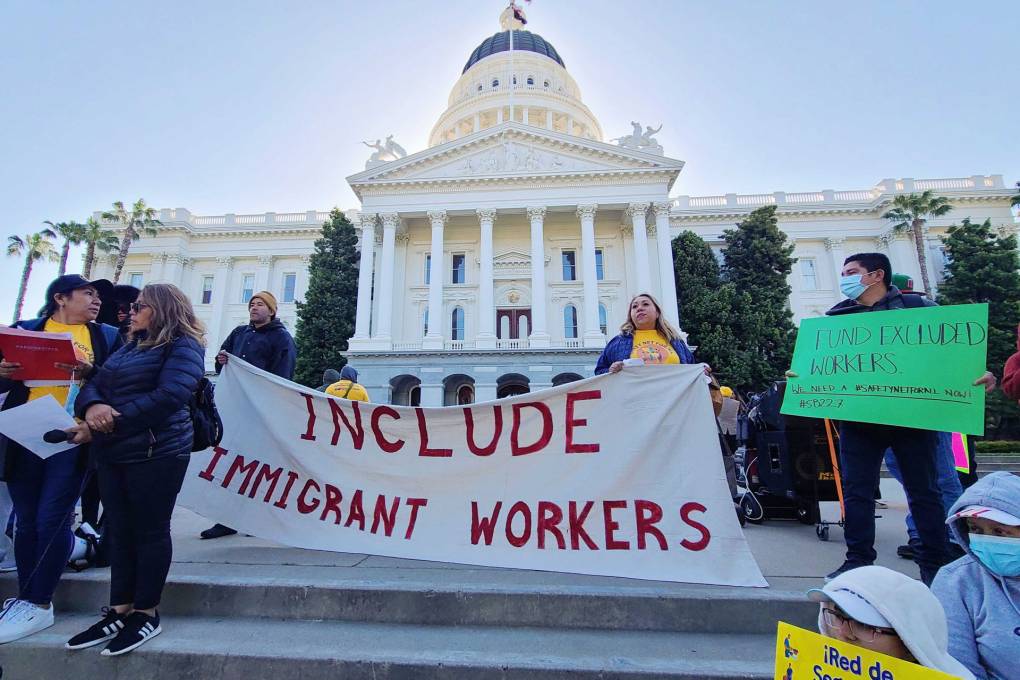
"caption": "Hundreds of people converged at the California state Capitol in support of SB 227, a bill that would offer unemployment benefits to undocumented workers, on Thursday, April 13, 2023.\n",
"description": null,
"title": "SB_227_SafetyNet",
"credit": "Carlos Cabrera-Lomelí/KQED",
"status": "inherit",
"altTag": "People hold up a sign in front of the state Capitol that reads, \"Include Immigrant Workers\"",
"isLoading": false,
"fetchFailed": false
},
"news_11946539": {
"type": "attachments",
"id": "news_11946539",
"meta": {
"index": "attachments_1716263798",
"site": "news",
"id": "11946539",
"found": true
},
"parent": 0,
"imgSizes": {
"twentyfourteen-full-width": {
"file": "https://ww2.kqed.org/app/uploads/sites/10/2023/04/RS24974_GettyImages-669539602-qut-1038x576.jpg",
"width": 1038,
"mimeType": "image/jpeg",
"height": 576
},
"thumbnail": {
"file": "https://ww2.kqed.org/app/uploads/sites/10/2023/04/RS24974_GettyImages-669539602-qut-160x104.jpg",
"width": 160,
"mimeType": "image/jpeg",
"height": 104
},
"post-thumbnail": {
"file": "https://ww2.kqed.org/app/uploads/sites/10/2023/04/RS24974_GettyImages-669539602-qut-672x372.jpg",
"width": 672,
"mimeType": "image/jpeg",
"height": 372
},
"kqedFullSize": {
"file": "https://ww2.kqed.org/app/uploads/sites/10/2023/04/RS24974_GettyImages-669539602-qut.jpg",
"width": 1920,
"height": 1253
},
"large": {
"file": "https://ww2.kqed.org/app/uploads/sites/10/2023/04/RS24974_GettyImages-669539602-qut-1020x666.jpg",
"width": 1020,
"mimeType": "image/jpeg",
"height": 666
},
"1536x1536": {
"file": "https://ww2.kqed.org/app/uploads/sites/10/2023/04/RS24974_GettyImages-669539602-qut-1536x1002.jpg",
"width": 1536,
"mimeType": "image/jpeg",
"height": 1002
},
"medium": {
"file": "https://ww2.kqed.org/app/uploads/sites/10/2023/04/RS24974_GettyImages-669539602-qut-800x522.jpg",
"width": 800,
"mimeType": "image/jpeg",
"height": 522
}
},
"publishDate": 1681341042,
"modified": 1681410599,
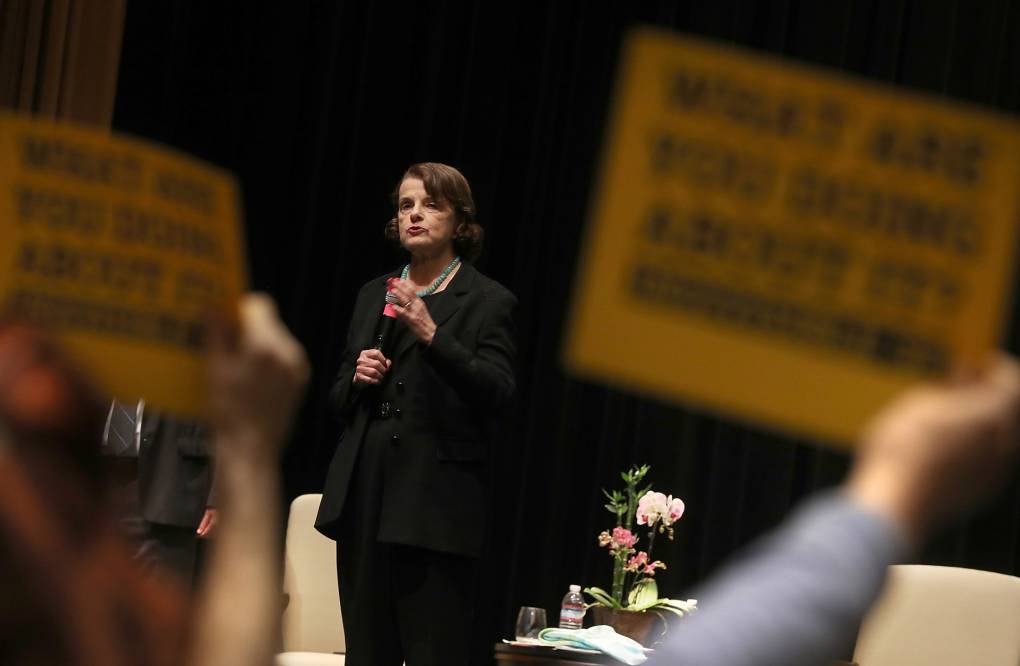
"caption": "US Sen. Dianne Feinstein (D-Calif.) speaks during a town hall-style meeting at the San Francisco Scottish Rite Masonic Center on April 17, 2017, in San Francisco. ",
"description": null,
"title": "Sen. Dianne Feinstein (D-CA) Holds Town Hall Meeting In San Francisco",
"credit": "Justin Sullivan/Getty Images",
"status": "inherit",
"altTag": "Sen. Dianne Feinstein wears a black pant suit as she speaks from a stage. In the foreground, many people's arms are seen holding black and yellow signs that are blurred.",
"isLoading": false,
"fetchFailed": false
},
"news_11946503": {
"type": "attachments",
"id": "news_11946503",
"meta": {
"index": "attachments_1716263798",
"site": "news",
"id": "11946503",
"found": true
},
"parent": 0,
"imgSizes": {
"twentyfourteen-full-width": {
"file": "https://ww2.kqed.org/app/uploads/sites/10/2023/04/RS6260_76754171-1038x576.jpg",
"width": 1038,
"mimeType": "image/jpeg",
"height": 576
},
"thumbnail": {
"file": "https://ww2.kqed.org/app/uploads/sites/10/2023/04/RS6260_76754171-160x107.jpg",
"width": 160,
"mimeType": "image/jpeg",
"height": 107
},
"post-thumbnail": {
"file": "https://ww2.kqed.org/app/uploads/sites/10/2023/04/RS6260_76754171-672x372.jpg",
"width": 672,
"mimeType": "image/jpeg",
"height": 372
},
"kqedFullSize": {
"file": "https://ww2.kqed.org/app/uploads/sites/10/2023/04/RS6260_76754171.jpg",
"width": 1920,
"height": 1280
},
"large": {
"file": "https://ww2.kqed.org/app/uploads/sites/10/2023/04/RS6260_76754171-1020x680.jpg",
"width": 1020,
"mimeType": "image/jpeg",
"height": 680
},
"1536x1536": {
"file": "https://ww2.kqed.org/app/uploads/sites/10/2023/04/RS6260_76754171-1536x1024.jpg",
"width": 1536,
"mimeType": "image/jpeg",
"height": 1024
},
"medium": {
"file": "https://ww2.kqed.org/app/uploads/sites/10/2023/04/RS6260_76754171-800x533.jpg",
"width": 800,
"mimeType": "image/jpeg",
"height": 533
}
},
"publishDate": 1681329479,
"modified": 1681329594,
"caption": "TK",
"description": null,
"title": "RS6260_76754171",
"credit": "Creatas/Getty Images",
"status": "inherit",
"altTag": "A small child's hand is raised in a classroom setting and is seen in focus. Blurred students are pictured behind the raised hand.",
"isLoading": false,
"fetchFailed": false
},
"news_11946480": {
"type": "attachments",
"id": "news_11946480",
"meta": {
"index": "attachments_1716263798",
"site": "news",
"id": "11946480",
"found": true
},
"title": "Woman paying bills using her laptop at her kitchen table",
"publishDate": 1681326684,
"status": "inherit",
"parent": 11946379,
"modified": 1681326875,
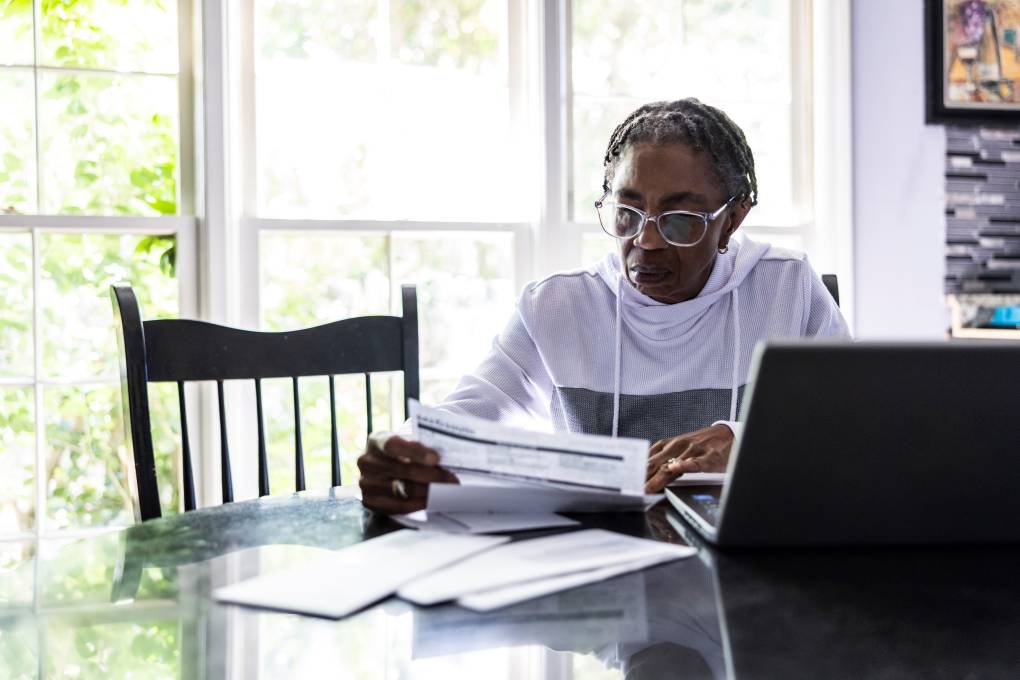
"caption": "Most Californians have received an automatic extension from the IRS to file and pay their taxes. The deadline has been extended to Oct. 16, which also includes state taxes.",
"credit": "MoMo Productions/Getty Images",
"altTag": "A woman sits at her kitchen table and sifts through documents, looking concerned. Next to her is her opened laptop.",
"description": null,
"imgSizes": {
"medium": {
"file": "https://cdn.kqed.org/wp-content/uploads/sites/10/2023/04/GettyImages-1400799758-800x534.jpg",
"width": 800,
"height": 534,
"mimeType": "image/jpeg"
},
"large": {
"file": "https://cdn.kqed.org/wp-content/uploads/sites/10/2023/04/GettyImages-1400799758-1020x680.jpg",
"width": 1020,
"height": 680,
"mimeType": "image/jpeg"
},
"thumbnail": {
"file": "https://cdn.kqed.org/wp-content/uploads/sites/10/2023/04/GettyImages-1400799758-160x107.jpg",
"width": 160,
"height": 107,
"mimeType": "image/jpeg"
},
"1536x1536": {
"file": "https://cdn.kqed.org/wp-content/uploads/sites/10/2023/04/GettyImages-1400799758-1536x1025.jpg",
"width": 1536,
"height": 1025,
"mimeType": "image/jpeg"
},
"2048x2048": {
"file": "https://cdn.kqed.org/wp-content/uploads/sites/10/2023/04/GettyImages-1400799758-2048x1366.jpg",
"width": 2048,
"height": 1366,
"mimeType": "image/jpeg"
},
"post-thumbnail": {
"file": "https://cdn.kqed.org/wp-content/uploads/sites/10/2023/04/GettyImages-1400799758-672x372.jpg",
"width": 672,
"height": 372,
"mimeType": "image/jpeg"
},
"twentyfourteen-full-width": {
"file": "https://cdn.kqed.org/wp-content/uploads/sites/10/2023/04/GettyImages-1400799758-1038x576.jpg",
"width": 1038,
"height": 576,
"mimeType": "image/jpeg"
},
"full-width": {
"file": "https://cdn.kqed.org/wp-content/uploads/sites/10/2023/04/GettyImages-1400799758-1920x1281.jpg",
"width": 1920,
"height": 1281,
"mimeType": "image/jpeg"
},
"kqedFullSize": {
"file": "https://cdn.kqed.org/wp-content/uploads/sites/10/2023/04/GettyImages-1400799758-scaled-e1779405949186.jpg",
"width": 2000,
"height": 1334
}
},
"isLoading": false,
"fetchFailed": false
},
"news_11946427": {
"type": "attachments",
"id": "news_11946427",
"meta": {
"index": "attachments_1716263798",
"site": "news",
"id": "11946427",
"found": true
},
"parent": 0,
"imgSizes": {
"twentyfourteen-full-width": {
"file": "https://ww2.kqed.org/app/uploads/sites/10/2023/04/RiverBakersfield-1038x576.jpg",
"width": 1038,
"mimeType": "image/jpeg",
"height": 576
},
"thumbnail": {
"file": "https://ww2.kqed.org/app/uploads/sites/10/2023/04/RiverBakersfield-160x107.jpg",
"width": 160,
"mimeType": "image/jpeg",
"height": 107
},
"post-thumbnail": {
"file": "https://ww2.kqed.org/app/uploads/sites/10/2023/04/RiverBakersfield-672x372.jpg",
"width": 672,
"mimeType": "image/jpeg",
"height": 372
},
"kqedFullSize": {
"file": "https://ww2.kqed.org/app/uploads/sites/10/2023/04/RiverBakersfield.jpg",
"width": 1920,
"height": 1289
},
"large": {
"file": "https://ww2.kqed.org/app/uploads/sites/10/2023/04/RiverBakersfield-1020x685.jpg",
"width": 1020,
"mimeType": "image/jpeg",
"height": 685
},
"1536x1536": {
"file": "https://ww2.kqed.org/app/uploads/sites/10/2023/04/RiverBakersfield-1536x1031.jpg",
"width": 1536,
"mimeType": "image/jpeg",
"height": 1031
},
"medium": {
"file": "https://ww2.kqed.org/app/uploads/sites/10/2023/04/RiverBakersfield-800x537.jpg",
"width": 800,
"mimeType": "image/jpeg",
"height": 537
}
},
"publishDate": 1681258887,
"modified": 1681326794,
"caption": "Irrigation water flows through an almond grove on May 8, 2008, near Bakersfield. Much of California's water supply comes from the Colorado River.",
"description": null,
"title": "California Agriculture Faces Challenges As Drought Continues",
"credit": "David McNew/Getty Images",
"status": "inherit",
"altTag": "A mass of water feed an almond grove in the countryside.",
"isLoading": false,
"fetchFailed": false
},
"news_11946283": {
"type": "attachments",
"id": "news_11946283",
"meta": {
"index": "attachments_1716263798",
"site": "news",
"id": "11946283",
"found": true
},
"parent": 0,
"imgSizes": {
"twentyfourteen-full-width": {
"file": "https://ww2.kqed.org/app/uploads/sites/10/2023/04/GettyImages-1241524154-1038x576.jpg",
"width": 1038,
"mimeType": "image/jpeg",
"height": 576
},
"thumbnail": {
"file": "https://ww2.kqed.org/app/uploads/sites/10/2023/04/GettyImages-1241524154-160x107.jpg",
"width": 160,
"mimeType": "image/jpeg",
"height": 107
},
"post-thumbnail": {
"file": "https://ww2.kqed.org/app/uploads/sites/10/2023/04/GettyImages-1241524154-672x372.jpg",
"width": 672,
"mimeType": "image/jpeg",
"height": 372
},
"kqedFullSize": {
"file": "https://ww2.kqed.org/app/uploads/sites/10/2023/04/GettyImages-1241524154-scaled.jpg",
"width": 2560,
"height": 1706
},
"2048x2048": {
"file": "https://ww2.kqed.org/app/uploads/sites/10/2023/04/GettyImages-1241524154-2048x1365.jpg",
"width": 2048,
"mimeType": "image/jpeg",
"height": 1365
},
"large": {
"file": "https://ww2.kqed.org/app/uploads/sites/10/2023/04/GettyImages-1241524154-1020x680.jpg",
"width": 1020,
"mimeType": "image/jpeg",
"height": 680
},
"1536x1536": {
"file": "https://ww2.kqed.org/app/uploads/sites/10/2023/04/GettyImages-1241524154-1536x1024.jpg",
"width": 1536,
"mimeType": "image/jpeg",
"height": 1024
},
"full-width": {
"file": "https://ww2.kqed.org/app/uploads/sites/10/2023/04/GettyImages-1241524154-1920x1280.jpg",
"width": 1920,
"mimeType": "image/jpeg",
"height": 1280
},
"medium": {
"file": "https://ww2.kqed.org/app/uploads/sites/10/2023/04/GettyImages-1241524154-800x533.jpg",
"width": 800,
"mimeType": "image/jpeg",
"height": 533
}
},
"publishDate": 1681166664,
"modified": 1681176463,
"caption": "On Friday, April 7, 2023, US District Judge Matthew J. Kacsmaryk ordered a hold on federal approval of the abortion medication mifepristone, which has been widely available for more than 20 years. Kacsmaryk's decision was quickly followed by US District Judge Thomas O. Rice essentially ordering the opposite and directing authorities not to make any changes that would restrict access to the drug.",
"description": null,
"title": "US-ABORTION-TEXAS-NEWMEXICO-CLINIC",
"credit": "Robyn Beck/AFP via Getty Images",
"status": "inherit",
"altTag": "A white pill bottle with a label that reads, \"misoprostol tablets 200 mcg\" lies on a wooden surface. To the right, three identical orange medicine boxes read, \"Mifeprez (Mifepristone) Tablets, 200 mg.\"",
"isLoading": false,
"fetchFailed": false
},
"news_11946233": {
"type": "attachments",
"id": "news_11946233",
"meta": {
"index": "attachments_1716263798",
"site": "news",
"id": "11946233",
"found": true
},
"parent": 11970292,
"imgSizes": {
"twentyfourteen-full-width": {
"file": "https://cdn.kqed.org/wp-content/uploads/sites/10/2023/04/029_KQED_WoodStreetCommonsEviction_04102023-1038x576.jpg",
"width": 1038,
"mimeType": "image/jpeg",
"height": 576
},
"thumbnail": {
"file": "https://cdn.kqed.org/wp-content/uploads/sites/10/2023/04/029_KQED_WoodStreetCommonsEviction_04102023-160x107.jpg",
"width": 160,
"mimeType": "image/jpeg",
"height": 107
},
"post-thumbnail": {
"file": "https://cdn.kqed.org/wp-content/uploads/sites/10/2023/04/029_KQED_WoodStreetCommonsEviction_04102023-672x372.jpg",
"width": 672,
"mimeType": "image/jpeg",
"height": 372
},
"kqedFullSize": {
"file": "https://cdn.kqed.org/wp-content/uploads/sites/10/2023/04/029_KQED_WoodStreetCommonsEviction_04102023.jpg",
"width": 1920,
"height": 1280
},
"large": {
"file": "https://cdn.kqed.org/wp-content/uploads/sites/10/2023/04/029_KQED_WoodStreetCommonsEviction_04102023-1020x680.jpg",
"width": 1020,
"mimeType": "image/jpeg",
"height": 680
},
"1536x1536": {
"file": "https://cdn.kqed.org/wp-content/uploads/sites/10/2023/04/029_KQED_WoodStreetCommonsEviction_04102023-1536x1024.jpg",
"width": 1536,
"mimeType": "image/jpeg",
"height": 1024
},
"medium": {
"file": "https://cdn.kqed.org/wp-content/uploads/sites/10/2023/04/029_KQED_WoodStreetCommonsEviction_04102023-800x533.jpg",
"width": 800,
"mimeType": "image/jpeg",
"height": 533
}
},
"publishDate": 1681156545,
"modified": 1702927311,
"caption": "Wood Street resident Mayana Sparks cries while watching the city of Oakland begin to evict the encampment in West Oakland on April 10, 2023.",
"description": null,
"title": "029_KQED_WoodStreetCommonsEviction_04102023",
"credit": "Beth LaBerge/KQED",
"status": "inherit",
"altTag": "A woman with short, black hair and a purple bandana tied around her forehead looks distraught as tears stream down her cheeks. A crowd of blurred faces are in the background.",
"isLoading": false,
"fetchFailed": false
},
"news_11946008": {
"type": "attachments",
"id": "news_11946008",
"meta": {
"index": "attachments_1716263798",
"site": "news",
"id": "11946008",
"found": true
},
"parent": 0,
"imgSizes": {
"twentyfourteen-full-width": {
"file": "https://ww2.kqed.org/app/uploads/sites/10/2023/04/CMFosterYouth02-1038x576.jpg",
"width": 1038,
"mimeType": "image/jpeg",
"height": 576
},
"thumbnail": {
"file": "https://ww2.kqed.org/app/uploads/sites/10/2023/04/CMFosterYouth02-160x107.jpg",
"width": 160,
"mimeType": "image/jpeg",
"height": 107
},
"post-thumbnail": {
"file": "https://ww2.kqed.org/app/uploads/sites/10/2023/04/CMFosterYouth02-672x372.jpg",
"width": 672,
"mimeType": "image/jpeg",
"height": 372
},
"kqedFullSize": {
"file": "https://ww2.kqed.org/app/uploads/sites/10/2023/04/CMFosterYouth02.jpg",
"width": 2000,
"height": 1333
},
"large": {
"file": "https://ww2.kqed.org/app/uploads/sites/10/2023/04/CMFosterYouth02-1020x680.jpg",
"width": 1020,
"mimeType": "image/jpeg",
"height": 680
},
"1536x1536": {
"file": "https://ww2.kqed.org/app/uploads/sites/10/2023/04/CMFosterYouth02-1536x1024.jpg",
"width": 1536,
"mimeType": "image/jpeg",
"height": 1024
},
"full-width": {
"file": "https://ww2.kqed.org/app/uploads/sites/10/2023/04/CMFosterYouth02-1920x1280.jpg",
"width": 1920,
"mimeType": "image/jpeg",
"height": 1280
},
"medium": {
"file": "https://ww2.kqed.org/app/uploads/sites/10/2023/04/CMFosterYouth02-800x533.jpg",
"width": 800,
"mimeType": "image/jpeg",
"height": 533
}
},
"publishDate": 1680899512,
"modified": 1680911060,
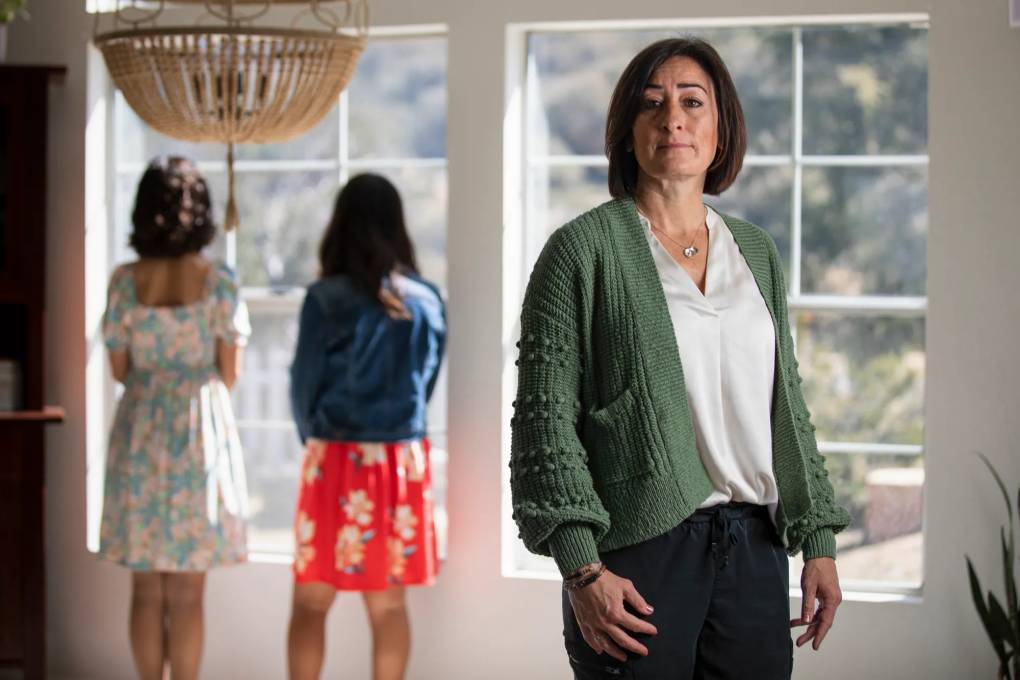
"caption": "Amy and her adopted children inside their home in Pine Valley on April 1, 2023.",
"description": null,
"title": "CMFosterYouth02",
"credit": "Kristian Carreon/CalMatters",
"status": "inherit",
"altTag": "Inside a home: A woman with a green, knitted cardigan, white blouse and black pants stands in the foreground with a serious expression. She has short, brown hair and her arms rest at her sides. In the background, two girls in floral dresses stand with their backs to the camera as they look out the window into the sunshine.",
"isLoading": false,
"fetchFailed": false
},
"news_11946022": {
"type": "attachments",
"id": "news_11946022",
"meta": {
"index": "attachments_1716263798",
"site": "news",
"id": "11946022",
"found": true
},
"parent": 11946015,
"imgSizes": {
"thumbnail": {
"file": "https://ww2.kqed.org/app/uploads/sites/10/2023/04/thumb47-160x90.png",
"width": 160,
"mimeType": "image/png",
"height": 90
},
"kqedFullSize": {
"file": "https://ww2.kqed.org/app/uploads/sites/10/2023/04/thumb47.png",
"width": 512,
"height": 288
}
},
"publishDate": 1680902094,
"modified": 1680902094,
"caption": null,
"description": null,
"title": "thumb47",
"credit": null,
"status": "inherit",
"altTag": null,
"isLoading": false,
"fetchFailed": false
},
"news_11945733": {
"type": "attachments",
"id": "news_11945733",
"meta": {
"index": "attachments_1716263798",
"site": "news",
"id": "11945733",
"found": true
},
"title": "RS63347_042_KQED_CAReparationsTaskForceSac_03032023-qut",
"publishDate": 1680651288,
"status": "inherit",
"parent": 12046328,
"modified": 1751064734,
"caption": "A sign says, \"Reparations Now 2023,\" at a California Reparations Task Force meeting in Sacramento on March 3, 2023.",
"credit": "Beth LaBerge/KQED",
"altTag": "A white sign with black lettering reads \"Reparations Now 2023\" at a California Reparations Task Force meeting in Sacramento, the state's capital.",
"description": null,
"imgSizes": {
"medium": {
"file": "https://cdn.kqed.org/wp-content/uploads/sites/10/2023/04/RS63347_042_KQED_CAReparationsTaskForceSac_03032023-qut-800x533.jpg",
"width": 800,
"height": 533,
"mimeType": "image/jpeg"
},
"large": {
"file": "https://cdn.kqed.org/wp-content/uploads/sites/10/2023/04/RS63347_042_KQED_CAReparationsTaskForceSac_03032023-qut-1020x680.jpg",
"width": 1020,
"height": 680,
"mimeType": "image/jpeg"
},
"thumbnail": {
"file": "https://cdn.kqed.org/wp-content/uploads/sites/10/2023/04/RS63347_042_KQED_CAReparationsTaskForceSac_03032023-qut-160x107.jpg",
"width": 160,
"height": 107,
"mimeType": "image/jpeg"
},
"1536x1536": {
"file": "https://cdn.kqed.org/wp-content/uploads/sites/10/2023/04/RS63347_042_KQED_CAReparationsTaskForceSac_03032023-qut-1536x1024.jpg",
"width": 1536,
"height": 1024,
"mimeType": "image/jpeg"
},
"post-thumbnail": {
"file": "https://cdn.kqed.org/wp-content/uploads/sites/10/2023/04/RS63347_042_KQED_CAReparationsTaskForceSac_03032023-qut-672x372.jpg",
"width": 672,
"height": 372,
"mimeType": "image/jpeg"
},
"twentyfourteen-full-width": {
"file": "https://cdn.kqed.org/wp-content/uploads/sites/10/2023/04/RS63347_042_KQED_CAReparationsTaskForceSac_03032023-qut-1038x576.jpg",
"width": 1038,
"height": 576,
"mimeType": "image/jpeg"
},
"kqedFullSize": {
"file": "https://cdn.kqed.org/wp-content/uploads/sites/10/2023/04/RS63347_042_KQED_CAReparationsTaskForceSac_03032023-qut.jpg",
"width": 1920,
"height": 1280
}
},
"isLoading": false,
"fetchFailed": false
},
"news_11945749": {
"type": "attachments",
"id": "news_11945749",
"meta": {
"index": "attachments_1716263798",
"site": "news",
"id": "11945749",
"found": true
},
"parent": 0,
"imgSizes": {
"twentyfourteen-full-width": {
"file": "https://ww2.kqed.org/app/uploads/sites/10/2023/04/013_KQED_MarshalRothmanFairfax_03272023-1038x576.jpg",
"width": 1038,
"mimeType": "image/jpeg",
"height": 576
},
"thumbnail": {
"file": "https://ww2.kqed.org/app/uploads/sites/10/2023/04/013_KQED_MarshalRothmanFairfax_03272023-160x107.jpg",
"width": 160,
"mimeType": "image/jpeg",
"height": 107
},
"post-thumbnail": {
"file": "https://ww2.kqed.org/app/uploads/sites/10/2023/04/013_KQED_MarshalRothmanFairfax_03272023-672x372.jpg",
"width": 672,
"mimeType": "image/jpeg",
"height": 372
},
"kqedFullSize": {
"file": "https://ww2.kqed.org/app/uploads/sites/10/2023/04/013_KQED_MarshalRothmanFairfax_03272023.jpg",
"width": 1920,
"height": 1280
},
"large": {
"file": "https://ww2.kqed.org/app/uploads/sites/10/2023/04/013_KQED_MarshalRothmanFairfax_03272023-1020x680.jpg",
"width": 1020,
"mimeType": "image/jpeg",
"height": 680
},
"1536x1536": {
"file": "https://ww2.kqed.org/app/uploads/sites/10/2023/04/013_KQED_MarshalRothmanFairfax_03272023-1536x1024.jpg",
"width": 1536,
"mimeType": "image/jpeg",
"height": 1024
},
"medium": {
"file": "https://ww2.kqed.org/app/uploads/sites/10/2023/04/013_KQED_MarshalRothmanFairfax_03272023-800x533.jpg",
"width": 800,
"mimeType": "image/jpeg",
"height": 533
}
},
"publishDate": 1680720505,
"modified": 1680722206,
"caption": "Contractor Marshal Rothman stands on the property he owns in Fairfax on March 27, 2023. He has owned the property for the last decade, hoping to turn it into housing.",
"description": null,
"title": "013_KQED_MarshalRothmanFairfax_03272023",
"credit": "Beth LaBerge/KQED",
"status": "inherit",
"altTag": "A man with gray hair and a black jacket and T-shirt looks off into the distance on land that's covered in green trees with blue skies in the background.",
"isLoading": false,
"fetchFailed": false
},
"news_11944056": {
"type": "attachments",
"id": "news_11944056",
"meta": {
"index": "attachments_1716263798",
"site": "news",
"id": "11944056",
"found": true
},
"parent": 11944055,
"imgSizes": {
"twentyfourteen-full-width": {
"file": "https://ww2.kqed.org/app/uploads/sites/10/2023/03/image-of-family-of-four-walking-on-sidewalk-1020x576.jpg",
"width": 1020,
"mimeType": "image/jpeg",
"height": 576
},
"thumbnail": {
"file": "https://ww2.kqed.org/app/uploads/sites/10/2023/03/image-of-family-of-four-walking-on-sidewalk-160x107.jpg",
"width": 160,
"mimeType": "image/jpeg",
"height": 107
},
"post-thumbnail": {
"file": "https://ww2.kqed.org/app/uploads/sites/10/2023/03/image-of-family-of-four-walking-on-sidewalk-672x372.jpg",
"width": 672,
"mimeType": "image/jpeg",
"height": 372
},
"kqedFullSize": {
"file": "https://ww2.kqed.org/app/uploads/sites/10/2023/03/image-of-family-of-four-walking-on-sidewalk.jpg",
"width": 1020,
"height": 681
},
"medium": {
"file": "https://ww2.kqed.org/app/uploads/sites/10/2023/03/image-of-family-of-four-walking-on-sidewalk-800x534.jpg",
"width": 800,
"mimeType": "image/jpeg",
"height": 534
}
},
"publishDate": 1679192710,
"modified": 1679195021,
"caption": "Si ha estado reclamando el crédito tributario por hijos, su reembolso se verá afectado en 2023.",
"description": null,
"title": "image of family of four walking on sidewalk",
"credit": "Emma Bauso/Pexels",
"status": "inherit",
"altTag": null,
"isLoading": false,
"fetchFailed": false
}
},
"audioPlayerReducer": {
"postId": "stream_live",
"isPaused": true,
"isPlaying": false,
"pfsActive": false,
"pledgeModalIsOpen": true,
"playerDrawerIsOpen": false,
"liveAudioPlayStartedAt": 0,
"liveAudioPlayContext": ""
},
"authorsReducer": {
"byline_news_11946471": {
"type": "authors",
"id": "byline_news_11946471",
"meta": {
"override": true
},
"slug": "byline_news_11946471",
"name": "\u003ca href=\"https://twitter.com/sophieadanna\">Sophie Austin\u003c/a>\u003cbr> The Associated Press",
"isLoading": false
},
"byline_news_11946410": {
"type": "authors",
"id": "byline_news_11946410",
"meta": {
"override": true
},
"slug": "byline_news_11946410",
"name": "\u003ca href=\"https://calmatters.org/author/alastair-bland/\">Alastair Bland\u003c/a>",
"isLoading": false
},
"byline_news_11946193": {
"type": "authors",
"id": "byline_news_11946193",
"meta": {
"override": true
},
"slug": "byline_news_11946193",
"name": "\u003ca href=\"https://calmatters.org/author/kristen-hwang/\">Kristen Hwang\u003c/a>",
"isLoading": false
},
"byline_news_11945997": {
"type": "authors",
"id": "byline_news_11945997",
"meta": {
"override": true
},
"slug": "byline_news_11945997",
"name": "\u003ca href=\"https://calmatters.org/author/jeanne-kuang/\">Jeanne Kuang\u003c/a>",
"isLoading": false
},
"scottshafer": {
"type": "authors",
"id": "255",
"meta": {
"index": "authors_1716337520",
"id": "255",
"found": true
},
"name": "Scott Shafer",
"firstName": "Scott",
"lastName": "Shafer",
"slug": "scottshafer",
"email": "sshafer@kqed.org",
"display_author_email": false,
"staff_mastheads": [
"news"
],
"title": "KQED Contributor",
"bio": "Scott Shafer is a senior editor with the KQED Politics and Government desk. He is co-host of Political Breakdown, the award-winning radio show and podcast with a personal take on the world of politics. Scott came to KQED in 1998 to host the statewide\u003cem> California Report\u003c/em>. Prior to that he had extended stints in politics and government\u003cem>.\u003c/em> He uses that inside experience at KQED in his, reporting, hosting and analysis for the politics desk. Scott collaborated \u003cem>Political Breakdown a\u003c/em>nd on \u003cem>The Political Mind of Jerry Brown, \u003c/em>an eight-part series about the life and extraordinary political career of the former governor. For fun, he plays water polo with the San Francisco Tsunami.",
"avatar": "https://secure.gravatar.com/avatar/a62ebae45b79d7aed1a39a0e3bf68104?s=600&d=blank&r=g",
"twitter": "scottshafer",
"bluesky": null,
"facebook": null,
"instagram": null,
"linkedin": null,
"sites": [
{
"site": "news",
"roles": [
"editor"
]
},
{
"site": "stateofhealth",
"roles": [
"author"
]
},
{
"site": "science",
"roles": [
"author"
]
},
{
"site": "forum",
"roles": [
"subscriber"
]
},
{
"site": "liveblog",
"roles": [
"author"
]
}
],
"headData": {
"title": "Scott Shafer | KQED",
"description": "KQED Contributor",
"ogImgSrc": "https://secure.gravatar.com/avatar/a62ebae45b79d7aed1a39a0e3bf68104?s=600&d=blank&r=g",
"twImgSrc": "https://secure.gravatar.com/avatar/a62ebae45b79d7aed1a39a0e3bf68104?s=600&d=blank&r=g"
},
"isLoading": false,
"link": "/author/scottshafer"
},
"carlysevern": {
"type": "authors",
"id": "3243",
"meta": {
"index": "authors_1716337520",
"id": "3243",
"found": true
},
"name": "Carly Severn",
"firstName": "Carly",
"lastName": "Severn",
"slug": "carlysevern",
"email": "csevern@kqed.org",
"display_author_email": false,
"staff_mastheads": [
"news"
],
"title": "Senior Editor, Audience News ",
"bio": "Carly is KQED's Senior Editor of Audience News on the Digital News team, and has reported for the California Report Magazine, Bay Curious and KQED Arts. She's formerly the host of \u003ca href=\"http://ww2.kqed.org/pop/category/the-cooler/\" rel=\"noopener noreferrer\">The Cooler\u003c/a> podcast.",
"avatar": "https://secure.gravatar.com/avatar/2d8d6765f186e64c798cf7f0c8088a41?s=600&d=blank&r=g",
"twitter": "teacupinthebay",
"facebook": null,
"instagram": null,
"linkedin": null,
"sites": [
{
"site": "",
"roles": [
"editor"
]
},
{
"site": "arts",
"roles": [
"editor"
]
},
{
"site": "news",
"roles": [
"administrator"
]
},
{
"site": "pop",
"roles": [
"editor"
]
},
{
"site": "futureofyou",
"roles": [
"editor"
]
},
{
"site": "about",
"roles": [
"administrator"
]
},
{
"site": "mindshift",
"roles": [
"editor"
]
},
{
"site": "bayareabites",
"roles": [
"editor"
]
},
{
"site": "stateofhealth",
"roles": [
"editor"
]
},
{
"site": "science",
"roles": [
"editor"
]
},
{
"site": "food",
"roles": [
"contributor"
]
},
{
"site": "forum",
"roles": [
"editor"
]
},
{
"site": "perspectives",
"roles": [
"administrator"
]
},
{
"site": "liveblog",
"roles": [
"editor"
]
}
],
"headData": {
"title": "Carly Severn | KQED",
"description": "Senior Editor, Audience News ",
"ogImgSrc": "https://secure.gravatar.com/avatar/2d8d6765f186e64c798cf7f0c8088a41?s=600&d=blank&r=g",
"twImgSrc": "https://secure.gravatar.com/avatar/2d8d6765f186e64c798cf7f0c8088a41?s=600&d=blank&r=g"
},
"isLoading": false,
"link": "/author/carlysevern"
},
"fjhabvala": {
"type": "authors",
"id": "8659",
"meta": {
"index": "authors_1716337520",
"id": "8659",
"found": true
},
"name": "Farida Jhabvala Romero",
"firstName": "Farida",
"lastName": "Jhabvala Romero",
"slug": "fjhabvala",
"email": "fjhabvala@kqed.org",
"display_author_email": true,
"staff_mastheads": [
"news"
],
"title": "KQED Contributor",
"bio": "Farida Jhabvala Romero is a Labor Correspondent for KQED. She previously covered immigration. Farida was \u003ca href=\"https://www.ccnma.org/2022-most-influential-latina-journalists\">named\u003c/a> one of the 10 Most Influential Latina Journalists in California in 2022 by the California Chicano News Media Association. Her work has won awards from the Society of Professional Journalists (Northern California), as well as a national and regional Edward M. Murrow Award for the collaborative reporting projects “Dangerous Air” and “Graying California.” Before joining KQED, Farida worked as a producer at Radio Bilingüe, a national public radio network. Farida earned her master’s degree in journalism from Stanford University.",
"avatar": "https://secure.gravatar.com/avatar/f9f022d4e2609741874222a1e9d41f48fea74011aa7c615eef91d9a50c944ebe?s=600&d=blank&r=g",
"twitter": "FaridaJhabvala",
"bluesky": null,
"facebook": null,
"instagram": null,
"linkedin": "https://www.linkedin.com/in/faridajhabvala/",
"sites": [
{
"site": "news",
"roles": [
"editor"
]
},
{
"site": "stateofhealth",
"roles": [
"author"
]
},
{
"site": "liveblog",
"roles": [
"author"
]
}
],
"headData": {
"title": "Farida Jhabvala Romero | KQED",
"description": "KQED Contributor",
"ogImgSrc": "https://secure.gravatar.com/avatar/f9f022d4e2609741874222a1e9d41f48fea74011aa7c615eef91d9a50c944ebe?s=600&d=blank&r=g",
"twImgSrc": "https://secure.gravatar.com/avatar/f9f022d4e2609741874222a1e9d41f48fea74011aa7c615eef91d9a50c944ebe?s=600&d=blank&r=g"
},
"isLoading": false,
"link": "/author/fjhabvala"
},
"lsarah": {
"type": "authors",
"id": "11626",
"meta": {
"index": "authors_1716337520",
"id": "11626",
"found": true
},
"name": "Lakshmi Sarah",
"firstName": "Lakshmi",
"lastName": "Sarah",
"slug": "lsarah",
"email": "lsarah@kqed.org",
"display_author_email": false,
"staff_mastheads": [],
"title": "Digital Producer",
"bio": "Lakshmi Sarah is an educator, author and journalist with a focus on innovative storytelling. She has worked with newspapers, radio and magazines from Ahmedabad, India to Los Angeles, California. She has written and produced for Die Zeit, Global Voices, AJ+, KQED, Fusion Media Group and the New York Times.",
"avatar": "https://secure.gravatar.com/avatar/652dcaecd8b28826fc17a8b2d6bb4e93?s=600&d=blank&r=g",
"twitter": "lakitalki",
"facebook": null,
"instagram": "https://www.instagram.com/laki.talki/",
"linkedin": "https://www.linkedin.com/in/lakisarah/",
"sites": [
{
"site": "arts",
"roles": []
},
{
"site": "news",
"roles": []
},
{
"site": "bayareabites",
"roles": []
},
{
"site": "science",
"roles": []
}
],
"headData": {
"title": "Lakshmi Sarah | KQED",
"description": "Digital Producer",
"ogImgSrc": "https://secure.gravatar.com/avatar/652dcaecd8b28826fc17a8b2d6bb4e93?s=600&d=blank&r=g",
"twImgSrc": "https://secure.gravatar.com/avatar/652dcaecd8b28826fc17a8b2d6bb4e93?s=600&d=blank&r=g"
},
"isLoading": false,
"link": "/author/lsarah"
},
"ebaldassari": {
"type": "authors",
"id": "11652",
"meta": {
"index": "authors_1716337520",
"id": "11652",
"found": true
},
"name": "Erin Baldassari",
"firstName": "Erin",
"lastName": "Baldassari",
"slug": "ebaldassari",
"email": "ebaldassari@KQED.org",
"display_author_email": true,
"staff_mastheads": [
"news"
],
"title": "Staff Writer",
"bio": "Erin Baldassari covers housing for KQED. She's a former print journalist and most recently worked as the transportation reporter for the \u003cem>Mercury News\u003c/em> and \u003cem>East Bay Times. \u003c/em>There, she focused on how the Bay Area’s housing shortage has changed the way people move around the region. She also served on the \u003cem>East Bay Times\u003c/em>’ 2017 Pulitzer Prize-winning team for coverage of the Ghost Ship Fire in Oakland. Prior to that, Erin worked as a breaking news and general assignment reporter for a variety of outlets in the Bay Area and the greater Boston area. A Tufts University alumna, Erin grew up in the foothills of the Sierra Nevada mountains and in Sonoma County. She is a life-long KQED listener.",
"avatar": "https://secure.gravatar.com/avatar/660ce35d088ca54ad606d7e941abc652?s=600&d=mm&r=g",
"twitter": "e_baldi",
"facebook": null,
"instagram": null,
"linkedin": null,
"sites": [
{
"site": "news",
"roles": [
"edit_others_posts",
"editor"
]
},
{
"site": "science",
"roles": [
"editor"
]
},
{
"site": "liveblog",
"roles": [
"editor"
]
}
],
"headData": {
"title": "Erin Baldassari | KQED",
"description": "Staff Writer",
"ogImgSrc": "https://secure.gravatar.com/avatar/660ce35d088ca54ad606d7e941abc652?s=600&d=mm&r=g",
"twImgSrc": "https://secure.gravatar.com/avatar/660ce35d088ca54ad606d7e941abc652?s=600&d=mm&r=g"
},
"isLoading": false,
"link": "/author/ebaldassari"
},
"abandlamudi": {
"type": "authors",
"id": "11672",
"meta": {
"index": "authors_1716337520",
"id": "11672",
"found": true
},
"name": "Adhiti Bandlamudi",
"firstName": "Adhiti",
"lastName": "Bandlamudi",
"slug": "abandlamudi",
"email": "abandlamudi@kqed.org",
"display_author_email": false,
"staff_mastheads": [
"news"
],
"title": "KQED Housing Reporter",
"bio": "Adhiti Bandlamudi reports for KQED's Housing desk. She focuses on how housing gets built across the Bay Area. Before joining KQED in 2020, she reported for WUNC in Durham, North Carolina, WABE in Atlanta, Georgia and Capital Public Radio in Sacramento. In 2017, she was awarded a Kroc Fellowship at NPR where she reported on everything from sprinkles to the Golden State Killer's arrest. When she's not reporting, she's baking new recipes in her kitchen or watching movies with friends and family. She's originally from Georgia and has strong opinions about Great British Bake Off.",
"avatar": "https://secure.gravatar.com/avatar/868129c8b257bb99a3500e2c86a65400?s=600&d=mm&r=g",
"twitter": "oddity_adhiti",
"facebook": null,
"instagram": null,
"linkedin": null,
"sites": [
{
"site": "arts",
"roles": [
"author"
]
},
{
"site": "news",
"roles": [
"editor"
]
},
{
"site": "liveblog",
"roles": [
"author"
]
}
],
"headData": {
"title": "Adhiti Bandlamudi | KQED",
"description": "KQED Housing Reporter",
"ogImgSrc": "https://secure.gravatar.com/avatar/868129c8b257bb99a3500e2c86a65400?s=600&d=mm&r=g",
"twImgSrc": "https://secure.gravatar.com/avatar/868129c8b257bb99a3500e2c86a65400?s=600&d=mm&r=g"
},
"isLoading": false,
"link": "/author/abandlamudi"
},
"ccabreralomeli": {
"type": "authors",
"id": "11708",
"meta": {
"index": "authors_1716337520",
"id": "11708",
"found": true
},
"name": "Carlos Cabrera-Lomelí",
"firstName": "Carlos",
"lastName": "Cabrera-Lomelí",
"slug": "ccabreralomeli",
"email": "ccabreralomeli@KQED.org",
"display_author_email": true,
"staff_mastheads": [
"news"
],
"title": "Community Reporter",
"bio": "Carlos Cabrera-Lomelí is a community reporter with KQED's digital engagement team. He also reports and co-produces for KQED's bilingual news hub KQED en Español. He grew up in San Francisco's Mission District and has previously worked with Univision, 48 Hills and REFORMA in Mexico City.",
"avatar": "https://secure.gravatar.com/avatar/c309be9665e484f887b818c89e273ecc673004f426f36b24d00a4d813a2e0518?s=600&d=blank&r=g",
"twitter": "@LomeliCabrera",
"bluesky": null,
"facebook": null,
"instagram": null,
"linkedin": null,
"sites": [
{
"site": "arts",
"roles": [
"editor"
]
},
{
"site": "news",
"roles": [
"editor"
]
},
{
"site": "about",
"roles": [
"editor"
]
},
{
"site": "science",
"roles": [
"editor"
]
},
{
"site": "perspectives",
"roles": [
"editor"
]
},
{
"site": "elections",
"roles": [
"editor"
]
},
{
"site": "liveblog",
"roles": [
"contributor"
]
}
],
"headData": {
"title": "Carlos Cabrera-Lomelí | KQED",
"description": "Community Reporter",
"ogImgSrc": "https://secure.gravatar.com/avatar/c309be9665e484f887b818c89e273ecc673004f426f36b24d00a4d813a2e0518?s=600&d=blank&r=g",
"twImgSrc": "https://secure.gravatar.com/avatar/c309be9665e484f887b818c89e273ecc673004f426f36b24d00a4d813a2e0518?s=600&d=blank&r=g"
},
"isLoading": false,
"link": "/author/ccabreralomeli"
},
"gsalomone": {
"type": "authors",
"id": "11843",
"meta": {
"index": "authors_1716337520",
"id": "11843",
"found": true
},
"name": "Giuliana Salomone",
"firstName": "Giuliana",
"lastName": "Salomone",
"slug": "gsalomone",
"email": "gsalomone@kqed.org",
"display_author_email": false,
"staff_mastheads": [],
"title": "Giuliana Salomone",
"bio": null,
"avatar": "https://secure.gravatar.com/avatar/e6b25c1a2333c2bf9593da460906986f?s=600&d=blank&r=g",
"twitter": null,
"facebook": null,
"instagram": null,
"linkedin": null,
"sites": [
{
"site": "news",
"roles": [
"author"
]
}
],
"headData": {
"title": "Giuliana Salomone | KQED",
"description": "Giuliana Salomone",
"ogImgSrc": "https://secure.gravatar.com/avatar/e6b25c1a2333c2bf9593da460906986f?s=600&d=blank&r=g",
"twImgSrc": "https://secure.gravatar.com/avatar/e6b25c1a2333c2bf9593da460906986f?s=600&d=blank&r=g"
},
"isLoading": false,
"link": "/author/gsalomone"
}
},
"pagesReducer": {
"news_tag_california": {
"type": "terms",
"id": "news_18538",
"meta": {
"index": "terms_1716263798",
"site": "news",
"id": "18538",
"score": 6.8457103
},
"featImg": null,
"name": "California",
"description": null,
"taxonomy": "tag",
"headData": {
"twImgId": null,
"twTitle": null,
"ogTitle": null,
"ogImgId": null,
"twDescription": null,
"description": null,
"title": "California Archives | KQED News",
"ogDescription": null
},
"ttid": 31,
"slug": "california",
"isLoading": false,
"title": "California",
"pageMeta": {
"site": "news",
"WpPageTemplate": "page-topic-editorial",
"currentPage": 157
},
"blocks": [
{
"blockName": "kqed/post-list",
"attrs": {
"layout": "cardArticle2",
"query": "posts/news?tag=california",
"seeMore": false,
"paginated": true,
"page": 157
}
},
{
"blockName": "kqed/ad"
}
]
}
},
"pfsSessionReducer": {},
"postsReducer": {
"stream_live": {
"type": "live",
"id": "stream_live",
"audioUrl": "https://streams.kqed.org/kqedradio",
"title": "Live Stream",
"excerpt": "Live Stream information currently unavailable.",
"link": "/radio",
"featImg": "",
"label": {
"name": "KQED Live",
"link": "/"
}
},
"stream_kqedNewscast": {
"type": "posts",
"id": "stream_kqedNewscast",
"audioUrl": "https://www.kqed.org/.stream/anon/radio/RDnews/newscast.mp3?_=1",
"title": "KQED Newscast",
"featImg": "",
"label": {
"name": "88.5 FM",
"link": "/"
}
},
"news_11946661": {
"type": "posts",
"id": "news_11946661",
"meta": {
"index": "posts_1716263798",
"site": "news",
"id": "11946661",
"score": null,
"sort": [
1681435825000
]
},
"guestAuthors": [],
"slug": "ive-been-contributing-undocumented-workers-are-key-to-californias-economy-a-new-bill-would-give-them-unemployment-benefits",
"title": "'I've Been Contributing': Undocumented Workers Are Key to California's Economy. A New Bill Would Give Them Unemployment Benefits",
"publishDate": 1681435825,
"format": "standard",
"headTitle": "‘I’ve Been Contributing’: Undocumented Workers Are Key to California’s Economy. A New Bill Would Give Them Unemployment Benefits | KQED",
"labelTerm": {
"site": "news"
},
"content": "\u003cp>Several hundred demonstrators from around California converged Thursday at the state’s Capitol in support of a bill that would offer income assistance to workers who are excluded from unemployment insurance benefits because of their immigration status.\u003c/p>\n\u003cp>The “Safety Net for All Day of Action,” as dubbed by organizers, comes a month after a disastrous flood submerged vast expanses of berry and lettuce farmlands on the Central Coast and left \u003ca href=\"https://www.kqed.org/news/11944008/we-have-nothing-pajaro-farmworkers-face-the-prospect-of-no-income-at-start-of-harvesting-season\">thousands of local agricultural workers — many of them undocumented — facing the prospect of no income for months\u003c/a>.\u003c/p>\n\u003cp>As more natural disasters like this winter’s atmospheric-river fueled storms are expected to disrupt jobs, supporters of \u003ca href=\"https://leginfo.legislature.ca.gov/faces/billNavClient.xhtml?bill_id=202320240SB227\">SB 227\u003c/a> say it’s urgent for the state of California to fund an economic safety net for laid-off undocumented residents — instead of leaving nonprofits scrambling after every emergency to offer cash aid.\u003c/p>\n\u003cfigure id=\"attachment_11946686\" class=\"wp-caption aligncenter\" style=\"max-width: 1920px\">\u003cimg loading=\"lazy\" decoding=\"async\" class=\"size-full wp-image-11946686\" src=\"https://ww2.kqed.org/app/uploads/sites/10/2023/04/SB_227_SafetyNet_2.jpg\" alt=\"A photo from behind of a group of people marching. A sign depicting Our Lady of Guadalupe is being held up. It says Salud y Justicia Para Todos, Safety Net for All\" width=\"1920\" height=\"1281\" srcset=\"https://cdn.kqed.org/wp-content/uploads/sites/10/2023/04/SB_227_SafetyNet_2.jpg 1920w, https://cdn.kqed.org/wp-content/uploads/sites/10/2023/04/SB_227_SafetyNet_2-800x534.jpg 800w, https://cdn.kqed.org/wp-content/uploads/sites/10/2023/04/SB_227_SafetyNet_2-1020x681.jpg 1020w, https://cdn.kqed.org/wp-content/uploads/sites/10/2023/04/SB_227_SafetyNet_2-160x107.jpg 160w, https://cdn.kqed.org/wp-content/uploads/sites/10/2023/04/SB_227_SafetyNet_2-1536x1025.jpg 1536w\" sizes=\"(max-width: 1920px) 100vw, 1920px\">\u003cfigcaption class=\"wp-caption-text\">Advocates say it’s essential for California to fund a safety net program for undocumented workers, who play a key role in California’s agriculture, construction, retail trade and food services industries. \u003ccite>(Carlos Cabrera-Lomelí/KQED)\u003c/cite>\u003c/figcaption>\u003c/figure>\n\u003cp>“That’s just not a feasible solution, where we have over a million undocumented workers in the state,” said Kim Ouillette, attorney with \u003ca href=\"https://legalaidatwork.org/\">Legal Aid at Work\u003c/a>, an organization that is part of the \u003ca href=\"https://caimmigrant.org/what-we-do/policy/economic-justice/safety-net-for-all-bill/\">Safety Net for All Coalition\u003c/a>.\u003c/p>\n\u003cp>“Realizing that reality, it can’t just be left to piecework charity,” she said. “The state has an obligation to ensure that there’s a system in place that protects California workers that are major parts of significant industries.”\u003c/p>\n\u003cp>An estimated 1.1 million unauthorized immigrants labor in California, particularly in low-wage jobs in agriculture, construction, retail trade and food services. \u003ca href=\"https://migration.ucdavis.edu/rmn/blog/post/?id=2770\">In agriculture, half of the state’s crop workforce lacks employment authorization\u003c/a>, as estimated by the U.S. Department of Labor.\u003c/p>\n\u003cp>\u003ca href=\"https://edd.ca.gov/siteassets/files/pdf_pub_ctr/de8714b.pdf\">California’s unemployment insurance system is funded in part with dollars from the federal government (PDF)\u003c/a>, which renders unauthorized immigrants ineligible for those benefits. However, \u003ca href=\"https://clc.ucmerced.edu/sites/clc.ucmerced.edu/files/page/documents/essential_fairness.pdf\">the employers of those immigrants pay tax contributions to that same system — hundreds of millions of dollars each year — on their behalf (PDF)\u003c/a>, according to estimates by the UC Merced Community and Labor Center.\u003c/p>\n\u003cfigure id=\"attachment_11946687\" class=\"wp-caption aligncenter\" style=\"max-width: 1920px\">\u003cimg loading=\"lazy\" decoding=\"async\" class=\"wp-image-11946687 size-full\" src=\"https://ww2.kqed.org/app/uploads/sites/10/2023/04/SB_227_SafetyNet_3.jpg\" alt='A sign that says \"Solo el Pueblo/Salva Al Pueblo\"' width=\"1920\" height=\"1280\" srcset=\"https://cdn.kqed.org/wp-content/uploads/sites/10/2023/04/SB_227_SafetyNet_3.jpg 1920w, https://cdn.kqed.org/wp-content/uploads/sites/10/2023/04/SB_227_SafetyNet_3-800x533.jpg 800w, https://cdn.kqed.org/wp-content/uploads/sites/10/2023/04/SB_227_SafetyNet_3-1020x680.jpg 1020w, https://cdn.kqed.org/wp-content/uploads/sites/10/2023/04/SB_227_SafetyNet_3-160x107.jpg 160w, https://cdn.kqed.org/wp-content/uploads/sites/10/2023/04/SB_227_SafetyNet_3-1536x1024.jpg 1536w\" sizes=\"(max-width: 1920px) 100vw, 1920px\">\u003cfigcaption class=\"wp-caption-text\">Researchers say unauthorized immigrants pay significant state and local taxes annually. \u003ccite>(Carlos Cabrera-Lomelí/KQED)\u003c/cite>\u003c/figcaption>\u003c/figure>\n\u003cp>SB 227 would direct the Employment Development Department, or EDD, to create an “Excluded Workers Program” offering eligible individuals $300 dollars weekly for up to 20 weeks, with funds that would come from state coffers only.\u003c/p>\n\u003cp>Under the bill, California residents would be eligible for the benefits if they performed at least 93 hours of work or earned $1,300 or more in gross wages over the course of three months during the year before their application. That cash assistance would become available at the earliest by Jan. 1, 2025, and end by the start of 2027, according to the measure by Los Angeles state Sen. Maria Elena Durazo.\u003c/p>\n\u003cp>Advocates and workers pushing for the bill said they started organizing at the start of the pandemic, when the safety net gap became increasingly evident as undocumented residents in hard-hit industries lost income but were unable to access the unemployment benefits other workers had.\u003c/p>\n\u003cfigure id=\"attachment_11946688\" class=\"wp-caption aligncenter\" style=\"max-width: 1920px\">\u003cimg loading=\"lazy\" decoding=\"async\" class=\"wp-image-11946688 size-full\" src=\"https://ww2.kqed.org/app/uploads/sites/10/2023/04/SB_227_SafetyNet_4.jpg\" alt=\"Three demonstrators, all wearing dark sweatshirts and face masks that obscure their faces, hold up a yellow sign with a bright, round insignia that says Mixteco/Indigeni Community Organizing Project, standing in the middle of a street with trees and high-rise buildings beyond them, on a blue-sky day.\" width=\"1920\" height=\"1281\" srcset=\"https://cdn.kqed.org/wp-content/uploads/sites/10/2023/04/SB_227_SafetyNet_4.jpg 1920w, https://cdn.kqed.org/wp-content/uploads/sites/10/2023/04/SB_227_SafetyNet_4-800x534.jpg 800w, https://cdn.kqed.org/wp-content/uploads/sites/10/2023/04/SB_227_SafetyNet_4-1020x681.jpg 1020w, https://cdn.kqed.org/wp-content/uploads/sites/10/2023/04/SB_227_SafetyNet_4-160x107.jpg 160w, https://cdn.kqed.org/wp-content/uploads/sites/10/2023/04/SB_227_SafetyNet_4-1536x1025.jpg 1536w\" sizes=\"(max-width: 1920px) 100vw, 1920px\">\u003cfigcaption class=\"wp-caption-text\">Hundreds gathered at the California state Capitol in support of SB 227, a bill that would offer unemployment benefits to undocumented workers, on Thursday, April 13, 2023. \u003ccite>(Carlos Cabrera-Lomelí/KQED)\u003c/cite>\u003c/figcaption>\u003c/figure>\n\u003cp>“It’s not fair. I’ve been contributing to the state,” said Luis Mejia, who has worked in California for 13 years. “We need the governor to sign this law proposal.”\u003c/p>\n\u003cp>The 54-year-old car wash worker said losing his income for months during the pandemic — with no jobless benefits to rely on — was incredibly stressful. He fell hopelessly behind on rent and couldn’t send money to his two daughters in El Salvador.\u003c/p>\n\u003cp>“Those were moments that I would not wish on anyone else,” said Mejia, one of numerous Bay Area residents who woke up before dawn to ride a bus from San Francisco’s Civic Center to Sacramento with the organization \u003ca href=\"https://www.tuwu.org/\">Trabajadores Unidos Workers United\u003c/a>. “That’s why I’m taking measures so that on this trip to Sacramento, we tell Mr. Gavin Newsom that we are here. We are still in this fight.”\u003c/p>\n\u003cfigure id=\"attachment_11946689\" class=\"wp-caption aligncenter\" style=\"max-width: 1920px\">\u003cimg loading=\"lazy\" decoding=\"async\" class=\"size-full wp-image-11946689\" src=\"https://ww2.kqed.org/app/uploads/sites/10/2023/04/SB_227_SafetyNet_5.jpg\" alt=\"Demonstrators hold up a sign in front of the California State Capitol\" width=\"1920\" height=\"1280\" srcset=\"https://cdn.kqed.org/wp-content/uploads/sites/10/2023/04/SB_227_SafetyNet_5.jpg 1920w, https://cdn.kqed.org/wp-content/uploads/sites/10/2023/04/SB_227_SafetyNet_5-800x533.jpg 800w, https://cdn.kqed.org/wp-content/uploads/sites/10/2023/04/SB_227_SafetyNet_5-1020x680.jpg 1020w, https://cdn.kqed.org/wp-content/uploads/sites/10/2023/04/SB_227_SafetyNet_5-160x107.jpg 160w, https://cdn.kqed.org/wp-content/uploads/sites/10/2023/04/SB_227_SafetyNet_5-1536x1024.jpg 1536w\" sizes=\"(max-width: 1920px) 100vw, 1920px\">\u003cfigcaption class=\"wp-caption-text\">Under the bill, assistance for undocumented immigrants would begin Jan. 1, 2025. \u003ccite>(Carlos Cabrera-Lomelí/KQED)\u003c/cite>\u003c/figcaption>\u003c/figure>\n\u003cp>The Legislature passed a similar bill last year, but \u003ca href=\"https://www.gov.ca.gov/wp-content/uploads/2022/09/AB-2847-VETO.pdf?emrc=87cd0d\">Gov. Newsom vetoed it (PDF)\u003c/a>, citing fiscal concerns. Those objections could be magnified this year, as the state faces a huge budget shortfall. While the administration \u003ca href=\"https://lao.ca.gov/Publications/Report/4687\">projected the deficit at $22.5 billion, it could be about $7 billion larger\u003c/a>, according to a report last month by the Legislative Analyst’s Office.\u003c/p>\n\u003cp>Still, supporters of SB 227, which has become a top issue for the California Latino Legislative Caucus, argue that it’s a question of basic equity and justice. Unauthorized immigrants pay significant state and local taxes annually, to the tune of \u003ca href=\"https://immigrantdataca.org/indicators/economic-contributions?immig=3\">$3.72 billion in 2019\u003c/a>, researchers at the University of Southern California’s Equity Research Institute found. [aside label=\"Related Stories\" tag=\"undocumented-workers\"]\u003c/p>\n\u003cp>“Where there’s a will, there’s a way,” said Assembly Majority Leader Eloise Gómez Reyes at \u003ca href=\"https://www.assembly.ca.gov/media/assembly-budget-subcommittee-no-4-state-administration-20230328\">a budget subcommittee hearing on the proposal last month\u003c/a>. “They have been paying into the system, their employers have been paying their part of it. Yet none of those workers receive any of the benefits.”\u003c/p>\n\u003cp>During the march near the Capitol, a crowd of hundreds of people who had traversed the state from the Coachella Valley, Fresno and other regions, filled the sidewalks. An accompanying band played corridos and cumbias.\u003c/p>\n\u003cp>“Although we don’t have documents, we have rights to demand something better for our community,” said marcher Ana Alfaro, a home cleaner from San Francisco who said she had to borrow money and rely on a food bank to feed her family as she lost several clients during the pandemic. “It’s so important that our undocumented community is not afraid and that we stand united.”\u003c/p>\n\u003cp>The bill’s supporters are requesting Newsom include $356 million for its implementation in his revised budget proposal next month. About $193 million of those funds would cover benefits for one year, while the rest would be for EDD expenses to get the program running, said Ouillette, with the Safety Net for All Coalition. [pullquote size='medium' align='left' citation=\"Ana Alfaro, house cleaner in San Francisco\"]‘Although we don’t have documents, we have rights to demand something better for our community. It’s so important that our undocumented community is not afraid and that we stand united.’[/pullquote]The governor’s office did not immediately respond to a request for comment.\u003c/p>\n\u003cp>The California Taxpayers Association officially disapproved of the measure as of last month, arguing that the state’s unemployment system “does not have the financial ability to sustain any added benefits at this time.” But the association has since withdrawn its opposition, a spokesperson said, after clarifying the measure would not use money from the regular unemployment insurance fund.\u003c/p>\n\u003cp>Last year, EDD projected it would need up to $237 million in one-time general funds to build an excluded workers program, with most of that funding going to a new tech platform to distribute the cash assistance. Ongoing administration costs were estimated at less than $23.1 million per year, according to the agency.\u003c/p>\n\u003cp>The EDD is analyzing the potential price tag to implement the current bill, and does not have an updated estimate, an agency spokesperson told KQED.\u003c/p>\n\u003cp>Last year, Colorado became the first state to approve ongoing unemployment benefits for unauthorized workers. That state, with a significantly smaller population of undocumented residents, established a new fund using part of a tax already imposed on employers. Initial estimates pegged the cost of establishing a new program at $55 million, but the \u003ca href=\"https://www.fastcompany.com/90838985/colorado-is-about-to-launch-the-countrys-first-unemployment-fund-for-undocumented-immigrants\">actual expenses will be “tens of millions” lower, as reported by \u003cem>Fast Company\u003c/em>\u003c/a>.\u003c/p>\n\u003cp>\u003cem>KQED’s Carlos Cabrera-Lomelí contributed to this report.\u003c/em>\u003c/p>\n\u003cp>[ad fullwidth]\u003c/p>\n\u003cp>[ad floatright]\u003c/p>\n",
"blocks": [],
"excerpt": "California’s undocumented immigrants contribute billions of dollars in taxes annually but are excluded from government financial assistance when they lose their jobs through no fault of their own. As more natural disasters and economic downturns are expected to hit the state, labor advocates are pushing to include these workers in the economic safety net.",
"status": "publish",
"parent": 0,
"modified": 1721122811,
"stats": {
"hasAudio": false,
"hasVideo": false,
"hasChartOrMap": false,
"iframeSrcs": [],
"hasGoogleForm": false,
"hasGallery": false,
"hasHearkenModule": false,
"hasPolis": false,
"paragraphCount": 26,
"wordCount": 1406
},
"headData": {
"title": "'I've Been Contributing': Undocumented Workers Are Key to California's Economy. A New Bill Would Give Them Unemployment Benefits | KQED",
"description": "California’s undocumented immigrants contribute billions of dollars in taxes annually but are excluded from government financial assistance when they lose their jobs through no fault of their own. As more natural disasters and economic downturns are expected to hit the state, labor advocates are pushing to include these workers in the economic safety net.",
"ogTitle": "",
"ogDescription": "",
"ogImgId": "",
"twTitle": "",
"twDescription": "",
"twImgId": "",
"schema": {
"@context": "https://schema.org",
"@type": "NewsArticle",
"headline": "'I've Been Contributing': Undocumented Workers Are Key to California's Economy. A New Bill Would Give Them Unemployment Benefits",
"datePublished": "2023-04-13T18:30:25-07:00",
"dateModified": "2024-07-16T02:40:11-07:00",
"image": "https://cdn.kqed.org/wp-content/uploads/2020/02/KQED-OG-Image@1x.png",
"isAccessibleForFree": "True",
"publisher": {
"@type": "NewsMediaOrganization",
"@id": "https://www.kqed.org/#organization",
"name": "KQED",
"logo": "https://cdn.kqed.org/wp-content/uploads/2020/02/KQED-OG-Image@1x.png",
"url": "https://www.kqed.org",
"sameAs": [
"https://www.facebook.com/KQED",
"https://twitter.com/KQED",
"https://www.instagram.com/kqed/",
"https://www.tiktok.com/@kqedofficial",
"https://www.linkedin.com/company/kqed",
"https://www.youtube.com/channel/UCeC0IOo7i1P_61zVUWbJ4nw"
]
}
}
},
"audioUrl": "https://traffic.omny.fm/d/clips/0af137ef-751e-4b19-a055-aaef00d2d578/ffca7e9f-6831-4[…]f-aaef00f5a073/e94aae9f-d0e3-4fc3-837e-afe300ee71bb/audio.mp3",
"sticky": false,
"excludeFromSiteSearch": "Include",
"articleAge": "0",
"path": "/news/11946661/ive-been-contributing-undocumented-workers-are-key-to-californias-economy-a-new-bill-would-give-them-unemployment-benefits",
"audioTrackLength": null,
"parsedContent": [
{
"type": "contentString",
"content": "\u003cdiv class=\"post-body\">\u003cp>\u003cp>Several hundred demonstrators from around California converged Thursday at the state’s Capitol in support of a bill that would offer income assistance to workers who are excluded from unemployment insurance benefits because of their immigration status.\u003c/p>\n\u003cp>The “Safety Net for All Day of Action,” as dubbed by organizers, comes a month after a disastrous flood submerged vast expanses of berry and lettuce farmlands on the Central Coast and left \u003ca href=\"https://www.kqed.org/news/11944008/we-have-nothing-pajaro-farmworkers-face-the-prospect-of-no-income-at-start-of-harvesting-season\">thousands of local agricultural workers — many of them undocumented — facing the prospect of no income for months\u003c/a>.\u003c/p>\n\u003cp>As more natural disasters like this winter’s atmospheric-river fueled storms are expected to disrupt jobs, supporters of \u003ca href=\"https://leginfo.legislature.ca.gov/faces/billNavClient.xhtml?bill_id=202320240SB227\">SB 227\u003c/a> say it’s urgent for the state of California to fund an economic safety net for laid-off undocumented residents — instead of leaving nonprofits scrambling after every emergency to offer cash aid.\u003c/p>\n\u003cfigure id=\"attachment_11946686\" class=\"wp-caption aligncenter\" style=\"max-width: 1920px\">\u003cimg loading=\"lazy\" decoding=\"async\" class=\"size-full wp-image-11946686\" src=\"https://ww2.kqed.org/app/uploads/sites/10/2023/04/SB_227_SafetyNet_2.jpg\" alt=\"A photo from behind of a group of people marching. A sign depicting Our Lady of Guadalupe is being held up. It says Salud y Justicia Para Todos, Safety Net for All\" width=\"1920\" height=\"1281\" srcset=\"https://cdn.kqed.org/wp-content/uploads/sites/10/2023/04/SB_227_SafetyNet_2.jpg 1920w, https://cdn.kqed.org/wp-content/uploads/sites/10/2023/04/SB_227_SafetyNet_2-800x534.jpg 800w, https://cdn.kqed.org/wp-content/uploads/sites/10/2023/04/SB_227_SafetyNet_2-1020x681.jpg 1020w, https://cdn.kqed.org/wp-content/uploads/sites/10/2023/04/SB_227_SafetyNet_2-160x107.jpg 160w, https://cdn.kqed.org/wp-content/uploads/sites/10/2023/04/SB_227_SafetyNet_2-1536x1025.jpg 1536w\" sizes=\"(max-width: 1920px) 100vw, 1920px\">\u003cfigcaption class=\"wp-caption-text\">Advocates say it’s essential for California to fund a safety net program for undocumented workers, who play a key role in California’s agriculture, construction, retail trade and food services industries. \u003ccite>(Carlos Cabrera-Lomelí/KQED)\u003c/cite>\u003c/figcaption>\u003c/figure>\n\u003cp>“That’s just not a feasible solution, where we have over a million undocumented workers in the state,” said Kim Ouillette, attorney with \u003ca href=\"https://legalaidatwork.org/\">Legal Aid at Work\u003c/a>, an organization that is part of the \u003ca href=\"https://caimmigrant.org/what-we-do/policy/economic-justice/safety-net-for-all-bill/\">Safety Net for All Coalition\u003c/a>.\u003c/p>\n\u003cp>“Realizing that reality, it can’t just be left to piecework charity,” she said. “The state has an obligation to ensure that there’s a system in place that protects California workers that are major parts of significant industries.”\u003c/p>\n\u003cp>An estimated 1.1 million unauthorized immigrants labor in California, particularly in low-wage jobs in agriculture, construction, retail trade and food services. \u003ca href=\"https://migration.ucdavis.edu/rmn/blog/post/?id=2770\">In agriculture, half of the state’s crop workforce lacks employment authorization\u003c/a>, as estimated by the U.S. Department of Labor.\u003c/p>\n\u003cp>\u003ca href=\"https://edd.ca.gov/siteassets/files/pdf_pub_ctr/de8714b.pdf\">California’s unemployment insurance system is funded in part with dollars from the federal government (PDF)\u003c/a>, which renders unauthorized immigrants ineligible for those benefits. However, \u003ca href=\"https://clc.ucmerced.edu/sites/clc.ucmerced.edu/files/page/documents/essential_fairness.pdf\">the employers of those immigrants pay tax contributions to that same system — hundreds of millions of dollars each year — on their behalf (PDF)\u003c/a>, according to estimates by the UC Merced Community and Labor Center.\u003c/p>\n\u003cfigure id=\"attachment_11946687\" class=\"wp-caption aligncenter\" style=\"max-width: 1920px\">\u003cimg loading=\"lazy\" decoding=\"async\" class=\"wp-image-11946687 size-full\" src=\"https://ww2.kqed.org/app/uploads/sites/10/2023/04/SB_227_SafetyNet_3.jpg\" alt='A sign that says \"Solo el Pueblo/Salva Al Pueblo\"' width=\"1920\" height=\"1280\" srcset=\"https://cdn.kqed.org/wp-content/uploads/sites/10/2023/04/SB_227_SafetyNet_3.jpg 1920w, https://cdn.kqed.org/wp-content/uploads/sites/10/2023/04/SB_227_SafetyNet_3-800x533.jpg 800w, https://cdn.kqed.org/wp-content/uploads/sites/10/2023/04/SB_227_SafetyNet_3-1020x680.jpg 1020w, https://cdn.kqed.org/wp-content/uploads/sites/10/2023/04/SB_227_SafetyNet_3-160x107.jpg 160w, https://cdn.kqed.org/wp-content/uploads/sites/10/2023/04/SB_227_SafetyNet_3-1536x1024.jpg 1536w\" sizes=\"(max-width: 1920px) 100vw, 1920px\">\u003cfigcaption class=\"wp-caption-text\">Researchers say unauthorized immigrants pay significant state and local taxes annually. \u003ccite>(Carlos Cabrera-Lomelí/KQED)\u003c/cite>\u003c/figcaption>\u003c/figure>\n\u003cp>SB 227 would direct the Employment Development Department, or EDD, to create an “Excluded Workers Program” offering eligible individuals $300 dollars weekly for up to 20 weeks, with funds that would come from state coffers only.\u003c/p>\n\u003cp>Under the bill, California residents would be eligible for the benefits if they performed at least 93 hours of work or earned $1,300 or more in gross wages over the course of three months during the year before their application. That cash assistance would become available at the earliest by Jan. 1, 2025, and end by the start of 2027, according to the measure by Los Angeles state Sen. Maria Elena Durazo.\u003c/p>\n\u003cp>Advocates and workers pushing for the bill said they started organizing at the start of the pandemic, when the safety net gap became increasingly evident as undocumented residents in hard-hit industries lost income but were unable to access the unemployment benefits other workers had.\u003c/p>\n\u003cfigure id=\"attachment_11946688\" class=\"wp-caption aligncenter\" style=\"max-width: 1920px\">\u003cimg loading=\"lazy\" decoding=\"async\" class=\"wp-image-11946688 size-full\" src=\"https://ww2.kqed.org/app/uploads/sites/10/2023/04/SB_227_SafetyNet_4.jpg\" alt=\"Three demonstrators, all wearing dark sweatshirts and face masks that obscure their faces, hold up a yellow sign with a bright, round insignia that says Mixteco/Indigeni Community Organizing Project, standing in the middle of a street with trees and high-rise buildings beyond them, on a blue-sky day.\" width=\"1920\" height=\"1281\" srcset=\"https://cdn.kqed.org/wp-content/uploads/sites/10/2023/04/SB_227_SafetyNet_4.jpg 1920w, https://cdn.kqed.org/wp-content/uploads/sites/10/2023/04/SB_227_SafetyNet_4-800x534.jpg 800w, https://cdn.kqed.org/wp-content/uploads/sites/10/2023/04/SB_227_SafetyNet_4-1020x681.jpg 1020w, https://cdn.kqed.org/wp-content/uploads/sites/10/2023/04/SB_227_SafetyNet_4-160x107.jpg 160w, https://cdn.kqed.org/wp-content/uploads/sites/10/2023/04/SB_227_SafetyNet_4-1536x1025.jpg 1536w\" sizes=\"(max-width: 1920px) 100vw, 1920px\">\u003cfigcaption class=\"wp-caption-text\">Hundreds gathered at the California state Capitol in support of SB 227, a bill that would offer unemployment benefits to undocumented workers, on Thursday, April 13, 2023. \u003ccite>(Carlos Cabrera-Lomelí/KQED)\u003c/cite>\u003c/figcaption>\u003c/figure>\n\u003cp>“It’s not fair. I’ve been contributing to the state,” said Luis Mejia, who has worked in California for 13 years. “We need the governor to sign this law proposal.”\u003c/p>\n\u003cp>The 54-year-old car wash worker said losing his income for months during the pandemic — with no jobless benefits to rely on — was incredibly stressful. He fell hopelessly behind on rent and couldn’t send money to his two daughters in El Salvador.\u003c/p>\n\u003cp>“Those were moments that I would not wish on anyone else,” said Mejia, one of numerous Bay Area residents who woke up before dawn to ride a bus from San Francisco’s Civic Center to Sacramento with the organization \u003ca href=\"https://www.tuwu.org/\">Trabajadores Unidos Workers United\u003c/a>. “That’s why I’m taking measures so that on this trip to Sacramento, we tell Mr. Gavin Newsom that we are here. We are still in this fight.”\u003c/p>\n\u003cfigure id=\"attachment_11946689\" class=\"wp-caption aligncenter\" style=\"max-width: 1920px\">\u003cimg loading=\"lazy\" decoding=\"async\" class=\"size-full wp-image-11946689\" src=\"https://ww2.kqed.org/app/uploads/sites/10/2023/04/SB_227_SafetyNet_5.jpg\" alt=\"Demonstrators hold up a sign in front of the California State Capitol\" width=\"1920\" height=\"1280\" srcset=\"https://cdn.kqed.org/wp-content/uploads/sites/10/2023/04/SB_227_SafetyNet_5.jpg 1920w, https://cdn.kqed.org/wp-content/uploads/sites/10/2023/04/SB_227_SafetyNet_5-800x533.jpg 800w, https://cdn.kqed.org/wp-content/uploads/sites/10/2023/04/SB_227_SafetyNet_5-1020x680.jpg 1020w, https://cdn.kqed.org/wp-content/uploads/sites/10/2023/04/SB_227_SafetyNet_5-160x107.jpg 160w, https://cdn.kqed.org/wp-content/uploads/sites/10/2023/04/SB_227_SafetyNet_5-1536x1024.jpg 1536w\" sizes=\"(max-width: 1920px) 100vw, 1920px\">\u003cfigcaption class=\"wp-caption-text\">Under the bill, assistance for undocumented immigrants would begin Jan. 1, 2025. \u003ccite>(Carlos Cabrera-Lomelí/KQED)\u003c/cite>\u003c/figcaption>\u003c/figure>\n\u003cp>The Legislature passed a similar bill last year, but \u003ca href=\"https://www.gov.ca.gov/wp-content/uploads/2022/09/AB-2847-VETO.pdf?emrc=87cd0d\">Gov. Newsom vetoed it (PDF)\u003c/a>, citing fiscal concerns. Those objections could be magnified this year, as the state faces a huge budget shortfall. While the administration \u003ca href=\"https://lao.ca.gov/Publications/Report/4687\">projected the deficit at $22.5 billion, it could be about $7 billion larger\u003c/a>, according to a report last month by the Legislative Analyst’s Office.\u003c/p>\n\u003cp>Still, supporters of SB 227, which has become a top issue for the California Latino Legislative Caucus, argue that it’s a question of basic equity and justice. Unauthorized immigrants pay significant state and local taxes annually, to the tune of \u003ca href=\"https://immigrantdataca.org/indicators/economic-contributions?immig=3\">$3.72 billion in 2019\u003c/a>, researchers at the University of Southern California’s Equity Research Institute found. \u003c/p>\u003c/div>",
"attributes": {
"named": {},
"numeric": []
}
},
{
"type": "component",
"content": "",
"name": "aside",
"attributes": {
"named": {
"label": "Related Stories ",
"tag": "undocumented-workers"
},
"numeric": []
}
},
{
"type": "contentString",
"content": "\u003cdiv class=\"post-body\">\u003cp>\u003c/p>\n\u003cp>“Where there’s a will, there’s a way,” said Assembly Majority Leader Eloise Gómez Reyes at \u003ca href=\"https://www.assembly.ca.gov/media/assembly-budget-subcommittee-no-4-state-administration-20230328\">a budget subcommittee hearing on the proposal last month\u003c/a>. “They have been paying into the system, their employers have been paying their part of it. Yet none of those workers receive any of the benefits.”\u003c/p>\n\u003cp>During the march near the Capitol, a crowd of hundreds of people who had traversed the state from the Coachella Valley, Fresno and other regions, filled the sidewalks. An accompanying band played corridos and cumbias.\u003c/p>\n\u003cp>“Although we don’t have documents, we have rights to demand something better for our community,” said marcher Ana Alfaro, a home cleaner from San Francisco who said she had to borrow money and rely on a food bank to feed her family as she lost several clients during the pandemic. “It’s so important that our undocumented community is not afraid and that we stand united.”\u003c/p>\n\u003cp>The bill’s supporters are requesting Newsom include $356 million for its implementation in his revised budget proposal next month. About $193 million of those funds would cover benefits for one year, while the rest would be for EDD expenses to get the program running, said Ouillette, with the Safety Net for All Coalition. \u003c/p>\u003c/div>",
"attributes": {
"named": {},
"numeric": []
}
},
{
"type": "component",
"content": "‘Although we don’t have documents, we have rights to demand something better for our community. It’s so important that our undocumented community is not afraid and that we stand united.’",
"name": "pullquote",
"attributes": {
"named": {
"size": "medium",
"align": "left",
"citation": "Ana Alfaro, house cleaner in San Francisco",
"label": ""
},
"numeric": []
}
},
{
"type": "contentString",
"content": "\u003cdiv class=\"post-body\">\u003cp>The governor’s office did not immediately respond to a request for comment.\u003c/p>\n\u003cp>The California Taxpayers Association officially disapproved of the measure as of last month, arguing that the state’s unemployment system “does not have the financial ability to sustain any added benefits at this time.” But the association has since withdrawn its opposition, a spokesperson said, after clarifying the measure would not use money from the regular unemployment insurance fund.\u003c/p>\n\u003cp>Last year, EDD projected it would need up to $237 million in one-time general funds to build an excluded workers program, with most of that funding going to a new tech platform to distribute the cash assistance. Ongoing administration costs were estimated at less than $23.1 million per year, according to the agency.\u003c/p>\n\u003cp>The EDD is analyzing the potential price tag to implement the current bill, and does not have an updated estimate, an agency spokesperson told KQED.\u003c/p>\n\u003cp>Last year, Colorado became the first state to approve ongoing unemployment benefits for unauthorized workers. That state, with a significantly smaller population of undocumented residents, established a new fund using part of a tax already imposed on employers. Initial estimates pegged the cost of establishing a new program at $55 million, but the \u003ca href=\"https://www.fastcompany.com/90838985/colorado-is-about-to-launch-the-countrys-first-unemployment-fund-for-undocumented-immigrants\">actual expenses will be “tens of millions” lower, as reported by \u003cem>Fast Company\u003c/em>\u003c/a>.\u003c/p>\n\u003cp>\u003cem>KQED’s Carlos Cabrera-Lomelí contributed to this report.\u003c/em>\u003c/p>\n\u003cp>\u003c/p>\u003c/div>",
"attributes": {
"named": {},
"numeric": []
}
},
{
"type": "component",
"content": "",
"name": "ad",
"attributes": {
"named": {
"label": "fullwidth"
},
"numeric": [
"fullwidth"
]
}
},
{
"type": "contentString",
"content": "\u003cdiv class=\"post-body\">\u003cp>\u003c/p>\n\u003cp>\u003c/p>\u003c/div>",
"attributes": {
"named": {},
"numeric": []
}
},
{
"type": "component",
"content": "",
"name": "ad",
"attributes": {
"named": {
"label": "floatright"
},
"numeric": [
"floatright"
]
}
},
{
"type": "contentString",
"content": "\u003cdiv class=\"post-body\">\u003cp>\u003c/p>\n\u003c/div>\u003c/p>",
"attributes": {
"named": {},
"numeric": []
}
}
],
"link": "/news/11946661/ive-been-contributing-undocumented-workers-are-key-to-californias-economy-a-new-bill-would-give-them-unemployment-benefits",
"authors": [
"8659"
],
"categories": [
"news_1758",
"news_1169",
"news_8",
"news_13"
],
"tags": [
"news_18538",
"news_20202",
"news_19904",
"news_25305",
"news_244",
"news_32380",
"news_30130",
"news_27765"
],
"featImg": "news_11946681",
"label": "news"
},
"news_11946577": {
"type": "posts",
"id": "news_11946577",
"meta": {
"index": "posts_1716263798",
"site": "news",
"id": "11946577",
"score": null,
"sort": [
1681404825000
]
},
"guestAuthors": [],
"slug": "feinsteins-prolonged-absence-frustrates-senate-democrats",
"title": "Feinstein's Prolonged Absence Frustrates Senate Democrats",
"publishDate": 1681404825,
"format": "standard",
"headTitle": "Feinstein’s Prolonged Absence Frustrates Senate Democrats | KQED",
"labelTerm": {
"site": "news"
},
"content": "\u003cp>With a growing backlog of unconfirmed judicial nominees bottled up in the U.S. Senate Judiciary Committee, \u003ca href=\"https://www.kqed.org/news/11941047/sen-dianne-feinstein-wont-seek-reelection-ending-groundbreaking-political-career\">Sen. Dianne Feinstein\u003c/a> issued a statement Wednesday saying she’s asked Majority Leader Chuck Schumer to temporarily name another Democrat to the panel until she is able to return to work.\u003c/p>\n\u003cp>“When I was first diagnosed with shingles, I expected to return by the end of the March work period. Unfortunately, my return to Washington has been delayed due to continued complications related to my diagnosis,” the statement said.\u003c/p>\n\u003cp>“I understand that my absence could delay the important work of the Judiciary Committee, so I’ve asked Leader Schumer to ask the Senate to allow another Democratic senator to temporarily serve until I’m able to resume my committee work.”\u003c/p>\n\u003cp>[ad fullwidth]\u003c/p>\n\u003cp>But pressure on Feinstein to step aside more permanently is mounting.\u003c/p>\n\u003cp>Bay Area Democrat Ro Khanna (D-Fremont) on Wednesday called on Feinstein to give up the seat she has held for more than 30 years.\u003c/p>\n\u003cp>Khanna, who has endorsed East Bay U.S. Rep. Barbara Lee in the race to replace Feinstein after she leaves at the end of next year, called on Feinstein to resign to enable the Senate to confirm a backlog of judicial nominations.\u003c/p>\n\u003cfigure id=\"attachment_11946548\" class=\"wp-caption aligncenter\" style=\"max-width: 1920px\">\u003cimg loading=\"lazy\" decoding=\"async\" class=\"wp-image-11946548 size-full\" src=\"https://ww2.kqed.org/app/uploads/sites/10/2023/04/RS38646_IMG_0438-qut.jpg\" alt=\"An Indian man with dark hair and eyes wears a light blue business suit and busy orange and green tie sits on a wooden bench outside. He sits crossed-legged with his arms folded on his knee. He looks to the right of the camera. Crowds of people and children are pictured behind him.\" width=\"1920\" height=\"1280\" srcset=\"https://cdn.kqed.org/wp-content/uploads/sites/10/2023/04/RS38646_IMG_0438-qut.jpg 1920w, https://cdn.kqed.org/wp-content/uploads/sites/10/2023/04/RS38646_IMG_0438-qut-800x533.jpg 800w, https://cdn.kqed.org/wp-content/uploads/sites/10/2023/04/RS38646_IMG_0438-qut-1020x680.jpg 1020w, https://cdn.kqed.org/wp-content/uploads/sites/10/2023/04/RS38646_IMG_0438-qut-160x107.jpg 160w, https://cdn.kqed.org/wp-content/uploads/sites/10/2023/04/RS38646_IMG_0438-qut-1536x1024.jpg 1536w\" sizes=\"(max-width: 1920px) 100vw, 1920px\">\u003cfigcaption class=\"wp-caption-text\">US Rep. Ro Khanna of California’s 17th District on Aug. 24, 2019. \u003ccite>(Sruti Mamidanna/KQED)\u003c/cite>\u003c/figcaption>\u003c/figure>\n\u003cp>“We need to put the country ahead of personal loyalty. While she has had a lifetime of public service, it is obvious she can no longer fulfill her duties,” Khanna said on Twitter.\u003c/p>\n\u003cp>Khanna noted the recent decision from a Trump-appointed judge to reverse the FDA’s 2000 approval of the drug mifepristone, which is used in medical abortions.\u003c/p>\n\u003cp>“The ruling by an extremist judge in Texas has made it clear that Democrats must act with speed and urgency to confirm judicial nominees who will protect the right to an abortion. Senator Feinstein is unable to fulfill her duties and for the good of the people, she should resign,” Khanna said.[pullquote size=\"medium\" align=\"right\" citation=\"US Rep. Ro Khanna (D-Fremont)\"]‘Senator Feinstein is unable to fulfill her duties and for the good of the people, she should resign.’[/pullquote]Even if Schumer appoints another Democrat to take Feinstein’s spot on the Judiciary Committee, it’s by no means certain that would fix the problem with confirming judges. Senate rules require unanimous consent from all senators to change a committee member.\u003c/p>\n\u003cp>“The problem with that is that any Republican can object to that,” said Khanna. “I anticipate they will object to that. And that is what is my concern. Now, what happens if they object to it and we have the same problem, that we don’t have our judges being confirmed?”\u003c/p>\n\u003cp>Without unanimous consent to replace Feinstein on the committee, Democrats would need to pursue another track, which would require 60 votes, meaning several Republicans would need to cooperate.\u003c/p>\n\u003cp>Khanna is often out of lockstep with his party. In 2021, he was the last Democrat in California’s congressional delegation to endorse U.S. Sen. Alex Padilla, who was up for election after being appointed to the job by Gov. Gavin Newsom.\u003c/p>\n\u003cp>Asked for her thoughts on Feinstein’s status and whether she should step aside, Speaker Emerita Nancy Pelosi pushed back.\u003c/p>\n\u003cp>“It’s interesting to me, I don’t know what political agendas are at work that are going after Senator Feinstein in that way,” Pelosi said in San Francisco Wednesday. “I’ve never seen them go after a man who was sick in the Senate in that way.”\u003c/p>\n\u003cp>But while Khanna is the first elected Democrat from California to openly call on Feinstein to step down, he is unlikely to be the last. Her absence from the evenly divided Senate Judiciary Committee blocks Democrats’ ability to move President Joe Biden’s nominations for the federal bench to a confirmation vote of the full Senate floor.[aside label='More on California' tag='california']Feinstein’s legacy as a groundbreaking Democrat — she was the first woman to serve on the Senate Judiciary Committee — has kept most Democrats from speaking out. But for more than a year, there have been \u003ca href=\"https://www.kqed.org/news/11940460/long-before-feinstein-another-california-senator-faced-questions-about-mental-fitness\">whispers from her Senate colleagues\u003c/a> — mostly unnamed — that the 89-year-old senator has been losing her mental acuity.\u003c/p>\n\u003cp>“There’s been some deterioration in her mental acuity. Many senators, many of her colleagues, have mentioned that to me,” said congressional scholar Norman Ornstein of the American Enterprise Institute.\u003c/p>\n\u003cp>“You cannot force her to resign,” he added. “You cannot expel her. But what you can do is move her off the [Judiciary] committee. Replace her with another Democrat to get that necessary one-vote margin to begin to move these confirmations through.”\u003c/p>\n\u003cp>Feinstein has missed most of the Senate votes this year, which includes more than two dozen for judicial nominations with some of those from California.\u003c/p>\n\u003cp>“It can be very, very difficult to fill those vacancies,” said Jessica Levinson of Loyola Law School in Los Angeles. “So for the Democrats, I think it makes every sense in the world to take the steps necessary to be able to move these judicial nominations,” especially given that “there’s this looming clock that just is starting to tick faster and faster and faster\u003ci>” \u003c/i>as the 2024 election approaches.[pullquote size=\"medium\" align=\"right\" citation=\"Norman Ornstein, congressional scholar, American Enterprise Institute\"]‘We need to have judges confirmed so that we can recapture some of the balance of the federal judiciary. And right now, Dianne Feinstein, not because of her own choosing, nonetheless, is an obstacle.’[/pullquote]“We need to have judges confirmed so that we can recapture some of the balance of the federal judiciary,” Ornstein said. “And right now, Dianne Feinstein, not because of her own choosing, nonetheless, is an obstacle.”\u003c/p>\n\u003cp>The American Constitution Society (ACS) tracks vacancies in the federal judiciary and the progress of judicial nominations. According to the ACS, there are now 36 pending vacancies awaiting a vote by the Judiciary Committee and 18 awaiting a vote on the Senate floor. Six more nominees are waiting for a hearing by the Judiciary Committee.\u003c/p>\n\u003cp>“Ongoing absences are impairing not only the Senate’s ability to confirm judges, but the Senate Judiciary Committee’s ability to advance nominations,” said ACS President Russ Feingold, a former U.S. senator from Wisconsin who served with Feinstein on the Judiciary Committee before he was defeated in 2010.\u003c/p>\n\u003cfigure id=\"attachment_11946594\" class=\"wp-caption aligncenter\" style=\"max-width: 1920px\">\u003cimg loading=\"lazy\" decoding=\"async\" class=\"wp-image-11946594 size-full\" src=\"https://ww2.kqed.org/app/uploads/sites/10/2023/04/GettyImages-1247142684.jpg\" alt=\"An older white woman with light, brown hair and a blue business suit stands next to another man with gray hair and a gray suit. He holds a yellow folder and is showing the woman a document inside a government building.\" width=\"1920\" height=\"1280\" srcset=\"https://cdn.kqed.org/wp-content/uploads/sites/10/2023/04/GettyImages-1247142684.jpg 1920w, https://cdn.kqed.org/wp-content/uploads/sites/10/2023/04/GettyImages-1247142684-800x533.jpg 800w, https://cdn.kqed.org/wp-content/uploads/sites/10/2023/04/GettyImages-1247142684-1020x680.jpg 1020w, https://cdn.kqed.org/wp-content/uploads/sites/10/2023/04/GettyImages-1247142684-160x107.jpg 160w, https://cdn.kqed.org/wp-content/uploads/sites/10/2023/04/GettyImages-1247142684-1536x1024.jpg 1536w\" sizes=\"(max-width: 1920px) 100vw, 1920px\">\u003cfigcaption class=\"wp-caption-text\">Sen. Dianne Feinstein (D-Calif.) chats with a staffer as she leaves the Senate chamber following a vote at the US Capitol on Tuesday, Feb. 14, 2023, in Washington, DC. Feinstein, California’s longest-serving senator, announced she will not run for reelection next year, marking the end of one of the state’s most storied political careers. Despite ongoing health concerns, she plans to remain in office through the end of her term. \u003ccite>(Kent Nishimura/Los Angeles Times via Getty Images)\u003c/cite>\u003c/figcaption>\u003c/figure>\n\u003cp>“If Senator Feinstein expects to be unable to participate in Judiciary Committee activities much longer, she could significantly help the situation by taking the necessary steps to enable another senator to take her seat on the Committee.”\u003c/p>\n\u003cp>While Feinstein is vowing to return to work in Washington, it’s by no means certain that she’ll be able to. If she decides to resign before her term ends, Newsom could choose someone to fill out her term. In 2021, Newsom said he would name a Black woman to the seat if he had the opportunity. At the time, Rep. Barbara Lee’s name was floated as a possible appointment.\u003c/p>\n\u003cp>With the 2024 Senate campaign now in full swing, however, and Lee one of three prominent Democrats running, along with Congressmembers Adam Schiff and Katie Porter, it’s unlikely Newsom would want to upend voters’ opportunity to choose a successor. But he could name a caretaker who promised not to run for a full six-year term.\u003c/p>\n\u003cp>The U.S. Senate will reconvene Monday, April 17, after a two-week recess, and if Schumer can move quickly to name another Democrat to the Judiciary Committee, it could name pending nominations as soon as Tuesday.\u003c/p>\n\u003cp>\u003cem>This story has been updated.\u003c/em>\u003c/p>\n\u003cp>[ad floatright]\u003c/p>\n",
"blocks": [],
"excerpt": "Sen. Dianne Feinstein issued a statement Wednesday that said she’s asked Majority Leader Chuck Schumer to temporarily name another Democrat to the US Senate Judiciary Committee until she is able to return to work.",
"status": "publish",
"parent": 0,
"modified": 1728425487,
"stats": {
"hasAudio": false,
"hasVideo": false,
"hasChartOrMap": false,
"iframeSrcs": [],
"hasGoogleForm": false,
"hasGallery": false,
"hasHearkenModule": false,
"hasPolis": false,
"paragraphCount": 28,
"wordCount": 1435
},
"headData": {
"title": "Feinstein's Prolonged Absence Frustrates Senate Democrats | KQED",
"description": "Sen. Dianne Feinstein issued a statement Wednesday that said she’s asked Majority Leader Chuck Schumer to temporarily name another Democrat to the US Senate Judiciary Committee until she is able to return to work.",
"ogTitle": "",
"ogDescription": "",
"ogImgId": "",
"twTitle": "",
"twDescription": "",
"twImgId": "",
"schema": {
"@context": "https://schema.org",
"@type": "NewsArticle",
"headline": "Feinstein's Prolonged Absence Frustrates Senate Democrats",
"datePublished": "2023-04-13T09:53:45-07:00",
"dateModified": "2024-10-08T15:11:27-07:00",
"image": "https://cdn.kqed.org/wp-content/uploads/2020/02/KQED-OG-Image@1x.png",
"isAccessibleForFree": "True",
"publisher": {
"@type": "NewsMediaOrganization",
"@id": "https://www.kqed.org/#organization",
"name": "KQED",
"logo": "https://cdn.kqed.org/wp-content/uploads/2020/02/KQED-OG-Image@1x.png",
"url": "https://www.kqed.org",
"sameAs": [
"https://www.facebook.com/KQED",
"https://twitter.com/KQED",
"https://www.instagram.com/kqed/",
"https://www.tiktok.com/@kqedofficial",
"https://www.linkedin.com/company/kqed",
"https://www.youtube.com/channel/UCeC0IOo7i1P_61zVUWbJ4nw"
]
}
}
},
"sticky": false,
"excludeFromSiteSearch": "Include",
"articleAge": "0",
"path": "/news/11946577/feinsteins-prolonged-absence-frustrates-senate-democrats",
"audioTrackLength": null,
"parsedContent": [
{
"type": "contentString",
"content": "\u003cdiv class=\"post-body\">\u003cp>\u003cp>With a growing backlog of unconfirmed judicial nominees bottled up in the U.S. Senate Judiciary Committee, \u003ca href=\"https://www.kqed.org/news/11941047/sen-dianne-feinstein-wont-seek-reelection-ending-groundbreaking-political-career\">Sen. Dianne Feinstein\u003c/a> issued a statement Wednesday saying she’s asked Majority Leader Chuck Schumer to temporarily name another Democrat to the panel until she is able to return to work.\u003c/p>\n\u003cp>“When I was first diagnosed with shingles, I expected to return by the end of the March work period. Unfortunately, my return to Washington has been delayed due to continued complications related to my diagnosis,” the statement said.\u003c/p>\n\u003cp>“I understand that my absence could delay the important work of the Judiciary Committee, so I’ve asked Leader Schumer to ask the Senate to allow another Democratic senator to temporarily serve until I’m able to resume my committee work.”\u003c/p>\n\u003cp>\u003c/p>\u003c/div>",
"attributes": {
"named": {},
"numeric": []
}
},
{
"type": "component",
"content": "",
"name": "ad",
"attributes": {
"named": {
"label": "fullwidth"
},
"numeric": [
"fullwidth"
]
}
},
{
"type": "contentString",
"content": "\u003cdiv class=\"post-body\">\u003cp>\u003c/p>\n\u003cp>But pressure on Feinstein to step aside more permanently is mounting.\u003c/p>\n\u003cp>Bay Area Democrat Ro Khanna (D-Fremont) on Wednesday called on Feinstein to give up the seat she has held for more than 30 years.\u003c/p>\n\u003cp>Khanna, who has endorsed East Bay U.S. Rep. Barbara Lee in the race to replace Feinstein after she leaves at the end of next year, called on Feinstein to resign to enable the Senate to confirm a backlog of judicial nominations.\u003c/p>\n\u003cfigure id=\"attachment_11946548\" class=\"wp-caption aligncenter\" style=\"max-width: 1920px\">\u003cimg loading=\"lazy\" decoding=\"async\" class=\"wp-image-11946548 size-full\" src=\"https://ww2.kqed.org/app/uploads/sites/10/2023/04/RS38646_IMG_0438-qut.jpg\" alt=\"An Indian man with dark hair and eyes wears a light blue business suit and busy orange and green tie sits on a wooden bench outside. He sits crossed-legged with his arms folded on his knee. He looks to the right of the camera. Crowds of people and children are pictured behind him.\" width=\"1920\" height=\"1280\" srcset=\"https://cdn.kqed.org/wp-content/uploads/sites/10/2023/04/RS38646_IMG_0438-qut.jpg 1920w, https://cdn.kqed.org/wp-content/uploads/sites/10/2023/04/RS38646_IMG_0438-qut-800x533.jpg 800w, https://cdn.kqed.org/wp-content/uploads/sites/10/2023/04/RS38646_IMG_0438-qut-1020x680.jpg 1020w, https://cdn.kqed.org/wp-content/uploads/sites/10/2023/04/RS38646_IMG_0438-qut-160x107.jpg 160w, https://cdn.kqed.org/wp-content/uploads/sites/10/2023/04/RS38646_IMG_0438-qut-1536x1024.jpg 1536w\" sizes=\"(max-width: 1920px) 100vw, 1920px\">\u003cfigcaption class=\"wp-caption-text\">US Rep. Ro Khanna of California’s 17th District on Aug. 24, 2019. \u003ccite>(Sruti Mamidanna/KQED)\u003c/cite>\u003c/figcaption>\u003c/figure>\n\u003cp>“We need to put the country ahead of personal loyalty. While she has had a lifetime of public service, it is obvious she can no longer fulfill her duties,” Khanna said on Twitter.\u003c/p>\n\u003cp>Khanna noted the recent decision from a Trump-appointed judge to reverse the FDA’s 2000 approval of the drug mifepristone, which is used in medical abortions.\u003c/p>\n\u003cp>“The ruling by an extremist judge in Texas has made it clear that Democrats must act with speed and urgency to confirm judicial nominees who will protect the right to an abortion. Senator Feinstein is unable to fulfill her duties and for the good of the people, she should resign,” Khanna said.\u003c/p>\u003c/div>",
"attributes": {
"named": {},
"numeric": []
}
},
{
"type": "component",
"content": "‘Senator Feinstein is unable to fulfill her duties and for the good of the people, she should resign.’",
"name": "pullquote",
"attributes": {
"named": {
"size": "medium",
"align": "right",
"citation": "US Rep. Ro Khanna (D-Fremont)",
"label": ""
},
"numeric": []
}
},
{
"type": "contentString",
"content": "\u003cdiv class=\"post-body\">\u003cp>Even if Schumer appoints another Democrat to take Feinstein’s spot on the Judiciary Committee, it’s by no means certain that would fix the problem with confirming judges. Senate rules require unanimous consent from all senators to change a committee member.\u003c/p>\n\u003cp>“The problem with that is that any Republican can object to that,” said Khanna. “I anticipate they will object to that. And that is what is my concern. Now, what happens if they object to it and we have the same problem, that we don’t have our judges being confirmed?”\u003c/p>\n\u003cp>Without unanimous consent to replace Feinstein on the committee, Democrats would need to pursue another track, which would require 60 votes, meaning several Republicans would need to cooperate.\u003c/p>\n\u003cp>Khanna is often out of lockstep with his party. In 2021, he was the last Democrat in California’s congressional delegation to endorse U.S. Sen. Alex Padilla, who was up for election after being appointed to the job by Gov. Gavin Newsom.\u003c/p>\n\u003cp>Asked for her thoughts on Feinstein’s status and whether she should step aside, Speaker Emerita Nancy Pelosi pushed back.\u003c/p>\n\u003cp>“It’s interesting to me, I don’t know what political agendas are at work that are going after Senator Feinstein in that way,” Pelosi said in San Francisco Wednesday. “I’ve never seen them go after a man who was sick in the Senate in that way.”\u003c/p>\n\u003cp>But while Khanna is the first elected Democrat from California to openly call on Feinstein to step down, he is unlikely to be the last. Her absence from the evenly divided Senate Judiciary Committee blocks Democrats’ ability to move President Joe Biden’s nominations for the federal bench to a confirmation vote of the full Senate floor.\u003c/p>\u003c/div>",
"attributes": {
"named": {},
"numeric": []
}
},
{
"type": "component",
"content": "",
"name": "aside",
"attributes": {
"named": {
"label": "More on California ",
"tag": "california"
},
"numeric": []
}
},
{
"type": "contentString",
"content": "\u003cdiv class=\"post-body\">\u003cp>Feinstein’s legacy as a groundbreaking Democrat — she was the first woman to serve on the Senate Judiciary Committee — has kept most Democrats from speaking out. But for more than a year, there have been \u003ca href=\"https://www.kqed.org/news/11940460/long-before-feinstein-another-california-senator-faced-questions-about-mental-fitness\">whispers from her Senate colleagues\u003c/a> — mostly unnamed — that the 89-year-old senator has been losing her mental acuity.\u003c/p>\n\u003cp>“There’s been some deterioration in her mental acuity. Many senators, many of her colleagues, have mentioned that to me,” said congressional scholar Norman Ornstein of the American Enterprise Institute.\u003c/p>\n\u003cp>“You cannot force her to resign,” he added. “You cannot expel her. But what you can do is move her off the [Judiciary] committee. Replace her with another Democrat to get that necessary one-vote margin to begin to move these confirmations through.”\u003c/p>\n\u003cp>Feinstein has missed most of the Senate votes this year, which includes more than two dozen for judicial nominations with some of those from California.\u003c/p>\n\u003cp>“It can be very, very difficult to fill those vacancies,” said Jessica Levinson of Loyola Law School in Los Angeles. “So for the Democrats, I think it makes every sense in the world to take the steps necessary to be able to move these judicial nominations,” especially given that “there’s this looming clock that just is starting to tick faster and faster and faster\u003ci>” \u003c/i>as the 2024 election approaches.\u003c/p>\u003c/div>",
"attributes": {
"named": {},
"numeric": []
}
},
{
"type": "component",
"content": "‘We need to have judges confirmed so that we can recapture some of the balance of the federal judiciary. And right now, Dianne Feinstein, not because of her own choosing, nonetheless, is an obstacle.’",
"name": "pullquote",
"attributes": {
"named": {
"size": "medium",
"align": "right",
"citation": "Norman Ornstein, congressional scholar, American Enterprise Institute",
"label": ""
},
"numeric": []
}
},
{
"type": "contentString",
"content": "\u003cdiv class=\"post-body\">\u003cp>“We need to have judges confirmed so that we can recapture some of the balance of the federal judiciary,” Ornstein said. “And right now, Dianne Feinstein, not because of her own choosing, nonetheless, is an obstacle.”\u003c/p>\n\u003cp>The American Constitution Society (ACS) tracks vacancies in the federal judiciary and the progress of judicial nominations. According to the ACS, there are now 36 pending vacancies awaiting a vote by the Judiciary Committee and 18 awaiting a vote on the Senate floor. Six more nominees are waiting for a hearing by the Judiciary Committee.\u003c/p>\n\u003cp>“Ongoing absences are impairing not only the Senate’s ability to confirm judges, but the Senate Judiciary Committee’s ability to advance nominations,” said ACS President Russ Feingold, a former U.S. senator from Wisconsin who served with Feinstein on the Judiciary Committee before he was defeated in 2010.\u003c/p>\n\u003cfigure id=\"attachment_11946594\" class=\"wp-caption aligncenter\" style=\"max-width: 1920px\">\u003cimg loading=\"lazy\" decoding=\"async\" class=\"wp-image-11946594 size-full\" src=\"https://ww2.kqed.org/app/uploads/sites/10/2023/04/GettyImages-1247142684.jpg\" alt=\"An older white woman with light, brown hair and a blue business suit stands next to another man with gray hair and a gray suit. He holds a yellow folder and is showing the woman a document inside a government building.\" width=\"1920\" height=\"1280\" srcset=\"https://cdn.kqed.org/wp-content/uploads/sites/10/2023/04/GettyImages-1247142684.jpg 1920w, https://cdn.kqed.org/wp-content/uploads/sites/10/2023/04/GettyImages-1247142684-800x533.jpg 800w, https://cdn.kqed.org/wp-content/uploads/sites/10/2023/04/GettyImages-1247142684-1020x680.jpg 1020w, https://cdn.kqed.org/wp-content/uploads/sites/10/2023/04/GettyImages-1247142684-160x107.jpg 160w, https://cdn.kqed.org/wp-content/uploads/sites/10/2023/04/GettyImages-1247142684-1536x1024.jpg 1536w\" sizes=\"(max-width: 1920px) 100vw, 1920px\">\u003cfigcaption class=\"wp-caption-text\">Sen. Dianne Feinstein (D-Calif.) chats with a staffer as she leaves the Senate chamber following a vote at the US Capitol on Tuesday, Feb. 14, 2023, in Washington, DC. Feinstein, California’s longest-serving senator, announced she will not run for reelection next year, marking the end of one of the state’s most storied political careers. Despite ongoing health concerns, she plans to remain in office through the end of her term. \u003ccite>(Kent Nishimura/Los Angeles Times via Getty Images)\u003c/cite>\u003c/figcaption>\u003c/figure>\n\u003cp>“If Senator Feinstein expects to be unable to participate in Judiciary Committee activities much longer, she could significantly help the situation by taking the necessary steps to enable another senator to take her seat on the Committee.”\u003c/p>\n\u003cp>While Feinstein is vowing to return to work in Washington, it’s by no means certain that she’ll be able to. If she decides to resign before her term ends, Newsom could choose someone to fill out her term. In 2021, Newsom said he would name a Black woman to the seat if he had the opportunity. At the time, Rep. Barbara Lee’s name was floated as a possible appointment.\u003c/p>\n\u003cp>With the 2024 Senate campaign now in full swing, however, and Lee one of three prominent Democrats running, along with Congressmembers Adam Schiff and Katie Porter, it’s unlikely Newsom would want to upend voters’ opportunity to choose a successor. But he could name a caretaker who promised not to run for a full six-year term.\u003c/p>\n\u003cp>The U.S. Senate will reconvene Monday, April 17, after a two-week recess, and if Schumer can move quickly to name another Democrat to the Judiciary Committee, it could name pending nominations as soon as Tuesday.\u003c/p>\n\u003cp>\u003cem>This story has been updated.\u003c/em>\u003c/p>\n\u003cp>\u003c/p>\u003c/div>",
"attributes": {
"named": {},
"numeric": []
}
},
{
"type": "component",
"content": "",
"name": "ad",
"attributes": {
"named": {
"label": "floatright"
},
"numeric": [
"floatright"
]
}
},
{
"type": "contentString",
"content": "\u003cdiv class=\"post-body\">\u003cp>\u003c/p>\n\u003c/div>\u003c/p>",
"attributes": {
"named": {},
"numeric": []
}
}
],
"link": "/news/11946577/feinsteins-prolonged-absence-frustrates-senate-democrats",
"authors": [
"255"
],
"categories": [
"news_8",
"news_13"
],
"tags": [
"news_18538",
"news_21983",
"news_176",
"news_274",
"news_152",
"news_17968",
"news_6238"
],
"featImg": "news_11946539",
"label": "news"
},
"news_11946471": {
"type": "posts",
"id": "news_11946471",
"meta": {
"index": "posts_1716263798",
"site": "news",
"id": "11946471",
"score": null,
"sort": [
1681341472000
]
},
"guestAuthors": [],
"slug": "as-california-weighs-300-million-proposal-to-improve-outcomes-for-black-students-advocates-say-its-not-enough",
"title": "California Weighs $300 Million Proposal to Improve Outcomes for Black Students. Advocates Say It’s Not Enough",
"publishDate": 1681341472,
"format": "standard",
"headTitle": "California Weighs $300 Million Proposal to Improve Outcomes for Black Students. Advocates Say It’s Not Enough | KQED",
"labelTerm": {
"site": "news"
},
"content": "\u003cp>The California Legislature is weighing a proposal by Gov. Gavin Newsom to set aside $300 million for lower-income schools, but some education advocates say it won’t do enough to improve educational outcomes for Black students.\u003c/p>\n\u003cp>Assemblymember Akilah Weber, a Democrat from San Diego, introduced a bill last year aimed at ensuring more education money reaches \u003ca href=\"https://www.kqed.org/news/11942006/reversal-of-oakland-school-closures-renews-hope-of-reparations-for-black-students\">Black students\u003c/a>. But she pulled the bill after conversations with Newsom, citing concerns that it could violate the state or U.S. Constitution because it focused on one specific racial group, even though it didn’t specifically use the word “Black.”\u003c/p>\n\u003cp>Weber and other members of the Legislative Black Caucus worked with the Democratic governor to instead come up with a new approach that targets money toward schools with higher concentrations of students who qualify for free lunch under a federal program.\u003c/p>\n\u003cp>[ad fullwidth]\u003c/p>\n\u003cp>Weber called the proposal and guidelines to hold districts accountable for using money to improve student outcomes “game changers for closing persistent opportunity and outcome gaps in California.”\u003c/p>\n\u003cp>“This proposal is exactly what our state needs to work toward repairing the longstanding harms of inequity in education and ensuring our schools are more fair and accessible for all students,” she said in a statement.\u003c/p>\n\u003cp>While Newsom’s proposal is racking up support from Weber and other lawmakers, some advocates who backed Weber’s bill from last year say California must come up with a more focused solution to benefit Black students.\u003c/p>\n\u003cfigure id=\"attachment_11946479\" class=\"wp-caption aligncenter\" style=\"max-width: 1920px\">\u003cimg loading=\"lazy\" decoding=\"async\" class=\"wp-image-11946479 size-full\" src=\"https://ww2.kqed.org/app/uploads/sites/10/2023/04/RS63819_003_KQED_TonyGreenClassBishopODowd_03222023-qut.jpg\" alt=\"Dozens of black and white as well as colorful posters depict Black historical figures with inspirational quotes. These line the wall of a classroom where desks are neatly in rows.\" width=\"1920\" height=\"1280\" srcset=\"https://cdn.kqed.org/wp-content/uploads/sites/10/2023/04/RS63819_003_KQED_TonyGreenClassBishopODowd_03222023-qut.jpg 1920w, https://cdn.kqed.org/wp-content/uploads/sites/10/2023/04/RS63819_003_KQED_TonyGreenClassBishopODowd_03222023-qut-800x533.jpg 800w, https://cdn.kqed.org/wp-content/uploads/sites/10/2023/04/RS63819_003_KQED_TonyGreenClassBishopODowd_03222023-qut-1020x680.jpg 1020w, https://cdn.kqed.org/wp-content/uploads/sites/10/2023/04/RS63819_003_KQED_TonyGreenClassBishopODowd_03222023-qut-160x107.jpg 160w, https://cdn.kqed.org/wp-content/uploads/sites/10/2023/04/RS63819_003_KQED_TonyGreenClassBishopODowd_03222023-qut-1536x1024.jpg 1536w\" sizes=\"auto, (max-width: 1920px) 100vw, 1920px\">\u003cfigcaption class=\"wp-caption-text\">Posters hang on a wall inside Tony Green’s African American studies class at Bishop O’Dowd High School in Oakland on March 22, 2023. Bishop O’Dowd is among 60 schools in the US currently piloting the College Board AP African American Studies curriculum, which covers early African societies, the slave trade and the history of resistance and resilience in the US. \u003ccite>(Beth LaBerge/KQED)\u003c/cite>\u003c/figcaption>\u003c/figure>\n\u003cp>They are concerned about the stark disparity between Black students’ academic performance and that of their peers. The Black in School Coalition, which backed Weber’s prior bill, led a rally of thousands of advocates and students outside the Capitol on Tuesday following a legislative hearing on the new proposal.\u003c/p>\n\u003cp>The coalition wants the $300 million to be targeted at schools with a large portion of students who perform poorly on at least two of the following indicators outlined by the Department of Education: academic performance, chronic absenteeism, college or career advancement, English learner progress, graduation rate and suspension rate.\u003c/p>\n\u003cp>“For 10 years, we’ve had a funding formula that has done nothing in particular for Black students, and it’s time for that to change,” said Margaret Fortune, CEO for a network of charter schools aimed at closing the achievement gap for Black students.\u003c/p>\n\u003cp>[aside postID=news_11944699 hero='https://ww2.kqed.org/app/uploads/sites/10/2023/03/IMG_5241-1-1020x765.jpg']\u003c/p>\n\u003cp>Fortune was referring to what is known as the local control funding formula, which dictates how school districts are funded.\u003c/p>\n\u003cp>The educator previously brought the issue to the state’s Reparations Task Force, a group studying how the state can atone for the legacy of slavery and policies that have discriminated against African Americans.\u003c/p>\n\u003cp>About 70% of Black students failed to meet state testing standards for English language arts in the 2021–2022 school year, compared with less than 40% of white students, according to state data. About 84% of Black students didn’t meet math standards, compared with about 50% of white students.\u003c/p>\n\u003cp>Under Newsom’s proposal, the money would go to elementary and middle schools with at least 90% of students qualifying for free meals under the program, and high schools with at least 85% of students qualifying for free meals.\u003c/p>\n\u003cp>“Governor Newsom’s proposal is a monumental shift in California’s longstanding fight to close persistent achievement gaps and deliver on the promise of an equitable education for all students,” Izzy Gardon, spokesperson from Newsom, said in a statement.\u003c/p>\n\u003cp>Students from majority-Black districts would also benefit from the accountability portion of Newsom’s budget proposal, which requires districts to implement strategies to improve academic outcomes, Gardon said.\u003c/p>\n\u003cfigure id=\"attachment_11946510\" class=\"wp-caption aligncenter\" style=\"max-width: 1920px\">\u003cimg loading=\"lazy\" decoding=\"async\" class=\"size-full wp-image-11946510\" src=\"https://ww2.kqed.org/app/uploads/sites/10/2023/04/RS47111_042_SanFrancisco_LowellBSURally_02052021-qut.jpg\" alt=\"Two students stand outdoors on a cement staircase with their backs to the camera and their hands raised in the air amid a crowd of other students and educators protesting at a high school campus.\" width=\"1920\" height=\"1280\" srcset=\"https://cdn.kqed.org/wp-content/uploads/sites/10/2023/04/RS47111_042_SanFrancisco_LowellBSURally_02052021-qut.jpg 1920w, https://cdn.kqed.org/wp-content/uploads/sites/10/2023/04/RS47111_042_SanFrancisco_LowellBSURally_02052021-qut-800x533.jpg 800w, https://cdn.kqed.org/wp-content/uploads/sites/10/2023/04/RS47111_042_SanFrancisco_LowellBSURally_02052021-qut-1020x680.jpg 1020w, https://cdn.kqed.org/wp-content/uploads/sites/10/2023/04/RS47111_042_SanFrancisco_LowellBSURally_02052021-qut-160x107.jpg 160w, https://cdn.kqed.org/wp-content/uploads/sites/10/2023/04/RS47111_042_SanFrancisco_LowellBSURally_02052021-qut-1536x1024.jpg 1536w\" sizes=\"auto, (max-width: 1920px) 100vw, 1920px\">\u003cfigcaption class=\"wp-caption-text\">Hundreds of students and supporters gathered in front of Lowell High School in San Francisco for a Black Students Matter rally held by the Lowell Black Student Union on Feb. 5, 2021, in response to recent racist incidents at the school. \u003ccite>(Beth LaBerge/KQED)\u003c/cite>\u003c/figcaption>\u003c/figure>\n\u003cp>The proposal as it was originally written gives wide latitude to schools on how to spend the money but would require them to report how funds are used to the state.\u003c/p>\n\u003cp>Less than 26% of Black students attend a school that would qualify under the plan, CalMatters reported.\u003c/p>\n\u003cp>Tinsae Birhanu, a student and health ambassador for Black Students of California United, said the state needs to do more to improve outcomes for Black students, including making sure the makeup of teachers is more diverse and combating high expulsion rates.\u003c/p>\n\u003cp>“Our education system should be nothing less than what we deserve,” Birhanu said.\u003c/p>\n\u003cp>At the budget subcommittee hearing, Assemblymember Kevin McCarty, a Democrat representing Sacramento suburbs and the committee’s chair, expressed his support for the proposal but noted that increasing funding for schools isn’t a cure-all for ending academic disparities.[pullquote size=\"medium\" align=\"right\" citation=\"Tinsae Birhanu, student, health ambassador, Black Students of California United\"]‘Our education system should be nothing less than what we deserve.’[/pullquote]“So much of these are outside of the classroom,” he said.\u003c/p>\n\u003cp>He noted other factors that contribute to poorer performance from students, including coming from a family that has experienced intergenerational poverty and is living in an under-resourced neighborhood.\u003c/p>\n\u003cp>Assemblymember Al Muratsuchi, a Democrat who represents the Los Angeles suburbs, questioned the Newsom administration during the hearing about how funding would be used to specifically benefit students and improve their performance in schools, such as by hiring literary coaches or tutors.\u003c/p>\n\u003cp>Representatives from Newsom’s administration didn’t have clear answers. Department of Finance officials said the proposal aims to ensure transparency in how the money is spent.\u003c/p>\n\u003cp>Newsom’s administration released its initial budget proposal in January. As the administration continues to testify before budget subcommittees, they can make changes to the language in the budget. They have until May to continue making changes, and the Legislature must pass a budget by June 15.\u003c/p>\n\u003cp>[ad floatright]\u003c/p>\n",
"blocks": [],
"excerpt": "Gov. Gavin Newsom's $300 million proposal for lower-income schools also promises to improve educational outcomes for Black students. It's being weighed by the California Legislature, but advocates say it's not enough.",
"status": "publish",
"parent": 0,
"modified": 1740612989,
"stats": {
"hasAudio": false,
"hasVideo": false,
"hasChartOrMap": false,
"iframeSrcs": [],
"hasGoogleForm": false,
"hasGallery": false,
"hasHearkenModule": false,
"hasPolis": false,
"paragraphCount": 27,
"wordCount": 1093
},
"headData": {
"title": "California Weighs $300 Million Proposal to Improve Outcomes for Black Students. Advocates Say It’s Not Enough | KQED",
"description": "Gov. Gavin Newsom's $300 million proposal for lower-income schools also promises to improve educational outcomes for Black students. It's being weighed by the California Legislature, but advocates say it's not enough.",
"ogTitle": "",
"ogDescription": "",
"ogImgId": "",
"twTitle": "",
"twDescription": "",
"twImgId": "",
"schema": {
"@context": "https://schema.org",
"@type": "NewsArticle",
"headline": "California Weighs $300 Million Proposal to Improve Outcomes for Black Students. Advocates Say It’s Not Enough",
"datePublished": "2023-04-12T16:17:52-07:00",
"dateModified": "2025-02-26T15:36:29-08:00",
"image": "https://cdn.kqed.org/wp-content/uploads/2020/02/KQED-OG-Image@1x.png",
"isAccessibleForFree": "True",
"publisher": {
"@type": "NewsMediaOrganization",
"@id": "https://www.kqed.org/#organization",
"name": "KQED",
"logo": "https://cdn.kqed.org/wp-content/uploads/2020/02/KQED-OG-Image@1x.png",
"url": "https://www.kqed.org",
"sameAs": [
"https://www.facebook.com/KQED",
"https://twitter.com/KQED",
"https://www.instagram.com/kqed/",
"https://www.tiktok.com/@kqedofficial",
"https://www.linkedin.com/company/kqed",
"https://www.youtube.com/channel/UCeC0IOo7i1P_61zVUWbJ4nw"
]
}
}
},
"sticky": false,
"nprByline": "\u003ca href=\"https://twitter.com/sophieadanna\">Sophie Austin\u003c/a>\u003cbr> The Associated Press",
"excludeFromSiteSearch": "Include",
"showOnAuthorArchivePages": "No",
"articleAge": "0",
"path": "/news/11946471/as-california-weighs-300-million-proposal-to-improve-outcomes-for-black-students-advocates-say-its-not-enough",
"audioTrackLength": null,
"parsedContent": [
{
"type": "contentString",
"content": "\u003cdiv class=\"post-body\">\u003cp>\u003cp>The California Legislature is weighing a proposal by Gov. Gavin Newsom to set aside $300 million for lower-income schools, but some education advocates say it won’t do enough to improve educational outcomes for Black students.\u003c/p>\n\u003cp>Assemblymember Akilah Weber, a Democrat from San Diego, introduced a bill last year aimed at ensuring more education money reaches \u003ca href=\"https://www.kqed.org/news/11942006/reversal-of-oakland-school-closures-renews-hope-of-reparations-for-black-students\">Black students\u003c/a>. But she pulled the bill after conversations with Newsom, citing concerns that it could violate the state or U.S. Constitution because it focused on one specific racial group, even though it didn’t specifically use the word “Black.”\u003c/p>\n\u003cp>Weber and other members of the Legislative Black Caucus worked with the Democratic governor to instead come up with a new approach that targets money toward schools with higher concentrations of students who qualify for free lunch under a federal program.\u003c/p>\n\u003cp>\u003c/p>\u003c/div>",
"attributes": {
"named": {},
"numeric": []
}
},
{
"type": "component",
"content": "",
"name": "ad",
"attributes": {
"named": {
"label": "fullwidth"
},
"numeric": [
"fullwidth"
]
}
},
{
"type": "contentString",
"content": "\u003cdiv class=\"post-body\">\u003cp>\u003c/p>\n\u003cp>Weber called the proposal and guidelines to hold districts accountable for using money to improve student outcomes “game changers for closing persistent opportunity and outcome gaps in California.”\u003c/p>\n\u003cp>“This proposal is exactly what our state needs to work toward repairing the longstanding harms of inequity in education and ensuring our schools are more fair and accessible for all students,” she said in a statement.\u003c/p>\n\u003cp>While Newsom’s proposal is racking up support from Weber and other lawmakers, some advocates who backed Weber’s bill from last year say California must come up with a more focused solution to benefit Black students.\u003c/p>\n\u003cfigure id=\"attachment_11946479\" class=\"wp-caption aligncenter\" style=\"max-width: 1920px\">\u003cimg loading=\"lazy\" decoding=\"async\" class=\"wp-image-11946479 size-full\" src=\"https://ww2.kqed.org/app/uploads/sites/10/2023/04/RS63819_003_KQED_TonyGreenClassBishopODowd_03222023-qut.jpg\" alt=\"Dozens of black and white as well as colorful posters depict Black historical figures with inspirational quotes. These line the wall of a classroom where desks are neatly in rows.\" width=\"1920\" height=\"1280\" srcset=\"https://cdn.kqed.org/wp-content/uploads/sites/10/2023/04/RS63819_003_KQED_TonyGreenClassBishopODowd_03222023-qut.jpg 1920w, https://cdn.kqed.org/wp-content/uploads/sites/10/2023/04/RS63819_003_KQED_TonyGreenClassBishopODowd_03222023-qut-800x533.jpg 800w, https://cdn.kqed.org/wp-content/uploads/sites/10/2023/04/RS63819_003_KQED_TonyGreenClassBishopODowd_03222023-qut-1020x680.jpg 1020w, https://cdn.kqed.org/wp-content/uploads/sites/10/2023/04/RS63819_003_KQED_TonyGreenClassBishopODowd_03222023-qut-160x107.jpg 160w, https://cdn.kqed.org/wp-content/uploads/sites/10/2023/04/RS63819_003_KQED_TonyGreenClassBishopODowd_03222023-qut-1536x1024.jpg 1536w\" sizes=\"auto, (max-width: 1920px) 100vw, 1920px\">\u003cfigcaption class=\"wp-caption-text\">Posters hang on a wall inside Tony Green’s African American studies class at Bishop O’Dowd High School in Oakland on March 22, 2023. Bishop O’Dowd is among 60 schools in the US currently piloting the College Board AP African American Studies curriculum, which covers early African societies, the slave trade and the history of resistance and resilience in the US. \u003ccite>(Beth LaBerge/KQED)\u003c/cite>\u003c/figcaption>\u003c/figure>\n\u003cp>They are concerned about the stark disparity between Black students’ academic performance and that of their peers. The Black in School Coalition, which backed Weber’s prior bill, led a rally of thousands of advocates and students outside the Capitol on Tuesday following a legislative hearing on the new proposal.\u003c/p>\n\u003cp>The coalition wants the $300 million to be targeted at schools with a large portion of students who perform poorly on at least two of the following indicators outlined by the Department of Education: academic performance, chronic absenteeism, college or career advancement, English learner progress, graduation rate and suspension rate.\u003c/p>\n\u003cp>“For 10 years, we’ve had a funding formula that has done nothing in particular for Black students, and it’s time for that to change,” said Margaret Fortune, CEO for a network of charter schools aimed at closing the achievement gap for Black students.\u003c/p>\n\u003cp>\u003c/p>\u003c/div>",
"attributes": {
"named": {},
"numeric": []
}
},
{
"type": "component",
"content": "",
"name": "aside",
"attributes": {
"named": {
"postid": "news_11944699",
"hero": "https://ww2.kqed.org/app/uploads/sites/10/2023/03/IMG_5241-1-1020x765.jpg",
"label": ""
},
"numeric": []
}
},
{
"type": "contentString",
"content": "\u003cdiv class=\"post-body\">\u003cp>\u003c/p>\n\u003cp>Fortune was referring to what is known as the local control funding formula, which dictates how school districts are funded.\u003c/p>\n\u003cp>The educator previously brought the issue to the state’s Reparations Task Force, a group studying how the state can atone for the legacy of slavery and policies that have discriminated against African Americans.\u003c/p>\n\u003cp>About 70% of Black students failed to meet state testing standards for English language arts in the 2021–2022 school year, compared with less than 40% of white students, according to state data. About 84% of Black students didn’t meet math standards, compared with about 50% of white students.\u003c/p>\n\u003cp>Under Newsom’s proposal, the money would go to elementary and middle schools with at least 90% of students qualifying for free meals under the program, and high schools with at least 85% of students qualifying for free meals.\u003c/p>\n\u003cp>“Governor Newsom’s proposal is a monumental shift in California’s longstanding fight to close persistent achievement gaps and deliver on the promise of an equitable education for all students,” Izzy Gardon, spokesperson from Newsom, said in a statement.\u003c/p>\n\u003cp>Students from majority-Black districts would also benefit from the accountability portion of Newsom’s budget proposal, which requires districts to implement strategies to improve academic outcomes, Gardon said.\u003c/p>\n\u003cfigure id=\"attachment_11946510\" class=\"wp-caption aligncenter\" style=\"max-width: 1920px\">\u003cimg loading=\"lazy\" decoding=\"async\" class=\"size-full wp-image-11946510\" src=\"https://ww2.kqed.org/app/uploads/sites/10/2023/04/RS47111_042_SanFrancisco_LowellBSURally_02052021-qut.jpg\" alt=\"Two students stand outdoors on a cement staircase with their backs to the camera and their hands raised in the air amid a crowd of other students and educators protesting at a high school campus.\" width=\"1920\" height=\"1280\" srcset=\"https://cdn.kqed.org/wp-content/uploads/sites/10/2023/04/RS47111_042_SanFrancisco_LowellBSURally_02052021-qut.jpg 1920w, https://cdn.kqed.org/wp-content/uploads/sites/10/2023/04/RS47111_042_SanFrancisco_LowellBSURally_02052021-qut-800x533.jpg 800w, https://cdn.kqed.org/wp-content/uploads/sites/10/2023/04/RS47111_042_SanFrancisco_LowellBSURally_02052021-qut-1020x680.jpg 1020w, https://cdn.kqed.org/wp-content/uploads/sites/10/2023/04/RS47111_042_SanFrancisco_LowellBSURally_02052021-qut-160x107.jpg 160w, https://cdn.kqed.org/wp-content/uploads/sites/10/2023/04/RS47111_042_SanFrancisco_LowellBSURally_02052021-qut-1536x1024.jpg 1536w\" sizes=\"auto, (max-width: 1920px) 100vw, 1920px\">\u003cfigcaption class=\"wp-caption-text\">Hundreds of students and supporters gathered in front of Lowell High School in San Francisco for a Black Students Matter rally held by the Lowell Black Student Union on Feb. 5, 2021, in response to recent racist incidents at the school. \u003ccite>(Beth LaBerge/KQED)\u003c/cite>\u003c/figcaption>\u003c/figure>\n\u003cp>The proposal as it was originally written gives wide latitude to schools on how to spend the money but would require them to report how funds are used to the state.\u003c/p>\n\u003cp>Less than 26% of Black students attend a school that would qualify under the plan, CalMatters reported.\u003c/p>\n\u003cp>Tinsae Birhanu, a student and health ambassador for Black Students of California United, said the state needs to do more to improve outcomes for Black students, including making sure the makeup of teachers is more diverse and combating high expulsion rates.\u003c/p>\n\u003cp>“Our education system should be nothing less than what we deserve,” Birhanu said.\u003c/p>\n\u003cp>At the budget subcommittee hearing, Assemblymember Kevin McCarty, a Democrat representing Sacramento suburbs and the committee’s chair, expressed his support for the proposal but noted that increasing funding for schools isn’t a cure-all for ending academic disparities.\u003c/p>\u003c/div>",
"attributes": {
"named": {},
"numeric": []
}
},
{
"type": "component",
"content": "‘Our education system should be nothing less than what we deserve.’",
"name": "pullquote",
"attributes": {
"named": {
"size": "medium",
"align": "right",
"citation": "Tinsae Birhanu, student, health ambassador, Black Students of California United",
"label": ""
},
"numeric": []
}
},
{
"type": "contentString",
"content": "\u003cdiv class=\"post-body\">\u003cp>“So much of these are outside of the classroom,” he said.\u003c/p>\n\u003cp>He noted other factors that contribute to poorer performance from students, including coming from a family that has experienced intergenerational poverty and is living in an under-resourced neighborhood.\u003c/p>\n\u003cp>Assemblymember Al Muratsuchi, a Democrat who represents the Los Angeles suburbs, questioned the Newsom administration during the hearing about how funding would be used to specifically benefit students and improve their performance in schools, such as by hiring literary coaches or tutors.\u003c/p>\n\u003cp>Representatives from Newsom’s administration didn’t have clear answers. Department of Finance officials said the proposal aims to ensure transparency in how the money is spent.\u003c/p>\n\u003cp>Newsom’s administration released its initial budget proposal in January. As the administration continues to testify before budget subcommittees, they can make changes to the language in the budget. They have until May to continue making changes, and the Legislature must pass a budget by June 15.\u003c/p>\n\u003cp>\u003c/p>\u003c/div>",
"attributes": {
"named": {},
"numeric": []
}
},
{
"type": "component",
"content": "",
"name": "ad",
"attributes": {
"named": {
"label": "floatright"
},
"numeric": [
"floatright"
]
}
},
{
"type": "contentString",
"content": "\u003cdiv class=\"post-body\">\u003cp>\u003c/p>\n\u003c/div>\u003c/p>",
"attributes": {
"named": {},
"numeric": []
}
}
],
"link": "/news/11946471/as-california-weighs-300-million-proposal-to-improve-outcomes-for-black-students-advocates-say-its-not-enough",
"authors": [
"byline_news_11946471"
],
"categories": [
"news_18540",
"news_8"
],
"tags": [
"news_28272",
"news_18538",
"news_25612",
"news_31933",
"news_19655",
"news_20013",
"news_30211",
"news_3457"
],
"featImg": "news_11946503",
"label": "news"
},
"news_11946379": {
"type": "posts",
"id": "news_11946379",
"meta": {
"index": "posts_1716263798",
"site": "news",
"id": "11946379",
"score": null,
"sort": [
1681332491000
]
},
"guestAuthors": [],
"slug": "tax-deadline-2023-california-bay-area-extension",
"title": "Bay Area Tax Deadline: Yes, It's Been Extended to Oct. 16 (and Here's the Proof)",
"publishDate": 1681332491,
"format": "standard",
"headTitle": "Bay Area Tax Deadline: Yes, It’s Been Extended to Oct. 16 (and Here’s the Proof) | KQED",
"labelTerm": {
"site": "news"
},
"content": "\u003cp>\u003cem>Updated 4:10 p.m. Friday\u003c/em>\u003c/p>\n\u003cp>Yes, for most Americans, Tax Day this year falls on Tuesday, April 18.\u003c/p>\n\u003cp>But if you live or own a business in the Bay Area, \u003ca href=\"https://www.kqed.org/news/11941996/federal-tax-deadline-moved-to-oct-16-for-california-disaster-areas-including-all-bay-area-counties\">the deadline to file and pay both your federal and state taxes has been extended to Oct. 16\u003c/a>.\u003c/p>\n\u003cp>Not everyone is aware that the federal and state tax deadlines have been extended for the majority of California counties, including all nine Bay Area counties. So if you’re feeling nervous because there are only a few days left till April 18, keep reading for everything you need to know about the 2023 tax deadline extension — including why you’re not alone if you had no idea you could benefit from this extension.\u003c/p>\n\u003cp>(And when you’re done, why not send this to someone else, so they know about the extension, too?)\u003c/p>\n\u003cul>\n\u003cli>\u003cstrong>Jump to: \u003ca href=\"#taxdeadline\">Why you might choose to file your taxes as soon as possible anyway, regardless of the extension\u003c/a>\u003c/strong>\u003c/li>\n\u003c/ul>\n\u003ch2>Why is the Bay Area getting this tax deadline extension?\u003c/h2>\n\u003cp>In short, it’s because of \u003ca href=\"https://www.kqed.org/news/11941996/federal-tax-deadline-moved-to-oct-16-for-california-disaster-areas-including-all-bay-area-counties\">the severe winter storms that hit California from late December to early January\u003c/a>.\u003c/p>\n\u003cp>Many Californians had their homes and belongings devastated by these storms and by the flooding, landslides, mudslides and evacuations they caused. A \u003cem>Los Angeles Times\u003c/em> report estimated that \u003ca href=\"https://www.latimes.com/california/story/2023-01-10/california-storm-costs-could-add-up-to-nations-first-billion-dollar-disaster-of-2023#:~:text=California%20storm%20costs%20could%20add,floodwaters%20Tuesday%20in%20Merced%2C%20Calif.&text=As%20severe%20storms%20continue%20to,in%20excess%20of%20%241%20billion.\">this year’s winter storms have caused nearly $1 billion in damage\u003c/a>. This extension is intended as a form of tax relief for the majority of Californians, in light of those severe weather events.\u003c/p>\n\u003cp>For your reassurance, here are the three IRS announcements on the federal tax deadline extension that includes the Bay Area. After each serious storm event, the IRS listed the California counties that were affected each time. If a county was named in any of these three IRS announcements — as every one of the nine counties in the Bay Area was — it remains eligible for the federal tax extension:\u003c/p>\n\u003cul>\n\u003cli>\u003cstrong>Link: \u003ca href=\"https://www.irs.gov/newsroom/irs-announces-tax-relief-for-victims-of-severe-winter-storms-flooding-and-mudslides-in-california\">IRS announces tax relief for victims of severe winter storms, flooding, and mudslides in California (Jan. 10)\u003c/a>\u003c/strong>\u003c/li>\n\u003cli>\u003cstrong>Link: \u003ca href=\"https://www.irs.gov/newsroom/irs-announces-tax-relief-for-victims-of-severe-winter-storms-flooding-landslides-and-mudslides-in-california\">IRS announces tax relief for victims of severe winter storms, flooding, landslides, and mudslides in California (Jan. 24)\u003c/a>\u003c/strong>\u003c/li>\n\u003cli>\u003cstrong>Link: \u003ca href=\"https://www.irs.gov/newsroom/irs-provides-tax-relief-for-victims-of-severe-winter-storms-flooding-landslides-and-mudslides-in-california\">IRS provides tax relief for victims of severe winter storms, flooding, landslides and mudslides in California (March 17)\u003c/a>\u003c/strong>\u003c/li>\n\u003c/ul>\n\u003cp>As for state taxes, here is the information from the California Franchise Tax Board on the state tax deadline extension for those California counties named in those IRS announcements, including the Bay Area:\u003c/p>\n\u003cul>\n\u003cli>\u003cstrong>Link: \u003ca href=\"https://www.ftb.ca.gov/file/when-to-file/Emergency-tax-relief.html\">Emergency tax relief: Tax relief for disasters\u003c/a> \u003c/strong>\u003c/li>\n\u003c/ul>\n\u003cp>Gov. Gavin Newsom also explicitly named the nine Bay Area counties in \u003ca href=\"https://www.gov.ca.gov/2023/03/02/more-time-to-file-state-taxes-for-californians-impacted-by-december-and-january-winter-storms/\">his March 2 statement that California would be extending the filing and payment deadline\u003c/a> for state taxes as well as federal taxes, “aligning with the IRS.”\u003c/p>\n\u003ch2>What Bay Area counties get this automatic extension to file and pay their federal and state taxes?\u003c/h2>\n\u003cp>All of them: Every county in the nine-county Bay Area region will get this extension. That means if you live or own a business in one of the following Bay Area counties, you’ll automatically get the extension:\u003c/p>\n\u003cul>\n\u003cli>Alameda\u003c/li>\n\u003cli>Contra Costa\u003c/li>\n\u003cli>San Francisco\u003c/li>\n\u003cli>Marin\u003c/li>\n\u003cli>Napa\u003c/li>\n\u003cli>Santa Clara\u003c/li>\n\u003cli>San Mateo\u003c/li>\n\u003cli>Solano\u003c/li>\n\u003cli>Sonoma\u003c/li>\n\u003c/ul>\n\u003cp>And if you’re reading this outside the Bay Area, the full alphabetical list of California counties in which residents and businesses can receive an automatic extension is:\u003c/p>\n\u003cp>\u003ci>Alameda, Alpine, Amador, Butte, Calaveras, Colusa, Contra Costa, Del Norte, El Dorado, Fresno, Glenn, Humboldt, Imperial, Inyo, Kern, Kings, Lake, Los Angeles, Madera, Marin, Mariposa, Mendocino, Merced, Mono, Monterey, Napa, Nevada, Orange, Placer, Plumas, Riverside, Sacramento, San Benito, San Bernardino, San Diego, San Francisco, San Joaquin, San Luis Obispo, San Mateo, Santa Barbara, Santa Clara, Santa Cruz, Sierra, Siskiyou, Solano, Sonoma, Stanislaus, Sutter, Tehama, Trinity, Tulare, Tuolumne, Ventura, Yolo, Yuba\u003c/i>\u003c/p>\n\u003cp>[aside postID=\"news_11943464\" hero=\"https://ww2.kqed.org/app/uploads/sites/10/2023/03/pexels-emma-bauso-2253879-1020x681.jpg\"]Another way of looking at it: \u003ca href=\"https://www.ftb.ca.gov/file/when-to-file/Emergency-tax-relief.html\">The only California counties that \u003cem>aren’t\u003c/em> getting that extension\u003c/a> are Lassen, Modoc and Shasta.\u003c/p>\n\u003cp>Because the extension is granted automatically to everyone in the affected areas, there’s no application to fill out: The IRS and the state of California know where you live or own a business, so they will use that information to extend this relief to you. That said, \u003ca href=\"https://www.irs.gov/newsroom/irs-may-15-tax-deadline-extended-to-oct-16-for-disaster-area-taxpayers-in-california-alabama-and-georgia\">if you do get a late filing or a late payment notice from the IRS before Oct. 16\u003c/a> and you live in an area that’s receiving the automatic extension, don’t panic. Just call the telephone number that’s on the notice, and the IRS says you can get the penalty wiped.\u003c/p>\n\u003cp>[ad fullwidth]\u003c/p>\n\u003ch2>Do I get this automatic extension even if I didn’t lose anything in the winter storms?\u003c/h2>\n\u003cp>Yes — you don’t need to have been directly affected by the winter storms to get this extension on your federal and state taxes, even though the storms are the reason for the extension.\u003c/p>\n\u003cp>This means that even if your home or your documents weren’t damaged during a storm, you still get the extension.\u003c/p>\n\u003cp>Despite this, Amy Spivey, visiting assistant professor and clinic director at UC College of the Law, San Francisco’s \u003ca href=\"https://www.uchastings.edu/academics/experiential-learning-opportunities/clinical-programs/low-income-taxpayer-clinic/\">Low-Income Taxpayer Clinic\u003c/a> says she hears a certain misconception a lot: people thinking that you have to be directly “affected” by the winter storms to benefit from the extension. “For example, their records were not personally lost or delayed by the storms, so they believe they were not ‘affected’ by the storms,” she said.\u003c/p>\n\u003cp>This, however, is false: Just by living in or owning a business in one of the nine Bay Area counties, federal and state authorities will count you as being “affected” by the storms. You won’t need to provide any evidence at the time of filing that you were affected by these storms.\u003c/p>\n\u003ch2>I had no idea there was an extension this year. When did this happen?\u003c/h2>\n\u003cp>\u003ca href=\"https://www.irs.gov/newsroom/irs-may-15-tax-deadline-extended-to-oct-16-for-disaster-area-taxpayers-in-california-alabama-and-georgia\">The IRS announced the Oct. 16 extension for filing and paying federal taxes\u003c/a> for certain United States counties affected by winter storms — including the nine Bay Area counties — on Feb. 24. (Back in January, \u003ca href=\"https://www.irs.gov/newsroom/irs-announces-tax-relief-for-victims-of-severe-winter-storms-flooding-and-mudslides-in-california\">the IRS had initially only extended the deadline to May 15\u003c/a>.)\u003c/p>\n\u003cp>On March 2, Newsom’s office announced that California would follow the IRS’ lead and offer \u003ca href=\"https://www.gov.ca.gov/2023/03/02/more-time-to-file-state-taxes-for-californians-impacted-by-december-and-january-winter-storms/\">a similar extension for filing and paying state taxes\u003c/a> for residents and business owners in those same counties. On March 17, \u003ca href=\"https://www.irs.gov/newsroom/irs-provides-tax-relief-for-victims-of-severe-winter-storms-flooding-landslides-and-mudslides-in-california\">the IRS added more California counties to the list of affected areas\u003c/a> that were now eligible for the extension, bringing the total to 55 counties out of 58.\u003c/p>\n\u003cul>\n\u003cli>\u003cstrong>\u003ca href=\"#tellus\">Tell us: What else do you need information about right now?\u003c/a>\u003c/strong>\u003c/li>\n\u003c/ul>\n\u003cp>The IRS also has confirmed that if you live in one of the affected areas, \u003ca href=\"https://www.irs.gov/newsroom/irs-may-15-tax-deadline-extended-to-oct-16-for-disaster-area-taxpayers-in-california-alabama-and-georgia\">you have until Oct. 16 to make 2022 contributions to your IRAs and health savings accounts\u003c/a>.\u003c/p>\n\u003cp>But if you didn’t know that the Bay Area was getting an extension on filing and paying taxes this year, you’re not alone. In fact, “we are seeing this a lot,” said Spivey.\u003c/p>\n\u003cp>Spivey says that not only are many people in the Bay Area unaware that the deadline to both file and pay their federal and state taxes has been extended, but also those who do know are unaware it’s automatic and requires no action or application to receive it.\u003c/p>\n\u003ch2>\u003ca id=\"taxdeadline\">\u003c/a>I haven’t filed my taxes yet. What are the pros of filing by April 18, even though I can get the extension?\u003c/h2>\n\u003cp>One big reason you might consider filing and paying your taxes by April 18: Doing so will make it possible to receive your refund earlier, if you’re eligible for one, says Spivey.\u003c/p>\n\u003cp>You may also be planning to apply for other credits, financial aid programs or benefits, which still require you to have filed your taxes by the original Tax Day of April 18, even if you qualify for the deadline extension. That said, some programs may have also recently changed their key dates to align with the federal and state tax extension (like San Francisco’s \u003ca href=\"https://www.sfhsa.org/services/financial-assistance/free-tax-help/working-families-credit-wfc\">working families credit for residents\u003c/a>, which has moved its application date to Oct. 16.)\u003c/p>\n\u003cp>And if you’ve already applied or are planning to apply for any financial aid programs in 2023 — like the \u003ca href=\"https://studentaid.gov/h/apply-for-aid/fafsa\">Free Application for Federal Student Aid (FAFSA)\u003c/a>, for example — be sure that waiting until Oct. 16 to file your taxes won’t interfere with your application.\u003c/p>\n\u003cp>One more reason you might consider filing by the original Tax Day: Spivey points out that many free \u003ca href=\"https://www.uchastings.edu/academics/pro-bono/vita/\">Volunteer Income Tax Assistance (VITA) clinics\u003c/a>, including hers at UC College of the Law, San Francisco, are scheduled to close after April 18, meaning that “your options to get free filing help may be more limited if you wait” until after that date. To find free tax help after that date, Spivey recommends you visit:\u003c/p>\n\u003cul>\n\u003cli>\u003ca href=\"http://earnitkeepitsaveit.org\">\u003cstrong>United Way Bay Area’s Free Tax Help portal\u003c/strong>\u003c/a>\u003c/li>\n\u003cli>\u003ca href=\"https://www.irs.gov/individuals/free-tax-return-preparation-for-qualifying-taxpayers\">\u003cstrong>The VITA site locator tool from the IRS\u003c/strong>\u003c/a>\u003c/li>\n\u003c/ul>\n\u003ch2>\u003ca id=\"tellus\">\u003c/a>Tell us: What else do you need information about?\u003c/h2>\n\u003cp>At KQED News, we know that it can sometimes be hard to track down the answers to navigate life in the Bay Area in 2023. We’ve published \u003ca href=\"https://www.kqed.org/news/tag/coronavirus-resources-and-explainers\">clear, practical explainers and guides about COVID\u003c/a>, \u003ca href=\"https://www.kqed.org/news/11936674/how-to-prepare-for-this-weeks-atmospheric-river-storm-sandbags-emergency-kits-and-more\">how to cope with intense winter weather\u003c/a> and \u003ca href=\"https://www.kqed.org/news/11821950/how-to-safely-attend-a-protest-in-the-bay-area\">how to exercise your right to protest safely\u003c/a>.\u003c/p>\n\u003cp>So tell us: What do you need to know more about? Tell us, and you could see your question answered online or on social media. What you submit will make our reporting stronger, and help us decide what to cover here on our site, and on KQED Public Radio, too.\u003c/p>\n\u003cp>[hearken id=\"10483\" src=\"https://modules.wearehearken.com/kqed/embed/10483.js\"]\u003c/p>\n\u003cp>\u003cem>This story has been updated to reflect the IRS’s multiple announcements listing the California counties that will receive the Oct. 16 extension on filing and paying state and federal taxes, and that the only remaining counties that will not receive this extension are Lassen, Modoc, and Shasta. \u003c/em>\u003c/p>\n\u003cp>[ad floatright]\u003c/p>\n",
"blocks": [],
"excerpt": "The 2023 federal and state tax deadlines have been extended if you live or own a business in most California counties. Here's everything you need to know about the extension, and what you need to do.",
"status": "publish",
"parent": 0,
"modified": 1721146075,
"stats": {
"hasAudio": false,
"hasVideo": false,
"hasChartOrMap": false,
"iframeSrcs": [],
"hasGoogleForm": false,
"hasGallery": false,
"hasHearkenModule": true,
"hasPolis": false,
"paragraphCount": 34,
"wordCount": 1713
},
"headData": {
"title": "Bay Area Tax Deadline: Yes, It's Been Extended to Oct. 16 (and Here's the Proof) | KQED",
"description": "The 2023 federal and state tax deadlines have been extended if you live or own a business in most California counties. Here's everything you need to know about the extension, and what you need to do.",
"ogTitle": "",
"ogDescription": "",
"ogImgId": "",
"twTitle": "",
"twDescription": "",
"twImgId": "",
"schema": {
"@context": "https://schema.org",
"@type": "NewsArticle",
"headline": "Bay Area Tax Deadline: Yes, It's Been Extended to Oct. 16 (and Here's the Proof)",
"datePublished": "2023-04-12T13:48:11-07:00",
"dateModified": "2024-07-16T09:07:55-07:00",
"image": "https://cdn.kqed.org/wp-content/uploads/2020/02/KQED-OG-Image@1x.png",
"isAccessibleForFree": "True",
"publisher": {
"@type": "NewsMediaOrganization",
"@id": "https://www.kqed.org/#organization",
"name": "KQED",
"logo": "https://cdn.kqed.org/wp-content/uploads/2020/02/KQED-OG-Image@1x.png",
"url": "https://www.kqed.org",
"sameAs": [
"https://www.facebook.com/KQED",
"https://twitter.com/KQED",
"https://www.instagram.com/kqed/",
"https://www.tiktok.com/@kqedofficial",
"https://www.linkedin.com/company/kqed",
"https://www.youtube.com/channel/UCeC0IOo7i1P_61zVUWbJ4nw"
]
}
}
},
"sticky": false,
"excludeFromSiteSearch": "Include",
"articleAge": "0",
"path": "/news/11946379/tax-deadline-2023-california-bay-area-extension",
"audioTrackLength": null,
"parsedContent": [
{
"type": "contentString",
"content": "\u003cdiv class=\"post-body\">\u003cp>\u003cp>\u003cem>Updated 4:10 p.m. Friday\u003c/em>\u003c/p>\n\u003cp>Yes, for most Americans, Tax Day this year falls on Tuesday, April 18.\u003c/p>\n\u003cp>But if you live or own a business in the Bay Area, \u003ca href=\"https://www.kqed.org/news/11941996/federal-tax-deadline-moved-to-oct-16-for-california-disaster-areas-including-all-bay-area-counties\">the deadline to file and pay both your federal and state taxes has been extended to Oct. 16\u003c/a>.\u003c/p>\n\u003cp>Not everyone is aware that the federal and state tax deadlines have been extended for the majority of California counties, including all nine Bay Area counties. So if you’re feeling nervous because there are only a few days left till April 18, keep reading for everything you need to know about the 2023 tax deadline extension — including why you’re not alone if you had no idea you could benefit from this extension.\u003c/p>\n\u003cp>(And when you’re done, why not send this to someone else, so they know about the extension, too?)\u003c/p>\n\u003cul>\n\u003cli>\u003cstrong>Jump to: \u003ca href=\"#taxdeadline\">Why you might choose to file your taxes as soon as possible anyway, regardless of the extension\u003c/a>\u003c/strong>\u003c/li>\n\u003c/ul>\n\u003ch2>Why is the Bay Area getting this tax deadline extension?\u003c/h2>\n\u003cp>In short, it’s because of \u003ca href=\"https://www.kqed.org/news/11941996/federal-tax-deadline-moved-to-oct-16-for-california-disaster-areas-including-all-bay-area-counties\">the severe winter storms that hit California from late December to early January\u003c/a>.\u003c/p>\n\u003cp>Many Californians had their homes and belongings devastated by these storms and by the flooding, landslides, mudslides and evacuations they caused. A \u003cem>Los Angeles Times\u003c/em> report estimated that \u003ca href=\"https://www.latimes.com/california/story/2023-01-10/california-storm-costs-could-add-up-to-nations-first-billion-dollar-disaster-of-2023#:~:text=California%20storm%20costs%20could%20add,floodwaters%20Tuesday%20in%20Merced%2C%20Calif.&text=As%20severe%20storms%20continue%20to,in%20excess%20of%20%241%20billion.\">this year’s winter storms have caused nearly $1 billion in damage\u003c/a>. This extension is intended as a form of tax relief for the majority of Californians, in light of those severe weather events.\u003c/p>\n\u003cp>For your reassurance, here are the three IRS announcements on the federal tax deadline extension that includes the Bay Area. After each serious storm event, the IRS listed the California counties that were affected each time. If a county was named in any of these three IRS announcements — as every one of the nine counties in the Bay Area was — it remains eligible for the federal tax extension:\u003c/p>\n\u003cul>\n\u003cli>\u003cstrong>Link: \u003ca href=\"https://www.irs.gov/newsroom/irs-announces-tax-relief-for-victims-of-severe-winter-storms-flooding-and-mudslides-in-california\">IRS announces tax relief for victims of severe winter storms, flooding, and mudslides in California (Jan. 10)\u003c/a>\u003c/strong>\u003c/li>\n\u003cli>\u003cstrong>Link: \u003ca href=\"https://www.irs.gov/newsroom/irs-announces-tax-relief-for-victims-of-severe-winter-storms-flooding-landslides-and-mudslides-in-california\">IRS announces tax relief for victims of severe winter storms, flooding, landslides, and mudslides in California (Jan. 24)\u003c/a>\u003c/strong>\u003c/li>\n\u003cli>\u003cstrong>Link: \u003ca href=\"https://www.irs.gov/newsroom/irs-provides-tax-relief-for-victims-of-severe-winter-storms-flooding-landslides-and-mudslides-in-california\">IRS provides tax relief for victims of severe winter storms, flooding, landslides and mudslides in California (March 17)\u003c/a>\u003c/strong>\u003c/li>\n\u003c/ul>\n\u003cp>As for state taxes, here is the information from the California Franchise Tax Board on the state tax deadline extension for those California counties named in those IRS announcements, including the Bay Area:\u003c/p>\n\u003cul>\n\u003cli>\u003cstrong>Link: \u003ca href=\"https://www.ftb.ca.gov/file/when-to-file/Emergency-tax-relief.html\">Emergency tax relief: Tax relief for disasters\u003c/a> \u003c/strong>\u003c/li>\n\u003c/ul>\n\u003cp>Gov. Gavin Newsom also explicitly named the nine Bay Area counties in \u003ca href=\"https://www.gov.ca.gov/2023/03/02/more-time-to-file-state-taxes-for-californians-impacted-by-december-and-january-winter-storms/\">his March 2 statement that California would be extending the filing and payment deadline\u003c/a> for state taxes as well as federal taxes, “aligning with the IRS.”\u003c/p>\n\u003ch2>What Bay Area counties get this automatic extension to file and pay their federal and state taxes?\u003c/h2>\n\u003cp>All of them: Every county in the nine-county Bay Area region will get this extension. That means if you live or own a business in one of the following Bay Area counties, you’ll automatically get the extension:\u003c/p>\n\u003cul>\n\u003cli>Alameda\u003c/li>\n\u003cli>Contra Costa\u003c/li>\n\u003cli>San Francisco\u003c/li>\n\u003cli>Marin\u003c/li>\n\u003cli>Napa\u003c/li>\n\u003cli>Santa Clara\u003c/li>\n\u003cli>San Mateo\u003c/li>\n\u003cli>Solano\u003c/li>\n\u003cli>Sonoma\u003c/li>\n\u003c/ul>\n\u003cp>And if you’re reading this outside the Bay Area, the full alphabetical list of California counties in which residents and businesses can receive an automatic extension is:\u003c/p>\n\u003cp>\u003ci>Alameda, Alpine, Amador, Butte, Calaveras, Colusa, Contra Costa, Del Norte, El Dorado, Fresno, Glenn, Humboldt, Imperial, Inyo, Kern, Kings, Lake, Los Angeles, Madera, Marin, Mariposa, Mendocino, Merced, Mono, Monterey, Napa, Nevada, Orange, Placer, Plumas, Riverside, Sacramento, San Benito, San Bernardino, San Diego, San Francisco, San Joaquin, San Luis Obispo, San Mateo, Santa Barbara, Santa Clara, Santa Cruz, Sierra, Siskiyou, Solano, Sonoma, Stanislaus, Sutter, Tehama, Trinity, Tulare, Tuolumne, Ventura, Yolo, Yuba\u003c/i>\u003c/p>\n\u003cp>\u003c/p>\u003c/div>",
"attributes": {
"named": {},
"numeric": []
}
},
{
"type": "component",
"content": "",
"name": "aside",
"attributes": {
"named": {
"postid": "news_11943464",
"hero": "https://ww2.kqed.org/app/uploads/sites/10/2023/03/pexels-emma-bauso-2253879-1020x681.jpg",
"label": ""
},
"numeric": []
}
},
{
"type": "contentString",
"content": "\u003cdiv class=\"post-body\">\u003cp>Another way of looking at it: \u003ca href=\"https://www.ftb.ca.gov/file/when-to-file/Emergency-tax-relief.html\">The only California counties that \u003cem>aren’t\u003c/em> getting that extension\u003c/a> are Lassen, Modoc and Shasta.\u003c/p>\n\u003cp>Because the extension is granted automatically to everyone in the affected areas, there’s no application to fill out: The IRS and the state of California know where you live or own a business, so they will use that information to extend this relief to you. That said, \u003ca href=\"https://www.irs.gov/newsroom/irs-may-15-tax-deadline-extended-to-oct-16-for-disaster-area-taxpayers-in-california-alabama-and-georgia\">if you do get a late filing or a late payment notice from the IRS before Oct. 16\u003c/a> and you live in an area that’s receiving the automatic extension, don’t panic. Just call the telephone number that’s on the notice, and the IRS says you can get the penalty wiped.\u003c/p>\n\u003cp>\u003c/p>\u003c/div>",
"attributes": {
"named": {},
"numeric": []
}
},
{
"type": "component",
"content": "",
"name": "ad",
"attributes": {
"named": {
"label": "fullwidth"
},
"numeric": [
"fullwidth"
]
}
},
{
"type": "contentString",
"content": "\u003cdiv class=\"post-body\">\u003cp>\u003c/p>\n\u003ch2>Do I get this automatic extension even if I didn’t lose anything in the winter storms?\u003c/h2>\n\u003cp>Yes — you don’t need to have been directly affected by the winter storms to get this extension on your federal and state taxes, even though the storms are the reason for the extension.\u003c/p>\n\u003cp>This means that even if your home or your documents weren’t damaged during a storm, you still get the extension.\u003c/p>\n\u003cp>Despite this, Amy Spivey, visiting assistant professor and clinic director at UC College of the Law, San Francisco’s \u003ca href=\"https://www.uchastings.edu/academics/experiential-learning-opportunities/clinical-programs/low-income-taxpayer-clinic/\">Low-Income Taxpayer Clinic\u003c/a> says she hears a certain misconception a lot: people thinking that you have to be directly “affected” by the winter storms to benefit from the extension. “For example, their records were not personally lost or delayed by the storms, so they believe they were not ‘affected’ by the storms,” she said.\u003c/p>\n\u003cp>This, however, is false: Just by living in or owning a business in one of the nine Bay Area counties, federal and state authorities will count you as being “affected” by the storms. You won’t need to provide any evidence at the time of filing that you were affected by these storms.\u003c/p>\n\u003ch2>I had no idea there was an extension this year. When did this happen?\u003c/h2>\n\u003cp>\u003ca href=\"https://www.irs.gov/newsroom/irs-may-15-tax-deadline-extended-to-oct-16-for-disaster-area-taxpayers-in-california-alabama-and-georgia\">The IRS announced the Oct. 16 extension for filing and paying federal taxes\u003c/a> for certain United States counties affected by winter storms — including the nine Bay Area counties — on Feb. 24. (Back in January, \u003ca href=\"https://www.irs.gov/newsroom/irs-announces-tax-relief-for-victims-of-severe-winter-storms-flooding-and-mudslides-in-california\">the IRS had initially only extended the deadline to May 15\u003c/a>.)\u003c/p>\n\u003cp>On March 2, Newsom’s office announced that California would follow the IRS’ lead and offer \u003ca href=\"https://www.gov.ca.gov/2023/03/02/more-time-to-file-state-taxes-for-californians-impacted-by-december-and-january-winter-storms/\">a similar extension for filing and paying state taxes\u003c/a> for residents and business owners in those same counties. On March 17, \u003ca href=\"https://www.irs.gov/newsroom/irs-provides-tax-relief-for-victims-of-severe-winter-storms-flooding-landslides-and-mudslides-in-california\">the IRS added more California counties to the list of affected areas\u003c/a> that were now eligible for the extension, bringing the total to 55 counties out of 58.\u003c/p>\n\u003cul>\n\u003cli>\u003cstrong>\u003ca href=\"#tellus\">Tell us: What else do you need information about right now?\u003c/a>\u003c/strong>\u003c/li>\n\u003c/ul>\n\u003cp>The IRS also has confirmed that if you live in one of the affected areas, \u003ca href=\"https://www.irs.gov/newsroom/irs-may-15-tax-deadline-extended-to-oct-16-for-disaster-area-taxpayers-in-california-alabama-and-georgia\">you have until Oct. 16 to make 2022 contributions to your IRAs and health savings accounts\u003c/a>.\u003c/p>\n\u003cp>But if you didn’t know that the Bay Area was getting an extension on filing and paying taxes this year, you’re not alone. In fact, “we are seeing this a lot,” said Spivey.\u003c/p>\n\u003cp>Spivey says that not only are many people in the Bay Area unaware that the deadline to both file and pay their federal and state taxes has been extended, but also those who do know are unaware it’s automatic and requires no action or application to receive it.\u003c/p>\n\u003ch2>\u003ca id=\"taxdeadline\">\u003c/a>I haven’t filed my taxes yet. What are the pros of filing by April 18, even though I can get the extension?\u003c/h2>\n\u003cp>One big reason you might consider filing and paying your taxes by April 18: Doing so will make it possible to receive your refund earlier, if you’re eligible for one, says Spivey.\u003c/p>\n\u003cp>You may also be planning to apply for other credits, financial aid programs or benefits, which still require you to have filed your taxes by the original Tax Day of April 18, even if you qualify for the deadline extension. That said, some programs may have also recently changed their key dates to align with the federal and state tax extension (like San Francisco’s \u003ca href=\"https://www.sfhsa.org/services/financial-assistance/free-tax-help/working-families-credit-wfc\">working families credit for residents\u003c/a>, which has moved its application date to Oct. 16.)\u003c/p>\n\u003cp>And if you’ve already applied or are planning to apply for any financial aid programs in 2023 — like the \u003ca href=\"https://studentaid.gov/h/apply-for-aid/fafsa\">Free Application for Federal Student Aid (FAFSA)\u003c/a>, for example — be sure that waiting until Oct. 16 to file your taxes won’t interfere with your application.\u003c/p>\n\u003cp>One more reason you might consider filing by the original Tax Day: Spivey points out that many free \u003ca href=\"https://www.uchastings.edu/academics/pro-bono/vita/\">Volunteer Income Tax Assistance (VITA) clinics\u003c/a>, including hers at UC College of the Law, San Francisco, are scheduled to close after April 18, meaning that “your options to get free filing help may be more limited if you wait” until after that date. To find free tax help after that date, Spivey recommends you visit:\u003c/p>\n\u003cul>\n\u003cli>\u003ca href=\"http://earnitkeepitsaveit.org\">\u003cstrong>United Way Bay Area’s Free Tax Help portal\u003c/strong>\u003c/a>\u003c/li>\n\u003cli>\u003ca href=\"https://www.irs.gov/individuals/free-tax-return-preparation-for-qualifying-taxpayers\">\u003cstrong>The VITA site locator tool from the IRS\u003c/strong>\u003c/a>\u003c/li>\n\u003c/ul>\n\u003ch2>\u003ca id=\"tellus\">\u003c/a>Tell us: What else do you need information about?\u003c/h2>\n\u003cp>At KQED News, we know that it can sometimes be hard to track down the answers to navigate life in the Bay Area in 2023. We’ve published \u003ca href=\"https://www.kqed.org/news/tag/coronavirus-resources-and-explainers\">clear, practical explainers and guides about COVID\u003c/a>, \u003ca href=\"https://www.kqed.org/news/11936674/how-to-prepare-for-this-weeks-atmospheric-river-storm-sandbags-emergency-kits-and-more\">how to cope with intense winter weather\u003c/a> and \u003ca href=\"https://www.kqed.org/news/11821950/how-to-safely-attend-a-protest-in-the-bay-area\">how to exercise your right to protest safely\u003c/a>.\u003c/p>\n\u003cp>So tell us: What do you need to know more about? Tell us, and you could see your question answered online or on social media. What you submit will make our reporting stronger, and help us decide what to cover here on our site, and on KQED Public Radio, too.\u003c/p>\n\u003cp>\u003c/p>\u003c/div>",
"attributes": {
"named": {},
"numeric": []
}
},
{
"type": "component",
"content": "",
"name": "hearken",
"attributes": {
"named": {
"id": "10483",
"src": "https://modules.wearehearken.com/kqed/embed/10483.js",
"label": ""
},
"numeric": []
}
},
{
"type": "contentString",
"content": "\u003cdiv class=\"post-body\">\u003cp>\u003c/p>\n\u003cp>\u003cem>This story has been updated to reflect the IRS’s multiple announcements listing the California counties that will receive the Oct. 16 extension on filing and paying state and federal taxes, and that the only remaining counties that will not receive this extension are Lassen, Modoc, and Shasta. \u003c/em>\u003c/p>\n\u003cp>\u003c/p>\u003c/div>",
"attributes": {
"named": {},
"numeric": []
}
},
{
"type": "component",
"content": "",
"name": "ad",
"attributes": {
"named": {
"label": "floatright"
},
"numeric": [
"floatright"
]
}
},
{
"type": "contentString",
"content": "\u003cdiv class=\"post-body\">\u003cp>\u003c/p>\n\u003c/div>\u003c/p>",
"attributes": {
"named": {},
"numeric": []
}
}
],
"link": "/news/11946379/tax-deadline-2023-california-bay-area-extension",
"authors": [
"3243"
],
"categories": [
"news_31795",
"news_8"
],
"tags": [
"news_32707",
"news_18538",
"news_29235",
"news_29029",
"news_25694",
"news_25464",
"news_26702",
"news_423"
],
"featImg": "news_11946480",
"label": "news"
},
"news_11946410": {
"type": "posts",
"id": "news_11946410",
"meta": {
"index": "posts_1716263798",
"site": "news",
"id": "11946410",
"score": null,
"sort": [
1681304442000
]
},
"guestAuthors": [],
"slug": "us-proposal-to-split-californias-colorado-river-supply-could-be-a-big-blow-to-area-farms",
"title": "US Proposal to Split California's Colorado River Supply Could Be 'Big Blow' to Area Farms",
"publishDate": 1681304442,
"format": "standard",
"headTitle": "US Proposal to Split California’s Colorado River Supply Could Be ‘Big Blow’ to Area Farms | KQED",
"labelTerm": {},
"content": "\u003cp>The Biden administration this week proposed alternatives for cutting Colorado River water allocations for Southwest states, including one that would substantially reduce the amount of water delivered to Southern California.\u003c/p>\n\u003cp>One of the three options would retain California’s historic, century-old senior water rights, while another would override them and split the cuts in water deliveries evenly between California, Nevada and Arizona. The even-split option would be a big blow to \u003ca href=\"https://calmatters.org/environment/2023/01/colorado-river-water/\">Imperial Valley farmers\u003c/a> while benefiting the other states.\u003c/p>\n\u003cp>The river, which supplies water for 40 million people in seven states, has shrunk during the West’s megadrought, with its major reservoirs, Mead and Powell, approaching record lows and expected to eventually run out of water unless user states cut back.\u003c/p>\n\u003cp>[ad fullwidth]\u003c/p>\n\u003cp>The federal government’s \u003ca href=\"https://www.usbr.gov/ColoradoRiverBasin/SEIS.html\">draft environmental impact statement\u003c/a> comes after years of debate over how best to allocate water cuts. A final decision by the Interior Department is expected in August, after a public comment period, and will affect the 2024 operation of Glen Canyon and Hoover Dams.\u003c/p>\n\u003cp>California receives the most Colorado River of all the states, with an annual entitlement of 4.4 million acre-feet. About 2.5 million acre-feet of that goes to the Imperial Irrigation District, one of the nation’s largest agricultural areas and a major producer of alfalfa and lettuce. Much of the rest goes to the Metropolitan Water District, which supplies imported water to cities in Southern California.\u003c/p>\n\u003cp>\u003c!-- iframe plugin v.4.3 wordpress.org/plugins/iframe/ -->\u003cbr>\n\u003ciframe loading=\"lazy\" title=\"The Imperial Irrigation District is allocated nearly 80% of California's water from the Colorado River\" aria-label=\"Bullet Bars\" id=\"datawrapper-chart-8aCbr\" src=\"https://datawrapper.dwcdn.net/8aCbr/5/\" scrolling=\"no\" frameborder=\"0\" style=\"width: 0; min-width: 100% !important; border: none;\" height=\"490\" data-external=\"1\" width=\"100%\" class=\"iframe-class\">\u003c/iframe>\u003c/p>\n\u003cp>The cuts in water deliveries to the three states will amount to about 2 million acre feet next year. (An acre-foot is 326,000 gallons.)\u003c/p>\n\u003cp>In one option presented in the federal report, the reduced Colorado River water deliveries are “based predominantly on the priority of water rights,” according to the Bureau of Reclamation. It would go easy on the Imperial Irrigation District, which has the most senior water rights while Arizona and Nevada would be hit hardest by the cuts. This first-come, first-served water rights system has become a hot point of contention between water users.\u003c/p>\n\u003cp>Another option would override the historically bulletproof rights held by the Imperial Valley. In that option, the cuts in allocations “would be distributed in the same percentage” across the three states. It includes “progressively larger additional shortages as Lake Mead’s elevation declines” and “larger Lower Basin shortages in 2025 and 2026 as compared with 2024.” California would be hit the hardest.\u003c/p>\n\u003cp>The Imperial Irrigation District, which serves farms in the southeast corner of the state, released a statement applauding the option that respects its senior water rights and objecting to the equal-cut alternative.\u003c/p>\n\u003cp>“Alternatives that skirt around long-standing water rights, as well as the agreements and laws put in place to address this situation, have the potential to jeopardize existing long-standing California water agency partnerships, and billions of dollars of long-term planning investments that have provided water supply resilience within the state for more than two decades,” the statement declared.\u003c/p>\n\u003cp>[pullquote size=\"medium\" align=\"right\" citation=\"Adel Hagekhalil, general manager, Metropolitan Water District of Southern California \"]‘Neither of the action alternatives presented today is ideal. Both include significant supply cuts … There is a better way to manage the river.’[/pullquote]\u003c/p>\n\u003cp>The Metropolitan Water District, which provides imported water to 19 million Southern Californians, voiced opposition to both options.\u003c/p>\n\u003cp>“Based on our initial assessment…neither of the action alternatives presented today is ideal. Both include significant supply cuts that would hurt Metropolitan and our partners across the Basin. There is a better way to manage the river,” said Adel Hagekhalil, general manager of the Metropolitan Water District.\u003c/p>\n\u003cp>He added that the federal government’s plan “is a powerful indication of what could come if we don’t reach a consensus. We must keep working to develop a consensus short-term plan, while also collaborating to build long-term solutions that will ensure the river’s lasting sustainability,” such as increasing farm and urban water efficiency.\u003c/p>\n\u003cp>The third option presented by the federal government is a “no action” plan, staying with the status quo for water use and exports, which is considered an unlikely choice given the emergency conditions.\u003c/p>\n\u003cfigure id=\"attachment_11946422\" class=\"wp-caption aligncenter\" style=\"max-width: 1920px\">\u003cimg loading=\"lazy\" decoding=\"async\" class=\"size-full wp-image-11946422\" src=\"https://ww2.kqed.org/app/uploads/sites/10/2023/04/RS27920_GettyImages-1504491-qut.jpg\" alt=\"A river bend is pictured with greenery around its edges and valley peaks on either side.\" width=\"1920\" height=\"1251\" srcset=\"https://cdn.kqed.org/wp-content/uploads/sites/10/2023/04/RS27920_GettyImages-1504491-qut.jpg 1920w, https://cdn.kqed.org/wp-content/uploads/sites/10/2023/04/RS27920_GettyImages-1504491-qut-800x521.jpg 800w, https://cdn.kqed.org/wp-content/uploads/sites/10/2023/04/RS27920_GettyImages-1504491-qut-1020x665.jpg 1020w, https://cdn.kqed.org/wp-content/uploads/sites/10/2023/04/RS27920_GettyImages-1504491-qut-160x104.jpg 160w, https://cdn.kqed.org/wp-content/uploads/sites/10/2023/04/RS27920_GettyImages-1504491-qut-1536x1001.jpg 1536w\" sizes=\"(max-width: 1920px) 100vw, 1920px\">\u003cfigcaption class=\"wp-caption-text\">The All American Canal winds through the tall sand dunes of the American Sahara, also known as the Algodones Dunes or Imperial Dunes, as it carries water from the Colorado River to California farms and cities, Oct. 18, 2002, near El Centro. \u003ccite>(David McNew/Getty Images)\u003c/cite>\u003c/figcaption>\u003c/figure>\n\u003cp>Last summer, federal officials warned the three states that if they failed to reach an agreement\u003ca href=\"https://calmatters.org/environment/2023/01/california-colorado-river-water-2/\"> \u003c/a>to reduce water use by 2 to 4 million acre-feet each year, the government would impose its own measures. Early this year, \u003ca href=\"https://calmatters.org/environment/2023/01/california-colorado-river-water-2/\">six of the states pulled together a plan\u003c/a>, with California offering up a separate proposal. The multi-state plan would have meant a cut of more than a million acre-feet per year for California, while its own plan offered to cut back by 400,000 acre-feet per year, with Imperial Irrigation District taking on 250,000 of that.\u003c/p>\n\u003cp>Federal officials said the draft report follows “months of intensive discussions and collaborative work with the Basin states and water commissioners, the 30 Basin Tribes, water managers, farmers and irrigators, municipalities, and other stakeholders.”[aside postID=news_11945840 hero='https://ww2.kqed.org/app/uploads/sites/10/2023/04/RS64302_AP23091610632620-qut-1-1020x507.jpg']“Failure is not an option,” Deputy Interior Secretary Tommy Beaudreau said in a statement.\u003c/p>\n\u003cp>“The Colorado River Basin provides water for more than 40 million Americans. It fuels hydropower resources in eight states, supports agriculture and agricultural communities across the West, and is a crucial resource for 30 Tribal Nations,” he said.\u003c/p>\n\u003cp>Virtually no one disputes that the Colorado River has been greatly overallocated, with users diverting much more water than the river produces. Water supply experts say if significant cuts are not enforced soon, its reservoirs could all but run out of water within just several years.\u003c/p>\n\u003cp>State-by-state entitlements were codified in the historic Colorado River Compact of 1922. When Mexico was later added to the water allocation scheme, total rights added up to 16.5 million acre-feet a year. While most years consumption is less than that — about \u003ca href=\"https://www.usgs.gov/mission-areas/water-resources/science/colorado-river-basin-focus-area-study-water-use\">13 million acre-feet\u003c/a> — it’s still significantly more than the river’s average output of about 11 million acre-feet, which has declined because of climate change and drought.\u003c/p>\n\u003cp>JB Hamby, chairman of the Colorado River Board of California, said the wet winter has improved the near-term outlook for states dependent on the river. He said the river could yield more than 14 million acre-feet of water this year.\u003c/p>\n\u003cp>“So, the worst-case scenario going into this process are a lot less severe in nature than what we were looking down the barrel of just a few months ago,” Hamby said.\u003c/p>\n\u003cp>[ad floatright]\u003c/p>\n",
"blocks": [],
"excerpt": "The Biden administration proposed alternatives this week that would override California’s water rights and split the cuts evenly among California, Nevada and Arizona — which would be a big blow to Imperial Valley farmers.",
"status": "publish",
"parent": 0,
"modified": 1721135496,
"stats": {
"hasAudio": false,
"hasVideo": false,
"hasChartOrMap": true,
"iframeSrcs": [
"https://datawrapper.dwcdn.net/8aCbr/5/"
],
"hasGoogleForm": false,
"hasGallery": false,
"hasHearkenModule": false,
"hasPolis": false,
"paragraphCount": 25,
"wordCount": 1189
},
"headData": {
"title": "US Proposal to Split California's Colorado River Supply Could Be 'Big Blow' to Area Farms | KQED",
"description": "The Biden administration proposed alternatives this week that would override California’s water rights and split the cuts evenly among California, Nevada and Arizona — which would be a big blow to Imperial Valley farmers.",
"ogTitle": "",
"ogDescription": "",
"ogImgId": "",
"twTitle": "",
"twDescription": "",
"twImgId": "",
"schema": {
"@context": "https://schema.org",
"@type": "NewsArticle",
"headline": "US Proposal to Split California's Colorado River Supply Could Be 'Big Blow' to Area Farms",
"datePublished": "2023-04-12T06:00:42-07:00",
"dateModified": "2024-07-16T06:11:36-07:00",
"image": "https://cdn.kqed.org/wp-content/uploads/2020/02/KQED-OG-Image@1x.png",
"isAccessibleForFree": "True",
"publisher": {
"@type": "NewsMediaOrganization",
"@id": "https://www.kqed.org/#organization",
"name": "KQED",
"logo": "https://cdn.kqed.org/wp-content/uploads/2020/02/KQED-OG-Image@1x.png",
"url": "https://www.kqed.org",
"sameAs": [
"https://www.facebook.com/KQED",
"https://twitter.com/KQED",
"https://www.instagram.com/kqed/",
"https://www.tiktok.com/@kqedofficial",
"https://www.linkedin.com/company/kqed",
"https://www.youtube.com/channel/UCeC0IOo7i1P_61zVUWbJ4nw"
]
}
}
},
"source": "CalMatters",
"sourceUrl": "https://calmatters.org/",
"sticky": false,
"nprByline": "\u003ca href=\"https://calmatters.org/author/alastair-bland/\">Alastair Bland\u003c/a>",
"excludeFromSiteSearch": "Include",
"showOnAuthorArchivePages": "No",
"articleAge": "0",
"path": "/news/11946410/us-proposal-to-split-californias-colorado-river-supply-could-be-a-big-blow-to-area-farms",
"audioTrackLength": null,
"parsedContent": [
{
"type": "contentString",
"content": "\u003cdiv class=\"post-body\">\u003cp>\u003cp>The Biden administration this week proposed alternatives for cutting Colorado River water allocations for Southwest states, including one that would substantially reduce the amount of water delivered to Southern California.\u003c/p>\n\u003cp>One of the three options would retain California’s historic, century-old senior water rights, while another would override them and split the cuts in water deliveries evenly between California, Nevada and Arizona. The even-split option would be a big blow to \u003ca href=\"https://calmatters.org/environment/2023/01/colorado-river-water/\">Imperial Valley farmers\u003c/a> while benefiting the other states.\u003c/p>\n\u003cp>The river, which supplies water for 40 million people in seven states, has shrunk during the West’s megadrought, with its major reservoirs, Mead and Powell, approaching record lows and expected to eventually run out of water unless user states cut back.\u003c/p>\n\u003cp>\u003c/p>\u003c/div>",
"attributes": {
"named": {},
"numeric": []
}
},
{
"type": "component",
"content": "",
"name": "ad",
"attributes": {
"named": {
"label": "fullwidth"
},
"numeric": [
"fullwidth"
]
}
},
{
"type": "contentString",
"content": "\u003cdiv class=\"post-body\">\u003cp>\u003c/p>\n\u003cp>The federal government’s \u003ca href=\"https://www.usbr.gov/ColoradoRiverBasin/SEIS.html\">draft environmental impact statement\u003c/a> comes after years of debate over how best to allocate water cuts. A final decision by the Interior Department is expected in August, after a public comment period, and will affect the 2024 operation of Glen Canyon and Hoover Dams.\u003c/p>\n\u003cp>California receives the most Colorado River of all the states, with an annual entitlement of 4.4 million acre-feet. About 2.5 million acre-feet of that goes to the Imperial Irrigation District, one of the nation’s largest agricultural areas and a major producer of alfalfa and lettuce. Much of the rest goes to the Metropolitan Water District, which supplies imported water to cities in Southern California.\u003c/p>\n\u003cp>\u003c!-- iframe plugin v.4.3 wordpress.org/plugins/iframe/ -->\u003cbr>\n\u003ciframe loading=\"lazy\" title=\"The Imperial Irrigation District is allocated nearly 80% of California's water from the Colorado River\" aria-label=\"Bullet Bars\" id=\"datawrapper-chart-8aCbr\" src=\"https://datawrapper.dwcdn.net/8aCbr/5/\" scrolling=\"no\" frameborder=\"0\" style=\"width: 0; min-width: 100% !important; border: none;\" height=\"490\" data-external=\"1\" width=\"100%\" class=\"iframe-class\">\u003c/iframe>\u003c/p>\n\u003cp>The cuts in water deliveries to the three states will amount to about 2 million acre feet next year. (An acre-foot is 326,000 gallons.)\u003c/p>\n\u003cp>In one option presented in the federal report, the reduced Colorado River water deliveries are “based predominantly on the priority of water rights,” according to the Bureau of Reclamation. It would go easy on the Imperial Irrigation District, which has the most senior water rights while Arizona and Nevada would be hit hardest by the cuts. This first-come, first-served water rights system has become a hot point of contention between water users.\u003c/p>\n\u003cp>Another option would override the historically bulletproof rights held by the Imperial Valley. In that option, the cuts in allocations “would be distributed in the same percentage” across the three states. It includes “progressively larger additional shortages as Lake Mead’s elevation declines” and “larger Lower Basin shortages in 2025 and 2026 as compared with 2024.” California would be hit the hardest.\u003c/p>\n\u003cp>The Imperial Irrigation District, which serves farms in the southeast corner of the state, released a statement applauding the option that respects its senior water rights and objecting to the equal-cut alternative.\u003c/p>\n\u003cp>“Alternatives that skirt around long-standing water rights, as well as the agreements and laws put in place to address this situation, have the potential to jeopardize existing long-standing California water agency partnerships, and billions of dollars of long-term planning investments that have provided water supply resilience within the state for more than two decades,” the statement declared.\u003c/p>\n\u003cp>\u003c/p>\u003c/div>",
"attributes": {
"named": {},
"numeric": []
}
},
{
"type": "component",
"content": "‘Neither of the action alternatives presented today is ideal. Both include significant supply cuts … There is a better way to manage the river.’",
"name": "pullquote",
"attributes": {
"named": {
"size": "medium",
"align": "right",
"citation": "Adel Hagekhalil, general manager, Metropolitan Water District of Southern California ",
"label": ""
},
"numeric": []
}
},
{
"type": "contentString",
"content": "\u003cdiv class=\"post-body\">\u003cp>\u003c/p>\n\u003cp>The Metropolitan Water District, which provides imported water to 19 million Southern Californians, voiced opposition to both options.\u003c/p>\n\u003cp>“Based on our initial assessment…neither of the action alternatives presented today is ideal. Both include significant supply cuts that would hurt Metropolitan and our partners across the Basin. There is a better way to manage the river,” said Adel Hagekhalil, general manager of the Metropolitan Water District.\u003c/p>\n\u003cp>He added that the federal government’s plan “is a powerful indication of what could come if we don’t reach a consensus. We must keep working to develop a consensus short-term plan, while also collaborating to build long-term solutions that will ensure the river’s lasting sustainability,” such as increasing farm and urban water efficiency.\u003c/p>\n\u003cp>The third option presented by the federal government is a “no action” plan, staying with the status quo for water use and exports, which is considered an unlikely choice given the emergency conditions.\u003c/p>\n\u003cfigure id=\"attachment_11946422\" class=\"wp-caption aligncenter\" style=\"max-width: 1920px\">\u003cimg loading=\"lazy\" decoding=\"async\" class=\"size-full wp-image-11946422\" src=\"https://ww2.kqed.org/app/uploads/sites/10/2023/04/RS27920_GettyImages-1504491-qut.jpg\" alt=\"A river bend is pictured with greenery around its edges and valley peaks on either side.\" width=\"1920\" height=\"1251\" srcset=\"https://cdn.kqed.org/wp-content/uploads/sites/10/2023/04/RS27920_GettyImages-1504491-qut.jpg 1920w, https://cdn.kqed.org/wp-content/uploads/sites/10/2023/04/RS27920_GettyImages-1504491-qut-800x521.jpg 800w, https://cdn.kqed.org/wp-content/uploads/sites/10/2023/04/RS27920_GettyImages-1504491-qut-1020x665.jpg 1020w, https://cdn.kqed.org/wp-content/uploads/sites/10/2023/04/RS27920_GettyImages-1504491-qut-160x104.jpg 160w, https://cdn.kqed.org/wp-content/uploads/sites/10/2023/04/RS27920_GettyImages-1504491-qut-1536x1001.jpg 1536w\" sizes=\"(max-width: 1920px) 100vw, 1920px\">\u003cfigcaption class=\"wp-caption-text\">The All American Canal winds through the tall sand dunes of the American Sahara, also known as the Algodones Dunes or Imperial Dunes, as it carries water from the Colorado River to California farms and cities, Oct. 18, 2002, near El Centro. \u003ccite>(David McNew/Getty Images)\u003c/cite>\u003c/figcaption>\u003c/figure>\n\u003cp>Last summer, federal officials warned the three states that if they failed to reach an agreement\u003ca href=\"https://calmatters.org/environment/2023/01/california-colorado-river-water-2/\"> \u003c/a>to reduce water use by 2 to 4 million acre-feet each year, the government would impose its own measures. Early this year, \u003ca href=\"https://calmatters.org/environment/2023/01/california-colorado-river-water-2/\">six of the states pulled together a plan\u003c/a>, with California offering up a separate proposal. The multi-state plan would have meant a cut of more than a million acre-feet per year for California, while its own plan offered to cut back by 400,000 acre-feet per year, with Imperial Irrigation District taking on 250,000 of that.\u003c/p>\n\u003cp>Federal officials said the draft report follows “months of intensive discussions and collaborative work with the Basin states and water commissioners, the 30 Basin Tribes, water managers, farmers and irrigators, municipalities, and other stakeholders.”\u003c/p>\u003c/div>",
"attributes": {
"named": {},
"numeric": []
}
},
{
"type": "component",
"content": "",
"name": "aside",
"attributes": {
"named": {
"postid": "news_11945840",
"hero": "https://ww2.kqed.org/app/uploads/sites/10/2023/04/RS64302_AP23091610632620-qut-1-1020x507.jpg",
"label": ""
},
"numeric": []
}
},
{
"type": "contentString",
"content": "\u003cdiv class=\"post-body\">\u003cp>“Failure is not an option,” Deputy Interior Secretary Tommy Beaudreau said in a statement.\u003c/p>\n\u003cp>“The Colorado River Basin provides water for more than 40 million Americans. It fuels hydropower resources in eight states, supports agriculture and agricultural communities across the West, and is a crucial resource for 30 Tribal Nations,” he said.\u003c/p>\n\u003cp>Virtually no one disputes that the Colorado River has been greatly overallocated, with users diverting much more water than the river produces. Water supply experts say if significant cuts are not enforced soon, its reservoirs could all but run out of water within just several years.\u003c/p>\n\u003cp>State-by-state entitlements were codified in the historic Colorado River Compact of 1922. When Mexico was later added to the water allocation scheme, total rights added up to 16.5 million acre-feet a year. While most years consumption is less than that — about \u003ca href=\"https://www.usgs.gov/mission-areas/water-resources/science/colorado-river-basin-focus-area-study-water-use\">13 million acre-feet\u003c/a> — it’s still significantly more than the river’s average output of about 11 million acre-feet, which has declined because of climate change and drought.\u003c/p>\n\u003cp>JB Hamby, chairman of the Colorado River Board of California, said the wet winter has improved the near-term outlook for states dependent on the river. He said the river could yield more than 14 million acre-feet of water this year.\u003c/p>\n\u003cp>“So, the worst-case scenario going into this process are a lot less severe in nature than what we were looking down the barrel of just a few months ago,” Hamby said.\u003c/p>\n\u003cp>\u003c/p>\u003c/div>",
"attributes": {
"named": {},
"numeric": []
}
},
{
"type": "component",
"content": "",
"name": "ad",
"attributes": {
"named": {
"label": "floatright"
},
"numeric": [
"floatright"
]
}
},
{
"type": "contentString",
"content": "\u003cdiv class=\"post-body\">\u003cp>\u003c/p>\n\u003c/div>\u003c/p>",
"attributes": {
"named": {},
"numeric": []
}
}
],
"link": "/news/11946410/us-proposal-to-split-californias-colorado-river-supply-could-be-a-big-blow-to-area-farms",
"authors": [
"byline_news_11946410"
],
"categories": [
"news_8"
],
"tags": [
"news_18538",
"news_20447",
"news_20023",
"news_24369",
"news_18355"
],
"affiliates": [
"news_18481"
],
"featImg": "news_11946427",
"label": "source_news_11946410"
},
"news_11946193": {
"type": "posts",
"id": "news_11946193",
"meta": {
"index": "posts_1716263798",
"site": "news",
"id": "11946193",
"score": null,
"sort": [
1681218010000
]
},
"guestAuthors": [],
"slug": "texas-ruling-suspends-abortion-pill-leaving-little-room-for-states-like-california-to-mitigate-the-fallout",
"title": "California’s Options Limited on Abortion Pill Following Texas Judge Ruling",
"publishDate": 1681218010,
"format": "standard",
"headTitle": "California’s Options Limited on Abortion Pill Following Texas Judge Ruling | KQED",
"labelTerm": {},
"content": "\u003cp>California’s Democratic lawmakers have spent the past year \u003ca href=\"https://calmatters.org/health/2022/09/california-abortion-bills/\">enacting legislation to protect abortion rights\u003c/a> in the wake of Roe v. Wade’s reversal, but a ruling today by a Texas federal judge is one thing they can’t touch.\u003c/p>\n\u003cp>U.S. District Judge Matthew Kacsmaryk suspended \u003ca href=\"https://www.dropbox.com/s/jnm4r233xat6tv4/ND%20Tex%20FDA%20decision.pdf?dl=0\">the U.S. Food and Drug Administration’s two-decades’-old approval (PDF)\u003c/a> of mifepristone, arguing that\u003cstrong> \u003c/strong>it was flawed and invalid.\u003c/p>\n\u003cp>Kacsmaryk \u003ca href=\"https://www.kqed.org/news/11946073/texas-judge-halts-fda-approval-of-abortion-pill-mifepristone-newsom-slams-ruling\">issued a temporary stay on his ruling\u003c/a> for seven days to allow the Biden Justice Department to appeal, which \u003ca href=\"https://www.yahoo.com/news/justice-department-files-immediate-appeal-013017962.html\">it quickly did\u003c/a>. The ruling is likely to pull the drug from pharmacy shelves unless a higher court intervenes while the case moves through the appeal process.\u003c/p>\n\u003cp>But soon after the ruling in Texas, a district judge in Washington state issued a conflicting ruling \u003ca href=\"https://www.nytimes.com/2023/02/24/health/abortion-pills-fda-lawsuit.html\">in a separate case\u003c/a>, prohibiting the FDA from taking the drug off the market in 17 Democratic-led states (not including California). Despite the confusion caused by these \u003ca href=\"https://www.cnbc.com/2023/03/29/abortion-pill-dueling-court-cases-could-determine-legality-of-mifepristone.html\">dueling decisions\u003c/a>, legal experts say even the threat of a legal gray area is likely to cause providers to stop distributing the drug.\u003c/p>\n\u003cp>[ad fullwidth]\u003c/p>\n\u003cp>Mifepristone is the first of a two-drug regimen that makes up the majority of abortions in the U.S., according to the Guttmacher Institute, a reproductive health research and policy center. It \u003ca href=\"https://www.fda.gov/drugs/postmarket-drug-safety-information-patients-and-providers/questions-and-answers-mifepristone-medical-termination-pregnancy-through-ten-weeks-gestation\">blocks the pregnancy hormone progesterone\u003c/a> and is also used to manage miscarriages.\u003c/p>\n\u003cp>While the \u003ca href=\"https://calmatters.org/abortion-rights/2022/06/california-abortion-roe-ruling/\">U.S. Supreme Court’s Dobbs decision\u003c/a> last June rescinded federal abortion protections, it left intact states’ ability to set their own abortion laws. California legislators and Gov. Gavin Newsom jumped at the chance to make the state \u003ca href=\"https://calmatters.org/explainers/abortion-in-california-laws/\">a beacon for progressive politics\u003c/a>, even approving financial assistance for people in other states seeking abortions in California.\u003c/p>\n\u003cp>[pullquote size=\"medium\" align=\"right\" citation=\"Lisa Matsubara, attorney, Planned Parenthood Affiliates of California\"]‘We’re in uncharted territory. It will take some time to understand how this will play out in California.’[/pullquote]\u003c/p>\n\u003cp>But Kacsmaryk’s ruling addresses the FDA’s authority nationally, and leaves little room for states to mitigate the fallout.\u003c/p>\n\u003cp>“We’re in uncharted territory,” Lisa Matsubara, an attorney for Planned Parenthood Affiliates of California and vice president of policy, told CalMatters a day after Kacsmaryk heard arguments in the case in mid-March. “It will take some time to understand how this will play out in California.”\u003c/p>\n\u003cp>But Newsom quickly fired back at the ruling. “Today’s ruling, by an extremist judge pursuing a radical political agenda, ignores facts, science, and the law — putting the health of millions of women and girls at risk,” the \u003ca href=\"https://twitter.com/CAgovernor/status/1644486997648736256?s=20\">governor said in a statement\u003c/a>. “Abortion is still legal and accessible here in California and we won’t stand by as fundamental freedoms are stripped away.”\u003c/p>\n\u003cp>The ruling comes less than a month after the Legislative Women’s Caucus and Future of Abortion Council announced a \u003ca href=\"https://womenscaucus.legislature.ca.gov/news/2023-03-13-ca-legislative-women%E2%80%99s-caucus-fab-council-announce-2023-bill-package-reproductive\">package of 17 bills\u003c/a> building on last session’s work and primarily focusing on privacy and legal protections for patients and providers. State Sen. \u003ca href=\"https://calmatters.org/legislator-tracker/nancy-skinner-1954/\">Nancy Skinner\u003c/a>, a Democrat from Oakland and chair of the caucus, said during a press conference unveiling the legislation that lawmakers were “not done, not by a long shot” in their efforts to preserve abortion rights.\u003c/p>\n\u003cfigure id=\"attachment_11946294\" class=\"wp-caption aligncenter\" style=\"max-width: 1920px\">\u003cimg loading=\"lazy\" decoding=\"async\" class=\"wp-image-11946294 size-full\" src=\"https://ww2.kqed.org/app/uploads/sites/10/2023/04/RS25463_20170515_StateCapitol_Sen_NancySkinner_credit_BertJohnson-2-qut.jpg\" alt=\"A white woman in business attire, eyeglasses and short, graying brown hair talks from a lectern inside a California government building.\" width=\"1920\" height=\"1280\" srcset=\"https://cdn.kqed.org/wp-content/uploads/sites/10/2023/04/RS25463_20170515_StateCapitol_Sen_NancySkinner_credit_BertJohnson-2-qut.jpg 1920w, https://cdn.kqed.org/wp-content/uploads/sites/10/2023/04/RS25463_20170515_StateCapitol_Sen_NancySkinner_credit_BertJohnson-2-qut-800x533.jpg 800w, https://cdn.kqed.org/wp-content/uploads/sites/10/2023/04/RS25463_20170515_StateCapitol_Sen_NancySkinner_credit_BertJohnson-2-qut-1020x680.jpg 1020w, https://cdn.kqed.org/wp-content/uploads/sites/10/2023/04/RS25463_20170515_StateCapitol_Sen_NancySkinner_credit_BertJohnson-2-qut-160x107.jpg 160w, https://cdn.kqed.org/wp-content/uploads/sites/10/2023/04/RS25463_20170515_StateCapitol_Sen_NancySkinner_credit_BertJohnson-2-qut-1536x1024.jpg 1536w\" sizes=\"auto, (max-width: 1920px) 100vw, 1920px\">\u003cfigcaption class=\"wp-caption-text\">State Senator Nancy Skinner in Sacramento on May 15, 2017. Skinner is also chair of the Legislative Women’s Caucus, which co-authored a package of 17 bills that primarily focus on privacy and legal protections for patients and providers. At a press conference unveiling the legislation, she said lawmakers were “not done, not by a long shot” in their efforts to preserve abortion rights. \u003ccite>(Bert Johnson/KQED)\u003c/cite>\u003c/figcaption>\u003c/figure>\n\u003cp>The \u003ca href=\"https://twitter.com/NancySkinnerCA/status/1644483170350559232?s=20\">women’s caucus issued a statement\u003c/a> blasting the “abominable” and “deplorable” ruling: “When will the assault on women’s health and dignity stop? That one anti-abortion judge has the power to block access to a safe and medically proven treatment is an outrage.”\u003c/p>\n\u003cp>The caucus vowed again: “California will not back down.”\u003c/p>\n\u003cp>Ahead of the district court’s ruling, 20 Republican-led states threatened retail pharmacies with legal action should they distribute abortion pills. In \u003ca href=\"https://twitter.com/GavinNewsom/status/1632811406344192000?s=20\">an attention-grabbing tweet\u003c/a>, Newsom made the sweeping announcement that California would no longer do business with Walgreens, which had announced it would not stock the medication in states where attorneys general were opposed. Newsom has since had to \u003ca href=\"https://calmatters.org/newsletters/whatmatters/2023/04/gavin-newsom-walgreens/\">significantly walk back the statement\u003c/a>, which ran afoul of federal regulations.\u003c/p>\n\u003cp>Despite political assurances, the state can’t take any direct action to keep mifepristone available.\u003c/p>\n\u003cp>“There’s nothing to be done at the state level to make it newly legal so to speak,” said Cat Duffy, policy analyst specializing in reproductive rights with the National Health Law Program. “It’ll be in the hands of the (U.S. Department of Justice) to appeal the ruling.”[aside postID=news_11942999 hero='https://ww2.kqed.org/app/uploads/sites/10/2021/10/GettyImages-1346412977-1020x680.jpg']Though Kacsmaryk’s ruling does not entirely revoke the FDA’s approval of mifepristone, leaving that decision up to a higher court, this type of challenge to the agency’s authority to regulate pharmaceuticals is unprecedented, Duffy said.\u003c/p>\n\u003cp>Misoprostol, the second drug used typically in conjunction with mifepristone, remains legal.\u003c/p>\n\u003cp>Planned Parenthood Affiliates of California CEO Jodi Hicks said in March the organization’s clinics will move to a misoprostol-only treatment should the district court’s decision tie their hands. Misoprostol causes contractions and forces the body to empty the uterus. Studies show it is safe and effective when used alone, but \u003ca href=\"https://www.aafp.org/pubs/afp/issues/2021/0415/p473.html\">there are fewer side effects like prolonged bleeding when used in conjunction with mifepristone\u003c/a>, according to the American Academy of Family Physicians.\u003c/p>\n\u003cp>Although misoprostol remains available, the inability to use mifepristone stretches an “already strapped network,” Duffy said.\u003c/p>\n\u003cp>“It [will] really gut a lot of advances made in improving access that disproportionately impact people in rural areas and the folks that face structural barriers to care like Black and Indigenous communities,” Duffy said.[pullquote size=\"medium\" align=\"right\" citation=\"Lisa Matsubara, attorney, Planned Parenthood Affiliates of California\"]‘We’re going to do whatever we can to make sure that folks are protected and that we are really, truly a haven state.’[/pullquote]\u003ca href=\"https://www.guttmacher.org/article/2022/02/medication-abortion-now-accounts-more-half-all-us-abortions\">More than half of abortions are completed by medication nationally\u003c/a>, according to the Guttmacher Institute. Though \u003ca href=\"https://calmatters.org/health/2022/06/abortion-data-california/\">California does not track detailed abortion data\u003c/a>, advocates say COVID-19 pandemic rules allowing abortion medication to be prescribed through telehealth and delivered via mail improved access in rural areas of the state where there are no abortion clinics. Kacsmaryk’s ruling states, in part, that the FDA inappropriately relaxed in-person prescribing and distribution rules.\u003c/p>\n\u003cp>Legislation introduced this year by the Women’s Caucus and Future of Abortion Council primarily focuses on tightening privacy protections for patients and providers.\u003c/p>\n\u003cp>“We’re going to do whatever we can to make sure that folks are protected and that we are really, truly a haven state,” Planned Parenthood attorney Matsubara said. “As things come up this year we may have to change course. That’s certainly what we did last year and we’re prepared to do that again this year.”\u003c/p>\n\u003cp>[ad floatright]\u003c/p>\n",
"blocks": [],
"excerpt": "A ruling that suspends federal approval for medication abortion will not be easy for California abortion access advocates to overcome. Unless it's reversed on appeal, the drug will likely be pulled from pharmacy shelves.",
"status": "publish",
"parent": 0,
"modified": 1738185745,
"stats": {
"hasAudio": false,
"hasVideo": false,
"hasChartOrMap": false,
"iframeSrcs": [],
"hasGoogleForm": false,
"hasGallery": false,
"hasHearkenModule": false,
"hasPolis": false,
"paragraphCount": 24,
"wordCount": 1279
},
"headData": {
"title": "California’s Options Limited on Abortion Pill Following Texas Judge Ruling | KQED",
"description": "A ruling that suspends federal approval for medication abortion will not be easy for California abortion access advocates to overcome. Unless it's reversed on appeal, the drug will likely be pulled from pharmacy shelves.",
"ogTitle": "",
"ogDescription": "",
"ogImgId": "",
"twTitle": "",
"twDescription": "",
"twImgId": "",
"schema": {
"@context": "https://schema.org",
"@type": "NewsArticle",
"headline": "California’s Options Limited on Abortion Pill Following Texas Judge Ruling",
"datePublished": "2023-04-11T06:00:10-07:00",
"dateModified": "2025-01-29T13:22:25-08:00",
"image": "https://cdn.kqed.org/wp-content/uploads/2020/02/KQED-OG-Image@1x.png",
"isAccessibleForFree": "True",
"publisher": {
"@type": "NewsMediaOrganization",
"@id": "https://www.kqed.org/#organization",
"name": "KQED",
"logo": "https://cdn.kqed.org/wp-content/uploads/2020/02/KQED-OG-Image@1x.png",
"url": "https://www.kqed.org",
"sameAs": [
"https://www.facebook.com/KQED",
"https://twitter.com/KQED",
"https://www.instagram.com/kqed/",
"https://www.tiktok.com/@kqedofficial",
"https://www.linkedin.com/company/kqed",
"https://www.youtube.com/channel/UCeC0IOo7i1P_61zVUWbJ4nw"
]
}
}
},
"source": "CalMatters",
"sourceUrl": "https://calmatters.org/",
"sticky": false,
"nprByline": "\u003ca href=\"https://calmatters.org/author/kristen-hwang/\">Kristen Hwang\u003c/a>",
"excludeFromSiteSearch": "Include",
"showOnAuthorArchivePages": "No",
"articleAge": "0",
"path": "/news/11946193/texas-ruling-suspends-abortion-pill-leaving-little-room-for-states-like-california-to-mitigate-the-fallout",
"audioTrackLength": null,
"parsedContent": [
{
"type": "contentString",
"content": "\u003cdiv class=\"post-body\">\u003cp>\u003cp>California’s Democratic lawmakers have spent the past year \u003ca href=\"https://calmatters.org/health/2022/09/california-abortion-bills/\">enacting legislation to protect abortion rights\u003c/a> in the wake of Roe v. Wade’s reversal, but a ruling today by a Texas federal judge is one thing they can’t touch.\u003c/p>\n\u003cp>U.S. District Judge Matthew Kacsmaryk suspended \u003ca href=\"https://www.dropbox.com/s/jnm4r233xat6tv4/ND%20Tex%20FDA%20decision.pdf?dl=0\">the U.S. Food and Drug Administration’s two-decades’-old approval (PDF)\u003c/a> of mifepristone, arguing that\u003cstrong> \u003c/strong>it was flawed and invalid.\u003c/p>\n\u003cp>Kacsmaryk \u003ca href=\"https://www.kqed.org/news/11946073/texas-judge-halts-fda-approval-of-abortion-pill-mifepristone-newsom-slams-ruling\">issued a temporary stay on his ruling\u003c/a> for seven days to allow the Biden Justice Department to appeal, which \u003ca href=\"https://www.yahoo.com/news/justice-department-files-immediate-appeal-013017962.html\">it quickly did\u003c/a>. The ruling is likely to pull the drug from pharmacy shelves unless a higher court intervenes while the case moves through the appeal process.\u003c/p>\n\u003cp>But soon after the ruling in Texas, a district judge in Washington state issued a conflicting ruling \u003ca href=\"https://www.nytimes.com/2023/02/24/health/abortion-pills-fda-lawsuit.html\">in a separate case\u003c/a>, prohibiting the FDA from taking the drug off the market in 17 Democratic-led states (not including California). Despite the confusion caused by these \u003ca href=\"https://www.cnbc.com/2023/03/29/abortion-pill-dueling-court-cases-could-determine-legality-of-mifepristone.html\">dueling decisions\u003c/a>, legal experts say even the threat of a legal gray area is likely to cause providers to stop distributing the drug.\u003c/p>\n\u003cp>\u003c/p>\u003c/div>",
"attributes": {
"named": {},
"numeric": []
}
},
{
"type": "component",
"content": "",
"name": "ad",
"attributes": {
"named": {
"label": "fullwidth"
},
"numeric": [
"fullwidth"
]
}
},
{
"type": "contentString",
"content": "\u003cdiv class=\"post-body\">\u003cp>\u003c/p>\n\u003cp>Mifepristone is the first of a two-drug regimen that makes up the majority of abortions in the U.S., according to the Guttmacher Institute, a reproductive health research and policy center. It \u003ca href=\"https://www.fda.gov/drugs/postmarket-drug-safety-information-patients-and-providers/questions-and-answers-mifepristone-medical-termination-pregnancy-through-ten-weeks-gestation\">blocks the pregnancy hormone progesterone\u003c/a> and is also used to manage miscarriages.\u003c/p>\n\u003cp>While the \u003ca href=\"https://calmatters.org/abortion-rights/2022/06/california-abortion-roe-ruling/\">U.S. Supreme Court’s Dobbs decision\u003c/a> last June rescinded federal abortion protections, it left intact states’ ability to set their own abortion laws. California legislators and Gov. Gavin Newsom jumped at the chance to make the state \u003ca href=\"https://calmatters.org/explainers/abortion-in-california-laws/\">a beacon for progressive politics\u003c/a>, even approving financial assistance for people in other states seeking abortions in California.\u003c/p>\n\u003cp>\u003c/p>\u003c/div>",
"attributes": {
"named": {},
"numeric": []
}
},
{
"type": "component",
"content": "‘We’re in uncharted territory. It will take some time to understand how this will play out in California.’",
"name": "pullquote",
"attributes": {
"named": {
"size": "medium",
"align": "right",
"citation": "Lisa Matsubara, attorney, Planned Parenthood Affiliates of California",
"label": ""
},
"numeric": []
}
},
{
"type": "contentString",
"content": "\u003cdiv class=\"post-body\">\u003cp>\u003c/p>\n\u003cp>But Kacsmaryk’s ruling addresses the FDA’s authority nationally, and leaves little room for states to mitigate the fallout.\u003c/p>\n\u003cp>“We’re in uncharted territory,” Lisa Matsubara, an attorney for Planned Parenthood Affiliates of California and vice president of policy, told CalMatters a day after Kacsmaryk heard arguments in the case in mid-March. “It will take some time to understand how this will play out in California.”\u003c/p>\n\u003cp>But Newsom quickly fired back at the ruling. “Today’s ruling, by an extremist judge pursuing a radical political agenda, ignores facts, science, and the law — putting the health of millions of women and girls at risk,” the \u003ca href=\"https://twitter.com/CAgovernor/status/1644486997648736256?s=20\">governor said in a statement\u003c/a>. “Abortion is still legal and accessible here in California and we won’t stand by as fundamental freedoms are stripped away.”\u003c/p>\n\u003cp>The ruling comes less than a month after the Legislative Women’s Caucus and Future of Abortion Council announced a \u003ca href=\"https://womenscaucus.legislature.ca.gov/news/2023-03-13-ca-legislative-women%E2%80%99s-caucus-fab-council-announce-2023-bill-package-reproductive\">package of 17 bills\u003c/a> building on last session’s work and primarily focusing on privacy and legal protections for patients and providers. State Sen. \u003ca href=\"https://calmatters.org/legislator-tracker/nancy-skinner-1954/\">Nancy Skinner\u003c/a>, a Democrat from Oakland and chair of the caucus, said during a press conference unveiling the legislation that lawmakers were “not done, not by a long shot” in their efforts to preserve abortion rights.\u003c/p>\n\u003cfigure id=\"attachment_11946294\" class=\"wp-caption aligncenter\" style=\"max-width: 1920px\">\u003cimg loading=\"lazy\" decoding=\"async\" class=\"wp-image-11946294 size-full\" src=\"https://ww2.kqed.org/app/uploads/sites/10/2023/04/RS25463_20170515_StateCapitol_Sen_NancySkinner_credit_BertJohnson-2-qut.jpg\" alt=\"A white woman in business attire, eyeglasses and short, graying brown hair talks from a lectern inside a California government building.\" width=\"1920\" height=\"1280\" srcset=\"https://cdn.kqed.org/wp-content/uploads/sites/10/2023/04/RS25463_20170515_StateCapitol_Sen_NancySkinner_credit_BertJohnson-2-qut.jpg 1920w, https://cdn.kqed.org/wp-content/uploads/sites/10/2023/04/RS25463_20170515_StateCapitol_Sen_NancySkinner_credit_BertJohnson-2-qut-800x533.jpg 800w, https://cdn.kqed.org/wp-content/uploads/sites/10/2023/04/RS25463_20170515_StateCapitol_Sen_NancySkinner_credit_BertJohnson-2-qut-1020x680.jpg 1020w, https://cdn.kqed.org/wp-content/uploads/sites/10/2023/04/RS25463_20170515_StateCapitol_Sen_NancySkinner_credit_BertJohnson-2-qut-160x107.jpg 160w, https://cdn.kqed.org/wp-content/uploads/sites/10/2023/04/RS25463_20170515_StateCapitol_Sen_NancySkinner_credit_BertJohnson-2-qut-1536x1024.jpg 1536w\" sizes=\"auto, (max-width: 1920px) 100vw, 1920px\">\u003cfigcaption class=\"wp-caption-text\">State Senator Nancy Skinner in Sacramento on May 15, 2017. Skinner is also chair of the Legislative Women’s Caucus, which co-authored a package of 17 bills that primarily focus on privacy and legal protections for patients and providers. At a press conference unveiling the legislation, she said lawmakers were “not done, not by a long shot” in their efforts to preserve abortion rights. \u003ccite>(Bert Johnson/KQED)\u003c/cite>\u003c/figcaption>\u003c/figure>\n\u003cp>The \u003ca href=\"https://twitter.com/NancySkinnerCA/status/1644483170350559232?s=20\">women’s caucus issued a statement\u003c/a> blasting the “abominable” and “deplorable” ruling: “When will the assault on women’s health and dignity stop? That one anti-abortion judge has the power to block access to a safe and medically proven treatment is an outrage.”\u003c/p>\n\u003cp>The caucus vowed again: “California will not back down.”\u003c/p>\n\u003cp>Ahead of the district court’s ruling, 20 Republican-led states threatened retail pharmacies with legal action should they distribute abortion pills. In \u003ca href=\"https://twitter.com/GavinNewsom/status/1632811406344192000?s=20\">an attention-grabbing tweet\u003c/a>, Newsom made the sweeping announcement that California would no longer do business with Walgreens, which had announced it would not stock the medication in states where attorneys general were opposed. Newsom has since had to \u003ca href=\"https://calmatters.org/newsletters/whatmatters/2023/04/gavin-newsom-walgreens/\">significantly walk back the statement\u003c/a>, which ran afoul of federal regulations.\u003c/p>\n\u003cp>Despite political assurances, the state can’t take any direct action to keep mifepristone available.\u003c/p>\n\u003cp>“There’s nothing to be done at the state level to make it newly legal so to speak,” said Cat Duffy, policy analyst specializing in reproductive rights with the National Health Law Program. “It’ll be in the hands of the (U.S. Department of Justice) to appeal the ruling.”\u003c/p>\u003c/div>",
"attributes": {
"named": {},
"numeric": []
}
},
{
"type": "component",
"content": "",
"name": "aside",
"attributes": {
"named": {
"postid": "news_11942999",
"hero": "https://ww2.kqed.org/app/uploads/sites/10/2021/10/GettyImages-1346412977-1020x680.jpg",
"label": ""
},
"numeric": []
}
},
{
"type": "contentString",
"content": "\u003cdiv class=\"post-body\">\u003cp>Though Kacsmaryk’s ruling does not entirely revoke the FDA’s approval of mifepristone, leaving that decision up to a higher court, this type of challenge to the agency’s authority to regulate pharmaceuticals is unprecedented, Duffy said.\u003c/p>\n\u003cp>Misoprostol, the second drug used typically in conjunction with mifepristone, remains legal.\u003c/p>\n\u003cp>Planned Parenthood Affiliates of California CEO Jodi Hicks said in March the organization’s clinics will move to a misoprostol-only treatment should the district court’s decision tie their hands. Misoprostol causes contractions and forces the body to empty the uterus. Studies show it is safe and effective when used alone, but \u003ca href=\"https://www.aafp.org/pubs/afp/issues/2021/0415/p473.html\">there are fewer side effects like prolonged bleeding when used in conjunction with mifepristone\u003c/a>, according to the American Academy of Family Physicians.\u003c/p>\n\u003cp>Although misoprostol remains available, the inability to use mifepristone stretches an “already strapped network,” Duffy said.\u003c/p>\n\u003cp>“It [will] really gut a lot of advances made in improving access that disproportionately impact people in rural areas and the folks that face structural barriers to care like Black and Indigenous communities,” Duffy said.\u003c/p>\u003c/div>",
"attributes": {
"named": {},
"numeric": []
}
},
{
"type": "component",
"content": "‘We’re going to do whatever we can to make sure that folks are protected and that we are really, truly a haven state.’",
"name": "pullquote",
"attributes": {
"named": {
"size": "medium",
"align": "right",
"citation": "Lisa Matsubara, attorney, Planned Parenthood Affiliates of California",
"label": ""
},
"numeric": []
}
},
{
"type": "contentString",
"content": "\u003cdiv class=\"post-body\">\u003cp>\u003ca href=\"https://www.guttmacher.org/article/2022/02/medication-abortion-now-accounts-more-half-all-us-abortions\">More than half of abortions are completed by medication nationally\u003c/a>, according to the Guttmacher Institute. Though \u003ca href=\"https://calmatters.org/health/2022/06/abortion-data-california/\">California does not track detailed abortion data\u003c/a>, advocates say COVID-19 pandemic rules allowing abortion medication to be prescribed through telehealth and delivered via mail improved access in rural areas of the state where there are no abortion clinics. Kacsmaryk’s ruling states, in part, that the FDA inappropriately relaxed in-person prescribing and distribution rules.\u003c/p>\n\u003cp>Legislation introduced this year by the Women’s Caucus and Future of Abortion Council primarily focuses on tightening privacy protections for patients and providers.\u003c/p>\n\u003cp>“We’re going to do whatever we can to make sure that folks are protected and that we are really, truly a haven state,” Planned Parenthood attorney Matsubara said. “As things come up this year we may have to change course. That’s certainly what we did last year and we’re prepared to do that again this year.”\u003c/p>\n\u003cp>\u003c/p>\u003c/div>",
"attributes": {
"named": {},
"numeric": []
}
},
{
"type": "component",
"content": "",
"name": "ad",
"attributes": {
"named": {
"label": "floatright"
},
"numeric": [
"floatright"
]
}
},
{
"type": "contentString",
"content": "\u003cdiv class=\"post-body\">\u003cp>\u003c/p>\n\u003c/div>\u003c/p>",
"attributes": {
"named": {},
"numeric": []
}
}
],
"link": "/news/11946193/texas-ruling-suspends-abortion-pill-leaving-little-room-for-states-like-california-to-mitigate-the-fallout",
"authors": [
"byline_news_11946193"
],
"categories": [
"news_8"
],
"tags": [
"news_866",
"news_30251",
"news_23790",
"news_22880",
"news_18538",
"news_30275",
"news_18543",
"news_20296",
"news_17968"
],
"affiliates": [
"news_18481"
],
"featImg": "news_11946283",
"label": "source_news_11946193"
},
"news_11945984": {
"type": "posts",
"id": "news_11945984",
"meta": {
"index": "posts_1716263798",
"site": "news",
"id": "11945984",
"score": null,
"sort": [
1681161300000
]
},
"guestAuthors": [],
"slug": "oakland-begins-evicting-unhoused-residents-at-wood-street-commons",
"title": "Oakland Begins Evicting Unhoused Residents at Wood Street Commons",
"publishDate": 1681161300,
"format": "standard",
"headTitle": "Oakland Begins Evicting Unhoused Residents at Wood Street Commons | KQED",
"labelTerm": {
"site": "news"
},
"content": "\u003cp>With police officers standing by, city workers began on Monday what will be a two-week process of clearing residents and their belongings from the \u003ca href=\"http://www.woodstreetcommons.com/\">Wood Street Commons\u003c/a>, a longstanding community of unhoused people that, until September, was the city’s largest.\u003c/p>\n\u003cp>During a press conference held on-site the same morning, Wood Street residents and activists took turns speaking about the evictions taking place.\u003c/p>\n\u003cp>[pullquote size=\"medium\" align=\"right\" citation=\"LaMonte Ford, Wood Street Commons resident\"]‘We’re just like you. We’re normal people. I have two jobs. I cannot afford the rent. I’ve been here 10 years. You think I can pack it up in two bags?’[/pullquote]\u003c/p>\n\u003cp>“We’re trying. We’re doing the best we can. If we had resources, we’d be a whole lot better,” said LaMonte Ford, 48, a longtime resident and lead organizer at Wood Street. “We’re just like you. We’re normal people. I have two jobs. I cannot afford the rent. I’ve been here 10 years. You think I can pack it up in two bags?”\u003c/p>\n\u003cp>Around 60 people live in RVs and trailers at the site, located at \u003ca href=\"https://www.kqed.org/news/11945682/the-last-residents-of-oaklands-wood-street-encampment\">1707 Wood Street in West Oakland\u003c/a>. Residents have built the space into a resource hub, complete with a communal kitchen, outdoor meeting areas, a free store, space for food and clothing donations, storage facilities and other amenities.\u003c/p>\n\u003cfigure id=\"attachment_11946234\" class=\"wp-caption aligncenter\" style=\"max-width: 1920px\">\u003cimg loading=\"lazy\" decoding=\"async\" class=\"wp-image-11946234 size-full\" src=\"https://ww2.kqed.org/app/uploads/sites/10/2023/04/023_KQED_WoodStreetCommonsEviction_04102023.jpg\" alt=\"A Black man looks through a chain link fence at police officers on the other side of it. The man has a crowd of people behind him as his fingers rest in between the fence coils.\" width=\"1920\" height=\"1280\" srcset=\"https://cdn.kqed.org/wp-content/uploads/sites/10/2023/04/023_KQED_WoodStreetCommonsEviction_04102023.jpg 1920w, https://cdn.kqed.org/wp-content/uploads/sites/10/2023/04/023_KQED_WoodStreetCommonsEviction_04102023-800x533.jpg 800w, https://cdn.kqed.org/wp-content/uploads/sites/10/2023/04/023_KQED_WoodStreetCommonsEviction_04102023-1020x680.jpg 1020w, https://cdn.kqed.org/wp-content/uploads/sites/10/2023/04/023_KQED_WoodStreetCommonsEviction_04102023-160x107.jpg 160w, https://cdn.kqed.org/wp-content/uploads/sites/10/2023/04/023_KQED_WoodStreetCommonsEviction_04102023-1536x1024.jpg 1536w\" sizes=\"auto, (max-width: 1920px) 100vw, 1920px\">\u003cfigcaption class=\"wp-caption-text\">Wood Street resident LaMonte Ford speaks to the police as the city of Oakland begins to evict the Wood Street encampment in Oakland on April 10, 2023. \u003ccite>(Beth LaBerge/KQED)\u003c/cite>\u003c/figcaption>\u003c/figure>\n\u003cp>Jean Walsh, spokesperson for the city, said the city is offering residents beds at a new “cabin community” site a few blocks away, as well as parking spaces at a recently opened RV lot in East Oakland and at shelters throughout the city.\u003c/p>\n\u003cp>As of Monday, Walsh said four residents had agreed to relocate to the new cabin site.\u003c/p>\n\u003cp>“We’re being cattle-rustled from one camp to another camp, and around and around we go,” Wood Street resident Mavin Carter-Griffin said at the press conference.\u003c/p>\n\u003cp>[ad fullwidth]\u003c/p>\n\u003cp>“It’s like, ‘Move over, homeless. We’re going to stomp right through this and we’re going to stick you in some sheds,’” Carter-Griffin continued. “Sheds are so six years ago. There are many different types of unhoused people. We’re not the shed type. That wasn’t good for us. … That’s a prison cell.”\u003c/p>\n\u003cfigure id=\"attachment_11946232\" class=\"wp-caption aligncenter\" style=\"max-width: 1920px\">\u003cimg loading=\"lazy\" decoding=\"async\" class=\"wp-image-11946232 size-full\" src=\"https://ww2.kqed.org/app/uploads/sites/10/2023/04/031_KQED_WoodStreetCommonsEviction_04102023.jpg\" alt=\"A Black police officer is shown standing behind a chain link fence as city workers behind him haul wood and other materials into large garbage trucks.\" width=\"1920\" height=\"1280\" srcset=\"https://cdn.kqed.org/wp-content/uploads/sites/10/2023/04/031_KQED_WoodStreetCommonsEviction_04102023.jpg 1920w, https://cdn.kqed.org/wp-content/uploads/sites/10/2023/04/031_KQED_WoodStreetCommonsEviction_04102023-800x533.jpg 800w, https://cdn.kqed.org/wp-content/uploads/sites/10/2023/04/031_KQED_WoodStreetCommonsEviction_04102023-1020x680.jpg 1020w, https://cdn.kqed.org/wp-content/uploads/sites/10/2023/04/031_KQED_WoodStreetCommonsEviction_04102023-160x107.jpg 160w, https://cdn.kqed.org/wp-content/uploads/sites/10/2023/04/031_KQED_WoodStreetCommonsEviction_04102023-1536x1024.jpg 1536w\" sizes=\"auto, (max-width: 1920px) 100vw, 1920px\">\u003cfigcaption class=\"wp-caption-text\">The city of Oakland works to clear items from the Wood Street encampment in Oakland on April 10, 2023. \u003ccite>(Beth LaBerge/KQED)\u003c/cite>\u003c/figcaption>\u003c/figure>\n\u003cp>[aside label='More Stories on Wood Street Commons' tag='wood-street-commons']\u003c/p>\n\u003cp>The city has long planned to redevelop the formerly vacant lot into affordable housing. It \u003ca href=\"https://oakland.legistar.com/LegislationDetail.aspx?ID=745898&GUID=9A69A99B-2EA1-4B3E-BA84-C0DE1D47F9E0&Options=&Search=\">purchased the property, which is across from Raimondi Park, in 2007 for $8 million\u003c/a> as part of a larger redevelopment of the area that authorized around \u003ca href=\"https://oakland.legistar.com/LegislationDetail.aspx?ID=742328&GUID=6BB49C5D-30C9-4253-85B8-6E66E8499C3A&Options=&Search=\">1,500 new homes and apartments\u003c/a>.\u003c/p>\n\u003cp>But \u003ca href=\"https://oakland.legistar.com/LegislationDetail.aspx?ID=3759867&GUID=ECC644E3-BC09-4E5E-A98E-A04FCE3B7F11&Options=&Search=\">progress at the lot was delayed for more than a decade\u003c/a>, due in part to the 2008 foreclosure crisis and subsequent Great Recession, according to a city report. In 2018, the city selected a developer to build 170 affordable, for-sale and rental apartments at the site.\u003c/p>\n\u003cp>One housed neighbor, Mo, who declined to give his last name, said he’s lived in the area for 16 years and watched the community at the Commons grow from a few trailers into dozens.\u003c/p>\n\u003cp>“Everything has become more and more expensive out here. And, that’s why homeless people cannot afford to live in Oakland and that’s why they are here on the street,” Mo said. “They’ve been here for over ten years, and now they’ve been kicked out so people can build more high rises.”\u003c/p>\n\u003cp>Officials initially scheduled evictions for Jan. 9, so the developer could start assessing the kind of environmental remediation it needs to build housing there. But \u003ca href=\"https://www.kqed.org/news/11940107/judge-to-allow-evictions-at-long-running-oakland-homeless-encampment-residents-vow-to-fight\">residents successfully filed for a temporary restraining order\u003c/a> — citing the onslaught of historic storms and lack of adequate alternative housing as grounds to delay.\u003c/p>\n\u003cp>The city received two state grants last year, totaling \u003ca href=\"https://oakland.legistar.com/LegislationDetail.aspx?ID=5962116&GUID=B467C58E-50EB-4A4C-BE99-496372BE92B6&Options=ID%7CText%7C&Search=%22Wood+Street%22\">$8.3 million, to relocate residents to a new cabin community site\u003c/a> at 2601 Wood Street in Oakland, consisting of 70 “tuff shed” structures with space for 100 beds. But the site hadn’t yet opened when the city issued its eviction orders, and Federal District Judge William Orrick ordered the city to delay evictions until it had.\u003c/p>\n\u003cfigure id=\"attachment_11946238\" class=\"wp-caption aligncenter\" style=\"max-width: 1920px\">\u003cimg loading=\"lazy\" decoding=\"async\" class=\"wp-image-11946238 size-full\" src=\"https://ww2.kqed.org/app/uploads/sites/10/2023/04/002_KQED_WoodStreetCommonsEviction_04102023.jpg\" alt=\"A Black woman with a black headdress and T-shirt looks heartbroken as she stares downward. Two men, one Black and one white-presenting, are pictured behind her.\" width=\"1920\" height=\"1280\" srcset=\"https://cdn.kqed.org/wp-content/uploads/sites/10/2023/04/002_KQED_WoodStreetCommonsEviction_04102023.jpg 1920w, https://cdn.kqed.org/wp-content/uploads/sites/10/2023/04/002_KQED_WoodStreetCommonsEviction_04102023-800x533.jpg 800w, https://cdn.kqed.org/wp-content/uploads/sites/10/2023/04/002_KQED_WoodStreetCommonsEviction_04102023-1020x680.jpg 1020w, https://cdn.kqed.org/wp-content/uploads/sites/10/2023/04/002_KQED_WoodStreetCommonsEviction_04102023-160x107.jpg 160w, https://cdn.kqed.org/wp-content/uploads/sites/10/2023/04/002_KQED_WoodStreetCommonsEviction_04102023-1536x1024.jpg 1536w\" sizes=\"auto, (max-width: 1920px) 100vw, 1920px\">\u003cfigcaption class=\"wp-caption-text\">Wood Street residents John Janosko and Mona Choyce listen to an outreach worker talk about the tuff sheds in Oakland on April 10, 2023, while the city of Oakland begins to evict the encampment. \u003ccite>(Beth LaBerge/KQED)\u003c/cite>\u003c/figcaption>\u003c/figure>\n\u003cp>“Give us some real options. Instead of putting us in the cycle of being housed — get us housed,” said Jessica “Freeway” Blalock, a Wood Street resident, who had a bad experience at a different “community cabin” site in Oakland. “With all of the vacant lots and all the vacant houses that are here, there’s no reason all of us couldn’t be housed — and then some.”\u003c/p>\n\u003cp>In a \u003ca href=\"https://drive.google.com/file/d/14G98PfutiSU4vCEEummva59RGH6XWeNK/view?usp=sharing\">Feb. 24 court filing\u003c/a>, Supervising Deputy City Attorney Jamilah Jefferson wrote that the city had opened the community cabin site and had RV parking spaces available. Orrick lifted the restraining order three days later.\u003c/p>\n\u003cp>On Monday, volunteers and advocates were on site to assist residents with moving. Kelly Thompson, 75, who is himself homeless in Oakland, sat in his truck.\u003c/p>\n\u003cp>“I’m waiting on somebody to say, ‘I need a tow,'” he said. “But where are they supposed to go? Where do they want to go? There’s no place to go.”\u003c/p>\n\u003cp>The Commons is the last remaining portion of the much larger Wood Street settlement, which, until last year, was home to around 300 people. It stretched for more than a mile under Interstate 880 on land owned by Caltrans, BNSF railway, private individuals and the city of Oakland. In September, \u003ca href=\"https://www.kqed.org/news/11925169/residents-activists-decry-evictions-at-oaklands-largest-homeless-encampment\">Caltrans evicted residents\u003c/a> from the land it owns, citing safety concerns, after a fire on July 11 sent plumes of black smoke onto the freeway above, stopping traffic.[pullquote size=\"medium\" align=\"right\" citation=\"Freeway, resident, Wood Street\"]‘The people that are here. The community that’s here. The family that’s here. … That’s not going anywhere.’[/pullquote]Considered one of the \u003ca href=\"https://www.sfchronicle.com/eastbay/article/homeless-wood-street-oakland-17717303.php\">largest encampments in Northern California\u003c/a>, Wood Street grew over the course of a decade. Many residents said that, by at least 2019, city workers and police officers were directing them to Wood Street after they had been evicted from other encampments in the city.\u003c/p>\n\u003cp>“When we asked the cops who were telling us to move where we should go, they said, ‘On the other side of that fence,’ and pointed to the fence that separated where we were from the BNSF lands,” said Matthew Schatzinger, 45, who moved to the settlement in 2019.\u003c/p>\n\u003cp>In an interview that year with KPIX News, \u003ca href=\"https://www.youtube.com/watch?v=Kp_yDu2nqSA\">former Oakland Mayor Libby Schaaf defended the city’s actions\u003c/a>, saying, “We don’t have a permanent place for that encampment yet, so you will see us use interim measures because we don’t have enough beds.”\u003c/p>\n\u003cp>Although Wood Street residents such as Blalock were not removed from the site on Monday, the process will be ongoing during the next two weeks.\u003c/p>\n\u003cp>“Destroying this community, taking down the buildings in this community, is only going to change the scenery,” she said. “The people that are here. The community that’s here. The family that’s here. … That’s not going anywhere.”\u003c/p>\n\u003cp>[ad floatright]\u003c/p>\n",
"blocks": [],
"excerpt": "Workers for the city of Oakland were expected on Monday to begin evicting residents at the Wood Street Commons — the last remaining portion of what was recently the city’s largest settlement of unhoused people.",
"status": "publish",
"parent": 0,
"modified": 1740528363,
"stats": {
"hasAudio": false,
"hasVideo": false,
"hasChartOrMap": false,
"iframeSrcs": [],
"hasGoogleForm": false,
"hasGallery": false,
"hasHearkenModule": false,
"hasPolis": false,
"paragraphCount": 27,
"wordCount": 1347
},
"headData": {
"title": "Oakland Begins Evicting Unhoused Residents at Wood Street Commons | KQED",
"description": "Workers for the city of Oakland were expected on Monday to begin evicting residents at the Wood Street Commons — the last remaining portion of what was recently the city’s largest settlement of unhoused people.",
"ogTitle": "",
"ogDescription": "",
"ogImgId": "",
"twTitle": "",
"twDescription": "",
"twImgId": "",
"schema": {
"@context": "https://schema.org",
"@type": "NewsArticle",
"headline": "Oakland Begins Evicting Unhoused Residents at Wood Street Commons",
"datePublished": "2023-04-10T14:15:00-07:00",
"dateModified": "2025-02-25T16:06:03-08:00",
"image": "https://cdn.kqed.org/wp-content/uploads/2020/02/KQED-OG-Image@1x.png",
"isAccessibleForFree": "True",
"publisher": {
"@type": "NewsMediaOrganization",
"@id": "https://www.kqed.org/#organization",
"name": "KQED",
"logo": "https://cdn.kqed.org/wp-content/uploads/2020/02/KQED-OG-Image@1x.png",
"url": "https://www.kqed.org",
"sameAs": [
"https://www.facebook.com/KQED",
"https://twitter.com/KQED",
"https://www.instagram.com/kqed/",
"https://www.tiktok.com/@kqedofficial",
"https://www.linkedin.com/company/kqed",
"https://www.youtube.com/channel/UCeC0IOo7i1P_61zVUWbJ4nw"
]
}
}
},
"sticky": false,
"excludeFromSiteSearch": "Include",
"articleAge": "0",
"path": "/news/11945984/oakland-begins-evicting-unhoused-residents-at-wood-street-commons",
"audioTrackLength": null,
"parsedContent": [
{
"type": "contentString",
"content": "\u003cdiv class=\"post-body\">\u003cp>\u003cp>With police officers standing by, city workers began on Monday what will be a two-week process of clearing residents and their belongings from the \u003ca href=\"http://www.woodstreetcommons.com/\">Wood Street Commons\u003c/a>, a longstanding community of unhoused people that, until September, was the city’s largest.\u003c/p>\n\u003cp>During a press conference held on-site the same morning, Wood Street residents and activists took turns speaking about the evictions taking place.\u003c/p>\n\u003cp>\u003c/p>\u003c/div>",
"attributes": {
"named": {},
"numeric": []
}
},
{
"type": "component",
"content": "‘We’re just like you. We’re normal people. I have two jobs. I cannot afford the rent. I’ve been here 10 years. You think I can pack it up in two bags?’",
"name": "pullquote",
"attributes": {
"named": {
"size": "medium",
"align": "right",
"citation": "LaMonte Ford, Wood Street Commons resident",
"label": ""
},
"numeric": []
}
},
{
"type": "contentString",
"content": "\u003cdiv class=\"post-body\">\u003cp>\u003c/p>\n\u003cp>“We’re trying. We’re doing the best we can. If we had resources, we’d be a whole lot better,” said LaMonte Ford, 48, a longtime resident and lead organizer at Wood Street. “We’re just like you. We’re normal people. I have two jobs. I cannot afford the rent. I’ve been here 10 years. You think I can pack it up in two bags?”\u003c/p>\n\u003cp>Around 60 people live in RVs and trailers at the site, located at \u003ca href=\"https://www.kqed.org/news/11945682/the-last-residents-of-oaklands-wood-street-encampment\">1707 Wood Street in West Oakland\u003c/a>. Residents have built the space into a resource hub, complete with a communal kitchen, outdoor meeting areas, a free store, space for food and clothing donations, storage facilities and other amenities.\u003c/p>\n\u003cfigure id=\"attachment_11946234\" class=\"wp-caption aligncenter\" style=\"max-width: 1920px\">\u003cimg loading=\"lazy\" decoding=\"async\" class=\"wp-image-11946234 size-full\" src=\"https://ww2.kqed.org/app/uploads/sites/10/2023/04/023_KQED_WoodStreetCommonsEviction_04102023.jpg\" alt=\"A Black man looks through a chain link fence at police officers on the other side of it. The man has a crowd of people behind him as his fingers rest in between the fence coils.\" width=\"1920\" height=\"1280\" srcset=\"https://cdn.kqed.org/wp-content/uploads/sites/10/2023/04/023_KQED_WoodStreetCommonsEviction_04102023.jpg 1920w, https://cdn.kqed.org/wp-content/uploads/sites/10/2023/04/023_KQED_WoodStreetCommonsEviction_04102023-800x533.jpg 800w, https://cdn.kqed.org/wp-content/uploads/sites/10/2023/04/023_KQED_WoodStreetCommonsEviction_04102023-1020x680.jpg 1020w, https://cdn.kqed.org/wp-content/uploads/sites/10/2023/04/023_KQED_WoodStreetCommonsEviction_04102023-160x107.jpg 160w, https://cdn.kqed.org/wp-content/uploads/sites/10/2023/04/023_KQED_WoodStreetCommonsEviction_04102023-1536x1024.jpg 1536w\" sizes=\"auto, (max-width: 1920px) 100vw, 1920px\">\u003cfigcaption class=\"wp-caption-text\">Wood Street resident LaMonte Ford speaks to the police as the city of Oakland begins to evict the Wood Street encampment in Oakland on April 10, 2023. \u003ccite>(Beth LaBerge/KQED)\u003c/cite>\u003c/figcaption>\u003c/figure>\n\u003cp>Jean Walsh, spokesperson for the city, said the city is offering residents beds at a new “cabin community” site a few blocks away, as well as parking spaces at a recently opened RV lot in East Oakland and at shelters throughout the city.\u003c/p>\n\u003cp>As of Monday, Walsh said four residents had agreed to relocate to the new cabin site.\u003c/p>\n\u003cp>“We’re being cattle-rustled from one camp to another camp, and around and around we go,” Wood Street resident Mavin Carter-Griffin said at the press conference.\u003c/p>\n\u003cp>\u003c/p>\u003c/div>",
"attributes": {
"named": {},
"numeric": []
}
},
{
"type": "component",
"content": "",
"name": "ad",
"attributes": {
"named": {
"label": "fullwidth"
},
"numeric": [
"fullwidth"
]
}
},
{
"type": "contentString",
"content": "\u003cdiv class=\"post-body\">\u003cp>\u003c/p>\n\u003cp>“It’s like, ‘Move over, homeless. We’re going to stomp right through this and we’re going to stick you in some sheds,’” Carter-Griffin continued. “Sheds are so six years ago. There are many different types of unhoused people. We’re not the shed type. That wasn’t good for us. … That’s a prison cell.”\u003c/p>\n\u003cfigure id=\"attachment_11946232\" class=\"wp-caption aligncenter\" style=\"max-width: 1920px\">\u003cimg loading=\"lazy\" decoding=\"async\" class=\"wp-image-11946232 size-full\" src=\"https://ww2.kqed.org/app/uploads/sites/10/2023/04/031_KQED_WoodStreetCommonsEviction_04102023.jpg\" alt=\"A Black police officer is shown standing behind a chain link fence as city workers behind him haul wood and other materials into large garbage trucks.\" width=\"1920\" height=\"1280\" srcset=\"https://cdn.kqed.org/wp-content/uploads/sites/10/2023/04/031_KQED_WoodStreetCommonsEviction_04102023.jpg 1920w, https://cdn.kqed.org/wp-content/uploads/sites/10/2023/04/031_KQED_WoodStreetCommonsEviction_04102023-800x533.jpg 800w, https://cdn.kqed.org/wp-content/uploads/sites/10/2023/04/031_KQED_WoodStreetCommonsEviction_04102023-1020x680.jpg 1020w, https://cdn.kqed.org/wp-content/uploads/sites/10/2023/04/031_KQED_WoodStreetCommonsEviction_04102023-160x107.jpg 160w, https://cdn.kqed.org/wp-content/uploads/sites/10/2023/04/031_KQED_WoodStreetCommonsEviction_04102023-1536x1024.jpg 1536w\" sizes=\"auto, (max-width: 1920px) 100vw, 1920px\">\u003cfigcaption class=\"wp-caption-text\">The city of Oakland works to clear items from the Wood Street encampment in Oakland on April 10, 2023. \u003ccite>(Beth LaBerge/KQED)\u003c/cite>\u003c/figcaption>\u003c/figure>\n\u003cp>\u003c/p>\u003c/div>",
"attributes": {
"named": {},
"numeric": []
}
},
{
"type": "component",
"content": "",
"name": "aside",
"attributes": {
"named": {
"label": "More Stories on Wood Street Commons ",
"tag": "wood-street-commons"
},
"numeric": []
}
},
{
"type": "contentString",
"content": "\u003cdiv class=\"post-body\">\u003cp>\u003c/p>\n\u003cp>The city has long planned to redevelop the formerly vacant lot into affordable housing. It \u003ca href=\"https://oakland.legistar.com/LegislationDetail.aspx?ID=745898&GUID=9A69A99B-2EA1-4B3E-BA84-C0DE1D47F9E0&Options=&Search=\">purchased the property, which is across from Raimondi Park, in 2007 for $8 million\u003c/a> as part of a larger redevelopment of the area that authorized around \u003ca href=\"https://oakland.legistar.com/LegislationDetail.aspx?ID=742328&GUID=6BB49C5D-30C9-4253-85B8-6E66E8499C3A&Options=&Search=\">1,500 new homes and apartments\u003c/a>.\u003c/p>\n\u003cp>But \u003ca href=\"https://oakland.legistar.com/LegislationDetail.aspx?ID=3759867&GUID=ECC644E3-BC09-4E5E-A98E-A04FCE3B7F11&Options=&Search=\">progress at the lot was delayed for more than a decade\u003c/a>, due in part to the 2008 foreclosure crisis and subsequent Great Recession, according to a city report. In 2018, the city selected a developer to build 170 affordable, for-sale and rental apartments at the site.\u003c/p>\n\u003cp>One housed neighbor, Mo, who declined to give his last name, said he’s lived in the area for 16 years and watched the community at the Commons grow from a few trailers into dozens.\u003c/p>\n\u003cp>“Everything has become more and more expensive out here. And, that’s why homeless people cannot afford to live in Oakland and that’s why they are here on the street,” Mo said. “They’ve been here for over ten years, and now they’ve been kicked out so people can build more high rises.”\u003c/p>\n\u003cp>Officials initially scheduled evictions for Jan. 9, so the developer could start assessing the kind of environmental remediation it needs to build housing there. But \u003ca href=\"https://www.kqed.org/news/11940107/judge-to-allow-evictions-at-long-running-oakland-homeless-encampment-residents-vow-to-fight\">residents successfully filed for a temporary restraining order\u003c/a> — citing the onslaught of historic storms and lack of adequate alternative housing as grounds to delay.\u003c/p>\n\u003cp>The city received two state grants last year, totaling \u003ca href=\"https://oakland.legistar.com/LegislationDetail.aspx?ID=5962116&GUID=B467C58E-50EB-4A4C-BE99-496372BE92B6&Options=ID%7CText%7C&Search=%22Wood+Street%22\">$8.3 million, to relocate residents to a new cabin community site\u003c/a> at 2601 Wood Street in Oakland, consisting of 70 “tuff shed” structures with space for 100 beds. But the site hadn’t yet opened when the city issued its eviction orders, and Federal District Judge William Orrick ordered the city to delay evictions until it had.\u003c/p>\n\u003cfigure id=\"attachment_11946238\" class=\"wp-caption aligncenter\" style=\"max-width: 1920px\">\u003cimg loading=\"lazy\" decoding=\"async\" class=\"wp-image-11946238 size-full\" src=\"https://ww2.kqed.org/app/uploads/sites/10/2023/04/002_KQED_WoodStreetCommonsEviction_04102023.jpg\" alt=\"A Black woman with a black headdress and T-shirt looks heartbroken as she stares downward. Two men, one Black and one white-presenting, are pictured behind her.\" width=\"1920\" height=\"1280\" srcset=\"https://cdn.kqed.org/wp-content/uploads/sites/10/2023/04/002_KQED_WoodStreetCommonsEviction_04102023.jpg 1920w, https://cdn.kqed.org/wp-content/uploads/sites/10/2023/04/002_KQED_WoodStreetCommonsEviction_04102023-800x533.jpg 800w, https://cdn.kqed.org/wp-content/uploads/sites/10/2023/04/002_KQED_WoodStreetCommonsEviction_04102023-1020x680.jpg 1020w, https://cdn.kqed.org/wp-content/uploads/sites/10/2023/04/002_KQED_WoodStreetCommonsEviction_04102023-160x107.jpg 160w, https://cdn.kqed.org/wp-content/uploads/sites/10/2023/04/002_KQED_WoodStreetCommonsEviction_04102023-1536x1024.jpg 1536w\" sizes=\"auto, (max-width: 1920px) 100vw, 1920px\">\u003cfigcaption class=\"wp-caption-text\">Wood Street residents John Janosko and Mona Choyce listen to an outreach worker talk about the tuff sheds in Oakland on April 10, 2023, while the city of Oakland begins to evict the encampment. \u003ccite>(Beth LaBerge/KQED)\u003c/cite>\u003c/figcaption>\u003c/figure>\n\u003cp>“Give us some real options. Instead of putting us in the cycle of being housed — get us housed,” said Jessica “Freeway” Blalock, a Wood Street resident, who had a bad experience at a different “community cabin” site in Oakland. “With all of the vacant lots and all the vacant houses that are here, there’s no reason all of us couldn’t be housed — and then some.”\u003c/p>\n\u003cp>In a \u003ca href=\"https://drive.google.com/file/d/14G98PfutiSU4vCEEummva59RGH6XWeNK/view?usp=sharing\">Feb. 24 court filing\u003c/a>, Supervising Deputy City Attorney Jamilah Jefferson wrote that the city had opened the community cabin site and had RV parking spaces available. Orrick lifted the restraining order three days later.\u003c/p>\n\u003cp>On Monday, volunteers and advocates were on site to assist residents with moving. Kelly Thompson, 75, who is himself homeless in Oakland, sat in his truck.\u003c/p>\n\u003cp>“I’m waiting on somebody to say, ‘I need a tow,'” he said. “But where are they supposed to go? Where do they want to go? There’s no place to go.”\u003c/p>\n\u003cp>The Commons is the last remaining portion of the much larger Wood Street settlement, which, until last year, was home to around 300 people. It stretched for more than a mile under Interstate 880 on land owned by Caltrans, BNSF railway, private individuals and the city of Oakland. In September, \u003ca href=\"https://www.kqed.org/news/11925169/residents-activists-decry-evictions-at-oaklands-largest-homeless-encampment\">Caltrans evicted residents\u003c/a> from the land it owns, citing safety concerns, after a fire on July 11 sent plumes of black smoke onto the freeway above, stopping traffic.\u003c/p>\u003c/div>",
"attributes": {
"named": {},
"numeric": []
}
},
{
"type": "component",
"content": "‘The people that are here. The community that’s here. The family that’s here. … That’s not going anywhere.’",
"name": "pullquote",
"attributes": {
"named": {
"size": "medium",
"align": "right",
"citation": "Freeway, resident, Wood Street",
"label": ""
},
"numeric": []
}
},
{
"type": "contentString",
"content": "\u003cdiv class=\"post-body\">\u003cp>Considered one of the \u003ca href=\"https://www.sfchronicle.com/eastbay/article/homeless-wood-street-oakland-17717303.php\">largest encampments in Northern California\u003c/a>, Wood Street grew over the course of a decade. Many residents said that, by at least 2019, city workers and police officers were directing them to Wood Street after they had been evicted from other encampments in the city.\u003c/p>\n\u003cp>“When we asked the cops who were telling us to move where we should go, they said, ‘On the other side of that fence,’ and pointed to the fence that separated where we were from the BNSF lands,” said Matthew Schatzinger, 45, who moved to the settlement in 2019.\u003c/p>\n\u003cp>In an interview that year with KPIX News, \u003ca href=\"https://www.youtube.com/watch?v=Kp_yDu2nqSA\">former Oakland Mayor Libby Schaaf defended the city’s actions\u003c/a>, saying, “We don’t have a permanent place for that encampment yet, so you will see us use interim measures because we don’t have enough beds.”\u003c/p>\n\u003cp>Although Wood Street residents such as Blalock were not removed from the site on Monday, the process will be ongoing during the next two weeks.\u003c/p>\n\u003cp>“Destroying this community, taking down the buildings in this community, is only going to change the scenery,” she said. “The people that are here. The community that’s here. The family that’s here. … That’s not going anywhere.”\u003c/p>\n\u003cp>\u003c/p>\u003c/div>",
"attributes": {
"named": {},
"numeric": []
}
},
{
"type": "component",
"content": "",
"name": "ad",
"attributes": {
"named": {
"label": "floatright"
},
"numeric": [
"floatright"
]
}
},
{
"type": "contentString",
"content": "\u003cdiv class=\"post-body\">\u003cp>\u003c/p>\n\u003c/div>\u003c/p>",
"attributes": {
"named": {},
"numeric": []
}
}
],
"link": "/news/11945984/oakland-begins-evicting-unhoused-residents-at-wood-street-commons",
"authors": [
"11652"
],
"categories": [
"news_18540",
"news_457",
"news_6266",
"news_8"
],
"tags": [
"news_18538",
"news_20013",
"news_27626",
"news_18543",
"news_21214",
"news_4020",
"news_1775",
"news_29607",
"news_2318",
"news_31342"
],
"featImg": "news_11946233",
"label": "news"
},
"news_11945997": {
"type": "posts",
"id": "news_11945997",
"meta": {
"index": "posts_1716263798",
"site": "news",
"id": "11945997",
"score": null,
"sort": [
1680958810000
]
},
"guestAuthors": [],
"slug": "california-child-welfare-agencies-legally-pocket-foster-kids-social-security-money-a-new-bill-could-change-that",
"title": "California Child Welfare Agencies Legally Pocket Foster Kids' Social Security Money. A New Bill Could Change That",
"publishDate": 1680958810,
"format": "standard",
"headTitle": "California Child Welfare Agencies Legally Pocket Foster Kids’ Social Security Money. A New Bill Could Change That | KQED",
"labelTerm": {},
"content": "\u003cp>In December 2019, a month after her son’s death, Patricia Baca contacted the federal government to provide for her surviving grandchildren.\u003c/p>\n\u003cp>The twins, just 3 at the time, had lived a difficult first few years of life. San Diego County had removed them from their parents’ custody that year due to allegations of drug and alcohol abuse and domestic violence in the home, Baca said. The brother and sister were in foster care with Baca when their father died in an accident.\u003c/p>\n\u003cp>Hoping to secure the children a future nest egg, Baca filed for them to receive survivor’s benefits from the Social Security Administration for children whose parents have died.\u003c/p>\n\u003cp>But it was the twins’ legal parent at the time — the San Diego County Health and Human Services Agency — that stepped in to receive their money. For the next two years, the county put their survivors’ benefits into its own coffers. Records show it was an effort to\u003cstrong> \u003c/strong>pay itself back for having issued monthly checks to Baca to cover the children’s basic needs.\u003c/p>\n\u003cp>According to county and federal records Baca showed to CalMatters, the money taken totaled nearly $15,000 per child. Baca said she received foster care checks of about $1,000 a month per child, meaning the county partially recouped its costs using the Social Security benefits.\u003c/p>\n\u003cp>The funds seizure is common among child \u003ca href=\"https://calmatters.org/california-divide/2022/07/foster-care-youth-california/\">welfare agencies\u003c/a> in California and nationwide — and it’s legal.\u003c/p>\n\u003cp>[ad fullwidth]\u003c/p>\n\u003cp>But forces are building to halt the practice, which advocates say has been in place for at least two decades. A growing number of states are banning it, and advocates are seeking to eliminate it in California through a court challenge and a bill set to be introduced in the state Legislature next week.\u003c/p>\n\u003ch2>Offsetting costs\u003c/h2>\n\u003cp>San Diego County said it halted the practice last year and now saves foster youth’s benefits in reserve accounts for them. But it didn’t repay Baca’s grandchildren. She has lost two state administrative hearings trying to get the money paid back, with the county telling her it would not pay retroactively and the state’s Department of Social Services ruling it did not have jurisdiction.\u003c/p>\n\u003cp>A county spokesperson declined to comment on Baca’s grandchildren’s case, citing confidentiality concerns.\u003c/p>\n\u003cfigure id=\"attachment_11946007\" class=\"wp-caption aligncenter\" style=\"max-width: 1200px\">\u003cimg loading=\"lazy\" decoding=\"async\" class=\"wp-image-11946007 size-full\" src=\"https://ww2.kqed.org/app/uploads/sites/10/2023/04/CMFosterYouth01.jpg\" alt=\"An older white woman with shoulder-length, gray hair and black outfit sits on a tan couch inside her home. A wooden coffee table is in front of the couch and holds stacks of board games, candles and random paperwork. A dark, wooden piano with sheet music is pictured in the background, along with photos on the walls.\" width=\"1200\" height=\"800\" srcset=\"https://cdn.kqed.org/wp-content/uploads/sites/10/2023/04/CMFosterYouth01.jpg 1200w, https://cdn.kqed.org/wp-content/uploads/sites/10/2023/04/CMFosterYouth01-800x533.jpg 800w, https://cdn.kqed.org/wp-content/uploads/sites/10/2023/04/CMFosterYouth01-1020x680.jpg 1020w, https://cdn.kqed.org/wp-content/uploads/sites/10/2023/04/CMFosterYouth01-160x107.jpg 160w\" sizes=\"(max-width: 1200px) 100vw, 1200px\">\u003cfigcaption class=\"wp-caption-text\">Patricia Baca inside her home in Vista on March 31, 2023. Baca, who adopted her late son’s children, has unsuccessfully tried to get their benefits returned. \u003ccite>(Kristian Carreo/CalMatters)\u003c/cite>\u003c/figcaption>\u003c/figure>\n\u003cp>The children are now 7. Baca and her husband, both retired, had hoped the money would help their grandchildren support themselves when they’re older.\u003c/p>\n\u003cp>“They’ve been traumatized. They’ve been taken from their family and now they’ve lost a parent,” she said in an interview, adding she would say to county and state officials, “This is their money, and you’re stealing it.”\u003c/p>\n\u003cp>Acting on behalf of foster youth in their care, agencies can apply for and receive children’s Social Security benefits.\u003c/p>\n\u003cp>[pullquote size=\"medium\" align=\"right\" citation=\"Patricia Baca, foster parent of two grandchildren\"]‘They’ve been traumatized. They’ve been taken from their family and now they’ve lost a parent … This is their money, and you’re stealing it.’[/pullquote]\u003c/p>\n\u003cp>That can include survivor benefits or, more commonly, a disability benefit known as Supplemental Security Income (SSI). In rarer cases they also apply for veterans’ benefits earmarked for the children of those who died in military service.\u003c/p>\n\u003cp>By\u003cstrong> \u003c/strong>state law, counties must use the money in the child’s best interests. One allowable use is to “offset” the agencies’ costs for providing foster care.\u003c/p>\n\u003cp>For youth in state custody who don’t qualify for such benefits, counties pay for foster care using existing funding — a mix of federal, state and local money.\u003c/p>\n\u003ch2>Youth at risk\u003c/h2>\n\u003cp>Opponents of the reimbursement practices say it’s an inappropriate use of money meant for the most vulnerable young people in state custody — those with disabilities and those who will age into adulthood without parental support.\u003c/p>\n\u003cp>Foster youth are at higher risk than other children of falling into poverty and homelessness in adulthood. A long-term study in California in 2020 found that \u003ca href=\"https://www.chapinhall.org/wp-content/uploads/CY_YT_RE1020.pdf\">a quarter of former foster youth were sleeping in shelters or temporarily unhoused after exiting foster care (PDF)\u003c/a>.\u003c/p>\n\u003cfigure id=\"attachment_11946045\" class=\"wp-caption aligncenter\" style=\"max-width: 2560px\">\u003cimg loading=\"lazy\" decoding=\"async\" class=\"size-full wp-image-11946045\" src=\"https://ww2.kqed.org/app/uploads/sites/10/2023/04/RS5102_56531571-scaled.jpg\" alt=\"A regal, white building beams down onto foliage and blue skies behind it. It's California's Capitol Building.\" width=\"2560\" height=\"1707\" srcset=\"https://cdn.kqed.org/wp-content/uploads/sites/10/2023/04/RS5102_56531571-scaled.jpg 2560w, https://cdn.kqed.org/wp-content/uploads/sites/10/2023/04/RS5102_56531571-800x533.jpg 800w, https://cdn.kqed.org/wp-content/uploads/sites/10/2023/04/RS5102_56531571-1020x680.jpg 1020w, https://cdn.kqed.org/wp-content/uploads/sites/10/2023/04/RS5102_56531571-160x107.jpg 160w, https://cdn.kqed.org/wp-content/uploads/sites/10/2023/04/RS5102_56531571-1536x1024.jpg 1536w, https://cdn.kqed.org/wp-content/uploads/sites/10/2023/04/RS5102_56531571-2048x1365.jpg 2048w, https://cdn.kqed.org/wp-content/uploads/sites/10/2023/04/RS5102_56531571-1920x1280.jpg 1920w\" sizes=\"(max-width: 2560px) 100vw, 2560px\">\u003cfigcaption class=\"wp-caption-text\">An exterior of the state Capitol on Jan. 5, 2006, in Sacramento. \u003ccite>(David Paul Morris/Getty Images)\u003c/cite>\u003c/figcaption>\u003c/figure>\n\u003cp>Advocates say that often, youth and their families don’t even know their county has applied for and taken their Social Security benefits.\u003c/p>\n\u003cp>Assemblymember Isaac Bryan, a Culver City Democrat, is authoring a bill that would prohibit counties from using federal benefits to defray foster care costs. It also would direct child welfare agencies to use the money for the children directly, which could include preserving it for their futures.\u003c/p>\n\u003cp>The bill would apply to foster youth going forward, but it would not help those like Baca’s grandchildren who already had their benefits taken.\u003c/p>\n\u003cp>Few of California’s roughly 50,000 foster kids get Social Security benefits, advocates say, but the state does not track how many have had their funds withheld by the counties.\u003c/p>\n\u003cp>Los Angeles County has the greatest share of the caseload, with custody of about a third of the state’s foster children. The county’s Department of Children and Family Services receives the benefits of about 600 children in its custody in any given month, a \u003ca href=\"https://calmatters.org/california-divide/2022/07/foster-care-youth-california/\">spokesperson told CalMatters last year\u003c/a>. In 2021 the county took $5.4 million of children’s Supplemental Security Income or survivor benefits as reimbursements.\u003c/p>\n\u003ch2>A funding stream\u003c/h2>\n\u003cp>CalMatters also reported that Kern County in 2021 offset $313,000 of its foster care costs by taking benefits from 56 youth. And San Diego County in the 2021–2022 fiscal year took about $137,000 from 13 youth.\u003c/p>\n\u003cp>In total, \u003ca href=\"https://www.childtrends.org/publications/child-welfare-financing-survey-sfy2018\">California’s child welfare system costs about $5 billion annually\u003c/a>, according to the research center Child Trends. The amount taken from youth benefits as reimbursement makes up a fraction of that — as much as $39 million, Bryan’s office estimates.[aside postID=news_11943932 hero='https://ww2.kqed.org/app/uploads/sites/10/2023/03/RS54556_GettyImages-1385208037-qut-1020x680.jpg']Bryan’s legislation, a placeholder that will be amended next week, has yet to be heard in a committee. It\u003cstrong> \u003c/strong>comes as other states and cities have already agreed to limit the seizure of foster youth’s benefits, including Illinois, Maryland and Connecticut and the cities of Philadelphia and Washington, D.C.\u003c/p>\n\u003cp>Hawaii last year stopped taking the benefits and opened bank accounts for foster youth who were receiving them. Washington state and Oregon are both weighing proposals this year to do so.\u003c/p>\n\u003cp>For years California’s advocates have pushed the state and counties to help foster youth apply for the federal benefits. While the children are under state and county care, county agencies have viewed the benefits as a funding stream.\u003c/p>\n\u003cp>Many eligible youth do not know they can qualify, advocates say, and the application process is complex. California currently requires counties to screen foster youth for potential eligibility for Social Security assistance at the age of 16, but advocates say that leaves out many children who could be receiving it much earlier.\u003c/p>\n\u003ch2>Social Security, ‘a potential lifeline’\u003c/h2>\n\u003cp>Bryan’s bill would require counties to screen all youth for eligibility within two months of entering foster care. It also would require the county or state agencies to notify the youth’s family and attorneys when they apply for those benefits and to provide a regular accounting of the money received on a child’s behalf.\u003c/p>\n\u003cp>Marisa Lopez-Scott, staff attorney at the Youth Law Center, which is sponsoring Bryan’s bill, said this would help more children or their families continue receiving Social Security benefits even after leaving foster care. Those receiving Supplemental Security Income could get it for the rest of their lives.\u003c/p>\n\u003cp>“It is a potential lifeline,” Lopez-Scott said.\u003c/p>\n\u003cp>Child welfare agencies should receive the money on behalf of foster youth only as a matter of last resort, according to federal regulations and state law.\u003c/p>\n\u003cp>Both list preferred alternatives: a child’s relative, an adult sibling or even a family friend who has demonstrated an interest in the child’s well-being.\u003cstrong> \u003c/strong>Child welfare agencies are last on the list.\u003c/p>\n\u003cp>But California counties have made themselves the recipients even when other relatives were available.\u003c/p>\n\u003ch2>Fiduciary duties\u003c/h2>\n\u003cp>That’s what happened in Baca’s grandchildren’s case and in the case of another set of two children now suing San Diego County.\u003c/p>\n\u003cp>The children, two preteen sisters who have been in and out of foster care since they were 4 and 6, are now with an adoptive mother, Amy, who asked to be identified only by her first name to protect the children’s identity.\u003c/p>\n\u003cp>The girls’ biological father died a few months before the second time the girls landed in foster care. Knowing their biological mother had been receiving survivor’s benefits on behalf of the children, Amy contacted the county and the Social Security Administration, to ensure another relative would get the girls’ benefits when they were in foster care.\u003c/p>\n\u003cp>“The kids are going to need those eventually,” she said. “I thought the county would collect them but put them in trust for the kids.”\u003c/p>\n\u003cp>As their foster parent at the time, Amy wasn’t eligible to hold onto the benefits for the children. But she said the county never contacted the girls’ adult sibling or great-aunt and instead applied to receive the money itself. The county collected it for about a year, stopping after the adoption went through.\u003c/p>\n\u003ch2>‘Most suitable payee’\u003c/h2>\n\u003cp>Social Security spokesperson Patricia Raymond declined to comment on this case or Baca’s. She said that in cases where it must appoint someone to receive benefits on a child’s behalf,\u003cstrong> \u003c/strong>the agency “will investigate and appoint the most suitable payee.”[pullquote size=\"medium\" align=\"right\" citation=\"Amy, foster parent of two children\"]‘The ultimate goal for our family is to change policy. We don’t want any other child to have to have this experience. These children, more than any, need this money.’[/pullquote]The Children’s Advocacy Institute, based at the University of San Diego law school, has sued the county for Amy’s adopted children’s benefits in San Diego County Superior Court. The suit accuses the county of violating its fiduciary duty toward the children, arguing that using the funds as reimbursement was not in the girls’ best interests.\u003c/p>\n\u003cp>San Diego County has not responded to the lawsuit in court and did not respond to a request for comment.\u003c/p>\n\u003cp>Amy and her husband now receive the benefits for the girls, ages 11 and 13. She said they use it for the children’s medical needs that the state doesn’t cover and they save the rest for college or other expenses for when the girls turn 18.\u003c/p>\n\u003cp>Amy said she wants the county to pay back what it took — totaling just under $25,000 — so she can add it to the girls’ fund.\u003c/p>\n\u003cp>“The ultimate goal for our family is to change policy,” Amy said. “We don’t want any other child to have to have this experience. These children, more than any, need this money.”\u003c/p>\n\u003cp>[ad floatright]\u003c/p>\n",
"blocks": [],
"excerpt": "A California grandmother fights to retrieve $30,000 taken by San Diego County from her grandchildren’s survivor benefits. Counties take millions of dollars in federal benefits from foster children, says a lawmaker trying to stop it.",
"status": "publish",
"parent": 0,
"modified": 1721133675,
"stats": {
"hasAudio": false,
"hasVideo": false,
"hasChartOrMap": false,
"iframeSrcs": [],
"hasGoogleForm": false,
"hasGallery": false,
"hasHearkenModule": false,
"hasPolis": false,
"paragraphCount": 46,
"wordCount": 1992
},
"headData": {
"title": "California Child Welfare Agencies Legally Pocket Foster Kids' Social Security Money. A New Bill Could Change That | KQED",
"description": "A California grandmother fights to retrieve $30,000 taken by San Diego County from her grandchildren’s survivor benefits. Counties take millions of dollars in federal benefits from foster children, says a lawmaker trying to stop it.",
"ogTitle": "",
"ogDescription": "",
"ogImgId": "",
"twTitle": "",
"twDescription": "",
"twImgId": "",
"schema": {
"@context": "https://schema.org",
"@type": "NewsArticle",
"headline": "California Child Welfare Agencies Legally Pocket Foster Kids' Social Security Money. A New Bill Could Change That",
"datePublished": "2023-04-08T06:00:10-07:00",
"dateModified": "2024-07-16T05:41:15-07:00",
"image": "https://cdn.kqed.org/wp-content/uploads/2020/02/KQED-OG-Image@1x.png",
"isAccessibleForFree": "True",
"publisher": {
"@type": "NewsMediaOrganization",
"@id": "https://www.kqed.org/#organization",
"name": "KQED",
"logo": "https://cdn.kqed.org/wp-content/uploads/2020/02/KQED-OG-Image@1x.png",
"url": "https://www.kqed.org",
"sameAs": [
"https://www.facebook.com/KQED",
"https://twitter.com/KQED",
"https://www.instagram.com/kqed/",
"https://www.tiktok.com/@kqedofficial",
"https://www.linkedin.com/company/kqed",
"https://www.youtube.com/channel/UCeC0IOo7i1P_61zVUWbJ4nw"
]
}
}
},
"source": "CalMatters",
"sourceUrl": "https://calmatters.org/",
"sticky": false,
"nprByline": "\u003ca href=\"https://calmatters.org/author/jeanne-kuang/\">Jeanne Kuang\u003c/a>",
"excludeFromSiteSearch": "Include",
"showOnAuthorArchivePages": "No",
"articleAge": "0",
"path": "/news/11945997/california-child-welfare-agencies-legally-pocket-foster-kids-social-security-money-a-new-bill-could-change-that",
"audioTrackLength": null,
"parsedContent": [
{
"type": "contentString",
"content": "\u003cdiv class=\"post-body\">\u003cp>\u003cp>In December 2019, a month after her son’s death, Patricia Baca contacted the federal government to provide for her surviving grandchildren.\u003c/p>\n\u003cp>The twins, just 3 at the time, had lived a difficult first few years of life. San Diego County had removed them from their parents’ custody that year due to allegations of drug and alcohol abuse and domestic violence in the home, Baca said. The brother and sister were in foster care with Baca when their father died in an accident.\u003c/p>\n\u003cp>Hoping to secure the children a future nest egg, Baca filed for them to receive survivor’s benefits from the Social Security Administration for children whose parents have died.\u003c/p>\n\u003cp>But it was the twins’ legal parent at the time — the San Diego County Health and Human Services Agency — that stepped in to receive their money. For the next two years, the county put their survivors’ benefits into its own coffers. Records show it was an effort to\u003cstrong> \u003c/strong>pay itself back for having issued monthly checks to Baca to cover the children’s basic needs.\u003c/p>\n\u003cp>According to county and federal records Baca showed to CalMatters, the money taken totaled nearly $15,000 per child. Baca said she received foster care checks of about $1,000 a month per child, meaning the county partially recouped its costs using the Social Security benefits.\u003c/p>\n\u003cp>The funds seizure is common among child \u003ca href=\"https://calmatters.org/california-divide/2022/07/foster-care-youth-california/\">welfare agencies\u003c/a> in California and nationwide — and it’s legal.\u003c/p>\n\u003cp>\u003c/p>\u003c/div>",
"attributes": {
"named": {},
"numeric": []
}
},
{
"type": "component",
"content": "",
"name": "ad",
"attributes": {
"named": {
"label": "fullwidth"
},
"numeric": [
"fullwidth"
]
}
},
{
"type": "contentString",
"content": "\u003cdiv class=\"post-body\">\u003cp>\u003c/p>\n\u003cp>But forces are building to halt the practice, which advocates say has been in place for at least two decades. A growing number of states are banning it, and advocates are seeking to eliminate it in California through a court challenge and a bill set to be introduced in the state Legislature next week.\u003c/p>\n\u003ch2>Offsetting costs\u003c/h2>\n\u003cp>San Diego County said it halted the practice last year and now saves foster youth’s benefits in reserve accounts for them. But it didn’t repay Baca’s grandchildren. She has lost two state administrative hearings trying to get the money paid back, with the county telling her it would not pay retroactively and the state’s Department of Social Services ruling it did not have jurisdiction.\u003c/p>\n\u003cp>A county spokesperson declined to comment on Baca’s grandchildren’s case, citing confidentiality concerns.\u003c/p>\n\u003cfigure id=\"attachment_11946007\" class=\"wp-caption aligncenter\" style=\"max-width: 1200px\">\u003cimg loading=\"lazy\" decoding=\"async\" class=\"wp-image-11946007 size-full\" src=\"https://ww2.kqed.org/app/uploads/sites/10/2023/04/CMFosterYouth01.jpg\" alt=\"An older white woman with shoulder-length, gray hair and black outfit sits on a tan couch inside her home. A wooden coffee table is in front of the couch and holds stacks of board games, candles and random paperwork. A dark, wooden piano with sheet music is pictured in the background, along with photos on the walls.\" width=\"1200\" height=\"800\" srcset=\"https://cdn.kqed.org/wp-content/uploads/sites/10/2023/04/CMFosterYouth01.jpg 1200w, https://cdn.kqed.org/wp-content/uploads/sites/10/2023/04/CMFosterYouth01-800x533.jpg 800w, https://cdn.kqed.org/wp-content/uploads/sites/10/2023/04/CMFosterYouth01-1020x680.jpg 1020w, https://cdn.kqed.org/wp-content/uploads/sites/10/2023/04/CMFosterYouth01-160x107.jpg 160w\" sizes=\"(max-width: 1200px) 100vw, 1200px\">\u003cfigcaption class=\"wp-caption-text\">Patricia Baca inside her home in Vista on March 31, 2023. Baca, who adopted her late son’s children, has unsuccessfully tried to get their benefits returned. \u003ccite>(Kristian Carreo/CalMatters)\u003c/cite>\u003c/figcaption>\u003c/figure>\n\u003cp>The children are now 7. Baca and her husband, both retired, had hoped the money would help their grandchildren support themselves when they’re older.\u003c/p>\n\u003cp>“They’ve been traumatized. They’ve been taken from their family and now they’ve lost a parent,” she said in an interview, adding she would say to county and state officials, “This is their money, and you’re stealing it.”\u003c/p>\n\u003cp>Acting on behalf of foster youth in their care, agencies can apply for and receive children’s Social Security benefits.\u003c/p>\n\u003cp>\u003c/p>\u003c/div>",
"attributes": {
"named": {},
"numeric": []
}
},
{
"type": "component",
"content": "‘They’ve been traumatized. They’ve been taken from their family and now they’ve lost a parent … This is their money, and you’re stealing it.’",
"name": "pullquote",
"attributes": {
"named": {
"size": "medium",
"align": "right",
"citation": "Patricia Baca, foster parent of two grandchildren",
"label": ""
},
"numeric": []
}
},
{
"type": "contentString",
"content": "\u003cdiv class=\"post-body\">\u003cp>\u003c/p>\n\u003cp>That can include survivor benefits or, more commonly, a disability benefit known as Supplemental Security Income (SSI). In rarer cases they also apply for veterans’ benefits earmarked for the children of those who died in military service.\u003c/p>\n\u003cp>By\u003cstrong> \u003c/strong>state law, counties must use the money in the child’s best interests. One allowable use is to “offset” the agencies’ costs for providing foster care.\u003c/p>\n\u003cp>For youth in state custody who don’t qualify for such benefits, counties pay for foster care using existing funding — a mix of federal, state and local money.\u003c/p>\n\u003ch2>Youth at risk\u003c/h2>\n\u003cp>Opponents of the reimbursement practices say it’s an inappropriate use of money meant for the most vulnerable young people in state custody — those with disabilities and those who will age into adulthood without parental support.\u003c/p>\n\u003cp>Foster youth are at higher risk than other children of falling into poverty and homelessness in adulthood. A long-term study in California in 2020 found that \u003ca href=\"https://www.chapinhall.org/wp-content/uploads/CY_YT_RE1020.pdf\">a quarter of former foster youth were sleeping in shelters or temporarily unhoused after exiting foster care (PDF)\u003c/a>.\u003c/p>\n\u003cfigure id=\"attachment_11946045\" class=\"wp-caption aligncenter\" style=\"max-width: 2560px\">\u003cimg loading=\"lazy\" decoding=\"async\" class=\"size-full wp-image-11946045\" src=\"https://ww2.kqed.org/app/uploads/sites/10/2023/04/RS5102_56531571-scaled.jpg\" alt=\"A regal, white building beams down onto foliage and blue skies behind it. It's California's Capitol Building.\" width=\"2560\" height=\"1707\" srcset=\"https://cdn.kqed.org/wp-content/uploads/sites/10/2023/04/RS5102_56531571-scaled.jpg 2560w, https://cdn.kqed.org/wp-content/uploads/sites/10/2023/04/RS5102_56531571-800x533.jpg 800w, https://cdn.kqed.org/wp-content/uploads/sites/10/2023/04/RS5102_56531571-1020x680.jpg 1020w, https://cdn.kqed.org/wp-content/uploads/sites/10/2023/04/RS5102_56531571-160x107.jpg 160w, https://cdn.kqed.org/wp-content/uploads/sites/10/2023/04/RS5102_56531571-1536x1024.jpg 1536w, https://cdn.kqed.org/wp-content/uploads/sites/10/2023/04/RS5102_56531571-2048x1365.jpg 2048w, https://cdn.kqed.org/wp-content/uploads/sites/10/2023/04/RS5102_56531571-1920x1280.jpg 1920w\" sizes=\"(max-width: 2560px) 100vw, 2560px\">\u003cfigcaption class=\"wp-caption-text\">An exterior of the state Capitol on Jan. 5, 2006, in Sacramento. \u003ccite>(David Paul Morris/Getty Images)\u003c/cite>\u003c/figcaption>\u003c/figure>\n\u003cp>Advocates say that often, youth and their families don’t even know their county has applied for and taken their Social Security benefits.\u003c/p>\n\u003cp>Assemblymember Isaac Bryan, a Culver City Democrat, is authoring a bill that would prohibit counties from using federal benefits to defray foster care costs. It also would direct child welfare agencies to use the money for the children directly, which could include preserving it for their futures.\u003c/p>\n\u003cp>The bill would apply to foster youth going forward, but it would not help those like Baca’s grandchildren who already had their benefits taken.\u003c/p>\n\u003cp>Few of California’s roughly 50,000 foster kids get Social Security benefits, advocates say, but the state does not track how many have had their funds withheld by the counties.\u003c/p>\n\u003cp>Los Angeles County has the greatest share of the caseload, with custody of about a third of the state’s foster children. The county’s Department of Children and Family Services receives the benefits of about 600 children in its custody in any given month, a \u003ca href=\"https://calmatters.org/california-divide/2022/07/foster-care-youth-california/\">spokesperson told CalMatters last year\u003c/a>. In 2021 the county took $5.4 million of children’s Supplemental Security Income or survivor benefits as reimbursements.\u003c/p>\n\u003ch2>A funding stream\u003c/h2>\n\u003cp>CalMatters also reported that Kern County in 2021 offset $313,000 of its foster care costs by taking benefits from 56 youth. And San Diego County in the 2021–2022 fiscal year took about $137,000 from 13 youth.\u003c/p>\n\u003cp>In total, \u003ca href=\"https://www.childtrends.org/publications/child-welfare-financing-survey-sfy2018\">California’s child welfare system costs about $5 billion annually\u003c/a>, according to the research center Child Trends. The amount taken from youth benefits as reimbursement makes up a fraction of that — as much as $39 million, Bryan’s office estimates.\u003c/p>\u003c/div>",
"attributes": {
"named": {},
"numeric": []
}
},
{
"type": "component",
"content": "",
"name": "aside",
"attributes": {
"named": {
"postid": "news_11943932",
"hero": "https://ww2.kqed.org/app/uploads/sites/10/2023/03/RS54556_GettyImages-1385208037-qut-1020x680.jpg",
"label": ""
},
"numeric": []
}
},
{
"type": "contentString",
"content": "\u003cdiv class=\"post-body\">\u003cp>Bryan’s legislation, a placeholder that will be amended next week, has yet to be heard in a committee. It\u003cstrong> \u003c/strong>comes as other states and cities have already agreed to limit the seizure of foster youth’s benefits, including Illinois, Maryland and Connecticut and the cities of Philadelphia and Washington, D.C.\u003c/p>\n\u003cp>Hawaii last year stopped taking the benefits and opened bank accounts for foster youth who were receiving them. Washington state and Oregon are both weighing proposals this year to do so.\u003c/p>\n\u003cp>For years California’s advocates have pushed the state and counties to help foster youth apply for the federal benefits. While the children are under state and county care, county agencies have viewed the benefits as a funding stream.\u003c/p>\n\u003cp>Many eligible youth do not know they can qualify, advocates say, and the application process is complex. California currently requires counties to screen foster youth for potential eligibility for Social Security assistance at the age of 16, but advocates say that leaves out many children who could be receiving it much earlier.\u003c/p>\n\u003ch2>Social Security, ‘a potential lifeline’\u003c/h2>\n\u003cp>Bryan’s bill would require counties to screen all youth for eligibility within two months of entering foster care. It also would require the county or state agencies to notify the youth’s family and attorneys when they apply for those benefits and to provide a regular accounting of the money received on a child’s behalf.\u003c/p>\n\u003cp>Marisa Lopez-Scott, staff attorney at the Youth Law Center, which is sponsoring Bryan’s bill, said this would help more children or their families continue receiving Social Security benefits even after leaving foster care. Those receiving Supplemental Security Income could get it for the rest of their lives.\u003c/p>\n\u003cp>“It is a potential lifeline,” Lopez-Scott said.\u003c/p>\n\u003cp>Child welfare agencies should receive the money on behalf of foster youth only as a matter of last resort, according to federal regulations and state law.\u003c/p>\n\u003cp>Both list preferred alternatives: a child’s relative, an adult sibling or even a family friend who has demonstrated an interest in the child’s well-being.\u003cstrong> \u003c/strong>Child welfare agencies are last on the list.\u003c/p>\n\u003cp>But California counties have made themselves the recipients even when other relatives were available.\u003c/p>\n\u003ch2>Fiduciary duties\u003c/h2>\n\u003cp>That’s what happened in Baca’s grandchildren’s case and in the case of another set of two children now suing San Diego County.\u003c/p>\n\u003cp>The children, two preteen sisters who have been in and out of foster care since they were 4 and 6, are now with an adoptive mother, Amy, who asked to be identified only by her first name to protect the children’s identity.\u003c/p>\n\u003cp>The girls’ biological father died a few months before the second time the girls landed in foster care. Knowing their biological mother had been receiving survivor’s benefits on behalf of the children, Amy contacted the county and the Social Security Administration, to ensure another relative would get the girls’ benefits when they were in foster care.\u003c/p>\n\u003cp>“The kids are going to need those eventually,” she said. “I thought the county would collect them but put them in trust for the kids.”\u003c/p>\n\u003cp>As their foster parent at the time, Amy wasn’t eligible to hold onto the benefits for the children. But she said the county never contacted the girls’ adult sibling or great-aunt and instead applied to receive the money itself. The county collected it for about a year, stopping after the adoption went through.\u003c/p>\n\u003ch2>‘Most suitable payee’\u003c/h2>\n\u003cp>Social Security spokesperson Patricia Raymond declined to comment on this case or Baca’s. She said that in cases where it must appoint someone to receive benefits on a child’s behalf,\u003cstrong> \u003c/strong>the agency “will investigate and appoint the most suitable payee.”\u003c/p>\u003c/div>",
"attributes": {
"named": {},
"numeric": []
}
},
{
"type": "component",
"content": "‘The ultimate goal for our family is to change policy. We don’t want any other child to have to have this experience. These children, more than any, need this money.’",
"name": "pullquote",
"attributes": {
"named": {
"size": "medium",
"align": "right",
"citation": "Amy, foster parent of two children",
"label": ""
},
"numeric": []
}
},
{
"type": "contentString",
"content": "\u003cdiv class=\"post-body\">\u003cp>The Children’s Advocacy Institute, based at the University of San Diego law school, has sued the county for Amy’s adopted children’s benefits in San Diego County Superior Court. The suit accuses the county of violating its fiduciary duty toward the children, arguing that using the funds as reimbursement was not in the girls’ best interests.\u003c/p>\n\u003cp>San Diego County has not responded to the lawsuit in court and did not respond to a request for comment.\u003c/p>\n\u003cp>Amy and her husband now receive the benefits for the girls, ages 11 and 13. She said they use it for the children’s medical needs that the state doesn’t cover and they save the rest for college or other expenses for when the girls turn 18.\u003c/p>\n\u003cp>Amy said she wants the county to pay back what it took — totaling just under $25,000 — so she can add it to the girls’ fund.\u003c/p>\n\u003cp>“The ultimate goal for our family is to change policy,” Amy said. “We don’t want any other child to have to have this experience. These children, more than any, need this money.”\u003c/p>\n\u003cp>\u003c/p>\u003c/div>",
"attributes": {
"named": {},
"numeric": []
}
},
{
"type": "component",
"content": "",
"name": "ad",
"attributes": {
"named": {
"label": "floatright"
},
"numeric": [
"floatright"
]
}
},
{
"type": "contentString",
"content": "\u003cdiv class=\"post-body\">\u003cp>\u003c/p>\n\u003c/div>\u003c/p>",
"attributes": {
"named": {},
"numeric": []
}
}
],
"link": "/news/11945997/california-child-welfare-agencies-legally-pocket-foster-kids-social-security-money-a-new-bill-could-change-that",
"authors": [
"byline_news_11945997"
],
"categories": [
"news_8"
],
"tags": [
"news_18538",
"news_23556",
"news_4035",
"news_98"
],
"affiliates": [
"news_18481"
],
"featImg": "news_11946008",
"label": "source_news_11945997"
},
"news_11946015": {
"type": "posts",
"id": "news_11946015",
"meta": {
"index": "posts_1716263798",
"site": "news",
"id": "11946015",
"score": null,
"sort": [
1680902240000
]
},
"guestAuthors": [],
"slug": "ca-news-politics-lt-gov-eleni-kounalakis",
"title": "CA News & Politics | Lt. Gov. Eleni Kounalakis",
"publishDate": 1680902240,
"format": "video",
"headTitle": "CA News & Politics | Lt. Gov. Eleni Kounalakis | KQED",
"labelTerm": {
"term": 7052,
"site": "news"
},
"content": "\u003cp>\u003cb>California News and Politics\u003cbr>\n\u003c/b>\u003cspan style=\"font-weight: 400\">The stabbing death of a tech executive in San Francisco raises fresh concerns about safety in the city. KQED’s politics team joins us to discuss the reaction to the case and the week’s other news.\u003c/span>\u003c/p>\n\u003cp>\u003cspan style=\"font-weight: 400\">Guests:\u003c/span>\u003c/p>\n\u003cul>\n\u003cli style=\"font-weight: 400\">\u003cspan style=\"font-weight: 400\">Marisa Lagos, KQED politics and government correspondent\u003c/span>\u003c/li>\n\u003cli style=\"font-weight: 400\">\u003cspan style=\"font-weight: 400\">Guy Marzorati, KQED politics and government reporter\u003c/span>\u003c/li>\n\u003c/ul>\n\u003cp>\u003cb>Lt. Gov. Eleni Kounalakis\u003cbr>\n\u003c/b>\u003cspan style=\"font-weight: 400\">Now in her second term, Lt. Gov. Eleni Kounalakis serves as California’s international affairs and trade development representative. This week she met with Taiwan President Tsai Ing-wen during her visit to the Golden State. Kounalakis joins us in the studio to discuss the visit and much more.\u003c/span>\u003c/p>\n\u003cp>\u003cb>Something Beautiful: ‘The Archaeology of Silence”\u003cbr>\n\u003c/b>\u003cspan style=\"font-weight: 400\">The work of globally renowned painter Kehinde Wiley is on display at San Francisco’s de Young Museum. Wiley is well-known for many pieces, including his portrait of Barack Obama. This week’s look at Something Beautiful is Wiley’s new exhibit, “The Archaeology of Silence.” \u003c/span>\u003c/p>\n\u003cp>[ad fullwidth]\u003c/p>\u003cp>\u003c/p>\n",
"blocks": [],
"excerpt": null,
"status": "publish",
"parent": 0,
"modified": 1728425502,
"stats": {
"hasAudio": false,
"hasVideo": false,
"hasChartOrMap": false,
"iframeSrcs": [],
"hasGoogleForm": false,
"hasGallery": false,
"hasHearkenModule": false,
"hasPolis": false,
"paragraphCount": 6,
"wordCount": 174
},
"headData": {
"title": "CA News & Politics | Lt. Gov. Eleni Kounalakis | KQED",
"description": "California News and Politics The stabbing death of a tech executive in San Francisco raises fresh concerns about safety in the city. KQED's politics team joins us to discuss the reaction to the case and the week's other news. Guests: Marisa Lagos, KQED politics and government correspondent Guy Marzorati, KQED politics and government reporter Lt. Gov. Eleni Kounalakis Now in her second term, Lt. Gov. Eleni Kounalakis serves as California's international affairs and trade development representative. This week she met with Taiwan President Tsai Ing-wen during her visit to the Golden State. Kounalakis joins us in the studio to discuss",
"ogTitle": "",
"ogDescription": "",
"ogImgId": "",
"twTitle": "",
"twDescription": "",
"twImgId": "",
"schema": {
"@context": "https://schema.org",
"@type": "NewsArticle",
"headline": "CA News & Politics | Lt. Gov. Eleni Kounalakis",
"datePublished": "2023-04-07T14:17:20-07:00",
"dateModified": "2024-10-08T15:11:42-07:00",
"image": "https://cdn.kqed.org/wp-content/uploads/2020/02/KQED-OG-Image@1x.png",
"isAccessibleForFree": "True",
"publisher": {
"@type": "NewsMediaOrganization",
"@id": "https://www.kqed.org/#organization",
"name": "KQED",
"logo": "https://cdn.kqed.org/wp-content/uploads/2020/02/KQED-OG-Image@1x.png",
"url": "https://www.kqed.org",
"sameAs": [
"https://www.facebook.com/KQED",
"https://twitter.com/KQED",
"https://www.instagram.com/kqed/",
"https://www.tiktok.com/@kqedofficial",
"https://www.linkedin.com/company/kqed",
"https://www.youtube.com/channel/UCeC0IOo7i1P_61zVUWbJ4nw"
]
}
}
},
"videoEmbed": "https://youtu.be/XysjkRbqBzQ",
"sticky": false,
"excludeFromSiteSearch": "Include",
"articleAge": "0",
"path": "/news/11946015/ca-news-politics-lt-gov-eleni-kounalakis",
"audioTrackLength": null,
"parsedContent": [
{
"type": "contentString",
"content": "\u003cdiv class=\"post-body\">\u003cp>\u003cp>\u003cb>California News and Politics\u003cbr>\n\u003c/b>\u003cspan style=\"font-weight: 400\">The stabbing death of a tech executive in San Francisco raises fresh concerns about safety in the city. KQED’s politics team joins us to discuss the reaction to the case and the week’s other news.\u003c/span>\u003c/p>\n\u003cp>\u003cspan style=\"font-weight: 400\">Guests:\u003c/span>\u003c/p>\n\u003cul>\n\u003cli style=\"font-weight: 400\">\u003cspan style=\"font-weight: 400\">Marisa Lagos, KQED politics and government correspondent\u003c/span>\u003c/li>\n\u003cli style=\"font-weight: 400\">\u003cspan style=\"font-weight: 400\">Guy Marzorati, KQED politics and government reporter\u003c/span>\u003c/li>\n\u003c/ul>\n\u003cp>\u003cb>Lt. Gov. Eleni Kounalakis\u003cbr>\n\u003c/b>\u003cspan style=\"font-weight: 400\">Now in her second term, Lt. Gov. Eleni Kounalakis serves as California’s international affairs and trade development representative. This week she met with Taiwan President Tsai Ing-wen during her visit to the Golden State. Kounalakis joins us in the studio to discuss the visit and much more.\u003c/span>\u003c/p>\n\u003cp>\u003cb>Something Beautiful: ‘The Archaeology of Silence”\u003cbr>\n\u003c/b>\u003cspan style=\"font-weight: 400\">The work of globally renowned painter Kehinde Wiley is on display at San Francisco’s de Young Museum. Wiley is well-known for many pieces, including his portrait of Barack Obama. This week’s look at Something Beautiful is Wiley’s new exhibit, “The Archaeology of Silence.” \u003c/span>\u003c/p>\n\u003cp>\u003c/p>\u003c/div>",
"attributes": {
"named": {},
"numeric": []
}
},
{
"type": "component",
"content": "",
"name": "ad",
"attributes": {
"named": {
"label": "fullwidth"
},
"numeric": [
"fullwidth"
]
}
},
{
"type": "contentString",
"content": "\u003cdiv class=\"post-body\">\u003cp>\u003c/p>\u003cp>\u003c/p>\n\u003c/div>\u003c/p>",
"attributes": {
"named": {},
"numeric": []
}
}
],
"link": "/news/11946015/ca-news-politics-lt-gov-eleni-kounalakis",
"authors": [
"11843"
],
"programs": [
"news_7052"
],
"categories": [
"news_29992",
"news_31795",
"news_28250",
"news_8",
"news_13"
],
"tags": [
"news_18538",
"news_1547",
"news_2601",
"news_17968"
],
"featImg": "news_11946022",
"label": "news_7052"
},
"news_11945690": {
"type": "posts",
"id": "news_11945690",
"meta": {
"index": "posts_1716263798",
"site": "news",
"id": "11945690",
"score": null,
"sort": [
1680885032000
]
},
"guestAuthors": [],
"slug": "californias-reparations-task-force-oks-method-to-calculate-lost-wealth-whats-next",
"title": "California’s Reparations Task Force OK’s Method to Calculate Lost Wealth. What’s Next?",
"publishDate": 1680885032,
"format": "standard",
"headTitle": "California’s Reparations Task Force OK’s Method to Calculate Lost Wealth. What’s Next? | KQED",
"labelTerm": {
"term": 34369,
"site": "news"
},
"content": "\u003cp>Imagine the year is 2033. The California American Freedmen Affairs Agency (CAFAA), an independent body created at the recommendation of California’s Reparations Task Force, has existed for nearly a decade. The agency is funded by an inheritance estate tax on the state’s wealthiest 1%.\u003c/p>\n\u003cp>[aside label='The Latest on California Reparations' tag='california-reparations']\u003c/p>\n\u003cp>Following \u003ca href=\"https://oag.ca.gov/system/files/media/task-force-agenda19-21-policy-032023.pdf\">the initial concept recommended in 2023 (PDF)\u003c/a>, this agency works diligently to identify and compensate descendants of formerly enslaved Black Californians. Staff genealogists assist people in tracing their ancestry. Claims for elders are expedited. Community figures like \u003ca href=\"https://www.kqed.org/news/11873838/how-some-elders-are-working-to-preserve-the-legacy-of-the-black-panther-party-in-oakland\">former Black Panther elder Buffalo Sojourn\u003c/a> are now able to afford housing with the money paid out by CAFAA.\u003c/p>\n\u003cp>The Freedman’s Bank serves the descendants of the enslaved, and a dedicated media team continues to educate the public on the legacy and impact of slavery in the state.\u003c/p>\n\u003cp>Back to the current moment. The task force held meetings on March 29–30, and members continued to debate reparations recommendations.\u003c/p>\n\u003cp>Should there be a residency requirement? How should compensation be determined? How will the task force ensure the Legislature understands the methodology of the recommendations?\u003c/p>\n\u003cp>[ad fullwidth]\u003c/p>\n\u003cp>The task force, the first statewide body to study historic harms endured by Black people, has been working for almost two years to create a comprehensive plan to repair that harm.\u003c/p>\n\u003cp>At these meetings, California’s Reparations Task Force studied and developed reparation proposals for African Americans, and the body approved methods for calculating how much anti-Black racism embedded in state policy has cost Black residents.\u003c/p>\n\u003cfigure id=\"attachment_11945869\" class=\"wp-caption aligncenter\" style=\"max-width: 1920px\">\u003cimg loading=\"lazy\" decoding=\"async\" class=\"size-full wp-image-11945869\" src=\"https://ww2.kqed.org/app/uploads/sites/10/2023/04/RS63311_003_KQED_CAReparationsTaskForceSac_03032023-qut.jpg\" alt=\"Rows of men and women sit in attendance listening intently to speakers during a California Reparations Task Force meeting. Many video cameras on tripods can be seen in the background.\" width=\"1920\" height=\"1280\" srcset=\"https://cdn.kqed.org/wp-content/uploads/sites/10/2023/04/RS63311_003_KQED_CAReparationsTaskForceSac_03032023-qut.jpg 1920w, https://cdn.kqed.org/wp-content/uploads/sites/10/2023/04/RS63311_003_KQED_CAReparationsTaskForceSac_03032023-qut-800x533.jpg 800w, https://cdn.kqed.org/wp-content/uploads/sites/10/2023/04/RS63311_003_KQED_CAReparationsTaskForceSac_03032023-qut-1020x680.jpg 1020w, https://cdn.kqed.org/wp-content/uploads/sites/10/2023/04/RS63311_003_KQED_CAReparationsTaskForceSac_03032023-qut-160x107.jpg 160w, https://cdn.kqed.org/wp-content/uploads/sites/10/2023/04/RS63311_003_KQED_CAReparationsTaskForceSac_03032023-qut-1536x1024.jpg 1536w\" sizes=\"(max-width: 1920px) 100vw, 1920px\">\u003cfigcaption class=\"wp-caption-text\">A crowd listens during opening remarks at a California Reparations Task Force meeting in Sacramento on March 3, 2023. \u003ccite>(Beth LaBerge/KQED)\u003c/cite>\u003c/figcaption>\u003c/figure>\n\u003cp>The task force has been advised by a team of five economists to calculate the lost wealth. The most recent meetings garnered international media attention because of the unofficial draft calculations that totaled $800 billion.\u003c/p>\n\u003cp>[pullquote size=\"medium\" align=\"right\" citation=\"Justin Hansford, professor, Howard University School of Law\"]‘California’s program is path-breaking. It’s important for the public to read the reports and to digest the information.’[/pullquote]\u003c/p>\n\u003cp>“California’s program is path-breaking,” said Justin Hansford, a Howard University School of Law professor and a member of the UN Permanent Forum on People of African Descent, in an interview with KQED. “It’s important for the public to read the reports and to digest the information.”\u003c/p>\n\u003cp>He thinks that in 10 years, half of the states in the country will have a reparations commission.\u003c/p>\n\u003cp>The California task force could provide a blueprint for other states to follow. It could also publish a well-researched report that gets put on a shelf to collect dust.\u003c/p>\n\u003ch2>What are these calculations, and how do they work?\u003c/h2>\n\u003cp>\u003ca href=\"https://economicservicesolutions.com/about/\">Kaycea Campbell\u003c/a>, \u003ca href=\"https://publicpolicy.uconn.edu/person/thomas-craemer/\">Thomas Craemer\u003c/a>, \u003ca href=\"https://scholars.duke.edu/person/william.darity\">William A. Darity Jr.\u003c/a>, \u003ca href=\"https://uncpress.org/author/11616-a-kirsten-mullen/\">A. Kirsten Mullen\u003c/a> and \u003ca href=\"https://aflcio.org/policy-experts/william-e-spriggs\">William E. Spriggs\u003c/a> are a team of economists, lecturers and college professors with different background specializations who came up with the calculations.\u003c/p>\n\u003cp>[aside label=\"Reparations in California\" link1=\"https://www.kqed.org/reparations,Explore why California launched the first-in-the-nation task force to study reparations for Black people\" hero=\"https://ww2.kqed.org/app/uploads/2022/02/RiCLandingPageGraphic-1020x574.png\"]\u003c/p>\n\u003cp>“What we are estimating is not reparations,” Craemer said during his presentation last month. “What we are estimating is losses to the African American descendants of the enslaved in the United States.”\u003c/p>\n\u003cp>He said the calculations can be used to come up with determinations of reparations, but they are not necessarily identical. “The task force can go above and beyond because some losses are frankly very difficult to estimate,” he said.\u003c/p>\n\u003cp>The draft recommendations also note that the calculations are not exhaustive, nor are they a final estimate of losses. Rather, they are “a very cautious initial assessment of what losses, at a minimum, for which the State of California is responsible,” states the report.\u003c/p>\n\u003cp>The report also “recommends that the Legislature make a ‘down payment’ on reparations with an immediate disbursement of a meaningful amount of funds to each member of the eligible class.” The draft then states the initial down payment is “the beginning of a conversation about historical injustices, not the end of it.” It does not specify what would constitute a meaningful amount.\u003c/p>\n\u003ch2>What did the task force approve?\u003c/h2>\n\u003cp>The task force approved a way to calculate how much wealth has been denied to California’s Black residents because of anti-Black policies. It also authorized a methodology for calculating those losses by focusing on five specific harms:\u003c/p>\n\u003cp>1. Health harms\u003cbr>\n2. Disproportionate Black mass incarceration and over-policing\u003cbr>\n3. Housing discrimination\u003cbr>\n4. Unjust property takings by eminent domain\u003cbr>\n5. Devaluation of Black businesses\u003c/p>\n\u003cp>For the first three categories — health harms, Black mass incarceration and over-policing, and housing discrimination — the task force and the team of economic experts identified full calculations along with draft numbers. For the remaining categories, they were only able to establish a method for calculating losses. The draft report notes that the data needed to conduct calculations in time for publication was not readily available.\u003c/p>\n\u003cfigure id=\"attachment_11945887\" class=\"wp-caption aligncenter\" style=\"max-width: 1920px\">\u003cimg loading=\"lazy\" decoding=\"async\" class=\"size-full wp-image-11945887\" src=\"https://ww2.kqed.org/app/uploads/sites/10/2023/04/RS63349_041_KQED_CAReparationsTaskForceSac_03032023-qut.jpg\" alt=\"A woman with long, black braids and eyeglasses wear a yellow, floral blouse and black vest. She stands in front of a podium with a skinny microphone in the front of her face as she speaks.\" width=\"1920\" height=\"1280\" srcset=\"https://cdn.kqed.org/wp-content/uploads/sites/10/2023/04/RS63349_041_KQED_CAReparationsTaskForceSac_03032023-qut.jpg 1920w, https://cdn.kqed.org/wp-content/uploads/sites/10/2023/04/RS63349_041_KQED_CAReparationsTaskForceSac_03032023-qut-800x533.jpg 800w, https://cdn.kqed.org/wp-content/uploads/sites/10/2023/04/RS63349_041_KQED_CAReparationsTaskForceSac_03032023-qut-1020x680.jpg 1020w, https://cdn.kqed.org/wp-content/uploads/sites/10/2023/04/RS63349_041_KQED_CAReparationsTaskForceSac_03032023-qut-160x107.jpg 160w, https://cdn.kqed.org/wp-content/uploads/sites/10/2023/04/RS63349_041_KQED_CAReparationsTaskForceSac_03032023-qut-1536x1024.jpg 1536w\" sizes=\"(max-width: 1920px) 100vw, 1920px\">\u003cfigcaption class=\"wp-caption-text\">Economist Kaycea Campbell gives expert analysis during a California Reparations Task Force meeting in Sacramento on March 3, 2023. \u003ccite>(Beth LaBerge/KQED)\u003c/cite>\u003c/figcaption>\u003c/figure>\n\u003cp>One example, disproportionate incarceration, is when a racial group is incarcerated for certain crimes at a rate higher than their percentage of the population. The task force decided to look specifically at drug arrests from 1970 to 2020. Studies have shown that people use and sell illegal drugs at essentially the same rates across racial groups. But during the 50-year period, Black Californians were arrested and charged with drug crimes more than any other racial group.\u003c/p>\n\u003cp>The five-part equation goes like this: The number of people who are incarcerated who are above the percentage of the population, times the length of the average felony drug sentence, times the average state income of a state employee, plus a certain amount of money to repay people’s loss of freedom. Then, all of that is divided by the Black population of California in 2020.\u003c/p>\n\u003cp>Using the formula, the estimate of losses the team of economic experts came up with for disproportionate incarceration is approximately $125,000 per California Black resident in 2020.\u003c/p>\n\u003cp>This breaks down to about $2,500 per year of living in California. This means that someone who can trace their lineage as an African American descendant of a chattel-enslaved person or as the descendant of a free Black person living in the United States prior to the end of the 19th century could qualify — if the person lives in California. It should be noted that the residency requirements were not finalized or approved during the last meeting, and the task force could leave it up to the Legislature to determine.\u003c/p>\n\u003cp>The full math behind the calculations and rationale can be found in the expert team summary, economic report and draft report:\u003c/p>\n\u003cul>\n\u003cli>Expert team summary presentation (\u003ca href=\"https://oag.ca.gov/system/files/media/ab3121-agenda7-expert-teampres-summary-03292023-03302023.pdf\">9-page PDF\u003c/a>)\u003c/li>\n\u003cli>Draft economic expert report (\u003ca href=\"https://oag.ca.gov/system/files/media/ab3121-agenda7-draft-economic-expert-rpt-03292023-03302023.pdf\">38-page PDF\u003c/a>)\u003c/li>\n\u003cli>Draft report section (\u003ca href=\"https://oag.ca.gov/system/files/media/ab3121-agenda7-draft-ch17-03292023-03302023.pdf\">40-page PDF\u003c/a>)\u003c/li>\n\u003c/ul>\n\u003ch2>What happens next?\u003c/h2>\n\u003cp>The next task force meeting is May 6. The final meeting will be on June 30.\u003c/p>\n\u003cp>The final report and recommendations will be sent to the state Legislature, but Reggie Jones-Sawyer, one of the two state legislators on the task force, said deliberations won’t start until next year.\u003c/p>\n\u003cfigure id=\"attachment_11945888\" class=\"wp-caption aligncenter\" style=\"max-width: 2560px\">\u003cimg loading=\"lazy\" decoding=\"async\" class=\"size-full wp-image-11945888\" src=\"https://ww2.kqed.org/app/uploads/sites/10/2023/04/GettyImages-1243475670-scaled.jpg\" alt=\"A man in a nice, gray suit and pink tie sits at a dais with his arms crossed. He has eyeglasses. His face is serious.\" width=\"2560\" height=\"1707\" srcset=\"https://cdn.kqed.org/wp-content/uploads/sites/10/2023/04/GettyImages-1243475670-scaled.jpg 2560w, https://cdn.kqed.org/wp-content/uploads/sites/10/2023/04/GettyImages-1243475670-800x533.jpg 800w, https://cdn.kqed.org/wp-content/uploads/sites/10/2023/04/GettyImages-1243475670-1020x680.jpg 1020w, https://cdn.kqed.org/wp-content/uploads/sites/10/2023/04/GettyImages-1243475670-160x107.jpg 160w, https://cdn.kqed.org/wp-content/uploads/sites/10/2023/04/GettyImages-1243475670-1536x1024.jpg 1536w, https://cdn.kqed.org/wp-content/uploads/sites/10/2023/04/GettyImages-1243475670-2048x1365.jpg 2048w, https://cdn.kqed.org/wp-content/uploads/sites/10/2023/04/GettyImages-1243475670-1920x1280.jpg 1920w\" sizes=\"(max-width: 2560px) 100vw, 2560px\">\u003cfigcaption class=\"wp-caption-text\">Reginald Jones-Sawyer, a member of the California Reparations Task Force, listens to public input on reparations at the California Science Center in Los Angeles on Sept. 22, 2022. \u003ccite>(Carolyn Cole/Los Angeles Times via Getty Images)\u003c/cite>\u003c/figcaption>\u003c/figure>\n\u003cp>Legislation could go into effect as early as 2025, according to Jones-Sawyer. But ironing out all the details of how the recommendations would be enacted will not be an easy task.\u003c/p>\n\u003cp>“There is no such thing as an easy bill or an easy budget request,” he said. “You don’t know until you start talking to each individual legislator.”[pullquote size=\"medium\" align=\"right\" citation=\"Assemblymember Reggie Jones-Sawyer, member, California Reparations Task Force\"]‘The most important part of what we have to do is education. There should be reparations. We need to let people know why there should be reparations.’[/pullquote]For any of the task force’s recommendations to be instituted, state lawmakers will have to introduce and approve legislation. Then the governor will have to sign it into law.\u003c/p>\n\u003cp>The California Department of Justice, at the recommendation of the task force, is in the process of hiring curriculum experts to turn the research into lessons that can be used in classrooms.\u003c/p>\n\u003cp>“The most important part of what we have to do is education,” Jones-Sawyer said. “There should be reparations. We need to let people know why there should be reparations.”\u003c/p>\n\u003cp>\u003cem>KQED’s \u003ca href=\"https://www.kqed.org/author/afinney\">Annelise Finney\u003c/a> contributed to this report.\u003c/em>\u003c/p>\n\u003cp>[ad floatright]\u003c/p>\n",
"blocks": [],
"excerpt": "The task force created a groundbreaking methodology for how to calculate the financial losses for racial harm experienced by Black residents. Here's a guide on what's next.",
"status": "publish",
"parent": 0,
"modified": 1725920320,
"stats": {
"hasAudio": false,
"hasVideo": false,
"hasChartOrMap": false,
"iframeSrcs": [],
"hasGoogleForm": false,
"hasGallery": false,
"hasHearkenModule": false,
"hasPolis": false,
"paragraphCount": 36,
"wordCount": 1515
},
"headData": {
"title": "California’s Reparations Task Force OK’s Method to Calculate Lost Wealth. What’s Next? | KQED",
"description": "The task force created a groundbreaking methodology for how to calculate the financial losses for racial harm experienced by Black residents. Here's a guide on what's next.",
"ogTitle": "",
"ogDescription": "",
"ogImgId": "",
"twTitle": "",
"twDescription": "",
"twImgId": "",
"schema": {
"@context": "https://schema.org",
"@type": "NewsArticle",
"headline": "California’s Reparations Task Force OK’s Method to Calculate Lost Wealth. What’s Next?",
"datePublished": "2023-04-07T09:30:32-07:00",
"dateModified": "2024-09-09T15:18:40-07:00",
"image": "https://cdn.kqed.org/wp-content/uploads/2020/02/KQED-OG-Image@1x.png",
"isAccessibleForFree": "True",
"publisher": {
"@type": "NewsMediaOrganization",
"@id": "https://www.kqed.org/#organization",
"name": "KQED",
"logo": "https://cdn.kqed.org/wp-content/uploads/2020/02/KQED-OG-Image@1x.png",
"url": "https://www.kqed.org",
"sameAs": [
"https://www.facebook.com/KQED",
"https://twitter.com/KQED",
"https://www.instagram.com/kqed/",
"https://www.tiktok.com/@kqedofficial",
"https://www.linkedin.com/company/kqed",
"https://www.youtube.com/channel/UCeC0IOo7i1P_61zVUWbJ4nw"
]
}
}
},
"audioUrl": "https://traffic.omny.fm/d/clips/0af137ef-751e-4b19-a055-aaef00d2d578/ffca7e9f-6831-4[…]f-aaef00f5a073/8d62369c-f817-4410-8815-afd700f2d7af/audio.mp3",
"sticky": false,
"excludeFromSiteSearch": "Include",
"articleAge": "0",
"path": "/news/11945690/californias-reparations-task-force-oks-method-to-calculate-lost-wealth-whats-next",
"audioTrackLength": null,
"parsedContent": [
{
"type": "contentString",
"content": "\u003cdiv class=\"post-body\">\u003cp>\u003cp>Imagine the year is 2033. The California American Freedmen Affairs Agency (CAFAA), an independent body created at the recommendation of California’s Reparations Task Force, has existed for nearly a decade. The agency is funded by an inheritance estate tax on the state’s wealthiest 1%.\u003c/p>\n\u003cp>\u003c/p>\u003c/div>",
"attributes": {
"named": {},
"numeric": []
}
},
{
"type": "component",
"content": "",
"name": "aside",
"attributes": {
"named": {
"label": "The Latest on California Reparations ",
"tag": "california-reparations"
},
"numeric": []
}
},
{
"type": "contentString",
"content": "\u003cdiv class=\"post-body\">\u003cp>\u003c/p>\n\u003cp>Following \u003ca href=\"https://oag.ca.gov/system/files/media/task-force-agenda19-21-policy-032023.pdf\">the initial concept recommended in 2023 (PDF)\u003c/a>, this agency works diligently to identify and compensate descendants of formerly enslaved Black Californians. Staff genealogists assist people in tracing their ancestry. Claims for elders are expedited. Community figures like \u003ca href=\"https://www.kqed.org/news/11873838/how-some-elders-are-working-to-preserve-the-legacy-of-the-black-panther-party-in-oakland\">former Black Panther elder Buffalo Sojourn\u003c/a> are now able to afford housing with the money paid out by CAFAA.\u003c/p>\n\u003cp>The Freedman’s Bank serves the descendants of the enslaved, and a dedicated media team continues to educate the public on the legacy and impact of slavery in the state.\u003c/p>\n\u003cp>Back to the current moment. The task force held meetings on March 29–30, and members continued to debate reparations recommendations.\u003c/p>\n\u003cp>Should there be a residency requirement? How should compensation be determined? How will the task force ensure the Legislature understands the methodology of the recommendations?\u003c/p>\n\u003cp>\u003c/p>\u003c/div>",
"attributes": {
"named": {},
"numeric": []
}
},
{
"type": "component",
"content": "",
"name": "ad",
"attributes": {
"named": {
"label": "fullwidth"
},
"numeric": [
"fullwidth"
]
}
},
{
"type": "contentString",
"content": "\u003cdiv class=\"post-body\">\u003cp>\u003c/p>\n\u003cp>The task force, the first statewide body to study historic harms endured by Black people, has been working for almost two years to create a comprehensive plan to repair that harm.\u003c/p>\n\u003cp>At these meetings, California’s Reparations Task Force studied and developed reparation proposals for African Americans, and the body approved methods for calculating how much anti-Black racism embedded in state policy has cost Black residents.\u003c/p>\n\u003cfigure id=\"attachment_11945869\" class=\"wp-caption aligncenter\" style=\"max-width: 1920px\">\u003cimg loading=\"lazy\" decoding=\"async\" class=\"size-full wp-image-11945869\" src=\"https://ww2.kqed.org/app/uploads/sites/10/2023/04/RS63311_003_KQED_CAReparationsTaskForceSac_03032023-qut.jpg\" alt=\"Rows of men and women sit in attendance listening intently to speakers during a California Reparations Task Force meeting. Many video cameras on tripods can be seen in the background.\" width=\"1920\" height=\"1280\" srcset=\"https://cdn.kqed.org/wp-content/uploads/sites/10/2023/04/RS63311_003_KQED_CAReparationsTaskForceSac_03032023-qut.jpg 1920w, https://cdn.kqed.org/wp-content/uploads/sites/10/2023/04/RS63311_003_KQED_CAReparationsTaskForceSac_03032023-qut-800x533.jpg 800w, https://cdn.kqed.org/wp-content/uploads/sites/10/2023/04/RS63311_003_KQED_CAReparationsTaskForceSac_03032023-qut-1020x680.jpg 1020w, https://cdn.kqed.org/wp-content/uploads/sites/10/2023/04/RS63311_003_KQED_CAReparationsTaskForceSac_03032023-qut-160x107.jpg 160w, https://cdn.kqed.org/wp-content/uploads/sites/10/2023/04/RS63311_003_KQED_CAReparationsTaskForceSac_03032023-qut-1536x1024.jpg 1536w\" sizes=\"(max-width: 1920px) 100vw, 1920px\">\u003cfigcaption class=\"wp-caption-text\">A crowd listens during opening remarks at a California Reparations Task Force meeting in Sacramento on March 3, 2023. \u003ccite>(Beth LaBerge/KQED)\u003c/cite>\u003c/figcaption>\u003c/figure>\n\u003cp>The task force has been advised by a team of five economists to calculate the lost wealth. The most recent meetings garnered international media attention because of the unofficial draft calculations that totaled $800 billion.\u003c/p>\n\u003cp>\u003c/p>\u003c/div>",
"attributes": {
"named": {},
"numeric": []
}
},
{
"type": "component",
"content": "‘California’s program is path-breaking. It’s important for the public to read the reports and to digest the information.’",
"name": "pullquote",
"attributes": {
"named": {
"size": "medium",
"align": "right",
"citation": "Justin Hansford, professor, Howard University School of Law",
"label": ""
},
"numeric": []
}
},
{
"type": "contentString",
"content": "\u003cdiv class=\"post-body\">\u003cp>\u003c/p>\n\u003cp>“California’s program is path-breaking,” said Justin Hansford, a Howard University School of Law professor and a member of the UN Permanent Forum on People of African Descent, in an interview with KQED. “It’s important for the public to read the reports and to digest the information.”\u003c/p>\n\u003cp>He thinks that in 10 years, half of the states in the country will have a reparations commission.\u003c/p>\n\u003cp>The California task force could provide a blueprint for other states to follow. It could also publish a well-researched report that gets put on a shelf to collect dust.\u003c/p>\n\u003ch2>What are these calculations, and how do they work?\u003c/h2>\n\u003cp>\u003ca href=\"https://economicservicesolutions.com/about/\">Kaycea Campbell\u003c/a>, \u003ca href=\"https://publicpolicy.uconn.edu/person/thomas-craemer/\">Thomas Craemer\u003c/a>, \u003ca href=\"https://scholars.duke.edu/person/william.darity\">William A. Darity Jr.\u003c/a>, \u003ca href=\"https://uncpress.org/author/11616-a-kirsten-mullen/\">A. Kirsten Mullen\u003c/a> and \u003ca href=\"https://aflcio.org/policy-experts/william-e-spriggs\">William E. Spriggs\u003c/a> are a team of economists, lecturers and college professors with different background specializations who came up with the calculations.\u003c/p>\n\u003cp>\u003c/p>\u003c/div>",
"attributes": {
"named": {},
"numeric": []
}
},
{
"type": "component",
"content": "",
"name": "aside",
"attributes": {
"named": {
"label": "Reparations in California ",
"link1": "https://www.kqed.org/reparations,Explore why California launched the first-in-the-nation task force to study reparations for Black people",
"hero": "https://ww2.kqed.org/app/uploads/2022/02/RiCLandingPageGraphic-1020x574.png"
},
"numeric": []
}
},
{
"type": "contentString",
"content": "\u003cdiv class=\"post-body\">\u003cp>\u003c/p>\n\u003cp>“What we are estimating is not reparations,” Craemer said during his presentation last month. “What we are estimating is losses to the African American descendants of the enslaved in the United States.”\u003c/p>\n\u003cp>He said the calculations can be used to come up with determinations of reparations, but they are not necessarily identical. “The task force can go above and beyond because some losses are frankly very difficult to estimate,” he said.\u003c/p>\n\u003cp>The draft recommendations also note that the calculations are not exhaustive, nor are they a final estimate of losses. Rather, they are “a very cautious initial assessment of what losses, at a minimum, for which the State of California is responsible,” states the report.\u003c/p>\n\u003cp>The report also “recommends that the Legislature make a ‘down payment’ on reparations with an immediate disbursement of a meaningful amount of funds to each member of the eligible class.” The draft then states the initial down payment is “the beginning of a conversation about historical injustices, not the end of it.” It does not specify what would constitute a meaningful amount.\u003c/p>\n\u003ch2>What did the task force approve?\u003c/h2>\n\u003cp>The task force approved a way to calculate how much wealth has been denied to California’s Black residents because of anti-Black policies. It also authorized a methodology for calculating those losses by focusing on five specific harms:\u003c/p>\n\u003cp>1. Health harms\u003cbr>\n2. Disproportionate Black mass incarceration and over-policing\u003cbr>\n3. Housing discrimination\u003cbr>\n4. Unjust property takings by eminent domain\u003cbr>\n5. Devaluation of Black businesses\u003c/p>\n\u003cp>For the first three categories — health harms, Black mass incarceration and over-policing, and housing discrimination — the task force and the team of economic experts identified full calculations along with draft numbers. For the remaining categories, they were only able to establish a method for calculating losses. The draft report notes that the data needed to conduct calculations in time for publication was not readily available.\u003c/p>\n\u003cfigure id=\"attachment_11945887\" class=\"wp-caption aligncenter\" style=\"max-width: 1920px\">\u003cimg loading=\"lazy\" decoding=\"async\" class=\"size-full wp-image-11945887\" src=\"https://ww2.kqed.org/app/uploads/sites/10/2023/04/RS63349_041_KQED_CAReparationsTaskForceSac_03032023-qut.jpg\" alt=\"A woman with long, black braids and eyeglasses wear a yellow, floral blouse and black vest. She stands in front of a podium with a skinny microphone in the front of her face as she speaks.\" width=\"1920\" height=\"1280\" srcset=\"https://cdn.kqed.org/wp-content/uploads/sites/10/2023/04/RS63349_041_KQED_CAReparationsTaskForceSac_03032023-qut.jpg 1920w, https://cdn.kqed.org/wp-content/uploads/sites/10/2023/04/RS63349_041_KQED_CAReparationsTaskForceSac_03032023-qut-800x533.jpg 800w, https://cdn.kqed.org/wp-content/uploads/sites/10/2023/04/RS63349_041_KQED_CAReparationsTaskForceSac_03032023-qut-1020x680.jpg 1020w, https://cdn.kqed.org/wp-content/uploads/sites/10/2023/04/RS63349_041_KQED_CAReparationsTaskForceSac_03032023-qut-160x107.jpg 160w, https://cdn.kqed.org/wp-content/uploads/sites/10/2023/04/RS63349_041_KQED_CAReparationsTaskForceSac_03032023-qut-1536x1024.jpg 1536w\" sizes=\"(max-width: 1920px) 100vw, 1920px\">\u003cfigcaption class=\"wp-caption-text\">Economist Kaycea Campbell gives expert analysis during a California Reparations Task Force meeting in Sacramento on March 3, 2023. \u003ccite>(Beth LaBerge/KQED)\u003c/cite>\u003c/figcaption>\u003c/figure>\n\u003cp>One example, disproportionate incarceration, is when a racial group is incarcerated for certain crimes at a rate higher than their percentage of the population. The task force decided to look specifically at drug arrests from 1970 to 2020. Studies have shown that people use and sell illegal drugs at essentially the same rates across racial groups. But during the 50-year period, Black Californians were arrested and charged with drug crimes more than any other racial group.\u003c/p>\n\u003cp>The five-part equation goes like this: The number of people who are incarcerated who are above the percentage of the population, times the length of the average felony drug sentence, times the average state income of a state employee, plus a certain amount of money to repay people’s loss of freedom. Then, all of that is divided by the Black population of California in 2020.\u003c/p>\n\u003cp>Using the formula, the estimate of losses the team of economic experts came up with for disproportionate incarceration is approximately $125,000 per California Black resident in 2020.\u003c/p>\n\u003cp>This breaks down to about $2,500 per year of living in California. This means that someone who can trace their lineage as an African American descendant of a chattel-enslaved person or as the descendant of a free Black person living in the United States prior to the end of the 19th century could qualify — if the person lives in California. It should be noted that the residency requirements were not finalized or approved during the last meeting, and the task force could leave it up to the Legislature to determine.\u003c/p>\n\u003cp>The full math behind the calculations and rationale can be found in the expert team summary, economic report and draft report:\u003c/p>\n\u003cul>\n\u003cli>Expert team summary presentation (\u003ca href=\"https://oag.ca.gov/system/files/media/ab3121-agenda7-expert-teampres-summary-03292023-03302023.pdf\">9-page PDF\u003c/a>)\u003c/li>\n\u003cli>Draft economic expert report (\u003ca href=\"https://oag.ca.gov/system/files/media/ab3121-agenda7-draft-economic-expert-rpt-03292023-03302023.pdf\">38-page PDF\u003c/a>)\u003c/li>\n\u003cli>Draft report section (\u003ca href=\"https://oag.ca.gov/system/files/media/ab3121-agenda7-draft-ch17-03292023-03302023.pdf\">40-page PDF\u003c/a>)\u003c/li>\n\u003c/ul>\n\u003ch2>What happens next?\u003c/h2>\n\u003cp>The next task force meeting is May 6. The final meeting will be on June 30.\u003c/p>\n\u003cp>The final report and recommendations will be sent to the state Legislature, but Reggie Jones-Sawyer, one of the two state legislators on the task force, said deliberations won’t start until next year.\u003c/p>\n\u003cfigure id=\"attachment_11945888\" class=\"wp-caption aligncenter\" style=\"max-width: 2560px\">\u003cimg loading=\"lazy\" decoding=\"async\" class=\"size-full wp-image-11945888\" src=\"https://ww2.kqed.org/app/uploads/sites/10/2023/04/GettyImages-1243475670-scaled.jpg\" alt=\"A man in a nice, gray suit and pink tie sits at a dais with his arms crossed. He has eyeglasses. His face is serious.\" width=\"2560\" height=\"1707\" srcset=\"https://cdn.kqed.org/wp-content/uploads/sites/10/2023/04/GettyImages-1243475670-scaled.jpg 2560w, https://cdn.kqed.org/wp-content/uploads/sites/10/2023/04/GettyImages-1243475670-800x533.jpg 800w, https://cdn.kqed.org/wp-content/uploads/sites/10/2023/04/GettyImages-1243475670-1020x680.jpg 1020w, https://cdn.kqed.org/wp-content/uploads/sites/10/2023/04/GettyImages-1243475670-160x107.jpg 160w, https://cdn.kqed.org/wp-content/uploads/sites/10/2023/04/GettyImages-1243475670-1536x1024.jpg 1536w, https://cdn.kqed.org/wp-content/uploads/sites/10/2023/04/GettyImages-1243475670-2048x1365.jpg 2048w, https://cdn.kqed.org/wp-content/uploads/sites/10/2023/04/GettyImages-1243475670-1920x1280.jpg 1920w\" sizes=\"(max-width: 2560px) 100vw, 2560px\">\u003cfigcaption class=\"wp-caption-text\">Reginald Jones-Sawyer, a member of the California Reparations Task Force, listens to public input on reparations at the California Science Center in Los Angeles on Sept. 22, 2022. \u003ccite>(Carolyn Cole/Los Angeles Times via Getty Images)\u003c/cite>\u003c/figcaption>\u003c/figure>\n\u003cp>Legislation could go into effect as early as 2025, according to Jones-Sawyer. But ironing out all the details of how the recommendations would be enacted will not be an easy task.\u003c/p>\n\u003cp>“There is no such thing as an easy bill or an easy budget request,” he said. “You don’t know until you start talking to each individual legislator.”\u003c/p>\u003c/div>",
"attributes": {
"named": {},
"numeric": []
}
},
{
"type": "component",
"content": "‘The most important part of what we have to do is education. There should be reparations. We need to let people know why there should be reparations.’",
"name": "pullquote",
"attributes": {
"named": {
"size": "medium",
"align": "right",
"citation": "Assemblymember Reggie Jones-Sawyer, member, California Reparations Task Force",
"label": ""
},
"numeric": []
}
},
{
"type": "contentString",
"content": "\u003cdiv class=\"post-body\">\u003cp>For any of the task force’s recommendations to be instituted, state lawmakers will have to introduce and approve legislation. Then the governor will have to sign it into law.\u003c/p>\n\u003cp>The California Department of Justice, at the recommendation of the task force, is in the process of hiring curriculum experts to turn the research into lessons that can be used in classrooms.\u003c/p>\n\u003cp>“The most important part of what we have to do is education,” Jones-Sawyer said. “There should be reparations. We need to let people know why there should be reparations.”\u003c/p>\n\u003cp>\u003cem>KQED’s \u003ca href=\"https://www.kqed.org/author/afinney\">Annelise Finney\u003c/a> contributed to this report.\u003c/em>\u003c/p>\n\u003cp>\u003c/p>\u003c/div>",
"attributes": {
"named": {},
"numeric": []
}
},
{
"type": "component",
"content": "",
"name": "ad",
"attributes": {
"named": {
"label": "floatright"
},
"numeric": [
"floatright"
]
}
},
{
"type": "contentString",
"content": "\u003cdiv class=\"post-body\">\u003cp>\u003c/p>\n\u003c/div>\u003c/p>",
"attributes": {
"named": {},
"numeric": []
}
}
],
"link": "/news/11945690/californias-reparations-task-force-oks-method-to-calculate-lost-wealth-whats-next",
"authors": [
"11626"
],
"series": [
"news_34369"
],
"categories": [
"news_8"
],
"tags": [
"news_30656",
"news_32487",
"news_18538",
"news_30345",
"news_30652",
"news_2923"
],
"featImg": "news_11945733",
"label": "news_34369"
},
"news_11945744": {
"type": "posts",
"id": "news_11945744",
"meta": {
"index": "posts_1716263798",
"site": "news",
"id": "11945744",
"score": null,
"sort": [
1680789624000
]
},
"parent": 0,
"labelTerm": {
"site": "news"
},
"blocks": [],
"publishDate": 1680789624,
"format": "standard",
"title": "California Building Boom? A New Law Promised Big, but Has Yet to Deliver in the Bay Area",
"headTitle": "California Building Boom? A New Law Promised Big, but Has Yet to Deliver in the Bay Area | KQED",
"content": "\u003cp>\u003cem>This story contains two corrections. \u003c/em>\u003c/p>\n\u003cp>Housing advocates touted the “builder’s remedy” as a clever way to circumvent NIMBY politics and get more housing built. But in the two months since the law has been available to Bay Area developers, few have submitted proposals.\u003c/p>\n\u003cp>In a survey of more than 30 cities, five have received Builder’s Remedy applications: San Jose, Mountain View, Los Altos Hills, Fairfax and Brentwood. If they move forward, the nine projects would total 1,203 units, of which 250 would be affordable.\u003c/p>\n\u003cp>[aside label='More on California Housing' tag='housing']\u003c/p>\n\u003cp>That’s a trickled compared to the deluge Southern California cities received, with \u003ca href=\"https://www.ocregister.com/2023/02/27/see-the-list-developers-file-26-southern-california-builders-remedy-projects/?clearUserState=true\">26 applications\u003c/a> totaling more than 8,600 homes — almost 2,000 of them affordable.\u003c/p>\n\u003cp>The difference, said UC Davis law professor Chris Elmendorf, is a growing reticence to use the law in the Bay Area. Developers are wary of potential legal challenges and worry a builder’s remedy project could sever important relationships with city officials they rely on to get other projects approved. Despite the slow uptick, housing advocates say the law is already doing its job by forcing cities to adopt housing plans that meet the state’s ambitious goal to build 2.5 million new homes and apartments by 2031.\u003c/p>\n\u003cp>“There’s a lot of uncertainty for developers that makes most developers pretty reluctant to pull the trigger on a [builder’s remedy] project,” Elmendorf said. He added that even without the volume of applications seen in Southern California cities, “it has done an enormous amount of good.”\u003c/p>\n\u003cp>[ad fullwidth]\u003c/p>\n\u003cp>The builder’s remedy is a 1990 law that allows developers to circumvent local building rules, if the city is out of compliance with state housing law, and if it meets certain affordability requirements. Developers have long had the ability to invoke the law, but according to Elmendorf, many have only recently been willing to use it. This is due, in part, to newly passed legislation and growing concern about the state’s housing crisis.\u003c/p>\n\u003cp>“The usual basis on which a city denies a project is [that it might be] too tall, it’s too big, it doesn’t conform to community character,” Elmendorf said. “All of that is off the table.”[pullquote size=\"medium\" align=\"right\" citation=\"Chris Elmendorf, law professor, UC Davis\"]‘There’s a lot of uncertainty for developers that makes most developers pretty reluctant to pull the trigger on a [builder’s remedy] project.’[/pullquote]To meet its housing goals, California now requires cities to plan for more housing than it ever has in the past. But rather than rubber-stamp the plans, it’s mandating they place new housing in neighborhoods with highly rated schools, grocery stores and access to transportation. All of this has raised the stakes of compliance, often forcing cities to resubmit plans multiple times, which in turn has allowed developers more time to submit builder’s remedy proposals.\u003c/p>\n\u003cp>In Southern California, cities had to win state approval for their housing plans by October 2021. Developers waited nearly a year to submit builder’s remedy projects, which Elmendorf said reflected a lack of awareness about the law.\u003c/p>\n\u003cp>But once they caught on, some cities got a flood of applications. \u003ca href=\"https://www.santamonica.gov/builders-remedy\">Santa Monica\u003c/a> notoriously received 16 applications within the span of a few weeks starting in September 2022 and has begun processing them.\u003c/p>\n\u003cp>In \u003ca href=\"https://www.kqed.org/news/11943154/they-asked-for-this-california-sues-huntington-beach-for-flouting-laws-meant-to-ease-housing-crisis\">Huntington Beach\u003c/a>, city officials chose a more combative approach by trying to ban builder’s remedy applications outright. The Attorney General’s Office filed a lawsuit in Orange County against the town, arguing the ban is illegal under state law. And, in the Bay Area, some developers are already running up against legal challenges of their own.\u003c/p>\n\u003cfigure id=\"attachment_11945750\" class=\"wp-caption aligncenter\" style=\"max-width: 1920px\">\u003cimg decoding=\"async\" loading=\"lazy\" class=\"size-full wp-image-11945750\" src=\"https://ww2.kqed.org/app/uploads/sites/10/2023/04/017_KQED_MarshalRothmanFairfax_03272023.jpg\" alt=\"An older man with gray hair and a black jacket stands to the right of his black truck in the middle of the country lined with trees and grass.\" width=\"1920\" height=\"1280\" srcset=\"https://ww2.kqed.org/app/uploads/sites/10/2023/04/017_KQED_MarshalRothmanFairfax_03272023.jpg 1920w, https://ww2.kqed.org/app/uploads/sites/10/2023/04/017_KQED_MarshalRothmanFairfax_03272023-800x533.jpg 800w, https://ww2.kqed.org/app/uploads/sites/10/2023/04/017_KQED_MarshalRothmanFairfax_03272023-1020x680.jpg 1020w, https://ww2.kqed.org/app/uploads/sites/10/2023/04/017_KQED_MarshalRothmanFairfax_03272023-160x107.jpg 160w, https://ww2.kqed.org/app/uploads/sites/10/2023/04/017_KQED_MarshalRothmanFairfax_03272023-1536x1024.jpg 1536w\" sizes=\"(max-width: 1920px) 100vw, 1920px\">\u003cfigcaption class=\"wp-caption-text\">Contractor Marshal Rothman stands on the property he owns in Fairfax on March 27, 2023. He has owned the property for the last decade, hoping to turn it into housing. \u003ccite>(Beth LaBerge/KQED)\u003c/cite>\u003c/figcaption>\u003c/figure>\n\u003cp>When developer Marshal Rothman submitted a preliminary application to build 10 single-family homes in Fairfax, the city charged him $50,000 in application fees. Fairfax Mayor Chance Cutrano defended the fees, saying they include a legal review of the application. Until Rothman pays the fee, Cutrano said, the application would be incomplete.\u003c/p>\n\u003cp>Rothman, who has been trying to build these homes for a decade, wants to sue the city over its steep fee, but fears a lawsuit could be even more costly.\u003c/p>\n\u003cp>“I’m a contractor and I don’t have a lot of money,” Rothman said. “At this point, I have a piece of property I’ve been supporting for 10 years.”\u003c/p>\n\u003cp>[pullquote size=\"medium\" align=\"right\" citation=\"Sonja Trauss, founder, YIMBY Law\"]‘It’s not hard to read between the lines that the only reason you need a special [legal] consultant for a builder’s remedy project is if you are hiring a lawyer to stop it.’[/pullquote]\u003c/p>\n\u003cp>Sonja Trauss, founder of nonprofit YIMBY Law is helping Rothman develop a lawsuit against the city and said Fairfax officials don’t need a legal review unless they plan to litigate the project.\u003c/p>\n\u003cp>“It’s not hard to read between the lines that the only reason you need a special [legal] consultant for a builder’s remedy project is if you are hiring a lawyer to stop it,” she said.\u003c/p>\n\u003cp>In Los Altos Hills, Sasha Zbrozek wasted no time submitting a builder’s remedy application, filing his plan the first day he legally could.\u003c/p>\n\u003cp>He wants to build and rent a five-unit townhouse on his property to make up some of the money he’s been spending to repair his home. But just a month after he submitted, city officials found the application incomplete. Zbrozek said he also plans to sue the city to get his townhouses built.\u003c/p>\n\u003cfigure id=\"attachment_11945756\" class=\"wp-caption aligncenter\" style=\"max-width: 1920px\">\u003cimg decoding=\"async\" loading=\"lazy\" class=\"size-full wp-image-11945756\" src=\"https://ww2.kqed.org/app/uploads/sites/10/2023/04/019_KQED_HousingSashaZbrozek_02132023.jpg\" alt=\"A man in a black, zip-up sweater stands inside a dilapidated house where the walls have enormous holes and is in need of heavy repairs. He peers down through one of the openings with one hand on his right hip.\" width=\"1920\" height=\"1280\" srcset=\"https://ww2.kqed.org/app/uploads/sites/10/2023/04/019_KQED_HousingSashaZbrozek_02132023.jpg 1920w, https://ww2.kqed.org/app/uploads/sites/10/2023/04/019_KQED_HousingSashaZbrozek_02132023-800x533.jpg 800w, https://ww2.kqed.org/app/uploads/sites/10/2023/04/019_KQED_HousingSashaZbrozek_02132023-1020x680.jpg 1020w, https://ww2.kqed.org/app/uploads/sites/10/2023/04/019_KQED_HousingSashaZbrozek_02132023-160x107.jpg 160w, https://ww2.kqed.org/app/uploads/sites/10/2023/04/019_KQED_HousingSashaZbrozek_02132023-1536x1024.jpg 1536w\" sizes=\"(max-width: 1920px) 100vw, 1920px\">\u003cfigcaption class=\"wp-caption-text\">Sasha Zbrozek stands next to rotted siding at his home in Los Altos Hills, on Feb. 13, 2023. \u003ccite>(Beth LaBerge/KQED)\u003c/cite>\u003c/figcaption>\u003c/figure>\n\u003cp>“[My] 1.84 acres are theoretically mine, but not really,” Zbrozek said. “This whole odyssey is my attempt to claw back some tiny modicum of self-determination.”\u003c/p>\n\u003cp>Zbrozek and his wife, Stella Wang, bought their house in 2019 to make room for children they hoped to have one day.[pullquote size=\"medium\" align=\"right\" citation=\"Sasha Zbrozek, homeowner\"]‘[My] 1.84 acres are theoretically mine, but not really. This whole odyssey is my attempt to claw back some tiny modicum of self-determination.’[/pullquote]But after the first rain, Zbrozek noticed wet patches on the walls and discovered a crumbling foundation. It took him more than two years to fix the leaky roof, and more repairs are still pending. He blames the planning department for moving too slowly to allow him to fix his house.\u003c/p>\n\u003cp>“It never occurred to us that planning departments could be quite so recalcitrant towards doing literally anything,” Zbrozek said. “I’m going to exit this process older, without kids, and poorer than I would have had this been a quick and easy process like it should have been. I generally just feel like I’ve wasted a life span.”\u003c/p>\n\u003cfigure id=\"attachment_11945753\" class=\"wp-caption aligncenter\" style=\"max-width: 1920px\">\u003cimg decoding=\"async\" loading=\"lazy\" class=\"size-full wp-image-11945753\" src=\"https://ww2.kqed.org/app/uploads/sites/10/2023/04/003_KQED_HousingSashaZbrozek_02132023.jpg\" alt=\"A photo of a house in grave disrepair. Gray tarps hang from it loosely. Exposed, tan plywood is seen on one side of the structure and a bare tree is in the foreground while a line of trees is pictured in the background.\" width=\"1920\" height=\"1280\" srcset=\"https://ww2.kqed.org/app/uploads/sites/10/2023/04/003_KQED_HousingSashaZbrozek_02132023.jpg 1920w, https://ww2.kqed.org/app/uploads/sites/10/2023/04/003_KQED_HousingSashaZbrozek_02132023-800x533.jpg 800w, https://ww2.kqed.org/app/uploads/sites/10/2023/04/003_KQED_HousingSashaZbrozek_02132023-1020x680.jpg 1020w, https://ww2.kqed.org/app/uploads/sites/10/2023/04/003_KQED_HousingSashaZbrozek_02132023-160x107.jpg 160w, https://ww2.kqed.org/app/uploads/sites/10/2023/04/003_KQED_HousingSashaZbrozek_02132023-1536x1024.jpg 1536w\" sizes=\"(max-width: 1920px) 100vw, 1920px\">\u003cfigcaption class=\"wp-caption-text\">Tarps cover the side of Sasha Zbrozek’s home after he discovered that the walls were rotting after buying the property in 2019 in Los Altos Hills, on Feb. 13, 2023. \u003ccite>(Beth LaBerge/KQED)\u003c/cite>\u003c/figcaption>\u003c/figure>\n\u003cp>He became so frustrated with the process that he left his job as a computer software developer to build housing instead. It’s part of the reason he’s not afraid to use the builder’s remedy: He doesn’t have preexisting relationships with city officials he wants to maintain. He saw what developers in Santa Monica did with the builder’s remedy and was inspired to do the same.\u003c/p>\n\u003cp>“The fact that anyone was winning against the recalcitrant zoning brought joy to my heart,” Zbrozek said. “And it only brought even more joy when I realized I, too, might be able to follow in those footsteps.”[pullquote size=\"medium\" align=\"right\" citation=\"Sasha Zbrozek, homeowner\"]‘I’m going to exit this process older, without kids, and poorer than I would have had this been a quick and easy process like it should have been. I generally just feel like I’ve wasted a life span.’[/pullquote]Most developers rely on their relationships with city planners and the city council to get their plans approved. Adam Mayberry, an architect in Davis, who is considering submitting a builder’s remedy proposal there, fears it could damage ties with the city officials he often works with.\u003c/p>\n\u003cp>“[Developers] are essentially saying, I’m going to do something that most likely will get all my neighbors really mad, and they’re all going to complain to you, and you’re going to have to face all this undue stress because of something I’ve done,” Mayberry said. “I don’t want to be a middle finger.”\u003c/p>\n\u003cp>Despite the potential repercussions, Mayberry still plans to submit a builder’s remedy application. He sees it as an important tool to combat opposition to housing. For too long, Mayberry said, cities were allowed to exert control over how much housing was built in their jurisdictions. But that housing was never built.\u003c/p>\n\u003cp>“The state said you can have local control as long as [the city] meets the demands of the citizens, and they’re not meeting those demands,” he said. “So [the state is putting the control] in the hands of people who can make a difference in the housing shortage — developers, builders and architects like myself.”\u003c/p>\n\u003cp>Some housing advocates, like Trauss of YIMBY Action, were skeptical anyone would use the builder’s remedy in the state. So, she’s pleased to see people taking advantage of it.[aside postID=news_11942158 hero='https://ww2.kqed.org/app/uploads/sites/10/2023/01/RS62004_008_KQED_AlamedaAffordableHousing_01122023-qut-1020x680.jpg']“I’ve been feeling awesome,” Trauss said. “I’m amazed at how much interest there is, and people are considering it.”\u003c/p>\n\u003cp>Other housing advocates and experts view the mere presence of the builder’s remedy as an important tool to scare cities and counties into adopting state-approved housing plans to avoid development they can’t control. And \u003ca href=\"https://www.kqed.org/news/11938267/to-meet-state-housing-goals-one-bay-area-city-had-to-overcome-its-nimby-past\">some residents in Alameda\u003c/a>, the first Bay Area city to get its housing plan approved by the state, used the builder’s remedy to advocate for the speedy passage of their city’s plan.\u003c/p>\n\u003cp>Even if most Bay Area planning departments don’t receive builder’s remedy applications, Elmendorf sees the threat of it as a force for good, especially in cities like San Francisco, where new development is slow; that city adopted its plan to build more than 82,000 homes on the day of the state-mandated deadline.\u003c/p>\n\u003cp>“It’s just inconceivable to anyone who has observed politics in San Francisco that the Board of Supervisors would adopt that kind of plan, unless the supervisors were terrified about state law,” Elmendorf said.\u003c/p>\n\u003cp>\u003cem>Correction: An earlier version of this story incorrectly stated San Jose received completed Builder’s Remedy applications. The applications were preliminary. An earlier version also incorrectly identified Sonja Trauss as the founder of YIMBY Action. Trauss is the founder of YIMBY Law, a 501(c)3 organization the leads legal enforcement. \u003c/em>\u003c/p>\n\u003cp>[ad floatright]\u003c/p>\n",
"stats": {
"hasVideo": false,
"hasChartOrMap": false,
"hasAudio": false,
"hasPolis": false,
"wordCount": 1974,
"hasGoogleForm": false,
"hasGallery": false,
"hasHearkenModule": false,
"iframeSrcs": [],
"paragraphCount": 35
},
"modified": 1680912642,
"excerpt": "Housing advocates touted the 'builder's remedy' as a revolutionary way for developers to circumvent local NIMBY politics and get housing built. But in the two months Bay Area developers have been able to use the law, only a trickle of builder's remedy applications have been filed. ",
"headData": {
"twImgId": "",
"twTitle": "",
"ogTitle": "",
"ogImgId": "",
"twDescription": "",
"description": "Housing advocates touted the 'builder's remedy' as a revolutionary way for developers to circumvent local NIMBY politics and get housing built. But in the two months Bay Area developers have been able to use the law, only a trickle of builder's remedy applications have been filed. ",
"title": "California Building Boom? A New Law Promised Big, but Has Yet to Deliver in the Bay Area | KQED",
"ogDescription": "",
"schema": {
"@context": "https://schema.org",
"@type": "NewsArticle",
"headline": "California Building Boom? A New Law Promised Big, but Has Yet to Deliver in the Bay Area",
"datePublished": "2023-04-06T07:00:24-07:00",
"dateModified": "2023-04-07T17:10:42-07:00",
"image": "https://cdn.kqed.org/wp-content/uploads/2020/02/KQED-OG-Image@1x.png",
"isAccessibleForFree": "True",
"publisher": {
"@type": "NewsMediaOrganization",
"@id": "https://www.kqed.org/#organization",
"name": "KQED",
"logo": "https://cdn.kqed.org/wp-content/uploads/2020/02/KQED-OG-Image@1x.png",
"url": "https://www.kqed.org",
"sameAs": [
"https://www.facebook.com/KQED",
"https://twitter.com/KQED",
"https://www.instagram.com/kqed/",
"https://www.tiktok.com/@kqedofficial",
"https://www.linkedin.com/company/kqed",
"https://www.youtube.com/channel/UCeC0IOo7i1P_61zVUWbJ4nw"
]
}
}
},
"guestAuthors": [],
"slug": "california-building-boom-a-new-law-promised-big-but-has-yet-to-deliver-in-the-bay-area",
"status": "publish",
"excludeFromSiteSearch": "Include",
"articleAge": "0",
"path": "/news/11945744/california-building-boom-a-new-law-promised-big-but-has-yet-to-deliver-in-the-bay-area",
"audioTrackLength": null,
"parsedContent": [
{
"type": "contentString",
"content": "\u003cdiv class=\"post-body\">\u003cp>\u003cp>\u003cem>This story contains two corrections. \u003c/em>\u003c/p>\n\u003cp>Housing advocates touted the “builder’s remedy” as a clever way to circumvent NIMBY politics and get more housing built. But in the two months since the law has been available to Bay Area developers, few have submitted proposals.\u003c/p>\n\u003cp>In a survey of more than 30 cities, five have received Builder’s Remedy applications: San Jose, Mountain View, Los Altos Hills, Fairfax and Brentwood. If they move forward, the nine projects would total 1,203 units, of which 250 would be affordable.\u003c/p>\n\u003cp>\u003c/p>\u003c/div>",
"attributes": {
"named": {},
"numeric": []
}
},
{
"type": "component",
"content": "",
"name": "aside",
"attributes": {
"named": {
"label": "More on California Housing ",
"tag": "housing"
},
"numeric": []
}
},
{
"type": "contentString",
"content": "\u003cdiv class=\"post-body\">\u003cp>\u003c/p>\n\u003cp>That’s a trickled compared to the deluge Southern California cities received, with \u003ca href=\"https://www.ocregister.com/2023/02/27/see-the-list-developers-file-26-southern-california-builders-remedy-projects/?clearUserState=true\">26 applications\u003c/a> totaling more than 8,600 homes — almost 2,000 of them affordable.\u003c/p>\n\u003cp>The difference, said UC Davis law professor Chris Elmendorf, is a growing reticence to use the law in the Bay Area. Developers are wary of potential legal challenges and worry a builder’s remedy project could sever important relationships with city officials they rely on to get other projects approved. Despite the slow uptick, housing advocates say the law is already doing its job by forcing cities to adopt housing plans that meet the state’s ambitious goal to build 2.5 million new homes and apartments by 2031.\u003c/p>\n\u003cp>“There’s a lot of uncertainty for developers that makes most developers pretty reluctant to pull the trigger on a [builder’s remedy] project,” Elmendorf said. He added that even without the volume of applications seen in Southern California cities, “it has done an enormous amount of good.”\u003c/p>\n\u003cp>\u003c/p>\u003c/div>",
"attributes": {
"named": {},
"numeric": []
}
},
{
"type": "component",
"content": "",
"name": "ad",
"attributes": {
"named": {
"label": "fullwidth"
},
"numeric": [
"fullwidth"
]
}
},
{
"type": "contentString",
"content": "\u003cdiv class=\"post-body\">\u003cp>\u003c/p>\n\u003cp>The builder’s remedy is a 1990 law that allows developers to circumvent local building rules, if the city is out of compliance with state housing law, and if it meets certain affordability requirements. Developers have long had the ability to invoke the law, but according to Elmendorf, many have only recently been willing to use it. This is due, in part, to newly passed legislation and growing concern about the state’s housing crisis.\u003c/p>\n\u003cp>“The usual basis on which a city denies a project is [that it might be] too tall, it’s too big, it doesn’t conform to community character,” Elmendorf said. “All of that is off the table.”\u003c/p>\u003c/div>",
"attributes": {
"named": {},
"numeric": []
}
},
{
"type": "component",
"content": "‘There’s a lot of uncertainty for developers that makes most developers pretty reluctant to pull the trigger on a [builder’s remedy] project.’",
"name": "pullquote",
"attributes": {
"named": {
"size": "medium",
"align": "right",
"citation": "Chris Elmendorf, law professor, UC Davis",
"label": ""
},
"numeric": []
}
},
{
"type": "contentString",
"content": "\u003cdiv class=\"post-body\">\u003cp>To meet its housing goals, California now requires cities to plan for more housing than it ever has in the past. But rather than rubber-stamp the plans, it’s mandating they place new housing in neighborhoods with highly rated schools, grocery stores and access to transportation. All of this has raised the stakes of compliance, often forcing cities to resubmit plans multiple times, which in turn has allowed developers more time to submit builder’s remedy proposals.\u003c/p>\n\u003cp>In Southern California, cities had to win state approval for their housing plans by October 2021. Developers waited nearly a year to submit builder’s remedy projects, which Elmendorf said reflected a lack of awareness about the law.\u003c/p>\n\u003cp>But once they caught on, some cities got a flood of applications. \u003ca href=\"https://www.santamonica.gov/builders-remedy\">Santa Monica\u003c/a> notoriously received 16 applications within the span of a few weeks starting in September 2022 and has begun processing them.\u003c/p>\n\u003cp>In \u003ca href=\"https://www.kqed.org/news/11943154/they-asked-for-this-california-sues-huntington-beach-for-flouting-laws-meant-to-ease-housing-crisis\">Huntington Beach\u003c/a>, city officials chose a more combative approach by trying to ban builder’s remedy applications outright. The Attorney General’s Office filed a lawsuit in Orange County against the town, arguing the ban is illegal under state law. And, in the Bay Area, some developers are already running up against legal challenges of their own.\u003c/p>\n\u003cfigure id=\"attachment_11945750\" class=\"wp-caption aligncenter\" style=\"max-width: 1920px\">\u003cimg decoding=\"async\" loading=\"lazy\" class=\"size-full wp-image-11945750\" src=\"https://ww2.kqed.org/app/uploads/sites/10/2023/04/017_KQED_MarshalRothmanFairfax_03272023.jpg\" alt=\"An older man with gray hair and a black jacket stands to the right of his black truck in the middle of the country lined with trees and grass.\" width=\"1920\" height=\"1280\" srcset=\"https://ww2.kqed.org/app/uploads/sites/10/2023/04/017_KQED_MarshalRothmanFairfax_03272023.jpg 1920w, https://ww2.kqed.org/app/uploads/sites/10/2023/04/017_KQED_MarshalRothmanFairfax_03272023-800x533.jpg 800w, https://ww2.kqed.org/app/uploads/sites/10/2023/04/017_KQED_MarshalRothmanFairfax_03272023-1020x680.jpg 1020w, https://ww2.kqed.org/app/uploads/sites/10/2023/04/017_KQED_MarshalRothmanFairfax_03272023-160x107.jpg 160w, https://ww2.kqed.org/app/uploads/sites/10/2023/04/017_KQED_MarshalRothmanFairfax_03272023-1536x1024.jpg 1536w\" sizes=\"(max-width: 1920px) 100vw, 1920px\">\u003cfigcaption class=\"wp-caption-text\">Contractor Marshal Rothman stands on the property he owns in Fairfax on March 27, 2023. He has owned the property for the last decade, hoping to turn it into housing. \u003ccite>(Beth LaBerge/KQED)\u003c/cite>\u003c/figcaption>\u003c/figure>\n\u003cp>When developer Marshal Rothman submitted a preliminary application to build 10 single-family homes in Fairfax, the city charged him $50,000 in application fees. Fairfax Mayor Chance Cutrano defended the fees, saying they include a legal review of the application. Until Rothman pays the fee, Cutrano said, the application would be incomplete.\u003c/p>\n\u003cp>Rothman, who has been trying to build these homes for a decade, wants to sue the city over its steep fee, but fears a lawsuit could be even more costly.\u003c/p>\n\u003cp>“I’m a contractor and I don’t have a lot of money,” Rothman said. “At this point, I have a piece of property I’ve been supporting for 10 years.”\u003c/p>\n\u003cp>\u003c/p>\u003c/div>",
"attributes": {
"named": {},
"numeric": []
}
},
{
"type": "component",
"content": "‘It’s not hard to read between the lines that the only reason you need a special [legal] consultant for a builder’s remedy project is if you are hiring a lawyer to stop it.’",
"name": "pullquote",
"attributes": {
"named": {
"size": "medium",
"align": "right",
"citation": "Sonja Trauss, founder, YIMBY Law",
"label": ""
},
"numeric": []
}
},
{
"type": "contentString",
"content": "\u003cdiv class=\"post-body\">\u003cp>\u003c/p>\n\u003cp>Sonja Trauss, founder of nonprofit YIMBY Law is helping Rothman develop a lawsuit against the city and said Fairfax officials don’t need a legal review unless they plan to litigate the project.\u003c/p>\n\u003cp>“It’s not hard to read between the lines that the only reason you need a special [legal] consultant for a builder’s remedy project is if you are hiring a lawyer to stop it,” she said.\u003c/p>\n\u003cp>In Los Altos Hills, Sasha Zbrozek wasted no time submitting a builder’s remedy application, filing his plan the first day he legally could.\u003c/p>\n\u003cp>He wants to build and rent a five-unit townhouse on his property to make up some of the money he’s been spending to repair his home. But just a month after he submitted, city officials found the application incomplete. Zbrozek said he also plans to sue the city to get his townhouses built.\u003c/p>\n\u003cfigure id=\"attachment_11945756\" class=\"wp-caption aligncenter\" style=\"max-width: 1920px\">\u003cimg decoding=\"async\" loading=\"lazy\" class=\"size-full wp-image-11945756\" src=\"https://ww2.kqed.org/app/uploads/sites/10/2023/04/019_KQED_HousingSashaZbrozek_02132023.jpg\" alt=\"A man in a black, zip-up sweater stands inside a dilapidated house where the walls have enormous holes and is in need of heavy repairs. He peers down through one of the openings with one hand on his right hip.\" width=\"1920\" height=\"1280\" srcset=\"https://ww2.kqed.org/app/uploads/sites/10/2023/04/019_KQED_HousingSashaZbrozek_02132023.jpg 1920w, https://ww2.kqed.org/app/uploads/sites/10/2023/04/019_KQED_HousingSashaZbrozek_02132023-800x533.jpg 800w, https://ww2.kqed.org/app/uploads/sites/10/2023/04/019_KQED_HousingSashaZbrozek_02132023-1020x680.jpg 1020w, https://ww2.kqed.org/app/uploads/sites/10/2023/04/019_KQED_HousingSashaZbrozek_02132023-160x107.jpg 160w, https://ww2.kqed.org/app/uploads/sites/10/2023/04/019_KQED_HousingSashaZbrozek_02132023-1536x1024.jpg 1536w\" sizes=\"(max-width: 1920px) 100vw, 1920px\">\u003cfigcaption class=\"wp-caption-text\">Sasha Zbrozek stands next to rotted siding at his home in Los Altos Hills, on Feb. 13, 2023. \u003ccite>(Beth LaBerge/KQED)\u003c/cite>\u003c/figcaption>\u003c/figure>\n\u003cp>“[My] 1.84 acres are theoretically mine, but not really,” Zbrozek said. “This whole odyssey is my attempt to claw back some tiny modicum of self-determination.”\u003c/p>\n\u003cp>Zbrozek and his wife, Stella Wang, bought their house in 2019 to make room for children they hoped to have one day.\u003c/p>\u003c/div>",
"attributes": {
"named": {},
"numeric": []
}
},
{
"type": "component",
"content": "‘[My] 1.84 acres are theoretically mine, but not really. This whole odyssey is my attempt to claw back some tiny modicum of self-determination.’",
"name": "pullquote",
"attributes": {
"named": {
"size": "medium",
"align": "right",
"citation": "Sasha Zbrozek, homeowner",
"label": ""
},
"numeric": []
}
},
{
"type": "contentString",
"content": "\u003cdiv class=\"post-body\">\u003cp>But after the first rain, Zbrozek noticed wet patches on the walls and discovered a crumbling foundation. It took him more than two years to fix the leaky roof, and more repairs are still pending. He blames the planning department for moving too slowly to allow him to fix his house.\u003c/p>\n\u003cp>“It never occurred to us that planning departments could be quite so recalcitrant towards doing literally anything,” Zbrozek said. “I’m going to exit this process older, without kids, and poorer than I would have had this been a quick and easy process like it should have been. I generally just feel like I’ve wasted a life span.”\u003c/p>\n\u003cfigure id=\"attachment_11945753\" class=\"wp-caption aligncenter\" style=\"max-width: 1920px\">\u003cimg decoding=\"async\" loading=\"lazy\" class=\"size-full wp-image-11945753\" src=\"https://ww2.kqed.org/app/uploads/sites/10/2023/04/003_KQED_HousingSashaZbrozek_02132023.jpg\" alt=\"A photo of a house in grave disrepair. Gray tarps hang from it loosely. Exposed, tan plywood is seen on one side of the structure and a bare tree is in the foreground while a line of trees is pictured in the background.\" width=\"1920\" height=\"1280\" srcset=\"https://ww2.kqed.org/app/uploads/sites/10/2023/04/003_KQED_HousingSashaZbrozek_02132023.jpg 1920w, https://ww2.kqed.org/app/uploads/sites/10/2023/04/003_KQED_HousingSashaZbrozek_02132023-800x533.jpg 800w, https://ww2.kqed.org/app/uploads/sites/10/2023/04/003_KQED_HousingSashaZbrozek_02132023-1020x680.jpg 1020w, https://ww2.kqed.org/app/uploads/sites/10/2023/04/003_KQED_HousingSashaZbrozek_02132023-160x107.jpg 160w, https://ww2.kqed.org/app/uploads/sites/10/2023/04/003_KQED_HousingSashaZbrozek_02132023-1536x1024.jpg 1536w\" sizes=\"(max-width: 1920px) 100vw, 1920px\">\u003cfigcaption class=\"wp-caption-text\">Tarps cover the side of Sasha Zbrozek’s home after he discovered that the walls were rotting after buying the property in 2019 in Los Altos Hills, on Feb. 13, 2023. \u003ccite>(Beth LaBerge/KQED)\u003c/cite>\u003c/figcaption>\u003c/figure>\n\u003cp>He became so frustrated with the process that he left his job as a computer software developer to build housing instead. It’s part of the reason he’s not afraid to use the builder’s remedy: He doesn’t have preexisting relationships with city officials he wants to maintain. He saw what developers in Santa Monica did with the builder’s remedy and was inspired to do the same.\u003c/p>\n\u003cp>“The fact that anyone was winning against the recalcitrant zoning brought joy to my heart,” Zbrozek said. “And it only brought even more joy when I realized I, too, might be able to follow in those footsteps.”\u003c/p>\u003c/div>",
"attributes": {
"named": {},
"numeric": []
}
},
{
"type": "component",
"content": "‘I’m going to exit this process older, without kids, and poorer than I would have had this been a quick and easy process like it should have been. I generally just feel like I’ve wasted a life span.’",
"name": "pullquote",
"attributes": {
"named": {
"size": "medium",
"align": "right",
"citation": "Sasha Zbrozek, homeowner",
"label": ""
},
"numeric": []
}
},
{
"type": "contentString",
"content": "\u003cdiv class=\"post-body\">\u003cp>Most developers rely on their relationships with city planners and the city council to get their plans approved. Adam Mayberry, an architect in Davis, who is considering submitting a builder’s remedy proposal there, fears it could damage ties with the city officials he often works with.\u003c/p>\n\u003cp>“[Developers] are essentially saying, I’m going to do something that most likely will get all my neighbors really mad, and they’re all going to complain to you, and you’re going to have to face all this undue stress because of something I’ve done,” Mayberry said. “I don’t want to be a middle finger.”\u003c/p>\n\u003cp>Despite the potential repercussions, Mayberry still plans to submit a builder’s remedy application. He sees it as an important tool to combat opposition to housing. For too long, Mayberry said, cities were allowed to exert control over how much housing was built in their jurisdictions. But that housing was never built.\u003c/p>\n\u003cp>“The state said you can have local control as long as [the city] meets the demands of the citizens, and they’re not meeting those demands,” he said. “So [the state is putting the control] in the hands of people who can make a difference in the housing shortage — developers, builders and architects like myself.”\u003c/p>\n\u003cp>Some housing advocates, like Trauss of YIMBY Action, were skeptical anyone would use the builder’s remedy in the state. So, she’s pleased to see people taking advantage of it.\u003c/p>\u003c/div>",
"attributes": {
"named": {},
"numeric": []
}
},
{
"type": "component",
"content": "",
"name": "aside",
"attributes": {
"named": {
"postid": "news_11942158",
"hero": "https://ww2.kqed.org/app/uploads/sites/10/2023/01/RS62004_008_KQED_AlamedaAffordableHousing_01122023-qut-1020x680.jpg",
"label": ""
},
"numeric": []
}
},
{
"type": "contentString",
"content": "\u003cdiv class=\"post-body\">\u003cp>“I’ve been feeling awesome,” Trauss said. “I’m amazed at how much interest there is, and people are considering it.”\u003c/p>\n\u003cp>Other housing advocates and experts view the mere presence of the builder’s remedy as an important tool to scare cities and counties into adopting state-approved housing plans to avoid development they can’t control. And \u003ca href=\"https://www.kqed.org/news/11938267/to-meet-state-housing-goals-one-bay-area-city-had-to-overcome-its-nimby-past\">some residents in Alameda\u003c/a>, the first Bay Area city to get its housing plan approved by the state, used the builder’s remedy to advocate for the speedy passage of their city’s plan.\u003c/p>\n\u003cp>Even if most Bay Area planning departments don’t receive builder’s remedy applications, Elmendorf sees the threat of it as a force for good, especially in cities like San Francisco, where new development is slow; that city adopted its plan to build more than 82,000 homes on the day of the state-mandated deadline.\u003c/p>\n\u003cp>“It’s just inconceivable to anyone who has observed politics in San Francisco that the Board of Supervisors would adopt that kind of plan, unless the supervisors were terrified about state law,” Elmendorf said.\u003c/p>\n\u003cp>\u003cem>Correction: An earlier version of this story incorrectly stated San Jose received completed Builder’s Remedy applications. The applications were preliminary. An earlier version also incorrectly identified Sonja Trauss as the founder of YIMBY Action. Trauss is the founder of YIMBY Law, a 501(c)3 organization the leads legal enforcement. \u003c/em>\u003c/p>\n\u003cp>\u003c/p>\u003c/div>",
"attributes": {
"named": {},
"numeric": []
}
},
{
"type": "component",
"content": "",
"name": "ad",
"attributes": {
"named": {
"label": "floatright"
},
"numeric": [
"floatright"
]
}
},
{
"type": "contentString",
"content": "\u003cdiv class=\"post-body\">\u003cp>\u003c/p>\n\u003c/div>\u003c/p>",
"attributes": {
"named": {},
"numeric": []
}
}
],
"link": "/news/11945744/california-building-boom-a-new-law-promised-big-but-has-yet-to-deliver-in-the-bay-area",
"authors": [
"11672"
],
"categories": [
"news_6266",
"news_8"
],
"tags": [
"news_3921",
"news_32503",
"news_18538",
"news_20472",
"news_1775"
],
"featImg": "news_11945749",
"label": "news"
},
"news_11944055": {
"type": "posts",
"id": "news_11944055",
"meta": {
"index": "posts_1716263798",
"site": "news",
"id": "11944055",
"score": null,
"sort": [
1680634800000
]
},
"guestAuthors": [],
"slug": "impuestos-2023",
"title": "En esta temporada de impuestos, el crédito tributario por hijos ha cambiado. Cómo se puede preparar",
"publishDate": 1680634800,
"format": "standard",
"headTitle": "En esta temporada de impuestos, el crédito tributario por hijos ha cambiado. Cómo se puede preparar | KQED",
"labelTerm": {},
"content": "\u003cp>\u003cstrong>\u003ca href=\"https://www.kqed.org/news/11943464/irs-child-tax-credits-how-much-changes\">Leer en inglés\u003c/a>\u003c/strong>\u003c/p>\n\u003cp>\u003cem>Este reportaje fue actualizado viernes, 14 de abril, a las 4:15 p.m.\u003c/em>\u003c/p>\n\u003cp>Han pasado tres meses desde que empezó la temporada de impuestos y Jaqueline Marcelos, quien dirige la clínica gratuita de impuestos de la Agencia de Desarrollo Económico de la Misión (MEDA, por sus siglas en inglés) en San Francisco, ya ha escuchado la misma preocupación de decenas de familias: ¿Por qué ha cambiado tanto mi devolución de impuestos?\u003c/p>\n\u003cp>“Muchos clientes llegan aquí pensando que este año van a recibir el mismo reembolso que el año pasado”, explica Marcelos. Una clienta, dice, calificó para recibir miles de dólares al presentar su declaración de impuestos en 2022, pero este año en realidad terminará debiendo dinero al Tío Sam.\u003c/p>\n\u003cp>¿Qué ha cambiado? Entre otras cosas, el crédito tributario por hijos ha reducido, y muchos padres y cuidadores están viendo una disminución importante de su devolución de impuestos.\u003cbr>\n[ad fullwidth]\u003c/p>\n\u003ch3>¿Por qué bajó el crédito tributario por hijos?\u003c/h3>\n\u003cp>Cuando el Congreso aprobó el Plan de Rescate Estadounidense de 2021, \u003ca href=\"https://home.treasury.gov/utility/languages/espanol\">el crédito fiscal por hijos aumentó de 2 mil a 3 mil 600 dólares para los menores de 6 años\u003c/a> que cumplieran los requisitos. Para los niños de entre 6 y 18 años, el crédito tributario por hijos aumentó a 3 mil dólares.\u003c/p>\n\u003cp>Pero a finales de 2021, \u003ca href=\"https://www.npr.org/2021/12/30/1069143123/expanded-child-tax-credit-expires-friday-congress\">los congresistas no renovaron la ampliación de este crédito\u003c/a>. Y ahora, las familias de todo el país están viendo miles de dólares desaparecer de sus declaraciones, al mismo tiempo que \u003ca href=\"https://www.kqed.org/news/11941075/californias-covid-emergency-ends-feb-28-what-does-that-actually-mean-for-you#calfreshmedical\">otros programas de ayuda relacionados con la pandemia se están agotando\u003c/a>.\u003c/p>\n\u003cp>Algunos padres que realizan su declaración de impuestos en las oficinas de MEDA en San Francisco no pueden creer la diferencia, así que Marcelos les pide que traigan sus declaraciones del año anterior. “Juntamos ambas declaraciones y les explicamos línea por línea por qué reciben un reembolso menor”, explica ella.\u003c/p>\n\u003cp>Aunque este año el plazo para la mayor parte del país cae el martes 18 de abril para presentar sus impuestos, \u003ca href=\"https://www.irs.gov/es/newsroom/irs-may-15-tax-deadline-extended-to-oct-16-for-disaster-area-taxpayers-in-california-alabama-and-georgia\">el Servicio de Rentas Internas (IRS, por sus siglas en inglés) aplazó la fecha límite para los residentes de 44 condados de California, incluidos los nueve condados del Área de la Bahía, hasta el 16 de octubre\u003c/a>, debido a las extensas inundaciones y deslizamientos causados por las tormentas invernales de este año. Las autoridades de California han confirmado que \u003ca href=\"https://www.gov.ca.gov/2023/03/02/more-time-to-file-state-taxes-for-californians-impacted-by-december-and-january-winter-storms/\">el plazo de presentación de los impuestos estatales también se ha aplazado al 16 de octubre\u003c/a>.\u003c/p>\n\u003cp>[pullquote align=\"right\" size=\"medium\" citation=]Consejo: El plazo para presentar la declaración de la renta federal y estatal se ha ampliado hasta el 16 de octubre para los residentes en los nueve condados del Área de la Bahía.[/pullquote]Tampoco tiene que hacer nada para obtener esta prórroga si es que vive en uno de los nueve condados del Área de la Bahía. “El IRS exime automáticamente de la obligación de declarar y de las multas a cualquier contribuyente con una dirección de registro del IRS situada en la zona de desastre”, dijo la agencia en un comunicado de prensa de febrero. “Por lo tanto, los contribuyentes no necesitan ponerse en contacto con la agencia para obtener este alivio”.\u003c/p>\n\u003cp>Con las preocupaciones de las familias de clase trabajadora en mente, KQED habló con los siguientes expertos sobre lo que los padres y cuidadores pueden esperar cuando declaren en 2023, y cómo pueden prepararse para una declaración que podría potencialmente en un reembolso menor:\u003c/p>\n\u003cul>\n\u003cli>Jaqueline Marcelos, líder de la clínica gratuita de impuestos en MEDA\u003c/li>\n\u003cli>Amy Spivey, directora de la Clínica de contribuyentes de bajos ingresos de UC Law\u003c/li>\n\u003cli>Lindsay Rojas, especialista en impuestos de United Way Bay Area\u003c/li>\n\u003c/ul>\n\u003ch3>Prepárese para un reembolso más pequeño y obtenga ayuda gratuita para presentar sus impuestos\u003c/h3>\n\u003cp>Las declaraciones de impuestos son únicas para cada familia, pero los recortes en el crédito tributario por hijos de este año son universales. Los padres recibirán ahora un crédito de 2 mil dólares por cada hijo que esté a su cargo y tenga 16 años o menos (17 años ya no es el límite máximo de edad para el crédito).\u003c/p>\n\u003cp>Esto significa que un padre con dos hijos de 5 años podría ver disminuir su reembolso en al menos 3 mil 200 dólares. Y algunos padres, dijo Amy Spivey de UC Law, “es posible que no reciba ningún reembolso, en realidad podrían tener que pagar al IRS”.\u003c/p>\n\u003cp>Esto ha sido especialmente frustrante para las familias de bajos ingresos en el Área de la Bahía que se beneficiaron de reembolsos cuantiosos el año pasado para ayudar a compensar el alto costo de vida. “Entró mucho dinero”, dijo Marcelos de MEDA. “Y ahora este año no hay dinero”.\u003c/p>\n\u003cul>\n\u003cli>\u003cstrong>\u003ca href=\"https://uwba.org/free-tax-help-es/\">Encuentre un servicio gratuito de declaración de impuestos cerca de usted\u003c/a>\u003c/strong>\u003c/li>\n\u003c/ul>\n\u003cp>Marcelos incluso ha tenido conversaciones con clientes que insisten en que los reembolsos más pequeños son un error, y que preferirían acudir a un declarante de impuestos privado ya que creen que este podría conseguirles una mayor devolución de impuestos. “Muchos clientes dicen: ‘Voy a declarar que he donado 50, 60 dólares, o quiero declarar algún gasto, y voy a solicitar un formulario extra en mis impuestos”, dijo Marcelos, añadiendo que, sí, una empresa de declaración privada puede anular lo que un cliente pida, “pero eso no quiere decir que la cantidad de dinero que le devuelvan vaya aumentar”.\u003c/p>\n\u003cp>[pullquote align=\"right\" size=\"medium\" citation=]Consejo: No asuma que un declarante de impuestos privado siempre podrá conseguirle un reembolso mayor.[/pullquote]Marcelos destacó que la clínica de MEDA forma parte del programa de Asistencia Voluntaria para la Declaración de Rentas (VITA, por sus siglas en inglés), administrado por el IRS, y que los preparadores fiscales de su equipo están preparados para responder a situaciones únicas, como tener varios empleos o utilizar un número de identificación individual del contribuyente (ITIN, por sus siglas en inglés) para presentar la declaración.\u003c/p>\n\u003cp>Presentar la declaración en un centro VITA o en otra clínica comunitaria no sólo es gratis, dice Marcelos, y también subraya que estos proporcionan acceso a los conocimientos de un preparador que puede ponerle en contacto con cursos de educación financiera o con programas de prestaciones públicas a los que puede optar.\u003c/p>\n\u003cp>En toda el Área de la Bahía, docenas de organizaciones sin fines de lucro y sitios VITA ofrecen servicios gratuitos de declaración de impuestos, tanto en persona como virtualmente. \u003ca href=\"https://uwba.org/free-tax-help-es/\">\u003cstrong>Encuentre aquí la clínica comunitaria de impuestos más cercana a usted usando el mapa de United Way Bay Area.\u003c/strong>\u003c/a>\u003c/p>\n\u003ch3>Si le afecta el cambio al crédito tributario por hijos, sepa que existen más créditos\u003c/h3>\n\u003cp>Puede que el crédito tributario por hijos haya vuelto a bajar a 2 mil dólares, pero hay otros créditos tributarios federales que las familias deben tener en cuenta a la hora de presentar la declaración, dice Rojas, de United Way.\u003c/p>\n\u003cp>El más importante es \u003ca href=\"https://www.irs.gov/es/credits-deductions/individuals/earned-income-tax-credit-eitc\">el crédito tributario por ingresos del trabajo\u003c/a> (EITC, por sus siglas en inglés), que se concede tanto a los declarantes individuales como a los matrimonios que ganan menos de un determinado límite de ingresos. \u003ca href=\"https://www.irs.gov/es/credits-deductions/individuals/earned-income-tax-credit/earned-income-and-earned-income-tax-credit-eitc-tables\">El monto depende de factores como los ingresos y el número de hijos\u003c/a>. Una pareja que presente una declaración conjunta, tenga dos hijos y unos ingresos inferiores a 55 mil 529 dólares, por ejemplo, podría recibir un crédito máximo de 6 mil 164 dólares.\u003c/p>\n\u003cp>\u003ca href=\"https://www.ftb.ca.gov/about-ftb/newsroom/caleitc/eligibility-and-credit-information.html\">California tiene su propia versión de este crédito: el CalEITC\u003c/a>. “Ese es otro crédito al que los declarantes potencialmente pueden calificar, si obtuvieron ingresos de hasta 30 mil dólares”, dijo Rojas, agregando que los declarantes sin hijos podrían recibir hasta 275 dólares, y aquellos con hijos podrían ser elegibles para una cantidad que oscila entre mil 843 y 3 mil 417 dólares, dependiendo del número de hijos que tengan. Las personas que no tienen un número de Seguro Social, pero tienen un ITIN también son elegibles para este crédito.\u003c/p>\n\u003cp>[aside label='Más en español' tag='kqed-en-espanol']Si califica para el CalEITC, dice Rojas, eso abre la puerta a otros créditos adicionales. “Si [los declarantes] tienen hijos menores de 6 años, entonces calificarían para \u003ca href=\"https://www.ftb.ca.gov/file/personal/credits/young-child-tax-credit.html\">el crédito tributario para niños pequeños de California\u003c/a> y pueden recibir un crédito de hasta mil 83 dólares”. Esa cifra de mil 83 dólares sigue siendo la misma, independientemente del número de hijos que tenga el declarante.\u003c/p>\n\u003cp>Además, los residentes de San Francisco que califiquen para el EITC federal o el CalEITC también pueden recibir otro crédito, pero esta vez de la ciudad: se conoce como \u003ca href=\"https://es.sfhsa.org/services/financial-assistance/free-tax-help/working-families-credit-wfc/working-family-credit-wfc\">Working Families Credit\u003c/a> (o el “crédito para familias trabajadoras”) y otorga a los declarantes con hijos un crédito máximo de 250 dólares, independientemente del número de hijos en el hogar.\u003c/p>\n\u003cp>Pero para recibir este crédito, dice Spivey, de UC Law, hay que \u003ca href=\"https://es.sfhsa.org/services/financial-assistance/free-tax-help/working-families-credit-wfc/working-family-credit-wfc\">rellenar por separado una solicitud de crédito para familias trabajadoras con la Agencia de Servicios Humanos\u003c/a> de la ciudad. “No es algo que se reclame directamente en la declaración de impuestos”, explica.\u003c/p>\n\u003cp>Algo más a tener en cuenta sobre el crédito para familias trabajadoras de San Francisco: el plazo para solicitar este monto también se ha ampliado hasta el 16 de octubre.\u003c/p>\n\u003cp>California tiene una larga lista de créditos adicionales, incluyendo \u003ca href=\"https://www.ftb.ca.gov/file/personal/credits/nonrefundable-renters-credit.html\">un crédito para inquilinos (que oscila entre 60 y 120 dólares, dependiendo de cómo se presente la declaración) y un Crédito Fiscal para Jóvenes de Crianza Temporal\u003c/a> (FYTC, por sus siglas en inglés). Este último es nuevo este año y proporciona a los declarantes que formaron parte del sistema de cuidado de crianza temporal de California (también conocido como “foster care”) y que ahora tienen entre 18 y 25 años, un crédito que oscila entre mil 83 y 2 mil 166 dólares, dependiendo de cómo presenten la declaración.\u003c/p>\n\u003cul>\n\u003cli>\u003cstrong>\u003ca href=\"https://www.ftb.ca.gov/file/personal/credits/\">Consulte una lista más extensa de los créditos fiscales de California\u003c/a>.\u003c/strong>\u003c/li>\n\u003c/ul>\n\u003ch3>Incluso con una devolución más pequeña, es una buena idea presentar sus impuestos\u003c/h3>\n\u003cp>Datos del IRS muestran que entre los años fiscales 2012-2019, \u003ca href=\"https://www.eitc.irs.gov/eitc-central/participation-rate-by-state/eitc-participation-rate-by-states#:~:text=Approximately%2C%2021%25%20of%20all%20eligible,Income%20Tax%20Credit%20(EITC).\">aproximadamente una cuarta parte de los contribuyentes elegibles de California no reclamaron el crédito tributario EITC\u003c/a>.\u003c/p>\n\u003cp>Eso significa que millones de personas perdieron lo que podría haber sido un crédito considerable en sus declaraciones de impuestos. Spivey, de UC Law, explica que muchas personas no reclaman el EITC porque deciden no declarar sus impuestos.\u003c/p>\n\u003cp>Muchos contribuyentes que podrían ser elegibles para el EITC no están obligados a presentar impuestos porque ganan por debajo del umbral de presentación”, dijo. “Pero si lo hicieran, probablemente podrían recibir un reembolso en forma de los impuestos que pagaron y también el EITC o el crédito tributario por hijos, si tienen derecho a ellos”.\u003c/p>\n\u003cp>Spivey también señala que si no presentó sus impuestos el año pasado, pero este año presenta para 2022 y también para 2021, usted sería elegible para el crédito tributario por hijos ampliado de 2021. “Si no presentó en 2021, aún puede declarar este año y recibir ese crédito grande, si es que califica”, dijo.\u003c/p>\n\u003cp>[pullquote align=\"right\" size=\"medium\" citation=]Consejo: Si su hijo llega a solicitar ayuda financiera FAFSA algún día, asegúrese de que sus declaraciones de impuestos estén siempre al día.[/pullquote]\u003cbr>\nY si su declaración de este año no es tan grande como en años anteriores, presentar este año todavía puede tener beneficios a largo plazo para sus hijos, dice Marcelos de MEDA.\u003c/p>\n\u003cp>Muchas de las personas que atienden la clínica gratuita de impuestos son padres que sueñan con que sus hijos vayan a la universidad algún día.\u003c/p>\n\u003cp>“Pero si los padres no tenemos nuestros impuestos de años anteriores disponibles, nuestros hijos no pueden completar el formulario FAFSA cuando están solicitando universidades”, dijo, refiriéndose a la \u003ca href=\"https://studentaid.gov/h/apply-for-aid/fafsa\">Solicitud Gratuita de Ayuda Federal para Estudiantes\u003c/a>, el formulario federal que los estudiantes deben completar para recibir ayuda financiera de las universidades, becas y subvenciones.\u003c/p>\n\u003chr>\n\u003cp>\u003cem>Este artículo fue traducido por la periodista \u003ca href=\"https://www.kqed.org/author/mpena/\">María Peña\u003c/a> y editado por el periodista \u003ca href=\"https://www.kqed.org/author/ccabreralomeli\">Carlos Cabrera-Lomelí\u003c/a>.\u003c/em>\u003c/p>\n\u003cp>[ad fullwidth]\u003c/p>\n\u003cp>[ad floatright]\u003c/p>\n",
"blocks": [],
"excerpt": "Se acerca la fecha límite para presentar los impuestos y muchos verán un reembolso más pequeño este año. Le explicamos porqué y dónde puede recibir ayuda para sus impuestos en California.",
"status": "publish",
"parent": 0,
"modified": 1721146080,
"stats": {
"hasAudio": false,
"hasVideo": false,
"hasChartOrMap": false,
"iframeSrcs": [],
"hasGoogleForm": false,
"hasGallery": false,
"hasHearkenModule": false,
"hasPolis": false,
"paragraphCount": 36,
"wordCount": 2476
},
"headData": {
"title": "En esta temporada de impuestos, el crédito tributario por hijos ha cambiado. Cómo se puede preparar | KQED",
"description": "Se acerca la fecha límite para presentar los impuestos y muchos verán un reembolso más pequeño este año. Le explicamos porqué y dónde puede recibir ayuda para sus impuestos en California.",
"ogTitle": "",
"ogDescription": "",
"ogImgId": "",
"twTitle": "",
"twDescription": "",
"twImgId": "",
"schema": {
"@context": "https://schema.org",
"@type": "NewsArticle",
"headline": "En esta temporada de impuestos, el crédito tributario por hijos ha cambiado. Cómo se puede preparar",
"datePublished": "2023-04-04T12:00:00-07:00",
"dateModified": "2024-07-16T09:08:00-07:00",
"image": "https://cdn.kqed.org/wp-content/uploads/2020/02/KQED-OG-Image@1x.png",
"isAccessibleForFree": "True",
"publisher": {
"@type": "NewsMediaOrganization",
"@id": "https://www.kqed.org/#organization",
"name": "KQED",
"logo": "https://cdn.kqed.org/wp-content/uploads/2020/02/KQED-OG-Image@1x.png",
"url": "https://www.kqed.org",
"sameAs": [
"https://www.facebook.com/KQED",
"https://twitter.com/KQED",
"https://www.instagram.com/kqed/",
"https://www.tiktok.com/@kqedofficial",
"https://www.linkedin.com/company/kqed",
"https://www.youtube.com/channel/UCeC0IOo7i1P_61zVUWbJ4nw"
]
}
}
},
"source": "KQED en Español",
"sourceUrl": "https://kqed.org/kqedenespanol",
"sticky": false,
"excludeFromSiteSearch": "Include",
"articleAge": "0",
"path": "/news/11944055/impuestos-2023",
"audioTrackLength": null,
"parsedContent": [
{
"type": "contentString",
"content": "\u003cdiv class=\"post-body\">\u003cp>\u003cp>\u003cstrong>\u003ca href=\"https://www.kqed.org/news/11943464/irs-child-tax-credits-how-much-changes\">Leer en inglés\u003c/a>\u003c/strong>\u003c/p>\n\u003cp>\u003cem>Este reportaje fue actualizado viernes, 14 de abril, a las 4:15 p.m.\u003c/em>\u003c/p>\n\u003cp>Han pasado tres meses desde que empezó la temporada de impuestos y Jaqueline Marcelos, quien dirige la clínica gratuita de impuestos de la Agencia de Desarrollo Económico de la Misión (MEDA, por sus siglas en inglés) en San Francisco, ya ha escuchado la misma preocupación de decenas de familias: ¿Por qué ha cambiado tanto mi devolución de impuestos?\u003c/p>\n\u003cp>“Muchos clientes llegan aquí pensando que este año van a recibir el mismo reembolso que el año pasado”, explica Marcelos. Una clienta, dice, calificó para recibir miles de dólares al presentar su declaración de impuestos en 2022, pero este año en realidad terminará debiendo dinero al Tío Sam.\u003c/p>\n\u003cp>¿Qué ha cambiado? Entre otras cosas, el crédito tributario por hijos ha reducido, y muchos padres y cuidadores están viendo una disminución importante de su devolución de impuestos.\u003cbr>\n\u003c/p>\u003c/div>",
"attributes": {
"named": {},
"numeric": []
}
},
{
"type": "component",
"content": "",
"name": "ad",
"attributes": {
"named": {
"label": "fullwidth"
},
"numeric": [
"fullwidth"
]
}
},
{
"type": "contentString",
"content": "\u003cdiv class=\"post-body\">\u003cp>\u003c/p>\n\u003ch3>¿Por qué bajó el crédito tributario por hijos?\u003c/h3>\n\u003cp>Cuando el Congreso aprobó el Plan de Rescate Estadounidense de 2021, \u003ca href=\"https://home.treasury.gov/utility/languages/espanol\">el crédito fiscal por hijos aumentó de 2 mil a 3 mil 600 dólares para los menores de 6 años\u003c/a> que cumplieran los requisitos. Para los niños de entre 6 y 18 años, el crédito tributario por hijos aumentó a 3 mil dólares.\u003c/p>\n\u003cp>Pero a finales de 2021, \u003ca href=\"https://www.npr.org/2021/12/30/1069143123/expanded-child-tax-credit-expires-friday-congress\">los congresistas no renovaron la ampliación de este crédito\u003c/a>. Y ahora, las familias de todo el país están viendo miles de dólares desaparecer de sus declaraciones, al mismo tiempo que \u003ca href=\"https://www.kqed.org/news/11941075/californias-covid-emergency-ends-feb-28-what-does-that-actually-mean-for-you#calfreshmedical\">otros programas de ayuda relacionados con la pandemia se están agotando\u003c/a>.\u003c/p>\n\u003cp>Algunos padres que realizan su declaración de impuestos en las oficinas de MEDA en San Francisco no pueden creer la diferencia, así que Marcelos les pide que traigan sus declaraciones del año anterior. “Juntamos ambas declaraciones y les explicamos línea por línea por qué reciben un reembolso menor”, explica ella.\u003c/p>\n\u003cp>Aunque este año el plazo para la mayor parte del país cae el martes 18 de abril para presentar sus impuestos, \u003ca href=\"https://www.irs.gov/es/newsroom/irs-may-15-tax-deadline-extended-to-oct-16-for-disaster-area-taxpayers-in-california-alabama-and-georgia\">el Servicio de Rentas Internas (IRS, por sus siglas en inglés) aplazó la fecha límite para los residentes de 44 condados de California, incluidos los nueve condados del Área de la Bahía, hasta el 16 de octubre\u003c/a>, debido a las extensas inundaciones y deslizamientos causados por las tormentas invernales de este año. Las autoridades de California han confirmado que \u003ca href=\"https://www.gov.ca.gov/2023/03/02/more-time-to-file-state-taxes-for-californians-impacted-by-december-and-january-winter-storms/\">el plazo de presentación de los impuestos estatales también se ha aplazado al 16 de octubre\u003c/a>.\u003c/p>\n\u003cp>\u003c/p>\u003c/div>",
"attributes": {
"named": {},
"numeric": []
}
},
{
"type": "component",
"content": "Consejo: El plazo para presentar la declaración de la renta federal y estatal se ha ampliado hasta el 16 de octubre para los residentes en los nueve condados del Área de la Bahía.",
"name": "pullquote",
"attributes": {
"named": {
"align": "right",
"size": "medium",
"label": "citation="
},
"numeric": [
"citation="
]
}
},
{
"type": "contentString",
"content": "\u003cdiv class=\"post-body\">\u003cp>Tampoco tiene que hacer nada para obtener esta prórroga si es que vive en uno de los nueve condados del Área de la Bahía. “El IRS exime automáticamente de la obligación de declarar y de las multas a cualquier contribuyente con una dirección de registro del IRS situada en la zona de desastre”, dijo la agencia en un comunicado de prensa de febrero. “Por lo tanto, los contribuyentes no necesitan ponerse en contacto con la agencia para obtener este alivio”.\u003c/p>\n\u003cp>Con las preocupaciones de las familias de clase trabajadora en mente, KQED habló con los siguientes expertos sobre lo que los padres y cuidadores pueden esperar cuando declaren en 2023, y cómo pueden prepararse para una declaración que podría potencialmente en un reembolso menor:\u003c/p>\n\u003cul>\n\u003cli>Jaqueline Marcelos, líder de la clínica gratuita de impuestos en MEDA\u003c/li>\n\u003cli>Amy Spivey, directora de la Clínica de contribuyentes de bajos ingresos de UC Law\u003c/li>\n\u003cli>Lindsay Rojas, especialista en impuestos de United Way Bay Area\u003c/li>\n\u003c/ul>\n\u003ch3>Prepárese para un reembolso más pequeño y obtenga ayuda gratuita para presentar sus impuestos\u003c/h3>\n\u003cp>Las declaraciones de impuestos son únicas para cada familia, pero los recortes en el crédito tributario por hijos de este año son universales. Los padres recibirán ahora un crédito de 2 mil dólares por cada hijo que esté a su cargo y tenga 16 años o menos (17 años ya no es el límite máximo de edad para el crédito).\u003c/p>\n\u003cp>Esto significa que un padre con dos hijos de 5 años podría ver disminuir su reembolso en al menos 3 mil 200 dólares. Y algunos padres, dijo Amy Spivey de UC Law, “es posible que no reciba ningún reembolso, en realidad podrían tener que pagar al IRS”.\u003c/p>\n\u003cp>Esto ha sido especialmente frustrante para las familias de bajos ingresos en el Área de la Bahía que se beneficiaron de reembolsos cuantiosos el año pasado para ayudar a compensar el alto costo de vida. “Entró mucho dinero”, dijo Marcelos de MEDA. “Y ahora este año no hay dinero”.\u003c/p>\n\u003cul>\n\u003cli>\u003cstrong>\u003ca href=\"https://uwba.org/free-tax-help-es/\">Encuentre un servicio gratuito de declaración de impuestos cerca de usted\u003c/a>\u003c/strong>\u003c/li>\n\u003c/ul>\n\u003cp>Marcelos incluso ha tenido conversaciones con clientes que insisten en que los reembolsos más pequeños son un error, y que preferirían acudir a un declarante de impuestos privado ya que creen que este podría conseguirles una mayor devolución de impuestos. “Muchos clientes dicen: ‘Voy a declarar que he donado 50, 60 dólares, o quiero declarar algún gasto, y voy a solicitar un formulario extra en mis impuestos”, dijo Marcelos, añadiendo que, sí, una empresa de declaración privada puede anular lo que un cliente pida, “pero eso no quiere decir que la cantidad de dinero que le devuelvan vaya aumentar”.\u003c/p>\n\u003cp>\u003c/p>\u003c/div>",
"attributes": {
"named": {},
"numeric": []
}
},
{
"type": "component",
"content": "Consejo: No asuma que un declarante de impuestos privado siempre podrá conseguirle un reembolso mayor.",
"name": "pullquote",
"attributes": {
"named": {
"align": "right",
"size": "medium",
"label": "citation="
},
"numeric": [
"citation="
]
}
},
{
"type": "contentString",
"content": "\u003cdiv class=\"post-body\">\u003cp>Marcelos destacó que la clínica de MEDA forma parte del programa de Asistencia Voluntaria para la Declaración de Rentas (VITA, por sus siglas en inglés), administrado por el IRS, y que los preparadores fiscales de su equipo están preparados para responder a situaciones únicas, como tener varios empleos o utilizar un número de identificación individual del contribuyente (ITIN, por sus siglas en inglés) para presentar la declaración.\u003c/p>\n\u003cp>Presentar la declaración en un centro VITA o en otra clínica comunitaria no sólo es gratis, dice Marcelos, y también subraya que estos proporcionan acceso a los conocimientos de un preparador que puede ponerle en contacto con cursos de educación financiera o con programas de prestaciones públicas a los que puede optar.\u003c/p>\n\u003cp>En toda el Área de la Bahía, docenas de organizaciones sin fines de lucro y sitios VITA ofrecen servicios gratuitos de declaración de impuestos, tanto en persona como virtualmente. \u003ca href=\"https://uwba.org/free-tax-help-es/\">\u003cstrong>Encuentre aquí la clínica comunitaria de impuestos más cercana a usted usando el mapa de United Way Bay Area.\u003c/strong>\u003c/a>\u003c/p>\n\u003ch3>Si le afecta el cambio al crédito tributario por hijos, sepa que existen más créditos\u003c/h3>\n\u003cp>Puede que el crédito tributario por hijos haya vuelto a bajar a 2 mil dólares, pero hay otros créditos tributarios federales que las familias deben tener en cuenta a la hora de presentar la declaración, dice Rojas, de United Way.\u003c/p>\n\u003cp>El más importante es \u003ca href=\"https://www.irs.gov/es/credits-deductions/individuals/earned-income-tax-credit-eitc\">el crédito tributario por ingresos del trabajo\u003c/a> (EITC, por sus siglas en inglés), que se concede tanto a los declarantes individuales como a los matrimonios que ganan menos de un determinado límite de ingresos. \u003ca href=\"https://www.irs.gov/es/credits-deductions/individuals/earned-income-tax-credit/earned-income-and-earned-income-tax-credit-eitc-tables\">El monto depende de factores como los ingresos y el número de hijos\u003c/a>. Una pareja que presente una declaración conjunta, tenga dos hijos y unos ingresos inferiores a 55 mil 529 dólares, por ejemplo, podría recibir un crédito máximo de 6 mil 164 dólares.\u003c/p>\n\u003cp>\u003ca href=\"https://www.ftb.ca.gov/about-ftb/newsroom/caleitc/eligibility-and-credit-information.html\">California tiene su propia versión de este crédito: el CalEITC\u003c/a>. “Ese es otro crédito al que los declarantes potencialmente pueden calificar, si obtuvieron ingresos de hasta 30 mil dólares”, dijo Rojas, agregando que los declarantes sin hijos podrían recibir hasta 275 dólares, y aquellos con hijos podrían ser elegibles para una cantidad que oscila entre mil 843 y 3 mil 417 dólares, dependiendo del número de hijos que tengan. Las personas que no tienen un número de Seguro Social, pero tienen un ITIN también son elegibles para este crédito.\u003c/p>\n\u003cp>\u003c/p>\u003c/div>",
"attributes": {
"named": {},
"numeric": []
}
},
{
"type": "component",
"content": "",
"name": "aside",
"attributes": {
"named": {
"label": "Más en español ",
"tag": "kqed-en-espanol"
},
"numeric": []
}
},
{
"type": "contentString",
"content": "\u003cdiv class=\"post-body\">\u003cp>Si califica para el CalEITC, dice Rojas, eso abre la puerta a otros créditos adicionales. “Si [los declarantes] tienen hijos menores de 6 años, entonces calificarían para \u003ca href=\"https://www.ftb.ca.gov/file/personal/credits/young-child-tax-credit.html\">el crédito tributario para niños pequeños de California\u003c/a> y pueden recibir un crédito de hasta mil 83 dólares”. Esa cifra de mil 83 dólares sigue siendo la misma, independientemente del número de hijos que tenga el declarante.\u003c/p>\n\u003cp>Además, los residentes de San Francisco que califiquen para el EITC federal o el CalEITC también pueden recibir otro crédito, pero esta vez de la ciudad: se conoce como \u003ca href=\"https://es.sfhsa.org/services/financial-assistance/free-tax-help/working-families-credit-wfc/working-family-credit-wfc\">Working Families Credit\u003c/a> (o el “crédito para familias trabajadoras”) y otorga a los declarantes con hijos un crédito máximo de 250 dólares, independientemente del número de hijos en el hogar.\u003c/p>\n\u003cp>Pero para recibir este crédito, dice Spivey, de UC Law, hay que \u003ca href=\"https://es.sfhsa.org/services/financial-assistance/free-tax-help/working-families-credit-wfc/working-family-credit-wfc\">rellenar por separado una solicitud de crédito para familias trabajadoras con la Agencia de Servicios Humanos\u003c/a> de la ciudad. “No es algo que se reclame directamente en la declaración de impuestos”, explica.\u003c/p>\n\u003cp>Algo más a tener en cuenta sobre el crédito para familias trabajadoras de San Francisco: el plazo para solicitar este monto también se ha ampliado hasta el 16 de octubre.\u003c/p>\n\u003cp>California tiene una larga lista de créditos adicionales, incluyendo \u003ca href=\"https://www.ftb.ca.gov/file/personal/credits/nonrefundable-renters-credit.html\">un crédito para inquilinos (que oscila entre 60 y 120 dólares, dependiendo de cómo se presente la declaración) y un Crédito Fiscal para Jóvenes de Crianza Temporal\u003c/a> (FYTC, por sus siglas en inglés). Este último es nuevo este año y proporciona a los declarantes que formaron parte del sistema de cuidado de crianza temporal de California (también conocido como “foster care”) y que ahora tienen entre 18 y 25 años, un crédito que oscila entre mil 83 y 2 mil 166 dólares, dependiendo de cómo presenten la declaración.\u003c/p>\n\u003cul>\n\u003cli>\u003cstrong>\u003ca href=\"https://www.ftb.ca.gov/file/personal/credits/\">Consulte una lista más extensa de los créditos fiscales de California\u003c/a>.\u003c/strong>\u003c/li>\n\u003c/ul>\n\u003ch3>Incluso con una devolución más pequeña, es una buena idea presentar sus impuestos\u003c/h3>\n\u003cp>Datos del IRS muestran que entre los años fiscales 2012-2019, \u003ca href=\"https://www.eitc.irs.gov/eitc-central/participation-rate-by-state/eitc-participation-rate-by-states#:~:text=Approximately%2C%2021%25%20of%20all%20eligible,Income%20Tax%20Credit%20(EITC).\">aproximadamente una cuarta parte de los contribuyentes elegibles de California no reclamaron el crédito tributario EITC\u003c/a>.\u003c/p>\n\u003cp>Eso significa que millones de personas perdieron lo que podría haber sido un crédito considerable en sus declaraciones de impuestos. Spivey, de UC Law, explica que muchas personas no reclaman el EITC porque deciden no declarar sus impuestos.\u003c/p>\n\u003cp>Muchos contribuyentes que podrían ser elegibles para el EITC no están obligados a presentar impuestos porque ganan por debajo del umbral de presentación”, dijo. “Pero si lo hicieran, probablemente podrían recibir un reembolso en forma de los impuestos que pagaron y también el EITC o el crédito tributario por hijos, si tienen derecho a ellos”.\u003c/p>\n\u003cp>Spivey también señala que si no presentó sus impuestos el año pasado, pero este año presenta para 2022 y también para 2021, usted sería elegible para el crédito tributario por hijos ampliado de 2021. “Si no presentó en 2021, aún puede declarar este año y recibir ese crédito grande, si es que califica”, dijo.\u003c/p>\n\u003cp>\u003c/p>\u003c/div>",
"attributes": {
"named": {},
"numeric": []
}
},
{
"type": "component",
"content": "Consejo: Si su hijo llega a solicitar ayuda financiera FAFSA algún día, asegúrese de que sus declaraciones de impuestos estén siempre al día.",
"name": "pullquote",
"attributes": {
"named": {
"align": "right",
"size": "medium",
"label": "citation="
},
"numeric": [
"citation="
]
}
},
{
"type": "contentString",
"content": "\u003cdiv class=\"post-body\">\u003cp>\u003cbr>\nY si su declaración de este año no es tan grande como en años anteriores, presentar este año todavía puede tener beneficios a largo plazo para sus hijos, dice Marcelos de MEDA.\u003c/p>\n\u003cp>Muchas de las personas que atienden la clínica gratuita de impuestos son padres que sueñan con que sus hijos vayan a la universidad algún día.\u003c/p>\n\u003cp>“Pero si los padres no tenemos nuestros impuestos de años anteriores disponibles, nuestros hijos no pueden completar el formulario FAFSA cuando están solicitando universidades”, dijo, refiriéndose a la \u003ca href=\"https://studentaid.gov/h/apply-for-aid/fafsa\">Solicitud Gratuita de Ayuda Federal para Estudiantes\u003c/a>, el formulario federal que los estudiantes deben completar para recibir ayuda financiera de las universidades, becas y subvenciones.\u003c/p>\n\u003chr>\n\u003cp>\u003cem>Este artículo fue traducido por la periodista \u003ca href=\"https://www.kqed.org/author/mpena/\">María Peña\u003c/a> y editado por el periodista \u003ca href=\"https://www.kqed.org/author/ccabreralomeli\">Carlos Cabrera-Lomelí\u003c/a>.\u003c/em>\u003c/p>\n\u003cp>\u003c/p>\u003c/div>",
"attributes": {
"named": {},
"numeric": []
}
},
{
"type": "component",
"content": "",
"name": "ad",
"attributes": {
"named": {
"label": "fullwidth"
},
"numeric": [
"fullwidth"
]
}
},
{
"type": "contentString",
"content": "\u003cdiv class=\"post-body\">\u003cp>\u003c/p>\n\u003cp>\u003c/p>\u003c/div>",
"attributes": {
"named": {},
"numeric": []
}
},
{
"type": "component",
"content": "",
"name": "ad",
"attributes": {
"named": {
"label": "floatright"
},
"numeric": [
"floatright"
]
}
},
{
"type": "contentString",
"content": "\u003cdiv class=\"post-body\">\u003cp>\u003c/p>\n\u003c/div>\u003c/p>",
"attributes": {
"named": {},
"numeric": []
}
}
],
"link": "/news/11944055/impuestos-2023",
"authors": [
"11708"
],
"categories": [
"news_28523"
],
"tags": [
"news_32707",
"news_18538",
"news_29235",
"news_28586",
"news_29423",
"news_29517",
"news_30152",
"news_27775",
"news_28444",
"news_423"
],
"featImg": "news_11944056",
"label": "source_news_11944055"
}
},
"podcastsReducer": {
"isFetching": false,
"fetchFailed": false,
"hasFetched": false,
"podcasts": {}
},
"radioProgramsReducer": {
"isFetching": false,
"fetchFailed": false,
"hasFetched": false,
"radioPrograms": {}
},
"programsReducer": {
"all-things-considered": {
"id": "all-things-considered",
"title": "All Things Considered",
"info": "Every weekday, \u003cem>All Things Considered\u003c/em> hosts Robert Siegel, Audie Cornish, Ari Shapiro, and Kelly McEvers present the program's trademark mix of news, interviews, commentaries, reviews, and offbeat features. Michel Martin hosts on the weekends.",
"airtime": "MON-FRI 1pm-2pm, 4:30pm-6:30pm\u003cbr />SAT-SUN 5pm-6pm",
"imageSrc": "https://cdn.kqed.org/wp-content/uploads/2024/04/All-Things-Considered-Podcast-Tile-360x360-1.jpg",
"officialWebsiteLink": "https://www.npr.org/programs/all-things-considered/",
"meta": {
"site": "news",
"source": "npr"
},
"link": "/radio/program/all-things-considered"
},
"american-suburb-podcast": {
"id": "american-suburb-podcast",
"title": "American Suburb: The Podcast",
"tagline": "The flip side of gentrification, told through one town",
"info": "Gentrification is changing cities across America, forcing people from neighborhoods they have long called home. Call them the displaced. Now those priced out of the Bay Area are looking for a better life in an unlikely place. American Suburb follows this migration to one California town along the Delta, 45 miles from San Francisco. But is this once sleepy suburb ready for them?",
"imageSrc": "https://cdn.kqed.org/wp-content/uploads/2024/04/American-Suburb-Podcast-Tile-703x703-1.jpg",
"officialWebsiteLink": "/news/series/american-suburb-podcast",
"meta": {
"site": "news",
"source": "kqed",
"order": 19
},
"link": "/news/series/american-suburb-podcast/",
"subscribe": {
"npr": "https://rpb3r.app.goo.gl/RBrW",
"apple": "https://itunes.apple.com/WebObjects/MZStore.woa/wa/viewPodcast?mt=2&id=1287748328",
"tuneIn": "https://tunein.com/radio/American-Suburb-p1086805/",
"rss": "https://ww2.kqed.org/news/series/american-suburb-podcast/feed/podcast",
"google": "https://podcasts.google.com/feed/aHR0cHM6Ly9mZWVkcy5tZWdhcGhvbmUuZm0vS1FJTkMzMDExODgxNjA5"
}
},
"baycurious": {
"id": "baycurious",
"title": "Bay Curious",
"tagline": "Exploring the Bay Area, one question at a time",
"info": "KQED’s new podcast, Bay Curious, gets to the bottom of the mysteries — both profound and peculiar — that give the Bay Area its unique identity. And we’ll do it with your help! You ask the questions. You decide what Bay Curious investigates. And you join us on the journey to find the answers.",
"imageSrc": "https://cdn.kqed.org/wp-content/uploads/2024/04/Bay-Curious-Podcast-Tile-703x703-1.jpg",
"imageAlt": "KQED Bay Curious",
"officialWebsiteLink": "/news/series/baycurious",
"meta": {
"site": "news",
"source": "kqed",
"order": 3
},
"link": "/podcasts/baycurious",
"subscribe": {
"apple": "https://podcasts.apple.com/us/podcast/bay-curious/id1172473406",
"npr": "https://www.npr.org/podcasts/500557090/bay-curious",
"rss": "https://ww2.kqed.org/news/category/bay-curious-podcast/feed/podcast",
"amazon": "https://music.amazon.com/podcasts/9a90d476-aa04-455d-9a4c-0871ed6216d4/bay-curious",
"stitcher": "https://www.stitcher.com/podcast/kqed/bay-curious",
"spotify": "https://open.spotify.com/show/6O76IdmhixfijmhTZLIJ8k"
}
},
"bbc-world-service": {
"id": "bbc-world-service",
"title": "BBC World Service",
"info": "The day's top stories from BBC News compiled twice daily in the week, once at weekends.",
"airtime": "MON-FRI 9pm-10pm, TUE-FRI 1am-2am",
"imageSrc": "https://cdn.kqed.org/wp-content/uploads/2024/04/BBC-World-Service-Podcast-Tile-360x360-1.jpg",
"officialWebsiteLink": "https://www.bbc.co.uk/sounds/play/live:bbc_world_service",
"meta": {
"site": "news",
"source": "BBC World Service"
},
"link": "/radio/program/bbc-world-service",
"subscribe": {
"apple": "https://itunes.apple.com/us/podcast/global-news-podcast/id135067274?mt=2",
"tuneIn": "https://tunein.com/radio/BBC-World-Service-p455581/",
"rss": "https://podcasts.files.bbci.co.uk/p02nq0gn.rss"
}
},
"californiareport": {
"id": "californiareport",
"title": "The California Report",
"tagline": "California, day by day",
"info": "KQED’s statewide radio news program providing daily coverage of issues, trends and public policy decisions.",
"imageSrc": "https://cdn.kqed.org/wp-content/uploads/2024/04/The-California-Report-Podcast-Tile-703x703-1.jpg",
"imageAlt": "KQED The California Report",
"officialWebsiteLink": "/californiareport",
"meta": {
"site": "news",
"source": "kqed",
"order": 8
},
"link": "/californiareport",
"subscribe": {
"apple": "https://podcasts.apple.com/us/podcast/kqeds-the-california-report/id79681292",
"amazon": "https://music.amazon.com/podcasts/26099305-72af-4542-9dde-ac1807fe36d5/kqed-s-the-california-report",
"npr": "https://www.npr.org/podcasts/432285393/the-california-report",
"stitcher": "https://www.stitcher.com/podcast/kqedfm-kqeds-the-california-report-podcast-8838",
"rss": "https://ww2.kqed.org/news/tag/tcram/feed/podcast"
}
},
"californiareportmagazine": {
"id": "californiareportmagazine",
"title": "The California Report Magazine",
"tagline": "Your state, your stories",
"info": "Every week, The California Report Magazine takes you on a road trip for the ears: to visit the places and meet the people who make California unique. The in-depth storytelling podcast from the California Report.",
"airtime": "FRI 4:30pm-5pm, 6:30pm-7pm, 11pm-11:30pm",
"imageSrc": "https://cdn.kqed.org/wp-content/uploads/2024/04/The-California-Report-Magazine-Podcast-Tile-703x703-1.jpg",
"imageAlt": "KQED The California Report Magazine",
"officialWebsiteLink": "/californiareportmagazine",
"meta": {
"site": "news",
"source": "kqed",
"order": 10
},
"link": "/californiareportmagazine",
"subscribe": {
"apple": "https://podcasts.apple.com/us/podcast/the-california-report-magazine/id1314750545",
"google": "https://podcasts.google.com/feed/aHR0cHM6Ly9mZWVkcy5tZWdhcGhvbmUuZm0vS1FJTkM3NjkwNjk1OTAz",
"npr": "https://www.npr.org/podcasts/564733126/the-california-report-magazine",
"stitcher": "https://www.stitcher.com/podcast/kqed/the-california-report-magazine",
"rss": "https://ww2.kqed.org/news/tag/tcrmag/feed/podcast"
}
},
"city-arts": {
"id": "city-arts",
"title": "City Arts & Lectures",
"info": "A one-hour radio program to hear celebrated writers, artists and thinkers address contemporary ideas and values, often discussing the creative process. Please note: tapes or transcripts are not available",
"imageSrc": "https://ww2.kqed.org/radio/wp-content/uploads/sites/50/2018/05/cityartsandlecture-300x300.jpg",
"officialWebsiteLink": "https://www.cityarts.net/",
"airtime": "SUN 1pm-2pm, TUE 10pm, WED 1am",
"meta": {
"site": "news",
"source": "City Arts & Lectures"
},
"link": "https://www.cityarts.net",
"subscribe": {
"tuneIn": "https://tunein.com/radio/City-Arts-and-Lectures-p692/",
"rss": "https://www.cityarts.net/feed/"
}
},
"closealltabs": {
"id": "closealltabs",
"title": "Close All Tabs",
"tagline": "Your irreverent guide to the trends redefining our world",
"info": "Close All Tabs breaks down how digital culture shapes our world through thoughtful insights and irreverent humor.",
"imageSrc": "https://cdn.kqed.org/wp-content/uploads/2025/02/CAT_2_Tile-scaled.jpg",
"imageAlt": "KQED Close All Tabs",
"officialWebsiteLink": "/podcasts/closealltabs",
"meta": {
"site": "news",
"source": "kqed",
"order": 1
},
"link": "/podcasts/closealltabs",
"subscribe": {
"apple": "https://podcasts.apple.com/us/podcast/close-all-tabs/id214663465",
"rss": "https://feeds.megaphone.fm/KQINC6993880386",
"amazon": "https://music.amazon.com/podcasts/92d9d4ac-67a3-4eed-b10a-fb45d45b1ef2/close-all-tabs",
"spotify": "https://open.spotify.com/show/6LAJFHnGK1pYXYzv6SIol6?si=deb0cae19813417c"
}
},
"code-switch-life-kit": {
"id": "code-switch-life-kit",
"title": "Code Switch / Life Kit",
"info": "\u003cem>Code Switch\u003c/em>, which listeners will hear in the first part of the hour, has fearless and much-needed conversations about race. Hosted by journalists of color, the show tackles the subject of race head-on, exploring how it impacts every part of society — from politics and pop culture to history, sports and more.\u003cbr />\u003cbr />\u003cem>Life Kit\u003c/em>, which will be in the second part of the hour, guides you through spaces and feelings no one prepares you for — from finances to mental health, from workplace microaggressions to imposter syndrome, from relationships to parenting. The show features experts with real world experience and shares their knowledge. Because everyone needs a little help being human.\u003cbr />\u003cbr />\u003ca href=\"https://www.npr.org/podcasts/510312/codeswitch\">\u003cem>Code Switch\u003c/em> offical site and podcast\u003c/a>\u003cbr />\u003ca href=\"https://www.npr.org/lifekit\">\u003cem>Life Kit\u003c/em> offical site and podcast\u003c/a>\u003cbr />",
"airtime": "SUN 9pm-10pm",
"imageSrc": "https://cdn.kqed.org/wp-content/uploads/2024/04/Code-Switch-Life-Kit-Podcast-Tile-360x360-1.jpg",
"meta": {
"site": "radio",
"source": "npr"
},
"link": "/radio/program/code-switch-life-kit",
"subscribe": {
"apple": "https://podcasts.apple.com/podcast/1112190608?mt=2&at=11l79Y&ct=nprdirectory",
"google": "https://podcasts.google.com/feed/aHR0cHM6Ly93d3cubnByLm9yZy9yc3MvcG9kY2FzdC5waHA_aWQ9NTEwMzEy",
"spotify": "https://open.spotify.com/show/3bExJ9JQpkwNhoHvaIIuyV",
"rss": "https://feeds.npr.org/510312/podcast.xml"
}
},
"commonwealth-club": {
"id": "commonwealth-club",
"title": "Commonwealth Club of California Podcast",
"info": "The Commonwealth Club of California is the nation's oldest and largest public affairs forum. As a non-partisan forum, The Club brings to the public airwaves diverse viewpoints on important topics. The Club's weekly radio broadcast - the oldest in the U.S., dating back to 1924 - is carried across the nation on public radio stations and is now podcasting. Our website archive features audio of our recent programs, as well as selected speeches from our long and distinguished history. This podcast feed is usually updated twice a week and is always un-edited.",
"airtime": "THU 10pm, FRI 1am",
"imageSrc": "https://cdn.kqed.org/wp-content/uploads/2024/04/Commonwealth-Club-Podcast-Tile-360x360-1.jpg",
"officialWebsiteLink": "https://www.commonwealthclub.org/podcasts",
"meta": {
"site": "news",
"source": "Commonwealth Club of California"
},
"link": "/radio/program/commonwealth-club",
"subscribe": {
"apple": "https://itunes.apple.com/us/podcast/commonwealth-club-of-california-podcast/id976334034?mt=2",
"google": "https://podcasts.google.com/feed/aHR0cDovL3d3dy5jb21tb253ZWFsdGhjbHViLm9yZy9hdWRpby9wb2RjYXN0L3dlZWtseS54bWw",
"tuneIn": "https://tunein.com/radio/Commonwealth-Club-of-California-p1060/"
}
},
"forum": {
"id": "forum",
"title": "Forum",
"tagline": "The conversation starts here",
"info": "KQED’s live call-in program discussing local, state, national and international issues, as well as in-depth interviews.",
"airtime": "MON-FRI 9am-11am, 10pm-11pm",
"imageSrc": "https://cdn.kqed.org/wp-content/uploads/2024/04/Forum-Podcast-Tile-703x703-1.jpg",
"imageAlt": "KQED Forum with Mina Kim and Alexis Madrigal",
"officialWebsiteLink": "/forum",
"meta": {
"site": "news",
"source": "kqed",
"order": 9
},
"link": "/forum",
"subscribe": {
"apple": "https://podcasts.apple.com/us/podcast/kqeds-forum/id73329719",
"google": "https://podcasts.google.com/feed/aHR0cHM6Ly9mZWVkcy5tZWdhcGhvbmUuZm0vS1FJTkM5NTU3MzgxNjMz",
"npr": "https://www.npr.org/podcasts/432307980/forum",
"stitcher": "https://www.stitcher.com/podcast/kqedfm-kqeds-forum-podcast",
"rss": "https://feeds.megaphone.fm/KQINC9557381633"
}
},
"freakonomics-radio": {
"id": "freakonomics-radio",
"title": "Freakonomics Radio",
"info": "Freakonomics Radio is a one-hour award-winning podcast and public-radio project hosted by Stephen Dubner, with co-author Steve Levitt as a regular guest. It is produced in partnership with WNYC.",
"imageSrc": "https://ww2.kqed.org/news/wp-content/uploads/sites/10/2018/05/freakonomicsRadio.png",
"officialWebsiteLink": "http://freakonomics.com/",
"airtime": "SUN 1am-2am, SAT 3pm-4pm",
"meta": {
"site": "radio",
"source": "WNYC"
},
"link": "/radio/program/freakonomics-radio",
"subscribe": {
"npr": "https://rpb3r.app.goo.gl/4s8b",
"apple": "https://itunes.apple.com/us/podcast/freakonomics-radio/id354668519",
"tuneIn": "https://tunein.com/podcasts/WNYC-Podcasts/Freakonomics-Radio-p272293/",
"rss": "https://feeds.feedburner.com/freakonomicsradio"
}
},
"fresh-air": {
"id": "fresh-air",
"title": "Fresh Air",
"info": "Hosted by Terry Gross, \u003cem>Fresh Air from WHYY\u003c/em> is the Peabody Award-winning weekday magazine of contemporary arts and issues. One of public radio's most popular programs, Fresh Air features intimate conversations with today's biggest luminaries.",
"airtime": "MON-FRI 7pm-8pm",
"imageSrc": "https://cdn.kqed.org/wp-content/uploads/2024/04/Fresh-Air-Podcast-Tile-360x360-1.jpg",
"officialWebsiteLink": "https://www.npr.org/programs/fresh-air/",
"meta": {
"site": "radio",
"source": "npr"
},
"link": "/radio/program/fresh-air",
"subscribe": {
"npr": "https://rpb3r.app.goo.gl/4s8b",
"apple": "https://itunes.apple.com/WebObjects/MZStore.woa/wa/viewPodcast?s=143441&mt=2&id=214089682&at=11l79Y&ct=nprdirectory",
"tuneIn": "https://tunein.com/radio/Fresh-Air-p17/",
"rss": "https://feeds.npr.org/381444908/podcast.xml"
}
},
"here-and-now": {
"id": "here-and-now",
"title": "Here & Now",
"info": "A live production of NPR and WBUR Boston, in collaboration with stations across the country, Here & Now reflects the fluid world of news as it's happening in the middle of the day, with timely, in-depth news, interviews and conversation. Hosted by Robin Young, Jeremy Hobson and Tonya Mosley.",
"airtime": "MON-THU 11am-12pm",
"imageSrc": "https://cdn.kqed.org/wp-content/uploads/2024/04/Here-And-Now-Podcast-Tile-360x360-1.jpg",
"officialWebsiteLink": "http://www.wbur.org/hereandnow",
"meta": {
"site": "news",
"source": "npr"
},
"link": "/radio/program/here-and-now",
"subsdcribe": {
"apple": "https://itunes.apple.com/WebObjects/MZStore.woa/wa/viewPodcast?mt=2&id=426698661",
"tuneIn": "https://tunein.com/radio/Here--Now-p211/",
"rss": "https://feeds.npr.org/510051/podcast.xml"
}
},
"hidden-brain": {
"id": "hidden-brain",
"title": "Hidden Brain",
"info": "Shankar Vedantam uses science and storytelling to reveal the unconscious patterns that drive human behavior, shape our choices and direct our relationships.",
"imageSrc": "https://ww2.kqed.org/radio/wp-content/uploads/sites/50/2018/05/hiddenbrain.jpg",
"officialWebsiteLink": "https://www.npr.org/series/423302056/hidden-brain",
"airtime": "SUN 7pm-8pm",
"meta": {
"site": "news",
"source": "NPR"
},
"link": "/radio/program/hidden-brain",
"subscribe": {
"apple": "https://itunes.apple.com/us/podcast/hidden-brain/id1028908750?mt=2",
"tuneIn": "https://tunein.com/podcasts/Science-Podcasts/Hidden-Brain-p787503/",
"rss": "https://feeds.npr.org/510308/podcast.xml"
}
},
"how-i-built-this": {
"id": "how-i-built-this",
"title": "How I Built This with Guy Raz",
"info": "Guy Raz dives into the stories behind some of the world's best known companies. How I Built This weaves a narrative journey about innovators, entrepreneurs and idealists—and the movements they built.",
"imageSrc": "https://ww2.kqed.org/news/wp-content/uploads/sites/10/2018/05/howIBuiltThis.png",
"officialWebsiteLink": "https://www.npr.org/podcasts/510313/how-i-built-this",
"airtime": "SUN 7:30pm-8pm",
"meta": {
"site": "news",
"source": "npr"
},
"link": "/radio/program/how-i-built-this",
"subscribe": {
"npr": "https://rpb3r.app.goo.gl/3zxy",
"apple": "https://itunes.apple.com/us/podcast/how-i-built-this-with-guy-raz/id1150510297?mt=2",
"tuneIn": "https://tunein.com/podcasts/Arts--Culture-Podcasts/How-I-Built-This-p910896/",
"rss": "https://feeds.npr.org/510313/podcast.xml"
}
},
"hyphenacion": {
"id": "hyphenacion",
"title": "Hyphenación",
"tagline": "Where conversation and cultura meet",
"info": "What kind of no sabo word is Hyphenación? For us, it’s about living within a hyphenation. Like being a third-gen Mexican-American from the Texas border now living that Bay Area Chicano life. Like Xorje! Each week we bring together a couple of hyphenated Latinos to talk all about personal life choices: family, careers, relationships, belonging … everything is on the table. ",
"imageSrc": "https://cdn.kqed.org/wp-content/uploads/2025/03/Hyphenacion_FinalAssets_PodcastTile.png",
"imageAlt": "KQED Hyphenación",
"officialWebsiteLink": "/podcasts/hyphenacion",
"meta": {
"site": "news",
"source": "kqed",
"order": 15
},
"link": "/podcasts/hyphenacion",
"subscribe": {
"apple": "https://podcasts.apple.com/us/podcast/hyphenaci%C3%B3n/id1191591838",
"spotify": "https://open.spotify.com/show/2p3Fifq96nw9BPcmFdIq0o?si=39209f7b25774f38",
"youtube": "https://www.youtube.com/c/kqedarts",
"amazon": "https://music.amazon.com/podcasts/6c3dd23c-93fb-4aab-97ba-1725fa6315f1/hyphenaci%C3%B3n",
"rss": "https://feeds.megaphone.fm/KQINC2275451163"
}
},
"jerrybrown": {
"id": "jerrybrown",
"title": "The Political Mind of Jerry Brown",
"tagline": "Lessons from a lifetime in politics",
"info": "The Political Mind of Jerry Brown brings listeners the wisdom of the former Governor, Mayor, and presidential candidate. Scott Shafer interviewed Brown for more than 40 hours, covering the former governor's life and half-century in the political game – and Brown has some lessons he'd like to share. ",
"imageSrc": "https://cdn.kqed.org/wp-content/uploads/2024/04/The-Political-Mind-of-Jerry-Brown-Podcast-Tile-703x703-1.jpg",
"imageAlt": "KQED The Political Mind of Jerry Brown",
"officialWebsiteLink": "/podcasts/jerrybrown",
"meta": {
"site": "news",
"source": "kqed",
"order": 18
},
"link": "/podcasts/jerrybrown",
"subscribe": {
"npr": "https://www.npr.org/podcasts/790253322/the-political-mind-of-jerry-brown",
"apple": "https://itunes.apple.com/us/podcast/id1492194549",
"rss": "https://ww2.kqed.org/news/series/jerrybrown/feed/podcast/",
"tuneIn": "http://tun.in/pjGcK",
"stitcher": "https://www.stitcher.com/podcast/kqed/the-political-mind-of-jerry-brown",
"spotify": "https://open.spotify.com/show/54C1dmuyFyKMFttY6X2j6r?si=K8SgRCoISNK6ZbjpXrX5-w",
"amazon": "https://music.amazon.com/podcasts/44420f75-3b0e-4301-ab3b-16da6b09e543/the-political-mind-of-jerry-brown"
}
},
"latino-usa": {
"id": "latino-usa",
"title": "Latino USA",
"airtime": "MON 1am-2am, SUN 6pm-7pm",
"info": "Latino USA, the radio journal of news and culture, is the only national, English-language radio program produced from a Latino perspective.",
"imageSrc": "https://ww2.kqed.org/radio/wp-content/uploads/sites/50/2018/04/latinoUsa.jpg",
"officialWebsiteLink": "http://latinousa.org/",
"meta": {
"site": "news",
"source": "npr"
},
"link": "/radio/program/latino-usa",
"subscribe": {
"npr": "https://rpb3r.app.goo.gl/xtTd",
"apple": "https://itunes.apple.com/WebObjects/MZStore.woa/wa/viewPodcast?s=143441&mt=2&id=79681317&at=11l79Y&ct=nprdirectory",
"tuneIn": "https://tunein.com/radio/Latino-USA-p621/",
"rss": "https://feeds.npr.org/510016/podcast.xml"
}
},
"marketplace": {
"id": "marketplace",
"title": "Marketplace",
"info": "Our flagship program, helmed by Kai Ryssdal, examines what the day in money delivered, through stories, conversations, newsworthy numbers and more. Updated Monday through Friday at about 3:30 p.m. PT.",
"airtime": "MON-FRI 4pm-4:30pm, MON-WED 6:30pm-7pm",
"imageSrc": "https://cdn.kqed.org/wp-content/uploads/2024/04/Marketplace-Podcast-Tile-360x360-1.jpg",
"officialWebsiteLink": "https://www.marketplace.org/",
"meta": {
"site": "news",
"source": "American Public Media"
},
"link": "/radio/program/marketplace",
"subscribe": {
"apple": "https://itunes.apple.com/WebObjects/MZStore.woa/wa/viewPodcast?s=143441&mt=2&id=201853034&at=11l79Y&ct=nprdirectory",
"tuneIn": "https://tunein.com/radio/APM-Marketplace-p88/",
"rss": "https://feeds.publicradio.org/public_feeds/marketplace-pm/rss/rss"
}
},
"masters-of-scale": {
"id": "masters-of-scale",
"title": "Masters of Scale",
"info": "Masters of Scale is an original podcast in which LinkedIn co-founder and Greylock Partner Reid Hoffman sets out to describe and prove theories that explain how great entrepreneurs take their companies from zero to a gazillion in ingenious fashion.",
"airtime": "Every other Wednesday June 12 through October 16 at 8pm (repeats Thursdays at 2am)",
"imageSrc": "https://cdn.kqed.org/wp-content/uploads/2024/04/Masters-of-Scale-Podcast-Tile-360x360-1.jpg",
"officialWebsiteLink": "https://mastersofscale.com/",
"meta": {
"site": "radio",
"source": "WaitWhat"
},
"link": "/radio/program/masters-of-scale",
"subscribe": {
"apple": "http://mastersofscale.app.link/",
"rss": "https://rss.art19.com/masters-of-scale"
}
},
"mindshift": {
"id": "mindshift",
"title": "MindShift",
"tagline": "A podcast about the future of learning and how we raise our kids",
"info": "The MindShift podcast explores the innovations in education that are shaping how kids learn. Hosts Ki Sung and Katrina Schwartz introduce listeners to educators, researchers, parents and students who are developing effective ways to improve how kids learn. We cover topics like how fed-up administrators are developing surprising tactics to deal with classroom disruptions; how listening to podcasts are helping kids develop reading skills; the consequences of overparenting; and why interdisciplinary learning can engage students on all ends of the traditional achievement spectrum. This podcast is part of the MindShift education site, a division of KQED News. KQED is an NPR/PBS member station based in San Francisco. You can also visit the MindShift website for episodes and supplemental blog posts or tweet us \u003ca href=\"https://twitter.com/MindShiftKQED\">@MindShiftKQED\u003c/a> or visit us at \u003ca href=\"/mindshift\">MindShift.KQED.org\u003c/a>",
"imageSrc": "https://cdn.kqed.org/wp-content/uploads/2024/04/Mindshift-Podcast-Tile-703x703-1.jpg",
"imageAlt": "KQED MindShift: How We Will Learn",
"officialWebsiteLink": "/mindshift/",
"meta": {
"site": "news",
"source": "kqed",
"order": 12
},
"link": "/podcasts/mindshift",
"subscribe": {
"apple": "https://podcasts.apple.com/us/podcast/mindshift-podcast/id1078765985",
"google": "https://podcasts.google.com/feed/aHR0cHM6Ly9mZWVkcy5tZWdhcGhvbmUuZm0vS1FJTkM1NzY0NjAwNDI5",
"npr": "https://www.npr.org/podcasts/464615685/mind-shift-podcast",
"stitcher": "https://www.stitcher.com/podcast/kqed/stories-teachers-share",
"spotify": "https://open.spotify.com/show/0MxSpNYZKNprFLCl7eEtyx"
}
},
"morning-edition": {
"id": "morning-edition",
"title": "Morning Edition",
"info": "\u003cem>Morning Edition\u003c/em> takes listeners around the country and the world with multi-faceted stories and commentaries every weekday. Hosts Steve Inskeep, David Greene and Rachel Martin bring you the latest breaking news and features to prepare you for the day.",
"airtime": "MON-FRI 3am-9am",
"imageSrc": "https://cdn.kqed.org/wp-content/uploads/2024/04/Morning-Edition-Podcast-Tile-360x360-1.jpg",
"officialWebsiteLink": "https://www.npr.org/programs/morning-edition/",
"meta": {
"site": "news",
"source": "npr"
},
"link": "/radio/program/morning-edition"
},
"onourwatch": {
"id": "onourwatch",
"title": "On Our Watch",
"tagline": "Deeply-reported investigative journalism",
"info": "For decades, the process for how police police themselves has been inconsistent – if not opaque. In some states, like California, these proceedings were completely hidden. After a new police transparency law unsealed scores of internal affairs files, our reporters set out to examine these cases and the shadow world of police discipline. On Our Watch brings listeners into the rooms where officers are questioned and witnesses are interrogated to find out who this system is really protecting. Is it the officers, or the public they've sworn to serve?",
"imageSrc": "https://cdn.kqed.org/wp-content/uploads/2024/04/On-Our-Watch-Podcast-Tile-703x703-1.jpg",
"imageAlt": "On Our Watch from NPR and KQED",
"officialWebsiteLink": "/podcasts/onourwatch",
"meta": {
"site": "news",
"source": "kqed",
"order": 11
},
"link": "/podcasts/onourwatch",
"subscribe": {
"apple": "https://podcasts.apple.com/podcast/id1567098962",
"google": "https://podcasts.google.com/feed/aHR0cHM6Ly9mZWVkcy5ucHIub3JnLzUxMDM2MC9wb2RjYXN0LnhtbD9zYz1nb29nbGVwb2RjYXN0cw",
"npr": "https://rpb3r.app.goo.gl/onourwatch",
"spotify": "https://open.spotify.com/show/0OLWoyizopu6tY1XiuX70x",
"tuneIn": "https://tunein.com/radio/On-Our-Watch-p1436229/",
"stitcher": "https://www.stitcher.com/show/on-our-watch",
"rss": "https://feeds.npr.org/510360/podcast.xml"
}
},
"on-the-media": {
"id": "on-the-media",
"title": "On The Media",
"info": "Our weekly podcast explores how the media 'sausage' is made, casts an incisive eye on fluctuations in the marketplace of ideas, and examines threats to the freedom of information and expression in America and abroad. For one hour a week, the show tries to lift the veil from the process of \"making media,\" especially news media, because it's through that lens that we see the world and the world sees us",
"airtime": "SUN 2pm-3pm, MON 12am-1am",
"imageSrc": "https://ww2.kqed.org/radio/wp-content/uploads/sites/50/2018/04/onTheMedia.png",
"officialWebsiteLink": "https://www.wnycstudios.org/shows/otm",
"meta": {
"site": "news",
"source": "wnyc"
},
"link": "/radio/program/on-the-media",
"subscribe": {
"apple": "https://itunes.apple.com/us/podcast/on-the-media/id73330715?mt=2",
"tuneIn": "https://tunein.com/radio/On-the-Media-p69/",
"rss": "http://feeds.wnyc.org/onthemedia"
}
},
"pbs-newshour": {
"id": "pbs-newshour",
"title": "PBS NewsHour",
"info": "Analysis, background reports and updates from the PBS NewsHour putting today's news in context.",
"airtime": "MON-FRI 3pm-4pm",
"imageSrc": "https://cdn.kqed.org/wp-content/uploads/2024/04/PBS-News-Hour-Podcast-Tile-360x360-1.jpg",
"officialWebsiteLink": "https://www.pbs.org/newshour/",
"meta": {
"site": "news",
"source": "pbs"
},
"link": "/radio/program/pbs-newshour",
"subscribe": {
"apple": "https://itunes.apple.com/us/podcast/pbs-newshour-full-show/id394432287?mt=2",
"tuneIn": "https://tunein.com/radio/PBS-NewsHour---Full-Show-p425698/",
"rss": "https://www.pbs.org/newshour/feeds/rss/podcasts/show"
}
},
"perspectives": {
"id": "perspectives",
"title": "Perspectives",
"tagline": "KQED's series of daily listener commentaries since 1991",
"info": "KQED's series of daily listener commentaries since 1991.",
"imageSrc": "https://cdn.kqed.org/wp-content/uploads/2025/01/Perspectives_Tile_Final.jpg",
"imageAlt": "KQED Perspectives",
"officialWebsiteLink": "/perspectives/",
"meta": {
"site": "radio",
"source": "kqed",
"order": 14
},
"link": "/perspectives",
"subscribe": {
"apple": "https://podcasts.apple.com/us/podcast/id73801135",
"npr": "https://www.npr.org/podcasts/432309616/perspectives",
"rss": "https://ww2.kqed.org/perspectives/category/perspectives/feed/",
"google": "https://podcasts.google.com/feed/aHR0cHM6Ly93dzIua3FlZC5vcmcvcGVyc3BlY3RpdmVzL2NhdGVnb3J5L3BlcnNwZWN0aXZlcy9mZWVkLw"
}
},
"planet-money": {
"id": "planet-money",
"title": "Planet Money",
"info": "The economy explained. Imagine you could call up a friend and say, Meet me at the bar and tell me what's going on with the economy. Now imagine that's actually a fun evening.",
"airtime": "SUN 3pm-4pm",
"imageSrc": "https://ww2.kqed.org/radio/wp-content/uploads/sites/50/2018/04/planetmoney.jpg",
"officialWebsiteLink": "https://www.npr.org/sections/money/",
"meta": {
"site": "news",
"source": "npr"
},
"link": "/radio/program/planet-money",
"subscribe": {
"npr": "https://rpb3r.app.goo.gl/M4f5",
"apple": "https://itunes.apple.com/us/podcast/planet-money/id290783428?mt=2",
"tuneIn": "https://tunein.com/podcasts/Business--Economics-Podcasts/Planet-Money-p164680/",
"rss": "https://feeds.npr.org/510289/podcast.xml"
}
},
"politicalbreakdown": {
"id": "politicalbreakdown",
"title": "Political Breakdown",
"tagline": "Politics from a personal perspective",
"info": "Political Breakdown is a new series that explores the political intersection of California and the nation. Each week hosts Scott Shafer and Marisa Lagos are joined with a new special guest to unpack politics -- with personality — and offer an insider’s glimpse at how politics happens.",
"airtime": "THU 6:30pm-7pm",
"imageSrc": "https://cdn.kqed.org/wp-content/uploads/2024/04/Political-Breakdown-2024-Podcast-Tile-703x703-1.jpg",
"imageAlt": "KQED Political Breakdown",
"officialWebsiteLink": "/podcasts/politicalbreakdown",
"meta": {
"site": "radio",
"source": "kqed",
"order": 5
},
"link": "/podcasts/politicalbreakdown",
"subscribe": {
"apple": "https://podcasts.apple.com/us/podcast/political-breakdown/id1327641087",
"amazon": "https://music.amazon.com/podcasts/e0c2d153-ad36-4c8d-901d-f1da6a724824/political-breakdown",
"npr": "https://www.npr.org/podcasts/572155894/political-breakdown",
"stitcher": "https://www.stitcher.com/podcast/kqed/political-breakdown",
"spotify": "https://open.spotify.com/show/07RVyIjIdk2WDuVehvBMoN",
"rss": "https://ww2.kqed.org/news/tag/political-breakdown/feed/podcast"
}
},
"possible": {
"id": "possible",
"title": "Possible",
"info": "Possible is hosted by entrepreneur Reid Hoffman and writer Aria Finger. Together in Possible, Hoffman and Finger lead enlightening discussions about building a brighter collective future. The show features interviews with visionary guests like Trevor Noah, Sam Altman and Janette Sadik-Khan. Possible paints an optimistic portrait of the world we can create through science, policy, business, art and our shared humanity. It asks: What if everything goes right for once? How can we get there? Each episode also includes a short fiction story generated by advanced AI GPT-4, serving as a thought-provoking springboard to speculate how humanity could leverage technology for good.",
"airtime": "SUN 2pm",
"imageSrc": "https://cdn.kqed.org/wp-content/uploads/2024/04/Possible-Podcast-Tile-360x360-1.jpg",
"officialWebsiteLink": "https://www.possible.fm/",
"meta": {
"site": "news",
"source": "Possible"
},
"link": "/radio/program/possible",
"subscribe": {
"apple": "https://podcasts.apple.com/us/podcast/possible/id1677184070",
"spotify": "https://open.spotify.com/show/730YpdUSNlMyPQwNnyjp4k"
}
},
"pri-the-world": {
"id": "pri-the-world",
"title": "PRI's The World: Latest Edition",
"info": "Each weekday, host Marco Werman and his team of producers bring you the world's most interesting stories in an hour of radio that reminds us just how small our planet really is.",
"airtime": "MON-FRI 2pm-3pm",
"imageSrc": "https://cdn.kqed.org/wp-content/uploads/2024/04/The-World-Podcast-Tile-360x360-1.jpg",
"officialWebsiteLink": "https://www.pri.org/programs/the-world",
"meta": {
"site": "news",
"source": "PRI"
},
"link": "/radio/program/pri-the-world",
"subscribe": {
"apple": "https://itunes.apple.com/us/podcast/pris-the-world-latest-edition/id278196007?mt=2",
"tuneIn": "https://tunein.com/podcasts/News--Politics-Podcasts/PRIs-The-World-p24/",
"rss": "http://feeds.feedburner.com/pri/theworld"
}
},
"radiolab": {
"id": "radiolab",
"title": "Radiolab",
"info": "A two-time Peabody Award-winner, Radiolab is an investigation told through sounds and stories, and centered around one big idea. In the Radiolab world, information sounds like music and science and culture collide. Hosted by Jad Abumrad and Robert Krulwich, the show is designed for listeners who demand skepticism, but appreciate wonder. WNYC Studios is the producer of other leading podcasts including Freakonomics Radio, Death, Sex & Money, On the Media and many more.",
"airtime": "SUN 12am-1am, SAT 2pm-3pm",
"imageSrc": "https://ww2.kqed.org/radio/wp-content/uploads/sites/50/2018/04/radiolab1400.png",
"officialWebsiteLink": "https://www.wnycstudios.org/shows/radiolab/",
"meta": {
"site": "science",
"source": "WNYC"
},
"link": "/radio/program/radiolab",
"subscribe": {
"apple": "https://itunes.apple.com/us/podcast/radiolab/id152249110?mt=2",
"tuneIn": "https://tunein.com/radio/RadioLab-p68032/",
"rss": "https://feeds.wnyc.org/radiolab"
}
},
"reveal": {
"id": "reveal",
"title": "Reveal",
"info": "Created by The Center for Investigative Reporting and PRX, Reveal is public radios first one-hour weekly radio show and podcast dedicated to investigative reporting. Credible, fact based and without a partisan agenda, Reveal combines the power and artistry of driveway moment storytelling with data-rich reporting on critically important issues. The result is stories that inform and inspire, arming our listeners with information to right injustices, hold the powerful accountable and improve lives.Reveal is hosted by Al Letson and showcases the award-winning work of CIR and newsrooms large and small across the nation. In a radio and podcast market crowded with choices, Reveal focuses on important and often surprising stories that illuminate the world for our listeners.",
"airtime": "SAT 4pm-5pm",
"imageSrc": "https://ww2.kqed.org/radio/wp-content/uploads/sites/50/2018/04/reveal300px.png",
"officialWebsiteLink": "https://www.revealnews.org/episodes/",
"meta": {
"site": "news",
"source": "npr"
},
"link": "/radio/program/reveal",
"subscribe": {
"apple": "https://itunes.apple.com/us/podcast/reveal/id886009669",
"tuneIn": "https://tunein.com/radio/Reveal-p679597/",
"rss": "http://feeds.revealradio.org/revealpodcast"
}
},
"rightnowish": {
"id": "rightnowish",
"title": "Rightnowish",
"tagline": "Art is where you find it",
"info": "Rightnowish digs into life in the Bay Area right now… ish. Journalist Pendarvis Harshaw takes us to galleries painted on the sides of liquor stores in West Oakland. We'll dance in warehouses in the Bayview, make smoothies with kids in South Berkeley, and listen to classical music in a 1984 Cutlass Supreme in Richmond. Every week, Pen talks to movers and shakers about how the Bay Area shapes what they create, and how they shape the place we call home.",
"imageSrc": "https://cdn.kqed.org/wp-content/uploads/2024/04/Rightnowish-Podcast-Tile-500x500-1.jpg",
"imageAlt": "KQED Rightnowish with Pendarvis Harshaw",
"officialWebsiteLink": "/podcasts/rightnowish",
"meta": {
"site": "arts",
"source": "kqed",
"order": 16
},
"link": "/podcasts/rightnowish",
"subscribe": {
"npr": "https://www.npr.org/podcasts/721590300/rightnowish",
"rss": "https://ww2.kqed.org/arts/programs/rightnowish/feed/podcast",
"apple": "https://podcasts.apple.com/us/podcast/rightnowish/id1482187648",
"stitcher": "https://www.stitcher.com/podcast/kqed/rightnowish",
"google": "https://podcasts.google.com/feed/aHR0cHM6Ly9mZWVkcy5tZWdhcGhvbmUuZm0vS1FJTkMxMjU5MTY3NDc4",
"spotify": "https://open.spotify.com/show/7kEJuafTzTVan7B78ttz1I"
}
},
"science-friday": {
"id": "science-friday",
"title": "Science Friday",
"info": "Science Friday is a weekly science talk show, broadcast live over public radio stations nationwide. Each week, the show focuses on science topics that are in the news and tries to bring an educated, balanced discussion to bear on the scientific issues at hand. Panels of expert guests join host Ira Flatow, a veteran science journalist, to discuss science and to take questions from listeners during the call-in portion of the program.",
"airtime": "FRI 11am-1pm",
"imageSrc": "https://cdn.kqed.org/wp-content/uploads/2024/04/Science-Friday-Podcast-Tile-360x360-1.jpg",
"officialWebsiteLink": "https://www.wnycstudios.org/shows/science-friday",
"meta": {
"site": "news",
"source": "npr"
},
"link": "/radio/program/science-friday",
"subscribe": {
"apple": "https://itunes.apple.com/WebObjects/MZStore.woa/wa/viewPodcast?s=143441&mt=2&id=73329284&at=11l79Y&ct=nprdirectory",
"tuneIn": "https://tunein.com/radio/Science-Friday-p394/",
"rss": "http://feeds.wnyc.org/science-friday"
}
},
"snap-judgment": {
"id": "snap-judgment",
"title": "Snap Judgment",
"tagline": "Real stories with killer beats",
"info": "The Snap Judgment radio show and podcast mixes real stories with killer beats to produce cinematic, dramatic radio. Snap's musical brand of storytelling dares listeners to see the world through the eyes of another. This is storytelling... with a BEAT!! Snap first aired on public radio stations nationwide in July 2010. Today, Snap Judgment airs on over 450 public radio stations and is brought to the airwaves by KQED & PRX.",
"airtime": "SAT 1pm-2pm, 9pm-10pm",
"imageSrc": "https://cdn.kqed.org/wp-content/uploads/2024/05/Snap-Judgment-Podcast-Tile-703x703-1.jpg",
"imageAlt": "KQED Snap Judgment",
"officialWebsiteLink": "https://snapjudgment.org",
"meta": {
"site": "arts",
"source": "kqed",
"order": 4
},
"link": "https://snapjudgment.org",
"subscribe": {
"apple": "https://podcasts.apple.com/us/podcast/snap-judgment/id283657561",
"npr": "https://www.npr.org/podcasts/449018144/snap-judgment",
"stitcher": "https://www.pandora.com/podcast/snap-judgment/PC:241?source=stitcher-sunset",
"spotify": "https://open.spotify.com/show/3Cct7ZWmxHNAtLgBTqjC5v",
"rss": "https://snap.feed.snapjudgment.org/"
}
},
"soldout": {
"id": "soldout",
"title": "SOLD OUT: Rethinking Housing in America",
"tagline": "A new future for housing",
"info": "Sold Out: Rethinking Housing in America",
"imageSrc": "https://cdn.kqed.org/wp-content/uploads/2024/04/Sold-Out-Podcast-Tile-703x703-1.jpg",
"imageAlt": "KQED Sold Out: Rethinking Housing in America",
"officialWebsiteLink": "/podcasts/soldout",
"meta": {
"site": "news",
"source": "kqed",
"order": 13
},
"link": "/podcasts/soldout",
"subscribe": {
"npr": "https://www.npr.org/podcasts/911586047/s-o-l-d-o-u-t-a-new-future-for-housing",
"apple": "https://podcasts.apple.com/us/podcast/introducing-sold-out-rethinking-housing-in-america/id1531354937",
"rss": "https://feeds.megaphone.fm/soldout",
"spotify": "https://open.spotify.com/show/38dTBSk2ISFoPiyYNoKn1X",
"stitcher": "https://www.stitcher.com/podcast/kqed/sold-out-rethinking-housing-in-america",
"tunein": "https://tunein.com/radio/SOLD-OUT-Rethinking-Housing-in-America-p1365871/"
}
},
"spooked": {
"id": "spooked",
"title": "Spooked",
"tagline": "True-life supernatural stories",
"info": "",
"imageSrc": "https://cdn.kqed.org/wp-content/uploads/2024/10/Spooked-Podcast-Tile-703x703-1.jpg",
"imageAlt": "KQED Spooked",
"officialWebsiteLink": "https://spookedpodcast.org/",
"meta": {
"site": "news",
"source": "kqed",
"order": 7
},
"link": "https://spookedpodcast.org/",
"subscribe": {
"apple": "https://podcasts.apple.com/us/podcast/spooked/id1279361017",
"npr": "https://www.npr.org/podcasts/549547848/snap-judgment-presents-spooked",
"spotify": "https://open.spotify.com/show/76571Rfl3m7PLJQZKQIGCT",
"rss": "https://feeds.simplecast.com/TBotaapn"
}
},
"tech-nation": {
"id": "tech-nation",
"title": "Tech Nation Radio Podcast",
"info": "Tech Nation is a weekly public radio program, hosted by Dr. Moira Gunn. Founded in 1993, it has grown from a simple interview show to a multi-faceted production, featuring conversations with noted technology and science leaders, and a weekly science and technology-related commentary.",
"airtime": "FRI 10pm",
"imageSrc": "https://cdn.kqed.org/wp-content/uploads/2024/04/Tech-Nation-Radio-Podcast-Tile-360x360-1.jpg",
"officialWebsiteLink": "http://technation.podomatic.com/",
"meta": {
"site": "science",
"source": "Tech Nation Media"
},
"link": "/radio/program/tech-nation",
"subscribe": {
"rss": "https://technation.podomatic.com/rss2.xml"
}
},
"ted-radio-hour": {
"id": "ted-radio-hour",
"title": "TED Radio Hour",
"info": "The TED Radio Hour is a journey through fascinating ideas, astonishing inventions, fresh approaches to old problems, and new ways to think and create.",
"airtime": "SUN 3pm-4pm, SAT 10pm-11pm",
"imageSrc": "https://ww2.kqed.org/radio/wp-content/uploads/sites/50/2018/04/tedRadioHour.jpg",
"officialWebsiteLink": "https://www.npr.org/programs/ted-radio-hour/?showDate=2018-06-22",
"meta": {
"site": "news",
"source": "npr"
},
"link": "/radio/program/ted-radio-hour",
"subscribe": {
"npr": "https://rpb3r.app.goo.gl/8vsS",
"apple": "https://itunes.apple.com/WebObjects/MZStore.woa/wa/viewPodcast?s=143441&mt=2&id=523121474&at=11l79Y&ct=nprdirectory",
"tuneIn": "https://tunein.com/radio/TED-Radio-Hour-p418021/",
"rss": "https://feeds.npr.org/510298/podcast.xml"
}
},
"thebay": {
"id": "thebay",
"title": "The Bay",
"tagline": "Local news to keep you rooted",
"info": "Host Devin Katayama walks you through the biggest story of the day with reporters and newsmakers.",
"imageSrc": "https://cdn.kqed.org/wp-content/uploads/2024/04/The-Bay-Podcast-Tile-703x703-1.jpg",
"imageAlt": "KQED The Bay",
"officialWebsiteLink": "/podcasts/thebay",
"meta": {
"site": "radio",
"source": "kqed",
"order": 2
},
"link": "/podcasts/thebay",
"subscribe": {
"apple": "https://podcasts.apple.com/us/podcast/the-bay/id1350043452",
"amazon": "https://music.amazon.com/podcasts/d800ea4c-7a2c-42f2-b861-edaf78a5db0b/the-bay",
"npr": "https://www.npr.org/podcasts/586725995/the-bay",
"stitcher": "https://www.stitcher.com/podcast/kqed/the-bay",
"spotify": "https://open.spotify.com/show/4BIKBKIujizLHlIlBNaAqQ",
"rss": "https://feeds.megaphone.fm/KQINC8259786327"
}
},
"thelatest": {
"id": "thelatest",
"title": "The Latest",
"tagline": "Trusted local news in real time",
"info": "",
"imageSrc": "https://cdn.kqed.org/wp-content/uploads/2025/05/The-Latest-2025-Podcast-Tile-703x703-1.jpg",
"imageAlt": "KQED The Latest",
"officialWebsiteLink": "/thelatest",
"meta": {
"site": "news",
"source": "kqed",
"order": 6
},
"link": "/thelatest",
"subscribe": {
"apple": "https://podcasts.apple.com/us/podcast/the-latest-from-kqed/id1197721799",
"npr": "https://www.npr.org/podcasts/1257949365/the-latest-from-k-q-e-d",
"spotify": "https://open.spotify.com/show/5KIIXMgM9GTi5AepwOYvIZ?si=bd3053fec7244dba",
"rss": "https://feeds.megaphone.fm/KQINC9137121918"
}
},
"theleap": {
"id": "theleap",
"title": "The Leap",
"tagline": "What if you closed your eyes, and jumped?",
"info": "Stories about people making dramatic, risky changes, told by award-winning public radio reporter Judy Campbell.",
"imageSrc": "https://cdn.kqed.org/wp-content/uploads/2024/04/The-Leap-Podcast-Tile-703x703-1.jpg",
"imageAlt": "KQED The Leap",
"officialWebsiteLink": "/podcasts/theleap",
"meta": {
"site": "news",
"source": "kqed",
"order": 17
},
"link": "/podcasts/theleap",
"subscribe": {
"apple": "https://podcasts.apple.com/us/podcast/the-leap/id1046668171",
"npr": "https://www.npr.org/podcasts/447248267/the-leap",
"stitcher": "https://www.stitcher.com/podcast/kqed/the-leap",
"spotify": "https://open.spotify.com/show/3sSlVHHzU0ytLwuGs1SD1U",
"rss": "https://ww2.kqed.org/news/programs/the-leap/feed/podcast"
}
},
"the-moth-radio-hour": {
"id": "the-moth-radio-hour",
"title": "The Moth Radio Hour",
"info": "Since its launch in 1997, The Moth has presented thousands of true stories, told live and without notes, to standing-room-only crowds worldwide. Moth storytellers stand alone, under a spotlight, with only a microphone and a roomful of strangers. The storyteller and the audience embark on a high-wire act of shared experience which is both terrifying and exhilarating. Since 2008, The Moth podcast has featured many of our favorite stories told live on Moth stages around the country. For information on all of our programs and live events, visit themoth.org.",
"airtime": "SAT 8pm-9pm and SUN 11am-12pm",
"imageSrc": "https://ww2.kqed.org/radio/wp-content/uploads/sites/50/2018/04/theMoth.jpg",
"officialWebsiteLink": "https://themoth.org/",
"meta": {
"site": "arts",
"source": "prx"
},
"link": "/radio/program/the-moth-radio-hour",
"subscribe": {
"apple": "https://itunes.apple.com/us/podcast/the-moth-podcast/id275699983?mt=2",
"tuneIn": "https://tunein.com/radio/The-Moth-p273888/",
"rss": "http://feeds.themoth.org/themothpodcast"
}
},
"the-new-yorker-radio-hour": {
"id": "the-new-yorker-radio-hour",
"title": "The New Yorker Radio Hour",
"info": "The New Yorker Radio Hour is a weekly program presented by the magazine's editor, David Remnick, and produced by WNYC Studios and The New Yorker. Each episode features a diverse mix of interviews, profiles, storytelling, and an occasional burst of humor inspired by the magazine, and shaped by its writers, artists, and editors. This isn't a radio version of a magazine, but something all its own, reflecting the rich possibilities of audio storytelling and conversation. Theme music for the show was composed and performed by Merrill Garbus of tUnE-YArDs.",
"airtime": "SAT 10am-11am",
"imageSrc": "https://cdn.kqed.org/wp-content/uploads/2024/04/The-New-Yorker-Podcast-Tile-360x360-1.jpg",
"officialWebsiteLink": "https://www.wnycstudios.org/shows/tnyradiohour",
"meta": {
"site": "arts",
"source": "WNYC"
},
"link": "/radio/program/the-new-yorker-radio-hour",
"subscribe": {
"apple": "https://itunes.apple.com/us/podcast/id1050430296",
"tuneIn": "https://tunein.com/podcasts/WNYC-Podcasts/New-Yorker-Radio-Hour-p803804/",
"rss": "https://feeds.feedburner.com/newyorkerradiohour"
}
},
"the-sam-sanders-show": {
"id": "the-sam-sanders-show",
"title": "The Sam Sanders Show",
"info": "One of public radio's most dynamic voices, Sam Sanders helped launch The NPR Politics Podcast and hosted NPR's hit show It's Been A Minute. Now, the award-winning host returns with something brand new, The Sam Sanders Show. Every week, Sam Sanders and friends dig into the culture that shapes our lives: what's driving the biggest trends, how artists really think, and even the memes you can't stop scrolling past. Sam is beloved for his way of unpacking the world and bringing you up close to fresh currents and engaging conversations. The Sam Sanders Show is smart, funny and always a good time.",
"airtime": "FRI 12-1pm AND SAT 11am-12pm",
"imageSrc": "https://cdn.kqed.org/wp-content/uploads/2025/11/The-Sam-Sanders-Show-Podcast-Tile-400x400-1.jpg",
"officialWebsiteLink": "https://www.kcrw.com/shows/the-sam-sanders-show/latest",
"meta": {
"site": "arts",
"source": "KCRW"
},
"link": "https://www.kcrw.com/shows/the-sam-sanders-show/latest",
"subscribe": {
"rss": "https://feed.cdnstream1.com/zjb/feed/download/ac/28/59/ac28594c-e1d0-4231-8728-61865cdc80e8.xml"
}
},
"the-splendid-table": {
"id": "the-splendid-table",
"title": "The Splendid Table",
"info": "\u003cem>The Splendid Table\u003c/em> hosts our nation's conversations about cooking, sustainability and food culture.",
"imageSrc": "https://cdn.kqed.org/wp-content/uploads/2024/04/The-Splendid-Table-Podcast-Tile-360x360-1.jpg",
"officialWebsiteLink": "https://www.splendidtable.org/",
"airtime": "SUN 10-11 pm",
"meta": {
"site": "radio",
"source": "npr"
},
"link": "/radio/program/the-splendid-table"
},
"this-american-life": {
"id": "this-american-life",
"title": "This American Life",
"info": "This American Life is a weekly public radio show, heard by 2.2 million people on more than 500 stations. Another 2.5 million people download the weekly podcast. It is hosted by Ira Glass, produced in collaboration with Chicago Public Media, delivered to stations by PRX The Public Radio Exchange, and has won all of the major broadcasting awards.",
"airtime": "SAT 12pm-1pm, 7pm-8pm",
"imageSrc": "https://ww2.kqed.org/radio/wp-content/uploads/sites/50/2018/04/thisAmericanLife.png",
"officialWebsiteLink": "https://www.thisamericanlife.org/",
"meta": {
"site": "news",
"source": "wbez"
},
"link": "/radio/program/this-american-life",
"subscribe": {
"apple": "https://itunes.apple.com/WebObjects/MZStore.woa/wa/viewPodcast?s=143441&mt=2&id=201671138&at=11l79Y&ct=nprdirectory",
"rss": "https://www.thisamericanlife.org/podcast/rss.xml"
}
},
"tinydeskradio": {
"id": "tinydeskradio",
"title": "Tiny Desk Radio",
"info": "We're bringing the best of Tiny Desk to the airwaves, only on public radio.",
"airtime": "SUN 8pm and SAT 9pm",
"imageSrc": "https://cdn.kqed.org/wp-content/uploads/2025/04/300x300-For-Member-Station-Logo-Tiny-Desk-Radio-@2x.png",
"officialWebsiteLink": "https://www.npr.org/series/g-s1-52030/tiny-desk-radio",
"meta": {
"site": "news",
"source": "npr"
},
"link": "/radio/program/tinydeskradio",
"subscribe": {
"rss": "https://feeds.npr.org/g-s1-52030/rss.xml"
}
},
"wait-wait-dont-tell-me": {
"id": "wait-wait-dont-tell-me",
"title": "Wait Wait... Don't Tell Me!",
"info": "Peter Sagal and Bill Kurtis host the weekly NPR News quiz show alongside some of the best and brightest news and entertainment personalities.",
"airtime": "SUN 10am-11am, SAT 11am-12pm, SAT 6pm-7pm",
"imageSrc": "https://cdn.kqed.org/wp-content/uploads/2024/04/Wait-Wait-Podcast-Tile-300x300-1.jpg",
"officialWebsiteLink": "https://www.npr.org/programs/wait-wait-dont-tell-me/",
"meta": {
"site": "news",
"source": "npr"
},
"link": "/radio/program/wait-wait-dont-tell-me",
"subscribe": {
"npr": "https://rpb3r.app.goo.gl/Xogv",
"apple": "https://itunes.apple.com/WebObjects/MZStore.woa/wa/viewPodcast?s=143441&mt=2&id=121493804&at=11l79Y&ct=nprdirectory",
"tuneIn": "https://tunein.com/radio/Wait-Wait-Dont-Tell-Me-p46/",
"rss": "https://feeds.npr.org/344098539/podcast.xml"
}
},
"weekend-edition-saturday": {
"id": "weekend-edition-saturday",
"title": "Weekend Edition Saturday",
"info": "Weekend Edition Saturday wraps up the week's news and offers a mix of analysis and features on a wide range of topics, including arts, sports, entertainment, and human interest stories. The two-hour program is hosted by NPR's Peabody Award-winning Scott Simon.",
"airtime": "SAT 5am-10am",
"imageSrc": "https://cdn.kqed.org/wp-content/uploads/2024/04/Weekend-Edition-Podcast-Tile-360x360-1.jpg",
"officialWebsiteLink": "https://www.npr.org/programs/weekend-edition-saturday/",
"meta": {
"site": "news",
"source": "npr"
},
"link": "/radio/program/weekend-edition-saturday"
},
"weekend-edition-sunday": {
"id": "weekend-edition-sunday",
"title": "Weekend Edition Sunday",
"info": "Weekend Edition Sunday features interviews with newsmakers, artists, scientists, politicians, musicians, writers, theologians and historians. The program has covered news events from Nelson Mandela's 1990 release from a South African prison to the capture of Saddam Hussein.",
"airtime": "SUN 5am-10am",
"imageSrc": "https://cdn.kqed.org/wp-content/uploads/2024/04/Weekend-Edition-Podcast-Tile-360x360-1.jpg",
"officialWebsiteLink": "https://www.npr.org/programs/weekend-edition-sunday/",
"meta": {
"site": "news",
"source": "npr"
},
"link": "/radio/program/weekend-edition-sunday"
}
},
"racesReducer": {},
"racesGenElectionReducer": {},
"racesGenElection2026Reducer": {},
"radioSchedulesReducer": {},
"listsReducer": {
"posts/news?tag=california": {
"isFetching": false,
"latestQuery": {
"from": 1872,
"size": 12
},
"vitalsOnly": false,
"totalRequested": 12,
"isLoading": false,
"isLoadingMore": true,
"total": {
"value": 2773,
"relation": "eq"
},
"items": [
"news_11946661",
"news_11946577",
"news_11946471",
"news_11946379",
"news_11946410",
"news_11946193",
"news_11945984",
"news_11945997",
"news_11946015",
"news_11945690",
"news_11945744",
"news_11944055"
],
"complete": true
}
},
"recallGuideReducer": {
"intros": {},
"policy": {},
"candidates": {}
},
"savedArticleReducer": {
"articles": [],
"status": {}
},
"newslettersReducer": {
"isFetching": false,
"fetchFailed": false,
"hasFetched": false,
"newsletters": {},
"isSubscribing": false,
"isUnsubscribing": false,
"subscribedNewsletters": {}
},
"termsReducer": {
"about": {
"name": "About",
"type": "terms",
"id": "about",
"slug": "about",
"link": "/about",
"taxonomy": "site"
},
"arts": {
"name": "Arts & Culture",
"grouping": [
"arts",
"pop",
"trulyca"
],
"description": "KQED Arts provides daily in-depth coverage of the Bay Area's music, art, film, performing arts, literature and arts news, as well as cultural commentary and criticism.",
"type": "terms",
"id": "arts",
"slug": "arts",
"link": "/arts",
"taxonomy": "site"
},
"artschool": {
"name": "Art School",
"parent": "arts",
"type": "terms",
"id": "artschool",
"slug": "artschool",
"link": "/artschool",
"taxonomy": "site"
},
"bayareabites": {
"name": "KQED food",
"grouping": [
"food",
"bayareabites",
"checkplease"
],
"parent": "food",
"type": "terms",
"id": "bayareabites",
"slug": "bayareabites",
"link": "/food",
"taxonomy": "site"
},
"bayareahiphop": {
"name": "Bay Area Hiphop",
"type": "terms",
"id": "bayareahiphop",
"slug": "bayareahiphop",
"link": "/bayareahiphop",
"taxonomy": "site"
},
"campaign21": {
"name": "Campaign 21",
"type": "terms",
"id": "campaign21",
"slug": "campaign21",
"link": "/campaign21",
"taxonomy": "site"
},
"careers": {
"name": "Careers",
"type": "terms",
"id": "careers",
"slug": "careers",
"link": "/careers",
"taxonomy": "site"
},
"checkplease": {
"name": "KQED food",
"grouping": [
"food",
"bayareabites",
"checkplease"
],
"parent": "food",
"type": "terms",
"id": "checkplease",
"slug": "checkplease",
"link": "/food",
"taxonomy": "site"
},
"education": {
"name": "Education",
"grouping": [
"education"
],
"type": "terms",
"id": "education",
"slug": "education",
"link": "/education",
"taxonomy": "site"
},
"elections": {
"name": "Elections",
"type": "terms",
"id": "elections",
"slug": "elections",
"link": "/elections",
"taxonomy": "site"
},
"events": {
"name": "Events",
"type": "terms",
"id": "events",
"slug": "events",
"link": "/events",
"taxonomy": "site"
},
"event": {
"name": "Event",
"alias": "events",
"type": "terms",
"id": "event",
"slug": "event",
"link": "/event",
"taxonomy": "site"
},
"filmschoolshorts": {
"name": "Film School Shorts",
"type": "terms",
"id": "filmschoolshorts",
"slug": "filmschoolshorts",
"link": "/filmschoolshorts",
"taxonomy": "site"
},
"food": {
"name": "KQED food",
"grouping": [
"food",
"bayareabites",
"checkplease"
],
"type": "terms",
"id": "food",
"slug": "food",
"link": "/food",
"taxonomy": "site"
},
"forum": {
"name": "Forum",
"relatedContentQuery": "posts/forum?",
"parent": "news",
"type": "terms",
"id": "forum",
"slug": "forum",
"link": "/forum",
"taxonomy": "site"
},
"futureofyou": {
"name": "Future of You",
"grouping": [
"science",
"futureofyou"
],
"parent": "science",
"type": "terms",
"id": "futureofyou",
"slug": "futureofyou",
"link": "/futureofyou",
"taxonomy": "site"
},
"jpepinheart": {
"name": "KQED food",
"relatedContentQuery": "posts/food,bayareabites,checkplease",
"parent": "food",
"type": "terms",
"id": "jpepinheart",
"slug": "jpepinheart",
"link": "/food",
"taxonomy": "site"
},
"liveblog": {
"name": "Live Blog",
"type": "terms",
"id": "liveblog",
"slug": "liveblog",
"link": "/liveblog",
"taxonomy": "site"
},
"livetv": {
"name": "Live TV",
"parent": "tv",
"type": "terms",
"id": "livetv",
"slug": "livetv",
"link": "/livetv",
"taxonomy": "site"
},
"lowdown": {
"name": "The Lowdown",
"relatedContentQuery": "posts/lowdown?",
"parent": "news",
"type": "terms",
"id": "lowdown",
"slug": "lowdown",
"link": "/lowdown",
"taxonomy": "site"
},
"mindshift": {
"name": "Mindshift",
"parent": "news",
"description": "MindShift explores the future of education by highlighting the innovative – and sometimes counterintuitive – ways educators and parents are helping all children succeed.",
"type": "terms",
"id": "mindshift",
"slug": "mindshift",
"link": "/mindshift",
"taxonomy": "site"
},
"news": {
"name": "News",
"grouping": [
"news",
"forum"
],
"type": "terms",
"id": "news",
"slug": "news",
"link": "/news",
"taxonomy": "site"
},
"newsletters": {
"name": "newsletters",
"type": "terms",
"id": "newsletters",
"slug": "newsletters",
"link": "/newsletters",
"taxonomy": "site"
},
"perspectives": {
"name": "Perspectives",
"parent": "radio",
"type": "terms",
"id": "perspectives",
"slug": "perspectives",
"link": "/perspectives",
"taxonomy": "site"
},
"podcasts": {
"name": "Podcasts",
"type": "terms",
"id": "podcasts",
"slug": "podcasts",
"link": "/podcasts",
"taxonomy": "site"
},
"pop": {
"name": "Pop",
"parent": "arts",
"type": "terms",
"id": "pop",
"slug": "pop",
"link": "/pop",
"taxonomy": "site"
},
"pressroom": {
"name": "Pressroom",
"type": "terms",
"id": "pressroom",
"slug": "pressroom",
"link": "/pressroom",
"taxonomy": "site"
},
"quest": {
"name": "Quest",
"parent": "science",
"type": "terms",
"id": "quest",
"slug": "quest",
"link": "/quest",
"taxonomy": "site"
},
"radio": {
"name": "Radio",
"grouping": [
"forum",
"perspectives"
],
"description": "Listen to KQED Public Radio – home of Forum and The California Report – on 88.5 FM in San Francisco, 89.3 FM in Sacramento, 88.3 FM in Santa Rosa and 88.1 FM in Martinez.",
"type": "terms",
"id": "radio",
"slug": "radio",
"link": "/radio",
"taxonomy": "site"
},
"root": {
"name": "KQED",
"image": "https://ww2.kqed.org/app/uploads/2020/02/KQED-OG-Image@1x.png",
"imageWidth": 1200,
"imageHeight": 630,
"headData": {
"title": "KQED | News, Radio, Podcasts, TV | Public Media for Northern California",
"description": "KQED provides public radio, television, and independent reporting on issues that matter to the Bay Area. We’re the NPR and PBS member station for Northern California."
},
"type": "terms",
"id": "root",
"slug": "root",
"link": "/root",
"taxonomy": "site"
},
"science": {
"name": "Science",
"grouping": [
"science",
"futureofyou"
],
"description": "KQED Science brings you award-winning science and environment coverage from the Bay Area and beyond.",
"type": "terms",
"id": "science",
"slug": "science",
"link": "/science",
"taxonomy": "site"
},
"stateofhealth": {
"name": "State of Health",
"parent": "science",
"type": "terms",
"id": "stateofhealth",
"slug": "stateofhealth",
"link": "/stateofhealth",
"taxonomy": "site"
},
"support": {
"name": "Support",
"type": "terms",
"id": "support",
"slug": "support",
"link": "/support",
"taxonomy": "site"
},
"thedolist": {
"name": "The Do List",
"parent": "arts",
"type": "terms",
"id": "thedolist",
"slug": "thedolist",
"link": "/thedolist",
"taxonomy": "site"
},
"trulyca": {
"name": "Truly CA",
"grouping": [
"arts",
"pop",
"trulyca"
],
"parent": "arts",
"type": "terms",
"id": "trulyca",
"slug": "trulyca",
"link": "/trulyca",
"taxonomy": "site"
},
"tv": {
"name": "TV",
"type": "terms",
"id": "tv",
"slug": "tv",
"link": "/tv",
"taxonomy": "site"
},
"voterguide": {
"name": "Voter Guide",
"parent": "elections",
"alias": "elections",
"type": "terms",
"id": "voterguide",
"slug": "voterguide",
"link": "/voterguide",
"taxonomy": "site"
},
"guiaelectoral": {
"name": "Guia Electoral",
"parent": "elections",
"alias": "elections",
"type": "terms",
"id": "guiaelectoral",
"slug": "guiaelectoral",
"link": "/guiaelectoral",
"taxonomy": "site"
},
"news_tag_california": {
"isLoading": true
},
"news_18538": {
"type": "terms",
"id": "news_18538",
"meta": {
"index": "terms_1716263798",
"site": "news",
"id": "18538",
"found": true
},
"relationships": {},
"featImg": null,
"name": "California",
"description": null,
"taxonomy": "tag",
"headData": {
"twImgId": null,
"twTitle": null,
"ogTitle": null,
"ogImgId": null,
"twDescription": null,
"description": null,
"title": "California Archives | KQED News",
"ogDescription": null
},
"ttid": 31,
"slug": "california",
"isLoading": false,
"link": "/news/tag/california"
},
"source_news_11946410": {
"type": "terms",
"id": "source_news_11946410",
"meta": {
"override": true
},
"name": "CalMatters",
"link": "https://calmatters.org/",
"isLoading": false
},
"source_news_11946193": {
"type": "terms",
"id": "source_news_11946193",
"meta": {
"override": true
},
"name": "CalMatters",
"link": "https://calmatters.org/",
"isLoading": false
},
"source_news_11945997": {
"type": "terms",
"id": "source_news_11945997",
"meta": {
"override": true
},
"name": "CalMatters",
"link": "https://calmatters.org/",
"isLoading": false
},
"source_news_11944055": {
"type": "terms",
"id": "source_news_11944055",
"meta": {
"override": true
},
"name": "KQED en Español",
"link": "https://kqed.org/kqedenespanol",
"isLoading": false
},
"news_1758": {
"type": "terms",
"id": "news_1758",
"meta": {
"index": "terms_1716263798",
"site": "news",
"id": "1758",
"found": true
},
"relationships": {},
"featImg": null,
"name": "Economy",
"description": null,
"taxonomy": "category",
"headData": {
"twImgId": null,
"twTitle": null,
"ogTitle": null,
"ogImgId": null,
"twDescription": null,
"description": "Full coverage of the economy",
"title": "Economy Archives | KQED News",
"ogDescription": null
},
"ttid": 2648,
"slug": "economy",
"isLoading": false,
"link": "/news/category/economy"
},
"news_1169": {
"type": "terms",
"id": "news_1169",
"meta": {
"index": "terms_1716263798",
"site": "news",
"id": "1169",
"found": true
},
"relationships": {},
"featImg": null,
"name": "Immigration",
"description": null,
"taxonomy": "category",
"headData": {
"twImgId": null,
"twTitle": null,
"ogTitle": null,
"ogImgId": null,
"twDescription": null,
"description": null,
"title": "Immigration Archives | KQED News",
"ogDescription": null
},
"ttid": 1180,
"slug": "immigration",
"isLoading": false,
"link": "/news/category/immigration"
},
"news_8": {
"type": "terms",
"id": "news_8",
"meta": {
"index": "terms_1716263798",
"site": "news",
"id": "8",
"found": true
},
"relationships": {},
"featImg": null,
"name": "News",
"description": null,
"taxonomy": "category",
"headData": {
"twImgId": null,
"twTitle": null,
"ogTitle": null,
"ogImgId": null,
"twDescription": null,
"description": null,
"title": "News Archives | KQED News",
"ogDescription": null
},
"ttid": 8,
"slug": "news",
"isLoading": false,
"link": "/news/category/news"
},
"news_13": {
"type": "terms",
"id": "news_13",
"meta": {
"index": "terms_1716263798",
"site": "news",
"id": "13",
"found": true
},
"relationships": {},
"name": "Politics",
"slug": "politics",
"taxonomy": "category",
"description": null,
"featImg": null,
"headData": {
"title": "Politics | KQED News",
"description": null,
"ogTitle": null,
"ogDescription": null,
"ogImgId": null,
"twTitle": null,
"twDescription": null,
"twImgId": null
},
"ttid": 13,
"isLoading": false,
"link": "/news/category/politics"
},
"news_20202": {
"type": "terms",
"id": "news_20202",
"meta": {
"index": "terms_1716263798",
"site": "news",
"id": "20202",
"found": true
},
"relationships": {},
"featImg": null,
"name": "immigration",
"description": null,
"taxonomy": "tag",
"headData": {
"twImgId": null,
"twTitle": null,
"ogTitle": null,
"ogImgId": null,
"twDescription": null,
"description": null,
"title": "immigration Archives | KQED News",
"ogDescription": null
},
"ttid": 20219,
"slug": "immigration",
"isLoading": false,
"link": "/news/tag/immigration"
},
"news_19904": {
"type": "terms",
"id": "news_19904",
"meta": {
"index": "terms_1716263798",
"site": "news",
"id": "19904",
"found": true
},
"relationships": {},
"name": "Labor",
"slug": "labor",
"taxonomy": "tag",
"description": null,
"featImg": null,
"headData": {
"title": "Labor | KQED News",
"description": null,
"ogTitle": null,
"ogDescription": null,
"ogImgId": null,
"twTitle": null,
"twDescription": null,
"twImgId": null
},
"ttid": 19921,
"isLoading": false,
"link": "/news/tag/labor"
},
"news_25305": {
"type": "terms",
"id": "news_25305",
"meta": {
"index": "terms_1716263798",
"site": "news",
"id": "25305",
"found": true
},
"relationships": {},
"featImg": null,
"name": "undocumented immigrant",
"description": null,
"taxonomy": "tag",
"headData": {
"twImgId": null,
"twTitle": null,
"ogTitle": null,
"ogImgId": null,
"twDescription": null,
"description": null,
"title": "undocumented immigrant Archives | KQED News",
"ogDescription": null
},
"ttid": 25322,
"slug": "undocumented-immigrant",
"isLoading": false,
"link": "/news/tag/undocumented-immigrant"
},
"news_244": {
"type": "terms",
"id": "news_244",
"meta": {
"index": "terms_1716263798",
"site": "news",
"id": "244",
"found": true
},
"relationships": {},
"featImg": null,
"name": "undocumented immigrants",
"description": null,
"taxonomy": "tag",
"headData": {
"twImgId": null,
"twTitle": null,
"ogTitle": null,
"ogImgId": null,
"twDescription": null,
"description": null,
"title": "undocumented immigrants Archives | KQED News",
"ogDescription": null
},
"ttid": 252,
"slug": "undocumented-immigrants",
"isLoading": false,
"link": "/news/tag/undocumented-immigrants"
},
"news_32380": {
"type": "terms",
"id": "news_32380",
"meta": {
"index": "terms_1716263798",
"site": "news",
"id": "32380",
"found": true
},
"relationships": {},
"featImg": null,
"name": "undocumented workers",
"description": null,
"taxonomy": "tag",
"headData": {
"twImgId": null,
"twTitle": null,
"ogTitle": null,
"ogImgId": null,
"twDescription": null,
"description": null,
"title": "undocumented workers Archives | KQED News",
"ogDescription": null
},
"ttid": 32397,
"slug": "undocumented-workers",
"isLoading": false,
"link": "/news/tag/undocumented-workers"
},
"news_30130": {
"type": "terms",
"id": "news_30130",
"meta": {
"index": "terms_1716263798",
"site": "news",
"id": "30130",
"found": true
},
"relationships": {},
"featImg": null,
"name": "unemployment benefits",
"description": null,
"taxonomy": "tag",
"headData": {
"twImgId": null,
"twTitle": null,
"ogTitle": null,
"ogImgId": null,
"twDescription": null,
"description": null,
"title": "unemployment benefits Archives | KQED News",
"ogDescription": null
},
"ttid": 30147,
"slug": "unemployment-benefits",
"isLoading": false,
"link": "/news/tag/unemployment-benefits"
},
"news_27765": {
"type": "terms",
"id": "news_27765",
"meta": {
"index": "terms_1716263798",
"site": "news",
"id": "27765",
"found": true
},
"relationships": {},
"featImg": null,
"name": "unemployment insurance",
"description": null,
"taxonomy": "tag",
"headData": {
"twImgId": null,
"twTitle": null,
"ogTitle": null,
"ogImgId": null,
"twDescription": null,
"description": null,
"title": "unemployment insurance Archives | KQED News",
"ogDescription": null
},
"ttid": 27782,
"slug": "unemployment-insurance",
"isLoading": false,
"link": "/news/tag/unemployment-insurance"
},
"news_21983": {
"type": "terms",
"id": "news_21983",
"meta": {
"index": "terms_1716263798",
"site": "news",
"id": "21983",
"found": true
},
"relationships": {},
"featImg": null,
"name": "democratic party",
"description": null,
"taxonomy": "tag",
"headData": {
"twImgId": null,
"twTitle": null,
"ogTitle": null,
"ogImgId": null,
"twDescription": null,
"description": null,
"title": "democratic party Archives | KQED News",
"ogDescription": null
},
"ttid": 22000,
"slug": "democratic-party",
"isLoading": false,
"link": "/news/tag/democratic-party"
},
"news_176": {
"type": "terms",
"id": "news_176",
"meta": {
"index": "terms_1716263798",
"site": "news",
"id": "176",
"found": true
},
"relationships": {},
"featImg": null,
"name": "Democrats",
"description": null,
"taxonomy": "tag",
"headData": {
"twImgId": null,
"twTitle": null,
"ogTitle": null,
"ogImgId": null,
"twDescription": null,
"description": null,
"title": "Democrats Archives | KQED News",
"ogDescription": null
},
"ttid": 183,
"slug": "democrats",
"isLoading": false,
"link": "/news/tag/democrats"
},
"news_274": {
"type": "terms",
"id": "news_274",
"meta": {
"index": "terms_1716263798",
"site": "news",
"id": "274",
"found": true
},
"relationships": {},
"featImg": null,
"name": "Dianne Feinstein",
"description": null,
"taxonomy": "tag",
"headData": {
"twImgId": null,
"twTitle": null,
"ogTitle": null,
"ogImgId": null,
"twDescription": null,
"description": null,
"title": "Dianne Feinstein Archives | KQED News",
"ogDescription": null
},
"ttid": 282,
"slug": "dianne-feinstein",
"isLoading": false,
"link": "/news/tag/dianne-feinstein"
},
"news_152": {
"type": "terms",
"id": "news_152",
"meta": {
"index": "terms_1716263798",
"site": "news",
"id": "152",
"found": true
},
"relationships": {},
"featImg": null,
"name": "Government",
"description": null,
"taxonomy": "tag",
"headData": {
"twImgId": null,
"twTitle": null,
"ogTitle": null,
"ogImgId": null,
"twDescription": null,
"description": null,
"title": "Government Archives | KQED News",
"ogDescription": null
},
"ttid": 159,
"slug": "government",
"isLoading": false,
"link": "/news/tag/government"
},
"news_17968": {
"type": "terms",
"id": "news_17968",
"meta": {
"index": "terms_1716263798",
"site": "news",
"id": "17968",
"found": true
},
"relationships": {},
"name": "Politics",
"slug": "politics",
"taxonomy": "tag",
"description": null,
"featImg": null,
"headData": {
"title": "Politics | KQED News",
"description": null,
"ogTitle": null,
"ogDescription": null,
"ogImgId": null,
"twTitle": null,
"twDescription": null,
"twImgId": null
},
"ttid": 18002,
"isLoading": false,
"link": "/news/tag/politics"
},
"news_6238": {
"type": "terms",
"id": "news_6238",
"meta": {
"index": "terms_1716263798",
"site": "news",
"id": "6238",
"found": true
},
"relationships": {},
"featImg": null,
"name": "Ro Khanna",
"description": null,
"taxonomy": "tag",
"headData": {
"twImgId": null,
"twTitle": null,
"ogTitle": null,
"ogImgId": null,
"twDescription": null,
"description": null,
"title": "Ro Khanna Archives | KQED News",
"ogDescription": null
},
"ttid": 6262,
"slug": "ro-khanna",
"isLoading": false,
"link": "/news/tag/ro-khanna"
},
"news_18540": {
"type": "terms",
"id": "news_18540",
"meta": {
"index": "terms_1716263798",
"site": "news",
"id": "18540",
"found": true
},
"relationships": {},
"featImg": null,
"name": "Education",
"description": null,
"taxonomy": "category",
"headData": {
"twImgId": null,
"twTitle": null,
"ogTitle": null,
"ogImgId": null,
"twDescription": null,
"description": null,
"title": "Education Archives | KQED News",
"ogDescription": null
},
"ttid": 2595,
"slug": "education",
"isLoading": false,
"link": "/news/category/education"
},
"news_28272": {
"type": "terms",
"id": "news_28272",
"meta": {
"index": "terms_1716263798",
"site": "news",
"id": "28272",
"found": true
},
"relationships": {},
"featImg": null,
"name": "black californians",
"description": null,
"taxonomy": "tag",
"headData": {
"twImgId": null,
"twTitle": null,
"ogTitle": null,
"ogImgId": null,
"twDescription": null,
"description": null,
"title": "black californians Archives | KQED News",
"ogDescription": null
},
"ttid": 28289,
"slug": "black-californians",
"isLoading": false,
"link": "/news/tag/black-californians"
},
"news_25612": {
"type": "terms",
"id": "news_25612",
"meta": {
"index": "terms_1716263798",
"site": "news",
"id": "25612",
"found": true
},
"relationships": {},
"featImg": null,
"name": "California Department of Education",
"description": null,
"taxonomy": "tag",
"headData": {
"twImgId": null,
"twTitle": null,
"ogTitle": null,
"ogImgId": null,
"twDescription": null,
"description": null,
"title": "California Department of Education Archives | KQED News",
"ogDescription": null
},
"ttid": 25629,
"slug": "california-department-of-education",
"isLoading": false,
"link": "/news/tag/california-department-of-education"
},
"news_31933": {
"type": "terms",
"id": "news_31933",
"meta": {
"index": "terms_1716263798",
"site": "news",
"id": "31933",
"found": true
},
"relationships": {},
"featImg": null,
"name": "California education",
"description": null,
"taxonomy": "tag",
"headData": {
"twImgId": null,
"twTitle": null,
"ogTitle": null,
"ogImgId": null,
"twDescription": null,
"description": null,
"title": "California education Archives | KQED News",
"ogDescription": null
},
"ttid": 31950,
"slug": "california-education",
"isLoading": false,
"link": "/news/tag/california-education"
},
"news_19655": {
"type": "terms",
"id": "news_19655",
"meta": {
"index": "terms_1716263798",
"site": "news",
"id": "19655",
"found": true
},
"relationships": {},
"featImg": null,
"name": "charter schools",
"description": null,
"taxonomy": "tag",
"headData": {
"twImgId": null,
"twTitle": null,
"ogTitle": null,
"ogImgId": null,
"twDescription": null,
"description": null,
"title": "charter schools Archives | KQED News",
"ogDescription": null
},
"ttid": 19672,
"slug": "charter-schools",
"isLoading": false,
"link": "/news/tag/charter-schools"
},
"news_20013": {
"type": "terms",
"id": "news_20013",
"meta": {
"index": "terms_1716263798",
"site": "news",
"id": "20013",
"found": true
},
"relationships": {},
"featImg": null,
"name": "education",
"description": null,
"taxonomy": "tag",
"headData": {
"twImgId": null,
"twTitle": null,
"ogTitle": null,
"ogImgId": null,
"twDescription": null,
"description": null,
"title": "education Archives | KQED News",
"ogDescription": null
},
"ttid": 20030,
"slug": "education",
"isLoading": false,
"link": "/news/tag/education"
},
"news_30211": {
"type": "terms",
"id": "news_30211",
"meta": {
"index": "terms_1716263798",
"site": "news",
"id": "30211",
"found": true
},
"relationships": {},
"featImg": null,
"name": "education equity",
"description": null,
"taxonomy": "tag",
"headData": {
"twImgId": null,
"twTitle": null,
"ogTitle": null,
"ogImgId": null,
"twDescription": null,
"description": null,
"title": "education equity Archives | KQED News",
"ogDescription": null
},
"ttid": 30228,
"slug": "education-equity",
"isLoading": false,
"link": "/news/tag/education-equity"
},
"news_3457": {
"type": "terms",
"id": "news_3457",
"meta": {
"index": "terms_1716263798",
"site": "news",
"id": "3457",
"found": true
},
"relationships": {},
"name": "Students",
"slug": "students",
"taxonomy": "tag",
"description": null,
"featImg": null,
"headData": {
"title": "Students | KQED News",
"description": null,
"ogTitle": null,
"ogDescription": null,
"ogImgId": null,
"twTitle": null,
"twDescription": null,
"twImgId": null
},
"ttid": 3475,
"isLoading": false,
"link": "/news/tag/students"
},
"news_31795": {
"type": "terms",
"id": "news_31795",
"meta": {
"index": "terms_1716263798",
"site": "news",
"id": "31795",
"found": true
},
"relationships": {},
"featImg": null,
"name": "California",
"description": null,
"taxonomy": "category",
"headData": {
"twImgId": null,
"twTitle": null,
"ogTitle": null,
"ogImgId": null,
"twDescription": null,
"description": null,
"title": "California Archives | KQED News",
"ogDescription": null
},
"ttid": 31812,
"slug": "california",
"isLoading": false,
"link": "/news/category/california"
},
"news_32707": {
"type": "terms",
"id": "news_32707",
"meta": {
"index": "terms_1716263798",
"site": "news",
"id": "32707",
"found": true
},
"relationships": {},
"featImg": null,
"name": "audience-news",
"description": null,
"taxonomy": "tag",
"headData": {
"twImgId": null,
"twTitle": null,
"ogTitle": null,
"ogImgId": null,
"twDescription": null,
"description": null,
"title": "audience-news Archives | KQED News",
"ogDescription": null
},
"ttid": 32724,
"slug": "audience-news",
"isLoading": false,
"link": "/news/tag/audience-news"
},
"news_29235": {
"type": "terms",
"id": "news_29235",
"meta": {
"index": "terms_1716263798",
"site": "news",
"id": "29235",
"found": true
},
"relationships": {},
"featImg": null,
"name": "child tax credit",
"description": null,
"taxonomy": "tag",
"headData": {
"twImgId": null,
"twTitle": null,
"ogTitle": null,
"ogImgId": null,
"twDescription": null,
"description": null,
"title": "child tax credit Archives | KQED News",
"ogDescription": null
},
"ttid": 29252,
"slug": "child-tax-credit",
"isLoading": false,
"link": "/news/tag/child-tax-credit"
},
"news_29029": {
"type": "terms",
"id": "news_29029",
"meta": {
"index": "terms_1716263798",
"site": "news",
"id": "29029",
"found": true
},
"relationships": {},
"featImg": null,
"name": "Coronavirus Resources and Explainers",
"description": null,
"taxonomy": "tag",
"headData": {
"twImgId": null,
"twTitle": null,
"ogTitle": null,
"ogImgId": null,
"twDescription": null,
"description": null,
"title": "Coronavirus Resources and Explainers Archives | KQED News",
"ogDescription": null
},
"ttid": 29046,
"slug": "coronavirus-resources-and-explainers",
"isLoading": false,
"link": "/news/tag/coronavirus-resources-and-explainers"
},
"news_25694": {
"type": "terms",
"id": "news_25694",
"meta": {
"index": "terms_1716263798",
"site": "news",
"id": "25694",
"found": true
},
"relationships": {},
"featImg": null,
"name": "income taxes",
"description": null,
"taxonomy": "tag",
"headData": {
"twImgId": null,
"twTitle": null,
"ogTitle": null,
"ogImgId": null,
"twDescription": null,
"description": null,
"title": "income taxes Archives | KQED News",
"ogDescription": null
},
"ttid": 25711,
"slug": "income-taxes",
"isLoading": false,
"link": "/news/tag/income-taxes"
},
"news_25464": {
"type": "terms",
"id": "news_25464",
"meta": {
"index": "terms_1716263798",
"site": "news",
"id": "25464",
"found": true
},
"relationships": {},
"featImg": null,
"name": "IRS",
"description": null,
"taxonomy": "tag",
"headData": {
"twImgId": null,
"twTitle": null,
"ogTitle": null,
"ogImgId": null,
"twDescription": null,
"description": null,
"title": "IRS Archives | KQED News",
"ogDescription": null
},
"ttid": 25481,
"slug": "irs",
"isLoading": false,
"link": "/news/tag/irs"
},
"news_26702": {
"type": "terms",
"id": "news_26702",
"meta": {
"index": "terms_1716263798",
"site": "news",
"id": "26702",
"found": true
},
"relationships": {},
"featImg": null,
"name": "KQED guides",
"description": null,
"taxonomy": "tag",
"headData": {
"twImgId": null,
"twTitle": null,
"ogTitle": null,
"ogImgId": null,
"twDescription": null,
"description": null,
"title": "KQED guides Archives | KQED News",
"ogDescription": null
},
"ttid": 26719,
"slug": "kqed-guides",
"isLoading": false,
"link": "/news/tag/kqed-guides"
},
"news_423": {
"type": "terms",
"id": "news_423",
"meta": {
"index": "terms_1716263798",
"site": "news",
"id": "423",
"found": true
},
"relationships": {},
"featImg": null,
"name": "taxes",
"description": null,
"taxonomy": "tag",
"headData": {
"twImgId": null,
"twTitle": null,
"ogTitle": null,
"ogImgId": null,
"twDescription": null,
"description": null,
"title": "taxes Archives | KQED News",
"ogDescription": null
},
"ttid": 432,
"slug": "taxes",
"isLoading": false,
"link": "/news/tag/taxes"
},
"news_20447": {
"type": "terms",
"id": "news_20447",
"meta": {
"index": "terms_1716263798",
"site": "news",
"id": "20447",
"found": true
},
"relationships": {},
"featImg": null,
"name": "California water",
"description": null,
"taxonomy": "tag",
"headData": {
"twImgId": null,
"twTitle": null,
"ogTitle": null,
"ogImgId": null,
"twDescription": null,
"description": null,
"title": "California water Archives | KQED News",
"ogDescription": null
},
"ttid": 20464,
"slug": "california-water",
"isLoading": false,
"link": "/news/tag/california-water"
},
"news_20023": {
"type": "terms",
"id": "news_20023",
"meta": {
"index": "terms_1716263798",
"site": "news",
"id": "20023",
"found": true
},
"relationships": {},
"featImg": null,
"name": "environment",
"description": null,
"taxonomy": "tag",
"headData": {
"twImgId": null,
"twTitle": null,
"ogTitle": null,
"ogImgId": null,
"twDescription": null,
"description": null,
"title": "environment Archives | KQED News",
"ogDescription": null
},
"ttid": 20040,
"slug": "environment",
"isLoading": false,
"link": "/news/tag/environment"
},
"news_24369": {
"type": "terms",
"id": "news_24369",
"meta": {
"index": "terms_1716263798",
"site": "news",
"id": "24369",
"found": true
},
"relationships": {},
"name": "Imperial Valley",
"slug": "imperial-valley",
"taxonomy": "tag",
"description": null,
"featImg": null,
"headData": {
"title": "Imperial Valley | KQED News",
"description": null,
"ogTitle": null,
"ogDescription": null,
"ogImgId": null,
"twTitle": null,
"twDescription": null,
"twImgId": null,
"metaRobotsNoIndex": "noindex"
},
"ttid": 24386,
"isLoading": false,
"link": "/news/tag/imperial-valley"
},
"news_18355": {
"type": "terms",
"id": "news_18355",
"meta": {
"index": "terms_1716263798",
"site": "news",
"id": "18355",
"found": true
},
"relationships": {},
"featImg": null,
"name": "Southern California",
"description": null,
"taxonomy": "tag",
"headData": {
"twImgId": null,
"twTitle": null,
"ogTitle": null,
"ogImgId": null,
"twDescription": null,
"description": null,
"title": "Southern California Archives | KQED News",
"ogDescription": null
},
"ttid": 18389,
"slug": "southern-california",
"isLoading": false,
"link": "/news/tag/southern-california"
},
"news_18481": {
"type": "terms",
"id": "news_18481",
"meta": {
"index": "terms_1716263798",
"site": "news",
"id": "18481",
"found": true
},
"relationships": {},
"featImg": null,
"name": "CALmatters",
"description": null,
"taxonomy": "affiliate",
"headData": {
"twImgId": null,
"twTitle": null,
"ogTitle": null,
"ogImgId": null,
"twDescription": null,
"description": null,
"title": "CALmatters Archives | KQED Arts",
"ogDescription": null
},
"ttid": 18515,
"slug": "calmatters",
"isLoading": false,
"link": "/news/affiliate/calmatters"
},
"news_866": {
"type": "terms",
"id": "news_866",
"meta": {
"index": "terms_1716263798",
"site": "news",
"id": "866",
"found": true
},
"relationships": {},
"featImg": null,
"name": "abortion",
"description": null,
"taxonomy": "tag",
"headData": {
"twImgId": null,
"twTitle": null,
"ogTitle": null,
"ogImgId": null,
"twDescription": null,
"description": null,
"title": "abortion Archives | KQED News",
"ogDescription": null
},
"ttid": 876,
"slug": "abortion",
"isLoading": false,
"link": "/news/tag/abortion"
},
"news_30251": {
"type": "terms",
"id": "news_30251",
"meta": {
"index": "terms_1716263798",
"site": "news",
"id": "30251",
"found": true
},
"relationships": {},
"featImg": null,
"name": "abortion access",
"description": null,
"taxonomy": "tag",
"headData": {
"twImgId": null,
"twTitle": null,
"ogTitle": null,
"ogImgId": null,
"twDescription": null,
"description": null,
"title": "abortion access Archives | KQED News",
"ogDescription": null
},
"ttid": 30268,
"slug": "abortion-access",
"isLoading": false,
"link": "/news/tag/abortion-access"
},
"news_23790": {
"type": "terms",
"id": "news_23790",
"meta": {
"index": "terms_1716263798",
"site": "news",
"id": "23790",
"found": true
},
"relationships": {},
"name": "abortion pill",
"slug": "abortion-pill",
"taxonomy": "tag",
"description": null,
"featImg": null,
"headData": {
"title": "abortion pill | KQED News",
"description": null,
"ogTitle": null,
"ogDescription": null,
"ogImgId": null,
"twTitle": null,
"twDescription": null,
"twImgId": null,
"metaRobotsNoIndex": "noindex"
},
"ttid": 23807,
"isLoading": false,
"link": "/news/tag/abortion-pill"
},
"news_22880": {
"type": "terms",
"id": "news_22880",
"meta": {
"index": "terms_1716263798",
"site": "news",
"id": "22880",
"found": true
},
"relationships": {},
"featImg": null,
"name": "abortion rights",
"description": null,
"taxonomy": "tag",
"headData": {
"twImgId": null,
"twTitle": null,
"ogTitle": null,
"ogImgId": null,
"twDescription": null,
"description": null,
"title": "abortion rights Archives | KQED News",
"ogDescription": null
},
"ttid": 22897,
"slug": "abortion-rights",
"isLoading": false,
"link": "/news/tag/abortion-rights"
},
"news_30275": {
"type": "terms",
"id": "news_30275",
"meta": {
"index": "terms_1716263798",
"site": "news",
"id": "30275",
"found": true
},
"relationships": {},
"featImg": null,
"name": "California abortion laws",
"description": null,
"taxonomy": "tag",
"headData": {
"twImgId": null,
"twTitle": null,
"ogTitle": null,
"ogImgId": null,
"twDescription": null,
"description": null,
"title": "California abortion laws Archives | KQED News",
"ogDescription": null
},
"ttid": 30292,
"slug": "california-abortion-laws",
"isLoading": false,
"link": "/news/tag/california-abortion-laws"
},
"news_18543": {
"type": "terms",
"id": "news_18543",
"meta": {
"index": "terms_1716263798",
"site": "news",
"id": "18543",
"found": true
},
"relationships": {},
"featImg": null,
"name": "Health",
"description": null,
"taxonomy": "tag",
"headData": {
"twImgId": null,
"twTitle": null,
"ogTitle": null,
"ogImgId": null,
"twDescription": null,
"description": null,
"title": "Health Archives | KQED News",
"ogDescription": null
},
"ttid": 466,
"slug": "health",
"isLoading": false,
"link": "/news/tag/health"
},
"news_20296": {
"type": "terms",
"id": "news_20296",
"meta": {
"index": "terms_1716263798",
"site": "news",
"id": "20296",
"found": true
},
"relationships": {},
"featImg": null,
"name": "planned parenthood",
"description": null,
"taxonomy": "tag",
"headData": {
"twImgId": null,
"twTitle": null,
"ogTitle": null,
"ogImgId": null,
"twDescription": null,
"description": null,
"title": "planned parenthood Archives | KQED News",
"ogDescription": null
},
"ttid": 20313,
"slug": "planned-parenthood",
"isLoading": false,
"link": "/news/tag/planned-parenthood"
},
"news_457": {
"type": "terms",
"id": "news_457",
"meta": {
"index": "terms_1716263798",
"site": "news",
"id": "457",
"found": true
},
"relationships": {},
"featImg": null,
"name": "Health",
"description": null,
"taxonomy": "category",
"headData": {
"twImgId": null,
"twTitle": null,
"ogTitle": null,
"ogImgId": null,
"twDescription": null,
"description": null,
"title": "Health Archives | KQED News",
"ogDescription": null
},
"ttid": 16998,
"slug": "health",
"isLoading": false,
"link": "/news/category/health"
},
"news_6266": {
"type": "terms",
"id": "news_6266",
"meta": {
"index": "terms_1716263798",
"site": "news",
"id": "6266",
"found": true
},
"relationships": {},
"featImg": null,
"name": "Housing",
"description": null,
"taxonomy": "category",
"headData": {
"twImgId": null,
"twTitle": null,
"ogTitle": null,
"ogImgId": null,
"twDescription": null,
"description": null,
"title": "Housing Archives | KQED News",
"ogDescription": null
},
"ttid": 6290,
"slug": "housing",
"isLoading": false,
"link": "/news/category/housing"
},
"news_27626": {
"type": "terms",
"id": "news_27626",
"meta": {
"index": "terms_1716263798",
"site": "news",
"id": "27626",
"found": true
},
"relationships": {},
"featImg": null,
"name": "featured-news",
"description": null,
"taxonomy": "tag",
"headData": {
"twImgId": null,
"twTitle": null,
"ogTitle": null,
"ogImgId": null,
"twDescription": null,
"description": null,
"title": "featured-news Archives | KQED News",
"ogDescription": null
},
"ttid": 27643,
"slug": "featured-news",
"isLoading": false,
"link": "/news/tag/featured-news"
},
"news_21214": {
"type": "terms",
"id": "news_21214",
"meta": {
"index": "terms_1716263798",
"site": "news",
"id": "21214",
"found": true
},
"relationships": {},
"featImg": null,
"name": "homeless encampments",
"description": null,
"taxonomy": "tag",
"headData": {
"twImgId": null,
"twTitle": null,
"ogTitle": null,
"ogImgId": null,
"twDescription": null,
"description": null,
"title": "homeless encampments Archives | KQED News",
"ogDescription": null
},
"ttid": 21231,
"slug": "homeless-encampments",
"isLoading": false,
"link": "/news/tag/homeless-encampments"
},
"news_4020": {
"type": "terms",
"id": "news_4020",
"meta": {
"index": "terms_1716263798",
"site": "news",
"id": "4020",
"found": true
},
"relationships": {},
"name": "Homelessness",
"slug": "homelessness",
"taxonomy": "tag",
"description": null,
"featImg": null,
"headData": {
"title": "Homelessness | KQED News",
"description": null,
"ogTitle": null,
"ogDescription": null,
"ogImgId": null,
"twTitle": null,
"twDescription": null,
"twImgId": null,
"metaRobotsNoIndex": "index"
},
"ttid": 4039,
"isLoading": false,
"link": "/news/tag/homelessness"
},
"news_1775": {
"type": "terms",
"id": "news_1775",
"meta": {
"index": "terms_1716263798",
"site": "news",
"id": "1775",
"found": true
},
"relationships": {},
"featImg": null,
"name": "housing",
"description": null,
"taxonomy": "tag",
"headData": {
"twImgId": null,
"twTitle": null,
"ogTitle": null,
"ogImgId": null,
"twDescription": null,
"description": null,
"title": "housing Archives | KQED News",
"ogDescription": null
},
"ttid": 1790,
"slug": "housing",
"isLoading": false,
"link": "/news/tag/housing"
},
"news_29607": {
"type": "terms",
"id": "news_29607",
"meta": {
"index": "terms_1716263798",
"site": "news",
"id": "29607",
"found": true
},
"relationships": {},
"featImg": null,
"name": "unhoused",
"description": null,
"taxonomy": "tag",
"headData": {
"twImgId": null,
"twTitle": null,
"ogTitle": null,
"ogImgId": null,
"twDescription": null,
"description": null,
"title": "unhoused Archives | KQED News",
"ogDescription": null
},
"ttid": 29624,
"slug": "unhoused",
"isLoading": false,
"link": "/news/tag/unhoused"
},
"news_2318": {
"type": "terms",
"id": "news_2318",
"meta": {
"index": "terms_1716263798",
"site": "news",
"id": "2318",
"found": true
},
"relationships": {},
"featImg": null,
"name": "West Oakland",
"description": null,
"taxonomy": "tag",
"headData": {
"twImgId": null,
"twTitle": null,
"ogTitle": null,
"ogImgId": null,
"twDescription": null,
"description": null,
"title": "West Oakland Archives | KQED News",
"ogDescription": null
},
"ttid": 2333,
"slug": "west-oakland",
"isLoading": false,
"link": "/news/tag/west-oakland"
},
"news_31342": {
"type": "terms",
"id": "news_31342",
"meta": {
"index": "terms_1716263798",
"site": "news",
"id": "31342",
"found": true
},
"relationships": {},
"featImg": null,
"name": "wood street",
"description": null,
"taxonomy": "tag",
"headData": {
"twImgId": null,
"twTitle": null,
"ogTitle": null,
"ogImgId": null,
"twDescription": null,
"description": null,
"title": "wood street Archives | KQED News",
"ogDescription": null
},
"ttid": 31359,
"slug": "wood-street",
"isLoading": false,
"link": "/news/tag/wood-street"
},
"news_23556": {
"type": "terms",
"id": "news_23556",
"meta": {
"index": "terms_1716263798",
"site": "news",
"id": "23556",
"found": true
},
"relationships": {},
"featImg": null,
"name": "Department of Health and Human Services",
"description": null,
"taxonomy": "tag",
"headData": {
"twImgId": null,
"twTitle": null,
"ogTitle": null,
"ogImgId": null,
"twDescription": null,
"description": null,
"title": "Department of Health and Human Services Archives | KQED News",
"ogDescription": null
},
"ttid": 23573,
"slug": "department-of-health-and-human-services",
"isLoading": false,
"link": "/news/tag/department-of-health-and-human-services"
},
"news_4035": {
"type": "terms",
"id": "news_4035",
"meta": {
"index": "terms_1716263798",
"site": "news",
"id": "4035",
"found": true
},
"relationships": {},
"featImg": null,
"name": "foster care",
"description": null,
"taxonomy": "tag",
"headData": {
"twImgId": null,
"twTitle": null,
"ogTitle": null,
"ogImgId": null,
"twDescription": null,
"description": null,
"title": "foster care Archives | KQED News",
"ogDescription": null
},
"ttid": 4054,
"slug": "foster-care",
"isLoading": false,
"link": "/news/tag/foster-care"
},
"news_98": {
"type": "terms",
"id": "news_98",
"meta": {
"index": "terms_1716263798",
"site": "news",
"id": "98",
"found": true
},
"relationships": {},
"featImg": null,
"name": "Youth",
"description": null,
"taxonomy": "tag",
"headData": {
"twImgId": null,
"twTitle": null,
"ogTitle": null,
"ogImgId": null,
"twDescription": null,
"description": null,
"title": "Youth Archives | KQED News",
"ogDescription": null
},
"ttid": 101,
"slug": "youth",
"isLoading": false,
"link": "/news/tag/youth"
},
"news_7052": {
"type": "terms",
"id": "news_7052",
"meta": {
"index": "terms_1716263798",
"site": "news",
"id": "7052",
"found": true
},
"relationships": {
"ogImgId": {
"data": {
"type": "attachments",
"id": "news_117396"
}
}
},
"featImg": "https://ww2.kqed.org/app/uploads/sites/10/2014/10/KQED-Newsroom-Logo-Web-Banners-051.png",
"name": "KQED Newsroom",
"description": null,
"taxonomy": "program",
"headData": {
"twImgId": null,
"twTitle": null,
"ogTitle": "KQED Newsroom",
"ogImgId": "news_117396",
"twDescription": null,
"description": "KQED Newsroom airs every Friday on KQED-9",
"title": "KQED Newsroom | KQED Arts",
"ogDescription": "KQED Newsroom is our weekly show highlighting the issues that matter most to the people of Northern California."
},
"ttid": 7078,
"slug": "kqed-newsroom",
"isLoading": false,
"link": "/news/program/kqed-newsroom"
},
"news_29992": {
"type": "terms",
"id": "news_29992",
"meta": {
"index": "terms_1716263798",
"site": "news",
"id": "29992",
"found": true
},
"relationships": {},
"featImg": null,
"name": "Arts",
"description": null,
"taxonomy": "category",
"headData": {
"twImgId": null,
"twTitle": null,
"ogTitle": null,
"ogImgId": null,
"twDescription": null,
"description": null,
"title": "Arts Archives | KQED News",
"ogDescription": null
},
"ttid": 30009,
"slug": "arts",
"isLoading": false,
"link": "/news/category/arts"
},
"news_28250": {
"type": "terms",
"id": "news_28250",
"meta": {
"index": "terms_1716263798",
"site": "news",
"id": "28250",
"found": true
},
"relationships": {},
"featImg": null,
"name": "Local",
"description": null,
"taxonomy": "category",
"headData": {
"twImgId": null,
"twTitle": null,
"ogTitle": null,
"ogImgId": null,
"twDescription": null,
"description": null,
"title": "Local Archives | KQED News",
"ogDescription": null
},
"ttid": 28267,
"slug": "local",
"isLoading": false,
"link": "/news/category/local"
},
"news_1547": {
"type": "terms",
"id": "news_1547",
"meta": {
"index": "terms_1716263798",
"site": "news",
"id": "1547",
"found": true
},
"relationships": {},
"name": "de Young Museum",
"slug": "de-young-museum",
"taxonomy": "tag",
"description": null,
"featImg": null,
"headData": {
"title": "de Young Museum | KQED News",
"description": null,
"ogTitle": null,
"ogDescription": null,
"ogImgId": null,
"twTitle": null,
"twDescription": null,
"twImgId": null,
"metaRobotsNoIndex": "noindex"
},
"ttid": 1559,
"isLoading": false,
"link": "/news/tag/de-young-museum"
},
"news_2601": {
"type": "terms",
"id": "news_2601",
"meta": {
"index": "terms_1716263798",
"site": "news",
"id": "2601",
"found": true
},
"relationships": {},
"name": "Governor",
"slug": "governor",
"taxonomy": "tag",
"description": null,
"featImg": null,
"headData": {
"title": "Governor | KQED News",
"description": null,
"ogTitle": null,
"ogDescription": null,
"ogImgId": null,
"twTitle": null,
"twDescription": null,
"twImgId": null
},
"ttid": 2617,
"isLoading": false,
"link": "/news/tag/governor"
},
"news_34369": {
"type": "terms",
"id": "news_34369",
"meta": {
"index": "terms_1716263798",
"site": "news",
"id": "34369",
"found": true
},
"relationships": {},
"name": "Reparations",
"slug": "reparations",
"taxonomy": "series",
"description": null,
"featImg": null,
"headData": {
"title": "Reparations Archives | KQED News",
"description": null,
"ogTitle": null,
"ogDescription": null,
"ogImgId": null,
"twTitle": null,
"twDescription": null,
"twImgId": null
},
"ttid": 34386,
"isLoading": false,
"link": "/news/series/reparations"
},
"news_30656": {
"type": "terms",
"id": "news_30656",
"meta": {
"index": "terms_1716263798",
"site": "news",
"id": "30656",
"found": true
},
"relationships": {},
"featImg": null,
"name": "African American reparations",
"description": null,
"taxonomy": "tag",
"headData": {
"twImgId": null,
"twTitle": null,
"ogTitle": null,
"ogImgId": null,
"twDescription": null,
"description": null,
"title": "African American reparations Archives | KQED News",
"ogDescription": null
},
"ttid": 30673,
"slug": "african-american-reparations",
"isLoading": false,
"link": "/news/tag/african-american-reparations"
},
"news_32487": {
"type": "terms",
"id": "news_32487",
"meta": {
"index": "terms_1716263798",
"site": "news",
"id": "32487",
"found": true
},
"relationships": {},
"featImg": null,
"name": "Black reparations",
"description": null,
"taxonomy": "tag",
"headData": {
"twImgId": null,
"twTitle": null,
"ogTitle": null,
"ogImgId": null,
"twDescription": null,
"description": null,
"title": "Black reparations Archives | KQED News",
"ogDescription": null
},
"ttid": 32504,
"slug": "black-reparations",
"isLoading": false,
"link": "/news/tag/black-reparations"
},
"news_30345": {
"type": "terms",
"id": "news_30345",
"meta": {
"index": "terms_1716263798",
"site": "news",
"id": "30345",
"found": true
},
"relationships": {},
"featImg": null,
"name": "California reparations task force",
"description": null,
"taxonomy": "tag",
"headData": {
"twImgId": null,
"twTitle": null,
"ogTitle": null,
"ogImgId": null,
"twDescription": null,
"description": null,
"title": "California reparations task force Archives | KQED News",
"ogDescription": null
},
"ttid": 30362,
"slug": "california-reparations-task-force",
"isLoading": false,
"link": "/news/tag/california-reparations-task-force"
},
"news_30652": {
"type": "terms",
"id": "news_30652",
"meta": {
"index": "terms_1716263798",
"site": "news",
"id": "30652",
"found": true
},
"relationships": {},
"featImg": null,
"name": "california-reparations",
"description": null,
"taxonomy": "tag",
"headData": {
"twImgId": null,
"twTitle": null,
"ogTitle": null,
"ogImgId": null,
"twDescription": null,
"description": null,
"title": "california-reparations Archives | KQED News",
"ogDescription": null
},
"ttid": 30669,
"slug": "california-reparations",
"isLoading": false,
"link": "/news/tag/california-reparations"
},
"news_2923": {
"type": "terms",
"id": "news_2923",
"meta": {
"index": "terms_1716263798",
"site": "news",
"id": "2923",
"found": true
},
"relationships": {},
"featImg": null,
"name": "reparations",
"description": null,
"taxonomy": "tag",
"headData": {
"twImgId": null,
"twTitle": null,
"ogTitle": null,
"ogImgId": null,
"twDescription": null,
"description": null,
"title": "reparations Archives | KQED News",
"ogDescription": null
},
"ttid": 2941,
"slug": "reparations",
"isLoading": false,
"link": "/news/tag/reparations"
},
"news_3921": {
"type": "terms",
"id": "news_3921",
"meta": {
"index": "terms_1716263798",
"site": "news",
"id": "3921",
"found": true
},
"relationships": {},
"featImg": null,
"name": "affordable housing",
"description": null,
"taxonomy": "tag",
"headData": {
"twImgId": null,
"twTitle": null,
"ogTitle": null,
"ogImgId": null,
"twDescription": null,
"description": null,
"title": "affordable housing Archives | KQED News",
"ogDescription": null
},
"ttid": 3940,
"slug": "affordable-housing",
"isLoading": false,
"link": "/news/tag/affordable-housing"
},
"news_32503": {
"type": "terms",
"id": "news_32503",
"meta": {
"index": "terms_1716263798",
"site": "news",
"id": "32503",
"found": true
},
"relationships": {},
"featImg": null,
"name": "Builder's Remedy law",
"description": null,
"taxonomy": "tag",
"headData": {
"twImgId": null,
"twTitle": null,
"ogTitle": null,
"ogImgId": null,
"twDescription": null,
"description": null,
"title": "Builder's Remedy law Archives | KQED News",
"ogDescription": null
},
"ttid": 32520,
"slug": "builders-remedy-law",
"isLoading": false,
"link": "/news/tag/builders-remedy-law"
},
"news_20472": {
"type": "terms",
"id": "news_20472",
"meta": {
"index": "terms_1716263798",
"site": "news",
"id": "20472",
"found": true
},
"relationships": {},
"featImg": null,
"name": "california housing",
"description": null,
"taxonomy": "tag",
"headData": {
"twImgId": null,
"twTitle": null,
"ogTitle": null,
"ogImgId": null,
"twDescription": null,
"description": null,
"title": "california housing Archives | KQED News",
"ogDescription": null
},
"ttid": 20489,
"slug": "california-housing",
"isLoading": false,
"link": "/news/tag/california-housing"
},
"news_28523": {
"type": "terms",
"id": "news_28523",
"meta": {
"index": "terms_1716263798",
"site": "news",
"id": "28523",
"found": true
},
"relationships": {},
"featImg": null,
"name": "KQED en Español",
"description": null,
"taxonomy": "category",
"headData": {
"twImgId": null,
"twTitle": null,
"ogTitle": null,
"ogImgId": null,
"twDescription": null,
"description": null,
"title": "KQED en Español Archives | KQED News",
"ogDescription": null
},
"ttid": 28540,
"slug": "kqed-en-espanol",
"isLoading": false,
"link": "/news/category/kqed-en-espanol"
},
"news_28586": {
"type": "terms",
"id": "news_28586",
"meta": {
"index": "terms_1716263798",
"site": "news",
"id": "28586",
"found": true
},
"relationships": {},
"featImg": null,
"name": "en español",
"description": null,
"taxonomy": "tag",
"headData": {
"twImgId": null,
"twTitle": null,
"ogTitle": null,
"ogImgId": null,
"twDescription": null,
"description": null,
"title": "en español Archives | KQED News",
"ogDescription": null
},
"ttid": 28603,
"slug": "en-espanol",
"isLoading": false,
"link": "/news/tag/en-espanol"
},
"news_29423": {
"type": "terms",
"id": "news_29423",
"meta": {
"index": "terms_1716263798",
"site": "news",
"id": "29423",
"found": true
},
"relationships": {},
"featImg": null,
"name": "guia",
"description": null,
"taxonomy": "tag",
"headData": {
"twImgId": null,
"twTitle": null,
"ogTitle": null,
"ogImgId": null,
"twDescription": null,
"description": null,
"title": "guia Archives | KQED News",
"ogDescription": null
},
"ttid": 29440,
"slug": "guia",
"isLoading": false,
"link": "/news/tag/guia"
},
"news_29517": {
"type": "terms",
"id": "news_29517",
"meta": {
"index": "terms_1716263798",
"site": "news",
"id": "29517",
"found": true
},
"relationships": {},
"featImg": null,
"name": "guías",
"description": null,
"taxonomy": "tag",
"headData": {
"twImgId": null,
"twTitle": null,
"ogTitle": null,
"ogImgId": null,
"twDescription": null,
"description": null,
"title": "guías Archives | KQED News",
"ogDescription": null
},
"ttid": 29534,
"slug": "guias",
"isLoading": false,
"link": "/news/tag/guias"
},
"news_30152": {
"type": "terms",
"id": "news_30152",
"meta": {
"index": "terms_1716263798",
"site": "news",
"id": "30152",
"found": true
},
"relationships": {},
"featImg": null,
"name": "guías de KQED",
"description": null,
"taxonomy": "tag",
"headData": {
"twImgId": null,
"twTitle": null,
"ogTitle": null,
"ogImgId": null,
"twDescription": null,
"description": null,
"title": "guías de KQED Archives | KQED News",
"ogDescription": null
},
"ttid": 30169,
"slug": "guias-de-kqed",
"isLoading": false,
"link": "/news/tag/guias-de-kqed"
},
"news_27775": {
"type": "terms",
"id": "news_27775",
"meta": {
"index": "terms_1716263798",
"site": "news",
"id": "27775",
"found": true
},
"relationships": {},
"featImg": null,
"name": "kqed en español",
"description": null,
"taxonomy": "tag",
"headData": {
"twImgId": null,
"twTitle": null,
"ogTitle": null,
"ogImgId": null,
"twDescription": null,
"description": null,
"title": "kqed en español Archives | KQED News",
"ogDescription": null
},
"ttid": 27792,
"slug": "kqed-en-espanol",
"isLoading": false,
"link": "/news/tag/kqed-en-espanol"
},
"news_28444": {
"type": "terms",
"id": "news_28444",
"meta": {
"index": "terms_1716263798",
"site": "news",
"id": "28444",
"found": true
},
"relationships": {},
"featImg": null,
"name": "kqedenespanol",
"description": null,
"taxonomy": "tag",
"headData": {
"twImgId": null,
"twTitle": null,
"ogTitle": null,
"ogImgId": null,
"twDescription": null,
"description": null,
"title": "kqedenespanol Archives | KQED News",
"ogDescription": null
},
"ttid": 28461,
"slug": "kqedenespanol",
"isLoading": false,
"link": "/news/tag/kqedenespanol"
}
},
"userPermissionsReducer": {
"wpLoggedIn": false
},
"eventsReducer": {},
"fssReducer": {},
"tvDailyScheduleReducer": {},
"tvWeeklyScheduleReducer": {},
"tvPrimetimeScheduleReducer": {},
"tvMonthlyScheduleReducer": {},
"userAccountReducer": {
"user": {
"email": null,
"emailStatus": "EMAIL_UNVALIDATED",
"loggedStatus": "LOGGED_OUT",
"loggingChecked": false,
"articles": [],
"firstName": null,
"lastName": null,
"phoneNumber": null,
"fetchingMembership": false,
"membershipError": false,
"memberships": [
{
"id": null,
"startDate": null,
"firstName": null,
"lastName": null,
"familyNumber": null,
"memberNumber": null,
"memberSince": null,
"expirationDate": null,
"pfsEligible": false,
"isSustaining": false,
"membershipLevel": "Prospect",
"membershipStatus": "Non Member",
"lastGiftDate": null,
"renewalDate": null,
"lastDonationAmount": null
}
]
},
"authModal": {
"isOpen": false,
"view": "LANDING_VIEW"
},
"error": null
},
"youthMediaReducer": {},
"checkPleaseReducer": {
"filterData": {
"region": {
"key": "Restaurant Region",
"filters": [
"Any Region"
]
},
"cuisine": {
"key": "Restaurant Cuisine",
"filters": [
"Any Cuisine"
]
}
},
"restaurantDataById": {},
"restaurantIdsSorted": [],
"error": null
},
"userAgentReducer": {
"userAgent": "Mozilla/5.0 AppleWebKit/537.36 (KHTML, like Gecko; compatible; ClaudeBot/1.0; +claudebot@anthropic.com)",
"isBot": true
}
}