window.__IS_SSR__=true
window.__INITIAL_STATE__={
"attachmentsReducer": {
"audio_0": {
"type": "attachments",
"id": "audio_0",
"imgSizes": {
"kqedFullSize": {
"file": "https://ww2.kqed.org/news/wp-content/themes/KQED-unified/img/audio_bgs/background0.jpg"
}
}
},
"audio_1": {
"type": "attachments",
"id": "audio_1",
"imgSizes": {
"kqedFullSize": {
"file": "https://ww2.kqed.org/news/wp-content/themes/KQED-unified/img/audio_bgs/background1.jpg"
}
}
},
"audio_2": {
"type": "attachments",
"id": "audio_2",
"imgSizes": {
"kqedFullSize": {
"file": "https://ww2.kqed.org/news/wp-content/themes/KQED-unified/img/audio_bgs/background2.jpg"
}
}
},
"audio_3": {
"type": "attachments",
"id": "audio_3",
"imgSizes": {
"kqedFullSize": {
"file": "https://ww2.kqed.org/news/wp-content/themes/KQED-unified/img/audio_bgs/background3.jpg"
}
}
},
"audio_4": {
"type": "attachments",
"id": "audio_4",
"imgSizes": {
"kqedFullSize": {
"file": "https://ww2.kqed.org/news/wp-content/themes/KQED-unified/img/audio_bgs/background4.jpg"
}
}
},
"placeholder": {
"type": "attachments",
"id": "placeholder",
"imgSizes": {
"thumbnail": {
"file": "https://cdn.kqed.org/wp-content/uploads/2024/12/KQED-Default-Image-816638274-2000x1333-1-160x107.jpg",
"width": 160,
"height": 107,
"mimeType": "image/jpeg"
},
"medium": {
"file": "https://cdn.kqed.org/wp-content/uploads/2024/12/KQED-Default-Image-816638274-2000x1333-1-800x533.jpg",
"width": 800,
"height": 533,
"mimeType": "image/jpeg"
},
"medium_large": {
"file": "https://cdn.kqed.org/wp-content/uploads/2024/12/KQED-Default-Image-816638274-2000x1333-1-768x512.jpg",
"width": 768,
"height": 512,
"mimeType": "image/jpeg"
},
"large": {
"file": "https://cdn.kqed.org/wp-content/uploads/2024/12/KQED-Default-Image-816638274-2000x1333-1-1020x680.jpg",
"width": 1020,
"height": 680,
"mimeType": "image/jpeg"
},
"1536x1536": {
"file": "https://cdn.kqed.org/wp-content/uploads/2024/12/KQED-Default-Image-816638274-2000x1333-1-1536x1024.jpg",
"width": 1536,
"height": 1024,
"mimeType": "image/jpeg"
},
"fd-lrg": {
"file": "https://cdn.kqed.org/wp-content/uploads/2024/12/KQED-Default-Image-816638274-2000x1333-1-1536x1024.jpg",
"width": 1536,
"height": 1024,
"mimeType": "image/jpeg"
},
"fd-med": {
"file": "https://cdn.kqed.org/wp-content/uploads/2024/12/KQED-Default-Image-816638274-2000x1333-1-1020x680.jpg",
"width": 1020,
"height": 680,
"mimeType": "image/jpeg"
},
"fd-sm": {
"file": "https://cdn.kqed.org/wp-content/uploads/2024/12/KQED-Default-Image-816638274-2000x1333-1-800x533.jpg",
"width": 800,
"height": 533,
"mimeType": "image/jpeg"
},
"post-thumbnail": {
"file": "https://cdn.kqed.org/wp-content/uploads/2024/12/KQED-Default-Image-816638274-2000x1333-1-672x372.jpg",
"width": 672,
"height": 372,
"mimeType": "image/jpeg"
},
"twentyfourteen-full-width": {
"file": "https://cdn.kqed.org/wp-content/uploads/2024/12/KQED-Default-Image-816638274-2000x1333-1-1038x576.jpg",
"width": 1038,
"height": 576,
"mimeType": "image/jpeg"
},
"xxsmall": {
"file": "https://cdn.kqed.org/wp-content/uploads/2024/12/KQED-Default-Image-816638274-2000x1333-1-160x107.jpg",
"width": 160,
"height": 107,
"mimeType": "image/jpeg"
},
"xsmall": {
"file": "https://cdn.kqed.org/wp-content/uploads/2024/12/KQED-Default-Image-816638274-2000x1333-1-672x372.jpg",
"width": 672,
"height": 372,
"mimeType": "image/jpeg"
},
"small": {
"file": "https://cdn.kqed.org/wp-content/uploads/2024/12/KQED-Default-Image-816638274-2000x1333-1-672x372.jpg",
"width": 672,
"height": 372,
"mimeType": "image/jpeg"
},
"xlarge": {
"file": "https://cdn.kqed.org/wp-content/uploads/2024/12/KQED-Default-Image-816638274-2000x1333-1-1020x680.jpg",
"width": 1020,
"height": 680,
"mimeType": "image/jpeg"
},
"full-width": {
"file": "https://cdn.kqed.org/wp-content/uploads/2024/12/KQED-Default-Image-816638274-2000x1333-1-1920x1280.jpg",
"width": 1920,
"height": 1280,
"mimeType": "image/jpeg"
},
"guest-author-32": {
"file": "https://cdn.kqed.org/wp-content/uploads/2025/01/KQED-Default-Image-816638274-1333x1333-1-160x160.jpg",
"width": 32,
"height": 32,
"mimeType": "image/jpeg"
},
"guest-author-50": {
"file": "https://cdn.kqed.org/wp-content/uploads/2025/01/KQED-Default-Image-816638274-1333x1333-1-160x160.jpg",
"width": 50,
"height": 50,
"mimeType": "image/jpeg"
},
"guest-author-64": {
"file": "https://cdn.kqed.org/wp-content/uploads/2025/01/KQED-Default-Image-816638274-1333x1333-1-160x160.jpg",
"width": 64,
"height": 64,
"mimeType": "image/jpeg"
},
"guest-author-96": {
"file": "https://cdn.kqed.org/wp-content/uploads/2025/01/KQED-Default-Image-816638274-1333x1333-1-160x160.jpg",
"width": 96,
"height": 96,
"mimeType": "image/jpeg"
},
"guest-author-128": {
"file": "https://cdn.kqed.org/wp-content/uploads/2025/01/KQED-Default-Image-816638274-1333x1333-1-160x160.jpg",
"width": 128,
"height": 128,
"mimeType": "image/jpeg"
},
"detail": {
"file": "https://cdn.kqed.org/wp-content/uploads/2025/01/KQED-Default-Image-816638274-1333x1333-1-160x160.jpg",
"width": 160,
"height": 160,
"mimeType": "image/jpeg"
},
"kqedFullSize": {
"file": "https://cdn.kqed.org/wp-content/uploads/2024/12/KQED-Default-Image-816638274-2000x1333-1.jpg",
"width": 2000,
"height": 1333
}
}
},
"news_11945586": {
"type": "attachments",
"id": "news_11945586",
"meta": {
"index": "attachments_1716263798",
"site": "news",
"id": "11945586",
"found": true
},
"parent": 11945498,
"imgSizes": {
"twentyfourteen-full-width": {
"file": "https://ww2.kqed.org/app/uploads/sites/10/2023/04/RS64178_GettyImages-1322494493-qut-1038x576.jpg",
"width": 1038,
"mimeType": "image/jpeg",
"height": 576
},
"thumbnail": {
"file": "https://ww2.kqed.org/app/uploads/sites/10/2023/04/RS64178_GettyImages-1322494493-qut-160x107.jpg",
"width": 160,
"mimeType": "image/jpeg",
"height": 107
},
"post-thumbnail": {
"file": "https://ww2.kqed.org/app/uploads/sites/10/2023/04/RS64178_GettyImages-1322494493-qut-672x372.jpg",
"width": 672,
"mimeType": "image/jpeg",
"height": 372
},
"kqedFullSize": {
"file": "https://ww2.kqed.org/app/uploads/sites/10/2023/04/RS64178_GettyImages-1322494493-qut.jpg",
"width": 1920,
"height": 1281
},
"large": {
"file": "https://ww2.kqed.org/app/uploads/sites/10/2023/04/RS64178_GettyImages-1322494493-qut-1020x681.jpg",
"width": 1020,
"mimeType": "image/jpeg",
"height": 681
},
"1536x1536": {
"file": "https://ww2.kqed.org/app/uploads/sites/10/2023/04/RS64178_GettyImages-1322494493-qut-1536x1025.jpg",
"width": 1536,
"mimeType": "image/jpeg",
"height": 1025
},
"medium": {
"file": "https://ww2.kqed.org/app/uploads/sites/10/2023/04/RS64178_GettyImages-1322494493-qut-800x534.jpg",
"width": 800,
"mimeType": "image/jpeg",
"height": 534
}
},
"publishDate": 1680568206,
"modified": 1680630988,
"caption": "California no longer requires face masks to be worn in health care facilities and other high-risk settings. But Alameda and Contra Costa counties have chosen to keep that requirement in place for skilled nursing facilities.",
"description": null,
"title": "Doctor consoling senior patient at home - wearing facial mask",
"credit": "Getty Images",
"status": "inherit",
"altTag": "Two Black women, one older with smiling eyes and one apparently younger, face each other wearing face masks in what could be a skilled nursing facility setting",
"isLoading": false,
"fetchFailed": false
},
"news_11945429": {
"type": "attachments",
"id": "news_11945429",
"meta": {
"index": "attachments_1716263798",
"site": "news",
"id": "11945429",
"found": true
},
"parent": 11945422,
"imgSizes": {
"twentyfourteen-full-width": {
"file": "https://ww2.kqed.org/app/uploads/sites/10/2023/03/RS62561_IMG_7009A-qut-1038x576.jpg",
"width": 1038,
"mimeType": "image/jpeg",
"height": 576
},
"thumbnail": {
"file": "https://ww2.kqed.org/app/uploads/sites/10/2023/03/RS62561_IMG_7009A-qut-160x107.jpg",
"width": 160,
"mimeType": "image/jpeg",
"height": 107
},
"post-thumbnail": {
"file": "https://ww2.kqed.org/app/uploads/sites/10/2023/03/RS62561_IMG_7009A-qut-672x372.jpg",
"width": 672,
"mimeType": "image/jpeg",
"height": 372
},
"kqedFullSize": {
"file": "https://ww2.kqed.org/app/uploads/sites/10/2023/03/RS62561_IMG_7009A-qut.jpg",
"width": 1920,
"height": 1280
},
"large": {
"file": "https://ww2.kqed.org/app/uploads/sites/10/2023/03/RS62561_IMG_7009A-qut-1020x680.jpg",
"width": 1020,
"mimeType": "image/jpeg",
"height": 680
},
"1536x1536": {
"file": "https://ww2.kqed.org/app/uploads/sites/10/2023/03/RS62561_IMG_7009A-qut-1536x1024.jpg",
"width": 1536,
"mimeType": "image/jpeg",
"height": 1024
},
"medium": {
"file": "https://ww2.kqed.org/app/uploads/sites/10/2023/03/RS62561_IMG_7009A-qut-800x533.jpg",
"width": 800,
"mimeType": "image/jpeg",
"height": 533
}
},
"publishDate": 1680312384,
"modified": 1680544424,
"caption": "John Janosko (left), LaMonte Ford (center) and Jaz Colbrini (right) listen to a court hearing, via Zoom, at the Wood Street Commons, Friday, Feb. 2, 2023. A federal district judge said he would allow the city of Oakland to begin evicting residents at the Commons.",
"description": null,
"title": "RS62561_IMG_7009A-qut",
"credit": "Erin Baldassari/KQED",
"status": "inherit",
"altTag": "Two African American men and a white man watch a screen with sullen, sad expressions",
"isLoading": false,
"fetchFailed": false
},
"news_11945318": {
"type": "attachments",
"id": "news_11945318",
"meta": {
"index": "attachments_1716263798",
"site": "news",
"id": "11945318",
"found": true
},
"parent": 0,
"imgSizes": {
"twentyfourteen-full-width": {
"file": "https://ww2.kqed.org/app/uploads/sites/10/2023/03/RS64029_004_KQED_HousingAntonioAvila_03292023-qut-1038x576.jpg",
"width": 1038,
"mimeType": "image/jpeg",
"height": 576
},
"thumbnail": {
"file": "https://ww2.kqed.org/app/uploads/sites/10/2023/03/RS64029_004_KQED_HousingAntonioAvila_03292023-qut-160x107.jpg",
"width": 160,
"mimeType": "image/jpeg",
"height": 107
},
"post-thumbnail": {
"file": "https://ww2.kqed.org/app/uploads/sites/10/2023/03/RS64029_004_KQED_HousingAntonioAvila_03292023-qut-672x372.jpg",
"width": 672,
"mimeType": "image/jpeg",
"height": 372
},
"kqedFullSize": {
"file": "https://ww2.kqed.org/app/uploads/sites/10/2023/03/RS64029_004_KQED_HousingAntonioAvila_03292023-qut.jpg",
"width": 1920,
"height": 1280
},
"large": {
"file": "https://ww2.kqed.org/app/uploads/sites/10/2023/03/RS64029_004_KQED_HousingAntonioAvila_03292023-qut-1020x680.jpg",
"width": 1020,
"mimeType": "image/jpeg",
"height": 680
},
"1536x1536": {
"file": "https://ww2.kqed.org/app/uploads/sites/10/2023/03/RS64029_004_KQED_HousingAntonioAvila_03292023-qut-1536x1024.jpg",
"width": 1536,
"mimeType": "image/jpeg",
"height": 1024
},
"medium": {
"file": "https://ww2.kqed.org/app/uploads/sites/10/2023/03/RS64029_004_KQED_HousingAntonioAvila_03292023-qut-800x533.jpg",
"width": 800,
"mimeType": "image/jpeg",
"height": 533
}
},
"publishDate": 1680290568,
"modified": 1680301196,
"caption": "Antonio Avila Garcia moves belongings from the home he has shared with his family since 2012 to a new apartment in Concord on March 29, 2023. A new owner bought the apartment building, and the family received an eviction notice soon after.",
"description": null,
"title": "RS64029_004_KQED_HousingAntonioAvila_03292023-qut",
"credit": "Beth LaBerge/KQED",
"status": "inherit",
"altTag": "A man carries a brown moving box downstairs from his apartment building.",
"isLoading": false,
"fetchFailed": false
},
"news_11945374": {
"type": "attachments",
"id": "news_11945374",
"meta": {
"index": "attachments_1716263798",
"site": "news",
"id": "11945374",
"found": true
},
"parent": 11945357,
"imgSizes": {
"twentyfourteen-full-width": {
"file": "https://ww2.kqed.org/app/uploads/sites/10/2023/03/kerr_googleraters_custom-4069495b174aabaffdce0db9f2c6309bd26a9682-s1600-c85-copy-1038x576.jpg",
"width": 1038,
"mimeType": "image/jpeg",
"height": 576
},
"thumbnail": {
"file": "https://ww2.kqed.org/app/uploads/sites/10/2023/03/kerr_googleraters_custom-4069495b174aabaffdce0db9f2c6309bd26a9682-s1600-c85-copy-160x120.jpg",
"width": 160,
"mimeType": "image/jpeg",
"height": 120
},
"post-thumbnail": {
"file": "https://ww2.kqed.org/app/uploads/sites/10/2023/03/kerr_googleraters_custom-4069495b174aabaffdce0db9f2c6309bd26a9682-s1600-c85-copy-672x372.jpg",
"width": 672,
"mimeType": "image/jpeg",
"height": 372
},
"kqedFullSize": {
"file": "https://ww2.kqed.org/app/uploads/sites/10/2023/03/kerr_googleraters_custom-4069495b174aabaffdce0db9f2c6309bd26a9682-s1600-c85-copy.jpg",
"width": 1600,
"height": 1199
},
"large": {
"file": "https://ww2.kqed.org/app/uploads/sites/10/2023/03/kerr_googleraters_custom-4069495b174aabaffdce0db9f2c6309bd26a9682-s1600-c85-copy-1020x764.jpg",
"width": 1020,
"mimeType": "image/jpeg",
"height": 764
},
"1536x1536": {
"file": "https://ww2.kqed.org/app/uploads/sites/10/2023/03/kerr_googleraters_custom-4069495b174aabaffdce0db9f2c6309bd26a9682-s1600-c85-copy-1536x1151.jpg",
"width": 1536,
"mimeType": "image/jpeg",
"height": 1151
},
"medium": {
"file": "https://ww2.kqed.org/app/uploads/sites/10/2023/03/kerr_googleraters_custom-4069495b174aabaffdce0db9f2c6309bd26a9682-s1600-c85-copy-800x600.jpg",
"width": 800,
"mimeType": "image/jpeg",
"height": 600
}
},
"publishDate": 1680297475,
"modified": 1680297574,
"caption": "Google raters get ready for a rally at the company's Silicon Valley headquarters on Feb. 1, 2023.",
"description": null,
"title": "kerr_googleraters_custom-4069495b174aabaffdce0db9f2c6309bd26a9682-s1600-c85 copy",
"credit": "Dana Kerr/NPR",
"status": "inherit",
"altTag": "A view of Google headquarters with a banner in front of it that reads \"Google: End Rater Poverty\" and a person standing in front of the banner.",
"isLoading": false,
"fetchFailed": false
},
"news_11945196": {
"type": "attachments",
"id": "news_11945196",
"meta": {
"index": "attachments_1716263798",
"site": "news",
"id": "11945196",
"found": true
},
"parent": 0,
"imgSizes": {
"twentyfourteen-full-width": {
"file": "https://ww2.kqed.org/app/uploads/sites/10/2023/03/CMTeachers01-1038x576.jpg",
"width": 1038,
"mimeType": "image/jpeg",
"height": 576
},
"thumbnail": {
"file": "https://ww2.kqed.org/app/uploads/sites/10/2023/03/CMTeachers01-160x107.jpg",
"width": 160,
"mimeType": "image/jpeg",
"height": 107
},
"post-thumbnail": {
"file": "https://ww2.kqed.org/app/uploads/sites/10/2023/03/CMTeachers01-672x372.jpg",
"width": 672,
"mimeType": "image/jpeg",
"height": 372
},
"kqedFullSize": {
"file": "https://ww2.kqed.org/app/uploads/sites/10/2023/03/CMTeachers01.jpg",
"width": 2000,
"height": 1334
},
"large": {
"file": "https://ww2.kqed.org/app/uploads/sites/10/2023/03/CMTeachers01-1020x680.jpg",
"width": 1020,
"mimeType": "image/jpeg",
"height": 680
},
"1536x1536": {
"file": "https://ww2.kqed.org/app/uploads/sites/10/2023/03/CMTeachers01-1536x1025.jpg",
"width": 1536,
"mimeType": "image/jpeg",
"height": 1025
},
"full-width": {
"file": "https://ww2.kqed.org/app/uploads/sites/10/2023/03/CMTeachers01-1920x1281.jpg",
"width": 1920,
"mimeType": "image/jpeg",
"height": 1281
},
"medium": {
"file": "https://ww2.kqed.org/app/uploads/sites/10/2023/03/CMTeachers01-800x534.jpg",
"width": 800,
"mimeType": "image/jpeg",
"height": 534
}
},
"publishDate": 1680196156,
"modified": 1680216916,
"caption": "Theresa Griffin, a sixth grade teacher at Stege Elementary School in Richmond, on Feb. 6, 2023.",
"description": null,
"title": "CMTeachers01",
"credit": "Shelby Knowles/CalMatters",
"status": "inherit",
"altTag": "A woman with long, brown and gray braids stands tall in a classroom. She's wearing a gray, zip-up sweatshirt and a blue T-shirt. A lanyard with her name and photo lies around her neck. Rows of desks and chairs are in the background as well as chalkboards and school posters.",
"isLoading": false,
"fetchFailed": false
},
"news_11945331": {
"type": "attachments",
"id": "news_11945331",
"meta": {
"index": "attachments_1716263798",
"site": "news",
"id": "11945331",
"found": true
},
"parent": 11945315,
"imgSizes": {
"twentyfourteen-full-width": {
"file": "https://ww2.kqed.org/app/uploads/sites/10/2023/03/RS64071_002_DeAndreRogers_SalinasStatePrison_RenderedImage-816x576.jpg",
"width": 816,
"mimeType": "image/jpeg",
"height": 576
},
"thumbnail": {
"file": "https://ww2.kqed.org/app/uploads/sites/10/2023/03/RS64071_002_DeAndreRogers_SalinasStatePrison_RenderedImage-160x114.jpg",
"width": 160,
"mimeType": "image/jpeg",
"height": 114
},
"post-thumbnail": {
"file": "https://ww2.kqed.org/app/uploads/sites/10/2023/03/RS64071_002_DeAndreRogers_SalinasStatePrison_RenderedImage-672x372.jpg",
"width": 672,
"mimeType": "image/jpeg",
"height": 372
},
"kqedFullSize": {
"file": "https://ww2.kqed.org/app/uploads/sites/10/2023/03/RS64071_002_DeAndreRogers_SalinasStatePrison_RenderedImage.jpg",
"width": 816,
"height": 583
},
"medium": {
"file": "https://ww2.kqed.org/app/uploads/sites/10/2023/03/RS64071_002_DeAndreRogers_SalinasStatePrison_RenderedImage-800x572.jpg",
"width": 800,
"mimeType": "image/jpeg",
"height": 572
}
},
"publishDate": 1680292227,
"modified": 1680298543,
"caption": "Ameerah Rogers, 9, poses with her parents Bernice and Deandre Rogers, on a visit to her dad at Salinas Valley State Prison on Nov. 23, 2022.",
"description": null,
"title": "RS64071_002_DeAndreRogers_SalinasStatePrison_RenderedImage",
"credit": "Courtesy Bernice Rogers",
"status": "inherit",
"altTag": "A Latina woman standing and smiling with an African American man sitting next to her giving two thumbs up and wearing blue, and a young girl smiling",
"isLoading": false,
"fetchFailed": false
},
"news_11945153": {
"type": "attachments",
"id": "news_11945153",
"meta": {
"index": "attachments_1716263798",
"site": "news",
"id": "11945153",
"found": true
},
"parent": 0,
"imgSizes": {
"twentyfourteen-full-width": {
"file": "https://ww2.kqed.org/app/uploads/sites/10/2023/03/032423-STOCKTON-LEVEES-MHN-09-CM-1038x576.jpg",
"width": 1038,
"mimeType": "image/jpeg",
"height": 576
},
"thumbnail": {
"file": "https://ww2.kqed.org/app/uploads/sites/10/2023/03/032423-STOCKTON-LEVEES-MHN-09-CM-160x107.jpg",
"width": 160,
"mimeType": "image/jpeg",
"height": 107
},
"post-thumbnail": {
"file": "https://ww2.kqed.org/app/uploads/sites/10/2023/03/032423-STOCKTON-LEVEES-MHN-09-CM-672x372.jpg",
"width": 672,
"mimeType": "image/jpeg",
"height": 372
},
"kqedFullSize": {
"file": "https://ww2.kqed.org/app/uploads/sites/10/2023/03/032423-STOCKTON-LEVEES-MHN-09-CM.jpg",
"width": 2000,
"height": 1333
},
"large": {
"file": "https://ww2.kqed.org/app/uploads/sites/10/2023/03/032423-STOCKTON-LEVEES-MHN-09-CM-1020x680.jpg",
"width": 1020,
"mimeType": "image/jpeg",
"height": 680
},
"1536x1536": {
"file": "https://ww2.kqed.org/app/uploads/sites/10/2023/03/032423-STOCKTON-LEVEES-MHN-09-CM-1536x1024.jpg",
"width": 1536,
"mimeType": "image/jpeg",
"height": 1024
},
"full-width": {
"file": "https://ww2.kqed.org/app/uploads/sites/10/2023/03/032423-STOCKTON-LEVEES-MHN-09-CM-1920x1280.jpg",
"width": 1920,
"mimeType": "image/jpeg",
"height": 1280
},
"medium": {
"file": "https://ww2.kqed.org/app/uploads/sites/10/2023/03/032423-STOCKTON-LEVEES-MHN-09-CM-800x533.jpg",
"width": 800,
"mimeType": "image/jpeg",
"height": 533
}
},
"publishDate": 1680133686,
"modified": 1680201282,
"caption": "Walker Slough and the East San Joaquin River levee in Stockton on March 25, 2023. These lower-income neighborhoods could flood as water backs up from the San Joaquin River.",
"description": null,
"title": "032423-STOCKTON-LEVEES-MHN-09-CM",
"credit": "Martin do Nascimento/CalMatters",
"status": "inherit",
"altTag": "A brown river snakes alongside a town that is seen in the near distance. A red building stands out among green fields and tall, lush trees.",
"isLoading": false,
"fetchFailed": false
},
"news_11945030": {
"type": "attachments",
"id": "news_11945030",
"meta": {
"index": "attachments_1716263798",
"site": "news",
"id": "11945030",
"found": true
},
"parent": 0,
"imgSizes": {
"twentyfourteen-full-width": {
"file": "https://ww2.kqed.org/app/uploads/sites/10/2023/03/RS63478_005_KQED_AlisonFordBerkeley_03022023-qut-1038x576.jpg",
"width": 1038,
"mimeType": "image/jpeg",
"height": 576
},
"thumbnail": {
"file": "https://ww2.kqed.org/app/uploads/sites/10/2023/03/RS63478_005_KQED_AlisonFordBerkeley_03022023-qut-160x107.jpg",
"width": 160,
"mimeType": "image/jpeg",
"height": 107
},
"post-thumbnail": {
"file": "https://ww2.kqed.org/app/uploads/sites/10/2023/03/RS63478_005_KQED_AlisonFordBerkeley_03022023-qut-672x372.jpg",
"width": 672,
"mimeType": "image/jpeg",
"height": 372
},
"kqedFullSize": {
"file": "https://ww2.kqed.org/app/uploads/sites/10/2023/03/RS63478_005_KQED_AlisonFordBerkeley_03022023-qut.jpg",
"width": 1920,
"height": 1280
},
"large": {
"file": "https://ww2.kqed.org/app/uploads/sites/10/2023/03/RS63478_005_KQED_AlisonFordBerkeley_03022023-qut-1020x680.jpg",
"width": 1020,
"mimeType": "image/jpeg",
"height": 680
},
"1536x1536": {
"file": "https://ww2.kqed.org/app/uploads/sites/10/2023/03/RS63478_005_KQED_AlisonFordBerkeley_03022023-qut-1536x1024.jpg",
"width": 1536,
"mimeType": "image/jpeg",
"height": 1024
},
"medium": {
"file": "https://ww2.kqed.org/app/uploads/sites/10/2023/03/RS63478_005_KQED_AlisonFordBerkeley_03022023-qut-800x533.jpg",
"width": 800,
"mimeType": "image/jpeg",
"height": 533
}
},
"publishDate": 1680047336,
"modified": 1680051494,
"caption": "Alison Ford holds a photo of her grandmother while looking through family photo albums at her father's home in Berkeley on March 2, 2023.",
"description": null,
"title": "RS63478_005_KQED_AlisonFordBerkeley_03022023-qut",
"credit": "Beth LaBerge/KQED",
"status": "inherit",
"altTag": "A close-up, over-the-shoulder shot of a woman looking at an old, black-and-white- photo of a group of women in sweaters and long skirts. A colorful photo album sits on her lap.",
"isLoading": false,
"fetchFailed": false
},
"news_11944816": {
"type": "attachments",
"id": "news_11944816",
"meta": {
"index": "attachments_1716263798",
"site": "news",
"id": "11944816",
"found": true
},
"parent": 11944810,
"imgSizes": {
"twentyfourteen-full-width": {
"file": "https://ww2.kqed.org/app/uploads/sites/10/2023/03/GettyImages-1409722748-1038x576.jpg",
"width": 1038,
"mimeType": "image/jpeg",
"height": 576
},
"thumbnail": {
"file": "https://ww2.kqed.org/app/uploads/sites/10/2023/03/GettyImages-1409722748-160x107.jpg",
"width": 160,
"mimeType": "image/jpeg",
"height": 107
},
"post-thumbnail": {
"file": "https://ww2.kqed.org/app/uploads/sites/10/2023/03/GettyImages-1409722748-672x372.jpg",
"width": 672,
"mimeType": "image/jpeg",
"height": 372
},
"kqedFullSize": {
"file": "https://ww2.kqed.org/app/uploads/sites/10/2023/03/GettyImages-1409722748.jpg",
"width": 2121,
"height": 1414
},
"2048x2048": {
"file": "https://ww2.kqed.org/app/uploads/sites/10/2023/03/GettyImages-1409722748-2048x1365.jpg",
"width": 2048,
"mimeType": "image/jpeg",
"height": 1365
},
"large": {
"file": "https://ww2.kqed.org/app/uploads/sites/10/2023/03/GettyImages-1409722748-1020x680.jpg",
"width": 1020,
"mimeType": "image/jpeg",
"height": 680
},
"1536x1536": {
"file": "https://ww2.kqed.org/app/uploads/sites/10/2023/03/GettyImages-1409722748-1536x1024.jpg",
"width": 1536,
"mimeType": "image/jpeg",
"height": 1024
},
"full-width": {
"file": "https://ww2.kqed.org/app/uploads/sites/10/2023/03/GettyImages-1409722748-1920x1280.jpg",
"width": 1920,
"mimeType": "image/jpeg",
"height": 1280
},
"medium": {
"file": "https://ww2.kqed.org/app/uploads/sites/10/2023/03/GettyImages-1409722748-800x533.jpg",
"width": 800,
"mimeType": "image/jpeg",
"height": 533
}
},
"publishDate": 1679773256,
"modified": 1679773576,
"caption": "While nationally the number of people completing teacher preparation programs fell 22% between 2013 and 2019, California was one of the few states to see an increase in credentialed teachers in those same years, according to the Learning Policy Institute.",
"description": null,
"title": "Students raising hands while teacher asking them questions in classroom",
"credit": "Nikada/Getty Images",
"status": "inherit",
"altTag": "Students raising hands while teacher asking them questions in classroom",
"isLoading": false,
"fetchFailed": false
},
"news_11944729": {
"type": "attachments",
"id": "news_11944729",
"meta": {
"index": "attachments_1716263798",
"site": "news",
"id": "11944729",
"found": true
},
"parent": 11944699,
"imgSizes": {
"twentyfourteen-full-width": {
"file": "https://ww2.kqed.org/app/uploads/sites/10/2023/03/IMG_5241-1-1038x576.jpg",
"width": 1038,
"mimeType": "image/jpeg",
"height": 576
},
"thumbnail": {
"file": "https://ww2.kqed.org/app/uploads/sites/10/2023/03/IMG_5241-1-160x120.jpg",
"width": 160,
"mimeType": "image/jpeg",
"height": 120
},
"post-thumbnail": {
"file": "https://ww2.kqed.org/app/uploads/sites/10/2023/03/IMG_5241-1-672x372.jpg",
"width": 672,
"mimeType": "image/jpeg",
"height": 372
},
"kqedFullSize": {
"file": "https://ww2.kqed.org/app/uploads/sites/10/2023/03/IMG_5241-1.jpg",
"width": 1920,
"height": 1440
},
"large": {
"file": "https://ww2.kqed.org/app/uploads/sites/10/2023/03/IMG_5241-1-1020x765.jpg",
"width": 1020,
"mimeType": "image/jpeg",
"height": 765
},
"1536x1536": {
"file": "https://ww2.kqed.org/app/uploads/sites/10/2023/03/IMG_5241-1-1536x1152.jpg",
"width": 1536,
"mimeType": "image/jpeg",
"height": 1152
},
"medium": {
"file": "https://ww2.kqed.org/app/uploads/sites/10/2023/03/IMG_5241-1-800x600.jpg",
"width": 800,
"mimeType": "image/jpeg",
"height": 600
}
},
"publishDate": 1679686525,
"modified": 1679690688,
"caption": "On their field trip, students Olamide Ajike (left) and Zach Lee read the Black Panther Party's platform and 10-point program at a museum dedicated to the Party at the West Oakland Mural Project.",
"description": null,
"title": "IMG_5241-1",
"credit": "Sara Hossaini/KQED",
"status": "inherit",
"altTag": "Two high school students stand next to each other inside the West Oakland Mural Project, while reading text on a wall that outlines the Black Panther Party's platform and 10-point program.",
"isLoading": false,
"fetchFailed": false
},
"news_11944562": {
"type": "attachments",
"id": "news_11944562",
"meta": {
"index": "attachments_1716263798",
"site": "news",
"id": "11944562",
"found": true
},
"parent": 0,
"imgSizes": {
"twentyfourteen-full-width": {
"file": "https://ww2.kqed.org/app/uploads/sites/10/2023/03/RS8943_174246469-1038x576.jpg",
"width": 1038,
"mimeType": "image/jpeg",
"height": 576
},
"thumbnail": {
"file": "https://ww2.kqed.org/app/uploads/sites/10/2023/03/RS8943_174246469-160x110.jpg",
"width": 160,
"mimeType": "image/jpeg",
"height": 110
},
"post-thumbnail": {
"file": "https://ww2.kqed.org/app/uploads/sites/10/2023/03/RS8943_174246469-672x372.jpg",
"width": 672,
"mimeType": "image/jpeg",
"height": 372
},
"kqedFullSize": {
"file": "https://ww2.kqed.org/app/uploads/sites/10/2023/03/RS8943_174246469-scaled.jpg",
"width": 2560,
"height": 1753
},
"2048x2048": {
"file": "https://ww2.kqed.org/app/uploads/sites/10/2023/03/RS8943_174246469-2048x1402.jpg",
"width": 2048,
"mimeType": "image/jpeg",
"height": 1402
},
"large": {
"file": "https://ww2.kqed.org/app/uploads/sites/10/2023/03/RS8943_174246469-1020x698.jpg",
"width": 1020,
"mimeType": "image/jpeg",
"height": 698
},
"1536x1536": {
"file": "https://ww2.kqed.org/app/uploads/sites/10/2023/03/RS8943_174246469-1536x1052.jpg",
"width": 1536,
"mimeType": "image/jpeg",
"height": 1052
},
"full-width": {
"file": "https://ww2.kqed.org/app/uploads/sites/10/2023/03/RS8943_174246469-1920x1315.jpg",
"width": 1920,
"mimeType": "image/jpeg",
"height": 1315
},
"medium": {
"file": "https://ww2.kqed.org/app/uploads/sites/10/2023/03/RS8943_174246469-800x548.jpg",
"width": 800,
"mimeType": "image/jpeg",
"height": 548
}
},
"publishDate": 1679601804,
"modified": 1679613113,
"caption": "A customer prepares to pump gas into his truck at a Valero gas station on July 22, 2013, in Mill Valley. Prices for a gallon of gasoline in the state hit record highs at $6.44 per gallon.",
"description": null,
"title": "U.S. Gas Prices Rise 12 Cents In Past Week",
"credit": "Justin Sullivan/Getty Images",
"status": "inherit",
"altTag": "A man at a gas station prepares to fill up his diesel vehicle. He wears a ballcap and blue collared work shirt.",
"isLoading": false,
"fetchFailed": false
},
"news_11944534": {
"type": "attachments",
"id": "news_11944534",
"meta": {
"index": "attachments_1716263798",
"site": "news",
"id": "11944534",
"found": true
},
"parent": 0,
"imgSizes": {
"twentyfourteen-full-width": {
"file": "https://ww2.kqed.org/app/uploads/sites/10/2023/03/CMWorkers01-1038x576.jpg",
"width": 1038,
"mimeType": "image/jpeg",
"height": 576
},
"thumbnail": {
"file": "https://ww2.kqed.org/app/uploads/sites/10/2023/03/CMWorkers01-160x107.jpg",
"width": 160,
"mimeType": "image/jpeg",
"height": 107
},
"post-thumbnail": {
"file": "https://ww2.kqed.org/app/uploads/sites/10/2023/03/CMWorkers01-672x372.jpg",
"width": 672,
"mimeType": "image/jpeg",
"height": 372
},
"kqedFullSize": {
"file": "https://ww2.kqed.org/app/uploads/sites/10/2023/03/CMWorkers01.jpg",
"width": 2000,
"height": 1334
},
"large": {
"file": "https://ww2.kqed.org/app/uploads/sites/10/2023/03/CMWorkers01-1020x680.jpg",
"width": 1020,
"mimeType": "image/jpeg",
"height": 680
},
"1536x1536": {
"file": "https://ww2.kqed.org/app/uploads/sites/10/2023/03/CMWorkers01-1536x1025.jpg",
"width": 1536,
"mimeType": "image/jpeg",
"height": 1025
},
"full-width": {
"file": "https://ww2.kqed.org/app/uploads/sites/10/2023/03/CMWorkers01-1920x1281.jpg",
"width": 1920,
"mimeType": "image/jpeg",
"height": 1281
},
"medium": {
"file": "https://ww2.kqed.org/app/uploads/sites/10/2023/03/CMWorkers01-800x534.jpg",
"width": 800,
"mimeType": "image/jpeg",
"height": 534
}
},
"publishDate": 1679595430,
"modified": 1679595607,
"caption": "A kitchen staffer works behind the counter of a restaurant in Los Angeles on June 8, 2021.",
"description": null,
"title": "CMWorkers01",
"credit": "Pablo Unzueta/CalMatters",
"status": "inherit",
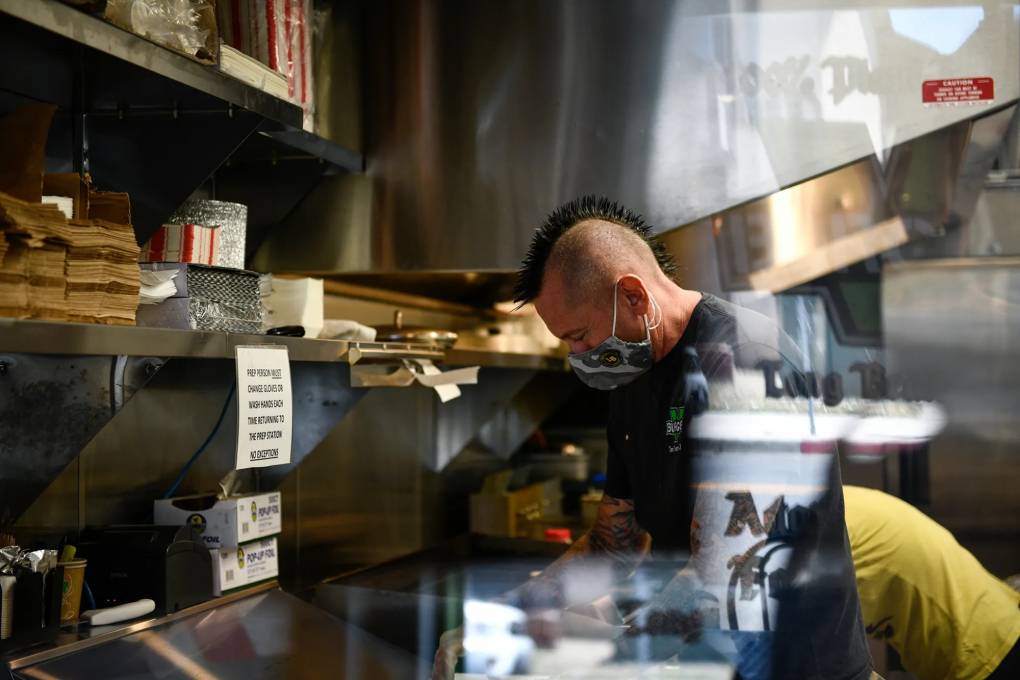
"altTag": "A cook wearing a mask and black T-shirt stands behind a grill inside a restaurant kitchen. Another worker wearing a yellow T-shirt is bending over kitchen equipment in the background.",
"isLoading": false,
"fetchFailed": false
}
},
"audioPlayerReducer": {
"postId": "stream_live",
"isPaused": true,
"isPlaying": false,
"pfsActive": false,
"pledgeModalIsOpen": true,
"playerDrawerIsOpen": false,
"liveAudioPlayStartedAt": 0,
"liveAudioPlayContext": ""
},
"authorsReducer": {
"byline_news_11945357": {
"type": "authors",
"id": "byline_news_11945357",
"meta": {
"override": true
},
"slug": "byline_news_11945357",
"name": "\u003ca href=\"https://www.npr.org/people/1147860766/dara-kerr\">Dara Kerr\u003c/a>",
"isLoading": false
},
"byline_news_11945189": {
"type": "authors",
"id": "byline_news_11945189",
"meta": {
"override": true
},
"slug": "byline_news_11945189",
"name": "\u003ca href=\"https://calmatters.org/author/joe-hong/\">Joe Hong\u003c/a>, \u003ca href=\"https://calmatters.org/author/ericayee/\">Erica Yee\u003c/a>",
"isLoading": false
},
"byline_news_11945113": {
"type": "authors",
"id": "byline_news_11945113",
"meta": {
"override": true
},
"slug": "byline_news_11945113",
"name": "\u003ca href=\"https://calmatters.org/author/alastair-bland/\">Alastair Bland\u003c/a>",
"isLoading": false
},
"byline_news_11944810": {
"type": "authors",
"id": "byline_news_11944810",
"meta": {
"override": true
},
"slug": "byline_news_11944810",
"name": "\u003ca href=\"https://edsource.org/author/dlambert\">Diana Lambert\u003c/a>",
"isLoading": false
},
"byline_news_11944554": {
"type": "authors",
"id": "byline_news_11944554",
"meta": {
"override": true
},
"slug": "byline_news_11944554",
"name": "\u003ca href=\"https://twitter.com/adambeam\">Adam Beam\u003c/a>\u003cbr>The Associated Press",
"isLoading": false
},
"byline_news_11944515": {
"type": "authors",
"id": "byline_news_11944515",
"meta": {
"override": true
},
"slug": "byline_news_11944515",
"name": "\u003ca href=\"https://calmatters.org/author/alejandro-lazo/\">Alejandro Lazo\u003c/a>, \u003ca href=\"https://calmatters.org/author/jeanne-kuang/\">Jeanne Kuang\u003c/a>",
"isLoading": false
},
"tychehendricks": {
"type": "authors",
"id": "259",
"meta": {
"index": "authors_1716337520",
"id": "259",
"found": true
},
"name": "Tyche Hendricks",
"firstName": "Tyche",
"lastName": "Hendricks",
"slug": "tychehendricks",
"email": "thendricks@kqed.org",
"display_author_email": true,
"staff_mastheads": [
"news"
],
"title": "KQED Senior Editor, Immigration",
"bio": "\u003cspan style=\"font-weight: 400;\">Tyche Hendricks is KQED’s senior editor for immigration, leading coverage of the policy and politics that affect California’s immigrant communities. Her work for KQED’s radio and online audiences is also carried on NPR and other national outlets. She has been recognized with awards from the Radio and Television News Directors Association, the Society for Professional Journalists; the Education Writers Association; the Best of the West and the National Federation of Community Broadcasters. Before joining KQED in 2010, Tyche spent more than a dozen years as a newspaper reporter, notably at the \u003c/span>\u003ci>\u003cspan style=\"font-weight: 400;\">San Francisco Chronicle\u003c/span>\u003c/i>\u003cspan style=\"font-weight: 400;\">. At different times she has covered criminal justice, government and politics and urban planning. Tyche has taught in the MFA Creative Writing program at the University of San Francisco and at UC Berkeley’s Graduate School of Journalism, where she was co-director of a national immigration symposium for professional journalists. She is the author of \u003c/span>\u003ci>\u003cspan style=\"font-weight: 400;\">The Wind Doesn't Need a Passport: Stories from the U.S.-Mexico Borderlands\u003c/span>\u003c/i>\u003cspan style=\"font-weight: 400;\"> (University of California Press). \u003c/span>",
"avatar": "https://secure.gravatar.com/avatar/b8ee458e2731c2d43df86882ce17267e?s=600&d=blank&r=g",
"twitter": "tychehendricks",
"facebook": null,
"instagram": null,
"linkedin": null,
"sites": [
{
"site": "news",
"roles": [
"editor"
]
},
{
"site": "stateofhealth",
"roles": [
"editor"
]
}
],
"headData": {
"title": "Tyche Hendricks | KQED",
"description": "KQED Senior Editor, Immigration",
"ogImgSrc": "https://secure.gravatar.com/avatar/b8ee458e2731c2d43df86882ce17267e?s=600&d=blank&r=g",
"twImgSrc": "https://secure.gravatar.com/avatar/b8ee458e2731c2d43df86882ce17267e?s=600&d=blank&r=g"
},
"isLoading": false,
"link": "/author/tychehendricks"
},
"shossaini": {
"type": "authors",
"id": "3214",
"meta": {
"index": "authors_1716337520",
"id": "3214",
"found": true
},
"name": "Sara Hossaini",
"firstName": "Sara",
"lastName": "Hossaini",
"slug": "shossaini",
"email": "shossaini@kqed.org",
"display_author_email": true,
"staff_mastheads": [
"news"
],
"title": "KQED Reporter",
"bio": "Sara Hossaini came to general assignment reporting at KQED in 2013 after two winters reporting at Wyoming Public Radio. She holds a bachelor's degree in broadcast journalism from the University of Nebraska-Lincoln. Her radio romance began after a bitter breakup with documentary film (Ok, maybe it's still complicated). Her first simultaneous jobs in San Francisco were as Associate Producer on a PBS film series through the Center for Asian American Media and as a butler. She likes to trot, plot and make things with her hands.",
"avatar": "https://secure.gravatar.com/avatar/060e9f56b9554e17942e89f413242774?s=600&d=blank&r=g",
"twitter": "mshossaini",
"facebook": null,
"instagram": null,
"linkedin": null,
"sites": [
{
"site": "news",
"roles": [
"author"
]
},
{
"site": "stateofhealth",
"roles": [
"author"
]
}
],
"headData": {
"title": "Sara Hossaini | KQED",
"description": "KQED Reporter",
"ogImgSrc": "https://secure.gravatar.com/avatar/060e9f56b9554e17942e89f413242774?s=600&d=blank&r=g",
"twImgSrc": "https://secure.gravatar.com/avatar/060e9f56b9554e17942e89f413242774?s=600&d=blank&r=g"
},
"isLoading": false,
"link": "/author/shossaini"
},
"vrancano": {
"type": "authors",
"id": "11276",
"meta": {
"index": "authors_1716337520",
"id": "11276",
"found": true
},
"name": "Vanessa Rancaño",
"firstName": "Vanessa",
"lastName": "Rancaño",
"slug": "vrancano",
"email": "vrancano@kqed.org",
"display_author_email": false,
"staff_mastheads": [
"news"
],
"title": "Reporter",
"bio": "Vanessa Rancaño is a features reporter for KQED. She’s also covered homelessness and education for the station and reported from the Central Valley. Her work has aired across public radio, from flagship national news shows to longform narrative podcasts. Before taking up a mic, she worked as a freelance print journalist. She’s been recognized with a number of national and regional awards. Vanessa grew up in California's Central Valley. She's a former NPR Kroc Fellow, and a graduate of the UC Berkeley Graduate School of Journalism.",
"avatar": "https://secure.gravatar.com/avatar/b3a383dfb0e7ee1c17568f2cf067904ab654d6e3de9743fc661f3c788ade1bed?s=600&d=blank&r=g",
"twitter": "vanessarancano",
"bluesky": null,
"facebook": null,
"instagram": null,
"linkedin": null,
"sites": [
{
"site": "arts",
"roles": [
"editor"
]
},
{
"site": "news",
"roles": [
"editor"
]
},
{
"site": "liveblog",
"roles": [
"contributor"
]
}
],
"headData": {
"title": "Vanessa Rancaño | KQED",
"description": "Reporter",
"ogImgSrc": "https://secure.gravatar.com/avatar/b3a383dfb0e7ee1c17568f2cf067904ab654d6e3de9743fc661f3c788ade1bed?s=600&d=blank&r=g",
"twImgSrc": "https://secure.gravatar.com/avatar/b3a383dfb0e7ee1c17568f2cf067904ab654d6e3de9743fc661f3c788ade1bed?s=600&d=blank&r=g"
},
"isLoading": false,
"link": "/author/vrancano"
},
"mfharvin": {
"type": "authors",
"id": "11583",
"meta": {
"index": "authors_1716337520",
"id": "11583",
"found": true
},
"name": "Mary Franklin Harvin",
"firstName": "Mary Franklin",
"lastName": "Harvin",
"slug": "mfharvin",
"email": "mfharvin@KQED.org",
"display_author_email": false,
"staff_mastheads": [
"news"
],
"title": "KQED Contributor",
"bio": null,
"avatar": "https://secure.gravatar.com/avatar/0e53510a7d48cfbdebfc9b11357d845f?s=600&d=blank&r=g",
"twitter": "EmEffHarvin",
"facebook": null,
"instagram": null,
"linkedin": null,
"sites": [
{
"site": "news",
"roles": [
"author",
"edit_others_posts"
]
},
{
"site": "science",
"roles": [
"editor"
]
}
],
"headData": {
"title": "Mary Franklin Harvin | KQED",
"description": "KQED Contributor",
"ogImgSrc": "https://secure.gravatar.com/avatar/0e53510a7d48cfbdebfc9b11357d845f?s=600&d=blank&r=g",
"twImgSrc": "https://secure.gravatar.com/avatar/0e53510a7d48cfbdebfc9b11357d845f?s=600&d=blank&r=g"
},
"isLoading": false,
"link": "/author/mfharvin"
},
"ebaldassari": {
"type": "authors",
"id": "11652",
"meta": {
"index": "authors_1716337520",
"id": "11652",
"found": true
},
"name": "Erin Baldassari",
"firstName": "Erin",
"lastName": "Baldassari",
"slug": "ebaldassari",
"email": "ebaldassari@KQED.org",
"display_author_email": true,
"staff_mastheads": [
"news"
],
"title": "Staff Writer",
"bio": "Erin Baldassari covers housing for KQED. She's a former print journalist and most recently worked as the transportation reporter for the \u003cem>Mercury News\u003c/em> and \u003cem>East Bay Times. \u003c/em>There, she focused on how the Bay Area’s housing shortage has changed the way people move around the region. She also served on the \u003cem>East Bay Times\u003c/em>’ 2017 Pulitzer Prize-winning team for coverage of the Ghost Ship Fire in Oakland. Prior to that, Erin worked as a breaking news and general assignment reporter for a variety of outlets in the Bay Area and the greater Boston area. A Tufts University alumna, Erin grew up in the foothills of the Sierra Nevada mountains and in Sonoma County. She is a life-long KQED listener.",
"avatar": "https://secure.gravatar.com/avatar/660ce35d088ca54ad606d7e941abc652?s=600&d=mm&r=g",
"twitter": "e_baldi",
"facebook": null,
"instagram": null,
"linkedin": null,
"sites": [
{
"site": "news",
"roles": [
"edit_others_posts",
"editor"
]
},
{
"site": "science",
"roles": [
"editor"
]
},
{
"site": "liveblog",
"roles": [
"editor"
]
}
],
"headData": {
"title": "Erin Baldassari | KQED",
"description": "Staff Writer",
"ogImgSrc": "https://secure.gravatar.com/avatar/660ce35d088ca54ad606d7e941abc652?s=600&d=mm&r=g",
"twImgSrc": "https://secure.gravatar.com/avatar/660ce35d088ca54ad606d7e941abc652?s=600&d=mm&r=g"
},
"isLoading": false,
"link": "/author/ebaldassari"
},
"ccabreralomeli": {
"type": "authors",
"id": "11708",
"meta": {
"index": "authors_1716337520",
"id": "11708",
"found": true
},
"name": "Carlos Cabrera-Lomelí",
"firstName": "Carlos",
"lastName": "Cabrera-Lomelí",
"slug": "ccabreralomeli",
"email": "ccabreralomeli@KQED.org",
"display_author_email": true,
"staff_mastheads": [
"news"
],
"title": "Community Reporter",
"bio": "Carlos Cabrera-Lomelí is a community reporter with KQED's digital engagement team. He also reports and co-produces for KQED's bilingual news hub KQED en Español. He grew up in San Francisco's Mission District and has previously worked with Univision, 48 Hills and REFORMA in Mexico City.",
"avatar": "https://secure.gravatar.com/avatar/c309be9665e484f887b818c89e273ecc673004f426f36b24d00a4d813a2e0518?s=600&d=blank&r=g",
"twitter": "@LomeliCabrera",
"bluesky": null,
"facebook": null,
"instagram": null,
"linkedin": null,
"sites": [
{
"site": "arts",
"roles": [
"editor"
]
},
{
"site": "news",
"roles": [
"editor"
]
},
{
"site": "about",
"roles": [
"editor"
]
},
{
"site": "science",
"roles": [
"editor"
]
},
{
"site": "perspectives",
"roles": [
"editor"
]
},
{
"site": "elections",
"roles": [
"editor"
]
},
{
"site": "liveblog",
"roles": [
"contributor"
]
}
],
"headData": {
"title": "Carlos Cabrera-Lomelí | KQED",
"description": "Community Reporter",
"ogImgSrc": "https://secure.gravatar.com/avatar/c309be9665e484f887b818c89e273ecc673004f426f36b24d00a4d813a2e0518?s=600&d=blank&r=g",
"twImgSrc": "https://secure.gravatar.com/avatar/c309be9665e484f887b818c89e273ecc673004f426f36b24d00a4d813a2e0518?s=600&d=blank&r=g"
},
"isLoading": false,
"link": "/author/ccabreralomeli"
},
"agonzalez": {
"type": "authors",
"id": "11724",
"meta": {
"index": "authors_1716337520",
"id": "11724",
"found": true
},
"name": "Alexander Gonzalez",
"firstName": "Alexander",
"lastName": "Gonzalez",
"slug": "agonzalez",
"email": "AlexanderGonzalez@KQED.org",
"display_author_email": false,
"staff_mastheads": [
"news"
],
"title": "KQED Contributor",
"bio": null,
"avatar": "https://secure.gravatar.com/avatar/9e291ed34e154df4c662edf858b641d70b4859939bfe40be478408f9dfd057d2?s=600&d=blank&r=g",
"twitter": null,
"bluesky": null,
"facebook": null,
"instagram": null,
"linkedin": null,
"sites": [
{
"site": "arts",
"roles": [
"editor"
]
},
{
"site": "news",
"roles": [
"editor"
]
},
{
"site": "science",
"roles": [
"editor"
]
}
],
"headData": {
"title": "Alexander Gonzalez | KQED",
"description": "KQED Contributor",
"ogImgSrc": "https://secure.gravatar.com/avatar/9e291ed34e154df4c662edf858b641d70b4859939bfe40be478408f9dfd057d2?s=600&d=blank&r=g",
"twImgSrc": "https://secure.gravatar.com/avatar/9e291ed34e154df4c662edf858b641d70b4859939bfe40be478408f9dfd057d2?s=600&d=blank&r=g"
},
"isLoading": false,
"link": "/author/agonzalez"
}
},
"pagesReducer": {
"news_tag_california": {
"type": "terms",
"id": "news_18538",
"meta": {
"index": "terms_1716263798",
"site": "news",
"id": "18538",
"score": 6.845124
},
"featImg": null,
"name": "California",
"description": null,
"taxonomy": "tag",
"headData": {
"twImgId": null,
"twTitle": null,
"ogTitle": null,
"ogImgId": null,
"twDescription": null,
"description": null,
"title": "California Archives | KQED News",
"ogDescription": null
},
"ttid": 31,
"slug": "california",
"isLoading": false,
"title": "California",
"pageMeta": {
"site": "news",
"WpPageTemplate": "page-topic-editorial",
"currentPage": 158
},
"blocks": [
{
"blockName": "kqed/post-list",
"attrs": {
"layout": "cardArticle2",
"query": "posts/news?tag=california",
"seeMore": false,
"paginated": true,
"page": 158
}
},
{
"blockName": "kqed/ad"
}
]
}
},
"pfsSessionReducer": {},
"postsReducer": {
"stream_live": {
"type": "live",
"id": "stream_live",
"audioUrl": "https://streams.kqed.org/kqedradio",
"title": "Live Stream",
"excerpt": "Live Stream information currently unavailable.",
"link": "/radio",
"featImg": "",
"label": {
"name": "KQED Live",
"link": "/"
}
},
"stream_kqedNewscast": {
"type": "posts",
"id": "stream_kqedNewscast",
"audioUrl": "https://www.kqed.org/.stream/anon/radio/RDnews/newscast.mp3?_=1",
"title": "KQED Newscast",
"featImg": "",
"label": {
"name": "88.5 FM",
"link": "/"
}
},
"news_11945498": {
"type": "posts",
"id": "news_11945498",
"meta": {
"index": "posts_1716263798",
"site": "news",
"id": "11945498",
"score": null,
"sort": [
1680570027000
]
},
"guestAuthors": [],
"slug": "as-california-drops-more-masking-rules-these-bay-area-counties-keep-theirs",
"title": "As California Drops More Masking Rules, These Bay Area Counties Keep Theirs",
"publishDate": 1680570027,
"format": "standard",
"headTitle": "As California Drops More Masking Rules, These Bay Area Counties Keep Theirs | KQED",
"labelTerm": {
"site": "news"
},
"content": "\u003cp>As of today, California no longer requires face masks to be worn in health care facilities and other high-risk settings.\u003c/p>\n\u003cp>Since 2020, the state has required everyone to wear masks in places like hospitals, clinics, correctional facilities and centers for people experiencing homelessness. Even as public health officials removed other COVID-19 restrictions, this rule remained in place through the multiple surges and drops in cases California saw in the past three years.\u003c/p>\n\u003cp>Additionally, health care workers are no longer required to get the COVID-19 vaccine. This change includes direct care workers and those who work in adult care facilities, as well as in correctional and detention centers.\u003c/p>\n\u003cul>\n\u003cli>\u003cstrong>Jump straight to your county’s new masking rules: \u003c/strong>\u003cstrong>\u003ca href=\"#alamedamaskmandate\">Alameda\u003c/a> | \u003ca href=\"#sanfranciscomaskmandate\">San Francisco\u003c/a> | \u003ca href=\"#contracostamaskmandate\">Contra Costa\u003c/a> | \u003ca href=\"#marinmaskmandate\">Marin\u003c/a> | \u003ca href=\"#napamaskmandate\">Napa\u003c/a> | \u003ca href=\"#sanmateomaskmandate\">San Mateo\u003c/a> | \u003ca href=\"#santaclaramaskmandate\">Santa Clara\u003c/a> | \u003ca href=\"#sonomamaskmandate\">Sonoma\u003c/a> | \u003ca href=\"#solanomaskmandate\">Solano\u003c/a>\u003c/strong>\u003c/li>\n\u003c/ul>\n\u003cp>Despite calls from physicians and disability advocates to keep these rules in place to protect people especially vulnerable to COVID-19, state officials say that California is in a strong enough position to loosen these restrictions.\u003c/p>\n\u003cp>“Our communities did a lot of the hard work by getting vaccinated and boosted, staying home and testing when sick, requesting treatments when positive, and masking to slow the spread,” said Dr. Tomás Aragón, the state’s public health officer, \u003ca href=\"https://www.cdph.ca.gov/Programs/OPA/Pages/NR23-014.aspx\">in a press release on March 3 announcing the change\u003c/a>.\u003c/p>\n\u003cul>\n\u003cli>\u003cstrong>\u003ca href=\"#tellus\">Tell us: What else do you need information about right now?\u003c/a>\u003c/strong>\u003c/li>\n\u003c/ul>\n\u003cp>However, individual counties retain the authority to enforce their own additional public health restrictions separate from the state’s. So if your county has a mask mandate that’s more restrictive than state rules, that’s the one you have to follow. Some Bay Area counties, like Contra Costa and Alameda, will continue to require face masks in certain high-risk settings, like nursing facilities, after April 3.\u003c/p>\n\u003cp>Keep reading to find the mask rules for high-risk settings in the county you live, work or study in.\u003c/p>\n\u003ch2>\u003ca id=\"alamedamaskmandate\">\u003c/a>\u003cstrong>Alameda\u003c/strong>\u003c/h2>\n\u003cp>All staff working in Alameda County’s 66 skilled nursing facilities are still required to wear face masks, even after April 3. County health officials released \u003ca href=\"https://covid-19.acgov.org/covid19-assets/docs/press/press-release-2023.03.27.pdf\">a statement last week clarifying that this order will only apply to staff\u003c/a> and that visitors will only be \u003cem>encouraged\u003c/em> to wear masks.\u003c/p>\n\u003cp>“Alameda County is moving cautiously with our skilled nursing facilities because they serve a large and highly vulnerable population of generally older adults with complex medical conditions,” said Alameda County Health Officer Dr. Nicholas Moss in a March 27 statement.\u003c/p>\n\u003cp>The order applies only to those working at nursing facilities and will be reviewed monthly by county health officials. The county will align with state masking rules for all other settings.\u003c/p>\n\u003ch2>\u003ca id=\"contracostamaskmandate\">\u003c/a>\u003cstrong>Contra Costa\u003c/strong>\u003c/h2>\n\u003cp>All staff in the county’s nursing facilities will still be required to wear face masks, even after April 3. According to \u003ca href=\"https://cchealth.org/press-releases/2023/0327-Health-Order-to-Require-Staff-in-Skilled-Nursing-Facilities-to-Wear-Masks.php\">a press release from Contra Costa health officials\u003c/a>, wearing a mask will be required for employees working directly with patients, and also for paramedics, emergency medical technicians, contractors and vendors when they enter these facilities.\u003c/p>\n\u003cp>“When the state announced the change in their rules, we began to think, ‘Does it make sense to continue masking anywhere?'” Dr. Ori Tzvieli, the county’s health officer, told KQED. “We decided that one of the highest-risk settings was skilled nursing facilities … these nursing homes basically have some of the higher-risk patients. They have older patients. They have patients with medical co-morbidities.”\u003c/p>\n\u003cp>Visitors, however, will not be required to wear masks when inside these facilities. Patients also are not required to wear masks. The county will review its masking policy on a monthly basis.\u003c/p>\n\u003ch2>\u003ca id=\"napamaskmandate\">\u003c/a>Napa\u003c/h2>\n\u003cp>Napa County does not require the use of face masks in high-risk settings. County officials told KQED that masks will continue to be made available for residents and staff in these places, clarifying that “masking is strongly recommended in high-risk settings” when community transmission rates are high.\u003c/p>\n\u003ch2>\u003ca id=\"sanfranciscomaskmandate\">\u003c/a>\u003cstrong>San Francisco\u003c/strong>\u003c/h2>\n\u003cp>The San Francisco Department of Public Health told KQED that those working in health care, which includes skilled nursing facilities and jail settings, are still “required to wear a well-fitted mask when they are working in the same room as patients, clients, residents or people who are incarcerated.”\u003c/p>\n\u003cp>However, everyone else, which can include patients, clients, residents or people who are incarcerated and their visitors, are only \u003cem>encouraged\u003c/em> to wear a mask when inside these settings. Individual facilities do, however, have the authority to implement more restrictive guidelines.\u003c/p>\n\u003ch2>\u003ca id=\"marinmaskmandate\">\u003c/a>\u003cstrong>Marin\u003c/strong>\u003c/h2>\n\u003cp>Marin County does not require the use of face masks in high-risk settings. County officials told KQED that health care facilities can enforce their own mask rules individually.\u003cbr>\n[ad fullwidth]\u003c/p>\n\u003ch2>\u003cstrong>\u003ca id=\"sanmateomaskmandate\">\u003c/a>San Mateo\u003c/strong>\u003c/h2>\n\u003cp>County officials told KQED that San Mateo follows the state’s guidelines and has not implemented any additional mask rules for high-risk settings. Individual health care facilities can still make their own decisions as to whether they want to require the use of masks indoors.\u003c/p>\n\u003ch2>\u003ca id=\"santaclaramaskmandate\">\u003c/a>\u003cstrong>Santa Clara\u003c/strong>\u003c/h2>\n\u003cp>Santa Clara County will require face masks in health care facilities only during the “designated winter respiratory virus period,” which lasts from November 1 to March 31 of each year.\u003c/p>\n\u003cp>For the rest of the year, however, it is up to individual health care facilities to set their own masking rules.\u003c/p>\n\u003ch2>\u003ca id=\"solanomaskmandate\">\u003c/a>\u003cstrong>Solano\u003c/strong>\u003c/h2>\n\u003cp>County officials confirmed with KQED that Solano County will follow the state’s guidelines and has not implemented its own additional mask rules. Face masks will no longer be required in any of Solano County’s health care, long-term care or correctional facilities as well as homeless, emergency and warming and cooling centers.\u003c/p>\n\u003ch2>\u003ca id=\"sonomamaskmandate\">\u003c/a>\u003cstrong>Sonoma\u003c/strong>\u003c/h2>\n\u003cp>Officials told KQED that Sonoma County will follow the state’s guidelines and has not implemented its own additional mask rules. Individual health care facilities can make their own decisions on whether they want to require the use of masks indoors.\u003c/p>\n\u003ch2>\u003ca id=\"tellus\">\u003c/a>Tell us: What else do you need information about?\u003c/h2>\n\u003cp>At KQED News, we know that it can sometimes be hard to track down the answers to navigate life in the Bay Area in 2023. We’ve published \u003ca href=\"https://www.kqed.org/news/tag/coronavirus-resources-and-explainers\">clear, practical explainers and guides about COVID\u003c/a>, \u003ca href=\"https://www.kqed.org/news/11936674/how-to-prepare-for-this-weeks-atmospheric-river-storm-sandbags-emergency-kits-and-more\">how to cope with intense winter weather\u003c/a> and \u003ca href=\"https://www.kqed.org/news/11821950/how-to-safely-attend-a-protest-in-the-bay-area\">how to exercise your right to protest safely\u003c/a>.\u003c/p>\n\u003cp>So tell us: What do you need to know more about? Tell us, and you could see your question answered online or on social media. What you submit will make our reporting stronger, and help us decide what to cover here on our site, and on KQED Public Radio, too.\u003c/p>\n\u003cp>[hearken id=\"10483\" src=\"https://modules.wearehearken.com/kqed/embed/10483.js\"]\u003c/p>\n\u003cp>\u003cem>This story includes reporting from KQED’s Brian Watt and Alex Gonzalez.\u003c/em>\u003c/p>\n\u003cp>[ad floatright]\u003c/p>\n",
"blocks": [],
"excerpt": "California no longer requires face masks to be worn in health care facilities and other high-risk settings. But two Bay Area counties have chosen to keep a version of that requirement in place.",
"status": "publish",
"parent": 0,
"modified": 1726005005,
"stats": {
"hasAudio": false,
"hasVideo": false,
"hasChartOrMap": false,
"iframeSrcs": [],
"hasGoogleForm": false,
"hasGallery": false,
"hasHearkenModule": true,
"hasPolis": false,
"paragraphCount": 27,
"wordCount": 1139
},
"headData": {
"title": "As California Drops More Masking Rules, These Bay Area Counties Keep Theirs | KQED",
"description": "California no longer requires face masks to be worn in health care facilities and other high-risk settings. But two Bay Area counties have chosen to keep a version of that requirement in place.",
"ogTitle": "",
"ogDescription": "",
"ogImgId": "",
"twTitle": "",
"twDescription": "",
"twImgId": "",
"schema": {
"@context": "https://schema.org",
"@type": "NewsArticle",
"headline": "As California Drops More Masking Rules, These Bay Area Counties Keep Theirs",
"datePublished": "2023-04-03T18:00:27-07:00",
"dateModified": "2024-09-10T14:50:05-07:00",
"image": "https://cdn.kqed.org/wp-content/uploads/2020/02/KQED-OG-Image@1x.png",
"isAccessibleForFree": "True",
"publisher": {
"@type": "NewsMediaOrganization",
"@id": "https://www.kqed.org/#organization",
"name": "KQED",
"logo": "https://cdn.kqed.org/wp-content/uploads/2020/02/KQED-OG-Image@1x.png",
"url": "https://www.kqed.org",
"sameAs": [
"https://www.facebook.com/KQED",
"https://twitter.com/KQED",
"https://www.instagram.com/kqed/",
"https://www.tiktok.com/@kqedofficial",
"https://www.linkedin.com/company/kqed",
"https://www.youtube.com/channel/UCeC0IOo7i1P_61zVUWbJ4nw"
]
}
}
},
"audioUrl": "https://traffic.omny.fm/d/clips/0af137ef-751e-4b19-a055-aaef00d2d578/ffca7e9f-6831-41c5-bcaf-aaef00f5a073/08c99a43-c676-40cb-8ccf-afd9012b0ad4/audio.mp3",
"sticky": false,
"excludeFromSiteSearch": "Include",
"articleAge": "0",
"path": "/news/11945498/as-california-drops-more-masking-rules-these-bay-area-counties-keep-theirs",
"audioTrackLength": null,
"parsedContent": [
{
"type": "contentString",
"content": "\u003cdiv class=\"post-body\">\u003cp>\u003cp>As of today, California no longer requires face masks to be worn in health care facilities and other high-risk settings.\u003c/p>\n\u003cp>Since 2020, the state has required everyone to wear masks in places like hospitals, clinics, correctional facilities and centers for people experiencing homelessness. Even as public health officials removed other COVID-19 restrictions, this rule remained in place through the multiple surges and drops in cases California saw in the past three years.\u003c/p>\n\u003cp>Additionally, health care workers are no longer required to get the COVID-19 vaccine. This change includes direct care workers and those who work in adult care facilities, as well as in correctional and detention centers.\u003c/p>\n\u003cul>\n\u003cli>\u003cstrong>Jump straight to your county’s new masking rules: \u003c/strong>\u003cstrong>\u003ca href=\"#alamedamaskmandate\">Alameda\u003c/a> | \u003ca href=\"#sanfranciscomaskmandate\">San Francisco\u003c/a> | \u003ca href=\"#contracostamaskmandate\">Contra Costa\u003c/a> | \u003ca href=\"#marinmaskmandate\">Marin\u003c/a> | \u003ca href=\"#napamaskmandate\">Napa\u003c/a> | \u003ca href=\"#sanmateomaskmandate\">San Mateo\u003c/a> | \u003ca href=\"#santaclaramaskmandate\">Santa Clara\u003c/a> | \u003ca href=\"#sonomamaskmandate\">Sonoma\u003c/a> | \u003ca href=\"#solanomaskmandate\">Solano\u003c/a>\u003c/strong>\u003c/li>\n\u003c/ul>\n\u003cp>Despite calls from physicians and disability advocates to keep these rules in place to protect people especially vulnerable to COVID-19, state officials say that California is in a strong enough position to loosen these restrictions.\u003c/p>\n\u003cp>“Our communities did a lot of the hard work by getting vaccinated and boosted, staying home and testing when sick, requesting treatments when positive, and masking to slow the spread,” said Dr. Tomás Aragón, the state’s public health officer, \u003ca href=\"https://www.cdph.ca.gov/Programs/OPA/Pages/NR23-014.aspx\">in a press release on March 3 announcing the change\u003c/a>.\u003c/p>\n\u003cul>\n\u003cli>\u003cstrong>\u003ca href=\"#tellus\">Tell us: What else do you need information about right now?\u003c/a>\u003c/strong>\u003c/li>\n\u003c/ul>\n\u003cp>However, individual counties retain the authority to enforce their own additional public health restrictions separate from the state’s. So if your county has a mask mandate that’s more restrictive than state rules, that’s the one you have to follow. Some Bay Area counties, like Contra Costa and Alameda, will continue to require face masks in certain high-risk settings, like nursing facilities, after April 3.\u003c/p>\n\u003cp>Keep reading to find the mask rules for high-risk settings in the county you live, work or study in.\u003c/p>\n\u003ch2>\u003ca id=\"alamedamaskmandate\">\u003c/a>\u003cstrong>Alameda\u003c/strong>\u003c/h2>\n\u003cp>All staff working in Alameda County’s 66 skilled nursing facilities are still required to wear face masks, even after April 3. County health officials released \u003ca href=\"https://covid-19.acgov.org/covid19-assets/docs/press/press-release-2023.03.27.pdf\">a statement last week clarifying that this order will only apply to staff\u003c/a> and that visitors will only be \u003cem>encouraged\u003c/em> to wear masks.\u003c/p>\n\u003cp>“Alameda County is moving cautiously with our skilled nursing facilities because they serve a large and highly vulnerable population of generally older adults with complex medical conditions,” said Alameda County Health Officer Dr. Nicholas Moss in a March 27 statement.\u003c/p>\n\u003cp>The order applies only to those working at nursing facilities and will be reviewed monthly by county health officials. The county will align with state masking rules for all other settings.\u003c/p>\n\u003ch2>\u003ca id=\"contracostamaskmandate\">\u003c/a>\u003cstrong>Contra Costa\u003c/strong>\u003c/h2>\n\u003cp>All staff in the county’s nursing facilities will still be required to wear face masks, even after April 3. According to \u003ca href=\"https://cchealth.org/press-releases/2023/0327-Health-Order-to-Require-Staff-in-Skilled-Nursing-Facilities-to-Wear-Masks.php\">a press release from Contra Costa health officials\u003c/a>, wearing a mask will be required for employees working directly with patients, and also for paramedics, emergency medical technicians, contractors and vendors when they enter these facilities.\u003c/p>\n\u003cp>“When the state announced the change in their rules, we began to think, ‘Does it make sense to continue masking anywhere?'” Dr. Ori Tzvieli, the county’s health officer, told KQED. “We decided that one of the highest-risk settings was skilled nursing facilities … these nursing homes basically have some of the higher-risk patients. They have older patients. They have patients with medical co-morbidities.”\u003c/p>\n\u003cp>Visitors, however, will not be required to wear masks when inside these facilities. Patients also are not required to wear masks. The county will review its masking policy on a monthly basis.\u003c/p>\n\u003ch2>\u003ca id=\"napamaskmandate\">\u003c/a>Napa\u003c/h2>\n\u003cp>Napa County does not require the use of face masks in high-risk settings. County officials told KQED that masks will continue to be made available for residents and staff in these places, clarifying that “masking is strongly recommended in high-risk settings” when community transmission rates are high.\u003c/p>\n\u003ch2>\u003ca id=\"sanfranciscomaskmandate\">\u003c/a>\u003cstrong>San Francisco\u003c/strong>\u003c/h2>\n\u003cp>The San Francisco Department of Public Health told KQED that those working in health care, which includes skilled nursing facilities and jail settings, are still “required to wear a well-fitted mask when they are working in the same room as patients, clients, residents or people who are incarcerated.”\u003c/p>\n\u003cp>However, everyone else, which can include patients, clients, residents or people who are incarcerated and their visitors, are only \u003cem>encouraged\u003c/em> to wear a mask when inside these settings. Individual facilities do, however, have the authority to implement more restrictive guidelines.\u003c/p>\n\u003ch2>\u003ca id=\"marinmaskmandate\">\u003c/a>\u003cstrong>Marin\u003c/strong>\u003c/h2>\n\u003cp>Marin County does not require the use of face masks in high-risk settings. County officials told KQED that health care facilities can enforce their own mask rules individually.\u003cbr>\n\u003c/p>\u003c/div>",
"attributes": {
"named": {},
"numeric": []
}
},
{
"type": "component",
"content": "",
"name": "ad",
"attributes": {
"named": {
"label": "fullwidth"
},
"numeric": [
"fullwidth"
]
}
},
{
"type": "contentString",
"content": "\u003cdiv class=\"post-body\">\u003cp>\u003c/p>\n\u003ch2>\u003cstrong>\u003ca id=\"sanmateomaskmandate\">\u003c/a>San Mateo\u003c/strong>\u003c/h2>\n\u003cp>County officials told KQED that San Mateo follows the state’s guidelines and has not implemented any additional mask rules for high-risk settings. Individual health care facilities can still make their own decisions as to whether they want to require the use of masks indoors.\u003c/p>\n\u003ch2>\u003ca id=\"santaclaramaskmandate\">\u003c/a>\u003cstrong>Santa Clara\u003c/strong>\u003c/h2>\n\u003cp>Santa Clara County will require face masks in health care facilities only during the “designated winter respiratory virus period,” which lasts from November 1 to March 31 of each year.\u003c/p>\n\u003cp>For the rest of the year, however, it is up to individual health care facilities to set their own masking rules.\u003c/p>\n\u003ch2>\u003ca id=\"solanomaskmandate\">\u003c/a>\u003cstrong>Solano\u003c/strong>\u003c/h2>\n\u003cp>County officials confirmed with KQED that Solano County will follow the state’s guidelines and has not implemented its own additional mask rules. Face masks will no longer be required in any of Solano County’s health care, long-term care or correctional facilities as well as homeless, emergency and warming and cooling centers.\u003c/p>\n\u003ch2>\u003ca id=\"sonomamaskmandate\">\u003c/a>\u003cstrong>Sonoma\u003c/strong>\u003c/h2>\n\u003cp>Officials told KQED that Sonoma County will follow the state’s guidelines and has not implemented its own additional mask rules. Individual health care facilities can make their own decisions on whether they want to require the use of masks indoors.\u003c/p>\n\u003ch2>\u003ca id=\"tellus\">\u003c/a>Tell us: What else do you need information about?\u003c/h2>\n\u003cp>At KQED News, we know that it can sometimes be hard to track down the answers to navigate life in the Bay Area in 2023. We’ve published \u003ca href=\"https://www.kqed.org/news/tag/coronavirus-resources-and-explainers\">clear, practical explainers and guides about COVID\u003c/a>, \u003ca href=\"https://www.kqed.org/news/11936674/how-to-prepare-for-this-weeks-atmospheric-river-storm-sandbags-emergency-kits-and-more\">how to cope with intense winter weather\u003c/a> and \u003ca href=\"https://www.kqed.org/news/11821950/how-to-safely-attend-a-protest-in-the-bay-area\">how to exercise your right to protest safely\u003c/a>.\u003c/p>\n\u003cp>So tell us: What do you need to know more about? Tell us, and you could see your question answered online or on social media. What you submit will make our reporting stronger, and help us decide what to cover here on our site, and on KQED Public Radio, too.\u003c/p>\n\u003cp>\u003c/p>\u003c/div>",
"attributes": {
"named": {},
"numeric": []
}
},
{
"type": "component",
"content": "",
"name": "hearken",
"attributes": {
"named": {
"id": "10483",
"src": "https://modules.wearehearken.com/kqed/embed/10483.js",
"label": ""
},
"numeric": []
}
},
{
"type": "contentString",
"content": "\u003cdiv class=\"post-body\">\u003cp>\u003c/p>\n\u003cp>\u003cem>This story includes reporting from KQED’s Brian Watt and Alex Gonzalez.\u003c/em>\u003c/p>\n\u003cp>\u003c/p>\u003c/div>",
"attributes": {
"named": {},
"numeric": []
}
},
{
"type": "component",
"content": "",
"name": "ad",
"attributes": {
"named": {
"label": "floatright"
},
"numeric": [
"floatright"
]
}
},
{
"type": "contentString",
"content": "\u003cdiv class=\"post-body\">\u003cp>\u003c/p>\n\u003c/div>\u003c/p>",
"attributes": {
"named": {},
"numeric": []
}
}
],
"link": "/news/11945498/as-california-drops-more-masking-rules-these-bay-area-counties-keep-theirs",
"authors": [
"11708"
],
"categories": [
"news_457",
"news_8"
],
"tags": [
"news_260",
"news_32707",
"news_18538",
"news_6456",
"news_1467",
"news_27350",
"news_29029",
"news_29660",
"news_27804",
"news_18543",
"news_19960"
],
"featImg": "news_11945586",
"label": "news"
},
"news_11945422": {
"type": "posts",
"id": "news_11945422",
"meta": {
"index": "posts_1716263798",
"site": "news",
"id": "11945422",
"score": null,
"sort": [
1680544627000
]
},
"guestAuthors": [],
"slug": "end-of-an-era-last-remaining-unhoused-residents-at-oaklands-wood-street-commons-getting-evicted",
"title": "End of an Era: Last Remaining Unhoused Residents at Oakland's Wood Street Commons Getting Evicted",
"publishDate": 1680544627,
"format": "standard",
"headTitle": "End of an Era: Last Remaining Unhoused Residents at Oakland’s Wood Street Commons Getting Evicted | KQED",
"labelTerm": {
"site": "news"
},
"content": "\u003cp>Around 60 people living in RVs and trailers at the Wood Street Commons — a settlement of unhoused people in West Oakland — will soon have to leave. The city plans to begin evictions April 10.\u003c/p>\n\u003cp>Many residents, some of whom have lived there for more than a decade, described it as a profound loss for Oakland’s unhoused community. Residents at the Commons have built the space into a resource hub, complete with a communal kitchen, outdoor meeting areas, a free store and storage facilities, among other amenities.\u003c/p>\n\u003cp>“I’m afraid of what’s going to happen to people if we’re not here to provide this sanctuary,” said Masoud Saberi, one of the Commons’ earliest residents.\u003c/p>\n\u003cp>[ad fullwidth]\u003c/p>\n\u003cp>After losing his home to foreclosure a decade ago, he found himself living in his car in North Oakland, and later moved to the vacant, city-owned plot of land across from Raimondi Park at 1707 Wood Street, where the Commons is now. He helped build a community there.[aside postID=news_11940107 hero='https://ww2.kqed.org/app/uploads/sites/10/2023/02/RS62562_IMG_4157-qut-1-1020x765.jpg']“I’m thinking back to when I was lost, and when I was looking for that foundation, that comfort,” he said, choking back tears. “I was lucky enough to experience it. So, I pray it’s not lost.”\u003c/p>\n\u003cp>The Commons is the last remaining vestige of the much larger Wood Street settlement, which, until last year, was home to around 300 people. It stretched for more than a mile under Interstate 880 on land owned by Caltrans, BNSF railway, private individuals and the city of Oakland. In September, Caltrans evicted residents from the land it owns, citing safety concerns, after a fire on July 11 sent plumes of black smoke onto the freeway above, stopping traffic.\u003c/p>\n\u003cp>The Commons was spared because it sits on city-owned land. But residents knew their days there were limited. City officials have long planned to build 171 affordable for-sale and rental housing units at 1707 Wood Street.\u003c/p>\n\u003cp>The city purchased the lot in 2007 as part of a larger redevelopment that authorized around 1,500 new homes and apartments in the surrounding area. The 2008 foreclosure crisis slowed the city’s plans to build affordable housing there, and it wasn’t until 2018 that officials entered into an exclusive negotiating agreement with a developer for the lot.[pullquote align=\"right\" size=\"medium\" citation=\"Masoud Saberi, Wood Street Commons resident\"]‘I’m thinking back to when I was lost, and when I was looking for that foundation, that comfort. I was lucky enough to experience it. So, I pray it’s not lost.’[/pullquote]Then, last year, the city secured two grants from the state, totaling $8.3 million, to relocate residents of the Commons to a new temporary shelter a few blocks away. The site, which will ultimately consist of 70 “tuff sheds,” opened in February. City officials have also said residents are being offered spots at a safe RV parking site in East Oakland.\u003c/p>\n\u003cp>But many residents said they didn’t want to live in East Oakland, so far from the community they’ve built at the Commons.\u003c/p>\n\u003cp>“People here have already been pushed out of so many other places,” said Lydia Blumberg, a resident of the Commons. “It’s given us a common kind of passion for community and being part of community.”\u003c/p>\n\u003cp>Other residents expressed concern about going into the tuff sheds, where typical stays are limited to no more than six months. An audit last year of the city’s homelessness services found \u003ca href=\"https://www.oaklandauditor.com/wp-content/uploads/2022/09/20220919_Performance-Audit_The-City-of-Oaklands-Homelessness-Services_Final.pdf\">fewer than a third of the people who went into these tuff sheds got into permanent housing\u003c/a>. The majority remained unhoused.\u003c/p>\n\u003cp>And, going into the tuff sheds means giving up the one stable home many of the residents have come to rely on — their RVs and trailers.\u003c/p>\n\u003cfigure id=\"attachment_11945430\" class=\"wp-caption alignnone\" style=\"max-width: 800px\">\u003cimg loading=\"lazy\" decoding=\"async\" class=\"size-medium wp-image-11945430\" src=\"https://ww2.kqed.org/app/uploads/sites/10/2023/03/IMG_4577-800x600.jpg\" alt=\"An African American man with a yellow rain jacket and dreadlocks records an eviction notice with his phone.\" width=\"800\" height=\"600\" srcset=\"https://cdn.kqed.org/wp-content/uploads/sites/10/2023/03/IMG_4577-800x600.jpg 800w, https://cdn.kqed.org/wp-content/uploads/sites/10/2023/03/IMG_4577-1020x765.jpg 1020w, https://cdn.kqed.org/wp-content/uploads/sites/10/2023/03/IMG_4577-160x120.jpg 160w, https://cdn.kqed.org/wp-content/uploads/sites/10/2023/03/IMG_4577-1536x1152.jpg 1536w, https://cdn.kqed.org/wp-content/uploads/sites/10/2023/03/IMG_4577-2048x1536.jpg 2048w, https://cdn.kqed.org/wp-content/uploads/sites/10/2023/03/IMG_4577-1920x1440.jpg 1920w\" sizes=\"auto, (max-width: 800px) 100vw, 800px\">\u003cfigcaption class=\"wp-caption-text\">Wood Street Commons resident John Janosko records a live video to Instagram announcing that the eviction notices had been posted, on March 30, 2023. \u003ccite>(Erin Baldassari/KQED)\u003c/cite>\u003c/figcaption>\u003c/figure>\n\u003cp>“I could be kicked out, back on the street with a tent,” said Ramona Choyce, who’s lived at Wood Street for around six years. “If I got my trailer, then I’ll be sheltered. I don’t know if they understand that clearly, but it’s important because I hate the cold.”\u003c/p>\n\u003cp>Choyce said that doesn’t mean she would turn down permanent housing; it’s the uncertainty she fears. And, it’s a big reason people don’t want to leave the Commons — they’ve found stability there.\u003c/p>\n\u003cp>“We need stability,” said John Janosko, a resident of the Commons and one of its leaders. “Once you get stability, then you get everything else that comes along with it.”\u003c/p>\n\u003cp>It took residents here a decade to build that stability, he said.\u003c/p>\n\u003cp>“They’re destroying something that took so long [to build],” Janosko said. “All this stuff — these resources, these connections, these people, this caring, this love — that took time.”\u003c/p>\n\u003cp>\u003c/p>\n",
"blocks": [],
"excerpt": "Around 60 people living in RVs and trailers at the Wood Street Commons in West Oakland will soon have to leave. The Commons was part of a much larger settlement stretching for more than a mile and, until this past fall, was home to around 300 people.",
"status": "publish",
"parent": 0,
"modified": 1740516870,
"stats": {
"hasAudio": false,
"hasVideo": false,
"hasChartOrMap": false,
"iframeSrcs": [],
"hasGoogleForm": false,
"hasGallery": false,
"hasHearkenModule": false,
"hasPolis": false,
"paragraphCount": 18,
"wordCount": 892
},
"headData": {
"title": "End of an Era: Last Remaining Unhoused Residents at Oakland's Wood Street Commons Getting Evicted | KQED",
"description": "Around 60 people living in RVs and trailers at the Wood Street Commons in West Oakland will soon have to leave. The Commons was part of a much larger settlement stretching for more than a mile and, until this past fall, was home to around 300 people.",
"ogTitle": "",
"ogDescription": "",
"ogImgId": "",
"twTitle": "",
"twDescription": "",
"twImgId": "",
"schema": {
"@context": "https://schema.org",
"@type": "NewsArticle",
"headline": "End of an Era: Last Remaining Unhoused Residents at Oakland's Wood Street Commons Getting Evicted",
"datePublished": "2023-04-03T10:57:07-07:00",
"dateModified": "2025-02-25T12:54:30-08:00",
"image": "https://cdn.kqed.org/wp-content/uploads/2020/02/KQED-OG-Image@1x.png",
"isAccessibleForFree": "True",
"publisher": {
"@type": "NewsMediaOrganization",
"@id": "https://www.kqed.org/#organization",
"name": "KQED",
"logo": "https://cdn.kqed.org/wp-content/uploads/2020/02/KQED-OG-Image@1x.png",
"url": "https://www.kqed.org",
"sameAs": [
"https://www.facebook.com/KQED",
"https://twitter.com/KQED",
"https://www.instagram.com/kqed/",
"https://www.tiktok.com/@kqedofficial",
"https://www.linkedin.com/company/kqed",
"https://www.youtube.com/channel/UCeC0IOo7i1P_61zVUWbJ4nw"
]
}
}
},
"sticky": false,
"excludeFromSiteSearch": "Include",
"articleAge": "0",
"path": "/news/11945422/end-of-an-era-last-remaining-unhoused-residents-at-oaklands-wood-street-commons-getting-evicted",
"audioTrackLength": null,
"parsedContent": [
{
"type": "contentString",
"content": "\u003cdiv class=\"post-body\">\u003cp>\u003cp>Around 60 people living in RVs and trailers at the Wood Street Commons — a settlement of unhoused people in West Oakland — will soon have to leave. The city plans to begin evictions April 10.\u003c/p>\n\u003cp>Many residents, some of whom have lived there for more than a decade, described it as a profound loss for Oakland’s unhoused community. Residents at the Commons have built the space into a resource hub, complete with a communal kitchen, outdoor meeting areas, a free store and storage facilities, among other amenities.\u003c/p>\n\u003cp>“I’m afraid of what’s going to happen to people if we’re not here to provide this sanctuary,” said Masoud Saberi, one of the Commons’ earliest residents.\u003c/p>\n\u003cp>\u003c/p>\u003c/div>",
"attributes": {
"named": {},
"numeric": []
}
},
{
"type": "component",
"content": "",
"name": "ad",
"attributes": {
"named": {
"label": "fullwidth"
},
"numeric": [
"fullwidth"
]
}
},
{
"type": "contentString",
"content": "\u003cdiv class=\"post-body\">\u003cp>\u003c/p>\n\u003cp>After losing his home to foreclosure a decade ago, he found himself living in his car in North Oakland, and later moved to the vacant, city-owned plot of land across from Raimondi Park at 1707 Wood Street, where the Commons is now. He helped build a community there.\u003c/p>\u003c/div>",
"attributes": {
"named": {},
"numeric": []
}
},
{
"type": "component",
"content": "",
"name": "aside",
"attributes": {
"named": {
"postid": "news_11940107",
"hero": "https://ww2.kqed.org/app/uploads/sites/10/2023/02/RS62562_IMG_4157-qut-1-1020x765.jpg",
"label": ""
},
"numeric": []
}
},
{
"type": "contentString",
"content": "\u003cdiv class=\"post-body\">\u003cp>“I’m thinking back to when I was lost, and when I was looking for that foundation, that comfort,” he said, choking back tears. “I was lucky enough to experience it. So, I pray it’s not lost.”\u003c/p>\n\u003cp>The Commons is the last remaining vestige of the much larger Wood Street settlement, which, until last year, was home to around 300 people. It stretched for more than a mile under Interstate 880 on land owned by Caltrans, BNSF railway, private individuals and the city of Oakland. In September, Caltrans evicted residents from the land it owns, citing safety concerns, after a fire on July 11 sent plumes of black smoke onto the freeway above, stopping traffic.\u003c/p>\n\u003cp>The Commons was spared because it sits on city-owned land. But residents knew their days there were limited. City officials have long planned to build 171 affordable for-sale and rental housing units at 1707 Wood Street.\u003c/p>\n\u003cp>The city purchased the lot in 2007 as part of a larger redevelopment that authorized around 1,500 new homes and apartments in the surrounding area. The 2008 foreclosure crisis slowed the city’s plans to build affordable housing there, and it wasn’t until 2018 that officials entered into an exclusive negotiating agreement with a developer for the lot.\u003c/p>\u003c/div>",
"attributes": {
"named": {},
"numeric": []
}
},
{
"type": "component",
"content": "‘I’m thinking back to when I was lost, and when I was looking for that foundation, that comfort. I was lucky enough to experience it. So, I pray it’s not lost.’",
"name": "pullquote",
"attributes": {
"named": {
"align": "right",
"size": "medium",
"citation": "Masoud Saberi, Wood Street Commons resident",
"label": ""
},
"numeric": []
}
},
{
"type": "contentString",
"content": "\u003cdiv class=\"post-body\">\u003cp>Then, last year, the city secured two grants from the state, totaling $8.3 million, to relocate residents of the Commons to a new temporary shelter a few blocks away. The site, which will ultimately consist of 70 “tuff sheds,” opened in February. City officials have also said residents are being offered spots at a safe RV parking site in East Oakland.\u003c/p>\n\u003cp>But many residents said they didn’t want to live in East Oakland, so far from the community they’ve built at the Commons.\u003c/p>\n\u003cp>“People here have already been pushed out of so many other places,” said Lydia Blumberg, a resident of the Commons. “It’s given us a common kind of passion for community and being part of community.”\u003c/p>\n\u003cp>Other residents expressed concern about going into the tuff sheds, where typical stays are limited to no more than six months. An audit last year of the city’s homelessness services found \u003ca href=\"https://www.oaklandauditor.com/wp-content/uploads/2022/09/20220919_Performance-Audit_The-City-of-Oaklands-Homelessness-Services_Final.pdf\">fewer than a third of the people who went into these tuff sheds got into permanent housing\u003c/a>. The majority remained unhoused.\u003c/p>\n\u003cp>And, going into the tuff sheds means giving up the one stable home many of the residents have come to rely on — their RVs and trailers.\u003c/p>\n\u003cfigure id=\"attachment_11945430\" class=\"wp-caption alignnone\" style=\"max-width: 800px\">\u003cimg loading=\"lazy\" decoding=\"async\" class=\"size-medium wp-image-11945430\" src=\"https://ww2.kqed.org/app/uploads/sites/10/2023/03/IMG_4577-800x600.jpg\" alt=\"An African American man with a yellow rain jacket and dreadlocks records an eviction notice with his phone.\" width=\"800\" height=\"600\" srcset=\"https://cdn.kqed.org/wp-content/uploads/sites/10/2023/03/IMG_4577-800x600.jpg 800w, https://cdn.kqed.org/wp-content/uploads/sites/10/2023/03/IMG_4577-1020x765.jpg 1020w, https://cdn.kqed.org/wp-content/uploads/sites/10/2023/03/IMG_4577-160x120.jpg 160w, https://cdn.kqed.org/wp-content/uploads/sites/10/2023/03/IMG_4577-1536x1152.jpg 1536w, https://cdn.kqed.org/wp-content/uploads/sites/10/2023/03/IMG_4577-2048x1536.jpg 2048w, https://cdn.kqed.org/wp-content/uploads/sites/10/2023/03/IMG_4577-1920x1440.jpg 1920w\" sizes=\"auto, (max-width: 800px) 100vw, 800px\">\u003cfigcaption class=\"wp-caption-text\">Wood Street Commons resident John Janosko records a live video to Instagram announcing that the eviction notices had been posted, on March 30, 2023. \u003ccite>(Erin Baldassari/KQED)\u003c/cite>\u003c/figcaption>\u003c/figure>\n\u003cp>“I could be kicked out, back on the street with a tent,” said Ramona Choyce, who’s lived at Wood Street for around six years. “If I got my trailer, then I’ll be sheltered. I don’t know if they understand that clearly, but it’s important because I hate the cold.”\u003c/p>\n\u003cp>Choyce said that doesn’t mean she would turn down permanent housing; it’s the uncertainty she fears. And, it’s a big reason people don’t want to leave the Commons — they’ve found stability there.\u003c/p>\n\u003cp>“We need stability,” said John Janosko, a resident of the Commons and one of its leaders. “Once you get stability, then you get everything else that comes along with it.”\u003c/p>\n\u003cp>It took residents here a decade to build that stability, he said.\u003c/p>\n\u003cp>“They’re destroying something that took so long [to build],” Janosko said. “All this stuff — these resources, these connections, these people, this caring, this love — that took time.”\u003c/p>\n\u003cp>\u003c/p>\n\u003c/div>\u003c/p>",
"attributes": {
"named": {},
"numeric": []
}
}
],
"link": "/news/11945422/end-of-an-era-last-remaining-unhoused-residents-at-oaklands-wood-street-commons-getting-evicted",
"authors": [
"11652"
],
"categories": [
"news_31795",
"news_18540",
"news_6266",
"news_8"
],
"tags": [
"news_18538",
"news_20013",
"news_21883",
"news_4020",
"news_1775",
"news_29607"
],
"featImg": "news_11945429",
"label": "news"
},
"news_11945257": {
"type": "posts",
"id": "news_11945257",
"meta": {
"index": "posts_1716263798",
"site": "news",
"id": "11945257",
"score": null,
"sort": [
1680526843000
]
},
"guestAuthors": [],
"slug": "california-landlords-can-evict-renters-for-repairs-a-new-bill-could-limit-that",
"title": "California Landlords Can Evict Renters for Repairs. A New Bill Could Limit That",
"publishDate": 1680526843,
"format": "standard",
"headTitle": "California Landlords Can Evict Renters for Repairs. A New Bill Could Limit That | KQED",
"labelTerm": {
"term": 72,
"site": "news"
},
"content": "\u003cp>After more than a decade in the same Concord apartment with his wife and three kids, Antonio Avila Garcia is getting evicted.\u003c/p>\n\u003cp>Not because he failed to pay or broke the lease, but because his landlord wants to remodel. But Avila Garcia doesn’t want to leave the tight-knit community he’s built.\u003c/p>\n\u003cp>“We all know each other here,” he said. “I even have a brother [who lives] here, too.”\u003c/p>\n\u003cp>Major renovations are one of the few reasons outlined in the 2019 Tenant Protection Act that landlords in California can use to evict tenants who haven’t done anything wrong. The landmark legislation was designed to curb the impacts of rising rents and keep tenants in their homes. But housing advocates said the substantial-repairs exception created a loophole property owners are exploiting to kick renters out.\u003c/p>\n\u003cp>[aside label='More on Renters’ Rights' tag='renters']\u003c/p>\n\u003cp>Now, advocates and lawmakers have a plan to curb that practice. State Sen. María Elena Durazo’s (D-Los Angeles) SB 567, called the Homelessness Prevention Act, removes the financial incentive behind these so-called “reno-victions” by increasing the amount landlords must pay renters to relocate, or requiring them to cover temporary relocation costs and re-rent the apartment to the displaced tenants at the same price.\u003c/p>\n\u003cp>“We have to close the loopholes for landlords to evict,” Durazo said at a March press conference announcing the bill. “We can’t let families get pushed out onto the streets.”\u003c/p>\n\u003cp>The bill would also lower the state rent cap from 10% to 5%, expand the number of Californians covered by that cap and place other restrictions on evictions.\u003c/p>\n\u003cp>But property owners are balking at the proposal, which comes just a few years after the 2019 legislation. Earle Vaughan, president of the California Rental Housing Association, said the Tenant Protection Act was a long-negotiated compromise between property owners and tenant advocates meant to last a decade.\u003c/p>\n\u003cp>“This was a bill that was supposed to be fair to both the landlords and the tenants, allowing landlords to at least have a way to raise the rent so we could maintain our properties,” he said.\u003c/p>\n\u003cfigure id=\"attachment_11945319\" class=\"wp-caption aligncenter\" style=\"max-width: 1920px\">\u003cimg loading=\"lazy\" decoding=\"async\" class=\"size-full wp-image-11945319\" src=\"https://ww2.kqed.org/app/uploads/sites/10/2023/03/RS64037_010_KQED_HousingAntonioAvila_03292023-qut.jpg\" alt=\"A man on the patio of his apartment leaves the sliding glass door ajar as he puts together boxes getting ready to move out.\" width=\"1920\" height=\"1280\" srcset=\"https://cdn.kqed.org/wp-content/uploads/sites/10/2023/03/RS64037_010_KQED_HousingAntonioAvila_03292023-qut.jpg 1920w, https://cdn.kqed.org/wp-content/uploads/sites/10/2023/03/RS64037_010_KQED_HousingAntonioAvila_03292023-qut-800x533.jpg 800w, https://cdn.kqed.org/wp-content/uploads/sites/10/2023/03/RS64037_010_KQED_HousingAntonioAvila_03292023-qut-1020x680.jpg 1020w, https://cdn.kqed.org/wp-content/uploads/sites/10/2023/03/RS64037_010_KQED_HousingAntonioAvila_03292023-qut-160x107.jpg 160w, https://cdn.kqed.org/wp-content/uploads/sites/10/2023/03/RS64037_010_KQED_HousingAntonioAvila_03292023-qut-1536x1024.jpg 1536w\" sizes=\"auto, (max-width: 1920px) 100vw, 1920px\">\u003cfigcaption class=\"wp-caption-text\">Antonio Avila Garcia packs up belongings from the home he has shared with his family since 2012 in Concord on March 29, 2023. A new owner bought the apartment building, and the family received an eviction notice soon after. \u003ccite>(Beth LaBerge/KQED)\u003c/cite>\u003c/figcaption>\u003c/figure>\n\u003cp>In August, a new owner bought the building where Avila Garcia lives, and a few months later, he got an eviction notice. His neighbor, Jose Luis Navarro Padilla, received the same notice, which cited plans to “substantially remodel” as grounds for the eviction.\u003c/p>\n\u003cp>“I lived there for 15 years and never gave them any problems,” said Navarro Padilla, who moved with his wife in December to their son’s condo in Concord.[pullquote size=\"medium\" align=\"right\" citation=\"Antonio Avila Garcia, renter\"]‘I’m starting to ask myself if I’ll have to abandon my life and my family’s life and the community we’ve called home.’[/pullquote]Many of the residents in the complex are from the same part of Michoacán, Mexico. Avila Garcia has cousins here in addition to his brother.\u003c/p>\n\u003cp>“I’m starting to ask myself if I’ll have to abandon my life and my family’s life and the community we’ve called home,” Avila Garcia said, speaking at a December Concord City Council meeting.\u003c/p>\n\u003cp>California doesn’t have publicly accessible data that details why people are getting evicted. But tenant advocate Betty Gabaldon, who’s working with Avila Garcia and other Concord renters, said that since the Tenant Protection Act went into effect in January 2020, she’s seen an uptick in renovation-related evictions.\u003c/p>\n\u003cp>“We started noticing the 60-day [eviction] notices said the reason they’re getting evicted is because they’re planning on doing substantial renovations in the unit,” said Gabaldon, an organizer with the East Bay Alliance for a Sustainable Economy.\u003c/p>\n\u003cfigure id=\"attachment_11945359\" class=\"wp-caption aligncenter\" style=\"max-width: 1920px\">\u003cimg loading=\"lazy\" decoding=\"async\" class=\"size-full wp-image-11945359\" src=\"https://ww2.kqed.org/app/uploads/sites/10/2023/03/RS64122_03312023_kqed_tenantorganizer-018-qut.jpg\" alt=\"A woman with long brown hair and eyeglasses wearing a white sweatshirt and jeans looks onward from her front patio outside of her apartment.\" width=\"1920\" height=\"1277\" srcset=\"https://cdn.kqed.org/wp-content/uploads/sites/10/2023/03/RS64122_03312023_kqed_tenantorganizer-018-qut.jpg 1920w, https://cdn.kqed.org/wp-content/uploads/sites/10/2023/03/RS64122_03312023_kqed_tenantorganizer-018-qut-800x532.jpg 800w, https://cdn.kqed.org/wp-content/uploads/sites/10/2023/03/RS64122_03312023_kqed_tenantorganizer-018-qut-1020x678.jpg 1020w, https://cdn.kqed.org/wp-content/uploads/sites/10/2023/03/RS64122_03312023_kqed_tenantorganizer-018-qut-160x106.jpg 160w, https://cdn.kqed.org/wp-content/uploads/sites/10/2023/03/RS64122_03312023_kqed_tenantorganizer-018-qut-1536x1022.jpg 1536w\" sizes=\"auto, (max-width: 1920px) 100vw, 1920px\">\u003cfigcaption class=\"wp-caption-text\">Tenant organizer Betty Gabaldon stands for a portrait outside her home in Walnut Creek on March 31, 2023. Gabaldon and other advocates say landlords are exploiting a loophole in California’s Tenant Protection Act to evict renters from their homes. \u003ccite>(Kori Suzuki/KQED)\u003c/cite>\u003c/figcaption>\u003c/figure>\n\u003cp>The Tenant Protection Act requires that renovations be significant enough that they entail permits, but Gabaldon said there’s no easy way to ensure property owners follow through. Tenants can sue, but the process is time-consuming and costly.\u003c/p>\n\u003cp>In Avila Garcia’s case, the city has no permit on file for work on his apartment or his neighbor’s. Representatives for his landlord said they’ll start that process once they hire contractors.\u003c/p>\n\u003cp>But Gabaldon’s experience with other tenants makes her skeptical.\u003c/p>\n\u003cp>“The substantial renovations really don’t happen,” she said.\u003c/p>\n\u003cp>[ad fullwidth]\u003c/p>\n\u003cp>And Leah Simon-Weisberg, legal director for the Alliance of Californians for Community Empowerment Institute, said there’s another incentive for landlords to use renovation-related evictions: It allows them to get around the state’s 10% cap on annual rent increases.\u003c/p>\n\u003cp>“They buy it, kick everybody out, put a little bit of paint on it and then re-rent,” she said. “It’s a real problem. Displacement should not be at the core of a person’s business model.”\u003c/p>\n\u003cp>Avila Garcia and Navarro Padilla said their property manager offered to re-rent them their apartments for over $800 dollars more than they had been paying. The property manager, Irma Galvez, disputes this. Through her attorney, Galvez said she never made a formal offer to re-rent the same apartments. Instead, she said she offered Avila Garcia an apartment at another property in Rodeo, 30 minutes away, for $1,950, or $500 more than he’d been paying.[pullquote size=\"medium\" align=\"right\" citation=\"Leah Simon-Weisberg, legal director, Alliance of Californians for Community Empowerment Institute\"]‘They buy it, kick everybody out, put a little bit of paint on it and then re-rent. It’s a real problem. Displacement should not be at the core of a person’s business model.’[/pullquote]Linda Dunn, the attorney representing Galvez, defended property owners’ right to raise rents after significant renovations.\u003c/p>\n\u003cp>“This is not price gouging,” Dunn wrote in an email to KQED, “and it certainly isn’t price gouging as defined by the laws in California.”\u003c/p>\n\u003cp>Either way, Avila Garcia said the pressure from his landlord means his family won’t feel at ease in their own home. So, he chose to look for other options.\u003c/p>\n\u003cp>“I’d like to stay and fight,” Avila Garcia said. “But even if I win, I won’t feel comfortable.”\u003c/p>\n\u003cfigure id=\"attachment_11945314\" class=\"wp-caption aligncenter\" style=\"max-width: 1920px\">\u003cimg loading=\"lazy\" decoding=\"async\" class=\"size-full wp-image-11945314\" src=\"https://ww2.kqed.org/app/uploads/sites/10/2023/03/RS64035_009_KQED_HousingAntonioAvila_03292023-qut.jpg\" alt=\"A man with short, dark hair and a five o'clock shadow wears a gray hooded sweatshirt that reads "California 1850 Republic" as he stares out the window from his apartment. The sunlight illuminates his serious face.\" width=\"1920\" height=\"1280\" srcset=\"https://cdn.kqed.org/wp-content/uploads/sites/10/2023/03/RS64035_009_KQED_HousingAntonioAvila_03292023-qut.jpg 1920w, https://cdn.kqed.org/wp-content/uploads/sites/10/2023/03/RS64035_009_KQED_HousingAntonioAvila_03292023-qut-800x533.jpg 800w, https://cdn.kqed.org/wp-content/uploads/sites/10/2023/03/RS64035_009_KQED_HousingAntonioAvila_03292023-qut-1020x680.jpg 1020w, https://cdn.kqed.org/wp-content/uploads/sites/10/2023/03/RS64035_009_KQED_HousingAntonioAvila_03292023-qut-160x107.jpg 160w, https://cdn.kqed.org/wp-content/uploads/sites/10/2023/03/RS64035_009_KQED_HousingAntonioAvila_03292023-qut-1536x1024.jpg 1536w\" sizes=\"auto, (max-width: 1920px) 100vw, 1920px\">\u003cfigcaption class=\"wp-caption-text\">Antonio Avila Garcia looks out the window during a break from packing up the home he has shared with his family since 2012 in Concord on March 29, 2023. A new owner bought the apartment building, and the family received an eviction notice soon after. \u003ccite>(Beth LaBerge/KQED)\u003c/cite>\u003c/figcaption>\u003c/figure>\n\u003cp>In Pittsburg, a group of tenants recently fended off a set of similar evictions. A new owner bought an apartment complex in March 2022 and, about six months later, started serving 60-day eviction notices, citing “extensive rehab.”\u003c/p>\n\u003cp>Francisca Castellanos was among those who received an eviction notice. She’s been living in her apartment for 46 years and said she pays $825 a month in rent. She’s not sure what she’d do if she had to move.\u003c/p>\n\u003cp>“I’m used to being here,” the 74-year-old said. “I live comfortably.”\u003c/p>\n\u003cp>Castellanos said she was told her rent would nearly double, to $1,600, if she wanted to return after the renovations.\u003c/p>\n\u003cfigure id=\"attachment_11945309\" class=\"wp-caption aligncenter\" style=\"max-width: 2560px\">\u003cimg loading=\"lazy\" decoding=\"async\" class=\"wp-image-11945309 size-full\" src=\"https://ww2.kqed.org/app/uploads/sites/10/2023/03/IMG_6950-scaled.jpg\" alt=\"Two older women sit side by side on the steps to an apartment's front door. Each woman has her hands folded neatly on their laps. They look serious, tired, concerned.\" width=\"2560\" height=\"1920\" srcset=\"https://cdn.kqed.org/wp-content/uploads/sites/10/2023/03/IMG_6950-scaled.jpg 2560w, https://cdn.kqed.org/wp-content/uploads/sites/10/2023/03/IMG_6950-800x600.jpg 800w, https://cdn.kqed.org/wp-content/uploads/sites/10/2023/03/IMG_6950-1020x765.jpg 1020w, https://cdn.kqed.org/wp-content/uploads/sites/10/2023/03/IMG_6950-160x120.jpg 160w, https://cdn.kqed.org/wp-content/uploads/sites/10/2023/03/IMG_6950-1536x1152.jpg 1536w, https://cdn.kqed.org/wp-content/uploads/sites/10/2023/03/IMG_6950-2048x1536.jpg 2048w, https://cdn.kqed.org/wp-content/uploads/sites/10/2023/03/IMG_6950-1920x1440.jpg 1920w\" sizes=\"auto, (max-width: 2560px) 100vw, 2560px\">\u003cfigcaption class=\"wp-caption-text\">Francisca Castellanos (left) and Herlinda Villanueva (right). Castellanos has lived in her Pittsburg apartment for the past 46 years; Villanueva has lived in hers for a decade. \u003ccite>(Vanessa Rancaño/KQED)\u003c/cite>\u003c/figcaption>\u003c/figure>\n\u003cp>After tenants marched to the property manager’s office to protest, Contra Costa County ACCE Director David Sharples helped broker a deal to stop the evictions. To keep their homes, the renters agreed to a 10% rent increase beginning in April.\u003c/p>\n\u003cp>The owner of the building confirmed the details of the agreement, but declined to comment further.\u003c/p>\n\u003cp>“It shows why we need to pass stronger tenant protections,” Sharples said. “We know one of the leading causes of homelessness is eviction and rent increases.”\u003c/p>\n\u003cp>ACCE organizers are working with the tenants to urge the city to pass local renter protections. Most local rent stabilization and just cause ordinances go beyond state law, and can include provisions to prevent landlords from exploiting renovation evictions.[pullquote size=\"medium\" align=\"right\" citation=\"David Sharples, director, Contra Costa County ACCE\"]‘It shows why we need to pass stronger tenant protections. We know one of the leading causes of homelessness is eviction and rent increases.’[/pullquote]But tenants’ rights organizations said these “reno-victions” are happening around the state. So, they worked with Sen. Durazo’s office on her bill to crack down on them.\u003c/p>\n\u003cp>Simon-Weisberg said SB 567 cuts off the financial incentive to exploit renovations by requiring landlords to let tenants return at the same rent, or pay a relocation fee of six times the current fair market rent for the area.\u003c/p>\n\u003cp>It would also require property owners to have permits in hand before issuing eviction notices, provide a description of the repairs to be completed and detail how long they’re expected to take.\u003c/p>\n\u003cp>“If we do that, then landlords will only do it where they need to do it, not as a business model,” she said.\u003c/p>\n\u003cp>The bill also puts tighter limits on other types of no-fault evictions, including when an owner wants to move in or take their property off the market. Owners who plan to stop renting would have to keep their buildings off the market at least 10 years, and those who want to move in would have to do so within 90 days and stay for at least three years.\u003c/p>\n\u003cp>Dunn, the attorney for Avila Garcia’s landlord, called the proposal “another unconstitutional attempt to turn the entire state of California into a rent-controlled state.”\u003c/p>\n\u003cp>“Every landlord in California should be concerned with this proposed legislation as currently written,” Dunn wrote.\u003c/p>\n\u003cfigure id=\"attachment_11945308\" class=\"wp-caption aligncenter\" style=\"max-width: 1920px\">\u003cimg loading=\"lazy\" decoding=\"async\" class=\"size-full wp-image-11945308\" src=\"https://ww2.kqed.org/app/uploads/sites/10/2023/03/RS46917_024_SanJose_AntiEvictionProtest_01272021-qut.jpg\" alt='A wide shot of dozens of protestors in front of a superior court building. Large signs read \"Stop Evictions, Save Lives.\"' width=\"1920\" height=\"1280\" srcset=\"https://cdn.kqed.org/wp-content/uploads/sites/10/2023/03/RS46917_024_SanJose_AntiEvictionProtest_01272021-qut.jpg 1920w, https://cdn.kqed.org/wp-content/uploads/sites/10/2023/03/RS46917_024_SanJose_AntiEvictionProtest_01272021-qut-800x533.jpg 800w, https://cdn.kqed.org/wp-content/uploads/sites/10/2023/03/RS46917_024_SanJose_AntiEvictionProtest_01272021-qut-1020x680.jpg 1020w, https://cdn.kqed.org/wp-content/uploads/sites/10/2023/03/RS46917_024_SanJose_AntiEvictionProtest_01272021-qut-160x107.jpg 160w, https://cdn.kqed.org/wp-content/uploads/sites/10/2023/03/RS46917_024_SanJose_AntiEvictionProtest_01272021-qut-1536x1024.jpg 1536w\" sizes=\"auto, (max-width: 1920px) 100vw, 1920px\">\u003cfigcaption class=\"wp-caption-text\">Protesters form a line in front of Santa Clara County Superior Court in San José on Jan. 27, 2021, demanding stronger state eviction protections. A new California bill would crack down on renovation-related evictions — one of the few reason property owners can evict tenants without cause in the state. \u003ccite>(Beth LaBerge/KQED)\u003c/cite>\u003c/figcaption>\u003c/figure>\n\u003cp>Vaughan, of the California Rental Housing Association, said property owners need to be able to raise rents to deal with the impacts of inflation and COVID eviction moratoriums, or simply to recuperate costs associated with a renovation.\u003c/p>\n\u003cp>“You have to realize how much we’ve struggled in the last three years with not being able to collect rent in many cases,” he said. “How are we supposed to absorb these kinds of costs?”\u003c/p>\n\u003cp>Avila Garcia is asking himself a similar question as he prepares to move his family into a new apartment in Concord that’s going to cost him $400 more a month.\u003c/p>\n\u003cp>He’s been working at a market for more than six years and makes $16 an hour, just over minimum wage. He said he’ll find another job, at night, to afford the increase.\u003c/p>\n\u003cp>“They’re raising rents, and they don’t want to raise salaries,” he said. “How are we supposed to come up with the money to pay?”\u003c/p>\n\u003cp>[ad floatright]\u003c/p>\n",
"blocks": [],
"excerpt": "A new bill would crack down on renovation-related evictions — one of the few reason property owners can evict tenants without cause in California.",
"status": "publish",
"parent": 0,
"modified": 1738784546,
"stats": {
"hasAudio": false,
"hasVideo": false,
"hasChartOrMap": false,
"iframeSrcs": [],
"hasGoogleForm": false,
"hasGallery": false,
"hasHearkenModule": false,
"hasPolis": false,
"paragraphCount": 46,
"wordCount": 2041
},
"headData": {
"title": "California Landlords Can Evict Renters for Repairs. A New Bill Could Limit That | KQED",
"description": "A new bill would crack down on renovation-related evictions — one of the few reason property owners can evict tenants without cause in California.",
"ogTitle": "",
"ogDescription": "",
"ogImgId": "",
"twTitle": "",
"twDescription": "",
"twImgId": "",
"schema": {
"@context": "https://schema.org",
"@type": "NewsArticle",
"headline": "California Landlords Can Evict Renters for Repairs. A New Bill Could Limit That",
"datePublished": "2023-04-03T06:00:43-07:00",
"dateModified": "2025-02-05T11:42:26-08:00",
"image": "https://cdn.kqed.org/wp-content/uploads/2020/02/KQED-OG-Image@1x.png",
"isAccessibleForFree": "True",
"publisher": {
"@type": "NewsMediaOrganization",
"@id": "https://www.kqed.org/#organization",
"name": "KQED",
"logo": "https://cdn.kqed.org/wp-content/uploads/2020/02/KQED-OG-Image@1x.png",
"url": "https://www.kqed.org",
"sameAs": [
"https://www.facebook.com/KQED",
"https://twitter.com/KQED",
"https://www.instagram.com/kqed/",
"https://www.tiktok.com/@kqedofficial",
"https://www.linkedin.com/company/kqed",
"https://www.youtube.com/channel/UCeC0IOo7i1P_61zVUWbJ4nw"
]
}
}
},
"audioUrl": "https://traffic.omny.fm/d/clips/0af137ef-751e-4b19-a055-aaef00d2d578/ffca7e9f-6831-4[…]f-aaef00f5a073/9d7096af-2845-443b-89ab-afd501089983/audio.mp3",
"sticky": false,
"excludeFromSiteSearch": "Include",
"articleAge": "0",
"path": "/news/11945257/california-landlords-can-evict-renters-for-repairs-a-new-bill-could-limit-that",
"audioTrackLength": null,
"parsedContent": [
{
"type": "contentString",
"content": "\u003cdiv class=\"post-body\">\u003cp>\u003cp>After more than a decade in the same Concord apartment with his wife and three kids, Antonio Avila Garcia is getting evicted.\u003c/p>\n\u003cp>Not because he failed to pay or broke the lease, but because his landlord wants to remodel. But Avila Garcia doesn’t want to leave the tight-knit community he’s built.\u003c/p>\n\u003cp>“We all know each other here,” he said. “I even have a brother [who lives] here, too.”\u003c/p>\n\u003cp>Major renovations are one of the few reasons outlined in the 2019 Tenant Protection Act that landlords in California can use to evict tenants who haven’t done anything wrong. The landmark legislation was designed to curb the impacts of rising rents and keep tenants in their homes. But housing advocates said the substantial-repairs exception created a loophole property owners are exploiting to kick renters out.\u003c/p>\n\u003cp>\u003c/p>\u003c/div>",
"attributes": {
"named": {},
"numeric": []
}
},
{
"type": "component",
"content": "",
"name": "aside",
"attributes": {
"named": {
"label": "More on Renters Rights ",
"tag": "renters"
},
"numeric": []
}
},
{
"type": "contentString",
"content": "\u003cdiv class=\"post-body\">\u003cp>\u003c/p>\n\u003cp>Now, advocates and lawmakers have a plan to curb that practice. State Sen. María Elena Durazo’s (D-Los Angeles) SB 567, called the Homelessness Prevention Act, removes the financial incentive behind these so-called “reno-victions” by increasing the amount landlords must pay renters to relocate, or requiring them to cover temporary relocation costs and re-rent the apartment to the displaced tenants at the same price.\u003c/p>\n\u003cp>“We have to close the loopholes for landlords to evict,” Durazo said at a March press conference announcing the bill. “We can’t let families get pushed out onto the streets.”\u003c/p>\n\u003cp>The bill would also lower the state rent cap from 10% to 5%, expand the number of Californians covered by that cap and place other restrictions on evictions.\u003c/p>\n\u003cp>But property owners are balking at the proposal, which comes just a few years after the 2019 legislation. Earle Vaughan, president of the California Rental Housing Association, said the Tenant Protection Act was a long-negotiated compromise between property owners and tenant advocates meant to last a decade.\u003c/p>\n\u003cp>“This was a bill that was supposed to be fair to both the landlords and the tenants, allowing landlords to at least have a way to raise the rent so we could maintain our properties,” he said.\u003c/p>\n\u003cfigure id=\"attachment_11945319\" class=\"wp-caption aligncenter\" style=\"max-width: 1920px\">\u003cimg loading=\"lazy\" decoding=\"async\" class=\"size-full wp-image-11945319\" src=\"https://ww2.kqed.org/app/uploads/sites/10/2023/03/RS64037_010_KQED_HousingAntonioAvila_03292023-qut.jpg\" alt=\"A man on the patio of his apartment leaves the sliding glass door ajar as he puts together boxes getting ready to move out.\" width=\"1920\" height=\"1280\" srcset=\"https://cdn.kqed.org/wp-content/uploads/sites/10/2023/03/RS64037_010_KQED_HousingAntonioAvila_03292023-qut.jpg 1920w, https://cdn.kqed.org/wp-content/uploads/sites/10/2023/03/RS64037_010_KQED_HousingAntonioAvila_03292023-qut-800x533.jpg 800w, https://cdn.kqed.org/wp-content/uploads/sites/10/2023/03/RS64037_010_KQED_HousingAntonioAvila_03292023-qut-1020x680.jpg 1020w, https://cdn.kqed.org/wp-content/uploads/sites/10/2023/03/RS64037_010_KQED_HousingAntonioAvila_03292023-qut-160x107.jpg 160w, https://cdn.kqed.org/wp-content/uploads/sites/10/2023/03/RS64037_010_KQED_HousingAntonioAvila_03292023-qut-1536x1024.jpg 1536w\" sizes=\"auto, (max-width: 1920px) 100vw, 1920px\">\u003cfigcaption class=\"wp-caption-text\">Antonio Avila Garcia packs up belongings from the home he has shared with his family since 2012 in Concord on March 29, 2023. A new owner bought the apartment building, and the family received an eviction notice soon after. \u003ccite>(Beth LaBerge/KQED)\u003c/cite>\u003c/figcaption>\u003c/figure>\n\u003cp>In August, a new owner bought the building where Avila Garcia lives, and a few months later, he got an eviction notice. His neighbor, Jose Luis Navarro Padilla, received the same notice, which cited plans to “substantially remodel” as grounds for the eviction.\u003c/p>\n\u003cp>“I lived there for 15 years and never gave them any problems,” said Navarro Padilla, who moved with his wife in December to their son’s condo in Concord.\u003c/p>\u003c/div>",
"attributes": {
"named": {},
"numeric": []
}
},
{
"type": "component",
"content": "‘I’m starting to ask myself if I’ll have to abandon my life and my family’s life and the community we’ve called home.’",
"name": "pullquote",
"attributes": {
"named": {
"size": "medium",
"align": "right",
"citation": "Antonio Avila Garcia, renter",
"label": ""
},
"numeric": []
}
},
{
"type": "contentString",
"content": "\u003cdiv class=\"post-body\">\u003cp>Many of the residents in the complex are from the same part of Michoacán, Mexico. Avila Garcia has cousins here in addition to his brother.\u003c/p>\n\u003cp>“I’m starting to ask myself if I’ll have to abandon my life and my family’s life and the community we’ve called home,” Avila Garcia said, speaking at a December Concord City Council meeting.\u003c/p>\n\u003cp>California doesn’t have publicly accessible data that details why people are getting evicted. But tenant advocate Betty Gabaldon, who’s working with Avila Garcia and other Concord renters, said that since the Tenant Protection Act went into effect in January 2020, she’s seen an uptick in renovation-related evictions.\u003c/p>\n\u003cp>“We started noticing the 60-day [eviction] notices said the reason they’re getting evicted is because they’re planning on doing substantial renovations in the unit,” said Gabaldon, an organizer with the East Bay Alliance for a Sustainable Economy.\u003c/p>\n\u003cfigure id=\"attachment_11945359\" class=\"wp-caption aligncenter\" style=\"max-width: 1920px\">\u003cimg loading=\"lazy\" decoding=\"async\" class=\"size-full wp-image-11945359\" src=\"https://ww2.kqed.org/app/uploads/sites/10/2023/03/RS64122_03312023_kqed_tenantorganizer-018-qut.jpg\" alt=\"A woman with long brown hair and eyeglasses wearing a white sweatshirt and jeans looks onward from her front patio outside of her apartment.\" width=\"1920\" height=\"1277\" srcset=\"https://cdn.kqed.org/wp-content/uploads/sites/10/2023/03/RS64122_03312023_kqed_tenantorganizer-018-qut.jpg 1920w, https://cdn.kqed.org/wp-content/uploads/sites/10/2023/03/RS64122_03312023_kqed_tenantorganizer-018-qut-800x532.jpg 800w, https://cdn.kqed.org/wp-content/uploads/sites/10/2023/03/RS64122_03312023_kqed_tenantorganizer-018-qut-1020x678.jpg 1020w, https://cdn.kqed.org/wp-content/uploads/sites/10/2023/03/RS64122_03312023_kqed_tenantorganizer-018-qut-160x106.jpg 160w, https://cdn.kqed.org/wp-content/uploads/sites/10/2023/03/RS64122_03312023_kqed_tenantorganizer-018-qut-1536x1022.jpg 1536w\" sizes=\"auto, (max-width: 1920px) 100vw, 1920px\">\u003cfigcaption class=\"wp-caption-text\">Tenant organizer Betty Gabaldon stands for a portrait outside her home in Walnut Creek on March 31, 2023. Gabaldon and other advocates say landlords are exploiting a loophole in California’s Tenant Protection Act to evict renters from their homes. \u003ccite>(Kori Suzuki/KQED)\u003c/cite>\u003c/figcaption>\u003c/figure>\n\u003cp>The Tenant Protection Act requires that renovations be significant enough that they entail permits, but Gabaldon said there’s no easy way to ensure property owners follow through. Tenants can sue, but the process is time-consuming and costly.\u003c/p>\n\u003cp>In Avila Garcia’s case, the city has no permit on file for work on his apartment or his neighbor’s. Representatives for his landlord said they’ll start that process once they hire contractors.\u003c/p>\n\u003cp>But Gabaldon’s experience with other tenants makes her skeptical.\u003c/p>\n\u003cp>“The substantial renovations really don’t happen,” she said.\u003c/p>\n\u003cp>\u003c/p>\u003c/div>",
"attributes": {
"named": {},
"numeric": []
}
},
{
"type": "component",
"content": "",
"name": "ad",
"attributes": {
"named": {
"label": "fullwidth"
},
"numeric": [
"fullwidth"
]
}
},
{
"type": "contentString",
"content": "\u003cdiv class=\"post-body\">\u003cp>\u003c/p>\n\u003cp>And Leah Simon-Weisberg, legal director for the Alliance of Californians for Community Empowerment Institute, said there’s another incentive for landlords to use renovation-related evictions: It allows them to get around the state’s 10% cap on annual rent increases.\u003c/p>\n\u003cp>“They buy it, kick everybody out, put a little bit of paint on it and then re-rent,” she said. “It’s a real problem. Displacement should not be at the core of a person’s business model.”\u003c/p>\n\u003cp>Avila Garcia and Navarro Padilla said their property manager offered to re-rent them their apartments for over $800 dollars more than they had been paying. The property manager, Irma Galvez, disputes this. Through her attorney, Galvez said she never made a formal offer to re-rent the same apartments. Instead, she said she offered Avila Garcia an apartment at another property in Rodeo, 30 minutes away, for $1,950, or $500 more than he’d been paying.\u003c/p>\u003c/div>",
"attributes": {
"named": {},
"numeric": []
}
},
{
"type": "component",
"content": "‘They buy it, kick everybody out, put a little bit of paint on it and then re-rent. It’s a real problem. Displacement should not be at the core of a person’s business model.’",
"name": "pullquote",
"attributes": {
"named": {
"size": "medium",
"align": "right",
"citation": "Leah Simon-Weisberg, legal director, Alliance of Californians for Community Empowerment Institute",
"label": ""
},
"numeric": []
}
},
{
"type": "contentString",
"content": "\u003cdiv class=\"post-body\">\u003cp>Linda Dunn, the attorney representing Galvez, defended property owners’ right to raise rents after significant renovations.\u003c/p>\n\u003cp>“This is not price gouging,” Dunn wrote in an email to KQED, “and it certainly isn’t price gouging as defined by the laws in California.”\u003c/p>\n\u003cp>Either way, Avila Garcia said the pressure from his landlord means his family won’t feel at ease in their own home. So, he chose to look for other options.\u003c/p>\n\u003cp>“I’d like to stay and fight,” Avila Garcia said. “But even if I win, I won’t feel comfortable.”\u003c/p>\n\u003cfigure id=\"attachment_11945314\" class=\"wp-caption aligncenter\" style=\"max-width: 1920px\">\u003cimg loading=\"lazy\" decoding=\"async\" class=\"size-full wp-image-11945314\" src=\"https://ww2.kqed.org/app/uploads/sites/10/2023/03/RS64035_009_KQED_HousingAntonioAvila_03292023-qut.jpg\" alt=\"A man with short, dark hair and a five o'clock shadow wears a gray hooded sweatshirt that reads "California 1850 Republic" as he stares out the window from his apartment. The sunlight illuminates his serious face.\" width=\"1920\" height=\"1280\" srcset=\"https://cdn.kqed.org/wp-content/uploads/sites/10/2023/03/RS64035_009_KQED_HousingAntonioAvila_03292023-qut.jpg 1920w, https://cdn.kqed.org/wp-content/uploads/sites/10/2023/03/RS64035_009_KQED_HousingAntonioAvila_03292023-qut-800x533.jpg 800w, https://cdn.kqed.org/wp-content/uploads/sites/10/2023/03/RS64035_009_KQED_HousingAntonioAvila_03292023-qut-1020x680.jpg 1020w, https://cdn.kqed.org/wp-content/uploads/sites/10/2023/03/RS64035_009_KQED_HousingAntonioAvila_03292023-qut-160x107.jpg 160w, https://cdn.kqed.org/wp-content/uploads/sites/10/2023/03/RS64035_009_KQED_HousingAntonioAvila_03292023-qut-1536x1024.jpg 1536w\" sizes=\"auto, (max-width: 1920px) 100vw, 1920px\">\u003cfigcaption class=\"wp-caption-text\">Antonio Avila Garcia looks out the window during a break from packing up the home he has shared with his family since 2012 in Concord on March 29, 2023. A new owner bought the apartment building, and the family received an eviction notice soon after. \u003ccite>(Beth LaBerge/KQED)\u003c/cite>\u003c/figcaption>\u003c/figure>\n\u003cp>In Pittsburg, a group of tenants recently fended off a set of similar evictions. A new owner bought an apartment complex in March 2022 and, about six months later, started serving 60-day eviction notices, citing “extensive rehab.”\u003c/p>\n\u003cp>Francisca Castellanos was among those who received an eviction notice. She’s been living in her apartment for 46 years and said she pays $825 a month in rent. She’s not sure what she’d do if she had to move.\u003c/p>\n\u003cp>“I’m used to being here,” the 74-year-old said. “I live comfortably.”\u003c/p>\n\u003cp>Castellanos said she was told her rent would nearly double, to $1,600, if she wanted to return after the renovations.\u003c/p>\n\u003cfigure id=\"attachment_11945309\" class=\"wp-caption aligncenter\" style=\"max-width: 2560px\">\u003cimg loading=\"lazy\" decoding=\"async\" class=\"wp-image-11945309 size-full\" src=\"https://ww2.kqed.org/app/uploads/sites/10/2023/03/IMG_6950-scaled.jpg\" alt=\"Two older women sit side by side on the steps to an apartment's front door. Each woman has her hands folded neatly on their laps. They look serious, tired, concerned.\" width=\"2560\" height=\"1920\" srcset=\"https://cdn.kqed.org/wp-content/uploads/sites/10/2023/03/IMG_6950-scaled.jpg 2560w, https://cdn.kqed.org/wp-content/uploads/sites/10/2023/03/IMG_6950-800x600.jpg 800w, https://cdn.kqed.org/wp-content/uploads/sites/10/2023/03/IMG_6950-1020x765.jpg 1020w, https://cdn.kqed.org/wp-content/uploads/sites/10/2023/03/IMG_6950-160x120.jpg 160w, https://cdn.kqed.org/wp-content/uploads/sites/10/2023/03/IMG_6950-1536x1152.jpg 1536w, https://cdn.kqed.org/wp-content/uploads/sites/10/2023/03/IMG_6950-2048x1536.jpg 2048w, https://cdn.kqed.org/wp-content/uploads/sites/10/2023/03/IMG_6950-1920x1440.jpg 1920w\" sizes=\"auto, (max-width: 2560px) 100vw, 2560px\">\u003cfigcaption class=\"wp-caption-text\">Francisca Castellanos (left) and Herlinda Villanueva (right). Castellanos has lived in her Pittsburg apartment for the past 46 years; Villanueva has lived in hers for a decade. \u003ccite>(Vanessa Rancaño/KQED)\u003c/cite>\u003c/figcaption>\u003c/figure>\n\u003cp>After tenants marched to the property manager’s office to protest, Contra Costa County ACCE Director David Sharples helped broker a deal to stop the evictions. To keep their homes, the renters agreed to a 10% rent increase beginning in April.\u003c/p>\n\u003cp>The owner of the building confirmed the details of the agreement, but declined to comment further.\u003c/p>\n\u003cp>“It shows why we need to pass stronger tenant protections,” Sharples said. “We know one of the leading causes of homelessness is eviction and rent increases.”\u003c/p>\n\u003cp>ACCE organizers are working with the tenants to urge the city to pass local renter protections. Most local rent stabilization and just cause ordinances go beyond state law, and can include provisions to prevent landlords from exploiting renovation evictions.\u003c/p>\u003c/div>",
"attributes": {
"named": {},
"numeric": []
}
},
{
"type": "component",
"content": "‘It shows why we need to pass stronger tenant protections. We know one of the leading causes of homelessness is eviction and rent increases.’",
"name": "pullquote",
"attributes": {
"named": {
"size": "medium",
"align": "right",
"citation": "David Sharples, director, Contra Costa County ACCE",
"label": ""
},
"numeric": []
}
},
{
"type": "contentString",
"content": "\u003cdiv class=\"post-body\">\u003cp>But tenants’ rights organizations said these “reno-victions” are happening around the state. So, they worked with Sen. Durazo’s office on her bill to crack down on them.\u003c/p>\n\u003cp>Simon-Weisberg said SB 567 cuts off the financial incentive to exploit renovations by requiring landlords to let tenants return at the same rent, or pay a relocation fee of six times the current fair market rent for the area.\u003c/p>\n\u003cp>It would also require property owners to have permits in hand before issuing eviction notices, provide a description of the repairs to be completed and detail how long they’re expected to take.\u003c/p>\n\u003cp>“If we do that, then landlords will only do it where they need to do it, not as a business model,” she said.\u003c/p>\n\u003cp>The bill also puts tighter limits on other types of no-fault evictions, including when an owner wants to move in or take their property off the market. Owners who plan to stop renting would have to keep their buildings off the market at least 10 years, and those who want to move in would have to do so within 90 days and stay for at least three years.\u003c/p>\n\u003cp>Dunn, the attorney for Avila Garcia’s landlord, called the proposal “another unconstitutional attempt to turn the entire state of California into a rent-controlled state.”\u003c/p>\n\u003cp>“Every landlord in California should be concerned with this proposed legislation as currently written,” Dunn wrote.\u003c/p>\n\u003cfigure id=\"attachment_11945308\" class=\"wp-caption aligncenter\" style=\"max-width: 1920px\">\u003cimg loading=\"lazy\" decoding=\"async\" class=\"size-full wp-image-11945308\" src=\"https://ww2.kqed.org/app/uploads/sites/10/2023/03/RS46917_024_SanJose_AntiEvictionProtest_01272021-qut.jpg\" alt='A wide shot of dozens of protestors in front of a superior court building. Large signs read \"Stop Evictions, Save Lives.\"' width=\"1920\" height=\"1280\" srcset=\"https://cdn.kqed.org/wp-content/uploads/sites/10/2023/03/RS46917_024_SanJose_AntiEvictionProtest_01272021-qut.jpg 1920w, https://cdn.kqed.org/wp-content/uploads/sites/10/2023/03/RS46917_024_SanJose_AntiEvictionProtest_01272021-qut-800x533.jpg 800w, https://cdn.kqed.org/wp-content/uploads/sites/10/2023/03/RS46917_024_SanJose_AntiEvictionProtest_01272021-qut-1020x680.jpg 1020w, https://cdn.kqed.org/wp-content/uploads/sites/10/2023/03/RS46917_024_SanJose_AntiEvictionProtest_01272021-qut-160x107.jpg 160w, https://cdn.kqed.org/wp-content/uploads/sites/10/2023/03/RS46917_024_SanJose_AntiEvictionProtest_01272021-qut-1536x1024.jpg 1536w\" sizes=\"auto, (max-width: 1920px) 100vw, 1920px\">\u003cfigcaption class=\"wp-caption-text\">Protesters form a line in front of Santa Clara County Superior Court in San José on Jan. 27, 2021, demanding stronger state eviction protections. A new California bill would crack down on renovation-related evictions — one of the few reason property owners can evict tenants without cause in the state. \u003ccite>(Beth LaBerge/KQED)\u003c/cite>\u003c/figcaption>\u003c/figure>\n\u003cp>Vaughan, of the California Rental Housing Association, said property owners need to be able to raise rents to deal with the impacts of inflation and COVID eviction moratoriums, or simply to recuperate costs associated with a renovation.\u003c/p>\n\u003cp>“You have to realize how much we’ve struggled in the last three years with not being able to collect rent in many cases,” he said. “How are we supposed to absorb these kinds of costs?”\u003c/p>\n\u003cp>Avila Garcia is asking himself a similar question as he prepares to move his family into a new apartment in Concord that’s going to cost him $400 more a month.\u003c/p>\n\u003cp>He’s been working at a market for more than six years and makes $16 an hour, just over minimum wage. He said he’ll find another job, at night, to afford the increase.\u003c/p>\n\u003cp>“They’re raising rents, and they don’t want to raise salaries,” he said. “How are we supposed to come up with the money to pay?”\u003c/p>\n\u003cp>\u003c/p>\u003c/div>",
"attributes": {
"named": {},
"numeric": []
}
},
{
"type": "component",
"content": "",
"name": "ad",
"attributes": {
"named": {
"label": "floatright"
},
"numeric": [
"floatright"
]
}
},
{
"type": "contentString",
"content": "\u003cdiv class=\"post-body\">\u003cp>\u003c/p>\n\u003c/div>\u003c/p>",
"attributes": {
"named": {},
"numeric": []
}
}
],
"link": "/news/11945257/california-landlords-can-evict-renters-for-repairs-a-new-bill-could-limit-that",
"authors": [
"11276"
],
"programs": [
"news_72"
],
"categories": [
"news_6266",
"news_8",
"news_33520"
],
"tags": [
"news_3921",
"news_18538",
"news_20472",
"news_27626",
"news_1775",
"news_21358",
"news_27707"
],
"featImg": "news_11945318",
"label": "news_72"
},
"news_11945357": {
"type": "posts",
"id": "news_11945357",
"meta": {
"index": "posts_1716263798",
"site": "news",
"id": "11945357",
"score": null,
"sort": [
1680354039000
]
},
"guestAuthors": [],
"slug": "googles-ghost-workers-demand-to-be-seen-seeking-better-wages-and-benefits-from-tech-giant",
"title": "Google's 'Ghost Workers' Demand to Be Seen, Seeking Better Wages and Benefits From Tech Giant",
"publishDate": 1680354039,
"format": "standard",
"headTitle": "Google’s ‘Ghost Workers’ Demand to Be Seen, Seeking Better Wages and Benefits From Tech Giant | KQED",
"labelTerm": {
"term": 253,
"site": "news"
},
"content": "\u003cp>Teresa Partain has a job few people know exists. She’s a content moderator for Google’s ads engine and many of her colleagues do the same work for Google Search. Their job is to make sure the results people see are accurate and not spam or scams. Google calls these workers “quality raters,” but Partain said they call themselves “ghost workers.”\u003c/p>\n\u003cp>“Most people — even at Google — have no idea that we exist,” Partain said. “They don’t know that there are human beings doing a lot of the work. They think that the software is magic and already perfect and doesn’t need maintenance. And that’s just not true.”\u003c/p>\n\u003cp>But now they want to be seen. They’ve written letters to Google executives, held a rally outside the company’s Silicon Valley headquarters and created a petition to demand benefits and better pay.\u003c/p>\n\u003cp>[ad fullwidth]\u003c/p>\n\u003cp>Partain isn’t employed by Google directly, but by a subcontractor called Appen. And, she said, that employment setup is what has led to worker grievances — mainly low wages, no benefits and isolation from colleagues. Partain is one of at least 10,000 people worldwide doing this job, according to Google.\u003c/p>\n\u003cp>They work from home and even though they’re employed by subcontractors, they’re given assignments directly by Google. Partain evaluates the quality and placement of Google ads, while her colleagues rate the quality of Google Search results. Their tasks can range from confirming a search for “carrot cake recipe” brings up relevant results to making sure an airfare ad doesn’t appear next to a news story about a plane crash.\u003c/p>\n\u003cp>Without them, Google Search wouldn’t function smoothly. Google says it gets \u003ca href=\"https://www.google.com/search/howsearchworks/how-search-works/rigorous-testing/\">billions of queries\u003c/a> every day and it’s constantly making improvements to ensure its algorithms keep up. Danny Sullivan, the company’s public liaison for Search, wrote in a\u003ca href=\"https://blog.google/products/search/raters-experiments-improve-google-search/\"> blog post\u003c/a> that getting feedback from raters is “a key part of our evaluation process.”[pullquote align=\"right\" size=\"medium\" citation=\"Roberto Clack, executive director, Temp Worker Justice\"]‘A lot of people don’t really understand just how prevalent the subcontracting and staffing agency usage is. These models are really the driving force towards lower labor standards.’[/pullquote]Raters work on Google’s two most vital products — Search and ads. In 2022, Google made more than \u003ca href=\"https://abc.xyz/investor/static/pdf/20230203_alphabet_10K.pdf?cache=5ae4398\">$224 billion in revenue (PDF)\u003c/a> from Search and advertising, accounting for more than 79% of its total revenue. For comparison, that’s more than the entire gross domestic product of Greece.\u003c/p>\n\u003cp>“We support billions of dollars of revenue,” Google rater Ed Stackhouse told NPR. “And we get paid less than your average fast food worker.”\u003c/p>\n\u003cp>Google raters who work for Appen make between $14 and $14.50 an hour and under company policy can’t work more than 29 hours a week. Raters who spoke with NPR said they have health conditions or family needs that require them to work from home and they appreciate they can do that. But, since they can’t work more than 29 hours a week, they’re not eligible for benefits like health care and sick leave.\u003c/p>\n\u003cp>Google spokesperson Courtenay Mencini told NPR in a statement that “Our suppliers manage all employment terms for the raters, including pay and benefits.” Appen, which is an Australian company that has other big tech clients such as Salesforce and LinkedIn, didn’t respond to multiple requests for comment.\u003c/p>\n\u003ch2>Ramping up the pressure\u003c/h2>\n\u003cp>A group of about 50 Google workers gathered in an outdoor courtyard at the company’s sprawling California headquarters in February. Many of them wore red t-shirts that sported the Alphabet Workers Union logo, which is a labor group made up of people who work for Google and its parent company Alphabet.\u003c/p>\n\u003cp>They unfurled a massive white cloth banner that read, “Google: End Rater Poverty” and chanted “Equal pay for equal work.”\u003c/p>\n\u003cp>Raters had come from around the country to hand deliver a \u003ca href=\"https://www.ratersunion.org/\">petition\u003c/a> to Prabhakar Raghavan, Google’s senior vice president in charge of Search, ads and other divisions. The petition, which has now been signed by more than 850 raters, asks Raghavan to meet with them to discuss better pay and benefits.[pullquote align=\"right\" size=\"medium\" citation=\"Ed Stackhouse, Google rater\"]‘We support billions of dollars of revenue. And we get paid less than your average fast food worker.’[/pullquote]Partain flew in from Kansas for the rally and said she’d been a rater for more than seven years and that she and her colleagues “want to be able to do our job well, earn a dignified wage and have access to basic benefits.” The raters were joined by worker advocates, local politicians and union representatives.\u003c/p>\n\u003cp>“A lot of people don’t really understand just how prevalent the subcontracting and staffing agency usage is,” said Roberto Clack, executive director of Temp Worker Justice, a nonprofit that advocates for contract workers. “These models are really the driving force towards lower labor standards.”\u003c/p>\n\u003cp>Google’s Mencini declined to provide numbers on the company’s subcontractor workforce. But, according to estimates from the Alphabet Workers Union, Alphabet has around 200,000 contract workers worldwide who do \u003ca href=\"https://everygoogleworker.alphabetworkersunion.org/\">all sorts of jobs\u003c/a>. That’s more than 50% of the company’s total workforce.\u003c/p>\n\u003cdiv>\n\u003cp>The raters’ pressure campaign on Google began last year. With the help of Alphabet Workers Union, they began meeting each other and organizing online.\u003c/p>\n\u003cp>In May, Alphabet Workers Union published an open letter to Raghavan demanding the company raise pay for raters. Then, in January of this year, raters who work for Appen \u003ca href=\"https://www.forbes.com/sites/richardnieva/2023/01/11/google-search-quality-rater-raise/\">got their first-ever raise\u003c/a> to $14 or $14.50 an hour, based on seniority. Previously, workers made roughly $10 to $13 an hour.\u003c/p>\n\u003cp>After the February rally, Appen raters were told they’d get another raise by the end of this year that would increase their pay to $15 an hour. Then, a couple weeks later, Appen sent them an email saying the hours they work could be extended from the previous maximum of 26 hours per week to what raters have now — 29 hours per week. Raters can work their own hours, but it can be no more than 29 per week.\u003c/p>\n\u003cp>“So, the magic 30 hours a week is what we can’t go past,” Partain said.\u003c/p>\n\u003cp>Google’s Mencini told NPR that the company’s \u003ca href=\"https://urldefense.com/v3/__https:/support.google.com/corporate-suppliers/answer/10208902/*zippy=__;Iw!!Iwwt!Ub5DUC5iYYOJz9Y7sePkrMr9s_4Id4QlDovj04rf7c2RxXO5jdmw1TQ2oA5dU4_x1Qyq8MnV7RFg%24\">Wages and Benefits standards\u003c/a> — which would provide health care and sick leave to contractors — only apply to people who are assigned to Google at least 30 hours per week and have access to the company’s corporate systems or campuses.\u003c/p>\n\u003cp>Raters say that as long as they haven’t met that threshold, they’re going to keep up the pressure.\u003c/p>\n\u003cp>“What we’re asking for now is just to be allowed to get the same benefits as people who work 30 hours a week are supposed to get,” Partain said. “And if we have to work 30 hours a week in order to get them, people would be happy to do that.”\u003c/p>\n\u003cp>As far as a response from Raghavan to meet with them, raters say they’re still waiting.\u003c/p>\n\u003c/div>\u003cp>[ad floatright]\u003c/p>\n",
"blocks": [],
"excerpt": "Google's 'quality raters' — who refer to themselves as 'ghost workers' — are employed through subcontractors and number around 10,000 worldwide, helping the company generate 'billions in revenue.' They are demanding better wages and benefits from the tech giant. ",
"status": "publish",
"parent": 0,
"modified": 1740180797,
"stats": {
"hasAudio": false,
"hasVideo": false,
"hasChartOrMap": false,
"iframeSrcs": [],
"hasGoogleForm": false,
"hasGallery": false,
"hasHearkenModule": false,
"hasPolis": false,
"paragraphCount": 24,
"wordCount": 1283
},
"headData": {
"title": "Google's 'Ghost Workers' Demand to Be Seen, Seeking Better Wages and Benefits From Tech Giant | KQED",
"description": "Google's 'quality raters' — who refer to themselves as 'ghost workers' — are employed through subcontractors and number around 10,000 worldwide, helping the company generate 'billions in revenue.' They are demanding better wages and benefits from the tech giant. ",
"ogTitle": "",
"ogDescription": "",
"ogImgId": "",
"twTitle": "",
"twDescription": "",
"twImgId": "",
"schema": {
"@context": "https://schema.org",
"@type": "NewsArticle",
"headline": "Google's 'Ghost Workers' Demand to Be Seen, Seeking Better Wages and Benefits From Tech Giant",
"datePublished": "2023-04-01T06:00:39-07:00",
"dateModified": "2025-02-21T15:33:17-08:00",
"image": "https://cdn.kqed.org/wp-content/uploads/2020/02/KQED-OG-Image@1x.png",
"isAccessibleForFree": "True",
"publisher": {
"@type": "NewsMediaOrganization",
"@id": "https://www.kqed.org/#organization",
"name": "KQED",
"logo": "https://cdn.kqed.org/wp-content/uploads/2020/02/KQED-OG-Image@1x.png",
"url": "https://www.kqed.org",
"sameAs": [
"https://www.facebook.com/KQED",
"https://twitter.com/KQED",
"https://www.instagram.com/kqed/",
"https://www.tiktok.com/@kqedofficial",
"https://www.linkedin.com/company/kqed",
"https://www.youtube.com/channel/UCeC0IOo7i1P_61zVUWbJ4nw"
]
}
}
},
"sticky": false,
"nprByline": "\u003ca href=\"https://www.npr.org/people/1147860766/dara-kerr\">Dara Kerr\u003c/a>",
"excludeFromSiteSearch": "Include",
"showOnAuthorArchivePages": "No",
"articleAge": "0",
"path": "/news/11945357/googles-ghost-workers-demand-to-be-seen-seeking-better-wages-and-benefits-from-tech-giant",
"audioTrackLength": null,
"parsedContent": [
{
"type": "contentString",
"content": "\u003cdiv class=\"post-body\">\u003cp>\u003cp>Teresa Partain has a job few people know exists. She’s a content moderator for Google’s ads engine and many of her colleagues do the same work for Google Search. Their job is to make sure the results people see are accurate and not spam or scams. Google calls these workers “quality raters,” but Partain said they call themselves “ghost workers.”\u003c/p>\n\u003cp>“Most people — even at Google — have no idea that we exist,” Partain said. “They don’t know that there are human beings doing a lot of the work. They think that the software is magic and already perfect and doesn’t need maintenance. And that’s just not true.”\u003c/p>\n\u003cp>But now they want to be seen. They’ve written letters to Google executives, held a rally outside the company’s Silicon Valley headquarters and created a petition to demand benefits and better pay.\u003c/p>\n\u003cp>\u003c/p>\u003c/div>",
"attributes": {
"named": {},
"numeric": []
}
},
{
"type": "component",
"content": "",
"name": "ad",
"attributes": {
"named": {
"label": "fullwidth"
},
"numeric": [
"fullwidth"
]
}
},
{
"type": "contentString",
"content": "\u003cdiv class=\"post-body\">\u003cp>\u003c/p>\n\u003cp>Partain isn’t employed by Google directly, but by a subcontractor called Appen. And, she said, that employment setup is what has led to worker grievances — mainly low wages, no benefits and isolation from colleagues. Partain is one of at least 10,000 people worldwide doing this job, according to Google.\u003c/p>\n\u003cp>They work from home and even though they’re employed by subcontractors, they’re given assignments directly by Google. Partain evaluates the quality and placement of Google ads, while her colleagues rate the quality of Google Search results. Their tasks can range from confirming a search for “carrot cake recipe” brings up relevant results to making sure an airfare ad doesn’t appear next to a news story about a plane crash.\u003c/p>\n\u003cp>Without them, Google Search wouldn’t function smoothly. Google says it gets \u003ca href=\"https://www.google.com/search/howsearchworks/how-search-works/rigorous-testing/\">billions of queries\u003c/a> every day and it’s constantly making improvements to ensure its algorithms keep up. Danny Sullivan, the company’s public liaison for Search, wrote in a\u003ca href=\"https://blog.google/products/search/raters-experiments-improve-google-search/\"> blog post\u003c/a> that getting feedback from raters is “a key part of our evaluation process.”\u003c/p>\u003c/div>",
"attributes": {
"named": {},
"numeric": []
}
},
{
"type": "component",
"content": "‘A lot of people don’t really understand just how prevalent the subcontracting and staffing agency usage is. These models are really the driving force towards lower labor standards.’",
"name": "pullquote",
"attributes": {
"named": {
"align": "right",
"size": "medium",
"citation": "Roberto Clack, executive director, Temp Worker Justice",
"label": ""
},
"numeric": []
}
},
{
"type": "contentString",
"content": "\u003cdiv class=\"post-body\">\u003cp>Raters work on Google’s two most vital products — Search and ads. In 2022, Google made more than \u003ca href=\"https://abc.xyz/investor/static/pdf/20230203_alphabet_10K.pdf?cache=5ae4398\">$224 billion in revenue (PDF)\u003c/a> from Search and advertising, accounting for more than 79% of its total revenue. For comparison, that’s more than the entire gross domestic product of Greece.\u003c/p>\n\u003cp>“We support billions of dollars of revenue,” Google rater Ed Stackhouse told NPR. “And we get paid less than your average fast food worker.”\u003c/p>\n\u003cp>Google raters who work for Appen make between $14 and $14.50 an hour and under company policy can’t work more than 29 hours a week. Raters who spoke with NPR said they have health conditions or family needs that require them to work from home and they appreciate they can do that. But, since they can’t work more than 29 hours a week, they’re not eligible for benefits like health care and sick leave.\u003c/p>\n\u003cp>Google spokesperson Courtenay Mencini told NPR in a statement that “Our suppliers manage all employment terms for the raters, including pay and benefits.” Appen, which is an Australian company that has other big tech clients such as Salesforce and LinkedIn, didn’t respond to multiple requests for comment.\u003c/p>\n\u003ch2>Ramping up the pressure\u003c/h2>\n\u003cp>A group of about 50 Google workers gathered in an outdoor courtyard at the company’s sprawling California headquarters in February. Many of them wore red t-shirts that sported the Alphabet Workers Union logo, which is a labor group made up of people who work for Google and its parent company Alphabet.\u003c/p>\n\u003cp>They unfurled a massive white cloth banner that read, “Google: End Rater Poverty” and chanted “Equal pay for equal work.”\u003c/p>\n\u003cp>Raters had come from around the country to hand deliver a \u003ca href=\"https://www.ratersunion.org/\">petition\u003c/a> to Prabhakar Raghavan, Google’s senior vice president in charge of Search, ads and other divisions. The petition, which has now been signed by more than 850 raters, asks Raghavan to meet with them to discuss better pay and benefits.\u003c/p>\u003c/div>",
"attributes": {
"named": {},
"numeric": []
}
},
{
"type": "component",
"content": "‘We support billions of dollars of revenue. And we get paid less than your average fast food worker.’",
"name": "pullquote",
"attributes": {
"named": {
"align": "right",
"size": "medium",
"citation": "Ed Stackhouse, Google rater",
"label": ""
},
"numeric": []
}
},
{
"type": "contentString",
"content": "\u003cdiv class=\"post-body\">\u003cp>Partain flew in from Kansas for the rally and said she’d been a rater for more than seven years and that she and her colleagues “want to be able to do our job well, earn a dignified wage and have access to basic benefits.” The raters were joined by worker advocates, local politicians and union representatives.\u003c/p>\n\u003cp>“A lot of people don’t really understand just how prevalent the subcontracting and staffing agency usage is,” said Roberto Clack, executive director of Temp Worker Justice, a nonprofit that advocates for contract workers. “These models are really the driving force towards lower labor standards.”\u003c/p>\n\u003cp>Google’s Mencini declined to provide numbers on the company’s subcontractor workforce. But, according to estimates from the Alphabet Workers Union, Alphabet has around 200,000 contract workers worldwide who do \u003ca href=\"https://everygoogleworker.alphabetworkersunion.org/\">all sorts of jobs\u003c/a>. That’s more than 50% of the company’s total workforce.\u003c/p>\n\u003cdiv>\n\u003cp>The raters’ pressure campaign on Google began last year. With the help of Alphabet Workers Union, they began meeting each other and organizing online.\u003c/p>\n\u003cp>In May, Alphabet Workers Union published an open letter to Raghavan demanding the company raise pay for raters. Then, in January of this year, raters who work for Appen \u003ca href=\"https://www.forbes.com/sites/richardnieva/2023/01/11/google-search-quality-rater-raise/\">got their first-ever raise\u003c/a> to $14 or $14.50 an hour, based on seniority. Previously, workers made roughly $10 to $13 an hour.\u003c/p>\n\u003cp>After the February rally, Appen raters were told they’d get another raise by the end of this year that would increase their pay to $15 an hour. Then, a couple weeks later, Appen sent them an email saying the hours they work could be extended from the previous maximum of 26 hours per week to what raters have now — 29 hours per week. Raters can work their own hours, but it can be no more than 29 per week.\u003c/p>\n\u003cp>“So, the magic 30 hours a week is what we can’t go past,” Partain said.\u003c/p>\n\u003cp>Google’s Mencini told NPR that the company’s \u003ca href=\"https://urldefense.com/v3/__https:/support.google.com/corporate-suppliers/answer/10208902/*zippy=__;Iw!!Iwwt!Ub5DUC5iYYOJz9Y7sePkrMr9s_4Id4QlDovj04rf7c2RxXO5jdmw1TQ2oA5dU4_x1Qyq8MnV7RFg%24\">Wages and Benefits standards\u003c/a> — which would provide health care and sick leave to contractors — only apply to people who are assigned to Google at least 30 hours per week and have access to the company’s corporate systems or campuses.\u003c/p>\n\u003cp>Raters say that as long as they haven’t met that threshold, they’re going to keep up the pressure.\u003c/p>\n\u003cp>“What we’re asking for now is just to be allowed to get the same benefits as people who work 30 hours a week are supposed to get,” Partain said. “And if we have to work 30 hours a week in order to get them, people would be happy to do that.”\u003c/p>\n\u003cp>As far as a response from Raghavan to meet with them, raters say they’re still waiting.\u003c/p>\n\u003c/div>\u003cp>\u003c/p>\u003c/div>",
"attributes": {
"named": {},
"numeric": []
}
},
{
"type": "component",
"content": "",
"name": "ad",
"attributes": {
"named": {
"label": "floatright"
},
"numeric": [
"floatright"
]
}
},
{
"type": "contentString",
"content": "\u003cdiv class=\"post-body\">\u003cp>\u003c/p>\n\u003c/div>\u003c/p>",
"attributes": {
"named": {},
"numeric": []
}
}
],
"link": "/news/11945357/googles-ghost-workers-demand-to-be-seen-seeking-better-wages-and-benefits-from-tech-giant",
"authors": [
"byline_news_11945357"
],
"categories": [
"news_31795",
"news_1758",
"news_34551",
"news_8",
"news_248"
],
"tags": [
"news_24027",
"news_18538",
"news_18545",
"news_93",
"news_19904",
"news_1631"
],
"affiliates": [
"news_253"
],
"featImg": "news_11945374",
"label": "news_253"
},
"news_11945189": {
"type": "posts",
"id": "news_11945189",
"meta": {
"index": "posts_1716263798",
"site": "news",
"id": "11945189",
"score": null,
"sort": [
1680304014000
]
},
"guestAuthors": [],
"slug": "why-california-teachers-unions-oppose-paying-teachers-higher-wages-to-work-in-underserved-schools",
"title": "Why California Teachers Unions Oppose Paying Teachers Higher Wages to Work in Underserved Schools",
"publishDate": 1680304014,
"format": "standard",
"headTitle": "Why California Teachers Unions Oppose Paying Teachers Higher Wages to Work in Underserved Schools | KQED",
"labelTerm": {
"term": 18481,
"site": "news"
},
"content": "\u003cp>[dropcap]H[/dropcap]alfway through a chilly school day in February, Theresa Griffin’s sixth grade classroom at Stege Elementary is more chaotic than usual. On the white board, Griffin writes the names of talkative students who will be staying behind after the lunch bell rings. A knock on the door interrupts reading instruction.\u003c/p>\n\u003cp>Six younger students need a classroom to work in while their teachers are attending a conference. Griffin spends 10 minutes rearranging tables to make space for them. Griffin is willing to do anything she can to help her colleagues — if she can offer a little support, maybe they’ll stick around at the school where many teachers leave after a few years. At the start of the current school year, Griffin was the only teacher at Stege with more than five years of experience — she’s been teaching at the school 23 years.[aside label='More on Education' tag='education']Located in Richmond just north of Berkeley, Stege serves the highest percentage of students from lower-income households in the West Contra Costa Unified School District but its teachers on average have less experience than all but one other school. And that experience disparity isn’t unique to Stege and West Contra Costa — it plays out in schools throughout California.\u003c/p>\n\u003cp>The \u003ca href=\"https://scholars.unh.edu/cgi/viewcontent.cgi?referer=&httpsredir=1&article=1172&context=carsey\">dearth of experienced teachers\u003c/a> at high-poverty schools contributes to one of the defining traits of public education: the achievement gap between students from lower-income families and their higher-income peers. At schools throughout California, standardized test scores plummet when poverty rates rise. Last school year, 47% of students statewide met English language arts standards and 33% met math standards. At Stege, those rates were far lower, just 11% and 9%, respectively.\u003c/p>\n\u003cp>Over the past several decades, solutions to teacher staffing disparities have swirled within California’s state Legislature, local school boards and among academic researchers. Chief among them: paying teachers more to work at high-poverty schools. But again and again, teachers unions have shot down that idea.\u003c/p>\n\u003cp>[ad fullwidth]\u003c/p>\n\u003cp>The unions’ opposition frustrates some researchers who point to the benefits of what’s called “differentiated pay.” But labor groups point to the complex and fragile ecosystem that can be disrupted by trying to address just one piece of the broader inequality plaguing public education.\u003c/p>\n\u003cfigure id=\"attachment_11945199\" class=\"wp-caption aligncenter\" style=\"max-width: 1200px\">\u003cimg loading=\"lazy\" decoding=\"async\" class=\"size-full wp-image-11945199\" src=\"https://ww2.kqed.org/app/uploads/sites/10/2023/03/CMTeachers02.jpg\" alt=\"A student with long, brown braids wearing a red sweatshirt and a blue mask stands in front of a whiteboard inside a classroom. She writes on the board using a marker with her left hand looking up. In the background, a teacher's desk with a green basket of colorful books on top and an orange globe just behind it. Posters cover the walls with numbers.\" width=\"1200\" height=\"800\" srcset=\"https://cdn.kqed.org/wp-content/uploads/sites/10/2023/03/CMTeachers02.jpg 1200w, https://cdn.kqed.org/wp-content/uploads/sites/10/2023/03/CMTeachers02-800x533.jpg 800w, https://cdn.kqed.org/wp-content/uploads/sites/10/2023/03/CMTeachers02-1020x680.jpg 1020w, https://cdn.kqed.org/wp-content/uploads/sites/10/2023/03/CMTeachers02-160x107.jpg 160w\" sizes=\"(max-width: 1200px) 100vw, 1200px\">\u003cfigcaption class=\"wp-caption-text\">A student writes on a board at Stege Elementary School in Richmond on Feb. 6, 2023. \u003ccite>(Shelby Knowles/CalMatters)\u003c/cite>\u003c/figcaption>\u003c/figure>\n\u003cp>The California Teachers Association codified its opposition to differentiated pay in its policy handbook, which explains that school districts use what is known as a “single salary schedule” to pay all teachers at all schools the same wages based on their experience and education levels. “The model is widely accepted because it is seen as less arbitrary, clearer and more predictable,” the handbook states. “Because of these factors, the single salary schedule will continue to be the foundation of educators’ pay.”\u003c/p>\n\u003cp>Claudia Briggs, a spokesperson for the association, said public school districts should not be using their limited pool of funds to pay certain teachers more than others.\u003c/p>\n\u003cp>“[Differentiated pay] can be very divisive and hard to implement fairly and consistently,” Briggs said. “And it doesn’t get to the root of the problem.”\u003c/p>\n\u003cp>In 2009, the statewide union assailed legislation authored by former state Sen. Darrell Steinberg that would have barred districts from laying off a larger share of teachers from high-poverty schools. School employees are typically laid off based on seniority, with newer teachers being most vulnerable. Steinberg said the state needed to step in to ensure that high-poverty schools could build strong teams of educators. The California Teachers Association argued for local control over layoffs.\u003c/p>\n\u003cp>“[The union] put up billboards saying I wasn’t friendly to education,” Steinberg said. “Some fights are just worth having.”\u003c/p>\n\u003cp>The union also rallied against merit pay in federal programs like Race to the Top that would have required districts to use test scores to evaluate teachers. Under pressure from the union, California lawmakers refused to implement a system of teacher evaluations, weakening their chances of winning a chunk of the $4 billion in competitive grants offered by the Obama administration.\u003c/p>\n\u003cp>Briggs said differentiated pay is a “Band-Aid.” She added that paying higher salaries for teachers at certain schools is a decision for local districts and their unions, but the California Teachers Association opposes it as a statewide policy. State lawmakers should focus on raising salaries and improving working conditions for all teachers, she said.[pullquote size=\"medium\" align=\"right\" citation=\"Claudia Briggs, spokesperson, California Teachers Association\"]‘[Differentiated pay] can be very divisive and hard to implement fairly and consistently. And it doesn’t get to the root of the problem.’[/pullquote]In any conversation about improving teacher retention, union leaders, including those at the California Teachers Association, are likely to mention community schools as a more holistic solution. Community schools partner with local social service, mental health and other medical providers to link students and their families with the help they need. Union leaders say community schools can remedy the hardships facing students, rather than simply paying teachers more to single-handedly address the impacts of poverty.\u003c/p>\n\u003cp>“Paying higher salaries for hard-to-staff schools is a flawed solution,” Briggs said. “It doesn’t address the reasons they’re hard to staff in the first place.”\u003c/p>\n\u003cp>In 2018, State Superintendent of Public Instruction \u003ca href=\"https://elections.calmatters.org/2018/statewide-postings/superintendent-of-public-instruction/2495-2/\">Tony Thurmond told CalMatters\u003c/a> during his election campaign that he believes all teachers should be paid more, and that the focus should be on improving working conditions. Thurmond said the studies on differentiated pay showed mixed results, specifically citing research by the Learning Policy Institute. One study by the research organization found that \u003ca href=\"https://learningpolicyinstitute.org/media/174/download?inline&file=Teacher_Turnover_REPORT.pdf#page=17\">teachers at high-poverty schools were more likely to leave because of the pressures of standardized testing and unhappiness about their administrations, not compensation (PDF)\u003c/a>.\u003c/p>\n\u003cp>Thurmond, who won election and reelection with strong backing from the teachers union, wouldn’t comment for this story, but Deputy Superintendent Malia Vella replied on his behalf and made clear that his opposition to paying teachers more in high-poverty schools hasn’t changed. Instead, Vella said, the solution is raising salaries for all teachers along with smaller class sizes, more mentorship and affordable housing.\u003c/p>\n\u003cp>“A complex problem needs a complex solution,” Vella said. “Yes, raising salaries, but also doing all the things we know will make the system sustainable.”\u003c/p>\n\u003ch2>Statewide snapshot\u003c/h2>\n\u003cp>It’s a \u003ca href=\"https://journals.sagepub.com/doi/abs/10.3102/0162373713500524?journalCode=epaa\">common pattern within the teaching workforce\u003c/a>: young teachers begin their careers in high-poverty schools, put in a few years of service and transfer to a school in a more affluent neighborhood once they acquire a bit of seniority. Schools serving wealthier families tend to have more classroom resources, higher test scores and more involved parents. Teachers feel physically safer and more supported by their principals and administrators.\u003c/p>\n\u003cp>The result is a constant drain on schools with the neediest kids, which serve as training grounds for novice teachers.\u003c/p>\n\u003cfigure id=\"attachment_11945203\" class=\"wp-caption aligncenter\" style=\"max-width: 1920px\">\u003cimg loading=\"lazy\" decoding=\"async\" class=\"size-full wp-image-11945203\" src=\"https://ww2.kqed.org/app/uploads/sites/10/2023/03/RS57716_IMG_0008-qut.jpg\" alt=\"Desks in tidy rows inside an elementary school classroom.\" width=\"1920\" height=\"1440\" srcset=\"https://cdn.kqed.org/wp-content/uploads/sites/10/2023/03/RS57716_IMG_0008-qut.jpg 1920w, https://cdn.kqed.org/wp-content/uploads/sites/10/2023/03/RS57716_IMG_0008-qut-800x600.jpg 800w, https://cdn.kqed.org/wp-content/uploads/sites/10/2023/03/RS57716_IMG_0008-qut-1020x765.jpg 1020w, https://cdn.kqed.org/wp-content/uploads/sites/10/2023/03/RS57716_IMG_0008-qut-160x120.jpg 160w, https://cdn.kqed.org/wp-content/uploads/sites/10/2023/03/RS57716_IMG_0008-qut-1536x1152.jpg 1536w\" sizes=\"(max-width: 1920px) 100vw, 1920px\">\u003cfigcaption class=\"wp-caption-text\">A transitional kindergarten classroom at Jesse G. Sanchez Elementary School in Salinas on July 29, 2022. \u003ccite>(Daisy Nguyen/KQED)\u003c/cite>\u003c/figcaption>\u003c/figure>\n\u003cp>CalMatters analyzed teacher experience data from 35 California school districts and 1,280 schools, including those from urban, suburban and rural communities. The correlation between student poverty and teacher experience is most obvious in large urban districts. In San Diego Unified, the state’s second-largest district, 17% of teachers at the 20 highest-poverty schools have less than five years of experience. At the more affluent schools, just 6% have less than five years of experience.\u003c/p>\n\u003cp>Staffing data from other large urban districts, including Long Beach, Oakland and Sacramento, show a similar trend. These trends align with national research showing that \u003ca href=\"https://learningpolicyinstitute.org/product/crdc-teacher-access-report\">high-poverty communities have the least access to experienced teachers\u003c/a>.\u003c/p>\n\u003cp>The West Contra Costa Unified School District has 64 schools. Among them, the percentage of students qualifying for free or reduced-price meals ranges from 7% at Kensington Elementary to 77% at Stege. In 2022, Stege Elementary was identified as one of the 474 lowest-performing schools in the state.\u003c/p>\n\u003cp>The median years of experience among the 13 teachers at Stege, according to district data from 2022, is three years. Griffin is the one teacher in the school with more than six years of experience, and she believes her consistent presence makes a difference.\u003c/p>\n\u003cp>“When you have kids that come from families where they have a lot of strife going on, they don’t have anybody that is consistent,” Griffin said. “Children like to have consistency, and when you don’t have consistency they don’t know what to do.”\u003c/p>\n\u003cp>\u003c!-- iframe plugin v.4.3 wordpress.org/plugins/iframe/ -->\u003cbr>\n\u003ciframe loading=\"lazy\" title=\"At West Contra Costa, average teacher experience at the lowest-poverty school is much higher than the highest-poverty school.\" aria-label=\"Scatter Plot\" id=\"datawrapper-chart-9EHSI\" src=\"https://datawrapper.dwcdn.net/9EHSI/4/\" scrolling=\"no\" frameborder=\"0\" style=\"width: 0; min-width: 100% !important; border: none;\" height=\"500\" data-external=\"1\" width=\"100%\" class=\"iframe-class\">\u003c/iframe>\u003c/p>\n\u003cp>\u003c!-- iframe plugin v.4.3 wordpress.org/plugins/iframe/ -->\u003cbr>\n\u003ciframe loading=\"lazy\" title=\"Districtwide, higher poverty West Contra Costa Unified schools tend to have lower average teacher experience.\" aria-label=\"Scatter Plot\" id=\"datawrapper-chart-BLx6U\" src=\"https://datawrapper.dwcdn.net/BLx6U/4/\" scrolling=\"no\" frameborder=\"0\" style=\"width: 0; min-width: 100% !important; border: none;\" height=\"400\" data-external=\"1\" width=\"100%\" class=\"iframe-class\">\u003c/iframe>\u003c/p>\n\u003cp>Experience is just one of the ways experts measure the quality of an educator. A teacher’s education level and effect on student test scores are also often factored in.\u003c/p>\n\u003cp>However it’s measured, there’s a large body of research showing that \u003ca href=\"https://journals.sagepub.com/doi/abs/10.3102/0013189X15592622\">teacher quality is more influential than every other factor in a student’s education\u003c/a>. That includes a student’s socioeconomic background, language abilities, school size and class size. At high-poverty schools, where students are more likely to be achieving below grade level, a quality teacher can make an even bigger difference. Andrew Johnston, an economist at UC Merced, said the research makes clear that an effective teacher can have a profound impact on all students.\u003c/p>\n\u003cp>“What’s amazing is that when we randomly assign a kid to a high-quality teacher, not only are they doing better in the years after that, but they’re doing significantly better in adulthood,” Johnston said. “A good teacher increases a student’s future earnings and decreases incarceration rates.”\u003c/p>\n\u003cp>The suggestion of differentiated pay triggers questions about whether money alone can entice the best teachers to work at the highest-needs schools. And that leads to the thornier question of which teachers deserve to be paid more.[aside postID=news_11927544 hero='https://ww2.kqed.org/app/uploads/sites/10/2022/10/GettyImages-1239458034-1020x658.jpg']John Zabala is president of United Teachers of Richmond, the local union for West Contra Costa Unified. He was previously a school psychologist at another high-poverty school in the district. His experience has led him to support the idea of differentiated pay, but he knows that union opposition makes it untenable.\u003c/p>\n\u003cp>“I think we have to be open to things,” he said. “But I can already hear the teachers in other schools being upset that they’re not getting additional pay.”\u003c/p>\n\u003cp>Griffin also thinks teachers at Stege Elementary should be paid more, but she’s in it for the mission more than the money. She said teachers’ compensation is less important than their commitment to maintain high standards for all students. It’s a way of showing love to students who might not have anyone else who believes in them.\u003c/p>\n\u003cp>“I demand excellence, and I will help you get there if you’re willing to get there with me,” Griffin said. “But I’m very strict and sometimes that can be hard on them because they’re not getting that from anywhere else.”\u003c/p>\n\u003cfigure id=\"attachment_11945239\" class=\"wp-caption aligncenter\" style=\"max-width: 1200px\">\u003cimg loading=\"lazy\" decoding=\"async\" class=\"size-full wp-image-11945239\" src=\"https://ww2.kqed.org/app/uploads/sites/10/2023/03/CMTeachers04.jpg\" alt=\"A teacher with long, brown and gray braids helps her students, who sit at desks with open books, with their classwork.\" width=\"1200\" height=\"800\" srcset=\"https://cdn.kqed.org/wp-content/uploads/sites/10/2023/03/CMTeachers04.jpg 1200w, https://cdn.kqed.org/wp-content/uploads/sites/10/2023/03/CMTeachers04-800x533.jpg 800w, https://cdn.kqed.org/wp-content/uploads/sites/10/2023/03/CMTeachers04-1020x680.jpg 1020w, https://cdn.kqed.org/wp-content/uploads/sites/10/2023/03/CMTeachers04-160x107.jpg 160w\" sizes=\"(max-width: 1200px) 100vw, 1200px\">\u003cfigcaption class=\"wp-caption-text\">Theresa Griffin helps students with their class work on Feb. 6, 2023. \u003ccite>(Shelby Knowles/CalMatters)\u003c/cite>\u003c/figcaption>\u003c/figure>\n\u003ch2>Challenges at high-poverty schools\u003c/h2>\n\u003cp>Griffin comes to school dressed in jeans and a blue polo shirt under a gray hoodie. After making copies in the front office, she walks in a steady gait down the long hallway to tidy her classroom before school starts. She declines to share her age, saying her students have been trying to figure out how old she is.\u003c/p>\n\u003cp>She speaks slowly in a soothing voice. As students file into the classroom, Griffin asks them to remove their hats and hoods. She delegates tasks to her students: One oversees the pencil sharpener while another distributes textbooks.\u003c/p>\n\u003cp>As students begin working independently on their iPads, Griffin takes attendance. From the corner of her eye she sees one student chewing gum.\u003c/p>\n\u003cp>“My trash can is lonely,” she tells him without looking up from the class roster.\u003c/p>\n\u003cp>Teaching students who live in poverty is uniquely challenging. They often come to school without having eaten breakfast or dinner the previous night, making it harder for them to focus and easier for them to be disruptive. Those experiencing homelessness or moving frequently have erratic attendance. Students with emotional traumas can require teachers to serve as both therapists and social workers.\u003c/p>\n\u003cp>“At some of the schools where I served, the way they treated kids of color was just horrible in my eyes,” said Griffin, who knows that Black and Latino students are more likely to be living in poverty. “They had very little expectations for their academics.”\u003c/p>\n\u003cp>At Stege, 44% of students are Black compared to 13% districtwide. Among them, 12% met or exceeded standards in English language arts and only 6% met or exceeded standards in math last school year.\u003c/p>\n\u003cfigure id=\"attachment_11945240\" class=\"wp-caption aligncenter\" style=\"max-width: 1200px\">\u003cimg loading=\"lazy\" decoding=\"async\" class=\"size-full wp-image-11945240\" src=\"https://ww2.kqed.org/app/uploads/sites/10/2023/03/CMTeachers05.jpg\" alt=\"A young student with long, brown braids flips through the pages of their mathbook. A pile of school supplies sits on their desk with pencils, erasers and other school books.\" width=\"1200\" height=\"800\" srcset=\"https://cdn.kqed.org/wp-content/uploads/sites/10/2023/03/CMTeachers05.jpg 1200w, https://cdn.kqed.org/wp-content/uploads/sites/10/2023/03/CMTeachers05-800x533.jpg 800w, https://cdn.kqed.org/wp-content/uploads/sites/10/2023/03/CMTeachers05-1020x680.jpg 1020w, https://cdn.kqed.org/wp-content/uploads/sites/10/2023/03/CMTeachers05-160x107.jpg 160w\" sizes=\"(max-width: 1200px) 100vw, 1200px\">\u003cfigcaption class=\"wp-caption-text\">Students complete classwork at Stege Elementary School in Richmond on Feb. 6, 2023. \u003ccite>(Shelby Knowles/CalMatters)\u003c/cite>\u003c/figcaption>\u003c/figure>\n\u003cp>Jeremy, a Black student in Griffin’s sixth grade class, said he likes how Griffin “does it old school.” He admits he’s talkative in class, and so he understands when she scolds him.\u003c/p>\n\u003cp>“She’s more experienced,” Jeremy said. “Other teachers get used. They get played because they don’t know how to control their students.”\u003c/p>\n\u003cp>\u003ca href=\"https://files.eric.ed.gov/fulltext/ED606427.pdf\">Researchers say the benefits of experience usually plateau after five years in the profession (PDF)\u003c/a>, with the steepest learning curves occurring in the first three years.\u003c/p>\n\u003cp>The number of veteran teachers at a school can provide clues to the work environment as well as the job market in the surrounding community. Under most union contracts seniority must be considered when a teacher applies for a job, so more veteran teachers at a school is often an indicator of a less stressful work environment.\u003c/p>\n\u003cp>“When teachers at high-poverty schools get a couple years of experience, they tend to transfer,” said Dan Goldhaber, director at the Center for Analysis of Longitudinal Data in Education Research, which studied \u003ca href=\"https://caldercenter.org/publications/how-did-it-get-way-disentangling-sources-teacher-quality-gaps-through-agent-based\">gaps in teacher quality\u003c/a>.\u003c/p>\n\u003cp>In other words, \u003ca href=\"https://www.tcrecord.org/Content.asp?ContentId=17810\">high-poverty schools see more turnover\u003c/a>, while schools in more affluent areas see more applicants for teacher vacancies.[pullquote size=\"medium\" align=\"right\" citation=\"Mary Patterson, teacher, Longfellow Middle School\"]‘Our job’s harder. It just is. But we teach every kid we get. We’re not a school that complains about our students.’[/pullquote]Mary Patterson is a teacher at Longfellow Middle School in Berkeley Unified. With 62% of students qualifying for free or reduced-price meals, Longfellow has more than double the poverty rate of the other two middle schools in the district. Patterson uses the term “headwinds” to describe the challenges her students face, such as dealing with biases because they are Black or Latino or being from a lower-income or a divorced family.\u003c/p>\n\u003cp>“Our job’s harder. It just is,” she said. “But we teach every kid we get. We’re not a school that complains about our students.”\u003c/p>\n\u003cp>Patterson \u003ca href=\"https://www.ascd.org/el/articles/hazed\">wrote an article almost 20 years ago about reducing turnover among newer teachers\u003c/a>. The piece examines how administrators often require newer teachers to teach more subjects, resulting in longer hours with less pay. Add a high-poverty student body to those working conditions, and you get a work life that’s unsustainable for many educators, Patterson said.\u003c/p>\n\u003ch2 id=\"h-the-salary-solution\" class=\"wp-block-heading\">The salary solution\u003c/h2>\n\u003cp>Over the years \u003ca href=\"https://calmatters.org/wp-content/uploads/2022/06/acepaper_03112023.pdf\">economists as well as education and policy experts have studied the benefits (PDF)\u003c/a> of \u003ca href=\"https://pubs.aeaweb.org/doi/pdfplus/10.1257/pol.20200295\">compensating teachers more to work in more challenging environments (PDF)\u003c/a>. Some researchers say differentiated pay alone isn’t a sustainable solution.\u003c/p>\n\u003cp>“The term ‘combat pay’ has been used in a pejorative way to describe those pay schemes,” said Tara Kini, the director of state policy at the \u003ca href=\"https://learningpolicyinstitute.org/product/leandro-teaching-and-learning-conditions-brief\">Learning Policy Institute\u003c/a>. “But if it’s not paired with strengthening the working environments in those schools, then it doesn’t hold up in the long term.”\u003c/p>\n\u003cp>But experts agree that it’s one method of increasing retention at hard-to-staff schools.\u003c/p>\n\u003cp>“The papers that have come out recently say that \u003ca href=\"https://www.nber.org/system/files/working_papers/w29728/w29728.pdf\">pay flexibility is super useful (PDF)\u003c/a> to schools and students,” said Johnston of UC Merced. “What happens with \u003ca href=\"https://pubs.aeaweb.org/doi/pdfplus/10.1257/0002828041302073\">rigid pay schedules (PDF)\u003c/a> is that the person who’s totally checked out is being paid the same as a person who’s being a real hero for students.”\u003c/p>\n\u003cp>In public school districts in California, administrators negotiate with local teachers unions to agree on a salary schedule, which determines how much educators get paid based on their education level and years of experience. Most, if not all, school districts post their teacher salary schedules on their websites.[pullquote size=\"medium\" align=\"right\" citation=\"Andrew Johnston, economist, UC Merced\"]‘What happens with rigid pay schedules is that the person who’s totally checked out is being paid the same as a person who’s being a real hero for students.’[/pullquote]Teachers know exactly how much they and their colleagues are earning. Union leaders say this transparency is partly an effort to reduce historical pay gaps for women, people of color and other marginalized groups. The salary schedule also helps cultivate solidarity among a teaching force: Educators know they’re all being paid fairly compared to their peers, union leaders say. This lays the groundwork for collective bargaining and teachers’ loyalty to their unions.\u003c/p>\n\u003cp>Union leaders contend that differentiated pay would undermine collective bargaining — that instead, all teachers deserve raises.\u003c/p>\n\u003cp>“I absolutely believe that if we had a way to get teachers who were more effective and assign them to [schools with poorer students], we’d be better off,” said John Roach, executive director of the School Employers Association of California. “But the collective bargaining process does everything it can to avoid identifying teachers as being better than another.”\u003c/p>\n\u003cp>\u003c!-- iframe plugin v.4.3 wordpress.org/plugins/iframe/ -->\u003cbr>\n\u003ciframe loading=\"lazy\" title=\"California public teachers were paid on average $88,508\" aria-label=\"Dot Plot\" id=\"datawrapper-chart-mRDeV\" src=\"https://datawrapper.dwcdn.net/mRDeV/4/\" scrolling=\"no\" frameborder=\"0\" style=\"width: 0; min-width: 100% !important; border: none;\" height=\"264\" data-external=\"1\" width=\"100%\" class=\"iframe-class\">\u003c/iframe>\u003c/p>\n\u003cp>Trying to pay the best teachers more to work in high-poverty schools inches school districts toward an even more fraught conversation about evaluating teacher quality. Experts, teachers unions and policymakers have argued over how to assess teachers for decades. From one perspective, teachers who have a history of raising their students’ test scores are seen as more qualified teachers.\u003c/p>\n\u003cp>Researchers refer to this measure as the “value-added” score assigned to a teacher. Eric Hanushek, a Stanford University economist, championed this way of assessing educators starting in the 1970s.\u003c/p>\n\u003cp>“On average, standardized test scores have shown to be really important,” he said. “This is not the only thing that measures a good teacher, but it’s an important part.”\u003c/p>\n\u003cp>Opponents of the value-added model argue that \u003ca href=\"https://www.aera.net/Portals/38/docs/New%20Logo%20Research%20on%20Teacher%20Evaluation%20AERA-NAE%20Briefing.pdf\">a teacher’s effectiveness can vary widely (PDF)\u003c/a> from year to year depending on the types of students and various other social and economic factors outside the classroom.\u003c/p>\n\u003cp>One policy mechanism has been around for 10 years as part of an effort to close achievement gaps. California’s Local Control Funding Formula, which is the state’s system for funding K–12 schools, sends more money to districts for their foster children, English learners and students from lower-income households. But the intended results of the formula can only be fully realized with differentiated pay, Hanushek said.\u003c/p>\n\u003cp>“If you aren’t allowed to use the money in the best way possible, the whole system is being undermined,” he said.[pullquote size=\"medium\" align=\"right\" citation=\"Eric Hanushek, economist, Stanford University\"]‘If you take [differentiated pay] off the table, there’s not a lot you can do to get really high-quality teachers into poor schools.’[/pullquote]Hanushek also said districts should be able to use test score data to send their most effective teachers to the highest-poverty schools with more pay. This would allow districts to directly target the extra money they receive via the formula, giving in essence a pay bonus to lure the best teachers to work at those schools.\u003c/p>\n\u003cp>But without support from teachers unions, that notion remains a pipe dream. Districts instead rely on the personal passion and commitment of individual teachers to close the achievement gap.\u003c/p>\n\u003cp>“If you take [differentiated pay] off the table, there’s not a lot you can do to get really high-quality teachers into poor schools,” Hanushek said.\u003c/p>\n\u003cp>In California, school districts avoid value-added measures. District officials assess teachers through classroom observations, but tenure protections prevent disciplinary action based on low test scores alone.\u003c/p>\n\u003cp>Policies in other states suggest differentiated pay could make hard-to-hire positions more desirable and more competitive. In Hawaii and Michigan, districts enticed special-education teachers with \u003ca href=\"https://www.npr.org/2022/04/21/1092343446/special-education-teachers-hawaii\">salary increases between $10,000 and $15,000\u003c/a>. One study found that in Georgia, \u003ca href=\"https://cpb-us-w2.wpmucdn.com/sites.gsu.edu/dist/2/298/files/2014/02/The-Effects-of-Differential-Pay-on-Teacher-Recruitment-9b-plus-abstract-2bjl269.pdf\">higher pay for math and science teachers reduced turnover by up to 28% (PDF)\u003c/a>.\u003c/p>\n\u003cfigure id=\"attachment_11945211\" class=\"wp-caption aligncenter\" style=\"max-width: 1920px\">\u003cimg loading=\"lazy\" decoding=\"async\" class=\"size-full wp-image-11945211\" src=\"https://ww2.kqed.org/app/uploads/sites/10/2023/03/RS6260_76754171-3.jpg\" alt=\"A child's small hand is raised in full focus while blurred children also raising their hands are pictured in the background.\" width=\"1920\" height=\"1440\" srcset=\"https://cdn.kqed.org/wp-content/uploads/sites/10/2023/03/RS6260_76754171-3.jpg 1920w, https://cdn.kqed.org/wp-content/uploads/sites/10/2023/03/RS6260_76754171-3-800x600.jpg 800w, https://cdn.kqed.org/wp-content/uploads/sites/10/2023/03/RS6260_76754171-3-1020x765.jpg 1020w, https://cdn.kqed.org/wp-content/uploads/sites/10/2023/03/RS6260_76754171-3-160x120.jpg 160w, https://cdn.kqed.org/wp-content/uploads/sites/10/2023/03/RS6260_76754171-3-1536x1152.jpg 1536w\" sizes=\"(max-width: 1920px) 100vw, 1920px\">\u003cfigcaption class=\"wp-caption-text\">In California, schools with the highest rates of students from lower-income families have fewer experienced teachers. Increasing teacher pay seems to be one way to attract more experienced applicants, but teachers unions keep fighting the idea. \u003ccite>(Getty Images)\u003c/cite>\u003c/figcaption>\u003c/figure>\n\u003cp>Griffin, the teacher at Stege Elementary, said the district once offered a $10,000 stipend for teachers who committed to work at a high-poverty school for two years. But she said most teachers left after fulfilling that commitment.\u003c/p>\n\u003cp>Like the California Teachers Association, local unions are also calling for more community schools. Zabala, union president for West Contra Costa Unified, supports differentiated pay, and believes the community school model is a crucial piece of the needed reform. Since 2021, California lawmakers doled out $4 billion in community schools grants. West Contra Costa Unified is guaranteed a total of $31 million until 2027.\u003c/p>\n\u003cp>“I don’t believe that a stipend or pay differential is sufficient,” Zabala said. “There also needs to be a change in how we conceptualize schooling.”\u003c/p>\n\u003cp>Meanwhile, West Contra Costa Unified’s teachers just narrowly averted a strike last month after negotiating a 7% raise this year and a 7.5% raise next year — raises that will apply equally to teachers at schools with the wealthiest and poorest student bodies. Zabala said these raises will be crucial for attracting teachers to all of West Contra Costa Unified’s schools, especially amid a teacher shortage. He said his bargaining team also asked for one-time $2,500 stipends for teachers working in high-poverty schools, but district officials rejected that proposal.[pullquote size=\"medium\" align=\"right\" citation=\"Theresa Griffin, teacher, Stege Elementary School\"]‘I think you just have to have it in your heart to do what you need to do to help the kids. If it’s not in your heart, it makes it harder to do.’[/pullquote]The situation looks dire at the district, as it needs to cut $20 million this year to afford those teacher raises. Zabala expects much of those reductions to come from after-school and mental-health programs at high-poverty schools.\u003c/p>\n\u003cp>But Griffin said she isn’t overly concerned. If anything, she’s indifferent to the threat of budget cuts. She said she’s going to keep doing what she has always done: focus on her students.\u003c/p>\n\u003cp>After her students leave her class at the end of the day, Griffin begins tidying up her classroom, picking up books and papers her students left behind. She admits she’s tired, but only because she’s a morning person and not because her students were especially rowdy that day.\u003c/p>\n\u003cp>“I think you just have to have it in your heart to do what you need to do to help the kids,” Griffin said. “If it’s not in your heart, it makes it harder to do.”\u003c/p>\n\u003cp>[ad floatright]\u003c/p>\n",
"blocks": [],
"excerpt": "Throughout California, schools with the highest rates of students from lower-income families have fewer experienced teachers. Increasing teacher pay is one way to lure more knowledgeable applicants, but teachers unions keep fighting that idea.",
"status": "publish",
"parent": 0,
"modified": 1721146436,
"stats": {
"hasAudio": false,
"hasVideo": false,
"hasChartOrMap": true,
"iframeSrcs": [
"https://datawrapper.dwcdn.net/9EHSI/4/",
"https://datawrapper.dwcdn.net/BLx6U/4/",
"https://datawrapper.dwcdn.net/mRDeV/4/"
],
"hasGoogleForm": false,
"hasGallery": false,
"hasHearkenModule": false,
"hasPolis": false,
"paragraphCount": 74,
"wordCount": 4115
},
"headData": {
"title": "Why California Teachers Unions Oppose Paying Teachers Higher Wages to Work in Underserved Schools | KQED",
"description": "Throughout California, schools with the highest rates of students from lower-income families have fewer experienced teachers. Increasing teacher pay is one way to lure more knowledgeable applicants, but teachers unions keep fighting that idea.",
"ogTitle": "",
"ogDescription": "",
"ogImgId": "",
"twTitle": "",
"twDescription": "",
"twImgId": "",
"schema": {
"@context": "https://schema.org",
"@type": "NewsArticle",
"headline": "Why California Teachers Unions Oppose Paying Teachers Higher Wages to Work in Underserved Schools",
"datePublished": "2023-03-31T16:06:54-07:00",
"dateModified": "2024-07-16T09:13:56-07:00",
"image": "https://cdn.kqed.org/wp-content/uploads/2020/02/KQED-OG-Image@1x.png",
"isAccessibleForFree": "True",
"publisher": {
"@type": "NewsMediaOrganization",
"@id": "https://www.kqed.org/#organization",
"name": "KQED",
"logo": "https://cdn.kqed.org/wp-content/uploads/2020/02/KQED-OG-Image@1x.png",
"url": "https://www.kqed.org",
"sameAs": [
"https://www.facebook.com/KQED",
"https://twitter.com/KQED",
"https://www.instagram.com/kqed/",
"https://www.tiktok.com/@kqedofficial",
"https://www.linkedin.com/company/kqed",
"https://www.youtube.com/channel/UCeC0IOo7i1P_61zVUWbJ4nw"
]
}
}
},
"sticky": false,
"nprByline": "\u003ca href=\"https://calmatters.org/author/joe-hong/\">Joe Hong\u003c/a>, \u003ca href=\"https://calmatters.org/author/ericayee/\">Erica Yee\u003c/a>",
"excludeFromSiteSearch": "Include",
"showOnAuthorArchivePages": "No",
"articleAge": "0",
"path": "/news/11945189/why-california-teachers-unions-oppose-paying-teachers-higher-wages-to-work-in-underserved-schools",
"audioTrackLength": null,
"parsedContent": [
{
"type": "contentString",
"content": "\u003cdiv class=\"post-body\">\u003cp>\u003cp>\u003c/p>\u003cp>\u003cspan class=\"utils-parseShortcode-shortcodes-__dropcapShortcode__dropcap\">H\u003c/span>\u003c/p>\u003cp>alfway through a chilly school day in February, Theresa Griffin’s sixth grade classroom at Stege Elementary is more chaotic than usual. On the white board, Griffin writes the names of talkative students who will be staying behind after the lunch bell rings. A knock on the door interrupts reading instruction.\u003c/p>\n\u003cp>Six younger students need a classroom to work in while their teachers are attending a conference. Griffin spends 10 minutes rearranging tables to make space for them. Griffin is willing to do anything she can to help her colleagues — if she can offer a little support, maybe they’ll stick around at the school where many teachers leave after a few years. At the start of the current school year, Griffin was the only teacher at Stege with more than five years of experience — she’s been teaching at the school 23 years.\u003c/p>\u003c/div>",
"attributes": {
"named": {},
"numeric": []
}
},
{
"type": "component",
"content": "",
"name": "aside",
"attributes": {
"named": {
"label": "More on Education ",
"tag": "education"
},
"numeric": []
}
},
{
"type": "contentString",
"content": "\u003cdiv class=\"post-body\">\u003cp>Located in Richmond just north of Berkeley, Stege serves the highest percentage of students from lower-income households in the West Contra Costa Unified School District but its teachers on average have less experience than all but one other school. And that experience disparity isn’t unique to Stege and West Contra Costa — it plays out in schools throughout California.\u003c/p>\n\u003cp>The \u003ca href=\"https://scholars.unh.edu/cgi/viewcontent.cgi?referer=&httpsredir=1&article=1172&context=carsey\">dearth of experienced teachers\u003c/a> at high-poverty schools contributes to one of the defining traits of public education: the achievement gap between students from lower-income families and their higher-income peers. At schools throughout California, standardized test scores plummet when poverty rates rise. Last school year, 47% of students statewide met English language arts standards and 33% met math standards. At Stege, those rates were far lower, just 11% and 9%, respectively.\u003c/p>\n\u003cp>Over the past several decades, solutions to teacher staffing disparities have swirled within California’s state Legislature, local school boards and among academic researchers. Chief among them: paying teachers more to work at high-poverty schools. But again and again, teachers unions have shot down that idea.\u003c/p>\n\u003cp>\u003c/p>\u003c/div>",
"attributes": {
"named": {},
"numeric": []
}
},
{
"type": "component",
"content": "",
"name": "ad",
"attributes": {
"named": {
"label": "fullwidth"
},
"numeric": [
"fullwidth"
]
}
},
{
"type": "contentString",
"content": "\u003cdiv class=\"post-body\">\u003cp>\u003c/p>\n\u003cp>The unions’ opposition frustrates some researchers who point to the benefits of what’s called “differentiated pay.” But labor groups point to the complex and fragile ecosystem that can be disrupted by trying to address just one piece of the broader inequality plaguing public education.\u003c/p>\n\u003cfigure id=\"attachment_11945199\" class=\"wp-caption aligncenter\" style=\"max-width: 1200px\">\u003cimg loading=\"lazy\" decoding=\"async\" class=\"size-full wp-image-11945199\" src=\"https://ww2.kqed.org/app/uploads/sites/10/2023/03/CMTeachers02.jpg\" alt=\"A student with long, brown braids wearing a red sweatshirt and a blue mask stands in front of a whiteboard inside a classroom. She writes on the board using a marker with her left hand looking up. In the background, a teacher's desk with a green basket of colorful books on top and an orange globe just behind it. Posters cover the walls with numbers.\" width=\"1200\" height=\"800\" srcset=\"https://cdn.kqed.org/wp-content/uploads/sites/10/2023/03/CMTeachers02.jpg 1200w, https://cdn.kqed.org/wp-content/uploads/sites/10/2023/03/CMTeachers02-800x533.jpg 800w, https://cdn.kqed.org/wp-content/uploads/sites/10/2023/03/CMTeachers02-1020x680.jpg 1020w, https://cdn.kqed.org/wp-content/uploads/sites/10/2023/03/CMTeachers02-160x107.jpg 160w\" sizes=\"(max-width: 1200px) 100vw, 1200px\">\u003cfigcaption class=\"wp-caption-text\">A student writes on a board at Stege Elementary School in Richmond on Feb. 6, 2023. \u003ccite>(Shelby Knowles/CalMatters)\u003c/cite>\u003c/figcaption>\u003c/figure>\n\u003cp>The California Teachers Association codified its opposition to differentiated pay in its policy handbook, which explains that school districts use what is known as a “single salary schedule” to pay all teachers at all schools the same wages based on their experience and education levels. “The model is widely accepted because it is seen as less arbitrary, clearer and more predictable,” the handbook states. “Because of these factors, the single salary schedule will continue to be the foundation of educators’ pay.”\u003c/p>\n\u003cp>Claudia Briggs, a spokesperson for the association, said public school districts should not be using their limited pool of funds to pay certain teachers more than others.\u003c/p>\n\u003cp>“[Differentiated pay] can be very divisive and hard to implement fairly and consistently,” Briggs said. “And it doesn’t get to the root of the problem.”\u003c/p>\n\u003cp>In 2009, the statewide union assailed legislation authored by former state Sen. Darrell Steinberg that would have barred districts from laying off a larger share of teachers from high-poverty schools. School employees are typically laid off based on seniority, with newer teachers being most vulnerable. Steinberg said the state needed to step in to ensure that high-poverty schools could build strong teams of educators. The California Teachers Association argued for local control over layoffs.\u003c/p>\n\u003cp>“[The union] put up billboards saying I wasn’t friendly to education,” Steinberg said. “Some fights are just worth having.”\u003c/p>\n\u003cp>The union also rallied against merit pay in federal programs like Race to the Top that would have required districts to use test scores to evaluate teachers. Under pressure from the union, California lawmakers refused to implement a system of teacher evaluations, weakening their chances of winning a chunk of the $4 billion in competitive grants offered by the Obama administration.\u003c/p>\n\u003cp>Briggs said differentiated pay is a “Band-Aid.” She added that paying higher salaries for teachers at certain schools is a decision for local districts and their unions, but the California Teachers Association opposes it as a statewide policy. State lawmakers should focus on raising salaries and improving working conditions for all teachers, she said.\u003c/p>\u003c/div>",
"attributes": {
"named": {},
"numeric": []
}
},
{
"type": "component",
"content": "‘[Differentiated pay] can be very divisive and hard to implement fairly and consistently. And it doesn’t get to the root of the problem.’",
"name": "pullquote",
"attributes": {
"named": {
"size": "medium",
"align": "right",
"citation": "Claudia Briggs, spokesperson, California Teachers Association",
"label": ""
},
"numeric": []
}
},
{
"type": "contentString",
"content": "\u003cdiv class=\"post-body\">\u003cp>In any conversation about improving teacher retention, union leaders, including those at the California Teachers Association, are likely to mention community schools as a more holistic solution. Community schools partner with local social service, mental health and other medical providers to link students and their families with the help they need. Union leaders say community schools can remedy the hardships facing students, rather than simply paying teachers more to single-handedly address the impacts of poverty.\u003c/p>\n\u003cp>“Paying higher salaries for hard-to-staff schools is a flawed solution,” Briggs said. “It doesn’t address the reasons they’re hard to staff in the first place.”\u003c/p>\n\u003cp>In 2018, State Superintendent of Public Instruction \u003ca href=\"https://elections.calmatters.org/2018/statewide-postings/superintendent-of-public-instruction/2495-2/\">Tony Thurmond told CalMatters\u003c/a> during his election campaign that he believes all teachers should be paid more, and that the focus should be on improving working conditions. Thurmond said the studies on differentiated pay showed mixed results, specifically citing research by the Learning Policy Institute. One study by the research organization found that \u003ca href=\"https://learningpolicyinstitute.org/media/174/download?inline&file=Teacher_Turnover_REPORT.pdf#page=17\">teachers at high-poverty schools were more likely to leave because of the pressures of standardized testing and unhappiness about their administrations, not compensation (PDF)\u003c/a>.\u003c/p>\n\u003cp>Thurmond, who won election and reelection with strong backing from the teachers union, wouldn’t comment for this story, but Deputy Superintendent Malia Vella replied on his behalf and made clear that his opposition to paying teachers more in high-poverty schools hasn’t changed. Instead, Vella said, the solution is raising salaries for all teachers along with smaller class sizes, more mentorship and affordable housing.\u003c/p>\n\u003cp>“A complex problem needs a complex solution,” Vella said. “Yes, raising salaries, but also doing all the things we know will make the system sustainable.”\u003c/p>\n\u003ch2>Statewide snapshot\u003c/h2>\n\u003cp>It’s a \u003ca href=\"https://journals.sagepub.com/doi/abs/10.3102/0162373713500524?journalCode=epaa\">common pattern within the teaching workforce\u003c/a>: young teachers begin their careers in high-poverty schools, put in a few years of service and transfer to a school in a more affluent neighborhood once they acquire a bit of seniority. Schools serving wealthier families tend to have more classroom resources, higher test scores and more involved parents. Teachers feel physically safer and more supported by their principals and administrators.\u003c/p>\n\u003cp>The result is a constant drain on schools with the neediest kids, which serve as training grounds for novice teachers.\u003c/p>\n\u003cfigure id=\"attachment_11945203\" class=\"wp-caption aligncenter\" style=\"max-width: 1920px\">\u003cimg loading=\"lazy\" decoding=\"async\" class=\"size-full wp-image-11945203\" src=\"https://ww2.kqed.org/app/uploads/sites/10/2023/03/RS57716_IMG_0008-qut.jpg\" alt=\"Desks in tidy rows inside an elementary school classroom.\" width=\"1920\" height=\"1440\" srcset=\"https://cdn.kqed.org/wp-content/uploads/sites/10/2023/03/RS57716_IMG_0008-qut.jpg 1920w, https://cdn.kqed.org/wp-content/uploads/sites/10/2023/03/RS57716_IMG_0008-qut-800x600.jpg 800w, https://cdn.kqed.org/wp-content/uploads/sites/10/2023/03/RS57716_IMG_0008-qut-1020x765.jpg 1020w, https://cdn.kqed.org/wp-content/uploads/sites/10/2023/03/RS57716_IMG_0008-qut-160x120.jpg 160w, https://cdn.kqed.org/wp-content/uploads/sites/10/2023/03/RS57716_IMG_0008-qut-1536x1152.jpg 1536w\" sizes=\"(max-width: 1920px) 100vw, 1920px\">\u003cfigcaption class=\"wp-caption-text\">A transitional kindergarten classroom at Jesse G. Sanchez Elementary School in Salinas on July 29, 2022. \u003ccite>(Daisy Nguyen/KQED)\u003c/cite>\u003c/figcaption>\u003c/figure>\n\u003cp>CalMatters analyzed teacher experience data from 35 California school districts and 1,280 schools, including those from urban, suburban and rural communities. The correlation between student poverty and teacher experience is most obvious in large urban districts. In San Diego Unified, the state’s second-largest district, 17% of teachers at the 20 highest-poverty schools have less than five years of experience. At the more affluent schools, just 6% have less than five years of experience.\u003c/p>\n\u003cp>Staffing data from other large urban districts, including Long Beach, Oakland and Sacramento, show a similar trend. These trends align with national research showing that \u003ca href=\"https://learningpolicyinstitute.org/product/crdc-teacher-access-report\">high-poverty communities have the least access to experienced teachers\u003c/a>.\u003c/p>\n\u003cp>The West Contra Costa Unified School District has 64 schools. Among them, the percentage of students qualifying for free or reduced-price meals ranges from 7% at Kensington Elementary to 77% at Stege. In 2022, Stege Elementary was identified as one of the 474 lowest-performing schools in the state.\u003c/p>\n\u003cp>The median years of experience among the 13 teachers at Stege, according to district data from 2022, is three years. Griffin is the one teacher in the school with more than six years of experience, and she believes her consistent presence makes a difference.\u003c/p>\n\u003cp>“When you have kids that come from families where they have a lot of strife going on, they don’t have anybody that is consistent,” Griffin said. “Children like to have consistency, and when you don’t have consistency they don’t know what to do.”\u003c/p>\n\u003cp>\u003c!-- iframe plugin v.4.3 wordpress.org/plugins/iframe/ -->\u003cbr>\n\u003ciframe loading=\"lazy\" title=\"At West Contra Costa, average teacher experience at the lowest-poverty school is much higher than the highest-poverty school.\" aria-label=\"Scatter Plot\" id=\"datawrapper-chart-9EHSI\" src=\"https://datawrapper.dwcdn.net/9EHSI/4/\" scrolling=\"no\" frameborder=\"0\" style=\"width: 0; min-width: 100% !important; border: none;\" height=\"500\" data-external=\"1\" width=\"100%\" class=\"iframe-class\">\u003c/iframe>\u003c/p>\n\u003cp>\u003c!-- iframe plugin v.4.3 wordpress.org/plugins/iframe/ -->\u003cbr>\n\u003ciframe loading=\"lazy\" title=\"Districtwide, higher poverty West Contra Costa Unified schools tend to have lower average teacher experience.\" aria-label=\"Scatter Plot\" id=\"datawrapper-chart-BLx6U\" src=\"https://datawrapper.dwcdn.net/BLx6U/4/\" scrolling=\"no\" frameborder=\"0\" style=\"width: 0; min-width: 100% !important; border: none;\" height=\"400\" data-external=\"1\" width=\"100%\" class=\"iframe-class\">\u003c/iframe>\u003c/p>\n\u003cp>Experience is just one of the ways experts measure the quality of an educator. A teacher’s education level and effect on student test scores are also often factored in.\u003c/p>\n\u003cp>However it’s measured, there’s a large body of research showing that \u003ca href=\"https://journals.sagepub.com/doi/abs/10.3102/0013189X15592622\">teacher quality is more influential than every other factor in a student’s education\u003c/a>. That includes a student’s socioeconomic background, language abilities, school size and class size. At high-poverty schools, where students are more likely to be achieving below grade level, a quality teacher can make an even bigger difference. Andrew Johnston, an economist at UC Merced, said the research makes clear that an effective teacher can have a profound impact on all students.\u003c/p>\n\u003cp>“What’s amazing is that when we randomly assign a kid to a high-quality teacher, not only are they doing better in the years after that, but they’re doing significantly better in adulthood,” Johnston said. “A good teacher increases a student’s future earnings and decreases incarceration rates.”\u003c/p>\n\u003cp>The suggestion of differentiated pay triggers questions about whether money alone can entice the best teachers to work at the highest-needs schools. And that leads to the thornier question of which teachers deserve to be paid more.\u003c/p>\u003c/div>",
"attributes": {
"named": {},
"numeric": []
}
},
{
"type": "component",
"content": "",
"name": "aside",
"attributes": {
"named": {
"postid": "news_11927544",
"hero": "https://ww2.kqed.org/app/uploads/sites/10/2022/10/GettyImages-1239458034-1020x658.jpg",
"label": ""
},
"numeric": []
}
},
{
"type": "contentString",
"content": "\u003cdiv class=\"post-body\">\u003cp>John Zabala is president of United Teachers of Richmond, the local union for West Contra Costa Unified. He was previously a school psychologist at another high-poverty school in the district. His experience has led him to support the idea of differentiated pay, but he knows that union opposition makes it untenable.\u003c/p>\n\u003cp>“I think we have to be open to things,” he said. “But I can already hear the teachers in other schools being upset that they’re not getting additional pay.”\u003c/p>\n\u003cp>Griffin also thinks teachers at Stege Elementary should be paid more, but she’s in it for the mission more than the money. She said teachers’ compensation is less important than their commitment to maintain high standards for all students. It’s a way of showing love to students who might not have anyone else who believes in them.\u003c/p>\n\u003cp>“I demand excellence, and I will help you get there if you’re willing to get there with me,” Griffin said. “But I’m very strict and sometimes that can be hard on them because they’re not getting that from anywhere else.”\u003c/p>\n\u003cfigure id=\"attachment_11945239\" class=\"wp-caption aligncenter\" style=\"max-width: 1200px\">\u003cimg loading=\"lazy\" decoding=\"async\" class=\"size-full wp-image-11945239\" src=\"https://ww2.kqed.org/app/uploads/sites/10/2023/03/CMTeachers04.jpg\" alt=\"A teacher with long, brown and gray braids helps her students, who sit at desks with open books, with their classwork.\" width=\"1200\" height=\"800\" srcset=\"https://cdn.kqed.org/wp-content/uploads/sites/10/2023/03/CMTeachers04.jpg 1200w, https://cdn.kqed.org/wp-content/uploads/sites/10/2023/03/CMTeachers04-800x533.jpg 800w, https://cdn.kqed.org/wp-content/uploads/sites/10/2023/03/CMTeachers04-1020x680.jpg 1020w, https://cdn.kqed.org/wp-content/uploads/sites/10/2023/03/CMTeachers04-160x107.jpg 160w\" sizes=\"(max-width: 1200px) 100vw, 1200px\">\u003cfigcaption class=\"wp-caption-text\">Theresa Griffin helps students with their class work on Feb. 6, 2023. \u003ccite>(Shelby Knowles/CalMatters)\u003c/cite>\u003c/figcaption>\u003c/figure>\n\u003ch2>Challenges at high-poverty schools\u003c/h2>\n\u003cp>Griffin comes to school dressed in jeans and a blue polo shirt under a gray hoodie. After making copies in the front office, she walks in a steady gait down the long hallway to tidy her classroom before school starts. She declines to share her age, saying her students have been trying to figure out how old she is.\u003c/p>\n\u003cp>She speaks slowly in a soothing voice. As students file into the classroom, Griffin asks them to remove their hats and hoods. She delegates tasks to her students: One oversees the pencil sharpener while another distributes textbooks.\u003c/p>\n\u003cp>As students begin working independently on their iPads, Griffin takes attendance. From the corner of her eye she sees one student chewing gum.\u003c/p>\n\u003cp>“My trash can is lonely,” she tells him without looking up from the class roster.\u003c/p>\n\u003cp>Teaching students who live in poverty is uniquely challenging. They often come to school without having eaten breakfast or dinner the previous night, making it harder for them to focus and easier for them to be disruptive. Those experiencing homelessness or moving frequently have erratic attendance. Students with emotional traumas can require teachers to serve as both therapists and social workers.\u003c/p>\n\u003cp>“At some of the schools where I served, the way they treated kids of color was just horrible in my eyes,” said Griffin, who knows that Black and Latino students are more likely to be living in poverty. “They had very little expectations for their academics.”\u003c/p>\n\u003cp>At Stege, 44% of students are Black compared to 13% districtwide. Among them, 12% met or exceeded standards in English language arts and only 6% met or exceeded standards in math last school year.\u003c/p>\n\u003cfigure id=\"attachment_11945240\" class=\"wp-caption aligncenter\" style=\"max-width: 1200px\">\u003cimg loading=\"lazy\" decoding=\"async\" class=\"size-full wp-image-11945240\" src=\"https://ww2.kqed.org/app/uploads/sites/10/2023/03/CMTeachers05.jpg\" alt=\"A young student with long, brown braids flips through the pages of their mathbook. A pile of school supplies sits on their desk with pencils, erasers and other school books.\" width=\"1200\" height=\"800\" srcset=\"https://cdn.kqed.org/wp-content/uploads/sites/10/2023/03/CMTeachers05.jpg 1200w, https://cdn.kqed.org/wp-content/uploads/sites/10/2023/03/CMTeachers05-800x533.jpg 800w, https://cdn.kqed.org/wp-content/uploads/sites/10/2023/03/CMTeachers05-1020x680.jpg 1020w, https://cdn.kqed.org/wp-content/uploads/sites/10/2023/03/CMTeachers05-160x107.jpg 160w\" sizes=\"(max-width: 1200px) 100vw, 1200px\">\u003cfigcaption class=\"wp-caption-text\">Students complete classwork at Stege Elementary School in Richmond on Feb. 6, 2023. \u003ccite>(Shelby Knowles/CalMatters)\u003c/cite>\u003c/figcaption>\u003c/figure>\n\u003cp>Jeremy, a Black student in Griffin’s sixth grade class, said he likes how Griffin “does it old school.” He admits he’s talkative in class, and so he understands when she scolds him.\u003c/p>\n\u003cp>“She’s more experienced,” Jeremy said. “Other teachers get used. They get played because they don’t know how to control their students.”\u003c/p>\n\u003cp>\u003ca href=\"https://files.eric.ed.gov/fulltext/ED606427.pdf\">Researchers say the benefits of experience usually plateau after five years in the profession (PDF)\u003c/a>, with the steepest learning curves occurring in the first three years.\u003c/p>\n\u003cp>The number of veteran teachers at a school can provide clues to the work environment as well as the job market in the surrounding community. Under most union contracts seniority must be considered when a teacher applies for a job, so more veteran teachers at a school is often an indicator of a less stressful work environment.\u003c/p>\n\u003cp>“When teachers at high-poverty schools get a couple years of experience, they tend to transfer,” said Dan Goldhaber, director at the Center for Analysis of Longitudinal Data in Education Research, which studied \u003ca href=\"https://caldercenter.org/publications/how-did-it-get-way-disentangling-sources-teacher-quality-gaps-through-agent-based\">gaps in teacher quality\u003c/a>.\u003c/p>\n\u003cp>In other words, \u003ca href=\"https://www.tcrecord.org/Content.asp?ContentId=17810\">high-poverty schools see more turnover\u003c/a>, while schools in more affluent areas see more applicants for teacher vacancies.\u003c/p>\u003c/div>",
"attributes": {
"named": {},
"numeric": []
}
},
{
"type": "component",
"content": "‘Our job’s harder. It just is. But we teach every kid we get. We’re not a school that complains about our students.’",
"name": "pullquote",
"attributes": {
"named": {
"size": "medium",
"align": "right",
"citation": "Mary Patterson, teacher, Longfellow Middle School",
"label": ""
},
"numeric": []
}
},
{
"type": "contentString",
"content": "\u003cdiv class=\"post-body\">\u003cp>Mary Patterson is a teacher at Longfellow Middle School in Berkeley Unified. With 62% of students qualifying for free or reduced-price meals, Longfellow has more than double the poverty rate of the other two middle schools in the district. Patterson uses the term “headwinds” to describe the challenges her students face, such as dealing with biases because they are Black or Latino or being from a lower-income or a divorced family.\u003c/p>\n\u003cp>“Our job’s harder. It just is,” she said. “But we teach every kid we get. We’re not a school that complains about our students.”\u003c/p>\n\u003cp>Patterson \u003ca href=\"https://www.ascd.org/el/articles/hazed\">wrote an article almost 20 years ago about reducing turnover among newer teachers\u003c/a>. The piece examines how administrators often require newer teachers to teach more subjects, resulting in longer hours with less pay. Add a high-poverty student body to those working conditions, and you get a work life that’s unsustainable for many educators, Patterson said.\u003c/p>\n\u003ch2 id=\"h-the-salary-solution\" class=\"wp-block-heading\">The salary solution\u003c/h2>\n\u003cp>Over the years \u003ca href=\"https://calmatters.org/wp-content/uploads/2022/06/acepaper_03112023.pdf\">economists as well as education and policy experts have studied the benefits (PDF)\u003c/a> of \u003ca href=\"https://pubs.aeaweb.org/doi/pdfplus/10.1257/pol.20200295\">compensating teachers more to work in more challenging environments (PDF)\u003c/a>. Some researchers say differentiated pay alone isn’t a sustainable solution.\u003c/p>\n\u003cp>“The term ‘combat pay’ has been used in a pejorative way to describe those pay schemes,” said Tara Kini, the director of state policy at the \u003ca href=\"https://learningpolicyinstitute.org/product/leandro-teaching-and-learning-conditions-brief\">Learning Policy Institute\u003c/a>. “But if it’s not paired with strengthening the working environments in those schools, then it doesn’t hold up in the long term.”\u003c/p>\n\u003cp>But experts agree that it’s one method of increasing retention at hard-to-staff schools.\u003c/p>\n\u003cp>“The papers that have come out recently say that \u003ca href=\"https://www.nber.org/system/files/working_papers/w29728/w29728.pdf\">pay flexibility is super useful (PDF)\u003c/a> to schools and students,” said Johnston of UC Merced. “What happens with \u003ca href=\"https://pubs.aeaweb.org/doi/pdfplus/10.1257/0002828041302073\">rigid pay schedules (PDF)\u003c/a> is that the person who’s totally checked out is being paid the same as a person who’s being a real hero for students.”\u003c/p>\n\u003cp>In public school districts in California, administrators negotiate with local teachers unions to agree on a salary schedule, which determines how much educators get paid based on their education level and years of experience. Most, if not all, school districts post their teacher salary schedules on their websites.\u003c/p>\u003c/div>",
"attributes": {
"named": {},
"numeric": []
}
},
{
"type": "component",
"content": "‘What happens with rigid pay schedules is that the person who’s totally checked out is being paid the same as a person who’s being a real hero for students.’",
"name": "pullquote",
"attributes": {
"named": {
"size": "medium",
"align": "right",
"citation": "Andrew Johnston, economist, UC Merced",
"label": ""
},
"numeric": []
}
},
{
"type": "contentString",
"content": "\u003cdiv class=\"post-body\">\u003cp>Teachers know exactly how much they and their colleagues are earning. Union leaders say this transparency is partly an effort to reduce historical pay gaps for women, people of color and other marginalized groups. The salary schedule also helps cultivate solidarity among a teaching force: Educators know they’re all being paid fairly compared to their peers, union leaders say. This lays the groundwork for collective bargaining and teachers’ loyalty to their unions.\u003c/p>\n\u003cp>Union leaders contend that differentiated pay would undermine collective bargaining — that instead, all teachers deserve raises.\u003c/p>\n\u003cp>“I absolutely believe that if we had a way to get teachers who were more effective and assign them to [schools with poorer students], we’d be better off,” said John Roach, executive director of the School Employers Association of California. “But the collective bargaining process does everything it can to avoid identifying teachers as being better than another.”\u003c/p>\n\u003cp>\u003c!-- iframe plugin v.4.3 wordpress.org/plugins/iframe/ -->\u003cbr>\n\u003ciframe loading=\"lazy\" title=\"California public teachers were paid on average $88,508\" aria-label=\"Dot Plot\" id=\"datawrapper-chart-mRDeV\" src=\"https://datawrapper.dwcdn.net/mRDeV/4/\" scrolling=\"no\" frameborder=\"0\" style=\"width: 0; min-width: 100% !important; border: none;\" height=\"264\" data-external=\"1\" width=\"100%\" class=\"iframe-class\">\u003c/iframe>\u003c/p>\n\u003cp>Trying to pay the best teachers more to work in high-poverty schools inches school districts toward an even more fraught conversation about evaluating teacher quality. Experts, teachers unions and policymakers have argued over how to assess teachers for decades. From one perspective, teachers who have a history of raising their students’ test scores are seen as more qualified teachers.\u003c/p>\n\u003cp>Researchers refer to this measure as the “value-added” score assigned to a teacher. Eric Hanushek, a Stanford University economist, championed this way of assessing educators starting in the 1970s.\u003c/p>\n\u003cp>“On average, standardized test scores have shown to be really important,” he said. “This is not the only thing that measures a good teacher, but it’s an important part.”\u003c/p>\n\u003cp>Opponents of the value-added model argue that \u003ca href=\"https://www.aera.net/Portals/38/docs/New%20Logo%20Research%20on%20Teacher%20Evaluation%20AERA-NAE%20Briefing.pdf\">a teacher’s effectiveness can vary widely (PDF)\u003c/a> from year to year depending on the types of students and various other social and economic factors outside the classroom.\u003c/p>\n\u003cp>One policy mechanism has been around for 10 years as part of an effort to close achievement gaps. California’s Local Control Funding Formula, which is the state’s system for funding K–12 schools, sends more money to districts for their foster children, English learners and students from lower-income households. But the intended results of the formula can only be fully realized with differentiated pay, Hanushek said.\u003c/p>\n\u003cp>“If you aren’t allowed to use the money in the best way possible, the whole system is being undermined,” he said.\u003c/p>\u003c/div>",
"attributes": {
"named": {},
"numeric": []
}
},
{
"type": "component",
"content": "‘If you take [differentiated pay] off the table, there’s not a lot you can do to get really high-quality teachers into poor schools.’",
"name": "pullquote",
"attributes": {
"named": {
"size": "medium",
"align": "right",
"citation": "Eric Hanushek, economist, Stanford University",
"label": ""
},
"numeric": []
}
},
{
"type": "contentString",
"content": "\u003cdiv class=\"post-body\">\u003cp>Hanushek also said districts should be able to use test score data to send their most effective teachers to the highest-poverty schools with more pay. This would allow districts to directly target the extra money they receive via the formula, giving in essence a pay bonus to lure the best teachers to work at those schools.\u003c/p>\n\u003cp>But without support from teachers unions, that notion remains a pipe dream. Districts instead rely on the personal passion and commitment of individual teachers to close the achievement gap.\u003c/p>\n\u003cp>“If you take [differentiated pay] off the table, there’s not a lot you can do to get really high-quality teachers into poor schools,” Hanushek said.\u003c/p>\n\u003cp>In California, school districts avoid value-added measures. District officials assess teachers through classroom observations, but tenure protections prevent disciplinary action based on low test scores alone.\u003c/p>\n\u003cp>Policies in other states suggest differentiated pay could make hard-to-hire positions more desirable and more competitive. In Hawaii and Michigan, districts enticed special-education teachers with \u003ca href=\"https://www.npr.org/2022/04/21/1092343446/special-education-teachers-hawaii\">salary increases between $10,000 and $15,000\u003c/a>. One study found that in Georgia, \u003ca href=\"https://cpb-us-w2.wpmucdn.com/sites.gsu.edu/dist/2/298/files/2014/02/The-Effects-of-Differential-Pay-on-Teacher-Recruitment-9b-plus-abstract-2bjl269.pdf\">higher pay for math and science teachers reduced turnover by up to 28% (PDF)\u003c/a>.\u003c/p>\n\u003cfigure id=\"attachment_11945211\" class=\"wp-caption aligncenter\" style=\"max-width: 1920px\">\u003cimg loading=\"lazy\" decoding=\"async\" class=\"size-full wp-image-11945211\" src=\"https://ww2.kqed.org/app/uploads/sites/10/2023/03/RS6260_76754171-3.jpg\" alt=\"A child's small hand is raised in full focus while blurred children also raising their hands are pictured in the background.\" width=\"1920\" height=\"1440\" srcset=\"https://cdn.kqed.org/wp-content/uploads/sites/10/2023/03/RS6260_76754171-3.jpg 1920w, https://cdn.kqed.org/wp-content/uploads/sites/10/2023/03/RS6260_76754171-3-800x600.jpg 800w, https://cdn.kqed.org/wp-content/uploads/sites/10/2023/03/RS6260_76754171-3-1020x765.jpg 1020w, https://cdn.kqed.org/wp-content/uploads/sites/10/2023/03/RS6260_76754171-3-160x120.jpg 160w, https://cdn.kqed.org/wp-content/uploads/sites/10/2023/03/RS6260_76754171-3-1536x1152.jpg 1536w\" sizes=\"(max-width: 1920px) 100vw, 1920px\">\u003cfigcaption class=\"wp-caption-text\">In California, schools with the highest rates of students from lower-income families have fewer experienced teachers. Increasing teacher pay seems to be one way to attract more experienced applicants, but teachers unions keep fighting the idea. \u003ccite>(Getty Images)\u003c/cite>\u003c/figcaption>\u003c/figure>\n\u003cp>Griffin, the teacher at Stege Elementary, said the district once offered a $10,000 stipend for teachers who committed to work at a high-poverty school for two years. But she said most teachers left after fulfilling that commitment.\u003c/p>\n\u003cp>Like the California Teachers Association, local unions are also calling for more community schools. Zabala, union president for West Contra Costa Unified, supports differentiated pay, and believes the community school model is a crucial piece of the needed reform. Since 2021, California lawmakers doled out $4 billion in community schools grants. West Contra Costa Unified is guaranteed a total of $31 million until 2027.\u003c/p>\n\u003cp>“I don’t believe that a stipend or pay differential is sufficient,” Zabala said. “There also needs to be a change in how we conceptualize schooling.”\u003c/p>\n\u003cp>Meanwhile, West Contra Costa Unified’s teachers just narrowly averted a strike last month after negotiating a 7% raise this year and a 7.5% raise next year — raises that will apply equally to teachers at schools with the wealthiest and poorest student bodies. Zabala said these raises will be crucial for attracting teachers to all of West Contra Costa Unified’s schools, especially amid a teacher shortage. He said his bargaining team also asked for one-time $2,500 stipends for teachers working in high-poverty schools, but district officials rejected that proposal.\u003c/p>\u003c/div>",
"attributes": {
"named": {},
"numeric": []
}
},
{
"type": "component",
"content": "‘I think you just have to have it in your heart to do what you need to do to help the kids. If it’s not in your heart, it makes it harder to do.’",
"name": "pullquote",
"attributes": {
"named": {
"size": "medium",
"align": "right",
"citation": "Theresa Griffin, teacher, Stege Elementary School",
"label": ""
},
"numeric": []
}
},
{
"type": "contentString",
"content": "\u003cdiv class=\"post-body\">\u003cp>The situation looks dire at the district, as it needs to cut $20 million this year to afford those teacher raises. Zabala expects much of those reductions to come from after-school and mental-health programs at high-poverty schools.\u003c/p>\n\u003cp>But Griffin said she isn’t overly concerned. If anything, she’s indifferent to the threat of budget cuts. She said she’s going to keep doing what she has always done: focus on her students.\u003c/p>\n\u003cp>After her students leave her class at the end of the day, Griffin begins tidying up her classroom, picking up books and papers her students left behind. She admits she’s tired, but only because she’s a morning person and not because her students were especially rowdy that day.\u003c/p>\n\u003cp>“I think you just have to have it in your heart to do what you need to do to help the kids,” Griffin said. “If it’s not in your heart, it makes it harder to do.”\u003c/p>\n\u003cp>\u003c/p>\u003c/div>",
"attributes": {
"named": {},
"numeric": []
}
},
{
"type": "component",
"content": "",
"name": "ad",
"attributes": {
"named": {
"label": "floatright"
},
"numeric": [
"floatright"
]
}
},
{
"type": "contentString",
"content": "\u003cdiv class=\"post-body\">\u003cp>\u003c/p>\n\u003c/div>\u003c/p>",
"attributes": {
"named": {},
"numeric": []
}
}
],
"link": "/news/11945189/why-california-teachers-unions-oppose-paying-teachers-higher-wages-to-work-in-underserved-schools",
"authors": [
"byline_news_11945189"
],
"categories": [
"news_18540",
"news_8"
],
"tags": [
"news_18538",
"news_23778",
"news_25612",
"news_31933",
"news_30911",
"news_18286",
"news_20013"
],
"affiliates": [
"news_18481"
],
"featImg": "news_11945196",
"label": "news_18481"
},
"news_11945315": {
"type": "posts",
"id": "news_11945315",
"meta": {
"index": "posts_1716263798",
"site": "news",
"id": "11945315",
"score": null,
"sort": [
1680298669000
]
},
"guestAuthors": [],
"slug": "good-for-the-kids-a-california-bill-would-place-incarcerated-parents-in-prisons-close-to-home",
"title": "'Good for the Kids': A California Bill Would Place Incarcerated Parents in Prisons Close to Home",
"publishDate": 1680298669,
"format": "standard",
"headTitle": "‘Good for the Kids’: A California Bill Would Place Incarcerated Parents in Prisons Close to Home | KQED",
"labelTerm": {
"term": 72,
"site": "news"
},
"content": "\u003cp>Ameerah Rogers is 9. Her father, Deandre, has been incarcerated for most of her life. So every chance she has to spend time with him feels like a special treat.\u003c/p>\n\u003cp>One Saturday a month, her mother drives Ameerah and her siblings from their home in Sacramento to visit their dad at Salinas Valley State Prison. Ameerah says she’s excited on the ride there, thinking about what they’ll do together.\u003c/p>\n\u003cp>“We like to read, we color, we play games. I normally win Uno,” she said. “And every time we go, I tell him everything about school.”\u003c/p>\n\u003cp>Ameerah is one of nearly 200,000 California children who have a parent in state prison, advocates estimate. And in a state the size of California, those parents are often hundreds of miles from their kids.\u003c/p>\n\u003cp>But a \u003ca href=\"https://leginfo.legislature.ca.gov/faces/billAnalysisClient.xhtml?bill_id=202320240AB1226\">bill\u003c/a> introduced this week in the state Assembly would require the California Department of Corrections and Rehabilitation to house incarcerated people with minor children as close to their child’s home as possible.\u003c/p>\n\u003cp>The bill’s author, Assemblymember Matt Haney (D-San Francisco), says long distances can lead to long separations, and that can have a devastating impact on children’s psychological health.\u003c/p>\n\u003cp>[ad fullwidth]\u003c/p>\n\u003cp>“There’s a lot of research on the mental or emotional toll that incarcerating a parent has on a child,” he said. “If we incarcerate a mother or father all the way on the other side from where a child lives, it makes it a lot harder for that child to visit the parent, to maintain a relationship with them, and to keep connected with them when they come out.”\u003c/p>\n\u003cp>The \u003ca href=\"https://cahealthadvocates.org/wp-content/uploads/2007/11/V7N2.pdf\">kids of incarcerated parents are at risk of withdrawing emotionally, failing in school and becoming incarcerated themselves (PDF)\u003c/a>, research indicates, a pattern of trauma that can span generations.[pullquote align=\"right\" size=\"medium\" citation=\"Assemblymember Matt Haney (D-San Francisco)\"]‘This is good for the kids. It’s also good for rehabilitation and reentry. A huge part of rehabilitation is keeping people connected to loved ones outside.’[/pullquote]Officials with CDCR, the state prison system, say they don’t comment on pending legislation. But Haney said he has met with prison officials and incorporated some of their feedback on the bill language.\u003c/p>\n\u003cp>In a statement, prison spokesperson Alia Cruz said, “CDCR recognizes visiting is an important way to maintain family and community ties and works hard to ensure people are able to see their incarcerated loved ones.”\u003c/p>\n\u003cp>Cruz noted the department allows for \u003ca href=\"https://www.cdcr.ca.gov/visitors/types-of-visits/\">overnight family visits\u003c/a> and \u003ca href=\"https://www.cdcr.ca.gov/visitors/transmetro-bus-service/\">free bus transportation\u003c/a> for visitors.\u003c/p>\n\u003ch2>Incarcerated far from home\u003c/h2>\n\u003cp>Ameerah’s mom, Bernice Rogers, says she wishes she could take the kids to see their dad more often. But he’s 200 miles away, which means it’s a seven-hour round-trip drive — for a couple of hours in the visiting room. And the expense of gas and feeding three hungry children on the road takes a big bite out of her salary as a staff member for a homeless shelter.\u003c/p>\n\u003cfigure id=\"attachment_11945338\" class=\"wp-caption alignright\" style=\"max-width: 747px\">\u003cimg loading=\"lazy\" decoding=\"async\" class=\"size-full wp-image-11945338\" src=\"https://ww2.kqed.org/app/uploads/sites/10/2023/03/RS64078_006_DeAndreRogers_SalinasStatePrison_IMG_1743.jpg\" alt=\"An African American man gives a young girl a piggy back ride as they smile for the camera.\" width=\"747\" height=\"1046\" srcset=\"https://cdn.kqed.org/wp-content/uploads/sites/10/2023/03/RS64078_006_DeAndreRogers_SalinasStatePrison_IMG_1743.jpg 747w, https://cdn.kqed.org/wp-content/uploads/sites/10/2023/03/RS64078_006_DeAndreRogers_SalinasStatePrison_IMG_1743-160x224.jpg 160w\" sizes=\"auto, (max-width: 747px) 100vw, 747px\">\u003cfigcaption class=\"wp-caption-text\">Ameerah Rogers, 9, gets a piggyback ride from her dad, Deandre Rogers, for a photo at Salinas Valley State Prison on Jan. 28, 2023. \u003ccite>(Courtesy Bernice Rogers)\u003c/cite>\u003c/figcaption>\u003c/figure>\n\u003cp>“It just costs a lot as a single mother — I mean not a single mother, because we’re married — but me by myself out here, with rent and bills and food,” she said. “It just costs, with him being that far.”\u003c/p>\n\u003cp>Rogers said she participates in \u003ca href=\"https://www.cdcr.ca.gov/visitors/get-on-the-bus/\">CDCR’s Get on the Bus program\u003c/a>, an annual event that provides free transportation for children to visit their incarcerated parents. And at least in Salinas Valley, her husband is closer than he was before the pandemic, when he was at Calipatria State Prison, nearly 600 miles away, near the Mexican border.\u003c/p>\n\u003cp>The Rogers family is not alone with this struggle. The vast majority — \u003ca href=\"https://s3.documentcloud.org/documents/23736788/file_0973.pdf\">75% — of California’s incarcerated people are incarcerated 100 miles or more from their home communities\u003c/a>, according to 2019 data from CDCR (PDF).\u003c/p>\n\u003cp>And \u003ca href=\"https://www.prisonpolicy.org/reports/prisonvisits.html\">the further from home a person is locked up, the less likely they are to get regular visitors\u003c/a>, according to a report by the Prison Policy Initiative, a prison reform research organization. Nationwide, half of those incarcerated in prisons less than 50 miles from home had received a visit in the past month, whereas only 15% of people housed more than 500 miles from home had received a visit.\u003c/p>\n\u003ch2>Kids benefit when parents are closer\u003c/h2>\n\u003cp>For Nico Arzate, 16, the distance from his father has had a direct influence on how often they can visit — and on Nico’s well-being, according to his mother.\u003c/p>\n\u003cp>Kari Arzate was pregnant when Nico’s father, David, was arrested. For the first 10 years of Nico’s life, his dad was living in prisons that were hundreds of miles away, and they rarely saw each other, she said.\u003c/p>\n\u003cp>Then, in 2016, David was transferred to a prison just two hours from their home in Modesto, and Arzate took her son to see him every weekend. That lasted about five years.\u003c/p>\n\u003cp>“Nico would spend time with Mom and Dad as a family,” she said, “and then still be able to go out like a normal teenager, when he got home from a visit, and go to the movies with his friends.”\u003c/p>\n\u003cfigure id=\"attachment_11945341\" class=\"wp-caption alignnone\" style=\"max-width: 800px\">\u003cimg loading=\"lazy\" decoding=\"async\" class=\"size-medium wp-image-11945341\" src=\"https://ww2.kqed.org/app/uploads/sites/10/2023/03/RS64077_001_DavidArzote_IMG_9635-1-800x783.jpg\" alt=\"A montage of four photos, top left with woman, boy and man smiling; top right with man and boy smiling at camera; bottom left with boy and man smiling; bottom right with a woman holding a baby as a man from behind a window with a phone receiver to his ear looks on.\" width=\"800\" height=\"783\" srcset=\"https://cdn.kqed.org/wp-content/uploads/sites/10/2023/03/RS64077_001_DavidArzote_IMG_9635-1-800x783.jpg 800w, https://cdn.kqed.org/wp-content/uploads/sites/10/2023/03/RS64077_001_DavidArzote_IMG_9635-1-1020x998.jpg 1020w, https://cdn.kqed.org/wp-content/uploads/sites/10/2023/03/RS64077_001_DavidArzote_IMG_9635-1-160x157.jpg 160w, https://cdn.kqed.org/wp-content/uploads/sites/10/2023/03/RS64077_001_DavidArzote_IMG_9635-1.jpg 1284w\" sizes=\"auto, (max-width: 800px) 100vw, 800px\">\u003cfigcaption class=\"wp-caption-text\">Nico Arzate got to visit every weekend when his father was housed in prisons near their Modesto home. But in 2021 David Arzate was moved to a prison 10 hours away, and their visits have become rare. Here they are also pictured with Nico’s mother, Kari Arzate. \u003ccite>(Courtesy Kari Arzate)\u003c/cite>\u003c/figcaption>\u003c/figure>\n\u003cp>She said her son was noticeably happier and his grades improved during that time. But in 2021 her husband was transferred again, Arzate said, this time to a prison in Susanville, 300 miles away, and they’ve only been able to make the trip a handful of times in the past year. She said she has seen her son struggle with feelings of depression, and the visits to his father are a balm.\u003c/p>\n\u003cp>“He’s able to talk to him about things that he normally wouldn’t talk to Mom about … because he’s built a connection with his dad over the years,” she said. “Nico looks forward to taking pictures every time he goes to visit Dad because that’s all he has as a memory.”\u003c/p>\n\u003cp>Arzate says if the bill, \u003ca href=\"https://leginfo.legislature.ca.gov/faces/billTextClient.xhtml?bill_id=202320240AB1226\">AB 1226\u003c/a>, known as the Keep Families Close Act, becomes law, she expects that David would be transferred closer to home and that her son could have a stronger relationship with his father.\u003c/p>\n\u003ch2>‘This is good for the kids’\u003c/h2>\n\u003cp>Haney, the bill’s author, notes that it would not trigger an automatic relocation of every incarcerated parent. Instead it would apply when a person is newly incarcerated or being transferred for another reason, such as a change in their security level.\u003c/p>\n\u003cp>“This is good for the kids. It’s also good for rehabilitation and reentry,” Haney said. “A huge part of rehabilitation is keeping people connected to loved ones outside.”[pullquote align=\"right\" size=\"medium\" citation=\"Kari Arzate\"]‘Nico looks forward to taking pictures every time he goes to visit Dad because that’s all he has as a memory.’[/pullquote]He said the Keep Families Close Act is modeled on a \u003ca href=\"https://www.nysenate.gov/newsroom/in-the-news/velmanette-montgomery/ny-law-requires-parents-prison-be-housed-closest-kids\">2020 law in New York state\u003c/a>, believed to be the first of its kind in the nation.\u003c/p>\n\u003cp>Haney is a Democrat, but the bill is co-authored by Assemblymember Marie Waldron, a Republican, and it passed out of the Assembly Public Safety Committee on Monday, March 27, with unanimous bipartisan support.\u003c/p>\n\u003cp>When it’s time to leave her father after their monthly visit, Ameerah Rogers says she and her sister typically cry on the ride home.\u003c/p>\n\u003cp>“Because we barely get to see him,” she said. “And he was gone all my life. So we don’t get to see him a lot.”\u003c/p>\n\u003cp>But despite the fact that her father is serving a third-strike sentence of 30 years, Ameerah is keeping a running list of the places she’d like to travel with her dad one day.\u003c/p>\n\u003cp>“I’m waiting to go to Canada, Super Nintendo World, Tokyo and … oh yeah, Las Vegas,” she said.\u003c/p>\n\u003cp>[ad floatright]\u003c/p>\n",
"blocks": [],
"excerpt": "Studies show kids suffer when they can't maintain a relationship with a parent who's locked up. A new bill from Assemblymember Matt Haney would require state prisons to house newly incarcerated people — and those being transferred — as close to their children as possible.",
"status": "publish",
"parent": 0,
"modified": 1738778162,
"stats": {
"hasAudio": false,
"hasVideo": false,
"hasChartOrMap": false,
"iframeSrcs": [],
"hasGoogleForm": false,
"hasGallery": false,
"hasHearkenModule": false,
"hasPolis": false,
"paragraphCount": 31,
"wordCount": 1446
},
"headData": {
"title": "'Good for the Kids': A California Bill Would Place Incarcerated Parents in Prisons Close to Home | KQED",
"description": "Studies show kids suffer when they can't maintain a relationship with a parent who's locked up. A new bill from Assemblymember Matt Haney would require state prisons to house newly incarcerated people — and those being transferred — as close to their children as possible.",
"ogTitle": "",
"ogDescription": "",
"ogImgId": "",
"twTitle": "",
"twDescription": "",
"twImgId": "",
"schema": {
"@context": "https://schema.org",
"@type": "NewsArticle",
"headline": "'Good for the Kids': A California Bill Would Place Incarcerated Parents in Prisons Close to Home",
"datePublished": "2023-03-31T14:37:49-07:00",
"dateModified": "2025-02-05T09:56:02-08:00",
"image": "https://cdn.kqed.org/wp-content/uploads/2020/02/KQED-OG-Image@1x.png",
"isAccessibleForFree": "True",
"publisher": {
"@type": "NewsMediaOrganization",
"@id": "https://www.kqed.org/#organization",
"name": "KQED",
"logo": "https://cdn.kqed.org/wp-content/uploads/2020/02/KQED-OG-Image@1x.png",
"url": "https://www.kqed.org",
"sameAs": [
"https://www.facebook.com/KQED",
"https://twitter.com/KQED",
"https://www.instagram.com/kqed/",
"https://www.tiktok.com/@kqedofficial",
"https://www.linkedin.com/company/kqed",
"https://www.youtube.com/channel/UCeC0IOo7i1P_61zVUWbJ4nw"
]
}
}
},
"audioUrl": "https://traffic.omny.fm/d/clips/0af137ef-751e-4b19-a055-aaef00d2d578/ffca7e9f-6831-4[…]f-aaef00f5a073/569a99bd-ad9c-44ec-9d9d-afd401056f8e/audio.mp3 ",
"sticky": false,
"excludeFromSiteSearch": "Include",
"articleAge": "0",
"path": "/news/11945315/good-for-the-kids-a-california-bill-would-place-incarcerated-parents-in-prisons-close-to-home",
"audioTrackLength": null,
"parsedContent": [
{
"type": "contentString",
"content": "\u003cdiv class=\"post-body\">\u003cp>\u003cp>Ameerah Rogers is 9. Her father, Deandre, has been incarcerated for most of her life. So every chance she has to spend time with him feels like a special treat.\u003c/p>\n\u003cp>One Saturday a month, her mother drives Ameerah and her siblings from their home in Sacramento to visit their dad at Salinas Valley State Prison. Ameerah says she’s excited on the ride there, thinking about what they’ll do together.\u003c/p>\n\u003cp>“We like to read, we color, we play games. I normally win Uno,” she said. “And every time we go, I tell him everything about school.”\u003c/p>\n\u003cp>Ameerah is one of nearly 200,000 California children who have a parent in state prison, advocates estimate. And in a state the size of California, those parents are often hundreds of miles from their kids.\u003c/p>\n\u003cp>But a \u003ca href=\"https://leginfo.legislature.ca.gov/faces/billAnalysisClient.xhtml?bill_id=202320240AB1226\">bill\u003c/a> introduced this week in the state Assembly would require the California Department of Corrections and Rehabilitation to house incarcerated people with minor children as close to their child’s home as possible.\u003c/p>\n\u003cp>The bill’s author, Assemblymember Matt Haney (D-San Francisco), says long distances can lead to long separations, and that can have a devastating impact on children’s psychological health.\u003c/p>\n\u003cp>\u003c/p>\u003c/div>",
"attributes": {
"named": {},
"numeric": []
}
},
{
"type": "component",
"content": "",
"name": "ad",
"attributes": {
"named": {
"label": "fullwidth"
},
"numeric": [
"fullwidth"
]
}
},
{
"type": "contentString",
"content": "\u003cdiv class=\"post-body\">\u003cp>\u003c/p>\n\u003cp>“There’s a lot of research on the mental or emotional toll that incarcerating a parent has on a child,” he said. “If we incarcerate a mother or father all the way on the other side from where a child lives, it makes it a lot harder for that child to visit the parent, to maintain a relationship with them, and to keep connected with them when they come out.”\u003c/p>\n\u003cp>The \u003ca href=\"https://cahealthadvocates.org/wp-content/uploads/2007/11/V7N2.pdf\">kids of incarcerated parents are at risk of withdrawing emotionally, failing in school and becoming incarcerated themselves (PDF)\u003c/a>, research indicates, a pattern of trauma that can span generations.\u003c/p>\u003c/div>",
"attributes": {
"named": {},
"numeric": []
}
},
{
"type": "component",
"content": "‘This is good for the kids. It’s also good for rehabilitation and reentry. A huge part of rehabilitation is keeping people connected to loved ones outside.’",
"name": "pullquote",
"attributes": {
"named": {
"align": "right",
"size": "medium",
"citation": "Assemblymember Matt Haney (D-San Francisco)",
"label": ""
},
"numeric": []
}
},
{
"type": "contentString",
"content": "\u003cdiv class=\"post-body\">\u003cp>Officials with CDCR, the state prison system, say they don’t comment on pending legislation. But Haney said he has met with prison officials and incorporated some of their feedback on the bill language.\u003c/p>\n\u003cp>In a statement, prison spokesperson Alia Cruz said, “CDCR recognizes visiting is an important way to maintain family and community ties and works hard to ensure people are able to see their incarcerated loved ones.”\u003c/p>\n\u003cp>Cruz noted the department allows for \u003ca href=\"https://www.cdcr.ca.gov/visitors/types-of-visits/\">overnight family visits\u003c/a> and \u003ca href=\"https://www.cdcr.ca.gov/visitors/transmetro-bus-service/\">free bus transportation\u003c/a> for visitors.\u003c/p>\n\u003ch2>Incarcerated far from home\u003c/h2>\n\u003cp>Ameerah’s mom, Bernice Rogers, says she wishes she could take the kids to see their dad more often. But he’s 200 miles away, which means it’s a seven-hour round-trip drive — for a couple of hours in the visiting room. And the expense of gas and feeding three hungry children on the road takes a big bite out of her salary as a staff member for a homeless shelter.\u003c/p>\n\u003cfigure id=\"attachment_11945338\" class=\"wp-caption alignright\" style=\"max-width: 747px\">\u003cimg loading=\"lazy\" decoding=\"async\" class=\"size-full wp-image-11945338\" src=\"https://ww2.kqed.org/app/uploads/sites/10/2023/03/RS64078_006_DeAndreRogers_SalinasStatePrison_IMG_1743.jpg\" alt=\"An African American man gives a young girl a piggy back ride as they smile for the camera.\" width=\"747\" height=\"1046\" srcset=\"https://cdn.kqed.org/wp-content/uploads/sites/10/2023/03/RS64078_006_DeAndreRogers_SalinasStatePrison_IMG_1743.jpg 747w, https://cdn.kqed.org/wp-content/uploads/sites/10/2023/03/RS64078_006_DeAndreRogers_SalinasStatePrison_IMG_1743-160x224.jpg 160w\" sizes=\"auto, (max-width: 747px) 100vw, 747px\">\u003cfigcaption class=\"wp-caption-text\">Ameerah Rogers, 9, gets a piggyback ride from her dad, Deandre Rogers, for a photo at Salinas Valley State Prison on Jan. 28, 2023. \u003ccite>(Courtesy Bernice Rogers)\u003c/cite>\u003c/figcaption>\u003c/figure>\n\u003cp>“It just costs a lot as a single mother — I mean not a single mother, because we’re married — but me by myself out here, with rent and bills and food,” she said. “It just costs, with him being that far.”\u003c/p>\n\u003cp>Rogers said she participates in \u003ca href=\"https://www.cdcr.ca.gov/visitors/get-on-the-bus/\">CDCR’s Get on the Bus program\u003c/a>, an annual event that provides free transportation for children to visit their incarcerated parents. And at least in Salinas Valley, her husband is closer than he was before the pandemic, when he was at Calipatria State Prison, nearly 600 miles away, near the Mexican border.\u003c/p>\n\u003cp>The Rogers family is not alone with this struggle. The vast majority — \u003ca href=\"https://s3.documentcloud.org/documents/23736788/file_0973.pdf\">75% — of California’s incarcerated people are incarcerated 100 miles or more from their home communities\u003c/a>, according to 2019 data from CDCR (PDF).\u003c/p>\n\u003cp>And \u003ca href=\"https://www.prisonpolicy.org/reports/prisonvisits.html\">the further from home a person is locked up, the less likely they are to get regular visitors\u003c/a>, according to a report by the Prison Policy Initiative, a prison reform research organization. Nationwide, half of those incarcerated in prisons less than 50 miles from home had received a visit in the past month, whereas only 15% of people housed more than 500 miles from home had received a visit.\u003c/p>\n\u003ch2>Kids benefit when parents are closer\u003c/h2>\n\u003cp>For Nico Arzate, 16, the distance from his father has had a direct influence on how often they can visit — and on Nico’s well-being, according to his mother.\u003c/p>\n\u003cp>Kari Arzate was pregnant when Nico’s father, David, was arrested. For the first 10 years of Nico’s life, his dad was living in prisons that were hundreds of miles away, and they rarely saw each other, she said.\u003c/p>\n\u003cp>Then, in 2016, David was transferred to a prison just two hours from their home in Modesto, and Arzate took her son to see him every weekend. That lasted about five years.\u003c/p>\n\u003cp>“Nico would spend time with Mom and Dad as a family,” she said, “and then still be able to go out like a normal teenager, when he got home from a visit, and go to the movies with his friends.”\u003c/p>\n\u003cfigure id=\"attachment_11945341\" class=\"wp-caption alignnone\" style=\"max-width: 800px\">\u003cimg loading=\"lazy\" decoding=\"async\" class=\"size-medium wp-image-11945341\" src=\"https://ww2.kqed.org/app/uploads/sites/10/2023/03/RS64077_001_DavidArzote_IMG_9635-1-800x783.jpg\" alt=\"A montage of four photos, top left with woman, boy and man smiling; top right with man and boy smiling at camera; bottom left with boy and man smiling; bottom right with a woman holding a baby as a man from behind a window with a phone receiver to his ear looks on.\" width=\"800\" height=\"783\" srcset=\"https://cdn.kqed.org/wp-content/uploads/sites/10/2023/03/RS64077_001_DavidArzote_IMG_9635-1-800x783.jpg 800w, https://cdn.kqed.org/wp-content/uploads/sites/10/2023/03/RS64077_001_DavidArzote_IMG_9635-1-1020x998.jpg 1020w, https://cdn.kqed.org/wp-content/uploads/sites/10/2023/03/RS64077_001_DavidArzote_IMG_9635-1-160x157.jpg 160w, https://cdn.kqed.org/wp-content/uploads/sites/10/2023/03/RS64077_001_DavidArzote_IMG_9635-1.jpg 1284w\" sizes=\"auto, (max-width: 800px) 100vw, 800px\">\u003cfigcaption class=\"wp-caption-text\">Nico Arzate got to visit every weekend when his father was housed in prisons near their Modesto home. But in 2021 David Arzate was moved to a prison 10 hours away, and their visits have become rare. Here they are also pictured with Nico’s mother, Kari Arzate. \u003ccite>(Courtesy Kari Arzate)\u003c/cite>\u003c/figcaption>\u003c/figure>\n\u003cp>She said her son was noticeably happier and his grades improved during that time. But in 2021 her husband was transferred again, Arzate said, this time to a prison in Susanville, 300 miles away, and they’ve only been able to make the trip a handful of times in the past year. She said she has seen her son struggle with feelings of depression, and the visits to his father are a balm.\u003c/p>\n\u003cp>“He’s able to talk to him about things that he normally wouldn’t talk to Mom about … because he’s built a connection with his dad over the years,” she said. “Nico looks forward to taking pictures every time he goes to visit Dad because that’s all he has as a memory.”\u003c/p>\n\u003cp>Arzate says if the bill, \u003ca href=\"https://leginfo.legislature.ca.gov/faces/billTextClient.xhtml?bill_id=202320240AB1226\">AB 1226\u003c/a>, known as the Keep Families Close Act, becomes law, she expects that David would be transferred closer to home and that her son could have a stronger relationship with his father.\u003c/p>\n\u003ch2>‘This is good for the kids’\u003c/h2>\n\u003cp>Haney, the bill’s author, notes that it would not trigger an automatic relocation of every incarcerated parent. Instead it would apply when a person is newly incarcerated or being transferred for another reason, such as a change in their security level.\u003c/p>\n\u003cp>“This is good for the kids. It’s also good for rehabilitation and reentry,” Haney said. “A huge part of rehabilitation is keeping people connected to loved ones outside.”\u003c/p>\u003c/div>",
"attributes": {
"named": {},
"numeric": []
}
},
{
"type": "component",
"content": "‘Nico looks forward to taking pictures every time he goes to visit Dad because that’s all he has as a memory.’",
"name": "pullquote",
"attributes": {
"named": {
"align": "right",
"size": "medium",
"citation": "Kari Arzate",
"label": ""
},
"numeric": []
}
},
{
"type": "contentString",
"content": "\u003cdiv class=\"post-body\">\u003cp>He said the Keep Families Close Act is modeled on a \u003ca href=\"https://www.nysenate.gov/newsroom/in-the-news/velmanette-montgomery/ny-law-requires-parents-prison-be-housed-closest-kids\">2020 law in New York state\u003c/a>, believed to be the first of its kind in the nation.\u003c/p>\n\u003cp>Haney is a Democrat, but the bill is co-authored by Assemblymember Marie Waldron, a Republican, and it passed out of the Assembly Public Safety Committee on Monday, March 27, with unanimous bipartisan support.\u003c/p>\n\u003cp>When it’s time to leave her father after their monthly visit, Ameerah Rogers says she and her sister typically cry on the ride home.\u003c/p>\n\u003cp>“Because we barely get to see him,” she said. “And he was gone all my life. So we don’t get to see him a lot.”\u003c/p>\n\u003cp>But despite the fact that her father is serving a third-strike sentence of 30 years, Ameerah is keeping a running list of the places she’d like to travel with her dad one day.\u003c/p>\n\u003cp>“I’m waiting to go to Canada, Super Nintendo World, Tokyo and … oh yeah, Las Vegas,” she said.\u003c/p>\n\u003cp>\u003c/p>\u003c/div>",
"attributes": {
"named": {},
"numeric": []
}
},
{
"type": "component",
"content": "",
"name": "ad",
"attributes": {
"named": {
"label": "floatright"
},
"numeric": [
"floatright"
]
}
},
{
"type": "contentString",
"content": "\u003cdiv class=\"post-body\">\u003cp>\u003c/p>\n\u003c/div>\u003c/p>",
"attributes": {
"named": {},
"numeric": []
}
}
],
"link": "/news/11945315/good-for-the-kids-a-california-bill-would-place-incarcerated-parents-in-prisons-close-to-home",
"authors": [
"259"
],
"programs": [
"news_72"
],
"categories": [
"news_31795",
"news_6188",
"news_8",
"news_33520"
],
"tags": [
"news_18538",
"news_1629",
"news_19954",
"news_25468",
"news_1471",
"news_20851"
],
"featImg": "news_11945331",
"label": "news_72"
},
"news_11945113": {
"type": "posts",
"id": "news_11945113",
"meta": {
"index": "posts_1716263798",
"site": "news",
"id": "11945113",
"score": null,
"sort": [
1680138008000
]
},
"guestAuthors": [],
"slug": "we-are-in-big-trouble-newsom-cuts-40-million-meant-to-restore-floodplains-near-vulnerable-san-joaquin-valley",
"title": "'We Are in Big Trouble': Newsom Cuts $40 Million Meant to Restore Floodplains Near Vulnerable San Joaquin Valley",
"publishDate": 1680138008,
"format": "standard",
"headTitle": "‘We Are in Big Trouble’: Newsom Cuts $40 Million Meant to Restore Floodplains Near Vulnerable San Joaquin Valley | KQED",
"labelTerm": {
"term": 18481,
"site": "news"
},
"content": "\u003cp>[dropcap]L[/dropcap]ast fall, when the state Legislature authorized $40 million for floodplain restoration, Julie Rentner knew just what she would do with it. Her group, River Partners, would spend more than a quarter of the funds buying a 500-acre dairy farm abutting the San Joaquin River in Stanislaus County.\u003c/p>\n\u003cp>Then millions more would be spent on removing debris, sheds, manure heaps and levees. They would plant native vegetation, and eventually restore the parcel to its natural state as a woodland and floodplain.\u003c/p>\n\u003cp>When floodplains like these are allowed to fill with water, they can reduce flooding impacts elsewhere along the river, so the project could protect communities downstream, including Stockton, which is highly vulnerable to flooding.\u003c/p>\n\u003cp>Rentner said crews of community members were ready to begin the work.\u003c/p>\n\u003cp>But in January, the money disappeared.\u003c/p>\n\u003cp>[ad fullwidth]\u003c/p>\n\u003cp>In a move that upset and baffled local leaders, conservationists and floodplain advocates, Gov. Gavin Newsom, in his \u003ca href=\"https://ebudget.ca.gov/2023-24/pdf/BudgetSummary/FullBudgetSummary.pdf\">2023–24 budget proposal (PDF)\u003c/a>, eliminated all $40 million that had been allocated for San Joaquin Valley floodplain restoration this year.\u003c/p>\n\u003cp>This year’s floods have highlighted the need for improved — and more equitably distributed — flood protection efforts throughout California. Restoring floodplains, many experts agree, is one of the most cost-effective ways to protect communities from flooding.\u003c/p>\n\u003cp>San Joaquin Valley lawmakers of both parties and local leaders say Newsom’s budget cut could endanger their communities, and that it signals a disparity in how the state distributes funding for flood protection. San Joaquin Valley communities vulnerable to flooding are largely home to underserved, lower-income Latino people.[pullquote size=\"medium\" align=\"right\" citation=\"State Sen. Susan Eggman\"]‘It is imperative that the Legislature reject the proposed $40 million cut for San Joaquin Valley floodplain restoration.’[/pullquote]Sen. Susan Eggman, a Stockton Democrat, said this winter’s storms “underscore the need for significant new investments for flood protection.”\u003c/p>\n\u003cp>“It is imperative that the Legislature reject the proposed $40 million cut for San Joaquin Valley floodplain restoration,” she said in an email to CalMatters.\u003c/p>\n\u003cp>To former \u003ca href=\"https://calmatters.org/legislator-tracker/adam-gray-1977/\">Assemblymember Adam Gray\u003c/a>, who rallied for floodplain restoration work in the valley, the governor’s proposed $40 million cut demonstrates\u003cem> \u003c/em>inequality in how the state distributes assistance. Gray and several lawmakers said the Central Valley’s lower-income, marginalized communities often get cut first.\u003c/p>\n\u003cp>“When money gets dedicated to our region, some of the other regions don’t mind taking from us,” said Gray, a Democrat from Merced who served in the Assembly from 2012 through 2022.\u003c/p>\n\u003cfigure id=\"attachment_11945164\" class=\"wp-caption aligncenter\" style=\"max-width: 1200px\">\u003cimg loading=\"lazy\" decoding=\"async\" class=\"size-full wp-image-11945164\" src=\"https://ww2.kqed.org/app/uploads/sites/10/2023/03/032423-STOCKTON-LEVEES-MHN-06-CM.jpg\" alt=\"Tents and other belongings are pictured next to an overflow of water near a small bridge. A city is pictured in the background.\" width=\"1200\" height=\"800\" srcset=\"https://cdn.kqed.org/wp-content/uploads/sites/10/2023/03/032423-STOCKTON-LEVEES-MHN-06-CM.jpg 1200w, https://cdn.kqed.org/wp-content/uploads/sites/10/2023/03/032423-STOCKTON-LEVEES-MHN-06-CM-800x533.jpg 800w, https://cdn.kqed.org/wp-content/uploads/sites/10/2023/03/032423-STOCKTON-LEVEES-MHN-06-CM-1020x680.jpg 1020w, https://cdn.kqed.org/wp-content/uploads/sites/10/2023/03/032423-STOCKTON-LEVEES-MHN-06-CM-160x107.jpg 160w\" sizes=\"auto, (max-width: 1200px) 100vw, 1200px\">\u003cfigcaption class=\"wp-caption-text\">Stockton faces a severe risk of flooding. Mormon Slough, shown here on March 24, 2023, is located near downtown Stockton. \u003ccite>(Martin do Nascimento/CalMatters)\u003c/cite>\u003c/figcaption>\u003c/figure>\n\u003cp>It’s unclear what effect the funding cut will have on future flooding in Stockton and the rest of the San Joaquin Valley. But Rentner said if the dairy farm project had gone as planned, the land could have been partially restored already, absorbing floodwaters and potentially lessening impacts along the river in Stockton.\u003c/p>\n\u003cp>It remains to be seen if the funding cut will be included in the May \u003ca href=\"https://ebudget.ca.gov/\">revised budget\u003c/a> and signed into law in the budget this summer. But California Resources Secretary Wade Crowfoot told CalMatters that the governor’s proposed budget, for now, renders all of the floodplain money unavailable.\u003c/p>\n\u003cp>In addition to the project in Stanislaus County, nine other projects for restoring 2,400 acres along the San Joaquin River had been slated to begin, with their $13 million in funding now in limbo, Rentner said.\u003c/p>\n\u003cp>“These projects were shovel-ready,” Rentner said.\u003c/p>\n\u003cp>Restoring a floodplain typically involves removing, lowering or setting back levees to allow swollen rivers to expand laterally onto uninhabited land. This reduces pressure on levees elsewhere, lessening the chances that they’ll rupture. Most of California’s historic floodplains have been separated from rivers by levees and converted to agriculture.[pullquote size=\"medium\" align=\"right\" citation=\"Josh Viers, professor of water resource management, UC Merced\"]‘Setting levees back gives the river room to roam.’[/pullquote]“Levees effectively straitjacket the river and either push floodwaters downstream to unprotected communities or actually bottleneck a river and cause flooding upstream,” said Josh Viers, a professor of water resource management at UC Merced who has studied floodplains for more than 20 years. “Setting levees back gives the river room to roam.”\u003c/p>\n\u003cp>As scientists, environmentalists and legislators recognize the benefits of floodplains, interest in restoring them has grown across party lines.\u003c/p>\n\u003cp>Floodplains also offer seasonal foraging ground for juvenile salmon and nesting grounds for waterfowl. And they can help recharge the San Joaquin Valley’s depleted groundwater basins.\u003c/p>\n\u003ch2>‘Nowhere for that water to go’\u003c/h2>\n\u003cp>Mike Machado, a farmer near Linden who served in the State Assembly and Senate for 14 years, until 2008, said the governor’s proposal is one of many examples of the state choosing to fund flood protection projects for wealthy regions but not for poorer ones like the San Joaquin Valley.[aside label='More California Flood Coverage' tag='flood']“They conduct cost-benefit analyses to determine if the value of what they’re protecting is greater than the cost of protecting it,” Machado said. “In places like Pajaro and low-lying areas of San Joaquin County, the value of lives seems to be discounted to the value of economic wealth.”\u003c/p>\n\u003cp>Earlier this month, the rising Pajaro River broke through an \u003ca href=\"https://www.latimes.com/california/story/2023-03-12/authorities-knew-the-levee-could-fail\">aging levee\u003c/a> that provides inadequate protection to the Monterey County \u003ca href=\"https://www.latimes.com/california/story/2023-03-20/a-long-history-of-racism-set-the-stage-for-pajaro-flooding\">town of Pajaro\u003c/a>, forcing about 3,000 residents — largely Latino farmworkers — to evacuate and damaging about 900 homes and buildings.\u003c/p>\n\u003cp>Republican \u003ca href=\"https://calmatters.org/legislator-tracker/heath-flora-1983/\">Assemblymember Heath Flora\u003c/a>, whose district includes the northern San Joaquin Valley, said the shortage of floodplain acreage along the San Joaquin River increases the region’s vulnerability to flooding. He said the near-record Sierra Nevada snowpack, when it melts, could cause even more flooding.\u003c/p>\n\u003cp>“If we get a warm spring, we are in big trouble,” Flora said. “We have nowhere for that water to go, and it’s coming, whether we like it or not.”\u003c/p>\n\u003cp>Flora said “it’s hard to understand” why the governor cut floodplain funds that have bipartisan support and could provide an array of benefits — not just for flood control but also creating new greenspaces and recreation opportunities.\u003c/p>\n\u003cp>“The low-income, underserved communities that the governor likes to talk about … this is their backyard, and so it’s interesting that we say we care about these people but inevitably the projects that affect them the most seem to be the first to get cut,” he said.\u003c/p>\n\u003cp>“To have [the floodplains funding] stripped away is incredibly frustrating.”\u003c/p>\n\u003cfigure id=\"attachment_11945150\" class=\"wp-caption aligncenter\" style=\"max-width: 1125px\">\u003cimg loading=\"lazy\" decoding=\"async\" class=\"size-full wp-image-11945150\" src=\"https://ww2.kqed.org/app/uploads/sites/10/2023/03/RS3305_delta120111.jpg\" alt=\"A dark green river curves along lush, green farmland.\" width=\"1125\" height=\"750\" srcset=\"https://cdn.kqed.org/wp-content/uploads/sites/10/2023/03/RS3305_delta120111.jpg 1125w, https://cdn.kqed.org/wp-content/uploads/sites/10/2023/03/RS3305_delta120111-800x533.jpg 800w, https://cdn.kqed.org/wp-content/uploads/sites/10/2023/03/RS3305_delta120111-1020x680.jpg 1020w, https://cdn.kqed.org/wp-content/uploads/sites/10/2023/03/RS3305_delta120111-160x107.jpg 160w\" sizes=\"auto, (max-width: 1125px) 100vw, 1125px\">\u003cfigcaption class=\"wp-caption-text\">The San Joaquin-Sacramento River Valley Delta. \u003ccite>(Courtesy Department of Water Resources)\u003c/cite>\u003c/figcaption>\u003c/figure>\n\u003cp>Rentner of River Partners said the sooner the state spends the money in the San Joaquin Valley, the better.\u003c/p>\n\u003cp>“It’s really a fractional downpayment on improvements that we would have reaped the benefits of — even this year,” Rentner said. “If we don’t pay now, we’re going to have to pay a lot more later.”\u003c/p>\n\u003cp>Explaining why the funding was cut, Crowfoot said the state in recent years enjoyed a budget surplus, allowing for “historic investments … in these multi-benefit floodplain investments.” But Newsom estimated in January that \u003ca href=\"https://calmatters.org/california-budget/2023/01/california-budget-newsom-deficit/\">California is facing a budget deficit of about $22.5 billion\u003c/a>.[pullquote size=\"medium\" align=\"right\" citation=\"Assemblymember Heath Flora\"]‘If we get a warm spring, we are in big trouble. We have nowhere for that water to go, and it’s coming, whether we like it or not.’[/pullquote]“Then fiscal conditions changed quite rapidly and we found ourselves having to make cuts, and that’s not easy because we’re cutting priorities that we acknowledge to be priorities, which is why we funded them in the first place,” Crowfoot said.\u003c/p>\n\u003cp>“This does not represent a change or diminishment of our long-term priority to significantly expand floodplains in the San Joaquin Valley and beyond,” Crowfoot said.\u003c/p>\n\u003cp>The $40 million may be restored in the next budget cycle, he said.\u003c/p>\n\u003cp>“If fiscal conditions improve, and the general fund improves, it will be automatically restored,” he said. This could happen by what’s referred to as a fiscal trigger process, though it wouldn’t be until January.\u003c/p>\n\u003cp>Newsom’s office did not respond to questions about his cuts to floodplain funding.\u003c/p>\n\u003ch2>A tale of two valleys\u003c/h2>\n\u003cp>Officials say vast differences in flood control infrastructure in the Sacramento and San Joaquin valleys illustrate the unequal investments in the two regions.\u003c/p>\n\u003cp>Along the Sacramento River, the vast Yolo Bypass, which covers tens of thousands of acres, is designed to take on floodwaters from the Sacramento River during and after storms. This helps ease pressure on the levees protecting Sacramento and ultimately reduces the risk of a devastating flood in the state’s capital. The smaller Sutter Bypass serves a similar function.\u003c/p>\n\u003cfigure id=\"attachment_11945152\" class=\"wp-caption aligncenter\" style=\"max-width: 1920px\">\u003cimg loading=\"lazy\" decoding=\"async\" class=\"size-full wp-image-11945152\" src=\"https://ww2.kqed.org/app/uploads/sites/10/2023/03/RS51470_SacramentoDelta-5-qut.jpg\" alt=\"A cloudy, blue sky rests on top of a calm river with healthy brush hugging the riverbend.\" width=\"1920\" height=\"1280\" srcset=\"https://cdn.kqed.org/wp-content/uploads/sites/10/2023/03/RS51470_SacramentoDelta-5-qut.jpg 1920w, https://cdn.kqed.org/wp-content/uploads/sites/10/2023/03/RS51470_SacramentoDelta-5-qut-800x533.jpg 800w, https://cdn.kqed.org/wp-content/uploads/sites/10/2023/03/RS51470_SacramentoDelta-5-qut-1020x680.jpg 1020w, https://cdn.kqed.org/wp-content/uploads/sites/10/2023/03/RS51470_SacramentoDelta-5-qut-160x107.jpg 160w, https://cdn.kqed.org/wp-content/uploads/sites/10/2023/03/RS51470_SacramentoDelta-5-qut-1536x1024.jpg 1536w\" sizes=\"auto, (max-width: 1920px) 100vw, 1920px\">\u003cfigcaption class=\"wp-caption-text\">Wetland marshes of Sherman Island on Threemile Slough, which is part of the Sacramento-San Joaquin Delta, on the morning of Friday, Sept. 10, 2021. The delta is the hub of California’s water supply, supplying freshwater to two-thirds of California’s population and millions of acres of farmland. \u003ccite>(Joyce Tsai/KQED)\u003c/cite>\u003c/figcaption>\u003c/figure>\n\u003cp>In comparison, the San Joaquin Valley lacks expansive areas where the river can sprawl.\u003c/p>\n\u003cp>River Partners is nearing completion on a 2,000-acre floodplain project called \u003ca href=\"https://riverpartners.org/project/dos-rios-ranch-preserve/\">Dos Rios Ranch Preserve\u003c/a> at the confluence of the San Joaquin and Tuolumne rivers. But Machado said other projects to restore the San Joaquin Valley’s floodplains have lagged.\u003c/p>\n\u003cp>While the Yolo Bypass, which runs between Davis and Sacramento, is undergoing a substantial expansion, “there’s a proposal to do the same type of project on the San Joaquin River [that’s] never [been] finished,” he said. The \u003ca href=\"https://southdeltawater.org/paradise-cut-expansion\">Paradise Cut Bypass Expansion Project\u003c/a>, just upstream from Stockton, has not moved past the planning stage. (The project has not been fully funded and is not part of the budget cuts.)\u003c/p>\n\u003cp>“It’s been, like, 15 years in the making,” said Barbara Barrigan-Parrilla, executive director of Restore the Delta, an environmental justice group in Stockton. “We always lose on infrastructure funding here.”\u003c/p>\n\u003cp>U.S. \u003ca href=\"https://harder.house.gov/about\">Representative Josh Harder\u003c/a>, who represents parts of the Delta region and San Joaquin Valley in the House, said the proposed cuts endanger a region he called “one of the most vulnerable in the nation to severe flooding.”\u003c/p>\n\u003cp>“Now is not the time to cut critical funding for floodplain management or any other flood mitigation efforts,” he said.\u003c/p>\n\u003cp>\u003ca href=\"https://a13.asmdc.org/district-map\">Assemblymember Carlos Villapudua\u003c/a> said the defunded projects were already underway, making Newsom’s cuts even more devastating.\u003c/p>\n\u003cp>“We’ve already moved the ball down the field,” said Villapudua, a Stockton Democrat. “The planning process takes a lot of time — man hours, labor hours. We understand that he (Newsom) needs to make cuts, but this is the one area he should not be taking money from, especially not right now.”\u003c/p>\n\u003cp>On March 24, Villapudua’s office asked lawmakers to sign a letter pleading with the governor to restore the funding. The letter has not yet been sent to Newsom as Villapudua gathers more signatures.\u003c/p>\n\u003cp>“It sometimes upsets me that he (Newsom) forgets about the Central Valley,” Villapudua said.\u003c/p>\n\u003cp>The threat of devastating flooding in the Central Valley is growing as levees age and erode. Climate change is a factor, too. In a paper published last summer, \u003ca href=\"https://www.science.org/doi/10.1126/sciadv.abq0995\">researchers warned that a large storm could drop 3 feet of rain in the Sierra Nevada over 30 days\u003c/a>, generating floods that cause “approximately $1 trillion in 2022 dollars, making it the most expensive geophysical disaster in global history to date.”\u003c/p>\n\u003cp>The state is currently spending about a quarter of what it should be on the region’s flood measures, according to a \u003ca href=\"http://cvfpb.ca.gov/wp-content/uploads/2022/12/Central_Valley_Flood_Protection_Plan_Update_2022_ADOPTED.pdf\">Central Valley plan (PDF)\u003c/a> by Crowfoot’s agency. About $3.2 billion in state/federal funding over the next five years is needed to protect against catastrophic flooding in the region, while the state has spent just $250 million a year. “More investment is needed,” the plan says.\u003c/p>\n\u003ch2>Stockton faces severe flooding risks\u003c/h2>\n\u003cp>Stockton, where 13% of its 322,000 people live in poverty and 45% are Latino, is grappling with the possibility of a devastating flood. Experts say much more protection is needed.\u003c/p>\n\u003cp>Barrigan-Parrilla of Restore the Delta said at least 17,000 houses in Stockton near Van Buskirk Park are at particular risk of flooding. Nearby a community of unhoused people lives beside Mormon Slough, which nearly spilled over its levee in January.\u003c/p>\n\u003cp>“That $40 million could have been used to finish up planning for floodplains from Merced all the way to Van Buskirk Park,” she said. “The more we can get floodplains back into use along the San Joaquin River system, the more we can keep people safe from flooding, especially in environmental justice communities.”\u003c/p>\n\u003cp>Rentner said the cut funding could have already opened up new floodplains to reduce impacts to \u003ca href=\"https://calmatters.org/environment/2023/01/california-floods-sacramento-valley/\">communities that were inundated in flood events since January\u003c/a>. The Stanislaus County dairy farm could have been purchased, partially restored and inundated by now “if we had access to these funds four months ago,” she said.\u003c/p>\n\u003cfigure id=\"attachment_11945151\" class=\"wp-caption aligncenter\" style=\"max-width: 2560px\">\u003cimg loading=\"lazy\" decoding=\"async\" class=\"size-full wp-image-11945151\" src=\"https://ww2.kqed.org/app/uploads/sites/10/2023/03/RS5667_P1010931-scaled.jpg\" alt='A diamond-shaped, yellow sign reads \"Winding Levee Road.\" To the right of the sign, a body of water ripples as wind turbines spin in the background.' width=\"2560\" height=\"1920\" srcset=\"https://cdn.kqed.org/wp-content/uploads/sites/10/2023/03/RS5667_P1010931-scaled.jpg 2560w, https://cdn.kqed.org/wp-content/uploads/sites/10/2023/03/RS5667_P1010931-800x600.jpg 800w, https://cdn.kqed.org/wp-content/uploads/sites/10/2023/03/RS5667_P1010931-1020x765.jpg 1020w, https://cdn.kqed.org/wp-content/uploads/sites/10/2023/03/RS5667_P1010931-160x120.jpg 160w, https://cdn.kqed.org/wp-content/uploads/sites/10/2023/03/RS5667_P1010931-1536x1152.jpg 1536w, https://cdn.kqed.org/wp-content/uploads/sites/10/2023/03/RS5667_P1010931-2048x1536.jpg 2048w, https://cdn.kqed.org/wp-content/uploads/sites/10/2023/03/RS5667_P1010931-1920x1440.jpg 1920w\" sizes=\"auto, (max-width: 2560px) 100vw, 2560px\">\u003cfigcaption class=\"wp-caption-text\">A levee in the Sacramento-San Joaquin Delta. \u003ccite>(Lauren Sommer/KQED)\u003c/cite>\u003c/figcaption>\u003c/figure>\n\u003cp>Chris Elias, executive director of the \u003ca href=\"https://www.sjafca.org/Home/Components/StaffDirectory/StaffDirectory/14/55\">San Joaquin Area Flood Control Agency\u003c/a>, said upgrading 23 miles of levees would protect almost half of the city’s 320,000 people. The agency is also studying ways to restore floodplains upstream, primarily with the long-awaited Paradise Cut expansion. This tract of land, when inundated, could reduce the river’s flood level by three feet in Stockton, he said.\u003c/p>\n\u003cp>The levee upgrades and the floodplain work could cost a whopping $1.9 billion, Elias said. The federal government will probably cover most of the cost, while the state is likely to fund about one-quarter. (Newsom’s proposed budget does not eliminate any of that funding.)\u003c/p>\n\u003cp>But the work is still years away from completion, so Elias said restoring smaller parcels along the San Joaquin — like the many River Partners projects that had funding cut — could increase flood protection for Stockton.\u003c/p>\n\u003ch2>Beyond flood control — wildlife and recreation, too\u003c/h2>\n\u003cp>Benefits of setting back, notching or removing levees go beyond flood protection. “The work creates jobs,” Flora said.\u003c/p>\n\u003cp>Floodplains also offer habitat for birds, fish and other wildlife, and restoring them is widely recognized as a key component of saving California’s \u003ca href=\"https://calmatters.org/environment/water/2023/03/california-salmon-fishery-shut-down/\">declining salmon runs\u003c/a>.\u003c/p>\n\u003cp>Over the right soil types, flooded land can also create settling basins where water can sink into the ground, replenishing \u003ca href=\"https://calmatters.org/environment/water/2023/02/california-depleted-groundwater-storms/\">depleted groundwater reserves\u003c/a>.\u003c/p>\n\u003cfigure id=\"attachment_11945146\" class=\"wp-caption aligncenter\" style=\"max-width: 1650px\">\u003cimg loading=\"lazy\" decoding=\"async\" class=\"size-full wp-image-11945146\" src=\"https://ww2.kqed.org/app/uploads/sites/10/2023/03/RS991_delta2-120111.jpg\" alt=\"An aerial shot of a serpentine-like river with farmland in various shades of green surrounding it.\" width=\"1650\" height=\"1050\" srcset=\"https://cdn.kqed.org/wp-content/uploads/sites/10/2023/03/RS991_delta2-120111.jpg 1650w, https://cdn.kqed.org/wp-content/uploads/sites/10/2023/03/RS991_delta2-120111-800x509.jpg 800w, https://cdn.kqed.org/wp-content/uploads/sites/10/2023/03/RS991_delta2-120111-1020x649.jpg 1020w, https://cdn.kqed.org/wp-content/uploads/sites/10/2023/03/RS991_delta2-120111-160x102.jpg 160w, https://cdn.kqed.org/wp-content/uploads/sites/10/2023/03/RS991_delta2-120111-1536x977.jpg 1536w\" sizes=\"auto, (max-width: 1650px) 100vw, 1650px\">\u003cfigcaption class=\"wp-caption-text\">An aerial view of the San Joaquin-Sacramento River Valley Delta. \u003ccite>(Courtesy of Department of Water Resources)\u003c/cite>\u003c/figcaption>\u003c/figure>\n\u003cp>They also represent potential recreation opportunities. For example, the \u003ca href=\"https://riverpartners.org/project/dos-rios-ranch-preserve/\">Dos Rios Ranch Preserve\u003c/a> is proposed to become a new state park.\u003c/p>\n\u003cp>Gray, the former Assemblymember, said floodplain restoration is a rare type of public works projects that has bipartisan, almost universal, support because of the many benefits it provides.\u003c/p>\n\u003cp>“It’s a win for the environment, it’s a win for agriculture, it’s a win for public safety,” Gray said.\u003c/p>\n\u003cp>[ad floatright]\u003c/p>\n",
"blocks": [],
"excerpt": "Gov. Gavin Newsom eliminated $40 million for restoring floodplains, halting projects that help protect vulnerable, marginalized communities like Stockton. San Joaquin Valley legislators are pushing back.",
"status": "publish",
"parent": 0,
"modified": 1738793685,
"stats": {
"hasAudio": false,
"hasVideo": false,
"hasChartOrMap": false,
"iframeSrcs": [],
"hasGoogleForm": false,
"hasGallery": false,
"hasHearkenModule": false,
"hasPolis": false,
"paragraphCount": 61,
"wordCount": 2659
},
"headData": {
"title": "'We Are in Big Trouble': Newsom Cuts $40 Million Meant to Restore Floodplains Near Vulnerable San Joaquin Valley | KQED",
"description": "Gov. Gavin Newsom eliminated $40 million for restoring floodplains, halting projects that help protect vulnerable, marginalized communities like Stockton. San Joaquin Valley legislators are pushing back.",
"ogTitle": "",
"ogDescription": "",
"ogImgId": "",
"twTitle": "",
"twDescription": "",
"twImgId": "",
"canonicalUrl": "https://calmatters.org/environment/water/2023/03/california-floods-funding-cut-san-joaquin-valley/",
"schema": {
"@context": "https://schema.org",
"@type": "NewsArticle",
"headline": "'We Are in Big Trouble': Newsom Cuts $40 Million Meant to Restore Floodplains Near Vulnerable San Joaquin Valley",
"datePublished": "2023-03-29T18:00:08-07:00",
"dateModified": "2025-02-05T14:14:45-08:00",
"image": "https://cdn.kqed.org/wp-content/uploads/2020/02/KQED-OG-Image@1x.png",
"isAccessibleForFree": "True",
"publisher": {
"@type": "NewsMediaOrganization",
"@id": "https://www.kqed.org/#organization",
"name": "KQED",
"logo": "https://cdn.kqed.org/wp-content/uploads/2020/02/KQED-OG-Image@1x.png",
"url": "https://www.kqed.org",
"sameAs": [
"https://www.facebook.com/KQED",
"https://twitter.com/KQED",
"https://www.instagram.com/kqed/",
"https://www.tiktok.com/@kqedofficial",
"https://www.linkedin.com/company/kqed",
"https://www.youtube.com/channel/UCeC0IOo7i1P_61zVUWbJ4nw"
]
}
}
},
"sticky": false,
"nprByline": "\u003ca href=\"https://calmatters.org/author/alastair-bland/\">Alastair Bland\u003c/a>",
"excludeFromSiteSearch": "Include",
"showOnAuthorArchivePages": "No",
"articleAge": "0",
"path": "https://calmatters.org/environment/water/2023/03/california-floods-funding-cut-san-joaquin-valley/",
"redirect": {
"type": "external",
"url": "https://calmatters.org/environment/water/2023/03/california-floods-funding-cut-san-joaquin-valley/"
},
"audioTrackLength": null,
"parsedContent": [
{
"type": "contentString",
"content": "\u003cdiv class=\"post-body\">\u003cp>\u003cp>\u003c/p>\u003cp>\u003cspan class=\"utils-parseShortcode-shortcodes-__dropcapShortcode__dropcap\">L\u003c/span>\u003c/p>\u003cp>ast fall, when the state Legislature authorized $40 million for floodplain restoration, Julie Rentner knew just what she would do with it. Her group, River Partners, would spend more than a quarter of the funds buying a 500-acre dairy farm abutting the San Joaquin River in Stanislaus County.\u003c/p>\n\u003cp>Then millions more would be spent on removing debris, sheds, manure heaps and levees. They would plant native vegetation, and eventually restore the parcel to its natural state as a woodland and floodplain.\u003c/p>\n\u003cp>When floodplains like these are allowed to fill with water, they can reduce flooding impacts elsewhere along the river, so the project could protect communities downstream, including Stockton, which is highly vulnerable to flooding.\u003c/p>\n\u003cp>Rentner said crews of community members were ready to begin the work.\u003c/p>\n\u003cp>But in January, the money disappeared.\u003c/p>\n\u003cp>\u003c/p>\u003c/div>",
"attributes": {
"named": {},
"numeric": []
}
},
{
"type": "component",
"content": "",
"name": "ad",
"attributes": {
"named": {
"label": "fullwidth"
},
"numeric": [
"fullwidth"
]
}
},
{
"type": "contentString",
"content": "\u003cdiv class=\"post-body\">\u003cp>\u003c/p>\n\u003cp>In a move that upset and baffled local leaders, conservationists and floodplain advocates, Gov. Gavin Newsom, in his \u003ca href=\"https://ebudget.ca.gov/2023-24/pdf/BudgetSummary/FullBudgetSummary.pdf\">2023–24 budget proposal (PDF)\u003c/a>, eliminated all $40 million that had been allocated for San Joaquin Valley floodplain restoration this year.\u003c/p>\n\u003cp>This year’s floods have highlighted the need for improved — and more equitably distributed — flood protection efforts throughout California. Restoring floodplains, many experts agree, is one of the most cost-effective ways to protect communities from flooding.\u003c/p>\n\u003cp>San Joaquin Valley lawmakers of both parties and local leaders say Newsom’s budget cut could endanger their communities, and that it signals a disparity in how the state distributes funding for flood protection. San Joaquin Valley communities vulnerable to flooding are largely home to underserved, lower-income Latino people.\u003c/p>\u003c/div>",
"attributes": {
"named": {},
"numeric": []
}
},
{
"type": "component",
"content": "‘It is imperative that the Legislature reject the proposed $40 million cut for San Joaquin Valley floodplain restoration.’",
"name": "pullquote",
"attributes": {
"named": {
"size": "medium",
"align": "right",
"citation": "State Sen. Susan Eggman",
"label": ""
},
"numeric": []
}
},
{
"type": "contentString",
"content": "\u003cdiv class=\"post-body\">\u003cp>Sen. Susan Eggman, a Stockton Democrat, said this winter’s storms “underscore the need for significant new investments for flood protection.”\u003c/p>\n\u003cp>“It is imperative that the Legislature reject the proposed $40 million cut for San Joaquin Valley floodplain restoration,” she said in an email to CalMatters.\u003c/p>\n\u003cp>To former \u003ca href=\"https://calmatters.org/legislator-tracker/adam-gray-1977/\">Assemblymember Adam Gray\u003c/a>, who rallied for floodplain restoration work in the valley, the governor’s proposed $40 million cut demonstrates\u003cem> \u003c/em>inequality in how the state distributes assistance. Gray and several lawmakers said the Central Valley’s lower-income, marginalized communities often get cut first.\u003c/p>\n\u003cp>“When money gets dedicated to our region, some of the other regions don’t mind taking from us,” said Gray, a Democrat from Merced who served in the Assembly from 2012 through 2022.\u003c/p>\n\u003cfigure id=\"attachment_11945164\" class=\"wp-caption aligncenter\" style=\"max-width: 1200px\">\u003cimg loading=\"lazy\" decoding=\"async\" class=\"size-full wp-image-11945164\" src=\"https://ww2.kqed.org/app/uploads/sites/10/2023/03/032423-STOCKTON-LEVEES-MHN-06-CM.jpg\" alt=\"Tents and other belongings are pictured next to an overflow of water near a small bridge. A city is pictured in the background.\" width=\"1200\" height=\"800\" srcset=\"https://cdn.kqed.org/wp-content/uploads/sites/10/2023/03/032423-STOCKTON-LEVEES-MHN-06-CM.jpg 1200w, https://cdn.kqed.org/wp-content/uploads/sites/10/2023/03/032423-STOCKTON-LEVEES-MHN-06-CM-800x533.jpg 800w, https://cdn.kqed.org/wp-content/uploads/sites/10/2023/03/032423-STOCKTON-LEVEES-MHN-06-CM-1020x680.jpg 1020w, https://cdn.kqed.org/wp-content/uploads/sites/10/2023/03/032423-STOCKTON-LEVEES-MHN-06-CM-160x107.jpg 160w\" sizes=\"auto, (max-width: 1200px) 100vw, 1200px\">\u003cfigcaption class=\"wp-caption-text\">Stockton faces a severe risk of flooding. Mormon Slough, shown here on March 24, 2023, is located near downtown Stockton. \u003ccite>(Martin do Nascimento/CalMatters)\u003c/cite>\u003c/figcaption>\u003c/figure>\n\u003cp>It’s unclear what effect the funding cut will have on future flooding in Stockton and the rest of the San Joaquin Valley. But Rentner said if the dairy farm project had gone as planned, the land could have been partially restored already, absorbing floodwaters and potentially lessening impacts along the river in Stockton.\u003c/p>\n\u003cp>It remains to be seen if the funding cut will be included in the May \u003ca href=\"https://ebudget.ca.gov/\">revised budget\u003c/a> and signed into law in the budget this summer. But California Resources Secretary Wade Crowfoot told CalMatters that the governor’s proposed budget, for now, renders all of the floodplain money unavailable.\u003c/p>\n\u003cp>In addition to the project in Stanislaus County, nine other projects for restoring 2,400 acres along the San Joaquin River had been slated to begin, with their $13 million in funding now in limbo, Rentner said.\u003c/p>\n\u003cp>“These projects were shovel-ready,” Rentner said.\u003c/p>\n\u003cp>Restoring a floodplain typically involves removing, lowering or setting back levees to allow swollen rivers to expand laterally onto uninhabited land. This reduces pressure on levees elsewhere, lessening the chances that they’ll rupture. Most of California’s historic floodplains have been separated from rivers by levees and converted to agriculture.\u003c/p>\u003c/div>",
"attributes": {
"named": {},
"numeric": []
}
},
{
"type": "component",
"content": "‘Setting levees back gives the river room to roam.’",
"name": "pullquote",
"attributes": {
"named": {
"size": "medium",
"align": "right",
"citation": "Josh Viers, professor of water resource management, UC Merced",
"label": ""
},
"numeric": []
}
},
{
"type": "contentString",
"content": "\u003cdiv class=\"post-body\">\u003cp>“Levees effectively straitjacket the river and either push floodwaters downstream to unprotected communities or actually bottleneck a river and cause flooding upstream,” said Josh Viers, a professor of water resource management at UC Merced who has studied floodplains for more than 20 years. “Setting levees back gives the river room to roam.”\u003c/p>\n\u003cp>As scientists, environmentalists and legislators recognize the benefits of floodplains, interest in restoring them has grown across party lines.\u003c/p>\n\u003cp>Floodplains also offer seasonal foraging ground for juvenile salmon and nesting grounds for waterfowl. And they can help recharge the San Joaquin Valley’s depleted groundwater basins.\u003c/p>\n\u003ch2>‘Nowhere for that water to go’\u003c/h2>\n\u003cp>Mike Machado, a farmer near Linden who served in the State Assembly and Senate for 14 years, until 2008, said the governor’s proposal is one of many examples of the state choosing to fund flood protection projects for wealthy regions but not for poorer ones like the San Joaquin Valley.\u003c/p>\u003c/div>",
"attributes": {
"named": {},
"numeric": []
}
},
{
"type": "component",
"content": "",
"name": "aside",
"attributes": {
"named": {
"label": "More California Flood Coverage ",
"tag": "flood"
},
"numeric": []
}
},
{
"type": "contentString",
"content": "\u003cdiv class=\"post-body\">\u003cp>“They conduct cost-benefit analyses to determine if the value of what they’re protecting is greater than the cost of protecting it,” Machado said. “In places like Pajaro and low-lying areas of San Joaquin County, the value of lives seems to be discounted to the value of economic wealth.”\u003c/p>\n\u003cp>Earlier this month, the rising Pajaro River broke through an \u003ca href=\"https://www.latimes.com/california/story/2023-03-12/authorities-knew-the-levee-could-fail\">aging levee\u003c/a> that provides inadequate protection to the Monterey County \u003ca href=\"https://www.latimes.com/california/story/2023-03-20/a-long-history-of-racism-set-the-stage-for-pajaro-flooding\">town of Pajaro\u003c/a>, forcing about 3,000 residents — largely Latino farmworkers — to evacuate and damaging about 900 homes and buildings.\u003c/p>\n\u003cp>Republican \u003ca href=\"https://calmatters.org/legislator-tracker/heath-flora-1983/\">Assemblymember Heath Flora\u003c/a>, whose district includes the northern San Joaquin Valley, said the shortage of floodplain acreage along the San Joaquin River increases the region’s vulnerability to flooding. He said the near-record Sierra Nevada snowpack, when it melts, could cause even more flooding.\u003c/p>\n\u003cp>“If we get a warm spring, we are in big trouble,” Flora said. “We have nowhere for that water to go, and it’s coming, whether we like it or not.”\u003c/p>\n\u003cp>Flora said “it’s hard to understand” why the governor cut floodplain funds that have bipartisan support and could provide an array of benefits — not just for flood control but also creating new greenspaces and recreation opportunities.\u003c/p>\n\u003cp>“The low-income, underserved communities that the governor likes to talk about … this is their backyard, and so it’s interesting that we say we care about these people but inevitably the projects that affect them the most seem to be the first to get cut,” he said.\u003c/p>\n\u003cp>“To have [the floodplains funding] stripped away is incredibly frustrating.”\u003c/p>\n\u003cfigure id=\"attachment_11945150\" class=\"wp-caption aligncenter\" style=\"max-width: 1125px\">\u003cimg loading=\"lazy\" decoding=\"async\" class=\"size-full wp-image-11945150\" src=\"https://ww2.kqed.org/app/uploads/sites/10/2023/03/RS3305_delta120111.jpg\" alt=\"A dark green river curves along lush, green farmland.\" width=\"1125\" height=\"750\" srcset=\"https://cdn.kqed.org/wp-content/uploads/sites/10/2023/03/RS3305_delta120111.jpg 1125w, https://cdn.kqed.org/wp-content/uploads/sites/10/2023/03/RS3305_delta120111-800x533.jpg 800w, https://cdn.kqed.org/wp-content/uploads/sites/10/2023/03/RS3305_delta120111-1020x680.jpg 1020w, https://cdn.kqed.org/wp-content/uploads/sites/10/2023/03/RS3305_delta120111-160x107.jpg 160w\" sizes=\"auto, (max-width: 1125px) 100vw, 1125px\">\u003cfigcaption class=\"wp-caption-text\">The San Joaquin-Sacramento River Valley Delta. \u003ccite>(Courtesy Department of Water Resources)\u003c/cite>\u003c/figcaption>\u003c/figure>\n\u003cp>Rentner of River Partners said the sooner the state spends the money in the San Joaquin Valley, the better.\u003c/p>\n\u003cp>“It’s really a fractional downpayment on improvements that we would have reaped the benefits of — even this year,” Rentner said. “If we don’t pay now, we’re going to have to pay a lot more later.”\u003c/p>\n\u003cp>Explaining why the funding was cut, Crowfoot said the state in recent years enjoyed a budget surplus, allowing for “historic investments … in these multi-benefit floodplain investments.” But Newsom estimated in January that \u003ca href=\"https://calmatters.org/california-budget/2023/01/california-budget-newsom-deficit/\">California is facing a budget deficit of about $22.5 billion\u003c/a>.\u003c/p>\u003c/div>",
"attributes": {
"named": {},
"numeric": []
}
},
{
"type": "component",
"content": "‘If we get a warm spring, we are in big trouble. We have nowhere for that water to go, and it’s coming, whether we like it or not.’",
"name": "pullquote",
"attributes": {
"named": {
"size": "medium",
"align": "right",
"citation": "Assemblymember Heath Flora",
"label": ""
},
"numeric": []
}
},
{
"type": "contentString",
"content": "\u003cdiv class=\"post-body\">\u003cp>“Then fiscal conditions changed quite rapidly and we found ourselves having to make cuts, and that’s not easy because we’re cutting priorities that we acknowledge to be priorities, which is why we funded them in the first place,” Crowfoot said.\u003c/p>\n\u003cp>“This does not represent a change or diminishment of our long-term priority to significantly expand floodplains in the San Joaquin Valley and beyond,” Crowfoot said.\u003c/p>\n\u003cp>The $40 million may be restored in the next budget cycle, he said.\u003c/p>\n\u003cp>“If fiscal conditions improve, and the general fund improves, it will be automatically restored,” he said. This could happen by what’s referred to as a fiscal trigger process, though it wouldn’t be until January.\u003c/p>\n\u003cp>Newsom’s office did not respond to questions about his cuts to floodplain funding.\u003c/p>\n\u003ch2>A tale of two valleys\u003c/h2>\n\u003cp>Officials say vast differences in flood control infrastructure in the Sacramento and San Joaquin valleys illustrate the unequal investments in the two regions.\u003c/p>\n\u003cp>Along the Sacramento River, the vast Yolo Bypass, which covers tens of thousands of acres, is designed to take on floodwaters from the Sacramento River during and after storms. This helps ease pressure on the levees protecting Sacramento and ultimately reduces the risk of a devastating flood in the state’s capital. The smaller Sutter Bypass serves a similar function.\u003c/p>\n\u003cfigure id=\"attachment_11945152\" class=\"wp-caption aligncenter\" style=\"max-width: 1920px\">\u003cimg loading=\"lazy\" decoding=\"async\" class=\"size-full wp-image-11945152\" src=\"https://ww2.kqed.org/app/uploads/sites/10/2023/03/RS51470_SacramentoDelta-5-qut.jpg\" alt=\"A cloudy, blue sky rests on top of a calm river with healthy brush hugging the riverbend.\" width=\"1920\" height=\"1280\" srcset=\"https://cdn.kqed.org/wp-content/uploads/sites/10/2023/03/RS51470_SacramentoDelta-5-qut.jpg 1920w, https://cdn.kqed.org/wp-content/uploads/sites/10/2023/03/RS51470_SacramentoDelta-5-qut-800x533.jpg 800w, https://cdn.kqed.org/wp-content/uploads/sites/10/2023/03/RS51470_SacramentoDelta-5-qut-1020x680.jpg 1020w, https://cdn.kqed.org/wp-content/uploads/sites/10/2023/03/RS51470_SacramentoDelta-5-qut-160x107.jpg 160w, https://cdn.kqed.org/wp-content/uploads/sites/10/2023/03/RS51470_SacramentoDelta-5-qut-1536x1024.jpg 1536w\" sizes=\"auto, (max-width: 1920px) 100vw, 1920px\">\u003cfigcaption class=\"wp-caption-text\">Wetland marshes of Sherman Island on Threemile Slough, which is part of the Sacramento-San Joaquin Delta, on the morning of Friday, Sept. 10, 2021. The delta is the hub of California’s water supply, supplying freshwater to two-thirds of California’s population and millions of acres of farmland. \u003ccite>(Joyce Tsai/KQED)\u003c/cite>\u003c/figcaption>\u003c/figure>\n\u003cp>In comparison, the San Joaquin Valley lacks expansive areas where the river can sprawl.\u003c/p>\n\u003cp>River Partners is nearing completion on a 2,000-acre floodplain project called \u003ca href=\"https://riverpartners.org/project/dos-rios-ranch-preserve/\">Dos Rios Ranch Preserve\u003c/a> at the confluence of the San Joaquin and Tuolumne rivers. But Machado said other projects to restore the San Joaquin Valley’s floodplains have lagged.\u003c/p>\n\u003cp>While the Yolo Bypass, which runs between Davis and Sacramento, is undergoing a substantial expansion, “there’s a proposal to do the same type of project on the San Joaquin River [that’s] never [been] finished,” he said. The \u003ca href=\"https://southdeltawater.org/paradise-cut-expansion\">Paradise Cut Bypass Expansion Project\u003c/a>, just upstream from Stockton, has not moved past the planning stage. (The project has not been fully funded and is not part of the budget cuts.)\u003c/p>\n\u003cp>“It’s been, like, 15 years in the making,” said Barbara Barrigan-Parrilla, executive director of Restore the Delta, an environmental justice group in Stockton. “We always lose on infrastructure funding here.”\u003c/p>\n\u003cp>U.S. \u003ca href=\"https://harder.house.gov/about\">Representative Josh Harder\u003c/a>, who represents parts of the Delta region and San Joaquin Valley in the House, said the proposed cuts endanger a region he called “one of the most vulnerable in the nation to severe flooding.”\u003c/p>\n\u003cp>“Now is not the time to cut critical funding for floodplain management or any other flood mitigation efforts,” he said.\u003c/p>\n\u003cp>\u003ca href=\"https://a13.asmdc.org/district-map\">Assemblymember Carlos Villapudua\u003c/a> said the defunded projects were already underway, making Newsom’s cuts even more devastating.\u003c/p>\n\u003cp>“We’ve already moved the ball down the field,” said Villapudua, a Stockton Democrat. “The planning process takes a lot of time — man hours, labor hours. We understand that he (Newsom) needs to make cuts, but this is the one area he should not be taking money from, especially not right now.”\u003c/p>\n\u003cp>On March 24, Villapudua’s office asked lawmakers to sign a letter pleading with the governor to restore the funding. The letter has not yet been sent to Newsom as Villapudua gathers more signatures.\u003c/p>\n\u003cp>“It sometimes upsets me that he (Newsom) forgets about the Central Valley,” Villapudua said.\u003c/p>\n\u003cp>The threat of devastating flooding in the Central Valley is growing as levees age and erode. Climate change is a factor, too. In a paper published last summer, \u003ca href=\"https://www.science.org/doi/10.1126/sciadv.abq0995\">researchers warned that a large storm could drop 3 feet of rain in the Sierra Nevada over 30 days\u003c/a>, generating floods that cause “approximately $1 trillion in 2022 dollars, making it the most expensive geophysical disaster in global history to date.”\u003c/p>\n\u003cp>The state is currently spending about a quarter of what it should be on the region’s flood measures, according to a \u003ca href=\"http://cvfpb.ca.gov/wp-content/uploads/2022/12/Central_Valley_Flood_Protection_Plan_Update_2022_ADOPTED.pdf\">Central Valley plan (PDF)\u003c/a> by Crowfoot’s agency. About $3.2 billion in state/federal funding over the next five years is needed to protect against catastrophic flooding in the region, while the state has spent just $250 million a year. “More investment is needed,” the plan says.\u003c/p>\n\u003ch2>Stockton faces severe flooding risks\u003c/h2>\n\u003cp>Stockton, where 13% of its 322,000 people live in poverty and 45% are Latino, is grappling with the possibility of a devastating flood. Experts say much more protection is needed.\u003c/p>\n\u003cp>Barrigan-Parrilla of Restore the Delta said at least 17,000 houses in Stockton near Van Buskirk Park are at particular risk of flooding. Nearby a community of unhoused people lives beside Mormon Slough, which nearly spilled over its levee in January.\u003c/p>\n\u003cp>“That $40 million could have been used to finish up planning for floodplains from Merced all the way to Van Buskirk Park,” she said. “The more we can get floodplains back into use along the San Joaquin River system, the more we can keep people safe from flooding, especially in environmental justice communities.”\u003c/p>\n\u003cp>Rentner said the cut funding could have already opened up new floodplains to reduce impacts to \u003ca href=\"https://calmatters.org/environment/2023/01/california-floods-sacramento-valley/\">communities that were inundated in flood events since January\u003c/a>. The Stanislaus County dairy farm could have been purchased, partially restored and inundated by now “if we had access to these funds four months ago,” she said.\u003c/p>\n\u003cfigure id=\"attachment_11945151\" class=\"wp-caption aligncenter\" style=\"max-width: 2560px\">\u003cimg loading=\"lazy\" decoding=\"async\" class=\"size-full wp-image-11945151\" src=\"https://ww2.kqed.org/app/uploads/sites/10/2023/03/RS5667_P1010931-scaled.jpg\" alt='A diamond-shaped, yellow sign reads \"Winding Levee Road.\" To the right of the sign, a body of water ripples as wind turbines spin in the background.' width=\"2560\" height=\"1920\" srcset=\"https://cdn.kqed.org/wp-content/uploads/sites/10/2023/03/RS5667_P1010931-scaled.jpg 2560w, https://cdn.kqed.org/wp-content/uploads/sites/10/2023/03/RS5667_P1010931-800x600.jpg 800w, https://cdn.kqed.org/wp-content/uploads/sites/10/2023/03/RS5667_P1010931-1020x765.jpg 1020w, https://cdn.kqed.org/wp-content/uploads/sites/10/2023/03/RS5667_P1010931-160x120.jpg 160w, https://cdn.kqed.org/wp-content/uploads/sites/10/2023/03/RS5667_P1010931-1536x1152.jpg 1536w, https://cdn.kqed.org/wp-content/uploads/sites/10/2023/03/RS5667_P1010931-2048x1536.jpg 2048w, https://cdn.kqed.org/wp-content/uploads/sites/10/2023/03/RS5667_P1010931-1920x1440.jpg 1920w\" sizes=\"auto, (max-width: 2560px) 100vw, 2560px\">\u003cfigcaption class=\"wp-caption-text\">A levee in the Sacramento-San Joaquin Delta. \u003ccite>(Lauren Sommer/KQED)\u003c/cite>\u003c/figcaption>\u003c/figure>\n\u003cp>Chris Elias, executive director of the \u003ca href=\"https://www.sjafca.org/Home/Components/StaffDirectory/StaffDirectory/14/55\">San Joaquin Area Flood Control Agency\u003c/a>, said upgrading 23 miles of levees would protect almost half of the city’s 320,000 people. The agency is also studying ways to restore floodplains upstream, primarily with the long-awaited Paradise Cut expansion. This tract of land, when inundated, could reduce the river’s flood level by three feet in Stockton, he said.\u003c/p>\n\u003cp>The levee upgrades and the floodplain work could cost a whopping $1.9 billion, Elias said. The federal government will probably cover most of the cost, while the state is likely to fund about one-quarter. (Newsom’s proposed budget does not eliminate any of that funding.)\u003c/p>\n\u003cp>But the work is still years away from completion, so Elias said restoring smaller parcels along the San Joaquin — like the many River Partners projects that had funding cut — could increase flood protection for Stockton.\u003c/p>\n\u003ch2>Beyond flood control — wildlife and recreation, too\u003c/h2>\n\u003cp>Benefits of setting back, notching or removing levees go beyond flood protection. “The work creates jobs,” Flora said.\u003c/p>\n\u003cp>Floodplains also offer habitat for birds, fish and other wildlife, and restoring them is widely recognized as a key component of saving California’s \u003ca href=\"https://calmatters.org/environment/water/2023/03/california-salmon-fishery-shut-down/\">declining salmon runs\u003c/a>.\u003c/p>\n\u003cp>Over the right soil types, flooded land can also create settling basins where water can sink into the ground, replenishing \u003ca href=\"https://calmatters.org/environment/water/2023/02/california-depleted-groundwater-storms/\">depleted groundwater reserves\u003c/a>.\u003c/p>\n\u003cfigure id=\"attachment_11945146\" class=\"wp-caption aligncenter\" style=\"max-width: 1650px\">\u003cimg loading=\"lazy\" decoding=\"async\" class=\"size-full wp-image-11945146\" src=\"https://ww2.kqed.org/app/uploads/sites/10/2023/03/RS991_delta2-120111.jpg\" alt=\"An aerial shot of a serpentine-like river with farmland in various shades of green surrounding it.\" width=\"1650\" height=\"1050\" srcset=\"https://cdn.kqed.org/wp-content/uploads/sites/10/2023/03/RS991_delta2-120111.jpg 1650w, https://cdn.kqed.org/wp-content/uploads/sites/10/2023/03/RS991_delta2-120111-800x509.jpg 800w, https://cdn.kqed.org/wp-content/uploads/sites/10/2023/03/RS991_delta2-120111-1020x649.jpg 1020w, https://cdn.kqed.org/wp-content/uploads/sites/10/2023/03/RS991_delta2-120111-160x102.jpg 160w, https://cdn.kqed.org/wp-content/uploads/sites/10/2023/03/RS991_delta2-120111-1536x977.jpg 1536w\" sizes=\"auto, (max-width: 1650px) 100vw, 1650px\">\u003cfigcaption class=\"wp-caption-text\">An aerial view of the San Joaquin-Sacramento River Valley Delta. \u003ccite>(Courtesy of Department of Water Resources)\u003c/cite>\u003c/figcaption>\u003c/figure>\n\u003cp>They also represent potential recreation opportunities. For example, the \u003ca href=\"https://riverpartners.org/project/dos-rios-ranch-preserve/\">Dos Rios Ranch Preserve\u003c/a> is proposed to become a new state park.\u003c/p>\n\u003cp>Gray, the former Assemblymember, said floodplain restoration is a rare type of public works projects that has bipartisan, almost universal, support because of the many benefits it provides.\u003c/p>\n\u003cp>“It’s a win for the environment, it’s a win for agriculture, it’s a win for public safety,” Gray said.\u003c/p>\n\u003cp>\u003c/p>\u003c/div>",
"attributes": {
"named": {},
"numeric": []
}
},
{
"type": "component",
"content": "",
"name": "ad",
"attributes": {
"named": {
"label": "floatright"
},
"numeric": [
"floatright"
]
}
},
{
"type": "contentString",
"content": "\u003cdiv class=\"post-body\">\u003cp>\u003c/p>\n\u003c/div>\u003c/p>",
"attributes": {
"named": {},
"numeric": []
}
}
],
"link": "https://calmatters.org/environment/water/2023/03/california-floods-funding-cut-san-joaquin-valley/",
"authors": [
"byline_news_11945113"
],
"categories": [
"news_19906",
"news_8"
],
"tags": [
"news_18538",
"news_20023",
"news_3431",
"news_16",
"news_312"
],
"affiliates": [
"news_18481"
],
"featImg": "news_11945153",
"label": "news_18481"
},
"news_11944986": {
"type": "posts",
"id": "news_11944986",
"meta": {
"index": "posts_1716263798",
"site": "news",
"id": "11944986",
"score": null,
"sort": [
1680094802000
]
},
"guestAuthors": [],
"slug": "proving-lineage-for-reparations-concerns-loom-over-feasibility-emotional-toll-for-black-californians",
"title": "Proving Lineage for Reparations? Concerns Loom Over Feasibility, Emotional Toll for Black Californians",
"publishDate": 1680094802,
"format": "standard",
"headTitle": "Proving Lineage for Reparations? Concerns Loom Over Feasibility, Emotional Toll for Black Californians | KQED",
"labelTerm": {
"term": 34369,
"site": "news"
},
"content": "\u003cp>[dropcap]A[/dropcap]lison Ford grew up on Parker Street in South Berkeley.\u003c/p>\n\u003cp>Her mother was a postal worker — everything from a mail sorter to a window clerk. When she had weekend shifts, she’d take Ford and her younger sister, Sabrina, across the Bay Bridge to their great-grandmother’s house in San Francisco.\u003c/p>\n\u003cp>Winfrey Broadnax Ford, known as Granny Ford to the family, had Ford and Sabrina help tend the small garden in the backyard of the Marina-style home she owned in the Bayview neighborhood, a section of San Francisco where Black people once were a majority of the residents.\u003c/p>\n\u003cfigure id=\"attachment_11945032\" class=\"wp-caption aligncenter\" style=\"max-width: 1920px\">\u003cimg loading=\"lazy\" decoding=\"async\" class=\"wp-image-11945032 size-full\" src=\"https://ww2.kqed.org/app/uploads/sites/10/2023/03/RS63487_012_KQED_AlisonFordBerkeley_03022023-qut.jpg\" alt=\"A Black woman wearing a jean, long-sleeved shirt and black T-shirt underneath sits on a couch inside a living room with her father to the right. He wears a gray, hooded sweatshirt. The two smile as they look down at a photo album together.\" width=\"1920\" height=\"1280\" srcset=\"https://cdn.kqed.org/wp-content/uploads/sites/10/2023/03/RS63487_012_KQED_AlisonFordBerkeley_03022023-qut.jpg 1920w, https://cdn.kqed.org/wp-content/uploads/sites/10/2023/03/RS63487_012_KQED_AlisonFordBerkeley_03022023-qut-800x533.jpg 800w, https://cdn.kqed.org/wp-content/uploads/sites/10/2023/03/RS63487_012_KQED_AlisonFordBerkeley_03022023-qut-1020x680.jpg 1020w, https://cdn.kqed.org/wp-content/uploads/sites/10/2023/03/RS63487_012_KQED_AlisonFordBerkeley_03022023-qut-160x107.jpg 160w, https://cdn.kqed.org/wp-content/uploads/sites/10/2023/03/RS63487_012_KQED_AlisonFordBerkeley_03022023-qut-1536x1024.jpg 1536w\" sizes=\"(max-width: 1920px) 100vw, 1920px\">\u003cfigcaption class=\"wp-caption-text\">Alison Ford and her father, Algiin Ford, look through a family photo album in Berkeley on March 2, 2023. \u003ccite>(Beth LaBerge/KQED)\u003c/cite>\u003c/figcaption>\u003c/figure>\n\u003cp>Ford was always interested in her family’s history, but it wasn’t until Granny Ford, her father’s grandmother, died in 2015 — at age 102 — that she really began seeking out information about the distant relatives she only knew vaguely from Granny Ford’s stories. She wanted more context about who she was.[pullquote size=\"medium\" align=\"right\" citation=\"Alison Ford\"]‘Growing up, I knew that I was only a couple generations removed from slavery.’[/pullquote]Ford ultimately traced her lineage to generations of enslaved ancestors, all the way back to her great-great-great-great-grandfather, Isaac.\u003c/p>\n\u003cp>“[He] was probably a slave until he was my age,” said Ford, 44. “That is mind-blowing to me. And he then went on to sharecrop and have kids that did the same. But his grandkids were literate and landowners.”\u003c/p>\n\u003cp>“I’ve always felt connected to that part of my family history, because I spent so much time with my great-grandmother,” she continued. “Growing up, I knew that I was only a couple generations removed from slavery.”\u003c/p>\n\u003cp>[ad fullwidth]\u003c/p>\n\u003cp>California’s Reparations Task Force is \u003ca href=\"https://www.kqed.org/reparations\">examining the historic harms of slavery and anti-Black racism in California\u003c/a>. Last summer, the \u003ca href=\"https://oag.ca.gov/system/files/media/ab3121-reparations-interim-report-2022.pdf\">task force released a preliminary report (PDF)\u003c/a> detailing California’s history of enslavement and its many decades of discriminatory policies — in housing, education, health care, criminal justice and other areas — that established the systemic racism that persists today. This summer, the task force will present recommendations on how Black residents should be compensated for this enduring oppression.[aside label=\"Reparations in California\" link1=\"https://www.kqed.org/reparations,Explore why California launched the first-in-the-nation task force to study reparations for Black people\" hero=\"https://ww2.kqed.org/app/uploads/2022/02/RiCLandingPageGraphic-1020x574.png\"]If the task force’s recommendations are adopted by the state Legislature, \u003ca href=\"https://www.npr.org/2022/03/30/1089629383/california-group-votes-to-limit-reparations-to-slave-descendants\">many Black Californians will have to prove their eligibility for reparations\u003c/a>. To help with this, the preliminary report proposed establishing a California African American Freedmen Affairs Agency to “support potential claimants with genealogical research to confirm eligibility.”\u003c/p>\n\u003cp>In a 5–4 vote in March 2022, the task force voted in favor of lineage-based reparations that would be “determined by an individual being an African American descendant of a chattel enslaved person or the descendant of a free Black person living in the U.S. prior to the end of the 19th century.” But there’s still a lot yet to be finalized about what kind of specific documentation would be required to prove eligibility.\u003c/p>\n\u003cp>Eligibility has loomed over the first-in-the-nation statewide task force since it began meeting in June 2021. There’s a wide spectrum of opinion on how feasible it will be to document eligibility — and considerable concern about the emotional toll Black Californians will have to pay.\u003c/p>\n\u003cp>The task force will continue the debate on eligibility Wednesday and Thursday in Sacramento, including defining the parameters of a residency requirement.\u003c/p>\n\u003cp>Ford allowed me to observe a session with a genealogy consultant, offering a window into the process of documenting ancestry. Having a deeper understanding of what her ancestors endured brought the weight of their existence into sharper focus.[pullquote size=\"medium\" align=\"right\" citation=\"Alison Ford\"]‘Such a huge net of people had to go through so many traumatic things for me to be here having this conversation.’[/pullquote]“Such a huge net of people had to go through so many traumatic things for me to be here having this conversation,” she told KQED. “I don’t think that there’s an amount of money that would make it right, but I think that it serves to show that there has just been generational trauma that has very directly led to the financial disenfranchisement of African Americans in this country.”\u003c/p>\n\u003cp>If a person can track their ancestry back to the 1870 census, and their relative was living in a state that practiced enslavement, some genealogists feel it is sufficient evidence to demonstrate that the ancestor likely was enslaved. The census tracked additional components, like whether a person could read and write; that could lend support to the likelihood the person was enslaved since enslavers often \u003ca href=\"https://twitter.com/hgse/status/1227940488579174400?lang=en\">forbid the people they held captive from becoming literate\u003c/a>.\u003c/p>\n\u003cp>\u003ca href=\"https://www.archives.gov/files/research/census/african-american/census-1790-1930.pdf\">Black people were not counted as part of the country’s population until the 1870 census (PDF)\u003c/a>, the first undertaken after the Civil War. That’s because, until then, enslaved people were considered property, said Sharon Morgan, who runs \u003ca href=\"https://www.facebook.com/groups/13488807931/about/\">Our Black Ancestry\u003c/a>, a Facebook genealogy group with more than 36,000 members.\u003c/p>\n\u003cp>“For people who were enslaved, we were not considered people,” said Morgan, a genealogist in Macon, Mississippi, who has served as a consultant for the \u003ca href=\"https://www.aahgs.org/\">Afro-American Historical and Genealogical Society\u003c/a>. “You find them in property records.”\u003c/p>\n\u003cp>Many genealogists, including Morgan, said they were only able to access some records by sifting through physical archives. Morgan originally traveled to Mississippi, where the vestiges of enslavement show in glaring racial disparities, to do research on a distant relative who, she said, had 17 children fathered by the nephew of her enslaver. “I came to Mississippi to write a book about it, and I ended up staying. And my book still isn’t finished,” she said.\u003c/p>\n\u003cp>“You have to be lucky enough to find a will, a deed or some other family papers, farm records — something else that will identify your ancestor,” Morgan continued. “But there’s another problem, because those lists are generally only by first name.”\u003c/p>\n\u003cp>Kellie Farrish, a genealogist based in the East Bay, said the scavenger hunt described by Morgan is mostly a thing of the past because of the digitization of records.\u003c/p>\n\u003cfigure id=\"attachment_11945036\" class=\"wp-caption aligncenter\" style=\"max-width: 1920px\">\u003cimg loading=\"lazy\" decoding=\"async\" class=\"size-full wp-image-11945036\" src=\"https://ww2.kqed.org/app/uploads/sites/10/2023/03/RS56257_005_KQED_OaklandReparationsListeningSession_05282022-qut.jpg\" alt=\"A woman with shoulder-length dark hair and a navy business suit speaks with a microphone in hand at the California Ballroom in Oakland.\" width=\"1920\" height=\"1278\" srcset=\"https://cdn.kqed.org/wp-content/uploads/sites/10/2023/03/RS56257_005_KQED_OaklandReparationsListeningSession_05282022-qut.jpg 1920w, https://cdn.kqed.org/wp-content/uploads/sites/10/2023/03/RS56257_005_KQED_OaklandReparationsListeningSession_05282022-qut-800x533.jpg 800w, https://cdn.kqed.org/wp-content/uploads/sites/10/2023/03/RS56257_005_KQED_OaklandReparationsListeningSession_05282022-qut-1020x679.jpg 1020w, https://cdn.kqed.org/wp-content/uploads/sites/10/2023/03/RS56257_005_KQED_OaklandReparationsListeningSession_05282022-qut-160x107.jpg 160w, https://cdn.kqed.org/wp-content/uploads/sites/10/2023/03/RS56257_005_KQED_OaklandReparationsListeningSession_05282022-qut-1536x1022.jpg 1536w\" sizes=\"(max-width: 1920px) 100vw, 1920px\">\u003cfigcaption class=\"wp-caption-text\">Kellie Farrish speaks about tracing genealogy and locating enslaved ancestors during a California Reparations Task Force listening session at the California Ballroom in Oakland on May 28, 2022. The session was sponsored by the task force and hosted by the Coalition for a Just and Equitable California. \u003ccite>(Beth LaBerge/KQED)\u003c/cite>\u003c/figcaption>\u003c/figure>\n\u003cp>“It used to be a lot of traveling,” said Farrish, who \u003ca href=\"https://www.youtube.com/watch?v=JybSOSrlj9k\">presented at a task force meeting in March 2022\u003c/a>. “And [the records are] in boxes, if they’re even maintained at all. That world just doesn’t exist anymore.”\u003c/p>\n\u003cp>Farrish, who owns \u003ca href=\"https://www.reparativegenealogy.com/\">Reparative Genealogy\u003c/a>, which helps Black people trace their lineage to the earliest ancestor documented in the United States, has been working in genealogy for more than 15 years. The first time we talked on the phone, she told me to think about navigating genealogy like navigating geography: Drivers used a road atlas before printing out MapQuest directions; now they use Google Maps on their phones.\u003c/p>\n\u003cp>“It’s the same with genealogy,” she said. “This is what ancestry has become. And the group that needs to realize that the most is African Americans. As we build out everyone’s [family] tree, this work becomes easier and easier and easier.”\u003c/p>\n\u003cp>As we dug into the past, details about Granny Ford’s life, like her leaving Arkansas as a young mother to escape what she’d described as an unhealthy marriage, are reflected in government records. Harry Broadnax, Granny Ford’s grandfather, was recorded in the 1870 census, though his surname was misspelled as “Brodinax.”\u003c/p>\n\u003cfigure id=\"attachment_11945024\" class=\"wp-caption aligncenter\" style=\"max-width: 3575px\">\u003cimg loading=\"lazy\" decoding=\"async\" class=\"size-full wp-image-11945024\" src=\"https://ww2.kqed.org/app/uploads/sites/10/2023/03/Farrish-Ford-Genealogy-Session.png\" alt=\"A computer screen shot of a Zoom conversation between three women. On the screen, a census record of Harry Broadnax from 1870. Broadnax was the enslaved ancestor of Alison Ford.\" width=\"3575\" height=\"1889\" srcset=\"https://cdn.kqed.org/wp-content/uploads/sites/10/2023/03/Farrish-Ford-Genealogy-Session.png 3575w, https://cdn.kqed.org/wp-content/uploads/sites/10/2023/03/Farrish-Ford-Genealogy-Session-800x423.png 800w, https://cdn.kqed.org/wp-content/uploads/sites/10/2023/03/Farrish-Ford-Genealogy-Session-1020x539.png 1020w, https://cdn.kqed.org/wp-content/uploads/sites/10/2023/03/Farrish-Ford-Genealogy-Session-160x85.png 160w, https://cdn.kqed.org/wp-content/uploads/sites/10/2023/03/Farrish-Ford-Genealogy-Session-1536x812.png 1536w, https://cdn.kqed.org/wp-content/uploads/sites/10/2023/03/Farrish-Ford-Genealogy-Session-2048x1082.png 2048w, https://cdn.kqed.org/wp-content/uploads/sites/10/2023/03/Farrish-Ford-Genealogy-Session-1920x1015.png 1920w\" sizes=\"(max-width: 3575px) 100vw, 3575px\">\u003cfigcaption class=\"wp-caption-text\">Kellie Farrish (top) goes over the 1870 census record of Harry Broadnax (misspelled as ‘Brodinax’), the enslaved ancestor of Alison Ford (bottom), as reporter Mary Franklin Harvin (center) observes. To be eligible for lineage-based reparations, Black Californians will have to prove they are descended from a chattel enslaved person or from a free Black person living in the US prior to the end of the 19th century. \u003ccite>(Courtesy Alison Ford)\u003c/cite>\u003c/figcaption>\u003c/figure>\n\u003cp>Broadnax, who was Isaac’s son, was born in 1846 in Arkansas 15 years before the start of the Civil War. In 1860, a year before the war began, about a quarter of the state’s population was enslaved. “He got to experience a lot of life [after slavery], but then he also experienced a lot of life being a slave,” Farrish said.\u003c/p>\n\u003cp>In 1870, Broadnax was a 24-year-old farm laborer in Union County, Arkansas, most likely sharecropping on the land where his ancestors had been enslaved. Broadnax was illiterate, but records show the children he raised with his wife, Cloie, could read and write at a young age.\u003c/p>\n\u003cp>“[Broadnax] doesn’t have time to go to school, but they’re going to make sure that John and Wallace and Fred and M.H. and Clara go to school,” Farrish said as she scrolled through the records for the Broadnax children.\u003c/p>\n\u003cp>I asked Ford how she felt after combing through census records, draft cards and more.[aside postID=news_11942302 hero='https://ww2.kqed.org/app/uploads/sites/10/2024/03/blackminer.jpg']“I keep going back to the literacy,” said Ford, who lives in Los Angeles and works in the finance industry. “My family is really big on words. My grandmother was, up until her last few weeks on Earth, [she’d] wake up in the morning and ask for her eyeglasses and the newspaper. And I would say, ‘Let me read it to you, Granny.’ And she’s like, ‘As long as these eyes work, I have to do it myself.’”\u003c/p>\n\u003cp>Cheryl Grills, director of the Psychology Applied Research Center at Loyola Marymount University and a task force member, voted against lineage-based reparations because of the trauma associated with searching for enslaved ancestors.\u003c/p>\n\u003cp>“Not every Black person wants to do this genealogy thing. It could be triggering,” Grills said. “It could be retraumatizing because [of] what the family had to go through, what the family suffered and endured.”\u003c/p>\n\u003cp>In addition to free and low-cost online genealogy community forums like Our Black Ancestry, Ancestry.com has an agreement with many public libraries that allows users to access the site for free. \u003ca href=\"https://www.familysearch.org/en/\">FamilySearch.org\u003c/a>, which is funded by the Church of Jesus Christ of Latter-Day Saints, is also free. The Bay Area has more than a dozen physical \u003ca href=\"https://www.familysearch.org/centers/locations/\">FamilySearch centers\u003c/a>, with many more throughout the state; the centers offer Zoom support groups that \u003ca href=\"https://www.familysearch.org/en/wiki/Oakland_California_FamilySearch_Library/Classes_and_Workshops\">specialize in African American genealogy\u003c/a>.\u003c/p>\n\u003cp>Some might be hesitant to use genealogical services offered by \u003ca href=\"https://www.wbur.org/hereandnow/2020/09/22/mormon-church-lds-black-racism\">the Mormon church, which has a documented history of racism\u003c/a>. But Farrish points out that there are few industries in the country that haven’t been buttressed by slavery or racism.\u003c/p>\n\u003cp>“That’s your ancestry information, and they are holding it whether or not you seek it from them,” she said.[pullquote size=\"medium\" align=\"right\" citation=\"Cheryl Grills, director, Psychology Applied Research Center, Loyola Marymount University\"]‘I think it’s going to be very important that we have alternatives for folks who legitimately just cannot establish the lineage criteria.’[/pullquote]Hiring a professional like Farrish to do individualized genealogical research can be costly. According to the Association of Professional Genealogists, hourly rates for \u003ca href=\"https://www.apgen.org/cpages/how-to-hire-a-professional-genealogist\">genealogical consultations typically start around $30 an hour and climb to over $200 per hour\u003c/a>, depending on the experience level of the genealogist. A basic Ancestry.com subscription costs $25 per month.\u003c/p>\n\u003cp>Grills said some people will have a difficult time tracing family lines.\u003c/p>\n\u003cp>“I think it’s going to be very important that we have alternatives for folks who legitimately just cannot establish the lineage criteria,” she said. “We don’t want to further injure the African American community because we made a decision that seemed to be right at the time.”\u003c/p>\n\u003cp>Before settling in California, Granny Ford lived in Texas. A single mother, she raised four children in the home she bought on Athens Street in San Francisco. For generations, Ford’s ancestors owned land and homes.\u003c/p>\n\u003cfigure id=\"attachment_11945037\" class=\"wp-caption aligncenter\" style=\"max-width: 663px\">\u003cimg loading=\"lazy\" decoding=\"async\" class=\"size-full wp-image-11945037\" src=\"https://ww2.kqed.org/app/uploads/sites/10/2023/03/RS63878_Winfrey-Ford-qut.jpg\" alt=\"A grandmotherly figure with curly, gray hair sits in a wooden arm chair smiling for the camera. Her hands delicately placed on her knees as she smiles for the camera.\" width=\"663\" height=\"953\" srcset=\"https://cdn.kqed.org/wp-content/uploads/sites/10/2023/03/RS63878_Winfrey-Ford-qut.jpg 663w, https://cdn.kqed.org/wp-content/uploads/sites/10/2023/03/RS63878_Winfrey-Ford-qut-160x230.jpg 160w\" sizes=\"(max-width: 663px) 100vw, 663px\">\u003cfigcaption class=\"wp-caption-text\">Winfrey Broadnax Ford, known as Granny Ford to her family. \u003ccite>(Courtesy Alison Ford)\u003c/cite>\u003c/figcaption>\u003c/figure>\n\u003cp>Ford, who recalled the tomatoes and herbs Granny Ford grew in her backyard and at a community garden in the neighborhood, can’t afford to buy a house where she lives and works. According to an analysis of U.S. Census Bureau data by the Public Policy Institute of California, the \u003ca href=\"https://www.ppic.org/blog/californias-housing-divide/\">Black homeownership rate in the state is 36.8%\u003c/a>, about 26% lower than the rate for white households. “To a large extent, the racial homeownership gap reflects persistent income inequalities,” the analysts note, while pointing out that the median income for white households in the state is 65% higher than Black households.\u003c/p>\n\u003cp>“I do believe that the fact that I have not yet bought a home is tied to my choice to remain in California,” said Ford, who once considered moving to Georgia, a state where the \u003ca href=\"https://www.urban.org/policy-centers/housing-finance-policy-center/projects/forecasting-state-and-national-trends-household-formation-and-homeownership/georgia\">homeownership rate for Black people is 47.6%\u003c/a>, according to the Urban Institute, a nonprofit research organization.\u003c/p>\n\u003cp>“I’ve chosen to remain in California, primarily, because this is where my family is,” Ford continued. “Sometimes I regret not leaving, but I wouldn’t want to be terribly far from my parents.”\u003c/p>\n\u003cp>[ad floatright]\u003c/p>\n",
"blocks": [],
"excerpt": "Eligibility has loomed over California's first-in-the-nation reparations task force since it was formed. There’s a wide spectrum of opinion on how feasible proving lineage will be — and considerable concern about the emotional toll Black Californians will have to pay.",
"status": "publish",
"parent": 0,
"modified": 1725920323,
"stats": {
"hasAudio": false,
"hasVideo": false,
"hasChartOrMap": false,
"iframeSrcs": [],
"hasGoogleForm": false,
"hasGallery": false,
"hasHearkenModule": false,
"hasPolis": false,
"paragraphCount": 38,
"wordCount": 2387
},
"headData": {
"title": "Proving Lineage for Reparations? Concerns Loom Over Feasibility, Emotional Toll for Black Californians | KQED",
"description": "Eligibility has loomed over California's first-in-the-nation reparations task force since it was formed. There’s a wide spectrum of opinion on how feasible proving lineage will be — and considerable concern about the emotional toll Black Californians will have to pay.",
"ogTitle": "",
"ogDescription": "",
"ogImgId": "",
"twTitle": "",
"twDescription": "",
"twImgId": "",
"schema": {
"@context": "https://schema.org",
"@type": "NewsArticle",
"headline": "Proving Lineage for Reparations? Concerns Loom Over Feasibility, Emotional Toll for Black Californians",
"datePublished": "2023-03-29T06:00:02-07:00",
"dateModified": "2024-09-09T15:18:43-07:00",
"image": "https://cdn.kqed.org/wp-content/uploads/2020/02/KQED-OG-Image@1x.png",
"isAccessibleForFree": "True",
"publisher": {
"@type": "NewsMediaOrganization",
"@id": "https://www.kqed.org/#organization",
"name": "KQED",
"logo": "https://cdn.kqed.org/wp-content/uploads/2020/02/KQED-OG-Image@1x.png",
"url": "https://www.kqed.org",
"sameAs": [
"https://www.facebook.com/KQED",
"https://twitter.com/KQED",
"https://www.instagram.com/kqed/",
"https://www.tiktok.com/@kqedofficial",
"https://www.linkedin.com/company/kqed",
"https://www.youtube.com/channel/UCeC0IOo7i1P_61zVUWbJ4nw"
]
}
}
},
"sticky": false,
"excludeFromSiteSearch": "Include",
"articleAge": "0",
"path": "/news/11944986/proving-lineage-for-reparations-concerns-loom-over-feasibility-emotional-toll-for-black-californians",
"audioTrackLength": null,
"parsedContent": [
{
"type": "contentString",
"content": "\u003cdiv class=\"post-body\">\u003cp>\u003cp>\u003c/p>\u003cp>\u003cspan class=\"utils-parseShortcode-shortcodes-__dropcapShortcode__dropcap\">A\u003c/span>\u003c/p>\u003cp>lison Ford grew up on Parker Street in South Berkeley.\u003c/p>\n\u003cp>Her mother was a postal worker — everything from a mail sorter to a window clerk. When she had weekend shifts, she’d take Ford and her younger sister, Sabrina, across the Bay Bridge to their great-grandmother’s house in San Francisco.\u003c/p>\n\u003cp>Winfrey Broadnax Ford, known as Granny Ford to the family, had Ford and Sabrina help tend the small garden in the backyard of the Marina-style home she owned in the Bayview neighborhood, a section of San Francisco where Black people once were a majority of the residents.\u003c/p>\n\u003cfigure id=\"attachment_11945032\" class=\"wp-caption aligncenter\" style=\"max-width: 1920px\">\u003cimg loading=\"lazy\" decoding=\"async\" class=\"wp-image-11945032 size-full\" src=\"https://ww2.kqed.org/app/uploads/sites/10/2023/03/RS63487_012_KQED_AlisonFordBerkeley_03022023-qut.jpg\" alt=\"A Black woman wearing a jean, long-sleeved shirt and black T-shirt underneath sits on a couch inside a living room with her father to the right. He wears a gray, hooded sweatshirt. The two smile as they look down at a photo album together.\" width=\"1920\" height=\"1280\" srcset=\"https://cdn.kqed.org/wp-content/uploads/sites/10/2023/03/RS63487_012_KQED_AlisonFordBerkeley_03022023-qut.jpg 1920w, https://cdn.kqed.org/wp-content/uploads/sites/10/2023/03/RS63487_012_KQED_AlisonFordBerkeley_03022023-qut-800x533.jpg 800w, https://cdn.kqed.org/wp-content/uploads/sites/10/2023/03/RS63487_012_KQED_AlisonFordBerkeley_03022023-qut-1020x680.jpg 1020w, https://cdn.kqed.org/wp-content/uploads/sites/10/2023/03/RS63487_012_KQED_AlisonFordBerkeley_03022023-qut-160x107.jpg 160w, https://cdn.kqed.org/wp-content/uploads/sites/10/2023/03/RS63487_012_KQED_AlisonFordBerkeley_03022023-qut-1536x1024.jpg 1536w\" sizes=\"(max-width: 1920px) 100vw, 1920px\">\u003cfigcaption class=\"wp-caption-text\">Alison Ford and her father, Algiin Ford, look through a family photo album in Berkeley on March 2, 2023. \u003ccite>(Beth LaBerge/KQED)\u003c/cite>\u003c/figcaption>\u003c/figure>\n\u003cp>Ford was always interested in her family’s history, but it wasn’t until Granny Ford, her father’s grandmother, died in 2015 — at age 102 — that she really began seeking out information about the distant relatives she only knew vaguely from Granny Ford’s stories. She wanted more context about who she was.\u003c/p>\u003c/div>",
"attributes": {
"named": {},
"numeric": []
}
},
{
"type": "component",
"content": "‘Growing up, I knew that I was only a couple generations removed from slavery.’",
"name": "pullquote",
"attributes": {
"named": {
"size": "medium",
"align": "right",
"citation": "Alison Ford",
"label": ""
},
"numeric": []
}
},
{
"type": "contentString",
"content": "\u003cdiv class=\"post-body\">\u003cp>Ford ultimately traced her lineage to generations of enslaved ancestors, all the way back to her great-great-great-great-grandfather, Isaac.\u003c/p>\n\u003cp>“[He] was probably a slave until he was my age,” said Ford, 44. “That is mind-blowing to me. And he then went on to sharecrop and have kids that did the same. But his grandkids were literate and landowners.”\u003c/p>\n\u003cp>“I’ve always felt connected to that part of my family history, because I spent so much time with my great-grandmother,” she continued. “Growing up, I knew that I was only a couple generations removed from slavery.”\u003c/p>\n\u003cp>\u003c/p>\u003c/div>",
"attributes": {
"named": {},
"numeric": []
}
},
{
"type": "component",
"content": "",
"name": "ad",
"attributes": {
"named": {
"label": "fullwidth"
},
"numeric": [
"fullwidth"
]
}
},
{
"type": "contentString",
"content": "\u003cdiv class=\"post-body\">\u003cp>\u003c/p>\n\u003cp>California’s Reparations Task Force is \u003ca href=\"https://www.kqed.org/reparations\">examining the historic harms of slavery and anti-Black racism in California\u003c/a>. Last summer, the \u003ca href=\"https://oag.ca.gov/system/files/media/ab3121-reparations-interim-report-2022.pdf\">task force released a preliminary report (PDF)\u003c/a> detailing California’s history of enslavement and its many decades of discriminatory policies — in housing, education, health care, criminal justice and other areas — that established the systemic racism that persists today. This summer, the task force will present recommendations on how Black residents should be compensated for this enduring oppression.\u003c/p>\u003c/div>",
"attributes": {
"named": {},
"numeric": []
}
},
{
"type": "component",
"content": "",
"name": "aside",
"attributes": {
"named": {
"label": "Reparations in California ",
"link1": "https://www.kqed.org/reparations,Explore why California launched the first-in-the-nation task force to study reparations for Black people",
"hero": "https://ww2.kqed.org/app/uploads/2022/02/RiCLandingPageGraphic-1020x574.png"
},
"numeric": []
}
},
{
"type": "contentString",
"content": "\u003cdiv class=\"post-body\">\u003cp>If the task force’s recommendations are adopted by the state Legislature, \u003ca href=\"https://www.npr.org/2022/03/30/1089629383/california-group-votes-to-limit-reparations-to-slave-descendants\">many Black Californians will have to prove their eligibility for reparations\u003c/a>. To help with this, the preliminary report proposed establishing a California African American Freedmen Affairs Agency to “support potential claimants with genealogical research to confirm eligibility.”\u003c/p>\n\u003cp>In a 5–4 vote in March 2022, the task force voted in favor of lineage-based reparations that would be “determined by an individual being an African American descendant of a chattel enslaved person or the descendant of a free Black person living in the U.S. prior to the end of the 19th century.” But there’s still a lot yet to be finalized about what kind of specific documentation would be required to prove eligibility.\u003c/p>\n\u003cp>Eligibility has loomed over the first-in-the-nation statewide task force since it began meeting in June 2021. There’s a wide spectrum of opinion on how feasible it will be to document eligibility — and considerable concern about the emotional toll Black Californians will have to pay.\u003c/p>\n\u003cp>The task force will continue the debate on eligibility Wednesday and Thursday in Sacramento, including defining the parameters of a residency requirement.\u003c/p>\n\u003cp>Ford allowed me to observe a session with a genealogy consultant, offering a window into the process of documenting ancestry. Having a deeper understanding of what her ancestors endured brought the weight of their existence into sharper focus.\u003c/p>\u003c/div>",
"attributes": {
"named": {},
"numeric": []
}
},
{
"type": "component",
"content": "‘Such a huge net of people had to go through so many traumatic things for me to be here having this conversation.’",
"name": "pullquote",
"attributes": {
"named": {
"size": "medium",
"align": "right",
"citation": "Alison Ford",
"label": ""
},
"numeric": []
}
},
{
"type": "contentString",
"content": "\u003cdiv class=\"post-body\">\u003cp>“Such a huge net of people had to go through so many traumatic things for me to be here having this conversation,” she told KQED. “I don’t think that there’s an amount of money that would make it right, but I think that it serves to show that there has just been generational trauma that has very directly led to the financial disenfranchisement of African Americans in this country.”\u003c/p>\n\u003cp>If a person can track their ancestry back to the 1870 census, and their relative was living in a state that practiced enslavement, some genealogists feel it is sufficient evidence to demonstrate that the ancestor likely was enslaved. The census tracked additional components, like whether a person could read and write; that could lend support to the likelihood the person was enslaved since enslavers often \u003ca href=\"https://twitter.com/hgse/status/1227940488579174400?lang=en\">forbid the people they held captive from becoming literate\u003c/a>.\u003c/p>\n\u003cp>\u003ca href=\"https://www.archives.gov/files/research/census/african-american/census-1790-1930.pdf\">Black people were not counted as part of the country’s population until the 1870 census (PDF)\u003c/a>, the first undertaken after the Civil War. That’s because, until then, enslaved people were considered property, said Sharon Morgan, who runs \u003ca href=\"https://www.facebook.com/groups/13488807931/about/\">Our Black Ancestry\u003c/a>, a Facebook genealogy group with more than 36,000 members.\u003c/p>\n\u003cp>“For people who were enslaved, we were not considered people,” said Morgan, a genealogist in Macon, Mississippi, who has served as a consultant for the \u003ca href=\"https://www.aahgs.org/\">Afro-American Historical and Genealogical Society\u003c/a>. “You find them in property records.”\u003c/p>\n\u003cp>Many genealogists, including Morgan, said they were only able to access some records by sifting through physical archives. Morgan originally traveled to Mississippi, where the vestiges of enslavement show in glaring racial disparities, to do research on a distant relative who, she said, had 17 children fathered by the nephew of her enslaver. “I came to Mississippi to write a book about it, and I ended up staying. And my book still isn’t finished,” she said.\u003c/p>\n\u003cp>“You have to be lucky enough to find a will, a deed or some other family papers, farm records — something else that will identify your ancestor,” Morgan continued. “But there’s another problem, because those lists are generally only by first name.”\u003c/p>\n\u003cp>Kellie Farrish, a genealogist based in the East Bay, said the scavenger hunt described by Morgan is mostly a thing of the past because of the digitization of records.\u003c/p>\n\u003cfigure id=\"attachment_11945036\" class=\"wp-caption aligncenter\" style=\"max-width: 1920px\">\u003cimg loading=\"lazy\" decoding=\"async\" class=\"size-full wp-image-11945036\" src=\"https://ww2.kqed.org/app/uploads/sites/10/2023/03/RS56257_005_KQED_OaklandReparationsListeningSession_05282022-qut.jpg\" alt=\"A woman with shoulder-length dark hair and a navy business suit speaks with a microphone in hand at the California Ballroom in Oakland.\" width=\"1920\" height=\"1278\" srcset=\"https://cdn.kqed.org/wp-content/uploads/sites/10/2023/03/RS56257_005_KQED_OaklandReparationsListeningSession_05282022-qut.jpg 1920w, https://cdn.kqed.org/wp-content/uploads/sites/10/2023/03/RS56257_005_KQED_OaklandReparationsListeningSession_05282022-qut-800x533.jpg 800w, https://cdn.kqed.org/wp-content/uploads/sites/10/2023/03/RS56257_005_KQED_OaklandReparationsListeningSession_05282022-qut-1020x679.jpg 1020w, https://cdn.kqed.org/wp-content/uploads/sites/10/2023/03/RS56257_005_KQED_OaklandReparationsListeningSession_05282022-qut-160x107.jpg 160w, https://cdn.kqed.org/wp-content/uploads/sites/10/2023/03/RS56257_005_KQED_OaklandReparationsListeningSession_05282022-qut-1536x1022.jpg 1536w\" sizes=\"(max-width: 1920px) 100vw, 1920px\">\u003cfigcaption class=\"wp-caption-text\">Kellie Farrish speaks about tracing genealogy and locating enslaved ancestors during a California Reparations Task Force listening session at the California Ballroom in Oakland on May 28, 2022. The session was sponsored by the task force and hosted by the Coalition for a Just and Equitable California. \u003ccite>(Beth LaBerge/KQED)\u003c/cite>\u003c/figcaption>\u003c/figure>\n\u003cp>“It used to be a lot of traveling,” said Farrish, who \u003ca href=\"https://www.youtube.com/watch?v=JybSOSrlj9k\">presented at a task force meeting in March 2022\u003c/a>. “And [the records are] in boxes, if they’re even maintained at all. That world just doesn’t exist anymore.”\u003c/p>\n\u003cp>Farrish, who owns \u003ca href=\"https://www.reparativegenealogy.com/\">Reparative Genealogy\u003c/a>, which helps Black people trace their lineage to the earliest ancestor documented in the United States, has been working in genealogy for more than 15 years. The first time we talked on the phone, she told me to think about navigating genealogy like navigating geography: Drivers used a road atlas before printing out MapQuest directions; now they use Google Maps on their phones.\u003c/p>\n\u003cp>“It’s the same with genealogy,” she said. “This is what ancestry has become. And the group that needs to realize that the most is African Americans. As we build out everyone’s [family] tree, this work becomes easier and easier and easier.”\u003c/p>\n\u003cp>As we dug into the past, details about Granny Ford’s life, like her leaving Arkansas as a young mother to escape what she’d described as an unhealthy marriage, are reflected in government records. Harry Broadnax, Granny Ford’s grandfather, was recorded in the 1870 census, though his surname was misspelled as “Brodinax.”\u003c/p>\n\u003cfigure id=\"attachment_11945024\" class=\"wp-caption aligncenter\" style=\"max-width: 3575px\">\u003cimg loading=\"lazy\" decoding=\"async\" class=\"size-full wp-image-11945024\" src=\"https://ww2.kqed.org/app/uploads/sites/10/2023/03/Farrish-Ford-Genealogy-Session.png\" alt=\"A computer screen shot of a Zoom conversation between three women. On the screen, a census record of Harry Broadnax from 1870. Broadnax was the enslaved ancestor of Alison Ford.\" width=\"3575\" height=\"1889\" srcset=\"https://cdn.kqed.org/wp-content/uploads/sites/10/2023/03/Farrish-Ford-Genealogy-Session.png 3575w, https://cdn.kqed.org/wp-content/uploads/sites/10/2023/03/Farrish-Ford-Genealogy-Session-800x423.png 800w, https://cdn.kqed.org/wp-content/uploads/sites/10/2023/03/Farrish-Ford-Genealogy-Session-1020x539.png 1020w, https://cdn.kqed.org/wp-content/uploads/sites/10/2023/03/Farrish-Ford-Genealogy-Session-160x85.png 160w, https://cdn.kqed.org/wp-content/uploads/sites/10/2023/03/Farrish-Ford-Genealogy-Session-1536x812.png 1536w, https://cdn.kqed.org/wp-content/uploads/sites/10/2023/03/Farrish-Ford-Genealogy-Session-2048x1082.png 2048w, https://cdn.kqed.org/wp-content/uploads/sites/10/2023/03/Farrish-Ford-Genealogy-Session-1920x1015.png 1920w\" sizes=\"(max-width: 3575px) 100vw, 3575px\">\u003cfigcaption class=\"wp-caption-text\">Kellie Farrish (top) goes over the 1870 census record of Harry Broadnax (misspelled as ‘Brodinax’), the enslaved ancestor of Alison Ford (bottom), as reporter Mary Franklin Harvin (center) observes. To be eligible for lineage-based reparations, Black Californians will have to prove they are descended from a chattel enslaved person or from a free Black person living in the US prior to the end of the 19th century. \u003ccite>(Courtesy Alison Ford)\u003c/cite>\u003c/figcaption>\u003c/figure>\n\u003cp>Broadnax, who was Isaac’s son, was born in 1846 in Arkansas 15 years before the start of the Civil War. In 1860, a year before the war began, about a quarter of the state’s population was enslaved. “He got to experience a lot of life [after slavery], but then he also experienced a lot of life being a slave,” Farrish said.\u003c/p>\n\u003cp>In 1870, Broadnax was a 24-year-old farm laborer in Union County, Arkansas, most likely sharecropping on the land where his ancestors had been enslaved. Broadnax was illiterate, but records show the children he raised with his wife, Cloie, could read and write at a young age.\u003c/p>\n\u003cp>“[Broadnax] doesn’t have time to go to school, but they’re going to make sure that John and Wallace and Fred and M.H. and Clara go to school,” Farrish said as she scrolled through the records for the Broadnax children.\u003c/p>\n\u003cp>I asked Ford how she felt after combing through census records, draft cards and more.\u003c/p>\u003c/div>",
"attributes": {
"named": {},
"numeric": []
}
},
{
"type": "component",
"content": "",
"name": "aside",
"attributes": {
"named": {
"postid": "news_11942302",
"hero": "https://ww2.kqed.org/app/uploads/sites/10/2024/03/blackminer.jpg",
"label": ""
},
"numeric": []
}
},
{
"type": "contentString",
"content": "\u003cdiv class=\"post-body\">\u003cp>“I keep going back to the literacy,” said Ford, who lives in Los Angeles and works in the finance industry. “My family is really big on words. My grandmother was, up until her last few weeks on Earth, [she’d] wake up in the morning and ask for her eyeglasses and the newspaper. And I would say, ‘Let me read it to you, Granny.’ And she’s like, ‘As long as these eyes work, I have to do it myself.’”\u003c/p>\n\u003cp>Cheryl Grills, director of the Psychology Applied Research Center at Loyola Marymount University and a task force member, voted against lineage-based reparations because of the trauma associated with searching for enslaved ancestors.\u003c/p>\n\u003cp>“Not every Black person wants to do this genealogy thing. It could be triggering,” Grills said. “It could be retraumatizing because [of] what the family had to go through, what the family suffered and endured.”\u003c/p>\n\u003cp>In addition to free and low-cost online genealogy community forums like Our Black Ancestry, Ancestry.com has an agreement with many public libraries that allows users to access the site for free. \u003ca href=\"https://www.familysearch.org/en/\">FamilySearch.org\u003c/a>, which is funded by the Church of Jesus Christ of Latter-Day Saints, is also free. The Bay Area has more than a dozen physical \u003ca href=\"https://www.familysearch.org/centers/locations/\">FamilySearch centers\u003c/a>, with many more throughout the state; the centers offer Zoom support groups that \u003ca href=\"https://www.familysearch.org/en/wiki/Oakland_California_FamilySearch_Library/Classes_and_Workshops\">specialize in African American genealogy\u003c/a>.\u003c/p>\n\u003cp>Some might be hesitant to use genealogical services offered by \u003ca href=\"https://www.wbur.org/hereandnow/2020/09/22/mormon-church-lds-black-racism\">the Mormon church, which has a documented history of racism\u003c/a>. But Farrish points out that there are few industries in the country that haven’t been buttressed by slavery or racism.\u003c/p>\n\u003cp>“That’s your ancestry information, and they are holding it whether or not you seek it from them,” she said.\u003c/p>\u003c/div>",
"attributes": {
"named": {},
"numeric": []
}
},
{
"type": "component",
"content": "‘I think it’s going to be very important that we have alternatives for folks who legitimately just cannot establish the lineage criteria.’",
"name": "pullquote",
"attributes": {
"named": {
"size": "medium",
"align": "right",
"citation": "Cheryl Grills, director, Psychology Applied Research Center, Loyola Marymount University",
"label": ""
},
"numeric": []
}
},
{
"type": "contentString",
"content": "\u003cdiv class=\"post-body\">\u003cp>Hiring a professional like Farrish to do individualized genealogical research can be costly. According to the Association of Professional Genealogists, hourly rates for \u003ca href=\"https://www.apgen.org/cpages/how-to-hire-a-professional-genealogist\">genealogical consultations typically start around $30 an hour and climb to over $200 per hour\u003c/a>, depending on the experience level of the genealogist. A basic Ancestry.com subscription costs $25 per month.\u003c/p>\n\u003cp>Grills said some people will have a difficult time tracing family lines.\u003c/p>\n\u003cp>“I think it’s going to be very important that we have alternatives for folks who legitimately just cannot establish the lineage criteria,” she said. “We don’t want to further injure the African American community because we made a decision that seemed to be right at the time.”\u003c/p>\n\u003cp>Before settling in California, Granny Ford lived in Texas. A single mother, she raised four children in the home she bought on Athens Street in San Francisco. For generations, Ford’s ancestors owned land and homes.\u003c/p>\n\u003cfigure id=\"attachment_11945037\" class=\"wp-caption aligncenter\" style=\"max-width: 663px\">\u003cimg loading=\"lazy\" decoding=\"async\" class=\"size-full wp-image-11945037\" src=\"https://ww2.kqed.org/app/uploads/sites/10/2023/03/RS63878_Winfrey-Ford-qut.jpg\" alt=\"A grandmotherly figure with curly, gray hair sits in a wooden arm chair smiling for the camera. Her hands delicately placed on her knees as she smiles for the camera.\" width=\"663\" height=\"953\" srcset=\"https://cdn.kqed.org/wp-content/uploads/sites/10/2023/03/RS63878_Winfrey-Ford-qut.jpg 663w, https://cdn.kqed.org/wp-content/uploads/sites/10/2023/03/RS63878_Winfrey-Ford-qut-160x230.jpg 160w\" sizes=\"(max-width: 663px) 100vw, 663px\">\u003cfigcaption class=\"wp-caption-text\">Winfrey Broadnax Ford, known as Granny Ford to her family. \u003ccite>(Courtesy Alison Ford)\u003c/cite>\u003c/figcaption>\u003c/figure>\n\u003cp>Ford, who recalled the tomatoes and herbs Granny Ford grew in her backyard and at a community garden in the neighborhood, can’t afford to buy a house where she lives and works. According to an analysis of U.S. Census Bureau data by the Public Policy Institute of California, the \u003ca href=\"https://www.ppic.org/blog/californias-housing-divide/\">Black homeownership rate in the state is 36.8%\u003c/a>, about 26% lower than the rate for white households. “To a large extent, the racial homeownership gap reflects persistent income inequalities,” the analysts note, while pointing out that the median income for white households in the state is 65% higher than Black households.\u003c/p>\n\u003cp>“I do believe that the fact that I have not yet bought a home is tied to my choice to remain in California,” said Ford, who once considered moving to Georgia, a state where the \u003ca href=\"https://www.urban.org/policy-centers/housing-finance-policy-center/projects/forecasting-state-and-national-trends-household-formation-and-homeownership/georgia\">homeownership rate for Black people is 47.6%\u003c/a>, according to the Urban Institute, a nonprofit research organization.\u003c/p>\n\u003cp>“I’ve chosen to remain in California, primarily, because this is where my family is,” Ford continued. “Sometimes I regret not leaving, but I wouldn’t want to be terribly far from my parents.”\u003c/p>\n\u003cp>\u003c/p>\u003c/div>",
"attributes": {
"named": {},
"numeric": []
}
},
{
"type": "component",
"content": "",
"name": "ad",
"attributes": {
"named": {
"label": "floatright"
},
"numeric": [
"floatright"
]
}
},
{
"type": "contentString",
"content": "\u003cdiv class=\"post-body\">\u003cp>\u003c/p>\n\u003c/div>\u003c/p>",
"attributes": {
"named": {},
"numeric": []
}
}
],
"link": "/news/11944986/proving-lineage-for-reparations-concerns-loom-over-feasibility-emotional-toll-for-black-californians",
"authors": [
"11583"
],
"series": [
"news_34369"
],
"categories": [
"news_8"
],
"tags": [
"news_30656",
"news_29600",
"news_32487",
"news_18538",
"news_30652",
"news_27626",
"news_2923"
],
"featImg": "news_11945030",
"label": "news_34369"
},
"news_11944810": {
"type": "posts",
"id": "news_11944810",
"meta": {
"index": "posts_1716263798",
"site": "news",
"id": "11944810",
"score": null,
"sort": [
1679774139000
]
},
"guestAuthors": [],
"slug": "california-sees-increase-in-number-of-credentialed-teachers-bucking-national-trends-but-is-it-enough",
"title": "California Sees Increase in Number of Credentialed Teachers, Bucking National Trends. But Is It Enough?",
"publishDate": 1679774139,
"format": "standard",
"headTitle": "California Sees Increase in Number of Credentialed Teachers, Bucking National Trends. But Is It Enough? | KQED",
"labelTerm": {},
"content": "\u003cp>California’s protracted teacher shortage isn’t over yet, but it seems to be getting better. There has been a significant increase in the number of credentialed teachers entering the workforce in recent years and a decline in the number of underprepared teachers in classrooms.\u003c/p>\n\u003cp>Between the school years ending in 2017 and 2021, there was a 35% increase in the number of teachers who completed a California teacher preparation program and earned a preliminary credential, a reversal of the downward trend of the previous 10 years, according to state data.\u003c/p>\n\u003cp>\u003ca href=\"https://learningpolicyinstitute.org/product/educating-teachers-in-california-brief\">In the 2020–21 school year, 16,554 teachers prepared in California earned preliminary credentials\u003c/a>, according to a brief recently released by the Learning Policy Institute, a nonprofit education research organization. About 3,000 others were prepared out of state.\u003c/p>\n\u003cp>“We are one of only a few states seeing an increase in entrants to teaching while most states are still seeing declines,” said Linda Darling-Hammond, State Board of Education president and chief executive officer of the Learning Policy Institute. About 3,300 more fully prepared teachers entered teaching in 2021 than in 2019, and 2,500 fewer people were on \u003ca href=\"https://www.ctc.ca.gov/commission/reports/data/edu-supl-ipw\">emergency permits\u003c/a>, she said.\u003c/p>\n\u003cp>Nationally, the number of people completing teacher preparation programs fell 22% between 2013 and 2019. California is one of eight states to increase the number of teachers entering the profession during that time, according to the Learning Policy Institute.\u003c/p>\n\u003ch2>California has made big investments in teacher recruitment\u003c/h2>\n\u003cp>Darling-Hammond credits California initiatives to recruit and retain teachers for the increase in teaching credentials. The state has invested $1.2 billion since 2016 to address teacher shortages. Among the largest expenditures is $515 million for the \u003ca href=\"https://www.csac.ca.gov/california-golden-state-teacher-grant-gstg-program-0\">Golden State Teacher Grant Program\u003c/a>, $401 million for the \u003ca href=\"https://edsource.org/2023/california-sunk-millions-into-teacher-residency-program-but-many-cant-afford-to-enroll/685984\">Teacher Residency Grant Program\u003c/a>, and $170 million for the \u003ca href=\"https://edsource.org/2020/californias-effort-to-turn-school-staff-into-teachers-starts-to-pay-off/621726\">California Classified School Employee Teacher Credentialing Program\u003c/a>, all of which offer teacher candidates financial support, according to the \u003ca href=\"https://lao.ca.gov/Publications/Report/4556\">Legislative Analyst’s Office\u003c/a>.\u003c/p>\n\u003cp>The California Labor and Workforce Development Agency also recently launched \u003ca href=\"https://www.labor.ca.gov/2023/02/08/california-developing-roadmap-for-teacher-apprenticeship/\">a work group to develop a teacher apprenticeship program in the state\u003c/a>.[aside label=\"Related Stories\" postID=\"mindshift_61254,news_11925673,mindshift_61179\"]But will these efforts be enough? The estimated \u003ca href=\"https://dq.cde.ca.gov/dataquest/dqcensus/StfTchHires.aspx?cdcode=00&agglevel=State&year=2022-23\">need for teachers this school year was 22,143\u003c/a>, according to the California Department of Education. Nearly 5,800 interns and 6,100 teachers on emergency permits were teaching without preliminary credentials in 2020–21, the most recent school year data is available. And, by 2025, another \u003ca href=\"https://edsource.org/2022/california-to-create-teaching-credential-covering-pre-k-through-3rd-grade-that-requires-literacy-training/674316\">15,000 credentialed teachers are expected to be needed\u003c/a> as transitional kindergarten is expanded across the state.\u003c/p>\n\u003cp>State education experts are cautiously optimistic. Susan Kemper Patrick, an LPI researcher studying the teacher shortage, calls the news encouraging, but acknowledges that there are still teacher vacancies in schools that principals can’t fill.\u003c/p>\n\u003cp>Patrick also is optimistic about a California Commission on Teacher Credentialing survey of 60,000 people who completed teacher preparation programs in the state. Of those surveyed between 2016 and 2020, 90% were satisfied with their preparation. The survey also showed changes in how teachers are prepared, with 10% taking part in teacher residency programs, Patrick said.\u003c/p>\n\u003cp>A report by the National Center for Teacher Residencies found that \u003ca href=\"https://nctresidencies.org/about-nctr/impact-results/annual-report/\">89% of graduates of teacher residency programs remain in the profession for at least three years\u003c/a>.\u003c/p>\n\u003ch2>Teacher preparation programs try to keep up with demand\u003c/h2>\n\u003cp>California State University teacher preparation programs, which educate the majority of California students, \u003ca href=\"https://tableau.calstate.edu/views/CredentialsEnrollmentProduction/CredentialsProduction?iframeSizedToWindow=true&%3Aembed=y&%3AshowAppBanner=false&%3Adisplay_count=no&%3AshowVizHome=no&%3Aorigin=viz_share_link\">increased enrollment by 27% between 2019 and 2021\u003c/a>, when it had nearly 12,000 teacher candidates in its program. The University of California had 645 teacher candidates enrolled in 2022. About half of the state’s teachers are prepared at dozens of private colleges and universities.\u003c/p>\n\u003cp>“CSU has been an anomaly,” said Shireen Pavri, CSU assistant vice chancellor of educator and leadership programs. “Nationwide enrollment in teacher preparation is definitely down. We have been bucking the trend to a pretty large extent.”[pullquote align=\"right\" size=\"medium\" citation=\"Linda Darling-Hammond, president, State Board of Education\"]‘We are one of only a few states seeing an increase in entrants to teaching while most states are still seeing declines.’[/pullquote]Pavri expects that enrollment figures in teacher preparation programs will continue to increase, but not at such a rapid rate. Teacher preparation programs are competing with the need for young people to get into the workforce earlier, she said.\u003c/p>\n\u003cp>“It’s reflective of the times we live in,” Pavri said. “Sometimes there is a need for a salary that will put them at a higher wage right out of school.”\u003c/p>\n\u003cp>Despite the recent growth, enrollment in CSU teacher preparation programs is still substantially below the 19,235 students enrolled 20 years ago.\u003c/p>\n\u003cp>CSU officials are making a concerted effort to increase the number of teacher candidates in their programs by working with partners like California Community Colleges to make it easier for students to enter teacher preparation programs, Pavri said.\u003c/p>\n\u003cp>University officials also are trying to get the word out about state grants for teacher candidates. Pavri is hopeful the funds will entice teacher candidates who have left teacher preparation programs to return.\u003c/p>\n\u003cp>“It has historically been an extremely rewarding career option, impacting families, siblings and communities,” Pavri said. “I can’t think of another career option this rewarding.”\u003c/p>\n\u003cp>Although some campus teacher preparation programs are full, there are enough seats across the system to accommodate all interested students, she said.\u003c/p>\n\u003ch2>Teachers say higher pay would make them stay\u003c/h2>\n\u003cp>The teacher shortage has been blamed on many things including the Great Recession, when thousands of teachers were pink-slipped and lost their jobs, discouraging future generations of educators, as well as the \u003ca href=\"https://edsource.org/2022/covid-challenges-bad-student-behavior-push-teachers-to-the-limit-and-out-the-door/673124\">challenges of teaching during the COVID-19 pandemic\u003c/a>.\u003c/p>\n\u003cp>A recent survey of teachers by the UCLA Center for the Transformation of Schools revealed that \u003ca href=\"https://www.cta.org/press-release/as-ca-grapples-with-teacher-shortage-statewide-survey-finds-major-barriers-for-building-sustaining-teaching-profession\">40% of teachers have considered leaving the profession\u003c/a>. Most of the 4,600 teachers who took the survey say \u003ca href=\"https://edsource.org/2022/california-school-districts-increase-pay-working-conditions-to-ease-teacher-shortage/666523\">increasing pay would be the best way to improve teacher retention\u003c/a>, followed by smaller class sizes, stronger discipline policies for students, better staffing and more manageable workloads.\u003c/p>\n\u003cp>It’s time to \u003ca href=\"https://edsource.org/2022/california-school-districts-increase-pay-working-conditions-to-ease-teacher-shortage/666523\">focus on teacher retention\u003c/a>, Pavri said.\u003c/p>\n\u003cp>“How do we enhance salaries and working conditions and prepare the workforce, and honor the skills and science they bring to their work?” she said.\u003c/p>\n\u003cp>\u003cem>\u003ca href=\"https://edsource.org/2023/california-is-preparing-more-credentialed-teachers-but-is-it-enough/686837\">This story originally appeared in EdSource.\u003c/a>\u003c/em>\u003c/p>\n\u003cp>[ad fullwidth]\u003c/p>\n\u003cp>\u003c/p>\n",
"blocks": [],
"excerpt": "California's investments in addressing the teacher shortage have been paying off, breaking a 10-year downward trend, as the state becomes just one of eight to see an increase in credentialed teachers. But despite cautious optimism, experts say the teacher shortage is not over yet.",
"status": "publish",
"parent": 0,
"modified": 1721146440,
"stats": {
"hasAudio": false,
"hasVideo": false,
"hasChartOrMap": false,
"iframeSrcs": [],
"hasGoogleForm": false,
"hasGallery": false,
"hasHearkenModule": false,
"hasPolis": false,
"paragraphCount": 25,
"wordCount": 1095
},
"headData": {
"title": "California Sees Increase in Number of Credentialed Teachers, Bucking National Trends. But Is It Enough? | KQED",
"description": "California's investments in addressing the teacher shortage have been paying off, breaking a 10-year downward trend, as the state becomes just one of eight to see an increase in credentialed teachers. But despite cautious optimism, experts say the teacher shortage is not over yet.",
"ogTitle": "",
"ogDescription": "",
"ogImgId": "",
"twTitle": "",
"twDescription": "",
"twImgId": "",
"schema": {
"@context": "https://schema.org",
"@type": "NewsArticle",
"headline": "California Sees Increase in Number of Credentialed Teachers, Bucking National Trends. But Is It Enough?",
"datePublished": "2023-03-25T12:55:39-07:00",
"dateModified": "2024-07-16T09:14:00-07:00",
"image": "https://cdn.kqed.org/wp-content/uploads/2020/02/KQED-OG-Image@1x.png",
"isAccessibleForFree": "True",
"publisher": {
"@type": "NewsMediaOrganization",
"@id": "https://www.kqed.org/#organization",
"name": "KQED",
"logo": "https://cdn.kqed.org/wp-content/uploads/2020/02/KQED-OG-Image@1x.png",
"url": "https://www.kqed.org",
"sameAs": [
"https://www.facebook.com/KQED",
"https://twitter.com/KQED",
"https://www.instagram.com/kqed/",
"https://www.tiktok.com/@kqedofficial",
"https://www.linkedin.com/company/kqed",
"https://www.youtube.com/channel/UCeC0IOo7i1P_61zVUWbJ4nw"
]
}
}
},
"source": "EdSource",
"sourceUrl": "https://edsource.org/",
"sticky": false,
"nprByline": "\u003ca href=\"https://edsource.org/author/dlambert\">Diana Lambert\u003c/a>",
"excludeFromSiteSearch": "Include",
"showOnAuthorArchivePages": "No",
"articleAge": "0",
"path": "/news/11944810/california-sees-increase-in-number-of-credentialed-teachers-bucking-national-trends-but-is-it-enough",
"audioTrackLength": null,
"parsedContent": [
{
"type": "contentString",
"content": "\u003cdiv class=\"post-body\">\u003cp>\u003cp>California’s protracted teacher shortage isn’t over yet, but it seems to be getting better. There has been a significant increase in the number of credentialed teachers entering the workforce in recent years and a decline in the number of underprepared teachers in classrooms.\u003c/p>\n\u003cp>Between the school years ending in 2017 and 2021, there was a 35% increase in the number of teachers who completed a California teacher preparation program and earned a preliminary credential, a reversal of the downward trend of the previous 10 years, according to state data.\u003c/p>\n\u003cp>\u003ca href=\"https://learningpolicyinstitute.org/product/educating-teachers-in-california-brief\">In the 2020–21 school year, 16,554 teachers prepared in California earned preliminary credentials\u003c/a>, according to a brief recently released by the Learning Policy Institute, a nonprofit education research organization. About 3,000 others were prepared out of state.\u003c/p>\n\u003cp>“We are one of only a few states seeing an increase in entrants to teaching while most states are still seeing declines,” said Linda Darling-Hammond, State Board of Education president and chief executive officer of the Learning Policy Institute. About 3,300 more fully prepared teachers entered teaching in 2021 than in 2019, and 2,500 fewer people were on \u003ca href=\"https://www.ctc.ca.gov/commission/reports/data/edu-supl-ipw\">emergency permits\u003c/a>, she said.\u003c/p>\n\u003cp>Nationally, the number of people completing teacher preparation programs fell 22% between 2013 and 2019. California is one of eight states to increase the number of teachers entering the profession during that time, according to the Learning Policy Institute.\u003c/p>\n\u003ch2>California has made big investments in teacher recruitment\u003c/h2>\n\u003cp>Darling-Hammond credits California initiatives to recruit and retain teachers for the increase in teaching credentials. The state has invested $1.2 billion since 2016 to address teacher shortages. Among the largest expenditures is $515 million for the \u003ca href=\"https://www.csac.ca.gov/california-golden-state-teacher-grant-gstg-program-0\">Golden State Teacher Grant Program\u003c/a>, $401 million for the \u003ca href=\"https://edsource.org/2023/california-sunk-millions-into-teacher-residency-program-but-many-cant-afford-to-enroll/685984\">Teacher Residency Grant Program\u003c/a>, and $170 million for the \u003ca href=\"https://edsource.org/2020/californias-effort-to-turn-school-staff-into-teachers-starts-to-pay-off/621726\">California Classified School Employee Teacher Credentialing Program\u003c/a>, all of which offer teacher candidates financial support, according to the \u003ca href=\"https://lao.ca.gov/Publications/Report/4556\">Legislative Analyst’s Office\u003c/a>.\u003c/p>\n\u003cp>The California Labor and Workforce Development Agency also recently launched \u003ca href=\"https://www.labor.ca.gov/2023/02/08/california-developing-roadmap-for-teacher-apprenticeship/\">a work group to develop a teacher apprenticeship program in the state\u003c/a>.\u003c/p>\u003c/div>",
"attributes": {
"named": {},
"numeric": []
}
},
{
"type": "component",
"content": "",
"name": "aside",
"attributes": {
"named": {
"label": "Related Stories ",
"postid": "mindshift_61254,news_11925673,mindshift_61179"
},
"numeric": []
}
},
{
"type": "contentString",
"content": "\u003cdiv class=\"post-body\">\u003cp>But will these efforts be enough? The estimated \u003ca href=\"https://dq.cde.ca.gov/dataquest/dqcensus/StfTchHires.aspx?cdcode=00&agglevel=State&year=2022-23\">need for teachers this school year was 22,143\u003c/a>, according to the California Department of Education. Nearly 5,800 interns and 6,100 teachers on emergency permits were teaching without preliminary credentials in 2020–21, the most recent school year data is available. And, by 2025, another \u003ca href=\"https://edsource.org/2022/california-to-create-teaching-credential-covering-pre-k-through-3rd-grade-that-requires-literacy-training/674316\">15,000 credentialed teachers are expected to be needed\u003c/a> as transitional kindergarten is expanded across the state.\u003c/p>\n\u003cp>State education experts are cautiously optimistic. Susan Kemper Patrick, an LPI researcher studying the teacher shortage, calls the news encouraging, but acknowledges that there are still teacher vacancies in schools that principals can’t fill.\u003c/p>\n\u003cp>Patrick also is optimistic about a California Commission on Teacher Credentialing survey of 60,000 people who completed teacher preparation programs in the state. Of those surveyed between 2016 and 2020, 90% were satisfied with their preparation. The survey also showed changes in how teachers are prepared, with 10% taking part in teacher residency programs, Patrick said.\u003c/p>\n\u003cp>A report by the National Center for Teacher Residencies found that \u003ca href=\"https://nctresidencies.org/about-nctr/impact-results/annual-report/\">89% of graduates of teacher residency programs remain in the profession for at least three years\u003c/a>.\u003c/p>\n\u003ch2>Teacher preparation programs try to keep up with demand\u003c/h2>\n\u003cp>California State University teacher preparation programs, which educate the majority of California students, \u003ca href=\"https://tableau.calstate.edu/views/CredentialsEnrollmentProduction/CredentialsProduction?iframeSizedToWindow=true&%3Aembed=y&%3AshowAppBanner=false&%3Adisplay_count=no&%3AshowVizHome=no&%3Aorigin=viz_share_link\">increased enrollment by 27% between 2019 and 2021\u003c/a>, when it had nearly 12,000 teacher candidates in its program. The University of California had 645 teacher candidates enrolled in 2022. About half of the state’s teachers are prepared at dozens of private colleges and universities.\u003c/p>\n\u003cp>“CSU has been an anomaly,” said Shireen Pavri, CSU assistant vice chancellor of educator and leadership programs. “Nationwide enrollment in teacher preparation is definitely down. We have been bucking the trend to a pretty large extent.”\u003c/p>\u003c/div>",
"attributes": {
"named": {},
"numeric": []
}
},
{
"type": "component",
"content": "‘We are one of only a few states seeing an increase in entrants to teaching while most states are still seeing declines.’",
"name": "pullquote",
"attributes": {
"named": {
"align": "right",
"size": "medium",
"citation": "Linda Darling-Hammond, president, State Board of Education",
"label": ""
},
"numeric": []
}
},
{
"type": "contentString",
"content": "\u003cdiv class=\"post-body\">\u003cp>Pavri expects that enrollment figures in teacher preparation programs will continue to increase, but not at such a rapid rate. Teacher preparation programs are competing with the need for young people to get into the workforce earlier, she said.\u003c/p>\n\u003cp>“It’s reflective of the times we live in,” Pavri said. “Sometimes there is a need for a salary that will put them at a higher wage right out of school.”\u003c/p>\n\u003cp>Despite the recent growth, enrollment in CSU teacher preparation programs is still substantially below the 19,235 students enrolled 20 years ago.\u003c/p>\n\u003cp>CSU officials are making a concerted effort to increase the number of teacher candidates in their programs by working with partners like California Community Colleges to make it easier for students to enter teacher preparation programs, Pavri said.\u003c/p>\n\u003cp>University officials also are trying to get the word out about state grants for teacher candidates. Pavri is hopeful the funds will entice teacher candidates who have left teacher preparation programs to return.\u003c/p>\n\u003cp>“It has historically been an extremely rewarding career option, impacting families, siblings and communities,” Pavri said. “I can’t think of another career option this rewarding.”\u003c/p>\n\u003cp>Although some campus teacher preparation programs are full, there are enough seats across the system to accommodate all interested students, she said.\u003c/p>\n\u003ch2>Teachers say higher pay would make them stay\u003c/h2>\n\u003cp>The teacher shortage has been blamed on many things including the Great Recession, when thousands of teachers were pink-slipped and lost their jobs, discouraging future generations of educators, as well as the \u003ca href=\"https://edsource.org/2022/covid-challenges-bad-student-behavior-push-teachers-to-the-limit-and-out-the-door/673124\">challenges of teaching during the COVID-19 pandemic\u003c/a>.\u003c/p>\n\u003cp>A recent survey of teachers by the UCLA Center for the Transformation of Schools revealed that \u003ca href=\"https://www.cta.org/press-release/as-ca-grapples-with-teacher-shortage-statewide-survey-finds-major-barriers-for-building-sustaining-teaching-profession\">40% of teachers have considered leaving the profession\u003c/a>. Most of the 4,600 teachers who took the survey say \u003ca href=\"https://edsource.org/2022/california-school-districts-increase-pay-working-conditions-to-ease-teacher-shortage/666523\">increasing pay would be the best way to improve teacher retention\u003c/a>, followed by smaller class sizes, stronger discipline policies for students, better staffing and more manageable workloads.\u003c/p>\n\u003cp>It’s time to \u003ca href=\"https://edsource.org/2022/california-school-districts-increase-pay-working-conditions-to-ease-teacher-shortage/666523\">focus on teacher retention\u003c/a>, Pavri said.\u003c/p>\n\u003cp>“How do we enhance salaries and working conditions and prepare the workforce, and honor the skills and science they bring to their work?” she said.\u003c/p>\n\u003cp>\u003cem>\u003ca href=\"https://edsource.org/2023/california-is-preparing-more-credentialed-teachers-but-is-it-enough/686837\">This story originally appeared in EdSource.\u003c/a>\u003c/em>\u003c/p>\n\u003cp>\u003c/p>\u003c/div>",
"attributes": {
"named": {},
"numeric": []
}
},
{
"type": "component",
"content": "",
"name": "ad",
"attributes": {
"named": {
"label": "fullwidth"
},
"numeric": [
"fullwidth"
]
}
},
{
"type": "contentString",
"content": "\u003cdiv class=\"post-body\">\u003cp>\u003c/p>\n\u003cp>\u003c/p>\n\u003c/div>\u003c/p>",
"attributes": {
"named": {},
"numeric": []
}
}
],
"link": "/news/11944810/california-sees-increase-in-number-of-credentialed-teachers-bucking-national-trends-but-is-it-enough",
"authors": [
"byline_news_11944810"
],
"categories": [
"news_31795",
"news_18540",
"news_8"
],
"tags": [
"news_18538",
"news_20013",
"news_18434"
],
"featImg": "news_11944816",
"label": "source_news_11944810"
},
"news_11944699": {
"type": "posts",
"id": "news_11944699",
"meta": {
"index": "posts_1716263798",
"site": "news",
"id": "11944699",
"score": null,
"sort": [
1679752854000
]
},
"guestAuthors": [],
"slug": "its-uplifting-all-of-us-oakland-high-school-students-experience-lessons-in-black-history-beyond-the-classroom",
"title": "'It's Uplifting All of Us': Oakland High School Students Experience Lessons in Black History Beyond the Classroom",
"publishDate": 1679752854,
"format": "standard",
"headTitle": "‘It’s Uplifting All of Us’: Oakland High School Students Experience Lessons in Black History Beyond the Classroom | KQED",
"labelTerm": {
"site": "news"
},
"content": "\u003cp>Lois the Pie Queen, considered one of the oldest \u003ca href=\"https://www.kqed.org/bayareabites/132331/your-guide-to-black-owned-eateries-around-the-bay\">Black-owned restaurants\u003c/a> in Northern California, recently served up a history lesson to Oakland high school students alongside its menu of soul food favorites.\u003c/p>\n\u003cp>“Buildings have been torn down. New buildings been built. But in terms of here, it’s always been the same. Everybody wants to find Lois the Pie Queen and see what it’s all about,” said restaurant owner Corey Jackson.\u003c/p>\n\u003cfigure id=\"attachment_11944744\" class=\"wp-caption aligncenter\" style=\"max-width: 1920px\">\u003cimg loading=\"lazy\" decoding=\"async\" class=\"size-full wp-image-11944744\" src=\"https://ww2.kqed.org/app/uploads/sites/10/2023/03/RS63804_007_KQED_LoisthePieQueenOakland_03222023-qut.jpg\" alt=\"\" width=\"1920\" height=\"1280\" srcset=\"https://cdn.kqed.org/wp-content/uploads/sites/10/2023/03/RS63804_007_KQED_LoisthePieQueenOakland_03222023-qut.jpg 1920w, https://cdn.kqed.org/wp-content/uploads/sites/10/2023/03/RS63804_007_KQED_LoisthePieQueenOakland_03222023-qut-800x533.jpg 800w, https://cdn.kqed.org/wp-content/uploads/sites/10/2023/03/RS63804_007_KQED_LoisthePieQueenOakland_03222023-qut-1020x680.jpg 1020w, https://cdn.kqed.org/wp-content/uploads/sites/10/2023/03/RS63804_007_KQED_LoisthePieQueenOakland_03222023-qut-160x107.jpg 160w, https://cdn.kqed.org/wp-content/uploads/sites/10/2023/03/RS63804_007_KQED_LoisthePieQueenOakland_03222023-qut-1536x1024.jpg 1536w\" sizes=\"auto, (max-width: 1920px) 100vw, 1920px\">\u003cfigcaption class=\"wp-caption-text\">Lois the Pie Queen restaurant in Oakland on March 22, 2023. \u003ccite>(Beth LaBerge/KQED)\u003c/cite>\u003c/figcaption>\u003c/figure>\n\u003cp>Lois the Pie Queen’s decades-long staying power in the community made it the ideal first stop during a high school field trip tour of historic Black sites in Oakland.\u003c/p>\n\u003cp>On Monday, Tony Green, a teacher at Bishop O’Dowd High School, led the field trip for a group of juniors and seniors enrolled in his Advanced Placement African American Studies class.\u003c/p>\n\u003cfigure id=\"attachment_11944785\" class=\"wp-caption aligncenter\" style=\"max-width: 1920px\">\u003cimg loading=\"lazy\" decoding=\"async\" class=\"size-full wp-image-11944785\" src=\"https://ww2.kqed.org/app/uploads/sites/10/2023/03/RS63800_001_KQED_LoisthePieQueenOakland_03222023-qut-1.jpg\" alt=\"A close up of a diner counter with hot sauce bottles, glass sugar containers, salt and pepper shakers, packets of jelly and plastic bottles of ketchup neatly arranged. In the background, a large collage of individually framed photos decorate the wall leaving no room between each frame. In the center, coffee pots warm on the coffee station.\" width=\"1920\" height=\"1280\" srcset=\"https://cdn.kqed.org/wp-content/uploads/sites/10/2023/03/RS63800_001_KQED_LoisthePieQueenOakland_03222023-qut-1.jpg 1920w, https://cdn.kqed.org/wp-content/uploads/sites/10/2023/03/RS63800_001_KQED_LoisthePieQueenOakland_03222023-qut-1-800x533.jpg 800w, https://cdn.kqed.org/wp-content/uploads/sites/10/2023/03/RS63800_001_KQED_LoisthePieQueenOakland_03222023-qut-1-1020x680.jpg 1020w, https://cdn.kqed.org/wp-content/uploads/sites/10/2023/03/RS63800_001_KQED_LoisthePieQueenOakland_03222023-qut-1-160x107.jpg 160w, https://cdn.kqed.org/wp-content/uploads/sites/10/2023/03/RS63800_001_KQED_LoisthePieQueenOakland_03222023-qut-1-1536x1024.jpg 1536w\" sizes=\"auto, (max-width: 1920px) 100vw, 1920px\">\u003cfigcaption class=\"wp-caption-text\">Photos fill the wall behind the lunch counter at Lois the Pie Queen restaurant in Oakland on March 22, 2023. \u003ccite>(Beth LaBerge/KQED)\u003c/cite>\u003c/figcaption>\u003c/figure>\n\u003cp>Throughout the year, Green said he’s taught his students about the wealth gap, redlining and gentrification.\u003c/p>\n\u003cp>“It’s meaningful because it’s an attempt at telling the actual truth about African Americans and their relationship with the rest of the world,” said Green, who’s been teaching a version of the class for 32 years.\u003c/p>\n\u003cfigure id=\"attachment_11944745\" class=\"wp-caption aligncenter\" style=\"max-width: 1920px\">\u003cimg loading=\"lazy\" decoding=\"async\" class=\"size-full wp-image-11944745\" src=\"https://ww2.kqed.org/app/uploads/sites/10/2023/03/RS63818_001_KQED_TonyGreenClassBishopODowd_03222023-qut.jpg\" alt=\"\" width=\"1920\" height=\"1280\" srcset=\"https://cdn.kqed.org/wp-content/uploads/sites/10/2023/03/RS63818_001_KQED_TonyGreenClassBishopODowd_03222023-qut.jpg 1920w, https://cdn.kqed.org/wp-content/uploads/sites/10/2023/03/RS63818_001_KQED_TonyGreenClassBishopODowd_03222023-qut-800x533.jpg 800w, https://cdn.kqed.org/wp-content/uploads/sites/10/2023/03/RS63818_001_KQED_TonyGreenClassBishopODowd_03222023-qut-1020x680.jpg 1020w, https://cdn.kqed.org/wp-content/uploads/sites/10/2023/03/RS63818_001_KQED_TonyGreenClassBishopODowd_03222023-qut-160x107.jpg 160w, https://cdn.kqed.org/wp-content/uploads/sites/10/2023/03/RS63818_001_KQED_TonyGreenClassBishopODowd_03222023-qut-1536x1024.jpg 1536w\" sizes=\"auto, (max-width: 1920px) 100vw, 1920px\">\u003cfigcaption class=\"wp-caption-text\">Teacher Tony Green speaks to his African American studies class at Bishop O’Dowd High School in Oakland on March 22, 2023, following a field trip to historic Black sites in Oakland. \u003ccite>(Beth LaBerge/KQED)\u003c/cite>\u003c/figcaption>\u003c/figure>\n\u003cp>Christian Colbert, a junior, said Green’s teaching style — which aims not only to explain historical facts, but to also show how they’re interconnected across time — resonated with him.\u003c/p>\n\u003cp>“I just feel like a lot of history classes are just like bits and pieces of history,” he said. “Classes like these, kind of give you the whole thing, from like, ancient in Mali, to like, all the way to the Black Panthers.”\u003c/p>\n\u003cfigure id=\"attachment_11944737\" class=\"wp-caption aligncenter\" style=\"max-width: 1920px\">\u003cimg loading=\"lazy\" decoding=\"async\" class=\"size-full wp-image-11944737\" src=\"https://ww2.kqed.org/app/uploads/sites/10/2023/03/RS63824_008_KQED_TonyGreenClassBishopODowd_03222023-qut.jpg\" alt=\"Students sit at desks inside a classroom. A projector displays a presentation. Three high school boys stand at the podium in front of the classroom ready to speak.\" width=\"1920\" height=\"1280\" srcset=\"https://cdn.kqed.org/wp-content/uploads/sites/10/2023/03/RS63824_008_KQED_TonyGreenClassBishopODowd_03222023-qut.jpg 1920w, https://cdn.kqed.org/wp-content/uploads/sites/10/2023/03/RS63824_008_KQED_TonyGreenClassBishopODowd_03222023-qut-800x533.jpg 800w, https://cdn.kqed.org/wp-content/uploads/sites/10/2023/03/RS63824_008_KQED_TonyGreenClassBishopODowd_03222023-qut-1020x680.jpg 1020w, https://cdn.kqed.org/wp-content/uploads/sites/10/2023/03/RS63824_008_KQED_TonyGreenClassBishopODowd_03222023-qut-160x107.jpg 160w, https://cdn.kqed.org/wp-content/uploads/sites/10/2023/03/RS63824_008_KQED_TonyGreenClassBishopODowd_03222023-qut-1536x1024.jpg 1536w\" sizes=\"auto, (max-width: 1920px) 100vw, 1920px\">\u003cfigcaption class=\"wp-caption-text\">Christian Colbert (right), a junior, speaks about urban development and redlining during a presentation in Tony Green’s African American studies class at Bishop O’Dowd High School in Oakland on March 22, 2023, following a field trip to historic Black sites in Oakland. \u003ccite>(Beth LaBerge/KQED)\u003c/cite>\u003c/figcaption>\u003c/figure>\n\u003cp>Bishop O’Dowd, a Catholic school, is among 60 schools in the U.S. currently piloting the \u003ca href=\"https://apcentral.collegeboard.org/media/pdf/ap-african-american-studies-course-framework.pdf\">College Board AP African American Studies curriculum (PDF)\u003c/a> — which covers early African societies, the slave trade and the history of resistance and resilience in the U.S.[pullquote size=\"medium\" align=\"right\" citation=\"Catherine Gholamipour, student\"]‘History is mainly white history. You don’t get a ton of exposure to stuff like this in other classes.’[/pullquote]Recently, the curriculum became part of a national political debate around teaching history in schools. The focus on topics such as Black feminism, among others, is one of the reasons why \u003ca href=\"https://www.npr.org/2023/02/01/1153434464/college-boards-revised-ap-african-american-studies-course-draws-new-criticism\">Florida Gov. Ron DeSantis\u003c/a> initially refused to offer the course in schools in that state.\u003c/p>\n\u003cp>California has also had its share of discussions around social studies requirements. Starting with the class of 2030, \u003ca href=\"https://www.kqed.org/news/11891396/new-california-law-will-require-ethnic-studies-class-for-high-schoolers\">a new law\u003c/a> mandates all high school students in the Golden State complete a semester of ethnic studies — in part to help students of color see themselves reflected.\u003c/p>\n\u003cp>[ad fullwidth]\u003c/p>\n\u003cp>“History is mainly white history,” said Catherine Gholamipour, a student in Green’s class. “You don’t get a ton of exposure to stuff like this in other classes.”\u003c/p>\n\u003cp>Her peer Nartan Farucht, a senior, echoed the importance of a class that fills in the gaps of other social studies classes.\u003c/p>\n\u003cfigure id=\"attachment_11944740\" class=\"wp-caption aligncenter\" style=\"max-width: 1920px\">\u003cimg loading=\"lazy\" decoding=\"async\" class=\"size-full wp-image-11944740\" src=\"https://ww2.kqed.org/app/uploads/sites/10/2023/03/RS63815_009_KQED_MarcusBooksOakland_03222023-qut.jpg\" alt='A sign hangs outside of a brick building reads \"Marcus Books.\"' width=\"1920\" height=\"1280\" srcset=\"https://cdn.kqed.org/wp-content/uploads/sites/10/2023/03/RS63815_009_KQED_MarcusBooksOakland_03222023-qut.jpg 1920w, https://cdn.kqed.org/wp-content/uploads/sites/10/2023/03/RS63815_009_KQED_MarcusBooksOakland_03222023-qut-800x533.jpg 800w, https://cdn.kqed.org/wp-content/uploads/sites/10/2023/03/RS63815_009_KQED_MarcusBooksOakland_03222023-qut-1020x680.jpg 1020w, https://cdn.kqed.org/wp-content/uploads/sites/10/2023/03/RS63815_009_KQED_MarcusBooksOakland_03222023-qut-160x107.jpg 160w, https://cdn.kqed.org/wp-content/uploads/sites/10/2023/03/RS63815_009_KQED_MarcusBooksOakland_03222023-qut-1536x1024.jpg 1536w\" sizes=\"auto, (max-width: 1920px) 100vw, 1920px\">\u003cfigcaption class=\"wp-caption-text\">A sign for Marcus Book Store hangs above the business in Oakland on March 22, 2023. \u003ccite>(Beth LaBerge/KQED)\u003c/cite>\u003c/figcaption>\u003c/figure>\n\u003cp>“You can’t actually talk about the way we built our government, where we built our cities, we built our schools, without talking about the slave trade and the people who actually built these locations on their backs,” Farucht said.[aside postID=news_11942006 hero='https://ww2.kqed.org/app/uploads/sites/10/2023/03/Mother-and-Son-1020x765.jpeg']Green and his students all live in Oakland, a city lush with history and the birthplace of the revolutionary Black Panther Party. During the field trip, the class made additional stops at Marcus Books, the oldest Black-owned bookstore in the country, and the West Oakland Mural Project, whose blue facade recognizes the women of the Black Panther Party and houses the only museum in the U.S. dedicated to the organization’s legacy.\u003c/p>\n\u003cp>Jilchristina Vest, the museum’s founder and curator, explained to Green’s class how the party was instrumental in community service efforts, offering free breakfast programs, health care and food co-ops.\u003c/p>\n\u003cp>“It’s uplifting all of us, and if I’m not allowed to learn my history as an American, then why do we have schools at all,” she said.\u003c/p>\n\u003cp>Tobias Aisien, a junior at Bishop O’Dowd, said the museum visit helped him make connections to the history he’s been studying.\u003c/p>\n\u003cfigure id=\"attachment_11944750\" class=\"wp-caption aligncenter\" style=\"max-width: 1920px\">\u003cimg loading=\"lazy\" decoding=\"async\" class=\"size-full wp-image-11944750\" src=\"https://ww2.kqed.org/app/uploads/sites/10/2023/03/RS63826_011_KQED_TonyGreenClassBishopODowd_03222023-qut.jpg\" alt=\"\" width=\"1920\" height=\"1280\" srcset=\"https://cdn.kqed.org/wp-content/uploads/sites/10/2023/03/RS63826_011_KQED_TonyGreenClassBishopODowd_03222023-qut.jpg 1920w, https://cdn.kqed.org/wp-content/uploads/sites/10/2023/03/RS63826_011_KQED_TonyGreenClassBishopODowd_03222023-qut-800x533.jpg 800w, https://cdn.kqed.org/wp-content/uploads/sites/10/2023/03/RS63826_011_KQED_TonyGreenClassBishopODowd_03222023-qut-1020x680.jpg 1020w, https://cdn.kqed.org/wp-content/uploads/sites/10/2023/03/RS63826_011_KQED_TonyGreenClassBishopODowd_03222023-qut-160x107.jpg 160w, https://cdn.kqed.org/wp-content/uploads/sites/10/2023/03/RS63826_011_KQED_TonyGreenClassBishopODowd_03222023-qut-1536x1024.jpg 1536w\" sizes=\"auto, (max-width: 1920px) 100vw, 1920px\">\u003cfigcaption class=\"wp-caption-text\">Tobias Aisien, a Bishop O’Dowd High School junior, listens to speakers during Tony Green’s African American studies class in Oakland on March 22, 2023, following a field trip to historic Black sites in Oakland. \u003ccite>(Beth LaBerge/KQED)\u003c/cite>\u003c/figcaption>\u003c/figure>\n\u003cp>“Women’s involvement in the Black Panthers, you don’t really learn about that in the history books. So it’s just really cool to see,” Aisien said.\u003c/p>\n\u003cp>Oakland’s contributions to Black history are highlighted in the AP course’s national curriculum, which includes a unit about the origins and contributions of the Black Panther Party.\u003c/p>\n\u003cfigure id=\"attachment_11944792\" class=\"wp-caption aligncenter\" style=\"max-width: 1920px\">\u003cimg loading=\"lazy\" decoding=\"async\" class=\"size-full wp-image-11944792\" src=\"https://ww2.kqed.org/app/uploads/sites/10/2023/03/RS63808_003_KQED_MarcusBooksOakland_03222023-qut.jpg\" alt=\"Inside a bookstore, a wall is covered in colorful imagery and black and white posters of historic figures such as James Baldwin, Paul Robeson, Malcolm X and Martin Luther King Jr.\" width=\"1920\" height=\"1280\" srcset=\"https://cdn.kqed.org/wp-content/uploads/sites/10/2023/03/RS63808_003_KQED_MarcusBooksOakland_03222023-qut.jpg 1920w, https://cdn.kqed.org/wp-content/uploads/sites/10/2023/03/RS63808_003_KQED_MarcusBooksOakland_03222023-qut-800x533.jpg 800w, https://cdn.kqed.org/wp-content/uploads/sites/10/2023/03/RS63808_003_KQED_MarcusBooksOakland_03222023-qut-1020x680.jpg 1020w, https://cdn.kqed.org/wp-content/uploads/sites/10/2023/03/RS63808_003_KQED_MarcusBooksOakland_03222023-qut-160x107.jpg 160w, https://cdn.kqed.org/wp-content/uploads/sites/10/2023/03/RS63808_003_KQED_MarcusBooksOakland_03222023-qut-1536x1024.jpg 1536w\" sizes=\"auto, (max-width: 1920px) 100vw, 1920px\">\u003cfigcaption class=\"wp-caption-text\">Black history posters line a wall at Marcus Book Store in Oakland on March 22, 2023. \u003ccite>(Beth LaBerge/KQED)\u003c/cite>\u003c/figcaption>\u003c/figure>\n\u003cp>Green said AP African American Studies is expected to expand to hundreds of schools nationwide next year.\u003c/p>\n\u003cp>“We are a very diverse country and everybody here has made contributions,” he said. “So that’s what history is supposed to be, right? It gives us, the citizens of society, a sense of who they are and what their values should be.”\u003c/p>\n\u003cp>\u003c/p>\n",
"blocks": [],
"excerpt": "Bishop O'Dowd, a Catholic high school in Oakland, is among 60 schools in the U.S. currently piloting the College Board AP African American Studies curriculum. Students recently took a field trip to learn more about important Black historical sites in their hometown.",
"status": "publish",
"parent": 0,
"modified": 1740613348,
"stats": {
"hasAudio": false,
"hasVideo": false,
"hasChartOrMap": false,
"iframeSrcs": [],
"hasGoogleForm": false,
"hasGallery": false,
"hasHearkenModule": false,
"hasPolis": false,
"paragraphCount": 22,
"wordCount": 1075
},
"headData": {
"title": "'It's Uplifting All of Us': Oakland High School Students Experience Lessons in Black History Beyond the Classroom | KQED",
"description": "Bishop O'Dowd, a Catholic high school in Oakland, is among 60 schools in the U.S. currently piloting the College Board AP African American Studies curriculum. Students recently took a field trip to learn more about important Black historical sites in their hometown.",
"ogTitle": "",
"ogDescription": "",
"ogImgId": "",
"twTitle": "",
"twDescription": "",
"twImgId": "",
"schema": {
"@context": "https://schema.org",
"@type": "NewsArticle",
"headline": "'It's Uplifting All of Us': Oakland High School Students Experience Lessons in Black History Beyond the Classroom",
"datePublished": "2023-03-25T07:00:54-07:00",
"dateModified": "2025-02-26T15:42:28-08:00",
"image": "https://cdn.kqed.org/wp-content/uploads/2020/02/KQED-OG-Image@1x.png",
"isAccessibleForFree": "True",
"publisher": {
"@type": "NewsMediaOrganization",
"@id": "https://www.kqed.org/#organization",
"name": "KQED",
"logo": "https://cdn.kqed.org/wp-content/uploads/2020/02/KQED-OG-Image@1x.png",
"url": "https://www.kqed.org",
"sameAs": [
"https://www.facebook.com/KQED",
"https://twitter.com/KQED",
"https://www.instagram.com/kqed/",
"https://www.tiktok.com/@kqedofficial",
"https://www.linkedin.com/company/kqed",
"https://www.youtube.com/channel/UCeC0IOo7i1P_61zVUWbJ4nw"
]
}
}
},
"audioUrl": "https://traffic.omny.fm/d/clips/0af137ef-751e-4b19-a055-aaef00d2d578/ffca7e9f-6831-4[…]f-aaef00f5a073/81907a4e-0a75-40e4-b7e9-afce0118fe7e/audio.mp3",
"sticky": false,
"excludeFromSiteSearch": "Include",
"showOnAuthorArchivePages": "No",
"articleAge": "0",
"path": "/news/11944699/its-uplifting-all-of-us-oakland-high-school-students-experience-lessons-in-black-history-beyond-the-classroom",
"audioTrackLength": null,
"parsedContent": [
{
"type": "contentString",
"content": "\u003cdiv class=\"post-body\">\u003cp>\u003cp>Lois the Pie Queen, considered one of the oldest \u003ca href=\"https://www.kqed.org/bayareabites/132331/your-guide-to-black-owned-eateries-around-the-bay\">Black-owned restaurants\u003c/a> in Northern California, recently served up a history lesson to Oakland high school students alongside its menu of soul food favorites.\u003c/p>\n\u003cp>“Buildings have been torn down. New buildings been built. But in terms of here, it’s always been the same. Everybody wants to find Lois the Pie Queen and see what it’s all about,” said restaurant owner Corey Jackson.\u003c/p>\n\u003cfigure id=\"attachment_11944744\" class=\"wp-caption aligncenter\" style=\"max-width: 1920px\">\u003cimg loading=\"lazy\" decoding=\"async\" class=\"size-full wp-image-11944744\" src=\"https://ww2.kqed.org/app/uploads/sites/10/2023/03/RS63804_007_KQED_LoisthePieQueenOakland_03222023-qut.jpg\" alt=\"\" width=\"1920\" height=\"1280\" srcset=\"https://cdn.kqed.org/wp-content/uploads/sites/10/2023/03/RS63804_007_KQED_LoisthePieQueenOakland_03222023-qut.jpg 1920w, https://cdn.kqed.org/wp-content/uploads/sites/10/2023/03/RS63804_007_KQED_LoisthePieQueenOakland_03222023-qut-800x533.jpg 800w, https://cdn.kqed.org/wp-content/uploads/sites/10/2023/03/RS63804_007_KQED_LoisthePieQueenOakland_03222023-qut-1020x680.jpg 1020w, https://cdn.kqed.org/wp-content/uploads/sites/10/2023/03/RS63804_007_KQED_LoisthePieQueenOakland_03222023-qut-160x107.jpg 160w, https://cdn.kqed.org/wp-content/uploads/sites/10/2023/03/RS63804_007_KQED_LoisthePieQueenOakland_03222023-qut-1536x1024.jpg 1536w\" sizes=\"auto, (max-width: 1920px) 100vw, 1920px\">\u003cfigcaption class=\"wp-caption-text\">Lois the Pie Queen restaurant in Oakland on March 22, 2023. \u003ccite>(Beth LaBerge/KQED)\u003c/cite>\u003c/figcaption>\u003c/figure>\n\u003cp>Lois the Pie Queen’s decades-long staying power in the community made it the ideal first stop during a high school field trip tour of historic Black sites in Oakland.\u003c/p>\n\u003cp>On Monday, Tony Green, a teacher at Bishop O’Dowd High School, led the field trip for a group of juniors and seniors enrolled in his Advanced Placement African American Studies class.\u003c/p>\n\u003cfigure id=\"attachment_11944785\" class=\"wp-caption aligncenter\" style=\"max-width: 1920px\">\u003cimg loading=\"lazy\" decoding=\"async\" class=\"size-full wp-image-11944785\" src=\"https://ww2.kqed.org/app/uploads/sites/10/2023/03/RS63800_001_KQED_LoisthePieQueenOakland_03222023-qut-1.jpg\" alt=\"A close up of a diner counter with hot sauce bottles, glass sugar containers, salt and pepper shakers, packets of jelly and plastic bottles of ketchup neatly arranged. In the background, a large collage of individually framed photos decorate the wall leaving no room between each frame. In the center, coffee pots warm on the coffee station.\" width=\"1920\" height=\"1280\" srcset=\"https://cdn.kqed.org/wp-content/uploads/sites/10/2023/03/RS63800_001_KQED_LoisthePieQueenOakland_03222023-qut-1.jpg 1920w, https://cdn.kqed.org/wp-content/uploads/sites/10/2023/03/RS63800_001_KQED_LoisthePieQueenOakland_03222023-qut-1-800x533.jpg 800w, https://cdn.kqed.org/wp-content/uploads/sites/10/2023/03/RS63800_001_KQED_LoisthePieQueenOakland_03222023-qut-1-1020x680.jpg 1020w, https://cdn.kqed.org/wp-content/uploads/sites/10/2023/03/RS63800_001_KQED_LoisthePieQueenOakland_03222023-qut-1-160x107.jpg 160w, https://cdn.kqed.org/wp-content/uploads/sites/10/2023/03/RS63800_001_KQED_LoisthePieQueenOakland_03222023-qut-1-1536x1024.jpg 1536w\" sizes=\"auto, (max-width: 1920px) 100vw, 1920px\">\u003cfigcaption class=\"wp-caption-text\">Photos fill the wall behind the lunch counter at Lois the Pie Queen restaurant in Oakland on March 22, 2023. \u003ccite>(Beth LaBerge/KQED)\u003c/cite>\u003c/figcaption>\u003c/figure>\n\u003cp>Throughout the year, Green said he’s taught his students about the wealth gap, redlining and gentrification.\u003c/p>\n\u003cp>“It’s meaningful because it’s an attempt at telling the actual truth about African Americans and their relationship with the rest of the world,” said Green, who’s been teaching a version of the class for 32 years.\u003c/p>\n\u003cfigure id=\"attachment_11944745\" class=\"wp-caption aligncenter\" style=\"max-width: 1920px\">\u003cimg loading=\"lazy\" decoding=\"async\" class=\"size-full wp-image-11944745\" src=\"https://ww2.kqed.org/app/uploads/sites/10/2023/03/RS63818_001_KQED_TonyGreenClassBishopODowd_03222023-qut.jpg\" alt=\"\" width=\"1920\" height=\"1280\" srcset=\"https://cdn.kqed.org/wp-content/uploads/sites/10/2023/03/RS63818_001_KQED_TonyGreenClassBishopODowd_03222023-qut.jpg 1920w, https://cdn.kqed.org/wp-content/uploads/sites/10/2023/03/RS63818_001_KQED_TonyGreenClassBishopODowd_03222023-qut-800x533.jpg 800w, https://cdn.kqed.org/wp-content/uploads/sites/10/2023/03/RS63818_001_KQED_TonyGreenClassBishopODowd_03222023-qut-1020x680.jpg 1020w, https://cdn.kqed.org/wp-content/uploads/sites/10/2023/03/RS63818_001_KQED_TonyGreenClassBishopODowd_03222023-qut-160x107.jpg 160w, https://cdn.kqed.org/wp-content/uploads/sites/10/2023/03/RS63818_001_KQED_TonyGreenClassBishopODowd_03222023-qut-1536x1024.jpg 1536w\" sizes=\"auto, (max-width: 1920px) 100vw, 1920px\">\u003cfigcaption class=\"wp-caption-text\">Teacher Tony Green speaks to his African American studies class at Bishop O’Dowd High School in Oakland on March 22, 2023, following a field trip to historic Black sites in Oakland. \u003ccite>(Beth LaBerge/KQED)\u003c/cite>\u003c/figcaption>\u003c/figure>\n\u003cp>Christian Colbert, a junior, said Green’s teaching style — which aims not only to explain historical facts, but to also show how they’re interconnected across time — resonated with him.\u003c/p>\n\u003cp>“I just feel like a lot of history classes are just like bits and pieces of history,” he said. “Classes like these, kind of give you the whole thing, from like, ancient in Mali, to like, all the way to the Black Panthers.”\u003c/p>\n\u003cfigure id=\"attachment_11944737\" class=\"wp-caption aligncenter\" style=\"max-width: 1920px\">\u003cimg loading=\"lazy\" decoding=\"async\" class=\"size-full wp-image-11944737\" src=\"https://ww2.kqed.org/app/uploads/sites/10/2023/03/RS63824_008_KQED_TonyGreenClassBishopODowd_03222023-qut.jpg\" alt=\"Students sit at desks inside a classroom. A projector displays a presentation. Three high school boys stand at the podium in front of the classroom ready to speak.\" width=\"1920\" height=\"1280\" srcset=\"https://cdn.kqed.org/wp-content/uploads/sites/10/2023/03/RS63824_008_KQED_TonyGreenClassBishopODowd_03222023-qut.jpg 1920w, https://cdn.kqed.org/wp-content/uploads/sites/10/2023/03/RS63824_008_KQED_TonyGreenClassBishopODowd_03222023-qut-800x533.jpg 800w, https://cdn.kqed.org/wp-content/uploads/sites/10/2023/03/RS63824_008_KQED_TonyGreenClassBishopODowd_03222023-qut-1020x680.jpg 1020w, https://cdn.kqed.org/wp-content/uploads/sites/10/2023/03/RS63824_008_KQED_TonyGreenClassBishopODowd_03222023-qut-160x107.jpg 160w, https://cdn.kqed.org/wp-content/uploads/sites/10/2023/03/RS63824_008_KQED_TonyGreenClassBishopODowd_03222023-qut-1536x1024.jpg 1536w\" sizes=\"auto, (max-width: 1920px) 100vw, 1920px\">\u003cfigcaption class=\"wp-caption-text\">Christian Colbert (right), a junior, speaks about urban development and redlining during a presentation in Tony Green’s African American studies class at Bishop O’Dowd High School in Oakland on March 22, 2023, following a field trip to historic Black sites in Oakland. \u003ccite>(Beth LaBerge/KQED)\u003c/cite>\u003c/figcaption>\u003c/figure>\n\u003cp>Bishop O’Dowd, a Catholic school, is among 60 schools in the U.S. currently piloting the \u003ca href=\"https://apcentral.collegeboard.org/media/pdf/ap-african-american-studies-course-framework.pdf\">College Board AP African American Studies curriculum (PDF)\u003c/a> — which covers early African societies, the slave trade and the history of resistance and resilience in the U.S.\u003c/p>\u003c/div>",
"attributes": {
"named": {},
"numeric": []
}
},
{
"type": "component",
"content": "‘History is mainly white history. You don’t get a ton of exposure to stuff like this in other classes.’",
"name": "pullquote",
"attributes": {
"named": {
"size": "medium",
"align": "right",
"citation": "Catherine Gholamipour, student",
"label": ""
},
"numeric": []
}
},
{
"type": "contentString",
"content": "\u003cdiv class=\"post-body\">\u003cp>Recently, the curriculum became part of a national political debate around teaching history in schools. The focus on topics such as Black feminism, among others, is one of the reasons why \u003ca href=\"https://www.npr.org/2023/02/01/1153434464/college-boards-revised-ap-african-american-studies-course-draws-new-criticism\">Florida Gov. Ron DeSantis\u003c/a> initially refused to offer the course in schools in that state.\u003c/p>\n\u003cp>California has also had its share of discussions around social studies requirements. Starting with the class of 2030, \u003ca href=\"https://www.kqed.org/news/11891396/new-california-law-will-require-ethnic-studies-class-for-high-schoolers\">a new law\u003c/a> mandates all high school students in the Golden State complete a semester of ethnic studies — in part to help students of color see themselves reflected.\u003c/p>\n\u003cp>\u003c/p>\u003c/div>",
"attributes": {
"named": {},
"numeric": []
}
},
{
"type": "component",
"content": "",
"name": "ad",
"attributes": {
"named": {
"label": "fullwidth"
},
"numeric": [
"fullwidth"
]
}
},
{
"type": "contentString",
"content": "\u003cdiv class=\"post-body\">\u003cp>\u003c/p>\n\u003cp>“History is mainly white history,” said Catherine Gholamipour, a student in Green’s class. “You don’t get a ton of exposure to stuff like this in other classes.”\u003c/p>\n\u003cp>Her peer Nartan Farucht, a senior, echoed the importance of a class that fills in the gaps of other social studies classes.\u003c/p>\n\u003cfigure id=\"attachment_11944740\" class=\"wp-caption aligncenter\" style=\"max-width: 1920px\">\u003cimg loading=\"lazy\" decoding=\"async\" class=\"size-full wp-image-11944740\" src=\"https://ww2.kqed.org/app/uploads/sites/10/2023/03/RS63815_009_KQED_MarcusBooksOakland_03222023-qut.jpg\" alt='A sign hangs outside of a brick building reads \"Marcus Books.\"' width=\"1920\" height=\"1280\" srcset=\"https://cdn.kqed.org/wp-content/uploads/sites/10/2023/03/RS63815_009_KQED_MarcusBooksOakland_03222023-qut.jpg 1920w, https://cdn.kqed.org/wp-content/uploads/sites/10/2023/03/RS63815_009_KQED_MarcusBooksOakland_03222023-qut-800x533.jpg 800w, https://cdn.kqed.org/wp-content/uploads/sites/10/2023/03/RS63815_009_KQED_MarcusBooksOakland_03222023-qut-1020x680.jpg 1020w, https://cdn.kqed.org/wp-content/uploads/sites/10/2023/03/RS63815_009_KQED_MarcusBooksOakland_03222023-qut-160x107.jpg 160w, https://cdn.kqed.org/wp-content/uploads/sites/10/2023/03/RS63815_009_KQED_MarcusBooksOakland_03222023-qut-1536x1024.jpg 1536w\" sizes=\"auto, (max-width: 1920px) 100vw, 1920px\">\u003cfigcaption class=\"wp-caption-text\">A sign for Marcus Book Store hangs above the business in Oakland on March 22, 2023. \u003ccite>(Beth LaBerge/KQED)\u003c/cite>\u003c/figcaption>\u003c/figure>\n\u003cp>“You can’t actually talk about the way we built our government, where we built our cities, we built our schools, without talking about the slave trade and the people who actually built these locations on their backs,” Farucht said.\u003c/p>\u003c/div>",
"attributes": {
"named": {},
"numeric": []
}
},
{
"type": "component",
"content": "",
"name": "aside",
"attributes": {
"named": {
"postid": "news_11942006",
"hero": "https://ww2.kqed.org/app/uploads/sites/10/2023/03/Mother-and-Son-1020x765.jpeg",
"label": ""
},
"numeric": []
}
},
{
"type": "contentString",
"content": "\u003cdiv class=\"post-body\">\u003cp>Green and his students all live in Oakland, a city lush with history and the birthplace of the revolutionary Black Panther Party. During the field trip, the class made additional stops at Marcus Books, the oldest Black-owned bookstore in the country, and the West Oakland Mural Project, whose blue facade recognizes the women of the Black Panther Party and houses the only museum in the U.S. dedicated to the organization’s legacy.\u003c/p>\n\u003cp>Jilchristina Vest, the museum’s founder and curator, explained to Green’s class how the party was instrumental in community service efforts, offering free breakfast programs, health care and food co-ops.\u003c/p>\n\u003cp>“It’s uplifting all of us, and if I’m not allowed to learn my history as an American, then why do we have schools at all,” she said.\u003c/p>\n\u003cp>Tobias Aisien, a junior at Bishop O’Dowd, said the museum visit helped him make connections to the history he’s been studying.\u003c/p>\n\u003cfigure id=\"attachment_11944750\" class=\"wp-caption aligncenter\" style=\"max-width: 1920px\">\u003cimg loading=\"lazy\" decoding=\"async\" class=\"size-full wp-image-11944750\" src=\"https://ww2.kqed.org/app/uploads/sites/10/2023/03/RS63826_011_KQED_TonyGreenClassBishopODowd_03222023-qut.jpg\" alt=\"\" width=\"1920\" height=\"1280\" srcset=\"https://cdn.kqed.org/wp-content/uploads/sites/10/2023/03/RS63826_011_KQED_TonyGreenClassBishopODowd_03222023-qut.jpg 1920w, https://cdn.kqed.org/wp-content/uploads/sites/10/2023/03/RS63826_011_KQED_TonyGreenClassBishopODowd_03222023-qut-800x533.jpg 800w, https://cdn.kqed.org/wp-content/uploads/sites/10/2023/03/RS63826_011_KQED_TonyGreenClassBishopODowd_03222023-qut-1020x680.jpg 1020w, https://cdn.kqed.org/wp-content/uploads/sites/10/2023/03/RS63826_011_KQED_TonyGreenClassBishopODowd_03222023-qut-160x107.jpg 160w, https://cdn.kqed.org/wp-content/uploads/sites/10/2023/03/RS63826_011_KQED_TonyGreenClassBishopODowd_03222023-qut-1536x1024.jpg 1536w\" sizes=\"auto, (max-width: 1920px) 100vw, 1920px\">\u003cfigcaption class=\"wp-caption-text\">Tobias Aisien, a Bishop O’Dowd High School junior, listens to speakers during Tony Green’s African American studies class in Oakland on March 22, 2023, following a field trip to historic Black sites in Oakland. \u003ccite>(Beth LaBerge/KQED)\u003c/cite>\u003c/figcaption>\u003c/figure>\n\u003cp>“Women’s involvement in the Black Panthers, you don’t really learn about that in the history books. So it’s just really cool to see,” Aisien said.\u003c/p>\n\u003cp>Oakland’s contributions to Black history are highlighted in the AP course’s national curriculum, which includes a unit about the origins and contributions of the Black Panther Party.\u003c/p>\n\u003cfigure id=\"attachment_11944792\" class=\"wp-caption aligncenter\" style=\"max-width: 1920px\">\u003cimg loading=\"lazy\" decoding=\"async\" class=\"size-full wp-image-11944792\" src=\"https://ww2.kqed.org/app/uploads/sites/10/2023/03/RS63808_003_KQED_MarcusBooksOakland_03222023-qut.jpg\" alt=\"Inside a bookstore, a wall is covered in colorful imagery and black and white posters of historic figures such as James Baldwin, Paul Robeson, Malcolm X and Martin Luther King Jr.\" width=\"1920\" height=\"1280\" srcset=\"https://cdn.kqed.org/wp-content/uploads/sites/10/2023/03/RS63808_003_KQED_MarcusBooksOakland_03222023-qut.jpg 1920w, https://cdn.kqed.org/wp-content/uploads/sites/10/2023/03/RS63808_003_KQED_MarcusBooksOakland_03222023-qut-800x533.jpg 800w, https://cdn.kqed.org/wp-content/uploads/sites/10/2023/03/RS63808_003_KQED_MarcusBooksOakland_03222023-qut-1020x680.jpg 1020w, https://cdn.kqed.org/wp-content/uploads/sites/10/2023/03/RS63808_003_KQED_MarcusBooksOakland_03222023-qut-160x107.jpg 160w, https://cdn.kqed.org/wp-content/uploads/sites/10/2023/03/RS63808_003_KQED_MarcusBooksOakland_03222023-qut-1536x1024.jpg 1536w\" sizes=\"auto, (max-width: 1920px) 100vw, 1920px\">\u003cfigcaption class=\"wp-caption-text\">Black history posters line a wall at Marcus Book Store in Oakland on March 22, 2023. \u003ccite>(Beth LaBerge/KQED)\u003c/cite>\u003c/figcaption>\u003c/figure>\n\u003cp>Green said AP African American Studies is expected to expand to hundreds of schools nationwide next year.\u003c/p>\n\u003cp>“We are a very diverse country and everybody here has made contributions,” he said. “So that’s what history is supposed to be, right? It gives us, the citizens of society, a sense of who they are and what their values should be.”\u003c/p>\n\u003cp>\u003c/p>\n\u003c/div>\u003c/p>",
"attributes": {
"named": {},
"numeric": []
}
}
],
"link": "/news/11944699/its-uplifting-all-of-us-oakland-high-school-students-experience-lessons-in-black-history-beyond-the-classroom",
"authors": [
"11724",
"3214"
],
"categories": [
"news_31795",
"news_18540",
"news_8"
],
"tags": [
"news_30074",
"news_29600",
"news_22590",
"news_18538",
"news_31933",
"news_4750",
"news_18066",
"news_20013",
"news_30211",
"news_5240",
"news_34054",
"news_3457",
"news_2318"
],
"featImg": "news_11944729",
"label": "news"
},
"news_11944554": {
"type": "posts",
"id": "news_11944554",
"meta": {
"index": "posts_1716263798",
"site": "news",
"id": "11944554",
"score": null,
"sort": [
1679613422000
]
},
"guestAuthors": [],
"slug": "california-advances-bill-to-punish-oil-companies-for-price-gouging-at-the-pump",
"title": "California Advances Bill to Punish Oil Companies for Price Gouging at the Pump",
"publishDate": 1679613422,
"format": "standard",
"headTitle": "California Advances Bill to Punish Oil Companies for Price Gouging at the Pump | KQED",
"labelTerm": {
"site": "news"
},
"content": "\u003cp>A first-in-the-nation bill to punish oil companies for profiting from price spikes at the pump breezed through the California Senate on Thursday at the urging of Gov. Gavin Newsom, the first major vote in an effort to pass the law by month’s end.\u003c/p>\n\u003cp>The proposal is in response to sales last summer, when the average price of a gallon of gasoline in California soared to a record high of $6.44. Drivers in some places paid as much as $8 per gallon, prompting widespread outrage in an election year.\u003c/p>\n\u003cp>Newsom, seen as a possible presidential candidate beyond 2024, reacted by attacking the oil industry, specifically the five companies that provide 97% of gasoline in the state. He asked the Democrat-controlled Legislature to pass a new tax on oil company profits, arguing it would protect consumers by preventing price spikes.\u003c/p>\n\u003cp>[aside postID=news_11940489 hero='https://ww2.kqed.org/app/uploads/sites/10/2023/02/GettyImages-1076622970-1-1020x765.jpg']\u003c/p>\n\u003cp>That idea went nowhere in the Legislature, as lawmakers feared it would create chaos in the petroleum market and cause companies to make less gasoline, thus increasing prices.\u003c/p>\n\u003cp>Instead, lawmakers and Newsom settled on a bill that would let the California Energy Commission decide whether to impose civil penalties on oil companies for price gouging. The commission — a five-member panel appointed by the governor with the consent of the Senate — would rely on information from a new state agency that would have the power to monitor the market, including forcing companies to disclose financial information and having the power to subpoena oil executives to testify.\u003c/p>\n\u003cp>At a committee hearing on Wednesday, Newsom adviser Lauren Sanchez said California needs to have subpoena power.\u003c/p>\n\u003cp>“We need to make sure that we have better data on inventories, on production levels, on imports and exports of fuel,” she said. “The state doesn’t have a real-time picture of what is driving those supply issues.”[pullquote size=\"medium\" align=\"right\" citation=\"Sen. Nancy Skinner (D-Berkeley)\"]‘It is our role to protect our residents from any practices of any business that may harm them.’[/pullquote]The bill requires the state auditor to investigate the program in 10 years to find out whether it is working to reduce gas prices. If it’s not, the auditor can order the program to shut down — but lawmakers will have six months to review that decision and reverse it if they choose.\u003c/p>\n\u003cp>“It is our role to protect our residents from any practices of any business that may harm them,” said state Sen. Nancy Skinner, a Democrat from Berkeley and author of the bill.\u003c/p>\n\u003cp>[ad fullwidth]\u003c/p>\n\u003cp>The bill highlights the challenges of balancing the competing pressures of protecting consumers at the pump while at the same time pushing policies to end the state’s reliance on fossil fuels. \u003ca href=\"https://apnews.com/article/climate-technology-pollution-carbon-neutrality-d89c04fe08f09863eba5342b123c787d\">California’s climate strategy\u003c/a> — which includes \u003ca href=\"https://apnews.com/article/technology-california-air-resources-board-climate-and-environment-dc75c11280f85a8ab134cf392497be68\">banning the sale of most new gas-powered cars by 2035\u003c/a> — would reduce demand for gasoline by 94% by 2045.\u003c/p>\n\u003cp>“To sum it all up, it’s our energy policy — our energy policy and our efforts to replace fossil fuel with all electric in a very, very short amount of time,” said state Sen. Kelly Seyarto, a Republican from Murrieta who opposes the bill. “Why can’t we just tell our constituents that? That’s why your gas prices are so high.”\u003c/p>\n\u003cfigure id=\"attachment_11944575\" class=\"wp-caption aligncenter\" style=\"max-width: 1920px\">\u003cimg loading=\"lazy\" decoding=\"async\" class=\"size-full wp-image-11944575\" src=\"https://ww2.kqed.org/app/uploads/sites/10/2023/03/RS54117_003_KQED_GasStationSF_03082022-qut.jpg\" alt=\"A digital gas station sign at Circle K reads with record high numbers for the price of a gallon of gasoline. Premium Gasoline is listed at 5.99 per gallon.\" width=\"1920\" height=\"1278\" srcset=\"https://cdn.kqed.org/wp-content/uploads/sites/10/2023/03/RS54117_003_KQED_GasStationSF_03082022-qut.jpg 1920w, https://cdn.kqed.org/wp-content/uploads/sites/10/2023/03/RS54117_003_KQED_GasStationSF_03082022-qut-800x533.jpg 800w, https://cdn.kqed.org/wp-content/uploads/sites/10/2023/03/RS54117_003_KQED_GasStationSF_03082022-qut-1020x679.jpg 1020w, https://cdn.kqed.org/wp-content/uploads/sites/10/2023/03/RS54117_003_KQED_GasStationSF_03082022-qut-160x107.jpg 160w, https://cdn.kqed.org/wp-content/uploads/sites/10/2023/03/RS54117_003_KQED_GasStationSF_03082022-qut-1536x1022.jpg 1536w\" sizes=\"(max-width: 1920px) 100vw, 1920px\">\u003cfigcaption class=\"wp-caption-text\">A sign shows prices at $5.69 a gallon for regular gasoline at a Circle K gas station on Potrero Avenue and 17th Street in San Francisco on March 8, 2022. \u003ccite>(Beth LaBerge/KQED)\u003c/cite>\u003c/figcaption>\u003c/figure>\n\u003cp>California’s gasoline prices are already higher than most other states because of taxes, fees and environmental regulations. California’s gas tax is the second-highest in the country, at $0.54 per gallon. And the state requires that oil companies make a special blend of gasoline to sell in California that is better for the environment but more expensive to produce.\u003c/p>\n\u003cp>Republicans on Thursday tried to force a vote on a separate bill that would suspend the state’s gas tax and some gas-related regulations for one year. But Democrats voted not to bring the bill up for debate.\u003c/p>\n\u003cp>At one point last year, the average price of a gallon of gasoline in California was more than $2.60 higher than the national average — a difference regulators say is too large to be explained by taxes, fees and regulations.\u003c/p>\n\u003cp>Much of the oil industry’s complaints about the bill have focused on the new, independent state agency lawmakers would create to investigate the market. Oil companies would be required to disclose massive amounts of data to this agency, giving regulators a better sense of what could be driving price spikes. And, crucially, the agency would have subpoena power to compel oil company executives to testify.[aside label='More on California Gas Prices' tag='gas-prices']Kevin Slagle, spokesperson for the Western States Petroleum Association, said oil companies would have to report data on 15,000 transactions per day, what he called “a ridiculous level of reporting” that would drive up costs. He said the real problem with California’s gas prices are state laws and regulations that hinder the supply of fuel. He criticized Newsom and lawmakers for rushing the bill through the Legislature with little input from the oil industry.\u003c/p>\n\u003cp>“Why does the governor want to jam this through? Clearly it’s because the details of this are not good for California consumers,” Slagle said. “They don’t address the problem, but it provides him a political win.”\u003c/p>\n\u003cp>Dana Williamson, Newsom’s chief of staff, said she has repeatedly had meetings with representatives from the oil industry to discuss the bill, including meetings with specific companies and two meetings with the WSPA.\u003c/p>\n\u003cp>Newsom said the bill would end “the era of oil’s outsized influence” and hold the industry accountable.\u003c/p>\n\u003cp>\u003cem>This story includes reporting from KQED’s Ted Goldberg.\u003c/em>\u003c/p>\n\u003cp>\u003c/p>\n",
"blocks": [],
"excerpt": "The first-in-the-nation proposal to hold companies accountable for last summer's gas-price spikes sailed through the state Senate.",
"status": "publish",
"parent": 0,
"modified": 1721134523,
"stats": {
"hasAudio": false,
"hasVideo": false,
"hasChartOrMap": false,
"iframeSrcs": [],
"hasGoogleForm": false,
"hasGallery": false,
"hasHearkenModule": false,
"hasPolis": false,
"paragraphCount": 21,
"wordCount": 1036
},
"headData": {
"title": "California Advances Bill to Punish Oil Companies for Price Gouging at the Pump | KQED",
"description": "The first-in-the-nation proposal to hold companies accountable for last summer's gas-price spikes sailed through the state Senate.",
"ogTitle": "",
"ogDescription": "",
"ogImgId": "",
"twTitle": "",
"twDescription": "",
"twImgId": "",
"schema": {
"@context": "https://schema.org",
"@type": "NewsArticle",
"headline": "California Advances Bill to Punish Oil Companies for Price Gouging at the Pump",
"datePublished": "2023-03-23T16:17:02-07:00",
"dateModified": "2024-07-16T05:55:23-07:00",
"image": "https://cdn.kqed.org/wp-content/uploads/2020/02/KQED-OG-Image@1x.png",
"isAccessibleForFree": "True",
"publisher": {
"@type": "NewsMediaOrganization",
"@id": "https://www.kqed.org/#organization",
"name": "KQED",
"logo": "https://cdn.kqed.org/wp-content/uploads/2020/02/KQED-OG-Image@1x.png",
"url": "https://www.kqed.org",
"sameAs": [
"https://www.facebook.com/KQED",
"https://twitter.com/KQED",
"https://www.instagram.com/kqed/",
"https://www.tiktok.com/@kqedofficial",
"https://www.linkedin.com/company/kqed",
"https://www.youtube.com/channel/UCeC0IOo7i1P_61zVUWbJ4nw"
]
}
}
},
"sticky": false,
"nprByline": "\u003ca href=\"https://twitter.com/adambeam\">Adam Beam\u003c/a>\u003cbr>The Associated Press",
"excludeFromSiteSearch": "Include",
"showOnAuthorArchivePages": "No",
"articleAge": "0",
"path": "/news/11944554/california-advances-bill-to-punish-oil-companies-for-price-gouging-at-the-pump",
"audioTrackLength": null,
"parsedContent": [
{
"type": "contentString",
"content": "\u003cdiv class=\"post-body\">\u003cp>\u003cp>A first-in-the-nation bill to punish oil companies for profiting from price spikes at the pump breezed through the California Senate on Thursday at the urging of Gov. Gavin Newsom, the first major vote in an effort to pass the law by month’s end.\u003c/p>\n\u003cp>The proposal is in response to sales last summer, when the average price of a gallon of gasoline in California soared to a record high of $6.44. Drivers in some places paid as much as $8 per gallon, prompting widespread outrage in an election year.\u003c/p>\n\u003cp>Newsom, seen as a possible presidential candidate beyond 2024, reacted by attacking the oil industry, specifically the five companies that provide 97% of gasoline in the state. He asked the Democrat-controlled Legislature to pass a new tax on oil company profits, arguing it would protect consumers by preventing price spikes.\u003c/p>\n\u003cp>\u003c/p>\u003c/div>",
"attributes": {
"named": {},
"numeric": []
}
},
{
"type": "component",
"content": "",
"name": "aside",
"attributes": {
"named": {
"postid": "news_11940489",
"hero": "https://ww2.kqed.org/app/uploads/sites/10/2023/02/GettyImages-1076622970-1-1020x765.jpg",
"label": ""
},
"numeric": []
}
},
{
"type": "contentString",
"content": "\u003cdiv class=\"post-body\">\u003cp>\u003c/p>\n\u003cp>That idea went nowhere in the Legislature, as lawmakers feared it would create chaos in the petroleum market and cause companies to make less gasoline, thus increasing prices.\u003c/p>\n\u003cp>Instead, lawmakers and Newsom settled on a bill that would let the California Energy Commission decide whether to impose civil penalties on oil companies for price gouging. The commission — a five-member panel appointed by the governor with the consent of the Senate — would rely on information from a new state agency that would have the power to monitor the market, including forcing companies to disclose financial information and having the power to subpoena oil executives to testify.\u003c/p>\n\u003cp>At a committee hearing on Wednesday, Newsom adviser Lauren Sanchez said California needs to have subpoena power.\u003c/p>\n\u003cp>“We need to make sure that we have better data on inventories, on production levels, on imports and exports of fuel,” she said. “The state doesn’t have a real-time picture of what is driving those supply issues.”\u003c/p>\u003c/div>",
"attributes": {
"named": {},
"numeric": []
}
},
{
"type": "component",
"content": "‘It is our role to protect our residents from any practices of any business that may harm them.’",
"name": "pullquote",
"attributes": {
"named": {
"size": "medium",
"align": "right",
"citation": "Sen. Nancy Skinner (D-Berkeley)",
"label": ""
},
"numeric": []
}
},
{
"type": "contentString",
"content": "\u003cdiv class=\"post-body\">\u003cp>The bill requires the state auditor to investigate the program in 10 years to find out whether it is working to reduce gas prices. If it’s not, the auditor can order the program to shut down — but lawmakers will have six months to review that decision and reverse it if they choose.\u003c/p>\n\u003cp>“It is our role to protect our residents from any practices of any business that may harm them,” said state Sen. Nancy Skinner, a Democrat from Berkeley and author of the bill.\u003c/p>\n\u003cp>\u003c/p>\u003c/div>",
"attributes": {
"named": {},
"numeric": []
}
},
{
"type": "component",
"content": "",
"name": "ad",
"attributes": {
"named": {
"label": "fullwidth"
},
"numeric": [
"fullwidth"
]
}
},
{
"type": "contentString",
"content": "\u003cdiv class=\"post-body\">\u003cp>\u003c/p>\n\u003cp>The bill highlights the challenges of balancing the competing pressures of protecting consumers at the pump while at the same time pushing policies to end the state’s reliance on fossil fuels. \u003ca href=\"https://apnews.com/article/climate-technology-pollution-carbon-neutrality-d89c04fe08f09863eba5342b123c787d\">California’s climate strategy\u003c/a> — which includes \u003ca href=\"https://apnews.com/article/technology-california-air-resources-board-climate-and-environment-dc75c11280f85a8ab134cf392497be68\">banning the sale of most new gas-powered cars by 2035\u003c/a> — would reduce demand for gasoline by 94% by 2045.\u003c/p>\n\u003cp>“To sum it all up, it’s our energy policy — our energy policy and our efforts to replace fossil fuel with all electric in a very, very short amount of time,” said state Sen. Kelly Seyarto, a Republican from Murrieta who opposes the bill. “Why can’t we just tell our constituents that? That’s why your gas prices are so high.”\u003c/p>\n\u003cfigure id=\"attachment_11944575\" class=\"wp-caption aligncenter\" style=\"max-width: 1920px\">\u003cimg loading=\"lazy\" decoding=\"async\" class=\"size-full wp-image-11944575\" src=\"https://ww2.kqed.org/app/uploads/sites/10/2023/03/RS54117_003_KQED_GasStationSF_03082022-qut.jpg\" alt=\"A digital gas station sign at Circle K reads with record high numbers for the price of a gallon of gasoline. Premium Gasoline is listed at 5.99 per gallon.\" width=\"1920\" height=\"1278\" srcset=\"https://cdn.kqed.org/wp-content/uploads/sites/10/2023/03/RS54117_003_KQED_GasStationSF_03082022-qut.jpg 1920w, https://cdn.kqed.org/wp-content/uploads/sites/10/2023/03/RS54117_003_KQED_GasStationSF_03082022-qut-800x533.jpg 800w, https://cdn.kqed.org/wp-content/uploads/sites/10/2023/03/RS54117_003_KQED_GasStationSF_03082022-qut-1020x679.jpg 1020w, https://cdn.kqed.org/wp-content/uploads/sites/10/2023/03/RS54117_003_KQED_GasStationSF_03082022-qut-160x107.jpg 160w, https://cdn.kqed.org/wp-content/uploads/sites/10/2023/03/RS54117_003_KQED_GasStationSF_03082022-qut-1536x1022.jpg 1536w\" sizes=\"(max-width: 1920px) 100vw, 1920px\">\u003cfigcaption class=\"wp-caption-text\">A sign shows prices at $5.69 a gallon for regular gasoline at a Circle K gas station on Potrero Avenue and 17th Street in San Francisco on March 8, 2022. \u003ccite>(Beth LaBerge/KQED)\u003c/cite>\u003c/figcaption>\u003c/figure>\n\u003cp>California’s gasoline prices are already higher than most other states because of taxes, fees and environmental regulations. California’s gas tax is the second-highest in the country, at $0.54 per gallon. And the state requires that oil companies make a special blend of gasoline to sell in California that is better for the environment but more expensive to produce.\u003c/p>\n\u003cp>Republicans on Thursday tried to force a vote on a separate bill that would suspend the state’s gas tax and some gas-related regulations for one year. But Democrats voted not to bring the bill up for debate.\u003c/p>\n\u003cp>At one point last year, the average price of a gallon of gasoline in California was more than $2.60 higher than the national average — a difference regulators say is too large to be explained by taxes, fees and regulations.\u003c/p>\n\u003cp>Much of the oil industry’s complaints about the bill have focused on the new, independent state agency lawmakers would create to investigate the market. Oil companies would be required to disclose massive amounts of data to this agency, giving regulators a better sense of what could be driving price spikes. And, crucially, the agency would have subpoena power to compel oil company executives to testify.\u003c/p>\u003c/div>",
"attributes": {
"named": {},
"numeric": []
}
},
{
"type": "component",
"content": "",
"name": "aside",
"attributes": {
"named": {
"label": "More on California Gas Prices ",
"tag": "gas-prices"
},
"numeric": []
}
},
{
"type": "contentString",
"content": "\u003cdiv class=\"post-body\">\u003cp>Kevin Slagle, spokesperson for the Western States Petroleum Association, said oil companies would have to report data on 15,000 transactions per day, what he called “a ridiculous level of reporting” that would drive up costs. He said the real problem with California’s gas prices are state laws and regulations that hinder the supply of fuel. He criticized Newsom and lawmakers for rushing the bill through the Legislature with little input from the oil industry.\u003c/p>\n\u003cp>“Why does the governor want to jam this through? Clearly it’s because the details of this are not good for California consumers,” Slagle said. “They don’t address the problem, but it provides him a political win.”\u003c/p>\n\u003cp>Dana Williamson, Newsom’s chief of staff, said she has repeatedly had meetings with representatives from the oil industry to discuss the bill, including meetings with specific companies and two meetings with the WSPA.\u003c/p>\n\u003cp>Newsom said the bill would end “the era of oil’s outsized influence” and hold the industry accountable.\u003c/p>\n\u003cp>\u003cem>This story includes reporting from KQED’s Ted Goldberg.\u003c/em>\u003c/p>\n\u003cp>\u003c/p>\n\u003c/div>\u003c/p>",
"attributes": {
"named": {},
"numeric": []
}
}
],
"link": "/news/11944554/california-advances-bill-to-punish-oil-companies-for-price-gouging-at-the-pump",
"authors": [
"byline_news_11944554"
],
"categories": [
"news_31795",
"news_1758",
"news_19906",
"news_6188",
"news_8",
"news_13"
],
"tags": [
"news_18538",
"news_20023",
"news_641",
"news_19105",
"news_16",
"news_20517"
],
"featImg": "news_11944562",
"label": "news"
},
"news_11944515": {
"type": "posts",
"id": "news_11944515",
"meta": {
"index": "posts_1716263798",
"site": "news",
"id": "11944515",
"score": null,
"sort": [
1679606436000
]
},
"guestAuthors": [],
"slug": "a-deep-systemic-problem-persistent-backlogs-force-state-audit-of-california-labor-commissioners-office",
"title": "'A Deep, Systemic Problem': Persistent Backlogs Force State Audit of California Labor Commissioner's Office",
"publishDate": 1679606436,
"format": "standard",
"headTitle": "‘A Deep, Systemic Problem’: Persistent Backlogs Force State Audit of California Labor Commissioner’s Office | KQED",
"labelTerm": {
"term": 18481,
"site": "news"
},
"content": "\u003cp>California’s independent state auditor will investigate the understaffed California Labor Commissioner’s Office over its persistent backlogs in workers’ wage theft claims, issues\u003ca href=\"https://calmatters.org/series/unpaid-wages-california-workers/\"> highlighted in a series of articles last year by CalMatters\u003c/a>.\u003c/p>\n\u003cp>The audit would start Sept. 1 — that is, if budget hearings before then don’t address the agency’s problems to the satisfaction of lawmakers who approved the investigation.\u003c/p>\n\u003cp>The Joint Legislative Audit Committee on Wednesday called for the audit over the objections of some of the state’s biggest labor unions, who argued the probe was unnecessary.\u003c/p>\n\u003cp>Labor Commissioner Lilia García-Brower on Wednesday also pushed back against an audit, testifying that her office already is undertaking multiple reforms to address her agency’s backlogs.\u003c/p>\n\u003cp>[aside label='More on California Labor' tag='labor']\u003c/p>\n\u003cp>The Labor Commissioner’s Office has struggled for years to address wage claims in a timely manner. Wage theft — the failure of employers to pay the minimum wage, pay overtime premiums, or provide meal and rest breaks — primarily affects low-wage workers, who are often immigrants or people of color, studies show.\u003c/p>\n\u003cp>Each worker’s claims by law are supposed to be heard in 120 days and decided 15 days after that. But CalMatters, in its series, uncovered that between 2017 and 2021, the state averaged 505 days.\u003c/p>\n\u003cp>After that, back pay can take years to recover, and \u003ca href=\"https://calmatters.org/california-divide/2022/09/california-wage-theft-cases/?series=unpaid-wages-california-workers\">many who win their claims are never paid\u003c/a>. The backlog was exacerbated last year, when \u003ca href=\"https://calmatters.org/newsletters/2023/01/california-budget-cuts-senate/\">new wage theft claims hit a record 38,000\u003c/a> and \u003ca href=\"https://esd.dof.ca.gov/Documents/bcp/2324/FY2324_ORG7350_BCP6630.pdf\">wait times climbed past 800 days (PDF)\u003c/a>.\u003c/p>\n\u003cp>“What is it going to take to get to 120 days? Is it additional measures to compel employers to participate, and if that’s the case, in which ways?” asked Assemblymember \u003ca href=\"https://calmatters.org/legislator-tracker/david-alvarez-1980/\">David Alvarez\u003c/a>, a Democrat from Chula Vista who chairs the legislative audit committee.\u003c/p>\n\u003cp>“I am willing to give an opportunity for those questions to be answered,” he said. “But I’d like to see detailed answers, not just, ‘We’re going to do better when we hire more people.’”\u003c/p>\n\u003cp>Alvarez held out the possibility that the committee could rescind their audit request before September if budget hearings satisfactorily address the issues the audit would target. The Labor Commissioner’s Office is seeking $12 million in the next fiscal year to hire 43 additional employees with the goal of reducing the time to hear a claim to 200 days.\u003c/p>\n\u003cp>The audit came at the request of state Sen. \u003ca href=\"https://calmatters.org/legislator-tracker/steven-glazer-1957/\">Steve Glazer\u003c/a>, a Walnut Creek Democrat, who agreed to the compromise to delay the audit until Sept. 1. The audit request put Glazer, a moderate Democrat, at odds with labor groups and workers’ advocates.\u003c/p>\n\u003cp>The California Labor Federation and several unions and worker centers wrote earlier in March that an audit would divert time and attention from an already understaffed agency.\u003c/p>\n\u003cp>[ad fullwidth]\u003c/p>\n\u003cp>The California Chamber of Commerce testified in favor of the audit. Ashley Hoffman, a lobbyist for the chamber, told the committee it is important to the state’s employers that bad actors be held to account and that disputes be resolved expediently, out of court.\u003c/p>\n\u003cp>In addition to wage claims, California workers can also file lawsuits against employers through California’s Private Attorneys General Act (PAGA), a 19-year-old law that gives workers the same powers as the state to sue employers and recover civil penalties on behalf of co-workers. If they win, the workers can get a quarter of the penalties while the rest goes to the state for labor enforcement.[pullquote size=\"medium\" align=\"right\" citation=\"Assemblymember David Alvarez\"]‘I am willing to give an opportunity for those questions to be answered. But I’d like to see detailed answers, not just, ‘We’re going to do better when we hire more people.”[/pullquote]In 2022 the Department of Industrial Relations, the agency that houses the Labor Commissioner’s Office, received 5,813 notices of new PAGA suits, according to state data.\u003c/p>\n\u003cp>The chamber is among several business groups that succeeded in getting a measure to repeal the private enforcement law on the 2024 ballot.\u003c/p>\n\u003cp>Hoffman told the committee that workers get more of their back wages when they go through the Labor Commissioner’s process instead of filing a lawsuit with a private attorney.\u003c/p>\n\u003cp>In her testimony Wednesday, García-Brower said she is working to overhaul her office’s wage claims staff by recruiting recent graduates from the University of California, filling key managerial positions and implementing new pilot initiatives in certain offices, among other measures.\u003c/p>\n\u003cp>García-Brower, an appointee of Gov. Gavin Newsom, is the former director of a group that helped the state investigate wage theft in the janitorial industry before she became labor commissioner and is considered an ally of the unions and worker advocates who opposed the audit.\u003c/p>\n\u003cfigure id=\"attachment_11944542\" class=\"wp-caption aligncenter\" style=\"max-width: 1920px\">\u003cimg loading=\"lazy\" decoding=\"async\" class=\"size-full wp-image-11944542\" src=\"https://ww2.kqed.org/app/uploads/sites/10/2023/03/RS53299_59372619533__C9A844C3-E366-4DC4-A1F5-5293FE97A06B-qut.jpg\" alt=\"Dozens of men and women holding signs in front of a Burger King franchise in Oakland, California.\" width=\"1920\" height=\"1440\" srcset=\"https://cdn.kqed.org/wp-content/uploads/sites/10/2023/03/RS53299_59372619533__C9A844C3-E366-4DC4-A1F5-5293FE97A06B-qut.jpg 1920w, https://cdn.kqed.org/wp-content/uploads/sites/10/2023/03/RS53299_59372619533__C9A844C3-E366-4DC4-A1F5-5293FE97A06B-qut-800x600.jpg 800w, https://cdn.kqed.org/wp-content/uploads/sites/10/2023/03/RS53299_59372619533__C9A844C3-E366-4DC4-A1F5-5293FE97A06B-qut-1020x765.jpg 1020w, https://cdn.kqed.org/wp-content/uploads/sites/10/2023/03/RS53299_59372619533__C9A844C3-E366-4DC4-A1F5-5293FE97A06B-qut-160x120.jpg 160w, https://cdn.kqed.org/wp-content/uploads/sites/10/2023/03/RS53299_59372619533__C9A844C3-E366-4DC4-A1F5-5293FE97A06B-qut-1536x1152.jpg 1536w\" sizes=\"auto, (max-width: 1920px) 100vw, 1920px\">\u003cfigcaption class=\"wp-caption-text\">Protesters demand a Burger King franchisee pay wages owed to workers on Oct. 25, 2019. The company operating the restaurant, Golden Gate Restaurant Group, was cited by the state Labor Commissioner’s Office for failing to pay workers minimum wage and other violations. \u003ccite>(Courtesy Trabajadores Unidos Workers United)\u003c/cite>\u003c/figcaption>\u003c/figure>\n\u003cp>The labor and worker groups advocated instead for increased funding for García-Brower’s office, higher penalties for employers who violate labor law and an expedited hiring process for the Department of Industrial Relations. They also argued for boosting the use of criminal charges against problem employers and expanding local officials’ abilities to sue businesses on behalf of workers to relieve pressure on the state.[pullquote size=\"medium\" align=\"right\" citation=\"Lorena Gonzalez Fletcher, chief officer, California Labor Federation\"]‘Everyone knows there’s a problem, including the labor commissioner. I don’t think an audit is going to tell us anything we don’t know already.’[/pullquote]Lorena Gonzalez Fletcher, the former Assembly member who heads the California Labor Federation, told CalMatters in an interview before the hearing that an audit would be a distraction.\u003c/p>\n\u003cp>“Everyone knows there’s a problem, including the labor commissioner,” Gonzalez Fletcher said. “I don’t think an audit is going to tell us anything we don’t know already.”\u003c/p>\n\u003cp>But at the hearing, García-Brower conceded that the issues in her office went beyond a staffing shortage.\u003c/p>\n\u003cp>Assemblymember \u003ca href=\"https://calmatters.org/legislator-tracker/jim-wood-1960/\">Jim Wood\u003c/a>, a Democrat from Ukiah and a member of the legislative audit committee, said his office had considered proposing an audit of the labor commissioner’s wage claim issues.\u003c/p>\n\u003cp>He told García-Brower that his office struggled to get data on wage claims from her office, and that some of his constituents had faced people who worked for her who “are not always terribly friendly and very dismissive sometimes.” That prompted García-Brower to agree.\u003c/p>\n\u003cp>“I sat across six different labor commissioners, and most of them were dismissive,” García-Brower said, referring to her time as a labor activist. “So this is a deep, systemic problem within the culture of this agency, which is why we’re digging down deep to ensure that people understand we are a public-facing agency. We were created to serve the public.”\u003c/p>\n\u003cp>Senator \u003ca href=\"https://calmatters.org/legislator-tracker/john-laird-1950/\">John Laird\u003c/a>, a Democrat from Salinas who sits on the committee, said García-Brower’s acknowledgement that the office’s problems went beyond staffing issues swayed him in favor of the audit.\u003c/p>\n\u003cp>[ad floatright]\u003c/p>\n",
"blocks": [],
"excerpt": "It takes California nearly 800 days — four times longer than is legal — to handle wage claims. Lawmakers ordered an audit of the understaffed California Labor Commissioner's Office to start Sept. 1, if agency issues aren't addressed by then.",
"status": "publish",
"parent": 0,
"modified": 1740182251,
"stats": {
"hasAudio": false,
"hasVideo": false,
"hasChartOrMap": false,
"iframeSrcs": [],
"hasGoogleForm": false,
"hasGallery": false,
"hasHearkenModule": false,
"hasPolis": false,
"paragraphCount": 28,
"wordCount": 1289
},
"headData": {
"title": "'A Deep, Systemic Problem': Persistent Backlogs Force State Audit of California Labor Commissioner's Office | KQED",
"description": "It takes California nearly 800 days — four times longer than is legal — to handle wage claims. Lawmakers ordered an audit of the understaffed California Labor Commissioner's Office to start Sept. 1, if agency issues aren't addressed by then.",
"ogTitle": "",
"ogDescription": "",
"ogImgId": "",
"twTitle": "",
"twDescription": "",
"twImgId": "",
"schema": {
"@context": "https://schema.org",
"@type": "NewsArticle",
"headline": "'A Deep, Systemic Problem': Persistent Backlogs Force State Audit of California Labor Commissioner's Office",
"datePublished": "2023-03-23T14:20:36-07:00",
"dateModified": "2025-02-21T15:57:31-08:00",
"image": "https://cdn.kqed.org/wp-content/uploads/2020/02/KQED-OG-Image@1x.png",
"isAccessibleForFree": "True",
"publisher": {
"@type": "NewsMediaOrganization",
"@id": "https://www.kqed.org/#organization",
"name": "KQED",
"logo": "https://cdn.kqed.org/wp-content/uploads/2020/02/KQED-OG-Image@1x.png",
"url": "https://www.kqed.org",
"sameAs": [
"https://www.facebook.com/KQED",
"https://twitter.com/KQED",
"https://www.instagram.com/kqed/",
"https://www.tiktok.com/@kqedofficial",
"https://www.linkedin.com/company/kqed",
"https://www.youtube.com/channel/UCeC0IOo7i1P_61zVUWbJ4nw"
]
}
}
},
"sticky": false,
"nprByline": "\u003ca href=\"https://calmatters.org/author/alejandro-lazo/\">Alejandro Lazo\u003c/a>, \u003ca href=\"https://calmatters.org/author/jeanne-kuang/\">Jeanne Kuang\u003c/a>",
"excludeFromSiteSearch": "Include",
"showOnAuthorArchivePages": "No",
"articleAge": "0",
"path": "/news/11944515/a-deep-systemic-problem-persistent-backlogs-force-state-audit-of-california-labor-commissioners-office",
"audioTrackLength": null,
"parsedContent": [
{
"type": "contentString",
"content": "\u003cdiv class=\"post-body\">\u003cp>\u003cp>California’s independent state auditor will investigate the understaffed California Labor Commissioner’s Office over its persistent backlogs in workers’ wage theft claims, issues\u003ca href=\"https://calmatters.org/series/unpaid-wages-california-workers/\"> highlighted in a series of articles last year by CalMatters\u003c/a>.\u003c/p>\n\u003cp>The audit would start Sept. 1 — that is, if budget hearings before then don’t address the agency’s problems to the satisfaction of lawmakers who approved the investigation.\u003c/p>\n\u003cp>The Joint Legislative Audit Committee on Wednesday called for the audit over the objections of some of the state’s biggest labor unions, who argued the probe was unnecessary.\u003c/p>\n\u003cp>Labor Commissioner Lilia García-Brower on Wednesday also pushed back against an audit, testifying that her office already is undertaking multiple reforms to address her agency’s backlogs.\u003c/p>\n\u003cp>\u003c/p>\u003c/div>",
"attributes": {
"named": {},
"numeric": []
}
},
{
"type": "component",
"content": "",
"name": "aside",
"attributes": {
"named": {
"label": "More on California Labor ",
"tag": "labor"
},
"numeric": []
}
},
{
"type": "contentString",
"content": "\u003cdiv class=\"post-body\">\u003cp>\u003c/p>\n\u003cp>The Labor Commissioner’s Office has struggled for years to address wage claims in a timely manner. Wage theft — the failure of employers to pay the minimum wage, pay overtime premiums, or provide meal and rest breaks — primarily affects low-wage workers, who are often immigrants or people of color, studies show.\u003c/p>\n\u003cp>Each worker’s claims by law are supposed to be heard in 120 days and decided 15 days after that. But CalMatters, in its series, uncovered that between 2017 and 2021, the state averaged 505 days.\u003c/p>\n\u003cp>After that, back pay can take years to recover, and \u003ca href=\"https://calmatters.org/california-divide/2022/09/california-wage-theft-cases/?series=unpaid-wages-california-workers\">many who win their claims are never paid\u003c/a>. The backlog was exacerbated last year, when \u003ca href=\"https://calmatters.org/newsletters/2023/01/california-budget-cuts-senate/\">new wage theft claims hit a record 38,000\u003c/a> and \u003ca href=\"https://esd.dof.ca.gov/Documents/bcp/2324/FY2324_ORG7350_BCP6630.pdf\">wait times climbed past 800 days (PDF)\u003c/a>.\u003c/p>\n\u003cp>“What is it going to take to get to 120 days? Is it additional measures to compel employers to participate, and if that’s the case, in which ways?” asked Assemblymember \u003ca href=\"https://calmatters.org/legislator-tracker/david-alvarez-1980/\">David Alvarez\u003c/a>, a Democrat from Chula Vista who chairs the legislative audit committee.\u003c/p>\n\u003cp>“I am willing to give an opportunity for those questions to be answered,” he said. “But I’d like to see detailed answers, not just, ‘We’re going to do better when we hire more people.’”\u003c/p>\n\u003cp>Alvarez held out the possibility that the committee could rescind their audit request before September if budget hearings satisfactorily address the issues the audit would target. The Labor Commissioner’s Office is seeking $12 million in the next fiscal year to hire 43 additional employees with the goal of reducing the time to hear a claim to 200 days.\u003c/p>\n\u003cp>The audit came at the request of state Sen. \u003ca href=\"https://calmatters.org/legislator-tracker/steven-glazer-1957/\">Steve Glazer\u003c/a>, a Walnut Creek Democrat, who agreed to the compromise to delay the audit until Sept. 1. The audit request put Glazer, a moderate Democrat, at odds with labor groups and workers’ advocates.\u003c/p>\n\u003cp>The California Labor Federation and several unions and worker centers wrote earlier in March that an audit would divert time and attention from an already understaffed agency.\u003c/p>\n\u003cp>\u003c/p>\u003c/div>",
"attributes": {
"named": {},
"numeric": []
}
},
{
"type": "component",
"content": "",
"name": "ad",
"attributes": {
"named": {
"label": "fullwidth"
},
"numeric": [
"fullwidth"
]
}
},
{
"type": "contentString",
"content": "\u003cdiv class=\"post-body\">\u003cp>\u003c/p>\n\u003cp>The California Chamber of Commerce testified in favor of the audit. Ashley Hoffman, a lobbyist for the chamber, told the committee it is important to the state’s employers that bad actors be held to account and that disputes be resolved expediently, out of court.\u003c/p>\n\u003cp>In addition to wage claims, California workers can also file lawsuits against employers through California’s Private Attorneys General Act (PAGA), a 19-year-old law that gives workers the same powers as the state to sue employers and recover civil penalties on behalf of co-workers. If they win, the workers can get a quarter of the penalties while the rest goes to the state for labor enforcement.\u003c/p>\u003c/div>",
"attributes": {
"named": {},
"numeric": []
}
},
{
"type": "component",
"content": "‘I am willing to give an opportunity for those questions to be answered. But I’d like to see detailed answers, not just, ‘We’re going to do better when we hire more people.”",
"name": "pullquote",
"attributes": {
"named": {
"size": "medium",
"align": "right",
"citation": "Assemblymember David Alvarez",
"label": ""
},
"numeric": []
}
},
{
"type": "contentString",
"content": "\u003cdiv class=\"post-body\">\u003cp>In 2022 the Department of Industrial Relations, the agency that houses the Labor Commissioner’s Office, received 5,813 notices of new PAGA suits, according to state data.\u003c/p>\n\u003cp>The chamber is among several business groups that succeeded in getting a measure to repeal the private enforcement law on the 2024 ballot.\u003c/p>\n\u003cp>Hoffman told the committee that workers get more of their back wages when they go through the Labor Commissioner’s process instead of filing a lawsuit with a private attorney.\u003c/p>\n\u003cp>In her testimony Wednesday, García-Brower said she is working to overhaul her office’s wage claims staff by recruiting recent graduates from the University of California, filling key managerial positions and implementing new pilot initiatives in certain offices, among other measures.\u003c/p>\n\u003cp>García-Brower, an appointee of Gov. Gavin Newsom, is the former director of a group that helped the state investigate wage theft in the janitorial industry before she became labor commissioner and is considered an ally of the unions and worker advocates who opposed the audit.\u003c/p>\n\u003cfigure id=\"attachment_11944542\" class=\"wp-caption aligncenter\" style=\"max-width: 1920px\">\u003cimg loading=\"lazy\" decoding=\"async\" class=\"size-full wp-image-11944542\" src=\"https://ww2.kqed.org/app/uploads/sites/10/2023/03/RS53299_59372619533__C9A844C3-E366-4DC4-A1F5-5293FE97A06B-qut.jpg\" alt=\"Dozens of men and women holding signs in front of a Burger King franchise in Oakland, California.\" width=\"1920\" height=\"1440\" srcset=\"https://cdn.kqed.org/wp-content/uploads/sites/10/2023/03/RS53299_59372619533__C9A844C3-E366-4DC4-A1F5-5293FE97A06B-qut.jpg 1920w, https://cdn.kqed.org/wp-content/uploads/sites/10/2023/03/RS53299_59372619533__C9A844C3-E366-4DC4-A1F5-5293FE97A06B-qut-800x600.jpg 800w, https://cdn.kqed.org/wp-content/uploads/sites/10/2023/03/RS53299_59372619533__C9A844C3-E366-4DC4-A1F5-5293FE97A06B-qut-1020x765.jpg 1020w, https://cdn.kqed.org/wp-content/uploads/sites/10/2023/03/RS53299_59372619533__C9A844C3-E366-4DC4-A1F5-5293FE97A06B-qut-160x120.jpg 160w, https://cdn.kqed.org/wp-content/uploads/sites/10/2023/03/RS53299_59372619533__C9A844C3-E366-4DC4-A1F5-5293FE97A06B-qut-1536x1152.jpg 1536w\" sizes=\"auto, (max-width: 1920px) 100vw, 1920px\">\u003cfigcaption class=\"wp-caption-text\">Protesters demand a Burger King franchisee pay wages owed to workers on Oct. 25, 2019. The company operating the restaurant, Golden Gate Restaurant Group, was cited by the state Labor Commissioner’s Office for failing to pay workers minimum wage and other violations. \u003ccite>(Courtesy Trabajadores Unidos Workers United)\u003c/cite>\u003c/figcaption>\u003c/figure>\n\u003cp>The labor and worker groups advocated instead for increased funding for García-Brower’s office, higher penalties for employers who violate labor law and an expedited hiring process for the Department of Industrial Relations. They also argued for boosting the use of criminal charges against problem employers and expanding local officials’ abilities to sue businesses on behalf of workers to relieve pressure on the state.\u003c/p>\u003c/div>",
"attributes": {
"named": {},
"numeric": []
}
},
{
"type": "component",
"content": "‘Everyone knows there’s a problem, including the labor commissioner. I don’t think an audit is going to tell us anything we don’t know already.’",
"name": "pullquote",
"attributes": {
"named": {
"size": "medium",
"align": "right",
"citation": "Lorena Gonzalez Fletcher, chief officer, California Labor Federation",
"label": ""
},
"numeric": []
}
},
{
"type": "contentString",
"content": "\u003cdiv class=\"post-body\">\u003cp>Lorena Gonzalez Fletcher, the former Assembly member who heads the California Labor Federation, told CalMatters in an interview before the hearing that an audit would be a distraction.\u003c/p>\n\u003cp>“Everyone knows there’s a problem, including the labor commissioner,” Gonzalez Fletcher said. “I don’t think an audit is going to tell us anything we don’t know already.”\u003c/p>\n\u003cp>But at the hearing, García-Brower conceded that the issues in her office went beyond a staffing shortage.\u003c/p>\n\u003cp>Assemblymember \u003ca href=\"https://calmatters.org/legislator-tracker/jim-wood-1960/\">Jim Wood\u003c/a>, a Democrat from Ukiah and a member of the legislative audit committee, said his office had considered proposing an audit of the labor commissioner’s wage claim issues.\u003c/p>\n\u003cp>He told García-Brower that his office struggled to get data on wage claims from her office, and that some of his constituents had faced people who worked for her who “are not always terribly friendly and very dismissive sometimes.” That prompted García-Brower to agree.\u003c/p>\n\u003cp>“I sat across six different labor commissioners, and most of them were dismissive,” García-Brower said, referring to her time as a labor activist. “So this is a deep, systemic problem within the culture of this agency, which is why we’re digging down deep to ensure that people understand we are a public-facing agency. We were created to serve the public.”\u003c/p>\n\u003cp>Senator \u003ca href=\"https://calmatters.org/legislator-tracker/john-laird-1950/\">John Laird\u003c/a>, a Democrat from Salinas who sits on the committee, said García-Brower’s acknowledgement that the office’s problems went beyond staffing issues swayed him in favor of the audit.\u003c/p>\n\u003cp>\u003c/p>\u003c/div>",
"attributes": {
"named": {},
"numeric": []
}
},
{
"type": "component",
"content": "",
"name": "ad",
"attributes": {
"named": {
"label": "floatright"
},
"numeric": [
"floatright"
]
}
},
{
"type": "contentString",
"content": "\u003cdiv class=\"post-body\">\u003cp>\u003c/p>\n\u003c/div>\u003c/p>",
"attributes": {
"named": {},
"numeric": []
}
}
],
"link": "/news/11944515/a-deep-systemic-problem-persistent-backlogs-force-state-audit-of-california-labor-commissioners-office",
"authors": [
"byline_news_11944515"
],
"categories": [
"news_31795",
"news_34551",
"news_8"
],
"tags": [
"news_18538",
"news_30731",
"news_20546",
"news_27698",
"news_19904",
"news_24863",
"news_5555",
"news_2141"
],
"affiliates": [
"news_18481"
],
"featImg": "news_11944534",
"label": "news_18481"
}
},
"podcastsReducer": {
"isFetching": false,
"fetchFailed": false,
"hasFetched": false,
"podcasts": {}
},
"radioProgramsReducer": {
"isFetching": false,
"fetchFailed": false,
"hasFetched": false,
"radioPrograms": {}
},
"programsReducer": {
"all-things-considered": {
"id": "all-things-considered",
"title": "All Things Considered",
"info": "Every weekday, \u003cem>All Things Considered\u003c/em> hosts Robert Siegel, Audie Cornish, Ari Shapiro, and Kelly McEvers present the program's trademark mix of news, interviews, commentaries, reviews, and offbeat features. Michel Martin hosts on the weekends.",
"airtime": "MON-FRI 1pm-2pm, 4:30pm-6:30pm\u003cbr />SAT-SUN 5pm-6pm",
"imageSrc": "https://cdn.kqed.org/wp-content/uploads/2024/04/All-Things-Considered-Podcast-Tile-360x360-1.jpg",
"officialWebsiteLink": "https://www.npr.org/programs/all-things-considered/",
"meta": {
"site": "news",
"source": "npr"
},
"link": "/radio/program/all-things-considered"
},
"american-suburb-podcast": {
"id": "american-suburb-podcast",
"title": "American Suburb: The Podcast",
"tagline": "The flip side of gentrification, told through one town",
"info": "Gentrification is changing cities across America, forcing people from neighborhoods they have long called home. Call them the displaced. Now those priced out of the Bay Area are looking for a better life in an unlikely place. American Suburb follows this migration to one California town along the Delta, 45 miles from San Francisco. But is this once sleepy suburb ready for them?",
"imageSrc": "https://cdn.kqed.org/wp-content/uploads/2024/04/American-Suburb-Podcast-Tile-703x703-1.jpg",
"officialWebsiteLink": "/news/series/american-suburb-podcast",
"meta": {
"site": "news",
"source": "kqed",
"order": 19
},
"link": "/news/series/american-suburb-podcast/",
"subscribe": {
"npr": "https://rpb3r.app.goo.gl/RBrW",
"apple": "https://itunes.apple.com/WebObjects/MZStore.woa/wa/viewPodcast?mt=2&id=1287748328",
"tuneIn": "https://tunein.com/radio/American-Suburb-p1086805/",
"rss": "https://ww2.kqed.org/news/series/american-suburb-podcast/feed/podcast",
"google": "https://podcasts.google.com/feed/aHR0cHM6Ly9mZWVkcy5tZWdhcGhvbmUuZm0vS1FJTkMzMDExODgxNjA5"
}
},
"baycurious": {
"id": "baycurious",
"title": "Bay Curious",
"tagline": "Exploring the Bay Area, one question at a time",
"info": "KQED’s new podcast, Bay Curious, gets to the bottom of the mysteries — both profound and peculiar — that give the Bay Area its unique identity. And we’ll do it with your help! You ask the questions. You decide what Bay Curious investigates. And you join us on the journey to find the answers.",
"imageSrc": "https://cdn.kqed.org/wp-content/uploads/2024/04/Bay-Curious-Podcast-Tile-703x703-1.jpg",
"imageAlt": "KQED Bay Curious",
"officialWebsiteLink": "/news/series/baycurious",
"meta": {
"site": "news",
"source": "kqed",
"order": 3
},
"link": "/podcasts/baycurious",
"subscribe": {
"apple": "https://podcasts.apple.com/us/podcast/bay-curious/id1172473406",
"npr": "https://www.npr.org/podcasts/500557090/bay-curious",
"rss": "https://ww2.kqed.org/news/category/bay-curious-podcast/feed/podcast",
"amazon": "https://music.amazon.com/podcasts/9a90d476-aa04-455d-9a4c-0871ed6216d4/bay-curious",
"stitcher": "https://www.stitcher.com/podcast/kqed/bay-curious",
"spotify": "https://open.spotify.com/show/6O76IdmhixfijmhTZLIJ8k"
}
},
"bbc-world-service": {
"id": "bbc-world-service",
"title": "BBC World Service",
"info": "The day's top stories from BBC News compiled twice daily in the week, once at weekends.",
"airtime": "MON-FRI 9pm-10pm, TUE-FRI 1am-2am",
"imageSrc": "https://cdn.kqed.org/wp-content/uploads/2024/04/BBC-World-Service-Podcast-Tile-360x360-1.jpg",
"officialWebsiteLink": "https://www.bbc.co.uk/sounds/play/live:bbc_world_service",
"meta": {
"site": "news",
"source": "BBC World Service"
},
"link": "/radio/program/bbc-world-service",
"subscribe": {
"apple": "https://itunes.apple.com/us/podcast/global-news-podcast/id135067274?mt=2",
"tuneIn": "https://tunein.com/radio/BBC-World-Service-p455581/",
"rss": "https://podcasts.files.bbci.co.uk/p02nq0gn.rss"
}
},
"californiareport": {
"id": "californiareport",
"title": "The California Report",
"tagline": "California, day by day",
"info": "KQED’s statewide radio news program providing daily coverage of issues, trends and public policy decisions.",
"imageSrc": "https://cdn.kqed.org/wp-content/uploads/2024/04/The-California-Report-Podcast-Tile-703x703-1.jpg",
"imageAlt": "KQED The California Report",
"officialWebsiteLink": "/californiareport",
"meta": {
"site": "news",
"source": "kqed",
"order": 8
},
"link": "/californiareport",
"subscribe": {
"apple": "https://podcasts.apple.com/us/podcast/kqeds-the-california-report/id79681292",
"amazon": "https://music.amazon.com/podcasts/26099305-72af-4542-9dde-ac1807fe36d5/kqed-s-the-california-report",
"npr": "https://www.npr.org/podcasts/432285393/the-california-report",
"stitcher": "https://www.stitcher.com/podcast/kqedfm-kqeds-the-california-report-podcast-8838",
"rss": "https://ww2.kqed.org/news/tag/tcram/feed/podcast"
}
},
"californiareportmagazine": {
"id": "californiareportmagazine",
"title": "The California Report Magazine",
"tagline": "Your state, your stories",
"info": "Every week, The California Report Magazine takes you on a road trip for the ears: to visit the places and meet the people who make California unique. The in-depth storytelling podcast from the California Report.",
"airtime": "FRI 4:30pm-5pm, 6:30pm-7pm, 11pm-11:30pm",
"imageSrc": "https://cdn.kqed.org/wp-content/uploads/2024/04/The-California-Report-Magazine-Podcast-Tile-703x703-1.jpg",
"imageAlt": "KQED The California Report Magazine",
"officialWebsiteLink": "/californiareportmagazine",
"meta": {
"site": "news",
"source": "kqed",
"order": 10
},
"link": "/californiareportmagazine",
"subscribe": {
"apple": "https://podcasts.apple.com/us/podcast/the-california-report-magazine/id1314750545",
"google": "https://podcasts.google.com/feed/aHR0cHM6Ly9mZWVkcy5tZWdhcGhvbmUuZm0vS1FJTkM3NjkwNjk1OTAz",
"npr": "https://www.npr.org/podcasts/564733126/the-california-report-magazine",
"stitcher": "https://www.stitcher.com/podcast/kqed/the-california-report-magazine",
"rss": "https://ww2.kqed.org/news/tag/tcrmag/feed/podcast"
}
},
"city-arts": {
"id": "city-arts",
"title": "City Arts & Lectures",
"info": "A one-hour radio program to hear celebrated writers, artists and thinkers address contemporary ideas and values, often discussing the creative process. Please note: tapes or transcripts are not available",
"imageSrc": "https://ww2.kqed.org/radio/wp-content/uploads/sites/50/2018/05/cityartsandlecture-300x300.jpg",
"officialWebsiteLink": "https://www.cityarts.net/",
"airtime": "SUN 1pm-2pm, TUE 10pm, WED 1am",
"meta": {
"site": "news",
"source": "City Arts & Lectures"
},
"link": "https://www.cityarts.net",
"subscribe": {
"tuneIn": "https://tunein.com/radio/City-Arts-and-Lectures-p692/",
"rss": "https://www.cityarts.net/feed/"
}
},
"closealltabs": {
"id": "closealltabs",
"title": "Close All Tabs",
"tagline": "Your irreverent guide to the trends redefining our world",
"info": "Close All Tabs breaks down how digital culture shapes our world through thoughtful insights and irreverent humor.",
"imageSrc": "https://cdn.kqed.org/wp-content/uploads/2025/02/CAT_2_Tile-scaled.jpg",
"imageAlt": "KQED Close All Tabs",
"officialWebsiteLink": "/podcasts/closealltabs",
"meta": {
"site": "news",
"source": "kqed",
"order": 1
},
"link": "/podcasts/closealltabs",
"subscribe": {
"apple": "https://podcasts.apple.com/us/podcast/close-all-tabs/id214663465",
"rss": "https://feeds.megaphone.fm/KQINC6993880386",
"amazon": "https://music.amazon.com/podcasts/92d9d4ac-67a3-4eed-b10a-fb45d45b1ef2/close-all-tabs",
"spotify": "https://open.spotify.com/show/6LAJFHnGK1pYXYzv6SIol6?si=deb0cae19813417c"
}
},
"code-switch-life-kit": {
"id": "code-switch-life-kit",
"title": "Code Switch / Life Kit",
"info": "\u003cem>Code Switch\u003c/em>, which listeners will hear in the first part of the hour, has fearless and much-needed conversations about race. Hosted by journalists of color, the show tackles the subject of race head-on, exploring how it impacts every part of society — from politics and pop culture to history, sports and more.\u003cbr />\u003cbr />\u003cem>Life Kit\u003c/em>, which will be in the second part of the hour, guides you through spaces and feelings no one prepares you for — from finances to mental health, from workplace microaggressions to imposter syndrome, from relationships to parenting. The show features experts with real world experience and shares their knowledge. Because everyone needs a little help being human.\u003cbr />\u003cbr />\u003ca href=\"https://www.npr.org/podcasts/510312/codeswitch\">\u003cem>Code Switch\u003c/em> offical site and podcast\u003c/a>\u003cbr />\u003ca href=\"https://www.npr.org/lifekit\">\u003cem>Life Kit\u003c/em> offical site and podcast\u003c/a>\u003cbr />",
"airtime": "SUN 9pm-10pm",
"imageSrc": "https://cdn.kqed.org/wp-content/uploads/2024/04/Code-Switch-Life-Kit-Podcast-Tile-360x360-1.jpg",
"meta": {
"site": "radio",
"source": "npr"
},
"link": "/radio/program/code-switch-life-kit",
"subscribe": {
"apple": "https://podcasts.apple.com/podcast/1112190608?mt=2&at=11l79Y&ct=nprdirectory",
"google": "https://podcasts.google.com/feed/aHR0cHM6Ly93d3cubnByLm9yZy9yc3MvcG9kY2FzdC5waHA_aWQ9NTEwMzEy",
"spotify": "https://open.spotify.com/show/3bExJ9JQpkwNhoHvaIIuyV",
"rss": "https://feeds.npr.org/510312/podcast.xml"
}
},
"commonwealth-club": {
"id": "commonwealth-club",
"title": "Commonwealth Club of California Podcast",
"info": "The Commonwealth Club of California is the nation's oldest and largest public affairs forum. As a non-partisan forum, The Club brings to the public airwaves diverse viewpoints on important topics. The Club's weekly radio broadcast - the oldest in the U.S., dating back to 1924 - is carried across the nation on public radio stations and is now podcasting. Our website archive features audio of our recent programs, as well as selected speeches from our long and distinguished history. This podcast feed is usually updated twice a week and is always un-edited.",
"airtime": "THU 10pm, FRI 1am",
"imageSrc": "https://cdn.kqed.org/wp-content/uploads/2024/04/Commonwealth-Club-Podcast-Tile-360x360-1.jpg",
"officialWebsiteLink": "https://www.commonwealthclub.org/podcasts",
"meta": {
"site": "news",
"source": "Commonwealth Club of California"
},
"link": "/radio/program/commonwealth-club",
"subscribe": {
"apple": "https://itunes.apple.com/us/podcast/commonwealth-club-of-california-podcast/id976334034?mt=2",
"google": "https://podcasts.google.com/feed/aHR0cDovL3d3dy5jb21tb253ZWFsdGhjbHViLm9yZy9hdWRpby9wb2RjYXN0L3dlZWtseS54bWw",
"tuneIn": "https://tunein.com/radio/Commonwealth-Club-of-California-p1060/"
}
},
"forum": {
"id": "forum",
"title": "Forum",
"tagline": "The conversation starts here",
"info": "KQED’s live call-in program discussing local, state, national and international issues, as well as in-depth interviews.",
"airtime": "MON-FRI 9am-11am, 10pm-11pm",
"imageSrc": "https://cdn.kqed.org/wp-content/uploads/2024/04/Forum-Podcast-Tile-703x703-1.jpg",
"imageAlt": "KQED Forum with Mina Kim and Alexis Madrigal",
"officialWebsiteLink": "/forum",
"meta": {
"site": "news",
"source": "kqed",
"order": 9
},
"link": "/forum",
"subscribe": {
"apple": "https://podcasts.apple.com/us/podcast/kqeds-forum/id73329719",
"google": "https://podcasts.google.com/feed/aHR0cHM6Ly9mZWVkcy5tZWdhcGhvbmUuZm0vS1FJTkM5NTU3MzgxNjMz",
"npr": "https://www.npr.org/podcasts/432307980/forum",
"stitcher": "https://www.stitcher.com/podcast/kqedfm-kqeds-forum-podcast",
"rss": "https://feeds.megaphone.fm/KQINC9557381633"
}
},
"freakonomics-radio": {
"id": "freakonomics-radio",
"title": "Freakonomics Radio",
"info": "Freakonomics Radio is a one-hour award-winning podcast and public-radio project hosted by Stephen Dubner, with co-author Steve Levitt as a regular guest. It is produced in partnership with WNYC.",
"imageSrc": "https://ww2.kqed.org/news/wp-content/uploads/sites/10/2018/05/freakonomicsRadio.png",
"officialWebsiteLink": "http://freakonomics.com/",
"airtime": "SUN 1am-2am, SAT 3pm-4pm",
"meta": {
"site": "radio",
"source": "WNYC"
},
"link": "/radio/program/freakonomics-radio",
"subscribe": {
"npr": "https://rpb3r.app.goo.gl/4s8b",
"apple": "https://itunes.apple.com/us/podcast/freakonomics-radio/id354668519",
"tuneIn": "https://tunein.com/podcasts/WNYC-Podcasts/Freakonomics-Radio-p272293/",
"rss": "https://feeds.feedburner.com/freakonomicsradio"
}
},
"fresh-air": {
"id": "fresh-air",
"title": "Fresh Air",
"info": "Hosted by Terry Gross, \u003cem>Fresh Air from WHYY\u003c/em> is the Peabody Award-winning weekday magazine of contemporary arts and issues. One of public radio's most popular programs, Fresh Air features intimate conversations with today's biggest luminaries.",
"airtime": "MON-FRI 7pm-8pm",
"imageSrc": "https://cdn.kqed.org/wp-content/uploads/2024/04/Fresh-Air-Podcast-Tile-360x360-1.jpg",
"officialWebsiteLink": "https://www.npr.org/programs/fresh-air/",
"meta": {
"site": "radio",
"source": "npr"
},
"link": "/radio/program/fresh-air",
"subscribe": {
"npr": "https://rpb3r.app.goo.gl/4s8b",
"apple": "https://itunes.apple.com/WebObjects/MZStore.woa/wa/viewPodcast?s=143441&mt=2&id=214089682&at=11l79Y&ct=nprdirectory",
"tuneIn": "https://tunein.com/radio/Fresh-Air-p17/",
"rss": "https://feeds.npr.org/381444908/podcast.xml"
}
},
"here-and-now": {
"id": "here-and-now",
"title": "Here & Now",
"info": "A live production of NPR and WBUR Boston, in collaboration with stations across the country, Here & Now reflects the fluid world of news as it's happening in the middle of the day, with timely, in-depth news, interviews and conversation. Hosted by Robin Young, Jeremy Hobson and Tonya Mosley.",
"airtime": "MON-THU 11am-12pm",
"imageSrc": "https://cdn.kqed.org/wp-content/uploads/2024/04/Here-And-Now-Podcast-Tile-360x360-1.jpg",
"officialWebsiteLink": "http://www.wbur.org/hereandnow",
"meta": {
"site": "news",
"source": "npr"
},
"link": "/radio/program/here-and-now",
"subsdcribe": {
"apple": "https://itunes.apple.com/WebObjects/MZStore.woa/wa/viewPodcast?mt=2&id=426698661",
"tuneIn": "https://tunein.com/radio/Here--Now-p211/",
"rss": "https://feeds.npr.org/510051/podcast.xml"
}
},
"hidden-brain": {
"id": "hidden-brain",
"title": "Hidden Brain",
"info": "Shankar Vedantam uses science and storytelling to reveal the unconscious patterns that drive human behavior, shape our choices and direct our relationships.",
"imageSrc": "https://ww2.kqed.org/radio/wp-content/uploads/sites/50/2018/05/hiddenbrain.jpg",
"officialWebsiteLink": "https://www.npr.org/series/423302056/hidden-brain",
"airtime": "SUN 7pm-8pm",
"meta": {
"site": "news",
"source": "NPR"
},
"link": "/radio/program/hidden-brain",
"subscribe": {
"apple": "https://itunes.apple.com/us/podcast/hidden-brain/id1028908750?mt=2",
"tuneIn": "https://tunein.com/podcasts/Science-Podcasts/Hidden-Brain-p787503/",
"rss": "https://feeds.npr.org/510308/podcast.xml"
}
},
"how-i-built-this": {
"id": "how-i-built-this",
"title": "How I Built This with Guy Raz",
"info": "Guy Raz dives into the stories behind some of the world's best known companies. How I Built This weaves a narrative journey about innovators, entrepreneurs and idealists—and the movements they built.",
"imageSrc": "https://ww2.kqed.org/news/wp-content/uploads/sites/10/2018/05/howIBuiltThis.png",
"officialWebsiteLink": "https://www.npr.org/podcasts/510313/how-i-built-this",
"airtime": "SUN 7:30pm-8pm",
"meta": {
"site": "news",
"source": "npr"
},
"link": "/radio/program/how-i-built-this",
"subscribe": {
"npr": "https://rpb3r.app.goo.gl/3zxy",
"apple": "https://itunes.apple.com/us/podcast/how-i-built-this-with-guy-raz/id1150510297?mt=2",
"tuneIn": "https://tunein.com/podcasts/Arts--Culture-Podcasts/How-I-Built-This-p910896/",
"rss": "https://feeds.npr.org/510313/podcast.xml"
}
},
"hyphenacion": {
"id": "hyphenacion",
"title": "Hyphenación",
"tagline": "Where conversation and cultura meet",
"info": "What kind of no sabo word is Hyphenación? For us, it’s about living within a hyphenation. Like being a third-gen Mexican-American from the Texas border now living that Bay Area Chicano life. Like Xorje! Each week we bring together a couple of hyphenated Latinos to talk all about personal life choices: family, careers, relationships, belonging … everything is on the table. ",
"imageSrc": "https://cdn.kqed.org/wp-content/uploads/2025/03/Hyphenacion_FinalAssets_PodcastTile.png",
"imageAlt": "KQED Hyphenación",
"officialWebsiteLink": "/podcasts/hyphenacion",
"meta": {
"site": "news",
"source": "kqed",
"order": 15
},
"link": "/podcasts/hyphenacion",
"subscribe": {
"apple": "https://podcasts.apple.com/us/podcast/hyphenaci%C3%B3n/id1191591838",
"spotify": "https://open.spotify.com/show/2p3Fifq96nw9BPcmFdIq0o?si=39209f7b25774f38",
"youtube": "https://www.youtube.com/c/kqedarts",
"amazon": "https://music.amazon.com/podcasts/6c3dd23c-93fb-4aab-97ba-1725fa6315f1/hyphenaci%C3%B3n",
"rss": "https://feeds.megaphone.fm/KQINC2275451163"
}
},
"jerrybrown": {
"id": "jerrybrown",
"title": "The Political Mind of Jerry Brown",
"tagline": "Lessons from a lifetime in politics",
"info": "The Political Mind of Jerry Brown brings listeners the wisdom of the former Governor, Mayor, and presidential candidate. Scott Shafer interviewed Brown for more than 40 hours, covering the former governor's life and half-century in the political game – and Brown has some lessons he'd like to share. ",
"imageSrc": "https://cdn.kqed.org/wp-content/uploads/2024/04/The-Political-Mind-of-Jerry-Brown-Podcast-Tile-703x703-1.jpg",
"imageAlt": "KQED The Political Mind of Jerry Brown",
"officialWebsiteLink": "/podcasts/jerrybrown",
"meta": {
"site": "news",
"source": "kqed",
"order": 18
},
"link": "/podcasts/jerrybrown",
"subscribe": {
"npr": "https://www.npr.org/podcasts/790253322/the-political-mind-of-jerry-brown",
"apple": "https://itunes.apple.com/us/podcast/id1492194549",
"rss": "https://ww2.kqed.org/news/series/jerrybrown/feed/podcast/",
"tuneIn": "http://tun.in/pjGcK",
"stitcher": "https://www.stitcher.com/podcast/kqed/the-political-mind-of-jerry-brown",
"spotify": "https://open.spotify.com/show/54C1dmuyFyKMFttY6X2j6r?si=K8SgRCoISNK6ZbjpXrX5-w",
"amazon": "https://music.amazon.com/podcasts/44420f75-3b0e-4301-ab3b-16da6b09e543/the-political-mind-of-jerry-brown"
}
},
"latino-usa": {
"id": "latino-usa",
"title": "Latino USA",
"airtime": "MON 1am-2am, SUN 6pm-7pm",
"info": "Latino USA, the radio journal of news and culture, is the only national, English-language radio program produced from a Latino perspective.",
"imageSrc": "https://ww2.kqed.org/radio/wp-content/uploads/sites/50/2018/04/latinoUsa.jpg",
"officialWebsiteLink": "http://latinousa.org/",
"meta": {
"site": "news",
"source": "npr"
},
"link": "/radio/program/latino-usa",
"subscribe": {
"npr": "https://rpb3r.app.goo.gl/xtTd",
"apple": "https://itunes.apple.com/WebObjects/MZStore.woa/wa/viewPodcast?s=143441&mt=2&id=79681317&at=11l79Y&ct=nprdirectory",
"tuneIn": "https://tunein.com/radio/Latino-USA-p621/",
"rss": "https://feeds.npr.org/510016/podcast.xml"
}
},
"marketplace": {
"id": "marketplace",
"title": "Marketplace",
"info": "Our flagship program, helmed by Kai Ryssdal, examines what the day in money delivered, through stories, conversations, newsworthy numbers and more. Updated Monday through Friday at about 3:30 p.m. PT.",
"airtime": "MON-FRI 4pm-4:30pm, MON-WED 6:30pm-7pm",
"imageSrc": "https://cdn.kqed.org/wp-content/uploads/2024/04/Marketplace-Podcast-Tile-360x360-1.jpg",
"officialWebsiteLink": "https://www.marketplace.org/",
"meta": {
"site": "news",
"source": "American Public Media"
},
"link": "/radio/program/marketplace",
"subscribe": {
"apple": "https://itunes.apple.com/WebObjects/MZStore.woa/wa/viewPodcast?s=143441&mt=2&id=201853034&at=11l79Y&ct=nprdirectory",
"tuneIn": "https://tunein.com/radio/APM-Marketplace-p88/",
"rss": "https://feeds.publicradio.org/public_feeds/marketplace-pm/rss/rss"
}
},
"masters-of-scale": {
"id": "masters-of-scale",
"title": "Masters of Scale",
"info": "Masters of Scale is an original podcast in which LinkedIn co-founder and Greylock Partner Reid Hoffman sets out to describe and prove theories that explain how great entrepreneurs take their companies from zero to a gazillion in ingenious fashion.",
"airtime": "Every other Wednesday June 12 through October 16 at 8pm (repeats Thursdays at 2am)",
"imageSrc": "https://cdn.kqed.org/wp-content/uploads/2024/04/Masters-of-Scale-Podcast-Tile-360x360-1.jpg",
"officialWebsiteLink": "https://mastersofscale.com/",
"meta": {
"site": "radio",
"source": "WaitWhat"
},
"link": "/radio/program/masters-of-scale",
"subscribe": {
"apple": "http://mastersofscale.app.link/",
"rss": "https://rss.art19.com/masters-of-scale"
}
},
"mindshift": {
"id": "mindshift",
"title": "MindShift",
"tagline": "A podcast about the future of learning and how we raise our kids",
"info": "The MindShift podcast explores the innovations in education that are shaping how kids learn. Hosts Ki Sung and Katrina Schwartz introduce listeners to educators, researchers, parents and students who are developing effective ways to improve how kids learn. We cover topics like how fed-up administrators are developing surprising tactics to deal with classroom disruptions; how listening to podcasts are helping kids develop reading skills; the consequences of overparenting; and why interdisciplinary learning can engage students on all ends of the traditional achievement spectrum. This podcast is part of the MindShift education site, a division of KQED News. KQED is an NPR/PBS member station based in San Francisco. You can also visit the MindShift website for episodes and supplemental blog posts or tweet us \u003ca href=\"https://twitter.com/MindShiftKQED\">@MindShiftKQED\u003c/a> or visit us at \u003ca href=\"/mindshift\">MindShift.KQED.org\u003c/a>",
"imageSrc": "https://cdn.kqed.org/wp-content/uploads/2024/04/Mindshift-Podcast-Tile-703x703-1.jpg",
"imageAlt": "KQED MindShift: How We Will Learn",
"officialWebsiteLink": "/mindshift/",
"meta": {
"site": "news",
"source": "kqed",
"order": 12
},
"link": "/podcasts/mindshift",
"subscribe": {
"apple": "https://podcasts.apple.com/us/podcast/mindshift-podcast/id1078765985",
"google": "https://podcasts.google.com/feed/aHR0cHM6Ly9mZWVkcy5tZWdhcGhvbmUuZm0vS1FJTkM1NzY0NjAwNDI5",
"npr": "https://www.npr.org/podcasts/464615685/mind-shift-podcast",
"stitcher": "https://www.stitcher.com/podcast/kqed/stories-teachers-share",
"spotify": "https://open.spotify.com/show/0MxSpNYZKNprFLCl7eEtyx"
}
},
"morning-edition": {
"id": "morning-edition",
"title": "Morning Edition",
"info": "\u003cem>Morning Edition\u003c/em> takes listeners around the country and the world with multi-faceted stories and commentaries every weekday. Hosts Steve Inskeep, David Greene and Rachel Martin bring you the latest breaking news and features to prepare you for the day.",
"airtime": "MON-FRI 3am-9am",
"imageSrc": "https://cdn.kqed.org/wp-content/uploads/2024/04/Morning-Edition-Podcast-Tile-360x360-1.jpg",
"officialWebsiteLink": "https://www.npr.org/programs/morning-edition/",
"meta": {
"site": "news",
"source": "npr"
},
"link": "/radio/program/morning-edition"
},
"onourwatch": {
"id": "onourwatch",
"title": "On Our Watch",
"tagline": "Deeply-reported investigative journalism",
"info": "For decades, the process for how police police themselves has been inconsistent – if not opaque. In some states, like California, these proceedings were completely hidden. After a new police transparency law unsealed scores of internal affairs files, our reporters set out to examine these cases and the shadow world of police discipline. On Our Watch brings listeners into the rooms where officers are questioned and witnesses are interrogated to find out who this system is really protecting. Is it the officers, or the public they've sworn to serve?",
"imageSrc": "https://cdn.kqed.org/wp-content/uploads/2024/04/On-Our-Watch-Podcast-Tile-703x703-1.jpg",
"imageAlt": "On Our Watch from NPR and KQED",
"officialWebsiteLink": "/podcasts/onourwatch",
"meta": {
"site": "news",
"source": "kqed",
"order": 11
},
"link": "/podcasts/onourwatch",
"subscribe": {
"apple": "https://podcasts.apple.com/podcast/id1567098962",
"google": "https://podcasts.google.com/feed/aHR0cHM6Ly9mZWVkcy5ucHIub3JnLzUxMDM2MC9wb2RjYXN0LnhtbD9zYz1nb29nbGVwb2RjYXN0cw",
"npr": "https://rpb3r.app.goo.gl/onourwatch",
"spotify": "https://open.spotify.com/show/0OLWoyizopu6tY1XiuX70x",
"tuneIn": "https://tunein.com/radio/On-Our-Watch-p1436229/",
"stitcher": "https://www.stitcher.com/show/on-our-watch",
"rss": "https://feeds.npr.org/510360/podcast.xml"
}
},
"on-the-media": {
"id": "on-the-media",
"title": "On The Media",
"info": "Our weekly podcast explores how the media 'sausage' is made, casts an incisive eye on fluctuations in the marketplace of ideas, and examines threats to the freedom of information and expression in America and abroad. For one hour a week, the show tries to lift the veil from the process of \"making media,\" especially news media, because it's through that lens that we see the world and the world sees us",
"airtime": "SUN 2pm-3pm, MON 12am-1am",
"imageSrc": "https://ww2.kqed.org/radio/wp-content/uploads/sites/50/2018/04/onTheMedia.png",
"officialWebsiteLink": "https://www.wnycstudios.org/shows/otm",
"meta": {
"site": "news",
"source": "wnyc"
},
"link": "/radio/program/on-the-media",
"subscribe": {
"apple": "https://itunes.apple.com/us/podcast/on-the-media/id73330715?mt=2",
"tuneIn": "https://tunein.com/radio/On-the-Media-p69/",
"rss": "http://feeds.wnyc.org/onthemedia"
}
},
"pbs-newshour": {
"id": "pbs-newshour",
"title": "PBS NewsHour",
"info": "Analysis, background reports and updates from the PBS NewsHour putting today's news in context.",
"airtime": "MON-FRI 3pm-4pm",
"imageSrc": "https://cdn.kqed.org/wp-content/uploads/2024/04/PBS-News-Hour-Podcast-Tile-360x360-1.jpg",
"officialWebsiteLink": "https://www.pbs.org/newshour/",
"meta": {
"site": "news",
"source": "pbs"
},
"link": "/radio/program/pbs-newshour",
"subscribe": {
"apple": "https://itunes.apple.com/us/podcast/pbs-newshour-full-show/id394432287?mt=2",
"tuneIn": "https://tunein.com/radio/PBS-NewsHour---Full-Show-p425698/",
"rss": "https://www.pbs.org/newshour/feeds/rss/podcasts/show"
}
},
"perspectives": {
"id": "perspectives",
"title": "Perspectives",
"tagline": "KQED's series of daily listener commentaries since 1991",
"info": "KQED's series of daily listener commentaries since 1991.",
"imageSrc": "https://cdn.kqed.org/wp-content/uploads/2025/01/Perspectives_Tile_Final.jpg",
"imageAlt": "KQED Perspectives",
"officialWebsiteLink": "/perspectives/",
"meta": {
"site": "radio",
"source": "kqed",
"order": 14
},
"link": "/perspectives",
"subscribe": {
"apple": "https://podcasts.apple.com/us/podcast/id73801135",
"npr": "https://www.npr.org/podcasts/432309616/perspectives",
"rss": "https://ww2.kqed.org/perspectives/category/perspectives/feed/",
"google": "https://podcasts.google.com/feed/aHR0cHM6Ly93dzIua3FlZC5vcmcvcGVyc3BlY3RpdmVzL2NhdGVnb3J5L3BlcnNwZWN0aXZlcy9mZWVkLw"
}
},
"planet-money": {
"id": "planet-money",
"title": "Planet Money",
"info": "The economy explained. Imagine you could call up a friend and say, Meet me at the bar and tell me what's going on with the economy. Now imagine that's actually a fun evening.",
"airtime": "SUN 3pm-4pm",
"imageSrc": "https://ww2.kqed.org/radio/wp-content/uploads/sites/50/2018/04/planetmoney.jpg",
"officialWebsiteLink": "https://www.npr.org/sections/money/",
"meta": {
"site": "news",
"source": "npr"
},
"link": "/radio/program/planet-money",
"subscribe": {
"npr": "https://rpb3r.app.goo.gl/M4f5",
"apple": "https://itunes.apple.com/us/podcast/planet-money/id290783428?mt=2",
"tuneIn": "https://tunein.com/podcasts/Business--Economics-Podcasts/Planet-Money-p164680/",
"rss": "https://feeds.npr.org/510289/podcast.xml"
}
},
"politicalbreakdown": {
"id": "politicalbreakdown",
"title": "Political Breakdown",
"tagline": "Politics from a personal perspective",
"info": "Political Breakdown is a new series that explores the political intersection of California and the nation. Each week hosts Scott Shafer and Marisa Lagos are joined with a new special guest to unpack politics -- with personality — and offer an insider’s glimpse at how politics happens.",
"airtime": "THU 6:30pm-7pm",
"imageSrc": "https://cdn.kqed.org/wp-content/uploads/2024/04/Political-Breakdown-2024-Podcast-Tile-703x703-1.jpg",
"imageAlt": "KQED Political Breakdown",
"officialWebsiteLink": "/podcasts/politicalbreakdown",
"meta": {
"site": "radio",
"source": "kqed",
"order": 5
},
"link": "/podcasts/politicalbreakdown",
"subscribe": {
"apple": "https://podcasts.apple.com/us/podcast/political-breakdown/id1327641087",
"amazon": "https://music.amazon.com/podcasts/e0c2d153-ad36-4c8d-901d-f1da6a724824/political-breakdown",
"npr": "https://www.npr.org/podcasts/572155894/political-breakdown",
"stitcher": "https://www.stitcher.com/podcast/kqed/political-breakdown",
"spotify": "https://open.spotify.com/show/07RVyIjIdk2WDuVehvBMoN",
"rss": "https://ww2.kqed.org/news/tag/political-breakdown/feed/podcast"
}
},
"possible": {
"id": "possible",
"title": "Possible",
"info": "Possible is hosted by entrepreneur Reid Hoffman and writer Aria Finger. Together in Possible, Hoffman and Finger lead enlightening discussions about building a brighter collective future. The show features interviews with visionary guests like Trevor Noah, Sam Altman and Janette Sadik-Khan. Possible paints an optimistic portrait of the world we can create through science, policy, business, art and our shared humanity. It asks: What if everything goes right for once? How can we get there? Each episode also includes a short fiction story generated by advanced AI GPT-4, serving as a thought-provoking springboard to speculate how humanity could leverage technology for good.",
"airtime": "SUN 2pm",
"imageSrc": "https://cdn.kqed.org/wp-content/uploads/2024/04/Possible-Podcast-Tile-360x360-1.jpg",
"officialWebsiteLink": "https://www.possible.fm/",
"meta": {
"site": "news",
"source": "Possible"
},
"link": "/radio/program/possible",
"subscribe": {
"apple": "https://podcasts.apple.com/us/podcast/possible/id1677184070",
"spotify": "https://open.spotify.com/show/730YpdUSNlMyPQwNnyjp4k"
}
},
"pri-the-world": {
"id": "pri-the-world",
"title": "PRI's The World: Latest Edition",
"info": "Each weekday, host Marco Werman and his team of producers bring you the world's most interesting stories in an hour of radio that reminds us just how small our planet really is.",
"airtime": "MON-FRI 2pm-3pm",
"imageSrc": "https://cdn.kqed.org/wp-content/uploads/2024/04/The-World-Podcast-Tile-360x360-1.jpg",
"officialWebsiteLink": "https://www.pri.org/programs/the-world",
"meta": {
"site": "news",
"source": "PRI"
},
"link": "/radio/program/pri-the-world",
"subscribe": {
"apple": "https://itunes.apple.com/us/podcast/pris-the-world-latest-edition/id278196007?mt=2",
"tuneIn": "https://tunein.com/podcasts/News--Politics-Podcasts/PRIs-The-World-p24/",
"rss": "http://feeds.feedburner.com/pri/theworld"
}
},
"radiolab": {
"id": "radiolab",
"title": "Radiolab",
"info": "A two-time Peabody Award-winner, Radiolab is an investigation told through sounds and stories, and centered around one big idea. In the Radiolab world, information sounds like music and science and culture collide. Hosted by Jad Abumrad and Robert Krulwich, the show is designed for listeners who demand skepticism, but appreciate wonder. WNYC Studios is the producer of other leading podcasts including Freakonomics Radio, Death, Sex & Money, On the Media and many more.",
"airtime": "SUN 12am-1am, SAT 2pm-3pm",
"imageSrc": "https://ww2.kqed.org/radio/wp-content/uploads/sites/50/2018/04/radiolab1400.png",
"officialWebsiteLink": "https://www.wnycstudios.org/shows/radiolab/",
"meta": {
"site": "science",
"source": "WNYC"
},
"link": "/radio/program/radiolab",
"subscribe": {
"apple": "https://itunes.apple.com/us/podcast/radiolab/id152249110?mt=2",
"tuneIn": "https://tunein.com/radio/RadioLab-p68032/",
"rss": "https://feeds.wnyc.org/radiolab"
}
},
"reveal": {
"id": "reveal",
"title": "Reveal",
"info": "Created by The Center for Investigative Reporting and PRX, Reveal is public radios first one-hour weekly radio show and podcast dedicated to investigative reporting. Credible, fact based and without a partisan agenda, Reveal combines the power and artistry of driveway moment storytelling with data-rich reporting on critically important issues. The result is stories that inform and inspire, arming our listeners with information to right injustices, hold the powerful accountable and improve lives.Reveal is hosted by Al Letson and showcases the award-winning work of CIR and newsrooms large and small across the nation. In a radio and podcast market crowded with choices, Reveal focuses on important and often surprising stories that illuminate the world for our listeners.",
"airtime": "SAT 4pm-5pm",
"imageSrc": "https://ww2.kqed.org/radio/wp-content/uploads/sites/50/2018/04/reveal300px.png",
"officialWebsiteLink": "https://www.revealnews.org/episodes/",
"meta": {
"site": "news",
"source": "npr"
},
"link": "/radio/program/reveal",
"subscribe": {
"apple": "https://itunes.apple.com/us/podcast/reveal/id886009669",
"tuneIn": "https://tunein.com/radio/Reveal-p679597/",
"rss": "http://feeds.revealradio.org/revealpodcast"
}
},
"rightnowish": {
"id": "rightnowish",
"title": "Rightnowish",
"tagline": "Art is where you find it",
"info": "Rightnowish digs into life in the Bay Area right now… ish. Journalist Pendarvis Harshaw takes us to galleries painted on the sides of liquor stores in West Oakland. We'll dance in warehouses in the Bayview, make smoothies with kids in South Berkeley, and listen to classical music in a 1984 Cutlass Supreme in Richmond. Every week, Pen talks to movers and shakers about how the Bay Area shapes what they create, and how they shape the place we call home.",
"imageSrc": "https://cdn.kqed.org/wp-content/uploads/2024/04/Rightnowish-Podcast-Tile-500x500-1.jpg",
"imageAlt": "KQED Rightnowish with Pendarvis Harshaw",
"officialWebsiteLink": "/podcasts/rightnowish",
"meta": {
"site": "arts",
"source": "kqed",
"order": 16
},
"link": "/podcasts/rightnowish",
"subscribe": {
"npr": "https://www.npr.org/podcasts/721590300/rightnowish",
"rss": "https://ww2.kqed.org/arts/programs/rightnowish/feed/podcast",
"apple": "https://podcasts.apple.com/us/podcast/rightnowish/id1482187648",
"stitcher": "https://www.stitcher.com/podcast/kqed/rightnowish",
"google": "https://podcasts.google.com/feed/aHR0cHM6Ly9mZWVkcy5tZWdhcGhvbmUuZm0vS1FJTkMxMjU5MTY3NDc4",
"spotify": "https://open.spotify.com/show/7kEJuafTzTVan7B78ttz1I"
}
},
"science-friday": {
"id": "science-friday",
"title": "Science Friday",
"info": "Science Friday is a weekly science talk show, broadcast live over public radio stations nationwide. Each week, the show focuses on science topics that are in the news and tries to bring an educated, balanced discussion to bear on the scientific issues at hand. Panels of expert guests join host Ira Flatow, a veteran science journalist, to discuss science and to take questions from listeners during the call-in portion of the program.",
"airtime": "FRI 11am-1pm",
"imageSrc": "https://cdn.kqed.org/wp-content/uploads/2024/04/Science-Friday-Podcast-Tile-360x360-1.jpg",
"officialWebsiteLink": "https://www.wnycstudios.org/shows/science-friday",
"meta": {
"site": "news",
"source": "npr"
},
"link": "/radio/program/science-friday",
"subscribe": {
"apple": "https://itunes.apple.com/WebObjects/MZStore.woa/wa/viewPodcast?s=143441&mt=2&id=73329284&at=11l79Y&ct=nprdirectory",
"tuneIn": "https://tunein.com/radio/Science-Friday-p394/",
"rss": "http://feeds.wnyc.org/science-friday"
}
},
"snap-judgment": {
"id": "snap-judgment",
"title": "Snap Judgment",
"tagline": "Real stories with killer beats",
"info": "The Snap Judgment radio show and podcast mixes real stories with killer beats to produce cinematic, dramatic radio. Snap's musical brand of storytelling dares listeners to see the world through the eyes of another. This is storytelling... with a BEAT!! Snap first aired on public radio stations nationwide in July 2010. Today, Snap Judgment airs on over 450 public radio stations and is brought to the airwaves by KQED & PRX.",
"airtime": "SAT 1pm-2pm, 9pm-10pm",
"imageSrc": "https://cdn.kqed.org/wp-content/uploads/2024/05/Snap-Judgment-Podcast-Tile-703x703-1.jpg",
"imageAlt": "KQED Snap Judgment",
"officialWebsiteLink": "https://snapjudgment.org",
"meta": {
"site": "arts",
"source": "kqed",
"order": 4
},
"link": "https://snapjudgment.org",
"subscribe": {
"apple": "https://podcasts.apple.com/us/podcast/snap-judgment/id283657561",
"npr": "https://www.npr.org/podcasts/449018144/snap-judgment",
"stitcher": "https://www.pandora.com/podcast/snap-judgment/PC:241?source=stitcher-sunset",
"spotify": "https://open.spotify.com/show/3Cct7ZWmxHNAtLgBTqjC5v",
"rss": "https://snap.feed.snapjudgment.org/"
}
},
"soldout": {
"id": "soldout",
"title": "SOLD OUT: Rethinking Housing in America",
"tagline": "A new future for housing",
"info": "Sold Out: Rethinking Housing in America",
"imageSrc": "https://cdn.kqed.org/wp-content/uploads/2024/04/Sold-Out-Podcast-Tile-703x703-1.jpg",
"imageAlt": "KQED Sold Out: Rethinking Housing in America",
"officialWebsiteLink": "/podcasts/soldout",
"meta": {
"site": "news",
"source": "kqed",
"order": 13
},
"link": "/podcasts/soldout",
"subscribe": {
"npr": "https://www.npr.org/podcasts/911586047/s-o-l-d-o-u-t-a-new-future-for-housing",
"apple": "https://podcasts.apple.com/us/podcast/introducing-sold-out-rethinking-housing-in-america/id1531354937",
"rss": "https://feeds.megaphone.fm/soldout",
"spotify": "https://open.spotify.com/show/38dTBSk2ISFoPiyYNoKn1X",
"stitcher": "https://www.stitcher.com/podcast/kqed/sold-out-rethinking-housing-in-america",
"tunein": "https://tunein.com/radio/SOLD-OUT-Rethinking-Housing-in-America-p1365871/"
}
},
"spooked": {
"id": "spooked",
"title": "Spooked",
"tagline": "True-life supernatural stories",
"info": "",
"imageSrc": "https://cdn.kqed.org/wp-content/uploads/2024/10/Spooked-Podcast-Tile-703x703-1.jpg",
"imageAlt": "KQED Spooked",
"officialWebsiteLink": "https://spookedpodcast.org/",
"meta": {
"site": "news",
"source": "kqed",
"order": 7
},
"link": "https://spookedpodcast.org/",
"subscribe": {
"apple": "https://podcasts.apple.com/us/podcast/spooked/id1279361017",
"npr": "https://www.npr.org/podcasts/549547848/snap-judgment-presents-spooked",
"spotify": "https://open.spotify.com/show/76571Rfl3m7PLJQZKQIGCT",
"rss": "https://feeds.simplecast.com/TBotaapn"
}
},
"tech-nation": {
"id": "tech-nation",
"title": "Tech Nation Radio Podcast",
"info": "Tech Nation is a weekly public radio program, hosted by Dr. Moira Gunn. Founded in 1993, it has grown from a simple interview show to a multi-faceted production, featuring conversations with noted technology and science leaders, and a weekly science and technology-related commentary.",
"airtime": "FRI 10pm",
"imageSrc": "https://cdn.kqed.org/wp-content/uploads/2024/04/Tech-Nation-Radio-Podcast-Tile-360x360-1.jpg",
"officialWebsiteLink": "http://technation.podomatic.com/",
"meta": {
"site": "science",
"source": "Tech Nation Media"
},
"link": "/radio/program/tech-nation",
"subscribe": {
"rss": "https://technation.podomatic.com/rss2.xml"
}
},
"ted-radio-hour": {
"id": "ted-radio-hour",
"title": "TED Radio Hour",
"info": "The TED Radio Hour is a journey through fascinating ideas, astonishing inventions, fresh approaches to old problems, and new ways to think and create.",
"airtime": "SUN 3pm-4pm, SAT 10pm-11pm",
"imageSrc": "https://ww2.kqed.org/radio/wp-content/uploads/sites/50/2018/04/tedRadioHour.jpg",
"officialWebsiteLink": "https://www.npr.org/programs/ted-radio-hour/?showDate=2018-06-22",
"meta": {
"site": "news",
"source": "npr"
},
"link": "/radio/program/ted-radio-hour",
"subscribe": {
"npr": "https://rpb3r.app.goo.gl/8vsS",
"apple": "https://itunes.apple.com/WebObjects/MZStore.woa/wa/viewPodcast?s=143441&mt=2&id=523121474&at=11l79Y&ct=nprdirectory",
"tuneIn": "https://tunein.com/radio/TED-Radio-Hour-p418021/",
"rss": "https://feeds.npr.org/510298/podcast.xml"
}
},
"thebay": {
"id": "thebay",
"title": "The Bay",
"tagline": "Local news to keep you rooted",
"info": "Host Devin Katayama walks you through the biggest story of the day with reporters and newsmakers.",
"imageSrc": "https://cdn.kqed.org/wp-content/uploads/2024/04/The-Bay-Podcast-Tile-703x703-1.jpg",
"imageAlt": "KQED The Bay",
"officialWebsiteLink": "/podcasts/thebay",
"meta": {
"site": "radio",
"source": "kqed",
"order": 2
},
"link": "/podcasts/thebay",
"subscribe": {
"apple": "https://podcasts.apple.com/us/podcast/the-bay/id1350043452",
"amazon": "https://music.amazon.com/podcasts/d800ea4c-7a2c-42f2-b861-edaf78a5db0b/the-bay",
"npr": "https://www.npr.org/podcasts/586725995/the-bay",
"stitcher": "https://www.stitcher.com/podcast/kqed/the-bay",
"spotify": "https://open.spotify.com/show/4BIKBKIujizLHlIlBNaAqQ",
"rss": "https://feeds.megaphone.fm/KQINC8259786327"
}
},
"thelatest": {
"id": "thelatest",
"title": "The Latest",
"tagline": "Trusted local news in real time",
"info": "",
"imageSrc": "https://cdn.kqed.org/wp-content/uploads/2025/05/The-Latest-2025-Podcast-Tile-703x703-1.jpg",
"imageAlt": "KQED The Latest",
"officialWebsiteLink": "/thelatest",
"meta": {
"site": "news",
"source": "kqed",
"order": 6
},
"link": "/thelatest",
"subscribe": {
"apple": "https://podcasts.apple.com/us/podcast/the-latest-from-kqed/id1197721799",
"npr": "https://www.npr.org/podcasts/1257949365/the-latest-from-k-q-e-d",
"spotify": "https://open.spotify.com/show/5KIIXMgM9GTi5AepwOYvIZ?si=bd3053fec7244dba",
"rss": "https://feeds.megaphone.fm/KQINC9137121918"
}
},
"theleap": {
"id": "theleap",
"title": "The Leap",
"tagline": "What if you closed your eyes, and jumped?",
"info": "Stories about people making dramatic, risky changes, told by award-winning public radio reporter Judy Campbell.",
"imageSrc": "https://cdn.kqed.org/wp-content/uploads/2024/04/The-Leap-Podcast-Tile-703x703-1.jpg",
"imageAlt": "KQED The Leap",
"officialWebsiteLink": "/podcasts/theleap",
"meta": {
"site": "news",
"source": "kqed",
"order": 17
},
"link": "/podcasts/theleap",
"subscribe": {
"apple": "https://podcasts.apple.com/us/podcast/the-leap/id1046668171",
"npr": "https://www.npr.org/podcasts/447248267/the-leap",
"stitcher": "https://www.stitcher.com/podcast/kqed/the-leap",
"spotify": "https://open.spotify.com/show/3sSlVHHzU0ytLwuGs1SD1U",
"rss": "https://ww2.kqed.org/news/programs/the-leap/feed/podcast"
}
},
"the-moth-radio-hour": {
"id": "the-moth-radio-hour",
"title": "The Moth Radio Hour",
"info": "Since its launch in 1997, The Moth has presented thousands of true stories, told live and without notes, to standing-room-only crowds worldwide. Moth storytellers stand alone, under a spotlight, with only a microphone and a roomful of strangers. The storyteller and the audience embark on a high-wire act of shared experience which is both terrifying and exhilarating. Since 2008, The Moth podcast has featured many of our favorite stories told live on Moth stages around the country. For information on all of our programs and live events, visit themoth.org.",
"airtime": "SAT 8pm-9pm and SUN 11am-12pm",
"imageSrc": "https://ww2.kqed.org/radio/wp-content/uploads/sites/50/2018/04/theMoth.jpg",
"officialWebsiteLink": "https://themoth.org/",
"meta": {
"site": "arts",
"source": "prx"
},
"link": "/radio/program/the-moth-radio-hour",
"subscribe": {
"apple": "https://itunes.apple.com/us/podcast/the-moth-podcast/id275699983?mt=2",
"tuneIn": "https://tunein.com/radio/The-Moth-p273888/",
"rss": "http://feeds.themoth.org/themothpodcast"
}
},
"the-new-yorker-radio-hour": {
"id": "the-new-yorker-radio-hour",
"title": "The New Yorker Radio Hour",
"info": "The New Yorker Radio Hour is a weekly program presented by the magazine's editor, David Remnick, and produced by WNYC Studios and The New Yorker. Each episode features a diverse mix of interviews, profiles, storytelling, and an occasional burst of humor inspired by the magazine, and shaped by its writers, artists, and editors. This isn't a radio version of a magazine, but something all its own, reflecting the rich possibilities of audio storytelling and conversation. Theme music for the show was composed and performed by Merrill Garbus of tUnE-YArDs.",
"airtime": "SAT 10am-11am",
"imageSrc": "https://cdn.kqed.org/wp-content/uploads/2024/04/The-New-Yorker-Podcast-Tile-360x360-1.jpg",
"officialWebsiteLink": "https://www.wnycstudios.org/shows/tnyradiohour",
"meta": {
"site": "arts",
"source": "WNYC"
},
"link": "/radio/program/the-new-yorker-radio-hour",
"subscribe": {
"apple": "https://itunes.apple.com/us/podcast/id1050430296",
"tuneIn": "https://tunein.com/podcasts/WNYC-Podcasts/New-Yorker-Radio-Hour-p803804/",
"rss": "https://feeds.feedburner.com/newyorkerradiohour"
}
},
"the-sam-sanders-show": {
"id": "the-sam-sanders-show",
"title": "The Sam Sanders Show",
"info": "One of public radio's most dynamic voices, Sam Sanders helped launch The NPR Politics Podcast and hosted NPR's hit show It's Been A Minute. Now, the award-winning host returns with something brand new, The Sam Sanders Show. Every week, Sam Sanders and friends dig into the culture that shapes our lives: what's driving the biggest trends, how artists really think, and even the memes you can't stop scrolling past. Sam is beloved for his way of unpacking the world and bringing you up close to fresh currents and engaging conversations. The Sam Sanders Show is smart, funny and always a good time.",
"airtime": "FRI 12-1pm AND SAT 11am-12pm",
"imageSrc": "https://cdn.kqed.org/wp-content/uploads/2025/11/The-Sam-Sanders-Show-Podcast-Tile-400x400-1.jpg",
"officialWebsiteLink": "https://www.kcrw.com/shows/the-sam-sanders-show/latest",
"meta": {
"site": "arts",
"source": "KCRW"
},
"link": "https://www.kcrw.com/shows/the-sam-sanders-show/latest",
"subscribe": {
"rss": "https://feed.cdnstream1.com/zjb/feed/download/ac/28/59/ac28594c-e1d0-4231-8728-61865cdc80e8.xml"
}
},
"the-splendid-table": {
"id": "the-splendid-table",
"title": "The Splendid Table",
"info": "\u003cem>The Splendid Table\u003c/em> hosts our nation's conversations about cooking, sustainability and food culture.",
"imageSrc": "https://cdn.kqed.org/wp-content/uploads/2024/04/The-Splendid-Table-Podcast-Tile-360x360-1.jpg",
"officialWebsiteLink": "https://www.splendidtable.org/",
"airtime": "SUN 10-11 pm",
"meta": {
"site": "radio",
"source": "npr"
},
"link": "/radio/program/the-splendid-table"
},
"this-american-life": {
"id": "this-american-life",
"title": "This American Life",
"info": "This American Life is a weekly public radio show, heard by 2.2 million people on more than 500 stations. Another 2.5 million people download the weekly podcast. It is hosted by Ira Glass, produced in collaboration with Chicago Public Media, delivered to stations by PRX The Public Radio Exchange, and has won all of the major broadcasting awards.",
"airtime": "SAT 12pm-1pm, 7pm-8pm",
"imageSrc": "https://ww2.kqed.org/radio/wp-content/uploads/sites/50/2018/04/thisAmericanLife.png",
"officialWebsiteLink": "https://www.thisamericanlife.org/",
"meta": {
"site": "news",
"source": "wbez"
},
"link": "/radio/program/this-american-life",
"subscribe": {
"apple": "https://itunes.apple.com/WebObjects/MZStore.woa/wa/viewPodcast?s=143441&mt=2&id=201671138&at=11l79Y&ct=nprdirectory",
"rss": "https://www.thisamericanlife.org/podcast/rss.xml"
}
},
"tinydeskradio": {
"id": "tinydeskradio",
"title": "Tiny Desk Radio",
"info": "We're bringing the best of Tiny Desk to the airwaves, only on public radio.",
"airtime": "SUN 8pm and SAT 9pm",
"imageSrc": "https://cdn.kqed.org/wp-content/uploads/2025/04/300x300-For-Member-Station-Logo-Tiny-Desk-Radio-@2x.png",
"officialWebsiteLink": "https://www.npr.org/series/g-s1-52030/tiny-desk-radio",
"meta": {
"site": "news",
"source": "npr"
},
"link": "/radio/program/tinydeskradio",
"subscribe": {
"rss": "https://feeds.npr.org/g-s1-52030/rss.xml"
}
},
"wait-wait-dont-tell-me": {
"id": "wait-wait-dont-tell-me",
"title": "Wait Wait... Don't Tell Me!",
"info": "Peter Sagal and Bill Kurtis host the weekly NPR News quiz show alongside some of the best and brightest news and entertainment personalities.",
"airtime": "SUN 10am-11am, SAT 11am-12pm, SAT 6pm-7pm",
"imageSrc": "https://cdn.kqed.org/wp-content/uploads/2024/04/Wait-Wait-Podcast-Tile-300x300-1.jpg",
"officialWebsiteLink": "https://www.npr.org/programs/wait-wait-dont-tell-me/",
"meta": {
"site": "news",
"source": "npr"
},
"link": "/radio/program/wait-wait-dont-tell-me",
"subscribe": {
"npr": "https://rpb3r.app.goo.gl/Xogv",
"apple": "https://itunes.apple.com/WebObjects/MZStore.woa/wa/viewPodcast?s=143441&mt=2&id=121493804&at=11l79Y&ct=nprdirectory",
"tuneIn": "https://tunein.com/radio/Wait-Wait-Dont-Tell-Me-p46/",
"rss": "https://feeds.npr.org/344098539/podcast.xml"
}
},
"weekend-edition-saturday": {
"id": "weekend-edition-saturday",
"title": "Weekend Edition Saturday",
"info": "Weekend Edition Saturday wraps up the week's news and offers a mix of analysis and features on a wide range of topics, including arts, sports, entertainment, and human interest stories. The two-hour program is hosted by NPR's Peabody Award-winning Scott Simon.",
"airtime": "SAT 5am-10am",
"imageSrc": "https://cdn.kqed.org/wp-content/uploads/2024/04/Weekend-Edition-Podcast-Tile-360x360-1.jpg",
"officialWebsiteLink": "https://www.npr.org/programs/weekend-edition-saturday/",
"meta": {
"site": "news",
"source": "npr"
},
"link": "/radio/program/weekend-edition-saturday"
},
"weekend-edition-sunday": {
"id": "weekend-edition-sunday",
"title": "Weekend Edition Sunday",
"info": "Weekend Edition Sunday features interviews with newsmakers, artists, scientists, politicians, musicians, writers, theologians and historians. The program has covered news events from Nelson Mandela's 1990 release from a South African prison to the capture of Saddam Hussein.",
"airtime": "SUN 5am-10am",
"imageSrc": "https://cdn.kqed.org/wp-content/uploads/2024/04/Weekend-Edition-Podcast-Tile-360x360-1.jpg",
"officialWebsiteLink": "https://www.npr.org/programs/weekend-edition-sunday/",
"meta": {
"site": "news",
"source": "npr"
},
"link": "/radio/program/weekend-edition-sunday"
}
},
"racesReducer": {},
"racesGenElectionReducer": {},
"racesGenElection2026Reducer": {},
"radioSchedulesReducer": {},
"listsReducer": {
"posts/news?tag=california": {
"isFetching": false,
"latestQuery": {
"from": 1884,
"size": 12
},
"vitalsOnly": false,
"totalRequested": 12,
"isLoading": false,
"isLoadingMore": true,
"total": {
"value": 2773,
"relation": "eq"
},
"items": [
"news_11945498",
"news_11945422",
"news_11945257",
"news_11945357",
"news_11945189",
"news_11945315",
"news_11945113",
"news_11944986",
"news_11944810",
"news_11944699",
"news_11944554",
"news_11944515"
],
"complete": true
}
},
"recallGuideReducer": {
"intros": {},
"policy": {},
"candidates": {}
},
"savedArticleReducer": {
"articles": [],
"status": {}
},
"newslettersReducer": {
"isFetching": false,
"fetchFailed": false,
"hasFetched": false,
"newsletters": {},
"isSubscribing": false,
"isUnsubscribing": false,
"subscribedNewsletters": {}
},
"termsReducer": {
"about": {
"name": "About",
"type": "terms",
"id": "about",
"slug": "about",
"link": "/about",
"taxonomy": "site"
},
"arts": {
"name": "Arts & Culture",
"grouping": [
"arts",
"pop",
"trulyca"
],
"description": "KQED Arts provides daily in-depth coverage of the Bay Area's music, art, film, performing arts, literature and arts news, as well as cultural commentary and criticism.",
"type": "terms",
"id": "arts",
"slug": "arts",
"link": "/arts",
"taxonomy": "site"
},
"artschool": {
"name": "Art School",
"parent": "arts",
"type": "terms",
"id": "artschool",
"slug": "artschool",
"link": "/artschool",
"taxonomy": "site"
},
"bayareabites": {
"name": "KQED food",
"grouping": [
"food",
"bayareabites",
"checkplease"
],
"parent": "food",
"type": "terms",
"id": "bayareabites",
"slug": "bayareabites",
"link": "/food",
"taxonomy": "site"
},
"bayareahiphop": {
"name": "Bay Area Hiphop",
"type": "terms",
"id": "bayareahiphop",
"slug": "bayareahiphop",
"link": "/bayareahiphop",
"taxonomy": "site"
},
"campaign21": {
"name": "Campaign 21",
"type": "terms",
"id": "campaign21",
"slug": "campaign21",
"link": "/campaign21",
"taxonomy": "site"
},
"careers": {
"name": "Careers",
"type": "terms",
"id": "careers",
"slug": "careers",
"link": "/careers",
"taxonomy": "site"
},
"checkplease": {
"name": "KQED food",
"grouping": [
"food",
"bayareabites",
"checkplease"
],
"parent": "food",
"type": "terms",
"id": "checkplease",
"slug": "checkplease",
"link": "/food",
"taxonomy": "site"
},
"education": {
"name": "Education",
"grouping": [
"education"
],
"type": "terms",
"id": "education",
"slug": "education",
"link": "/education",
"taxonomy": "site"
},
"elections": {
"name": "Elections",
"type": "terms",
"id": "elections",
"slug": "elections",
"link": "/elections",
"taxonomy": "site"
},
"events": {
"name": "Events",
"type": "terms",
"id": "events",
"slug": "events",
"link": "/events",
"taxonomy": "site"
},
"event": {
"name": "Event",
"alias": "events",
"type": "terms",
"id": "event",
"slug": "event",
"link": "/event",
"taxonomy": "site"
},
"filmschoolshorts": {
"name": "Film School Shorts",
"type": "terms",
"id": "filmschoolshorts",
"slug": "filmschoolshorts",
"link": "/filmschoolshorts",
"taxonomy": "site"
},
"food": {
"name": "KQED food",
"grouping": [
"food",
"bayareabites",
"checkplease"
],
"type": "terms",
"id": "food",
"slug": "food",
"link": "/food",
"taxonomy": "site"
},
"forum": {
"name": "Forum",
"relatedContentQuery": "posts/forum?",
"parent": "news",
"type": "terms",
"id": "forum",
"slug": "forum",
"link": "/forum",
"taxonomy": "site"
},
"futureofyou": {
"name": "Future of You",
"grouping": [
"science",
"futureofyou"
],
"parent": "science",
"type": "terms",
"id": "futureofyou",
"slug": "futureofyou",
"link": "/futureofyou",
"taxonomy": "site"
},
"jpepinheart": {
"name": "KQED food",
"relatedContentQuery": "posts/food,bayareabites,checkplease",
"parent": "food",
"type": "terms",
"id": "jpepinheart",
"slug": "jpepinheart",
"link": "/food",
"taxonomy": "site"
},
"liveblog": {
"name": "Live Blog",
"type": "terms",
"id": "liveblog",
"slug": "liveblog",
"link": "/liveblog",
"taxonomy": "site"
},
"livetv": {
"name": "Live TV",
"parent": "tv",
"type": "terms",
"id": "livetv",
"slug": "livetv",
"link": "/livetv",
"taxonomy": "site"
},
"lowdown": {
"name": "The Lowdown",
"relatedContentQuery": "posts/lowdown?",
"parent": "news",
"type": "terms",
"id": "lowdown",
"slug": "lowdown",
"link": "/lowdown",
"taxonomy": "site"
},
"mindshift": {
"name": "Mindshift",
"parent": "news",
"description": "MindShift explores the future of education by highlighting the innovative – and sometimes counterintuitive – ways educators and parents are helping all children succeed.",
"type": "terms",
"id": "mindshift",
"slug": "mindshift",
"link": "/mindshift",
"taxonomy": "site"
},
"news": {
"name": "News",
"grouping": [
"news",
"forum"
],
"type": "terms",
"id": "news",
"slug": "news",
"link": "/news",
"taxonomy": "site"
},
"newsletters": {
"name": "newsletters",
"type": "terms",
"id": "newsletters",
"slug": "newsletters",
"link": "/newsletters",
"taxonomy": "site"
},
"perspectives": {
"name": "Perspectives",
"parent": "radio",
"type": "terms",
"id": "perspectives",
"slug": "perspectives",
"link": "/perspectives",
"taxonomy": "site"
},
"podcasts": {
"name": "Podcasts",
"type": "terms",
"id": "podcasts",
"slug": "podcasts",
"link": "/podcasts",
"taxonomy": "site"
},
"pop": {
"name": "Pop",
"parent": "arts",
"type": "terms",
"id": "pop",
"slug": "pop",
"link": "/pop",
"taxonomy": "site"
},
"pressroom": {
"name": "Pressroom",
"type": "terms",
"id": "pressroom",
"slug": "pressroom",
"link": "/pressroom",
"taxonomy": "site"
},
"quest": {
"name": "Quest",
"parent": "science",
"type": "terms",
"id": "quest",
"slug": "quest",
"link": "/quest",
"taxonomy": "site"
},
"radio": {
"name": "Radio",
"grouping": [
"forum",
"perspectives"
],
"description": "Listen to KQED Public Radio – home of Forum and The California Report – on 88.5 FM in San Francisco, 89.3 FM in Sacramento, 88.3 FM in Santa Rosa and 88.1 FM in Martinez.",
"type": "terms",
"id": "radio",
"slug": "radio",
"link": "/radio",
"taxonomy": "site"
},
"root": {
"name": "KQED",
"image": "https://ww2.kqed.org/app/uploads/2020/02/KQED-OG-Image@1x.png",
"imageWidth": 1200,
"imageHeight": 630,
"headData": {
"title": "KQED | News, Radio, Podcasts, TV | Public Media for Northern California",
"description": "KQED provides public radio, television, and independent reporting on issues that matter to the Bay Area. We’re the NPR and PBS member station for Northern California."
},
"type": "terms",
"id": "root",
"slug": "root",
"link": "/root",
"taxonomy": "site"
},
"science": {
"name": "Science",
"grouping": [
"science",
"futureofyou"
],
"description": "KQED Science brings you award-winning science and environment coverage from the Bay Area and beyond.",
"type": "terms",
"id": "science",
"slug": "science",
"link": "/science",
"taxonomy": "site"
},
"stateofhealth": {
"name": "State of Health",
"parent": "science",
"type": "terms",
"id": "stateofhealth",
"slug": "stateofhealth",
"link": "/stateofhealth",
"taxonomy": "site"
},
"support": {
"name": "Support",
"type": "terms",
"id": "support",
"slug": "support",
"link": "/support",
"taxonomy": "site"
},
"thedolist": {
"name": "The Do List",
"parent": "arts",
"type": "terms",
"id": "thedolist",
"slug": "thedolist",
"link": "/thedolist",
"taxonomy": "site"
},
"trulyca": {
"name": "Truly CA",
"grouping": [
"arts",
"pop",
"trulyca"
],
"parent": "arts",
"type": "terms",
"id": "trulyca",
"slug": "trulyca",
"link": "/trulyca",
"taxonomy": "site"
},
"tv": {
"name": "TV",
"type": "terms",
"id": "tv",
"slug": "tv",
"link": "/tv",
"taxonomy": "site"
},
"voterguide": {
"name": "Voter Guide",
"parent": "elections",
"alias": "elections",
"type": "terms",
"id": "voterguide",
"slug": "voterguide",
"link": "/voterguide",
"taxonomy": "site"
},
"guiaelectoral": {
"name": "Guia Electoral",
"parent": "elections",
"alias": "elections",
"type": "terms",
"id": "guiaelectoral",
"slug": "guiaelectoral",
"link": "/guiaelectoral",
"taxonomy": "site"
},
"news_tag_california": {
"isLoading": true
},
"news_18538": {
"type": "terms",
"id": "news_18538",
"meta": {
"index": "terms_1716263798",
"site": "news",
"id": "18538",
"found": true
},
"relationships": {},
"featImg": null,
"name": "California",
"description": null,
"taxonomy": "tag",
"headData": {
"twImgId": null,
"twTitle": null,
"ogTitle": null,
"ogImgId": null,
"twDescription": null,
"description": null,
"title": "California Archives | KQED News",
"ogDescription": null
},
"ttid": 31,
"slug": "california",
"isLoading": false,
"link": "/news/tag/california"
},
"source_news_11944810": {
"type": "terms",
"id": "source_news_11944810",
"meta": {
"override": true
},
"name": "EdSource",
"link": "https://edsource.org/",
"isLoading": false
},
"news_457": {
"type": "terms",
"id": "news_457",
"meta": {
"index": "terms_1716263798",
"site": "news",
"id": "457",
"found": true
},
"relationships": {},
"featImg": null,
"name": "Health",
"description": null,
"taxonomy": "category",
"headData": {
"twImgId": null,
"twTitle": null,
"ogTitle": null,
"ogImgId": null,
"twDescription": null,
"description": null,
"title": "Health Archives | KQED News",
"ogDescription": null
},
"ttid": 16998,
"slug": "health",
"isLoading": false,
"link": "/news/category/health"
},
"news_8": {
"type": "terms",
"id": "news_8",
"meta": {
"index": "terms_1716263798",
"site": "news",
"id": "8",
"found": true
},
"relationships": {},
"featImg": null,
"name": "News",
"description": null,
"taxonomy": "category",
"headData": {
"twImgId": null,
"twTitle": null,
"ogTitle": null,
"ogImgId": null,
"twDescription": null,
"description": null,
"title": "News Archives | KQED News",
"ogDescription": null
},
"ttid": 8,
"slug": "news",
"isLoading": false,
"link": "/news/category/news"
},
"news_260": {
"type": "terms",
"id": "news_260",
"meta": {
"index": "terms_1716263798",
"site": "news",
"id": "260",
"found": true
},
"relationships": {},
"featImg": null,
"name": "Alameda County",
"description": null,
"taxonomy": "tag",
"headData": {
"twImgId": null,
"twTitle": null,
"ogTitle": null,
"ogImgId": null,
"twDescription": null,
"description": null,
"title": "Alameda County Archives | KQED News",
"ogDescription": null
},
"ttid": 268,
"slug": "alameda-county",
"isLoading": false,
"link": "/news/tag/alameda-county"
},
"news_32707": {
"type": "terms",
"id": "news_32707",
"meta": {
"index": "terms_1716263798",
"site": "news",
"id": "32707",
"found": true
},
"relationships": {},
"featImg": null,
"name": "audience-news",
"description": null,
"taxonomy": "tag",
"headData": {
"twImgId": null,
"twTitle": null,
"ogTitle": null,
"ogImgId": null,
"twDescription": null,
"description": null,
"title": "audience-news Archives | KQED News",
"ogDescription": null
},
"ttid": 32724,
"slug": "audience-news",
"isLoading": false,
"link": "/news/tag/audience-news"
},
"news_6456": {
"type": "terms",
"id": "news_6456",
"meta": {
"index": "terms_1716263798",
"site": "news",
"id": "6456",
"found": true
},
"relationships": {},
"featImg": null,
"name": "CDPH",
"description": null,
"taxonomy": "tag",
"headData": {
"twImgId": null,
"twTitle": null,
"ogTitle": null,
"ogImgId": null,
"twDescription": null,
"description": null,
"title": "CDPH Archives | KQED News",
"ogDescription": null
},
"ttid": 6480,
"slug": "cdph",
"isLoading": false,
"link": "/news/tag/cdph"
},
"news_1467": {
"type": "terms",
"id": "news_1467",
"meta": {
"index": "terms_1716263798",
"site": "news",
"id": "1467",
"found": true
},
"relationships": {},
"featImg": null,
"name": "Contra Costa County",
"description": null,
"taxonomy": "tag",
"headData": {
"twImgId": null,
"twTitle": null,
"ogTitle": null,
"ogImgId": null,
"twDescription": null,
"description": null,
"title": "Contra Costa County Archives | KQED News",
"ogDescription": null
},
"ttid": 1479,
"slug": "contra-costa-county",
"isLoading": false,
"link": "/news/tag/contra-costa-county"
},
"news_27350": {
"type": "terms",
"id": "news_27350",
"meta": {
"index": "terms_1716263798",
"site": "news",
"id": "27350",
"found": true
},
"relationships": {},
"featImg": null,
"name": "coronavirus",
"description": null,
"taxonomy": "tag",
"headData": {
"twImgId": null,
"twTitle": null,
"ogTitle": null,
"ogImgId": null,
"twDescription": null,
"description": null,
"title": "coronavirus Archives | KQED News",
"ogDescription": null
},
"ttid": 27367,
"slug": "coronavirus",
"isLoading": false,
"link": "/news/tag/coronavirus"
},
"news_29029": {
"type": "terms",
"id": "news_29029",
"meta": {
"index": "terms_1716263798",
"site": "news",
"id": "29029",
"found": true
},
"relationships": {},
"featImg": null,
"name": "Coronavirus Resources and Explainers",
"description": null,
"taxonomy": "tag",
"headData": {
"twImgId": null,
"twTitle": null,
"ogTitle": null,
"ogImgId": null,
"twDescription": null,
"description": null,
"title": "Coronavirus Resources and Explainers Archives | KQED News",
"ogDescription": null
},
"ttid": 29046,
"slug": "coronavirus-resources-and-explainers",
"isLoading": false,
"link": "/news/tag/coronavirus-resources-and-explainers"
},
"news_29660": {
"type": "terms",
"id": "news_29660",
"meta": {
"index": "terms_1716263798",
"site": "news",
"id": "29660",
"found": true
},
"relationships": {},
"featImg": null,
"name": "face mask",
"description": null,
"taxonomy": "tag",
"headData": {
"twImgId": null,
"twTitle": null,
"ogTitle": null,
"ogImgId": null,
"twDescription": null,
"description": null,
"title": "face mask Archives | KQED News",
"ogDescription": null
},
"ttid": 29677,
"slug": "face-mask",
"isLoading": false,
"link": "/news/tag/face-mask"
},
"news_27804": {
"type": "terms",
"id": "news_27804",
"meta": {
"index": "terms_1716263798",
"site": "news",
"id": "27804",
"found": true
},
"relationships": {},
"featImg": null,
"name": "face masks",
"description": null,
"taxonomy": "tag",
"headData": {
"twImgId": null,
"twTitle": null,
"ogTitle": null,
"ogImgId": null,
"twDescription": null,
"description": null,
"title": "face masks Archives | KQED News",
"ogDescription": null
},
"ttid": 27821,
"slug": "face-masks",
"isLoading": false,
"link": "/news/tag/face-masks"
},
"news_18543": {
"type": "terms",
"id": "news_18543",
"meta": {
"index": "terms_1716263798",
"site": "news",
"id": "18543",
"found": true
},
"relationships": {},
"featImg": null,
"name": "Health",
"description": null,
"taxonomy": "tag",
"headData": {
"twImgId": null,
"twTitle": null,
"ogTitle": null,
"ogImgId": null,
"twDescription": null,
"description": null,
"title": "Health Archives | KQED News",
"ogDescription": null
},
"ttid": 466,
"slug": "health",
"isLoading": false,
"link": "/news/tag/health"
},
"news_19960": {
"type": "terms",
"id": "news_19960",
"meta": {
"index": "terms_1716263798",
"site": "news",
"id": "19960",
"found": true
},
"relationships": {},
"featImg": null,
"name": "public health",
"description": null,
"taxonomy": "tag",
"headData": {
"twImgId": null,
"twTitle": null,
"ogTitle": null,
"ogImgId": null,
"twDescription": null,
"description": null,
"title": "public health Archives | KQED News",
"ogDescription": null
},
"ttid": 19977,
"slug": "public-health",
"isLoading": false,
"link": "/news/tag/public-health"
},
"news_31795": {
"type": "terms",
"id": "news_31795",
"meta": {
"index": "terms_1716263798",
"site": "news",
"id": "31795",
"found": true
},
"relationships": {},
"featImg": null,
"name": "California",
"description": null,
"taxonomy": "category",
"headData": {
"twImgId": null,
"twTitle": null,
"ogTitle": null,
"ogImgId": null,
"twDescription": null,
"description": null,
"title": "California Archives | KQED News",
"ogDescription": null
},
"ttid": 31812,
"slug": "california",
"isLoading": false,
"link": "/news/category/california"
},
"news_18540": {
"type": "terms",
"id": "news_18540",
"meta": {
"index": "terms_1716263798",
"site": "news",
"id": "18540",
"found": true
},
"relationships": {},
"featImg": null,
"name": "Education",
"description": null,
"taxonomy": "category",
"headData": {
"twImgId": null,
"twTitle": null,
"ogTitle": null,
"ogImgId": null,
"twDescription": null,
"description": null,
"title": "Education Archives | KQED News",
"ogDescription": null
},
"ttid": 2595,
"slug": "education",
"isLoading": false,
"link": "/news/category/education"
},
"news_6266": {
"type": "terms",
"id": "news_6266",
"meta": {
"index": "terms_1716263798",
"site": "news",
"id": "6266",
"found": true
},
"relationships": {},
"featImg": null,
"name": "Housing",
"description": null,
"taxonomy": "category",
"headData": {
"twImgId": null,
"twTitle": null,
"ogTitle": null,
"ogImgId": null,
"twDescription": null,
"description": null,
"title": "Housing Archives | KQED News",
"ogDescription": null
},
"ttid": 6290,
"slug": "housing",
"isLoading": false,
"link": "/news/category/housing"
},
"news_20013": {
"type": "terms",
"id": "news_20013",
"meta": {
"index": "terms_1716263798",
"site": "news",
"id": "20013",
"found": true
},
"relationships": {},
"featImg": null,
"name": "education",
"description": null,
"taxonomy": "tag",
"headData": {
"twImgId": null,
"twTitle": null,
"ogTitle": null,
"ogImgId": null,
"twDescription": null,
"description": null,
"title": "education Archives | KQED News",
"ogDescription": null
},
"ttid": 20030,
"slug": "education",
"isLoading": false,
"link": "/news/tag/education"
},
"news_21883": {
"type": "terms",
"id": "news_21883",
"meta": {
"index": "terms_1716263798",
"site": "news",
"id": "21883",
"found": true
},
"relationships": {},
"featImg": null,
"name": "eviction",
"description": null,
"taxonomy": "tag",
"headData": {
"twImgId": null,
"twTitle": null,
"ogTitle": null,
"ogImgId": null,
"twDescription": null,
"description": null,
"title": "eviction Archives | KQED News",
"ogDescription": null
},
"ttid": 21900,
"slug": "eviction",
"isLoading": false,
"link": "/news/tag/eviction"
},
"news_4020": {
"type": "terms",
"id": "news_4020",
"meta": {
"index": "terms_1716263798",
"site": "news",
"id": "4020",
"found": true
},
"relationships": {},
"name": "Homelessness",
"slug": "homelessness",
"taxonomy": "tag",
"description": null,
"featImg": null,
"headData": {
"title": "Homelessness | KQED News",
"description": null,
"ogTitle": null,
"ogDescription": null,
"ogImgId": null,
"twTitle": null,
"twDescription": null,
"twImgId": null,
"metaRobotsNoIndex": "index"
},
"ttid": 4039,
"isLoading": false,
"link": "/news/tag/homelessness"
},
"news_1775": {
"type": "terms",
"id": "news_1775",
"meta": {
"index": "terms_1716263798",
"site": "news",
"id": "1775",
"found": true
},
"relationships": {},
"featImg": null,
"name": "housing",
"description": null,
"taxonomy": "tag",
"headData": {
"twImgId": null,
"twTitle": null,
"ogTitle": null,
"ogImgId": null,
"twDescription": null,
"description": null,
"title": "housing Archives | KQED News",
"ogDescription": null
},
"ttid": 1790,
"slug": "housing",
"isLoading": false,
"link": "/news/tag/housing"
},
"news_29607": {
"type": "terms",
"id": "news_29607",
"meta": {
"index": "terms_1716263798",
"site": "news",
"id": "29607",
"found": true
},
"relationships": {},
"featImg": null,
"name": "unhoused",
"description": null,
"taxonomy": "tag",
"headData": {
"twImgId": null,
"twTitle": null,
"ogTitle": null,
"ogImgId": null,
"twDescription": null,
"description": null,
"title": "unhoused Archives | KQED News",
"ogDescription": null
},
"ttid": 29624,
"slug": "unhoused",
"isLoading": false,
"link": "/news/tag/unhoused"
},
"news_72": {
"type": "terms",
"id": "news_72",
"meta": {
"index": "terms_1716263798",
"site": "news",
"id": "72",
"found": true
},
"relationships": {},
"featImg": "https://ww2.kqed.org/app/uploads/sites/10/2014/10/TCR-2-Logo-Web-Banners-03.png",
"name": "The California Report",
"description": null,
"taxonomy": "program",
"headData": {
"twImgId": null,
"twTitle": null,
"ogTitle": null,
"ogImgId": null,
"twDescription": null,
"description": null,
"title": "The California Report Archives | KQED News",
"ogDescription": null
},
"ttid": 6969,
"slug": "the-california-report",
"isLoading": false,
"link": "/news/program/the-california-report"
},
"news_33520": {
"type": "terms",
"id": "news_33520",
"meta": {
"index": "terms_1716263798",
"site": "news",
"id": "33520",
"found": true
},
"relationships": {},
"featImg": null,
"name": "Podcast",
"description": null,
"taxonomy": "category",
"headData": {
"twImgId": null,
"twTitle": null,
"ogTitle": null,
"ogImgId": null,
"twDescription": null,
"description": null,
"title": "Podcast Archives | KQED News",
"ogDescription": null
},
"ttid": 33537,
"slug": "podcast",
"isLoading": false,
"link": "/news/category/podcast"
},
"news_3921": {
"type": "terms",
"id": "news_3921",
"meta": {
"index": "terms_1716263798",
"site": "news",
"id": "3921",
"found": true
},
"relationships": {},
"featImg": null,
"name": "affordable housing",
"description": null,
"taxonomy": "tag",
"headData": {
"twImgId": null,
"twTitle": null,
"ogTitle": null,
"ogImgId": null,
"twDescription": null,
"description": null,
"title": "affordable housing Archives | KQED News",
"ogDescription": null
},
"ttid": 3940,
"slug": "affordable-housing",
"isLoading": false,
"link": "/news/tag/affordable-housing"
},
"news_20472": {
"type": "terms",
"id": "news_20472",
"meta": {
"index": "terms_1716263798",
"site": "news",
"id": "20472",
"found": true
},
"relationships": {},
"featImg": null,
"name": "california housing",
"description": null,
"taxonomy": "tag",
"headData": {
"twImgId": null,
"twTitle": null,
"ogTitle": null,
"ogImgId": null,
"twDescription": null,
"description": null,
"title": "california housing Archives | KQED News",
"ogDescription": null
},
"ttid": 20489,
"slug": "california-housing",
"isLoading": false,
"link": "/news/tag/california-housing"
},
"news_27626": {
"type": "terms",
"id": "news_27626",
"meta": {
"index": "terms_1716263798",
"site": "news",
"id": "27626",
"found": true
},
"relationships": {},
"featImg": null,
"name": "featured-news",
"description": null,
"taxonomy": "tag",
"headData": {
"twImgId": null,
"twTitle": null,
"ogTitle": null,
"ogImgId": null,
"twDescription": null,
"description": null,
"title": "featured-news Archives | KQED News",
"ogDescription": null
},
"ttid": 27643,
"slug": "featured-news",
"isLoading": false,
"link": "/news/tag/featured-news"
},
"news_21358": {
"type": "terms",
"id": "news_21358",
"meta": {
"index": "terms_1716263798",
"site": "news",
"id": "21358",
"found": true
},
"relationships": {},
"featImg": null,
"name": "housing crisis",
"description": null,
"taxonomy": "tag",
"headData": {
"twImgId": null,
"twTitle": null,
"ogTitle": null,
"ogImgId": null,
"twDescription": null,
"description": null,
"title": "housing crisis Archives | KQED News",
"ogDescription": null
},
"ttid": 21375,
"slug": "housing-crisis",
"isLoading": false,
"link": "/news/tag/housing-crisis"
},
"news_27707": {
"type": "terms",
"id": "news_27707",
"meta": {
"index": "terms_1716263798",
"site": "news",
"id": "27707",
"found": true
},
"relationships": {},
"featImg": null,
"name": "tenants",
"description": null,
"taxonomy": "tag",
"headData": {
"twImgId": null,
"twTitle": null,
"ogTitle": null,
"ogImgId": null,
"twDescription": null,
"description": null,
"title": "tenants Archives | KQED News",
"ogDescription": null
},
"ttid": 27724,
"slug": "tenants",
"isLoading": false,
"link": "/news/tag/tenants"
},
"news_1758": {
"type": "terms",
"id": "news_1758",
"meta": {
"index": "terms_1716263798",
"site": "news",
"id": "1758",
"found": true
},
"relationships": {},
"featImg": null,
"name": "Economy",
"description": null,
"taxonomy": "category",
"headData": {
"twImgId": null,
"twTitle": null,
"ogTitle": null,
"ogImgId": null,
"twDescription": null,
"description": "Full coverage of the economy",
"title": "Economy Archives | KQED News",
"ogDescription": null
},
"ttid": 2648,
"slug": "economy",
"isLoading": false,
"link": "/news/category/economy"
},
"news_34551": {
"type": "terms",
"id": "news_34551",
"meta": {
"index": "terms_1716263798",
"site": "news",
"id": "34551",
"found": true
},
"relationships": {},
"name": "Labor",
"slug": "labor",
"taxonomy": "category",
"description": "We examine worker safety, workplace regulation, employment trends and union organizing.",
"featImg": null,
"headData": {
"title": "Labor | KQED News",
"description": "We examine worker safety, workplace regulation, employment trends and union organizing.",
"ogTitle": null,
"ogDescription": null,
"ogImgId": null,
"twTitle": null,
"twDescription": null,
"twImgId": null
},
"ttid": 34568,
"isLoading": false,
"link": "/news/category/labor"
},
"news_248": {
"type": "terms",
"id": "news_248",
"meta": {
"index": "terms_1716263798",
"site": "news",
"id": "248",
"found": true
},
"relationships": {},
"featImg": null,
"name": "Technology",
"description": null,
"taxonomy": "category",
"headData": {
"twImgId": null,
"twTitle": null,
"ogTitle": null,
"ogImgId": null,
"twDescription": null,
"description": null,
"title": "Technology Archives | KQED News",
"ogDescription": null
},
"ttid": 256,
"slug": "technology",
"isLoading": false,
"link": "/news/category/technology"
},
"news_24027": {
"type": "terms",
"id": "news_24027",
"meta": {
"index": "terms_1716263798",
"site": "news",
"id": "24027",
"found": true
},
"relationships": {},
"featImg": null,
"name": "Alphabet",
"description": null,
"taxonomy": "tag",
"headData": {
"twImgId": null,
"twTitle": null,
"ogTitle": null,
"ogImgId": null,
"twDescription": null,
"description": null,
"title": "Alphabet Archives | KQED News",
"ogDescription": null
},
"ttid": 24044,
"slug": "alphabet",
"isLoading": false,
"link": "/news/tag/alphabet"
},
"news_18545": {
"type": "terms",
"id": "news_18545",
"meta": {
"index": "terms_1716263798",
"site": "news",
"id": "18545",
"found": true
},
"relationships": {},
"featImg": null,
"name": "Economy",
"description": null,
"taxonomy": "tag",
"headData": {
"twImgId": null,
"twTitle": null,
"ogTitle": null,
"ogImgId": null,
"twDescription": null,
"description": null,
"title": "Economy Archives | KQED News",
"ogDescription": null
},
"ttid": 1771,
"slug": "economy",
"isLoading": false,
"link": "/news/tag/economy"
},
"news_93": {
"type": "terms",
"id": "news_93",
"meta": {
"index": "terms_1716263798",
"site": "news",
"id": "93",
"found": true
},
"relationships": {},
"featImg": null,
"name": "Google",
"description": null,
"taxonomy": "tag",
"headData": {
"twImgId": null,
"twTitle": null,
"ogTitle": null,
"ogImgId": null,
"twDescription": null,
"description": null,
"title": "Google Archives | KQED News",
"ogDescription": null
},
"ttid": 96,
"slug": "google",
"isLoading": false,
"link": "/news/tag/google"
},
"news_19904": {
"type": "terms",
"id": "news_19904",
"meta": {
"index": "terms_1716263798",
"site": "news",
"id": "19904",
"found": true
},
"relationships": {},
"name": "Labor",
"slug": "labor",
"taxonomy": "tag",
"description": null,
"featImg": null,
"headData": {
"title": "Labor | KQED News",
"description": null,
"ogTitle": null,
"ogDescription": null,
"ogImgId": null,
"twTitle": null,
"twDescription": null,
"twImgId": null
},
"ttid": 19921,
"isLoading": false,
"link": "/news/tag/labor"
},
"news_1631": {
"type": "terms",
"id": "news_1631",
"meta": {
"index": "terms_1716263798",
"site": "news",
"id": "1631",
"found": true
},
"relationships": {},
"name": "Technology",
"slug": "technology",
"taxonomy": "tag",
"description": null,
"featImg": null,
"headData": {
"title": "Technology | KQED News",
"description": null,
"ogTitle": null,
"ogDescription": null,
"ogImgId": null,
"twTitle": null,
"twDescription": null,
"twImgId": null
},
"ttid": 1643,
"isLoading": false,
"link": "/news/tag/technology"
},
"news_253": {
"type": "terms",
"id": "news_253",
"meta": {
"index": "terms_1716263798",
"site": "news",
"id": "253",
"found": true
},
"relationships": {},
"featImg": null,
"name": "NPR",
"description": null,
"taxonomy": "affiliate",
"headData": {
"twImgId": null,
"twTitle": null,
"ogTitle": null,
"ogImgId": null,
"twDescription": null,
"description": "KQED is the NPR station for the Bay Area, providing award-winning news, programming, and community engagement.",
"title": "NPR Archives - Get the Latest News and Reports from California | KQED",
"ogDescription": null
},
"ttid": 7083,
"slug": "npr",
"isLoading": false,
"link": "/news/affiliate/npr"
},
"news_23778": {
"type": "terms",
"id": "news_23778",
"meta": {
"index": "terms_1716263798",
"site": "news",
"id": "23778",
"found": true
},
"relationships": {},
"featImg": null,
"name": "California Board of Education",
"description": null,
"taxonomy": "tag",
"headData": {
"twImgId": null,
"twTitle": null,
"ogTitle": null,
"ogImgId": null,
"twDescription": null,
"description": null,
"title": "California Board of Education Archives | KQED News",
"ogDescription": null
},
"ttid": 23795,
"slug": "california-board-of-education",
"isLoading": false,
"link": "/news/tag/california-board-of-education"
},
"news_25612": {
"type": "terms",
"id": "news_25612",
"meta": {
"index": "terms_1716263798",
"site": "news",
"id": "25612",
"found": true
},
"relationships": {},
"featImg": null,
"name": "California Department of Education",
"description": null,
"taxonomy": "tag",
"headData": {
"twImgId": null,
"twTitle": null,
"ogTitle": null,
"ogImgId": null,
"twDescription": null,
"description": null,
"title": "California Department of Education Archives | KQED News",
"ogDescription": null
},
"ttid": 25629,
"slug": "california-department-of-education",
"isLoading": false,
"link": "/news/tag/california-department-of-education"
},
"news_31933": {
"type": "terms",
"id": "news_31933",
"meta": {
"index": "terms_1716263798",
"site": "news",
"id": "31933",
"found": true
},
"relationships": {},
"featImg": null,
"name": "California education",
"description": null,
"taxonomy": "tag",
"headData": {
"twImgId": null,
"twTitle": null,
"ogTitle": null,
"ogImgId": null,
"twDescription": null,
"description": null,
"title": "California education Archives | KQED News",
"ogDescription": null
},
"ttid": 31950,
"slug": "california-education",
"isLoading": false,
"link": "/news/tag/california-education"
},
"news_30911": {
"type": "terms",
"id": "news_30911",
"meta": {
"index": "terms_1716263798",
"site": "news",
"id": "30911",
"found": true
},
"relationships": {},
"featImg": null,
"name": "california schools",
"description": null,
"taxonomy": "tag",
"headData": {
"twImgId": null,
"twTitle": null,
"ogTitle": null,
"ogImgId": null,
"twDescription": null,
"description": null,
"title": "california schools Archives | KQED News",
"ogDescription": null
},
"ttid": 30928,
"slug": "california-schools",
"isLoading": false,
"link": "/news/tag/california-schools"
},
"news_18286": {
"type": "terms",
"id": "news_18286",
"meta": {
"index": "terms_1716263798",
"site": "news",
"id": "18286",
"found": true
},
"relationships": {},
"featImg": null,
"name": "California Teachers Association",
"description": null,
"taxonomy": "tag",
"headData": {
"twImgId": null,
"twTitle": null,
"ogTitle": null,
"ogImgId": null,
"twDescription": null,
"description": null,
"title": "California Teachers Association Archives | KQED News",
"ogDescription": null
},
"ttid": 18320,
"slug": "california-teachers-association",
"isLoading": false,
"link": "/news/tag/california-teachers-association"
},
"news_18481": {
"type": "terms",
"id": "news_18481",
"meta": {
"index": "terms_1716263798",
"site": "news",
"id": "18481",
"found": true
},
"relationships": {},
"featImg": null,
"name": "CALmatters",
"description": null,
"taxonomy": "affiliate",
"headData": {
"twImgId": null,
"twTitle": null,
"ogTitle": null,
"ogImgId": null,
"twDescription": null,
"description": null,
"title": "CALmatters Archives | KQED Arts",
"ogDescription": null
},
"ttid": 18515,
"slug": "calmatters",
"isLoading": false,
"link": "/news/affiliate/calmatters"
},
"news_6188": {
"type": "terms",
"id": "news_6188",
"meta": {
"index": "terms_1716263798",
"site": "news",
"id": "6188",
"found": true
},
"relationships": {},
"featImg": null,
"name": "Law and Justice",
"description": null,
"taxonomy": "category",
"headData": {
"twImgId": null,
"twTitle": null,
"ogTitle": null,
"ogImgId": null,
"twDescription": null,
"description": null,
"title": "Law and Justice Archives | KQED News",
"ogDescription": null
},
"ttid": 6212,
"slug": "law-and-justice",
"isLoading": false,
"link": "/news/category/law-and-justice"
},
"news_1629": {
"type": "terms",
"id": "news_1629",
"meta": {
"index": "terms_1716263798",
"site": "news",
"id": "1629",
"found": true
},
"relationships": {},
"featImg": null,
"name": "CDCR",
"description": null,
"taxonomy": "tag",
"headData": {
"twImgId": null,
"twTitle": null,
"ogTitle": null,
"ogImgId": null,
"twDescription": null,
"description": null,
"title": "CDCR Archives | KQED News",
"ogDescription": null
},
"ttid": 1641,
"slug": "cdcr",
"isLoading": false,
"link": "/news/tag/cdcr"
},
"news_19954": {
"type": "terms",
"id": "news_19954",
"meta": {
"index": "terms_1716263798",
"site": "news",
"id": "19954",
"found": true
},
"relationships": {},
"featImg": null,
"name": "Law and Justice",
"description": null,
"taxonomy": "tag",
"headData": {
"twImgId": null,
"twTitle": null,
"ogTitle": null,
"ogImgId": null,
"twDescription": null,
"description": null,
"title": "Law and Justice Archives | KQED News",
"ogDescription": null
},
"ttid": 19971,
"slug": "law-and-justice",
"isLoading": false,
"link": "/news/tag/law-and-justice"
},
"news_25468": {
"type": "terms",
"id": "news_25468",
"meta": {
"index": "terms_1716263798",
"site": "news",
"id": "25468",
"found": true
},
"relationships": {},
"featImg": null,
"name": "Matt Haney",
"description": null,
"taxonomy": "tag",
"headData": {
"twImgId": null,
"twTitle": null,
"ogTitle": null,
"ogImgId": null,
"twDescription": null,
"description": null,
"title": "Matt Haney Archives | KQED News",
"ogDescription": null
},
"ttid": 25485,
"slug": "matt-haney",
"isLoading": false,
"link": "/news/tag/matt-haney"
},
"news_1471": {
"type": "terms",
"id": "news_1471",
"meta": {
"index": "terms_1716263798",
"site": "news",
"id": "1471",
"found": true
},
"relationships": {},
"featImg": null,
"name": "prisons",
"description": null,
"taxonomy": "tag",
"headData": {
"twImgId": null,
"twTitle": null,
"ogTitle": null,
"ogImgId": null,
"twDescription": null,
"description": null,
"title": "prisons Archives | KQED News",
"ogDescription": null
},
"ttid": 1483,
"slug": "prisons",
"isLoading": false,
"link": "/news/tag/prisons"
},
"news_20851": {
"type": "terms",
"id": "news_20851",
"meta": {
"index": "terms_1716263798",
"site": "news",
"id": "20851",
"found": true
},
"relationships": {},
"featImg": null,
"name": "The California Report",
"description": null,
"taxonomy": "tag",
"headData": {
"twImgId": null,
"twTitle": null,
"ogTitle": null,
"ogImgId": null,
"twDescription": null,
"description": null,
"title": "The California Report Archives | KQED News",
"ogDescription": null
},
"ttid": 20868,
"slug": "the-california-report",
"isLoading": false,
"link": "/news/tag/the-california-report"
},
"news_19906": {
"type": "terms",
"id": "news_19906",
"meta": {
"index": "terms_1716263798",
"site": "news",
"id": "19906",
"found": true
},
"relationships": {},
"featImg": null,
"name": "Environment",
"description": null,
"taxonomy": "category",
"headData": {
"twImgId": null,
"twTitle": null,
"ogTitle": null,
"ogImgId": null,
"twDescription": null,
"description": null,
"title": "Environment Archives | KQED News",
"ogDescription": null
},
"ttid": 19923,
"slug": "environment",
"isLoading": false,
"link": "/news/category/environment"
},
"news_20023": {
"type": "terms",
"id": "news_20023",
"meta": {
"index": "terms_1716263798",
"site": "news",
"id": "20023",
"found": true
},
"relationships": {},
"featImg": null,
"name": "environment",
"description": null,
"taxonomy": "tag",
"headData": {
"twImgId": null,
"twTitle": null,
"ogTitle": null,
"ogImgId": null,
"twDescription": null,
"description": null,
"title": "environment Archives | KQED News",
"ogDescription": null
},
"ttid": 20040,
"slug": "environment",
"isLoading": false,
"link": "/news/tag/environment"
},
"news_3431": {
"type": "terms",
"id": "news_3431",
"meta": {
"index": "terms_1716263798",
"site": "news",
"id": "3431",
"found": true
},
"relationships": {},
"name": "Flooding",
"slug": "flooding",
"taxonomy": "tag",
"description": null,
"featImg": null,
"headData": {
"title": "Flooding | KQED News",
"description": null,
"ogTitle": null,
"ogDescription": null,
"ogImgId": null,
"twTitle": null,
"twDescription": null,
"twImgId": null
},
"ttid": 3449,
"isLoading": false,
"link": "/news/tag/flooding"
},
"news_16": {
"type": "terms",
"id": "news_16",
"meta": {
"index": "terms_1716263798",
"site": "news",
"id": "16",
"found": true
},
"relationships": {},
"featImg": null,
"name": "Gavin Newsom",
"description": null,
"taxonomy": "tag",
"headData": {
"twImgId": null,
"twTitle": null,
"ogTitle": null,
"ogImgId": null,
"twDescription": null,
"description": null,
"title": "Gavin Newsom Archives | KQED News",
"ogDescription": null
},
"ttid": 16,
"slug": "gavin-newsom",
"isLoading": false,
"link": "/news/tag/gavin-newsom"
},
"news_312": {
"type": "terms",
"id": "news_312",
"meta": {
"index": "terms_1716263798",
"site": "news",
"id": "312",
"found": true
},
"relationships": {},
"featImg": null,
"name": "San Joaquin Valley",
"description": null,
"taxonomy": "tag",
"headData": {
"twImgId": null,
"twTitle": null,
"ogTitle": null,
"ogImgId": null,
"twDescription": null,
"description": null,
"title": "San Joaquin Valley Archives | KQED News",
"ogDescription": null
},
"ttid": 320,
"slug": "san-joaquin-valley",
"isLoading": false,
"link": "/news/tag/san-joaquin-valley"
},
"news_34369": {
"type": "terms",
"id": "news_34369",
"meta": {
"index": "terms_1716263798",
"site": "news",
"id": "34369",
"found": true
},
"relationships": {},
"name": "Reparations",
"slug": "reparations",
"taxonomy": "series",
"description": null,
"featImg": null,
"headData": {
"title": "Reparations Archives | KQED News",
"description": null,
"ogTitle": null,
"ogDescription": null,
"ogImgId": null,
"twTitle": null,
"twDescription": null,
"twImgId": null
},
"ttid": 34386,
"isLoading": false,
"link": "/news/series/reparations"
},
"news_30656": {
"type": "terms",
"id": "news_30656",
"meta": {
"index": "terms_1716263798",
"site": "news",
"id": "30656",
"found": true
},
"relationships": {},
"featImg": null,
"name": "African American reparations",
"description": null,
"taxonomy": "tag",
"headData": {
"twImgId": null,
"twTitle": null,
"ogTitle": null,
"ogImgId": null,
"twDescription": null,
"description": null,
"title": "African American reparations Archives | KQED News",
"ogDescription": null
},
"ttid": 30673,
"slug": "african-american-reparations",
"isLoading": false,
"link": "/news/tag/african-american-reparations"
},
"news_29600": {
"type": "terms",
"id": "news_29600",
"meta": {
"index": "terms_1716263798",
"site": "news",
"id": "29600",
"found": true
},
"relationships": {},
"featImg": null,
"name": "black history",
"description": null,
"taxonomy": "tag",
"headData": {
"twImgId": null,
"twTitle": null,
"ogTitle": null,
"ogImgId": null,
"twDescription": null,
"description": null,
"title": "black history Archives | KQED News",
"ogDescription": null
},
"ttid": 29617,
"slug": "black-history",
"isLoading": false,
"link": "/news/tag/black-history"
},
"news_32487": {
"type": "terms",
"id": "news_32487",
"meta": {
"index": "terms_1716263798",
"site": "news",
"id": "32487",
"found": true
},
"relationships": {},
"featImg": null,
"name": "Black reparations",
"description": null,
"taxonomy": "tag",
"headData": {
"twImgId": null,
"twTitle": null,
"ogTitle": null,
"ogImgId": null,
"twDescription": null,
"description": null,
"title": "Black reparations Archives | KQED News",
"ogDescription": null
},
"ttid": 32504,
"slug": "black-reparations",
"isLoading": false,
"link": "/news/tag/black-reparations"
},
"news_30652": {
"type": "terms",
"id": "news_30652",
"meta": {
"index": "terms_1716263798",
"site": "news",
"id": "30652",
"found": true
},
"relationships": {},
"featImg": null,
"name": "california-reparations",
"description": null,
"taxonomy": "tag",
"headData": {
"twImgId": null,
"twTitle": null,
"ogTitle": null,
"ogImgId": null,
"twDescription": null,
"description": null,
"title": "california-reparations Archives | KQED News",
"ogDescription": null
},
"ttid": 30669,
"slug": "california-reparations",
"isLoading": false,
"link": "/news/tag/california-reparations"
},
"news_2923": {
"type": "terms",
"id": "news_2923",
"meta": {
"index": "terms_1716263798",
"site": "news",
"id": "2923",
"found": true
},
"relationships": {},
"featImg": null,
"name": "reparations",
"description": null,
"taxonomy": "tag",
"headData": {
"twImgId": null,
"twTitle": null,
"ogTitle": null,
"ogImgId": null,
"twDescription": null,
"description": null,
"title": "reparations Archives | KQED News",
"ogDescription": null
},
"ttid": 2941,
"slug": "reparations",
"isLoading": false,
"link": "/news/tag/reparations"
},
"news_18434": {
"type": "terms",
"id": "news_18434",
"meta": {
"index": "terms_1716263798",
"site": "news",
"id": "18434",
"found": true
},
"relationships": {},
"featImg": null,
"name": "teacher shortage",
"description": null,
"taxonomy": "tag",
"headData": {
"twImgId": null,
"twTitle": null,
"ogTitle": null,
"ogImgId": null,
"twDescription": null,
"description": null,
"title": "teacher shortage Archives | KQED News",
"ogDescription": null
},
"ttid": 18468,
"slug": "teacher-shortage",
"isLoading": false,
"link": "/news/tag/teacher-shortage"
},
"news_30074": {
"type": "terms",
"id": "news_30074",
"meta": {
"index": "terms_1716263798",
"site": "news",
"id": "30074",
"found": true
},
"relationships": {},
"name": "Bishop O'Dowd High School",
"slug": "bishop-odowd-high-school",
"taxonomy": "tag",
"description": null,
"featImg": null,
"headData": {
"title": "Bishop O'Dowd High School | KQED News",
"description": null,
"ogTitle": null,
"ogDescription": null,
"ogImgId": null,
"twTitle": null,
"twDescription": null,
"twImgId": null,
"metaRobotsNoIndex": "noindex"
},
"ttid": 30091,
"isLoading": false,
"link": "/news/tag/bishop-odowd-high-school"
},
"news_22590": {
"type": "terms",
"id": "news_22590",
"meta": {
"index": "terms_1716263798",
"site": "news",
"id": "22590",
"found": true
},
"relationships": {},
"featImg": null,
"name": "Black Panther Party",
"description": null,
"taxonomy": "tag",
"headData": {
"twImgId": null,
"twTitle": null,
"ogTitle": null,
"ogImgId": null,
"twDescription": null,
"description": null,
"title": "Black Panther Party Archives | KQED News",
"ogDescription": null
},
"ttid": 22607,
"slug": "black-panther-party",
"isLoading": false,
"link": "/news/tag/black-panther-party"
},
"news_4750": {
"type": "terms",
"id": "news_4750",
"meta": {
"index": "terms_1716263798",
"site": "news",
"id": "4750",
"found": true
},
"relationships": {},
"featImg": null,
"name": "civil rights",
"description": null,
"taxonomy": "tag",
"headData": {
"twImgId": null,
"twTitle": null,
"ogTitle": null,
"ogImgId": null,
"twDescription": null,
"description": null,
"title": "civil rights Archives | KQED News",
"ogDescription": null
},
"ttid": 4769,
"slug": "civil-rights",
"isLoading": false,
"link": "/news/tag/civil-rights"
},
"news_18066": {
"type": "terms",
"id": "news_18066",
"meta": {
"index": "terms_1716263798",
"site": "news",
"id": "18066",
"found": true
},
"relationships": {},
"featImg": null,
"name": "east oakland",
"description": null,
"taxonomy": "tag",
"headData": {
"twImgId": null,
"twTitle": null,
"ogTitle": null,
"ogImgId": null,
"twDescription": null,
"description": null,
"title": "east oakland Archives | KQED News",
"ogDescription": null
},
"ttid": 18100,
"slug": "east-oakland",
"isLoading": false,
"link": "/news/tag/east-oakland"
},
"news_30211": {
"type": "terms",
"id": "news_30211",
"meta": {
"index": "terms_1716263798",
"site": "news",
"id": "30211",
"found": true
},
"relationships": {},
"featImg": null,
"name": "education equity",
"description": null,
"taxonomy": "tag",
"headData": {
"twImgId": null,
"twTitle": null,
"ogTitle": null,
"ogImgId": null,
"twDescription": null,
"description": null,
"title": "education equity Archives | KQED News",
"ogDescription": null
},
"ttid": 30228,
"slug": "education-equity",
"isLoading": false,
"link": "/news/tag/education-equity"
},
"news_5240": {
"type": "terms",
"id": "news_5240",
"meta": {
"index": "terms_1716263798",
"site": "news",
"id": "5240",
"found": true
},
"relationships": {},
"name": "Marcus Books",
"slug": "marcus-books",
"taxonomy": "tag",
"description": null,
"featImg": null,
"headData": {
"title": "Marcus Books | KQED News",
"description": null,
"ogTitle": null,
"ogDescription": null,
"ogImgId": null,
"twTitle": null,
"twDescription": null,
"twImgId": null,
"metaRobotsNoIndex": "noindex"
},
"ttid": 5262,
"isLoading": false,
"link": "/news/tag/marcus-books"
},
"news_34054": {
"type": "terms",
"id": "news_34054",
"meta": {
"index": "terms_1716263798",
"site": "news",
"id": "34054",
"found": true
},
"relationships": {},
"featImg": null,
"name": "oakland",
"description": null,
"taxonomy": "tag",
"headData": {
"twImgId": null,
"twTitle": null,
"ogTitle": null,
"ogImgId": null,
"twDescription": null,
"description": null,
"title": "oakland Archives | KQED News",
"ogDescription": null
},
"ttid": 34071,
"slug": "oakland",
"isLoading": false,
"link": "/news/tag/oakland"
},
"news_3457": {
"type": "terms",
"id": "news_3457",
"meta": {
"index": "terms_1716263798",
"site": "news",
"id": "3457",
"found": true
},
"relationships": {},
"name": "Students",
"slug": "students",
"taxonomy": "tag",
"description": null,
"featImg": null,
"headData": {
"title": "Students | KQED News",
"description": null,
"ogTitle": null,
"ogDescription": null,
"ogImgId": null,
"twTitle": null,
"twDescription": null,
"twImgId": null
},
"ttid": 3475,
"isLoading": false,
"link": "/news/tag/students"
},
"news_2318": {
"type": "terms",
"id": "news_2318",
"meta": {
"index": "terms_1716263798",
"site": "news",
"id": "2318",
"found": true
},
"relationships": {},
"featImg": null,
"name": "West Oakland",
"description": null,
"taxonomy": "tag",
"headData": {
"twImgId": null,
"twTitle": null,
"ogTitle": null,
"ogImgId": null,
"twDescription": null,
"description": null,
"title": "West Oakland Archives | KQED News",
"ogDescription": null
},
"ttid": 2333,
"slug": "west-oakland",
"isLoading": false,
"link": "/news/tag/west-oakland"
},
"news_13": {
"type": "terms",
"id": "news_13",
"meta": {
"index": "terms_1716263798",
"site": "news",
"id": "13",
"found": true
},
"relationships": {},
"name": "Politics",
"slug": "politics",
"taxonomy": "category",
"description": null,
"featImg": null,
"headData": {
"title": "Politics | KQED News",
"description": null,
"ogTitle": null,
"ogDescription": null,
"ogImgId": null,
"twTitle": null,
"twDescription": null,
"twImgId": null
},
"ttid": 13,
"isLoading": false,
"link": "/news/category/politics"
},
"news_641": {
"type": "terms",
"id": "news_641",
"meta": {
"index": "terms_1716263798",
"site": "news",
"id": "641",
"found": true
},
"relationships": {},
"featImg": null,
"name": "gas prices",
"description": null,
"taxonomy": "tag",
"headData": {
"twImgId": null,
"twTitle": null,
"ogTitle": null,
"ogImgId": null,
"twDescription": null,
"description": null,
"title": "gas prices Archives | KQED News",
"ogDescription": null
},
"ttid": 650,
"slug": "gas-prices",
"isLoading": false,
"link": "/news/tag/gas-prices"
},
"news_19105": {
"type": "terms",
"id": "news_19105",
"meta": {
"index": "terms_1716263798",
"site": "news",
"id": "19105",
"found": true
},
"relationships": {},
"featImg": null,
"name": "gas tax",
"description": null,
"taxonomy": "tag",
"headData": {
"twImgId": null,
"twTitle": null,
"ogTitle": null,
"ogImgId": null,
"twDescription": null,
"description": null,
"title": "gas tax Archives | KQED News",
"ogDescription": null
},
"ttid": 19122,
"slug": "gas-tax",
"isLoading": false,
"link": "/news/tag/gas-tax"
},
"news_20517": {
"type": "terms",
"id": "news_20517",
"meta": {
"index": "terms_1716263798",
"site": "news",
"id": "20517",
"found": true
},
"relationships": {},
"featImg": null,
"name": "transportation",
"description": null,
"taxonomy": "tag",
"headData": {
"twImgId": null,
"twTitle": null,
"ogTitle": null,
"ogImgId": null,
"twDescription": null,
"description": null,
"title": "transportation Archives | KQED News",
"ogDescription": null
},
"ttid": 20534,
"slug": "transportation",
"isLoading": false,
"link": "/news/tag/transportation"
},
"news_30731": {
"type": "terms",
"id": "news_30731",
"meta": {
"index": "terms_1716263798",
"site": "news",
"id": "30731",
"found": true
},
"relationships": {},
"featImg": null,
"name": "California Labor Commissioner’s Office",
"description": null,
"taxonomy": "tag",
"headData": {
"twImgId": null,
"twTitle": null,
"ogTitle": null,
"ogImgId": null,
"twDescription": null,
"description": null,
"title": "California Labor Commissioner’s Office Archives | KQED News",
"ogDescription": null
},
"ttid": 30748,
"slug": "california-labor-commissioners-office",
"isLoading": false,
"link": "/news/tag/california-labor-commissioners-office"
},
"news_20546": {
"type": "terms",
"id": "news_20546",
"meta": {
"index": "terms_1716263798",
"site": "news",
"id": "20546",
"found": true
},
"relationships": {},
"featImg": null,
"name": "Department of Labor",
"description": null,
"taxonomy": "tag",
"headData": {
"twImgId": null,
"twTitle": null,
"ogTitle": null,
"ogImgId": null,
"twDescription": null,
"description": null,
"title": "Department of Labor Archives | KQED News",
"ogDescription": null
},
"ttid": 20563,
"slug": "department-of-labor",
"isLoading": false,
"link": "/news/tag/department-of-labor"
},
"news_27698": {
"type": "terms",
"id": "news_27698",
"meta": {
"index": "terms_1716263798",
"site": "news",
"id": "27698",
"found": true
},
"relationships": {},
"featImg": null,
"name": "essential workers",
"description": null,
"taxonomy": "tag",
"headData": {
"twImgId": null,
"twTitle": null,
"ogTitle": null,
"ogImgId": null,
"twDescription": null,
"description": null,
"title": "essential workers Archives | KQED News",
"ogDescription": null
},
"ttid": 27715,
"slug": "essential-workers",
"isLoading": false,
"link": "/news/tag/essential-workers"
},
"news_24863": {
"type": "terms",
"id": "news_24863",
"meta": {
"index": "terms_1716263798",
"site": "news",
"id": "24863",
"found": true
},
"relationships": {},
"featImg": null,
"name": "labor disputes",
"description": null,
"taxonomy": "tag",
"headData": {
"twImgId": null,
"twTitle": null,
"ogTitle": null,
"ogImgId": null,
"twDescription": null,
"description": null,
"title": "labor disputes Archives | KQED News",
"ogDescription": null
},
"ttid": 24880,
"slug": "labor-disputes",
"isLoading": false,
"link": "/news/tag/labor-disputes"
},
"news_5555": {
"type": "terms",
"id": "news_5555",
"meta": {
"index": "terms_1716263798",
"site": "news",
"id": "5555",
"found": true
},
"relationships": {},
"featImg": null,
"name": "labor law",
"description": null,
"taxonomy": "tag",
"headData": {
"twImgId": null,
"twTitle": null,
"ogTitle": null,
"ogImgId": null,
"twDescription": null,
"description": null,
"title": "labor law Archives | KQED News",
"ogDescription": null
},
"ttid": 5578,
"slug": "labor-law",
"isLoading": false,
"link": "/news/tag/labor-law"
},
"news_2141": {
"type": "terms",
"id": "news_2141",
"meta": {
"index": "terms_1716263798",
"site": "news",
"id": "2141",
"found": true
},
"relationships": {},
"featImg": null,
"name": "minimum wage",
"description": null,
"taxonomy": "tag",
"headData": {
"twImgId": null,
"twTitle": null,
"ogTitle": null,
"ogImgId": null,
"twDescription": null,
"description": null,
"title": "minimum wage Archives | KQED News",
"ogDescription": null
},
"ttid": 2156,
"slug": "minimum-wage",
"isLoading": false,
"link": "/news/tag/minimum-wage"
}
},
"userPermissionsReducer": {
"wpLoggedIn": false
},
"eventsReducer": {},
"fssReducer": {},
"tvDailyScheduleReducer": {},
"tvWeeklyScheduleReducer": {},
"tvPrimetimeScheduleReducer": {},
"tvMonthlyScheduleReducer": {},
"userAccountReducer": {
"user": {
"email": null,
"emailStatus": "EMAIL_UNVALIDATED",
"loggedStatus": "LOGGED_OUT",
"loggingChecked": false,
"articles": [],
"firstName": null,
"lastName": null,
"phoneNumber": null,
"fetchingMembership": false,
"membershipError": false,
"memberships": [
{
"id": null,
"startDate": null,
"firstName": null,
"lastName": null,
"familyNumber": null,
"memberNumber": null,
"memberSince": null,
"expirationDate": null,
"pfsEligible": false,
"isSustaining": false,
"membershipLevel": "Prospect",
"membershipStatus": "Non Member",
"lastGiftDate": null,
"renewalDate": null,
"lastDonationAmount": null
}
]
},
"authModal": {
"isOpen": false,
"view": "LANDING_VIEW"
},
"error": null
},
"youthMediaReducer": {},
"checkPleaseReducer": {
"filterData": {
"region": {
"key": "Restaurant Region",
"filters": [
"Any Region"
]
},
"cuisine": {
"key": "Restaurant Cuisine",
"filters": [
"Any Cuisine"
]
}
},
"restaurantDataById": {},
"restaurantIdsSorted": [],
"error": null
},
"userAgentReducer": {
"userAgent": "Mozilla/5.0 AppleWebKit/537.36 (KHTML, like Gecko; compatible; ClaudeBot/1.0; +claudebot@anthropic.com)",
"isBot": true
}
}