window.__IS_SSR__=true
window.__INITIAL_STATE__={
"attachmentsReducer": {
"audio_0": {
"type": "attachments",
"id": "audio_0",
"imgSizes": {
"kqedFullSize": {
"file": "https://ww2.kqed.org/news/wp-content/themes/KQED-unified/img/audio_bgs/background0.jpg"
}
}
},
"audio_1": {
"type": "attachments",
"id": "audio_1",
"imgSizes": {
"kqedFullSize": {
"file": "https://ww2.kqed.org/news/wp-content/themes/KQED-unified/img/audio_bgs/background1.jpg"
}
}
},
"audio_2": {
"type": "attachments",
"id": "audio_2",
"imgSizes": {
"kqedFullSize": {
"file": "https://ww2.kqed.org/news/wp-content/themes/KQED-unified/img/audio_bgs/background2.jpg"
}
}
},
"audio_3": {
"type": "attachments",
"id": "audio_3",
"imgSizes": {
"kqedFullSize": {
"file": "https://ww2.kqed.org/news/wp-content/themes/KQED-unified/img/audio_bgs/background3.jpg"
}
}
},
"audio_4": {
"type": "attachments",
"id": "audio_4",
"imgSizes": {
"kqedFullSize": {
"file": "https://ww2.kqed.org/news/wp-content/themes/KQED-unified/img/audio_bgs/background4.jpg"
}
}
},
"placeholder": {
"type": "attachments",
"id": "placeholder",
"imgSizes": {
"thumbnail": {
"file": "https://cdn.kqed.org/wp-content/uploads/2024/12/KQED-Default-Image-816638274-2000x1333-1-160x107.jpg",
"width": 160,
"height": 107,
"mimeType": "image/jpeg"
},
"medium": {
"file": "https://cdn.kqed.org/wp-content/uploads/2024/12/KQED-Default-Image-816638274-2000x1333-1-800x533.jpg",
"width": 800,
"height": 533,
"mimeType": "image/jpeg"
},
"medium_large": {
"file": "https://cdn.kqed.org/wp-content/uploads/2024/12/KQED-Default-Image-816638274-2000x1333-1-768x512.jpg",
"width": 768,
"height": 512,
"mimeType": "image/jpeg"
},
"large": {
"file": "https://cdn.kqed.org/wp-content/uploads/2024/12/KQED-Default-Image-816638274-2000x1333-1-1020x680.jpg",
"width": 1020,
"height": 680,
"mimeType": "image/jpeg"
},
"1536x1536": {
"file": "https://cdn.kqed.org/wp-content/uploads/2024/12/KQED-Default-Image-816638274-2000x1333-1-1536x1024.jpg",
"width": 1536,
"height": 1024,
"mimeType": "image/jpeg"
},
"fd-lrg": {
"file": "https://cdn.kqed.org/wp-content/uploads/2024/12/KQED-Default-Image-816638274-2000x1333-1-1536x1024.jpg",
"width": 1536,
"height": 1024,
"mimeType": "image/jpeg"
},
"fd-med": {
"file": "https://cdn.kqed.org/wp-content/uploads/2024/12/KQED-Default-Image-816638274-2000x1333-1-1020x680.jpg",
"width": 1020,
"height": 680,
"mimeType": "image/jpeg"
},
"fd-sm": {
"file": "https://cdn.kqed.org/wp-content/uploads/2024/12/KQED-Default-Image-816638274-2000x1333-1-800x533.jpg",
"width": 800,
"height": 533,
"mimeType": "image/jpeg"
},
"post-thumbnail": {
"file": "https://cdn.kqed.org/wp-content/uploads/2024/12/KQED-Default-Image-816638274-2000x1333-1-672x372.jpg",
"width": 672,
"height": 372,
"mimeType": "image/jpeg"
},
"twentyfourteen-full-width": {
"file": "https://cdn.kqed.org/wp-content/uploads/2024/12/KQED-Default-Image-816638274-2000x1333-1-1038x576.jpg",
"width": 1038,
"height": 576,
"mimeType": "image/jpeg"
},
"xxsmall": {
"file": "https://cdn.kqed.org/wp-content/uploads/2024/12/KQED-Default-Image-816638274-2000x1333-1-160x107.jpg",
"width": 160,
"height": 107,
"mimeType": "image/jpeg"
},
"xsmall": {
"file": "https://cdn.kqed.org/wp-content/uploads/2024/12/KQED-Default-Image-816638274-2000x1333-1-672x372.jpg",
"width": 672,
"height": 372,
"mimeType": "image/jpeg"
},
"small": {
"file": "https://cdn.kqed.org/wp-content/uploads/2024/12/KQED-Default-Image-816638274-2000x1333-1-672x372.jpg",
"width": 672,
"height": 372,
"mimeType": "image/jpeg"
},
"xlarge": {
"file": "https://cdn.kqed.org/wp-content/uploads/2024/12/KQED-Default-Image-816638274-2000x1333-1-1020x680.jpg",
"width": 1020,
"height": 680,
"mimeType": "image/jpeg"
},
"full-width": {
"file": "https://cdn.kqed.org/wp-content/uploads/2024/12/KQED-Default-Image-816638274-2000x1333-1-1920x1280.jpg",
"width": 1920,
"height": 1280,
"mimeType": "image/jpeg"
},
"guest-author-32": {
"file": "https://cdn.kqed.org/wp-content/uploads/2025/01/KQED-Default-Image-816638274-1333x1333-1-160x160.jpg",
"width": 32,
"height": 32,
"mimeType": "image/jpeg"
},
"guest-author-50": {
"file": "https://cdn.kqed.org/wp-content/uploads/2025/01/KQED-Default-Image-816638274-1333x1333-1-160x160.jpg",
"width": 50,
"height": 50,
"mimeType": "image/jpeg"
},
"guest-author-64": {
"file": "https://cdn.kqed.org/wp-content/uploads/2025/01/KQED-Default-Image-816638274-1333x1333-1-160x160.jpg",
"width": 64,
"height": 64,
"mimeType": "image/jpeg"
},
"guest-author-96": {
"file": "https://cdn.kqed.org/wp-content/uploads/2025/01/KQED-Default-Image-816638274-1333x1333-1-160x160.jpg",
"width": 96,
"height": 96,
"mimeType": "image/jpeg"
},
"guest-author-128": {
"file": "https://cdn.kqed.org/wp-content/uploads/2025/01/KQED-Default-Image-816638274-1333x1333-1-160x160.jpg",
"width": 128,
"height": 128,
"mimeType": "image/jpeg"
},
"detail": {
"file": "https://cdn.kqed.org/wp-content/uploads/2025/01/KQED-Default-Image-816638274-1333x1333-1-160x160.jpg",
"width": 160,
"height": 160,
"mimeType": "image/jpeg"
},
"kqedFullSize": {
"file": "https://cdn.kqed.org/wp-content/uploads/2024/12/KQED-Default-Image-816638274-2000x1333-1.jpg",
"width": 2000,
"height": 1333
}
}
},
"news_11879666": {
"type": "attachments",
"id": "news_11879666",
"meta": {
"index": "attachments_1716263798",
"site": "news",
"id": "11879666",
"found": true
},
"parent": 11879644,
"imgSizes": {
"twentyfourteen-full-width": {
"file": "https://ww2.kqed.org/app/uploads/sites/10/2021/06/RS48084_028_SanFrancisco_NewsomBontaPressConference_03242021-qut-1038x576.jpeg",
"width": 1038,
"mimeType": "image/jpeg",
"height": 576
},
"thumbnail": {
"file": "https://ww2.kqed.org/app/uploads/sites/10/2021/06/RS48084_028_SanFrancisco_NewsomBontaPressConference_03242021-qut-160x107.jpeg",
"width": 160,
"mimeType": "image/jpeg",
"height": 107
},
"post-thumbnail": {
"file": "https://ww2.kqed.org/app/uploads/sites/10/2021/06/RS48084_028_SanFrancisco_NewsomBontaPressConference_03242021-qut-672x372.jpeg",
"width": 672,
"mimeType": "image/jpeg",
"height": 372
},
"kqedFullSize": {
"file": "https://ww2.kqed.org/app/uploads/sites/10/2021/06/RS48084_028_SanFrancisco_NewsomBontaPressConference_03242021-qut.jpeg",
"width": 1920,
"height": 1278
},
"large": {
"file": "https://ww2.kqed.org/app/uploads/sites/10/2021/06/RS48084_028_SanFrancisco_NewsomBontaPressConference_03242021-qut-1020x679.jpeg",
"width": 1020,
"mimeType": "image/jpeg",
"height": 679
},
"1536x1536": {
"file": "https://ww2.kqed.org/app/uploads/sites/10/2021/06/RS48084_028_SanFrancisco_NewsomBontaPressConference_03242021-qut-1536x1022.jpeg",
"width": 1536,
"mimeType": "image/jpeg",
"height": 1022
},
"medium": {
"file": "https://ww2.kqed.org/app/uploads/sites/10/2021/06/RS48084_028_SanFrancisco_NewsomBontaPressConference_03242021-qut-800x533.jpeg",
"width": 800,
"mimeType": "image/jpeg",
"height": 533
}
},
"publishDate": 1624925790,
"modified": 1667866925,
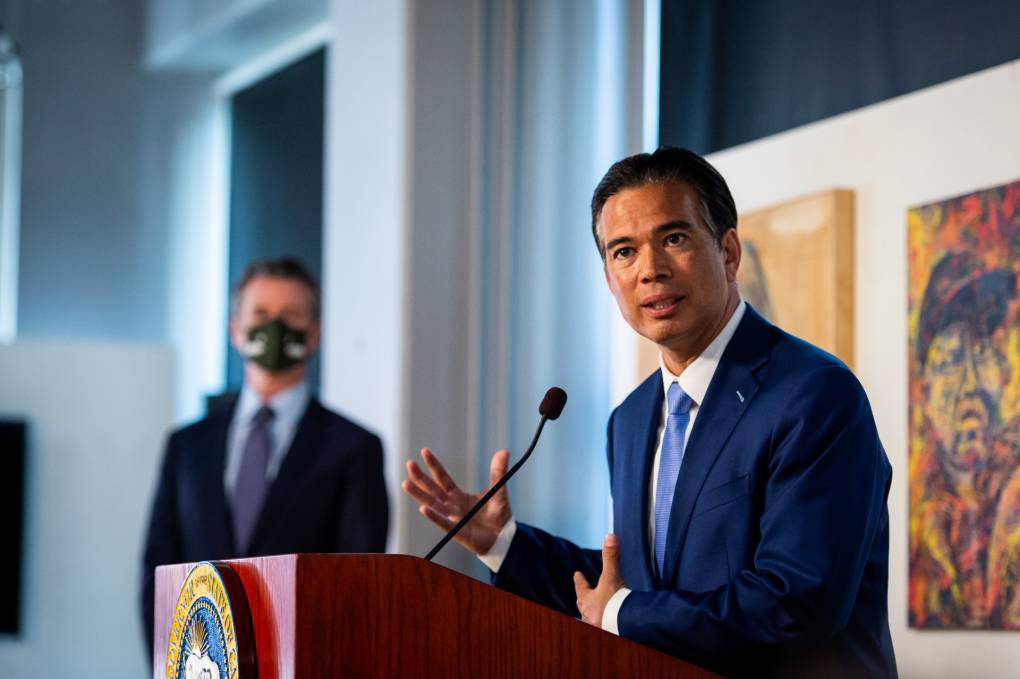
"caption": "Rob Bonta speaks during a press conference in San Francisco on March 24, 2021.",
"description": null,
"title": "RS48084_028_SanFrancisco_NewsomBontaPressConference_03242021-qut",
"credit": "Beth LaBerge/KQED",
"status": "inherit",
"altTag": "AG Rob Bonta speaks at a lectern, with Gov. Gavin Newsom standing in the background.",
"isLoading": false,
"fetchFailed": false
},
"news_11879627": {
"type": "attachments",
"id": "news_11879627",
"meta": {
"index": "attachments_1716263798",
"site": "news",
"id": "11879627",
"found": true
},
"parent": 11879626,
"imgSizes": {
"twentyfourteen-full-width": {
"file": "https://ww2.kqed.org/app/uploads/sites/10/2021/06/GettyImages-1316309451-1024x576.jpg",
"width": 1024,
"mimeType": "image/jpeg",
"height": 576
},
"thumbnail": {
"file": "https://ww2.kqed.org/app/uploads/sites/10/2021/06/GettyImages-1316309451-160x111.jpg",
"width": 160,
"mimeType": "image/jpeg",
"height": 111
},
"post-thumbnail": {
"file": "https://ww2.kqed.org/app/uploads/sites/10/2021/06/GettyImages-1316309451-672x372.jpg",
"width": 672,
"mimeType": "image/jpeg",
"height": 372
},
"kqedFullSize": {
"file": "https://ww2.kqed.org/app/uploads/sites/10/2021/06/GettyImages-1316309451.jpg",
"width": 1024,
"height": 711
},
"large": {
"file": "https://ww2.kqed.org/app/uploads/sites/10/2021/06/GettyImages-1316309451-1020x708.jpg",
"width": 1020,
"mimeType": "image/jpeg",
"height": 708
},
"medium": {
"file": "https://ww2.kqed.org/app/uploads/sites/10/2021/06/GettyImages-1316309451-800x555.jpg",
"width": 800,
"mimeType": "image/jpeg",
"height": 555
}
},
"publishDate": 1624918094,
"modified": 1624918441,
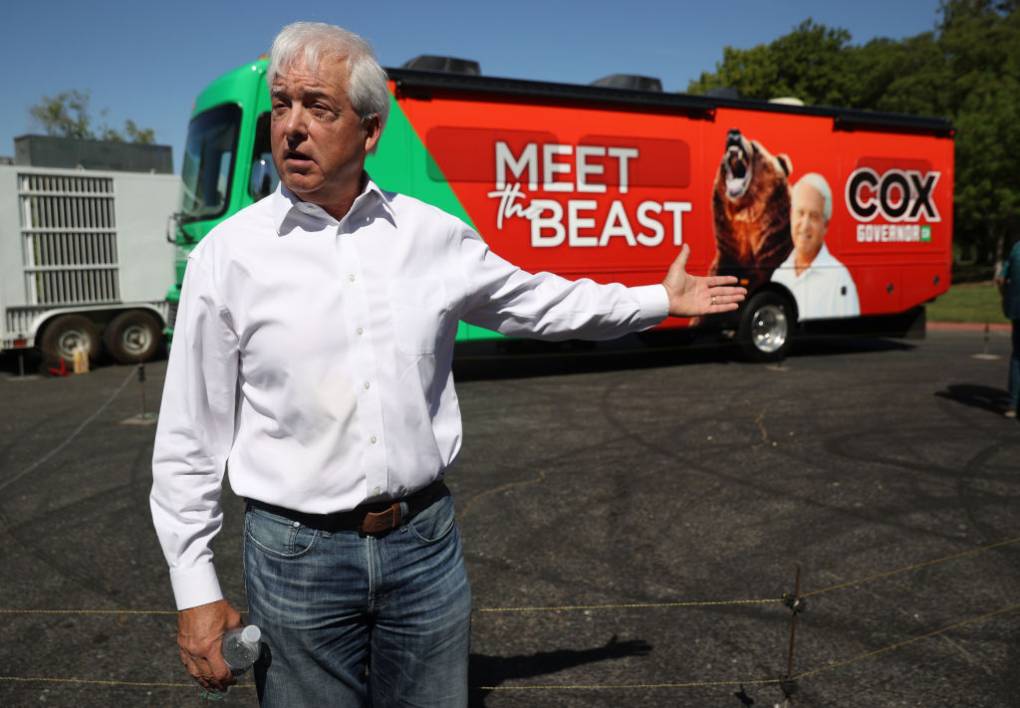
"caption": "California Republican gubernatorial candidate John Cox stands in front of his campaign bus during a rally on May 4, 2021, at Miller Regional Park in Sacramento. Not pictured: the live 1,000-pound bear accompanying him.",
"description": null,
"title": "John Cox Announces Run For California Governor With 1,000-Pound Bear",
"credit": "Justin Sullivan/Getty Images",
"status": "inherit",
"altTag": null,
"isLoading": false,
"fetchFailed": false
},
"news_11879551": {
"type": "attachments",
"id": "news_11879551",
"meta": {
"index": "attachments_1716263798",
"site": "news",
"id": "11879551",
"found": true
},
"parent": 11879548,
"imgSizes": {
"twentyfourteen-full-width": {
"file": "https://ww2.kqed.org/app/uploads/sites/10/2021/06/012921_EvictionVigil_AW_sized_09-1038x576.jpeg",
"width": 1038,
"mimeType": "image/jpeg",
"height": 576
},
"thumbnail": {
"file": "https://ww2.kqed.org/app/uploads/sites/10/2021/06/012921_EvictionVigil_AW_sized_09-160x110.jpeg",
"width": 160,
"mimeType": "image/jpeg",
"height": 110
},
"post-thumbnail": {
"file": "https://ww2.kqed.org/app/uploads/sites/10/2021/06/012921_EvictionVigil_AW_sized_09-672x372.jpeg",
"width": 672,
"mimeType": "image/jpeg",
"height": 372
},
"kqedFullSize": {
"file": "https://ww2.kqed.org/app/uploads/sites/10/2021/06/012921_EvictionVigil_AW_sized_09.jpeg",
"width": 2000,
"height": 1380
},
"large": {
"file": "https://ww2.kqed.org/app/uploads/sites/10/2021/06/012921_EvictionVigil_AW_sized_09-1020x704.jpeg",
"width": 1020,
"mimeType": "image/jpeg",
"height": 704
},
"1536x1536": {
"file": "https://ww2.kqed.org/app/uploads/sites/10/2021/06/012921_EvictionVigil_AW_sized_09-1536x1060.jpeg",
"width": 1536,
"mimeType": "image/jpeg",
"height": 1060
},
"full-width": {
"file": "https://ww2.kqed.org/app/uploads/sites/10/2021/06/012921_EvictionVigil_AW_sized_09-1920x1325.jpeg",
"width": 1920,
"mimeType": "image/jpeg",
"height": 1325
},
"medium": {
"file": "https://ww2.kqed.org/app/uploads/sites/10/2021/06/012921_EvictionVigil_AW_sized_09-800x552.jpeg",
"width": 800,
"mimeType": "image/jpeg",
"height": 552
}
},
"publishDate": 1624904768,
"modified": 1624904804,
"caption": "Oakland resident and member of ACE Alex Acuña holds up a sign decrying SB 91, a rent relief plan signed into law earlier that day by Gov. Gavin Newsom, during a vigil at the Elihu M. Harris, State of California office building in Oakland on Jan. 29, 2021. ",
"description": null,
"title": "012921_EvictionVigil_AW_sized_09",
"credit": "Anne Wernikoff/CalMatters",
"status": "inherit",
"altTag": null,
"isLoading": false,
"fetchFailed": false
},
"news_11879410": {
"type": "attachments",
"id": "news_11879410",
"meta": {
"index": "attachments_1716263798",
"site": "news",
"id": "11879410",
"found": true
},
"parent": 11879404,
"imgSizes": {
"twentyfourteen-full-width": {
"file": "https://ww2.kqed.org/app/uploads/sites/10/2021/06/RS46661_026_Oakland_MLKCarCaravan_01182021-qut-1038x576.jpg",
"width": 1038,
"mimeType": "image/jpeg",
"height": 576
},
"thumbnail": {
"file": "https://ww2.kqed.org/app/uploads/sites/10/2021/06/RS46661_026_Oakland_MLKCarCaravan_01182021-qut-160x107.jpg",
"width": 160,
"mimeType": "image/jpeg",
"height": 107
},
"post-thumbnail": {
"file": "https://ww2.kqed.org/app/uploads/sites/10/2021/06/RS46661_026_Oakland_MLKCarCaravan_01182021-qut-672x372.jpg",
"width": 672,
"mimeType": "image/jpeg",
"height": 372
},
"kqedFullSize": {
"file": "https://ww2.kqed.org/app/uploads/sites/10/2021/06/RS46661_026_Oakland_MLKCarCaravan_01182021-qut.jpg",
"width": 1920,
"height": 1278
},
"large": {
"file": "https://ww2.kqed.org/app/uploads/sites/10/2021/06/RS46661_026_Oakland_MLKCarCaravan_01182021-qut-1020x679.jpg",
"width": 1020,
"mimeType": "image/jpeg",
"height": 679
},
"1536x1536": {
"file": "https://ww2.kqed.org/app/uploads/sites/10/2021/06/RS46661_026_Oakland_MLKCarCaravan_01182021-qut-1536x1022.jpg",
"width": 1536,
"mimeType": "image/jpeg",
"height": 1022
},
"medium": {
"file": "https://ww2.kqed.org/app/uploads/sites/10/2021/06/RS46661_026_Oakland_MLKCarCaravan_01182021-qut-800x533.jpg",
"width": 800,
"mimeType": "image/jpeg",
"height": 533
}
},
"publishDate": 1624655582,
"modified": 1624655607,
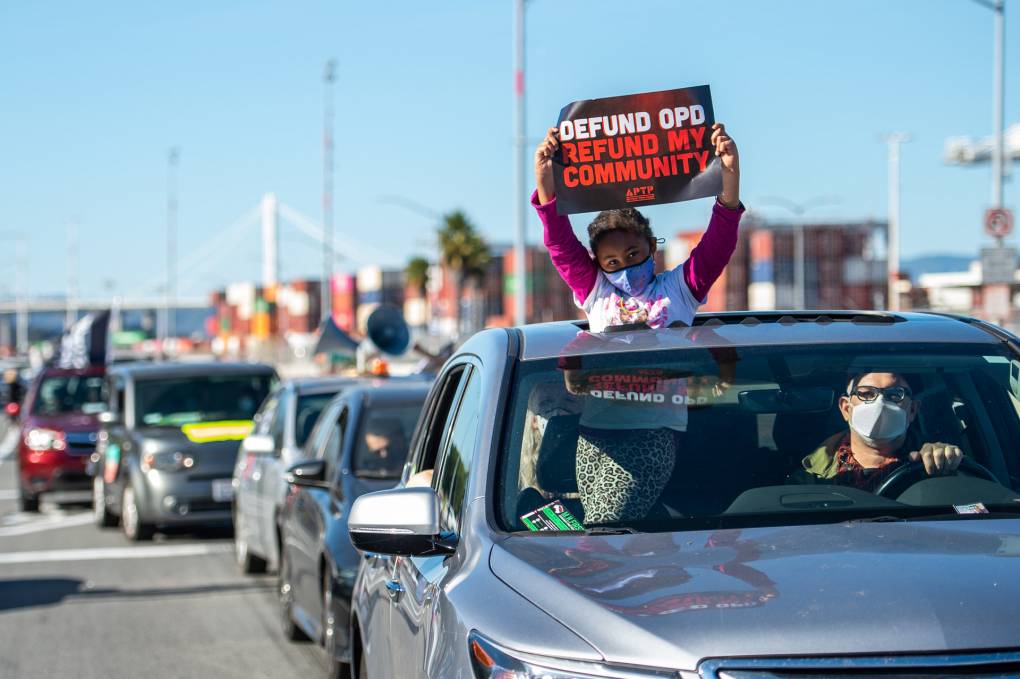
"caption": "Odessa Helfrich-Batt holds a sign that says, \"Defund OPD\" during a Martin Luther King Day car caravan at Middle Harbor Shoreline Park near the Port of Oakland on Jan. 18, 2021.",
"description": "Odessa Helfrich-Batt holds a sign that says, \"Defund OPD\" during a Martin Luther King Day car caravan at Middle Harbor Shoreline Park near the Port of Oakland on Jan. 18, 2021.",
"title": "RS46661_026_Oakland_MLKCarCaravan_01182021-qut",
"credit": "Beth LaBerge/KQED",
"status": "inherit",
"altTag": null,
"isLoading": false,
"fetchFailed": false
},
"news_11879395": {
"type": "attachments",
"id": "news_11879395",
"meta": {
"index": "attachments_1716263798",
"site": "news",
"id": "11879395",
"found": true
},
"parent": 11879076,
"imgSizes": {
"twentyfourteen-full-width": {
"file": "https://ww2.kqed.org/app/uploads/sites/10/2021/06/Oakland-by-Beth-1038x576.jpg",
"width": 1038,
"mimeType": "image/jpeg",
"height": 576
},
"thumbnail": {
"file": "https://ww2.kqed.org/app/uploads/sites/10/2021/06/Oakland-by-Beth-160x107.jpg",
"width": 160,
"mimeType": "image/jpeg",
"height": 107
},
"post-thumbnail": {
"file": "https://ww2.kqed.org/app/uploads/sites/10/2021/06/Oakland-by-Beth-672x372.jpg",
"width": 672,
"mimeType": "image/jpeg",
"height": 372
},
"kqedFullSize": {
"file": "https://ww2.kqed.org/app/uploads/sites/10/2021/06/Oakland-by-Beth.jpg",
"width": 1920,
"height": 1280
},
"large": {
"file": "https://ww2.kqed.org/app/uploads/sites/10/2021/06/Oakland-by-Beth-1020x680.jpg",
"width": 1020,
"mimeType": "image/jpeg",
"height": 680
},
"1536x1536": {
"file": "https://ww2.kqed.org/app/uploads/sites/10/2021/06/Oakland-by-Beth-1536x1024.jpg",
"width": 1536,
"mimeType": "image/jpeg",
"height": 1024
},
"medium": {
"file": "https://ww2.kqed.org/app/uploads/sites/10/2021/06/Oakland-by-Beth-800x533.jpg",
"width": 800,
"mimeType": "image/jpeg",
"height": 533
}
},
"publishDate": 1624652831,
"modified": 1624652897,
"caption": "Bei Kao holds her \"I Voted\" sticker after voting in Oakland on Oct. 27, 2020.",
"description": "Bei Kao holds her \"I Voted\" sticker after voting in Oakland on Oct. 27, 2020.",
"title": "Bei Kao holds her \"I Voted\" sticker after voting in Oakland on Oct. 27, 2020.",
"credit": "Beth LaBerge/KQED",
"status": "inherit",
"altTag": null,
"isLoading": false,
"fetchFailed": false
},
"news_11879104": {
"type": "attachments",
"id": "news_11879104",
"meta": {
"index": "attachments_1716263798",
"site": "news",
"id": "11879104",
"found": true
},
"parent": 11878950,
"imgSizes": {
"twentyfourteen-full-width": {
"file": "https://ww2.kqed.org/app/uploads/sites/10/2021/06/RS50114_004_Oakland_MiaBonta_06232021-qut-1038x576.jpg",
"width": 1038,
"mimeType": "image/jpeg",
"height": 576
},
"thumbnail": {
"file": "https://ww2.kqed.org/app/uploads/sites/10/2021/06/RS50114_004_Oakland_MiaBonta_06232021-qut-160x90.jpg",
"width": 160,
"mimeType": "image/jpeg",
"height": 90
},
"post-thumbnail": {
"file": "https://ww2.kqed.org/app/uploads/sites/10/2021/06/RS50114_004_Oakland_MiaBonta_06232021-qut-672x372.jpg",
"width": 672,
"mimeType": "image/jpeg",
"height": 372
},
"kqedFullSize": {
"file": "https://ww2.kqed.org/app/uploads/sites/10/2021/06/RS50114_004_Oakland_MiaBonta_06232021-qut.jpg",
"width": 1920,
"height": 1080
},
"large": {
"file": "https://ww2.kqed.org/app/uploads/sites/10/2021/06/RS50114_004_Oakland_MiaBonta_06232021-qut-1020x574.jpg",
"width": 1020,
"mimeType": "image/jpeg",
"height": 574
},
"1536x1536": {
"file": "https://ww2.kqed.org/app/uploads/sites/10/2021/06/RS50114_004_Oakland_MiaBonta_06232021-qut-1536x864.jpg",
"width": 1536,
"mimeType": "image/jpeg",
"height": 864
},
"medium": {
"file": "https://ww2.kqed.org/app/uploads/sites/10/2021/06/RS50114_004_Oakland_MiaBonta_06232021-qut-800x450.jpg",
"width": 800,
"mimeType": "image/jpeg",
"height": 450
}
},
"publishDate": 1624489450,
"modified": 1624559018,
"caption": "Mia Bonta, candidate for state Assembly in District 18, which includes Oakland, Alameda and San Leandro, speaks with students at her campaign headquarters in Oakland on June 23, 2021.",
"description": null,
"title": "RS50114_004_Oakland_MiaBonta_06232021-qut",
"credit": "Beth LaBerge/KQED",
"status": "inherit",
"altTag": null,
"isLoading": false,
"fetchFailed": false
},
"news_11878990": {
"type": "attachments",
"id": "news_11878990",
"meta": {
"index": "attachments_1716263798",
"site": "news",
"id": "11878990",
"found": true
},
"parent": 11878989,
"imgSizes": {
"thumbnail": {
"file": "https://ww2.kqed.org/app/uploads/sites/10/2021/06/gettyimages-1231093862_wide-4195c57f825738c502a8a11e343c9df96ca71caf-160x90.jpg",
"width": 160,
"mimeType": "image/jpeg",
"height": 90
},
"post-thumbnail": {
"file": "https://ww2.kqed.org/app/uploads/sites/10/2021/06/gettyimages-1231093862_wide-4195c57f825738c502a8a11e343c9df96ca71caf-672x372.jpg",
"width": 672,
"mimeType": "image/jpeg",
"height": 372
},
"kqedFullSize": {
"file": "https://ww2.kqed.org/app/uploads/sites/10/2021/06/gettyimages-1231093862_wide-4195c57f825738c502a8a11e343c9df96ca71caf.jpg",
"width": 1024,
"height": 576
},
"large": {
"file": "https://ww2.kqed.org/app/uploads/sites/10/2021/06/gettyimages-1231093862_wide-4195c57f825738c502a8a11e343c9df96ca71caf-1020x574.jpg",
"width": 1020,
"mimeType": "image/jpeg",
"height": 574
},
"medium": {
"file": "https://ww2.kqed.org/app/uploads/sites/10/2021/06/gettyimages-1231093862_wide-4195c57f825738c502a8a11e343c9df96ca71caf-800x450.jpg",
"width": 800,
"mimeType": "image/jpeg",
"height": 450
}
},
"publishDate": 1624465271,
"modified": 1690220476,
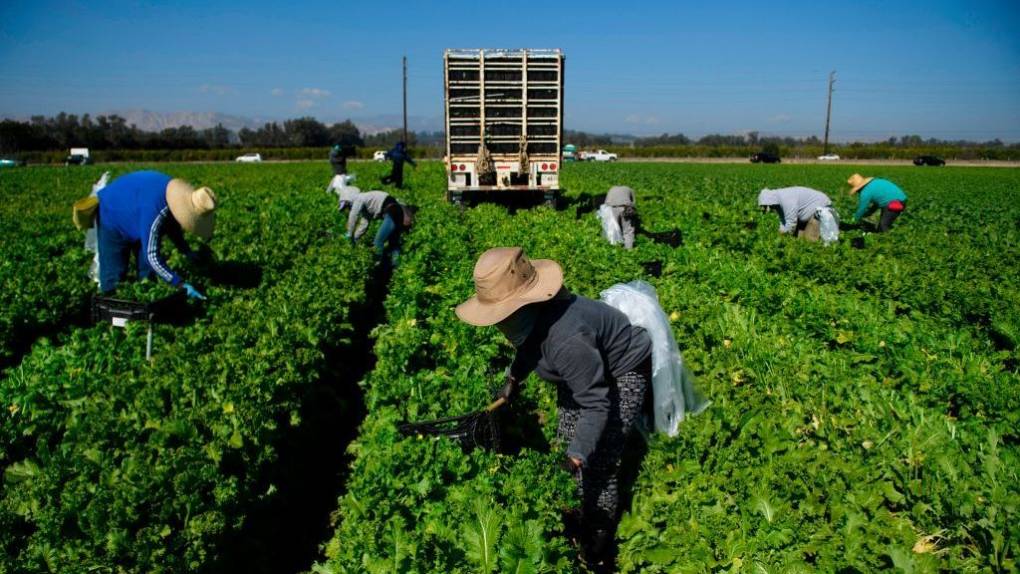
"caption": "Farmworkers harvest curly mustard in a field on Feb. 10, 2021 in Ventura County. ",
"description": "Farmworkers harvest curly mustard in a field on Feb. 10 in Ventura County. The Supreme Court handed the farmworkers union a loss Wednesday in a ruling about union organizers' access to farm property.",
"title": "Farmworkers harvest curly mustard in a field on Feb. 10 in Ventura County, Calif. The Supreme Court handed the farmworkers union a loss Wednesday in a ruling about union organizers' access to farm property.",
"credit": "Patrick T. Fallon/AFP via Getty Images",
"status": "inherit",
"altTag": "People bent over in a large field filled with rows of vegetables with a large vehicle in the background.",
"isLoading": false,
"fetchFailed": false
},
"news_11878352": {
"type": "attachments",
"id": "news_11878352",
"meta": {
"index": "attachments_1716263798",
"site": "news",
"id": "11878352",
"found": true
},
"parent": 11878253,
"imgSizes": {
"twentyfourteen-full-width": {
"file": "https://ww2.kqed.org/app/uploads/sites/10/2021/06/RS35524__M6A1056-qut-1038x576.jpg",
"width": 1038,
"mimeType": "image/jpeg",
"height": 576
},
"thumbnail": {
"file": "https://ww2.kqed.org/app/uploads/sites/10/2021/06/RS35524__M6A1056-qut-160x107.jpg",
"width": 160,
"mimeType": "image/jpeg",
"height": 107
},
"post-thumbnail": {
"file": "https://ww2.kqed.org/app/uploads/sites/10/2021/06/RS35524__M6A1056-qut-672x372.jpg",
"width": 672,
"mimeType": "image/jpeg",
"height": 372
},
"kqedFullSize": {
"file": "https://ww2.kqed.org/app/uploads/sites/10/2021/06/RS35524__M6A1056-qut.jpg",
"width": 1920,
"height": 1280
},
"large": {
"file": "https://ww2.kqed.org/app/uploads/sites/10/2021/06/RS35524__M6A1056-qut-1020x680.jpg",
"width": 1020,
"mimeType": "image/jpeg",
"height": 680
},
"1536x1536": {
"file": "https://ww2.kqed.org/app/uploads/sites/10/2021/06/RS35524__M6A1056-qut-1536x1024.jpg",
"width": 1536,
"mimeType": "image/jpeg",
"height": 1024
},
"medium": {
"file": "https://ww2.kqed.org/app/uploads/sites/10/2021/06/RS35524__M6A1056-qut-800x533.jpg",
"width": 800,
"mimeType": "image/jpeg",
"height": 533
}
},
"publishDate": 1623946356,
"modified": 1624298052,
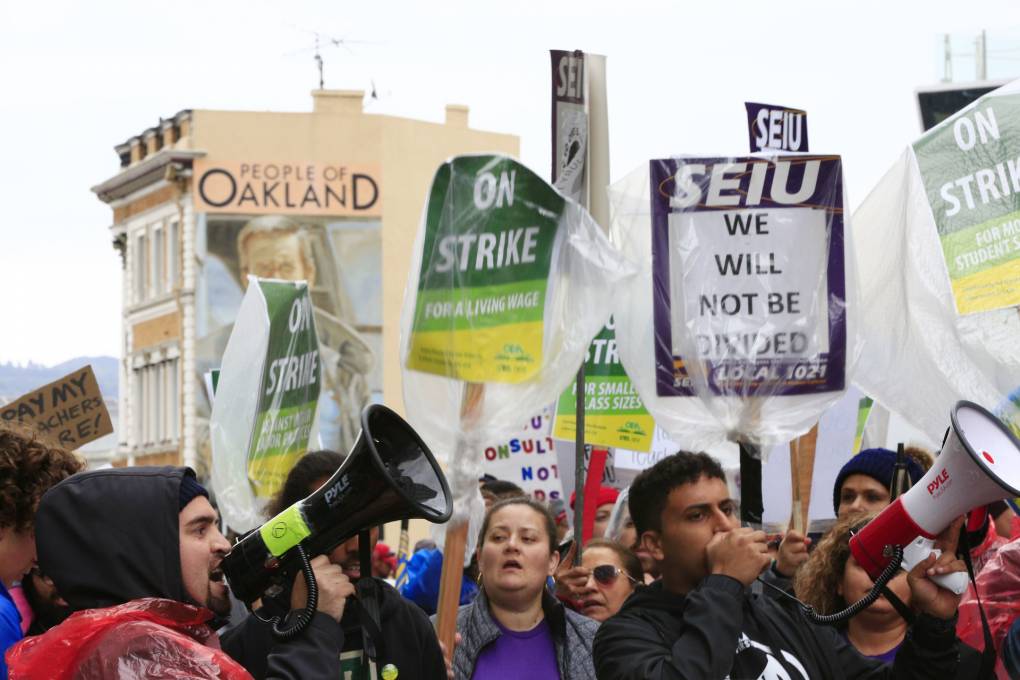
"caption": "Demonstrators in Oakland during the 2019 teachers strike. Teachers unions have spent heavily in an East Bay special election for state Assembly. ",
"description": null,
"title": "RS35524__M6A1056-qut",
"credit": "Stephanie Lister/KQED",
"status": "inherit",
"altTag": null,
"isLoading": false,
"fetchFailed": false
},
"news_11878401": {
"type": "attachments",
"id": "news_11878401",
"meta": {
"index": "attachments_1716263798",
"site": "news",
"id": "11878401",
"found": true
},
"parent": 11878309,
"imgSizes": {
"twentyfourteen-full-width": {
"file": "https://ww2.kqed.org/app/uploads/sites/10/2021/06/BarbaraLee-1038x576.jpg",
"width": 1038,
"mimeType": "image/jpeg",
"height": 576
},
"thumbnail": {
"file": "https://ww2.kqed.org/app/uploads/sites/10/2021/06/BarbaraLee-160x99.jpg",
"width": 160,
"mimeType": "image/jpeg",
"height": 99
},
"post-thumbnail": {
"file": "https://ww2.kqed.org/app/uploads/sites/10/2021/06/BarbaraLee-672x372.jpg",
"width": 672,
"mimeType": "image/jpeg",
"height": 372
},
"kqedFullSize": {
"file": "https://ww2.kqed.org/app/uploads/sites/10/2021/06/BarbaraLee.jpg",
"width": 1920,
"height": 1185
},
"large": {
"file": "https://ww2.kqed.org/app/uploads/sites/10/2021/06/BarbaraLee-1020x630.jpg",
"width": 1020,
"mimeType": "image/jpeg",
"height": 630
},
"1536x1536": {
"file": "https://ww2.kqed.org/app/uploads/sites/10/2021/06/BarbaraLee-1536x948.jpg",
"width": 1536,
"mimeType": "image/jpeg",
"height": 948
},
"medium": {
"file": "https://ww2.kqed.org/app/uploads/sites/10/2021/06/BarbaraLee-800x494.jpg",
"width": 800,
"mimeType": "image/jpeg",
"height": 494
}
},
"publishDate": 1623954296,
"modified": 1623954373,
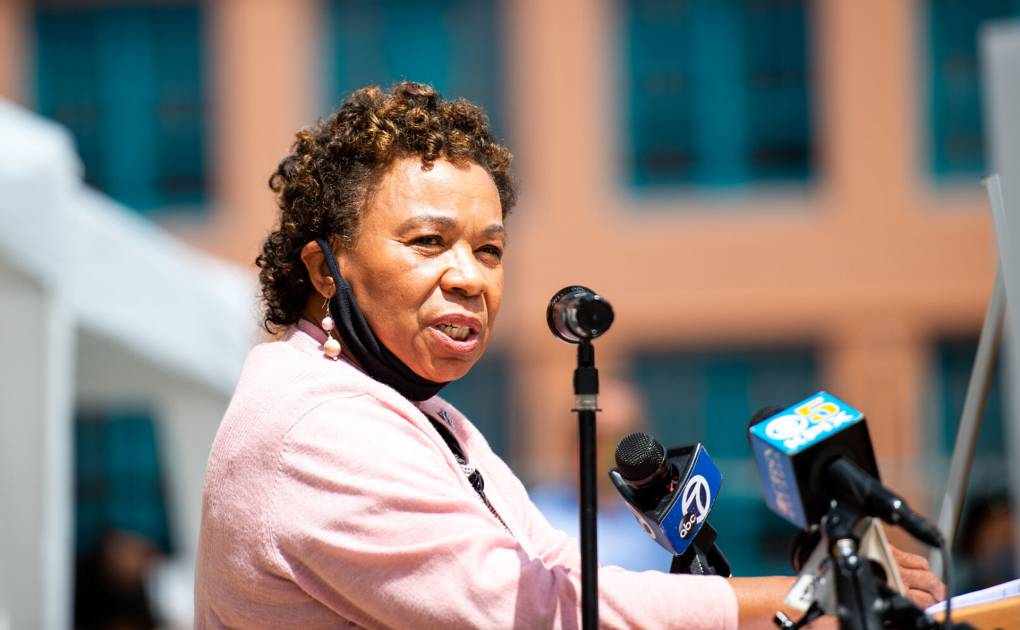
"caption": "East Bay Rep. Barbara Lee, pictured at a remembrance event in Oakland to pay tribute to George Floyd on May 25, 2021.",
"description": "East Bay Rep. Barbara Lee, pictured at a remembrance event in Oakland to pay tribute to George Floyd on May 25, 2021.",
"title": "BarbaraLee",
"credit": "Beth LaBerge/KQED",
"status": "inherit",
"altTag": null,
"isLoading": false,
"fetchFailed": false
},
"news_11878329": {
"type": "attachments",
"id": "news_11878329",
"meta": {
"index": "attachments_1716263798",
"site": "news",
"id": "11878329",
"found": true
},
"parent": 11878318,
"imgSizes": {
"twentyfourteen-full-width": {
"file": "https://ww2.kqed.org/app/uploads/sites/10/2021/06/RS46106_014_KQED_SanFrancisco_COVIDTesting_11302020-qut-1038x576.jpg",
"width": 1038,
"mimeType": "image/jpeg",
"height": 576
},
"thumbnail": {
"file": "https://ww2.kqed.org/app/uploads/sites/10/2021/06/RS46106_014_KQED_SanFrancisco_COVIDTesting_11302020-qut-160x107.jpg",
"width": 160,
"mimeType": "image/jpeg",
"height": 107
},
"post-thumbnail": {
"file": "https://ww2.kqed.org/app/uploads/sites/10/2021/06/RS46106_014_KQED_SanFrancisco_COVIDTesting_11302020-qut-672x372.jpg",
"width": 672,
"mimeType": "image/jpeg",
"height": 372
},
"kqedFullSize": {
"file": "https://ww2.kqed.org/app/uploads/sites/10/2021/06/RS46106_014_KQED_SanFrancisco_COVIDTesting_11302020-qut.jpg",
"width": 1920,
"height": 1280
},
"large": {
"file": "https://ww2.kqed.org/app/uploads/sites/10/2021/06/RS46106_014_KQED_SanFrancisco_COVIDTesting_11302020-qut-1020x680.jpg",
"width": 1020,
"mimeType": "image/jpeg",
"height": 680
},
"1536x1536": {
"file": "https://ww2.kqed.org/app/uploads/sites/10/2021/06/RS46106_014_KQED_SanFrancisco_COVIDTesting_11302020-qut-1536x1024.jpg",
"width": 1536,
"mimeType": "image/jpeg",
"height": 1024
},
"medium": {
"file": "https://ww2.kqed.org/app/uploads/sites/10/2021/06/RS46106_014_KQED_SanFrancisco_COVIDTesting_11302020-qut-800x533.jpg",
"width": 800,
"mimeType": "image/jpeg",
"height": 533
}
},
"publishDate": 1623893220,
"modified": 1640643412,
"caption": "Health care worker Olga Duran tests a patient for COVID-19 at a Unidos en Salud (United in Health) testing site on 24th and Mission streets in San Francisco on Nov. 30, 2020. The effort is a collaboration between UCSF and the SF Latino Task Force to help vulnerable populations during the pandemic.",
"description": null,
"title": "RS46106_014_KQED_SanFrancisco_COVIDTesting_11302020-qut",
"credit": "Beth LaBerge/KQED",
"status": "inherit",
"altTag": "A healthcare worker in blue scrubs swabs a man whose back is turned to the camera.",
"isLoading": false,
"fetchFailed": false
},
"news_11878294": {
"type": "attachments",
"id": "news_11878294",
"meta": {
"index": "attachments_1716263798",
"site": "news",
"id": "11878294",
"found": true
},
"parent": 11878293,
"imgSizes": {
"twentyfourteen-full-width": {
"file": "https://ww2.kqed.org/app/uploads/sites/10/2021/06/ap_20172034000134_custom-041dc85ee3549bb96ab040acc467dc3bfe9b75ec-1038x576.jpg",
"width": 1038,
"mimeType": "image/jpeg",
"height": 576
},
"thumbnail": {
"file": "https://ww2.kqed.org/app/uploads/sites/10/2021/06/ap_20172034000134_custom-041dc85ee3549bb96ab040acc467dc3bfe9b75ec-160x99.jpg",
"width": 160,
"mimeType": "image/jpeg",
"height": 99
},
"post-thumbnail": {
"file": "https://ww2.kqed.org/app/uploads/sites/10/2021/06/ap_20172034000134_custom-041dc85ee3549bb96ab040acc467dc3bfe9b75ec-672x372.jpg",
"width": 672,
"mimeType": "image/jpeg",
"height": 372
},
"kqedFullSize": {
"file": "https://ww2.kqed.org/app/uploads/sites/10/2021/06/ap_20172034000134_custom-041dc85ee3549bb96ab040acc467dc3bfe9b75ec-scaled-e1623887814802.jpg",
"width": 1920,
"height": 1192
},
"2048x2048": {
"file": "https://ww2.kqed.org/app/uploads/sites/10/2021/06/ap_20172034000134_custom-041dc85ee3549bb96ab040acc467dc3bfe9b75ec-2048x1271.jpg",
"width": 2048,
"mimeType": "image/jpeg",
"height": 1271
},
"large": {
"file": "https://ww2.kqed.org/app/uploads/sites/10/2021/06/ap_20172034000134_custom-041dc85ee3549bb96ab040acc467dc3bfe9b75ec-1020x633.jpg",
"width": 1020,
"mimeType": "image/jpeg",
"height": 633
},
"1536x1536": {
"file": "https://ww2.kqed.org/app/uploads/sites/10/2021/06/ap_20172034000134_custom-041dc85ee3549bb96ab040acc467dc3bfe9b75ec-1536x954.jpg",
"width": 1536,
"mimeType": "image/jpeg",
"height": 954
},
"full-width": {
"file": "https://ww2.kqed.org/app/uploads/sites/10/2021/06/ap_20172034000134_custom-041dc85ee3549bb96ab040acc467dc3bfe9b75ec-1920x1192.jpg",
"width": 1920,
"mimeType": "image/jpeg",
"height": 1192
},
"medium": {
"file": "https://ww2.kqed.org/app/uploads/sites/10/2021/06/ap_20172034000134_custom-041dc85ee3549bb96ab040acc467dc3bfe9b75ec-800x497.jpg",
"width": 800,
"mimeType": "image/jpeg",
"height": 497
}
},
"publishDate": 1623887195,
"modified": 1623889526,
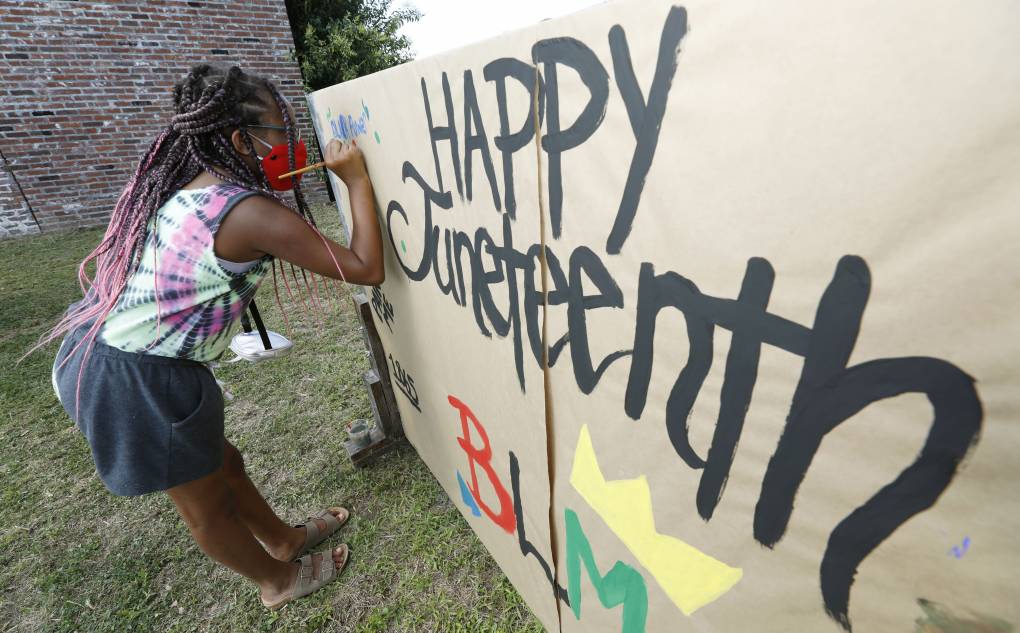
"caption": "A girl paints on a poster celebrating Juneteenth in downtown Jackson, Mississippi, on June 19, 2020. Congress has voted to make the day a federal holiday.",
"description": "A girl paints on a poster celebrating Juneteenth in downtown Jackson, Miss., on June 19, 2020. Congress has voted to make the day a federal holiday.\n",
"title": "A girl paints on a poster celebrating Juneteenth in downtown Jackson, Miss., on June 19, 2020. Congress has voted to make the day a federal holiday.",
"credit": "Rogelio V. Solis/AP",
"status": "inherit",
"altTag": null,
"isLoading": false,
"fetchFailed": false
},
"news_11877599": {
"type": "attachments",
"id": "news_11877599",
"meta": {
"index": "attachments_1716263798",
"site": "news",
"id": "11877599",
"found": true
},
"parent": 11877588,
"imgSizes": {
"twentyfourteen-full-width": {
"file": "https://ww2.kqed.org/app/uploads/sites/10/2021/06/RS49760_GettyImages-1233292764-qut-1038x576.jpg",
"width": 1038,
"mimeType": "image/jpeg",
"height": 576
},
"thumbnail": {
"file": "https://ww2.kqed.org/app/uploads/sites/10/2021/06/RS49760_GettyImages-1233292764-qut-160x107.jpg",
"width": 160,
"mimeType": "image/jpeg",
"height": 107
},
"post-thumbnail": {
"file": "https://ww2.kqed.org/app/uploads/sites/10/2021/06/RS49760_GettyImages-1233292764-qut-672x372.jpg",
"width": 672,
"mimeType": "image/jpeg",
"height": 372
},
"kqedFullSize": {
"file": "https://ww2.kqed.org/app/uploads/sites/10/2021/06/RS49760_GettyImages-1233292764-qut.jpg",
"width": 1920,
"height": 1280
},
"large": {
"file": "https://ww2.kqed.org/app/uploads/sites/10/2021/06/RS49760_GettyImages-1233292764-qut-1020x680.jpg",
"width": 1020,
"mimeType": "image/jpeg",
"height": 680
},
"1536x1536": {
"file": "https://ww2.kqed.org/app/uploads/sites/10/2021/06/RS49760_GettyImages-1233292764-qut-1536x1024.jpg",
"width": 1536,
"mimeType": "image/jpeg",
"height": 1024
},
"medium": {
"file": "https://ww2.kqed.org/app/uploads/sites/10/2021/06/RS49760_GettyImages-1233292764-qut-800x533.jpg",
"width": 800,
"mimeType": "image/jpeg",
"height": 533
}
},
"publishDate": 1623363203,
"modified": 1623364998,
"caption": "A clerk shows a customer a California-legal, featureless AR-15 style rifle on display for sale at a gun show at the Orange County Fairgrounds on June 5, 2021 in Costa Mesa.",
"description": "A clerk shows a customer a California legal, featureless AR-15 style rifle on display for sale at a gun show at the Orange County Fairgrounds on June 5, 2021 in Costa Mesa.",
"title": "US-WEAPONRY-ARMS-GUN SHOW",
"credit": "Patrick T. Fallon/AFP via Getty Images",
"status": "inherit",
"altTag": null,
"isLoading": false,
"fetchFailed": false
}
},
"audioPlayerReducer": {
"postId": "stream_live",
"isPaused": true,
"isPlaying": false,
"pfsActive": false,
"pledgeModalIsOpen": true,
"playerDrawerIsOpen": false,
"liveAudioPlayStartedAt": 0,
"liveAudioPlayContext": ""
},
"authorsReducer": {
"byline_news_11879626": {
"type": "authors",
"id": "byline_news_11879626",
"meta": {
"override": true
},
"slug": "byline_news_11879626",
"name": "Kathleen Ronayne\u003cbr>Associated Press",
"isLoading": false
},
"byline_news_11879548": {
"type": "authors",
"id": "byline_news_11879548",
"meta": {
"override": true
},
"slug": "byline_news_11879548",
"name": "Manuela Tobias",
"isLoading": false
},
"byline_news_11878989": {
"type": "authors",
"id": "byline_news_11878989",
"meta": {
"override": true
},
"slug": "byline_news_11878989",
"name": "Nina Totenberg and Eric Singerman",
"isLoading": false
},
"byline_news_11878318": {
"type": "authors",
"id": "byline_news_11878318",
"meta": {
"override": true
},
"slug": "byline_news_11878318",
"name": "Marisa Lagos (KQED) and Caitie Switalski Muñoz (WLRN)",
"isLoading": false
},
"byline_news_11878293": {
"type": "authors",
"id": "byline_news_11878293",
"meta": {
"override": true
},
"slug": "byline_news_11878293",
"name": "Alana Wise",
"isLoading": false
},
"byline_news_11877588": {
"type": "authors",
"id": "byline_news_11877588",
"meta": {
"override": true
},
"slug": "byline_news_11877588",
"name": "Don Thompson \u003cbr> The Associated Press",
"isLoading": false
},
"gmarzorati": {
"type": "authors",
"id": "227",
"meta": {
"index": "authors_1716337520",
"id": "227",
"found": true
},
"name": "Guy Marzorati",
"firstName": "Guy",
"lastName": "Marzorati",
"slug": "gmarzorati",
"email": "gmarzorati@KQED.org",
"display_author_email": true,
"staff_mastheads": [
"news"
],
"title": "Correspondent",
"bio": "Guy Marzorati is a correspondent on KQED's California Politics and Government Desk, based in San Jose. A graduate of Santa Clara University, Guy joined KQED in 2013. He reports on state and local politics and produces KQED's digital voter guide.",
"avatar": "https://secure.gravatar.com/avatar/e7038b8dbfd55b104369b76b1cd0b9de?s=600&d=blank&r=g",
"twitter": "guymarzorati",
"facebook": null,
"instagram": null,
"linkedin": null,
"sites": [
{
"site": "",
"roles": [
"editor"
]
},
{
"site": "news",
"roles": [
"editor"
]
},
{
"site": "science",
"roles": [
"editor"
]
},
{
"site": "forum",
"roles": [
"editor"
]
},
{
"site": "elections",
"roles": [
"editor"
]
},
{
"site": "liveblog",
"roles": [
"editor"
]
}
],
"headData": {
"title": "Guy Marzorati | KQED",
"description": "Correspondent",
"ogImgSrc": "https://secure.gravatar.com/avatar/e7038b8dbfd55b104369b76b1cd0b9de?s=600&d=blank&r=g",
"twImgSrc": "https://secure.gravatar.com/avatar/e7038b8dbfd55b104369b76b1cd0b9de?s=600&d=blank&r=g"
},
"isLoading": false,
"link": "/author/gmarzorati"
},
"kqednewsstaffandwires": {
"type": "authors",
"id": "237",
"meta": {
"index": "authors_1716337520",
"id": "237",
"found": true
},
"name": "KQED News Staff and Wires",
"firstName": "KQED News Staff and Wires",
"lastName": null,
"slug": "kqednewsstaffandwires",
"email": "onlinenewsstaff@kqed.org",
"display_author_email": false,
"staff_mastheads": [],
"title": null,
"bio": null,
"avatar": "https://secure.gravatar.com/avatar/72295af8ebbfbd19a4948f5271285664?s=600&d=blank&r=g",
"twitter": null,
"facebook": null,
"instagram": null,
"linkedin": null,
"sites": [
{
"site": "arts",
"roles": [
"contributor"
]
},
{
"site": "news",
"roles": [
"contributor"
]
},
{
"site": "lowdown",
"roles": [
"author"
]
},
{
"site": "stateofhealth",
"roles": [
"contributor"
]
},
{
"site": "food",
"roles": [
"author"
]
}
],
"headData": {
"title": "KQED News Staff and Wires | KQED",
"description": null,
"ogImgSrc": "https://secure.gravatar.com/avatar/72295af8ebbfbd19a4948f5271285664?s=600&d=blank&r=g",
"twImgSrc": "https://secure.gravatar.com/avatar/72295af8ebbfbd19a4948f5271285664?s=600&d=blank&r=g"
},
"isLoading": false,
"link": "/author/kqednewsstaffandwires"
},
"scottshafer": {
"type": "authors",
"id": "255",
"meta": {
"index": "authors_1716337520",
"id": "255",
"found": true
},
"name": "Scott Shafer",
"firstName": "Scott",
"lastName": "Shafer",
"slug": "scottshafer",
"email": "sshafer@kqed.org",
"display_author_email": false,
"staff_mastheads": [
"news"
],
"title": "KQED Contributor",
"bio": "Scott Shafer is a senior editor with the KQED Politics and Government desk. He is co-host of Political Breakdown, the award-winning radio show and podcast with a personal take on the world of politics. Scott came to KQED in 1998 to host the statewide\u003cem> California Report\u003c/em>. Prior to that he had extended stints in politics and government\u003cem>.\u003c/em> He uses that inside experience at KQED in his, reporting, hosting and analysis for the politics desk. Scott collaborated \u003cem>Political Breakdown a\u003c/em>nd on \u003cem>The Political Mind of Jerry Brown, \u003c/em>an eight-part series about the life and extraordinary political career of the former governor. For fun, he plays water polo with the San Francisco Tsunami.",
"avatar": "https://secure.gravatar.com/avatar/a62ebae45b79d7aed1a39a0e3bf68104?s=600&d=blank&r=g",
"twitter": "scottshafer",
"bluesky": null,
"facebook": null,
"instagram": null,
"linkedin": null,
"sites": [
{
"site": "news",
"roles": [
"editor"
]
},
{
"site": "stateofhealth",
"roles": [
"author"
]
},
{
"site": "science",
"roles": [
"author"
]
},
{
"site": "forum",
"roles": [
"subscriber"
]
},
{
"site": "liveblog",
"roles": [
"author"
]
}
],
"headData": {
"title": "Scott Shafer | KQED",
"description": "KQED Contributor",
"ogImgSrc": "https://secure.gravatar.com/avatar/a62ebae45b79d7aed1a39a0e3bf68104?s=600&d=blank&r=g",
"twImgSrc": "https://secure.gravatar.com/avatar/a62ebae45b79d7aed1a39a0e3bf68104?s=600&d=blank&r=g"
},
"isLoading": false,
"link": "/author/scottshafer"
}
},
"pagesReducer": {
"news_tag_politics": {
"type": "terms",
"id": "news_17968",
"meta": {
"index": "terms_1716263798",
"site": "news",
"id": "17968",
"score": 8.003266
},
"name": "Politics",
"slug": "politics",
"taxonomy": "tag",
"description": null,
"featImg": null,
"headData": {
"title": "Politics | KQED News",
"description": null,
"ogTitle": null,
"ogDescription": null,
"ogImgId": null,
"twTitle": null,
"twDescription": null,
"twImgId": null
},
"ttid": 18002,
"isLoading": false,
"title": "Politics",
"pageMeta": {
"site": "news",
"WpPageTemplate": "page-topic-editorial",
"currentPage": 187
},
"blocks": [
{
"blockName": "kqed/post-list",
"attrs": {
"layout": "cardArticle2",
"query": "posts/news?tag=politics",
"seeMore": false,
"paginated": true,
"page": 187
}
},
{
"blockName": "kqed/ad"
}
]
}
},
"pfsSessionReducer": {},
"postsReducer": {
"stream_live": {
"type": "live",
"id": "stream_live",
"audioUrl": "https://streams.kqed.org/kqedradio",
"title": "Live Stream",
"excerpt": "Live Stream information currently unavailable.",
"link": "/radio",
"featImg": "",
"label": {
"name": "KQED Live",
"link": "/"
}
},
"stream_kqedNewscast": {
"type": "posts",
"id": "stream_kqedNewscast",
"audioUrl": "https://www.kqed.org/.stream/anon/radio/RDnews/newscast.mp3?_=1",
"title": "KQED Newscast",
"featImg": "",
"label": {
"name": "88.5 FM",
"link": "/"
}
},
"news_11879644": {
"type": "posts",
"id": "news_11879644",
"meta": {
"index": "posts_1716263798",
"site": "news",
"id": "11879644",
"score": null,
"sort": [
1624927320000
]
},
"parent": 0,
"labelTerm": {
"site": "news"
},
"blocks": [],
"publishDate": 1624927320,
"format": "standard",
"disqusTitle": "'Aligning Dollars With Values': 5 More States Placed on California's 'No Travel' List for Anti-LGBTQ+ Laws",
"title": "'Aligning Dollars With Values': 5 More States Placed on California's 'No Travel' List for Anti-LGBTQ+ Laws",
"headTitle": "KQED News",
"content": "\u003cp>California Attorney General Rob Bonta added five states to the list of places to which travel will not be reimbursed with public money.\u003c/p>\n\u003cp>\"The states are a part of a recent dangerous wave of discriminatory new bills signed into law in states all across the country,\" Bonta said Monday morning during a press conference at the \u003ca href=\"https://www.glbthistory.org/exhibitions\" target=\"_blank\" rel=\"noopener noreferrer\">GLBT Historical Society Museum in San Francisco\u003c/a>. [pullquote size=\"medium\" align=\"right\" citation=\"Rob Bonta, California Attorney General\"]'The states are a part of a recent dangerous wave of discriminatory new bills signed into law in states all across the country.’[/pullquote]\u003c/p>\n\u003cp>Arkansas, Montana, North Dakota, West Virginia and Florida were added to the list Monday.\u003c/p>\n\u003cp>\"As of June, there have been more than 250 anti-LGBTQ bills introduced in state legislatures across the country, at least 95 of them directly targeting transgender Americans,\" Bonta said.\u003c/p>\n\u003cp>Bonta and state Sen. Scott Wiener, D-San Francisco, noted that most of the newly added states are targeted for enacting laws limiting the access of transgender youth to school sports and health care related to their gender identity.\u003c/p>\n\u003cp>\"It's outrageous,\" Wiener said. \"These are children who are just trying to be who they are and live their lives and do what we all want children to do, just to be happy and to grow, and to experience life.\" Instead, elected officials in these various states are \"demonizing and targeting these children,\" Wiener added.\u003c/p>\n\u003cp>A \u003ca href=\"https://leginfo.legislature.ca.gov/faces/billTextClient.xhtml?bill_id=201520160AB1887\" target=\"_blank\" rel=\"noopener noreferrer\">state law\u003c/a> that took effect in 2017 prohibits a state agency, department, board or commission from requiring any state employees, officers or members to travel to a state that discriminates against same-sex couples or their families or on the basis of sexual orientation, gender identity or gender expression. It falls to the attorney general each year to update the list.\u003c/p>\n\u003cp>Bonta said the law \"is about aligning our dollars with our values.\" The law includes exemptions for some travel to banned states, such as sending first responders to help with natural disasters and health crises.\u003c/p>\n\u003cfigure id=\"attachment_11879661\" class=\"wp-caption alignnone\" style=\"max-width: 800px\">\u003cimg class=\"size-medium wp-image-11879661\" src=\"https://ww2.kqed.org/app/uploads/sites/10/2021/06/IMG_6099-800x1067.jpg\" alt=\"\" width=\"800\" height=\"1067\">\u003cfigcaption class=\"wp-caption-text\">California Attorney General Rob Bonta, center, announces the addition of five states to California's 'no travel' list. \u003ccite>(Scott Shafer/KQED)\u003c/cite>\u003c/figcaption>\u003c/figure>\n\u003cp>The 12 states that were already on the list before today are: Alabama, Idaho, Iowa, Kansas, Kentucky, Mississippi, North Carolina, Oklahoma, South Carolina, South Dakota, Tennessee and Texas. [ad fullwidth]\u003c/p>\n\u003cp>Many of the states, including Texas and Florida, have sizable LGBTQ+ communities and businesses. Asked whether a law like this could inadvertently hurt them, Assemblymember Evan Low, D-Campbell, who wrote the original bill, said he hears from states on the no travel list that the ban can have a positive impact. [aside tag=\"transgender, pride\" label=\"More Related Stories\"]\u003c/p>\n\u003cp>\"We've seen that because of the state action as well as private sector,\" he said. Some states have backtracked and repealed legislation. He also acknowledged \"bold and courageous Republicans\" that have opposed anti-LGBTQ+ legislation.\u003c/p>\n\u003cp>\"There are consequences that come to [those] discriminating against the most vulnerable in our communities,\" Low said. \"That's what this conversation is about.\"\u003c/p>\n\u003cp>Among those speaking at the press conference was Ryland Whittington, a 13-year-old transgender teenager from San Diego who plays ice hockey and water polo. He said he felt \"lucky\" to live in a state like California.\u003c/p>\n\u003cp>\"I've never been told I can't play on a sports team and I've never been denied medical care for who I am,\" he said.\u003c/p>\n\u003cp>\"We just want the same rights as everyone else,\" he said. \"Please give all kids the opportunity to be happy, healthy and live their lives with freedom and peace.\"\u003c/p>\n\u003cp>\u003c/p>\n",
"disqusIdentifier": "11879644 https://ww2.kqed.org/news/?p=11879644",
"disqusUrl": "https://ww2.kqed.org/news/2021/06/28/aligning-dollars-with-values-5-more-states-placed-on-californias-no-travel-list-for-anti-lgbtq-laws/",
"stats": {
"hasVideo": false,
"hasChartOrMap": false,
"hasAudio": false,
"hasPolis": false,
"wordCount": 602,
"hasGoogleForm": false,
"hasGallery": false,
"hasHearkenModule": false,
"iframeSrcs": [],
"paragraphCount": 16
},
"modified": 1624928960,
"excerpt": "Arkansas, Montana, North Dakota, West Virginia and Florida bring the list of 'no travel states' to 17.",
"headData": {
"twImgId": "",
"twTitle": "",
"ogTitle": "",
"ogImgId": "",
"twDescription": "",
"description": "Arkansas, Montana, North Dakota, West Virginia and Florida bring the list of 'no travel states' to 17.",
"title": "'Aligning Dollars With Values': 5 More States Placed on California's 'No Travel' List for Anti-LGBTQ+ Laws | KQED",
"ogDescription": "",
"schema": {
"@context": "https://schema.org",
"@type": "NewsArticle",
"headline": "'Aligning Dollars With Values': 5 More States Placed on California's 'No Travel' List for Anti-LGBTQ+ Laws",
"datePublished": "2021-06-28T17:42:00-07:00",
"dateModified": "2021-06-28T18:09:20-07:00",
"image": "https://cdn.kqed.org/wp-content/uploads/2020/02/KQED-OG-Image@1x.png",
"isAccessibleForFree": "True",
"publisher": {
"@type": "NewsMediaOrganization",
"@id": "https://www.kqed.org/#organization",
"name": "KQED",
"logo": "https://cdn.kqed.org/wp-content/uploads/2020/02/KQED-OG-Image@1x.png",
"url": "https://www.kqed.org",
"sameAs": [
"https://www.facebook.com/KQED",
"https://twitter.com/KQED",
"https://www.instagram.com/kqed/",
"https://www.tiktok.com/@kqedofficial",
"https://www.linkedin.com/company/kqed",
"https://www.youtube.com/channel/UCeC0IOo7i1P_61zVUWbJ4nw"
]
}
}
},
"guestAuthors": [],
"slug": "aligning-dollars-with-values-5-more-states-placed-on-californias-no-travel-list-for-anti-lgbtq-laws",
"status": "publish",
"path": "/news/11879644/aligning-dollars-with-values-5-more-states-placed-on-californias-no-travel-list-for-anti-lgbtq-laws",
"audioTrackLength": null,
"parsedContent": [
{
"type": "contentString",
"content": "\u003cdiv class=\"post-body\">\u003cp>\u003cp>California Attorney General Rob Bonta added five states to the list of places to which travel will not be reimbursed with public money.\u003c/p>\n\u003cp>\"The states are a part of a recent dangerous wave of discriminatory new bills signed into law in states all across the country,\" Bonta said Monday morning during a press conference at the \u003ca href=\"https://www.glbthistory.org/exhibitions\" target=\"_blank\" rel=\"noopener noreferrer\">GLBT Historical Society Museum in San Francisco\u003c/a>. \u003c/p>\u003c/div>",
"attributes": {
"named": {},
"numeric": []
}
},
{
"type": "component",
"content": "'The states are a part of a recent dangerous wave of discriminatory new bills signed into law in states all across the country.’",
"name": "pullquote",
"attributes": {
"named": {
"size": "medium",
"align": "right",
"citation": "Rob Bonta, California Attorney General",
"label": ""
},
"numeric": []
}
},
{
"type": "contentString",
"content": "\u003cdiv class=\"post-body\">\u003cp>\u003c/p>\n\u003cp>Arkansas, Montana, North Dakota, West Virginia and Florida were added to the list Monday.\u003c/p>\n\u003cp>\"As of June, there have been more than 250 anti-LGBTQ bills introduced in state legislatures across the country, at least 95 of them directly targeting transgender Americans,\" Bonta said.\u003c/p>\n\u003cp>Bonta and state Sen. Scott Wiener, D-San Francisco, noted that most of the newly added states are targeted for enacting laws limiting the access of transgender youth to school sports and health care related to their gender identity.\u003c/p>\n\u003cp>\"It's outrageous,\" Wiener said. \"These are children who are just trying to be who they are and live their lives and do what we all want children to do, just to be happy and to grow, and to experience life.\" Instead, elected officials in these various states are \"demonizing and targeting these children,\" Wiener added.\u003c/p>\n\u003cp>A \u003ca href=\"https://leginfo.legislature.ca.gov/faces/billTextClient.xhtml?bill_id=201520160AB1887\" target=\"_blank\" rel=\"noopener noreferrer\">state law\u003c/a> that took effect in 2017 prohibits a state agency, department, board or commission from requiring any state employees, officers or members to travel to a state that discriminates against same-sex couples or their families or on the basis of sexual orientation, gender identity or gender expression. It falls to the attorney general each year to update the list.\u003c/p>\n\u003cp>Bonta said the law \"is about aligning our dollars with our values.\" The law includes exemptions for some travel to banned states, such as sending first responders to help with natural disasters and health crises.\u003c/p>\n\u003cfigure id=\"attachment_11879661\" class=\"wp-caption alignnone\" style=\"max-width: 800px\">\u003cimg class=\"size-medium wp-image-11879661\" src=\"https://ww2.kqed.org/app/uploads/sites/10/2021/06/IMG_6099-800x1067.jpg\" alt=\"\" width=\"800\" height=\"1067\">\u003cfigcaption class=\"wp-caption-text\">California Attorney General Rob Bonta, center, announces the addition of five states to California's 'no travel' list. \u003ccite>(Scott Shafer/KQED)\u003c/cite>\u003c/figcaption>\u003c/figure>\n\u003cp>The 12 states that were already on the list before today are: Alabama, Idaho, Iowa, Kansas, Kentucky, Mississippi, North Carolina, Oklahoma, South Carolina, South Dakota, Tennessee and Texas. \u003c/p>\u003c/div>",
"attributes": {
"named": {},
"numeric": []
}
},
{
"type": "component",
"content": "",
"name": "ad",
"attributes": {
"named": {
"label": "fullwidth"
},
"numeric": [
"fullwidth"
]
}
},
{
"type": "contentString",
"content": "\u003cdiv class=\"post-body\">\u003cp>\u003c/p>\n\u003cp>Many of the states, including Texas and Florida, have sizable LGBTQ+ communities and businesses. Asked whether a law like this could inadvertently hurt them, Assemblymember Evan Low, D-Campbell, who wrote the original bill, said he hears from states on the no travel list that the ban can have a positive impact. \u003c/p>\u003c/div>",
"attributes": {
"named": {},
"numeric": []
}
},
{
"type": "component",
"content": "",
"name": "aside",
"attributes": {
"named": {
"tag": "transgender, pride",
"label": "More Related Stories "
},
"numeric": []
}
},
{
"type": "contentString",
"content": "\u003cdiv class=\"post-body\">\u003cp>\u003c/p>\n\u003cp>\"We've seen that because of the state action as well as private sector,\" he said. Some states have backtracked and repealed legislation. He also acknowledged \"bold and courageous Republicans\" that have opposed anti-LGBTQ+ legislation.\u003c/p>\n\u003cp>\"There are consequences that come to [those] discriminating against the most vulnerable in our communities,\" Low said. \"That's what this conversation is about.\"\u003c/p>\n\u003cp>Among those speaking at the press conference was Ryland Whittington, a 13-year-old transgender teenager from San Diego who plays ice hockey and water polo. He said he felt \"lucky\" to live in a state like California.\u003c/p>\n\u003cp>\"I've never been told I can't play on a sports team and I've never been denied medical care for who I am,\" he said.\u003c/p>\n\u003cp>\"We just want the same rights as everyone else,\" he said. \"Please give all kids the opportunity to be happy, healthy and live their lives with freedom and peace.\"\u003c/p>\n\u003cp>\u003c/p>\n\u003c/div>\u003c/p>",
"attributes": {
"named": {},
"numeric": []
}
}
],
"link": "/news/11879644/aligning-dollars-with-values-5-more-states-placed-on-californias-no-travel-list-for-anti-lgbtq-laws",
"authors": [
"255"
],
"categories": [
"news_6188",
"news_8",
"news_13"
],
"tags": [
"news_82",
"news_20004",
"news_17968",
"news_2486"
],
"featImg": "news_11879666",
"label": "news"
},
"news_11879626": {
"type": "posts",
"id": "news_11879626",
"meta": {
"index": "posts_1716263798",
"site": "news",
"id": "11879626",
"score": null,
"sort": [
1624919909000
]
},
"guestAuthors": [],
"slug": "homeless-should-be-forced-into-treatment-says-california-gop-gubernatorial-candidate-john-cox",
"title": "Homeless Should Be Forced Into Treatment, Says California GOP Gubernatorial Candidate John Cox",
"publishDate": 1624919909,
"format": "standard",
"headTitle": "Homeless Should Be Forced Into Treatment, Says California GOP Gubernatorial Candidate John Cox | KQED",
"labelTerm": {
"site": "news"
},
"content": "\u003cp>John Cox, a Republican candidate for California governor, said Monday that he would force homeless people into mental health or addiction treatment before providing them with housing as part of his effort to cut homelessness in half within five years.\u003c/p>\n\u003cp>In his second bid for governor, Cox also said he would step up enforcement against people living on the streets and work to speed housing construction. If elected, he would likely face fierce resistance to many of his proposals in the Democratic-controlled state Legislature.\u003c/p>\n\u003cp>“If someone is just insisting that they can live on the street, they either have to be arrested and put in jail or they have to be arrested and put into a place where they can get the treatment they need,” he said in an interview. “If they don’t want either of those, they can certainly leave California.”\u003c/p>\n\u003cp>Cox, who made a fortune in real estate, is running in the forthcoming recall election of Democratic Gov. Gavin Newsom. He ran against Newsom in 2018 and lost badly. He’s never won political office despite numerous attempts. This time, he’s one of several Republicans running, including former San Diego Mayor Kevin Faulconer, who is expected to release a homelessness plan Tuesday.\u003c/p>\n\u003cp>A date has not yet been set for the recall election.\u003c/p>\n\u003cp>[ad fullwidth]\u003c/p>\n\u003cp>California is home to about 12% of the nation’s population but more than a quarter of its homeless people, with roughly 161,500 people experiencing homelessness as of January 2020, according to the \u003ca href=\"https://files.hudexchange.info/reports/published/CoC_PopSub_State_CA_2020.pdf\">most recent federal data\u003c/a>. About a quarter of homeless people in the state were experiencing severe mental illness in 2019, according to a report by the nonpartisan Legislative Analyst’s Office.\u003c/p>\n\u003cp>Newsom has made tackling homelessness one of his top priorities, dedicating his 2020 State of the State address to the topic and pledging to appoint a homelessness czar, which he has not yet done. While the COVID-19 pandemic changed the state’s focus, Newsom last year launched a program to \u003ca href=\"https://apnews.com/article/california-health-coronavirus-pandemic-government-and-politics-5ce86f5447d5cf3505e59fdc22876788\">convert hotel and motel rooms\u003c/a> into permanent housing for homeless people.\u003c/p>\n\u003cp>Cox would take an opposite tack, requiring people who need it to get treatment for addiction or mental illness before they can get housing. He said if pop star \u003ca href=\"https://apnews.com/article/explaining-britney-spears-court-conservatorship-hearing-48451f0cb51d7c646a51f2e10e97fb61\">Britney Spears\u003c/a> can be placed under a conservatorship, it should be possible to place people living on the streets who need help into a similar arrangement — generally done when people are deemed unable to control their lives.\u003c/p>\n\u003cp>In 2018, former Gov. Jerry Brown signed legislation allowing San Diego, San Francisco and Los Angeles counties to place chronically homeless people into such arrangements if they have a serious mental health or substance use disorder. San Francisco moved ahead with a narrowly tailored pilot program in 2019, though it has barely been used.\u003c/p>\n\u003cp>[aside label=\"related coverage\" tag=\"recall\"]Cox, who is prone to campaigning with props — \u003ca href=\"https://www.washingtonpost.com/nation/2021/05/05/john-cox-bear-california-recall/\">including a 1,000-pound Kodiak bear\u003c/a> — is bringing an 8-foot ball of trash on his statewide bus tour to tout his homelessness plan. In a news release, he said it’s supposed to symbolize “the blight the homeless — and current homeless policies — have inflicted on California neighborhoods.” He said in an interview that he blames the problem on government failures, not people who are homeless.\u003c/p>\n\u003cp>Barbara DiPietro, senior director of policy for the National Health Care for the Homeless Council, called Cox’s plan “terrible” and said his use of a ball of trash “specifically conveys that he believes that these people are trash.”\u003c/p>\n\u003cp>Broadly, she said Cox’s plan “reflects a candidate for public office who does not understand the fundamental structural issues that produce homelessness faster than we can end it.”\u003c/p>\n\u003cp>Research shows putting people in treatment without housing does not work, and that counties do not have enough beds in the behavioral health system to treat everyone anyway, DiPietro said. The plan also has an over-reliance on law enforcement, she said. She does, however, support efforts to lower the cost of housing construction, which is also part of Cox’s plan.\u003c/p>\n\u003cp>\u003c/p>\n\u003cp>Cox on Monday also said he would challenge a court decision that blocks Los Angeles from enforcing a sidewalk camping ban until enough housing is available, and that he would seek to roll back parts of a voter-backed initiative that reduced some penalties for non-violent offenses.\u003c/p>\n\n",
"blocks": [],
"excerpt": "In his second run for governor, Cox says homeless people should be required to undergo mental health or addiction treatment before getting housing — part of his plan to cut homelessness in half within five years.",
"status": "publish",
"parent": 0,
"modified": 1721128558,
"stats": {
"hasAudio": false,
"hasVideo": false,
"hasChartOrMap": false,
"iframeSrcs": [],
"hasGoogleForm": false,
"hasGallery": false,
"hasHearkenModule": false,
"hasPolis": false,
"paragraphCount": 16,
"wordCount": 757
},
"headData": {
"title": "Homeless Should Be Forced Into Treatment, Says California GOP Gubernatorial Candidate John Cox | KQED",
"description": "In his second run for governor, Cox says homeless people should be required to undergo mental health or addiction treatment before getting housing — part of his plan to cut homelessness in half within five years.",
"ogTitle": "",
"ogDescription": "",
"ogImgId": "",
"twTitle": "",
"twDescription": "",
"twImgId": "",
"schema": {
"@context": "https://schema.org",
"@type": "NewsArticle",
"headline": "Homeless Should Be Forced Into Treatment, Says California GOP Gubernatorial Candidate John Cox",
"datePublished": "2021-06-28T15:38:29-07:00",
"dateModified": "2024-07-16T04:15:58-07:00",
"image": "https://cdn.kqed.org/wp-content/uploads/2020/02/KQED-OG-Image@1x.png",
"isAccessibleForFree": "True",
"publisher": {
"@type": "NewsMediaOrganization",
"@id": "https://www.kqed.org/#organization",
"name": "KQED",
"logo": "https://cdn.kqed.org/wp-content/uploads/2020/02/KQED-OG-Image@1x.png",
"url": "https://www.kqed.org",
"sameAs": [
"https://www.facebook.com/KQED",
"https://twitter.com/KQED",
"https://www.instagram.com/kqed/",
"https://www.tiktok.com/@kqedofficial",
"https://www.linkedin.com/company/kqed",
"https://www.youtube.com/channel/UCeC0IOo7i1P_61zVUWbJ4nw"
]
}
}
},
"sticky": false,
"nprByline": "Kathleen Ronayne\u003cbr>Associated Press",
"path": "/news/11879626/homeless-should-be-forced-into-treatment-says-california-gop-gubernatorial-candidate-john-cox",
"audioTrackLength": null,
"parsedContent": [
{
"type": "contentString",
"content": "\u003cdiv class=\"post-body\">\u003cp>\u003cp>John Cox, a Republican candidate for California governor, said Monday that he would force homeless people into mental health or addiction treatment before providing them with housing as part of his effort to cut homelessness in half within five years.\u003c/p>\n\u003cp>In his second bid for governor, Cox also said he would step up enforcement against people living on the streets and work to speed housing construction. If elected, he would likely face fierce resistance to many of his proposals in the Democratic-controlled state Legislature.\u003c/p>\n\u003cp>“If someone is just insisting that they can live on the street, they either have to be arrested and put in jail or they have to be arrested and put into a place where they can get the treatment they need,” he said in an interview. “If they don’t want either of those, they can certainly leave California.”\u003c/p>\n\u003cp>Cox, who made a fortune in real estate, is running in the forthcoming recall election of Democratic Gov. Gavin Newsom. He ran against Newsom in 2018 and lost badly. He’s never won political office despite numerous attempts. This time, he’s one of several Republicans running, including former San Diego Mayor Kevin Faulconer, who is expected to release a homelessness plan Tuesday.\u003c/p>\n\u003cp>A date has not yet been set for the recall election.\u003c/p>\n\u003cp>\u003c/p>\u003c/div>",
"attributes": {
"named": {},
"numeric": []
}
},
{
"type": "component",
"content": "",
"name": "ad",
"attributes": {
"named": {
"label": "fullwidth"
},
"numeric": [
"fullwidth"
]
}
},
{
"type": "contentString",
"content": "\u003cdiv class=\"post-body\">\u003cp>\u003c/p>\n\u003cp>California is home to about 12% of the nation’s population but more than a quarter of its homeless people, with roughly 161,500 people experiencing homelessness as of January 2020, according to the \u003ca href=\"https://files.hudexchange.info/reports/published/CoC_PopSub_State_CA_2020.pdf\">most recent federal data\u003c/a>. About a quarter of homeless people in the state were experiencing severe mental illness in 2019, according to a report by the nonpartisan Legislative Analyst’s Office.\u003c/p>\n\u003cp>Newsom has made tackling homelessness one of his top priorities, dedicating his 2020 State of the State address to the topic and pledging to appoint a homelessness czar, which he has not yet done. While the COVID-19 pandemic changed the state’s focus, Newsom last year launched a program to \u003ca href=\"https://apnews.com/article/california-health-coronavirus-pandemic-government-and-politics-5ce86f5447d5cf3505e59fdc22876788\">convert hotel and motel rooms\u003c/a> into permanent housing for homeless people.\u003c/p>\n\u003cp>Cox would take an opposite tack, requiring people who need it to get treatment for addiction or mental illness before they can get housing. He said if pop star \u003ca href=\"https://apnews.com/article/explaining-britney-spears-court-conservatorship-hearing-48451f0cb51d7c646a51f2e10e97fb61\">Britney Spears\u003c/a> can be placed under a conservatorship, it should be possible to place people living on the streets who need help into a similar arrangement — generally done when people are deemed unable to control their lives.\u003c/p>\n\u003cp>In 2018, former Gov. Jerry Brown signed legislation allowing San Diego, San Francisco and Los Angeles counties to place chronically homeless people into such arrangements if they have a serious mental health or substance use disorder. San Francisco moved ahead with a narrowly tailored pilot program in 2019, though it has barely been used.\u003c/p>\n\u003cp>\u003c/p>\u003c/div>",
"attributes": {
"named": {},
"numeric": []
}
},
{
"type": "component",
"content": "",
"name": "aside",
"attributes": {
"named": {
"label": "related coverage ",
"tag": "recall"
},
"numeric": []
}
},
{
"type": "contentString",
"content": "\u003cdiv class=\"post-body\">\u003cp>Cox, who is prone to campaigning with props — \u003ca href=\"https://www.washingtonpost.com/nation/2021/05/05/john-cox-bear-california-recall/\">including a 1,000-pound Kodiak bear\u003c/a> — is bringing an 8-foot ball of trash on his statewide bus tour to tout his homelessness plan. In a news release, he said it’s supposed to symbolize “the blight the homeless — and current homeless policies — have inflicted on California neighborhoods.” He said in an interview that he blames the problem on government failures, not people who are homeless.\u003c/p>\n\u003cp>Barbara DiPietro, senior director of policy for the National Health Care for the Homeless Council, called Cox’s plan “terrible” and said his use of a ball of trash “specifically conveys that he believes that these people are trash.”\u003c/p>\n\u003cp>Broadly, she said Cox’s plan “reflects a candidate for public office who does not understand the fundamental structural issues that produce homelessness faster than we can end it.”\u003c/p>\n\u003cp>Research shows putting people in treatment without housing does not work, and that counties do not have enough beds in the behavioral health system to treat everyone anyway, DiPietro said. The plan also has an over-reliance on law enforcement, she said. She does, however, support efforts to lower the cost of housing construction, which is also part of Cox’s plan.\u003c/p>\n\u003cp>\u003c/p>\n\u003cp>Cox on Monday also said he would challenge a court decision that blocks Los Angeles from enforcing a sidewalk camping ban until enough housing is available, and that he would seek to roll back parts of a voter-backed initiative that reduced some penalties for non-violent offenses.\u003c/p>\n\n\u003c/div>\u003c/p>",
"attributes": {
"named": {},
"numeric": []
}
}
],
"link": "/news/11879626/homeless-should-be-forced-into-treatment-says-california-gop-gubernatorial-candidate-john-cox",
"authors": [
"byline_news_11879626"
],
"categories": [
"news_6266",
"news_8",
"news_13"
],
"tags": [
"news_29465",
"news_4020",
"news_1775",
"news_20737",
"news_28988",
"news_17968"
],
"featImg": "news_11879627",
"label": "news"
},
"news_11879548": {
"type": "posts",
"id": "news_11879548",
"meta": {
"index": "posts_1716263798",
"site": "news",
"id": "11879548",
"score": null,
"sort": [
1624907430000
]
},
"guestAuthors": [],
"slug": "californias-eviction-moratorium-extension-what-tenants-and-landlords-should-know",
"title": "California’s Eviction Moratorium Extension: What Tenants and Landlords Should Know",
"publishDate": 1624907430,
"format": "standard",
"headTitle": "California’s Eviction Moratorium Extension: What Tenants and Landlords Should Know | KQED",
"labelTerm": {},
"content": "\u003cp>\u003cem>Updated June 29.\u003c/em> \u003cem>\u003ca href=\"https://www.kqed.org/news/11879638/que-significa-la-extension-de-la-moratoria-contra-desalojos-en-california\" target=\"_blank\" rel=\"noopener noreferrer\">Lea este artículo en español\u003c/a>.\u003c/em>\u003c/p>\n\u003cp>California renters, who are still struggling to pay the rent even as the pandemic wanes, will be shielded from eviction through Sept. 30 under a last-minute deal announced June 25 by Gov. Gavin Newsom and legislative leaders.\u003c/p>\n\u003cp>The agreement, which more fully opens up $5.2 billion to pay full back rent and rent going forward, was approved Monday by the Assembly and state Senate. Newsom, who faces a recall election later this year, \u003ca href=\"https://www.gov.ca.gov/2021/06/28/governor-newsom-signs-nation-leading-rent-relief-program-for-low-income-tenants-eviction-moratorium-extension-additional-legislation/\">signed the bill Monday night\u003c/a>, just before the existing protections expire after Wednesday, June 30.\u003c/p>\n\u003cp>In statements, Newsom and legislative leaders who negotiated the new protections said they would keep families from falling through the safety net as California reopens from COVID-19 and the economy recovers.\u003c/p>\n\u003cp>“This proposal avoids a massive eviction cliff, allowing us to keep tenants in their homes and get landlords the financial support they need,” said Assembly Housing and Community Development Committee Chair David Chiu, a San Francisco Democrat who put together the initial moratorium.\u003c/p>\n\u003cp>Some tenant groups, however, wanted a longer extension of the eviction ban, saying that three months isn’t long enough to get rent relief distributed.\u003c/p>\n\u003cp>“This timeline does not match the reality the state faces and tenants will be left out to dry,” Francisco Dueñas, executive director of Housing Now!, said in a statement.\u003c/p>\n\u003cp>[aside tag=\"rent, eviction\" label=\"More Related Stories\"]Assembly Speaker Anthony Rendon, a Lakewood Democrat, told CalMatters that lawmakers couldn’t guarantee they would get rental relief to everyone by Sept. 30, “but we do want to do everything we possibly can.”\u003c/p>\n\u003cp>He said the Legislature would reassess the program as the end date draws closer. “We’re trying to implement new processes and protections, and we’re hoping that those will be effective,” he said. “And we’re also obviously hoping that the economy is in full swing and hopefully an eviction moratorium will not be necessary moving forward.”\u003c/p>\n\u003cp>While advocacy groups representing tenants and landlords said they were shut out of the negotiations — \u003ca href=\"https://calmatters.org/california-divide/2021/04/capitol-mum-on-eviction-moratorium-extension-as-renters-seek-more-time/\" target=\"_blank\" rel=\"noopener noreferrer\">similar to the last two rounds of negotiations\u003c/a> — both sides managed to get some key provisions they wanted. Here are some key components of Assembly Bill 832:\u003c/p>\n\u003ch3>What would this mean for tenants?\u003c/h3>\n\u003cp>Tenants would have a defense in court should their landlord evict them over non-payment of rent through Sept. 30. They still have to \u003ca href=\"https://housing.ca.gov/covid_rr/covid19_financial_distress_form.pdf\" target=\"_blank\" rel=\"noopener noreferrer\">submit a declaration saying they are unable to make full rent\u003c/a>, and pay at least 25% of their monthly rent between Sept. 1, 2020 and June 2021, or in bulk, by Sept. 30, to avoid eviction.\u003c/p>\n\u003cp>“If you are served with a 15-day notice and do not provide the declaration form to your landlord before the 15-day notice expires, \u003ca href=\"https://leginfo.legislature.ca.gov/faces/billNavClient.xhtml?bill_id=202120220AB832\" target=\"_blank\" rel=\"noopener noreferrer\">you could be evicted\u003c/a>,” the bill says.\u003c/p>\n\u003cfigure id=\"attachment_11879553\" class=\"wp-caption alignnone\" style=\"max-width: 800px\">\u003cimg loading=\"lazy\" decoding=\"async\" class=\"size-medium wp-image-11879553\" src=\"https://ww2.kqed.org/app/uploads/sites/10/2021/06/120520_HousingProtest_AW_sized_03-800x533.jpeg\" alt=\"\" width=\"800\" height=\"533\" srcset=\"https://cdn.kqed.org/wp-content/uploads/sites/10/2021/06/120520_HousingProtest_AW_sized_03-800x533.jpeg 800w, https://cdn.kqed.org/wp-content/uploads/sites/10/2021/06/120520_HousingProtest_AW_sized_03-1020x680.jpeg 1020w, https://cdn.kqed.org/wp-content/uploads/sites/10/2021/06/120520_HousingProtest_AW_sized_03-160x107.jpeg 160w, https://cdn.kqed.org/wp-content/uploads/sites/10/2021/06/120520_HousingProtest_AW_sized_03-1536x1024.jpeg 1536w, https://cdn.kqed.org/wp-content/uploads/sites/10/2021/06/120520_HousingProtest_AW_sized_03.jpeg 1568w\" sizes=\"auto, (max-width: 800px) 100vw, 800px\">\u003cfigcaption class=\"wp-caption-text\">Oakland resident Andrew Rosenburg holds up a banner while protesting rent evictions during the pandemic on Dec. 5, 2020 in Oakland. \u003ccite>(Anne Wernikoff/CalMatters)\u003c/cite>\u003c/figcaption>\u003c/figure>\n\u003cp>Additional documentation, such as a bank statement proving a decrease in income, could be required in cases where a landlord has proof the tenant makes over a certain income.\u003c/p>\n\u003cp>Tenants will still need to abide by their lease in order to avoid eviction for reasons other than non-payment of rent.\u003c/p>\n\u003cp>Evictions over non-payment of rent could resume on Oct. 1, but people who make less than 80% of the area median income and were financially affected by COVID would have another six months to apply for rental assistance funds.\u003c/p>\n\u003cp>If the rent relief application goes through, the eviction process will be blocked, and landlords will be able to receive compensation for missed back rent. If the tenant is ineligible, however, the proceeding will continue.\u003c/p>\n\u003cp>Lupe Arreola, executive director of Tenants Together, said while the additional legal protections sound good in theory, they may not work in real life. “We’re saying that’s wishful thinking. We’re saying that’s not going to happen.”\u003cbr>\n[ad fullwidth]\u003c/p>\n\u003cp>So what about the money? The bill says tenants, as well as their landlords, will be able to \u003ca href=\"https://housing.ca.gov/covid_rr/program_overview.html#renter\" target=\"_blank\" rel=\"noopener noreferrer\">apply for 100% of back rent and up to three months of forward rent\u003c/a>. Previously, without landlord approval, a tenant was eligible for only 25% of missed rental payments.\u003c/p>\n\u003cp>That was a key ask from tenant advocates, and a source of worry for landlords, who said the provision would be abused. Tenants who receive rental assistance will acknowledge under penalty of perjury they will use the money to pay missed rent.\u003c/p>\n\u003cp>If the landlord still tries to evict the tenant over non-payment of rent, the court will be able to check whether the tenant received state dollars. If they paid the full amount to the landlord, the eviction will be blocked.\u003c/p>\n\u003cp>The bill also shields evictions over non-payment of rent from appearing on a tenant’s record, which hampers the ability to rent in the future.\u003c/p>\n\u003ch3>Who is eligible for relief?\u003c/h3>\n\u003cp>The tenant’s household income must be at or below 80% of the area median income during 2020 or 2021. Those income brackets \u003ca href=\"https://www.hcd.ca.gov/grants-funding/income-limits/state-and-federal-income-limits/docs/income-limits-2020.pdf\" target=\"_blank\" rel=\"noopener noreferrer\">vary by region\u003c/a>. Tenants with an income below 50% will be prioritized. Assistance is available to tenants regardless of their immigration status.\u003c/p>\n\u003cp>Local jurisdictions distributing rental relief might have different rules, however; during the last round of funds in Los Angeles, for example, \u003ca href=\"https://hcidla.lacity.org/\" target=\"_blank\" rel=\"noopener noreferrer\">a two-person household couldn’t make more than $45,050\u003c/a>.\u003c/p>\n\u003cp>The bill expands eligibility to tenants who may have moved out of their home during the pandemic, \u003ca href=\"https://calmatters.org/housing/2021/04/california-rent-relief-tenants/\" target=\"_blank\" rel=\"noopener noreferrer\">who were not covered previously\u003c/a>. They can now apply for back rent owed to a previous landlord.\u003c/p>\n\u003ch3>What does this deal mean for landlords?\u003c/h3>\n\u003cp>Landlords will be unable to evict tenants over non-payment of rent through Sept. 30. To file an eviction lawsuit after that, the landlord must provide evidence to the court they applied for rental assistance. The case can only proceed if the tenant does not complete their application or qualify for aid.\u003c/p>\n\u003cp>Landlord groups, which hoped the protections would not be further extended, are frustrated by this provision.\u003c/p>\n\u003cp>“While there is some recognition of this distress in the deal by providing 100% in rent assistance and requirements for the tenants to use the funds to pay rent, we are very concerned as to when this moratorium will actually end,” Christine LaMarca, president of the California Rental Housing Association, which represents more than 20,000 landlords, said in a statement.\u003c/p>\n\u003cp>Landlords will still be able to evict tenants for a substantial remodel only if that is necessary to comply with health and safety standards, and if the owner of the property is selling it to a buyer who intends to occupy the property. They cannot, for example, sell to someone who intends to rent out the place.\u003c/p>\n\u003cp>Those restrictions might be \u003ca href=\"https://www.latimes.com/california/story/2021-06-22/la-county-extends-covid19-eviction-moratorium-through-september\" target=\"_blank\" rel=\"noopener noreferrer\">tighter in certain localities\u003c/a>, like Los Angeles, which passed a local moratorium earlier this week. But under the bill, other cities would not be able to enact stricter rules through March 2022, a provision \u003ca href=\"https://caanet.org/lawmakers-introduce-short-term-extension-of-covid-19-eviction-moratorium/\" target=\"_blank\" rel=\"noopener noreferrer\">supported by the California Apartment Association\u003c/a>.\u003c/p>\n\u003cp>Landlords would be able to apply for 100% of back and forward rent. The previous law said a landlord could apply for 80% of missed rent payments and would have to forgive the remaining 20%; the new bill means that even those who applied for only partial refund will be receiving the missing funds.\u003c/p>\n\u003cp>If both a landlord and a tenant applied for funds, the money will go directly to the landlord. It will only go to the tenant if the landlord declines to participate in the program.\u003c/p>\n\u003cp>But the California Apartment Association said the state’s moratorium extension, and the final federal extension through July announced Thursday, would not be necessary if the rent relief money was getting out to landlords and tenants.\u003c/p>\n\u003cp>“It is frustrating that the state of California and numerous local governments have not quickly disbursed funds to those in need, especially to mom-and-pop rental housing providers who have not seen any rent payments yet must still pay the mortgage, insurance, taxes, maintenance and other expenses,” association President Tom Bannon said in a statement.\u003c/p>\n\u003ch3>What about the money?\u003c/h3>\n\u003cp>The protections are tied to dollars; and lots of them. The state approved an additional $2.6 billion of rental assistance, plus an existing $2.6 billion, all from federal relief funding. That’s $5.2 billion available to cover the missed back rent and up to three months of forward rent.\u003c/p>\n\u003cp>An analysis by PolicyLink, an Oakland-based research group, suggests that about \u003ca href=\"https://nationalequityatlas.org/rent-debt\" target=\"_blank\" rel=\"noopener noreferrer\">758,000 households in California are behind on rent\u003c/a> and owe a total of $3.5 billion. [pullquote size=\"medium\" align=\"right\" citation=\"Brian Augusta, California Rural Legal Assistance Foundation\"]‘The linchpin in all of this is the billions of dollars we have from the federal government. We have got to urgently fix whatever has slowed the flow of that money to a trickle.’[/pullquote]\u003c/p>\n\u003cp>That money has gone out at a snail’s pace. While billions have been available since January, the state has distributed from its pot only \u003ca href=\"https://www.sacbee.com/news/politics-government/capitol-alert/article252289103.html\" target=\"_blank\" rel=\"noopener noreferrer\">$61.6 million in relief\u003c/a> to a little more than 5,000 households so far.\u003c/p>\n\u003cp>“The linchpin in all of this is the billions of dollars we have from the federal government,” Brian Augusta, legislative advocate for the California Rural Legal Assistance Foundation, told CalMatters. “We have got to urgently fix whatever has slowed the flow of that money to a trickle.”\u003c/p>\n\u003cp>Several cities, including Los Angeles and San Francisco, have reported demand for rental assistance far outweighed availability. The bill says that unspent funds will be redirected to those places with the highest need.\u003c/p>\n\u003cp>The bill also grants larger cities and counties the ability to administer their own rental funds, instead of having to rely on the state to administer a portion of those. That was a major request from local governments.\u003c/p>\n\u003cp>[ad floatright]\u003c/p>\n",
"blocks": [],
"excerpt": "Gov. Gavin Newsom has signed an agreement with legislators to extend California's eviction ban through Sept. 30, to provide full back rent for tenants and landlords. The deal includes fixes to speed rent relief payments.",
"status": "publish",
"parent": 0,
"modified": 1738785435,
"stats": {
"hasAudio": false,
"hasVideo": false,
"hasChartOrMap": false,
"iframeSrcs": [],
"hasGoogleForm": false,
"hasGallery": false,
"hasHearkenModule": false,
"hasPolis": false,
"paragraphCount": 40,
"wordCount": 1688
},
"headData": {
"title": "California’s Eviction Moratorium Extension: What Tenants and Landlords Should Know | KQED",
"description": "Gov. Gavin Newsom has signed an agreement with legislators to extend California's eviction ban through Sept. 30, to provide full back rent for tenants and landlords. The deal includes fixes to speed rent relief payments.",
"ogTitle": "",
"ogDescription": "",
"ogImgId": "",
"twTitle": "",
"twDescription": "",
"twImgId": "",
"schema": {
"@context": "https://schema.org",
"@type": "NewsArticle",
"headline": "California’s Eviction Moratorium Extension: What Tenants and Landlords Should Know",
"datePublished": "2021-06-28T12:10:30-07:00",
"dateModified": "2025-02-05T11:57:15-08:00",
"image": "https://cdn.kqed.org/wp-content/uploads/2020/02/KQED-OG-Image@1x.png",
"isAccessibleForFree": "True",
"publisher": {
"@type": "NewsMediaOrganization",
"@id": "https://www.kqed.org/#organization",
"name": "KQED",
"logo": "https://cdn.kqed.org/wp-content/uploads/2020/02/KQED-OG-Image@1x.png",
"url": "https://www.kqed.org",
"sameAs": [
"https://www.facebook.com/KQED",
"https://twitter.com/KQED",
"https://www.instagram.com/kqed/",
"https://www.tiktok.com/@kqedofficial",
"https://www.linkedin.com/company/kqed",
"https://www.youtube.com/channel/UCeC0IOo7i1P_61zVUWbJ4nw"
]
}
}
},
"source": "CalMatters",
"sourceUrl": "https://calmatters.org/",
"sticky": false,
"nprByline": "Manuela Tobias",
"path": "/news/11879548/californias-eviction-moratorium-extension-what-tenants-and-landlords-should-know",
"audioTrackLength": null,
"parsedContent": [
{
"type": "contentString",
"content": "\u003cdiv class=\"post-body\">\u003cp>\u003cp>\u003cem>Updated June 29.\u003c/em> \u003cem>\u003ca href=\"https://www.kqed.org/news/11879638/que-significa-la-extension-de-la-moratoria-contra-desalojos-en-california\" target=\"_blank\" rel=\"noopener noreferrer\">Lea este artículo en español\u003c/a>.\u003c/em>\u003c/p>\n\u003cp>California renters, who are still struggling to pay the rent even as the pandemic wanes, will be shielded from eviction through Sept. 30 under a last-minute deal announced June 25 by Gov. Gavin Newsom and legislative leaders.\u003c/p>\n\u003cp>The agreement, which more fully opens up $5.2 billion to pay full back rent and rent going forward, was approved Monday by the Assembly and state Senate. Newsom, who faces a recall election later this year, \u003ca href=\"https://www.gov.ca.gov/2021/06/28/governor-newsom-signs-nation-leading-rent-relief-program-for-low-income-tenants-eviction-moratorium-extension-additional-legislation/\">signed the bill Monday night\u003c/a>, just before the existing protections expire after Wednesday, June 30.\u003c/p>\n\u003cp>In statements, Newsom and legislative leaders who negotiated the new protections said they would keep families from falling through the safety net as California reopens from COVID-19 and the economy recovers.\u003c/p>\n\u003cp>“This proposal avoids a massive eviction cliff, allowing us to keep tenants in their homes and get landlords the financial support they need,” said Assembly Housing and Community Development Committee Chair David Chiu, a San Francisco Democrat who put together the initial moratorium.\u003c/p>\n\u003cp>Some tenant groups, however, wanted a longer extension of the eviction ban, saying that three months isn’t long enough to get rent relief distributed.\u003c/p>\n\u003cp>“This timeline does not match the reality the state faces and tenants will be left out to dry,” Francisco Dueñas, executive director of Housing Now!, said in a statement.\u003c/p>\n\u003cp>\u003c/p>\u003c/div>",
"attributes": {
"named": {},
"numeric": []
}
},
{
"type": "component",
"content": "",
"name": "aside",
"attributes": {
"named": {
"tag": "rent, eviction",
"label": "More Related Stories "
},
"numeric": []
}
},
{
"type": "contentString",
"content": "\u003cdiv class=\"post-body\">\u003cp>Assembly Speaker Anthony Rendon, a Lakewood Democrat, told CalMatters that lawmakers couldn’t guarantee they would get rental relief to everyone by Sept. 30, “but we do want to do everything we possibly can.”\u003c/p>\n\u003cp>He said the Legislature would reassess the program as the end date draws closer. “We’re trying to implement new processes and protections, and we’re hoping that those will be effective,” he said. “And we’re also obviously hoping that the economy is in full swing and hopefully an eviction moratorium will not be necessary moving forward.”\u003c/p>\n\u003cp>While advocacy groups representing tenants and landlords said they were shut out of the negotiations — \u003ca href=\"https://calmatters.org/california-divide/2021/04/capitol-mum-on-eviction-moratorium-extension-as-renters-seek-more-time/\" target=\"_blank\" rel=\"noopener noreferrer\">similar to the last two rounds of negotiations\u003c/a> — both sides managed to get some key provisions they wanted. Here are some key components of Assembly Bill 832:\u003c/p>\n\u003ch3>What would this mean for tenants?\u003c/h3>\n\u003cp>Tenants would have a defense in court should their landlord evict them over non-payment of rent through Sept. 30. They still have to \u003ca href=\"https://housing.ca.gov/covid_rr/covid19_financial_distress_form.pdf\" target=\"_blank\" rel=\"noopener noreferrer\">submit a declaration saying they are unable to make full rent\u003c/a>, and pay at least 25% of their monthly rent between Sept. 1, 2020 and June 2021, or in bulk, by Sept. 30, to avoid eviction.\u003c/p>\n\u003cp>“If you are served with a 15-day notice and do not provide the declaration form to your landlord before the 15-day notice expires, \u003ca href=\"https://leginfo.legislature.ca.gov/faces/billNavClient.xhtml?bill_id=202120220AB832\" target=\"_blank\" rel=\"noopener noreferrer\">you could be evicted\u003c/a>,” the bill says.\u003c/p>\n\u003cfigure id=\"attachment_11879553\" class=\"wp-caption alignnone\" style=\"max-width: 800px\">\u003cimg loading=\"lazy\" decoding=\"async\" class=\"size-medium wp-image-11879553\" src=\"https://ww2.kqed.org/app/uploads/sites/10/2021/06/120520_HousingProtest_AW_sized_03-800x533.jpeg\" alt=\"\" width=\"800\" height=\"533\" srcset=\"https://cdn.kqed.org/wp-content/uploads/sites/10/2021/06/120520_HousingProtest_AW_sized_03-800x533.jpeg 800w, https://cdn.kqed.org/wp-content/uploads/sites/10/2021/06/120520_HousingProtest_AW_sized_03-1020x680.jpeg 1020w, https://cdn.kqed.org/wp-content/uploads/sites/10/2021/06/120520_HousingProtest_AW_sized_03-160x107.jpeg 160w, https://cdn.kqed.org/wp-content/uploads/sites/10/2021/06/120520_HousingProtest_AW_sized_03-1536x1024.jpeg 1536w, https://cdn.kqed.org/wp-content/uploads/sites/10/2021/06/120520_HousingProtest_AW_sized_03.jpeg 1568w\" sizes=\"auto, (max-width: 800px) 100vw, 800px\">\u003cfigcaption class=\"wp-caption-text\">Oakland resident Andrew Rosenburg holds up a banner while protesting rent evictions during the pandemic on Dec. 5, 2020 in Oakland. \u003ccite>(Anne Wernikoff/CalMatters)\u003c/cite>\u003c/figcaption>\u003c/figure>\n\u003cp>Additional documentation, such as a bank statement proving a decrease in income, could be required in cases where a landlord has proof the tenant makes over a certain income.\u003c/p>\n\u003cp>Tenants will still need to abide by their lease in order to avoid eviction for reasons other than non-payment of rent.\u003c/p>\n\u003cp>Evictions over non-payment of rent could resume on Oct. 1, but people who make less than 80% of the area median income and were financially affected by COVID would have another six months to apply for rental assistance funds.\u003c/p>\n\u003cp>If the rent relief application goes through, the eviction process will be blocked, and landlords will be able to receive compensation for missed back rent. If the tenant is ineligible, however, the proceeding will continue.\u003c/p>\n\u003cp>Lupe Arreola, executive director of Tenants Together, said while the additional legal protections sound good in theory, they may not work in real life. “We’re saying that’s wishful thinking. We’re saying that’s not going to happen.”\u003cbr>\n\u003c/p>\u003c/div>",
"attributes": {
"named": {},
"numeric": []
}
},
{
"type": "component",
"content": "",
"name": "ad",
"attributes": {
"named": {
"label": "fullwidth"
},
"numeric": [
"fullwidth"
]
}
},
{
"type": "contentString",
"content": "\u003cdiv class=\"post-body\">\u003cp>\u003c/p>\n\u003cp>So what about the money? The bill says tenants, as well as their landlords, will be able to \u003ca href=\"https://housing.ca.gov/covid_rr/program_overview.html#renter\" target=\"_blank\" rel=\"noopener noreferrer\">apply for 100% of back rent and up to three months of forward rent\u003c/a>. Previously, without landlord approval, a tenant was eligible for only 25% of missed rental payments.\u003c/p>\n\u003cp>That was a key ask from tenant advocates, and a source of worry for landlords, who said the provision would be abused. Tenants who receive rental assistance will acknowledge under penalty of perjury they will use the money to pay missed rent.\u003c/p>\n\u003cp>If the landlord still tries to evict the tenant over non-payment of rent, the court will be able to check whether the tenant received state dollars. If they paid the full amount to the landlord, the eviction will be blocked.\u003c/p>\n\u003cp>The bill also shields evictions over non-payment of rent from appearing on a tenant’s record, which hampers the ability to rent in the future.\u003c/p>\n\u003ch3>Who is eligible for relief?\u003c/h3>\n\u003cp>The tenant’s household income must be at or below 80% of the area median income during 2020 or 2021. Those income brackets \u003ca href=\"https://www.hcd.ca.gov/grants-funding/income-limits/state-and-federal-income-limits/docs/income-limits-2020.pdf\" target=\"_blank\" rel=\"noopener noreferrer\">vary by region\u003c/a>. Tenants with an income below 50% will be prioritized. Assistance is available to tenants regardless of their immigration status.\u003c/p>\n\u003cp>Local jurisdictions distributing rental relief might have different rules, however; during the last round of funds in Los Angeles, for example, \u003ca href=\"https://hcidla.lacity.org/\" target=\"_blank\" rel=\"noopener noreferrer\">a two-person household couldn’t make more than $45,050\u003c/a>.\u003c/p>\n\u003cp>The bill expands eligibility to tenants who may have moved out of their home during the pandemic, \u003ca href=\"https://calmatters.org/housing/2021/04/california-rent-relief-tenants/\" target=\"_blank\" rel=\"noopener noreferrer\">who were not covered previously\u003c/a>. They can now apply for back rent owed to a previous landlord.\u003c/p>\n\u003ch3>What does this deal mean for landlords?\u003c/h3>\n\u003cp>Landlords will be unable to evict tenants over non-payment of rent through Sept. 30. To file an eviction lawsuit after that, the landlord must provide evidence to the court they applied for rental assistance. The case can only proceed if the tenant does not complete their application or qualify for aid.\u003c/p>\n\u003cp>Landlord groups, which hoped the protections would not be further extended, are frustrated by this provision.\u003c/p>\n\u003cp>“While there is some recognition of this distress in the deal by providing 100% in rent assistance and requirements for the tenants to use the funds to pay rent, we are very concerned as to when this moratorium will actually end,” Christine LaMarca, president of the California Rental Housing Association, which represents more than 20,000 landlords, said in a statement.\u003c/p>\n\u003cp>Landlords will still be able to evict tenants for a substantial remodel only if that is necessary to comply with health and safety standards, and if the owner of the property is selling it to a buyer who intends to occupy the property. They cannot, for example, sell to someone who intends to rent out the place.\u003c/p>\n\u003cp>Those restrictions might be \u003ca href=\"https://www.latimes.com/california/story/2021-06-22/la-county-extends-covid19-eviction-moratorium-through-september\" target=\"_blank\" rel=\"noopener noreferrer\">tighter in certain localities\u003c/a>, like Los Angeles, which passed a local moratorium earlier this week. But under the bill, other cities would not be able to enact stricter rules through March 2022, a provision \u003ca href=\"https://caanet.org/lawmakers-introduce-short-term-extension-of-covid-19-eviction-moratorium/\" target=\"_blank\" rel=\"noopener noreferrer\">supported by the California Apartment Association\u003c/a>.\u003c/p>\n\u003cp>Landlords would be able to apply for 100% of back and forward rent. The previous law said a landlord could apply for 80% of missed rent payments and would have to forgive the remaining 20%; the new bill means that even those who applied for only partial refund will be receiving the missing funds.\u003c/p>\n\u003cp>If both a landlord and a tenant applied for funds, the money will go directly to the landlord. It will only go to the tenant if the landlord declines to participate in the program.\u003c/p>\n\u003cp>But the California Apartment Association said the state’s moratorium extension, and the final federal extension through July announced Thursday, would not be necessary if the rent relief money was getting out to landlords and tenants.\u003c/p>\n\u003cp>“It is frustrating that the state of California and numerous local governments have not quickly disbursed funds to those in need, especially to mom-and-pop rental housing providers who have not seen any rent payments yet must still pay the mortgage, insurance, taxes, maintenance and other expenses,” association President Tom Bannon said in a statement.\u003c/p>\n\u003ch3>What about the money?\u003c/h3>\n\u003cp>The protections are tied to dollars; and lots of them. The state approved an additional $2.6 billion of rental assistance, plus an existing $2.6 billion, all from federal relief funding. That’s $5.2 billion available to cover the missed back rent and up to three months of forward rent.\u003c/p>\n\u003cp>An analysis by PolicyLink, an Oakland-based research group, suggests that about \u003ca href=\"https://nationalequityatlas.org/rent-debt\" target=\"_blank\" rel=\"noopener noreferrer\">758,000 households in California are behind on rent\u003c/a> and owe a total of $3.5 billion. \u003c/p>\u003c/div>",
"attributes": {
"named": {},
"numeric": []
}
},
{
"type": "component",
"content": "‘The linchpin in all of this is the billions of dollars we have from the federal government. We have got to urgently fix whatever has slowed the flow of that money to a trickle.’",
"name": "pullquote",
"attributes": {
"named": {
"size": "medium",
"align": "right",
"citation": "Brian Augusta, California Rural Legal Assistance Foundation",
"label": ""
},
"numeric": []
}
},
{
"type": "contentString",
"content": "\u003cdiv class=\"post-body\">\u003cp>\u003c/p>\n\u003cp>That money has gone out at a snail’s pace. While billions have been available since January, the state has distributed from its pot only \u003ca href=\"https://www.sacbee.com/news/politics-government/capitol-alert/article252289103.html\" target=\"_blank\" rel=\"noopener noreferrer\">$61.6 million in relief\u003c/a> to a little more than 5,000 households so far.\u003c/p>\n\u003cp>“The linchpin in all of this is the billions of dollars we have from the federal government,” Brian Augusta, legislative advocate for the California Rural Legal Assistance Foundation, told CalMatters. “We have got to urgently fix whatever has slowed the flow of that money to a trickle.”\u003c/p>\n\u003cp>Several cities, including Los Angeles and San Francisco, have reported demand for rental assistance far outweighed availability. The bill says that unspent funds will be redirected to those places with the highest need.\u003c/p>\n\u003cp>The bill also grants larger cities and counties the ability to administer their own rental funds, instead of having to rely on the state to administer a portion of those. That was a major request from local governments.\u003c/p>\n\u003cp>\u003c/p>\u003c/div>",
"attributes": {
"named": {},
"numeric": []
}
},
{
"type": "component",
"content": "",
"name": "ad",
"attributes": {
"named": {
"label": "floatright"
},
"numeric": [
"floatright"
]
}
},
{
"type": "contentString",
"content": "\u003cdiv class=\"post-body\">\u003cp>\u003c/p>\n\u003c/div>\u003c/p>",
"attributes": {
"named": {},
"numeric": []
}
}
],
"link": "/news/11879548/californias-eviction-moratorium-extension-what-tenants-and-landlords-should-know",
"authors": [
"byline_news_11879548"
],
"categories": [
"news_1758",
"news_6266",
"news_6188",
"news_8"
],
"tags": [
"news_18538",
"news_21883",
"news_27701",
"news_27626",
"news_16",
"news_1775",
"news_28082",
"news_17968",
"news_20967"
],
"featImg": "news_11879551",
"label": "source_news_11879548"
},
"news_11879404": {
"type": "posts",
"id": "news_11879404",
"meta": {
"index": "posts_1716263798",
"site": "news",
"id": "11879404",
"score": null,
"sort": [
1624668414000
]
},
"guestAuthors": [],
"slug": "oakland-just-redirected-18-million-away-from-police-into-violence-prevention-programs",
"title": "Oakland Just Redirected $18 Million Away From Police — Into Violence Prevention Programs",
"publishDate": 1624668414,
"format": "standard",
"headTitle": "Oakland Just Redirected $18 Million Away From Police — Into Violence Prevention Programs | KQED",
"labelTerm": {
"site": "news"
},
"content": "\u003cp>Oakland city councilmembers redirected $18 million proposed for police spending from the mayor’s budget to alternative methods of violence prevention when the council passed a $3.8 billion budget Thursday evening.\u003c/p>\n\u003cp>The vote came at about 5:30 p.m. following hours of public comment and discussion at a virtual meeting.\u003c/p>\n\u003cp>[pullquote size=\"medium\" align=\"right\" citation=\"James Burch, policy director for the Anti Police-Terror Project\"]‘We’re talking about a police budget that is well over $300 million every year consistently and continues to increase — even this year.’[/pullquote]The cuts to police spending were made from Mayor Libby Schaaf’s proposed budget for fiscal years 2021-2023 released in May, which would have added two police academy classes to the usual four over the two-year budget cycle.\u003c/p>\n\u003cp>The mayor’s budget proposal was then amended by Council President Nikki Fortunato Bas and Councilmembers Carroll Fife, Dan Kalb and Noel Gallo. The amendment was what passed on Thursday.\u003c/p>\n\u003cp>“The budget passed today by the Oakland City Council makes bold investments to reimagine public safety through violence prevention and non-police strategies that I strongly support,” Schaaf said in a statement.\u003c/p>\n\u003cp>“Unfortunately, it also cuts 50 police officers who respond to Oaklanders’ 911 calls and enforce traffic safety,” Schaaf said.\u003c/p>\n\u003cfigure id=\"attachment_11879475\" class=\"wp-caption alignnone\" style=\"max-width: 800px\">\u003cimg loading=\"lazy\" decoding=\"async\" class=\"size-medium wp-image-11879475\" src=\"https://ww2.kqed.org/app/uploads/sites/10/2021/06/RS50148_011_Oakland_JuneteenthShootingVigil_06222021-qut-800x533.jpg\" alt=\"\" width=\"800\" height=\"533\" srcset=\"https://cdn.kqed.org/wp-content/uploads/sites/10/2021/06/RS50148_011_Oakland_JuneteenthShootingVigil_06222021-qut-800x533.jpg 800w, https://cdn.kqed.org/wp-content/uploads/sites/10/2021/06/RS50148_011_Oakland_JuneteenthShootingVigil_06222021-qut-1020x680.jpg 1020w, https://cdn.kqed.org/wp-content/uploads/sites/10/2021/06/RS50148_011_Oakland_JuneteenthShootingVigil_06222021-qut-160x107.jpg 160w, https://cdn.kqed.org/wp-content/uploads/sites/10/2021/06/RS50148_011_Oakland_JuneteenthShootingVigil_06222021-qut-1536x1024.jpg 1536w, https://cdn.kqed.org/wp-content/uploads/sites/10/2021/06/RS50148_011_Oakland_JuneteenthShootingVigil_06222021-qut.jpg 1920w\" sizes=\"(max-width: 800px) 100vw, 800px\">\u003cfigcaption class=\"wp-caption-text\">A few hundred people gathered at Lake Merritt for a vigil calling for peace on June 22, 2021, following the Juneteenth shooting that wounded seven people and left one man dead. \u003ccite>(Beth LaBerge/KQED)\u003c/cite>\u003c/figcaption>\u003c/figure>\n\u003cp>Six councilmembers voted in favor of the new budget, while Councilmembers Loren Taylor and Treva Reid opposed it because of concerns over an equitable distribution of city funds.\u003c/p>\n\u003cp>Both Taylor and Reid represent East Oakland.\u003c/p>\n\u003cp>The changes come amid a historic increase in violence in the city, with at least 61 homicides so far this year — nearly all by firearms — up about 90% from a year ago, Oakland Police Chief LeRonne Armstrong said Wednesday.\u003c/p>\n\u003cp>The violence was palpable last weekend when gunfire killed one and wounded at least six others in a shooting near Lake Merritt.\u003c/p>\n\u003cp>But Armstrong reportedly said no number of officers at the lake would have prevented the tragedy and some councilmembers used that statement to bolster their argument for less spending on police.\u003c/p>\n\u003cfigure id=\"attachment_11879449\" class=\"wp-caption alignnone\" style=\"max-width: 800px\">\u003cimg loading=\"lazy\" decoding=\"async\" class=\"size-medium wp-image-11879449\" src=\"https://ww2.kqed.org/app/uploads/sites/10/2021/06/RS50143_006_Oakland_JuneteenthShootingVigil_06222021-qut-800x533.jpg\" alt=\"\" width=\"800\" height=\"533\" srcset=\"https://cdn.kqed.org/wp-content/uploads/sites/10/2021/06/RS50143_006_Oakland_JuneteenthShootingVigil_06222021-qut-800x533.jpg 800w, https://cdn.kqed.org/wp-content/uploads/sites/10/2021/06/RS50143_006_Oakland_JuneteenthShootingVigil_06222021-qut-1020x680.jpg 1020w, https://cdn.kqed.org/wp-content/uploads/sites/10/2021/06/RS50143_006_Oakland_JuneteenthShootingVigil_06222021-qut-160x107.jpg 160w, https://cdn.kqed.org/wp-content/uploads/sites/10/2021/06/RS50143_006_Oakland_JuneteenthShootingVigil_06222021-qut-1536x1024.jpg 1536w, https://cdn.kqed.org/wp-content/uploads/sites/10/2021/06/RS50143_006_Oakland_JuneteenthShootingVigil_06222021-qut.jpg 1920w\" sizes=\"(max-width: 800px) 100vw, 800px\">\u003cfigcaption class=\"wp-caption-text\">Councilmember Nikki Fortunato Bas speaks at Lake Merritt during a vigil calling for peace on June 22, 2021, following the Juneteenth shooting that wounded seven people and left one man dead. \u003ccite>(Beth LaBerge/KQED)\u003c/cite>\u003c/figcaption>\u003c/figure>\n\u003cp>Many Oakland residents have been demanding less spending since the murder of George Floyd by police in Minneapolis, calling on city leaders to cut the Police Department’s budget by 50% and invest that money in alternatives to police.\u003c/p>\n\u003cp>One such group was the Anti Police-Terror Project. James Burch, policy director for the group, said the vote marked a tremendous victory after a six-year campaign. “And it speaks to how difficult it has been for us to gain traction and demand common sense out of the city council,” he said.\u003c/p>\n\u003cp>[ad fullwidth]\u003c/p>\n\u003cp>But Burch highlighted that while police won’t be seeing that $18 million, it’s “a drop in the bucket.”\u003c/p>\n\u003cp>“We’re talking about a police budget that is well over $300 million every year consistently and continues to increase — even this year. And so it’s important that we maintain that perspective,” he said.\u003c/p>\n\u003cp>[pullquote size=\"medium\" align=\"right\" citation=\"Oakland Councilmember Loren Taylor\"]‘We are asking people to jump out of an airplane without a parachute, promising to get to them before they need it to land.’[/pullquote]The previous two-year budget spent $665 million for police and constituted 19.6% of the city budget. The mayor’s proposed budget had slightly increased the total dollars for police to $692 million but decreased the percentage police use from the city budget to 17.9%.\u003c/p>\n\u003cp>APTP has been calling on investments like \u003ca href=\"https://www.kqed.org/news/11874272/build-something-powerful-oakland-aims-to-remove-police-from-some-nonviolent-911-calls\" target=\"_blank\" rel=\"noopener noreferrer\">Mobile Assistance Community Responders of Oakland\u003c/a>, also known as MACRO, which the council also supports.\u003c/p>\n\u003cp>Under a pilot program, trained MACRO personnel will respond to non-violent, non-criminal mental and behavioral health calls instead of police.\u003c/p>\n\u003cp>The budget passed Thursday will invest $4 million in MACRO.\u003c/p>\n\u003cfigure id=\"attachment_11879450\" class=\"wp-caption alignnone\" style=\"max-width: 800px\">\u003cimg loading=\"lazy\" decoding=\"async\" class=\"size-medium wp-image-11879450\" src=\"https://ww2.kqed.org/app/uploads/sites/10/2021/06/RS50164_027_Oakland_JuneteenthShootingVigil_06222021-qut-800x533.jpg\" alt=\"\" width=\"800\" height=\"533\" srcset=\"https://cdn.kqed.org/wp-content/uploads/sites/10/2021/06/RS50164_027_Oakland_JuneteenthShootingVigil_06222021-qut-800x533.jpg 800w, https://cdn.kqed.org/wp-content/uploads/sites/10/2021/06/RS50164_027_Oakland_JuneteenthShootingVigil_06222021-qut-1020x680.jpg 1020w, https://cdn.kqed.org/wp-content/uploads/sites/10/2021/06/RS50164_027_Oakland_JuneteenthShootingVigil_06222021-qut-160x107.jpg 160w, https://cdn.kqed.org/wp-content/uploads/sites/10/2021/06/RS50164_027_Oakland_JuneteenthShootingVigil_06222021-qut-1536x1024.jpg 1536w, https://cdn.kqed.org/wp-content/uploads/sites/10/2021/06/RS50164_027_Oakland_JuneteenthShootingVigil_06222021-qut.jpg 1920w\" sizes=\"(max-width: 800px) 100vw, 800px\">\u003cfigcaption class=\"wp-caption-text\">Oakland Councilmember Carol Fife speaks at Lake Merritt during a vigil calling for peace on June 22, 2021, following the Juneteenth shooting that wounded seven people and left one man dead. \u003ccite>(Beth LaBerge/KQED)\u003c/cite>\u003c/figcaption>\u003c/figure>\n\u003cp>Although the investments in alternatives to police are expected to reduce violence, Taylor expressed concern that they are not proven or in place.\u003c/p>\n\u003cp>[aside tag=\"opd\" label=\"More on Oakland police\"]“We are asking people to jump out of an airplane without a parachute, promising to get to them before they need it to land,” Taylor said in a statement.\u003c/p>\n\u003cp>Before the final vote, Reid put forth an amendment to add a third police academy class in the first year of the budget and reduce the number of classes to one in the second year.\u003c/p>\n\u003cp>Reid expressed concern about redirecting the proposed police spending when bullets are flying into the homes of East Oaklanders who she represents.\u003c/p>\n\u003cp>Reid’s amendment failed by a vote of 6-3, with Kalb, Taylor and Reid as the three votes in favor.\u003c/p>\n\u003cp>\u003cem>This story includes reporting from Bay City News and KQED’s Raquel Maria Dillon and Julie Chang.\u003c/em>\u003c/p>\n\u003cp>\u003c/p>\n",
"blocks": [],
"excerpt": "Many Oakland residents have been calling on city leaders to cut the police department's budget in half and invest that money in alternatives to police.",
"status": "publish",
"parent": 0,
"modified": 1721103134,
"stats": {
"hasAudio": false,
"hasVideo": false,
"hasChartOrMap": false,
"iframeSrcs": [],
"hasGoogleForm": false,
"hasGallery": false,
"hasHearkenModule": false,
"hasPolis": false,
"paragraphCount": 27,
"wordCount": 915
},
"headData": {
"title": "Oakland Just Redirected $18 Million Away From Police — Into Violence Prevention Programs | KQED",
"description": "Many Oakland residents have been calling on city leaders to cut the police department's budget in half and invest that money in alternatives to police.",
"ogTitle": "",
"ogDescription": "",
"ogImgId": "",
"twTitle": "",
"twDescription": "",
"twImgId": "",
"schema": {
"@context": "https://schema.org",
"@type": "NewsArticle",
"headline": "Oakland Just Redirected $18 Million Away From Police — Into Violence Prevention Programs",
"datePublished": "2021-06-25T17:46:54-07:00",
"dateModified": "2024-07-15T21:12:14-07:00",
"image": "https://cdn.kqed.org/wp-content/uploads/2020/02/KQED-OG-Image@1x.png",
"isAccessibleForFree": "True",
"publisher": {
"@type": "NewsMediaOrganization",
"@id": "https://www.kqed.org/#organization",
"name": "KQED",
"logo": "https://cdn.kqed.org/wp-content/uploads/2020/02/KQED-OG-Image@1x.png",
"url": "https://www.kqed.org",
"sameAs": [
"https://www.facebook.com/KQED",
"https://twitter.com/KQED",
"https://www.instagram.com/kqed/",
"https://www.tiktok.com/@kqedofficial",
"https://www.linkedin.com/company/kqed",
"https://www.youtube.com/channel/UCeC0IOo7i1P_61zVUWbJ4nw"
]
}
}
},
"audioUrl": "https://www.kqed.org/.stream/anon/radio/RDnews/2021/06/DillonOakBudgetFolo20210625.mp3",
"sticky": false,
"path": "/news/11879404/oakland-just-redirected-18-million-away-from-police-into-violence-prevention-programs",
"audioTrackLength": null,
"parsedContent": [
{
"type": "contentString",
"content": "\u003cdiv class=\"post-body\">\u003cp>\u003cp>Oakland city councilmembers redirected $18 million proposed for police spending from the mayor’s budget to alternative methods of violence prevention when the council passed a $3.8 billion budget Thursday evening.\u003c/p>\n\u003cp>The vote came at about 5:30 p.m. following hours of public comment and discussion at a virtual meeting.\u003c/p>\n\u003cp>\u003c/p>\u003c/div>",
"attributes": {
"named": {},
"numeric": []
}
},
{
"type": "component",
"content": "‘We’re talking about a police budget that is well over $300 million every year consistently and continues to increase — even this year.’",
"name": "pullquote",
"attributes": {
"named": {
"size": "medium",
"align": "right",
"citation": "James Burch, policy director for the Anti Police-Terror Project",
"label": ""
},
"numeric": []
}
},
{
"type": "contentString",
"content": "\u003cdiv class=\"post-body\">\u003cp>The cuts to police spending were made from Mayor Libby Schaaf’s proposed budget for fiscal years 2021-2023 released in May, which would have added two police academy classes to the usual four over the two-year budget cycle.\u003c/p>\n\u003cp>The mayor’s budget proposal was then amended by Council President Nikki Fortunato Bas and Councilmembers Carroll Fife, Dan Kalb and Noel Gallo. The amendment was what passed on Thursday.\u003c/p>\n\u003cp>“The budget passed today by the Oakland City Council makes bold investments to reimagine public safety through violence prevention and non-police strategies that I strongly support,” Schaaf said in a statement.\u003c/p>\n\u003cp>“Unfortunately, it also cuts 50 police officers who respond to Oaklanders’ 911 calls and enforce traffic safety,” Schaaf said.\u003c/p>\n\u003cfigure id=\"attachment_11879475\" class=\"wp-caption alignnone\" style=\"max-width: 800px\">\u003cimg loading=\"lazy\" decoding=\"async\" class=\"size-medium wp-image-11879475\" src=\"https://ww2.kqed.org/app/uploads/sites/10/2021/06/RS50148_011_Oakland_JuneteenthShootingVigil_06222021-qut-800x533.jpg\" alt=\"\" width=\"800\" height=\"533\" srcset=\"https://cdn.kqed.org/wp-content/uploads/sites/10/2021/06/RS50148_011_Oakland_JuneteenthShootingVigil_06222021-qut-800x533.jpg 800w, https://cdn.kqed.org/wp-content/uploads/sites/10/2021/06/RS50148_011_Oakland_JuneteenthShootingVigil_06222021-qut-1020x680.jpg 1020w, https://cdn.kqed.org/wp-content/uploads/sites/10/2021/06/RS50148_011_Oakland_JuneteenthShootingVigil_06222021-qut-160x107.jpg 160w, https://cdn.kqed.org/wp-content/uploads/sites/10/2021/06/RS50148_011_Oakland_JuneteenthShootingVigil_06222021-qut-1536x1024.jpg 1536w, https://cdn.kqed.org/wp-content/uploads/sites/10/2021/06/RS50148_011_Oakland_JuneteenthShootingVigil_06222021-qut.jpg 1920w\" sizes=\"(max-width: 800px) 100vw, 800px\">\u003cfigcaption class=\"wp-caption-text\">A few hundred people gathered at Lake Merritt for a vigil calling for peace on June 22, 2021, following the Juneteenth shooting that wounded seven people and left one man dead. \u003ccite>(Beth LaBerge/KQED)\u003c/cite>\u003c/figcaption>\u003c/figure>\n\u003cp>Six councilmembers voted in favor of the new budget, while Councilmembers Loren Taylor and Treva Reid opposed it because of concerns over an equitable distribution of city funds.\u003c/p>\n\u003cp>Both Taylor and Reid represent East Oakland.\u003c/p>\n\u003cp>The changes come amid a historic increase in violence in the city, with at least 61 homicides so far this year — nearly all by firearms — up about 90% from a year ago, Oakland Police Chief LeRonne Armstrong said Wednesday.\u003c/p>\n\u003cp>The violence was palpable last weekend when gunfire killed one and wounded at least six others in a shooting near Lake Merritt.\u003c/p>\n\u003cp>But Armstrong reportedly said no number of officers at the lake would have prevented the tragedy and some councilmembers used that statement to bolster their argument for less spending on police.\u003c/p>\n\u003cfigure id=\"attachment_11879449\" class=\"wp-caption alignnone\" style=\"max-width: 800px\">\u003cimg loading=\"lazy\" decoding=\"async\" class=\"size-medium wp-image-11879449\" src=\"https://ww2.kqed.org/app/uploads/sites/10/2021/06/RS50143_006_Oakland_JuneteenthShootingVigil_06222021-qut-800x533.jpg\" alt=\"\" width=\"800\" height=\"533\" srcset=\"https://cdn.kqed.org/wp-content/uploads/sites/10/2021/06/RS50143_006_Oakland_JuneteenthShootingVigil_06222021-qut-800x533.jpg 800w, https://cdn.kqed.org/wp-content/uploads/sites/10/2021/06/RS50143_006_Oakland_JuneteenthShootingVigil_06222021-qut-1020x680.jpg 1020w, https://cdn.kqed.org/wp-content/uploads/sites/10/2021/06/RS50143_006_Oakland_JuneteenthShootingVigil_06222021-qut-160x107.jpg 160w, https://cdn.kqed.org/wp-content/uploads/sites/10/2021/06/RS50143_006_Oakland_JuneteenthShootingVigil_06222021-qut-1536x1024.jpg 1536w, https://cdn.kqed.org/wp-content/uploads/sites/10/2021/06/RS50143_006_Oakland_JuneteenthShootingVigil_06222021-qut.jpg 1920w\" sizes=\"(max-width: 800px) 100vw, 800px\">\u003cfigcaption class=\"wp-caption-text\">Councilmember Nikki Fortunato Bas speaks at Lake Merritt during a vigil calling for peace on June 22, 2021, following the Juneteenth shooting that wounded seven people and left one man dead. \u003ccite>(Beth LaBerge/KQED)\u003c/cite>\u003c/figcaption>\u003c/figure>\n\u003cp>Many Oakland residents have been demanding less spending since the murder of George Floyd by police in Minneapolis, calling on city leaders to cut the Police Department’s budget by 50% and invest that money in alternatives to police.\u003c/p>\n\u003cp>One such group was the Anti Police-Terror Project. James Burch, policy director for the group, said the vote marked a tremendous victory after a six-year campaign. “And it speaks to how difficult it has been for us to gain traction and demand common sense out of the city council,” he said.\u003c/p>\n\u003cp>\u003c/p>\u003c/div>",
"attributes": {
"named": {},
"numeric": []
}
},
{
"type": "component",
"content": "",
"name": "ad",
"attributes": {
"named": {
"label": "fullwidth"
},
"numeric": [
"fullwidth"
]
}
},
{
"type": "contentString",
"content": "\u003cdiv class=\"post-body\">\u003cp>\u003c/p>\n\u003cp>But Burch highlighted that while police won’t be seeing that $18 million, it’s “a drop in the bucket.”\u003c/p>\n\u003cp>“We’re talking about a police budget that is well over $300 million every year consistently and continues to increase — even this year. And so it’s important that we maintain that perspective,” he said.\u003c/p>\n\u003cp>\u003c/p>\u003c/div>",
"attributes": {
"named": {},
"numeric": []
}
},
{
"type": "component",
"content": "‘We are asking people to jump out of an airplane without a parachute, promising to get to them before they need it to land.’",
"name": "pullquote",
"attributes": {
"named": {
"size": "medium",
"align": "right",
"citation": "Oakland Councilmember Loren Taylor",
"label": ""
},
"numeric": []
}
},
{
"type": "contentString",
"content": "\u003cdiv class=\"post-body\">\u003cp>The previous two-year budget spent $665 million for police and constituted 19.6% of the city budget. The mayor’s proposed budget had slightly increased the total dollars for police to $692 million but decreased the percentage police use from the city budget to 17.9%.\u003c/p>\n\u003cp>APTP has been calling on investments like \u003ca href=\"https://www.kqed.org/news/11874272/build-something-powerful-oakland-aims-to-remove-police-from-some-nonviolent-911-calls\" target=\"_blank\" rel=\"noopener noreferrer\">Mobile Assistance Community Responders of Oakland\u003c/a>, also known as MACRO, which the council also supports.\u003c/p>\n\u003cp>Under a pilot program, trained MACRO personnel will respond to non-violent, non-criminal mental and behavioral health calls instead of police.\u003c/p>\n\u003cp>The budget passed Thursday will invest $4 million in MACRO.\u003c/p>\n\u003cfigure id=\"attachment_11879450\" class=\"wp-caption alignnone\" style=\"max-width: 800px\">\u003cimg loading=\"lazy\" decoding=\"async\" class=\"size-medium wp-image-11879450\" src=\"https://ww2.kqed.org/app/uploads/sites/10/2021/06/RS50164_027_Oakland_JuneteenthShootingVigil_06222021-qut-800x533.jpg\" alt=\"\" width=\"800\" height=\"533\" srcset=\"https://cdn.kqed.org/wp-content/uploads/sites/10/2021/06/RS50164_027_Oakland_JuneteenthShootingVigil_06222021-qut-800x533.jpg 800w, https://cdn.kqed.org/wp-content/uploads/sites/10/2021/06/RS50164_027_Oakland_JuneteenthShootingVigil_06222021-qut-1020x680.jpg 1020w, https://cdn.kqed.org/wp-content/uploads/sites/10/2021/06/RS50164_027_Oakland_JuneteenthShootingVigil_06222021-qut-160x107.jpg 160w, https://cdn.kqed.org/wp-content/uploads/sites/10/2021/06/RS50164_027_Oakland_JuneteenthShootingVigil_06222021-qut-1536x1024.jpg 1536w, https://cdn.kqed.org/wp-content/uploads/sites/10/2021/06/RS50164_027_Oakland_JuneteenthShootingVigil_06222021-qut.jpg 1920w\" sizes=\"(max-width: 800px) 100vw, 800px\">\u003cfigcaption class=\"wp-caption-text\">Oakland Councilmember Carol Fife speaks at Lake Merritt during a vigil calling for peace on June 22, 2021, following the Juneteenth shooting that wounded seven people and left one man dead. \u003ccite>(Beth LaBerge/KQED)\u003c/cite>\u003c/figcaption>\u003c/figure>\n\u003cp>Although the investments in alternatives to police are expected to reduce violence, Taylor expressed concern that they are not proven or in place.\u003c/p>\n\u003cp>\u003c/p>\u003c/div>",
"attributes": {
"named": {},
"numeric": []
}
},
{
"type": "component",
"content": "",
"name": "aside",
"attributes": {
"named": {
"tag": "opd",
"label": "More on Oakland police "
},
"numeric": []
}
},
{
"type": "contentString",
"content": "\u003cdiv class=\"post-body\">\u003cp>“We are asking people to jump out of an airplane without a parachute, promising to get to them before they need it to land,” Taylor said in a statement.\u003c/p>\n\u003cp>Before the final vote, Reid put forth an amendment to add a third police academy class in the first year of the budget and reduce the number of classes to one in the second year.\u003c/p>\n\u003cp>Reid expressed concern about redirecting the proposed police spending when bullets are flying into the homes of East Oaklanders who she represents.\u003c/p>\n\u003cp>Reid’s amendment failed by a vote of 6-3, with Kalb, Taylor and Reid as the three votes in favor.\u003c/p>\n\u003cp>\u003cem>This story includes reporting from Bay City News and KQED’s Raquel Maria Dillon and Julie Chang.\u003c/em>\u003c/p>\n\u003cp>\u003c/p>\n\u003c/div>\u003c/p>",
"attributes": {
"named": {},
"numeric": []
}
}
],
"link": "/news/11879404/oakland-just-redirected-18-million-away-from-police-into-violence-prevention-programs",
"authors": [
"237"
],
"categories": [
"news_28250",
"news_8",
"news_13"
],
"tags": [
"news_20013",
"news_2109",
"news_412",
"news_416",
"news_1526",
"news_17968"
],
"featImg": "news_11879410",
"label": "news"
},
"news_11879076": {
"type": "posts",
"id": "news_11879076",
"meta": {
"index": "posts_1716263798",
"site": "news",
"id": "11879076",
"score": null,
"sort": [
1624654166000
]
},
"guestAuthors": [],
"slug": "18th-assembly-district-special-election-candidate-guide-and-how-to-vote",
"title": "18th Assembly District Special Election: Candidate Guide and How to Vote",
"publishDate": 1624654166,
"format": "standard",
"headTitle": "18th Assembly District Special Election: Candidate Guide and How to Vote | KQED",
"labelTerm": {
"site": "news"
},
"content": "\u003cp>Voters in Oakland, San Leandro and Alameda are choosing a new Assemblymember in a June 29 special election. The seat opened up when former Assemblymember Rob Bonta was \u003ca href=\"https://www.kqed.org/news/11865953/newsom-names-east-bay-assemblyman-rob-bonta-as-californias-new-attorney-general\" target=\"_blank\" rel=\"noopener noreferrer\">picked by Gov. Gavin Newsom\u003c/a> to be California’s Attorney General after Kamala Harris was elected vice president.\u003c/p>\n\u003cp>Eight candidates will appear on the special election ballot. A candidate receiving a majority of votes wins the election, and if no candidate crosses the 50% threshold, the top two finishers will compete in a runoff scheduled for August 31.\u003c/p>\n\u003cp>Here’s a guide on how to vote and who is on the ballot:\u003c/p>\n\u003ch3>\u003cstrong>How to Vote? \u003c/strong>\u003c/h3>\n\u003cp>Every registered voter in the district was mailed a ballot by default, the \u003ca href=\"https://www.kqed.org/news/11860552/state-legislature-votes-to-extend-universal-vote-by-mail-through-2021\" target=\"_blank\" rel=\"noopener noreferrer\">result of legislation\u003c/a> signed by Newsom earlier this year. Vote-by-mail dropboxes are \u003ca href=\"https://www.acgov.org/rovapps/maps/ballotdropbox_map.htm\" target=\"_blank\" rel=\"noopener noreferrer\">available across the district\u003c/a> for voters looking to return their completed ballots.\u003c/p>\n\u003cp>For those who prefer to cast a vote in person, Alameda County is opening ten voting locations, beginning on Saturday, June 26. Any voter in the district can drop off or cast a ballot at the locations from 9 a.m. to 5 p.m. on Saturday, Sunday and Monday and 7 a.m. to 8 p.m. on Tuesday, June 29.\u003c/p>\n\u003cul>\n\u003cli>\u003ca href=\"https://goo.gl/maps/dpf2SsvsjPL3Adq86\" target=\"_blank\" rel=\"noopener noreferrer\">Island High School\u003c/a>, 500 Pacific Drive, Alameda\u003c/li>\n\u003cli>\u003ca href=\"https://goo.gl/maps/83isNsuHZ11CJjYt6\" target=\"_blank\" rel=\"noopener noreferrer\">South Shore Center\u003c/a>, 2130 Otis Drive, Alameda\u003c/li>\n\u003cli>\u003ca href=\"https://goo.gl/maps/AQasZB3C8H24wfNN7\" target=\"_blank\" rel=\"noopener noreferrer\">Oakland High School\u003c/a>, 1023 MacArthur Boulevard, Oakland\u003c/li>\n\u003cli>\u003ca href=\"https://goo.gl/maps/2yUqELoez5iBga848\" target=\"_blank\" rel=\"noopener noreferrer\">Sequoia Elementary School (Gym)\u003c/a>, 3730 Lincoln Avenue, Oakland\u003c/li>\n\u003cli>\u003ca href=\"https://goo.gl/maps/uZjcbfmL6co5TRvEA\" target=\"_blank\" rel=\"noopener noreferrer\">Think College Now\u003c/a>, 2825 International Boulevard, Oakland\u003c/li>\n\u003cli>\u003ca href=\"https://goo.gl/maps/9AZQpWmwckyqqBAV8\" target=\"_blank\" rel=\"noopener noreferrer\">Kapor Center (Annex Warehouse)\u003c/a>, 1901 Poplar Street, Oakland\u003c/li>\n\u003cli>\u003ca href=\"https://goo.gl/maps/ZtjMycza6y67YuCd7\" target=\"_blank\" rel=\"noopener noreferrer\">Allen Temple Baptist Church\u003c/a>, 8501 International Boulevard, Oakland\u003c/li>\n\u003cli>\u003ca href=\"https://goo.gl/maps/FKJfzEGE7BGYybfVA\" target=\"_blank\" rel=\"noopener noreferrer\">Eastmont Mall (Upper Level)\u003c/a>, 7200 Bancroft Avenue, Oakland\u003c/li>\n\u003cli>\u003ca href=\"https://goo.gl/maps/JLJvpsv7LGtArM6H7\" target=\"_blank\" rel=\"noopener noreferrer\">San Leandro Veterans Memorial Building\u003c/a>, 1105 Bancroft Avenue, San Leandro\u003c/li>\n\u003cli>\u003ca href=\"https://goo.gl/maps/yLvzZUvxXyBkj5eR9\" target=\"_blank\" rel=\"noopener noreferrer\">Barbara Lee Center for Health and Wellness\u003c/a>, 2251 Bancroft Avenue, San Leandro\u003c/li>\n\u003c/ul>\n\u003ch3>\u003cstrong>The Top Candidates \u003c/strong>\u003c/h3>\n\u003cp>(\u003cem>Top candidates have been actively campaigning and regularly appearing at candidate forums)\u003c/em>\u003c/p>\n\u003cp>\u003cstrong>James Aguilar\u003c/strong>\u003c/p>\n\u003cfigure id=\"attachment_11879369\" class=\"wp-caption aligncenter\" style=\"max-width: 260px\">\u003cimg loading=\"lazy\" decoding=\"async\" class=\" wp-image-11879369\" src=\"https://ww2.kqed.org/app/uploads/sites/10/2021/06/RS50137_51086357591_cb2e8121e3_o-qut-800x1067.jpg\" alt=\"\" width=\"260\" height=\"347\" srcset=\"https://cdn.kqed.org/wp-content/uploads/sites/10/2021/06/RS50137_51086357591_cb2e8121e3_o-qut-800x1067.jpg 800w, https://cdn.kqed.org/wp-content/uploads/sites/10/2021/06/RS50137_51086357591_cb2e8121e3_o-qut-1020x1360.jpg 1020w, https://cdn.kqed.org/wp-content/uploads/sites/10/2021/06/RS50137_51086357591_cb2e8121e3_o-qut-160x213.jpg 160w, https://cdn.kqed.org/wp-content/uploads/sites/10/2021/06/RS50137_51086357591_cb2e8121e3_o-qut-1152x1536.jpg 1152w, https://cdn.kqed.org/wp-content/uploads/sites/10/2021/06/RS50137_51086357591_cb2e8121e3_o-qut-1536x2048.jpg 1536w, https://cdn.kqed.org/wp-content/uploads/sites/10/2021/06/RS50137_51086357591_cb2e8121e3_o-qut.jpg 1920w\" sizes=\"(max-width: 260px) 100vw, 260px\">\u003cfigcaption class=\"wp-caption-text\">James Aguilar, San Leandro Unified School District board trustee and candidate for state Assembly in the 18th district. \u003ccite>(Courtesy of James Aguilar campaign)\u003c/cite>\u003c/figcaption>\u003c/figure>\n\u003cp>Party: Democrat\u003c/p>\n\u003cp>Currently: Board of Education Member, San Leandro Unified School District.\u003c/p>\n\u003cp>Closing Pitch: \u003cb>Generational change. \u003c/b>Call it the Alex Lee effect. Last year, the 24-year-old Lee shocked a field of more experienced Democrats and emerged from a state Assembly primary in the South Bay.\u003c/p>\n\u003cp>James Aguilar was 18 when he was elected to the school board in 2018, becoming the youngest elected official in the Bay Area. He hopes a generational pitch will make him the second Generation Z lawmaker to win a seat in the Capitol.\u003c/p>\n\u003cp>“I’m going to bring a really big and needed perspective in the Assembly,” Aguilar said, “because I come from the generation of people that are going to inherit the consequences of the decisions that my parents made, the consequences of the climate crisis, of an education crisis that’s here right now.”\u003c/p>\n\u003cp>\u003cstrong>Victor Aguilar\u003c/strong>\u003c/p>\n\u003cfigure id=\"attachment_11879368\" class=\"wp-caption aligncenter\" style=\"max-width: 260px\">\u003cimg loading=\"lazy\" decoding=\"async\" class=\" wp-image-11879368\" src=\"https://ww2.kqed.org/app/uploads/sites/10/2021/06/RS50136_headshot-qut-800x1000.jpg\" alt=\"\" width=\"260\" height=\"325\" srcset=\"https://cdn.kqed.org/wp-content/uploads/sites/10/2021/06/RS50136_headshot-qut-800x1000.jpg 800w, https://cdn.kqed.org/wp-content/uploads/sites/10/2021/06/RS50136_headshot-qut-1020x1275.jpg 1020w, https://cdn.kqed.org/wp-content/uploads/sites/10/2021/06/RS50136_headshot-qut-160x200.jpg 160w, https://cdn.kqed.org/wp-content/uploads/sites/10/2021/06/RS50136_headshot-qut-1229x1536.jpg 1229w, https://cdn.kqed.org/wp-content/uploads/sites/10/2021/06/RS50136_headshot-qut-1638x2048.jpg 1638w, https://cdn.kqed.org/wp-content/uploads/sites/10/2021/06/RS50136_headshot-qut.jpg 1920w\" sizes=\"(max-width: 260px) 100vw, 260px\">\u003cfigcaption class=\"wp-caption-text\">San Leandro vice mayor Victor Aguilar, a candidate for state Assembly in the 18th district. \u003ccite>(Courtesy of Victor Aguilar campaign)\u003c/cite>\u003c/figcaption>\u003c/figure>\n\u003cp>Party: Democrat\u003c/p>\n\u003cp>Currently: Vice Mayor, City of San Leandro\u003c/p>\n\u003cp>Closing Pitch: \u003cb>Pandemic Resilience. \u003c/b>Aguilar believes he’s uniquely positioned to turn the pain of the COVID-19 pandemic into lasting policy change.\u003c/p>\n\u003cp>“When I started to campaign to run, I lost my mom to COVID-19,” he said. “Advocating for families who are frontline workers — my family are frontline workers — it’s been very challenging. California’s response to COVID-19 would have been different if we prioritized people over profit.”\u003c/p>\n\u003cp>Aguilar said the state needs a universal single-payer healthcare system and worker protections like the hazard pay for retail workers he helped pass in San Leandro.\u003c/p>\n\u003cp>\u003cstrong>Mia Bonta\u003c/strong>\u003c/p>\n\u003cfigure id=\"attachment_11879104\" class=\"wp-caption aligncenter\" style=\"max-width: 375px\">\u003cimg loading=\"lazy\" decoding=\"async\" class=\" wp-image-11879104\" src=\"https://ww2.kqed.org/app/uploads/sites/10/2021/06/RS50114_004_Oakland_MiaBonta_06232021-qut-800x450.jpg\" alt=\"\" width=\"375\" height=\"211\" srcset=\"https://cdn.kqed.org/wp-content/uploads/sites/10/2021/06/RS50114_004_Oakland_MiaBonta_06232021-qut-800x450.jpg 800w, https://cdn.kqed.org/wp-content/uploads/sites/10/2021/06/RS50114_004_Oakland_MiaBonta_06232021-qut-1020x574.jpg 1020w, https://cdn.kqed.org/wp-content/uploads/sites/10/2021/06/RS50114_004_Oakland_MiaBonta_06232021-qut-160x90.jpg 160w, https://cdn.kqed.org/wp-content/uploads/sites/10/2021/06/RS50114_004_Oakland_MiaBonta_06232021-qut-1536x864.jpg 1536w, https://cdn.kqed.org/wp-content/uploads/sites/10/2021/06/RS50114_004_Oakland_MiaBonta_06232021-qut.jpg 1920w\" sizes=\"(max-width: 375px) 100vw, 375px\">\u003cfigcaption class=\"wp-caption-text\">Mia Bonta, candidate for state Assembly in District 18, which includes Oakland, Alameda and San Leandro, speaks with students at her campaign headquarters in Oakland on June 23, 2021. \u003ccite>(Beth LaBerge/KQED)\u003c/cite>\u003c/figcaption>\u003c/figure>\n\u003cp>Party: Democrat\u003c/p>\n\u003cp>Currently: School Board President, Alameda Unified School District\u003c/p>\n\u003cp>Closing Pitch: \u003cstrong>Hitting the Ground Running.\u003c/strong> In her campaign to follow her husband in the Assembly, Mia Bonta has relished the opportunity “to be able to introduce people to my first name and what I stand for and what I’m about.”\u003c/p>\n\u003cp>But make no mistake, Bonta’s Capitol connections and relationships (more than 20 endorsements from sitting legislators) could prove invaluable in helping her enact her agenda and aid the district from Sacramento.\u003c/p>\n\u003cp>“We’ve been going through COVID and experiencing these dual pandemics of reckoning around systemic racism as well as the pandemic,” said Bonta. “It calls for this moment where we have make-sense, can-do, roll-up-your-sleeves, hit-the-ground-running legislators, and that’s me.”\u003c/p>\n\u003cp>\u003cstrong>Janani Ramachandran \u003c/strong>\u003c/p>\n\u003cfigure id=\"attachment_11878684\" class=\"wp-caption aligncenter\" style=\"max-width: 260px\">\u003cimg loading=\"lazy\" decoding=\"async\" class=\" wp-image-11878684\" src=\"https://ww2.kqed.org/app/uploads/sites/10/2021/06/RS50020_Janani-Headshot-4-copy-942x1024-qut-800x870.jpg\" alt=\"A woman is smiling at the camera.\" width=\"260\" height=\"283\" srcset=\"https://cdn.kqed.org/wp-content/uploads/sites/10/2021/06/RS50020_Janani-Headshot-4-copy-942x1024-qut-800x870.jpg 800w, https://cdn.kqed.org/wp-content/uploads/sites/10/2021/06/RS50020_Janani-Headshot-4-copy-942x1024-qut-160x174.jpg 160w, https://cdn.kqed.org/wp-content/uploads/sites/10/2021/06/RS50020_Janani-Headshot-4-copy-942x1024-qut.jpg 942w\" sizes=\"(max-width: 260px) 100vw, 260px\">\u003cfigcaption class=\"wp-caption-text\">Janani Ramachandran, social justice attorney and candidate for state Assembly in the 18th district. \u003ccite>(Courtesy of Janani Ramachandran campaign)\u003c/cite>\u003c/figcaption>\u003c/figure>\n\u003cp>Party: Democrat\u003c/p>\n\u003cp>Currently: Social Justice Attorney\u003c/p>\n\u003cp>Closing Pitch: \u003cstrong>Not a Politician.\u003c/strong> Unlike the other candidates at the top of the AD 18 field, Ramachandran has never held elected office. As an attorney, she’s worked with victims of domestic violence and residents facing eviction.\u003c/p>\n\u003cp>Ramachandran’s commitment to a grassroots campaign has won the backing of progressive groups like the Bernie Sanders-aligned Our Revolution and Indivisible East Bay.\u003c/p>\n\u003cp>“I’m running in this race not as a politician, but as a public servant and someone that’s going to be able to change things from my direct services experience, from my knowledge of working with communities my entire life,” Ramachandran said.\u003c/p>\n\u003cp>\u003cstrong>Malia Vella\u003c/strong>\u003c/p>\n\u003cfigure id=\"attachment_11879110\" class=\"wp-caption aligncenter\" style=\"max-width: 375px\">\u003cimg loading=\"lazy\" decoding=\"async\" class=\" wp-image-11879110\" src=\"https://ww2.kqed.org/app/uploads/sites/10/2021/06/RS50122_002_Alameda_MaliaVella_06232021-qut-800x533.jpeg\" alt=\"\" width=\"375\" height=\"250\" srcset=\"https://cdn.kqed.org/wp-content/uploads/sites/10/2021/06/RS50122_002_Alameda_MaliaVella_06232021-qut-800x533.jpeg 800w, https://cdn.kqed.org/wp-content/uploads/sites/10/2021/06/RS50122_002_Alameda_MaliaVella_06232021-qut-1020x680.jpeg 1020w, https://cdn.kqed.org/wp-content/uploads/sites/10/2021/06/RS50122_002_Alameda_MaliaVella_06232021-qut-160x107.jpeg 160w, https://cdn.kqed.org/wp-content/uploads/sites/10/2021/06/RS50122_002_Alameda_MaliaVella_06232021-qut-1536x1024.jpeg 1536w, https://cdn.kqed.org/wp-content/uploads/sites/10/2021/06/RS50122_002_Alameda_MaliaVella_06232021-qut.jpeg 1920w\" sizes=\"(max-width: 375px) 100vw, 375px\">\u003cfigcaption class=\"wp-caption-text\">Malia Vella, the vice mayor of Alameda, poses for a portrait in Alameda on June 23, 2021. \u003ccite>(Beth LaBerge/KQED)\u003c/cite>\u003c/figcaption>\u003c/figure>\n\u003cp>Party: Democrat\u003c/p>\n\u003cp>Currently: Vice Mayor, City of Alameda\u003c/p>\n\u003cp>Closing Pitch: \u003cstrong>A Record of Accomplishments.\u003c/strong> In her four years on the Alameda City Council, Vella has been a leading voice in housing battles on the island.\u003c/p>\n\u003cp>In 2018, Vella helped defeat a measure that would have restricted future rent protections. The next year, she led the enactment of an annual cap on rent increases. And in 2020, she drove an unsuccessful campaign to legalize multifamily apartment buildings in the city.\u003c/p>\n\u003cp>“I’ve worked across coalitions, building coalitions throughout my time as an elected official to really be an effective leader,” said Vella. “I can speak about my record, about the housing that I have voted to make sure goes through and to talk to [voters] about how we can make sure that we take care of vulnerable community members.”\u003c/p>\n\u003cp>[ad fullwidth]\u003c/p>\n\u003ch3>\u003cstrong>The Rest of the Field\u003c/strong>\u003c/h3>\n\u003cp>\u003cstrong>\u003cbr>\nJoel Britton \u003c/strong>\u003c/p>\n\u003cp>Party: No Party Preference\u003c/p>\n\u003cp>Currently: Retail Worker\u003c/p>\n\u003cp>About: Britton is a perennial candidate for state and local office. He appeared on the 2003 recall ballot to replace then-Gov. Gray Davis, and also ran for U.S. Senate, Congress and mayor of San Francisco and Los Angeles.\u003c/p>\n\u003cp>[aside tag=\"ad18\" label=\"related coverage\"]\u003cstrong>Eugene Canson \u003c/strong>\u003c/p>\n\u003cp>Party: Democrat\u003c/p>\n\u003cp>Currently: Public Health Professional\u003c/p>\n\u003cp>About: Canson works as a policy consultant for California Black Health Network, an advocacy organization focused on improving health equity for Black residents of the state. Before that, he was a policy analyst for the Alameda Health Consortium.\u003c/p>\n\u003cp>\u003cstrong>Stephen Slauson\u003c/strong>\u003c/p>\n\u003cp>Party: Republican\u003c/p>\n\u003cp>Currently: Electrical Engineer\u003c/p>\n\u003cp>About: Slauson advanced out of the 2018 and 2020 primaries in AD 18 before eventually losing to Rob Bonta in the general elections. During the campaign, he \u003ca href=\"https://www.alamedamagazine.com/recall-as-a-cudgel/\" target=\"_blank\" rel=\"noopener noreferrer\">questioned Bonta’s citizenship and later pursued a recall\u003c/a> of Vella from the Alameda City Council.\u003c/p>\n\u003cp>[ad floatright]\u003c/p>\n",
"blocks": [],
"excerpt": "Voters in Oakland, San Leandro and Alameda are choosing between eight candidates in Tuesday's election. Candidates include Alameda school board president Mia Bonta and social justice attorney Janani Ramachandran.",
"status": "publish",
"parent": 0,
"modified": 1721129868,
"stats": {
"hasAudio": false,
"hasVideo": false,
"hasChartOrMap": false,
"iframeSrcs": [],
"hasGoogleForm": false,
"hasGallery": false,
"hasHearkenModule": false,
"hasPolis": false,
"paragraphCount": 50,
"wordCount": 1263
},
"headData": {
"title": "18th Assembly District Special Election: Candidate Guide and How to Vote | KQED",
"description": "Voters in Oakland, San Leandro and Alameda are choosing between eight candidates in Tuesday's election. Candidates include Alameda school board president Mia Bonta and social justice attorney Janani Ramachandran.",
"ogTitle": "",
"ogDescription": "",
"ogImgId": "",
"twTitle": "",
"twDescription": "",
"twImgId": "",
"schema": {
"@context": "https://schema.org",
"@type": "NewsArticle",
"headline": "18th Assembly District Special Election: Candidate Guide and How to Vote",
"datePublished": "2021-06-25T13:49:26-07:00",
"dateModified": "2024-07-16T04:37:48-07:00",
"image": "https://cdn.kqed.org/wp-content/uploads/2020/02/KQED-OG-Image@1x.png",
"isAccessibleForFree": "True",
"publisher": {
"@type": "NewsMediaOrganization",
"@id": "https://www.kqed.org/#organization",
"name": "KQED",
"logo": "https://cdn.kqed.org/wp-content/uploads/2020/02/KQED-OG-Image@1x.png",
"url": "https://www.kqed.org",
"sameAs": [
"https://www.facebook.com/KQED",
"https://twitter.com/KQED",
"https://www.instagram.com/kqed/",
"https://www.tiktok.com/@kqedofficial",
"https://www.linkedin.com/company/kqed",
"https://www.youtube.com/channel/UCeC0IOo7i1P_61zVUWbJ4nw"
]
}
}
},
"audioUrl": "https://traffic.omny.fm/d/clips/0af137ef-751e-4b19-a055-aaef00d2d578/ffca7e9f-6831-4[…]f-aaef00f5a073/c73f56e1-5fbd-4bce-8db3-ad5201334b41/audio.mp3",
"sticky": false,
"path": "/news/11879076/18th-assembly-district-special-election-candidate-guide-and-how-to-vote",
"audioTrackLength": null,
"parsedContent": [
{
"type": "contentString",
"content": "\u003cdiv class=\"post-body\">\u003cp>\u003cp>Voters in Oakland, San Leandro and Alameda are choosing a new Assemblymember in a June 29 special election. The seat opened up when former Assemblymember Rob Bonta was \u003ca href=\"https://www.kqed.org/news/11865953/newsom-names-east-bay-assemblyman-rob-bonta-as-californias-new-attorney-general\" target=\"_blank\" rel=\"noopener noreferrer\">picked by Gov. Gavin Newsom\u003c/a> to be California’s Attorney General after Kamala Harris was elected vice president.\u003c/p>\n\u003cp>Eight candidates will appear on the special election ballot. A candidate receiving a majority of votes wins the election, and if no candidate crosses the 50% threshold, the top two finishers will compete in a runoff scheduled for August 31.\u003c/p>\n\u003cp>Here’s a guide on how to vote and who is on the ballot:\u003c/p>\n\u003ch3>\u003cstrong>How to Vote? \u003c/strong>\u003c/h3>\n\u003cp>Every registered voter in the district was mailed a ballot by default, the \u003ca href=\"https://www.kqed.org/news/11860552/state-legislature-votes-to-extend-universal-vote-by-mail-through-2021\" target=\"_blank\" rel=\"noopener noreferrer\">result of legislation\u003c/a> signed by Newsom earlier this year. Vote-by-mail dropboxes are \u003ca href=\"https://www.acgov.org/rovapps/maps/ballotdropbox_map.htm\" target=\"_blank\" rel=\"noopener noreferrer\">available across the district\u003c/a> for voters looking to return their completed ballots.\u003c/p>\n\u003cp>For those who prefer to cast a vote in person, Alameda County is opening ten voting locations, beginning on Saturday, June 26. Any voter in the district can drop off or cast a ballot at the locations from 9 a.m. to 5 p.m. on Saturday, Sunday and Monday and 7 a.m. to 8 p.m. on Tuesday, June 29.\u003c/p>\n\u003cul>\n\u003cli>\u003ca href=\"https://goo.gl/maps/dpf2SsvsjPL3Adq86\" target=\"_blank\" rel=\"noopener noreferrer\">Island High School\u003c/a>, 500 Pacific Drive, Alameda\u003c/li>\n\u003cli>\u003ca href=\"https://goo.gl/maps/83isNsuHZ11CJjYt6\" target=\"_blank\" rel=\"noopener noreferrer\">South Shore Center\u003c/a>, 2130 Otis Drive, Alameda\u003c/li>\n\u003cli>\u003ca href=\"https://goo.gl/maps/AQasZB3C8H24wfNN7\" target=\"_blank\" rel=\"noopener noreferrer\">Oakland High School\u003c/a>, 1023 MacArthur Boulevard, Oakland\u003c/li>\n\u003cli>\u003ca href=\"https://goo.gl/maps/2yUqELoez5iBga848\" target=\"_blank\" rel=\"noopener noreferrer\">Sequoia Elementary School (Gym)\u003c/a>, 3730 Lincoln Avenue, Oakland\u003c/li>\n\u003cli>\u003ca href=\"https://goo.gl/maps/uZjcbfmL6co5TRvEA\" target=\"_blank\" rel=\"noopener noreferrer\">Think College Now\u003c/a>, 2825 International Boulevard, Oakland\u003c/li>\n\u003cli>\u003ca href=\"https://goo.gl/maps/9AZQpWmwckyqqBAV8\" target=\"_blank\" rel=\"noopener noreferrer\">Kapor Center (Annex Warehouse)\u003c/a>, 1901 Poplar Street, Oakland\u003c/li>\n\u003cli>\u003ca href=\"https://goo.gl/maps/ZtjMycza6y67YuCd7\" target=\"_blank\" rel=\"noopener noreferrer\">Allen Temple Baptist Church\u003c/a>, 8501 International Boulevard, Oakland\u003c/li>\n\u003cli>\u003ca href=\"https://goo.gl/maps/FKJfzEGE7BGYybfVA\" target=\"_blank\" rel=\"noopener noreferrer\">Eastmont Mall (Upper Level)\u003c/a>, 7200 Bancroft Avenue, Oakland\u003c/li>\n\u003cli>\u003ca href=\"https://goo.gl/maps/JLJvpsv7LGtArM6H7\" target=\"_blank\" rel=\"noopener noreferrer\">San Leandro Veterans Memorial Building\u003c/a>, 1105 Bancroft Avenue, San Leandro\u003c/li>\n\u003cli>\u003ca href=\"https://goo.gl/maps/yLvzZUvxXyBkj5eR9\" target=\"_blank\" rel=\"noopener noreferrer\">Barbara Lee Center for Health and Wellness\u003c/a>, 2251 Bancroft Avenue, San Leandro\u003c/li>\n\u003c/ul>\n\u003ch3>\u003cstrong>The Top Candidates \u003c/strong>\u003c/h3>\n\u003cp>(\u003cem>Top candidates have been actively campaigning and regularly appearing at candidate forums)\u003c/em>\u003c/p>\n\u003cp>\u003cstrong>James Aguilar\u003c/strong>\u003c/p>\n\u003cfigure id=\"attachment_11879369\" class=\"wp-caption aligncenter\" style=\"max-width: 260px\">\u003cimg loading=\"lazy\" decoding=\"async\" class=\" wp-image-11879369\" src=\"https://ww2.kqed.org/app/uploads/sites/10/2021/06/RS50137_51086357591_cb2e8121e3_o-qut-800x1067.jpg\" alt=\"\" width=\"260\" height=\"347\" srcset=\"https://cdn.kqed.org/wp-content/uploads/sites/10/2021/06/RS50137_51086357591_cb2e8121e3_o-qut-800x1067.jpg 800w, https://cdn.kqed.org/wp-content/uploads/sites/10/2021/06/RS50137_51086357591_cb2e8121e3_o-qut-1020x1360.jpg 1020w, https://cdn.kqed.org/wp-content/uploads/sites/10/2021/06/RS50137_51086357591_cb2e8121e3_o-qut-160x213.jpg 160w, https://cdn.kqed.org/wp-content/uploads/sites/10/2021/06/RS50137_51086357591_cb2e8121e3_o-qut-1152x1536.jpg 1152w, https://cdn.kqed.org/wp-content/uploads/sites/10/2021/06/RS50137_51086357591_cb2e8121e3_o-qut-1536x2048.jpg 1536w, https://cdn.kqed.org/wp-content/uploads/sites/10/2021/06/RS50137_51086357591_cb2e8121e3_o-qut.jpg 1920w\" sizes=\"(max-width: 260px) 100vw, 260px\">\u003cfigcaption class=\"wp-caption-text\">James Aguilar, San Leandro Unified School District board trustee and candidate for state Assembly in the 18th district. \u003ccite>(Courtesy of James Aguilar campaign)\u003c/cite>\u003c/figcaption>\u003c/figure>\n\u003cp>Party: Democrat\u003c/p>\n\u003cp>Currently: Board of Education Member, San Leandro Unified School District.\u003c/p>\n\u003cp>Closing Pitch: \u003cb>Generational change. \u003c/b>Call it the Alex Lee effect. Last year, the 24-year-old Lee shocked a field of more experienced Democrats and emerged from a state Assembly primary in the South Bay.\u003c/p>\n\u003cp>James Aguilar was 18 when he was elected to the school board in 2018, becoming the youngest elected official in the Bay Area. He hopes a generational pitch will make him the second Generation Z lawmaker to win a seat in the Capitol.\u003c/p>\n\u003cp>“I’m going to bring a really big and needed perspective in the Assembly,” Aguilar said, “because I come from the generation of people that are going to inherit the consequences of the decisions that my parents made, the consequences of the climate crisis, of an education crisis that’s here right now.”\u003c/p>\n\u003cp>\u003cstrong>Victor Aguilar\u003c/strong>\u003c/p>\n\u003cfigure id=\"attachment_11879368\" class=\"wp-caption aligncenter\" style=\"max-width: 260px\">\u003cimg loading=\"lazy\" decoding=\"async\" class=\" wp-image-11879368\" src=\"https://ww2.kqed.org/app/uploads/sites/10/2021/06/RS50136_headshot-qut-800x1000.jpg\" alt=\"\" width=\"260\" height=\"325\" srcset=\"https://cdn.kqed.org/wp-content/uploads/sites/10/2021/06/RS50136_headshot-qut-800x1000.jpg 800w, https://cdn.kqed.org/wp-content/uploads/sites/10/2021/06/RS50136_headshot-qut-1020x1275.jpg 1020w, https://cdn.kqed.org/wp-content/uploads/sites/10/2021/06/RS50136_headshot-qut-160x200.jpg 160w, https://cdn.kqed.org/wp-content/uploads/sites/10/2021/06/RS50136_headshot-qut-1229x1536.jpg 1229w, https://cdn.kqed.org/wp-content/uploads/sites/10/2021/06/RS50136_headshot-qut-1638x2048.jpg 1638w, https://cdn.kqed.org/wp-content/uploads/sites/10/2021/06/RS50136_headshot-qut.jpg 1920w\" sizes=\"(max-width: 260px) 100vw, 260px\">\u003cfigcaption class=\"wp-caption-text\">San Leandro vice mayor Victor Aguilar, a candidate for state Assembly in the 18th district. \u003ccite>(Courtesy of Victor Aguilar campaign)\u003c/cite>\u003c/figcaption>\u003c/figure>\n\u003cp>Party: Democrat\u003c/p>\n\u003cp>Currently: Vice Mayor, City of San Leandro\u003c/p>\n\u003cp>Closing Pitch: \u003cb>Pandemic Resilience. \u003c/b>Aguilar believes he’s uniquely positioned to turn the pain of the COVID-19 pandemic into lasting policy change.\u003c/p>\n\u003cp>“When I started to campaign to run, I lost my mom to COVID-19,” he said. “Advocating for families who are frontline workers — my family are frontline workers — it’s been very challenging. California’s response to COVID-19 would have been different if we prioritized people over profit.”\u003c/p>\n\u003cp>Aguilar said the state needs a universal single-payer healthcare system and worker protections like the hazard pay for retail workers he helped pass in San Leandro.\u003c/p>\n\u003cp>\u003cstrong>Mia Bonta\u003c/strong>\u003c/p>\n\u003cfigure id=\"attachment_11879104\" class=\"wp-caption aligncenter\" style=\"max-width: 375px\">\u003cimg loading=\"lazy\" decoding=\"async\" class=\" wp-image-11879104\" src=\"https://ww2.kqed.org/app/uploads/sites/10/2021/06/RS50114_004_Oakland_MiaBonta_06232021-qut-800x450.jpg\" alt=\"\" width=\"375\" height=\"211\" srcset=\"https://cdn.kqed.org/wp-content/uploads/sites/10/2021/06/RS50114_004_Oakland_MiaBonta_06232021-qut-800x450.jpg 800w, https://cdn.kqed.org/wp-content/uploads/sites/10/2021/06/RS50114_004_Oakland_MiaBonta_06232021-qut-1020x574.jpg 1020w, https://cdn.kqed.org/wp-content/uploads/sites/10/2021/06/RS50114_004_Oakland_MiaBonta_06232021-qut-160x90.jpg 160w, https://cdn.kqed.org/wp-content/uploads/sites/10/2021/06/RS50114_004_Oakland_MiaBonta_06232021-qut-1536x864.jpg 1536w, https://cdn.kqed.org/wp-content/uploads/sites/10/2021/06/RS50114_004_Oakland_MiaBonta_06232021-qut.jpg 1920w\" sizes=\"(max-width: 375px) 100vw, 375px\">\u003cfigcaption class=\"wp-caption-text\">Mia Bonta, candidate for state Assembly in District 18, which includes Oakland, Alameda and San Leandro, speaks with students at her campaign headquarters in Oakland on June 23, 2021. \u003ccite>(Beth LaBerge/KQED)\u003c/cite>\u003c/figcaption>\u003c/figure>\n\u003cp>Party: Democrat\u003c/p>\n\u003cp>Currently: School Board President, Alameda Unified School District\u003c/p>\n\u003cp>Closing Pitch: \u003cstrong>Hitting the Ground Running.\u003c/strong> In her campaign to follow her husband in the Assembly, Mia Bonta has relished the opportunity “to be able to introduce people to my first name and what I stand for and what I’m about.”\u003c/p>\n\u003cp>But make no mistake, Bonta’s Capitol connections and relationships (more than 20 endorsements from sitting legislators) could prove invaluable in helping her enact her agenda and aid the district from Sacramento.\u003c/p>\n\u003cp>“We’ve been going through COVID and experiencing these dual pandemics of reckoning around systemic racism as well as the pandemic,” said Bonta. “It calls for this moment where we have make-sense, can-do, roll-up-your-sleeves, hit-the-ground-running legislators, and that’s me.”\u003c/p>\n\u003cp>\u003cstrong>Janani Ramachandran \u003c/strong>\u003c/p>\n\u003cfigure id=\"attachment_11878684\" class=\"wp-caption aligncenter\" style=\"max-width: 260px\">\u003cimg loading=\"lazy\" decoding=\"async\" class=\" wp-image-11878684\" src=\"https://ww2.kqed.org/app/uploads/sites/10/2021/06/RS50020_Janani-Headshot-4-copy-942x1024-qut-800x870.jpg\" alt=\"A woman is smiling at the camera.\" width=\"260\" height=\"283\" srcset=\"https://cdn.kqed.org/wp-content/uploads/sites/10/2021/06/RS50020_Janani-Headshot-4-copy-942x1024-qut-800x870.jpg 800w, https://cdn.kqed.org/wp-content/uploads/sites/10/2021/06/RS50020_Janani-Headshot-4-copy-942x1024-qut-160x174.jpg 160w, https://cdn.kqed.org/wp-content/uploads/sites/10/2021/06/RS50020_Janani-Headshot-4-copy-942x1024-qut.jpg 942w\" sizes=\"(max-width: 260px) 100vw, 260px\">\u003cfigcaption class=\"wp-caption-text\">Janani Ramachandran, social justice attorney and candidate for state Assembly in the 18th district. \u003ccite>(Courtesy of Janani Ramachandran campaign)\u003c/cite>\u003c/figcaption>\u003c/figure>\n\u003cp>Party: Democrat\u003c/p>\n\u003cp>Currently: Social Justice Attorney\u003c/p>\n\u003cp>Closing Pitch: \u003cstrong>Not a Politician.\u003c/strong> Unlike the other candidates at the top of the AD 18 field, Ramachandran has never held elected office. As an attorney, she’s worked with victims of domestic violence and residents facing eviction.\u003c/p>\n\u003cp>Ramachandran’s commitment to a grassroots campaign has won the backing of progressive groups like the Bernie Sanders-aligned Our Revolution and Indivisible East Bay.\u003c/p>\n\u003cp>“I’m running in this race not as a politician, but as a public servant and someone that’s going to be able to change things from my direct services experience, from my knowledge of working with communities my entire life,” Ramachandran said.\u003c/p>\n\u003cp>\u003cstrong>Malia Vella\u003c/strong>\u003c/p>\n\u003cfigure id=\"attachment_11879110\" class=\"wp-caption aligncenter\" style=\"max-width: 375px\">\u003cimg loading=\"lazy\" decoding=\"async\" class=\" wp-image-11879110\" src=\"https://ww2.kqed.org/app/uploads/sites/10/2021/06/RS50122_002_Alameda_MaliaVella_06232021-qut-800x533.jpeg\" alt=\"\" width=\"375\" height=\"250\" srcset=\"https://cdn.kqed.org/wp-content/uploads/sites/10/2021/06/RS50122_002_Alameda_MaliaVella_06232021-qut-800x533.jpeg 800w, https://cdn.kqed.org/wp-content/uploads/sites/10/2021/06/RS50122_002_Alameda_MaliaVella_06232021-qut-1020x680.jpeg 1020w, https://cdn.kqed.org/wp-content/uploads/sites/10/2021/06/RS50122_002_Alameda_MaliaVella_06232021-qut-160x107.jpeg 160w, https://cdn.kqed.org/wp-content/uploads/sites/10/2021/06/RS50122_002_Alameda_MaliaVella_06232021-qut-1536x1024.jpeg 1536w, https://cdn.kqed.org/wp-content/uploads/sites/10/2021/06/RS50122_002_Alameda_MaliaVella_06232021-qut.jpeg 1920w\" sizes=\"(max-width: 375px) 100vw, 375px\">\u003cfigcaption class=\"wp-caption-text\">Malia Vella, the vice mayor of Alameda, poses for a portrait in Alameda on June 23, 2021. \u003ccite>(Beth LaBerge/KQED)\u003c/cite>\u003c/figcaption>\u003c/figure>\n\u003cp>Party: Democrat\u003c/p>\n\u003cp>Currently: Vice Mayor, City of Alameda\u003c/p>\n\u003cp>Closing Pitch: \u003cstrong>A Record of Accomplishments.\u003c/strong> In her four years on the Alameda City Council, Vella has been a leading voice in housing battles on the island.\u003c/p>\n\u003cp>In 2018, Vella helped defeat a measure that would have restricted future rent protections. The next year, she led the enactment of an annual cap on rent increases. And in 2020, she drove an unsuccessful campaign to legalize multifamily apartment buildings in the city.\u003c/p>\n\u003cp>“I’ve worked across coalitions, building coalitions throughout my time as an elected official to really be an effective leader,” said Vella. “I can speak about my record, about the housing that I have voted to make sure goes through and to talk to [voters] about how we can make sure that we take care of vulnerable community members.”\u003c/p>\n\u003cp>\u003c/p>\u003c/div>",
"attributes": {
"named": {},
"numeric": []
}
},
{
"type": "component",
"content": "",
"name": "ad",
"attributes": {
"named": {
"label": "fullwidth"
},
"numeric": [
"fullwidth"
]
}
},
{
"type": "contentString",
"content": "\u003cdiv class=\"post-body\">\u003cp>\u003c/p>\n\u003ch3>\u003cstrong>The Rest of the Field\u003c/strong>\u003c/h3>\n\u003cp>\u003cstrong>\u003cbr>\nJoel Britton \u003c/strong>\u003c/p>\n\u003cp>Party: No Party Preference\u003c/p>\n\u003cp>Currently: Retail Worker\u003c/p>\n\u003cp>About: Britton is a perennial candidate for state and local office. He appeared on the 2003 recall ballot to replace then-Gov. Gray Davis, and also ran for U.S. Senate, Congress and mayor of San Francisco and Los Angeles.\u003c/p>\n\u003cp>\u003c/p>\u003c/div>",
"attributes": {
"named": {},
"numeric": []
}
},
{
"type": "component",
"content": "",
"name": "aside",
"attributes": {
"named": {
"tag": "ad18",
"label": "related coverage "
},
"numeric": []
}
},
{
"type": "contentString",
"content": "\u003cdiv class=\"post-body\">\u003cp>\u003cstrong>Eugene Canson \u003c/strong>\u003c/p>\n\u003cp>Party: Democrat\u003c/p>\n\u003cp>Currently: Public Health Professional\u003c/p>\n\u003cp>About: Canson works as a policy consultant for California Black Health Network, an advocacy organization focused on improving health equity for Black residents of the state. Before that, he was a policy analyst for the Alameda Health Consortium.\u003c/p>\n\u003cp>\u003cstrong>Stephen Slauson\u003c/strong>\u003c/p>\n\u003cp>Party: Republican\u003c/p>\n\u003cp>Currently: Electrical Engineer\u003c/p>\n\u003cp>About: Slauson advanced out of the 2018 and 2020 primaries in AD 18 before eventually losing to Rob Bonta in the general elections. During the campaign, he \u003ca href=\"https://www.alamedamagazine.com/recall-as-a-cudgel/\" target=\"_blank\" rel=\"noopener noreferrer\">questioned Bonta’s citizenship and later pursued a recall\u003c/a> of Vella from the Alameda City Council.\u003c/p>\n\u003cp>\u003c/p>\u003c/div>",
"attributes": {
"named": {},
"numeric": []
}
},
{
"type": "component",
"content": "",
"name": "ad",
"attributes": {
"named": {
"label": "floatright"
},
"numeric": [
"floatright"
]
}
},
{
"type": "contentString",
"content": "\u003cdiv class=\"post-body\">\u003cp>\u003c/p>\n\u003c/div>\u003c/p>",
"attributes": {
"named": {},
"numeric": []
}
}
],
"link": "/news/11879076/18th-assembly-district-special-election-candidate-guide-and-how-to-vote",
"authors": [
"227"
],
"categories": [
"news_28250",
"news_8",
"news_13"
],
"tags": [
"news_29293",
"news_29585",
"news_29584",
"news_29347",
"news_17968"
],
"featImg": "news_11879395",
"label": "news"
},
"news_11878950": {
"type": "posts",
"id": "news_11878950",
"meta": {
"index": "posts_1716263798",
"site": "news",
"id": "11878950",
"score": null,
"sort": [
1624539926000
]
},
"guestAuthors": [],
"slug": "east-bay-assembly-hopefuls-could-be-key-vote-on-contentious-housing-bills",
"title": "East Bay Assembly Hopefuls Could Be Key Vote on Contentious Housing Bills",
"publishDate": 1624539926,
"format": "audio",
"headTitle": "East Bay Assembly Hopefuls Could Be Key Vote on Contentious Housing Bills | KQED",
"labelTerm": {
"site": "news"
},
"content": "\u003cp>Candidates\u003ca href=\"https://www.kqed.org/news/11878253/organized-labor-flexes-power-in-east-bay-assembly-race\" target=\"_blank\" rel=\"noopener noreferrer\"> jousting in a special election\u003c/a> to represent Oakland, Alameda and San Leandro in the state Assembly could provide key votes later this year on contentious housing proposals currently moving through the California Legislature.\u003c/p>\n\u003cp>The leading contenders in the 18th District, Democrats \u003ca href=\"https://www.kqed.org/news/11869066/mia-bonta-enters-race-to-replace-husband-rob-in-the-state-assembly\" target=\"_blank\" rel=\"noopener noreferrer\">Mia Bonta\u003c/a>, \u003ca href=\"https://www.kqed.org/news/11866499/east-bay-state-assembly-candidates-launch-campaigns-to-fill-rob-bontas-seat\" target=\"_blank\" rel=\"noopener noreferrer\">Janani Ramachandran and Malia Vella\u003c/a>, have all vowed to prioritize solutions to the \u003ca href=\"https://www.kqed.org/news/11818184/bay-area-housing-post-pandemic-whats-in-store\" target=\"_blank\" rel=\"noopener noreferrer\">state and regional housing crisis\u003c/a> if they emerge victorious in a June 29 special election or a potential Aug. 31 runoff.\u003c/p>\n\u003cp>But their contrasting approaches on the issue of housing can be seen in their stances on Senate Bills 9 and 10, two proposals aimed at \u003ca href=\"https://www.kqed.org/news/11860308/why-just-allowing-fourplexes-wont-solve-californias-housing-affordability-crisis\" target=\"_blank\" rel=\"noopener noreferrer\">making it easier to build duplexes\u003c/a> and small apartment buildings across the state. The bills have reignited familiar debates over how or whether to maintain local decision-making and prioritize low-income housing in the quest to add units to \u003ca href=\"https://www.kqed.org/news/11666284/5-reasons-californias-housing-costs-are-so-high\" target=\"_blank\" rel=\"noopener noreferrer\">California’s lagging supply\u003c/a>.\u003c/p>\n\u003cp>“These bills have received quite a bit of pushback, especially from other regions in the state and I think it’s really important that the Bay Area continues to show leadership on working on these issues,” said Sidharth Kapur, a member of YIMBY Action East Bay, a group advocating for greater housing supply.\u003c/p>\n\u003cp>SB 9 would allow the development of up to two duplexes without local reviews or hearings, in neighborhoods in most cities that are currently zoned for single-family homes.\u003c/p>\n\u003cp>[ad fullwidth]\u003c/p>\n\u003cp>SB 10 offers cities the option to rezone certain land for the construction of as many as 10 units while bypassing an initial review under the California Environmental Quality Act.\u003c/p>\n\u003cp>The bills are far less sweeping than recent zoning reforms pushed in the Legislature — namely \u003ca href=\"https://www.kqed.org/news/11798945/__trashed-4\" target=\"_blank\" rel=\"noopener noreferrer\">Senate Bill 50\u003c/a>, a failed effort last session to force cities to allow more dense construction.\u003c/p>\n\u003cp>But with the fate of the two proposals now hinging on votes in the Assembly, opponents have ramped up their attacks.\u003c/p>\n\u003cp>The AIDS Healthcare Foundation, a longtime \u003ca href=\"https://www.kqed.org/news/11741896/racially-charged-ad-puts-l-a-aids-group-back-in-middle-of-housing-debates\" target=\"_blank\" rel=\"noopener noreferrer\">opponent of bills to increase housing density\u003c/a>, has launched a statewide mail campaign asking voters to contact their assemblymember and urge a no vote.\u003c/p>\n\u003cfigure id=\"attachment_11878986\" class=\"wp-caption alignnone\" style=\"max-width: 800px\">\u003cimg loading=\"lazy\" decoding=\"async\" class=\"size-medium wp-image-11878986\" src=\"https://ww2.kqed.org/app/uploads/sites/10/2021/06/RS50110_IMG_3119-qut-800x608.jpg\" alt=\"\" width=\"800\" height=\"608\" srcset=\"https://cdn.kqed.org/wp-content/uploads/sites/10/2021/06/RS50110_IMG_3119-qut-800x608.jpg 800w, https://cdn.kqed.org/wp-content/uploads/sites/10/2021/06/RS50110_IMG_3119-qut-1020x776.jpg 1020w, https://cdn.kqed.org/wp-content/uploads/sites/10/2021/06/RS50110_IMG_3119-qut-160x122.jpg 160w, https://cdn.kqed.org/wp-content/uploads/sites/10/2021/06/RS50110_IMG_3119-qut-1536x1168.jpg 1536w, https://cdn.kqed.org/wp-content/uploads/sites/10/2021/06/RS50110_IMG_3119-qut.jpg 1920w\" sizes=\"(max-width: 800px) 100vw, 800px\">\u003cfigcaption class=\"wp-caption-text\">A mailer from Housing is a Human Right, the advocacy arm of the AIDS Healthcare Foundation, urges assemblymembers to reject Senate Bills 9 and 10. \u003ccite>(Guy Marzorati/KQED)\u003c/cite>\u003c/figcaption>\u003c/figure>\n\u003cp>The hope for supporters of the bills, like Kapur, is that a candidate in favor of the legislation can win the District 18 seat before the bills come to the Assembly floor. The seat has been vacant since Rob Bonta, Mia Bonta’s husband, was \u003ca href=\"https://www.kqed.org/news/11870739/california-confirms-rob-bonta-as-first-filipino-american-attorney-general\" target=\"_blank\" rel=\"noopener noreferrer\">confirmed as the state attorney general\u003c/a> in April.\u003c/p>\n\u003cp>YIMBY Action has endorsed Vella, the current vice mayor of Alameda. Kapur cited her commitment to increasing multifamily housing in Alameda, and her unqualified support of Senate Bill 9 and Senate Bill 10.\u003c/p>\n\u003cp>“What we’ve seen sometimes is this tendency to get into situations where we’re trying to correct and deal with every single issue in one piece of legislation,” Vella said. “And I think with housing, we can’t let the perfect be the enemy of the good.”\u003c/p>\n\u003cfigure id=\"attachment_11879110\" class=\"wp-caption alignnone\" style=\"max-width: 800px\">\u003cimg loading=\"lazy\" decoding=\"async\" class=\"size-medium wp-image-11879110\" src=\"https://ww2.kqed.org/app/uploads/sites/10/2021/06/RS50122_002_Alameda_MaliaVella_06232021-qut-800x533.jpeg\" alt=\"\" width=\"800\" height=\"533\" srcset=\"https://cdn.kqed.org/wp-content/uploads/sites/10/2021/06/RS50122_002_Alameda_MaliaVella_06232021-qut-800x533.jpeg 800w, https://cdn.kqed.org/wp-content/uploads/sites/10/2021/06/RS50122_002_Alameda_MaliaVella_06232021-qut-1020x680.jpeg 1020w, https://cdn.kqed.org/wp-content/uploads/sites/10/2021/06/RS50122_002_Alameda_MaliaVella_06232021-qut-160x107.jpeg 160w, https://cdn.kqed.org/wp-content/uploads/sites/10/2021/06/RS50122_002_Alameda_MaliaVella_06232021-qut-1536x1024.jpeg 1536w, https://cdn.kqed.org/wp-content/uploads/sites/10/2021/06/RS50122_002_Alameda_MaliaVella_06232021-qut.jpeg 1920w\" sizes=\"(max-width: 800px) 100vw, 800px\">\u003cfigcaption class=\"wp-caption-text\">Malia Vella, the vice mayor of Alameda, poses for a portrait in Alameda on June 23, 2021. \u003ccite>(Beth LaBerge/KQED)\u003c/cite>\u003c/figcaption>\u003c/figure>\n\u003cp>All three contenders in the eight candidate field have cited the specter of evictions — either in their neighborhoods or own lives — as a motivation for entering the race. But Bonta and Ramachandran said that if elected, they’ll push to change the two key housing bills to add protections for renters and low-income residents.\u003c/p>\n\u003cp>As the only renter of the three, Ramachandran said her experience of providing legal assistance to tenants during the pandemic demonstrated the need for “true tenant warriors” in the state Capitol.\u003c/p>\n\u003cp>“Janani is the one candidate in the race right now, that if you are a tenant, you should feel confident that she will have your back,” said Mark Dias, co-chair of the Oakland Tenants Union, which endorsed Ramachandran.\u003c/p>\n\u003cp>Ramachandran said she wants changes to Senate Bill 10 requiring that any apartment complex built in newly upzoned land — land rezoned for more dense construction — have units dedicated to affordable housing. [pullquote]All three contenders in the eight candidate field have cited the specter of evictions — either in their neighborhoods or own lives — as a motivation for entering the race.[/pullquote]\u003c/p>\n\u003cp>“We need to upzone, but we can’t do it without a tenant rights lens,” Ramachandran said.\u003c/p>\n\u003cp>Supporters of the bills say the status quo does nothing to make housing more affordable: Neighborhoods currently zoned for single-family housing have no state requirement for affordability, and barriers to upzoning prevent cities from approving denser housing at any income level. They fear opposition to the legislation plays into the hands of the principle opponents of zoning reform: local governments and groups that don’t want any construction of dense housing.\u003c/p>\n\u003cp>It’s hard to build housing for middle-income residents, said Kapur, “if our strategy is that we only want to pass housing bills that are specifically geared towards affordable housing, like large, large projects.”\u003c/p>\n\u003cp>But Bonta said her childhood experience of constant moves and interactions with “some unkind and poorly acting landlords” have convinced her that requirements for affordability and tenant rights can’t be divorced from efforts to spur development. [aside tag=\"housing\" label=\"More Related Stories\"]\u003c/p>\n\u003cp>“The value statement is tenant protections, housing affordability have to drive any kind of housing production offerings that we put forward in the state Legislature,” Bonta said.\u003c/p>\n\u003cp>“On SB 9, I’m going to be looking for and wanting to see explicit indications and commitments to affordability,” added Bonta, who said SB 10 “undermines affordable housing requirements in small apartment complexes and also doesn’t have the kind of tenant protections that it needs to. I think SB 10 has some additional work that it needs to do in order to be able to get my vote.”\u003c/p>\n\u003cp>On Tuesday, both SB 9 and SB 10 passed the Assembly Committee on Housing and Community Development.\u003c/p>\n\u003cp>\u003c/p>\n\u003cp>Both bills face at least one more committee hearing before they can be debated by the full Assembly, which could take place in the weeks before the Sept. 10 deadline to pass legislation.\u003c/p>\n\n",
"blocks": [],
"excerpt": "Mia Bonta, Janani Ramachandran and Malia Vella share their views on Senate Bill 9 and Senate Bill 10. ",
"status": "publish",
"parent": 0,
"modified": 1721129872,
"stats": {
"hasAudio": false,
"hasVideo": false,
"hasChartOrMap": false,
"iframeSrcs": [],
"hasGoogleForm": false,
"hasGallery": false,
"hasHearkenModule": false,
"hasPolis": false,
"paragraphCount": 26,
"wordCount": 1071
},
"headData": {
"title": "East Bay Assembly Hopefuls Could Be Key Vote on Contentious Housing Bills | KQED",
"description": "Mia Bonta, Janani Ramachandran and Malia Vella share their views on Senate Bill 9 and Senate Bill 10. ",
"ogTitle": "",
"ogDescription": "",
"ogImgId": "",
"twTitle": "",
"twDescription": "",
"twImgId": "",
"schema": {
"@context": "https://schema.org",
"@type": "NewsArticle",
"headline": "East Bay Assembly Hopefuls Could Be Key Vote on Contentious Housing Bills",
"datePublished": "2021-06-24T06:05:26-07:00",
"dateModified": "2024-07-16T04:37:52-07:00",
"image": "https://cdn.kqed.org/wp-content/uploads/2020/02/KQED-OG-Image@1x.png",
"isAccessibleForFree": "True",
"publisher": {
"@type": "NewsMediaOrganization",
"@id": "https://www.kqed.org/#organization",
"name": "KQED",
"logo": "https://cdn.kqed.org/wp-content/uploads/2020/02/KQED-OG-Image@1x.png",
"url": "https://www.kqed.org",
"sameAs": [
"https://www.facebook.com/KQED",
"https://twitter.com/KQED",
"https://www.instagram.com/kqed/",
"https://www.tiktok.com/@kqedofficial",
"https://www.linkedin.com/company/kqed",
"https://www.youtube.com/channel/UCeC0IOo7i1P_61zVUWbJ4nw"
]
}
}
},
"audioUrl": "https://www.kqed.org/.stream/anon/radio/RDnews/2021/06/MarzoratiSilerEastBaySpecialElection2Way.mp3",
"sticky": false,
"path": "/news/11878950/east-bay-assembly-hopefuls-could-be-key-vote-on-contentious-housing-bills",
"audioDuration": 229000,
"audioTrackLength": null,
"parsedContent": [
{
"type": "contentString",
"content": "\u003cdiv class=\"post-body\">\u003cp>\u003cp>Candidates\u003ca href=\"https://www.kqed.org/news/11878253/organized-labor-flexes-power-in-east-bay-assembly-race\" target=\"_blank\" rel=\"noopener noreferrer\"> jousting in a special election\u003c/a> to represent Oakland, Alameda and San Leandro in the state Assembly could provide key votes later this year on contentious housing proposals currently moving through the California Legislature.\u003c/p>\n\u003cp>The leading contenders in the 18th District, Democrats \u003ca href=\"https://www.kqed.org/news/11869066/mia-bonta-enters-race-to-replace-husband-rob-in-the-state-assembly\" target=\"_blank\" rel=\"noopener noreferrer\">Mia Bonta\u003c/a>, \u003ca href=\"https://www.kqed.org/news/11866499/east-bay-state-assembly-candidates-launch-campaigns-to-fill-rob-bontas-seat\" target=\"_blank\" rel=\"noopener noreferrer\">Janani Ramachandran and Malia Vella\u003c/a>, have all vowed to prioritize solutions to the \u003ca href=\"https://www.kqed.org/news/11818184/bay-area-housing-post-pandemic-whats-in-store\" target=\"_blank\" rel=\"noopener noreferrer\">state and regional housing crisis\u003c/a> if they emerge victorious in a June 29 special election or a potential Aug. 31 runoff.\u003c/p>\n\u003cp>But their contrasting approaches on the issue of housing can be seen in their stances on Senate Bills 9 and 10, two proposals aimed at \u003ca href=\"https://www.kqed.org/news/11860308/why-just-allowing-fourplexes-wont-solve-californias-housing-affordability-crisis\" target=\"_blank\" rel=\"noopener noreferrer\">making it easier to build duplexes\u003c/a> and small apartment buildings across the state. The bills have reignited familiar debates over how or whether to maintain local decision-making and prioritize low-income housing in the quest to add units to \u003ca href=\"https://www.kqed.org/news/11666284/5-reasons-californias-housing-costs-are-so-high\" target=\"_blank\" rel=\"noopener noreferrer\">California’s lagging supply\u003c/a>.\u003c/p>\n\u003cp>“These bills have received quite a bit of pushback, especially from other regions in the state and I think it’s really important that the Bay Area continues to show leadership on working on these issues,” said Sidharth Kapur, a member of YIMBY Action East Bay, a group advocating for greater housing supply.\u003c/p>\n\u003cp>SB 9 would allow the development of up to two duplexes without local reviews or hearings, in neighborhoods in most cities that are currently zoned for single-family homes.\u003c/p>\n\u003cp>\u003c/p>\u003c/div>",
"attributes": {
"named": {},
"numeric": []
}
},
{
"type": "component",
"content": "",
"name": "ad",
"attributes": {
"named": {
"label": "fullwidth"
},
"numeric": [
"fullwidth"
]
}
},
{
"type": "contentString",
"content": "\u003cdiv class=\"post-body\">\u003cp>\u003c/p>\n\u003cp>SB 10 offers cities the option to rezone certain land for the construction of as many as 10 units while bypassing an initial review under the California Environmental Quality Act.\u003c/p>\n\u003cp>The bills are far less sweeping than recent zoning reforms pushed in the Legislature — namely \u003ca href=\"https://www.kqed.org/news/11798945/__trashed-4\" target=\"_blank\" rel=\"noopener noreferrer\">Senate Bill 50\u003c/a>, a failed effort last session to force cities to allow more dense construction.\u003c/p>\n\u003cp>But with the fate of the two proposals now hinging on votes in the Assembly, opponents have ramped up their attacks.\u003c/p>\n\u003cp>The AIDS Healthcare Foundation, a longtime \u003ca href=\"https://www.kqed.org/news/11741896/racially-charged-ad-puts-l-a-aids-group-back-in-middle-of-housing-debates\" target=\"_blank\" rel=\"noopener noreferrer\">opponent of bills to increase housing density\u003c/a>, has launched a statewide mail campaign asking voters to contact their assemblymember and urge a no vote.\u003c/p>\n\u003cfigure id=\"attachment_11878986\" class=\"wp-caption alignnone\" style=\"max-width: 800px\">\u003cimg loading=\"lazy\" decoding=\"async\" class=\"size-medium wp-image-11878986\" src=\"https://ww2.kqed.org/app/uploads/sites/10/2021/06/RS50110_IMG_3119-qut-800x608.jpg\" alt=\"\" width=\"800\" height=\"608\" srcset=\"https://cdn.kqed.org/wp-content/uploads/sites/10/2021/06/RS50110_IMG_3119-qut-800x608.jpg 800w, https://cdn.kqed.org/wp-content/uploads/sites/10/2021/06/RS50110_IMG_3119-qut-1020x776.jpg 1020w, https://cdn.kqed.org/wp-content/uploads/sites/10/2021/06/RS50110_IMG_3119-qut-160x122.jpg 160w, https://cdn.kqed.org/wp-content/uploads/sites/10/2021/06/RS50110_IMG_3119-qut-1536x1168.jpg 1536w, https://cdn.kqed.org/wp-content/uploads/sites/10/2021/06/RS50110_IMG_3119-qut.jpg 1920w\" sizes=\"(max-width: 800px) 100vw, 800px\">\u003cfigcaption class=\"wp-caption-text\">A mailer from Housing is a Human Right, the advocacy arm of the AIDS Healthcare Foundation, urges assemblymembers to reject Senate Bills 9 and 10. \u003ccite>(Guy Marzorati/KQED)\u003c/cite>\u003c/figcaption>\u003c/figure>\n\u003cp>The hope for supporters of the bills, like Kapur, is that a candidate in favor of the legislation can win the District 18 seat before the bills come to the Assembly floor. The seat has been vacant since Rob Bonta, Mia Bonta’s husband, was \u003ca href=\"https://www.kqed.org/news/11870739/california-confirms-rob-bonta-as-first-filipino-american-attorney-general\" target=\"_blank\" rel=\"noopener noreferrer\">confirmed as the state attorney general\u003c/a> in April.\u003c/p>\n\u003cp>YIMBY Action has endorsed Vella, the current vice mayor of Alameda. Kapur cited her commitment to increasing multifamily housing in Alameda, and her unqualified support of Senate Bill 9 and Senate Bill 10.\u003c/p>\n\u003cp>“What we’ve seen sometimes is this tendency to get into situations where we’re trying to correct and deal with every single issue in one piece of legislation,” Vella said. “And I think with housing, we can’t let the perfect be the enemy of the good.”\u003c/p>\n\u003cfigure id=\"attachment_11879110\" class=\"wp-caption alignnone\" style=\"max-width: 800px\">\u003cimg loading=\"lazy\" decoding=\"async\" class=\"size-medium wp-image-11879110\" src=\"https://ww2.kqed.org/app/uploads/sites/10/2021/06/RS50122_002_Alameda_MaliaVella_06232021-qut-800x533.jpeg\" alt=\"\" width=\"800\" height=\"533\" srcset=\"https://cdn.kqed.org/wp-content/uploads/sites/10/2021/06/RS50122_002_Alameda_MaliaVella_06232021-qut-800x533.jpeg 800w, https://cdn.kqed.org/wp-content/uploads/sites/10/2021/06/RS50122_002_Alameda_MaliaVella_06232021-qut-1020x680.jpeg 1020w, https://cdn.kqed.org/wp-content/uploads/sites/10/2021/06/RS50122_002_Alameda_MaliaVella_06232021-qut-160x107.jpeg 160w, https://cdn.kqed.org/wp-content/uploads/sites/10/2021/06/RS50122_002_Alameda_MaliaVella_06232021-qut-1536x1024.jpeg 1536w, https://cdn.kqed.org/wp-content/uploads/sites/10/2021/06/RS50122_002_Alameda_MaliaVella_06232021-qut.jpeg 1920w\" sizes=\"(max-width: 800px) 100vw, 800px\">\u003cfigcaption class=\"wp-caption-text\">Malia Vella, the vice mayor of Alameda, poses for a portrait in Alameda on June 23, 2021. \u003ccite>(Beth LaBerge/KQED)\u003c/cite>\u003c/figcaption>\u003c/figure>\n\u003cp>All three contenders in the eight candidate field have cited the specter of evictions — either in their neighborhoods or own lives — as a motivation for entering the race. But Bonta and Ramachandran said that if elected, they’ll push to change the two key housing bills to add protections for renters and low-income residents.\u003c/p>\n\u003cp>As the only renter of the three, Ramachandran said her experience of providing legal assistance to tenants during the pandemic demonstrated the need for “true tenant warriors” in the state Capitol.\u003c/p>\n\u003cp>“Janani is the one candidate in the race right now, that if you are a tenant, you should feel confident that she will have your back,” said Mark Dias, co-chair of the Oakland Tenants Union, which endorsed Ramachandran.\u003c/p>\n\u003cp>Ramachandran said she wants changes to Senate Bill 10 requiring that any apartment complex built in newly upzoned land — land rezoned for more dense construction — have units dedicated to affordable housing. \u003c/p>\u003c/div>",
"attributes": {
"named": {},
"numeric": []
}
},
{
"type": "component",
"content": "All three contenders in the eight candidate field have cited the specter of evictions — either in their neighborhoods or own lives — as a motivation for entering the race.",
"name": "pullquote",
"attributes": {
"named": {
"label": ""
},
"numeric": []
}
},
{
"type": "contentString",
"content": "\u003cdiv class=\"post-body\">\u003cp>\u003c/p>\n\u003cp>“We need to upzone, but we can’t do it without a tenant rights lens,” Ramachandran said.\u003c/p>\n\u003cp>Supporters of the bills say the status quo does nothing to make housing more affordable: Neighborhoods currently zoned for single-family housing have no state requirement for affordability, and barriers to upzoning prevent cities from approving denser housing at any income level. They fear opposition to the legislation plays into the hands of the principle opponents of zoning reform: local governments and groups that don’t want any construction of dense housing.\u003c/p>\n\u003cp>It’s hard to build housing for middle-income residents, said Kapur, “if our strategy is that we only want to pass housing bills that are specifically geared towards affordable housing, like large, large projects.”\u003c/p>\n\u003cp>But Bonta said her childhood experience of constant moves and interactions with “some unkind and poorly acting landlords” have convinced her that requirements for affordability and tenant rights can’t be divorced from efforts to spur development. \u003c/p>\u003c/div>",
"attributes": {
"named": {},
"numeric": []
}
},
{
"type": "component",
"content": "",
"name": "aside",
"attributes": {
"named": {
"tag": "housing",
"label": "More Related Stories "
},
"numeric": []
}
},
{
"type": "contentString",
"content": "\u003cdiv class=\"post-body\">\u003cp>\u003c/p>\n\u003cp>“The value statement is tenant protections, housing affordability have to drive any kind of housing production offerings that we put forward in the state Legislature,” Bonta said.\u003c/p>\n\u003cp>“On SB 9, I’m going to be looking for and wanting to see explicit indications and commitments to affordability,” added Bonta, who said SB 10 “undermines affordable housing requirements in small apartment complexes and also doesn’t have the kind of tenant protections that it needs to. I think SB 10 has some additional work that it needs to do in order to be able to get my vote.”\u003c/p>\n\u003cp>On Tuesday, both SB 9 and SB 10 passed the Assembly Committee on Housing and Community Development.\u003c/p>\n\u003cp>\u003c/p>\n\u003cp>Both bills face at least one more committee hearing before they can be debated by the full Assembly, which could take place in the weeks before the Sept. 10 deadline to pass legislation.\u003c/p>\n\n\u003c/div>\u003c/p>",
"attributes": {
"named": {},
"numeric": []
}
}
],
"link": "/news/11878950/east-bay-assembly-hopefuls-could-be-key-vote-on-contentious-housing-bills",
"authors": [
"227"
],
"categories": [
"news_6266",
"news_28250",
"news_8",
"news_13"
],
"tags": [
"news_29293",
"news_1775",
"news_29585",
"news_29584",
"news_29347",
"news_17968"
],
"featImg": "news_11879104",
"label": "news"
},
"news_11878989": {
"type": "posts",
"id": "news_11878989",
"meta": {
"index": "posts_1716263798",
"site": "news",
"id": "11878989",
"score": null,
"sort": [
1624467269000
]
},
"parent": 0,
"labelTerm": {},
"blocks": [],
"publishDate": 1624467269,
"format": "standard",
"disqusTitle": "Supreme Court Rejects Union Access to California Farms in Blow to Organized Labor",
"title": "Supreme Court Rejects Union Access to California Farms in Blow to Organized Labor",
"headTitle": "KQED News",
"content": "\u003cp>The Supreme Court on Wednesday tightened the leash on union representatives and their ability to organize farmworkers in California and elsewhere. \u003c/p>\n\u003cp>At issue in the case was a California law that allows union organizers to enter farms to speak to workers during non-working hours – before and after work, as well as during lunch – for a set a number of days each year.\u003c/p>\n\u003cp>By a 6-3 vote along ideological lines, the court \u003ca href=\"https://www.documentcloud.org/documents/20971158-cedar-point-nursery-et-al-v-hassid\">ruled\u003c/a> that the law – enacted nearly 50 years ago after a campaign by famed organizer Cesar Chavez – unconstitutionally appropriates private land by allowing organizers to go on farm property to drum up union support.\u003c/p>\n\u003cp>The decision is a potentially mortal blow that threatens the very existence of the farmworkers union. However, the ruling stopped short of upending other laws that allow government officials to enter private property to inspect and enforce health and safety rules that cover everything from restaurants to toxic chemical sites.\u003c/p>\n\u003cp>The court's decision on Wednesday was only the latest in a series of decisions that have aimed directly at the heart of organized labor in the United States. \u003c/p>\n\u003cp>[ad fullwidth]\u003c/p>\n\u003cp>Most recently, in 2018, the court hamstrung public-sector unions' efforts to raise money for collective bargaining. In that decision, the court by a 5-4 vote overturned a 40-year precedent that had allowed unions to collect limited \"fair share\" fees from workers not in the union but who benefited from the terms of the contract that the union negotiated. \u003c/p>\n\u003cp>The case decided by the court on Wednesday began in 2015 at Cedar Point Nursery, near the Oregon border. The nursery's owner, Mike Fahner, claimed that union organizers entered the farm at 5 a.m. one morning, without the required notice, and began harassing his workers with bullhorns. The general counsel for the United Farm Workers, Mario Martinez, countered that the people with bullhorns were striking workers, not union organizers. \u003c/p>\n\u003cp>[aside label='More Labor Coverage' tag='labor']When Cedar Point filed a complaint with the California Agricultural Labor Relations Board, the board found no illegal behavior and dismissed the complaint. Cedar Point, joined by another California grower, appealed all the way to the Supreme Court, arguing they should be able to exclude organizers from their farms.\u003c/p>\n\u003cp>The court's decision could be disastrous for unions in general, but especially those that represent low-income workers. \u003c/p>\n\u003cp>The growers asserted that unions should have no problem organizing workers in the era of the internet. But many of the workers at Cedar Point don't own smartphones and don't have internet access. \u003c/p>\n\u003cp>\u003c/p>\n\u003cp>What's more, many speak Spanish or indigenous languages and live scattered throughout the area, in motels, labor camps or with friends and family, often moving after just a few weeks when the seasonal harvest is over. \u003c/p>\n\u003cdiv class=\"fullattribution\">Copyright 2021 NPR. To see more, visit \u003ca href=\"https://www.npr.org\">NPR.org\u003c/a>.\u003cimg src=\"https://www.google-analytics.com/__utm.gif?utmac=UA-5828686-4&utmdt=In+A+Narrow+Ruling%2C+Supreme+Court+Hands+Farmworkers+Union+A+Loss&utme=8(APIKey)9(MDAxOTAwOTE4MDEyMTkxMDAzNjczZDljZA004)\">\u003c/div>\n\n",
"disqusIdentifier": "11878989 https://ww2.kqed.org/news/?p=11878989",
"disqusUrl": "https://ww2.kqed.org/news/2021/06/23/supreme-court-rejects-union-access-to-california-farms-in-blow-to-organized-labor/",
"stats": {
"hasVideo": false,
"hasChartOrMap": false,
"hasAudio": false,
"hasPolis": false,
"wordCount": 480,
"hasGoogleForm": false,
"hasGallery": false,
"hasHearkenModule": false,
"iframeSrcs": [],
"paragraphCount": 13
},
"modified": 1624471194,
"excerpt": "The decision, which strikes down one of Cesar Chavez's longstanding victories, is a potentially mortal blow that threatens the very existence of the farmworkers union.",
"headData": {
"twImgId": "",
"twTitle": "",
"ogTitle": "",
"ogImgId": "",
"twDescription": "",
"description": "The decision, which strikes down one of Cesar Chavez's longstanding victories, is a potentially mortal blow that threatens the very existence of the farmworkers union.",
"title": "Supreme Court Rejects Union Access to California Farms in Blow to Organized Labor | KQED",
"ogDescription": "",
"schema": {
"@context": "https://schema.org",
"@type": "NewsArticle",
"headline": "Supreme Court Rejects Union Access to California Farms in Blow to Organized Labor",
"datePublished": "2021-06-23T09:54:29-07:00",
"dateModified": "2021-06-23T10:59:54-07:00",
"image": "https://cdn.kqed.org/wp-content/uploads/2020/02/KQED-OG-Image@1x.png",
"isAccessibleForFree": "True",
"publisher": {
"@type": "NewsMediaOrganization",
"@id": "https://www.kqed.org/#organization",
"name": "KQED",
"logo": "https://cdn.kqed.org/wp-content/uploads/2020/02/KQED-OG-Image@1x.png",
"url": "https://www.kqed.org",
"sameAs": [
"https://www.facebook.com/KQED",
"https://twitter.com/KQED",
"https://www.instagram.com/kqed/",
"https://www.tiktok.com/@kqedofficial",
"https://www.linkedin.com/company/kqed",
"https://www.youtube.com/channel/UCeC0IOo7i1P_61zVUWbJ4nw"
]
}
}
},
"guestAuthors": [],
"slug": "supreme-court-rejects-union-access-to-california-farms-in-blow-to-organized-labor",
"status": "publish",
"sourceUrl": "https://www.npr.org/",
"nprApiLink": "http://api.npr.org/query?id=1000129827&apiKey=MDAxOTAwOTE4MDEyMTkxMDAzNjczZDljZA004",
"nprByline": "Nina Totenberg and Eric Singerman",
"nprStoryDate": "Wed, 23 Jun 2021 11:04:56 -0400",
"nprLastModifiedDate": "Wed, 23 Jun 2021 11:38:21 -0400",
"nprHtmlLink": "https://www.npr.org/2021/06/23/1000129827/in-a-narrow-ruling-supreme-court-hands-farmworkers-union-a-loss?ft=nprml&f=1000129827",
"nprImageAgency": "AFP via Getty Images",
"nprImageCredit": "Patrick T. Fallon",
"source": "NPR",
"nprStoryId": "1000129827",
"nprRetrievedStory": "1",
"nprPubDate": "Wed, 23 Jun 2021 11:38:00 -0400",
"path": "/news/11878989/supreme-court-rejects-union-access-to-california-farms-in-blow-to-organized-labor",
"audioTrackLength": null,
"parsedContent": [
{
"type": "contentString",
"content": "\u003cdiv class=\"post-body\">\u003cp>\u003cp>The Supreme Court on Wednesday tightened the leash on union representatives and their ability to organize farmworkers in California and elsewhere. \u003c/p>\n\u003cp>At issue in the case was a California law that allows union organizers to enter farms to speak to workers during non-working hours – before and after work, as well as during lunch – for a set a number of days each year.\u003c/p>\n\u003cp>By a 6-3 vote along ideological lines, the court \u003ca href=\"https://www.documentcloud.org/documents/20971158-cedar-point-nursery-et-al-v-hassid\">ruled\u003c/a> that the law – enacted nearly 50 years ago after a campaign by famed organizer Cesar Chavez – unconstitutionally appropriates private land by allowing organizers to go on farm property to drum up union support.\u003c/p>\n\u003cp>The decision is a potentially mortal blow that threatens the very existence of the farmworkers union. However, the ruling stopped short of upending other laws that allow government officials to enter private property to inspect and enforce health and safety rules that cover everything from restaurants to toxic chemical sites.\u003c/p>\n\u003cp>The court's decision on Wednesday was only the latest in a series of decisions that have aimed directly at the heart of organized labor in the United States. \u003c/p>\n\u003cp>\u003c/p>\u003c/div>",
"attributes": {
"named": {},
"numeric": []
}
},
{
"type": "component",
"content": "",
"name": "ad",
"attributes": {
"named": {
"label": "fullwidth"
},
"numeric": [
"fullwidth"
]
}
},
{
"type": "contentString",
"content": "\u003cdiv class=\"post-body\">\u003cp>\u003c/p>\n\u003cp>Most recently, in 2018, the court hamstrung public-sector unions' efforts to raise money for collective bargaining. In that decision, the court by a 5-4 vote overturned a 40-year precedent that had allowed unions to collect limited \"fair share\" fees from workers not in the union but who benefited from the terms of the contract that the union negotiated. \u003c/p>\n\u003cp>The case decided by the court on Wednesday began in 2015 at Cedar Point Nursery, near the Oregon border. The nursery's owner, Mike Fahner, claimed that union organizers entered the farm at 5 a.m. one morning, without the required notice, and began harassing his workers with bullhorns. The general counsel for the United Farm Workers, Mario Martinez, countered that the people with bullhorns were striking workers, not union organizers. \u003c/p>\n\u003cp>\u003c/p>\u003c/div>",
"attributes": {
"named": {},
"numeric": []
}
},
{
"type": "component",
"content": "",
"name": "aside",
"attributes": {
"named": {
"label": "More Labor Coverage ",
"tag": "labor"
},
"numeric": []
}
},
{
"type": "contentString",
"content": "\u003cdiv class=\"post-body\">\u003cp>When Cedar Point filed a complaint with the California Agricultural Labor Relations Board, the board found no illegal behavior and dismissed the complaint. Cedar Point, joined by another California grower, appealed all the way to the Supreme Court, arguing they should be able to exclude organizers from their farms.\u003c/p>\n\u003cp>The court's decision could be disastrous for unions in general, but especially those that represent low-income workers. \u003c/p>\n\u003cp>The growers asserted that unions should have no problem organizing workers in the era of the internet. But many of the workers at Cedar Point don't own smartphones and don't have internet access. \u003c/p>\n\u003cp>\u003c/p>\n\u003cp>What's more, many speak Spanish or indigenous languages and live scattered throughout the area, in motels, labor camps or with friends and family, often moving after just a few weeks when the seasonal harvest is over. \u003c/p>\n\u003cdiv class=\"fullattribution\">Copyright 2021 NPR. To see more, visit \u003ca href=\"https://www.npr.org\">NPR.org\u003c/a>.\u003cimg src=\"https://www.google-analytics.com/__utm.gif?utmac=UA-5828686-4&utmdt=In+A+Narrow+Ruling%2C+Supreme+Court+Hands+Farmworkers+Union+A+Loss&utme=8(APIKey)9(MDAxOTAwOTE4MDEyMTkxMDAzNjczZDljZA004)\">\u003c/div>\n\n\u003c/div>\u003c/p>",
"attributes": {
"named": {},
"numeric": []
}
}
],
"link": "/news/11878989/supreme-court-rejects-union-access-to-california-farms-in-blow-to-organized-labor",
"authors": [
"byline_news_11878989"
],
"categories": [
"news_1758",
"news_6188",
"news_8",
"news_13"
],
"tags": [
"news_18538",
"news_885",
"news_18269",
"news_19904",
"news_20482",
"news_17968",
"news_1172",
"news_794",
"news_1602"
],
"featImg": "news_11878990",
"label": "source_news_11878989"
},
"news_11878253": {
"type": "posts",
"id": "news_11878253",
"meta": {
"index": "posts_1716263798",
"site": "news",
"id": "11878253",
"score": null,
"sort": [
1624118407000
]
},
"parent": 0,
"labelTerm": {
"site": "news"
},
"blocks": [],
"publishDate": 1624118407,
"format": "standard",
"disqusTitle": "Organized Labor Flexes Power in East Bay Assembly Race",
"title": "Organized Labor Flexes Power in East Bay Assembly Race",
"headTitle": "KQED News",
"content": "\u003cp>Powerful California labor groups are flexing their political muscle in the \u003ca href=\"https://www.kqed.org/news/11866499/east-bay-state-assembly-candidates-launch-campaigns-to-fill-rob-bontas-seat\" target=\"_blank\" rel=\"noopener noreferrer\">campaign for an open state Assembly seat\u003c/a> in the East Bay, spreading endorsements among the leading candidates ahead of a June 29 special election.\u003c/p>\n\u003cp>Instead of the \u003ca href=\"https://www.kqed.org/news/11803534/high-profile-candidates-compete-in-heated-costly-south-bay-senate-race\" target=\"_blank\" rel=\"noopener noreferrer\">familiar split\u003c/a> between Democrats allying with either labor or business, leading candidates in the 18th Assembly District have all vowed to be strong allies of unions if elected to the state Legislature. And labor groups have returned the favor: \u003ca href=\"https://twitter.com/Catcoach24/status/1396145336272310274?s=20\" target=\"_blank\" rel=\"noopener noreferrer\">aiding candidates\u003c/a> in their door-to-door campaigning and outpacing all other spenders in the race.\u003c/p>\n\u003cp>\"It's definitely one of the most liberal districts in the state ... so I don't really feel like there's a place for a business Democrat in that district,\" said Andrew Acosta, a Democratic political consultant. \"And it looks like the way the field has rolled out, there probably isn't any place where business would say, 'Yeah we have a candidate here.' \"\u003c/p>\n\u003cp>[ad fullwidth]\u003c/p>\n\u003cp>This dynamic means that whoever wins the special election (or the Aug. 31 runoff if no candidate receives a majority) will likely be a solid vote for pro-worker policies and progressive tax policy in the Legislature, said Acosta.\u003c/p>\n\u003cp>The division of union support reflects the different backgrounds and policy positions of the \u003ca href=\"https://www.kqed.org/news/11866499/east-bay-state-assembly-candidates-launch-campaigns-to-fill-rob-bontas-seat\" target=\"_blank\" rel=\"noopener noreferrer\">race's leading contenders\u003c/a>: Malia Vella, the vice mayor of Alameda, Mia Bonta, the Alameda Unified School District board president and Janani Ramachandran, a social justice attorney.\u003c/p>\n\u003cp>Other Democrats in the field, like San Leandro Vice Mayor Victor Aguilar and San Leandro school board member James Aguilar, have also touted their connections to labor — reflecting the union ties of voters in a district that includes Oakland, Alameda and San Leandro.\u003c/p>\n\u003cp>\"This district is really unique,\" said Vella. \"We have a lot of working families in Assembly District 18. In fact, this is one of the districts we see tens of thousands of households that have union members in them.\"\u003c/p>\n\u003cfigure id=\"attachment_11878681\" class=\"wp-caption alignright\" style=\"max-width: 640px\">\u003cimg class=\"size-large wp-image-11878681\" src=\"https://ww2.kqed.org/app/uploads/sites/10/2021/06/RS50022_IMG_6586-2048x1365-1-1020x680.jpg\" alt=\"A woman standing and smiling at the camera with her arms crossed.\" width=\"640\" height=\"427\">\u003cfigcaption class=\"wp-caption-text\">Malia Vella, city of Alameda vice mayor and candidate for state Assembly in the 18th District. \u003ccite>(Courtesy of Malia Vella State Assembly)\u003c/cite>\u003c/figcaption>\u003c/figure>\n\u003cp>Vella has perhaps the most direct ties to organized labor of any candidate in the race. In addition to her role on the Alameda City Council, she also works as a lawyer for the International Brotherhood of Teamsters Local 856. Vella's support for reforms to ease housing construction and her past backing of project labor agreements in Alameda have won her support and big checks from unions representing construction and electrical workers.\u003c/p>\n\u003cp>\"She has been a true champion for us at the city of Alameda, promoting worker-friendly legislation, especially for us at the Building Trades,\" said Andreas Cluver, secretary-treasurer for the Building Trades Council of Alameda County, at a press conference endorsing Vella in April.\u003c/p>\n\u003cp>Vella, who also counts support from sheet metal workers, plumbers and other industrial workers, says she doubts the commitment of other candidates to labor's cause. She's taken particular aim at Bonta for accepting tens of thousands of dollars in donations from a business interest: southern California card rooms and their executives, who have been among the largest donors to Bonta's campaign.\u003c/p>\n\u003cp>\"You can say, hey, I'm the organized labor candidate, but if you're getting money from card rooms from Los Angeles, I'd really like to know why,\" said Vella.\u003c/p>\n\u003cp>But Bonta has an impressive array of labor support in her own right, and like Vella, credits union membership as a defining force in her family's history.\u003c/p>\n\u003cp>Service Employees International Union California, an umbrella labor group encompassing more than a dozen locals, has endorsed both Vella and Bonta. And Bonta has the sole backing of unions representing firefighters and grocery workers, as well as the powerful California Teachers Association.\u003c/p>\n\u003cp>Lisa Gardiner, a spokesperson for CTA, said Bonta's leadership on the school board in getting a parcel tax measure passed in 2020 to increase teacher salaries was key in winning over the local educators involved in the endorsement process.\u003c/p>\n\u003cp>\"Campaigns make very, very, kind of fast friends,\" Bonta said. \"Working on that campaign was definitely a demonstration of us all coming together to lift up our teachers.\"\u003c/p>\n\u003cfigure id=\"attachment_11878683\" class=\"wp-caption alignleft\" style=\"max-width: 640px\">\u003cimg class=\"size-large wp-image-11878683\" src=\"https://ww2.kqed.org/app/uploads/sites/10/2021/06/RS50021_51189892808_d77aa7f25a_o-qut-1020x680.jpg\" alt=\"A woman is standing and smiling at the camera, her hands are in her jean pockets.\" width=\"640\" height=\"427\" srcset=\"https://ww2.kqed.org/app/uploads/sites/10/2021/06/RS50021_51189892808_d77aa7f25a_o-qut-1020x680.jpg 1020w, https://ww2.kqed.org/app/uploads/sites/10/2021/06/RS50021_51189892808_d77aa7f25a_o-qut-800x533.jpg 800w, https://ww2.kqed.org/app/uploads/sites/10/2021/06/RS50021_51189892808_d77aa7f25a_o-qut-160x107.jpg 160w, https://ww2.kqed.org/app/uploads/sites/10/2021/06/RS50021_51189892808_d77aa7f25a_o-qut-1536x1024.jpg 1536w, https://ww2.kqed.org/app/uploads/sites/10/2021/06/RS50021_51189892808_d77aa7f25a_o-qut.jpg 1920w\" sizes=\"(max-width: 640px) 100vw, 640px\">\u003cfigcaption class=\"wp-caption-text\">Mia Bonta, Alameda Unified school board president and candidate for state Assembly in the 18th District. \u003ccite>(Courtesy of Mia Bonta campaign)\u003c/cite>\u003c/figcaption>\u003c/figure>\n\u003cp>And the CTA's financial commitment to Bonta's candidacy has surpassed any other labor group's involvement in the special election.\u003c/p>\n\u003cp>In addition to sending the maximum $9,700 donation to Bonta's campaign, the teachers union has pitched in $125,000 to an independent expenditure committee (also known as a super PAC) that has spent $312,077 in support of Bonta — running print, radio and TV ads with money from the teachers and groups representing school employees, doctors and dentists.\u003c/p>\n\u003cp>\"$300,000 in a low-turnout election is not insignificant,\" said Acosta.\u003c/p>\n\u003cp>For comparison, the total combined spending of the other candidates in the race is $258,000.\u003c/p>\n\u003cp>Unlike campaigns, independent expenditure committees have no limits on the size of donations they accept. And crucially, none of the unions backing Vella have opened up their wallets to match Bonta's presence on the airwaves with a super PAC.\u003c/p>\n\u003cp>\"I would assume that they would have gotten together and done an [independent expenditure committee] for her, but it's a little late now,\" Acosta added.\u003c/p>\n\u003cp>Other unions have prioritized campaign platforms over specific past achievements in their decision to weigh in on the race.\u003c/p>\n\u003cp>The International Longshore and Warehouse Union, representing workers at the region's ports, was an early backer of Ramachandran. The union has been a vocal opponent of the Oakland Athletics stadium project at Howard Terminal, and Ramachandran is the only leading candidate to oppose the project.\u003c/p>\n\u003cfigure id=\"attachment_11878684\" class=\"wp-caption alignright\" style=\"max-width: 800px\">\u003cimg class=\"size-medium wp-image-11878684\" src=\"https://ww2.kqed.org/app/uploads/sites/10/2021/06/RS50020_Janani-Headshot-4-copy-942x1024-qut-800x870.jpg\" alt=\"A woman is smiling at the camera.\" width=\"800\" height=\"870\" srcset=\"https://ww2.kqed.org/app/uploads/sites/10/2021/06/RS50020_Janani-Headshot-4-copy-942x1024-qut-800x870.jpg 800w, https://ww2.kqed.org/app/uploads/sites/10/2021/06/RS50020_Janani-Headshot-4-copy-942x1024-qut-160x174.jpg 160w, https://ww2.kqed.org/app/uploads/sites/10/2021/06/RS50020_Janani-Headshot-4-copy-942x1024-qut.jpg 942w\" sizes=\"(max-width: 800px) 100vw, 800px\">\u003cfigcaption class=\"wp-caption-text\">Janani Ramachandran, social justice attorney and candidate for state Assembly in the 18th District. \u003ccite>(Courtesy of Janani Ramachandran campaign)\u003c/cite>\u003c/figcaption>\u003c/figure>\n\u003cp>\"They were one of the first major organizations to endorse me and support me in this race because they weren't thinking about the politicking behind this,\" said Ramachandran. \"They weren't scared about endorsing the wrong candidate or the candidate not backed by the Democratic Party establishment.\"\u003c/p>\n\u003cp>Melvin Mackay, president of the ILWU's Northern California District Council, said Ramachandran \u003ca href=\"https://twitter.com/JananiforCA/status/1380302840959098883\" target=\"_blank\" rel=\"noopener noreferrer\">visited Howard Terminal for a tour\u003c/a> and left her hosts impressed with her grasp of the issues surrounding the project.\u003c/p>\n\u003cp>\"She had all the answers that we wanted to hear,\" said Mackay.\u003c/p>\n\u003cp>Even candidates who don't enjoy any formal union backing in the race have taken the opportunity to voice support for labor's cause.\u003c/p>\n\u003cp>\"As a former union member I am dedicated to empowering unions,\" \u003ca href=\"https://twitter.com/Victor_for_CA/status/1404176291696422916\" target=\"_blank\" rel=\"noopener noreferrer\">tweeted Victor Aguilar\u003c/a>, San Leandro's vice mayor. \"We must fight for better working conditions and higher wages!\"\u003c/p>\n\u003cp>And James Aguilar, the 21-year-old San Leandro school board member, said his entrance into politics has been shaped by the labor activism of his parents, who participated in strikes as Safeway employees with the United Food and Commercial Workers International union.\u003c/p>\n\u003cp>\"I have this respect and very, very close connection to labor,\" said James Aguilar. \"They've chosen to support other candidates in this race, which is OK, but I'm making sure that I'm still working with them.\"\u003c/p>\n\u003cp>[ad floatright]\u003c/p>\n",
"disqusIdentifier": "11878253 https://ww2.kqed.org/news/?p=11878253",
"disqusUrl": "https://ww2.kqed.org/news/2021/06/19/organized-labor-flexes-power-in-east-bay-assembly-race/",
"stats": {
"hasVideo": false,
"hasChartOrMap": false,
"hasAudio": false,
"hasPolis": false,
"wordCount": 1210,
"hasGoogleForm": false,
"hasGallery": false,
"hasHearkenModule": false,
"iframeSrcs": [],
"paragraphCount": 32
},
"modified": 1624298056,
"excerpt": "The leading contenders in Assembly District 18 have split endorsements from organized labor. ",
"headData": {
"twImgId": "",
"twTitle": "",
"ogTitle": "",
"ogImgId": "",
"twDescription": "",
"description": "The leading contenders in Assembly District 18 have split endorsements from organized labor. ",
"title": "Organized Labor Flexes Power in East Bay Assembly Race | KQED",
"ogDescription": "",
"schema": {
"@context": "https://schema.org",
"@type": "NewsArticle",
"headline": "Organized Labor Flexes Power in East Bay Assembly Race",
"datePublished": "2021-06-19T09:00:07-07:00",
"dateModified": "2021-06-21T10:54:16-07:00",
"image": "https://cdn.kqed.org/wp-content/uploads/2020/02/KQED-OG-Image@1x.png",
"isAccessibleForFree": "True",
"publisher": {
"@type": "NewsMediaOrganization",
"@id": "https://www.kqed.org/#organization",
"name": "KQED",
"logo": "https://cdn.kqed.org/wp-content/uploads/2020/02/KQED-OG-Image@1x.png",
"url": "https://www.kqed.org",
"sameAs": [
"https://www.facebook.com/KQED",
"https://twitter.com/KQED",
"https://www.instagram.com/kqed/",
"https://www.tiktok.com/@kqedofficial",
"https://www.linkedin.com/company/kqed",
"https://www.youtube.com/channel/UCeC0IOo7i1P_61zVUWbJ4nw"
]
}
}
},
"guestAuthors": [],
"slug": "organized-labor-flexes-power-in-east-bay-assembly-race",
"status": "publish",
"path": "/news/11878253/organized-labor-flexes-power-in-east-bay-assembly-race",
"audioTrackLength": null,
"parsedContent": [
{
"type": "contentString",
"content": "\u003cdiv class=\"post-body\">\u003cp>\u003cp>Powerful California labor groups are flexing their political muscle in the \u003ca href=\"https://www.kqed.org/news/11866499/east-bay-state-assembly-candidates-launch-campaigns-to-fill-rob-bontas-seat\" target=\"_blank\" rel=\"noopener noreferrer\">campaign for an open state Assembly seat\u003c/a> in the East Bay, spreading endorsements among the leading candidates ahead of a June 29 special election.\u003c/p>\n\u003cp>Instead of the \u003ca href=\"https://www.kqed.org/news/11803534/high-profile-candidates-compete-in-heated-costly-south-bay-senate-race\" target=\"_blank\" rel=\"noopener noreferrer\">familiar split\u003c/a> between Democrats allying with either labor or business, leading candidates in the 18th Assembly District have all vowed to be strong allies of unions if elected to the state Legislature. And labor groups have returned the favor: \u003ca href=\"https://twitter.com/Catcoach24/status/1396145336272310274?s=20\" target=\"_blank\" rel=\"noopener noreferrer\">aiding candidates\u003c/a> in their door-to-door campaigning and outpacing all other spenders in the race.\u003c/p>\n\u003cp>\"It's definitely one of the most liberal districts in the state ... so I don't really feel like there's a place for a business Democrat in that district,\" said Andrew Acosta, a Democratic political consultant. \"And it looks like the way the field has rolled out, there probably isn't any place where business would say, 'Yeah we have a candidate here.' \"\u003c/p>\n\u003cp>\u003c/p>\u003c/div>",
"attributes": {
"named": {},
"numeric": []
}
},
{
"type": "component",
"content": "",
"name": "ad",
"attributes": {
"named": {
"label": "fullwidth"
},
"numeric": [
"fullwidth"
]
}
},
{
"type": "contentString",
"content": "\u003cdiv class=\"post-body\">\u003cp>\u003c/p>\n\u003cp>This dynamic means that whoever wins the special election (or the Aug. 31 runoff if no candidate receives a majority) will likely be a solid vote for pro-worker policies and progressive tax policy in the Legislature, said Acosta.\u003c/p>\n\u003cp>The division of union support reflects the different backgrounds and policy positions of the \u003ca href=\"https://www.kqed.org/news/11866499/east-bay-state-assembly-candidates-launch-campaigns-to-fill-rob-bontas-seat\" target=\"_blank\" rel=\"noopener noreferrer\">race's leading contenders\u003c/a>: Malia Vella, the vice mayor of Alameda, Mia Bonta, the Alameda Unified School District board president and Janani Ramachandran, a social justice attorney.\u003c/p>\n\u003cp>Other Democrats in the field, like San Leandro Vice Mayor Victor Aguilar and San Leandro school board member James Aguilar, have also touted their connections to labor — reflecting the union ties of voters in a district that includes Oakland, Alameda and San Leandro.\u003c/p>\n\u003cp>\"This district is really unique,\" said Vella. \"We have a lot of working families in Assembly District 18. In fact, this is one of the districts we see tens of thousands of households that have union members in them.\"\u003c/p>\n\u003cfigure id=\"attachment_11878681\" class=\"wp-caption alignright\" style=\"max-width: 640px\">\u003cimg class=\"size-large wp-image-11878681\" src=\"https://ww2.kqed.org/app/uploads/sites/10/2021/06/RS50022_IMG_6586-2048x1365-1-1020x680.jpg\" alt=\"A woman standing and smiling at the camera with her arms crossed.\" width=\"640\" height=\"427\">\u003cfigcaption class=\"wp-caption-text\">Malia Vella, city of Alameda vice mayor and candidate for state Assembly in the 18th District. \u003ccite>(Courtesy of Malia Vella State Assembly)\u003c/cite>\u003c/figcaption>\u003c/figure>\n\u003cp>Vella has perhaps the most direct ties to organized labor of any candidate in the race. In addition to her role on the Alameda City Council, she also works as a lawyer for the International Brotherhood of Teamsters Local 856. Vella's support for reforms to ease housing construction and her past backing of project labor agreements in Alameda have won her support and big checks from unions representing construction and electrical workers.\u003c/p>\n\u003cp>\"She has been a true champion for us at the city of Alameda, promoting worker-friendly legislation, especially for us at the Building Trades,\" said Andreas Cluver, secretary-treasurer for the Building Trades Council of Alameda County, at a press conference endorsing Vella in April.\u003c/p>\n\u003cp>Vella, who also counts support from sheet metal workers, plumbers and other industrial workers, says she doubts the commitment of other candidates to labor's cause. She's taken particular aim at Bonta for accepting tens of thousands of dollars in donations from a business interest: southern California card rooms and their executives, who have been among the largest donors to Bonta's campaign.\u003c/p>\n\u003cp>\"You can say, hey, I'm the organized labor candidate, but if you're getting money from card rooms from Los Angeles, I'd really like to know why,\" said Vella.\u003c/p>\n\u003cp>But Bonta has an impressive array of labor support in her own right, and like Vella, credits union membership as a defining force in her family's history.\u003c/p>\n\u003cp>Service Employees International Union California, an umbrella labor group encompassing more than a dozen locals, has endorsed both Vella and Bonta. And Bonta has the sole backing of unions representing firefighters and grocery workers, as well as the powerful California Teachers Association.\u003c/p>\n\u003cp>Lisa Gardiner, a spokesperson for CTA, said Bonta's leadership on the school board in getting a parcel tax measure passed in 2020 to increase teacher salaries was key in winning over the local educators involved in the endorsement process.\u003c/p>\n\u003cp>\"Campaigns make very, very, kind of fast friends,\" Bonta said. \"Working on that campaign was definitely a demonstration of us all coming together to lift up our teachers.\"\u003c/p>\n\u003cfigure id=\"attachment_11878683\" class=\"wp-caption alignleft\" style=\"max-width: 640px\">\u003cimg class=\"size-large wp-image-11878683\" src=\"https://ww2.kqed.org/app/uploads/sites/10/2021/06/RS50021_51189892808_d77aa7f25a_o-qut-1020x680.jpg\" alt=\"A woman is standing and smiling at the camera, her hands are in her jean pockets.\" width=\"640\" height=\"427\" srcset=\"https://ww2.kqed.org/app/uploads/sites/10/2021/06/RS50021_51189892808_d77aa7f25a_o-qut-1020x680.jpg 1020w, https://ww2.kqed.org/app/uploads/sites/10/2021/06/RS50021_51189892808_d77aa7f25a_o-qut-800x533.jpg 800w, https://ww2.kqed.org/app/uploads/sites/10/2021/06/RS50021_51189892808_d77aa7f25a_o-qut-160x107.jpg 160w, https://ww2.kqed.org/app/uploads/sites/10/2021/06/RS50021_51189892808_d77aa7f25a_o-qut-1536x1024.jpg 1536w, https://ww2.kqed.org/app/uploads/sites/10/2021/06/RS50021_51189892808_d77aa7f25a_o-qut.jpg 1920w\" sizes=\"(max-width: 640px) 100vw, 640px\">\u003cfigcaption class=\"wp-caption-text\">Mia Bonta, Alameda Unified school board president and candidate for state Assembly in the 18th District. \u003ccite>(Courtesy of Mia Bonta campaign)\u003c/cite>\u003c/figcaption>\u003c/figure>\n\u003cp>And the CTA's financial commitment to Bonta's candidacy has surpassed any other labor group's involvement in the special election.\u003c/p>\n\u003cp>In addition to sending the maximum $9,700 donation to Bonta's campaign, the teachers union has pitched in $125,000 to an independent expenditure committee (also known as a super PAC) that has spent $312,077 in support of Bonta — running print, radio and TV ads with money from the teachers and groups representing school employees, doctors and dentists.\u003c/p>\n\u003cp>\"$300,000 in a low-turnout election is not insignificant,\" said Acosta.\u003c/p>\n\u003cp>For comparison, the total combined spending of the other candidates in the race is $258,000.\u003c/p>\n\u003cp>Unlike campaigns, independent expenditure committees have no limits on the size of donations they accept. And crucially, none of the unions backing Vella have opened up their wallets to match Bonta's presence on the airwaves with a super PAC.\u003c/p>\n\u003cp>\"I would assume that they would have gotten together and done an [independent expenditure committee] for her, but it's a little late now,\" Acosta added.\u003c/p>\n\u003cp>Other unions have prioritized campaign platforms over specific past achievements in their decision to weigh in on the race.\u003c/p>\n\u003cp>The International Longshore and Warehouse Union, representing workers at the region's ports, was an early backer of Ramachandran. The union has been a vocal opponent of the Oakland Athletics stadium project at Howard Terminal, and Ramachandran is the only leading candidate to oppose the project.\u003c/p>\n\u003cfigure id=\"attachment_11878684\" class=\"wp-caption alignright\" style=\"max-width: 800px\">\u003cimg class=\"size-medium wp-image-11878684\" src=\"https://ww2.kqed.org/app/uploads/sites/10/2021/06/RS50020_Janani-Headshot-4-copy-942x1024-qut-800x870.jpg\" alt=\"A woman is smiling at the camera.\" width=\"800\" height=\"870\" srcset=\"https://ww2.kqed.org/app/uploads/sites/10/2021/06/RS50020_Janani-Headshot-4-copy-942x1024-qut-800x870.jpg 800w, https://ww2.kqed.org/app/uploads/sites/10/2021/06/RS50020_Janani-Headshot-4-copy-942x1024-qut-160x174.jpg 160w, https://ww2.kqed.org/app/uploads/sites/10/2021/06/RS50020_Janani-Headshot-4-copy-942x1024-qut.jpg 942w\" sizes=\"(max-width: 800px) 100vw, 800px\">\u003cfigcaption class=\"wp-caption-text\">Janani Ramachandran, social justice attorney and candidate for state Assembly in the 18th District. \u003ccite>(Courtesy of Janani Ramachandran campaign)\u003c/cite>\u003c/figcaption>\u003c/figure>\n\u003cp>\"They were one of the first major organizations to endorse me and support me in this race because they weren't thinking about the politicking behind this,\" said Ramachandran. \"They weren't scared about endorsing the wrong candidate or the candidate not backed by the Democratic Party establishment.\"\u003c/p>\n\u003cp>Melvin Mackay, president of the ILWU's Northern California District Council, said Ramachandran \u003ca href=\"https://twitter.com/JananiforCA/status/1380302840959098883\" target=\"_blank\" rel=\"noopener noreferrer\">visited Howard Terminal for a tour\u003c/a> and left her hosts impressed with her grasp of the issues surrounding the project.\u003c/p>\n\u003cp>\"She had all the answers that we wanted to hear,\" said Mackay.\u003c/p>\n\u003cp>Even candidates who don't enjoy any formal union backing in the race have taken the opportunity to voice support for labor's cause.\u003c/p>\n\u003cp>\"As a former union member I am dedicated to empowering unions,\" \u003ca href=\"https://twitter.com/Victor_for_CA/status/1404176291696422916\" target=\"_blank\" rel=\"noopener noreferrer\">tweeted Victor Aguilar\u003c/a>, San Leandro's vice mayor. \"We must fight for better working conditions and higher wages!\"\u003c/p>\n\u003cp>And James Aguilar, the 21-year-old San Leandro school board member, said his entrance into politics has been shaped by the labor activism of his parents, who participated in strikes as Safeway employees with the United Food and Commercial Workers International union.\u003c/p>\n\u003cp>\"I have this respect and very, very close connection to labor,\" said James Aguilar. \"They've chosen to support other candidates in this race, which is OK, but I'm making sure that I'm still working with them.\"\u003c/p>\n\u003cp>\u003c/p>\u003c/div>",
"attributes": {
"named": {},
"numeric": []
}
},
{
"type": "component",
"content": "",
"name": "ad",
"attributes": {
"named": {
"label": "floatright"
},
"numeric": [
"floatright"
]
}
},
{
"type": "contentString",
"content": "\u003cdiv class=\"post-body\">\u003cp>\u003c/p>\n\u003c/div>\u003c/p>",
"attributes": {
"named": {},
"numeric": []
}
}
],
"link": "/news/11878253/organized-labor-flexes-power-in-east-bay-assembly-race",
"authors": [
"227"
],
"categories": [
"news_8",
"news_13"
],
"tags": [
"news_29293",
"news_29585",
"news_29584",
"news_29347",
"news_29599",
"news_17968",
"news_794"
],
"featImg": "news_11878352",
"label": "news"
},
"news_11878309": {
"type": "posts",
"id": "news_11878309",
"meta": {
"index": "posts_1716263798",
"site": "news",
"id": "11878309",
"score": null,
"sort": [
1623956657000
]
},
"parent": 0,
"labelTerm": {
"site": "news"
},
"blocks": [],
"publishDate": 1623956657,
"format": "audio",
"disqusTitle": "After Rep. Barbara Lee's Years-Long Fight, House Votes to Repeal 2002 Iraq War Powers Resolution",
"title": "After Rep. Barbara Lee's Years-Long Fight, House Votes to Repeal 2002 Iraq War Powers Resolution",
"headTitle": "KQED News",
"content": "\u003cp>The U.S. House of Representatives on Thursday moved to repeal a nearly two-decade-old war powers measure, marking what many lawmakers hope will be the beginning of the end of wide-ranging authorities given to the president after the 9/11 terror attacks.\u003c/p>\n\u003cp>The vote was 268 to 161. The measure now heads to the Senate.\u003c/p>\n\u003cp>Democratic East Bay Rep. Barbara Lee — who in 2001 and 2002 voted against two war power measures passed in the wake of the 9/11 attacks — was the sponsor of the repeal bill. The plan would end the 2002 Authorization for Use of Military Force, or AUMF, that greenlighted then-President George W. Bush's plans to invade Iraq.\u003c/p>\n\u003cp>\"It's been such a long time coming,\" Lee said ahead of Thursday's vote. \"It's Congress' responsibility to authorize the use of force, and that authorization cannot be blank checks that stay as authorizations for any administration to use the way they see fit.\"\u003c/p>\n\u003cp>[pullquote size=\"medium\" align=\"right\" citation=\"Rep. Barbara Lee\"]'In many ways, Congress never really had the backbone to repeal it. Congress has been missing in action. We've been derelict in our duty. And I've been trying year after year after year to get this repealed.'[/pullquote]Lee's legislation has drawn growing bipartisan support. Her repeal of the 2002 authority, which was issued Oct. 16 of that year, has \u003ca href=\"https://www.congress.gov/bill/117th-congress/house-bill/256\">more than 130 cosponsors\u003c/a> now.\u003c/p>\n\u003cp>In a \u003ca href=\"https://www.whitehouse.gov/wp-content/uploads/2021/06/SAP-HR-256.pdf\">statement\u003c/a> issued Monday, the White House said it supports the bill. \u003c/p>\n\u003cp>KQED checked in with Lee on Wednesday about her long fight against the AUMF and the legislative road ahead.\u003c/p>\n\u003cp>“This is an outdated authorization,” Lee told KQED’s Brian Watt. \"The Iraq War was over, actually. President Obama said it was \u003ca href=\"https://www.npr.org/sections/thetwo-way/2011/10/21/141590282/obama-to-address-iraq-troop-withdrawal\">officially over\u003c/a> in 2011.”\u003c/p>\n\u003cp>[ad fullwidth]\u003c/p>\n\u003cp>\u003cstrong>What Is an Authorization for the Use of Military Force?\u003c/strong>\u003c/p>\n\u003cp>The Bush, Obama and Trump administrations have cited the 2002 AUMF to justify many counterterrorism measures all over the world. The precedent for this was set in 2001 when an earlier military authorization was passed in response to the 9/11 terrorist attacks.\u003c/p>\n\u003cp>At the time, Lee cast the sole vote against the 2001 AUMF.\u003c/p>\n\u003cp>https://www.youtube.com/watch?v=mvnLtMKzX6Y\u003c/p>\n\u003cp>“There's no way we should have done that,” she said. \u003c/p>\n\u003cp>“We should have had a more narrowly targeted sunset and authorization if we were going to retaliate and bring the terrorists to justice in a way that would not cause more terror, more havoc and more anger in the world. So we've got to be more careful and more rational in how we use our military force.”\u003c/p>\n\u003cp>\u003cstrong>On Why AUMFs Are Still Around\u003c/strong>\u003c/p>\n\u003cp>“In many ways, Congress never really had the backbone to repeal it,” Lee said. \u003c/p>\n\u003cp>“When you look at what the Congress has been doing, it's been ... allowing our responsibilities to be taken on by the executive branch. The Constitution requires members of Congress to authorize the use of force if the president wants to go to war. It's easier to just say, 'Well, that wasn't our problem. Let the president do it. He has the authorization to use force wherever he or she wants to go and bomb or wants to engage our troops.' And I just think Congress has been missing in action. We've been derelict in our duty. And I've been trying year after year after year to get this repealed.”\u003c/p>\n\u003cp>\u003cstrong>Past Repeal Attempts\u003c/strong>\u003c/p>\n\u003cp>House lawmakers voted last year and in 2019 to repeal the 2002 AUMF. The Senate has never taken it up.\u003c/p>\n\u003cp>Lee said she’s “cautiously optimistic” when asked if this time senators would act.\u003c/p>\n\u003cp>“I'm building support in the Senate. I've got many members of the Senate who I know, who I have been working with over the years. And I'll be on it, as the bill moves out of the House, hopefully with bipartisan support and over to the Senate,” she said.\u003c/p>\n\u003cp>In the Senate, Virginia Democrat Tim Kaine is sponsoring a \u003ca href=\"https://www.congress.gov/bill/117th-congress/senate-joint-resolution/10/cosponsors?q=%7B%22search%22%3A%5B%22AUMF%22%5D%7D&r=2&s=1\">similar bill\u003c/a> with help from Indiana Republican Todd Young and four other GOP senators. On Wednesday, the repeal drew the support of Senate Majority Leader Chuck Schumer, D-New York, for the first time.\u003c/p>\n\u003cp>\"It will eliminate the danger of a future administration reaching back into the legal dustbin to use it as a justification for military adventurism,\" Schumer said.\u003c/p>\n\u003cp>A Senate committee is slated to take up the plan next week. Lee also has backing from the Biden administration.\u003c/p>\n\u003cp>“Elections do have consequences,” Lee said. “President Biden has issued a statement of support. I've been working with this administration since the campaign, actually, to make sure that they understood why we needed to repeal this, that I was so humbled and honored that the president really understood the reason I've been doing this.”\u003c/p>\n\u003cp>\u003cem>This story includes reporting from NPR's Claudia Grisales and KQED's Brian Watt and Alexander Gonzalez.\u003c/em>\u003c/p>\n\u003cp>\u003c/p>\n",
"disqusIdentifier": "11878309 https://ww2.kqed.org/news/?p=11878309",
"disqusUrl": "https://ww2.kqed.org/news/2021/06/17/after-rep-barbara-lees-years-long-fight-house-votes-to-repeal-2002-iraq-war-powers-resolution/",
"stats": {
"hasVideo": true,
"hasChartOrMap": false,
"hasAudio": false,
"hasPolis": false,
"wordCount": 850,
"hasGoogleForm": false,
"hasGallery": false,
"hasHearkenModule": false,
"iframeSrcs": [],
"paragraphCount": 27
},
"modified": 1623967292,
"excerpt": "'It's been such a long time coming,' said Democratic East Bay Rep. Barbara Lee ahead of the U.S. House's approval Thursday of her bill to repeal the 2002 Authorization for Use of Military Force.",
"headData": {
"twImgId": "",
"twTitle": "",
"ogTitle": "",
"ogImgId": "",
"twDescription": "",
"description": "'It's been such a long time coming,' said Democratic East Bay Rep. Barbara Lee ahead of the U.S. House's approval Thursday of her bill to repeal the 2002 Authorization for Use of Military Force.",
"title": "After Rep. Barbara Lee's Years-Long Fight, House Votes to Repeal 2002 Iraq War Powers Resolution | KQED",
"ogDescription": "",
"schema": {
"@context": "https://schema.org",
"@type": "NewsArticle",
"headline": "After Rep. Barbara Lee's Years-Long Fight, House Votes to Repeal 2002 Iraq War Powers Resolution",
"datePublished": "2021-06-17T12:04:17-07:00",
"dateModified": "2021-06-17T15:01:32-07:00",
"image": "https://cdn.kqed.org/wp-content/uploads/2020/02/KQED-OG-Image@1x.png",
"isAccessibleForFree": "True",
"publisher": {
"@type": "NewsMediaOrganization",
"@id": "https://www.kqed.org/#organization",
"name": "KQED",
"logo": "https://cdn.kqed.org/wp-content/uploads/2020/02/KQED-OG-Image@1x.png",
"url": "https://www.kqed.org",
"sameAs": [
"https://www.facebook.com/KQED",
"https://twitter.com/KQED",
"https://www.instagram.com/kqed/",
"https://www.tiktok.com/@kqedofficial",
"https://www.linkedin.com/company/kqed",
"https://www.youtube.com/channel/UCeC0IOo7i1P_61zVUWbJ4nw"
]
}
}
},
"guestAuthors": [],
"slug": "after-rep-barbara-lees-years-long-fight-house-votes-to-repeal-2002-iraq-war-powers-resolution",
"status": "publish",
"audioUrl": "https://traffic.omny.fm/d/clips/0af137ef-751e-4b19-a055-aaef00d2d578/ffca7e9f-6831-41c5-bcaf-aaef00f5a073/514af619-d6a1-4e26-9419-ad4a012266d8/audio.mp3",
"path": "/news/11878309/after-rep-barbara-lees-years-long-fight-house-votes-to-repeal-2002-iraq-war-powers-resolution",
"audioDuration": 228000,
"audioTrackLength": null,
"parsedContent": [
{
"type": "contentString",
"content": "\u003cdiv class=\"post-body\">\u003cp>\u003cp>The U.S. House of Representatives on Thursday moved to repeal a nearly two-decade-old war powers measure, marking what many lawmakers hope will be the beginning of the end of wide-ranging authorities given to the president after the 9/11 terror attacks.\u003c/p>\n\u003cp>The vote was 268 to 161. The measure now heads to the Senate.\u003c/p>\n\u003cp>Democratic East Bay Rep. Barbara Lee — who in 2001 and 2002 voted against two war power measures passed in the wake of the 9/11 attacks — was the sponsor of the repeal bill. The plan would end the 2002 Authorization for Use of Military Force, or AUMF, that greenlighted then-President George W. Bush's plans to invade Iraq.\u003c/p>\n\u003cp>\"It's been such a long time coming,\" Lee said ahead of Thursday's vote. \"It's Congress' responsibility to authorize the use of force, and that authorization cannot be blank checks that stay as authorizations for any administration to use the way they see fit.\"\u003c/p>\n\u003cp>\u003c/p>\u003c/div>",
"attributes": {
"named": {},
"numeric": []
}
},
{
"type": "component",
"content": "'In many ways, Congress never really had the backbone to repeal it. Congress has been missing in action. We've been derelict in our duty. And I've been trying year after year after year to get this repealed.'",
"name": "pullquote",
"attributes": {
"named": {
"size": "medium",
"align": "right",
"citation": "Rep. Barbara Lee",
"label": ""
},
"numeric": []
}
},
{
"type": "contentString",
"content": "\u003cdiv class=\"post-body\">\u003cp>Lee's legislation has drawn growing bipartisan support. Her repeal of the 2002 authority, which was issued Oct. 16 of that year, has \u003ca href=\"https://www.congress.gov/bill/117th-congress/house-bill/256\">more than 130 cosponsors\u003c/a> now.\u003c/p>\n\u003cp>In a \u003ca href=\"https://www.whitehouse.gov/wp-content/uploads/2021/06/SAP-HR-256.pdf\">statement\u003c/a> issued Monday, the White House said it supports the bill. \u003c/p>\n\u003cp>KQED checked in with Lee on Wednesday about her long fight against the AUMF and the legislative road ahead.\u003c/p>\n\u003cp>“This is an outdated authorization,” Lee told KQED’s Brian Watt. \"The Iraq War was over, actually. President Obama said it was \u003ca href=\"https://www.npr.org/sections/thetwo-way/2011/10/21/141590282/obama-to-address-iraq-troop-withdrawal\">officially over\u003c/a> in 2011.”\u003c/p>\n\u003cp>\u003c/p>\u003c/div>",
"attributes": {
"named": {},
"numeric": []
}
},
{
"type": "component",
"content": "",
"name": "ad",
"attributes": {
"named": {
"label": "fullwidth"
},
"numeric": [
"fullwidth"
]
}
},
{
"type": "contentString",
"content": "\u003cdiv class=\"post-body\">\u003cp>\u003c/p>\n\u003cp>\u003cstrong>What Is an Authorization for the Use of Military Force?\u003c/strong>\u003c/p>\n\u003cp>The Bush, Obama and Trump administrations have cited the 2002 AUMF to justify many counterterrorism measures all over the world. The precedent for this was set in 2001 when an earlier military authorization was passed in response to the 9/11 terrorist attacks.\u003c/p>\n\u003cp>At the time, Lee cast the sole vote against the 2001 AUMF.\u003c/p>\u003c/p>\u003cp>\u003cspan class='utils-parseShortcode-shortcodes-__youtubeShortcode__embedYoutube'>\n \u003cspan class='utils-parseShortcode-shortcodes-__youtubeShortcode__embedYoutubeInside'>\n \u003ciframe\n loading='lazy'\n class='utils-parseShortcode-shortcodes-__youtubeShortcode__youtubePlayer'\n type='text/html'\n src='//www.youtube.com/embed/mvnLtMKzX6Y'\n title='//www.youtube.com/embed/mvnLtMKzX6Y'\n allowfullscreen='true'\n style='border:0;'>\u003c/iframe>\n \u003c/span>\n \u003c/span>\u003c/p>\u003cp>\u003cp>“There's no way we should have done that,” she said. \u003c/p>\n\u003cp>“We should have had a more narrowly targeted sunset and authorization if we were going to retaliate and bring the terrorists to justice in a way that would not cause more terror, more havoc and more anger in the world. So we've got to be more careful and more rational in how we use our military force.”\u003c/p>\n\u003cp>\u003cstrong>On Why AUMFs Are Still Around\u003c/strong>\u003c/p>\n\u003cp>“In many ways, Congress never really had the backbone to repeal it,” Lee said. \u003c/p>\n\u003cp>“When you look at what the Congress has been doing, it's been ... allowing our responsibilities to be taken on by the executive branch. The Constitution requires members of Congress to authorize the use of force if the president wants to go to war. It's easier to just say, 'Well, that wasn't our problem. Let the president do it. He has the authorization to use force wherever he or she wants to go and bomb or wants to engage our troops.' And I just think Congress has been missing in action. We've been derelict in our duty. And I've been trying year after year after year to get this repealed.”\u003c/p>\n\u003cp>\u003cstrong>Past Repeal Attempts\u003c/strong>\u003c/p>\n\u003cp>House lawmakers voted last year and in 2019 to repeal the 2002 AUMF. The Senate has never taken it up.\u003c/p>\n\u003cp>Lee said she’s “cautiously optimistic” when asked if this time senators would act.\u003c/p>\n\u003cp>“I'm building support in the Senate. I've got many members of the Senate who I know, who I have been working with over the years. And I'll be on it, as the bill moves out of the House, hopefully with bipartisan support and over to the Senate,” she said.\u003c/p>\n\u003cp>In the Senate, Virginia Democrat Tim Kaine is sponsoring a \u003ca href=\"https://www.congress.gov/bill/117th-congress/senate-joint-resolution/10/cosponsors?q=%7B%22search%22%3A%5B%22AUMF%22%5D%7D&r=2&s=1\">similar bill\u003c/a> with help from Indiana Republican Todd Young and four other GOP senators. On Wednesday, the repeal drew the support of Senate Majority Leader Chuck Schumer, D-New York, for the first time.\u003c/p>\n\u003cp>\"It will eliminate the danger of a future administration reaching back into the legal dustbin to use it as a justification for military adventurism,\" Schumer said.\u003c/p>\n\u003cp>A Senate committee is slated to take up the plan next week. Lee also has backing from the Biden administration.\u003c/p>\n\u003cp>“Elections do have consequences,” Lee said. “President Biden has issued a statement of support. I've been working with this administration since the campaign, actually, to make sure that they understood why we needed to repeal this, that I was so humbled and honored that the president really understood the reason I've been doing this.”\u003c/p>\n\u003cp>\u003cem>This story includes reporting from NPR's Claudia Grisales and KQED's Brian Watt and Alexander Gonzalez.\u003c/em>\u003c/p>\n\u003cp>\u003c/p>\n\u003c/div>\u003c/p>",
"attributes": {
"named": {},
"numeric": []
}
}
],
"link": "/news/11878309/after-rep-barbara-lees-years-long-fight-house-votes-to-repeal-2002-iraq-war-powers-resolution",
"authors": [
"237"
],
"categories": [
"news_8",
"news_13"
],
"tags": [
"news_29588",
"news_22185",
"news_20149",
"news_233",
"news_29587",
"news_17968",
"news_387"
],
"featImg": "news_11878401",
"label": "news"
},
"news_11878318": {
"type": "posts",
"id": "news_11878318",
"meta": {
"index": "posts_1716263798",
"site": "news",
"id": "11878318",
"score": null,
"sort": [
1623949960000
]
},
"guestAuthors": [],
"slug": "california-and-florida-took-dramatically-divergent-pandemic-paths-who-did-better",
"title": "California and Florida Took Dramatically Divergent Pandemic Paths. Who Did Better?",
"publishDate": 1623949960,
"format": "standard",
"headTitle": "California and Florida Took Dramatically Divergent Pandemic Paths. Who Did Better? | KQED",
"labelTerm": {
"site": "news"
},
"content": "\u003cp>From the outset of the coronavirus pandemic, the governors of California and Florida have taken almost polar opposite approaches to managing an unprecedented health crisis: California Gov. Gavin Newsom shut down his state early, prioritizing public health; Florida Gov. Ron DeSantis largely kept his state open for business, prioritizing the economy.\u003c/p>\n\u003cp>California just fully reopened on Tuesday, while Florida has been open all year, save for a short lockdown last spring.\u003c/p>\n\u003cp>The split mirrors the political divisions that have bedeviled the United States during the pandemic — with both sides claiming victory at various times. But now, more than a year of data is offering some clear takeaways on which state’s approach has produced better outcomes on a number of fronts.[pullquote align=\"right\" size=\"medium\" citation=\"Jon Jacobo, SF Latino Task Force health committee chair\"]‘We recruited volunteers. We knocked on 1,400 doors over four days and registered people at the door, handed out fliers. We phone-banked — treated it like a traditional political campaign.’[/pullquote]In short, thousands more people per capita in Florida have been infected with, and died from, COVID-19 than in California. And while unemployment remains about twice as high in California, some economists are now \u003ca href=\"https://www.latimes.com/business/story/2021-06-02/la-fi-california-economy-recovery-ucla-forecast-june-2021\">predicting a faster overall recovery\u003c/a> in states like California that locked down early and kept those restrictions in place.\u003c/p>\n\u003cp>Still, given the two states’ widely contrasting approaches to the pandemic, some experts say they would have expected even more disparate health outcomes.\u003c/p>\n\u003cp>“I think most public health officials would say that Florida humbles us and makes us realize there are parts of this that we understand and there are parts of this that we don’t exactly understand,” said Dr. Bob Wachter, a leading epidemiologist and chair of the Department of Medicine at UCSF.\u003c/p>\n\u003cp>“It’s easy to criticize California,” Wachter added. “The overall numbers of cases and deaths are so high. But that’s irrelevant, really. You have to look at the per capita rates because California is so much bigger than any other state.”\u003c/p>\n\u003cp>By Wachter’s math, if Florida’s COVID-19 death rate had been closer to California’s, there would have been nearly 2,400 fewer people dead there. As of this week, \u003ca href=\"https://covid.cdc.gov/covid-data-tracker/#cases_casesper100klast7days\">transmission rates in Florida remain five times higher than in California\u003c/a>, according to the Centers for Disease Control and Prevention. In all, 57% of all Californians have received at least one dose of the vaccine, compared to about 48% of all Floridians.\u003c/p>\n\u003cp>And beyond health and economic impacts, there have been other trade-offs each state made, with outcomes that may take years to fully evaluate: For one, most Florida kids have been back in school since the fall; most California students did not return until this spring, and even then, not always full time.\u003c/p>\n\u003cp>For Wachter, assessing the success or failure of each state is complicated — and to some extent subjective.\u003c/p>\n\u003cp>“I mean, I think some of that will come down to how you value human life,” he said. “I don’t want to sugarcoat it. The number of deaths in Florida per capita is significantly higher than they are in California.”\u003c/p>\n\u003cp>For community leaders on the ground in both states, the decisions made by DeSantis and Newsom had far-reaching implications — especially for communities of color, who were generally hardest hit by the pandemic.\u003c/p>\n\u003cp>One year \u003ca href=\"https://revealnews.org/article/how-a-national-health-crisis-fell-on-the-backs-of-local-leaders/\">after we first compared these two states\u003c/a>, in a collaboration between KQED in San Francisco, \u003ca href=\"https://www.wlrn.org/\">WLRN\u003c/a> in Miami and \u003ca href=\"https://revealnews.org/\">Reveal\u003c/a>, we visited communities in each state: the Mission District in San Francisco and the city of Miami Gardens in Florida.\u003c/p>\n\u003ch3>The Mission District\u003c/h3>\n\u003cp>Last spring, as the coronavirus was spreading across the nation, and the world, community leaders in San Francisco’s heavily Latino Mission District realized things were poised to get bad — quickly.\u003c/p>\n\u003cp>Although heavily gentrified in pockets, the Mission is still a largely working-class neighborhood. It’s home to many low-income families who often live in homes shared by multiple generations, allowing little room to quarantine if needed.\u003c/p>\n\u003cp>Jon Jacobo, who grew up here and is active in local politics, said he and others watched with concern in March 2020 as San Francisco officials, and then state leaders, announced some of the nation’s first stay-at home orders — even as spring break continued to draw tourists to Florida.\u003c/p>\n\u003cfigure id=\"attachment_11878395\" class=\"wp-caption aligncenter\" style=\"max-width: 1920px\">\u003ca href=\"https://ww2.kqed.org/app/uploads/sites/10/2021/06/RS46114_022_KQED_SanFrancisco_COVIDTesting_11302020-qut.jpg\">\u003cimg loading=\"lazy\" decoding=\"async\" class=\"size-full wp-image-11878395\" src=\"https://ww2.kqed.org/app/uploads/sites/10/2021/06/RS46114_022_KQED_SanFrancisco_COVIDTesting_11302020-qut.jpg\" alt=\"\" width=\"1920\" height=\"1280\" srcset=\"https://cdn.kqed.org/wp-content/uploads/sites/10/2021/06/RS46114_022_KQED_SanFrancisco_COVIDTesting_11302020-qut.jpg 1920w, https://cdn.kqed.org/wp-content/uploads/sites/10/2021/06/RS46114_022_KQED_SanFrancisco_COVIDTesting_11302020-qut-800x533.jpg 800w, https://cdn.kqed.org/wp-content/uploads/sites/10/2021/06/RS46114_022_KQED_SanFrancisco_COVIDTesting_11302020-qut-1020x680.jpg 1020w, https://cdn.kqed.org/wp-content/uploads/sites/10/2021/06/RS46114_022_KQED_SanFrancisco_COVIDTesting_11302020-qut-160x107.jpg 160w, https://cdn.kqed.org/wp-content/uploads/sites/10/2021/06/RS46114_022_KQED_SanFrancisco_COVIDTesting_11302020-qut-1536x1024.jpg 1536w\" sizes=\"auto, (max-width: 1920px) 100vw, 1920px\">\u003c/a>\u003cfigcaption class=\"wp-caption-text\">Volunteers from the San Francisco Latino Task Force help register people at a COVID-19 testing site on 24th and Mission streets in San Francisco on Nov. 30, 2020. \u003ccite>(Beth LaBerge/KQED)\u003c/cite>\u003c/figcaption>\u003c/figure>\n\u003cp>“The immediate thoughts, I think, for everybody were, ‘What is going to happen to the folks that are going to lose their jobs? … What’s going to happen to the individuals that have to go to work?’ ” he said. “Because there’s a lot of people that don’t have that luxury or that privilege.”\u003c/p>\n\u003cp>Jacobo and other volunteers — many of them Latino community members themselves — banded together to create what they called the Latino Task Force. Fearful of a coming wave of infections, they started asking the city for resources, including testing, tracing, rental assistance and food donations.\u003c/p>\n\u003cp>But at the time, tests were in short supply and the virus was spreading rapidly — more so in this neighborhood, it seemed to them, than in other nearby communities. So in April 2020, the Latino Task Force and other community leaders partnered with UCSF to set up a testing site in the neighborhood and put some numbers behind their hunch.\u003c/p>\n\u003cp>“We recruited volunteers. We knocked on 1,400 doors over four days and registered people at the door, handed out fliers. We phone-banked — treated it like a traditional political campaign,” Jacobo said.\u003c/p>\n\u003cp>In the end, over 4,000 people came to get tested. About 40% were Latino.\u003c/p>\n\u003cp>“The people that were positive — \u003ca href=\"https://www.ucsf.edu/news/2020/05/417356/initial-results-mission-district-covid-19-testing-announced\">it was 95% Latino, it was 100% people of color,\u003c/a>” Jacobo said.\u003c/p>\n\u003cp>[aside label=\"related coverage\" tag=\"coronavirus\"]In response, the city expanded testing opportunities and other help for people of color and essential workers throughout the city — in partnership with existing groups like the Latino Task Force, who already had deep ties to city neighborhoods. It’s a lesson San Francisco learned decades ago during the AIDS crisis: The best way to get to hard-to-reach populations, people who might distrust the government, is to use the networks they already trust.\u003c/p>\n\u003cp>The Latino Task Force did this in the Mission by not only focusing on testing: They set up a resource hub at a large building at 701 Alabama St. Funded by the city, the street outside morphs every Thursday into a pop-up COVID-19 testing site, and now, a place where people can make vaccine appointments.\u003c/p>\n\u003cp>But it’s also offering all the other things low-income residents have needed during the pandemic. For more than a year, the site has handed out groceries — serving as many as 9,000 families each week. There is also a community wellness team on-site that partners with families when someone tests positive to make sure they have the resources to survive quarantine. Mental health services and job training — all offered in multiple languages — are available as well.\u003c/p>\n\u003cp>San Francisco Mayor London Breed called the collaboration — one of many across the city — a game changer.\u003c/p>\n\u003cp>“Part of working with the Latino Task Force had everything to do with making people feel comfortable about getting tested, no questions asked,” she said recently.\u003c/p>\n\u003cp>All this government and community support didn’t erase the disproportionate burden of COVID-19 cases on Latinos in San Francisco during its summer and winter surges. But Jacobo said it did offer a safety net for vulnerable residents — and it left the city and community with a playbook when the vaccines started to roll out.\u003c/p>\n\u003cp>“We have a community health team providing info on what the vaccine is or what the vaccine isn’t. And we’ll literally sign you up for your appointment here,” Jacobo said. “So you don’t have to do anything.”\u003c/p>\n\u003cp>https://twitter.com/LondonBreed/status/1403425020303396865\u003c/p>\n\u003cp>It worked: By early June, San Francisco reported that \u003ca href=\"https://data.sfgov.org/stories/s/COVID-19-Vaccinations-Maps/uue2-6gdn/\">more than 70% of residents in the neighborhood\u003c/a> had received at least one dose. Citywide, more than two-thirds of Latinos are vaccinated. And as California lifts nearly all COVID-19 restrictions — San Francisco officials this week announced more 80% of residents have received at least one dose.\u003c/p>\n\u003cp>Breed credits San Franciscans for trusting the science, the data and one another.\u003c/p>\n\u003cp>“I must say, I am really proud of how San Franciscans, for the most part, handled this crisis, because if people didn’t comply and didn’t trust the information, we wouldn’t be here,” she said.\u003c/p>\n\u003cp>The same cannot be said across the country in Miami Gardens.\u003c/p>\n\u003ch3>Miami Gardens\u003c/h3>\n\u003cp>Located in Miami-Dade County, Miami Gardens is the largest Black-majority city in Florida — African Americans make up roughly 71% of the population. And like the Latino community in San Francisco’s Mission District, it is not a monolithic group — there are Bahamians, Jamaicans, Afro-Cubans, residents from West African countries like Nigeria and Ghana; some are Florida natives, some are immigrants.\u003c/p>\n\u003cp>Overall, Miami-Dade County is doing pretty well when it comes to vaccines: About 58% of the total population has received at least one dose, according to county data from June 3.\u003c/p>\n\u003cfigure id=\"attachment_11878385\" class=\"wp-caption aligncenter\" style=\"max-width: 1760px\">\u003ca href=\"https://ww2.kqed.org/app/uploads/sites/10/2021/06/Miami-G.jpeg\">\u003cimg loading=\"lazy\" decoding=\"async\" class=\"size-full wp-image-11878385\" src=\"https://ww2.kqed.org/app/uploads/sites/10/2021/06/Miami-G.jpeg\" alt=\"\" width=\"1760\" height=\"1320\" srcset=\"https://cdn.kqed.org/wp-content/uploads/sites/10/2021/06/Miami-G.jpeg 1760w, https://cdn.kqed.org/wp-content/uploads/sites/10/2021/06/Miami-G-800x600.jpeg 800w, https://cdn.kqed.org/wp-content/uploads/sites/10/2021/06/Miami-G-1020x765.jpeg 1020w, https://cdn.kqed.org/wp-content/uploads/sites/10/2021/06/Miami-G-160x120.jpeg 160w, https://cdn.kqed.org/wp-content/uploads/sites/10/2021/06/Miami-G-1536x1152.jpeg 1536w\" sizes=\"auto, (max-width: 1760px) 100vw, 1760px\">\u003c/a>\u003cfigcaption class=\"wp-caption-text\">On a Friday in May, only four or five people came to receive COVID-19 vaccinations at the Brentwood Pool vaccination site in Miami Gardens, Florida. \u003ccite>(Caitie Switalski Muñoz/WLRN)\u003c/cite>\u003c/figcaption>\u003c/figure>\n\u003cp>However, that number plummets among the county’s Black residents, only about 20% of whom have received at least one shot.\u003c/p>\n\u003cp>The vice mayor of Miami Gardens, Reggie Leon, said he feels that disparity is probably due to a combination of inaccessibility and mistrust.\u003c/p>\n\u003cp>“We knew that people of color had some trust issues, especially with vaccines. So [my office] started reaching out,” said Leon, who is Black. “We started reaching out to different groups.”\u003c/p>\n\u003cp>One of the major vaccination sites was a state-run location at the Hard Rock Stadium in the city — home to the Miami Dolphins and where the 2020 Super Bowl was held shortly before the coronavirus hit.\u003c/p>\n\u003cp>Despite the state previously offering testing at the site, Leon said the location just didn’t work for many residents of his city.\u003c/p>\n\u003cp>“The stadium wasn’t enough because you had people coming from everywhere to get into the stadium and the stadium didn’t have the flexibility for walk-ups and they didn’t have the flexibility for those people that didn’t have transportation,” he said.\u003c/p>\n\u003cp>It wasn’t just about access, said Dr. Dwight Reynolds, an emergency physician working with the city of Miami Gardens. Many Black men like him were uncomfortable with the stadium site, he said, noting that it was set up by the state with help from the National Guard, and had a lot of security.\u003c/p>\n\u003cp>“Imagine for a moment that you are a male of color. You go into a place where you see white officers — let’s tell it like it is — with guns,” Reynolds said. “OK, would you feel comfortable pulling up to that site although it’s free? Probably not.”\u003c/p>\n\u003cp>https://twitter.com/NPR/status/1394293659441500160\u003c/p>\n\u003cp>So to try to increase vaccination rates among residents, the city partnered with a Black-owned company to open its own pop-up vaccination site at Brentwood Community Pool, about 2 miles away from the Hard Rock Stadium. At its pop-up site, the city offers doses of the Moderna vaccine, with Black nurses and doctors, including Reynolds.\u003c/p>\n\u003cp>Reynolds said he regularly hears from Black Floridians that they feel more comfortable with him holding the needle.\u003c/p>\n\u003cp>“To have people that look like you, talk like you, that’s kind of important,” he said. “We look like them. We talk like them. And guess what? We are them.”\u003c/p>\n\u003cp>Faith Heywood, a Black nurse herself, got her first shot there in mid-May.\u003c/p>\n\u003cp>“I’ve been looking online and it’s, you know, very complicated,” she said. “I’m ready today. I don’t want to think about Monday or Tuesday.”\u003c/p>\n\u003cp>[ad fullwidth]Despite the location and ease, though, it’s been hard to attract people: On one Friday in May only about four or five people came for a shot all day.\u003c/p>\n\u003cp>Reynolds said he’s often been in the difficult position of deciding whether or not to open a vial — and risk having doses go bad.\u003c/p>\n\u003cp>“Let’s say at 3 o’clock, 4 o’clock — if you … can’t move those ones that you have left, then you end up having problems,” he said, adding he’s taken to driving extra doses as far as Coral Springs — some 30 miles away.\u003c/p>\n\u003cp>It’s been slower going here than in San Francisco, where a deeper level of trust had already been established in some lower-income communities by the time the vaccines arrived.\u003c/p>\n\u003cp>Local leaders in both Miami Gardens and San Francisco’s Mission District have centered their efforts around building trust on the ground, but say they have been both helped and stymied by the decisions made at their own state capitols.\u003c/p>\n\u003ch3>‘I Would Not Declare Victory Now’\u003c/h3>\n\u003cp>In Florida, Gov. DeSantis followed the lead of his ally, former President Donald Trump: He refused to institute many restrictions recommended by health experts, like a statewide mask mandate.\u003c/p>\n\u003cp>And by spring 2021, DeSantis also made it harder for local governments to enforce their own COVID-19 safety rules. In March, for example, he overturned fines cities and counties administered to individuals and businesses for breaking health restrictions.\u003c/p>\n\u003cp>Epidemiologists in both states agree that while the two governors’ decisions did influence health outcomes, so did the individual decisions of the millions of residents in each state — who sometimes acted in spite of their leaders’ examples.\u003c/p>\n\u003cp>Cindy Prins, a University of Florida epidemiologist, said that’s probably one reason why things aren’t as bad in Florida as some experts predicted they would be.\u003c/p>\n\u003cp>“I think a lot of people continued to wear masks, not go to restaurants, physically distance in some cases, in spite of the fact that things were opened up,” Prins said.[pullquote align=\"right\" size=\"medium\" citation=\"Dr. Dwight Reynolds, emergency physician in Miami Gardens, Florida\"]‘To have people that look like you, talk like you, that’s kind of important. We look like them. We talk like them. And guess what? We are them.’[/pullquote]“It’s very hard to judge success because we don’t have the comparison group of what would have happened if everything was open the whole time,” she continued. “What’s the comparison if everything’s closed?”\u003c/p>\n\u003cp>Still, Wachter, from UCSF, stressed that this pandemic isn’t over.\u003c/p>\n\u003cp>“I don’t think the Florida story is fully written yet,” he said. “There’s a lot of the variants down there. The variants are nastier. So I would not declare victory now in Florida.”\u003c/p>\n\u003cp>Meanwhile, the actions of individual Californians — especially at family gatherings over the holiday season — prompted a major winter surge. Yet Wachter said those outbreaks were notably worse in the southern half of the state, showing that Newsom’s restrictions only went so far.\u003c/p>\n\u003cp>“The state had the same rules and standards. But people in L.A. and people in some of the other southern counties were acting differently than the people in the Bay Area were tending to. And you saw a divergence,” he said.\u003c/p>\n\u003cp>This was the \u003ca href=\"https://revealnews.org/article/how-a-national-health-crisis-fell-on-the-backs-of-local-leaders/\">major finding\u003c/a> of our collaboration last spring, early in the pandemic: the huge significance of individual actions, particularly in the absence of a coordinated national response. We all ended up being the Dr. Fauci of our own homes, so to speak.\u003c/p>\n\u003ch3>Where We Go From Here\u003c/h3>\n\u003cp>Now, with vaccines widespread, the U.S. is entering a new phase of this pandemic.\u003c/p>\n\u003cp>But even now, DeSantis and Newsom are still being guided by their opposing ideologies.\u003c/p>\n\u003cp>After 15 months, California lifted nearly all restrictions Tuesday, but counties are still permitted to enforce their own, and all unvaccinated residents are still being asked to mask in most public spaces. Attendees at indoor events with more than 5,000 people will have to either show they’re fully vaccinated or provide a recent negative COVID-19 test result; and Newsom’s administration is in the process of creating a digital “vaccine verification system,” allowing businesses to more easily check people’s vaccination status (though he’s quick to stress that using it is not required).\u003c/p>\n\u003cfigure id=\"attachment_11878398\" class=\"wp-caption aligncenter\" style=\"max-width: 1920px\">\u003ca href=\"https://ww2.kqed.org/app/uploads/sites/10/2021/06/RS46130_038_KQED_SanFrancisco_COVIDTesting_11302020-qut.jpg\">\u003cimg loading=\"lazy\" decoding=\"async\" class=\"size-full wp-image-11878398\" src=\"https://ww2.kqed.org/app/uploads/sites/10/2021/06/RS46130_038_KQED_SanFrancisco_COVIDTesting_11302020-qut.jpg\" alt=\"\" width=\"1920\" height=\"1280\" srcset=\"https://cdn.kqed.org/wp-content/uploads/sites/10/2021/06/RS46130_038_KQED_SanFrancisco_COVIDTesting_11302020-qut.jpg 1920w, https://cdn.kqed.org/wp-content/uploads/sites/10/2021/06/RS46130_038_KQED_SanFrancisco_COVIDTesting_11302020-qut-800x533.jpg 800w, https://cdn.kqed.org/wp-content/uploads/sites/10/2021/06/RS46130_038_KQED_SanFrancisco_COVIDTesting_11302020-qut-1020x680.jpg 1020w, https://cdn.kqed.org/wp-content/uploads/sites/10/2021/06/RS46130_038_KQED_SanFrancisco_COVIDTesting_11302020-qut-160x107.jpg 160w, https://cdn.kqed.org/wp-content/uploads/sites/10/2021/06/RS46130_038_KQED_SanFrancisco_COVIDTesting_11302020-qut-1536x1024.jpg 1536w\" sizes=\"auto, (max-width: 1920px) 100vw, 1920px\">\u003c/a>\u003cfigcaption class=\"wp-caption-text\">Health care worker Jaden Anderson tests a child for COVID-19 at a Unidos en Salud testing site on 24th and Mission streets in San Francisco on Nov. 30, 2020. \u003ccite>(Beth LaBerge/KQED)\u003c/cite>\u003c/figcaption>\u003c/figure>\n\u003cp>Meanwhile, in Florida, DeSantis recently \u003ca href=\"//www.miamiherald.com/news/coronavirus/article251147909.html\">overrode\u003c/a> all remaining local emergency pandemic-related orders and restrictions. He also signed a bill making it illegal for businesses, schools and governments to require proof of vaccination. Recently, he’s been in a legal battle with the CDC over requiring vaccines on cruises.\u003c/p>\n\u003cp>In many ways, each governor is playing to his political base — with mixed results.\u003c/p>\n\u003cp>Despite better health outcomes in California, Newsom is facing a recall attempt largely fueled by anger over his strict lockdowns. Yet just months after the recall qualified, Newsom is looking increasingly strong as his state emerges from the pandemic.\u003c/p>\n\u003cp>Meanwhile, DeSantis’ star is also on the rise in the GOP — even though, or maybe because, he flouted many public health guidelines.\u003c/p>\n\u003cp>The coming months will be crucial from a public health perspective. But the debate over whether DeSantis or Newsom best led his state through this crisis will likely drag on, especially given the two governors’ ambitious political aspirations: Both are thought to have presidential hopes.\u003c/p>\n\u003cp>\u003cb>Correction\u003c/b>: Dr. Bob Wachter’s initial estimate of how many fewer COVID-19 deaths there would have been in Florida if it had the same death rate as in California was miscalculated. The original version of this story states: \u003c/p>\n\u003cp>\u003ci>By Wachter’s math, if Florida’s COVID-19 death rate had been closer to California’s, there would have been roughly 5,000 fewer people dead there.\u003c/i>\u003c/p>\n\u003cp>In fact, the correct estimate of fewer deaths (based on each state’s COVID death rate at the time of publication) is less than half that: 2,389. \u003c/p>\n\u003cp>\u003cem>WLRN’s Verónica Zaragovia contributed to this story.\u003c/em>\u003c/p>\n\u003cp>[ad floatright]\u003c/p>\n",
"blocks": [],
"excerpt": "A year ago, KQED and WLRN in Miami collaborated to document the dramatically contrasting policy decisions their state leaders made at the beginning of the pandemic. A year later, we evaluate how those decisions impacted public health and economic outcomes in each state.",
"status": "publish",
"parent": 0,
"modified": 1740615518,
"stats": {
"hasAudio": false,
"hasVideo": false,
"hasChartOrMap": false,
"iframeSrcs": [],
"hasGoogleForm": false,
"hasGallery": false,
"hasHearkenModule": false,
"hasPolis": false,
"paragraphCount": 75,
"wordCount": 3241
},
"headData": {
"title": "California and Florida Took Dramatically Divergent Pandemic Paths. Who Did Better? | KQED",
"description": "A year ago, KQED and WLRN in Miami collaborated to document the dramatically contrasting policy decisions their state leaders made at the beginning of the pandemic. A year later, we evaluate how those decisions impacted public health and economic outcomes in each state.",
"ogTitle": "",
"ogDescription": "",
"ogImgId": "",
"twTitle": "",
"twDescription": "",
"twImgId": "",
"schema": {
"@context": "https://schema.org",
"@type": "NewsArticle",
"headline": "California and Florida Took Dramatically Divergent Pandemic Paths. Who Did Better?",
"datePublished": "2021-06-17T10:12:40-07:00",
"dateModified": "2025-02-26T16:18:38-08:00",
"image": "https://cdn.kqed.org/wp-content/uploads/2020/02/KQED-OG-Image@1x.png",
"isAccessibleForFree": "True",
"publisher": {
"@type": "NewsMediaOrganization",
"@id": "https://www.kqed.org/#organization",
"name": "KQED",
"logo": "https://cdn.kqed.org/wp-content/uploads/2020/02/KQED-OG-Image@1x.png",
"url": "https://www.kqed.org",
"sameAs": [
"https://www.facebook.com/KQED",
"https://twitter.com/KQED",
"https://www.instagram.com/kqed/",
"https://www.tiktok.com/@kqedofficial",
"https://www.linkedin.com/company/kqed",
"https://www.youtube.com/channel/UCeC0IOo7i1P_61zVUWbJ4nw"
]
}
}
},
"audioUrl": "https://traffic.omny.fm/d/clips/0af137ef-751e-4b19-a055-aaef00d2d578/ffca7e9f-6831-4[…]f-aaef00f5a073/bc880a48-abac-44a2-8339-ad4a0122971e/audio.mp3",
"sticky": false,
"nprByline": "Marisa Lagos (KQED) and Caitie Switalski Muñoz (WLRN)",
"path": "/news/11878318/california-and-florida-took-dramatically-divergent-pandemic-paths-who-did-better",
"audioTrackLength": null,
"parsedContent": [
{
"type": "contentString",
"content": "\u003cdiv class=\"post-body\">\u003cp>\u003cp>From the outset of the coronavirus pandemic, the governors of California and Florida have taken almost polar opposite approaches to managing an unprecedented health crisis: California Gov. Gavin Newsom shut down his state early, prioritizing public health; Florida Gov. Ron DeSantis largely kept his state open for business, prioritizing the economy.\u003c/p>\n\u003cp>California just fully reopened on Tuesday, while Florida has been open all year, save for a short lockdown last spring.\u003c/p>\n\u003cp>The split mirrors the political divisions that have bedeviled the United States during the pandemic — with both sides claiming victory at various times. But now, more than a year of data is offering some clear takeaways on which state’s approach has produced better outcomes on a number of fronts.\u003c/p>\u003c/div>",
"attributes": {
"named": {},
"numeric": []
}
},
{
"type": "component",
"content": "‘We recruited volunteers. We knocked on 1,400 doors over four days and registered people at the door, handed out fliers. We phone-banked — treated it like a traditional political campaign.’",
"name": "pullquote",
"attributes": {
"named": {
"align": "right",
"size": "medium",
"citation": "Jon Jacobo, SF Latino Task Force health committee chair",
"label": ""
},
"numeric": []
}
},
{
"type": "contentString",
"content": "\u003cdiv class=\"post-body\">\u003cp>In short, thousands more people per capita in Florida have been infected with, and died from, COVID-19 than in California. And while unemployment remains about twice as high in California, some economists are now \u003ca href=\"https://www.latimes.com/business/story/2021-06-02/la-fi-california-economy-recovery-ucla-forecast-june-2021\">predicting a faster overall recovery\u003c/a> in states like California that locked down early and kept those restrictions in place.\u003c/p>\n\u003cp>Still, given the two states’ widely contrasting approaches to the pandemic, some experts say they would have expected even more disparate health outcomes.\u003c/p>\n\u003cp>“I think most public health officials would say that Florida humbles us and makes us realize there are parts of this that we understand and there are parts of this that we don’t exactly understand,” said Dr. Bob Wachter, a leading epidemiologist and chair of the Department of Medicine at UCSF.\u003c/p>\n\u003cp>“It’s easy to criticize California,” Wachter added. “The overall numbers of cases and deaths are so high. But that’s irrelevant, really. You have to look at the per capita rates because California is so much bigger than any other state.”\u003c/p>\n\u003cp>By Wachter’s math, if Florida’s COVID-19 death rate had been closer to California’s, there would have been nearly 2,400 fewer people dead there. As of this week, \u003ca href=\"https://covid.cdc.gov/covid-data-tracker/#cases_casesper100klast7days\">transmission rates in Florida remain five times higher than in California\u003c/a>, according to the Centers for Disease Control and Prevention. In all, 57% of all Californians have received at least one dose of the vaccine, compared to about 48% of all Floridians.\u003c/p>\n\u003cp>And beyond health and economic impacts, there have been other trade-offs each state made, with outcomes that may take years to fully evaluate: For one, most Florida kids have been back in school since the fall; most California students did not return until this spring, and even then, not always full time.\u003c/p>\n\u003cp>For Wachter, assessing the success or failure of each state is complicated — and to some extent subjective.\u003c/p>\n\u003cp>“I mean, I think some of that will come down to how you value human life,” he said. “I don’t want to sugarcoat it. The number of deaths in Florida per capita is significantly higher than they are in California.”\u003c/p>\n\u003cp>For community leaders on the ground in both states, the decisions made by DeSantis and Newsom had far-reaching implications — especially for communities of color, who were generally hardest hit by the pandemic.\u003c/p>\n\u003cp>One year \u003ca href=\"https://revealnews.org/article/how-a-national-health-crisis-fell-on-the-backs-of-local-leaders/\">after we first compared these two states\u003c/a>, in a collaboration between KQED in San Francisco, \u003ca href=\"https://www.wlrn.org/\">WLRN\u003c/a> in Miami and \u003ca href=\"https://revealnews.org/\">Reveal\u003c/a>, we visited communities in each state: the Mission District in San Francisco and the city of Miami Gardens in Florida.\u003c/p>\n\u003ch3>The Mission District\u003c/h3>\n\u003cp>Last spring, as the coronavirus was spreading across the nation, and the world, community leaders in San Francisco’s heavily Latino Mission District realized things were poised to get bad — quickly.\u003c/p>\n\u003cp>Although heavily gentrified in pockets, the Mission is still a largely working-class neighborhood. It’s home to many low-income families who often live in homes shared by multiple generations, allowing little room to quarantine if needed.\u003c/p>\n\u003cp>Jon Jacobo, who grew up here and is active in local politics, said he and others watched with concern in March 2020 as San Francisco officials, and then state leaders, announced some of the nation’s first stay-at home orders — even as spring break continued to draw tourists to Florida.\u003c/p>\n\u003cfigure id=\"attachment_11878395\" class=\"wp-caption aligncenter\" style=\"max-width: 1920px\">\u003ca href=\"https://ww2.kqed.org/app/uploads/sites/10/2021/06/RS46114_022_KQED_SanFrancisco_COVIDTesting_11302020-qut.jpg\">\u003cimg loading=\"lazy\" decoding=\"async\" class=\"size-full wp-image-11878395\" src=\"https://ww2.kqed.org/app/uploads/sites/10/2021/06/RS46114_022_KQED_SanFrancisco_COVIDTesting_11302020-qut.jpg\" alt=\"\" width=\"1920\" height=\"1280\" srcset=\"https://cdn.kqed.org/wp-content/uploads/sites/10/2021/06/RS46114_022_KQED_SanFrancisco_COVIDTesting_11302020-qut.jpg 1920w, https://cdn.kqed.org/wp-content/uploads/sites/10/2021/06/RS46114_022_KQED_SanFrancisco_COVIDTesting_11302020-qut-800x533.jpg 800w, https://cdn.kqed.org/wp-content/uploads/sites/10/2021/06/RS46114_022_KQED_SanFrancisco_COVIDTesting_11302020-qut-1020x680.jpg 1020w, https://cdn.kqed.org/wp-content/uploads/sites/10/2021/06/RS46114_022_KQED_SanFrancisco_COVIDTesting_11302020-qut-160x107.jpg 160w, https://cdn.kqed.org/wp-content/uploads/sites/10/2021/06/RS46114_022_KQED_SanFrancisco_COVIDTesting_11302020-qut-1536x1024.jpg 1536w\" sizes=\"auto, (max-width: 1920px) 100vw, 1920px\">\u003c/a>\u003cfigcaption class=\"wp-caption-text\">Volunteers from the San Francisco Latino Task Force help register people at a COVID-19 testing site on 24th and Mission streets in San Francisco on Nov. 30, 2020. \u003ccite>(Beth LaBerge/KQED)\u003c/cite>\u003c/figcaption>\u003c/figure>\n\u003cp>“The immediate thoughts, I think, for everybody were, ‘What is going to happen to the folks that are going to lose their jobs? … What’s going to happen to the individuals that have to go to work?’ ” he said. “Because there’s a lot of people that don’t have that luxury or that privilege.”\u003c/p>\n\u003cp>Jacobo and other volunteers — many of them Latino community members themselves — banded together to create what they called the Latino Task Force. Fearful of a coming wave of infections, they started asking the city for resources, including testing, tracing, rental assistance and food donations.\u003c/p>\n\u003cp>But at the time, tests were in short supply and the virus was spreading rapidly — more so in this neighborhood, it seemed to them, than in other nearby communities. So in April 2020, the Latino Task Force and other community leaders partnered with UCSF to set up a testing site in the neighborhood and put some numbers behind their hunch.\u003c/p>\n\u003cp>“We recruited volunteers. We knocked on 1,400 doors over four days and registered people at the door, handed out fliers. We phone-banked — treated it like a traditional political campaign,” Jacobo said.\u003c/p>\n\u003cp>In the end, over 4,000 people came to get tested. About 40% were Latino.\u003c/p>\n\u003cp>“The people that were positive — \u003ca href=\"https://www.ucsf.edu/news/2020/05/417356/initial-results-mission-district-covid-19-testing-announced\">it was 95% Latino, it was 100% people of color,\u003c/a>” Jacobo said.\u003c/p>\n\u003cp>\u003c/p>\u003c/div>",
"attributes": {
"named": {},
"numeric": []
}
},
{
"type": "component",
"content": "",
"name": "aside",
"attributes": {
"named": {
"label": "related coverage ",
"tag": "coronavirus"
},
"numeric": []
}
},
{
"type": "contentString",
"content": "\u003cdiv class=\"post-body\">\u003cp>In response, the city expanded testing opportunities and other help for people of color and essential workers throughout the city — in partnership with existing groups like the Latino Task Force, who already had deep ties to city neighborhoods. It’s a lesson San Francisco learned decades ago during the AIDS crisis: The best way to get to hard-to-reach populations, people who might distrust the government, is to use the networks they already trust.\u003c/p>\n\u003cp>The Latino Task Force did this in the Mission by not only focusing on testing: They set up a resource hub at a large building at 701 Alabama St. Funded by the city, the street outside morphs every Thursday into a pop-up COVID-19 testing site, and now, a place where people can make vaccine appointments.\u003c/p>\n\u003cp>But it’s also offering all the other things low-income residents have needed during the pandemic. For more than a year, the site has handed out groceries — serving as many as 9,000 families each week. There is also a community wellness team on-site that partners with families when someone tests positive to make sure they have the resources to survive quarantine. Mental health services and job training — all offered in multiple languages — are available as well.\u003c/p>\n\u003cp>San Francisco Mayor London Breed called the collaboration — one of many across the city — a game changer.\u003c/p>\n\u003cp>“Part of working with the Latino Task Force had everything to do with making people feel comfortable about getting tested, no questions asked,” she said recently.\u003c/p>\n\u003cp>All this government and community support didn’t erase the disproportionate burden of COVID-19 cases on Latinos in San Francisco during its summer and winter surges. But Jacobo said it did offer a safety net for vulnerable residents — and it left the city and community with a playbook when the vaccines started to roll out.\u003c/p>\n\u003cp>“We have a community health team providing info on what the vaccine is or what the vaccine isn’t. And we’ll literally sign you up for your appointment here,” Jacobo said. “So you don’t have to do anything.”\u003c/p>\u003c/p>\u003c/div>",
"attributes": {
"named": {},
"numeric": []
}
},
{
"type": "component",
"content": "",
"name": "singleTwitterStatus",
"attributes": {
"named": {
"id": "1403425020303396865"
},
"numeric": []
}
},
{
"type": "contentString",
"content": "\u003cdiv class=\"post-body\">\u003cp>\n\u003cp>It worked: By early June, San Francisco reported that \u003ca href=\"https://data.sfgov.org/stories/s/COVID-19-Vaccinations-Maps/uue2-6gdn/\">more than 70% of residents in the neighborhood\u003c/a> had received at least one dose. Citywide, more than two-thirds of Latinos are vaccinated. And as California lifts nearly all COVID-19 restrictions — San Francisco officials this week announced more 80% of residents have received at least one dose.\u003c/p>\n\u003cp>Breed credits San Franciscans for trusting the science, the data and one another.\u003c/p>\n\u003cp>“I must say, I am really proud of how San Franciscans, for the most part, handled this crisis, because if people didn’t comply and didn’t trust the information, we wouldn’t be here,” she said.\u003c/p>\n\u003cp>The same cannot be said across the country in Miami Gardens.\u003c/p>\n\u003ch3>Miami Gardens\u003c/h3>\n\u003cp>Located in Miami-Dade County, Miami Gardens is the largest Black-majority city in Florida — African Americans make up roughly 71% of the population. And like the Latino community in San Francisco’s Mission District, it is not a monolithic group — there are Bahamians, Jamaicans, Afro-Cubans, residents from West African countries like Nigeria and Ghana; some are Florida natives, some are immigrants.\u003c/p>\n\u003cp>Overall, Miami-Dade County is doing pretty well when it comes to vaccines: About 58% of the total population has received at least one dose, according to county data from June 3.\u003c/p>\n\u003cfigure id=\"attachment_11878385\" class=\"wp-caption aligncenter\" style=\"max-width: 1760px\">\u003ca href=\"https://ww2.kqed.org/app/uploads/sites/10/2021/06/Miami-G.jpeg\">\u003cimg loading=\"lazy\" decoding=\"async\" class=\"size-full wp-image-11878385\" src=\"https://ww2.kqed.org/app/uploads/sites/10/2021/06/Miami-G.jpeg\" alt=\"\" width=\"1760\" height=\"1320\" srcset=\"https://cdn.kqed.org/wp-content/uploads/sites/10/2021/06/Miami-G.jpeg 1760w, https://cdn.kqed.org/wp-content/uploads/sites/10/2021/06/Miami-G-800x600.jpeg 800w, https://cdn.kqed.org/wp-content/uploads/sites/10/2021/06/Miami-G-1020x765.jpeg 1020w, https://cdn.kqed.org/wp-content/uploads/sites/10/2021/06/Miami-G-160x120.jpeg 160w, https://cdn.kqed.org/wp-content/uploads/sites/10/2021/06/Miami-G-1536x1152.jpeg 1536w\" sizes=\"auto, (max-width: 1760px) 100vw, 1760px\">\u003c/a>\u003cfigcaption class=\"wp-caption-text\">On a Friday in May, only four or five people came to receive COVID-19 vaccinations at the Brentwood Pool vaccination site in Miami Gardens, Florida. \u003ccite>(Caitie Switalski Muñoz/WLRN)\u003c/cite>\u003c/figcaption>\u003c/figure>\n\u003cp>However, that number plummets among the county’s Black residents, only about 20% of whom have received at least one shot.\u003c/p>\n\u003cp>The vice mayor of Miami Gardens, Reggie Leon, said he feels that disparity is probably due to a combination of inaccessibility and mistrust.\u003c/p>\n\u003cp>“We knew that people of color had some trust issues, especially with vaccines. So [my office] started reaching out,” said Leon, who is Black. “We started reaching out to different groups.”\u003c/p>\n\u003cp>One of the major vaccination sites was a state-run location at the Hard Rock Stadium in the city — home to the Miami Dolphins and where the 2020 Super Bowl was held shortly before the coronavirus hit.\u003c/p>\n\u003cp>Despite the state previously offering testing at the site, Leon said the location just didn’t work for many residents of his city.\u003c/p>\n\u003cp>“The stadium wasn’t enough because you had people coming from everywhere to get into the stadium and the stadium didn’t have the flexibility for walk-ups and they didn’t have the flexibility for those people that didn’t have transportation,” he said.\u003c/p>\n\u003cp>It wasn’t just about access, said Dr. Dwight Reynolds, an emergency physician working with the city of Miami Gardens. Many Black men like him were uncomfortable with the stadium site, he said, noting that it was set up by the state with help from the National Guard, and had a lot of security.\u003c/p>\n\u003cp>“Imagine for a moment that you are a male of color. You go into a place where you see white officers — let’s tell it like it is — with guns,” Reynolds said. “OK, would you feel comfortable pulling up to that site although it’s free? Probably not.”\u003c/p>\u003c/p>\u003c/div>",
"attributes": {
"named": {},
"numeric": []
}
},
{
"type": "component",
"content": "",
"name": "singleTwitterStatus",
"attributes": {
"named": {
"id": "1394293659441500160"
},
"numeric": []
}
},
{
"type": "contentString",
"content": "\u003cdiv class=\"post-body\">\u003cp>\n\u003cp>So to try to increase vaccination rates among residents, the city partnered with a Black-owned company to open its own pop-up vaccination site at Brentwood Community Pool, about 2 miles away from the Hard Rock Stadium. At its pop-up site, the city offers doses of the Moderna vaccine, with Black nurses and doctors, including Reynolds.\u003c/p>\n\u003cp>Reynolds said he regularly hears from Black Floridians that they feel more comfortable with him holding the needle.\u003c/p>\n\u003cp>“To have people that look like you, talk like you, that’s kind of important,” he said. “We look like them. We talk like them. And guess what? We are them.”\u003c/p>\n\u003cp>Faith Heywood, a Black nurse herself, got her first shot there in mid-May.\u003c/p>\n\u003cp>“I’ve been looking online and it’s, you know, very complicated,” she said. “I’m ready today. I don’t want to think about Monday or Tuesday.”\u003c/p>\n\u003cp>\u003c/p>\u003c/div>",
"attributes": {
"named": {},
"numeric": []
}
},
{
"type": "component",
"content": "",
"name": "ad",
"attributes": {
"named": {
"label": "fullwidth"
},
"numeric": [
"fullwidth"
]
}
},
{
"type": "contentString",
"content": "\u003cdiv class=\"post-body\">\u003cp>Despite the location and ease, though, it’s been hard to attract people: On one Friday in May only about four or five people came for a shot all day.\u003c/p>\n\u003cp>Reynolds said he’s often been in the difficult position of deciding whether or not to open a vial — and risk having doses go bad.\u003c/p>\n\u003cp>“Let’s say at 3 o’clock, 4 o’clock — if you … can’t move those ones that you have left, then you end up having problems,” he said, adding he’s taken to driving extra doses as far as Coral Springs — some 30 miles away.\u003c/p>\n\u003cp>It’s been slower going here than in San Francisco, where a deeper level of trust had already been established in some lower-income communities by the time the vaccines arrived.\u003c/p>\n\u003cp>Local leaders in both Miami Gardens and San Francisco’s Mission District have centered their efforts around building trust on the ground, but say they have been both helped and stymied by the decisions made at their own state capitols.\u003c/p>\n\u003ch3>‘I Would Not Declare Victory Now’\u003c/h3>\n\u003cp>In Florida, Gov. DeSantis followed the lead of his ally, former President Donald Trump: He refused to institute many restrictions recommended by health experts, like a statewide mask mandate.\u003c/p>\n\u003cp>And by spring 2021, DeSantis also made it harder for local governments to enforce their own COVID-19 safety rules. In March, for example, he overturned fines cities and counties administered to individuals and businesses for breaking health restrictions.\u003c/p>\n\u003cp>Epidemiologists in both states agree that while the two governors’ decisions did influence health outcomes, so did the individual decisions of the millions of residents in each state — who sometimes acted in spite of their leaders’ examples.\u003c/p>\n\u003cp>Cindy Prins, a University of Florida epidemiologist, said that’s probably one reason why things aren’t as bad in Florida as some experts predicted they would be.\u003c/p>\n\u003cp>“I think a lot of people continued to wear masks, not go to restaurants, physically distance in some cases, in spite of the fact that things were opened up,” Prins said.\u003c/p>\u003c/div>",
"attributes": {
"named": {},
"numeric": []
}
},
{
"type": "component",
"content": "‘To have people that look like you, talk like you, that’s kind of important. We look like them. We talk like them. And guess what? We are them.’",
"name": "pullquote",
"attributes": {
"named": {
"align": "right",
"size": "medium",
"citation": "Dr. Dwight Reynolds, emergency physician in Miami Gardens, Florida",
"label": ""
},
"numeric": []
}
},
{
"type": "contentString",
"content": "\u003cdiv class=\"post-body\">\u003cp>“It’s very hard to judge success because we don’t have the comparison group of what would have happened if everything was open the whole time,” she continued. “What’s the comparison if everything’s closed?”\u003c/p>\n\u003cp>Still, Wachter, from UCSF, stressed that this pandemic isn’t over.\u003c/p>\n\u003cp>“I don’t think the Florida story is fully written yet,” he said. “There’s a lot of the variants down there. The variants are nastier. So I would not declare victory now in Florida.”\u003c/p>\n\u003cp>Meanwhile, the actions of individual Californians — especially at family gatherings over the holiday season — prompted a major winter surge. Yet Wachter said those outbreaks were notably worse in the southern half of the state, showing that Newsom’s restrictions only went so far.\u003c/p>\n\u003cp>“The state had the same rules and standards. But people in L.A. and people in some of the other southern counties were acting differently than the people in the Bay Area were tending to. And you saw a divergence,” he said.\u003c/p>\n\u003cp>This was the \u003ca href=\"https://revealnews.org/article/how-a-national-health-crisis-fell-on-the-backs-of-local-leaders/\">major finding\u003c/a> of our collaboration last spring, early in the pandemic: the huge significance of individual actions, particularly in the absence of a coordinated national response. We all ended up being the Dr. Fauci of our own homes, so to speak.\u003c/p>\n\u003ch3>Where We Go From Here\u003c/h3>\n\u003cp>Now, with vaccines widespread, the U.S. is entering a new phase of this pandemic.\u003c/p>\n\u003cp>But even now, DeSantis and Newsom are still being guided by their opposing ideologies.\u003c/p>\n\u003cp>After 15 months, California lifted nearly all restrictions Tuesday, but counties are still permitted to enforce their own, and all unvaccinated residents are still being asked to mask in most public spaces. Attendees at indoor events with more than 5,000 people will have to either show they’re fully vaccinated or provide a recent negative COVID-19 test result; and Newsom’s administration is in the process of creating a digital “vaccine verification system,” allowing businesses to more easily check people’s vaccination status (though he’s quick to stress that using it is not required).\u003c/p>\n\u003cfigure id=\"attachment_11878398\" class=\"wp-caption aligncenter\" style=\"max-width: 1920px\">\u003ca href=\"https://ww2.kqed.org/app/uploads/sites/10/2021/06/RS46130_038_KQED_SanFrancisco_COVIDTesting_11302020-qut.jpg\">\u003cimg loading=\"lazy\" decoding=\"async\" class=\"size-full wp-image-11878398\" src=\"https://ww2.kqed.org/app/uploads/sites/10/2021/06/RS46130_038_KQED_SanFrancisco_COVIDTesting_11302020-qut.jpg\" alt=\"\" width=\"1920\" height=\"1280\" srcset=\"https://cdn.kqed.org/wp-content/uploads/sites/10/2021/06/RS46130_038_KQED_SanFrancisco_COVIDTesting_11302020-qut.jpg 1920w, https://cdn.kqed.org/wp-content/uploads/sites/10/2021/06/RS46130_038_KQED_SanFrancisco_COVIDTesting_11302020-qut-800x533.jpg 800w, https://cdn.kqed.org/wp-content/uploads/sites/10/2021/06/RS46130_038_KQED_SanFrancisco_COVIDTesting_11302020-qut-1020x680.jpg 1020w, https://cdn.kqed.org/wp-content/uploads/sites/10/2021/06/RS46130_038_KQED_SanFrancisco_COVIDTesting_11302020-qut-160x107.jpg 160w, https://cdn.kqed.org/wp-content/uploads/sites/10/2021/06/RS46130_038_KQED_SanFrancisco_COVIDTesting_11302020-qut-1536x1024.jpg 1536w\" sizes=\"auto, (max-width: 1920px) 100vw, 1920px\">\u003c/a>\u003cfigcaption class=\"wp-caption-text\">Health care worker Jaden Anderson tests a child for COVID-19 at a Unidos en Salud testing site on 24th and Mission streets in San Francisco on Nov. 30, 2020. \u003ccite>(Beth LaBerge/KQED)\u003c/cite>\u003c/figcaption>\u003c/figure>\n\u003cp>Meanwhile, in Florida, DeSantis recently \u003ca href=\"//www.miamiherald.com/news/coronavirus/article251147909.html\">overrode\u003c/a> all remaining local emergency pandemic-related orders and restrictions. He also signed a bill making it illegal for businesses, schools and governments to require proof of vaccination. Recently, he’s been in a legal battle with the CDC over requiring vaccines on cruises.\u003c/p>\n\u003cp>In many ways, each governor is playing to his political base — with mixed results.\u003c/p>\n\u003cp>Despite better health outcomes in California, Newsom is facing a recall attempt largely fueled by anger over his strict lockdowns. Yet just months after the recall qualified, Newsom is looking increasingly strong as his state emerges from the pandemic.\u003c/p>\n\u003cp>Meanwhile, DeSantis’ star is also on the rise in the GOP — even though, or maybe because, he flouted many public health guidelines.\u003c/p>\n\u003cp>The coming months will be crucial from a public health perspective. But the debate over whether DeSantis or Newsom best led his state through this crisis will likely drag on, especially given the two governors’ ambitious political aspirations: Both are thought to have presidential hopes.\u003c/p>\n\u003cp>\u003cb>Correction\u003c/b>: Dr. Bob Wachter’s initial estimate of how many fewer COVID-19 deaths there would have been in Florida if it had the same death rate as in California was miscalculated. The original version of this story states: \u003c/p>\n\u003cp>\u003ci>By Wachter’s math, if Florida’s COVID-19 death rate had been closer to California’s, there would have been roughly 5,000 fewer people dead there.\u003c/i>\u003c/p>\n\u003cp>In fact, the correct estimate of fewer deaths (based on each state’s COVID death rate at the time of publication) is less than half that: 2,389. \u003c/p>\n\u003cp>\u003cem>WLRN’s Verónica Zaragovia contributed to this story.\u003c/em>\u003c/p>\n\u003cp>\u003c/p>\u003c/div>",
"attributes": {
"named": {},
"numeric": []
}
},
{
"type": "component",
"content": "",
"name": "ad",
"attributes": {
"named": {
"label": "floatright"
},
"numeric": [
"floatright"
]
}
},
{
"type": "contentString",
"content": "\u003cdiv class=\"post-body\">\u003cp>\u003c/p>\n\u003c/div>\u003c/p>",
"attributes": {
"named": {},
"numeric": []
}
}
],
"link": "/news/11878318/california-and-florida-took-dramatically-divergent-pandemic-paths-who-did-better",
"authors": [
"byline_news_11878318"
],
"categories": [
"news_457",
"news_8",
"news_13"
],
"tags": [
"news_27350",
"news_28801",
"news_27504",
"news_27626",
"news_22608",
"news_16",
"news_20605",
"news_5270",
"news_17968",
"news_29586",
"news_38"
],
"featImg": "news_11878329",
"label": "news"
},
"news_11878293": {
"type": "posts",
"id": "news_11878293",
"meta": {
"index": "posts_1716263798",
"site": "news",
"id": "11878293",
"score": null,
"sort": [
1623887762000
]
},
"parent": 0,
"labelTerm": {},
"blocks": [],
"publishDate": 1623887762,
"format": "standard",
"disqusTitle": "Bill to Make Juneteenth a Federal Holiday Passed by Congress, Sent to Biden's Desk",
"title": "Bill to Make Juneteenth a Federal Holiday Passed by Congress, Sent to Biden's Desk",
"headTitle": "KQED News",
"content": "\u003cp>The Democratic-led House of Representatives on Wednesday easily approved legislation to commemorate Juneteenth – the national remembrance of the end of chattel slavery in the United States – as a federal holiday. \u003c/p>\n\u003cp>The 415-14 House vote follows Tuesday's \u003ca href=\"https://www.npr.org/2021/06/15/1006934154/senate-unanimously-approves-a-bill-to-make-juneteenth-a-public-holiday\">unanimous approval\u003c/a> in the Senate to federally recognize the holiday. \u003c/p>\n\u003cp>All 14 \"no\" votes in the House came from Republicans. \u003c/p>\n\u003cp>The \u003ca href=\"https://www.congress.gov/bill/117th-congress/senate-bill/475\">bill\u003c/a> now heads to President Biden's desk.\u003c/p>\n\u003cp>June 19 marks the 1865 date that people who were enslaved in Texas were freed under \u003ca href=\"https://www.archives.gov/exhibits/featured-documents/emancipation-proclamation\">the Emancipation Proclamation\u003c/a>. \u003c/p>\n\u003cp>[ad fullwidth]\u003c/p>\n\u003cp>President Abraham Lincoln had actually signed the measure outlawing slavery in Confederate states more than two and a half years earlier, but it was not until 1865 that those remaining in bondage in Texas attained their freedom. \u003c/p>\n\u003cp>Speaking ahead of the vote, several House Republicans voiced clear support for the holiday but raised issues with the legislative process, as the bill bypassed committees and was brought directly to the floor.\u003c/p>\n\u003cp>Juneteenth celebrations have grown in popularity in recent years, as the national conversation has shifted to more critically examine the role of enslaved Black people in building the country's physical and economic infrastructure, as well as how racism against Black people and other minorities has been foundational to American society.\u003c/p>\n\u003cp>That cultural shift has attracted more than a few critics. \u003c/p>\n\u003cp>Many social conservatives have \u003ca href=\"https://www.npr.org/2021/06/02/1001055828/the-brewing-political-battle-over-critical-race-theory\">dismissed recent attempts to reframe the story\u003c/a> of America's creation as divisive and evident of what they say is progressives' preoccupation with race. \u003c/p>\n\u003cp>In recent weeks, Republican legislatures in more than a dozen states have either adopted or advanced bills taking aim at efforts to update educational curricula to better fit modern understandings of race and racism. \u003c/p>\n\u003cdiv class=\"fullattribution\">Copyright 2021 NPR. To see more, visit \u003ca href=\"https://www.npr.org\">NPR.org\u003c/a>.\u003cimg src=\"https://www.google-analytics.com/__utm.gif?utmac=UA-5828686-4&utmdt=House+Passes+A+Bill+To+Commemorate+Juneteenth+As+A+Federal+Holiday&utme=8(APIKey)9(MDAxOTAwOTE4MDEyMTkxMDAzNjczZDljZA004)\">\u003c/div>\n\u003cp>\u003c/p>\n",
"disqusIdentifier": "11878293 https://ww2.kqed.org/news/?p=11878293",
"disqusUrl": "https://ww2.kqed.org/news/2021/06/16/bill-to-make-juneteenth-a-federal-holiday-passed-by-congress-sent-to-bidens-desk/",
"stats": {
"hasVideo": false,
"hasChartOrMap": false,
"hasAudio": false,
"hasPolis": false,
"wordCount": 293,
"hasGoogleForm": false,
"hasGallery": false,
"hasHearkenModule": false,
"iframeSrcs": [],
"paragraphCount": 13
},
"modified": 1623889547,
"excerpt": "The 'yes' vote in the House comes a day after the Senate unanimously moved to recognize June 19 as a commemoration of the end of slavery in the United States.",
"headData": {
"twImgId": "",
"twTitle": "",
"ogTitle": "",
"ogImgId": "",
"twDescription": "",
"description": "The 'yes' vote in the House comes a day after the Senate unanimously moved to recognize June 19 as a commemoration of the end of slavery in the United States.",
"title": "Bill to Make Juneteenth a Federal Holiday Passed by Congress, Sent to Biden's Desk | KQED",
"ogDescription": "",
"schema": {
"@context": "https://schema.org",
"@type": "NewsArticle",
"headline": "Bill to Make Juneteenth a Federal Holiday Passed by Congress, Sent to Biden's Desk",
"datePublished": "2021-06-16T16:56:02-07:00",
"dateModified": "2021-06-16T17:25:47-07:00",
"image": "https://cdn.kqed.org/wp-content/uploads/2020/02/KQED-OG-Image@1x.png",
"isAccessibleForFree": "True",
"publisher": {
"@type": "NewsMediaOrganization",
"@id": "https://www.kqed.org/#organization",
"name": "KQED",
"logo": "https://cdn.kqed.org/wp-content/uploads/2020/02/KQED-OG-Image@1x.png",
"url": "https://www.kqed.org",
"sameAs": [
"https://www.facebook.com/KQED",
"https://twitter.com/KQED",
"https://www.instagram.com/kqed/",
"https://www.tiktok.com/@kqedofficial",
"https://www.linkedin.com/company/kqed",
"https://www.youtube.com/channel/UCeC0IOo7i1P_61zVUWbJ4nw"
]
}
}
},
"guestAuthors": [],
"slug": "bill-to-make-juneteenth-a-federal-holiday-passed-by-congress-sent-to-bidens-desk",
"status": "publish",
"sourceUrl": "https://www.npr.org/",
"nprApiLink": "http://api.npr.org/query?id=1007340587&apiKey=MDAxOTAwOTE4MDEyMTkxMDAzNjczZDljZA004",
"nprByline": "Alana Wise",
"nprStoryDate": "Wed, 16 Jun 2021 19:31:07 -0400",
"nprLastModifiedDate": "Wed, 16 Jun 2021 19:31:07 -0400",
"nprHtmlLink": "https://www.npr.org/2021/06/16/1007340587/house-passes-a-bill-to-commemorate-juneteenth-as-a-federal-holiday?ft=nprml&f=1007340587",
"nprImageAgency": "AP",
"nprImageCredit": "Rogelio V. Solis",
"source": "NPR",
"nprStoryId": "1007340587",
"nprRetrievedStory": "1",
"nprPubDate": "Wed, 16 Jun 2021 19:31:00 -0400",
"path": "/news/11878293/bill-to-make-juneteenth-a-federal-holiday-passed-by-congress-sent-to-bidens-desk",
"audioTrackLength": null,
"parsedContent": [
{
"type": "contentString",
"content": "\u003cdiv class=\"post-body\">\u003cp>\u003cp>The Democratic-led House of Representatives on Wednesday easily approved legislation to commemorate Juneteenth – the national remembrance of the end of chattel slavery in the United States – as a federal holiday. \u003c/p>\n\u003cp>The 415-14 House vote follows Tuesday's \u003ca href=\"https://www.npr.org/2021/06/15/1006934154/senate-unanimously-approves-a-bill-to-make-juneteenth-a-public-holiday\">unanimous approval\u003c/a> in the Senate to federally recognize the holiday. \u003c/p>\n\u003cp>All 14 \"no\" votes in the House came from Republicans. \u003c/p>\n\u003cp>The \u003ca href=\"https://www.congress.gov/bill/117th-congress/senate-bill/475\">bill\u003c/a> now heads to President Biden's desk.\u003c/p>\n\u003cp>June 19 marks the 1865 date that people who were enslaved in Texas were freed under \u003ca href=\"https://www.archives.gov/exhibits/featured-documents/emancipation-proclamation\">the Emancipation Proclamation\u003c/a>. \u003c/p>\n\u003cp>\u003c/p>\u003c/div>",
"attributes": {
"named": {},
"numeric": []
}
},
{
"type": "component",
"content": "",
"name": "ad",
"attributes": {
"named": {
"label": "fullwidth"
},
"numeric": [
"fullwidth"
]
}
},
{
"type": "contentString",
"content": "\u003cdiv class=\"post-body\">\u003cp>\u003c/p>\n\u003cp>President Abraham Lincoln had actually signed the measure outlawing slavery in Confederate states more than two and a half years earlier, but it was not until 1865 that those remaining in bondage in Texas attained their freedom. \u003c/p>\n\u003cp>Speaking ahead of the vote, several House Republicans voiced clear support for the holiday but raised issues with the legislative process, as the bill bypassed committees and was brought directly to the floor.\u003c/p>\n\u003cp>Juneteenth celebrations have grown in popularity in recent years, as the national conversation has shifted to more critically examine the role of enslaved Black people in building the country's physical and economic infrastructure, as well as how racism against Black people and other minorities has been foundational to American society.\u003c/p>\n\u003cp>That cultural shift has attracted more than a few critics. \u003c/p>\n\u003cp>Many social conservatives have \u003ca href=\"https://www.npr.org/2021/06/02/1001055828/the-brewing-political-battle-over-critical-race-theory\">dismissed recent attempts to reframe the story\u003c/a> of America's creation as divisive and evident of what they say is progressives' preoccupation with race. \u003c/p>\n\u003cp>In recent weeks, Republican legislatures in more than a dozen states have either adopted or advanced bills taking aim at efforts to update educational curricula to better fit modern understandings of race and racism. \u003c/p>\n\u003cdiv class=\"fullattribution\">Copyright 2021 NPR. To see more, visit \u003ca href=\"https://www.npr.org\">NPR.org\u003c/a>.\u003cimg src=\"https://www.google-analytics.com/__utm.gif?utmac=UA-5828686-4&utmdt=House+Passes+A+Bill+To+Commemorate+Juneteenth+As+A+Federal+Holiday&utme=8(APIKey)9(MDAxOTAwOTE4MDEyMTkxMDAzNjczZDljZA004)\">\u003c/div>\n\u003cp>\u003c/p>\n\u003c/div>\u003c/p>",
"attributes": {
"named": {},
"numeric": []
}
}
],
"link": "/news/11878293/bill-to-make-juneteenth-a-federal-holiday-passed-by-congress-sent-to-bidens-desk",
"authors": [
"byline_news_11878293"
],
"categories": [
"news_8",
"news_13"
],
"tags": [
"news_23528",
"news_17968",
"news_20219",
"news_19216",
"news_22493",
"news_387"
],
"featImg": "news_11878294",
"label": "source_news_11878293"
},
"news_11877588": {
"type": "posts",
"id": "news_11877588",
"meta": {
"index": "posts_1716263798",
"site": "news",
"id": "11877588",
"score": null,
"sort": [
1623363952000
]
},
"guestAuthors": [],
"slug": "california-appeals-stone-cold-ideologue-judges-ruling-upending-states-assault-weapons-ban",
"title": "California Appeals 'Stone Cold Ideologue' Judge's Ruling Upending State's Assault Weapons Ban",
"publishDate": 1623363952,
"format": "audio",
"headTitle": "California Appeals ‘Stone Cold Ideologue’ Judge’s Ruling Upending State’s Assault Weapons Ban | KQED",
"labelTerm": {
"site": "news"
},
"content": "\u003cp>Gov. Gavin Newsom denounced in starkly personal terms a federal judge’s upending of the state’s restrictions on assault weapons as officials announced the filing Thursday of a formal notice that they will appeal the decision.\u003c/p>\n\u003cp>They described last week’s ruling by U.S. District Judge Roger Benitez as an outlier that conflicts with at least six other federal decisions upholding assault weapons laws in California and elsewhere, a ruling that is designed to get the issue before a recently more conservative U.S. Supreme Court.\u003c/p>\n\u003cp>Newsom, the son of a judge, denounced Benitez as “a stone cold ideologue. He is a wholly owned subsidiary of the gun lobby of the National Rifle Association.” \u003c/p>\n\u003cp>The state already is appealing the same judge’s 2017 ruling against the state’s nearly two-decade-old ban on the sales and purchases of magazines holding more than 10 bullets, and his ruling last year blocking a 2019 California law requiring background checks for anyone buying ammunition.\u003c/p>\n\u003cp>“We need to call this federal judge out. He will continue to do damage, mark my word,” Newsom said. “This is a very focused agenda to work through this judge, where the decision’s already made before it’s even presented, who writes ‘press releases’ on behalf of the gun lobby.”\u003c/p>\n\u003cp>[ad fullwidth]\u003c/p>\n\u003cp>Gun owners’ rights groups have made no secret of their effort to get firearms restrictions before the nation’s high court.\u003c/p>\n\u003cp>But the Firearms Policy Coalition, which led plaintiffs who won at the trial level, condemned the governor’s “outrageous and callous personal attacks” on the judge.\u003c/p>\n\u003cp>“Newsom’s verbal assaults on a long-respected member of the judiciary shows his deep and continuing disrespect for the rule of law, the judiciary, the Constitution, and the human rights of California citizens,” the group said. \u003c/p>\n\u003cp>Benitez was appointed by Republican President George W. Bush. Newsom, a Democrat, also assailed Republicans who don’t support gun restrictions.\u003c/p>\n\u003cp>A three-judge appeals court panel agreed with Benitez on his ammunition magazine ruling, but the decision is being reconsidered by a larger appellate panel.\u003c/p>\n\u003cp>Attorney General Rob Bonta filed the three-page notice of appeal and plans to ask the 9th U.S. Circuit Court of Appeals for a stay so the current 32-year assault weapons ban will remain in effect throughout the appeals process.\u003c/p>\n\u003cfigure id=\"attachment_11877597\" class=\"wp-caption aligncenter\" style=\"max-width: 1920px\">\u003cimg loading=\"lazy\" decoding=\"async\" src=\"https://ww2.kqed.org/app/uploads/sites/10/2021/06/RS48088_032_SanFrancisco_NewsomBontaPressConference_03242021-qut.jpg\" alt=\"\" width=\"1920\" height=\"1278\" class=\"size-full wp-image-11877597\" srcset=\"https://cdn.kqed.org/wp-content/uploads/sites/10/2021/06/RS48088_032_SanFrancisco_NewsomBontaPressConference_03242021-qut.jpg 1920w, https://cdn.kqed.org/wp-content/uploads/sites/10/2021/06/RS48088_032_SanFrancisco_NewsomBontaPressConference_03242021-qut-800x533.jpg 800w, https://cdn.kqed.org/wp-content/uploads/sites/10/2021/06/RS48088_032_SanFrancisco_NewsomBontaPressConference_03242021-qut-1020x679.jpg 1020w, https://cdn.kqed.org/wp-content/uploads/sites/10/2021/06/RS48088_032_SanFrancisco_NewsomBontaPressConference_03242021-qut-160x107.jpg 160w, https://cdn.kqed.org/wp-content/uploads/sites/10/2021/06/RS48088_032_SanFrancisco_NewsomBontaPressConference_03242021-qut-1536x1022.jpg 1536w\" sizes=\"(max-width: 1920px) 100vw, 1920px\">\u003cfigcaption class=\"wp-caption-text\">California Attorney General Rob Bonta speaks during a press conference on March 24, 2021, with Gov. Gavin Newsom in the background. \u003ccite>(Beth LaBerge/KQED)\u003c/cite>\u003c/figcaption>\u003c/figure>\n\u003cp>Benitez ruled on Friday that the state’s definition of illegal military-style rifles violates the U.S. Constitution because it deprives law-abiding Californians of weapons commonly allowed in most other states. \u003c/p>\n\u003cp>Critics of the ruling, including Bonta and Newsom, were particularly upset with the judge’s comparison of assault weapons to a common tool: “Like the Swiss Army knife, the popular AR-15 rifle is a perfect combination of home defense weapon and homeland defense equipment. Good for both home and battle,” the judge wrote.\u003c/p>\n\u003cp>“Pocket knives were not intended to kill as many people as possible,” said Mattie Scott, Brady California state president, whose 24-year-old son was killed with an assault weapon in 1996.\u003c/p>\n\u003cp>State officials announced their appeal at San Francisco General Hospital, a Level I Trauma Center, where trauma surgeon Dr. Andre Campbell vividly described the damage that can be done by a high-speed rifle round fired from an assault weapon.\u003c/p>\n\u003cp>“An AR-15 is a weapon of mass destruction … used in warfare,” Campbell said. It “causes absolute devastation to the human body. It is as if a bomb went off in the tissues of the patient.”\u003c/p>\n\u003cp>[aside label='Gun Control' tag='gun-control']California first banned specific brands of weapons in 1989 after a mass shooting at a Stockton elementary school killed five children and injured more than two dozen others. The state has updated the law several times since then and overall has some of the nation’s strictest firearms laws.\u003c/p>\n\u003cp>As a result, “we have one of the lowest gun death rates in the entire country,” said Robyn Thomas, executive director of the Giffords Law Center to Prevent Gun Violence.\u003c/p>\n\u003cp>The Firearms Policy Coalition said it will oppose any stay of Benitez’s order. It had argued in part that assault weapons are no more deadly than some other weapons that are not banned by the state. \u003c/p>\n\u003cp>“The State’s desire to continue imposing its ban should not be allowed to prevail over the fundamental rights of law-abiding gun owners,” the group said.\u003c/p>\n\u003cp>Newsom and Bonta are longtime supporters of what they term commonsense gun restrictions. The governor likely faces a recall election this fall largely driven by his handling of the coronavirus pandemic. Bonta took office in April to fill a vacancy and faces several more conservative challengers in next year’s election.\u003c/p>\n\u003cp>Their move was backed earlier by 10 Democratic state lawmakers who said the restrictions help control gun violence.\u003c/p>\n\u003cp>Democrats who control the state Assembly on Thursday revived for future consideration a bill that would raise taxes on the sale of guns and ammunition. \u003c/p>\n\u003cp>The bill requires a two-thirds vote because it would raise taxes, and last week it failed to muster enough votes. It would impose a 10% tax on the sales price of handguns and an 11% tax on the sales price of rifles, precursor parts and ammunition, using the money for gun violence prevention and recovery programs.\u003c/p>\n\u003cp>\u003c/p>\n\u003cp>\u003cem>Adam Beam of The Associated Press contributed to this story.\u003c/em>\u003c/p>\n\n",
"blocks": [],
"excerpt": "Gov. Gavin Newsom denounced in starkly personal terms a federal judge's overturning of California's restrictions on assault weapons as officials announced they will appeal the decision.",
"status": "publish",
"parent": 0,
"modified": 1722643804,
"stats": {
"hasAudio": false,
"hasVideo": false,
"hasChartOrMap": false,
"iframeSrcs": [],
"hasGoogleForm": false,
"hasGallery": false,
"hasHearkenModule": false,
"hasPolis": false,
"paragraphCount": 27,
"wordCount": 963
},
"headData": {
"title": "California Appeals 'Stone Cold Ideologue' Judge's Ruling Upending State's Assault Weapons Ban | KQED",
"description": "Gov. Gavin Newsom denounced in starkly personal terms a federal judge's overturning of California's restrictions on assault weapons as officials announced they will appeal the decision.",
"ogTitle": "",
"ogDescription": "",
"ogImgId": "",
"twTitle": "",
"twDescription": "",
"twImgId": "",
"schema": {
"@context": "https://schema.org",
"@type": "NewsArticle",
"headline": "California Appeals 'Stone Cold Ideologue' Judge's Ruling Upending State's Assault Weapons Ban",
"datePublished": "2021-06-10T15:25:52-07:00",
"dateModified": "2024-08-02T17:10:04-07:00",
"image": "https://cdn.kqed.org/wp-content/uploads/2020/02/KQED-OG-Image@1x.png",
"isAccessibleForFree": "True",
"publisher": {
"@type": "NewsMediaOrganization",
"@id": "https://www.kqed.org/#organization",
"name": "KQED",
"logo": "https://cdn.kqed.org/wp-content/uploads/2020/02/KQED-OG-Image@1x.png",
"url": "https://www.kqed.org",
"sameAs": [
"https://www.facebook.com/KQED",
"https://twitter.com/KQED",
"https://www.instagram.com/kqed/",
"https://www.tiktok.com/@kqedofficial",
"https://www.linkedin.com/company/kqed",
"https://www.youtube.com/channel/UCeC0IOo7i1P_61zVUWbJ4nw"
]
}
}
},
"audioUrl": "https://www.kqed.org/.stream/anon/radio/RDnews/2021/06/LagosSilerGunControlRuling2Way.mp3",
"sticky": false,
"nprByline": "Don Thompson \u003cbr> The Associated Press",
"path": "/news/11877588/california-appeals-stone-cold-ideologue-judges-ruling-upending-states-assault-weapons-ban",
"audioDuration": 233000,
"audioTrackLength": null,
"parsedContent": [
{
"type": "contentString",
"content": "\u003cdiv class=\"post-body\">\u003cp>\u003cp>Gov. Gavin Newsom denounced in starkly personal terms a federal judge’s upending of the state’s restrictions on assault weapons as officials announced the filing Thursday of a formal notice that they will appeal the decision.\u003c/p>\n\u003cp>They described last week’s ruling by U.S. District Judge Roger Benitez as an outlier that conflicts with at least six other federal decisions upholding assault weapons laws in California and elsewhere, a ruling that is designed to get the issue before a recently more conservative U.S. Supreme Court.\u003c/p>\n\u003cp>Newsom, the son of a judge, denounced Benitez as “a stone cold ideologue. He is a wholly owned subsidiary of the gun lobby of the National Rifle Association.” \u003c/p>\n\u003cp>The state already is appealing the same judge’s 2017 ruling against the state’s nearly two-decade-old ban on the sales and purchases of magazines holding more than 10 bullets, and his ruling last year blocking a 2019 California law requiring background checks for anyone buying ammunition.\u003c/p>\n\u003cp>“We need to call this federal judge out. He will continue to do damage, mark my word,” Newsom said. “This is a very focused agenda to work through this judge, where the decision’s already made before it’s even presented, who writes ‘press releases’ on behalf of the gun lobby.”\u003c/p>\n\u003cp>\u003c/p>\u003c/div>",
"attributes": {
"named": {},
"numeric": []
}
},
{
"type": "component",
"content": "",
"name": "ad",
"attributes": {
"named": {
"label": "fullwidth"
},
"numeric": [
"fullwidth"
]
}
},
{
"type": "contentString",
"content": "\u003cdiv class=\"post-body\">\u003cp>\u003c/p>\n\u003cp>Gun owners’ rights groups have made no secret of their effort to get firearms restrictions before the nation’s high court.\u003c/p>\n\u003cp>But the Firearms Policy Coalition, which led plaintiffs who won at the trial level, condemned the governor’s “outrageous and callous personal attacks” on the judge.\u003c/p>\n\u003cp>“Newsom’s verbal assaults on a long-respected member of the judiciary shows his deep and continuing disrespect for the rule of law, the judiciary, the Constitution, and the human rights of California citizens,” the group said. \u003c/p>\n\u003cp>Benitez was appointed by Republican President George W. Bush. Newsom, a Democrat, also assailed Republicans who don’t support gun restrictions.\u003c/p>\n\u003cp>A three-judge appeals court panel agreed with Benitez on his ammunition magazine ruling, but the decision is being reconsidered by a larger appellate panel.\u003c/p>\n\u003cp>Attorney General Rob Bonta filed the three-page notice of appeal and plans to ask the 9th U.S. Circuit Court of Appeals for a stay so the current 32-year assault weapons ban will remain in effect throughout the appeals process.\u003c/p>\n\u003cfigure id=\"attachment_11877597\" class=\"wp-caption aligncenter\" style=\"max-width: 1920px\">\u003cimg loading=\"lazy\" decoding=\"async\" src=\"https://ww2.kqed.org/app/uploads/sites/10/2021/06/RS48088_032_SanFrancisco_NewsomBontaPressConference_03242021-qut.jpg\" alt=\"\" width=\"1920\" height=\"1278\" class=\"size-full wp-image-11877597\" srcset=\"https://cdn.kqed.org/wp-content/uploads/sites/10/2021/06/RS48088_032_SanFrancisco_NewsomBontaPressConference_03242021-qut.jpg 1920w, https://cdn.kqed.org/wp-content/uploads/sites/10/2021/06/RS48088_032_SanFrancisco_NewsomBontaPressConference_03242021-qut-800x533.jpg 800w, https://cdn.kqed.org/wp-content/uploads/sites/10/2021/06/RS48088_032_SanFrancisco_NewsomBontaPressConference_03242021-qut-1020x679.jpg 1020w, https://cdn.kqed.org/wp-content/uploads/sites/10/2021/06/RS48088_032_SanFrancisco_NewsomBontaPressConference_03242021-qut-160x107.jpg 160w, https://cdn.kqed.org/wp-content/uploads/sites/10/2021/06/RS48088_032_SanFrancisco_NewsomBontaPressConference_03242021-qut-1536x1022.jpg 1536w\" sizes=\"(max-width: 1920px) 100vw, 1920px\">\u003cfigcaption class=\"wp-caption-text\">California Attorney General Rob Bonta speaks during a press conference on March 24, 2021, with Gov. Gavin Newsom in the background. \u003ccite>(Beth LaBerge/KQED)\u003c/cite>\u003c/figcaption>\u003c/figure>\n\u003cp>Benitez ruled on Friday that the state’s definition of illegal military-style rifles violates the U.S. Constitution because it deprives law-abiding Californians of weapons commonly allowed in most other states. \u003c/p>\n\u003cp>Critics of the ruling, including Bonta and Newsom, were particularly upset with the judge’s comparison of assault weapons to a common tool: “Like the Swiss Army knife, the popular AR-15 rifle is a perfect combination of home defense weapon and homeland defense equipment. Good for both home and battle,” the judge wrote.\u003c/p>\n\u003cp>“Pocket knives were not intended to kill as many people as possible,” said Mattie Scott, Brady California state president, whose 24-year-old son was killed with an assault weapon in 1996.\u003c/p>\n\u003cp>State officials announced their appeal at San Francisco General Hospital, a Level I Trauma Center, where trauma surgeon Dr. Andre Campbell vividly described the damage that can be done by a high-speed rifle round fired from an assault weapon.\u003c/p>\n\u003cp>“An AR-15 is a weapon of mass destruction … used in warfare,” Campbell said. It “causes absolute devastation to the human body. It is as if a bomb went off in the tissues of the patient.”\u003c/p>\n\u003cp>\u003c/p>\u003c/div>",
"attributes": {
"named": {},
"numeric": []
}
},
{
"type": "component",
"content": "",
"name": "aside",
"attributes": {
"named": {
"label": "Gun Control ",
"tag": "gun-control"
},
"numeric": []
}
},
{
"type": "contentString",
"content": "\u003cdiv class=\"post-body\">\u003cp>California first banned specific brands of weapons in 1989 after a mass shooting at a Stockton elementary school killed five children and injured more than two dozen others. The state has updated the law several times since then and overall has some of the nation’s strictest firearms laws.\u003c/p>\n\u003cp>As a result, “we have one of the lowest gun death rates in the entire country,” said Robyn Thomas, executive director of the Giffords Law Center to Prevent Gun Violence.\u003c/p>\n\u003cp>The Firearms Policy Coalition said it will oppose any stay of Benitez’s order. It had argued in part that assault weapons are no more deadly than some other weapons that are not banned by the state. \u003c/p>\n\u003cp>“The State’s desire to continue imposing its ban should not be allowed to prevail over the fundamental rights of law-abiding gun owners,” the group said.\u003c/p>\n\u003cp>Newsom and Bonta are longtime supporters of what they term commonsense gun restrictions. The governor likely faces a recall election this fall largely driven by his handling of the coronavirus pandemic. Bonta took office in April to fill a vacancy and faces several more conservative challengers in next year’s election.\u003c/p>\n\u003cp>Their move was backed earlier by 10 Democratic state lawmakers who said the restrictions help control gun violence.\u003c/p>\n\u003cp>Democrats who control the state Assembly on Thursday revived for future consideration a bill that would raise taxes on the sale of guns and ammunition. \u003c/p>\n\u003cp>The bill requires a two-thirds vote because it would raise taxes, and last week it failed to muster enough votes. It would impose a 10% tax on the sales price of handguns and an 11% tax on the sales price of rifles, precursor parts and ammunition, using the money for gun violence prevention and recovery programs.\u003c/p>\n\u003cp>\u003c/p>\n\u003cp>\u003cem>Adam Beam of The Associated Press contributed to this story.\u003c/em>\u003c/p>\n\n\u003c/div>\u003c/p>",
"attributes": {
"named": {},
"numeric": []
}
}
],
"link": "/news/11877588/california-appeals-stone-cold-ideologue-judges-ruling-upending-states-assault-weapons-ban",
"authors": [
"byline_news_11877588"
],
"categories": [
"news_6188",
"news_8",
"news_13"
],
"tags": [
"news_3606",
"news_3607",
"news_18538",
"news_16",
"news_2795",
"news_18939",
"news_17968",
"news_3674"
],
"featImg": "news_11877599",
"label": "news"
}
},
"podcastsReducer": {
"isFetching": false,
"fetchFailed": false,
"hasFetched": false,
"podcasts": {}
},
"radioProgramsReducer": {
"isFetching": false,
"fetchFailed": false,
"hasFetched": false,
"radioPrograms": {}
},
"programsReducer": {
"all-things-considered": {
"id": "all-things-considered",
"title": "All Things Considered",
"info": "Every weekday, \u003cem>All Things Considered\u003c/em> hosts Robert Siegel, Audie Cornish, Ari Shapiro, and Kelly McEvers present the program's trademark mix of news, interviews, commentaries, reviews, and offbeat features. Michel Martin hosts on the weekends.",
"airtime": "MON-FRI 1pm-2pm, 4:30pm-6:30pm\u003cbr />SAT-SUN 5pm-6pm",
"imageSrc": "https://cdn.kqed.org/wp-content/uploads/2024/04/All-Things-Considered-Podcast-Tile-360x360-1.jpg",
"officialWebsiteLink": "https://www.npr.org/programs/all-things-considered/",
"meta": {
"site": "news",
"source": "npr"
},
"link": "/radio/program/all-things-considered"
},
"american-suburb-podcast": {
"id": "american-suburb-podcast",
"title": "American Suburb: The Podcast",
"tagline": "The flip side of gentrification, told through one town",
"info": "Gentrification is changing cities across America, forcing people from neighborhoods they have long called home. Call them the displaced. Now those priced out of the Bay Area are looking for a better life in an unlikely place. American Suburb follows this migration to one California town along the Delta, 45 miles from San Francisco. But is this once sleepy suburb ready for them?",
"imageSrc": "https://cdn.kqed.org/wp-content/uploads/2024/04/American-Suburb-Podcast-Tile-703x703-1.jpg",
"officialWebsiteLink": "/news/series/american-suburb-podcast",
"meta": {
"site": "news",
"source": "kqed",
"order": 19
},
"link": "/news/series/american-suburb-podcast/",
"subscribe": {
"npr": "https://rpb3r.app.goo.gl/RBrW",
"apple": "https://itunes.apple.com/WebObjects/MZStore.woa/wa/viewPodcast?mt=2&id=1287748328",
"tuneIn": "https://tunein.com/radio/American-Suburb-p1086805/",
"rss": "https://ww2.kqed.org/news/series/american-suburb-podcast/feed/podcast",
"google": "https://podcasts.google.com/feed/aHR0cHM6Ly9mZWVkcy5tZWdhcGhvbmUuZm0vS1FJTkMzMDExODgxNjA5"
}
},
"baycurious": {
"id": "baycurious",
"title": "Bay Curious",
"tagline": "Exploring the Bay Area, one question at a time",
"info": "KQED’s new podcast, Bay Curious, gets to the bottom of the mysteries — both profound and peculiar — that give the Bay Area its unique identity. And we’ll do it with your help! You ask the questions. You decide what Bay Curious investigates. And you join us on the journey to find the answers.",
"imageSrc": "https://cdn.kqed.org/wp-content/uploads/2024/04/Bay-Curious-Podcast-Tile-703x703-1.jpg",
"imageAlt": "KQED Bay Curious",
"officialWebsiteLink": "/news/series/baycurious",
"meta": {
"site": "news",
"source": "kqed",
"order": 3
},
"link": "/podcasts/baycurious",
"subscribe": {
"apple": "https://podcasts.apple.com/us/podcast/bay-curious/id1172473406",
"npr": "https://www.npr.org/podcasts/500557090/bay-curious",
"rss": "https://ww2.kqed.org/news/category/bay-curious-podcast/feed/podcast",
"amazon": "https://music.amazon.com/podcasts/9a90d476-aa04-455d-9a4c-0871ed6216d4/bay-curious",
"stitcher": "https://www.stitcher.com/podcast/kqed/bay-curious",
"spotify": "https://open.spotify.com/show/6O76IdmhixfijmhTZLIJ8k"
}
},
"bbc-world-service": {
"id": "bbc-world-service",
"title": "BBC World Service",
"info": "The day's top stories from BBC News compiled twice daily in the week, once at weekends.",
"airtime": "MON-FRI 9pm-10pm, TUE-FRI 1am-2am",
"imageSrc": "https://cdn.kqed.org/wp-content/uploads/2024/04/BBC-World-Service-Podcast-Tile-360x360-1.jpg",
"officialWebsiteLink": "https://www.bbc.co.uk/sounds/play/live:bbc_world_service",
"meta": {
"site": "news",
"source": "BBC World Service"
},
"link": "/radio/program/bbc-world-service",
"subscribe": {
"apple": "https://itunes.apple.com/us/podcast/global-news-podcast/id135067274?mt=2",
"tuneIn": "https://tunein.com/radio/BBC-World-Service-p455581/",
"rss": "https://podcasts.files.bbci.co.uk/p02nq0gn.rss"
}
},
"californiareport": {
"id": "californiareport",
"title": "The California Report",
"tagline": "California, day by day",
"info": "KQED’s statewide radio news program providing daily coverage of issues, trends and public policy decisions.",
"imageSrc": "https://cdn.kqed.org/wp-content/uploads/2024/04/The-California-Report-Podcast-Tile-703x703-1.jpg",
"imageAlt": "KQED The California Report",
"officialWebsiteLink": "/californiareport",
"meta": {
"site": "news",
"source": "kqed",
"order": 8
},
"link": "/californiareport",
"subscribe": {
"apple": "https://podcasts.apple.com/us/podcast/kqeds-the-california-report/id79681292",
"amazon": "https://music.amazon.com/podcasts/26099305-72af-4542-9dde-ac1807fe36d5/kqed-s-the-california-report",
"npr": "https://www.npr.org/podcasts/432285393/the-california-report",
"stitcher": "https://www.stitcher.com/podcast/kqedfm-kqeds-the-california-report-podcast-8838",
"rss": "https://ww2.kqed.org/news/tag/tcram/feed/podcast"
}
},
"californiareportmagazine": {
"id": "californiareportmagazine",
"title": "The California Report Magazine",
"tagline": "Your state, your stories",
"info": "Every week, The California Report Magazine takes you on a road trip for the ears: to visit the places and meet the people who make California unique. The in-depth storytelling podcast from the California Report.",
"airtime": "FRI 4:30pm-5pm, 6:30pm-7pm, 11pm-11:30pm",
"imageSrc": "https://cdn.kqed.org/wp-content/uploads/2024/04/The-California-Report-Magazine-Podcast-Tile-703x703-1.jpg",
"imageAlt": "KQED The California Report Magazine",
"officialWebsiteLink": "/californiareportmagazine",
"meta": {
"site": "news",
"source": "kqed",
"order": 10
},
"link": "/californiareportmagazine",
"subscribe": {
"apple": "https://podcasts.apple.com/us/podcast/the-california-report-magazine/id1314750545",
"google": "https://podcasts.google.com/feed/aHR0cHM6Ly9mZWVkcy5tZWdhcGhvbmUuZm0vS1FJTkM3NjkwNjk1OTAz",
"npr": "https://www.npr.org/podcasts/564733126/the-california-report-magazine",
"stitcher": "https://www.stitcher.com/podcast/kqed/the-california-report-magazine",
"rss": "https://ww2.kqed.org/news/tag/tcrmag/feed/podcast"
}
},
"city-arts": {
"id": "city-arts",
"title": "City Arts & Lectures",
"info": "A one-hour radio program to hear celebrated writers, artists and thinkers address contemporary ideas and values, often discussing the creative process. Please note: tapes or transcripts are not available",
"imageSrc": "https://ww2.kqed.org/radio/wp-content/uploads/sites/50/2018/05/cityartsandlecture-300x300.jpg",
"officialWebsiteLink": "https://www.cityarts.net/",
"airtime": "SUN 1pm-2pm, TUE 10pm, WED 1am",
"meta": {
"site": "news",
"source": "City Arts & Lectures"
},
"link": "https://www.cityarts.net",
"subscribe": {
"tuneIn": "https://tunein.com/radio/City-Arts-and-Lectures-p692/",
"rss": "https://www.cityarts.net/feed/"
}
},
"closealltabs": {
"id": "closealltabs",
"title": "Close All Tabs",
"tagline": "Your irreverent guide to the trends redefining our world",
"info": "Close All Tabs breaks down how digital culture shapes our world through thoughtful insights and irreverent humor.",
"imageSrc": "https://cdn.kqed.org/wp-content/uploads/2025/02/CAT_2_Tile-scaled.jpg",
"imageAlt": "KQED Close All Tabs",
"officialWebsiteLink": "/podcasts/closealltabs",
"meta": {
"site": "news",
"source": "kqed",
"order": 1
},
"link": "/podcasts/closealltabs",
"subscribe": {
"apple": "https://podcasts.apple.com/us/podcast/close-all-tabs/id214663465",
"rss": "https://feeds.megaphone.fm/KQINC6993880386",
"amazon": "https://music.amazon.com/podcasts/92d9d4ac-67a3-4eed-b10a-fb45d45b1ef2/close-all-tabs",
"spotify": "https://open.spotify.com/show/6LAJFHnGK1pYXYzv6SIol6?si=deb0cae19813417c"
}
},
"code-switch-life-kit": {
"id": "code-switch-life-kit",
"title": "Code Switch / Life Kit",
"info": "\u003cem>Code Switch\u003c/em>, which listeners will hear in the first part of the hour, has fearless and much-needed conversations about race. Hosted by journalists of color, the show tackles the subject of race head-on, exploring how it impacts every part of society — from politics and pop culture to history, sports and more.\u003cbr />\u003cbr />\u003cem>Life Kit\u003c/em>, which will be in the second part of the hour, guides you through spaces and feelings no one prepares you for — from finances to mental health, from workplace microaggressions to imposter syndrome, from relationships to parenting. The show features experts with real world experience and shares their knowledge. Because everyone needs a little help being human.\u003cbr />\u003cbr />\u003ca href=\"https://www.npr.org/podcasts/510312/codeswitch\">\u003cem>Code Switch\u003c/em> offical site and podcast\u003c/a>\u003cbr />\u003ca href=\"https://www.npr.org/lifekit\">\u003cem>Life Kit\u003c/em> offical site and podcast\u003c/a>\u003cbr />",
"airtime": "SUN 9pm-10pm",
"imageSrc": "https://cdn.kqed.org/wp-content/uploads/2024/04/Code-Switch-Life-Kit-Podcast-Tile-360x360-1.jpg",
"meta": {
"site": "radio",
"source": "npr"
},
"link": "/radio/program/code-switch-life-kit",
"subscribe": {
"apple": "https://podcasts.apple.com/podcast/1112190608?mt=2&at=11l79Y&ct=nprdirectory",
"google": "https://podcasts.google.com/feed/aHR0cHM6Ly93d3cubnByLm9yZy9yc3MvcG9kY2FzdC5waHA_aWQ9NTEwMzEy",
"spotify": "https://open.spotify.com/show/3bExJ9JQpkwNhoHvaIIuyV",
"rss": "https://feeds.npr.org/510312/podcast.xml"
}
},
"commonwealth-club": {
"id": "commonwealth-club",
"title": "Commonwealth Club of California Podcast",
"info": "The Commonwealth Club of California is the nation's oldest and largest public affairs forum. As a non-partisan forum, The Club brings to the public airwaves diverse viewpoints on important topics. The Club's weekly radio broadcast - the oldest in the U.S., dating back to 1924 - is carried across the nation on public radio stations and is now podcasting. Our website archive features audio of our recent programs, as well as selected speeches from our long and distinguished history. This podcast feed is usually updated twice a week and is always un-edited.",
"airtime": "THU 10pm, FRI 1am",
"imageSrc": "https://cdn.kqed.org/wp-content/uploads/2024/04/Commonwealth-Club-Podcast-Tile-360x360-1.jpg",
"officialWebsiteLink": "https://www.commonwealthclub.org/podcasts",
"meta": {
"site": "news",
"source": "Commonwealth Club of California"
},
"link": "/radio/program/commonwealth-club",
"subscribe": {
"apple": "https://itunes.apple.com/us/podcast/commonwealth-club-of-california-podcast/id976334034?mt=2",
"google": "https://podcasts.google.com/feed/aHR0cDovL3d3dy5jb21tb253ZWFsdGhjbHViLm9yZy9hdWRpby9wb2RjYXN0L3dlZWtseS54bWw",
"tuneIn": "https://tunein.com/radio/Commonwealth-Club-of-California-p1060/"
}
},
"forum": {
"id": "forum",
"title": "Forum",
"tagline": "The conversation starts here",
"info": "KQED’s live call-in program discussing local, state, national and international issues, as well as in-depth interviews.",
"airtime": "MON-FRI 9am-11am, 10pm-11pm",
"imageSrc": "https://cdn.kqed.org/wp-content/uploads/2024/04/Forum-Podcast-Tile-703x703-1.jpg",
"imageAlt": "KQED Forum with Mina Kim and Alexis Madrigal",
"officialWebsiteLink": "/forum",
"meta": {
"site": "news",
"source": "kqed",
"order": 9
},
"link": "/forum",
"subscribe": {
"apple": "https://podcasts.apple.com/us/podcast/kqeds-forum/id73329719",
"google": "https://podcasts.google.com/feed/aHR0cHM6Ly9mZWVkcy5tZWdhcGhvbmUuZm0vS1FJTkM5NTU3MzgxNjMz",
"npr": "https://www.npr.org/podcasts/432307980/forum",
"stitcher": "https://www.stitcher.com/podcast/kqedfm-kqeds-forum-podcast",
"rss": "https://feeds.megaphone.fm/KQINC9557381633"
}
},
"freakonomics-radio": {
"id": "freakonomics-radio",
"title": "Freakonomics Radio",
"info": "Freakonomics Radio is a one-hour award-winning podcast and public-radio project hosted by Stephen Dubner, with co-author Steve Levitt as a regular guest. It is produced in partnership with WNYC.",
"imageSrc": "https://ww2.kqed.org/news/wp-content/uploads/sites/10/2018/05/freakonomicsRadio.png",
"officialWebsiteLink": "http://freakonomics.com/",
"airtime": "SUN 1am-2am, SAT 3pm-4pm",
"meta": {
"site": "radio",
"source": "WNYC"
},
"link": "/radio/program/freakonomics-radio",
"subscribe": {
"npr": "https://rpb3r.app.goo.gl/4s8b",
"apple": "https://itunes.apple.com/us/podcast/freakonomics-radio/id354668519",
"tuneIn": "https://tunein.com/podcasts/WNYC-Podcasts/Freakonomics-Radio-p272293/",
"rss": "https://feeds.feedburner.com/freakonomicsradio"
}
},
"fresh-air": {
"id": "fresh-air",
"title": "Fresh Air",
"info": "Hosted by Terry Gross, \u003cem>Fresh Air from WHYY\u003c/em> is the Peabody Award-winning weekday magazine of contemporary arts and issues. One of public radio's most popular programs, Fresh Air features intimate conversations with today's biggest luminaries.",
"airtime": "MON-FRI 7pm-8pm",
"imageSrc": "https://cdn.kqed.org/wp-content/uploads/2024/04/Fresh-Air-Podcast-Tile-360x360-1.jpg",
"officialWebsiteLink": "https://www.npr.org/programs/fresh-air/",
"meta": {
"site": "radio",
"source": "npr"
},
"link": "/radio/program/fresh-air",
"subscribe": {
"npr": "https://rpb3r.app.goo.gl/4s8b",
"apple": "https://itunes.apple.com/WebObjects/MZStore.woa/wa/viewPodcast?s=143441&mt=2&id=214089682&at=11l79Y&ct=nprdirectory",
"tuneIn": "https://tunein.com/radio/Fresh-Air-p17/",
"rss": "https://feeds.npr.org/381444908/podcast.xml"
}
},
"here-and-now": {
"id": "here-and-now",
"title": "Here & Now",
"info": "A live production of NPR and WBUR Boston, in collaboration with stations across the country, Here & Now reflects the fluid world of news as it's happening in the middle of the day, with timely, in-depth news, interviews and conversation. Hosted by Robin Young, Jeremy Hobson and Tonya Mosley.",
"airtime": "MON-THU 11am-12pm",
"imageSrc": "https://cdn.kqed.org/wp-content/uploads/2024/04/Here-And-Now-Podcast-Tile-360x360-1.jpg",
"officialWebsiteLink": "http://www.wbur.org/hereandnow",
"meta": {
"site": "news",
"source": "npr"
},
"link": "/radio/program/here-and-now",
"subsdcribe": {
"apple": "https://itunes.apple.com/WebObjects/MZStore.woa/wa/viewPodcast?mt=2&id=426698661",
"tuneIn": "https://tunein.com/radio/Here--Now-p211/",
"rss": "https://feeds.npr.org/510051/podcast.xml"
}
},
"hidden-brain": {
"id": "hidden-brain",
"title": "Hidden Brain",
"info": "Shankar Vedantam uses science and storytelling to reveal the unconscious patterns that drive human behavior, shape our choices and direct our relationships.",
"imageSrc": "https://ww2.kqed.org/radio/wp-content/uploads/sites/50/2018/05/hiddenbrain.jpg",
"officialWebsiteLink": "https://www.npr.org/series/423302056/hidden-brain",
"airtime": "SUN 7pm-8pm",
"meta": {
"site": "news",
"source": "NPR"
},
"link": "/radio/program/hidden-brain",
"subscribe": {
"apple": "https://itunes.apple.com/us/podcast/hidden-brain/id1028908750?mt=2",
"tuneIn": "https://tunein.com/podcasts/Science-Podcasts/Hidden-Brain-p787503/",
"rss": "https://feeds.npr.org/510308/podcast.xml"
}
},
"how-i-built-this": {
"id": "how-i-built-this",
"title": "How I Built This with Guy Raz",
"info": "Guy Raz dives into the stories behind some of the world's best known companies. How I Built This weaves a narrative journey about innovators, entrepreneurs and idealists—and the movements they built.",
"imageSrc": "https://ww2.kqed.org/news/wp-content/uploads/sites/10/2018/05/howIBuiltThis.png",
"officialWebsiteLink": "https://www.npr.org/podcasts/510313/how-i-built-this",
"airtime": "SUN 7:30pm-8pm",
"meta": {
"site": "news",
"source": "npr"
},
"link": "/radio/program/how-i-built-this",
"subscribe": {
"npr": "https://rpb3r.app.goo.gl/3zxy",
"apple": "https://itunes.apple.com/us/podcast/how-i-built-this-with-guy-raz/id1150510297?mt=2",
"tuneIn": "https://tunein.com/podcasts/Arts--Culture-Podcasts/How-I-Built-This-p910896/",
"rss": "https://feeds.npr.org/510313/podcast.xml"
}
},
"hyphenacion": {
"id": "hyphenacion",
"title": "Hyphenación",
"tagline": "Where conversation and cultura meet",
"info": "What kind of no sabo word is Hyphenación? For us, it’s about living within a hyphenation. Like being a third-gen Mexican-American from the Texas border now living that Bay Area Chicano life. Like Xorje! Each week we bring together a couple of hyphenated Latinos to talk all about personal life choices: family, careers, relationships, belonging … everything is on the table. ",
"imageSrc": "https://cdn.kqed.org/wp-content/uploads/2025/03/Hyphenacion_FinalAssets_PodcastTile.png",
"imageAlt": "KQED Hyphenación",
"officialWebsiteLink": "/podcasts/hyphenacion",
"meta": {
"site": "news",
"source": "kqed",
"order": 15
},
"link": "/podcasts/hyphenacion",
"subscribe": {
"apple": "https://podcasts.apple.com/us/podcast/hyphenaci%C3%B3n/id1191591838",
"spotify": "https://open.spotify.com/show/2p3Fifq96nw9BPcmFdIq0o?si=39209f7b25774f38",
"youtube": "https://www.youtube.com/c/kqedarts",
"amazon": "https://music.amazon.com/podcasts/6c3dd23c-93fb-4aab-97ba-1725fa6315f1/hyphenaci%C3%B3n",
"rss": "https://feeds.megaphone.fm/KQINC2275451163"
}
},
"jerrybrown": {
"id": "jerrybrown",
"title": "The Political Mind of Jerry Brown",
"tagline": "Lessons from a lifetime in politics",
"info": "The Political Mind of Jerry Brown brings listeners the wisdom of the former Governor, Mayor, and presidential candidate. Scott Shafer interviewed Brown for more than 40 hours, covering the former governor's life and half-century in the political game – and Brown has some lessons he'd like to share. ",
"imageSrc": "https://cdn.kqed.org/wp-content/uploads/2024/04/The-Political-Mind-of-Jerry-Brown-Podcast-Tile-703x703-1.jpg",
"imageAlt": "KQED The Political Mind of Jerry Brown",
"officialWebsiteLink": "/podcasts/jerrybrown",
"meta": {
"site": "news",
"source": "kqed",
"order": 18
},
"link": "/podcasts/jerrybrown",
"subscribe": {
"npr": "https://www.npr.org/podcasts/790253322/the-political-mind-of-jerry-brown",
"apple": "https://itunes.apple.com/us/podcast/id1492194549",
"rss": "https://ww2.kqed.org/news/series/jerrybrown/feed/podcast/",
"tuneIn": "http://tun.in/pjGcK",
"stitcher": "https://www.stitcher.com/podcast/kqed/the-political-mind-of-jerry-brown",
"spotify": "https://open.spotify.com/show/54C1dmuyFyKMFttY6X2j6r?si=K8SgRCoISNK6ZbjpXrX5-w",
"amazon": "https://music.amazon.com/podcasts/44420f75-3b0e-4301-ab3b-16da6b09e543/the-political-mind-of-jerry-brown"
}
},
"latino-usa": {
"id": "latino-usa",
"title": "Latino USA",
"airtime": "MON 1am-2am, SUN 6pm-7pm",
"info": "Latino USA, the radio journal of news and culture, is the only national, English-language radio program produced from a Latino perspective.",
"imageSrc": "https://ww2.kqed.org/radio/wp-content/uploads/sites/50/2018/04/latinoUsa.jpg",
"officialWebsiteLink": "http://latinousa.org/",
"meta": {
"site": "news",
"source": "npr"
},
"link": "/radio/program/latino-usa",
"subscribe": {
"npr": "https://rpb3r.app.goo.gl/xtTd",
"apple": "https://itunes.apple.com/WebObjects/MZStore.woa/wa/viewPodcast?s=143441&mt=2&id=79681317&at=11l79Y&ct=nprdirectory",
"tuneIn": "https://tunein.com/radio/Latino-USA-p621/",
"rss": "https://feeds.npr.org/510016/podcast.xml"
}
},
"marketplace": {
"id": "marketplace",
"title": "Marketplace",
"info": "Our flagship program, helmed by Kai Ryssdal, examines what the day in money delivered, through stories, conversations, newsworthy numbers and more. Updated Monday through Friday at about 3:30 p.m. PT.",
"airtime": "MON-FRI 4pm-4:30pm, MON-WED 6:30pm-7pm",
"imageSrc": "https://cdn.kqed.org/wp-content/uploads/2024/04/Marketplace-Podcast-Tile-360x360-1.jpg",
"officialWebsiteLink": "https://www.marketplace.org/",
"meta": {
"site": "news",
"source": "American Public Media"
},
"link": "/radio/program/marketplace",
"subscribe": {
"apple": "https://itunes.apple.com/WebObjects/MZStore.woa/wa/viewPodcast?s=143441&mt=2&id=201853034&at=11l79Y&ct=nprdirectory",
"tuneIn": "https://tunein.com/radio/APM-Marketplace-p88/",
"rss": "https://feeds.publicradio.org/public_feeds/marketplace-pm/rss/rss"
}
},
"masters-of-scale": {
"id": "masters-of-scale",
"title": "Masters of Scale",
"info": "Masters of Scale is an original podcast in which LinkedIn co-founder and Greylock Partner Reid Hoffman sets out to describe and prove theories that explain how great entrepreneurs take their companies from zero to a gazillion in ingenious fashion.",
"airtime": "Every other Wednesday June 12 through October 16 at 8pm (repeats Thursdays at 2am)",
"imageSrc": "https://cdn.kqed.org/wp-content/uploads/2024/04/Masters-of-Scale-Podcast-Tile-360x360-1.jpg",
"officialWebsiteLink": "https://mastersofscale.com/",
"meta": {
"site": "radio",
"source": "WaitWhat"
},
"link": "/radio/program/masters-of-scale",
"subscribe": {
"apple": "http://mastersofscale.app.link/",
"rss": "https://rss.art19.com/masters-of-scale"
}
},
"mindshift": {
"id": "mindshift",
"title": "MindShift",
"tagline": "A podcast about the future of learning and how we raise our kids",
"info": "The MindShift podcast explores the innovations in education that are shaping how kids learn. Hosts Ki Sung and Katrina Schwartz introduce listeners to educators, researchers, parents and students who are developing effective ways to improve how kids learn. We cover topics like how fed-up administrators are developing surprising tactics to deal with classroom disruptions; how listening to podcasts are helping kids develop reading skills; the consequences of overparenting; and why interdisciplinary learning can engage students on all ends of the traditional achievement spectrum. This podcast is part of the MindShift education site, a division of KQED News. KQED is an NPR/PBS member station based in San Francisco. You can also visit the MindShift website for episodes and supplemental blog posts or tweet us \u003ca href=\"https://twitter.com/MindShiftKQED\">@MindShiftKQED\u003c/a> or visit us at \u003ca href=\"/mindshift\">MindShift.KQED.org\u003c/a>",
"imageSrc": "https://cdn.kqed.org/wp-content/uploads/2024/04/Mindshift-Podcast-Tile-703x703-1.jpg",
"imageAlt": "KQED MindShift: How We Will Learn",
"officialWebsiteLink": "/mindshift/",
"meta": {
"site": "news",
"source": "kqed",
"order": 12
},
"link": "/podcasts/mindshift",
"subscribe": {
"apple": "https://podcasts.apple.com/us/podcast/mindshift-podcast/id1078765985",
"google": "https://podcasts.google.com/feed/aHR0cHM6Ly9mZWVkcy5tZWdhcGhvbmUuZm0vS1FJTkM1NzY0NjAwNDI5",
"npr": "https://www.npr.org/podcasts/464615685/mind-shift-podcast",
"stitcher": "https://www.stitcher.com/podcast/kqed/stories-teachers-share",
"spotify": "https://open.spotify.com/show/0MxSpNYZKNprFLCl7eEtyx"
}
},
"morning-edition": {
"id": "morning-edition",
"title": "Morning Edition",
"info": "\u003cem>Morning Edition\u003c/em> takes listeners around the country and the world with multi-faceted stories and commentaries every weekday. Hosts Steve Inskeep, David Greene and Rachel Martin bring you the latest breaking news and features to prepare you for the day.",
"airtime": "MON-FRI 3am-9am",
"imageSrc": "https://cdn.kqed.org/wp-content/uploads/2024/04/Morning-Edition-Podcast-Tile-360x360-1.jpg",
"officialWebsiteLink": "https://www.npr.org/programs/morning-edition/",
"meta": {
"site": "news",
"source": "npr"
},
"link": "/radio/program/morning-edition"
},
"onourwatch": {
"id": "onourwatch",
"title": "On Our Watch",
"tagline": "Deeply-reported investigative journalism",
"info": "For decades, the process for how police police themselves has been inconsistent – if not opaque. In some states, like California, these proceedings were completely hidden. After a new police transparency law unsealed scores of internal affairs files, our reporters set out to examine these cases and the shadow world of police discipline. On Our Watch brings listeners into the rooms where officers are questioned and witnesses are interrogated to find out who this system is really protecting. Is it the officers, or the public they've sworn to serve?",
"imageSrc": "https://cdn.kqed.org/wp-content/uploads/2024/04/On-Our-Watch-Podcast-Tile-703x703-1.jpg",
"imageAlt": "On Our Watch from NPR and KQED",
"officialWebsiteLink": "/podcasts/onourwatch",
"meta": {
"site": "news",
"source": "kqed",
"order": 11
},
"link": "/podcasts/onourwatch",
"subscribe": {
"apple": "https://podcasts.apple.com/podcast/id1567098962",
"google": "https://podcasts.google.com/feed/aHR0cHM6Ly9mZWVkcy5ucHIub3JnLzUxMDM2MC9wb2RjYXN0LnhtbD9zYz1nb29nbGVwb2RjYXN0cw",
"npr": "https://rpb3r.app.goo.gl/onourwatch",
"spotify": "https://open.spotify.com/show/0OLWoyizopu6tY1XiuX70x",
"tuneIn": "https://tunein.com/radio/On-Our-Watch-p1436229/",
"stitcher": "https://www.stitcher.com/show/on-our-watch",
"rss": "https://feeds.npr.org/510360/podcast.xml"
}
},
"on-the-media": {
"id": "on-the-media",
"title": "On The Media",
"info": "Our weekly podcast explores how the media 'sausage' is made, casts an incisive eye on fluctuations in the marketplace of ideas, and examines threats to the freedom of information and expression in America and abroad. For one hour a week, the show tries to lift the veil from the process of \"making media,\" especially news media, because it's through that lens that we see the world and the world sees us",
"airtime": "SUN 2pm-3pm, MON 12am-1am",
"imageSrc": "https://ww2.kqed.org/radio/wp-content/uploads/sites/50/2018/04/onTheMedia.png",
"officialWebsiteLink": "https://www.wnycstudios.org/shows/otm",
"meta": {
"site": "news",
"source": "wnyc"
},
"link": "/radio/program/on-the-media",
"subscribe": {
"apple": "https://itunes.apple.com/us/podcast/on-the-media/id73330715?mt=2",
"tuneIn": "https://tunein.com/radio/On-the-Media-p69/",
"rss": "http://feeds.wnyc.org/onthemedia"
}
},
"pbs-newshour": {
"id": "pbs-newshour",
"title": "PBS NewsHour",
"info": "Analysis, background reports and updates from the PBS NewsHour putting today's news in context.",
"airtime": "MON-FRI 3pm-4pm",
"imageSrc": "https://cdn.kqed.org/wp-content/uploads/2024/04/PBS-News-Hour-Podcast-Tile-360x360-1.jpg",
"officialWebsiteLink": "https://www.pbs.org/newshour/",
"meta": {
"site": "news",
"source": "pbs"
},
"link": "/radio/program/pbs-newshour",
"subscribe": {
"apple": "https://itunes.apple.com/us/podcast/pbs-newshour-full-show/id394432287?mt=2",
"tuneIn": "https://tunein.com/radio/PBS-NewsHour---Full-Show-p425698/",
"rss": "https://www.pbs.org/newshour/feeds/rss/podcasts/show"
}
},
"perspectives": {
"id": "perspectives",
"title": "Perspectives",
"tagline": "KQED's series of daily listener commentaries since 1991",
"info": "KQED's series of daily listener commentaries since 1991.",
"imageSrc": "https://cdn.kqed.org/wp-content/uploads/2025/01/Perspectives_Tile_Final.jpg",
"imageAlt": "KQED Perspectives",
"officialWebsiteLink": "/perspectives/",
"meta": {
"site": "radio",
"source": "kqed",
"order": 14
},
"link": "/perspectives",
"subscribe": {
"apple": "https://podcasts.apple.com/us/podcast/id73801135",
"npr": "https://www.npr.org/podcasts/432309616/perspectives",
"rss": "https://ww2.kqed.org/perspectives/category/perspectives/feed/",
"google": "https://podcasts.google.com/feed/aHR0cHM6Ly93dzIua3FlZC5vcmcvcGVyc3BlY3RpdmVzL2NhdGVnb3J5L3BlcnNwZWN0aXZlcy9mZWVkLw"
}
},
"planet-money": {
"id": "planet-money",
"title": "Planet Money",
"info": "The economy explained. Imagine you could call up a friend and say, Meet me at the bar and tell me what's going on with the economy. Now imagine that's actually a fun evening.",
"airtime": "SUN 3pm-4pm",
"imageSrc": "https://ww2.kqed.org/radio/wp-content/uploads/sites/50/2018/04/planetmoney.jpg",
"officialWebsiteLink": "https://www.npr.org/sections/money/",
"meta": {
"site": "news",
"source": "npr"
},
"link": "/radio/program/planet-money",
"subscribe": {
"npr": "https://rpb3r.app.goo.gl/M4f5",
"apple": "https://itunes.apple.com/us/podcast/planet-money/id290783428?mt=2",
"tuneIn": "https://tunein.com/podcasts/Business--Economics-Podcasts/Planet-Money-p164680/",
"rss": "https://feeds.npr.org/510289/podcast.xml"
}
},
"politicalbreakdown": {
"id": "politicalbreakdown",
"title": "Political Breakdown",
"tagline": "Politics from a personal perspective",
"info": "Political Breakdown is a new series that explores the political intersection of California and the nation. Each week hosts Scott Shafer and Marisa Lagos are joined with a new special guest to unpack politics -- with personality — and offer an insider’s glimpse at how politics happens.",
"airtime": "THU 6:30pm-7pm",
"imageSrc": "https://cdn.kqed.org/wp-content/uploads/2024/04/Political-Breakdown-2024-Podcast-Tile-703x703-1.jpg",
"imageAlt": "KQED Political Breakdown",
"officialWebsiteLink": "/podcasts/politicalbreakdown",
"meta": {
"site": "radio",
"source": "kqed",
"order": 5
},
"link": "/podcasts/politicalbreakdown",
"subscribe": {
"apple": "https://podcasts.apple.com/us/podcast/political-breakdown/id1327641087",
"amazon": "https://music.amazon.com/podcasts/e0c2d153-ad36-4c8d-901d-f1da6a724824/political-breakdown",
"npr": "https://www.npr.org/podcasts/572155894/political-breakdown",
"stitcher": "https://www.stitcher.com/podcast/kqed/political-breakdown",
"spotify": "https://open.spotify.com/show/07RVyIjIdk2WDuVehvBMoN",
"rss": "https://ww2.kqed.org/news/tag/political-breakdown/feed/podcast"
}
},
"possible": {
"id": "possible",
"title": "Possible",
"info": "Possible is hosted by entrepreneur Reid Hoffman and writer Aria Finger. Together in Possible, Hoffman and Finger lead enlightening discussions about building a brighter collective future. The show features interviews with visionary guests like Trevor Noah, Sam Altman and Janette Sadik-Khan. Possible paints an optimistic portrait of the world we can create through science, policy, business, art and our shared humanity. It asks: What if everything goes right for once? How can we get there? Each episode also includes a short fiction story generated by advanced AI GPT-4, serving as a thought-provoking springboard to speculate how humanity could leverage technology for good.",
"airtime": "SUN 2pm",
"imageSrc": "https://cdn.kqed.org/wp-content/uploads/2024/04/Possible-Podcast-Tile-360x360-1.jpg",
"officialWebsiteLink": "https://www.possible.fm/",
"meta": {
"site": "news",
"source": "Possible"
},
"link": "/radio/program/possible",
"subscribe": {
"apple": "https://podcasts.apple.com/us/podcast/possible/id1677184070",
"spotify": "https://open.spotify.com/show/730YpdUSNlMyPQwNnyjp4k"
}
},
"pri-the-world": {
"id": "pri-the-world",
"title": "PRI's The World: Latest Edition",
"info": "Each weekday, host Marco Werman and his team of producers bring you the world's most interesting stories in an hour of radio that reminds us just how small our planet really is.",
"airtime": "MON-FRI 2pm-3pm",
"imageSrc": "https://cdn.kqed.org/wp-content/uploads/2024/04/The-World-Podcast-Tile-360x360-1.jpg",
"officialWebsiteLink": "https://www.pri.org/programs/the-world",
"meta": {
"site": "news",
"source": "PRI"
},
"link": "/radio/program/pri-the-world",
"subscribe": {
"apple": "https://itunes.apple.com/us/podcast/pris-the-world-latest-edition/id278196007?mt=2",
"tuneIn": "https://tunein.com/podcasts/News--Politics-Podcasts/PRIs-The-World-p24/",
"rss": "http://feeds.feedburner.com/pri/theworld"
}
},
"radiolab": {
"id": "radiolab",
"title": "Radiolab",
"info": "A two-time Peabody Award-winner, Radiolab is an investigation told through sounds and stories, and centered around one big idea. In the Radiolab world, information sounds like music and science and culture collide. Hosted by Jad Abumrad and Robert Krulwich, the show is designed for listeners who demand skepticism, but appreciate wonder. WNYC Studios is the producer of other leading podcasts including Freakonomics Radio, Death, Sex & Money, On the Media and many more.",
"airtime": "SUN 12am-1am, SAT 2pm-3pm",
"imageSrc": "https://ww2.kqed.org/radio/wp-content/uploads/sites/50/2018/04/radiolab1400.png",
"officialWebsiteLink": "https://www.wnycstudios.org/shows/radiolab/",
"meta": {
"site": "science",
"source": "WNYC"
},
"link": "/radio/program/radiolab",
"subscribe": {
"apple": "https://itunes.apple.com/us/podcast/radiolab/id152249110?mt=2",
"tuneIn": "https://tunein.com/radio/RadioLab-p68032/",
"rss": "https://feeds.wnyc.org/radiolab"
}
},
"reveal": {
"id": "reveal",
"title": "Reveal",
"info": "Created by The Center for Investigative Reporting and PRX, Reveal is public radios first one-hour weekly radio show and podcast dedicated to investigative reporting. Credible, fact based and without a partisan agenda, Reveal combines the power and artistry of driveway moment storytelling with data-rich reporting on critically important issues. The result is stories that inform and inspire, arming our listeners with information to right injustices, hold the powerful accountable and improve lives.Reveal is hosted by Al Letson and showcases the award-winning work of CIR and newsrooms large and small across the nation. In a radio and podcast market crowded with choices, Reveal focuses on important and often surprising stories that illuminate the world for our listeners.",
"airtime": "SAT 4pm-5pm",
"imageSrc": "https://ww2.kqed.org/radio/wp-content/uploads/sites/50/2018/04/reveal300px.png",
"officialWebsiteLink": "https://www.revealnews.org/episodes/",
"meta": {
"site": "news",
"source": "npr"
},
"link": "/radio/program/reveal",
"subscribe": {
"apple": "https://itunes.apple.com/us/podcast/reveal/id886009669",
"tuneIn": "https://tunein.com/radio/Reveal-p679597/",
"rss": "http://feeds.revealradio.org/revealpodcast"
}
},
"rightnowish": {
"id": "rightnowish",
"title": "Rightnowish",
"tagline": "Art is where you find it",
"info": "Rightnowish digs into life in the Bay Area right now… ish. Journalist Pendarvis Harshaw takes us to galleries painted on the sides of liquor stores in West Oakland. We'll dance in warehouses in the Bayview, make smoothies with kids in South Berkeley, and listen to classical music in a 1984 Cutlass Supreme in Richmond. Every week, Pen talks to movers and shakers about how the Bay Area shapes what they create, and how they shape the place we call home.",
"imageSrc": "https://cdn.kqed.org/wp-content/uploads/2024/04/Rightnowish-Podcast-Tile-500x500-1.jpg",
"imageAlt": "KQED Rightnowish with Pendarvis Harshaw",
"officialWebsiteLink": "/podcasts/rightnowish",
"meta": {
"site": "arts",
"source": "kqed",
"order": 16
},
"link": "/podcasts/rightnowish",
"subscribe": {
"npr": "https://www.npr.org/podcasts/721590300/rightnowish",
"rss": "https://ww2.kqed.org/arts/programs/rightnowish/feed/podcast",
"apple": "https://podcasts.apple.com/us/podcast/rightnowish/id1482187648",
"stitcher": "https://www.stitcher.com/podcast/kqed/rightnowish",
"google": "https://podcasts.google.com/feed/aHR0cHM6Ly9mZWVkcy5tZWdhcGhvbmUuZm0vS1FJTkMxMjU5MTY3NDc4",
"spotify": "https://open.spotify.com/show/7kEJuafTzTVan7B78ttz1I"
}
},
"science-friday": {
"id": "science-friday",
"title": "Science Friday",
"info": "Science Friday is a weekly science talk show, broadcast live over public radio stations nationwide. Each week, the show focuses on science topics that are in the news and tries to bring an educated, balanced discussion to bear on the scientific issues at hand. Panels of expert guests join host Ira Flatow, a veteran science journalist, to discuss science and to take questions from listeners during the call-in portion of the program.",
"airtime": "FRI 11am-1pm",
"imageSrc": "https://cdn.kqed.org/wp-content/uploads/2024/04/Science-Friday-Podcast-Tile-360x360-1.jpg",
"officialWebsiteLink": "https://www.wnycstudios.org/shows/science-friday",
"meta": {
"site": "news",
"source": "npr"
},
"link": "/radio/program/science-friday",
"subscribe": {
"apple": "https://itunes.apple.com/WebObjects/MZStore.woa/wa/viewPodcast?s=143441&mt=2&id=73329284&at=11l79Y&ct=nprdirectory",
"tuneIn": "https://tunein.com/radio/Science-Friday-p394/",
"rss": "http://feeds.wnyc.org/science-friday"
}
},
"snap-judgment": {
"id": "snap-judgment",
"title": "Snap Judgment",
"tagline": "Real stories with killer beats",
"info": "The Snap Judgment radio show and podcast mixes real stories with killer beats to produce cinematic, dramatic radio. Snap's musical brand of storytelling dares listeners to see the world through the eyes of another. This is storytelling... with a BEAT!! Snap first aired on public radio stations nationwide in July 2010. Today, Snap Judgment airs on over 450 public radio stations and is brought to the airwaves by KQED & PRX.",
"airtime": "SAT 1pm-2pm, 9pm-10pm",
"imageSrc": "https://cdn.kqed.org/wp-content/uploads/2024/05/Snap-Judgment-Podcast-Tile-703x703-1.jpg",
"imageAlt": "KQED Snap Judgment",
"officialWebsiteLink": "https://snapjudgment.org",
"meta": {
"site": "arts",
"source": "kqed",
"order": 4
},
"link": "https://snapjudgment.org",
"subscribe": {
"apple": "https://podcasts.apple.com/us/podcast/snap-judgment/id283657561",
"npr": "https://www.npr.org/podcasts/449018144/snap-judgment",
"stitcher": "https://www.pandora.com/podcast/snap-judgment/PC:241?source=stitcher-sunset",
"spotify": "https://open.spotify.com/show/3Cct7ZWmxHNAtLgBTqjC5v",
"rss": "https://snap.feed.snapjudgment.org/"
}
},
"soldout": {
"id": "soldout",
"title": "SOLD OUT: Rethinking Housing in America",
"tagline": "A new future for housing",
"info": "Sold Out: Rethinking Housing in America",
"imageSrc": "https://cdn.kqed.org/wp-content/uploads/2024/04/Sold-Out-Podcast-Tile-703x703-1.jpg",
"imageAlt": "KQED Sold Out: Rethinking Housing in America",
"officialWebsiteLink": "/podcasts/soldout",
"meta": {
"site": "news",
"source": "kqed",
"order": 13
},
"link": "/podcasts/soldout",
"subscribe": {
"npr": "https://www.npr.org/podcasts/911586047/s-o-l-d-o-u-t-a-new-future-for-housing",
"apple": "https://podcasts.apple.com/us/podcast/introducing-sold-out-rethinking-housing-in-america/id1531354937",
"rss": "https://feeds.megaphone.fm/soldout",
"spotify": "https://open.spotify.com/show/38dTBSk2ISFoPiyYNoKn1X",
"stitcher": "https://www.stitcher.com/podcast/kqed/sold-out-rethinking-housing-in-america",
"tunein": "https://tunein.com/radio/SOLD-OUT-Rethinking-Housing-in-America-p1365871/"
}
},
"spooked": {
"id": "spooked",
"title": "Spooked",
"tagline": "True-life supernatural stories",
"info": "",
"imageSrc": "https://cdn.kqed.org/wp-content/uploads/2024/10/Spooked-Podcast-Tile-703x703-1.jpg",
"imageAlt": "KQED Spooked",
"officialWebsiteLink": "https://spookedpodcast.org/",
"meta": {
"site": "news",
"source": "kqed",
"order": 7
},
"link": "https://spookedpodcast.org/",
"subscribe": {
"apple": "https://podcasts.apple.com/us/podcast/spooked/id1279361017",
"npr": "https://www.npr.org/podcasts/549547848/snap-judgment-presents-spooked",
"spotify": "https://open.spotify.com/show/76571Rfl3m7PLJQZKQIGCT",
"rss": "https://feeds.simplecast.com/TBotaapn"
}
},
"tech-nation": {
"id": "tech-nation",
"title": "Tech Nation Radio Podcast",
"info": "Tech Nation is a weekly public radio program, hosted by Dr. Moira Gunn. Founded in 1993, it has grown from a simple interview show to a multi-faceted production, featuring conversations with noted technology and science leaders, and a weekly science and technology-related commentary.",
"airtime": "FRI 10pm",
"imageSrc": "https://cdn.kqed.org/wp-content/uploads/2024/04/Tech-Nation-Radio-Podcast-Tile-360x360-1.jpg",
"officialWebsiteLink": "http://technation.podomatic.com/",
"meta": {
"site": "science",
"source": "Tech Nation Media"
},
"link": "/radio/program/tech-nation",
"subscribe": {
"rss": "https://technation.podomatic.com/rss2.xml"
}
},
"ted-radio-hour": {
"id": "ted-radio-hour",
"title": "TED Radio Hour",
"info": "The TED Radio Hour is a journey through fascinating ideas, astonishing inventions, fresh approaches to old problems, and new ways to think and create.",
"airtime": "SUN 3pm-4pm, SAT 10pm-11pm",
"imageSrc": "https://ww2.kqed.org/radio/wp-content/uploads/sites/50/2018/04/tedRadioHour.jpg",
"officialWebsiteLink": "https://www.npr.org/programs/ted-radio-hour/?showDate=2018-06-22",
"meta": {
"site": "news",
"source": "npr"
},
"link": "/radio/program/ted-radio-hour",
"subscribe": {
"npr": "https://rpb3r.app.goo.gl/8vsS",
"apple": "https://itunes.apple.com/WebObjects/MZStore.woa/wa/viewPodcast?s=143441&mt=2&id=523121474&at=11l79Y&ct=nprdirectory",
"tuneIn": "https://tunein.com/radio/TED-Radio-Hour-p418021/",
"rss": "https://feeds.npr.org/510298/podcast.xml"
}
},
"thebay": {
"id": "thebay",
"title": "The Bay",
"tagline": "Local news to keep you rooted",
"info": "Host Devin Katayama walks you through the biggest story of the day with reporters and newsmakers.",
"imageSrc": "https://cdn.kqed.org/wp-content/uploads/2024/04/The-Bay-Podcast-Tile-703x703-1.jpg",
"imageAlt": "KQED The Bay",
"officialWebsiteLink": "/podcasts/thebay",
"meta": {
"site": "radio",
"source": "kqed",
"order": 2
},
"link": "/podcasts/thebay",
"subscribe": {
"apple": "https://podcasts.apple.com/us/podcast/the-bay/id1350043452",
"amazon": "https://music.amazon.com/podcasts/d800ea4c-7a2c-42f2-b861-edaf78a5db0b/the-bay",
"npr": "https://www.npr.org/podcasts/586725995/the-bay",
"stitcher": "https://www.stitcher.com/podcast/kqed/the-bay",
"spotify": "https://open.spotify.com/show/4BIKBKIujizLHlIlBNaAqQ",
"rss": "https://feeds.megaphone.fm/KQINC8259786327"
}
},
"thelatest": {
"id": "thelatest",
"title": "The Latest",
"tagline": "Trusted local news in real time",
"info": "",
"imageSrc": "https://cdn.kqed.org/wp-content/uploads/2025/05/The-Latest-2025-Podcast-Tile-703x703-1.jpg",
"imageAlt": "KQED The Latest",
"officialWebsiteLink": "/thelatest",
"meta": {
"site": "news",
"source": "kqed",
"order": 6
},
"link": "/thelatest",
"subscribe": {
"apple": "https://podcasts.apple.com/us/podcast/the-latest-from-kqed/id1197721799",
"npr": "https://www.npr.org/podcasts/1257949365/the-latest-from-k-q-e-d",
"spotify": "https://open.spotify.com/show/5KIIXMgM9GTi5AepwOYvIZ?si=bd3053fec7244dba",
"rss": "https://feeds.megaphone.fm/KQINC9137121918"
}
},
"theleap": {
"id": "theleap",
"title": "The Leap",
"tagline": "What if you closed your eyes, and jumped?",
"info": "Stories about people making dramatic, risky changes, told by award-winning public radio reporter Judy Campbell.",
"imageSrc": "https://cdn.kqed.org/wp-content/uploads/2024/04/The-Leap-Podcast-Tile-703x703-1.jpg",
"imageAlt": "KQED The Leap",
"officialWebsiteLink": "/podcasts/theleap",
"meta": {
"site": "news",
"source": "kqed",
"order": 17
},
"link": "/podcasts/theleap",
"subscribe": {
"apple": "https://podcasts.apple.com/us/podcast/the-leap/id1046668171",
"npr": "https://www.npr.org/podcasts/447248267/the-leap",
"stitcher": "https://www.stitcher.com/podcast/kqed/the-leap",
"spotify": "https://open.spotify.com/show/3sSlVHHzU0ytLwuGs1SD1U",
"rss": "https://ww2.kqed.org/news/programs/the-leap/feed/podcast"
}
},
"the-moth-radio-hour": {
"id": "the-moth-radio-hour",
"title": "The Moth Radio Hour",
"info": "Since its launch in 1997, The Moth has presented thousands of true stories, told live and without notes, to standing-room-only crowds worldwide. Moth storytellers stand alone, under a spotlight, with only a microphone and a roomful of strangers. The storyteller and the audience embark on a high-wire act of shared experience which is both terrifying and exhilarating. Since 2008, The Moth podcast has featured many of our favorite stories told live on Moth stages around the country. For information on all of our programs and live events, visit themoth.org.",
"airtime": "SAT 8pm-9pm and SUN 11am-12pm",
"imageSrc": "https://ww2.kqed.org/radio/wp-content/uploads/sites/50/2018/04/theMoth.jpg",
"officialWebsiteLink": "https://themoth.org/",
"meta": {
"site": "arts",
"source": "prx"
},
"link": "/radio/program/the-moth-radio-hour",
"subscribe": {
"apple": "https://itunes.apple.com/us/podcast/the-moth-podcast/id275699983?mt=2",
"tuneIn": "https://tunein.com/radio/The-Moth-p273888/",
"rss": "http://feeds.themoth.org/themothpodcast"
}
},
"the-new-yorker-radio-hour": {
"id": "the-new-yorker-radio-hour",
"title": "The New Yorker Radio Hour",
"info": "The New Yorker Radio Hour is a weekly program presented by the magazine's editor, David Remnick, and produced by WNYC Studios and The New Yorker. Each episode features a diverse mix of interviews, profiles, storytelling, and an occasional burst of humor inspired by the magazine, and shaped by its writers, artists, and editors. This isn't a radio version of a magazine, but something all its own, reflecting the rich possibilities of audio storytelling and conversation. Theme music for the show was composed and performed by Merrill Garbus of tUnE-YArDs.",
"airtime": "SAT 10am-11am",
"imageSrc": "https://cdn.kqed.org/wp-content/uploads/2024/04/The-New-Yorker-Podcast-Tile-360x360-1.jpg",
"officialWebsiteLink": "https://www.wnycstudios.org/shows/tnyradiohour",
"meta": {
"site": "arts",
"source": "WNYC"
},
"link": "/radio/program/the-new-yorker-radio-hour",
"subscribe": {
"apple": "https://itunes.apple.com/us/podcast/id1050430296",
"tuneIn": "https://tunein.com/podcasts/WNYC-Podcasts/New-Yorker-Radio-Hour-p803804/",
"rss": "https://feeds.feedburner.com/newyorkerradiohour"
}
},
"the-sam-sanders-show": {
"id": "the-sam-sanders-show",
"title": "The Sam Sanders Show",
"info": "One of public radio's most dynamic voices, Sam Sanders helped launch The NPR Politics Podcast and hosted NPR's hit show It's Been A Minute. Now, the award-winning host returns with something brand new, The Sam Sanders Show. Every week, Sam Sanders and friends dig into the culture that shapes our lives: what's driving the biggest trends, how artists really think, and even the memes you can't stop scrolling past. Sam is beloved for his way of unpacking the world and bringing you up close to fresh currents and engaging conversations. The Sam Sanders Show is smart, funny and always a good time.",
"airtime": "FRI 12-1pm AND SAT 11am-12pm",
"imageSrc": "https://cdn.kqed.org/wp-content/uploads/2025/11/The-Sam-Sanders-Show-Podcast-Tile-400x400-1.jpg",
"officialWebsiteLink": "https://www.kcrw.com/shows/the-sam-sanders-show/latest",
"meta": {
"site": "arts",
"source": "KCRW"
},
"link": "https://www.kcrw.com/shows/the-sam-sanders-show/latest",
"subscribe": {
"rss": "https://feed.cdnstream1.com/zjb/feed/download/ac/28/59/ac28594c-e1d0-4231-8728-61865cdc80e8.xml"
}
},
"the-splendid-table": {
"id": "the-splendid-table",
"title": "The Splendid Table",
"info": "\u003cem>The Splendid Table\u003c/em> hosts our nation's conversations about cooking, sustainability and food culture.",
"imageSrc": "https://cdn.kqed.org/wp-content/uploads/2024/04/The-Splendid-Table-Podcast-Tile-360x360-1.jpg",
"officialWebsiteLink": "https://www.splendidtable.org/",
"airtime": "SUN 10-11 pm",
"meta": {
"site": "radio",
"source": "npr"
},
"link": "/radio/program/the-splendid-table"
},
"this-american-life": {
"id": "this-american-life",
"title": "This American Life",
"info": "This American Life is a weekly public radio show, heard by 2.2 million people on more than 500 stations. Another 2.5 million people download the weekly podcast. It is hosted by Ira Glass, produced in collaboration with Chicago Public Media, delivered to stations by PRX The Public Radio Exchange, and has won all of the major broadcasting awards.",
"airtime": "SAT 12pm-1pm, 7pm-8pm",
"imageSrc": "https://ww2.kqed.org/radio/wp-content/uploads/sites/50/2018/04/thisAmericanLife.png",
"officialWebsiteLink": "https://www.thisamericanlife.org/",
"meta": {
"site": "news",
"source": "wbez"
},
"link": "/radio/program/this-american-life",
"subscribe": {
"apple": "https://itunes.apple.com/WebObjects/MZStore.woa/wa/viewPodcast?s=143441&mt=2&id=201671138&at=11l79Y&ct=nprdirectory",
"rss": "https://www.thisamericanlife.org/podcast/rss.xml"
}
},
"tinydeskradio": {
"id": "tinydeskradio",
"title": "Tiny Desk Radio",
"info": "We're bringing the best of Tiny Desk to the airwaves, only on public radio.",
"airtime": "SUN 8pm and SAT 9pm",
"imageSrc": "https://cdn.kqed.org/wp-content/uploads/2025/04/300x300-For-Member-Station-Logo-Tiny-Desk-Radio-@2x.png",
"officialWebsiteLink": "https://www.npr.org/series/g-s1-52030/tiny-desk-radio",
"meta": {
"site": "news",
"source": "npr"
},
"link": "/radio/program/tinydeskradio",
"subscribe": {
"rss": "https://feeds.npr.org/g-s1-52030/rss.xml"
}
},
"wait-wait-dont-tell-me": {
"id": "wait-wait-dont-tell-me",
"title": "Wait Wait... Don't Tell Me!",
"info": "Peter Sagal and Bill Kurtis host the weekly NPR News quiz show alongside some of the best and brightest news and entertainment personalities.",
"airtime": "SUN 10am-11am, SAT 11am-12pm, SAT 6pm-7pm",
"imageSrc": "https://cdn.kqed.org/wp-content/uploads/2024/04/Wait-Wait-Podcast-Tile-300x300-1.jpg",
"officialWebsiteLink": "https://www.npr.org/programs/wait-wait-dont-tell-me/",
"meta": {
"site": "news",
"source": "npr"
},
"link": "/radio/program/wait-wait-dont-tell-me",
"subscribe": {
"npr": "https://rpb3r.app.goo.gl/Xogv",
"apple": "https://itunes.apple.com/WebObjects/MZStore.woa/wa/viewPodcast?s=143441&mt=2&id=121493804&at=11l79Y&ct=nprdirectory",
"tuneIn": "https://tunein.com/radio/Wait-Wait-Dont-Tell-Me-p46/",
"rss": "https://feeds.npr.org/344098539/podcast.xml"
}
},
"weekend-edition-saturday": {
"id": "weekend-edition-saturday",
"title": "Weekend Edition Saturday",
"info": "Weekend Edition Saturday wraps up the week's news and offers a mix of analysis and features on a wide range of topics, including arts, sports, entertainment, and human interest stories. The two-hour program is hosted by NPR's Peabody Award-winning Scott Simon.",
"airtime": "SAT 5am-10am",
"imageSrc": "https://cdn.kqed.org/wp-content/uploads/2024/04/Weekend-Edition-Podcast-Tile-360x360-1.jpg",
"officialWebsiteLink": "https://www.npr.org/programs/weekend-edition-saturday/",
"meta": {
"site": "news",
"source": "npr"
},
"link": "/radio/program/weekend-edition-saturday"
},
"weekend-edition-sunday": {
"id": "weekend-edition-sunday",
"title": "Weekend Edition Sunday",
"info": "Weekend Edition Sunday features interviews with newsmakers, artists, scientists, politicians, musicians, writers, theologians and historians. The program has covered news events from Nelson Mandela's 1990 release from a South African prison to the capture of Saddam Hussein.",
"airtime": "SUN 5am-10am",
"imageSrc": "https://cdn.kqed.org/wp-content/uploads/2024/04/Weekend-Edition-Podcast-Tile-360x360-1.jpg",
"officialWebsiteLink": "https://www.npr.org/programs/weekend-edition-sunday/",
"meta": {
"site": "news",
"source": "npr"
},
"link": "/radio/program/weekend-edition-sunday"
}
},
"racesReducer": {},
"racesGenElectionReducer": {},
"racesGenElection2026Reducer": {},
"radioSchedulesReducer": {},
"listsReducer": {
"posts/news?tag=politics": {
"isFetching": false,
"latestQuery": {
"from": 2232,
"size": 12
},
"vitalsOnly": false,
"totalRequested": 12,
"isLoading": false,
"isLoadingMore": true,
"total": {
"value": 3255,
"relation": "eq"
},
"items": [
"news_11879644",
"news_11879626",
"news_11879548",
"news_11879404",
"news_11879076",
"news_11878950",
"news_11878989",
"news_11878253",
"news_11878309",
"news_11878318",
"news_11878293",
"news_11877588"
],
"complete": true
}
},
"recallGuideReducer": {
"intros": {},
"policy": {},
"candidates": {}
},
"savedArticleReducer": {
"articles": [],
"status": {}
},
"newslettersReducer": {
"isFetching": false,
"fetchFailed": false,
"hasFetched": false,
"newsletters": {},
"isSubscribing": false,
"isUnsubscribing": false,
"subscribedNewsletters": {}
},
"termsReducer": {
"about": {
"name": "About",
"type": "terms",
"id": "about",
"slug": "about",
"link": "/about",
"taxonomy": "site"
},
"arts": {
"name": "Arts & Culture",
"grouping": [
"arts",
"pop",
"trulyca"
],
"description": "KQED Arts provides daily in-depth coverage of the Bay Area's music, art, film, performing arts, literature and arts news, as well as cultural commentary and criticism.",
"type": "terms",
"id": "arts",
"slug": "arts",
"link": "/arts",
"taxonomy": "site"
},
"artschool": {
"name": "Art School",
"parent": "arts",
"type": "terms",
"id": "artschool",
"slug": "artschool",
"link": "/artschool",
"taxonomy": "site"
},
"bayareabites": {
"name": "KQED food",
"grouping": [
"food",
"bayareabites",
"checkplease"
],
"parent": "food",
"type": "terms",
"id": "bayareabites",
"slug": "bayareabites",
"link": "/food",
"taxonomy": "site"
},
"bayareahiphop": {
"name": "Bay Area Hiphop",
"type": "terms",
"id": "bayareahiphop",
"slug": "bayareahiphop",
"link": "/bayareahiphop",
"taxonomy": "site"
},
"campaign21": {
"name": "Campaign 21",
"type": "terms",
"id": "campaign21",
"slug": "campaign21",
"link": "/campaign21",
"taxonomy": "site"
},
"careers": {
"name": "Careers",
"type": "terms",
"id": "careers",
"slug": "careers",
"link": "/careers",
"taxonomy": "site"
},
"checkplease": {
"name": "KQED food",
"grouping": [
"food",
"bayareabites",
"checkplease"
],
"parent": "food",
"type": "terms",
"id": "checkplease",
"slug": "checkplease",
"link": "/food",
"taxonomy": "site"
},
"education": {
"name": "Education",
"grouping": [
"education"
],
"type": "terms",
"id": "education",
"slug": "education",
"link": "/education",
"taxonomy": "site"
},
"elections": {
"name": "Elections",
"type": "terms",
"id": "elections",
"slug": "elections",
"link": "/elections",
"taxonomy": "site"
},
"events": {
"name": "Events",
"type": "terms",
"id": "events",
"slug": "events",
"link": "/events",
"taxonomy": "site"
},
"event": {
"name": "Event",
"alias": "events",
"type": "terms",
"id": "event",
"slug": "event",
"link": "/event",
"taxonomy": "site"
},
"filmschoolshorts": {
"name": "Film School Shorts",
"type": "terms",
"id": "filmschoolshorts",
"slug": "filmschoolshorts",
"link": "/filmschoolshorts",
"taxonomy": "site"
},
"food": {
"name": "KQED food",
"grouping": [
"food",
"bayareabites",
"checkplease"
],
"type": "terms",
"id": "food",
"slug": "food",
"link": "/food",
"taxonomy": "site"
},
"forum": {
"name": "Forum",
"relatedContentQuery": "posts/forum?",
"parent": "news",
"type": "terms",
"id": "forum",
"slug": "forum",
"link": "/forum",
"taxonomy": "site"
},
"futureofyou": {
"name": "Future of You",
"grouping": [
"science",
"futureofyou"
],
"parent": "science",
"type": "terms",
"id": "futureofyou",
"slug": "futureofyou",
"link": "/futureofyou",
"taxonomy": "site"
},
"jpepinheart": {
"name": "KQED food",
"relatedContentQuery": "posts/food,bayareabites,checkplease",
"parent": "food",
"type": "terms",
"id": "jpepinheart",
"slug": "jpepinheart",
"link": "/food",
"taxonomy": "site"
},
"liveblog": {
"name": "Live Blog",
"type": "terms",
"id": "liveblog",
"slug": "liveblog",
"link": "/liveblog",
"taxonomy": "site"
},
"livetv": {
"name": "Live TV",
"parent": "tv",
"type": "terms",
"id": "livetv",
"slug": "livetv",
"link": "/livetv",
"taxonomy": "site"
},
"lowdown": {
"name": "The Lowdown",
"relatedContentQuery": "posts/lowdown?",
"parent": "news",
"type": "terms",
"id": "lowdown",
"slug": "lowdown",
"link": "/lowdown",
"taxonomy": "site"
},
"mindshift": {
"name": "Mindshift",
"parent": "news",
"description": "MindShift explores the future of education by highlighting the innovative – and sometimes counterintuitive – ways educators and parents are helping all children succeed.",
"type": "terms",
"id": "mindshift",
"slug": "mindshift",
"link": "/mindshift",
"taxonomy": "site"
},
"news": {
"name": "News",
"grouping": [
"news",
"forum"
],
"type": "terms",
"id": "news",
"slug": "news",
"link": "/news",
"taxonomy": "site"
},
"newsletters": {
"name": "newsletters",
"type": "terms",
"id": "newsletters",
"slug": "newsletters",
"link": "/newsletters",
"taxonomy": "site"
},
"perspectives": {
"name": "Perspectives",
"parent": "radio",
"type": "terms",
"id": "perspectives",
"slug": "perspectives",
"link": "/perspectives",
"taxonomy": "site"
},
"podcasts": {
"name": "Podcasts",
"type": "terms",
"id": "podcasts",
"slug": "podcasts",
"link": "/podcasts",
"taxonomy": "site"
},
"pop": {
"name": "Pop",
"parent": "arts",
"type": "terms",
"id": "pop",
"slug": "pop",
"link": "/pop",
"taxonomy": "site"
},
"pressroom": {
"name": "Pressroom",
"type": "terms",
"id": "pressroom",
"slug": "pressroom",
"link": "/pressroom",
"taxonomy": "site"
},
"quest": {
"name": "Quest",
"parent": "science",
"type": "terms",
"id": "quest",
"slug": "quest",
"link": "/quest",
"taxonomy": "site"
},
"radio": {
"name": "Radio",
"grouping": [
"forum",
"perspectives"
],
"description": "Listen to KQED Public Radio – home of Forum and The California Report – on 88.5 FM in San Francisco, 89.3 FM in Sacramento, 88.3 FM in Santa Rosa and 88.1 FM in Martinez.",
"type": "terms",
"id": "radio",
"slug": "radio",
"link": "/radio",
"taxonomy": "site"
},
"root": {
"name": "KQED",
"image": "https://ww2.kqed.org/app/uploads/2020/02/KQED-OG-Image@1x.png",
"imageWidth": 1200,
"imageHeight": 630,
"headData": {
"title": "KQED | News, Radio, Podcasts, TV | Public Media for Northern California",
"description": "KQED provides public radio, television, and independent reporting on issues that matter to the Bay Area. We’re the NPR and PBS member station for Northern California."
},
"type": "terms",
"id": "root",
"slug": "root",
"link": "/root",
"taxonomy": "site"
},
"science": {
"name": "Science",
"grouping": [
"science",
"futureofyou"
],
"description": "KQED Science brings you award-winning science and environment coverage from the Bay Area and beyond.",
"type": "terms",
"id": "science",
"slug": "science",
"link": "/science",
"taxonomy": "site"
},
"stateofhealth": {
"name": "State of Health",
"parent": "science",
"type": "terms",
"id": "stateofhealth",
"slug": "stateofhealth",
"link": "/stateofhealth",
"taxonomy": "site"
},
"support": {
"name": "Support",
"type": "terms",
"id": "support",
"slug": "support",
"link": "/support",
"taxonomy": "site"
},
"thedolist": {
"name": "The Do List",
"parent": "arts",
"type": "terms",
"id": "thedolist",
"slug": "thedolist",
"link": "/thedolist",
"taxonomy": "site"
},
"trulyca": {
"name": "Truly CA",
"grouping": [
"arts",
"pop",
"trulyca"
],
"parent": "arts",
"type": "terms",
"id": "trulyca",
"slug": "trulyca",
"link": "/trulyca",
"taxonomy": "site"
},
"tv": {
"name": "TV",
"type": "terms",
"id": "tv",
"slug": "tv",
"link": "/tv",
"taxonomy": "site"
},
"voterguide": {
"name": "Voter Guide",
"parent": "elections",
"alias": "elections",
"type": "terms",
"id": "voterguide",
"slug": "voterguide",
"link": "/voterguide",
"taxonomy": "site"
},
"guiaelectoral": {
"name": "Guia Electoral",
"parent": "elections",
"alias": "elections",
"type": "terms",
"id": "guiaelectoral",
"slug": "guiaelectoral",
"link": "/guiaelectoral",
"taxonomy": "site"
},
"news_tag_politics": {
"isLoading": true
},
"news_17968": {
"type": "terms",
"id": "news_17968",
"meta": {
"index": "terms_1716263798",
"site": "news",
"id": "17968",
"found": true
},
"relationships": {},
"name": "Politics",
"slug": "politics",
"taxonomy": "tag",
"description": null,
"featImg": null,
"headData": {
"title": "Politics | KQED News",
"description": null,
"ogTitle": null,
"ogDescription": null,
"ogImgId": null,
"twTitle": null,
"twDescription": null,
"twImgId": null
},
"ttid": 18002,
"isLoading": false,
"link": "/news/tag/politics"
},
"source_news_11879548": {
"type": "terms",
"id": "source_news_11879548",
"meta": {
"override": true
},
"name": "CalMatters",
"link": "https://calmatters.org/",
"isLoading": false
},
"source_news_11878989": {
"type": "terms",
"id": "source_news_11878989",
"meta": {
"override": true
},
"name": "NPR",
"link": "https://www.npr.org/",
"isLoading": false
},
"source_news_11878293": {
"type": "terms",
"id": "source_news_11878293",
"meta": {
"override": true
},
"name": "NPR",
"link": "https://www.npr.org/",
"isLoading": false
},
"news_6188": {
"type": "terms",
"id": "news_6188",
"meta": {
"index": "terms_1716263798",
"site": "news",
"id": "6188",
"found": true
},
"relationships": {},
"featImg": null,
"name": "Law and Justice",
"description": null,
"taxonomy": "category",
"headData": {
"twImgId": null,
"twTitle": null,
"ogTitle": null,
"ogImgId": null,
"twDescription": null,
"description": null,
"title": "Law and Justice Archives | KQED News",
"ogDescription": null
},
"ttid": 6212,
"slug": "law-and-justice",
"isLoading": false,
"link": "/news/category/law-and-justice"
},
"news_8": {
"type": "terms",
"id": "news_8",
"meta": {
"index": "terms_1716263798",
"site": "news",
"id": "8",
"found": true
},
"relationships": {},
"featImg": null,
"name": "News",
"description": null,
"taxonomy": "category",
"headData": {
"twImgId": null,
"twTitle": null,
"ogTitle": null,
"ogImgId": null,
"twDescription": null,
"description": null,
"title": "News Archives | KQED News",
"ogDescription": null
},
"ttid": 8,
"slug": "news",
"isLoading": false,
"link": "/news/category/news"
},
"news_13": {
"type": "terms",
"id": "news_13",
"meta": {
"index": "terms_1716263798",
"site": "news",
"id": "13",
"found": true
},
"relationships": {},
"name": "Politics",
"slug": "politics",
"taxonomy": "category",
"description": null,
"featImg": null,
"headData": {
"title": "Politics | KQED News",
"description": null,
"ogTitle": null,
"ogDescription": null,
"ogImgId": null,
"twTitle": null,
"twDescription": null,
"twImgId": null
},
"ttid": 13,
"isLoading": false,
"link": "/news/category/politics"
},
"news_82": {
"type": "terms",
"id": "news_82",
"meta": {
"index": "terms_1716263798",
"site": "news",
"id": "82",
"found": true
},
"relationships": {},
"featImg": null,
"name": "LGBT",
"description": null,
"taxonomy": "tag",
"headData": {
"twImgId": null,
"twTitle": null,
"ogTitle": null,
"ogImgId": null,
"twDescription": null,
"description": null,
"title": "LGBT Archives | KQED News",
"ogDescription": null
},
"ttid": 83,
"slug": "lgbt",
"isLoading": false,
"link": "/news/tag/lgbt"
},
"news_20004": {
"type": "terms",
"id": "news_20004",
"meta": {
"index": "terms_1716263798",
"site": "news",
"id": "20004",
"found": true
},
"relationships": {},
"featImg": null,
"name": "LGBTQ",
"description": null,
"taxonomy": "tag",
"headData": {
"twImgId": null,
"twTitle": null,
"ogTitle": null,
"ogImgId": null,
"twDescription": null,
"description": null,
"title": "LGBTQ Archives | KQED News",
"ogDescription": null
},
"ttid": 20021,
"slug": "lgbtq",
"isLoading": false,
"link": "/news/tag/lgbtq"
},
"news_2486": {
"type": "terms",
"id": "news_2486",
"meta": {
"index": "terms_1716263798",
"site": "news",
"id": "2486",
"found": true
},
"relationships": {},
"featImg": null,
"name": "transgender",
"description": null,
"taxonomy": "tag",
"headData": {
"twImgId": null,
"twTitle": null,
"ogTitle": null,
"ogImgId": null,
"twDescription": null,
"description": null,
"title": "transgender Archives | KQED News",
"ogDescription": null
},
"ttid": 2501,
"slug": "transgender",
"isLoading": false,
"link": "/news/tag/transgender"
},
"news_6266": {
"type": "terms",
"id": "news_6266",
"meta": {
"index": "terms_1716263798",
"site": "news",
"id": "6266",
"found": true
},
"relationships": {},
"featImg": null,
"name": "Housing",
"description": null,
"taxonomy": "category",
"headData": {
"twImgId": null,
"twTitle": null,
"ogTitle": null,
"ogImgId": null,
"twDescription": null,
"description": null,
"title": "Housing Archives | KQED News",
"ogDescription": null
},
"ttid": 6290,
"slug": "housing",
"isLoading": false,
"link": "/news/category/housing"
},
"news_29465": {
"type": "terms",
"id": "news_29465",
"meta": {
"index": "terms_1716263798",
"site": "news",
"id": "29465",
"found": true
},
"relationships": {},
"featImg": null,
"name": "california recall",
"description": null,
"taxonomy": "tag",
"headData": {
"twImgId": null,
"twTitle": null,
"ogTitle": null,
"ogImgId": null,
"twDescription": null,
"description": null,
"title": "california recall Archives | KQED News",
"ogDescription": null
},
"ttid": 29482,
"slug": "california-recall",
"isLoading": false,
"link": "/news/tag/california-recall"
},
"news_4020": {
"type": "terms",
"id": "news_4020",
"meta": {
"index": "terms_1716263798",
"site": "news",
"id": "4020",
"found": true
},
"relationships": {},
"name": "Homelessness",
"slug": "homelessness",
"taxonomy": "tag",
"description": null,
"featImg": null,
"headData": {
"title": "Homelessness | KQED News",
"description": null,
"ogTitle": null,
"ogDescription": null,
"ogImgId": null,
"twTitle": null,
"twDescription": null,
"twImgId": null,
"metaRobotsNoIndex": "index"
},
"ttid": 4039,
"isLoading": false,
"link": "/news/tag/homelessness"
},
"news_1775": {
"type": "terms",
"id": "news_1775",
"meta": {
"index": "terms_1716263798",
"site": "news",
"id": "1775",
"found": true
},
"relationships": {},
"featImg": null,
"name": "housing",
"description": null,
"taxonomy": "tag",
"headData": {
"twImgId": null,
"twTitle": null,
"ogTitle": null,
"ogImgId": null,
"twDescription": null,
"description": null,
"title": "housing Archives | KQED News",
"ogDescription": null
},
"ttid": 1790,
"slug": "housing",
"isLoading": false,
"link": "/news/tag/housing"
},
"news_20737": {
"type": "terms",
"id": "news_20737",
"meta": {
"index": "terms_1716263798",
"site": "news",
"id": "20737",
"found": true
},
"relationships": {},
"featImg": null,
"name": "john cox",
"description": null,
"taxonomy": "tag",
"headData": {
"twImgId": null,
"twTitle": null,
"ogTitle": null,
"ogImgId": null,
"twDescription": null,
"description": null,
"title": "john cox Archives | KQED News",
"ogDescription": null
},
"ttid": 20754,
"slug": "john-cox",
"isLoading": false,
"link": "/news/tag/john-cox"
},
"news_28988": {
"type": "terms",
"id": "news_28988",
"meta": {
"index": "terms_1716263798",
"site": "news",
"id": "28988",
"found": true
},
"relationships": {},
"featImg": null,
"name": "Newsom Recall",
"description": "KQED's coverage of the 2021 recall election.",
"taxonomy": "tag",
"headData": {
"twImgId": null,
"twTitle": null,
"ogTitle": null,
"ogImgId": null,
"twDescription": null,
"description": "KQED's coverage of the 2021 recall election.",
"title": "Newsom Recall Archives | KQED News",
"ogDescription": null
},
"ttid": 29005,
"slug": "newsom-recall",
"isLoading": false,
"link": "/news/tag/newsom-recall"
},
"news_1758": {
"type": "terms",
"id": "news_1758",
"meta": {
"index": "terms_1716263798",
"site": "news",
"id": "1758",
"found": true
},
"relationships": {},
"featImg": null,
"name": "Economy",
"description": null,
"taxonomy": "category",
"headData": {
"twImgId": null,
"twTitle": null,
"ogTitle": null,
"ogImgId": null,
"twDescription": null,
"description": "Full coverage of the economy",
"title": "Economy Archives | KQED News",
"ogDescription": null
},
"ttid": 2648,
"slug": "economy",
"isLoading": false,
"link": "/news/category/economy"
},
"news_18538": {
"type": "terms",
"id": "news_18538",
"meta": {
"index": "terms_1716263798",
"site": "news",
"id": "18538",
"found": true
},
"relationships": {},
"featImg": null,
"name": "California",
"description": null,
"taxonomy": "tag",
"headData": {
"twImgId": null,
"twTitle": null,
"ogTitle": null,
"ogImgId": null,
"twDescription": null,
"description": null,
"title": "California Archives | KQED News",
"ogDescription": null
},
"ttid": 31,
"slug": "california",
"isLoading": false,
"link": "/news/tag/california"
},
"news_21883": {
"type": "terms",
"id": "news_21883",
"meta": {
"index": "terms_1716263798",
"site": "news",
"id": "21883",
"found": true
},
"relationships": {},
"featImg": null,
"name": "eviction",
"description": null,
"taxonomy": "tag",
"headData": {
"twImgId": null,
"twTitle": null,
"ogTitle": null,
"ogImgId": null,
"twDescription": null,
"description": null,
"title": "eviction Archives | KQED News",
"ogDescription": null
},
"ttid": 21900,
"slug": "eviction",
"isLoading": false,
"link": "/news/tag/eviction"
},
"news_27701": {
"type": "terms",
"id": "news_27701",
"meta": {
"index": "terms_1716263798",
"site": "news",
"id": "27701",
"found": true
},
"relationships": {},
"featImg": null,
"name": "eviction moratorium",
"description": null,
"taxonomy": "tag",
"headData": {
"twImgId": null,
"twTitle": null,
"ogTitle": null,
"ogImgId": null,
"twDescription": null,
"description": null,
"title": "eviction moratorium Archives | KQED News",
"ogDescription": null
},
"ttid": 27718,
"slug": "eviction-moratorium",
"isLoading": false,
"link": "/news/tag/eviction-moratorium"
},
"news_27626": {
"type": "terms",
"id": "news_27626",
"meta": {
"index": "terms_1716263798",
"site": "news",
"id": "27626",
"found": true
},
"relationships": {},
"featImg": null,
"name": "featured-news",
"description": null,
"taxonomy": "tag",
"headData": {
"twImgId": null,
"twTitle": null,
"ogTitle": null,
"ogImgId": null,
"twDescription": null,
"description": null,
"title": "featured-news Archives | KQED News",
"ogDescription": null
},
"ttid": 27643,
"slug": "featured-news",
"isLoading": false,
"link": "/news/tag/featured-news"
},
"news_16": {
"type": "terms",
"id": "news_16",
"meta": {
"index": "terms_1716263798",
"site": "news",
"id": "16",
"found": true
},
"relationships": {},
"featImg": null,
"name": "Gavin Newsom",
"description": null,
"taxonomy": "tag",
"headData": {
"twImgId": null,
"twTitle": null,
"ogTitle": null,
"ogImgId": null,
"twDescription": null,
"description": null,
"title": "Gavin Newsom Archives | KQED News",
"ogDescription": null
},
"ttid": 16,
"slug": "gavin-newsom",
"isLoading": false,
"link": "/news/tag/gavin-newsom"
},
"news_28082": {
"type": "terms",
"id": "news_28082",
"meta": {
"index": "terms_1716263798",
"site": "news",
"id": "28082",
"found": true
},
"relationships": {},
"featImg": null,
"name": "landlord",
"description": null,
"taxonomy": "tag",
"headData": {
"twImgId": null,
"twTitle": null,
"ogTitle": null,
"ogImgId": null,
"twDescription": null,
"description": null,
"title": "landlord Archives | KQED News",
"ogDescription": null
},
"ttid": 28099,
"slug": "landlord",
"isLoading": false,
"link": "/news/tag/landlord"
},
"news_20967": {
"type": "terms",
"id": "news_20967",
"meta": {
"index": "terms_1716263798",
"site": "news",
"id": "20967",
"found": true
},
"relationships": {},
"featImg": null,
"name": "Rent",
"description": null,
"taxonomy": "tag",
"headData": {
"twImgId": null,
"twTitle": null,
"ogTitle": null,
"ogImgId": null,
"twDescription": null,
"description": null,
"title": "Rent Archives | KQED News",
"ogDescription": null
},
"ttid": 20984,
"slug": "rent",
"isLoading": false,
"link": "/news/tag/rent"
},
"news_28250": {
"type": "terms",
"id": "news_28250",
"meta": {
"index": "terms_1716263798",
"site": "news",
"id": "28250",
"found": true
},
"relationships": {},
"featImg": null,
"name": "Local",
"description": null,
"taxonomy": "category",
"headData": {
"twImgId": null,
"twTitle": null,
"ogTitle": null,
"ogImgId": null,
"twDescription": null,
"description": null,
"title": "Local Archives | KQED News",
"ogDescription": null
},
"ttid": 28267,
"slug": "local",
"isLoading": false,
"link": "/news/category/local"
},
"news_20013": {
"type": "terms",
"id": "news_20013",
"meta": {
"index": "terms_1716263798",
"site": "news",
"id": "20013",
"found": true
},
"relationships": {},
"featImg": null,
"name": "education",
"description": null,
"taxonomy": "tag",
"headData": {
"twImgId": null,
"twTitle": null,
"ogTitle": null,
"ogImgId": null,
"twDescription": null,
"description": null,
"title": "education Archives | KQED News",
"ogDescription": null
},
"ttid": 20030,
"slug": "education",
"isLoading": false,
"link": "/news/tag/education"
},
"news_2109": {
"type": "terms",
"id": "news_2109",
"meta": {
"index": "terms_1716263798",
"site": "news",
"id": "2109",
"found": true
},
"relationships": {},
"featImg": null,
"name": "mental health",
"description": null,
"taxonomy": "tag",
"headData": {
"twImgId": null,
"twTitle": null,
"ogTitle": null,
"ogImgId": null,
"twDescription": null,
"description": null,
"title": "mental health Archives | KQED News",
"ogDescription": null
},
"ttid": 2124,
"slug": "mental-health",
"isLoading": false,
"link": "/news/tag/mental-health"
},
"news_412": {
"type": "terms",
"id": "news_412",
"meta": {
"index": "terms_1716263798",
"site": "news",
"id": "412",
"found": true
},
"relationships": {},
"featImg": null,
"name": "Oakland police",
"description": null,
"taxonomy": "tag",
"headData": {
"twImgId": null,
"twTitle": null,
"ogTitle": null,
"ogImgId": null,
"twDescription": null,
"description": null,
"title": "Oakland police Archives | KQED News",
"ogDescription": null
},
"ttid": 421,
"slug": "oakland-police",
"isLoading": false,
"link": "/news/tag/oakland-police"
},
"news_416": {
"type": "terms",
"id": "news_416",
"meta": {
"index": "terms_1716263798",
"site": "news",
"id": "416",
"found": true
},
"relationships": {},
"featImg": null,
"name": "Oakland Police Department",
"description": null,
"taxonomy": "tag",
"headData": {
"twImgId": null,
"twTitle": null,
"ogTitle": null,
"ogImgId": null,
"twDescription": null,
"description": null,
"title": "Oakland Police Department Archives | KQED News",
"ogDescription": null
},
"ttid": 425,
"slug": "oakland-police-department",
"isLoading": false,
"link": "/news/tag/oakland-police-department"
},
"news_1526": {
"type": "terms",
"id": "news_1526",
"meta": {
"index": "terms_1716263798",
"site": "news",
"id": "1526",
"found": true
},
"relationships": {},
"featImg": null,
"name": "OPD",
"description": null,
"taxonomy": "tag",
"headData": {
"twImgId": null,
"twTitle": null,
"ogTitle": null,
"ogImgId": null,
"twDescription": null,
"description": null,
"title": "OPD Archives | KQED News",
"ogDescription": null
},
"ttid": 1538,
"slug": "opd",
"isLoading": false,
"link": "/news/tag/opd"
},
"news_29293": {
"type": "terms",
"id": "news_29293",
"meta": {
"index": "terms_1716263798",
"site": "news",
"id": "29293",
"found": true
},
"relationships": {},
"featImg": null,
"name": "AD18",
"description": null,
"taxonomy": "tag",
"headData": {
"twImgId": null,
"twTitle": null,
"ogTitle": null,
"ogImgId": null,
"twDescription": null,
"description": null,
"title": "AD18 Archives | KQED News",
"ogDescription": null
},
"ttid": 29310,
"slug": "ad18",
"isLoading": false,
"link": "/news/tag/ad18"
},
"news_29585": {
"type": "terms",
"id": "news_29585",
"meta": {
"index": "terms_1716263798",
"site": "news",
"id": "29585",
"found": true
},
"relationships": {},
"featImg": null,
"name": "Janani Ramachandran",
"description": null,
"taxonomy": "tag",
"headData": {
"twImgId": null,
"twTitle": null,
"ogTitle": null,
"ogImgId": null,
"twDescription": null,
"description": null,
"title": "Janani Ramachandran Archives | KQED News",
"ogDescription": null
},
"ttid": 29602,
"slug": "janani-ramachandran",
"isLoading": false,
"link": "/news/tag/janani-ramachandran"
},
"news_29584": {
"type": "terms",
"id": "news_29584",
"meta": {
"index": "terms_1716263798",
"site": "news",
"id": "29584",
"found": true
},
"relationships": {},
"name": "Malia Vella",
"slug": "malia-vella",
"taxonomy": "tag",
"description": null,
"featImg": null,
"headData": {
"title": "Malia Vella | KQED News",
"description": null,
"ogTitle": null,
"ogDescription": null,
"ogImgId": null,
"twTitle": null,
"twDescription": null,
"twImgId": null,
"metaRobotsNoIndex": "noindex"
},
"ttid": 29601,
"isLoading": false,
"link": "/news/tag/malia-vella"
},
"news_29347": {
"type": "terms",
"id": "news_29347",
"meta": {
"index": "terms_1716263798",
"site": "news",
"id": "29347",
"found": true
},
"relationships": {},
"featImg": null,
"name": "Mia Bonta",
"description": null,
"taxonomy": "tag",
"headData": {
"twImgId": null,
"twTitle": null,
"ogTitle": null,
"ogImgId": null,
"twDescription": null,
"description": null,
"title": "Mia Bonta Archives | KQED News",
"ogDescription": null
},
"ttid": 29364,
"slug": "mia-bonta",
"isLoading": false,
"link": "/news/tag/mia-bonta"
},
"news_885": {
"type": "terms",
"id": "news_885",
"meta": {
"index": "terms_1716263798",
"site": "news",
"id": "885",
"found": true
},
"relationships": {},
"featImg": null,
"name": "Cesar Chavez",
"description": null,
"taxonomy": "tag",
"headData": {
"twImgId": null,
"twTitle": null,
"ogTitle": null,
"ogImgId": null,
"twDescription": null,
"description": null,
"title": "Cesar Chavez Archives | KQED News",
"ogDescription": null
},
"ttid": 895,
"slug": "cesar-chavez",
"isLoading": false,
"link": "/news/tag/cesar-chavez"
},
"news_18269": {
"type": "terms",
"id": "news_18269",
"meta": {
"index": "terms_1716263798",
"site": "news",
"id": "18269",
"found": true
},
"relationships": {},
"featImg": null,
"name": "farmworkers",
"description": null,
"taxonomy": "tag",
"headData": {
"twImgId": null,
"twTitle": null,
"ogTitle": null,
"ogImgId": null,
"twDescription": null,
"description": null,
"title": "farmworkers Archives | KQED News",
"ogDescription": null
},
"ttid": 18303,
"slug": "farmworkers",
"isLoading": false,
"link": "/news/tag/farmworkers"
},
"news_19904": {
"type": "terms",
"id": "news_19904",
"meta": {
"index": "terms_1716263798",
"site": "news",
"id": "19904",
"found": true
},
"relationships": {},
"name": "Labor",
"slug": "labor",
"taxonomy": "tag",
"description": null,
"featImg": null,
"headData": {
"title": "Labor | KQED News",
"description": null,
"ogTitle": null,
"ogDescription": null,
"ogImgId": null,
"twTitle": null,
"twDescription": null,
"twImgId": null
},
"ttid": 19921,
"isLoading": false,
"link": "/news/tag/labor"
},
"news_20482": {
"type": "terms",
"id": "news_20482",
"meta": {
"index": "terms_1716263798",
"site": "news",
"id": "20482",
"found": true
},
"relationships": {},
"featImg": null,
"name": "labor unions",
"description": null,
"taxonomy": "tag",
"headData": {
"twImgId": null,
"twTitle": null,
"ogTitle": null,
"ogImgId": null,
"twDescription": null,
"description": null,
"title": "labor unions Archives | KQED News",
"ogDescription": null
},
"ttid": 20499,
"slug": "labor-unions",
"isLoading": false,
"link": "/news/tag/labor-unions"
},
"news_1172": {
"type": "terms",
"id": "news_1172",
"meta": {
"index": "terms_1716263798",
"site": "news",
"id": "1172",
"found": true
},
"relationships": {},
"featImg": null,
"name": "U.S. Supreme Court",
"description": null,
"taxonomy": "tag",
"headData": {
"twImgId": null,
"twTitle": null,
"ogTitle": null,
"ogImgId": null,
"twDescription": null,
"description": null,
"title": "U.S. Supreme Court Archives | KQED News",
"ogDescription": null
},
"ttid": 1183,
"slug": "u-s-supreme-court",
"isLoading": false,
"link": "/news/tag/u-s-supreme-court"
},
"news_794": {
"type": "terms",
"id": "news_794",
"meta": {
"index": "terms_1716263798",
"site": "news",
"id": "794",
"found": true
},
"relationships": {},
"name": "Unions",
"slug": "unions",
"taxonomy": "tag",
"description": null,
"featImg": null,
"headData": {
"title": "Unions | KQED News",
"description": null,
"ogTitle": null,
"ogDescription": null,
"ogImgId": null,
"twTitle": null,
"twDescription": null,
"twImgId": null
},
"ttid": 804,
"isLoading": false,
"link": "/news/tag/unions"
},
"news_1602": {
"type": "terms",
"id": "news_1602",
"meta": {
"index": "terms_1716263798",
"site": "news",
"id": "1602",
"found": true
},
"relationships": {},
"featImg": null,
"name": "united farm workers",
"description": null,
"taxonomy": "tag",
"headData": {
"twImgId": null,
"twTitle": null,
"ogTitle": null,
"ogImgId": null,
"twDescription": null,
"description": null,
"title": "united farm workers Archives | KQED News",
"ogDescription": null
},
"ttid": 1614,
"slug": "united-farm-workers",
"isLoading": false,
"link": "/news/tag/united-farm-workers"
},
"news_22185": {
"type": "terms",
"id": "news_22185",
"meta": {
"index": "terms_1716263798",
"site": "news",
"id": "22185",
"found": true
},
"relationships": {},
"featImg": null,
"name": "Barbara Lee",
"description": null,
"taxonomy": "tag",
"headData": {
"twImgId": null,
"twTitle": null,
"ogTitle": null,
"ogImgId": null,
"twDescription": null,
"description": null,
"title": "Barbara Lee Archives | KQED News",
"ogDescription": null
},
"ttid": 22202,
"slug": "barbara-lee",
"isLoading": false,
"link": "/news/tag/barbara-lee"
},
"news_20149": {
"type": "terms",
"id": "news_20149",
"meta": {
"index": "terms_1716263798",
"site": "news",
"id": "20149",
"found": true
},
"relationships": {},
"featImg": null,
"name": "Congress",
"description": null,
"taxonomy": "tag",
"headData": {
"twImgId": null,
"twTitle": null,
"ogTitle": null,
"ogImgId": null,
"twDescription": null,
"description": null,
"title": "Congress Archives | KQED News",
"ogDescription": null
},
"ttid": 20166,
"slug": "congress",
"isLoading": false,
"link": "/news/tag/congress"
},
"news_387": {
"type": "terms",
"id": "news_387",
"meta": {
"index": "terms_1716263798",
"site": "news",
"id": "387",
"found": true
},
"relationships": {},
"featImg": null,
"name": "U.S. House of Representatives",
"description": null,
"taxonomy": "tag",
"headData": {
"twImgId": null,
"twTitle": null,
"ogTitle": null,
"ogImgId": null,
"twDescription": null,
"description": null,
"title": "U.S. House of Representatives Archives | KQED News",
"ogDescription": null
},
"ttid": 395,
"slug": "u-s-house-of-representatives",
"isLoading": false,
"link": "/news/tag/u-s-house-of-representatives"
},
"news_457": {
"type": "terms",
"id": "news_457",
"meta": {
"index": "terms_1716263798",
"site": "news",
"id": "457",
"found": true
},
"relationships": {},
"featImg": null,
"name": "Health",
"description": null,
"taxonomy": "category",
"headData": {
"twImgId": null,
"twTitle": null,
"ogTitle": null,
"ogImgId": null,
"twDescription": null,
"description": null,
"title": "Health Archives | KQED News",
"ogDescription": null
},
"ttid": 16998,
"slug": "health",
"isLoading": false,
"link": "/news/category/health"
},
"news_27350": {
"type": "terms",
"id": "news_27350",
"meta": {
"index": "terms_1716263798",
"site": "news",
"id": "27350",
"found": true
},
"relationships": {},
"featImg": null,
"name": "coronavirus",
"description": null,
"taxonomy": "tag",
"headData": {
"twImgId": null,
"twTitle": null,
"ogTitle": null,
"ogImgId": null,
"twDescription": null,
"description": null,
"title": "coronavirus Archives | KQED News",
"ogDescription": null
},
"ttid": 27367,
"slug": "coronavirus",
"isLoading": false,
"link": "/news/tag/coronavirus"
},
"news_28801": {
"type": "terms",
"id": "news_28801",
"meta": {
"index": "terms_1716263798",
"site": "news",
"id": "28801",
"found": true
},
"relationships": {},
"name": "COVID vaccines",
"slug": "covid-vaccines",
"taxonomy": "tag",
"description": null,
"featImg": null,
"headData": {
"title": "COVID vaccines | KQED News",
"description": null,
"ogTitle": null,
"ogDescription": null,
"ogImgId": null,
"twTitle": null,
"twDescription": null,
"twImgId": null
},
"ttid": 28818,
"isLoading": false,
"link": "/news/tag/covid-vaccines"
},
"news_27504": {
"type": "terms",
"id": "news_27504",
"meta": {
"index": "terms_1716263798",
"site": "news",
"id": "27504",
"found": true
},
"relationships": {},
"featImg": null,
"name": "covid-19",
"description": null,
"taxonomy": "tag",
"headData": {
"twImgId": null,
"twTitle": null,
"ogTitle": null,
"ogImgId": null,
"twDescription": null,
"description": null,
"title": "covid-19 Archives | KQED News",
"ogDescription": null
},
"ttid": 27521,
"slug": "covid-19",
"isLoading": false,
"link": "/news/tag/covid-19"
},
"news_22608": {
"type": "terms",
"id": "news_22608",
"meta": {
"index": "terms_1716263798",
"site": "news",
"id": "22608",
"found": true
},
"relationships": {},
"featImg": null,
"name": "Florida",
"description": null,
"taxonomy": "tag",
"headData": {
"twImgId": null,
"twTitle": null,
"ogTitle": null,
"ogImgId": null,
"twDescription": null,
"description": null,
"title": "Florida Archives | KQED News",
"ogDescription": null
},
"ttid": 22625,
"slug": "florida",
"isLoading": false,
"link": "/news/tag/florida"
},
"news_20605": {
"type": "terms",
"id": "news_20605",
"meta": {
"index": "terms_1716263798",
"site": "news",
"id": "20605",
"found": true
},
"relationships": {},
"featImg": null,
"name": "Latino",
"description": null,
"taxonomy": "tag",
"headData": {
"twImgId": null,
"twTitle": null,
"ogTitle": null,
"ogImgId": null,
"twDescription": null,
"description": null,
"title": "Latino Archives | KQED News",
"ogDescription": null
},
"ttid": 20622,
"slug": "latino",
"isLoading": false,
"link": "/news/tag/latino"
},
"news_5270": {
"type": "terms",
"id": "news_5270",
"meta": {
"index": "terms_1716263798",
"site": "news",
"id": "5270",
"found": true
},
"relationships": {},
"featImg": null,
"name": "Mission District",
"description": null,
"taxonomy": "tag",
"headData": {
"twImgId": null,
"twTitle": null,
"ogTitle": null,
"ogImgId": null,
"twDescription": null,
"description": null,
"title": "Mission District Archives | KQED News",
"ogDescription": null
},
"ttid": 5292,
"slug": "mission-district",
"isLoading": false,
"link": "/news/tag/mission-district"
},
"news_29586": {
"type": "terms",
"id": "news_29586",
"meta": {
"index": "terms_1716263798",
"site": "news",
"id": "29586",
"found": true
},
"relationships": {},
"featImg": null,
"name": "ron desantis",
"description": null,
"taxonomy": "tag",
"headData": {
"twImgId": null,
"twTitle": null,
"ogTitle": null,
"ogImgId": null,
"twDescription": null,
"description": null,
"title": "ron desantis Archives | KQED News",
"ogDescription": null
},
"ttid": 29603,
"slug": "ron-desantis",
"isLoading": false,
"link": "/news/tag/ron-desantis"
},
"news_38": {
"type": "terms",
"id": "news_38",
"meta": {
"index": "terms_1716263798",
"site": "news",
"id": "38",
"found": true
},
"relationships": {},
"featImg": null,
"name": "San Francisco",
"description": null,
"taxonomy": "tag",
"headData": {
"twImgId": null,
"twTitle": null,
"ogTitle": null,
"ogImgId": null,
"twDescription": null,
"description": null,
"title": "San Francisco Archives | KQED News",
"ogDescription": null
},
"ttid": 58,
"slug": "san-francisco",
"isLoading": false,
"link": "/news/tag/san-francisco"
},
"news_23528": {
"type": "terms",
"id": "news_23528",
"meta": {
"index": "terms_1716263798",
"site": "news",
"id": "23528",
"found": true
},
"relationships": {},
"featImg": null,
"name": "Juneteenth",
"description": null,
"taxonomy": "tag",
"headData": {
"twImgId": null,
"twTitle": null,
"ogTitle": null,
"ogImgId": null,
"twDescription": null,
"description": null,
"title": "Juneteenth Archives | KQED News",
"ogDescription": null
},
"ttid": 23545,
"slug": "juneteenth",
"isLoading": false,
"link": "/news/tag/juneteenth"
},
"news_20219": {
"type": "terms",
"id": "news_20219",
"meta": {
"index": "terms_1716263798",
"site": "news",
"id": "20219",
"found": true
},
"relationships": {},
"featImg": null,
"name": "race",
"description": null,
"taxonomy": "tag",
"headData": {
"twImgId": null,
"twTitle": null,
"ogTitle": null,
"ogImgId": null,
"twDescription": null,
"description": null,
"title": "race Archives | KQED News",
"ogDescription": null
},
"ttid": 20236,
"slug": "race",
"isLoading": false,
"link": "/news/tag/race"
},
"news_19216": {
"type": "terms",
"id": "news_19216",
"meta": {
"index": "terms_1716263798",
"site": "news",
"id": "19216",
"found": true
},
"relationships": {},
"featImg": null,
"name": "racism",
"description": null,
"taxonomy": "tag",
"headData": {
"twImgId": null,
"twTitle": null,
"ogTitle": null,
"ogImgId": null,
"twDescription": null,
"description": null,
"title": "racism Archives | KQED News",
"ogDescription": null
},
"ttid": 19233,
"slug": "racism",
"isLoading": false,
"link": "/news/tag/racism"
},
"news_22493": {
"type": "terms",
"id": "news_22493",
"meta": {
"index": "terms_1716263798",
"site": "news",
"id": "22493",
"found": true
},
"relationships": {},
"featImg": null,
"name": "Slavery",
"description": null,
"taxonomy": "tag",
"headData": {
"twImgId": null,
"twTitle": null,
"ogTitle": null,
"ogImgId": null,
"twDescription": null,
"description": null,
"title": "Slavery Archives | KQED News",
"ogDescription": null
},
"ttid": 22510,
"slug": "slavery",
"isLoading": false,
"link": "/news/tag/slavery"
},
"news_3606": {
"type": "terms",
"id": "news_3606",
"meta": {
"index": "terms_1716263798",
"site": "news",
"id": "3606",
"found": true
},
"relationships": {},
"featImg": null,
"name": "assault weapons",
"description": null,
"taxonomy": "tag",
"headData": {
"twImgId": null,
"twTitle": null,
"ogTitle": null,
"ogImgId": null,
"twDescription": null,
"description": null,
"title": "assault weapons Archives | KQED News",
"ogDescription": null
},
"ttid": 3624,
"slug": "assault-weapons",
"isLoading": false,
"link": "/news/tag/assault-weapons"
},
"news_3607": {
"type": "terms",
"id": "news_3607",
"meta": {
"index": "terms_1716263798",
"site": "news",
"id": "3607",
"found": true
},
"relationships": {},
"featImg": null,
"name": "assault weapons ban",
"description": null,
"taxonomy": "tag",
"headData": {
"twImgId": null,
"twTitle": null,
"ogTitle": null,
"ogImgId": null,
"twDescription": null,
"description": null,
"title": "assault weapons ban Archives | KQED News",
"ogDescription": null
},
"ttid": 3625,
"slug": "assault-weapons-ban",
"isLoading": false,
"link": "/news/tag/assault-weapons-ban"
},
"news_2795": {
"type": "terms",
"id": "news_2795",
"meta": {
"index": "terms_1716263798",
"site": "news",
"id": "2795",
"found": true
},
"relationships": {},
"featImg": null,
"name": "gun control",
"description": null,
"taxonomy": "tag",
"headData": {
"twImgId": null,
"twTitle": null,
"ogTitle": null,
"ogImgId": null,
"twDescription": null,
"description": null,
"title": "gun control Archives | KQED News",
"ogDescription": null
},
"ttid": 2813,
"slug": "gun-control",
"isLoading": false,
"link": "/news/tag/gun-control"
},
"news_18939": {
"type": "terms",
"id": "news_18939",
"meta": {
"index": "terms_1716263798",
"site": "news",
"id": "18939",
"found": true
},
"relationships": {},
"featImg": null,
"name": "mass shootings",
"description": null,
"taxonomy": "tag",
"headData": {
"twImgId": null,
"twTitle": null,
"ogTitle": null,
"ogImgId": null,
"twDescription": null,
"description": null,
"title": "mass shootings Archives | KQED News",
"ogDescription": null
},
"ttid": 18956,
"slug": "mass-shootings",
"isLoading": false,
"link": "/news/tag/mass-shootings"
},
"news_3674": {
"type": "terms",
"id": "news_3674",
"meta": {
"index": "terms_1716263798",
"site": "news",
"id": "3674",
"found": true
},
"relationships": {},
"featImg": null,
"name": "Rob Bonta",
"description": null,
"taxonomy": "tag",
"headData": {
"twImgId": null,
"twTitle": null,
"ogTitle": null,
"ogImgId": null,
"twDescription": null,
"description": null,
"title": "Rob Bonta Archives | KQED News",
"ogDescription": null
},
"ttid": 3692,
"slug": "rob-bonta",
"isLoading": false,
"link": "/news/tag/rob-bonta"
}
},
"userPermissionsReducer": {
"wpLoggedIn": false
},
"eventsReducer": {},
"fssReducer": {},
"tvDailyScheduleReducer": {},
"tvWeeklyScheduleReducer": {},
"tvPrimetimeScheduleReducer": {},
"tvMonthlyScheduleReducer": {},
"userAccountReducer": {
"user": {
"email": null,
"emailStatus": "EMAIL_UNVALIDATED",
"loggedStatus": "LOGGED_OUT",
"loggingChecked": false,
"articles": [],
"firstName": null,
"lastName": null,
"phoneNumber": null,
"fetchingMembership": false,
"membershipError": false,
"memberships": [
{
"id": null,
"startDate": null,
"firstName": null,
"lastName": null,
"familyNumber": null,
"memberNumber": null,
"memberSince": null,
"expirationDate": null,
"pfsEligible": false,
"isSustaining": false,
"membershipLevel": "Prospect",
"membershipStatus": "Non Member",
"lastGiftDate": null,
"renewalDate": null,
"lastDonationAmount": null
}
]
},
"authModal": {
"isOpen": false,
"view": "LANDING_VIEW"
},
"error": null
},
"youthMediaReducer": {},
"checkPleaseReducer": {
"filterData": {
"region": {
"key": "Restaurant Region",
"filters": [
"Any Region"
]
},
"cuisine": {
"key": "Restaurant Cuisine",
"filters": [
"Any Cuisine"
]
}
},
"restaurantDataById": {},
"restaurantIdsSorted": [],
"error": null
},
"userAgentReducer": {
"userAgent": "Mozilla/5.0 AppleWebKit/537.36 (KHTML, like Gecko; compatible; ClaudeBot/1.0; +claudebot@anthropic.com)",
"isBot": true
}
}