window.__IS_SSR__=true
window.__INITIAL_STATE__={
"attachmentsReducer": {
"audio_0": {
"type": "attachments",
"id": "audio_0",
"imgSizes": {
"kqedFullSize": {
"file": "https://ww2.kqed.org/news/wp-content/themes/KQED-unified/img/audio_bgs/background0.jpg"
}
}
},
"audio_1": {
"type": "attachments",
"id": "audio_1",
"imgSizes": {
"kqedFullSize": {
"file": "https://ww2.kqed.org/news/wp-content/themes/KQED-unified/img/audio_bgs/background1.jpg"
}
}
},
"audio_2": {
"type": "attachments",
"id": "audio_2",
"imgSizes": {
"kqedFullSize": {
"file": "https://ww2.kqed.org/news/wp-content/themes/KQED-unified/img/audio_bgs/background2.jpg"
}
}
},
"audio_3": {
"type": "attachments",
"id": "audio_3",
"imgSizes": {
"kqedFullSize": {
"file": "https://ww2.kqed.org/news/wp-content/themes/KQED-unified/img/audio_bgs/background3.jpg"
}
}
},
"audio_4": {
"type": "attachments",
"id": "audio_4",
"imgSizes": {
"kqedFullSize": {
"file": "https://ww2.kqed.org/news/wp-content/themes/KQED-unified/img/audio_bgs/background4.jpg"
}
}
},
"placeholder": {
"type": "attachments",
"id": "placeholder",
"imgSizes": {
"thumbnail": {
"file": "https://cdn.kqed.org/wp-content/uploads/2024/12/KQED-Default-Image-816638274-2000x1333-1-160x107.jpg",
"width": 160,
"height": 107,
"mimeType": "image/jpeg"
},
"medium": {
"file": "https://cdn.kqed.org/wp-content/uploads/2024/12/KQED-Default-Image-816638274-2000x1333-1-800x533.jpg",
"width": 800,
"height": 533,
"mimeType": "image/jpeg"
},
"medium_large": {
"file": "https://cdn.kqed.org/wp-content/uploads/2024/12/KQED-Default-Image-816638274-2000x1333-1-768x512.jpg",
"width": 768,
"height": 512,
"mimeType": "image/jpeg"
},
"large": {
"file": "https://cdn.kqed.org/wp-content/uploads/2024/12/KQED-Default-Image-816638274-2000x1333-1-1020x680.jpg",
"width": 1020,
"height": 680,
"mimeType": "image/jpeg"
},
"1536x1536": {
"file": "https://cdn.kqed.org/wp-content/uploads/2024/12/KQED-Default-Image-816638274-2000x1333-1-1536x1024.jpg",
"width": 1536,
"height": 1024,
"mimeType": "image/jpeg"
},
"fd-lrg": {
"file": "https://cdn.kqed.org/wp-content/uploads/2024/12/KQED-Default-Image-816638274-2000x1333-1-1536x1024.jpg",
"width": 1536,
"height": 1024,
"mimeType": "image/jpeg"
},
"fd-med": {
"file": "https://cdn.kqed.org/wp-content/uploads/2024/12/KQED-Default-Image-816638274-2000x1333-1-1020x680.jpg",
"width": 1020,
"height": 680,
"mimeType": "image/jpeg"
},
"fd-sm": {
"file": "https://cdn.kqed.org/wp-content/uploads/2024/12/KQED-Default-Image-816638274-2000x1333-1-800x533.jpg",
"width": 800,
"height": 533,
"mimeType": "image/jpeg"
},
"post-thumbnail": {
"file": "https://cdn.kqed.org/wp-content/uploads/2024/12/KQED-Default-Image-816638274-2000x1333-1-672x372.jpg",
"width": 672,
"height": 372,
"mimeType": "image/jpeg"
},
"twentyfourteen-full-width": {
"file": "https://cdn.kqed.org/wp-content/uploads/2024/12/KQED-Default-Image-816638274-2000x1333-1-1038x576.jpg",
"width": 1038,
"height": 576,
"mimeType": "image/jpeg"
},
"xxsmall": {
"file": "https://cdn.kqed.org/wp-content/uploads/2024/12/KQED-Default-Image-816638274-2000x1333-1-160x107.jpg",
"width": 160,
"height": 107,
"mimeType": "image/jpeg"
},
"xsmall": {
"file": "https://cdn.kqed.org/wp-content/uploads/2024/12/KQED-Default-Image-816638274-2000x1333-1-672x372.jpg",
"width": 672,
"height": 372,
"mimeType": "image/jpeg"
},
"small": {
"file": "https://cdn.kqed.org/wp-content/uploads/2024/12/KQED-Default-Image-816638274-2000x1333-1-672x372.jpg",
"width": 672,
"height": 372,
"mimeType": "image/jpeg"
},
"xlarge": {
"file": "https://cdn.kqed.org/wp-content/uploads/2024/12/KQED-Default-Image-816638274-2000x1333-1-1020x680.jpg",
"width": 1020,
"height": 680,
"mimeType": "image/jpeg"
},
"full-width": {
"file": "https://cdn.kqed.org/wp-content/uploads/2024/12/KQED-Default-Image-816638274-2000x1333-1-1920x1280.jpg",
"width": 1920,
"height": 1280,
"mimeType": "image/jpeg"
},
"guest-author-32": {
"file": "https://cdn.kqed.org/wp-content/uploads/2025/01/KQED-Default-Image-816638274-1333x1333-1-160x160.jpg",
"width": 32,
"height": 32,
"mimeType": "image/jpeg"
},
"guest-author-50": {
"file": "https://cdn.kqed.org/wp-content/uploads/2025/01/KQED-Default-Image-816638274-1333x1333-1-160x160.jpg",
"width": 50,
"height": 50,
"mimeType": "image/jpeg"
},
"guest-author-64": {
"file": "https://cdn.kqed.org/wp-content/uploads/2025/01/KQED-Default-Image-816638274-1333x1333-1-160x160.jpg",
"width": 64,
"height": 64,
"mimeType": "image/jpeg"
},
"guest-author-96": {
"file": "https://cdn.kqed.org/wp-content/uploads/2025/01/KQED-Default-Image-816638274-1333x1333-1-160x160.jpg",
"width": 96,
"height": 96,
"mimeType": "image/jpeg"
},
"guest-author-128": {
"file": "https://cdn.kqed.org/wp-content/uploads/2025/01/KQED-Default-Image-816638274-1333x1333-1-160x160.jpg",
"width": 128,
"height": 128,
"mimeType": "image/jpeg"
},
"detail": {
"file": "https://cdn.kqed.org/wp-content/uploads/2025/01/KQED-Default-Image-816638274-1333x1333-1-160x160.jpg",
"width": 160,
"height": 160,
"mimeType": "image/jpeg"
},
"kqedFullSize": {
"file": "https://cdn.kqed.org/wp-content/uploads/2024/12/KQED-Default-Image-816638274-2000x1333-1.jpg",
"width": 2000,
"height": 1333
}
}
},
"news_12095409": {
"type": "attachments",
"id": "news_12095409",
"meta": {
"index": "attachments_1716263798",
"site": "news",
"id": "12095409",
"found": true
},
"title": "GettyImages-2274165178",
"publishDate": 1786741765,
"status": "inherit",
"parent": 12095408,
"modified": 1786741843,
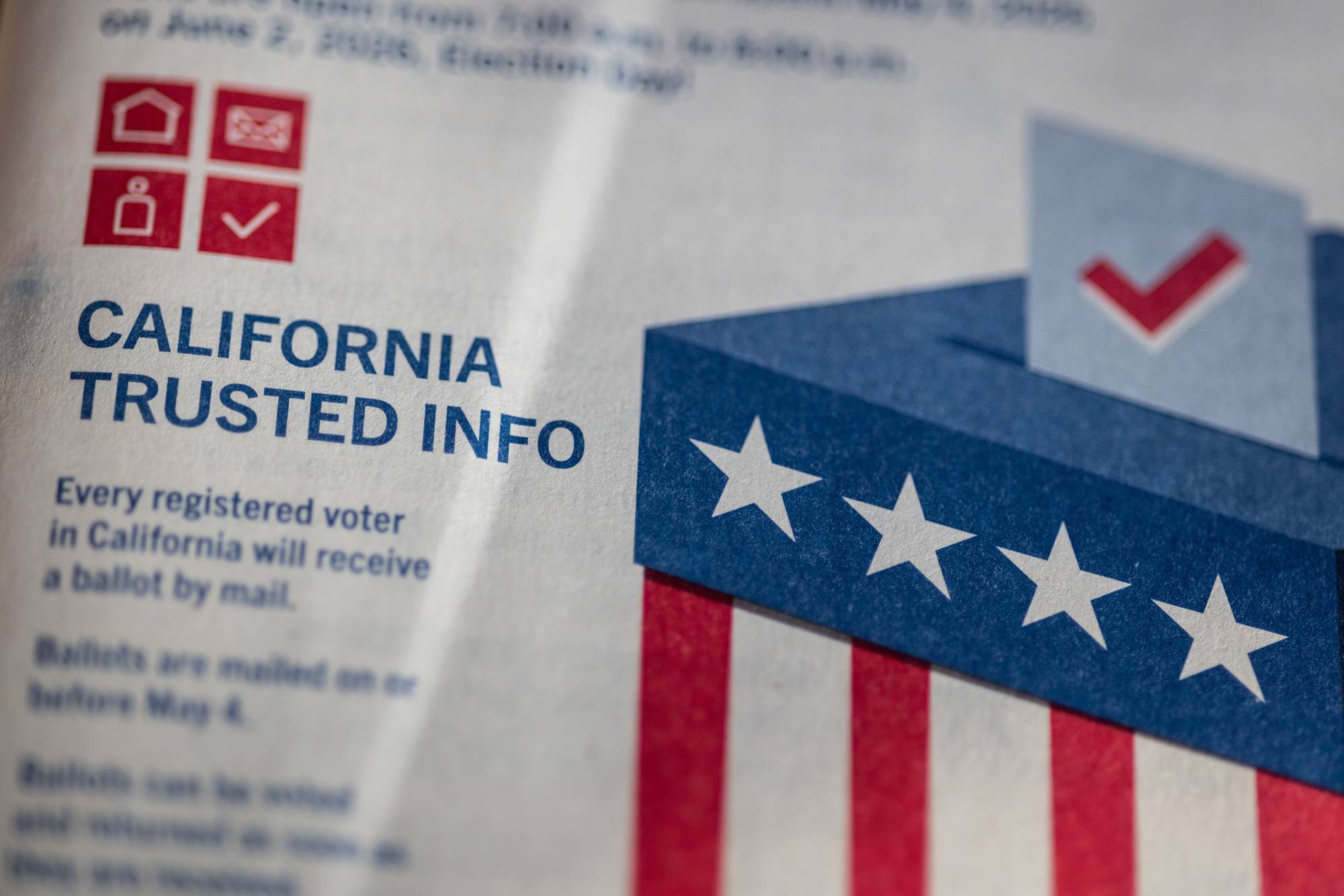
"caption": "LOS ANGELES, CALIFORNIA- MAY 5: In this photo illustration, an official voter information guide mailed to a Southern California resident, ahead of a state primary election, photographed May 5, 2026 in Los Angeles, California. (Photo Illustration by Jay L Clendenin/Getty Images)",
"credit": null,
"altTag": null,
"description": null,
"imgSizes": {
"medium": {
"file": "https://cdn.kqed.org/wp-content/uploads/sites/10/2026/08/GettyImages-2274165178-2000x1334.jpg",
"width": 2000,
"height": 1334,
"mimeType": "image/jpeg"
},
"large": {
"file": "https://cdn.kqed.org/wp-content/uploads/sites/10/2026/08/GettyImages-2274165178-2000x1334.jpg",
"width": 2000,
"height": 1334,
"mimeType": "image/jpeg"
},
"thumbnail": {
"file": "https://cdn.kqed.org/wp-content/uploads/sites/10/2026/08/GettyImages-2274165178-160x107.jpg",
"width": 160,
"height": 107,
"mimeType": "image/jpeg"
},
"1536x1536": {
"file": "https://cdn.kqed.org/wp-content/uploads/sites/10/2026/08/GettyImages-2274165178-1536x1025.jpg",
"width": 1536,
"height": 1025,
"mimeType": "image/jpeg"
},
"2048x2048": {
"file": "https://cdn.kqed.org/wp-content/uploads/sites/10/2026/08/GettyImages-2274165178-2048x1366.jpg",
"width": 2048,
"height": 1366,
"mimeType": "image/jpeg"
},
"post-thumbnail": {
"file": "https://cdn.kqed.org/wp-content/uploads/sites/10/2026/08/GettyImages-2274165178-672x372.jpg",
"width": 672,
"height": 372,
"mimeType": "image/jpeg"
},
"twentyfourteen-full-width": {
"file": "https://cdn.kqed.org/wp-content/uploads/sites/10/2026/08/GettyImages-2274165178-1038x576.jpg",
"width": 1038,
"height": 576,
"mimeType": "image/jpeg"
},
"full-width": {
"file": "https://cdn.kqed.org/wp-content/uploads/sites/10/2026/08/GettyImages-2274165178-2000x1334.jpg",
"width": 2000,
"height": 1334,
"mimeType": "image/jpeg"
},
"npr-cds-wide": {
"file": "https://cdn.kqed.org/wp-content/uploads/sites/10/2026/08/GettyImages-2274165178-1200x675.jpg",
"width": 1200,
"height": 675,
"mimeType": "image/jpeg"
},
"npr-cds-square": {
"file": "https://cdn.kqed.org/wp-content/uploads/sites/10/2026/08/GettyImages-2274165178-600x600.jpg",
"width": 600,
"height": 600,
"mimeType": "image/jpeg"
},
"kqedFullSize": {
"file": "https://cdn.kqed.org/wp-content/uploads/sites/10/2026/08/GettyImages-2274165178-scaled.jpg",
"width": 2560,
"height": 1708
}
},
"isLoading": false,
"fetchFailed": false
},
"news_12082113": {
"type": "attachments",
"id": "news_12082113",
"meta": {
"index": "attachments_1716263798",
"site": "news",
"id": "12082113",
"found": true
},
"title": "023_KQED_SanFrancisco_Election2020_TanyaYule_10092020_qed",
"publishDate": 1777661453,
"status": "inherit",
"parent": 12082074,
"modified": 1777661480,
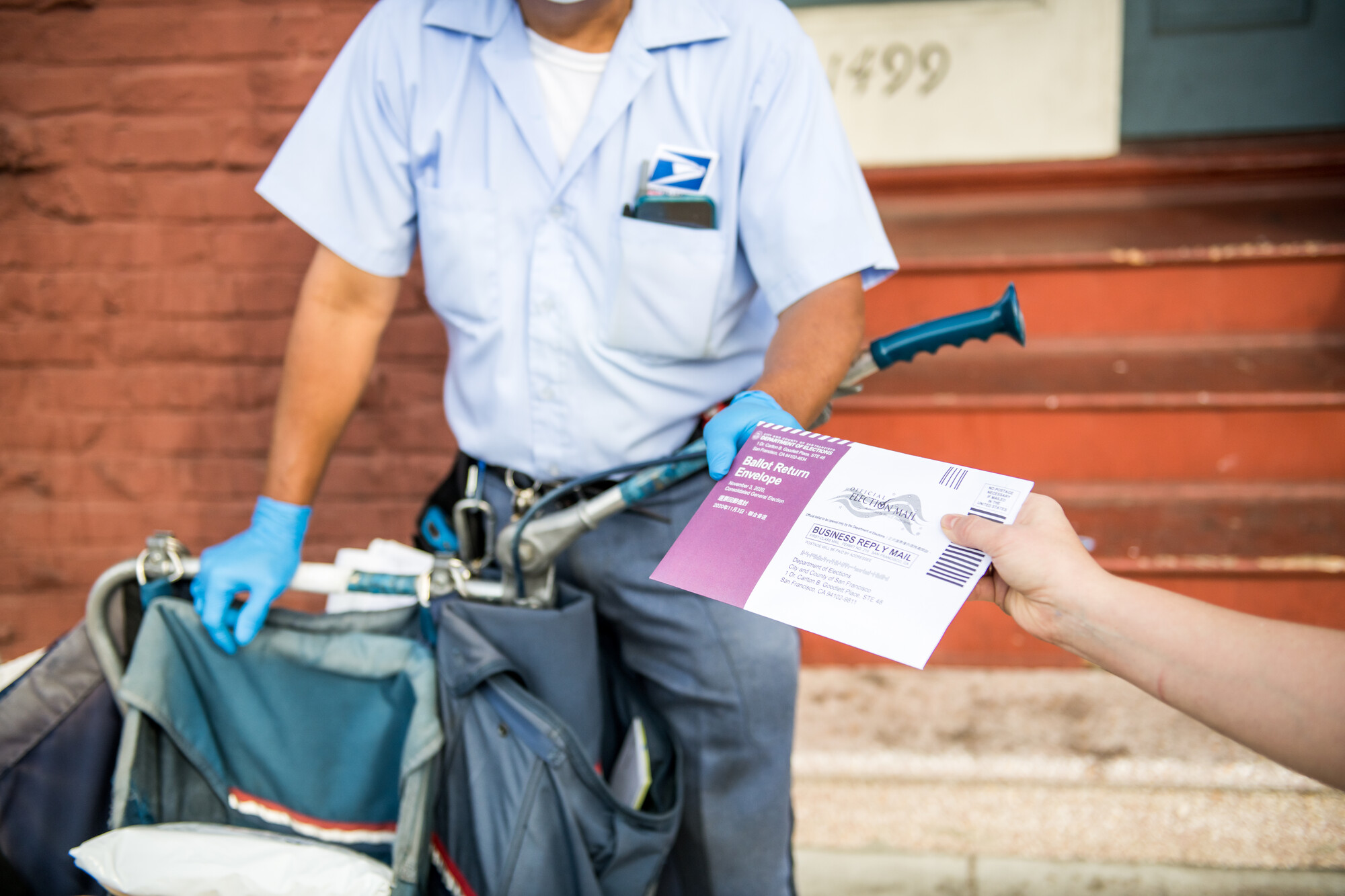
"caption": "A San Francisco resident hands their mail-in ballot to USPS employee Elmer Padilla on Oct. 9, 2020.",
"credit": "Beth LaBerge/KQED",
"altTag": null,
"description": null,
"imgSizes": {
"thumbnail": {
"file": "https://cdn.kqed.org/wp-content/uploads/sites/10/2026/05/023_KQED_SanFrancisco_Election2020_TanyaYule_10092020_qed-160x107.jpg",
"width": 160,
"height": 107,
"mimeType": "image/jpeg"
},
"1536x1536": {
"file": "https://cdn.kqed.org/wp-content/uploads/sites/10/2026/05/023_KQED_SanFrancisco_Election2020_TanyaYule_10092020_qed-1536x1024.jpg",
"width": 1536,
"height": 1024,
"mimeType": "image/jpeg"
},
"post-thumbnail": {
"file": "https://cdn.kqed.org/wp-content/uploads/sites/10/2026/05/023_KQED_SanFrancisco_Election2020_TanyaYule_10092020_qed-672x372.jpg",
"width": 672,
"height": 372,
"mimeType": "image/jpeg"
},
"twentyfourteen-full-width": {
"file": "https://cdn.kqed.org/wp-content/uploads/sites/10/2026/05/023_KQED_SanFrancisco_Election2020_TanyaYule_10092020_qed-1038x576.jpg",
"width": 1038,
"height": 576,
"mimeType": "image/jpeg"
},
"npr-cds-wide": {
"file": "https://cdn.kqed.org/wp-content/uploads/sites/10/2026/05/023_KQED_SanFrancisco_Election2020_TanyaYule_10092020_qed-1200x675.jpg",
"width": 1200,
"height": 675,
"mimeType": "image/jpeg"
},
"npr-cds-square": {
"file": "https://cdn.kqed.org/wp-content/uploads/sites/10/2026/05/023_KQED_SanFrancisco_Election2020_TanyaYule_10092020_qed-600x600.jpg",
"width": 600,
"height": 600,
"mimeType": "image/jpeg"
},
"kqedFullSize": {
"file": "https://cdn.kqed.org/wp-content/uploads/sites/10/2026/05/023_KQED_SanFrancisco_Election2020_TanyaYule_10092020_qed.jpg",
"width": 2000,
"height": 1333
}
},
"isLoading": false,
"fetchFailed": false
},
"news_12102917": {
"type": "attachments",
"id": "news_12102917",
"meta": {
"index": "attachments_1716263798",
"site": "news",
"id": "12102917",
"found": true
},
"title": "240612-SFMayoralDebate-14-BL_qed",
"publishDate": 1791229250,
"status": "inherit",
"parent": 12102904,
"modified": 1791244835,
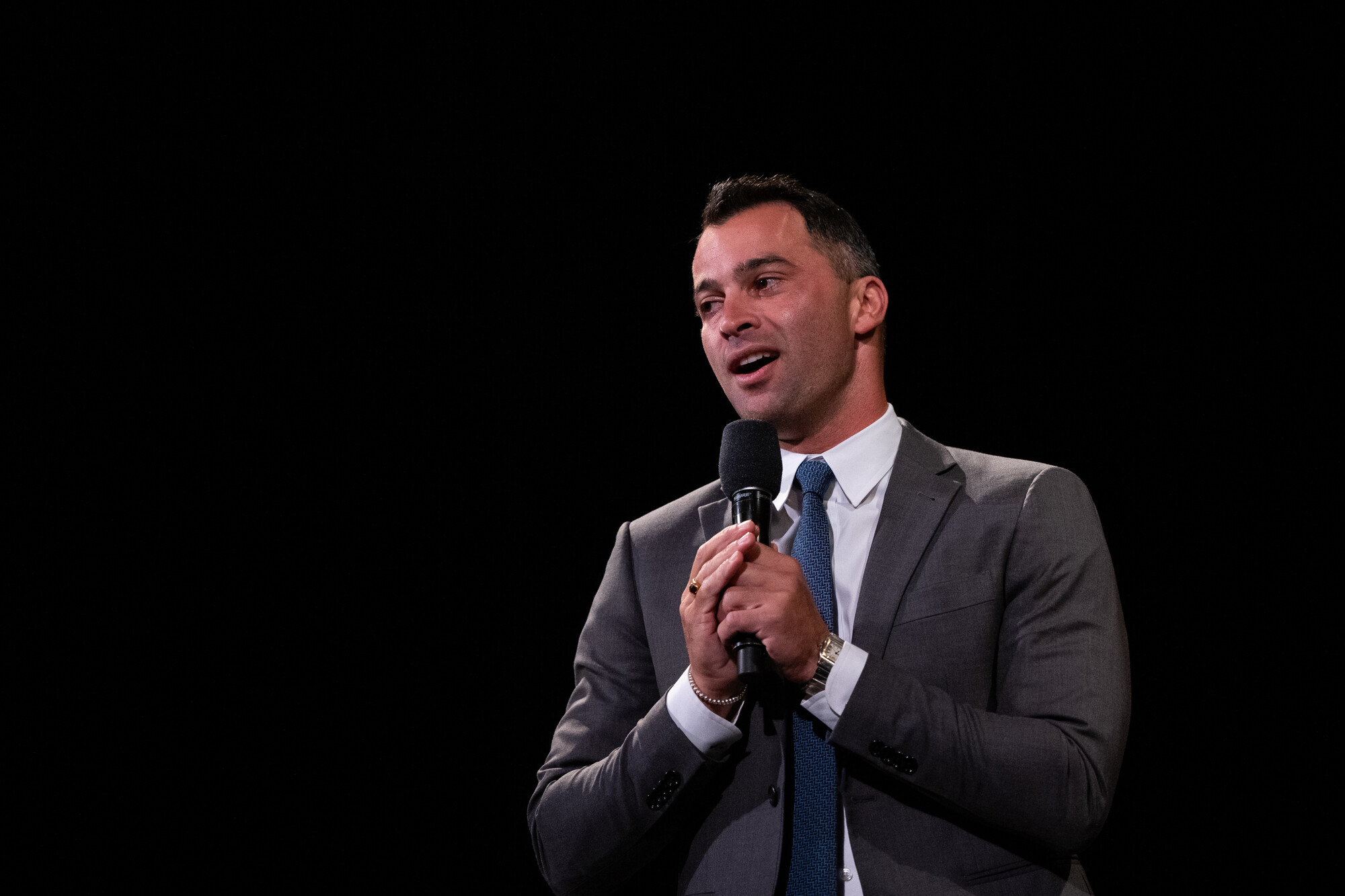
"caption": "Manny Yekutiel, proprietor of the event space Manny’s, speaks before a San Francisco mayoral debate with candidates Asha Safaí, former Mayor Mark Farrell, Daniel Lurie, Mayor London Breed and Aaron Peskin at the Sydney Goldstein Theater on June 12, 2024.",
"credit": "Beth LaBerge/KQED",
"altTag": null,
"description": null,
"imgSizes": {
"thumbnail": {
"file": "https://cdn.kqed.org/wp-content/uploads/sites/10/2026/10/240612-SFMayoralDebate-14-BL_qed-160x107.jpg",
"width": 160,
"height": 107,
"mimeType": "image/jpeg"
},
"1536x1536": {
"file": "https://cdn.kqed.org/wp-content/uploads/sites/10/2026/10/240612-SFMayoralDebate-14-BL_qed-1536x1024.jpg",
"width": 1536,
"height": 1024,
"mimeType": "image/jpeg"
},
"post-thumbnail": {
"file": "https://cdn.kqed.org/wp-content/uploads/sites/10/2026/10/240612-SFMayoralDebate-14-BL_qed-672x372.jpg",
"width": 672,
"height": 372,
"mimeType": "image/jpeg"
},
"twentyfourteen-full-width": {
"file": "https://cdn.kqed.org/wp-content/uploads/sites/10/2026/10/240612-SFMayoralDebate-14-BL_qed-1038x576.jpg",
"width": 1038,
"height": 576,
"mimeType": "image/jpeg"
},
"npr-cds-wide": {
"file": "https://cdn.kqed.org/wp-content/uploads/sites/10/2026/10/240612-SFMayoralDebate-14-BL_qed-1200x675.jpg",
"width": 1200,
"height": 675,
"mimeType": "image/jpeg"
},
"npr-cds-square": {
"file": "https://cdn.kqed.org/wp-content/uploads/sites/10/2026/10/240612-SFMayoralDebate-14-BL_qed-600x600.jpg",
"width": 600,
"height": 600,
"mimeType": "image/jpeg"
},
"kqedFullSize": {
"file": "https://cdn.kqed.org/wp-content/uploads/sites/10/2026/10/240612-SFMayoralDebate-14-BL_qed.jpg",
"width": 2000,
"height": 1333
}
},
"isLoading": false,
"fetchFailed": false
},
"news_12089055": {
"type": "attachments",
"id": "news_12089055",
"meta": {
"index": "attachments_1716263798",
"site": "news",
"id": "12089055",
"found": true
},
"title": "US-POLITICS-BILLIONAIRE-TAXATION",
"publishDate": 1782498329,
"status": "inherit",
"parent": 12089029,
"modified": 1782498386,
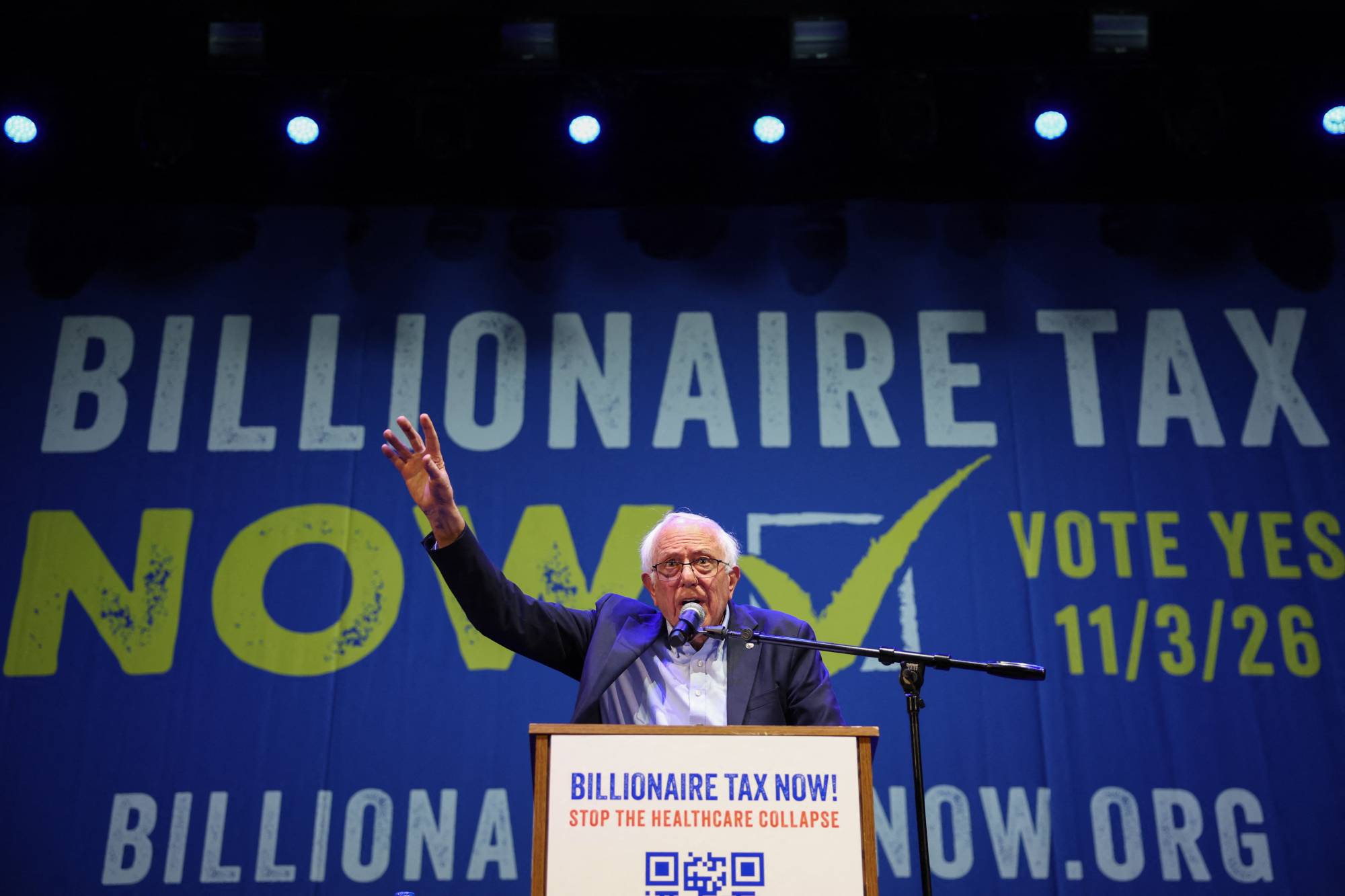
"caption": "U.S. Sen. Bernie Sanders speaks during the campaign kickoff for the California Billionaire Tax Act at The Wiltern in Los Angeles, Feb. 18, 2026. Sanders is seeking the support of California voters for a November's ballot initiative of an emergency tax on billionaires to help the state's healthcare system. ",
"credit": "Patrick T. Fallon / AFP via Getty Images",
"altTag": null,
"description": null,
"imgSizes": {
"medium": {
"file": "https://cdn.kqed.org/wp-content/uploads/sites/10/2026/06/GettyImages-2261843469-2000x1333.jpg",
"width": 2000,
"height": 1333,
"mimeType": "image/jpeg"
},
"large": {
"file": "https://cdn.kqed.org/wp-content/uploads/sites/10/2026/06/GettyImages-2261843469-2000x1333.jpg",
"width": 2000,
"height": 1333,
"mimeType": "image/jpeg"
},
"thumbnail": {
"file": "https://cdn.kqed.org/wp-content/uploads/sites/10/2026/06/GettyImages-2261843469-160x107.jpg",
"width": 160,
"height": 107,
"mimeType": "image/jpeg"
},
"1536x1536": {
"file": "https://cdn.kqed.org/wp-content/uploads/sites/10/2026/06/GettyImages-2261843469-1536x1024.jpg",
"width": 1536,
"height": 1024,
"mimeType": "image/jpeg"
},
"2048x2048": {
"file": "https://cdn.kqed.org/wp-content/uploads/sites/10/2026/06/GettyImages-2261843469-2048x1365.jpg",
"width": 2048,
"height": 1365,
"mimeType": "image/jpeg"
},
"post-thumbnail": {
"file": "https://cdn.kqed.org/wp-content/uploads/sites/10/2026/06/GettyImages-2261843469-672x372.jpg",
"width": 672,
"height": 372,
"mimeType": "image/jpeg"
},
"twentyfourteen-full-width": {
"file": "https://cdn.kqed.org/wp-content/uploads/sites/10/2026/06/GettyImages-2261843469-1038x576.jpg",
"width": 1038,
"height": 576,
"mimeType": "image/jpeg"
},
"full-width": {
"file": "https://cdn.kqed.org/wp-content/uploads/sites/10/2026/06/GettyImages-2261843469-2000x1333.jpg",
"width": 2000,
"height": 1333,
"mimeType": "image/jpeg"
},
"npr-cds-wide": {
"file": "https://cdn.kqed.org/wp-content/uploads/sites/10/2026/06/GettyImages-2261843469-1200x675.jpg",
"width": 1200,
"height": 675,
"mimeType": "image/jpeg"
},
"npr-cds-square": {
"file": "https://cdn.kqed.org/wp-content/uploads/sites/10/2026/06/GettyImages-2261843469-600x600.jpg",
"width": 600,
"height": 600,
"mimeType": "image/jpeg"
},
"kqedFullSize": {
"file": "https://cdn.kqed.org/wp-content/uploads/sites/10/2026/06/GettyImages-2261843469-scaled.jpg",
"width": 2560,
"height": 1707
}
},
"isLoading": false,
"fetchFailed": false
},
"news_12049902": {
"type": "attachments",
"id": "news_12049902",
"meta": {
"index": "attachments_1716263798",
"site": "news",
"id": "12049902",
"found": true
},
"title": "250725-SJPOWER-JG-3_qed",
"publishDate": 1753489766,
"status": "inherit",
"parent": 12049830,
"modified": 1753490000,
"caption": "Energy transmission towers and wires in North San José on July 25, 2025.",
"credit": "Joseph Geha/KQED",
"altTag": null,
"description": null,
"imgSizes": {
"thumbnail": {
"file": "https://cdn.kqed.org/wp-content/uploads/sites/10/2025/07/250725-SJPOWER-JG-3_qed-160x107.jpg",
"width": 160,
"height": 107,
"mimeType": "image/jpeg"
},
"1536x1536": {
"file": "https://cdn.kqed.org/wp-content/uploads/sites/10/2025/07/250725-SJPOWER-JG-3_qed-1536x1024.jpg",
"width": 1536,
"height": 1024,
"mimeType": "image/jpeg"
},
"post-thumbnail": {
"file": "https://cdn.kqed.org/wp-content/uploads/sites/10/2025/07/250725-SJPOWER-JG-3_qed-672x372.jpg",
"width": 672,
"height": 372,
"mimeType": "image/jpeg"
},
"twentyfourteen-full-width": {
"file": "https://cdn.kqed.org/wp-content/uploads/sites/10/2025/07/250725-SJPOWER-JG-3_qed-1038x576.jpg",
"width": 1038,
"height": 576,
"mimeType": "image/jpeg"
},
"kqedFullSize": {
"file": "https://cdn.kqed.org/wp-content/uploads/sites/10/2025/07/250725-SJPOWER-JG-3_qed.jpg",
"width": 1999,
"height": 1333
}
},
"isLoading": false,
"fetchFailed": false
},
"news_12102628": {
"type": "attachments",
"id": "news_12102628",
"meta": {
"index": "attachments_1716263798",
"site": "news",
"id": "12102628",
"found": true
},
"title": "GettyImages-2297604851",
"publishDate": 1790966338,
"status": "inherit",
"parent": 12102625,
"modified": 1790967154,
"caption": "From left: State Sen. Scott Wiener and San Francisco Supervisor Connie Chan debate at KQED in San Francisco on Thursday, Oct. 1, 2026. The two Democrats are running for California's 11th District, a seat Speaker Emerita Nancy Pelosi is leaving. The debate was co-hosted by KQED and the San Francisco Chronicle. ",
"credit": "Santiago Mejia/San Francisco Chronicle via Getty Images",
"altTag": null,
"description": null,
"imgSizes": {
"medium": {
"file": "https://cdn.kqed.org/wp-content/uploads/sites/10/2026/10/GettyImages-2297604851-2000x1334.jpg",
"width": 2000,
"height": 1334,
"mimeType": "image/jpeg"
},
"large": {
"file": "https://cdn.kqed.org/wp-content/uploads/sites/10/2026/10/GettyImages-2297604851-2000x1334.jpg",
"width": 2000,
"height": 1334,
"mimeType": "image/jpeg"
},
"thumbnail": {
"file": "https://cdn.kqed.org/wp-content/uploads/sites/10/2026/10/GettyImages-2297604851-160x107.jpg",
"width": 160,
"height": 107,
"mimeType": "image/jpeg"
},
"1536x1536": {
"file": "https://cdn.kqed.org/wp-content/uploads/sites/10/2026/10/GettyImages-2297604851-1536x1025.jpg",
"width": 1536,
"height": 1025,
"mimeType": "image/jpeg"
},
"2048x2048": {
"file": "https://cdn.kqed.org/wp-content/uploads/sites/10/2026/10/GettyImages-2297604851-2048x1366.jpg",
"width": 2048,
"height": 1366,
"mimeType": "image/jpeg"
},
"post-thumbnail": {
"file": "https://cdn.kqed.org/wp-content/uploads/sites/10/2026/10/GettyImages-2297604851-672x372.jpg",
"width": 672,
"height": 372,
"mimeType": "image/jpeg"
},
"twentyfourteen-full-width": {
"file": "https://cdn.kqed.org/wp-content/uploads/sites/10/2026/10/GettyImages-2297604851-1038x576.jpg",
"width": 1038,
"height": 576,
"mimeType": "image/jpeg"
},
"full-width": {
"file": "https://cdn.kqed.org/wp-content/uploads/sites/10/2026/10/GettyImages-2297604851-2000x1334.jpg",
"width": 2000,
"height": 1334,
"mimeType": "image/jpeg"
},
"npr-cds-wide": {
"file": "https://cdn.kqed.org/wp-content/uploads/sites/10/2026/10/GettyImages-2297604851-1200x675.jpg",
"width": 1200,
"height": 675,
"mimeType": "image/jpeg"
},
"npr-cds-square": {
"file": "https://cdn.kqed.org/wp-content/uploads/sites/10/2026/10/GettyImages-2297604851-600x600.jpg",
"width": 600,
"height": 600,
"mimeType": "image/jpeg"
},
"kqedFullSize": {
"file": "https://cdn.kqed.org/wp-content/uploads/sites/10/2026/10/GettyImages-2297604851-scaled.jpg",
"width": 2560,
"height": 1708
}
},
"isLoading": false,
"fetchFailed": false
},
"news_12102627": {
"type": "attachments",
"id": "news_12102627",
"meta": {
"index": "attachments_1716263798",
"site": "news",
"id": "12102627",
"found": true
},
"title": "GettyImages-2297609803",
"publishDate": 1790966304,
"status": "inherit",
"parent": 12102625,
"modified": 1790966328,
"caption": "San Francisco Supervisor Connie Chan, right, during her debate with State Sen. Scott Wiener at KQED in San Francisco on Thursday, Oct. 1, 2026. The two Democrats are running for California's 11th District, a seat Speaker Emerita Nancy Pelosi is leaving. The debate was co-hosted by KQED and the San Francisco Chronicle. ",
"credit": "Santiago Mejia/San Francisco Chronicle via Getty Images",
"altTag": null,
"description": null,
"imgSizes": {
"medium": {
"file": "https://cdn.kqed.org/wp-content/uploads/sites/10/2026/10/GettyImages-2297609803-2000x1333.jpg",
"width": 2000,
"height": 1333,
"mimeType": "image/jpeg"
},
"large": {
"file": "https://cdn.kqed.org/wp-content/uploads/sites/10/2026/10/GettyImages-2297609803-2000x1333.jpg",
"width": 2000,
"height": 1333,
"mimeType": "image/jpeg"
},
"thumbnail": {
"file": "https://cdn.kqed.org/wp-content/uploads/sites/10/2026/10/GettyImages-2297609803-160x107.jpg",
"width": 160,
"height": 107,
"mimeType": "image/jpeg"
},
"1536x1536": {
"file": "https://cdn.kqed.org/wp-content/uploads/sites/10/2026/10/GettyImages-2297609803-1536x1024.jpg",
"width": 1536,
"height": 1024,
"mimeType": "image/jpeg"
},
"2048x2048": {
"file": "https://cdn.kqed.org/wp-content/uploads/sites/10/2026/10/GettyImages-2297609803-2048x1365.jpg",
"width": 2048,
"height": 1365,
"mimeType": "image/jpeg"
},
"post-thumbnail": {
"file": "https://cdn.kqed.org/wp-content/uploads/sites/10/2026/10/GettyImages-2297609803-672x372.jpg",
"width": 672,
"height": 372,
"mimeType": "image/jpeg"
},
"twentyfourteen-full-width": {
"file": "https://cdn.kqed.org/wp-content/uploads/sites/10/2026/10/GettyImages-2297609803-1038x576.jpg",
"width": 1038,
"height": 576,
"mimeType": "image/jpeg"
},
"full-width": {
"file": "https://cdn.kqed.org/wp-content/uploads/sites/10/2026/10/GettyImages-2297609803-2000x1333.jpg",
"width": 2000,
"height": 1333,
"mimeType": "image/jpeg"
},
"npr-cds-wide": {
"file": "https://cdn.kqed.org/wp-content/uploads/sites/10/2026/10/GettyImages-2297609803-1200x675.jpg",
"width": 1200,
"height": 675,
"mimeType": "image/jpeg"
},
"npr-cds-square": {
"file": "https://cdn.kqed.org/wp-content/uploads/sites/10/2026/10/GettyImages-2297609803-600x600.jpg",
"width": 600,
"height": 600,
"mimeType": "image/jpeg"
},
"kqedFullSize": {
"file": "https://cdn.kqed.org/wp-content/uploads/sites/10/2026/10/GettyImages-2297609803-scaled.jpg",
"width": 2560,
"height": 1707
}
},
"isLoading": false,
"fetchFailed": false
},
"news_12102552": {
"type": "attachments",
"id": "news_12102552",
"meta": {
"index": "attachments_1716263798",
"site": "news",
"id": "12102552",
"found": true
},
"title": "kqed-debate",
"publishDate": 1790957691,
"status": "inherit",
"parent": 12102416,
"modified": 1790957766,
"caption": "From left: State Sen. Scott Wiener and San Francisco Supervisor Connie Chan debate at KQED in San Francisco on Thursday, Oct. 1, 2026. The two Democrats are running for California’s 11th District, a seat Speaker Emerita Nancy Pelosi is leaving. The debate was co-hosted by KQED and the San Francisco Chronicle.",
"credit": "Santiago Mejia/S.F. Chronicle/Pool",
"altTag": null,
"description": null,
"imgSizes": {
"medium": {
"file": "https://cdn.kqed.org/wp-content/uploads/sites/10/2026/10/kqed-debate-2-2000x1333.jpg",
"width": 2000,
"height": 1333,
"mimeType": "image/jpeg"
},
"large": {
"file": "https://cdn.kqed.org/wp-content/uploads/sites/10/2026/10/kqed-debate-2-2000x1333.jpg",
"width": 2000,
"height": 1333,
"mimeType": "image/jpeg"
},
"thumbnail": {
"file": "https://cdn.kqed.org/wp-content/uploads/sites/10/2026/10/kqed-debate-2-160x107.jpg",
"width": 160,
"height": 107,
"mimeType": "image/jpeg"
},
"1536x1536": {
"file": "https://cdn.kqed.org/wp-content/uploads/sites/10/2026/10/kqed-debate-2-1536x1024.jpg",
"width": 1536,
"height": 1024,
"mimeType": "image/jpeg"
},
"2048x2048": {
"file": "https://cdn.kqed.org/wp-content/uploads/sites/10/2026/10/kqed-debate-2-2048x1365.jpg",
"width": 2048,
"height": 1365,
"mimeType": "image/jpeg"
},
"post-thumbnail": {
"file": "https://cdn.kqed.org/wp-content/uploads/sites/10/2026/10/kqed-debate-2-672x372.jpg",
"width": 672,
"height": 372,
"mimeType": "image/jpeg"
},
"twentyfourteen-full-width": {
"file": "https://cdn.kqed.org/wp-content/uploads/sites/10/2026/10/kqed-debate-2-1038x576.jpg",
"width": 1038,
"height": 576,
"mimeType": "image/jpeg"
},
"full-width": {
"file": "https://cdn.kqed.org/wp-content/uploads/sites/10/2026/10/kqed-debate-2-2000x1333.jpg",
"width": 2000,
"height": 1333,
"mimeType": "image/jpeg"
},
"npr-cds-wide": {
"file": "https://cdn.kqed.org/wp-content/uploads/sites/10/2026/10/kqed-debate-2-1200x675.jpg",
"width": 1200,
"height": 675,
"mimeType": "image/jpeg"
},
"npr-cds-square": {
"file": "https://cdn.kqed.org/wp-content/uploads/sites/10/2026/10/kqed-debate-2-600x600.jpg",
"width": 600,
"height": 600,
"mimeType": "image/jpeg"
},
"kqedFullSize": {
"file": "https://cdn.kqed.org/wp-content/uploads/sites/10/2026/10/kqed-debate-2-scaled-e1790957720603.jpg",
"width": 2000,
"height": 1334
}
},
"isLoading": false,
"fetchFailed": false
},
"news_12102540": {
"type": "attachments",
"id": "news_12102540",
"meta": {
"index": "attachments_1716263798",
"site": "news",
"id": "12102540",
"found": true
},
"title": "260331-SFCongressDebate-09-BL",
"publishDate": 1790905732,
"status": "inherit",
"parent": 12102537,
"modified": 1790905811,
"caption": "San Francisco Supervisor Connie Chan and state Sen. Scott Wiener debate in a co-sponsored event by KQED at the Sydney Goldstein Theater in San Francisco on March 31, 2026, ahead of the June primary election.",
"credit": "Beth LaBerge/KQED",
"altTag": "Two people stand at lecterns on a stage while two moderators sit nearby at a desk",
"description": null,
"imgSizes": {
"thumbnail": {
"file": "https://cdn.kqed.org/wp-content/uploads/sites/10/2026/10/260331-SFCongressDebate-09-BL-160x103.jpg",
"width": 160,
"height": 103,
"mimeType": "image/jpeg"
},
"1536x1536": {
"file": "https://cdn.kqed.org/wp-content/uploads/sites/10/2026/10/260331-SFCongressDebate-09-BL-1536x987.jpg",
"width": 1536,
"height": 987,
"mimeType": "image/jpeg"
},
"post-thumbnail": {
"file": "https://cdn.kqed.org/wp-content/uploads/sites/10/2026/10/260331-SFCongressDebate-09-BL-672x372.jpg",
"width": 672,
"height": 372,
"mimeType": "image/jpeg"
},
"twentyfourteen-full-width": {
"file": "https://cdn.kqed.org/wp-content/uploads/sites/10/2026/10/260331-SFCongressDebate-09-BL-1038x576.jpg",
"width": 1038,
"height": 576,
"mimeType": "image/jpeg"
},
"npr-cds-wide": {
"file": "https://cdn.kqed.org/wp-content/uploads/sites/10/2026/10/260331-SFCongressDebate-09-BL-1200x675.jpg",
"width": 1200,
"height": 675,
"mimeType": "image/jpeg"
},
"npr-cds-square": {
"file": "https://cdn.kqed.org/wp-content/uploads/sites/10/2026/10/260331-SFCongressDebate-09-BL-600x600.jpg",
"width": 600,
"height": 600,
"mimeType": "image/jpeg"
},
"kqedFullSize": {
"file": "https://cdn.kqed.org/wp-content/uploads/sites/10/2026/10/260331-SFCongressDebate-09-BL.jpg",
"width": 1999,
"height": 1285
}
},
"isLoading": false,
"fetchFailed": false
},
"news_12102450": {
"type": "attachments",
"id": "news_12102450",
"meta": {
"index": "attachments_1716263798",
"site": "news",
"id": "12102450",
"found": true
},
"title": "GettyImages-2297487550",
"publishDate": 1790890714,
"status": "inherit",
"parent": 12102344,
"modified": 1790890733,
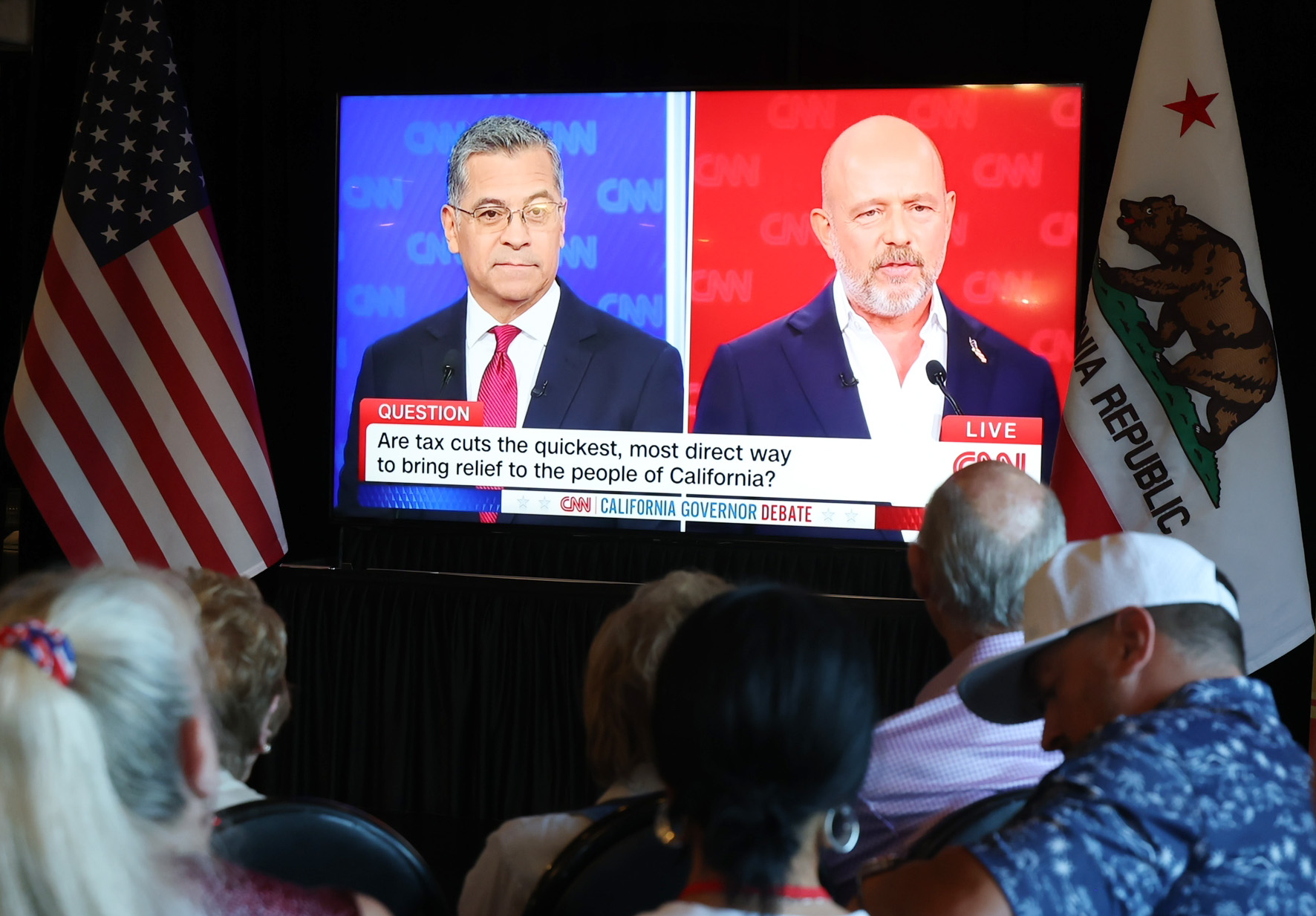
"caption": "Viewers at Victorio's Ristorante in North Hollywood attend a watch party for the CNN debate between gubernatorial candidates Democrat Xavier Becerra, left, and Republican Steve Hilton Wednesday night, Sept. 30, 2026. ",
"credit": "Jason Almond / Los Angeles Times via Getty Images",
"altTag": null,
"description": null,
"imgSizes": {
"thumbnail": {
"file": "https://cdn.kqed.org/wp-content/uploads/sites/10/2026/10/GettyImages-2297487550-160x111.jpg",
"width": 160,
"height": 111,
"mimeType": "image/jpeg"
},
"1536x1536": {
"file": "https://cdn.kqed.org/wp-content/uploads/sites/10/2026/10/GettyImages-2297487550-1536x1069.jpg",
"width": 1536,
"height": 1069,
"mimeType": "image/jpeg"
},
"post-thumbnail": {
"file": "https://cdn.kqed.org/wp-content/uploads/sites/10/2026/10/GettyImages-2297487550-672x372.jpg",
"width": 672,
"height": 372,
"mimeType": "image/jpeg"
},
"twentyfourteen-full-width": {
"file": "https://cdn.kqed.org/wp-content/uploads/sites/10/2026/10/GettyImages-2297487550-1038x576.jpg",
"width": 1038,
"height": 576,
"mimeType": "image/jpeg"
},
"npr-cds-wide": {
"file": "https://cdn.kqed.org/wp-content/uploads/sites/10/2026/10/GettyImages-2297487550-1200x675.jpg",
"width": 1200,
"height": 675,
"mimeType": "image/jpeg"
},
"npr-cds-square": {
"file": "https://cdn.kqed.org/wp-content/uploads/sites/10/2026/10/GettyImages-2297487550-600x600.jpg",
"width": 600,
"height": 600,
"mimeType": "image/jpeg"
},
"kqedFullSize": {
"file": "https://cdn.kqed.org/wp-content/uploads/sites/10/2026/10/GettyImages-2297487550.jpg",
"width": 1772,
"height": 1233
}
},
"isLoading": false,
"fetchFailed": false
},
"news_12102455": {
"type": "attachments",
"id": "news_12102455",
"meta": {
"index": "attachments_1716263798",
"site": "news",
"id": "12102455",
"found": true
},
"title": "Trump News Media",
"publishDate": 1790891035,
"status": "inherit",
"parent": 12102345,
"modified": 1790898815,
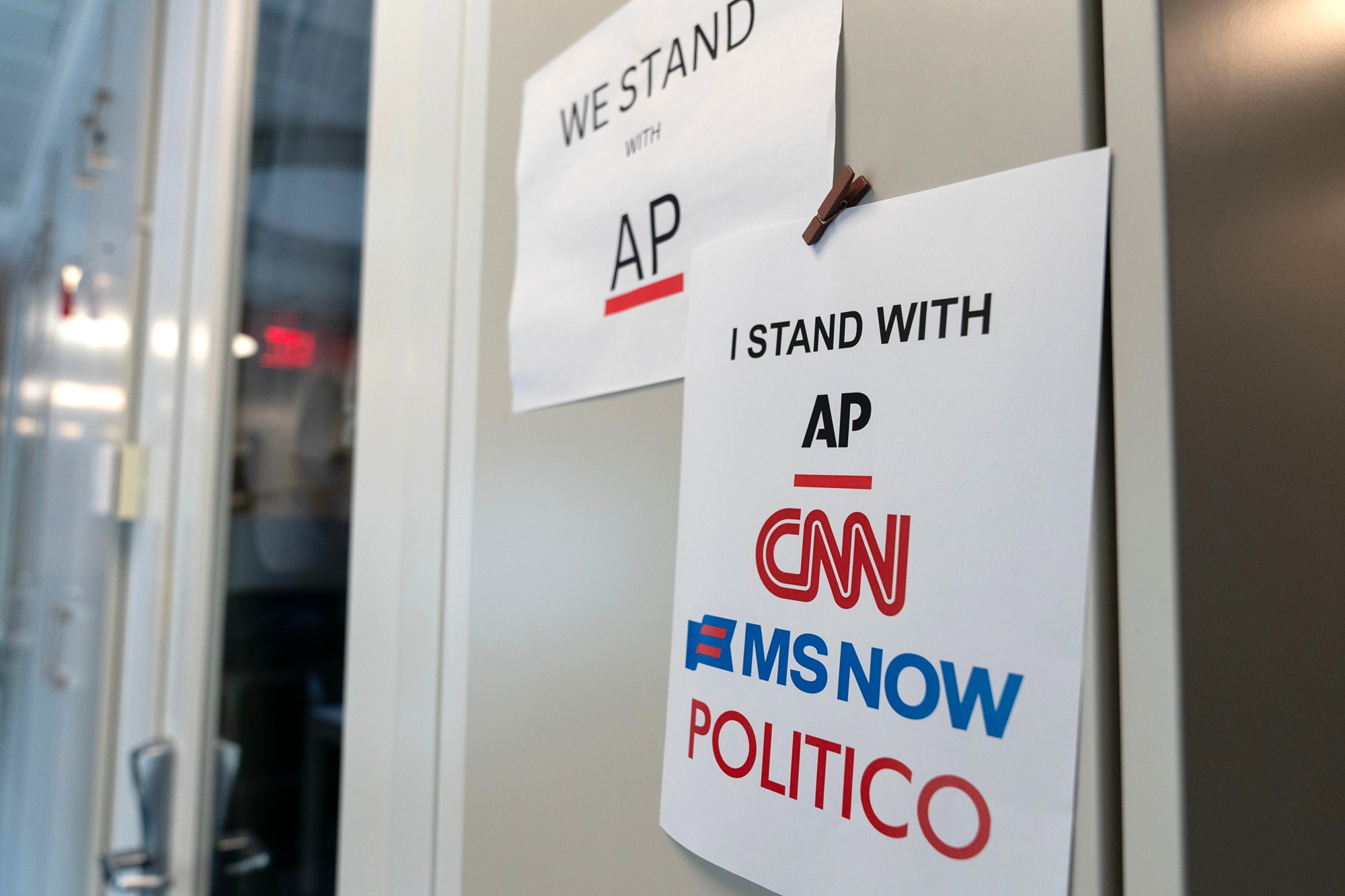
"caption": "A sign in support of news outlets is seen at the White House press room on Sept. 19, 2026, in Washington, D.C.",
"credit": "Jose Luis Magana/AP Photo",
"altTag": null,
"description": null,
"imgSizes": {
"thumbnail": {
"file": "https://cdn.kqed.org/wp-content/uploads/sites/10/2026/10/JournalismAP-160x107.jpg",
"width": 160,
"height": 107,
"mimeType": "image/jpeg"
},
"1536x1536": {
"file": "https://cdn.kqed.org/wp-content/uploads/sites/10/2026/10/JournalismAP-1536x1024.jpg",
"width": 1536,
"height": 1024,
"mimeType": "image/jpeg"
},
"post-thumbnail": {
"file": "https://cdn.kqed.org/wp-content/uploads/sites/10/2026/10/JournalismAP-672x372.jpg",
"width": 672,
"height": 372,
"mimeType": "image/jpeg"
},
"twentyfourteen-full-width": {
"file": "https://cdn.kqed.org/wp-content/uploads/sites/10/2026/10/JournalismAP-1038x576.jpg",
"width": 1038,
"height": 576,
"mimeType": "image/jpeg"
},
"npr-cds-wide": {
"file": "https://cdn.kqed.org/wp-content/uploads/sites/10/2026/10/JournalismAP-1200x675.jpg",
"width": 1200,
"height": 675,
"mimeType": "image/jpeg"
},
"npr-cds-square": {
"file": "https://cdn.kqed.org/wp-content/uploads/sites/10/2026/10/JournalismAP-600x600.jpg",
"width": 600,
"height": 600,
"mimeType": "image/jpeg"
},
"kqedFullSize": {
"file": "https://cdn.kqed.org/wp-content/uploads/sites/10/2026/10/JournalismAP.jpg",
"width": 2000,
"height": 1333
}
},
"isLoading": false,
"fetchFailed": false
},
"news_12090328": {
"type": "attachments",
"id": "news_12090328",
"meta": {
"index": "attachments_1716263798",
"site": "news",
"id": "12090328",
"found": true
},
"title": "Manny Yekutiel introduces US Presidential candidate Tom Steyer during Steyer's appearance at Manny's in San Francisco, Calif., on Wednesday, July 17, 2019.",
"publishDate": 1783616103,
"status": "inherit",
"parent": 12090065,
"modified": 1790894187,
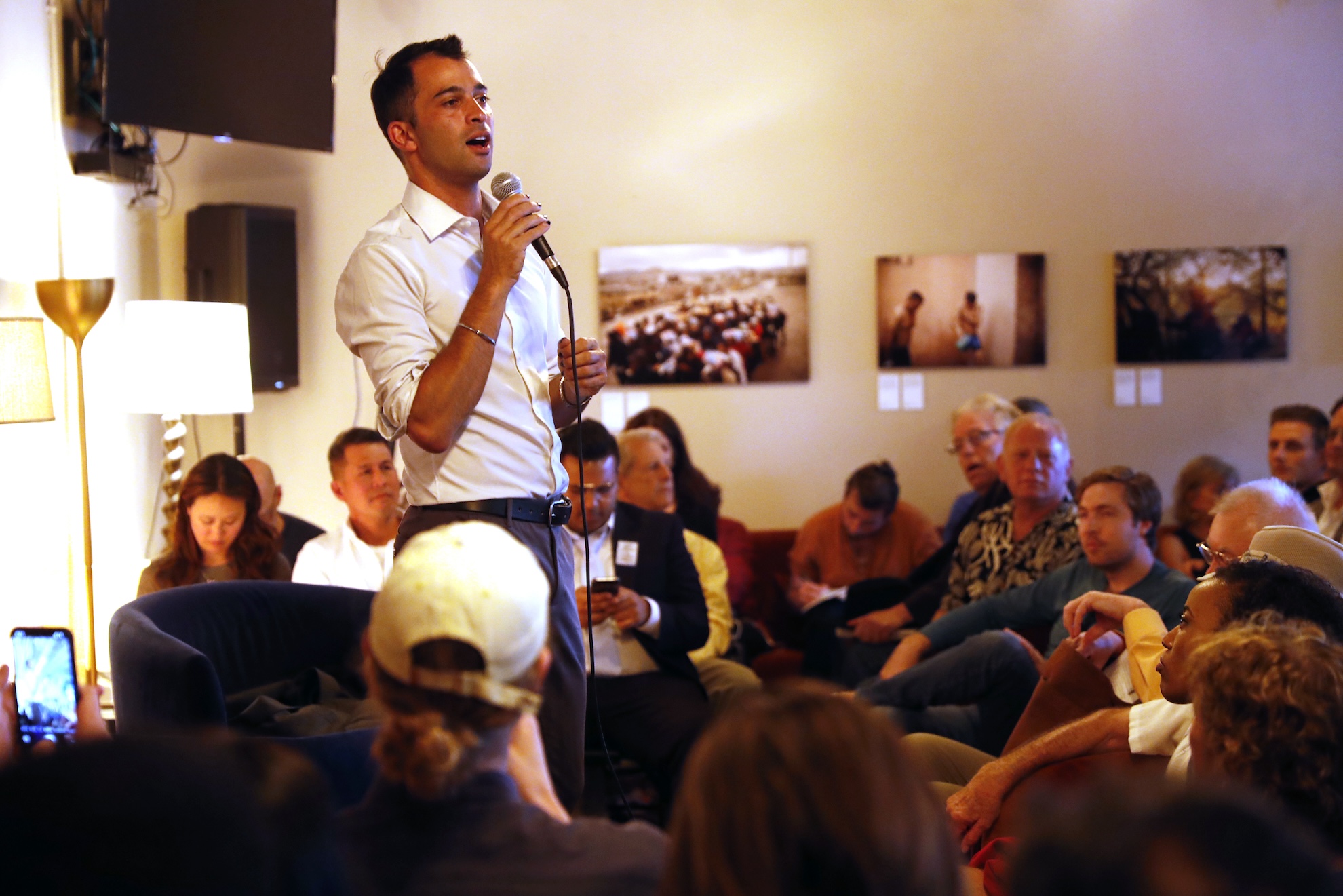
"caption": "Manny Yekutiel introduces U.S. Presidential candidate Tom Steyer during Steyer's appearance at Manny's in San Francisco on July 17, 2019.",
"credit": "Scott Strazzante/San Francisco Chronicle via Getty Images)",
"altTag": null,
"description": null,
"imgSizes": {
"thumbnail": {
"file": "https://cdn.kqed.org/wp-content/uploads/sites/10/2026/07/GettyImages-1298791153-160x107.jpg",
"width": 160,
"height": 107,
"mimeType": "image/jpeg"
},
"1536x1536": {
"file": "https://cdn.kqed.org/wp-content/uploads/sites/10/2026/07/GettyImages-1298791153-1536x1025.jpg",
"width": 1536,
"height": 1025,
"mimeType": "image/jpeg"
},
"post-thumbnail": {
"file": "https://cdn.kqed.org/wp-content/uploads/sites/10/2026/07/GettyImages-1298791153-672x372.jpg",
"width": 672,
"height": 372,
"mimeType": "image/jpeg"
},
"twentyfourteen-full-width": {
"file": "https://cdn.kqed.org/wp-content/uploads/sites/10/2026/07/GettyImages-1298791153-1038x576.jpg",
"width": 1038,
"height": 576,
"mimeType": "image/jpeg"
},
"npr-cds-wide": {
"file": "https://cdn.kqed.org/wp-content/uploads/sites/10/2026/07/GettyImages-1298791153-1200x675.jpg",
"width": 1200,
"height": 675,
"mimeType": "image/jpeg"
},
"npr-cds-square": {
"file": "https://cdn.kqed.org/wp-content/uploads/sites/10/2026/07/GettyImages-1298791153-600x600.jpg",
"width": 600,
"height": 600,
"mimeType": "image/jpeg"
},
"kqedFullSize": {
"file": "https://cdn.kqed.org/wp-content/uploads/sites/10/2026/07/GettyImages-1298791153.jpg",
"width": 1980,
"height": 1321
}
},
"isLoading": false,
"fetchFailed": false
}
},
"audioPlayerReducer": {
"postId": "stream_live",
"isPaused": true,
"isPlaying": false,
"pfsActive": false,
"pledgeModalIsOpen": true,
"playerDrawerIsOpen": false,
"liveAudioPlayStartedAt": 0,
"liveAudioPlayContext": ""
},
"authorsReducer": {
"byline_news_12102729": {
"type": "authors",
"id": "byline_news_12102729",
"meta": {
"override": true
},
"slug": "byline_news_12102729",
"name": "Jennifer McDermott, The Associated Press",
"isLoading": false
},
"byline_news_12102345": {
"type": "authors",
"id": "byline_news_12102345",
"meta": {
"override": true
},
"slug": "byline_news_12102345",
"name": "Laura Fitzgerald",
"isLoading": false
},
"gmarzorati": {
"type": "authors",
"id": "227",
"meta": {
"index": "authors_1716337520",
"id": "227",
"found": true
},
"name": "Guy Marzorati",
"firstName": "Guy",
"lastName": "Marzorati",
"slug": "gmarzorati",
"email": "gmarzorati@KQED.org",
"display_author_email": true,
"staff_mastheads": [
"news"
],
"title": "Correspondent",
"bio": "Guy Marzorati is a correspondent on KQED's California Politics and Government Desk, based in San Jose. A graduate of Santa Clara University, Guy joined KQED in 2013. He reports on state and local politics and produces KQED's digital voter guide.",
"avatar": "https://secure.gravatar.com/avatar/e7038b8dbfd55b104369b76b1cd0b9de?s=600&d=blank&r=g",
"twitter": "guymarzorati",
"facebook": null,
"instagram": null,
"linkedin": null,
"sites": [
{
"site": "",
"roles": [
"editor"
]
},
{
"site": "news",
"roles": [
"editor"
]
},
{
"site": "science",
"roles": [
"editor"
]
},
{
"site": "forum",
"roles": [
"editor"
]
},
{
"site": "elections",
"roles": [
"editor"
]
},
{
"site": "liveblog",
"roles": [
"editor"
]
}
],
"headData": {
"title": "Guy Marzorati | KQED",
"description": "Correspondent",
"ogImgSrc": "https://secure.gravatar.com/avatar/e7038b8dbfd55b104369b76b1cd0b9de?s=600&d=blank&r=g",
"twImgSrc": "https://secure.gravatar.com/avatar/e7038b8dbfd55b104369b76b1cd0b9de?s=600&d=blank&r=g"
},
"isLoading": false,
"link": "/author/gmarzorati"
},
"scottshafer": {
"type": "authors",
"id": "255",
"meta": {
"index": "authors_1716337520",
"id": "255",
"found": true
},
"name": "Scott Shafer",
"firstName": "Scott",
"lastName": "Shafer",
"slug": "scottshafer",
"email": "sshafer@kqed.org",
"display_author_email": false,
"staff_mastheads": [
"news"
],
"title": "KQED Contributor",
"bio": "Scott Shafer is a senior editor with the KQED Politics and Government desk. He is co-host of Political Breakdown, the award-winning radio show and podcast with a personal take on the world of politics. Scott came to KQED in 1998 to host the statewide\u003cem> California Report\u003c/em>. Prior to that he had extended stints in politics and government\u003cem>.\u003c/em> He uses that inside experience at KQED in his, reporting, hosting and analysis for the politics desk. Scott collaborated \u003cem>Political Breakdown a\u003c/em>nd on \u003cem>The Political Mind of Jerry Brown, \u003c/em>an eight-part series about the life and extraordinary political career of the former governor. For fun, he plays water polo with the San Francisco Tsunami.",
"avatar": "https://secure.gravatar.com/avatar/a62ebae45b79d7aed1a39a0e3bf68104?s=600&d=blank&r=g",
"twitter": "scottshafer",
"bluesky": null,
"facebook": null,
"instagram": null,
"linkedin": null,
"sites": [
{
"site": "news",
"roles": [
"editor"
]
},
{
"site": "stateofhealth",
"roles": [
"author"
]
},
{
"site": "science",
"roles": [
"author"
]
},
{
"site": "forum",
"roles": [
"subscriber"
]
},
{
"site": "liveblog",
"roles": [
"author"
]
}
],
"headData": {
"title": "Scott Shafer | KQED",
"description": "KQED Contributor",
"ogImgSrc": "https://secure.gravatar.com/avatar/a62ebae45b79d7aed1a39a0e3bf68104?s=600&d=blank&r=g",
"twImgSrc": "https://secure.gravatar.com/avatar/a62ebae45b79d7aed1a39a0e3bf68104?s=600&d=blank&r=g"
},
"isLoading": false,
"link": "/author/scottshafer"
},
"mlagos": {
"type": "authors",
"id": "3239",
"meta": {
"index": "authors_1716337520",
"id": "3239",
"found": true
},
"name": "Marisa Lagos",
"firstName": "Marisa",
"lastName": "Lagos",
"slug": "mlagos",
"email": "mlagos@kqed.org",
"display_author_email": false,
"staff_mastheads": [
"news"
],
"title": "KQED Contributor",
"bio": "Marisa Lagos is a correspondent for KQED’s California Politics and Government Desk and co-hosts the award-winning show and podcast, Political Breakdown. At KQED, Lagos also conducts reporting, analysis and investigations into state, local and national politics for radio, TV, online and onstage. In 2022, she and co-host, Scott Shafer, moderated the only gubernatorial debate in California. In 2020, the \u003ci>Washington Post\u003c/i> named her one of the top political journalists in California; she was nominated for a Peabody and won several other awards for her work investigating the 2017 California wildfires. She has worked at the \u003ci>San Francisco Chronicle\u003c/i>, \u003ci>San Francisco Examiner\u003c/i> and \u003ci>Los Angeles Times\u003c/i>. A UC Santa Barbara graduate, she lives in San Francisco with her two sons and husband.",
"avatar": "https://secure.gravatar.com/avatar/a261a0d3696fc066871ef96b85b5e7d2?s=600&d=blank&r=g",
"twitter": "@mlagos",
"facebook": null,
"instagram": null,
"linkedin": null,
"sites": [
{
"site": "arts",
"roles": [
"author"
]
},
{
"site": "news",
"roles": [
"editor"
]
},
{
"site": "science",
"roles": [
"editor"
]
},
{
"site": "forum",
"roles": [
"author"
]
},
{
"site": "liveblog",
"roles": [
"author"
]
}
],
"headData": {
"title": "Marisa Lagos | KQED",
"description": "KQED Contributor",
"ogImgSrc": "https://secure.gravatar.com/avatar/a261a0d3696fc066871ef96b85b5e7d2?s=600&d=blank&r=g",
"twImgSrc": "https://secure.gravatar.com/avatar/a261a0d3696fc066871ef96b85b5e7d2?s=600&d=blank&r=g"
},
"isLoading": false,
"link": "/author/mlagos"
},
"ibloom": {
"type": "authors",
"id": "11805",
"meta": {
"index": "authors_1716337520",
"id": "11805",
"found": true
},
"name": "Izzy Bloom",
"firstName": "Izzy",
"lastName": "Bloom",
"slug": "ibloom",
"email": "ibloom@kqed.org",
"display_author_email": false,
"staff_mastheads": [],
"title": "KQED Reporter & Producer",
"bio": "Izzy is a reporter and producer on KQED's California Politics & Government Desk. She joined the desk in 2024 to produce Political Breakdown, covering local and national elections and attending the RNC and DNC in Milwaukee and Chicago. \r\n\r\nBefore that, Izzy was a producer on The California Report and reported long-form stories for The California Report Magazine. She was a finalist for the Third Coast/Richard H. Driehaus Foundation Competition and was awarded for her reporting on indigenous land back by the Society of Professional Journalists. Izzy received her master's in journalism from the University of California, Berkeley.",
"avatar": "https://secure.gravatar.com/avatar/cc4d272ca430783ee1a8efac470a6b1e0fdd082c3beb61da019801d0ff751c8c?s=600&d=blank&r=g",
"twitter": null,
"bluesky": null,
"facebook": null,
"instagram": null,
"linkedin": null,
"sites": [
{
"site": "news",
"roles": [
"editor"
]
},
{
"site": "perspectives",
"roles": [
"editor"
]
}
],
"headData": {
"title": "Izzy Bloom | KQED",
"description": "KQED Reporter & Producer",
"ogImgSrc": "https://secure.gravatar.com/avatar/cc4d272ca430783ee1a8efac470a6b1e0fdd082c3beb61da019801d0ff751c8c?s=600&d=blank&r=g",
"twImgSrc": "https://secure.gravatar.com/avatar/cc4d272ca430783ee1a8efac470a6b1e0fdd082c3beb61da019801d0ff751c8c?s=600&d=blank&r=g"
},
"isLoading": false,
"link": "/author/ibloom"
},
"sjohnson": {
"type": "authors",
"id": "11840",
"meta": {
"index": "authors_1716337520",
"id": "11840",
"found": true
},
"name": "Sydney Johnson",
"firstName": "Sydney",
"lastName": "Johnson",
"slug": "sjohnson",
"email": "sjohnson@kqed.org",
"display_author_email": false,
"staff_mastheads": [
"news"
],
"title": "KQED Reporter",
"bio": "Sydney Johnson is a general assignment reporter at KQED. She previously reported on public health and city government at the San Francisco Examiner, and before that, she covered statewide education policy for EdSource. Her reporting has won multiple local, state and national awards. Sydney is a graduate of the University of California, Berkeley and lives in San Francisco.",
"avatar": "https://secure.gravatar.com/avatar/97855f2719b72ad6190b7c535fe642c8?s=600&d=blank&r=g",
"twitter": "sydneyfjohnson",
"facebook": null,
"instagram": null,
"linkedin": null,
"sites": [
{
"site": "news",
"roles": [
"editor"
]
}
],
"headData": {
"title": "Sydney Johnson | KQED",
"description": "KQED Reporter",
"ogImgSrc": "https://secure.gravatar.com/avatar/97855f2719b72ad6190b7c535fe642c8?s=600&d=blank&r=g",
"twImgSrc": "https://secure.gravatar.com/avatar/97855f2719b72ad6190b7c535fe642c8?s=600&d=blank&r=g"
},
"isLoading": false,
"link": "/author/sjohnson"
},
"jservantez": {
"type": "authors",
"id": "11909",
"meta": {
"index": "authors_1716337520",
"id": "11909",
"found": true
},
"name": "Jared Servantez",
"firstName": "Jared",
"lastName": "Servantez",
"slug": "jservantez",
"email": "jservantez@kqed.org",
"display_author_email": true,
"staff_mastheads": [
"news"
],
"title": "KQED Contributor",
"bio": "Jared Servantez is the editor of KQED's Express Desk, leading the newsroom's online breaking news operation. He most recently worked for the Los Angeles Times, where he served as a breaking news editor, the Metro Desk's night editor, and a copy editor. Jared is a graduate of the USC Annenberg School for Communication and Journalism.",
"avatar": "https://secure.gravatar.com/avatar/f0e317c67bb498c3f077f033d1cc79e62f3bc1303fa20a14e8880d31fbe7e01e?s=600&d=blank&r=g",
"twitter": "jservantez",
"bluesky": null,
"facebook": null,
"instagram": null,
"linkedin": null,
"sites": [
{
"site": "news",
"roles": [
"editor"
]
},
{
"site": "science",
"roles": [
"editor",
"author"
]
},
{
"site": "liveblog",
"roles": [
"editor"
]
}
],
"headData": {
"title": "Jared Servantez | KQED",
"description": "KQED Contributor",
"ogImgSrc": "https://secure.gravatar.com/avatar/f0e317c67bb498c3f077f033d1cc79e62f3bc1303fa20a14e8880d31fbe7e01e?s=600&d=blank&r=g",
"twImgSrc": "https://secure.gravatar.com/avatar/f0e317c67bb498c3f077f033d1cc79e62f3bc1303fa20a14e8880d31fbe7e01e?s=600&d=blank&r=g"
},
"isLoading": false,
"link": "/author/jservantez"
},
"skennedy": {
"type": "authors",
"id": "11935",
"meta": {
"index": "authors_1716337520",
"id": "11935",
"found": true
},
"name": "Samantha Kennedy",
"firstName": "Samantha",
"lastName": "Kennedy",
"slug": "skennedy",
"email": "SKennedy@kqed.org",
"display_author_email": false,
"staff_mastheads": [],
"title": "KQED Contributor",
"bio": null,
"avatar": "https://secure.gravatar.com/avatar/adc7b14bf1e801793202a156ecc864d4ad505b0fd63162a2f3da0e5ba57222d0?s=600&d=blank&r=g",
"twitter": null,
"bluesky": null,
"facebook": null,
"instagram": null,
"linkedin": null,
"sites": [
{
"site": "arts",
"roles": [
"author"
]
},
{
"site": "news",
"roles": [
"editor"
]
},
{
"site": "science",
"roles": [
"editor"
]
}
],
"headData": {
"title": "Samantha Kennedy | KQED",
"description": "KQED Contributor",
"ogImgSrc": "https://secure.gravatar.com/avatar/adc7b14bf1e801793202a156ecc864d4ad505b0fd63162a2f3da0e5ba57222d0?s=600&d=blank&r=g",
"twImgSrc": "https://secure.gravatar.com/avatar/adc7b14bf1e801793202a156ecc864d4ad505b0fd63162a2f3da0e5ba57222d0?s=600&d=blank&r=g"
},
"isLoading": false,
"link": "/author/skennedy"
}
},
"pagesReducer": {
"news_tag_politics": {
"type": "terms",
"id": "news_17968",
"meta": {
"index": "terms_1716263798",
"site": "news",
"id": "17968",
"score": 8.006954
},
"name": "Politics",
"slug": "politics",
"taxonomy": "tag",
"description": null,
"featImg": null,
"headData": {
"title": "Politics | KQED News",
"description": null,
"ogTitle": null,
"ogDescription": null,
"ogImgId": null,
"twTitle": null,
"twDescription": null,
"twImgId": null
},
"ttid": 18002,
"isLoading": false,
"title": "Politics",
"pageMeta": {
"site": "news",
"WpPageTemplate": "page-topic-editorial",
"currentPage": 1
},
"blocks": [
{
"blockName": "kqed/post-list",
"attrs": {
"layout": "cardArticle2",
"query": "posts/news?tag=politics",
"seeMore": false,
"paginated": true,
"page": 1
}
},
{
"blockName": "kqed/ad"
}
]
}
},
"pfsSessionReducer": {},
"postsReducer": {
"stream_live": {
"type": "live",
"id": "stream_live",
"audioUrl": "https://streams.kqed.org/kqedradio",
"title": "Live Stream",
"excerpt": "Live Stream information currently unavailable.",
"link": "/radio",
"featImg": "",
"label": {
"name": "KQED Live",
"link": "/"
}
},
"stream_kqedNewscast": {
"type": "posts",
"id": "stream_kqedNewscast",
"audioUrl": "https://www.kqed.org/.stream/anon/radio/RDnews/newscast.mp3?_=1",
"title": "KQED Newscast",
"featImg": "",
"label": {
"name": "88.5 FM",
"link": "/"
}
},
"news_12103136": {
"type": "posts",
"id": "news_12103136",
"meta": {
"index": "posts_1716263798",
"site": "news",
"id": "12103136",
"score": null,
"sort": [
1791328461000
]
},
"guestAuthors": [],
"slug": "why-opponents-of-prop-43-say-it-would-cripple-local-funding",
"title": "Why Opponents of Prop. 43 Say It Would Cripple Local Funding",
"publishDate": 1791328461,
"format": "audio",
"headTitle": "Why Opponents of Prop. 43 Say It Would Cripple Local Funding | KQED",
"labelTerm": {},
"content": "\n\u003cp>Proposition 43 on the November ballot would raise the requirement for increasing special taxes placed on the ballot by citizens. Right now it takes a simple majority to pass those taxes, but Prop. 43 would require a two-thirds vote. \u003c/p>\n\n\n\n\u003cp>The initiative is supported by business groups and the Howard Jarvis Taxpayers Association. Meanwhile, unions and the California League of Cities say Prop. 43 would cripple their ability to raise critical revenue at a time when the federal government is slashing funding to state and local governments. \u003c/p>\n\n\n\n\u003cp>Scott and Marisa talk to the No on 43 campaign’s Bill Barnes, who is director of campaigns and community engagement for the Non-Profit Housing Association of Northern California. Marisa previously discussed the Yes campaign with \u003ca href=\"https://www.kqed.org/news/12095893/prop-43-would-make-it-harder-to-raise-local-taxes-can-it-pass\">Jon Coupal\u003c/a>, president of the Howard Jarvis Taxpayers Association.\u003c/p>\n\n\n\n\u003cp>Don’t forget to use \u003ca href=\"https://www.kqed.org/voterguide\">KQED’s voter guide\u003c/a> when filling out your ballot!\u003c/p>\n\n\n\n\u003cp>Plus, check out \u003ca href=\"https://www.kqed.org/newsletters/political-breakdown\">Political Breakdown’s weekly newsletter\u003c/a>, delivered straight to your inbox.\u003c/p>\n",
"blocks": [
{
"blockName": "core/paragraph",
"attrs": {
"dropCap": false
},
"innerHTML": "\n\u003cp>Proposition 43 on the November ballot would raise the requirement for increasing special taxes placed on the ballot by citizens. Right now it takes a simple majority to pass those taxes, but Prop. 43 would require a two-thirds vote. \u003c/p>\n",
"innerContent": [
"\n\u003cp>Proposition 43 on the November ballot would raise the requirement for increasing special taxes placed on the ballot by citizens. Right now it takes a simple majority to pass those taxes, but Prop. 43 would require a two-thirds vote. \u003c/p>\n"
],
"innerBlocks": []
},
{
"blockName": "core/paragraph",
"attrs": {
"dropCap": false
},
"innerHTML": "\n\u003cp>The initiative is supported by business groups and the Howard Jarvis Taxpayers Association. Meanwhile, unions and the California League of Cities say Prop. 43 would cripple their ability to raise critical revenue at a time when the federal government is slashing funding to state and local governments. \u003c/p>\n",
"innerContent": [
"\n\u003cp>The initiative is supported by business groups and the Howard Jarvis Taxpayers Association. Meanwhile, unions and the California League of Cities say Prop. 43 would cripple their ability to raise critical revenue at a time when the federal government is slashing funding to state and local governments. \u003c/p>\n"
],
"innerBlocks": []
},
{
"blockName": "core/paragraph",
"attrs": {
"dropCap": false
},
"innerHTML": "\n\u003cp>Scott and Marisa talk to the No on 43 campaign’s Bill Barnes, who is director of campaigns and community engagement for the Non-Profit Housing Association of Northern California. Marisa previously discussed the Yes campaign with \u003ca href=\"https://www.kqed.org/news/12095893/prop-43-would-make-it-harder-to-raise-local-taxes-can-it-pass\">Jon Coupal\u003c/a>, president of the Howard Jarvis Taxpayers Association.\u003c/p>\n",
"innerContent": [
"\n\u003cp>Scott and Marisa talk to the No on 43 campaign’s Bill Barnes, who is director of campaigns and community engagement for the Non-Profit Housing Association of Northern California. Marisa previously discussed the Yes campaign with \u003ca href=\"https://www.kqed.org/news/12095893/prop-43-would-make-it-harder-to-raise-local-taxes-can-it-pass\">Jon Coupal\u003c/a>, president of the Howard Jarvis Taxpayers Association.\u003c/p>\n"
],
"innerBlocks": []
},
{
"blockName": "core/paragraph",
"attrs": {
"dropCap": false
},
"innerHTML": "\n\u003cp>Don’t forget to use \u003ca href=\"https://www.kqed.org/voterguide\">KQED’s voter guide\u003c/a> when filling out your ballot!\u003c/p>\n",
"innerContent": [
"\n\u003cp>Don’t forget to use \u003ca href=\"https://www.kqed.org/voterguide\">KQED’s voter guide\u003c/a> when filling out your ballot!\u003c/p>\n"
],
"innerBlocks": []
},
{
"blockName": "core/paragraph",
"attrs": {
"dropCap": false
},
"innerHTML": "\n\u003cp>Plus, check out \u003ca href=\"https://www.kqed.org/newsletters/political-breakdown\">Political Breakdown’s weekly newsletter\u003c/a>, delivered straight to your inbox.\u003c/p>\n",
"innerContent": [
"\n\u003cp>Plus, check out \u003ca href=\"https://www.kqed.org/newsletters/political-breakdown\">Political Breakdown’s weekly newsletter\u003c/a>, delivered straight to your inbox.\u003c/p>\n"
],
"innerBlocks": []
}
],
"excerpt": "Opponents of Proposition 43 warn that requiring a two-thirds vote for citizen-led special taxes would choke off local revenue as federal funding dries up. ",
"status": "publish",
"parent": 0,
"modified": 1791333166,
"stats": {
"hasAudio": false,
"hasVideo": false,
"hasChartOrMap": false,
"iframeSrcs": [],
"hasGoogleForm": false,
"hasGallery": false,
"hasHearkenModule": false,
"hasPolis": false,
"paragraphCount": 5,
"wordCount": 164
},
"headData": {
"title": "Why Opponents of Prop. 43 Say It Would Cripple Local Funding | KQED",
"description": "Opponents of Proposition 43 warn that requiring a two-thirds vote for citizen-led special taxes would choke off local revenue as federal funding dries up. ",
"ogTitle": "",
"ogDescription": "",
"ogImgId": "",
"twTitle": "",
"twDescription": "",
"twImgId": "",
"schema": {
"@context": "https://schema.org",
"@type": "NewsArticle",
"headline": "Why Opponents of Prop. 43 Say It Would Cripple Local Funding",
"datePublished": "2026-10-06T16:14:21-07:00",
"dateModified": "2026-10-06T17:32:46-07:00",
"image": "https://cdn.kqed.org/wp-content/uploads/2020/02/KQED-OG-Image@1x.png",
"isAccessibleForFree": "True",
"publisher": {
"@type": "NewsMediaOrganization",
"@id": "https://www.kqed.org/#organization",
"name": "KQED",
"logo": "https://cdn.kqed.org/wp-content/uploads/2020/02/KQED-OG-Image@1x.png",
"url": "https://www.kqed.org",
"sameAs": [
"https://www.facebook.com/KQED",
"https://twitter.com/KQED",
"https://www.instagram.com/kqed/",
"https://www.tiktok.com/@kqedofficial",
"https://www.linkedin.com/company/kqed",
"https://www.youtube.com/channel/UCeC0IOo7i1P_61zVUWbJ4nw"
]
}
}
},
"primaryCategory": {
"termId": 13,
"slug": "politics",
"name": "Politics"
},
"source": "Political Breakdown",
"audioUrl": "https://www.podtrac.com/pts/redirect.mp3/traffic.megaphone.fm/KQINC4847873250.mp3",
"sticky": false,
"nprStoryId": "kqed-12103136",
"templateType": "standard",
"featuredImageType": "standard",
"excludeFromSiteSearch": "Include",
"articleAge": "0",
"path": "/news/12103136/why-opponents-of-prop-43-say-it-would-cripple-local-funding",
"audioTrackLength": null,
"parsedContent": [
{
"type": "contentString",
"content": "\u003cdiv class=\"post-body\">\u003cp>\n\u003cp>Proposition 43 on the November ballot would raise the requirement for increasing special taxes placed on the ballot by citizens. Right now it takes a simple majority to pass those taxes, but Prop. 43 would require a two-thirds vote. \u003c/p>\n\n\n\n\u003cp>The initiative is supported by business groups and the Howard Jarvis Taxpayers Association. Meanwhile, unions and the California League of Cities say Prop. 43 would cripple their ability to raise critical revenue at a time when the federal government is slashing funding to state and local governments. \u003c/p>\n\n\n\n\u003cp>Scott and Marisa talk to the No on 43 campaign’s Bill Barnes, who is director of campaigns and community engagement for the Non-Profit Housing Association of Northern California. Marisa previously discussed the Yes campaign with \u003ca href=\"https://www.kqed.org/news/12095893/prop-43-would-make-it-harder-to-raise-local-taxes-can-it-pass\">Jon Coupal\u003c/a>, president of the Howard Jarvis Taxpayers Association.\u003c/p>\n\n\n\n\u003cp>Don’t forget to use \u003ca href=\"https://www.kqed.org/voterguide\">KQED’s voter guide\u003c/a> when filling out your ballot!\u003c/p>\n\n\n\n\u003cp>Plus, check out \u003ca href=\"https://www.kqed.org/newsletters/political-breakdown\">Political Breakdown’s weekly newsletter\u003c/a>, delivered straight to your inbox.\u003c/p>\n\u003c/div>\u003c/p>",
"attributes": {
"named": {},
"numeric": []
}
}
],
"link": "/news/12103136/why-opponents-of-prop-43-say-it-would-cripple-local-funding",
"authors": [
"255",
"3239"
],
"programs": [
"news_33544"
],
"categories": [
"news_8",
"news_13"
],
"tags": [
"news_37190",
"news_37541",
"news_22235",
"news_17968",
"news_37539",
"news_37540"
],
"featImg": "news_12095409",
"label": "source_news_12103136"
},
"news_12103028": {
"type": "posts",
"id": "news_12103028",
"meta": {
"index": "posts_1716263798",
"site": "news",
"id": "12103028",
"score": null,
"sort": [
1791309600000
]
},
"guestAuthors": [],
"slug": "should-you-use-usps-to-mail-your-midterm-ballot-heres-what-california-election-officials-say",
"title": "Should You Use USPS to Mail Your Midterm Ballot? Here’s What California Election Officials Say",
"publishDate": 1791309600,
"format": "standard",
"headTitle": "Should You Use USPS to Mail Your Midterm Ballot? Here’s What California Election Officials Say | KQED",
"labelTerm": {
"site": "news"
},
"content": "\n\u003cp>County election officials this week began mailing ballots to every registered \u003ca href=\"https://www.kqed.org/news/tag/california\">California\u003c/a> voter for the Nov. 3 midterm election, kicking off a monthlong vote-by-mail stretch — albeit one shadowed by a series of federal challenges to the system. \u003c/p>\n\n\n\n\u003cp>President Donald Trump has kept up his attacks on mail voting this year, which he has claimed, without evidence, is rife with fraud. The administration’s efforts to drastically limit voting by mail have ranged from an \u003ca href=\"https://www.whitehouse.gov/presidential-actions/2026/03/ensuring-citizenship-verification-and-integrity-in-federal-elections/\">executive order \u003c/a>giving the United States Postal Service the unprecedented role of deciding who receives mail ballots to pushing Congress to require photo ID at the polls. \u003c/p>\n\n\n\n\u003cp>So far, those moves have failed. But the USPS has also changed how some mail is collected — leaving many voters unsure whether the agency can reliably deliver their ballots this fall.\u003c/p>\n\n\n\n\u003cp>Keep reading for what we know about using USPS to mail your midterm ballot this election season. And remember: Aside from those USPS collection boxes, voters have several other options to submit their mail-in ballot, including using a secure county drop box or submitting by hand to any open voting location.\u003c/p>\n\n\n\n\u003cul class=\"wp-block-list\">\n\u003cli>\u003cstrong>Jump to: \u003ca href=\"#mail-in-ballot\">Should I mail my ballot through USPS?\u003c/a> \u003c/strong>\u003c/li>\n\u003c/ul>\n\n\n\n\u003ch2 class=\"wp-block-heading\">What’s changed at USPS — and what does it mean for my ballot?\u003c/h2>\n\n\n\n\u003cp>Two changes to USPS in recent years have slowed down service in many regions, especially for voters in rural areas. \u003c/p>\n\n\n\n\u003cp>First, starting in April 2025, USPS implemented what’s called its Regional Transportation Optimization (RTO) initiative nationwide. At post offices and collection boxes more than 50 miles from a processing center, the RTO means mail is now \u003ca href=\"https://www.kqed.org/news/12085378/usps-changes-ballot-drop-box-near-me-deadline-california-primary-vote-for-governor\">picked up the next day\u003c/a> instead of the same day. Northern California has just two processing centers, in Richmond and Sacramento. \u003c/p>\n\n\n\n\u003cfigure class=\"wp-block-image size-full\">\u003cimg loading=\"lazy\" decoding=\"async\" width=\"1999\" height=\"1333\" src=\"https://cdn.kqed.org/wp-content/uploads/sites/10/2026/10/001_Oakland_ItzelDiazandFamily_09092021_qed.jpg\" alt=\"\" class=\"wp-image-12103052\" srcset=\"https://cdn.kqed.org/wp-content/uploads/sites/10/2026/10/001_Oakland_ItzelDiazandFamily_09092021_qed.jpg 1999w, https://cdn.kqed.org/wp-content/uploads/sites/10/2026/10/001_Oakland_ItzelDiazandFamily_09092021_qed-160x107.jpg 160w, https://cdn.kqed.org/wp-content/uploads/sites/10/2026/10/001_Oakland_ItzelDiazandFamily_09092021_qed-1536x1024.jpg 1536w\" sizes=\"auto, (max-width: 1999px) 100vw, 1999px\" />\u003cfigcaption class=\"wp-element-caption\">Porfirio Diaz fills out his mail-in ballot for California’s gubernatorial recall election at his home in Oakland on Sept. 9, 2021. (Beth LaBerge/KQED)\u003c/figcaption>\u003c/figure>\n\n\n\n\u003cp>Second, in December 2025, USPS formally \u003ca href=\"https://www.federalregister.gov/documents/2025/11/24/2025-20740/postmarks-and-postal-possession\">defined a postmark\u003c/a> as confirmation that the agency was in possession of the mail, but not necessarily the date it first \u003cem>received \u003c/em>the mail. \u003c/p>\n\n\n\n\u003cp>But what do these changes mean for your ballot arriving in time to be counted in the Nov. 3 election — which in California is \u003ca href=\"https://www.sos.ca.gov/elections/voter-registration/vote-mail\">seven days after Election Day\u003c/a>, as long as it’s postmarked by or on Election Day? \u003c/p>\n\n\n\n\u003cp>If you drop your ballot in a post office or box, it may not get a postmark until USPS picks it up, trucks it to a processing center and stamps it. That could be days later. Many voters assume they have until Election Day to mail a ballot, but if it’s postmarked \u003cem>after \u003c/em>Nov. 3, it will be rejected. \u003c/p>\n\n\n\n\n\n\u003cp>“Because of mail processing facility shutdowns, our mail — including our election mail — takes a more circuitous route to get to the county elections office than it used to,” said Kim Alexander, president and founder of the non-partisan California Voter Foundation. “In some counties, the mail actually goes to a processing center in Nevada and then comes back to California.”\u003c/p>\n\n\n\n\u003cp>In California, nearly 90% of voters cast their ballots by mail in the statewide June primary. And more ballots are now showing up too late to be counted in recent years. \u003c/p>\n\n\n\n\u003cp>In the 2026 primary, \u003ca href=\"https://www.ppic.org/publication/understanding-increases-in-late-vote-by-mail-ballots-in-california/\">1.1% of all California mail ballots\u003c/a> arrived late, according to the Public Policy Institute of California. That’s up from 0.7% in the 2025 special election and 0.3% in 2024. \u003c/p>\n\n\n\n\u003cp>“I personally find it heartbreaking when I see those stacks of uncounted ballots sitting in election offices, because I know how much work goes into filling out a ballot,” Alexander said.\u003c/p>\n\n\n\n\u003cp>The PPIC report found the increase in rejection rates was concentrated in areas affected by the RTO, even after accounting for other differences. But the report concluded that California’s overall rise in rejected ballots can’t be pinned wholly on the USPS changes.\u003c/p>\n\n\n\n\u003ch2 class=\"wp-block-heading\" id=\"mail-in-ballot\">So how \u003cem>do \u003c/em>election officials recommend I submit my mail-in ballot?\u003cstrong> \u003c/strong>\u003c/h2>\n\n\n\n\u003cp>In the last two statewide elections, Secretary of State Shirley Weber and Attorney General Rob Bonta urged any voters planning to use USPS to mail in their ballots \u003ca href=\"https://oag.ca.gov/news/press-releases/attorney-general-bonta-and-secretary-state-weber-sacramento-vote-early-june\">at \u003cem>least \u003c/em>a week before Election Day\u003c/a> to account for those USPS changes. \u003c/p>\n\n\n\n\u003cp>And if you’re mailing your midterm ballot on Election Day itself, Weber’s office is recommending you \u003ca href=\"https://www.sos.ca.gov/elections/voter-registration/vote-mail\">“get a hand-stamped postmark\u003c/a> from a postal employee inside a United States Post Office” rather than simply dropping it in a USPS collection box.\u003c/p>\n\n\n\n\u003cp>But some officials are going further and steering voters away from using USPS altogether. \u003c/p>\n\n\n\n\u003cfigure class=\"wp-block-image size-full\">\u003cimg loading=\"lazy\" decoding=\"async\" width=\"2000\" height=\"1333\" src=\"https://cdn.kqed.org/wp-content/uploads/sites/10/2026/05/003_KQED_SanFrancisco_Election2020_MailinBallot_10122020_qed.jpg\" alt=\"\" class=\"wp-image-12082088\" srcset=\"https://cdn.kqed.org/wp-content/uploads/sites/10/2026/05/003_KQED_SanFrancisco_Election2020_MailinBallot_10122020_qed.jpg 2000w, https://cdn.kqed.org/wp-content/uploads/sites/10/2026/05/003_KQED_SanFrancisco_Election2020_MailinBallot_10122020_qed-160x107.jpg 160w, https://cdn.kqed.org/wp-content/uploads/sites/10/2026/05/003_KQED_SanFrancisco_Election2020_MailinBallot_10122020_qed-1536x1024.jpg 1536w\" sizes=\"auto, (max-width: 2000px) 100vw, 2000px\" />\u003cfigcaption class=\"wp-element-caption\">A San Francisco official mail-in ballot for the Nov. 3, 2020 election. (Beth LaBerge/KQED)\u003c/figcaption>\u003c/figure>\n\n\n\n\u003cp>“We’re not really encouraging people to use the USPS to get their ballot here,” said Evelyn Mendez, Sonoma County’s registrar of voters. \u003c/p>\n\n\n\n\u003cp>Instead, Mendez tells voters to use county collection boxes, which skip the Postal Service. \u003c/p>\n\n\n\n\u003cp>“If they use one of our official ballot drop boxes, our team picks those ballots up every day and brings them right back here,” she said.\u003c/p>\n\n\n\n\u003cp>Mendez cited the uptick in late ballots in the June primary as the driving force behind her warning about USPS. Sonoma County rejected \u003ca href=\"https://elections.cdn.sos.ca.gov/vbm-rejection-reason/2026/june-primary-2026.pdf\">1,598 ballots\u003c/a> for arriving late, accounting for 0.95% of vote-by-mail ballots returned in the county. \u003c/p>\n\n\n\n\u003cp>Ballot drop boxes are now open 24/7 through 8 p.m. on Nov. 3. Voters from anywhere in California can use them, even if they’re not registered in that county. \u003c/p>\n\n\n\n\u003cp>Mendez said voters who still want to use USPS should go inside the post office and request that hand stamp to ensure it’s postmarked on time. \u003c/p>\n\n\n\n\n\n\u003cp>“Sometimes we’ll get ballots that have two different dates, and it’s because someone got it hand-stamped in the office and then it got stamped when it went through the process — but they’re still getting here late,” she said. \u003c/p>\n\n\n\n\u003cp>Alexander’s top recommendation is to turn in your mail ballot at a voting site as an in-person ballot. The option, known as “Sign, Scan and Go” voting, allows voters to bring their mail ballot to a vote center and sign a roster under penalty of perjury — just as you would for in-person voting. \u003c/p>\n\n\n\n\u003cp>Newsom expanded the option this year after signing \u003ca href=\"https://www.gov.ca.gov/2026/09/19/governor-newsom-signs-new-laws-to-protect-california-elections-from-trump-interference/\">Senate Bill 1420\u003c/a> last month to raise awareness and access to this service.\u003c/p>\n\n\n\n\u003cp>Alexander said this approach sidesteps time-intensive \u003ca href=\"https://www.kqed.org/news/12082075/california-primary-elections-2026-faq-governors-race-vote-ballot-signature-how-to-correct-mistake\">signature verification\u003c/a> — since your signature only goes on your ballot’s envelope, and the envelope isn’t necessary with Sign, Scan and Go — and late-arrival ballot rejections. She said it also speeds up California’s vote count, which drew criticism after the June primary when it took nearly a week to settle the governor’s and Los Angeles mayor’s races.\u003c/p>\n\n\n\n\u003cp>Dropping off your ballot in person at a vote center like this “really solves a lot of challenges, and it’s a win-win for the voter and for the elections office,” she said. \u003c/p>\n\n\n\n\u003ch2 class=\"wp-block-heading\">How can I track my ballot?\u003c/h2>\n\n\n\n\u003cp>You can track your ballot through \u003ca href=\"https://california.ballottrax.net/voter/\">BallotTrax\u003c/a>, the state’s “Where’s My Ballot” site. The service sends alerts when your ballot is mailed, delivered and received by the county. Plus, you’ll be notified if the county flags an issue, such as a signature challenge. \u003c/p>\n\n\n\n\u003cp>“That allows you to get a jump on correcting those issues, so your ballot can be counted,” Alexander said. \u003c/p>\n\n\n\n\u003ch2 class=\"wp-block-heading\">Where do Trump’s attacks on mail-in voting legally stand right now?\u003c/h2>\n\n\n\n\u003cp>In March, Trump issued \u003ca href=\"https://www.whitehouse.gov/presidential-actions/2026/03/ensuring-citizenship-verification-and-integrity-in-federal-elections/\">an executive order to restrict mail voting\u003c/a>. The order would have required USPS — an agency within the federal government — to send mail ballots only to voters on a federal list of “approved” voters. It also would have charged the Department of Justice with prosecuting election officials who issue ballots to ineligible voters. \u003c/p>\n\n\n\n\u003cp>A federal judge \u003ca href=\"https://www.nytimes.com/2026/06/25/us/politics/trump-mail-in-voting-ruling.html\">issued a swift ruling\u003c/a> preventing USPS from implementing the order — which the Supreme Court then \u003ca href=\"https://www.scotusblog.com/2026/09/supreme-court-denies-trump-administrations-request-to-implement-parts-of-usps-rule-on-mail-in-vo/\">left in place\u003c/a> in September. However, a USPS \u003ca href=\"https://www.nytimes.com/2026/09/01/us/politics/whistle-blower-voting-by-mail.html\">whistleblower alleged\u003c/a> the agency secretly prepared to follow Trump’s order even as the matter was still being fought over in the courts. \u003c/p>\n\n\n\n\u003cp>Alexander said USPS’ leaders showed they were “sympathetic to” strategies that would restrict mail voting, costing the agency trust even though the effort failed. \u003c/p>\n\n\n\n\u003cfigure class=\"wp-block-image size-full\">\u003cimg loading=\"lazy\" decoding=\"async\" width=\"2560\" height=\"1920\" src=\"https://cdn.kqed.org/wp-content/uploads/sites/10/2026/08/GettyImages-1342327252-scaled.jpg\" alt=\"\" class=\"wp-image-12095894\" srcset=\"https://cdn.kqed.org/wp-content/uploads/sites/10/2026/08/GettyImages-1342327252-scaled.jpg 2560w, https://cdn.kqed.org/wp-content/uploads/sites/10/2026/08/GettyImages-1342327252-2000x1500.jpg 2000w, https://cdn.kqed.org/wp-content/uploads/sites/10/2026/08/GettyImages-1342327252-160x120.jpg 160w, https://cdn.kqed.org/wp-content/uploads/sites/10/2026/08/GettyImages-1342327252-1536x1152.jpg 1536w, https://cdn.kqed.org/wp-content/uploads/sites/10/2026/08/GettyImages-1342327252-2048x1536.jpg 2048w\" sizes=\"auto, (max-width: 2560px) 100vw, 2560px\" />\u003cfigcaption class=\"wp-element-caption\">Close-up of ballot drop box outside of polling place\u003c/figcaption>\u003c/figure>\n\n\n\n\u003cp>“I think that has really shaken a lot of people’s confidence. I know it’s shaken mine,” she said. “Up until this election, I felt like the U.S. Postal Service was a reliable partner in the voting process.” \u003c/p>\n\n\n\n\u003cp>The administration originally considered an even \u003ca href=\"https://www.propublica.org/article/trumps-plan-to-restrict-mail-voting\">more disruptive restriction\u003c/a> on mail voting, according to new reporting from ProPublica. It would have required USPS to send all ballots by certified mail, meaning voters would have had to be home to sign for them in order to receive them. The Postal Service objected, and the White House ultimately backed down. \u003c/p>\n\n\n\n\u003cp>Additionally, the Supreme Court in July upheld a Mississippi state law that allows officials to count mail ballots postmarked by Election Day but received later. The Republican National Committee brought the case in 2024, arguing grace periods violate the Constitution. \u003c/p>\n\n\n\n\u003cp>18 states and territories, including California, also permit grace periods to account for mail delays beyond voters’ control. In the 2024 general election, 373,116 ballots arrived within the grace period and were counted in California.\u003c/p>\n\n\n\n\u003cp>“Thankfully, we avoided two potentially very harmful policy changes that would have dramatically impacted California voters,” Alexander said. \u003c/p>\n\n\n\n\u003cp>Trump has also repeatedly pressed Congress to pass his SAVE America Act. The bill would ban mail voting except for illness, disability, military service or travel, in addition to requiring proof of citizenship during registration and photo ID at the polls. \u003c/p>\n",
"blocks": [
{
"blockName": "core/paragraph",
"attrs": {
"dropCap": false
},
"innerHTML": "\n\u003cp>County election officials this week began mailing ballots to every registered \u003ca href=\"https://www.kqed.org/news/tag/california\">California\u003c/a> voter for the Nov. 3 midterm election, kicking off a monthlong vote-by-mail stretch — albeit one shadowed by a series of federal challenges to the system. \u003c/p>\n",
"innerContent": [
"\n\u003cp>County election officials this week began mailing ballots to every registered \u003ca href=\"https://www.kqed.org/news/tag/california\">California\u003c/a> voter for the Nov. 3 midterm election, kicking off a monthlong vote-by-mail stretch — albeit one shadowed by a series of federal challenges to the system. \u003c/p>\n"
],
"innerBlocks": []
},
{
"blockName": "core/paragraph",
"attrs": {
"dropCap": false
},
"innerHTML": "\n\u003cp>President Donald Trump has kept up his attacks on mail voting this year, which he has claimed, without evidence, is rife with fraud. The administration’s efforts to drastically limit voting by mail have ranged from an \u003ca href=\"https://www.whitehouse.gov/presidential-actions/2026/03/ensuring-citizenship-verification-and-integrity-in-federal-elections/\">executive order \u003c/a>giving the United States Postal Service the unprecedented role of deciding who receives mail ballots to pushing Congress to require photo ID at the polls. \u003c/p>\n",
"innerContent": [
"\n\u003cp>President Donald Trump has kept up his attacks on mail voting this year, which he has claimed, without evidence, is rife with fraud. The administration’s efforts to drastically limit voting by mail have ranged from an \u003ca href=\"https://www.whitehouse.gov/presidential-actions/2026/03/ensuring-citizenship-verification-and-integrity-in-federal-elections/\">executive order \u003c/a>giving the United States Postal Service the unprecedented role of deciding who receives mail ballots to pushing Congress to require photo ID at the polls. \u003c/p>\n"
],
"innerBlocks": []
},
{
"blockName": "core/paragraph",
"attrs": {
"dropCap": false
},
"innerHTML": "\n\u003cp>So far, those moves have failed. But the USPS has also changed how some mail is collected — leaving many voters unsure whether the agency can reliably deliver their ballots this fall.\u003c/p>\n",
"innerContent": [
"\n\u003cp>So far, those moves have failed. But the USPS has also changed how some mail is collected — leaving many voters unsure whether the agency can reliably deliver their ballots this fall.\u003c/p>\n"
],
"innerBlocks": []
},
{
"blockName": "core/paragraph",
"attrs": {
"dropCap": false
},
"innerHTML": "\n\u003cp>Keep reading for what we know about using USPS to mail your midterm ballot this election season. And remember: Aside from those USPS collection boxes, voters have several other options to submit their mail-in ballot, including using a secure county drop box or submitting by hand to any open voting location.\u003c/p>\n",
"innerContent": [
"\n\u003cp>Keep reading for what we know about using USPS to mail your midterm ballot this election season. And remember: Aside from those USPS collection boxes, voters have several other options to submit their mail-in ballot, including using a secure county drop box or submitting by hand to any open voting location.\u003c/p>\n"
],
"innerBlocks": []
},
{
"blockName": "core/list",
"attrs": {
"items": [
"Jump to: Should I mail my ballot through USPS? "
],
"ordered": false,
"values": ""
},
"innerHTML": "\n\u003cul class=\"wp-block-list\">\u003c/ul>\n",
"innerContent": [
"\n\u003cul class=\"wp-block-list\">",
null,
"\u003c/ul>\n"
],
"innerBlocks": [
{
"blockName": "core/list-item",
"attrs": [],
"innerBlocks": [],
"innerHTML": "\n\u003cli>\u003cstrong>Jump to: \u003ca href=\"#mail-in-ballot\">Should I mail my ballot through USPS?\u003c/a> \u003c/strong>\u003c/li>\n",
"innerContent": [
"\n\u003cli>\u003cstrong>Jump to: \u003ca href=\"#mail-in-ballot\">Should I mail my ballot through USPS?\u003c/a> \u003c/strong>\u003c/li>\n"
]
}
]
},
{
"blockName": "core/heading",
"attrs": {
"text": "What’s changed at USPS — and what does it mean for my ballot?",
"level": 2
},
"innerHTML": "\n\u003ch2 class=\"wp-block-heading\">What’s changed at USPS — and what does it mean for my ballot?\u003c/h2>\n",
"innerContent": [
"\n\u003ch2 class=\"wp-block-heading\">What’s changed at USPS — and what does it mean for my ballot?\u003c/h2>\n"
],
"innerBlocks": []
},
{
"blockName": "core/paragraph",
"attrs": {
"dropCap": false
},
"innerHTML": "\n\u003cp>Two changes to USPS in recent years have slowed down service in many regions, especially for voters in rural areas. \u003c/p>\n",
"innerContent": [
"\n\u003cp>Two changes to USPS in recent years have slowed down service in many regions, especially for voters in rural areas. \u003c/p>\n"
],
"innerBlocks": []
},
{
"blockName": "core/paragraph",
"attrs": {
"dropCap": false
},
"innerHTML": "\n\u003cp>First, starting in April 2025, USPS implemented what’s called its Regional Transportation Optimization (RTO) initiative nationwide. At post offices and collection boxes more than 50 miles from a processing center, the RTO means mail is now \u003ca href=\"https://www.kqed.org/news/12085378/usps-changes-ballot-drop-box-near-me-deadline-california-primary-vote-for-governor\">picked up the next day\u003c/a> instead of the same day. Northern California has just two processing centers, in Richmond and Sacramento. \u003c/p>\n",
"innerContent": [
"\n\u003cp>First, starting in April 2025, USPS implemented what’s called its Regional Transportation Optimization (RTO) initiative nationwide. At post offices and collection boxes more than 50 miles from a processing center, the RTO means mail is now \u003ca href=\"https://www.kqed.org/news/12085378/usps-changes-ballot-drop-box-near-me-deadline-california-primary-vote-for-governor\">picked up the next day\u003c/a> instead of the same day. Northern California has just two processing centers, in Richmond and Sacramento. \u003c/p>\n"
],
"innerBlocks": []
},
{
"blockName": "core/image",
"attrs": {
"id": 12103052,
"sizeSlug": "full",
"linkDestination": "none",
"alt": "",
"srcset": "https://cdn.kqed.org/wp-content/uploads/sites/10/2026/10/001_Oakland_ItzelDiazandFamily_09092021_qed.jpg 1999w, https://cdn.kqed.org/wp-content/uploads/sites/10/2026/10/001_Oakland_ItzelDiazandFamily_09092021_qed-160x107.jpg 160w, https://cdn.kqed.org/wp-content/uploads/sites/10/2026/10/001_Oakland_ItzelDiazandFamily_09092021_qed-1536x1024.jpg 1536w",
"sizes": "(min-width: 992px) min(100vw, 1536px), (min-width: 768px) min(100vw, 1280px), min(100vw, 1020px)"
},
"innerHTML": "\n\u003cfigure class=\"wp-block-image size-full\">\u003cimg src=\"https://cdn.kqed.org/wp-content/uploads/sites/10/2026/10/001_Oakland_ItzelDiazandFamily_09092021_qed.jpg\" alt=\"\" class=\"wp-image-12103052\" srcset=\"https://cdn.kqed.org/wp-content/uploads/sites/10/2026/10/001_Oakland_ItzelDiazandFamily_09092021_qed.jpg 1999w, https://cdn.kqed.org/wp-content/uploads/sites/10/2026/10/001_Oakland_ItzelDiazandFamily_09092021_qed-160x107.jpg 160w, https://cdn.kqed.org/wp-content/uploads/sites/10/2026/10/001_Oakland_ItzelDiazandFamily_09092021_qed-1536x1024.jpg 1536w\" sizes=\"(min-width: 992px) min(100vw, 1536px), (min-width: 768px) min(100vw, 1280px), min(100vw, 1020px)\"/>\u003cfigcaption class=\"wp-element-caption\">Porfirio Diaz fills out his mail-in ballot for California’s gubernatorial recall election at his home in Oakland on Sept. 9, 2021.\u003ccite class=\"wp-inline-image-credit\"> (Beth LaBerge/KQED)\u003c/cite>\u003c/figcaption>\u003c/figure>\n",
"innerContent": [
"\n\u003cfigure class=\"wp-block-image size-full\">\u003cimg src=\"https://cdn.kqed.org/wp-content/uploads/sites/10/2026/10/001_Oakland_ItzelDiazandFamily_09092021_qed.jpg\" alt=\"\" class=\"wp-image-12103052\"/>\u003cfigcaption class=\"wp-element-caption\">Porfirio Diaz fills out his mail-in ballot for California’s gubernatorial recall election at his home in Oakland on Sept. 9, 2021.\u003ccite class=\"wp-inline-image-credit\"> (Beth LaBerge/KQED)\u003c/cite>\u003c/figcaption>\u003c/figure>\n"
],
"innerBlocks": []
},
{
"blockName": "core/paragraph",
"attrs": {
"dropCap": false
},
"innerHTML": "\n\u003cp>Second, in December 2025, USPS formally \u003ca href=\"https://www.federalregister.gov/documents/2025/11/24/2025-20740/postmarks-and-postal-possession\">defined a postmark\u003c/a> as confirmation that the agency was in possession of the mail, but not necessarily the date it first \u003cem>received \u003c/em>the mail. \u003c/p>\n",
"innerContent": [
"\n\u003cp>Second, in December 2025, USPS formally \u003ca href=\"https://www.federalregister.gov/documents/2025/11/24/2025-20740/postmarks-and-postal-possession\">defined a postmark\u003c/a> as confirmation that the agency was in possession of the mail, but not necessarily the date it first \u003cem>received \u003c/em>the mail. \u003c/p>\n"
],
"innerBlocks": []
},
{
"blockName": "core/paragraph",
"attrs": {
"dropCap": false
},
"innerHTML": "\n\u003cp>But what do these changes mean for your ballot arriving in time to be counted in the Nov. 3 election — which in California is \u003ca href=\"https://www.sos.ca.gov/elections/voter-registration/vote-mail\">seven days after Election Day\u003c/a>, as long as it’s postmarked by or on Election Day? \u003c/p>\n",
"innerContent": [
"\n\u003cp>But what do these changes mean for your ballot arriving in time to be counted in the Nov. 3 election — which in California is \u003ca href=\"https://www.sos.ca.gov/elections/voter-registration/vote-mail\">seven days after Election Day\u003c/a>, as long as it’s postmarked by or on Election Day? \u003c/p>\n"
],
"innerBlocks": []
},
{
"blockName": "core/paragraph",
"attrs": {
"dropCap": false
},
"innerHTML": "\n\u003cp>If you drop your ballot in a post office or box, it may not get a postmark until USPS picks it up, trucks it to a processing center and stamps it. That could be days later. Many voters assume they have until Election Day to mail a ballot, but if it’s postmarked \u003cem>after \u003c/em>Nov. 3, it will be rejected. \u003c/p>\n",
"innerContent": [
"\n\u003cp>If you drop your ballot in a post office or box, it may not get a postmark until USPS picks it up, trucks it to a processing center and stamps it. That could be days later. Many voters assume they have until Election Day to mail a ballot, but if it’s postmarked \u003cem>after \u003c/em>Nov. 3, it will be rejected. \u003c/p>\n"
],
"innerBlocks": []
},
{
"blockName": "kqed-v2/related-articles",
"attrs": {
"postIds": [
"news_12085378"
],
"label": "Related Articles",
"maxPosts": 1,
"showImages": false,
"heroImage": "https://cdn.kqed.org/wp-content/uploads/sites/10/2025/11/GettyImages-2244994619-1536x1019.jpg",
"query": "",
"labelWasCleared": false,
"heroImageAlt": "",
"heroImageLink": "",
"labelLink": "",
"alignment": "right",
"target": "_self",
"manualLinks": [],
"posts": []
},
"innerHTML": "",
"innerContent": [],
"innerBlocks": []
},
{
"blockName": "core/paragraph",
"attrs": {
"dropCap": false
},
"innerHTML": "\n\u003cp>“Because of mail processing facility shutdowns, our mail — including our election mail — takes a more circuitous route to get to the county elections office than it used to,” said Kim Alexander, president and founder of the non-partisan California Voter Foundation. “In some counties, the mail actually goes to a processing center in Nevada and then comes back to California.”\u003c/p>\n",
"innerContent": [
"\n\u003cp>“Because of mail processing facility shutdowns, our mail — including our election mail — takes a more circuitous route to get to the county elections office than it used to,” said Kim Alexander, president and founder of the non-partisan California Voter Foundation. “In some counties, the mail actually goes to a processing center in Nevada and then comes back to California.”\u003c/p>\n"
],
"innerBlocks": []
},
{
"blockName": "core/paragraph",
"attrs": {
"dropCap": false
},
"innerHTML": "\n\u003cp>In California, nearly 90% of voters cast their ballots by mail in the statewide June primary. And more ballots are now showing up too late to be counted in recent years. \u003c/p>\n",
"innerContent": [
"\n\u003cp>In California, nearly 90% of voters cast their ballots by mail in the statewide June primary. And more ballots are now showing up too late to be counted in recent years. \u003c/p>\n"
],
"innerBlocks": []
},
{
"blockName": "core/paragraph",
"attrs": {
"dropCap": false
},
"innerHTML": "\n\u003cp>In the 2026 primary, \u003ca href=\"https://www.ppic.org/publication/understanding-increases-in-late-vote-by-mail-ballots-in-california/\">1.1% of all California mail ballots\u003c/a> arrived late, according to the Public Policy Institute of California. That’s up from 0.7% in the 2025 special election and 0.3% in 2024. \u003c/p>\n",
"innerContent": [
"\n\u003cp>In the 2026 primary, \u003ca href=\"https://www.ppic.org/publication/understanding-increases-in-late-vote-by-mail-ballots-in-california/\">1.1% of all California mail ballots\u003c/a> arrived late, according to the Public Policy Institute of California. That’s up from 0.7% in the 2025 special election and 0.3% in 2024. \u003c/p>\n"
],
"innerBlocks": []
},
{
"blockName": "core/paragraph",
"attrs": {
"dropCap": false
},
"innerHTML": "\n\u003cp>“I personally find it heartbreaking when I see those stacks of uncounted ballots sitting in election offices, because I know how much work goes into filling out a ballot,” Alexander said.\u003c/p>\n",
"innerContent": [
"\n\u003cp>“I personally find it heartbreaking when I see those stacks of uncounted ballots sitting in election offices, because I know how much work goes into filling out a ballot,” Alexander said.\u003c/p>\n"
],
"innerBlocks": []
},
{
"blockName": "core/paragraph",
"attrs": {
"dropCap": false
},
"innerHTML": "\n\u003cp>The PPIC report found the increase in rejection rates was concentrated in areas affected by the RTO, even after accounting for other differences. But the report concluded that California’s overall rise in rejected ballots can’t be pinned wholly on the USPS changes.\u003c/p>\n",
"innerContent": [
"\n\u003cp>The PPIC report found the increase in rejection rates was concentrated in areas affected by the RTO, even after accounting for other differences. But the report concluded that California’s overall rise in rejected ballots can’t be pinned wholly on the USPS changes.\u003c/p>\n"
],
"innerBlocks": []
},
{
"blockName": "core/heading",
"attrs": {
"text": "So how do election officials recommend I submit my mail-in ballot? ",
"level": 2
},
"innerHTML": "\n\u003ch2 class=\"wp-block-heading\" id=\"mail-in-ballot\">So how \u003cem>do \u003c/em>election officials recommend I submit my mail-in ballot?\u003cstrong> \u003c/strong>\u003c/h2>\n",
"innerContent": [
"\n\u003ch2 class=\"wp-block-heading\" id=\"mail-in-ballot\">So how \u003cem>do \u003c/em>election officials recommend I submit my mail-in ballot?\u003cstrong> \u003c/strong>\u003c/h2>\n"
],
"innerBlocks": []
},
{
"blockName": "core/paragraph",
"attrs": {
"dropCap": false
},
"innerHTML": "\n\u003cp>In the last two statewide elections, Secretary of State Shirley Weber and Attorney General Rob Bonta urged any voters planning to use USPS to mail in their ballots \u003ca href=\"https://oag.ca.gov/news/press-releases/attorney-general-bonta-and-secretary-state-weber-sacramento-vote-early-june\">at \u003cem>least \u003c/em>a week before Election Day\u003c/a> to account for those USPS changes. \u003c/p>\n",
"innerContent": [
"\n\u003cp>In the last two statewide elections, Secretary of State Shirley Weber and Attorney General Rob Bonta urged any voters planning to use USPS to mail in their ballots \u003ca href=\"https://oag.ca.gov/news/press-releases/attorney-general-bonta-and-secretary-state-weber-sacramento-vote-early-june\">at \u003cem>least \u003c/em>a week before Election Day\u003c/a> to account for those USPS changes. \u003c/p>\n"
],
"innerBlocks": []
},
{
"blockName": "core/paragraph",
"attrs": {
"dropCap": false
},
"innerHTML": "\n\u003cp>And if you’re mailing your midterm ballot on Election Day itself, Weber’s office is recommending you \u003ca href=\"https://www.sos.ca.gov/elections/voter-registration/vote-mail\">“get a hand-stamped postmark\u003c/a> from a postal employee inside a United States Post Office” rather than simply dropping it in a USPS collection box.\u003c/p>\n",
"innerContent": [
"\n\u003cp>And if you’re mailing your midterm ballot on Election Day itself, Weber’s office is recommending you \u003ca href=\"https://www.sos.ca.gov/elections/voter-registration/vote-mail\">“get a hand-stamped postmark\u003c/a> from a postal employee inside a United States Post Office” rather than simply dropping it in a USPS collection box.\u003c/p>\n"
],
"innerBlocks": []
},
{
"blockName": "core/paragraph",
"attrs": {
"dropCap": false
},
"innerHTML": "\n\u003cp>But some officials are going further and steering voters away from using USPS altogether. \u003c/p>\n",
"innerContent": [
"\n\u003cp>But some officials are going further and steering voters away from using USPS altogether. \u003c/p>\n"
],
"innerBlocks": []
},
{
"blockName": "core/image",
"attrs": {
"id": 12082088,
"sizeSlug": "full",
"linkDestination": "none",
"alt": "",
"srcset": "https://cdn.kqed.org/wp-content/uploads/sites/10/2026/05/003_KQED_SanFrancisco_Election2020_MailinBallot_10122020_qed.jpg 2000w, https://cdn.kqed.org/wp-content/uploads/sites/10/2026/05/003_KQED_SanFrancisco_Election2020_MailinBallot_10122020_qed-160x107.jpg 160w, https://cdn.kqed.org/wp-content/uploads/sites/10/2026/05/003_KQED_SanFrancisco_Election2020_MailinBallot_10122020_qed-1536x1024.jpg 1536w",
"sizes": "(min-width: 992px) min(100vw, 1536px), (min-width: 768px) min(100vw, 1280px), min(100vw, 1020px)"
},
"innerHTML": "\n\u003cfigure class=\"wp-block-image size-full\">\u003cimg src=\"https://cdn.kqed.org/wp-content/uploads/sites/10/2026/05/003_KQED_SanFrancisco_Election2020_MailinBallot_10122020_qed.jpg\" alt=\"\" class=\"wp-image-12082088\" srcset=\"https://cdn.kqed.org/wp-content/uploads/sites/10/2026/05/003_KQED_SanFrancisco_Election2020_MailinBallot_10122020_qed.jpg 2000w, https://cdn.kqed.org/wp-content/uploads/sites/10/2026/05/003_KQED_SanFrancisco_Election2020_MailinBallot_10122020_qed-160x107.jpg 160w, https://cdn.kqed.org/wp-content/uploads/sites/10/2026/05/003_KQED_SanFrancisco_Election2020_MailinBallot_10122020_qed-1536x1024.jpg 1536w\" sizes=\"(min-width: 992px) min(100vw, 1536px), (min-width: 768px) min(100vw, 1280px), min(100vw, 1020px)\"/>\u003cfigcaption class=\"wp-element-caption\">A San Francisco official mail-in ballot for the Nov. 3, 2020 election.\u003ccite class=\"wp-inline-image-credit\"> (Beth LaBerge/KQED)\u003c/cite>\u003c/figcaption>\u003c/figure>\n",
"innerContent": [
"\n\u003cfigure class=\"wp-block-image size-full\">\u003cimg src=\"https://cdn.kqed.org/wp-content/uploads/sites/10/2026/05/003_KQED_SanFrancisco_Election2020_MailinBallot_10122020_qed.jpg\" alt=\"\" class=\"wp-image-12082088\"/>\u003cfigcaption class=\"wp-element-caption\">A San Francisco official mail-in ballot for the Nov. 3, 2020 election.\u003ccite class=\"wp-inline-image-credit\"> (Beth LaBerge/KQED)\u003c/cite>\u003c/figcaption>\u003c/figure>\n"
],
"innerBlocks": []
},
{
"blockName": "core/paragraph",
"attrs": {
"dropCap": false
},
"innerHTML": "\n\u003cp>“We’re not really encouraging people to use the USPS to get their ballot here,” said Evelyn Mendez, Sonoma County’s registrar of voters. \u003c/p>\n",
"innerContent": [
"\n\u003cp>“We’re not really encouraging people to use the USPS to get their ballot here,” said Evelyn Mendez, Sonoma County’s registrar of voters. \u003c/p>\n"
],
"innerBlocks": []
},
{
"blockName": "core/paragraph",
"attrs": {
"dropCap": false
},
"innerHTML": "\n\u003cp>Instead, Mendez tells voters to use county collection boxes, which skip the Postal Service. \u003c/p>\n",
"innerContent": [
"\n\u003cp>Instead, Mendez tells voters to use county collection boxes, which skip the Postal Service. \u003c/p>\n"
],
"innerBlocks": []
},
{
"blockName": "core/paragraph",
"attrs": {
"dropCap": false
},
"innerHTML": "\n\u003cp>“If they use one of our official ballot drop boxes, our team picks those ballots up every day and brings them right back here,” she said.\u003c/p>\n",
"innerContent": [
"\n\u003cp>“If they use one of our official ballot drop boxes, our team picks those ballots up every day and brings them right back here,” she said.\u003c/p>\n"
],
"innerBlocks": []
},
{
"blockName": "core/paragraph",
"attrs": {
"dropCap": false
},
"innerHTML": "\n\u003cp>Mendez cited the uptick in late ballots in the June primary as the driving force behind her warning about USPS. Sonoma County rejected \u003ca href=\"https://elections.cdn.sos.ca.gov/vbm-rejection-reason/2026/june-primary-2026.pdf\">1,598 ballots\u003c/a> for arriving late, accounting for 0.95% of vote-by-mail ballots returned in the county. \u003c/p>\n",
"innerContent": [
"\n\u003cp>Mendez cited the uptick in late ballots in the June primary as the driving force behind her warning about USPS. Sonoma County rejected \u003ca href=\"https://elections.cdn.sos.ca.gov/vbm-rejection-reason/2026/june-primary-2026.pdf\">1,598 ballots\u003c/a> for arriving late, accounting for 0.95% of vote-by-mail ballots returned in the county. \u003c/p>\n"
],
"innerBlocks": []
},
{
"blockName": "core/paragraph",
"attrs": {
"dropCap": false
},
"innerHTML": "\n\u003cp>Ballot drop boxes are now open 24/7 through 8 p.m. on Nov. 3. Voters from anywhere in California can use them, even if they’re not registered in that county. \u003c/p>\n",
"innerContent": [
"\n\u003cp>Ballot drop boxes are now open 24/7 through 8 p.m. on Nov. 3. Voters from anywhere in California can use them, even if they’re not registered in that county. \u003c/p>\n"
],
"innerBlocks": []
},
{
"blockName": "core/paragraph",
"attrs": {
"dropCap": false
},
"innerHTML": "\n\u003cp>Mendez said voters who still want to use USPS should go inside the post office and request that hand stamp to ensure it’s postmarked on time. \u003c/p>\n",
"innerContent": [
"\n\u003cp>Mendez said voters who still want to use USPS should go inside the post office and request that hand stamp to ensure it’s postmarked on time. \u003c/p>\n"
],
"innerBlocks": []
},
{
"blockName": "kqed-v2/related-articles",
"attrs": {
"label": "2026 California Voter Guide",
"heroImage": "https://cdn.kqed.org/wp-content/uploads/sites/80/2026/09/Aside-California-Voter-Guide-2026-Midterm-Election-1200x1200@2x.png",
"heroImageLink": "https://www.kqed.org/voterguide",
"manualLinks": [
{
"url": "https://www.kqed.org/voterguide",
"title": "Learn everything you need to cast an informed ballot for the 2026 election"
}
],
"query": "",
"postIds": [],
"labelWasCleared": false,
"maxPosts": 3,
"showImages": true,
"heroImageAlt": "",
"labelLink": "",
"alignment": "right",
"target": "_self",
"posts": []
},
"innerHTML": "",
"innerContent": [],
"innerBlocks": []
},
{
"blockName": "core/paragraph",
"attrs": {
"dropCap": false
},
"innerHTML": "\n\u003cp>“Sometimes we’ll get ballots that have two different dates, and it’s because someone got it hand-stamped in the office and then it got stamped when it went through the process — but they’re still getting here late,” she said. \u003c/p>\n",
"innerContent": [
"\n\u003cp>“Sometimes we’ll get ballots that have two different dates, and it’s because someone got it hand-stamped in the office and then it got stamped when it went through the process — but they’re still getting here late,” she said. \u003c/p>\n"
],
"innerBlocks": []
},
{
"blockName": "core/paragraph",
"attrs": {
"dropCap": false
},
"innerHTML": "\n\u003cp>Alexander’s top recommendation is to turn in your mail ballot at a voting site as an in-person ballot. The option, known as “Sign, Scan and Go” voting, allows voters to bring their mail ballot to a vote center and sign a roster under penalty of perjury — just as you would for in-person voting. \u003c/p>\n",
"innerContent": [
"\n\u003cp>Alexander’s top recommendation is to turn in your mail ballot at a voting site as an in-person ballot. The option, known as “Sign, Scan and Go” voting, allows voters to bring their mail ballot to a vote center and sign a roster under penalty of perjury — just as you would for in-person voting. \u003c/p>\n"
],
"innerBlocks": []
},
{
"blockName": "core/paragraph",
"attrs": {
"dropCap": false
},
"innerHTML": "\n\u003cp>Newsom expanded the option this year after signing \u003ca href=\"https://www.gov.ca.gov/2026/09/19/governor-newsom-signs-new-laws-to-protect-california-elections-from-trump-interference/\">Senate Bill 1420\u003c/a> last month to raise awareness and access to this service.\u003c/p>\n",
"innerContent": [
"\n\u003cp>Newsom expanded the option this year after signing \u003ca href=\"https://www.gov.ca.gov/2026/09/19/governor-newsom-signs-new-laws-to-protect-california-elections-from-trump-interference/\">Senate Bill 1420\u003c/a> last month to raise awareness and access to this service.\u003c/p>\n"
],
"innerBlocks": []
},
{
"blockName": "core/paragraph",
"attrs": {
"dropCap": false
},
"innerHTML": "\n\u003cp>Alexander said this approach sidesteps time-intensive \u003ca href=\"https://www.kqed.org/news/12082075/california-primary-elections-2026-faq-governors-race-vote-ballot-signature-how-to-correct-mistake\">signature verification\u003c/a> — since your signature only goes on your ballot’s envelope, and the envelope isn’t necessary with Sign, Scan and Go — and late-arrival ballot rejections. She said it also speeds up California’s vote count, which drew criticism after the June primary when it took nearly a week to settle the governor’s and Los Angeles mayor’s races.\u003c/p>\n",
"innerContent": [
"\n\u003cp>Alexander said this approach sidesteps time-intensive \u003ca href=\"https://www.kqed.org/news/12082075/california-primary-elections-2026-faq-governors-race-vote-ballot-signature-how-to-correct-mistake\">signature verification\u003c/a> — since your signature only goes on your ballot’s envelope, and the envelope isn’t necessary with Sign, Scan and Go — and late-arrival ballot rejections. She said it also speeds up California’s vote count, which drew criticism after the June primary when it took nearly a week to settle the governor’s and Los Angeles mayor’s races.\u003c/p>\n"
],
"innerBlocks": []
},
{
"blockName": "core/paragraph",
"attrs": {
"dropCap": false
},
"innerHTML": "\n\u003cp>Dropping off your ballot in person at a vote center like this “really solves a lot of challenges, and it’s a win-win for the voter and for the elections office,” she said. \u003c/p>\n",
"innerContent": [
"\n\u003cp>Dropping off your ballot in person at a vote center like this “really solves a lot of challenges, and it’s a win-win for the voter and for the elections office,” she said. \u003c/p>\n"
],
"innerBlocks": []
},
{
"blockName": "core/heading",
"attrs": {
"text": "How can I track my ballot?",
"level": 2
},
"innerHTML": "\n\u003ch2 class=\"wp-block-heading\">How can I track my ballot?\u003c/h2>\n",
"innerContent": [
"\n\u003ch2 class=\"wp-block-heading\">How can I track my ballot?\u003c/h2>\n"
],
"innerBlocks": []
},
{
"blockName": "core/paragraph",
"attrs": {
"dropCap": false
},
"innerHTML": "\n\u003cp>You can track your ballot through \u003ca href=\"https://california.ballottrax.net/voter/\">BallotTrax\u003c/a>, the state’s “Where’s My Ballot” site. The service sends alerts when your ballot is mailed, delivered and received by the county. Plus, you’ll be notified if the county flags an issue, such as a signature challenge. \u003c/p>\n",
"innerContent": [
"\n\u003cp>You can track your ballot through \u003ca href=\"https://california.ballottrax.net/voter/\">BallotTrax\u003c/a>, the state’s “Where’s My Ballot” site. The service sends alerts when your ballot is mailed, delivered and received by the county. Plus, you’ll be notified if the county flags an issue, such as a signature challenge. \u003c/p>\n"
],
"innerBlocks": []
},
{
"blockName": "core/paragraph",
"attrs": {
"dropCap": false
},
"innerHTML": "\n\u003cp>“That allows you to get a jump on correcting those issues, so your ballot can be counted,” Alexander said. \u003c/p>\n",
"innerContent": [
"\n\u003cp>“That allows you to get a jump on correcting those issues, so your ballot can be counted,” Alexander said. \u003c/p>\n"
],
"innerBlocks": []
},
{
"blockName": "core/heading",
"attrs": {
"text": "Where do Trump’s attacks on mail-in voting legally stand right now?",
"level": 2
},
"innerHTML": "\n\u003ch2 class=\"wp-block-heading\">Where do Trump’s attacks on mail-in voting legally stand right now?\u003c/h2>\n",
"innerContent": [
"\n\u003ch2 class=\"wp-block-heading\">Where do Trump’s attacks on mail-in voting legally stand right now?\u003c/h2>\n"
],
"innerBlocks": []
},
{
"blockName": "core/paragraph",
"attrs": {
"dropCap": false
},
"innerHTML": "\n\u003cp>In March, Trump issued \u003ca href=\"https://www.whitehouse.gov/presidential-actions/2026/03/ensuring-citizenship-verification-and-integrity-in-federal-elections/\">an executive order to restrict mail voting\u003c/a>. The order would have required USPS — an agency within the federal government — to send mail ballots only to voters on a federal list of “approved” voters. It also would have charged the Department of Justice with prosecuting election officials who issue ballots to ineligible voters. \u003c/p>\n",
"innerContent": [
"\n\u003cp>In March, Trump issued \u003ca href=\"https://www.whitehouse.gov/presidential-actions/2026/03/ensuring-citizenship-verification-and-integrity-in-federal-elections/\">an executive order to restrict mail voting\u003c/a>. The order would have required USPS — an agency within the federal government — to send mail ballots only to voters on a federal list of “approved” voters. It also would have charged the Department of Justice with prosecuting election officials who issue ballots to ineligible voters. \u003c/p>\n"
],
"innerBlocks": []
},
{
"blockName": "core/paragraph",
"attrs": {
"dropCap": false
},
"innerHTML": "\n\u003cp>A federal judge \u003ca href=\"https://www.nytimes.com/2026/06/25/us/politics/trump-mail-in-voting-ruling.html\">issued a swift ruling\u003c/a> preventing USPS from implementing the order — which the Supreme Court then \u003ca href=\"https://www.scotusblog.com/2026/09/supreme-court-denies-trump-administrations-request-to-implement-parts-of-usps-rule-on-mail-in-vo/\">left in place\u003c/a> in September. However, a USPS \u003ca href=\"https://www.nytimes.com/2026/09/01/us/politics/whistle-blower-voting-by-mail.html\">whistleblower alleged\u003c/a> the agency secretly prepared to follow Trump’s order even as the matter was still being fought over in the courts. \u003c/p>\n",
"innerContent": [
"\n\u003cp>A federal judge \u003ca href=\"https://www.nytimes.com/2026/06/25/us/politics/trump-mail-in-voting-ruling.html\">issued a swift ruling\u003c/a> preventing USPS from implementing the order — which the Supreme Court then \u003ca href=\"https://www.scotusblog.com/2026/09/supreme-court-denies-trump-administrations-request-to-implement-parts-of-usps-rule-on-mail-in-vo/\">left in place\u003c/a> in September. However, a USPS \u003ca href=\"https://www.nytimes.com/2026/09/01/us/politics/whistle-blower-voting-by-mail.html\">whistleblower alleged\u003c/a> the agency secretly prepared to follow Trump’s order even as the matter was still being fought over in the courts. \u003c/p>\n"
],
"innerBlocks": []
},
{
"blockName": "core/paragraph",
"attrs": {
"dropCap": false
},
"innerHTML": "\n\u003cp>Alexander said USPS’ leaders showed they were “sympathetic to” strategies that would restrict mail voting, costing the agency trust even though the effort failed. \u003c/p>\n",
"innerContent": [
"\n\u003cp>Alexander said USPS’ leaders showed they were “sympathetic to” strategies that would restrict mail voting, costing the agency trust even though the effort failed. \u003c/p>\n"
],
"innerBlocks": []
},
{
"blockName": "core/image",
"attrs": {
"id": 12095894,
"sizeSlug": "full",
"linkDestination": "none",
"alt": "",
"srcset": "https://cdn.kqed.org/wp-content/uploads/sites/10/2026/08/GettyImages-1342327252-scaled.jpg 2560w, https://cdn.kqed.org/wp-content/uploads/sites/10/2026/08/GettyImages-1342327252-2000x1500.jpg 2000w, https://cdn.kqed.org/wp-content/uploads/sites/10/2026/08/GettyImages-1342327252-160x120.jpg 160w, https://cdn.kqed.org/wp-content/uploads/sites/10/2026/08/GettyImages-1342327252-1536x1152.jpg 1536w, https://cdn.kqed.org/wp-content/uploads/sites/10/2026/08/GettyImages-1342327252-2048x1536.jpg 2048w",
"sizes": "(min-width: 992px) min(100vw, 1536px), (min-width: 768px) min(100vw, 1280px), min(100vw, 1020px)"
},
"innerHTML": "\n\u003cfigure class=\"wp-block-image size-full\">\u003cimg src=\"https://cdn.kqed.org/wp-content/uploads/sites/10/2026/08/GettyImages-1342327252-scaled.jpg\" alt=\"\" class=\"wp-image-12095894\" srcset=\"https://cdn.kqed.org/wp-content/uploads/sites/10/2026/08/GettyImages-1342327252-scaled.jpg 2560w, https://cdn.kqed.org/wp-content/uploads/sites/10/2026/08/GettyImages-1342327252-2000x1500.jpg 2000w, https://cdn.kqed.org/wp-content/uploads/sites/10/2026/08/GettyImages-1342327252-160x120.jpg 160w, https://cdn.kqed.org/wp-content/uploads/sites/10/2026/08/GettyImages-1342327252-1536x1152.jpg 1536w, https://cdn.kqed.org/wp-content/uploads/sites/10/2026/08/GettyImages-1342327252-2048x1536.jpg 2048w\" sizes=\"(min-width: 992px) min(100vw, 1536px), (min-width: 768px) min(100vw, 1280px), min(100vw, 1020px)\"/>\u003cfigcaption class=\"wp-element-caption\">Close-up of ballot drop box outside of polling place\u003c/figcaption>\u003c/figure>\n",
"innerContent": [
"\n\u003cfigure class=\"wp-block-image size-full\">\u003cimg src=\"https://cdn.kqed.org/wp-content/uploads/sites/10/2026/08/GettyImages-1342327252-scaled.jpg\" alt=\"\" class=\"wp-image-12095894\"/>\u003cfigcaption class=\"wp-element-caption\">Close-up of ballot drop box outside of polling place\u003c/figcaption>\u003c/figure>\n"
],
"innerBlocks": []
},
{
"blockName": "core/paragraph",
"attrs": {
"dropCap": false
},
"innerHTML": "\n\u003cp>“I think that has really shaken a lot of people’s confidence. I know it’s shaken mine,” she said. “Up until this election, I felt like the U.S. Postal Service was a reliable partner in the voting process.” \u003c/p>\n",
"innerContent": [
"\n\u003cp>“I think that has really shaken a lot of people’s confidence. I know it’s shaken mine,” she said. “Up until this election, I felt like the U.S. Postal Service was a reliable partner in the voting process.” \u003c/p>\n"
],
"innerBlocks": []
},
{
"blockName": "core/paragraph",
"attrs": {
"dropCap": false
},
"innerHTML": "\n\u003cp>The administration originally considered an even \u003ca href=\"https://www.propublica.org/article/trumps-plan-to-restrict-mail-voting\">more disruptive restriction\u003c/a> on mail voting, according to new reporting from ProPublica. It would have required USPS to send all ballots by certified mail, meaning voters would have had to be home to sign for them in order to receive them. The Postal Service objected, and the White House ultimately backed down. \u003c/p>\n",
"innerContent": [
"\n\u003cp>The administration originally considered an even \u003ca href=\"https://www.propublica.org/article/trumps-plan-to-restrict-mail-voting\">more disruptive restriction\u003c/a> on mail voting, according to new reporting from ProPublica. It would have required USPS to send all ballots by certified mail, meaning voters would have had to be home to sign for them in order to receive them. The Postal Service objected, and the White House ultimately backed down. \u003c/p>\n"
],
"innerBlocks": []
},
{
"blockName": "core/paragraph",
"attrs": {
"dropCap": false
},
"innerHTML": "\n\u003cp>Additionally, the Supreme Court in July upheld a Mississippi state law that allows officials to count mail ballots postmarked by Election Day but received later. The Republican National Committee brought the case in 2024, arguing grace periods violate the Constitution. \u003c/p>\n",
"innerContent": [
"\n\u003cp>Additionally, the Supreme Court in July upheld a Mississippi state law that allows officials to count mail ballots postmarked by Election Day but received later. The Republican National Committee brought the case in 2024, arguing grace periods violate the Constitution. \u003c/p>\n"
],
"innerBlocks": []
},
{
"blockName": "core/paragraph",
"attrs": {
"dropCap": false
},
"innerHTML": "\n\u003cp>18 states and territories, including California, also permit grace periods to account for mail delays beyond voters’ control. In the 2024 general election, 373,116 ballots arrived within the grace period and were counted in California.\u003c/p>\n",
"innerContent": [
"\n\u003cp>18 states and territories, including California, also permit grace periods to account for mail delays beyond voters’ control. In the 2024 general election, 373,116 ballots arrived within the grace period and were counted in California.\u003c/p>\n"
],
"innerBlocks": []
},
{
"blockName": "core/paragraph",
"attrs": {
"dropCap": false
},
"innerHTML": "\n\u003cp>“Thankfully, we avoided two potentially very harmful policy changes that would have dramatically impacted California voters,” Alexander said. \u003c/p>\n",
"innerContent": [
"\n\u003cp>“Thankfully, we avoided two potentially very harmful policy changes that would have dramatically impacted California voters,” Alexander said. \u003c/p>\n"
],
"innerBlocks": []
},
{
"blockName": "core/paragraph",
"attrs": {
"dropCap": false
},
"innerHTML": "\n\u003cp>Trump has also repeatedly pressed Congress to pass his SAVE America Act. The bill would ban mail voting except for illness, disability, military service or travel, in addition to requiring proof of citizenship during registration and photo ID at the polls. \u003c/p>\n",
"innerContent": [
"\n\u003cp>Trump has also repeatedly pressed Congress to pass his SAVE America Act. The bill would ban mail voting except for illness, disability, military service or travel, in addition to requiring proof of citizenship during registration and photo ID at the polls. \u003c/p>\n"
],
"innerBlocks": []
}
],
"excerpt": "With recent changes to how the U.S. Postal Service operates and President Trump’s attacks on mail voting, here’s what to know.",
"status": "publish",
"parent": 0,
"modified": 1791324665,
"stats": {
"hasAudio": false,
"hasVideo": false,
"hasChartOrMap": false,
"iframeSrcs": [],
"hasGoogleForm": false,
"hasGallery": false,
"hasHearkenModule": false,
"hasPolis": false,
"paragraphCount": 39,
"wordCount": 1645
},
"headData": {
"title": "Should You Use USPS to Mail Your Midterm Ballot? Here’s What California Election Officials Say | KQED",
"description": "With recent changes to how the U.S. Postal Service operates and President Trump’s attacks on mail voting, here’s what to know.",
"ogTitle": "",
"ogDescription": "",
"ogImgId": "",
"twTitle": "",
"twDescription": "",
"twImgId": "",
"schema": {
"@context": "https://schema.org",
"@type": "NewsArticle",
"headline": "Should You Use USPS to Mail Your Midterm Ballot? Here’s What California Election Officials Say",
"datePublished": "2026-10-06T11:00:00-07:00",
"dateModified": "2026-10-06T15:11:05-07:00",
"image": "https://cdn.kqed.org/wp-content/uploads/2020/02/KQED-OG-Image@1x.png",
"isAccessibleForFree": "True",
"publisher": {
"@type": "NewsMediaOrganization",
"@id": "https://www.kqed.org/#organization",
"name": "KQED",
"logo": "https://cdn.kqed.org/wp-content/uploads/2020/02/KQED-OG-Image@1x.png",
"url": "https://www.kqed.org",
"sameAs": [
"https://www.facebook.com/KQED",
"https://twitter.com/KQED",
"https://www.instagram.com/kqed/",
"https://www.tiktok.com/@kqedofficial",
"https://www.linkedin.com/company/kqed",
"https://www.youtube.com/channel/UCeC0IOo7i1P_61zVUWbJ4nw"
]
}
}
},
"primaryCategory": {
"termId": 34168,
"slug": "guides-and-explainers",
"name": "Guides and Explainers"
},
"sticky": false,
"nprStoryId": "kqed-12103028",
"templateType": "standard",
"featuredImageType": "standard",
"excludeFromSiteSearch": "Include",
"articleAge": "0",
"path": "/news/12103028/should-you-use-usps-to-mail-your-midterm-ballot-heres-what-california-election-officials-say",
"audioTrackLength": null,
"parsedContent": [
{
"type": "contentString",
"content": "\u003cdiv class=\"post-body\">\u003cp>\n\u003cp>County election officials this week began mailing ballots to every registered \u003ca href=\"https://www.kqed.org/news/tag/california\">California\u003c/a> voter for the Nov. 3 midterm election, kicking off a monthlong vote-by-mail stretch — albeit one shadowed by a series of federal challenges to the system. \u003c/p>\n\n\n\n\u003cp>President Donald Trump has kept up his attacks on mail voting this year, which he has claimed, without evidence, is rife with fraud. The administration’s efforts to drastically limit voting by mail have ranged from an \u003ca href=\"https://www.whitehouse.gov/presidential-actions/2026/03/ensuring-citizenship-verification-and-integrity-in-federal-elections/\">executive order \u003c/a>giving the United States Postal Service the unprecedented role of deciding who receives mail ballots to pushing Congress to require photo ID at the polls. \u003c/p>\n\n\n\n\u003cp>So far, those moves have failed. But the USPS has also changed how some mail is collected — leaving many voters unsure whether the agency can reliably deliver their ballots this fall.\u003c/p>\n\n\n\n\u003cp>Keep reading for what we know about using USPS to mail your midterm ballot this election season. And remember: Aside from those USPS collection boxes, voters have several other options to submit their mail-in ballot, including using a secure county drop box or submitting by hand to any open voting location.\u003c/p>\n\n\n\n\u003cul class=\"wp-block-list\">\n\u003cli>\u003cstrong>Jump to: \u003ca href=\"#mail-in-ballot\">Should I mail my ballot through USPS?\u003c/a> \u003c/strong>\u003c/li>\n\u003c/ul>\n\n\n\n\u003ch2 class=\"wp-block-heading\">What’s changed at USPS — and what does it mean for my ballot?\u003c/h2>\n\n\n\n\u003cp>Two changes to USPS in recent years have slowed down service in many regions, especially for voters in rural areas. \u003c/p>\n\n\n\n\u003cp>First, starting in April 2025, USPS implemented what’s called its Regional Transportation Optimization (RTO) initiative nationwide. At post offices and collection boxes more than 50 miles from a processing center, the RTO means mail is now \u003ca href=\"https://www.kqed.org/news/12085378/usps-changes-ballot-drop-box-near-me-deadline-california-primary-vote-for-governor\">picked up the next day\u003c/a> instead of the same day. Northern California has just two processing centers, in Richmond and Sacramento. \u003c/p>\n\n\n\n\u003cfigure class=\"wp-block-image size-full\">\u003cimg loading=\"lazy\" decoding=\"async\" width=\"1999\" height=\"1333\" src=\"https://cdn.kqed.org/wp-content/uploads/sites/10/2026/10/001_Oakland_ItzelDiazandFamily_09092021_qed.jpg\" alt=\"\" class=\"wp-image-12103052\" srcset=\"https://cdn.kqed.org/wp-content/uploads/sites/10/2026/10/001_Oakland_ItzelDiazandFamily_09092021_qed.jpg 1999w, https://cdn.kqed.org/wp-content/uploads/sites/10/2026/10/001_Oakland_ItzelDiazandFamily_09092021_qed-160x107.jpg 160w, https://cdn.kqed.org/wp-content/uploads/sites/10/2026/10/001_Oakland_ItzelDiazandFamily_09092021_qed-1536x1024.jpg 1536w\" sizes=\"auto, (max-width: 1999px) 100vw, 1999px\" />\u003cfigcaption class=\"wp-element-caption\">Porfirio Diaz fills out his mail-in ballot for California’s gubernatorial recall election at his home in Oakland on Sept. 9, 2021. (Beth LaBerge/KQED)\u003c/figcaption>\u003c/figure>\n\n\n\n\u003cp>Second, in December 2025, USPS formally \u003ca href=\"https://www.federalregister.gov/documents/2025/11/24/2025-20740/postmarks-and-postal-possession\">defined a postmark\u003c/a> as confirmation that the agency was in possession of the mail, but not necessarily the date it first \u003cem>received \u003c/em>the mail. \u003c/p>\n\n\n\n\u003cp>But what do these changes mean for your ballot arriving in time to be counted in the Nov. 3 election — which in California is \u003ca href=\"https://www.sos.ca.gov/elections/voter-registration/vote-mail\">seven days after Election Day\u003c/a>, as long as it’s postmarked by or on Election Day? \u003c/p>\n\n\n\n\u003cp>If you drop your ballot in a post office or box, it may not get a postmark until USPS picks it up, trucks it to a processing center and stamps it. That could be days later. Many voters assume they have until Election Day to mail a ballot, but if it’s postmarked \u003cem>after \u003c/em>Nov. 3, it will be rejected. \u003c/p>\n\n\n\n\n\n\u003cp>“Because of mail processing facility shutdowns, our mail — including our election mail — takes a more circuitous route to get to the county elections office than it used to,” said Kim Alexander, president and founder of the non-partisan California Voter Foundation. “In some counties, the mail actually goes to a processing center in Nevada and then comes back to California.”\u003c/p>\n\n\n\n\u003cp>In California, nearly 90% of voters cast their ballots by mail in the statewide June primary. And more ballots are now showing up too late to be counted in recent years. \u003c/p>\n\n\n\n\u003cp>In the 2026 primary, \u003ca href=\"https://www.ppic.org/publication/understanding-increases-in-late-vote-by-mail-ballots-in-california/\">1.1% of all California mail ballots\u003c/a> arrived late, according to the Public Policy Institute of California. That’s up from 0.7% in the 2025 special election and 0.3% in 2024. \u003c/p>\n\n\n\n\u003cp>“I personally find it heartbreaking when I see those stacks of uncounted ballots sitting in election offices, because I know how much work goes into filling out a ballot,” Alexander said.\u003c/p>\n\n\n\n\u003cp>The PPIC report found the increase in rejection rates was concentrated in areas affected by the RTO, even after accounting for other differences. But the report concluded that California’s overall rise in rejected ballots can’t be pinned wholly on the USPS changes.\u003c/p>\n\n\n\n\u003ch2 class=\"wp-block-heading\" id=\"mail-in-ballot\">So how \u003cem>do \u003c/em>election officials recommend I submit my mail-in ballot?\u003cstrong> \u003c/strong>\u003c/h2>\n\n\n\n\u003cp>In the last two statewide elections, Secretary of State Shirley Weber and Attorney General Rob Bonta urged any voters planning to use USPS to mail in their ballots \u003ca href=\"https://oag.ca.gov/news/press-releases/attorney-general-bonta-and-secretary-state-weber-sacramento-vote-early-june\">at \u003cem>least \u003c/em>a week before Election Day\u003c/a> to account for those USPS changes. \u003c/p>\n\n\n\n\u003cp>And if you’re mailing your midterm ballot on Election Day itself, Weber’s office is recommending you \u003ca href=\"https://www.sos.ca.gov/elections/voter-registration/vote-mail\">“get a hand-stamped postmark\u003c/a> from a postal employee inside a United States Post Office” rather than simply dropping it in a USPS collection box.\u003c/p>\n\n\n\n\u003cp>But some officials are going further and steering voters away from using USPS altogether. \u003c/p>\n\n\n\n\u003cfigure class=\"wp-block-image size-full\">\u003cimg loading=\"lazy\" decoding=\"async\" width=\"2000\" height=\"1333\" src=\"https://cdn.kqed.org/wp-content/uploads/sites/10/2026/05/003_KQED_SanFrancisco_Election2020_MailinBallot_10122020_qed.jpg\" alt=\"\" class=\"wp-image-12082088\" srcset=\"https://cdn.kqed.org/wp-content/uploads/sites/10/2026/05/003_KQED_SanFrancisco_Election2020_MailinBallot_10122020_qed.jpg 2000w, https://cdn.kqed.org/wp-content/uploads/sites/10/2026/05/003_KQED_SanFrancisco_Election2020_MailinBallot_10122020_qed-160x107.jpg 160w, https://cdn.kqed.org/wp-content/uploads/sites/10/2026/05/003_KQED_SanFrancisco_Election2020_MailinBallot_10122020_qed-1536x1024.jpg 1536w\" sizes=\"auto, (max-width: 2000px) 100vw, 2000px\" />\u003cfigcaption class=\"wp-element-caption\">A San Francisco official mail-in ballot for the Nov. 3, 2020 election. (Beth LaBerge/KQED)\u003c/figcaption>\u003c/figure>\n\n\n\n\u003cp>“We’re not really encouraging people to use the USPS to get their ballot here,” said Evelyn Mendez, Sonoma County’s registrar of voters. \u003c/p>\n\n\n\n\u003cp>Instead, Mendez tells voters to use county collection boxes, which skip the Postal Service. \u003c/p>\n\n\n\n\u003cp>“If they use one of our official ballot drop boxes, our team picks those ballots up every day and brings them right back here,” she said.\u003c/p>\n\n\n\n\u003cp>Mendez cited the uptick in late ballots in the June primary as the driving force behind her warning about USPS. Sonoma County rejected \u003ca href=\"https://elections.cdn.sos.ca.gov/vbm-rejection-reason/2026/june-primary-2026.pdf\">1,598 ballots\u003c/a> for arriving late, accounting for 0.95% of vote-by-mail ballots returned in the county. \u003c/p>\n\n\n\n\u003cp>Ballot drop boxes are now open 24/7 through 8 p.m. on Nov. 3. Voters from anywhere in California can use them, even if they’re not registered in that county. \u003c/p>\n\n\n\n\u003cp>Mendez said voters who still want to use USPS should go inside the post office and request that hand stamp to ensure it’s postmarked on time. \u003c/p>\n\n\n\n\n\n\u003cp>“Sometimes we’ll get ballots that have two different dates, and it’s because someone got it hand-stamped in the office and then it got stamped when it went through the process — but they’re still getting here late,” she said. \u003c/p>\n\n\n\n\u003cp>Alexander’s top recommendation is to turn in your mail ballot at a voting site as an in-person ballot. The option, known as “Sign, Scan and Go” voting, allows voters to bring their mail ballot to a vote center and sign a roster under penalty of perjury — just as you would for in-person voting. \u003c/p>\n\n\n\n\u003cp>Newsom expanded the option this year after signing \u003ca href=\"https://www.gov.ca.gov/2026/09/19/governor-newsom-signs-new-laws-to-protect-california-elections-from-trump-interference/\">Senate Bill 1420\u003c/a> last month to raise awareness and access to this service.\u003c/p>\n\n\n\n\u003cp>Alexander said this approach sidesteps time-intensive \u003ca href=\"https://www.kqed.org/news/12082075/california-primary-elections-2026-faq-governors-race-vote-ballot-signature-how-to-correct-mistake\">signature verification\u003c/a> — since your signature only goes on your ballot’s envelope, and the envelope isn’t necessary with Sign, Scan and Go — and late-arrival ballot rejections. She said it also speeds up California’s vote count, which drew criticism after the June primary when it took nearly a week to settle the governor’s and Los Angeles mayor’s races.\u003c/p>\n\n\n\n\u003cp>Dropping off your ballot in person at a vote center like this “really solves a lot of challenges, and it’s a win-win for the voter and for the elections office,” she said. \u003c/p>\n\n\n\n\u003ch2 class=\"wp-block-heading\">How can I track my ballot?\u003c/h2>\n\n\n\n\u003cp>You can track your ballot through \u003ca href=\"https://california.ballottrax.net/voter/\">BallotTrax\u003c/a>, the state’s “Where’s My Ballot” site. The service sends alerts when your ballot is mailed, delivered and received by the county. Plus, you’ll be notified if the county flags an issue, such as a signature challenge. \u003c/p>\n\n\n\n\u003cp>“That allows you to get a jump on correcting those issues, so your ballot can be counted,” Alexander said. \u003c/p>\n\n\n\n\u003ch2 class=\"wp-block-heading\">Where do Trump’s attacks on mail-in voting legally stand right now?\u003c/h2>\n\n\n\n\u003cp>In March, Trump issued \u003ca href=\"https://www.whitehouse.gov/presidential-actions/2026/03/ensuring-citizenship-verification-and-integrity-in-federal-elections/\">an executive order to restrict mail voting\u003c/a>. The order would have required USPS — an agency within the federal government — to send mail ballots only to voters on a federal list of “approved” voters. It also would have charged the Department of Justice with prosecuting election officials who issue ballots to ineligible voters. \u003c/p>\n\n\n\n\u003cp>A federal judge \u003ca href=\"https://www.nytimes.com/2026/06/25/us/politics/trump-mail-in-voting-ruling.html\">issued a swift ruling\u003c/a> preventing USPS from implementing the order — which the Supreme Court then \u003ca href=\"https://www.scotusblog.com/2026/09/supreme-court-denies-trump-administrations-request-to-implement-parts-of-usps-rule-on-mail-in-vo/\">left in place\u003c/a> in September. However, a USPS \u003ca href=\"https://www.nytimes.com/2026/09/01/us/politics/whistle-blower-voting-by-mail.html\">whistleblower alleged\u003c/a> the agency secretly prepared to follow Trump’s order even as the matter was still being fought over in the courts. \u003c/p>\n\n\n\n\u003cp>Alexander said USPS’ leaders showed they were “sympathetic to” strategies that would restrict mail voting, costing the agency trust even though the effort failed. \u003c/p>\n\n\n\n\u003cfigure class=\"wp-block-image size-full\">\u003cimg loading=\"lazy\" decoding=\"async\" width=\"2560\" height=\"1920\" src=\"https://cdn.kqed.org/wp-content/uploads/sites/10/2026/08/GettyImages-1342327252-scaled.jpg\" alt=\"\" class=\"wp-image-12095894\" srcset=\"https://cdn.kqed.org/wp-content/uploads/sites/10/2026/08/GettyImages-1342327252-scaled.jpg 2560w, https://cdn.kqed.org/wp-content/uploads/sites/10/2026/08/GettyImages-1342327252-2000x1500.jpg 2000w, https://cdn.kqed.org/wp-content/uploads/sites/10/2026/08/GettyImages-1342327252-160x120.jpg 160w, https://cdn.kqed.org/wp-content/uploads/sites/10/2026/08/GettyImages-1342327252-1536x1152.jpg 1536w, https://cdn.kqed.org/wp-content/uploads/sites/10/2026/08/GettyImages-1342327252-2048x1536.jpg 2048w\" sizes=\"auto, (max-width: 2560px) 100vw, 2560px\" />\u003cfigcaption class=\"wp-element-caption\">Close-up of ballot drop box outside of polling place\u003c/figcaption>\u003c/figure>\n\n\n\n\u003cp>“I think that has really shaken a lot of people’s confidence. I know it’s shaken mine,” she said. “Up until this election, I felt like the U.S. Postal Service was a reliable partner in the voting process.” \u003c/p>\n\n\n\n\u003cp>The administration originally considered an even \u003ca href=\"https://www.propublica.org/article/trumps-plan-to-restrict-mail-voting\">more disruptive restriction\u003c/a> on mail voting, according to new reporting from ProPublica. It would have required USPS to send all ballots by certified mail, meaning voters would have had to be home to sign for them in order to receive them. The Postal Service objected, and the White House ultimately backed down. \u003c/p>\n\n\n\n\u003cp>Additionally, the Supreme Court in July upheld a Mississippi state law that allows officials to count mail ballots postmarked by Election Day but received later. The Republican National Committee brought the case in 2024, arguing grace periods violate the Constitution. \u003c/p>\n\n\n\n\u003cp>18 states and territories, including California, also permit grace periods to account for mail delays beyond voters’ control. In the 2024 general election, 373,116 ballots arrived within the grace period and were counted in California.\u003c/p>\n\n\n\n\u003cp>“Thankfully, we avoided two potentially very harmful policy changes that would have dramatically impacted California voters,” Alexander said. \u003c/p>\n\n\n\n\u003cp>Trump has also repeatedly pressed Congress to pass his SAVE America Act. The bill would ban mail voting except for illness, disability, military service or travel, in addition to requiring proof of citizenship during registration and photo ID at the polls. \u003c/p>\n\u003c/div>\u003c/p>",
"attributes": {
"named": {},
"numeric": []
}
}
],
"link": "/news/12103028/should-you-use-usps-to-mail-your-midterm-ballot-heres-what-california-election-officials-say",
"authors": [
"11805"
],
"categories": [
"news_31795",
"news_34168",
"news_28250",
"news_8",
"news_13"
],
"tags": [
"news_35796",
"news_32707",
"news_1386",
"news_18538",
"news_4750",
"news_36336",
"news_28639",
"news_35888",
"news_27626",
"news_34377",
"news_28404",
"news_28403",
"news_17968",
"news_831",
"news_36929"
],
"featImg": "news_12082113",
"label": "news"
},
"news_12102904": {
"type": "posts",
"id": "news_12102904",
"meta": {
"index": "posts_1716263798",
"site": "news",
"id": "12102904",
"score": null,
"sort": [
1791244424000
]
},
"guestAuthors": [],
"slug": "san-francisco-democratic-party-chair-apologizes-after-sexual-assault-policy-broke-down",
"title": "San Francisco Democratic Party Chair Apologizes After Sexual Assault Policy ‘Broke Down’",
"publishDate": 1791244424,
"format": "standard",
"headTitle": "San Francisco Democratic Party Chair Apologizes After Sexual Assault Policy ‘Broke Down’ | KQED",
"labelTerm": {
"site": "news"
},
"content": "\n\u003cp>The top official for San Francisco’s Democratic Party issued a public \u003ca href=\"https://www.sfdems.org/chair/accountability\">apology\u003c/a> for failing to adequately evaluate \u003ca href=\"https://www.kqed.org/news/11996787/reckoning-on-sexual-assault-roils-sf-democrats-as-mayoral-endorsement-looms\">sexual misconduct allegations\u003c/a> and \u003ca href=\"https://www.kqed.org/news/12097058/san-francisco-democratic-party-endorses-manny-yekutiel-for-supervisor-after-sexual-assault-allegations\">endorsing\u003c/a> former San Francisco supervisor candidate Manny Yekutiel, who \u003ca href=\"https://www.kqed.org/news/12102333/new-allegations-surface-against-san-francisco-supervisor-candidate-manny-yekutiel\">abandoned his bid\u003c/a> to represent District 8 last week after multiple men accused him of sexual assault. \u003c/p>\n\n\n\n\u003cp>Chair Nancy Tung’s statement comes after mounting criticism over how the party handled the accusations against Yekutiel, who dropped out of the race after three men publicly accused him of sexual assault. \u003c/p>\n\n\n\n\u003cp>Brad Chapin, a former city gardener and political organizer, came forward earlier this year alleging that Yekutiel sexually assaulted him at a party in 2020. San Francisco’s Democratic Party voted to endorse Yekutiel after Chapin spoke up. Last week, two additional men — a man named Ryan Clark and his partner — made similar allegations.\u003c/p>\n\n\n\n\u003cp>“I publicly and sincerely apologize to Mr. Chapin for how our process treated his complaint and for an endorsement decision that caused him further harm,” Tung wrote. “As party chair, I also apologize for how this endorsement hurt Ryan Clark, his partner and others.”\u003c/p>\n\n\n\u003cdiv class=\"wp-block-image\">\n\u003cfigure class=\"aligncenter size-full\">\u003cimg loading=\"lazy\" decoding=\"async\" width=\"2000\" height=\"1333\" src=\"https://cdn.kqed.org/wp-content/uploads/sites/10/2024/07/240722-SFKamalaHarrisRally-56-BL_qed.jpg\" alt=\"\" class=\"wp-image-11996722\" srcset=\"https://cdn.kqed.org/wp-content/uploads/sites/10/2024/07/240722-SFKamalaHarrisRally-56-BL_qed.jpg 2000w, https://cdn.kqed.org/wp-content/uploads/sites/10/2024/07/240722-SFKamalaHarrisRally-56-BL_qed-800x533.jpg 800w, https://cdn.kqed.org/wp-content/uploads/sites/10/2024/07/240722-SFKamalaHarrisRally-56-BL_qed-1020x680.jpg 1020w, https://cdn.kqed.org/wp-content/uploads/sites/10/2024/07/240722-SFKamalaHarrisRally-56-BL_qed-160x107.jpg 160w, https://cdn.kqed.org/wp-content/uploads/sites/10/2024/07/240722-SFKamalaHarrisRally-56-BL_qed-1536x1024.jpg 1536w, https://cdn.kqed.org/wp-content/uploads/sites/10/2024/07/240722-SFKamalaHarrisRally-56-BL_qed-1920x1280.jpg 1920w\" sizes=\"auto, (max-width: 2000px) 100vw, 2000px\" />\u003cfigcaption class=\"wp-element-caption\">San Francisco Democratic Party Chair Nancy Tung speaks during a rally in support of the presidential nomination of Vice President Kamala Harris at City Hall in San Francisco on July 22, 2024. (Beth LaBerge/KQED)\u003c/figcaption>\u003c/figure>\n\u003c/div>\n\n\n\u003cp>But Chapin said Ting’s apology didn’t land for him. \u003c/p>\n\n\n\n\u003cp>“I believe that she’s only apologizing because she got caught and everybody can see it and she wants to save her own reputation,” he said. \u003c/p>\n\n\n\n\u003cp>Chapin filed a police report in April, and also reached out to the local Democratic Party to file a complaint through the organization’s \u003ca href=\"https://www.kqed.org/news/12016733/sf-democrats-adopt-new-sexual-assault-reporting-policies\">relatively new reporting policies\u003c/a> for sexual assault and harassment. \u003c/p>\n\n\n\n\u003cp>The party’s policy created ways for a person to submit a complaint, including to an ombudsperson who determines whether the complaint potentially violates the code of conduct.\u003c/p>\n\n\n\n\u003cp>If so, an independent investigator reviews the facts and evidence of the report and submits findings to the party’s judicial commission and adjudication panel to determine whether the violation occurred. If it did, consequences could include private or public admonishment or expulsion from the club or party. \u003c/p>\n\n\n\n\u003cp>The party adopted the policy in December 2024 after accusations surfaced against prominent political organizers, including John Jacobo and Kesvin Ortiz, two progressives who have both denied the allegations.\u003c/p>\n\n\n\n\u003cp>Some survivors of sexual assault criticized how the party handled those past allegations and the protocol designed to handle future cases. \u003c/p>\n\n\n\n\n\n\u003cp>Chapin said he did not receive a response from the Democratic Party’s ombudsperson or investigators until after he came forward with his story publicly in the media. \u003c/p>\n\n\n\n\u003cp>After following up on Chapin’s claims, the adjudication panel for the Democratic Party met to review an independent investigator’s findings, ultimately saying that the accusation could not be substantiated and that it was outside of their jurisdiction. The party then voted to publicly endorse Yekutiel. \u003c/p>\n\n\n\n\u003cp>Chapin went to the endorsement meeting, publicly calling the process a “sham.”\u003c/p>\n\n\n\n\u003cp>Meanwhile, Yekutiel’s campaign appeared to weather the initial allegation, with many allies continuing to support him. Mayor Daniel Lurie, who created the Civic Joy Fund with Yekutiel, endorsed him after Chapin came forward. \u003c/p>\n\n\n\n\u003cp>The political climate changed last week, however, when Clark and his partner came forward alleging that Yekutiel had sexually assaulted them at a nightclub in San Francisco in 2023. Within hours of the new allegations coming out, prominent backers revoked their endorsements for Yekutiel, including Lurie and other elected officials.\u003c/p>\n\n\n\n\u003cp>“My endorsement is a statement of my confidence in someone’s character and leadership, and in light of the additional accounts reported today I am withdrawing it,” Lurie said in a statement last week, adding that he will not make a new endorsement in the District 8 race. “Coming forward is hard and these survivors deserve to be heard, and treated with dignity and respect.”\u003c/p>\n\n\n\n\u003cp>Yekutiel has denied the allegations.\u003c/p>\n\n\n\n\u003cp>“I am not admitting to having assaulted anyone and some of the things that are being said about me are fundamentally untrue,” Yekutiel said in a statement when he announced he would drop out. “But I am deeply sorry for any boundaries that I crossed. I’m going to take this time to work on myself.”\u003c/p>\n\n\n\u003cdiv class=\"wp-block-image\">\n\u003cfigure class=\"aligncenter size-full\">\u003cimg loading=\"lazy\" decoding=\"async\" width=\"1980\" height=\"1321\" src=\"https://cdn.kqed.org/wp-content/uploads/sites/10/2026/07/GettyImages-1298791153.jpg\" alt=\"\" class=\"wp-image-12090328\" srcset=\"https://cdn.kqed.org/wp-content/uploads/sites/10/2026/07/GettyImages-1298791153.jpg 1980w, https://cdn.kqed.org/wp-content/uploads/sites/10/2026/07/GettyImages-1298791153-160x107.jpg 160w, https://cdn.kqed.org/wp-content/uploads/sites/10/2026/07/GettyImages-1298791153-1536x1025.jpg 1536w\" sizes=\"auto, (max-width: 1980px) 100vw, 1980px\" />\u003cfigcaption class=\"wp-element-caption\">Manny Yekutiel introduces U.S. Presidential candidate Tom Steyer during Steyer’s appearance at Manny’s in San Francisco on July 17, 2019. (Scott Strazzante/San Francisco Chronicle via Getty Images))\u003c/figcaption>\u003c/figure>\n\u003c/div>\n\n\n\u003cp>Chapin is still reeling from the consequences and backlash he faced for coming forward. \u003c/p>\n\n\n\n\u003cp>“Her apology rings pretty hollow,” Chapin said of Tung’s response on Monday. “She gave me almost none of the rights outlined in her own code of conduct.”\u003c/p>\n\n\n\n\u003cp>He said he handed over 55 names of witnesses who could support his allegations but did not know if any had been contacted. \u003c/p>\n\n\n\n\u003cp>“The process is designed to insulate the political aspect of the party, and so I don’t actually know what Mr. Chapin’s complaint looked like. I don’t know what he turned over to the investigators,” Tung said. “The investigation was done by a professional law firm that specializes in these types of misconduct complaints, and so I don’t know if those 55 people had been contacted or not.”\u003c/p>\n\n\n\n\u003cp>Chapin also said he was not given time to appeal the findings before the adjudication panel made them public and the party voted to endorse Yekutiel. Chapin said he has also requested a copy of the investigation, and that Tung has refused to share the file. \u003c/p>\n\n\n\n\u003cp>“Because the judicial counsel did not act on [the complaint], I chose not to release the investigation,” Tung said. “Given what’s happened recently, it’s a conversation I’m willing to have with Mr. Chapin and his lawyer to see if there is something that we should consider.”\u003c/p>\n\n\n\u003cdiv class=\"wp-block-image\">\n\u003cfigure class=\"aligncenter size-full\">\u003cimg loading=\"lazy\" decoding=\"async\" width=\"2000\" height=\"1333\" src=\"https://cdn.kqed.org/wp-content/uploads/sites/10/2025/10/251029-SNAP-PRESSER-MD-05-KQED.jpg\" alt=\"\" class=\"wp-image-12062093\" srcset=\"https://cdn.kqed.org/wp-content/uploads/sites/10/2025/10/251029-SNAP-PRESSER-MD-05-KQED.jpg 2000w, https://cdn.kqed.org/wp-content/uploads/sites/10/2025/10/251029-SNAP-PRESSER-MD-05-KQED-160x107.jpg 160w, https://cdn.kqed.org/wp-content/uploads/sites/10/2025/10/251029-SNAP-PRESSER-MD-05-KQED-1536x1024.jpg 1536w\" sizes=\"auto, (max-width: 2000px) 100vw, 2000px\" />\u003cfigcaption class=\"wp-element-caption\">San Francisco Supervisor Rafael Mandelman speaks at a press event in front of San Francisco City Hall on Oct. 29, 2025. (Martin do Nascimento/KQED)\u003c/figcaption>\u003c/figure>\n\u003c/div>\n\n\n\u003cp>Rafael Mandelman, a moderate Democrat, currently represents District 8, which includes the Castro, Glen Park, Diamond Heights, Noe Valley and other neighborhoods. He is terming out, leaving an open seat on the city’s current majority-moderate Board of Supervisors.\u003c/p>\n\n\n\n\u003cp>Before last week, Yekutiel was a frontrunner. He is well-connected through his cafe in the Mission District, Manny’s, which frequently hosts events with prominent political and community leaders. \u003c/p>\n\n\n\n\u003cp>The race now comes down to Gary McCoy, who previously worked for Rep. Nancy Pelosi and has the former Speaker of the House’s endorsement, as well as patent attorney Michael Nguyen and former DoorDash employee Darshini Patel.\u003c/p>\n\n\n\n\u003cp>Tung said the episode is prompting changes to the code of conduct on sexual misconduct. The party is holding a \u003ca href=\"https://www.sfdems.org/chair/statement-on-calling-special-meeting-october-11\">special meeting on Oct. 11\u003c/a> to reconsider its endorsement in District 8, and Tung said she will be endorsing Gary McCoy in the race. Some supervisors who previously endorsed Yekutiel have also since moved their endorsement to McCoy, including Stephen Sherrill, Danny Sauter and Bilal Mahmood. \u003c/p>\n\n\n\n\n\n\u003cp>At the same Oct. 11 meeting, Tung said there will be a discussion about reexamining the code of conduct around sexual assault and harassment and outlining next steps to revise the policy. \u003c/p>\n\n\n\n\u003cp>“There are hard lessons all the way around this process, but we need to keep trying,” Tung said. “I hope that people and organizations will decide that they want to move forward together with the party and to try to do something, to try to create something better out of all of this.”\u003c/p>\n\n\n\n\u003cp>Some critics are calling for Tung herself to step down following the episode. \u003c/p>\n\n\n\n\u003cp>“She has lost the trust of survivors, allies and the community at large,” an Instagram post from the San Francisco Women’s Political Committee said. “Brad Chapin came forward when it was hard, and he deserved action when it mattered. An apology after the fact does not undo that.”\u003c/p>\n\n\n\n\u003cp>When asked for a response to the calls for resignation, Tung said, “It’s all very fresh. I do want to speak to members of the SFWPC. I don’t think that trading statements over Instagram is necessarily the best way to have a conversation.”\u003c/p>\n\n\n\n\u003cp>Tung said she reached out to Chapin on a messaging app, but the two have not spoken directly as of Monday, when she released her public apology naming him. \u003c/p>\n\n\n\n\u003cp>“We need a Democratic Party and a local government that advocates and protects survivors,” Chapin said. “I look forward to hopefully having a meeting with the mayor and others who are capable of making real change happen.”\u003c/p>\n",
"blocks": [
{
"blockName": "core/paragraph",
"attrs": {
"dropCap": false
},
"innerHTML": "\n\u003cp>The top official for San Francisco’s Democratic Party issued a public \u003ca href=\"https://www.sfdems.org/chair/accountability\">apology\u003c/a> for failing to adequately evaluate \u003ca href=\"https://www.kqed.org/news/11996787/reckoning-on-sexual-assault-roils-sf-democrats-as-mayoral-endorsement-looms\">sexual misconduct allegations\u003c/a> and \u003ca href=\"https://www.kqed.org/news/12097058/san-francisco-democratic-party-endorses-manny-yekutiel-for-supervisor-after-sexual-assault-allegations\">endorsing\u003c/a> former San Francisco supervisor candidate Manny Yekutiel, who \u003ca href=\"https://www.kqed.org/news/12102333/new-allegations-surface-against-san-francisco-supervisor-candidate-manny-yekutiel\">abandoned his bid\u003c/a> to represent District 8 last week after multiple men accused him of sexual assault. \u003c/p>\n",
"innerContent": [
"\n\u003cp>The top official for San Francisco’s Democratic Party issued a public \u003ca href=\"https://www.sfdems.org/chair/accountability\">apology\u003c/a> for failing to adequately evaluate \u003ca href=\"https://www.kqed.org/news/11996787/reckoning-on-sexual-assault-roils-sf-democrats-as-mayoral-endorsement-looms\">sexual misconduct allegations\u003c/a> and \u003ca href=\"https://www.kqed.org/news/12097058/san-francisco-democratic-party-endorses-manny-yekutiel-for-supervisor-after-sexual-assault-allegations\">endorsing\u003c/a> former San Francisco supervisor candidate Manny Yekutiel, who \u003ca href=\"https://www.kqed.org/news/12102333/new-allegations-surface-against-san-francisco-supervisor-candidate-manny-yekutiel\">abandoned his bid\u003c/a> to represent District 8 last week after multiple men accused him of sexual assault. \u003c/p>\n"
],
"innerBlocks": []
},
{
"blockName": "core/paragraph",
"attrs": {
"dropCap": false
},
"innerHTML": "\n\u003cp>Chair Nancy Tung’s statement comes after mounting criticism over how the party handled the accusations against Yekutiel, who dropped out of the race after three men publicly accused him of sexual assault. \u003c/p>\n",
"innerContent": [
"\n\u003cp>Chair Nancy Tung’s statement comes after mounting criticism over how the party handled the accusations against Yekutiel, who dropped out of the race after three men publicly accused him of sexual assault. \u003c/p>\n"
],
"innerBlocks": []
},
{
"blockName": "core/paragraph",
"attrs": {
"dropCap": false
},
"innerHTML": "\n\u003cp>Brad Chapin, a former city gardener and political organizer, came forward earlier this year alleging that Yekutiel sexually assaulted him at a party in 2020. San Francisco’s Democratic Party voted to endorse Yekutiel after Chapin spoke up. Last week, two additional men — a man named Ryan Clark and his partner — made similar allegations.\u003c/p>\n",
"innerContent": [
"\n\u003cp>Brad Chapin, a former city gardener and political organizer, came forward earlier this year alleging that Yekutiel sexually assaulted him at a party in 2020. San Francisco’s Democratic Party voted to endorse Yekutiel after Chapin spoke up. Last week, two additional men — a man named Ryan Clark and his partner — made similar allegations.\u003c/p>\n"
],
"innerBlocks": []
},
{
"blockName": "core/paragraph",
"attrs": {
"dropCap": false
},
"innerHTML": "\n\u003cp>“I publicly and sincerely apologize to Mr. Chapin for how our process treated his complaint and for an endorsement decision that caused him further harm,” Tung wrote. “As party chair, I also apologize for how this endorsement hurt Ryan Clark, his partner and others.”\u003c/p>\n",
"innerContent": [
"\n\u003cp>“I publicly and sincerely apologize to Mr. Chapin for how our process treated his complaint and for an endorsement decision that caused him further harm,” Tung wrote. “As party chair, I also apologize for how this endorsement hurt Ryan Clark, his partner and others.”\u003c/p>\n"
],
"innerBlocks": []
},
{
"blockName": "core/image",
"attrs": {
"id": 11996722,
"sizeSlug": "full",
"linkDestination": "none",
"align": "center",
"alt": "",
"srcset": "https://cdn.kqed.org/wp-content/uploads/sites/10/2024/07/240722-SFKamalaHarrisRally-56-BL_qed.jpg 2000w, https://cdn.kqed.org/wp-content/uploads/sites/10/2024/07/240722-SFKamalaHarrisRally-56-BL_qed-800x533.jpg 800w, https://cdn.kqed.org/wp-content/uploads/sites/10/2024/07/240722-SFKamalaHarrisRally-56-BL_qed-1020x680.jpg 1020w, https://cdn.kqed.org/wp-content/uploads/sites/10/2024/07/240722-SFKamalaHarrisRally-56-BL_qed-160x107.jpg 160w, https://cdn.kqed.org/wp-content/uploads/sites/10/2024/07/240722-SFKamalaHarrisRally-56-BL_qed-1536x1024.jpg 1536w, https://cdn.kqed.org/wp-content/uploads/sites/10/2024/07/240722-SFKamalaHarrisRally-56-BL_qed-1920x1280.jpg 1920w",
"sizes": "(min-width: 992px) min(100vw, 1536px), (min-width: 768px) min(100vw, 1280px), min(100vw, 1020px)"
},
"innerHTML": "\n\u003cfigure class=\"wp-block-image aligncenter size-full\">\u003cimg src=\"https://cdn.kqed.org/wp-content/uploads/sites/10/2024/07/240722-SFKamalaHarrisRally-56-BL_qed.jpg\" alt=\"\" class=\"wp-image-11996722\" srcset=\"https://cdn.kqed.org/wp-content/uploads/sites/10/2024/07/240722-SFKamalaHarrisRally-56-BL_qed.jpg 2000w, https://cdn.kqed.org/wp-content/uploads/sites/10/2024/07/240722-SFKamalaHarrisRally-56-BL_qed-800x533.jpg 800w, https://cdn.kqed.org/wp-content/uploads/sites/10/2024/07/240722-SFKamalaHarrisRally-56-BL_qed-1020x680.jpg 1020w, https://cdn.kqed.org/wp-content/uploads/sites/10/2024/07/240722-SFKamalaHarrisRally-56-BL_qed-160x107.jpg 160w, https://cdn.kqed.org/wp-content/uploads/sites/10/2024/07/240722-SFKamalaHarrisRally-56-BL_qed-1536x1024.jpg 1536w, https://cdn.kqed.org/wp-content/uploads/sites/10/2024/07/240722-SFKamalaHarrisRally-56-BL_qed-1920x1280.jpg 1920w\" sizes=\"(min-width: 992px) min(100vw, 1536px), (min-width: 768px) min(100vw, 1280px), min(100vw, 1020px)\"/>\u003cfigcaption class=\"wp-element-caption\">San Francisco Democratic Party Chair Nancy Tung speaks during a rally in support of the presidential nomination of Vice President Kamala Harris at City Hall in San Francisco on July 22, 2024.\u003ccite class=\"wp-inline-image-credit\"> (Beth LaBerge/KQED)\u003c/cite>\u003c/figcaption>\u003c/figure>\n",
"innerContent": [
"\n\u003cfigure class=\"wp-block-image aligncenter size-full\">\u003cimg src=\"https://cdn.kqed.org/wp-content/uploads/sites/10/2024/07/240722-SFKamalaHarrisRally-56-BL_qed.jpg\" alt=\"\" class=\"wp-image-11996722\"/>\u003cfigcaption class=\"wp-element-caption\">San Francisco Democratic Party Chair Nancy Tung speaks during a rally in support of the presidential nomination of Vice President Kamala Harris at City Hall in San Francisco on July 22, 2024.\u003ccite class=\"wp-inline-image-credit\"> (Beth LaBerge/KQED)\u003c/cite>\u003c/figcaption>\u003c/figure>\n"
],
"innerBlocks": []
},
{
"blockName": "core/paragraph",
"attrs": {
"dropCap": false
},
"innerHTML": "\n\u003cp>But Chapin said Ting’s apology didn’t land for him. \u003c/p>\n",
"innerContent": [
"\n\u003cp>But Chapin said Ting’s apology didn’t land for him. \u003c/p>\n"
],
"innerBlocks": []
},
{
"blockName": "core/paragraph",
"attrs": {
"dropCap": false
},
"innerHTML": "\n\u003cp>“I believe that she’s only apologizing because she got caught and everybody can see it and she wants to save her own reputation,” he said. \u003c/p>\n",
"innerContent": [
"\n\u003cp>“I believe that she’s only apologizing because she got caught and everybody can see it and she wants to save her own reputation,” he said. \u003c/p>\n"
],
"innerBlocks": []
},
{
"blockName": "core/paragraph",
"attrs": {
"dropCap": false
},
"innerHTML": "\n\u003cp>Chapin filed a police report in April, and also reached out to the local Democratic Party to file a complaint through the organization’s \u003ca href=\"https://www.kqed.org/news/12016733/sf-democrats-adopt-new-sexual-assault-reporting-policies\">relatively new reporting policies\u003c/a> for sexual assault and harassment. \u003c/p>\n",
"innerContent": [
"\n\u003cp>Chapin filed a police report in April, and also reached out to the local Democratic Party to file a complaint through the organization’s \u003ca href=\"https://www.kqed.org/news/12016733/sf-democrats-adopt-new-sexual-assault-reporting-policies\">relatively new reporting policies\u003c/a> for sexual assault and harassment. \u003c/p>\n"
],
"innerBlocks": []
},
{
"blockName": "core/paragraph",
"attrs": {
"dropCap": false
},
"innerHTML": "\n\u003cp>The party’s policy created ways for a person to submit a complaint, including to an ombudsperson who determines whether the complaint potentially violates the code of conduct.\u003c/p>\n",
"innerContent": [
"\n\u003cp>The party’s policy created ways for a person to submit a complaint, including to an ombudsperson who determines whether the complaint potentially violates the code of conduct.\u003c/p>\n"
],
"innerBlocks": []
},
{
"blockName": "core/paragraph",
"attrs": {
"dropCap": false
},
"innerHTML": "\n\u003cp>If so, an independent investigator reviews the facts and evidence of the report and submits findings to the party’s judicial commission and adjudication panel to determine whether the violation occurred. If it did, consequences could include private or public admonishment or expulsion from the club or party. \u003c/p>\n",
"innerContent": [
"\n\u003cp>If so, an independent investigator reviews the facts and evidence of the report and submits findings to the party’s judicial commission and adjudication panel to determine whether the violation occurred. If it did, consequences could include private or public admonishment or expulsion from the club or party. \u003c/p>\n"
],
"innerBlocks": []
},
{
"blockName": "core/paragraph",
"attrs": {
"dropCap": false
},
"innerHTML": "\n\u003cp>The party adopted the policy in December 2024 after accusations surfaced against prominent political organizers, including John Jacobo and Kesvin Ortiz, two progressives who have both denied the allegations.\u003c/p>\n",
"innerContent": [
"\n\u003cp>The party adopted the policy in December 2024 after accusations surfaced against prominent political organizers, including John Jacobo and Kesvin Ortiz, two progressives who have both denied the allegations.\u003c/p>\n"
],
"innerBlocks": []
},
{
"blockName": "core/paragraph",
"attrs": {
"dropCap": false
},
"innerHTML": "\n\u003cp>Some survivors of sexual assault criticized how the party handled those past allegations and the protocol designed to handle future cases. \u003c/p>\n",
"innerContent": [
"\n\u003cp>Some survivors of sexual assault criticized how the party handled those past allegations and the protocol designed to handle future cases. \u003c/p>\n"
],
"innerBlocks": []
},
{
"blockName": "kqed-v2/related-articles",
"attrs": {
"postIds": [
"news_12102105"
],
"label": "Related Articles",
"maxPosts": 1,
"showImages": false,
"heroImage": "https://cdn.kqed.org/wp-content/uploads/sites/10/2026/09/260828-SOUTH-BAY-DATA-CENTERS-MD-07-KQED.jpg",
"query": "",
"labelWasCleared": false,
"heroImageAlt": "",
"heroImageLink": "",
"labelLink": "",
"alignment": "right",
"target": "_self",
"manualLinks": [],
"posts": []
},
"innerHTML": "",
"innerContent": [],
"innerBlocks": []
},
{
"blockName": "core/paragraph",
"attrs": {
"dropCap": false
},
"innerHTML": "\n\u003cp>Chapin said he did not receive a response from the Democratic Party’s ombudsperson or investigators until after he came forward with his story publicly in the media. \u003c/p>\n",
"innerContent": [
"\n\u003cp>Chapin said he did not receive a response from the Democratic Party’s ombudsperson or investigators until after he came forward with his story publicly in the media. \u003c/p>\n"
],
"innerBlocks": []
},
{
"blockName": "core/paragraph",
"attrs": {
"dropCap": false
},
"innerHTML": "\n\u003cp>After following up on Chapin’s claims, the adjudication panel for the Democratic Party met to review an independent investigator’s findings, ultimately saying that the accusation could not be substantiated and that it was outside of their jurisdiction. The party then voted to publicly endorse Yekutiel. \u003c/p>\n",
"innerContent": [
"\n\u003cp>After following up on Chapin’s claims, the adjudication panel for the Democratic Party met to review an independent investigator’s findings, ultimately saying that the accusation could not be substantiated and that it was outside of their jurisdiction. The party then voted to publicly endorse Yekutiel. \u003c/p>\n"
],
"innerBlocks": []
},
{
"blockName": "core/paragraph",
"attrs": {
"dropCap": false
},
"innerHTML": "\n\u003cp>Chapin went to the endorsement meeting, publicly calling the process a “sham.”\u003c/p>\n",
"innerContent": [
"\n\u003cp>Chapin went to the endorsement meeting, publicly calling the process a “sham.”\u003c/p>\n"
],
"innerBlocks": []
},
{
"blockName": "core/paragraph",
"attrs": {
"dropCap": false
},
"innerHTML": "\n\u003cp>Meanwhile, Yekutiel’s campaign appeared to weather the initial allegation, with many allies continuing to support him. Mayor Daniel Lurie, who created the Civic Joy Fund with Yekutiel, endorsed him after Chapin came forward. \u003c/p>\n",
"innerContent": [
"\n\u003cp>Meanwhile, Yekutiel’s campaign appeared to weather the initial allegation, with many allies continuing to support him. Mayor Daniel Lurie, who created the Civic Joy Fund with Yekutiel, endorsed him after Chapin came forward. \u003c/p>\n"
],
"innerBlocks": []
},
{
"blockName": "core/paragraph",
"attrs": {
"dropCap": false
},
"innerHTML": "\n\u003cp>The political climate changed last week, however, when Clark and his partner came forward alleging that Yekutiel had sexually assaulted them at a nightclub in San Francisco in 2023. Within hours of the new allegations coming out, prominent backers revoked their endorsements for Yekutiel, including Lurie and other elected officials.\u003c/p>\n",
"innerContent": [
"\n\u003cp>The political climate changed last week, however, when Clark and his partner came forward alleging that Yekutiel had sexually assaulted them at a nightclub in San Francisco in 2023. Within hours of the new allegations coming out, prominent backers revoked their endorsements for Yekutiel, including Lurie and other elected officials.\u003c/p>\n"
],
"innerBlocks": []
},
{
"blockName": "core/paragraph",
"attrs": {
"dropCap": false
},
"innerHTML": "\n\u003cp>“My endorsement is a statement of my confidence in someone’s character and leadership, and in light of the additional accounts reported today I am withdrawing it,” Lurie said in a statement last week, adding that he will not make a new endorsement in the District 8 race. “Coming forward is hard and these survivors deserve to be heard, and treated with dignity and respect.”\u003c/p>\n",
"innerContent": [
"\n\u003cp>“My endorsement is a statement of my confidence in someone’s character and leadership, and in light of the additional accounts reported today I am withdrawing it,” Lurie said in a statement last week, adding that he will not make a new endorsement in the District 8 race. “Coming forward is hard and these survivors deserve to be heard, and treated with dignity and respect.”\u003c/p>\n"
],
"innerBlocks": []
},
{
"blockName": "core/paragraph",
"attrs": {
"dropCap": false
},
"innerHTML": "\n\u003cp>Yekutiel has denied the allegations.\u003c/p>\n",
"innerContent": [
"\n\u003cp>Yekutiel has denied the allegations.\u003c/p>\n"
],
"innerBlocks": []
},
{
"blockName": "core/paragraph",
"attrs": {
"dropCap": false
},
"innerHTML": "\n\u003cp>“I am not admitting to having assaulted anyone and some of the things that are being said about me are fundamentally untrue,” Yekutiel said in a statement when he announced he would drop out. “But I am deeply sorry for any boundaries that I crossed. I’m going to take this time to work on myself.”\u003c/p>\n",
"innerContent": [
"\n\u003cp>“I am not admitting to having assaulted anyone and some of the things that are being said about me are fundamentally untrue,” Yekutiel said in a statement when he announced he would drop out. “But I am deeply sorry for any boundaries that I crossed. I’m going to take this time to work on myself.”\u003c/p>\n"
],
"innerBlocks": []
},
{
"blockName": "core/image",
"attrs": {
"id": 12090328,
"sizeSlug": "full",
"linkDestination": "none",
"align": "center",
"alt": "",
"srcset": "https://cdn.kqed.org/wp-content/uploads/sites/10/2026/07/GettyImages-1298791153.jpg 1980w, https://cdn.kqed.org/wp-content/uploads/sites/10/2026/07/GettyImages-1298791153-160x107.jpg 160w, https://cdn.kqed.org/wp-content/uploads/sites/10/2026/07/GettyImages-1298791153-1536x1025.jpg 1536w",
"sizes": "(min-width: 992px) min(100vw, 1536px), (min-width: 768px) min(100vw, 1280px), min(100vw, 1020px)"
},
"innerHTML": "\n\u003cfigure class=\"wp-block-image aligncenter size-full\">\u003cimg src=\"https://cdn.kqed.org/wp-content/uploads/sites/10/2026/07/GettyImages-1298791153.jpg\" alt=\"\" class=\"wp-image-12090328\" srcset=\"https://cdn.kqed.org/wp-content/uploads/sites/10/2026/07/GettyImages-1298791153.jpg 1980w, https://cdn.kqed.org/wp-content/uploads/sites/10/2026/07/GettyImages-1298791153-160x107.jpg 160w, https://cdn.kqed.org/wp-content/uploads/sites/10/2026/07/GettyImages-1298791153-1536x1025.jpg 1536w\" sizes=\"(min-width: 992px) min(100vw, 1536px), (min-width: 768px) min(100vw, 1280px), min(100vw, 1020px)\"/>\u003cfigcaption class=\"wp-element-caption\">Manny Yekutiel introduces U.S. Presidential candidate Tom Steyer during Steyer’s appearance at Manny’s in San Francisco on July 17, 2019.\u003ccite class=\"wp-inline-image-credit\"> (Scott Strazzante/San Francisco Chronicle via Getty Images))\u003c/cite>\u003c/figcaption>\u003c/figure>\n",
"innerContent": [
"\n\u003cfigure class=\"wp-block-image aligncenter size-full\">\u003cimg src=\"https://cdn.kqed.org/wp-content/uploads/sites/10/2026/07/GettyImages-1298791153.jpg\" alt=\"\" class=\"wp-image-12090328\"/>\u003cfigcaption class=\"wp-element-caption\">Manny Yekutiel introduces U.S. Presidential candidate Tom Steyer during Steyer’s appearance at Manny’s in San Francisco on July 17, 2019.\u003ccite class=\"wp-inline-image-credit\"> (Scott Strazzante/San Francisco Chronicle via Getty Images))\u003c/cite>\u003c/figcaption>\u003c/figure>\n"
],
"innerBlocks": []
},
{
"blockName": "core/paragraph",
"attrs": {
"dropCap": false
},
"innerHTML": "\n\u003cp>Chapin is still reeling from the consequences and backlash he faced for coming forward. \u003c/p>\n",
"innerContent": [
"\n\u003cp>Chapin is still reeling from the consequences and backlash he faced for coming forward. \u003c/p>\n"
],
"innerBlocks": []
},
{
"blockName": "core/paragraph",
"attrs": {
"dropCap": false
},
"innerHTML": "\n\u003cp>“Her apology rings pretty hollow,” Chapin said of Tung’s response on Monday. “She gave me almost none of the rights outlined in her own code of conduct.”\u003c/p>\n",
"innerContent": [
"\n\u003cp>“Her apology rings pretty hollow,” Chapin said of Tung’s response on Monday. “She gave me almost none of the rights outlined in her own code of conduct.”\u003c/p>\n"
],
"innerBlocks": []
},
{
"blockName": "core/paragraph",
"attrs": {
"dropCap": false
},
"innerHTML": "\n\u003cp>He said he handed over 55 names of witnesses who could support his allegations but did not know if any had been contacted. \u003c/p>\n",
"innerContent": [
"\n\u003cp>He said he handed over 55 names of witnesses who could support his allegations but did not know if any had been contacted. \u003c/p>\n"
],
"innerBlocks": []
},
{
"blockName": "core/paragraph",
"attrs": {
"dropCap": false
},
"innerHTML": "\n\u003cp>“The process is designed to insulate the political aspect of the party, and so I don’t actually know what Mr. Chapin’s complaint looked like. I don’t know what he turned over to the investigators,” Tung said. “The investigation was done by a professional law firm that specializes in these types of misconduct complaints, and so I don’t know if those 55 people had been contacted or not.”\u003c/p>\n",
"innerContent": [
"\n\u003cp>“The process is designed to insulate the political aspect of the party, and so I don’t actually know what Mr. Chapin’s complaint looked like. I don’t know what he turned over to the investigators,” Tung said. “The investigation was done by a professional law firm that specializes in these types of misconduct complaints, and so I don’t know if those 55 people had been contacted or not.”\u003c/p>\n"
],
"innerBlocks": []
},
{
"blockName": "core/paragraph",
"attrs": {
"dropCap": false
},
"innerHTML": "\n\u003cp>Chapin also said he was not given time to appeal the findings before the adjudication panel made them public and the party voted to endorse Yekutiel. Chapin said he has also requested a copy of the investigation, and that Tung has refused to share the file. \u003c/p>\n",
"innerContent": [
"\n\u003cp>Chapin also said he was not given time to appeal the findings before the adjudication panel made them public and the party voted to endorse Yekutiel. Chapin said he has also requested a copy of the investigation, and that Tung has refused to share the file. \u003c/p>\n"
],
"innerBlocks": []
},
{
"blockName": "core/paragraph",
"attrs": {
"dropCap": false
},
"innerHTML": "\n\u003cp>“Because the judicial counsel did not act on [the complaint], I chose not to release the investigation,” Tung said. “Given what’s happened recently, it’s a conversation I’m willing to have with Mr. Chapin and his lawyer to see if there is something that we should consider.”\u003c/p>\n",
"innerContent": [
"\n\u003cp>“Because the judicial counsel did not act on [the complaint], I chose not to release the investigation,” Tung said. “Given what’s happened recently, it’s a conversation I’m willing to have with Mr. Chapin and his lawyer to see if there is something that we should consider.”\u003c/p>\n"
],
"innerBlocks": []
},
{
"blockName": "core/image",
"attrs": {
"id": 12062093,
"sizeSlug": "full",
"linkDestination": "none",
"align": "center",
"alt": "",
"srcset": "https://cdn.kqed.org/wp-content/uploads/sites/10/2025/10/251029-SNAP-PRESSER-MD-05-KQED.jpg 2000w, https://cdn.kqed.org/wp-content/uploads/sites/10/2025/10/251029-SNAP-PRESSER-MD-05-KQED-160x107.jpg 160w, https://cdn.kqed.org/wp-content/uploads/sites/10/2025/10/251029-SNAP-PRESSER-MD-05-KQED-1536x1024.jpg 1536w",
"sizes": "(min-width: 992px) min(100vw, 1536px), (min-width: 768px) min(100vw, 1280px), min(100vw, 1020px)"
},
"innerHTML": "\n\u003cfigure class=\"wp-block-image aligncenter size-full\">\u003cimg src=\"https://cdn.kqed.org/wp-content/uploads/sites/10/2025/10/251029-SNAP-PRESSER-MD-05-KQED.jpg\" alt=\"\" class=\"wp-image-12062093\" srcset=\"https://cdn.kqed.org/wp-content/uploads/sites/10/2025/10/251029-SNAP-PRESSER-MD-05-KQED.jpg 2000w, https://cdn.kqed.org/wp-content/uploads/sites/10/2025/10/251029-SNAP-PRESSER-MD-05-KQED-160x107.jpg 160w, https://cdn.kqed.org/wp-content/uploads/sites/10/2025/10/251029-SNAP-PRESSER-MD-05-KQED-1536x1024.jpg 1536w\" sizes=\"(min-width: 992px) min(100vw, 1536px), (min-width: 768px) min(100vw, 1280px), min(100vw, 1020px)\"/>\u003cfigcaption class=\"wp-element-caption\">San Francisco Supervisor Rafael Mandelman speaks at a press event in front of San Francisco City Hall on Oct. 29, 2025.\u003ccite class=\"wp-inline-image-credit\"> (Martin do Nascimento/KQED)\u003c/cite>\u003c/figcaption>\u003c/figure>\n",
"innerContent": [
"\n\u003cfigure class=\"wp-block-image aligncenter size-full\">\u003cimg src=\"https://cdn.kqed.org/wp-content/uploads/sites/10/2025/10/251029-SNAP-PRESSER-MD-05-KQED.jpg\" alt=\"\" class=\"wp-image-12062093\"/>\u003cfigcaption class=\"wp-element-caption\">San Francisco Supervisor Rafael Mandelman speaks at a press event in front of San Francisco City Hall on Oct. 29, 2025.\u003ccite class=\"wp-inline-image-credit\"> (Martin do Nascimento/KQED)\u003c/cite>\u003c/figcaption>\u003c/figure>\n"
],
"innerBlocks": []
},
{
"blockName": "core/paragraph",
"attrs": {
"dropCap": false
},
"innerHTML": "\n\u003cp>Rafael Mandelman, a moderate Democrat, currently represents District 8, which includes the Castro, Glen Park, Diamond Heights, Noe Valley and other neighborhoods. He is terming out, leaving an open seat on the city’s current majority-moderate Board of Supervisors.\u003c/p>\n",
"innerContent": [
"\n\u003cp>Rafael Mandelman, a moderate Democrat, currently represents District 8, which includes the Castro, Glen Park, Diamond Heights, Noe Valley and other neighborhoods. He is terming out, leaving an open seat on the city’s current majority-moderate Board of Supervisors.\u003c/p>\n"
],
"innerBlocks": []
},
{
"blockName": "core/paragraph",
"attrs": {
"dropCap": false
},
"innerHTML": "\n\u003cp>Before last week, Yekutiel was a frontrunner. He is well-connected through his cafe in the Mission District, Manny’s, which frequently hosts events with prominent political and community leaders. \u003c/p>\n",
"innerContent": [
"\n\u003cp>Before last week, Yekutiel was a frontrunner. He is well-connected through his cafe in the Mission District, Manny’s, which frequently hosts events with prominent political and community leaders. \u003c/p>\n"
],
"innerBlocks": []
},
{
"blockName": "core/paragraph",
"attrs": {
"dropCap": false
},
"innerHTML": "\n\u003cp>The race now comes down to Gary McCoy, who previously worked for Rep. Nancy Pelosi and has the former Speaker of the House’s endorsement, as well as patent attorney Michael Nguyen and former DoorDash employee Darshini Patel.\u003c/p>\n",
"innerContent": [
"\n\u003cp>The race now comes down to Gary McCoy, who previously worked for Rep. Nancy Pelosi and has the former Speaker of the House’s endorsement, as well as patent attorney Michael Nguyen and former DoorDash employee Darshini Patel.\u003c/p>\n"
],
"innerBlocks": []
},
{
"blockName": "core/paragraph",
"attrs": {
"dropCap": false
},
"innerHTML": "\n\u003cp>Tung said the episode is prompting changes to the code of conduct on sexual misconduct. The party is holding a \u003ca href=\"https://www.sfdems.org/chair/statement-on-calling-special-meeting-october-11\">special meeting on Oct. 11\u003c/a> to reconsider its endorsement in District 8, and Tung said she will be endorsing Gary McCoy in the race. Some supervisors who previously endorsed Yekutiel have also since moved their endorsement to McCoy, including Stephen Sherrill, Danny Sauter and Bilal Mahmood. \u003c/p>\n",
"innerContent": [
"\n\u003cp>Tung said the episode is prompting changes to the code of conduct on sexual misconduct. The party is holding a \u003ca href=\"https://www.sfdems.org/chair/statement-on-calling-special-meeting-october-11\">special meeting on Oct. 11\u003c/a> to reconsider its endorsement in District 8, and Tung said she will be endorsing Gary McCoy in the race. Some supervisors who previously endorsed Yekutiel have also since moved their endorsement to McCoy, including Stephen Sherrill, Danny Sauter and Bilal Mahmood. \u003c/p>\n"
],
"innerBlocks": []
},
{
"blockName": "kqed-v2/related-articles",
"attrs": {
"postIds": [
"news_12102764"
],
"label": "Related Articles",
"maxPosts": 1,
"showImages": false,
"heroImage": "https://cdn.kqed.org/wp-content/uploads/sites/10/2026/06/GettyImages-2261843469-2000x1333.jpg",
"query": "",
"labelWasCleared": false,
"heroImageAlt": "",
"heroImageLink": "",
"labelLink": "",
"alignment": "right",
"target": "_self",
"manualLinks": [],
"posts": []
},
"innerHTML": "",
"innerContent": [],
"innerBlocks": []
},
{
"blockName": "core/paragraph",
"attrs": {
"dropCap": false
},
"innerHTML": "\n\u003cp>At the same Oct. 11 meeting, Tung said there will be a discussion about reexamining the code of conduct around sexual assault and harassment and outlining next steps to revise the policy. \u003c/p>\n",
"innerContent": [
"\n\u003cp>At the same Oct. 11 meeting, Tung said there will be a discussion about reexamining the code of conduct around sexual assault and harassment and outlining next steps to revise the policy. \u003c/p>\n"
],
"innerBlocks": []
},
{
"blockName": "core/paragraph",
"attrs": {
"dropCap": false
},
"innerHTML": "\n\u003cp>“There are hard lessons all the way around this process, but we need to keep trying,” Tung said. “I hope that people and organizations will decide that they want to move forward together with the party and to try to do something, to try to create something better out of all of this.”\u003c/p>\n",
"innerContent": [
"\n\u003cp>“There are hard lessons all the way around this process, but we need to keep trying,” Tung said. “I hope that people and organizations will decide that they want to move forward together with the party and to try to do something, to try to create something better out of all of this.”\u003c/p>\n"
],
"innerBlocks": []
},
{
"blockName": "core/paragraph",
"attrs": {
"dropCap": false
},
"innerHTML": "\n\u003cp>Some critics are calling for Tung herself to step down following the episode. \u003c/p>\n",
"innerContent": [
"\n\u003cp>Some critics are calling for Tung herself to step down following the episode. \u003c/p>\n"
],
"innerBlocks": []
},
{
"blockName": "core/paragraph",
"attrs": {
"dropCap": false
},
"innerHTML": "\n\u003cp>“She has lost the trust of survivors, allies and the community at large,” an Instagram post from the San Francisco Women’s Political Committee said. “Brad Chapin came forward when it was hard, and he deserved action when it mattered. An apology after the fact does not undo that.”\u003c/p>\n",
"innerContent": [
"\n\u003cp>“She has lost the trust of survivors, allies and the community at large,” an Instagram post from the San Francisco Women’s Political Committee said. “Brad Chapin came forward when it was hard, and he deserved action when it mattered. An apology after the fact does not undo that.”\u003c/p>\n"
],
"innerBlocks": []
},
{
"blockName": "core/paragraph",
"attrs": {
"dropCap": false
},
"innerHTML": "\n\u003cp>When asked for a response to the calls for resignation, Tung said, “It’s all very fresh. I do want to speak to members of the SFWPC. I don’t think that trading statements over Instagram is necessarily the best way to have a conversation.”\u003c/p>\n",
"innerContent": [
"\n\u003cp>When asked for a response to the calls for resignation, Tung said, “It’s all very fresh. I do want to speak to members of the SFWPC. I don’t think that trading statements over Instagram is necessarily the best way to have a conversation.”\u003c/p>\n"
],
"innerBlocks": []
},
{
"blockName": "core/paragraph",
"attrs": {
"dropCap": false
},
"innerHTML": "\n\u003cp>Tung said she reached out to Chapin on a messaging app, but the two have not spoken directly as of Monday, when she released her public apology naming him. \u003c/p>\n",
"innerContent": [
"\n\u003cp>Tung said she reached out to Chapin on a messaging app, but the two have not spoken directly as of Monday, when she released her public apology naming him. \u003c/p>\n"
],
"innerBlocks": []
},
{
"blockName": "core/paragraph",
"attrs": {
"dropCap": false
},
"innerHTML": "\n\u003cp>“We need a Democratic Party and a local government that advocates and protects survivors,” Chapin said. “I look forward to hopefully having a meeting with the mayor and others who are capable of making real change happen.”\u003c/p>\n",
"innerContent": [
"\n\u003cp>“We need a Democratic Party and a local government that advocates and protects survivors,” Chapin said. “I look forward to hopefully having a meeting with the mayor and others who are capable of making real change happen.”\u003c/p>\n"
],
"innerBlocks": []
}
],
"excerpt": "Chair Nancy Tung said the local Democratic Party would reconsider its endorsement for the District 8 race and revise its sexual assault and harassment policy.",
"status": "publish",
"parent": 0,
"modified": 1791246781,
"stats": {
"hasAudio": false,
"hasVideo": false,
"hasChartOrMap": false,
"iframeSrcs": [],
"hasGoogleForm": false,
"hasGallery": false,
"hasHearkenModule": false,
"hasPolis": false,
"paragraphCount": 36,
"wordCount": 1452
},
"headData": {
"title": "San Francisco Democratic Party Chair Apologizes After Sexual Assault Policy ‘Broke Down’ | KQED",
"description": "Chair Nancy Tung said the local Democratic Party would reconsider its endorsement for the District 8 race and revise its sexual assault and harassment policy.",
"ogTitle": "",
"ogDescription": "",
"ogImgId": "",
"twTitle": "",
"twDescription": "",
"twImgId": "",
"schema": {
"@context": "https://schema.org",
"@type": "NewsArticle",
"headline": "San Francisco Democratic Party Chair Apologizes After Sexual Assault Policy ‘Broke Down’",
"datePublished": "2026-10-05T16:53:44-07:00",
"dateModified": "2026-10-05T17:33:01-07:00",
"image": "https://cdn.kqed.org/wp-content/uploads/2020/02/KQED-OG-Image@1x.png",
"isAccessibleForFree": "True",
"publisher": {
"@type": "NewsMediaOrganization",
"@id": "https://www.kqed.org/#organization",
"name": "KQED",
"logo": "https://cdn.kqed.org/wp-content/uploads/2020/02/KQED-OG-Image@1x.png",
"url": "https://www.kqed.org",
"sameAs": [
"https://www.facebook.com/KQED",
"https://twitter.com/KQED",
"https://www.instagram.com/kqed/",
"https://www.tiktok.com/@kqedofficial",
"https://www.linkedin.com/company/kqed",
"https://www.youtube.com/channel/UCeC0IOo7i1P_61zVUWbJ4nw"
]
}
}
},
"primaryCategory": {
"termId": 13,
"slug": "politics",
"name": "Politics"
},
"sticky": false,
"nprStoryId": "kqed-12102904",
"templateType": "standard",
"featuredImageType": "standard",
"excludeFromSiteSearch": "Include",
"articleAge": "0",
"path": "/news/12102904/san-francisco-democratic-party-chair-apologizes-after-sexual-assault-policy-broke-down",
"audioTrackLength": null,
"parsedContent": [
{
"type": "contentString",
"content": "\u003cdiv class=\"post-body\">\u003cp>\n\u003cp>The top official for San Francisco’s Democratic Party issued a public \u003ca href=\"https://www.sfdems.org/chair/accountability\">apology\u003c/a> for failing to adequately evaluate \u003ca href=\"https://www.kqed.org/news/11996787/reckoning-on-sexual-assault-roils-sf-democrats-as-mayoral-endorsement-looms\">sexual misconduct allegations\u003c/a> and \u003ca href=\"https://www.kqed.org/news/12097058/san-francisco-democratic-party-endorses-manny-yekutiel-for-supervisor-after-sexual-assault-allegations\">endorsing\u003c/a> former San Francisco supervisor candidate Manny Yekutiel, who \u003ca href=\"https://www.kqed.org/news/12102333/new-allegations-surface-against-san-francisco-supervisor-candidate-manny-yekutiel\">abandoned his bid\u003c/a> to represent District 8 last week after multiple men accused him of sexual assault. \u003c/p>\n\n\n\n\u003cp>Chair Nancy Tung’s statement comes after mounting criticism over how the party handled the accusations against Yekutiel, who dropped out of the race after three men publicly accused him of sexual assault. \u003c/p>\n\n\n\n\u003cp>Brad Chapin, a former city gardener and political organizer, came forward earlier this year alleging that Yekutiel sexually assaulted him at a party in 2020. San Francisco’s Democratic Party voted to endorse Yekutiel after Chapin spoke up. Last week, two additional men — a man named Ryan Clark and his partner — made similar allegations.\u003c/p>\n\n\n\n\u003cp>“I publicly and sincerely apologize to Mr. Chapin for how our process treated his complaint and for an endorsement decision that caused him further harm,” Tung wrote. “As party chair, I also apologize for how this endorsement hurt Ryan Clark, his partner and others.”\u003c/p>\n\n\n\u003cdiv class=\"wp-block-image\">\n\u003cfigure class=\"aligncenter size-full\">\u003cimg loading=\"lazy\" decoding=\"async\" width=\"2000\" height=\"1333\" src=\"https://cdn.kqed.org/wp-content/uploads/sites/10/2024/07/240722-SFKamalaHarrisRally-56-BL_qed.jpg\" alt=\"\" class=\"wp-image-11996722\" srcset=\"https://cdn.kqed.org/wp-content/uploads/sites/10/2024/07/240722-SFKamalaHarrisRally-56-BL_qed.jpg 2000w, https://cdn.kqed.org/wp-content/uploads/sites/10/2024/07/240722-SFKamalaHarrisRally-56-BL_qed-800x533.jpg 800w, https://cdn.kqed.org/wp-content/uploads/sites/10/2024/07/240722-SFKamalaHarrisRally-56-BL_qed-1020x680.jpg 1020w, https://cdn.kqed.org/wp-content/uploads/sites/10/2024/07/240722-SFKamalaHarrisRally-56-BL_qed-160x107.jpg 160w, https://cdn.kqed.org/wp-content/uploads/sites/10/2024/07/240722-SFKamalaHarrisRally-56-BL_qed-1536x1024.jpg 1536w, https://cdn.kqed.org/wp-content/uploads/sites/10/2024/07/240722-SFKamalaHarrisRally-56-BL_qed-1920x1280.jpg 1920w\" sizes=\"auto, (max-width: 2000px) 100vw, 2000px\" />\u003cfigcaption class=\"wp-element-caption\">San Francisco Democratic Party Chair Nancy Tung speaks during a rally in support of the presidential nomination of Vice President Kamala Harris at City Hall in San Francisco on July 22, 2024. (Beth LaBerge/KQED)\u003c/figcaption>\u003c/figure>\n\u003c/div>\n\n\n\u003cp>But Chapin said Ting’s apology didn’t land for him. \u003c/p>\n\n\n\n\u003cp>“I believe that she’s only apologizing because she got caught and everybody can see it and she wants to save her own reputation,” he said. \u003c/p>\n\n\n\n\u003cp>Chapin filed a police report in April, and also reached out to the local Democratic Party to file a complaint through the organization’s \u003ca href=\"https://www.kqed.org/news/12016733/sf-democrats-adopt-new-sexual-assault-reporting-policies\">relatively new reporting policies\u003c/a> for sexual assault and harassment. \u003c/p>\n\n\n\n\u003cp>The party’s policy created ways for a person to submit a complaint, including to an ombudsperson who determines whether the complaint potentially violates the code of conduct.\u003c/p>\n\n\n\n\u003cp>If so, an independent investigator reviews the facts and evidence of the report and submits findings to the party’s judicial commission and adjudication panel to determine whether the violation occurred. If it did, consequences could include private or public admonishment or expulsion from the club or party. \u003c/p>\n\n\n\n\u003cp>The party adopted the policy in December 2024 after accusations surfaced against prominent political organizers, including John Jacobo and Kesvin Ortiz, two progressives who have both denied the allegations.\u003c/p>\n\n\n\n\u003cp>Some survivors of sexual assault criticized how the party handled those past allegations and the protocol designed to handle future cases. \u003c/p>\n\n\n\n\n\n\u003cp>Chapin said he did not receive a response from the Democratic Party’s ombudsperson or investigators until after he came forward with his story publicly in the media. \u003c/p>\n\n\n\n\u003cp>After following up on Chapin’s claims, the adjudication panel for the Democratic Party met to review an independent investigator’s findings, ultimately saying that the accusation could not be substantiated and that it was outside of their jurisdiction. The party then voted to publicly endorse Yekutiel. \u003c/p>\n\n\n\n\u003cp>Chapin went to the endorsement meeting, publicly calling the process a “sham.”\u003c/p>\n\n\n\n\u003cp>Meanwhile, Yekutiel’s campaign appeared to weather the initial allegation, with many allies continuing to support him. Mayor Daniel Lurie, who created the Civic Joy Fund with Yekutiel, endorsed him after Chapin came forward. \u003c/p>\n\n\n\n\u003cp>The political climate changed last week, however, when Clark and his partner came forward alleging that Yekutiel had sexually assaulted them at a nightclub in San Francisco in 2023. Within hours of the new allegations coming out, prominent backers revoked their endorsements for Yekutiel, including Lurie and other elected officials.\u003c/p>\n\n\n\n\u003cp>“My endorsement is a statement of my confidence in someone’s character and leadership, and in light of the additional accounts reported today I am withdrawing it,” Lurie said in a statement last week, adding that he will not make a new endorsement in the District 8 race. “Coming forward is hard and these survivors deserve to be heard, and treated with dignity and respect.”\u003c/p>\n\n\n\n\u003cp>Yekutiel has denied the allegations.\u003c/p>\n\n\n\n\u003cp>“I am not admitting to having assaulted anyone and some of the things that are being said about me are fundamentally untrue,” Yekutiel said in a statement when he announced he would drop out. “But I am deeply sorry for any boundaries that I crossed. I’m going to take this time to work on myself.”\u003c/p>\n\n\n\u003cdiv class=\"wp-block-image\">\n\u003cfigure class=\"aligncenter size-full\">\u003cimg loading=\"lazy\" decoding=\"async\" width=\"1980\" height=\"1321\" src=\"https://cdn.kqed.org/wp-content/uploads/sites/10/2026/07/GettyImages-1298791153.jpg\" alt=\"\" class=\"wp-image-12090328\" srcset=\"https://cdn.kqed.org/wp-content/uploads/sites/10/2026/07/GettyImages-1298791153.jpg 1980w, https://cdn.kqed.org/wp-content/uploads/sites/10/2026/07/GettyImages-1298791153-160x107.jpg 160w, https://cdn.kqed.org/wp-content/uploads/sites/10/2026/07/GettyImages-1298791153-1536x1025.jpg 1536w\" sizes=\"auto, (max-width: 1980px) 100vw, 1980px\" />\u003cfigcaption class=\"wp-element-caption\">Manny Yekutiel introduces U.S. Presidential candidate Tom Steyer during Steyer’s appearance at Manny’s in San Francisco on July 17, 2019. (Scott Strazzante/San Francisco Chronicle via Getty Images))\u003c/figcaption>\u003c/figure>\n\u003c/div>\n\n\n\u003cp>Chapin is still reeling from the consequences and backlash he faced for coming forward. \u003c/p>\n\n\n\n\u003cp>“Her apology rings pretty hollow,” Chapin said of Tung’s response on Monday. “She gave me almost none of the rights outlined in her own code of conduct.”\u003c/p>\n\n\n\n\u003cp>He said he handed over 55 names of witnesses who could support his allegations but did not know if any had been contacted. \u003c/p>\n\n\n\n\u003cp>“The process is designed to insulate the political aspect of the party, and so I don’t actually know what Mr. Chapin’s complaint looked like. I don’t know what he turned over to the investigators,” Tung said. “The investigation was done by a professional law firm that specializes in these types of misconduct complaints, and so I don’t know if those 55 people had been contacted or not.”\u003c/p>\n\n\n\n\u003cp>Chapin also said he was not given time to appeal the findings before the adjudication panel made them public and the party voted to endorse Yekutiel. Chapin said he has also requested a copy of the investigation, and that Tung has refused to share the file. \u003c/p>\n\n\n\n\u003cp>“Because the judicial counsel did not act on [the complaint], I chose not to release the investigation,” Tung said. “Given what’s happened recently, it’s a conversation I’m willing to have with Mr. Chapin and his lawyer to see if there is something that we should consider.”\u003c/p>\n\n\n\u003cdiv class=\"wp-block-image\">\n\u003cfigure class=\"aligncenter size-full\">\u003cimg loading=\"lazy\" decoding=\"async\" width=\"2000\" height=\"1333\" src=\"https://cdn.kqed.org/wp-content/uploads/sites/10/2025/10/251029-SNAP-PRESSER-MD-05-KQED.jpg\" alt=\"\" class=\"wp-image-12062093\" srcset=\"https://cdn.kqed.org/wp-content/uploads/sites/10/2025/10/251029-SNAP-PRESSER-MD-05-KQED.jpg 2000w, https://cdn.kqed.org/wp-content/uploads/sites/10/2025/10/251029-SNAP-PRESSER-MD-05-KQED-160x107.jpg 160w, https://cdn.kqed.org/wp-content/uploads/sites/10/2025/10/251029-SNAP-PRESSER-MD-05-KQED-1536x1024.jpg 1536w\" sizes=\"auto, (max-width: 2000px) 100vw, 2000px\" />\u003cfigcaption class=\"wp-element-caption\">San Francisco Supervisor Rafael Mandelman speaks at a press event in front of San Francisco City Hall on Oct. 29, 2025. (Martin do Nascimento/KQED)\u003c/figcaption>\u003c/figure>\n\u003c/div>\n\n\n\u003cp>Rafael Mandelman, a moderate Democrat, currently represents District 8, which includes the Castro, Glen Park, Diamond Heights, Noe Valley and other neighborhoods. He is terming out, leaving an open seat on the city’s current majority-moderate Board of Supervisors.\u003c/p>\n\n\n\n\u003cp>Before last week, Yekutiel was a frontrunner. He is well-connected through his cafe in the Mission District, Manny’s, which frequently hosts events with prominent political and community leaders. \u003c/p>\n\n\n\n\u003cp>The race now comes down to Gary McCoy, who previously worked for Rep. Nancy Pelosi and has the former Speaker of the House’s endorsement, as well as patent attorney Michael Nguyen and former DoorDash employee Darshini Patel.\u003c/p>\n\n\n\n\u003cp>Tung said the episode is prompting changes to the code of conduct on sexual misconduct. The party is holding a \u003ca href=\"https://www.sfdems.org/chair/statement-on-calling-special-meeting-october-11\">special meeting on Oct. 11\u003c/a> to reconsider its endorsement in District 8, and Tung said she will be endorsing Gary McCoy in the race. Some supervisors who previously endorsed Yekutiel have also since moved their endorsement to McCoy, including Stephen Sherrill, Danny Sauter and Bilal Mahmood. \u003c/p>\n\n\n\n\n\n\u003cp>At the same Oct. 11 meeting, Tung said there will be a discussion about reexamining the code of conduct around sexual assault and harassment and outlining next steps to revise the policy. \u003c/p>\n\n\n\n\u003cp>“There are hard lessons all the way around this process, but we need to keep trying,” Tung said. “I hope that people and organizations will decide that they want to move forward together with the party and to try to do something, to try to create something better out of all of this.”\u003c/p>\n\n\n\n\u003cp>Some critics are calling for Tung herself to step down following the episode. \u003c/p>\n\n\n\n\u003cp>“She has lost the trust of survivors, allies and the community at large,” an Instagram post from the San Francisco Women’s Political Committee said. “Brad Chapin came forward when it was hard, and he deserved action when it mattered. An apology after the fact does not undo that.”\u003c/p>\n\n\n\n\u003cp>When asked for a response to the calls for resignation, Tung said, “It’s all very fresh. I do want to speak to members of the SFWPC. I don’t think that trading statements over Instagram is necessarily the best way to have a conversation.”\u003c/p>\n\n\n\n\u003cp>Tung said she reached out to Chapin on a messaging app, but the two have not spoken directly as of Monday, when she released her public apology naming him. \u003c/p>\n\n\n\n\u003cp>“We need a Democratic Party and a local government that advocates and protects survivors,” Chapin said. “I look forward to hopefully having a meeting with the mayor and others who are capable of making real change happen.”\u003c/p>\n\u003c/div>\u003c/p>",
"attributes": {
"named": {},
"numeric": []
}
}
],
"link": "/news/12102904/san-francisco-democratic-party-chair-apologizes-after-sexual-assault-policy-broke-down",
"authors": [
"11840"
],
"categories": [
"news_28250",
"news_8",
"news_13"
],
"tags": [
"news_20156",
"news_27626",
"news_37174",
"news_26778",
"news_17968",
"news_25113",
"news_38"
],
"featImg": "news_12102917",
"label": "news"
},
"news_12102764": {
"type": "posts",
"id": "news_12102764",
"meta": {
"index": "posts_1716263798",
"site": "news",
"id": "12102764",
"score": null,
"sort": [
1791208800000
]
},
"guestAuthors": [],
"slug": "bernie-sanders-makes-the-case-in-san-francisco-for-statewide-billionaire-tax",
"title": "Bernie Sanders Makes the Case in San Francisco for Statewide Billionaire Tax",
"publishDate": 1791208800,
"format": "standard",
"headTitle": "Bernie Sanders Makes the Case in San Francisco for Statewide Billionaire Tax | KQED",
"labelTerm": {
"site": "news"
},
"content": "\n\u003cp>Voters are getting their first chance today to weigh in on \u003ca href=\"https://www.kqed.org/news/12097032/splitting-with-state-party-san-francisco-democrats-oppose-billionaire-tax\">a statewide billionaire tax that has split Democrats\u003c/a>. That’s as proponents like Sen. Bernie Sanders, I-Vt., make their latest push to pass the measure. \u003c/p>\n\n\n\n\u003cp>Sanders, one of Proposition 40’s earliest supporters, appeared at San Francisco’s Curran Theatre on Saturday as part of a California tour promoting the tax. The event, dubbed “Ballots over Billionaires,” included former San Francisco supervisor and current candidate for state insurance commissioner Jane Kim, and U.S. Rep. Ro Khanna, who represents parts of Silicon Valley. \u003c/p>\n\n\n\n\u003cp>Sanders told a packed crowd that the initiative “deals with the most important issue facing this country,” prompting cheers and applause. \u003c/p>\n\n\n\n\u003cfigure class=\"wp-block-image size-full\">\u003cimg loading=\"lazy\" decoding=\"async\" width=\"2000\" height=\"1333\" src=\"https://cdn.kqed.org/wp-content/uploads/sites/10/2026/08/CaliforniaBillionairesTaxGetty.jpg\" alt=\"\" class=\"wp-image-12093728\" srcset=\"https://cdn.kqed.org/wp-content/uploads/sites/10/2026/08/CaliforniaBillionairesTaxGetty.jpg 2000w, https://cdn.kqed.org/wp-content/uploads/sites/10/2026/08/CaliforniaBillionairesTaxGetty-160x107.jpg 160w, https://cdn.kqed.org/wp-content/uploads/sites/10/2026/08/CaliforniaBillionairesTaxGetty-1536x1024.jpg 1536w\" sizes=\"auto, (max-width: 2000px) 100vw, 2000px\" />\u003cfigcaption class=\"wp-element-caption\">A T-shirt with a campaign message during the campaign kickoff for the California Billionaire Tax Act at The Wiltern in Los Angeles, on Feb. 18, 2026. Sanders is seeking the support of California voters for a November ballot initiative of an emergency tax on billionaires to help the state’s healthcare system. (Patrick T. Fallon/AFP via Getty Images)\u003c/figcaption>\u003c/figure>\n\n\n\n\u003cp>“Can the American people sustain democracy, take on the greed and power of of the billionaire class and create an economy and government that works for all, or are we destined to live in an oligarchic society where our economic and political lives are controlled by a handful of the wealthiest people in the world?” Sanders said. \u003c/p>\n\n\n\n\u003cp>The measure would impose a one-time 5% tax on individuals with a net worth of more than $1 billion who lived in the state on Jan. 1, 2026. Ninety percent of the tax’s revenue — projected to be tens of billions of dollars — would go toward healthcare. The rest would be used for food assistance and education-related programs. \u003c/p>\n\n\n\n\u003cp>The initiative has won the support of the state’s Democratic Party, and a \u003ca href=\"https://www.kqed.org/news/12099825/california-billionaires-tax-has-a-slim-lead-in-new-poll-but-still-a-lot-of-work-to-do\">recent poll\u003c/a> shows it as slightly favored by likely voters. Proponents like Sanders say the tax is necessary to support the state’s healthcare system following \u003ca href=\"https://www.kqed.org/news/12084669/lurie-eyes-34-million-to-cushion-h-r-1-blows-to-medi-cal-and-calfresh\">federal cuts\u003c/a> related to the so-called One Big Beautiful Bill Act.\u003c/p>\n\n\n\n\u003cfigure class=\"wp-block-image size-full\">\u003cimg loading=\"lazy\" decoding=\"async\" width=\"2000\" height=\"1334\" src=\"https://cdn.kqed.org/wp-content/uploads/sites/10/2026/06/021826-Billionaires-Tax-GETTY-CM-01.jpeg\" alt=\"\" class=\"wp-image-12088085\" srcset=\"https://cdn.kqed.org/wp-content/uploads/sites/10/2026/06/021826-Billionaires-Tax-GETTY-CM-01.jpeg 2000w, https://cdn.kqed.org/wp-content/uploads/sites/10/2026/06/021826-Billionaires-Tax-GETTY-CM-01-160x107.jpeg 160w, https://cdn.kqed.org/wp-content/uploads/sites/10/2026/06/021826-Billionaires-Tax-GETTY-CM-01-1536x1025.jpeg 1536w\" sizes=\"auto, (max-width: 2000px) 100vw, 2000px\" />\u003cfigcaption class=\"wp-element-caption\">Signs reading “A Billionaire Tax Now” rest on chairs at a Billionaire Tax Now rally Feb. 18, 2026. (Jason Armond/Los Angeles Times via Getty Images)\u003c/figcaption>\u003c/figure>\n\n\n\n\u003cp>But Gov. Gavin Newsom and both remaining candidates for his seat, Republican Steve Hilton and Democrat Xavier Beccera, have come out in opposition. \u003c/p>\n\n\n\n\u003cp>Some opponents say it would actually mean a decrease in revenue because it could force billionaires away. Others, like the Planned Parenthood Affiliates of California and the California Medical Association, \u003ca href=\"https://www.capradio.org/articles/2026/10/02/why-some-california-healthcare-groups-oppose-a-tax-that-would-send-90-of-its-money-to-healthcare/\">have raised concerns\u003c/a> about how the money will be distributed and how much discretion lawmakers will have about its use. \u003c/p>\n\n\n\n\n\n\u003cp>Nancy Tung, chair of the San Francisco Democratic Party, said Saturday at a virtual event hosted by the No on 40 Coalition that every Democrat in the state wants billionaires to “pay their fair share,” but that Prop 40 is not a stable or lasting solution to federal cuts. \u003c/p>\n\n\n\n\u003cp>Former U.S. Rep. Katie Porter echoed Tung’s comments at the event, saying that people are “understandably desperate” for a solution to healthcare challenges. \u003c/p>\n\n\n\n\u003cp>“Prop 40 promises to do that, but it absolutely does not,” Porter said. “In fact, it locks in a lot of the problematic aspects of our current healthcare system.” \u003c/p>\n\n\n\n\u003cp>Even if voters pass the measure, it could be moot. Two other initiatives on the ballot are Propositions 41 and 42, \u003ca href=\"https://calmatters.org/politics/2026/10/california-billionaire-tax-explainer/\">direct responses to Proposition 40 funded by billionaires\u003c/a> like Google cofounder Sergey Brin. \u003c/p>\n\n\n\n\u003cp>Prop 41 would prohibit new state taxes that exempt their revenues from the state spending limit. Prop 42 would prohibit retroactive taxes and new taxes on financial assets and personal property. If either one passes and receives more votes than Proposition 40, the billionaire tax would be nullified.\u003c/p>\n\n\n\n\u003cp>Sanders, who’s also urging people to oppose Prop 41 and 42, will finish off his support tour for the measure and progressive candidates in the state in Los Angeles tonight. \u003c/p>\n\n\n\n\u003cp>\u003cem>KQED’s \u003c/em>\u003ca href=\"https://www.kqed.org/author/jmelido\">\u003cem>Janea Melido\u003c/em>\u003c/a>\u003cem> contributed to this report.\u003c/em>\u003c/p>\n",
"blocks": [
{
"blockName": "core/paragraph",
"attrs": {
"dropCap": false
},
"innerHTML": "\n\u003cp>Voters are getting their first chance today to weigh in on \u003ca href=\"https://www.kqed.org/news/12097032/splitting-with-state-party-san-francisco-democrats-oppose-billionaire-tax\">a statewide billionaire tax that has split Democrats\u003c/a>. That’s as proponents like Sen. Bernie Sanders, I-Vt., make their latest push to pass the measure. \u003c/p>\n",
"innerContent": [
"\n\u003cp>Voters are getting their first chance today to weigh in on \u003ca href=\"https://www.kqed.org/news/12097032/splitting-with-state-party-san-francisco-democrats-oppose-billionaire-tax\">a statewide billionaire tax that has split Democrats\u003c/a>. That’s as proponents like Sen. Bernie Sanders, I-Vt., make their latest push to pass the measure. \u003c/p>\n"
],
"innerBlocks": []
},
{
"blockName": "core/paragraph",
"attrs": {
"dropCap": false
},
"innerHTML": "\n\u003cp>Sanders, one of Proposition 40’s earliest supporters, appeared at San Francisco’s Curran Theatre on Saturday as part of a California tour promoting the tax. The event, dubbed “Ballots over Billionaires,” included former San Francisco supervisor and current candidate for state insurance commissioner Jane Kim, and U.S. Rep. Ro Khanna, who represents parts of Silicon Valley. \u003c/p>\n",
"innerContent": [
"\n\u003cp>Sanders, one of Proposition 40’s earliest supporters, appeared at San Francisco’s Curran Theatre on Saturday as part of a California tour promoting the tax. The event, dubbed “Ballots over Billionaires,” included former San Francisco supervisor and current candidate for state insurance commissioner Jane Kim, and U.S. Rep. Ro Khanna, who represents parts of Silicon Valley. \u003c/p>\n"
],
"innerBlocks": []
},
{
"blockName": "core/paragraph",
"attrs": {
"dropCap": false
},
"innerHTML": "\n\u003cp>Sanders told a packed crowd that the initiative “deals with the most important issue facing this country,” prompting cheers and applause. \u003c/p>\n",
"innerContent": [
"\n\u003cp>Sanders told a packed crowd that the initiative “deals with the most important issue facing this country,” prompting cheers and applause. \u003c/p>\n"
],
"innerBlocks": []
},
{
"blockName": "core/image",
"attrs": {
"id": 12093728,
"sizeSlug": "full",
"linkDestination": "none",
"alt": "",
"srcset": "https://cdn.kqed.org/wp-content/uploads/sites/10/2026/08/CaliforniaBillionairesTaxGetty.jpg 2000w, https://cdn.kqed.org/wp-content/uploads/sites/10/2026/08/CaliforniaBillionairesTaxGetty-160x107.jpg 160w, https://cdn.kqed.org/wp-content/uploads/sites/10/2026/08/CaliforniaBillionairesTaxGetty-1536x1024.jpg 1536w",
"sizes": "(min-width: 992px) min(100vw, 1536px), (min-width: 768px) min(100vw, 1280px), min(100vw, 1020px)"
},
"innerHTML": "\n\u003cfigure class=\"wp-block-image size-full\">\u003cimg src=\"https://cdn.kqed.org/wp-content/uploads/sites/10/2026/08/CaliforniaBillionairesTaxGetty.jpg\" alt=\"\" class=\"wp-image-12093728\" srcset=\"https://cdn.kqed.org/wp-content/uploads/sites/10/2026/08/CaliforniaBillionairesTaxGetty.jpg 2000w, https://cdn.kqed.org/wp-content/uploads/sites/10/2026/08/CaliforniaBillionairesTaxGetty-160x107.jpg 160w, https://cdn.kqed.org/wp-content/uploads/sites/10/2026/08/CaliforniaBillionairesTaxGetty-1536x1024.jpg 1536w\" sizes=\"(min-width: 992px) min(100vw, 1536px), (min-width: 768px) min(100vw, 1280px), min(100vw, 1020px)\"/>\u003cfigcaption class=\"wp-element-caption\">A T-shirt with a campaign message during the campaign kickoff for the California Billionaire Tax Act at The Wiltern in Los Angeles, on Feb. 18, 2026. Sanders is seeking the support of California voters for a November ballot initiative of an emergency tax on billionaires to help the state’s healthcare system.\u003ccite class=\"wp-inline-image-credit\"> (Patrick T. Fallon/AFP via Getty Images)\u003c/cite>\u003c/figcaption>\u003c/figure>\n",
"innerContent": [
"\n\u003cfigure class=\"wp-block-image size-full\">\u003cimg src=\"https://cdn.kqed.org/wp-content/uploads/sites/10/2026/08/CaliforniaBillionairesTaxGetty.jpg\" alt=\"\" class=\"wp-image-12093728\"/>\u003cfigcaption class=\"wp-element-caption\">A T-shirt with a campaign message during the campaign kickoff for the California Billionaire Tax Act at The Wiltern in Los Angeles, on Feb. 18, 2026. Sanders is seeking the support of California voters for a November ballot initiative of an emergency tax on billionaires to help the state’s healthcare system.\u003ccite class=\"wp-inline-image-credit\"> (Patrick T. Fallon/AFP via Getty Images)\u003c/cite>\u003c/figcaption>\u003c/figure>\n"
],
"innerBlocks": []
},
{
"blockName": "core/paragraph",
"attrs": {
"dropCap": false
},
"innerHTML": "\n\u003cp>“Can the American people sustain democracy, take on the greed and power of of the billionaire class and create an economy and government that works for all, or are we destined to live in an oligarchic society where our economic and political lives are controlled by a handful of the wealthiest people in the world?” Sanders said. \u003c/p>\n",
"innerContent": [
"\n\u003cp>“Can the American people sustain democracy, take on the greed and power of of the billionaire class and create an economy and government that works for all, or are we destined to live in an oligarchic society where our economic and political lives are controlled by a handful of the wealthiest people in the world?” Sanders said. \u003c/p>\n"
],
"innerBlocks": []
},
{
"blockName": "core/paragraph",
"attrs": {
"dropCap": false
},
"innerHTML": "\n\u003cp>The measure would impose a one-time 5% tax on individuals with a net worth of more than $1 billion who lived in the state on Jan. 1, 2026. Ninety percent of the tax’s revenue — projected to be tens of billions of dollars — would go toward healthcare. The rest would be used for food assistance and education-related programs. \u003c/p>\n",
"innerContent": [
"\n\u003cp>The measure would impose a one-time 5% tax on individuals with a net worth of more than $1 billion who lived in the state on Jan. 1, 2026. Ninety percent of the tax’s revenue — projected to be tens of billions of dollars — would go toward healthcare. The rest would be used for food assistance and education-related programs. \u003c/p>\n"
],
"innerBlocks": []
},
{
"blockName": "core/paragraph",
"attrs": {
"dropCap": false
},
"innerHTML": "\n\u003cp>The initiative has won the support of the state’s Democratic Party, and a \u003ca href=\"https://www.kqed.org/news/12099825/california-billionaires-tax-has-a-slim-lead-in-new-poll-but-still-a-lot-of-work-to-do\">recent poll\u003c/a> shows it as slightly favored by likely voters. Proponents like Sanders say the tax is necessary to support the state’s healthcare system following \u003ca href=\"https://www.kqed.org/news/12084669/lurie-eyes-34-million-to-cushion-h-r-1-blows-to-medi-cal-and-calfresh\">federal cuts\u003c/a> related to the so-called One Big Beautiful Bill Act.\u003c/p>\n",
"innerContent": [
"\n\u003cp>The initiative has won the support of the state’s Democratic Party, and a \u003ca href=\"https://www.kqed.org/news/12099825/california-billionaires-tax-has-a-slim-lead-in-new-poll-but-still-a-lot-of-work-to-do\">recent poll\u003c/a> shows it as slightly favored by likely voters. Proponents like Sanders say the tax is necessary to support the state’s healthcare system following \u003ca href=\"https://www.kqed.org/news/12084669/lurie-eyes-34-million-to-cushion-h-r-1-blows-to-medi-cal-and-calfresh\">federal cuts\u003c/a> related to the so-called One Big Beautiful Bill Act.\u003c/p>\n"
],
"innerBlocks": []
},
{
"blockName": "core/image",
"attrs": {
"id": 12088085,
"sizeSlug": "full",
"linkDestination": "none",
"alt": "",
"srcset": "https://cdn.kqed.org/wp-content/uploads/sites/10/2026/06/021826-Billionaires-Tax-GETTY-CM-01.jpeg 2000w, https://cdn.kqed.org/wp-content/uploads/sites/10/2026/06/021826-Billionaires-Tax-GETTY-CM-01-160x107.jpeg 160w, https://cdn.kqed.org/wp-content/uploads/sites/10/2026/06/021826-Billionaires-Tax-GETTY-CM-01-1536x1025.jpeg 1536w",
"sizes": "(min-width: 992px) min(100vw, 1536px), (min-width: 768px) min(100vw, 1280px), min(100vw, 1020px)"
},
"innerHTML": "\n\u003cfigure class=\"wp-block-image size-full\">\u003cimg src=\"https://cdn.kqed.org/wp-content/uploads/sites/10/2026/06/021826-Billionaires-Tax-GETTY-CM-01.jpeg\" alt=\"\" class=\"wp-image-12088085\" srcset=\"https://cdn.kqed.org/wp-content/uploads/sites/10/2026/06/021826-Billionaires-Tax-GETTY-CM-01.jpeg 2000w, https://cdn.kqed.org/wp-content/uploads/sites/10/2026/06/021826-Billionaires-Tax-GETTY-CM-01-160x107.jpeg 160w, https://cdn.kqed.org/wp-content/uploads/sites/10/2026/06/021826-Billionaires-Tax-GETTY-CM-01-1536x1025.jpeg 1536w\" sizes=\"(min-width: 992px) min(100vw, 1536px), (min-width: 768px) min(100vw, 1280px), min(100vw, 1020px)\"/>\u003cfigcaption class=\"wp-element-caption\">Signs reading “A Billionaire Tax Now” rest on chairs at a Billionaire Tax Now rally Feb. 18, 2026. \u003ccite class=\"wp-inline-image-credit\"> (Jason Armond/Los Angeles Times via Getty Images)\u003c/cite>\u003c/figcaption>\u003c/figure>\n",
"innerContent": [
"\n\u003cfigure class=\"wp-block-image size-full\">\u003cimg src=\"https://cdn.kqed.org/wp-content/uploads/sites/10/2026/06/021826-Billionaires-Tax-GETTY-CM-01.jpeg\" alt=\"\" class=\"wp-image-12088085\"/>\u003cfigcaption class=\"wp-element-caption\">Signs reading “A Billionaire Tax Now” rest on chairs at a Billionaire Tax Now rally Feb. 18, 2026. \u003ccite class=\"wp-inline-image-credit\"> (Jason Armond/Los Angeles Times via Getty Images)\u003c/cite>\u003c/figcaption>\u003c/figure>\n"
],
"innerBlocks": []
},
{
"blockName": "core/paragraph",
"attrs": {
"dropCap": false
},
"innerHTML": "\n\u003cp>But Gov. Gavin Newsom and both remaining candidates for his seat, Republican Steve Hilton and Democrat Xavier Beccera, have come out in opposition. \u003c/p>\n",
"innerContent": [
"\n\u003cp>But Gov. Gavin Newsom and both remaining candidates for his seat, Republican Steve Hilton and Democrat Xavier Beccera, have come out in opposition. \u003c/p>\n"
],
"innerBlocks": []
},
{
"blockName": "core/paragraph",
"attrs": {
"dropCap": false
},
"innerHTML": "\n\u003cp>Some opponents say it would actually mean a decrease in revenue because it could force billionaires away. Others, like the Planned Parenthood Affiliates of California and the California Medical Association, \u003ca href=\"https://www.capradio.org/articles/2026/10/02/why-some-california-healthcare-groups-oppose-a-tax-that-would-send-90-of-its-money-to-healthcare/\">have raised concerns\u003c/a> about how the money will be distributed and how much discretion lawmakers will have about its use. \u003c/p>\n",
"innerContent": [
"\n\u003cp>Some opponents say it would actually mean a decrease in revenue because it could force billionaires away. Others, like the Planned Parenthood Affiliates of California and the California Medical Association, \u003ca href=\"https://www.capradio.org/articles/2026/10/02/why-some-california-healthcare-groups-oppose-a-tax-that-would-send-90-of-its-money-to-healthcare/\">have raised concerns\u003c/a> about how the money will be distributed and how much discretion lawmakers will have about its use. \u003c/p>\n"
],
"innerBlocks": []
},
{
"blockName": "kqed-v2/related-articles",
"attrs": {
"postIds": [
"news_12093303"
],
"label": "Related Articles",
"maxPosts": 1,
"showImages": false,
"heroImage": "https://cdn.kqed.org/wp-content/uploads/sites/10/2026/04/BillionaireTaxGetty.jpg",
"query": "",
"labelWasCleared": false,
"heroImageAlt": "",
"heroImageLink": "",
"labelLink": "",
"alignment": "right",
"target": "_self",
"manualLinks": [],
"posts": []
},
"innerHTML": "",
"innerContent": [],
"innerBlocks": []
},
{
"blockName": "core/paragraph",
"attrs": {
"dropCap": false
},
"innerHTML": "\n\u003cp>Nancy Tung, chair of the San Francisco Democratic Party, said Saturday at a virtual event hosted by the No on 40 Coalition that every Democrat in the state wants billionaires to “pay their fair share,” but that Prop 40 is not a stable or lasting solution to federal cuts. \u003c/p>\n",
"innerContent": [
"\n\u003cp>Nancy Tung, chair of the San Francisco Democratic Party, said Saturday at a virtual event hosted by the No on 40 Coalition that every Democrat in the state wants billionaires to “pay their fair share,” but that Prop 40 is not a stable or lasting solution to federal cuts. \u003c/p>\n"
],
"innerBlocks": []
},
{
"blockName": "core/paragraph",
"attrs": {
"dropCap": false
},
"innerHTML": "\n\u003cp>Former U.S. Rep. Katie Porter echoed Tung’s comments at the event, saying that people are “understandably desperate” for a solution to healthcare challenges. \u003c/p>\n",
"innerContent": [
"\n\u003cp>Former U.S. Rep. Katie Porter echoed Tung’s comments at the event, saying that people are “understandably desperate” for a solution to healthcare challenges. \u003c/p>\n"
],
"innerBlocks": []
},
{
"blockName": "core/paragraph",
"attrs": {
"dropCap": false
},
"innerHTML": "\n\u003cp>“Prop 40 promises to do that, but it absolutely does not,” Porter said. “In fact, it locks in a lot of the problematic aspects of our current healthcare system.” \u003c/p>\n",
"innerContent": [
"\n\u003cp>“Prop 40 promises to do that, but it absolutely does not,” Porter said. “In fact, it locks in a lot of the problematic aspects of our current healthcare system.” \u003c/p>\n"
],
"innerBlocks": []
},
{
"blockName": "core/paragraph",
"attrs": {
"dropCap": false
},
"innerHTML": "\n\u003cp>Even if voters pass the measure, it could be moot. Two other initiatives on the ballot are Propositions 41 and 42, \u003ca href=\"https://calmatters.org/politics/2026/10/california-billionaire-tax-explainer/\">direct responses to Proposition 40 funded by billionaires\u003c/a> like Google cofounder Sergey Brin. \u003c/p>\n",
"innerContent": [
"\n\u003cp>Even if voters pass the measure, it could be moot. Two other initiatives on the ballot are Propositions 41 and 42, \u003ca href=\"https://calmatters.org/politics/2026/10/california-billionaire-tax-explainer/\">direct responses to Proposition 40 funded by billionaires\u003c/a> like Google cofounder Sergey Brin. \u003c/p>\n"
],
"innerBlocks": []
},
{
"blockName": "core/paragraph",
"attrs": {
"dropCap": false
},
"innerHTML": "\n\u003cp>Prop 41 would prohibit new state taxes that exempt their revenues from the state spending limit. Prop 42 would prohibit retroactive taxes and new taxes on financial assets and personal property. If either one passes and receives more votes than Proposition 40, the billionaire tax would be nullified.\u003c/p>\n",
"innerContent": [
"\n\u003cp>Prop 41 would prohibit new state taxes that exempt their revenues from the state spending limit. Prop 42 would prohibit retroactive taxes and new taxes on financial assets and personal property. If either one passes and receives more votes than Proposition 40, the billionaire tax would be nullified.\u003c/p>\n"
],
"innerBlocks": []
},
{
"blockName": "core/paragraph",
"attrs": {
"dropCap": false
},
"innerHTML": "\n\u003cp>Sanders, who’s also urging people to oppose Prop 41 and 42, will finish off his support tour for the measure and progressive candidates in the state in Los Angeles tonight. \u003c/p>\n",
"innerContent": [
"\n\u003cp>Sanders, who’s also urging people to oppose Prop 41 and 42, will finish off his support tour for the measure and progressive candidates in the state in Los Angeles tonight. \u003c/p>\n"
],
"innerBlocks": []
},
{
"blockName": "core/paragraph",
"attrs": {
"dropCap": false
},
"innerHTML": "\n\u003cp>\u003cem>KQED’s \u003c/em>\u003ca href=\"https://www.kqed.org/author/jmelido\">\u003cem>Janea Melido\u003c/em>\u003c/a>\u003cem> contributed to this report.\u003c/em>\u003c/p>\n",
"innerContent": [
"\n\u003cp>\u003cem>KQED’s \u003c/em>\u003ca href=\"https://www.kqed.org/author/jmelido\">\u003cem>Janea Melido\u003c/em>\u003c/a>\u003cem> contributed to this report.\u003c/em>\u003c/p>\n"
],
"innerBlocks": []
}
],
"excerpt": "The Nov. 3 election is less than a month away, and voters will get their first chance today to have a say on the proposal as voting starts. ",
"status": "publish",
"parent": 0,
"modified": 1791155737,
"stats": {
"hasAudio": false,
"hasVideo": false,
"hasChartOrMap": false,
"iframeSrcs": [],
"hasGoogleForm": false,
"hasGallery": false,
"hasHearkenModule": false,
"hasPolis": false,
"paragraphCount": 15,
"wordCount": 679
},
"headData": {
"title": "Bernie Sanders Makes the Case in San Francisco for Statewide Billionaire Tax | KQED",
"description": "The Nov. 3 election is less than a month away, and voters will get their first chance today to have a say on the proposal as voting starts. ",
"ogTitle": "",
"ogDescription": "",
"ogImgId": "",
"twTitle": "",
"twDescription": "",
"twImgId": "",
"schema": {
"@context": "https://schema.org",
"@type": "NewsArticle",
"headline": "Bernie Sanders Makes the Case in San Francisco for Statewide Billionaire Tax",
"datePublished": "2026-10-05T07:00:00-07:00",
"dateModified": "2026-10-04T16:15:37-07:00",
"image": "https://cdn.kqed.org/wp-content/uploads/2020/02/KQED-OG-Image@1x.png",
"isAccessibleForFree": "True",
"publisher": {
"@type": "NewsMediaOrganization",
"@id": "https://www.kqed.org/#organization",
"name": "KQED",
"logo": "https://cdn.kqed.org/wp-content/uploads/2020/02/KQED-OG-Image@1x.png",
"url": "https://www.kqed.org",
"sameAs": [
"https://www.facebook.com/KQED",
"https://twitter.com/KQED",
"https://www.instagram.com/kqed/",
"https://www.tiktok.com/@kqedofficial",
"https://www.linkedin.com/company/kqed",
"https://www.youtube.com/channel/UCeC0IOo7i1P_61zVUWbJ4nw"
]
}
}
},
"primaryCategory": {
"termId": 13,
"slug": "politics",
"name": "Politics"
},
"sticky": false,
"templateType": "standard",
"featuredImageType": "standard",
"excludeFromSiteSearch": "Include",
"articleAge": "0",
"path": "/news/12102764/bernie-sanders-makes-the-case-in-san-francisco-for-statewide-billionaire-tax",
"audioTrackLength": null,
"parsedContent": [
{
"type": "contentString",
"content": "\u003cdiv class=\"post-body\">\u003cp>\n\u003cp>Voters are getting their first chance today to weigh in on \u003ca href=\"https://www.kqed.org/news/12097032/splitting-with-state-party-san-francisco-democrats-oppose-billionaire-tax\">a statewide billionaire tax that has split Democrats\u003c/a>. That’s as proponents like Sen. Bernie Sanders, I-Vt., make their latest push to pass the measure. \u003c/p>\n\n\n\n\u003cp>Sanders, one of Proposition 40’s earliest supporters, appeared at San Francisco’s Curran Theatre on Saturday as part of a California tour promoting the tax. The event, dubbed “Ballots over Billionaires,” included former San Francisco supervisor and current candidate for state insurance commissioner Jane Kim, and U.S. Rep. Ro Khanna, who represents parts of Silicon Valley. \u003c/p>\n\n\n\n\u003cp>Sanders told a packed crowd that the initiative “deals with the most important issue facing this country,” prompting cheers and applause. \u003c/p>\n\n\n\n\u003cfigure class=\"wp-block-image size-full\">\u003cimg loading=\"lazy\" decoding=\"async\" width=\"2000\" height=\"1333\" src=\"https://cdn.kqed.org/wp-content/uploads/sites/10/2026/08/CaliforniaBillionairesTaxGetty.jpg\" alt=\"\" class=\"wp-image-12093728\" srcset=\"https://cdn.kqed.org/wp-content/uploads/sites/10/2026/08/CaliforniaBillionairesTaxGetty.jpg 2000w, https://cdn.kqed.org/wp-content/uploads/sites/10/2026/08/CaliforniaBillionairesTaxGetty-160x107.jpg 160w, https://cdn.kqed.org/wp-content/uploads/sites/10/2026/08/CaliforniaBillionairesTaxGetty-1536x1024.jpg 1536w\" sizes=\"auto, (max-width: 2000px) 100vw, 2000px\" />\u003cfigcaption class=\"wp-element-caption\">A T-shirt with a campaign message during the campaign kickoff for the California Billionaire Tax Act at The Wiltern in Los Angeles, on Feb. 18, 2026. Sanders is seeking the support of California voters for a November ballot initiative of an emergency tax on billionaires to help the state’s healthcare system. (Patrick T. Fallon/AFP via Getty Images)\u003c/figcaption>\u003c/figure>\n\n\n\n\u003cp>“Can the American people sustain democracy, take on the greed and power of of the billionaire class and create an economy and government that works for all, or are we destined to live in an oligarchic society where our economic and political lives are controlled by a handful of the wealthiest people in the world?” Sanders said. \u003c/p>\n\n\n\n\u003cp>The measure would impose a one-time 5% tax on individuals with a net worth of more than $1 billion who lived in the state on Jan. 1, 2026. Ninety percent of the tax’s revenue — projected to be tens of billions of dollars — would go toward healthcare. The rest would be used for food assistance and education-related programs. \u003c/p>\n\n\n\n\u003cp>The initiative has won the support of the state’s Democratic Party, and a \u003ca href=\"https://www.kqed.org/news/12099825/california-billionaires-tax-has-a-slim-lead-in-new-poll-but-still-a-lot-of-work-to-do\">recent poll\u003c/a> shows it as slightly favored by likely voters. Proponents like Sanders say the tax is necessary to support the state’s healthcare system following \u003ca href=\"https://www.kqed.org/news/12084669/lurie-eyes-34-million-to-cushion-h-r-1-blows-to-medi-cal-and-calfresh\">federal cuts\u003c/a> related to the so-called One Big Beautiful Bill Act.\u003c/p>\n\n\n\n\u003cfigure class=\"wp-block-image size-full\">\u003cimg loading=\"lazy\" decoding=\"async\" width=\"2000\" height=\"1334\" src=\"https://cdn.kqed.org/wp-content/uploads/sites/10/2026/06/021826-Billionaires-Tax-GETTY-CM-01.jpeg\" alt=\"\" class=\"wp-image-12088085\" srcset=\"https://cdn.kqed.org/wp-content/uploads/sites/10/2026/06/021826-Billionaires-Tax-GETTY-CM-01.jpeg 2000w, https://cdn.kqed.org/wp-content/uploads/sites/10/2026/06/021826-Billionaires-Tax-GETTY-CM-01-160x107.jpeg 160w, https://cdn.kqed.org/wp-content/uploads/sites/10/2026/06/021826-Billionaires-Tax-GETTY-CM-01-1536x1025.jpeg 1536w\" sizes=\"auto, (max-width: 2000px) 100vw, 2000px\" />\u003cfigcaption class=\"wp-element-caption\">Signs reading “A Billionaire Tax Now” rest on chairs at a Billionaire Tax Now rally Feb. 18, 2026. (Jason Armond/Los Angeles Times via Getty Images)\u003c/figcaption>\u003c/figure>\n\n\n\n\u003cp>But Gov. Gavin Newsom and both remaining candidates for his seat, Republican Steve Hilton and Democrat Xavier Beccera, have come out in opposition. \u003c/p>\n\n\n\n\u003cp>Some opponents say it would actually mean a decrease in revenue because it could force billionaires away. Others, like the Planned Parenthood Affiliates of California and the California Medical Association, \u003ca href=\"https://www.capradio.org/articles/2026/10/02/why-some-california-healthcare-groups-oppose-a-tax-that-would-send-90-of-its-money-to-healthcare/\">have raised concerns\u003c/a> about how the money will be distributed and how much discretion lawmakers will have about its use. \u003c/p>\n\n\n\n\n\n\u003cp>Nancy Tung, chair of the San Francisco Democratic Party, said Saturday at a virtual event hosted by the No on 40 Coalition that every Democrat in the state wants billionaires to “pay their fair share,” but that Prop 40 is not a stable or lasting solution to federal cuts. \u003c/p>\n\n\n\n\u003cp>Former U.S. Rep. Katie Porter echoed Tung’s comments at the event, saying that people are “understandably desperate” for a solution to healthcare challenges. \u003c/p>\n\n\n\n\u003cp>“Prop 40 promises to do that, but it absolutely does not,” Porter said. “In fact, it locks in a lot of the problematic aspects of our current healthcare system.” \u003c/p>\n\n\n\n\u003cp>Even if voters pass the measure, it could be moot. Two other initiatives on the ballot are Propositions 41 and 42, \u003ca href=\"https://calmatters.org/politics/2026/10/california-billionaire-tax-explainer/\">direct responses to Proposition 40 funded by billionaires\u003c/a> like Google cofounder Sergey Brin. \u003c/p>\n\n\n\n\u003cp>Prop 41 would prohibit new state taxes that exempt their revenues from the state spending limit. Prop 42 would prohibit retroactive taxes and new taxes on financial assets and personal property. If either one passes and receives more votes than Proposition 40, the billionaire tax would be nullified.\u003c/p>\n\n\n\n\u003cp>Sanders, who’s also urging people to oppose Prop 41 and 42, will finish off his support tour for the measure and progressive candidates in the state in Los Angeles tonight. \u003c/p>\n\n\n\n\u003cp>\u003cem>KQED’s \u003c/em>\u003ca href=\"https://www.kqed.org/author/jmelido\">\u003cem>Janea Melido\u003c/em>\u003c/a>\u003cem> contributed to this report.\u003c/em>\u003c/p>\n\u003c/div>\u003c/p>",
"attributes": {
"named": {},
"numeric": []
}
}
],
"link": "/news/12102764/bernie-sanders-makes-the-case-in-san-francisco-for-statewide-billionaire-tax",
"authors": [
"11935"
],
"categories": [
"news_31795",
"news_1758",
"news_28250",
"news_8",
"news_13"
],
"tags": [
"news_19442",
"news_37055",
"news_18538",
"news_36046",
"news_36336",
"news_27626",
"news_17968",
"news_38"
],
"featImg": "news_12089055",
"label": "news"
},
"news_12102729": {
"type": "posts",
"id": "news_12102729",
"meta": {
"index": "posts_1716263798",
"site": "news",
"id": "12102729",
"score": null,
"sort": [
1791122400000
]
},
"guestAuthors": [],
"slug": "households-will-pay-more-for-energy-due-to-federal-policy-changes-think-tank-says",
"title": "Households Will Pay More for Energy Due to Federal Policy Changes, Think Tank Says",
"publishDate": 1791122400,
"format": "standard",
"headTitle": "Households Will Pay More for Energy Due to Federal Policy Changes, Think Tank Says | KQED",
"labelTerm": {
"site": "news"
},
"content": "\n\u003cp>Households in the contiguous United States will pay thousands of dollars more for energy through 2040 because of federal policy changes since \u003ca href=\"https://www.kqed.org/news/tag/trump-administration\">President Donald Trump\u003c/a> returned to office such as canceling new clean energy projects, according to modeling released Friday by a nonpartisan think tank.\u003c/p>\n\n\n\n\u003cp>An analysis from the California-based \u003ca href=\"https://energyinnovation.org/report/economic-consumer-cost-pollution-impacts-of-federal-energy-policy-changes-in-48-u-s-states/\">Energy Innovation\u003c/a> found that households will pay an average of $6,500 more for energy, cumulatively through 2040. In five states, households will pay roughly $9,000 more: Oregon, Mississippi, South Dakota, Virginia and Wyoming.\u003c/p>\n\n\n\n\u003cp>The think tank said there will be more demand for natural gas for electricity because the administration is canceling new \u003ca href=\"https://apnews.com/article/trump-clean-energy-grants-chris-wright-09d26d615869ce06dd6bb2c047f636cb\">wind, solar and hydrogen projects\u003c/a> and there will be more gasoline demand for transportation because \u003ca href=\"https://apnews.com/article/trump-gas-mileage-electric-vehicles-pollution-403742074c3f3140aaa1d10829daf35f\">Trump and Congress are revoking policies\u003c/a> that incentivized efficient and lower-emissions vehicles. Higher demand increases prices.\u003c/p>\n\n\n\n\u003cfigure class=\"wp-block-image size-full\">\u003cimg loading=\"lazy\" decoding=\"async\" width=\"2000\" height=\"1333\" src=\"https://cdn.kqed.org/wp-content/uploads/sites/10/2024/11/TrumpOilGasRegulationsAP.jpg\" alt=\"\" class=\"wp-image-12014668\" srcset=\"https://cdn.kqed.org/wp-content/uploads/sites/10/2024/11/TrumpOilGasRegulationsAP.jpg 2000w, https://cdn.kqed.org/wp-content/uploads/sites/10/2024/11/TrumpOilGasRegulationsAP-800x533.jpg 800w, https://cdn.kqed.org/wp-content/uploads/sites/10/2024/11/TrumpOilGasRegulationsAP-1020x680.jpg 1020w, https://cdn.kqed.org/wp-content/uploads/sites/10/2024/11/TrumpOilGasRegulationsAP-160x107.jpg 160w, https://cdn.kqed.org/wp-content/uploads/sites/10/2024/11/TrumpOilGasRegulationsAP-1536x1024.jpg 1536w, https://cdn.kqed.org/wp-content/uploads/sites/10/2024/11/TrumpOilGasRegulationsAP-1920x1280.jpg 1920w\" sizes=\"auto, (max-width: 2000px) 100vw, 2000px\" />\u003cfigcaption class=\"wp-element-caption\">President Donald Trump arrives to deliver remarks about American energy production during a visit to the Double Eagle Energy Oil Rig on July 29, 2020, in Midland, Texas. (Evan Vucci/AP Photo)\u003c/figcaption>\u003c/figure>\n\n\n\n\u003cp>Energy prices are elevated in many countries. The International Energy Agency said after Russia invaded Ukraine, record prices were observed between 2022 and 2024 in the European Union, the United Kingdom, Japan and Korea. In many countries, the rise has outpaced income growth and inflation since 2019, including the European Union and the United States.\u003c/p>\n\n\n\n\u003cp>In some areas of the U.S., \u003ca href=\"https://apnews.com/article/electricity-prices-data-centers-artificial-intelligence-fbf213a915fb574a4f3e5baaa7041c3a\">demand from data centers\u003c/a> is being blamed. The Iran war has sent oil and gasoline prices sharply higher, too. The Energy Information Administration expects residential U.S. customers to pay about 18.6 cents per kilowatt-hour in 2027, compared to 17.3 cents in 2025 and 18.2 cents in 2026.\u003c/p>\n\n\n\n\u003cp>The independent research firm Rhodium Group has also examined the issue, saying in April the U.S. has entered a new period of rising electricity prices. It cited increasing price volatility in natural gas, which is increasingly used to generate power; needed grid improvements; inflation; storm recovery and wildfire mitigation; and shifting policies.\u003c/p>\n\n\n\n\n\n\u003cp>Absent significant policy action, electricity prices likely will continue their significant rise over the next five years, \u003ca href=\"https://rhg.com/research/us-electricity-prices-drivers/\">the firm said\u003c/a>.\u003c/p>\n\n\n\n\u003cp>White House spokeswoman Taylor Rogers said Wednesday that lowering electricity prices remains a top priority and Trump is unleashing reliable energy like coal and natural gas to reverse the damage Democrats did to the grid by increasing clean energy. A \u003ca href=\"https://www.energy.gov/articles/department-energy-releases-report-evaluating-us-grid-reliability-and-security\">2025 Department of Energy report\u003c/a>, mandated by Trump, warned of increasing blackouts if the U.S. continued closing coal and natural gas plants.\u003c/p>\n\n\n\n\u003cp>“Joe Biden created a grid crisis; President Trump is fixing it,” Rogers wrote in an email. “If the Democrats had their way, these costly and unreliable renewable energy projects would still be failing our grid and our communities.”\u003c/p>\n\n\n\n\u003cp>The Republican president prioritizes \u003ca href=\"https://apnews.com/article/trump-coal-mining-power-plant-climate-electricity-0a7126d66de97b10f32eaa39b1af669f\">fossil fuels to produce electricity\u003c/a>, unlike Biden, who saw clean energy as a climate solution. The conservative Institute for Energy Research said in December that \u003ca href=\"https://www.instituteforenergyresearch.org/the-grid/blue-states-high-rates/\">blue states have high rates\u003c/a> because they have embraced aggressive renewable mandates, 100% carbon-free targets, premature coal and nuclear retirements and restrictions on natural gas infrastructure. It said high electricity prices are not an inevitability; they are a choice.\u003c/p>\n\n\n\n\u003ch2 class=\"wp-block-heading\">Analysis examined impact on states solely from federal policy changes\u003c/h2>\n\n\n\n\u003cp>It focused on \u003ca href=\"https://apnews.com/article/elections-trump-republicans-big-bill-tax-cuts-4127f86db9aa557ae9316913aed7d80e\">the sweeping package of tax breaks\u003c/a> that slashed funding for clean energy tax credits, known as the One Big Beautiful Bill, Trump signed; \u003ca href=\"https://apnews.com/article/epa-power-plants-trump-coal-gas-climate-cac1c2c75f8656d8eaf5f0a240edae15\">environmental rollbacks\u003c/a>, including clean air and power plant rules and the revocation of a scientific finding that underpinned the U.S. fight against climate change; the \u003ca href=\"https://apnews.com/live/trump-midterm-elections-xi-china-news-updates-09-28-2026\">loosening of fuel economy standards\u003c/a> and blocking of California’s novel rule banning the sale of new gas-powered cars by 2035; and federal actions to stop wind, \u003ca href=\"https://apnews.com/article/trump-clean-energy-hydrogen-hub-newsom-0223cb4469508bcea4f689c18c9ab65d\">solar and hydrogen projects\u003c/a>.\u003c/p>\n\n\n\n\u003cp>These changes will result in annual household energy costs rising in every state in the contiguous U.S., plus job losses in 47 of 48 states and losses to the gross domestic product in 46 states, Energy Innovation said. It’s projecting 37,000 additional premature deaths from air pollution, $72 billion in additional healthcare costs and more than 9 billion tons of additional carbon pollution because of the environmental rollbacks. The analysis did not include Alaska or Hawaii because key federal data is not available for those two states, said Robbie Orvis, senior director for modeling and analysis.\u003c/p>\n\n\n\n\u003cfigure class=\"wp-block-image size-full\">\u003cimg loading=\"lazy\" decoding=\"async\" width=\"1920\" height=\"1307\" src=\"https://cdn.kqed.org/wp-content/uploads/sites/10/2019/05/05292019_traffic-gas-powered-cars-fuel-emission-standards-Trump-EPA.jpg\" alt=\"Traffic on US-101 toward the downtown San Francisco and the Bay Bridge on Friday afternoon, March 8, 2019.\" class=\"wp-image-11750905\" srcset=\"https://cdn.kqed.org/wp-content/uploads/sites/10/2019/05/05292019_traffic-gas-powered-cars-fuel-emission-standards-Trump-EPA.jpg 1920w, https://cdn.kqed.org/wp-content/uploads/sites/10/2019/05/05292019_traffic-gas-powered-cars-fuel-emission-standards-Trump-EPA-160x109.jpg 160w, https://cdn.kqed.org/wp-content/uploads/sites/10/2019/05/05292019_traffic-gas-powered-cars-fuel-emission-standards-Trump-EPA-800x545.jpg 800w, https://cdn.kqed.org/wp-content/uploads/sites/10/2019/05/05292019_traffic-gas-powered-cars-fuel-emission-standards-Trump-EPA-1020x694.jpg 1020w, https://cdn.kqed.org/wp-content/uploads/sites/10/2019/05/05292019_traffic-gas-powered-cars-fuel-emission-standards-Trump-EPA-1200x817.jpg 1200w\" sizes=\"auto, (max-width: 1920px) 100vw, 1920px\" />\u003cfigcaption class=\"wp-element-caption\">Traffic on U.S. 101 toward downtown San Francisco on March 8, 2019. California banned the sale of new gas-powered cars by 2035, but has been challenged by the federal government. (Lindsey Moore/KQED)\u003c/figcaption>\u003c/figure>\n\n\n\n\u003cp>“Across pretty much every state, things are worse. The outlook now is worse for states and the affordability crisis will be worse because of the combined set of policies,” Orvis said.\u003c/p>\n\n\n\n\u003cp>Climate Justice Alliance legislative director Mar Zepeda said her Washington, D.C., electric bill increased $200 in the past month. Zepeda blames electricity demands from data centers, and said federal “affordability” policies only exacerbate this.\u003c/p>\n\n\n\n\u003cp>“They may call it affordability, but affordable for whom and at what cost? Not for regular people,” Zepeda said in an email.\u003c/p>\n\n\n\n\u003ch2 class=\"wp-block-heading\">White House says the think tank is partisan\u003c/h2>\n\n\n\n\u003cp>Rogers said it is “irresponsible” to classify Energy Innovation as nonpartisan because its employees have donated to Democrats and worked with Democrats on climate policy.\u003c/p>\n\n\n\n\u003cp>Spokesman Silvio Marcacci said Energy Innovation works with policymakers who want to cut emissions and lower bills, regardless of party. He said multiple Republican-led states have used their tool designed to model policies affecting energy use and emissions. Much of their data comes from government sources, including the EIA.\u003c/p>\n\n\n\n\u003cp>Rogers also said states led by Democrats that have embraced aggressive renewable mandates see higher energy costs, notably California and New York. She said this proves Republican policies are working.\u003c/p>\n\n\n\n\u003cp>However, in the Energy Innovation analysis, three of the five states facing the highest costs have Republican governors. Its research has found that states with high levels of wind and solar generation, including Republican-led Iowa and Oklahoma, have experienced the lowest rate increases.\u003c/p>\n\n\n\n\u003cp>The average price residential customers pay for electricity increased during Biden’s term and has continued to rise under Trump, \u003ca href=\"https://www.eia.gov/electricity/monthly/epm_table_grapher.php?t=table_5_03\">according to EIA data\u003c/a>.\u003c/p>\n\n\n\n\u003ch2 class=\"wp-block-heading\">Oregon households’ annual energy spending slated to increase the most\u003c/h2>\n\n\n\n\u003cp>The modeling projects federal policy changes will increase \u003ca href=\"https://energyinnovation.org/report/oregon-economic-consumer-cost-and-pollution-impacts-of-federal-energy-policy-changes/\">annual energy spending in Oregon\u003c/a> by $840 per household in 2035 and $1,200 per household in 2040, with a cumulative $9,300 increase from 2026 to 2040 — the highest of any state.\u003c/p>\n\n\n\n\u003cp>The Oregon Citizens’ Utility Board advocates for residential utility customers. Executive Director Bob Jenks called those numbers “frightening” because Oregon already has an energy affordability problem. He cited steep rate increases as utilities make upgrades and data centers use more power.\u003c/p>\n\n\n\n\u003cp>As costs rise, Jenks expects utilities to disconnect more customers who can’t afford their bills.\u003c/p>\n\n\n\n\u003cp>Jenks said wind and solar are essential for affordable electricity, and he wants the federal government to partner with states to develop the energy they need.\u003c/p>\n\n\n\n\u003cp>“We’re trying to optimize among the resource options we have, and they’re trying to take things away and raise the costs,” he said.\u003c/p>\n",
"blocks": [
{
"blockName": "core/paragraph",
"attrs": {
"dropCap": false
},
"innerHTML": "\n\u003cp>Households in the contiguous United States will pay thousands of dollars more for energy through 2040 because of federal policy changes since \u003ca href=\"https://www.kqed.org/news/tag/trump-administration\">President Donald Trump\u003c/a> returned to office such as canceling new clean energy projects, according to modeling released Friday by a nonpartisan think tank.\u003c/p>\n",
"innerContent": [
"\n\u003cp>Households in the contiguous United States will pay thousands of dollars more for energy through 2040 because of federal policy changes since \u003ca href=\"https://www.kqed.org/news/tag/trump-administration\">President Donald Trump\u003c/a> returned to office such as canceling new clean energy projects, according to modeling released Friday by a nonpartisan think tank.\u003c/p>\n"
],
"innerBlocks": []
},
{
"blockName": "core/paragraph",
"attrs": {
"dropCap": false
},
"innerHTML": "\n\u003cp>An analysis from the California-based \u003ca href=\"https://energyinnovation.org/report/economic-consumer-cost-pollution-impacts-of-federal-energy-policy-changes-in-48-u-s-states/\">Energy Innovation\u003c/a> found that households will pay an average of $6,500 more for energy, cumulatively through 2040. In five states, households will pay roughly $9,000 more: Oregon, Mississippi, South Dakota, Virginia and Wyoming.\u003c/p>\n",
"innerContent": [
"\n\u003cp>An analysis from the California-based \u003ca href=\"https://energyinnovation.org/report/economic-consumer-cost-pollution-impacts-of-federal-energy-policy-changes-in-48-u-s-states/\">Energy Innovation\u003c/a> found that households will pay an average of $6,500 more for energy, cumulatively through 2040. In five states, households will pay roughly $9,000 more: Oregon, Mississippi, South Dakota, Virginia and Wyoming.\u003c/p>\n"
],
"innerBlocks": []
},
{
"blockName": "core/paragraph",
"attrs": {
"dropCap": false
},
"innerHTML": "\n\u003cp>The think tank said there will be more demand for natural gas for electricity because the administration is canceling new \u003ca href=\"https://apnews.com/article/trump-clean-energy-grants-chris-wright-09d26d615869ce06dd6bb2c047f636cb\">wind, solar and hydrogen projects\u003c/a> and there will be more gasoline demand for transportation because \u003ca href=\"https://apnews.com/article/trump-gas-mileage-electric-vehicles-pollution-403742074c3f3140aaa1d10829daf35f\">Trump and Congress are revoking policies\u003c/a> that incentivized efficient and lower-emissions vehicles. Higher demand increases prices.\u003c/p>\n",
"innerContent": [
"\n\u003cp>The think tank said there will be more demand for natural gas for electricity because the administration is canceling new \u003ca href=\"https://apnews.com/article/trump-clean-energy-grants-chris-wright-09d26d615869ce06dd6bb2c047f636cb\">wind, solar and hydrogen projects\u003c/a> and there will be more gasoline demand for transportation because \u003ca href=\"https://apnews.com/article/trump-gas-mileage-electric-vehicles-pollution-403742074c3f3140aaa1d10829daf35f\">Trump and Congress are revoking policies\u003c/a> that incentivized efficient and lower-emissions vehicles. Higher demand increases prices.\u003c/p>\n"
],
"innerBlocks": []
},
{
"blockName": "core/image",
"attrs": {
"id": 12014668,
"sizeSlug": "full",
"linkDestination": "none",
"alt": "",
"srcset": "https://cdn.kqed.org/wp-content/uploads/sites/10/2024/11/TrumpOilGasRegulationsAP.jpg 2000w, https://cdn.kqed.org/wp-content/uploads/sites/10/2024/11/TrumpOilGasRegulationsAP-800x533.jpg 800w, https://cdn.kqed.org/wp-content/uploads/sites/10/2024/11/TrumpOilGasRegulationsAP-1020x680.jpg 1020w, https://cdn.kqed.org/wp-content/uploads/sites/10/2024/11/TrumpOilGasRegulationsAP-160x107.jpg 160w, https://cdn.kqed.org/wp-content/uploads/sites/10/2024/11/TrumpOilGasRegulationsAP-1536x1024.jpg 1536w, https://cdn.kqed.org/wp-content/uploads/sites/10/2024/11/TrumpOilGasRegulationsAP-1920x1280.jpg 1920w",
"sizes": "(min-width: 992px) min(100vw, 1536px), (min-width: 768px) min(100vw, 1280px), min(100vw, 1020px)"
},
"innerHTML": "\n\u003cfigure class=\"wp-block-image size-full\">\u003cimg src=\"https://cdn.kqed.org/wp-content/uploads/sites/10/2024/11/TrumpOilGasRegulationsAP.jpg\" alt=\"\" class=\"wp-image-12014668\" srcset=\"https://cdn.kqed.org/wp-content/uploads/sites/10/2024/11/TrumpOilGasRegulationsAP.jpg 2000w, https://cdn.kqed.org/wp-content/uploads/sites/10/2024/11/TrumpOilGasRegulationsAP-800x533.jpg 800w, https://cdn.kqed.org/wp-content/uploads/sites/10/2024/11/TrumpOilGasRegulationsAP-1020x680.jpg 1020w, https://cdn.kqed.org/wp-content/uploads/sites/10/2024/11/TrumpOilGasRegulationsAP-160x107.jpg 160w, https://cdn.kqed.org/wp-content/uploads/sites/10/2024/11/TrumpOilGasRegulationsAP-1536x1024.jpg 1536w, https://cdn.kqed.org/wp-content/uploads/sites/10/2024/11/TrumpOilGasRegulationsAP-1920x1280.jpg 1920w\" sizes=\"(min-width: 992px) min(100vw, 1536px), (min-width: 768px) min(100vw, 1280px), min(100vw, 1020px)\"/>\u003cfigcaption class=\"wp-element-caption\">President Donald Trump arrives to deliver remarks about American energy production during a visit to the Double Eagle Energy Oil Rig on July 29, 2020, in Midland, Texas.\u003ccite class=\"wp-inline-image-credit\"> (Evan Vucci/AP Photo)\u003c/cite>\u003c/figcaption>\u003c/figure>\n",
"innerContent": [
"\n\u003cfigure class=\"wp-block-image size-full\">\u003cimg src=\"https://cdn.kqed.org/wp-content/uploads/sites/10/2024/11/TrumpOilGasRegulationsAP.jpg\" alt=\"\" class=\"wp-image-12014668\"/>\u003cfigcaption class=\"wp-element-caption\">President Donald Trump arrives to deliver remarks about American energy production during a visit to the Double Eagle Energy Oil Rig on July 29, 2020, in Midland, Texas.\u003ccite class=\"wp-inline-image-credit\"> (Evan Vucci/AP Photo)\u003c/cite>\u003c/figcaption>\u003c/figure>\n"
],
"innerBlocks": []
},
{
"blockName": "core/paragraph",
"attrs": {
"dropCap": false
},
"innerHTML": "\n\u003cp>Energy prices are elevated in many countries. The International Energy Agency said after Russia invaded Ukraine, record prices were observed between 2022 and 2024 in the European Union, the United Kingdom, Japan and Korea. In many countries, the rise has outpaced income growth and inflation since 2019, including the European Union and the United States.\u003c/p>\n",
"innerContent": [
"\n\u003cp>Energy prices are elevated in many countries. The International Energy Agency said after Russia invaded Ukraine, record prices were observed between 2022 and 2024 in the European Union, the United Kingdom, Japan and Korea. In many countries, the rise has outpaced income growth and inflation since 2019, including the European Union and the United States.\u003c/p>\n"
],
"innerBlocks": []
},
{
"blockName": "core/paragraph",
"attrs": {
"dropCap": false
},
"innerHTML": "\n\u003cp>In some areas of the U.S., \u003ca href=\"https://apnews.com/article/electricity-prices-data-centers-artificial-intelligence-fbf213a915fb574a4f3e5baaa7041c3a\">demand from data centers\u003c/a> is being blamed. The Iran war has sent oil and gasoline prices sharply higher, too. The Energy Information Administration expects residential U.S. customers to pay about 18.6 cents per kilowatt-hour in 2027, compared to 17.3 cents in 2025 and 18.2 cents in 2026.\u003c/p>\n",
"innerContent": [
"\n\u003cp>In some areas of the U.S., \u003ca href=\"https://apnews.com/article/electricity-prices-data-centers-artificial-intelligence-fbf213a915fb574a4f3e5baaa7041c3a\">demand from data centers\u003c/a> is being blamed. The Iran war has sent oil and gasoline prices sharply higher, too. The Energy Information Administration expects residential U.S. customers to pay about 18.6 cents per kilowatt-hour in 2027, compared to 17.3 cents in 2025 and 18.2 cents in 2026.\u003c/p>\n"
],
"innerBlocks": []
},
{
"blockName": "core/paragraph",
"attrs": {
"dropCap": false
},
"innerHTML": "\n\u003cp>The independent research firm Rhodium Group has also examined the issue, saying in April the U.S. has entered a new period of rising electricity prices. It cited increasing price volatility in natural gas, which is increasingly used to generate power; needed grid improvements; inflation; storm recovery and wildfire mitigation; and shifting policies.\u003c/p>\n",
"innerContent": [
"\n\u003cp>The independent research firm Rhodium Group has also examined the issue, saying in April the U.S. has entered a new period of rising electricity prices. It cited increasing price volatility in natural gas, which is increasingly used to generate power; needed grid improvements; inflation; storm recovery and wildfire mitigation; and shifting policies.\u003c/p>\n"
],
"innerBlocks": []
},
{
"blockName": "kqed-v2/related-articles",
"attrs": {
"postIds": [
"forum_2010101915463"
],
"label": "Related Articles",
"maxPosts": 1,
"showImages": false,
"heroImage": "https://cdn.kqed.org/wp-content/uploads/sites/43/2026/09/GettyImages-2296179450-2000x1333.jpg",
"query": "",
"labelWasCleared": false,
"heroImageAlt": "",
"heroImageLink": "",
"labelLink": "",
"alignment": "right",
"target": "_self",
"manualLinks": [],
"posts": []
},
"innerHTML": "",
"innerContent": [],
"innerBlocks": []
},
{
"blockName": "core/paragraph",
"attrs": {
"dropCap": false
},
"innerHTML": "\n\u003cp>Absent significant policy action, electricity prices likely will continue their significant rise over the next five years, \u003ca href=\"https://rhg.com/research/us-electricity-prices-drivers/\">the firm said\u003c/a>.\u003c/p>\n",
"innerContent": [
"\n\u003cp>Absent significant policy action, electricity prices likely will continue their significant rise over the next five years, \u003ca href=\"https://rhg.com/research/us-electricity-prices-drivers/\">the firm said\u003c/a>.\u003c/p>\n"
],
"innerBlocks": []
},
{
"blockName": "core/paragraph",
"attrs": {
"dropCap": false
},
"innerHTML": "\n\u003cp>White House spokeswoman Taylor Rogers said Wednesday that lowering electricity prices remains a top priority and Trump is unleashing reliable energy like coal and natural gas to reverse the damage Democrats did to the grid by increasing clean energy. A \u003ca href=\"https://www.energy.gov/articles/department-energy-releases-report-evaluating-us-grid-reliability-and-security\">2025 Department of Energy report\u003c/a>, mandated by Trump, warned of increasing blackouts if the U.S. continued closing coal and natural gas plants.\u003c/p>\n",
"innerContent": [
"\n\u003cp>White House spokeswoman Taylor Rogers said Wednesday that lowering electricity prices remains a top priority and Trump is unleashing reliable energy like coal and natural gas to reverse the damage Democrats did to the grid by increasing clean energy. A \u003ca href=\"https://www.energy.gov/articles/department-energy-releases-report-evaluating-us-grid-reliability-and-security\">2025 Department of Energy report\u003c/a>, mandated by Trump, warned of increasing blackouts if the U.S. continued closing coal and natural gas plants.\u003c/p>\n"
],
"innerBlocks": []
},
{
"blockName": "core/paragraph",
"attrs": {
"dropCap": false
},
"innerHTML": "\n\u003cp>“Joe Biden created a grid crisis; President Trump is fixing it,” Rogers wrote in an email. “If the Democrats had their way, these costly and unreliable renewable energy projects would still be failing our grid and our communities.”\u003c/p>\n",
"innerContent": [
"\n\u003cp>“Joe Biden created a grid crisis; President Trump is fixing it,” Rogers wrote in an email. “If the Democrats had their way, these costly and unreliable renewable energy projects would still be failing our grid and our communities.”\u003c/p>\n"
],
"innerBlocks": []
},
{
"blockName": "core/paragraph",
"attrs": {
"dropCap": false
},
"innerHTML": "\n\u003cp>The Republican president prioritizes \u003ca href=\"https://apnews.com/article/trump-coal-mining-power-plant-climate-electricity-0a7126d66de97b10f32eaa39b1af669f\">fossil fuels to produce electricity\u003c/a>, unlike Biden, who saw clean energy as a climate solution. The conservative Institute for Energy Research said in December that \u003ca href=\"https://www.instituteforenergyresearch.org/the-grid/blue-states-high-rates/\">blue states have high rates\u003c/a> because they have embraced aggressive renewable mandates, 100% carbon-free targets, premature coal and nuclear retirements and restrictions on natural gas infrastructure. It said high electricity prices are not an inevitability; they are a choice.\u003c/p>\n",
"innerContent": [
"\n\u003cp>The Republican president prioritizes \u003ca href=\"https://apnews.com/article/trump-coal-mining-power-plant-climate-electricity-0a7126d66de97b10f32eaa39b1af669f\">fossil fuels to produce electricity\u003c/a>, unlike Biden, who saw clean energy as a climate solution. The conservative Institute for Energy Research said in December that \u003ca href=\"https://www.instituteforenergyresearch.org/the-grid/blue-states-high-rates/\">blue states have high rates\u003c/a> because they have embraced aggressive renewable mandates, 100% carbon-free targets, premature coal and nuclear retirements and restrictions on natural gas infrastructure. It said high electricity prices are not an inevitability; they are a choice.\u003c/p>\n"
],
"innerBlocks": []
},
{
"blockName": "core/heading",
"attrs": {
"text": "Analysis examined impact on states solely from federal policy changes",
"level": 2
},
"innerHTML": "\n\u003ch2 class=\"wp-block-heading\">Analysis examined impact on states solely from federal policy changes\u003c/h2>\n",
"innerContent": [
"\n\u003ch2 class=\"wp-block-heading\">Analysis examined impact on states solely from federal policy changes\u003c/h2>\n"
],
"innerBlocks": []
},
{
"blockName": "core/paragraph",
"attrs": {
"dropCap": false
},
"innerHTML": "\n\u003cp>It focused on \u003ca href=\"https://apnews.com/article/elections-trump-republicans-big-bill-tax-cuts-4127f86db9aa557ae9316913aed7d80e\">the sweeping package of tax breaks\u003c/a> that slashed funding for clean energy tax credits, known as the One Big Beautiful Bill, Trump signed; \u003ca href=\"https://apnews.com/article/epa-power-plants-trump-coal-gas-climate-cac1c2c75f8656d8eaf5f0a240edae15\">environmental rollbacks\u003c/a>, including clean air and power plant rules and the revocation of a scientific finding that underpinned the U.S. fight against climate change; the \u003ca href=\"https://apnews.com/live/trump-midterm-elections-xi-china-news-updates-09-28-2026\">loosening of fuel economy standards\u003c/a> and blocking of California’s novel rule banning the sale of new gas-powered cars by 2035; and federal actions to stop wind, \u003ca href=\"https://apnews.com/article/trump-clean-energy-hydrogen-hub-newsom-0223cb4469508bcea4f689c18c9ab65d\">solar and hydrogen projects\u003c/a>.\u003c/p>\n",
"innerContent": [
"\n\u003cp>It focused on \u003ca href=\"https://apnews.com/article/elections-trump-republicans-big-bill-tax-cuts-4127f86db9aa557ae9316913aed7d80e\">the sweeping package of tax breaks\u003c/a> that slashed funding for clean energy tax credits, known as the One Big Beautiful Bill, Trump signed; \u003ca href=\"https://apnews.com/article/epa-power-plants-trump-coal-gas-climate-cac1c2c75f8656d8eaf5f0a240edae15\">environmental rollbacks\u003c/a>, including clean air and power plant rules and the revocation of a scientific finding that underpinned the U.S. fight against climate change; the \u003ca href=\"https://apnews.com/live/trump-midterm-elections-xi-china-news-updates-09-28-2026\">loosening of fuel economy standards\u003c/a> and blocking of California’s novel rule banning the sale of new gas-powered cars by 2035; and federal actions to stop wind, \u003ca href=\"https://apnews.com/article/trump-clean-energy-hydrogen-hub-newsom-0223cb4469508bcea4f689c18c9ab65d\">solar and hydrogen projects\u003c/a>.\u003c/p>\n"
],
"innerBlocks": []
},
{
"blockName": "core/paragraph",
"attrs": {
"dropCap": false
},
"innerHTML": "\n\u003cp>These changes will result in annual household energy costs rising in every state in the contiguous U.S., plus job losses in 47 of 48 states and losses to the gross domestic product in 46 states, Energy Innovation said. It’s projecting 37,000 additional premature deaths from air pollution, $72 billion in additional healthcare costs and more than 9 billion tons of additional carbon pollution because of the environmental rollbacks. The analysis did not include Alaska or Hawaii because key federal data is not available for those two states, said Robbie Orvis, senior director for modeling and analysis.\u003c/p>\n",
"innerContent": [
"\n\u003cp>These changes will result in annual household energy costs rising in every state in the contiguous U.S., plus job losses in 47 of 48 states and losses to the gross domestic product in 46 states, Energy Innovation said. It’s projecting 37,000 additional premature deaths from air pollution, $72 billion in additional healthcare costs and more than 9 billion tons of additional carbon pollution because of the environmental rollbacks. The analysis did not include Alaska or Hawaii because key federal data is not available for those two states, said Robbie Orvis, senior director for modeling and analysis.\u003c/p>\n"
],
"innerBlocks": []
},
{
"blockName": "core/image",
"attrs": {
"id": 11750905,
"sizeSlug": "full",
"linkDestination": "none",
"alt": "Traffic on US-101 toward the downtown San Francisco and the Bay Bridge on Friday afternoon, March 8, 2019.",
"srcset": "https://cdn.kqed.org/wp-content/uploads/sites/10/2019/05/05292019_traffic-gas-powered-cars-fuel-emission-standards-Trump-EPA.jpg 1920w, https://cdn.kqed.org/wp-content/uploads/sites/10/2019/05/05292019_traffic-gas-powered-cars-fuel-emission-standards-Trump-EPA-160x109.jpg 160w, https://cdn.kqed.org/wp-content/uploads/sites/10/2019/05/05292019_traffic-gas-powered-cars-fuel-emission-standards-Trump-EPA-800x545.jpg 800w, https://cdn.kqed.org/wp-content/uploads/sites/10/2019/05/05292019_traffic-gas-powered-cars-fuel-emission-standards-Trump-EPA-1020x694.jpg 1020w, https://cdn.kqed.org/wp-content/uploads/sites/10/2019/05/05292019_traffic-gas-powered-cars-fuel-emission-standards-Trump-EPA-1200x817.jpg 1200w",
"sizes": "(min-width: 992px) min(100vw, 1536px), (min-width: 768px) min(100vw, 1280px), min(100vw, 1020px)"
},
"innerHTML": "\n\u003cfigure class=\"wp-block-image size-full\">\u003cimg src=\"https://cdn.kqed.org/wp-content/uploads/sites/10/2019/05/05292019_traffic-gas-powered-cars-fuel-emission-standards-Trump-EPA.jpg\" alt=\"Traffic on US-101 toward the downtown San Francisco and the Bay Bridge on Friday afternoon, March 8, 2019.\" class=\"wp-image-11750905\" srcset=\"https://cdn.kqed.org/wp-content/uploads/sites/10/2019/05/05292019_traffic-gas-powered-cars-fuel-emission-standards-Trump-EPA.jpg 1920w, https://cdn.kqed.org/wp-content/uploads/sites/10/2019/05/05292019_traffic-gas-powered-cars-fuel-emission-standards-Trump-EPA-160x109.jpg 160w, https://cdn.kqed.org/wp-content/uploads/sites/10/2019/05/05292019_traffic-gas-powered-cars-fuel-emission-standards-Trump-EPA-800x545.jpg 800w, https://cdn.kqed.org/wp-content/uploads/sites/10/2019/05/05292019_traffic-gas-powered-cars-fuel-emission-standards-Trump-EPA-1020x694.jpg 1020w, https://cdn.kqed.org/wp-content/uploads/sites/10/2019/05/05292019_traffic-gas-powered-cars-fuel-emission-standards-Trump-EPA-1200x817.jpg 1200w\" sizes=\"(min-width: 992px) min(100vw, 1536px), (min-width: 768px) min(100vw, 1280px), min(100vw, 1020px)\"/>\u003cfigcaption class=\"wp-element-caption\">Traffic on U.S. 101 toward downtown San Francisco on March 8, 2019. California banned the sale of new gas-powered cars by 2035, but has been challenged by the federal government.\u003ccite class=\"wp-inline-image-credit\"> (Lindsey Moore/KQED)\u003c/cite>\u003c/figcaption>\u003c/figure>\n",
"innerContent": [
"\n\u003cfigure class=\"wp-block-image size-full\">\u003cimg src=\"https://cdn.kqed.org/wp-content/uploads/sites/10/2019/05/05292019_traffic-gas-powered-cars-fuel-emission-standards-Trump-EPA.jpg\" alt=\"Traffic on US-101 toward the downtown San Francisco and the Bay Bridge on Friday afternoon, March 8, 2019.\" class=\"wp-image-11750905\"/>\u003cfigcaption class=\"wp-element-caption\">Traffic on U.S. 101 toward downtown San Francisco on March 8, 2019. California banned the sale of new gas-powered cars by 2035, but has been challenged by the federal government.\u003ccite class=\"wp-inline-image-credit\"> (Lindsey Moore/KQED)\u003c/cite>\u003c/figcaption>\u003c/figure>\n"
],
"innerBlocks": []
},
{
"blockName": "core/paragraph",
"attrs": {
"dropCap": false
},
"innerHTML": "\n\u003cp>“Across pretty much every state, things are worse. The outlook now is worse for states and the affordability crisis will be worse because of the combined set of policies,” Orvis said.\u003c/p>\n",
"innerContent": [
"\n\u003cp>“Across pretty much every state, things are worse. The outlook now is worse for states and the affordability crisis will be worse because of the combined set of policies,” Orvis said.\u003c/p>\n"
],
"innerBlocks": []
},
{
"blockName": "core/paragraph",
"attrs": {
"dropCap": false
},
"innerHTML": "\n\u003cp>Climate Justice Alliance legislative director Mar Zepeda said her Washington, D.C., electric bill increased $200 in the past month. Zepeda blames electricity demands from data centers, and said federal “affordability” policies only exacerbate this.\u003c/p>\n",
"innerContent": [
"\n\u003cp>Climate Justice Alliance legislative director Mar Zepeda said her Washington, D.C., electric bill increased $200 in the past month. Zepeda blames electricity demands from data centers, and said federal “affordability” policies only exacerbate this.\u003c/p>\n"
],
"innerBlocks": []
},
{
"blockName": "core/paragraph",
"attrs": {
"dropCap": false
},
"innerHTML": "\n\u003cp>“They may call it affordability, but affordable for whom and at what cost? Not for regular people,” Zepeda said in an email.\u003c/p>\n",
"innerContent": [
"\n\u003cp>“They may call it affordability, but affordable for whom and at what cost? Not for regular people,” Zepeda said in an email.\u003c/p>\n"
],
"innerBlocks": []
},
{
"blockName": "core/heading",
"attrs": {
"text": "White House says the think tank is partisan",
"level": 2
},
"innerHTML": "\n\u003ch2 class=\"wp-block-heading\">White House says the think tank is partisan\u003c/h2>\n",
"innerContent": [
"\n\u003ch2 class=\"wp-block-heading\">White House says the think tank is partisan\u003c/h2>\n"
],
"innerBlocks": []
},
{
"blockName": "core/paragraph",
"attrs": {
"dropCap": false
},
"innerHTML": "\n\u003cp>Rogers said it is “irresponsible” to classify Energy Innovation as nonpartisan because its employees have donated to Democrats and worked with Democrats on climate policy.\u003c/p>\n",
"innerContent": [
"\n\u003cp>Rogers said it is “irresponsible” to classify Energy Innovation as nonpartisan because its employees have donated to Democrats and worked with Democrats on climate policy.\u003c/p>\n"
],
"innerBlocks": []
},
{
"blockName": "core/paragraph",
"attrs": {
"dropCap": false
},
"innerHTML": "\n\u003cp>Spokesman Silvio Marcacci said Energy Innovation works with policymakers who want to cut emissions and lower bills, regardless of party. He said multiple Republican-led states have used their tool designed to model policies affecting energy use and emissions. Much of their data comes from government sources, including the EIA.\u003c/p>\n",
"innerContent": [
"\n\u003cp>Spokesman Silvio Marcacci said Energy Innovation works with policymakers who want to cut emissions and lower bills, regardless of party. He said multiple Republican-led states have used their tool designed to model policies affecting energy use and emissions. Much of their data comes from government sources, including the EIA.\u003c/p>\n"
],
"innerBlocks": []
},
{
"blockName": "core/paragraph",
"attrs": {
"dropCap": false
},
"innerHTML": "\n\u003cp>Rogers also said states led by Democrats that have embraced aggressive renewable mandates see higher energy costs, notably California and New York. She said this proves Republican policies are working.\u003c/p>\n",
"innerContent": [
"\n\u003cp>Rogers also said states led by Democrats that have embraced aggressive renewable mandates see higher energy costs, notably California and New York. She said this proves Republican policies are working.\u003c/p>\n"
],
"innerBlocks": []
},
{
"blockName": "core/paragraph",
"attrs": {
"dropCap": false
},
"innerHTML": "\n\u003cp>However, in the Energy Innovation analysis, three of the five states facing the highest costs have Republican governors. Its research has found that states with high levels of wind and solar generation, including Republican-led Iowa and Oklahoma, have experienced the lowest rate increases.\u003c/p>\n",
"innerContent": [
"\n\u003cp>However, in the Energy Innovation analysis, three of the five states facing the highest costs have Republican governors. Its research has found that states with high levels of wind and solar generation, including Republican-led Iowa and Oklahoma, have experienced the lowest rate increases.\u003c/p>\n"
],
"innerBlocks": []
},
{
"blockName": "core/paragraph",
"attrs": {
"dropCap": false
},
"innerHTML": "\n\u003cp>The average price residential customers pay for electricity increased during Biden’s term and has continued to rise under Trump, \u003ca href=\"https://www.eia.gov/electricity/monthly/epm_table_grapher.php?t=table_5_03\">according to EIA data\u003c/a>.\u003c/p>\n",
"innerContent": [
"\n\u003cp>The average price residential customers pay for electricity increased during Biden’s term and has continued to rise under Trump, \u003ca href=\"https://www.eia.gov/electricity/monthly/epm_table_grapher.php?t=table_5_03\">according to EIA data\u003c/a>.\u003c/p>\n"
],
"innerBlocks": []
},
{
"blockName": "core/heading",
"attrs": {
"text": "Oregon households’ annual energy spending slated to increase the most",
"level": 2
},
"innerHTML": "\n\u003ch2 class=\"wp-block-heading\">Oregon households’ annual energy spending slated to increase the most\u003c/h2>\n",
"innerContent": [
"\n\u003ch2 class=\"wp-block-heading\">Oregon households’ annual energy spending slated to increase the most\u003c/h2>\n"
],
"innerBlocks": []
},
{
"blockName": "core/paragraph",
"attrs": {
"dropCap": false
},
"innerHTML": "\n\u003cp>The modeling projects federal policy changes will increase \u003ca href=\"https://energyinnovation.org/report/oregon-economic-consumer-cost-and-pollution-impacts-of-federal-energy-policy-changes/\">annual energy spending in Oregon\u003c/a> by $840 per household in 2035 and $1,200 per household in 2040, with a cumulative $9,300 increase from 2026 to 2040 — the highest of any state.\u003c/p>\n",
"innerContent": [
"\n\u003cp>The modeling projects federal policy changes will increase \u003ca href=\"https://energyinnovation.org/report/oregon-economic-consumer-cost-and-pollution-impacts-of-federal-energy-policy-changes/\">annual energy spending in Oregon\u003c/a> by $840 per household in 2035 and $1,200 per household in 2040, with a cumulative $9,300 increase from 2026 to 2040 — the highest of any state.\u003c/p>\n"
],
"innerBlocks": []
},
{
"blockName": "core/paragraph",
"attrs": {
"dropCap": false
},
"innerHTML": "\n\u003cp>The Oregon Citizens’ Utility Board advocates for residential utility customers. Executive Director Bob Jenks called those numbers “frightening” because Oregon already has an energy affordability problem. He cited steep rate increases as utilities make upgrades and data centers use more power.\u003c/p>\n",
"innerContent": [
"\n\u003cp>The Oregon Citizens’ Utility Board advocates for residential utility customers. Executive Director Bob Jenks called those numbers “frightening” because Oregon already has an energy affordability problem. He cited steep rate increases as utilities make upgrades and data centers use more power.\u003c/p>\n"
],
"innerBlocks": []
},
{
"blockName": "core/paragraph",
"attrs": {
"dropCap": false
},
"innerHTML": "\n\u003cp>As costs rise, Jenks expects utilities to disconnect more customers who can’t afford their bills.\u003c/p>\n",
"innerContent": [
"\n\u003cp>As costs rise, Jenks expects utilities to disconnect more customers who can’t afford their bills.\u003c/p>\n"
],
"innerBlocks": []
},
{
"blockName": "core/paragraph",
"attrs": {
"dropCap": false
},
"innerHTML": "\n\u003cp>Jenks said wind and solar are essential for affordable electricity, and he wants the federal government to partner with states to develop the energy they need.\u003c/p>\n",
"innerContent": [
"\n\u003cp>Jenks said wind and solar are essential for affordable electricity, and he wants the federal government to partner with states to develop the energy they need.\u003c/p>\n"
],
"innerBlocks": []
},
{
"blockName": "core/paragraph",
"attrs": {
"dropCap": false
},
"innerHTML": "\n\u003cp>“We’re trying to optimize among the resource options we have, and they’re trying to take things away and raise the costs,” he said.\u003c/p>\n",
"innerContent": [
"\n\u003cp>“We’re trying to optimize among the resource options we have, and they’re trying to take things away and raise the costs,” he said.\u003c/p>\n"
],
"innerBlocks": []
}
],
"excerpt": "Households in the contiguous United States will pay thousands of dollars more for energy through 2040 because of federal policy changes since President Donald Trump returned to office, such as canceling new clean energy projects. ",
"status": "publish",
"parent": 0,
"modified": 1791069209,
"stats": {
"hasAudio": false,
"hasVideo": false,
"hasChartOrMap": false,
"iframeSrcs": [],
"hasGoogleForm": false,
"hasGallery": false,
"hasHearkenModule": false,
"hasPolis": false,
"paragraphCount": 25,
"wordCount": 1187
},
"headData": {
"title": "Households Will Pay More for Energy Due to Federal Policy Changes, Think Tank Says | KQED",
"description": "Households in the contiguous United States will pay thousands of dollars more for energy through 2040 because of federal policy changes since President Donald Trump returned to office, such as canceling new clean energy projects. ",
"ogTitle": "",
"ogDescription": "",
"ogImgId": "",
"twTitle": "",
"twDescription": "",
"twImgId": "",
"schema": {
"@context": "https://schema.org",
"@type": "NewsArticle",
"headline": "Households Will Pay More for Energy Due to Federal Policy Changes, Think Tank Says",
"datePublished": "2026-10-04T07:00:00-07:00",
"dateModified": "2026-10-03T16:13:29-07:00",
"image": "https://cdn.kqed.org/wp-content/uploads/2020/02/KQED-OG-Image@1x.png",
"isAccessibleForFree": "True",
"publisher": {
"@type": "NewsMediaOrganization",
"@id": "https://www.kqed.org/#organization",
"name": "KQED",
"logo": "https://cdn.kqed.org/wp-content/uploads/2020/02/KQED-OG-Image@1x.png",
"url": "https://www.kqed.org",
"sameAs": [
"https://www.facebook.com/KQED",
"https://twitter.com/KQED",
"https://www.instagram.com/kqed/",
"https://www.tiktok.com/@kqedofficial",
"https://www.linkedin.com/company/kqed",
"https://www.youtube.com/channel/UCeC0IOo7i1P_61zVUWbJ4nw"
]
}
}
},
"primaryCategory": {
"termId": 8,
"slug": "news",
"name": "News"
},
"sticky": false,
"nprByline": "Jennifer McDermott, The Associated Press",
"templateType": "standard",
"featuredImageType": "standard",
"excludeFromSiteSearch": "Include",
"showOnAuthorArchivePages": "No",
"articleAge": "0",
"path": "/news/12102729/households-will-pay-more-for-energy-due-to-federal-policy-changes-think-tank-says",
"audioTrackLength": null,
"parsedContent": [
{
"type": "contentString",
"content": "\u003cdiv class=\"post-body\">\u003cp>\n\u003cp>Households in the contiguous United States will pay thousands of dollars more for energy through 2040 because of federal policy changes since \u003ca href=\"https://www.kqed.org/news/tag/trump-administration\">President Donald Trump\u003c/a> returned to office such as canceling new clean energy projects, according to modeling released Friday by a nonpartisan think tank.\u003c/p>\n\n\n\n\u003cp>An analysis from the California-based \u003ca href=\"https://energyinnovation.org/report/economic-consumer-cost-pollution-impacts-of-federal-energy-policy-changes-in-48-u-s-states/\">Energy Innovation\u003c/a> found that households will pay an average of $6,500 more for energy, cumulatively through 2040. In five states, households will pay roughly $9,000 more: Oregon, Mississippi, South Dakota, Virginia and Wyoming.\u003c/p>\n\n\n\n\u003cp>The think tank said there will be more demand for natural gas for electricity because the administration is canceling new \u003ca href=\"https://apnews.com/article/trump-clean-energy-grants-chris-wright-09d26d615869ce06dd6bb2c047f636cb\">wind, solar and hydrogen projects\u003c/a> and there will be more gasoline demand for transportation because \u003ca href=\"https://apnews.com/article/trump-gas-mileage-electric-vehicles-pollution-403742074c3f3140aaa1d10829daf35f\">Trump and Congress are revoking policies\u003c/a> that incentivized efficient and lower-emissions vehicles. Higher demand increases prices.\u003c/p>\n\n\n\n\u003cfigure class=\"wp-block-image size-full\">\u003cimg loading=\"lazy\" decoding=\"async\" width=\"2000\" height=\"1333\" src=\"https://cdn.kqed.org/wp-content/uploads/sites/10/2024/11/TrumpOilGasRegulationsAP.jpg\" alt=\"\" class=\"wp-image-12014668\" srcset=\"https://cdn.kqed.org/wp-content/uploads/sites/10/2024/11/TrumpOilGasRegulationsAP.jpg 2000w, https://cdn.kqed.org/wp-content/uploads/sites/10/2024/11/TrumpOilGasRegulationsAP-800x533.jpg 800w, https://cdn.kqed.org/wp-content/uploads/sites/10/2024/11/TrumpOilGasRegulationsAP-1020x680.jpg 1020w, https://cdn.kqed.org/wp-content/uploads/sites/10/2024/11/TrumpOilGasRegulationsAP-160x107.jpg 160w, https://cdn.kqed.org/wp-content/uploads/sites/10/2024/11/TrumpOilGasRegulationsAP-1536x1024.jpg 1536w, https://cdn.kqed.org/wp-content/uploads/sites/10/2024/11/TrumpOilGasRegulationsAP-1920x1280.jpg 1920w\" sizes=\"auto, (max-width: 2000px) 100vw, 2000px\" />\u003cfigcaption class=\"wp-element-caption\">President Donald Trump arrives to deliver remarks about American energy production during a visit to the Double Eagle Energy Oil Rig on July 29, 2020, in Midland, Texas. (Evan Vucci/AP Photo)\u003c/figcaption>\u003c/figure>\n\n\n\n\u003cp>Energy prices are elevated in many countries. The International Energy Agency said after Russia invaded Ukraine, record prices were observed between 2022 and 2024 in the European Union, the United Kingdom, Japan and Korea. In many countries, the rise has outpaced income growth and inflation since 2019, including the European Union and the United States.\u003c/p>\n\n\n\n\u003cp>In some areas of the U.S., \u003ca href=\"https://apnews.com/article/electricity-prices-data-centers-artificial-intelligence-fbf213a915fb574a4f3e5baaa7041c3a\">demand from data centers\u003c/a> is being blamed. The Iran war has sent oil and gasoline prices sharply higher, too. The Energy Information Administration expects residential U.S. customers to pay about 18.6 cents per kilowatt-hour in 2027, compared to 17.3 cents in 2025 and 18.2 cents in 2026.\u003c/p>\n\n\n\n\u003cp>The independent research firm Rhodium Group has also examined the issue, saying in April the U.S. has entered a new period of rising electricity prices. It cited increasing price volatility in natural gas, which is increasingly used to generate power; needed grid improvements; inflation; storm recovery and wildfire mitigation; and shifting policies.\u003c/p>\n\n\n\n\n\n\u003cp>Absent significant policy action, electricity prices likely will continue their significant rise over the next five years, \u003ca href=\"https://rhg.com/research/us-electricity-prices-drivers/\">the firm said\u003c/a>.\u003c/p>\n\n\n\n\u003cp>White House spokeswoman Taylor Rogers said Wednesday that lowering electricity prices remains a top priority and Trump is unleashing reliable energy like coal and natural gas to reverse the damage Democrats did to the grid by increasing clean energy. A \u003ca href=\"https://www.energy.gov/articles/department-energy-releases-report-evaluating-us-grid-reliability-and-security\">2025 Department of Energy report\u003c/a>, mandated by Trump, warned of increasing blackouts if the U.S. continued closing coal and natural gas plants.\u003c/p>\n\n\n\n\u003cp>“Joe Biden created a grid crisis; President Trump is fixing it,” Rogers wrote in an email. “If the Democrats had their way, these costly and unreliable renewable energy projects would still be failing our grid and our communities.”\u003c/p>\n\n\n\n\u003cp>The Republican president prioritizes \u003ca href=\"https://apnews.com/article/trump-coal-mining-power-plant-climate-electricity-0a7126d66de97b10f32eaa39b1af669f\">fossil fuels to produce electricity\u003c/a>, unlike Biden, who saw clean energy as a climate solution. The conservative Institute for Energy Research said in December that \u003ca href=\"https://www.instituteforenergyresearch.org/the-grid/blue-states-high-rates/\">blue states have high rates\u003c/a> because they have embraced aggressive renewable mandates, 100% carbon-free targets, premature coal and nuclear retirements and restrictions on natural gas infrastructure. It said high electricity prices are not an inevitability; they are a choice.\u003c/p>\n\n\n\n\u003ch2 class=\"wp-block-heading\">Analysis examined impact on states solely from federal policy changes\u003c/h2>\n\n\n\n\u003cp>It focused on \u003ca href=\"https://apnews.com/article/elections-trump-republicans-big-bill-tax-cuts-4127f86db9aa557ae9316913aed7d80e\">the sweeping package of tax breaks\u003c/a> that slashed funding for clean energy tax credits, known as the One Big Beautiful Bill, Trump signed; \u003ca href=\"https://apnews.com/article/epa-power-plants-trump-coal-gas-climate-cac1c2c75f8656d8eaf5f0a240edae15\">environmental rollbacks\u003c/a>, including clean air and power plant rules and the revocation of a scientific finding that underpinned the U.S. fight against climate change; the \u003ca href=\"https://apnews.com/live/trump-midterm-elections-xi-china-news-updates-09-28-2026\">loosening of fuel economy standards\u003c/a> and blocking of California’s novel rule banning the sale of new gas-powered cars by 2035; and federal actions to stop wind, \u003ca href=\"https://apnews.com/article/trump-clean-energy-hydrogen-hub-newsom-0223cb4469508bcea4f689c18c9ab65d\">solar and hydrogen projects\u003c/a>.\u003c/p>\n\n\n\n\u003cp>These changes will result in annual household energy costs rising in every state in the contiguous U.S., plus job losses in 47 of 48 states and losses to the gross domestic product in 46 states, Energy Innovation said. It’s projecting 37,000 additional premature deaths from air pollution, $72 billion in additional healthcare costs and more than 9 billion tons of additional carbon pollution because of the environmental rollbacks. The analysis did not include Alaska or Hawaii because key federal data is not available for those two states, said Robbie Orvis, senior director for modeling and analysis.\u003c/p>\n\n\n\n\u003cfigure class=\"wp-block-image size-full\">\u003cimg loading=\"lazy\" decoding=\"async\" width=\"1920\" height=\"1307\" src=\"https://cdn.kqed.org/wp-content/uploads/sites/10/2019/05/05292019_traffic-gas-powered-cars-fuel-emission-standards-Trump-EPA.jpg\" alt=\"Traffic on US-101 toward the downtown San Francisco and the Bay Bridge on Friday afternoon, March 8, 2019.\" class=\"wp-image-11750905\" srcset=\"https://cdn.kqed.org/wp-content/uploads/sites/10/2019/05/05292019_traffic-gas-powered-cars-fuel-emission-standards-Trump-EPA.jpg 1920w, https://cdn.kqed.org/wp-content/uploads/sites/10/2019/05/05292019_traffic-gas-powered-cars-fuel-emission-standards-Trump-EPA-160x109.jpg 160w, https://cdn.kqed.org/wp-content/uploads/sites/10/2019/05/05292019_traffic-gas-powered-cars-fuel-emission-standards-Trump-EPA-800x545.jpg 800w, https://cdn.kqed.org/wp-content/uploads/sites/10/2019/05/05292019_traffic-gas-powered-cars-fuel-emission-standards-Trump-EPA-1020x694.jpg 1020w, https://cdn.kqed.org/wp-content/uploads/sites/10/2019/05/05292019_traffic-gas-powered-cars-fuel-emission-standards-Trump-EPA-1200x817.jpg 1200w\" sizes=\"auto, (max-width: 1920px) 100vw, 1920px\" />\u003cfigcaption class=\"wp-element-caption\">Traffic on U.S. 101 toward downtown San Francisco on March 8, 2019. California banned the sale of new gas-powered cars by 2035, but has been challenged by the federal government. (Lindsey Moore/KQED)\u003c/figcaption>\u003c/figure>\n\n\n\n\u003cp>“Across pretty much every state, things are worse. The outlook now is worse for states and the affordability crisis will be worse because of the combined set of policies,” Orvis said.\u003c/p>\n\n\n\n\u003cp>Climate Justice Alliance legislative director Mar Zepeda said her Washington, D.C., electric bill increased $200 in the past month. Zepeda blames electricity demands from data centers, and said federal “affordability” policies only exacerbate this.\u003c/p>\n\n\n\n\u003cp>“They may call it affordability, but affordable for whom and at what cost? Not for regular people,” Zepeda said in an email.\u003c/p>\n\n\n\n\u003ch2 class=\"wp-block-heading\">White House says the think tank is partisan\u003c/h2>\n\n\n\n\u003cp>Rogers said it is “irresponsible” to classify Energy Innovation as nonpartisan because its employees have donated to Democrats and worked with Democrats on climate policy.\u003c/p>\n\n\n\n\u003cp>Spokesman Silvio Marcacci said Energy Innovation works with policymakers who want to cut emissions and lower bills, regardless of party. He said multiple Republican-led states have used their tool designed to model policies affecting energy use and emissions. Much of their data comes from government sources, including the EIA.\u003c/p>\n\n\n\n\u003cp>Rogers also said states led by Democrats that have embraced aggressive renewable mandates see higher energy costs, notably California and New York. She said this proves Republican policies are working.\u003c/p>\n\n\n\n\u003cp>However, in the Energy Innovation analysis, three of the five states facing the highest costs have Republican governors. Its research has found that states with high levels of wind and solar generation, including Republican-led Iowa and Oklahoma, have experienced the lowest rate increases.\u003c/p>\n\n\n\n\u003cp>The average price residential customers pay for electricity increased during Biden’s term and has continued to rise under Trump, \u003ca href=\"https://www.eia.gov/electricity/monthly/epm_table_grapher.php?t=table_5_03\">according to EIA data\u003c/a>.\u003c/p>\n\n\n\n\u003ch2 class=\"wp-block-heading\">Oregon households’ annual energy spending slated to increase the most\u003c/h2>\n\n\n\n\u003cp>The modeling projects federal policy changes will increase \u003ca href=\"https://energyinnovation.org/report/oregon-economic-consumer-cost-and-pollution-impacts-of-federal-energy-policy-changes/\">annual energy spending in Oregon\u003c/a> by $840 per household in 2035 and $1,200 per household in 2040, with a cumulative $9,300 increase from 2026 to 2040 — the highest of any state.\u003c/p>\n\n\n\n\u003cp>The Oregon Citizens’ Utility Board advocates for residential utility customers. Executive Director Bob Jenks called those numbers “frightening” because Oregon already has an energy affordability problem. He cited steep rate increases as utilities make upgrades and data centers use more power.\u003c/p>\n\n\n\n\u003cp>As costs rise, Jenks expects utilities to disconnect more customers who can’t afford their bills.\u003c/p>\n\n\n\n\u003cp>Jenks said wind and solar are essential for affordable electricity, and he wants the federal government to partner with states to develop the energy they need.\u003c/p>\n\n\n\n\u003cp>“We’re trying to optimize among the resource options we have, and they’re trying to take things away and raise the costs,” he said.\u003c/p>\n\u003c/div>\u003c/p>",
"attributes": {
"named": {},
"numeric": []
}
}
],
"link": "/news/12102729/households-will-pay-more-for-energy-due-to-federal-policy-changes-think-tank-says",
"authors": [
"byline_news_12102729"
],
"categories": [
"news_31795",
"news_34165",
"news_8"
],
"tags": [
"news_18538",
"news_37401",
"news_27626",
"news_17996",
"news_17968",
"news_35256"
],
"featImg": "news_12049902",
"label": "news"
},
"news_12102539": {
"type": "posts",
"id": "news_12102539",
"meta": {
"index": "posts_1716263798",
"site": "news",
"id": "12102539",
"score": null,
"sort": [
1791029100000
]
},
"guestAuthors": [],
"slug": "two-democrats-competing-to-replace-pelosi-live-onstage",
"title": "Two Democrats Competing to Replace Pelosi, Live Onstage",
"publishDate": 1791029100,
"format": "audio",
"headTitle": "Two Democrats Competing to Replace Pelosi, Live Onstage | KQED",
"labelTerm": {},
"content": "\n\u003cp>The two candidates vying to replace Rep. Nancy Pelosi in Congress faced off in a live \u003ca href=\"https://www.youtube.com/watch?v=sT9x5F44l4I\">onstage debate at KQED\u003c/a> on Oct. 1, moderated by Political Breakdown co-hosts Scott Shafer and Marisa Lagos and the San Francisco Chronicle’s Joe Garofoli. \u003c/p>\n\n\n\n\u003cp>City Supervisor Connie Chan and State Senator Scott Wiener \u003ca href=\"https://www.kqed.org/news/12102416/san-francisco-congressional-hopefuls-debate-ai-billionaires-and-of-course-housing\">presented their visions\u003c/a> for the future and explored issues facing the city including affordability, tech and the economy, immigration, foreign conflicts and the role of San Francisco in national politics.\u003c/p>\n\n\n\n\u003cp>\u003c/p>\n",
"blocks": [
{
"blockName": "core/paragraph",
"attrs": {
"dropCap": false
},
"innerHTML": "\n\u003cp>The two candidates vying to replace Rep. Nancy Pelosi in Congress faced off in a live \u003ca href=\"https://www.youtube.com/watch?v=sT9x5F44l4I\">onstage debate at KQED\u003c/a> on Oct. 1, moderated by Political Breakdown co-hosts Scott Shafer and Marisa Lagos and the San Francisco Chronicle’s Joe Garofoli. \u003c/p>\n",
"innerContent": [
"\n\u003cp>The two candidates vying to replace Rep. Nancy Pelosi in Congress faced off in a live \u003ca href=\"https://www.youtube.com/watch?v=sT9x5F44l4I\">onstage debate at KQED\u003c/a> on Oct. 1, moderated by Political Breakdown co-hosts Scott Shafer and Marisa Lagos and the San Francisco Chronicle’s Joe Garofoli. \u003c/p>\n"
],
"innerBlocks": []
},
{
"blockName": "core/paragraph",
"attrs": {
"dropCap": false
},
"innerHTML": "\n\u003cp>City Supervisor Connie Chan and State Senator Scott Wiener \u003ca href=\"https://www.kqed.org/news/12102416/san-francisco-congressional-hopefuls-debate-ai-billionaires-and-of-course-housing\">presented their visions\u003c/a> for the future and explored issues facing the city including affordability, tech and the economy, immigration, foreign conflicts and the role of San Francisco in national politics.\u003c/p>\n",
"innerContent": [
"\n\u003cp>City Supervisor Connie Chan and State Senator Scott Wiener \u003ca href=\"https://www.kqed.org/news/12102416/san-francisco-congressional-hopefuls-debate-ai-billionaires-and-of-course-housing\">presented their visions\u003c/a> for the future and explored issues facing the city including affordability, tech and the economy, immigration, foreign conflicts and the role of San Francisco in national politics.\u003c/p>\n"
],
"innerBlocks": []
},
{
"blockName": "core/paragraph",
"attrs": {
"dropCap": false
},
"innerHTML": "\n\u003cp>\u003c/p>\n",
"innerContent": [
"\n\u003cp>\u003c/p>\n"
],
"innerBlocks": []
}
],
"excerpt": null,
"status": "publish",
"parent": 0,
"modified": 1791329069,
"stats": {
"hasAudio": false,
"hasVideo": false,
"hasChartOrMap": false,
"iframeSrcs": [],
"hasGoogleForm": false,
"hasGallery": false,
"hasHearkenModule": false,
"hasPolis": false,
"paragraphCount": 3,
"wordCount": 82
},
"headData": {
"title": "Two Democrats Competing to Replace Pelosi, Live Onstage | KQED",
"description": "The two candidates vying to replace Rep. Nancy Pelosi in Congress faced off in a live onstage debate at KQED on Oct. 1, moderated by Political Breakdown co-hosts Scott Shafer and Marisa Lagos and the San Francisco Chronicle’s Joe Garofoli. City Supervisor Connie Chan and State Senator Scott Wiener presented their visions for the future and explored issues facing the city including affordability, tech and the economy, immigration, foreign conflicts and the role of San Francisco in national politics.",
"ogTitle": "",
"ogDescription": "",
"ogImgId": "",
"twTitle": "",
"twDescription": "",
"twImgId": "",
"schema": {
"@context": "https://schema.org",
"@type": "NewsArticle",
"headline": "Two Democrats Competing to Replace Pelosi, Live Onstage",
"datePublished": "2026-10-03T05:05:00-07:00",
"dateModified": "2026-10-06T16:24:29-07:00",
"image": "https://cdn.kqed.org/wp-content/uploads/2020/02/KQED-OG-Image@1x.png",
"isAccessibleForFree": "True",
"publisher": {
"@type": "NewsMediaOrganization",
"@id": "https://www.kqed.org/#organization",
"name": "KQED",
"logo": "https://cdn.kqed.org/wp-content/uploads/2020/02/KQED-OG-Image@1x.png",
"url": "https://www.kqed.org",
"sameAs": [
"https://www.facebook.com/KQED",
"https://twitter.com/KQED",
"https://www.instagram.com/kqed/",
"https://www.tiktok.com/@kqedofficial",
"https://www.linkedin.com/company/kqed",
"https://www.youtube.com/channel/UCeC0IOo7i1P_61zVUWbJ4nw"
]
}
}
},
"primaryCategory": {
"termId": 13,
"slug": "politics",
"name": "Politics"
},
"source": "Political Breakdown",
"audioUrl": "https://www.podtrac.com/pts/redirect.mp3/traffic.megaphone.fm/KQINC8184634196.mp3",
"sticky": false,
"nprStoryId": "kqed-12102539",
"templateType": "standard",
"featuredImageType": "standard",
"excludeFromSiteSearch": "Include",
"articleAge": "0",
"path": "/news/12102539/two-democrats-competing-to-replace-pelosi-live-onstage",
"audioTrackLength": null,
"parsedContent": [
{
"type": "contentString",
"content": "\u003cdiv class=\"post-body\">\u003cp>\n\u003cp>The two candidates vying to replace Rep. Nancy Pelosi in Congress faced off in a live \u003ca href=\"https://www.youtube.com/watch?v=sT9x5F44l4I\">onstage debate at KQED\u003c/a> on Oct. 1, moderated by Political Breakdown co-hosts Scott Shafer and Marisa Lagos and the San Francisco Chronicle’s Joe Garofoli. \u003c/p>\n\n\n\n\u003cp>City Supervisor Connie Chan and State Senator Scott Wiener \u003ca href=\"https://www.kqed.org/news/12102416/san-francisco-congressional-hopefuls-debate-ai-billionaires-and-of-course-housing\">presented their visions\u003c/a> for the future and explored issues facing the city including affordability, tech and the economy, immigration, foreign conflicts and the role of San Francisco in national politics.\u003c/p>\n\n\n\n\u003cp>\u003c/p>\n\u003c/div>\u003c/p>",
"attributes": {
"named": {},
"numeric": []
}
}
],
"link": "/news/12102539/two-democrats-competing-to-replace-pelosi-live-onstage",
"authors": [
"255",
"3239"
],
"programs": [
"news_33544"
],
"categories": [
"news_8",
"news_13"
],
"tags": [
"news_36691",
"news_36137",
"news_37190",
"news_177",
"news_22235",
"news_17968",
"news_1217"
],
"featImg": "news_12102628",
"label": "source_news_12102539"
},
"news_12102625": {
"type": "posts",
"id": "news_12102625",
"meta": {
"index": "posts_1716263798",
"site": "news",
"id": "12102625",
"score": null,
"sort": [
1790982300000
]
},
"guestAuthors": [],
"slug": "key-moments-from-the-wiener-chan-debate",
"title": "Key Moments from the Wiener-Chan Debate",
"publishDate": 1790982300,
"format": "audio",
"headTitle": "Key Moments from the Wiener-Chan Debate | KQED",
"labelTerm": {},
"content": "\n\u003cp>Political Breakdown analyzes \u003ca href=\"https://www.kqed.org/news/12102416/san-francisco-congressional-hopefuls-debate-ai-billionaires-and-of-course-housing\">Thursday night’s debate\u003c/a> between State Sen. Scott Wiener and San Francisco Supervisor Connie Chan, the two Democrats fighting to replace Rep. Nancy Pelosi in Congress. Scott and Marisa moderated the live onstage debate at KQED alongside the San Francisco Chronicle’s Joe Garofoli. Plus, Scott previews his new podcast series “The Speaker,” on Pelosi’s remarkable life and career.\u003c/p>\n\n\n\n\u003cp>Check out\u003ca href=\"https://www.kqed.org/newsletters/political-breakdown\"> Political Breakdown’s weekly newsletter\u003c/a>, delivered straight to your inbox.\u003c/p>\n",
"blocks": [
{
"blockName": "core/paragraph",
"attrs": {
"dropCap": false
},
"innerHTML": "\n\u003cp>Political Breakdown analyzes \u003ca href=\"https://www.kqed.org/news/12102416/san-francisco-congressional-hopefuls-debate-ai-billionaires-and-of-course-housing\">Thursday night’s debate\u003c/a> between State Sen. Scott Wiener and San Francisco Supervisor Connie Chan, the two Democrats fighting to replace Rep. Nancy Pelosi in Congress. Scott and Marisa moderated the live onstage debate at KQED alongside the San Francisco Chronicle’s Joe Garofoli. Plus, Scott previews his new podcast series “The Speaker,” on Pelosi’s remarkable life and career.\u003c/p>\n",
"innerContent": [
"\n\u003cp>Political Breakdown analyzes \u003ca href=\"https://www.kqed.org/news/12102416/san-francisco-congressional-hopefuls-debate-ai-billionaires-and-of-course-housing\">Thursday night’s debate\u003c/a> between State Sen. Scott Wiener and San Francisco Supervisor Connie Chan, the two Democrats fighting to replace Rep. Nancy Pelosi in Congress. Scott and Marisa moderated the live onstage debate at KQED alongside the San Francisco Chronicle’s Joe Garofoli. Plus, Scott previews his new podcast series “The Speaker,” on Pelosi’s remarkable life and career.\u003c/p>\n"
],
"innerBlocks": []
},
{
"blockName": "core/paragraph",
"attrs": {
"dropCap": false
},
"innerHTML": "\n\u003cp>Check out\u003ca href=\"https://www.kqed.org/newsletters/political-breakdown\"> Political Breakdown’s weekly newsletter\u003c/a>, delivered straight to your inbox.\u003c/p>\n",
"innerContent": [
"\n\u003cp>Check out\u003ca href=\"https://www.kqed.org/newsletters/political-breakdown\"> Political Breakdown’s weekly newsletter\u003c/a>, delivered straight to your inbox.\u003c/p>\n"
],
"innerBlocks": []
}
],
"excerpt": "The two Democrats campaigning to represent District 11 in Congress debated AI safety, housing affordability and foreign policy. ",
"status": "publish",
"parent": 0,
"modified": 1790974956,
"stats": {
"hasAudio": false,
"hasVideo": false,
"hasChartOrMap": false,
"iframeSrcs": [],
"hasGoogleForm": false,
"hasGallery": false,
"hasHearkenModule": false,
"hasPolis": false,
"paragraphCount": 2,
"wordCount": 75
},
"headData": {
"title": "Key Moments from the Wiener-Chan Debate | KQED",
"description": "The two Democrats campaigning to represent District 11 in Congress debated AI safety, housing affordability and foreign policy. ",
"ogTitle": "",
"ogDescription": "",
"ogImgId": "",
"twTitle": "",
"twDescription": "",
"twImgId": "",
"schema": {
"@context": "https://schema.org",
"@type": "NewsArticle",
"headline": "Key Moments from the Wiener-Chan Debate",
"datePublished": "2026-10-02T16:05:00-07:00",
"dateModified": "2026-10-02T14:02:36-07:00",
"image": "https://cdn.kqed.org/wp-content/uploads/2020/02/KQED-OG-Image@1x.png",
"isAccessibleForFree": "True",
"publisher": {
"@type": "NewsMediaOrganization",
"@id": "https://www.kqed.org/#organization",
"name": "KQED",
"logo": "https://cdn.kqed.org/wp-content/uploads/2020/02/KQED-OG-Image@1x.png",
"url": "https://www.kqed.org",
"sameAs": [
"https://www.facebook.com/KQED",
"https://twitter.com/KQED",
"https://www.instagram.com/kqed/",
"https://www.tiktok.com/@kqedofficial",
"https://www.linkedin.com/company/kqed",
"https://www.youtube.com/channel/UCeC0IOo7i1P_61zVUWbJ4nw"
]
}
}
},
"primaryCategory": {
"termId": 13,
"slug": "politics",
"name": "Politics"
},
"source": "Political Breakdown",
"audioUrl": "https://www.podtrac.com/pts/redirect.mp3/traffic.megaphone.fm/KQINC2114803458.mp3",
"sticky": false,
"templateType": "standard",
"featuredImageType": "standard",
"excludeFromSiteSearch": "Include",
"articleAge": "0",
"path": "/news/12102625/key-moments-from-the-wiener-chan-debate",
"audioTrackLength": null,
"parsedContent": [
{
"type": "contentString",
"content": "\u003cdiv class=\"post-body\">\u003cp>\n\u003cp>Political Breakdown analyzes \u003ca href=\"https://www.kqed.org/news/12102416/san-francisco-congressional-hopefuls-debate-ai-billionaires-and-of-course-housing\">Thursday night’s debate\u003c/a> between State Sen. Scott Wiener and San Francisco Supervisor Connie Chan, the two Democrats fighting to replace Rep. Nancy Pelosi in Congress. Scott and Marisa moderated the live onstage debate at KQED alongside the San Francisco Chronicle’s Joe Garofoli. Plus, Scott previews his new podcast series “The Speaker,” on Pelosi’s remarkable life and career.\u003c/p>\n\n\n\n\u003cp>Check out\u003ca href=\"https://www.kqed.org/newsletters/political-breakdown\"> Political Breakdown’s weekly newsletter\u003c/a>, delivered straight to your inbox.\u003c/p>\n\u003c/div>\u003c/p>",
"attributes": {
"named": {},
"numeric": []
}
}
],
"link": "/news/12102625/key-moments-from-the-wiener-chan-debate",
"authors": [
"3239",
"255",
"227"
],
"categories": [
"news_8",
"news_13"
],
"tags": [
"news_36137",
"news_37190",
"news_177",
"news_22235",
"news_17968",
"news_23282"
],
"featImg": "news_12102627",
"label": "source_news_12102625"
},
"news_12102416": {
"type": "posts",
"id": "news_12102416",
"meta": {
"index": "posts_1716263798",
"site": "news",
"id": "12102416",
"score": null,
"sort": [
1790958544000
]
},
"guestAuthors": [],
"slug": "san-francisco-congressional-hopefuls-debate-ai-billionaires-and-of-course-housing",
"title": "San Francisco Congressional Hopefuls Debate AI, Billionaires and, of Course, Housing",
"publishDate": 1790958544,
"format": "standard",
"headTitle": "San Francisco Congressional Hopefuls Debate AI, Billionaires and, of Course, Housing | KQED",
"labelTerm": {
"site": "news"
},
"content": "\n\u003cp>As warnings of an artificial intelligence-driven doomsday loom, candidates looking to represent the home of the AI boom in Congress are pitching San Francisco voters on their plan to prevent disaster.\u003c/p>\n\n\n\n\u003cp>Ideas like data center moratoriums and AI kill-switches have shifted from niche topics to key questions for voters, a fact made clear at a \u003ca href=\"https://www.kqed.org/news/12102537/connie-chan-scott-wiener-debate-watch-live\">congressional debate on Thursday night\u003c/a> moderated by KQED’s Marisa Lagos and Scott Shafer, along with Joe Garofoli of the San Francisco Chronicle. \u003c/p>\n\n\n\n\u003cp>Nancy Pelosi is retiring after representing the city in Congress for nearly 40 years, and the hotly contested race has come down to two Democrats: state Sen. \u003ca href=\"https://www.kqed.org/news/tag/scott-wiener\">Scott Wiener\u003c/a> and San Francisco Supervisor \u003ca href=\"https://www.kqed.org/news/tag/connie-chan\">Connie Chan\u003c/a>.\u003c/p>\n\n\n\n\u003cp>While both support \u003ca href=\"https://www.kqed.org/news/12102152/experts-urge-federal-lawmakers-to-regulate-ai-will-anyone-heed-their-alarm\">regulating AI\u003c/a> in some fashion, Chan and Wiener had diverging approaches when it came to the best way to move forward as the technology advances quickly. \u003c/p>\n\n\n\n\u003cp>“AI is arguably the most powerful technology in the history of the world … and self-regulation does not work,” Wiener said, touting his record of authoring the country’s first AI safety bill for the state of California.\u003c/p>\n\n\n\u003cdiv class=\"wp-block-image\">\n\u003cfigure class=\"aligncenter size-full\">\u003cimg loading=\"lazy\" decoding=\"async\" width=\"2000\" height=\"1334\" src=\"https://cdn.kqed.org/wp-content/uploads/sites/10/2026/10/kqed-debate-1-copy-2-scaled-e1790958307792.jpg\" alt=\"\" class=\"wp-image-12102554\"/>\u003cfigcaption class=\"wp-element-caption\">State Sen. Scott Wiener during a debate with San Francisco Supervisor Connie Chan at KQED in San Francisco on Thursday, Oct. 1, 2026. The two Democrats are running for California’s 11th District, a seat Speaker Emerita Nancy Pelosi is leaving. The debate was co-hosted by KQED and the San Francisco Chronicle. (Santiago Mejia/S.F. Chronicle/Pool)\u003c/figcaption>\u003c/figure>\n\u003c/div>\n\n\n\u003cp>Wiener’s first attempt at an AI safety bill included an AI “kill-switch” and other safeguards; however, that bill was \u003ca href=\"https://www.kqed.org/news/12100624/newsom-orders-california-agencies-to-develop-new-ai-safety-plans-after-rejecting-tougher-law\">vetoed\u003c/a> by Gov. Gavin Newsom. \u003c/p>\n\n\n\n\u003cp>Wiener has said that it should be up to individual communities whether or not to ban data centers. Chan, meanwhile, argued for a moratorium on data centers to “have a moment to regulate artificial intelligence.” \u003c/p>\n\n\n\n\u003cp>She called out her opponent for counting several major tech leaders among his supporters. “Can we trust politicians who are bankrolled by the AI industry? The answer is no, we cannot. We have to make sure that workers and unions are actually at the table to regulate this AI technology,” Chan said.\u003c/p>\n\n\n\n\u003cp>Wiener fired back that plenty of tech industry leaders tried to stop his AI bill and he pushed it through nonetheless. \u003c/p>\n\n\n\n\u003cp>“I do battle with some of the biggest and wealthiest corporations in the history of the planet,” he said. \u003c/p>\n\n\n\n\u003cp>Another tense moment around AI came when the candidates were asked about a recent sexual assault allegation in local San Francisco politics. Prominent local business owner \u003ca href=\"https://www.kqed.org/news/12102333/new-allegations-surface-against-san-francisco-supervisor-candidate-manny-yekutiel\">Manny Yekutiel dropped his bid\u003c/a> to become the next District 8 supervisor just hours before the debate after being accused by multiple people of sexual assault.\u003c/p>\n\n\n\n\u003cp>Both Chan and Wiener urged Yekutiel to exit the race and said more work needs to be done to listen to and support survivors of assault and harassment. \u003c/p>\n\n\n\n\u003cp>Chan pointed out that she herself had to fight against racism and sexism in the political arena recently when Wiener’s team released an AI chatbot mimicking Chan, “mocking me, putting words in my mouth and impersonating me,” she said. \u003c/p>\n\n\n\n\n\n\u003cp>Wiener attempted to diffuse the situation, turning to Chan and apologizing directly to her about the AI chatbot, which his team took down following public criticism elevated by Pelosi, who has endorsed Chan. \u003c/p>\n\n\n\n\u003cp>“It was a terrible mistake, which is why we took it down,” Wiener said. “I take full responsibility for that.”\u003c/p>\n\n\n\n\u003cp>Chan honed in on her background during the debate, sharing how she was born in Hong Kong before moving to Taiwan and later immigrating to San Francisco at age 13, growing up in Chinatown before building a career in public service. \u003c/p>\n\n\n\n\u003cp>She also underscored that she is a working mom and has garnered wide support from unions.\u003c/p>\n\n\n\n\u003cp>Wiener, who is openly gay and previously served as a San Francisco supervisor, has backing from the state and local Democratic Party, as well as some well-heeled tech leaders.\u003c/p>\n\n\n\n\u003cp>He’s so far outraised his opponent, but Chan has built up her war chest with the help of Pelosi’s fundraising machine and support from Saikait Chakrabarti, a wealthy former tech engineer whom she defeated in the June primary. \u003c/p>\n\n\n\n\u003cp>Both candidates were given the opportunity to ask each other a question at Thursday’s debate, with Wiener honing in on Chan’s reputation for blocking housing, like a proposed 495-unit building at 469 Stevenson St., and that she voted against Mayor Daniel Lurie’s \u003ca href=\"https://www.kqed.org/news/12065204/everything-you-need-to-know-about-san-franciscos-family-zoning-plan\">rezoning plan\u003c/a> at a time when San Francisco is facing a housing crisis. \u003c/p>\n\n\n\n\u003cp>Chan said those decisions were made based on listening to constituents in the surrounding areas, and that in Congress she would push for more public housing and assistance for renters.\u003c/p>\n\n\n\n\u003cfigure class=\"wp-block-image size-full\">\u003cimg loading=\"lazy\" decoding=\"async\" width=\"2000\" height=\"1334\" src=\"https://cdn.kqed.org/wp-content/uploads/sites/10/2026/10/kqed-debate-3-scaled-e1790958264709.jpg\" alt=\"\" class=\"wp-image-12102556\"/>\u003cfigcaption class=\"wp-element-caption\">San Francisco Supervisor Connie Chan during her debate with state Sen. Scott Wiener at KQED in San Francisco on Thursday, Oct. 1, 2026. The two Democrats are running for California’s 11th District, a seat Speaker Emerita Nancy Pelosi is leaving. The debate was co-hosted by KQED and the San Francisco Chronicle. (Santiago Mejia/S.F. Chronicle/Pool)\u003c/figcaption>\u003c/figure>\n\n\n\n\u003cp>“We can build homes because we need to build homes, but we also need to protect our tenants and small businesses,” she said. “It’s about serving the community and … sometimes that’s not a winner-takes-all approach.”\u003c/p>\n\n\n\n\u003cp>Wiener’s cultivated a reputation in Sacramento for passing legislation to spur more housing development. But Chan took swings at his support from tech- and real estate-aligned groups, implying that she is the candidate who will stand up to billionaires. \u003c/p>\n\n\n\n\u003cp>Wiener recently opposed two wealth taxes, \u003ca href=\"https://www.kqed.org/news/12085528/san-francisco-props-c-d-trailing\">Proposition D in San Francisco\u003c/a>, which he said would disincentivize business at a time when the city’s economy is still recovering, and \u003ca href=\"https://www.kqed.org/news/12099825/california-billionaires-tax-has-a-slim-lead-in-new-poll-but-still-a-lot-of-work-to-do\">Proposition 40 in California\u003c/a>, saying that the one-time tax on the November ballot doesn’t offer a sustainable solution to funding healthcare. \u003c/p>\n\n\n\n\u003cp>Instead, Wiener said he supports Sen. Elizabeth Warren’s ultramillionaire tax. “I do work for the people, and that’s why I’m endorsed by the Sierra Club and Dolores Huerta,” Wiener said. “I support reversing the tax cuts by (Donald) Trump and (George) Bush.”\u003c/p>\n\n\n\n\u003cp>On foreign policy, both candidates said they would support sending defensive arms to Ukraine as well as Taiwan, if China were to invade the island. They also both stressed that diplomacy and humanitarian aid should be the priority. \u003c/p>\n\n\n\n\u003cp>“I don’t want U.S. troops to be in a war with China,” Wiener said. \u003c/p>\n\n\n\n\u003cp>On China, Wiener also stressed that it’s in both the U.S. and China’s best interest to create guardrails around AI technology. \u003c/p>\n\n\n\n\u003cp>“We do not need some mega arms race where we’re like, who’s going to be the first to potentially melt down the world,” Wiener said. He slammed Trump for eroding the relationship between the U.S. and longtime allies and stressed that in the age of AI, members of Congress need to work together to pass regulations. \u003c/p>\n\n\n\n\u003cp>“We need leadership in this country that will actually work with other countries,” he said. \u003c/p>\n\n\n\n\u003cp>Chan said the U.S. should not frame AI regulation around a race with China over who can develop the technology faster but around protecting humanity. While Wiener intimated that she had never worked on AI regulation, she fired back that she’s worked on local laws to stop landlords from using AI to increase rents. \u003c/p>\n\n\n\n\u003cp>“America can be a leader of innovation without sacrificing safety and without sacrificing our workforce,” Chan said. “We need to demand human oversight, not just when something catastrophic happens.”\u003c/p>\n",
"blocks": [
{
"blockName": "core/paragraph",
"attrs": {
"dropCap": false
},
"innerHTML": "\n\u003cp>As warnings of an artificial intelligence-driven doomsday loom, candidates looking to represent the home of the AI boom in Congress are pitching San Francisco voters on their plan to prevent disaster.\u003c/p>\n",
"innerContent": [
"\n\u003cp>As warnings of an artificial intelligence-driven doomsday loom, candidates looking to represent the home of the AI boom in Congress are pitching San Francisco voters on their plan to prevent disaster.\u003c/p>\n"
],
"innerBlocks": []
},
{
"blockName": "core/paragraph",
"attrs": {
"dropCap": false
},
"innerHTML": "\n\u003cp>Ideas like data center moratoriums and AI kill-switches have shifted from niche topics to key questions for voters, a fact made clear at a \u003ca href=\"https://www.kqed.org/news/12102537/connie-chan-scott-wiener-debate-watch-live\">congressional debate on Thursday night\u003c/a> moderated by KQED’s Marisa Lagos and Scott Shafer, along with Joe Garofoli of the San Francisco Chronicle. \u003c/p>\n",
"innerContent": [
"\n\u003cp>Ideas like data center moratoriums and AI kill-switches have shifted from niche topics to key questions for voters, a fact made clear at a \u003ca href=\"https://www.kqed.org/news/12102537/connie-chan-scott-wiener-debate-watch-live\">congressional debate on Thursday night\u003c/a> moderated by KQED’s Marisa Lagos and Scott Shafer, along with Joe Garofoli of the San Francisco Chronicle. \u003c/p>\n"
],
"innerBlocks": []
},
{
"blockName": "core/paragraph",
"attrs": {
"dropCap": false
},
"innerHTML": "\n\u003cp>Nancy Pelosi is retiring after representing the city in Congress for nearly 40 years, and the hotly contested race has come down to two Democrats: state Sen. \u003ca href=\"https://www.kqed.org/news/tag/scott-wiener\">Scott Wiener\u003c/a> and San Francisco Supervisor \u003ca href=\"https://www.kqed.org/news/tag/connie-chan\">Connie Chan\u003c/a>.\u003c/p>\n",
"innerContent": [
"\n\u003cp>Nancy Pelosi is retiring after representing the city in Congress for nearly 40 years, and the hotly contested race has come down to two Democrats: state Sen. \u003ca href=\"https://www.kqed.org/news/tag/scott-wiener\">Scott Wiener\u003c/a> and San Francisco Supervisor \u003ca href=\"https://www.kqed.org/news/tag/connie-chan\">Connie Chan\u003c/a>.\u003c/p>\n"
],
"innerBlocks": []
},
{
"blockName": "core/paragraph",
"attrs": {
"dropCap": false
},
"innerHTML": "\n\u003cp>While both support \u003ca href=\"https://www.kqed.org/news/12102152/experts-urge-federal-lawmakers-to-regulate-ai-will-anyone-heed-their-alarm\">regulating AI\u003c/a> in some fashion, Chan and Wiener had diverging approaches when it came to the best way to move forward as the technology advances quickly. \u003c/p>\n",
"innerContent": [
"\n\u003cp>While both support \u003ca href=\"https://www.kqed.org/news/12102152/experts-urge-federal-lawmakers-to-regulate-ai-will-anyone-heed-their-alarm\">regulating AI\u003c/a> in some fashion, Chan and Wiener had diverging approaches when it came to the best way to move forward as the technology advances quickly. \u003c/p>\n"
],
"innerBlocks": []
},
{
"blockName": "core/paragraph",
"attrs": {
"dropCap": false
},
"innerHTML": "\n\u003cp>“AI is arguably the most powerful technology in the history of the world … and self-regulation does not work,” Wiener said, touting his record of authoring the country’s first AI safety bill for the state of California.\u003c/p>\n",
"innerContent": [
"\n\u003cp>“AI is arguably the most powerful technology in the history of the world … and self-regulation does not work,” Wiener said, touting his record of authoring the country’s first AI safety bill for the state of California.\u003c/p>\n"
],
"innerBlocks": []
},
{
"blockName": "core/image",
"attrs": {
"id": 12102554,
"sizeSlug": "full",
"linkDestination": "none",
"align": "center",
"alt": ""
},
"innerHTML": "\n\u003cfigure class=\"wp-block-image aligncenter size-full\">\u003cimg src=\"https://cdn.kqed.org/wp-content/uploads/sites/10/2026/10/kqed-debate-1-copy-2-scaled-e1790958307792.jpg\" alt=\"\" class=\"wp-image-12102554\"/>\u003cfigcaption class=\"wp-element-caption\">State Sen. Scott Wiener during a debate with San Francisco Supervisor Connie Chan at KQED in San Francisco on Thursday, Oct. 1, 2026. The two Democrats are running for California’s 11th District, a seat Speaker Emerita Nancy Pelosi is leaving. The debate was co-hosted by KQED and the San Francisco Chronicle.\u003ccite class=\"wp-inline-image-credit\"> (Santiago Mejia/S.F. Chronicle/Pool)\u003c/cite>\u003c/figcaption>\u003c/figure>\n",
"innerContent": [
"\n\u003cfigure class=\"wp-block-image aligncenter size-full\">\u003cimg src=\"https://cdn.kqed.org/wp-content/uploads/sites/10/2026/10/kqed-debate-1-copy-2-scaled-e1790958307792.jpg\" alt=\"\" class=\"wp-image-12102554\"/>\u003cfigcaption class=\"wp-element-caption\">State Sen. Scott Wiener during a debate with San Francisco Supervisor Connie Chan at KQED in San Francisco on Thursday, Oct. 1, 2026. The two Democrats are running for California’s 11th District, a seat Speaker Emerita Nancy Pelosi is leaving. The debate was co-hosted by KQED and the San Francisco Chronicle.\u003ccite class=\"wp-inline-image-credit\"> (Santiago Mejia/S.F. Chronicle/Pool)\u003c/cite>\u003c/figcaption>\u003c/figure>\n"
],
"innerBlocks": []
},
{
"blockName": "core/paragraph",
"attrs": {
"dropCap": false
},
"innerHTML": "\n\u003cp>Wiener’s first attempt at an AI safety bill included an AI “kill-switch” and other safeguards; however, that bill was \u003ca href=\"https://www.kqed.org/news/12100624/newsom-orders-california-agencies-to-develop-new-ai-safety-plans-after-rejecting-tougher-law\">vetoed\u003c/a> by Gov. Gavin Newsom. \u003c/p>\n",
"innerContent": [
"\n\u003cp>Wiener’s first attempt at an AI safety bill included an AI “kill-switch” and other safeguards; however, that bill was \u003ca href=\"https://www.kqed.org/news/12100624/newsom-orders-california-agencies-to-develop-new-ai-safety-plans-after-rejecting-tougher-law\">vetoed\u003c/a> by Gov. Gavin Newsom. \u003c/p>\n"
],
"innerBlocks": []
},
{
"blockName": "core/paragraph",
"attrs": {
"dropCap": false
},
"innerHTML": "\n\u003cp>Wiener has said that it should be up to individual communities whether or not to ban data centers. Chan, meanwhile, argued for a moratorium on data centers to “have a moment to regulate artificial intelligence.” \u003c/p>\n",
"innerContent": [
"\n\u003cp>Wiener has said that it should be up to individual communities whether or not to ban data centers. Chan, meanwhile, argued for a moratorium on data centers to “have a moment to regulate artificial intelligence.” \u003c/p>\n"
],
"innerBlocks": []
},
{
"blockName": "core/paragraph",
"attrs": {
"dropCap": false
},
"innerHTML": "\n\u003cp>She called out her opponent for counting several major tech leaders among his supporters. “Can we trust politicians who are bankrolled by the AI industry? The answer is no, we cannot. We have to make sure that workers and unions are actually at the table to regulate this AI technology,” Chan said.\u003c/p>\n",
"innerContent": [
"\n\u003cp>She called out her opponent for counting several major tech leaders among his supporters. “Can we trust politicians who are bankrolled by the AI industry? The answer is no, we cannot. We have to make sure that workers and unions are actually at the table to regulate this AI technology,” Chan said.\u003c/p>\n"
],
"innerBlocks": []
},
{
"blockName": "core/paragraph",
"attrs": {
"dropCap": false
},
"innerHTML": "\n\u003cp>Wiener fired back that plenty of tech industry leaders tried to stop his AI bill and he pushed it through nonetheless. \u003c/p>\n",
"innerContent": [
"\n\u003cp>Wiener fired back that plenty of tech industry leaders tried to stop his AI bill and he pushed it through nonetheless. \u003c/p>\n"
],
"innerBlocks": []
},
{
"blockName": "core/paragraph",
"attrs": {
"dropCap": false
},
"innerHTML": "\n\u003cp>“I do battle with some of the biggest and wealthiest corporations in the history of the planet,” he said. \u003c/p>\n",
"innerContent": [
"\n\u003cp>“I do battle with some of the biggest and wealthiest corporations in the history of the planet,” he said. \u003c/p>\n"
],
"innerBlocks": []
},
{
"blockName": "core/paragraph",
"attrs": {
"dropCap": false
},
"innerHTML": "\n\u003cp>Another tense moment around AI came when the candidates were asked about a recent sexual assault allegation in local San Francisco politics. Prominent local business owner \u003ca href=\"https://www.kqed.org/news/12102333/new-allegations-surface-against-san-francisco-supervisor-candidate-manny-yekutiel\">Manny Yekutiel dropped his bid\u003c/a> to become the next District 8 supervisor just hours before the debate after being accused by multiple people of sexual assault.\u003c/p>\n",
"innerContent": [
"\n\u003cp>Another tense moment around AI came when the candidates were asked about a recent sexual assault allegation in local San Francisco politics. Prominent local business owner \u003ca href=\"https://www.kqed.org/news/12102333/new-allegations-surface-against-san-francisco-supervisor-candidate-manny-yekutiel\">Manny Yekutiel dropped his bid\u003c/a> to become the next District 8 supervisor just hours before the debate after being accused by multiple people of sexual assault.\u003c/p>\n"
],
"innerBlocks": []
},
{
"blockName": "core/paragraph",
"attrs": {
"dropCap": false
},
"innerHTML": "\n\u003cp>Both Chan and Wiener urged Yekutiel to exit the race and said more work needs to be done to listen to and support survivors of assault and harassment. \u003c/p>\n",
"innerContent": [
"\n\u003cp>Both Chan and Wiener urged Yekutiel to exit the race and said more work needs to be done to listen to and support survivors of assault and harassment. \u003c/p>\n"
],
"innerBlocks": []
},
{
"blockName": "core/paragraph",
"attrs": {
"dropCap": false
},
"innerHTML": "\n\u003cp>Chan pointed out that she herself had to fight against racism and sexism in the political arena recently when Wiener’s team released an AI chatbot mimicking Chan, “mocking me, putting words in my mouth and impersonating me,” she said. \u003c/p>\n",
"innerContent": [
"\n\u003cp>Chan pointed out that she herself had to fight against racism and sexism in the political arena recently when Wiener’s team released an AI chatbot mimicking Chan, “mocking me, putting words in my mouth and impersonating me,” she said. \u003c/p>\n"
],
"innerBlocks": []
},
{
"blockName": "kqed-v2/related-articles",
"attrs": {
"label": "2026 California Voter Guide",
"heroImage": "https://cdn.kqed.org/wp-content/uploads/sites/80/2026/09/Aside-California-Voter-Guide-2026-Midterm-Election-1200x1200@2x.png",
"heroImageLink": "https://www.kqed.org/voterguide",
"manualLinks": [
{
"url": "https://www.kqed.org/voterguide",
"title": "Learn everything you need to cast an informed ballot for the 2026 election"
}
],
"query": "",
"postIds": [],
"labelWasCleared": false,
"maxPosts": 3,
"showImages": true,
"heroImageAlt": "",
"labelLink": "",
"alignment": "right",
"target": "_self",
"posts": []
},
"innerHTML": "",
"innerContent": [],
"innerBlocks": []
},
{
"blockName": "core/paragraph",
"attrs": {
"dropCap": false
},
"innerHTML": "\n\u003cp>Wiener attempted to diffuse the situation, turning to Chan and apologizing directly to her about the AI chatbot, which his team took down following public criticism elevated by Pelosi, who has endorsed Chan. \u003c/p>\n",
"innerContent": [
"\n\u003cp>Wiener attempted to diffuse the situation, turning to Chan and apologizing directly to her about the AI chatbot, which his team took down following public criticism elevated by Pelosi, who has endorsed Chan. \u003c/p>\n"
],
"innerBlocks": []
},
{
"blockName": "core/paragraph",
"attrs": {
"dropCap": false
},
"innerHTML": "\n\u003cp>“It was a terrible mistake, which is why we took it down,” Wiener said. “I take full responsibility for that.”\u003c/p>\n",
"innerContent": [
"\n\u003cp>“It was a terrible mistake, which is why we took it down,” Wiener said. “I take full responsibility for that.”\u003c/p>\n"
],
"innerBlocks": []
},
{
"blockName": "core/paragraph",
"attrs": {
"dropCap": false
},
"innerHTML": "\n\u003cp>Chan honed in on her background during the debate, sharing how she was born in Hong Kong before moving to Taiwan and later immigrating to San Francisco at age 13, growing up in Chinatown before building a career in public service. \u003c/p>\n",
"innerContent": [
"\n\u003cp>Chan honed in on her background during the debate, sharing how she was born in Hong Kong before moving to Taiwan and later immigrating to San Francisco at age 13, growing up in Chinatown before building a career in public service. \u003c/p>\n"
],
"innerBlocks": []
},
{
"blockName": "core/paragraph",
"attrs": {
"dropCap": false
},
"innerHTML": "\n\u003cp>She also underscored that she is a working mom and has garnered wide support from unions.\u003c/p>\n",
"innerContent": [
"\n\u003cp>She also underscored that she is a working mom and has garnered wide support from unions.\u003c/p>\n"
],
"innerBlocks": []
},
{
"blockName": "core/paragraph",
"attrs": {
"dropCap": false
},
"innerHTML": "\n\u003cp>Wiener, who is openly gay and previously served as a San Francisco supervisor, has backing from the state and local Democratic Party, as well as some well-heeled tech leaders.\u003c/p>\n",
"innerContent": [
"\n\u003cp>Wiener, who is openly gay and previously served as a San Francisco supervisor, has backing from the state and local Democratic Party, as well as some well-heeled tech leaders.\u003c/p>\n"
],
"innerBlocks": []
},
{
"blockName": "core/paragraph",
"attrs": {
"dropCap": false
},
"innerHTML": "\n\u003cp>He’s so far outraised his opponent, but Chan has built up her war chest with the help of Pelosi’s fundraising machine and support from Saikait Chakrabarti, a wealthy former tech engineer whom she defeated in the June primary. \u003c/p>\n",
"innerContent": [
"\n\u003cp>He’s so far outraised his opponent, but Chan has built up her war chest with the help of Pelosi’s fundraising machine and support from Saikait Chakrabarti, a wealthy former tech engineer whom she defeated in the June primary. \u003c/p>\n"
],
"innerBlocks": []
},
{
"blockName": "core/paragraph",
"attrs": {
"dropCap": false
},
"innerHTML": "\n\u003cp>Both candidates were given the opportunity to ask each other a question at Thursday’s debate, with Wiener honing in on Chan’s reputation for blocking housing, like a proposed 495-unit building at 469 Stevenson St., and that she voted against Mayor Daniel Lurie’s \u003ca href=\"https://www.kqed.org/news/12065204/everything-you-need-to-know-about-san-franciscos-family-zoning-plan\">rezoning plan\u003c/a> at a time when San Francisco is facing a housing crisis. \u003c/p>\n",
"innerContent": [
"\n\u003cp>Both candidates were given the opportunity to ask each other a question at Thursday’s debate, with Wiener honing in on Chan’s reputation for blocking housing, like a proposed 495-unit building at 469 Stevenson St., and that she voted against Mayor Daniel Lurie’s \u003ca href=\"https://www.kqed.org/news/12065204/everything-you-need-to-know-about-san-franciscos-family-zoning-plan\">rezoning plan\u003c/a> at a time when San Francisco is facing a housing crisis. \u003c/p>\n"
],
"innerBlocks": []
},
{
"blockName": "core/paragraph",
"attrs": {
"dropCap": false
},
"innerHTML": "\n\u003cp>Chan said those decisions were made based on listening to constituents in the surrounding areas, and that in Congress she would push for more public housing and assistance for renters.\u003c/p>\n",
"innerContent": [
"\n\u003cp>Chan said those decisions were made based on listening to constituents in the surrounding areas, and that in Congress she would push for more public housing and assistance for renters.\u003c/p>\n"
],
"innerBlocks": []
},
{
"blockName": "core/image",
"attrs": {
"id": 12102556,
"sizeSlug": "full",
"linkDestination": "none",
"alt": ""
},
"innerHTML": "\n\u003cfigure class=\"wp-block-image size-full\">\u003cimg src=\"https://cdn.kqed.org/wp-content/uploads/sites/10/2026/10/kqed-debate-3-scaled-e1790958264709.jpg\" alt=\"\" class=\"wp-image-12102556\"/>\u003cfigcaption class=\"wp-element-caption\">San Francisco Supervisor Connie Chan during her debate with state Sen. Scott Wiener at KQED in San Francisco on Thursday, Oct. 1, 2026. The two Democrats are running for California’s 11th District, a seat Speaker Emerita Nancy Pelosi is leaving. The debate was co-hosted by KQED and the San Francisco Chronicle.\u003ccite class=\"wp-inline-image-credit\"> (Santiago Mejia/S.F. Chronicle/Pool)\u003c/cite>\u003c/figcaption>\u003c/figure>\n",
"innerContent": [
"\n\u003cfigure class=\"wp-block-image size-full\">\u003cimg src=\"https://cdn.kqed.org/wp-content/uploads/sites/10/2026/10/kqed-debate-3-scaled-e1790958264709.jpg\" alt=\"\" class=\"wp-image-12102556\"/>\u003cfigcaption class=\"wp-element-caption\">San Francisco Supervisor Connie Chan during her debate with state Sen. Scott Wiener at KQED in San Francisco on Thursday, Oct. 1, 2026. The two Democrats are running for California’s 11th District, a seat Speaker Emerita Nancy Pelosi is leaving. The debate was co-hosted by KQED and the San Francisco Chronicle.\u003ccite class=\"wp-inline-image-credit\"> (Santiago Mejia/S.F. Chronicle/Pool)\u003c/cite>\u003c/figcaption>\u003c/figure>\n"
],
"innerBlocks": []
},
{
"blockName": "core/paragraph",
"attrs": {
"dropCap": false
},
"innerHTML": "\n\u003cp>“We can build homes because we need to build homes, but we also need to protect our tenants and small businesses,” she said. “It’s about serving the community and … sometimes that’s not a winner-takes-all approach.”\u003c/p>\n",
"innerContent": [
"\n\u003cp>“We can build homes because we need to build homes, but we also need to protect our tenants and small businesses,” she said. “It’s about serving the community and … sometimes that’s not a winner-takes-all approach.”\u003c/p>\n"
],
"innerBlocks": []
},
{
"blockName": "core/paragraph",
"attrs": {
"dropCap": false
},
"innerHTML": "\n\u003cp>Wiener’s cultivated a reputation in Sacramento for passing legislation to spur more housing development. But Chan took swings at his support from tech- and real estate-aligned groups, implying that she is the candidate who will stand up to billionaires. \u003c/p>\n",
"innerContent": [
"\n\u003cp>Wiener’s cultivated a reputation in Sacramento for passing legislation to spur more housing development. But Chan took swings at his support from tech- and real estate-aligned groups, implying that she is the candidate who will stand up to billionaires. \u003c/p>\n"
],
"innerBlocks": []
},
{
"blockName": "core/paragraph",
"attrs": {
"dropCap": false
},
"innerHTML": "\n\u003cp>Wiener recently opposed two wealth taxes, \u003ca href=\"https://www.kqed.org/news/12085528/san-francisco-props-c-d-trailing\">Proposition D in San Francisco\u003c/a>, which he said would disincentivize business at a time when the city’s economy is still recovering, and \u003ca href=\"https://www.kqed.org/news/12099825/california-billionaires-tax-has-a-slim-lead-in-new-poll-but-still-a-lot-of-work-to-do\">Proposition 40 in California\u003c/a>, saying that the one-time tax on the November ballot doesn’t offer a sustainable solution to funding healthcare. \u003c/p>\n",
"innerContent": [
"\n\u003cp>Wiener recently opposed two wealth taxes, \u003ca href=\"https://www.kqed.org/news/12085528/san-francisco-props-c-d-trailing\">Proposition D in San Francisco\u003c/a>, which he said would disincentivize business at a time when the city’s economy is still recovering, and \u003ca href=\"https://www.kqed.org/news/12099825/california-billionaires-tax-has-a-slim-lead-in-new-poll-but-still-a-lot-of-work-to-do\">Proposition 40 in California\u003c/a>, saying that the one-time tax on the November ballot doesn’t offer a sustainable solution to funding healthcare. \u003c/p>\n"
],
"innerBlocks": []
},
{
"blockName": "core/paragraph",
"attrs": {
"dropCap": false
},
"innerHTML": "\n\u003cp>Instead, Wiener said he supports Sen. Elizabeth Warren’s ultramillionaire tax. “I do work for the people, and that’s why I’m endorsed by the Sierra Club and Dolores Huerta,” Wiener said. “I support reversing the tax cuts by (Donald) Trump and (George) Bush.”\u003c/p>\n",
"innerContent": [
"\n\u003cp>Instead, Wiener said he supports Sen. Elizabeth Warren’s ultramillionaire tax. “I do work for the people, and that’s why I’m endorsed by the Sierra Club and Dolores Huerta,” Wiener said. “I support reversing the tax cuts by (Donald) Trump and (George) Bush.”\u003c/p>\n"
],
"innerBlocks": []
},
{
"blockName": "core/paragraph",
"attrs": {
"dropCap": false
},
"innerHTML": "\n\u003cp>On foreign policy, both candidates said they would support sending defensive arms to Ukraine as well as Taiwan, if China were to invade the island. They also both stressed that diplomacy and humanitarian aid should be the priority. \u003c/p>\n",
"innerContent": [
"\n\u003cp>On foreign policy, both candidates said they would support sending defensive arms to Ukraine as well as Taiwan, if China were to invade the island. They also both stressed that diplomacy and humanitarian aid should be the priority. \u003c/p>\n"
],
"innerBlocks": []
},
{
"blockName": "core/paragraph",
"attrs": {
"dropCap": false
},
"innerHTML": "\n\u003cp>“I don’t want U.S. troops to be in a war with China,” Wiener said. \u003c/p>\n",
"innerContent": [
"\n\u003cp>“I don’t want U.S. troops to be in a war with China,” Wiener said. \u003c/p>\n"
],
"innerBlocks": []
},
{
"blockName": "core/paragraph",
"attrs": {
"dropCap": false
},
"innerHTML": "\n\u003cp>On China, Wiener also stressed that it’s in both the U.S. and China’s best interest to create guardrails around AI technology. \u003c/p>\n",
"innerContent": [
"\n\u003cp>On China, Wiener also stressed that it’s in both the U.S. and China’s best interest to create guardrails around AI technology. \u003c/p>\n"
],
"innerBlocks": []
},
{
"blockName": "core/paragraph",
"attrs": {
"dropCap": false
},
"innerHTML": "\n\u003cp>“We do not need some mega arms race where we’re like, who’s going to be the first to potentially melt down the world,” Wiener said. He slammed Trump for eroding the relationship between the U.S. and longtime allies and stressed that in the age of AI, members of Congress need to work together to pass regulations. \u003c/p>\n",
"innerContent": [
"\n\u003cp>“We do not need some mega arms race where we’re like, who’s going to be the first to potentially melt down the world,” Wiener said. He slammed Trump for eroding the relationship between the U.S. and longtime allies and stressed that in the age of AI, members of Congress need to work together to pass regulations. \u003c/p>\n"
],
"innerBlocks": []
},
{
"blockName": "core/paragraph",
"attrs": {
"dropCap": false
},
"innerHTML": "\n\u003cp>“We need leadership in this country that will actually work with other countries,” he said. \u003c/p>\n",
"innerContent": [
"\n\u003cp>“We need leadership in this country that will actually work with other countries,” he said. \u003c/p>\n"
],
"innerBlocks": []
},
{
"blockName": "core/paragraph",
"attrs": {
"dropCap": false
},
"innerHTML": "\n\u003cp>Chan said the U.S. should not frame AI regulation around a race with China over who can develop the technology faster but around protecting humanity. While Wiener intimated that she had never worked on AI regulation, she fired back that she’s worked on local laws to stop landlords from using AI to increase rents. \u003c/p>\n",
"innerContent": [
"\n\u003cp>Chan said the U.S. should not frame AI regulation around a race with China over who can develop the technology faster but around protecting humanity. While Wiener intimated that she had never worked on AI regulation, she fired back that she’s worked on local laws to stop landlords from using AI to increase rents. \u003c/p>\n"
],
"innerBlocks": []
},
{
"blockName": "core/paragraph",
"attrs": {
"dropCap": false
},
"innerHTML": "\n\u003cp>“America can be a leader of innovation without sacrificing safety and without sacrificing our workforce,” Chan said. “We need to demand human oversight, not just when something catastrophic happens.”\u003c/p>\n",
"innerContent": [
"\n\u003cp>“America can be a leader of innovation without sacrificing safety and without sacrificing our workforce,” Chan said. “We need to demand human oversight, not just when something catastrophic happens.”\u003c/p>\n"
],
"innerBlocks": []
}
],
"excerpt": "Nancy Pelosi is retiring after representing the city in Washington for nearly 40 years, and now Scott Wiener and Connie Chan, both Democrats, are facing off to replace her.",
"status": "publish",
"parent": 0,
"modified": 1790965968,
"stats": {
"hasAudio": false,
"hasVideo": false,
"hasChartOrMap": false,
"iframeSrcs": [],
"hasGoogleForm": false,
"hasGallery": false,
"hasHearkenModule": false,
"hasPolis": false,
"paragraphCount": 32,
"wordCount": 1275
},
"headData": {
"title": "San Francisco Congressional Hopefuls Debate AI, Billionaires and, of Course, Housing | KQED",
"description": "Nancy Pelosi is retiring after representing the city in Washington for nearly 40 years, and now Scott Wiener and Connie Chan, both Democrats, are facing off to replace her.",
"ogTitle": "",
"ogDescription": "",
"ogImgId": "",
"twTitle": "",
"twDescription": "",
"twImgId": "",
"schema": {
"@context": "https://schema.org",
"@type": "NewsArticle",
"headline": "San Francisco Congressional Hopefuls Debate AI, Billionaires and, of Course, Housing",
"datePublished": "2026-10-02T09:29:04-07:00",
"dateModified": "2026-10-02T11:32:48-07:00",
"image": "https://cdn.kqed.org/wp-content/uploads/2020/02/KQED-OG-Image@1x.png",
"isAccessibleForFree": "True",
"publisher": {
"@type": "NewsMediaOrganization",
"@id": "https://www.kqed.org/#organization",
"name": "KQED",
"logo": "https://cdn.kqed.org/wp-content/uploads/2020/02/KQED-OG-Image@1x.png",
"url": "https://www.kqed.org",
"sameAs": [
"https://www.facebook.com/KQED",
"https://twitter.com/KQED",
"https://www.instagram.com/kqed/",
"https://www.tiktok.com/@kqedofficial",
"https://www.linkedin.com/company/kqed",
"https://www.youtube.com/channel/UCeC0IOo7i1P_61zVUWbJ4nw"
]
}
}
},
"primaryCategory": {
"termId": 13,
"slug": "politics",
"name": "Politics"
},
"sticky": false,
"nprStoryId": "kqed-12102416",
"templateType": "standard",
"featuredImageType": "standard",
"excludeFromSiteSearch": "Include",
"articleAge": "0",
"path": "/news/12102416/san-francisco-congressional-hopefuls-debate-ai-billionaires-and-of-course-housing",
"audioTrackLength": null,
"parsedContent": [
{
"type": "contentString",
"content": "\u003cdiv class=\"post-body\">\u003cp>\n\u003cp>As warnings of an artificial intelligence-driven doomsday loom, candidates looking to represent the home of the AI boom in Congress are pitching San Francisco voters on their plan to prevent disaster.\u003c/p>\n\n\n\n\u003cp>Ideas like data center moratoriums and AI kill-switches have shifted from niche topics to key questions for voters, a fact made clear at a \u003ca href=\"https://www.kqed.org/news/12102537/connie-chan-scott-wiener-debate-watch-live\">congressional debate on Thursday night\u003c/a> moderated by KQED’s Marisa Lagos and Scott Shafer, along with Joe Garofoli of the San Francisco Chronicle. \u003c/p>\n\n\n\n\u003cp>Nancy Pelosi is retiring after representing the city in Congress for nearly 40 years, and the hotly contested race has come down to two Democrats: state Sen. \u003ca href=\"https://www.kqed.org/news/tag/scott-wiener\">Scott Wiener\u003c/a> and San Francisco Supervisor \u003ca href=\"https://www.kqed.org/news/tag/connie-chan\">Connie Chan\u003c/a>.\u003c/p>\n\n\n\n\u003cp>While both support \u003ca href=\"https://www.kqed.org/news/12102152/experts-urge-federal-lawmakers-to-regulate-ai-will-anyone-heed-their-alarm\">regulating AI\u003c/a> in some fashion, Chan and Wiener had diverging approaches when it came to the best way to move forward as the technology advances quickly. \u003c/p>\n\n\n\n\u003cp>“AI is arguably the most powerful technology in the history of the world … and self-regulation does not work,” Wiener said, touting his record of authoring the country’s first AI safety bill for the state of California.\u003c/p>\n\n\n\u003cdiv class=\"wp-block-image\">\n\u003cfigure class=\"aligncenter size-full\">\u003cimg loading=\"lazy\" decoding=\"async\" width=\"2000\" height=\"1334\" src=\"https://cdn.kqed.org/wp-content/uploads/sites/10/2026/10/kqed-debate-1-copy-2-scaled-e1790958307792.jpg\" alt=\"\" class=\"wp-image-12102554\"/>\u003cfigcaption class=\"wp-element-caption\">State Sen. Scott Wiener during a debate with San Francisco Supervisor Connie Chan at KQED in San Francisco on Thursday, Oct. 1, 2026. The two Democrats are running for California’s 11th District, a seat Speaker Emerita Nancy Pelosi is leaving. The debate was co-hosted by KQED and the San Francisco Chronicle. (Santiago Mejia/S.F. Chronicle/Pool)\u003c/figcaption>\u003c/figure>\n\u003c/div>\n\n\n\u003cp>Wiener’s first attempt at an AI safety bill included an AI “kill-switch” and other safeguards; however, that bill was \u003ca href=\"https://www.kqed.org/news/12100624/newsom-orders-california-agencies-to-develop-new-ai-safety-plans-after-rejecting-tougher-law\">vetoed\u003c/a> by Gov. Gavin Newsom. \u003c/p>\n\n\n\n\u003cp>Wiener has said that it should be up to individual communities whether or not to ban data centers. Chan, meanwhile, argued for a moratorium on data centers to “have a moment to regulate artificial intelligence.” \u003c/p>\n\n\n\n\u003cp>She called out her opponent for counting several major tech leaders among his supporters. “Can we trust politicians who are bankrolled by the AI industry? The answer is no, we cannot. We have to make sure that workers and unions are actually at the table to regulate this AI technology,” Chan said.\u003c/p>\n\n\n\n\u003cp>Wiener fired back that plenty of tech industry leaders tried to stop his AI bill and he pushed it through nonetheless. \u003c/p>\n\n\n\n\u003cp>“I do battle with some of the biggest and wealthiest corporations in the history of the planet,” he said. \u003c/p>\n\n\n\n\u003cp>Another tense moment around AI came when the candidates were asked about a recent sexual assault allegation in local San Francisco politics. Prominent local business owner \u003ca href=\"https://www.kqed.org/news/12102333/new-allegations-surface-against-san-francisco-supervisor-candidate-manny-yekutiel\">Manny Yekutiel dropped his bid\u003c/a> to become the next District 8 supervisor just hours before the debate after being accused by multiple people of sexual assault.\u003c/p>\n\n\n\n\u003cp>Both Chan and Wiener urged Yekutiel to exit the race and said more work needs to be done to listen to and support survivors of assault and harassment. \u003c/p>\n\n\n\n\u003cp>Chan pointed out that she herself had to fight against racism and sexism in the political arena recently when Wiener’s team released an AI chatbot mimicking Chan, “mocking me, putting words in my mouth and impersonating me,” she said. \u003c/p>\n\n\n\n\n\n\u003cp>Wiener attempted to diffuse the situation, turning to Chan and apologizing directly to her about the AI chatbot, which his team took down following public criticism elevated by Pelosi, who has endorsed Chan. \u003c/p>\n\n\n\n\u003cp>“It was a terrible mistake, which is why we took it down,” Wiener said. “I take full responsibility for that.”\u003c/p>\n\n\n\n\u003cp>Chan honed in on her background during the debate, sharing how she was born in Hong Kong before moving to Taiwan and later immigrating to San Francisco at age 13, growing up in Chinatown before building a career in public service. \u003c/p>\n\n\n\n\u003cp>She also underscored that she is a working mom and has garnered wide support from unions.\u003c/p>\n\n\n\n\u003cp>Wiener, who is openly gay and previously served as a San Francisco supervisor, has backing from the state and local Democratic Party, as well as some well-heeled tech leaders.\u003c/p>\n\n\n\n\u003cp>He’s so far outraised his opponent, but Chan has built up her war chest with the help of Pelosi’s fundraising machine and support from Saikait Chakrabarti, a wealthy former tech engineer whom she defeated in the June primary. \u003c/p>\n\n\n\n\u003cp>Both candidates were given the opportunity to ask each other a question at Thursday’s debate, with Wiener honing in on Chan’s reputation for blocking housing, like a proposed 495-unit building at 469 Stevenson St., and that she voted against Mayor Daniel Lurie’s \u003ca href=\"https://www.kqed.org/news/12065204/everything-you-need-to-know-about-san-franciscos-family-zoning-plan\">rezoning plan\u003c/a> at a time when San Francisco is facing a housing crisis. \u003c/p>\n\n\n\n\u003cp>Chan said those decisions were made based on listening to constituents in the surrounding areas, and that in Congress she would push for more public housing and assistance for renters.\u003c/p>\n\n\n\n\u003cfigure class=\"wp-block-image size-full\">\u003cimg loading=\"lazy\" decoding=\"async\" width=\"2000\" height=\"1334\" src=\"https://cdn.kqed.org/wp-content/uploads/sites/10/2026/10/kqed-debate-3-scaled-e1790958264709.jpg\" alt=\"\" class=\"wp-image-12102556\"/>\u003cfigcaption class=\"wp-element-caption\">San Francisco Supervisor Connie Chan during her debate with state Sen. Scott Wiener at KQED in San Francisco on Thursday, Oct. 1, 2026. The two Democrats are running for California’s 11th District, a seat Speaker Emerita Nancy Pelosi is leaving. The debate was co-hosted by KQED and the San Francisco Chronicle. (Santiago Mejia/S.F. Chronicle/Pool)\u003c/figcaption>\u003c/figure>\n\n\n\n\u003cp>“We can build homes because we need to build homes, but we also need to protect our tenants and small businesses,” she said. “It’s about serving the community and … sometimes that’s not a winner-takes-all approach.”\u003c/p>\n\n\n\n\u003cp>Wiener’s cultivated a reputation in Sacramento for passing legislation to spur more housing development. But Chan took swings at his support from tech- and real estate-aligned groups, implying that she is the candidate who will stand up to billionaires. \u003c/p>\n\n\n\n\u003cp>Wiener recently opposed two wealth taxes, \u003ca href=\"https://www.kqed.org/news/12085528/san-francisco-props-c-d-trailing\">Proposition D in San Francisco\u003c/a>, which he said would disincentivize business at a time when the city’s economy is still recovering, and \u003ca href=\"https://www.kqed.org/news/12099825/california-billionaires-tax-has-a-slim-lead-in-new-poll-but-still-a-lot-of-work-to-do\">Proposition 40 in California\u003c/a>, saying that the one-time tax on the November ballot doesn’t offer a sustainable solution to funding healthcare. \u003c/p>\n\n\n\n\u003cp>Instead, Wiener said he supports Sen. Elizabeth Warren’s ultramillionaire tax. “I do work for the people, and that’s why I’m endorsed by the Sierra Club and Dolores Huerta,” Wiener said. “I support reversing the tax cuts by (Donald) Trump and (George) Bush.”\u003c/p>\n\n\n\n\u003cp>On foreign policy, both candidates said they would support sending defensive arms to Ukraine as well as Taiwan, if China were to invade the island. They also both stressed that diplomacy and humanitarian aid should be the priority. \u003c/p>\n\n\n\n\u003cp>“I don’t want U.S. troops to be in a war with China,” Wiener said. \u003c/p>\n\n\n\n\u003cp>On China, Wiener also stressed that it’s in both the U.S. and China’s best interest to create guardrails around AI technology. \u003c/p>\n\n\n\n\u003cp>“We do not need some mega arms race where we’re like, who’s going to be the first to potentially melt down the world,” Wiener said. He slammed Trump for eroding the relationship between the U.S. and longtime allies and stressed that in the age of AI, members of Congress need to work together to pass regulations. \u003c/p>\n\n\n\n\u003cp>“We need leadership in this country that will actually work with other countries,” he said. \u003c/p>\n\n\n\n\u003cp>Chan said the U.S. should not frame AI regulation around a race with China over who can develop the technology faster but around protecting humanity. While Wiener intimated that she had never worked on AI regulation, she fired back that she’s worked on local laws to stop landlords from using AI to increase rents. \u003c/p>\n\n\n\n\u003cp>“America can be a leader of innovation without sacrificing safety and without sacrificing our workforce,” Chan said. “We need to demand human oversight, not just when something catastrophic happens.”\u003c/p>\n\u003c/div>\u003c/p>",
"attributes": {
"named": {},
"numeric": []
}
}
],
"link": "/news/12102416/san-francisco-congressional-hopefuls-debate-ai-billionaires-and-of-course-housing",
"authors": [
"11840"
],
"categories": [
"news_31795",
"news_28250",
"news_8",
"news_13"
],
"tags": [
"news_18538",
"news_20149",
"news_36137",
"news_23095",
"news_27626",
"news_34377",
"news_17968",
"news_38",
"news_1217"
],
"featImg": "news_12102552",
"label": "news"
},
"news_12102537": {
"type": "posts",
"id": "news_12102537",
"meta": {
"index": "posts_1716263798",
"site": "news",
"id": "12102537",
"score": null,
"sort": [
1790906700000
]
},
"guestAuthors": [],
"slug": "connie-chan-scott-wiener-debate-watch-live",
"title": "Watch Live: Connie Chan, Scott Wiener Debate for SF Congressional Seat",
"publishDate": 1790906700,
"format": "video",
"headTitle": "Watch Live: Connie Chan, Scott Wiener Debate for SF Congressional Seat | KQED",
"labelTerm": {
"site": "news"
},
"content": "\n\u003cp>San Francisco Supervisor Connie Chan and state Sen. Scott Wiener meet live onstage Thursday night at KQED for a critical debate, just days before ballots start arriving in the mail for the \u003ca href=\"https://www.kqed.org/voterguide\">November election\u003c/a>.\u003c/p>\n\n\n\n\u003cp>The two Democrats, both steeped in San Francisco politics, are running for \u003ca href=\"https://www.kqed.org/voterguide/sanfrancisco/congress-11th-district\">the House seat\u003c/a> held for nearly four decades by Speaker Emerita Nancy Pelosi — marking the first time in years that the race has been truly competitive. The winner will be a voice for San Francisco in Washington on issues such as foreign policy, taxation and federal regulation.\u003c/p>\n\n\n\n\u003cp>Co-hosted by KQED’s Scott Shafer and Marisa Lagos and \u003cem>The San Francisco Chronicle\u003c/em>’s Joe Garofoli, the debate is set to begin at 7:30 p.m. and will be livestreamed on the \u003ca href=\"https://www.youtube.com/watch?v=igBVJ_1dIdY\">KQED Live YouTube page\u003c/a>. It will explore issues facing the city, such as affordability, tech and the economy, immigration, foreign conflicts and the role of San Francisco in national politics.\u003c/p>\n\n\n\n\u003cp>In addition to the livestream, the debate will be recorded for later broadcast on radio at KQED 88.5FM on Friday at 8 p.m. and on television on KQED 9 on Oct. 9 at 8 p.m., as well as for podcast feeds as a special episode of KQED’s \u003ca href=\"https://www.kqed.org/podcasts/politicalbreakdown\">Political Breakdown\u003c/a> dropping Saturday morning.\u003c/p>\n\n\n\n\u003cp>Read more about Chan, Wiener and the race between them at KQED’s Voter Guide \u003ca href=\"https://www.kqed.org/voterguide/sanfrancisco/congress-11th-district\">here\u003c/a>.\u003c/p>\n",
"blocks": [
{
"blockName": "core/paragraph",
"attrs": {
"dropCap": false
},
"innerHTML": "\n\u003cp>San Francisco Supervisor Connie Chan and state Sen. Scott Wiener meet live onstage Thursday night at KQED for a critical debate, just days before ballots start arriving in the mail for the \u003ca href=\"https://www.kqed.org/voterguide\">November election\u003c/a>.\u003c/p>\n",
"innerContent": [
"\n\u003cp>San Francisco Supervisor Connie Chan and state Sen. Scott Wiener meet live onstage Thursday night at KQED for a critical debate, just days before ballots start arriving in the mail for the \u003ca href=\"https://www.kqed.org/voterguide\">November election\u003c/a>.\u003c/p>\n"
],
"innerBlocks": []
},
{
"blockName": "core/paragraph",
"attrs": {
"dropCap": false
},
"innerHTML": "\n\u003cp>The two Democrats, both steeped in San Francisco politics, are running for \u003ca href=\"https://www.kqed.org/voterguide/sanfrancisco/congress-11th-district\">the House seat\u003c/a> held for nearly four decades by Speaker Emerita Nancy Pelosi — marking the first time in years that the race has been truly competitive. The winner will be a voice for San Francisco in Washington on issues such as foreign policy, taxation and federal regulation.\u003c/p>\n",
"innerContent": [
"\n\u003cp>The two Democrats, both steeped in San Francisco politics, are running for \u003ca href=\"https://www.kqed.org/voterguide/sanfrancisco/congress-11th-district\">the House seat\u003c/a> held for nearly four decades by Speaker Emerita Nancy Pelosi — marking the first time in years that the race has been truly competitive. The winner will be a voice for San Francisco in Washington on issues such as foreign policy, taxation and federal regulation.\u003c/p>\n"
],
"innerBlocks": []
},
{
"blockName": "core/paragraph",
"attrs": {
"dropCap": false
},
"innerHTML": "\n\u003cp>Co-hosted by KQED’s Scott Shafer and Marisa Lagos and \u003cem>The San Francisco Chronicle\u003c/em>’s Joe Garofoli, the debate is set to begin at 7:30 p.m. and will be livestreamed on the \u003ca href=\"https://www.youtube.com/watch?v=igBVJ_1dIdY\">KQED Live YouTube page\u003c/a>. It will explore issues facing the city, such as affordability, tech and the economy, immigration, foreign conflicts and the role of San Francisco in national politics.\u003c/p>\n",
"innerContent": [
"\n\u003cp>Co-hosted by KQED’s Scott Shafer and Marisa Lagos and \u003cem>The San Francisco Chronicle\u003c/em>’s Joe Garofoli, the debate is set to begin at 7:30 p.m. and will be livestreamed on the \u003ca href=\"https://www.youtube.com/watch?v=igBVJ_1dIdY\">KQED Live YouTube page\u003c/a>. It will explore issues facing the city, such as affordability, tech and the economy, immigration, foreign conflicts and the role of San Francisco in national politics.\u003c/p>\n"
],
"innerBlocks": []
},
{
"blockName": "core/paragraph",
"attrs": {
"dropCap": false
},
"innerHTML": "\n\u003cp>In addition to the livestream, the debate will be recorded for later broadcast on radio at KQED 88.5FM on Friday at 8 p.m. and on television on KQED 9 on Oct. 9 at 8 p.m., as well as for podcast feeds as a special episode of KQED’s \u003ca href=\"https://www.kqed.org/podcasts/politicalbreakdown\">Political Breakdown\u003c/a> dropping Saturday morning.\u003c/p>\n",
"innerContent": [
"\n\u003cp>In addition to the livestream, the debate will be recorded for later broadcast on radio at KQED 88.5FM on Friday at 8 p.m. and on television on KQED 9 on Oct. 9 at 8 p.m., as well as for podcast feeds as a special episode of KQED’s \u003ca href=\"https://www.kqed.org/podcasts/politicalbreakdown\">Political Breakdown\u003c/a> dropping Saturday morning.\u003c/p>\n"
],
"innerBlocks": []
},
{
"blockName": "core/paragraph",
"attrs": {
"dropCap": false
},
"innerHTML": "\n\u003cp>Read more about Chan, Wiener and the race between them at KQED’s Voter Guide \u003ca href=\"https://www.kqed.org/voterguide/sanfrancisco/congress-11th-district\">here\u003c/a>.\u003c/p>\n",
"innerContent": [
"\n\u003cp>Read more about Chan, Wiener and the race between them at KQED’s Voter Guide \u003ca href=\"https://www.kqed.org/voterguide/sanfrancisco/congress-11th-district\">here\u003c/a>.\u003c/p>\n"
],
"innerBlocks": []
}
],
"excerpt": "San Francisco Supervisor Connie Chan and state Sen. Scott Wiener meet live onstage Thursday night at KQED for a critical debate ahead of the November election.",
"status": "publish",
"parent": 0,
"modified": 1790906710,
"stats": {
"hasAudio": false,
"hasVideo": false,
"hasChartOrMap": false,
"iframeSrcs": [],
"hasGoogleForm": false,
"hasGallery": false,
"hasHearkenModule": false,
"hasPolis": false,
"paragraphCount": 5,
"wordCount": 230
},
"headData": {
"title": "Watch Live: Connie Chan, Scott Wiener Debate for SF Congressional Seat | KQED",
"description": "San Francisco Supervisor Connie Chan and state Sen. Scott Wiener meet live onstage Thursday night at KQED for a critical debate ahead of the November election.",
"ogTitle": "",
"ogDescription": "",
"ogImgId": "",
"twTitle": "",
"twDescription": "",
"twImgId": "",
"schema": {
"@context": "https://schema.org",
"@type": "NewsArticle",
"headline": "Watch Live: Connie Chan, Scott Wiener Debate for SF Congressional Seat",
"datePublished": "2026-10-01T19:05:00-07:00",
"dateModified": "2026-10-01T19:05:10-07:00",
"image": "https://cdn.kqed.org/wp-content/uploads/2020/02/KQED-OG-Image@1x.png",
"isAccessibleForFree": "True",
"publisher": {
"@type": "NewsMediaOrganization",
"@id": "https://www.kqed.org/#organization",
"name": "KQED",
"logo": "https://cdn.kqed.org/wp-content/uploads/2020/02/KQED-OG-Image@1x.png",
"url": "https://www.kqed.org",
"sameAs": [
"https://www.facebook.com/KQED",
"https://twitter.com/KQED",
"https://www.instagram.com/kqed/",
"https://www.tiktok.com/@kqedofficial",
"https://www.linkedin.com/company/kqed",
"https://www.youtube.com/channel/UCeC0IOo7i1P_61zVUWbJ4nw"
]
}
}
},
"primaryCategory": {
"termId": 13,
"slug": "politics",
"name": "Politics"
},
"videoEmbed": "https://www.youtube.com/watch?v=igBVJ_1dIdY",
"sticky": false,
"nprStoryId": "kqed-12102537",
"templateType": "video",
"featuredImageType": "standard",
"excludeFromSiteSearch": "Include",
"articleAge": "0",
"path": "/news/12102537/connie-chan-scott-wiener-debate-watch-live",
"audioTrackLength": null,
"parsedContent": [
{
"type": "contentString",
"content": "\u003cdiv class=\"post-body\">\u003cp>\n\u003cp>San Francisco Supervisor Connie Chan and state Sen. Scott Wiener meet live onstage Thursday night at KQED for a critical debate, just days before ballots start arriving in the mail for the \u003ca href=\"https://www.kqed.org/voterguide\">November election\u003c/a>.\u003c/p>\n\n\n\n\u003cp>The two Democrats, both steeped in San Francisco politics, are running for \u003ca href=\"https://www.kqed.org/voterguide/sanfrancisco/congress-11th-district\">the House seat\u003c/a> held for nearly four decades by Speaker Emerita Nancy Pelosi — marking the first time in years that the race has been truly competitive. The winner will be a voice for San Francisco in Washington on issues such as foreign policy, taxation and federal regulation.\u003c/p>\n\n\n\n\u003cp>Co-hosted by KQED’s Scott Shafer and Marisa Lagos and \u003cem>The San Francisco Chronicle\u003c/em>’s Joe Garofoli, the debate is set to begin at 7:30 p.m. and will be livestreamed on the \u003ca href=\"https://www.youtube.com/watch?v=igBVJ_1dIdY\">KQED Live YouTube page\u003c/a>. It will explore issues facing the city, such as affordability, tech and the economy, immigration, foreign conflicts and the role of San Francisco in national politics.\u003c/p>\n\n\n\n\u003cp>In addition to the livestream, the debate will be recorded for later broadcast on radio at KQED 88.5FM on Friday at 8 p.m. and on television on KQED 9 on Oct. 9 at 8 p.m., as well as for podcast feeds as a special episode of KQED’s \u003ca href=\"https://www.kqed.org/podcasts/politicalbreakdown\">Political Breakdown\u003c/a> dropping Saturday morning.\u003c/p>\n\n\n\n\u003cp>Read more about Chan, Wiener and the race between them at KQED’s Voter Guide \u003ca href=\"https://www.kqed.org/voterguide/sanfrancisco/congress-11th-district\">here\u003c/a>.\u003c/p>\n\u003c/div>\u003c/p>",
"attributes": {
"named": {},
"numeric": []
}
}
],
"link": "/news/12102537/connie-chan-scott-wiener-debate-watch-live",
"authors": [
"11909"
],
"categories": [
"news_31795",
"news_8",
"news_13"
],
"tags": [
"news_36137",
"news_36336",
"news_27626",
"news_34377",
"news_17968",
"news_38",
"news_1217"
],
"featImg": "news_12102540",
"label": "news"
},
"news_12102344": {
"type": "posts",
"id": "news_12102344",
"meta": {
"index": "posts_1716263798",
"site": "news",
"id": "12102344",
"score": null,
"sort": [
1790897220000
]
},
"guestAuthors": [],
"slug": "california-governor-debate-takeaways-and-how-gas-prices-are-shaping-swing-house-races",
"title": "California Governor Debate Takeaways and How Gas Prices Are Shaping Swing House Races",
"publishDate": 1790897220,
"format": "audio",
"headTitle": "California Governor Debate Takeaways and How Gas Prices Are Shaping Swing House Races | KQED",
"labelTerm": {},
"content": "\n\u003cp>Democrat Xavier Becerra and Republican Steve Hilton used last night’s CNN gubernatorial debate to frame the race as President Trump versus the Democratic establishment. Marisa, Guy and CNN’s Los Angeles anchor and correspondent Elex Michaelson discuss how each candidate performed and whether the debate moved the needle in a race where \u003ca href=\"https://escholarship.org/uc/item/08s5x10r\">Becerra leads by 25 points\u003c/a>, according to the latest Berkeley IGS poll. \u003c/p>\n\n\n\n\u003cp>Then, Marisa and Guy turn to California’s most competitive House races. How are the war in Iran and soaring gas prices playing in the few remaining swing districts after last year’s gerrymandering war?\u003c/p>\n\n\n\n\u003cfigure class=\"wp-block-embed is-type-video is-provider-youtube wp-block-embed-youtube wp-embed-aspect-16-9 wp-has-aspect-ratio\">\u003cdiv class=\"wp-block-embed__wrapper\">\nhttps://www.youtube.com/watch?v=ldumw0ev_i8\n\u003c/div>\u003c/figure>\n\n\n\n\u003cp>Check out \u003ca href=\"https://www.kqed.org/newsletters/political-breakdown\">Political Breakdown’s weekly newsletter\u003c/a>, delivered straight to your inbox.\u003c/p>\n\n\n\n\u003cp>\u003c/p>\n",
"blocks": [
{
"blockName": "core/paragraph",
"attrs": {
"dropCap": false
},
"innerHTML": "\n\u003cp>Democrat Xavier Becerra and Republican Steve Hilton used last night’s CNN gubernatorial debate to frame the race as President Trump versus the Democratic establishment. Marisa, Guy and CNN’s Los Angeles anchor and correspondent Elex Michaelson discuss how each candidate performed and whether the debate moved the needle in a race where \u003ca href=\"https://escholarship.org/uc/item/08s5x10r\">Becerra leads by 25 points\u003c/a>, according to the latest Berkeley IGS poll. \u003c/p>\n",
"innerContent": [
"\n\u003cp>Democrat Xavier Becerra and Republican Steve Hilton used last night’s CNN gubernatorial debate to frame the race as President Trump versus the Democratic establishment. Marisa, Guy and CNN’s Los Angeles anchor and correspondent Elex Michaelson discuss how each candidate performed and whether the debate moved the needle in a race where \u003ca href=\"https://escholarship.org/uc/item/08s5x10r\">Becerra leads by 25 points\u003c/a>, according to the latest Berkeley IGS poll. \u003c/p>\n"
],
"innerBlocks": []
},
{
"blockName": "core/paragraph",
"attrs": {
"dropCap": false
},
"innerHTML": "\n\u003cp>Then, Marisa and Guy turn to California’s most competitive House races. How are the war in Iran and soaring gas prices playing in the few remaining swing districts after last year’s gerrymandering war?\u003c/p>\n",
"innerContent": [
"\n\u003cp>Then, Marisa and Guy turn to California’s most competitive House races. How are the war in Iran and soaring gas prices playing in the few remaining swing districts after last year’s gerrymandering war?\u003c/p>\n"
],
"innerBlocks": []
},
{
"blockName": "core/embed",
"attrs": {
"url": "https://www.youtube.com/watch?v=ldumw0ev_i8",
"type": "video",
"providerNameSlug": "youtube",
"responsive": true,
"className": "wp-embed-aspect-16-9 wp-has-aspect-ratio",
"allowResponsive": true,
"previewable": true
},
"innerHTML": "\n\u003cfigure class=\"wp-block-embed is-type-video is-provider-youtube wp-block-embed-youtube wp-embed-aspect-16-9 wp-has-aspect-ratio\">\u003cdiv class=\"wp-block-embed__wrapper\">\nhttps://www.youtube.com/watch?v=ldumw0ev_i8\n\u003c/div>\u003c/figure>\n",
"innerContent": [
"\n\u003cfigure class=\"wp-block-embed is-type-video is-provider-youtube wp-block-embed-youtube wp-embed-aspect-16-9 wp-has-aspect-ratio\">\u003cdiv class=\"wp-block-embed__wrapper\">\nhttps://www.youtube.com/watch?v=ldumw0ev_i8\n\u003c/div>\u003c/figure>\n"
],
"innerBlocks": []
},
{
"blockName": "core/paragraph",
"attrs": {
"dropCap": false
},
"innerHTML": "\n\u003cp>Check out \u003ca href=\"https://www.kqed.org/newsletters/political-breakdown\">Political Breakdown’s weekly newsletter\u003c/a>, delivered straight to your inbox.\u003c/p>\n",
"innerContent": [
"\n\u003cp>Check out \u003ca href=\"https://www.kqed.org/newsletters/political-breakdown\">Political Breakdown’s weekly newsletter\u003c/a>, delivered straight to your inbox.\u003c/p>\n"
],
"innerBlocks": []
},
{
"blockName": "core/paragraph",
"attrs": {
"dropCap": false
},
"innerHTML": "\n\u003cp>\u003c/p>\n",
"innerContent": [
"\n\u003cp>\u003c/p>\n"
],
"innerBlocks": []
}
],
"excerpt": "In what may be their only debate of the season, Becerra avoided a misstep and Hilton pitched himself as the change California needs. ",
"status": "publish",
"parent": 0,
"modified": 1791329280,
"stats": {
"hasAudio": false,
"hasVideo": false,
"hasChartOrMap": false,
"iframeSrcs": [],
"hasGoogleForm": false,
"hasGallery": false,
"hasHearkenModule": false,
"hasPolis": false,
"paragraphCount": 4,
"wordCount": 121
},
"headData": {
"title": "California Governor Debate Takeaways and How Gas Prices Are Shaping Swing House Races | KQED",
"description": "In what may be their only debate of the season, Becerra avoided a misstep and Hilton pitched himself as the change California needs. ",
"ogTitle": "",
"ogDescription": "",
"ogImgId": "",
"twTitle": "",
"twDescription": "",
"twImgId": "",
"schema": {
"@context": "https://schema.org",
"@type": "NewsArticle",
"headline": "California Governor Debate Takeaways and How Gas Prices Are Shaping Swing House Races",
"datePublished": "2026-10-01T16:27:00-07:00",
"dateModified": "2026-10-06T16:28:00-07:00",
"image": "https://cdn.kqed.org/wp-content/uploads/2020/02/KQED-OG-Image@1x.png",
"isAccessibleForFree": "True",
"publisher": {
"@type": "NewsMediaOrganization",
"@id": "https://www.kqed.org/#organization",
"name": "KQED",
"logo": "https://cdn.kqed.org/wp-content/uploads/2020/02/KQED-OG-Image@1x.png",
"url": "https://www.kqed.org",
"sameAs": [
"https://www.facebook.com/KQED",
"https://twitter.com/KQED",
"https://www.instagram.com/kqed/",
"https://www.tiktok.com/@kqedofficial",
"https://www.linkedin.com/company/kqed",
"https://www.youtube.com/channel/UCeC0IOo7i1P_61zVUWbJ4nw"
]
}
}
},
"primaryCategory": {
"termId": 13,
"slug": "politics",
"name": "Politics"
},
"source": "Political Breakdown",
"audioUrl": "https://www.podtrac.com/pts/redirect.mp3/traffic.megaphone.fm/KQINC4621232930.mp3",
"sticky": false,
"nprStoryId": "kqed-12102344",
"templateType": "standard",
"featuredImageType": "standard",
"excludeFromSiteSearch": "Include",
"articleAge": "0",
"path": "/news/12102344/california-governor-debate-takeaways-and-how-gas-prices-are-shaping-swing-house-races",
"audioTrackLength": null,
"parsedContent": [
{
"type": "contentString",
"content": "\u003cdiv class=\"post-body\">\u003cp>\n\u003cp>Democrat Xavier Becerra and Republican Steve Hilton used last night’s CNN gubernatorial debate to frame the race as President Trump versus the Democratic establishment. Marisa, Guy and CNN’s Los Angeles anchor and correspondent Elex Michaelson discuss how each candidate performed and whether the debate moved the needle in a race where \u003ca href=\"https://escholarship.org/uc/item/08s5x10r\">Becerra leads by 25 points\u003c/a>, according to the latest Berkeley IGS poll. \u003c/p>\n\n\n\n\u003cp>Then, Marisa and Guy turn to California’s most competitive House races. How are the war in Iran and soaring gas prices playing in the few remaining swing districts after last year’s gerrymandering war?\u003c/p>\n\n\n\n\u003cfigure class=\"wp-block-embed is-type-video is-provider-youtube wp-block-embed-youtube wp-embed-aspect-16-9 wp-has-aspect-ratio\">\u003cdiv class=\"wp-block-embed__wrapper\">\u003c/p>\u003cp>\u003cspan class='utils-parseShortcode-shortcodes-__youtubeShortcode__embedYoutube'>\n \u003cspan class='utils-parseShortcode-shortcodes-__youtubeShortcode__embedYoutubeInside'>\n \u003ciframe\n loading='lazy'\n class='utils-parseShortcode-shortcodes-__youtubeShortcode__youtubePlayer'\n type='text/html'\n src='//www.youtube.com/embed/ldumw0ev_i8'\n title='//www.youtube.com/embed/ldumw0ev_i8'\n allowfullscreen='true'\n style='border:0;'>\u003c/iframe>\n \u003c/span>\n \u003c/span>\u003c/p>\u003cp>\u003c/div>\u003c/figure>\n\n\n\n\u003cp>Check out \u003ca href=\"https://www.kqed.org/newsletters/political-breakdown\">Political Breakdown’s weekly newsletter\u003c/a>, delivered straight to your inbox.\u003c/p>\n\n\n\n\u003cp>\u003c/p>\n\u003c/div>\u003c/p>",
"attributes": {
"named": {},
"numeric": []
}
}
],
"link": "/news/12102344/california-governor-debate-takeaways-and-how-gas-prices-are-shaping-swing-house-races",
"authors": [
"3239",
"227"
],
"programs": [
"news_33544"
],
"categories": [
"news_8",
"news_13"
],
"tags": [
"news_35700",
"news_34377",
"news_22235",
"news_17968",
"news_35821",
"news_20378"
],
"featImg": "news_12102450",
"label": "source_news_12102344"
},
"news_12102345": {
"type": "posts",
"id": "news_12102345",
"meta": {
"index": "posts_1716263798",
"site": "news",
"id": "12102345",
"score": null,
"sort": [
1790897053000
]
},
"guestAuthors": [],
"slug": "newsom-signs-bill-to-boost-local-newsrooms-calling-out-trumps-restrictions-on-press",
"title": "Newsom Signs Bill to Boost Local Newsrooms, Calling Out Trump’s Restrictions on Press",
"publishDate": 1790897053,
"format": "standard",
"headTitle": "Newsom Signs Bill to Boost Local Newsrooms, Calling Out Trump’s Restrictions on Press | KQED",
"labelTerm": {
"site": "news"
},
"content": "\n\u003cp>In a bid to boost a news industry buffeted by financial turmoil and hostility from the federal government, Gov. \u003ca href=\"https://www.kqed.org/news/tag/gavin-newsom\">Gavin Newsom\u003c/a> signed a new law on Wednesday designed to give local newsrooms thousands of dollars in tax breaks for each journalist they employ.\u003c/p>\n\n\n\n\u003cp>Sitting in his Sacramento office surrounded by members of California’s Capitol press corps, Newsom recalled witnessing the “hollowing out” of local newsrooms in the years since he served as a San Francisco county supervisor. \u003c/p>\n\n\n\n\u003cp>He told reporters the refundable tax credits — ranging from $7,500 to $20,000 apiece — would empower local newsrooms to continue pursuing political stories.\u003c/p>\n\n\n\n\u003cp>“It’s journalists that need to report those stories and local journalists that need to uncover and sort of peel back the facade if democracy is going to survive, let alone thrive,” Newsom said.\u003c/p>\n\n\n\n\u003cp>Starting next year, print, digital and broadcast media organizations can claim $20,000 tax credits for each of the first five journalists they employ and $15,000 for every additional reporter. The \u003ca href=\"https://leginfo.legislature.ca.gov/faces/billNavClient.xhtml?bill_id=202520260AB2222\">new law\u003c/a> also establishes a $7,500 tax credit for part-time journalist positions.\u003c/p>\n\n\n\n\u003cfigure class=\"wp-block-image size-full\">\u003cimg loading=\"lazy\" decoding=\"async\" width=\"2000\" height=\"1337\" src=\"https://cdn.kqed.org/wp-content/uploads/sites/10/2026/06/GavinJenniferNewsomGetty.jpg\" alt=\"\" class=\"wp-image-12087658\" srcset=\"https://cdn.kqed.org/wp-content/uploads/sites/10/2026/06/GavinJenniferNewsomGetty.jpg 2000w, https://cdn.kqed.org/wp-content/uploads/sites/10/2026/06/GavinJenniferNewsomGetty-160x107.jpg 160w, https://cdn.kqed.org/wp-content/uploads/sites/10/2026/06/GavinJenniferNewsomGetty-1536x1027.jpg 1536w\" sizes=\"auto, (max-width: 2000px) 100vw, 2000px\" />\u003cfigcaption class=\"wp-element-caption\">Gov. Gavin Newsom speaks as his wife, Jennifer Siebel Newsom (left), looks on during an election night gathering at California Democratic headquarters in Sacramento on Nov. 4, 2025. (Justin Sullivan/Getty Images)\u003c/figcaption>\u003c/figure>\n\n\n\n\u003cp>Newsom’s signing comes after the Trump administration tried to restrict press access to the White House for multiple national media outlets, including CNN, MS NOW and Politico, a move Newsom sharply criticized.\u003c/p>\n\n\n\n\u003cp>However, the Democratic governor expressed concern that the tax breaks as written in the law he signed would also support larger news outlets that don’t require state intervention to stay afloat, including those owned by hedge funds and billionaires.\u003c/p>\n\n\n\n\u003cp>“I could’ve vetoed it, but that would’ve been — at this moment of anxiety and stress and everything that Donald Trump is trying to do, I couldn’t do that,” Newsom said.\u003c/p>\n\n\n\n\u003cp>Assemblymember Buffy Wicks, D-Oakland, one of the lawmakers who authored the bill, celebrated the signing.\u003c/p>\n\n\n\n\n\n\u003cp>“AB 2222 puts real resources behind keeping journalists on the job, strengthening local newsrooms, and making sure communities have the reporting they need to stay informed and hold people in power accountable,” Wicks said in a statement. “I’m grateful to Governor Newsom for recognizing what’s at stake and signing this bill into law.” \u003c/p>\n\n\n\n\u003cp>The new tax breaks come at a trying time for local newsrooms in California. The California-based news organization McClatchy, which owns multiple outlets including \u003cem>The Sacramento Bee\u003c/em>, \u003cem>The Fresno Bee\u003c/em> and \u003cem>The Modesto Bee\u003c/em>, laid off around 30% of its unionized workforce in September.\u003c/p>\n\n\n\n\u003cp>Public broadcasting stations have also rushed to fill a budget gap after losing funding from the Corporation for Public Broadcasting, which \u003ca href=\"https://www.npr.org/2026/01/06/nx-s1-5668292/the-corporation-for-public-broadcasting-votes-to-end-operations\">dissolved this year\u003c/a> following the elimination of \u003ca href=\"https://www.kqed.org/news/12044021/house-votes-to-claw-back-1-1-billion-from-public-media\">federal funding\u003c/a> by the Trump administration and Congress.\u003c/p>\n\n\n\n\u003cp>“Broadcasters chose this business because we want to serve our community. We understand the importance of unbiased access to information,” Jeffrey Knox, a broadcaster and SAG-AFTRA union board member, said during testimony in a committee hearing at the state Capitol in April. “And sadly, the corporate-dominated media space is becoming increasingly hostile to local journalists and our ability to keep our communities informed and our livelihood sustained.”\u003c/p>\n\n\n\n\u003cp>Newsom’s administration also established the California Civic Media Program through legislation in 2025. The local journalism grant program is a $20 million public-private partnership equally funded through California’s state budget and matching funds from Google. It launched this year.\u003c/p>\n\n\n\n\u003cp>\u003cem>Note: KQED’s news reporters are represented by SAG-AFTRA (\u003c/em>\u003cem>Screen Actors Guild\u003c/em>\u003cem> – American Federation of Television and Radio Artists\u003c/em>\u003cem>).\u003c/em>\u003c/p>\n",
"blocks": [
{
"blockName": "core/paragraph",
"attrs": {
"dropCap": false
},
"innerHTML": "\n\u003cp>In a bid to boost a news industry buffeted by financial turmoil and hostility from the federal government, Gov. \u003ca href=\"https://www.kqed.org/news/tag/gavin-newsom\">Gavin Newsom\u003c/a> signed a new law on Wednesday designed to give local newsrooms thousands of dollars in tax breaks for each journalist they employ.\u003c/p>\n",
"innerContent": [
"\n\u003cp>In a bid to boost a news industry buffeted by financial turmoil and hostility from the federal government, Gov. \u003ca href=\"https://www.kqed.org/news/tag/gavin-newsom\">Gavin Newsom\u003c/a> signed a new law on Wednesday designed to give local newsrooms thousands of dollars in tax breaks for each journalist they employ.\u003c/p>\n"
],
"innerBlocks": []
},
{
"blockName": "core/paragraph",
"attrs": {
"dropCap": false
},
"innerHTML": "\n\u003cp>Sitting in his Sacramento office surrounded by members of California’s Capitol press corps, Newsom recalled witnessing the “hollowing out” of local newsrooms in the years since he served as a San Francisco county supervisor. \u003c/p>\n",
"innerContent": [
"\n\u003cp>Sitting in his Sacramento office surrounded by members of California’s Capitol press corps, Newsom recalled witnessing the “hollowing out” of local newsrooms in the years since he served as a San Francisco county supervisor. \u003c/p>\n"
],
"innerBlocks": []
},
{
"blockName": "core/paragraph",
"attrs": {
"dropCap": false
},
"innerHTML": "\n\u003cp>He told reporters the refundable tax credits — ranging from $7,500 to $20,000 apiece — would empower local newsrooms to continue pursuing political stories.\u003c/p>\n",
"innerContent": [
"\n\u003cp>He told reporters the refundable tax credits — ranging from $7,500 to $20,000 apiece — would empower local newsrooms to continue pursuing political stories.\u003c/p>\n"
],
"innerBlocks": []
},
{
"blockName": "core/paragraph",
"attrs": {
"dropCap": false
},
"innerHTML": "\n\u003cp>“It’s journalists that need to report those stories and local journalists that need to uncover and sort of peel back the facade if democracy is going to survive, let alone thrive,” Newsom said.\u003c/p>\n",
"innerContent": [
"\n\u003cp>“It’s journalists that need to report those stories and local journalists that need to uncover and sort of peel back the facade if democracy is going to survive, let alone thrive,” Newsom said.\u003c/p>\n"
],
"innerBlocks": []
},
{
"blockName": "core/paragraph",
"attrs": {
"dropCap": false
},
"innerHTML": "\n\u003cp>Starting next year, print, digital and broadcast media organizations can claim $20,000 tax credits for each of the first five journalists they employ and $15,000 for every additional reporter. The \u003ca href=\"https://leginfo.legislature.ca.gov/faces/billNavClient.xhtml?bill_id=202520260AB2222\">new law\u003c/a> also establishes a $7,500 tax credit for part-time journalist positions.\u003c/p>\n",
"innerContent": [
"\n\u003cp>Starting next year, print, digital and broadcast media organizations can claim $20,000 tax credits for each of the first five journalists they employ and $15,000 for every additional reporter. The \u003ca href=\"https://leginfo.legislature.ca.gov/faces/billNavClient.xhtml?bill_id=202520260AB2222\">new law\u003c/a> also establishes a $7,500 tax credit for part-time journalist positions.\u003c/p>\n"
],
"innerBlocks": []
},
{
"blockName": "core/image",
"attrs": {
"id": 12087658,
"sizeSlug": "full",
"linkDestination": "none",
"alt": "",
"srcset": "https://cdn.kqed.org/wp-content/uploads/sites/10/2026/06/GavinJenniferNewsomGetty.jpg 2000w, https://cdn.kqed.org/wp-content/uploads/sites/10/2026/06/GavinJenniferNewsomGetty-160x107.jpg 160w, https://cdn.kqed.org/wp-content/uploads/sites/10/2026/06/GavinJenniferNewsomGetty-1536x1027.jpg 1536w",
"sizes": "(min-width: 992px) min(100vw, 1536px), (min-width: 768px) min(100vw, 1280px), min(100vw, 1020px)"
},
"innerHTML": "\n\u003cfigure class=\"wp-block-image size-full\">\u003cimg src=\"https://cdn.kqed.org/wp-content/uploads/sites/10/2026/06/GavinJenniferNewsomGetty.jpg\" alt=\"\" class=\"wp-image-12087658\" srcset=\"https://cdn.kqed.org/wp-content/uploads/sites/10/2026/06/GavinJenniferNewsomGetty.jpg 2000w, https://cdn.kqed.org/wp-content/uploads/sites/10/2026/06/GavinJenniferNewsomGetty-160x107.jpg 160w, https://cdn.kqed.org/wp-content/uploads/sites/10/2026/06/GavinJenniferNewsomGetty-1536x1027.jpg 1536w\" sizes=\"(min-width: 992px) min(100vw, 1536px), (min-width: 768px) min(100vw, 1280px), min(100vw, 1020px)\"/>\u003cfigcaption class=\"wp-element-caption\">Gov. Gavin Newsom speaks as his wife, Jennifer Siebel Newsom (left), looks on during an election night gathering at California Democratic headquarters in Sacramento on Nov. 4, 2025.\u003ccite class=\"wp-inline-image-credit\"> (Justin Sullivan/Getty Images)\u003c/cite>\u003c/figcaption>\u003c/figure>\n",
"innerContent": [
"\n\u003cfigure class=\"wp-block-image size-full\">\u003cimg src=\"https://cdn.kqed.org/wp-content/uploads/sites/10/2026/06/GavinJenniferNewsomGetty.jpg\" alt=\"\" class=\"wp-image-12087658\"/>\u003cfigcaption class=\"wp-element-caption\">Gov. Gavin Newsom speaks as his wife, Jennifer Siebel Newsom (left), looks on during an election night gathering at California Democratic headquarters in Sacramento on Nov. 4, 2025.\u003ccite class=\"wp-inline-image-credit\"> (Justin Sullivan/Getty Images)\u003c/cite>\u003c/figcaption>\u003c/figure>\n"
],
"innerBlocks": []
},
{
"blockName": "core/paragraph",
"attrs": {
"dropCap": false
},
"innerHTML": "\n\u003cp>Newsom’s signing comes after the Trump administration tried to restrict press access to the White House for multiple national media outlets, including CNN, MS NOW and Politico, a move Newsom sharply criticized.\u003c/p>\n",
"innerContent": [
"\n\u003cp>Newsom’s signing comes after the Trump administration tried to restrict press access to the White House for multiple national media outlets, including CNN, MS NOW and Politico, a move Newsom sharply criticized.\u003c/p>\n"
],
"innerBlocks": []
},
{
"blockName": "core/paragraph",
"attrs": {
"dropCap": false
},
"innerHTML": "\n\u003cp>However, the Democratic governor expressed concern that the tax breaks as written in the law he signed would also support larger news outlets that don’t require state intervention to stay afloat, including those owned by hedge funds and billionaires.\u003c/p>\n",
"innerContent": [
"\n\u003cp>However, the Democratic governor expressed concern that the tax breaks as written in the law he signed would also support larger news outlets that don’t require state intervention to stay afloat, including those owned by hedge funds and billionaires.\u003c/p>\n"
],
"innerBlocks": []
},
{
"blockName": "core/paragraph",
"attrs": {
"dropCap": false
},
"innerHTML": "\n\u003cp>“I could’ve vetoed it, but that would’ve been — at this moment of anxiety and stress and everything that Donald Trump is trying to do, I couldn’t do that,” Newsom said.\u003c/p>\n",
"innerContent": [
"\n\u003cp>“I could’ve vetoed it, but that would’ve been — at this moment of anxiety and stress and everything that Donald Trump is trying to do, I couldn’t do that,” Newsom said.\u003c/p>\n"
],
"innerBlocks": []
},
{
"blockName": "core/paragraph",
"attrs": {
"dropCap": false
},
"innerHTML": "\n\u003cp>Assemblymember Buffy Wicks, D-Oakland, one of the lawmakers who authored the bill, celebrated the signing.\u003c/p>\n",
"innerContent": [
"\n\u003cp>Assemblymember Buffy Wicks, D-Oakland, one of the lawmakers who authored the bill, celebrated the signing.\u003c/p>\n"
],
"innerBlocks": []
},
{
"blockName": "kqed-v2/related-articles",
"attrs": {
"postIds": [
"news_12089920"
],
"label": "Related Articles",
"maxPosts": 1,
"showImages": false,
"heroImage": "https://cdn.kqed.org/wp-content/uploads/sites/10/2026/07/260717-RUSSIANJOURNALISTSEXILE-05-BL-KQED.jpg",
"query": "",
"labelWasCleared": false,
"heroImageAlt": "",
"heroImageLink": "",
"labelLink": "",
"alignment": "right",
"target": "_self",
"manualLinks": [],
"posts": []
},
"innerHTML": "",
"innerContent": [],
"innerBlocks": []
},
{
"blockName": "core/paragraph",
"attrs": {
"dropCap": false
},
"innerHTML": "\n\u003cp>“AB 2222 puts real resources behind keeping journalists on the job, strengthening local newsrooms, and making sure communities have the reporting they need to stay informed and hold people in power accountable,” Wicks said in a statement. “I’m grateful to Governor Newsom for recognizing what’s at stake and signing this bill into law.” \u003c/p>\n",
"innerContent": [
"\n\u003cp>“AB 2222 puts real resources behind keeping journalists on the job, strengthening local newsrooms, and making sure communities have the reporting they need to stay informed and hold people in power accountable,” Wicks said in a statement. “I’m grateful to Governor Newsom for recognizing what’s at stake and signing this bill into law.” \u003c/p>\n"
],
"innerBlocks": []
},
{
"blockName": "core/paragraph",
"attrs": {
"dropCap": false
},
"innerHTML": "\n\u003cp>The new tax breaks come at a trying time for local newsrooms in California. The California-based news organization McClatchy, which owns multiple outlets including \u003cem>The Sacramento Bee\u003c/em>, \u003cem>The Fresno Bee\u003c/em> and \u003cem>The Modesto Bee\u003c/em>, laid off around 30% of its unionized workforce in September.\u003c/p>\n",
"innerContent": [
"\n\u003cp>The new tax breaks come at a trying time for local newsrooms in California. The California-based news organization McClatchy, which owns multiple outlets including \u003cem>The Sacramento Bee\u003c/em>, \u003cem>The Fresno Bee\u003c/em> and \u003cem>The Modesto Bee\u003c/em>, laid off around 30% of its unionized workforce in September.\u003c/p>\n"
],
"innerBlocks": []
},
{
"blockName": "core/paragraph",
"attrs": {
"dropCap": false
},
"innerHTML": "\n\u003cp>Public broadcasting stations have also rushed to fill a budget gap after losing funding from the Corporation for Public Broadcasting, which \u003ca href=\"https://www.npr.org/2026/01/06/nx-s1-5668292/the-corporation-for-public-broadcasting-votes-to-end-operations\">dissolved this year\u003c/a> following the elimination of \u003ca href=\"https://www.kqed.org/news/12044021/house-votes-to-claw-back-1-1-billion-from-public-media\">federal funding\u003c/a> by the Trump administration and Congress.\u003c/p>\n",
"innerContent": [
"\n\u003cp>Public broadcasting stations have also rushed to fill a budget gap after losing funding from the Corporation for Public Broadcasting, which \u003ca href=\"https://www.npr.org/2026/01/06/nx-s1-5668292/the-corporation-for-public-broadcasting-votes-to-end-operations\">dissolved this year\u003c/a> following the elimination of \u003ca href=\"https://www.kqed.org/news/12044021/house-votes-to-claw-back-1-1-billion-from-public-media\">federal funding\u003c/a> by the Trump administration and Congress.\u003c/p>\n"
],
"innerBlocks": []
},
{
"blockName": "core/paragraph",
"attrs": {
"dropCap": false
},
"innerHTML": "\n\u003cp>“Broadcasters chose this business because we want to serve our community. We understand the importance of unbiased access to information,” Jeffrey Knox, a broadcaster and SAG-AFTRA union board member, said during testimony in a committee hearing at the state Capitol in April. “And sadly, the corporate-dominated media space is becoming increasingly hostile to local journalists and our ability to keep our communities informed and our livelihood sustained.”\u003c/p>\n",
"innerContent": [
"\n\u003cp>“Broadcasters chose this business because we want to serve our community. We understand the importance of unbiased access to information,” Jeffrey Knox, a broadcaster and SAG-AFTRA union board member, said during testimony in a committee hearing at the state Capitol in April. “And sadly, the corporate-dominated media space is becoming increasingly hostile to local journalists and our ability to keep our communities informed and our livelihood sustained.”\u003c/p>\n"
],
"innerBlocks": []
},
{
"blockName": "core/paragraph",
"attrs": {
"dropCap": false
},
"innerHTML": "\n\u003cp>Newsom’s administration also established the California Civic Media Program through legislation in 2025. The local journalism grant program is a $20 million public-private partnership equally funded through California’s state budget and matching funds from Google. It launched this year.\u003c/p>\n",
"innerContent": [
"\n\u003cp>Newsom’s administration also established the California Civic Media Program through legislation in 2025. The local journalism grant program is a $20 million public-private partnership equally funded through California’s state budget and matching funds from Google. It launched this year.\u003c/p>\n"
],
"innerBlocks": []
},
{
"blockName": "core/paragraph",
"attrs": {
"dropCap": false
},
"innerHTML": "\n\u003cp>\u003cem>Note: KQED’s news reporters are represented by SAG-AFTRA (\u003c/em>\u003cem>Screen Actors Guild\u003c/em>\u003cem> – American Federation of Television and Radio Artists\u003c/em>\u003cem>).\u003c/em>\u003c/p>\n",
"innerContent": [
"\n\u003cp>\u003cem>Note: KQED’s news reporters are represented by SAG-AFTRA (\u003c/em>\u003cem>Screen Actors Guild\u003c/em>\u003cem> – American Federation of Television and Radio Artists\u003c/em>\u003cem>).\u003c/em>\u003c/p>\n"
],
"innerBlocks": []
}
],
"excerpt": "The new law establishes thousands of dollars in tax breaks for local newsrooms to hire California-based reporters starting next year.",
"status": "publish",
"parent": 0,
"modified": 1790900837,
"stats": {
"hasAudio": false,
"hasVideo": false,
"hasChartOrMap": false,
"iframeSrcs": [],
"hasGoogleForm": false,
"hasGallery": false,
"hasHearkenModule": false,
"hasPolis": false,
"paragraphCount": 15,
"wordCount": 605
},
"headData": {
"title": "Newsom Signs Bill to Boost Local Newsrooms, Calling Out Trump’s Restrictions on Press | KQED",
"description": "The new law establishes thousands of dollars in tax breaks for local newsrooms to hire California-based reporters starting next year.",
"ogTitle": "",
"ogDescription": "",
"ogImgId": "",
"twTitle": "",
"twDescription": "",
"twImgId": "",
"schema": {
"@context": "https://schema.org",
"@type": "NewsArticle",
"headline": "Newsom Signs Bill to Boost Local Newsrooms, Calling Out Trump’s Restrictions on Press",
"datePublished": "2026-10-01T16:24:13-07:00",
"dateModified": "2026-10-01T17:27:17-07:00",
"image": "https://cdn.kqed.org/wp-content/uploads/2020/02/KQED-OG-Image@1x.png",
"isAccessibleForFree": "True",
"publisher": {
"@type": "NewsMediaOrganization",
"@id": "https://www.kqed.org/#organization",
"name": "KQED",
"logo": "https://cdn.kqed.org/wp-content/uploads/2020/02/KQED-OG-Image@1x.png",
"url": "https://www.kqed.org",
"sameAs": [
"https://www.facebook.com/KQED",
"https://twitter.com/KQED",
"https://www.instagram.com/kqed/",
"https://www.tiktok.com/@kqedofficial",
"https://www.linkedin.com/company/kqed",
"https://www.youtube.com/channel/UCeC0IOo7i1P_61zVUWbJ4nw"
]
}
}
},
"primaryCategory": {
"termId": 13,
"slug": "politics",
"name": "Politics"
},
"sticky": false,
"nprByline": "Laura Fitzgerald",
"nprStoryId": "kqed-12102345",
"templateType": "standard",
"featuredImageType": "standard",
"excludeFromSiteSearch": "Include",
"showOnAuthorArchivePages": "No",
"articleAge": "0",
"path": "/news/12102345/newsom-signs-bill-to-boost-local-newsrooms-calling-out-trumps-restrictions-on-press",
"audioTrackLength": null,
"parsedContent": [
{
"type": "contentString",
"content": "\u003cdiv class=\"post-body\">\u003cp>\n\u003cp>In a bid to boost a news industry buffeted by financial turmoil and hostility from the federal government, Gov. \u003ca href=\"https://www.kqed.org/news/tag/gavin-newsom\">Gavin Newsom\u003c/a> signed a new law on Wednesday designed to give local newsrooms thousands of dollars in tax breaks for each journalist they employ.\u003c/p>\n\n\n\n\u003cp>Sitting in his Sacramento office surrounded by members of California’s Capitol press corps, Newsom recalled witnessing the “hollowing out” of local newsrooms in the years since he served as a San Francisco county supervisor. \u003c/p>\n\n\n\n\u003cp>He told reporters the refundable tax credits — ranging from $7,500 to $20,000 apiece — would empower local newsrooms to continue pursuing political stories.\u003c/p>\n\n\n\n\u003cp>“It’s journalists that need to report those stories and local journalists that need to uncover and sort of peel back the facade if democracy is going to survive, let alone thrive,” Newsom said.\u003c/p>\n\n\n\n\u003cp>Starting next year, print, digital and broadcast media organizations can claim $20,000 tax credits for each of the first five journalists they employ and $15,000 for every additional reporter. The \u003ca href=\"https://leginfo.legislature.ca.gov/faces/billNavClient.xhtml?bill_id=202520260AB2222\">new law\u003c/a> also establishes a $7,500 tax credit for part-time journalist positions.\u003c/p>\n\n\n\n\u003cfigure class=\"wp-block-image size-full\">\u003cimg loading=\"lazy\" decoding=\"async\" width=\"2000\" height=\"1337\" src=\"https://cdn.kqed.org/wp-content/uploads/sites/10/2026/06/GavinJenniferNewsomGetty.jpg\" alt=\"\" class=\"wp-image-12087658\" srcset=\"https://cdn.kqed.org/wp-content/uploads/sites/10/2026/06/GavinJenniferNewsomGetty.jpg 2000w, https://cdn.kqed.org/wp-content/uploads/sites/10/2026/06/GavinJenniferNewsomGetty-160x107.jpg 160w, https://cdn.kqed.org/wp-content/uploads/sites/10/2026/06/GavinJenniferNewsomGetty-1536x1027.jpg 1536w\" sizes=\"auto, (max-width: 2000px) 100vw, 2000px\" />\u003cfigcaption class=\"wp-element-caption\">Gov. Gavin Newsom speaks as his wife, Jennifer Siebel Newsom (left), looks on during an election night gathering at California Democratic headquarters in Sacramento on Nov. 4, 2025. (Justin Sullivan/Getty Images)\u003c/figcaption>\u003c/figure>\n\n\n\n\u003cp>Newsom’s signing comes after the Trump administration tried to restrict press access to the White House for multiple national media outlets, including CNN, MS NOW and Politico, a move Newsom sharply criticized.\u003c/p>\n\n\n\n\u003cp>However, the Democratic governor expressed concern that the tax breaks as written in the law he signed would also support larger news outlets that don’t require state intervention to stay afloat, including those owned by hedge funds and billionaires.\u003c/p>\n\n\n\n\u003cp>“I could’ve vetoed it, but that would’ve been — at this moment of anxiety and stress and everything that Donald Trump is trying to do, I couldn’t do that,” Newsom said.\u003c/p>\n\n\n\n\u003cp>Assemblymember Buffy Wicks, D-Oakland, one of the lawmakers who authored the bill, celebrated the signing.\u003c/p>\n\n\n\n\n\n\u003cp>“AB 2222 puts real resources behind keeping journalists on the job, strengthening local newsrooms, and making sure communities have the reporting they need to stay informed and hold people in power accountable,” Wicks said in a statement. “I’m grateful to Governor Newsom for recognizing what’s at stake and signing this bill into law.” \u003c/p>\n\n\n\n\u003cp>The new tax breaks come at a trying time for local newsrooms in California. The California-based news organization McClatchy, which owns multiple outlets including \u003cem>The Sacramento Bee\u003c/em>, \u003cem>The Fresno Bee\u003c/em> and \u003cem>The Modesto Bee\u003c/em>, laid off around 30% of its unionized workforce in September.\u003c/p>\n\n\n\n\u003cp>Public broadcasting stations have also rushed to fill a budget gap after losing funding from the Corporation for Public Broadcasting, which \u003ca href=\"https://www.npr.org/2026/01/06/nx-s1-5668292/the-corporation-for-public-broadcasting-votes-to-end-operations\">dissolved this year\u003c/a> following the elimination of \u003ca href=\"https://www.kqed.org/news/12044021/house-votes-to-claw-back-1-1-billion-from-public-media\">federal funding\u003c/a> by the Trump administration and Congress.\u003c/p>\n\n\n\n\u003cp>“Broadcasters chose this business because we want to serve our community. We understand the importance of unbiased access to information,” Jeffrey Knox, a broadcaster and SAG-AFTRA union board member, said during testimony in a committee hearing at the state Capitol in April. “And sadly, the corporate-dominated media space is becoming increasingly hostile to local journalists and our ability to keep our communities informed and our livelihood sustained.”\u003c/p>\n\n\n\n\u003cp>Newsom’s administration also established the California Civic Media Program through legislation in 2025. The local journalism grant program is a $20 million public-private partnership equally funded through California’s state budget and matching funds from Google. It launched this year.\u003c/p>\n\n\n\n\u003cp>\u003cem>Note: KQED’s news reporters are represented by SAG-AFTRA (\u003c/em>\u003cem>Screen Actors Guild\u003c/em>\u003cem> – American Federation of Television and Radio Artists\u003c/em>\u003cem>).\u003c/em>\u003c/p>\n\u003c/div>\u003c/p>",
"attributes": {
"named": {},
"numeric": []
}
}
],
"link": "/news/12102345/newsom-signs-bill-to-boost-local-newsrooms-calling-out-trumps-restrictions-on-press",
"authors": [
"byline_news_12102345"
],
"categories": [
"news_31795",
"news_8",
"news_13"
],
"tags": [
"news_18538",
"news_4750",
"news_1323",
"news_34377",
"news_23960",
"news_16",
"news_2670",
"news_34532",
"news_17968"
],
"featImg": "news_12102455",
"label": "news"
},
"news_12102333": {
"type": "posts",
"id": "news_12102333",
"meta": {
"index": "posts_1716263798",
"site": "news",
"id": "12102333",
"score": null,
"sort": [
1790893755000
]
},
"guestAuthors": [],
"slug": "new-allegations-surface-against-san-francisco-supervisor-candidate-manny-yekutiel",
"title": "San Francisco Supervisor Candidate Manny Yekutiel Drops Out After New Allegations Surface",
"publishDate": 1790893755,
"format": "standard",
"headTitle": "San Francisco Supervisor Candidate Manny Yekutiel Drops Out After New Allegations Surface | KQED",
"labelTerm": {
"site": "news"
},
"content": "\n\u003cp>\u003ca href=\"https://www.kqed.org/news/tag/san-francisco\">San Francisco\u003c/a> supervisor candidate, Manny Yekutiel, is dropping out of the race to represent District 8, following new allegations of sexual assault against the small business owner. \u003c/p>\n\n\n\n\u003cp>\u003ca href=\"https://sfstandard.com/2026/10/01/manny-yekutiel-sexual-assault-allegation-sf-supervisor-candidate/\">\u003cem>The San Francisco Standard\u003c/em>\u003c/a> on Thursday reported that Yekutiel, who has strong political ties to the Democratic Party and was considered one of the frontrunners in the race, allegedly groped two men on June 23, 2023, at The Midway, an event space near Pier 80. The news comes months after another man publicly accused Yekutiel of groping him at a party in 2020. \u003c/p>\n\n\n\n\u003cp>“I am deeply sorry for any boundaries that I crossed. I’m going to take this time to work on myself,” Yekutiel said in a statement on Thursday afternoon. “This was never just about winning an election for me. It was about serving a city that has given me so much and bringing people together around the belief that San Francisco can once again take on big challenges with ambition, creativity and confidence.”\u003c/p>\n\n\n\n\u003cp>In his statement on stepping down, Yekutiel denied allegations against him of sexual assault. He said that “the machinery of San Francisco’s politics has left me with very little light left in my heart.”\u003c/p>\n\n\n\n\u003cp>Yekutiel’s campaign appeared to weather the initial allegation, with many allies continuing to support him, but the new report has dropped a political bomb on the race for one of the city’s hotly contested open seats, with some prominent backers revoking their endorsements almost immediately.\u003c/p>\n\n\n\n\u003cfigure class=\"wp-block-image size-full\">\u003cimg loading=\"lazy\" decoding=\"async\" width=\"1600\" height=\"1200\" src=\"https://cdn.kqed.org/wp-content/uploads/sites/10/2026/10/250105-LurieInaugurationCleanup-51-edited.jpg\" alt=\"\" class=\"wp-image-12102359\" srcset=\"https://cdn.kqed.org/wp-content/uploads/sites/10/2026/10/250105-LurieInaugurationCleanup-51-edited.jpg 1600w, https://cdn.kqed.org/wp-content/uploads/sites/10/2026/10/250105-LurieInaugurationCleanup-51-edited-160x120.jpg 160w, https://cdn.kqed.org/wp-content/uploads/sites/10/2026/10/250105-LurieInaugurationCleanup-51-edited-1536x1152.jpg 1536w\" sizes=\"auto, (max-width: 1600px) 100vw, 1600px\" />\u003cfigcaption class=\"wp-element-caption\">San Francisco Mayor-elect Daniel Lurie walks with Supervisor Rafael Mandelman and Manny Yekutiel during a trash pickup in the Mission District on Jan. 5, 2025, during a weekend of service before his inauguration. (Beth LaBerge/KQED)\u003c/figcaption>\u003c/figure>\n\n\n\n\u003cp>“My endorsement is a statement of my confidence in someone’s character and leadership, and in light of the additional accounts reported today I am withdrawing it,” Lurie said in a statement on Thursday, saying he would not be making another endorsement in the race. “Coming forward is hard and these survivors deserve to be heard, and treated with dignity and respect.”\u003c/p>\n\n\n\n\u003cp>KQED reached out Thursday to each of the supervisors who had \u003ca href=\"https://www.kqed.org/news/12090065/sexual-assault-allegations-against-manny-yekutiel-roil-san-francisco-democrats\">previously endorsed Yekutiel\u003c/a>, including Danny Sauter, Rafael Mandelman, Stephen Sherrill, Alan Wong, Bilal Mahmood and Matt Dorsey. All of them withdrew their support.\u003c/p>\n\n\n\n\u003cp>“Too often, people in political power close ranks around their allies to protect them from being held accountable. As an elected leader, I have a responsibility to hold my friends, colleagues and peers to a higher standard,” Mahmood said. “An endorsement is ultimately a statement of trust, and I can no longer in good conscience lend my support to this campaign.”\u003c/p>\n\n\n\n\u003cp>San Francisco Assemblymember Catherine Stefani also revoked her support. \u003c/p>\n\n\n\n\n\n\u003cp>“The allegations against Manny Yekutiel make it clear that he has repeatedly crossed boundaries and fully lost trust, including my own,” Sauter said in a post on Instagram. “This role gives power and requires care, temperament and respect. I do not believe Manny is able to take such responsibility. The voters and residents of this city deserve better.”\u003c/p>\n\n\n\n\u003cp>According to the \u003cem>Standard\u003c/em>, Yekutiel was at a queer dance party called Electroluxx at the Midway when he encountered Ryan Clark. Clark said that Yekutiel groped his genitals and buttocks through his pants, according to the \u003cem>Standard\u003c/em>. \u003c/p>\n\n\n\n\u003cp>Clark told him to stop and that he was in a monogamous relationship with his partner, who was also at the event. The account states that Yekutiel turned to the partner and put his hands down his pants and groped him. Clark said they asked Yekutiel to stop and that he didn’t until they physically pushed him away. \u003c/p>\n\n\n\n\u003cp>The description draws parallels to the accusations against Yekutiel made earlier this summer by Brad Chapin, who said that Yekutiel groped him at a house party in 2020. Yekutiel denied the allegations and said that Chapin’s story was “politically motivated.”\u003c/p>\n\n\n\n\u003cp>Speaking to KQED on Thursday, Chapin said he was grateful that other survivors came forward but was angry that his initial case was not enough for some of Yekutiel’s supporters to back off.\u003c/p>\n\n\n\n\u003cp>“I feel like this is the first time I can feel angry and people aren’t going to say I’m crazy,” Chapin said. “All of these people, every single one of them who endorsed him, they were willing to meet with him and ignore the survivor. I’m disappointed in so many of these people.”\u003c/p>\n\n\n\n\u003cfigure class=\"wp-block-image size-full\">\u003cimg loading=\"lazy\" decoding=\"async\" width=\"2000\" height=\"1333\" src=\"https://cdn.kqed.org/wp-content/uploads/sites/10/2026/04/230808-SanFranciscoCityHall-18-BL_qed.jpg\" alt=\"\" class=\"wp-image-12079133\" srcset=\"https://cdn.kqed.org/wp-content/uploads/sites/10/2026/04/230808-SanFranciscoCityHall-18-BL_qed.jpg 2000w, https://cdn.kqed.org/wp-content/uploads/sites/10/2026/04/230808-SanFranciscoCityHall-18-BL_qed-160x107.jpg 160w, https://cdn.kqed.org/wp-content/uploads/sites/10/2026/04/230808-SanFranciscoCityHall-18-BL_qed-1536x1024.jpg 1536w\" sizes=\"auto, (max-width: 2000px) 100vw, 2000px\" />\u003cfigcaption class=\"wp-element-caption\">Vehicles pass by City Hall in San Francisco on Aug. 8, 2023. (Beth LaBerge/KQED)\u003c/figcaption>\u003c/figure>\n\n\n\n\u003cp>After Chapin’s account was made public, many of Yekutiel’s supporters brushed the early accusations off, maintaining their support for their choice candidate. \u003c/p>\n\n\n\n\u003cp>The San Francisco Democratic Party went on to endorse Yekutiel for the race, and Lurie, who co-founded the Civic Joy Fund with Yekutiel, endorsed him after the allegations were made public. \u003c/p>\n\n\n\n\u003cp>But the additional people who came forward on Thursday tipped the scales for some elected officials who were previously backing Yekutiel. \u003c/p>\n\n\n\n\u003cp>This week, before the new allegations surfaced, Yekutiel removed a page of endorsements on his campaign website that previously listed the majority of members of the Board of Supervisors and many prominent Democratic elected officials. \u003c/p>\n\n\n\n\u003cp>“In July, I said I would wait for the [San Francisco Democratic Party] process to run its course. That process failed to produce a final determination of what happened, and as a result, I abstained from the District 8 endorsement vote. Now new allegations have been reported by multiple people,” Mahmood said. “Survivors should never have to wonder whether your leaders will minimize harassment, assault, or abuse because the person you’re naming is well-connected.”\u003c/p>\n\n\n\n\u003cfigure class=\"wp-block-image size-full\">\u003cimg loading=\"lazy\" decoding=\"async\" width=\"1999\" height=\"1333\" src=\"https://cdn.kqed.org/wp-content/uploads/sites/10/2026/07/20260707_SFRally_GC-12_qed.jpg\" alt=\"\" class=\"wp-image-12090127\" srcset=\"https://cdn.kqed.org/wp-content/uploads/sites/10/2026/07/20260707_SFRally_GC-12_qed.jpg 1999w, https://cdn.kqed.org/wp-content/uploads/sites/10/2026/07/20260707_SFRally_GC-12_qed-160x107.jpg 160w, https://cdn.kqed.org/wp-content/uploads/sites/10/2026/07/20260707_SFRally_GC-12_qed-1536x1024.jpg 1536w\" sizes=\"auto, (max-width: 1999px) 100vw, 1999px\" />\u003cfigcaption class=\"wp-element-caption\">Supervisor Bilal Mahmood speaks during a rally for survivors of sexual assault and harassment at San Francisco City Hall in San Francisco on July 7, 2026. (Gina Castro for KQED)\u003c/figcaption>\u003c/figure>\n\n\n\n\u003cp>On Thursday, the San Francisco Democratic Party announced that it will hold a special meeting on Oct. 11 to reconsider its endorsement of Yekutiel.\u003cbr>\u003cbr>“Our endorsements must reflect the values of the Democratic Party, and San Franciscans deserve to have confidence in the process behind them,” said Chair Nancy Tung in a statement. \u003c/p>\n\n\n\n\u003cp>Yekutiel was facing off against Gary McCoy, who previously worked for Rep. Nancy Pelosi and has the former Speaker of the House’s endorsement, as well as patent attorney Michael Nguyen and former DoorDash employee Darshini Patel. \u003c/p>\n\n\n\n\u003cp>Calls for Yekutiel to step down from the race took off Thursday morning. \u003c/p>\n\n\n\n\u003cp>“Sexual assault and nonconsensual touching are unacceptable in any form… People who come forward with allegations of sexual assault deserve to be heard and treated with dignity, not dismissed or stigmatized, especially by our leaders,” McCoy, Nguyen and Patel said in a joint statement. “It’s shameful that it’s come to this. We stand with survivors in our community and across the country. We refuse to allow someone who has repeatedly committed sexual assault ascend to a position of power in San Francisco.”\u003c/p>\n\n\n\n\u003cfigure class=\"wp-block-image size-full\">\u003cimg loading=\"lazy\" decoding=\"async\" width=\"1928\" height=\"1333\" src=\"https://cdn.kqed.org/wp-content/uploads/sites/10/2026/07/20260707_SFRally_GC-8_qed.jpg\" alt=\"\" class=\"wp-image-12090125\" srcset=\"https://cdn.kqed.org/wp-content/uploads/sites/10/2026/07/20260707_SFRally_GC-8_qed.jpg 1928w, https://cdn.kqed.org/wp-content/uploads/sites/10/2026/07/20260707_SFRally_GC-8_qed-160x111.jpg 160w, https://cdn.kqed.org/wp-content/uploads/sites/10/2026/07/20260707_SFRally_GC-8_qed-1536x1062.jpg 1536w\" sizes=\"auto, (max-width: 1928px) 100vw, 1928px\" />\u003cfigcaption class=\"wp-element-caption\">Supervisor Connie Chan speaks during a rally for survivors of sexual assault and harassment at San Francisco City Hall in San Francisco on July 7, 2026. (Gina Castro for KQED)\u003c/figcaption>\u003c/figure>\n\n\n\n\u003cp>Other supervisors and the San Francisco Women’s Political Committee also publicly called for Yekutiel to exit the race.\u003c/p>\n\n\n\n\u003cp>“All the allegations of sexual assault against Manny Yekutiel are appalling, and the conduct described is reprehensible. Enough is enough. Manny must immediately end his campaign for District 8 supervisor,” Supervisor Connie Chan said in a statement.\u003c/p>\n\n\n\n\u003cp>State Sen. Scott Wiener, who is running against Chan in San Francisco’s congressional race this November, urged Yekutiel to step down.\u003c/p>\n\n\n\n\u003cp>“I believe Manny Yekutiel should suspend his campaign given the repeated allegations of sexual misconduct and the pattern they represent,” Wiener said in a post on Instagram. Wiener previously had not made any endorsement in the District 8 race. \u003c/p>\n\n\n\n\u003cp>Rafael Mandelman, a moderate Democrat, currently represents District 8, which includes the Castro, Glen Park, Diamond Heights, Noe Valley and other neighborhoods. He is terming out, leaving an open seat in the city’s current majority-moderate Board of Supervisors. \u003c/p>\n\n\n\n\u003cp>Ballots for the November election will be mailed out in the coming days.\u003c/p>\n",
"blocks": [
{
"blockName": "core/paragraph",
"attrs": {
"dropCap": false
},
"innerHTML": "\n\u003cp>\u003ca href=\"https://www.kqed.org/news/tag/san-francisco\">San Francisco\u003c/a> supervisor candidate, Manny Yekutiel, is dropping out of the race to represent District 8, following new allegations of sexual assault against the small business owner. \u003c/p>\n",
"innerContent": [
"\n\u003cp>\u003ca href=\"https://www.kqed.org/news/tag/san-francisco\">San Francisco\u003c/a> supervisor candidate, Manny Yekutiel, is dropping out of the race to represent District 8, following new allegations of sexual assault against the small business owner. \u003c/p>\n"
],
"innerBlocks": []
},
{
"blockName": "core/paragraph",
"attrs": {
"dropCap": false
},
"innerHTML": "\n\u003cp>\u003ca href=\"https://sfstandard.com/2026/10/01/manny-yekutiel-sexual-assault-allegation-sf-supervisor-candidate/\">\u003cem>The San Francisco Standard\u003c/em>\u003c/a> on Thursday reported that Yekutiel, who has strong political ties to the Democratic Party and was considered one of the frontrunners in the race, allegedly groped two men on June 23, 2023, at The Midway, an event space near Pier 80. The news comes months after another man publicly accused Yekutiel of groping him at a party in 2020. \u003c/p>\n",
"innerContent": [
"\n\u003cp>\u003ca href=\"https://sfstandard.com/2026/10/01/manny-yekutiel-sexual-assault-allegation-sf-supervisor-candidate/\">\u003cem>The San Francisco Standard\u003c/em>\u003c/a> on Thursday reported that Yekutiel, who has strong political ties to the Democratic Party and was considered one of the frontrunners in the race, allegedly groped two men on June 23, 2023, at The Midway, an event space near Pier 80. The news comes months after another man publicly accused Yekutiel of groping him at a party in 2020. \u003c/p>\n"
],
"innerBlocks": []
},
{
"blockName": "core/paragraph",
"attrs": {
"dropCap": false
},
"innerHTML": "\n\u003cp>“I am deeply sorry for any boundaries that I crossed. I’m going to take this time to work on myself,” Yekutiel said in a statement on Thursday afternoon. “This was never just about winning an election for me. It was about serving a city that has given me so much and bringing people together around the belief that San Francisco can once again take on big challenges with ambition, creativity and confidence.”\u003c/p>\n",
"innerContent": [
"\n\u003cp>“I am deeply sorry for any boundaries that I crossed. I’m going to take this time to work on myself,” Yekutiel said in a statement on Thursday afternoon. “This was never just about winning an election for me. It was about serving a city that has given me so much and bringing people together around the belief that San Francisco can once again take on big challenges with ambition, creativity and confidence.”\u003c/p>\n"
],
"innerBlocks": []
},
{
"blockName": "core/paragraph",
"attrs": {
"dropCap": false
},
"innerHTML": "\n\u003cp>In his statement on stepping down, Yekutiel denied allegations against him of sexual assault. He said that “the machinery of San Francisco’s politics has left me with very little light left in my heart.”\u003c/p>\n",
"innerContent": [
"\n\u003cp>In his statement on stepping down, Yekutiel denied allegations against him of sexual assault. He said that “the machinery of San Francisco’s politics has left me with very little light left in my heart.”\u003c/p>\n"
],
"innerBlocks": []
},
{
"blockName": "core/paragraph",
"attrs": {
"dropCap": false
},
"innerHTML": "\n\u003cp>Yekutiel’s campaign appeared to weather the initial allegation, with many allies continuing to support him, but the new report has dropped a political bomb on the race for one of the city’s hotly contested open seats, with some prominent backers revoking their endorsements almost immediately.\u003c/p>\n",
"innerContent": [
"\n\u003cp>Yekutiel’s campaign appeared to weather the initial allegation, with many allies continuing to support him, but the new report has dropped a political bomb on the race for one of the city’s hotly contested open seats, with some prominent backers revoking their endorsements almost immediately.\u003c/p>\n"
],
"innerBlocks": []
},
{
"blockName": "core/image",
"attrs": {
"id": 12102359,
"sizeSlug": "full",
"linkDestination": "none",
"alt": "",
"srcset": "https://cdn.kqed.org/wp-content/uploads/sites/10/2026/10/250105-LurieInaugurationCleanup-51-edited.jpg 1600w, https://cdn.kqed.org/wp-content/uploads/sites/10/2026/10/250105-LurieInaugurationCleanup-51-edited-160x120.jpg 160w, https://cdn.kqed.org/wp-content/uploads/sites/10/2026/10/250105-LurieInaugurationCleanup-51-edited-1536x1152.jpg 1536w",
"sizes": "(min-width: 992px) min(100vw, 1536px), (min-width: 768px) min(100vw, 1280px), min(100vw, 1020px)"
},
"innerHTML": "\n\u003cfigure class=\"wp-block-image size-full\">\u003cimg src=\"https://cdn.kqed.org/wp-content/uploads/sites/10/2026/10/250105-LurieInaugurationCleanup-51-edited.jpg\" alt=\"\" class=\"wp-image-12102359\" srcset=\"https://cdn.kqed.org/wp-content/uploads/sites/10/2026/10/250105-LurieInaugurationCleanup-51-edited.jpg 1600w, https://cdn.kqed.org/wp-content/uploads/sites/10/2026/10/250105-LurieInaugurationCleanup-51-edited-160x120.jpg 160w, https://cdn.kqed.org/wp-content/uploads/sites/10/2026/10/250105-LurieInaugurationCleanup-51-edited-1536x1152.jpg 1536w\" sizes=\"(min-width: 992px) min(100vw, 1536px), (min-width: 768px) min(100vw, 1280px), min(100vw, 1020px)\"/>\u003cfigcaption class=\"wp-element-caption\">San Francisco Mayor-elect Daniel Lurie walks with Supervisor Rafael Mandelman and Manny Yekutiel during a trash pickup in the Mission District on Jan. 5, 2025, during a weekend of service before his inauguration.\u003ccite class=\"wp-inline-image-credit\"> (Beth LaBerge/KQED)\u003c/cite>\u003c/figcaption>\u003c/figure>\n",
"innerContent": [
"\n\u003cfigure class=\"wp-block-image size-full\">\u003cimg src=\"https://cdn.kqed.org/wp-content/uploads/sites/10/2026/10/250105-LurieInaugurationCleanup-51-edited.jpg\" alt=\"\" class=\"wp-image-12102359\"/>\u003cfigcaption class=\"wp-element-caption\">San Francisco Mayor-elect Daniel Lurie walks with Supervisor Rafael Mandelman and Manny Yekutiel during a trash pickup in the Mission District on Jan. 5, 2025, during a weekend of service before his inauguration.\u003ccite class=\"wp-inline-image-credit\"> (Beth LaBerge/KQED)\u003c/cite>\u003c/figcaption>\u003c/figure>\n"
],
"innerBlocks": []
},
{
"blockName": "core/paragraph",
"attrs": {
"dropCap": false
},
"innerHTML": "\n\u003cp>“My endorsement is a statement of my confidence in someone’s character and leadership, and in light of the additional accounts reported today I am withdrawing it,” Lurie said in a statement on Thursday, saying he would not be making another endorsement in the race. “Coming forward is hard and these survivors deserve to be heard, and treated with dignity and respect.”\u003c/p>\n",
"innerContent": [
"\n\u003cp>“My endorsement is a statement of my confidence in someone’s character and leadership, and in light of the additional accounts reported today I am withdrawing it,” Lurie said in a statement on Thursday, saying he would not be making another endorsement in the race. “Coming forward is hard and these survivors deserve to be heard, and treated with dignity and respect.”\u003c/p>\n"
],
"innerBlocks": []
},
{
"blockName": "core/paragraph",
"attrs": {
"dropCap": false
},
"innerHTML": "\n\u003cp>KQED reached out Thursday to each of the supervisors who had \u003ca href=\"https://www.kqed.org/news/12090065/sexual-assault-allegations-against-manny-yekutiel-roil-san-francisco-democrats\">previously endorsed Yekutiel\u003c/a>, including Danny Sauter, Rafael Mandelman, Stephen Sherrill, Alan Wong, Bilal Mahmood and Matt Dorsey. All of them withdrew their support.\u003c/p>\n",
"innerContent": [
"\n\u003cp>KQED reached out Thursday to each of the supervisors who had \u003ca href=\"https://www.kqed.org/news/12090065/sexual-assault-allegations-against-manny-yekutiel-roil-san-francisco-democrats\">previously endorsed Yekutiel\u003c/a>, including Danny Sauter, Rafael Mandelman, Stephen Sherrill, Alan Wong, Bilal Mahmood and Matt Dorsey. All of them withdrew their support.\u003c/p>\n"
],
"innerBlocks": []
},
{
"blockName": "core/paragraph",
"attrs": {
"dropCap": false
},
"innerHTML": "\n\u003cp>“Too often, people in political power close ranks around their allies to protect them from being held accountable. As an elected leader, I have a responsibility to hold my friends, colleagues and peers to a higher standard,” Mahmood said. “An endorsement is ultimately a statement of trust, and I can no longer in good conscience lend my support to this campaign.”\u003c/p>\n",
"innerContent": [
"\n\u003cp>“Too often, people in political power close ranks around their allies to protect them from being held accountable. As an elected leader, I have a responsibility to hold my friends, colleagues and peers to a higher standard,” Mahmood said. “An endorsement is ultimately a statement of trust, and I can no longer in good conscience lend my support to this campaign.”\u003c/p>\n"
],
"innerBlocks": []
},
{
"blockName": "core/paragraph",
"attrs": {
"dropCap": false
},
"innerHTML": "\n\u003cp>San Francisco Assemblymember Catherine Stefani also revoked her support. \u003c/p>\n",
"innerContent": [
"\n\u003cp>San Francisco Assemblymember Catherine Stefani also revoked her support. \u003c/p>\n"
],
"innerBlocks": []
},
{
"blockName": "kqed-v2/related-articles",
"attrs": {
"postIds": [
"news_12090545"
],
"label": "Related Articles",
"maxPosts": 1,
"showImages": false,
"heroImage": "https://cdn.kqed.org/wp-content/uploads/sites/10/2026/07/GettyImages-1298782065-2000x1389.jpg",
"query": "",
"labelWasCleared": false,
"heroImageAlt": "",
"heroImageLink": "",
"labelLink": "",
"alignment": "right",
"target": "_self",
"manualLinks": [],
"posts": []
},
"innerHTML": "",
"innerContent": [],
"innerBlocks": []
},
{
"blockName": "core/paragraph",
"attrs": {
"dropCap": false
},
"innerHTML": "\n\u003cp>“The allegations against Manny Yekutiel make it clear that he has repeatedly crossed boundaries and fully lost trust, including my own,” Sauter said in a post on Instagram. “This role gives power and requires care, temperament and respect. I do not believe Manny is able to take such responsibility. The voters and residents of this city deserve better.”\u003c/p>\n",
"innerContent": [
"\n\u003cp>“The allegations against Manny Yekutiel make it clear that he has repeatedly crossed boundaries and fully lost trust, including my own,” Sauter said in a post on Instagram. “This role gives power and requires care, temperament and respect. I do not believe Manny is able to take such responsibility. The voters and residents of this city deserve better.”\u003c/p>\n"
],
"innerBlocks": []
},
{
"blockName": "core/paragraph",
"attrs": {
"dropCap": false
},
"innerHTML": "\n\u003cp>According to the \u003cem>Standard\u003c/em>, Yekutiel was at a queer dance party called Electroluxx at the Midway when he encountered Ryan Clark. Clark said that Yekutiel groped his genitals and buttocks through his pants, according to the \u003cem>Standard\u003c/em>. \u003c/p>\n",
"innerContent": [
"\n\u003cp>According to the \u003cem>Standard\u003c/em>, Yekutiel was at a queer dance party called Electroluxx at the Midway when he encountered Ryan Clark. Clark said that Yekutiel groped his genitals and buttocks through his pants, according to the \u003cem>Standard\u003c/em>. \u003c/p>\n"
],
"innerBlocks": []
},
{
"blockName": "core/paragraph",
"attrs": {
"dropCap": false
},
"innerHTML": "\n\u003cp>Clark told him to stop and that he was in a monogamous relationship with his partner, who was also at the event. The account states that Yekutiel turned to the partner and put his hands down his pants and groped him. Clark said they asked Yekutiel to stop and that he didn’t until they physically pushed him away. \u003c/p>\n",
"innerContent": [
"\n\u003cp>Clark told him to stop and that he was in a monogamous relationship with his partner, who was also at the event. The account states that Yekutiel turned to the partner and put his hands down his pants and groped him. Clark said they asked Yekutiel to stop and that he didn’t until they physically pushed him away. \u003c/p>\n"
],
"innerBlocks": []
},
{
"blockName": "core/paragraph",
"attrs": {
"dropCap": false
},
"innerHTML": "\n\u003cp>The description draws parallels to the accusations against Yekutiel made earlier this summer by Brad Chapin, who said that Yekutiel groped him at a house party in 2020. Yekutiel denied the allegations and said that Chapin’s story was “politically motivated.”\u003c/p>\n",
"innerContent": [
"\n\u003cp>The description draws parallels to the accusations against Yekutiel made earlier this summer by Brad Chapin, who said that Yekutiel groped him at a house party in 2020. Yekutiel denied the allegations and said that Chapin’s story was “politically motivated.”\u003c/p>\n"
],
"innerBlocks": []
},
{
"blockName": "core/paragraph",
"attrs": {
"dropCap": false
},
"innerHTML": "\n\u003cp>Speaking to KQED on Thursday, Chapin said he was grateful that other survivors came forward but was angry that his initial case was not enough for some of Yekutiel’s supporters to back off.\u003c/p>\n",
"innerContent": [
"\n\u003cp>Speaking to KQED on Thursday, Chapin said he was grateful that other survivors came forward but was angry that his initial case was not enough for some of Yekutiel’s supporters to back off.\u003c/p>\n"
],
"innerBlocks": []
},
{
"blockName": "core/paragraph",
"attrs": {
"dropCap": false
},
"innerHTML": "\n\u003cp>“I feel like this is the first time I can feel angry and people aren’t going to say I’m crazy,” Chapin said. “All of these people, every single one of them who endorsed him, they were willing to meet with him and ignore the survivor. I’m disappointed in so many of these people.”\u003c/p>\n",
"innerContent": [
"\n\u003cp>“I feel like this is the first time I can feel angry and people aren’t going to say I’m crazy,” Chapin said. “All of these people, every single one of them who endorsed him, they were willing to meet with him and ignore the survivor. I’m disappointed in so many of these people.”\u003c/p>\n"
],
"innerBlocks": []
},
{
"blockName": "core/image",
"attrs": {
"id": 12079133,
"sizeSlug": "full",
"linkDestination": "none",
"alt": "",
"srcset": "https://cdn.kqed.org/wp-content/uploads/sites/10/2026/04/230808-SanFranciscoCityHall-18-BL_qed.jpg 2000w, https://cdn.kqed.org/wp-content/uploads/sites/10/2026/04/230808-SanFranciscoCityHall-18-BL_qed-160x107.jpg 160w, https://cdn.kqed.org/wp-content/uploads/sites/10/2026/04/230808-SanFranciscoCityHall-18-BL_qed-1536x1024.jpg 1536w",
"sizes": "(min-width: 992px) min(100vw, 1536px), (min-width: 768px) min(100vw, 1280px), min(100vw, 1020px)"
},
"innerHTML": "\n\u003cfigure class=\"wp-block-image size-full\">\u003cimg src=\"https://cdn.kqed.org/wp-content/uploads/sites/10/2026/04/230808-SanFranciscoCityHall-18-BL_qed.jpg\" alt=\"\" class=\"wp-image-12079133\" srcset=\"https://cdn.kqed.org/wp-content/uploads/sites/10/2026/04/230808-SanFranciscoCityHall-18-BL_qed.jpg 2000w, https://cdn.kqed.org/wp-content/uploads/sites/10/2026/04/230808-SanFranciscoCityHall-18-BL_qed-160x107.jpg 160w, https://cdn.kqed.org/wp-content/uploads/sites/10/2026/04/230808-SanFranciscoCityHall-18-BL_qed-1536x1024.jpg 1536w\" sizes=\"(min-width: 992px) min(100vw, 1536px), (min-width: 768px) min(100vw, 1280px), min(100vw, 1020px)\"/>\u003cfigcaption class=\"wp-element-caption\">Vehicles pass by City Hall in San Francisco on Aug. 8, 2023.\u003ccite class=\"wp-inline-image-credit\"> (Beth LaBerge/KQED)\u003c/cite>\u003c/figcaption>\u003c/figure>\n",
"innerContent": [
"\n\u003cfigure class=\"wp-block-image size-full\">\u003cimg src=\"https://cdn.kqed.org/wp-content/uploads/sites/10/2026/04/230808-SanFranciscoCityHall-18-BL_qed.jpg\" alt=\"\" class=\"wp-image-12079133\"/>\u003cfigcaption class=\"wp-element-caption\">Vehicles pass by City Hall in San Francisco on Aug. 8, 2023.\u003ccite class=\"wp-inline-image-credit\"> (Beth LaBerge/KQED)\u003c/cite>\u003c/figcaption>\u003c/figure>\n"
],
"innerBlocks": []
},
{
"blockName": "core/paragraph",
"attrs": {
"dropCap": false
},
"innerHTML": "\n\u003cp>After Chapin’s account was made public, many of Yekutiel’s supporters brushed the early accusations off, maintaining their support for their choice candidate. \u003c/p>\n",
"innerContent": [
"\n\u003cp>After Chapin’s account was made public, many of Yekutiel’s supporters brushed the early accusations off, maintaining their support for their choice candidate. \u003c/p>\n"
],
"innerBlocks": []
},
{
"blockName": "core/paragraph",
"attrs": {
"dropCap": false
},
"innerHTML": "\n\u003cp>The San Francisco Democratic Party went on to endorse Yekutiel for the race, and Lurie, who co-founded the Civic Joy Fund with Yekutiel, endorsed him after the allegations were made public. \u003c/p>\n",
"innerContent": [
"\n\u003cp>The San Francisco Democratic Party went on to endorse Yekutiel for the race, and Lurie, who co-founded the Civic Joy Fund with Yekutiel, endorsed him after the allegations were made public. \u003c/p>\n"
],
"innerBlocks": []
},
{
"blockName": "core/paragraph",
"attrs": {
"dropCap": false
},
"innerHTML": "\n\u003cp>But the additional people who came forward on Thursday tipped the scales for some elected officials who were previously backing Yekutiel. \u003c/p>\n",
"innerContent": [
"\n\u003cp>But the additional people who came forward on Thursday tipped the scales for some elected officials who were previously backing Yekutiel. \u003c/p>\n"
],
"innerBlocks": []
},
{
"blockName": "core/paragraph",
"attrs": {
"dropCap": false
},
"innerHTML": "\n\u003cp>This week, before the new allegations surfaced, Yekutiel removed a page of endorsements on his campaign website that previously listed the majority of members of the Board of Supervisors and many prominent Democratic elected officials. \u003c/p>\n",
"innerContent": [
"\n\u003cp>This week, before the new allegations surfaced, Yekutiel removed a page of endorsements on his campaign website that previously listed the majority of members of the Board of Supervisors and many prominent Democratic elected officials. \u003c/p>\n"
],
"innerBlocks": []
},
{
"blockName": "core/paragraph",
"attrs": {
"dropCap": false
},
"innerHTML": "\n\u003cp>“In July, I said I would wait for the [San Francisco Democratic Party] process to run its course. That process failed to produce a final determination of what happened, and as a result, I abstained from the District 8 endorsement vote. Now new allegations have been reported by multiple people,” Mahmood said. “Survivors should never have to wonder whether your leaders will minimize harassment, assault, or abuse because the person you’re naming is well-connected.”\u003c/p>\n",
"innerContent": [
"\n\u003cp>“In July, I said I would wait for the [San Francisco Democratic Party] process to run its course. That process failed to produce a final determination of what happened, and as a result, I abstained from the District 8 endorsement vote. Now new allegations have been reported by multiple people,” Mahmood said. “Survivors should never have to wonder whether your leaders will minimize harassment, assault, or abuse because the person you’re naming is well-connected.”\u003c/p>\n"
],
"innerBlocks": []
},
{
"blockName": "core/image",
"attrs": {
"id": 12090127,
"sizeSlug": "full",
"linkDestination": "none",
"alt": "",
"srcset": "https://cdn.kqed.org/wp-content/uploads/sites/10/2026/07/20260707_SFRally_GC-12_qed.jpg 1999w, https://cdn.kqed.org/wp-content/uploads/sites/10/2026/07/20260707_SFRally_GC-12_qed-160x107.jpg 160w, https://cdn.kqed.org/wp-content/uploads/sites/10/2026/07/20260707_SFRally_GC-12_qed-1536x1024.jpg 1536w",
"sizes": "(min-width: 992px) min(100vw, 1536px), (min-width: 768px) min(100vw, 1280px), min(100vw, 1020px)"
},
"innerHTML": "\n\u003cfigure class=\"wp-block-image size-full\">\u003cimg src=\"https://cdn.kqed.org/wp-content/uploads/sites/10/2026/07/20260707_SFRally_GC-12_qed.jpg\" alt=\"\" class=\"wp-image-12090127\" srcset=\"https://cdn.kqed.org/wp-content/uploads/sites/10/2026/07/20260707_SFRally_GC-12_qed.jpg 1999w, https://cdn.kqed.org/wp-content/uploads/sites/10/2026/07/20260707_SFRally_GC-12_qed-160x107.jpg 160w, https://cdn.kqed.org/wp-content/uploads/sites/10/2026/07/20260707_SFRally_GC-12_qed-1536x1024.jpg 1536w\" sizes=\"(min-width: 992px) min(100vw, 1536px), (min-width: 768px) min(100vw, 1280px), min(100vw, 1020px)\"/>\u003cfigcaption class=\"wp-element-caption\">Supervisor Bilal Mahmood speaks during a rally for survivors of sexual assault and harassment at San Francisco City Hall in San Francisco on July 7, 2026.\u003ccite class=\"wp-inline-image-credit\"> (Gina Castro for KQED)\u003c/cite>\u003c/figcaption>\u003c/figure>\n",
"innerContent": [
"\n\u003cfigure class=\"wp-block-image size-full\">\u003cimg src=\"https://cdn.kqed.org/wp-content/uploads/sites/10/2026/07/20260707_SFRally_GC-12_qed.jpg\" alt=\"\" class=\"wp-image-12090127\"/>\u003cfigcaption class=\"wp-element-caption\">Supervisor Bilal Mahmood speaks during a rally for survivors of sexual assault and harassment at San Francisco City Hall in San Francisco on July 7, 2026.\u003ccite class=\"wp-inline-image-credit\"> (Gina Castro for KQED)\u003c/cite>\u003c/figcaption>\u003c/figure>\n"
],
"innerBlocks": []
},
{
"blockName": "core/paragraph",
"attrs": {
"dropCap": false
},
"innerHTML": "\n\u003cp>On Thursday, the San Francisco Democratic Party announced that it will hold a special meeting on Oct. 11 to reconsider its endorsement of Yekutiel.\u003cbr>\u003cbr>“Our endorsements must reflect the values of the Democratic Party, and San Franciscans deserve to have confidence in the process behind them,” said Chair Nancy Tung in a statement. \u003c/p>\n",
"innerContent": [
"\n\u003cp>On Thursday, the San Francisco Democratic Party announced that it will hold a special meeting on Oct. 11 to reconsider its endorsement of Yekutiel.\u003cbr>\u003cbr>“Our endorsements must reflect the values of the Democratic Party, and San Franciscans deserve to have confidence in the process behind them,” said Chair Nancy Tung in a statement. \u003c/p>\n"
],
"innerBlocks": []
},
{
"blockName": "core/paragraph",
"attrs": {
"dropCap": false
},
"innerHTML": "\n\u003cp>Yekutiel was facing off against Gary McCoy, who previously worked for Rep. Nancy Pelosi and has the former Speaker of the House’s endorsement, as well as patent attorney Michael Nguyen and former DoorDash employee Darshini Patel. \u003c/p>\n",
"innerContent": [
"\n\u003cp>Yekutiel was facing off against Gary McCoy, who previously worked for Rep. Nancy Pelosi and has the former Speaker of the House’s endorsement, as well as patent attorney Michael Nguyen and former DoorDash employee Darshini Patel. \u003c/p>\n"
],
"innerBlocks": []
},
{
"blockName": "core/paragraph",
"attrs": {
"dropCap": false
},
"innerHTML": "\n\u003cp>Calls for Yekutiel to step down from the race took off Thursday morning. \u003c/p>\n",
"innerContent": [
"\n\u003cp>Calls for Yekutiel to step down from the race took off Thursday morning. \u003c/p>\n"
],
"innerBlocks": []
},
{
"blockName": "core/paragraph",
"attrs": {
"dropCap": false
},
"innerHTML": "\n\u003cp>“Sexual assault and nonconsensual touching are unacceptable in any form… People who come forward with allegations of sexual assault deserve to be heard and treated with dignity, not dismissed or stigmatized, especially by our leaders,” McCoy, Nguyen and Patel said in a joint statement. “It’s shameful that it’s come to this. We stand with survivors in our community and across the country. We refuse to allow someone who has repeatedly committed sexual assault ascend to a position of power in San Francisco.”\u003c/p>\n",
"innerContent": [
"\n\u003cp>“Sexual assault and nonconsensual touching are unacceptable in any form… People who come forward with allegations of sexual assault deserve to be heard and treated with dignity, not dismissed or stigmatized, especially by our leaders,” McCoy, Nguyen and Patel said in a joint statement. “It’s shameful that it’s come to this. We stand with survivors in our community and across the country. We refuse to allow someone who has repeatedly committed sexual assault ascend to a position of power in San Francisco.”\u003c/p>\n"
],
"innerBlocks": []
},
{
"blockName": "core/image",
"attrs": {
"id": 12090125,
"sizeSlug": "full",
"linkDestination": "none",
"alt": "",
"srcset": "https://cdn.kqed.org/wp-content/uploads/sites/10/2026/07/20260707_SFRally_GC-8_qed.jpg 1928w, https://cdn.kqed.org/wp-content/uploads/sites/10/2026/07/20260707_SFRally_GC-8_qed-160x111.jpg 160w, https://cdn.kqed.org/wp-content/uploads/sites/10/2026/07/20260707_SFRally_GC-8_qed-1536x1062.jpg 1536w",
"sizes": "(min-width: 992px) min(100vw, 1536px), (min-width: 768px) min(100vw, 1280px), min(100vw, 1020px)"
},
"innerHTML": "\n\u003cfigure class=\"wp-block-image size-full\">\u003cimg src=\"https://cdn.kqed.org/wp-content/uploads/sites/10/2026/07/20260707_SFRally_GC-8_qed.jpg\" alt=\"\" class=\"wp-image-12090125\" srcset=\"https://cdn.kqed.org/wp-content/uploads/sites/10/2026/07/20260707_SFRally_GC-8_qed.jpg 1928w, https://cdn.kqed.org/wp-content/uploads/sites/10/2026/07/20260707_SFRally_GC-8_qed-160x111.jpg 160w, https://cdn.kqed.org/wp-content/uploads/sites/10/2026/07/20260707_SFRally_GC-8_qed-1536x1062.jpg 1536w\" sizes=\"(min-width: 992px) min(100vw, 1536px), (min-width: 768px) min(100vw, 1280px), min(100vw, 1020px)\"/>\u003cfigcaption class=\"wp-element-caption\">Supervisor Connie Chan speaks during a rally for survivors of sexual assault and harassment at San Francisco City Hall in San Francisco on July 7, 2026.\u003ccite class=\"wp-inline-image-credit\"> (Gina Castro for KQED)\u003c/cite>\u003c/figcaption>\u003c/figure>\n",
"innerContent": [
"\n\u003cfigure class=\"wp-block-image size-full\">\u003cimg src=\"https://cdn.kqed.org/wp-content/uploads/sites/10/2026/07/20260707_SFRally_GC-8_qed.jpg\" alt=\"\" class=\"wp-image-12090125\"/>\u003cfigcaption class=\"wp-element-caption\">Supervisor Connie Chan speaks during a rally for survivors of sexual assault and harassment at San Francisco City Hall in San Francisco on July 7, 2026.\u003ccite class=\"wp-inline-image-credit\"> (Gina Castro for KQED)\u003c/cite>\u003c/figcaption>\u003c/figure>\n"
],
"innerBlocks": []
},
{
"blockName": "core/paragraph",
"attrs": {
"dropCap": false
},
"innerHTML": "\n\u003cp>Other supervisors and the San Francisco Women’s Political Committee also publicly called for Yekutiel to exit the race.\u003c/p>\n",
"innerContent": [
"\n\u003cp>Other supervisors and the San Francisco Women’s Political Committee also publicly called for Yekutiel to exit the race.\u003c/p>\n"
],
"innerBlocks": []
},
{
"blockName": "core/paragraph",
"attrs": {
"dropCap": false
},
"innerHTML": "\n\u003cp>“All the allegations of sexual assault against Manny Yekutiel are appalling, and the conduct described is reprehensible. Enough is enough. Manny must immediately end his campaign for District 8 supervisor,” Supervisor Connie Chan said in a statement.\u003c/p>\n",
"innerContent": [
"\n\u003cp>“All the allegations of sexual assault against Manny Yekutiel are appalling, and the conduct described is reprehensible. Enough is enough. Manny must immediately end his campaign for District 8 supervisor,” Supervisor Connie Chan said in a statement.\u003c/p>\n"
],
"innerBlocks": []
},
{
"blockName": "core/paragraph",
"attrs": {
"dropCap": false
},
"innerHTML": "\n\u003cp>State Sen. Scott Wiener, who is running against Chan in San Francisco’s congressional race this November, urged Yekutiel to step down.\u003c/p>\n",
"innerContent": [
"\n\u003cp>State Sen. Scott Wiener, who is running against Chan in San Francisco’s congressional race this November, urged Yekutiel to step down.\u003c/p>\n"
],
"innerBlocks": []
},
{
"blockName": "core/paragraph",
"attrs": {
"dropCap": false
},
"innerHTML": "\n\u003cp>“I believe Manny Yekutiel should suspend his campaign given the repeated allegations of sexual misconduct and the pattern they represent,” Wiener said in a post on Instagram. Wiener previously had not made any endorsement in the District 8 race. \u003c/p>\n",
"innerContent": [
"\n\u003cp>“I believe Manny Yekutiel should suspend his campaign given the repeated allegations of sexual misconduct and the pattern they represent,” Wiener said in a post on Instagram. Wiener previously had not made any endorsement in the District 8 race. \u003c/p>\n"
],
"innerBlocks": []
},
{
"blockName": "core/paragraph",
"attrs": {
"dropCap": false
},
"innerHTML": "\n\u003cp>Rafael Mandelman, a moderate Democrat, currently represents District 8, which includes the Castro, Glen Park, Diamond Heights, Noe Valley and other neighborhoods. He is terming out, leaving an open seat in the city’s current majority-moderate Board of Supervisors. \u003c/p>\n",
"innerContent": [
"\n\u003cp>Rafael Mandelman, a moderate Democrat, currently represents District 8, which includes the Castro, Glen Park, Diamond Heights, Noe Valley and other neighborhoods. He is terming out, leaving an open seat in the city’s current majority-moderate Board of Supervisors. \u003c/p>\n"
],
"innerBlocks": []
},
{
"blockName": "core/paragraph",
"attrs": {
"dropCap": false
},
"innerHTML": "\n\u003cp>Ballots for the November election will be mailed out in the coming days.\u003c/p>\n",
"innerContent": [
"\n\u003cp>Ballots for the November election will be mailed out in the coming days.\u003c/p>\n"
],
"innerBlocks": []
}
],
"excerpt": "The new sexual assault allegations prompted Mayor Daniel Lurie and others to withdraw their support.",
"status": "publish",
"parent": 0,
"modified": 1790965406,
"stats": {
"hasAudio": false,
"hasVideo": false,
"hasChartOrMap": false,
"iframeSrcs": [],
"hasGoogleForm": false,
"hasGallery": false,
"hasHearkenModule": false,
"hasPolis": false,
"paragraphCount": 30,
"wordCount": 1362
},
"headData": {
"title": "San Francisco Supervisor Candidate Manny Yekutiel Drops Out After New Allegations Surface | KQED",
"description": "The new sexual assault allegations prompted Mayor Daniel Lurie and others to withdraw their support.",
"ogTitle": "",
"ogDescription": "",
"ogImgId": "",
"twTitle": "",
"twDescription": "",
"twImgId": "",
"schema": {
"@context": "https://schema.org",
"@type": "NewsArticle",
"headline": "San Francisco Supervisor Candidate Manny Yekutiel Drops Out After New Allegations Surface",
"datePublished": "2026-10-01T15:29:15-07:00",
"dateModified": "2026-10-02T11:23:26-07:00",
"image": "https://cdn.kqed.org/wp-content/uploads/2020/02/KQED-OG-Image@1x.png",
"isAccessibleForFree": "True",
"publisher": {
"@type": "NewsMediaOrganization",
"@id": "https://www.kqed.org/#organization",
"name": "KQED",
"logo": "https://cdn.kqed.org/wp-content/uploads/2020/02/KQED-OG-Image@1x.png",
"url": "https://www.kqed.org",
"sameAs": [
"https://www.facebook.com/KQED",
"https://twitter.com/KQED",
"https://www.instagram.com/kqed/",
"https://www.tiktok.com/@kqedofficial",
"https://www.linkedin.com/company/kqed",
"https://www.youtube.com/channel/UCeC0IOo7i1P_61zVUWbJ4nw"
]
}
}
},
"primaryCategory": {
"termId": 13,
"slug": "politics",
"name": "Politics"
},
"audioUrl": "https://traffic.omny.fm/d/clips/0af137ef-751e-4b19-a055-aaef00d2d578/ffca7e9f-6831-41c5-bcaf-aaef00f5a073/b2cd8fd4-0e07-4cc2-888c-b4d7011d6e46/audio.mp3",
"sticky": false,
"nprStoryId": "kqed-12102333",
"templateType": "standard",
"featuredImageType": "standard",
"excludeFromSiteSearch": "Include",
"articleAge": "0",
"path": "/news/12102333/new-allegations-surface-against-san-francisco-supervisor-candidate-manny-yekutiel",
"audioTrackLength": null,
"parsedContent": [
{
"type": "contentString",
"content": "\u003cdiv class=\"post-body\">\u003cp>\n\u003cp>\u003ca href=\"https://www.kqed.org/news/tag/san-francisco\">San Francisco\u003c/a> supervisor candidate, Manny Yekutiel, is dropping out of the race to represent District 8, following new allegations of sexual assault against the small business owner. \u003c/p>\n\n\n\n\u003cp>\u003ca href=\"https://sfstandard.com/2026/10/01/manny-yekutiel-sexual-assault-allegation-sf-supervisor-candidate/\">\u003cem>The San Francisco Standard\u003c/em>\u003c/a> on Thursday reported that Yekutiel, who has strong political ties to the Democratic Party and was considered one of the frontrunners in the race, allegedly groped two men on June 23, 2023, at The Midway, an event space near Pier 80. The news comes months after another man publicly accused Yekutiel of groping him at a party in 2020. \u003c/p>\n\n\n\n\u003cp>“I am deeply sorry for any boundaries that I crossed. I’m going to take this time to work on myself,” Yekutiel said in a statement on Thursday afternoon. “This was never just about winning an election for me. It was about serving a city that has given me so much and bringing people together around the belief that San Francisco can once again take on big challenges with ambition, creativity and confidence.”\u003c/p>\n\n\n\n\u003cp>In his statement on stepping down, Yekutiel denied allegations against him of sexual assault. He said that “the machinery of San Francisco’s politics has left me with very little light left in my heart.”\u003c/p>\n\n\n\n\u003cp>Yekutiel’s campaign appeared to weather the initial allegation, with many allies continuing to support him, but the new report has dropped a political bomb on the race for one of the city’s hotly contested open seats, with some prominent backers revoking their endorsements almost immediately.\u003c/p>\n\n\n\n\u003cfigure class=\"wp-block-image size-full\">\u003cimg loading=\"lazy\" decoding=\"async\" width=\"1600\" height=\"1200\" src=\"https://cdn.kqed.org/wp-content/uploads/sites/10/2026/10/250105-LurieInaugurationCleanup-51-edited.jpg\" alt=\"\" class=\"wp-image-12102359\" srcset=\"https://cdn.kqed.org/wp-content/uploads/sites/10/2026/10/250105-LurieInaugurationCleanup-51-edited.jpg 1600w, https://cdn.kqed.org/wp-content/uploads/sites/10/2026/10/250105-LurieInaugurationCleanup-51-edited-160x120.jpg 160w, https://cdn.kqed.org/wp-content/uploads/sites/10/2026/10/250105-LurieInaugurationCleanup-51-edited-1536x1152.jpg 1536w\" sizes=\"auto, (max-width: 1600px) 100vw, 1600px\" />\u003cfigcaption class=\"wp-element-caption\">San Francisco Mayor-elect Daniel Lurie walks with Supervisor Rafael Mandelman and Manny Yekutiel during a trash pickup in the Mission District on Jan. 5, 2025, during a weekend of service before his inauguration. (Beth LaBerge/KQED)\u003c/figcaption>\u003c/figure>\n\n\n\n\u003cp>“My endorsement is a statement of my confidence in someone’s character and leadership, and in light of the additional accounts reported today I am withdrawing it,” Lurie said in a statement on Thursday, saying he would not be making another endorsement in the race. “Coming forward is hard and these survivors deserve to be heard, and treated with dignity and respect.”\u003c/p>\n\n\n\n\u003cp>KQED reached out Thursday to each of the supervisors who had \u003ca href=\"https://www.kqed.org/news/12090065/sexual-assault-allegations-against-manny-yekutiel-roil-san-francisco-democrats\">previously endorsed Yekutiel\u003c/a>, including Danny Sauter, Rafael Mandelman, Stephen Sherrill, Alan Wong, Bilal Mahmood and Matt Dorsey. All of them withdrew their support.\u003c/p>\n\n\n\n\u003cp>“Too often, people in political power close ranks around their allies to protect them from being held accountable. As an elected leader, I have a responsibility to hold my friends, colleagues and peers to a higher standard,” Mahmood said. “An endorsement is ultimately a statement of trust, and I can no longer in good conscience lend my support to this campaign.”\u003c/p>\n\n\n\n\u003cp>San Francisco Assemblymember Catherine Stefani also revoked her support. \u003c/p>\n\n\n\n\n\n\u003cp>“The allegations against Manny Yekutiel make it clear that he has repeatedly crossed boundaries and fully lost trust, including my own,” Sauter said in a post on Instagram. “This role gives power and requires care, temperament and respect. I do not believe Manny is able to take such responsibility. The voters and residents of this city deserve better.”\u003c/p>\n\n\n\n\u003cp>According to the \u003cem>Standard\u003c/em>, Yekutiel was at a queer dance party called Electroluxx at the Midway when he encountered Ryan Clark. Clark said that Yekutiel groped his genitals and buttocks through his pants, according to the \u003cem>Standard\u003c/em>. \u003c/p>\n\n\n\n\u003cp>Clark told him to stop and that he was in a monogamous relationship with his partner, who was also at the event. The account states that Yekutiel turned to the partner and put his hands down his pants and groped him. Clark said they asked Yekutiel to stop and that he didn’t until they physically pushed him away. \u003c/p>\n\n\n\n\u003cp>The description draws parallels to the accusations against Yekutiel made earlier this summer by Brad Chapin, who said that Yekutiel groped him at a house party in 2020. Yekutiel denied the allegations and said that Chapin’s story was “politically motivated.”\u003c/p>\n\n\n\n\u003cp>Speaking to KQED on Thursday, Chapin said he was grateful that other survivors came forward but was angry that his initial case was not enough for some of Yekutiel’s supporters to back off.\u003c/p>\n\n\n\n\u003cp>“I feel like this is the first time I can feel angry and people aren’t going to say I’m crazy,” Chapin said. “All of these people, every single one of them who endorsed him, they were willing to meet with him and ignore the survivor. I’m disappointed in so many of these people.”\u003c/p>\n\n\n\n\u003cfigure class=\"wp-block-image size-full\">\u003cimg loading=\"lazy\" decoding=\"async\" width=\"2000\" height=\"1333\" src=\"https://cdn.kqed.org/wp-content/uploads/sites/10/2026/04/230808-SanFranciscoCityHall-18-BL_qed.jpg\" alt=\"\" class=\"wp-image-12079133\" srcset=\"https://cdn.kqed.org/wp-content/uploads/sites/10/2026/04/230808-SanFranciscoCityHall-18-BL_qed.jpg 2000w, https://cdn.kqed.org/wp-content/uploads/sites/10/2026/04/230808-SanFranciscoCityHall-18-BL_qed-160x107.jpg 160w, https://cdn.kqed.org/wp-content/uploads/sites/10/2026/04/230808-SanFranciscoCityHall-18-BL_qed-1536x1024.jpg 1536w\" sizes=\"auto, (max-width: 2000px) 100vw, 2000px\" />\u003cfigcaption class=\"wp-element-caption\">Vehicles pass by City Hall in San Francisco on Aug. 8, 2023. (Beth LaBerge/KQED)\u003c/figcaption>\u003c/figure>\n\n\n\n\u003cp>After Chapin’s account was made public, many of Yekutiel’s supporters brushed the early accusations off, maintaining their support for their choice candidate. \u003c/p>\n\n\n\n\u003cp>The San Francisco Democratic Party went on to endorse Yekutiel for the race, and Lurie, who co-founded the Civic Joy Fund with Yekutiel, endorsed him after the allegations were made public. \u003c/p>\n\n\n\n\u003cp>But the additional people who came forward on Thursday tipped the scales for some elected officials who were previously backing Yekutiel. \u003c/p>\n\n\n\n\u003cp>This week, before the new allegations surfaced, Yekutiel removed a page of endorsements on his campaign website that previously listed the majority of members of the Board of Supervisors and many prominent Democratic elected officials. \u003c/p>\n\n\n\n\u003cp>“In July, I said I would wait for the [San Francisco Democratic Party] process to run its course. That process failed to produce a final determination of what happened, and as a result, I abstained from the District 8 endorsement vote. Now new allegations have been reported by multiple people,” Mahmood said. “Survivors should never have to wonder whether your leaders will minimize harassment, assault, or abuse because the person you’re naming is well-connected.”\u003c/p>\n\n\n\n\u003cfigure class=\"wp-block-image size-full\">\u003cimg loading=\"lazy\" decoding=\"async\" width=\"1999\" height=\"1333\" src=\"https://cdn.kqed.org/wp-content/uploads/sites/10/2026/07/20260707_SFRally_GC-12_qed.jpg\" alt=\"\" class=\"wp-image-12090127\" srcset=\"https://cdn.kqed.org/wp-content/uploads/sites/10/2026/07/20260707_SFRally_GC-12_qed.jpg 1999w, https://cdn.kqed.org/wp-content/uploads/sites/10/2026/07/20260707_SFRally_GC-12_qed-160x107.jpg 160w, https://cdn.kqed.org/wp-content/uploads/sites/10/2026/07/20260707_SFRally_GC-12_qed-1536x1024.jpg 1536w\" sizes=\"auto, (max-width: 1999px) 100vw, 1999px\" />\u003cfigcaption class=\"wp-element-caption\">Supervisor Bilal Mahmood speaks during a rally for survivors of sexual assault and harassment at San Francisco City Hall in San Francisco on July 7, 2026. (Gina Castro for KQED)\u003c/figcaption>\u003c/figure>\n\n\n\n\u003cp>On Thursday, the San Francisco Democratic Party announced that it will hold a special meeting on Oct. 11 to reconsider its endorsement of Yekutiel.\u003cbr>\u003cbr>“Our endorsements must reflect the values of the Democratic Party, and San Franciscans deserve to have confidence in the process behind them,” said Chair Nancy Tung in a statement. \u003c/p>\n\n\n\n\u003cp>Yekutiel was facing off against Gary McCoy, who previously worked for Rep. Nancy Pelosi and has the former Speaker of the House’s endorsement, as well as patent attorney Michael Nguyen and former DoorDash employee Darshini Patel. \u003c/p>\n\n\n\n\u003cp>Calls for Yekutiel to step down from the race took off Thursday morning. \u003c/p>\n\n\n\n\u003cp>“Sexual assault and nonconsensual touching are unacceptable in any form… People who come forward with allegations of sexual assault deserve to be heard and treated with dignity, not dismissed or stigmatized, especially by our leaders,” McCoy, Nguyen and Patel said in a joint statement. “It’s shameful that it’s come to this. We stand with survivors in our community and across the country. We refuse to allow someone who has repeatedly committed sexual assault ascend to a position of power in San Francisco.”\u003c/p>\n\n\n\n\u003cfigure class=\"wp-block-image size-full\">\u003cimg loading=\"lazy\" decoding=\"async\" width=\"1928\" height=\"1333\" src=\"https://cdn.kqed.org/wp-content/uploads/sites/10/2026/07/20260707_SFRally_GC-8_qed.jpg\" alt=\"\" class=\"wp-image-12090125\" srcset=\"https://cdn.kqed.org/wp-content/uploads/sites/10/2026/07/20260707_SFRally_GC-8_qed.jpg 1928w, https://cdn.kqed.org/wp-content/uploads/sites/10/2026/07/20260707_SFRally_GC-8_qed-160x111.jpg 160w, https://cdn.kqed.org/wp-content/uploads/sites/10/2026/07/20260707_SFRally_GC-8_qed-1536x1062.jpg 1536w\" sizes=\"auto, (max-width: 1928px) 100vw, 1928px\" />\u003cfigcaption class=\"wp-element-caption\">Supervisor Connie Chan speaks during a rally for survivors of sexual assault and harassment at San Francisco City Hall in San Francisco on July 7, 2026. (Gina Castro for KQED)\u003c/figcaption>\u003c/figure>\n\n\n\n\u003cp>Other supervisors and the San Francisco Women’s Political Committee also publicly called for Yekutiel to exit the race.\u003c/p>\n\n\n\n\u003cp>“All the allegations of sexual assault against Manny Yekutiel are appalling, and the conduct described is reprehensible. Enough is enough. Manny must immediately end his campaign for District 8 supervisor,” Supervisor Connie Chan said in a statement.\u003c/p>\n\n\n\n\u003cp>State Sen. Scott Wiener, who is running against Chan in San Francisco’s congressional race this November, urged Yekutiel to step down.\u003c/p>\n\n\n\n\u003cp>“I believe Manny Yekutiel should suspend his campaign given the repeated allegations of sexual misconduct and the pattern they represent,” Wiener said in a post on Instagram. Wiener previously had not made any endorsement in the District 8 race. \u003c/p>\n\n\n\n\u003cp>Rafael Mandelman, a moderate Democrat, currently represents District 8, which includes the Castro, Glen Park, Diamond Heights, Noe Valley and other neighborhoods. He is terming out, leaving an open seat in the city’s current majority-moderate Board of Supervisors. \u003c/p>\n\n\n\n\u003cp>Ballots for the November election will be mailed out in the coming days.\u003c/p>\n\u003c/div>\u003c/p>",
"attributes": {
"named": {},
"numeric": []
}
}
],
"link": "/news/12102333/new-allegations-surface-against-san-francisco-supervisor-candidate-manny-yekutiel",
"authors": [
"11840"
],
"categories": [
"news_28250",
"news_8",
"news_13"
],
"tags": [
"news_27626",
"news_34377",
"news_19954",
"news_37174",
"news_17968",
"news_38",
"news_1527",
"news_2838"
],
"featImg": "news_12090328",
"label": "news"
}
},
"podcastsReducer": {
"isFetching": false,
"fetchFailed": false,
"hasFetched": false,
"podcasts": {}
},
"radioProgramsReducer": {
"isFetching": false,
"fetchFailed": false,
"hasFetched": false,
"radioPrograms": {}
},
"radioSearchSegmentsReducer": {},
"programsReducer": {
"all-things-considered": {
"id": "all-things-considered",
"title": "All Things Considered",
"info": "Every weekday, \u003cem>All Things Considered\u003c/em> hosts Robert Siegel, Audie Cornish, Ari Shapiro, and Kelly McEvers present the program's trademark mix of news, interviews, commentaries, reviews, and offbeat features. Michel Martin hosts on the weekends.",
"airtime": "MON-FRI 1pm-2pm, 4:30pm-6:30pm\u003cbr />SAT-SUN 5pm-6pm",
"imageSrc": "https://cdn.kqed.org/wp-content/uploads/2024/04/All-Things-Considered-Podcast-Tile-360x360-1.jpg",
"officialWebsiteLink": "https://www.npr.org/programs/all-things-considered/",
"meta": {
"site": "news",
"source": "npr"
},
"link": "/radio/program/all-things-considered"
},
"american-suburb-podcast": {
"id": "american-suburb-podcast",
"title": "American Suburb: The Podcast",
"tagline": "The flip side of gentrification, told through one town",
"info": "Gentrification is changing cities across America, forcing people from neighborhoods they have long called home. Call them the displaced. Now those priced out of the Bay Area are looking for a better life in an unlikely place. American Suburb follows this migration to one California town along the Delta, 45 miles from San Francisco. But is this once sleepy suburb ready for them?",
"imageSrc": "https://cdn.kqed.org/wp-content/uploads/2024/04/American-Suburb-Podcast-Tile-703x703-1.jpg",
"officialWebsiteLink": "/news/series/american-suburb-podcast",
"meta": {
"site": "news",
"source": "kqed",
"order": 19
},
"link": "/news/series/american-suburb-podcast/",
"subscribe": {
"npr": "https://rpb3r.app.goo.gl/RBrW",
"apple": "https://itunes.apple.com/WebObjects/MZStore.woa/wa/viewPodcast?mt=2&id=1287748328",
"tuneIn": "https://tunein.com/radio/American-Suburb-p1086805/",
"rss": "https://ww2.kqed.org/news/series/american-suburb-podcast/feed/podcast",
"google": "https://podcasts.google.com/feed/aHR0cHM6Ly9mZWVkcy5tZWdhcGhvbmUuZm0vS1FJTkMzMDExODgxNjA5"
}
},
"baycurious": {
"id": "baycurious",
"title": "Bay Curious",
"tagline": "Exploring the Bay Area, one question at a time",
"info": "KQED’s new podcast, Bay Curious, gets to the bottom of the mysteries — both profound and peculiar — that give the Bay Area its unique identity. And we’ll do it with your help! You ask the questions. You decide what Bay Curious investigates. And you join us on the journey to find the answers.",
"imageSrc": "https://cdn.kqed.org/wp-content/uploads/2024/04/Bay-Curious-Podcast-Tile-703x703-1.jpg",
"imageAlt": "KQED Bay Curious",
"officialWebsiteLink": "/news/series/baycurious",
"meta": {
"site": "news",
"source": "kqed",
"order": 3
},
"link": "/podcasts/baycurious",
"subscribe": {
"apple": "https://podcasts.apple.com/us/podcast/bay-curious/id1172473406",
"npr": "https://www.npr.org/podcasts/500557090/bay-curious",
"rss": "https://ww2.kqed.org/news/category/bay-curious-podcast/feed/podcast",
"amazon": "https://music.amazon.com/podcasts/9a90d476-aa04-455d-9a4c-0871ed6216d4/bay-curious",
"stitcher": "https://www.stitcher.com/podcast/kqed/bay-curious",
"spotify": "https://open.spotify.com/show/6O76IdmhixfijmhTZLIJ8k"
}
},
"bbc-world-service": {
"id": "bbc-world-service",
"title": "BBC World Service",
"info": "The day's top stories from BBC News compiled twice daily in the week, once at weekends.",
"airtime": "MON-FRI 9pm-10pm, TUE-FRI 1am-2am",
"imageSrc": "https://cdn.kqed.org/wp-content/uploads/2024/04/BBC-World-Service-Podcast-Tile-360x360-1.jpg",
"officialWebsiteLink": "https://www.bbc.co.uk/sounds/play/live:bbc_world_service",
"meta": {
"site": "news",
"source": "BBC World Service"
},
"link": "/radio/program/bbc-world-service",
"subscribe": {
"apple": "https://itunes.apple.com/us/podcast/global-news-podcast/id135067274?mt=2",
"tuneIn": "https://tunein.com/radio/BBC-World-Service-p455581/",
"rss": "https://podcasts.files.bbci.co.uk/p02nq0gn.rss"
}
},
"californiareport": {
"id": "californiareport",
"title": "The California Report",
"tagline": "California, day by day",
"info": "KQED’s statewide radio news program providing daily coverage of issues, trends and public policy decisions.",
"imageSrc": "https://cdn.kqed.org/wp-content/uploads/2024/04/The-California-Report-Podcast-Tile-703x703-1.jpg",
"imageAlt": "KQED The California Report",
"officialWebsiteLink": "/californiareport",
"meta": {
"site": "news",
"source": "kqed",
"order": 8
},
"link": "/californiareport",
"subscribe": {
"apple": "https://podcasts.apple.com/us/podcast/kqeds-the-california-report/id79681292",
"amazon": "https://music.amazon.com/podcasts/26099305-72af-4542-9dde-ac1807fe36d5/kqed-s-the-california-report",
"npr": "https://www.npr.org/podcasts/432285393/the-california-report",
"stitcher": "https://www.stitcher.com/podcast/kqedfm-kqeds-the-california-report-podcast-8838",
"rss": "https://ww2.kqed.org/news/tag/tcram/feed/podcast"
}
},
"californiareportmagazine": {
"id": "californiareportmagazine",
"title": "The California Report Magazine",
"tagline": "Your state, your stories",
"info": "Every week, The California Report Magazine takes you on a road trip for the ears: to visit the places and meet the people who make California unique. The in-depth storytelling podcast from the California Report.",
"airtime": "FRI 4:30pm-5pm, 6:30pm-7pm, 11pm-11:30pm",
"imageSrc": "https://cdn.kqed.org/wp-content/uploads/2024/04/The-California-Report-Magazine-Podcast-Tile-703x703-1.jpg",
"imageAlt": "KQED The California Report Magazine",
"officialWebsiteLink": "/californiareportmagazine",
"meta": {
"site": "news",
"source": "kqed",
"order": 10
},
"link": "/californiareportmagazine",
"subscribe": {
"apple": "https://podcasts.apple.com/us/podcast/the-california-report-magazine/id1314750545",
"google": "https://podcasts.google.com/feed/aHR0cHM6Ly9mZWVkcy5tZWdhcGhvbmUuZm0vS1FJTkM3NjkwNjk1OTAz",
"npr": "https://www.npr.org/podcasts/564733126/the-california-report-magazine",
"stitcher": "https://www.stitcher.com/podcast/kqed/the-california-report-magazine",
"rss": "https://ww2.kqed.org/news/tag/tcrmag/feed/podcast"
}
},
"city-arts": {
"id": "city-arts",
"title": "City Arts & Lectures",
"info": "A one-hour radio program to hear celebrated writers, artists and thinkers address contemporary ideas and values, often discussing the creative process. Please note: tapes or transcripts are not available",
"imageSrc": "https://ww2.kqed.org/radio/wp-content/uploads/sites/50/2018/05/cityartsandlecture-300x300.jpg",
"officialWebsiteLink": "https://www.cityarts.net/",
"airtime": "SUN 1pm-2pm, TUE 10pm, WED 1am",
"meta": {
"site": "news",
"source": "City Arts & Lectures"
},
"link": "https://www.cityarts.net",
"subscribe": {
"tuneIn": "https://tunein.com/radio/City-Arts-and-Lectures-p692/",
"rss": "https://www.cityarts.net/feed/"
}
},
"closealltabs": {
"id": "closealltabs",
"title": "Close All Tabs",
"tagline": "Your irreverent guide to the trends redefining our world",
"info": "Close All Tabs breaks down how digital culture shapes our world through thoughtful insights and irreverent humor.",
"imageSrc": "https://cdn.kqed.org/wp-content/uploads/2025/02/CAT_2_Tile-scaled.jpg",
"imageAlt": "KQED Close All Tabs",
"officialWebsiteLink": "/podcasts/closealltabs",
"meta": {
"site": "news",
"source": "kqed",
"order": 1
},
"link": "/podcasts/closealltabs",
"subscribe": {
"apple": "https://podcasts.apple.com/us/podcast/close-all-tabs/id214663465",
"rss": "https://feeds.megaphone.fm/KQINC6993880386",
"amazon": "https://music.amazon.com/podcasts/92d9d4ac-67a3-4eed-b10a-fb45d45b1ef2/close-all-tabs",
"spotify": "https://open.spotify.com/show/6LAJFHnGK1pYXYzv6SIol6?si=deb0cae19813417c"
}
},
"code-switch-life-kit": {
"id": "code-switch-life-kit",
"title": "Code Switch / Life Kit",
"info": "\u003cem>Code Switch\u003c/em>, which listeners will hear in the first part of the hour, has fearless and much-needed conversations about race. Hosted by journalists of color, the show tackles the subject of race head-on, exploring how it impacts every part of society — from politics and pop culture to history, sports and more.\u003cbr />\u003cbr />\u003cem>Life Kit\u003c/em>, which will be in the second part of the hour, guides you through spaces and feelings no one prepares you for — from finances to mental health, from workplace microaggressions to imposter syndrome, from relationships to parenting. The show features experts with real world experience and shares their knowledge. Because everyone needs a little help being human.\u003cbr />\u003cbr />\u003ca href=\"https://www.npr.org/podcasts/510312/codeswitch\">\u003cem>Code Switch\u003c/em> offical site and podcast\u003c/a>\u003cbr />\u003ca href=\"https://www.npr.org/lifekit\">\u003cem>Life Kit\u003c/em> offical site and podcast\u003c/a>\u003cbr />",
"airtime": "SUN 9pm-10pm",
"imageSrc": "https://cdn.kqed.org/wp-content/uploads/2024/04/Code-Switch-Life-Kit-Podcast-Tile-360x360-1.jpg",
"meta": {
"site": "radio",
"source": "npr"
},
"link": "/radio/program/code-switch-life-kit",
"subscribe": {
"apple": "https://podcasts.apple.com/podcast/1112190608?mt=2&at=11l79Y&ct=nprdirectory",
"google": "https://podcasts.google.com/feed/aHR0cHM6Ly93d3cubnByLm9yZy9yc3MvcG9kY2FzdC5waHA_aWQ9NTEwMzEy",
"spotify": "https://open.spotify.com/show/3bExJ9JQpkwNhoHvaIIuyV",
"rss": "https://feeds.npr.org/510312/podcast.xml"
}
},
"commonwealth-club": {
"id": "commonwealth-club",
"title": "Commonwealth Club of California Podcast",
"info": "The Commonwealth Club of California is the nation's oldest and largest public affairs forum. As a non-partisan forum, The Club brings to the public airwaves diverse viewpoints on important topics. The Club's weekly radio broadcast - the oldest in the U.S., dating back to 1924 - is carried across the nation on public radio stations and is now podcasting. Our website archive features audio of our recent programs, as well as selected speeches from our long and distinguished history. This podcast feed is usually updated twice a week and is always un-edited.",
"airtime": "THU 10pm, FRI 1am",
"imageSrc": "https://cdn.kqed.org/wp-content/uploads/2024/04/Commonwealth-Club-Podcast-Tile-360x360-1.jpg",
"officialWebsiteLink": "https://www.commonwealthclub.org/podcasts",
"meta": {
"site": "news",
"source": "Commonwealth Club of California"
},
"link": "/radio/program/commonwealth-club",
"subscribe": {
"apple": "https://itunes.apple.com/us/podcast/commonwealth-club-of-california-podcast/id976334034?mt=2",
"google": "https://podcasts.google.com/feed/aHR0cDovL3d3dy5jb21tb253ZWFsdGhjbHViLm9yZy9hdWRpby9wb2RjYXN0L3dlZWtseS54bWw",
"tuneIn": "https://tunein.com/radio/Commonwealth-Club-of-California-p1060/"
}
},
"forum": {
"id": "forum",
"title": "Forum",
"tagline": "The conversation starts here",
"info": "KQED’s live call-in program discussing local, state, national and international issues, as well as in-depth interviews.",
"airtime": "MON-FRI 9am-11am, 10pm-11pm",
"imageSrc": "https://cdn.kqed.org/wp-content/uploads/2024/04/Forum-Podcast-Tile-703x703-1.jpg",
"imageAlt": "KQED Forum with Mina Kim and Alexis Madrigal",
"officialWebsiteLink": "/forum",
"meta": {
"site": "news",
"source": "kqed",
"order": 9
},
"link": "/forum",
"subscribe": {
"apple": "https://podcasts.apple.com/us/podcast/kqeds-forum/id73329719",
"google": "https://podcasts.google.com/feed/aHR0cHM6Ly9mZWVkcy5tZWdhcGhvbmUuZm0vS1FJTkM5NTU3MzgxNjMz",
"npr": "https://www.npr.org/podcasts/432307980/forum",
"stitcher": "https://www.stitcher.com/podcast/kqedfm-kqeds-forum-podcast",
"rss": "https://feeds.megaphone.fm/KQINC9557381633"
}
},
"freakonomics-radio": {
"id": "freakonomics-radio",
"title": "Freakonomics Radio",
"info": "Freakonomics Radio is a one-hour award-winning podcast and public-radio project hosted by Stephen Dubner, with co-author Steve Levitt as a regular guest. It is produced in partnership with WNYC.",
"imageSrc": "https://ww2.kqed.org/news/wp-content/uploads/sites/10/2018/05/freakonomicsRadio.png",
"officialWebsiteLink": "http://freakonomics.com/",
"airtime": "SUN 1am-2am, SAT 3pm-4pm",
"meta": {
"site": "radio",
"source": "WNYC"
},
"link": "/radio/program/freakonomics-radio",
"subscribe": {
"npr": "https://rpb3r.app.goo.gl/4s8b",
"apple": "https://itunes.apple.com/us/podcast/freakonomics-radio/id354668519",
"tuneIn": "https://tunein.com/podcasts/WNYC-Podcasts/Freakonomics-Radio-p272293/",
"rss": "https://feeds.feedburner.com/freakonomicsradio"
}
},
"fresh-air": {
"id": "fresh-air",
"title": "Fresh Air",
"info": "Hosted by Terry Gross, \u003cem>Fresh Air from WHYY\u003c/em> is the Peabody Award-winning weekday magazine of contemporary arts and issues. One of public radio's most popular programs, Fresh Air features intimate conversations with today's biggest luminaries.",
"airtime": "MON-FRI 7pm-8pm",
"imageSrc": "https://cdn.kqed.org/wp-content/uploads/2024/04/Fresh-Air-Podcast-Tile-360x360-1.jpg",
"officialWebsiteLink": "https://www.npr.org/programs/fresh-air/",
"meta": {
"site": "radio",
"source": "npr"
},
"link": "/radio/program/fresh-air",
"subscribe": {
"npr": "https://rpb3r.app.goo.gl/4s8b",
"apple": "https://itunes.apple.com/WebObjects/MZStore.woa/wa/viewPodcast?s=143441&mt=2&id=214089682&at=11l79Y&ct=nprdirectory",
"tuneIn": "https://tunein.com/radio/Fresh-Air-p17/",
"rss": "https://feeds.npr.org/381444908/podcast.xml"
}
},
"here-and-now": {
"id": "here-and-now",
"title": "Here & Now",
"info": "A live production of NPR and WBUR Boston, in collaboration with stations across the country, Here & Now reflects the fluid world of news as it's happening in the middle of the day, with timely, in-depth news, interviews and conversation. Hosted by Robin Young, Jeremy Hobson and Tonya Mosley.",
"airtime": "MON-THU 11am-12pm",
"imageSrc": "https://cdn.kqed.org/wp-content/uploads/2024/04/Here-And-Now-Podcast-Tile-360x360-1.jpg",
"officialWebsiteLink": "http://www.wbur.org/hereandnow",
"meta": {
"site": "news",
"source": "npr"
},
"link": "/radio/program/here-and-now",
"subsdcribe": {
"apple": "https://itunes.apple.com/WebObjects/MZStore.woa/wa/viewPodcast?mt=2&id=426698661",
"tuneIn": "https://tunein.com/radio/Here--Now-p211/",
"rss": "https://feeds.npr.org/510051/podcast.xml"
}
},
"hidden-brain": {
"id": "hidden-brain",
"title": "Hidden Brain",
"info": "Shankar Vedantam uses science and storytelling to reveal the unconscious patterns that drive human behavior, shape our choices and direct our relationships.",
"imageSrc": "https://ww2.kqed.org/radio/wp-content/uploads/sites/50/2018/05/hiddenbrain.jpg",
"officialWebsiteLink": "https://www.npr.org/series/423302056/hidden-brain",
"airtime": "SUN 7pm-8pm",
"meta": {
"site": "news",
"source": "NPR"
},
"link": "/radio/program/hidden-brain",
"subscribe": {
"apple": "https://itunes.apple.com/us/podcast/hidden-brain/id1028908750?mt=2",
"tuneIn": "https://tunein.com/podcasts/Science-Podcasts/Hidden-Brain-p787503/",
"rss": "https://feeds.npr.org/510308/podcast.xml"
}
},
"how-i-built-this": {
"id": "how-i-built-this",
"title": "How I Built This with Guy Raz",
"info": "Guy Raz dives into the stories behind some of the world's best known companies. How I Built This weaves a narrative journey about innovators, entrepreneurs and idealists—and the movements they built.",
"imageSrc": "https://ww2.kqed.org/news/wp-content/uploads/sites/10/2018/05/howIBuiltThis.png",
"officialWebsiteLink": "https://www.npr.org/podcasts/510313/how-i-built-this",
"airtime": "SUN 7:30pm-8pm",
"meta": {
"site": "news",
"source": "npr"
},
"link": "/radio/program/how-i-built-this",
"subscribe": {
"npr": "https://rpb3r.app.goo.gl/3zxy",
"apple": "https://itunes.apple.com/us/podcast/how-i-built-this-with-guy-raz/id1150510297?mt=2",
"tuneIn": "https://tunein.com/podcasts/Arts--Culture-Podcasts/How-I-Built-This-p910896/",
"rss": "https://feeds.npr.org/510313/podcast.xml"
}
},
"hyphenacion": {
"id": "hyphenacion",
"title": "Hyphenación",
"tagline": "Where conversation and cultura meet",
"info": "What kind of no sabo word is Hyphenación? For us, it’s about living within a hyphenation. Like being a third-gen Mexican-American from the Texas border now living that Bay Area Chicano life. Like Xorje! Each week we bring together a couple of hyphenated Latinos to talk all about personal life choices: family, careers, relationships, belonging … everything is on the table. ",
"imageSrc": "https://cdn.kqed.org/wp-content/uploads/2025/03/Hyphenacion_FinalAssets_PodcastTile.png",
"imageAlt": "KQED Hyphenación",
"officialWebsiteLink": "/podcasts/hyphenacion",
"meta": {
"site": "news",
"source": "kqed",
"order": 15
},
"link": "/podcasts/hyphenacion",
"subscribe": {
"apple": "https://podcasts.apple.com/us/podcast/hyphenaci%C3%B3n/id1191591838",
"spotify": "https://open.spotify.com/show/2p3Fifq96nw9BPcmFdIq0o?si=39209f7b25774f38",
"youtube": "https://www.youtube.com/c/kqedarts",
"amazon": "https://music.amazon.com/podcasts/6c3dd23c-93fb-4aab-97ba-1725fa6315f1/hyphenaci%C3%B3n",
"rss": "https://feeds.megaphone.fm/KQINC2275451163"
}
},
"jerrybrown": {
"id": "jerrybrown",
"title": "The Political Mind of Jerry Brown",
"tagline": "Lessons from a lifetime in politics",
"info": "The Political Mind of Jerry Brown brings listeners the wisdom of the former Governor, Mayor, and presidential candidate. Scott Shafer interviewed Brown for more than 40 hours, covering the former governor's life and half-century in the political game – and Brown has some lessons he'd like to share. ",
"imageSrc": "https://cdn.kqed.org/wp-content/uploads/2024/04/The-Political-Mind-of-Jerry-Brown-Podcast-Tile-703x703-1.jpg",
"imageAlt": "KQED The Political Mind of Jerry Brown",
"officialWebsiteLink": "/podcasts/jerrybrown",
"meta": {
"site": "news",
"source": "kqed",
"order": 18
},
"link": "/podcasts/jerrybrown",
"subscribe": {
"npr": "https://www.npr.org/podcasts/790253322/the-political-mind-of-jerry-brown",
"apple": "https://itunes.apple.com/us/podcast/id1492194549",
"rss": "https://ww2.kqed.org/news/series/jerrybrown/feed/podcast/",
"tuneIn": "http://tun.in/pjGcK",
"stitcher": "https://www.stitcher.com/podcast/kqed/the-political-mind-of-jerry-brown",
"spotify": "https://open.spotify.com/show/54C1dmuyFyKMFttY6X2j6r?si=K8SgRCoISNK6ZbjpXrX5-w",
"amazon": "https://music.amazon.com/podcasts/44420f75-3b0e-4301-ab3b-16da6b09e543/the-political-mind-of-jerry-brown"
}
},
"latino-usa": {
"id": "latino-usa",
"title": "Latino USA",
"airtime": "MON 1am-2am, SUN 6pm-7pm",
"info": "Latino USA, the radio journal of news and culture, is the only national, English-language radio program produced from a Latino perspective.",
"imageSrc": "https://ww2.kqed.org/radio/wp-content/uploads/sites/50/2018/04/latinoUsa.jpg",
"officialWebsiteLink": "http://latinousa.org/",
"meta": {
"site": "news",
"source": "npr"
},
"link": "/radio/program/latino-usa",
"subscribe": {
"npr": "https://rpb3r.app.goo.gl/xtTd",
"apple": "https://itunes.apple.com/WebObjects/MZStore.woa/wa/viewPodcast?s=143441&mt=2&id=79681317&at=11l79Y&ct=nprdirectory",
"tuneIn": "https://tunein.com/radio/Latino-USA-p621/",
"rss": "https://feeds.npr.org/510016/podcast.xml"
}
},
"marketplace": {
"id": "marketplace",
"title": "Marketplace",
"info": "Our flagship program, helmed by Kai Ryssdal, examines what the day in money delivered, through stories, conversations, newsworthy numbers and more. Updated Monday through Friday at about 3:30 p.m. PT.",
"airtime": "MON-FRI 4pm-4:30pm, MON-WED 6:30pm-7pm",
"imageSrc": "https://cdn.kqed.org/wp-content/uploads/2024/04/Marketplace-Podcast-Tile-360x360-1.jpg",
"officialWebsiteLink": "https://www.marketplace.org/",
"meta": {
"site": "news",
"source": "American Public Media"
},
"link": "/radio/program/marketplace",
"subscribe": {
"apple": "https://itunes.apple.com/WebObjects/MZStore.woa/wa/viewPodcast?s=143441&mt=2&id=201853034&at=11l79Y&ct=nprdirectory",
"tuneIn": "https://tunein.com/radio/APM-Marketplace-p88/",
"rss": "https://feeds.publicradio.org/public_feeds/marketplace-pm/rss/rss"
}
},
"masters-of-scale": {
"id": "masters-of-scale",
"title": "Masters of Scale",
"info": "Masters of Scale is an original podcast in which LinkedIn co-founder and Greylock Partner Reid Hoffman sets out to describe and prove theories that explain how great entrepreneurs take their companies from zero to a gazillion in ingenious fashion.",
"airtime": "Every other Wednesday June 12 through October 16 at 8pm (repeats Thursdays at 2am)",
"imageSrc": "https://cdn.kqed.org/wp-content/uploads/2024/04/Masters-of-Scale-Podcast-Tile-360x360-1.jpg",
"officialWebsiteLink": "https://mastersofscale.com/",
"meta": {
"site": "radio",
"source": "WaitWhat"
},
"link": "/radio/program/masters-of-scale",
"subscribe": {
"apple": "http://mastersofscale.app.link/",
"rss": "https://rss.art19.com/masters-of-scale"
}
},
"mindshift": {
"id": "mindshift",
"title": "MindShift",
"tagline": "A podcast about the future of learning and how we raise our kids",
"info": "The MindShift podcast explores the innovations in education that are shaping how kids learn. Hosts Ki Sung and Katrina Schwartz introduce listeners to educators, researchers, parents and students who are developing effective ways to improve how kids learn. We cover topics like how fed-up administrators are developing surprising tactics to deal with classroom disruptions; how listening to podcasts are helping kids develop reading skills; the consequences of overparenting; and why interdisciplinary learning can engage students on all ends of the traditional achievement spectrum. This podcast is part of the MindShift education site, a division of KQED News. KQED is an NPR/PBS member station based in San Francisco. You can also visit the MindShift website for episodes and supplemental blog posts or tweet us \u003ca href=\"https://twitter.com/MindShiftKQED\">@MindShiftKQED\u003c/a> or visit us at \u003ca href=\"/mindshift\">MindShift.KQED.org\u003c/a>",
"imageSrc": "https://cdn.kqed.org/wp-content/uploads/2024/04/Mindshift-Podcast-Tile-703x703-1.jpg",
"imageAlt": "KQED MindShift: How We Will Learn",
"officialWebsiteLink": "/mindshift/",
"meta": {
"site": "news",
"source": "kqed",
"order": 12
},
"link": "/podcasts/mindshift",
"subscribe": {
"apple": "https://podcasts.apple.com/us/podcast/mindshift-podcast/id1078765985",
"google": "https://podcasts.google.com/feed/aHR0cHM6Ly9mZWVkcy5tZWdhcGhvbmUuZm0vS1FJTkM1NzY0NjAwNDI5",
"npr": "https://www.npr.org/podcasts/464615685/mind-shift-podcast",
"stitcher": "https://www.stitcher.com/podcast/kqed/stories-teachers-share",
"spotify": "https://open.spotify.com/show/0MxSpNYZKNprFLCl7eEtyx"
}
},
"morning-edition": {
"id": "morning-edition",
"title": "Morning Edition",
"info": "\u003cem>Morning Edition\u003c/em> takes listeners around the country and the world with multi-faceted stories and commentaries every weekday. Hosts Steve Inskeep, David Greene and Rachel Martin bring you the latest breaking news and features to prepare you for the day.",
"airtime": "MON-FRI 3am-9am",
"imageSrc": "https://cdn.kqed.org/wp-content/uploads/2024/04/Morning-Edition-Podcast-Tile-360x360-1.jpg",
"officialWebsiteLink": "https://www.npr.org/programs/morning-edition/",
"meta": {
"site": "news",
"source": "npr"
},
"link": "/radio/program/morning-edition"
},
"onourwatch": {
"id": "onourwatch",
"title": "On Our Watch",
"tagline": "Deeply-reported investigative journalism",
"info": "For decades, the process for how police police themselves has been inconsistent – if not opaque. In some states, like California, these proceedings were completely hidden. After a new police transparency law unsealed scores of internal affairs files, our reporters set out to examine these cases and the shadow world of police discipline. On Our Watch brings listeners into the rooms where officers are questioned and witnesses are interrogated to find out who this system is really protecting. Is it the officers, or the public they've sworn to serve?",
"imageSrc": "https://cdn.kqed.org/wp-content/uploads/2024/04/On-Our-Watch-Podcast-Tile-703x703-1.jpg",
"imageAlt": "On Our Watch from NPR and KQED",
"officialWebsiteLink": "/podcasts/onourwatch",
"meta": {
"site": "news",
"source": "kqed",
"order": 11
},
"link": "/podcasts/onourwatch",
"subscribe": {
"apple": "https://podcasts.apple.com/podcast/id1567098962",
"google": "https://podcasts.google.com/feed/aHR0cHM6Ly9mZWVkcy5ucHIub3JnLzUxMDM2MC9wb2RjYXN0LnhtbD9zYz1nb29nbGVwb2RjYXN0cw",
"npr": "https://rpb3r.app.goo.gl/onourwatch",
"spotify": "https://open.spotify.com/show/0OLWoyizopu6tY1XiuX70x",
"tuneIn": "https://tunein.com/radio/On-Our-Watch-p1436229/",
"stitcher": "https://www.stitcher.com/show/on-our-watch",
"rss": "https://feeds.npr.org/510360/podcast.xml"
}
},
"on-the-media": {
"id": "on-the-media",
"title": "On The Media",
"info": "Our weekly podcast explores how the media 'sausage' is made, casts an incisive eye on fluctuations in the marketplace of ideas, and examines threats to the freedom of information and expression in America and abroad. For one hour a week, the show tries to lift the veil from the process of \"making media,\" especially news media, because it's through that lens that we see the world and the world sees us",
"airtime": "SUN 2pm-3pm, MON 12am-1am",
"imageSrc": "https://ww2.kqed.org/radio/wp-content/uploads/sites/50/2018/04/onTheMedia.png",
"officialWebsiteLink": "https://www.wnycstudios.org/shows/otm",
"meta": {
"site": "news",
"source": "wnyc"
},
"link": "/radio/program/on-the-media",
"subscribe": {
"apple": "https://itunes.apple.com/us/podcast/on-the-media/id73330715?mt=2",
"tuneIn": "https://tunein.com/radio/On-the-Media-p69/",
"rss": "http://feeds.wnyc.org/onthemedia"
}
},
"pbs-newshour": {
"id": "pbs-newshour",
"title": "PBS NewsHour",
"info": "Analysis, background reports and updates from the PBS NewsHour putting today's news in context.",
"airtime": "MON-FRI 3pm-4pm",
"imageSrc": "https://cdn.kqed.org/wp-content/uploads/2024/04/PBS-News-Hour-Podcast-Tile-360x360-1.jpg",
"officialWebsiteLink": "https://www.pbs.org/newshour/",
"meta": {
"site": "news",
"source": "pbs"
},
"link": "/radio/program/pbs-newshour",
"subscribe": {
"apple": "https://itunes.apple.com/us/podcast/pbs-newshour-full-show/id394432287?mt=2",
"tuneIn": "https://tunein.com/radio/PBS-NewsHour---Full-Show-p425698/",
"rss": "https://www.pbs.org/newshour/feeds/rss/podcasts/show"
}
},
"perspectives": {
"id": "perspectives",
"title": "Perspectives",
"tagline": "KQED's series of daily listener commentaries since 1991",
"info": "KQED's series of daily listener commentaries since 1991.",
"imageSrc": "https://cdn.kqed.org/wp-content/uploads/2025/01/Perspectives_Tile_Final.jpg",
"imageAlt": "KQED Perspectives",
"officialWebsiteLink": "/perspectives/",
"meta": {
"site": "radio",
"source": "kqed",
"order": 14
},
"link": "/perspectives",
"subscribe": {
"apple": "https://podcasts.apple.com/us/podcast/id73801135",
"npr": "https://www.npr.org/podcasts/432309616/perspectives",
"rss": "https://ww2.kqed.org/perspectives/category/perspectives/feed/",
"google": "https://podcasts.google.com/feed/aHR0cHM6Ly93dzIua3FlZC5vcmcvcGVyc3BlY3RpdmVzL2NhdGVnb3J5L3BlcnNwZWN0aXZlcy9mZWVkLw"
}
},
"planet-money": {
"id": "planet-money",
"title": "Planet Money",
"info": "The economy explained. Imagine you could call up a friend and say, Meet me at the bar and tell me what's going on with the economy. Now imagine that's actually a fun evening.",
"airtime": "SUN 3pm-4pm",
"imageSrc": "https://ww2.kqed.org/radio/wp-content/uploads/sites/50/2018/04/planetmoney.jpg",
"officialWebsiteLink": "https://www.npr.org/sections/money/",
"meta": {
"site": "news",
"source": "npr"
},
"link": "/radio/program/planet-money",
"subscribe": {
"npr": "https://rpb3r.app.goo.gl/M4f5",
"apple": "https://itunes.apple.com/us/podcast/planet-money/id290783428?mt=2",
"tuneIn": "https://tunein.com/podcasts/Business--Economics-Podcasts/Planet-Money-p164680/",
"rss": "https://feeds.npr.org/510289/podcast.xml"
}
},
"politicalbreakdown": {
"id": "politicalbreakdown",
"title": "Political Breakdown",
"tagline": "Politics from a personal perspective",
"info": "Political Breakdown is a new series that explores the political intersection of California and the nation. Each week hosts Scott Shafer and Marisa Lagos are joined with a new special guest to unpack politics -- with personality — and offer an insider’s glimpse at how politics happens.",
"airtime": "THU 6:30pm-7pm",
"imageSrc": "https://cdn.kqed.org/wp-content/uploads/2024/04/Political-Breakdown-2024-Podcast-Tile-703x703-1.jpg",
"imageAlt": "KQED Political Breakdown",
"officialWebsiteLink": "/podcasts/politicalbreakdown",
"meta": {
"site": "radio",
"source": "kqed",
"order": 5
},
"link": "/podcasts/politicalbreakdown",
"subscribe": {
"apple": "https://podcasts.apple.com/us/podcast/political-breakdown/id1327641087",
"amazon": "https://music.amazon.com/podcasts/e0c2d153-ad36-4c8d-901d-f1da6a724824/political-breakdown",
"npr": "https://www.npr.org/podcasts/572155894/political-breakdown",
"stitcher": "https://www.stitcher.com/podcast/kqed/political-breakdown",
"spotify": "https://open.spotify.com/show/07RVyIjIdk2WDuVehvBMoN",
"rss": "https://ww2.kqed.org/news/tag/political-breakdown/feed/podcast"
}
},
"possible": {
"id": "possible",
"title": "Possible",
"info": "Possible is hosted by entrepreneur Reid Hoffman and writer Aria Finger. Together in Possible, Hoffman and Finger lead enlightening discussions about building a brighter collective future. The show features interviews with visionary guests like Trevor Noah, Sam Altman and Janette Sadik-Khan. Possible paints an optimistic portrait of the world we can create through science, policy, business, art and our shared humanity. It asks: What if everything goes right for once? How can we get there? Each episode also includes a short fiction story generated by advanced AI GPT-4, serving as a thought-provoking springboard to speculate how humanity could leverage technology for good.",
"airtime": "SUN 2pm",
"imageSrc": "https://cdn.kqed.org/wp-content/uploads/2024/04/Possible-Podcast-Tile-360x360-1.jpg",
"officialWebsiteLink": "https://www.possible.fm/",
"meta": {
"site": "news",
"source": "Possible"
},
"link": "/radio/program/possible",
"subscribe": {
"apple": "https://podcasts.apple.com/us/podcast/possible/id1677184070",
"spotify": "https://open.spotify.com/show/730YpdUSNlMyPQwNnyjp4k"
}
},
"pri-the-world": {
"id": "pri-the-world",
"title": "PRI's The World: Latest Edition",
"info": "Each weekday, host Marco Werman and his team of producers bring you the world's most interesting stories in an hour of radio that reminds us just how small our planet really is.",
"airtime": "MON-FRI 2pm-3pm",
"imageSrc": "https://cdn.kqed.org/wp-content/uploads/2024/04/The-World-Podcast-Tile-360x360-1.jpg",
"officialWebsiteLink": "https://www.pri.org/programs/the-world",
"meta": {
"site": "news",
"source": "PRI"
},
"link": "/radio/program/pri-the-world",
"subscribe": {
"apple": "https://itunes.apple.com/us/podcast/pris-the-world-latest-edition/id278196007?mt=2",
"tuneIn": "https://tunein.com/podcasts/News--Politics-Podcasts/PRIs-The-World-p24/",
"rss": "http://feeds.feedburner.com/pri/theworld"
}
},
"radiolab": {
"id": "radiolab",
"title": "Radiolab",
"info": "A two-time Peabody Award-winner, Radiolab is an investigation told through sounds and stories, and centered around one big idea. In the Radiolab world, information sounds like music and science and culture collide. Hosted by Jad Abumrad and Robert Krulwich, the show is designed for listeners who demand skepticism, but appreciate wonder. WNYC Studios is the producer of other leading podcasts including Freakonomics Radio, Death, Sex & Money, On the Media and many more.",
"airtime": "SUN 12am-1am, SAT 2pm-3pm",
"imageSrc": "https://ww2.kqed.org/radio/wp-content/uploads/sites/50/2018/04/radiolab1400.png",
"officialWebsiteLink": "https://www.wnycstudios.org/shows/radiolab/",
"meta": {
"site": "science",
"source": "WNYC"
},
"link": "/radio/program/radiolab",
"subscribe": {
"apple": "https://itunes.apple.com/us/podcast/radiolab/id152249110?mt=2",
"tuneIn": "https://tunein.com/radio/RadioLab-p68032/",
"rss": "https://feeds.wnyc.org/radiolab"
}
},
"reveal": {
"id": "reveal",
"title": "Reveal",
"info": "Created by The Center for Investigative Reporting and PRX, Reveal is public radios first one-hour weekly radio show and podcast dedicated to investigative reporting. Credible, fact based and without a partisan agenda, Reveal combines the power and artistry of driveway moment storytelling with data-rich reporting on critically important issues. The result is stories that inform and inspire, arming our listeners with information to right injustices, hold the powerful accountable and improve lives.Reveal is hosted by Al Letson and showcases the award-winning work of CIR and newsrooms large and small across the nation. In a radio and podcast market crowded with choices, Reveal focuses on important and often surprising stories that illuminate the world for our listeners.",
"airtime": "SAT 4pm-5pm",
"imageSrc": "https://ww2.kqed.org/radio/wp-content/uploads/sites/50/2018/04/reveal300px.png",
"officialWebsiteLink": "https://www.revealnews.org/episodes/",
"meta": {
"site": "news",
"source": "npr"
},
"link": "/radio/program/reveal",
"subscribe": {
"apple": "https://itunes.apple.com/us/podcast/reveal/id886009669",
"tuneIn": "https://tunein.com/radio/Reveal-p679597/",
"rss": "http://feeds.revealradio.org/revealpodcast"
}
},
"rightnowish": {
"id": "rightnowish",
"title": "Rightnowish",
"tagline": "Art is where you find it",
"info": "Rightnowish digs into life in the Bay Area right now… ish. Journalist Pendarvis Harshaw takes us to galleries painted on the sides of liquor stores in West Oakland. We'll dance in warehouses in the Bayview, make smoothies with kids in South Berkeley, and listen to classical music in a 1984 Cutlass Supreme in Richmond. Every week, Pen talks to movers and shakers about how the Bay Area shapes what they create, and how they shape the place we call home.",
"imageSrc": "https://cdn.kqed.org/wp-content/uploads/2024/04/Rightnowish-Podcast-Tile-500x500-1.jpg",
"imageAlt": "KQED Rightnowish with Pendarvis Harshaw",
"officialWebsiteLink": "/podcasts/rightnowish",
"meta": {
"site": "arts",
"source": "kqed",
"order": 16
},
"link": "/podcasts/rightnowish",
"subscribe": {
"npr": "https://www.npr.org/podcasts/721590300/rightnowish",
"rss": "https://ww2.kqed.org/arts/programs/rightnowish/feed/podcast",
"apple": "https://podcasts.apple.com/us/podcast/rightnowish/id1482187648",
"stitcher": "https://www.stitcher.com/podcast/kqed/rightnowish",
"google": "https://podcasts.google.com/feed/aHR0cHM6Ly9mZWVkcy5tZWdhcGhvbmUuZm0vS1FJTkMxMjU5MTY3NDc4",
"spotify": "https://open.spotify.com/show/7kEJuafTzTVan7B78ttz1I"
}
},
"science-friday": {
"id": "science-friday",
"title": "Science Friday",
"info": "Science Friday is a weekly science talk show, broadcast live over public radio stations nationwide. Each week, the show focuses on science topics that are in the news and tries to bring an educated, balanced discussion to bear on the scientific issues at hand. Panels of expert guests join host Ira Flatow, a veteran science journalist, to discuss science and to take questions from listeners during the call-in portion of the program.",
"airtime": "FRI 11am-1pm",
"imageSrc": "https://cdn.kqed.org/wp-content/uploads/2024/04/Science-Friday-Podcast-Tile-360x360-1.jpg",
"officialWebsiteLink": "https://www.wnycstudios.org/shows/science-friday",
"meta": {
"site": "news",
"source": "npr"
},
"link": "/radio/program/science-friday",
"subscribe": {
"apple": "https://itunes.apple.com/WebObjects/MZStore.woa/wa/viewPodcast?s=143441&mt=2&id=73329284&at=11l79Y&ct=nprdirectory",
"tuneIn": "https://tunein.com/radio/Science-Friday-p394/",
"rss": "http://feeds.wnyc.org/science-friday"
}
},
"snap-judgment": {
"id": "snap-judgment",
"title": "Snap Judgment",
"tagline": "Real stories with killer beats",
"info": "The Snap Judgment radio show and podcast mixes real stories with killer beats to produce cinematic, dramatic radio. Snap's musical brand of storytelling dares listeners to see the world through the eyes of another. This is storytelling... with a BEAT!! Snap first aired on public radio stations nationwide in July 2010. Today, Snap Judgment airs on over 450 public radio stations and is brought to the airwaves by KQED & PRX.",
"airtime": "SAT 1pm-2pm, 9pm-10pm",
"imageSrc": "https://cdn.kqed.org/wp-content/uploads/2024/05/Snap-Judgment-Podcast-Tile-703x703-1.jpg",
"imageAlt": "KQED Snap Judgment",
"officialWebsiteLink": "https://snapjudgment.org",
"meta": {
"site": "arts",
"source": "kqed",
"order": 4
},
"link": "https://snapjudgment.org",
"subscribe": {
"apple": "https://podcasts.apple.com/us/podcast/snap-judgment/id283657561",
"npr": "https://www.npr.org/podcasts/449018144/snap-judgment",
"stitcher": "https://www.pandora.com/podcast/snap-judgment/PC:241?source=stitcher-sunset",
"spotify": "https://open.spotify.com/show/3Cct7ZWmxHNAtLgBTqjC5v",
"rss": "https://snap.feed.snapjudgment.org/"
}
},
"soldout": {
"id": "soldout",
"title": "SOLD OUT: Rethinking Housing in America",
"tagline": "A new future for housing",
"info": "Sold Out: Rethinking Housing in America",
"imageSrc": "https://cdn.kqed.org/wp-content/uploads/2024/04/Sold-Out-Podcast-Tile-703x703-1.jpg",
"imageAlt": "KQED Sold Out: Rethinking Housing in America",
"officialWebsiteLink": "/podcasts/soldout",
"meta": {
"site": "news",
"source": "kqed",
"order": 13
},
"link": "/podcasts/soldout",
"subscribe": {
"npr": "https://www.npr.org/podcasts/911586047/s-o-l-d-o-u-t-a-new-future-for-housing",
"apple": "https://podcasts.apple.com/us/podcast/introducing-sold-out-rethinking-housing-in-america/id1531354937",
"rss": "https://feeds.megaphone.fm/soldout",
"spotify": "https://open.spotify.com/show/38dTBSk2ISFoPiyYNoKn1X",
"stitcher": "https://www.stitcher.com/podcast/kqed/sold-out-rethinking-housing-in-america",
"tunein": "https://tunein.com/radio/SOLD-OUT-Rethinking-Housing-in-America-p1365871/"
}
},
"spooked": {
"id": "spooked",
"title": "Spooked",
"tagline": "True-life supernatural stories",
"info": "",
"imageSrc": "https://cdn.kqed.org/wp-content/uploads/2024/10/Spooked-Podcast-Tile-703x703-1.jpg",
"imageAlt": "KQED Spooked",
"officialWebsiteLink": "https://spookedpodcast.org/",
"meta": {
"site": "news",
"source": "kqed",
"order": 7
},
"link": "https://spookedpodcast.org/",
"subscribe": {
"apple": "https://podcasts.apple.com/us/podcast/spooked/id1279361017",
"npr": "https://www.npr.org/podcasts/549547848/snap-judgment-presents-spooked",
"spotify": "https://open.spotify.com/show/76571Rfl3m7PLJQZKQIGCT",
"rss": "https://feeds.simplecast.com/TBotaapn"
}
},
"tech-nation": {
"id": "tech-nation",
"title": "Tech Nation Radio Podcast",
"info": "Tech Nation is a weekly public radio program, hosted by Dr. Moira Gunn. Founded in 1993, it has grown from a simple interview show to a multi-faceted production, featuring conversations with noted technology and science leaders, and a weekly science and technology-related commentary.",
"airtime": "FRI 10pm",
"imageSrc": "https://cdn.kqed.org/wp-content/uploads/2024/04/Tech-Nation-Radio-Podcast-Tile-360x360-1.jpg",
"officialWebsiteLink": "http://technation.podomatic.com/",
"meta": {
"site": "science",
"source": "Tech Nation Media"
},
"link": "/radio/program/tech-nation",
"subscribe": {
"rss": "https://technation.podomatic.com/rss2.xml"
}
},
"ted-radio-hour": {
"id": "ted-radio-hour",
"title": "TED Radio Hour",
"info": "The TED Radio Hour is a journey through fascinating ideas, astonishing inventions, fresh approaches to old problems, and new ways to think and create.",
"airtime": "SUN 3pm-4pm, SAT 10pm-11pm",
"imageSrc": "https://ww2.kqed.org/radio/wp-content/uploads/sites/50/2018/04/tedRadioHour.jpg",
"officialWebsiteLink": "https://www.npr.org/programs/ted-radio-hour/?showDate=2018-06-22",
"meta": {
"site": "news",
"source": "npr"
},
"link": "/radio/program/ted-radio-hour",
"subscribe": {
"npr": "https://rpb3r.app.goo.gl/8vsS",
"apple": "https://itunes.apple.com/WebObjects/MZStore.woa/wa/viewPodcast?s=143441&mt=2&id=523121474&at=11l79Y&ct=nprdirectory",
"tuneIn": "https://tunein.com/radio/TED-Radio-Hour-p418021/",
"rss": "https://feeds.npr.org/510298/podcast.xml"
}
},
"thebay": {
"id": "thebay",
"title": "The Bay",
"tagline": "Local news to keep you rooted",
"info": "Host Devin Katayama walks you through the biggest story of the day with reporters and newsmakers.",
"imageSrc": "https://cdn.kqed.org/wp-content/uploads/2024/04/The-Bay-Podcast-Tile-703x703-1.jpg",
"imageAlt": "KQED The Bay",
"officialWebsiteLink": "/podcasts/thebay",
"meta": {
"site": "radio",
"source": "kqed",
"order": 2
},
"link": "/podcasts/thebay",
"subscribe": {
"apple": "https://podcasts.apple.com/us/podcast/the-bay/id1350043452",
"amazon": "https://music.amazon.com/podcasts/d800ea4c-7a2c-42f2-b861-edaf78a5db0b/the-bay",
"npr": "https://www.npr.org/podcasts/586725995/the-bay",
"stitcher": "https://www.stitcher.com/podcast/kqed/the-bay",
"spotify": "https://open.spotify.com/show/4BIKBKIujizLHlIlBNaAqQ",
"rss": "https://feeds.megaphone.fm/KQINC8259786327"
}
},
"thelatest": {
"id": "thelatest",
"title": "The Latest",
"tagline": "Trusted local news in real time",
"info": "",
"imageSrc": "https://cdn.kqed.org/wp-content/uploads/2025/05/The-Latest-2025-Podcast-Tile-703x703-1.jpg",
"imageAlt": "KQED The Latest",
"officialWebsiteLink": "/thelatest",
"meta": {
"site": "news",
"source": "kqed",
"order": 6
},
"link": "/thelatest",
"subscribe": {
"apple": "https://podcasts.apple.com/us/podcast/the-latest-from-kqed/id1197721799",
"npr": "https://www.npr.org/podcasts/1257949365/the-latest-from-k-q-e-d",
"spotify": "https://open.spotify.com/show/5KIIXMgM9GTi5AepwOYvIZ?si=bd3053fec7244dba",
"rss": "https://feeds.megaphone.fm/KQINC9137121918"
}
},
"theleap": {
"id": "theleap",
"title": "The Leap",
"tagline": "What if you closed your eyes, and jumped?",
"info": "Stories about people making dramatic, risky changes, told by award-winning public radio reporter Judy Campbell.",
"imageSrc": "https://cdn.kqed.org/wp-content/uploads/2024/04/The-Leap-Podcast-Tile-703x703-1.jpg",
"imageAlt": "KQED The Leap",
"officialWebsiteLink": "/podcasts/theleap",
"meta": {
"site": "news",
"source": "kqed",
"order": 17
},
"link": "/podcasts/theleap",
"subscribe": {
"apple": "https://podcasts.apple.com/us/podcast/the-leap/id1046668171",
"npr": "https://www.npr.org/podcasts/447248267/the-leap",
"stitcher": "https://www.stitcher.com/podcast/kqed/the-leap",
"spotify": "https://open.spotify.com/show/3sSlVHHzU0ytLwuGs1SD1U",
"rss": "https://ww2.kqed.org/news/programs/the-leap/feed/podcast"
}
},
"the-moth-radio-hour": {
"id": "the-moth-radio-hour",
"title": "The Moth Radio Hour",
"info": "Since its launch in 1997, The Moth has presented thousands of true stories, told live and without notes, to standing-room-only crowds worldwide. Moth storytellers stand alone, under a spotlight, with only a microphone and a roomful of strangers. The storyteller and the audience embark on a high-wire act of shared experience which is both terrifying and exhilarating. Since 2008, The Moth podcast has featured many of our favorite stories told live on Moth stages around the country. For information on all of our programs and live events, visit themoth.org.",
"airtime": "SAT 8pm-9pm and SUN 11am-12pm",
"imageSrc": "https://ww2.kqed.org/radio/wp-content/uploads/sites/50/2018/04/theMoth.jpg",
"officialWebsiteLink": "https://themoth.org/",
"meta": {
"site": "arts",
"source": "prx"
},
"link": "/radio/program/the-moth-radio-hour",
"subscribe": {
"apple": "https://itunes.apple.com/us/podcast/the-moth-podcast/id275699983?mt=2",
"tuneIn": "https://tunein.com/radio/The-Moth-p273888/",
"rss": "http://feeds.themoth.org/themothpodcast"
}
},
"the-new-yorker-radio-hour": {
"id": "the-new-yorker-radio-hour",
"title": "The New Yorker Radio Hour",
"info": "The New Yorker Radio Hour is a weekly program presented by the magazine's editor, David Remnick, and produced by WNYC Studios and The New Yorker. Each episode features a diverse mix of interviews, profiles, storytelling, and an occasional burst of humor inspired by the magazine, and shaped by its writers, artists, and editors. This isn't a radio version of a magazine, but something all its own, reflecting the rich possibilities of audio storytelling and conversation. Theme music for the show was composed and performed by Merrill Garbus of tUnE-YArDs.",
"airtime": "SAT 10am-11am",
"imageSrc": "https://cdn.kqed.org/wp-content/uploads/2024/04/The-New-Yorker-Podcast-Tile-360x360-1.jpg",
"officialWebsiteLink": "https://www.wnycstudios.org/shows/tnyradiohour",
"meta": {
"site": "arts",
"source": "WNYC"
},
"link": "/radio/program/the-new-yorker-radio-hour",
"subscribe": {
"apple": "https://itunes.apple.com/us/podcast/id1050430296",
"tuneIn": "https://tunein.com/podcasts/WNYC-Podcasts/New-Yorker-Radio-Hour-p803804/",
"rss": "https://feeds.feedburner.com/newyorkerradiohour"
}
},
"the-sam-sanders-show": {
"id": "the-sam-sanders-show",
"title": "The Sam Sanders Show",
"info": "One of public radio's most dynamic voices, Sam Sanders helped launch The NPR Politics Podcast and hosted NPR's hit show It's Been A Minute. Now, the award-winning host returns with something brand new, The Sam Sanders Show. Every week, Sam Sanders and friends dig into the culture that shapes our lives: what's driving the biggest trends, how artists really think, and even the memes you can't stop scrolling past. Sam is beloved for his way of unpacking the world and bringing you up close to fresh currents and engaging conversations. The Sam Sanders Show is smart, funny and always a good time.",
"airtime": "FRI 12-1pm AND SAT 11am-12pm",
"imageSrc": "https://cdn.kqed.org/wp-content/uploads/2025/11/The-Sam-Sanders-Show-Podcast-Tile-400x400-1.jpg",
"officialWebsiteLink": "https://www.kcrw.com/shows/the-sam-sanders-show/latest",
"meta": {
"site": "arts",
"source": "KCRW"
},
"link": "https://www.kcrw.com/shows/the-sam-sanders-show/latest",
"subscribe": {
"rss": "https://feed.cdnstream1.com/zjb/feed/download/ac/28/59/ac28594c-e1d0-4231-8728-61865cdc80e8.xml"
}
},
"the-splendid-table": {
"id": "the-splendid-table",
"title": "The Splendid Table",
"info": "\u003cem>The Splendid Table\u003c/em> hosts our nation's conversations about cooking, sustainability and food culture.",
"imageSrc": "https://cdn.kqed.org/wp-content/uploads/2024/04/The-Splendid-Table-Podcast-Tile-360x360-1.jpg",
"officialWebsiteLink": "https://www.splendidtable.org/",
"airtime": "SUN 10-11 pm",
"meta": {
"site": "radio",
"source": "npr"
},
"link": "/radio/program/the-splendid-table"
},
"this-american-life": {
"id": "this-american-life",
"title": "This American Life",
"info": "This American Life is a weekly public radio show, heard by 2.2 million people on more than 500 stations. Another 2.5 million people download the weekly podcast. It is hosted by Ira Glass, produced in collaboration with Chicago Public Media, delivered to stations by PRX The Public Radio Exchange, and has won all of the major broadcasting awards.",
"airtime": "SAT 12pm-1pm, 7pm-8pm",
"imageSrc": "https://ww2.kqed.org/radio/wp-content/uploads/sites/50/2018/04/thisAmericanLife.png",
"officialWebsiteLink": "https://www.thisamericanlife.org/",
"meta": {
"site": "news",
"source": "wbez"
},
"link": "/radio/program/this-american-life",
"subscribe": {
"apple": "https://itunes.apple.com/WebObjects/MZStore.woa/wa/viewPodcast?s=143441&mt=2&id=201671138&at=11l79Y&ct=nprdirectory",
"rss": "https://www.thisamericanlife.org/podcast/rss.xml"
}
},
"tinydeskradio": {
"id": "tinydeskradio",
"title": "Tiny Desk Radio",
"info": "We're bringing the best of Tiny Desk to the airwaves, only on public radio.",
"airtime": "SUN 8pm and SAT 9pm",
"imageSrc": "https://cdn.kqed.org/wp-content/uploads/2025/04/300x300-For-Member-Station-Logo-Tiny-Desk-Radio-@2x.png",
"officialWebsiteLink": "https://www.npr.org/series/g-s1-52030/tiny-desk-radio",
"meta": {
"site": "news",
"source": "npr"
},
"link": "/radio/program/tinydeskradio",
"subscribe": {
"rss": "https://feeds.npr.org/g-s1-52030/rss.xml"
}
},
"wait-wait-dont-tell-me": {
"id": "wait-wait-dont-tell-me",
"title": "Wait Wait... Don't Tell Me!",
"info": "Peter Sagal and Bill Kurtis host the weekly NPR News quiz show alongside some of the best and brightest news and entertainment personalities.",
"airtime": "SUN 10am-11am, SAT 11am-12pm, SAT 6pm-7pm",
"imageSrc": "https://cdn.kqed.org/wp-content/uploads/2024/04/Wait-Wait-Podcast-Tile-300x300-1.jpg",
"officialWebsiteLink": "https://www.npr.org/programs/wait-wait-dont-tell-me/",
"meta": {
"site": "news",
"source": "npr"
},
"link": "/radio/program/wait-wait-dont-tell-me",
"subscribe": {
"npr": "https://rpb3r.app.goo.gl/Xogv",
"apple": "https://itunes.apple.com/WebObjects/MZStore.woa/wa/viewPodcast?s=143441&mt=2&id=121493804&at=11l79Y&ct=nprdirectory",
"tuneIn": "https://tunein.com/radio/Wait-Wait-Dont-Tell-Me-p46/",
"rss": "https://feeds.npr.org/344098539/podcast.xml"
}
},
"weekend-edition-saturday": {
"id": "weekend-edition-saturday",
"title": "Weekend Edition Saturday",
"info": "Weekend Edition Saturday wraps up the week's news and offers a mix of analysis and features on a wide range of topics, including arts, sports, entertainment, and human interest stories. The two-hour program is hosted by NPR's Peabody Award-winning Scott Simon.",
"airtime": "SAT 5am-10am",
"imageSrc": "https://cdn.kqed.org/wp-content/uploads/2024/04/Weekend-Edition-Podcast-Tile-360x360-1.jpg",
"officialWebsiteLink": "https://www.npr.org/programs/weekend-edition-saturday/",
"meta": {
"site": "news",
"source": "npr"
},
"link": "/radio/program/weekend-edition-saturday"
},
"weekend-edition-sunday": {
"id": "weekend-edition-sunday",
"title": "Weekend Edition Sunday",
"info": "Weekend Edition Sunday features interviews with newsmakers, artists, scientists, politicians, musicians, writers, theologians and historians. The program has covered news events from Nelson Mandela's 1990 release from a South African prison to the capture of Saddam Hussein.",
"airtime": "SUN 5am-10am",
"imageSrc": "https://cdn.kqed.org/wp-content/uploads/2024/04/Weekend-Edition-Podcast-Tile-360x360-1.jpg",
"officialWebsiteLink": "https://www.npr.org/programs/weekend-edition-sunday/",
"meta": {
"site": "news",
"source": "npr"
},
"link": "/radio/program/weekend-edition-sunday"
}
},
"racesReducer": {},
"racesGenElectionReducer": {},
"racesGenElection2026Reducer": {},
"racesGenElection2026PresidentialReducer": {},
"radioSchedulesReducer": {},
"listsReducer": {
"posts/news?tag=politics": {
"isFetching": false,
"latestQuery": {
"from": 0,
"size": 12
},
"vitalsOnly": false,
"totalRequested": 12,
"isLoading": false,
"isLoadingMore": true,
"total": {
"value": 3356,
"relation": "eq"
},
"items": [
"news_12103136",
"news_12103028",
"news_12102904",
"news_12102764",
"news_12102729",
"news_12102539",
"news_12102625",
"news_12102416",
"news_12102537",
"news_12102344",
"news_12102345",
"news_12102333"
],
"complete": true
}
},
"recallGuideReducer": {
"intros": {},
"policy": {},
"candidates": {}
},
"savedArticleReducer": {
"articles": [],
"status": {}
},
"newslettersReducer": {
"isFetching": false,
"fetchFailed": false,
"hasFetched": false,
"newsletters": {},
"isSubscribing": false,
"isUnsubscribing": false,
"subscribedNewsletters": {}
},
"termsReducer": {
"about": {
"name": "About",
"type": "terms",
"id": "about",
"slug": "about",
"link": "/about",
"taxonomy": "site"
},
"arts": {
"name": "Arts & Culture",
"grouping": [
"arts",
"pop",
"trulyca"
],
"description": "KQED Arts provides daily in-depth coverage of the Bay Area's music, art, film, performing arts, literature and arts news, as well as cultural commentary and criticism.",
"type": "terms",
"id": "arts",
"slug": "arts",
"link": "/arts",
"taxonomy": "site"
},
"artschool": {
"name": "Art School",
"parent": "arts",
"type": "terms",
"id": "artschool",
"slug": "artschool",
"link": "/artschool",
"taxonomy": "site"
},
"bayareabites": {
"name": "KQED food",
"grouping": [
"food",
"bayareabites",
"checkplease"
],
"parent": "food",
"type": "terms",
"id": "bayareabites",
"slug": "bayareabites",
"link": "/food",
"taxonomy": "site"
},
"bayareahiphop": {
"name": "Bay Area Hiphop",
"type": "terms",
"id": "bayareahiphop",
"slug": "bayareahiphop",
"link": "/bayareahiphop",
"taxonomy": "site"
},
"campaign21": {
"name": "Campaign 21",
"type": "terms",
"id": "campaign21",
"slug": "campaign21",
"link": "/campaign21",
"taxonomy": "site"
},
"careers": {
"name": "Careers",
"type": "terms",
"id": "careers",
"slug": "careers",
"link": "/careers",
"taxonomy": "site"
},
"checkplease": {
"name": "KQED food",
"grouping": [
"food",
"bayareabites",
"checkplease"
],
"parent": "food",
"type": "terms",
"id": "checkplease",
"slug": "checkplease",
"link": "/food",
"taxonomy": "site"
},
"education": {
"name": "Education",
"grouping": [
"education"
],
"type": "terms",
"id": "education",
"slug": "education",
"link": "/education",
"taxonomy": "site"
},
"elections": {
"name": "Elections",
"type": "terms",
"id": "elections",
"slug": "elections",
"link": "/elections",
"taxonomy": "site"
},
"events": {
"name": "Events",
"type": "terms",
"id": "events",
"slug": "events",
"link": "/events",
"taxonomy": "site"
},
"event": {
"name": "Event",
"alias": "events",
"type": "terms",
"id": "event",
"slug": "event",
"link": "/event",
"taxonomy": "site"
},
"filmschoolshorts": {
"name": "Film School Shorts",
"type": "terms",
"id": "filmschoolshorts",
"slug": "filmschoolshorts",
"link": "/filmschoolshorts",
"taxonomy": "site"
},
"food": {
"name": "KQED food",
"grouping": [
"food",
"bayareabites",
"checkplease"
],
"type": "terms",
"id": "food",
"slug": "food",
"link": "/food",
"taxonomy": "site"
},
"forum": {
"name": "Forum",
"relatedContentQuery": "posts/forum?",
"parent": "news",
"type": "terms",
"id": "forum",
"slug": "forum",
"link": "/forum",
"taxonomy": "site"
},
"futureofyou": {
"name": "Future of You",
"grouping": [
"science",
"futureofyou"
],
"parent": "science",
"type": "terms",
"id": "futureofyou",
"slug": "futureofyou",
"link": "/futureofyou",
"taxonomy": "site"
},
"jpepinheart": {
"name": "KQED food",
"relatedContentQuery": "posts/food,bayareabites,checkplease",
"parent": "food",
"type": "terms",
"id": "jpepinheart",
"slug": "jpepinheart",
"link": "/food",
"taxonomy": "site"
},
"liveblog": {
"name": "Live Blog",
"type": "terms",
"id": "liveblog",
"slug": "liveblog",
"link": "/liveblog",
"taxonomy": "site"
},
"livetv": {
"name": "Live TV",
"parent": "tv",
"type": "terms",
"id": "livetv",
"slug": "livetv",
"link": "/livetv",
"taxonomy": "site"
},
"lowdown": {
"name": "The Lowdown",
"relatedContentQuery": "posts/lowdown?",
"parent": "news",
"type": "terms",
"id": "lowdown",
"slug": "lowdown",
"link": "/lowdown",
"taxonomy": "site"
},
"mindshift": {
"name": "Mindshift",
"parent": "news",
"description": "MindShift explores the future of education by highlighting the innovative – and sometimes counterintuitive – ways educators and parents are helping all children succeed.",
"type": "terms",
"id": "mindshift",
"slug": "mindshift",
"link": "/mindshift",
"taxonomy": "site"
},
"news": {
"name": "News",
"grouping": [
"news",
"forum"
],
"type": "terms",
"id": "news",
"slug": "news",
"link": "/news",
"taxonomy": "site"
},
"newsletters": {
"name": "newsletters",
"type": "terms",
"id": "newsletters",
"slug": "newsletters",
"link": "/newsletters",
"taxonomy": "site"
},
"perspectives": {
"name": "Perspectives",
"parent": "radio",
"type": "terms",
"id": "perspectives",
"slug": "perspectives",
"link": "/perspectives",
"taxonomy": "site"
},
"podcasts": {
"name": "Podcasts",
"type": "terms",
"id": "podcasts",
"slug": "podcasts",
"link": "/podcasts",
"taxonomy": "site"
},
"pop": {
"name": "Pop",
"parent": "arts",
"type": "terms",
"id": "pop",
"slug": "pop",
"link": "/pop",
"taxonomy": "site"
},
"pressroom": {
"name": "Pressroom",
"type": "terms",
"id": "pressroom",
"slug": "pressroom",
"link": "/pressroom",
"taxonomy": "site"
},
"quest": {
"name": "Quest",
"parent": "science",
"type": "terms",
"id": "quest",
"slug": "quest",
"link": "/quest",
"taxonomy": "site"
},
"radio": {
"name": "Radio",
"grouping": [
"forum",
"perspectives"
],
"description": "Listen to KQED Public Radio – home of Forum and The California Report – on 88.5 FM in San Francisco, 89.3 FM in Sacramento, 88.3 FM in Santa Rosa and 88.1 FM in Martinez.",
"type": "terms",
"id": "radio",
"slug": "radio",
"link": "/radio",
"taxonomy": "site"
},
"root": {
"name": "KQED",
"image": "https://ww2.kqed.org/app/uploads/2020/02/KQED-OG-Image@1x.png",
"imageWidth": 1200,
"imageHeight": 630,
"headData": {
"title": "KQED | News, Radio, Podcasts, TV | Public Media for Northern California",
"description": "KQED provides public radio, television, and independent reporting on issues that matter to the Bay Area. We’re the NPR and PBS member station for Northern California."
},
"type": "terms",
"id": "root",
"slug": "root",
"link": "/root",
"taxonomy": "site"
},
"science": {
"name": "Science",
"grouping": [
"science",
"futureofyou"
],
"description": "KQED Science brings you award-winning science and environment coverage from the Bay Area and beyond.",
"type": "terms",
"id": "science",
"slug": "science",
"link": "/science",
"taxonomy": "site"
},
"stateofhealth": {
"name": "State of Health",
"parent": "science",
"type": "terms",
"id": "stateofhealth",
"slug": "stateofhealth",
"link": "/stateofhealth",
"taxonomy": "site"
},
"support": {
"name": "Support",
"type": "terms",
"id": "support",
"slug": "support",
"link": "/support",
"taxonomy": "site"
},
"thedolist": {
"name": "The Do List",
"parent": "arts",
"type": "terms",
"id": "thedolist",
"slug": "thedolist",
"link": "/thedolist",
"taxonomy": "site"
},
"trulyca": {
"name": "Truly CA",
"grouping": [
"arts",
"pop",
"trulyca"
],
"parent": "arts",
"type": "terms",
"id": "trulyca",
"slug": "trulyca",
"link": "/trulyca",
"taxonomy": "site"
},
"tv": {
"name": "TV",
"type": "terms",
"id": "tv",
"slug": "tv",
"link": "/tv",
"taxonomy": "site"
},
"voterguide": {
"name": "Voter Guide",
"parent": "elections",
"alias": "elections",
"type": "terms",
"id": "voterguide",
"slug": "voterguide",
"link": "/voterguide",
"taxonomy": "site"
},
"guiaelectoral": {
"name": "Guia Electoral",
"parent": "elections",
"alias": "elections",
"type": "terms",
"id": "guiaelectoral",
"slug": "guiaelectoral",
"link": "/guiaelectoral",
"taxonomy": "site"
},
"news_tag_politics": {
"isLoading": true
},
"news_17968": {
"type": "terms",
"id": "news_17968",
"meta": {
"index": "terms_1716263798",
"site": "news",
"id": "17968",
"found": true
},
"relationships": {},
"name": "Politics",
"slug": "politics",
"taxonomy": "tag",
"description": null,
"featImg": null,
"headData": {
"title": "Politics | KQED News",
"description": null,
"ogTitle": null,
"ogDescription": null,
"ogImgId": null,
"twTitle": null,
"twDescription": null,
"twImgId": null
},
"ttid": 18002,
"isLoading": false,
"link": "/news/tag/politics"
},
"source_news_12103136": {
"type": "terms",
"id": "source_news_12103136",
"meta": {
"override": true
},
"name": "Political Breakdown",
"isLoading": false
},
"source_news_12102539": {
"type": "terms",
"id": "source_news_12102539",
"meta": {
"override": true
},
"name": "Political Breakdown",
"isLoading": false
},
"source_news_12102625": {
"type": "terms",
"id": "source_news_12102625",
"meta": {
"override": true
},
"name": "Political Breakdown",
"isLoading": false
},
"source_news_12102344": {
"type": "terms",
"id": "source_news_12102344",
"meta": {
"override": true
},
"name": "Political Breakdown",
"isLoading": false
},
"news_33544": {
"type": "terms",
"id": "news_33544",
"meta": {
"index": "terms_1716263798",
"site": "news",
"id": "33544",
"found": true
},
"relationships": {},
"featImg": null,
"name": "Political Breakdown",
"description": null,
"taxonomy": "program",
"headData": {
"twImgId": null,
"twTitle": null,
"ogTitle": null,
"ogImgId": null,
"twDescription": null,
"description": null,
"title": "Political Breakdown Archives | KQED News",
"ogDescription": null
},
"ttid": 33561,
"slug": "political-breakdown",
"isLoading": false,
"link": "/news/program/political-breakdown"
},
"news_8": {
"type": "terms",
"id": "news_8",
"meta": {
"index": "terms_1716263798",
"site": "news",
"id": "8",
"found": true
},
"relationships": {},
"featImg": null,
"name": "News",
"description": null,
"taxonomy": "category",
"headData": {
"twImgId": null,
"twTitle": null,
"ogTitle": null,
"ogImgId": null,
"twDescription": null,
"description": null,
"title": "News Archives | KQED News",
"ogDescription": null
},
"ttid": 8,
"slug": "news",
"isLoading": false,
"link": "/news/category/news"
},
"news_13": {
"type": "terms",
"id": "news_13",
"meta": {
"index": "terms_1716263798",
"site": "news",
"id": "13",
"found": true
},
"relationships": {},
"name": "Politics",
"slug": "politics",
"taxonomy": "category",
"description": null,
"featImg": null,
"headData": {
"title": "Politics | KQED News",
"description": null,
"ogTitle": null,
"ogDescription": null,
"ogImgId": null,
"twTitle": null,
"twDescription": null,
"twImgId": null
},
"ttid": 13,
"isLoading": false,
"link": "/news/category/politics"
},
"news_37190": {
"type": "terms",
"id": "news_37190",
"meta": {
"index": "terms_1716263798",
"site": "news",
"id": "37190",
"found": true
},
"relationships": {},
"name": "featured politics",
"slug": "featured-politics-2",
"taxonomy": "tag",
"description": null,
"featImg": null,
"headData": {
"title": "featured politics | KQED News",
"description": null,
"ogTitle": null,
"ogDescription": null,
"ogImgId": null,
"twTitle": null,
"twDescription": null,
"twImgId": null
},
"ttid": 37207,
"isLoading": false,
"link": "/news/tag/featured-politics-2"
},
"news_37541": {
"type": "terms",
"id": "news_37541",
"meta": {
"index": "terms_1716263798",
"site": "news",
"id": "37541",
"found": true
},
"relationships": {},
"name": "howard jarvis",
"slug": "howard-jarvis",
"taxonomy": "tag",
"description": null,
"featImg": null,
"headData": {
"title": "howard jarvis | KQED News",
"description": null,
"ogTitle": null,
"ogDescription": null,
"ogImgId": null,
"twTitle": null,
"twDescription": null,
"twImgId": null
},
"ttid": 37558,
"isLoading": false,
"link": "/news/tag/howard-jarvis"
},
"news_22235": {
"type": "terms",
"id": "news_22235",
"meta": {
"index": "terms_1716263798",
"site": "news",
"id": "22235",
"found": true
},
"relationships": {},
"featImg": null,
"name": "Political Breakdown",
"description": "\u003cimg class=\"alignnone size-medium wp-image-11638190\" src=\"https://ww2.kqed.org/news/wp-content/uploads/sites/10/2018/01/PB-for-FB-links.png\" alt=\"\" />\r\n\r\nJoin hosts\u003cstrong> Scott Shafer\u003c/strong> and \u003cstrong>Marisa Lagos\u003c/strong> as they unpack the week in politics with a California perspective. Featuring interviews with reporters and other insiders involved in the craft of politics—including elected officials, candidates, pollsters, campaign managers, fundraisers, and other political players—\u003ci>Political Breakdown \u003c/i>pulls back the curtain to offer an insider’s glimpse at how politics works today.\r\n\r\n\u003ca href=\"https://itunes.apple.com/us/podcast/political-breakdown/id1327641087?mt=2\">\u003cimg src=\"https://ww2.kqed.org/news/wp-content/uploads/sites/10/2018/01/Listen_on_Apple_Podcasts_sRGB_US-e1515635079510.png\" />\u003c/a>",
"taxonomy": "tag",
"headData": {
"twImgId": null,
"twTitle": null,
"ogTitle": null,
"ogImgId": null,
"twDescription": null,
"description": "Join hosts Scott Shafer and Marisa Lagos as they unpack the week in politics with a California perspective. Featuring interviews with reporters and other insiders involved in the craft of politics—including elected officials, candidates, pollsters, campaign managers, fundraisers, and other political players—Political Breakdown pulls back the curtain to offer an insider’s glimpse at how politics works today.",
"title": "Political Breakdown Archives | KQED News",
"ogDescription": null
},
"ttid": 22252,
"slug": "political-breakdown",
"isLoading": false,
"link": "/news/tag/political-breakdown"
},
"news_37539": {
"type": "terms",
"id": "news_37539",
"meta": {
"index": "terms_1716263798",
"site": "news",
"id": "37539",
"found": true
},
"relationships": {},
"name": "Prop 43",
"slug": "prop-43",
"taxonomy": "tag",
"description": null,
"featImg": null,
"headData": {
"title": "Prop 43 | KQED News",
"description": null,
"ogTitle": null,
"ogDescription": null,
"ogImgId": null,
"twTitle": null,
"twDescription": null,
"twImgId": null
},
"ttid": 37556,
"isLoading": false,
"link": "/news/tag/prop-43"
},
"news_37540": {
"type": "terms",
"id": "news_37540",
"meta": {
"index": "terms_1716263798",
"site": "news",
"id": "37540",
"found": true
},
"relationships": {},
"name": "special taxes",
"slug": "special-taxes",
"taxonomy": "tag",
"description": null,
"featImg": null,
"headData": {
"title": "special taxes | KQED News",
"description": null,
"ogTitle": null,
"ogDescription": null,
"ogImgId": null,
"twTitle": null,
"twDescription": null,
"twImgId": null
},
"ttid": 37557,
"isLoading": false,
"link": "/news/tag/special-taxes"
},
"news_31795": {
"type": "terms",
"id": "news_31795",
"meta": {
"index": "terms_1716263798",
"site": "news",
"id": "31795",
"found": true
},
"relationships": {},
"featImg": null,
"name": "California",
"description": null,
"taxonomy": "category",
"headData": {
"twImgId": null,
"twTitle": null,
"ogTitle": null,
"ogImgId": null,
"twDescription": null,
"description": null,
"title": "California Archives | KQED News",
"ogDescription": null
},
"ttid": 31812,
"slug": "california",
"isLoading": false,
"link": "/news/category/california"
},
"news_34168": {
"type": "terms",
"id": "news_34168",
"meta": {
"index": "terms_1716263798",
"site": "news",
"id": "34168",
"found": true
},
"relationships": {},
"name": "Guides and Explainers",
"slug": "guides-and-explainers",
"taxonomy": "category",
"description": null,
"featImg": null,
"headData": {
"title": "Guides and Explainers Archives | KQED News",
"description": null,
"ogTitle": null,
"ogDescription": null,
"ogImgId": null,
"twTitle": null,
"twDescription": null,
"twImgId": null
},
"ttid": 34185,
"isLoading": false,
"link": "/news/category/guides-and-explainers"
},
"news_28250": {
"type": "terms",
"id": "news_28250",
"meta": {
"index": "terms_1716263798",
"site": "news",
"id": "28250",
"found": true
},
"relationships": {},
"featImg": null,
"name": "Local",
"description": null,
"taxonomy": "category",
"headData": {
"twImgId": null,
"twTitle": null,
"ogTitle": null,
"ogImgId": null,
"twDescription": null,
"description": null,
"title": "Local Archives | KQED News",
"ogDescription": null
},
"ttid": 28267,
"slug": "local",
"isLoading": false,
"link": "/news/category/local"
},
"news_35796": {
"type": "terms",
"id": "news_35796",
"meta": {
"index": "terms_1716263798",
"site": "news",
"id": "35796",
"found": true
},
"relationships": {},
"name": "2026 midterms",
"slug": "2026-midterms",
"taxonomy": "tag",
"description": null,
"featImg": null,
"headData": {
"title": "2026 midterms | KQED News",
"description": null,
"ogTitle": null,
"ogDescription": null,
"ogImgId": null,
"twTitle": null,
"twDescription": null,
"twImgId": null
},
"ttid": 35813,
"isLoading": false,
"link": "/news/tag/2026-midterms"
},
"news_32707": {
"type": "terms",
"id": "news_32707",
"meta": {
"index": "terms_1716263798",
"site": "news",
"id": "32707",
"found": true
},
"relationships": {},
"featImg": null,
"name": "audience-news",
"description": null,
"taxonomy": "tag",
"headData": {
"twImgId": null,
"twTitle": null,
"ogTitle": null,
"ogImgId": null,
"twDescription": null,
"description": null,
"title": "audience-news Archives | KQED News",
"ogDescription": null
},
"ttid": 32724,
"slug": "audience-news",
"isLoading": false,
"link": "/news/tag/audience-news"
},
"news_1386": {
"type": "terms",
"id": "news_1386",
"meta": {
"index": "terms_1716263798",
"site": "news",
"id": "1386",
"found": true
},
"relationships": {},
"featImg": null,
"name": "Bay Area",
"description": null,
"taxonomy": "tag",
"headData": {
"twImgId": null,
"twTitle": null,
"ogTitle": null,
"ogImgId": null,
"twDescription": null,
"description": null,
"title": "Bay Area Archives | KQED News",
"ogDescription": null
},
"ttid": 1398,
"slug": "bay-area",
"isLoading": false,
"link": "/news/tag/bay-area"
},
"news_18538": {
"type": "terms",
"id": "news_18538",
"meta": {
"index": "terms_1716263798",
"site": "news",
"id": "18538",
"found": true
},
"relationships": {},
"featImg": null,
"name": "California",
"description": null,
"taxonomy": "tag",
"headData": {
"twImgId": null,
"twTitle": null,
"ogTitle": null,
"ogImgId": null,
"twDescription": null,
"description": null,
"title": "California Archives | KQED News",
"ogDescription": null
},
"ttid": 31,
"slug": "california",
"isLoading": false,
"link": "/news/tag/california"
},
"news_4750": {
"type": "terms",
"id": "news_4750",
"meta": {
"index": "terms_1716263798",
"site": "news",
"id": "4750",
"found": true
},
"relationships": {},
"featImg": null,
"name": "civil rights",
"description": null,
"taxonomy": "tag",
"headData": {
"twImgId": null,
"twTitle": null,
"ogTitle": null,
"ogImgId": null,
"twDescription": null,
"description": null,
"title": "civil rights Archives | KQED News",
"ogDescription": null
},
"ttid": 4769,
"slug": "civil-rights",
"isLoading": false,
"link": "/news/tag/civil-rights"
},
"news_36336": {
"type": "terms",
"id": "news_36336",
"meta": {
"index": "terms_1716263798",
"site": "news",
"id": "36336",
"found": true
},
"relationships": {},
"name": "Election 2026",
"slug": "election-2026",
"taxonomy": "tag",
"description": null,
"featImg": null,
"headData": {
"title": "Election 2026 | KQED News",
"description": null,
"ogTitle": null,
"ogDescription": null,
"ogImgId": null,
"twTitle": null,
"twDescription": null,
"twImgId": null
},
"ttid": 36353,
"isLoading": false,
"link": "/news/tag/election-2026"
},
"news_28639": {
"type": "terms",
"id": "news_28639",
"meta": {
"index": "terms_1716263798",
"site": "news",
"id": "28639",
"found": true
},
"relationships": {},
"featImg": null,
"name": "Election Explainers",
"description": null,
"taxonomy": "tag",
"headData": {
"twImgId": null,
"twTitle": null,
"ogTitle": null,
"ogImgId": null,
"twDescription": null,
"description": null,
"title": "Election Explainers Archives | KQED News",
"ogDescription": null
},
"ttid": 28656,
"slug": "election-explainers",
"isLoading": false,
"link": "/news/tag/election-explainers"
},
"news_35888": {
"type": "terms",
"id": "news_35888",
"meta": {
"index": "terms_1716263798",
"site": "news",
"id": "35888",
"found": true
},
"relationships": {},
"name": "featured-audience-news",
"slug": "featured-audience-news",
"taxonomy": "tag",
"description": null,
"featImg": null,
"headData": {
"title": "featured-audience-news | KQED News",
"description": null,
"ogTitle": null,
"ogDescription": null,
"ogImgId": null,
"twTitle": null,
"twDescription": null,
"twImgId": null
},
"ttid": 35905,
"isLoading": false,
"link": "/news/tag/featured-audience-news"
},
"news_27626": {
"type": "terms",
"id": "news_27626",
"meta": {
"index": "terms_1716263798",
"site": "news",
"id": "27626",
"found": true
},
"relationships": {},
"featImg": null,
"name": "featured-news",
"description": null,
"taxonomy": "tag",
"headData": {
"twImgId": null,
"twTitle": null,
"ogTitle": null,
"ogImgId": null,
"twDescription": null,
"description": null,
"title": "featured-news Archives | KQED News",
"ogDescription": null
},
"ttid": 27643,
"slug": "featured-news",
"isLoading": false,
"link": "/news/tag/featured-news"
},
"news_34377": {
"type": "terms",
"id": "news_34377",
"meta": {
"index": "terms_1716263798",
"site": "news",
"id": "34377",
"found": true
},
"relationships": {},
"name": "featured-politics",
"slug": "featured-politics",
"taxonomy": "tag",
"description": null,
"featImg": null,
"headData": {
"title": "featured-politics Archives | KQED News",
"description": null,
"ogTitle": null,
"ogDescription": null,
"ogImgId": null,
"twTitle": null,
"twDescription": null,
"twImgId": null
},
"ttid": 34394,
"isLoading": false,
"link": "/news/tag/featured-politics"
},
"news_28404": {
"type": "terms",
"id": "news_28404",
"meta": {
"index": "terms_1716263798",
"site": "news",
"id": "28404",
"found": true
},
"relationships": {},
"featImg": null,
"name": "mail-in ballots",
"description": null,
"taxonomy": "tag",
"headData": {
"twImgId": null,
"twTitle": null,
"ogTitle": null,
"ogImgId": null,
"twDescription": null,
"description": null,
"title": "mail-in ballots Archives | KQED News",
"ogDescription": null
},
"ttid": 28421,
"slug": "mail-in-ballots",
"isLoading": false,
"link": "/news/tag/mail-in-ballots"
},
"news_28403": {
"type": "terms",
"id": "news_28403",
"meta": {
"index": "terms_1716263798",
"site": "news",
"id": "28403",
"found": true
},
"relationships": {},
"featImg": null,
"name": "mail-in voting",
"description": null,
"taxonomy": "tag",
"headData": {
"twImgId": null,
"twTitle": null,
"ogTitle": null,
"ogImgId": null,
"twDescription": null,
"description": null,
"title": "mail-in voting Archives | KQED News",
"ogDescription": null
},
"ttid": 28420,
"slug": "mail-in-voting",
"isLoading": false,
"link": "/news/tag/mail-in-voting"
},
"news_831": {
"type": "terms",
"id": "news_831",
"meta": {
"index": "terms_1716263798",
"site": "news",
"id": "831",
"found": true
},
"relationships": {},
"featImg": null,
"name": "usps",
"description": null,
"taxonomy": "tag",
"headData": {
"twImgId": null,
"twTitle": null,
"ogTitle": null,
"ogImgId": null,
"twDescription": null,
"description": null,
"title": "usps Archives | KQED News",
"ogDescription": null
},
"ttid": 841,
"slug": "usps",
"isLoading": false,
"link": "/news/tag/usps"
},
"news_36929": {
"type": "terms",
"id": "news_36929",
"meta": {
"index": "terms_1716263798",
"site": "news",
"id": "36929",
"found": true
},
"relationships": {},
"name": "Voting 2026",
"slug": "voting-2026",
"taxonomy": "tag",
"description": null,
"featImg": null,
"headData": {
"title": "Voting 2026 | KQED News",
"description": null,
"ogTitle": null,
"ogDescription": null,
"ogImgId": null,
"twTitle": null,
"twDescription": null,
"twImgId": null
},
"ttid": 36946,
"isLoading": false,
"link": "/news/tag/voting-2026"
},
"news_33738": {
"type": "terms",
"id": "news_33738",
"meta": {
"index": "terms_1716263798",
"site": "news",
"id": "33738",
"found": true
},
"relationships": {},
"featImg": null,
"name": "California",
"description": null,
"taxonomy": "interest",
"headData": {
"twImgId": null,
"twTitle": null,
"ogTitle": null,
"ogImgId": null,
"twDescription": null,
"description": null,
"title": "California Archives | KQED News",
"ogDescription": null
},
"ttid": 33755,
"slug": "california",
"isLoading": false,
"link": "/news/interest/california"
},
"news_33734": {
"type": "terms",
"id": "news_33734",
"meta": {
"index": "terms_1716263798",
"site": "news",
"id": "33734",
"found": true
},
"relationships": {},
"featImg": null,
"name": "Local Politics",
"description": null,
"taxonomy": "interest",
"headData": {
"twImgId": null,
"twTitle": null,
"ogTitle": null,
"ogImgId": null,
"twDescription": null,
"description": null,
"title": "Local Politics Archives | KQED News",
"ogDescription": null
},
"ttid": 33751,
"slug": "local-politics",
"isLoading": false,
"link": "/news/interest/local-politics"
},
"news_33733": {
"type": "terms",
"id": "news_33733",
"meta": {
"index": "terms_1716263798",
"site": "news",
"id": "33733",
"found": true
},
"relationships": {},
"featImg": null,
"name": "News",
"description": null,
"taxonomy": "interest",
"headData": {
"twImgId": null,
"twTitle": null,
"ogTitle": null,
"ogImgId": null,
"twDescription": null,
"description": null,
"title": "News Archives | KQED News",
"ogDescription": null
},
"ttid": 33750,
"slug": "news",
"isLoading": false,
"link": "/news/interest/news"
},
"news_20156": {
"type": "terms",
"id": "news_20156",
"meta": {
"index": "terms_1716263798",
"site": "news",
"id": "20156",
"found": true
},
"relationships": {},
"featImg": null,
"name": "California Democratic Party",
"description": null,
"taxonomy": "tag",
"headData": {
"twImgId": null,
"twTitle": null,
"ogTitle": null,
"ogImgId": null,
"twDescription": null,
"description": null,
"title": "California Democratic Party Archives | KQED News",
"ogDescription": null
},
"ttid": 20173,
"slug": "california-democratic-party",
"isLoading": false,
"link": "/news/tag/california-democratic-party"
},
"news_37174": {
"type": "terms",
"id": "news_37174",
"meta": {
"index": "terms_1716263798",
"site": "news",
"id": "37174",
"found": true
},
"relationships": {},
"name": "Manny Yekutiel",
"slug": "manny-yekutiel",
"taxonomy": "tag",
"description": null,
"featImg": null,
"headData": {
"title": "Manny Yekutiel | KQED News",
"description": null,
"ogTitle": null,
"ogDescription": null,
"ogImgId": null,
"twTitle": null,
"twDescription": null,
"twImgId": null
},
"ttid": 37191,
"isLoading": false,
"link": "/news/tag/manny-yekutiel"
},
"news_26778": {
"type": "terms",
"id": "news_26778",
"meta": {
"index": "terms_1716263798",
"site": "news",
"id": "26778",
"found": true
},
"relationships": {},
"featImg": null,
"name": "nancy tung",
"description": null,
"taxonomy": "tag",
"headData": {
"twImgId": null,
"twTitle": null,
"ogTitle": null,
"ogImgId": null,
"twDescription": null,
"description": null,
"title": "nancy tung Archives | KQED News",
"ogDescription": null
},
"ttid": 26795,
"slug": "nancy-tung",
"isLoading": false,
"link": "/news/tag/nancy-tung"
},
"news_25113": {
"type": "terms",
"id": "news_25113",
"meta": {
"index": "terms_1716263798",
"site": "news",
"id": "25113",
"found": true
},
"relationships": {},
"featImg": null,
"name": "Rafael Mandelman",
"description": null,
"taxonomy": "tag",
"headData": {
"twImgId": null,
"twTitle": null,
"ogTitle": null,
"ogImgId": null,
"twDescription": null,
"description": null,
"title": "Rafael Mandelman Archives | KQED News",
"ogDescription": null
},
"ttid": 25130,
"slug": "rafael-mandelman",
"isLoading": false,
"link": "/news/tag/rafael-mandelman"
},
"news_38": {
"type": "terms",
"id": "news_38",
"meta": {
"index": "terms_1716263798",
"site": "news",
"id": "38",
"found": true
},
"relationships": {},
"featImg": null,
"name": "San Francisco",
"description": null,
"taxonomy": "tag",
"headData": {
"twImgId": null,
"twTitle": null,
"ogTitle": null,
"ogImgId": null,
"twDescription": null,
"description": null,
"title": "San Francisco Archives | KQED News",
"ogDescription": null
},
"ttid": 58,
"slug": "san-francisco",
"isLoading": false,
"link": "/news/tag/san-francisco"
},
"news_33729": {
"type": "terms",
"id": "news_33729",
"meta": {
"index": "terms_1716263798",
"site": "news",
"id": "33729",
"found": true
},
"relationships": {},
"featImg": null,
"name": "San Francisco",
"description": null,
"taxonomy": "interest",
"headData": {
"twImgId": null,
"twTitle": null,
"ogTitle": null,
"ogImgId": null,
"twDescription": null,
"description": null,
"title": "San Francisco Archives | KQED News",
"ogDescription": null
},
"ttid": 33746,
"slug": "san-francisco",
"isLoading": false,
"link": "/news/interest/san-francisco"
},
"news_1758": {
"type": "terms",
"id": "news_1758",
"meta": {
"index": "terms_1716263798",
"site": "news",
"id": "1758",
"found": true
},
"relationships": {},
"featImg": null,
"name": "Economy",
"description": null,
"taxonomy": "category",
"headData": {
"twImgId": null,
"twTitle": null,
"ogTitle": null,
"ogImgId": null,
"twDescription": null,
"description": "Full coverage of the economy",
"title": "Economy Archives | KQED News",
"ogDescription": null
},
"ttid": 2648,
"slug": "economy",
"isLoading": false,
"link": "/news/category/economy"
},
"news_19442": {
"type": "terms",
"id": "news_19442",
"meta": {
"index": "terms_1716263798",
"site": "news",
"id": "19442",
"found": true
},
"relationships": {},
"featImg": null,
"name": "Bernie Sanders",
"description": null,
"taxonomy": "tag",
"headData": {
"twImgId": null,
"twTitle": null,
"ogTitle": null,
"ogImgId": null,
"twDescription": null,
"description": null,
"title": "Bernie Sanders Archives | KQED News",
"ogDescription": null
},
"ttid": 19459,
"slug": "bernie-sanders",
"isLoading": false,
"link": "/news/tag/bernie-sanders"
},
"news_37055": {
"type": "terms",
"id": "news_37055",
"meta": {
"index": "terms_1716263798",
"site": "news",
"id": "37055",
"found": true
},
"relationships": {},
"name": "billionaire tax",
"slug": "billionaire-tax",
"taxonomy": "tag",
"description": null,
"featImg": null,
"headData": {
"title": "billionaire tax | KQED News",
"description": null,
"ogTitle": null,
"ogDescription": null,
"ogImgId": null,
"twTitle": null,
"twDescription": null,
"twImgId": null
},
"ttid": 37072,
"isLoading": false,
"link": "/news/tag/billionaire-tax"
},
"news_36046": {
"type": "terms",
"id": "news_36046",
"meta": {
"index": "terms_1716263798",
"site": "news",
"id": "36046",
"found": true
},
"relationships": {},
"name": "election",
"slug": "election",
"taxonomy": "tag",
"description": null,
"featImg": null,
"headData": {
"title": "election | KQED News",
"description": null,
"ogTitle": null,
"ogDescription": null,
"ogImgId": null,
"twTitle": null,
"twDescription": null,
"twImgId": null
},
"ttid": 36063,
"isLoading": false,
"link": "/news/tag/election"
},
"news_34165": {
"type": "terms",
"id": "news_34165",
"meta": {
"index": "terms_1716263798",
"site": "news",
"id": "34165",
"found": true
},
"relationships": {},
"name": "Climate",
"slug": "climate",
"taxonomy": "category",
"description": null,
"featImg": null,
"headData": {
"title": "Climate Archives | KQED News",
"description": null,
"ogTitle": null,
"ogDescription": null,
"ogImgId": null,
"twTitle": null,
"twDescription": null,
"twImgId": null
},
"ttid": 34182,
"isLoading": false,
"link": "/news/category/climate"
},
"news_37401": {
"type": "terms",
"id": "news_37401",
"meta": {
"index": "terms_1716263798",
"site": "news",
"id": "37401",
"found": true
},
"relationships": {},
"name": "cost of living",
"slug": "cost-of-living",
"taxonomy": "tag",
"description": null,
"featImg": null,
"headData": {
"title": "cost of living | KQED News",
"description": null,
"ogTitle": null,
"ogDescription": null,
"ogImgId": null,
"twTitle": null,
"twDescription": null,
"twImgId": null
},
"ttid": 37418,
"isLoading": false,
"link": "/news/tag/cost-of-living"
},
"news_17996": {
"type": "terms",
"id": "news_17996",
"meta": {
"index": "terms_1716263798",
"site": "news",
"id": "17996",
"found": true
},
"relationships": {},
"featImg": null,
"name": "News",
"description": null,
"taxonomy": "tag",
"headData": {
"twImgId": null,
"twTitle": null,
"ogTitle": null,
"ogImgId": null,
"twDescription": null,
"description": null,
"title": "News Archives | KQED News",
"ogDescription": null
},
"ttid": 18030,
"slug": "news",
"isLoading": false,
"link": "/news/tag/news"
},
"news_35256": {
"type": "terms",
"id": "news_35256",
"meta": {
"index": "terms_1716263798",
"site": "news",
"id": "35256",
"found": true
},
"relationships": {},
"name": "Trump Administration",
"slug": "trump-administration",
"taxonomy": "tag",
"description": null,
"featImg": null,
"headData": {
"title": "Trump Administration | KQED News",
"description": null,
"ogTitle": null,
"ogDescription": null,
"ogImgId": null,
"twTitle": null,
"twDescription": null,
"twImgId": null
},
"ttid": 35273,
"isLoading": false,
"link": "/news/tag/trump-administration"
},
"news_33750": {
"type": "terms",
"id": "news_33750",
"meta": {
"index": "terms_1716263798",
"site": "news",
"id": "33750",
"found": true
},
"relationships": {},
"featImg": null,
"name": "Climate",
"description": null,
"taxonomy": "interest",
"headData": {
"twImgId": null,
"twTitle": null,
"ogTitle": null,
"ogImgId": null,
"twDescription": null,
"description": null,
"title": "Climate Archives | KQED News",
"ogDescription": null
},
"ttid": 33767,
"slug": "climate",
"isLoading": false,
"link": "/news/interest/climate"
},
"news_36691": {
"type": "terms",
"id": "news_36691",
"meta": {
"index": "terms_1716263798",
"site": "news",
"id": "36691",
"found": true
},
"relationships": {},
"name": "cd-11",
"slug": "cd-11",
"taxonomy": "tag",
"description": null,
"featImg": null,
"headData": {
"title": "cd-11 | KQED News",
"description": null,
"ogTitle": null,
"ogDescription": null,
"ogImgId": null,
"twTitle": null,
"twDescription": null,
"twImgId": null
},
"ttid": 36708,
"isLoading": false,
"link": "/news/tag/cd-11"
},
"news_36137": {
"type": "terms",
"id": "news_36137",
"meta": {
"index": "terms_1716263798",
"site": "news",
"id": "36137",
"found": true
},
"relationships": {},
"name": "connie chan",
"slug": "connie-chan",
"taxonomy": "tag",
"description": null,
"featImg": null,
"headData": {
"title": "connie chan | KQED News",
"description": null,
"ogTitle": null,
"ogDescription": null,
"ogImgId": null,
"twTitle": null,
"twDescription": null,
"twImgId": null
},
"ttid": 36154,
"isLoading": false,
"link": "/news/tag/connie-chan"
},
"news_177": {
"type": "terms",
"id": "news_177",
"meta": {
"index": "terms_1716263798",
"site": "news",
"id": "177",
"found": true
},
"relationships": {},
"featImg": null,
"name": "Nancy Pelosi",
"description": null,
"taxonomy": "tag",
"headData": {
"twImgId": null,
"twTitle": null,
"ogTitle": null,
"ogImgId": null,
"twDescription": null,
"description": null,
"title": "Nancy Pelosi Archives | KQED News",
"ogDescription": null
},
"ttid": 184,
"slug": "nancy-pelosi",
"isLoading": false,
"link": "/news/tag/nancy-pelosi"
},
"news_1217": {
"type": "terms",
"id": "news_1217",
"meta": {
"index": "terms_1716263798",
"site": "news",
"id": "1217",
"found": true
},
"relationships": {},
"featImg": null,
"name": "Scott Wiener",
"description": null,
"taxonomy": "tag",
"headData": {
"twImgId": null,
"twTitle": null,
"ogTitle": null,
"ogImgId": null,
"twDescription": null,
"description": null,
"title": "Scott Wiener Archives | KQED News",
"ogDescription": null
},
"ttid": 1229,
"slug": "scott-wiener",
"isLoading": false,
"link": "/news/tag/scott-wiener"
},
"news_23282": {
"type": "terms",
"id": "news_23282",
"meta": {
"index": "terms_1716263798",
"site": "news",
"id": "23282",
"found": true
},
"relationships": {},
"featImg": null,
"name": "Sen. Scott Wiener",
"description": null,
"taxonomy": "tag",
"headData": {
"twImgId": null,
"twTitle": null,
"ogTitle": null,
"ogImgId": null,
"twDescription": null,
"description": null,
"title": "Sen. Scott Wiener Archives | KQED News",
"ogDescription": null
},
"ttid": 23299,
"slug": "sen-scott-wiener",
"isLoading": false,
"link": "/news/tag/sen-scott-wiener"
},
"news_20149": {
"type": "terms",
"id": "news_20149",
"meta": {
"index": "terms_1716263798",
"site": "news",
"id": "20149",
"found": true
},
"relationships": {},
"featImg": null,
"name": "Congress",
"description": null,
"taxonomy": "tag",
"headData": {
"twImgId": null,
"twTitle": null,
"ogTitle": null,
"ogImgId": null,
"twDescription": null,
"description": null,
"title": "Congress Archives | KQED News",
"ogDescription": null
},
"ttid": 20166,
"slug": "congress",
"isLoading": false,
"link": "/news/tag/congress"
},
"news_23095": {
"type": "terms",
"id": "news_23095",
"meta": {
"index": "terms_1716263798",
"site": "news",
"id": "23095",
"found": true
},
"relationships": {},
"featImg": null,
"name": "debate",
"description": null,
"taxonomy": "tag",
"headData": {
"twImgId": null,
"twTitle": null,
"ogTitle": null,
"ogImgId": null,
"twDescription": null,
"description": null,
"title": "debate Archives | KQED News",
"ogDescription": null
},
"ttid": 23112,
"slug": "debate",
"isLoading": false,
"link": "/news/tag/debate"
},
"news_35700": {
"type": "terms",
"id": "news_35700",
"meta": {
"index": "terms_1716263798",
"site": "news",
"id": "35700",
"found": true
},
"relationships": {},
"name": "2026 governor's race",
"slug": "2026-governors-race",
"taxonomy": "tag",
"description": null,
"featImg": null,
"headData": {
"title": "2026 governor's race | KQED News",
"description": null,
"ogTitle": null,
"ogDescription": null,
"ogImgId": null,
"twTitle": null,
"twDescription": null,
"twImgId": null
},
"ttid": 35717,
"isLoading": false,
"link": "/news/tag/2026-governors-race"
},
"news_35821": {
"type": "terms",
"id": "news_35821",
"meta": {
"index": "terms_1716263798",
"site": "news",
"id": "35821",
"found": true
},
"relationships": {},
"name": "Steve Hilton",
"slug": "steve-hilton",
"taxonomy": "tag",
"description": null,
"featImg": null,
"headData": {
"title": "Steve Hilton | KQED News",
"description": null,
"ogTitle": null,
"ogDescription": null,
"ogImgId": null,
"twTitle": null,
"twDescription": null,
"twImgId": null
},
"ttid": 35838,
"isLoading": false,
"link": "/news/tag/steve-hilton"
},
"news_20378": {
"type": "terms",
"id": "news_20378",
"meta": {
"index": "terms_1716263798",
"site": "news",
"id": "20378",
"found": true
},
"relationships": {},
"featImg": null,
"name": "Xavier Becerra",
"description": null,
"taxonomy": "tag",
"headData": {
"twImgId": null,
"twTitle": null,
"ogTitle": null,
"ogImgId": null,
"twDescription": null,
"description": null,
"title": "Xavier Becerra Archives | KQED News",
"ogDescription": null
},
"ttid": 20395,
"slug": "xavier-becerra",
"isLoading": false,
"link": "/news/tag/xavier-becerra"
},
"news_1323": {
"type": "terms",
"id": "news_1323",
"meta": {
"index": "terms_1716263798",
"site": "news",
"id": "1323",
"found": true
},
"relationships": {},
"featImg": null,
"name": "Donald Trump",
"description": null,
"taxonomy": "tag",
"headData": {
"twImgId": null,
"twTitle": null,
"ogTitle": null,
"ogImgId": null,
"twDescription": null,
"description": null,
"title": "Donald Trump Archives | KQED News",
"ogDescription": null
},
"ttid": 1335,
"slug": "donald-trump",
"isLoading": false,
"link": "/news/tag/donald-trump"
},
"news_23960": {
"type": "terms",
"id": "news_23960",
"meta": {
"index": "terms_1716263798",
"site": "news",
"id": "23960",
"found": true
},
"relationships": {},
"featImg": null,
"name": "First Amendment",
"description": null,
"taxonomy": "tag",
"headData": {
"twImgId": null,
"twTitle": null,
"ogTitle": null,
"ogImgId": null,
"twDescription": null,
"description": null,
"title": "First Amendment Archives | KQED News",
"ogDescription": null
},
"ttid": 23977,
"slug": "first-amendment",
"isLoading": false,
"link": "/news/tag/first-amendment"
},
"news_16": {
"type": "terms",
"id": "news_16",
"meta": {
"index": "terms_1716263798",
"site": "news",
"id": "16",
"found": true
},
"relationships": {},
"featImg": null,
"name": "Gavin Newsom",
"description": null,
"taxonomy": "tag",
"headData": {
"twImgId": null,
"twTitle": null,
"ogTitle": null,
"ogImgId": null,
"twDescription": null,
"description": null,
"title": "Gavin Newsom Archives | KQED News",
"ogDescription": null
},
"ttid": 16,
"slug": "gavin-newsom",
"isLoading": false,
"link": "/news/tag/gavin-newsom"
},
"news_2670": {
"type": "terms",
"id": "news_2670",
"meta": {
"index": "terms_1716263798",
"site": "news",
"id": "2670",
"found": true
},
"relationships": {},
"featImg": null,
"name": "journalism",
"description": null,
"taxonomy": "tag",
"headData": {
"twImgId": null,
"twTitle": null,
"ogTitle": null,
"ogImgId": null,
"twDescription": null,
"description": null,
"title": "journalism Archives | KQED News",
"ogDescription": null
},
"ttid": 2687,
"slug": "journalism",
"isLoading": false,
"link": "/news/tag/journalism"
},
"news_34532": {
"type": "terms",
"id": "news_34532",
"meta": {
"index": "terms_1716263798",
"site": "news",
"id": "34532",
"found": true
},
"relationships": {},
"name": "new bills",
"slug": "new-bills",
"taxonomy": "tag",
"description": null,
"featImg": null,
"headData": {
"title": "new bills | KQED News",
"description": null,
"ogTitle": null,
"ogDescription": null,
"ogImgId": null,
"twTitle": null,
"twDescription": null,
"twImgId": null,
"metaRobotsNoIndex": "noindex"
},
"ttid": 34549,
"isLoading": false,
"link": "/news/tag/new-bills"
},
"news_19954": {
"type": "terms",
"id": "news_19954",
"meta": {
"index": "terms_1716263798",
"site": "news",
"id": "19954",
"found": true
},
"relationships": {},
"featImg": null,
"name": "Law and Justice",
"description": null,
"taxonomy": "tag",
"headData": {
"twImgId": null,
"twTitle": null,
"ogTitle": null,
"ogImgId": null,
"twDescription": null,
"description": null,
"title": "Law and Justice Archives | KQED News",
"ogDescription": null
},
"ttid": 19971,
"slug": "law-and-justice",
"isLoading": false,
"link": "/news/tag/law-and-justice"
},
"news_1527": {
"type": "terms",
"id": "news_1527",
"meta": {
"index": "terms_1716263798",
"site": "news",
"id": "1527",
"found": true
},
"relationships": {},
"featImg": null,
"name": "sexual assault",
"description": null,
"taxonomy": "tag",
"headData": {
"twImgId": null,
"twTitle": null,
"ogTitle": null,
"ogImgId": null,
"twDescription": null,
"description": null,
"title": "sexual assault Archives | KQED News",
"ogDescription": null
},
"ttid": 1539,
"slug": "sexual-assault",
"isLoading": false,
"link": "/news/tag/sexual-assault"
},
"news_2838": {
"type": "terms",
"id": "news_2838",
"meta": {
"index": "terms_1716263798",
"site": "news",
"id": "2838",
"found": true
},
"relationships": {},
"featImg": null,
"name": "sexual harassment",
"description": null,
"taxonomy": "tag",
"headData": {
"twImgId": null,
"twTitle": null,
"ogTitle": null,
"ogImgId": null,
"twDescription": null,
"description": null,
"title": "sexual harassment Archives | KQED News",
"ogDescription": null
},
"ttid": 2856,
"slug": "sexual-harassment",
"isLoading": false,
"link": "/news/tag/sexual-harassment"
}
},
"userPermissionsReducer": {
"wpLoggedIn": false
},
"eventsReducer": {},
"fssReducer": {},
"tvDailyScheduleReducer": {},
"tvWeeklyScheduleReducer": {},
"tvPrimetimeScheduleReducer": {},
"tvMonthlyScheduleReducer": {},
"userAccountReducer": {
"user": {
"email": null,
"emailStatus": "EMAIL_UNVALIDATED",
"loggedStatus": "LOGGED_OUT",
"loggingChecked": false,
"articles": [],
"firstName": null,
"lastName": null,
"phoneNumber": null,
"fetchingMembership": false,
"membershipError": false,
"memberships": [
{
"id": null,
"startDate": null,
"firstName": null,
"lastName": null,
"familyNumber": null,
"memberNumber": null,
"memberSince": null,
"expirationDate": null,
"pfsEligible": false,
"isSustaining": false,
"membershipLevel": "Prospect",
"membershipStatus": "Non Member",
"lastGiftDate": null,
"renewalDate": null,
"lastDonationAmount": null
}
]
},
"authModal": {
"isOpen": false,
"view": "LANDING_VIEW"
},
"error": null
},
"youthMediaReducer": {},
"checkPleaseReducer": {
"filterData": {
"region": {
"key": "Restaurant Region",
"filters": [
"Any Region"
]
},
"cuisine": {
"key": "Restaurant Cuisine",
"filters": [
"Any Cuisine"
]
}
},
"restaurantDataById": {},
"restaurantIdsSorted": [],
"error": null
},
"userAgentReducer": {
"userAgent": "Mozilla/5.0 AppleWebKit/537.36 (KHTML, like Gecko; compatible; ClaudeBot/1.0; +claudebot@anthropic.com)",
"isBot": true
},
"requestOutcomesReducer": {
"notFound": []
}
}