Ericka Cruz Guevarra: [00:00:01] From KQED, I’m Ericka Cruz Guevara and welcome to the Bay local news to keep you rooted. Political news has been absolutely dominated by President Donald Trump. But whether it feels like it or not, we’ve got a whole governor’s race going on in California right now to replace Gavin Newsom. And the first step is right around the corner in the June primary.
Guy Marzorati: [00:00:31] It’s a real test for voters to say, okay, who’s your pick? What are you looking for in a leader?
Ericka Cruz Guevarra: [00:00:38] Voters have a long list of candidates to choose from, especially if you’re a Democrat. And without a clear standout star in this year’s race, Californians have a lot of options. Today, California’s wide open governor’s race.
Guy Marzorati: [00:01:09] This is without a doubt the most wide open race for California governor in the 21st century.
Ericka Cruz Guevarra: [00:01:18] Guy Marzorotti is a politics and government correspondent for KQED.
Guy Marzorati: [00:01:24] You know, there’s been a lot of consternation about the fact that, oh, we don’t have a natural front runner or there’s a lot of messiness in terms of how this is being sorted out. I see it as kind of exciting, honestly, for Californians. There’s no one who’s been anointed. The special interests in the state have not knighted someone to be our next governor. This is truly a wide open race that leaves a lot of really interesting choices for voters.
Ericka Cruz Guevarra: [00:01:53] Maybe this is just me, but it actually doesn’t even really feel like we’re having a governor’s race this year. I guess I mean this just in terms of the fact that there isn’t, like, a big name in the race that people are super familiar with. And I’m wondering if you can just talked first about, I mean, who’s not in? In the race and how that has sort of shaped the governor’s race in California this year in many ways.
Guy Marzorati: [00:02:24] Yeah I mean I think the vibe that you’re feeling is right on. In many ways this race has been defined for a while about like who’s not in it. First there was a lot of anticipation would Kamala Harris run for governor? She decided not to. Would US Senator Alex Padilla run? He decided not to with the state’s attorney general that’s typically been like the best launching pad to become governor with the State’s Attorney General Rob Bonta run. He decided not to. I would also say like there’s been a lot else going on. You know, like that is distracted from this campaign playing out. Of course, everything happening at the national level, the kind of day by day whirlwind of the Trump administration, but also a lot here in California. We had a whole statewide campaign last year with Proposition 50, that the gerrymandering effort to redraw our congressional maps that no one really expected. It kind of came out of the blue and dominated California’s political scene. To the detriment and kind of to the exclusion of focus on the governance race.
Ericka Cruz Guevarra: [00:03:28] That’s a great point. I mean, all the stuff going on with immigration, it’s just our attentions feel elsewhere right now.
Guy Marzorati: [00:03:35] Right, right.
[00:03:36] Can you describe then for me the shape of the race so far now? I mean we have, it sounds like a bunch of people running.
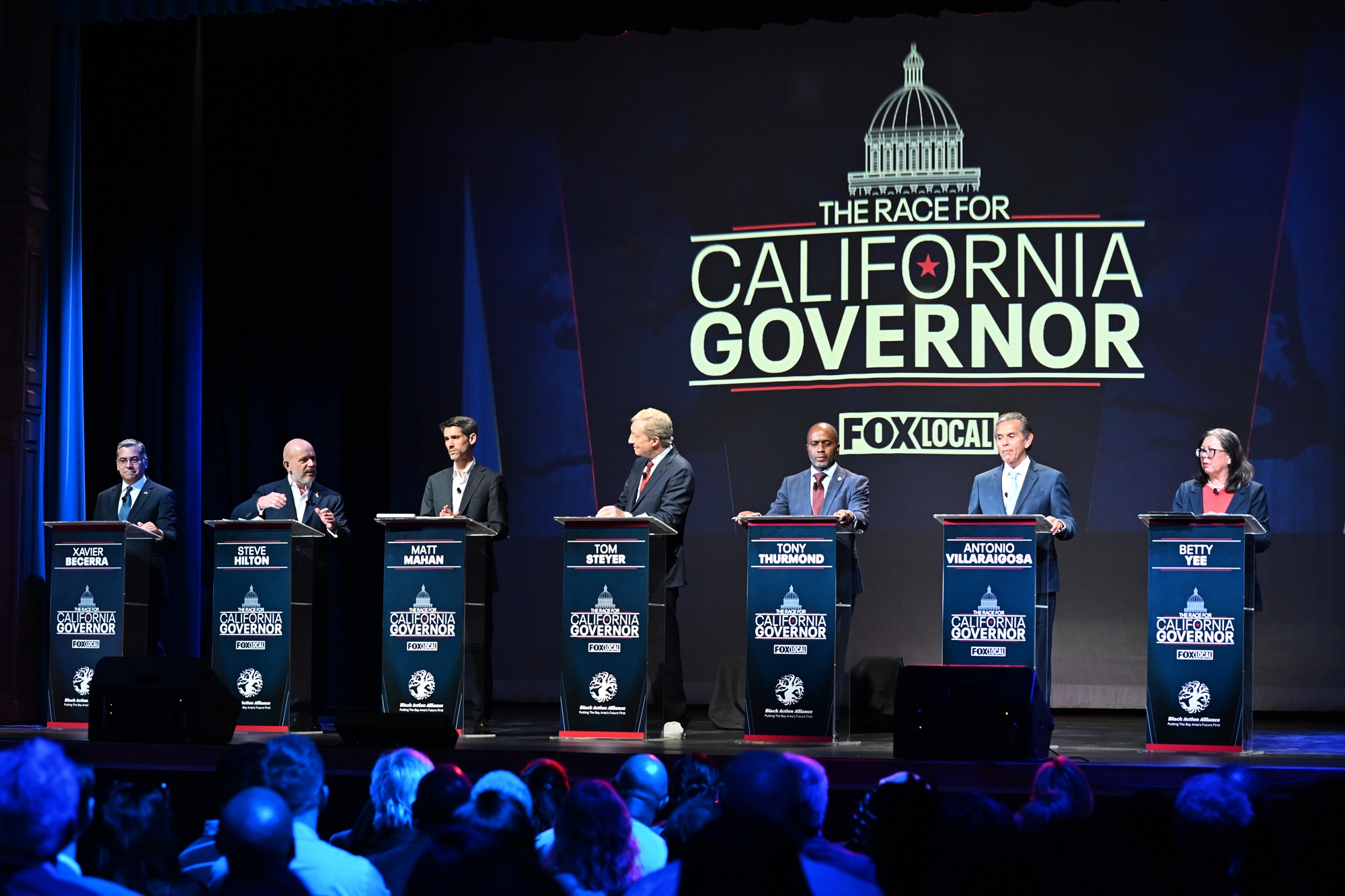
Guy Marzorati: [00:03:44] Yeah. So I think if we break the race down broadly into a category of like top contenders, we currently have eight Democrats and two Republicans. In that top 10, you have eight Democrats, Congressmember Eric Swalwell from the East Bay, former U.S. Representative Katie Porter, who’s from Orange County, Tom Steyer, who is a wealthy investor, Matt Mahan, the mayor of San Jose, Xavier Becerra, the former attorney general, former Health and Human Services secretary, former LA mayor Antonio Villaraigosa, the state’s former controller, Betty Yee, and the current state superintendent, Tony Thurmond. So that’s the Democratic field. And then two Republicans, conservative commentator Steve Hilton, and then Riverside County Sheriff, Chad Bianco. And remember the June primary is a top two primary. So everyone appears on the ballot together regardless of party and you can vote for a Democrat, you could vote for Republican, the top two will advance to the general election.
Ericka Cruz Guevarra: [00:04:56] So there’s not one breakout star in this year’s governor’s race, but who is rising to the top right now, especially among voters?
Guy Marzorati: [00:05:05] Yeah, so, you know, I mentioned that 10 candidate field. We are seeing somewhat of a top five in polling where you have the two Republicans, Steve Hilton, this, you know, commentator who has appeared a lot throughout the years on
Chad Bianco: [00:05:22] We need change in California. We’ve had one-party rules now 16 years, as I keep pointing out. It’s just a question of balance in our system. I don’t think it’s one party rule is healthy.
Guy Marzorati: [00:05:33] Chad Bianco, a sheriff of Riverside County, who’s really heralded his conservative law enforcement credentials. California, the Democrat party, the Democratic agenda, and California is indefensible. And then three Democrats who have kind of risen up in the polls, Eric Swalwell, who made his name in Congress really fighting against President Donald Trump. He served as an impeachment manager in the 2021 impeachment hearings.
Eric Swalwell: [00:06:02] And so as governor, I will make sure that I’m on offense on behalf of Californians so that the most vulnerable are not on defense.
Guy Marzorati: [00:06:11] Katie Porter, who also made her name in Congress, both as an opponent of Trump and as someone who kind of became famous for wielding this whiteboard during hearings and having these confrontations with pharmaceutical executives and folks in the Trump administration.
Katie Porter: [00:06:27] If you’ve seen me in a hearing, you know that I like to eat. Cheating CEOs for breakfast, lunch, and dinner, I am unafraid to take on the rich and powerful.
Guy Marzorati: [00:06:36] And then Tom Steyer who made his wealth as a hedge fund manager, but has spent more than a decade now as really a big time political investor and running campaigns, fighting against tobacco companies and others in statewide ballot initiatives.
Tom Steyer: [00:06:53] Why do I think it’s me? I don’t owe any on anything, and I’m willing to take on very well-funded special interests who are not going to like me.
Guy Marzorati: [00:07:05] We’ve seen those top five pretty consistently in recent polling, but I should say, even within that, no candidate has gotten even a fifth of the vote reliably. We haven’t seen any of those candidates reliably poll above 20%. So a lot of that polling, I think, at this point in the race, is speaking to name identification, simply who are Californians familiar with.
Ericka Cruz Guevarra: [00:07:32] Among the Democrats, you noted that some of the top contenders so far are Eric Swalwell, Katie Porter, and Tom Steyer. Why do you think those three are sort of rising to the top?
Guy Marzorati: [00:07:46] Yeah, I think a lot of that has to do at this point in the race with simply who are voters familiar with. In the case of Eric Swalwell and Katie Porter, they both made their name in Congress. They’ve only ever ever represented one congressional district, yet they’ve made their name by being, you know, a constant antagonist to the Trump administration. They’ve created these viral moments in congressional hearings, and so they become these congressional superstars with. A name ID that really goes beyond the boundaries of their congressional district. And then that third Democrat I mentioned, Tom Steyer, he’s kind of gotten himself out there in a different way. It’s been through his own spending. He spent about $80 million so far on this campaign, running ads all over the state, seemingly at all hours, and really put himself and his more kind of progressive platform on the radar for a lot of voters.
Ericka Cruz Guevarra: [00:08:50] We’ll have more with KQED’s Guy Marzorati right after the break. Stay with us.
Ericka Cruz Guevarra: [00:10:02] Do we have any idea who could line up behind any one of these candidates on the Democratic side? I mean, have we seen any kinds of big endorsements?
Guy Marzorati: [00:10:13] When it comes to the endorsement question, like who have groups gotten behind, we haven’t seen a lot of consensus. You know, the Democratic Party held a convention. They held an endorsement vote. No one received the endorsements. No one was able to get the 60% of delegates needed. But I think the lack of consensus goes beyond just the Democratic party. Take labor unions, like there is no consensus labor candidate right now, and you can go back 30 years in governor’s races in California, traditionally when the labor community consolidates around a Democrat, that Democrat wins the primary. We’re not seeing that this year. The California Nurses Association endorsed Tom Steyer. We’ve seen the Teamsters support Katie Porter, the Building Trades, Union support Antonio Villaraigosa. And then outside of organized labor, there have been some other groups that have gotten involved and shown a real willingness to spend money. I’m thinking about. A group representing doctors that’s getting behind Eric Swalwell, and then the big one is Silicon Valley, which we’ve seen a lot of prominent tech entrepreneurs, executives and investors give to Matt Mahan. Since he’s jumped in the race, he’s already gotten more than $10 million. He’s basically ahead of everyone in fundraising except Tom Steyer, who’s funding his own campaign largely, and then we’ve seen interest from Silicon Valley. Executives to create outside groups to be able to pour even more money into Mahan’s campaign. So that’s really in the recent weeks where you’ve seen the largest movement financially is Tom Steyer continuing to give tens of millions to his campaign and Silicon valley really lining up behind Matt Mahan.
Ericka Cruz Guevarra: [00:12:11] And I guess a reminder for folks listening that the top two finishers in this June primary will advance to November, regardless of their party. I know there’s been a lot of talk about how the number of choices among the Democrats is just so high that folks are kind of afraid that this actually might end up being a runoff between two Republicans. I mean, how likely is that given the lack of unity among the Democrats.
Guy Marzorati: [00:12:43] Yeah, I mean, this has become an increasing concern for democratic leaders in the state as we’ve seen the field really not narrow much at all. Right now, there’s Paul Mitchell, who’s a voting data expert in California. He put together this simulator that puts in polling and other metrics to figure out what are the chances of that actually happening. Right now it’s hovering somewhere around kind of a one in four chance that we would end up with two Republicans in the general election. And that’s been kind of too close for comfort for a lot of Democratic leaders. So in the last week, you saw the chair of the state party, Rusty Hicks. Call on candidates who he said, look, if you don’t have a path, a viable path to make it to the general election, it’s time to start wrapping up your campaign. We saw his call echoed by Governor Gavin Newsom, the speaker of the state assembly, Robert Revis. So more and more of these leading Democrats say, okay, it’s for some of the lower polling candidates to drop out. And this will be a test of like party strength. Like is that call heated or do we, you know, see this large field continue? Uh… Into may when voting begins
Ericka Cruz Guevarra: [00:13:55] Yeah, I mean you mentioned earlier that the top five in the polls right now are sort of writing on a little bit of name recognition, but it does sort of feel like any one of these folks are like maybe just one viral moment away from taking the lead on this thing given how open it is.
Guy Marzorati: [00:14:15] Yeah, no, I think that’s exactly fair. And when you think about the top Democrats, like I’ve been thinking about this recently, like the path that we’re seeing is something so different from traditional California history, where usually the governor is someone who has previously served in statewide office. That’s how you build up recognition among voters. That is how you build up support from interest groups at the state capitol. We’re not seeing that in this year’s election. Eric Swalwell. Has represented one congressional district. Katie Porter has represented one congressional District yet, they’ve been able to capitalize on what you described viral moments in DC that’s then led to exposure on national cable television. And as we’ve seen more of the nationalization of political media, that’s really played in their advantage. And I would say it’s also put a spotlight on really the ability for Democrats to use Trump. To get their name out. Like we were less than two months from voting getting underway, yet this campaign has not been defined really at all about like policy disagreements. But like, I think a lot of people are attracted to candidates because of their kind of value statements, right? And what they say they stand for versus maybe any specific position. If we don’t have a race in which the party establishment and others are all coalescing around one candidate and basically saying to voters, okay, here’s our pick. It’s a real test for voters to say, okay who’s your pick? It opens up a really interesting test. Of what voters are looking for in a leader.
Ericka Cruz Guevarra: [00:15:59] Well, Guy, thank you so much for breaking this down. Appreciate it.