window.__IS_SSR__=true
window.__INITIAL_STATE__={
"attachmentsReducer": {
"audio_0": {
"type": "attachments",
"id": "audio_0",
"imgSizes": {
"kqedFullSize": {
"file": "https://ww2.kqed.org/news/wp-content/themes/KQED-unified/img/audio_bgs/background0.jpg"
}
}
},
"audio_1": {
"type": "attachments",
"id": "audio_1",
"imgSizes": {
"kqedFullSize": {
"file": "https://ww2.kqed.org/news/wp-content/themes/KQED-unified/img/audio_bgs/background1.jpg"
}
}
},
"audio_2": {
"type": "attachments",
"id": "audio_2",
"imgSizes": {
"kqedFullSize": {
"file": "https://ww2.kqed.org/news/wp-content/themes/KQED-unified/img/audio_bgs/background2.jpg"
}
}
},
"audio_3": {
"type": "attachments",
"id": "audio_3",
"imgSizes": {
"kqedFullSize": {
"file": "https://ww2.kqed.org/news/wp-content/themes/KQED-unified/img/audio_bgs/background3.jpg"
}
}
},
"audio_4": {
"type": "attachments",
"id": "audio_4",
"imgSizes": {
"kqedFullSize": {
"file": "https://ww2.kqed.org/news/wp-content/themes/KQED-unified/img/audio_bgs/background4.jpg"
}
}
},
"placeholder": {
"type": "attachments",
"id": "placeholder",
"imgSizes": {
"thumbnail": {
"file": "https://cdn.kqed.org/wp-content/uploads/2024/12/KQED-Default-Image-816638274-2000x1333-1-160x107.jpg",
"width": 160,
"height": 107,
"mimeType": "image/jpeg"
},
"medium": {
"file": "https://cdn.kqed.org/wp-content/uploads/2024/12/KQED-Default-Image-816638274-2000x1333-1-800x533.jpg",
"width": 800,
"height": 533,
"mimeType": "image/jpeg"
},
"medium_large": {
"file": "https://cdn.kqed.org/wp-content/uploads/2024/12/KQED-Default-Image-816638274-2000x1333-1-768x512.jpg",
"width": 768,
"height": 512,
"mimeType": "image/jpeg"
},
"large": {
"file": "https://cdn.kqed.org/wp-content/uploads/2024/12/KQED-Default-Image-816638274-2000x1333-1-1020x680.jpg",
"width": 1020,
"height": 680,
"mimeType": "image/jpeg"
},
"1536x1536": {
"file": "https://cdn.kqed.org/wp-content/uploads/2024/12/KQED-Default-Image-816638274-2000x1333-1-1536x1024.jpg",
"width": 1536,
"height": 1024,
"mimeType": "image/jpeg"
},
"fd-lrg": {
"file": "https://cdn.kqed.org/wp-content/uploads/2024/12/KQED-Default-Image-816638274-2000x1333-1-1536x1024.jpg",
"width": 1536,
"height": 1024,
"mimeType": "image/jpeg"
},
"fd-med": {
"file": "https://cdn.kqed.org/wp-content/uploads/2024/12/KQED-Default-Image-816638274-2000x1333-1-1020x680.jpg",
"width": 1020,
"height": 680,
"mimeType": "image/jpeg"
},
"fd-sm": {
"file": "https://cdn.kqed.org/wp-content/uploads/2024/12/KQED-Default-Image-816638274-2000x1333-1-800x533.jpg",
"width": 800,
"height": 533,
"mimeType": "image/jpeg"
},
"post-thumbnail": {
"file": "https://cdn.kqed.org/wp-content/uploads/2024/12/KQED-Default-Image-816638274-2000x1333-1-672x372.jpg",
"width": 672,
"height": 372,
"mimeType": "image/jpeg"
},
"twentyfourteen-full-width": {
"file": "https://cdn.kqed.org/wp-content/uploads/2024/12/KQED-Default-Image-816638274-2000x1333-1-1038x576.jpg",
"width": 1038,
"height": 576,
"mimeType": "image/jpeg"
},
"xxsmall": {
"file": "https://cdn.kqed.org/wp-content/uploads/2024/12/KQED-Default-Image-816638274-2000x1333-1-160x107.jpg",
"width": 160,
"height": 107,
"mimeType": "image/jpeg"
},
"xsmall": {
"file": "https://cdn.kqed.org/wp-content/uploads/2024/12/KQED-Default-Image-816638274-2000x1333-1-672x372.jpg",
"width": 672,
"height": 372,
"mimeType": "image/jpeg"
},
"small": {
"file": "https://cdn.kqed.org/wp-content/uploads/2024/12/KQED-Default-Image-816638274-2000x1333-1-672x372.jpg",
"width": 672,
"height": 372,
"mimeType": "image/jpeg"
},
"xlarge": {
"file": "https://cdn.kqed.org/wp-content/uploads/2024/12/KQED-Default-Image-816638274-2000x1333-1-1020x680.jpg",
"width": 1020,
"height": 680,
"mimeType": "image/jpeg"
},
"full-width": {
"file": "https://cdn.kqed.org/wp-content/uploads/2024/12/KQED-Default-Image-816638274-2000x1333-1-1920x1280.jpg",
"width": 1920,
"height": 1280,
"mimeType": "image/jpeg"
},
"guest-author-32": {
"file": "https://cdn.kqed.org/wp-content/uploads/2025/01/KQED-Default-Image-816638274-1333x1333-1-160x160.jpg",
"width": 32,
"height": 32,
"mimeType": "image/jpeg"
},
"guest-author-50": {
"file": "https://cdn.kqed.org/wp-content/uploads/2025/01/KQED-Default-Image-816638274-1333x1333-1-160x160.jpg",
"width": 50,
"height": 50,
"mimeType": "image/jpeg"
},
"guest-author-64": {
"file": "https://cdn.kqed.org/wp-content/uploads/2025/01/KQED-Default-Image-816638274-1333x1333-1-160x160.jpg",
"width": 64,
"height": 64,
"mimeType": "image/jpeg"
},
"guest-author-96": {
"file": "https://cdn.kqed.org/wp-content/uploads/2025/01/KQED-Default-Image-816638274-1333x1333-1-160x160.jpg",
"width": 96,
"height": 96,
"mimeType": "image/jpeg"
},
"guest-author-128": {
"file": "https://cdn.kqed.org/wp-content/uploads/2025/01/KQED-Default-Image-816638274-1333x1333-1-160x160.jpg",
"width": 128,
"height": 128,
"mimeType": "image/jpeg"
},
"detail": {
"file": "https://cdn.kqed.org/wp-content/uploads/2025/01/KQED-Default-Image-816638274-1333x1333-1-160x160.jpg",
"width": 160,
"height": 160,
"mimeType": "image/jpeg"
},
"kqedFullSize": {
"file": "https://cdn.kqed.org/wp-content/uploads/2024/12/KQED-Default-Image-816638274-2000x1333-1.jpg",
"width": 2000,
"height": 1333
}
}
},
"news_11946283": {
"type": "attachments",
"id": "news_11946283",
"meta": {
"index": "attachments_1716263798",
"site": "news",
"id": "11946283",
"found": true
},
"parent": 0,
"imgSizes": {
"twentyfourteen-full-width": {
"file": "https://ww2.kqed.org/app/uploads/sites/10/2023/04/GettyImages-1241524154-1038x576.jpg",
"width": 1038,
"mimeType": "image/jpeg",
"height": 576
},
"thumbnail": {
"file": "https://ww2.kqed.org/app/uploads/sites/10/2023/04/GettyImages-1241524154-160x107.jpg",
"width": 160,
"mimeType": "image/jpeg",
"height": 107
},
"post-thumbnail": {
"file": "https://ww2.kqed.org/app/uploads/sites/10/2023/04/GettyImages-1241524154-672x372.jpg",
"width": 672,
"mimeType": "image/jpeg",
"height": 372
},
"kqedFullSize": {
"file": "https://ww2.kqed.org/app/uploads/sites/10/2023/04/GettyImages-1241524154-scaled.jpg",
"width": 2560,
"height": 1706
},
"2048x2048": {
"file": "https://ww2.kqed.org/app/uploads/sites/10/2023/04/GettyImages-1241524154-2048x1365.jpg",
"width": 2048,
"mimeType": "image/jpeg",
"height": 1365
},
"large": {
"file": "https://ww2.kqed.org/app/uploads/sites/10/2023/04/GettyImages-1241524154-1020x680.jpg",
"width": 1020,
"mimeType": "image/jpeg",
"height": 680
},
"1536x1536": {
"file": "https://ww2.kqed.org/app/uploads/sites/10/2023/04/GettyImages-1241524154-1536x1024.jpg",
"width": 1536,
"mimeType": "image/jpeg",
"height": 1024
},
"full-width": {
"file": "https://ww2.kqed.org/app/uploads/sites/10/2023/04/GettyImages-1241524154-1920x1280.jpg",
"width": 1920,
"mimeType": "image/jpeg",
"height": 1280
},
"medium": {
"file": "https://ww2.kqed.org/app/uploads/sites/10/2023/04/GettyImages-1241524154-800x533.jpg",
"width": 800,
"mimeType": "image/jpeg",
"height": 533
}
},
"publishDate": 1681166664,
"modified": 1681176463,
"caption": "On Friday, April 7, 2023, US District Judge Matthew J. Kacsmaryk ordered a hold on federal approval of the abortion medication mifepristone, which has been widely available for more than 20 years. Kacsmaryk's decision was quickly followed by US District Judge Thomas O. Rice essentially ordering the opposite and directing authorities not to make any changes that would restrict access to the drug.",
"description": null,
"title": "US-ABORTION-TEXAS-NEWMEXICO-CLINIC",
"credit": "Robyn Beck/AFP via Getty Images",
"status": "inherit",
"altTag": "A white pill bottle with a label that reads, \"misoprostol tablets 200 mcg\" lies on a wooden surface. To the right, three identical orange medicine boxes read, \"Mifeprez (Mifepristone) Tablets, 200 mg.\"",
"isLoading": false,
"fetchFailed": false
},
"news_11946022": {
"type": "attachments",
"id": "news_11946022",
"meta": {
"index": "attachments_1716263798",
"site": "news",
"id": "11946022",
"found": true
},
"parent": 11946015,
"imgSizes": {
"thumbnail": {
"file": "https://ww2.kqed.org/app/uploads/sites/10/2023/04/thumb47-160x90.png",
"width": 160,
"mimeType": "image/png",
"height": 90
},
"kqedFullSize": {
"file": "https://ww2.kqed.org/app/uploads/sites/10/2023/04/thumb47.png",
"width": 512,
"height": 288
}
},
"publishDate": 1680902094,
"modified": 1680902094,
"caption": null,
"description": null,
"title": "thumb47",
"credit": null,
"status": "inherit",
"altTag": null,
"isLoading": false,
"fetchFailed": false
},
"news_11945218": {
"type": "attachments",
"id": "news_11945218",
"meta": {
"index": "attachments_1716263798",
"site": "news",
"id": "11945218",
"found": true
},
"parent": 11945201,
"imgSizes": {
"twentyfourteen-full-width": {
"file": "https://ww2.kqed.org/app/uploads/sites/10/2023/03/GettyImages-1298884325-e1680203209663-808x576.jpg",
"width": 808,
"mimeType": "image/jpeg",
"height": 576
},
"thumbnail": {
"file": "https://ww2.kqed.org/app/uploads/sites/10/2023/03/GettyImages-1298884325-e1680203209663-160x143.jpg",
"width": 160,
"mimeType": "image/jpeg",
"height": 143
},
"post-thumbnail": {
"file": "https://ww2.kqed.org/app/uploads/sites/10/2023/03/GettyImages-1298884325-e1680203209663-672x372.jpg",
"width": 672,
"mimeType": "image/jpeg",
"height": 372
},
"kqedFullSize": {
"file": "https://ww2.kqed.org/app/uploads/sites/10/2023/03/GettyImages-1298884325-e1680203209663.jpg",
"width": 808,
"height": 724
},
"medium": {
"file": "https://ww2.kqed.org/app/uploads/sites/10/2023/03/GettyImages-1298884325-e1680203209663-800x717.jpg",
"width": 800,
"mimeType": "image/jpeg",
"height": 717
}
},
"publishDate": 1680203003,
"modified": 1680218665,
"caption": "State Sen. Toni Atkins (prior to becoming the current state Senate President Pro Tem) during a session at the state Capitol in Sacramento, on Wednesday, Jan. 3, 2018.",
"description": null,
"title": "California Senator Toni Atkins during session at State Capitol in Sacramento, Calif., on Wednesday, January 3, 2018.",
"credit": "Scott Strazzante/San Francisco Chronicle via Getty Images",
"status": "inherit",
"altTag": "A woman wearing a black necklace, sweater and grey shirt looks to the left with a man's head seen in the foreground.",
"isLoading": false,
"fetchFailed": false
},
"news_11944294": {
"type": "attachments",
"id": "news_11944294",
"meta": {
"index": "attachments_1716263798",
"site": "news",
"id": "11944294",
"found": true
},
"parent": 11944282,
"imgSizes": {
"twentyfourteen-full-width": {
"file": "https://ww2.kqed.org/app/uploads/sites/10/2023/03/RS63528_015_KQED_GubbioProjectLydiaBransten_03092023-qut-1536x1024-1-1038x576.jpeg",
"width": 1038,
"mimeType": "image/jpeg",
"height": 576
},
"thumbnail": {
"file": "https://ww2.kqed.org/app/uploads/sites/10/2023/03/RS63528_015_KQED_GubbioProjectLydiaBransten_03092023-qut-1536x1024-1-160x107.jpeg",
"width": 160,
"mimeType": "image/jpeg",
"height": 107
},
"post-thumbnail": {
"file": "https://ww2.kqed.org/app/uploads/sites/10/2023/03/RS63528_015_KQED_GubbioProjectLydiaBransten_03092023-qut-1536x1024-1-672x372.jpeg",
"width": 672,
"mimeType": "image/jpeg",
"height": 372
},
"kqedFullSize": {
"file": "https://ww2.kqed.org/app/uploads/sites/10/2023/03/RS63528_015_KQED_GubbioProjectLydiaBransten_03092023-qut-1536x1024-1.jpeg",
"width": 1536,
"height": 1024
},
"large": {
"file": "https://ww2.kqed.org/app/uploads/sites/10/2023/03/RS63528_015_KQED_GubbioProjectLydiaBransten_03092023-qut-1536x1024-1-1020x680.jpeg",
"width": 1020,
"mimeType": "image/jpeg",
"height": 680
},
"medium": {
"file": "https://ww2.kqed.org/app/uploads/sites/10/2023/03/RS63528_015_KQED_GubbioProjectLydiaBransten_03092023-qut-1536x1024-1-800x533.jpeg",
"width": 800,
"mimeType": "image/jpeg",
"height": 533
}
},
"publishDate": 1679442980,
"modified": 1679444340,
"caption": "The Gubbio Project, a nonprofit offering services for unhoused people, hopes to open a safe-consumption site in the Mission District.",
"description": null,
"title": "RS63528_015_KQED_GubbioProjectLydiaBransten_03092023-qut-1536x1024",
"credit": "Beth LaBerge/KQED",
"status": "inherit",
"altTag": "A figure stands atop brick steps in what appears to be a courtyard beyond a metal gateway with a sign reading 'Gubbio Project' on the metal gate",
"isLoading": false,
"fetchFailed": false
},
"news_11944067": {
"type": "attachments",
"id": "news_11944067",
"meta": {
"index": "attachments_1716263798",
"site": "news",
"id": "11944067",
"found": true
},
"parent": 11944063,
"imgSizes": {
"twentyfourteen-full-width": {
"file": "https://ww2.kqed.org/app/uploads/sites/10/2023/03/Screenshot-2023-03-19-at-12.06.48-PM-1038x576.png",
"width": 1038,
"mimeType": "image/png",
"height": 576
},
"thumbnail": {
"file": "https://ww2.kqed.org/app/uploads/sites/10/2023/03/Screenshot-2023-03-19-at-12.06.48-PM-160x106.png",
"width": 160,
"mimeType": "image/png",
"height": 106
},
"post-thumbnail": {
"file": "https://ww2.kqed.org/app/uploads/sites/10/2023/03/Screenshot-2023-03-19-at-12.06.48-PM-672x372.png",
"width": 672,
"mimeType": "image/png",
"height": 372
},
"kqedFullSize": {
"file": "https://ww2.kqed.org/app/uploads/sites/10/2023/03/Screenshot-2023-03-19-at-12.06.48-PM.png",
"width": 2378,
"height": 1580
},
"2048x2048": {
"file": "https://ww2.kqed.org/app/uploads/sites/10/2023/03/Screenshot-2023-03-19-at-12.06.48-PM-2048x1361.png",
"width": 2048,
"mimeType": "image/png",
"height": 1361
},
"large": {
"file": "https://ww2.kqed.org/app/uploads/sites/10/2023/03/Screenshot-2023-03-19-at-12.06.48-PM-1020x678.png",
"width": 1020,
"mimeType": "image/png",
"height": 678
},
"1536x1536": {
"file": "https://ww2.kqed.org/app/uploads/sites/10/2023/03/Screenshot-2023-03-19-at-12.06.48-PM-1536x1021.png",
"width": 1536,
"mimeType": "image/png",
"height": 1021
},
"full-width": {
"file": "https://ww2.kqed.org/app/uploads/sites/10/2023/03/Screenshot-2023-03-19-at-12.06.48-PM-1920x1276.png",
"width": 1920,
"mimeType": "image/png",
"height": 1276
},
"medium": {
"file": "https://ww2.kqed.org/app/uploads/sites/10/2023/03/Screenshot-2023-03-19-at-12.06.48-PM-800x532.png",
"width": 800,
"mimeType": "image/png",
"height": 532
}
},
"publishDate": 1679253207,
"modified": 1679352159,
"caption": "Students on campus at UC Davis on Feb. 2, 2022.",
"description": null,
"title": "Screenshot 2023-03-19 at 12.06.48 PM",
"credit": "Miguel Gutierrez Jr./CalMatters",
"status": "inherit",
"altTag": "Several people walking outside while others are seated at tables.",
"isLoading": false,
"fetchFailed": false
},
"news_11943918": {
"type": "attachments",
"id": "news_11943918",
"meta": {
"index": "attachments_1716263798",
"site": "news",
"id": "11943918",
"found": true
},
"parent": 11943903,
"imgSizes": {
"thumbnail": {
"file": "https://ww2.kqed.org/app/uploads/sites/10/2023/03/gettyimages-1241524355-612x612-1-160x107.jpg",
"width": 160,
"mimeType": "image/jpeg",
"height": 107
},
"post-thumbnail": {
"file": "https://ww2.kqed.org/app/uploads/sites/10/2023/03/gettyimages-1241524355-612x612-1-612x372.jpg",
"width": 612,
"mimeType": "image/jpeg",
"height": 372
},
"kqedFullSize": {
"file": "https://ww2.kqed.org/app/uploads/sites/10/2023/03/gettyimages-1241524355-612x612-1.jpg",
"width": 612,
"height": 408
}
},
"publishDate": 1679081278,
"modified": 1679084972,
"caption": "Mifepristone is one of the two drugs used in a medication abortion.",
"description": null,
"title": "gettyimages-1241524355-612x612",
"credit": "Robyn Beck/AFP via Getty Images",
"status": "inherit",
"altTag": "An orange rectangular box of pills with an outline of a female figure and the words \"Mifeprex (mifepristone)\" on the box.",
"isLoading": false,
"fetchFailed": false
},
"news_11892562": {
"type": "attachments",
"id": "news_11892562",
"meta": {
"index": "attachments_1716263798",
"site": "news",
"id": "11892562",
"found": true
},
"parent": 11892561,
"imgSizes": {
"twentyfourteen-full-width": {
"file": "https://ww2.kqed.org/app/uploads/sites/10/2021/10/RS44233_GettyImages-1253314486-qut-1038x576.jpg",
"width": 1038,
"mimeType": "image/jpeg",
"height": 576
},
"thumbnail": {
"file": "https://ww2.kqed.org/app/uploads/sites/10/2021/10/RS44233_GettyImages-1253314486-qut-160x104.jpg",
"width": 160,
"mimeType": "image/jpeg",
"height": 104
},
"post-thumbnail": {
"file": "https://ww2.kqed.org/app/uploads/sites/10/2021/10/RS44233_GettyImages-1253314486-qut-672x372.jpg",
"width": 672,
"mimeType": "image/jpeg",
"height": 372
},
"kqedFullSize": {
"file": "https://ww2.kqed.org/app/uploads/sites/10/2021/10/RS44233_GettyImages-1253314486-qut.jpg",
"width": 1920,
"height": 1250
},
"large": {
"file": "https://ww2.kqed.org/app/uploads/sites/10/2021/10/RS44233_GettyImages-1253314486-qut-1020x664.jpg",
"width": 1020,
"mimeType": "image/jpeg",
"height": 664
},
"1536x1536": {
"file": "https://ww2.kqed.org/app/uploads/sites/10/2021/10/RS44233_GettyImages-1253314486-qut-1536x1000.jpg",
"width": 1536,
"mimeType": "image/jpeg",
"height": 1000
},
"medium": {
"file": "https://ww2.kqed.org/app/uploads/sites/10/2021/10/RS44233_GettyImages-1253314486-qut-800x521.jpg",
"width": 800,
"mimeType": "image/jpeg",
"height": 521
}
},
"publishDate": 1634398751,
"modified": 1679013142,
"caption": "A California Department of Corrections and Rehabilitation officer wears a protective mask as he stands guard at the front gate of San Quentin State Prison on June 29, 2020, in Marin County.",
"description": null,
"title": null,
"credit": "Justin Sullivan/Getty Images",
"status": "inherit",
"altTag": "A man in uniform stands next to a sign that says \"California State Prison, San Quentin,\" with the castle-like facade of the prison behind him.",
"isLoading": false,
"fetchFailed": false
},
"news_11943771": {
"type": "attachments",
"id": "news_11943771",
"meta": {
"index": "attachments_1716263798",
"site": "news",
"id": "11943771",
"found": true
},
"parent": 11943746,
"imgSizes": {
"twentyfourteen-full-width": {
"file": "https://ww2.kqed.org/app/uploads/sites/10/2023/03/RS59614_DSC07251-qut-1038x576.jpg",
"width": 1038,
"mimeType": "image/jpeg",
"height": 576
},
"thumbnail": {
"file": "https://ww2.kqed.org/app/uploads/sites/10/2023/03/RS59614_DSC07251-qut-160x107.jpg",
"width": 160,
"mimeType": "image/jpeg",
"height": 107
},
"post-thumbnail": {
"file": "https://ww2.kqed.org/app/uploads/sites/10/2023/03/RS59614_DSC07251-qut-672x372.jpg",
"width": 672,
"mimeType": "image/jpeg",
"height": 372
},
"kqedFullSize": {
"file": "https://ww2.kqed.org/app/uploads/sites/10/2023/03/RS59614_DSC07251-qut.jpg",
"width": 1920,
"height": 1280
},
"large": {
"file": "https://ww2.kqed.org/app/uploads/sites/10/2023/03/RS59614_DSC07251-qut-1020x680.jpg",
"width": 1020,
"mimeType": "image/jpeg",
"height": 680
},
"1536x1536": {
"file": "https://ww2.kqed.org/app/uploads/sites/10/2023/03/RS59614_DSC07251-qut-1536x1024.jpg",
"width": 1536,
"mimeType": "image/jpeg",
"height": 1024
},
"medium": {
"file": "https://ww2.kqed.org/app/uploads/sites/10/2023/03/RS59614_DSC07251-qut-800x533.jpg",
"width": 800,
"mimeType": "image/jpeg",
"height": 533
}
},
"publishDate": 1678995501,
"modified": 1678995641,
"caption": "Gov. Gavin Newsom on Thursday also announced an updated goal to reduce homelessness by 15% statewide by 2025.",
"description": null,
"title": "RS59614_DSC07251-qut",
"credit": "Aryk Copley/KQED",
"status": "inherit",
"altTag": "head shot of Gov. Gavin Newsom",
"isLoading": false,
"fetchFailed": false
},
"news_11943250": {
"type": "attachments",
"id": "news_11943250",
"meta": {
"index": "attachments_1716263798",
"site": "news",
"id": "11943250",
"found": true
},
"title": "US-BANKING-MARKET-SVB",
"publishDate": 1678483249,
"status": "inherit",
"parent": 11943215,
"modified": 1769122415,
"caption": "Police officers leave Silicon Valley Bank's headquarters in Santa Clara on March 10, 2023. ",
"credit": "Noah Berger/AFP via Getty Images",
"altTag": "Two armed police officers, one with a baton in left hand, stand outside Silicon Valley Bank headquarters as another person behind them reads a notice taped to the closed front entrance explaining the bank's closure.",
"description": null,
"imgSizes": {
"medium": {
"file": "https://cdn.kqed.org/wp-content/uploads/sites/10/2023/03/GettyImages-1247999584-800x532.jpg",
"width": 800,
"height": 532,
"mimeType": "image/jpeg"
},
"large": {
"file": "https://cdn.kqed.org/wp-content/uploads/sites/10/2023/03/GettyImages-1247999584-1020x678.jpg",
"width": 1020,
"height": 678,
"mimeType": "image/jpeg"
},
"thumbnail": {
"file": "https://cdn.kqed.org/wp-content/uploads/sites/10/2023/03/GettyImages-1247999584-160x106.jpg",
"width": 160,
"height": 106,
"mimeType": "image/jpeg"
},
"post-thumbnail": {
"file": "https://cdn.kqed.org/wp-content/uploads/sites/10/2023/03/GettyImages-1247999584-672x372.jpg",
"width": 672,
"height": 372,
"mimeType": "image/jpeg"
},
"twentyfourteen-full-width": {
"file": "https://cdn.kqed.org/wp-content/uploads/sites/10/2023/03/GettyImages-1247999584-1024x576.jpg",
"width": 1024,
"height": 576,
"mimeType": "image/jpeg"
},
"kqedFullSize": {
"file": "https://cdn.kqed.org/wp-content/uploads/sites/10/2023/03/GettyImages-1247999584.jpg",
"width": 1024,
"height": 681
}
},
"isLoading": false,
"fetchFailed": false
},
"news_11943325": {
"type": "attachments",
"id": "news_11943325",
"meta": {
"index": "attachments_1716263798",
"site": "news",
"id": "11943325",
"found": true
},
"parent": 11943309,
"imgSizes": {
"twentyfourteen-full-width": {
"file": "https://ww2.kqed.org/app/uploads/sites/10/2023/03/RS63526_011_KQED_GubbioProjectLydiaBransten_03092023-qut-1038x576.jpg",
"width": 1038,
"mimeType": "image/jpeg",
"height": 576
},
"thumbnail": {
"file": "https://ww2.kqed.org/app/uploads/sites/10/2023/03/RS63526_011_KQED_GubbioProjectLydiaBransten_03092023-qut-160x107.jpg",
"width": 160,
"mimeType": "image/jpeg",
"height": 107
},
"post-thumbnail": {
"file": "https://ww2.kqed.org/app/uploads/sites/10/2023/03/RS63526_011_KQED_GubbioProjectLydiaBransten_03092023-qut-672x372.jpg",
"width": 672,
"mimeType": "image/jpeg",
"height": 372
},
"kqedFullSize": {
"file": "https://ww2.kqed.org/app/uploads/sites/10/2023/03/RS63526_011_KQED_GubbioProjectLydiaBransten_03092023-qut.jpg",
"width": 1920,
"height": 1280
},
"large": {
"file": "https://ww2.kqed.org/app/uploads/sites/10/2023/03/RS63526_011_KQED_GubbioProjectLydiaBransten_03092023-qut-1020x680.jpg",
"width": 1020,
"mimeType": "image/jpeg",
"height": 680
},
"1536x1536": {
"file": "https://ww2.kqed.org/app/uploads/sites/10/2023/03/RS63526_011_KQED_GubbioProjectLydiaBransten_03092023-qut-1536x1024.jpg",
"width": 1536,
"mimeType": "image/jpeg",
"height": 1024
},
"medium": {
"file": "https://ww2.kqed.org/app/uploads/sites/10/2023/03/RS63526_011_KQED_GubbioProjectLydiaBransten_03092023-qut-800x533.jpg",
"width": 800,
"mimeType": "image/jpeg",
"height": 533
}
},
"publishDate": 1678559939,
"modified": 1678562509,
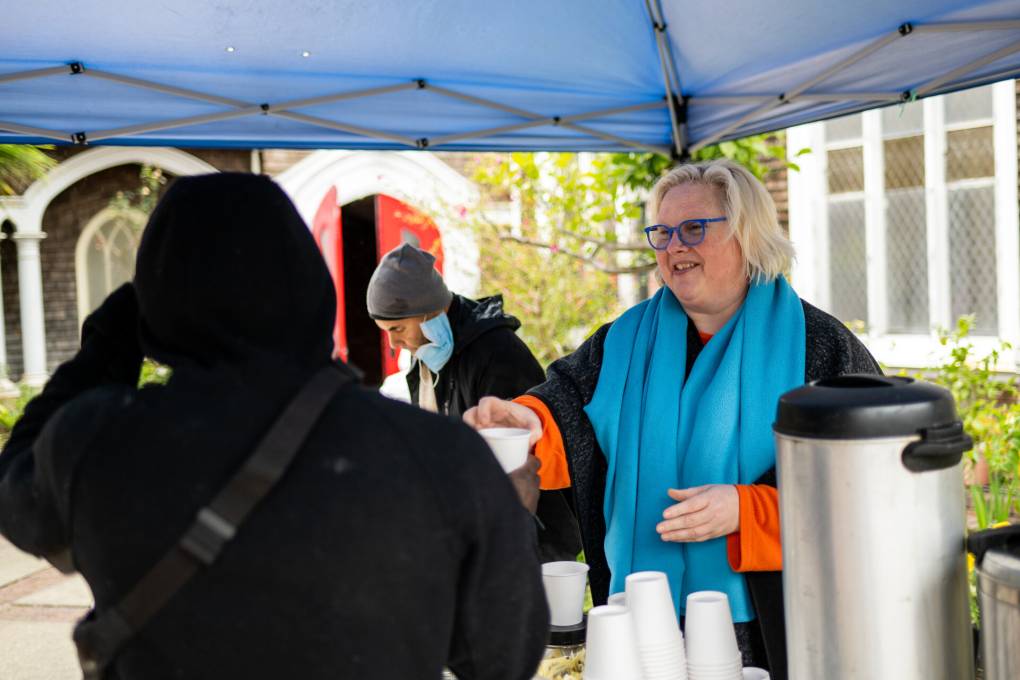
"caption": "Lydia Bransten serves free coffee at the Gubbio Project, a nonprofit offering services for unhoused people, in San Francisco on March 9, 2023.",
"description": null,
"title": "RS63526_011_KQED_GubbioProjectLydiaBransten_03092023-qut",
"credit": "Beth LaBerge/KQED",
"status": "inherit",
"altTag": "An older white woman with a blue shawl smiles as she hands a white cup to a person with a hoodie seen from behind, under a tent with another person in the background.",
"isLoading": false,
"fetchFailed": false
},
"news_11943181": {
"type": "attachments",
"id": "news_11943181",
"meta": {
"index": "attachments_1716263798",
"site": "news",
"id": "11943181",
"found": true
},
"parent": 11943154,
"imgSizes": {
"twentyfourteen-full-width": {
"file": "https://ww2.kqed.org/app/uploads/sites/10/2023/03/GettyImages-520153976-1038x576.jpg",
"width": 1038,
"mimeType": "image/jpeg",
"height": 576
},
"thumbnail": {
"file": "https://ww2.kqed.org/app/uploads/sites/10/2023/03/GettyImages-520153976-160x106.jpg",
"width": 160,
"mimeType": "image/jpeg",
"height": 106
},
"post-thumbnail": {
"file": "https://ww2.kqed.org/app/uploads/sites/10/2023/03/GettyImages-520153976-672x372.jpg",
"width": 672,
"mimeType": "image/jpeg",
"height": 372
},
"kqedFullSize": {
"file": "https://ww2.kqed.org/app/uploads/sites/10/2023/03/GettyImages-520153976.jpg",
"width": 2124,
"height": 1411
},
"2048x2048": {
"file": "https://ww2.kqed.org/app/uploads/sites/10/2023/03/GettyImages-520153976-2048x1361.jpg",
"width": 2048,
"mimeType": "image/jpeg",
"height": 1361
},
"large": {
"file": "https://ww2.kqed.org/app/uploads/sites/10/2023/03/GettyImages-520153976-1020x678.jpg",
"width": 1020,
"mimeType": "image/jpeg",
"height": 678
},
"1536x1536": {
"file": "https://ww2.kqed.org/app/uploads/sites/10/2023/03/GettyImages-520153976-1536x1020.jpg",
"width": 1536,
"mimeType": "image/jpeg",
"height": 1020
},
"full-width": {
"file": "https://ww2.kqed.org/app/uploads/sites/10/2023/03/GettyImages-520153976-1920x1275.jpg",
"width": 1920,
"mimeType": "image/jpeg",
"height": 1275
},
"medium": {
"file": "https://ww2.kqed.org/app/uploads/sites/10/2023/03/GettyImages-520153976-800x531.jpg",
"width": 800,
"mimeType": "image/jpeg",
"height": 531
}
},
"publishDate": 1678411395,
"modified": 1678413589,
"caption": "Inland canal waterway development in Huntington Beach, which was first sued by the state in 2019 for failing to adopt a state-approved housing plan. The latest lawsuit centers on votes the City Council took in February to stop processing applications for backyard cottages, along with applications for new duplexes and lot splits, the latter of which were legalized for most urban properties under Senate Bill 9.",
"description": null,
"title": "Huntington Beach, CA",
"credit": "Steve Proehl/Getty Images",
"status": "inherit",
"altTag": "An aerial view of housing along a canal waterway with the beach and ocean in the background.",
"isLoading": false,
"fetchFailed": false
},
"news_11942804": {
"type": "attachments",
"id": "news_11942804",
"meta": {
"index": "attachments_1716263798",
"site": "news",
"id": "11942804",
"found": true
},
"parent": 11942734,
"imgSizes": {
"twentyfourteen-full-width": {
"file": "https://ww2.kqed.org/app/uploads/sites/10/2023/03/RS62446_016_KQED_SanJoseInterimHousing_01302023-qut-1038x576.jpg",
"width": 1038,
"mimeType": "image/jpeg",
"height": 576
},
"thumbnail": {
"file": "https://ww2.kqed.org/app/uploads/sites/10/2023/03/RS62446_016_KQED_SanJoseInterimHousing_01302023-qut-160x107.jpg",
"width": 160,
"mimeType": "image/jpeg",
"height": 107
},
"post-thumbnail": {
"file": "https://ww2.kqed.org/app/uploads/sites/10/2023/03/RS62446_016_KQED_SanJoseInterimHousing_01302023-qut-672x372.jpg",
"width": 672,
"mimeType": "image/jpeg",
"height": 372
},
"kqedFullSize": {
"file": "https://ww2.kqed.org/app/uploads/sites/10/2023/03/RS62446_016_KQED_SanJoseInterimHousing_01302023-qut.jpg",
"width": 1920,
"height": 1280
},
"large": {
"file": "https://ww2.kqed.org/app/uploads/sites/10/2023/03/RS62446_016_KQED_SanJoseInterimHousing_01302023-qut-1020x680.jpg",
"width": 1020,
"mimeType": "image/jpeg",
"height": 680
},
"1536x1536": {
"file": "https://ww2.kqed.org/app/uploads/sites/10/2023/03/RS62446_016_KQED_SanJoseInterimHousing_01302023-qut-1536x1024.jpg",
"width": 1536,
"mimeType": "image/jpeg",
"height": 1024
},
"medium": {
"file": "https://ww2.kqed.org/app/uploads/sites/10/2023/03/RS62446_016_KQED_SanJoseInterimHousing_01302023-qut-800x533.jpg",
"width": 800,
"mimeType": "image/jpeg",
"height": 533
}
},
"publishDate": 1678222039,
"modified": 1678222419,
"caption": "Amanda Mora, a resident of Evans Lane, an interim housing facility located on city-owned land, in San José, tours the property on Jan. 30, 2023.",
"description": null,
"title": "RS62446_016_KQED_SanJoseInterimHousing_01302023-qut",
"credit": "Beth LaBerge/KQED",
"status": "inherit",
"altTag": null,
"isLoading": false,
"fetchFailed": false
}
},
"audioPlayerReducer": {
"postId": "stream_live",
"isPaused": true,
"isPlaying": false,
"pfsActive": false,
"pledgeModalIsOpen": true,
"playerDrawerIsOpen": false,
"liveAudioPlayStartedAt": 0,
"liveAudioPlayContext": ""
},
"authorsReducer": {
"byline_news_11946193": {
"type": "authors",
"id": "byline_news_11946193",
"meta": {
"override": true
},
"slug": "byline_news_11946193",
"name": "\u003ca href=\"https://calmatters.org/author/kristen-hwang/\">Kristen Hwang\u003c/a>",
"isLoading": false
},
"byline_news_11945201": {
"type": "authors",
"id": "byline_news_11945201",
"meta": {
"override": true
},
"slug": "byline_news_11945201",
"name": "Adam Beam",
"isLoading": false
},
"byline_news_11944063": {
"type": "authors",
"id": "byline_news_11944063",
"meta": {
"override": true
},
"slug": "byline_news_11944063",
"name": "\u003ca href=\"https://calmatters.org/author/mikhailzinshteyn/\">Mikhail Zinshteyn\u003c/a>",
"isLoading": false
},
"byline_news_11943903": {
"type": "authors",
"id": "byline_news_11943903",
"meta": {
"override": true
},
"slug": "byline_news_11943903",
"name": "Adam Beam\u003cbr>The Associated Press",
"isLoading": false
},
"gmarzorati": {
"type": "authors",
"id": "227",
"meta": {
"index": "authors_1716337520",
"id": "227",
"found": true
},
"name": "Guy Marzorati",
"firstName": "Guy",
"lastName": "Marzorati",
"slug": "gmarzorati",
"email": "gmarzorati@KQED.org",
"display_author_email": true,
"staff_mastheads": [
"news"
],
"title": "Correspondent",
"bio": "Guy Marzorati is a correspondent on KQED's California Politics and Government Desk, based in San Jose. A graduate of Santa Clara University, Guy joined KQED in 2013. He reports on state and local politics and produces KQED's digital voter guide.",
"avatar": "https://secure.gravatar.com/avatar/e7038b8dbfd55b104369b76b1cd0b9de?s=600&d=blank&r=g",
"twitter": "guymarzorati",
"facebook": null,
"instagram": null,
"linkedin": null,
"sites": [
{
"site": "",
"roles": [
"editor"
]
},
{
"site": "news",
"roles": [
"editor"
]
},
{
"site": "science",
"roles": [
"editor"
]
},
{
"site": "forum",
"roles": [
"editor"
]
},
{
"site": "elections",
"roles": [
"editor"
]
},
{
"site": "liveblog",
"roles": [
"editor"
]
}
],
"headData": {
"title": "Guy Marzorati | KQED",
"description": "Correspondent",
"ogImgSrc": "https://secure.gravatar.com/avatar/e7038b8dbfd55b104369b76b1cd0b9de?s=600&d=blank&r=g",
"twImgSrc": "https://secure.gravatar.com/avatar/e7038b8dbfd55b104369b76b1cd0b9de?s=600&d=blank&r=g"
},
"isLoading": false,
"link": "/author/gmarzorati"
},
"scottshafer": {
"type": "authors",
"id": "255",
"meta": {
"index": "authors_1716337520",
"id": "255",
"found": true
},
"name": "Scott Shafer",
"firstName": "Scott",
"lastName": "Shafer",
"slug": "scottshafer",
"email": "sshafer@kqed.org",
"display_author_email": false,
"staff_mastheads": [
"news"
],
"title": "KQED Contributor",
"bio": "Scott Shafer is a senior editor with the KQED Politics and Government desk. He is co-host of Political Breakdown, the award-winning radio show and podcast with a personal take on the world of politics. Scott came to KQED in 1998 to host the statewide\u003cem> California Report\u003c/em>. Prior to that he had extended stints in politics and government\u003cem>.\u003c/em> He uses that inside experience at KQED in his, reporting, hosting and analysis for the politics desk. Scott collaborated \u003cem>Political Breakdown a\u003c/em>nd on \u003cem>The Political Mind of Jerry Brown, \u003c/em>an eight-part series about the life and extraordinary political career of the former governor. For fun, he plays water polo with the San Francisco Tsunami.",
"avatar": "https://secure.gravatar.com/avatar/a62ebae45b79d7aed1a39a0e3bf68104?s=600&d=blank&r=g",
"twitter": "scottshafer",
"bluesky": null,
"facebook": null,
"instagram": null,
"linkedin": null,
"sites": [
{
"site": "news",
"roles": [
"editor"
]
},
{
"site": "stateofhealth",
"roles": [
"author"
]
},
{
"site": "science",
"roles": [
"author"
]
},
{
"site": "forum",
"roles": [
"subscriber"
]
},
{
"site": "liveblog",
"roles": [
"author"
]
}
],
"headData": {
"title": "Scott Shafer | KQED",
"description": "KQED Contributor",
"ogImgSrc": "https://secure.gravatar.com/avatar/a62ebae45b79d7aed1a39a0e3bf68104?s=600&d=blank&r=g",
"twImgSrc": "https://secure.gravatar.com/avatar/a62ebae45b79d7aed1a39a0e3bf68104?s=600&d=blank&r=g"
},
"isLoading": false,
"link": "/author/scottshafer"
},
"mlagos": {
"type": "authors",
"id": "3239",
"meta": {
"index": "authors_1716337520",
"id": "3239",
"found": true
},
"name": "Marisa Lagos",
"firstName": "Marisa",
"lastName": "Lagos",
"slug": "mlagos",
"email": "mlagos@kqed.org",
"display_author_email": false,
"staff_mastheads": [
"news"
],
"title": "KQED Contributor",
"bio": "Marisa Lagos is a correspondent for KQED’s California Politics and Government Desk and co-hosts the award-winning show and podcast, Political Breakdown. At KQED, Lagos also conducts reporting, analysis and investigations into state, local and national politics for radio, TV, online and onstage. In 2022, she and co-host, Scott Shafer, moderated the only gubernatorial debate in California. In 2020, the \u003ci>Washington Post\u003c/i> named her one of the top political journalists in California; she was nominated for a Peabody and won several other awards for her work investigating the 2017 California wildfires. She has worked at the \u003ci>San Francisco Chronicle\u003c/i>, \u003ci>San Francisco Examiner\u003c/i> and \u003ci>Los Angeles Times\u003c/i>. A UC Santa Barbara graduate, she lives in San Francisco with her two sons and husband.",
"avatar": "https://secure.gravatar.com/avatar/a261a0d3696fc066871ef96b85b5e7d2?s=600&d=blank&r=g",
"twitter": "@mlagos",
"facebook": null,
"instagram": null,
"linkedin": null,
"sites": [
{
"site": "arts",
"roles": [
"author"
]
},
{
"site": "news",
"roles": [
"editor"
]
},
{
"site": "science",
"roles": [
"editor"
]
},
{
"site": "forum",
"roles": [
"author"
]
},
{
"site": "liveblog",
"roles": [
"author"
]
}
],
"headData": {
"title": "Marisa Lagos | KQED",
"description": "KQED Contributor",
"ogImgSrc": "https://secure.gravatar.com/avatar/a261a0d3696fc066871ef96b85b5e7d2?s=600&d=blank&r=g",
"twImgSrc": "https://secure.gravatar.com/avatar/a261a0d3696fc066871ef96b85b5e7d2?s=600&d=blank&r=g"
},
"isLoading": false,
"link": "/author/mlagos"
},
"vrancano": {
"type": "authors",
"id": "11276",
"meta": {
"index": "authors_1716337520",
"id": "11276",
"found": true
},
"name": "Vanessa Rancaño",
"firstName": "Vanessa",
"lastName": "Rancaño",
"slug": "vrancano",
"email": "vrancano@kqed.org",
"display_author_email": false,
"staff_mastheads": [
"news"
],
"title": "Reporter",
"bio": "Vanessa Rancaño is a features reporter for KQED. She’s also covered homelessness and education for the station and reported from the Central Valley. Her work has aired across public radio, from flagship national news shows to longform narrative podcasts. Before taking up a mic, she worked as a freelance print journalist. She’s been recognized with a number of national and regional awards. Vanessa grew up in California's Central Valley. She's a former NPR Kroc Fellow, and a graduate of the UC Berkeley Graduate School of Journalism.",
"avatar": "https://secure.gravatar.com/avatar/b3a383dfb0e7ee1c17568f2cf067904ab654d6e3de9743fc661f3c788ade1bed?s=600&d=blank&r=g",
"twitter": "vanessarancano",
"bluesky": null,
"facebook": null,
"instagram": null,
"linkedin": null,
"sites": [
{
"site": "arts",
"roles": [
"editor"
]
},
{
"site": "news",
"roles": [
"editor"
]
},
{
"site": "liveblog",
"roles": [
"contributor"
]
}
],
"headData": {
"title": "Vanessa Rancaño | KQED",
"description": "Reporter",
"ogImgSrc": "https://secure.gravatar.com/avatar/b3a383dfb0e7ee1c17568f2cf067904ab654d6e3de9743fc661f3c788ade1bed?s=600&d=blank&r=g",
"twImgSrc": "https://secure.gravatar.com/avatar/b3a383dfb0e7ee1c17568f2cf067904ab654d6e3de9743fc661f3c788ade1bed?s=600&d=blank&r=g"
},
"isLoading": false,
"link": "/author/vrancano"
},
"ebaldassari": {
"type": "authors",
"id": "11652",
"meta": {
"index": "authors_1716337520",
"id": "11652",
"found": true
},
"name": "Erin Baldassari",
"firstName": "Erin",
"lastName": "Baldassari",
"slug": "ebaldassari",
"email": "ebaldassari@KQED.org",
"display_author_email": true,
"staff_mastheads": [
"news"
],
"title": "Staff Writer",
"bio": "Erin Baldassari covers housing for KQED. She's a former print journalist and most recently worked as the transportation reporter for the \u003cem>Mercury News\u003c/em> and \u003cem>East Bay Times. \u003c/em>There, she focused on how the Bay Area’s housing shortage has changed the way people move around the region. She also served on the \u003cem>East Bay Times\u003c/em>’ 2017 Pulitzer Prize-winning team for coverage of the Ghost Ship Fire in Oakland. Prior to that, Erin worked as a breaking news and general assignment reporter for a variety of outlets in the Bay Area and the greater Boston area. A Tufts University alumna, Erin grew up in the foothills of the Sierra Nevada mountains and in Sonoma County. She is a life-long KQED listener.",
"avatar": "https://secure.gravatar.com/avatar/660ce35d088ca54ad606d7e941abc652?s=600&d=mm&r=g",
"twitter": "e_baldi",
"facebook": null,
"instagram": null,
"linkedin": null,
"sites": [
{
"site": "news",
"roles": [
"edit_others_posts",
"editor"
]
},
{
"site": "science",
"roles": [
"editor"
]
},
{
"site": "liveblog",
"roles": [
"editor"
]
}
],
"headData": {
"title": "Erin Baldassari | KQED",
"description": "Staff Writer",
"ogImgSrc": "https://secure.gravatar.com/avatar/660ce35d088ca54ad606d7e941abc652?s=600&d=mm&r=g",
"twImgSrc": "https://secure.gravatar.com/avatar/660ce35d088ca54ad606d7e941abc652?s=600&d=mm&r=g"
},
"isLoading": false,
"link": "/author/ebaldassari"
},
"sjohnson": {
"type": "authors",
"id": "11840",
"meta": {
"index": "authors_1716337520",
"id": "11840",
"found": true
},
"name": "Sydney Johnson",
"firstName": "Sydney",
"lastName": "Johnson",
"slug": "sjohnson",
"email": "sjohnson@kqed.org",
"display_author_email": false,
"staff_mastheads": [
"news"
],
"title": "KQED Reporter",
"bio": "Sydney Johnson is a general assignment reporter at KQED. She previously reported on public health and city government at the San Francisco Examiner, and before that, she covered statewide education policy for EdSource. Her reporting has won multiple local, state and national awards. Sydney is a graduate of the University of California, Berkeley and lives in San Francisco.",
"avatar": "https://secure.gravatar.com/avatar/97855f2719b72ad6190b7c535fe642c8?s=600&d=blank&r=g",
"twitter": "sydneyfjohnson",
"facebook": null,
"instagram": null,
"linkedin": null,
"sites": [
{
"site": "news",
"roles": [
"editor"
]
}
],
"headData": {
"title": "Sydney Johnson | KQED",
"description": "KQED Reporter",
"ogImgSrc": "https://secure.gravatar.com/avatar/97855f2719b72ad6190b7c535fe642c8?s=600&d=blank&r=g",
"twImgSrc": "https://secure.gravatar.com/avatar/97855f2719b72ad6190b7c535fe642c8?s=600&d=blank&r=g"
},
"isLoading": false,
"link": "/author/sjohnson"
},
"gsalomone": {
"type": "authors",
"id": "11843",
"meta": {
"index": "authors_1716337520",
"id": "11843",
"found": true
},
"name": "Giuliana Salomone",
"firstName": "Giuliana",
"lastName": "Salomone",
"slug": "gsalomone",
"email": "gsalomone@kqed.org",
"display_author_email": false,
"staff_mastheads": [],
"title": "Giuliana Salomone",
"bio": null,
"avatar": "https://secure.gravatar.com/avatar/e6b25c1a2333c2bf9593da460906986f?s=600&d=blank&r=g",
"twitter": null,
"facebook": null,
"instagram": null,
"linkedin": null,
"sites": [
{
"site": "news",
"roles": [
"author"
]
}
],
"headData": {
"title": "Giuliana Salomone | KQED",
"description": "Giuliana Salomone",
"ogImgSrc": "https://secure.gravatar.com/avatar/e6b25c1a2333c2bf9593da460906986f?s=600&d=blank&r=g",
"twImgSrc": "https://secure.gravatar.com/avatar/e6b25c1a2333c2bf9593da460906986f?s=600&d=blank&r=g"
},
"isLoading": false,
"link": "/author/gsalomone"
}
},
"pagesReducer": {
"news_tag_politics": {
"type": "terms",
"id": "news_17968",
"meta": {
"index": "terms_1716263798",
"site": "news",
"id": "17968",
"score": 8.003347
},
"name": "Politics",
"slug": "politics",
"taxonomy": "tag",
"description": null,
"featImg": null,
"headData": {
"title": "Politics | KQED News",
"description": null,
"ogTitle": null,
"ogDescription": null,
"ogImgId": null,
"twTitle": null,
"twDescription": null,
"twImgId": null
},
"ttid": 18002,
"isLoading": false,
"title": "Politics",
"pageMeta": {
"site": "news",
"WpPageTemplate": "page-topic-editorial",
"currentPage": 161
},
"blocks": [
{
"blockName": "kqed/post-list",
"attrs": {
"layout": "cardArticle2",
"query": "posts/news?tag=politics",
"seeMore": false,
"paginated": true,
"page": 161
}
},
{
"blockName": "kqed/ad"
}
]
}
},
"pfsSessionReducer": {},
"postsReducer": {
"stream_live": {
"type": "live",
"id": "stream_live",
"audioUrl": "https://streams.kqed.org/kqedradio",
"title": "Live Stream",
"excerpt": "Live Stream information currently unavailable.",
"link": "/radio",
"featImg": "",
"label": {
"name": "KQED Live",
"link": "/"
}
},
"stream_kqedNewscast": {
"type": "posts",
"id": "stream_kqedNewscast",
"audioUrl": "https://www.kqed.org/.stream/anon/radio/RDnews/newscast.mp3?_=1",
"title": "KQED Newscast",
"featImg": "",
"label": {
"name": "88.5 FM",
"link": "/"
}
},
"news_11946193": {
"type": "posts",
"id": "news_11946193",
"meta": {
"index": "posts_1716263798",
"site": "news",
"id": "11946193",
"score": null,
"sort": [
1681218010000
]
},
"guestAuthors": [],
"slug": "texas-ruling-suspends-abortion-pill-leaving-little-room-for-states-like-california-to-mitigate-the-fallout",
"title": "California’s Options Limited on Abortion Pill Following Texas Judge Ruling",
"publishDate": 1681218010,
"format": "standard",
"headTitle": "California’s Options Limited on Abortion Pill Following Texas Judge Ruling | KQED",
"labelTerm": {},
"content": "\u003cp>California’s Democratic lawmakers have spent the past year \u003ca href=\"https://calmatters.org/health/2022/09/california-abortion-bills/\">enacting legislation to protect abortion rights\u003c/a> in the wake of Roe v. Wade’s reversal, but a ruling today by a Texas federal judge is one thing they can’t touch.\u003c/p>\n\u003cp>U.S. District Judge Matthew Kacsmaryk suspended \u003ca href=\"https://www.dropbox.com/s/jnm4r233xat6tv4/ND%20Tex%20FDA%20decision.pdf?dl=0\">the U.S. Food and Drug Administration’s two-decades’-old approval (PDF)\u003c/a> of mifepristone, arguing that\u003cstrong> \u003c/strong>it was flawed and invalid.\u003c/p>\n\u003cp>Kacsmaryk \u003ca href=\"https://www.kqed.org/news/11946073/texas-judge-halts-fda-approval-of-abortion-pill-mifepristone-newsom-slams-ruling\">issued a temporary stay on his ruling\u003c/a> for seven days to allow the Biden Justice Department to appeal, which \u003ca href=\"https://www.yahoo.com/news/justice-department-files-immediate-appeal-013017962.html\">it quickly did\u003c/a>. The ruling is likely to pull the drug from pharmacy shelves unless a higher court intervenes while the case moves through the appeal process.\u003c/p>\n\u003cp>But soon after the ruling in Texas, a district judge in Washington state issued a conflicting ruling \u003ca href=\"https://www.nytimes.com/2023/02/24/health/abortion-pills-fda-lawsuit.html\">in a separate case\u003c/a>, prohibiting the FDA from taking the drug off the market in 17 Democratic-led states (not including California). Despite the confusion caused by these \u003ca href=\"https://www.cnbc.com/2023/03/29/abortion-pill-dueling-court-cases-could-determine-legality-of-mifepristone.html\">dueling decisions\u003c/a>, legal experts say even the threat of a legal gray area is likely to cause providers to stop distributing the drug.\u003c/p>\n\u003cp>[ad fullwidth]\u003c/p>\n\u003cp>Mifepristone is the first of a two-drug regimen that makes up the majority of abortions in the U.S., according to the Guttmacher Institute, a reproductive health research and policy center. It \u003ca href=\"https://www.fda.gov/drugs/postmarket-drug-safety-information-patients-and-providers/questions-and-answers-mifepristone-medical-termination-pregnancy-through-ten-weeks-gestation\">blocks the pregnancy hormone progesterone\u003c/a> and is also used to manage miscarriages.\u003c/p>\n\u003cp>While the \u003ca href=\"https://calmatters.org/abortion-rights/2022/06/california-abortion-roe-ruling/\">U.S. Supreme Court’s Dobbs decision\u003c/a> last June rescinded federal abortion protections, it left intact states’ ability to set their own abortion laws. California legislators and Gov. Gavin Newsom jumped at the chance to make the state \u003ca href=\"https://calmatters.org/explainers/abortion-in-california-laws/\">a beacon for progressive politics\u003c/a>, even approving financial assistance for people in other states seeking abortions in California.\u003c/p>\n\u003cp>[pullquote size=\"medium\" align=\"right\" citation=\"Lisa Matsubara, attorney, Planned Parenthood Affiliates of California\"]‘We’re in uncharted territory. It will take some time to understand how this will play out in California.’[/pullquote]\u003c/p>\n\u003cp>But Kacsmaryk’s ruling addresses the FDA’s authority nationally, and leaves little room for states to mitigate the fallout.\u003c/p>\n\u003cp>“We’re in uncharted territory,” Lisa Matsubara, an attorney for Planned Parenthood Affiliates of California and vice president of policy, told CalMatters a day after Kacsmaryk heard arguments in the case in mid-March. “It will take some time to understand how this will play out in California.”\u003c/p>\n\u003cp>But Newsom quickly fired back at the ruling. “Today’s ruling, by an extremist judge pursuing a radical political agenda, ignores facts, science, and the law — putting the health of millions of women and girls at risk,” the \u003ca href=\"https://twitter.com/CAgovernor/status/1644486997648736256?s=20\">governor said in a statement\u003c/a>. “Abortion is still legal and accessible here in California and we won’t stand by as fundamental freedoms are stripped away.”\u003c/p>\n\u003cp>The ruling comes less than a month after the Legislative Women’s Caucus and Future of Abortion Council announced a \u003ca href=\"https://womenscaucus.legislature.ca.gov/news/2023-03-13-ca-legislative-women%E2%80%99s-caucus-fab-council-announce-2023-bill-package-reproductive\">package of 17 bills\u003c/a> building on last session’s work and primarily focusing on privacy and legal protections for patients and providers. State Sen. \u003ca href=\"https://calmatters.org/legislator-tracker/nancy-skinner-1954/\">Nancy Skinner\u003c/a>, a Democrat from Oakland and chair of the caucus, said during a press conference unveiling the legislation that lawmakers were “not done, not by a long shot” in their efforts to preserve abortion rights.\u003c/p>\n\u003cfigure id=\"attachment_11946294\" class=\"wp-caption aligncenter\" style=\"max-width: 1920px\">\u003cimg loading=\"lazy\" decoding=\"async\" class=\"wp-image-11946294 size-full\" src=\"https://ww2.kqed.org/app/uploads/sites/10/2023/04/RS25463_20170515_StateCapitol_Sen_NancySkinner_credit_BertJohnson-2-qut.jpg\" alt=\"A white woman in business attire, eyeglasses and short, graying brown hair talks from a lectern inside a California government building.\" width=\"1920\" height=\"1280\" srcset=\"https://cdn.kqed.org/wp-content/uploads/sites/10/2023/04/RS25463_20170515_StateCapitol_Sen_NancySkinner_credit_BertJohnson-2-qut.jpg 1920w, https://cdn.kqed.org/wp-content/uploads/sites/10/2023/04/RS25463_20170515_StateCapitol_Sen_NancySkinner_credit_BertJohnson-2-qut-800x533.jpg 800w, https://cdn.kqed.org/wp-content/uploads/sites/10/2023/04/RS25463_20170515_StateCapitol_Sen_NancySkinner_credit_BertJohnson-2-qut-1020x680.jpg 1020w, https://cdn.kqed.org/wp-content/uploads/sites/10/2023/04/RS25463_20170515_StateCapitol_Sen_NancySkinner_credit_BertJohnson-2-qut-160x107.jpg 160w, https://cdn.kqed.org/wp-content/uploads/sites/10/2023/04/RS25463_20170515_StateCapitol_Sen_NancySkinner_credit_BertJohnson-2-qut-1536x1024.jpg 1536w\" sizes=\"auto, (max-width: 1920px) 100vw, 1920px\">\u003cfigcaption class=\"wp-caption-text\">State Senator Nancy Skinner in Sacramento on May 15, 2017. Skinner is also chair of the Legislative Women’s Caucus, which co-authored a package of 17 bills that primarily focus on privacy and legal protections for patients and providers. At a press conference unveiling the legislation, she said lawmakers were “not done, not by a long shot” in their efforts to preserve abortion rights. \u003ccite>(Bert Johnson/KQED)\u003c/cite>\u003c/figcaption>\u003c/figure>\n\u003cp>The \u003ca href=\"https://twitter.com/NancySkinnerCA/status/1644483170350559232?s=20\">women’s caucus issued a statement\u003c/a> blasting the “abominable” and “deplorable” ruling: “When will the assault on women’s health and dignity stop? That one anti-abortion judge has the power to block access to a safe and medically proven treatment is an outrage.”\u003c/p>\n\u003cp>The caucus vowed again: “California will not back down.”\u003c/p>\n\u003cp>Ahead of the district court’s ruling, 20 Republican-led states threatened retail pharmacies with legal action should they distribute abortion pills. In \u003ca href=\"https://twitter.com/GavinNewsom/status/1632811406344192000?s=20\">an attention-grabbing tweet\u003c/a>, Newsom made the sweeping announcement that California would no longer do business with Walgreens, which had announced it would not stock the medication in states where attorneys general were opposed. Newsom has since had to \u003ca href=\"https://calmatters.org/newsletters/whatmatters/2023/04/gavin-newsom-walgreens/\">significantly walk back the statement\u003c/a>, which ran afoul of federal regulations.\u003c/p>\n\u003cp>Despite political assurances, the state can’t take any direct action to keep mifepristone available.\u003c/p>\n\u003cp>“There’s nothing to be done at the state level to make it newly legal so to speak,” said Cat Duffy, policy analyst specializing in reproductive rights with the National Health Law Program. “It’ll be in the hands of the (U.S. Department of Justice) to appeal the ruling.”[aside postID=news_11942999 hero='https://ww2.kqed.org/app/uploads/sites/10/2021/10/GettyImages-1346412977-1020x680.jpg']Though Kacsmaryk’s ruling does not entirely revoke the FDA’s approval of mifepristone, leaving that decision up to a higher court, this type of challenge to the agency’s authority to regulate pharmaceuticals is unprecedented, Duffy said.\u003c/p>\n\u003cp>Misoprostol, the second drug used typically in conjunction with mifepristone, remains legal.\u003c/p>\n\u003cp>Planned Parenthood Affiliates of California CEO Jodi Hicks said in March the organization’s clinics will move to a misoprostol-only treatment should the district court’s decision tie their hands. Misoprostol causes contractions and forces the body to empty the uterus. Studies show it is safe and effective when used alone, but \u003ca href=\"https://www.aafp.org/pubs/afp/issues/2021/0415/p473.html\">there are fewer side effects like prolonged bleeding when used in conjunction with mifepristone\u003c/a>, according to the American Academy of Family Physicians.\u003c/p>\n\u003cp>Although misoprostol remains available, the inability to use mifepristone stretches an “already strapped network,” Duffy said.\u003c/p>\n\u003cp>“It [will] really gut a lot of advances made in improving access that disproportionately impact people in rural areas and the folks that face structural barriers to care like Black and Indigenous communities,” Duffy said.[pullquote size=\"medium\" align=\"right\" citation=\"Lisa Matsubara, attorney, Planned Parenthood Affiliates of California\"]‘We’re going to do whatever we can to make sure that folks are protected and that we are really, truly a haven state.’[/pullquote]\u003ca href=\"https://www.guttmacher.org/article/2022/02/medication-abortion-now-accounts-more-half-all-us-abortions\">More than half of abortions are completed by medication nationally\u003c/a>, according to the Guttmacher Institute. Though \u003ca href=\"https://calmatters.org/health/2022/06/abortion-data-california/\">California does not track detailed abortion data\u003c/a>, advocates say COVID-19 pandemic rules allowing abortion medication to be prescribed through telehealth and delivered via mail improved access in rural areas of the state where there are no abortion clinics. Kacsmaryk’s ruling states, in part, that the FDA inappropriately relaxed in-person prescribing and distribution rules.\u003c/p>\n\u003cp>Legislation introduced this year by the Women’s Caucus and Future of Abortion Council primarily focuses on tightening privacy protections for patients and providers.\u003c/p>\n\u003cp>“We’re going to do whatever we can to make sure that folks are protected and that we are really, truly a haven state,” Planned Parenthood attorney Matsubara said. “As things come up this year we may have to change course. That’s certainly what we did last year and we’re prepared to do that again this year.”\u003c/p>\n\u003cp>[ad floatright]\u003c/p>\n",
"blocks": [],
"excerpt": "A ruling that suspends federal approval for medication abortion will not be easy for California abortion access advocates to overcome. Unless it's reversed on appeal, the drug will likely be pulled from pharmacy shelves.",
"status": "publish",
"parent": 0,
"modified": 1738185745,
"stats": {
"hasAudio": false,
"hasVideo": false,
"hasChartOrMap": false,
"iframeSrcs": [],
"hasGoogleForm": false,
"hasGallery": false,
"hasHearkenModule": false,
"hasPolis": false,
"paragraphCount": 24,
"wordCount": 1279
},
"headData": {
"title": "California’s Options Limited on Abortion Pill Following Texas Judge Ruling | KQED",
"description": "A ruling that suspends federal approval for medication abortion will not be easy for California abortion access advocates to overcome. Unless it's reversed on appeal, the drug will likely be pulled from pharmacy shelves.",
"ogTitle": "",
"ogDescription": "",
"ogImgId": "",
"twTitle": "",
"twDescription": "",
"twImgId": "",
"schema": {
"@context": "https://schema.org",
"@type": "NewsArticle",
"headline": "California’s Options Limited on Abortion Pill Following Texas Judge Ruling",
"datePublished": "2023-04-11T06:00:10-07:00",
"dateModified": "2025-01-29T13:22:25-08:00",
"image": "https://cdn.kqed.org/wp-content/uploads/2020/02/KQED-OG-Image@1x.png",
"isAccessibleForFree": "True",
"publisher": {
"@type": "NewsMediaOrganization",
"@id": "https://www.kqed.org/#organization",
"name": "KQED",
"logo": "https://cdn.kqed.org/wp-content/uploads/2020/02/KQED-OG-Image@1x.png",
"url": "https://www.kqed.org",
"sameAs": [
"https://www.facebook.com/KQED",
"https://twitter.com/KQED",
"https://www.instagram.com/kqed/",
"https://www.tiktok.com/@kqedofficial",
"https://www.linkedin.com/company/kqed",
"https://www.youtube.com/channel/UCeC0IOo7i1P_61zVUWbJ4nw"
]
}
}
},
"source": "CalMatters",
"sourceUrl": "https://calmatters.org/",
"sticky": false,
"nprByline": "\u003ca href=\"https://calmatters.org/author/kristen-hwang/\">Kristen Hwang\u003c/a>",
"excludeFromSiteSearch": "Include",
"showOnAuthorArchivePages": "No",
"articleAge": "0",
"path": "/news/11946193/texas-ruling-suspends-abortion-pill-leaving-little-room-for-states-like-california-to-mitigate-the-fallout",
"audioTrackLength": null,
"parsedContent": [
{
"type": "contentString",
"content": "\u003cdiv class=\"post-body\">\u003cp>\u003cp>California’s Democratic lawmakers have spent the past year \u003ca href=\"https://calmatters.org/health/2022/09/california-abortion-bills/\">enacting legislation to protect abortion rights\u003c/a> in the wake of Roe v. Wade’s reversal, but a ruling today by a Texas federal judge is one thing they can’t touch.\u003c/p>\n\u003cp>U.S. District Judge Matthew Kacsmaryk suspended \u003ca href=\"https://www.dropbox.com/s/jnm4r233xat6tv4/ND%20Tex%20FDA%20decision.pdf?dl=0\">the U.S. Food and Drug Administration’s two-decades’-old approval (PDF)\u003c/a> of mifepristone, arguing that\u003cstrong> \u003c/strong>it was flawed and invalid.\u003c/p>\n\u003cp>Kacsmaryk \u003ca href=\"https://www.kqed.org/news/11946073/texas-judge-halts-fda-approval-of-abortion-pill-mifepristone-newsom-slams-ruling\">issued a temporary stay on his ruling\u003c/a> for seven days to allow the Biden Justice Department to appeal, which \u003ca href=\"https://www.yahoo.com/news/justice-department-files-immediate-appeal-013017962.html\">it quickly did\u003c/a>. The ruling is likely to pull the drug from pharmacy shelves unless a higher court intervenes while the case moves through the appeal process.\u003c/p>\n\u003cp>But soon after the ruling in Texas, a district judge in Washington state issued a conflicting ruling \u003ca href=\"https://www.nytimes.com/2023/02/24/health/abortion-pills-fda-lawsuit.html\">in a separate case\u003c/a>, prohibiting the FDA from taking the drug off the market in 17 Democratic-led states (not including California). Despite the confusion caused by these \u003ca href=\"https://www.cnbc.com/2023/03/29/abortion-pill-dueling-court-cases-could-determine-legality-of-mifepristone.html\">dueling decisions\u003c/a>, legal experts say even the threat of a legal gray area is likely to cause providers to stop distributing the drug.\u003c/p>\n\u003cp>\u003c/p>\u003c/div>",
"attributes": {
"named": {},
"numeric": []
}
},
{
"type": "component",
"content": "",
"name": "ad",
"attributes": {
"named": {
"label": "fullwidth"
},
"numeric": [
"fullwidth"
]
}
},
{
"type": "contentString",
"content": "\u003cdiv class=\"post-body\">\u003cp>\u003c/p>\n\u003cp>Mifepristone is the first of a two-drug regimen that makes up the majority of abortions in the U.S., according to the Guttmacher Institute, a reproductive health research and policy center. It \u003ca href=\"https://www.fda.gov/drugs/postmarket-drug-safety-information-patients-and-providers/questions-and-answers-mifepristone-medical-termination-pregnancy-through-ten-weeks-gestation\">blocks the pregnancy hormone progesterone\u003c/a> and is also used to manage miscarriages.\u003c/p>\n\u003cp>While the \u003ca href=\"https://calmatters.org/abortion-rights/2022/06/california-abortion-roe-ruling/\">U.S. Supreme Court’s Dobbs decision\u003c/a> last June rescinded federal abortion protections, it left intact states’ ability to set their own abortion laws. California legislators and Gov. Gavin Newsom jumped at the chance to make the state \u003ca href=\"https://calmatters.org/explainers/abortion-in-california-laws/\">a beacon for progressive politics\u003c/a>, even approving financial assistance for people in other states seeking abortions in California.\u003c/p>\n\u003cp>\u003c/p>\u003c/div>",
"attributes": {
"named": {},
"numeric": []
}
},
{
"type": "component",
"content": "‘We’re in uncharted territory. It will take some time to understand how this will play out in California.’",
"name": "pullquote",
"attributes": {
"named": {
"size": "medium",
"align": "right",
"citation": "Lisa Matsubara, attorney, Planned Parenthood Affiliates of California",
"label": ""
},
"numeric": []
}
},
{
"type": "contentString",
"content": "\u003cdiv class=\"post-body\">\u003cp>\u003c/p>\n\u003cp>But Kacsmaryk’s ruling addresses the FDA’s authority nationally, and leaves little room for states to mitigate the fallout.\u003c/p>\n\u003cp>“We’re in uncharted territory,” Lisa Matsubara, an attorney for Planned Parenthood Affiliates of California and vice president of policy, told CalMatters a day after Kacsmaryk heard arguments in the case in mid-March. “It will take some time to understand how this will play out in California.”\u003c/p>\n\u003cp>But Newsom quickly fired back at the ruling. “Today’s ruling, by an extremist judge pursuing a radical political agenda, ignores facts, science, and the law — putting the health of millions of women and girls at risk,” the \u003ca href=\"https://twitter.com/CAgovernor/status/1644486997648736256?s=20\">governor said in a statement\u003c/a>. “Abortion is still legal and accessible here in California and we won’t stand by as fundamental freedoms are stripped away.”\u003c/p>\n\u003cp>The ruling comes less than a month after the Legislative Women’s Caucus and Future of Abortion Council announced a \u003ca href=\"https://womenscaucus.legislature.ca.gov/news/2023-03-13-ca-legislative-women%E2%80%99s-caucus-fab-council-announce-2023-bill-package-reproductive\">package of 17 bills\u003c/a> building on last session’s work and primarily focusing on privacy and legal protections for patients and providers. State Sen. \u003ca href=\"https://calmatters.org/legislator-tracker/nancy-skinner-1954/\">Nancy Skinner\u003c/a>, a Democrat from Oakland and chair of the caucus, said during a press conference unveiling the legislation that lawmakers were “not done, not by a long shot” in their efforts to preserve abortion rights.\u003c/p>\n\u003cfigure id=\"attachment_11946294\" class=\"wp-caption aligncenter\" style=\"max-width: 1920px\">\u003cimg loading=\"lazy\" decoding=\"async\" class=\"wp-image-11946294 size-full\" src=\"https://ww2.kqed.org/app/uploads/sites/10/2023/04/RS25463_20170515_StateCapitol_Sen_NancySkinner_credit_BertJohnson-2-qut.jpg\" alt=\"A white woman in business attire, eyeglasses and short, graying brown hair talks from a lectern inside a California government building.\" width=\"1920\" height=\"1280\" srcset=\"https://cdn.kqed.org/wp-content/uploads/sites/10/2023/04/RS25463_20170515_StateCapitol_Sen_NancySkinner_credit_BertJohnson-2-qut.jpg 1920w, https://cdn.kqed.org/wp-content/uploads/sites/10/2023/04/RS25463_20170515_StateCapitol_Sen_NancySkinner_credit_BertJohnson-2-qut-800x533.jpg 800w, https://cdn.kqed.org/wp-content/uploads/sites/10/2023/04/RS25463_20170515_StateCapitol_Sen_NancySkinner_credit_BertJohnson-2-qut-1020x680.jpg 1020w, https://cdn.kqed.org/wp-content/uploads/sites/10/2023/04/RS25463_20170515_StateCapitol_Sen_NancySkinner_credit_BertJohnson-2-qut-160x107.jpg 160w, https://cdn.kqed.org/wp-content/uploads/sites/10/2023/04/RS25463_20170515_StateCapitol_Sen_NancySkinner_credit_BertJohnson-2-qut-1536x1024.jpg 1536w\" sizes=\"auto, (max-width: 1920px) 100vw, 1920px\">\u003cfigcaption class=\"wp-caption-text\">State Senator Nancy Skinner in Sacramento on May 15, 2017. Skinner is also chair of the Legislative Women’s Caucus, which co-authored a package of 17 bills that primarily focus on privacy and legal protections for patients and providers. At a press conference unveiling the legislation, she said lawmakers were “not done, not by a long shot” in their efforts to preserve abortion rights. \u003ccite>(Bert Johnson/KQED)\u003c/cite>\u003c/figcaption>\u003c/figure>\n\u003cp>The \u003ca href=\"https://twitter.com/NancySkinnerCA/status/1644483170350559232?s=20\">women’s caucus issued a statement\u003c/a> blasting the “abominable” and “deplorable” ruling: “When will the assault on women’s health and dignity stop? That one anti-abortion judge has the power to block access to a safe and medically proven treatment is an outrage.”\u003c/p>\n\u003cp>The caucus vowed again: “California will not back down.”\u003c/p>\n\u003cp>Ahead of the district court’s ruling, 20 Republican-led states threatened retail pharmacies with legal action should they distribute abortion pills. In \u003ca href=\"https://twitter.com/GavinNewsom/status/1632811406344192000?s=20\">an attention-grabbing tweet\u003c/a>, Newsom made the sweeping announcement that California would no longer do business with Walgreens, which had announced it would not stock the medication in states where attorneys general were opposed. Newsom has since had to \u003ca href=\"https://calmatters.org/newsletters/whatmatters/2023/04/gavin-newsom-walgreens/\">significantly walk back the statement\u003c/a>, which ran afoul of federal regulations.\u003c/p>\n\u003cp>Despite political assurances, the state can’t take any direct action to keep mifepristone available.\u003c/p>\n\u003cp>“There’s nothing to be done at the state level to make it newly legal so to speak,” said Cat Duffy, policy analyst specializing in reproductive rights with the National Health Law Program. “It’ll be in the hands of the (U.S. Department of Justice) to appeal the ruling.”\u003c/p>\u003c/div>",
"attributes": {
"named": {},
"numeric": []
}
},
{
"type": "component",
"content": "",
"name": "aside",
"attributes": {
"named": {
"postid": "news_11942999",
"hero": "https://ww2.kqed.org/app/uploads/sites/10/2021/10/GettyImages-1346412977-1020x680.jpg",
"label": ""
},
"numeric": []
}
},
{
"type": "contentString",
"content": "\u003cdiv class=\"post-body\">\u003cp>Though Kacsmaryk’s ruling does not entirely revoke the FDA’s approval of mifepristone, leaving that decision up to a higher court, this type of challenge to the agency’s authority to regulate pharmaceuticals is unprecedented, Duffy said.\u003c/p>\n\u003cp>Misoprostol, the second drug used typically in conjunction with mifepristone, remains legal.\u003c/p>\n\u003cp>Planned Parenthood Affiliates of California CEO Jodi Hicks said in March the organization’s clinics will move to a misoprostol-only treatment should the district court’s decision tie their hands. Misoprostol causes contractions and forces the body to empty the uterus. Studies show it is safe and effective when used alone, but \u003ca href=\"https://www.aafp.org/pubs/afp/issues/2021/0415/p473.html\">there are fewer side effects like prolonged bleeding when used in conjunction with mifepristone\u003c/a>, according to the American Academy of Family Physicians.\u003c/p>\n\u003cp>Although misoprostol remains available, the inability to use mifepristone stretches an “already strapped network,” Duffy said.\u003c/p>\n\u003cp>“It [will] really gut a lot of advances made in improving access that disproportionately impact people in rural areas and the folks that face structural barriers to care like Black and Indigenous communities,” Duffy said.\u003c/p>\u003c/div>",
"attributes": {
"named": {},
"numeric": []
}
},
{
"type": "component",
"content": "‘We’re going to do whatever we can to make sure that folks are protected and that we are really, truly a haven state.’",
"name": "pullquote",
"attributes": {
"named": {
"size": "medium",
"align": "right",
"citation": "Lisa Matsubara, attorney, Planned Parenthood Affiliates of California",
"label": ""
},
"numeric": []
}
},
{
"type": "contentString",
"content": "\u003cdiv class=\"post-body\">\u003cp>\u003ca href=\"https://www.guttmacher.org/article/2022/02/medication-abortion-now-accounts-more-half-all-us-abortions\">More than half of abortions are completed by medication nationally\u003c/a>, according to the Guttmacher Institute. Though \u003ca href=\"https://calmatters.org/health/2022/06/abortion-data-california/\">California does not track detailed abortion data\u003c/a>, advocates say COVID-19 pandemic rules allowing abortion medication to be prescribed through telehealth and delivered via mail improved access in rural areas of the state where there are no abortion clinics. Kacsmaryk’s ruling states, in part, that the FDA inappropriately relaxed in-person prescribing and distribution rules.\u003c/p>\n\u003cp>Legislation introduced this year by the Women’s Caucus and Future of Abortion Council primarily focuses on tightening privacy protections for patients and providers.\u003c/p>\n\u003cp>“We’re going to do whatever we can to make sure that folks are protected and that we are really, truly a haven state,” Planned Parenthood attorney Matsubara said. “As things come up this year we may have to change course. That’s certainly what we did last year and we’re prepared to do that again this year.”\u003c/p>\n\u003cp>\u003c/p>\u003c/div>",
"attributes": {
"named": {},
"numeric": []
}
},
{
"type": "component",
"content": "",
"name": "ad",
"attributes": {
"named": {
"label": "floatright"
},
"numeric": [
"floatright"
]
}
},
{
"type": "contentString",
"content": "\u003cdiv class=\"post-body\">\u003cp>\u003c/p>\n\u003c/div>\u003c/p>",
"attributes": {
"named": {},
"numeric": []
}
}
],
"link": "/news/11946193/texas-ruling-suspends-abortion-pill-leaving-little-room-for-states-like-california-to-mitigate-the-fallout",
"authors": [
"byline_news_11946193"
],
"categories": [
"news_8"
],
"tags": [
"news_866",
"news_30251",
"news_23790",
"news_22880",
"news_18538",
"news_30275",
"news_18543",
"news_20296",
"news_17968"
],
"affiliates": [
"news_18481"
],
"featImg": "news_11946283",
"label": "source_news_11946193"
},
"news_11946015": {
"type": "posts",
"id": "news_11946015",
"meta": {
"index": "posts_1716263798",
"site": "news",
"id": "11946015",
"score": null,
"sort": [
1680902240000
]
},
"guestAuthors": [],
"slug": "ca-news-politics-lt-gov-eleni-kounalakis",
"title": "CA News & Politics | Lt. Gov. Eleni Kounalakis",
"publishDate": 1680902240,
"format": "video",
"headTitle": "CA News & Politics | Lt. Gov. Eleni Kounalakis | KQED",
"labelTerm": {
"term": 7052,
"site": "news"
},
"content": "\u003cp>\u003cb>California News and Politics\u003cbr>\n\u003c/b>\u003cspan style=\"font-weight: 400\">The stabbing death of a tech executive in San Francisco raises fresh concerns about safety in the city. KQED’s politics team joins us to discuss the reaction to the case and the week’s other news.\u003c/span>\u003c/p>\n\u003cp>\u003cspan style=\"font-weight: 400\">Guests:\u003c/span>\u003c/p>\n\u003cul>\n\u003cli style=\"font-weight: 400\">\u003cspan style=\"font-weight: 400\">Marisa Lagos, KQED politics and government correspondent\u003c/span>\u003c/li>\n\u003cli style=\"font-weight: 400\">\u003cspan style=\"font-weight: 400\">Guy Marzorati, KQED politics and government reporter\u003c/span>\u003c/li>\n\u003c/ul>\n\u003cp>\u003cb>Lt. Gov. Eleni Kounalakis\u003cbr>\n\u003c/b>\u003cspan style=\"font-weight: 400\">Now in her second term, Lt. Gov. Eleni Kounalakis serves as California’s international affairs and trade development representative. This week she met with Taiwan President Tsai Ing-wen during her visit to the Golden State. Kounalakis joins us in the studio to discuss the visit and much more.\u003c/span>\u003c/p>\n\u003cp>\u003cb>Something Beautiful: ‘The Archaeology of Silence”\u003cbr>\n\u003c/b>\u003cspan style=\"font-weight: 400\">The work of globally renowned painter Kehinde Wiley is on display at San Francisco’s de Young Museum. Wiley is well-known for many pieces, including his portrait of Barack Obama. This week’s look at Something Beautiful is Wiley’s new exhibit, “The Archaeology of Silence.” \u003c/span>\u003c/p>\n\u003cp>[ad fullwidth]\u003c/p>\u003cp>\u003c/p>\n",
"blocks": [],
"excerpt": null,
"status": "publish",
"parent": 0,
"modified": 1728425502,
"stats": {
"hasAudio": false,
"hasVideo": false,
"hasChartOrMap": false,
"iframeSrcs": [],
"hasGoogleForm": false,
"hasGallery": false,
"hasHearkenModule": false,
"hasPolis": false,
"paragraphCount": 6,
"wordCount": 174
},
"headData": {
"title": "CA News & Politics | Lt. Gov. Eleni Kounalakis | KQED",
"description": "California News and Politics The stabbing death of a tech executive in San Francisco raises fresh concerns about safety in the city. KQED's politics team joins us to discuss the reaction to the case and the week's other news. Guests: Marisa Lagos, KQED politics and government correspondent Guy Marzorati, KQED politics and government reporter Lt. Gov. Eleni Kounalakis Now in her second term, Lt. Gov. Eleni Kounalakis serves as California's international affairs and trade development representative. This week she met with Taiwan President Tsai Ing-wen during her visit to the Golden State. Kounalakis joins us in the studio to discuss",
"ogTitle": "",
"ogDescription": "",
"ogImgId": "",
"twTitle": "",
"twDescription": "",
"twImgId": "",
"schema": {
"@context": "https://schema.org",
"@type": "NewsArticle",
"headline": "CA News & Politics | Lt. Gov. Eleni Kounalakis",
"datePublished": "2023-04-07T14:17:20-07:00",
"dateModified": "2024-10-08T15:11:42-07:00",
"image": "https://cdn.kqed.org/wp-content/uploads/2020/02/KQED-OG-Image@1x.png",
"isAccessibleForFree": "True",
"publisher": {
"@type": "NewsMediaOrganization",
"@id": "https://www.kqed.org/#organization",
"name": "KQED",
"logo": "https://cdn.kqed.org/wp-content/uploads/2020/02/KQED-OG-Image@1x.png",
"url": "https://www.kqed.org",
"sameAs": [
"https://www.facebook.com/KQED",
"https://twitter.com/KQED",
"https://www.instagram.com/kqed/",
"https://www.tiktok.com/@kqedofficial",
"https://www.linkedin.com/company/kqed",
"https://www.youtube.com/channel/UCeC0IOo7i1P_61zVUWbJ4nw"
]
}
}
},
"videoEmbed": "https://youtu.be/XysjkRbqBzQ",
"sticky": false,
"excludeFromSiteSearch": "Include",
"articleAge": "0",
"path": "/news/11946015/ca-news-politics-lt-gov-eleni-kounalakis",
"audioTrackLength": null,
"parsedContent": [
{
"type": "contentString",
"content": "\u003cdiv class=\"post-body\">\u003cp>\u003cp>\u003cb>California News and Politics\u003cbr>\n\u003c/b>\u003cspan style=\"font-weight: 400\">The stabbing death of a tech executive in San Francisco raises fresh concerns about safety in the city. KQED’s politics team joins us to discuss the reaction to the case and the week’s other news.\u003c/span>\u003c/p>\n\u003cp>\u003cspan style=\"font-weight: 400\">Guests:\u003c/span>\u003c/p>\n\u003cul>\n\u003cli style=\"font-weight: 400\">\u003cspan style=\"font-weight: 400\">Marisa Lagos, KQED politics and government correspondent\u003c/span>\u003c/li>\n\u003cli style=\"font-weight: 400\">\u003cspan style=\"font-weight: 400\">Guy Marzorati, KQED politics and government reporter\u003c/span>\u003c/li>\n\u003c/ul>\n\u003cp>\u003cb>Lt. Gov. Eleni Kounalakis\u003cbr>\n\u003c/b>\u003cspan style=\"font-weight: 400\">Now in her second term, Lt. Gov. Eleni Kounalakis serves as California’s international affairs and trade development representative. This week she met with Taiwan President Tsai Ing-wen during her visit to the Golden State. Kounalakis joins us in the studio to discuss the visit and much more.\u003c/span>\u003c/p>\n\u003cp>\u003cb>Something Beautiful: ‘The Archaeology of Silence”\u003cbr>\n\u003c/b>\u003cspan style=\"font-weight: 400\">The work of globally renowned painter Kehinde Wiley is on display at San Francisco’s de Young Museum. Wiley is well-known for many pieces, including his portrait of Barack Obama. This week’s look at Something Beautiful is Wiley’s new exhibit, “The Archaeology of Silence.” \u003c/span>\u003c/p>\n\u003cp>\u003c/p>\u003c/div>",
"attributes": {
"named": {},
"numeric": []
}
},
{
"type": "component",
"content": "",
"name": "ad",
"attributes": {
"named": {
"label": "fullwidth"
},
"numeric": [
"fullwidth"
]
}
},
{
"type": "contentString",
"content": "\u003cdiv class=\"post-body\">\u003cp>\u003c/p>\u003cp>\u003c/p>\n\u003c/div>\u003c/p>",
"attributes": {
"named": {},
"numeric": []
}
}
],
"link": "/news/11946015/ca-news-politics-lt-gov-eleni-kounalakis",
"authors": [
"11843"
],
"programs": [
"news_7052"
],
"categories": [
"news_29992",
"news_31795",
"news_28250",
"news_8",
"news_13"
],
"tags": [
"news_18538",
"news_1547",
"news_2601",
"news_17968"
],
"featImg": "news_11946022",
"label": "news_7052"
},
"news_11945201": {
"type": "posts",
"id": "news_11945201",
"meta": {
"index": "posts_1716263798",
"site": "news",
"id": "11945201",
"score": null,
"sort": [
1680218981000
]
},
"guestAuthors": [],
"slug": "california-may-end-travel-ban-to-states-with-anti-lgbtq-laws",
"title": "California May End Travel Ban to States With Anti-LGBTQ+ Laws",
"publishDate": 1680218981,
"format": "standard",
"headTitle": "California May End Travel Ban to States With Anti-LGBTQ+ Laws | KQED",
"labelTerm": {
"site": "news"
},
"content": "\u003cp>When North Carolina in 2016 banned transgender people from using the bathroom of their gender identity in public buildings, California retaliated by banning state-funded travel to that state and any other state with laws it deemed discriminatory against LGBTQ+ people.\u003c/p>\n\u003cp>But seven years later, California now bans state-funded travel to nearly half of the country, following a surge of anti-LGBTQ+ legislation in mostly Republican-led states.\u003c/p>\n\u003cp>The prohibition means sports teams at public colleges and universities have had to find other ways to pay for road games in states like Arizona and Utah. And it has complicated some of the state’s other policy goals, like \u003ca href=\"https://apnews.com/article/abortion-us-supreme-court-california-gavin-newsom-729c1df436b5efa69d1cbff438f5905c\">using state money to pay for people who live in other states to travel to California for abortions\u003c/a>.[pullquote size=\"medium\" align=\"right\" citation=\"State Senate leader Toni Atkins\"]‘We could help someone fly or travel to California, but when they had to go back to Texas or Florida or whatever any of those states, we actually couldn’t legitimately spend money to send them home.’[/pullquote]On Wednesday, state Senate leader Toni Atkins announced legislation that would end the ban and replace it with an advertising campaign in those states that promotes acceptance and inclusion for LGBTQ+ communities. The bill would set up a fund to pay for the campaign, which would accept private donations and state funding — if any is available.\u003c/p>\n\u003cp>“I think polarization is not working,” said Atkins. “We need to adjust our strategy. We know what we need to do, but we need to be able to be there to do it.”[aside postID=\"news_11943932,news_11944976\" label=\"Related Posts\"]Overturning the ban could be difficult in the California Legislature, where \u003ca href=\"https://apnews.com/article/2022-midterm-elections-california-legislature-gender-identity-gay-rights-888ff8d45b817800e4c2231f6bb22377\">10% of lawmakers now identify as LGBTQ+\u003c/a>. Assemblymember Evan Low, a Democrat from Campbell who \u003ca href=\"https://apnews.com/article/8191a081a255437eaef2cd29d6b68c14\">authored the travel ban in 2016\u003c/a>, said he supports the advertising campaign but said “we shouldn’t completely end California’s state-funded travel ban without having an alternative action in combating discrimination.”\u003c/p>\n\u003cp>“We can’t back down, especially as a record amount of anti-LGBTQ+ legislation is being introduced,” said Low.\u003c/p>\n\u003cp>California’s travel ban has been in effect since 2017. The state attorney general keeps a list of states subject to the ban, a list that has grown quickly as several states have passed laws restricting doctors from providing gender-affirming care to minors and stopping transgender women and girls from participating in \u003ca href=\"https://apnews.com/article/california-florida-lifestyle-travel-business-048670c6461032de3cb67154d624ab13\">school sports consistent with their gender identity\u003c/a>.\u003c/p>\n\u003cp>Today, \u003ca href=\"https://apnews.com/article/california-florida-lifestyle-travel-business-048670c6461032de3cb67154d624ab13\">the ban includes 23 states\u003c/a>: Alabama, Arizona, Arkansas, Florida, Georgia, Idaho, Indiana, Iowa, Kansas, Kentucky, Louisiana, Mississippi, Montana, North Carolina, North Dakota, Ohio, Oklahoma, South Carolina, South Dakota, Tennessee, \u003ca href=\"https://apnews.com/article/b122faf138de4b6ebd646879ffcb04b8\">Texas\u003c/a>, Utah and West Virginia.\u003c/p>\n\u003cp>The law applies to state agencies, departments, boards, authorities and commissions — including the schools that are part of the University of California and the California State University systems.\u003c/p>\n\u003cp>That means schools like UC Berkeley can’t use state money for their football teams to travel to away games in Arizona and Utah — schools it must play against because they are in the same athletic conference.\u003c/p>\n\u003cp>\u003c!-- iframe plugin v.4.3 wordpress.org/plugins/iframe/ -->\u003cbr>\n\u003ciframe loading=\"lazy\" src=\"https://interactives.ap.org/embeds/2sXUF/5/\" width=\"800\" height=\"600\" scrolling=\"yes\" class=\"iframe-class\" frameborder=\"0\">\u003c/iframe>\u003c/p>\n\u003cp>The \u003ca href=\"https://apnews.com/article/march-madness-san-diego-state-7f6ad62edc9a4a7144f42c89a57ca7d1\">San Diego State University\u003c/a> men’s basketball team will play in the Final Four on Saturday in Houston, in a state that is on the no-travel list. The team got around the ban because the NCAA, not California taxpayers, is footing the bill for the team’s travel. But the ban does mean the school can’t schedule football games against teams in Texas, said Jamie McConeghy, senior associate athletic director of communications and media relations for San Diego State.\u003c/p>\n\u003cp>The law has a number of exceptions, including travel necessary to enforce California laws, meet contractual obligations or obtain grant funding. It also allows travel for the protection of health and safety, which is why a state-funded security detail could travel with Gov. Gavin Newsom’s family on a vacation to Montana last year.\u003c/p>\n\u003cp>But it has complicated some of the Democrats’ policy goals in surprising ways. Last year, California agreed to spend $20 million to help patients in other states travel to California for abortions in the aftermath of the U.S. Supreme Court overturning Roe v. Wade.\u003c/p>\n\u003cp>“We could help someone fly or travel to California, but when they had to go back to Texas or Florida or whatever any of those states, we actually couldn’t legitimately spend money to send them home,” Atkins said. “It starts to get complicated.”\u003c/p>\n\u003cp>Atkins said she will formally introduce the legislation on Thursday, which must be vetted by lawmakers in both the state Senate and Assembly before it could become law — a process that will take several months.\u003c/p>\n\u003cp>“When you disagree with someone, you should try to open their eyes to change hearts and minds, not pretend they don’t exist,” said Assemblymember Greg Wallis, a Republican from Bermuda Dunes. “I’m glad California is coming around to that approach.”\u003c/p>\n\u003cp>Marc Stein, a history professor at San Francisco State University who does research on queer history, said he would want to hear from LGBTQ+ communities in other states before deciding whether he supports lifting the travel ban.\u003c/p>\n\u003cp>But Stein said he would like to see an exception made for social justice research. Shortly after California’s travel ban took place, he said he had trouble booking a trip to North Carolina to research the case of a transgender woman who had been arrested for sodomy in the 1960s.\u003c/p>\n\u003cp>Stein said the university eventually found a way to fund his research, but said the barrier remains for other researchers, particularly students studying for advanced degrees.\u003c/p>\n\u003cp>“I think Ph.D. students in California are being discouraged from pursuing research projects that would require extensive trips to the list of states, which is now almost half the country,” he said.\u003c/p>\n\u003cp>[ad fullwidth]\u003c/p>\n\u003cp>\u003c/p>\n",
"blocks": [],
"excerpt": "State Senate leader Toni Atkins announced legislation that would end California's travel bans on several states with anti-LGBTQ+ legislation and replace it with an advertising campaign in those states that promotes acceptance and inclusion for the LGBTQ+ community.",
"status": "publish",
"parent": 0,
"modified": 1721132669,
"stats": {
"hasAudio": false,
"hasVideo": false,
"hasChartOrMap": true,
"iframeSrcs": [
"https://interactives.ap.org/embeds/2sXUF/5/"
],
"hasGoogleForm": false,
"hasGallery": false,
"hasHearkenModule": false,
"hasPolis": false,
"paragraphCount": 22,
"wordCount": 1002
},
"headData": {
"title": "California May End Travel Ban to States With Anti-LGBTQ+ Laws | KQED",
"description": "State Senate leader Toni Atkins announced legislation that would end California's travel bans on several states with anti-LGBTQ+ legislation and replace it with an advertising campaign in those states that promotes acceptance and inclusion for the LGBTQ+ community.",
"ogTitle": "",
"ogDescription": "",
"ogImgId": "",
"twTitle": "",
"twDescription": "",
"twImgId": "",
"schema": {
"@context": "https://schema.org",
"@type": "NewsArticle",
"headline": "California May End Travel Ban to States With Anti-LGBTQ+ Laws",
"datePublished": "2023-03-30T16:29:41-07:00",
"dateModified": "2024-07-16T05:24:29-07:00",
"image": "https://cdn.kqed.org/wp-content/uploads/2020/02/KQED-OG-Image@1x.png",
"isAccessibleForFree": "True",
"publisher": {
"@type": "NewsMediaOrganization",
"@id": "https://www.kqed.org/#organization",
"name": "KQED",
"logo": "https://cdn.kqed.org/wp-content/uploads/2020/02/KQED-OG-Image@1x.png",
"url": "https://www.kqed.org",
"sameAs": [
"https://www.facebook.com/KQED",
"https://twitter.com/KQED",
"https://www.instagram.com/kqed/",
"https://www.tiktok.com/@kqedofficial",
"https://www.linkedin.com/company/kqed",
"https://www.youtube.com/channel/UCeC0IOo7i1P_61zVUWbJ4nw"
]
}
}
},
"sticky": false,
"nprByline": "Adam Beam",
"excludeFromSiteSearch": "Include",
"showOnAuthorArchivePages": "No",
"articleAge": "0",
"path": "/news/11945201/california-may-end-travel-ban-to-states-with-anti-lgbtq-laws",
"audioTrackLength": null,
"parsedContent": [
{
"type": "contentString",
"content": "\u003cdiv class=\"post-body\">\u003cp>\u003cp>When North Carolina in 2016 banned transgender people from using the bathroom of their gender identity in public buildings, California retaliated by banning state-funded travel to that state and any other state with laws it deemed discriminatory against LGBTQ+ people.\u003c/p>\n\u003cp>But seven years later, California now bans state-funded travel to nearly half of the country, following a surge of anti-LGBTQ+ legislation in mostly Republican-led states.\u003c/p>\n\u003cp>The prohibition means sports teams at public colleges and universities have had to find other ways to pay for road games in states like Arizona and Utah. And it has complicated some of the state’s other policy goals, like \u003ca href=\"https://apnews.com/article/abortion-us-supreme-court-california-gavin-newsom-729c1df436b5efa69d1cbff438f5905c\">using state money to pay for people who live in other states to travel to California for abortions\u003c/a>.\u003c/p>\u003c/div>",
"attributes": {
"named": {},
"numeric": []
}
},
{
"type": "component",
"content": "‘We could help someone fly or travel to California, but when they had to go back to Texas or Florida or whatever any of those states, we actually couldn’t legitimately spend money to send them home.’",
"name": "pullquote",
"attributes": {
"named": {
"size": "medium",
"align": "right",
"citation": "State Senate leader Toni Atkins",
"label": ""
},
"numeric": []
}
},
{
"type": "contentString",
"content": "\u003cdiv class=\"post-body\">\u003cp>On Wednesday, state Senate leader Toni Atkins announced legislation that would end the ban and replace it with an advertising campaign in those states that promotes acceptance and inclusion for LGBTQ+ communities. The bill would set up a fund to pay for the campaign, which would accept private donations and state funding — if any is available.\u003c/p>\n\u003cp>“I think polarization is not working,” said Atkins. “We need to adjust our strategy. We know what we need to do, but we need to be able to be there to do it.”\u003c/p>\u003c/div>",
"attributes": {
"named": {},
"numeric": []
}
},
{
"type": "component",
"content": "",
"name": "aside",
"attributes": {
"named": {
"postid": "news_11943932,news_11944976",
"label": "Related Posts "
},
"numeric": []
}
},
{
"type": "contentString",
"content": "\u003cdiv class=\"post-body\">\u003cp>Overturning the ban could be difficult in the California Legislature, where \u003ca href=\"https://apnews.com/article/2022-midterm-elections-california-legislature-gender-identity-gay-rights-888ff8d45b817800e4c2231f6bb22377\">10% of lawmakers now identify as LGBTQ+\u003c/a>. Assemblymember Evan Low, a Democrat from Campbell who \u003ca href=\"https://apnews.com/article/8191a081a255437eaef2cd29d6b68c14\">authored the travel ban in 2016\u003c/a>, said he supports the advertising campaign but said “we shouldn’t completely end California’s state-funded travel ban without having an alternative action in combating discrimination.”\u003c/p>\n\u003cp>“We can’t back down, especially as a record amount of anti-LGBTQ+ legislation is being introduced,” said Low.\u003c/p>\n\u003cp>California’s travel ban has been in effect since 2017. The state attorney general keeps a list of states subject to the ban, a list that has grown quickly as several states have passed laws restricting doctors from providing gender-affirming care to minors and stopping transgender women and girls from participating in \u003ca href=\"https://apnews.com/article/california-florida-lifestyle-travel-business-048670c6461032de3cb67154d624ab13\">school sports consistent with their gender identity\u003c/a>.\u003c/p>\n\u003cp>Today, \u003ca href=\"https://apnews.com/article/california-florida-lifestyle-travel-business-048670c6461032de3cb67154d624ab13\">the ban includes 23 states\u003c/a>: Alabama, Arizona, Arkansas, Florida, Georgia, Idaho, Indiana, Iowa, Kansas, Kentucky, Louisiana, Mississippi, Montana, North Carolina, North Dakota, Ohio, Oklahoma, South Carolina, South Dakota, Tennessee, \u003ca href=\"https://apnews.com/article/b122faf138de4b6ebd646879ffcb04b8\">Texas\u003c/a>, Utah and West Virginia.\u003c/p>\n\u003cp>The law applies to state agencies, departments, boards, authorities and commissions — including the schools that are part of the University of California and the California State University systems.\u003c/p>\n\u003cp>That means schools like UC Berkeley can’t use state money for their football teams to travel to away games in Arizona and Utah — schools it must play against because they are in the same athletic conference.\u003c/p>\n\u003cp>\u003c!-- iframe plugin v.4.3 wordpress.org/plugins/iframe/ -->\u003cbr>\n\u003ciframe loading=\"lazy\" src=\"https://interactives.ap.org/embeds/2sXUF/5/\" width=\"800\" height=\"600\" scrolling=\"yes\" class=\"iframe-class\" frameborder=\"0\">\u003c/iframe>\u003c/p>\n\u003cp>The \u003ca href=\"https://apnews.com/article/march-madness-san-diego-state-7f6ad62edc9a4a7144f42c89a57ca7d1\">San Diego State University\u003c/a> men’s basketball team will play in the Final Four on Saturday in Houston, in a state that is on the no-travel list. The team got around the ban because the NCAA, not California taxpayers, is footing the bill for the team’s travel. But the ban does mean the school can’t schedule football games against teams in Texas, said Jamie McConeghy, senior associate athletic director of communications and media relations for San Diego State.\u003c/p>\n\u003cp>The law has a number of exceptions, including travel necessary to enforce California laws, meet contractual obligations or obtain grant funding. It also allows travel for the protection of health and safety, which is why a state-funded security detail could travel with Gov. Gavin Newsom’s family on a vacation to Montana last year.\u003c/p>\n\u003cp>But it has complicated some of the Democrats’ policy goals in surprising ways. Last year, California agreed to spend $20 million to help patients in other states travel to California for abortions in the aftermath of the U.S. Supreme Court overturning Roe v. Wade.\u003c/p>\n\u003cp>“We could help someone fly or travel to California, but when they had to go back to Texas or Florida or whatever any of those states, we actually couldn’t legitimately spend money to send them home,” Atkins said. “It starts to get complicated.”\u003c/p>\n\u003cp>Atkins said she will formally introduce the legislation on Thursday, which must be vetted by lawmakers in both the state Senate and Assembly before it could become law — a process that will take several months.\u003c/p>\n\u003cp>“When you disagree with someone, you should try to open their eyes to change hearts and minds, not pretend they don’t exist,” said Assemblymember Greg Wallis, a Republican from Bermuda Dunes. “I’m glad California is coming around to that approach.”\u003c/p>\n\u003cp>Marc Stein, a history professor at San Francisco State University who does research on queer history, said he would want to hear from LGBTQ+ communities in other states before deciding whether he supports lifting the travel ban.\u003c/p>\n\u003cp>But Stein said he would like to see an exception made for social justice research. Shortly after California’s travel ban took place, he said he had trouble booking a trip to North Carolina to research the case of a transgender woman who had been arrested for sodomy in the 1960s.\u003c/p>\n\u003cp>Stein said the university eventually found a way to fund his research, but said the barrier remains for other researchers, particularly students studying for advanced degrees.\u003c/p>\n\u003cp>“I think Ph.D. students in California are being discouraged from pursuing research projects that would require extensive trips to the list of states, which is now almost half the country,” he said.\u003c/p>\n\u003cp>\u003c/p>\u003c/div>",
"attributes": {
"named": {},
"numeric": []
}
},
{
"type": "component",
"content": "",
"name": "ad",
"attributes": {
"named": {
"label": "fullwidth"
},
"numeric": [
"fullwidth"
]
}
},
{
"type": "contentString",
"content": "\u003cdiv class=\"post-body\">\u003cp>\u003c/p>\n\u003cp>\u003c/p>\n\u003c/div>\u003c/p>",
"attributes": {
"named": {},
"numeric": []
}
}
],
"link": "/news/11945201/california-may-end-travel-ban-to-states-with-anti-lgbtq-laws",
"authors": [
"byline_news_11945201"
],
"categories": [
"news_8"
],
"tags": [
"news_20004",
"news_17968"
],
"featImg": "news_11945218",
"label": "news"
},
"news_11944282": {
"type": "posts",
"id": "news_11944282",
"meta": {
"index": "posts_1716263798",
"site": "news",
"id": "11944282",
"score": null,
"sort": [
1679444602000
]
},
"guestAuthors": [],
"slug": "san-francisco-will-allow-city-officials-to-fundraise-for-safe-consumption-sites",
"title": "San Francisco Will Allow City Officials to Fundraise for Safe-Consumption Sites",
"publishDate": 1679444602,
"format": "standard",
"headTitle": "San Francisco Will Allow City Officials to Fundraise for Safe-Consumption Sites | KQED",
"labelTerm": {
"site": "news"
},
"content": "\u003cp>San Francisco leaders are making an exception to their own ethics policy so city officials can solicit donations for safe-consumption sites.\u003c/p>\n\u003cp>The Board of Supervisors passed a resolution on Tuesday that allows Mayor London Breed, her officers and officials at the Department of Public Health to seek out donations for nonprofits, which would then use the private funds to operate safe-consumption sites, where medical staff can supervise people using drugs and respond if there is an overdose.\u003c/p>\n\u003cp>The vote allows city leaders to bypass an ethics policy put in place after a \u003ca href=\"https://sfstandard.com/politics/city-hall/after-nuru-scandal-sf-anti-corruption-proposal-seeks-to-prevent-bribes-cloaked-as-donations/\">recent corruption scandal surrounding the Department of Public Works\u003c/a>. Today, city leaders are largely prohibited from soliciting behested payments, which include donations made by individuals, foundations or companies at the request of a public official, either to a city department or nonprofit.\u003c/p>\n\u003cp>Supporters of the \u003ca href=\"https://sfgov.legistar.com/View.ashx?M=F&ID=11602593&GUID=162FF29F-60F8-457A-8D1C-B3E56D2921F2\">resolution (PDF)\u003c/a> said in a previous hearing that the opioid epidemic is dire, and that directing private donations to nonprofits that will operate safe-consumption sites is an appropriate reason to seek a waiver for the anti-corruption law.\u003c/p>\n\u003cp>The waiver lasts for six months, after which supervisors could potentially reapply for the waiver.\u003c/p>\n\u003cp>[ad fullwidth]\u003c/p>\n\u003cp>Watchdogs on the city’s ethics commission did not comment on the specific proposal, but said the rules are in place to uphold good governance and that waivers are permitted.\u003c/p>\n\u003cp>“The prohibition on soliciting behested payments is an important pillar of the city’s ethics rules. These rules help ensure that government decisions are made on the merits and that special interests can’t use charitable donations to curry favor with public officials,” Michael Canning, policy and legislative affairs manager for the San Francisco Ethics Commission, told KQED. “Any waivers issued for these rules should be carefully considered, serve the public interest, and not create an appearance of impropriety in the eyes of the public.”\u003c/p>\n\u003cp>San Francisco officials are largely in agreement that safe-consumption sites are a tool they want to employ to help reduce overdose deaths. Currently, \u003ca href=\"https://www.kqed.org/news/11943309/sf-supervisors-carve-path-for-privately-run-safe-consumption-sites-but-can-nonprofits-fund-them-alone\">the city is poised to replicate a model used in New York City\u003c/a>, which has two operating safe-consumption sites privately paid for and operated by nonprofits.\u003c/p>\n\u003cp>[aside postID=news_11943309 hero='https://ww2.kqed.org/app/uploads/sites/10/2023/03/RS63526_011_KQED_GubbioProjectLydiaBransten_03092023-qut-1020x680.jpg']But because safe-consumption sites are still illegal at the state and federal levels, funding them remains a puzzle.\u003c/p>\n\u003cp>This year, San Francisco passed a local policy that would allow the city to move forward with a funding model similar to that in New York.\u003c/p>\n\u003cp>Still, the nonprofits eager to run the services said funding them alone will be difficult. The two sites in New York City, operated by a nonprofit called OnPoint NYC, cost around $1.4 million annually, OnPoint’s executive director Sam Rivera previously stated.\u003c/p>\n\u003cp>The privately run sites in New York provide a calm and sterile indoor space for people with substance use disorders to use drugs in a safer environment and potentially get connected to treatment, city officials who visited told KQED. The program boasts that staff have intervened in 819 overdoses and that zero overdose deaths have occurred there. Mayor Eric Adams has said he wants more of them.\u003c/p>\n\u003cp>There are nearly 200 safe-consumption sites operating around the world, including in Canada, Australia, Norway, Portugal and Spain, and they have had success at keeping drug users alive and reversing opioid overdoses with a medication called naloxone. Also at the sites, patients can typically access a variety of services, such as showers and meals, or sign up for housing and other health programs.\u003c/p>\n\u003cp>San Francisco also ran a safe-consumption site in 2022, as part of Mayor London Breed’s emergency initiative for \u003ca href=\"https://sf.gov/sites/default/files/2023-03/2022_OCME%20Overdose%20Report_0.pdf\">the Tenderloin neighborhood, where a large portion of overdoses in San Francisco have occurred (PDF)\u003c/a>, according to data from the Office of the Chief Medical Examiner.\u003c/p>\n\u003cp>But, Breed ordered that the Department of Public Health shut down the facility after 11 months of operating, stating then that it was never intended to be permanently located at United Nations Plaza, a bustling corridor of businesses, residences, government buildings and public events.\u003c/p>\n\u003cp>\u003c/p>\n\u003cp>Many overdose prevention advocates criticized how there was little support for the hundreds of daily visitors at the Tenderloin Center once it abruptly closed. Overdose deaths in the months following slightly increased in San Francisco, according to medical examiner data.\u003c/p>\n\n",
"blocks": [],
"excerpt": "San Francisco supervisors approved a waiver on Tuesday to ethics rules that prohibit city officials from soliciting donations.",
"status": "publish",
"parent": 0,
"modified": 1738095938,
"stats": {
"hasAudio": false,
"hasVideo": false,
"hasChartOrMap": false,
"iframeSrcs": [],
"hasGoogleForm": false,
"hasGallery": false,
"hasHearkenModule": false,
"hasPolis": false,
"paragraphCount": 18,
"wordCount": 737
},
"headData": {
"title": "San Francisco Will Allow City Officials to Fundraise for Safe-Consumption Sites | KQED",
"description": "San Francisco supervisors approved a waiver on Tuesday to ethics rules that prohibit city officials from soliciting donations.",
"ogTitle": "",
"ogDescription": "",
"ogImgId": "",
"twTitle": "",
"twDescription": "",
"twImgId": "",
"schema": {
"@context": "https://schema.org",
"@type": "NewsArticle",
"headline": "San Francisco Will Allow City Officials to Fundraise for Safe-Consumption Sites",
"datePublished": "2023-03-21T17:23:22-07:00",
"dateModified": "2025-01-28T12:25:38-08:00",
"image": "https://cdn.kqed.org/wp-content/uploads/2020/02/KQED-OG-Image@1x.png",
"isAccessibleForFree": "True",
"publisher": {
"@type": "NewsMediaOrganization",
"@id": "https://www.kqed.org/#organization",
"name": "KQED",
"logo": "https://cdn.kqed.org/wp-content/uploads/2020/02/KQED-OG-Image@1x.png",
"url": "https://www.kqed.org",
"sameAs": [
"https://www.facebook.com/KQED",
"https://twitter.com/KQED",
"https://www.instagram.com/kqed/",
"https://www.tiktok.com/@kqedofficial",
"https://www.linkedin.com/company/kqed",
"https://www.youtube.com/channel/UCeC0IOo7i1P_61zVUWbJ4nw"
]
}
}
},
"sticky": false,
"excludeFromSiteSearch": "Include",
"articleAge": "0",
"path": "/news/11944282/san-francisco-will-allow-city-officials-to-fundraise-for-safe-consumption-sites",
"audioTrackLength": null,
"parsedContent": [
{
"type": "contentString",
"content": "\u003cdiv class=\"post-body\">\u003cp>\u003cp>San Francisco leaders are making an exception to their own ethics policy so city officials can solicit donations for safe-consumption sites.\u003c/p>\n\u003cp>The Board of Supervisors passed a resolution on Tuesday that allows Mayor London Breed, her officers and officials at the Department of Public Health to seek out donations for nonprofits, which would then use the private funds to operate safe-consumption sites, where medical staff can supervise people using drugs and respond if there is an overdose.\u003c/p>\n\u003cp>The vote allows city leaders to bypass an ethics policy put in place after a \u003ca href=\"https://sfstandard.com/politics/city-hall/after-nuru-scandal-sf-anti-corruption-proposal-seeks-to-prevent-bribes-cloaked-as-donations/\">recent corruption scandal surrounding the Department of Public Works\u003c/a>. Today, city leaders are largely prohibited from soliciting behested payments, which include donations made by individuals, foundations or companies at the request of a public official, either to a city department or nonprofit.\u003c/p>\n\u003cp>Supporters of the \u003ca href=\"https://sfgov.legistar.com/View.ashx?M=F&ID=11602593&GUID=162FF29F-60F8-457A-8D1C-B3E56D2921F2\">resolution (PDF)\u003c/a> said in a previous hearing that the opioid epidemic is dire, and that directing private donations to nonprofits that will operate safe-consumption sites is an appropriate reason to seek a waiver for the anti-corruption law.\u003c/p>\n\u003cp>The waiver lasts for six months, after which supervisors could potentially reapply for the waiver.\u003c/p>\n\u003cp>\u003c/p>\u003c/div>",
"attributes": {
"named": {},
"numeric": []
}
},
{
"type": "component",
"content": "",
"name": "ad",
"attributes": {
"named": {
"label": "fullwidth"
},
"numeric": [
"fullwidth"
]
}
},
{
"type": "contentString",
"content": "\u003cdiv class=\"post-body\">\u003cp>\u003c/p>\n\u003cp>Watchdogs on the city’s ethics commission did not comment on the specific proposal, but said the rules are in place to uphold good governance and that waivers are permitted.\u003c/p>\n\u003cp>“The prohibition on soliciting behested payments is an important pillar of the city’s ethics rules. These rules help ensure that government decisions are made on the merits and that special interests can’t use charitable donations to curry favor with public officials,” Michael Canning, policy and legislative affairs manager for the San Francisco Ethics Commission, told KQED. “Any waivers issued for these rules should be carefully considered, serve the public interest, and not create an appearance of impropriety in the eyes of the public.”\u003c/p>\n\u003cp>San Francisco officials are largely in agreement that safe-consumption sites are a tool they want to employ to help reduce overdose deaths. Currently, \u003ca href=\"https://www.kqed.org/news/11943309/sf-supervisors-carve-path-for-privately-run-safe-consumption-sites-but-can-nonprofits-fund-them-alone\">the city is poised to replicate a model used in New York City\u003c/a>, which has two operating safe-consumption sites privately paid for and operated by nonprofits.\u003c/p>\n\u003cp>\u003c/p>\u003c/div>",
"attributes": {
"named": {},
"numeric": []
}
},
{
"type": "component",
"content": "",
"name": "aside",
"attributes": {
"named": {
"postid": "news_11943309",
"hero": "https://ww2.kqed.org/app/uploads/sites/10/2023/03/RS63526_011_KQED_GubbioProjectLydiaBransten_03092023-qut-1020x680.jpg",
"label": ""
},
"numeric": []
}
},
{
"type": "contentString",
"content": "\u003cdiv class=\"post-body\">\u003cp>But because safe-consumption sites are still illegal at the state and federal levels, funding them remains a puzzle.\u003c/p>\n\u003cp>This year, San Francisco passed a local policy that would allow the city to move forward with a funding model similar to that in New York.\u003c/p>\n\u003cp>Still, the nonprofits eager to run the services said funding them alone will be difficult. The two sites in New York City, operated by a nonprofit called OnPoint NYC, cost around $1.4 million annually, OnPoint’s executive director Sam Rivera previously stated.\u003c/p>\n\u003cp>The privately run sites in New York provide a calm and sterile indoor space for people with substance use disorders to use drugs in a safer environment and potentially get connected to treatment, city officials who visited told KQED. The program boasts that staff have intervened in 819 overdoses and that zero overdose deaths have occurred there. Mayor Eric Adams has said he wants more of them.\u003c/p>\n\u003cp>There are nearly 200 safe-consumption sites operating around the world, including in Canada, Australia, Norway, Portugal and Spain, and they have had success at keeping drug users alive and reversing opioid overdoses with a medication called naloxone. Also at the sites, patients can typically access a variety of services, such as showers and meals, or sign up for housing and other health programs.\u003c/p>\n\u003cp>San Francisco also ran a safe-consumption site in 2022, as part of Mayor London Breed’s emergency initiative for \u003ca href=\"https://sf.gov/sites/default/files/2023-03/2022_OCME%20Overdose%20Report_0.pdf\">the Tenderloin neighborhood, where a large portion of overdoses in San Francisco have occurred (PDF)\u003c/a>, according to data from the Office of the Chief Medical Examiner.\u003c/p>\n\u003cp>But, Breed ordered that the Department of Public Health shut down the facility after 11 months of operating, stating then that it was never intended to be permanently located at United Nations Plaza, a bustling corridor of businesses, residences, government buildings and public events.\u003c/p>\n\u003cp>\u003c/p>\n\u003cp>Many overdose prevention advocates criticized how there was little support for the hundreds of daily visitors at the Tenderloin Center once it abruptly closed. Overdose deaths in the months following slightly increased in San Francisco, according to medical examiner data.\u003c/p>\n\n\u003c/div>\u003c/p>",
"attributes": {
"named": {},
"numeric": []
}
}
],
"link": "/news/11944282/san-francisco-will-allow-city-officials-to-fundraise-for-safe-consumption-sites",
"authors": [
"11840"
],
"categories": [
"news_457",
"news_8",
"news_13"
],
"tags": [
"news_25703",
"news_18543",
"news_22774",
"news_17968",
"news_38",
"news_168"
],
"featImg": "news_11944294",
"label": "news"
},
"news_11944063": {
"type": "posts",
"id": "news_11944063",
"meta": {
"index": "posts_1716263798",
"site": "news",
"id": "11944063",
"score": null,
"sort": [
1679263257000
]
},
"guestAuthors": [],
"slug": "states-promise-to-build-more-campus-housing-hits-setbacks",
"title": "State's Promise to Build More Campus Housing Hits Setbacks",
"publishDate": 1679263257,
"format": "standard",
"headTitle": "State’s Promise to Build More Campus Housing Hits Setbacks | KQED",
"labelTerm": {
"term": 18481,
"site": "news"
},
"content": "\u003cp>Campus housing: Students can’t get enough of it, and California public campuses can’t build dorm rooms fast enough.\u003c/p>\n\u003cp>And yet, Gov. Gavin Newsom has proposed delaying by a year \u003ca href=\"https://ebudget.ca.gov/2023-24/pdf/BudgetSummary/HigherEducation.pdf#page=7\">nearly $1.2 billion in loans and grants (PDF)\u003c/a> that would build housing for thousands of students at affordable rates — money the state promised campuses in last year’s state budget.\u003c/p>\n\u003cp>Newsom seeks the delay to help balance the state’s projected $22.5 billion budget deficit in 2023–24. But lawmakers who hold huge sway over higher-education finances are adamant that no money is pulled from the state’s recent, unprecedented \u003ca href=\"https://calmatters.org/education/higher-education/2022/07/student-housing-affordable-dorms/\">multibillion-dollar down payment\u003c/a> on affordable student housing.\u003c/p>\n\u003cp>Adding to the intrigue, the Legislature’s own top policy adviser, the Legislative Analyst’s Office, proposed that the state \u003ca href=\"https://calmatters.org/newsletters/2023/03/california-flood-reservoir-rain-snow/#:~:text=From%20CalMatters%20higher%20education%20reporter%20Mikhail%20Zinshteyn%3A\">completely drop its investment in student housing\u003c/a> or at least change how the money is spent. One such idea? Renege on \u003ca href=\"https://lao.ca.gov/reports/2023/4733/Student-Housing-030923.pdf#page=8\">a promise to continue sending community colleges grants (PDF)\u003c/a> to build more student housing for next year.[pullquote size=\"medium\" align=\"right\" citation=\"Assemblymember Kevin McCarty\"]‘This is such a priority for the Senate and the Assembly the last couple years and just checks so many boxes: Housing crisis, check. College affordability, check. Enrollment growth for students, check.’[/pullquote]Ultimately the state must have a balanced budget before June 30, but if the last three legislative budget hearings on higher education are any indication, how much — and when — to spend on student housing will be a key point of friction between the Democrat-controlled Legislature and Newsom.\u003c/p>\n\u003cp>The governor’s plans to delay housing funding is “something that we don’t support, and we’re going to be looking at other options,” said Assemblymember Kevin McCarty, a Democrat from Sacramento and chair of the Assembly’s budget subcommittee on education, at a Tuesday hearing.\u003c/p>\n\u003cp>“This is such a priority for the Senate and the Assembly the last couple years and just checks so many boxes: Housing crisis, check. College affordability, check. Enrollment growth for students, check,” he added.\u003c/p>\n\u003cp>If Newsom gets his way, the $750 million campus housing grants slated for 2023–24 would drop to $500 million, and the remaining $250 million would become available in 2024–25. And rather than spending a combined $1.8 billion on \u003ca href=\"https://calmatters.org/education/2022/01/student-housing-2/\">campus no-interest loans\u003c/a> in 2023–24 and 2024–25, Newsom proposed zero dollars in 2023–24 and spreading the funds across the subsequent two years.\u003c/p>\n\u003cp>“Effectively the governor’s budget maintains the overall funding commitment for these two student housing programs,” said Michelle Nguyen of the Department of Finance, an office in the governor’s administration. “But given the budget outlook, the governor’s budget proposes funding delays for these programs.”\u003c/p>\n\u003cp>That may be bad news for the \u003ca href=\"https://calmatters.org/multimedia/podcasts/gimme-shelter/2022/11/california-student-housing-crisis/\">hundreds of thousands of college students\u003c/a> in \u003ca href=\"https://calmatters.org/education/2022/01/student-housing-2/#:~:text=The%20system%20has%20made%20strides%3A\">desperate pursuit\u003c/a> of housing — even if these state efforts can build only a fraction of the living quarters survey data say is needed.\u003c/p>\n\u003cp>Sparing campus-housing funding from cuts is a bipartisan sentiment in the Legislature. It’s important that “we have the funding available and not delayed … in order to build housing necessary to accommodate those students in the universities, especially when the state is requiring a certain level of enrollment for each university,” said Sen. Rosilicie Ochoa Bogh, a Republican from Rancho Cucamonga, at a Senate subcommittee hearing last Thursday.\u003c/p>\n\u003cp>Thirty campuses remain unfazed and have submitted plans exceeding $2.1 billion to build as many as 12,700 additional dorm beds with low rents. The size of the projects varies, including 1,553 affordable beds at UC Riverside, 517 at San José State and 117 at Lassen Community College in northeastern California.\u003c/p>\n\u003cp>For the University of California, the state grants supplement plans to construct \u003ca href=\"https://regents.universityofcalifornia.edu/regmeet/mar23/j1.pdf#page=3\">an extra 22,000 beds by 2028 (PDF)\u003c/a>.\u003c/p>\n\u003cp>Included in the state grant mix is housing for UC graduate students — 236 dorm beds at UC Merced, a campus \u003ca href=\"https://calmatters.org/education/2023/01/uc-housing-problem-persists-for-graduate-students/\">with just nine beds for graduate students\u003c/a> at a time when affordable housing was a major rallying cry for \u003ca href=\"https://calmatters.org/education/higher-education/2023/01/six-takeaways-for-californians-after-the-uc-graduate-student-worker-strike/\">students striking late last fall\u003c/a>.\u003c/p>\n\u003cp>All told, the University of California’s \u003ca href=\"https://abgt.assembly.ca.gov/sites/abgt.assembly.ca.gov/files/March%2014%20Sub%202%20%20Agenda.pdf#page=4\">six grant proposals pencil out to about $108,000 per affordable bed (PDF)\u003c/a>; Cal State’s three projects \u003ca href=\"https://abgt.assembly.ca.gov/sites/abgt.assembly.ca.gov/files/March%2014%20Sub%202%20%20Agenda.pdf#page=4\">would cost $170,000 per bed (PDF)\u003c/a>; and the 21 plans submitted by community colleges — schools with little experience building student housing — \u003ca href=\"https://abgt.assembly.ca.gov/sites/abgt.assembly.ca.gov/files/March%2014%20Sub%202%20%20Agenda.pdf#page=5\">would cost $205,000 per bed (PDF)\u003c/a>. (Overall, last year’s approved state-funded dorms \u003ca href=\"https://calmatters.org/education/higher-education/2022/07/student-housing-affordable-dorms/#:~:text=affordable%20through%20the%20grant\">were slightly more expensive\u003c/a> per bed.)\u003c/p>\n\u003cp>Even if the Legislature and Newsom agree to pull no dollars from the housing grant in 2023–24, most of those plans will go unfunded by the program. That’s because last year’s spending road map called for pouring $750 million into the grant in 2023–24 — about a third of the money colleges and universities are seeking.[aside postID=\"news_11937658,news_11938865\" label=\"Related Posts\"]It’s a case of déjà vu: When the affordable housing grant program took applications from campuses for the first time in 2021, 42 campuses submitted construction bids totaling $2.8 billion — well above the \u003ca href=\"https://calmatters.org/education/higher-education/2022/07/student-housing-affordable-dorms/#:~:text=Lawmakers%20initially%20created%20a%20%24500%20million%20pot\">$500 million the state planned to spend\u003c/a>.\u003c/p>\n\u003cp>With the state eyeing \u003ca href=\"https://calmatters.org/politics/2022/05/newsom-budget-spending/\">a $100 billion budget surplus last year\u003c/a>, lawmakers and Newsom nearly tripled last year’s budget for the housing grant program, in part by advancing money from future budgets, ultimately greenlighting the construction of roughly 7,300 affordable residencies for students with lower incomes.\u003c/p>\n\u003cp>But with a \u003ca href=\"https://calmatters.org/california-budget/2023/01/california-budget-newsom-deficit/\">multibillion-dollar deficit\u003c/a> projected across several years, the state spending more to approve a larger number of projects isn’t likely this year. The Legislature and governor’s office will pick projects based on a rubric that takes into account details such as an area’s unmet need and the number of affordable beds new construction will create.\u003c/p>\n\u003cp>Plus, budgeting is an inexact science. The Cal State system is reporting that its construction costs for the nine dorms it sought to build last year rose by 14% between fall 2021 — when the system submitted their plans — and this January. A CSU senior official told lawmakers Tuesday that its campuses found most of the necessary outside funds, but the system still needs another $12 million in grant funds to pay for the projects approved last year.\u003c/p>\n\u003cp>UC also saw costs grow, but they’re paying for those internally, a university official told lawmakers yesterday. A court ruling \u003ca href=\"https://calmatters.org/newsletters/whatmatters/2023/02/california-cannabis-emerald-triangle/#:~:text=Is%20noise%20from%20student%20parties%20a%20type%20of%20pollution%3F%C2%A0\">stalling UC Berkeley’s housing plans\u003c/a> is another headwind for the UC.\u003cbr>\nCosts rising quickly is another reason some lawmakers don’t want to delay building student housing. It’s likely “that delays will increase costs and lessen the number of beds projects can deliver,” staff for the \u003ca href=\"https://abgt.assembly.ca.gov/sites/abgt.assembly.ca.gov/files/March%2014%20Sub%202%20%20Agenda.pdf#page=7\">Assembly’s budget subcommittee on education wrote (PDF)\u003c/a>.\u003c/p>\n\u003cp>Lawmakers also considered whether the state should fund the no-interest loan program rather than the housing grants for the upcoming year.\u003c/p>\n\u003cp>An official at the Legislative Analyst’s Office, \u003ca href=\"https://lao.ca.gov/reports/2023/4733/Student-Housing-030923.pdf#page=7\">which floated the idea in a report (PDF)\u003c/a>, said there’s some merit to that because campuses could build more affordable housing with the same amount of money under the loan program. Also, as campuses repay the state, the loan fund is replenished, allowing lawmakers to approve a new generation of campus housing.\u003c/p>\n\u003cp>But the analyst’s office warned that some campuses that budgeted to have grant dollars may not be able to afford their projects with just a loan at no interest. Also, it’s likely that dorms built with loan money — while still affordable — will have larger rents than grant-funded housing. Typically, campuses issue bonds to build dorms and repay those with interest.\u003c/p>\n\u003cp>McCarty also suggested that the state should pass on funding the dorm plans that community colleges submitted this year because they “aren’t ready for prime time.” He said the state could supply community colleges the money in 18 months to two years.\u003c/p>\n\u003cp>A senior official at the California Community Colleges Chancellor’s Office disputed that assertion. “All of these projects are not in an aspirational stage,” said Lizette Navarette, interim deputy chancellor. The plans submitted have “demonstrated need, a viable financial plan, community support and extensive student need.”\u003c/p>\n\u003cp>Meanwhile, some students don’t want to wait on the state to produce more housing: A coalition of student groups recently sponsored \u003ca href=\"https://ww2.kqed.org/news/2023/03/20/top-climate-scientists-warn-planet-on-track-for-catastrophic-warming-heres-what-world-leaders-can-do-now/\">a bill that would encourage more private developers to construct homes for students\u003c/a> off campus. \u003ca href=\"https://a36.asmdc.org/press-releases/20230315-assemblymember-eduardo-garcia-and-student-homes-coalition-announce\">Assemblymember Eduardo Garcia\u003c/a>, a Democrat from Coachella, is the author.\u003c/p>\n\u003cp>“The availability of off-campus housing is just as necessary,” said Zachariah Wooden, vice president for the Student Senate for California Community Colleges, at a press conference yesterday.\u003cbr>\n[ad fullwidth]\u003c/p>\n\u003cp>[ad floatright]\u003c/p>\n",
"blocks": [],
"excerpt": "Gov. Gavin Newsom wants to delay state funds to student housing because of the state's budget deficit. Lawmakers have different ideas on what kind of compromise might be reached.",
"status": "publish",
"parent": 0,
"modified": 1725922395,
"stats": {
"hasAudio": false,
"hasVideo": false,
"hasChartOrMap": false,
"iframeSrcs": [],
"hasGoogleForm": false,
"hasGallery": false,
"hasHearkenModule": false,
"hasPolis": false,
"paragraphCount": 27,
"wordCount": 1518
},
"headData": {
"title": "State's Promise to Build More Campus Housing Hits Setbacks | KQED",
"description": "Gov. Gavin Newsom wants to delay state funds to student housing because of the state's budget deficit. Lawmakers have different ideas on what kind of compromise might be reached.",
"ogTitle": "",
"ogDescription": "",
"ogImgId": "",
"twTitle": "",
"twDescription": "",
"twImgId": "",
"schema": {
"@context": "https://schema.org",
"@type": "NewsArticle",
"headline": "State's Promise to Build More Campus Housing Hits Setbacks",
"datePublished": "2023-03-19T15:00:57-07:00",
"dateModified": "2024-09-09T15:53:15-07:00",
"image": "https://cdn.kqed.org/wp-content/uploads/2020/02/KQED-OG-Image@1x.png",
"isAccessibleForFree": "True",
"publisher": {
"@type": "NewsMediaOrganization",
"@id": "https://www.kqed.org/#organization",
"name": "KQED",
"logo": "https://cdn.kqed.org/wp-content/uploads/2020/02/KQED-OG-Image@1x.png",
"url": "https://www.kqed.org",
"sameAs": [
"https://www.facebook.com/KQED",
"https://twitter.com/KQED",
"https://www.instagram.com/kqed/",
"https://www.tiktok.com/@kqedofficial",
"https://www.linkedin.com/company/kqed",
"https://www.youtube.com/channel/UCeC0IOo7i1P_61zVUWbJ4nw"
]
}
}
},
"sticky": false,
"nprByline": "\u003ca href=\"https://calmatters.org/author/mikhailzinshteyn/\">Mikhail Zinshteyn\u003c/a>",
"excludeFromSiteSearch": "Include",
"showOnAuthorArchivePages": "No",
"articleAge": "0",
"path": "/news/11944063/states-promise-to-build-more-campus-housing-hits-setbacks",
"audioTrackLength": null,
"parsedContent": [
{
"type": "contentString",
"content": "\u003cdiv class=\"post-body\">\u003cp>\u003cp>Campus housing: Students can’t get enough of it, and California public campuses can’t build dorm rooms fast enough.\u003c/p>\n\u003cp>And yet, Gov. Gavin Newsom has proposed delaying by a year \u003ca href=\"https://ebudget.ca.gov/2023-24/pdf/BudgetSummary/HigherEducation.pdf#page=7\">nearly $1.2 billion in loans and grants (PDF)\u003c/a> that would build housing for thousands of students at affordable rates — money the state promised campuses in last year’s state budget.\u003c/p>\n\u003cp>Newsom seeks the delay to help balance the state’s projected $22.5 billion budget deficit in 2023–24. But lawmakers who hold huge sway over higher-education finances are adamant that no money is pulled from the state’s recent, unprecedented \u003ca href=\"https://calmatters.org/education/higher-education/2022/07/student-housing-affordable-dorms/\">multibillion-dollar down payment\u003c/a> on affordable student housing.\u003c/p>\n\u003cp>Adding to the intrigue, the Legislature’s own top policy adviser, the Legislative Analyst’s Office, proposed that the state \u003ca href=\"https://calmatters.org/newsletters/2023/03/california-flood-reservoir-rain-snow/#:~:text=From%20CalMatters%20higher%20education%20reporter%20Mikhail%20Zinshteyn%3A\">completely drop its investment in student housing\u003c/a> or at least change how the money is spent. One such idea? Renege on \u003ca href=\"https://lao.ca.gov/reports/2023/4733/Student-Housing-030923.pdf#page=8\">a promise to continue sending community colleges grants (PDF)\u003c/a> to build more student housing for next year.\u003c/p>\u003c/div>",
"attributes": {
"named": {},
"numeric": []
}
},
{
"type": "component",
"content": "‘This is such a priority for the Senate and the Assembly the last couple years and just checks so many boxes: Housing crisis, check. College affordability, check. Enrollment growth for students, check.’",
"name": "pullquote",
"attributes": {
"named": {
"size": "medium",
"align": "right",
"citation": "Assemblymember Kevin McCarty",
"label": ""
},
"numeric": []
}
},
{
"type": "contentString",
"content": "\u003cdiv class=\"post-body\">\u003cp>Ultimately the state must have a balanced budget before June 30, but if the last three legislative budget hearings on higher education are any indication, how much — and when — to spend on student housing will be a key point of friction between the Democrat-controlled Legislature and Newsom.\u003c/p>\n\u003cp>The governor’s plans to delay housing funding is “something that we don’t support, and we’re going to be looking at other options,” said Assemblymember Kevin McCarty, a Democrat from Sacramento and chair of the Assembly’s budget subcommittee on education, at a Tuesday hearing.\u003c/p>\n\u003cp>“This is such a priority for the Senate and the Assembly the last couple years and just checks so many boxes: Housing crisis, check. College affordability, check. Enrollment growth for students, check,” he added.\u003c/p>\n\u003cp>If Newsom gets his way, the $750 million campus housing grants slated for 2023–24 would drop to $500 million, and the remaining $250 million would become available in 2024–25. And rather than spending a combined $1.8 billion on \u003ca href=\"https://calmatters.org/education/2022/01/student-housing-2/\">campus no-interest loans\u003c/a> in 2023–24 and 2024–25, Newsom proposed zero dollars in 2023–24 and spreading the funds across the subsequent two years.\u003c/p>\n\u003cp>“Effectively the governor’s budget maintains the overall funding commitment for these two student housing programs,” said Michelle Nguyen of the Department of Finance, an office in the governor’s administration. “But given the budget outlook, the governor’s budget proposes funding delays for these programs.”\u003c/p>\n\u003cp>That may be bad news for the \u003ca href=\"https://calmatters.org/multimedia/podcasts/gimme-shelter/2022/11/california-student-housing-crisis/\">hundreds of thousands of college students\u003c/a> in \u003ca href=\"https://calmatters.org/education/2022/01/student-housing-2/#:~:text=The%20system%20has%20made%20strides%3A\">desperate pursuit\u003c/a> of housing — even if these state efforts can build only a fraction of the living quarters survey data say is needed.\u003c/p>\n\u003cp>Sparing campus-housing funding from cuts is a bipartisan sentiment in the Legislature. It’s important that “we have the funding available and not delayed … in order to build housing necessary to accommodate those students in the universities, especially when the state is requiring a certain level of enrollment for each university,” said Sen. Rosilicie Ochoa Bogh, a Republican from Rancho Cucamonga, at a Senate subcommittee hearing last Thursday.\u003c/p>\n\u003cp>Thirty campuses remain unfazed and have submitted plans exceeding $2.1 billion to build as many as 12,700 additional dorm beds with low rents. The size of the projects varies, including 1,553 affordable beds at UC Riverside, 517 at San José State and 117 at Lassen Community College in northeastern California.\u003c/p>\n\u003cp>For the University of California, the state grants supplement plans to construct \u003ca href=\"https://regents.universityofcalifornia.edu/regmeet/mar23/j1.pdf#page=3\">an extra 22,000 beds by 2028 (PDF)\u003c/a>.\u003c/p>\n\u003cp>Included in the state grant mix is housing for UC graduate students — 236 dorm beds at UC Merced, a campus \u003ca href=\"https://calmatters.org/education/2023/01/uc-housing-problem-persists-for-graduate-students/\">with just nine beds for graduate students\u003c/a> at a time when affordable housing was a major rallying cry for \u003ca href=\"https://calmatters.org/education/higher-education/2023/01/six-takeaways-for-californians-after-the-uc-graduate-student-worker-strike/\">students striking late last fall\u003c/a>.\u003c/p>\n\u003cp>All told, the University of California’s \u003ca href=\"https://abgt.assembly.ca.gov/sites/abgt.assembly.ca.gov/files/March%2014%20Sub%202%20%20Agenda.pdf#page=4\">six grant proposals pencil out to about $108,000 per affordable bed (PDF)\u003c/a>; Cal State’s three projects \u003ca href=\"https://abgt.assembly.ca.gov/sites/abgt.assembly.ca.gov/files/March%2014%20Sub%202%20%20Agenda.pdf#page=4\">would cost $170,000 per bed (PDF)\u003c/a>; and the 21 plans submitted by community colleges — schools with little experience building student housing — \u003ca href=\"https://abgt.assembly.ca.gov/sites/abgt.assembly.ca.gov/files/March%2014%20Sub%202%20%20Agenda.pdf#page=5\">would cost $205,000 per bed (PDF)\u003c/a>. (Overall, last year’s approved state-funded dorms \u003ca href=\"https://calmatters.org/education/higher-education/2022/07/student-housing-affordable-dorms/#:~:text=affordable%20through%20the%20grant\">were slightly more expensive\u003c/a> per bed.)\u003c/p>\n\u003cp>Even if the Legislature and Newsom agree to pull no dollars from the housing grant in 2023–24, most of those plans will go unfunded by the program. That’s because last year’s spending road map called for pouring $750 million into the grant in 2023–24 — about a third of the money colleges and universities are seeking.\u003c/p>\u003c/div>",
"attributes": {
"named": {},
"numeric": []
}
},
{
"type": "component",
"content": "",
"name": "aside",
"attributes": {
"named": {
"postid": "news_11937658,news_11938865",
"label": "Related Posts "
},
"numeric": []
}
},
{
"type": "contentString",
"content": "\u003cdiv class=\"post-body\">\u003cp>It’s a case of déjà vu: When the affordable housing grant program took applications from campuses for the first time in 2021, 42 campuses submitted construction bids totaling $2.8 billion — well above the \u003ca href=\"https://calmatters.org/education/higher-education/2022/07/student-housing-affordable-dorms/#:~:text=Lawmakers%20initially%20created%20a%20%24500%20million%20pot\">$500 million the state planned to spend\u003c/a>.\u003c/p>\n\u003cp>With the state eyeing \u003ca href=\"https://calmatters.org/politics/2022/05/newsom-budget-spending/\">a $100 billion budget surplus last year\u003c/a>, lawmakers and Newsom nearly tripled last year’s budget for the housing grant program, in part by advancing money from future budgets, ultimately greenlighting the construction of roughly 7,300 affordable residencies for students with lower incomes.\u003c/p>\n\u003cp>But with a \u003ca href=\"https://calmatters.org/california-budget/2023/01/california-budget-newsom-deficit/\">multibillion-dollar deficit\u003c/a> projected across several years, the state spending more to approve a larger number of projects isn’t likely this year. The Legislature and governor’s office will pick projects based on a rubric that takes into account details such as an area’s unmet need and the number of affordable beds new construction will create.\u003c/p>\n\u003cp>Plus, budgeting is an inexact science. The Cal State system is reporting that its construction costs for the nine dorms it sought to build last year rose by 14% between fall 2021 — when the system submitted their plans — and this January. A CSU senior official told lawmakers Tuesday that its campuses found most of the necessary outside funds, but the system still needs another $12 million in grant funds to pay for the projects approved last year.\u003c/p>\n\u003cp>UC also saw costs grow, but they’re paying for those internally, a university official told lawmakers yesterday. A court ruling \u003ca href=\"https://calmatters.org/newsletters/whatmatters/2023/02/california-cannabis-emerald-triangle/#:~:text=Is%20noise%20from%20student%20parties%20a%20type%20of%20pollution%3F%C2%A0\">stalling UC Berkeley’s housing plans\u003c/a> is another headwind for the UC.\u003cbr>\nCosts rising quickly is another reason some lawmakers don’t want to delay building student housing. It’s likely “that delays will increase costs and lessen the number of beds projects can deliver,” staff for the \u003ca href=\"https://abgt.assembly.ca.gov/sites/abgt.assembly.ca.gov/files/March%2014%20Sub%202%20%20Agenda.pdf#page=7\">Assembly’s budget subcommittee on education wrote (PDF)\u003c/a>.\u003c/p>\n\u003cp>Lawmakers also considered whether the state should fund the no-interest loan program rather than the housing grants for the upcoming year.\u003c/p>\n\u003cp>An official at the Legislative Analyst’s Office, \u003ca href=\"https://lao.ca.gov/reports/2023/4733/Student-Housing-030923.pdf#page=7\">which floated the idea in a report (PDF)\u003c/a>, said there’s some merit to that because campuses could build more affordable housing with the same amount of money under the loan program. Also, as campuses repay the state, the loan fund is replenished, allowing lawmakers to approve a new generation of campus housing.\u003c/p>\n\u003cp>But the analyst’s office warned that some campuses that budgeted to have grant dollars may not be able to afford their projects with just a loan at no interest. Also, it’s likely that dorms built with loan money — while still affordable — will have larger rents than grant-funded housing. Typically, campuses issue bonds to build dorms and repay those with interest.\u003c/p>\n\u003cp>McCarty also suggested that the state should pass on funding the dorm plans that community colleges submitted this year because they “aren’t ready for prime time.” He said the state could supply community colleges the money in 18 months to two years.\u003c/p>\n\u003cp>A senior official at the California Community Colleges Chancellor’s Office disputed that assertion. “All of these projects are not in an aspirational stage,” said Lizette Navarette, interim deputy chancellor. The plans submitted have “demonstrated need, a viable financial plan, community support and extensive student need.”\u003c/p>\n\u003cp>Meanwhile, some students don’t want to wait on the state to produce more housing: A coalition of student groups recently sponsored \u003ca href=\"https://ww2.kqed.org/news/2023/03/20/top-climate-scientists-warn-planet-on-track-for-catastrophic-warming-heres-what-world-leaders-can-do-now/\">a bill that would encourage more private developers to construct homes for students\u003c/a> off campus. \u003ca href=\"https://a36.asmdc.org/press-releases/20230315-assemblymember-eduardo-garcia-and-student-homes-coalition-announce\">Assemblymember Eduardo Garcia\u003c/a>, a Democrat from Coachella, is the author.\u003c/p>\n\u003cp>“The availability of off-campus housing is just as necessary,” said Zachariah Wooden, vice president for the Student Senate for California Community Colleges, at a press conference yesterday.\u003cbr>\n\u003c/p>\u003c/div>",
"attributes": {
"named": {},
"numeric": []
}
},
{
"type": "component",
"content": "",
"name": "ad",
"attributes": {
"named": {
"label": "fullwidth"
},
"numeric": [
"fullwidth"
]
}
},
{
"type": "contentString",
"content": "\u003cdiv class=\"post-body\">\u003cp>\u003c/p>\n\u003cp>\u003c/p>\u003c/div>",
"attributes": {
"named": {},
"numeric": []
}
},
{
"type": "component",
"content": "",
"name": "ad",
"attributes": {
"named": {
"label": "floatright"
},
"numeric": [
"floatright"
]
}
},
{
"type": "contentString",
"content": "\u003cdiv class=\"post-body\">\u003cp>\u003c/p>\n\u003c/div>\u003c/p>",
"attributes": {
"named": {},
"numeric": []
}
}
],
"link": "/news/11944063/states-promise-to-build-more-campus-housing-hits-setbacks",
"authors": [
"byline_news_11944063"
],
"categories": [
"news_6266",
"news_8"
],
"tags": [
"news_20334",
"news_1775",
"news_17968",
"news_17597"
],
"affiliates": [
"news_18481"
],
"featImg": "news_11944067",
"label": "news_18481"
},
"news_11943903": {
"type": "posts",
"id": "news_11943903",
"meta": {
"index": "posts_1716263798",
"site": "news",
"id": "11943903",
"score": null,
"sort": [
1679085878000
]
},
"guestAuthors": [],
"slug": "new-bill-to-give-california-doctors-legal-protection-for-mailing-abortion-pills",
"title": "New Bill to Give California Doctors Legal Protection for Mailing Abortion Pills",
"publishDate": 1679085878,
"format": "standard",
"headTitle": "New Bill to Give California Doctors Legal Protection for Mailing Abortion Pills | KQED",
"labelTerm": {
"site": "news"
},
"content": "\u003cp>\u003cem>Updated 5:20 p.m. Friday\u003c/em>\u003c/p>\n\u003cp>Doctors in California who mail abortion pills to people in other states would be protected from prosecution under a new bill announced Friday in the state Legislature.\u003c/p>\n\u003cp>The bill would not let California extradite doctors who are facing charges in another state for providing abortion medication. It would also shield doctors from having to pay fines. And it would let California doctors sue anyone who tries to stop them from providing abortions.\u003c/p>\n\u003cp>The bill would only protect doctors who are in California. If a doctor left California to provide an abortion to someone in another state, that doctor would not be protected. It also would not protect patients in other states who receive the medication.[aside label=\"Related Stories\" postID=\"news_11942999,news_11938516,news_11931183\"]State Sen. Nancy Skinner, a Democrat from Berkeley and author of the bill, said her intent is to make sure California residents who are traveling in other states or living there temporarily — like college students — can still have access to medication that’s legal in their home state. But she acknowledged the bill would also apply to California doctors who treat patients who live in other states.\u003c/p>\n\u003cp>“This is essential health care,” Skinner said. “Our health care practitioners should be protected for treating their patients regardless of where their patients are geographically.”\u003c/p>\n\u003cp>Massachusetts, New York, Connecticut, Maryland and Vermont have proposed or passed similar laws, according to Skinner’s office. Connecticut’s law, among other things, blocks criminal summonses from other states related to reproductive health care services that are legal in Connecticut while also blocking extradition — unless the person fled from a state requesting them.\u003c/p>\n\u003cp>“Obviously, if a provider is engaging in telehealth services with someone, even if they do inquire about where they are, they kind of have to take it on faith,” said Connecticut state Rep. Matt Blumenthal, a Democrat and co-chair of that state’s General Assembly’s Reproductive Rights Caucus. “We don’t want to make providers their police for their patients. And we don’t want to make them have to do an investigation every time they perform telehealth.”\u003c/p>\n\u003cp>Other states have tried to block the distribution of the abortion pill, known as mifepristone. \u003ca href=\"https://apnews.com/article/abortion-missouri-state-government-west-virginia-united-states-us-food-and-drug-administration-a1b1a387788bb5aaa39c9ce4128d77ab\">Attorneys general in 20 states\u003c/a>, mostly with Republican governors, have warned some of the nation’s largest pharmacy companies they could face legal consequences if they distribute the pill within their states.[pullquote align=\"right\" size=\"medium\" citation=\"State Sen. Nancy Skinner (D-Berkeley)\"]‘Our health care practitioners should be protected for treating their patients regardless of where their patients are geographically.’[/pullquote]Most abortions are outlawed in Idaho, including medication abortions. Blaine Conzatti, president of the Idaho Family Policy Center — a group that opposes abortion rights — said California has a responsibility to extradite physicians who break Idaho laws.\u003c/p>\n\u003cp>“The arrogance of such a proposal is astounding,” Conzatti said of Skinner’s bill. “It flaunts the traditional relationship between states and would upend our federal system altogether.”\u003c/p>\n\u003cp>Skinner’s bill goes beyond abortions. It would also protect doctors for mailing contraceptives and transgender health care-related medications.\u003c/p>\n\u003cp>California already has \u003ca href=\"https://apnews.com/article/abortion-california-recall-texas-business-laws-6e99a292c386f6b7b0062057601b6f52\">laws that prevents courts from enforcing out-of-state judgments on abortion providers and volunteers\u003c/a>. That law was aimed at protecting doctors who provide abortions to people who travel to California from other states. Abortion opponents say laws like that are illegal because they violate a clause in the U.S. Constitution that says states must give “full faith and credit” to the laws of other states.\u003c/p>\n\u003cfigure id=\"attachment_11943921\" class=\"wp-caption alignright\" style=\"max-width: 800px\">\u003cimg loading=\"lazy\" decoding=\"async\" class=\"size-medium wp-image-11943921\" src=\"https://ww2.kqed.org/app/uploads/sites/10/2023/03/GettyImages-1182735949-800x534.jpg\" alt=\"A middle aged white woman with straight grayish brown neck-length hair and a black top photographed while speaking and with hands gesturing.\" width=\"800\" height=\"534\">\u003cfigcaption class=\"wp-caption-text\">State Sen. Nancy Skinner speaks at a summit held at The Resort at Pelican Hill on Oct. 22, 2019, in Newport Beach. \u003ccite>(Meg Oliphant/Getty Images)\u003c/cite>\u003c/figcaption>\u003c/figure>\n\u003cp>Federal courts have recognized an exception to that clause, including laws in one state that violate the “public policy” of another state. Skinner’s law declares it is the public policy of California that doctors should not be charged for providing abortion medication.\u003c/p>\n\u003cp>“We’re very careful,” Skinner said.\u003c/p>\n\u003cp>Legal experts, like Mary Ziegler from the UC Davis School of Law, say these battles will not be resolved easily because they fall in a legal gray area.\u003c/p>\n\u003cp>“We’re in pretty uncharted territory when it comes to states threatening to try to regulate what other states are doing or what’s legal in one state and not in another,” said Ziegler, who explains that, even if this bill passes, some providers may choose not to prescribe across state lines because of pressure from anti-abortion-rights groups. She says while conservative states have so far declined to punish patients for seeking abortion care, they may alter course if these interstate battles intensify.\u003c/p>\n\u003cp>“You’re not likely to see a lot of prosecutions of women in the near term, although I think the possibility of that happening more and more is increasing over time,” Ziegler said, adding that some states have what she calls “ambiguous laws” that she thinks “could be exploited by energetic prosecutors to go after women.”\u003c/p>\n\u003cp>Abortion pills have been legal in the U.S. for more than two decades and can be used up to the 10th week of pregnancy. It’s now the most common abortion method in the U.S. A federal judge in Texas is weighing whether to revoke or suspend the U.S. Food and Drug Administration’s approval of the drug, a decision that would apply to all states and not just the ones who have outlawed abortions.\u003c/p>\n\u003cp>“It’s not clear exactly what that would mean for California, because the suit raises a lot of really complicated questions about how much authority a judge has to tell the FDA to pull a drug from the market,” said Ziegler. “It’s not clear how much the judge could do beyond mandating that that process begin. The FDA doesn’t have to use its full enforcement authority to back that kind of decision … to go after people who are continuing to dispense mifepristone.”\u003c/p>\n\u003cp>Skinner’s bill is one of \u003ca href=\"https://womenscaucus.legislature.ca.gov/news/2023-03-13-ca-legislative-women%E2%80%99s-caucus-fab-council-announce-2023-bill-package-reproductive\">17 pieces of legislation\u003c/a> Democrats have introduced in California this year to protect abortion rights, including proposals to improve access to contraceptives and protect patients’ privacy.\u003c/p>\n\u003cp>\u003cem>KQED’s April Dembosky, and Susan Haigh of The Associated Press, contributed to this report.\u003c/em>\u003c/p>\n\u003cp>[ad fullwidth]\u003c/p>\n\u003cp>[ad floatright]\u003c/p>\n",
"blocks": [],
"excerpt": "The bill, introduced by state Sen. Nancy Skinner, would give legal protections to doctors who mail abortion pills to patients in other states, shielding them from extradition and from paying fines.",
"status": "publish",
"parent": 0,
"modified": 1721133591,
"stats": {
"hasAudio": false,
"hasVideo": false,
"hasChartOrMap": false,
"iframeSrcs": [],
"hasGoogleForm": false,
"hasGallery": false,
"hasHearkenModule": false,
"hasPolis": false,
"paragraphCount": 22,
"wordCount": 1108
},
"headData": {
"title": "New Bill to Give California Doctors Legal Protection for Mailing Abortion Pills | KQED",
"description": "The bill, introduced by state Sen. Nancy Skinner, would give legal protections to doctors who mail abortion pills to patients in other states, shielding them from extradition and from paying fines.",
"ogTitle": "",
"ogDescription": "",
"ogImgId": "",
"twTitle": "",
"twDescription": "",
"twImgId": "",
"schema": {
"@context": "https://schema.org",
"@type": "NewsArticle",
"headline": "New Bill to Give California Doctors Legal Protection for Mailing Abortion Pills",
"datePublished": "2023-03-17T13:44:38-07:00",
"dateModified": "2024-07-16T05:39:51-07:00",
"image": "https://cdn.kqed.org/wp-content/uploads/2020/02/KQED-OG-Image@1x.png",
"isAccessibleForFree": "True",
"publisher": {
"@type": "NewsMediaOrganization",
"@id": "https://www.kqed.org/#organization",
"name": "KQED",
"logo": "https://cdn.kqed.org/wp-content/uploads/2020/02/KQED-OG-Image@1x.png",
"url": "https://www.kqed.org",
"sameAs": [
"https://www.facebook.com/KQED",
"https://twitter.com/KQED",
"https://www.instagram.com/kqed/",
"https://www.tiktok.com/@kqedofficial",
"https://www.linkedin.com/company/kqed",
"https://www.youtube.com/channel/UCeC0IOo7i1P_61zVUWbJ4nw"
]
}
}
},
"sticky": false,
"nprByline": "Adam Beam\u003cbr>The Associated Press",
"excludeFromSiteSearch": "Include",
"showOnAuthorArchivePages": "No",
"articleAge": "0",
"path": "/news/11943903/new-bill-to-give-california-doctors-legal-protection-for-mailing-abortion-pills",
"audioTrackLength": null,
"parsedContent": [
{
"type": "contentString",
"content": "\u003cdiv class=\"post-body\">\u003cp>\u003cp>\u003cem>Updated 5:20 p.m. Friday\u003c/em>\u003c/p>\n\u003cp>Doctors in California who mail abortion pills to people in other states would be protected from prosecution under a new bill announced Friday in the state Legislature.\u003c/p>\n\u003cp>The bill would not let California extradite doctors who are facing charges in another state for providing abortion medication. It would also shield doctors from having to pay fines. And it would let California doctors sue anyone who tries to stop them from providing abortions.\u003c/p>\n\u003cp>The bill would only protect doctors who are in California. If a doctor left California to provide an abortion to someone in another state, that doctor would not be protected. It also would not protect patients in other states who receive the medication.\u003c/p>\u003c/div>",
"attributes": {
"named": {},
"numeric": []
}
},
{
"type": "component",
"content": "",
"name": "aside",
"attributes": {
"named": {
"label": "Related Stories ",
"postid": "news_11942999,news_11938516,news_11931183"
},
"numeric": []
}
},
{
"type": "contentString",
"content": "\u003cdiv class=\"post-body\">\u003cp>State Sen. Nancy Skinner, a Democrat from Berkeley and author of the bill, said her intent is to make sure California residents who are traveling in other states or living there temporarily — like college students — can still have access to medication that’s legal in their home state. But she acknowledged the bill would also apply to California doctors who treat patients who live in other states.\u003c/p>\n\u003cp>“This is essential health care,” Skinner said. “Our health care practitioners should be protected for treating their patients regardless of where their patients are geographically.”\u003c/p>\n\u003cp>Massachusetts, New York, Connecticut, Maryland and Vermont have proposed or passed similar laws, according to Skinner’s office. Connecticut’s law, among other things, blocks criminal summonses from other states related to reproductive health care services that are legal in Connecticut while also blocking extradition — unless the person fled from a state requesting them.\u003c/p>\n\u003cp>“Obviously, if a provider is engaging in telehealth services with someone, even if they do inquire about where they are, they kind of have to take it on faith,” said Connecticut state Rep. Matt Blumenthal, a Democrat and co-chair of that state’s General Assembly’s Reproductive Rights Caucus. “We don’t want to make providers their police for their patients. And we don’t want to make them have to do an investigation every time they perform telehealth.”\u003c/p>\n\u003cp>Other states have tried to block the distribution of the abortion pill, known as mifepristone. \u003ca href=\"https://apnews.com/article/abortion-missouri-state-government-west-virginia-united-states-us-food-and-drug-administration-a1b1a387788bb5aaa39c9ce4128d77ab\">Attorneys general in 20 states\u003c/a>, mostly with Republican governors, have warned some of the nation’s largest pharmacy companies they could face legal consequences if they distribute the pill within their states.\u003c/p>\u003c/div>",
"attributes": {
"named": {},
"numeric": []
}
},
{
"type": "component",
"content": "‘Our health care practitioners should be protected for treating their patients regardless of where their patients are geographically.’",
"name": "pullquote",
"attributes": {
"named": {
"align": "right",
"size": "medium",
"citation": "State Sen. Nancy Skinner (D-Berkeley)",
"label": ""
},
"numeric": []
}
},
{
"type": "contentString",
"content": "\u003cdiv class=\"post-body\">\u003cp>Most abortions are outlawed in Idaho, including medication abortions. Blaine Conzatti, president of the Idaho Family Policy Center — a group that opposes abortion rights — said California has a responsibility to extradite physicians who break Idaho laws.\u003c/p>\n\u003cp>“The arrogance of such a proposal is astounding,” Conzatti said of Skinner’s bill. “It flaunts the traditional relationship between states and would upend our federal system altogether.”\u003c/p>\n\u003cp>Skinner’s bill goes beyond abortions. It would also protect doctors for mailing contraceptives and transgender health care-related medications.\u003c/p>\n\u003cp>California already has \u003ca href=\"https://apnews.com/article/abortion-california-recall-texas-business-laws-6e99a292c386f6b7b0062057601b6f52\">laws that prevents courts from enforcing out-of-state judgments on abortion providers and volunteers\u003c/a>. That law was aimed at protecting doctors who provide abortions to people who travel to California from other states. Abortion opponents say laws like that are illegal because they violate a clause in the U.S. Constitution that says states must give “full faith and credit” to the laws of other states.\u003c/p>\n\u003cfigure id=\"attachment_11943921\" class=\"wp-caption alignright\" style=\"max-width: 800px\">\u003cimg loading=\"lazy\" decoding=\"async\" class=\"size-medium wp-image-11943921\" src=\"https://ww2.kqed.org/app/uploads/sites/10/2023/03/GettyImages-1182735949-800x534.jpg\" alt=\"A middle aged white woman with straight grayish brown neck-length hair and a black top photographed while speaking and with hands gesturing.\" width=\"800\" height=\"534\">\u003cfigcaption class=\"wp-caption-text\">State Sen. Nancy Skinner speaks at a summit held at The Resort at Pelican Hill on Oct. 22, 2019, in Newport Beach. \u003ccite>(Meg Oliphant/Getty Images)\u003c/cite>\u003c/figcaption>\u003c/figure>\n\u003cp>Federal courts have recognized an exception to that clause, including laws in one state that violate the “public policy” of another state. Skinner’s law declares it is the public policy of California that doctors should not be charged for providing abortion medication.\u003c/p>\n\u003cp>“We’re very careful,” Skinner said.\u003c/p>\n\u003cp>Legal experts, like Mary Ziegler from the UC Davis School of Law, say these battles will not be resolved easily because they fall in a legal gray area.\u003c/p>\n\u003cp>“We’re in pretty uncharted territory when it comes to states threatening to try to regulate what other states are doing or what’s legal in one state and not in another,” said Ziegler, who explains that, even if this bill passes, some providers may choose not to prescribe across state lines because of pressure from anti-abortion-rights groups. She says while conservative states have so far declined to punish patients for seeking abortion care, they may alter course if these interstate battles intensify.\u003c/p>\n\u003cp>“You’re not likely to see a lot of prosecutions of women in the near term, although I think the possibility of that happening more and more is increasing over time,” Ziegler said, adding that some states have what she calls “ambiguous laws” that she thinks “could be exploited by energetic prosecutors to go after women.”\u003c/p>\n\u003cp>Abortion pills have been legal in the U.S. for more than two decades and can be used up to the 10th week of pregnancy. It’s now the most common abortion method in the U.S. A federal judge in Texas is weighing whether to revoke or suspend the U.S. Food and Drug Administration’s approval of the drug, a decision that would apply to all states and not just the ones who have outlawed abortions.\u003c/p>\n\u003cp>“It’s not clear exactly what that would mean for California, because the suit raises a lot of really complicated questions about how much authority a judge has to tell the FDA to pull a drug from the market,” said Ziegler. “It’s not clear how much the judge could do beyond mandating that that process begin. The FDA doesn’t have to use its full enforcement authority to back that kind of decision … to go after people who are continuing to dispense mifepristone.”\u003c/p>\n\u003cp>Skinner’s bill is one of \u003ca href=\"https://womenscaucus.legislature.ca.gov/news/2023-03-13-ca-legislative-women%E2%80%99s-caucus-fab-council-announce-2023-bill-package-reproductive\">17 pieces of legislation\u003c/a> Democrats have introduced in California this year to protect abortion rights, including proposals to improve access to contraceptives and protect patients’ privacy.\u003c/p>\n\u003cp>\u003cem>KQED’s April Dembosky, and Susan Haigh of The Associated Press, contributed to this report.\u003c/em>\u003c/p>\n\u003cp>\u003c/p>\u003c/div>",
"attributes": {
"named": {},
"numeric": []
}
},
{
"type": "component",
"content": "",
"name": "ad",
"attributes": {
"named": {
"label": "fullwidth"
},
"numeric": [
"fullwidth"
]
}
},
{
"type": "contentString",
"content": "\u003cdiv class=\"post-body\">\u003cp>\u003c/p>\n\u003cp>\u003c/p>\u003c/div>",
"attributes": {
"named": {},
"numeric": []
}
},
{
"type": "component",
"content": "",
"name": "ad",
"attributes": {
"named": {
"label": "floatright"
},
"numeric": [
"floatright"
]
}
},
{
"type": "contentString",
"content": "\u003cdiv class=\"post-body\">\u003cp>\u003c/p>\n\u003c/div>\u003c/p>",
"attributes": {
"named": {},
"numeric": []
}
}
],
"link": "/news/11943903/new-bill-to-give-california-doctors-legal-protection-for-mailing-abortion-pills",
"authors": [
"byline_news_11943903"
],
"categories": [
"news_31795",
"news_457",
"news_6188",
"news_8"
],
"tags": [
"news_30251",
"news_22880",
"news_32547",
"news_17968"
],
"featImg": "news_11943918",
"label": "news"
},
"news_11943855": {
"type": "posts",
"id": "news_11943855",
"meta": {
"index": "posts_1716263798",
"site": "news",
"id": "11943855",
"score": null,
"sort": [
1679014156000
]
},
"guestAuthors": [],
"slug": "were-turning-a-new-page-infamous-san-quentin-prison-to-be-transformed-into-rehabilitation-center",
"title": "'Turning a New Page': Infamous San Quentin Prison to Become Hub for Rehabilitation",
"publishDate": 1679014156,
"format": "standard",
"headTitle": "‘Turning a New Page’: Infamous San Quentin Prison to Become Hub for Rehabilitation | KQED",
"labelTerm": {
"site": "news"
},
"content": "\u003cp>\u003ci data-stringify-type=\"italic\">Updated 1:30 p.m., Friday\u003c/i>\u003c/p>\n\u003cp>San Quentin, California’s \u003ca href=\"https://www.cdcr.ca.gov/facility-locator/sq/\">oldest state prison\u003c/a>, and among its most notorious, will be transformed into a rehabilitative facility, where incarcerated people at lower risk of misconduct can receive education and training in preparation for their release, Gov. Gavin Newsom announced Friday.\u003c/p>\n\u003cp>Under the proposal, the Marin County lockup, which currently \u003ca href=\"https://www.cdcr.ca.gov/research/wp-content/uploads/sites/174/2023/03/Tpop1d230315.pdf\">incarcerates about 3,900 people\u003c/a>, including 546 on death row, will be transformed by 2025 into what Newsom hopes will be a world-class rehabilitation center based loosely on a Scandinavian model of incarceration.\u003c/p>\n\u003cp>“We want to be the preeminent restorative justice facility in the world — that’s the goal,” Newsom said Friday, \u003ca href=\"https://www.youtube.com/watch?v=Qo1caB_7Sok\">during a visit to the prison\u003c/a>, which he said will be renamed the San Quentin Rehabilitation Center.\u003c/p>\n\u003cp>Full details of the plan were not immediately clear, but Newsom said it would build on the innovative programs San Quentin is already known for, such as an accredited junior college and an \u003ca href=\"https://sanquentinnews.com/\">award-winning newspaper\u003c/a> and \u003ca href=\"https://www.earhustlesq.com/\">podcast\u003c/a>.\u003c/p>\n\u003cp>The new direction — which Newsom dubbed the “California Model” — will be aimed at ensuring people inside the prison receive the tools and resources they need — from therapy to education and job training — to succeed in the outside world and steer clear of additional criminal behavior, he said.\u003c/p>\n\u003cp>The transformation will be data-driven, Newsom said, and inspired by “wildly successful” approaches in places like Norway, which has one of the lowest recidivism rates in the world.\u003c/p>\n\u003cp>In \u003ca href=\"https://apnews.com/article/science-norway-europe-oslo-crime-bdd56073c42dc2066640095d7e62b048\">maximum-security Norwegian prisons\u003c/a>, cells often look more like dorm rooms with additional furniture such as chairs, desks and even TVs, and incarcerated people have access to kitchens and activities like basketball.\u003c/p>\n\u003cp>The announcement comes \u003ca href=\"https://www.kqed.org/news/11732471/gov-newsom-to-end-death-penalty-by-executive-order-political-fallout-likely\">four years after Newsom declared a moratorium on the death penalty in California\u003c/a>, with all remaining people on San Quentin’s death row \u003ca href=\"https://apnews.com/article/california-death-row-closed-prisons-gavin-newsom-d59ae606239abadb2dfa03be71e54649\">slated to eventually be transferred\u003c/a> to other prisons in the state.\u003c/p>\n\u003cp>“Sentences are not being changed, I want to make that crystal clear,” said Newsom, a staunch opponent of the death penalty. He noted that those currently on San Quentin’s death row will be assessed individually to determine risk of violent behavior, with the goal of integrating them all into the general prison population by the end of 2024.\u003c/p>\n\u003cp>California’s prison population has been falling for years, the result of criminal justice reforms instituted after the U.S. Supreme Court in 2011 \u003ca href=\"https://www.npr.org/2011/05/23/136579580/california-is-ordered-to-cut-its-prison-population\">ordered the state to slim down its overcrowded lockups\u003c/a>. Newsom already shut down one prison in 2021, with a second scheduled to shutter this summer and a third set to close by 2025.\u003c/p>\n\u003cp>[aside postID=news_11888753,news_11942302 \u003cspan style=\"font-weight: 400;\">align\u003c/span>\u003ci>\u003cspan style=\"font-weight: 400;\">='\u003c/span>\u003c/i>\u003cspan style=\"font-weight: 400;\">left' \u003c/span> label='More on the history of San Quentin']Just the first two closures will save the state about $300 million a year, officials estimate.\u003c/p>\n\u003cp>But Newsom’s attempted transformation of San Quentin — a facility located on a scenic point jutting into the San Francisco Bay, in one of the wealthiest areas of the state — will be his most visible prison reform to date.\u003c/p>\n\u003cp>The prison, which has the largest death row population in the country, is widely recognized for having housed a slew of high-profile people convicted of heinous offenses, including cult leader Charles Manson and Scott Peterson, and was the site of violent uprisings in the 1960s and ’70s. More recently, however, the facility has garnered attention for adopting some of the \u003ca href=\"https://www.neh.gov/about/awards/national-humanities-medals/prison-university-project#:~:text=The%20Prison%20University%20Project%20at,earn%20college%20credits%2C%20tuition%20free.\">most innovative prison education and training programs\u003c/a> in the nation.\u003c/p>\n\u003cp>“We’re making progress. But we’re not doing justice to the ‘R’ in ‘CDCR,’” Newsom said, referring to the California Department of Corrections and Rehabilitation, which oversees the state’s sprawling prison system. “We have to be in the homecoming business. It’s not just about rehabilitation, it’s about homecoming. You want folks coming back feeling better.”\u003c/p>\n\u003cp>Although California’s recidivism rate has declined in recent years, it remains stubbornly high: \u003ca href=\"https://www.bsa.ca.gov/pdfs/reports/2018-113.pdf\">On average nearly 50% of people who leave the prison system reoffend\u003c/a>, according to a 2019 state audit.\u003c/p>\n\u003cp>“Where’s the public safety in that?” said Newsom. He noted that 800 people are released from San Quentin every year, and the primary goal should be keeping them from committing another crime and ending back in the system.\u003c/p>\n\u003cp>Supporters of criminal justice reform cheered the announcement. Among them was Jay Jordan, CEO of the Alliance for Safety and Justice, a national network of crime survivors that advocates for less incarceration and more support for both criminal offenders and victims.\u003c/p>\n\u003cp>Jordan spent years in California prisons after being convicted of robbery at the age of 18. Behind bars, he was able to receive therapy for the first time in his life, and that alone helped change everything, he said.\u003c/p>\n\u003cp>Making San Quentin an institution entirely dedicated to providing that kind of support marks a huge shift in California’s approach to punishment and rehabilitation, Jordan added.\u003c/p>\n\u003cp>“It signifies that we’re turning a new page in California’s history. We’re not just going to warehouse people in prison and then they get out and they’re not successful,” he said. “We’re actually going to have solutions where people … are going to places to get what they need to stop the cycle of crime.”\u003c/p>\n\u003cp>Many of the details remain to be worked out, including specific timelines and how to physically transform a 171-year-old building full of concrete cells and outdated buildings into a rehabilitative space. Newsom included $20 million in his January budget proposal to aid in San Quentin’s transition, and he plans to name a group of experts to oversee the changes.\u003c/p>\n\u003cp>Dan Seeman, who advised both Newsom and his predecessor, Gov. Jerry Brown, on criminal justice policy, said the plan will not only save money but eventually make California safer.\u003c/p>\n\u003cp>“You close the prisons — but this is the next step to make sure it’s successful,” he said. “We have the ability, due to the lower population, to realize savings from prison closures, but that in and of itself can’t be the only approach. We have to pair it with efforts to reduce recidivism, and initiatives like this are ways to do that at relatively low cost to taxpayers.”\u003c/p>\n\u003cp>Seeman said the Norway model Newsom is so inspired by is based on a wholly different philosophy of incarceration.\u003c/p>\n\u003cp>“I think in other countries such as Norway, they view the loss of liberty as the punishment,” he said. “They’re more intentional about what is done during folks’ time in custody to make sure they come out better neighbors and productive members of society.”\u003c/p>\n\u003cp>That means using the time people spend behind bars to help them move past all the things that drove them to commit crimes in the first place, he said.\u003c/p>\n\u003cp>\u003cem>Correction (March 17): This story originally stated there were nearly 700 people on death row in San Quentin. In fact, there are currently a total of 668 people — including 21 women — on death row in all of California. Of those, 546 men are now on San Quentin’s death row. Since the \u003ca href=\"https://ballotpedia.org/California_Proposition_66,_Death_Penalty_Procedures_(2016)\">passage of Proposition 66\u003c/a> in 2016, 101 other people formerly on death row have been transferred to other institutions. \u003c/em>\u003c/p>\n\u003cp>\u003ci>This story includes reporting from KQED’s Matthew Green and The Associated Press.\u003c/i>\u003cbr>\n[ad fullwidth]\u003c/p>\n\u003cp>[ad floatright]\u003c/p>\n",
"blocks": [],
"excerpt": "Under a plan Gov. Gavin Newsom is expected to announce Friday, the state will attempt to transform the 171-year-old Marin County lockup into a world-class rehabilitation center based loosely on a Scandinavian criminal justice model.",
"status": "publish",
"parent": 0,
"modified": 1730494442,
"stats": {
"hasAudio": false,
"hasVideo": false,
"hasChartOrMap": false,
"iframeSrcs": [],
"hasGoogleForm": false,
"hasGallery": false,
"hasHearkenModule": false,
"hasPolis": false,
"paragraphCount": 30,
"wordCount": 1274
},
"headData": {
"title": "'Turning a New Page': Infamous San Quentin Prison to Become Hub for Rehabilitation | KQED",
"description": "Under a plan Gov. Gavin Newsom is expected to announce Friday, the state will attempt to transform the 171-year-old Marin County lockup into a world-class rehabilitation center based loosely on a Scandinavian criminal justice model.",
"ogTitle": "",
"ogDescription": "",
"ogImgId": "",
"twTitle": "",
"twDescription": "",
"twImgId": "",
"schema": {
"@context": "https://schema.org",
"@type": "NewsArticle",
"headline": "'Turning a New Page': Infamous San Quentin Prison to Become Hub for Rehabilitation",
"datePublished": "2023-03-16T17:49:16-07:00",
"dateModified": "2024-11-01T13:54:02-07:00",
"image": "https://cdn.kqed.org/wp-content/uploads/2020/02/KQED-OG-Image@1x.png",
"isAccessibleForFree": "True",
"publisher": {
"@type": "NewsMediaOrganization",
"@id": "https://www.kqed.org/#organization",
"name": "KQED",
"logo": "https://cdn.kqed.org/wp-content/uploads/2020/02/KQED-OG-Image@1x.png",
"url": "https://www.kqed.org",
"sameAs": [
"https://www.facebook.com/KQED",
"https://twitter.com/KQED",
"https://www.instagram.com/kqed/",
"https://www.tiktok.com/@kqedofficial",
"https://www.linkedin.com/company/kqed",
"https://www.youtube.com/channel/UCeC0IOo7i1P_61zVUWbJ4nw"
]
}
}
},
"sticky": false,
"excludeFromSiteSearch": "Include",
"articleAge": "0",
"path": "/news/11943855/were-turning-a-new-page-infamous-san-quentin-prison-to-be-transformed-into-rehabilitation-center",
"audioTrackLength": null,
"parsedContent": [
{
"type": "contentString",
"content": "\u003cdiv class=\"post-body\">\u003cp>\u003cp>\u003ci data-stringify-type=\"italic\">Updated 1:30 p.m., Friday\u003c/i>\u003c/p>\n\u003cp>San Quentin, California’s \u003ca href=\"https://www.cdcr.ca.gov/facility-locator/sq/\">oldest state prison\u003c/a>, and among its most notorious, will be transformed into a rehabilitative facility, where incarcerated people at lower risk of misconduct can receive education and training in preparation for their release, Gov. Gavin Newsom announced Friday.\u003c/p>\n\u003cp>Under the proposal, the Marin County lockup, which currently \u003ca href=\"https://www.cdcr.ca.gov/research/wp-content/uploads/sites/174/2023/03/Tpop1d230315.pdf\">incarcerates about 3,900 people\u003c/a>, including 546 on death row, will be transformed by 2025 into what Newsom hopes will be a world-class rehabilitation center based loosely on a Scandinavian model of incarceration.\u003c/p>\n\u003cp>“We want to be the preeminent restorative justice facility in the world — that’s the goal,” Newsom said Friday, \u003ca href=\"https://www.youtube.com/watch?v=Qo1caB_7Sok\">during a visit to the prison\u003c/a>, which he said will be renamed the San Quentin Rehabilitation Center.\u003c/p>\n\u003cp>Full details of the plan were not immediately clear, but Newsom said it would build on the innovative programs San Quentin is already known for, such as an accredited junior college and an \u003ca href=\"https://sanquentinnews.com/\">award-winning newspaper\u003c/a> and \u003ca href=\"https://www.earhustlesq.com/\">podcast\u003c/a>.\u003c/p>\n\u003cp>The new direction — which Newsom dubbed the “California Model” — will be aimed at ensuring people inside the prison receive the tools and resources they need — from therapy to education and job training — to succeed in the outside world and steer clear of additional criminal behavior, he said.\u003c/p>\n\u003cp>The transformation will be data-driven, Newsom said, and inspired by “wildly successful” approaches in places like Norway, which has one of the lowest recidivism rates in the world.\u003c/p>\n\u003cp>In \u003ca href=\"https://apnews.com/article/science-norway-europe-oslo-crime-bdd56073c42dc2066640095d7e62b048\">maximum-security Norwegian prisons\u003c/a>, cells often look more like dorm rooms with additional furniture such as chairs, desks and even TVs, and incarcerated people have access to kitchens and activities like basketball.\u003c/p>\n\u003cp>The announcement comes \u003ca href=\"https://www.kqed.org/news/11732471/gov-newsom-to-end-death-penalty-by-executive-order-political-fallout-likely\">four years after Newsom declared a moratorium on the death penalty in California\u003c/a>, with all remaining people on San Quentin’s death row \u003ca href=\"https://apnews.com/article/california-death-row-closed-prisons-gavin-newsom-d59ae606239abadb2dfa03be71e54649\">slated to eventually be transferred\u003c/a> to other prisons in the state.\u003c/p>\n\u003cp>“Sentences are not being changed, I want to make that crystal clear,” said Newsom, a staunch opponent of the death penalty. He noted that those currently on San Quentin’s death row will be assessed individually to determine risk of violent behavior, with the goal of integrating them all into the general prison population by the end of 2024.\u003c/p>\n\u003cp>California’s prison population has been falling for years, the result of criminal justice reforms instituted after the U.S. Supreme Court in 2011 \u003ca href=\"https://www.npr.org/2011/05/23/136579580/california-is-ordered-to-cut-its-prison-population\">ordered the state to slim down its overcrowded lockups\u003c/a>. Newsom already shut down one prison in 2021, with a second scheduled to shutter this summer and a third set to close by 2025.\u003c/p>\n\u003cp>\u003c/p>\u003c/div>",
"attributes": {
"named": {},
"numeric": []
}
},
{
"type": "component",
"content": "",
"name": "aside",
"attributes": {
"named": {
"postid": "news_11888753,news_11942302",
"label": "More on the history of San Quentin \u003cspan style=\"font-weight: 400;\">align\u003c/span>\u003ci>\u003cspan style=\"font-weight: 400;\">='\u003c/span>\u003c/i>\u003cspan style=\"font-weight: 400;\">left' \u003c/span>"
},
"numeric": [
"\u003cspan",
"style=\"font-weight:",
"400;\">align\u003c/span>\u003ci>\u003cspan",
"style=\"font-weight:",
"400;\">='\u003c/span>\u003c/i>\u003cspan",
"style=\"font-weight:",
"400;\">left'",
"\u003c/span>"
]
}
},
{
"type": "contentString",
"content": "\u003cdiv class=\"post-body\">\u003cp>Just the first two closures will save the state about $300 million a year, officials estimate.\u003c/p>\n\u003cp>But Newsom’s attempted transformation of San Quentin — a facility located on a scenic point jutting into the San Francisco Bay, in one of the wealthiest areas of the state — will be his most visible prison reform to date.\u003c/p>\n\u003cp>The prison, which has the largest death row population in the country, is widely recognized for having housed a slew of high-profile people convicted of heinous offenses, including cult leader Charles Manson and Scott Peterson, and was the site of violent uprisings in the 1960s and ’70s. More recently, however, the facility has garnered attention for adopting some of the \u003ca href=\"https://www.neh.gov/about/awards/national-humanities-medals/prison-university-project#:~:text=The%20Prison%20University%20Project%20at,earn%20college%20credits%2C%20tuition%20free.\">most innovative prison education and training programs\u003c/a> in the nation.\u003c/p>\n\u003cp>“We’re making progress. But we’re not doing justice to the ‘R’ in ‘CDCR,’” Newsom said, referring to the California Department of Corrections and Rehabilitation, which oversees the state’s sprawling prison system. “We have to be in the homecoming business. It’s not just about rehabilitation, it’s about homecoming. You want folks coming back feeling better.”\u003c/p>\n\u003cp>Although California’s recidivism rate has declined in recent years, it remains stubbornly high: \u003ca href=\"https://www.bsa.ca.gov/pdfs/reports/2018-113.pdf\">On average nearly 50% of people who leave the prison system reoffend\u003c/a>, according to a 2019 state audit.\u003c/p>\n\u003cp>“Where’s the public safety in that?” said Newsom. He noted that 800 people are released from San Quentin every year, and the primary goal should be keeping them from committing another crime and ending back in the system.\u003c/p>\n\u003cp>Supporters of criminal justice reform cheered the announcement. Among them was Jay Jordan, CEO of the Alliance for Safety and Justice, a national network of crime survivors that advocates for less incarceration and more support for both criminal offenders and victims.\u003c/p>\n\u003cp>Jordan spent years in California prisons after being convicted of robbery at the age of 18. Behind bars, he was able to receive therapy for the first time in his life, and that alone helped change everything, he said.\u003c/p>\n\u003cp>Making San Quentin an institution entirely dedicated to providing that kind of support marks a huge shift in California’s approach to punishment and rehabilitation, Jordan added.\u003c/p>\n\u003cp>“It signifies that we’re turning a new page in California’s history. We’re not just going to warehouse people in prison and then they get out and they’re not successful,” he said. “We’re actually going to have solutions where people … are going to places to get what they need to stop the cycle of crime.”\u003c/p>\n\u003cp>Many of the details remain to be worked out, including specific timelines and how to physically transform a 171-year-old building full of concrete cells and outdated buildings into a rehabilitative space. Newsom included $20 million in his January budget proposal to aid in San Quentin’s transition, and he plans to name a group of experts to oversee the changes.\u003c/p>\n\u003cp>Dan Seeman, who advised both Newsom and his predecessor, Gov. Jerry Brown, on criminal justice policy, said the plan will not only save money but eventually make California safer.\u003c/p>\n\u003cp>“You close the prisons — but this is the next step to make sure it’s successful,” he said. “We have the ability, due to the lower population, to realize savings from prison closures, but that in and of itself can’t be the only approach. We have to pair it with efforts to reduce recidivism, and initiatives like this are ways to do that at relatively low cost to taxpayers.”\u003c/p>\n\u003cp>Seeman said the Norway model Newsom is so inspired by is based on a wholly different philosophy of incarceration.\u003c/p>\n\u003cp>“I think in other countries such as Norway, they view the loss of liberty as the punishment,” he said. “They’re more intentional about what is done during folks’ time in custody to make sure they come out better neighbors and productive members of society.”\u003c/p>\n\u003cp>That means using the time people spend behind bars to help them move past all the things that drove them to commit crimes in the first place, he said.\u003c/p>\n\u003cp>\u003cem>Correction (March 17): This story originally stated there were nearly 700 people on death row in San Quentin. In fact, there are currently a total of 668 people — including 21 women — on death row in all of California. Of those, 546 men are now on San Quentin’s death row. Since the \u003ca href=\"https://ballotpedia.org/California_Proposition_66,_Death_Penalty_Procedures_(2016)\">passage of Proposition 66\u003c/a> in 2016, 101 other people formerly on death row have been transferred to other institutions. \u003c/em>\u003c/p>\n\u003cp>\u003ci>This story includes reporting from KQED’s Matthew Green and The Associated Press.\u003c/i>\u003cbr>\n\u003c/p>\u003c/div>",
"attributes": {
"named": {},
"numeric": []
}
},
{
"type": "component",
"content": "",
"name": "ad",
"attributes": {
"named": {
"label": "fullwidth"
},
"numeric": [
"fullwidth"
]
}
},
{
"type": "contentString",
"content": "\u003cdiv class=\"post-body\">\u003cp>\u003c/p>\n\u003cp>\u003c/p>\u003c/div>",
"attributes": {
"named": {},
"numeric": []
}
},
{
"type": "component",
"content": "",
"name": "ad",
"attributes": {
"named": {
"label": "floatright"
},
"numeric": [
"floatright"
]
}
},
{
"type": "contentString",
"content": "\u003cdiv class=\"post-body\">\u003cp>\u003c/p>\n\u003c/div>\u003c/p>",
"attributes": {
"named": {},
"numeric": []
}
}
],
"link": "/news/11943855/were-turning-a-new-page-infamous-san-quentin-prison-to-be-transformed-into-rehabilitation-center",
"authors": [
"3239"
],
"categories": [
"news_8",
"news_13"
],
"tags": [
"news_18538",
"news_616",
"news_17725",
"news_16",
"news_17968",
"news_486",
"news_23"
],
"featImg": "news_11892562",
"label": "news"
},
"news_11943746": {
"type": "posts",
"id": "news_11943746",
"meta": {
"index": "posts_1716263798",
"site": "news",
"id": "11943746",
"score": null,
"sort": [
1678996256000
]
},
"guestAuthors": [],
"slug": "newsom-will-mobilize-national-guard-to-deliver-1200-tiny-homes-to-address-homelessness-crisis",
"title": "Newsom Will Mobilize National Guard to Deliver 1,200 Tiny Homes to Address Homelessness Crisis",
"publishDate": 1678996256,
"format": "standard",
"headTitle": "Newsom Will Mobilize National Guard to Deliver 1,200 Tiny Homes to Address Homelessness Crisis | KQED",
"labelTerm": {
"site": "news"
},
"content": "\u003cp>Gov. Gavin Newsom is calling on the California National Guard to help deliver 1,200 small homes for people experiencing homelessness across the state. Newsom’s latest push to address the state’s sprawling homelessness crisis also will provide nearly $1 billion to California cities to help them address unsheltered homelessness and encampments.\u003c/p>\n\u003cp>As a candidate for governor, Newsom vowed to eliminate chronic homelessness if elected. But under his watch, \u003ca href=\"https://www.huduser.gov/portal/sites/default/files/pdf/2022-AHAR-Part-1.pdf\">the number of Californians living on the streets, in shelters or in cars has grown from around 130,000 in 2018 to more than 171,000 last year (PDF)\u003c/a>, according to data from the U.S. Department of Housing and Urban Development.\u003c/p>\n\u003cp>The announcement also comes with an updated goal to reduce homelessness by 15% statewide by 2025.\u003c/p>\n\u003cp>“In California, we are using every tool in our toolbox — including the largest-ever deployment of small homes in the state — to move people out of encampments and into housing,” Newsom said in a press release. “We are tackling this issue at the root of the problem by addressing the need to create more housing, faster in California.”\u003c/p>\n\u003cp>The California National Guard will assist with preparing and delivering the small homes, which were purchased by the state, to Los Angeles (500 units), San Diego (150), San José (200) and Sacramento (350).\u003c/p>\n\u003cp>[ad fullwidth]\u003c/p>\n\u003cp>The state is expected to begin installing the small homes by fall of this year. Once delivered, local governments will operate, maintain and direct the flow of unhoused people to the homes and services.\u003c/p>\n\u003cp>The new statewide target comes after the governor \u003ca href=\"https://www.gov.ca.gov/2022/11/03/governor-newsom-calls-for-more-aggressive-action-on-homelessness-pauses-latest-round-of-state-funding/\">briefly froze $1 billion in homelessness funding for cities and counties last November\u003c/a> after his administration deemed local plans to bring down homelessness by only 2% by 2024 unacceptable. Local leaders strongly criticized the decision, saying it was counterproductive and that they were given no warning or guidance about how to amend their plans to secure the funding.\u003c/p>\n\u003cp>“As a state, we are failing to meet the urgency of this moment,” Newsom said last November. “At this pace, it would take decades to significantly curb homelessness in California. This approach is simply unacceptable.”\u003c/p>\n\u003cp>Following a summit with over 100 mayors two weeks after the announcement to freeze funding, \u003ca href=\"https://www.kqed.org/news/11932895/newsom-relents-agrees-to-release-1-billion-in-homelessness-funding-despite-lackluster-local-plans\">the governor reversed course\u003c/a>, releasing the money with the condition that jurisdictions commit to more aggressive plans to reduce street homelessness in the future.\u003c/p>\n\u003cp>[pullquote size=\"medium\" align=\"right\" citation=\"Candice Elder, community advocate, executive director of East Oakland Collective\"]‘Tiny homes are one of the top strategies for getting people out of homelessness … I am astonished to learn that the governor did not designate any tiny homes in Oakland, Berkeley or San Francisco.’[/pullquote]Since 2019, the state has funneled more than $2 billion in flexible spending to local agencies to reduce homelessness through the Homeless Housing, Assistance and Prevention Program, known as HHAP. Last year was the first time cities and counties had to submit action plans to get funding through the program.\u003c/p>\n\u003cp>This year, local governments have collectively updated their homelessness plans to reduce homelessness by 15% statewide over the next two years. Newsom plans to release the $1 billion in funding to cities and counties with the updated goals as part of the fourth round of the HHAP program.\u003c/p>\n\u003cp>Small homes have grown popular in recent years as one tool to address homelessness.\u003c/p>\n\u003cp>“Tiny homes are one of the top strategies for getting people out of homelessness. We need to immediately get people off the streets,” said Candice Elder, a community advocate and executive director of the East Oakland Collective. “The reality is it takes — for the clients that we have worked with — it has taken about over seven years to get them into permanent housing — into real apartments, that is.”\u003c/p>\n\u003cp>San Francisco currently operates a 70-unit small home village at 33 Gough, a project that began during the pandemic. The project offers a dwelling for people who are seeking alternatives to tent encampments or congregate shelters.\u003c/p>\n\u003cp>Elder was shocked, however, that cities like Oakland — \u003ca href=\"https://www.sfchronicle.com/news/article/From-tent-to-shed-Change-is-overwhelming-for-a-12414554.php\">which opened its first tiny home village in 2017\u003c/a>, along with \u003ca href=\"https://www.kqed.org/news/11894774/new-tiny-home-village-in-oakland-opens-doors-to-unhoused-residents-amid-ongoing-homelessness-crisis\">another on city-owned land near Lake Merritt in 2021\u003c/a> — was not on the governor’s list of cities that would receive additional homes.\u003c/p>\n\u003cp>[aside label='Related Coverage' tag='tiny-homes']“I am astonished to learn that the governor did not designate any tiny homes in Oakland, Berkeley or San Francisco,” said Elder. “We know 1,200 homes spread across the state is not enough whatsoever, not even though they may scratch the surface.”\u003c/p>\n\u003cp>Carolyn Coleman, executive director of the League of California Cities, was similarly surprised by the short list of cities that will receive the homes. But, if the effort is successful in those places, she said, it could provide a template others could replicate.\u003c/p>\n\u003cp>“I would hope that the governor and his folks have a strategy that they’ll share with us about why they picked those places with those numbers,” Coleman told KQED. “Maybe at the end of the day, we can learn from those cities and examples to scale and use in communities more broadly.”\u003c/p>\n\u003cp>The mayors of Sacramento and San José, along with other pro-housing state leaders, applauded the governor’s investment on Thursday during a press conference where Newsom toured some of the tiny homes.\u003c/p>\n\u003cp>“Like most cities, San José is grappling with an immense homeless crisis. We all agree building more affordable housing is the long-term solution … but as we build up our housing stock and rebuild our mental health system, we have an obligation to address the enormous suffering we see on our streets every day,” said San José Mayor Matt Mahan.\u003c/p>\n\u003cp>He added that the city has a goal of making 1,000 new placements for unhoused residents this year. “The governor’s announcement will help us get there,” Mahan said.\u003c/p>\n\u003cp>But some, like Elder, expressed concerns over the involvement of the state’s National Guard for such a sensitive issue.\u003c/p>\n\u003cp>“We are talking about a highly, really traumatized, impacted population. Sending the National Guard in to deliver these homes seems kind of a bit much and actually a little bit scary,” Elder told KQED. “I’m assuming there’s regular people, even regular truckers that could just bring the tiny homes in. So what message are they trying to send?”\u003c/p>\n\u003cp>Homelessness experts say the small homes, which are typically smaller than 400 square feet, should be just one component of a multipronged approach to reducing homelessness.\u003c/p>\n\u003cp>[ad floatright]\u003c/p>\n\u003cp>“The crisis of homelessness will never be solved without first solving the crisis of housing — the two issues are inextricably linked,” Newsom said.\u003c/p>\n\n",
"blocks": [],
"excerpt": "The governor also plans to release $1 billion in funding to California cities after they updated their goals to reduce homelessness.",
"status": "publish",
"parent": 0,
"modified": 1721145756,
"stats": {
"hasAudio": false,
"hasVideo": false,
"hasChartOrMap": false,
"iframeSrcs": [],
"hasGoogleForm": false,
"hasGallery": false,
"hasHearkenModule": false,
"hasPolis": false,
"paragraphCount": 27,
"wordCount": 1161
},
"headData": {
"title": "Newsom Will Mobilize National Guard to Deliver 1,200 Tiny Homes to Address Homelessness Crisis | KQED",
"description": "The governor also plans to release $1 billion in funding to California cities after they updated their goals to reduce homelessness.",
"ogTitle": "",
"ogDescription": "",
"ogImgId": "",
"twTitle": "",
"twDescription": "",
"twImgId": "",
"schema": {
"@context": "https://schema.org",
"@type": "NewsArticle",
"headline": "Newsom Will Mobilize National Guard to Deliver 1,200 Tiny Homes to Address Homelessness Crisis",
"datePublished": "2023-03-16T12:50:56-07:00",
"dateModified": "2024-07-16T09:02:36-07:00",
"image": "https://cdn.kqed.org/wp-content/uploads/2020/02/KQED-OG-Image@1x.png",
"isAccessibleForFree": "True",
"publisher": {
"@type": "NewsMediaOrganization",
"@id": "https://www.kqed.org/#organization",
"name": "KQED",
"logo": "https://cdn.kqed.org/wp-content/uploads/2020/02/KQED-OG-Image@1x.png",
"url": "https://www.kqed.org",
"sameAs": [
"https://www.facebook.com/KQED",
"https://twitter.com/KQED",
"https://www.instagram.com/kqed/",
"https://www.tiktok.com/@kqedofficial",
"https://www.linkedin.com/company/kqed",
"https://www.youtube.com/channel/UCeC0IOo7i1P_61zVUWbJ4nw"
]
}
}
},
"sticky": false,
"excludeFromSiteSearch": "Include",
"articleAge": "0",
"path": "/news/11943746/newsom-will-mobilize-national-guard-to-deliver-1200-tiny-homes-to-address-homelessness-crisis",
"audioTrackLength": null,
"parsedContent": [
{
"type": "contentString",
"content": "\u003cdiv class=\"post-body\">\u003cp>\u003cp>Gov. Gavin Newsom is calling on the California National Guard to help deliver 1,200 small homes for people experiencing homelessness across the state. Newsom’s latest push to address the state’s sprawling homelessness crisis also will provide nearly $1 billion to California cities to help them address unsheltered homelessness and encampments.\u003c/p>\n\u003cp>As a candidate for governor, Newsom vowed to eliminate chronic homelessness if elected. But under his watch, \u003ca href=\"https://www.huduser.gov/portal/sites/default/files/pdf/2022-AHAR-Part-1.pdf\">the number of Californians living on the streets, in shelters or in cars has grown from around 130,000 in 2018 to more than 171,000 last year (PDF)\u003c/a>, according to data from the U.S. Department of Housing and Urban Development.\u003c/p>\n\u003cp>The announcement also comes with an updated goal to reduce homelessness by 15% statewide by 2025.\u003c/p>\n\u003cp>“In California, we are using every tool in our toolbox — including the largest-ever deployment of small homes in the state — to move people out of encampments and into housing,” Newsom said in a press release. “We are tackling this issue at the root of the problem by addressing the need to create more housing, faster in California.”\u003c/p>\n\u003cp>The California National Guard will assist with preparing and delivering the small homes, which were purchased by the state, to Los Angeles (500 units), San Diego (150), San José (200) and Sacramento (350).\u003c/p>\n\u003cp>\u003c/p>\u003c/div>",
"attributes": {
"named": {},
"numeric": []
}
},
{
"type": "component",
"content": "",
"name": "ad",
"attributes": {
"named": {
"label": "fullwidth"
},
"numeric": [
"fullwidth"
]
}
},
{
"type": "contentString",
"content": "\u003cdiv class=\"post-body\">\u003cp>\u003c/p>\n\u003cp>The state is expected to begin installing the small homes by fall of this year. Once delivered, local governments will operate, maintain and direct the flow of unhoused people to the homes and services.\u003c/p>\n\u003cp>The new statewide target comes after the governor \u003ca href=\"https://www.gov.ca.gov/2022/11/03/governor-newsom-calls-for-more-aggressive-action-on-homelessness-pauses-latest-round-of-state-funding/\">briefly froze $1 billion in homelessness funding for cities and counties last November\u003c/a> after his administration deemed local plans to bring down homelessness by only 2% by 2024 unacceptable. Local leaders strongly criticized the decision, saying it was counterproductive and that they were given no warning or guidance about how to amend their plans to secure the funding.\u003c/p>\n\u003cp>“As a state, we are failing to meet the urgency of this moment,” Newsom said last November. “At this pace, it would take decades to significantly curb homelessness in California. This approach is simply unacceptable.”\u003c/p>\n\u003cp>Following a summit with over 100 mayors two weeks after the announcement to freeze funding, \u003ca href=\"https://www.kqed.org/news/11932895/newsom-relents-agrees-to-release-1-billion-in-homelessness-funding-despite-lackluster-local-plans\">the governor reversed course\u003c/a>, releasing the money with the condition that jurisdictions commit to more aggressive plans to reduce street homelessness in the future.\u003c/p>\n\u003cp>\u003c/p>\u003c/div>",
"attributes": {
"named": {},
"numeric": []
}
},
{
"type": "component",
"content": "‘Tiny homes are one of the top strategies for getting people out of homelessness … I am astonished to learn that the governor did not designate any tiny homes in Oakland, Berkeley or San Francisco.’",
"name": "pullquote",
"attributes": {
"named": {
"size": "medium",
"align": "right",
"citation": "Candice Elder, community advocate, executive director of East Oakland Collective",
"label": ""
},
"numeric": []
}
},
{
"type": "contentString",
"content": "\u003cdiv class=\"post-body\">\u003cp>Since 2019, the state has funneled more than $2 billion in flexible spending to local agencies to reduce homelessness through the Homeless Housing, Assistance and Prevention Program, known as HHAP. Last year was the first time cities and counties had to submit action plans to get funding through the program.\u003c/p>\n\u003cp>This year, local governments have collectively updated their homelessness plans to reduce homelessness by 15% statewide over the next two years. Newsom plans to release the $1 billion in funding to cities and counties with the updated goals as part of the fourth round of the HHAP program.\u003c/p>\n\u003cp>Small homes have grown popular in recent years as one tool to address homelessness.\u003c/p>\n\u003cp>“Tiny homes are one of the top strategies for getting people out of homelessness. We need to immediately get people off the streets,” said Candice Elder, a community advocate and executive director of the East Oakland Collective. “The reality is it takes — for the clients that we have worked with — it has taken about over seven years to get them into permanent housing — into real apartments, that is.”\u003c/p>\n\u003cp>San Francisco currently operates a 70-unit small home village at 33 Gough, a project that began during the pandemic. The project offers a dwelling for people who are seeking alternatives to tent encampments or congregate shelters.\u003c/p>\n\u003cp>Elder was shocked, however, that cities like Oakland — \u003ca href=\"https://www.sfchronicle.com/news/article/From-tent-to-shed-Change-is-overwhelming-for-a-12414554.php\">which opened its first tiny home village in 2017\u003c/a>, along with \u003ca href=\"https://www.kqed.org/news/11894774/new-tiny-home-village-in-oakland-opens-doors-to-unhoused-residents-amid-ongoing-homelessness-crisis\">another on city-owned land near Lake Merritt in 2021\u003c/a> — was not on the governor’s list of cities that would receive additional homes.\u003c/p>\n\u003cp>\u003c/p>\u003c/div>",
"attributes": {
"named": {},
"numeric": []
}
},
{
"type": "component",
"content": "",
"name": "aside",
"attributes": {
"named": {
"label": "Related Coverage ",
"tag": "tiny-homes"
},
"numeric": []
}
},
{
"type": "contentString",
"content": "\u003cdiv class=\"post-body\">\u003cp>“I am astonished to learn that the governor did not designate any tiny homes in Oakland, Berkeley or San Francisco,” said Elder. “We know 1,200 homes spread across the state is not enough whatsoever, not even though they may scratch the surface.”\u003c/p>\n\u003cp>Carolyn Coleman, executive director of the League of California Cities, was similarly surprised by the short list of cities that will receive the homes. But, if the effort is successful in those places, she said, it could provide a template others could replicate.\u003c/p>\n\u003cp>“I would hope that the governor and his folks have a strategy that they’ll share with us about why they picked those places with those numbers,” Coleman told KQED. “Maybe at the end of the day, we can learn from those cities and examples to scale and use in communities more broadly.”\u003c/p>\n\u003cp>The mayors of Sacramento and San José, along with other pro-housing state leaders, applauded the governor’s investment on Thursday during a press conference where Newsom toured some of the tiny homes.\u003c/p>\n\u003cp>“Like most cities, San José is grappling with an immense homeless crisis. We all agree building more affordable housing is the long-term solution … but as we build up our housing stock and rebuild our mental health system, we have an obligation to address the enormous suffering we see on our streets every day,” said San José Mayor Matt Mahan.\u003c/p>\n\u003cp>He added that the city has a goal of making 1,000 new placements for unhoused residents this year. “The governor’s announcement will help us get there,” Mahan said.\u003c/p>\n\u003cp>But some, like Elder, expressed concerns over the involvement of the state’s National Guard for such a sensitive issue.\u003c/p>\n\u003cp>“We are talking about a highly, really traumatized, impacted population. Sending the National Guard in to deliver these homes seems kind of a bit much and actually a little bit scary,” Elder told KQED. “I’m assuming there’s regular people, even regular truckers that could just bring the tiny homes in. So what message are they trying to send?”\u003c/p>\n\u003cp>Homelessness experts say the small homes, which are typically smaller than 400 square feet, should be just one component of a multipronged approach to reducing homelessness.\u003c/p>\n\u003cp>\u003c/p>\u003c/div>",
"attributes": {
"named": {},
"numeric": []
}
},
{
"type": "component",
"content": "",
"name": "ad",
"attributes": {
"named": {
"label": "floatright"
},
"numeric": [
"floatright"
]
}
},
{
"type": "contentString",
"content": "\u003cdiv class=\"post-body\">\u003cp>\u003c/p>\n\u003cp>“The crisis of homelessness will never be solved without first solving the crisis of housing — the two issues are inextricably linked,” Newsom said.\u003c/p>\n\n\u003c/div>\u003c/p>",
"attributes": {
"named": {},
"numeric": []
}
}
],
"link": "/news/11943746/newsom-will-mobilize-national-guard-to-deliver-1200-tiny-homes-to-address-homelessness-crisis",
"authors": [
"11276",
"11840"
],
"categories": [
"news_6266",
"news_8",
"news_13"
],
"tags": [
"news_3921",
"news_24805",
"news_18538",
"news_16",
"news_4020",
"news_1775",
"news_17968",
"news_22864",
"news_19083"
],
"featImg": "news_11943771",
"label": "news"
},
"news_11943556": {
"type": "posts",
"id": "news_11943556",
"meta": {
"index": "posts_1716263798",
"site": "news",
"id": "11943556",
"score": null,
"sort": [
1678910819000
]
},
"guestAuthors": [],
"slug": "california-lawmakers-call-for-state-investigation-into-silicon-valley-bank-failure",
"title": "California Lawmakers Call for State Investigation Into Silicon Valley Bank Failure",
"publishDate": 1678910819,
"format": "standard",
"headTitle": "California Lawmakers Call for State Investigation Into Silicon Valley Bank Failure | KQED",
"labelTerm": {},
"content": "\u003cp>As federal officials scramble to figure out more details about the \u003ca href=\"https://www.pbs.org/newshour/economy/why-silicon-valley-bank-and-signature-bank-failed-so-fast\">sudden failure of Silicon Valley Bank (SVB)\u003c/a> last week, some lawmakers in Sacramento are calling for the state to launch its own investigation.\u003c/p>\n\u003cp>Assemblymember Timothy Grayson (D-Concord), who heads up his chamber’s Banking and Finance Committee, said that after the federal government releases its report on SVB on May 1, he wants the Legislature to start asking questions.\u003c/p>\n\u003cp>“We will gather the facts and wait for investigation, reports and analysis to come out. But there will be oversight hearings,” Grayson told KQED this week. He added that he wants to see whether California’s oversight of SVB, a state-chartered bank, fell short.\u003c/p>\n\u003cp>“There will be informational hearings, and we will dive deep into the information that is provided for us through investigations so that we can make sure that we do everything we can to identify those gaps and then fill them on a state level,” he said.\u003c/p>\n\u003cp>Grayson spent the weekend on the phone with fellow lawmakers, including fellow Assemblymember Rebecca Bauer-Kahan (D-San Ramon), who also serves on the banking committee.\u003c/p>\n\u003cp>[ad fullwidth]\u003c/p>\n\u003cp>“We need to ensure we’re doing everything we can to protect Californians and their livelihoods and their ability to pay rent and keep food on the table,” Bauer-Kahan said. “So we will be looking long and hard at what authority we have to protect Californians.”\u003c/p>\n\u003cp>In the immediate wake of SVB’s failure, many Democrats blamed Republicans in Congress and former President Donald Trump, who both worked to weaken the landmark \u003ca href=\"https://www.cftc.gov/LawRegulation/DoddFrankAct/index.htm\">Dodd-Frank Act\u003c/a>, which mandated stricter oversight of the banking industry after the 2008–09 global financial crisis.\u003c/p>\n\u003cp>SVB and \u003ca href=\"https://www.cnbc.com/2023/03/13/signature-bank-third-biggest-bank-failure-in-us-history.html\">Signature Bank, which also failed last week\u003c/a>, were among the banks that successfully lobbied to have the law changed to essentially exempt themselves from stricter federal requirements and annual Federal Reserve “stress tests.”\u003c/p>\n\u003cp>“Silicon Valley Bank would have fallen within that more stringent regulatory review. But because of the lobbying of Silicon Valley Bank itself and others, it was rolled back in 2018,” said California Attorney General Rob Bonta.\u003c/p>\n\u003cp>Bonta noted that while federal regulators have most of the authority to regulate banks, California also holds some oversight power through state agencies like the \u003ca href=\"https://dfpi.ca.gov/\">Department of Financial Protection and Innovation\u003c/a> (DFPI), which first announced the bank’s closure on Friday.\u003c/p>\n\u003cp>“I think we need to ask the question about … the role of all relevant players,” Bonta said. “[How can we] accomplish what we all want to do, which is to protect everyday people, to avoid situations like this in the future? And who should have what role?”[aside label=\"related coverage\" tag=\"silicon-valley-bank\"]After Republicans succeeded in weakening Dodd-Frank and Trump pushed to undermine the Consumer Financial Protection Bureau, an oversight agency created by his predecessor, California moved to bolster its own consumer banking protections.\u003c/p>\n\u003cp>In 2020, with a push from Gov. Gavin Newsom, the Legislature passed \u003ca href=\"https://leginfo.legislature.ca.gov/faces/billTextClient.xhtml?bill_id=201920200AB1864\">AB 1864\u003c/a>, which created the DFPI, with the goal to “improve accountability and transparency in the California financial system.”\u003c/p>\n\u003cp>The nascent agency’s powers included the ability to regulate financial institutions, especially state-chartered banks, as well as the authority to enforce consumer protection laws.\u003c/p>\n\u003cp>Kat Taylor, co-founder and board chair of Beneficial State Bank in Oakland, strongly supported the creation of the agency. She says its regulatory functions are critical because the financial sector is so influential.\u003c/p>\n\u003cp>“It’s a far bigger industry than any other industry, and it fuels all other industries,” Taylor said, noting that more state and federal oversight of the financial industry is needed. “So we don’t understand it at our peril. And it’s complicated.”\u003c/p>\n\u003cp>Despite repeated requests for interviews this week as the bank crisis continued unfolding, DFPI declined to grant an interview to KQED. Four days after the news broke, and 24 hours after they were first contacted, agency spokesperson Elizabeth Smith emailed a one-sentence statement: “We are actively investigating the situation and conducting a thorough review to ensure the Department is doing everything we can to protect Californians.”\u003c/p>\n\u003cp>State Sen. Monique Limón (D-Santa Barbara), who authored AB 1864 and now chairs the Senate Banking and Financial Institutions Committee, said she wasn’t faulting the DFPI for the bank’s collapse, but does have plenty of questions for the agency she helped create.\u003c/p>\n\u003cp>“It’s very fair for legislators to be asking a lot of questions about an agency and wanting to understand what happened,” she said.\u003c/p>\n\u003cp>“You know, I’ve started to write down some of the questions from other members who maybe don’t serve on banking and finance, who don’t have the same purview in terms of the subject-matter area, but who are impacted because they have constituents who are impacted.”\u003c/p>\n\u003cp>Limón promised transparency in the coming months as state lawmakers further investigate the bank’s failure.\u003c/p>\n\u003cp>“We also want to ensure that we are reviewing our own state laws [to determine] what laws allow for something like that to happen,” she added. “Sometimes the silence or absence of laws is what allows things to occur. And certainly we’re going to be looking at all of that.”\u003c/p>\n\u003cp>That sentiment was echoed by Assemblymember Grayson.\u003c/p>\n\u003cp>\u003c/p>\n\u003cp>“I think we have to face reality: There was a bank run, which means something didn’t go right,” Grayson said. “But we had a process to deal with that. And now we get to do a follow-up investigation and figure out how in the future do we prevent that kind of thing from happening again.”\u003c/p>\n\n",
"blocks": [],
"excerpt": "As federal officials scramble to figure out exactly what led to the bank's failure and who's to blame, some Sacramento lawmakers are calling for hearings to get more specific answers and figure out how to 'prevent that kind of thing from happening again.'",
"status": "publish",
"parent": 0,
"modified": 1740181960,
"stats": {
"hasAudio": false,
"hasVideo": false,
"hasChartOrMap": false,
"iframeSrcs": [],
"hasGoogleForm": false,
"hasGallery": false,
"hasHearkenModule": false,
"hasPolis": false,
"paragraphCount": 25,
"wordCount": 992
},
"headData": {
"title": "California Lawmakers Call for State Investigation Into Silicon Valley Bank Failure | KQED",
"description": "As federal officials scramble to figure out exactly what led to the bank's failure and who's to blame, some Sacramento lawmakers are calling for hearings to get more specific answers and figure out how to 'prevent that kind of thing from happening again.'",
"ogTitle": "",
"ogDescription": "",
"ogImgId": "",
"twTitle": "",
"twDescription": "",
"twImgId": "",
"schema": {
"@context": "https://schema.org",
"@type": "NewsArticle",
"headline": "California Lawmakers Call for State Investigation Into Silicon Valley Bank Failure",
"datePublished": "2023-03-15T13:06:59-07:00",
"dateModified": "2025-02-21T15:52:40-08:00",
"image": "https://cdn.kqed.org/wp-content/uploads/2020/02/KQED-OG-Image@1x.png",
"isAccessibleForFree": "True",
"publisher": {
"@type": "NewsMediaOrganization",
"@id": "https://www.kqed.org/#organization",
"name": "KQED",
"logo": "https://cdn.kqed.org/wp-content/uploads/2020/02/KQED-OG-Image@1x.png",
"url": "https://www.kqed.org",
"sameAs": [
"https://www.facebook.com/KQED",
"https://twitter.com/KQED",
"https://www.instagram.com/kqed/",
"https://www.tiktok.com/@kqedofficial",
"https://www.linkedin.com/company/kqed",
"https://www.youtube.com/channel/UCeC0IOo7i1P_61zVUWbJ4nw"
]
}
}
},
"source": "Food",
"sourceUrl": "https://www.kqed.org/food",
"audioUrl": "https://traffic.omny.fm/d/clips/0af137ef-751e-4b19-a055-aaef00d2d578/ffca7e9f-6831-41c5-bcaf-aaef00f5a073/a5e3bb69-e813-43fe-80be-afc600f0ea2b/audio.mp3",
"sticky": false,
"excludeFromSiteSearch": "Include",
"articleAge": "0",
"path": "/news/11943556/california-lawmakers-call-for-state-investigation-into-silicon-valley-bank-failure",
"audioTrackLength": null,
"parsedContent": [
{
"type": "contentString",
"content": "\u003cdiv class=\"post-body\">\u003cp>\u003cp>As federal officials scramble to figure out more details about the \u003ca href=\"https://www.pbs.org/newshour/economy/why-silicon-valley-bank-and-signature-bank-failed-so-fast\">sudden failure of Silicon Valley Bank (SVB)\u003c/a> last week, some lawmakers in Sacramento are calling for the state to launch its own investigation.\u003c/p>\n\u003cp>Assemblymember Timothy Grayson (D-Concord), who heads up his chamber’s Banking and Finance Committee, said that after the federal government releases its report on SVB on May 1, he wants the Legislature to start asking questions.\u003c/p>\n\u003cp>“We will gather the facts and wait for investigation, reports and analysis to come out. But there will be oversight hearings,” Grayson told KQED this week. He added that he wants to see whether California’s oversight of SVB, a state-chartered bank, fell short.\u003c/p>\n\u003cp>“There will be informational hearings, and we will dive deep into the information that is provided for us through investigations so that we can make sure that we do everything we can to identify those gaps and then fill them on a state level,” he said.\u003c/p>\n\u003cp>Grayson spent the weekend on the phone with fellow lawmakers, including fellow Assemblymember Rebecca Bauer-Kahan (D-San Ramon), who also serves on the banking committee.\u003c/p>\n\u003cp>\u003c/p>\u003c/div>",
"attributes": {
"named": {},
"numeric": []
}
},
{
"type": "component",
"content": "",
"name": "ad",
"attributes": {
"named": {
"label": "fullwidth"
},
"numeric": [
"fullwidth"
]
}
},
{
"type": "contentString",
"content": "\u003cdiv class=\"post-body\">\u003cp>\u003c/p>\n\u003cp>“We need to ensure we’re doing everything we can to protect Californians and their livelihoods and their ability to pay rent and keep food on the table,” Bauer-Kahan said. “So we will be looking long and hard at what authority we have to protect Californians.”\u003c/p>\n\u003cp>In the immediate wake of SVB’s failure, many Democrats blamed Republicans in Congress and former President Donald Trump, who both worked to weaken the landmark \u003ca href=\"https://www.cftc.gov/LawRegulation/DoddFrankAct/index.htm\">Dodd-Frank Act\u003c/a>, which mandated stricter oversight of the banking industry after the 2008–09 global financial crisis.\u003c/p>\n\u003cp>SVB and \u003ca href=\"https://www.cnbc.com/2023/03/13/signature-bank-third-biggest-bank-failure-in-us-history.html\">Signature Bank, which also failed last week\u003c/a>, were among the banks that successfully lobbied to have the law changed to essentially exempt themselves from stricter federal requirements and annual Federal Reserve “stress tests.”\u003c/p>\n\u003cp>“Silicon Valley Bank would have fallen within that more stringent regulatory review. But because of the lobbying of Silicon Valley Bank itself and others, it was rolled back in 2018,” said California Attorney General Rob Bonta.\u003c/p>\n\u003cp>Bonta noted that while federal regulators have most of the authority to regulate banks, California also holds some oversight power through state agencies like the \u003ca href=\"https://dfpi.ca.gov/\">Department of Financial Protection and Innovation\u003c/a> (DFPI), which first announced the bank’s closure on Friday.\u003c/p>\n\u003cp>“I think we need to ask the question about … the role of all relevant players,” Bonta said. “[How can we] accomplish what we all want to do, which is to protect everyday people, to avoid situations like this in the future? And who should have what role?”\u003c/p>\u003c/div>",
"attributes": {
"named": {},
"numeric": []
}
},
{
"type": "component",
"content": "",
"name": "aside",
"attributes": {
"named": {
"label": "related coverage ",
"tag": "silicon-valley-bank"
},
"numeric": []
}
},
{
"type": "contentString",
"content": "\u003cdiv class=\"post-body\">\u003cp>After Republicans succeeded in weakening Dodd-Frank and Trump pushed to undermine the Consumer Financial Protection Bureau, an oversight agency created by his predecessor, California moved to bolster its own consumer banking protections.\u003c/p>\n\u003cp>In 2020, with a push from Gov. Gavin Newsom, the Legislature passed \u003ca href=\"https://leginfo.legislature.ca.gov/faces/billTextClient.xhtml?bill_id=201920200AB1864\">AB 1864\u003c/a>, which created the DFPI, with the goal to “improve accountability and transparency in the California financial system.”\u003c/p>\n\u003cp>The nascent agency’s powers included the ability to regulate financial institutions, especially state-chartered banks, as well as the authority to enforce consumer protection laws.\u003c/p>\n\u003cp>Kat Taylor, co-founder and board chair of Beneficial State Bank in Oakland, strongly supported the creation of the agency. She says its regulatory functions are critical because the financial sector is so influential.\u003c/p>\n\u003cp>“It’s a far bigger industry than any other industry, and it fuels all other industries,” Taylor said, noting that more state and federal oversight of the financial industry is needed. “So we don’t understand it at our peril. And it’s complicated.”\u003c/p>\n\u003cp>Despite repeated requests for interviews this week as the bank crisis continued unfolding, DFPI declined to grant an interview to KQED. Four days after the news broke, and 24 hours after they were first contacted, agency spokesperson Elizabeth Smith emailed a one-sentence statement: “We are actively investigating the situation and conducting a thorough review to ensure the Department is doing everything we can to protect Californians.”\u003c/p>\n\u003cp>State Sen. Monique Limón (D-Santa Barbara), who authored AB 1864 and now chairs the Senate Banking and Financial Institutions Committee, said she wasn’t faulting the DFPI for the bank’s collapse, but does have plenty of questions for the agency she helped create.\u003c/p>\n\u003cp>“It’s very fair for legislators to be asking a lot of questions about an agency and wanting to understand what happened,” she said.\u003c/p>\n\u003cp>“You know, I’ve started to write down some of the questions from other members who maybe don’t serve on banking and finance, who don’t have the same purview in terms of the subject-matter area, but who are impacted because they have constituents who are impacted.”\u003c/p>\n\u003cp>Limón promised transparency in the coming months as state lawmakers further investigate the bank’s failure.\u003c/p>\n\u003cp>“We also want to ensure that we are reviewing our own state laws [to determine] what laws allow for something like that to happen,” she added. “Sometimes the silence or absence of laws is what allows things to occur. And certainly we’re going to be looking at all of that.”\u003c/p>\n\u003cp>That sentiment was echoed by Assemblymember Grayson.\u003c/p>\n\u003cp>\u003c/p>\n\u003cp>“I think we have to face reality: There was a bank run, which means something didn’t go right,” Grayson said. “But we had a process to deal with that. And now we get to do a follow-up investigation and figure out how in the future do we prevent that kind of thing from happening again.”\u003c/p>\n\n\u003c/div>\u003c/p>",
"attributes": {
"named": {},
"numeric": []
}
}
],
"link": "/news/11943556/california-lawmakers-call-for-state-investigation-into-silicon-valley-bank-failure",
"authors": [
"255"
],
"programs": [
"news_72"
],
"categories": [
"news_1758",
"news_8",
"news_33520",
"news_248"
],
"tags": [
"news_69",
"news_18538",
"news_2704",
"news_17968",
"news_1631"
],
"featImg": "news_11943250",
"label": "source_news_11943556"
},
"news_11943309": {
"type": "posts",
"id": "news_11943309",
"meta": {
"index": "posts_1716263798",
"site": "news",
"id": "11943309",
"score": null,
"sort": [
1678905611000
]
},
"guestAuthors": [],
"slug": "sf-supervisors-carve-path-for-privately-run-safe-consumption-sites-but-can-nonprofits-fund-them-alone",
"title": "To Open Safe Consumption Sites, San Francisco Seeks Private Donations for Nonprofits",
"publishDate": 1678905611,
"format": "standard",
"headTitle": "To Open Safe Consumption Sites, San Francisco Seeks Private Donations for Nonprofits | KQED",
"labelTerm": {
"site": "news"
},
"content": "\u003cp>\u003cstrong>Update, 11:30 a.m. Wednesday:\u003c/strong> A \u003ca href=\"https://sfgov.legistar.com/View.ashx?M=F&ID=11602593&GUID=162FF29F-60F8-457A-8D1C-B3E56D2921F2\">proposal (PDF)\u003c/a> moved forward on Wednesday that could allow San Francisco Mayor London Breed and the city’s Department of Public Health to solicit donations that nonprofits and other private organizations could utilize to operate safe consumption sites, facilities where people can smoke or inject drugs in a medically supervised setting.\u003c/p>\n\u003cp>The proposal would waive a \u003ca href=\"https://sfethics.org/guidance/city-officers/behested-payments#:~:text=As%20adopted%2C%20Ordinance%20No.,behested%20payment%20from%20interested%20parties.\">new governmental rule\u003c/a>, put in place after a \u003ca href=\"https://sfstandard.com/politics/city-hall/after-nuru-scandal-sf-anti-corruption-proposal-seeks-to-prevent-bribes-cloaked-as-donations/\">recent corruption scandal between Public Works staff and the garbage collector Recology\u003c/a>, that restricts city employees from seeking private donations. The funds would go directly to the nonprofits themselves.\u003c/p>\n\u003cp>The city’s budget and finance committee unanimously passed the proposal. The full Board of Supervisors must still review and approve the waiver before it will go into effect.\u003c/p>\n\u003cp>“This is an area where it is appropriate to solicit private donations to help pay for this, and it’s important,” said Supervisor Rafael Mandelman.\u003c/p>\n\u003cp>If passed, it would be the second time the Board of Supervisors has made an exception to the behested payments ordinance. The first waiver occurred in January, when \u003ca href=\"https://sanfrancisco.granicus.com/player/clip/42901?view_id=10&redirect=true&h=4fbaf9f2f6d72d7db92e818682e147e7\">supervisors unanimously approved an exception to solicit donations for Civic Bridge\u003c/a>, a 16-week cohort-based program that allows private businesses to work on innovation projects for the city.\u003c/p>\n\u003cp>“We are grateful to have the Board of Supervisors understand the importance of supervised consumption sites,” a member of the Safer Inside coalition, an overdose prevention advocacy group, said during public comment at the committee meeting Wednesday. “We need to do everything we can to allow for opening these as soon as possible, and this resolution represents one more step towards making that a reality.”\u003c/p>\n\u003cp>\u003cstrong>Original story: \u003c/strong>San Francisco supervisors this week unanimously approved a measure allowing nonprofits and other private organizations to open and operate safe consumption sites, where users can smoke or inject high-potency drugs under close medical supervision. No such sites currently exist in the city since the closure of the Tenderloin Center in December.\u003c/p>\n\u003cp>But without a guaranteed funding source, the timeline for when the first “overdose prevention centers,” as they’re known, might open is still largely unclear. Under the legislation, nonprofits will have to cobble together the sizable amount of funding needed to run the sites, which by one recent estimate could each end up costing well over $1 million a year.\u003c/p>\n\u003cp>“There is opening up a site, and then there’s opening up a site and doing it the right way with the best achievable outcomes because it’s well-funded,” said Lydia Bransten, executive director of the Gubbio Project, which hopes to open a site in the Mission District by the summer. “And we want to open a site that is adequately funded so we can have a skilled team of people, proper equipment and environment.”\u003c/p>\n\u003cfigure id=\"attachment_11943326\" class=\"wp-caption aligncenter\" style=\"max-width: 800px\">\u003cimg loading=\"lazy\" decoding=\"async\" class=\"size-medium wp-image-11943326\" src=\"https://ww2.kqed.org/app/uploads/sites/10/2023/03/RS63528_015_KQED_GubbioProjectLydiaBransten_03092023-qut-800x533.jpg\" alt='A sign that says \"the Gubbio project\" hangs on a metal gate that leads through to some steps and a courtyard where someone is walking.' width=\"800\" height=\"533\" srcset=\"https://cdn.kqed.org/wp-content/uploads/sites/10/2023/03/RS63528_015_KQED_GubbioProjectLydiaBransten_03092023-qut-800x533.jpg 800w, https://cdn.kqed.org/wp-content/uploads/sites/10/2023/03/RS63528_015_KQED_GubbioProjectLydiaBransten_03092023-qut-1020x680.jpg 1020w, https://cdn.kqed.org/wp-content/uploads/sites/10/2023/03/RS63528_015_KQED_GubbioProjectLydiaBransten_03092023-qut-160x107.jpg 160w, https://cdn.kqed.org/wp-content/uploads/sites/10/2023/03/RS63528_015_KQED_GubbioProjectLydiaBransten_03092023-qut-1536x1024.jpg 1536w, https://cdn.kqed.org/wp-content/uploads/sites/10/2023/03/RS63528_015_KQED_GubbioProjectLydiaBransten_03092023-qut.jpg 1920w\" sizes=\"(max-width: 800px) 100vw, 800px\">\u003cfigcaption class=\"wp-caption-text\">A sign for the Gubbio Project, a nonprofit offering services for unhoused people, hangs on the front gate in San Francisco on March 9, 2023. \u003ccite>(Beth LaBerge/KQED)\u003c/cite>\u003c/figcaption>\u003c/figure>\n\u003cp>Bransten’s vision hinges largely on whether city leaders will allow cash-strapped groups like hers to dip into the $120 million windfall San Francisco recently amassed from \u003ca href=\"https://www.sfcityattorney.org/2022/08/10/san-francisco-wins-landmark-opioid-trial-against-walgreens/\">successful opioid-related lawsuits against pharmacies and drug manufacturers\u003c/a>. The city, however, has yet to commit to making that money available, given the inherent legal concerns: The sites are still technically prohibited under state and federal law.\u003c/p>\n\u003cp>Without access to that, some public health advocates worry that most nonprofits won’t have the resources to quickly open and run the sites, which they argue are desperately needed to tackle the city’s ongoing overdose crisis.\u003c/p>\n\u003cp>[ad fullwidth]\u003c/p>\n\u003cp>Since 2020, \u003ca href=\"https://sf.gov/resource/2020/ocme-accidental-overdose-reports\">more than 2,000 people in the city have died of drug overdoses\u003c/a>, according to San Francisco’s Office of the Chief Medical Examiner.\u003c/p>\n\u003cp>“We are way over time for this,” said Supervisor Hillary Ronen, who introduced the ordinance in January, with the backing of Mayor London Breed.\u003c/p>\n\u003cp>Bransten, Ronen and other supporters of safe consumption sites are now urging that the city release the funds, which are specifically earmarked for overdose prevention.\u003c/p>\n\u003cp>“The key to open these doors is in the city attorney’s pocket,” Bransten added.\u003c/p>\n\u003cp>Safe consumption sites are foremost aimed at keeping chronic users alive and connecting them with rehabilitation services. Although the sites have operated for years — with mostly positive results — in Canada, Australia and multiple European countries, the concept has stoked intense controversy in the United States, and been largely left out of the overdose-prevention strategy playbook.\u003c/p>\n\u003cfigure id=\"attachment_11943327\" class=\"wp-caption aligncenter\" style=\"max-width: 800px\">\u003cimg loading=\"lazy\" decoding=\"async\" class=\"size-medium wp-image-11943327\" src=\"https://ww2.kqed.org/app/uploads/sites/10/2023/03/RS63516_001_KQED_GubbioProjectLydiaBransten_03092023-qut-800x533.jpg\" alt=\"A white older woman with a blue shawl smiles while conversing with a smiling man in his 40s with a camouflage jacket and a green beanie inside a church with sun streaming through stained glass windows behind them.\" width=\"800\" height=\"533\" srcset=\"https://cdn.kqed.org/wp-content/uploads/sites/10/2023/03/RS63516_001_KQED_GubbioProjectLydiaBransten_03092023-qut-800x533.jpg 800w, https://cdn.kqed.org/wp-content/uploads/sites/10/2023/03/RS63516_001_KQED_GubbioProjectLydiaBransten_03092023-qut-1020x680.jpg 1020w, https://cdn.kqed.org/wp-content/uploads/sites/10/2023/03/RS63516_001_KQED_GubbioProjectLydiaBransten_03092023-qut-160x107.jpg 160w, https://cdn.kqed.org/wp-content/uploads/sites/10/2023/03/RS63516_001_KQED_GubbioProjectLydiaBransten_03092023-qut-1536x1024.jpg 1536w, https://cdn.kqed.org/wp-content/uploads/sites/10/2023/03/RS63516_001_KQED_GubbioProjectLydiaBransten_03092023-qut.jpg 1920w\" sizes=\"(max-width: 800px) 100vw, 800px\">\u003cfigcaption class=\"wp-caption-text\">Lydia Bransten talks with a colleague in the sleeping area at the Gubbio Project, a nonprofit offering services for unhoused people in San Francisco on March 9, 2023. \u003ccite>(Beth LaBerge/KQED)\u003c/cite>\u003c/figcaption>\u003c/figure>\n\u003cp>San Francisco’s new legislation sanctioning the sites comes just over a year after the city opened the short-lived Tenderloin Center in United Nations Plaza, its first full-scale, publicly funded safe consumption site. The hub offered meals, showers, laundry and social services, along with spaces where visitors could inject or inhale illicit drugs under the supervision of staff members equipped with naloxone, a nasal spray used to reverse opioid overdoses.\u003c/p>\n\u003cp>\u003ca href=\"https://sf.gov/data/reducing-fatal-and-non-fatal-overdoses-tenderloin#overdoses-reversed-at-the-tenderloin-center\">More than 330 overdoses were reversed during the site’s 11 months of operation\u003c/a>, according to city data, and zero overdose deaths occurred on-site.[pullquote align=\"right\" size=\"medium\" citation=\"Lydia Bransten, executive director, Gubbio Project\"]‘There is opening up a site, and then there’s opening up a site and doing it the right way with the best achievable outcomes because it’s well-funded.’[/pullquote]Despite that achievement, many people remained wary of the drug use happening inside the site. Critics, including a number of nearby businesses, complained the site was too centrally located, and said that the hundreds of people who lined up outside every day waiting for services caused major disruptions in the neighborhood.\u003c/p>\n\u003cp>The program, some argued, also lacked coordination with law enforcement, which they say was needed to keep drug dealers from swarming the area and to stop patients from consuming drugs outside with site-provided paraphernalia immediately after walking out the door.\u003c/p>\n\u003cp>In June, just months after Breed heralded the new program as a key part of her state-of-emergency initiatives in the Tenderloin, the mayor announced — to the dismay of advocates — that \u003ca href=\"https://sfstandard.com/public-health/controversial-tenderloin-center-to-shutter-in-december/\">the site would be shuttered by the end of the year\u003c/a>, arguing it was never intended to be a permanent location.\u003c/p>\n\u003cp>\u003ca href=\"https://sf.gov/news/san-francisco-takes-step-allow-privately-funded-overdose-prevention-sites-open\">The current legislation\u003c/a> allows San Francisco to open safe consumption sites that are run and funded by private groups, partially shielding the city from the potential legal repercussions of operating programs that violate federal law.\u003c/p>\n\u003cp>And rather than a single central site location, like the Tenderloin Center, the new approach would create multiple smaller “\u003ca href=\"https://sf.gov/news/san-francisco-releases-roadmap-reduce-drug-overdoses-and-promote-wellness-and-recovery-people\">wellness hubs\u003c/a>” in various neighborhoods throughout the city, each equipped with safe consumption services and other resources.[aside label=\"Related Stories\" postID=\"news_11934281,news_11915870,news_11904277\"]City Attorney David Chiu, whose office litigated the major opioid trials, said he supports the nonprofit operating model outlined in the new legislation, but has yet to sign off on allocating the funds for the sites without clear federal guidelines and approvals.\u003c/p>\n\u003cp>“Our office continues to monitor any developments in the law, and we eagerly await anticipated guidelines from the federal government on how local governments can operate overdose prevention programs in compliance with federal law,” Chiu said in an email. While the Biden administration has expressed some interest and support for the sites, it has yet to formally sanction them, he noted.\u003c/p>\n\u003cp>Chiu said he hopes those involved “can focus less on the things we can’t do that unnecessarily increase risk and instead focus on the things we can do to make this a reality in San Francisco.”\u003c/p>\n\u003cp>Meanwhile, other city departments are seeking ways to privately fundraise for the sites. On March 15, the city’s Budget and Finance Committee will vote on an item that would make an exception to the city’s \u003ca href=\"https://sfethics.org/guidance/city-officers/behested-payments\">behested payments rule\u003c/a> and allow the mayor’s office and the Department of Public Health to solicit donations for the sites.\u003c/p>\n\u003cp>Bransten joined Ronen and fellow Supervisor Matt Dorsey last week on a tour of a pair of \u003ca href=\"https://onpointnyc.org/\">safe consumption sites in New York City\u003c/a> — the only two currently operating in the entire country. The trip also included a visit to meet with the attorney general in \u003ca href=\"https://preventoverdoseri.org/overdose-prevention-centers/\">Rhode Island\u003c/a>, which in 2021 became the first state to authorize safe consumption services, but has yet to open any centers.\u003c/p>\n\u003cfigure id=\"attachment_11943330\" class=\"wp-caption aligncenter\" style=\"max-width: 800px\">\u003cimg loading=\"lazy\" decoding=\"async\" class=\"size-medium wp-image-11943330\" src=\"https://ww2.kqed.org/app/uploads/sites/10/2023/03/GettyImages-1243750473-800x534.jpg\" alt=\"A white man in a blue suit with a red tie speaking behind a dais with a microphone and a San Francisco Police emblem with an African American woman with shoulder length hair and a blue dress listening on.\" width=\"800\" height=\"534\" srcset=\"https://cdn.kqed.org/wp-content/uploads/sites/10/2023/03/GettyImages-1243750473-800x534.jpg 800w, https://cdn.kqed.org/wp-content/uploads/sites/10/2023/03/GettyImages-1243750473-1020x680.jpg 1020w, https://cdn.kqed.org/wp-content/uploads/sites/10/2023/03/GettyImages-1243750473-160x107.jpg 160w, https://cdn.kqed.org/wp-content/uploads/sites/10/2023/03/GettyImages-1243750473.jpg 1024w\" sizes=\"(max-width: 800px) 100vw, 800px\">\u003cfigcaption class=\"wp-caption-text\">San Francisco Supervisor Matt Dorsey, with Mayor London Breed, delivers remarks on the city’s strategies to confront open-air drug dealing at police headquarters in San Francisco, on Oct. 5, 2022. \u003ccite>(Tayfun Coskun/Anadolu Agency via Getty Images)\u003c/cite>\u003c/figcaption>\u003c/figure>\n\u003cp>“It was an amazing experience and honestly I was choked up the entire time,” said Bransten of the New York sites, called OnPoint, which are also run and funded by private groups. She described them as offering a calm, clean and welcoming environment where patients appeared to be well-cared-for.\u003c/p>\n\u003cp>Nearly 400 overdoses were averted in OnPoint’s first year of operation, and there were no recorded overdose deaths at the sites, according to city officials. New York \u003ca href=\"https://www.nyc.gov/office-of-the-mayor/news/575-22/mayor-eric-adams-takes-action-curb-opioid-overdoses-expanding-access-tools-test-for\">Mayor Eric Adams has expressed support of expanding the model\u003c/a>.\u003c/p>\n\u003cp>Dorsey, who supports directing some of San Francisco’s settlement dollars to safe consumption sites, noted that the two sites in New York also appeared to have brokered a strong relationship with law enforcement, which helped maintain safety and order in the surrounding communities.\u003c/p>\n\u003cp>“They are a good neighbor. This is not a neighborhood nuisance at all. It’s Exhibit A for how to do this right,” Dorsey, who has spoken publicly about his own experiences with substance use disorder, said of the New York sites.\u003c/p>\n\u003cp>“San Francisco is a lightning rod in American politics. It can be scary to be in a position where the feds are coming after you,” Dorsey added. “But I’ve seen our city attorney act boldly and aggressively for righteous causes. I think we are in another one of those moments, and I’m hoping there is a creative solution.”\u003c/p>\n\u003cp>\u003cem>This story was originally published on March 11.\u003c/em>\u003c/p>\n\u003cp>[ad floatright]\u003c/p>\n",
"blocks": [],
"excerpt": "Running an overdose prevention center could cost well over $1 million a year. And while new legislation clears the path for legal operation in the city, whether nonprofits will have the funding is another matter.",
"status": "publish",
"parent": 0,
"modified": 1726005035,
"stats": {
"hasAudio": false,
"hasVideo": false,
"hasChartOrMap": false,
"iframeSrcs": [],
"hasGoogleForm": false,
"hasGallery": false,
"hasHearkenModule": false,
"hasPolis": false,
"paragraphCount": 34,
"wordCount": 1755
},
"headData": {
"title": "To Open Safe Consumption Sites, San Francisco Seeks Private Donations for Nonprofits | KQED",
"description": "Running an overdose prevention center could cost well over $1 million a year. And while new legislation clears the path for legal operation in the city, whether nonprofits will have the funding is another matter.",
"ogTitle": "",
"ogDescription": "",
"ogImgId": "",
"twTitle": "",
"twDescription": "",
"twImgId": "",
"schema": {
"@context": "https://schema.org",
"@type": "NewsArticle",
"headline": "To Open Safe Consumption Sites, San Francisco Seeks Private Donations for Nonprofits",
"datePublished": "2023-03-15T11:40:11-07:00",
"dateModified": "2024-09-10T14:50:35-07:00",
"image": "https://cdn.kqed.org/wp-content/uploads/2020/02/KQED-OG-Image@1x.png",
"isAccessibleForFree": "True",
"publisher": {
"@type": "NewsMediaOrganization",
"@id": "https://www.kqed.org/#organization",
"name": "KQED",
"logo": "https://cdn.kqed.org/wp-content/uploads/2020/02/KQED-OG-Image@1x.png",
"url": "https://www.kqed.org",
"sameAs": [
"https://www.facebook.com/KQED",
"https://twitter.com/KQED",
"https://www.instagram.com/kqed/",
"https://www.tiktok.com/@kqedofficial",
"https://www.linkedin.com/company/kqed",
"https://www.youtube.com/channel/UCeC0IOo7i1P_61zVUWbJ4nw"
]
}
}
},
"sticky": false,
"excludeFromSiteSearch": "Include",
"articleAge": "0",
"path": "/news/11943309/sf-supervisors-carve-path-for-privately-run-safe-consumption-sites-but-can-nonprofits-fund-them-alone",
"audioTrackLength": null,
"parsedContent": [
{
"type": "contentString",
"content": "\u003cdiv class=\"post-body\">\u003cp>\u003cp>\u003cstrong>Update, 11:30 a.m. Wednesday:\u003c/strong> A \u003ca href=\"https://sfgov.legistar.com/View.ashx?M=F&ID=11602593&GUID=162FF29F-60F8-457A-8D1C-B3E56D2921F2\">proposal (PDF)\u003c/a> moved forward on Wednesday that could allow San Francisco Mayor London Breed and the city’s Department of Public Health to solicit donations that nonprofits and other private organizations could utilize to operate safe consumption sites, facilities where people can smoke or inject drugs in a medically supervised setting.\u003c/p>\n\u003cp>The proposal would waive a \u003ca href=\"https://sfethics.org/guidance/city-officers/behested-payments#:~:text=As%20adopted%2C%20Ordinance%20No.,behested%20payment%20from%20interested%20parties.\">new governmental rule\u003c/a>, put in place after a \u003ca href=\"https://sfstandard.com/politics/city-hall/after-nuru-scandal-sf-anti-corruption-proposal-seeks-to-prevent-bribes-cloaked-as-donations/\">recent corruption scandal between Public Works staff and the garbage collector Recology\u003c/a>, that restricts city employees from seeking private donations. The funds would go directly to the nonprofits themselves.\u003c/p>\n\u003cp>The city’s budget and finance committee unanimously passed the proposal. The full Board of Supervisors must still review and approve the waiver before it will go into effect.\u003c/p>\n\u003cp>“This is an area where it is appropriate to solicit private donations to help pay for this, and it’s important,” said Supervisor Rafael Mandelman.\u003c/p>\n\u003cp>If passed, it would be the second time the Board of Supervisors has made an exception to the behested payments ordinance. The first waiver occurred in January, when \u003ca href=\"https://sanfrancisco.granicus.com/player/clip/42901?view_id=10&redirect=true&h=4fbaf9f2f6d72d7db92e818682e147e7\">supervisors unanimously approved an exception to solicit donations for Civic Bridge\u003c/a>, a 16-week cohort-based program that allows private businesses to work on innovation projects for the city.\u003c/p>\n\u003cp>“We are grateful to have the Board of Supervisors understand the importance of supervised consumption sites,” a member of the Safer Inside coalition, an overdose prevention advocacy group, said during public comment at the committee meeting Wednesday. “We need to do everything we can to allow for opening these as soon as possible, and this resolution represents one more step towards making that a reality.”\u003c/p>\n\u003cp>\u003cstrong>Original story: \u003c/strong>San Francisco supervisors this week unanimously approved a measure allowing nonprofits and other private organizations to open and operate safe consumption sites, where users can smoke or inject high-potency drugs under close medical supervision. No such sites currently exist in the city since the closure of the Tenderloin Center in December.\u003c/p>\n\u003cp>But without a guaranteed funding source, the timeline for when the first “overdose prevention centers,” as they’re known, might open is still largely unclear. Under the legislation, nonprofits will have to cobble together the sizable amount of funding needed to run the sites, which by one recent estimate could each end up costing well over $1 million a year.\u003c/p>\n\u003cp>“There is opening up a site, and then there’s opening up a site and doing it the right way with the best achievable outcomes because it’s well-funded,” said Lydia Bransten, executive director of the Gubbio Project, which hopes to open a site in the Mission District by the summer. “And we want to open a site that is adequately funded so we can have a skilled team of people, proper equipment and environment.”\u003c/p>\n\u003cfigure id=\"attachment_11943326\" class=\"wp-caption aligncenter\" style=\"max-width: 800px\">\u003cimg loading=\"lazy\" decoding=\"async\" class=\"size-medium wp-image-11943326\" src=\"https://ww2.kqed.org/app/uploads/sites/10/2023/03/RS63528_015_KQED_GubbioProjectLydiaBransten_03092023-qut-800x533.jpg\" alt='A sign that says \"the Gubbio project\" hangs on a metal gate that leads through to some steps and a courtyard where someone is walking.' width=\"800\" height=\"533\" srcset=\"https://cdn.kqed.org/wp-content/uploads/sites/10/2023/03/RS63528_015_KQED_GubbioProjectLydiaBransten_03092023-qut-800x533.jpg 800w, https://cdn.kqed.org/wp-content/uploads/sites/10/2023/03/RS63528_015_KQED_GubbioProjectLydiaBransten_03092023-qut-1020x680.jpg 1020w, https://cdn.kqed.org/wp-content/uploads/sites/10/2023/03/RS63528_015_KQED_GubbioProjectLydiaBransten_03092023-qut-160x107.jpg 160w, https://cdn.kqed.org/wp-content/uploads/sites/10/2023/03/RS63528_015_KQED_GubbioProjectLydiaBransten_03092023-qut-1536x1024.jpg 1536w, https://cdn.kqed.org/wp-content/uploads/sites/10/2023/03/RS63528_015_KQED_GubbioProjectLydiaBransten_03092023-qut.jpg 1920w\" sizes=\"(max-width: 800px) 100vw, 800px\">\u003cfigcaption class=\"wp-caption-text\">A sign for the Gubbio Project, a nonprofit offering services for unhoused people, hangs on the front gate in San Francisco on March 9, 2023. \u003ccite>(Beth LaBerge/KQED)\u003c/cite>\u003c/figcaption>\u003c/figure>\n\u003cp>Bransten’s vision hinges largely on whether city leaders will allow cash-strapped groups like hers to dip into the $120 million windfall San Francisco recently amassed from \u003ca href=\"https://www.sfcityattorney.org/2022/08/10/san-francisco-wins-landmark-opioid-trial-against-walgreens/\">successful opioid-related lawsuits against pharmacies and drug manufacturers\u003c/a>. The city, however, has yet to commit to making that money available, given the inherent legal concerns: The sites are still technically prohibited under state and federal law.\u003c/p>\n\u003cp>Without access to that, some public health advocates worry that most nonprofits won’t have the resources to quickly open and run the sites, which they argue are desperately needed to tackle the city’s ongoing overdose crisis.\u003c/p>\n\u003cp>\u003c/p>\u003c/div>",
"attributes": {
"named": {},
"numeric": []
}
},
{
"type": "component",
"content": "",
"name": "ad",
"attributes": {
"named": {
"label": "fullwidth"
},
"numeric": [
"fullwidth"
]
}
},
{
"type": "contentString",
"content": "\u003cdiv class=\"post-body\">\u003cp>\u003c/p>\n\u003cp>Since 2020, \u003ca href=\"https://sf.gov/resource/2020/ocme-accidental-overdose-reports\">more than 2,000 people in the city have died of drug overdoses\u003c/a>, according to San Francisco’s Office of the Chief Medical Examiner.\u003c/p>\n\u003cp>“We are way over time for this,” said Supervisor Hillary Ronen, who introduced the ordinance in January, with the backing of Mayor London Breed.\u003c/p>\n\u003cp>Bransten, Ronen and other supporters of safe consumption sites are now urging that the city release the funds, which are specifically earmarked for overdose prevention.\u003c/p>\n\u003cp>“The key to open these doors is in the city attorney’s pocket,” Bransten added.\u003c/p>\n\u003cp>Safe consumption sites are foremost aimed at keeping chronic users alive and connecting them with rehabilitation services. Although the sites have operated for years — with mostly positive results — in Canada, Australia and multiple European countries, the concept has stoked intense controversy in the United States, and been largely left out of the overdose-prevention strategy playbook.\u003c/p>\n\u003cfigure id=\"attachment_11943327\" class=\"wp-caption aligncenter\" style=\"max-width: 800px\">\u003cimg loading=\"lazy\" decoding=\"async\" class=\"size-medium wp-image-11943327\" src=\"https://ww2.kqed.org/app/uploads/sites/10/2023/03/RS63516_001_KQED_GubbioProjectLydiaBransten_03092023-qut-800x533.jpg\" alt=\"A white older woman with a blue shawl smiles while conversing with a smiling man in his 40s with a camouflage jacket and a green beanie inside a church with sun streaming through stained glass windows behind them.\" width=\"800\" height=\"533\" srcset=\"https://cdn.kqed.org/wp-content/uploads/sites/10/2023/03/RS63516_001_KQED_GubbioProjectLydiaBransten_03092023-qut-800x533.jpg 800w, https://cdn.kqed.org/wp-content/uploads/sites/10/2023/03/RS63516_001_KQED_GubbioProjectLydiaBransten_03092023-qut-1020x680.jpg 1020w, https://cdn.kqed.org/wp-content/uploads/sites/10/2023/03/RS63516_001_KQED_GubbioProjectLydiaBransten_03092023-qut-160x107.jpg 160w, https://cdn.kqed.org/wp-content/uploads/sites/10/2023/03/RS63516_001_KQED_GubbioProjectLydiaBransten_03092023-qut-1536x1024.jpg 1536w, https://cdn.kqed.org/wp-content/uploads/sites/10/2023/03/RS63516_001_KQED_GubbioProjectLydiaBransten_03092023-qut.jpg 1920w\" sizes=\"(max-width: 800px) 100vw, 800px\">\u003cfigcaption class=\"wp-caption-text\">Lydia Bransten talks with a colleague in the sleeping area at the Gubbio Project, a nonprofit offering services for unhoused people in San Francisco on March 9, 2023. \u003ccite>(Beth LaBerge/KQED)\u003c/cite>\u003c/figcaption>\u003c/figure>\n\u003cp>San Francisco’s new legislation sanctioning the sites comes just over a year after the city opened the short-lived Tenderloin Center in United Nations Plaza, its first full-scale, publicly funded safe consumption site. The hub offered meals, showers, laundry and social services, along with spaces where visitors could inject or inhale illicit drugs under the supervision of staff members equipped with naloxone, a nasal spray used to reverse opioid overdoses.\u003c/p>\n\u003cp>\u003ca href=\"https://sf.gov/data/reducing-fatal-and-non-fatal-overdoses-tenderloin#overdoses-reversed-at-the-tenderloin-center\">More than 330 overdoses were reversed during the site’s 11 months of operation\u003c/a>, according to city data, and zero overdose deaths occurred on-site.\u003c/p>\u003c/div>",
"attributes": {
"named": {},
"numeric": []
}
},
{
"type": "component",
"content": "‘There is opening up a site, and then there’s opening up a site and doing it the right way with the best achievable outcomes because it’s well-funded.’",
"name": "pullquote",
"attributes": {
"named": {
"align": "right",
"size": "medium",
"citation": "Lydia Bransten, executive director, Gubbio Project",
"label": ""
},
"numeric": []
}
},
{
"type": "contentString",
"content": "\u003cdiv class=\"post-body\">\u003cp>Despite that achievement, many people remained wary of the drug use happening inside the site. Critics, including a number of nearby businesses, complained the site was too centrally located, and said that the hundreds of people who lined up outside every day waiting for services caused major disruptions in the neighborhood.\u003c/p>\n\u003cp>The program, some argued, also lacked coordination with law enforcement, which they say was needed to keep drug dealers from swarming the area and to stop patients from consuming drugs outside with site-provided paraphernalia immediately after walking out the door.\u003c/p>\n\u003cp>In June, just months after Breed heralded the new program as a key part of her state-of-emergency initiatives in the Tenderloin, the mayor announced — to the dismay of advocates — that \u003ca href=\"https://sfstandard.com/public-health/controversial-tenderloin-center-to-shutter-in-december/\">the site would be shuttered by the end of the year\u003c/a>, arguing it was never intended to be a permanent location.\u003c/p>\n\u003cp>\u003ca href=\"https://sf.gov/news/san-francisco-takes-step-allow-privately-funded-overdose-prevention-sites-open\">The current legislation\u003c/a> allows San Francisco to open safe consumption sites that are run and funded by private groups, partially shielding the city from the potential legal repercussions of operating programs that violate federal law.\u003c/p>\n\u003cp>And rather than a single central site location, like the Tenderloin Center, the new approach would create multiple smaller “\u003ca href=\"https://sf.gov/news/san-francisco-releases-roadmap-reduce-drug-overdoses-and-promote-wellness-and-recovery-people\">wellness hubs\u003c/a>” in various neighborhoods throughout the city, each equipped with safe consumption services and other resources.\u003c/p>\u003c/div>",
"attributes": {
"named": {},
"numeric": []
}
},
{
"type": "component",
"content": "",
"name": "aside",
"attributes": {
"named": {
"label": "Related Stories ",
"postid": "news_11934281,news_11915870,news_11904277"
},
"numeric": []
}
},
{
"type": "contentString",
"content": "\u003cdiv class=\"post-body\">\u003cp>City Attorney David Chiu, whose office litigated the major opioid trials, said he supports the nonprofit operating model outlined in the new legislation, but has yet to sign off on allocating the funds for the sites without clear federal guidelines and approvals.\u003c/p>\n\u003cp>“Our office continues to monitor any developments in the law, and we eagerly await anticipated guidelines from the federal government on how local governments can operate overdose prevention programs in compliance with federal law,” Chiu said in an email. While the Biden administration has expressed some interest and support for the sites, it has yet to formally sanction them, he noted.\u003c/p>\n\u003cp>Chiu said he hopes those involved “can focus less on the things we can’t do that unnecessarily increase risk and instead focus on the things we can do to make this a reality in San Francisco.”\u003c/p>\n\u003cp>Meanwhile, other city departments are seeking ways to privately fundraise for the sites. On March 15, the city’s Budget and Finance Committee will vote on an item that would make an exception to the city’s \u003ca href=\"https://sfethics.org/guidance/city-officers/behested-payments\">behested payments rule\u003c/a> and allow the mayor’s office and the Department of Public Health to solicit donations for the sites.\u003c/p>\n\u003cp>Bransten joined Ronen and fellow Supervisor Matt Dorsey last week on a tour of a pair of \u003ca href=\"https://onpointnyc.org/\">safe consumption sites in New York City\u003c/a> — the only two currently operating in the entire country. The trip also included a visit to meet with the attorney general in \u003ca href=\"https://preventoverdoseri.org/overdose-prevention-centers/\">Rhode Island\u003c/a>, which in 2021 became the first state to authorize safe consumption services, but has yet to open any centers.\u003c/p>\n\u003cfigure id=\"attachment_11943330\" class=\"wp-caption aligncenter\" style=\"max-width: 800px\">\u003cimg loading=\"lazy\" decoding=\"async\" class=\"size-medium wp-image-11943330\" src=\"https://ww2.kqed.org/app/uploads/sites/10/2023/03/GettyImages-1243750473-800x534.jpg\" alt=\"A white man in a blue suit with a red tie speaking behind a dais with a microphone and a San Francisco Police emblem with an African American woman with shoulder length hair and a blue dress listening on.\" width=\"800\" height=\"534\" srcset=\"https://cdn.kqed.org/wp-content/uploads/sites/10/2023/03/GettyImages-1243750473-800x534.jpg 800w, https://cdn.kqed.org/wp-content/uploads/sites/10/2023/03/GettyImages-1243750473-1020x680.jpg 1020w, https://cdn.kqed.org/wp-content/uploads/sites/10/2023/03/GettyImages-1243750473-160x107.jpg 160w, https://cdn.kqed.org/wp-content/uploads/sites/10/2023/03/GettyImages-1243750473.jpg 1024w\" sizes=\"(max-width: 800px) 100vw, 800px\">\u003cfigcaption class=\"wp-caption-text\">San Francisco Supervisor Matt Dorsey, with Mayor London Breed, delivers remarks on the city’s strategies to confront open-air drug dealing at police headquarters in San Francisco, on Oct. 5, 2022. \u003ccite>(Tayfun Coskun/Anadolu Agency via Getty Images)\u003c/cite>\u003c/figcaption>\u003c/figure>\n\u003cp>“It was an amazing experience and honestly I was choked up the entire time,” said Bransten of the New York sites, called OnPoint, which are also run and funded by private groups. She described them as offering a calm, clean and welcoming environment where patients appeared to be well-cared-for.\u003c/p>\n\u003cp>Nearly 400 overdoses were averted in OnPoint’s first year of operation, and there were no recorded overdose deaths at the sites, according to city officials. New York \u003ca href=\"https://www.nyc.gov/office-of-the-mayor/news/575-22/mayor-eric-adams-takes-action-curb-opioid-overdoses-expanding-access-tools-test-for\">Mayor Eric Adams has expressed support of expanding the model\u003c/a>.\u003c/p>\n\u003cp>Dorsey, who supports directing some of San Francisco’s settlement dollars to safe consumption sites, noted that the two sites in New York also appeared to have brokered a strong relationship with law enforcement, which helped maintain safety and order in the surrounding communities.\u003c/p>\n\u003cp>“They are a good neighbor. This is not a neighborhood nuisance at all. It’s Exhibit A for how to do this right,” Dorsey, who has spoken publicly about his own experiences with substance use disorder, said of the New York sites.\u003c/p>\n\u003cp>“San Francisco is a lightning rod in American politics. It can be scary to be in a position where the feds are coming after you,” Dorsey added. “But I’ve seen our city attorney act boldly and aggressively for righteous causes. I think we are in another one of those moments, and I’m hoping there is a creative solution.”\u003c/p>\n\u003cp>\u003cem>This story was originally published on March 11.\u003c/em>\u003c/p>\n\u003cp>\u003c/p>\u003c/div>",
"attributes": {
"named": {},
"numeric": []
}
},
{
"type": "component",
"content": "",
"name": "ad",
"attributes": {
"named": {
"label": "floatright"
},
"numeric": [
"floatright"
]
}
},
{
"type": "contentString",
"content": "\u003cdiv class=\"post-body\">\u003cp>\u003c/p>\n\u003c/div>\u003c/p>",
"attributes": {
"named": {},
"numeric": []
}
}
],
"link": "/news/11943309/sf-supervisors-carve-path-for-privately-run-safe-consumption-sites-but-can-nonprofits-fund-them-alone",
"authors": [
"11840"
],
"categories": [
"news_457",
"news_8"
],
"tags": [
"news_18543",
"news_17968",
"news_38"
],
"featImg": "news_11943325",
"label": "news"
},
"news_11943154": {
"type": "posts",
"id": "news_11943154",
"meta": {
"index": "posts_1716263798",
"site": "news",
"id": "11943154",
"score": null,
"sort": [
1678413878000
]
},
"guestAuthors": [],
"slug": "they-asked-for-this-california-sues-huntington-beach-for-flouting-laws-meant-to-ease-housing-crisis",
"title": "'They Asked for This': California Sues Huntington Beach for Flouting Laws Meant to Ease Housing Crisis",
"publishDate": 1678413878,
"format": "standard",
"headTitle": "‘They Asked for This’: California Sues Huntington Beach for Flouting Laws Meant to Ease Housing Crisis | KQED",
"labelTerm": {
"site": "news"
},
"content": "\u003cp>Calling Huntington Beach “Exhibit A in what’s wrong with housing in California,” Gov. Gavin Newsom joined Attorney General Rob Bonta in filing a lawsuit against the oceanside community in Orange County for flouting laws designed to ease the state’s affordability crisis.\u003c/p>\n\u003cp>Bonta called the city’s actions “blatant, egregious, brazen” and said his office is also filing a motion for a preliminary injunction to block it from imposing bans on certain types of new housing.\u003c/p>\n\u003cp>“The city had ample notice and time to course correct. Instead, they chose a path that led us right where we are today,” Bonta said during a livestreamed press conference Thursday. “They have asked for this, and they have earned this.”\u003c/p>\n\u003cp>The escalation comes as Newsom and his administration are ramping up efforts to hold cities accountable for reaching the state’s housing goal of 2.5 million new homes and apartments by 2031. But getting there requires overcoming backlash from some local leaders, who must implement the laws locally.[aside label=\"Related Stories\" postID=\"news_11937777,news_11929505,news_11938267\"]Santa Monica land use attorney Dave Rand compared Huntington Beach to the Confederacy — acting like it wants to secede from California.\u003c/p>\n\u003cp>“That is not a solution,” Rand said, adding that he thought the city’s legal claim was unwinnable. “They will be forced to submit to the same laws that they’re attempting to fight now, except pay fines and be embarrassed and held out as a pariah when it comes to trying to house people in California.”\u003c/p>\n\u003cp>In response to the state’s action Thursday, Huntington Beach filed its own lawsuit against California in federal court. The city’s 59-page complaint challenges California’s right to force them to build more housing, a move UC Davis law professor Chris Elmendorf called “frivolous.”\u003c/p>\n\u003cp>“While there is maybe an argument you could make about the state constitution, there’s really no argument you can make that there’s anything the state is doing that violates any federal law, even if you get a rogue judge,” Elmendorf said. “I think it’s political posturing.”\u003c/p>\n\u003cp>The state first sued the city in 2019 for failing to adopt a state-approved housing plan, which is required every eight years. Huntington Beach initially claimed it should be exempt as a charter city, but ultimately \u003ca href=\"https://www.ocregister.com/2020/01/13/huntington-beach-and-state-reach-tentative-settlement-of-housing-suit/\">settled the case out of court\u003c/a> after losing access to state funds for its homelessness response programs.\u003c/p>\n\u003cp>The latest skirmish centers on votes the Huntington Beach City Council took in February to stop processing applications for backyard cottages, along with applications for new duplexes and lot splits, the latter of which were legalized for most urban properties under Senate Bill 9.\u003c/p>\n\u003cp>Ty Youngblood said at Thursday’s press conference his own family’s plans to build a backyard cottage for his aging mother have been thwarted by the council’s decision. His family took out a loan in excess of $250,000 for the project and was preparing architectural designs when he learned of the vote.\u003c/p>\n\u003cp>Not only is his family paying interest on the loan with no guarantee they’ll be able to build, but he said the uncertainty has added considerable stress.\u003c/p>\n\u003cp>“My mother is … 82 years old,” he said. “We thought it was a good idea that I try to get back home to be able to support her as she gets older. And this decision by the City Council … it was nonsensical.”\u003c/p>\n\u003cp>The backyard cottages and duplexes are part of a broader campaign by Newsom and lawmakers to reverse decades of underproduction in housing, which they said has led to some of the highest home prices and rents in the nation.\u003c/p>\n\u003cp>“We recognize we need to do more, better as a state to address the original sin that is affordability,” Newsom said Thursday. “It’s directly connected with the issues that drive so much of our frustration with the Golden State.”[pullquote align=\"right\" size=\"medium\" citation=\"Attorney General Rob Bonta\"]‘The city had ample notice and time to course correct. Instead, they chose a path that led us right where we are today. They have asked for this, and they have earned this.’[/pullquote]But, at a March 7 City Council meeting, Huntington Beach Mayor Tony Strickland framed the votes as taking a stand to defend the suburban nature of the city.\u003c/p>\n\u003cp>“When people say I’m a NIMBY, I can’t believe that because I’ve never been accused of that in my entire life,” Strickland said. “What I am against is the urbanization of a wonderful suburban community.”\u003c/p>\n\u003cp>The city also introduced a proposal to exempt itself from the “builder’s remedy” — a decades-old law that allows developers to override a city’s local zoning rules if the state has not yet approved a city’s housing plan, which is due every eight years.\u003c/p>\n\u003cp>Huntington Beach was required to submit its most recent plan in Oct. 2022 for how it would accommodate more than 13,000 new homes and apartments by 2031. It’s one of 246 jurisdictions across California that does not yet have a compliant housing plan and are thus subject to the builder’s remedy.\u003c/p>\n\u003cp>Jessamyn Garner, spokesperson for housing advocacy organization YIMBY Action, lives in Huntington Beach and said the council’s actions to limit development have led to rising housing costs, which make it hard for working-class residents to remain in the city.\u003c/p>\n\u003cp>“The actions from the City Council are really just sending the message that they don’t want renters and young families and seniors and teachers to live in the community,” Garner said. “But working people deserve to live in the community.”\u003c/p>\n\u003cp>[ad fullwidth]\u003c/p>\n\u003cp>\u003c/p>\n",
"blocks": [],
"excerpt": "With a lawsuit announced Thursday, Gov. Gavin Newsom joined Attorney General Rob Bonta in returning to a familiar battleground in the fight over the future of housing in California: Huntington Beach.",
"status": "publish",
"parent": 0,
"modified": 1721120003,
"stats": {
"hasAudio": false,
"hasVideo": false,
"hasChartOrMap": false,
"iframeSrcs": [],
"hasGoogleForm": false,
"hasGallery": false,
"hasHearkenModule": false,
"hasPolis": false,
"paragraphCount": 21,
"wordCount": 1014
},
"headData": {
"title": "'They Asked for This': California Sues Huntington Beach for Flouting Laws Meant to Ease Housing Crisis | KQED",
"description": "With a lawsuit announced Thursday, Gov. Gavin Newsom joined Attorney General Rob Bonta in returning to a familiar battleground in the fight over the future of housing in California: Huntington Beach.",
"ogTitle": "",
"ogDescription": "",
"ogImgId": "",
"twTitle": "",
"twDescription": "",
"twImgId": "",
"schema": {
"@context": "https://schema.org",
"@type": "NewsArticle",
"headline": "'They Asked for This': California Sues Huntington Beach for Flouting Laws Meant to Ease Housing Crisis",
"datePublished": "2023-03-09T18:04:38-08:00",
"dateModified": "2024-07-16T01:53:23-07:00",
"image": "https://cdn.kqed.org/wp-content/uploads/2020/02/KQED-OG-Image@1x.png",
"isAccessibleForFree": "True",
"publisher": {
"@type": "NewsMediaOrganization",
"@id": "https://www.kqed.org/#organization",
"name": "KQED",
"logo": "https://cdn.kqed.org/wp-content/uploads/2020/02/KQED-OG-Image@1x.png",
"url": "https://www.kqed.org",
"sameAs": [
"https://www.facebook.com/KQED",
"https://twitter.com/KQED",
"https://www.instagram.com/kqed/",
"https://www.tiktok.com/@kqedofficial",
"https://www.linkedin.com/company/kqed",
"https://www.youtube.com/channel/UCeC0IOo7i1P_61zVUWbJ4nw"
]
}
}
},
"sticky": false,
"excludeFromSiteSearch": "Include",
"articleAge": "0",
"path": "/news/11943154/they-asked-for-this-california-sues-huntington-beach-for-flouting-laws-meant-to-ease-housing-crisis",
"audioTrackLength": null,
"parsedContent": [
{
"type": "contentString",
"content": "\u003cdiv class=\"post-body\">\u003cp>\u003cp>Calling Huntington Beach “Exhibit A in what’s wrong with housing in California,” Gov. Gavin Newsom joined Attorney General Rob Bonta in filing a lawsuit against the oceanside community in Orange County for flouting laws designed to ease the state’s affordability crisis.\u003c/p>\n\u003cp>Bonta called the city’s actions “blatant, egregious, brazen” and said his office is also filing a motion for a preliminary injunction to block it from imposing bans on certain types of new housing.\u003c/p>\n\u003cp>“The city had ample notice and time to course correct. Instead, they chose a path that led us right where we are today,” Bonta said during a livestreamed press conference Thursday. “They have asked for this, and they have earned this.”\u003c/p>\n\u003cp>The escalation comes as Newsom and his administration are ramping up efforts to hold cities accountable for reaching the state’s housing goal of 2.5 million new homes and apartments by 2031. But getting there requires overcoming backlash from some local leaders, who must implement the laws locally.\u003c/p>\u003c/div>",
"attributes": {
"named": {},
"numeric": []
}
},
{
"type": "component",
"content": "",
"name": "aside",
"attributes": {
"named": {
"label": "Related Stories ",
"postid": "news_11937777,news_11929505,news_11938267"
},
"numeric": []
}
},
{
"type": "contentString",
"content": "\u003cdiv class=\"post-body\">\u003cp>Santa Monica land use attorney Dave Rand compared Huntington Beach to the Confederacy — acting like it wants to secede from California.\u003c/p>\n\u003cp>“That is not a solution,” Rand said, adding that he thought the city’s legal claim was unwinnable. “They will be forced to submit to the same laws that they’re attempting to fight now, except pay fines and be embarrassed and held out as a pariah when it comes to trying to house people in California.”\u003c/p>\n\u003cp>In response to the state’s action Thursday, Huntington Beach filed its own lawsuit against California in federal court. The city’s 59-page complaint challenges California’s right to force them to build more housing, a move UC Davis law professor Chris Elmendorf called “frivolous.”\u003c/p>\n\u003cp>“While there is maybe an argument you could make about the state constitution, there’s really no argument you can make that there’s anything the state is doing that violates any federal law, even if you get a rogue judge,” Elmendorf said. “I think it’s political posturing.”\u003c/p>\n\u003cp>The state first sued the city in 2019 for failing to adopt a state-approved housing plan, which is required every eight years. Huntington Beach initially claimed it should be exempt as a charter city, but ultimately \u003ca href=\"https://www.ocregister.com/2020/01/13/huntington-beach-and-state-reach-tentative-settlement-of-housing-suit/\">settled the case out of court\u003c/a> after losing access to state funds for its homelessness response programs.\u003c/p>\n\u003cp>The latest skirmish centers on votes the Huntington Beach City Council took in February to stop processing applications for backyard cottages, along with applications for new duplexes and lot splits, the latter of which were legalized for most urban properties under Senate Bill 9.\u003c/p>\n\u003cp>Ty Youngblood said at Thursday’s press conference his own family’s plans to build a backyard cottage for his aging mother have been thwarted by the council’s decision. His family took out a loan in excess of $250,000 for the project and was preparing architectural designs when he learned of the vote.\u003c/p>\n\u003cp>Not only is his family paying interest on the loan with no guarantee they’ll be able to build, but he said the uncertainty has added considerable stress.\u003c/p>\n\u003cp>“My mother is … 82 years old,” he said. “We thought it was a good idea that I try to get back home to be able to support her as she gets older. And this decision by the City Council … it was nonsensical.”\u003c/p>\n\u003cp>The backyard cottages and duplexes are part of a broader campaign by Newsom and lawmakers to reverse decades of underproduction in housing, which they said has led to some of the highest home prices and rents in the nation.\u003c/p>\n\u003cp>“We recognize we need to do more, better as a state to address the original sin that is affordability,” Newsom said Thursday. “It’s directly connected with the issues that drive so much of our frustration with the Golden State.”\u003c/p>\u003c/div>",
"attributes": {
"named": {},
"numeric": []
}
},
{
"type": "component",
"content": "‘The city had ample notice and time to course correct. Instead, they chose a path that led us right where we are today. They have asked for this, and they have earned this.’",
"name": "pullquote",
"attributes": {
"named": {
"align": "right",
"size": "medium",
"citation": "Attorney General Rob Bonta",
"label": ""
},
"numeric": []
}
},
{
"type": "contentString",
"content": "\u003cdiv class=\"post-body\">\u003cp>But, at a March 7 City Council meeting, Huntington Beach Mayor Tony Strickland framed the votes as taking a stand to defend the suburban nature of the city.\u003c/p>\n\u003cp>“When people say I’m a NIMBY, I can’t believe that because I’ve never been accused of that in my entire life,” Strickland said. “What I am against is the urbanization of a wonderful suburban community.”\u003c/p>\n\u003cp>The city also introduced a proposal to exempt itself from the “builder’s remedy” — a decades-old law that allows developers to override a city’s local zoning rules if the state has not yet approved a city’s housing plan, which is due every eight years.\u003c/p>\n\u003cp>Huntington Beach was required to submit its most recent plan in Oct. 2022 for how it would accommodate more than 13,000 new homes and apartments by 2031. It’s one of 246 jurisdictions across California that does not yet have a compliant housing plan and are thus subject to the builder’s remedy.\u003c/p>\n\u003cp>Jessamyn Garner, spokesperson for housing advocacy organization YIMBY Action, lives in Huntington Beach and said the council’s actions to limit development have led to rising housing costs, which make it hard for working-class residents to remain in the city.\u003c/p>\n\u003cp>“The actions from the City Council are really just sending the message that they don’t want renters and young families and seniors and teachers to live in the community,” Garner said. “But working people deserve to live in the community.”\u003c/p>\n\u003cp>\u003c/p>\u003c/div>",
"attributes": {
"named": {},
"numeric": []
}
},
{
"type": "component",
"content": "",
"name": "ad",
"attributes": {
"named": {
"label": "fullwidth"
},
"numeric": [
"fullwidth"
]
}
},
{
"type": "contentString",
"content": "\u003cdiv class=\"post-body\">\u003cp>\u003c/p>\n\u003cp>\u003c/p>\n\u003c/div>\u003c/p>",
"attributes": {
"named": {},
"numeric": []
}
}
],
"link": "/news/11943154/they-asked-for-this-california-sues-huntington-beach-for-flouting-laws-meant-to-ease-housing-crisis",
"authors": [
"255",
"11652"
],
"categories": [
"news_31795",
"news_6266",
"news_8"
],
"tags": [
"news_3921",
"news_24805",
"news_32503",
"news_18538",
"news_1775",
"news_24221",
"news_25160",
"news_17968"
],
"featImg": "news_11943181",
"label": "news"
},
"news_11942734": {
"type": "posts",
"id": "news_11942734",
"meta": {
"index": "posts_1716263798",
"site": "news",
"id": "11942734",
"score": null,
"sort": [
1678226388000
]
},
"guestAuthors": [],
"slug": "emergency-calls-complaints-are-down-near-san-joses-temporary-housing-sites-so-why-are-they-still-so-politically-risky",
"title": "Emergency Calls, Complaints Are Down Near San José's Temporary Housing Sites. So Why Are They Still So Politically Risky?",
"publishDate": 1678226388,
"format": "standard",
"headTitle": "Emergency Calls, Complaints Are Down Near San José’s Temporary Housing Sites. So Why Are They Still So Politically Risky? | KQED",
"labelTerm": {
"site": "news"
},
"content": "\u003cp>Rick Oderio already felt like his flooring business had been under siege when San José officials in 2016 proposed building temporary housing in a lot next door to serve unhoused residents.\u003c/p>\n\u003cp>Oderio had worked for Conklin Bros. Floor Coverings his entire professional life and now owned the business, located just off Almaden Expressway in the city’s Canoas Garden neighborhood. Crime had gotten so bad in the area, Oderio remembered, that employees were afraid to walk to the Subway at the end of the block to buy a sandwich at lunchtime.[pullquote align=\"right\" size=\"medium\" citation=\"Rick Oderio, owner, Conklin Bros. Floor Coverings\"]‘This new housing development, temporary housing thing, as far as I’m concerned, I haven’t heard a peep out of these people. This has not been an issue for us, a problem whatsoever.’[/pullquote]“We were already inundated, it was already a disaster,” said Oderio, who feared the temporary housing site would only exacerbate crime.\u003c/p>\n\u003cp>He and a group of neighbors showed up at meetings to protest the project and sent blistering messages to the city’s housing staff.\u003c/p>\n\u003cp>“Clearly, this has not been thought out,” Oderio wrote in an email to a city planner. “Our businesses are suffering. Our property values declining. And now THIS!”\u003c/p>\n\u003cp>After a marathon meeting, the City Council approved 102 units of temporary housing on Evans Lane. After years of delays in funding, the site finally opened in April of 2021. But the increase in crime Oderio feared? It never materialized.\u003c/p>\n\u003cp>“This new housing development, temporary housing thing, as far as I’m concerned, I haven’t heard a peep out of these people,” Oderio said. “This has not been an issue for us, a problem whatsoever.”\u003c/p>\n\u003cfigure id=\"attachment_11942802\" class=\"wp-caption alignnone\" style=\"max-width: 1920px\">\u003ca href=\"https://ww2.kqed.org/app/uploads/sites/10/2023/03/RS62443_010_KQED_SanJoseInterimHousing_01302023-qut.jpg\">\u003cimg loading=\"lazy\" decoding=\"async\" class=\"size-full wp-image-11942802\" src=\"https://ww2.kqed.org/app/uploads/sites/10/2023/03/RS62443_010_KQED_SanJoseInterimHousing_01302023-qut.jpg\" alt=\"A pink child's toy car sits in front of a line of small housing units made out of shipping containers.\" width=\"1920\" height=\"1280\" srcset=\"https://cdn.kqed.org/wp-content/uploads/sites/10/2023/03/RS62443_010_KQED_SanJoseInterimHousing_01302023-qut.jpg 1920w, https://cdn.kqed.org/wp-content/uploads/sites/10/2023/03/RS62443_010_KQED_SanJoseInterimHousing_01302023-qut-800x533.jpg 800w, https://cdn.kqed.org/wp-content/uploads/sites/10/2023/03/RS62443_010_KQED_SanJoseInterimHousing_01302023-qut-1020x680.jpg 1020w, https://cdn.kqed.org/wp-content/uploads/sites/10/2023/03/RS62443_010_KQED_SanJoseInterimHousing_01302023-qut-160x107.jpg 160w, https://cdn.kqed.org/wp-content/uploads/sites/10/2023/03/RS62443_010_KQED_SanJoseInterimHousing_01302023-qut-1536x1024.jpg 1536w\" sizes=\"(max-width: 1920px) 100vw, 1920px\">\u003c/a>\u003cfigcaption class=\"wp-caption-text\">Shipping containers converted to homes line the perimeter of the Evans Lane interim housing facility located on city-owned land, in San José, on Jan. 30, 2023. \u003ccite>(Beth LaBerge/KQED)\u003c/cite>\u003c/figcaption>\u003c/figure>\n\u003cp>It’s not just Evans Lane. An analysis of city data on San José’s five quick-build communities — officially known as emergency interim housing sites — reveals that calls to police about property and drug crimes around the sites actually decreased in the year after the sites opened. The sites collectively offer roughly 400 beds for unhoused people.\u003c/p>\n\u003cp>Other common fears — that people living in the new interim sites would fill streets with litter and attract other unhoused people to the area — also aren’t backed up by the data. In fact, graffiti and trash complaints near the sites have actually declined in the year after they opened. So, too, have calls about fires.\u003c/p>\n\u003cp>But that hasn’t stopped the pitchforks.\u003c/p>\n\u003cp>“As we describe the problem and describe the solutions, people tend to say, ‘Those make a lot of sense, that sounds like a great plan. Just make sure it’s at least a couple of miles from my home,’” Matt Mahan, San José’s newly elected mayor, told KQED.\u003c/p>\n\u003cp>As San José faces a troubling rise in homelessness, some city leaders like Mahan are pushing to build more temporary housing as a cost-effective approach to quickly get unhoused residents off the streets. But supporting these projects often comes with a political price. For Mahan, and half the City Council, who are also seeking reelection in March 2024, trying to reduce street homelessness while keeping neighbors happy is a challenging task.\u003c/p>\n\u003cp>“It really comes down to their conviction,” said Bob Staedler, principal of Silicon Valley Synergy, a land-use consulting firm in San José. “If you want to get reelected, you have to walk a fine line of supporting what your constituents want versus what you know morally and as a leader you should push. But it’s really a tightrope.”\u003c/p>\n\u003cp>Staedler said almost any proposed development is bound to get some complaints from residents concerned with potential impacts to traffic or the oft-cited “neighborhood character.” But opposition to new housing for people exiting homelessness, he added, is often rooted in fear.\u003c/p>\n\u003cp>“They feel like, well, you’re bringing these people in my neighborhood, you’re not going to be able to control them, and it’s going to be scary for us and we’re not going to feel safe in our homes,” he said. “It’s fear, right? It’s fear.”\u003c/p>\n\u003ch2>\u003cstrong>The Evans Lane experience\u003c/strong>\u003c/h2>\n\u003cp>When the Evans Lane project was proposed next to his flooring business, Oderio had already fortified his property with fences and barbed wire to ward off break-ins.\u003c/p>\n\u003cp>“It looked terrible,” he remembered. “It looked like a prison.”\u003c/p>\n\u003cp>But on a recent Friday, the block was calm, as shoppers at Conklin Bros. milled through the showroom’s tile and laminate displays. Meanwhile, next door at the Evans Lane housing site, resident Amanda Mora had found an oasis.\u003c/p>\n\u003cfigure id=\"attachment_11942739\" class=\"wp-caption alignnone\" style=\"max-width: 1920px\">\u003cimg loading=\"lazy\" decoding=\"async\" class=\"wp-image-11942739 size-full\" src=\"https://ww2.kqed.org/app/uploads/sites/10/2023/03/RS62450_020_KQED_SanJoseInterimHousing_01302023-qut.jpg\" alt=\"An older Latina woman, with short, graying black hair, wearing a gray T-shirt and a long-sleeved black cardigan, leans forward and smiles as she opens a bright yellow door.\" width=\"1920\" height=\"1280\" srcset=\"https://cdn.kqed.org/wp-content/uploads/sites/10/2023/03/RS62450_020_KQED_SanJoseInterimHousing_01302023-qut.jpg 1920w, https://cdn.kqed.org/wp-content/uploads/sites/10/2023/03/RS62450_020_KQED_SanJoseInterimHousing_01302023-qut-800x533.jpg 800w, https://cdn.kqed.org/wp-content/uploads/sites/10/2023/03/RS62450_020_KQED_SanJoseInterimHousing_01302023-qut-1020x680.jpg 1020w, https://cdn.kqed.org/wp-content/uploads/sites/10/2023/03/RS62450_020_KQED_SanJoseInterimHousing_01302023-qut-160x107.jpg 160w, https://cdn.kqed.org/wp-content/uploads/sites/10/2023/03/RS62450_020_KQED_SanJoseInterimHousing_01302023-qut-1536x1024.jpg 1536w\" sizes=\"(max-width: 1920px) 100vw, 1920px\">\u003cfigcaption class=\"wp-caption-text\">Amanda Mora talks to her dog in her temporary home at Evans Lane, an interim housing facility located on city-owned land, in San José, on Jan. 30, 2023. \u003ccite>(Beth LaBerge/KQED)\u003c/cite>\u003c/figcaption>\u003c/figure>\n\u003cp>Mora arrived in the Bay Area from the Central Valley town of Porterville in Oct. 2021, when her daughter was rushed to Stanford Medical Center for surgery after a serious car accident.\u003c/p>\n\u003cp>Mora said she left the hospital with her daughter after months of care “with absolutely nothing.”\u003c/p>\n\u003cp>“I said, ‘I’m very afraid to even [have] the thought of being with my kid in the streets, my daughter in a wheelchair and nowhere to go and not knowing anybody,’” she said.\u003c/p>\n\u003cp>After six months of living in a motel shelter, Mora and her daughter were able to move into Evans Lane, which exclusively serves families exiting homelessness. Her teenage son was able to join them, too.\u003c/p>\n\u003cfigure id=\"attachment_11942801\" class=\"wp-caption alignnone\" style=\"max-width: 1920px\">\u003ca href=\"https://ww2.kqed.org/app/uploads/sites/10/2023/03/RS62436_001_KQED_SanJoseInterimHousing_01302023-qut.jpg\">\u003cimg loading=\"lazy\" decoding=\"async\" class=\"size-full wp-image-11942801\" src=\"https://ww2.kqed.org/app/uploads/sites/10/2023/03/RS62436_001_KQED_SanJoseInterimHousing_01302023-qut.jpg\" alt=\"A new-looking kitchen with 2 stainless steel fridges, a sink and an oven.\" width=\"1920\" height=\"1280\" srcset=\"https://cdn.kqed.org/wp-content/uploads/sites/10/2023/03/RS62436_001_KQED_SanJoseInterimHousing_01302023-qut.jpg 1920w, https://cdn.kqed.org/wp-content/uploads/sites/10/2023/03/RS62436_001_KQED_SanJoseInterimHousing_01302023-qut-800x533.jpg 800w, https://cdn.kqed.org/wp-content/uploads/sites/10/2023/03/RS62436_001_KQED_SanJoseInterimHousing_01302023-qut-1020x680.jpg 1020w, https://cdn.kqed.org/wp-content/uploads/sites/10/2023/03/RS62436_001_KQED_SanJoseInterimHousing_01302023-qut-160x107.jpg 160w, https://cdn.kqed.org/wp-content/uploads/sites/10/2023/03/RS62436_001_KQED_SanJoseInterimHousing_01302023-qut-1536x1024.jpg 1536w\" sizes=\"(max-width: 1920px) 100vw, 1920px\">\u003c/a>\u003cfigcaption class=\"wp-caption-text\">The communal kitchen at Evans Lane. \u003ccite>(Beth LaBerge/KQED)\u003c/cite>\u003c/figcaption>\u003c/figure>\n\u003cp>The three now live in a small studio apartment constructed from a shipping container. The unit has bunk beds, a private bathroom, heating and cooling, and a TV. Mora pointed with pride to the plants growing on her windowsill as her dog, a Chihuahua mix, patrolled the doorway.\u003c/p>\n\u003cp>“I have accomplished more here in the last six months that I’ve been here than I have in the last 10 years,” Mora said. “And that’s because I have had the opportunity to be given all the tools to be able to succeed.”\u003c/p>\n\u003cp>In a separate building on the site that houses a communal kitchen, case managers work to connect residents to doctor’s appointments, pet care, legal counsel and jobs. An on-site housing specialist is helping Mora find a permanent home with a voucher from the Santa Clara County Housing Authority.\u003c/p>\n\u003cfigure id=\"attachment_11942805\" class=\"wp-caption alignnone\" style=\"max-width: 1920px\">\u003ca href=\"https://ww2.kqed.org/app/uploads/sites/10/2023/03/RS62451_021_KQED_SanJoseInterimHousing_01302023-qut.jpg\">\u003cimg loading=\"lazy\" decoding=\"async\" class=\"size-full wp-image-11942805\" src=\"https://ww2.kqed.org/app/uploads/sites/10/2023/03/RS62451_021_KQED_SanJoseInterimHousing_01302023-qut.jpg\" alt=\"A bunk bed in a narrow bedroom.\" width=\"1920\" height=\"1280\" srcset=\"https://cdn.kqed.org/wp-content/uploads/sites/10/2023/03/RS62451_021_KQED_SanJoseInterimHousing_01302023-qut.jpg 1920w, https://cdn.kqed.org/wp-content/uploads/sites/10/2023/03/RS62451_021_KQED_SanJoseInterimHousing_01302023-qut-800x533.jpg 800w, https://cdn.kqed.org/wp-content/uploads/sites/10/2023/03/RS62451_021_KQED_SanJoseInterimHousing_01302023-qut-1020x680.jpg 1020w, https://cdn.kqed.org/wp-content/uploads/sites/10/2023/03/RS62451_021_KQED_SanJoseInterimHousing_01302023-qut-160x107.jpg 160w, https://cdn.kqed.org/wp-content/uploads/sites/10/2023/03/RS62451_021_KQED_SanJoseInterimHousing_01302023-qut-1536x1024.jpg 1536w\" sizes=\"(max-width: 1920px) 100vw, 1920px\">\u003c/a>\u003cfigcaption class=\"wp-caption-text\">The interior of a converted shipping container home at Evans Lane, an interim housing facility located on city-owned land, in San José. \u003ccite>(Beth LaBerge/KQED)\u003c/cite>\u003c/figcaption>\u003c/figure>\n\u003ch2>\u003cstrong>What the data shows\u003c/strong>\u003c/h2>\n\u003cp>San José’s first interim housing development, a village of tiny sheds on Mabury Road near the Berryessa/North San José BART station, opened in Feb. 2020. The remaining four opened within the next year and a half, all of which provide people exiting homelessness with more privacy, community and services than a group shelter with the goal of transitioning residents to permanent housing.\u003c/p>\n\u003cp>The city tallied service requests to clean up graffiti and illegal dumping, certain fire and police department calls, and reported vehicle code violations within a 10-minute walking range around each interim housing location. The data, collected by the Department of Housing and the Department of Parks, Recreation and Neighborhood Services, includes incidents for the year before and the year after each site opened.\u003c/p>\n\u003cp>“When we talk with residents, of course, we hear the concerns, worried that more encampments will show up or RVs will surround the area, increased crime, blight, graffiti, dumping,” Jon Cicirelli, director of parks, recreation and neighborhood services, told the City Council in November. “All of these things are valid things to be worried about when we’re talking about this population. But we started looking at the data.”\u003c/p>\n\u003cp>Calls to the police about “quality of life” issues such as drug possession, property crimes and assault — along with complaints about graffiti — decreased overall, at four of the five sites. And total calls about fires and illegal dumping near the five sites fell as well. The data doesn’t include felony crimes.\u003c/p>\n\u003cp>Only calls to the Fire Department for medical services, specifically involving individuals experiencing homelessness, notably increased. Cicirelli told the council that was to be expected, as people exiting homelessness have years of medical issues to address.\u003c/p>\n\u003cp>\u003c!-- iframe plugin v.4.3 wordpress.org/plugins/iframe/ -->\u003cbr>\n\u003ciframe loading=\"lazy\" src=\"https://flo.uri.sh/visualisation/12968061/embed\" title=\"Interactive or visual content\" class=\"flourish-embed-iframe\" frameborder=\"0\" scrolling=\"no\" style=\"width:800;height:700px;\" sandbox=\"allow-same-origin allow-forms allow-scripts allow-downloads allow-popups allow-popups-to-escape-sandbox allow-top-navigation-by-user-activation\" width=\"100%\" height=\"500\">\u003c/iframe>\u003c/p>\n\u003cp>“The EMS needs go up, but that’s not surprising given the population that’s being served, and that they’re just coming off the street, in many cases from years and years of hardship,” he said.\u003c/p>\n\u003cp>Expanding the interim housing sites is expected to be a top priority in the budget proposal Mahan plans to release next week. To pay for it, he said he wants to direct more of San José’s dedicated Measure E homelessness funding toward building interim housing and away from building permanent housing.\u003c/p>\n\u003cp>The mayor said he also wants the new housing sites to be prioritized for unhoused residents who live closest to them, and vowed to spend time educating residents about prospective projects by presenting data and offering tours of existing locations.\u003c/p>\n\u003cp>“I think there has to be engagement. We’re in the business of serving the public and representing the public,” he said. “At the same time, I don’t think that these sites should be taken to a referendum because we would never solve homelessness if we approached it that way.”\u003c/p>\n\u003cp>But even Mahan, San José’s flag bearer for interim housing, appears to have benefited politically from opposing some of these sites in the past.\u003c/p>\n\u003ch2>\u003cstrong>Noble Avenue uproar\u003c/strong>\u003c/h2>\n\u003cp>Just last year, the city gave up on two potential sites amid resident uproar. One of the ill-fated proposals, in the city’s Berryessa neighborhood, quickly became the most controversial interim housing project in the program’s history, after the City Council approved the 100-bed site, in June 2022, as part of a larger vote that included additional interim housing sites.\u003c/p>\n\u003cfigure id=\"attachment_11942830\" class=\"wp-caption alignright\" style=\"max-width: 320px\">\u003ca href=\"https://ww2.kqed.org/app/uploads/sites/10/2023/03/image.png\">\u003cimg loading=\"lazy\" decoding=\"async\" class=\"size-full wp-image-11942830\" src=\"https://ww2.kqed.org/app/uploads/sites/10/2023/03/image.png\" alt=\"Three men and one woman post for a photo outside, holding a sign that says 'Mahan Mayor.'\" width=\"320\" height=\"240\" srcset=\"https://cdn.kqed.org/wp-content/uploads/sites/10/2023/03/image.png 320w, https://cdn.kqed.org/wp-content/uploads/sites/10/2023/03/image-160x120.png 160w\" sizes=\"(max-width: 320px) 100vw, 320px\">\u003c/a>\u003cfigcaption class=\"wp-caption-text\">San Jose Mayor Matt Mahan, pictured during his mayoral campaign in 2022 with Sandra Harrison Kay, (second from left), who helped organize opposition to the proposed emergency interim housing site on Noble Avenue, in North San José. \u003ccite>(Courtesy of \u003ca href=\"https://notonnoble.blogspot.com/\">'Not on Noble' blog\u003c/a>)\u003c/cite>\u003c/figcaption>\u003c/figure>\n\u003cp>Neighbors of the proposed Noble Avenue site balked at the idea of a quick-build community on land near Penitencia Creek Park, a popular hiking and biking spot, which they argued should have been off-limits for emergency housing.\u003c/p>\n\u003cp>“It’s an open space park that families use every day for walks, hikes, bike rides. It’s a natural reserve for wildlife. It’s land that’s also used for a water supply facility,” said Sandra Harrison Kay, who helped organize neighbors against the project after the Council approved it. “It’s directly across the street from an elementary school, a day care, a library. It’s down the street from a middle school.”\u003c/p>\n\u003cp>\u003ca href=\"https://notonnoble.blogspot.com/\">Opponents of the site\u003c/a> went door to door in the neighborhood, handing out flyers and convening meetings. The protests swelled throughout the summer. Demonstrators blanketed City Hall meetings wearing white “Not on Noble” T-shirts and waving signs in front of the council chamber cameras — even when the project was not on the day’s agenda.\u003c/p>\n\u003cp>And protesters found an unlikely ally in their cause: Mahan, who was then a councilmember and mayoral candidate.\u003c/p>\n\u003cp>Despite touting quick-build housing as part of his campaign — as a cheaper, faster alternative to the permanent affordable apartments championed by his opponent, Santa Clara County Supervisor Cindy Chavez — Mahan was actually one of two councilmembers who voted against the new interim housing sites that summer. The vote included Noble Avenue and a project in Mahan’s own Almaden Valley district. He argued those developments were put forward without any outreach to nearby residents.\u003c/p>\n\u003cp>The leaders of the Noble Avenue opposition took notice. On Aug. 6, they gathered at the Penitencia Creek percolation ponds, where Mahan was the guest speaker. A month later, city staff recommended dropping the site in favor of a new location.[aside label=\"More housing coverage\" tag=\"housing\"]“He absolutely did gain some allegiances and votes based on his appearance at that picnic and everything he shared,” Harrison Kay said. “Because we had this whole group of ‘Not on Noble,’ and we were really looking for leadership that shared our values and was willing to be open, public, etcetera. And he was.”\u003c/p>\n\u003cp>North San José is one of the city’s political battlegrounds, where margins between candidates aligned with labor and business interests are often razor-thin. After losing the entire neighborhood in the June primary, Mahan flipped Berryessa in November, and won nearly all the precincts around the proposed Noble Avenue site on his way to victory over Chavez.\u003c/p>\n\u003cp>Councilmember David Cohen, who represents the area, said he has no doubt Mahan’s vote helped him gain support in the neighborhood.\u003c/p>\n\u003cp>“People did rally behind him after that, and they thought that he was with them,” said Cohen, who supported Chavez in the race. “In fact, I heard many people saying he voted against it, Cindy Chavez voted for it — even though Cindy Chavez isn’t on the council.”\u003c/p>\n\u003cp>Cohen admits that it can be a good short-term political move to oppose controversial projects. He also voted against the Noble Avenue proposal, which he called a bad site that cost the city precious time. Now, he said the mayor and council need to work together to find a broader range of locations for interim housing — like in West San José, where there currently is none.\u003c/p>\n\u003cp>“He ran on a platform of doing something to get people off the street and provide solutions like this,” Cohen said. “And so you can only have it both ways for a short period of time.”\u003c/p>\n\u003cp>Mahan said he made it clear to opponents of the Noble Avenue site that his vote was based squarely on the process and a lack of outreach to surrounding communities. And in November, he voted to support a new interim project near a VTA light rail station in South San José, despite howls from constituents who claimed the incoming residents would interfere with commuters and endanger nurses at the adjacent Kaiser Permanente Medical Center.\u003c/p>\n\u003cfigure id=\"attachment_11942741\" class=\"wp-caption alignnone\" style=\"max-width: 1920px\">\u003cimg loading=\"lazy\" decoding=\"async\" class=\"wp-image-11942741 size-full\" src=\"https://ww2.kqed.org/app/uploads/sites/10/2023/03/RS63511_IMG_4792-qut.jpg\" alt=\"A middle-aged white man in a green plaid shirt sits smiling at a desk typing on a computer keyboard.\" width=\"1920\" height=\"1440\" srcset=\"https://cdn.kqed.org/wp-content/uploads/sites/10/2023/03/RS63511_IMG_4792-qut.jpg 1920w, https://cdn.kqed.org/wp-content/uploads/sites/10/2023/03/RS63511_IMG_4792-qut-800x600.jpg 800w, https://cdn.kqed.org/wp-content/uploads/sites/10/2023/03/RS63511_IMG_4792-qut-1020x765.jpg 1020w, https://cdn.kqed.org/wp-content/uploads/sites/10/2023/03/RS63511_IMG_4792-qut-160x120.jpg 160w, https://cdn.kqed.org/wp-content/uploads/sites/10/2023/03/RS63511_IMG_4792-qut-1536x1152.jpg 1536w\" sizes=\"(max-width: 1920px) 100vw, 1920px\">\u003cfigcaption class=\"wp-caption-text\">Rick Oderio, owner of Conklin Bros. Floor Coverings, at his office, located next to an interim housing site, in San José’s Canoas Garden neighborhood, on Feb. 24, 2023. \u003ccite>(Guy Marzorati/KQED)\u003c/cite>\u003c/figcaption>\u003c/figure>\n\u003cp>“I’ve been on the receiving end of hundreds of people in a room yelling at me. I’ve no doubt lost thousands of votes over supporting these sites,” Mahan said. “The reality is that people are frustrated and expect results, and the truth is if we don’t make faster progress on ending homelessness, particularly unsheltered homelessness, none of us are going to get reelected.”\u003c/p>\n\u003cp>That theory will be put to the test soon enough, with voting in the city’s next election — in which Mahan will be running to keep his seat — beginning in less than a year.\u003c/p>\n\u003cp>These days, Oderio, of Conklin Bros., is focused on the flooring needs of his commercial real estate clients and hasn’t paid much attention to the interim housing site next door on Evans Lane.\u003c/p>\n\u003cp>“I really hadn’t even given it much thought,” Oderio said. “They were just our neighbor, you know, and they’re well-maintained over there, and it looks nice. That’s all we care about.”[ad fullwidth]\u003c/p>\n\u003cp>[ad floatright]\u003c/p>\n",
"blocks": [],
"excerpt": "Despite some neighbors' fears, there was an overall decrease in the number of emergency calls and requests for service \r\nnear San José's five new interim housing sites in the year after they opened. But city leaders supporting the projects are still walking a 'political tightrope.'",
"status": "publish",
"parent": 0,
"modified": 1721146244,
"stats": {
"hasAudio": false,
"hasVideo": false,
"hasChartOrMap": true,
"iframeSrcs": [
"https://flo.uri.sh/visualisation/12968061/embed"
],
"hasGoogleForm": false,
"hasGallery": false,
"hasHearkenModule": false,
"hasPolis": false,
"paragraphCount": 53,
"wordCount": 2764
},
"headData": {
"title": "Emergency Calls, Complaints Are Down Near San José's Temporary Housing Sites. So Why Are They Still So Politically Risky? | KQED",
"description": "Despite some neighbors' fears, there was an overall decrease in the number of emergency calls and requests for service \r\nnear San José's five new interim housing sites in the year after they opened. But city leaders supporting the projects are still walking a 'political tightrope.'",
"ogTitle": "",
"ogDescription": "",
"ogImgId": "",
"twTitle": "",
"twDescription": "",
"twImgId": "",
"schema": {
"@context": "https://schema.org",
"@type": "NewsArticle",
"headline": "Emergency Calls, Complaints Are Down Near San José's Temporary Housing Sites. So Why Are They Still So Politically Risky?",
"datePublished": "2023-03-07T13:59:48-08:00",
"dateModified": "2024-07-16T09:10:44-07:00",
"image": "https://cdn.kqed.org/wp-content/uploads/2020/02/KQED-OG-Image@1x.png",
"isAccessibleForFree": "True",
"publisher": {
"@type": "NewsMediaOrganization",
"@id": "https://www.kqed.org/#organization",
"name": "KQED",
"logo": "https://cdn.kqed.org/wp-content/uploads/2020/02/KQED-OG-Image@1x.png",
"url": "https://www.kqed.org",
"sameAs": [
"https://www.facebook.com/KQED",
"https://twitter.com/KQED",
"https://www.instagram.com/kqed/",
"https://www.tiktok.com/@kqedofficial",
"https://www.linkedin.com/company/kqed",
"https://www.youtube.com/channel/UCeC0IOo7i1P_61zVUWbJ4nw"
]
}
}
},
"audioUrl": "https://traffic.omny.fm/d/clips/0af137ef-751e-4b19-a055-aaef00d2d578/ffca7e9f-6831-41c5-bcaf-aaef00f5a073/c61925ca-970c-45ec-8253-afbf01494358/audio.mp3",
"sticky": false,
"excludeFromSiteSearch": "Include",
"articleAge": "0",
"path": "/news/11942734/emergency-calls-complaints-are-down-near-san-joses-temporary-housing-sites-so-why-are-they-still-so-politically-risky",
"audioTrackLength": null,
"parsedContent": [
{
"type": "contentString",
"content": "\u003cdiv class=\"post-body\">\u003cp>\u003cp>Rick Oderio already felt like his flooring business had been under siege when San José officials in 2016 proposed building temporary housing in a lot next door to serve unhoused residents.\u003c/p>\n\u003cp>Oderio had worked for Conklin Bros. Floor Coverings his entire professional life and now owned the business, located just off Almaden Expressway in the city’s Canoas Garden neighborhood. Crime had gotten so bad in the area, Oderio remembered, that employees were afraid to walk to the Subway at the end of the block to buy a sandwich at lunchtime.\u003c/p>\u003c/div>",
"attributes": {
"named": {},
"numeric": []
}
},
{
"type": "component",
"content": "‘This new housing development, temporary housing thing, as far as I’m concerned, I haven’t heard a peep out of these people. This has not been an issue for us, a problem whatsoever.’",
"name": "pullquote",
"attributes": {
"named": {
"align": "right",
"size": "medium",
"citation": "Rick Oderio, owner, Conklin Bros. Floor Coverings",
"label": ""
},
"numeric": []
}
},
{
"type": "contentString",
"content": "\u003cdiv class=\"post-body\">\u003cp>“We were already inundated, it was already a disaster,” said Oderio, who feared the temporary housing site would only exacerbate crime.\u003c/p>\n\u003cp>He and a group of neighbors showed up at meetings to protest the project and sent blistering messages to the city’s housing staff.\u003c/p>\n\u003cp>“Clearly, this has not been thought out,” Oderio wrote in an email to a city planner. “Our businesses are suffering. Our property values declining. And now THIS!”\u003c/p>\n\u003cp>After a marathon meeting, the City Council approved 102 units of temporary housing on Evans Lane. After years of delays in funding, the site finally opened in April of 2021. But the increase in crime Oderio feared? It never materialized.\u003c/p>\n\u003cp>“This new housing development, temporary housing thing, as far as I’m concerned, I haven’t heard a peep out of these people,” Oderio said. “This has not been an issue for us, a problem whatsoever.”\u003c/p>\n\u003cfigure id=\"attachment_11942802\" class=\"wp-caption alignnone\" style=\"max-width: 1920px\">\u003ca href=\"https://ww2.kqed.org/app/uploads/sites/10/2023/03/RS62443_010_KQED_SanJoseInterimHousing_01302023-qut.jpg\">\u003cimg loading=\"lazy\" decoding=\"async\" class=\"size-full wp-image-11942802\" src=\"https://ww2.kqed.org/app/uploads/sites/10/2023/03/RS62443_010_KQED_SanJoseInterimHousing_01302023-qut.jpg\" alt=\"A pink child's toy car sits in front of a line of small housing units made out of shipping containers.\" width=\"1920\" height=\"1280\" srcset=\"https://cdn.kqed.org/wp-content/uploads/sites/10/2023/03/RS62443_010_KQED_SanJoseInterimHousing_01302023-qut.jpg 1920w, https://cdn.kqed.org/wp-content/uploads/sites/10/2023/03/RS62443_010_KQED_SanJoseInterimHousing_01302023-qut-800x533.jpg 800w, https://cdn.kqed.org/wp-content/uploads/sites/10/2023/03/RS62443_010_KQED_SanJoseInterimHousing_01302023-qut-1020x680.jpg 1020w, https://cdn.kqed.org/wp-content/uploads/sites/10/2023/03/RS62443_010_KQED_SanJoseInterimHousing_01302023-qut-160x107.jpg 160w, https://cdn.kqed.org/wp-content/uploads/sites/10/2023/03/RS62443_010_KQED_SanJoseInterimHousing_01302023-qut-1536x1024.jpg 1536w\" sizes=\"(max-width: 1920px) 100vw, 1920px\">\u003c/a>\u003cfigcaption class=\"wp-caption-text\">Shipping containers converted to homes line the perimeter of the Evans Lane interim housing facility located on city-owned land, in San José, on Jan. 30, 2023. \u003ccite>(Beth LaBerge/KQED)\u003c/cite>\u003c/figcaption>\u003c/figure>\n\u003cp>It’s not just Evans Lane. An analysis of city data on San José’s five quick-build communities — officially known as emergency interim housing sites — reveals that calls to police about property and drug crimes around the sites actually decreased in the year after the sites opened. The sites collectively offer roughly 400 beds for unhoused people.\u003c/p>\n\u003cp>Other common fears — that people living in the new interim sites would fill streets with litter and attract other unhoused people to the area — also aren’t backed up by the data. In fact, graffiti and trash complaints near the sites have actually declined in the year after they opened. So, too, have calls about fires.\u003c/p>\n\u003cp>But that hasn’t stopped the pitchforks.\u003c/p>\n\u003cp>“As we describe the problem and describe the solutions, people tend to say, ‘Those make a lot of sense, that sounds like a great plan. Just make sure it’s at least a couple of miles from my home,’” Matt Mahan, San José’s newly elected mayor, told KQED.\u003c/p>\n\u003cp>As San José faces a troubling rise in homelessness, some city leaders like Mahan are pushing to build more temporary housing as a cost-effective approach to quickly get unhoused residents off the streets. But supporting these projects often comes with a political price. For Mahan, and half the City Council, who are also seeking reelection in March 2024, trying to reduce street homelessness while keeping neighbors happy is a challenging task.\u003c/p>\n\u003cp>“It really comes down to their conviction,” said Bob Staedler, principal of Silicon Valley Synergy, a land-use consulting firm in San José. “If you want to get reelected, you have to walk a fine line of supporting what your constituents want versus what you know morally and as a leader you should push. But it’s really a tightrope.”\u003c/p>\n\u003cp>Staedler said almost any proposed development is bound to get some complaints from residents concerned with potential impacts to traffic or the oft-cited “neighborhood character.” But opposition to new housing for people exiting homelessness, he added, is often rooted in fear.\u003c/p>\n\u003cp>“They feel like, well, you’re bringing these people in my neighborhood, you’re not going to be able to control them, and it’s going to be scary for us and we’re not going to feel safe in our homes,” he said. “It’s fear, right? It’s fear.”\u003c/p>\n\u003ch2>\u003cstrong>The Evans Lane experience\u003c/strong>\u003c/h2>\n\u003cp>When the Evans Lane project was proposed next to his flooring business, Oderio had already fortified his property with fences and barbed wire to ward off break-ins.\u003c/p>\n\u003cp>“It looked terrible,” he remembered. “It looked like a prison.”\u003c/p>\n\u003cp>But on a recent Friday, the block was calm, as shoppers at Conklin Bros. milled through the showroom’s tile and laminate displays. Meanwhile, next door at the Evans Lane housing site, resident Amanda Mora had found an oasis.\u003c/p>\n\u003cfigure id=\"attachment_11942739\" class=\"wp-caption alignnone\" style=\"max-width: 1920px\">\u003cimg loading=\"lazy\" decoding=\"async\" class=\"wp-image-11942739 size-full\" src=\"https://ww2.kqed.org/app/uploads/sites/10/2023/03/RS62450_020_KQED_SanJoseInterimHousing_01302023-qut.jpg\" alt=\"An older Latina woman, with short, graying black hair, wearing a gray T-shirt and a long-sleeved black cardigan, leans forward and smiles as she opens a bright yellow door.\" width=\"1920\" height=\"1280\" srcset=\"https://cdn.kqed.org/wp-content/uploads/sites/10/2023/03/RS62450_020_KQED_SanJoseInterimHousing_01302023-qut.jpg 1920w, https://cdn.kqed.org/wp-content/uploads/sites/10/2023/03/RS62450_020_KQED_SanJoseInterimHousing_01302023-qut-800x533.jpg 800w, https://cdn.kqed.org/wp-content/uploads/sites/10/2023/03/RS62450_020_KQED_SanJoseInterimHousing_01302023-qut-1020x680.jpg 1020w, https://cdn.kqed.org/wp-content/uploads/sites/10/2023/03/RS62450_020_KQED_SanJoseInterimHousing_01302023-qut-160x107.jpg 160w, https://cdn.kqed.org/wp-content/uploads/sites/10/2023/03/RS62450_020_KQED_SanJoseInterimHousing_01302023-qut-1536x1024.jpg 1536w\" sizes=\"(max-width: 1920px) 100vw, 1920px\">\u003cfigcaption class=\"wp-caption-text\">Amanda Mora talks to her dog in her temporary home at Evans Lane, an interim housing facility located on city-owned land, in San José, on Jan. 30, 2023. \u003ccite>(Beth LaBerge/KQED)\u003c/cite>\u003c/figcaption>\u003c/figure>\n\u003cp>Mora arrived in the Bay Area from the Central Valley town of Porterville in Oct. 2021, when her daughter was rushed to Stanford Medical Center for surgery after a serious car accident.\u003c/p>\n\u003cp>Mora said she left the hospital with her daughter after months of care “with absolutely nothing.”\u003c/p>\n\u003cp>“I said, ‘I’m very afraid to even [have] the thought of being with my kid in the streets, my daughter in a wheelchair and nowhere to go and not knowing anybody,’” she said.\u003c/p>\n\u003cp>After six months of living in a motel shelter, Mora and her daughter were able to move into Evans Lane, which exclusively serves families exiting homelessness. Her teenage son was able to join them, too.\u003c/p>\n\u003cfigure id=\"attachment_11942801\" class=\"wp-caption alignnone\" style=\"max-width: 1920px\">\u003ca href=\"https://ww2.kqed.org/app/uploads/sites/10/2023/03/RS62436_001_KQED_SanJoseInterimHousing_01302023-qut.jpg\">\u003cimg loading=\"lazy\" decoding=\"async\" class=\"size-full wp-image-11942801\" src=\"https://ww2.kqed.org/app/uploads/sites/10/2023/03/RS62436_001_KQED_SanJoseInterimHousing_01302023-qut.jpg\" alt=\"A new-looking kitchen with 2 stainless steel fridges, a sink and an oven.\" width=\"1920\" height=\"1280\" srcset=\"https://cdn.kqed.org/wp-content/uploads/sites/10/2023/03/RS62436_001_KQED_SanJoseInterimHousing_01302023-qut.jpg 1920w, https://cdn.kqed.org/wp-content/uploads/sites/10/2023/03/RS62436_001_KQED_SanJoseInterimHousing_01302023-qut-800x533.jpg 800w, https://cdn.kqed.org/wp-content/uploads/sites/10/2023/03/RS62436_001_KQED_SanJoseInterimHousing_01302023-qut-1020x680.jpg 1020w, https://cdn.kqed.org/wp-content/uploads/sites/10/2023/03/RS62436_001_KQED_SanJoseInterimHousing_01302023-qut-160x107.jpg 160w, https://cdn.kqed.org/wp-content/uploads/sites/10/2023/03/RS62436_001_KQED_SanJoseInterimHousing_01302023-qut-1536x1024.jpg 1536w\" sizes=\"(max-width: 1920px) 100vw, 1920px\">\u003c/a>\u003cfigcaption class=\"wp-caption-text\">The communal kitchen at Evans Lane. \u003ccite>(Beth LaBerge/KQED)\u003c/cite>\u003c/figcaption>\u003c/figure>\n\u003cp>The three now live in a small studio apartment constructed from a shipping container. The unit has bunk beds, a private bathroom, heating and cooling, and a TV. Mora pointed with pride to the plants growing on her windowsill as her dog, a Chihuahua mix, patrolled the doorway.\u003c/p>\n\u003cp>“I have accomplished more here in the last six months that I’ve been here than I have in the last 10 years,” Mora said. “And that’s because I have had the opportunity to be given all the tools to be able to succeed.”\u003c/p>\n\u003cp>In a separate building on the site that houses a communal kitchen, case managers work to connect residents to doctor’s appointments, pet care, legal counsel and jobs. An on-site housing specialist is helping Mora find a permanent home with a voucher from the Santa Clara County Housing Authority.\u003c/p>\n\u003cfigure id=\"attachment_11942805\" class=\"wp-caption alignnone\" style=\"max-width: 1920px\">\u003ca href=\"https://ww2.kqed.org/app/uploads/sites/10/2023/03/RS62451_021_KQED_SanJoseInterimHousing_01302023-qut.jpg\">\u003cimg loading=\"lazy\" decoding=\"async\" class=\"size-full wp-image-11942805\" src=\"https://ww2.kqed.org/app/uploads/sites/10/2023/03/RS62451_021_KQED_SanJoseInterimHousing_01302023-qut.jpg\" alt=\"A bunk bed in a narrow bedroom.\" width=\"1920\" height=\"1280\" srcset=\"https://cdn.kqed.org/wp-content/uploads/sites/10/2023/03/RS62451_021_KQED_SanJoseInterimHousing_01302023-qut.jpg 1920w, https://cdn.kqed.org/wp-content/uploads/sites/10/2023/03/RS62451_021_KQED_SanJoseInterimHousing_01302023-qut-800x533.jpg 800w, https://cdn.kqed.org/wp-content/uploads/sites/10/2023/03/RS62451_021_KQED_SanJoseInterimHousing_01302023-qut-1020x680.jpg 1020w, https://cdn.kqed.org/wp-content/uploads/sites/10/2023/03/RS62451_021_KQED_SanJoseInterimHousing_01302023-qut-160x107.jpg 160w, https://cdn.kqed.org/wp-content/uploads/sites/10/2023/03/RS62451_021_KQED_SanJoseInterimHousing_01302023-qut-1536x1024.jpg 1536w\" sizes=\"(max-width: 1920px) 100vw, 1920px\">\u003c/a>\u003cfigcaption class=\"wp-caption-text\">The interior of a converted shipping container home at Evans Lane, an interim housing facility located on city-owned land, in San José. \u003ccite>(Beth LaBerge/KQED)\u003c/cite>\u003c/figcaption>\u003c/figure>\n\u003ch2>\u003cstrong>What the data shows\u003c/strong>\u003c/h2>\n\u003cp>San José’s first interim housing development, a village of tiny sheds on Mabury Road near the Berryessa/North San José BART station, opened in Feb. 2020. The remaining four opened within the next year and a half, all of which provide people exiting homelessness with more privacy, community and services than a group shelter with the goal of transitioning residents to permanent housing.\u003c/p>\n\u003cp>The city tallied service requests to clean up graffiti and illegal dumping, certain fire and police department calls, and reported vehicle code violations within a 10-minute walking range around each interim housing location. The data, collected by the Department of Housing and the Department of Parks, Recreation and Neighborhood Services, includes incidents for the year before and the year after each site opened.\u003c/p>\n\u003cp>“When we talk with residents, of course, we hear the concerns, worried that more encampments will show up or RVs will surround the area, increased crime, blight, graffiti, dumping,” Jon Cicirelli, director of parks, recreation and neighborhood services, told the City Council in November. “All of these things are valid things to be worried about when we’re talking about this population. But we started looking at the data.”\u003c/p>\n\u003cp>Calls to the police about “quality of life” issues such as drug possession, property crimes and assault — along with complaints about graffiti — decreased overall, at four of the five sites. And total calls about fires and illegal dumping near the five sites fell as well. The data doesn’t include felony crimes.\u003c/p>\n\u003cp>Only calls to the Fire Department for medical services, specifically involving individuals experiencing homelessness, notably increased. Cicirelli told the council that was to be expected, as people exiting homelessness have years of medical issues to address.\u003c/p>\n\u003cp>\u003c!-- iframe plugin v.4.3 wordpress.org/plugins/iframe/ -->\u003cbr>\n\u003ciframe loading=\"lazy\" src=\"https://flo.uri.sh/visualisation/12968061/embed\" title=\"Interactive or visual content\" class=\"flourish-embed-iframe\" frameborder=\"0\" scrolling=\"no\" style=\"width:800;height:700px;\" sandbox=\"allow-same-origin allow-forms allow-scripts allow-downloads allow-popups allow-popups-to-escape-sandbox allow-top-navigation-by-user-activation\" width=\"100%\" height=\"500\">\u003c/iframe>\u003c/p>\n\u003cp>“The EMS needs go up, but that’s not surprising given the population that’s being served, and that they’re just coming off the street, in many cases from years and years of hardship,” he said.\u003c/p>\n\u003cp>Expanding the interim housing sites is expected to be a top priority in the budget proposal Mahan plans to release next week. To pay for it, he said he wants to direct more of San José’s dedicated Measure E homelessness funding toward building interim housing and away from building permanent housing.\u003c/p>\n\u003cp>The mayor said he also wants the new housing sites to be prioritized for unhoused residents who live closest to them, and vowed to spend time educating residents about prospective projects by presenting data and offering tours of existing locations.\u003c/p>\n\u003cp>“I think there has to be engagement. We’re in the business of serving the public and representing the public,” he said. “At the same time, I don’t think that these sites should be taken to a referendum because we would never solve homelessness if we approached it that way.”\u003c/p>\n\u003cp>But even Mahan, San José’s flag bearer for interim housing, appears to have benefited politically from opposing some of these sites in the past.\u003c/p>\n\u003ch2>\u003cstrong>Noble Avenue uproar\u003c/strong>\u003c/h2>\n\u003cp>Just last year, the city gave up on two potential sites amid resident uproar. One of the ill-fated proposals, in the city’s Berryessa neighborhood, quickly became the most controversial interim housing project in the program’s history, after the City Council approved the 100-bed site, in June 2022, as part of a larger vote that included additional interim housing sites.\u003c/p>\n\u003cfigure id=\"attachment_11942830\" class=\"wp-caption alignright\" style=\"max-width: 320px\">\u003ca href=\"https://ww2.kqed.org/app/uploads/sites/10/2023/03/image.png\">\u003cimg loading=\"lazy\" decoding=\"async\" class=\"size-full wp-image-11942830\" src=\"https://ww2.kqed.org/app/uploads/sites/10/2023/03/image.png\" alt=\"Three men and one woman post for a photo outside, holding a sign that says 'Mahan Mayor.'\" width=\"320\" height=\"240\" srcset=\"https://cdn.kqed.org/wp-content/uploads/sites/10/2023/03/image.png 320w, https://cdn.kqed.org/wp-content/uploads/sites/10/2023/03/image-160x120.png 160w\" sizes=\"(max-width: 320px) 100vw, 320px\">\u003c/a>\u003cfigcaption class=\"wp-caption-text\">San Jose Mayor Matt Mahan, pictured during his mayoral campaign in 2022 with Sandra Harrison Kay, (second from left), who helped organize opposition to the proposed emergency interim housing site on Noble Avenue, in North San José. \u003ccite>(Courtesy of \u003ca href=\"https://notonnoble.blogspot.com/\">'Not on Noble' blog\u003c/a>)\u003c/cite>\u003c/figcaption>\u003c/figure>\n\u003cp>Neighbors of the proposed Noble Avenue site balked at the idea of a quick-build community on land near Penitencia Creek Park, a popular hiking and biking spot, which they argued should have been off-limits for emergency housing.\u003c/p>\n\u003cp>“It’s an open space park that families use every day for walks, hikes, bike rides. It’s a natural reserve for wildlife. It’s land that’s also used for a water supply facility,” said Sandra Harrison Kay, who helped organize neighbors against the project after the Council approved it. “It’s directly across the street from an elementary school, a day care, a library. It’s down the street from a middle school.”\u003c/p>\n\u003cp>\u003ca href=\"https://notonnoble.blogspot.com/\">Opponents of the site\u003c/a> went door to door in the neighborhood, handing out flyers and convening meetings. The protests swelled throughout the summer. Demonstrators blanketed City Hall meetings wearing white “Not on Noble” T-shirts and waving signs in front of the council chamber cameras — even when the project was not on the day’s agenda.\u003c/p>\n\u003cp>And protesters found an unlikely ally in their cause: Mahan, who was then a councilmember and mayoral candidate.\u003c/p>\n\u003cp>Despite touting quick-build housing as part of his campaign — as a cheaper, faster alternative to the permanent affordable apartments championed by his opponent, Santa Clara County Supervisor Cindy Chavez — Mahan was actually one of two councilmembers who voted against the new interim housing sites that summer. The vote included Noble Avenue and a project in Mahan’s own Almaden Valley district. He argued those developments were put forward without any outreach to nearby residents.\u003c/p>\n\u003cp>The leaders of the Noble Avenue opposition took notice. On Aug. 6, they gathered at the Penitencia Creek percolation ponds, where Mahan was the guest speaker. A month later, city staff recommended dropping the site in favor of a new location.\u003c/p>\u003c/div>",
"attributes": {
"named": {},
"numeric": []
}
},
{
"type": "component",
"content": "",
"name": "aside",
"attributes": {
"named": {
"label": "More housing coverage ",
"tag": "housing"
},
"numeric": []
}
},
{
"type": "contentString",
"content": "\u003cdiv class=\"post-body\">\u003cp>“He absolutely did gain some allegiances and votes based on his appearance at that picnic and everything he shared,” Harrison Kay said. “Because we had this whole group of ‘Not on Noble,’ and we were really looking for leadership that shared our values and was willing to be open, public, etcetera. And he was.”\u003c/p>\n\u003cp>North San José is one of the city’s political battlegrounds, where margins between candidates aligned with labor and business interests are often razor-thin. After losing the entire neighborhood in the June primary, Mahan flipped Berryessa in November, and won nearly all the precincts around the proposed Noble Avenue site on his way to victory over Chavez.\u003c/p>\n\u003cp>Councilmember David Cohen, who represents the area, said he has no doubt Mahan’s vote helped him gain support in the neighborhood.\u003c/p>\n\u003cp>“People did rally behind him after that, and they thought that he was with them,” said Cohen, who supported Chavez in the race. “In fact, I heard many people saying he voted against it, Cindy Chavez voted for it — even though Cindy Chavez isn’t on the council.”\u003c/p>\n\u003cp>Cohen admits that it can be a good short-term political move to oppose controversial projects. He also voted against the Noble Avenue proposal, which he called a bad site that cost the city precious time. Now, he said the mayor and council need to work together to find a broader range of locations for interim housing — like in West San José, where there currently is none.\u003c/p>\n\u003cp>“He ran on a platform of doing something to get people off the street and provide solutions like this,” Cohen said. “And so you can only have it both ways for a short period of time.”\u003c/p>\n\u003cp>Mahan said he made it clear to opponents of the Noble Avenue site that his vote was based squarely on the process and a lack of outreach to surrounding communities. And in November, he voted to support a new interim project near a VTA light rail station in South San José, despite howls from constituents who claimed the incoming residents would interfere with commuters and endanger nurses at the adjacent Kaiser Permanente Medical Center.\u003c/p>\n\u003cfigure id=\"attachment_11942741\" class=\"wp-caption alignnone\" style=\"max-width: 1920px\">\u003cimg loading=\"lazy\" decoding=\"async\" class=\"wp-image-11942741 size-full\" src=\"https://ww2.kqed.org/app/uploads/sites/10/2023/03/RS63511_IMG_4792-qut.jpg\" alt=\"A middle-aged white man in a green plaid shirt sits smiling at a desk typing on a computer keyboard.\" width=\"1920\" height=\"1440\" srcset=\"https://cdn.kqed.org/wp-content/uploads/sites/10/2023/03/RS63511_IMG_4792-qut.jpg 1920w, https://cdn.kqed.org/wp-content/uploads/sites/10/2023/03/RS63511_IMG_4792-qut-800x600.jpg 800w, https://cdn.kqed.org/wp-content/uploads/sites/10/2023/03/RS63511_IMG_4792-qut-1020x765.jpg 1020w, https://cdn.kqed.org/wp-content/uploads/sites/10/2023/03/RS63511_IMG_4792-qut-160x120.jpg 160w, https://cdn.kqed.org/wp-content/uploads/sites/10/2023/03/RS63511_IMG_4792-qut-1536x1152.jpg 1536w\" sizes=\"(max-width: 1920px) 100vw, 1920px\">\u003cfigcaption class=\"wp-caption-text\">Rick Oderio, owner of Conklin Bros. Floor Coverings, at his office, located next to an interim housing site, in San José’s Canoas Garden neighborhood, on Feb. 24, 2023. \u003ccite>(Guy Marzorati/KQED)\u003c/cite>\u003c/figcaption>\u003c/figure>\n\u003cp>“I’ve been on the receiving end of hundreds of people in a room yelling at me. I’ve no doubt lost thousands of votes over supporting these sites,” Mahan said. “The reality is that people are frustrated and expect results, and the truth is if we don’t make faster progress on ending homelessness, particularly unsheltered homelessness, none of us are going to get reelected.”\u003c/p>\n\u003cp>That theory will be put to the test soon enough, with voting in the city’s next election — in which Mahan will be running to keep his seat — beginning in less than a year.\u003c/p>\n\u003cp>These days, Oderio, of Conklin Bros., is focused on the flooring needs of his commercial real estate clients and hasn’t paid much attention to the interim housing site next door on Evans Lane.\u003c/p>\n\u003cp>“I really hadn’t even given it much thought,” Oderio said. “They were just our neighbor, you know, and they’re well-maintained over there, and it looks nice. That’s all we care about.”\u003c/p>\u003c/div>",
"attributes": {
"named": {},
"numeric": []
}
},
{
"type": "component",
"content": "",
"name": "ad",
"attributes": {
"named": {
"label": "fullwidth"
},
"numeric": [
"fullwidth"
]
}
},
{
"type": "contentString",
"content": "\u003cdiv class=\"post-body\">\u003cp>\u003c/p>\n\u003cp>\u003c/p>\u003c/div>",
"attributes": {
"named": {},
"numeric": []
}
},
{
"type": "component",
"content": "",
"name": "ad",
"attributes": {
"named": {
"label": "floatright"
},
"numeric": [
"floatright"
]
}
},
{
"type": "contentString",
"content": "\u003cdiv class=\"post-body\">\u003cp>\u003c/p>\n\u003c/div>\u003c/p>",
"attributes": {
"named": {},
"numeric": []
}
}
],
"link": "/news/11942734/emergency-calls-complaints-are-down-near-san-joses-temporary-housing-sites-so-why-are-they-still-so-politically-risky",
"authors": [
"227"
],
"categories": [
"news_6266",
"news_8"
],
"tags": [
"news_27626",
"news_4020",
"news_1775",
"news_31197",
"news_17968",
"news_18541"
],
"featImg": "news_11942804",
"label": "news"
}
},
"podcastsReducer": {
"isFetching": false,
"fetchFailed": false,
"hasFetched": false,
"podcasts": {}
},
"radioProgramsReducer": {
"isFetching": false,
"fetchFailed": false,
"hasFetched": false,
"radioPrograms": {}
},
"radioSearchSegmentsReducer": {},
"programsReducer": {
"all-things-considered": {
"id": "all-things-considered",
"title": "All Things Considered",
"info": "Every weekday, \u003cem>All Things Considered\u003c/em> hosts Robert Siegel, Audie Cornish, Ari Shapiro, and Kelly McEvers present the program's trademark mix of news, interviews, commentaries, reviews, and offbeat features. Michel Martin hosts on the weekends.",
"airtime": "MON-FRI 1pm-2pm, 4:30pm-6:30pm\u003cbr />SAT-SUN 5pm-6pm",
"imageSrc": "https://cdn.kqed.org/wp-content/uploads/2024/04/All-Things-Considered-Podcast-Tile-360x360-1.jpg",
"officialWebsiteLink": "https://www.npr.org/programs/all-things-considered/",
"meta": {
"site": "news",
"source": "npr"
},
"link": "/radio/program/all-things-considered"
},
"american-suburb-podcast": {
"id": "american-suburb-podcast",
"title": "American Suburb: The Podcast",
"tagline": "The flip side of gentrification, told through one town",
"info": "Gentrification is changing cities across America, forcing people from neighborhoods they have long called home. Call them the displaced. Now those priced out of the Bay Area are looking for a better life in an unlikely place. American Suburb follows this migration to one California town along the Delta, 45 miles from San Francisco. But is this once sleepy suburb ready for them?",
"imageSrc": "https://cdn.kqed.org/wp-content/uploads/2024/04/American-Suburb-Podcast-Tile-703x703-1.jpg",
"officialWebsiteLink": "/news/series/american-suburb-podcast",
"meta": {
"site": "news",
"source": "kqed",
"order": 19
},
"link": "/news/series/american-suburb-podcast/",
"subscribe": {
"npr": "https://rpb3r.app.goo.gl/RBrW",
"apple": "https://itunes.apple.com/WebObjects/MZStore.woa/wa/viewPodcast?mt=2&id=1287748328",
"tuneIn": "https://tunein.com/radio/American-Suburb-p1086805/",
"rss": "https://ww2.kqed.org/news/series/american-suburb-podcast/feed/podcast",
"google": "https://podcasts.google.com/feed/aHR0cHM6Ly9mZWVkcy5tZWdhcGhvbmUuZm0vS1FJTkMzMDExODgxNjA5"
}
},
"baycurious": {
"id": "baycurious",
"title": "Bay Curious",
"tagline": "Exploring the Bay Area, one question at a time",
"info": "KQED’s new podcast, Bay Curious, gets to the bottom of the mysteries — both profound and peculiar — that give the Bay Area its unique identity. And we’ll do it with your help! You ask the questions. You decide what Bay Curious investigates. And you join us on the journey to find the answers.",
"imageSrc": "https://cdn.kqed.org/wp-content/uploads/2024/04/Bay-Curious-Podcast-Tile-703x703-1.jpg",
"imageAlt": "KQED Bay Curious",
"officialWebsiteLink": "/news/series/baycurious",
"meta": {
"site": "news",
"source": "kqed",
"order": 3
},
"link": "/podcasts/baycurious",
"subscribe": {
"apple": "https://podcasts.apple.com/us/podcast/bay-curious/id1172473406",
"npr": "https://www.npr.org/podcasts/500557090/bay-curious",
"rss": "https://ww2.kqed.org/news/category/bay-curious-podcast/feed/podcast",
"amazon": "https://music.amazon.com/podcasts/9a90d476-aa04-455d-9a4c-0871ed6216d4/bay-curious",
"stitcher": "https://www.stitcher.com/podcast/kqed/bay-curious",
"spotify": "https://open.spotify.com/show/6O76IdmhixfijmhTZLIJ8k"
}
},
"bbc-world-service": {
"id": "bbc-world-service",
"title": "BBC World Service",
"info": "The day's top stories from BBC News compiled twice daily in the week, once at weekends.",
"airtime": "MON-FRI 9pm-10pm, TUE-FRI 1am-2am",
"imageSrc": "https://cdn.kqed.org/wp-content/uploads/2024/04/BBC-World-Service-Podcast-Tile-360x360-1.jpg",
"officialWebsiteLink": "https://www.bbc.co.uk/sounds/play/live:bbc_world_service",
"meta": {
"site": "news",
"source": "BBC World Service"
},
"link": "/radio/program/bbc-world-service",
"subscribe": {
"apple": "https://itunes.apple.com/us/podcast/global-news-podcast/id135067274?mt=2",
"tuneIn": "https://tunein.com/radio/BBC-World-Service-p455581/",
"rss": "https://podcasts.files.bbci.co.uk/p02nq0gn.rss"
}
},
"californiareport": {
"id": "californiareport",
"title": "The California Report",
"tagline": "California, day by day",
"info": "KQED’s statewide radio news program providing daily coverage of issues, trends and public policy decisions.",
"imageSrc": "https://cdn.kqed.org/wp-content/uploads/2024/04/The-California-Report-Podcast-Tile-703x703-1.jpg",
"imageAlt": "KQED The California Report",
"officialWebsiteLink": "/californiareport",
"meta": {
"site": "news",
"source": "kqed",
"order": 8
},
"link": "/californiareport",
"subscribe": {
"apple": "https://podcasts.apple.com/us/podcast/kqeds-the-california-report/id79681292",
"amazon": "https://music.amazon.com/podcasts/26099305-72af-4542-9dde-ac1807fe36d5/kqed-s-the-california-report",
"npr": "https://www.npr.org/podcasts/432285393/the-california-report",
"stitcher": "https://www.stitcher.com/podcast/kqedfm-kqeds-the-california-report-podcast-8838",
"rss": "https://ww2.kqed.org/news/tag/tcram/feed/podcast"
}
},
"californiareportmagazine": {
"id": "californiareportmagazine",
"title": "The California Report Magazine",
"tagline": "Your state, your stories",
"info": "Every week, The California Report Magazine takes you on a road trip for the ears: to visit the places and meet the people who make California unique. The in-depth storytelling podcast from the California Report.",
"airtime": "FRI 4:30pm-5pm, 6:30pm-7pm, 11pm-11:30pm",
"imageSrc": "https://cdn.kqed.org/wp-content/uploads/2024/04/The-California-Report-Magazine-Podcast-Tile-703x703-1.jpg",
"imageAlt": "KQED The California Report Magazine",
"officialWebsiteLink": "/californiareportmagazine",
"meta": {
"site": "news",
"source": "kqed",
"order": 10
},
"link": "/californiareportmagazine",
"subscribe": {
"apple": "https://podcasts.apple.com/us/podcast/the-california-report-magazine/id1314750545",
"google": "https://podcasts.google.com/feed/aHR0cHM6Ly9mZWVkcy5tZWdhcGhvbmUuZm0vS1FJTkM3NjkwNjk1OTAz",
"npr": "https://www.npr.org/podcasts/564733126/the-california-report-magazine",
"stitcher": "https://www.stitcher.com/podcast/kqed/the-california-report-magazine",
"rss": "https://ww2.kqed.org/news/tag/tcrmag/feed/podcast"
}
},
"city-arts": {
"id": "city-arts",
"title": "City Arts & Lectures",
"info": "A one-hour radio program to hear celebrated writers, artists and thinkers address contemporary ideas and values, often discussing the creative process. Please note: tapes or transcripts are not available",
"imageSrc": "https://ww2.kqed.org/radio/wp-content/uploads/sites/50/2018/05/cityartsandlecture-300x300.jpg",
"officialWebsiteLink": "https://www.cityarts.net/",
"airtime": "SUN 1pm-2pm, TUE 10pm, WED 1am",
"meta": {
"site": "news",
"source": "City Arts & Lectures"
},
"link": "https://www.cityarts.net",
"subscribe": {
"tuneIn": "https://tunein.com/radio/City-Arts-and-Lectures-p692/",
"rss": "https://www.cityarts.net/feed/"
}
},
"closealltabs": {
"id": "closealltabs",
"title": "Close All Tabs",
"tagline": "Your irreverent guide to the trends redefining our world",
"info": "Close All Tabs breaks down how digital culture shapes our world through thoughtful insights and irreverent humor.",
"imageSrc": "https://cdn.kqed.org/wp-content/uploads/2025/02/CAT_2_Tile-scaled.jpg",
"imageAlt": "KQED Close All Tabs",
"officialWebsiteLink": "/podcasts/closealltabs",
"meta": {
"site": "news",
"source": "kqed",
"order": 1
},
"link": "/podcasts/closealltabs",
"subscribe": {
"apple": "https://podcasts.apple.com/us/podcast/close-all-tabs/id214663465",
"rss": "https://feeds.megaphone.fm/KQINC6993880386",
"amazon": "https://music.amazon.com/podcasts/92d9d4ac-67a3-4eed-b10a-fb45d45b1ef2/close-all-tabs",
"spotify": "https://open.spotify.com/show/6LAJFHnGK1pYXYzv6SIol6?si=deb0cae19813417c"
}
},
"code-switch-life-kit": {
"id": "code-switch-life-kit",
"title": "Code Switch / Life Kit",
"info": "\u003cem>Code Switch\u003c/em>, which listeners will hear in the first part of the hour, has fearless and much-needed conversations about race. Hosted by journalists of color, the show tackles the subject of race head-on, exploring how it impacts every part of society — from politics and pop culture to history, sports and more.\u003cbr />\u003cbr />\u003cem>Life Kit\u003c/em>, which will be in the second part of the hour, guides you through spaces and feelings no one prepares you for — from finances to mental health, from workplace microaggressions to imposter syndrome, from relationships to parenting. The show features experts with real world experience and shares their knowledge. Because everyone needs a little help being human.\u003cbr />\u003cbr />\u003ca href=\"https://www.npr.org/podcasts/510312/codeswitch\">\u003cem>Code Switch\u003c/em> offical site and podcast\u003c/a>\u003cbr />\u003ca href=\"https://www.npr.org/lifekit\">\u003cem>Life Kit\u003c/em> offical site and podcast\u003c/a>\u003cbr />",
"airtime": "SUN 9pm-10pm",
"imageSrc": "https://cdn.kqed.org/wp-content/uploads/2024/04/Code-Switch-Life-Kit-Podcast-Tile-360x360-1.jpg",
"meta": {
"site": "radio",
"source": "npr"
},
"link": "/radio/program/code-switch-life-kit",
"subscribe": {
"apple": "https://podcasts.apple.com/podcast/1112190608?mt=2&at=11l79Y&ct=nprdirectory",
"google": "https://podcasts.google.com/feed/aHR0cHM6Ly93d3cubnByLm9yZy9yc3MvcG9kY2FzdC5waHA_aWQ9NTEwMzEy",
"spotify": "https://open.spotify.com/show/3bExJ9JQpkwNhoHvaIIuyV",
"rss": "https://feeds.npr.org/510312/podcast.xml"
}
},
"commonwealth-club": {
"id": "commonwealth-club",
"title": "Commonwealth Club of California Podcast",
"info": "The Commonwealth Club of California is the nation's oldest and largest public affairs forum. As a non-partisan forum, The Club brings to the public airwaves diverse viewpoints on important topics. The Club's weekly radio broadcast - the oldest in the U.S., dating back to 1924 - is carried across the nation on public radio stations and is now podcasting. Our website archive features audio of our recent programs, as well as selected speeches from our long and distinguished history. This podcast feed is usually updated twice a week and is always un-edited.",
"airtime": "THU 10pm, FRI 1am",
"imageSrc": "https://cdn.kqed.org/wp-content/uploads/2024/04/Commonwealth-Club-Podcast-Tile-360x360-1.jpg",
"officialWebsiteLink": "https://www.commonwealthclub.org/podcasts",
"meta": {
"site": "news",
"source": "Commonwealth Club of California"
},
"link": "/radio/program/commonwealth-club",
"subscribe": {
"apple": "https://itunes.apple.com/us/podcast/commonwealth-club-of-california-podcast/id976334034?mt=2",
"google": "https://podcasts.google.com/feed/aHR0cDovL3d3dy5jb21tb253ZWFsdGhjbHViLm9yZy9hdWRpby9wb2RjYXN0L3dlZWtseS54bWw",
"tuneIn": "https://tunein.com/radio/Commonwealth-Club-of-California-p1060/"
}
},
"forum": {
"id": "forum",
"title": "Forum",
"tagline": "The conversation starts here",
"info": "KQED’s live call-in program discussing local, state, national and international issues, as well as in-depth interviews.",
"airtime": "MON-FRI 9am-11am, 10pm-11pm",
"imageSrc": "https://cdn.kqed.org/wp-content/uploads/2024/04/Forum-Podcast-Tile-703x703-1.jpg",
"imageAlt": "KQED Forum with Mina Kim and Alexis Madrigal",
"officialWebsiteLink": "/forum",
"meta": {
"site": "news",
"source": "kqed",
"order": 9
},
"link": "/forum",
"subscribe": {
"apple": "https://podcasts.apple.com/us/podcast/kqeds-forum/id73329719",
"google": "https://podcasts.google.com/feed/aHR0cHM6Ly9mZWVkcy5tZWdhcGhvbmUuZm0vS1FJTkM5NTU3MzgxNjMz",
"npr": "https://www.npr.org/podcasts/432307980/forum",
"stitcher": "https://www.stitcher.com/podcast/kqedfm-kqeds-forum-podcast",
"rss": "https://feeds.megaphone.fm/KQINC9557381633"
}
},
"freakonomics-radio": {
"id": "freakonomics-radio",
"title": "Freakonomics Radio",
"info": "Freakonomics Radio is a one-hour award-winning podcast and public-radio project hosted by Stephen Dubner, with co-author Steve Levitt as a regular guest. It is produced in partnership with WNYC.",
"imageSrc": "https://ww2.kqed.org/news/wp-content/uploads/sites/10/2018/05/freakonomicsRadio.png",
"officialWebsiteLink": "http://freakonomics.com/",
"airtime": "SUN 1am-2am, SAT 3pm-4pm",
"meta": {
"site": "radio",
"source": "WNYC"
},
"link": "/radio/program/freakonomics-radio",
"subscribe": {
"npr": "https://rpb3r.app.goo.gl/4s8b",
"apple": "https://itunes.apple.com/us/podcast/freakonomics-radio/id354668519",
"tuneIn": "https://tunein.com/podcasts/WNYC-Podcasts/Freakonomics-Radio-p272293/",
"rss": "https://feeds.feedburner.com/freakonomicsradio"
}
},
"fresh-air": {
"id": "fresh-air",
"title": "Fresh Air",
"info": "Hosted by Terry Gross, \u003cem>Fresh Air from WHYY\u003c/em> is the Peabody Award-winning weekday magazine of contemporary arts and issues. One of public radio's most popular programs, Fresh Air features intimate conversations with today's biggest luminaries.",
"airtime": "MON-FRI 7pm-8pm",
"imageSrc": "https://cdn.kqed.org/wp-content/uploads/2024/04/Fresh-Air-Podcast-Tile-360x360-1.jpg",
"officialWebsiteLink": "https://www.npr.org/programs/fresh-air/",
"meta": {
"site": "radio",
"source": "npr"
},
"link": "/radio/program/fresh-air",
"subscribe": {
"npr": "https://rpb3r.app.goo.gl/4s8b",
"apple": "https://itunes.apple.com/WebObjects/MZStore.woa/wa/viewPodcast?s=143441&mt=2&id=214089682&at=11l79Y&ct=nprdirectory",
"tuneIn": "https://tunein.com/radio/Fresh-Air-p17/",
"rss": "https://feeds.npr.org/381444908/podcast.xml"
}
},
"here-and-now": {
"id": "here-and-now",
"title": "Here & Now",
"info": "A live production of NPR and WBUR Boston, in collaboration with stations across the country, Here & Now reflects the fluid world of news as it's happening in the middle of the day, with timely, in-depth news, interviews and conversation. Hosted by Robin Young, Jeremy Hobson and Tonya Mosley.",
"airtime": "MON-THU 11am-12pm",
"imageSrc": "https://cdn.kqed.org/wp-content/uploads/2024/04/Here-And-Now-Podcast-Tile-360x360-1.jpg",
"officialWebsiteLink": "http://www.wbur.org/hereandnow",
"meta": {
"site": "news",
"source": "npr"
},
"link": "/radio/program/here-and-now",
"subsdcribe": {
"apple": "https://itunes.apple.com/WebObjects/MZStore.woa/wa/viewPodcast?mt=2&id=426698661",
"tuneIn": "https://tunein.com/radio/Here--Now-p211/",
"rss": "https://feeds.npr.org/510051/podcast.xml"
}
},
"hidden-brain": {
"id": "hidden-brain",
"title": "Hidden Brain",
"info": "Shankar Vedantam uses science and storytelling to reveal the unconscious patterns that drive human behavior, shape our choices and direct our relationships.",
"imageSrc": "https://ww2.kqed.org/radio/wp-content/uploads/sites/50/2018/05/hiddenbrain.jpg",
"officialWebsiteLink": "https://www.npr.org/series/423302056/hidden-brain",
"airtime": "SUN 7pm-8pm",
"meta": {
"site": "news",
"source": "NPR"
},
"link": "/radio/program/hidden-brain",
"subscribe": {
"apple": "https://itunes.apple.com/us/podcast/hidden-brain/id1028908750?mt=2",
"tuneIn": "https://tunein.com/podcasts/Science-Podcasts/Hidden-Brain-p787503/",
"rss": "https://feeds.npr.org/510308/podcast.xml"
}
},
"how-i-built-this": {
"id": "how-i-built-this",
"title": "How I Built This with Guy Raz",
"info": "Guy Raz dives into the stories behind some of the world's best known companies. How I Built This weaves a narrative journey about innovators, entrepreneurs and idealists—and the movements they built.",
"imageSrc": "https://ww2.kqed.org/news/wp-content/uploads/sites/10/2018/05/howIBuiltThis.png",
"officialWebsiteLink": "https://www.npr.org/podcasts/510313/how-i-built-this",
"airtime": "SUN 7:30pm-8pm",
"meta": {
"site": "news",
"source": "npr"
},
"link": "/radio/program/how-i-built-this",
"subscribe": {
"npr": "https://rpb3r.app.goo.gl/3zxy",
"apple": "https://itunes.apple.com/us/podcast/how-i-built-this-with-guy-raz/id1150510297?mt=2",
"tuneIn": "https://tunein.com/podcasts/Arts--Culture-Podcasts/How-I-Built-This-p910896/",
"rss": "https://feeds.npr.org/510313/podcast.xml"
}
},
"hyphenacion": {
"id": "hyphenacion",
"title": "Hyphenación",
"tagline": "Where conversation and cultura meet",
"info": "What kind of no sabo word is Hyphenación? For us, it’s about living within a hyphenation. Like being a third-gen Mexican-American from the Texas border now living that Bay Area Chicano life. Like Xorje! Each week we bring together a couple of hyphenated Latinos to talk all about personal life choices: family, careers, relationships, belonging … everything is on the table. ",
"imageSrc": "https://cdn.kqed.org/wp-content/uploads/2025/03/Hyphenacion_FinalAssets_PodcastTile.png",
"imageAlt": "KQED Hyphenación",
"officialWebsiteLink": "/podcasts/hyphenacion",
"meta": {
"site": "news",
"source": "kqed",
"order": 15
},
"link": "/podcasts/hyphenacion",
"subscribe": {
"apple": "https://podcasts.apple.com/us/podcast/hyphenaci%C3%B3n/id1191591838",
"spotify": "https://open.spotify.com/show/2p3Fifq96nw9BPcmFdIq0o?si=39209f7b25774f38",
"youtube": "https://www.youtube.com/c/kqedarts",
"amazon": "https://music.amazon.com/podcasts/6c3dd23c-93fb-4aab-97ba-1725fa6315f1/hyphenaci%C3%B3n",
"rss": "https://feeds.megaphone.fm/KQINC2275451163"
}
},
"jerrybrown": {
"id": "jerrybrown",
"title": "The Political Mind of Jerry Brown",
"tagline": "Lessons from a lifetime in politics",
"info": "The Political Mind of Jerry Brown brings listeners the wisdom of the former Governor, Mayor, and presidential candidate. Scott Shafer interviewed Brown for more than 40 hours, covering the former governor's life and half-century in the political game – and Brown has some lessons he'd like to share. ",
"imageSrc": "https://cdn.kqed.org/wp-content/uploads/2024/04/The-Political-Mind-of-Jerry-Brown-Podcast-Tile-703x703-1.jpg",
"imageAlt": "KQED The Political Mind of Jerry Brown",
"officialWebsiteLink": "/podcasts/jerrybrown",
"meta": {
"site": "news",
"source": "kqed",
"order": 18
},
"link": "/podcasts/jerrybrown",
"subscribe": {
"npr": "https://www.npr.org/podcasts/790253322/the-political-mind-of-jerry-brown",
"apple": "https://itunes.apple.com/us/podcast/id1492194549",
"rss": "https://ww2.kqed.org/news/series/jerrybrown/feed/podcast/",
"tuneIn": "http://tun.in/pjGcK",
"stitcher": "https://www.stitcher.com/podcast/kqed/the-political-mind-of-jerry-brown",
"spotify": "https://open.spotify.com/show/54C1dmuyFyKMFttY6X2j6r?si=K8SgRCoISNK6ZbjpXrX5-w",
"amazon": "https://music.amazon.com/podcasts/44420f75-3b0e-4301-ab3b-16da6b09e543/the-political-mind-of-jerry-brown"
}
},
"latino-usa": {
"id": "latino-usa",
"title": "Latino USA",
"airtime": "MON 1am-2am, SUN 6pm-7pm",
"info": "Latino USA, the radio journal of news and culture, is the only national, English-language radio program produced from a Latino perspective.",
"imageSrc": "https://ww2.kqed.org/radio/wp-content/uploads/sites/50/2018/04/latinoUsa.jpg",
"officialWebsiteLink": "http://latinousa.org/",
"meta": {
"site": "news",
"source": "npr"
},
"link": "/radio/program/latino-usa",
"subscribe": {
"npr": "https://rpb3r.app.goo.gl/xtTd",
"apple": "https://itunes.apple.com/WebObjects/MZStore.woa/wa/viewPodcast?s=143441&mt=2&id=79681317&at=11l79Y&ct=nprdirectory",
"tuneIn": "https://tunein.com/radio/Latino-USA-p621/",
"rss": "https://feeds.npr.org/510016/podcast.xml"
}
},
"marketplace": {
"id": "marketplace",
"title": "Marketplace",
"info": "Our flagship program, helmed by Kai Ryssdal, examines what the day in money delivered, through stories, conversations, newsworthy numbers and more. Updated Monday through Friday at about 3:30 p.m. PT.",
"airtime": "MON-FRI 4pm-4:30pm, MON-WED 6:30pm-7pm",
"imageSrc": "https://cdn.kqed.org/wp-content/uploads/2024/04/Marketplace-Podcast-Tile-360x360-1.jpg",
"officialWebsiteLink": "https://www.marketplace.org/",
"meta": {
"site": "news",
"source": "American Public Media"
},
"link": "/radio/program/marketplace",
"subscribe": {
"apple": "https://itunes.apple.com/WebObjects/MZStore.woa/wa/viewPodcast?s=143441&mt=2&id=201853034&at=11l79Y&ct=nprdirectory",
"tuneIn": "https://tunein.com/radio/APM-Marketplace-p88/",
"rss": "https://feeds.publicradio.org/public_feeds/marketplace-pm/rss/rss"
}
},
"masters-of-scale": {
"id": "masters-of-scale",
"title": "Masters of Scale",
"info": "Masters of Scale is an original podcast in which LinkedIn co-founder and Greylock Partner Reid Hoffman sets out to describe and prove theories that explain how great entrepreneurs take their companies from zero to a gazillion in ingenious fashion.",
"airtime": "Every other Wednesday June 12 through October 16 at 8pm (repeats Thursdays at 2am)",
"imageSrc": "https://cdn.kqed.org/wp-content/uploads/2024/04/Masters-of-Scale-Podcast-Tile-360x360-1.jpg",
"officialWebsiteLink": "https://mastersofscale.com/",
"meta": {
"site": "radio",
"source": "WaitWhat"
},
"link": "/radio/program/masters-of-scale",
"subscribe": {
"apple": "http://mastersofscale.app.link/",
"rss": "https://rss.art19.com/masters-of-scale"
}
},
"mindshift": {
"id": "mindshift",
"title": "MindShift",
"tagline": "A podcast about the future of learning and how we raise our kids",
"info": "The MindShift podcast explores the innovations in education that are shaping how kids learn. Hosts Ki Sung and Katrina Schwartz introduce listeners to educators, researchers, parents and students who are developing effective ways to improve how kids learn. We cover topics like how fed-up administrators are developing surprising tactics to deal with classroom disruptions; how listening to podcasts are helping kids develop reading skills; the consequences of overparenting; and why interdisciplinary learning can engage students on all ends of the traditional achievement spectrum. This podcast is part of the MindShift education site, a division of KQED News. KQED is an NPR/PBS member station based in San Francisco. You can also visit the MindShift website for episodes and supplemental blog posts or tweet us \u003ca href=\"https://twitter.com/MindShiftKQED\">@MindShiftKQED\u003c/a> or visit us at \u003ca href=\"/mindshift\">MindShift.KQED.org\u003c/a>",
"imageSrc": "https://cdn.kqed.org/wp-content/uploads/2024/04/Mindshift-Podcast-Tile-703x703-1.jpg",
"imageAlt": "KQED MindShift: How We Will Learn",
"officialWebsiteLink": "/mindshift/",
"meta": {
"site": "news",
"source": "kqed",
"order": 12
},
"link": "/podcasts/mindshift",
"subscribe": {
"apple": "https://podcasts.apple.com/us/podcast/mindshift-podcast/id1078765985",
"google": "https://podcasts.google.com/feed/aHR0cHM6Ly9mZWVkcy5tZWdhcGhvbmUuZm0vS1FJTkM1NzY0NjAwNDI5",
"npr": "https://www.npr.org/podcasts/464615685/mind-shift-podcast",
"stitcher": "https://www.stitcher.com/podcast/kqed/stories-teachers-share",
"spotify": "https://open.spotify.com/show/0MxSpNYZKNprFLCl7eEtyx"
}
},
"morning-edition": {
"id": "morning-edition",
"title": "Morning Edition",
"info": "\u003cem>Morning Edition\u003c/em> takes listeners around the country and the world with multi-faceted stories and commentaries every weekday. Hosts Steve Inskeep, David Greene and Rachel Martin bring you the latest breaking news and features to prepare you for the day.",
"airtime": "MON-FRI 3am-9am",
"imageSrc": "https://cdn.kqed.org/wp-content/uploads/2024/04/Morning-Edition-Podcast-Tile-360x360-1.jpg",
"officialWebsiteLink": "https://www.npr.org/programs/morning-edition/",
"meta": {
"site": "news",
"source": "npr"
},
"link": "/radio/program/morning-edition"
},
"onourwatch": {
"id": "onourwatch",
"title": "On Our Watch",
"tagline": "Deeply-reported investigative journalism",
"info": "For decades, the process for how police police themselves has been inconsistent – if not opaque. In some states, like California, these proceedings were completely hidden. After a new police transparency law unsealed scores of internal affairs files, our reporters set out to examine these cases and the shadow world of police discipline. On Our Watch brings listeners into the rooms where officers are questioned and witnesses are interrogated to find out who this system is really protecting. Is it the officers, or the public they've sworn to serve?",
"imageSrc": "https://cdn.kqed.org/wp-content/uploads/2024/04/On-Our-Watch-Podcast-Tile-703x703-1.jpg",
"imageAlt": "On Our Watch from NPR and KQED",
"officialWebsiteLink": "/podcasts/onourwatch",
"meta": {
"site": "news",
"source": "kqed",
"order": 11
},
"link": "/podcasts/onourwatch",
"subscribe": {
"apple": "https://podcasts.apple.com/podcast/id1567098962",
"google": "https://podcasts.google.com/feed/aHR0cHM6Ly9mZWVkcy5ucHIub3JnLzUxMDM2MC9wb2RjYXN0LnhtbD9zYz1nb29nbGVwb2RjYXN0cw",
"npr": "https://rpb3r.app.goo.gl/onourwatch",
"spotify": "https://open.spotify.com/show/0OLWoyizopu6tY1XiuX70x",
"tuneIn": "https://tunein.com/radio/On-Our-Watch-p1436229/",
"stitcher": "https://www.stitcher.com/show/on-our-watch",
"rss": "https://feeds.npr.org/510360/podcast.xml"
}
},
"on-the-media": {
"id": "on-the-media",
"title": "On The Media",
"info": "Our weekly podcast explores how the media 'sausage' is made, casts an incisive eye on fluctuations in the marketplace of ideas, and examines threats to the freedom of information and expression in America and abroad. For one hour a week, the show tries to lift the veil from the process of \"making media,\" especially news media, because it's through that lens that we see the world and the world sees us",
"airtime": "SUN 2pm-3pm, MON 12am-1am",
"imageSrc": "https://ww2.kqed.org/radio/wp-content/uploads/sites/50/2018/04/onTheMedia.png",
"officialWebsiteLink": "https://www.wnycstudios.org/shows/otm",
"meta": {
"site": "news",
"source": "wnyc"
},
"link": "/radio/program/on-the-media",
"subscribe": {
"apple": "https://itunes.apple.com/us/podcast/on-the-media/id73330715?mt=2",
"tuneIn": "https://tunein.com/radio/On-the-Media-p69/",
"rss": "http://feeds.wnyc.org/onthemedia"
}
},
"pbs-newshour": {
"id": "pbs-newshour",
"title": "PBS NewsHour",
"info": "Analysis, background reports and updates from the PBS NewsHour putting today's news in context.",
"airtime": "MON-FRI 3pm-4pm",
"imageSrc": "https://cdn.kqed.org/wp-content/uploads/2024/04/PBS-News-Hour-Podcast-Tile-360x360-1.jpg",
"officialWebsiteLink": "https://www.pbs.org/newshour/",
"meta": {
"site": "news",
"source": "pbs"
},
"link": "/radio/program/pbs-newshour",
"subscribe": {
"apple": "https://itunes.apple.com/us/podcast/pbs-newshour-full-show/id394432287?mt=2",
"tuneIn": "https://tunein.com/radio/PBS-NewsHour---Full-Show-p425698/",
"rss": "https://www.pbs.org/newshour/feeds/rss/podcasts/show"
}
},
"perspectives": {
"id": "perspectives",
"title": "Perspectives",
"tagline": "KQED's series of daily listener commentaries since 1991",
"info": "KQED's series of daily listener commentaries since 1991.",
"imageSrc": "https://cdn.kqed.org/wp-content/uploads/2025/01/Perspectives_Tile_Final.jpg",
"imageAlt": "KQED Perspectives",
"officialWebsiteLink": "/perspectives/",
"meta": {
"site": "radio",
"source": "kqed",
"order": 14
},
"link": "/perspectives",
"subscribe": {
"apple": "https://podcasts.apple.com/us/podcast/id73801135",
"npr": "https://www.npr.org/podcasts/432309616/perspectives",
"rss": "https://ww2.kqed.org/perspectives/category/perspectives/feed/",
"google": "https://podcasts.google.com/feed/aHR0cHM6Ly93dzIua3FlZC5vcmcvcGVyc3BlY3RpdmVzL2NhdGVnb3J5L3BlcnNwZWN0aXZlcy9mZWVkLw"
}
},
"planet-money": {
"id": "planet-money",
"title": "Planet Money",
"info": "The economy explained. Imagine you could call up a friend and say, Meet me at the bar and tell me what's going on with the economy. Now imagine that's actually a fun evening.",
"airtime": "SUN 3pm-4pm",
"imageSrc": "https://ww2.kqed.org/radio/wp-content/uploads/sites/50/2018/04/planetmoney.jpg",
"officialWebsiteLink": "https://www.npr.org/sections/money/",
"meta": {
"site": "news",
"source": "npr"
},
"link": "/radio/program/planet-money",
"subscribe": {
"npr": "https://rpb3r.app.goo.gl/M4f5",
"apple": "https://itunes.apple.com/us/podcast/planet-money/id290783428?mt=2",
"tuneIn": "https://tunein.com/podcasts/Business--Economics-Podcasts/Planet-Money-p164680/",
"rss": "https://feeds.npr.org/510289/podcast.xml"
}
},
"politicalbreakdown": {
"id": "politicalbreakdown",
"title": "Political Breakdown",
"tagline": "Politics from a personal perspective",
"info": "Political Breakdown is a new series that explores the political intersection of California and the nation. Each week hosts Scott Shafer and Marisa Lagos are joined with a new special guest to unpack politics -- with personality — and offer an insider’s glimpse at how politics happens.",
"airtime": "THU 6:30pm-7pm",
"imageSrc": "https://cdn.kqed.org/wp-content/uploads/2024/04/Political-Breakdown-2024-Podcast-Tile-703x703-1.jpg",
"imageAlt": "KQED Political Breakdown",
"officialWebsiteLink": "/podcasts/politicalbreakdown",
"meta": {
"site": "radio",
"source": "kqed",
"order": 5
},
"link": "/podcasts/politicalbreakdown",
"subscribe": {
"apple": "https://podcasts.apple.com/us/podcast/political-breakdown/id1327641087",
"amazon": "https://music.amazon.com/podcasts/e0c2d153-ad36-4c8d-901d-f1da6a724824/political-breakdown",
"npr": "https://www.npr.org/podcasts/572155894/political-breakdown",
"stitcher": "https://www.stitcher.com/podcast/kqed/political-breakdown",
"spotify": "https://open.spotify.com/show/07RVyIjIdk2WDuVehvBMoN",
"rss": "https://ww2.kqed.org/news/tag/political-breakdown/feed/podcast"
}
},
"possible": {
"id": "possible",
"title": "Possible",
"info": "Possible is hosted by entrepreneur Reid Hoffman and writer Aria Finger. Together in Possible, Hoffman and Finger lead enlightening discussions about building a brighter collective future. The show features interviews with visionary guests like Trevor Noah, Sam Altman and Janette Sadik-Khan. Possible paints an optimistic portrait of the world we can create through science, policy, business, art and our shared humanity. It asks: What if everything goes right for once? How can we get there? Each episode also includes a short fiction story generated by advanced AI GPT-4, serving as a thought-provoking springboard to speculate how humanity could leverage technology for good.",
"airtime": "SUN 2pm",
"imageSrc": "https://cdn.kqed.org/wp-content/uploads/2024/04/Possible-Podcast-Tile-360x360-1.jpg",
"officialWebsiteLink": "https://www.possible.fm/",
"meta": {
"site": "news",
"source": "Possible"
},
"link": "/radio/program/possible",
"subscribe": {
"apple": "https://podcasts.apple.com/us/podcast/possible/id1677184070",
"spotify": "https://open.spotify.com/show/730YpdUSNlMyPQwNnyjp4k"
}
},
"pri-the-world": {
"id": "pri-the-world",
"title": "PRI's The World: Latest Edition",
"info": "Each weekday, host Marco Werman and his team of producers bring you the world's most interesting stories in an hour of radio that reminds us just how small our planet really is.",
"airtime": "MON-FRI 2pm-3pm",
"imageSrc": "https://cdn.kqed.org/wp-content/uploads/2024/04/The-World-Podcast-Tile-360x360-1.jpg",
"officialWebsiteLink": "https://www.pri.org/programs/the-world",
"meta": {
"site": "news",
"source": "PRI"
},
"link": "/radio/program/pri-the-world",
"subscribe": {
"apple": "https://itunes.apple.com/us/podcast/pris-the-world-latest-edition/id278196007?mt=2",
"tuneIn": "https://tunein.com/podcasts/News--Politics-Podcasts/PRIs-The-World-p24/",
"rss": "http://feeds.feedburner.com/pri/theworld"
}
},
"radiolab": {
"id": "radiolab",
"title": "Radiolab",
"info": "A two-time Peabody Award-winner, Radiolab is an investigation told through sounds and stories, and centered around one big idea. In the Radiolab world, information sounds like music and science and culture collide. Hosted by Jad Abumrad and Robert Krulwich, the show is designed for listeners who demand skepticism, but appreciate wonder. WNYC Studios is the producer of other leading podcasts including Freakonomics Radio, Death, Sex & Money, On the Media and many more.",
"airtime": "SUN 12am-1am, SAT 2pm-3pm",
"imageSrc": "https://ww2.kqed.org/radio/wp-content/uploads/sites/50/2018/04/radiolab1400.png",
"officialWebsiteLink": "https://www.wnycstudios.org/shows/radiolab/",
"meta": {
"site": "science",
"source": "WNYC"
},
"link": "/radio/program/radiolab",
"subscribe": {
"apple": "https://itunes.apple.com/us/podcast/radiolab/id152249110?mt=2",
"tuneIn": "https://tunein.com/radio/RadioLab-p68032/",
"rss": "https://feeds.wnyc.org/radiolab"
}
},
"reveal": {
"id": "reveal",
"title": "Reveal",
"info": "Created by The Center for Investigative Reporting and PRX, Reveal is public radios first one-hour weekly radio show and podcast dedicated to investigative reporting. Credible, fact based and without a partisan agenda, Reveal combines the power and artistry of driveway moment storytelling with data-rich reporting on critically important issues. The result is stories that inform and inspire, arming our listeners with information to right injustices, hold the powerful accountable and improve lives.Reveal is hosted by Al Letson and showcases the award-winning work of CIR and newsrooms large and small across the nation. In a radio and podcast market crowded with choices, Reveal focuses on important and often surprising stories that illuminate the world for our listeners.",
"airtime": "SAT 4pm-5pm",
"imageSrc": "https://ww2.kqed.org/radio/wp-content/uploads/sites/50/2018/04/reveal300px.png",
"officialWebsiteLink": "https://www.revealnews.org/episodes/",
"meta": {
"site": "news",
"source": "npr"
},
"link": "/radio/program/reveal",
"subscribe": {
"apple": "https://itunes.apple.com/us/podcast/reveal/id886009669",
"tuneIn": "https://tunein.com/radio/Reveal-p679597/",
"rss": "http://feeds.revealradio.org/revealpodcast"
}
},
"rightnowish": {
"id": "rightnowish",
"title": "Rightnowish",
"tagline": "Art is where you find it",
"info": "Rightnowish digs into life in the Bay Area right now… ish. Journalist Pendarvis Harshaw takes us to galleries painted on the sides of liquor stores in West Oakland. We'll dance in warehouses in the Bayview, make smoothies with kids in South Berkeley, and listen to classical music in a 1984 Cutlass Supreme in Richmond. Every week, Pen talks to movers and shakers about how the Bay Area shapes what they create, and how they shape the place we call home.",
"imageSrc": "https://cdn.kqed.org/wp-content/uploads/2024/04/Rightnowish-Podcast-Tile-500x500-1.jpg",
"imageAlt": "KQED Rightnowish with Pendarvis Harshaw",
"officialWebsiteLink": "/podcasts/rightnowish",
"meta": {
"site": "arts",
"source": "kqed",
"order": 16
},
"link": "/podcasts/rightnowish",
"subscribe": {
"npr": "https://www.npr.org/podcasts/721590300/rightnowish",
"rss": "https://ww2.kqed.org/arts/programs/rightnowish/feed/podcast",
"apple": "https://podcasts.apple.com/us/podcast/rightnowish/id1482187648",
"stitcher": "https://www.stitcher.com/podcast/kqed/rightnowish",
"google": "https://podcasts.google.com/feed/aHR0cHM6Ly9mZWVkcy5tZWdhcGhvbmUuZm0vS1FJTkMxMjU5MTY3NDc4",
"spotify": "https://open.spotify.com/show/7kEJuafTzTVan7B78ttz1I"
}
},
"science-friday": {
"id": "science-friday",
"title": "Science Friday",
"info": "Science Friday is a weekly science talk show, broadcast live over public radio stations nationwide. Each week, the show focuses on science topics that are in the news and tries to bring an educated, balanced discussion to bear on the scientific issues at hand. Panels of expert guests join host Ira Flatow, a veteran science journalist, to discuss science and to take questions from listeners during the call-in portion of the program.",
"airtime": "FRI 11am-1pm",
"imageSrc": "https://cdn.kqed.org/wp-content/uploads/2024/04/Science-Friday-Podcast-Tile-360x360-1.jpg",
"officialWebsiteLink": "https://www.wnycstudios.org/shows/science-friday",
"meta": {
"site": "news",
"source": "npr"
},
"link": "/radio/program/science-friday",
"subscribe": {
"apple": "https://itunes.apple.com/WebObjects/MZStore.woa/wa/viewPodcast?s=143441&mt=2&id=73329284&at=11l79Y&ct=nprdirectory",
"tuneIn": "https://tunein.com/radio/Science-Friday-p394/",
"rss": "http://feeds.wnyc.org/science-friday"
}
},
"snap-judgment": {
"id": "snap-judgment",
"title": "Snap Judgment",
"tagline": "Real stories with killer beats",
"info": "The Snap Judgment radio show and podcast mixes real stories with killer beats to produce cinematic, dramatic radio. Snap's musical brand of storytelling dares listeners to see the world through the eyes of another. This is storytelling... with a BEAT!! Snap first aired on public radio stations nationwide in July 2010. Today, Snap Judgment airs on over 450 public radio stations and is brought to the airwaves by KQED & PRX.",
"airtime": "SAT 1pm-2pm, 9pm-10pm",
"imageSrc": "https://cdn.kqed.org/wp-content/uploads/2024/05/Snap-Judgment-Podcast-Tile-703x703-1.jpg",
"imageAlt": "KQED Snap Judgment",
"officialWebsiteLink": "https://snapjudgment.org",
"meta": {
"site": "arts",
"source": "kqed",
"order": 4
},
"link": "https://snapjudgment.org",
"subscribe": {
"apple": "https://podcasts.apple.com/us/podcast/snap-judgment/id283657561",
"npr": "https://www.npr.org/podcasts/449018144/snap-judgment",
"stitcher": "https://www.pandora.com/podcast/snap-judgment/PC:241?source=stitcher-sunset",
"spotify": "https://open.spotify.com/show/3Cct7ZWmxHNAtLgBTqjC5v",
"rss": "https://snap.feed.snapjudgment.org/"
}
},
"soldout": {
"id": "soldout",
"title": "SOLD OUT: Rethinking Housing in America",
"tagline": "A new future for housing",
"info": "Sold Out: Rethinking Housing in America",
"imageSrc": "https://cdn.kqed.org/wp-content/uploads/2024/04/Sold-Out-Podcast-Tile-703x703-1.jpg",
"imageAlt": "KQED Sold Out: Rethinking Housing in America",
"officialWebsiteLink": "/podcasts/soldout",
"meta": {
"site": "news",
"source": "kqed",
"order": 13
},
"link": "/podcasts/soldout",
"subscribe": {
"npr": "https://www.npr.org/podcasts/911586047/s-o-l-d-o-u-t-a-new-future-for-housing",
"apple": "https://podcasts.apple.com/us/podcast/introducing-sold-out-rethinking-housing-in-america/id1531354937",
"rss": "https://feeds.megaphone.fm/soldout",
"spotify": "https://open.spotify.com/show/38dTBSk2ISFoPiyYNoKn1X",
"stitcher": "https://www.stitcher.com/podcast/kqed/sold-out-rethinking-housing-in-america",
"tunein": "https://tunein.com/radio/SOLD-OUT-Rethinking-Housing-in-America-p1365871/"
}
},
"spooked": {
"id": "spooked",
"title": "Spooked",
"tagline": "True-life supernatural stories",
"info": "",
"imageSrc": "https://cdn.kqed.org/wp-content/uploads/2024/10/Spooked-Podcast-Tile-703x703-1.jpg",
"imageAlt": "KQED Spooked",
"officialWebsiteLink": "https://spookedpodcast.org/",
"meta": {
"site": "news",
"source": "kqed",
"order": 7
},
"link": "https://spookedpodcast.org/",
"subscribe": {
"apple": "https://podcasts.apple.com/us/podcast/spooked/id1279361017",
"npr": "https://www.npr.org/podcasts/549547848/snap-judgment-presents-spooked",
"spotify": "https://open.spotify.com/show/76571Rfl3m7PLJQZKQIGCT",
"rss": "https://feeds.simplecast.com/TBotaapn"
}
},
"tech-nation": {
"id": "tech-nation",
"title": "Tech Nation Radio Podcast",
"info": "Tech Nation is a weekly public radio program, hosted by Dr. Moira Gunn. Founded in 1993, it has grown from a simple interview show to a multi-faceted production, featuring conversations with noted technology and science leaders, and a weekly science and technology-related commentary.",
"airtime": "FRI 10pm",
"imageSrc": "https://cdn.kqed.org/wp-content/uploads/2024/04/Tech-Nation-Radio-Podcast-Tile-360x360-1.jpg",
"officialWebsiteLink": "http://technation.podomatic.com/",
"meta": {
"site": "science",
"source": "Tech Nation Media"
},
"link": "/radio/program/tech-nation",
"subscribe": {
"rss": "https://technation.podomatic.com/rss2.xml"
}
},
"ted-radio-hour": {
"id": "ted-radio-hour",
"title": "TED Radio Hour",
"info": "The TED Radio Hour is a journey through fascinating ideas, astonishing inventions, fresh approaches to old problems, and new ways to think and create.",
"airtime": "SUN 3pm-4pm, SAT 10pm-11pm",
"imageSrc": "https://ww2.kqed.org/radio/wp-content/uploads/sites/50/2018/04/tedRadioHour.jpg",
"officialWebsiteLink": "https://www.npr.org/programs/ted-radio-hour/?showDate=2018-06-22",
"meta": {
"site": "news",
"source": "npr"
},
"link": "/radio/program/ted-radio-hour",
"subscribe": {
"npr": "https://rpb3r.app.goo.gl/8vsS",
"apple": "https://itunes.apple.com/WebObjects/MZStore.woa/wa/viewPodcast?s=143441&mt=2&id=523121474&at=11l79Y&ct=nprdirectory",
"tuneIn": "https://tunein.com/radio/TED-Radio-Hour-p418021/",
"rss": "https://feeds.npr.org/510298/podcast.xml"
}
},
"thebay": {
"id": "thebay",
"title": "The Bay",
"tagline": "Local news to keep you rooted",
"info": "Host Devin Katayama walks you through the biggest story of the day with reporters and newsmakers.",
"imageSrc": "https://cdn.kqed.org/wp-content/uploads/2024/04/The-Bay-Podcast-Tile-703x703-1.jpg",
"imageAlt": "KQED The Bay",
"officialWebsiteLink": "/podcasts/thebay",
"meta": {
"site": "radio",
"source": "kqed",
"order": 2
},
"link": "/podcasts/thebay",
"subscribe": {
"apple": "https://podcasts.apple.com/us/podcast/the-bay/id1350043452",
"amazon": "https://music.amazon.com/podcasts/d800ea4c-7a2c-42f2-b861-edaf78a5db0b/the-bay",
"npr": "https://www.npr.org/podcasts/586725995/the-bay",
"stitcher": "https://www.stitcher.com/podcast/kqed/the-bay",
"spotify": "https://open.spotify.com/show/4BIKBKIujizLHlIlBNaAqQ",
"rss": "https://feeds.megaphone.fm/KQINC8259786327"
}
},
"thelatest": {
"id": "thelatest",
"title": "The Latest",
"tagline": "Trusted local news in real time",
"info": "",
"imageSrc": "https://cdn.kqed.org/wp-content/uploads/2025/05/The-Latest-2025-Podcast-Tile-703x703-1.jpg",
"imageAlt": "KQED The Latest",
"officialWebsiteLink": "/thelatest",
"meta": {
"site": "news",
"source": "kqed",
"order": 6
},
"link": "/thelatest",
"subscribe": {
"apple": "https://podcasts.apple.com/us/podcast/the-latest-from-kqed/id1197721799",
"npr": "https://www.npr.org/podcasts/1257949365/the-latest-from-k-q-e-d",
"spotify": "https://open.spotify.com/show/5KIIXMgM9GTi5AepwOYvIZ?si=bd3053fec7244dba",
"rss": "https://feeds.megaphone.fm/KQINC9137121918"
}
},
"theleap": {
"id": "theleap",
"title": "The Leap",
"tagline": "What if you closed your eyes, and jumped?",
"info": "Stories about people making dramatic, risky changes, told by award-winning public radio reporter Judy Campbell.",
"imageSrc": "https://cdn.kqed.org/wp-content/uploads/2024/04/The-Leap-Podcast-Tile-703x703-1.jpg",
"imageAlt": "KQED The Leap",
"officialWebsiteLink": "/podcasts/theleap",
"meta": {
"site": "news",
"source": "kqed",
"order": 17
},
"link": "/podcasts/theleap",
"subscribe": {
"apple": "https://podcasts.apple.com/us/podcast/the-leap/id1046668171",
"npr": "https://www.npr.org/podcasts/447248267/the-leap",
"stitcher": "https://www.stitcher.com/podcast/kqed/the-leap",
"spotify": "https://open.spotify.com/show/3sSlVHHzU0ytLwuGs1SD1U",
"rss": "https://ww2.kqed.org/news/programs/the-leap/feed/podcast"
}
},
"the-moth-radio-hour": {
"id": "the-moth-radio-hour",
"title": "The Moth Radio Hour",
"info": "Since its launch in 1997, The Moth has presented thousands of true stories, told live and without notes, to standing-room-only crowds worldwide. Moth storytellers stand alone, under a spotlight, with only a microphone and a roomful of strangers. The storyteller and the audience embark on a high-wire act of shared experience which is both terrifying and exhilarating. Since 2008, The Moth podcast has featured many of our favorite stories told live on Moth stages around the country. For information on all of our programs and live events, visit themoth.org.",
"airtime": "SAT 8pm-9pm and SUN 11am-12pm",
"imageSrc": "https://ww2.kqed.org/radio/wp-content/uploads/sites/50/2018/04/theMoth.jpg",
"officialWebsiteLink": "https://themoth.org/",
"meta": {
"site": "arts",
"source": "prx"
},
"link": "/radio/program/the-moth-radio-hour",
"subscribe": {
"apple": "https://itunes.apple.com/us/podcast/the-moth-podcast/id275699983?mt=2",
"tuneIn": "https://tunein.com/radio/The-Moth-p273888/",
"rss": "http://feeds.themoth.org/themothpodcast"
}
},
"the-new-yorker-radio-hour": {
"id": "the-new-yorker-radio-hour",
"title": "The New Yorker Radio Hour",
"info": "The New Yorker Radio Hour is a weekly program presented by the magazine's editor, David Remnick, and produced by WNYC Studios and The New Yorker. Each episode features a diverse mix of interviews, profiles, storytelling, and an occasional burst of humor inspired by the magazine, and shaped by its writers, artists, and editors. This isn't a radio version of a magazine, but something all its own, reflecting the rich possibilities of audio storytelling and conversation. Theme music for the show was composed and performed by Merrill Garbus of tUnE-YArDs.",
"airtime": "SAT 10am-11am",
"imageSrc": "https://cdn.kqed.org/wp-content/uploads/2024/04/The-New-Yorker-Podcast-Tile-360x360-1.jpg",
"officialWebsiteLink": "https://www.wnycstudios.org/shows/tnyradiohour",
"meta": {
"site": "arts",
"source": "WNYC"
},
"link": "/radio/program/the-new-yorker-radio-hour",
"subscribe": {
"apple": "https://itunes.apple.com/us/podcast/id1050430296",
"tuneIn": "https://tunein.com/podcasts/WNYC-Podcasts/New-Yorker-Radio-Hour-p803804/",
"rss": "https://feeds.feedburner.com/newyorkerradiohour"
}
},
"the-sam-sanders-show": {
"id": "the-sam-sanders-show",
"title": "The Sam Sanders Show",
"info": "One of public radio's most dynamic voices, Sam Sanders helped launch The NPR Politics Podcast and hosted NPR's hit show It's Been A Minute. Now, the award-winning host returns with something brand new, The Sam Sanders Show. Every week, Sam Sanders and friends dig into the culture that shapes our lives: what's driving the biggest trends, how artists really think, and even the memes you can't stop scrolling past. Sam is beloved for his way of unpacking the world and bringing you up close to fresh currents and engaging conversations. The Sam Sanders Show is smart, funny and always a good time.",
"airtime": "FRI 12-1pm AND SAT 11am-12pm",
"imageSrc": "https://cdn.kqed.org/wp-content/uploads/2025/11/The-Sam-Sanders-Show-Podcast-Tile-400x400-1.jpg",
"officialWebsiteLink": "https://www.kcrw.com/shows/the-sam-sanders-show/latest",
"meta": {
"site": "arts",
"source": "KCRW"
},
"link": "https://www.kcrw.com/shows/the-sam-sanders-show/latest",
"subscribe": {
"rss": "https://feed.cdnstream1.com/zjb/feed/download/ac/28/59/ac28594c-e1d0-4231-8728-61865cdc80e8.xml"
}
},
"the-splendid-table": {
"id": "the-splendid-table",
"title": "The Splendid Table",
"info": "\u003cem>The Splendid Table\u003c/em> hosts our nation's conversations about cooking, sustainability and food culture.",
"imageSrc": "https://cdn.kqed.org/wp-content/uploads/2024/04/The-Splendid-Table-Podcast-Tile-360x360-1.jpg",
"officialWebsiteLink": "https://www.splendidtable.org/",
"airtime": "SUN 10-11 pm",
"meta": {
"site": "radio",
"source": "npr"
},
"link": "/radio/program/the-splendid-table"
},
"this-american-life": {
"id": "this-american-life",
"title": "This American Life",
"info": "This American Life is a weekly public radio show, heard by 2.2 million people on more than 500 stations. Another 2.5 million people download the weekly podcast. It is hosted by Ira Glass, produced in collaboration with Chicago Public Media, delivered to stations by PRX The Public Radio Exchange, and has won all of the major broadcasting awards.",
"airtime": "SAT 12pm-1pm, 7pm-8pm",
"imageSrc": "https://ww2.kqed.org/radio/wp-content/uploads/sites/50/2018/04/thisAmericanLife.png",
"officialWebsiteLink": "https://www.thisamericanlife.org/",
"meta": {
"site": "news",
"source": "wbez"
},
"link": "/radio/program/this-american-life",
"subscribe": {
"apple": "https://itunes.apple.com/WebObjects/MZStore.woa/wa/viewPodcast?s=143441&mt=2&id=201671138&at=11l79Y&ct=nprdirectory",
"rss": "https://www.thisamericanlife.org/podcast/rss.xml"
}
},
"tinydeskradio": {
"id": "tinydeskradio",
"title": "Tiny Desk Radio",
"info": "We're bringing the best of Tiny Desk to the airwaves, only on public radio.",
"airtime": "SUN 8pm and SAT 9pm",
"imageSrc": "https://cdn.kqed.org/wp-content/uploads/2025/04/300x300-For-Member-Station-Logo-Tiny-Desk-Radio-@2x.png",
"officialWebsiteLink": "https://www.npr.org/series/g-s1-52030/tiny-desk-radio",
"meta": {
"site": "news",
"source": "npr"
},
"link": "/radio/program/tinydeskradio",
"subscribe": {
"rss": "https://feeds.npr.org/g-s1-52030/rss.xml"
}
},
"wait-wait-dont-tell-me": {
"id": "wait-wait-dont-tell-me",
"title": "Wait Wait... Don't Tell Me!",
"info": "Peter Sagal and Bill Kurtis host the weekly NPR News quiz show alongside some of the best and brightest news and entertainment personalities.",
"airtime": "SUN 10am-11am, SAT 11am-12pm, SAT 6pm-7pm",
"imageSrc": "https://cdn.kqed.org/wp-content/uploads/2024/04/Wait-Wait-Podcast-Tile-300x300-1.jpg",
"officialWebsiteLink": "https://www.npr.org/programs/wait-wait-dont-tell-me/",
"meta": {
"site": "news",
"source": "npr"
},
"link": "/radio/program/wait-wait-dont-tell-me",
"subscribe": {
"npr": "https://rpb3r.app.goo.gl/Xogv",
"apple": "https://itunes.apple.com/WebObjects/MZStore.woa/wa/viewPodcast?s=143441&mt=2&id=121493804&at=11l79Y&ct=nprdirectory",
"tuneIn": "https://tunein.com/radio/Wait-Wait-Dont-Tell-Me-p46/",
"rss": "https://feeds.npr.org/344098539/podcast.xml"
}
},
"weekend-edition-saturday": {
"id": "weekend-edition-saturday",
"title": "Weekend Edition Saturday",
"info": "Weekend Edition Saturday wraps up the week's news and offers a mix of analysis and features on a wide range of topics, including arts, sports, entertainment, and human interest stories. The two-hour program is hosted by NPR's Peabody Award-winning Scott Simon.",
"airtime": "SAT 5am-10am",
"imageSrc": "https://cdn.kqed.org/wp-content/uploads/2024/04/Weekend-Edition-Podcast-Tile-360x360-1.jpg",
"officialWebsiteLink": "https://www.npr.org/programs/weekend-edition-saturday/",
"meta": {
"site": "news",
"source": "npr"
},
"link": "/radio/program/weekend-edition-saturday"
},
"weekend-edition-sunday": {
"id": "weekend-edition-sunday",
"title": "Weekend Edition Sunday",
"info": "Weekend Edition Sunday features interviews with newsmakers, artists, scientists, politicians, musicians, writers, theologians and historians. The program has covered news events from Nelson Mandela's 1990 release from a South African prison to the capture of Saddam Hussein.",
"airtime": "SUN 5am-10am",
"imageSrc": "https://cdn.kqed.org/wp-content/uploads/2024/04/Weekend-Edition-Podcast-Tile-360x360-1.jpg",
"officialWebsiteLink": "https://www.npr.org/programs/weekend-edition-sunday/",
"meta": {
"site": "news",
"source": "npr"
},
"link": "/radio/program/weekend-edition-sunday"
}
},
"racesReducer": {},
"racesGenElectionReducer": {},
"racesGenElection2026Reducer": {},
"radioSchedulesReducer": {},
"listsReducer": {
"posts/news?tag=politics": {
"isFetching": false,
"latestQuery": {
"from": 1920,
"size": 12
},
"vitalsOnly": false,
"totalRequested": 12,
"isLoading": false,
"isLoadingMore": true,
"total": {
"value": 3256,
"relation": "eq"
},
"items": [
"news_11946193",
"news_11946015",
"news_11945201",
"news_11944282",
"news_11944063",
"news_11943903",
"news_11943855",
"news_11943746",
"news_11943556",
"news_11943309",
"news_11943154",
"news_11942734"
],
"complete": true
}
},
"recallGuideReducer": {
"intros": {},
"policy": {},
"candidates": {}
},
"savedArticleReducer": {
"articles": [],
"status": {}
},
"newslettersReducer": {
"isFetching": false,
"fetchFailed": false,
"hasFetched": false,
"newsletters": {},
"isSubscribing": false,
"isUnsubscribing": false,
"subscribedNewsletters": {}
},
"termsReducer": {
"about": {
"name": "About",
"type": "terms",
"id": "about",
"slug": "about",
"link": "/about",
"taxonomy": "site"
},
"arts": {
"name": "Arts & Culture",
"grouping": [
"arts",
"pop",
"trulyca"
],
"description": "KQED Arts provides daily in-depth coverage of the Bay Area's music, art, film, performing arts, literature and arts news, as well as cultural commentary and criticism.",
"type": "terms",
"id": "arts",
"slug": "arts",
"link": "/arts",
"taxonomy": "site"
},
"artschool": {
"name": "Art School",
"parent": "arts",
"type": "terms",
"id": "artschool",
"slug": "artschool",
"link": "/artschool",
"taxonomy": "site"
},
"bayareabites": {
"name": "KQED food",
"grouping": [
"food",
"bayareabites",
"checkplease"
],
"parent": "food",
"type": "terms",
"id": "bayareabites",
"slug": "bayareabites",
"link": "/food",
"taxonomy": "site"
},
"bayareahiphop": {
"name": "Bay Area Hiphop",
"type": "terms",
"id": "bayareahiphop",
"slug": "bayareahiphop",
"link": "/bayareahiphop",
"taxonomy": "site"
},
"campaign21": {
"name": "Campaign 21",
"type": "terms",
"id": "campaign21",
"slug": "campaign21",
"link": "/campaign21",
"taxonomy": "site"
},
"careers": {
"name": "Careers",
"type": "terms",
"id": "careers",
"slug": "careers",
"link": "/careers",
"taxonomy": "site"
},
"checkplease": {
"name": "KQED food",
"grouping": [
"food",
"bayareabites",
"checkplease"
],
"parent": "food",
"type": "terms",
"id": "checkplease",
"slug": "checkplease",
"link": "/food",
"taxonomy": "site"
},
"education": {
"name": "Education",
"grouping": [
"education"
],
"type": "terms",
"id": "education",
"slug": "education",
"link": "/education",
"taxonomy": "site"
},
"elections": {
"name": "Elections",
"type": "terms",
"id": "elections",
"slug": "elections",
"link": "/elections",
"taxonomy": "site"
},
"events": {
"name": "Events",
"type": "terms",
"id": "events",
"slug": "events",
"link": "/events",
"taxonomy": "site"
},
"event": {
"name": "Event",
"alias": "events",
"type": "terms",
"id": "event",
"slug": "event",
"link": "/event",
"taxonomy": "site"
},
"filmschoolshorts": {
"name": "Film School Shorts",
"type": "terms",
"id": "filmschoolshorts",
"slug": "filmschoolshorts",
"link": "/filmschoolshorts",
"taxonomy": "site"
},
"food": {
"name": "KQED food",
"grouping": [
"food",
"bayareabites",
"checkplease"
],
"type": "terms",
"id": "food",
"slug": "food",
"link": "/food",
"taxonomy": "site"
},
"forum": {
"name": "Forum",
"relatedContentQuery": "posts/forum?",
"parent": "news",
"type": "terms",
"id": "forum",
"slug": "forum",
"link": "/forum",
"taxonomy": "site"
},
"futureofyou": {
"name": "Future of You",
"grouping": [
"science",
"futureofyou"
],
"parent": "science",
"type": "terms",
"id": "futureofyou",
"slug": "futureofyou",
"link": "/futureofyou",
"taxonomy": "site"
},
"jpepinheart": {
"name": "KQED food",
"relatedContentQuery": "posts/food,bayareabites,checkplease",
"parent": "food",
"type": "terms",
"id": "jpepinheart",
"slug": "jpepinheart",
"link": "/food",
"taxonomy": "site"
},
"liveblog": {
"name": "Live Blog",
"type": "terms",
"id": "liveblog",
"slug": "liveblog",
"link": "/liveblog",
"taxonomy": "site"
},
"livetv": {
"name": "Live TV",
"parent": "tv",
"type": "terms",
"id": "livetv",
"slug": "livetv",
"link": "/livetv",
"taxonomy": "site"
},
"lowdown": {
"name": "The Lowdown",
"relatedContentQuery": "posts/lowdown?",
"parent": "news",
"type": "terms",
"id": "lowdown",
"slug": "lowdown",
"link": "/lowdown",
"taxonomy": "site"
},
"mindshift": {
"name": "Mindshift",
"parent": "news",
"description": "MindShift explores the future of education by highlighting the innovative – and sometimes counterintuitive – ways educators and parents are helping all children succeed.",
"type": "terms",
"id": "mindshift",
"slug": "mindshift",
"link": "/mindshift",
"taxonomy": "site"
},
"news": {
"name": "News",
"grouping": [
"news",
"forum"
],
"type": "terms",
"id": "news",
"slug": "news",
"link": "/news",
"taxonomy": "site"
},
"newsletters": {
"name": "newsletters",
"type": "terms",
"id": "newsletters",
"slug": "newsletters",
"link": "/newsletters",
"taxonomy": "site"
},
"perspectives": {
"name": "Perspectives",
"parent": "radio",
"type": "terms",
"id": "perspectives",
"slug": "perspectives",
"link": "/perspectives",
"taxonomy": "site"
},
"podcasts": {
"name": "Podcasts",
"type": "terms",
"id": "podcasts",
"slug": "podcasts",
"link": "/podcasts",
"taxonomy": "site"
},
"pop": {
"name": "Pop",
"parent": "arts",
"type": "terms",
"id": "pop",
"slug": "pop",
"link": "/pop",
"taxonomy": "site"
},
"pressroom": {
"name": "Pressroom",
"type": "terms",
"id": "pressroom",
"slug": "pressroom",
"link": "/pressroom",
"taxonomy": "site"
},
"quest": {
"name": "Quest",
"parent": "science",
"type": "terms",
"id": "quest",
"slug": "quest",
"link": "/quest",
"taxonomy": "site"
},
"radio": {
"name": "Radio",
"grouping": [
"forum",
"perspectives"
],
"description": "Listen to KQED Public Radio – home of Forum and The California Report – on 88.5 FM in San Francisco, 89.3 FM in Sacramento, 88.3 FM in Santa Rosa and 88.1 FM in Martinez.",
"type": "terms",
"id": "radio",
"slug": "radio",
"link": "/radio",
"taxonomy": "site"
},
"root": {
"name": "KQED",
"image": "https://ww2.kqed.org/app/uploads/2020/02/KQED-OG-Image@1x.png",
"imageWidth": 1200,
"imageHeight": 630,
"headData": {
"title": "KQED | News, Radio, Podcasts, TV | Public Media for Northern California",
"description": "KQED provides public radio, television, and independent reporting on issues that matter to the Bay Area. We’re the NPR and PBS member station for Northern California."
},
"type": "terms",
"id": "root",
"slug": "root",
"link": "/root",
"taxonomy": "site"
},
"science": {
"name": "Science",
"grouping": [
"science",
"futureofyou"
],
"description": "KQED Science brings you award-winning science and environment coverage from the Bay Area and beyond.",
"type": "terms",
"id": "science",
"slug": "science",
"link": "/science",
"taxonomy": "site"
},
"stateofhealth": {
"name": "State of Health",
"parent": "science",
"type": "terms",
"id": "stateofhealth",
"slug": "stateofhealth",
"link": "/stateofhealth",
"taxonomy": "site"
},
"support": {
"name": "Support",
"type": "terms",
"id": "support",
"slug": "support",
"link": "/support",
"taxonomy": "site"
},
"thedolist": {
"name": "The Do List",
"parent": "arts",
"type": "terms",
"id": "thedolist",
"slug": "thedolist",
"link": "/thedolist",
"taxonomy": "site"
},
"trulyca": {
"name": "Truly CA",
"grouping": [
"arts",
"pop",
"trulyca"
],
"parent": "arts",
"type": "terms",
"id": "trulyca",
"slug": "trulyca",
"link": "/trulyca",
"taxonomy": "site"
},
"tv": {
"name": "TV",
"type": "terms",
"id": "tv",
"slug": "tv",
"link": "/tv",
"taxonomy": "site"
},
"voterguide": {
"name": "Voter Guide",
"parent": "elections",
"alias": "elections",
"type": "terms",
"id": "voterguide",
"slug": "voterguide",
"link": "/voterguide",
"taxonomy": "site"
},
"guiaelectoral": {
"name": "Guia Electoral",
"parent": "elections",
"alias": "elections",
"type": "terms",
"id": "guiaelectoral",
"slug": "guiaelectoral",
"link": "/guiaelectoral",
"taxonomy": "site"
},
"news_tag_politics": {
"isLoading": true
},
"news_17968": {
"type": "terms",
"id": "news_17968",
"meta": {
"index": "terms_1716263798",
"site": "news",
"id": "17968",
"found": true
},
"relationships": {},
"name": "Politics",
"slug": "politics",
"taxonomy": "tag",
"description": null,
"featImg": null,
"headData": {
"title": "Politics | KQED News",
"description": null,
"ogTitle": null,
"ogDescription": null,
"ogImgId": null,
"twTitle": null,
"twDescription": null,
"twImgId": null
},
"ttid": 18002,
"isLoading": false,
"link": "/news/tag/politics"
},
"source_news_11946193": {
"type": "terms",
"id": "source_news_11946193",
"meta": {
"override": true
},
"name": "CalMatters",
"link": "https://calmatters.org/",
"isLoading": false
},
"source_news_11943556": {
"type": "terms",
"id": "source_news_11943556",
"meta": {
"override": true
},
"name": "Food",
"link": "https://www.kqed.org/food",
"isLoading": false
},
"news_8": {
"type": "terms",
"id": "news_8",
"meta": {
"index": "terms_1716263798",
"site": "news",
"id": "8",
"found": true
},
"relationships": {},
"featImg": null,
"name": "News",
"description": null,
"taxonomy": "category",
"headData": {
"twImgId": null,
"twTitle": null,
"ogTitle": null,
"ogImgId": null,
"twDescription": null,
"description": null,
"title": "News Archives | KQED News",
"ogDescription": null
},
"ttid": 8,
"slug": "news",
"isLoading": false,
"link": "/news/category/news"
},
"news_866": {
"type": "terms",
"id": "news_866",
"meta": {
"index": "terms_1716263798",
"site": "news",
"id": "866",
"found": true
},
"relationships": {},
"featImg": null,
"name": "abortion",
"description": null,
"taxonomy": "tag",
"headData": {
"twImgId": null,
"twTitle": null,
"ogTitle": null,
"ogImgId": null,
"twDescription": null,
"description": null,
"title": "abortion Archives | KQED News",
"ogDescription": null
},
"ttid": 876,
"slug": "abortion",
"isLoading": false,
"link": "/news/tag/abortion"
},
"news_30251": {
"type": "terms",
"id": "news_30251",
"meta": {
"index": "terms_1716263798",
"site": "news",
"id": "30251",
"found": true
},
"relationships": {},
"featImg": null,
"name": "abortion access",
"description": null,
"taxonomy": "tag",
"headData": {
"twImgId": null,
"twTitle": null,
"ogTitle": null,
"ogImgId": null,
"twDescription": null,
"description": null,
"title": "abortion access Archives | KQED News",
"ogDescription": null
},
"ttid": 30268,
"slug": "abortion-access",
"isLoading": false,
"link": "/news/tag/abortion-access"
},
"news_23790": {
"type": "terms",
"id": "news_23790",
"meta": {
"index": "terms_1716263798",
"site": "news",
"id": "23790",
"found": true
},
"relationships": {},
"name": "abortion pill",
"slug": "abortion-pill",
"taxonomy": "tag",
"description": null,
"featImg": null,
"headData": {
"title": "abortion pill | KQED News",
"description": null,
"ogTitle": null,
"ogDescription": null,
"ogImgId": null,
"twTitle": null,
"twDescription": null,
"twImgId": null,
"metaRobotsNoIndex": "noindex"
},
"ttid": 23807,
"isLoading": false,
"link": "/news/tag/abortion-pill"
},
"news_22880": {
"type": "terms",
"id": "news_22880",
"meta": {
"index": "terms_1716263798",
"site": "news",
"id": "22880",
"found": true
},
"relationships": {},
"featImg": null,
"name": "abortion rights",
"description": null,
"taxonomy": "tag",
"headData": {
"twImgId": null,
"twTitle": null,
"ogTitle": null,
"ogImgId": null,
"twDescription": null,
"description": null,
"title": "abortion rights Archives | KQED News",
"ogDescription": null
},
"ttid": 22897,
"slug": "abortion-rights",
"isLoading": false,
"link": "/news/tag/abortion-rights"
},
"news_18538": {
"type": "terms",
"id": "news_18538",
"meta": {
"index": "terms_1716263798",
"site": "news",
"id": "18538",
"found": true
},
"relationships": {},
"featImg": null,
"name": "California",
"description": null,
"taxonomy": "tag",
"headData": {
"twImgId": null,
"twTitle": null,
"ogTitle": null,
"ogImgId": null,
"twDescription": null,
"description": null,
"title": "California Archives | KQED News",
"ogDescription": null
},
"ttid": 31,
"slug": "california",
"isLoading": false,
"link": "/news/tag/california"
},
"news_30275": {
"type": "terms",
"id": "news_30275",
"meta": {
"index": "terms_1716263798",
"site": "news",
"id": "30275",
"found": true
},
"relationships": {},
"featImg": null,
"name": "California abortion laws",
"description": null,
"taxonomy": "tag",
"headData": {
"twImgId": null,
"twTitle": null,
"ogTitle": null,
"ogImgId": null,
"twDescription": null,
"description": null,
"title": "California abortion laws Archives | KQED News",
"ogDescription": null
},
"ttid": 30292,
"slug": "california-abortion-laws",
"isLoading": false,
"link": "/news/tag/california-abortion-laws"
},
"news_18543": {
"type": "terms",
"id": "news_18543",
"meta": {
"index": "terms_1716263798",
"site": "news",
"id": "18543",
"found": true
},
"relationships": {},
"featImg": null,
"name": "Health",
"description": null,
"taxonomy": "tag",
"headData": {
"twImgId": null,
"twTitle": null,
"ogTitle": null,
"ogImgId": null,
"twDescription": null,
"description": null,
"title": "Health Archives | KQED News",
"ogDescription": null
},
"ttid": 466,
"slug": "health",
"isLoading": false,
"link": "/news/tag/health"
},
"news_20296": {
"type": "terms",
"id": "news_20296",
"meta": {
"index": "terms_1716263798",
"site": "news",
"id": "20296",
"found": true
},
"relationships": {},
"featImg": null,
"name": "planned parenthood",
"description": null,
"taxonomy": "tag",
"headData": {
"twImgId": null,
"twTitle": null,
"ogTitle": null,
"ogImgId": null,
"twDescription": null,
"description": null,
"title": "planned parenthood Archives | KQED News",
"ogDescription": null
},
"ttid": 20313,
"slug": "planned-parenthood",
"isLoading": false,
"link": "/news/tag/planned-parenthood"
},
"news_18481": {
"type": "terms",
"id": "news_18481",
"meta": {
"index": "terms_1716263798",
"site": "news",
"id": "18481",
"found": true
},
"relationships": {},
"featImg": null,
"name": "CALmatters",
"description": null,
"taxonomy": "affiliate",
"headData": {
"twImgId": null,
"twTitle": null,
"ogTitle": null,
"ogImgId": null,
"twDescription": null,
"description": null,
"title": "CALmatters Archives | KQED Arts",
"ogDescription": null
},
"ttid": 18515,
"slug": "calmatters",
"isLoading": false,
"link": "/news/affiliate/calmatters"
},
"news_7052": {
"type": "terms",
"id": "news_7052",
"meta": {
"index": "terms_1716263798",
"site": "news",
"id": "7052",
"found": true
},
"relationships": {
"ogImgId": {
"data": {
"type": "attachments",
"id": "news_117396"
}
}
},
"featImg": "https://ww2.kqed.org/app/uploads/sites/10/2014/10/KQED-Newsroom-Logo-Web-Banners-051.png",
"name": "KQED Newsroom",
"description": null,
"taxonomy": "program",
"headData": {
"twImgId": null,
"twTitle": null,
"ogTitle": "KQED Newsroom",
"ogImgId": "news_117396",
"twDescription": null,
"description": "KQED Newsroom airs every Friday on KQED-9",
"title": "KQED Newsroom | KQED Arts",
"ogDescription": "KQED Newsroom is our weekly show highlighting the issues that matter most to the people of Northern California."
},
"ttid": 7078,
"slug": "kqed-newsroom",
"isLoading": false,
"link": "/news/program/kqed-newsroom"
},
"news_29992": {
"type": "terms",
"id": "news_29992",
"meta": {
"index": "terms_1716263798",
"site": "news",
"id": "29992",
"found": true
},
"relationships": {},
"featImg": null,
"name": "Arts",
"description": null,
"taxonomy": "category",
"headData": {
"twImgId": null,
"twTitle": null,
"ogTitle": null,
"ogImgId": null,
"twDescription": null,
"description": null,
"title": "Arts Archives | KQED News",
"ogDescription": null
},
"ttid": 30009,
"slug": "arts",
"isLoading": false,
"link": "/news/category/arts"
},
"news_31795": {
"type": "terms",
"id": "news_31795",
"meta": {
"index": "terms_1716263798",
"site": "news",
"id": "31795",
"found": true
},
"relationships": {},
"featImg": null,
"name": "California",
"description": null,
"taxonomy": "category",
"headData": {
"twImgId": null,
"twTitle": null,
"ogTitle": null,
"ogImgId": null,
"twDescription": null,
"description": null,
"title": "California Archives | KQED News",
"ogDescription": null
},
"ttid": 31812,
"slug": "california",
"isLoading": false,
"link": "/news/category/california"
},
"news_28250": {
"type": "terms",
"id": "news_28250",
"meta": {
"index": "terms_1716263798",
"site": "news",
"id": "28250",
"found": true
},
"relationships": {},
"featImg": null,
"name": "Local",
"description": null,
"taxonomy": "category",
"headData": {
"twImgId": null,
"twTitle": null,
"ogTitle": null,
"ogImgId": null,
"twDescription": null,
"description": null,
"title": "Local Archives | KQED News",
"ogDescription": null
},
"ttid": 28267,
"slug": "local",
"isLoading": false,
"link": "/news/category/local"
},
"news_13": {
"type": "terms",
"id": "news_13",
"meta": {
"index": "terms_1716263798",
"site": "news",
"id": "13",
"found": true
},
"relationships": {},
"name": "Politics",
"slug": "politics",
"taxonomy": "category",
"description": null,
"featImg": null,
"headData": {
"title": "Politics | KQED News",
"description": null,
"ogTitle": null,
"ogDescription": null,
"ogImgId": null,
"twTitle": null,
"twDescription": null,
"twImgId": null
},
"ttid": 13,
"isLoading": false,
"link": "/news/category/politics"
},
"news_1547": {
"type": "terms",
"id": "news_1547",
"meta": {
"index": "terms_1716263798",
"site": "news",
"id": "1547",
"found": true
},
"relationships": {},
"name": "de Young Museum",
"slug": "de-young-museum",
"taxonomy": "tag",
"description": null,
"featImg": null,
"headData": {
"title": "de Young Museum | KQED News",
"description": null,
"ogTitle": null,
"ogDescription": null,
"ogImgId": null,
"twTitle": null,
"twDescription": null,
"twImgId": null,
"metaRobotsNoIndex": "noindex"
},
"ttid": 1559,
"isLoading": false,
"link": "/news/tag/de-young-museum"
},
"news_2601": {
"type": "terms",
"id": "news_2601",
"meta": {
"index": "terms_1716263798",
"site": "news",
"id": "2601",
"found": true
},
"relationships": {},
"name": "Governor",
"slug": "governor",
"taxonomy": "tag",
"description": null,
"featImg": null,
"headData": {
"title": "Governor | KQED News",
"description": null,
"ogTitle": null,
"ogDescription": null,
"ogImgId": null,
"twTitle": null,
"twDescription": null,
"twImgId": null
},
"ttid": 2617,
"isLoading": false,
"link": "/news/tag/governor"
},
"news_20004": {
"type": "terms",
"id": "news_20004",
"meta": {
"index": "terms_1716263798",
"site": "news",
"id": "20004",
"found": true
},
"relationships": {},
"featImg": null,
"name": "LGBTQ",
"description": null,
"taxonomy": "tag",
"headData": {
"twImgId": null,
"twTitle": null,
"ogTitle": null,
"ogImgId": null,
"twDescription": null,
"description": null,
"title": "LGBTQ Archives | KQED News",
"ogDescription": null
},
"ttid": 20021,
"slug": "lgbtq",
"isLoading": false,
"link": "/news/tag/lgbtq"
},
"news_457": {
"type": "terms",
"id": "news_457",
"meta": {
"index": "terms_1716263798",
"site": "news",
"id": "457",
"found": true
},
"relationships": {},
"featImg": null,
"name": "Health",
"description": null,
"taxonomy": "category",
"headData": {
"twImgId": null,
"twTitle": null,
"ogTitle": null,
"ogImgId": null,
"twDescription": null,
"description": null,
"title": "Health Archives | KQED News",
"ogDescription": null
},
"ttid": 16998,
"slug": "health",
"isLoading": false,
"link": "/news/category/health"
},
"news_25703": {
"type": "terms",
"id": "news_25703",
"meta": {
"index": "terms_1716263798",
"site": "news",
"id": "25703",
"found": true
},
"relationships": {},
"featImg": null,
"name": "drug abuse",
"description": null,
"taxonomy": "tag",
"headData": {
"twImgId": null,
"twTitle": null,
"ogTitle": null,
"ogImgId": null,
"twDescription": null,
"description": null,
"title": "drug abuse Archives | KQED News",
"ogDescription": null
},
"ttid": 25720,
"slug": "drug-abuse",
"isLoading": false,
"link": "/news/tag/drug-abuse"
},
"news_22774": {
"type": "terms",
"id": "news_22774",
"meta": {
"index": "terms_1716263798",
"site": "news",
"id": "22774",
"found": true
},
"relationships": {},
"featImg": null,
"name": "opioids",
"description": null,
"taxonomy": "tag",
"headData": {
"twImgId": null,
"twTitle": null,
"ogTitle": null,
"ogImgId": null,
"twDescription": null,
"description": null,
"title": "opioids Archives | KQED News",
"ogDescription": null
},
"ttid": 22791,
"slug": "opioids",
"isLoading": false,
"link": "/news/tag/opioids"
},
"news_38": {
"type": "terms",
"id": "news_38",
"meta": {
"index": "terms_1716263798",
"site": "news",
"id": "38",
"found": true
},
"relationships": {},
"featImg": null,
"name": "San Francisco",
"description": null,
"taxonomy": "tag",
"headData": {
"twImgId": null,
"twTitle": null,
"ogTitle": null,
"ogImgId": null,
"twDescription": null,
"description": null,
"title": "San Francisco Archives | KQED News",
"ogDescription": null
},
"ttid": 58,
"slug": "san-francisco",
"isLoading": false,
"link": "/news/tag/san-francisco"
},
"news_168": {
"type": "terms",
"id": "news_168",
"meta": {
"index": "terms_1716263798",
"site": "news",
"id": "168",
"found": true
},
"relationships": {},
"featImg": null,
"name": "San Francisco Supervisors",
"description": null,
"taxonomy": "tag",
"headData": {
"twImgId": null,
"twTitle": null,
"ogTitle": null,
"ogImgId": null,
"twDescription": null,
"description": null,
"title": "San Francisco Supervisors Archives | KQED News",
"ogDescription": null
},
"ttid": 175,
"slug": "san-francisco-supervisors",
"isLoading": false,
"link": "/news/tag/san-francisco-supervisors"
},
"news_6266": {
"type": "terms",
"id": "news_6266",
"meta": {
"index": "terms_1716263798",
"site": "news",
"id": "6266",
"found": true
},
"relationships": {},
"featImg": null,
"name": "Housing",
"description": null,
"taxonomy": "category",
"headData": {
"twImgId": null,
"twTitle": null,
"ogTitle": null,
"ogImgId": null,
"twDescription": null,
"description": null,
"title": "Housing Archives | KQED News",
"ogDescription": null
},
"ttid": 6290,
"slug": "housing",
"isLoading": false,
"link": "/news/category/housing"
},
"news_20334": {
"type": "terms",
"id": "news_20334",
"meta": {
"index": "terms_1716263798",
"site": "news",
"id": "20334",
"found": true
},
"relationships": {},
"featImg": null,
"name": "California Community Colleges",
"description": null,
"taxonomy": "tag",
"headData": {
"twImgId": null,
"twTitle": null,
"ogTitle": null,
"ogImgId": null,
"twDescription": null,
"description": null,
"title": "California Community Colleges Archives | KQED News",
"ogDescription": null
},
"ttid": 20351,
"slug": "california-community-colleges",
"isLoading": false,
"link": "/news/tag/california-community-colleges"
},
"news_1775": {
"type": "terms",
"id": "news_1775",
"meta": {
"index": "terms_1716263798",
"site": "news",
"id": "1775",
"found": true
},
"relationships": {},
"featImg": null,
"name": "housing",
"description": null,
"taxonomy": "tag",
"headData": {
"twImgId": null,
"twTitle": null,
"ogTitle": null,
"ogImgId": null,
"twDescription": null,
"description": null,
"title": "housing Archives | KQED News",
"ogDescription": null
},
"ttid": 1790,
"slug": "housing",
"isLoading": false,
"link": "/news/tag/housing"
},
"news_17597": {
"type": "terms",
"id": "news_17597",
"meta": {
"index": "terms_1716263798",
"site": "news",
"id": "17597",
"found": true
},
"relationships": {},
"featImg": null,
"name": "UC Berkeley",
"description": null,
"taxonomy": "tag",
"headData": {
"twImgId": null,
"twTitle": null,
"ogTitle": null,
"ogImgId": null,
"twDescription": null,
"description": null,
"title": "UC Berkeley Archives | KQED News",
"ogDescription": null
},
"ttid": 17631,
"slug": "uc-berkeley",
"isLoading": false,
"link": "/news/tag/uc-berkeley"
},
"news_6188": {
"type": "terms",
"id": "news_6188",
"meta": {
"index": "terms_1716263798",
"site": "news",
"id": "6188",
"found": true
},
"relationships": {},
"featImg": null,
"name": "Law and Justice",
"description": null,
"taxonomy": "category",
"headData": {
"twImgId": null,
"twTitle": null,
"ogTitle": null,
"ogImgId": null,
"twDescription": null,
"description": null,
"title": "Law and Justice Archives | KQED News",
"ogDescription": null
},
"ttid": 6212,
"slug": "law-and-justice",
"isLoading": false,
"link": "/news/category/law-and-justice"
},
"news_32547": {
"type": "terms",
"id": "news_32547",
"meta": {
"index": "terms_1716263798",
"site": "news",
"id": "32547",
"found": true
},
"relationships": {},
"featImg": null,
"name": "California doctors",
"description": null,
"taxonomy": "tag",
"headData": {
"twImgId": null,
"twTitle": null,
"ogTitle": null,
"ogImgId": null,
"twDescription": null,
"description": null,
"title": "California doctors Archives | KQED News",
"ogDescription": null
},
"ttid": 32564,
"slug": "california-doctors",
"isLoading": false,
"link": "/news/tag/california-doctors"
},
"news_616": {
"type": "terms",
"id": "news_616",
"meta": {
"index": "terms_1716263798",
"site": "news",
"id": "616",
"found": true
},
"relationships": {},
"featImg": null,
"name": "California prisons",
"description": null,
"taxonomy": "tag",
"headData": {
"twImgId": null,
"twTitle": null,
"ogTitle": null,
"ogImgId": null,
"twDescription": null,
"description": null,
"title": "California prisons Archives | KQED News",
"ogDescription": null
},
"ttid": 625,
"slug": "california-prisons",
"isLoading": false,
"link": "/news/tag/california-prisons"
},
"news_17725": {
"type": "terms",
"id": "news_17725",
"meta": {
"index": "terms_1716263798",
"site": "news",
"id": "17725",
"found": true
},
"relationships": {},
"featImg": null,
"name": "criminal justice",
"description": null,
"taxonomy": "tag",
"headData": {
"twImgId": null,
"twTitle": null,
"ogTitle": null,
"ogImgId": null,
"twDescription": null,
"description": null,
"title": "criminal justice Archives | KQED News",
"ogDescription": null
},
"ttid": 17759,
"slug": "criminal-justice",
"isLoading": false,
"link": "/news/tag/criminal-justice"
},
"news_16": {
"type": "terms",
"id": "news_16",
"meta": {
"index": "terms_1716263798",
"site": "news",
"id": "16",
"found": true
},
"relationships": {},
"featImg": null,
"name": "Gavin Newsom",
"description": null,
"taxonomy": "tag",
"headData": {
"twImgId": null,
"twTitle": null,
"ogTitle": null,
"ogImgId": null,
"twDescription": null,
"description": null,
"title": "Gavin Newsom Archives | KQED News",
"ogDescription": null
},
"ttid": 16,
"slug": "gavin-newsom",
"isLoading": false,
"link": "/news/tag/gavin-newsom"
},
"news_486": {
"type": "terms",
"id": "news_486",
"meta": {
"index": "terms_1716263798",
"site": "news",
"id": "486",
"found": true
},
"relationships": {},
"featImg": null,
"name": "San Quentin",
"description": null,
"taxonomy": "tag",
"headData": {
"twImgId": null,
"twTitle": null,
"ogTitle": null,
"ogImgId": null,
"twDescription": null,
"description": null,
"title": "San Quentin Archives | KQED News",
"ogDescription": null
},
"ttid": 495,
"slug": "san-quentin",
"isLoading": false,
"link": "/news/tag/san-quentin"
},
"news_23": {
"type": "terms",
"id": "news_23",
"meta": {
"index": "terms_1716263798",
"site": "news",
"id": "23",
"found": true
},
"relationships": {},
"featImg": null,
"name": "San Quentin State Prison",
"description": null,
"taxonomy": "tag",
"headData": {
"twImgId": null,
"twTitle": null,
"ogTitle": null,
"ogImgId": null,
"twDescription": null,
"description": null,
"title": "San Quentin State Prison Archives | KQED News",
"ogDescription": null
},
"ttid": 23,
"slug": "san-quentin-state-prison",
"isLoading": false,
"link": "/news/tag/san-quentin-state-prison"
},
"news_3921": {
"type": "terms",
"id": "news_3921",
"meta": {
"index": "terms_1716263798",
"site": "news",
"id": "3921",
"found": true
},
"relationships": {},
"featImg": null,
"name": "affordable housing",
"description": null,
"taxonomy": "tag",
"headData": {
"twImgId": null,
"twTitle": null,
"ogTitle": null,
"ogImgId": null,
"twDescription": null,
"description": null,
"title": "affordable housing Archives | KQED News",
"ogDescription": null
},
"ttid": 3940,
"slug": "affordable-housing",
"isLoading": false,
"link": "/news/tag/affordable-housing"
},
"news_24805": {
"type": "terms",
"id": "news_24805",
"meta": {
"index": "terms_1716263798",
"site": "news",
"id": "24805",
"found": true
},
"relationships": {},
"featImg": null,
"name": "affordable housing crisis",
"description": null,
"taxonomy": "tag",
"headData": {
"twImgId": null,
"twTitle": null,
"ogTitle": null,
"ogImgId": null,
"twDescription": null,
"description": null,
"title": "affordable housing crisis Archives | KQED News",
"ogDescription": null
},
"ttid": 24822,
"slug": "affordable-housing-crisis",
"isLoading": false,
"link": "/news/tag/affordable-housing-crisis"
},
"news_4020": {
"type": "terms",
"id": "news_4020",
"meta": {
"index": "terms_1716263798",
"site": "news",
"id": "4020",
"found": true
},
"relationships": {},
"name": "Homelessness",
"slug": "homelessness",
"taxonomy": "tag",
"description": null,
"featImg": null,
"headData": {
"title": "Homelessness | KQED News",
"description": null,
"ogTitle": null,
"ogDescription": null,
"ogImgId": null,
"twTitle": null,
"twDescription": null,
"twImgId": null,
"metaRobotsNoIndex": "index"
},
"ttid": 4039,
"isLoading": false,
"link": "/news/tag/homelessness"
},
"news_22864": {
"type": "terms",
"id": "news_22864",
"meta": {
"index": "terms_1716263798",
"site": "news",
"id": "22864",
"found": true
},
"relationships": {},
"featImg": null,
"name": "Tiny Homes",
"description": null,
"taxonomy": "tag",
"headData": {
"twImgId": null,
"twTitle": null,
"ogTitle": null,
"ogImgId": null,
"twDescription": null,
"description": null,
"title": "Tiny Homes Archives | KQED News",
"ogDescription": null
},
"ttid": 22881,
"slug": "tiny-homes",
"isLoading": false,
"link": "/news/tag/tiny-homes"
},
"news_19083": {
"type": "terms",
"id": "news_19083",
"meta": {
"index": "terms_1716263798",
"site": "news",
"id": "19083",
"found": true
},
"relationships": {},
"featImg": null,
"name": "Tiny Houses",
"description": null,
"taxonomy": "tag",
"headData": {
"twImgId": null,
"twTitle": null,
"ogTitle": null,
"ogImgId": null,
"twDescription": null,
"description": null,
"title": "Tiny Houses Archives | KQED News",
"ogDescription": null
},
"ttid": 19100,
"slug": "tiny-houses",
"isLoading": false,
"link": "/news/tag/tiny-houses"
},
"news_72": {
"type": "terms",
"id": "news_72",
"meta": {
"index": "terms_1716263798",
"site": "news",
"id": "72",
"found": true
},
"relationships": {},
"featImg": "https://ww2.kqed.org/app/uploads/sites/10/2014/10/TCR-2-Logo-Web-Banners-03.png",
"name": "The California Report",
"description": null,
"taxonomy": "program",
"headData": {
"twImgId": null,
"twTitle": null,
"ogTitle": null,
"ogImgId": null,
"twDescription": null,
"description": null,
"title": "The California Report Archives | KQED News",
"ogDescription": null
},
"ttid": 6969,
"slug": "the-california-report",
"isLoading": false,
"link": "/news/program/the-california-report"
},
"news_1758": {
"type": "terms",
"id": "news_1758",
"meta": {
"index": "terms_1716263798",
"site": "news",
"id": "1758",
"found": true
},
"relationships": {},
"featImg": null,
"name": "Economy",
"description": null,
"taxonomy": "category",
"headData": {
"twImgId": null,
"twTitle": null,
"ogTitle": null,
"ogImgId": null,
"twDescription": null,
"description": "Full coverage of the economy",
"title": "Economy Archives | KQED News",
"ogDescription": null
},
"ttid": 2648,
"slug": "economy",
"isLoading": false,
"link": "/news/category/economy"
},
"news_33520": {
"type": "terms",
"id": "news_33520",
"meta": {
"index": "terms_1716263798",
"site": "news",
"id": "33520",
"found": true
},
"relationships": {},
"featImg": null,
"name": "Podcast",
"description": null,
"taxonomy": "category",
"headData": {
"twImgId": null,
"twTitle": null,
"ogTitle": null,
"ogImgId": null,
"twDescription": null,
"description": null,
"title": "Podcast Archives | KQED News",
"ogDescription": null
},
"ttid": 33537,
"slug": "podcast",
"isLoading": false,
"link": "/news/category/podcast"
},
"news_248": {
"type": "terms",
"id": "news_248",
"meta": {
"index": "terms_1716263798",
"site": "news",
"id": "248",
"found": true
},
"relationships": {},
"featImg": null,
"name": "Technology",
"description": null,
"taxonomy": "category",
"headData": {
"twImgId": null,
"twTitle": null,
"ogTitle": null,
"ogImgId": null,
"twDescription": null,
"description": null,
"title": "Technology Archives | KQED News",
"ogDescription": null
},
"ttid": 256,
"slug": "technology",
"isLoading": false,
"link": "/news/category/technology"
},
"news_69": {
"type": "terms",
"id": "news_69",
"meta": {
"index": "terms_1716263798",
"site": "news",
"id": "69",
"found": true
},
"relationships": {},
"name": "Banks",
"slug": "banks",
"taxonomy": "tag",
"description": null,
"featImg": null,
"headData": {
"title": "Banks | KQED News",
"description": null,
"ogTitle": null,
"ogDescription": null,
"ogImgId": null,
"twTitle": null,
"twDescription": null,
"twImgId": null
},
"ttid": 70,
"isLoading": false,
"link": "/news/tag/banks"
},
"news_2704": {
"type": "terms",
"id": "news_2704",
"meta": {
"index": "terms_1716263798",
"site": "news",
"id": "2704",
"found": true
},
"relationships": {},
"featImg": null,
"name": "California Legislature",
"description": null,
"taxonomy": "tag",
"headData": {
"twImgId": null,
"twTitle": null,
"ogTitle": null,
"ogImgId": null,
"twDescription": null,
"description": null,
"title": "California Legislature Archives | KQED News",
"ogDescription": null
},
"ttid": 2722,
"slug": "california-legislature",
"isLoading": false,
"link": "/news/tag/california-legislature"
},
"news_1631": {
"type": "terms",
"id": "news_1631",
"meta": {
"index": "terms_1716263798",
"site": "news",
"id": "1631",
"found": true
},
"relationships": {},
"name": "Technology",
"slug": "technology",
"taxonomy": "tag",
"description": null,
"featImg": null,
"headData": {
"title": "Technology | KQED News",
"description": null,
"ogTitle": null,
"ogDescription": null,
"ogImgId": null,
"twTitle": null,
"twDescription": null,
"twImgId": null
},
"ttid": 1643,
"isLoading": false,
"link": "/news/tag/technology"
},
"news_32503": {
"type": "terms",
"id": "news_32503",
"meta": {
"index": "terms_1716263798",
"site": "news",
"id": "32503",
"found": true
},
"relationships": {},
"featImg": null,
"name": "Builder's Remedy law",
"description": null,
"taxonomy": "tag",
"headData": {
"twImgId": null,
"twTitle": null,
"ogTitle": null,
"ogImgId": null,
"twDescription": null,
"description": null,
"title": "Builder's Remedy law Archives | KQED News",
"ogDescription": null
},
"ttid": 32520,
"slug": "builders-remedy-law",
"isLoading": false,
"link": "/news/tag/builders-remedy-law"
},
"news_24221": {
"type": "terms",
"id": "news_24221",
"meta": {
"index": "terms_1716263798",
"site": "news",
"id": "24221",
"found": true
},
"relationships": {},
"featImg": null,
"name": "huntington beach",
"description": null,
"taxonomy": "tag",
"headData": {
"twImgId": null,
"twTitle": null,
"ogTitle": null,
"ogImgId": null,
"twDescription": null,
"description": null,
"title": "huntington beach Archives | KQED News",
"ogDescription": null
},
"ttid": 24238,
"slug": "huntington-beach",
"isLoading": false,
"link": "/news/tag/huntington-beach"
},
"news_25160": {
"type": "terms",
"id": "news_25160",
"meta": {
"index": "terms_1716263798",
"site": "news",
"id": "25160",
"found": true
},
"relationships": {},
"featImg": null,
"name": "NIMBY",
"description": null,
"taxonomy": "tag",
"headData": {
"twImgId": null,
"twTitle": null,
"ogTitle": null,
"ogImgId": null,
"twDescription": null,
"description": null,
"title": "NIMBY Archives | KQED News",
"ogDescription": null
},
"ttid": 25177,
"slug": "nimby",
"isLoading": false,
"link": "/news/tag/nimby"
},
"news_27626": {
"type": "terms",
"id": "news_27626",
"meta": {
"index": "terms_1716263798",
"site": "news",
"id": "27626",
"found": true
},
"relationships": {},
"featImg": null,
"name": "featured-news",
"description": null,
"taxonomy": "tag",
"headData": {
"twImgId": null,
"twTitle": null,
"ogTitle": null,
"ogImgId": null,
"twDescription": null,
"description": null,
"title": "featured-news Archives | KQED News",
"ogDescription": null
},
"ttid": 27643,
"slug": "featured-news",
"isLoading": false,
"link": "/news/tag/featured-news"
},
"news_31197": {
"type": "terms",
"id": "news_31197",
"meta": {
"index": "terms_1716263798",
"site": "news",
"id": "31197",
"found": true
},
"relationships": {},
"name": "Matt Mahan",
"slug": "matt-mahan",
"taxonomy": "tag",
"description": null,
"featImg": null,
"headData": {
"title": "Matt Mahan | KQED News",
"description": null,
"ogTitle": null,
"ogDescription": null,
"ogImgId": null,
"twTitle": null,
"twDescription": null,
"twImgId": null
},
"ttid": 31214,
"isLoading": false,
"link": "/news/tag/matt-mahan"
},
"news_18541": {
"type": "terms",
"id": "news_18541",
"meta": {
"index": "terms_1716263798",
"site": "news",
"id": "18541",
"found": true
},
"relationships": {},
"featImg": null,
"name": "San Jose",
"description": null,
"taxonomy": "tag",
"headData": {
"twImgId": null,
"twTitle": null,
"ogTitle": null,
"ogImgId": null,
"twDescription": null,
"description": null,
"title": "San Jose Archives | KQED News",
"ogDescription": null
},
"ttid": 91,
"slug": "san-jose",
"isLoading": false,
"link": "/news/tag/san-jose"
}
},
"userPermissionsReducer": {
"wpLoggedIn": false
},
"eventsReducer": {},
"fssReducer": {},
"tvDailyScheduleReducer": {},
"tvWeeklyScheduleReducer": {},
"tvPrimetimeScheduleReducer": {},
"tvMonthlyScheduleReducer": {},
"userAccountReducer": {
"user": {
"email": null,
"emailStatus": "EMAIL_UNVALIDATED",
"loggedStatus": "LOGGED_OUT",
"loggingChecked": false,
"articles": [],
"firstName": null,
"lastName": null,
"phoneNumber": null,
"fetchingMembership": false,
"membershipError": false,
"memberships": [
{
"id": null,
"startDate": null,
"firstName": null,
"lastName": null,
"familyNumber": null,
"memberNumber": null,
"memberSince": null,
"expirationDate": null,
"pfsEligible": false,
"isSustaining": false,
"membershipLevel": "Prospect",
"membershipStatus": "Non Member",
"lastGiftDate": null,
"renewalDate": null,
"lastDonationAmount": null
}
]
},
"authModal": {
"isOpen": false,
"view": "LANDING_VIEW"
},
"error": null
},
"youthMediaReducer": {},
"checkPleaseReducer": {
"filterData": {
"region": {
"key": "Restaurant Region",
"filters": [
"Any Region"
]
},
"cuisine": {
"key": "Restaurant Cuisine",
"filters": [
"Any Cuisine"
]
}
},
"restaurantDataById": {},
"restaurantIdsSorted": [],
"error": null
},
"userAgentReducer": {
"userAgent": "Mozilla/5.0 AppleWebKit/537.36 (KHTML, like Gecko; compatible; ClaudeBot/1.0; +claudebot@anthropic.com)",
"isBot": true
}
}