window.__IS_SSR__=true
window.__INITIAL_STATE__={
"attachmentsReducer": {
"audio_0": {
"type": "attachments",
"id": "audio_0",
"imgSizes": {
"kqedFullSize": {
"file": "https://ww2.kqed.org/news/wp-content/themes/KQED-unified/img/audio_bgs/background0.jpg"
}
}
},
"audio_1": {
"type": "attachments",
"id": "audio_1",
"imgSizes": {
"kqedFullSize": {
"file": "https://ww2.kqed.org/news/wp-content/themes/KQED-unified/img/audio_bgs/background1.jpg"
}
}
},
"audio_2": {
"type": "attachments",
"id": "audio_2",
"imgSizes": {
"kqedFullSize": {
"file": "https://ww2.kqed.org/news/wp-content/themes/KQED-unified/img/audio_bgs/background2.jpg"
}
}
},
"audio_3": {
"type": "attachments",
"id": "audio_3",
"imgSizes": {
"kqedFullSize": {
"file": "https://ww2.kqed.org/news/wp-content/themes/KQED-unified/img/audio_bgs/background3.jpg"
}
}
},
"audio_4": {
"type": "attachments",
"id": "audio_4",
"imgSizes": {
"kqedFullSize": {
"file": "https://ww2.kqed.org/news/wp-content/themes/KQED-unified/img/audio_bgs/background4.jpg"
}
}
},
"placeholder": {
"type": "attachments",
"id": "placeholder",
"imgSizes": {
"thumbnail": {
"file": "https://cdn.kqed.org/wp-content/uploads/2024/12/KQED-Default-Image-816638274-2000x1333-1-160x107.jpg",
"width": 160,
"height": 107,
"mimeType": "image/jpeg"
},
"medium": {
"file": "https://cdn.kqed.org/wp-content/uploads/2024/12/KQED-Default-Image-816638274-2000x1333-1-800x533.jpg",
"width": 800,
"height": 533,
"mimeType": "image/jpeg"
},
"medium_large": {
"file": "https://cdn.kqed.org/wp-content/uploads/2024/12/KQED-Default-Image-816638274-2000x1333-1-768x512.jpg",
"width": 768,
"height": 512,
"mimeType": "image/jpeg"
},
"large": {
"file": "https://cdn.kqed.org/wp-content/uploads/2024/12/KQED-Default-Image-816638274-2000x1333-1-1020x680.jpg",
"width": 1020,
"height": 680,
"mimeType": "image/jpeg"
},
"1536x1536": {
"file": "https://cdn.kqed.org/wp-content/uploads/2024/12/KQED-Default-Image-816638274-2000x1333-1-1536x1024.jpg",
"width": 1536,
"height": 1024,
"mimeType": "image/jpeg"
},
"fd-lrg": {
"file": "https://cdn.kqed.org/wp-content/uploads/2024/12/KQED-Default-Image-816638274-2000x1333-1-1536x1024.jpg",
"width": 1536,
"height": 1024,
"mimeType": "image/jpeg"
},
"fd-med": {
"file": "https://cdn.kqed.org/wp-content/uploads/2024/12/KQED-Default-Image-816638274-2000x1333-1-1020x680.jpg",
"width": 1020,
"height": 680,
"mimeType": "image/jpeg"
},
"fd-sm": {
"file": "https://cdn.kqed.org/wp-content/uploads/2024/12/KQED-Default-Image-816638274-2000x1333-1-800x533.jpg",
"width": 800,
"height": 533,
"mimeType": "image/jpeg"
},
"post-thumbnail": {
"file": "https://cdn.kqed.org/wp-content/uploads/2024/12/KQED-Default-Image-816638274-2000x1333-1-672x372.jpg",
"width": 672,
"height": 372,
"mimeType": "image/jpeg"
},
"twentyfourteen-full-width": {
"file": "https://cdn.kqed.org/wp-content/uploads/2024/12/KQED-Default-Image-816638274-2000x1333-1-1038x576.jpg",
"width": 1038,
"height": 576,
"mimeType": "image/jpeg"
},
"xxsmall": {
"file": "https://cdn.kqed.org/wp-content/uploads/2024/12/KQED-Default-Image-816638274-2000x1333-1-160x107.jpg",
"width": 160,
"height": 107,
"mimeType": "image/jpeg"
},
"xsmall": {
"file": "https://cdn.kqed.org/wp-content/uploads/2024/12/KQED-Default-Image-816638274-2000x1333-1-672x372.jpg",
"width": 672,
"height": 372,
"mimeType": "image/jpeg"
},
"small": {
"file": "https://cdn.kqed.org/wp-content/uploads/2024/12/KQED-Default-Image-816638274-2000x1333-1-672x372.jpg",
"width": 672,
"height": 372,
"mimeType": "image/jpeg"
},
"xlarge": {
"file": "https://cdn.kqed.org/wp-content/uploads/2024/12/KQED-Default-Image-816638274-2000x1333-1-1020x680.jpg",
"width": 1020,
"height": 680,
"mimeType": "image/jpeg"
},
"full-width": {
"file": "https://cdn.kqed.org/wp-content/uploads/2024/12/KQED-Default-Image-816638274-2000x1333-1-1920x1280.jpg",
"width": 1920,
"height": 1280,
"mimeType": "image/jpeg"
},
"guest-author-32": {
"file": "https://cdn.kqed.org/wp-content/uploads/2025/01/KQED-Default-Image-816638274-1333x1333-1-160x160.jpg",
"width": 32,
"height": 32,
"mimeType": "image/jpeg"
},
"guest-author-50": {
"file": "https://cdn.kqed.org/wp-content/uploads/2025/01/KQED-Default-Image-816638274-1333x1333-1-160x160.jpg",
"width": 50,
"height": 50,
"mimeType": "image/jpeg"
},
"guest-author-64": {
"file": "https://cdn.kqed.org/wp-content/uploads/2025/01/KQED-Default-Image-816638274-1333x1333-1-160x160.jpg",
"width": 64,
"height": 64,
"mimeType": "image/jpeg"
},
"guest-author-96": {
"file": "https://cdn.kqed.org/wp-content/uploads/2025/01/KQED-Default-Image-816638274-1333x1333-1-160x160.jpg",
"width": 96,
"height": 96,
"mimeType": "image/jpeg"
},
"guest-author-128": {
"file": "https://cdn.kqed.org/wp-content/uploads/2025/01/KQED-Default-Image-816638274-1333x1333-1-160x160.jpg",
"width": 128,
"height": 128,
"mimeType": "image/jpeg"
},
"detail": {
"file": "https://cdn.kqed.org/wp-content/uploads/2025/01/KQED-Default-Image-816638274-1333x1333-1-160x160.jpg",
"width": 160,
"height": 160,
"mimeType": "image/jpeg"
},
"kqedFullSize": {
"file": "https://cdn.kqed.org/wp-content/uploads/2024/12/KQED-Default-Image-816638274-2000x1333-1.jpg",
"width": 2000,
"height": 1333
}
}
},
"news_12008449": {
"type": "attachments",
"id": "news_12008449",
"meta": {
"index": "attachments_1716263798",
"site": "news",
"id": "12008449",
"found": true
},
"title": "Newsom",
"publishDate": 1728408466,
"status": "inherit",
"parent": 12007818,
"modified": 1728416870,
"caption": "Gov. Gavin Newsom speaks during a press conference in Los Angeles on Wednesday, Sept. 25, 2024.",
"credit": "Eric Thayer/AP Photo",
"altTag": null,
"description": null,
"imgSizes": {
"medium": {
"file": "https://cdn.kqed.org/wp-content/uploads/sites/10/2024/10/GavinNewsomAP3-800x533.jpg",
"width": 800,
"height": 533,
"mimeType": "image/jpeg"
},
"large": {
"file": "https://cdn.kqed.org/wp-content/uploads/sites/10/2024/10/GavinNewsomAP3-1020x680.jpg",
"width": 1020,
"height": 680,
"mimeType": "image/jpeg"
},
"thumbnail": {
"file": "https://cdn.kqed.org/wp-content/uploads/sites/10/2024/10/GavinNewsomAP3-160x107.jpg",
"width": 160,
"height": 107,
"mimeType": "image/jpeg"
},
"1536x1536": {
"file": "https://cdn.kqed.org/wp-content/uploads/sites/10/2024/10/GavinNewsomAP3-1536x1024.jpg",
"width": 1536,
"height": 1024,
"mimeType": "image/jpeg"
},
"post-thumbnail": {
"file": "https://cdn.kqed.org/wp-content/uploads/sites/10/2024/10/GavinNewsomAP3-672x372.jpg",
"width": 672,
"height": 372,
"mimeType": "image/jpeg"
},
"twentyfourteen-full-width": {
"file": "https://cdn.kqed.org/wp-content/uploads/sites/10/2024/10/GavinNewsomAP3-1038x576.jpg",
"width": 1038,
"height": 576,
"mimeType": "image/jpeg"
},
"full-width": {
"file": "https://cdn.kqed.org/wp-content/uploads/sites/10/2024/10/GavinNewsomAP3-1920x1280.jpg",
"width": 1920,
"height": 1280,
"mimeType": "image/jpeg"
},
"kqedFullSize": {
"file": "https://cdn.kqed.org/wp-content/uploads/sites/10/2024/10/GavinNewsomAP3.jpg",
"width": 2000,
"height": 1333
}
},
"isLoading": false,
"fetchFailed": false
},
"news_11924355": {
"type": "attachments",
"id": "news_11924355",
"meta": {
"index": "attachments_1716263798",
"site": "news",
"id": "11924355",
"found": true
},
"parent": 11924343,
"imgSizes": {
"twentyfourteen-full-width": {
"file": "https://ww2.kqed.org/app/uploads/sites/10/2022/08/RS58239_003_BridgesAcademyMamStudents_08302022-qut-1038x576.jpg",
"width": 1038,
"mimeType": "image/jpeg",
"height": 576
},
"thumbnail": {
"file": "https://ww2.kqed.org/app/uploads/sites/10/2022/08/RS58239_003_BridgesAcademyMamStudents_08302022-qut-160x107.jpg",
"width": 160,
"mimeType": "image/jpeg",
"height": 107
},
"post-thumbnail": {
"file": "https://ww2.kqed.org/app/uploads/sites/10/2022/08/RS58239_003_BridgesAcademyMamStudents_08302022-qut-672x372.jpg",
"width": 672,
"mimeType": "image/jpeg",
"height": 372
},
"kqedFullSize": {
"file": "https://ww2.kqed.org/app/uploads/sites/10/2022/08/RS58239_003_BridgesAcademyMamStudents_08302022-qut.jpg",
"width": 1920,
"height": 1280
},
"large": {
"file": "https://ww2.kqed.org/app/uploads/sites/10/2022/08/RS58239_003_BridgesAcademyMamStudents_08302022-qut-1020x680.jpg",
"width": 1020,
"mimeType": "image/jpeg",
"height": 680
},
"1536x1536": {
"file": "https://ww2.kqed.org/app/uploads/sites/10/2022/08/RS58239_003_BridgesAcademyMamStudents_08302022-qut-1536x1024.jpg",
"width": 1536,
"mimeType": "image/jpeg",
"height": 1024
},
"medium": {
"file": "https://ww2.kqed.org/app/uploads/sites/10/2022/08/RS58239_003_BridgesAcademyMamStudents_08302022-qut-800x533.jpg",
"width": 800,
"mimeType": "image/jpeg",
"height": 533
}
},
"publishDate": 1662053155,
"modified": 1662140039,
"caption": "Sisters Katy Noeli (left) and Heymer Johana Domingo Godinez stand outside their new school, Elmhurst United Middle School, in Oakland on Aug. 30, 2022.",
"description": null,
"title": "RS58239_003_BridgesAcademyMamStudents_08302022-qut",
"credit": "Beth LaBerge/KQED",
"status": "inherit",
"altTag": "Two young girls wearing red decorative shirts and long black skirts stand outside.",
"isLoading": false,
"fetchFailed": false
},
"news_12000524": {
"type": "attachments",
"id": "news_12000524",
"meta": {
"index": "attachments_1716263798",
"site": "news",
"id": "12000524",
"found": true
},
"title": "California-Homeless",
"publishDate": 1723830664,
"status": "inherit",
"parent": 12000513,
"modified": 1723833367,
"caption": "California Gov. Gavin Newsom greets people on July 8, 2024, near the Common Man Roadside Market and Deli in Hooksett, New Hampshire. Newsom issued an executive order Thursday, July 25, to remove homeless encampments in his state.",
"credit": "Steven Senne/AP Photo",
"altTag": null,
"description": null,
"imgSizes": {
"medium": {
"file": "https://cdn.kqed.org/wp-content/uploads/sites/10/2024/08/AP24207558088069-800x533.jpg",
"width": 800,
"height": 533,
"mimeType": "image/jpeg"
},
"large": {
"file": "https://cdn.kqed.org/wp-content/uploads/sites/10/2024/08/AP24207558088069-1020x680.jpg",
"width": 1020,
"height": 680,
"mimeType": "image/jpeg"
},
"thumbnail": {
"file": "https://cdn.kqed.org/wp-content/uploads/sites/10/2024/08/AP24207558088069-160x107.jpg",
"width": 160,
"height": 107,
"mimeType": "image/jpeg"
},
"1536x1536": {
"file": "https://cdn.kqed.org/wp-content/uploads/sites/10/2024/08/AP24207558088069-1536x1024.jpg",
"width": 1536,
"height": 1024,
"mimeType": "image/jpeg"
},
"post-thumbnail": {
"file": "https://cdn.kqed.org/wp-content/uploads/sites/10/2024/08/AP24207558088069-672x372.jpg",
"width": 672,
"height": 372,
"mimeType": "image/jpeg"
},
"twentyfourteen-full-width": {
"file": "https://cdn.kqed.org/wp-content/uploads/sites/10/2024/08/AP24207558088069-1038x576.jpg",
"width": 1038,
"height": 576,
"mimeType": "image/jpeg"
},
"full-width": {
"file": "https://cdn.kqed.org/wp-content/uploads/sites/10/2024/08/AP24207558088069-1920x1280.jpg",
"width": 1920,
"height": 1280,
"mimeType": "image/jpeg"
},
"kqedFullSize": {
"file": "https://cdn.kqed.org/wp-content/uploads/sites/10/2024/08/AP24207558088069.jpg",
"width": 2000,
"height": 1333
}
},
"isLoading": false,
"fetchFailed": false
},
"news_12007637": {
"type": "attachments",
"id": "news_12007637",
"meta": {
"index": "attachments_1716263798",
"site": "news",
"id": "12007637",
"found": true
},
"title": "TOPSHOT-US-ENTERTAINMENT-BASKET",
"publishDate": 1727912406,
"status": "inherit",
"parent": 12007628,
"modified": 1727971739,
"caption": "The new Intuit Dome is illuminated on opening night in Inglewood, Los Angeles County on Aug. 15.",
"credit": "Frederic J. Brown/AFP via Getty Images",
"altTag": null,
"description": null,
"imgSizes": {
"medium": {
"file": "https://cdn.kqed.org/wp-content/uploads/sites/10/2024/10/GettyImages-2166248075-800x534.jpg",
"width": 800,
"height": 534,
"mimeType": "image/jpeg"
},
"large": {
"file": "https://cdn.kqed.org/wp-content/uploads/sites/10/2024/10/GettyImages-2166248075-1020x680.jpg",
"width": 1020,
"height": 680,
"mimeType": "image/jpeg"
},
"thumbnail": {
"file": "https://cdn.kqed.org/wp-content/uploads/sites/10/2024/10/GettyImages-2166248075-160x107.jpg",
"width": 160,
"height": 107,
"mimeType": "image/jpeg"
},
"post-thumbnail": {
"file": "https://cdn.kqed.org/wp-content/uploads/sites/10/2024/10/GettyImages-2166248075-672x372.jpg",
"width": 672,
"height": 372,
"mimeType": "image/jpeg"
},
"twentyfourteen-full-width": {
"file": "https://cdn.kqed.org/wp-content/uploads/sites/10/2024/10/GettyImages-2166248075-1024x576.jpg",
"width": 1024,
"height": 576,
"mimeType": "image/jpeg"
},
"kqedFullSize": {
"file": "https://cdn.kqed.org/wp-content/uploads/sites/10/2024/10/GettyImages-2166248075.jpg",
"width": 1024,
"height": 683
}
},
"isLoading": false,
"fetchFailed": false
},
"news_12007499": {
"type": "attachments",
"id": "news_12007499",
"meta": {
"index": "attachments_1716263798",
"site": "news",
"id": "12007499",
"found": true
},
"title": "Regional Center",
"publishDate": 1727900061,
"status": "inherit",
"parent": 12007455,
"modified": 1727900934,
"caption": "The San Gabriel/Pomona Regional Center in Pomona, California, one of 21 private nonprofit agencies throughout the state that receive public funds to serve nearly 450,000 Californians with developmental disabilities.",
"credit": "Courtesy of San Gabriel/Pomona Regional Center",
"altTag": "A large, 2-story office building with a sign that says: 'San Gabriel-Pomona Regional Center.'",
"description": null,
"imgSizes": {
"medium": {
"file": "https://cdn.kqed.org/wp-content/uploads/sites/10/2024/10/Regional-Center-800x450.jpg",
"width": 800,
"height": 450,
"mimeType": "image/jpeg"
},
"large": {
"file": "https://cdn.kqed.org/wp-content/uploads/sites/10/2024/10/Regional-Center-1020x574.jpg",
"width": 1020,
"height": 574,
"mimeType": "image/jpeg"
},
"thumbnail": {
"file": "https://cdn.kqed.org/wp-content/uploads/sites/10/2024/10/Regional-Center-160x90.jpg",
"width": 160,
"height": 90,
"mimeType": "image/jpeg"
},
"1536x1536": {
"file": "https://cdn.kqed.org/wp-content/uploads/sites/10/2024/10/Regional-Center-1536x864.jpg",
"width": 1536,
"height": 864,
"mimeType": "image/jpeg"
},
"post-thumbnail": {
"file": "https://cdn.kqed.org/wp-content/uploads/sites/10/2024/10/Regional-Center-672x372.jpg",
"width": 672,
"height": 372,
"mimeType": "image/jpeg"
},
"twentyfourteen-full-width": {
"file": "https://cdn.kqed.org/wp-content/uploads/sites/10/2024/10/Regional-Center-1038x576.jpg",
"width": 1038,
"height": 576,
"mimeType": "image/jpeg"
},
"full-width": {
"file": "https://cdn.kqed.org/wp-content/uploads/sites/10/2024/10/Regional-Center-1920x1080.jpg",
"width": 1920,
"height": 1080,
"mimeType": "image/jpeg"
},
"kqedFullSize": {
"file": "https://cdn.kqed.org/wp-content/uploads/sites/10/2024/10/Regional-Center.jpg",
"width": 2048,
"height": 1152
}
},
"isLoading": false,
"fetchFailed": false
},
"news_11948099": {
"type": "attachments",
"id": "news_11948099",
"meta": {
"index": "attachments_1716263798",
"site": "news",
"id": "11948099",
"found": true
},
"title": "California Gubernatorial Candidate Gavin Newsom Holds Primary Night Event In San Francisco",
"publishDate": 1682723951,
"status": "inherit",
"parent": 11948062,
"modified": 1727899329,
"caption": "Gov. Gavin Newsom announced on Friday, April 28, that a new team of officers from the California Highway Patrol and the California National Guard will step in to train and assist San Francisco Police in disrupting fentanyl dealing and trafficking. ",
"credit": "Justin Sullivan/Getty Images",
"altTag": "A photo of a politician in a navy blue suit with a navy and white tie stands speaking from a podium with the U.S. and California state flags behind him.",
"description": null,
"imgSizes": {
"medium": {
"file": "https://cdn.kqed.org/wp-content/uploads/sites/10/2023/04/RS31296_GettyImages-968048630-qut-800x533.jpg",
"width": 800,
"height": 533,
"mimeType": "image/jpeg"
},
"large": {
"file": "https://cdn.kqed.org/wp-content/uploads/sites/10/2023/04/RS31296_GettyImages-968048630-qut-1020x680.jpg",
"width": 1020,
"height": 680,
"mimeType": "image/jpeg"
},
"thumbnail": {
"file": "https://cdn.kqed.org/wp-content/uploads/sites/10/2023/04/RS31296_GettyImages-968048630-qut-160x107.jpg",
"width": 160,
"height": 107,
"mimeType": "image/jpeg"
},
"1536x1536": {
"file": "https://cdn.kqed.org/wp-content/uploads/sites/10/2023/04/RS31296_GettyImages-968048630-qut-1536x1024.jpg",
"width": 1536,
"height": 1024,
"mimeType": "image/jpeg"
},
"post-thumbnail": {
"file": "https://cdn.kqed.org/wp-content/uploads/sites/10/2023/04/RS31296_GettyImages-968048630-qut-672x372.jpg",
"width": 672,
"height": 372,
"mimeType": "image/jpeg"
},
"twentyfourteen-full-width": {
"file": "https://cdn.kqed.org/wp-content/uploads/sites/10/2023/04/RS31296_GettyImages-968048630-qut-1038x576.jpg",
"width": 1038,
"height": 576,
"mimeType": "image/jpeg"
},
"kqedFullSize": {
"file": "https://cdn.kqed.org/wp-content/uploads/sites/10/2023/04/RS31296_GettyImages-968048630-qut.jpg",
"width": 1920,
"height": 1280
}
},
"isLoading": false,
"fetchFailed": false
},
"news_12007155": {
"type": "attachments",
"id": "news_12007155",
"meta": {
"index": "attachments_1716263798",
"site": "news",
"id": "12007155",
"found": true
},
"title": "Increase In Minimum Wage For California Fast Food Workers Is Having Impact On Price Of Food",
"publishDate": 1727723289,
"status": "inherit",
"parent": 12007150,
"modified": 1727723347,
"caption": "A worker helps a customer at a Burger King restaurant on May 8, 2024 in San Rafael, California. ",
"credit": "Justin Sullivan/Getty Images",
"altTag": null,
"description": null,
"imgSizes": {
"medium": {
"file": "https://cdn.kqed.org/wp-content/uploads/sites/10/2024/09/CAMinimumWageGetty1-800x534.jpg",
"width": 800,
"height": 534,
"mimeType": "image/jpeg"
},
"large": {
"file": "https://cdn.kqed.org/wp-content/uploads/sites/10/2024/09/CAMinimumWageGetty1-1020x681.jpg",
"width": 1020,
"height": 681,
"mimeType": "image/jpeg"
},
"thumbnail": {
"file": "https://cdn.kqed.org/wp-content/uploads/sites/10/2024/09/CAMinimumWageGetty1-160x107.jpg",
"width": 160,
"height": 107,
"mimeType": "image/jpeg"
},
"1536x1536": {
"file": "https://cdn.kqed.org/wp-content/uploads/sites/10/2024/09/CAMinimumWageGetty1-1536x1025.jpg",
"width": 1536,
"height": 1025,
"mimeType": "image/jpeg"
},
"post-thumbnail": {
"file": "https://cdn.kqed.org/wp-content/uploads/sites/10/2024/09/CAMinimumWageGetty1-672x372.jpg",
"width": 672,
"height": 372,
"mimeType": "image/jpeg"
},
"twentyfourteen-full-width": {
"file": "https://cdn.kqed.org/wp-content/uploads/sites/10/2024/09/CAMinimumWageGetty1-1038x576.jpg",
"width": 1038,
"height": 576,
"mimeType": "image/jpeg"
},
"full-width": {
"file": "https://cdn.kqed.org/wp-content/uploads/sites/10/2024/09/CAMinimumWageGetty1-1920x1282.jpg",
"width": 1920,
"height": 1282,
"mimeType": "image/jpeg"
},
"kqedFullSize": {
"file": "https://cdn.kqed.org/wp-content/uploads/sites/10/2024/09/CAMinimumWageGetty1.jpg",
"width": 2000,
"height": 1335
}
},
"isLoading": false,
"fetchFailed": false
},
"news_11959336": {
"type": "attachments",
"id": "news_11959336",
"meta": {
"index": "attachments_1716263798",
"site": "news",
"id": "11959336",
"found": true
},
"title": "California Schools-LGBTQ Policies",
"publishDate": 1693249568,
"status": "inherit",
"parent": 12032768,
"modified": 1747169937,
"caption": "California Attorney General Rob Bonta fields questions during a press conference on Monday, Aug. 28, 2023, in Los Angeles. ",
"credit": "Marcio Jose Sanchez/AP Photo",
"altTag": "A man wearing a navy blue suit, white shirt and blue foulard tie speaks into a microphone.",
"description": null,
"imgSizes": {
"medium": {
"file": "https://cdn.kqed.org/wp-content/uploads/sites/10/2023/08/230828-ROB-BONTA-AP-MJS-KQED-800x533.jpg",
"width": 800,
"height": 533,
"mimeType": "image/jpeg"
},
"large": {
"file": "https://cdn.kqed.org/wp-content/uploads/sites/10/2023/08/230828-ROB-BONTA-AP-MJS-KQED-1020x680.jpg",
"width": 1020,
"height": 680,
"mimeType": "image/jpeg"
},
"thumbnail": {
"file": "https://cdn.kqed.org/wp-content/uploads/sites/10/2023/08/230828-ROB-BONTA-AP-MJS-KQED-160x107.jpg",
"width": 160,
"height": 107,
"mimeType": "image/jpeg"
},
"1536x1536": {
"file": "https://cdn.kqed.org/wp-content/uploads/sites/10/2023/08/230828-ROB-BONTA-AP-MJS-KQED-1536x1024.jpg",
"width": 1536,
"height": 1024,
"mimeType": "image/jpeg"
},
"post-thumbnail": {
"file": "https://cdn.kqed.org/wp-content/uploads/sites/10/2023/08/230828-ROB-BONTA-AP-MJS-KQED-672x372.jpg",
"width": 672,
"height": 372,
"mimeType": "image/jpeg"
},
"twentyfourteen-full-width": {
"file": "https://cdn.kqed.org/wp-content/uploads/sites/10/2023/08/230828-ROB-BONTA-AP-MJS-KQED-1038x576.jpg",
"width": 1038,
"height": 576,
"mimeType": "image/jpeg"
},
"full-width": {
"file": "https://cdn.kqed.org/wp-content/uploads/sites/10/2023/08/230828-ROB-BONTA-AP-MJS-KQED-1920x1280.jpg",
"width": 1920,
"height": 1280,
"mimeType": "image/jpeg"
},
"kqedFullSize": {
"file": "https://cdn.kqed.org/wp-content/uploads/sites/10/2023/08/230828-ROB-BONTA-AP-MJS-KQED.jpg",
"width": 2000,
"height": 1333
}
},
"isLoading": false,
"fetchFailed": false
},
"news_11797566": {
"type": "attachments",
"id": "news_11797566",
"meta": {
"index": "attachments_1716263798",
"site": "news",
"id": "11797566",
"found": true
},
"title": "Market Street Car-Free traffic",
"publishDate": 1579813888,
"status": "inherit",
"parent": 11797562,
"modified": 1727483341,
"caption": "Traffic on Market Street in San Francisco.",
"credit": "Beth LaBerge/KQED",
"altTag": "Cars drive down Market Street in San Francisco on Thursday, less than a week before the street will go car-free.",
"description": "Cars drive down Market Street in San Francisco on Thursday, less than a week before the street will go car-free.",
"imgSizes": {
"thumbnail": {
"file": "https://cdn.kqed.org/wp-content/uploads/sites/10/2020/01/RS40878_001_KQED_MarketStCarFree_01232020_8469-qut-160x107.jpg",
"width": 160,
"height": 107,
"mimeType": "image/jpeg"
},
"medium": {
"file": "https://cdn.kqed.org/wp-content/uploads/sites/10/2020/01/RS40878_001_KQED_MarketStCarFree_01232020_8469-qut-800x533.jpg",
"width": 800,
"height": 533,
"mimeType": "image/jpeg"
},
"large": {
"file": "https://cdn.kqed.org/wp-content/uploads/sites/10/2020/01/RS40878_001_KQED_MarketStCarFree_01232020_8469-qut-1020x680.jpg",
"width": 1020,
"height": 680,
"mimeType": "image/jpeg"
},
"post-thumbnail": {
"file": "https://cdn.kqed.org/wp-content/uploads/sites/10/2020/01/RS40878_001_KQED_MarketStCarFree_01232020_8469-qut-672x372.jpg",
"width": 672,
"height": 372,
"mimeType": "image/jpeg"
},
"twentyfourteen-full-width": {
"file": "https://cdn.kqed.org/wp-content/uploads/sites/10/2020/01/RS40878_001_KQED_MarketStCarFree_01232020_8469-qut-1038x576.jpg",
"width": 1038,
"height": 576,
"mimeType": "image/jpeg"
},
"full-width": {
"file": "https://cdn.kqed.org/wp-content/uploads/sites/10/2020/01/RS40878_001_KQED_MarketStCarFree_01232020_8469-qut-1920x1280.jpg",
"width": 1920,
"height": 1280,
"mimeType": "image/jpeg"
},
"apple_news_ca_landscape_12_9": {
"file": "https://cdn.kqed.org/wp-content/uploads/sites/10/2020/01/RS40878_001_KQED_MarketStCarFree_01232020_8469-qut-1832x1280.jpg",
"width": 1832,
"height": 1280,
"mimeType": "image/jpeg"
},
"apple_news_ca_landscape_9_7": {
"file": "https://cdn.kqed.org/wp-content/uploads/sites/10/2020/01/RS40878_001_KQED_MarketStCarFree_01232020_8469-qut-1376x1032.jpg",
"width": 1376,
"height": 1032,
"mimeType": "image/jpeg"
},
"apple_news_ca_landscape_5_5": {
"file": "https://cdn.kqed.org/wp-content/uploads/sites/10/2020/01/RS40878_001_KQED_MarketStCarFree_01232020_8469-qut-1044x783.jpg",
"width": 1044,
"height": 783,
"mimeType": "image/jpeg"
},
"apple_news_ca_landscape_4_7": {
"file": "https://cdn.kqed.org/wp-content/uploads/sites/10/2020/01/RS40878_001_KQED_MarketStCarFree_01232020_8469-qut-632x474.jpg",
"width": 632,
"height": 474,
"mimeType": "image/jpeg"
},
"apple_news_ca_landscape_4_0": {
"file": "https://cdn.kqed.org/wp-content/uploads/sites/10/2020/01/RS40878_001_KQED_MarketStCarFree_01232020_8469-qut-536x402.jpg",
"width": 536,
"height": 402,
"mimeType": "image/jpeg"
},
"apple_news_ca_portrait_12_9": {
"file": "https://cdn.kqed.org/wp-content/uploads/sites/10/2020/01/RS40878_001_KQED_MarketStCarFree_01232020_8469-qut-1122x1280.jpg",
"width": 1122,
"height": 1280,
"mimeType": "image/jpeg"
},
"apple_news_ca_portrait_9_7": {
"file": "https://cdn.kqed.org/wp-content/uploads/sites/10/2020/01/RS40878_001_KQED_MarketStCarFree_01232020_8469-qut-840x1120.jpg",
"width": 840,
"height": 1120,
"mimeType": "image/jpeg"
},
"apple_news_ca_portrait_5_5": {
"file": "https://cdn.kqed.org/wp-content/uploads/sites/10/2020/01/RS40878_001_KQED_MarketStCarFree_01232020_8469-qut-687x916.jpg",
"width": 687,
"height": 916,
"mimeType": "image/jpeg"
},
"apple_news_ca_portrait_4_7": {
"file": "https://cdn.kqed.org/wp-content/uploads/sites/10/2020/01/RS40878_001_KQED_MarketStCarFree_01232020_8469-qut-414x552.jpg",
"width": 414,
"height": 552,
"mimeType": "image/jpeg"
},
"apple_news_ca_portrait_4_0": {
"file": "https://cdn.kqed.org/wp-content/uploads/sites/10/2020/01/RS40878_001_KQED_MarketStCarFree_01232020_8469-qut-354x472.jpg",
"width": 354,
"height": 472,
"mimeType": "image/jpeg"
},
"apple_news_ca_square_12_9": {
"file": "https://cdn.kqed.org/wp-content/uploads/sites/10/2020/01/RS40878_001_KQED_MarketStCarFree_01232020_8469-qut-1472x1280.jpg",
"width": 1472,
"height": 1280,
"mimeType": "image/jpeg"
},
"apple_news_ca_square_9_7": {
"file": "https://cdn.kqed.org/wp-content/uploads/sites/10/2020/01/RS40878_001_KQED_MarketStCarFree_01232020_8469-qut-1104x1104.jpg",
"width": 1104,
"height": 1104,
"mimeType": "image/jpeg"
},
"apple_news_ca_square_5_5": {
"file": "https://cdn.kqed.org/wp-content/uploads/sites/10/2020/01/RS40878_001_KQED_MarketStCarFree_01232020_8469-qut-912x912.jpg",
"width": 912,
"height": 912,
"mimeType": "image/jpeg"
},
"apple_news_ca_square_4_7": {
"file": "https://cdn.kqed.org/wp-content/uploads/sites/10/2020/01/RS40878_001_KQED_MarketStCarFree_01232020_8469-qut-550x550.jpg",
"width": 550,
"height": 550,
"mimeType": "image/jpeg"
},
"apple_news_ca_square_4_0": {
"file": "https://cdn.kqed.org/wp-content/uploads/sites/10/2020/01/RS40878_001_KQED_MarketStCarFree_01232020_8469-qut-470x470.jpg",
"width": 470,
"height": 470,
"mimeType": "image/jpeg"
},
"kqedFullSize": {
"file": "https://cdn.kqed.org/wp-content/uploads/sites/10/2020/01/RS40878_001_KQED_MarketStCarFree_01232020_8469-qut.jpg",
"width": 1920,
"height": 1280
}
},
"isLoading": false,
"fetchFailed": false
},
"news_12006825": {
"type": "attachments",
"id": "news_12006825",
"meta": {
"index": "attachments_1716263798",
"site": "news",
"id": "12006825",
"found": true
},
"title": "California Reparations",
"publishDate": 1727458654,
"status": "inherit",
"parent": 12006819,
"modified": 1727459893,
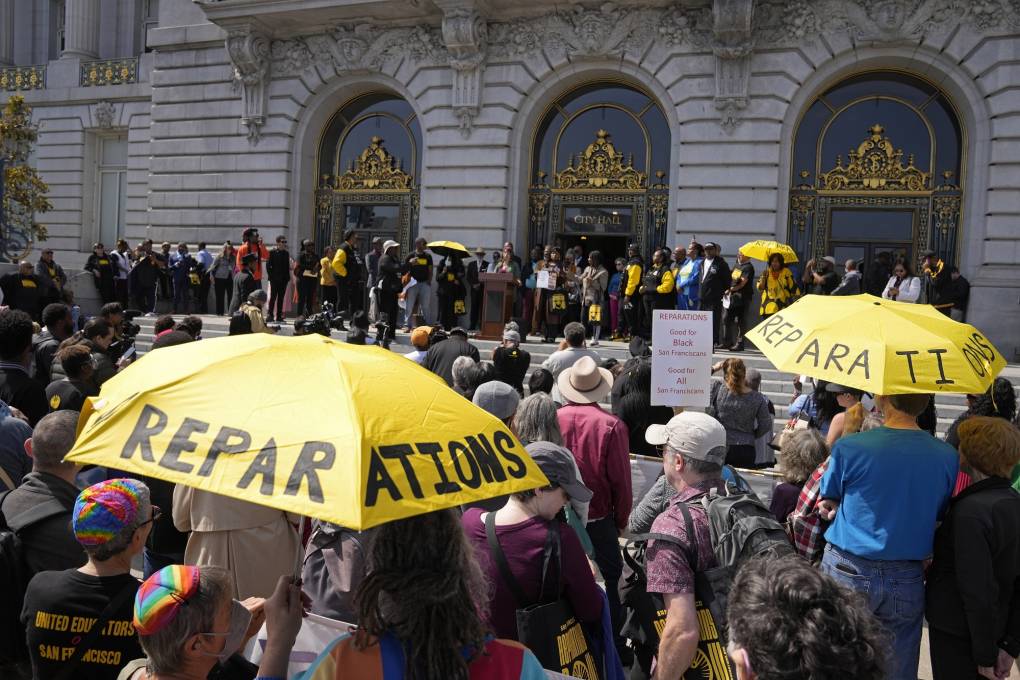
"caption": "People listen during a rally in support of reparations for African Americans outside City Hall in San Francisco on Tuesday, Sept. 19, 2023. Some advocates believe the first-year effort to provide reparations to Black Californians failed to live up to expectations, but voters will have the final word in November. ",
"credit": "Eric Risberg/AP Photo",
"altTag": null,
"description": null,
"imgSizes": {
"medium": {
"file": "https://cdn.kqed.org/wp-content/uploads/sites/10/2024/09/ReparationsAP-800x533.jpg",
"width": 800,
"height": 533,
"mimeType": "image/jpeg"
},
"large": {
"file": "https://cdn.kqed.org/wp-content/uploads/sites/10/2024/09/ReparationsAP-1020x680.jpg",
"width": 1020,
"height": 680,
"mimeType": "image/jpeg"
},
"thumbnail": {
"file": "https://cdn.kqed.org/wp-content/uploads/sites/10/2024/09/ReparationsAP-160x107.jpg",
"width": 160,
"height": 107,
"mimeType": "image/jpeg"
},
"1536x1536": {
"file": "https://cdn.kqed.org/wp-content/uploads/sites/10/2024/09/ReparationsAP-1536x1024.jpg",
"width": 1536,
"height": 1024,
"mimeType": "image/jpeg"
},
"post-thumbnail": {
"file": "https://cdn.kqed.org/wp-content/uploads/sites/10/2024/09/ReparationsAP-672x372.jpg",
"width": 672,
"height": 372,
"mimeType": "image/jpeg"
},
"twentyfourteen-full-width": {
"file": "https://cdn.kqed.org/wp-content/uploads/sites/10/2024/09/ReparationsAP-1038x576.jpg",
"width": 1038,
"height": 576,
"mimeType": "image/jpeg"
},
"full-width": {
"file": "https://cdn.kqed.org/wp-content/uploads/sites/10/2024/09/ReparationsAP-1920x1280.jpg",
"width": 1920,
"height": 1280,
"mimeType": "image/jpeg"
},
"kqedFullSize": {
"file": "https://cdn.kqed.org/wp-content/uploads/sites/10/2024/09/ReparationsAP.jpg",
"width": 2000,
"height": 1333
}
},
"isLoading": false,
"fetchFailed": false
},
"news_12006592": {
"type": "attachments",
"id": "news_12006592",
"meta": {
"index": "attachments_1716263798",
"site": "news",
"id": "12006592",
"found": true
},
"title": "111722-Students-Whittier-LJ-CM-03",
"publishDate": 1727375644,
"status": "inherit",
"parent": 12006589,
"modified": 1727375704,
"caption": "Students in a classroom at Lake Marie Elementary School in Whittier on Nov. 17, 2022.",
"credit": "Lauren Justice/CalMatters",
"altTag": "Young children work on projects in an elementary school classroom.",
"description": null,
"imgSizes": {
"medium": {
"file": "https://cdn.kqed.org/wp-content/uploads/sites/10/2024/09/111722-Students-Whittier-LJ-CM-03-800x533.jpg",
"width": 800,
"height": 533,
"mimeType": "image/jpeg"
},
"large": {
"file": "https://cdn.kqed.org/wp-content/uploads/sites/10/2024/09/111722-Students-Whittier-LJ-CM-03-1020x680.jpg",
"width": 1020,
"height": 680,
"mimeType": "image/jpeg"
},
"thumbnail": {
"file": "https://cdn.kqed.org/wp-content/uploads/sites/10/2024/09/111722-Students-Whittier-LJ-CM-03-160x107.jpg",
"width": 160,
"height": 107,
"mimeType": "image/jpeg"
},
"1536x1536": {
"file": "https://cdn.kqed.org/wp-content/uploads/sites/10/2024/09/111722-Students-Whittier-LJ-CM-03-1536x1024.jpg",
"width": 1536,
"height": 1024,
"mimeType": "image/jpeg"
},
"post-thumbnail": {
"file": "https://cdn.kqed.org/wp-content/uploads/sites/10/2024/09/111722-Students-Whittier-LJ-CM-03-672x372.jpg",
"width": 672,
"height": 372,
"mimeType": "image/jpeg"
},
"twentyfourteen-full-width": {
"file": "https://cdn.kqed.org/wp-content/uploads/sites/10/2024/09/111722-Students-Whittier-LJ-CM-03-1038x576.jpg",
"width": 1038,
"height": 576,
"mimeType": "image/jpeg"
},
"full-width": {
"file": "https://cdn.kqed.org/wp-content/uploads/sites/10/2024/09/111722-Students-Whittier-LJ-CM-03-1920x1280.jpg",
"width": 1920,
"height": 1280,
"mimeType": "image/jpeg"
},
"kqedFullSize": {
"file": "https://cdn.kqed.org/wp-content/uploads/sites/10/2024/09/111722-Students-Whittier-LJ-CM-03.jpg",
"width": 2000,
"height": 1333
}
},
"isLoading": false,
"fetchFailed": false
},
"news_12005719": {
"type": "attachments",
"id": "news_12005719",
"meta": {
"index": "attachments_1716263798",
"site": "news",
"id": "12005719",
"found": true
},
"title": "091124-Reedley-class-and-Work-Center-LV_11 copy",
"publishDate": 1726867023,
"status": "inherit",
"parent": 12005718,
"modified": 1726874699,
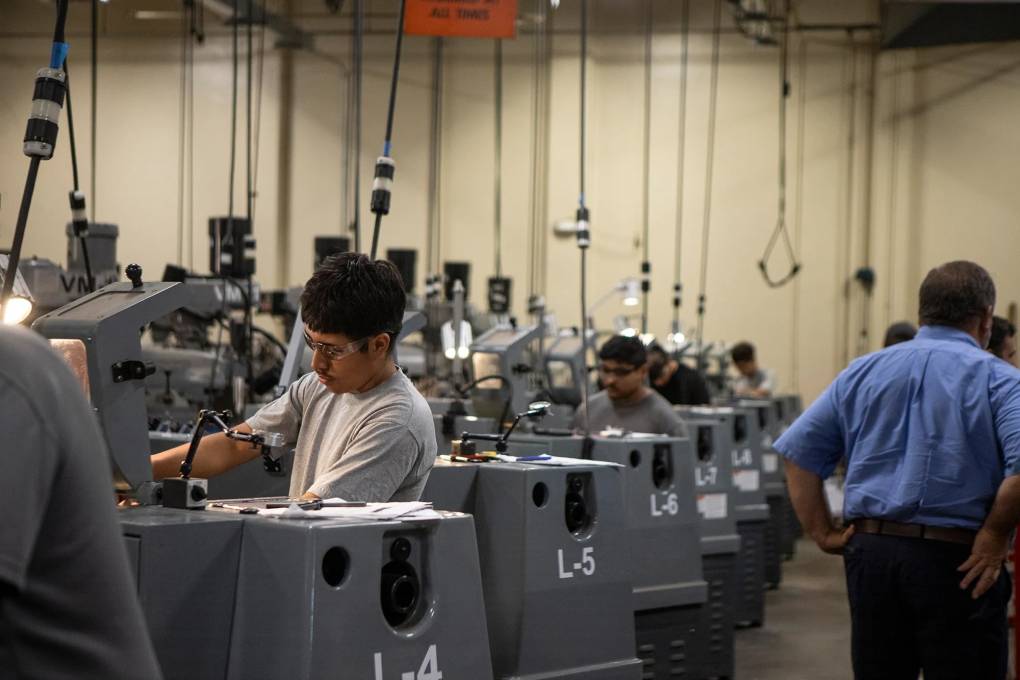
"caption": "A row of students work on engine lathes during class at the Industrial Technology Building at Reedley College on Sept. 11, 2024.",
"credit": "Larry Valenzuela/CalMatters/CatchLight Local",
"altTag": null,
"description": null,
"imgSizes": {
"medium": {
"file": "https://cdn.kqed.org/wp-content/uploads/sites/10/2024/09/091124-Reedley-class-and-Work-Center-LV_11-copy-800x533.jpg",
"width": 800,
"height": 533,
"mimeType": "image/jpeg"
},
"large": {
"file": "https://cdn.kqed.org/wp-content/uploads/sites/10/2024/09/091124-Reedley-class-and-Work-Center-LV_11-copy-1020x680.jpg",
"width": 1020,
"height": 680,
"mimeType": "image/jpeg"
},
"thumbnail": {
"file": "https://cdn.kqed.org/wp-content/uploads/sites/10/2024/09/091124-Reedley-class-and-Work-Center-LV_11-copy-160x107.jpg",
"width": 160,
"height": 107,
"mimeType": "image/jpeg"
},
"1536x1536": {
"file": "https://cdn.kqed.org/wp-content/uploads/sites/10/2024/09/091124-Reedley-class-and-Work-Center-LV_11-copy-1536x1024.jpg",
"width": 1536,
"height": 1024,
"mimeType": "image/jpeg"
},
"post-thumbnail": {
"file": "https://cdn.kqed.org/wp-content/uploads/sites/10/2024/09/091124-Reedley-class-and-Work-Center-LV_11-copy-672x372.jpg",
"width": 672,
"height": 372,
"mimeType": "image/jpeg"
},
"twentyfourteen-full-width": {
"file": "https://cdn.kqed.org/wp-content/uploads/sites/10/2024/09/091124-Reedley-class-and-Work-Center-LV_11-copy-1038x576.jpg",
"width": 1038,
"height": 576,
"mimeType": "image/jpeg"
},
"full-width": {
"file": "https://cdn.kqed.org/wp-content/uploads/sites/10/2024/09/091124-Reedley-class-and-Work-Center-LV_11-copy-1920x1280.jpg",
"width": 1920,
"height": 1280,
"mimeType": "image/jpeg"
},
"kqedFullSize": {
"file": "https://cdn.kqed.org/wp-content/uploads/sites/10/2024/09/091124-Reedley-class-and-Work-Center-LV_11-copy.jpg",
"width": 2000,
"height": 1333
}
},
"isLoading": false,
"fetchFailed": false
}
},
"audioPlayerReducer": {
"postId": "stream_live",
"isPaused": true,
"isPlaying": false,
"pfsActive": false,
"pledgeModalIsOpen": true,
"playerDrawerIsOpen": false,
"liveAudioPlayStartedAt": 0,
"liveAudioPlayContext": ""
},
"authorsReducer": {
"byline_news_12008261": {
"type": "authors",
"id": "byline_news_12008261",
"meta": {
"override": true
},
"slug": "byline_news_12008261",
"name": "Jasmine Aguilera and Cassandra Garibay, El Tímpano",
"isLoading": false
},
"byline_news_12007628": {
"type": "authors",
"id": "byline_news_12007628",
"meta": {
"override": true
},
"slug": "byline_news_12007628",
"name": "Trân Nguyễn, Associated Press",
"isLoading": false
},
"byline_news_12006589": {
"type": "authors",
"id": "byline_news_12006589",
"meta": {
"override": true
},
"slug": "byline_news_12006589",
"name": "\u003ca href=\"https://calmatters.org/author/carolyn-jones/\">Carolyn Jones\u003c/a>",
"isLoading": false
},
"byline_news_12005718": {
"type": "authors",
"id": "byline_news_12005718",
"meta": {
"override": true
},
"slug": "byline_news_12005718",
"name": "\u003ca href=\"https://calmatters.org/author/adam-echelman/\">Adam Echelman\u003c/a>, CalMatters",
"isLoading": false
},
"gmarzorati": {
"type": "authors",
"id": "227",
"meta": {
"index": "authors_1716337520",
"id": "227",
"found": true
},
"name": "Guy Marzorati",
"firstName": "Guy",
"lastName": "Marzorati",
"slug": "gmarzorati",
"email": "gmarzorati@KQED.org",
"display_author_email": true,
"staff_mastheads": [
"news"
],
"title": "Correspondent",
"bio": "Guy Marzorati is a correspondent on KQED's California Politics and Government Desk, based in San Jose. A graduate of Santa Clara University, Guy joined KQED in 2013. He reports on state and local politics and produces KQED's digital voter guide.",
"avatar": "https://secure.gravatar.com/avatar/e7038b8dbfd55b104369b76b1cd0b9de?s=600&d=blank&r=g",
"twitter": "guymarzorati",
"facebook": null,
"instagram": null,
"linkedin": null,
"sites": [
{
"site": "",
"roles": [
"editor"
]
},
{
"site": "news",
"roles": [
"editor"
]
},
{
"site": "science",
"roles": [
"editor"
]
},
{
"site": "forum",
"roles": [
"editor"
]
},
{
"site": "elections",
"roles": [
"editor"
]
},
{
"site": "liveblog",
"roles": [
"editor"
]
}
],
"headData": {
"title": "Guy Marzorati | KQED",
"description": "Correspondent",
"ogImgSrc": "https://secure.gravatar.com/avatar/e7038b8dbfd55b104369b76b1cd0b9de?s=600&d=blank&r=g",
"twImgSrc": "https://secure.gravatar.com/avatar/e7038b8dbfd55b104369b76b1cd0b9de?s=600&d=blank&r=g"
},
"isLoading": false,
"link": "/author/gmarzorati"
},
"fjhabvala": {
"type": "authors",
"id": "8659",
"meta": {
"index": "authors_1716337520",
"id": "8659",
"found": true
},
"name": "Farida Jhabvala Romero",
"firstName": "Farida",
"lastName": "Jhabvala Romero",
"slug": "fjhabvala",
"email": "fjhabvala@kqed.org",
"display_author_email": true,
"staff_mastheads": [
"news"
],
"title": "KQED Contributor",
"bio": "Farida Jhabvala Romero is a Labor Correspondent for KQED. She previously covered immigration. Farida was \u003ca href=\"https://www.ccnma.org/2022-most-influential-latina-journalists\">named\u003c/a> one of the 10 Most Influential Latina Journalists in California in 2022 by the California Chicano News Media Association. Her work has won awards from the Society of Professional Journalists (Northern California), as well as a national and regional Edward M. Murrow Award for the collaborative reporting projects “Dangerous Air” and “Graying California.” Before joining KQED, Farida worked as a producer at Radio Bilingüe, a national public radio network. Farida earned her master’s degree in journalism from Stanford University.",
"avatar": "https://secure.gravatar.com/avatar/f9f022d4e2609741874222a1e9d41f48fea74011aa7c615eef91d9a50c944ebe?s=600&d=blank&r=g",
"twitter": "FaridaJhabvala",
"bluesky": null,
"facebook": null,
"instagram": null,
"linkedin": "https://www.linkedin.com/in/faridajhabvala/",
"sites": [
{
"site": "news",
"roles": [
"editor"
]
},
{
"site": "stateofhealth",
"roles": [
"author"
]
},
{
"site": "liveblog",
"roles": [
"author"
]
}
],
"headData": {
"title": "Farida Jhabvala Romero | KQED",
"description": "KQED Contributor",
"ogImgSrc": "https://secure.gravatar.com/avatar/f9f022d4e2609741874222a1e9d41f48fea74011aa7c615eef91d9a50c944ebe?s=600&d=blank&r=g",
"twImgSrc": "https://secure.gravatar.com/avatar/f9f022d4e2609741874222a1e9d41f48fea74011aa7c615eef91d9a50c944ebe?s=600&d=blank&r=g"
},
"isLoading": false,
"link": "/author/fjhabvala"
},
"lesleymcclurg": {
"type": "authors",
"id": "11229",
"meta": {
"index": "authors_1716337520",
"id": "11229",
"found": true
},
"name": "Lesley McClurg",
"firstName": "Lesley",
"lastName": "McClurg",
"slug": "lesleymcclurg",
"email": "lmcclurg@KQED.org",
"display_author_email": false,
"staff_mastheads": [
"news",
"science"
],
"title": "KQED Health Correspondent",
"bio": "Lesley McClurg is a health correspondent and fill-in host whose work is regularly rebroadcast on NPR and PBS programs. She’s earned multiple regional Emmy awards, a national and a regional Edward R. Murrow award, and was named Best Beat Reporter by the Association of Health Care Journalists. The Society of Professional Journalists has recognized her work several times, and the Society of Environmental Journalists spotlighted her coverage of California’s historic drought.\r\n\r\nBefore joining KQED in 2016, Lesley covered food and sustainability for Capital Public Radio, environmental issues for Colorado Public Radio, and reported for KUOW and KCTS 9 in Seattle. Away from the newsroom, she loves skiing with her daughter, mountain biking with her partner, and playing with Ollie, the family’s goldendoodle. On deadline, she runs almost entirely on chocolate chips.\r\n\r\n ",
"avatar": "https://secure.gravatar.com/avatar/bab49e972ea10c774fe0f5e29dba1722b158f7c0d58a360923d1389d380b2978?s=600&d=blank&r=g",
"twitter": "lesleywmcclurg",
"bluesky": null,
"facebook": null,
"instagram": null,
"linkedin": null,
"sites": [
{
"site": "arts",
"roles": [
"author"
]
},
{
"site": "news",
"roles": [
"editor"
]
},
{
"site": "futureofyou",
"roles": [
"editor"
]
},
{
"site": "stateofhealth",
"roles": [
"author"
]
},
{
"site": "science",
"roles": [
"editor"
]
},
{
"site": "quest",
"roles": [
"subscriber"
]
},
{
"site": "forum",
"roles": [
"administrator"
]
},
{
"site": "liveblog",
"roles": [
"author"
]
}
],
"headData": {
"title": "Lesley McClurg | KQED",
"description": "KQED Health Correspondent",
"ogImgSrc": "https://secure.gravatar.com/avatar/bab49e972ea10c774fe0f5e29dba1722b158f7c0d58a360923d1389d380b2978?s=600&d=blank&r=g",
"twImgSrc": "https://secure.gravatar.com/avatar/bab49e972ea10c774fe0f5e29dba1722b158f7c0d58a360923d1389d380b2978?s=600&d=blank&r=g"
},
"isLoading": false,
"link": "/author/lesleymcclurg"
},
"vrancano": {
"type": "authors",
"id": "11276",
"meta": {
"index": "authors_1716337520",
"id": "11276",
"found": true
},
"name": "Vanessa Rancaño",
"firstName": "Vanessa",
"lastName": "Rancaño",
"slug": "vrancano",
"email": "vrancano@kqed.org",
"display_author_email": false,
"staff_mastheads": [
"news"
],
"title": "Reporter",
"bio": "Vanessa Rancaño is a features reporter for KQED. She’s also covered homelessness and education for the station and reported from the Central Valley. Her work has aired across public radio, from flagship national news shows to longform narrative podcasts. Before taking up a mic, she worked as a freelance print journalist. She’s been recognized with a number of national and regional awards. Vanessa grew up in California's Central Valley. She's a former NPR Kroc Fellow, and a graduate of the UC Berkeley Graduate School of Journalism.",
"avatar": "https://secure.gravatar.com/avatar/b3a383dfb0e7ee1c17568f2cf067904ab654d6e3de9743fc661f3c788ade1bed?s=600&d=blank&r=g",
"twitter": "vanessarancano",
"bluesky": null,
"facebook": null,
"instagram": null,
"linkedin": null,
"sites": [
{
"site": "arts",
"roles": [
"editor"
]
},
{
"site": "news",
"roles": [
"editor"
]
},
{
"site": "liveblog",
"roles": [
"contributor"
]
}
],
"headData": {
"title": "Vanessa Rancaño | KQED",
"description": "Reporter",
"ogImgSrc": "https://secure.gravatar.com/avatar/b3a383dfb0e7ee1c17568f2cf067904ab654d6e3de9743fc661f3c788ade1bed?s=600&d=blank&r=g",
"twImgSrc": "https://secure.gravatar.com/avatar/b3a383dfb0e7ee1c17568f2cf067904ab654d6e3de9743fc661f3c788ade1bed?s=600&d=blank&r=g"
},
"isLoading": false,
"link": "/author/vrancano"
},
"abandlamudi": {
"type": "authors",
"id": "11672",
"meta": {
"index": "authors_1716337520",
"id": "11672",
"found": true
},
"name": "Adhiti Bandlamudi",
"firstName": "Adhiti",
"lastName": "Bandlamudi",
"slug": "abandlamudi",
"email": "abandlamudi@kqed.org",
"display_author_email": false,
"staff_mastheads": [
"news"
],
"title": "KQED Housing Reporter",
"bio": "Adhiti Bandlamudi reports for KQED's Housing desk. She focuses on how housing gets built across the Bay Area. Before joining KQED in 2020, she reported for WUNC in Durham, North Carolina, WABE in Atlanta, Georgia and Capital Public Radio in Sacramento. In 2017, she was awarded a Kroc Fellowship at NPR where she reported on everything from sprinkles to the Golden State Killer's arrest. When she's not reporting, she's baking new recipes in her kitchen or watching movies with friends and family. She's originally from Georgia and has strong opinions about Great British Bake Off.",
"avatar": "https://secure.gravatar.com/avatar/868129c8b257bb99a3500e2c86a65400?s=600&d=mm&r=g",
"twitter": "oddity_adhiti",
"facebook": null,
"instagram": null,
"linkedin": null,
"sites": [
{
"site": "arts",
"roles": [
"author"
]
},
{
"site": "news",
"roles": [
"editor"
]
},
{
"site": "liveblog",
"roles": [
"author"
]
}
],
"headData": {
"title": "Adhiti Bandlamudi | KQED",
"description": "KQED Housing Reporter",
"ogImgSrc": "https://secure.gravatar.com/avatar/868129c8b257bb99a3500e2c86a65400?s=600&d=mm&r=g",
"twImgSrc": "https://secure.gravatar.com/avatar/868129c8b257bb99a3500e2c86a65400?s=600&d=mm&r=g"
},
"isLoading": false,
"link": "/author/abandlamudi"
},
"cegusa": {
"type": "authors",
"id": "11869",
"meta": {
"index": "authors_1716337520",
"id": "11869",
"found": true
},
"name": "Chris Egusa",
"firstName": "Chris",
"lastName": "Egusa",
"slug": "cegusa",
"email": "cegusa@kqed.org",
"display_author_email": false,
"staff_mastheads": [],
"title": "KQED Contributor",
"bio": null,
"avatar": "https://secure.gravatar.com/avatar/3562ed52747313a4c94017da88ea89f9e85cd901f63ebc056a7d5e0adf4a03da?s=600&d=blank&r=g",
"twitter": null,
"bluesky": null,
"facebook": null,
"instagram": null,
"linkedin": null,
"sites": [
{
"site": "arts",
"roles": [
"editor"
]
},
{
"site": "news",
"roles": [
"editor"
]
}
],
"headData": {
"title": "Chris Egusa | KQED",
"description": "KQED Contributor",
"ogImgSrc": "https://secure.gravatar.com/avatar/3562ed52747313a4c94017da88ea89f9e85cd901f63ebc056a7d5e0adf4a03da?s=600&d=blank&r=g",
"twImgSrc": "https://secure.gravatar.com/avatar/3562ed52747313a4c94017da88ea89f9e85cd901f63ebc056a7d5e0adf4a03da?s=600&d=blank&r=g"
},
"isLoading": false,
"link": "/author/cegusa"
},
"emanoukian": {
"type": "authors",
"id": "11925",
"meta": {
"index": "authors_1716337520",
"id": "11925",
"found": true
},
"name": "Elize Manoukian",
"firstName": "Elize",
"lastName": "Manoukian",
"slug": "emanoukian",
"email": "emanoukian@KQED.org",
"display_author_email": false,
"staff_mastheads": [
"news"
],
"title": "Digital News Editor",
"bio": "Elize Manoukian is an award-winning audio producer and Senior Editor on the Express Desk, KQED's digital news platform. Her work has appeared on KPFA, Interlochen Public Radio, Oregon Public Broadcast, the New York Daily News, LA Times and the San Diego Union-Tribune.",
"avatar": "https://secure.gravatar.com/avatar/4525f1a8e46ccb30933b32653d9772064cfefe3fa655eb45b3b3a80341f6bdad?s=600&d=blank&r=g",
"twitter": null,
"bluesky": null,
"facebook": null,
"instagram": null,
"linkedin": null,
"sites": [
{
"site": "arts",
"roles": [
"editor"
]
},
{
"site": "news",
"roles": [
"editor"
]
},
{
"site": "science",
"roles": [
"editor"
]
}
],
"headData": {
"title": "Elize Manoukian | KQED",
"description": "Digital News Editor",
"ogImgSrc": "https://secure.gravatar.com/avatar/4525f1a8e46ccb30933b32653d9772064cfefe3fa655eb45b3b3a80341f6bdad?s=600&d=blank&r=g",
"twImgSrc": "https://secure.gravatar.com/avatar/4525f1a8e46ccb30933b32653d9772064cfefe3fa655eb45b3b3a80341f6bdad?s=600&d=blank&r=g"
},
"isLoading": false,
"link": "/author/emanoukian"
},
"gzada": {
"type": "authors",
"id": "11929",
"meta": {
"index": "authors_1716337520",
"id": "11929",
"found": true
},
"name": "Gilare Zada",
"firstName": "Gilare",
"lastName": "Zada",
"slug": "gzada",
"email": "gzada@kqed.org",
"display_author_email": true,
"staff_mastheads": [
"news"
],
"title": null,
"bio": "Gilare Zada is a Kurdish-American from San Diego, CA. Storytelling, fitness, and binge reading are some of her passions outside of news reporting. Her work has appeared in Mission Local, the Peninsula Press, the San Francisco Press Club, and more. She also writes as a class correspondent for the Stanford Magazine - go Card!",
"avatar": "https://secure.gravatar.com/avatar/33a75f2b947669a488a805edec3fbf3838c1cedaedda710e983770633b4d6a75?s=600&d=blank&r=g",
"twitter": null,
"bluesky": null,
"facebook": null,
"instagram": null,
"linkedin": null,
"sites": [
{
"site": "arts",
"roles": [
"editor"
]
},
{
"site": "news",
"roles": [
"administrator"
]
},
{
"site": "science",
"roles": [
"editor"
]
}
],
"headData": {
"title": "Gilare Zada | KQED",
"description": null,
"ogImgSrc": "https://secure.gravatar.com/avatar/33a75f2b947669a488a805edec3fbf3838c1cedaedda710e983770633b4d6a75?s=600&d=blank&r=g",
"twImgSrc": "https://secure.gravatar.com/avatar/33a75f2b947669a488a805edec3fbf3838c1cedaedda710e983770633b4d6a75?s=600&d=blank&r=g"
},
"isLoading": false,
"link": "/author/gzada"
}
},
"pagesReducer": {
"news_tag_gavin-newsom": {
"type": "terms",
"id": "news_16",
"meta": {
"index": "terms_1716263798",
"site": "news",
"id": "16",
"score": 8.936892
},
"featImg": null,
"name": "Gavin Newsom",
"description": null,
"taxonomy": "tag",
"headData": {
"twImgId": null,
"twTitle": null,
"ogTitle": null,
"ogImgId": null,
"twDescription": null,
"description": null,
"title": "Gavin Newsom Archives | KQED News",
"ogDescription": null
},
"ttid": 16,
"slug": "gavin-newsom",
"isLoading": false,
"title": "Gavin Newsom",
"pageMeta": {
"site": "news",
"WpPageTemplate": "page-topic-editorial",
"currentPage": 26
},
"blocks": [
{
"blockName": "kqed/post-list",
"attrs": {
"layout": "cardArticle2",
"query": "posts/news?tag=gavin-newsom",
"seeMore": false,
"paginated": true,
"page": 26
}
},
{
"blockName": "kqed/ad"
}
]
}
},
"pfsSessionReducer": {},
"postsReducer": {
"stream_live": {
"type": "live",
"id": "stream_live",
"audioUrl": "https://streams.kqed.org/kqedradio",
"title": "Live Stream",
"excerpt": "Live Stream information currently unavailable.",
"link": "/radio",
"featImg": "",
"label": {
"name": "KQED Live",
"link": "/"
}
},
"stream_kqedNewscast": {
"type": "posts",
"id": "stream_kqedNewscast",
"audioUrl": "https://www.kqed.org/.stream/anon/radio/RDnews/newscast.mp3?_=1",
"title": "KQED Newscast",
"featImg": "",
"label": {
"name": "88.5 FM",
"link": "/"
}
},
"news_12007818": {
"type": "posts",
"id": "news_12007818",
"meta": {
"index": "posts_1716263798",
"site": "news",
"id": "12007818",
"score": null,
"sort": [
1728415421000
]
},
"guestAuthors": [],
"slug": "newsom-vowed-to-build-housing-on-surplus-state-property-99-of-the-land-will-stay-vacant",
"title": "Newsom Vowed to Build Housing on Excess State Property. Here's How It's Going.",
"publishDate": 1728415421,
"format": "standard",
"headTitle": "Newsom Vowed to Build Housing on Excess State Property. Here’s How It’s Going. | KQED",
"labelTerm": {
"site": "news"
},
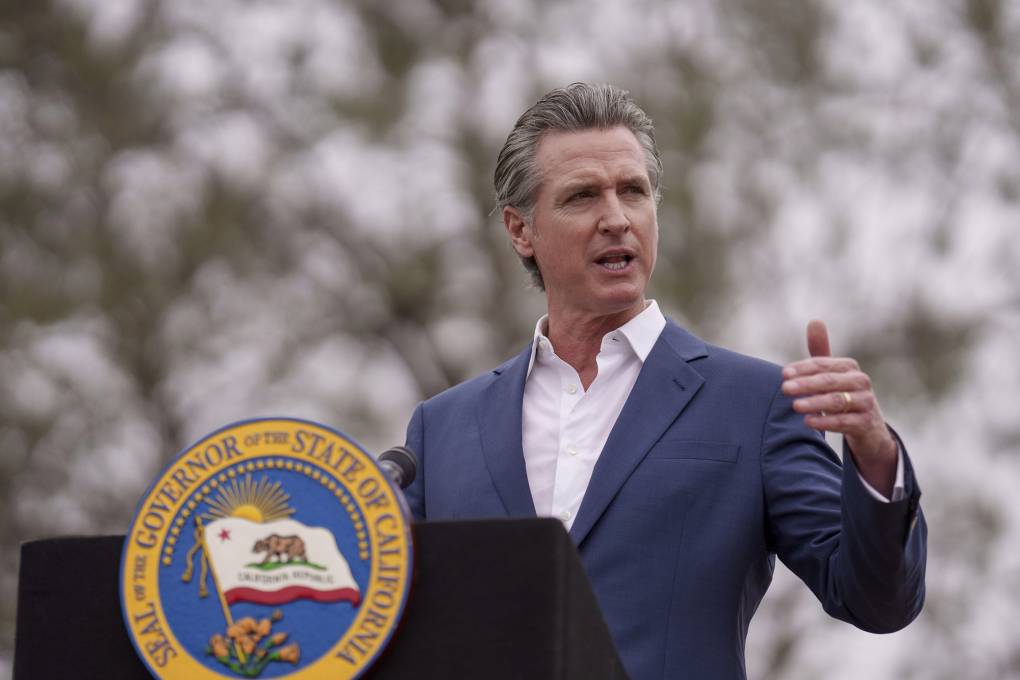
"content": "\u003cp>\u003cem>Oct. 10: An earlier version of the headline for this story incorrectly identified the percentage of state-owned excess land that would stay vacant. The actual percentage is unknown. The headline has been edited. The story was also edited to clarify that the Department of General Services analyzed 44,000 parcels, which includes all state-owned land.\u003c/em>\u003c/p>\n\u003cp>Before \u003ca href=\"https://www.kqed.org/news/tag/gavin-newsom\">Gavin Newsom\u003c/a> became governor of California, \u003ca href=\"https://www.hklaw.com/en/insights/publications/2019/09/new-california-surplus-lands-maps-and-legislation\">he campaigned\u003c/a> on a promise to make excess state-owned land available for affordable housing.\u003c/p>\n\u003cp>Shortly after he entered office, he made good on that promise, \u003ca href=\"https://www.gov.ca.gov/wp-content/uploads/2019/01/EO-N-06-19.pdf\">issuing an executive order\u003c/a> that directed state agencies to assess more than \u003ca href=\"https://www.dgs.ca.gov/RESD/Projects/Page-Content/Projects-List-Folder/Executive-Order-N-06-19-Affordable-Housing-Development#@ViewBag.JumpTo\">44,000 parcels to determine their suitability for development\u003c/a>.\u003c/p>\n\u003cp>The order reads, in part, that “state agencies own thousands of parcels of land throughout the state, some of which exceed those agencies’ foreseeable needs,” and that “state land is often located in or near urban areas where the need for new housing is acute.”\u003c/p>\n\u003cp>But as it turned out, only 46 of those 44,000 parcels, which represent all of the state’s land, were found to be both in excess of the state’s needs and suitable for housing.\u003c/p>\n\u003cp>[ad fullwidth]\u003c/p>\n\u003cp>Of those, 19\u003ca href=\"https://www.dgs.ca.gov/RESD/Projects/Page-Content/Projects-List-Folder/Executive-Order-N-06-19-Affordable-Housing-Development#@ViewBag.JumpTo\"> have concrete plans\u003c/a> for development, and one has finished construction. Last week, Newsom announced the most recent project under his executive order: a 372-unit apartment building that will be built on top of an \u003ca href=\"https://www.hcd.ca.gov/about-hcd/newsroom/outdated-san-francisco-dmv-will-soon-become-site-over-370-new-homes\">outdated San Francisco DMV office\u003c/a>. Once construction is complete, the DMV office will be renovated and will continue to operate as it did before, but with tenants living above.\u003c/p>\n\u003cp>Together, the properties propose adding an estimated 4,200 units of new housing — a not insignificant amount that is nonetheless dwarfed by the state’s goal of planning for some \u003ca href=\"https://statewide-housing-plan-cahcd.hub.arcgis.com/\">2.5 million new homes\u003c/a> by 2031.\u003c/p>\n\u003cp>\u003c!-- iframe plugin v.4.3 wordpress.org/plugins/iframe/ -->\u003cbr>\n\u003ciframe loading=\"lazy\" title=\"Affordable Housing\" aria-label=\"Interactive area chart\" id=\"datawrapper-chart-NJdtu\" src=\"https://experience.arcgis.com/experience/f9b1ccf48e864ac8af8014cbb89371b8/\" scrolling=\"no\" frameborder=\"0\" style=\"width: 2000; min-width: 100% !important; border: none;\" height=\"1000\" data-external=\"1\" width=\"100%\" class=\"iframe-class\">\u003c/iframe>\u003cbr>\n \u003cem>A map of \u003ca href=\"https://experience.arcgis.com/experience/f9b1ccf48e864ac8af8014cbb89371b8/\">California’s excess sites\u003c/a>. (California Department of General Services)\u003c/em>\u003c/p>\n\u003cp>The vast majority of the state’s excess land was disqualified for housing because it’s located in forests, on beaches or far from cities and existing infrastructure required for people to live there.\u003c/p>\n\u003cp>“Where you have ‘vacant land’ that folks refer to, that land is not [actually] available,” said Ana Lasso, director of California’s Department of General Services. “It doesn’t have the utilities or the infrastructure to accept housing.”\u003c/p>\n\u003cp>For affordable housing developers, the dearth of buildable excess land underscores a point they’ve long argued with state leaders: Quick-fix solutions to the housing crisis are usually neither quick nor a real fix.\u003c/p>\n\u003cp>JT Harechmak, policy director of the Non-Profit Housing Association of Northern California, said finding available land is only one part of the problem. The bigger issue is getting the funding to construct housing on it. While the state has invested an estimated \u003ca href=\"https://www.gov.ca.gov/2024/08/23/governor-newsom-awards-more-than-789-million-to-build-thousands-of-sustainable-homes-for-californians/#:~:text=Since%20taking%20office%2C%20Governor%20Newsom,%2427%20billion%20to%20address%20homelessness.\">$40 billion\u003c/a> in affordable housing, most of that funding represents one-time allocations as opposed to ongoing support.\u003c/p>\n\u003cp>“Many of our developers have a backlog of projects — many of them are shovel-ready and ready to go,” he said. “They just lack the final amount of funding that they need to cross the finish line.”\u003c/p>\n\u003cfigure id=\"attachment_12008493\" class=\"wp-caption aligncenter\" style=\"max-width: 1200px\">\u003cimg loading=\"lazy\" decoding=\"async\" class=\"size-full wp-image-12008493\" src=\"https://cdn.kqed.org/wp-content/uploads/sites/10/2024/10/StateSurplusLand1.jpg\" alt=\"\" width=\"1200\" height=\"800\" srcset=\"https://cdn.kqed.org/wp-content/uploads/sites/10/2024/10/StateSurplusLand1.jpg 1200w, https://cdn.kqed.org/wp-content/uploads/sites/10/2024/10/StateSurplusLand1-800x533.jpg 800w, https://cdn.kqed.org/wp-content/uploads/sites/10/2024/10/StateSurplusLand1-1020x680.jpg 1020w, https://cdn.kqed.org/wp-content/uploads/sites/10/2024/10/StateSurplusLand1-160x107.jpg 160w\" sizes=\"(max-width: 1200px) 100vw, 1200px\">\u003cfigcaption class=\"wp-caption-text\">The Sonrisa, a 58-unit building in downtown Sacramento that provides affordable housing for individuals earning up to $56,000 annually. Completed under Gov. Gavin Newsom’s 2019 executive order, the project broke ground in June 2021, with tenants moving in last year. \u003ccite>(Courtesy Sonrisa Studio Apartments)\u003c/cite>\u003c/figcaption>\u003c/figure>\n\u003cp>\u003ca href=\"https://www.sonrisadowntown.com/\">Sonrisa\u003c/a>, a 58-unit apartment building in downtown Sacramento, is the first project to be completed under Newsom’s 2019 executive order and offers housing to people earning up to $56,000 annually. The project broke ground in June 2021, and tenants moved in last year.\u003c/p>\n\u003cp>Danielle Foster, executive director of the Capitol Area Development Authority (CADA), said Newsom’s executive order helped speed construction. By allowing CADA to lease the land for practically pennies, the state helped her organization reduce construction costs.\u003c/p>\n\u003cp>“It’s a great help to have parcels that are primed for affordable housing development,” she said.\u003c/p>\n\u003cp>The property, located on just a quarter of an acre of land, also forced her organization to think more creatively about building infill housing — new homes and apartments built within an existing city — so CADA sought to maximize the number of units it could build.\u003c/p>\n\u003cfigure id=\"attachment_12008492\" class=\"wp-caption aligncenter\" style=\"max-width: 1000px\">\u003cimg loading=\"lazy\" decoding=\"async\" class=\"size-full wp-image-12008492\" src=\"https://cdn.kqed.org/wp-content/uploads/sites/10/2024/10/SonrisaInterior1.jpg\" alt=\"\" width=\"1000\" height=\"667\" srcset=\"https://cdn.kqed.org/wp-content/uploads/sites/10/2024/10/SonrisaInterior1.jpg 1000w, https://cdn.kqed.org/wp-content/uploads/sites/10/2024/10/SonrisaInterior1-800x534.jpg 800w, https://cdn.kqed.org/wp-content/uploads/sites/10/2024/10/SonrisaInterior1-160x107.jpg 160w\" sizes=\"(max-width: 1000px) 100vw, 1000px\">\u003cfigcaption class=\"wp-caption-text\">The interior of an apartment at Sonrisa, a 58-unit building in downtown Sacramento. \u003ccite>(Courtesy Sonrisa Studio Apartments)\u003c/cite>\u003c/figcaption>\u003c/figure>\n\u003cp>Sonrisa’s 58 apartments are micro-units: small studio apartments that fit within 267 square feet. Each unit has a small kitchenette with a stove and fridge and an area that doubles as both a living room and bedroom. A Murphy bed folds into the wall so tenants can prop a couch against the wall during the day. Tenants receive a free local transit pass and access to onsite bike storage.\u003c/p>\n\u003cp>“We showed how we could create livability in small spaces,” Foster said. “We have private developers also building like this now. It’s fun to see how this work contributes to the affordable housing stock.”\u003c/p>\n\u003cp>State Sen. Scott Wiener said projects like these are not a silver bullet for the housing crisis but rather one piece of the puzzle.\u003c/p>\n\u003cp>[aside postID=news_12007934 hero='https://cdn.kqed.org/wp-content/uploads/sites/10/2024/08/AP24207558088069-1020x680.jpg']\u003c/p>\n\u003cp>“Historically, we’ve not had nearly enough money, and many cities have made it impossible to zone for and approve this kind of housing, so we’ve been methodically resolving permitting and zoning issues,” he said.\u003c/p>\n\u003cp>But he reiterated affordable housing developers’ concerns that freeing up excess state land isn’t the biggest piece of that puzzle: “The funding issue remains.”\u003c/p>\n\u003cp>Some housing experts have likened the budget for an affordable housing project to a lasagna, with many layers often overlapping to hold up the project. Developers have long complained that without a permanent statewide source of funding, financing affordable housing will continue to be convoluted and inefficient.\u003c/p>\n\u003cp>Many affordable housing developers relied on two multibillion-dollar bond measures to fund their projects — a \u003ca href=\"https://www.kqed.org/news/12000157/bay-areas-20-billion-housing-bond-pulled-from-ballots-leaving-advocates-heartbroken\">$20 billion Bay Area-wide bond\u003c/a> and a \u003ca href=\"https://www.kqed.org/news/11993185/why-a-10-billion-california-housing-bond-wont-be-on-novembers-ballot\">$10 billion statewide bond\u003c/a>. Both failed to make it to the voters this November. \u003ca href=\"https://www.kqed.org/news/12007340/how-prop-5-would-impact-affordable-housing-and-property-taxes\">Proposition 5\u003c/a>, which would make it easier for local governments to pass bond measures for affordable housing and public infrastructure, is seen by some developers as the best bet to secure future funding.\u003c/p>\n\u003cp>Welton Jordan, chief real estate development officer for affordable housing developer EAH Housing, said his company has submitted a proposal for one project on an excess state-owned site. Though EAH’s proposal was not ultimately chosen, the nonprofit is interested in submitting proposals for other sites in the future.\u003c/p>\n\u003cp>But as construction costs soar and demand grows, it only becomes more expensive to build, Jordan said. He hopes the state can dedicate more subsidies to actually build affordable housing.\u003c/p>\n\u003cp>“It’s never enough,” Jordan said. “While every little bit helps, and you don’t want to sound ungrateful, you really need a permanent source at the state level for affordable housing, and that hasn’t happened quite yet.”\u003c/p>\n\u003cp>There are 26 excess sites the state identified as suitable for housing that have not yet been offered to developers. Some are in high-fire risk zones, regulatory floodways, or on steep slopes. Others are within a quarter-mile of hazardous waste sites.\u003c/p>\n\u003cp>Tara Gallegos, a spokesperson for the governor’s office, said all of those parcels are “gearing up for development.”\u003c/p>\n\u003cp>https://docs.google.com/forms/d/e/1FAIpQLSfZ-ZKtuSHdeWqxooQwfEcr-oiOpdpJcf2RLZInU7aqjjQlRQ/viewform?embedded=true\u003c/p>\n\u003cp>[ad floatright]\u003c/p>\n",
"blocks": [],
"excerpt": "A push to put affordable housing on excess land owned by California, like a project at an outdated San Francisco DMV office, faces obstacles, including infrastructure and funding issues.",
"status": "publish",
"parent": 0,
"modified": 1728605732,
"stats": {
"hasAudio": false,
"hasVideo": false,
"hasChartOrMap": true,
"iframeSrcs": [
"https://experience.arcgis.com/experience/f9b1ccf48e864ac8af8014cbb89371b8/"
],
"hasGoogleForm": true,
"hasGallery": false,
"hasHearkenModule": false,
"hasPolis": false,
"paragraphCount": 32,
"wordCount": 1309
},
"headData": {
"title": "Newsom Vowed to Build Housing on Excess State Property. Here's How It's Going. | KQED",
"description": "A push to put affordable housing on excess land owned by California, like a project at an outdated San Francisco DMV office, faces obstacles, including infrastructure and funding issues.",
"ogTitle": "",
"ogDescription": "",
"ogImgId": "",
"twTitle": "",
"twDescription": "",
"twImgId": "",
"schema": {
"@context": "https://schema.org",
"@type": "NewsArticle",
"headline": "Newsom Vowed to Build Housing on Excess State Property. Here's How It's Going.",
"datePublished": "2024-10-08T12:23:41-07:00",
"dateModified": "2024-10-10T17:15:32-07:00",
"image": "https://cdn.kqed.org/wp-content/uploads/2020/02/KQED-OG-Image@1x.png",
"isAccessibleForFree": "True",
"publisher": {
"@type": "NewsMediaOrganization",
"@id": "https://www.kqed.org/#organization",
"name": "KQED",
"logo": "https://cdn.kqed.org/wp-content/uploads/2020/02/KQED-OG-Image@1x.png",
"url": "https://www.kqed.org",
"sameAs": [
"https://www.facebook.com/KQED",
"https://twitter.com/KQED",
"https://www.instagram.com/kqed/",
"https://www.tiktok.com/@kqedofficial",
"https://www.linkedin.com/company/kqed",
"https://www.youtube.com/channel/UCeC0IOo7i1P_61zVUWbJ4nw"
]
}
}
},
"sticky": false,
"WpOldSlug": "newsom-vowed-to-build-housing-on-state-property-99-of-the-land-will-stay-vacant",
"nprStoryId": "kqed-12007818",
"excludeFromSiteSearch": "Include",
"articleAge": "0",
"path": "/news/12007818/newsom-vowed-to-build-housing-on-surplus-state-property-99-of-the-land-will-stay-vacant",
"audioTrackLength": null,
"parsedContent": [
{
"type": "contentString",
"content": "\u003cdiv class=\"post-body\">\u003cp>\u003cp>\u003cem>Oct. 10: An earlier version of the headline for this story incorrectly identified the percentage of state-owned excess land that would stay vacant. The actual percentage is unknown. The headline has been edited. The story was also edited to clarify that the Department of General Services analyzed 44,000 parcels, which includes all state-owned land.\u003c/em>\u003c/p>\n\u003cp>Before \u003ca href=\"https://www.kqed.org/news/tag/gavin-newsom\">Gavin Newsom\u003c/a> became governor of California, \u003ca href=\"https://www.hklaw.com/en/insights/publications/2019/09/new-california-surplus-lands-maps-and-legislation\">he campaigned\u003c/a> on a promise to make excess state-owned land available for affordable housing.\u003c/p>\n\u003cp>Shortly after he entered office, he made good on that promise, \u003ca href=\"https://www.gov.ca.gov/wp-content/uploads/2019/01/EO-N-06-19.pdf\">issuing an executive order\u003c/a> that directed state agencies to assess more than \u003ca href=\"https://www.dgs.ca.gov/RESD/Projects/Page-Content/Projects-List-Folder/Executive-Order-N-06-19-Affordable-Housing-Development#@ViewBag.JumpTo\">44,000 parcels to determine their suitability for development\u003c/a>.\u003c/p>\n\u003cp>The order reads, in part, that “state agencies own thousands of parcels of land throughout the state, some of which exceed those agencies’ foreseeable needs,” and that “state land is often located in or near urban areas where the need for new housing is acute.”\u003c/p>\n\u003cp>But as it turned out, only 46 of those 44,000 parcels, which represent all of the state’s land, were found to be both in excess of the state’s needs and suitable for housing.\u003c/p>\n\u003cp>\u003c/p>\u003c/div>",
"attributes": {
"named": {},
"numeric": []
}
},
{
"type": "component",
"content": "",
"name": "ad",
"attributes": {
"named": {
"label": "fullwidth"
},
"numeric": [
"fullwidth"
]
}
},
{
"type": "contentString",
"content": "\u003cdiv class=\"post-body\">\u003cp>\u003c/p>\n\u003cp>Of those, 19\u003ca href=\"https://www.dgs.ca.gov/RESD/Projects/Page-Content/Projects-List-Folder/Executive-Order-N-06-19-Affordable-Housing-Development#@ViewBag.JumpTo\"> have concrete plans\u003c/a> for development, and one has finished construction. Last week, Newsom announced the most recent project under his executive order: a 372-unit apartment building that will be built on top of an \u003ca href=\"https://www.hcd.ca.gov/about-hcd/newsroom/outdated-san-francisco-dmv-will-soon-become-site-over-370-new-homes\">outdated San Francisco DMV office\u003c/a>. Once construction is complete, the DMV office will be renovated and will continue to operate as it did before, but with tenants living above.\u003c/p>\n\u003cp>Together, the properties propose adding an estimated 4,200 units of new housing — a not insignificant amount that is nonetheless dwarfed by the state’s goal of planning for some \u003ca href=\"https://statewide-housing-plan-cahcd.hub.arcgis.com/\">2.5 million new homes\u003c/a> by 2031.\u003c/p>\n\u003cp>\u003c!-- iframe plugin v.4.3 wordpress.org/plugins/iframe/ -->\u003cbr>\n\u003ciframe loading=\"lazy\" title=\"Affordable Housing\" aria-label=\"Interactive area chart\" id=\"datawrapper-chart-NJdtu\" src=\"https://experience.arcgis.com/experience/f9b1ccf48e864ac8af8014cbb89371b8/\" scrolling=\"no\" frameborder=\"0\" style=\"width: 2000; min-width: 100% !important; border: none;\" height=\"1000\" data-external=\"1\" width=\"100%\" class=\"iframe-class\">\u003c/iframe>\u003cbr>\n \u003cem>A map of \u003ca href=\"https://experience.arcgis.com/experience/f9b1ccf48e864ac8af8014cbb89371b8/\">California’s excess sites\u003c/a>. (California Department of General Services)\u003c/em>\u003c/p>\n\u003cp>The vast majority of the state’s excess land was disqualified for housing because it’s located in forests, on beaches or far from cities and existing infrastructure required for people to live there.\u003c/p>\n\u003cp>“Where you have ‘vacant land’ that folks refer to, that land is not [actually] available,” said Ana Lasso, director of California’s Department of General Services. “It doesn’t have the utilities or the infrastructure to accept housing.”\u003c/p>\n\u003cp>For affordable housing developers, the dearth of buildable excess land underscores a point they’ve long argued with state leaders: Quick-fix solutions to the housing crisis are usually neither quick nor a real fix.\u003c/p>\n\u003cp>JT Harechmak, policy director of the Non-Profit Housing Association of Northern California, said finding available land is only one part of the problem. The bigger issue is getting the funding to construct housing on it. While the state has invested an estimated \u003ca href=\"https://www.gov.ca.gov/2024/08/23/governor-newsom-awards-more-than-789-million-to-build-thousands-of-sustainable-homes-for-californians/#:~:text=Since%20taking%20office%2C%20Governor%20Newsom,%2427%20billion%20to%20address%20homelessness.\">$40 billion\u003c/a> in affordable housing, most of that funding represents one-time allocations as opposed to ongoing support.\u003c/p>\n\u003cp>“Many of our developers have a backlog of projects — many of them are shovel-ready and ready to go,” he said. “They just lack the final amount of funding that they need to cross the finish line.”\u003c/p>\n\u003cfigure id=\"attachment_12008493\" class=\"wp-caption aligncenter\" style=\"max-width: 1200px\">\u003cimg loading=\"lazy\" decoding=\"async\" class=\"size-full wp-image-12008493\" src=\"https://cdn.kqed.org/wp-content/uploads/sites/10/2024/10/StateSurplusLand1.jpg\" alt=\"\" width=\"1200\" height=\"800\" srcset=\"https://cdn.kqed.org/wp-content/uploads/sites/10/2024/10/StateSurplusLand1.jpg 1200w, https://cdn.kqed.org/wp-content/uploads/sites/10/2024/10/StateSurplusLand1-800x533.jpg 800w, https://cdn.kqed.org/wp-content/uploads/sites/10/2024/10/StateSurplusLand1-1020x680.jpg 1020w, https://cdn.kqed.org/wp-content/uploads/sites/10/2024/10/StateSurplusLand1-160x107.jpg 160w\" sizes=\"(max-width: 1200px) 100vw, 1200px\">\u003cfigcaption class=\"wp-caption-text\">The Sonrisa, a 58-unit building in downtown Sacramento that provides affordable housing for individuals earning up to $56,000 annually. Completed under Gov. Gavin Newsom’s 2019 executive order, the project broke ground in June 2021, with tenants moving in last year. \u003ccite>(Courtesy Sonrisa Studio Apartments)\u003c/cite>\u003c/figcaption>\u003c/figure>\n\u003cp>\u003ca href=\"https://www.sonrisadowntown.com/\">Sonrisa\u003c/a>, a 58-unit apartment building in downtown Sacramento, is the first project to be completed under Newsom’s 2019 executive order and offers housing to people earning up to $56,000 annually. The project broke ground in June 2021, and tenants moved in last year.\u003c/p>\n\u003cp>Danielle Foster, executive director of the Capitol Area Development Authority (CADA), said Newsom’s executive order helped speed construction. By allowing CADA to lease the land for practically pennies, the state helped her organization reduce construction costs.\u003c/p>\n\u003cp>“It’s a great help to have parcels that are primed for affordable housing development,” she said.\u003c/p>\n\u003cp>The property, located on just a quarter of an acre of land, also forced her organization to think more creatively about building infill housing — new homes and apartments built within an existing city — so CADA sought to maximize the number of units it could build.\u003c/p>\n\u003cfigure id=\"attachment_12008492\" class=\"wp-caption aligncenter\" style=\"max-width: 1000px\">\u003cimg loading=\"lazy\" decoding=\"async\" class=\"size-full wp-image-12008492\" src=\"https://cdn.kqed.org/wp-content/uploads/sites/10/2024/10/SonrisaInterior1.jpg\" alt=\"\" width=\"1000\" height=\"667\" srcset=\"https://cdn.kqed.org/wp-content/uploads/sites/10/2024/10/SonrisaInterior1.jpg 1000w, https://cdn.kqed.org/wp-content/uploads/sites/10/2024/10/SonrisaInterior1-800x534.jpg 800w, https://cdn.kqed.org/wp-content/uploads/sites/10/2024/10/SonrisaInterior1-160x107.jpg 160w\" sizes=\"(max-width: 1000px) 100vw, 1000px\">\u003cfigcaption class=\"wp-caption-text\">The interior of an apartment at Sonrisa, a 58-unit building in downtown Sacramento. \u003ccite>(Courtesy Sonrisa Studio Apartments)\u003c/cite>\u003c/figcaption>\u003c/figure>\n\u003cp>Sonrisa’s 58 apartments are micro-units: small studio apartments that fit within 267 square feet. Each unit has a small kitchenette with a stove and fridge and an area that doubles as both a living room and bedroom. A Murphy bed folds into the wall so tenants can prop a couch against the wall during the day. Tenants receive a free local transit pass and access to onsite bike storage.\u003c/p>\n\u003cp>“We showed how we could create livability in small spaces,” Foster said. “We have private developers also building like this now. It’s fun to see how this work contributes to the affordable housing stock.”\u003c/p>\n\u003cp>State Sen. Scott Wiener said projects like these are not a silver bullet for the housing crisis but rather one piece of the puzzle.\u003c/p>\n\u003cp>\u003c/p>\u003c/div>",
"attributes": {
"named": {},
"numeric": []
}
},
{
"type": "component",
"content": "",
"name": "aside",
"attributes": {
"named": {
"postid": "news_12007934",
"hero": "https://cdn.kqed.org/wp-content/uploads/sites/10/2024/08/AP24207558088069-1020x680.jpg",
"label": ""
},
"numeric": []
}
},
{
"type": "contentString",
"content": "\u003cdiv class=\"post-body\">\u003cp>\u003c/p>\n\u003cp>“Historically, we’ve not had nearly enough money, and many cities have made it impossible to zone for and approve this kind of housing, so we’ve been methodically resolving permitting and zoning issues,” he said.\u003c/p>\n\u003cp>But he reiterated affordable housing developers’ concerns that freeing up excess state land isn’t the biggest piece of that puzzle: “The funding issue remains.”\u003c/p>\n\u003cp>Some housing experts have likened the budget for an affordable housing project to a lasagna, with many layers often overlapping to hold up the project. Developers have long complained that without a permanent statewide source of funding, financing affordable housing will continue to be convoluted and inefficient.\u003c/p>\n\u003cp>Many affordable housing developers relied on two multibillion-dollar bond measures to fund their projects — a \u003ca href=\"https://www.kqed.org/news/12000157/bay-areas-20-billion-housing-bond-pulled-from-ballots-leaving-advocates-heartbroken\">$20 billion Bay Area-wide bond\u003c/a> and a \u003ca href=\"https://www.kqed.org/news/11993185/why-a-10-billion-california-housing-bond-wont-be-on-novembers-ballot\">$10 billion statewide bond\u003c/a>. Both failed to make it to the voters this November. \u003ca href=\"https://www.kqed.org/news/12007340/how-prop-5-would-impact-affordable-housing-and-property-taxes\">Proposition 5\u003c/a>, which would make it easier for local governments to pass bond measures for affordable housing and public infrastructure, is seen by some developers as the best bet to secure future funding.\u003c/p>\n\u003cp>Welton Jordan, chief real estate development officer for affordable housing developer EAH Housing, said his company has submitted a proposal for one project on an excess state-owned site. Though EAH’s proposal was not ultimately chosen, the nonprofit is interested in submitting proposals for other sites in the future.\u003c/p>\n\u003cp>But as construction costs soar and demand grows, it only becomes more expensive to build, Jordan said. He hopes the state can dedicate more subsidies to actually build affordable housing.\u003c/p>\n\u003cp>“It’s never enough,” Jordan said. “While every little bit helps, and you don’t want to sound ungrateful, you really need a permanent source at the state level for affordable housing, and that hasn’t happened quite yet.”\u003c/p>\n\u003cp>There are 26 excess sites the state identified as suitable for housing that have not yet been offered to developers. Some are in high-fire risk zones, regulatory floodways, or on steep slopes. Others are within a quarter-mile of hazardous waste sites.\u003c/p>\n\u003cp>Tara Gallegos, a spokesperson for the governor’s office, said all of those parcels are “gearing up for development.”\u003c/p>\u003c/p>\u003cp>\u003cdiv class='utils-parseShortcode-shortcodes-__shortcodes__shortcodeWrapper'>\n \u003ciframe\n src='https://docs.google.com/forms/d/e/1FAIpQLSfZ-ZKtuSHdeWqxooQwfEcr-oiOpdpJcf2RLZInU7aqjjQlRQ/viewform?embedded=true?embedded=true'\n title='https://docs.google.com/forms/d/e/1FAIpQLSfZ-ZKtuSHdeWqxooQwfEcr-oiOpdpJcf2RLZInU7aqjjQlRQ/viewform?embedded=true'\n width='760' height='500'\n frameborder='0'\n marginheight='0' marginwidth='0'>\u003c/iframe>\u003c/div>\u003c/p>\u003cp>\u003cp>\u003c/p>\u003c/div>",
"attributes": {
"named": {},
"numeric": []
}
},
{
"type": "component",
"content": "",
"name": "ad",
"attributes": {
"named": {
"label": "floatright"
},
"numeric": [
"floatright"
]
}
},
{
"type": "contentString",
"content": "\u003cdiv class=\"post-body\">\u003cp>\u003c/p>\n\u003c/div>\u003c/p>",
"attributes": {
"named": {},
"numeric": []
}
}
],
"link": "/news/12007818/newsom-vowed-to-build-housing-on-surplus-state-property-99-of-the-land-will-stay-vacant",
"authors": [
"11672"
],
"categories": [
"news_31795",
"news_6266",
"news_8"
],
"tags": [
"news_3921",
"news_24805",
"news_18538",
"news_20472",
"news_27626",
"news_16",
"news_1775",
"news_95"
],
"featImg": "news_12008449",
"label": "news"
},
"news_12008261": {
"type": "posts",
"id": "news_12008261",
"meta": {
"index": "posts_1716263798",
"site": "news",
"id": "12008261",
"score": null,
"sort": [
1728414041000
]
},
"guestAuthors": [],
"slug": "california-law-recognizes-unique-health-needs-of-indigenous-latin-americans",
"title": "California Law Recognizes Unique Health Needs of Indigenous Latin Americans",
"publishDate": 1728414041,
"format": "standard",
"headTitle": "California Law Recognizes Unique Health Needs of Indigenous Latin Americans | KQED",
"labelTerm": {},
"content": "\u003cdiv class=\"wp-block-genesis-blocks-gb-drop-cap drop-cap-letter gb-font-size-3 gb-block-drop-cap\">\n\u003cdiv class=\"gb-drop-cap-text\">\n\u003cp>\u003ci data-stringify-type=\"italic\">This story was produced by \u003ca href=\"https://www.eltimpano.org/\">El Tímpano\u003c/a>\u003c/i>\u003ci data-stringify-type=\"italic\">, a bilingual nonprofit news outlet that amplifies the voices of Latino and Mayan immigrants in Oakland and the wider Bay Area. The original version of the story can be found \u003ca href=\"https://www.eltimpano.org/health/california-enacts-landmark-law-to-improve-health-data-collection-on-indigenous-people-with-roots-in-latin-america/\">here\u003c/a>\u003c/i>\u003ci data-stringify-type=\"italic\">.\u003c/i>\u003c/p>\n\u003cp>[dropcap]F[/dropcap]or two years, Latino health advocates have pushed for legislation that would require the state to collect better health data on the number of Mesoamerican indigenous peoples who immigrate to California. After a blow to their efforts in 2023, the proponents of SB1016, also known as the Latino and Indigenous Disparities Reduction Act, are now celebrating — Gov. Gavin Newsom signed the bill into law on Sept. 28.\u003c/p>\n\u003c/div>\n\u003c/div>\n\u003cp>The Latino and Indigenous Disparities Reduction Act passed both chambers of the California State Legislature with overwhelming support in August. Now, with Gov. Newsom’s sign-off, the California Department of Public Health will begin distinguishing Mesoamerican Indigenous groups in health data about Latinos. Indigenous peoples from Latin America are typically lumped into government data about Latinos, although many do not identify as Latinos themselves. \u003ca href=\"https://documents1.worldbank.org/curated/en/145891467991974540/pdf/Indigenous-Latin-America-in-the-twenty-first-century-the-first-decade.pdf\">The World Bank\u003c/a> estimates there are 780 indigenous peoples and 560 indigenous languages spoken in Latin America.\u003c/p>\n\u003cp>The California Department of Public Health will include 10 nationalities and six languages in data collection and will leave a blank space in surveys for people to fill out additional demographic information. The agency will have five years to produce a report that includes rates for major diseases, leading causes of death, and information about pregnancy, housing, and mental health. Then, the department will begin issuing annual reports.\u003c/p>\n\u003cp>“Latinos and Indigenous Mesoamericans are vibrant and diverse communities, each with unique health needs,” said State Sen. Lena Gonzalez, a Democrat from Los Angeles and the bill’s sponsor, in a public statement. “Every Latino deserves to be seen, heard, and represented in our healthcare system, especially in the data that drives resource allocation.”\u003c/p>\n\u003cp>Proponents of the law call this a first step in addressing health disparities, which exist in Mesoamerican indigenous communities throughout California but are not well studied. Accurate data on the population size of indigenous peoples in California is also sparse — one advocacy group, the Mixteco/Indigena Community Organizing Project, \u003ca href=\"https://mixteco.org/mixtec/#:~:text=California%20is%20home%20to%20an,Mixtecs%2C%20Zapotecs%2C%20and%20Pur%C3%A9pechas.\">estimates\u003c/a> there are more than 170,000 indigenous people in California who originate from Mexico alone. In Oakland, an indigenous Mayan Mam-speaking population from Guatemala has grown rapidly in recent years, and estimates for population size have ranged from \u003ca href=\"https://www.sfchronicle.com/eastbay/article/oakland-fruitvale-guatemala-neighborhood-17667201.php\">10,000\u003c/a> to up to \u003ca href=\"https://www.cbsnews.com/sanfrancisco/news/community-in-oaklands-fruitvale-district-works-to-save-ancient-guatemalan-language/\">40,000\u003c/a>, according to some news reports.\u003c/p>\n\u003cfigure id=\"attachment_12008269\" class=\"wp-caption aligncenter\" style=\"max-width: 2560px\">\u003ca href=\"https://cdn.kqed.org/wp-content/uploads/sites/10/2024/10/10.02.2024-SB1016-02-scaled-1.jpg\">\u003cimg loading=\"lazy\" decoding=\"async\" class=\"size-full wp-image-12008269\" src=\"https://cdn.kqed.org/wp-content/uploads/sites/10/2024/10/10.02.2024-SB1016-02-scaled-1.jpg\" alt=\"Several women wearing red clothing and aprons stand around a table with a cooler on it while holding plates of food.\" width=\"2560\" height=\"1703\" srcset=\"https://cdn.kqed.org/wp-content/uploads/sites/10/2024/10/10.02.2024-SB1016-02-scaled-1.jpg 2560w, https://cdn.kqed.org/wp-content/uploads/sites/10/2024/10/10.02.2024-SB1016-02-scaled-1-800x532.jpg 800w, https://cdn.kqed.org/wp-content/uploads/sites/10/2024/10/10.02.2024-SB1016-02-scaled-1-1020x679.jpg 1020w, https://cdn.kqed.org/wp-content/uploads/sites/10/2024/10/10.02.2024-SB1016-02-scaled-1-160x106.jpg 160w, https://cdn.kqed.org/wp-content/uploads/sites/10/2024/10/10.02.2024-SB1016-02-scaled-1-1536x1022.jpg 1536w, https://cdn.kqed.org/wp-content/uploads/sites/10/2024/10/10.02.2024-SB1016-02-scaled-1-2048x1362.jpg 2048w, https://cdn.kqed.org/wp-content/uploads/sites/10/2024/10/10.02.2024-SB1016-02-scaled-1-1920x1277.jpg 1920w\" sizes=\"(max-width: 2560px) 100vw, 2560px\">\u003c/a>\u003cfigcaption class=\"wp-caption-text\">Indigenous-Mayan women distribute lunch following weaving and Mam courses at the Clinton Park Community Center in Oakland on July 13, 2024. \u003ccite>(Hiram Alejandro Durán for El Tímpano/CatchLight Local/Report for America corps member)\u003c/cite>\u003c/figcaption>\u003c/figure>\n\u003cp>Gerardo Jeronimo, an Oakland-based certified medical interpreter for Mayan Mam, said he had seen firsthand how lumping Indigenous folks in with all Latinos can cause significant harm in health care settings, leading to misunderstandings, inconsistent care, and, in some cases, worsening health.\u003c/p>\n\u003cp>[ad fullwidth]\u003c/p>\n\u003cp>Jeronimo, who immigrated from Guatemala 20 years ago and speaks the Todos Santos dialect of Mayan Mam, began working as a medical interpreter nearly six years ago at Alameda Health Systems and has since branched out on his own, starting an interpreting company called El Interprete Maya. He said the new law is long overdue, and he hopes the information collected will help improve language accessibility and culturally competent care.\u003c/p>\n\u003cp>“The health care system is a machine,” Jeronimo said. “That’s where SB 1016 is very important because now you can kind of let the machine know, ‘By the way, I don’t speak Spanish … I don’t fit really nicely into this.’”\u003c/p>\n\u003cp>“We have all done so much work to get here to this very moment, and we are incredibly grateful that the Governor has signed SB1016 into law,” said Arcenio Lopez, Executive Director of MICOP, in a public statement. “This decision is a major milestone in recognizing the thriving Indigenous Mesoamerican communities in California. Our voices have been heard, and we are thrilled to see this crucial step toward data equity and justice, ensuring that the Indigenous community is fully represented and supported.”\u003c/p>\n\u003cp>The Latino Coalition for a Healthy California, a health advocacy organization, has led the data disaggregation effort with sponsorship by Gonzalez. The duo attempted to pass a similar bill last year, which would have required two different agencies to collect data. That bill also passed with overwhelming support in both legislative chambers but was vetoed by Gov. Newsom in October 2023, who said the bill was “premature” and that the federal government’s Office of Management and Budget (OMB) was taking similar steps to disaggregate data.\u003c/p>\n\u003cp>In March of 2024, the White House \u003ca href=\"https://www.whitehouse.gov/omb/briefing-room/2024/03/28/omb-publishes-revisions-to-statistical-policy-directive-no-15-standards-for-maintaining-collecting-and-presenting-federal-data-on-race-and-ethnicity/#:~:text=Using%20one%20combined%20question%20for,data%20when%20useful%20and%20appropriate.\">announced\u003c/a> the OMB changes to include disaggregated data by ethnicity, but the changes did not meet the level of specificity California health advocates were hoping for.[aside postID=\"news_12005009,arts_13966047\" label=\"Related Stories\"]\u003c/p>\n\u003cp>“We have the power and we can establish that legacy and that leadership by going beyond the OMB outlined changes to actually reflect the population in California,” said Seciah Aquino, Executive Director of the Latino Coalition for a Healthy California, in an interview before Gov. Newsom signed the bill. “Given that we make up 40% of the population — over 16 million Latinos and Indigenous community members — we need that data at the detailed level to actually dig deeper into health outcomes, but also to bring success and effectiveness to many of the programs and campaigns that we have been able to advance in California.”\u003c/p>\n\u003cfigure id=\"attachment_12008270\" class=\"wp-caption aligncenter\" style=\"max-width: 2560px\">\u003ca href=\"https://cdn.kqed.org/wp-content/uploads/sites/10/2024/10/10.02.2024-SB1016-03-scaled-1.jpg\">\u003cimg loading=\"lazy\" decoding=\"async\" class=\"size-full wp-image-12008270\" src=\"https://cdn.kqed.org/wp-content/uploads/sites/10/2024/10/10.02.2024-SB1016-03-scaled-1.jpg\" alt=\"A white man wearing a suit sits at a desk in an office writing on a piece of paper with an American flag behind him.\" width=\"2560\" height=\"1664\" srcset=\"https://cdn.kqed.org/wp-content/uploads/sites/10/2024/10/10.02.2024-SB1016-03-scaled-1.jpg 2560w, https://cdn.kqed.org/wp-content/uploads/sites/10/2024/10/10.02.2024-SB1016-03-scaled-1-800x520.jpg 800w, https://cdn.kqed.org/wp-content/uploads/sites/10/2024/10/10.02.2024-SB1016-03-scaled-1-1020x663.jpg 1020w, https://cdn.kqed.org/wp-content/uploads/sites/10/2024/10/10.02.2024-SB1016-03-scaled-1-160x104.jpg 160w, https://cdn.kqed.org/wp-content/uploads/sites/10/2024/10/10.02.2024-SB1016-03-scaled-1-1536x998.jpg 1536w, https://cdn.kqed.org/wp-content/uploads/sites/10/2024/10/10.02.2024-SB1016-03-scaled-1-2048x1331.jpg 2048w, https://cdn.kqed.org/wp-content/uploads/sites/10/2024/10/10.02.2024-SB1016-03-scaled-1-1920x1248.jpg 1920w\" sizes=\"(max-width: 2560px) 100vw, 2560px\">\u003c/a>\u003cfigcaption class=\"wp-caption-text\">Gov. Gavin Newsom signed SB610 on Sept 28 after vetoing a similar bill last year. \u003ccite>(Photo Courtesy of Governor of California via Flickr)\u003c/cite>\u003c/figcaption>\u003c/figure>\n\u003cp>According to The Latino Coalition for a Healthy California, the California Department of Public Health estimates that implementation of the bill will cost the department more than $4.7 million between fiscal years 2027 to 2029 to get the research off the ground, followed by $718,000 in annual costs. However, Aquino believes that the estimate is too high, considering that the agency has already established a data disaggregation process for the state’s \u003ca href=\"https://www.cdph.ca.gov/Programs/OPP/Pages/AB-1726-Asian-and-Pacific-Islander-Data-Disaggregation.aspx\">Asian and Pacific Islander population\u003c/a>.\u003c/p>\n\u003cp>In an emailed statement, a California Department of Public Health spokesperson said the agency was “looking forward” to implementing the new law“to continue to improve the health and welfare of the people from these communities.” The department did not confirm the estimated cost when asked.\u003c/p>\n\u003cp>For those who work closely with indigenous communities, the potential cost is a small tradeoff for improved health care among a growing and often overlooked population.\u003c/p>\n\u003cp>Jeronimo, for example, said he recently worked with an indigenous patient who was diagnosed with cancer in 2021 and had been receiving complicated information regarding his diagnosis and treatment in Spanish despite Mayan Mam being his primary language. Jeronimo said the man was not aware of the type of cancer he had been diagnosed with and had not been taking his medication as prescribed because of confusion caused by the language barrier, a situation that could been avoided had the man been identified as an Indigenous Mayan Mam speaker sooner.\u003c/p>\n\u003cp>[ad floatright]\u003c/p>\n\u003cp>“By identifying the indigenous language before the health care journey begins, they’re saving everybody time, everybody emotional impact, financial impact, and socially, you create a rapport,” Jeronimo said. “You’re creating a safe place.”\u003c/p>\n\n",
"blocks": [],
"excerpt": "Indigenous people have been classified as Latino despite distinct culture, language and health outcomes.",
"status": "publish",
"parent": 0,
"modified": 1728943756,
"stats": {
"hasAudio": false,
"hasVideo": false,
"hasChartOrMap": false,
"iframeSrcs": [],
"hasGoogleForm": false,
"hasGallery": false,
"hasHearkenModule": false,
"hasPolis": false,
"paragraphCount": 20,
"wordCount": 1267
},
"headData": {
"title": "California Law Recognizes Unique Health Needs of Indigenous Latin Americans | KQED",
"description": "Indigenous people have been classified as Latino despite distinct culture, language and health outcomes.",
"ogTitle": "",
"ogDescription": "",
"ogImgId": "",
"twTitle": "",
"twDescription": "",
"twImgId": "",
"schema": {
"@context": "https://schema.org",
"@type": "NewsArticle",
"headline": "California Law Recognizes Unique Health Needs of Indigenous Latin Americans",
"datePublished": "2024-10-08T12:00:41-07:00",
"dateModified": "2024-10-14T15:09:16-07:00",
"image": "https://cdn.kqed.org/wp-content/uploads/2020/02/KQED-OG-Image@1x.png",
"isAccessibleForFree": "True",
"publisher": {
"@type": "NewsMediaOrganization",
"@id": "https://www.kqed.org/#organization",
"name": "KQED",
"logo": "https://cdn.kqed.org/wp-content/uploads/2020/02/KQED-OG-Image@1x.png",
"url": "https://www.kqed.org",
"sameAs": [
"https://www.facebook.com/KQED",
"https://twitter.com/KQED",
"https://www.instagram.com/kqed/",
"https://www.tiktok.com/@kqedofficial",
"https://www.linkedin.com/company/kqed",
"https://www.youtube.com/channel/UCeC0IOo7i1P_61zVUWbJ4nw"
]
}
}
},
"source": "El Tímpano",
"sourceUrl": "https://www.eltimpano.org",
"sticky": false,
"nprByline": "Jasmine Aguilera and Cassandra Garibay, El Tímpano",
"excludeFromSiteSearch": "Include",
"showOnAuthorArchivePages": "No",
"articleAge": "0",
"path": "/news/12008261/california-law-recognizes-unique-health-needs-of-indigenous-latin-americans",
"audioTrackLength": null,
"parsedContent": [
{
"type": "contentString",
"content": "\u003cdiv class=\"post-body\">\u003cp>\u003cdiv class=\"wp-block-genesis-blocks-gb-drop-cap drop-cap-letter gb-font-size-3 gb-block-drop-cap\">\n\u003cdiv class=\"gb-drop-cap-text\">\n\u003cp>\u003ci data-stringify-type=\"italic\">This story was produced by \u003ca href=\"https://www.eltimpano.org/\">El Tímpano\u003c/a>\u003c/i>\u003ci data-stringify-type=\"italic\">, a bilingual nonprofit news outlet that amplifies the voices of Latino and Mayan immigrants in Oakland and the wider Bay Area. The original version of the story can be found \u003ca href=\"https://www.eltimpano.org/health/california-enacts-landmark-law-to-improve-health-data-collection-on-indigenous-people-with-roots-in-latin-america/\">here\u003c/a>\u003c/i>\u003ci data-stringify-type=\"italic\">.\u003c/i>\u003c/p>\n\u003cp>\u003c/p>\u003cp>\u003cspan class=\"utils-parseShortcode-shortcodes-__dropcapShortcode__dropcap\">F\u003c/span>\u003c/p>\u003cp>or two years, Latino health advocates have pushed for legislation that would require the state to collect better health data on the number of Mesoamerican indigenous peoples who immigrate to California. After a blow to their efforts in 2023, the proponents of SB1016, also known as the Latino and Indigenous Disparities Reduction Act, are now celebrating — Gov. Gavin Newsom signed the bill into law on Sept. 28.\u003c/p>\n\u003c/div>\n\u003c/div>\n\u003cp>The Latino and Indigenous Disparities Reduction Act passed both chambers of the California State Legislature with overwhelming support in August. Now, with Gov. Newsom’s sign-off, the California Department of Public Health will begin distinguishing Mesoamerican Indigenous groups in health data about Latinos. Indigenous peoples from Latin America are typically lumped into government data about Latinos, although many do not identify as Latinos themselves. \u003ca href=\"https://documents1.worldbank.org/curated/en/145891467991974540/pdf/Indigenous-Latin-America-in-the-twenty-first-century-the-first-decade.pdf\">The World Bank\u003c/a> estimates there are 780 indigenous peoples and 560 indigenous languages spoken in Latin America.\u003c/p>\n\u003cp>The California Department of Public Health will include 10 nationalities and six languages in data collection and will leave a blank space in surveys for people to fill out additional demographic information. The agency will have five years to produce a report that includes rates for major diseases, leading causes of death, and information about pregnancy, housing, and mental health. Then, the department will begin issuing annual reports.\u003c/p>\n\u003cp>“Latinos and Indigenous Mesoamericans are vibrant and diverse communities, each with unique health needs,” said State Sen. Lena Gonzalez, a Democrat from Los Angeles and the bill’s sponsor, in a public statement. “Every Latino deserves to be seen, heard, and represented in our healthcare system, especially in the data that drives resource allocation.”\u003c/p>\n\u003cp>Proponents of the law call this a first step in addressing health disparities, which exist in Mesoamerican indigenous communities throughout California but are not well studied. Accurate data on the population size of indigenous peoples in California is also sparse — one advocacy group, the Mixteco/Indigena Community Organizing Project, \u003ca href=\"https://mixteco.org/mixtec/#:~:text=California%20is%20home%20to%20an,Mixtecs%2C%20Zapotecs%2C%20and%20Pur%C3%A9pechas.\">estimates\u003c/a> there are more than 170,000 indigenous people in California who originate from Mexico alone. In Oakland, an indigenous Mayan Mam-speaking population from Guatemala has grown rapidly in recent years, and estimates for population size have ranged from \u003ca href=\"https://www.sfchronicle.com/eastbay/article/oakland-fruitvale-guatemala-neighborhood-17667201.php\">10,000\u003c/a> to up to \u003ca href=\"https://www.cbsnews.com/sanfrancisco/news/community-in-oaklands-fruitvale-district-works-to-save-ancient-guatemalan-language/\">40,000\u003c/a>, according to some news reports.\u003c/p>\n\u003cfigure id=\"attachment_12008269\" class=\"wp-caption aligncenter\" style=\"max-width: 2560px\">\u003ca href=\"https://cdn.kqed.org/wp-content/uploads/sites/10/2024/10/10.02.2024-SB1016-02-scaled-1.jpg\">\u003cimg loading=\"lazy\" decoding=\"async\" class=\"size-full wp-image-12008269\" src=\"https://cdn.kqed.org/wp-content/uploads/sites/10/2024/10/10.02.2024-SB1016-02-scaled-1.jpg\" alt=\"Several women wearing red clothing and aprons stand around a table with a cooler on it while holding plates of food.\" width=\"2560\" height=\"1703\" srcset=\"https://cdn.kqed.org/wp-content/uploads/sites/10/2024/10/10.02.2024-SB1016-02-scaled-1.jpg 2560w, https://cdn.kqed.org/wp-content/uploads/sites/10/2024/10/10.02.2024-SB1016-02-scaled-1-800x532.jpg 800w, https://cdn.kqed.org/wp-content/uploads/sites/10/2024/10/10.02.2024-SB1016-02-scaled-1-1020x679.jpg 1020w, https://cdn.kqed.org/wp-content/uploads/sites/10/2024/10/10.02.2024-SB1016-02-scaled-1-160x106.jpg 160w, https://cdn.kqed.org/wp-content/uploads/sites/10/2024/10/10.02.2024-SB1016-02-scaled-1-1536x1022.jpg 1536w, https://cdn.kqed.org/wp-content/uploads/sites/10/2024/10/10.02.2024-SB1016-02-scaled-1-2048x1362.jpg 2048w, https://cdn.kqed.org/wp-content/uploads/sites/10/2024/10/10.02.2024-SB1016-02-scaled-1-1920x1277.jpg 1920w\" sizes=\"(max-width: 2560px) 100vw, 2560px\">\u003c/a>\u003cfigcaption class=\"wp-caption-text\">Indigenous-Mayan women distribute lunch following weaving and Mam courses at the Clinton Park Community Center in Oakland on July 13, 2024. \u003ccite>(Hiram Alejandro Durán for El Tímpano/CatchLight Local/Report for America corps member)\u003c/cite>\u003c/figcaption>\u003c/figure>\n\u003cp>Gerardo Jeronimo, an Oakland-based certified medical interpreter for Mayan Mam, said he had seen firsthand how lumping Indigenous folks in with all Latinos can cause significant harm in health care settings, leading to misunderstandings, inconsistent care, and, in some cases, worsening health.\u003c/p>\n\u003cp>\u003c/p>\u003c/div>",
"attributes": {
"named": {},
"numeric": []
}
},
{
"type": "component",
"content": "",
"name": "ad",
"attributes": {
"named": {
"label": "fullwidth"
},
"numeric": [
"fullwidth"
]
}
},
{
"type": "contentString",
"content": "\u003cdiv class=\"post-body\">\u003cp>\u003c/p>\n\u003cp>Jeronimo, who immigrated from Guatemala 20 years ago and speaks the Todos Santos dialect of Mayan Mam, began working as a medical interpreter nearly six years ago at Alameda Health Systems and has since branched out on his own, starting an interpreting company called El Interprete Maya. He said the new law is long overdue, and he hopes the information collected will help improve language accessibility and culturally competent care.\u003c/p>\n\u003cp>“The health care system is a machine,” Jeronimo said. “That’s where SB 1016 is very important because now you can kind of let the machine know, ‘By the way, I don’t speak Spanish … I don’t fit really nicely into this.’”\u003c/p>\n\u003cp>“We have all done so much work to get here to this very moment, and we are incredibly grateful that the Governor has signed SB1016 into law,” said Arcenio Lopez, Executive Director of MICOP, in a public statement. “This decision is a major milestone in recognizing the thriving Indigenous Mesoamerican communities in California. Our voices have been heard, and we are thrilled to see this crucial step toward data equity and justice, ensuring that the Indigenous community is fully represented and supported.”\u003c/p>\n\u003cp>The Latino Coalition for a Healthy California, a health advocacy organization, has led the data disaggregation effort with sponsorship by Gonzalez. The duo attempted to pass a similar bill last year, which would have required two different agencies to collect data. That bill also passed with overwhelming support in both legislative chambers but was vetoed by Gov. Newsom in October 2023, who said the bill was “premature” and that the federal government’s Office of Management and Budget (OMB) was taking similar steps to disaggregate data.\u003c/p>\n\u003cp>In March of 2024, the White House \u003ca href=\"https://www.whitehouse.gov/omb/briefing-room/2024/03/28/omb-publishes-revisions-to-statistical-policy-directive-no-15-standards-for-maintaining-collecting-and-presenting-federal-data-on-race-and-ethnicity/#:~:text=Using%20one%20combined%20question%20for,data%20when%20useful%20and%20appropriate.\">announced\u003c/a> the OMB changes to include disaggregated data by ethnicity, but the changes did not meet the level of specificity California health advocates were hoping for.\u003c/p>\u003c/div>",
"attributes": {
"named": {},
"numeric": []
}
},
{
"type": "component",
"content": "",
"name": "aside",
"attributes": {
"named": {
"postid": "news_12005009,arts_13966047",
"label": "Related Stories "
},
"numeric": []
}
},
{
"type": "contentString",
"content": "\u003cdiv class=\"post-body\">\u003cp>\u003c/p>\n\u003cp>“We have the power and we can establish that legacy and that leadership by going beyond the OMB outlined changes to actually reflect the population in California,” said Seciah Aquino, Executive Director of the Latino Coalition for a Healthy California, in an interview before Gov. Newsom signed the bill. “Given that we make up 40% of the population — over 16 million Latinos and Indigenous community members — we need that data at the detailed level to actually dig deeper into health outcomes, but also to bring success and effectiveness to many of the programs and campaigns that we have been able to advance in California.”\u003c/p>\n\u003cfigure id=\"attachment_12008270\" class=\"wp-caption aligncenter\" style=\"max-width: 2560px\">\u003ca href=\"https://cdn.kqed.org/wp-content/uploads/sites/10/2024/10/10.02.2024-SB1016-03-scaled-1.jpg\">\u003cimg loading=\"lazy\" decoding=\"async\" class=\"size-full wp-image-12008270\" src=\"https://cdn.kqed.org/wp-content/uploads/sites/10/2024/10/10.02.2024-SB1016-03-scaled-1.jpg\" alt=\"A white man wearing a suit sits at a desk in an office writing on a piece of paper with an American flag behind him.\" width=\"2560\" height=\"1664\" srcset=\"https://cdn.kqed.org/wp-content/uploads/sites/10/2024/10/10.02.2024-SB1016-03-scaled-1.jpg 2560w, https://cdn.kqed.org/wp-content/uploads/sites/10/2024/10/10.02.2024-SB1016-03-scaled-1-800x520.jpg 800w, https://cdn.kqed.org/wp-content/uploads/sites/10/2024/10/10.02.2024-SB1016-03-scaled-1-1020x663.jpg 1020w, https://cdn.kqed.org/wp-content/uploads/sites/10/2024/10/10.02.2024-SB1016-03-scaled-1-160x104.jpg 160w, https://cdn.kqed.org/wp-content/uploads/sites/10/2024/10/10.02.2024-SB1016-03-scaled-1-1536x998.jpg 1536w, https://cdn.kqed.org/wp-content/uploads/sites/10/2024/10/10.02.2024-SB1016-03-scaled-1-2048x1331.jpg 2048w, https://cdn.kqed.org/wp-content/uploads/sites/10/2024/10/10.02.2024-SB1016-03-scaled-1-1920x1248.jpg 1920w\" sizes=\"(max-width: 2560px) 100vw, 2560px\">\u003c/a>\u003cfigcaption class=\"wp-caption-text\">Gov. Gavin Newsom signed SB610 on Sept 28 after vetoing a similar bill last year. \u003ccite>(Photo Courtesy of Governor of California via Flickr)\u003c/cite>\u003c/figcaption>\u003c/figure>\n\u003cp>According to The Latino Coalition for a Healthy California, the California Department of Public Health estimates that implementation of the bill will cost the department more than $4.7 million between fiscal years 2027 to 2029 to get the research off the ground, followed by $718,000 in annual costs. However, Aquino believes that the estimate is too high, considering that the agency has already established a data disaggregation process for the state’s \u003ca href=\"https://www.cdph.ca.gov/Programs/OPP/Pages/AB-1726-Asian-and-Pacific-Islander-Data-Disaggregation.aspx\">Asian and Pacific Islander population\u003c/a>.\u003c/p>\n\u003cp>In an emailed statement, a California Department of Public Health spokesperson said the agency was “looking forward” to implementing the new law“to continue to improve the health and welfare of the people from these communities.” The department did not confirm the estimated cost when asked.\u003c/p>\n\u003cp>For those who work closely with indigenous communities, the potential cost is a small tradeoff for improved health care among a growing and often overlooked population.\u003c/p>\n\u003cp>Jeronimo, for example, said he recently worked with an indigenous patient who was diagnosed with cancer in 2021 and had been receiving complicated information regarding his diagnosis and treatment in Spanish despite Mayan Mam being his primary language. Jeronimo said the man was not aware of the type of cancer he had been diagnosed with and had not been taking his medication as prescribed because of confusion caused by the language barrier, a situation that could been avoided had the man been identified as an Indigenous Mayan Mam speaker sooner.\u003c/p>\n\u003cp>\u003c/p>\u003c/div>",
"attributes": {
"named": {},
"numeric": []
}
},
{
"type": "component",
"content": "",
"name": "ad",
"attributes": {
"named": {
"label": "floatright"
},
"numeric": [
"floatright"
]
}
},
{
"type": "contentString",
"content": "\u003cdiv class=\"post-body\">\u003cp>\u003c/p>\n\u003cp>“By identifying the indigenous language before the health care journey begins, they’re saving everybody time, everybody emotional impact, financial impact, and socially, you create a rapport,” Jeronimo said. “You’re creating a safe place.”\u003c/p>\n\n\u003c/div>\u003c/p>",
"attributes": {
"named": {},
"numeric": []
}
}
],
"link": "/news/12008261/california-law-recognizes-unique-health-needs-of-indigenous-latin-americans",
"authors": [
"byline_news_12008261"
],
"categories": [
"news_457",
"news_8"
],
"tags": [
"news_1153",
"news_16",
"news_27966",
"news_31420"
],
"featImg": "news_11924355",
"label": "source_news_12008261"
},
"news_12007934": {
"type": "posts",
"id": "news_12007934",
"meta": {
"index": "posts_1716263798",
"site": "news",
"id": "12007934",
"score": null,
"sort": [
1728077210000
]
},
"guestAuthors": [],
"slug": "california-homelessness-funds-come-with-a-catch-cities-must-follow-housing-laws",
"title": "California Homelessness Funds Come With a Catch: Cities Must Follow Housing Laws",
"publishDate": 1728077210,
"format": "standard",
"headTitle": "California Homelessness Funds Come With a Catch: Cities Must Follow Housing Laws | KQED",
"labelTerm": {
"site": "news"
},
"content": "\u003cp>Gov. Gavin Newsom on Friday dangled a new carrot in front of cities looking to \u003ca href=\"https://www.kqed.org/news/tag/encampment-sweeps\">clean up homeless encampments\u003c/a>: money in exchange for compliance with state housing laws.\u003c/p>\n\u003cp>Newsom said the $131 million in new \u003ca href=\"https://www.hcd.ca.gov/grants-and-funding/programs-active/encampment-resolution-funding-program\">Encampment Resolution Funding Program\u003c/a> dollars would be available to 18 cities and counties across the state, including seven in the Bay Area, representing a nearly $50 million investment in the region.\u003c/p>\n\u003cp>But the money comes with new conditions, including that local governments maintain a compliant housing element — a state-mandated document detailing where cities propose to permit new housing — and follow all state housing laws. If they fail to do so, the state could revoke the grants.\u003c/p>\n\u003cp>“We want to provide carrots, not just sticks,” Newsom said. But, he warned, “We will claw back funds. … If you’re out of compliance, we’re no longer interested in funding failure.”\u003c/p>\n\u003cp>[ad fullwidth]\u003c/p>\n\u003cp>The announcement comes after Newsom on Thursday said the city of Norwalk, southeast of Los Angeles, was far behind on its housing element and violated state law by imposing a shelter moratorium, making it ineligible for state housing and homelessness funds.\u003c/p>\n\u003cp>The governor has increased pressure on cities to clear encampments following a \u003ca href=\"https://www.kqed.org/news/11991340/supreme-court-says-laws-criminalizing-homeless-camping-do-not-violate-constitution\">Supreme Court decision\u003c/a> in June that gave them the green light to enforce camping bans by citing and arresting people, whether or not there are shelter beds available. In a \u003ca href=\"https://www.kqed.org/news/11997352/newsom-orders-state-agencies-to-dismantle-homeless-encampments-across-california\">July executive order\u003c/a>, he directed state agencies to dismantle camps on their land and urged cities to follow suit.\u003c/p>\n\u003cfigure id=\"attachment_11959131\" class=\"wp-caption aligncenter\" style=\"max-width: 1920px\">\u003cimg loading=\"lazy\" decoding=\"async\" class=\"size-full wp-image-11959131\" src=\"https://cdn.kqed.org/wp-content/uploads/sites/10/2023/08/RS43040_011_KQED_SanFrancisco_TentEncampments_05052020-qut.jpg\" alt=\"a row of tents in a plaza in front of city hall\" width=\"1920\" height=\"1280\" srcset=\"https://cdn.kqed.org/wp-content/uploads/sites/10/2023/08/RS43040_011_KQED_SanFrancisco_TentEncampments_05052020-qut.jpg 1920w, https://cdn.kqed.org/wp-content/uploads/sites/10/2023/08/RS43040_011_KQED_SanFrancisco_TentEncampments_05052020-qut-800x533.jpg 800w, https://cdn.kqed.org/wp-content/uploads/sites/10/2023/08/RS43040_011_KQED_SanFrancisco_TentEncampments_05052020-qut-1020x680.jpg 1020w, https://cdn.kqed.org/wp-content/uploads/sites/10/2023/08/RS43040_011_KQED_SanFrancisco_TentEncampments_05052020-qut-160x107.jpg 160w, https://cdn.kqed.org/wp-content/uploads/sites/10/2023/08/RS43040_011_KQED_SanFrancisco_TentEncampments_05052020-qut-1536x1024.jpg 1536w\" sizes=\"auto, (max-width: 1920px) 100vw, 1920px\">\u003cfigcaption class=\"wp-caption-text\">Tents line Fulton Street near San Francisco City Hall in 2020. \u003ccite>(Beth LaBerge/KQED)\u003c/cite>\u003c/figcaption>\u003c/figure>\n\u003cp>Since then, at least 18 jurisdictions around the state have enacted anti-camping laws, according to a tally maintained by the National Homelessness Law Center.\u003c/p>\n\u003cp>Meanwhile, Newsom said that since the beginning of July, California has cleared 991 encampments and 18,771 cubic yards of debris on state-owned land, while 12,200 camps have been removed since 2021.\u003c/p>\n\u003cp>President and CEO Jim Wunderman of Bay Area Council, a business-backed advocacy organization, said he was encouraged to see the governor maintain a focus on clearing encampments and provide “real money to cities to make that possible.”\u003c/p>\n\u003cp>He said there’s been tremendous frustration in the business community in recent years over the lack of progress on homelessness. “Now,” he said, “we’re seeing that happen,” thanks to the opening provided by the Supreme Court. “It really enables cities now to take control of their destiny.”\u003c/p>\n\u003cfigure id=\"attachment_12000360\" class=\"wp-caption aligncenter\" style=\"max-width: 2000px\">\u003cimg loading=\"lazy\" decoding=\"async\" class=\"size-full wp-image-12000360\" src=\"https://cdn.kqed.org/wp-content/uploads/sites/10/2024/08/240814-ENCAMPMENTSWEEP-45-BL-KQED.jpg\" alt=\"\" width=\"2000\" height=\"1333\" srcset=\"https://cdn.kqed.org/wp-content/uploads/sites/10/2024/08/240814-ENCAMPMENTSWEEP-45-BL-KQED.jpg 2000w, https://cdn.kqed.org/wp-content/uploads/sites/10/2024/08/240814-ENCAMPMENTSWEEP-45-BL-KQED-800x533.jpg 800w, https://cdn.kqed.org/wp-content/uploads/sites/10/2024/08/240814-ENCAMPMENTSWEEP-45-BL-KQED-1020x680.jpg 1020w, https://cdn.kqed.org/wp-content/uploads/sites/10/2024/08/240814-ENCAMPMENTSWEEP-45-BL-KQED-160x107.jpg 160w, https://cdn.kqed.org/wp-content/uploads/sites/10/2024/08/240814-ENCAMPMENTSWEEP-45-BL-KQED-1536x1024.jpg 1536w, https://cdn.kqed.org/wp-content/uploads/sites/10/2024/08/240814-ENCAMPMENTSWEEP-45-BL-KQED-1920x1280.jpg 1920w\" sizes=\"auto, (max-width: 2000px) 100vw, 2000px\">\u003cfigcaption class=\"wp-caption-text\">Public Works employees clear debris left under Highway 101 near Cesar Chavez Street. \u003ccite>(Beth LaBerge/KQED)\u003c/cite>\u003c/figcaption>\u003c/figure>\n\u003cp>The governor also announced a new effort to streamline encampment sweeps by allowing local communities to get reimbursed by the state for clearing encampments on state-owned land in their jurisdictions.\u003c/p>\n\u003cp>Alex Visotzky, senior California policy fellow for the National Alliance to End Homelessness, welcomed that emphasis on shared responsibility.\u003c/p>\n\u003cp>“Communities can only address homelessness when all levels of government are working together and leveraging each other’s resources,” he said.\u003c/p>\n\u003cp>[aside postID=news_12007425 hero='https://cdn.kqed.org/wp-content/uploads/sites/10/2023/10/231017-LakeMercedRVs-023-BL-KQED-1020x680.jpg']\u003c/p>\n\u003cp>This marked a change in tone for the governor, who’s struck a more combative note in the recent past, blaming cities for making excuses and not doing enough to address the crisis. “He talked about sharing responsibility with cities, which felt important,” Visotzky said. “He was stepping away from some of the finger-pointing.”\u003c/p>\n\u003cp>Since Newsom took office in 2019, the state has funneled more than $27 billion toward the homelessness crisis. Despite that, the number of homeless Californians has risen nearly 20% in that time, \u003ca href=\"https://www.huduser.gov/portal/sites/default/files/pdf/2023-ahar-part-1.Pdf\">surpassing 180,000 at last count\u003c/a> — with nearly 70% of those unsheltered.\u003c/p>\n\u003cp>While the state’s investment is unprecedented, researchers at the policy nonprofit All Home said it doesn’t come close to what’s needed. The organization \u003ca href=\"https://www.kqed.org/news/11991834/slashing-bay-area-homelessness-would-cost-9-5-billion-report-says\">estimates\u003c/a> that slashing homelessness in the Bay Area alone would require an additional $9.5 billion on top of current spending.\u003c/p>\n\u003cp>The state has disbursed $737 million through the Encampment Resolution Funding Program since 2021, according to Newsom’s office.\u003c/p>\n\u003cp>\u003cstrong>Here’s a list of the latest Encampment Resolution Fund recipients:\u003c/strong>\u003c/p>\n\u003cul>\n\u003cli>City of Antioch: $6,812,686\u003c/li>\n\u003cli>City of Berkeley: $5,395,637\u003c/li>\n\u003cli>City of Carlsbad: $2,994,225\u003c/li>\n\u003cli>City of Los Angeles: $11,351,281\u003c/li>\n\u003cli>City of Palm Springs: $5,106,731\u003c/li>\n\u003cli>City of Petaluma: $8,098,978\u003c/li>\n\u003cli>City of Redlands: $5,341,800\u003c/li>\n\u003cli>City of Richmond: $9,336,746\u003c/li>\n\u003cli>City of Sacramento: $18,199,661\u003c/li>\n\u003cli>City of San José: $4,821,083\u003c/li>\n\u003cli>City of Victorville: $6,365,070\u003c/li>\n\u003cli>City of Visalia: $3,000,000\u003c/li>\n\u003cli>County of Contra Costa: $5,708,516\u003c/li>\n\u003cli>County of Riverside: $12,612,779\u003c/li>\n\u003cli>County of San Bernardino: $11,000,000\u003c/li>\n\u003cli>City and County of San Francisco: $7,975,486\u003c/li>\n\u003cli>Humboldt County — Continuum of Care: $3,784,294\u003c/li>\n\u003cli>Pasadena — Continuum of Care: $2,772,801\u003c/li>\n\u003c/ul>\n\u003cp>\u003c/p>\n",
"blocks": [],
"excerpt": "Gov. Gavin Newsom said the $131 million to clean up homeless encampments can be clawed back if cities fail to comply with state law, including standards on planning for new housing.",
"status": "publish",
"parent": 0,
"modified": 1740527422,
"stats": {
"hasAudio": false,
"hasVideo": false,
"hasChartOrMap": false,
"iframeSrcs": [],
"hasGoogleForm": false,
"hasGallery": false,
"hasHearkenModule": false,
"hasPolis": false,
"paragraphCount": 21,
"wordCount": 848
},
"headData": {
"title": "California Homelessness Funds Come With a Catch: Cities Must Follow Housing Laws | KQED",
"description": "Gov. Gavin Newsom said the $131 million to clean up homeless encampments can be clawed back if cities fail to comply with state law, including standards on planning for new housing.",
"ogTitle": "",
"ogDescription": "",
"ogImgId": "",
"twTitle": "",
"twDescription": "",
"twImgId": "",
"schema": {
"@context": "https://schema.org",
"@type": "NewsArticle",
"headline": "California Homelessness Funds Come With a Catch: Cities Must Follow Housing Laws",
"datePublished": "2024-10-04T14:26:50-07:00",
"dateModified": "2025-02-25T15:50:22-08:00",
"image": "https://cdn.kqed.org/wp-content/uploads/2020/02/KQED-OG-Image@1x.png",
"isAccessibleForFree": "True",
"publisher": {
"@type": "NewsMediaOrganization",
"@id": "https://www.kqed.org/#organization",
"name": "KQED",
"logo": "https://cdn.kqed.org/wp-content/uploads/2020/02/KQED-OG-Image@1x.png",
"url": "https://www.kqed.org",
"sameAs": [
"https://www.facebook.com/KQED",
"https://twitter.com/KQED",
"https://www.instagram.com/kqed/",
"https://www.tiktok.com/@kqedofficial",
"https://www.linkedin.com/company/kqed",
"https://www.youtube.com/channel/UCeC0IOo7i1P_61zVUWbJ4nw"
]
}
}
},
"sticky": false,
"nprStoryId": "kqed-12007934",
"excludeFromSiteSearch": "Include",
"articleAge": "0",
"path": "/news/12007934/california-homelessness-funds-come-with-a-catch-cities-must-follow-housing-laws",
"audioTrackLength": null,
"parsedContent": [
{
"type": "contentString",
"content": "\u003cdiv class=\"post-body\">\u003cp>\u003cp>Gov. Gavin Newsom on Friday dangled a new carrot in front of cities looking to \u003ca href=\"https://www.kqed.org/news/tag/encampment-sweeps\">clean up homeless encampments\u003c/a>: money in exchange for compliance with state housing laws.\u003c/p>\n\u003cp>Newsom said the $131 million in new \u003ca href=\"https://www.hcd.ca.gov/grants-and-funding/programs-active/encampment-resolution-funding-program\">Encampment Resolution Funding Program\u003c/a> dollars would be available to 18 cities and counties across the state, including seven in the Bay Area, representing a nearly $50 million investment in the region.\u003c/p>\n\u003cp>But the money comes with new conditions, including that local governments maintain a compliant housing element — a state-mandated document detailing where cities propose to permit new housing — and follow all state housing laws. If they fail to do so, the state could revoke the grants.\u003c/p>\n\u003cp>“We want to provide carrots, not just sticks,” Newsom said. But, he warned, “We will claw back funds. … If you’re out of compliance, we’re no longer interested in funding failure.”\u003c/p>\n\u003cp>\u003c/p>\u003c/div>",
"attributes": {
"named": {},
"numeric": []
}
},
{
"type": "component",
"content": "",
"name": "ad",
"attributes": {
"named": {
"label": "fullwidth"
},
"numeric": [
"fullwidth"
]
}
},
{
"type": "contentString",
"content": "\u003cdiv class=\"post-body\">\u003cp>\u003c/p>\n\u003cp>The announcement comes after Newsom on Thursday said the city of Norwalk, southeast of Los Angeles, was far behind on its housing element and violated state law by imposing a shelter moratorium, making it ineligible for state housing and homelessness funds.\u003c/p>\n\u003cp>The governor has increased pressure on cities to clear encampments following a \u003ca href=\"https://www.kqed.org/news/11991340/supreme-court-says-laws-criminalizing-homeless-camping-do-not-violate-constitution\">Supreme Court decision\u003c/a> in June that gave them the green light to enforce camping bans by citing and arresting people, whether or not there are shelter beds available. In a \u003ca href=\"https://www.kqed.org/news/11997352/newsom-orders-state-agencies-to-dismantle-homeless-encampments-across-california\">July executive order\u003c/a>, he directed state agencies to dismantle camps on their land and urged cities to follow suit.\u003c/p>\n\u003cfigure id=\"attachment_11959131\" class=\"wp-caption aligncenter\" style=\"max-width: 1920px\">\u003cimg loading=\"lazy\" decoding=\"async\" class=\"size-full wp-image-11959131\" src=\"https://cdn.kqed.org/wp-content/uploads/sites/10/2023/08/RS43040_011_KQED_SanFrancisco_TentEncampments_05052020-qut.jpg\" alt=\"a row of tents in a plaza in front of city hall\" width=\"1920\" height=\"1280\" srcset=\"https://cdn.kqed.org/wp-content/uploads/sites/10/2023/08/RS43040_011_KQED_SanFrancisco_TentEncampments_05052020-qut.jpg 1920w, https://cdn.kqed.org/wp-content/uploads/sites/10/2023/08/RS43040_011_KQED_SanFrancisco_TentEncampments_05052020-qut-800x533.jpg 800w, https://cdn.kqed.org/wp-content/uploads/sites/10/2023/08/RS43040_011_KQED_SanFrancisco_TentEncampments_05052020-qut-1020x680.jpg 1020w, https://cdn.kqed.org/wp-content/uploads/sites/10/2023/08/RS43040_011_KQED_SanFrancisco_TentEncampments_05052020-qut-160x107.jpg 160w, https://cdn.kqed.org/wp-content/uploads/sites/10/2023/08/RS43040_011_KQED_SanFrancisco_TentEncampments_05052020-qut-1536x1024.jpg 1536w\" sizes=\"auto, (max-width: 1920px) 100vw, 1920px\">\u003cfigcaption class=\"wp-caption-text\">Tents line Fulton Street near San Francisco City Hall in 2020. \u003ccite>(Beth LaBerge/KQED)\u003c/cite>\u003c/figcaption>\u003c/figure>\n\u003cp>Since then, at least 18 jurisdictions around the state have enacted anti-camping laws, according to a tally maintained by the National Homelessness Law Center.\u003c/p>\n\u003cp>Meanwhile, Newsom said that since the beginning of July, California has cleared 991 encampments and 18,771 cubic yards of debris on state-owned land, while 12,200 camps have been removed since 2021.\u003c/p>\n\u003cp>President and CEO Jim Wunderman of Bay Area Council, a business-backed advocacy organization, said he was encouraged to see the governor maintain a focus on clearing encampments and provide “real money to cities to make that possible.”\u003c/p>\n\u003cp>He said there’s been tremendous frustration in the business community in recent years over the lack of progress on homelessness. “Now,” he said, “we’re seeing that happen,” thanks to the opening provided by the Supreme Court. “It really enables cities now to take control of their destiny.”\u003c/p>\n\u003cfigure id=\"attachment_12000360\" class=\"wp-caption aligncenter\" style=\"max-width: 2000px\">\u003cimg loading=\"lazy\" decoding=\"async\" class=\"size-full wp-image-12000360\" src=\"https://cdn.kqed.org/wp-content/uploads/sites/10/2024/08/240814-ENCAMPMENTSWEEP-45-BL-KQED.jpg\" alt=\"\" width=\"2000\" height=\"1333\" srcset=\"https://cdn.kqed.org/wp-content/uploads/sites/10/2024/08/240814-ENCAMPMENTSWEEP-45-BL-KQED.jpg 2000w, https://cdn.kqed.org/wp-content/uploads/sites/10/2024/08/240814-ENCAMPMENTSWEEP-45-BL-KQED-800x533.jpg 800w, https://cdn.kqed.org/wp-content/uploads/sites/10/2024/08/240814-ENCAMPMENTSWEEP-45-BL-KQED-1020x680.jpg 1020w, https://cdn.kqed.org/wp-content/uploads/sites/10/2024/08/240814-ENCAMPMENTSWEEP-45-BL-KQED-160x107.jpg 160w, https://cdn.kqed.org/wp-content/uploads/sites/10/2024/08/240814-ENCAMPMENTSWEEP-45-BL-KQED-1536x1024.jpg 1536w, https://cdn.kqed.org/wp-content/uploads/sites/10/2024/08/240814-ENCAMPMENTSWEEP-45-BL-KQED-1920x1280.jpg 1920w\" sizes=\"auto, (max-width: 2000px) 100vw, 2000px\">\u003cfigcaption class=\"wp-caption-text\">Public Works employees clear debris left under Highway 101 near Cesar Chavez Street. \u003ccite>(Beth LaBerge/KQED)\u003c/cite>\u003c/figcaption>\u003c/figure>\n\u003cp>The governor also announced a new effort to streamline encampment sweeps by allowing local communities to get reimbursed by the state for clearing encampments on state-owned land in their jurisdictions.\u003c/p>\n\u003cp>Alex Visotzky, senior California policy fellow for the National Alliance to End Homelessness, welcomed that emphasis on shared responsibility.\u003c/p>\n\u003cp>“Communities can only address homelessness when all levels of government are working together and leveraging each other’s resources,” he said.\u003c/p>\n\u003cp>\u003c/p>\u003c/div>",
"attributes": {
"named": {},
"numeric": []
}
},
{
"type": "component",
"content": "",
"name": "aside",
"attributes": {
"named": {
"postid": "news_12007425",
"hero": "https://cdn.kqed.org/wp-content/uploads/sites/10/2023/10/231017-LakeMercedRVs-023-BL-KQED-1020x680.jpg",
"label": ""
},
"numeric": []
}
},
{
"type": "contentString",
"content": "\u003cdiv class=\"post-body\">\u003cp>\u003c/p>\n\u003cp>This marked a change in tone for the governor, who’s struck a more combative note in the recent past, blaming cities for making excuses and not doing enough to address the crisis. “He talked about sharing responsibility with cities, which felt important,” Visotzky said. “He was stepping away from some of the finger-pointing.”\u003c/p>\n\u003cp>Since Newsom took office in 2019, the state has funneled more than $27 billion toward the homelessness crisis. Despite that, the number of homeless Californians has risen nearly 20% in that time, \u003ca href=\"https://www.huduser.gov/portal/sites/default/files/pdf/2023-ahar-part-1.Pdf\">surpassing 180,000 at last count\u003c/a> — with nearly 70% of those unsheltered.\u003c/p>\n\u003cp>While the state’s investment is unprecedented, researchers at the policy nonprofit All Home said it doesn’t come close to what’s needed. The organization \u003ca href=\"https://www.kqed.org/news/11991834/slashing-bay-area-homelessness-would-cost-9-5-billion-report-says\">estimates\u003c/a> that slashing homelessness in the Bay Area alone would require an additional $9.5 billion on top of current spending.\u003c/p>\n\u003cp>The state has disbursed $737 million through the Encampment Resolution Funding Program since 2021, according to Newsom’s office.\u003c/p>\n\u003cp>\u003cstrong>Here’s a list of the latest Encampment Resolution Fund recipients:\u003c/strong>\u003c/p>\n\u003cul>\n\u003cli>City of Antioch: $6,812,686\u003c/li>\n\u003cli>City of Berkeley: $5,395,637\u003c/li>\n\u003cli>City of Carlsbad: $2,994,225\u003c/li>\n\u003cli>City of Los Angeles: $11,351,281\u003c/li>\n\u003cli>City of Palm Springs: $5,106,731\u003c/li>\n\u003cli>City of Petaluma: $8,098,978\u003c/li>\n\u003cli>City of Redlands: $5,341,800\u003c/li>\n\u003cli>City of Richmond: $9,336,746\u003c/li>\n\u003cli>City of Sacramento: $18,199,661\u003c/li>\n\u003cli>City of San José: $4,821,083\u003c/li>\n\u003cli>City of Victorville: $6,365,070\u003c/li>\n\u003cli>City of Visalia: $3,000,000\u003c/li>\n\u003cli>County of Contra Costa: $5,708,516\u003c/li>\n\u003cli>County of Riverside: $12,612,779\u003c/li>\n\u003cli>County of San Bernardino: $11,000,000\u003c/li>\n\u003cli>City and County of San Francisco: $7,975,486\u003c/li>\n\u003cli>Humboldt County — Continuum of Care: $3,784,294\u003c/li>\n\u003cli>Pasadena — Continuum of Care: $2,772,801\u003c/li>\n\u003c/ul>\n\u003cp>\u003c/p>\n\u003c/div>\u003c/p>",
"attributes": {
"named": {},
"numeric": []
}
}
],
"link": "/news/12007934/california-homelessness-funds-come-with-a-catch-cities-must-follow-housing-laws",
"authors": [
"11276"
],
"categories": [
"news_31795",
"news_6266",
"news_8"
],
"tags": [
"news_3921",
"news_18538",
"news_16",
"news_21214",
"news_4020",
"news_1775"
],
"featImg": "news_12000524",
"label": "news"
},
"news_12007628": {
"type": "posts",
"id": "news_12007628",
"meta": {
"index": "posts_1716263798",
"site": "news",
"id": "12007628",
"score": null,
"sort": [
1727913660000
]
},
"guestAuthors": [],
"slug": "newsom-signs-law-that-could-extend-last-call-but-only-for-a-private-club-in-la-clippers-new-arena",
"title": "Newsom Signs Law That Could Extend 'Last Call' — but Only for a Private Club in LA Clippers’ New Arena",
"publishDate": 1727913660,
"format": "standard",
"headTitle": "Newsom Signs Law That Could Extend ‘Last Call’ — but Only for a Private Club in LA Clippers’ New Arena | KQED",
"labelTerm": {
"site": "news"
},
"content": "\u003cp>The last call for drinks is 2 a.m. in California, but the state will soon carve out an exception to allow alcohol to be served until 4 a.m. for one private, members-only club located in \u003ca href=\"https://apnews.com/article/sports-technology-nba-nhl-los-angeles-clippers-c2d937b78072daf9088e792c14089d3b\">the Los Angeles Clippers’ new state-of-the-art arena\u003c/a>.\u003c/p>\n\u003cp>The new law signed by Gov. Gavin Newsom over the weekend will allow about 100 club members to be served wine, beer and other liquor until 4 a.m. in private suites inside the Intuit Dome after game days and concerts.\u003c/p>\n\u003cp>It was sponsored by a group owned by Steve Ballmer, the current Clippers owner and former CEO of \u003ca href=\"https://apnews.com/article/06cd71793f7e4ebc82c436ef7674d73f\">Microsoft\u003c/a>. Ballmer funded the Intuit Dome and his wife, Connie Ballmer, gave Newsom’s campaign \u003ca href=\"https://cal-access.sos.ca.gov/PDFGen/pdfgen.prg?filingid=2598713&amendid=0\">$1 million\u003c/a> in 2021 to help fight a recall election against the governor. The group owned by Steve Ballmer also spent roughly $220,000 this year to sway lawmakers on the legislation, among other proposals, according to lobbying reports.\u003c/p>\n\u003cp>[ad fullwidth]\u003c/p>\n\u003cp>The measure drew criticism from some, including ethics experts, for granting an exception benefiting a major campaign donor’s family member.\u003c/p>\n\u003cp>“It’s certainly going to become an issue for his opponents and critics to point to the fact that he seemed to provide a special favor to a wealthy sports franchise owner and its facility and its wealthy fans,” said John Pelissero, director of government ethics at Santa Clara University. “It just doesn’t look good.”\u003c/p>\n\u003cp>Newsom’s spokesperson Izzy Gardon said, “The governor’s decisions on legislation are made solely on the merits of each bill.”\u003c/p>\n\u003cp>It’s not the first time the governor has faced a backlash for carving out exceptions for a select few. He was lambasted for attending \u003ca href=\"https://apnews.com/article/gavin-newsom-birthdays-california-coronavirus-pandemic-b89221b870cb137e3eb1695631000f9e\">a birthday party\u003c/a> in 2020 at the pricy French Laundry restaurant in wine country north of San Francisco, breaking the very rules he preached to the public to slow the spread of the coronavirus during the pandemic.\u003c/p>\n\u003cfigure id=\"attachment_12007639\" class=\"wp-caption alignright\" style=\"max-width: 1024px\">\u003cimg loading=\"lazy\" decoding=\"async\" class=\"size-full wp-image-12007639\" src=\"https://cdn.kqed.org/wp-content/uploads/sites/10/2024/10/GettyImages-2166945159.jpg\" alt=\"\" width=\"1024\" height=\"683\" srcset=\"https://cdn.kqed.org/wp-content/uploads/sites/10/2024/10/GettyImages-2166945159.jpg 1024w, https://cdn.kqed.org/wp-content/uploads/sites/10/2024/10/GettyImages-2166945159-800x534.jpg 800w, https://cdn.kqed.org/wp-content/uploads/sites/10/2024/10/GettyImages-2166945159-1020x680.jpg 1020w, https://cdn.kqed.org/wp-content/uploads/sites/10/2024/10/GettyImages-2166945159-160x107.jpg 160w\" sizes=\"(max-width: 1024px) 100vw, 1024px\">\u003cfigcaption class=\"wp-caption-text\">Steve Ballmer, the owner of the Los Angeles Clippers, speaks onstage at the ribbon-cutting ceremony during the opening night of the Intuit Dome on Aug. 15, 2024, in Los Angeles. \u003ccite>(Kevin Winter/Getty Images)\u003c/cite>\u003c/figcaption>\u003c/figure>\n\u003cp>The new California law allowing the exception for the private club members comes after California lawmakers spent years unsuccessfully pushing to extend \u003ca href=\"https://apnews.com/article/4baec7b626104ec0bc15e08e0679d0ec\">the last call for drinks\u003c/a> in a few cities. Several states, including New York and Tennessee, have already passed legislation extending serving hours beyond 2 a.m.\u003c/p>\n\u003cp>“If they think opening venues and having drinking until 4 o’clock in the morning is good for just exclusive groups, then it should be for everyone, and my contention is, it’s not good for anyone,” Republican state Sen. Kelly Seyarto said in August of the measure.\u003c/p>\n\u003cp>Representatives working for Steve Ballmer didn’t immediately respond to calls about the new law and potential influence.\u003c/p>\n\u003cp>The arena located in Inglewood — 12 miles from the team’s old arena in downtown Los Angeles — officially opened in August with 18,000 seats. It is scheduled to host the 2026 All-Star Game and serve as the basketball venue for the 2028 Los Angeles Olympics.\u003c/p>\n\u003cp>Supporters of the new California law said it’s a pilot program that will boost the local economy and attract more visitors to the entertainment hub in the city of Inglewood, which boasts several iconic venues, including the Rams’ SoFi stadium, the Forum, and now the new Intuit Dome. Under the law, the exception will sunset in January 2030, and the new last-call rule still needs final approval from the city. Opponents worry the new last-call hours will lead to more drunk driving and promote excessive drinking.\u003c/p>\n\u003cp>In a signing message, Newsom also said he would direct California Highway Patrol to work with local police to monitor drunken driving incidents in the area and report back findings to lawmakers for further consideration.\u003c/p>\n\u003cp>“I remain cognizant of the potential risks to public safety posed by extending service hours for alcoholic beverage service, which could lead to an increase in driving under the influence-related crashes and fatalities,” Newsom said.\u003c/p>\n\u003cp>\u003c/p>\n",
"blocks": [],
"excerpt": "The law signed last weekend would let about 100 club members be served alcohol until 4 a.m. in private suites inside the Intuit Dome on event nights. Critics said the move appeared to show favoritism. ",
"status": "publish",
"parent": 0,
"modified": 1727971789,
"stats": {
"hasAudio": false,
"hasVideo": false,
"hasChartOrMap": false,
"iframeSrcs": [],
"hasGoogleForm": false,
"hasGallery": false,
"hasHearkenModule": false,
"hasPolis": false,
"paragraphCount": 16,
"wordCount": 714
},
"headData": {
"title": "Newsom Signs Law That Could Extend 'Last Call' — but Only for a Private Club in LA Clippers’ New Arena | KQED",
"description": "The law signed last weekend would let about 100 club members be served alcohol until 4 a.m. in private suites inside the Intuit Dome on event nights. Critics said the move appeared to show favoritism. ",
"ogTitle": "",
"ogDescription": "",
"ogImgId": "",
"twTitle": "",
"twDescription": "",
"twImgId": "",
"schema": {
"@context": "https://schema.org",
"@type": "NewsArticle",
"headline": "Newsom Signs Law That Could Extend 'Last Call' — but Only for a Private Club in LA Clippers’ New Arena",
"datePublished": "2024-10-02T17:01:00-07:00",
"dateModified": "2024-10-03T09:09:49-07:00",
"image": "https://cdn.kqed.org/wp-content/uploads/2020/02/KQED-OG-Image@1x.png",
"isAccessibleForFree": "True",
"publisher": {
"@type": "NewsMediaOrganization",
"@id": "https://www.kqed.org/#organization",
"name": "KQED",
"logo": "https://cdn.kqed.org/wp-content/uploads/2020/02/KQED-OG-Image@1x.png",
"url": "https://www.kqed.org",
"sameAs": [
"https://www.facebook.com/KQED",
"https://twitter.com/KQED",
"https://www.instagram.com/kqed/",
"https://www.tiktok.com/@kqedofficial",
"https://www.linkedin.com/company/kqed",
"https://www.youtube.com/channel/UCeC0IOo7i1P_61zVUWbJ4nw"
]
}
}
},
"sticky": false,
"nprByline": "Trân Nguyễn, Associated Press",
"nprStoryId": "kqed-12007628",
"excludeFromSiteSearch": "Include",
"showOnAuthorArchivePages": "No",
"articleAge": "0",
"path": "/news/12007628/newsom-signs-law-that-could-extend-last-call-but-only-for-a-private-club-in-la-clippers-new-arena",
"audioTrackLength": null,
"parsedContent": [
{
"type": "contentString",
"content": "\u003cdiv class=\"post-body\">\u003cp>\u003cp>The last call for drinks is 2 a.m. in California, but the state will soon carve out an exception to allow alcohol to be served until 4 a.m. for one private, members-only club located in \u003ca href=\"https://apnews.com/article/sports-technology-nba-nhl-los-angeles-clippers-c2d937b78072daf9088e792c14089d3b\">the Los Angeles Clippers’ new state-of-the-art arena\u003c/a>.\u003c/p>\n\u003cp>The new law signed by Gov. Gavin Newsom over the weekend will allow about 100 club members to be served wine, beer and other liquor until 4 a.m. in private suites inside the Intuit Dome after game days and concerts.\u003c/p>\n\u003cp>It was sponsored by a group owned by Steve Ballmer, the current Clippers owner and former CEO of \u003ca href=\"https://apnews.com/article/06cd71793f7e4ebc82c436ef7674d73f\">Microsoft\u003c/a>. Ballmer funded the Intuit Dome and his wife, Connie Ballmer, gave Newsom’s campaign \u003ca href=\"https://cal-access.sos.ca.gov/PDFGen/pdfgen.prg?filingid=2598713&amendid=0\">$1 million\u003c/a> in 2021 to help fight a recall election against the governor. The group owned by Steve Ballmer also spent roughly $220,000 this year to sway lawmakers on the legislation, among other proposals, according to lobbying reports.\u003c/p>\n\u003cp>\u003c/p>\u003c/div>",
"attributes": {
"named": {},
"numeric": []
}
},
{
"type": "component",
"content": "",
"name": "ad",
"attributes": {
"named": {
"label": "fullwidth"
},
"numeric": [
"fullwidth"
]
}
},
{
"type": "contentString",
"content": "\u003cdiv class=\"post-body\">\u003cp>\u003c/p>\n\u003cp>The measure drew criticism from some, including ethics experts, for granting an exception benefiting a major campaign donor’s family member.\u003c/p>\n\u003cp>“It’s certainly going to become an issue for his opponents and critics to point to the fact that he seemed to provide a special favor to a wealthy sports franchise owner and its facility and its wealthy fans,” said John Pelissero, director of government ethics at Santa Clara University. “It just doesn’t look good.”\u003c/p>\n\u003cp>Newsom’s spokesperson Izzy Gardon said, “The governor’s decisions on legislation are made solely on the merits of each bill.”\u003c/p>\n\u003cp>It’s not the first time the governor has faced a backlash for carving out exceptions for a select few. He was lambasted for attending \u003ca href=\"https://apnews.com/article/gavin-newsom-birthdays-california-coronavirus-pandemic-b89221b870cb137e3eb1695631000f9e\">a birthday party\u003c/a> in 2020 at the pricy French Laundry restaurant in wine country north of San Francisco, breaking the very rules he preached to the public to slow the spread of the coronavirus during the pandemic.\u003c/p>\n\u003cfigure id=\"attachment_12007639\" class=\"wp-caption alignright\" style=\"max-width: 1024px\">\u003cimg loading=\"lazy\" decoding=\"async\" class=\"size-full wp-image-12007639\" src=\"https://cdn.kqed.org/wp-content/uploads/sites/10/2024/10/GettyImages-2166945159.jpg\" alt=\"\" width=\"1024\" height=\"683\" srcset=\"https://cdn.kqed.org/wp-content/uploads/sites/10/2024/10/GettyImages-2166945159.jpg 1024w, https://cdn.kqed.org/wp-content/uploads/sites/10/2024/10/GettyImages-2166945159-800x534.jpg 800w, https://cdn.kqed.org/wp-content/uploads/sites/10/2024/10/GettyImages-2166945159-1020x680.jpg 1020w, https://cdn.kqed.org/wp-content/uploads/sites/10/2024/10/GettyImages-2166945159-160x107.jpg 160w\" sizes=\"(max-width: 1024px) 100vw, 1024px\">\u003cfigcaption class=\"wp-caption-text\">Steve Ballmer, the owner of the Los Angeles Clippers, speaks onstage at the ribbon-cutting ceremony during the opening night of the Intuit Dome on Aug. 15, 2024, in Los Angeles. \u003ccite>(Kevin Winter/Getty Images)\u003c/cite>\u003c/figcaption>\u003c/figure>\n\u003cp>The new California law allowing the exception for the private club members comes after California lawmakers spent years unsuccessfully pushing to extend \u003ca href=\"https://apnews.com/article/4baec7b626104ec0bc15e08e0679d0ec\">the last call for drinks\u003c/a> in a few cities. Several states, including New York and Tennessee, have already passed legislation extending serving hours beyond 2 a.m.\u003c/p>\n\u003cp>“If they think opening venues and having drinking until 4 o’clock in the morning is good for just exclusive groups, then it should be for everyone, and my contention is, it’s not good for anyone,” Republican state Sen. Kelly Seyarto said in August of the measure.\u003c/p>\n\u003cp>Representatives working for Steve Ballmer didn’t immediately respond to calls about the new law and potential influence.\u003c/p>\n\u003cp>The arena located in Inglewood — 12 miles from the team’s old arena in downtown Los Angeles — officially opened in August with 18,000 seats. It is scheduled to host the 2026 All-Star Game and serve as the basketball venue for the 2028 Los Angeles Olympics.\u003c/p>\n\u003cp>Supporters of the new California law said it’s a pilot program that will boost the local economy and attract more visitors to the entertainment hub in the city of Inglewood, which boasts several iconic venues, including the Rams’ SoFi stadium, the Forum, and now the new Intuit Dome. Under the law, the exception will sunset in January 2030, and the new last-call rule still needs final approval from the city. Opponents worry the new last-call hours will lead to more drunk driving and promote excessive drinking.\u003c/p>\n\u003cp>In a signing message, Newsom also said he would direct California Highway Patrol to work with local police to monitor drunken driving incidents in the area and report back findings to lawmakers for further consideration.\u003c/p>\n\u003cp>“I remain cognizant of the potential risks to public safety posed by extending service hours for alcoholic beverage service, which could lead to an increase in driving under the influence-related crashes and fatalities,” Newsom said.\u003c/p>\n\u003cp>\u003c/p>\n\u003c/div>\u003c/p>",
"attributes": {
"named": {},
"numeric": []
}
}
],
"link": "/news/12007628/newsom-signs-law-that-could-extend-last-call-but-only-for-a-private-club-in-la-clippers-new-arena",
"authors": [
"byline_news_12007628"
],
"categories": [
"news_8",
"news_13",
"news_10"
],
"tags": [
"news_18058",
"news_16",
"news_6303",
"news_4",
"news_3952"
],
"featImg": "news_12007637",
"label": "news"
},
"news_12007455": {
"type": "posts",
"id": "news_12007455",
"meta": {
"index": "posts_1716263798",
"site": "news",
"id": "12007455",
"score": null,
"sort": [
1727901143000
]
},
"guestAuthors": [],
"slug": "nonprofits-serving-californians-with-disabilities-must-make-records-public-under-new-state-law",
"title": "Nonprofits Serving Californians With Disabilities Must Make Records Public Under New State Law",
"publishDate": 1727901143,
"format": "standard",
"headTitle": "Nonprofits Serving Californians With Disabilities Must Make Records Public Under New State Law | KQED",
"labelTerm": {
"site": "news"
},
"content": "\u003cp>Regional nonprofits that serve Californians with developmental disabilities will now be required to make their records publicly available on request as part of a bill Gov. Gavin Newsom signed into law on Saturday.\u003c/p>\n\u003cp>The move, which requires the centers to adhere to the \u003ca href=\"https://www.thefirstamendment.org/media/publicrecordsact.pdf\">California Public Records Act (PRA)\u003c/a>, adds a layer of transparency to a system that serves nearly 450,000 people and has faced \u003ca href=\"https://lhc.ca.gov/wp-content/uploads/Reports/273/Report273.pdf\">heavy criticism\u003c/a> for its opacity and lack of accountability.\u003c/p>\n\u003cp>\u003ca href=\"https://digitaldemocracy.calmatters.org/bills/ca_202320240ab1147\">AB 1147\u003c/a>, authored by \u003ca href=\"https://a30.asmdc.org/\">Assemblymember Dawn Addis\u003c/a> (D-San Luis Obispo), passed through both houses of the state Legislature in September without opposition. It will affect the 21 nonprofit “regional centers” across the state that manage the developmental disability system’s $15 billion annual budget to coordinate services for people with conditions such as autism, Down syndrome and cerebral palsy.\u003c/p>\n\u003cp>The legislation is part of a \u003ca href=\"https://www.gov.ca.gov/2024/09/28/governor-newsom-signs-legislation-to-strengthen-support-opportunities-and-safety-for-californians-with-disabilities/\">broader package\u003c/a> signed by the governor that’s aimed at supporting Californians with disabilities, including stronger protections for disabled students. It also follows the announcement of an \u003ca href=\"https://www.chhs.ca.gov/home/master-plan-for-developmental-services/#\">ambitious effort\u003c/a> to significantly reform the state’s developmental disability system earlier this year.\u003c/p>\n\u003cp>“I’m proud to continue our historic actions to protect vulnerable students, improve statewide supports, and strengthen future opportunities for the disabled community,” Newsom said in a \u003ca href=\"https://www.gov.ca.gov/2024/09/28/governor-newsom-signs-legislation-to-strengthen-support-opportunities-and-safety-for-californians-with-disabilities/\">statement\u003c/a> on Saturday.\u003c/p>\n\u003cp>[ad fullwidth]\u003c/p>\n\u003cp>Judy Mark, president of Disability Voices United, a cosponsor of AB 1147, said the legislation clarifies the responsibility that regional centers have to the public.\u003c/p>\n\u003cp>“This new law proves that regional centers are doing the government’s business and should be as transparent as other government agencies,” Mark said in an email. She noted the “intense engagement by self-advocates and family members” as instrumental in the bill’s passage.\u003c/p>\n\u003cp>[aside postID=\"news_12005734\" hero='https://cdn.kqed.org/wp-content/uploads/sites/10/2024/09/231023-DisabilityCareHomes-033-BL_qed-1020x680.jpg']\u003c/p>\n\u003cp>The new law marks the first time regional centers will be required to comply with the PRA since their creation under the landmark 1977 \u003ca href=\"https://www.dds.ca.gov/transparency/laws-regulations/lanterman-act-and-related-laws/\">Lanterman Act\u003c/a>.\u003c/p>\n\u003cp>Regional centers themselves had opposed the bill, citing a lack of resources and concerns about accidental disclosure of private information. Amy Westling, executive director of the Association of Regional Center Agencies (ARCA), said that with the bill’s passage, regional centers are now “evaluating the operational changes required and assessing new statewide training needs to comply with the PRA and other elements of AB 1147.”\u003c/p>\n\u003cp>She added that most information related to regional center operations is already available from each regional center’s website and through existing Public Records Act requests to the state Department of Developmental Services.\u003c/p>\n\u003cp>Vivian Haun, a senior policy attorney for Disability Rights California, explained that the Lanterman Act originally established regional centers as independent nonprofit organizations to maximize their responsiveness to the communities they serve.\u003c/p>\n\u003cp>“As a result, regional centers have been given tremendous discretion in how they spend state funds,” she said.\u003c/p>\n\u003cp>Haun added that for the centers to fulfill their original mission, it is critical for people with developmental disabilities to “feel seen, heard and understood by their regional centers.” But, she said, “that’s hard to achieve when people don’t have fair and open access to information about the policies and practices that gatekeep some of the most crucial services in their lives.”\u003c/p>\n\u003cp>Last year, \u003ca href=\"https://www.kqed.org/news/11969597/whistleblowers-call-out-california-group-home-for-abuse-against-disabled-residents\">KQED published an investigation of\u003c/a> abuse allegations at a disability group home in the Sacramento area that fell within the jurisdiction of the Alta Regional Center. The investigation found that Katrina Turner, a nonverbal woman with a developmental disability, had suffered repeated incidents of abuse and neglect over roughly 18 months. At the time, information about how the regional center investigated the alleged incidents was not publicly available.\u003c/p>\n\u003cp>Elaine Sheffer and Patrick Turner, Katrina Turner’s parents, said the new bill is an important first step in addressing what they consider the system’s failings.\u003c/p>\n\u003cp>“We think that AB 1147 is definitely a good start in the right direction to transparency and accountability in an industry where it’s been desperately needed and denied to families who oftentimes have not even been made aware that they have rights,” they said in an email.\u003c/p>\n\u003cp>\u003c/p>\n\u003cp>\u003ci>This story was made possible in part with funding and support from the USC Center for Health Journalism’s Data Fellowship.\u003c/i>\u003c/p>\n\n",
"blocks": [],
"excerpt": "The private regional nonprofits that serve nearly 450,000 Californians with developmental disabilities will now be required to make their records publicly available on request as part of a bill Gov. Gavin Newsom signed into law on Saturday.",
"status": "publish",
"parent": 0,
"modified": 1733247495,
"stats": {
"hasAudio": false,
"hasVideo": false,
"hasChartOrMap": false,
"iframeSrcs": [],
"hasGoogleForm": false,
"hasGallery": false,
"hasHearkenModule": false,
"hasPolis": false,
"paragraphCount": 20,
"wordCount": 740
},
"headData": {
"title": "Nonprofits Serving Californians With Disabilities Must Make Records Public Under New State Law | KQED",
"description": "The private regional nonprofits that serve nearly 450,000 Californians with developmental disabilities will now be required to make their records publicly available on request as part of a bill Gov. Gavin Newsom signed into law on Saturday.",
"ogTitle": "",
"ogDescription": "",
"ogImgId": "",
"twTitle": "",
"twDescription": "",
"twImgId": "",
"schema": {
"@context": "https://schema.org",
"@type": "NewsArticle",
"headline": "Nonprofits Serving Californians With Disabilities Must Make Records Public Under New State Law",
"datePublished": "2024-10-02T13:32:23-07:00",
"dateModified": "2024-12-03T09:38:15-08:00",
"image": "https://cdn.kqed.org/wp-content/uploads/2020/02/KQED-OG-Image@1x.png",
"isAccessibleForFree": "True",
"publisher": {
"@type": "NewsMediaOrganization",
"@id": "https://www.kqed.org/#organization",
"name": "KQED",
"logo": "https://cdn.kqed.org/wp-content/uploads/2020/02/KQED-OG-Image@1x.png",
"url": "https://www.kqed.org",
"sameAs": [
"https://www.facebook.com/KQED",
"https://twitter.com/KQED",
"https://www.instagram.com/kqed/",
"https://www.tiktok.com/@kqedofficial",
"https://www.linkedin.com/company/kqed",
"https://www.youtube.com/channel/UCeC0IOo7i1P_61zVUWbJ4nw"
]
}
}
},
"sticky": false,
"nprStoryId": "kqed-12007455",
"excludeFromSiteSearch": "Include",
"articleAge": "0",
"path": "/news/12007455/nonprofits-serving-californians-with-disabilities-must-make-records-public-under-new-state-law",
"audioTrackLength": null,
"parsedContent": [
{
"type": "contentString",
"content": "\u003cdiv class=\"post-body\">\u003cp>\u003cp>Regional nonprofits that serve Californians with developmental disabilities will now be required to make their records publicly available on request as part of a bill Gov. Gavin Newsom signed into law on Saturday.\u003c/p>\n\u003cp>The move, which requires the centers to adhere to the \u003ca href=\"https://www.thefirstamendment.org/media/publicrecordsact.pdf\">California Public Records Act (PRA)\u003c/a>, adds a layer of transparency to a system that serves nearly 450,000 people and has faced \u003ca href=\"https://lhc.ca.gov/wp-content/uploads/Reports/273/Report273.pdf\">heavy criticism\u003c/a> for its opacity and lack of accountability.\u003c/p>\n\u003cp>\u003ca href=\"https://digitaldemocracy.calmatters.org/bills/ca_202320240ab1147\">AB 1147\u003c/a>, authored by \u003ca href=\"https://a30.asmdc.org/\">Assemblymember Dawn Addis\u003c/a> (D-San Luis Obispo), passed through both houses of the state Legislature in September without opposition. It will affect the 21 nonprofit “regional centers” across the state that manage the developmental disability system’s $15 billion annual budget to coordinate services for people with conditions such as autism, Down syndrome and cerebral palsy.\u003c/p>\n\u003cp>The legislation is part of a \u003ca href=\"https://www.gov.ca.gov/2024/09/28/governor-newsom-signs-legislation-to-strengthen-support-opportunities-and-safety-for-californians-with-disabilities/\">broader package\u003c/a> signed by the governor that’s aimed at supporting Californians with disabilities, including stronger protections for disabled students. It also follows the announcement of an \u003ca href=\"https://www.chhs.ca.gov/home/master-plan-for-developmental-services/#\">ambitious effort\u003c/a> to significantly reform the state’s developmental disability system earlier this year.\u003c/p>\n\u003cp>“I’m proud to continue our historic actions to protect vulnerable students, improve statewide supports, and strengthen future opportunities for the disabled community,” Newsom said in a \u003ca href=\"https://www.gov.ca.gov/2024/09/28/governor-newsom-signs-legislation-to-strengthen-support-opportunities-and-safety-for-californians-with-disabilities/\">statement\u003c/a> on Saturday.\u003c/p>\n\u003cp>\u003c/p>\u003c/div>",
"attributes": {
"named": {},
"numeric": []
}
},
{
"type": "component",
"content": "",
"name": "ad",
"attributes": {
"named": {
"label": "fullwidth"
},
"numeric": [
"fullwidth"
]
}
},
{
"type": "contentString",
"content": "\u003cdiv class=\"post-body\">\u003cp>\u003c/p>\n\u003cp>Judy Mark, president of Disability Voices United, a cosponsor of AB 1147, said the legislation clarifies the responsibility that regional centers have to the public.\u003c/p>\n\u003cp>“This new law proves that regional centers are doing the government’s business and should be as transparent as other government agencies,” Mark said in an email. She noted the “intense engagement by self-advocates and family members” as instrumental in the bill’s passage.\u003c/p>\n\u003cp>\u003c/p>\u003c/div>",
"attributes": {
"named": {},
"numeric": []
}
},
{
"type": "component",
"content": "",
"name": "aside",
"attributes": {
"named": {
"postid": "news_12005734",
"hero": "https://cdn.kqed.org/wp-content/uploads/sites/10/2024/09/231023-DisabilityCareHomes-033-BL_qed-1020x680.jpg",
"label": ""
},
"numeric": []
}
},
{
"type": "contentString",
"content": "\u003cdiv class=\"post-body\">\u003cp>\u003c/p>\n\u003cp>The new law marks the first time regional centers will be required to comply with the PRA since their creation under the landmark 1977 \u003ca href=\"https://www.dds.ca.gov/transparency/laws-regulations/lanterman-act-and-related-laws/\">Lanterman Act\u003c/a>.\u003c/p>\n\u003cp>Regional centers themselves had opposed the bill, citing a lack of resources and concerns about accidental disclosure of private information. Amy Westling, executive director of the Association of Regional Center Agencies (ARCA), said that with the bill’s passage, regional centers are now “evaluating the operational changes required and assessing new statewide training needs to comply with the PRA and other elements of AB 1147.”\u003c/p>\n\u003cp>She added that most information related to regional center operations is already available from each regional center’s website and through existing Public Records Act requests to the state Department of Developmental Services.\u003c/p>\n\u003cp>Vivian Haun, a senior policy attorney for Disability Rights California, explained that the Lanterman Act originally established regional centers as independent nonprofit organizations to maximize their responsiveness to the communities they serve.\u003c/p>\n\u003cp>“As a result, regional centers have been given tremendous discretion in how they spend state funds,” she said.\u003c/p>\n\u003cp>Haun added that for the centers to fulfill their original mission, it is critical for people with developmental disabilities to “feel seen, heard and understood by their regional centers.” But, she said, “that’s hard to achieve when people don’t have fair and open access to information about the policies and practices that gatekeep some of the most crucial services in their lives.”\u003c/p>\n\u003cp>Last year, \u003ca href=\"https://www.kqed.org/news/11969597/whistleblowers-call-out-california-group-home-for-abuse-against-disabled-residents\">KQED published an investigation of\u003c/a> abuse allegations at a disability group home in the Sacramento area that fell within the jurisdiction of the Alta Regional Center. The investigation found that Katrina Turner, a nonverbal woman with a developmental disability, had suffered repeated incidents of abuse and neglect over roughly 18 months. At the time, information about how the regional center investigated the alleged incidents was not publicly available.\u003c/p>\n\u003cp>Elaine Sheffer and Patrick Turner, Katrina Turner’s parents, said the new bill is an important first step in addressing what they consider the system’s failings.\u003c/p>\n\u003cp>“We think that AB 1147 is definitely a good start in the right direction to transparency and accountability in an industry where it’s been desperately needed and denied to families who oftentimes have not even been made aware that they have rights,” they said in an email.\u003c/p>\n\u003cp>\u003c/p>\n\u003cp>\u003ci>This story was made possible in part with funding and support from the USC Center for Health Journalism’s Data Fellowship.\u003c/i>\u003c/p>\n\n\u003c/div>\u003c/p>",
"attributes": {
"named": {},
"numeric": []
}
}
],
"link": "/news/12007455/nonprofits-serving-californians-with-disabilities-must-make-records-public-under-new-state-law",
"authors": [
"11869"
],
"categories": [
"news_457",
"news_8"
],
"tags": [
"news_34603",
"news_34553",
"news_25262",
"news_16"
],
"featImg": "news_12007499",
"label": "news"
},
"news_12007475": {
"type": "posts",
"id": "news_12007475",
"meta": {
"index": "posts_1716263798",
"site": "news",
"id": "12007475",
"score": null,
"sort": [
1727898978000
]
},
"guestAuthors": [],
"slug": "californias-bold-moves-to-curb-fentanyl-deaths-leave-experts-urging-for-more",
"title": "California’s Bold Moves to Curb Fentanyl Deaths Leave Experts Urging for More",
"publishDate": 1727898978,
"format": "standard",
"headTitle": "California’s Bold Moves to Curb Fentanyl Deaths Leave Experts Urging for More | KQED",
"labelTerm": {
"site": "news"
},
"content": "\u003cp>\u003ca href=\"https://www.kqed.org/news/tag/california\">California\u003c/a> is forging ahead with a series of new laws aimed at reducing overdose deaths, even as opioid overdose rates have started to decline slightly. The new measures signed by Gov. \u003ca href=\"https://www.kqed.org/news/tag/gavin-newsom\">Gavin Newsom\u003c/a> this week include expanded access to addiction treatment, life-saving overdose reversal medications, and more.\u003c/p>\n\u003cp>“California legislators have shown a serious commitment to addressing the fentanyl crisis,” said Dr. Keith Humphreys, a professor of psychiatry and behavioral sciences at Stanford University. While deaths remain higher than pre-pandemic levels, \u003ca href=\"https://www.cdc.gov/nchs/nvss/vsrr/drug-overdose-data.htm\">the Centers for Disease Control and Prevention\u003c/a> reports that fatal overdoses across the country have dropped to their lowest numbers in three years. California is just beginning to see a \u003ca href=\"https://skylab.cdph.ca.gov/ODdash/?tab=CA\">downward trend\u003c/a>.\u003c/p>\n\u003cp>The reasons for this shift remain unclear. “Why? The best answer is, ‘We don’t know,'” said Dr. Dan Ciccarone, a professor of addiction medicine at UCSF. “People will point to different interventions, whether it’s restoring public order, increasing access to naloxone, or expanding treatment options, but none of these happened swiftly or broadly enough to fully explain the drop.”\u003c/p>\n\u003cp>Fentanyl, the inexpensive opioid that’s 20–40 times stronger than heroin, has \u003ca href=\"https://www.kqed.org/news/11972898/2023-was-san-franciscos-deadliest-year-for-drug-overdoses-new-data-confirms\">flooded the drug market in San Francisco\u003c/a> and other cities in recent years, leading to record deaths.\u003c/p>\n\u003cp>[ad fullwidth]\u003c/p>\n\u003cp>“It’s not just about one law — it’s a coordinated suite of policies focused on prevention, treatment, and harm reduction. As both an addiction researcher and a resident, I feel California is moving in the right direction,” Humphreys said.\u003c/p>\n\u003cp>Among the newly signed bills is \u003ca href=\"https://leginfo.legislature.ca.gov/faces/billNavClient.xhtml?bill_id=202320240AB1842\">AB 1842\u003c/a>, which eliminates the need for insurers to require prior authorization before treating patients with opioid use disorder. Ciccarone called it a critical move, describing prior authorization as “a clinical barrier that frustrates both doctors and patients and ultimately stifles care.”\u003c/p>\n\u003cfigure id=\"attachment_11998108\" class=\"wp-caption aligncenter\" style=\"max-width: 1999px\">\u003cimg loading=\"lazy\" decoding=\"async\" class=\"size-full wp-image-11998108\" src=\"https://cdn.kqed.org/wp-content/uploads/sites/10/2024/07/240617-SyringeExchange-35-BL_qed.jpg\" alt=\"\" width=\"1999\" height=\"1333\" srcset=\"https://cdn.kqed.org/wp-content/uploads/sites/10/2024/07/240617-SyringeExchange-35-BL_qed.jpg 1999w, https://cdn.kqed.org/wp-content/uploads/sites/10/2024/07/240617-SyringeExchange-35-BL_qed-800x533.jpg 800w, https://cdn.kqed.org/wp-content/uploads/sites/10/2024/07/240617-SyringeExchange-35-BL_qed-1020x680.jpg 1020w, https://cdn.kqed.org/wp-content/uploads/sites/10/2024/07/240617-SyringeExchange-35-BL_qed-160x107.jpg 160w, https://cdn.kqed.org/wp-content/uploads/sites/10/2024/07/240617-SyringeExchange-35-BL_qed-1536x1024.jpg 1536w, https://cdn.kqed.org/wp-content/uploads/sites/10/2024/07/240617-SyringeExchange-35-BL_qed-1920x1280.jpg 1920w\" sizes=\"auto, (max-width: 1999px) 100vw, 1999px\">\u003cfigcaption class=\"wp-caption-text\">Contents of a harm reduction kit on June 17, 2024. The kit includes new syringes, fentanyl test strips and Narcan. \u003ccite>(Beth LaBerge/KQED)\u003c/cite>\u003c/figcaption>\u003c/figure>\n\u003cp>Another key piece of legislation, \u003ca href=\"https://leginfo.legislature.ca.gov/faces/billTextClient.xhtml?bill_id=202320240AB1976\">AB 1976\u003c/a>, will require businesses to stock naloxone, a medication that can instantly reverse opioid overdoses, in their first-aid kits by 2027. Meanwhile, \u003ca href=\"https://leginfo.legislature.ca.gov/faces/billTextClient.xhtml?bill_id=202320240AB1841\">AB 1841\u003c/a> will provide two doses of naloxone to resident advisors at public colleges in California.\u003c/p>\n\u003cp>Access to methadone, a medication used to treat opioid addiction, will also be broadened under \u003ca href=\"https://www.kqed.org/science/1992298/a-bay-area-lawmaker-pushes-to-expand-access-to-methadone\">AB 2115\u003c/a>, which allows patients to take home more doses and increases the number of practitioners permitted to prescribe it. Current regulations require most patients to visit clinics daily to receive a single dose.\u003c/p>\n\u003cp>“I support most of these bills and believe each will contribute in small but meaningful ways,” Ciccarone said. He singled out the elimination of prior authorization requirements as particularly impactful and praised the expansion of naloxone access into schools and workplaces as “a great package of ideas.”\u003c/p>\n\u003cp>Yet, Ciccarone noted the absence of a more controversial measure: supervised drug consumption sites, where individuals can use illicit drugs under the supervision of trained staff. \u003ca href=\"https://www.kqed.org/science/1979220/debate-heats-up-over-effort-to-pilot-safe-injection-sites-in-california\">Research\u003c/a> shows that such sites reduce hospitalizations, lower public costs, and save lives. Gov. Newsom vetoed a bill in 2022 that would have allowed a limited number of California cities to pilot these facilities.\u003c/p>\n\u003cp>[aside postID=news_12006134 hero='https://cdn.kqed.org/wp-content/uploads/sites/10/2022/09/RS57150_037_KQED_DABrookeJenkins_07072022-qut-1020x680.jpg']\u003c/p>\n\u003cp>“The most effective solutions are often the ones people fear the most,” Ciccarone said. “What we need now is the courage and political will to take bolder steps.”\u003c/p>\n\u003cp>Another critical policy gap, according to Humphreys, is the failure to pass a \u003ca href=\"https://legiscan.com/CA/text/AB3073/id/2966699\">bill\u003c/a> that would have mandated wastewater testing for illicit drugs. This measure died in committee earlier this year.\u003c/p>\n\u003cp>“Wastewater testing reveals where drugs are being used and what’s circulating in the community,” Humphreys said. “It’s an early warning system for dangerous substances, and it also shows whether investments in treatment, prevention, and law enforcement are actually making a difference.”\u003c/p>\n\u003cp>Last year, 7,748 Californians died from fentanyl overdoses, more than double the number just five years ago, according to the CDC. While the new laws represent significant progress, addiction experts caution that the road to reversing the opioid crisis remains long.\u003c/p>\n\u003cp>Several additional bills signed by Newsom are aimed at curbing fentanyl use and saving lives:\u003c/p>\n\u003cul>\n\u003cli>\u003cstrong>AB 2429\u003c/strong>: Expands high school health education to include lessons on the dangers of fentanyl use.\u003c/li>\n\u003cli>\u003cstrong>AB 2136\u003c/strong>: Prevents law enforcement from arresting individuals who allow harm reduction service providers to test their drugs.\u003c/li>\n\u003cli>\u003cstrong>SB 997\u003c/strong>: Authorizes middle and high school students to carry naloxone and requires schools to stock and distribute fentanyl test strips.\u003c/li>\n\u003cli>\u003cstrong>SB 908\u003c/strong>: Directs the state’s health department to investigate fentanyl-related deaths among children ages 0 to 5.\u003c/li>\n\u003cli>\u003cstrong>SB 1468\u003c/strong>: Encourages providers to prescribe a three-day supply of narcotic medication to begin detoxification or maintenance treatment for people using opioids.\u003c/li>\n\u003cli>\u003cstrong>SB 910\u003c/strong>: Enhances programming, drug testing, and medication-assisted treatment for individuals in the criminal justice system.\u003c/li>\n\u003c/ul>\n\u003cp>\u003c/p>\n",
"blocks": [],
"excerpt": "Gov. Gavin Newsom signs new laws expanding access to addiction treatment and naloxone to combat California's fentanyl crisis, with experts urging bolder actions.",
"status": "publish",
"parent": 0,
"modified": 1738095626,
"stats": {
"hasAudio": false,
"hasVideo": false,
"hasChartOrMap": false,
"iframeSrcs": [],
"hasGoogleForm": false,
"hasGallery": false,
"hasHearkenModule": false,
"hasPolis": false,
"paragraphCount": 18,
"wordCount": 843
},
"headData": {
"title": "California’s Bold Moves to Curb Fentanyl Deaths Leave Experts Urging for More | KQED",
"description": "Gov. Gavin Newsom signs new laws expanding access to addiction treatment and naloxone to combat California's fentanyl crisis, with experts urging bolder actions.",
"ogTitle": "",
"ogDescription": "",
"ogImgId": "",
"twTitle": "",
"twDescription": "",
"twImgId": "",
"schema": {
"@context": "https://schema.org",
"@type": "NewsArticle",
"headline": "California’s Bold Moves to Curb Fentanyl Deaths Leave Experts Urging for More",
"datePublished": "2024-10-02T12:56:18-07:00",
"dateModified": "2025-01-28T12:20:26-08:00",
"image": "https://cdn.kqed.org/wp-content/uploads/2020/02/KQED-OG-Image@1x.png",
"isAccessibleForFree": "True",
"publisher": {
"@type": "NewsMediaOrganization",
"@id": "https://www.kqed.org/#organization",
"name": "KQED",
"logo": "https://cdn.kqed.org/wp-content/uploads/2020/02/KQED-OG-Image@1x.png",
"url": "https://www.kqed.org",
"sameAs": [
"https://www.facebook.com/KQED",
"https://twitter.com/KQED",
"https://www.instagram.com/kqed/",
"https://www.tiktok.com/@kqedofficial",
"https://www.linkedin.com/company/kqed",
"https://www.youtube.com/channel/UCeC0IOo7i1P_61zVUWbJ4nw"
]
}
}
},
"sticky": false,
"nprStoryId": "kqed-12007475",
"excludeFromSiteSearch": "Include",
"articleAge": "0",
"path": "/news/12007475/californias-bold-moves-to-curb-fentanyl-deaths-leave-experts-urging-for-more",
"audioTrackLength": null,
"parsedContent": [
{
"type": "contentString",
"content": "\u003cdiv class=\"post-body\">\u003cp>\u003cp>\u003ca href=\"https://www.kqed.org/news/tag/california\">California\u003c/a> is forging ahead with a series of new laws aimed at reducing overdose deaths, even as opioid overdose rates have started to decline slightly. The new measures signed by Gov. \u003ca href=\"https://www.kqed.org/news/tag/gavin-newsom\">Gavin Newsom\u003c/a> this week include expanded access to addiction treatment, life-saving overdose reversal medications, and more.\u003c/p>\n\u003cp>“California legislators have shown a serious commitment to addressing the fentanyl crisis,” said Dr. Keith Humphreys, a professor of psychiatry and behavioral sciences at Stanford University. While deaths remain higher than pre-pandemic levels, \u003ca href=\"https://www.cdc.gov/nchs/nvss/vsrr/drug-overdose-data.htm\">the Centers for Disease Control and Prevention\u003c/a> reports that fatal overdoses across the country have dropped to their lowest numbers in three years. California is just beginning to see a \u003ca href=\"https://skylab.cdph.ca.gov/ODdash/?tab=CA\">downward trend\u003c/a>.\u003c/p>\n\u003cp>The reasons for this shift remain unclear. “Why? The best answer is, ‘We don’t know,'” said Dr. Dan Ciccarone, a professor of addiction medicine at UCSF. “People will point to different interventions, whether it’s restoring public order, increasing access to naloxone, or expanding treatment options, but none of these happened swiftly or broadly enough to fully explain the drop.”\u003c/p>\n\u003cp>Fentanyl, the inexpensive opioid that’s 20–40 times stronger than heroin, has \u003ca href=\"https://www.kqed.org/news/11972898/2023-was-san-franciscos-deadliest-year-for-drug-overdoses-new-data-confirms\">flooded the drug market in San Francisco\u003c/a> and other cities in recent years, leading to record deaths.\u003c/p>\n\u003cp>\u003c/p>\u003c/div>",
"attributes": {
"named": {},
"numeric": []
}
},
{
"type": "component",
"content": "",
"name": "ad",
"attributes": {
"named": {
"label": "fullwidth"
},
"numeric": [
"fullwidth"
]
}
},
{
"type": "contentString",
"content": "\u003cdiv class=\"post-body\">\u003cp>\u003c/p>\n\u003cp>“It’s not just about one law — it’s a coordinated suite of policies focused on prevention, treatment, and harm reduction. As both an addiction researcher and a resident, I feel California is moving in the right direction,” Humphreys said.\u003c/p>\n\u003cp>Among the newly signed bills is \u003ca href=\"https://leginfo.legislature.ca.gov/faces/billNavClient.xhtml?bill_id=202320240AB1842\">AB 1842\u003c/a>, which eliminates the need for insurers to require prior authorization before treating patients with opioid use disorder. Ciccarone called it a critical move, describing prior authorization as “a clinical barrier that frustrates both doctors and patients and ultimately stifles care.”\u003c/p>\n\u003cfigure id=\"attachment_11998108\" class=\"wp-caption aligncenter\" style=\"max-width: 1999px\">\u003cimg loading=\"lazy\" decoding=\"async\" class=\"size-full wp-image-11998108\" src=\"https://cdn.kqed.org/wp-content/uploads/sites/10/2024/07/240617-SyringeExchange-35-BL_qed.jpg\" alt=\"\" width=\"1999\" height=\"1333\" srcset=\"https://cdn.kqed.org/wp-content/uploads/sites/10/2024/07/240617-SyringeExchange-35-BL_qed.jpg 1999w, https://cdn.kqed.org/wp-content/uploads/sites/10/2024/07/240617-SyringeExchange-35-BL_qed-800x533.jpg 800w, https://cdn.kqed.org/wp-content/uploads/sites/10/2024/07/240617-SyringeExchange-35-BL_qed-1020x680.jpg 1020w, https://cdn.kqed.org/wp-content/uploads/sites/10/2024/07/240617-SyringeExchange-35-BL_qed-160x107.jpg 160w, https://cdn.kqed.org/wp-content/uploads/sites/10/2024/07/240617-SyringeExchange-35-BL_qed-1536x1024.jpg 1536w, https://cdn.kqed.org/wp-content/uploads/sites/10/2024/07/240617-SyringeExchange-35-BL_qed-1920x1280.jpg 1920w\" sizes=\"auto, (max-width: 1999px) 100vw, 1999px\">\u003cfigcaption class=\"wp-caption-text\">Contents of a harm reduction kit on June 17, 2024. The kit includes new syringes, fentanyl test strips and Narcan. \u003ccite>(Beth LaBerge/KQED)\u003c/cite>\u003c/figcaption>\u003c/figure>\n\u003cp>Another key piece of legislation, \u003ca href=\"https://leginfo.legislature.ca.gov/faces/billTextClient.xhtml?bill_id=202320240AB1976\">AB 1976\u003c/a>, will require businesses to stock naloxone, a medication that can instantly reverse opioid overdoses, in their first-aid kits by 2027. Meanwhile, \u003ca href=\"https://leginfo.legislature.ca.gov/faces/billTextClient.xhtml?bill_id=202320240AB1841\">AB 1841\u003c/a> will provide two doses of naloxone to resident advisors at public colleges in California.\u003c/p>\n\u003cp>Access to methadone, a medication used to treat opioid addiction, will also be broadened under \u003ca href=\"https://www.kqed.org/science/1992298/a-bay-area-lawmaker-pushes-to-expand-access-to-methadone\">AB 2115\u003c/a>, which allows patients to take home more doses and increases the number of practitioners permitted to prescribe it. Current regulations require most patients to visit clinics daily to receive a single dose.\u003c/p>\n\u003cp>“I support most of these bills and believe each will contribute in small but meaningful ways,” Ciccarone said. He singled out the elimination of prior authorization requirements as particularly impactful and praised the expansion of naloxone access into schools and workplaces as “a great package of ideas.”\u003c/p>\n\u003cp>Yet, Ciccarone noted the absence of a more controversial measure: supervised drug consumption sites, where individuals can use illicit drugs under the supervision of trained staff. \u003ca href=\"https://www.kqed.org/science/1979220/debate-heats-up-over-effort-to-pilot-safe-injection-sites-in-california\">Research\u003c/a> shows that such sites reduce hospitalizations, lower public costs, and save lives. Gov. Newsom vetoed a bill in 2022 that would have allowed a limited number of California cities to pilot these facilities.\u003c/p>\n\u003cp>\u003c/p>\u003c/div>",
"attributes": {
"named": {},
"numeric": []
}
},
{
"type": "component",
"content": "",
"name": "aside",
"attributes": {
"named": {
"postid": "news_12006134",
"hero": "https://cdn.kqed.org/wp-content/uploads/sites/10/2022/09/RS57150_037_KQED_DABrookeJenkins_07072022-qut-1020x680.jpg",
"label": ""
},
"numeric": []
}
},
{
"type": "contentString",
"content": "\u003cdiv class=\"post-body\">\u003cp>\u003c/p>\n\u003cp>“The most effective solutions are often the ones people fear the most,” Ciccarone said. “What we need now is the courage and political will to take bolder steps.”\u003c/p>\n\u003cp>Another critical policy gap, according to Humphreys, is the failure to pass a \u003ca href=\"https://legiscan.com/CA/text/AB3073/id/2966699\">bill\u003c/a> that would have mandated wastewater testing for illicit drugs. This measure died in committee earlier this year.\u003c/p>\n\u003cp>“Wastewater testing reveals where drugs are being used and what’s circulating in the community,” Humphreys said. “It’s an early warning system for dangerous substances, and it also shows whether investments in treatment, prevention, and law enforcement are actually making a difference.”\u003c/p>\n\u003cp>Last year, 7,748 Californians died from fentanyl overdoses, more than double the number just five years ago, according to the CDC. While the new laws represent significant progress, addiction experts caution that the road to reversing the opioid crisis remains long.\u003c/p>\n\u003cp>Several additional bills signed by Newsom are aimed at curbing fentanyl use and saving lives:\u003c/p>\n\u003cul>\n\u003cli>\u003cstrong>AB 2429\u003c/strong>: Expands high school health education to include lessons on the dangers of fentanyl use.\u003c/li>\n\u003cli>\u003cstrong>AB 2136\u003c/strong>: Prevents law enforcement from arresting individuals who allow harm reduction service providers to test their drugs.\u003c/li>\n\u003cli>\u003cstrong>SB 997\u003c/strong>: Authorizes middle and high school students to carry naloxone and requires schools to stock and distribute fentanyl test strips.\u003c/li>\n\u003cli>\u003cstrong>SB 908\u003c/strong>: Directs the state’s health department to investigate fentanyl-related deaths among children ages 0 to 5.\u003c/li>\n\u003cli>\u003cstrong>SB 1468\u003c/strong>: Encourages providers to prescribe a three-day supply of narcotic medication to begin detoxification or maintenance treatment for people using opioids.\u003c/li>\n\u003cli>\u003cstrong>SB 910\u003c/strong>: Enhances programming, drug testing, and medication-assisted treatment for individuals in the criminal justice system.\u003c/li>\n\u003c/ul>\n\u003cp>\u003c/p>\n\u003c/div>\u003c/p>",
"attributes": {
"named": {},
"numeric": []
}
}
],
"link": "/news/12007475/californias-bold-moves-to-curb-fentanyl-deaths-leave-experts-urging-for-more",
"authors": [
"11229"
],
"categories": [
"news_31795",
"news_457",
"news_8"
],
"tags": [
"news_18538",
"news_30069",
"news_23051",
"news_33045",
"news_29524",
"news_16",
"news_18543",
"news_22774",
"news_19960"
],
"featImg": "news_11948099",
"label": "news"
},
"news_12007150": {
"type": "posts",
"id": "news_12007150",
"meta": {
"index": "posts_1716263798",
"site": "news",
"id": "12007150",
"score": null,
"sort": [
1727736305000
]
},
"guestAuthors": [],
"slug": "californias-20-fast-food-minimum-wage-sees-no-job-loss-slight-price-hikes",
"title": "California’s $20 Fast Food Minimum Wage Sees No Job Loss, Slight Price Hikes",
"publishDate": 1727736305,
"format": "standard",
"headTitle": "California’s $20 Fast Food Minimum Wage Sees No Job Loss, Slight Price Hikes | KQED",
"labelTerm": {
"site": "news"
},
"content": "\u003cp>California’s $20-an-hour\u003ca href=\"https://www.kqed.org/news/tag/minimum-wage\"> minimum wage\u003c/a> for larger fast food chains has not led to overall job losses, according to a new report by UC Berkeley’s Institute for Research on Labor and Employment.\u003c/p>\n\u003cp>The new wage floor, the highest in the U.S., went into effect on April 1. According to research by economists Michael Reich of UC Berkeley and Denis Sosinskiy of UC Davis, menu prices have only slightly increased.\u003c/p>\n\u003cp>The \u003ca href=\"https://irle.berkeley.edu/publications/working-papers/sectoral-wage-setting-in-california/\">study\u003c/a> found that hundreds of thousands of fast-food workers saw their hourly pay rise by an average of 18%, yet the wage hike did not reduce employment, as industry groups had warned. Menu prices grew by about 15 cents on a $4 hamburger.\u003c/p>\n\u003cp>[ad fullwidth]\u003c/p>\n\u003cp>“The policy did not affect employment adversely. It did increase fast food prices, on a one-time basis only, by about 3.7%,” the authors concluded.\u003c/p>\n\u003cp>The results are consistent with the bulk of minimum wage studies, which find “minimal employment effects,” Reich and Sosinskiy wrote.\u003c/p>\n\u003cp>To assess the policy’s effect on industry employment, Reich and Sosinskiy used the U.S. Bureau of Labor Statistics’ Current Employment Statistics. In a category of businesses dominated by fast food, the data show about 750,000 jobs statewide in July 2024 and July 2023.\u003c/p>\n\u003cfigure id=\"attachment_11983537\" class=\"wp-caption aligncenter\" style=\"max-width: 1920px\">\u003cimg loading=\"lazy\" decoding=\"async\" class=\"size-full wp-image-11983537\" src=\"https://cdn.kqed.org/wp-content/uploads/sites/10/2024/04/240228-NewsomPoliticalBreakdown-16-BL_qut.jpg\" alt=\"\" width=\"1920\" height=\"1280\" srcset=\"https://cdn.kqed.org/wp-content/uploads/sites/10/2024/04/240228-NewsomPoliticalBreakdown-16-BL_qut.jpg 1920w, https://cdn.kqed.org/wp-content/uploads/sites/10/2024/04/240228-NewsomPoliticalBreakdown-16-BL_qut-800x533.jpg 800w, https://cdn.kqed.org/wp-content/uploads/sites/10/2024/04/240228-NewsomPoliticalBreakdown-16-BL_qut-1020x680.jpg 1020w, https://cdn.kqed.org/wp-content/uploads/sites/10/2024/04/240228-NewsomPoliticalBreakdown-16-BL_qut-160x107.jpg 160w, https://cdn.kqed.org/wp-content/uploads/sites/10/2024/04/240228-NewsomPoliticalBreakdown-16-BL_qut-1536x1024.jpg 1536w\" sizes=\"auto, (max-width: 1920px) 100vw, 1920px\">\u003cfigcaption class=\"wp-caption-text\">Gov. Gavin Newsom poses for a portrait in the Sacramento KQED offices on Feb. 28, 2024. \u003ccite>(Beth LaBerge/KQED)\u003c/cite>\u003c/figcaption>\u003c/figure>\n\u003cp>The report comes as California voters will decide the fate of a minimum wage bump to $18 an hour by 2026 for all employees. Opponents of Proposition 32, which is on the November ballot, argue that businesses adjusting to a more costly payroll would be forced to raise consumer prices and slash jobs, a position similar to those who fought the fast food wage hike when it was being considered.\u003c/p>\n\u003cp>Proposition 32 would not impact higher pay floors already set by dozens of cities and counties or in certain industries, such as fast food and health care. Most health care facilities will be required \u003ca href=\"https://www.dir.ca.gov/dlse/Health-Care-Worker-Minimum-Wage-FAQ.htm#:~:text=When%20does%20the%20minimum%20wage,in%20the%202024%20Budget%2C%20or\">to start\u003c/a> gradually increasing the hourly minimum wage to $25 as early as Oct. 15.\u003c/p>\n\u003cp>[aside postID=news_12001133 hero='https://cdn.kqed.org/wp-content/uploads/sites/10/2024/08/FastFoodWorkersGetty1-1020x712.jpg']\u003c/p>\n\u003cp>Last month, Gov. Gavin Newsom, who signed the state law enacting the fast food wage hike last September, \u003ca href=\"https://www.kqed.org/news/12001133/california-governor-touts-fast-food-job-growth-with-higher-minimum-wage\">touted federal jobs data\u003c/a> pointing to industry growth despite higher payroll expenses. Critics responded by highlighting a separate federal data set adjusted for seasonal variations, which shows relatively small job losses of about 2,200 from April through August in quick-service restaurants.\u003c/p>\n\u003cp>Statewide, there were approximately 737,000 \u003ca href=\"https://fred.stlouisfed.org/series/SMU06000007072259001SA\">fast food jobs\u003c/a> as of last month, according to the U.S. Bureau of Labor Statistics. Most fast-food employees in California are adult women of color who, in 2022, made an hourly \u003ca href=\"https://www.gov.ca.gov/2023/09/28/california-increases-minimum-wage-protections-for-fast-food-workers/\">average\u003c/a> of $16.21.\u003c/p>\n\u003cp>To mitigate the impacts on smaller businesses, the law Newsom signed in 2023 only applies to fast food restaurants in chains that have 60 or more locations nationwide to mitigate the impacts on smaller businesses.\u003c/p>\n\u003cp>The legislation also established a first-of-its-kind Fast Food Council made up of worker and employer representatives. It has the authority to keep increasing the industry’s minimum wage by up to 3.5% annually. At a council meeting in Los Angeles earlier this month, dozens of franchise restaurant owners requested the nine-member council hold off from mandating another increase.\u003c/p>\n\u003cp>Many said they struggled financially to cope with the current pay of at least $20 an hour, had reduced work hours or jobs and even closed stores.\u003c/p>\n\u003cp>\u003c/p>\n",
"blocks": [],
"excerpt": "Despite concerns, California’s fast food industry maintained stable employment, though consumers are experiencing modest price increases, new research shows.",
"status": "publish",
"parent": 0,
"modified": 1740182171,
"stats": {
"hasAudio": false,
"hasVideo": false,
"hasChartOrMap": false,
"iframeSrcs": [],
"hasGoogleForm": false,
"hasGallery": false,
"hasHearkenModule": false,
"hasPolis": false,
"paragraphCount": 16,
"wordCount": 606
},
"headData": {
"title": "California’s $20 Fast Food Minimum Wage Sees No Job Loss, Slight Price Hikes | KQED",
"description": "Despite concerns, California’s fast food industry maintained stable employment, though consumers are experiencing modest price increases, new research shows.",
"ogTitle": "",
"ogDescription": "",
"ogImgId": "",
"twTitle": "",
"twDescription": "",
"twImgId": "",
"schema": {
"@context": "https://schema.org",
"@type": "NewsArticle",
"headline": "California’s $20 Fast Food Minimum Wage Sees No Job Loss, Slight Price Hikes",
"datePublished": "2024-09-30T15:45:05-07:00",
"dateModified": "2025-02-21T15:56:11-08:00",
"image": "https://cdn.kqed.org/wp-content/uploads/2020/02/KQED-OG-Image@1x.png",
"isAccessibleForFree": "True",
"publisher": {
"@type": "NewsMediaOrganization",
"@id": "https://www.kqed.org/#organization",
"name": "KQED",
"logo": "https://cdn.kqed.org/wp-content/uploads/2020/02/KQED-OG-Image@1x.png",
"url": "https://www.kqed.org",
"sameAs": [
"https://www.facebook.com/KQED",
"https://twitter.com/KQED",
"https://www.instagram.com/kqed/",
"https://www.tiktok.com/@kqedofficial",
"https://www.linkedin.com/company/kqed",
"https://www.youtube.com/channel/UCeC0IOo7i1P_61zVUWbJ4nw"
]
}
}
},
"sticky": false,
"nprStoryId": "kqed-12007150",
"excludeFromSiteSearch": "Include",
"articleAge": "0",
"path": "/news/12007150/californias-20-fast-food-minimum-wage-sees-no-job-loss-slight-price-hikes",
"audioTrackLength": null,
"parsedContent": [
{
"type": "contentString",
"content": "\u003cdiv class=\"post-body\">\u003cp>\u003cp>California’s $20-an-hour\u003ca href=\"https://www.kqed.org/news/tag/minimum-wage\"> minimum wage\u003c/a> for larger fast food chains has not led to overall job losses, according to a new report by UC Berkeley’s Institute for Research on Labor and Employment.\u003c/p>\n\u003cp>The new wage floor, the highest in the U.S., went into effect on April 1. According to research by economists Michael Reich of UC Berkeley and Denis Sosinskiy of UC Davis, menu prices have only slightly increased.\u003c/p>\n\u003cp>The \u003ca href=\"https://irle.berkeley.edu/publications/working-papers/sectoral-wage-setting-in-california/\">study\u003c/a> found that hundreds of thousands of fast-food workers saw their hourly pay rise by an average of 18%, yet the wage hike did not reduce employment, as industry groups had warned. Menu prices grew by about 15 cents on a $4 hamburger.\u003c/p>\n\u003cp>\u003c/p>\u003c/div>",
"attributes": {
"named": {},
"numeric": []
}
},
{
"type": "component",
"content": "",
"name": "ad",
"attributes": {
"named": {
"label": "fullwidth"
},
"numeric": [
"fullwidth"
]
}
},
{
"type": "contentString",
"content": "\u003cdiv class=\"post-body\">\u003cp>\u003c/p>\n\u003cp>“The policy did not affect employment adversely. It did increase fast food prices, on a one-time basis only, by about 3.7%,” the authors concluded.\u003c/p>\n\u003cp>The results are consistent with the bulk of minimum wage studies, which find “minimal employment effects,” Reich and Sosinskiy wrote.\u003c/p>\n\u003cp>To assess the policy’s effect on industry employment, Reich and Sosinskiy used the U.S. Bureau of Labor Statistics’ Current Employment Statistics. In a category of businesses dominated by fast food, the data show about 750,000 jobs statewide in July 2024 and July 2023.\u003c/p>\n\u003cfigure id=\"attachment_11983537\" class=\"wp-caption aligncenter\" style=\"max-width: 1920px\">\u003cimg loading=\"lazy\" decoding=\"async\" class=\"size-full wp-image-11983537\" src=\"https://cdn.kqed.org/wp-content/uploads/sites/10/2024/04/240228-NewsomPoliticalBreakdown-16-BL_qut.jpg\" alt=\"\" width=\"1920\" height=\"1280\" srcset=\"https://cdn.kqed.org/wp-content/uploads/sites/10/2024/04/240228-NewsomPoliticalBreakdown-16-BL_qut.jpg 1920w, https://cdn.kqed.org/wp-content/uploads/sites/10/2024/04/240228-NewsomPoliticalBreakdown-16-BL_qut-800x533.jpg 800w, https://cdn.kqed.org/wp-content/uploads/sites/10/2024/04/240228-NewsomPoliticalBreakdown-16-BL_qut-1020x680.jpg 1020w, https://cdn.kqed.org/wp-content/uploads/sites/10/2024/04/240228-NewsomPoliticalBreakdown-16-BL_qut-160x107.jpg 160w, https://cdn.kqed.org/wp-content/uploads/sites/10/2024/04/240228-NewsomPoliticalBreakdown-16-BL_qut-1536x1024.jpg 1536w\" sizes=\"auto, (max-width: 1920px) 100vw, 1920px\">\u003cfigcaption class=\"wp-caption-text\">Gov. Gavin Newsom poses for a portrait in the Sacramento KQED offices on Feb. 28, 2024. \u003ccite>(Beth LaBerge/KQED)\u003c/cite>\u003c/figcaption>\u003c/figure>\n\u003cp>The report comes as California voters will decide the fate of a minimum wage bump to $18 an hour by 2026 for all employees. Opponents of Proposition 32, which is on the November ballot, argue that businesses adjusting to a more costly payroll would be forced to raise consumer prices and slash jobs, a position similar to those who fought the fast food wage hike when it was being considered.\u003c/p>\n\u003cp>Proposition 32 would not impact higher pay floors already set by dozens of cities and counties or in certain industries, such as fast food and health care. Most health care facilities will be required \u003ca href=\"https://www.dir.ca.gov/dlse/Health-Care-Worker-Minimum-Wage-FAQ.htm#:~:text=When%20does%20the%20minimum%20wage,in%20the%202024%20Budget%2C%20or\">to start\u003c/a> gradually increasing the hourly minimum wage to $25 as early as Oct. 15.\u003c/p>\n\u003cp>\u003c/p>\u003c/div>",
"attributes": {
"named": {},
"numeric": []
}
},
{
"type": "component",
"content": "",
"name": "aside",
"attributes": {
"named": {
"postid": "news_12001133",
"hero": "https://cdn.kqed.org/wp-content/uploads/sites/10/2024/08/FastFoodWorkersGetty1-1020x712.jpg",
"label": ""
},
"numeric": []
}
},
{
"type": "contentString",
"content": "\u003cdiv class=\"post-body\">\u003cp>\u003c/p>\n\u003cp>Last month, Gov. Gavin Newsom, who signed the state law enacting the fast food wage hike last September, \u003ca href=\"https://www.kqed.org/news/12001133/california-governor-touts-fast-food-job-growth-with-higher-minimum-wage\">touted federal jobs data\u003c/a> pointing to industry growth despite higher payroll expenses. Critics responded by highlighting a separate federal data set adjusted for seasonal variations, which shows relatively small job losses of about 2,200 from April through August in quick-service restaurants.\u003c/p>\n\u003cp>Statewide, there were approximately 737,000 \u003ca href=\"https://fred.stlouisfed.org/series/SMU06000007072259001SA\">fast food jobs\u003c/a> as of last month, according to the U.S. Bureau of Labor Statistics. Most fast-food employees in California are adult women of color who, in 2022, made an hourly \u003ca href=\"https://www.gov.ca.gov/2023/09/28/california-increases-minimum-wage-protections-for-fast-food-workers/\">average\u003c/a> of $16.21.\u003c/p>\n\u003cp>To mitigate the impacts on smaller businesses, the law Newsom signed in 2023 only applies to fast food restaurants in chains that have 60 or more locations nationwide to mitigate the impacts on smaller businesses.\u003c/p>\n\u003cp>The legislation also established a first-of-its-kind Fast Food Council made up of worker and employer representatives. It has the authority to keep increasing the industry’s minimum wage by up to 3.5% annually. At a council meeting in Los Angeles earlier this month, dozens of franchise restaurant owners requested the nine-member council hold off from mandating another increase.\u003c/p>\n\u003cp>Many said they struggled financially to cope with the current pay of at least $20 an hour, had reduced work hours or jobs and even closed stores.\u003c/p>\n\u003cp>\u003c/p>\n\u003c/div>\u003c/p>",
"attributes": {
"named": {},
"numeric": []
}
}
],
"link": "/news/12007150/californias-20-fast-food-minimum-wage-sees-no-job-loss-slight-price-hikes",
"authors": [
"8659"
],
"categories": [
"news_31795",
"news_34551",
"news_8"
],
"tags": [
"news_18538",
"news_32236",
"news_29044",
"news_16",
"news_19904",
"news_2141"
],
"featImg": "news_12007155",
"label": "news"
},
"news_12007119": {
"type": "posts",
"id": "news_12007119",
"meta": {
"index": "posts_1716263798",
"site": "news",
"id": "12007119",
"score": null,
"sort": [
1727731297000
]
},
"guestAuthors": [],
"slug": "california-sues-a-catholic-hospital-for-denying-patient-an-emergency-abortion",
"title": "California Sues a Catholic Hospital for Denying Patient an Emergency Abortion",
"publishDate": 1727731297,
"format": "standard",
"headTitle": "California Sues a Catholic Hospital for Denying Patient an Emergency Abortion | KQED",
"labelTerm": {
"site": "news"
},
"content": "\u003cp>\u003cem>[Updated at 3:15 p.m. Sept. 30]\u003c/em>\u003c/p>\n\u003cp>\u003ca href=\"https://www.kqed.org/news/tag/california\">California\u003c/a> sued a Catholic hospital in Northern California for denying a pregnant patient emergency abortion care, Attorney General \u003ca href=\"https://www.kqed.org/news/tag/rob-bonta\">Rob Bonta\u003c/a> announced during a Monday press conference.\u003c/p>\n\u003cp>In the lawsuit, filed in Humboldt County Superior Court, Bonta alleges Providence St. Joseph Hospital in Eureka violated multiple laws, including the state’s Emergency Services Law, which mandates hospitals to provide care “necessary to relieve or eliminate the emergency medical condition.”\u003c/p>\n\u003cp>The case reveals the limits and challenges of abortion access in California despite the state having some of the nation’s strongest reproductive health protections.\u003c/p>\n\u003cp>In February, Eureka resident Dr. Anna Nusslock was 15 weeks pregnant when her water broke, she said at the press conference. Multiple doctors told her that the twins she was carrying would not survive, and if she didn’t receive an emergency abortion, neither would she. But Providence St. Joseph Hospital told Nusslock that it could not provide her with an abortion due to a hospital policy prohibiting medical intervention so long as “fetal heart tones” were present.\u003c/p>\n\u003cp>[ad fullwidth]\u003c/p>\n\u003cp>While experiencing bleeding and “blinding pain,” Nusslock was rushed 12 miles to Mad River Community Hospital in Arcata, California, where she received a life-saving surgery.\u003c/p>\n\u003cp>“I am here today to tell my story for one simple reason, because I don’t want other people in my community to experience the same life-threatening trauma that I experienced,” Nusslock said.\u003c/p>\n\u003cp>Bonta said that it’s not unusual to hear tragic stories of women denied life-saving treatment coming out of the 22 states with full or partial abortion bans.\u003c/p>\n\u003cp>“But as Anna’s story illustrates, even here in California, we are not immune from this problem,” Bonta said.\u003c/p>\n\u003cp>Providence, which operates 51 hospitals and 1,000 clinics on the West Coast, a spokesperson said the hospital learned about the lawsuit Monday morning.\u003c/p>\n\u003cp>“We are currently reviewing the filings to understand what is being alleged,” Bryan Kawasaki wrote in a statement, which added that the hospital was “heartbroken” over Nusslock’s experience. “We review every event that may not have met our patient needs or expectations to understand what happened and take appropriate steps to meet those needs and expectations for every patient we encounter.\u003c/p>\n\u003cp>California’s suit also alleges that Providence’s policy discriminates against pregnant patients, providing different choices than they would for other patients.\u003c/p>\n\u003cp>[aside postID=news_12005009 hero='https://cdn.kqed.org/wp-content/uploads/sites/10/2024/09/iStock_000039661108_Large_qed-1020x678.jpg']\u003c/p>\n\u003cp>“The hospital ignores the medical advice of their physicians and the desires of their patients, subjecting them to intrusive hospital policies that are of no benefit to the patient’s health,” Bonta said.\u003c/p>\n\u003cp>Dr. Mary Ziegler, an abortion law expert at UC Davis, said that although the state has some of the strongest abortion rights in the country, there are “parts of California where those rights aren’t being realized.” That tends to be in disproportionately rural, conservative and smaller communities.\u003c/p>\n\u003cp>“We’ve also seen the influence of which kinds of hospitals operate in those communities,” Ziegler said. “Catholic and conservative hospitals tend to have different policies regarding access to these rights than others do.”\u003c/p>\n\u003cp>Widely seen as a potential candidate for governor in 2026, Bonta has used his enforcement powers to preserve and strengthen reproductive rights in the state.\u003c/p>\n\u003cp>Earlier this year, Bonta welcomed abortion care providers from states with restrictive laws like Arizona and Idaho, promising to protect them from anti-abortion laws. Last year, Bonta \u003ca href=\"https://www.kqed.org/news/11962088/california-sues-anti-abortion-counseling-centers-says-they-misled-women\">sued an anti-abortion group\u003c/a> and a chain of anti-abortion counseling centers, alleging the organizations misled women when they offered unproven treatments to reverse \u003ca href=\"https://www.kqed.org/news/11990192/what-the-supreme-court-ruling-on-the-abortion-pill-means-for-access-in-california\">medication abortions\u003c/a>.\u003c/p>\n\u003cp>Bonta said his attorneys believe there may be others who have endured experiences similar to Nusslock and urged others who may have been denied medical care to share their stories with the state Department of Justice.\u003c/p>\n\u003cp>“We don’t yet know the full scope of this problem or how many patients have suffered, but we do know that unless we act, this will happen again and again,” Bonta said.\u003c/p>\n\u003cp>Ziegler said the state government has made major financial and political commitments facilitating abortion access, positioning itself as an “\u003ca href=\"https://www.kqed.org/news/12002780/california-democrats-strike-back-against-local-conservative-rebellions-on-lgbtq-rights-abortion\">abortion sanctuary\u003c/a>” since the U.S. Supreme Court overturned the constitutional right to an abortion two years ago.\u003c/p>\n\u003cp>“The challenge now is to make those resources work in underprivileged parts of California,” Ziegler said.\u003c/p>\n\u003cp>“There may need to be more kind of targeted work done at the local level — as opposed to the state level — to make sure that the people we know are still not aware of or able to access those resources are able to do so,” she added.\u003c/p>\n\u003cp>\u003cem>KQED’s \u003ca href=\"https://www.kqed.org/author/carlysevern\">Carly Severn\u003c/a> contributed to this report. \u003c/em>\u003c/p>\n\u003cp>\u003c/p>\n",
"blocks": [],
"excerpt": "California Attorney General Rob Bonta alleges Providence St. Joseph Hospital in Eureka violated state law by denying life-saving emergency services.",
"status": "publish",
"parent": 0,
"modified": 1738186100,
"stats": {
"hasAudio": false,
"hasVideo": false,
"hasChartOrMap": false,
"iframeSrcs": [],
"hasGoogleForm": false,
"hasGallery": false,
"hasHearkenModule": false,
"hasPolis": false,
"paragraphCount": 26,
"wordCount": 834
},
"headData": {
"title": "California Sues a Catholic Hospital for Denying Patient an Emergency Abortion | KQED",
"description": "California Attorney General Rob Bonta alleges Providence St. Joseph Hospital in Eureka violated state law by denying life-saving emergency services.",
"ogTitle": "",
"ogDescription": "",
"ogImgId": "",
"twTitle": "",
"twDescription": "",
"twImgId": "",
"schema": {
"@context": "https://schema.org",
"@type": "NewsArticle",
"headline": "California Sues a Catholic Hospital for Denying Patient an Emergency Abortion",
"datePublished": "2024-09-30T14:21:37-07:00",
"dateModified": "2025-01-29T13:28:20-08:00",
"image": "https://cdn.kqed.org/wp-content/uploads/2020/02/KQED-OG-Image@1x.png",
"isAccessibleForFree": "True",
"publisher": {
"@type": "NewsMediaOrganization",
"@id": "https://www.kqed.org/#organization",
"name": "KQED",
"logo": "https://cdn.kqed.org/wp-content/uploads/2020/02/KQED-OG-Image@1x.png",
"url": "https://www.kqed.org",
"sameAs": [
"https://www.facebook.com/KQED",
"https://twitter.com/KQED",
"https://www.instagram.com/kqed/",
"https://www.tiktok.com/@kqedofficial",
"https://www.linkedin.com/company/kqed",
"https://www.youtube.com/channel/UCeC0IOo7i1P_61zVUWbJ4nw"
]
}
}
},
"audioUrl": "https://traffic.omny.fm/d/clips/0af137ef-751e-4b19-a055-aaef00d2d578/ffca7e9f-6831-41c5-bcaf-aaef00f5a073/5702f519-450c-4e7c-b6c6-b1fc018306c9/audio.mp3",
"sticky": false,
"nprStoryId": "kqed-12007119",
"excludeFromSiteSearch": "Include",
"articleAge": "0",
"path": "/news/12007119/california-sues-a-catholic-hospital-for-denying-patient-an-emergency-abortion",
"audioTrackLength": null,
"parsedContent": [
{
"type": "contentString",
"content": "\u003cdiv class=\"post-body\">\u003cp>\u003cp>\u003cem>[Updated at 3:15 p.m. Sept. 30]\u003c/em>\u003c/p>\n\u003cp>\u003ca href=\"https://www.kqed.org/news/tag/california\">California\u003c/a> sued a Catholic hospital in Northern California for denying a pregnant patient emergency abortion care, Attorney General \u003ca href=\"https://www.kqed.org/news/tag/rob-bonta\">Rob Bonta\u003c/a> announced during a Monday press conference.\u003c/p>\n\u003cp>In the lawsuit, filed in Humboldt County Superior Court, Bonta alleges Providence St. Joseph Hospital in Eureka violated multiple laws, including the state’s Emergency Services Law, which mandates hospitals to provide care “necessary to relieve or eliminate the emergency medical condition.”\u003c/p>\n\u003cp>The case reveals the limits and challenges of abortion access in California despite the state having some of the nation’s strongest reproductive health protections.\u003c/p>\n\u003cp>In February, Eureka resident Dr. Anna Nusslock was 15 weeks pregnant when her water broke, she said at the press conference. Multiple doctors told her that the twins she was carrying would not survive, and if she didn’t receive an emergency abortion, neither would she. But Providence St. Joseph Hospital told Nusslock that it could not provide her with an abortion due to a hospital policy prohibiting medical intervention so long as “fetal heart tones” were present.\u003c/p>\n\u003cp>\u003c/p>\u003c/div>",
"attributes": {
"named": {},
"numeric": []
}
},
{
"type": "component",
"content": "",
"name": "ad",
"attributes": {
"named": {
"label": "fullwidth"
},
"numeric": [
"fullwidth"
]
}
},
{
"type": "contentString",
"content": "\u003cdiv class=\"post-body\">\u003cp>\u003c/p>\n\u003cp>While experiencing bleeding and “blinding pain,” Nusslock was rushed 12 miles to Mad River Community Hospital in Arcata, California, where she received a life-saving surgery.\u003c/p>\n\u003cp>“I am here today to tell my story for one simple reason, because I don’t want other people in my community to experience the same life-threatening trauma that I experienced,” Nusslock said.\u003c/p>\n\u003cp>Bonta said that it’s not unusual to hear tragic stories of women denied life-saving treatment coming out of the 22 states with full or partial abortion bans.\u003c/p>\n\u003cp>“But as Anna’s story illustrates, even here in California, we are not immune from this problem,” Bonta said.\u003c/p>\n\u003cp>Providence, which operates 51 hospitals and 1,000 clinics on the West Coast, a spokesperson said the hospital learned about the lawsuit Monday morning.\u003c/p>\n\u003cp>“We are currently reviewing the filings to understand what is being alleged,” Bryan Kawasaki wrote in a statement, which added that the hospital was “heartbroken” over Nusslock’s experience. “We review every event that may not have met our patient needs or expectations to understand what happened and take appropriate steps to meet those needs and expectations for every patient we encounter.\u003c/p>\n\u003cp>California’s suit also alleges that Providence’s policy discriminates against pregnant patients, providing different choices than they would for other patients.\u003c/p>\n\u003cp>\u003c/p>\u003c/div>",
"attributes": {
"named": {},
"numeric": []
}
},
{
"type": "component",
"content": "",
"name": "aside",
"attributes": {
"named": {
"postid": "news_12005009",
"hero": "https://cdn.kqed.org/wp-content/uploads/sites/10/2024/09/iStock_000039661108_Large_qed-1020x678.jpg",
"label": ""
},
"numeric": []
}
},
{
"type": "contentString",
"content": "\u003cdiv class=\"post-body\">\u003cp>\u003c/p>\n\u003cp>“The hospital ignores the medical advice of their physicians and the desires of their patients, subjecting them to intrusive hospital policies that are of no benefit to the patient’s health,” Bonta said.\u003c/p>\n\u003cp>Dr. Mary Ziegler, an abortion law expert at UC Davis, said that although the state has some of the strongest abortion rights in the country, there are “parts of California where those rights aren’t being realized.” That tends to be in disproportionately rural, conservative and smaller communities.\u003c/p>\n\u003cp>“We’ve also seen the influence of which kinds of hospitals operate in those communities,” Ziegler said. “Catholic and conservative hospitals tend to have different policies regarding access to these rights than others do.”\u003c/p>\n\u003cp>Widely seen as a potential candidate for governor in 2026, Bonta has used his enforcement powers to preserve and strengthen reproductive rights in the state.\u003c/p>\n\u003cp>Earlier this year, Bonta welcomed abortion care providers from states with restrictive laws like Arizona and Idaho, promising to protect them from anti-abortion laws. Last year, Bonta \u003ca href=\"https://www.kqed.org/news/11962088/california-sues-anti-abortion-counseling-centers-says-they-misled-women\">sued an anti-abortion group\u003c/a> and a chain of anti-abortion counseling centers, alleging the organizations misled women when they offered unproven treatments to reverse \u003ca href=\"https://www.kqed.org/news/11990192/what-the-supreme-court-ruling-on-the-abortion-pill-means-for-access-in-california\">medication abortions\u003c/a>.\u003c/p>\n\u003cp>Bonta said his attorneys believe there may be others who have endured experiences similar to Nusslock and urged others who may have been denied medical care to share their stories with the state Department of Justice.\u003c/p>\n\u003cp>“We don’t yet know the full scope of this problem or how many patients have suffered, but we do know that unless we act, this will happen again and again,” Bonta said.\u003c/p>\n\u003cp>Ziegler said the state government has made major financial and political commitments facilitating abortion access, positioning itself as an “\u003ca href=\"https://www.kqed.org/news/12002780/california-democrats-strike-back-against-local-conservative-rebellions-on-lgbtq-rights-abortion\">abortion sanctuary\u003c/a>” since the U.S. Supreme Court overturned the constitutional right to an abortion two years ago.\u003c/p>\n\u003cp>“The challenge now is to make those resources work in underprivileged parts of California,” Ziegler said.\u003c/p>\n\u003cp>“There may need to be more kind of targeted work done at the local level — as opposed to the state level — to make sure that the people we know are still not aware of or able to access those resources are able to do so,” she added.\u003c/p>\n\u003cp>\u003cem>KQED’s \u003ca href=\"https://www.kqed.org/author/carlysevern\">Carly Severn\u003c/a> contributed to this report. \u003c/em>\u003c/p>\n\u003cp>\u003c/p>\n\u003c/div>\u003c/p>",
"attributes": {
"named": {},
"numeric": []
}
}
],
"link": "/news/12007119/california-sues-a-catholic-hospital-for-denying-patient-an-emergency-abortion",
"authors": [
"11925"
],
"categories": [
"news_457",
"news_8",
"news_13"
],
"tags": [
"news_866",
"news_30251",
"news_22880",
"news_30275",
"news_27626",
"news_34377",
"news_16",
"news_18543",
"news_34540",
"news_33578",
"news_17968",
"news_19960",
"news_3674",
"news_18077",
"news_1917"
],
"featImg": "news_11959336",
"label": "news"
},
"news_12006976": {
"type": "posts",
"id": "news_12006976",
"meta": {
"index": "posts_1716263798",
"site": "news",
"id": "12006976",
"score": null,
"sort": [
1727521207000
]
},
"guestAuthors": [],
"slug": "san-francisco-advocates-intensify-call-for-newsom-to-sign-traffic-safety-bill-after-recent-pedestrian-deaths",
"title": "Newsom Vetoes Traffic Safety Bill, Despite Pressure After Recent Pedestrian Deaths",
"publishDate": 1727521207,
"format": "standard",
"headTitle": "Newsom Vetoes Traffic Safety Bill, Despite Pressure After Recent Pedestrian Deaths | KQED",
"labelTerm": {
"site": "news"
},
"content": "\u003cp>\u003cem>Updated 6 p.m. Saturday\u003c/em>\u003c/p>\n\u003cp>Gov. Gavin Newsom has vetoed a bill that would have required most passenger vehicles sold in California to have additional passive intelligent speed assistance systems to alert drivers when they go 10 miles per hour or more over the speed limit.\u003c/p>\n\u003cp>San Francisco pedestrian advocates had been ramping up pressure on Newsom to sign the state bill, saying it would have helped reduce traffic-related deaths and serious injuries in the city.\u003c/p>\n\u003cp>The calls for Newsom to sign the bill, authored by state Sen. Scott Wiener of San Francisco, intensified after two pedestrians were killed on Lombard St. in just the last two weeks.\u003c/p>\n\u003cp>Walk SF’s Marta Lindsey said that, despite the efforts by officials to curtail traffic-related fatalities, the data speaks for itself.\u003c/p>\n\u003cp>[ad fullwidth]\u003c/p>\n\u003cp>“We are dealing with a multi-headed beast,” Lindsey said. “How our streets are designed is so important in terms of how drivers behave, and so in the last 10 years, the city has been doing a lot of the right things, but it hasn’t happened at the scale or the number of layers needed to address the fact that the threat has risen.”\u003c/p>\n\u003cp>“The rise in road deaths in California is a completely preventable tragedy,” Wiener said in a statement. “The evidence is clear: Rising levels of dangerous speeding are placing all Californians in danger, and by taking prudent steps to improve safety, we can save lives.”\u003c/p>\n\u003cp>San Francisco Police are still pursuing their \u003ca href=\"https://www.kqed.org/news/10413631/san-francisco-fire-department-signs-on-to-vision-zero-pedestrian-safety-plan\">Vision Zero \u003c/a>goal, six months after the deadline that the city set in its 2014 initiative to reduce citywide traffic-related deaths to zero within 10 years.\u003c/p>\n\u003cp>[aside label=\"related coverage\" tag=\"pedestrian-safety\"]\u003c/p>\n\u003cp>But San Francisco has seemingly made little consistent progress on that front: \u003ca href=\"https://www.sf.gov/data/traffic-fatalities#traffic-fatalities\">39 pedestrians \u003c/a>were killed in 2022 alone, the deadliest year for traffic-related fatalities since 2007.\u003c/p>\n\u003cp>And the city’s Department of Public Health has already reported 23 traffic fatalities so far this year, exceeding the 22 recorded in all of 2023.\u003c/p>\n\u003cp>William Riggs, a USCF professor who focuses on mobility and transportation issues, believes that educating the public in simple terms is an often overlooked piece of the Vision Zero puzzle.\u003c/p>\n\u003cp>“When we consider Vision Zero, I think we forget substantive components about how we influence not only drivers but bicyclists and pedestrians to be responsible roadway users,” Riggs said. He points to a unique approach that San Francisco police took last week when an officer donned an inflatable chicken suit and crossed the road at the intersection of Alemany Boulevard and Rousseau Street in the city’s Excelsior neighborhood, where a 76-year-old man \u003ca href=\"https://www.sfchronicle.com/bayarea/article/pedestrian-dies-hit-and-run-s-f-18690047.php\"> was killed in a hit-and-run earlier this year.\u003c/a>\u003c/p>\n\u003cp>Drivers who didn’t stop for the officer in the chicken suit were immediately flagged by other officers standing by and issued citations for failing to yield to a pedestrian. A video of the chicken exercise was \u003ca href=\"https://x.com/collinrugg/status/1837639499247178090?s=12\"> posted on X\u003c/a>, drawing about 6 million views.\u003c/p>\n\u003cp>“There are many different kinds of educational frames we can put on what is happening on the roadway that don’t involve planner speak or engineering speak,” Riggs said.\u003c/p>\n\u003cp>In a formal veto request letter to Newsom, the California Senate Republican Caucus called SB 961 “overly prescriptive” and said that “the real focus should be on increasing law enforcement presence in our communities and appropriately punishing those who blatantly disregard traffic laws.”\u003c/p>\n\u003cp>But Cathy Chase, the president of Advocates for Highway and Auto Safety, which supported the bill, said, “We need to flip the script and think about how many people are being killed on our roadways — preventably — when we have solutions at hand.”\u003c/p>\n\u003cp>She added, “We need a multipronged approach where there is more effective law enforcement of traffic safety violations, and also the use of available technology to slow cars down.”\u003c/p>\n\u003cp>Lindsey, of Walk SF, said she was not at all surprised about pushback against the bill.\u003c/p>\n\u003cp>\u003c/p>\n\u003cp>“They fought seatbelts, by the way, they fought windshield wipers, they fought airbags, they fought the rearview cameras,” she said, referring to the auto industry and anti-regulatory lawmakers. “They fight all of this stuff.”\u003c/p>\n\n",
"blocks": [],
"excerpt": "Gov. Gavin Newsom has vetoed SB 961, which would have required most passenger vehicles sold in California to have additional passive intelligent speed assistance systems to alert drivers when they go 10 miles per hour or more over the speed limit.",
"status": "publish",
"parent": 0,
"modified": 1729709701,
"stats": {
"hasAudio": false,
"hasVideo": false,
"hasChartOrMap": false,
"iframeSrcs": [],
"hasGoogleForm": false,
"hasGallery": false,
"hasHearkenModule": false,
"hasPolis": false,
"paragraphCount": 22,
"wordCount": 723
},
"headData": {
"title": "Newsom Vetoes Traffic Safety Bill, Despite Pressure After Recent Pedestrian Deaths | KQED",
"description": "Gov. Gavin Newsom has vetoed SB 961, which would have required most passenger vehicles sold in California to have additional passive intelligent speed assistance systems to alert drivers when they go 10 miles per hour or more over the speed limit.",
"ogTitle": "",
"ogDescription": "",
"ogImgId": "",
"twTitle": "",
"twDescription": "",
"twImgId": "",
"schema": {
"@context": "https://schema.org",
"@type": "NewsArticle",
"headline": "Newsom Vetoes Traffic Safety Bill, Despite Pressure After Recent Pedestrian Deaths",
"datePublished": "2024-09-28T04:00:07-07:00",
"dateModified": "2024-10-23T11:55:01-07:00",
"image": "https://cdn.kqed.org/wp-content/uploads/2020/02/KQED-OG-Image@1x.png",
"isAccessibleForFree": "True",
"publisher": {
"@type": "NewsMediaOrganization",
"@id": "https://www.kqed.org/#organization",
"name": "KQED",
"logo": "https://cdn.kqed.org/wp-content/uploads/2020/02/KQED-OG-Image@1x.png",
"url": "https://www.kqed.org",
"sameAs": [
"https://www.facebook.com/KQED",
"https://twitter.com/KQED",
"https://www.instagram.com/kqed/",
"https://www.tiktok.com/@kqedofficial",
"https://www.linkedin.com/company/kqed",
"https://www.youtube.com/channel/UCeC0IOo7i1P_61zVUWbJ4nw"
]
}
}
},
"sticky": false,
"nprStoryId": "kqed-12006976",
"excludeFromSiteSearch": "Include",
"showOnAuthorArchivePages": "No",
"articleAge": "0",
"path": "/news/12006976/san-francisco-advocates-intensify-call-for-newsom-to-sign-traffic-safety-bill-after-recent-pedestrian-deaths",
"audioTrackLength": null,
"parsedContent": [
{
"type": "contentString",
"content": "\u003cdiv class=\"post-body\">\u003cp>\u003cp>\u003cem>Updated 6 p.m. Saturday\u003c/em>\u003c/p>\n\u003cp>Gov. Gavin Newsom has vetoed a bill that would have required most passenger vehicles sold in California to have additional passive intelligent speed assistance systems to alert drivers when they go 10 miles per hour or more over the speed limit.\u003c/p>\n\u003cp>San Francisco pedestrian advocates had been ramping up pressure on Newsom to sign the state bill, saying it would have helped reduce traffic-related deaths and serious injuries in the city.\u003c/p>\n\u003cp>The calls for Newsom to sign the bill, authored by state Sen. Scott Wiener of San Francisco, intensified after two pedestrians were killed on Lombard St. in just the last two weeks.\u003c/p>\n\u003cp>Walk SF’s Marta Lindsey said that, despite the efforts by officials to curtail traffic-related fatalities, the data speaks for itself.\u003c/p>\n\u003cp>\u003c/p>\u003c/div>",
"attributes": {
"named": {},
"numeric": []
}
},
{
"type": "component",
"content": "",
"name": "ad",
"attributes": {
"named": {
"label": "fullwidth"
},
"numeric": [
"fullwidth"
]
}
},
{
"type": "contentString",
"content": "\u003cdiv class=\"post-body\">\u003cp>\u003c/p>\n\u003cp>“We are dealing with a multi-headed beast,” Lindsey said. “How our streets are designed is so important in terms of how drivers behave, and so in the last 10 years, the city has been doing a lot of the right things, but it hasn’t happened at the scale or the number of layers needed to address the fact that the threat has risen.”\u003c/p>\n\u003cp>“The rise in road deaths in California is a completely preventable tragedy,” Wiener said in a statement. “The evidence is clear: Rising levels of dangerous speeding are placing all Californians in danger, and by taking prudent steps to improve safety, we can save lives.”\u003c/p>\n\u003cp>San Francisco Police are still pursuing their \u003ca href=\"https://www.kqed.org/news/10413631/san-francisco-fire-department-signs-on-to-vision-zero-pedestrian-safety-plan\">Vision Zero \u003c/a>goal, six months after the deadline that the city set in its 2014 initiative to reduce citywide traffic-related deaths to zero within 10 years.\u003c/p>\n\u003cp>\u003c/p>\u003c/div>",
"attributes": {
"named": {},
"numeric": []
}
},
{
"type": "component",
"content": "",
"name": "aside",
"attributes": {
"named": {
"label": "related coverage ",
"tag": "pedestrian-safety"
},
"numeric": []
}
},
{
"type": "contentString",
"content": "\u003cdiv class=\"post-body\">\u003cp>\u003c/p>\n\u003cp>But San Francisco has seemingly made little consistent progress on that front: \u003ca href=\"https://www.sf.gov/data/traffic-fatalities#traffic-fatalities\">39 pedestrians \u003c/a>were killed in 2022 alone, the deadliest year for traffic-related fatalities since 2007.\u003c/p>\n\u003cp>And the city’s Department of Public Health has already reported 23 traffic fatalities so far this year, exceeding the 22 recorded in all of 2023.\u003c/p>\n\u003cp>William Riggs, a USCF professor who focuses on mobility and transportation issues, believes that educating the public in simple terms is an often overlooked piece of the Vision Zero puzzle.\u003c/p>\n\u003cp>“When we consider Vision Zero, I think we forget substantive components about how we influence not only drivers but bicyclists and pedestrians to be responsible roadway users,” Riggs said. He points to a unique approach that San Francisco police took last week when an officer donned an inflatable chicken suit and crossed the road at the intersection of Alemany Boulevard and Rousseau Street in the city’s Excelsior neighborhood, where a 76-year-old man \u003ca href=\"https://www.sfchronicle.com/bayarea/article/pedestrian-dies-hit-and-run-s-f-18690047.php\"> was killed in a hit-and-run earlier this year.\u003c/a>\u003c/p>\n\u003cp>Drivers who didn’t stop for the officer in the chicken suit were immediately flagged by other officers standing by and issued citations for failing to yield to a pedestrian. A video of the chicken exercise was \u003ca href=\"https://x.com/collinrugg/status/1837639499247178090?s=12\"> posted on X\u003c/a>, drawing about 6 million views.\u003c/p>\n\u003cp>“There are many different kinds of educational frames we can put on what is happening on the roadway that don’t involve planner speak or engineering speak,” Riggs said.\u003c/p>\n\u003cp>In a formal veto request letter to Newsom, the California Senate Republican Caucus called SB 961 “overly prescriptive” and said that “the real focus should be on increasing law enforcement presence in our communities and appropriately punishing those who blatantly disregard traffic laws.”\u003c/p>\n\u003cp>But Cathy Chase, the president of Advocates for Highway and Auto Safety, which supported the bill, said, “We need to flip the script and think about how many people are being killed on our roadways — preventably — when we have solutions at hand.”\u003c/p>\n\u003cp>She added, “We need a multipronged approach where there is more effective law enforcement of traffic safety violations, and also the use of available technology to slow cars down.”\u003c/p>\n\u003cp>Lindsey, of Walk SF, said she was not at all surprised about pushback against the bill.\u003c/p>\n\u003cp>\u003c/p>\n\u003cp>“They fought seatbelts, by the way, they fought windshield wipers, they fought airbags, they fought the rearview cameras,” she said, referring to the auto industry and anti-regulatory lawmakers. “They fight all of this stuff.”\u003c/p>\n\n\u003c/div>\u003c/p>",
"attributes": {
"named": {},
"numeric": []
}
}
],
"link": "/news/12006976/san-francisco-advocates-intensify-call-for-newsom-to-sign-traffic-safety-bill-after-recent-pedestrian-deaths",
"authors": [
"11929"
],
"categories": [
"news_8",
"news_13",
"news_1397"
],
"tags": [
"news_16",
"news_5535",
"news_17968",
"news_92",
"news_20517"
],
"featImg": "news_11797566",
"label": "news"
},
"news_12006819": {
"type": "posts",
"id": "news_12006819",
"meta": {
"index": "posts_1716263798",
"site": "news",
"id": "12006819",
"score": null,
"sort": [
1727459441000
]
},
"guestAuthors": [],
"slug": "california-to-issue-apology-for-slavery-as-newsom-signs-reparations-bills",
"title": "California to Issue Apology for Slavery as Newsom Signs Reparations Bills",
"publishDate": 1727459441,
"format": "standard",
"headTitle": "California to Issue Apology for Slavery as Newsom Signs Reparations Bills | KQED",
"labelTerm": {
"site": "news"
},
"content": "\u003cp>\u003ca href=\"https://www.kqed.org/news/tag/california\">California\u003c/a> will offer a formal apology for the state government’s role in advancing slavery.\u003c/p>\n\u003cp>Gov. Gavin Newsom signed a handful of bills on Thursday \u003ca href=\"https://www.kqed.org/reparations\">seeking to make amends for the treatment\u003c/a> of African Americans in the state. The ambitious effort to provide reparations for \u003ca href=\"https://www.kqed.org/news/tag/black-californians\">Black Californians\u003c/a> emanated from a \u003ca href=\"https://oag.ca.gov/ab3121/report\">2023 report\u003c/a> by the California Reparations Task Force on the state’s role in advancing slavery and inflicting harm on Black residents.\u003c/p>\n\u003cp>“Together with Gov. Newsom, we are sending a powerful message that California is leading the way in repairing harm done to Black communities,” Lori Wilson (D-Suisun City) said. “Today marks a victory, but only the first in the continued fight for justice.”\u003c/p>\n\u003cp>[ad fullwidth]\u003c/p>\n\u003cp>Overall, though, the first year of reparations proposals failed to live up to the expectations of many reparations supporters. The bill that many reparations advocates \u003ca href=\"https://www.kqed.org/news/12002804/centerpiece-reparations-bill-derailed-by-newsoms-late-request-heres-why\">considered the centerpiece of California’s initial attempt to repair harm\u003c/a> endured by Black Californians failed to reach Newsom’s desk. SB 1403 would have formed the California American Freedman’s Affairs Agency to administer reparations programs.\u003c/p>\n\u003cp>At the beginning of the legislative session, Wilson and the leadership of the California Legislative Black Caucus prioritized achievability over ambition. The caucus pursued meaningful and realizable measures, not controversial and potentially transformative ideas like direct cash payments.\u003c/p>\n\u003cfigure id=\"attachment_11937953\" class=\"wp-caption aligncenter\" style=\"max-width: 1920px\">\u003cimg loading=\"lazy\" decoding=\"async\" class=\"size-full wp-image-11937953\" src=\"https://cdn.kqed.org/wp-content/uploads/sites/10/2023/01/RS54511_005_KQED_LoriWilson_03172022-qut.jpg\" alt=\"\" width=\"1920\" height=\"1280\" srcset=\"https://cdn.kqed.org/wp-content/uploads/sites/10/2023/01/RS54511_005_KQED_LoriWilson_03172022-qut.jpg 1920w, https://cdn.kqed.org/wp-content/uploads/sites/10/2023/01/RS54511_005_KQED_LoriWilson_03172022-qut-800x533.jpg 800w, https://cdn.kqed.org/wp-content/uploads/sites/10/2023/01/RS54511_005_KQED_LoriWilson_03172022-qut-1020x680.jpg 1020w, https://cdn.kqed.org/wp-content/uploads/sites/10/2023/01/RS54511_005_KQED_LoriWilson_03172022-qut-160x107.jpg 160w, https://cdn.kqed.org/wp-content/uploads/sites/10/2023/01/RS54511_005_KQED_LoriWilson_03172022-qut-1536x1024.jpg 1536w\" sizes=\"(max-width: 1920px) 100vw, 1920px\">\u003cfigcaption class=\"wp-caption-text\">California Assemblymember Lori D. Wilson, representing the 11th District, is also the chair of the California Legislative Black Caucus. \u003ccite>(Beth LaBerge/KQED)\u003c/cite>\u003c/figcaption>\u003c/figure>\n\u003cp>Success, Wilson said in the spring, would mean winning approval for all 14 of the CLBC’s original reparations bills in the Legislature. Nine bills ultimately passed the Assembly and Senate.\u003c/p>\n\u003cp>Newsom signed six into law, including AB 3089, an official apology for state officials who promoted and advanced slavery in California’s earliest days and for “perpetuating the harms African Americans have faced.”\u003c/p>\n\u003cp>“The State of California accepts responsibility for the role we played in promoting, facilitating, and permitting the institution of slavery, as well as its enduring legacy of persistent racial disparities,” Newsom said in a statement. “Building on decades of work, California is now taking another important step forward in recognizing the grave injustices of the past — and making amends for the harms caused.”\u003c/p>\n\u003cp>While California entered the nation as a free state, \u003ca href=\"https://www.kqed.org/news/11942302/californias-legislature-has-roots-in-slavery-are-lawmakers-ready-to-confront-that\">many of the state’s early leaders supported chattel slavery and passed laws\u003c/a> to help slave owners recapture free Black people in the state. Multiple enslavers even served in the Legislature.\u003c/p>\n\u003cfigure id=\"attachment_11986628\" class=\"wp-caption aligncenter\" style=\"max-width: 1920px\">\u003cimg loading=\"lazy\" decoding=\"async\" class=\"size-full wp-image-11986628\" src=\"https://cdn.kqed.org/wp-content/uploads/sites/10/2024/05/IMG_5293_qut.jpg\" alt=\"A man in a suite sits next to a microphone.\" width=\"1920\" height=\"1250\" srcset=\"https://cdn.kqed.org/wp-content/uploads/sites/10/2024/05/IMG_5293_qut.jpg 1920w, https://cdn.kqed.org/wp-content/uploads/sites/10/2024/05/IMG_5293_qut-800x521.jpg 800w, https://cdn.kqed.org/wp-content/uploads/sites/10/2024/05/IMG_5293_qut-1020x664.jpg 1020w, https://cdn.kqed.org/wp-content/uploads/sites/10/2024/05/IMG_5293_qut-160x104.jpg 160w, https://cdn.kqed.org/wp-content/uploads/sites/10/2024/05/IMG_5293_qut-1536x1000.jpg 1536w\" sizes=\"(max-width: 1920px) 100vw, 1920px\">\u003cfigcaption class=\"wp-caption-text\">Assemblymember Reggie Jones-Sawyer (D-Los Angeles), author of AB 3089, during an interview on KQED’s Political Breakdown on Sept. 7, 2023 in Sacramento. \u003ccite>(Guy Marzorati/KQED)\u003c/cite>\u003c/figcaption>\u003c/figure>\n\u003cp>“Healing can only begin with an apology,” said Assemblymember Reggie Jones-Sawyer (D-Los Angeles), who served on the reparations task force, in a statement. “The State of California acknowledges its past actions and is taking this bold step to correct them, recognizing its role in hindering the pursuit of life, liberty, and happiness for Black individuals through racially motivated punitive laws.”\u003c/p>\n\u003cp>On Thursday, Newsom signed AB 1815, which expands the definition of race in some state laws to include traits associated with race, such as hairstyles, to widen protections against discrimination. SB 1089 will require supermarkets and pharmacies to provide advanced notice of closures to employees and the surrounding community.\u003c/p>\n\u003cp>AB 1986 gives the state’s Office of the Inspector General the power to publish a list of books banned in state prisons. But the bill, like others in the CLBC’s reparations package, was watered down before reaching Newsom’s desk.\u003c/p>\n\u003cp>[aside postID=news_11981271 hero='https://cdn.kqed.org/wp-content/uploads/sites/10/2024/02/AP24032786348814-1020x680.jpg']\u003c/p>\n\u003cp>Earlier versions of AB 1986 would have given the Inspector General the ability to reverse prison book bans, an idea met with resistance by the California Department of Corrections and Rehabilitation. Notification requirements in SB 1089 were narrowed as the bill moved through the Legislature.\u003c/p>\n\u003cp>The bill to create the California American Freedmen Affairs Agency to advance reparations work failed to pass the Assembly. SB 1403 had the support of advocates who believed an agency that would determine eligibility was necessary to establish a viable reparations program. \u003ca href=\"https://www.kqed.org/news/11999415/california-reparations-bill-for-racist-land-seizures-advances-to-newsoms-desk\">Last-minute pressure from Newsom’s staff to change SB 1403\u003c/a> divided Black lawmakers and stalled the bill.\u003c/p>\n\u003cp>On Wednesday, Newsom vetoed two other reparations proposals. One would have required Medi-Cal to cover food interventions, such as grocery boxes or nutrition education, an idea Newsom argued was too expensive. He also \u003ca href=\"https://www.kqed.org/news/11999415/california-reparations-bill-for-racist-land-seizures-advances-to-newsoms-desk\">rejected a bill that would have created a state process\u003c/a> for reviewing claims of racist land-takings because the bill relied on the creation of the California American Freedmen Affairs Agency.\u003c/p>\n\u003cp>The last word on this year’s reparations proposals will go to California voters in November.\u003c/p>\n\u003cp>\u003ca href=\"https://www.kqed.org/voterguide/california/proposition-6\">Proposition 6, placed on the ballot by the Legislature\u003c/a>, would remove California’s allowance of involuntary servitude as a punishment for a crime by banning state prisons from punishing inmates who refuse to work.\u003c/p>\n\u003cp>\u003c/p>\n",
"blocks": [],
"excerpt": "Advocates say California's first-year reparations plan for Black residents fell short of expectations, but voters will decide its future in November.",
"status": "publish",
"parent": 0,
"modified": 1727460215,
"stats": {
"hasAudio": false,
"hasVideo": false,
"hasChartOrMap": false,
"iframeSrcs": [],
"hasGoogleForm": false,
"hasGallery": false,
"hasHearkenModule": false,
"hasPolis": false,
"paragraphCount": 20,
"wordCount": 855
},
"headData": {
"title": "California to Issue Apology for Slavery as Newsom Signs Reparations Bills | KQED",
"description": "Advocates say California's first-year reparations plan for Black residents fell short of expectations, but voters will decide its future in November.",
"ogTitle": "",
"ogDescription": "",
"ogImgId": "",
"twTitle": "",
"twDescription": "",
"twImgId": "",
"schema": {
"@context": "https://schema.org",
"@type": "NewsArticle",
"headline": "California to Issue Apology for Slavery as Newsom Signs Reparations Bills",
"datePublished": "2024-09-27T10:50:41-07:00",
"dateModified": "2024-09-27T11:03:35-07:00",
"image": "https://cdn.kqed.org/wp-content/uploads/2020/02/KQED-OG-Image@1x.png",
"isAccessibleForFree": "True",
"publisher": {
"@type": "NewsMediaOrganization",
"@id": "https://www.kqed.org/#organization",
"name": "KQED",
"logo": "https://cdn.kqed.org/wp-content/uploads/2020/02/KQED-OG-Image@1x.png",
"url": "https://www.kqed.org",
"sameAs": [
"https://www.facebook.com/KQED",
"https://twitter.com/KQED",
"https://www.instagram.com/kqed/",
"https://www.tiktok.com/@kqedofficial",
"https://www.linkedin.com/company/kqed",
"https://www.youtube.com/channel/UCeC0IOo7i1P_61zVUWbJ4nw"
]
}
}
},
"sticky": false,
"nprStoryId": "kqed-12006819",
"excludeFromSiteSearch": "Include",
"articleAge": "0",
"path": "/news/12006819/california-to-issue-apology-for-slavery-as-newsom-signs-reparations-bills",
"audioTrackLength": null,
"parsedContent": [
{
"type": "contentString",
"content": "\u003cdiv class=\"post-body\">\u003cp>\u003cp>\u003ca href=\"https://www.kqed.org/news/tag/california\">California\u003c/a> will offer a formal apology for the state government’s role in advancing slavery.\u003c/p>\n\u003cp>Gov. Gavin Newsom signed a handful of bills on Thursday \u003ca href=\"https://www.kqed.org/reparations\">seeking to make amends for the treatment\u003c/a> of African Americans in the state. The ambitious effort to provide reparations for \u003ca href=\"https://www.kqed.org/news/tag/black-californians\">Black Californians\u003c/a> emanated from a \u003ca href=\"https://oag.ca.gov/ab3121/report\">2023 report\u003c/a> by the California Reparations Task Force on the state’s role in advancing slavery and inflicting harm on Black residents.\u003c/p>\n\u003cp>“Together with Gov. Newsom, we are sending a powerful message that California is leading the way in repairing harm done to Black communities,” Lori Wilson (D-Suisun City) said. “Today marks a victory, but only the first in the continued fight for justice.”\u003c/p>\n\u003cp>\u003c/p>\u003c/div>",
"attributes": {
"named": {},
"numeric": []
}
},
{
"type": "component",
"content": "",
"name": "ad",
"attributes": {
"named": {
"label": "fullwidth"
},
"numeric": [
"fullwidth"
]
}
},
{
"type": "contentString",
"content": "\u003cdiv class=\"post-body\">\u003cp>\u003c/p>\n\u003cp>Overall, though, the first year of reparations proposals failed to live up to the expectations of many reparations supporters. The bill that many reparations advocates \u003ca href=\"https://www.kqed.org/news/12002804/centerpiece-reparations-bill-derailed-by-newsoms-late-request-heres-why\">considered the centerpiece of California’s initial attempt to repair harm\u003c/a> endured by Black Californians failed to reach Newsom’s desk. SB 1403 would have formed the California American Freedman’s Affairs Agency to administer reparations programs.\u003c/p>\n\u003cp>At the beginning of the legislative session, Wilson and the leadership of the California Legislative Black Caucus prioritized achievability over ambition. The caucus pursued meaningful and realizable measures, not controversial and potentially transformative ideas like direct cash payments.\u003c/p>\n\u003cfigure id=\"attachment_11937953\" class=\"wp-caption aligncenter\" style=\"max-width: 1920px\">\u003cimg loading=\"lazy\" decoding=\"async\" class=\"size-full wp-image-11937953\" src=\"https://cdn.kqed.org/wp-content/uploads/sites/10/2023/01/RS54511_005_KQED_LoriWilson_03172022-qut.jpg\" alt=\"\" width=\"1920\" height=\"1280\" srcset=\"https://cdn.kqed.org/wp-content/uploads/sites/10/2023/01/RS54511_005_KQED_LoriWilson_03172022-qut.jpg 1920w, https://cdn.kqed.org/wp-content/uploads/sites/10/2023/01/RS54511_005_KQED_LoriWilson_03172022-qut-800x533.jpg 800w, https://cdn.kqed.org/wp-content/uploads/sites/10/2023/01/RS54511_005_KQED_LoriWilson_03172022-qut-1020x680.jpg 1020w, https://cdn.kqed.org/wp-content/uploads/sites/10/2023/01/RS54511_005_KQED_LoriWilson_03172022-qut-160x107.jpg 160w, https://cdn.kqed.org/wp-content/uploads/sites/10/2023/01/RS54511_005_KQED_LoriWilson_03172022-qut-1536x1024.jpg 1536w\" sizes=\"(max-width: 1920px) 100vw, 1920px\">\u003cfigcaption class=\"wp-caption-text\">California Assemblymember Lori D. Wilson, representing the 11th District, is also the chair of the California Legislative Black Caucus. \u003ccite>(Beth LaBerge/KQED)\u003c/cite>\u003c/figcaption>\u003c/figure>\n\u003cp>Success, Wilson said in the spring, would mean winning approval for all 14 of the CLBC’s original reparations bills in the Legislature. Nine bills ultimately passed the Assembly and Senate.\u003c/p>\n\u003cp>Newsom signed six into law, including AB 3089, an official apology for state officials who promoted and advanced slavery in California’s earliest days and for “perpetuating the harms African Americans have faced.”\u003c/p>\n\u003cp>“The State of California accepts responsibility for the role we played in promoting, facilitating, and permitting the institution of slavery, as well as its enduring legacy of persistent racial disparities,” Newsom said in a statement. “Building on decades of work, California is now taking another important step forward in recognizing the grave injustices of the past — and making amends for the harms caused.”\u003c/p>\n\u003cp>While California entered the nation as a free state, \u003ca href=\"https://www.kqed.org/news/11942302/californias-legislature-has-roots-in-slavery-are-lawmakers-ready-to-confront-that\">many of the state’s early leaders supported chattel slavery and passed laws\u003c/a> to help slave owners recapture free Black people in the state. Multiple enslavers even served in the Legislature.\u003c/p>\n\u003cfigure id=\"attachment_11986628\" class=\"wp-caption aligncenter\" style=\"max-width: 1920px\">\u003cimg loading=\"lazy\" decoding=\"async\" class=\"size-full wp-image-11986628\" src=\"https://cdn.kqed.org/wp-content/uploads/sites/10/2024/05/IMG_5293_qut.jpg\" alt=\"A man in a suite sits next to a microphone.\" width=\"1920\" height=\"1250\" srcset=\"https://cdn.kqed.org/wp-content/uploads/sites/10/2024/05/IMG_5293_qut.jpg 1920w, https://cdn.kqed.org/wp-content/uploads/sites/10/2024/05/IMG_5293_qut-800x521.jpg 800w, https://cdn.kqed.org/wp-content/uploads/sites/10/2024/05/IMG_5293_qut-1020x664.jpg 1020w, https://cdn.kqed.org/wp-content/uploads/sites/10/2024/05/IMG_5293_qut-160x104.jpg 160w, https://cdn.kqed.org/wp-content/uploads/sites/10/2024/05/IMG_5293_qut-1536x1000.jpg 1536w\" sizes=\"(max-width: 1920px) 100vw, 1920px\">\u003cfigcaption class=\"wp-caption-text\">Assemblymember Reggie Jones-Sawyer (D-Los Angeles), author of AB 3089, during an interview on KQED’s Political Breakdown on Sept. 7, 2023 in Sacramento. \u003ccite>(Guy Marzorati/KQED)\u003c/cite>\u003c/figcaption>\u003c/figure>\n\u003cp>“Healing can only begin with an apology,” said Assemblymember Reggie Jones-Sawyer (D-Los Angeles), who served on the reparations task force, in a statement. “The State of California acknowledges its past actions and is taking this bold step to correct them, recognizing its role in hindering the pursuit of life, liberty, and happiness for Black individuals through racially motivated punitive laws.”\u003c/p>\n\u003cp>On Thursday, Newsom signed AB 1815, which expands the definition of race in some state laws to include traits associated with race, such as hairstyles, to widen protections against discrimination. SB 1089 will require supermarkets and pharmacies to provide advanced notice of closures to employees and the surrounding community.\u003c/p>\n\u003cp>AB 1986 gives the state’s Office of the Inspector General the power to publish a list of books banned in state prisons. But the bill, like others in the CLBC’s reparations package, was watered down before reaching Newsom’s desk.\u003c/p>\n\u003cp>\u003c/p>\u003c/div>",
"attributes": {
"named": {},
"numeric": []
}
},
{
"type": "component",
"content": "",
"name": "aside",
"attributes": {
"named": {
"postid": "news_11981271",
"hero": "https://cdn.kqed.org/wp-content/uploads/sites/10/2024/02/AP24032786348814-1020x680.jpg",
"label": ""
},
"numeric": []
}
},
{
"type": "contentString",
"content": "\u003cdiv class=\"post-body\">\u003cp>\u003c/p>\n\u003cp>Earlier versions of AB 1986 would have given the Inspector General the ability to reverse prison book bans, an idea met with resistance by the California Department of Corrections and Rehabilitation. Notification requirements in SB 1089 were narrowed as the bill moved through the Legislature.\u003c/p>\n\u003cp>The bill to create the California American Freedmen Affairs Agency to advance reparations work failed to pass the Assembly. SB 1403 had the support of advocates who believed an agency that would determine eligibility was necessary to establish a viable reparations program. \u003ca href=\"https://www.kqed.org/news/11999415/california-reparations-bill-for-racist-land-seizures-advances-to-newsoms-desk\">Last-minute pressure from Newsom’s staff to change SB 1403\u003c/a> divided Black lawmakers and stalled the bill.\u003c/p>\n\u003cp>On Wednesday, Newsom vetoed two other reparations proposals. One would have required Medi-Cal to cover food interventions, such as grocery boxes or nutrition education, an idea Newsom argued was too expensive. He also \u003ca href=\"https://www.kqed.org/news/11999415/california-reparations-bill-for-racist-land-seizures-advances-to-newsoms-desk\">rejected a bill that would have created a state process\u003c/a> for reviewing claims of racist land-takings because the bill relied on the creation of the California American Freedmen Affairs Agency.\u003c/p>\n\u003cp>The last word on this year’s reparations proposals will go to California voters in November.\u003c/p>\n\u003cp>\u003ca href=\"https://www.kqed.org/voterguide/california/proposition-6\">Proposition 6, placed on the ballot by the Legislature\u003c/a>, would remove California’s allowance of involuntary servitude as a punishment for a crime by banning state prisons from punishing inmates who refuse to work.\u003c/p>\n\u003cp>\u003c/p>\n\u003c/div>\u003c/p>",
"attributes": {
"named": {},
"numeric": []
}
}
],
"link": "/news/12006819/california-to-issue-apology-for-slavery-as-newsom-signs-reparations-bills",
"authors": [
"227"
],
"categories": [
"news_31795",
"news_8",
"news_34199"
],
"tags": [
"news_18538",
"news_30069",
"news_30345",
"news_30652",
"news_27626",
"news_34377",
"news_34512",
"news_16",
"news_17968",
"news_2923"
],
"featImg": "news_12006825",
"label": "news"
},
"news_12006589": {
"type": "posts",
"id": "news_12006589",
"meta": {
"index": "posts_1716263798",
"site": "news",
"id": "12006589",
"score": null,
"sort": [
1727377224000
]
},
"guestAuthors": [],
"slug": "california-school-boards-sue-say-newsom-is-unlawfully-removing-school-funding-safety-net",
"title": "California School Boards Sue, Say Newsom Is Unlawfully Removing School Funding 'Safety Net'",
"publishDate": 1727377224,
"format": "standard",
"headTitle": "California School Boards Sue, Say Newsom Is Unlawfully Removing School Funding ‘Safety Net’ | KQED",
"labelTerm": {
"term": 18481,
"site": "news"
},
"content": "\u003cp>Gov. Gavin Newsom’s funding plan for California schools violates the state’s constitution and could endanger school funding in years to come, according to a lawsuit filed Thursday in Sacramento.\u003c/p>\n\u003cp>The California School Boards Association, which filed the suit, has been \u003ca href=\"http://blog.csba.org/may-revise-announcement/\">outspoken in its opposition\u003c/a> to the plan since Newsom introduced his revised budget in May. The \u003ca href=\"https://calmatters.org/newsletter/california-budget-legislature/\">state already passed its budget,\u003c/a> and the lawsuit won’t affect the money that’s already been allotted to schools, but the association hopes a judge will strike down what they described as Newsom’s “funding maneuver.”\u003c/p>\n\u003cp>The governor, trying to preserve funding for schools amid a tight economic climate, made up an $8.8 billion shortfall in the Proposition 98 school funding guarantee by borrowing from the state’s general fund.\u003c/p>\n\u003cp>“The manipulation … is unacceptable as it removes a funding safety net that has served schools for more than three decades and could be used by future governors and legislatures to avoid complying with the Proposition 98 funding guarantee,” association president Albert Gonzalez said.\u003c/p>\n\u003cp>Newsom’s office said the accounting move was not only legal but \u003ca href=\"https://dof.ca.gov/wp-content/uploads/sites/352/2024/07/Response-to-the-California-School-Boards-Association-Regarding-Prop-98-Certification-CC.pdf\">saved schools from potential budget cuts\u003c/a>.\u003c/p>\n\u003cp>[ad fullwidth]\u003c/p>\n\u003cp>“Because general fund revenues were significantly lower than estimated … the recalculated minimum guarantee for fiscal year 2022–23 is roughly $8.8 billion less than previously calculated,” Joe Stephenshaw, the state’s director of finance, \u003ca href=\"https://dof.ca.gov/wp-content/uploads/sites/352/2024/07/Response-to-the-California-School-Boards-Association-Regarding-Prop-98-Certification-CC.pdf\">wrote to legislative leaders\u003c/a> in July. “To help address this decrease in the minimum guarantee without impacting school district and community college district budgets,” the budget shifts some spending sources.\u003c/p>\n\u003cp>[aside label=\"more education coverage\" tag=\"education\"]Proposition 98, passed nearly 40 years ago, sets a minimum funding guarantee for California’s public schools. Based on a complex set of formulas, the guarantee is roughly 40% of the state’s budget and pays for things such as teacher salaries and day-to-day operating expenses at the state’s 10,000 schools.\u003c/p>\n\u003cp>Newsom has invested heavily in schools during his stint as governor, funneling billions to programs like community schools, improved school meals, student mental health and other initiatives. He’s said that these programs are especially important as students recover from the pandemic, academically as well as emotionally.\u003c/p>\n\u003cp>California’s per-pupil spending, which used to be among the nation’s lowest, is now \u003ca href=\"https://www.ppic.org/publication/financing-californias-public-schools/#:~:text=In%202019%E2%80%9320%20(the%20most,nation%20(%2416%2C023%20per%20pupil).\">above average\u003c/a>, according to the Public Policy Institute of California. In 2022–23, California spent \u003ca href=\"https://www.ed-data.org/State/CA\">$19,475 per student\u003c/a>, counting revenue from all sources.\u003c/p>\n\u003cp>Overall, the education budget this year was $134 billion.\u003c/p>\n\u003cp>However, schools are still facing a precarious budget outlook as federal pandemic relief money expires, absenteeism remains high and enrollment continues to drop in many parts of the state. California funds schools based on attendance, so fewer students in classrooms equals less revenue from the state.\u003c/p>\n\u003cp>\u003c/p>\n\u003cp>Meanwhile, schools are trying to find money to maintain programs that have proven successful, such as academic tutoring, after-school programs and summer school. They’re also grappling with teacher shortages in some subjects, and raising salaries to attract and retain staff.\u003c/p>\n\n",
"blocks": [],
"excerpt": "A lawsuit filed Thursday by the California School Boards Association alleges that Gov. Gavin Newsom's plan to lower the guaranteed amount of funding for California schools violates the state’s constitution and could endanger school funding in years to come. \r\n\r\n",
"status": "publish",
"parent": 0,
"modified": 1728597020,
"stats": {
"hasAudio": false,
"hasVideo": false,
"hasChartOrMap": false,
"iframeSrcs": [],
"hasGoogleForm": false,
"hasGallery": false,
"hasHearkenModule": false,
"hasPolis": false,
"paragraphCount": 14,
"wordCount": 536
},
"headData": {
"title": "California School Boards Sue, Say Newsom Is Unlawfully Removing School Funding 'Safety Net' | KQED",
"description": "A lawsuit filed Thursday by the California School Boards Association alleges that Gov. Gavin Newsom's plan to lower the guaranteed amount of funding for California schools violates the state’s constitution and could endanger school funding in years to come. \r\n\r\n",
"ogTitle": "",
"ogDescription": "",
"ogImgId": "",
"twTitle": "",
"twDescription": "",
"twImgId": "",
"schema": {
"@context": "https://schema.org",
"@type": "NewsArticle",
"headline": "California School Boards Sue, Say Newsom Is Unlawfully Removing School Funding 'Safety Net'",
"datePublished": "2024-09-26T12:00:24-07:00",
"dateModified": "2024-10-10T14:50:20-07:00",
"image": "https://cdn.kqed.org/wp-content/uploads/2020/02/KQED-OG-Image@1x.png",
"isAccessibleForFree": "True",
"publisher": {
"@type": "NewsMediaOrganization",
"@id": "https://www.kqed.org/#organization",
"name": "KQED",
"logo": "https://cdn.kqed.org/wp-content/uploads/2020/02/KQED-OG-Image@1x.png",
"url": "https://www.kqed.org",
"sameAs": [
"https://www.facebook.com/KQED",
"https://twitter.com/KQED",
"https://www.instagram.com/kqed/",
"https://www.tiktok.com/@kqedofficial",
"https://www.linkedin.com/company/kqed",
"https://www.youtube.com/channel/UCeC0IOo7i1P_61zVUWbJ4nw"
]
}
}
},
"sticky": false,
"nprByline": "\u003ca href=\"https://calmatters.org/author/carolyn-jones/\">Carolyn Jones\u003c/a>",
"nprStoryId": "kqed-12006589",
"excludeFromSiteSearch": "Include",
"showOnAuthorArchivePages": "No",
"articleAge": "0",
"path": "/news/12006589/california-school-boards-sue-say-newsom-is-unlawfully-removing-school-funding-safety-net",
"audioTrackLength": null,
"parsedContent": [
{
"type": "contentString",
"content": "\u003cdiv class=\"post-body\">\u003cp>\u003cp>Gov. Gavin Newsom’s funding plan for California schools violates the state’s constitution and could endanger school funding in years to come, according to a lawsuit filed Thursday in Sacramento.\u003c/p>\n\u003cp>The California School Boards Association, which filed the suit, has been \u003ca href=\"http://blog.csba.org/may-revise-announcement/\">outspoken in its opposition\u003c/a> to the plan since Newsom introduced his revised budget in May. The \u003ca href=\"https://calmatters.org/newsletter/california-budget-legislature/\">state already passed its budget,\u003c/a> and the lawsuit won’t affect the money that’s already been allotted to schools, but the association hopes a judge will strike down what they described as Newsom’s “funding maneuver.”\u003c/p>\n\u003cp>The governor, trying to preserve funding for schools amid a tight economic climate, made up an $8.8 billion shortfall in the Proposition 98 school funding guarantee by borrowing from the state’s general fund.\u003c/p>\n\u003cp>“The manipulation … is unacceptable as it removes a funding safety net that has served schools for more than three decades and could be used by future governors and legislatures to avoid complying with the Proposition 98 funding guarantee,” association president Albert Gonzalez said.\u003c/p>\n\u003cp>Newsom’s office said the accounting move was not only legal but \u003ca href=\"https://dof.ca.gov/wp-content/uploads/sites/352/2024/07/Response-to-the-California-School-Boards-Association-Regarding-Prop-98-Certification-CC.pdf\">saved schools from potential budget cuts\u003c/a>.\u003c/p>\n\u003cp>\u003c/p>\u003c/div>",
"attributes": {
"named": {},
"numeric": []
}
},
{
"type": "component",
"content": "",
"name": "ad",
"attributes": {
"named": {
"label": "fullwidth"
},
"numeric": [
"fullwidth"
]
}
},
{
"type": "contentString",
"content": "\u003cdiv class=\"post-body\">\u003cp>\u003c/p>\n\u003cp>“Because general fund revenues were significantly lower than estimated … the recalculated minimum guarantee for fiscal year 2022–23 is roughly $8.8 billion less than previously calculated,” Joe Stephenshaw, the state’s director of finance, \u003ca href=\"https://dof.ca.gov/wp-content/uploads/sites/352/2024/07/Response-to-the-California-School-Boards-Association-Regarding-Prop-98-Certification-CC.pdf\">wrote to legislative leaders\u003c/a> in July. “To help address this decrease in the minimum guarantee without impacting school district and community college district budgets,” the budget shifts some spending sources.\u003c/p>\n\u003cp>\u003c/p>\u003c/div>",
"attributes": {
"named": {},
"numeric": []
}
},
{
"type": "component",
"content": "",
"name": "aside",
"attributes": {
"named": {
"label": "more education coverage ",
"tag": "education"
},
"numeric": []
}
},
{
"type": "contentString",
"content": "\u003cdiv class=\"post-body\">\u003cp>Proposition 98, passed nearly 40 years ago, sets a minimum funding guarantee for California’s public schools. Based on a complex set of formulas, the guarantee is roughly 40% of the state’s budget and pays for things such as teacher salaries and day-to-day operating expenses at the state’s 10,000 schools.\u003c/p>\n\u003cp>Newsom has invested heavily in schools during his stint as governor, funneling billions to programs like community schools, improved school meals, student mental health and other initiatives. He’s said that these programs are especially important as students recover from the pandemic, academically as well as emotionally.\u003c/p>\n\u003cp>California’s per-pupil spending, which used to be among the nation’s lowest, is now \u003ca href=\"https://www.ppic.org/publication/financing-californias-public-schools/#:~:text=In%202019%E2%80%9320%20(the%20most,nation%20(%2416%2C023%20per%20pupil).\">above average\u003c/a>, according to the Public Policy Institute of California. In 2022–23, California spent \u003ca href=\"https://www.ed-data.org/State/CA\">$19,475 per student\u003c/a>, counting revenue from all sources.\u003c/p>\n\u003cp>Overall, the education budget this year was $134 billion.\u003c/p>\n\u003cp>However, schools are still facing a precarious budget outlook as federal pandemic relief money expires, absenteeism remains high and enrollment continues to drop in many parts of the state. California funds schools based on attendance, so fewer students in classrooms equals less revenue from the state.\u003c/p>\n\u003cp>\u003c/p>\n\u003cp>Meanwhile, schools are trying to find money to maintain programs that have proven successful, such as academic tutoring, after-school programs and summer school. They’re also grappling with teacher shortages in some subjects, and raising salaries to attract and retain staff.\u003c/p>\n\n\u003c/div>\u003c/p>",
"attributes": {
"named": {},
"numeric": []
}
}
],
"link": "/news/12006589/california-school-boards-sue-say-newsom-is-unlawfully-removing-school-funding-safety-net",
"authors": [
"byline_news_12006589"
],
"categories": [
"news_18540",
"news_8"
],
"tags": [
"news_30911",
"news_20013",
"news_16",
"news_4961"
],
"affiliates": [
"news_18481"
],
"featImg": "news_12006592",
"label": "news_18481"
},
"news_12005718": {
"type": "posts",
"id": "news_12005718",
"meta": {
"index": "posts_1716263798",
"site": "news",
"id": "12005718",
"score": null,
"sort": [
1726948800000
]
},
"guestAuthors": [],
"slug": "career-education-is-redundant-and-convoluted-gavin-newsom-says-hell-fix-it",
"title": "Can Newsom's Master Plan for Career Education Fix an Outdated and Complicated System?",
"publishDate": 1726948800,
"format": "standard",
"headTitle": "Can Newsom’s Master Plan for Career Education Fix an Outdated and Complicated System? | KQED",
"labelTerm": {
"term": 18481,
"site": "news"
},
"content": "\u003cp>The town of Reedley has about 25,000 people — and five different public institutions that offer career education to its residents. There’s the high school, the adult school, the community college, the job center and the regional occupational program. In some cases, they work together to teach skills, such as welding.\u003c/p>\n\u003cp>Other times, they compete for the same students.\u003c/p>\n\u003cp>In \u003ca href=\"https://digitaldemocracy.calmatters.org/hearings/258242\">a hearing\u003c/a> last month, California Assemblymember \u003ca href=\"https://digitaldemocracy.calmatters.org/legislators/al-muratsuchi-34399\">Al Muratsuchi\u003c/a>, a Democrat from Torrance, said that he worries some workforce programs are becoming increasingly “Balkanized” despite numerous efforts to promote collaboration. Gov. Gavin Newsom said he’ll help unify these programs by creating \u003ca href=\"https://careereducation.gov.ca.gov/\">a Master Plan for Career Education\u003c/a>. State agencies are required to create the plan by Oct. 1, though Newsom hasn’t said when he’ll release it.\u003c/p>\n\u003cp>[ad fullwidth]\u003c/p>\n\u003cp>At Reedley College in rural Fresno County, Dean of Instruction David Clark acknowledged that some programs compete — in other parts of the state — but said that in this small town, that issue is less relevant. “In Fresno, you might flip someone off and never see them again, but here, that’s your neighbor,” said Clark. Instead, he said, local workforce leaders in Reedley have close personal relationships with one another and collaborate frequently.\u003c/p>\n\u003cp>What’s more, he said that each institution serves a different population: Historically, community colleges focused on high school graduates, providing them with vocational training or a pathway to a four-year university. Adult schools offered short-term courses, such as English as a second language, often to immigrants and older adults. Regional occupational programs arose as a way to help high schools consolidate and coordinate expensive career training classes. Job centers were a place for adults to get help finding work.\u003c/p>\n\u003cp>To some extent, that’s all still true, but over the past few decades, the lines have blurred. High school students are taking college-level classes at growing rates. More than 40% of community college students in California are 25 and older, according to data from the Community Colleges Chancellor’s Office, and the system is investing \u003ca href=\"https://calmatters.org/education/higher-education/2023/09/community-college-enrollment-3/#:~:text=Losing%20the%20%E2%80%98drive%E2%80%99%20for%20community%20college\">in short-term classes\u003c/a> that rival the courses at many adult schools. While job centers once placed people directly in jobs, they’re now facing \u003ca href=\"https://calmatters.org/economy/2024/08/job-training-california-for-profit-schools/#:~:text=How%20the%20law%20helped%20for%2Dprofit%20job%20training%20schools\">a push\u003c/a> from state and federal leaders to send jobseekers back to school to earn better long-term wages.\u003c/p>\n\u003cfigure id=\"attachment_12005746\" class=\"wp-caption aligncenter\" style=\"max-width: 1536px\">\u003cimg loading=\"lazy\" decoding=\"async\" class=\"size-full wp-image-12005746\" src=\"https://cdn.kqed.org/wp-content/uploads/sites/10/2024/09/091124-Reedley-class-and-Work-Center-LV_10-copy.jpg\" alt=\"\" width=\"1536\" height=\"1024\" srcset=\"https://cdn.kqed.org/wp-content/uploads/sites/10/2024/09/091124-Reedley-class-and-Work-Center-LV_10-copy.jpg 1536w, https://cdn.kqed.org/wp-content/uploads/sites/10/2024/09/091124-Reedley-class-and-Work-Center-LV_10-copy-800x533.jpg 800w, https://cdn.kqed.org/wp-content/uploads/sites/10/2024/09/091124-Reedley-class-and-Work-Center-LV_10-copy-1020x680.jpg 1020w, https://cdn.kqed.org/wp-content/uploads/sites/10/2024/09/091124-Reedley-class-and-Work-Center-LV_10-copy-160x107.jpg 160w\" sizes=\"auto, (max-width: 1536px) 100vw, 1536px\">\u003cfigcaption class=\"wp-caption-text\">Instructor David Tikkanen shows student Francisco Fernandez how to work on an engine lathe when shaving a metal rod. \u003ccite>(Larry Valenzuela/CalMatters/CatchLight Local)\u003c/cite>\u003c/figcaption>\u003c/figure>\n\u003cp>The state’s existing higher education plan is from 1960 and “was designed to serve a very different California,” wrote Elana Ross, a spokesperson for the governor, in an emailed statement. She said the “current budgetary conditions” — namely, \u003ca href=\"https://calmatters.org/explainers/california-budget-whiplash/\">two years of multibillion-dollar deficits\u003c/a> — “call us to work together more effectively.” The office refused to speak to CalMatters in an on-the-record interview.\u003c/p>\n\u003cp>In the hearing, Muratsuchi said he’s skeptical that the governor’s new plan will yield substantive changes to this convoluted system. “These are the same agencies that have failed to collaborate,” he said. “Why do we expect different results?”\u003c/p>\n\u003ch2>‘Redundancy’ in Reedley\u003c/h2>\n\u003cp>Clark has lived in Reedley for 35 years, and as he walks around the community college campus, he shares the town lore with pride. In 2002, the town voted against the construction of a Walmart. The town doesn’t have a movie theater or a mall either, he said. “People have tried to maintain that Norman Rockwell lifestyle.”\u003c/p>\n\u003cp>It doesn’t always reflect reality — Walmart, for instance, built a location just 5 miles away, in the town next door — but Clark said that Reedley is still more vibrant than some of the other rural towns in the Central Valley.\u003c/p>\n\u003cp>The reason is agriculture: It’s the “world’s fruit basket,” according to the town’s chamber of commerce. Reedley specializes in growing and shipping stone fruit such as peaches, plums and nectarines.\u003c/p>\n\u003cfigure id=\"attachment_12005744\" class=\"wp-caption aligncenter\" style=\"max-width: 1536px\">\u003cimg loading=\"lazy\" decoding=\"async\" class=\"size-full wp-image-12005744\" src=\"https://cdn.kqed.org/wp-content/uploads/sites/10/2024/09/091124-Reedley-class-and-Work-Center-LV_01-copy.jpg\" alt=\"\" width=\"1536\" height=\"1024\" srcset=\"https://cdn.kqed.org/wp-content/uploads/sites/10/2024/09/091124-Reedley-class-and-Work-Center-LV_01-copy.jpg 1536w, https://cdn.kqed.org/wp-content/uploads/sites/10/2024/09/091124-Reedley-class-and-Work-Center-LV_01-copy-800x533.jpg 800w, https://cdn.kqed.org/wp-content/uploads/sites/10/2024/09/091124-Reedley-class-and-Work-Center-LV_01-copy-1020x680.jpg 1020w, https://cdn.kqed.org/wp-content/uploads/sites/10/2024/09/091124-Reedley-class-and-Work-Center-LV_01-copy-160x107.jpg 160w\" sizes=\"auto, (max-width: 1536px) 100vw, 1536px\">\u003cfigcaption class=\"wp-caption-text\">Students measure part of a tractor engine in their agricultural mechanics class at Reedley College. \u003ccite>(Larry Valenzuela/CalMatters/CatchLight Local)\u003c/cite>\u003c/figcaption>\u003c/figure>\n\u003cp>For the roughly 7,500 Reedley College students taking a career technical education class, the most popular programs are in agriculture and manufacturing, which overlap considerably, said Clark. Classes in health care, such as those for nursing assistants, are another common path, especially for women.\u003c/p>\n\u003cp>In a series of large classrooms, each one as big as a warehouse, college students learn how to repair tractor engines, how to weld the pieces of a truck bed, and how to create the metal pieces used in food packaging machines. Some equipment, such as machines for metal cutting, can cost the school over a million dollars per device. Most of the training for nursing assistants takes place at a retirement home.\u003c/p>\n\u003cp>On certain days, the college shares these classrooms with the Valley Regional Occupational Program so it can run its own manufacturing courses for high school students. By using some of the same facilities, the high school saves money and helps introduce students to college, said Fabrizio Lofaro, superintendent of the occupational program.\u003c/p>\n\u003cp>However, for welding courses, which are more popular, the high school has its own facilities and offers less advanced courses.\u003c/p>\n\u003cfigure id=\"attachment_12005721\" class=\"wp-caption aligncenter\" style=\"max-width: 1536px\">\u003cimg loading=\"lazy\" decoding=\"async\" class=\"size-full wp-image-12005721\" src=\"https://cdn.kqed.org/wp-content/uploads/sites/10/2024/09/091124-Reedley-class-and-Work-Center-LV_16-copy.jpg\" alt=\"\" width=\"1536\" height=\"1024\" srcset=\"https://cdn.kqed.org/wp-content/uploads/sites/10/2024/09/091124-Reedley-class-and-Work-Center-LV_16-copy.jpg 1536w, https://cdn.kqed.org/wp-content/uploads/sites/10/2024/09/091124-Reedley-class-and-Work-Center-LV_16-copy-800x533.jpg 800w, https://cdn.kqed.org/wp-content/uploads/sites/10/2024/09/091124-Reedley-class-and-Work-Center-LV_16-copy-1020x680.jpg 1020w, https://cdn.kqed.org/wp-content/uploads/sites/10/2024/09/091124-Reedley-class-and-Work-Center-LV_16-copy-160x107.jpg 160w\" sizes=\"auto, (max-width: 1536px) 100vw, 1536px\">\u003cfigcaption class=\"wp-caption-text\">The workstations for a welding class at Reedley High School. \u003ccite>(Larry Valenzuela/CalMatters/CatchLight Local)\u003c/cite>\u003c/figcaption>\u003c/figure>\n\u003cp>At night and on weekends, the regional occupational program works with a different institution, Kings Canyon Adult School, to offer another set of welding classes focused on working adults.\u003c/p>\n\u003cp>Noe Mendoza, the learning director of the adult school, acknowledged some “redundancy,” especially with the community college. What makes adult schools different, he said, is that they’re accessible for adults who lack a high school degree or who need short-term, career-oriented training.\u003c/p>\n\u003cp>“They’re field workers, or they’re working in the warehouses, the cold storages, and they want something different,” said Mendoza. “If it’s given here, it seems more attainable, even though it’s the same class.”\u003c/p>\n\u003cp>Community college leaders, however, insist that their courses are accessible too. In June, state leaders announced \u003ca href=\"https://calmatters.org/education/higher-education/2024/06/high-school-diploma/\">a policy change\u003c/a> meant to draw adults without high school degrees toward college. Since the start of the pandemic, community colleges have spent \u003ca href=\"https://calmatters.org/education/higher-education/2023/08/california-community-colleges-2/\">millions of dollars recruiting older adults\u003c/a> by offering shorter classes and career-oriented programs — sometimes reaching out directly to farmworkers.\u003c/p>\n\u003ch2>Five different entities competing for students and money\u003c/h2>\n\u003cp>Community colleges and adult schools have long competed for students. In the 1990s, the issue came to the fore when six Southern California school districts \u003ca href=\"https://casetext.com/case/orange-unified-sch-v-rancho-santiago-comm-col\">sued their local community colleges\u003c/a>, saying that the colleges had overstepped their boundaries by teaching certain classes, such as high school equivalency courses or English as a second language. The judge found that both systems had a right to teach these classes.\u003c/p>\n\u003cp>The lawsuit is emblematic of long-standing duplication and conflict in adult education: \u003ca href=\"https://www.lao.ca.gov/reports/2012/edu/adult-education/restructuring-adult-education-120412.aspx\">A 2012 report\u003c/a> by California’s Legislative Analyst’s Office found “inconsistent state-level policies” and a “widespread lack of coordination.”\u003c/p>\n\u003cp>[aside label=\"Related Stories\" postID=\"news_12005655,news_11975890,news_11997534\"]\u003c/p>\n\u003cp>Similar competition exists between K–12 school districts and regional occupational programs. California created the regional occupational programs in the 1970s as a way to consolidate career training across school districts. However, the school districts aren’t required to collaborate with the occupational programs, and in some cases, districts launch their own career technical classes instead.\u003c/p>\n\u003cp>The federal government also invests in career education. Some of the money goes directly to community colleges and K–12 school districts, but the largest allocation goes toward California’s 45 workforce development boards, which operate the state’s nearly 180 job centers. For years, these centers helped lower-income adults, unemployed adults, and certain youth find jobs, but \u003ca href=\"https://cwdb.ca.gov/wp-content/uploads/sites/43/2022/09/AJCC-Evaluation-Report_FINAL_ACCESSIBLE.pdf#page=10\">research shows (PDF)\u003c/a> that sending a person back to school can yield better long-term results.\u003c/p>\n\u003cp>Now, job centers provide many students with tuition subsidies or cash to help cover daily expenses, such as rent and transportation, during school. Last month, a CalMatters investigation of job centers across the state found that roughly half of those subsidies \u003ca href=\"https://calmatters.org/economy/2024/08/job-training-california-for-profit-schools/\">went to for-profit trade schools\u003c/a>, even when community colleges offered free or low-cost courses nearby. In some cases, graduates of these trade schools \u003ca href=\"https://calmatters.org/education/2024/08/for-profit-schools-california-jobs/\">earned less than $30,000 a year\u003c/a>.\u003c/p>\n\u003cp>In the eastern half of Fresno County, which includes Reedley, 16 students received a tuition subsidy in the past year to study agriculture, either through a welding or heavy equipment program, according to the Fresno Regional Workforce Development Board. Some attended Lofaro’s regional occupational programs, while others attended Advanced Career Institute and the Institute of Technology, two local for-profit institutions.\u003c/p>\n\u003cfigure id=\"attachment_12005722\" class=\"wp-caption aligncenter\" style=\"max-width: 1536px\">\u003cimg loading=\"lazy\" decoding=\"async\" class=\"size-full wp-image-12005722\" src=\"https://cdn.kqed.org/wp-content/uploads/sites/10/2024/09/091124-Reedley-class-and-Work-Center-LV_12-copy.jpg\" alt=\"\" width=\"1536\" height=\"1024\" srcset=\"https://cdn.kqed.org/wp-content/uploads/sites/10/2024/09/091124-Reedley-class-and-Work-Center-LV_12-copy.jpg 1536w, https://cdn.kqed.org/wp-content/uploads/sites/10/2024/09/091124-Reedley-class-and-Work-Center-LV_12-copy-800x533.jpg 800w, https://cdn.kqed.org/wp-content/uploads/sites/10/2024/09/091124-Reedley-class-and-Work-Center-LV_12-copy-1020x680.jpg 1020w, https://cdn.kqed.org/wp-content/uploads/sites/10/2024/09/091124-Reedley-class-and-Work-Center-LV_12-copy-160x107.jpg 160w\" sizes=\"auto, (max-width: 1536px) 100vw, 1536px\">\u003cfigcaption class=\"wp-caption-text\">Student Felix Nevarez welding a piece of metal during a class. \u003ccite>(Larry Valenzuela/CalMatters/CatchLight Local)\u003c/cite>\u003c/figcaption>\u003c/figure>\n\u003cp>Fernanda Mendoza, a program coordinator at the job center closest to Reedley, said she recommends the private programs over the public ones because the for-profit schools provide students with “more of that one-on-one interaction.”\u003c/p>\n\u003ch2>A hodgepodge of job training options creates barriers for students\u003c/h2>\n\u003cp>Over the past decade, state leaders have tried to revamp the career training system to foster collaboration. However, critics say the interventions have created more bureaucracy and made few real changes.\u003c/p>\n\u003cp>In 2015, California created the Adult Education Program, which today sends out over $650 million a year on the condition that each region administers the money through a consortium of local adult schools, community colleges, and regional occupational programs.\u003c/p>\n\u003cp>The following year, the state created the Strong Workforce Program, which sends over $100 million a year to 72 community college districts.\u003c/p>\n\u003cp>Then, in 2018, California launched the K–12 Strong Workforce Program, but to ensure that high schools and colleges work together, the money flows through another regional network — which is different from the adult education consortia.\u003c/p>\n\u003cp>These three programs are just a fraction of the \u003ca href=\"https://www.gov.ca.gov/wp-content/uploads/2023/08/8.31.23-Career-Education-Executive-Order.pdf\">billions California taxpayers spent (PDF)\u003c/a> on career education in the past five years. Many agencies — including the state’s Education Department, Community Colleges Chancellor’s Office, Labor and Workforce Development Agency, and Rehabilitation Department — all have additional pots of money for similar programs.\u003c/p>\n\u003cfigure id=\"attachment_12005723\" class=\"wp-caption aligncenter\" style=\"max-width: 1536px\">\u003cimg loading=\"lazy\" decoding=\"async\" class=\"size-full wp-image-12005723\" src=\"https://cdn.kqed.org/wp-content/uploads/sites/10/2024/09/091124-Reedley-class-and-Work-Center-LV_17-copy.jpg\" alt=\"\" width=\"1536\" height=\"1024\" srcset=\"https://cdn.kqed.org/wp-content/uploads/sites/10/2024/09/091124-Reedley-class-and-Work-Center-LV_17-copy.jpg 1536w, https://cdn.kqed.org/wp-content/uploads/sites/10/2024/09/091124-Reedley-class-and-Work-Center-LV_17-copy-800x533.jpg 800w, https://cdn.kqed.org/wp-content/uploads/sites/10/2024/09/091124-Reedley-class-and-Work-Center-LV_17-copy-1020x680.jpg 1020w, https://cdn.kqed.org/wp-content/uploads/sites/10/2024/09/091124-Reedley-class-and-Work-Center-LV_17-copy-160x107.jpg 160w\" sizes=\"auto, (max-width: 1536px) 100vw, 1536px\">\u003cfigcaption class=\"wp-caption-text\">A medical dummy lies on a bed for a nursing assistant class at Reedley High School. \u003ccite>(Larry Valenzuela/CalMatters/CatchLight Local)\u003c/cite>\u003c/figcaption>\u003c/figure>\n\u003cp>In Reedley, Lofaro said he applies for many of these grants. One of his competitors is another regional occupational program, which works with a different set of K–12 school districts in Fresno County.\u003c/p>\n\u003cp>Last year, Assemblymember Muratsuchi unsuccessfully proposed \u003ca href=\"https://leginfo.legislature.ca.gov/faces/billTextClient.xhtml?bill_id=202320240AB377\">a bill\u003c/a> to merge the K–12 Strong Workforce Program with another existing program run by the state’s Education Department.\u003c/p>\n\u003cp>The governor’s office hasn’t made any of its recommendations public, but it’s led forums across the state about the new plan. Kathy Booth is the director of the Center for Economic Mobility at WestEd, a nonprofit organization, and she helped the governor’s office engage with the public. In the hearing with Muratsuchi, she shared feedback from local leaders, who said the state’s workforce systems have created barriers for students.\u003c/p>\n\u003cp>“If you are a person who gets a partial training in one area, and then you need to get to a different area, it’s almost impossible to make that jump,” she told lawmakers. “And that is really underscored by this incredible lack of coordination between funding and underlying data.”\u003c/p>\n\u003cp>\u003cem>Adam Echelman covers California’s community colleges in partnership with Open Campus, a nonprofit newsroom focused on higher education. \u003c/em>\u003cem>Financial support for this story was provided by the Smidt and Irvine foundations.\u003c/em>\u003c/p>\n\u003cp>[ad floatright]\u003c/p>\n",
"blocks": [],
"excerpt": "California taxpayers fund career education at high schools, adult schools, community colleges, regional occupational programs and for-profit trade schools, but critics say it reflects 'an incredible lack of coordination.' ",
"status": "publish",
"parent": 0,
"modified": 1740182184,
"stats": {
"hasAudio": false,
"hasVideo": false,
"hasChartOrMap": false,
"iframeSrcs": [],
"hasGoogleForm": false,
"hasGallery": false,
"hasHearkenModule": false,
"hasPolis": false,
"paragraphCount": 39,
"wordCount": 2023
},
"headData": {
"title": "Can Newsom's Master Plan for Career Education Fix an Outdated and Complicated System? | KQED",
"description": "California taxpayers fund career education at high schools, adult schools, community colleges, regional occupational programs and for-profit trade schools, but critics say it reflects 'an incredible lack of coordination.' ",
"ogTitle": "",
"ogDescription": "",
"ogImgId": "",
"twTitle": "",
"twDescription": "",
"twImgId": "",
"schema": {
"@context": "https://schema.org",
"@type": "NewsArticle",
"headline": "Can Newsom's Master Plan for Career Education Fix an Outdated and Complicated System?",
"datePublished": "2024-09-21T13:00:00-07:00",
"dateModified": "2025-02-21T15:56:24-08:00",
"image": "https://cdn.kqed.org/wp-content/uploads/2020/02/KQED-OG-Image@1x.png",
"isAccessibleForFree": "True",
"publisher": {
"@type": "NewsMediaOrganization",
"@id": "https://www.kqed.org/#organization",
"name": "KQED",
"logo": "https://cdn.kqed.org/wp-content/uploads/2020/02/KQED-OG-Image@1x.png",
"url": "https://www.kqed.org",
"sameAs": [
"https://www.facebook.com/KQED",
"https://twitter.com/KQED",
"https://www.instagram.com/kqed/",
"https://www.tiktok.com/@kqedofficial",
"https://www.linkedin.com/company/kqed",
"https://www.youtube.com/channel/UCeC0IOo7i1P_61zVUWbJ4nw"
]
}
}
},
"sticky": false,
"nprByline": "\u003ca href=\"https://calmatters.org/author/adam-echelman/\">Adam Echelman\u003c/a>, CalMatters",
"nprStoryId": "kqed-12005718",
"excludeFromSiteSearch": "Include",
"showOnAuthorArchivePages": "No",
"articleAge": "0",
"path": "/news/12005718/career-education-is-redundant-and-convoluted-gavin-newsom-says-hell-fix-it",
"audioTrackLength": null,
"parsedContent": [
{
"type": "contentString",
"content": "\u003cdiv class=\"post-body\">\u003cp>\u003cp>The town of Reedley has about 25,000 people — and five different public institutions that offer career education to its residents. There’s the high school, the adult school, the community college, the job center and the regional occupational program. In some cases, they work together to teach skills, such as welding.\u003c/p>\n\u003cp>Other times, they compete for the same students.\u003c/p>\n\u003cp>In \u003ca href=\"https://digitaldemocracy.calmatters.org/hearings/258242\">a hearing\u003c/a> last month, California Assemblymember \u003ca href=\"https://digitaldemocracy.calmatters.org/legislators/al-muratsuchi-34399\">Al Muratsuchi\u003c/a>, a Democrat from Torrance, said that he worries some workforce programs are becoming increasingly “Balkanized” despite numerous efforts to promote collaboration. Gov. Gavin Newsom said he’ll help unify these programs by creating \u003ca href=\"https://careereducation.gov.ca.gov/\">a Master Plan for Career Education\u003c/a>. State agencies are required to create the plan by Oct. 1, though Newsom hasn’t said when he’ll release it.\u003c/p>\n\u003cp>\u003c/p>\u003c/div>",
"attributes": {
"named": {},
"numeric": []
}
},
{
"type": "component",
"content": "",
"name": "ad",
"attributes": {
"named": {
"label": "fullwidth"
},
"numeric": [
"fullwidth"
]
}
},
{
"type": "contentString",
"content": "\u003cdiv class=\"post-body\">\u003cp>\u003c/p>\n\u003cp>At Reedley College in rural Fresno County, Dean of Instruction David Clark acknowledged that some programs compete — in other parts of the state — but said that in this small town, that issue is less relevant. “In Fresno, you might flip someone off and never see them again, but here, that’s your neighbor,” said Clark. Instead, he said, local workforce leaders in Reedley have close personal relationships with one another and collaborate frequently.\u003c/p>\n\u003cp>What’s more, he said that each institution serves a different population: Historically, community colleges focused on high school graduates, providing them with vocational training or a pathway to a four-year university. Adult schools offered short-term courses, such as English as a second language, often to immigrants and older adults. Regional occupational programs arose as a way to help high schools consolidate and coordinate expensive career training classes. Job centers were a place for adults to get help finding work.\u003c/p>\n\u003cp>To some extent, that’s all still true, but over the past few decades, the lines have blurred. High school students are taking college-level classes at growing rates. More than 40% of community college students in California are 25 and older, according to data from the Community Colleges Chancellor’s Office, and the system is investing \u003ca href=\"https://calmatters.org/education/higher-education/2023/09/community-college-enrollment-3/#:~:text=Losing%20the%20%E2%80%98drive%E2%80%99%20for%20community%20college\">in short-term classes\u003c/a> that rival the courses at many adult schools. While job centers once placed people directly in jobs, they’re now facing \u003ca href=\"https://calmatters.org/economy/2024/08/job-training-california-for-profit-schools/#:~:text=How%20the%20law%20helped%20for%2Dprofit%20job%20training%20schools\">a push\u003c/a> from state and federal leaders to send jobseekers back to school to earn better long-term wages.\u003c/p>\n\u003cfigure id=\"attachment_12005746\" class=\"wp-caption aligncenter\" style=\"max-width: 1536px\">\u003cimg loading=\"lazy\" decoding=\"async\" class=\"size-full wp-image-12005746\" src=\"https://cdn.kqed.org/wp-content/uploads/sites/10/2024/09/091124-Reedley-class-and-Work-Center-LV_10-copy.jpg\" alt=\"\" width=\"1536\" height=\"1024\" srcset=\"https://cdn.kqed.org/wp-content/uploads/sites/10/2024/09/091124-Reedley-class-and-Work-Center-LV_10-copy.jpg 1536w, https://cdn.kqed.org/wp-content/uploads/sites/10/2024/09/091124-Reedley-class-and-Work-Center-LV_10-copy-800x533.jpg 800w, https://cdn.kqed.org/wp-content/uploads/sites/10/2024/09/091124-Reedley-class-and-Work-Center-LV_10-copy-1020x680.jpg 1020w, https://cdn.kqed.org/wp-content/uploads/sites/10/2024/09/091124-Reedley-class-and-Work-Center-LV_10-copy-160x107.jpg 160w\" sizes=\"auto, (max-width: 1536px) 100vw, 1536px\">\u003cfigcaption class=\"wp-caption-text\">Instructor David Tikkanen shows student Francisco Fernandez how to work on an engine lathe when shaving a metal rod. \u003ccite>(Larry Valenzuela/CalMatters/CatchLight Local)\u003c/cite>\u003c/figcaption>\u003c/figure>\n\u003cp>The state’s existing higher education plan is from 1960 and “was designed to serve a very different California,” wrote Elana Ross, a spokesperson for the governor, in an emailed statement. She said the “current budgetary conditions” — namely, \u003ca href=\"https://calmatters.org/explainers/california-budget-whiplash/\">two years of multibillion-dollar deficits\u003c/a> — “call us to work together more effectively.” The office refused to speak to CalMatters in an on-the-record interview.\u003c/p>\n\u003cp>In the hearing, Muratsuchi said he’s skeptical that the governor’s new plan will yield substantive changes to this convoluted system. “These are the same agencies that have failed to collaborate,” he said. “Why do we expect different results?”\u003c/p>\n\u003ch2>‘Redundancy’ in Reedley\u003c/h2>\n\u003cp>Clark has lived in Reedley for 35 years, and as he walks around the community college campus, he shares the town lore with pride. In 2002, the town voted against the construction of a Walmart. The town doesn’t have a movie theater or a mall either, he said. “People have tried to maintain that Norman Rockwell lifestyle.”\u003c/p>\n\u003cp>It doesn’t always reflect reality — Walmart, for instance, built a location just 5 miles away, in the town next door — but Clark said that Reedley is still more vibrant than some of the other rural towns in the Central Valley.\u003c/p>\n\u003cp>The reason is agriculture: It’s the “world’s fruit basket,” according to the town’s chamber of commerce. Reedley specializes in growing and shipping stone fruit such as peaches, plums and nectarines.\u003c/p>\n\u003cfigure id=\"attachment_12005744\" class=\"wp-caption aligncenter\" style=\"max-width: 1536px\">\u003cimg loading=\"lazy\" decoding=\"async\" class=\"size-full wp-image-12005744\" src=\"https://cdn.kqed.org/wp-content/uploads/sites/10/2024/09/091124-Reedley-class-and-Work-Center-LV_01-copy.jpg\" alt=\"\" width=\"1536\" height=\"1024\" srcset=\"https://cdn.kqed.org/wp-content/uploads/sites/10/2024/09/091124-Reedley-class-and-Work-Center-LV_01-copy.jpg 1536w, https://cdn.kqed.org/wp-content/uploads/sites/10/2024/09/091124-Reedley-class-and-Work-Center-LV_01-copy-800x533.jpg 800w, https://cdn.kqed.org/wp-content/uploads/sites/10/2024/09/091124-Reedley-class-and-Work-Center-LV_01-copy-1020x680.jpg 1020w, https://cdn.kqed.org/wp-content/uploads/sites/10/2024/09/091124-Reedley-class-and-Work-Center-LV_01-copy-160x107.jpg 160w\" sizes=\"auto, (max-width: 1536px) 100vw, 1536px\">\u003cfigcaption class=\"wp-caption-text\">Students measure part of a tractor engine in their agricultural mechanics class at Reedley College. \u003ccite>(Larry Valenzuela/CalMatters/CatchLight Local)\u003c/cite>\u003c/figcaption>\u003c/figure>\n\u003cp>For the roughly 7,500 Reedley College students taking a career technical education class, the most popular programs are in agriculture and manufacturing, which overlap considerably, said Clark. Classes in health care, such as those for nursing assistants, are another common path, especially for women.\u003c/p>\n\u003cp>In a series of large classrooms, each one as big as a warehouse, college students learn how to repair tractor engines, how to weld the pieces of a truck bed, and how to create the metal pieces used in food packaging machines. Some equipment, such as machines for metal cutting, can cost the school over a million dollars per device. Most of the training for nursing assistants takes place at a retirement home.\u003c/p>\n\u003cp>On certain days, the college shares these classrooms with the Valley Regional Occupational Program so it can run its own manufacturing courses for high school students. By using some of the same facilities, the high school saves money and helps introduce students to college, said Fabrizio Lofaro, superintendent of the occupational program.\u003c/p>\n\u003cp>However, for welding courses, which are more popular, the high school has its own facilities and offers less advanced courses.\u003c/p>\n\u003cfigure id=\"attachment_12005721\" class=\"wp-caption aligncenter\" style=\"max-width: 1536px\">\u003cimg loading=\"lazy\" decoding=\"async\" class=\"size-full wp-image-12005721\" src=\"https://cdn.kqed.org/wp-content/uploads/sites/10/2024/09/091124-Reedley-class-and-Work-Center-LV_16-copy.jpg\" alt=\"\" width=\"1536\" height=\"1024\" srcset=\"https://cdn.kqed.org/wp-content/uploads/sites/10/2024/09/091124-Reedley-class-and-Work-Center-LV_16-copy.jpg 1536w, https://cdn.kqed.org/wp-content/uploads/sites/10/2024/09/091124-Reedley-class-and-Work-Center-LV_16-copy-800x533.jpg 800w, https://cdn.kqed.org/wp-content/uploads/sites/10/2024/09/091124-Reedley-class-and-Work-Center-LV_16-copy-1020x680.jpg 1020w, https://cdn.kqed.org/wp-content/uploads/sites/10/2024/09/091124-Reedley-class-and-Work-Center-LV_16-copy-160x107.jpg 160w\" sizes=\"auto, (max-width: 1536px) 100vw, 1536px\">\u003cfigcaption class=\"wp-caption-text\">The workstations for a welding class at Reedley High School. \u003ccite>(Larry Valenzuela/CalMatters/CatchLight Local)\u003c/cite>\u003c/figcaption>\u003c/figure>\n\u003cp>At night and on weekends, the regional occupational program works with a different institution, Kings Canyon Adult School, to offer another set of welding classes focused on working adults.\u003c/p>\n\u003cp>Noe Mendoza, the learning director of the adult school, acknowledged some “redundancy,” especially with the community college. What makes adult schools different, he said, is that they’re accessible for adults who lack a high school degree or who need short-term, career-oriented training.\u003c/p>\n\u003cp>“They’re field workers, or they’re working in the warehouses, the cold storages, and they want something different,” said Mendoza. “If it’s given here, it seems more attainable, even though it’s the same class.”\u003c/p>\n\u003cp>Community college leaders, however, insist that their courses are accessible too. In June, state leaders announced \u003ca href=\"https://calmatters.org/education/higher-education/2024/06/high-school-diploma/\">a policy change\u003c/a> meant to draw adults without high school degrees toward college. Since the start of the pandemic, community colleges have spent \u003ca href=\"https://calmatters.org/education/higher-education/2023/08/california-community-colleges-2/\">millions of dollars recruiting older adults\u003c/a> by offering shorter classes and career-oriented programs — sometimes reaching out directly to farmworkers.\u003c/p>\n\u003ch2>Five different entities competing for students and money\u003c/h2>\n\u003cp>Community colleges and adult schools have long competed for students. In the 1990s, the issue came to the fore when six Southern California school districts \u003ca href=\"https://casetext.com/case/orange-unified-sch-v-rancho-santiago-comm-col\">sued their local community colleges\u003c/a>, saying that the colleges had overstepped their boundaries by teaching certain classes, such as high school equivalency courses or English as a second language. The judge found that both systems had a right to teach these classes.\u003c/p>\n\u003cp>The lawsuit is emblematic of long-standing duplication and conflict in adult education: \u003ca href=\"https://www.lao.ca.gov/reports/2012/edu/adult-education/restructuring-adult-education-120412.aspx\">A 2012 report\u003c/a> by California’s Legislative Analyst’s Office found “inconsistent state-level policies” and a “widespread lack of coordination.”\u003c/p>\n\u003cp>\u003c/p>\u003c/div>",
"attributes": {
"named": {},
"numeric": []
}
},
{
"type": "component",
"content": "",
"name": "aside",
"attributes": {
"named": {
"label": "Related Stories ",
"postid": "news_12005655,news_11975890,news_11997534"
},
"numeric": []
}
},
{
"type": "contentString",
"content": "\u003cdiv class=\"post-body\">\u003cp>\u003c/p>\n\u003cp>Similar competition exists between K–12 school districts and regional occupational programs. California created the regional occupational programs in the 1970s as a way to consolidate career training across school districts. However, the school districts aren’t required to collaborate with the occupational programs, and in some cases, districts launch their own career technical classes instead.\u003c/p>\n\u003cp>The federal government also invests in career education. Some of the money goes directly to community colleges and K–12 school districts, but the largest allocation goes toward California’s 45 workforce development boards, which operate the state’s nearly 180 job centers. For years, these centers helped lower-income adults, unemployed adults, and certain youth find jobs, but \u003ca href=\"https://cwdb.ca.gov/wp-content/uploads/sites/43/2022/09/AJCC-Evaluation-Report_FINAL_ACCESSIBLE.pdf#page=10\">research shows (PDF)\u003c/a> that sending a person back to school can yield better long-term results.\u003c/p>\n\u003cp>Now, job centers provide many students with tuition subsidies or cash to help cover daily expenses, such as rent and transportation, during school. Last month, a CalMatters investigation of job centers across the state found that roughly half of those subsidies \u003ca href=\"https://calmatters.org/economy/2024/08/job-training-california-for-profit-schools/\">went to for-profit trade schools\u003c/a>, even when community colleges offered free or low-cost courses nearby. In some cases, graduates of these trade schools \u003ca href=\"https://calmatters.org/education/2024/08/for-profit-schools-california-jobs/\">earned less than $30,000 a year\u003c/a>.\u003c/p>\n\u003cp>In the eastern half of Fresno County, which includes Reedley, 16 students received a tuition subsidy in the past year to study agriculture, either through a welding or heavy equipment program, according to the Fresno Regional Workforce Development Board. Some attended Lofaro’s regional occupational programs, while others attended Advanced Career Institute and the Institute of Technology, two local for-profit institutions.\u003c/p>\n\u003cfigure id=\"attachment_12005722\" class=\"wp-caption aligncenter\" style=\"max-width: 1536px\">\u003cimg loading=\"lazy\" decoding=\"async\" class=\"size-full wp-image-12005722\" src=\"https://cdn.kqed.org/wp-content/uploads/sites/10/2024/09/091124-Reedley-class-and-Work-Center-LV_12-copy.jpg\" alt=\"\" width=\"1536\" height=\"1024\" srcset=\"https://cdn.kqed.org/wp-content/uploads/sites/10/2024/09/091124-Reedley-class-and-Work-Center-LV_12-copy.jpg 1536w, https://cdn.kqed.org/wp-content/uploads/sites/10/2024/09/091124-Reedley-class-and-Work-Center-LV_12-copy-800x533.jpg 800w, https://cdn.kqed.org/wp-content/uploads/sites/10/2024/09/091124-Reedley-class-and-Work-Center-LV_12-copy-1020x680.jpg 1020w, https://cdn.kqed.org/wp-content/uploads/sites/10/2024/09/091124-Reedley-class-and-Work-Center-LV_12-copy-160x107.jpg 160w\" sizes=\"auto, (max-width: 1536px) 100vw, 1536px\">\u003cfigcaption class=\"wp-caption-text\">Student Felix Nevarez welding a piece of metal during a class. \u003ccite>(Larry Valenzuela/CalMatters/CatchLight Local)\u003c/cite>\u003c/figcaption>\u003c/figure>\n\u003cp>Fernanda Mendoza, a program coordinator at the job center closest to Reedley, said she recommends the private programs over the public ones because the for-profit schools provide students with “more of that one-on-one interaction.”\u003c/p>\n\u003ch2>A hodgepodge of job training options creates barriers for students\u003c/h2>\n\u003cp>Over the past decade, state leaders have tried to revamp the career training system to foster collaboration. However, critics say the interventions have created more bureaucracy and made few real changes.\u003c/p>\n\u003cp>In 2015, California created the Adult Education Program, which today sends out over $650 million a year on the condition that each region administers the money through a consortium of local adult schools, community colleges, and regional occupational programs.\u003c/p>\n\u003cp>The following year, the state created the Strong Workforce Program, which sends over $100 million a year to 72 community college districts.\u003c/p>\n\u003cp>Then, in 2018, California launched the K–12 Strong Workforce Program, but to ensure that high schools and colleges work together, the money flows through another regional network — which is different from the adult education consortia.\u003c/p>\n\u003cp>These three programs are just a fraction of the \u003ca href=\"https://www.gov.ca.gov/wp-content/uploads/2023/08/8.31.23-Career-Education-Executive-Order.pdf\">billions California taxpayers spent (PDF)\u003c/a> on career education in the past five years. Many agencies — including the state’s Education Department, Community Colleges Chancellor’s Office, Labor and Workforce Development Agency, and Rehabilitation Department — all have additional pots of money for similar programs.\u003c/p>\n\u003cfigure id=\"attachment_12005723\" class=\"wp-caption aligncenter\" style=\"max-width: 1536px\">\u003cimg loading=\"lazy\" decoding=\"async\" class=\"size-full wp-image-12005723\" src=\"https://cdn.kqed.org/wp-content/uploads/sites/10/2024/09/091124-Reedley-class-and-Work-Center-LV_17-copy.jpg\" alt=\"\" width=\"1536\" height=\"1024\" srcset=\"https://cdn.kqed.org/wp-content/uploads/sites/10/2024/09/091124-Reedley-class-and-Work-Center-LV_17-copy.jpg 1536w, https://cdn.kqed.org/wp-content/uploads/sites/10/2024/09/091124-Reedley-class-and-Work-Center-LV_17-copy-800x533.jpg 800w, https://cdn.kqed.org/wp-content/uploads/sites/10/2024/09/091124-Reedley-class-and-Work-Center-LV_17-copy-1020x680.jpg 1020w, https://cdn.kqed.org/wp-content/uploads/sites/10/2024/09/091124-Reedley-class-and-Work-Center-LV_17-copy-160x107.jpg 160w\" sizes=\"auto, (max-width: 1536px) 100vw, 1536px\">\u003cfigcaption class=\"wp-caption-text\">A medical dummy lies on a bed for a nursing assistant class at Reedley High School. \u003ccite>(Larry Valenzuela/CalMatters/CatchLight Local)\u003c/cite>\u003c/figcaption>\u003c/figure>\n\u003cp>In Reedley, Lofaro said he applies for many of these grants. One of his competitors is another regional occupational program, which works with a different set of K–12 school districts in Fresno County.\u003c/p>\n\u003cp>Last year, Assemblymember Muratsuchi unsuccessfully proposed \u003ca href=\"https://leginfo.legislature.ca.gov/faces/billTextClient.xhtml?bill_id=202320240AB377\">a bill\u003c/a> to merge the K–12 Strong Workforce Program with another existing program run by the state’s Education Department.\u003c/p>\n\u003cp>The governor’s office hasn’t made any of its recommendations public, but it’s led forums across the state about the new plan. Kathy Booth is the director of the Center for Economic Mobility at WestEd, a nonprofit organization, and she helped the governor’s office engage with the public. In the hearing with Muratsuchi, she shared feedback from local leaders, who said the state’s workforce systems have created barriers for students.\u003c/p>\n\u003cp>“If you are a person who gets a partial training in one area, and then you need to get to a different area, it’s almost impossible to make that jump,” she told lawmakers. “And that is really underscored by this incredible lack of coordination between funding and underlying data.”\u003c/p>\n\u003cp>\u003cem>Adam Echelman covers California’s community colleges in partnership with Open Campus, a nonprofit newsroom focused on higher education. \u003c/em>\u003cem>Financial support for this story was provided by the Smidt and Irvine foundations.\u003c/em>\u003c/p>\n\u003cp>\u003c/p>\u003c/div>",
"attributes": {
"named": {},
"numeric": []
}
},
{
"type": "component",
"content": "",
"name": "ad",
"attributes": {
"named": {
"label": "floatright"
},
"numeric": [
"floatright"
]
}
},
{
"type": "contentString",
"content": "\u003cdiv class=\"post-body\">\u003cp>\u003c/p>\n\u003c/div>\u003c/p>",
"attributes": {
"named": {},
"numeric": []
}
}
],
"link": "/news/12005718/career-education-is-redundant-and-convoluted-gavin-newsom-says-hell-fix-it",
"authors": [
"byline_news_12005718"
],
"categories": [
"news_18540",
"news_8"
],
"tags": [
"news_20013",
"news_27626",
"news_16",
"news_19904"
],
"affiliates": [
"news_18481"
],
"featImg": "news_12005719",
"label": "news_18481"
}
},
"podcastsReducer": {
"isFetching": false,
"fetchFailed": false,
"hasFetched": false,
"podcasts": {}
},
"radioProgramsReducer": {
"isFetching": false,
"fetchFailed": false,
"hasFetched": false,
"radioPrograms": {}
},
"radioSearchSegmentsReducer": {},
"programsReducer": {
"all-things-considered": {
"id": "all-things-considered",
"title": "All Things Considered",
"info": "Every weekday, \u003cem>All Things Considered\u003c/em> hosts Robert Siegel, Audie Cornish, Ari Shapiro, and Kelly McEvers present the program's trademark mix of news, interviews, commentaries, reviews, and offbeat features. Michel Martin hosts on the weekends.",
"airtime": "MON-FRI 1pm-2pm, 4:30pm-6:30pm\u003cbr />SAT-SUN 5pm-6pm",
"imageSrc": "https://cdn.kqed.org/wp-content/uploads/2024/04/All-Things-Considered-Podcast-Tile-360x360-1.jpg",
"officialWebsiteLink": "https://www.npr.org/programs/all-things-considered/",
"meta": {
"site": "news",
"source": "npr"
},
"link": "/radio/program/all-things-considered"
},
"american-suburb-podcast": {
"id": "american-suburb-podcast",
"title": "American Suburb: The Podcast",
"tagline": "The flip side of gentrification, told through one town",
"info": "Gentrification is changing cities across America, forcing people from neighborhoods they have long called home. Call them the displaced. Now those priced out of the Bay Area are looking for a better life in an unlikely place. American Suburb follows this migration to one California town along the Delta, 45 miles from San Francisco. But is this once sleepy suburb ready for them?",
"imageSrc": "https://cdn.kqed.org/wp-content/uploads/2024/04/American-Suburb-Podcast-Tile-703x703-1.jpg",
"officialWebsiteLink": "/news/series/american-suburb-podcast",
"meta": {
"site": "news",
"source": "kqed",
"order": 19
},
"link": "/news/series/american-suburb-podcast/",
"subscribe": {
"npr": "https://rpb3r.app.goo.gl/RBrW",
"apple": "https://itunes.apple.com/WebObjects/MZStore.woa/wa/viewPodcast?mt=2&id=1287748328",
"tuneIn": "https://tunein.com/radio/American-Suburb-p1086805/",
"rss": "https://ww2.kqed.org/news/series/american-suburb-podcast/feed/podcast",
"google": "https://podcasts.google.com/feed/aHR0cHM6Ly9mZWVkcy5tZWdhcGhvbmUuZm0vS1FJTkMzMDExODgxNjA5"
}
},
"baycurious": {
"id": "baycurious",
"title": "Bay Curious",
"tagline": "Exploring the Bay Area, one question at a time",
"info": "KQED’s new podcast, Bay Curious, gets to the bottom of the mysteries — both profound and peculiar — that give the Bay Area its unique identity. And we’ll do it with your help! You ask the questions. You decide what Bay Curious investigates. And you join us on the journey to find the answers.",
"imageSrc": "https://cdn.kqed.org/wp-content/uploads/2024/04/Bay-Curious-Podcast-Tile-703x703-1.jpg",
"imageAlt": "KQED Bay Curious",
"officialWebsiteLink": "/news/series/baycurious",
"meta": {
"site": "news",
"source": "kqed",
"order": 3
},
"link": "/podcasts/baycurious",
"subscribe": {
"apple": "https://podcasts.apple.com/us/podcast/bay-curious/id1172473406",
"npr": "https://www.npr.org/podcasts/500557090/bay-curious",
"rss": "https://ww2.kqed.org/news/category/bay-curious-podcast/feed/podcast",
"amazon": "https://music.amazon.com/podcasts/9a90d476-aa04-455d-9a4c-0871ed6216d4/bay-curious",
"stitcher": "https://www.stitcher.com/podcast/kqed/bay-curious",
"spotify": "https://open.spotify.com/show/6O76IdmhixfijmhTZLIJ8k"
}
},
"bbc-world-service": {
"id": "bbc-world-service",
"title": "BBC World Service",
"info": "The day's top stories from BBC News compiled twice daily in the week, once at weekends.",
"airtime": "MON-FRI 9pm-10pm, TUE-FRI 1am-2am",
"imageSrc": "https://cdn.kqed.org/wp-content/uploads/2024/04/BBC-World-Service-Podcast-Tile-360x360-1.jpg",
"officialWebsiteLink": "https://www.bbc.co.uk/sounds/play/live:bbc_world_service",
"meta": {
"site": "news",
"source": "BBC World Service"
},
"link": "/radio/program/bbc-world-service",
"subscribe": {
"apple": "https://itunes.apple.com/us/podcast/global-news-podcast/id135067274?mt=2",
"tuneIn": "https://tunein.com/radio/BBC-World-Service-p455581/",
"rss": "https://podcasts.files.bbci.co.uk/p02nq0gn.rss"
}
},
"californiareport": {
"id": "californiareport",
"title": "The California Report",
"tagline": "California, day by day",
"info": "KQED’s statewide radio news program providing daily coverage of issues, trends and public policy decisions.",
"imageSrc": "https://cdn.kqed.org/wp-content/uploads/2024/04/The-California-Report-Podcast-Tile-703x703-1.jpg",
"imageAlt": "KQED The California Report",
"officialWebsiteLink": "/californiareport",
"meta": {
"site": "news",
"source": "kqed",
"order": 8
},
"link": "/californiareport",
"subscribe": {
"apple": "https://podcasts.apple.com/us/podcast/kqeds-the-california-report/id79681292",
"amazon": "https://music.amazon.com/podcasts/26099305-72af-4542-9dde-ac1807fe36d5/kqed-s-the-california-report",
"npr": "https://www.npr.org/podcasts/432285393/the-california-report",
"stitcher": "https://www.stitcher.com/podcast/kqedfm-kqeds-the-california-report-podcast-8838",
"rss": "https://ww2.kqed.org/news/tag/tcram/feed/podcast"
}
},
"californiareportmagazine": {
"id": "californiareportmagazine",
"title": "The California Report Magazine",
"tagline": "Your state, your stories",
"info": "Every week, The California Report Magazine takes you on a road trip for the ears: to visit the places and meet the people who make California unique. The in-depth storytelling podcast from the California Report.",
"airtime": "FRI 4:30pm-5pm, 6:30pm-7pm, 11pm-11:30pm",
"imageSrc": "https://cdn.kqed.org/wp-content/uploads/2024/04/The-California-Report-Magazine-Podcast-Tile-703x703-1.jpg",
"imageAlt": "KQED The California Report Magazine",
"officialWebsiteLink": "/californiareportmagazine",
"meta": {
"site": "news",
"source": "kqed",
"order": 10
},
"link": "/californiareportmagazine",
"subscribe": {
"apple": "https://podcasts.apple.com/us/podcast/the-california-report-magazine/id1314750545",
"google": "https://podcasts.google.com/feed/aHR0cHM6Ly9mZWVkcy5tZWdhcGhvbmUuZm0vS1FJTkM3NjkwNjk1OTAz",
"npr": "https://www.npr.org/podcasts/564733126/the-california-report-magazine",
"stitcher": "https://www.stitcher.com/podcast/kqed/the-california-report-magazine",
"rss": "https://ww2.kqed.org/news/tag/tcrmag/feed/podcast"
}
},
"city-arts": {
"id": "city-arts",
"title": "City Arts & Lectures",
"info": "A one-hour radio program to hear celebrated writers, artists and thinkers address contemporary ideas and values, often discussing the creative process. Please note: tapes or transcripts are not available",
"imageSrc": "https://ww2.kqed.org/radio/wp-content/uploads/sites/50/2018/05/cityartsandlecture-300x300.jpg",
"officialWebsiteLink": "https://www.cityarts.net/",
"airtime": "SUN 1pm-2pm, TUE 10pm, WED 1am",
"meta": {
"site": "news",
"source": "City Arts & Lectures"
},
"link": "https://www.cityarts.net",
"subscribe": {
"tuneIn": "https://tunein.com/radio/City-Arts-and-Lectures-p692/",
"rss": "https://www.cityarts.net/feed/"
}
},
"closealltabs": {
"id": "closealltabs",
"title": "Close All Tabs",
"tagline": "Your irreverent guide to the trends redefining our world",
"info": "Close All Tabs breaks down how digital culture shapes our world through thoughtful insights and irreverent humor.",
"imageSrc": "https://cdn.kqed.org/wp-content/uploads/2025/02/CAT_2_Tile-scaled.jpg",
"imageAlt": "KQED Close All Tabs",
"officialWebsiteLink": "/podcasts/closealltabs",
"meta": {
"site": "news",
"source": "kqed",
"order": 1
},
"link": "/podcasts/closealltabs",
"subscribe": {
"apple": "https://podcasts.apple.com/us/podcast/close-all-tabs/id214663465",
"rss": "https://feeds.megaphone.fm/KQINC6993880386",
"amazon": "https://music.amazon.com/podcasts/92d9d4ac-67a3-4eed-b10a-fb45d45b1ef2/close-all-tabs",
"spotify": "https://open.spotify.com/show/6LAJFHnGK1pYXYzv6SIol6?si=deb0cae19813417c"
}
},
"code-switch-life-kit": {
"id": "code-switch-life-kit",
"title": "Code Switch / Life Kit",
"info": "\u003cem>Code Switch\u003c/em>, which listeners will hear in the first part of the hour, has fearless and much-needed conversations about race. Hosted by journalists of color, the show tackles the subject of race head-on, exploring how it impacts every part of society — from politics and pop culture to history, sports and more.\u003cbr />\u003cbr />\u003cem>Life Kit\u003c/em>, which will be in the second part of the hour, guides you through spaces and feelings no one prepares you for — from finances to mental health, from workplace microaggressions to imposter syndrome, from relationships to parenting. The show features experts with real world experience and shares their knowledge. Because everyone needs a little help being human.\u003cbr />\u003cbr />\u003ca href=\"https://www.npr.org/podcasts/510312/codeswitch\">\u003cem>Code Switch\u003c/em> offical site and podcast\u003c/a>\u003cbr />\u003ca href=\"https://www.npr.org/lifekit\">\u003cem>Life Kit\u003c/em> offical site and podcast\u003c/a>\u003cbr />",
"airtime": "SUN 9pm-10pm",
"imageSrc": "https://cdn.kqed.org/wp-content/uploads/2024/04/Code-Switch-Life-Kit-Podcast-Tile-360x360-1.jpg",
"meta": {
"site": "radio",
"source": "npr"
},
"link": "/radio/program/code-switch-life-kit",
"subscribe": {
"apple": "https://podcasts.apple.com/podcast/1112190608?mt=2&at=11l79Y&ct=nprdirectory",
"google": "https://podcasts.google.com/feed/aHR0cHM6Ly93d3cubnByLm9yZy9yc3MvcG9kY2FzdC5waHA_aWQ9NTEwMzEy",
"spotify": "https://open.spotify.com/show/3bExJ9JQpkwNhoHvaIIuyV",
"rss": "https://feeds.npr.org/510312/podcast.xml"
}
},
"commonwealth-club": {
"id": "commonwealth-club",
"title": "Commonwealth Club of California Podcast",
"info": "The Commonwealth Club of California is the nation's oldest and largest public affairs forum. As a non-partisan forum, The Club brings to the public airwaves diverse viewpoints on important topics. The Club's weekly radio broadcast - the oldest in the U.S., dating back to 1924 - is carried across the nation on public radio stations and is now podcasting. Our website archive features audio of our recent programs, as well as selected speeches from our long and distinguished history. This podcast feed is usually updated twice a week and is always un-edited.",
"airtime": "THU 10pm, FRI 1am",
"imageSrc": "https://cdn.kqed.org/wp-content/uploads/2024/04/Commonwealth-Club-Podcast-Tile-360x360-1.jpg",
"officialWebsiteLink": "https://www.commonwealthclub.org/podcasts",
"meta": {
"site": "news",
"source": "Commonwealth Club of California"
},
"link": "/radio/program/commonwealth-club",
"subscribe": {
"apple": "https://itunes.apple.com/us/podcast/commonwealth-club-of-california-podcast/id976334034?mt=2",
"google": "https://podcasts.google.com/feed/aHR0cDovL3d3dy5jb21tb253ZWFsdGhjbHViLm9yZy9hdWRpby9wb2RjYXN0L3dlZWtseS54bWw",
"tuneIn": "https://tunein.com/radio/Commonwealth-Club-of-California-p1060/"
}
},
"forum": {
"id": "forum",
"title": "Forum",
"tagline": "The conversation starts here",
"info": "KQED’s live call-in program discussing local, state, national and international issues, as well as in-depth interviews.",
"airtime": "MON-FRI 9am-11am, 10pm-11pm",
"imageSrc": "https://cdn.kqed.org/wp-content/uploads/2024/04/Forum-Podcast-Tile-703x703-1.jpg",
"imageAlt": "KQED Forum with Mina Kim and Alexis Madrigal",
"officialWebsiteLink": "/forum",
"meta": {
"site": "news",
"source": "kqed",
"order": 9
},
"link": "/forum",
"subscribe": {
"apple": "https://podcasts.apple.com/us/podcast/kqeds-forum/id73329719",
"google": "https://podcasts.google.com/feed/aHR0cHM6Ly9mZWVkcy5tZWdhcGhvbmUuZm0vS1FJTkM5NTU3MzgxNjMz",
"npr": "https://www.npr.org/podcasts/432307980/forum",
"stitcher": "https://www.stitcher.com/podcast/kqedfm-kqeds-forum-podcast",
"rss": "https://feeds.megaphone.fm/KQINC9557381633"
}
},
"freakonomics-radio": {
"id": "freakonomics-radio",
"title": "Freakonomics Radio",
"info": "Freakonomics Radio is a one-hour award-winning podcast and public-radio project hosted by Stephen Dubner, with co-author Steve Levitt as a regular guest. It is produced in partnership with WNYC.",
"imageSrc": "https://ww2.kqed.org/news/wp-content/uploads/sites/10/2018/05/freakonomicsRadio.png",
"officialWebsiteLink": "http://freakonomics.com/",
"airtime": "SUN 1am-2am, SAT 3pm-4pm",
"meta": {
"site": "radio",
"source": "WNYC"
},
"link": "/radio/program/freakonomics-radio",
"subscribe": {
"npr": "https://rpb3r.app.goo.gl/4s8b",
"apple": "https://itunes.apple.com/us/podcast/freakonomics-radio/id354668519",
"tuneIn": "https://tunein.com/podcasts/WNYC-Podcasts/Freakonomics-Radio-p272293/",
"rss": "https://feeds.feedburner.com/freakonomicsradio"
}
},
"fresh-air": {
"id": "fresh-air",
"title": "Fresh Air",
"info": "Hosted by Terry Gross, \u003cem>Fresh Air from WHYY\u003c/em> is the Peabody Award-winning weekday magazine of contemporary arts and issues. One of public radio's most popular programs, Fresh Air features intimate conversations with today's biggest luminaries.",
"airtime": "MON-FRI 7pm-8pm",
"imageSrc": "https://cdn.kqed.org/wp-content/uploads/2024/04/Fresh-Air-Podcast-Tile-360x360-1.jpg",
"officialWebsiteLink": "https://www.npr.org/programs/fresh-air/",
"meta": {
"site": "radio",
"source": "npr"
},
"link": "/radio/program/fresh-air",
"subscribe": {
"npr": "https://rpb3r.app.goo.gl/4s8b",
"apple": "https://itunes.apple.com/WebObjects/MZStore.woa/wa/viewPodcast?s=143441&mt=2&id=214089682&at=11l79Y&ct=nprdirectory",
"tuneIn": "https://tunein.com/radio/Fresh-Air-p17/",
"rss": "https://feeds.npr.org/381444908/podcast.xml"
}
},
"here-and-now": {
"id": "here-and-now",
"title": "Here & Now",
"info": "A live production of NPR and WBUR Boston, in collaboration with stations across the country, Here & Now reflects the fluid world of news as it's happening in the middle of the day, with timely, in-depth news, interviews and conversation. Hosted by Robin Young, Jeremy Hobson and Tonya Mosley.",
"airtime": "MON-THU 11am-12pm",
"imageSrc": "https://cdn.kqed.org/wp-content/uploads/2024/04/Here-And-Now-Podcast-Tile-360x360-1.jpg",
"officialWebsiteLink": "http://www.wbur.org/hereandnow",
"meta": {
"site": "news",
"source": "npr"
},
"link": "/radio/program/here-and-now",
"subsdcribe": {
"apple": "https://itunes.apple.com/WebObjects/MZStore.woa/wa/viewPodcast?mt=2&id=426698661",
"tuneIn": "https://tunein.com/radio/Here--Now-p211/",
"rss": "https://feeds.npr.org/510051/podcast.xml"
}
},
"hidden-brain": {
"id": "hidden-brain",
"title": "Hidden Brain",
"info": "Shankar Vedantam uses science and storytelling to reveal the unconscious patterns that drive human behavior, shape our choices and direct our relationships.",
"imageSrc": "https://ww2.kqed.org/radio/wp-content/uploads/sites/50/2018/05/hiddenbrain.jpg",
"officialWebsiteLink": "https://www.npr.org/series/423302056/hidden-brain",
"airtime": "SUN 7pm-8pm",
"meta": {
"site": "news",
"source": "NPR"
},
"link": "/radio/program/hidden-brain",
"subscribe": {
"apple": "https://itunes.apple.com/us/podcast/hidden-brain/id1028908750?mt=2",
"tuneIn": "https://tunein.com/podcasts/Science-Podcasts/Hidden-Brain-p787503/",
"rss": "https://feeds.npr.org/510308/podcast.xml"
}
},
"how-i-built-this": {
"id": "how-i-built-this",
"title": "How I Built This with Guy Raz",
"info": "Guy Raz dives into the stories behind some of the world's best known companies. How I Built This weaves a narrative journey about innovators, entrepreneurs and idealists—and the movements they built.",
"imageSrc": "https://ww2.kqed.org/news/wp-content/uploads/sites/10/2018/05/howIBuiltThis.png",
"officialWebsiteLink": "https://www.npr.org/podcasts/510313/how-i-built-this",
"airtime": "SUN 7:30pm-8pm",
"meta": {
"site": "news",
"source": "npr"
},
"link": "/radio/program/how-i-built-this",
"subscribe": {
"npr": "https://rpb3r.app.goo.gl/3zxy",
"apple": "https://itunes.apple.com/us/podcast/how-i-built-this-with-guy-raz/id1150510297?mt=2",
"tuneIn": "https://tunein.com/podcasts/Arts--Culture-Podcasts/How-I-Built-This-p910896/",
"rss": "https://feeds.npr.org/510313/podcast.xml"
}
},
"hyphenacion": {
"id": "hyphenacion",
"title": "Hyphenación",
"tagline": "Where conversation and cultura meet",
"info": "What kind of no sabo word is Hyphenación? For us, it’s about living within a hyphenation. Like being a third-gen Mexican-American from the Texas border now living that Bay Area Chicano life. Like Xorje! Each week we bring together a couple of hyphenated Latinos to talk all about personal life choices: family, careers, relationships, belonging … everything is on the table. ",
"imageSrc": "https://cdn.kqed.org/wp-content/uploads/2025/03/Hyphenacion_FinalAssets_PodcastTile.png",
"imageAlt": "KQED Hyphenación",
"officialWebsiteLink": "/podcasts/hyphenacion",
"meta": {
"site": "news",
"source": "kqed",
"order": 15
},
"link": "/podcasts/hyphenacion",
"subscribe": {
"apple": "https://podcasts.apple.com/us/podcast/hyphenaci%C3%B3n/id1191591838",
"spotify": "https://open.spotify.com/show/2p3Fifq96nw9BPcmFdIq0o?si=39209f7b25774f38",
"youtube": "https://www.youtube.com/c/kqedarts",
"amazon": "https://music.amazon.com/podcasts/6c3dd23c-93fb-4aab-97ba-1725fa6315f1/hyphenaci%C3%B3n",
"rss": "https://feeds.megaphone.fm/KQINC2275451163"
}
},
"jerrybrown": {
"id": "jerrybrown",
"title": "The Political Mind of Jerry Brown",
"tagline": "Lessons from a lifetime in politics",
"info": "The Political Mind of Jerry Brown brings listeners the wisdom of the former Governor, Mayor, and presidential candidate. Scott Shafer interviewed Brown for more than 40 hours, covering the former governor's life and half-century in the political game – and Brown has some lessons he'd like to share. ",
"imageSrc": "https://cdn.kqed.org/wp-content/uploads/2024/04/The-Political-Mind-of-Jerry-Brown-Podcast-Tile-703x703-1.jpg",
"imageAlt": "KQED The Political Mind of Jerry Brown",
"officialWebsiteLink": "/podcasts/jerrybrown",
"meta": {
"site": "news",
"source": "kqed",
"order": 18
},
"link": "/podcasts/jerrybrown",
"subscribe": {
"npr": "https://www.npr.org/podcasts/790253322/the-political-mind-of-jerry-brown",
"apple": "https://itunes.apple.com/us/podcast/id1492194549",
"rss": "https://ww2.kqed.org/news/series/jerrybrown/feed/podcast/",
"tuneIn": "http://tun.in/pjGcK",
"stitcher": "https://www.stitcher.com/podcast/kqed/the-political-mind-of-jerry-brown",
"spotify": "https://open.spotify.com/show/54C1dmuyFyKMFttY6X2j6r?si=K8SgRCoISNK6ZbjpXrX5-w",
"amazon": "https://music.amazon.com/podcasts/44420f75-3b0e-4301-ab3b-16da6b09e543/the-political-mind-of-jerry-brown"
}
},
"latino-usa": {
"id": "latino-usa",
"title": "Latino USA",
"airtime": "MON 1am-2am, SUN 6pm-7pm",
"info": "Latino USA, the radio journal of news and culture, is the only national, English-language radio program produced from a Latino perspective.",
"imageSrc": "https://ww2.kqed.org/radio/wp-content/uploads/sites/50/2018/04/latinoUsa.jpg",
"officialWebsiteLink": "http://latinousa.org/",
"meta": {
"site": "news",
"source": "npr"
},
"link": "/radio/program/latino-usa",
"subscribe": {
"npr": "https://rpb3r.app.goo.gl/xtTd",
"apple": "https://itunes.apple.com/WebObjects/MZStore.woa/wa/viewPodcast?s=143441&mt=2&id=79681317&at=11l79Y&ct=nprdirectory",
"tuneIn": "https://tunein.com/radio/Latino-USA-p621/",
"rss": "https://feeds.npr.org/510016/podcast.xml"
}
},
"marketplace": {
"id": "marketplace",
"title": "Marketplace",
"info": "Our flagship program, helmed by Kai Ryssdal, examines what the day in money delivered, through stories, conversations, newsworthy numbers and more. Updated Monday through Friday at about 3:30 p.m. PT.",
"airtime": "MON-FRI 4pm-4:30pm, MON-WED 6:30pm-7pm",
"imageSrc": "https://cdn.kqed.org/wp-content/uploads/2024/04/Marketplace-Podcast-Tile-360x360-1.jpg",
"officialWebsiteLink": "https://www.marketplace.org/",
"meta": {
"site": "news",
"source": "American Public Media"
},
"link": "/radio/program/marketplace",
"subscribe": {
"apple": "https://itunes.apple.com/WebObjects/MZStore.woa/wa/viewPodcast?s=143441&mt=2&id=201853034&at=11l79Y&ct=nprdirectory",
"tuneIn": "https://tunein.com/radio/APM-Marketplace-p88/",
"rss": "https://feeds.publicradio.org/public_feeds/marketplace-pm/rss/rss"
}
},
"masters-of-scale": {
"id": "masters-of-scale",
"title": "Masters of Scale",
"info": "Masters of Scale is an original podcast in which LinkedIn co-founder and Greylock Partner Reid Hoffman sets out to describe and prove theories that explain how great entrepreneurs take their companies from zero to a gazillion in ingenious fashion.",
"airtime": "Every other Wednesday June 12 through October 16 at 8pm (repeats Thursdays at 2am)",
"imageSrc": "https://cdn.kqed.org/wp-content/uploads/2024/04/Masters-of-Scale-Podcast-Tile-360x360-1.jpg",
"officialWebsiteLink": "https://mastersofscale.com/",
"meta": {
"site": "radio",
"source": "WaitWhat"
},
"link": "/radio/program/masters-of-scale",
"subscribe": {
"apple": "http://mastersofscale.app.link/",
"rss": "https://rss.art19.com/masters-of-scale"
}
},
"mindshift": {
"id": "mindshift",
"title": "MindShift",
"tagline": "A podcast about the future of learning and how we raise our kids",
"info": "The MindShift podcast explores the innovations in education that are shaping how kids learn. Hosts Ki Sung and Katrina Schwartz introduce listeners to educators, researchers, parents and students who are developing effective ways to improve how kids learn. We cover topics like how fed-up administrators are developing surprising tactics to deal with classroom disruptions; how listening to podcasts are helping kids develop reading skills; the consequences of overparenting; and why interdisciplinary learning can engage students on all ends of the traditional achievement spectrum. This podcast is part of the MindShift education site, a division of KQED News. KQED is an NPR/PBS member station based in San Francisco. You can also visit the MindShift website for episodes and supplemental blog posts or tweet us \u003ca href=\"https://twitter.com/MindShiftKQED\">@MindShiftKQED\u003c/a> or visit us at \u003ca href=\"/mindshift\">MindShift.KQED.org\u003c/a>",
"imageSrc": "https://cdn.kqed.org/wp-content/uploads/2024/04/Mindshift-Podcast-Tile-703x703-1.jpg",
"imageAlt": "KQED MindShift: How We Will Learn",
"officialWebsiteLink": "/mindshift/",
"meta": {
"site": "news",
"source": "kqed",
"order": 12
},
"link": "/podcasts/mindshift",
"subscribe": {
"apple": "https://podcasts.apple.com/us/podcast/mindshift-podcast/id1078765985",
"google": "https://podcasts.google.com/feed/aHR0cHM6Ly9mZWVkcy5tZWdhcGhvbmUuZm0vS1FJTkM1NzY0NjAwNDI5",
"npr": "https://www.npr.org/podcasts/464615685/mind-shift-podcast",
"stitcher": "https://www.stitcher.com/podcast/kqed/stories-teachers-share",
"spotify": "https://open.spotify.com/show/0MxSpNYZKNprFLCl7eEtyx"
}
},
"morning-edition": {
"id": "morning-edition",
"title": "Morning Edition",
"info": "\u003cem>Morning Edition\u003c/em> takes listeners around the country and the world with multi-faceted stories and commentaries every weekday. Hosts Steve Inskeep, David Greene and Rachel Martin bring you the latest breaking news and features to prepare you for the day.",
"airtime": "MON-FRI 3am-9am",
"imageSrc": "https://cdn.kqed.org/wp-content/uploads/2024/04/Morning-Edition-Podcast-Tile-360x360-1.jpg",
"officialWebsiteLink": "https://www.npr.org/programs/morning-edition/",
"meta": {
"site": "news",
"source": "npr"
},
"link": "/radio/program/morning-edition"
},
"onourwatch": {
"id": "onourwatch",
"title": "On Our Watch",
"tagline": "Deeply-reported investigative journalism",
"info": "For decades, the process for how police police themselves has been inconsistent – if not opaque. In some states, like California, these proceedings were completely hidden. After a new police transparency law unsealed scores of internal affairs files, our reporters set out to examine these cases and the shadow world of police discipline. On Our Watch brings listeners into the rooms where officers are questioned and witnesses are interrogated to find out who this system is really protecting. Is it the officers, or the public they've sworn to serve?",
"imageSrc": "https://cdn.kqed.org/wp-content/uploads/2024/04/On-Our-Watch-Podcast-Tile-703x703-1.jpg",
"imageAlt": "On Our Watch from NPR and KQED",
"officialWebsiteLink": "/podcasts/onourwatch",
"meta": {
"site": "news",
"source": "kqed",
"order": 11
},
"link": "/podcasts/onourwatch",
"subscribe": {
"apple": "https://podcasts.apple.com/podcast/id1567098962",
"google": "https://podcasts.google.com/feed/aHR0cHM6Ly9mZWVkcy5ucHIub3JnLzUxMDM2MC9wb2RjYXN0LnhtbD9zYz1nb29nbGVwb2RjYXN0cw",
"npr": "https://rpb3r.app.goo.gl/onourwatch",
"spotify": "https://open.spotify.com/show/0OLWoyizopu6tY1XiuX70x",
"tuneIn": "https://tunein.com/radio/On-Our-Watch-p1436229/",
"stitcher": "https://www.stitcher.com/show/on-our-watch",
"rss": "https://feeds.npr.org/510360/podcast.xml"
}
},
"on-the-media": {
"id": "on-the-media",
"title": "On The Media",
"info": "Our weekly podcast explores how the media 'sausage' is made, casts an incisive eye on fluctuations in the marketplace of ideas, and examines threats to the freedom of information and expression in America and abroad. For one hour a week, the show tries to lift the veil from the process of \"making media,\" especially news media, because it's through that lens that we see the world and the world sees us",
"airtime": "SUN 2pm-3pm, MON 12am-1am",
"imageSrc": "https://ww2.kqed.org/radio/wp-content/uploads/sites/50/2018/04/onTheMedia.png",
"officialWebsiteLink": "https://www.wnycstudios.org/shows/otm",
"meta": {
"site": "news",
"source": "wnyc"
},
"link": "/radio/program/on-the-media",
"subscribe": {
"apple": "https://itunes.apple.com/us/podcast/on-the-media/id73330715?mt=2",
"tuneIn": "https://tunein.com/radio/On-the-Media-p69/",
"rss": "http://feeds.wnyc.org/onthemedia"
}
},
"pbs-newshour": {
"id": "pbs-newshour",
"title": "PBS NewsHour",
"info": "Analysis, background reports and updates from the PBS NewsHour putting today's news in context.",
"airtime": "MON-FRI 3pm-4pm",
"imageSrc": "https://cdn.kqed.org/wp-content/uploads/2024/04/PBS-News-Hour-Podcast-Tile-360x360-1.jpg",
"officialWebsiteLink": "https://www.pbs.org/newshour/",
"meta": {
"site": "news",
"source": "pbs"
},
"link": "/radio/program/pbs-newshour",
"subscribe": {
"apple": "https://itunes.apple.com/us/podcast/pbs-newshour-full-show/id394432287?mt=2",
"tuneIn": "https://tunein.com/radio/PBS-NewsHour---Full-Show-p425698/",
"rss": "https://www.pbs.org/newshour/feeds/rss/podcasts/show"
}
},
"perspectives": {
"id": "perspectives",
"title": "Perspectives",
"tagline": "KQED's series of daily listener commentaries since 1991",
"info": "KQED's series of daily listener commentaries since 1991.",
"imageSrc": "https://cdn.kqed.org/wp-content/uploads/2025/01/Perspectives_Tile_Final.jpg",
"imageAlt": "KQED Perspectives",
"officialWebsiteLink": "/perspectives/",
"meta": {
"site": "radio",
"source": "kqed",
"order": 14
},
"link": "/perspectives",
"subscribe": {
"apple": "https://podcasts.apple.com/us/podcast/id73801135",
"npr": "https://www.npr.org/podcasts/432309616/perspectives",
"rss": "https://ww2.kqed.org/perspectives/category/perspectives/feed/",
"google": "https://podcasts.google.com/feed/aHR0cHM6Ly93dzIua3FlZC5vcmcvcGVyc3BlY3RpdmVzL2NhdGVnb3J5L3BlcnNwZWN0aXZlcy9mZWVkLw"
}
},
"planet-money": {
"id": "planet-money",
"title": "Planet Money",
"info": "The economy explained. Imagine you could call up a friend and say, Meet me at the bar and tell me what's going on with the economy. Now imagine that's actually a fun evening.",
"airtime": "SUN 3pm-4pm",
"imageSrc": "https://ww2.kqed.org/radio/wp-content/uploads/sites/50/2018/04/planetmoney.jpg",
"officialWebsiteLink": "https://www.npr.org/sections/money/",
"meta": {
"site": "news",
"source": "npr"
},
"link": "/radio/program/planet-money",
"subscribe": {
"npr": "https://rpb3r.app.goo.gl/M4f5",
"apple": "https://itunes.apple.com/us/podcast/planet-money/id290783428?mt=2",
"tuneIn": "https://tunein.com/podcasts/Business--Economics-Podcasts/Planet-Money-p164680/",
"rss": "https://feeds.npr.org/510289/podcast.xml"
}
},
"politicalbreakdown": {
"id": "politicalbreakdown",
"title": "Political Breakdown",
"tagline": "Politics from a personal perspective",
"info": "Political Breakdown is a new series that explores the political intersection of California and the nation. Each week hosts Scott Shafer and Marisa Lagos are joined with a new special guest to unpack politics -- with personality — and offer an insider’s glimpse at how politics happens.",
"airtime": "THU 6:30pm-7pm",
"imageSrc": "https://cdn.kqed.org/wp-content/uploads/2024/04/Political-Breakdown-2024-Podcast-Tile-703x703-1.jpg",
"imageAlt": "KQED Political Breakdown",
"officialWebsiteLink": "/podcasts/politicalbreakdown",
"meta": {
"site": "radio",
"source": "kqed",
"order": 5
},
"link": "/podcasts/politicalbreakdown",
"subscribe": {
"apple": "https://podcasts.apple.com/us/podcast/political-breakdown/id1327641087",
"amazon": "https://music.amazon.com/podcasts/e0c2d153-ad36-4c8d-901d-f1da6a724824/political-breakdown",
"npr": "https://www.npr.org/podcasts/572155894/political-breakdown",
"stitcher": "https://www.stitcher.com/podcast/kqed/political-breakdown",
"spotify": "https://open.spotify.com/show/07RVyIjIdk2WDuVehvBMoN",
"rss": "https://ww2.kqed.org/news/tag/political-breakdown/feed/podcast"
}
},
"possible": {
"id": "possible",
"title": "Possible",
"info": "Possible is hosted by entrepreneur Reid Hoffman and writer Aria Finger. Together in Possible, Hoffman and Finger lead enlightening discussions about building a brighter collective future. The show features interviews with visionary guests like Trevor Noah, Sam Altman and Janette Sadik-Khan. Possible paints an optimistic portrait of the world we can create through science, policy, business, art and our shared humanity. It asks: What if everything goes right for once? How can we get there? Each episode also includes a short fiction story generated by advanced AI GPT-4, serving as a thought-provoking springboard to speculate how humanity could leverage technology for good.",
"airtime": "SUN 2pm",
"imageSrc": "https://cdn.kqed.org/wp-content/uploads/2024/04/Possible-Podcast-Tile-360x360-1.jpg",
"officialWebsiteLink": "https://www.possible.fm/",
"meta": {
"site": "news",
"source": "Possible"
},
"link": "/radio/program/possible",
"subscribe": {
"apple": "https://podcasts.apple.com/us/podcast/possible/id1677184070",
"spotify": "https://open.spotify.com/show/730YpdUSNlMyPQwNnyjp4k"
}
},
"pri-the-world": {
"id": "pri-the-world",
"title": "PRI's The World: Latest Edition",
"info": "Each weekday, host Marco Werman and his team of producers bring you the world's most interesting stories in an hour of radio that reminds us just how small our planet really is.",
"airtime": "MON-FRI 2pm-3pm",
"imageSrc": "https://cdn.kqed.org/wp-content/uploads/2024/04/The-World-Podcast-Tile-360x360-1.jpg",
"officialWebsiteLink": "https://www.pri.org/programs/the-world",
"meta": {
"site": "news",
"source": "PRI"
},
"link": "/radio/program/pri-the-world",
"subscribe": {
"apple": "https://itunes.apple.com/us/podcast/pris-the-world-latest-edition/id278196007?mt=2",
"tuneIn": "https://tunein.com/podcasts/News--Politics-Podcasts/PRIs-The-World-p24/",
"rss": "http://feeds.feedburner.com/pri/theworld"
}
},
"radiolab": {
"id": "radiolab",
"title": "Radiolab",
"info": "A two-time Peabody Award-winner, Radiolab is an investigation told through sounds and stories, and centered around one big idea. In the Radiolab world, information sounds like music and science and culture collide. Hosted by Jad Abumrad and Robert Krulwich, the show is designed for listeners who demand skepticism, but appreciate wonder. WNYC Studios is the producer of other leading podcasts including Freakonomics Radio, Death, Sex & Money, On the Media and many more.",
"airtime": "SUN 12am-1am, SAT 2pm-3pm",
"imageSrc": "https://ww2.kqed.org/radio/wp-content/uploads/sites/50/2018/04/radiolab1400.png",
"officialWebsiteLink": "https://www.wnycstudios.org/shows/radiolab/",
"meta": {
"site": "science",
"source": "WNYC"
},
"link": "/radio/program/radiolab",
"subscribe": {
"apple": "https://itunes.apple.com/us/podcast/radiolab/id152249110?mt=2",
"tuneIn": "https://tunein.com/radio/RadioLab-p68032/",
"rss": "https://feeds.wnyc.org/radiolab"
}
},
"reveal": {
"id": "reveal",
"title": "Reveal",
"info": "Created by The Center for Investigative Reporting and PRX, Reveal is public radios first one-hour weekly radio show and podcast dedicated to investigative reporting. Credible, fact based and without a partisan agenda, Reveal combines the power and artistry of driveway moment storytelling with data-rich reporting on critically important issues. The result is stories that inform and inspire, arming our listeners with information to right injustices, hold the powerful accountable and improve lives.Reveal is hosted by Al Letson and showcases the award-winning work of CIR and newsrooms large and small across the nation. In a radio and podcast market crowded with choices, Reveal focuses on important and often surprising stories that illuminate the world for our listeners.",
"airtime": "SAT 4pm-5pm",
"imageSrc": "https://ww2.kqed.org/radio/wp-content/uploads/sites/50/2018/04/reveal300px.png",
"officialWebsiteLink": "https://www.revealnews.org/episodes/",
"meta": {
"site": "news",
"source": "npr"
},
"link": "/radio/program/reveal",
"subscribe": {
"apple": "https://itunes.apple.com/us/podcast/reveal/id886009669",
"tuneIn": "https://tunein.com/radio/Reveal-p679597/",
"rss": "http://feeds.revealradio.org/revealpodcast"
}
},
"rightnowish": {
"id": "rightnowish",
"title": "Rightnowish",
"tagline": "Art is where you find it",
"info": "Rightnowish digs into life in the Bay Area right now… ish. Journalist Pendarvis Harshaw takes us to galleries painted on the sides of liquor stores in West Oakland. We'll dance in warehouses in the Bayview, make smoothies with kids in South Berkeley, and listen to classical music in a 1984 Cutlass Supreme in Richmond. Every week, Pen talks to movers and shakers about how the Bay Area shapes what they create, and how they shape the place we call home.",
"imageSrc": "https://cdn.kqed.org/wp-content/uploads/2024/04/Rightnowish-Podcast-Tile-500x500-1.jpg",
"imageAlt": "KQED Rightnowish with Pendarvis Harshaw",
"officialWebsiteLink": "/podcasts/rightnowish",
"meta": {
"site": "arts",
"source": "kqed",
"order": 16
},
"link": "/podcasts/rightnowish",
"subscribe": {
"npr": "https://www.npr.org/podcasts/721590300/rightnowish",
"rss": "https://ww2.kqed.org/arts/programs/rightnowish/feed/podcast",
"apple": "https://podcasts.apple.com/us/podcast/rightnowish/id1482187648",
"stitcher": "https://www.stitcher.com/podcast/kqed/rightnowish",
"google": "https://podcasts.google.com/feed/aHR0cHM6Ly9mZWVkcy5tZWdhcGhvbmUuZm0vS1FJTkMxMjU5MTY3NDc4",
"spotify": "https://open.spotify.com/show/7kEJuafTzTVan7B78ttz1I"
}
},
"science-friday": {
"id": "science-friday",
"title": "Science Friday",
"info": "Science Friday is a weekly science talk show, broadcast live over public radio stations nationwide. Each week, the show focuses on science topics that are in the news and tries to bring an educated, balanced discussion to bear on the scientific issues at hand. Panels of expert guests join host Ira Flatow, a veteran science journalist, to discuss science and to take questions from listeners during the call-in portion of the program.",
"airtime": "FRI 11am-1pm",
"imageSrc": "https://cdn.kqed.org/wp-content/uploads/2024/04/Science-Friday-Podcast-Tile-360x360-1.jpg",
"officialWebsiteLink": "https://www.wnycstudios.org/shows/science-friday",
"meta": {
"site": "news",
"source": "npr"
},
"link": "/radio/program/science-friday",
"subscribe": {
"apple": "https://itunes.apple.com/WebObjects/MZStore.woa/wa/viewPodcast?s=143441&mt=2&id=73329284&at=11l79Y&ct=nprdirectory",
"tuneIn": "https://tunein.com/radio/Science-Friday-p394/",
"rss": "http://feeds.wnyc.org/science-friday"
}
},
"snap-judgment": {
"id": "snap-judgment",
"title": "Snap Judgment",
"tagline": "Real stories with killer beats",
"info": "The Snap Judgment radio show and podcast mixes real stories with killer beats to produce cinematic, dramatic radio. Snap's musical brand of storytelling dares listeners to see the world through the eyes of another. This is storytelling... with a BEAT!! Snap first aired on public radio stations nationwide in July 2010. Today, Snap Judgment airs on over 450 public radio stations and is brought to the airwaves by KQED & PRX.",
"airtime": "SAT 1pm-2pm, 9pm-10pm",
"imageSrc": "https://cdn.kqed.org/wp-content/uploads/2024/05/Snap-Judgment-Podcast-Tile-703x703-1.jpg",
"imageAlt": "KQED Snap Judgment",
"officialWebsiteLink": "https://snapjudgment.org",
"meta": {
"site": "arts",
"source": "kqed",
"order": 4
},
"link": "https://snapjudgment.org",
"subscribe": {
"apple": "https://podcasts.apple.com/us/podcast/snap-judgment/id283657561",
"npr": "https://www.npr.org/podcasts/449018144/snap-judgment",
"stitcher": "https://www.pandora.com/podcast/snap-judgment/PC:241?source=stitcher-sunset",
"spotify": "https://open.spotify.com/show/3Cct7ZWmxHNAtLgBTqjC5v",
"rss": "https://snap.feed.snapjudgment.org/"
}
},
"soldout": {
"id": "soldout",
"title": "SOLD OUT: Rethinking Housing in America",
"tagline": "A new future for housing",
"info": "Sold Out: Rethinking Housing in America",
"imageSrc": "https://cdn.kqed.org/wp-content/uploads/2024/04/Sold-Out-Podcast-Tile-703x703-1.jpg",
"imageAlt": "KQED Sold Out: Rethinking Housing in America",
"officialWebsiteLink": "/podcasts/soldout",
"meta": {
"site": "news",
"source": "kqed",
"order": 13
},
"link": "/podcasts/soldout",
"subscribe": {
"npr": "https://www.npr.org/podcasts/911586047/s-o-l-d-o-u-t-a-new-future-for-housing",
"apple": "https://podcasts.apple.com/us/podcast/introducing-sold-out-rethinking-housing-in-america/id1531354937",
"rss": "https://feeds.megaphone.fm/soldout",
"spotify": "https://open.spotify.com/show/38dTBSk2ISFoPiyYNoKn1X",
"stitcher": "https://www.stitcher.com/podcast/kqed/sold-out-rethinking-housing-in-america",
"tunein": "https://tunein.com/radio/SOLD-OUT-Rethinking-Housing-in-America-p1365871/"
}
},
"spooked": {
"id": "spooked",
"title": "Spooked",
"tagline": "True-life supernatural stories",
"info": "",
"imageSrc": "https://cdn.kqed.org/wp-content/uploads/2024/10/Spooked-Podcast-Tile-703x703-1.jpg",
"imageAlt": "KQED Spooked",
"officialWebsiteLink": "https://spookedpodcast.org/",
"meta": {
"site": "news",
"source": "kqed",
"order": 7
},
"link": "https://spookedpodcast.org/",
"subscribe": {
"apple": "https://podcasts.apple.com/us/podcast/spooked/id1279361017",
"npr": "https://www.npr.org/podcasts/549547848/snap-judgment-presents-spooked",
"spotify": "https://open.spotify.com/show/76571Rfl3m7PLJQZKQIGCT",
"rss": "https://feeds.simplecast.com/TBotaapn"
}
},
"tech-nation": {
"id": "tech-nation",
"title": "Tech Nation Radio Podcast",
"info": "Tech Nation is a weekly public radio program, hosted by Dr. Moira Gunn. Founded in 1993, it has grown from a simple interview show to a multi-faceted production, featuring conversations with noted technology and science leaders, and a weekly science and technology-related commentary.",
"airtime": "FRI 10pm",
"imageSrc": "https://cdn.kqed.org/wp-content/uploads/2024/04/Tech-Nation-Radio-Podcast-Tile-360x360-1.jpg",
"officialWebsiteLink": "http://technation.podomatic.com/",
"meta": {
"site": "science",
"source": "Tech Nation Media"
},
"link": "/radio/program/tech-nation",
"subscribe": {
"rss": "https://technation.podomatic.com/rss2.xml"
}
},
"ted-radio-hour": {
"id": "ted-radio-hour",
"title": "TED Radio Hour",
"info": "The TED Radio Hour is a journey through fascinating ideas, astonishing inventions, fresh approaches to old problems, and new ways to think and create.",
"airtime": "SUN 3pm-4pm, SAT 10pm-11pm",
"imageSrc": "https://ww2.kqed.org/radio/wp-content/uploads/sites/50/2018/04/tedRadioHour.jpg",
"officialWebsiteLink": "https://www.npr.org/programs/ted-radio-hour/?showDate=2018-06-22",
"meta": {
"site": "news",
"source": "npr"
},
"link": "/radio/program/ted-radio-hour",
"subscribe": {
"npr": "https://rpb3r.app.goo.gl/8vsS",
"apple": "https://itunes.apple.com/WebObjects/MZStore.woa/wa/viewPodcast?s=143441&mt=2&id=523121474&at=11l79Y&ct=nprdirectory",
"tuneIn": "https://tunein.com/radio/TED-Radio-Hour-p418021/",
"rss": "https://feeds.npr.org/510298/podcast.xml"
}
},
"thebay": {
"id": "thebay",
"title": "The Bay",
"tagline": "Local news to keep you rooted",
"info": "Host Devin Katayama walks you through the biggest story of the day with reporters and newsmakers.",
"imageSrc": "https://cdn.kqed.org/wp-content/uploads/2024/04/The-Bay-Podcast-Tile-703x703-1.jpg",
"imageAlt": "KQED The Bay",
"officialWebsiteLink": "/podcasts/thebay",
"meta": {
"site": "radio",
"source": "kqed",
"order": 2
},
"link": "/podcasts/thebay",
"subscribe": {
"apple": "https://podcasts.apple.com/us/podcast/the-bay/id1350043452",
"amazon": "https://music.amazon.com/podcasts/d800ea4c-7a2c-42f2-b861-edaf78a5db0b/the-bay",
"npr": "https://www.npr.org/podcasts/586725995/the-bay",
"stitcher": "https://www.stitcher.com/podcast/kqed/the-bay",
"spotify": "https://open.spotify.com/show/4BIKBKIujizLHlIlBNaAqQ",
"rss": "https://feeds.megaphone.fm/KQINC8259786327"
}
},
"thelatest": {
"id": "thelatest",
"title": "The Latest",
"tagline": "Trusted local news in real time",
"info": "",
"imageSrc": "https://cdn.kqed.org/wp-content/uploads/2025/05/The-Latest-2025-Podcast-Tile-703x703-1.jpg",
"imageAlt": "KQED The Latest",
"officialWebsiteLink": "/thelatest",
"meta": {
"site": "news",
"source": "kqed",
"order": 6
},
"link": "/thelatest",
"subscribe": {
"apple": "https://podcasts.apple.com/us/podcast/the-latest-from-kqed/id1197721799",
"npr": "https://www.npr.org/podcasts/1257949365/the-latest-from-k-q-e-d",
"spotify": "https://open.spotify.com/show/5KIIXMgM9GTi5AepwOYvIZ?si=bd3053fec7244dba",
"rss": "https://feeds.megaphone.fm/KQINC9137121918"
}
},
"theleap": {
"id": "theleap",
"title": "The Leap",
"tagline": "What if you closed your eyes, and jumped?",
"info": "Stories about people making dramatic, risky changes, told by award-winning public radio reporter Judy Campbell.",
"imageSrc": "https://cdn.kqed.org/wp-content/uploads/2024/04/The-Leap-Podcast-Tile-703x703-1.jpg",
"imageAlt": "KQED The Leap",
"officialWebsiteLink": "/podcasts/theleap",
"meta": {
"site": "news",
"source": "kqed",
"order": 17
},
"link": "/podcasts/theleap",
"subscribe": {
"apple": "https://podcasts.apple.com/us/podcast/the-leap/id1046668171",
"npr": "https://www.npr.org/podcasts/447248267/the-leap",
"stitcher": "https://www.stitcher.com/podcast/kqed/the-leap",
"spotify": "https://open.spotify.com/show/3sSlVHHzU0ytLwuGs1SD1U",
"rss": "https://ww2.kqed.org/news/programs/the-leap/feed/podcast"
}
},
"the-moth-radio-hour": {
"id": "the-moth-radio-hour",
"title": "The Moth Radio Hour",
"info": "Since its launch in 1997, The Moth has presented thousands of true stories, told live and without notes, to standing-room-only crowds worldwide. Moth storytellers stand alone, under a spotlight, with only a microphone and a roomful of strangers. The storyteller and the audience embark on a high-wire act of shared experience which is both terrifying and exhilarating. Since 2008, The Moth podcast has featured many of our favorite stories told live on Moth stages around the country. For information on all of our programs and live events, visit themoth.org.",
"airtime": "SAT 8pm-9pm and SUN 11am-12pm",
"imageSrc": "https://ww2.kqed.org/radio/wp-content/uploads/sites/50/2018/04/theMoth.jpg",
"officialWebsiteLink": "https://themoth.org/",
"meta": {
"site": "arts",
"source": "prx"
},
"link": "/radio/program/the-moth-radio-hour",
"subscribe": {
"apple": "https://itunes.apple.com/us/podcast/the-moth-podcast/id275699983?mt=2",
"tuneIn": "https://tunein.com/radio/The-Moth-p273888/",
"rss": "http://feeds.themoth.org/themothpodcast"
}
},
"the-new-yorker-radio-hour": {
"id": "the-new-yorker-radio-hour",
"title": "The New Yorker Radio Hour",
"info": "The New Yorker Radio Hour is a weekly program presented by the magazine's editor, David Remnick, and produced by WNYC Studios and The New Yorker. Each episode features a diverse mix of interviews, profiles, storytelling, and an occasional burst of humor inspired by the magazine, and shaped by its writers, artists, and editors. This isn't a radio version of a magazine, but something all its own, reflecting the rich possibilities of audio storytelling and conversation. Theme music for the show was composed and performed by Merrill Garbus of tUnE-YArDs.",
"airtime": "SAT 10am-11am",
"imageSrc": "https://cdn.kqed.org/wp-content/uploads/2024/04/The-New-Yorker-Podcast-Tile-360x360-1.jpg",
"officialWebsiteLink": "https://www.wnycstudios.org/shows/tnyradiohour",
"meta": {
"site": "arts",
"source": "WNYC"
},
"link": "/radio/program/the-new-yorker-radio-hour",
"subscribe": {
"apple": "https://itunes.apple.com/us/podcast/id1050430296",
"tuneIn": "https://tunein.com/podcasts/WNYC-Podcasts/New-Yorker-Radio-Hour-p803804/",
"rss": "https://feeds.feedburner.com/newyorkerradiohour"
}
},
"the-sam-sanders-show": {
"id": "the-sam-sanders-show",
"title": "The Sam Sanders Show",
"info": "One of public radio's most dynamic voices, Sam Sanders helped launch The NPR Politics Podcast and hosted NPR's hit show It's Been A Minute. Now, the award-winning host returns with something brand new, The Sam Sanders Show. Every week, Sam Sanders and friends dig into the culture that shapes our lives: what's driving the biggest trends, how artists really think, and even the memes you can't stop scrolling past. Sam is beloved for his way of unpacking the world and bringing you up close to fresh currents and engaging conversations. The Sam Sanders Show is smart, funny and always a good time.",
"airtime": "FRI 12-1pm AND SAT 11am-12pm",
"imageSrc": "https://cdn.kqed.org/wp-content/uploads/2025/11/The-Sam-Sanders-Show-Podcast-Tile-400x400-1.jpg",
"officialWebsiteLink": "https://www.kcrw.com/shows/the-sam-sanders-show/latest",
"meta": {
"site": "arts",
"source": "KCRW"
},
"link": "https://www.kcrw.com/shows/the-sam-sanders-show/latest",
"subscribe": {
"rss": "https://feed.cdnstream1.com/zjb/feed/download/ac/28/59/ac28594c-e1d0-4231-8728-61865cdc80e8.xml"
}
},
"the-splendid-table": {
"id": "the-splendid-table",
"title": "The Splendid Table",
"info": "\u003cem>The Splendid Table\u003c/em> hosts our nation's conversations about cooking, sustainability and food culture.",
"imageSrc": "https://cdn.kqed.org/wp-content/uploads/2024/04/The-Splendid-Table-Podcast-Tile-360x360-1.jpg",
"officialWebsiteLink": "https://www.splendidtable.org/",
"airtime": "SUN 10-11 pm",
"meta": {
"site": "radio",
"source": "npr"
},
"link": "/radio/program/the-splendid-table"
},
"this-american-life": {
"id": "this-american-life",
"title": "This American Life",
"info": "This American Life is a weekly public radio show, heard by 2.2 million people on more than 500 stations. Another 2.5 million people download the weekly podcast. It is hosted by Ira Glass, produced in collaboration with Chicago Public Media, delivered to stations by PRX The Public Radio Exchange, and has won all of the major broadcasting awards.",
"airtime": "SAT 12pm-1pm, 7pm-8pm",
"imageSrc": "https://ww2.kqed.org/radio/wp-content/uploads/sites/50/2018/04/thisAmericanLife.png",
"officialWebsiteLink": "https://www.thisamericanlife.org/",
"meta": {
"site": "news",
"source": "wbez"
},
"link": "/radio/program/this-american-life",
"subscribe": {
"apple": "https://itunes.apple.com/WebObjects/MZStore.woa/wa/viewPodcast?s=143441&mt=2&id=201671138&at=11l79Y&ct=nprdirectory",
"rss": "https://www.thisamericanlife.org/podcast/rss.xml"
}
},
"tinydeskradio": {
"id": "tinydeskradio",
"title": "Tiny Desk Radio",
"info": "We're bringing the best of Tiny Desk to the airwaves, only on public radio.",
"airtime": "SUN 8pm and SAT 9pm",
"imageSrc": "https://cdn.kqed.org/wp-content/uploads/2025/04/300x300-For-Member-Station-Logo-Tiny-Desk-Radio-@2x.png",
"officialWebsiteLink": "https://www.npr.org/series/g-s1-52030/tiny-desk-radio",
"meta": {
"site": "news",
"source": "npr"
},
"link": "/radio/program/tinydeskradio",
"subscribe": {
"rss": "https://feeds.npr.org/g-s1-52030/rss.xml"
}
},
"wait-wait-dont-tell-me": {
"id": "wait-wait-dont-tell-me",
"title": "Wait Wait... Don't Tell Me!",
"info": "Peter Sagal and Bill Kurtis host the weekly NPR News quiz show alongside some of the best and brightest news and entertainment personalities.",
"airtime": "SUN 10am-11am, SAT 11am-12pm, SAT 6pm-7pm",
"imageSrc": "https://cdn.kqed.org/wp-content/uploads/2024/04/Wait-Wait-Podcast-Tile-300x300-1.jpg",
"officialWebsiteLink": "https://www.npr.org/programs/wait-wait-dont-tell-me/",
"meta": {
"site": "news",
"source": "npr"
},
"link": "/radio/program/wait-wait-dont-tell-me",
"subscribe": {
"npr": "https://rpb3r.app.goo.gl/Xogv",
"apple": "https://itunes.apple.com/WebObjects/MZStore.woa/wa/viewPodcast?s=143441&mt=2&id=121493804&at=11l79Y&ct=nprdirectory",
"tuneIn": "https://tunein.com/radio/Wait-Wait-Dont-Tell-Me-p46/",
"rss": "https://feeds.npr.org/344098539/podcast.xml"
}
},
"weekend-edition-saturday": {
"id": "weekend-edition-saturday",
"title": "Weekend Edition Saturday",
"info": "Weekend Edition Saturday wraps up the week's news and offers a mix of analysis and features on a wide range of topics, including arts, sports, entertainment, and human interest stories. The two-hour program is hosted by NPR's Peabody Award-winning Scott Simon.",
"airtime": "SAT 5am-10am",
"imageSrc": "https://cdn.kqed.org/wp-content/uploads/2024/04/Weekend-Edition-Podcast-Tile-360x360-1.jpg",
"officialWebsiteLink": "https://www.npr.org/programs/weekend-edition-saturday/",
"meta": {
"site": "news",
"source": "npr"
},
"link": "/radio/program/weekend-edition-saturday"
},
"weekend-edition-sunday": {
"id": "weekend-edition-sunday",
"title": "Weekend Edition Sunday",
"info": "Weekend Edition Sunday features interviews with newsmakers, artists, scientists, politicians, musicians, writers, theologians and historians. The program has covered news events from Nelson Mandela's 1990 release from a South African prison to the capture of Saddam Hussein.",
"airtime": "SUN 5am-10am",
"imageSrc": "https://cdn.kqed.org/wp-content/uploads/2024/04/Weekend-Edition-Podcast-Tile-360x360-1.jpg",
"officialWebsiteLink": "https://www.npr.org/programs/weekend-edition-sunday/",
"meta": {
"site": "news",
"source": "npr"
},
"link": "/radio/program/weekend-edition-sunday"
}
},
"racesReducer": {},
"racesGenElectionReducer": {},
"racesGenElection2026Reducer": {},
"radioSchedulesReducer": {},
"listsReducer": {
"posts/news?tag=gavin-newsom": {
"isFetching": false,
"latestQuery": {
"from": 300,
"size": 12
},
"vitalsOnly": false,
"totalRequested": 12,
"isLoading": false,
"isLoadingMore": true,
"total": {
"value": 1221,
"relation": "eq"
},
"items": [
"news_12007818",
"news_12008261",
"news_12007934",
"news_12007628",
"news_12007455",
"news_12007475",
"news_12007150",
"news_12007119",
"news_12006976",
"news_12006819",
"news_12006589",
"news_12005718"
],
"complete": true
}
},
"recallGuideReducer": {
"intros": {},
"policy": {},
"candidates": {}
},
"savedArticleReducer": {
"articles": [],
"status": {}
},
"newslettersReducer": {
"isFetching": false,
"fetchFailed": false,
"hasFetched": false,
"newsletters": {},
"isSubscribing": false,
"isUnsubscribing": false,
"subscribedNewsletters": {}
},
"termsReducer": {
"about": {
"name": "About",
"type": "terms",
"id": "about",
"slug": "about",
"link": "/about",
"taxonomy": "site"
},
"arts": {
"name": "Arts & Culture",
"grouping": [
"arts",
"pop",
"trulyca"
],
"description": "KQED Arts provides daily in-depth coverage of the Bay Area's music, art, film, performing arts, literature and arts news, as well as cultural commentary and criticism.",
"type": "terms",
"id": "arts",
"slug": "arts",
"link": "/arts",
"taxonomy": "site"
},
"artschool": {
"name": "Art School",
"parent": "arts",
"type": "terms",
"id": "artschool",
"slug": "artschool",
"link": "/artschool",
"taxonomy": "site"
},
"bayareabites": {
"name": "KQED food",
"grouping": [
"food",
"bayareabites",
"checkplease"
],
"parent": "food",
"type": "terms",
"id": "bayareabites",
"slug": "bayareabites",
"link": "/food",
"taxonomy": "site"
},
"bayareahiphop": {
"name": "Bay Area Hiphop",
"type": "terms",
"id": "bayareahiphop",
"slug": "bayareahiphop",
"link": "/bayareahiphop",
"taxonomy": "site"
},
"campaign21": {
"name": "Campaign 21",
"type": "terms",
"id": "campaign21",
"slug": "campaign21",
"link": "/campaign21",
"taxonomy": "site"
},
"careers": {
"name": "Careers",
"type": "terms",
"id": "careers",
"slug": "careers",
"link": "/careers",
"taxonomy": "site"
},
"checkplease": {
"name": "KQED food",
"grouping": [
"food",
"bayareabites",
"checkplease"
],
"parent": "food",
"type": "terms",
"id": "checkplease",
"slug": "checkplease",
"link": "/food",
"taxonomy": "site"
},
"education": {
"name": "Education",
"grouping": [
"education"
],
"type": "terms",
"id": "education",
"slug": "education",
"link": "/education",
"taxonomy": "site"
},
"elections": {
"name": "Elections",
"type": "terms",
"id": "elections",
"slug": "elections",
"link": "/elections",
"taxonomy": "site"
},
"events": {
"name": "Events",
"type": "terms",
"id": "events",
"slug": "events",
"link": "/events",
"taxonomy": "site"
},
"event": {
"name": "Event",
"alias": "events",
"type": "terms",
"id": "event",
"slug": "event",
"link": "/event",
"taxonomy": "site"
},
"filmschoolshorts": {
"name": "Film School Shorts",
"type": "terms",
"id": "filmschoolshorts",
"slug": "filmschoolshorts",
"link": "/filmschoolshorts",
"taxonomy": "site"
},
"food": {
"name": "KQED food",
"grouping": [
"food",
"bayareabites",
"checkplease"
],
"type": "terms",
"id": "food",
"slug": "food",
"link": "/food",
"taxonomy": "site"
},
"forum": {
"name": "Forum",
"relatedContentQuery": "posts/forum?",
"parent": "news",
"type": "terms",
"id": "forum",
"slug": "forum",
"link": "/forum",
"taxonomy": "site"
},
"futureofyou": {
"name": "Future of You",
"grouping": [
"science",
"futureofyou"
],
"parent": "science",
"type": "terms",
"id": "futureofyou",
"slug": "futureofyou",
"link": "/futureofyou",
"taxonomy": "site"
},
"jpepinheart": {
"name": "KQED food",
"relatedContentQuery": "posts/food,bayareabites,checkplease",
"parent": "food",
"type": "terms",
"id": "jpepinheart",
"slug": "jpepinheart",
"link": "/food",
"taxonomy": "site"
},
"liveblog": {
"name": "Live Blog",
"type": "terms",
"id": "liveblog",
"slug": "liveblog",
"link": "/liveblog",
"taxonomy": "site"
},
"livetv": {
"name": "Live TV",
"parent": "tv",
"type": "terms",
"id": "livetv",
"slug": "livetv",
"link": "/livetv",
"taxonomy": "site"
},
"lowdown": {
"name": "The Lowdown",
"relatedContentQuery": "posts/lowdown?",
"parent": "news",
"type": "terms",
"id": "lowdown",
"slug": "lowdown",
"link": "/lowdown",
"taxonomy": "site"
},
"mindshift": {
"name": "Mindshift",
"parent": "news",
"description": "MindShift explores the future of education by highlighting the innovative – and sometimes counterintuitive – ways educators and parents are helping all children succeed.",
"type": "terms",
"id": "mindshift",
"slug": "mindshift",
"link": "/mindshift",
"taxonomy": "site"
},
"news": {
"name": "News",
"grouping": [
"news",
"forum"
],
"type": "terms",
"id": "news",
"slug": "news",
"link": "/news",
"taxonomy": "site"
},
"newsletters": {
"name": "newsletters",
"type": "terms",
"id": "newsletters",
"slug": "newsletters",
"link": "/newsletters",
"taxonomy": "site"
},
"perspectives": {
"name": "Perspectives",
"parent": "radio",
"type": "terms",
"id": "perspectives",
"slug": "perspectives",
"link": "/perspectives",
"taxonomy": "site"
},
"podcasts": {
"name": "Podcasts",
"type": "terms",
"id": "podcasts",
"slug": "podcasts",
"link": "/podcasts",
"taxonomy": "site"
},
"pop": {
"name": "Pop",
"parent": "arts",
"type": "terms",
"id": "pop",
"slug": "pop",
"link": "/pop",
"taxonomy": "site"
},
"pressroom": {
"name": "Pressroom",
"type": "terms",
"id": "pressroom",
"slug": "pressroom",
"link": "/pressroom",
"taxonomy": "site"
},
"quest": {
"name": "Quest",
"parent": "science",
"type": "terms",
"id": "quest",
"slug": "quest",
"link": "/quest",
"taxonomy": "site"
},
"radio": {
"name": "Radio",
"grouping": [
"forum",
"perspectives"
],
"description": "Listen to KQED Public Radio – home of Forum and The California Report – on 88.5 FM in San Francisco, 89.3 FM in Sacramento, 88.3 FM in Santa Rosa and 88.1 FM in Martinez.",
"type": "terms",
"id": "radio",
"slug": "radio",
"link": "/radio",
"taxonomy": "site"
},
"root": {
"name": "KQED",
"image": "https://ww2.kqed.org/app/uploads/2020/02/KQED-OG-Image@1x.png",
"imageWidth": 1200,
"imageHeight": 630,
"headData": {
"title": "KQED | News, Radio, Podcasts, TV | Public Media for Northern California",
"description": "KQED provides public radio, television, and independent reporting on issues that matter to the Bay Area. We’re the NPR and PBS member station for Northern California."
},
"type": "terms",
"id": "root",
"slug": "root",
"link": "/root",
"taxonomy": "site"
},
"science": {
"name": "Science",
"grouping": [
"science",
"futureofyou"
],
"description": "KQED Science brings you award-winning science and environment coverage from the Bay Area and beyond.",
"type": "terms",
"id": "science",
"slug": "science",
"link": "/science",
"taxonomy": "site"
},
"stateofhealth": {
"name": "State of Health",
"parent": "science",
"type": "terms",
"id": "stateofhealth",
"slug": "stateofhealth",
"link": "/stateofhealth",
"taxonomy": "site"
},
"support": {
"name": "Support",
"type": "terms",
"id": "support",
"slug": "support",
"link": "/support",
"taxonomy": "site"
},
"thedolist": {
"name": "The Do List",
"parent": "arts",
"type": "terms",
"id": "thedolist",
"slug": "thedolist",
"link": "/thedolist",
"taxonomy": "site"
},
"trulyca": {
"name": "Truly CA",
"grouping": [
"arts",
"pop",
"trulyca"
],
"parent": "arts",
"type": "terms",
"id": "trulyca",
"slug": "trulyca",
"link": "/trulyca",
"taxonomy": "site"
},
"tv": {
"name": "TV",
"type": "terms",
"id": "tv",
"slug": "tv",
"link": "/tv",
"taxonomy": "site"
},
"voterguide": {
"name": "Voter Guide",
"parent": "elections",
"alias": "elections",
"type": "terms",
"id": "voterguide",
"slug": "voterguide",
"link": "/voterguide",
"taxonomy": "site"
},
"guiaelectoral": {
"name": "Guia Electoral",
"parent": "elections",
"alias": "elections",
"type": "terms",
"id": "guiaelectoral",
"slug": "guiaelectoral",
"link": "/guiaelectoral",
"taxonomy": "site"
},
"news_tag_gavin-newsom": {
"isLoading": true
},
"news_16": {
"type": "terms",
"id": "news_16",
"meta": {
"index": "terms_1716263798",
"site": "news",
"id": "16",
"found": true
},
"relationships": {},
"featImg": null,
"name": "Gavin Newsom",
"description": null,
"taxonomy": "tag",
"headData": {
"twImgId": null,
"twTitle": null,
"ogTitle": null,
"ogImgId": null,
"twDescription": null,
"description": null,
"title": "Gavin Newsom Archives | KQED News",
"ogDescription": null
},
"ttid": 16,
"slug": "gavin-newsom",
"isLoading": false,
"link": "/news/tag/gavin-newsom"
},
"source_news_12008261": {
"type": "terms",
"id": "source_news_12008261",
"meta": {
"override": true
},
"name": "El Tímpano",
"link": "https://www.eltimpano.org",
"isLoading": false
},
"news_31795": {
"type": "terms",
"id": "news_31795",
"meta": {
"index": "terms_1716263798",
"site": "news",
"id": "31795",
"found": true
},
"relationships": {},
"featImg": null,
"name": "California",
"description": null,
"taxonomy": "category",
"headData": {
"twImgId": null,
"twTitle": null,
"ogTitle": null,
"ogImgId": null,
"twDescription": null,
"description": null,
"title": "California Archives | KQED News",
"ogDescription": null
},
"ttid": 31812,
"slug": "california",
"isLoading": false,
"link": "/news/category/california"
},
"news_6266": {
"type": "terms",
"id": "news_6266",
"meta": {
"index": "terms_1716263798",
"site": "news",
"id": "6266",
"found": true
},
"relationships": {},
"featImg": null,
"name": "Housing",
"description": null,
"taxonomy": "category",
"headData": {
"twImgId": null,
"twTitle": null,
"ogTitle": null,
"ogImgId": null,
"twDescription": null,
"description": null,
"title": "Housing Archives | KQED News",
"ogDescription": null
},
"ttid": 6290,
"slug": "housing",
"isLoading": false,
"link": "/news/category/housing"
},
"news_8": {
"type": "terms",
"id": "news_8",
"meta": {
"index": "terms_1716263798",
"site": "news",
"id": "8",
"found": true
},
"relationships": {},
"featImg": null,
"name": "News",
"description": null,
"taxonomy": "category",
"headData": {
"twImgId": null,
"twTitle": null,
"ogTitle": null,
"ogImgId": null,
"twDescription": null,
"description": null,
"title": "News Archives | KQED News",
"ogDescription": null
},
"ttid": 8,
"slug": "news",
"isLoading": false,
"link": "/news/category/news"
},
"news_3921": {
"type": "terms",
"id": "news_3921",
"meta": {
"index": "terms_1716263798",
"site": "news",
"id": "3921",
"found": true
},
"relationships": {},
"featImg": null,
"name": "affordable housing",
"description": null,
"taxonomy": "tag",
"headData": {
"twImgId": null,
"twTitle": null,
"ogTitle": null,
"ogImgId": null,
"twDescription": null,
"description": null,
"title": "affordable housing Archives | KQED News",
"ogDescription": null
},
"ttid": 3940,
"slug": "affordable-housing",
"isLoading": false,
"link": "/news/tag/affordable-housing"
},
"news_24805": {
"type": "terms",
"id": "news_24805",
"meta": {
"index": "terms_1716263798",
"site": "news",
"id": "24805",
"found": true
},
"relationships": {},
"featImg": null,
"name": "affordable housing crisis",
"description": null,
"taxonomy": "tag",
"headData": {
"twImgId": null,
"twTitle": null,
"ogTitle": null,
"ogImgId": null,
"twDescription": null,
"description": null,
"title": "affordable housing crisis Archives | KQED News",
"ogDescription": null
},
"ttid": 24822,
"slug": "affordable-housing-crisis",
"isLoading": false,
"link": "/news/tag/affordable-housing-crisis"
},
"news_18538": {
"type": "terms",
"id": "news_18538",
"meta": {
"index": "terms_1716263798",
"site": "news",
"id": "18538",
"found": true
},
"relationships": {},
"featImg": null,
"name": "California",
"description": null,
"taxonomy": "tag",
"headData": {
"twImgId": null,
"twTitle": null,
"ogTitle": null,
"ogImgId": null,
"twDescription": null,
"description": null,
"title": "California Archives | KQED News",
"ogDescription": null
},
"ttid": 31,
"slug": "california",
"isLoading": false,
"link": "/news/tag/california"
},
"news_20472": {
"type": "terms",
"id": "news_20472",
"meta": {
"index": "terms_1716263798",
"site": "news",
"id": "20472",
"found": true
},
"relationships": {},
"featImg": null,
"name": "california housing",
"description": null,
"taxonomy": "tag",
"headData": {
"twImgId": null,
"twTitle": null,
"ogTitle": null,
"ogImgId": null,
"twDescription": null,
"description": null,
"title": "california housing Archives | KQED News",
"ogDescription": null
},
"ttid": 20489,
"slug": "california-housing",
"isLoading": false,
"link": "/news/tag/california-housing"
},
"news_27626": {
"type": "terms",
"id": "news_27626",
"meta": {
"index": "terms_1716263798",
"site": "news",
"id": "27626",
"found": true
},
"relationships": {},
"featImg": null,
"name": "featured-news",
"description": null,
"taxonomy": "tag",
"headData": {
"twImgId": null,
"twTitle": null,
"ogTitle": null,
"ogImgId": null,
"twDescription": null,
"description": null,
"title": "featured-news Archives | KQED News",
"ogDescription": null
},
"ttid": 27643,
"slug": "featured-news",
"isLoading": false,
"link": "/news/tag/featured-news"
},
"news_1775": {
"type": "terms",
"id": "news_1775",
"meta": {
"index": "terms_1716263798",
"site": "news",
"id": "1775",
"found": true
},
"relationships": {},
"featImg": null,
"name": "housing",
"description": null,
"taxonomy": "tag",
"headData": {
"twImgId": null,
"twTitle": null,
"ogTitle": null,
"ogImgId": null,
"twDescription": null,
"description": null,
"title": "housing Archives | KQED News",
"ogDescription": null
},
"ttid": 1790,
"slug": "housing",
"isLoading": false,
"link": "/news/tag/housing"
},
"news_95": {
"type": "terms",
"id": "news_95",
"meta": {
"index": "terms_1716263798",
"site": "news",
"id": "95",
"found": true
},
"relationships": {},
"featImg": null,
"name": "Sacramento",
"description": null,
"taxonomy": "tag",
"headData": {
"twImgId": null,
"twTitle": null,
"ogTitle": null,
"ogImgId": null,
"twDescription": null,
"description": null,
"title": "Sacramento Archives | KQED News",
"ogDescription": null
},
"ttid": 411,
"slug": "sacramento",
"isLoading": false,
"link": "/news/tag/sacramento"
},
"news_33738": {
"type": "terms",
"id": "news_33738",
"meta": {
"index": "terms_1716263798",
"site": "news",
"id": "33738",
"found": true
},
"relationships": {},
"featImg": null,
"name": "California",
"description": null,
"taxonomy": "interest",
"headData": {
"twImgId": null,
"twTitle": null,
"ogTitle": null,
"ogImgId": null,
"twDescription": null,
"description": null,
"title": "California Archives | KQED News",
"ogDescription": null
},
"ttid": 33755,
"slug": "california",
"isLoading": false,
"link": "/news/interest/california"
},
"news_33739": {
"type": "terms",
"id": "news_33739",
"meta": {
"index": "terms_1716263798",
"site": "news",
"id": "33739",
"found": true
},
"relationships": {},
"featImg": null,
"name": "Housing",
"description": null,
"taxonomy": "interest",
"headData": {
"twImgId": null,
"twTitle": null,
"ogTitle": null,
"ogImgId": null,
"twDescription": null,
"description": null,
"title": "Housing Archives | KQED News",
"ogDescription": null
},
"ttid": 33756,
"slug": "housing",
"isLoading": false,
"link": "/news/interest/housing"
},
"news_33733": {
"type": "terms",
"id": "news_33733",
"meta": {
"index": "terms_1716263798",
"site": "news",
"id": "33733",
"found": true
},
"relationships": {},
"featImg": null,
"name": "News",
"description": null,
"taxonomy": "interest",
"headData": {
"twImgId": null,
"twTitle": null,
"ogTitle": null,
"ogImgId": null,
"twDescription": null,
"description": null,
"title": "News Archives | KQED News",
"ogDescription": null
},
"ttid": 33750,
"slug": "news",
"isLoading": false,
"link": "/news/interest/news"
},
"news_457": {
"type": "terms",
"id": "news_457",
"meta": {
"index": "terms_1716263798",
"site": "news",
"id": "457",
"found": true
},
"relationships": {},
"featImg": null,
"name": "Health",
"description": null,
"taxonomy": "category",
"headData": {
"twImgId": null,
"twTitle": null,
"ogTitle": null,
"ogImgId": null,
"twDescription": null,
"description": null,
"title": "Health Archives | KQED News",
"ogDescription": null
},
"ttid": 16998,
"slug": "health",
"isLoading": false,
"link": "/news/category/health"
},
"news_1153": {
"type": "terms",
"id": "news_1153",
"meta": {
"index": "terms_1716263798",
"site": "news",
"id": "1153",
"found": true
},
"relationships": {},
"featImg": null,
"name": "California Department of Public Health",
"description": null,
"taxonomy": "tag",
"headData": {
"twImgId": null,
"twTitle": null,
"ogTitle": null,
"ogImgId": null,
"twDescription": null,
"description": null,
"title": "California Department of Public Health Archives | KQED News",
"ogDescription": null
},
"ttid": 1164,
"slug": "california-department-of-public-health",
"isLoading": false,
"link": "/news/tag/california-department-of-public-health"
},
"news_27966": {
"type": "terms",
"id": "news_27966",
"meta": {
"index": "terms_1716263798",
"site": "news",
"id": "27966",
"found": true
},
"relationships": {},
"featImg": null,
"name": "indigenous",
"description": null,
"taxonomy": "tag",
"headData": {
"twImgId": null,
"twTitle": null,
"ogTitle": null,
"ogImgId": null,
"twDescription": null,
"description": null,
"title": "indigenous Archives | KQED News",
"ogDescription": null
},
"ttid": 27983,
"slug": "indigenous",
"isLoading": false,
"link": "/news/tag/indigenous"
},
"news_31420": {
"type": "terms",
"id": "news_31420",
"meta": {
"index": "terms_1716263798",
"site": "news",
"id": "31420",
"found": true
},
"relationships": {},
"featImg": null,
"name": "latino community",
"description": null,
"taxonomy": "tag",
"headData": {
"twImgId": null,
"twTitle": null,
"ogTitle": null,
"ogImgId": null,
"twDescription": null,
"description": null,
"title": "latino community Archives | KQED News",
"ogDescription": null
},
"ttid": 31437,
"slug": "latino-community",
"isLoading": false,
"link": "/news/tag/latino-community"
},
"news_33747": {
"type": "terms",
"id": "news_33747",
"meta": {
"index": "terms_1716263798",
"site": "news",
"id": "33747",
"found": true
},
"relationships": {},
"featImg": null,
"name": "Health",
"description": null,
"taxonomy": "interest",
"headData": {
"twImgId": null,
"twTitle": null,
"ogTitle": null,
"ogImgId": null,
"twDescription": null,
"description": null,
"title": "Health Archives | KQED News",
"ogDescription": null
},
"ttid": 33764,
"slug": "health",
"isLoading": false,
"link": "/news/interest/health"
},
"news_33732": {
"type": "terms",
"id": "news_33732",
"meta": {
"index": "terms_1716263798",
"site": "news",
"id": "33732",
"found": true
},
"relationships": {},
"featImg": null,
"name": "Technology",
"description": null,
"taxonomy": "interest",
"headData": {
"twImgId": null,
"twTitle": null,
"ogTitle": null,
"ogImgId": null,
"twDescription": null,
"description": null,
"title": "Technology Archives | KQED News",
"ogDescription": null
},
"ttid": 33749,
"slug": "technology",
"isLoading": false,
"link": "/news/interest/technology"
},
"news_21214": {
"type": "terms",
"id": "news_21214",
"meta": {
"index": "terms_1716263798",
"site": "news",
"id": "21214",
"found": true
},
"relationships": {},
"featImg": null,
"name": "homeless encampments",
"description": null,
"taxonomy": "tag",
"headData": {
"twImgId": null,
"twTitle": null,
"ogTitle": null,
"ogImgId": null,
"twDescription": null,
"description": null,
"title": "homeless encampments Archives | KQED News",
"ogDescription": null
},
"ttid": 21231,
"slug": "homeless-encampments",
"isLoading": false,
"link": "/news/tag/homeless-encampments"
},
"news_4020": {
"type": "terms",
"id": "news_4020",
"meta": {
"index": "terms_1716263798",
"site": "news",
"id": "4020",
"found": true
},
"relationships": {},
"name": "Homelessness",
"slug": "homelessness",
"taxonomy": "tag",
"description": null,
"featImg": null,
"headData": {
"title": "Homelessness | KQED News",
"description": null,
"ogTitle": null,
"ogDescription": null,
"ogImgId": null,
"twTitle": null,
"twDescription": null,
"twImgId": null,
"metaRobotsNoIndex": "index"
},
"ttid": 4039,
"isLoading": false,
"link": "/news/tag/homelessness"
},
"news_13": {
"type": "terms",
"id": "news_13",
"meta": {
"index": "terms_1716263798",
"site": "news",
"id": "13",
"found": true
},
"relationships": {},
"name": "Politics",
"slug": "politics",
"taxonomy": "category",
"description": null,
"featImg": null,
"headData": {
"title": "Politics | KQED News",
"description": null,
"ogTitle": null,
"ogDescription": null,
"ogImgId": null,
"twTitle": null,
"twDescription": null,
"twImgId": null
},
"ttid": 13,
"isLoading": false,
"link": "/news/category/politics"
},
"news_10": {
"type": "terms",
"id": "news_10",
"meta": {
"index": "terms_1716263798",
"site": "news",
"id": "10",
"found": true
},
"relationships": {},
"featImg": null,
"name": "Sports",
"description": null,
"taxonomy": "category",
"headData": {
"twImgId": null,
"twTitle": null,
"ogTitle": null,
"ogImgId": null,
"twDescription": null,
"description": null,
"title": "Sports Archives | KQED News",
"ogDescription": null
},
"ttid": 10,
"slug": "sports",
"isLoading": false,
"link": "/news/category/sports"
},
"news_18058": {
"type": "terms",
"id": "news_18058",
"meta": {
"index": "terms_1716263798",
"site": "news",
"id": "18058",
"found": true
},
"relationships": {},
"featImg": null,
"name": "basketball",
"description": null,
"taxonomy": "tag",
"headData": {
"twImgId": null,
"twTitle": null,
"ogTitle": null,
"ogImgId": null,
"twDescription": null,
"description": null,
"title": "basketball Archives | KQED News",
"ogDescription": null
},
"ttid": 18092,
"slug": "basketball",
"isLoading": false,
"link": "/news/tag/basketball"
},
"news_6303": {
"type": "terms",
"id": "news_6303",
"meta": {
"index": "terms_1716263798",
"site": "news",
"id": "6303",
"found": true
},
"relationships": {},
"name": "L.A. Clippers",
"slug": "l-a-clippers",
"taxonomy": "tag",
"description": null,
"featImg": null,
"headData": {
"title": "L.A. Clippers | KQED News",
"description": null,
"ogTitle": null,
"ogDescription": null,
"ogImgId": null,
"twTitle": null,
"twDescription": null,
"twImgId": null,
"metaRobotsNoIndex": "noindex"
},
"ttid": 6327,
"isLoading": false,
"link": "/news/tag/l-a-clippers"
},
"news_4": {
"type": "terms",
"id": "news_4",
"meta": {
"index": "terms_1716263798",
"site": "news",
"id": "4",
"found": true
},
"relationships": {},
"featImg": null,
"name": "los angeles",
"description": null,
"taxonomy": "tag",
"headData": {
"twImgId": null,
"twTitle": null,
"ogTitle": null,
"ogImgId": null,
"twDescription": null,
"description": null,
"title": "los angeles Archives | KQED News",
"ogDescription": null
},
"ttid": 4,
"slug": "los-angeles",
"isLoading": false,
"link": "/news/tag/los-angeles"
},
"news_3952": {
"type": "terms",
"id": "news_3952",
"meta": {
"index": "terms_1716263798",
"site": "news",
"id": "3952",
"found": true
},
"relationships": {},
"featImg": null,
"name": "Microsoft",
"description": null,
"taxonomy": "tag",
"headData": {
"twImgId": null,
"twTitle": null,
"ogTitle": null,
"ogImgId": null,
"twDescription": null,
"description": null,
"title": "Microsoft Archives | KQED News",
"ogDescription": null
},
"ttid": 3971,
"slug": "microsoft",
"isLoading": false,
"link": "/news/tag/microsoft"
},
"news_34603": {
"type": "terms",
"id": "news_34603",
"meta": {
"index": "terms_1716263798",
"site": "news",
"id": "34603",
"found": true
},
"relationships": {},
"name": "department of developmental disabilities",
"slug": "department-of-developmental-disabilities",
"taxonomy": "tag",
"description": null,
"featImg": null,
"headData": {
"title": "department of developmental disabilities | KQED News",
"description": null,
"ogTitle": null,
"ogDescription": null,
"ogImgId": null,
"twTitle": null,
"twDescription": null,
"twImgId": null,
"metaRobotsNoIndex": "noindex"
},
"ttid": 34620,
"isLoading": false,
"link": "/news/tag/department-of-developmental-disabilities"
},
"news_34553": {
"type": "terms",
"id": "news_34553",
"meta": {
"index": "terms_1716263798",
"site": "news",
"id": "34553",
"found": true
},
"relationships": {},
"name": "developmental disabilities",
"slug": "developmental-disabilities",
"taxonomy": "tag",
"description": null,
"featImg": null,
"headData": {
"title": "developmental disabilities | KQED News",
"description": null,
"ogTitle": null,
"ogDescription": null,
"ogImgId": null,
"twTitle": null,
"twDescription": null,
"twImgId": null,
"metaRobotsNoIndex": "noindex"
},
"ttid": 34570,
"isLoading": false,
"link": "/news/tag/developmental-disabilities"
},
"news_25262": {
"type": "terms",
"id": "news_25262",
"meta": {
"index": "terms_1716263798",
"site": "news",
"id": "25262",
"found": true
},
"relationships": {},
"featImg": null,
"name": "disability rights",
"description": null,
"taxonomy": "tag",
"headData": {
"twImgId": null,
"twTitle": null,
"ogTitle": null,
"ogImgId": null,
"twDescription": null,
"description": null,
"title": "disability rights Archives | KQED News",
"ogDescription": null
},
"ttid": 25279,
"slug": "disability-rights",
"isLoading": false,
"link": "/news/tag/disability-rights"
},
"news_30069": {
"type": "terms",
"id": "news_30069",
"meta": {
"index": "terms_1716263798",
"site": "news",
"id": "30069",
"found": true
},
"relationships": {},
"featImg": null,
"name": "california law",
"description": null,
"taxonomy": "tag",
"headData": {
"twImgId": null,
"twTitle": null,
"ogTitle": null,
"ogImgId": null,
"twDescription": null,
"description": null,
"title": "california law Archives | KQED News",
"ogDescription": null
},
"ttid": 30086,
"slug": "california-law",
"isLoading": false,
"link": "/news/tag/california-law"
},
"news_23051": {
"type": "terms",
"id": "news_23051",
"meta": {
"index": "terms_1716263798",
"site": "news",
"id": "23051",
"found": true
},
"relationships": {},
"featImg": null,
"name": "fentanyl",
"description": null,
"taxonomy": "tag",
"headData": {
"twImgId": null,
"twTitle": null,
"ogTitle": null,
"ogImgId": null,
"twDescription": null,
"description": null,
"title": "fentanyl Archives | KQED News",
"ogDescription": null
},
"ttid": 23068,
"slug": "fentanyl",
"isLoading": false,
"link": "/news/tag/fentanyl"
},
"news_33045": {
"type": "terms",
"id": "news_33045",
"meta": {
"index": "terms_1716263798",
"site": "news",
"id": "33045",
"found": true
},
"relationships": {},
"featImg": null,
"name": "fentanyl crisis",
"description": null,
"taxonomy": "tag",
"headData": {
"twImgId": null,
"twTitle": null,
"ogTitle": null,
"ogImgId": null,
"twDescription": null,
"description": null,
"title": "fentanyl crisis Archives | KQED News",
"ogDescription": null
},
"ttid": 33062,
"slug": "fentanyl-crisis",
"isLoading": false,
"link": "/news/tag/fentanyl-crisis"
},
"news_29524": {
"type": "terms",
"id": "news_29524",
"meta": {
"index": "terms_1716263798",
"site": "news",
"id": "29524",
"found": true
},
"relationships": {},
"featImg": null,
"name": "Fentanyl overdoses",
"description": null,
"taxonomy": "tag",
"headData": {
"twImgId": null,
"twTitle": null,
"ogTitle": null,
"ogImgId": null,
"twDescription": null,
"description": null,
"title": "Fentanyl overdoses Archives | KQED News",
"ogDescription": null
},
"ttid": 29541,
"slug": "fentanyl-overdoses",
"isLoading": false,
"link": "/news/tag/fentanyl-overdoses"
},
"news_18543": {
"type": "terms",
"id": "news_18543",
"meta": {
"index": "terms_1716263798",
"site": "news",
"id": "18543",
"found": true
},
"relationships": {},
"featImg": null,
"name": "Health",
"description": null,
"taxonomy": "tag",
"headData": {
"twImgId": null,
"twTitle": null,
"ogTitle": null,
"ogImgId": null,
"twDescription": null,
"description": null,
"title": "Health Archives | KQED News",
"ogDescription": null
},
"ttid": 466,
"slug": "health",
"isLoading": false,
"link": "/news/tag/health"
},
"news_22774": {
"type": "terms",
"id": "news_22774",
"meta": {
"index": "terms_1716263798",
"site": "news",
"id": "22774",
"found": true
},
"relationships": {},
"featImg": null,
"name": "opioids",
"description": null,
"taxonomy": "tag",
"headData": {
"twImgId": null,
"twTitle": null,
"ogTitle": null,
"ogImgId": null,
"twDescription": null,
"description": null,
"title": "opioids Archives | KQED News",
"ogDescription": null
},
"ttid": 22791,
"slug": "opioids",
"isLoading": false,
"link": "/news/tag/opioids"
},
"news_19960": {
"type": "terms",
"id": "news_19960",
"meta": {
"index": "terms_1716263798",
"site": "news",
"id": "19960",
"found": true
},
"relationships": {},
"featImg": null,
"name": "public health",
"description": null,
"taxonomy": "tag",
"headData": {
"twImgId": null,
"twTitle": null,
"ogTitle": null,
"ogImgId": null,
"twDescription": null,
"description": null,
"title": "public health Archives | KQED News",
"ogDescription": null
},
"ttid": 19977,
"slug": "public-health",
"isLoading": false,
"link": "/news/tag/public-health"
},
"news_34551": {
"type": "terms",
"id": "news_34551",
"meta": {
"index": "terms_1716263798",
"site": "news",
"id": "34551",
"found": true
},
"relationships": {},
"name": "Labor",
"slug": "labor",
"taxonomy": "category",
"description": "We examine worker safety, workplace regulation, employment trends and union organizing.",
"featImg": null,
"headData": {
"title": "Labor | KQED News",
"description": "We examine worker safety, workplace regulation, employment trends and union organizing.",
"ogTitle": null,
"ogDescription": null,
"ogImgId": null,
"twTitle": null,
"twDescription": null,
"twImgId": null
},
"ttid": 34568,
"isLoading": false,
"link": "/news/category/labor"
},
"news_32236": {
"type": "terms",
"id": "news_32236",
"meta": {
"index": "terms_1716263798",
"site": "news",
"id": "32236",
"found": true
},
"relationships": {},
"featImg": null,
"name": "fast food wages",
"description": null,
"taxonomy": "tag",
"headData": {
"twImgId": null,
"twTitle": null,
"ogTitle": null,
"ogImgId": null,
"twDescription": null,
"description": null,
"title": "fast food wages Archives | KQED News",
"ogDescription": null
},
"ttid": 32253,
"slug": "fast-food-wages",
"isLoading": false,
"link": "/news/tag/fast-food-wages"
},
"news_29044": {
"type": "terms",
"id": "news_29044",
"meta": {
"index": "terms_1716263798",
"site": "news",
"id": "29044",
"found": true
},
"relationships": {},
"featImg": null,
"name": "fast food workers",
"description": null,
"taxonomy": "tag",
"headData": {
"twImgId": null,
"twTitle": null,
"ogTitle": null,
"ogImgId": null,
"twDescription": null,
"description": null,
"title": "fast food workers Archives | KQED News",
"ogDescription": null
},
"ttid": 29061,
"slug": "fast-food-workers",
"isLoading": false,
"link": "/news/tag/fast-food-workers"
},
"news_19904": {
"type": "terms",
"id": "news_19904",
"meta": {
"index": "terms_1716263798",
"site": "news",
"id": "19904",
"found": true
},
"relationships": {},
"name": "Labor",
"slug": "labor",
"taxonomy": "tag",
"description": null,
"featImg": null,
"headData": {
"title": "Labor | KQED News",
"description": null,
"ogTitle": null,
"ogDescription": null,
"ogImgId": null,
"twTitle": null,
"twDescription": null,
"twImgId": null
},
"ttid": 19921,
"isLoading": false,
"link": "/news/tag/labor"
},
"news_2141": {
"type": "terms",
"id": "news_2141",
"meta": {
"index": "terms_1716263798",
"site": "news",
"id": "2141",
"found": true
},
"relationships": {},
"featImg": null,
"name": "minimum wage",
"description": null,
"taxonomy": "tag",
"headData": {
"twImgId": null,
"twTitle": null,
"ogTitle": null,
"ogImgId": null,
"twDescription": null,
"description": null,
"title": "minimum wage Archives | KQED News",
"ogDescription": null
},
"ttid": 2156,
"slug": "minimum-wage",
"isLoading": false,
"link": "/news/tag/minimum-wage"
},
"news_33735": {
"type": "terms",
"id": "news_33735",
"meta": {
"index": "terms_1716263798",
"site": "news",
"id": "33735",
"found": true
},
"relationships": {},
"featImg": null,
"name": "Food and Drink",
"description": null,
"taxonomy": "interest",
"headData": {
"twImgId": null,
"twTitle": null,
"ogTitle": null,
"ogImgId": null,
"twDescription": null,
"description": null,
"title": "Food and Drink Archives | KQED News",
"ogDescription": null
},
"ttid": 33752,
"slug": "food-and-drink",
"isLoading": false,
"link": "/news/interest/food-and-drink"
},
"news_866": {
"type": "terms",
"id": "news_866",
"meta": {
"index": "terms_1716263798",
"site": "news",
"id": "866",
"found": true
},
"relationships": {},
"featImg": null,
"name": "abortion",
"description": null,
"taxonomy": "tag",
"headData": {
"twImgId": null,
"twTitle": null,
"ogTitle": null,
"ogImgId": null,
"twDescription": null,
"description": null,
"title": "abortion Archives | KQED News",
"ogDescription": null
},
"ttid": 876,
"slug": "abortion",
"isLoading": false,
"link": "/news/tag/abortion"
},
"news_30251": {
"type": "terms",
"id": "news_30251",
"meta": {
"index": "terms_1716263798",
"site": "news",
"id": "30251",
"found": true
},
"relationships": {},
"featImg": null,
"name": "abortion access",
"description": null,
"taxonomy": "tag",
"headData": {
"twImgId": null,
"twTitle": null,
"ogTitle": null,
"ogImgId": null,
"twDescription": null,
"description": null,
"title": "abortion access Archives | KQED News",
"ogDescription": null
},
"ttid": 30268,
"slug": "abortion-access",
"isLoading": false,
"link": "/news/tag/abortion-access"
},
"news_22880": {
"type": "terms",
"id": "news_22880",
"meta": {
"index": "terms_1716263798",
"site": "news",
"id": "22880",
"found": true
},
"relationships": {},
"featImg": null,
"name": "abortion rights",
"description": null,
"taxonomy": "tag",
"headData": {
"twImgId": null,
"twTitle": null,
"ogTitle": null,
"ogImgId": null,
"twDescription": null,
"description": null,
"title": "abortion rights Archives | KQED News",
"ogDescription": null
},
"ttid": 22897,
"slug": "abortion-rights",
"isLoading": false,
"link": "/news/tag/abortion-rights"
},
"news_30275": {
"type": "terms",
"id": "news_30275",
"meta": {
"index": "terms_1716263798",
"site": "news",
"id": "30275",
"found": true
},
"relationships": {},
"featImg": null,
"name": "California abortion laws",
"description": null,
"taxonomy": "tag",
"headData": {
"twImgId": null,
"twTitle": null,
"ogTitle": null,
"ogImgId": null,
"twDescription": null,
"description": null,
"title": "California abortion laws Archives | KQED News",
"ogDescription": null
},
"ttid": 30292,
"slug": "california-abortion-laws",
"isLoading": false,
"link": "/news/tag/california-abortion-laws"
},
"news_34377": {
"type": "terms",
"id": "news_34377",
"meta": {
"index": "terms_1716263798",
"site": "news",
"id": "34377",
"found": true
},
"relationships": {},
"name": "featured-politics",
"slug": "featured-politics",
"taxonomy": "tag",
"description": null,
"featImg": null,
"headData": {
"title": "featured-politics Archives | KQED News",
"description": null,
"ogTitle": null,
"ogDescription": null,
"ogImgId": null,
"twTitle": null,
"twDescription": null,
"twImgId": null
},
"ttid": 34394,
"isLoading": false,
"link": "/news/tag/featured-politics"
},
"news_34540": {
"type": "terms",
"id": "news_34540",
"meta": {
"index": "terms_1716263798",
"site": "news",
"id": "34540",
"found": true
},
"relationships": {},
"name": "maternal mortality",
"slug": "maternal-mortality",
"taxonomy": "tag",
"description": null,
"featImg": null,
"headData": {
"title": "maternal mortality | KQED News",
"description": null,
"ogTitle": null,
"ogDescription": null,
"ogImgId": null,
"twTitle": null,
"twDescription": null,
"twImgId": null,
"metaRobotsNoIndex": "noindex"
},
"ttid": 34557,
"isLoading": false,
"link": "/news/tag/maternal-mortality"
},
"news_33578": {
"type": "terms",
"id": "news_33578",
"meta": {
"index": "terms_1716263798",
"site": "news",
"id": "33578",
"found": true
},
"relationships": {},
"featImg": null,
"name": "maternity care",
"description": null,
"taxonomy": "tag",
"headData": {
"twImgId": null,
"twTitle": null,
"ogTitle": null,
"ogImgId": null,
"twDescription": null,
"description": null,
"title": "maternity care Archives | KQED News",
"ogDescription": null
},
"ttid": 33595,
"slug": "maternity-care",
"isLoading": false,
"link": "/news/tag/maternity-care"
},
"news_17968": {
"type": "terms",
"id": "news_17968",
"meta": {
"index": "terms_1716263798",
"site": "news",
"id": "17968",
"found": true
},
"relationships": {},
"name": "Politics",
"slug": "politics",
"taxonomy": "tag",
"description": null,
"featImg": null,
"headData": {
"title": "Politics | KQED News",
"description": null,
"ogTitle": null,
"ogDescription": null,
"ogImgId": null,
"twTitle": null,
"twDescription": null,
"twImgId": null
},
"ttid": 18002,
"isLoading": false,
"link": "/news/tag/politics"
},
"news_3674": {
"type": "terms",
"id": "news_3674",
"meta": {
"index": "terms_1716263798",
"site": "news",
"id": "3674",
"found": true
},
"relationships": {},
"featImg": null,
"name": "Rob Bonta",
"description": null,
"taxonomy": "tag",
"headData": {
"twImgId": null,
"twTitle": null,
"ogTitle": null,
"ogImgId": null,
"twDescription": null,
"description": null,
"title": "Rob Bonta Archives | KQED News",
"ogDescription": null
},
"ttid": 3692,
"slug": "rob-bonta",
"isLoading": false,
"link": "/news/tag/rob-bonta"
},
"news_18077": {
"type": "terms",
"id": "news_18077",
"meta": {
"index": "terms_1716263798",
"site": "news",
"id": "18077",
"found": true
},
"relationships": {},
"featImg": null,
"name": "Women's Health",
"description": null,
"taxonomy": "tag",
"headData": {
"twImgId": null,
"twTitle": null,
"ogTitle": null,
"ogImgId": null,
"twDescription": null,
"description": null,
"title": "Women's Health Archives | KQED News",
"ogDescription": null
},
"ttid": 18111,
"slug": "womens-health",
"isLoading": false,
"link": "/news/tag/womens-health"
},
"news_1917": {
"type": "terms",
"id": "news_1917",
"meta": {
"index": "terms_1716263798",
"site": "news",
"id": "1917",
"found": true
},
"relationships": {},
"featImg": null,
"name": "women's rights",
"description": null,
"taxonomy": "tag",
"headData": {
"twImgId": null,
"twTitle": null,
"ogTitle": null,
"ogImgId": null,
"twDescription": null,
"description": null,
"title": "women's rights Archives | KQED News",
"ogDescription": null
},
"ttid": 1932,
"slug": "womens-rights",
"isLoading": false,
"link": "/news/tag/womens-rights"
},
"news_1397": {
"type": "terms",
"id": "news_1397",
"meta": {
"index": "terms_1716263798",
"site": "news",
"id": "1397",
"found": true
},
"relationships": {},
"featImg": null,
"name": "Transportation",
"description": null,
"taxonomy": "category",
"headData": {
"twImgId": null,
"twTitle": null,
"ogTitle": null,
"ogImgId": null,
"twDescription": null,
"description": null,
"title": "Transportation Archives | KQED News",
"ogDescription": null
},
"ttid": 1409,
"slug": "transportation",
"isLoading": false,
"link": "/news/category/transportation"
},
"news_5535": {
"type": "terms",
"id": "news_5535",
"meta": {
"index": "terms_1716263798",
"site": "news",
"id": "5535",
"found": true
},
"relationships": {},
"featImg": null,
"name": "pedestrian safety",
"description": null,
"taxonomy": "tag",
"headData": {
"twImgId": null,
"twTitle": null,
"ogTitle": null,
"ogImgId": null,
"twDescription": null,
"description": null,
"title": "pedestrian safety Archives | KQED News",
"ogDescription": null
},
"ttid": 5558,
"slug": "pedestrian-safety",
"isLoading": false,
"link": "/news/tag/pedestrian-safety"
},
"news_92": {
"type": "terms",
"id": "news_92",
"meta": {
"index": "terms_1716263798",
"site": "news",
"id": "92",
"found": true
},
"relationships": {},
"featImg": null,
"name": "traffic",
"description": null,
"taxonomy": "tag",
"headData": {
"twImgId": null,
"twTitle": null,
"ogTitle": null,
"ogImgId": null,
"twDescription": null,
"description": null,
"title": "traffic Archives | KQED News",
"ogDescription": null
},
"ttid": 95,
"slug": "traffic",
"isLoading": false,
"link": "/news/tag/traffic"
},
"news_20517": {
"type": "terms",
"id": "news_20517",
"meta": {
"index": "terms_1716263798",
"site": "news",
"id": "20517",
"found": true
},
"relationships": {},
"featImg": null,
"name": "transportation",
"description": null,
"taxonomy": "tag",
"headData": {
"twImgId": null,
"twTitle": null,
"ogTitle": null,
"ogImgId": null,
"twDescription": null,
"description": null,
"title": "transportation Archives | KQED News",
"ogDescription": null
},
"ttid": 20534,
"slug": "transportation",
"isLoading": false,
"link": "/news/tag/transportation"
},
"news_33729": {
"type": "terms",
"id": "news_33729",
"meta": {
"index": "terms_1716263798",
"site": "news",
"id": "33729",
"found": true
},
"relationships": {},
"featImg": null,
"name": "San Francisco",
"description": null,
"taxonomy": "interest",
"headData": {
"twImgId": null,
"twTitle": null,
"ogTitle": null,
"ogImgId": null,
"twDescription": null,
"description": null,
"title": "San Francisco Archives | KQED News",
"ogDescription": null
},
"ttid": 33746,
"slug": "san-francisco",
"isLoading": false,
"link": "/news/interest/san-francisco"
},
"news_34199": {
"type": "terms",
"id": "news_34199",
"meta": {
"index": "terms_1716263798",
"site": "news",
"id": "34199",
"found": true
},
"relationships": {},
"name": "Reparations",
"slug": "reparations",
"taxonomy": "category",
"description": null,
"featImg": null,
"headData": {
"title": "Reparations Archives | KQED News",
"description": null,
"ogTitle": null,
"ogDescription": null,
"ogImgId": null,
"twTitle": null,
"twDescription": null,
"twImgId": null
},
"ttid": 34216,
"isLoading": false,
"link": "/news/category/reparations"
},
"news_30345": {
"type": "terms",
"id": "news_30345",
"meta": {
"index": "terms_1716263798",
"site": "news",
"id": "30345",
"found": true
},
"relationships": {},
"featImg": null,
"name": "California reparations task force",
"description": null,
"taxonomy": "tag",
"headData": {
"twImgId": null,
"twTitle": null,
"ogTitle": null,
"ogImgId": null,
"twDescription": null,
"description": null,
"title": "California reparations task force Archives | KQED News",
"ogDescription": null
},
"ttid": 30362,
"slug": "california-reparations-task-force",
"isLoading": false,
"link": "/news/tag/california-reparations-task-force"
},
"news_30652": {
"type": "terms",
"id": "news_30652",
"meta": {
"index": "terms_1716263798",
"site": "news",
"id": "30652",
"found": true
},
"relationships": {},
"featImg": null,
"name": "california-reparations",
"description": null,
"taxonomy": "tag",
"headData": {
"twImgId": null,
"twTitle": null,
"ogTitle": null,
"ogImgId": null,
"twDescription": null,
"description": null,
"title": "california-reparations Archives | KQED News",
"ogDescription": null
},
"ttid": 30669,
"slug": "california-reparations",
"isLoading": false,
"link": "/news/tag/california-reparations"
},
"news_34512": {
"type": "terms",
"id": "news_34512",
"meta": {
"index": "terms_1716263798",
"site": "news",
"id": "34512",
"found": true
},
"relationships": {},
"name": "featured-reparations",
"slug": "featured-reparations",
"taxonomy": "tag",
"description": null,
"featImg": null,
"headData": {
"title": "featured-reparations | KQED News",
"description": null,
"ogTitle": null,
"ogDescription": null,
"ogImgId": null,
"twTitle": null,
"twDescription": null,
"twImgId": null
},
"ttid": 34529,
"isLoading": false,
"link": "/news/tag/featured-reparations"
},
"news_2923": {
"type": "terms",
"id": "news_2923",
"meta": {
"index": "terms_1716263798",
"site": "news",
"id": "2923",
"found": true
},
"relationships": {},
"featImg": null,
"name": "reparations",
"description": null,
"taxonomy": "tag",
"headData": {
"twImgId": null,
"twTitle": null,
"ogTitle": null,
"ogImgId": null,
"twDescription": null,
"description": null,
"title": "reparations Archives | KQED News",
"ogDescription": null
},
"ttid": 2941,
"slug": "reparations",
"isLoading": false,
"link": "/news/tag/reparations"
},
"news_33734": {
"type": "terms",
"id": "news_33734",
"meta": {
"index": "terms_1716263798",
"site": "news",
"id": "33734",
"found": true
},
"relationships": {},
"featImg": null,
"name": "Local Politics",
"description": null,
"taxonomy": "interest",
"headData": {
"twImgId": null,
"twTitle": null,
"ogTitle": null,
"ogImgId": null,
"twDescription": null,
"description": null,
"title": "Local Politics Archives | KQED News",
"ogDescription": null
},
"ttid": 33751,
"slug": "local-politics",
"isLoading": false,
"link": "/news/interest/local-politics"
},
"news_18540": {
"type": "terms",
"id": "news_18540",
"meta": {
"index": "terms_1716263798",
"site": "news",
"id": "18540",
"found": true
},
"relationships": {},
"featImg": null,
"name": "Education",
"description": null,
"taxonomy": "category",
"headData": {
"twImgId": null,
"twTitle": null,
"ogTitle": null,
"ogImgId": null,
"twDescription": null,
"description": null,
"title": "Education Archives | KQED News",
"ogDescription": null
},
"ttid": 2595,
"slug": "education",
"isLoading": false,
"link": "/news/category/education"
},
"news_30911": {
"type": "terms",
"id": "news_30911",
"meta": {
"index": "terms_1716263798",
"site": "news",
"id": "30911",
"found": true
},
"relationships": {},
"featImg": null,
"name": "california schools",
"description": null,
"taxonomy": "tag",
"headData": {
"twImgId": null,
"twTitle": null,
"ogTitle": null,
"ogImgId": null,
"twDescription": null,
"description": null,
"title": "california schools Archives | KQED News",
"ogDescription": null
},
"ttid": 30928,
"slug": "california-schools",
"isLoading": false,
"link": "/news/tag/california-schools"
},
"news_20013": {
"type": "terms",
"id": "news_20013",
"meta": {
"index": "terms_1716263798",
"site": "news",
"id": "20013",
"found": true
},
"relationships": {},
"featImg": null,
"name": "education",
"description": null,
"taxonomy": "tag",
"headData": {
"twImgId": null,
"twTitle": null,
"ogTitle": null,
"ogImgId": null,
"twDescription": null,
"description": null,
"title": "education Archives | KQED News",
"ogDescription": null
},
"ttid": 20030,
"slug": "education",
"isLoading": false,
"link": "/news/tag/education"
},
"news_4961": {
"type": "terms",
"id": "news_4961",
"meta": {
"index": "terms_1716263798",
"site": "news",
"id": "4961",
"found": true
},
"relationships": {},
"featImg": null,
"name": "school funding",
"description": null,
"taxonomy": "tag",
"headData": {
"twImgId": null,
"twTitle": null,
"ogTitle": null,
"ogImgId": null,
"twDescription": null,
"description": null,
"title": "school funding Archives | KQED News",
"ogDescription": null
},
"ttid": 4980,
"slug": "school-funding",
"isLoading": false,
"link": "/news/tag/school-funding"
},
"news_18481": {
"type": "terms",
"id": "news_18481",
"meta": {
"index": "terms_1716263798",
"site": "news",
"id": "18481",
"found": true
},
"relationships": {},
"featImg": null,
"name": "CALmatters",
"description": null,
"taxonomy": "affiliate",
"headData": {
"twImgId": null,
"twTitle": null,
"ogTitle": null,
"ogImgId": null,
"twDescription": null,
"description": null,
"title": "CALmatters Archives | KQED Arts",
"ogDescription": null
},
"ttid": 18515,
"slug": "calmatters",
"isLoading": false,
"link": "/news/affiliate/calmatters"
},
"news_33746": {
"type": "terms",
"id": "news_33746",
"meta": {
"index": "terms_1716263798",
"site": "news",
"id": "33746",
"found": true
},
"relationships": {},
"featImg": null,
"name": "Education",
"description": null,
"taxonomy": "interest",
"headData": {
"twImgId": null,
"twTitle": null,
"ogTitle": null,
"ogImgId": null,
"twDescription": null,
"description": null,
"title": "Education Archives | KQED News",
"ogDescription": null
},
"ttid": 33763,
"slug": "education",
"isLoading": false,
"link": "/news/interest/education"
}
},
"userPermissionsReducer": {
"wpLoggedIn": false
},
"eventsReducer": {},
"fssReducer": {},
"tvDailyScheduleReducer": {},
"tvWeeklyScheduleReducer": {},
"tvPrimetimeScheduleReducer": {},
"tvMonthlyScheduleReducer": {},
"userAccountReducer": {
"user": {
"email": null,
"emailStatus": "EMAIL_UNVALIDATED",
"loggedStatus": "LOGGED_OUT",
"loggingChecked": false,
"articles": [],
"firstName": null,
"lastName": null,
"phoneNumber": null,
"fetchingMembership": false,
"membershipError": false,
"memberships": [
{
"id": null,
"startDate": null,
"firstName": null,
"lastName": null,
"familyNumber": null,
"memberNumber": null,
"memberSince": null,
"expirationDate": null,
"pfsEligible": false,
"isSustaining": false,
"membershipLevel": "Prospect",
"membershipStatus": "Non Member",
"lastGiftDate": null,
"renewalDate": null,
"lastDonationAmount": null
}
]
},
"authModal": {
"isOpen": false,
"view": "LANDING_VIEW"
},
"error": null
},
"youthMediaReducer": {},
"checkPleaseReducer": {
"filterData": {
"region": {
"key": "Restaurant Region",
"filters": [
"Any Region"
]
},
"cuisine": {
"key": "Restaurant Cuisine",
"filters": [
"Any Cuisine"
]
}
},
"restaurantDataById": {},
"restaurantIdsSorted": [],
"error": null
},
"userAgentReducer": {
"userAgent": "Mozilla/5.0 AppleWebKit/537.36 (KHTML, like Gecko; compatible; ClaudeBot/1.0; +claudebot@anthropic.com)",
"isBot": true
},
"requestOutcomesReducer": {
"notFound": []
}
}