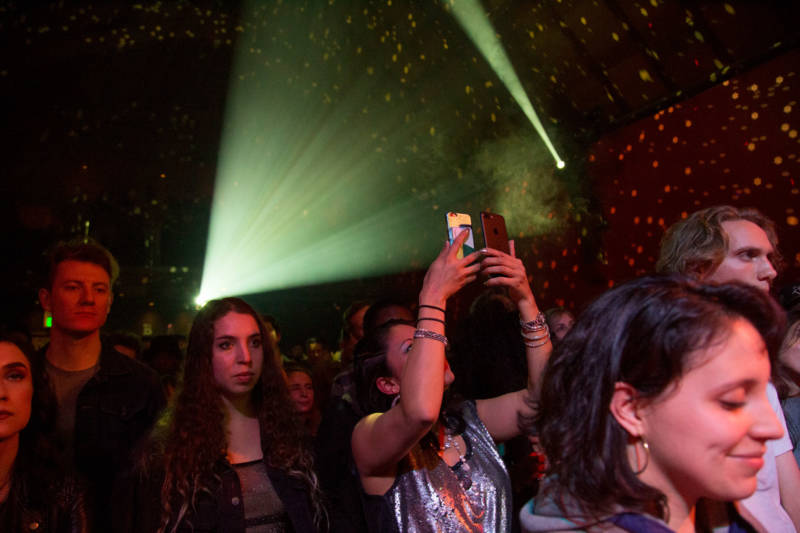
Princess Nokia performs at the 2019 Noise Pop Music and Arts Festival. (Estefany Gonzalez )
Update, Dec. 21: The Save Our Stages Act has been included in the COVID-19 stimulus package. Read more.
Original post:
Ask anyone who misses the catharsis of a good, sweaty dance party or mosh pit—so much magic can happen within the four walls of a concert hall.
In the 1960s, San Francisco’s Fillmore was where the Grateful Dead and Sly and the Family Stone honed their psychedelic sound. In the late ’80s and early ’90s, MC Hammer brought Oakland party rap to the world with a music video filmed at Sweet Jimmie’s, and Green Day made a name for themselves at Berkeley’s all-ages punk spot 924 Gilman. More recently, Slim’s in San Francisco was the springboard for platinum-selling rapper G-Eazy’s first headlining tour.
Over the decades, the Bay Area’s music venues have been where people go to forge connections, build communities and experience new forms of creativity. Additionally, venues have had an outsized impact on the local economy by drawing music fans to neighborhoods where they spend money on pre-show drinks, late-night tacos, transportation and hotels. According to the most recent study from the San Francisco Controller’s Office, nightlife generated $6 billion for the local economy in 2015 and created 60,000 jobs.
Fast forward to the coronavirus pandemic, and most of those jobs are gone. Music venues sit empty, accruing debt and on the brink of permanent closure, as they await government assistance.
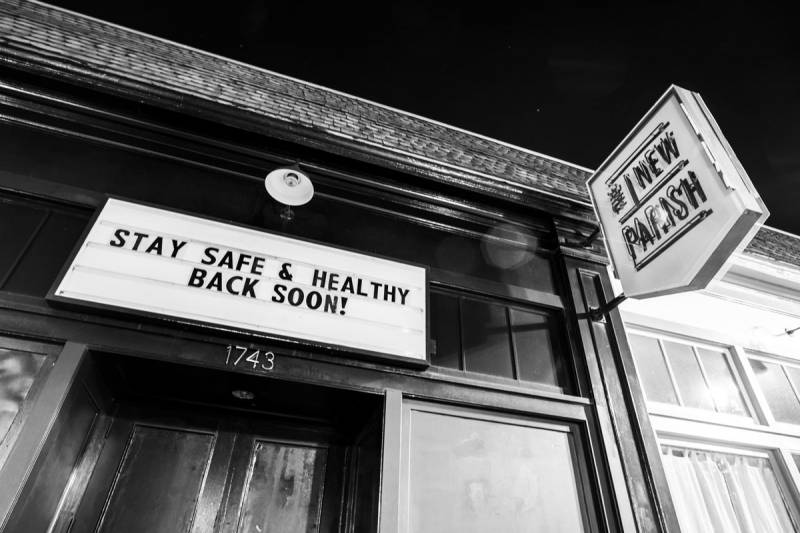
Oakland’s New Parish music venue on March 17, 2020. (Beth LaBerge/KQED)
Despite their importance to culture and the economy alike, venues have been all but forgotten in the United States’ woefully inadequate COVID-19 recovery plan. On the federal level, the Save Our Stages Act, which would provide substantial grant funding to independent venues, has remained stuck in limbo as the Republican-controlled Senate continues to delay a second stimulus package, leaving millions of Americans hungry and facing eviction.
At the state level, the COVID-19 crisis has plunged California into a deficit; the state has had to tap into its rainy day fund to avoid major cuts to essentials like K–12 education, and state lawmakers say relief for live music is unlikely without more federal funds. And on the city level, San Francisco, Oakland and Berkeley have given various pandemic-relief grants to artists, arts nonprofits and small businesses. But most of these grants have been doled out in one-time payments of $25,000 or less, which hasn’t come close to covering music venues’ costs. The San Francisco Venue Coalition estimates that the average monthly overhead of a typical San Francisco club is $18,000–$35,000.
A vaccine on the horizon offers a glimmer of hope that the concert business may resume in the second half of 2021. Until then, “We’ve got rent to pay, we’ve got mortgages to pay,” says David Mayeri, the CEO of Berkeley’s nonprofit UC Theatre and an organizer with the National Independent Venue Association (NIVA), a nationwide coalition that sprang up in response to the pandemic. NIVA has over 100 members in Northern California. “The financial burden is just enormous, and a lot of clubs are going out of business,” he says.
Indeed, The Stud, San Francisco’s oldest LGBTQ+ venue, shuttered in May. And Oakland has lost eclectic concert hall Starline Social Club, punk dive Stork Club, Afro-futurist warehouse venue Spirithaus and The Uptown Nightclub.
“We’re anchor tenants to neighborhoods, economic drivers and employers,” says Casey Lowdermilk, the assistant general manager of Bill Graham Civic Auditorium and an organizer with the San Francisco Venue Coalition and NIVA. “Losing venues will have devastating impacts for our community—not only economically, but culturally.”
A Lifeline for Venues?
Even if the intrinsic value of art doesn’t move politicians to act, the live music industry’s financial impact has been a persuasive tool for organizers. By coming together across the United States, the venue owners of NIVA have flexed their collective economic muscle. “We are now seen as a very viable, organized group,” says Mayeri.
“Both sides, Democrats and Republicans, believe that saving arts and culture across the country, saving our stages, is important in the fabric of communities,” he continues, referencing a Chicago study that found that every dollar spent on live entertainment generates $12 for the local economy.
Thanks to NIVA’s awareness campaign in Congress, Mayeri is optimistic that the Save Our Stages Act now has support on both sides of the aisle, and it is included in the Senate’s bipartisan relief bill. But Senate Republicans and Democrats have continued to clash over and further delay the stimulus package, with the legislative session soon coming to an end.
Federal relief is crucial to save venues, but Mayeri also believes California can do more. Even before the pandemic, independent music venues already operated on razor-thin profit margins because of high real estate costs. “The state of California should have a $50- to $100-million fund to support music venues and performing arts theaters,” Mayeri proposes. As of the 2019 fiscal year, California ranks 26th compared to other U.S. states in per capita spending on the arts.
“We have to rebuild—we’ve been decimated,” says longtime artist manager Michelle Campbell, whose clients, like rapper Mahawam, have built up their fan bases by touring independent venues. “We need funding for that, [even] if you have to entice corporations, give them tax write-offs and have them donate to cultural endowment funds. … There needs be something on all levels—city, state and federal—to rebuild the cultural landscape, because it’s going to be different. Especially when you have these long-term bars and venues that have closed permanently, like Starline, which was our cultural hub. How do we get something like that back? You have to be intentional.”
Solange performs at the Starline Social Club in Oakland, Dec. 16, 2016. ( Liz Seward)
On the city level, the city of Berkeley, where the UC Theatre is located, had one of the swiftest pandemic responses of any Bay Area municipalities when it comes to the arts. In April, the city began distributing $4.5 million in relief funding among arts nonprofits, small businesses and vulnerable tenants. San Francisco and Oakland have led their own relief effort that have included grants and loans for small businesses, arts nonprofits and individual artists. Additionally, San Francisco has waived payroll taxes and other government expenses for bars and clubs, and created the JAM Permit, which made it easier to book live music in outdoor dining areas and other city-designated Shared Spaces before the region went into its current lockdown.
But as the San Francisco Venue Coalition argues, these efforts, while appreciated, have been insufficient to address the specific needs of music venues. Payroll taxes, for instance, are only a small fraction of a venue’s expenditures, and the JAM Permit is geared towards a restaurant booking a jazz trio or DJ, not a promoter putting on an outdoor concert. The SFVC wants direct financial support instead.
Lowdermilk and the SFVC have given the San Francisco Entertainment Commission a detailed policy proposal that asks for $48 million in funding for independent venues. This would allow the city to cover the operating costs of around 50 venues for 16–18 months of closure with the funds it receives from the federal government’s second stimulus package.
“That will be a one-time payment, and hopefully by next summer we’ll reopen, and hopefully venues will have survived,” Lowdermilk says. “I think there are a lot of opportunities for our city government to help us, and we want to be there to be able to have that economic activity on the return, to help our city recover.”
Without Federal Help, California’s Options are Limited
The SFVC’s proposal is currently being considered by the Entertainment Commission, but it would require the approval of Mayor London Breed, whose office told KQED in a statement that without federal funding, the city is stretched beyond its capacity to maintain even its basic services. Acknowledging the hardships small businesses face, a spokesperson for the mayor wrote that the city’s CARES Act funding from the first stimulus package has been spent on the immediate needs of the pandemic, such as testing, quarantine housing, contact tracing, food security and personal protective equipment.
“Without additional financial support from the federal government, cities all across the country, like San Francisco, will need to make budget cuts and hard trade-offs,” the mayor’s office wrote, adding that even basic services, such as the Municipal Transportation Agency, are facing potential layoffs and budget cuts. “San Francisco needs additional federal support in the weeks and months ahead so that we can continue our COVID-19 response [and] support businesses—including entertainment and nightlife venues—and stabilize city services like Muni.”
San Francisco Supervisor Matt Haney, who represents the nightlife-heavy Tenderloin and South of Market neighborhoods, says that his office is exploring other funding opportunities for venues, even if federal relief doesn’t come in the near future.
Related Article
“We have an emergency reserve. It’s possible we could pull some money from that,” he says. “I think this is incredibly urgent, and if there’s any flexibility with spending, this should be something that is prioritized—even as a lifeline for the next three months to get us to a point where, hopefully, we have more robust support from federal government.”
Federal government help is also crucial in order for California to step in on a state level, says State Senator Scott Wiener. “Only Congress has the ability to deficit spend, only the federal government has the ability to print money. We need a significant new PPP program to support these businesses,” he says.
Wiener says Governor Gavin Newsom has expressed an urgency to help small businesses in the next budget cycle in January. Indeed, Newsom recently announced a new, $500 million program that will distribute grants of up to $25,000 to small businesses. But given venues’ huge monthly costs—and the fact that financial analysts predict that California could be operating at a deficit through 2024—federal funds will still be needed to make a major difference for music venues.
Death Valley Girls play a surprise “After Hours” Noise Pop show at Cafe du Nord on Friday, Feb. 28. (Estefany Gonzalez)
“We have to balance our budget so we have far more constraints, but I don’t think the state has done enough to financially support small businesses, and particularly those that simply cannot reopen,” Wiener continues. “I know that will be a focus as we go back and go into the budget process.”
California’s commercial eviction moratorium helps, but it also leaves music venues on the hook for back-rent after March 2021. It’s highly improbable that they’ll resume business by then. (The State Legislature killed a bill sponsored by Wiener that would have extended eviction protections through the end of the pandemic—it was strongly opposed by the real estate industry.)
Once a music venue gets evicted or breaks its lease, it may be gone forever. That’s because of a lack of adequate rental properties, argues Allen Scott, a co-owner of The Independent and The New Parish and the head of concerts and festivals at Another Planet Entertainment. “If you’re the owner of a restaurant, you lay off all your employees, you break your lease, you cancel your insurance—you literally get rid of every expense that you have. Your hope is that when you can open back up again, you can negotiate a new lease … and you can move forward,” Scott says. “A music venue cannot do that because there are not that many spaces we can go into—otherwise it would be a lot easier of a business.”
Other Options While the Federal Stimulus Stalls?
Even as city and state governments await federal funding, some entertainment industry leaders say there’s more that can be done locally to support live music.
One criticism has come from arts presenters who feel that the performing arts have been unfairly left out of California’s reopening efforts. Before the current upswing of COVID-19 cases that landed most of California in the purple tier, indicating unmitigated spread, San Francisco moved to allow indoor dining at 25% capacity of up to 100 people; outdoor religious services with up to 200 people were also allowed. But there was no official pathway for outdoor, masked and socially distanced performing arts events—even though the city didn’t stop thousands of people from partying on Ocean Beach during Burning Man weekend.
The lack of consistency frustrated venue owners and arts presenters, who believe that they have the tools and expertise to throw safe gatherings—and badly need the income. “We have hundreds of people who work for us who we’d like to give some employment to, some artists we’d like to give employment to … and more than anything else, create an environment that would be safer than what is currently happening,” Fred Barnes, general manager of The Chapel and co-founder of the Independent Venue Alliance, said at an August Entertainment Commission hearing.
The crowd at The Chapel in San Francisco on the third night of the 2018 Noise Pop Music and Arts Festival. (Estefany Gonzalez)
Even after releasing the JAM Permit for music in outdoor dining and other public areas, the city attempted to shut down a 49-person-capacity outdoor performance from the San Francisco International Arts Festival (SFIAF). In an email to KQED, a spokesperson from the City Attorney’s office called it a potential “super spreader event.” In October, the SFIAF filed a lawsuit against the city of San Francisco and state of California, claiming that the performing arts should be the same way as religious services and political activity in California and San Francisco’s reopening efforts because they, too, are protected by the first amendment.
“We just want parity with those types of activities,” says SFIAF director Andrew Wood. The governor’s office sided with SFIAF in court and issued an interim directive to allow outdoor performances with 100 attendees or fewer pending local health officials’ approval. But the city of San Francisco is still in a legal battle with SFIAF, and the festival is using its virtual holiday party to raise money for legal fees.
Social gatherings of any kind are off while California remains in the purple tier. But Wood says he wants the court to recognize the arts as a first amendment-protected activity so that they can be included in future reopening plans when virus rates go down and other activities like outdoor dining resume.
Shannon Amitin from the Queer Nightlife Fund agrees. The nonprofit organization has been giving out micro-grants to bartenders, sound techs, performers and DJs from LGBTQ+ bars and clubs since the pandemic started. Amitin says that in addition to improving the unemployment system, which has subjected some furloughed workers to months-long wait times for relief, the city can help independent promoters and artists by providing guidelines for outdoor, socially distanced events that aren’t tethered to outdoor dining. “We really need to take a harm reduction approach to events,” says Amitin. “Folks are still going to gather, so let’s give them the tools and the ability to do it safely.”
For the San Francisco Venue Coalition’s part, Lowdermilk says that it only makes financial sense for its venues to operate at 100% capacity. “We don’t want to push this. We want our patrons and staff to be healthy,” he says. “And we’re only interested in reopening at full capacity. Any sort of limited-capacity situation doesn’t make sense for us—the numbers don’t work out for venues. … It’s a very low-margin industry as it is, and we need to fill our rooms to be profitable.”
That won’t happen until the vaccine is widely available—which means that venues will continue to bleed money, and go out of business, until the federal stimulus arrives.
lower waypointnext waypoint
Player sponsored by
window.__IS_SSR__=true
window.__INITIAL_STATE__={
"attachmentsReducer": {
"audio_0": {
"type": "attachments",
"id": "audio_0",
"imgSizes": {
"kqedFullSize": {
"file": "https://ww2.kqed.org/news/wp-content/themes/KQED-unified/img/audio_bgs/background0.jpg"
}
}
},
"audio_1": {
"type": "attachments",
"id": "audio_1",
"imgSizes": {
"kqedFullSize": {
"file": "https://ww2.kqed.org/news/wp-content/themes/KQED-unified/img/audio_bgs/background1.jpg"
}
}
},
"audio_2": {
"type": "attachments",
"id": "audio_2",
"imgSizes": {
"kqedFullSize": {
"file": "https://ww2.kqed.org/news/wp-content/themes/KQED-unified/img/audio_bgs/background2.jpg"
}
}
},
"audio_3": {
"type": "attachments",
"id": "audio_3",
"imgSizes": {
"kqedFullSize": {
"file": "https://ww2.kqed.org/news/wp-content/themes/KQED-unified/img/audio_bgs/background3.jpg"
}
}
},
"audio_4": {
"type": "attachments",
"id": "audio_4",
"imgSizes": {
"kqedFullSize": {
"file": "https://ww2.kqed.org/news/wp-content/themes/KQED-unified/img/audio_bgs/background4.jpg"
}
}
},
"placeholder": {
"type": "attachments",
"id": "placeholder",
"imgSizes": {
"thumbnail": {
"file": "https://cdn.kqed.org/wp-content/uploads/2024/12/KQED-Default-Image-816638274-2000x1333-1-160x107.jpg",
"width": 160,
"height": 107,
"mimeType": "image/jpeg"
},
"medium": {
"file": "https://cdn.kqed.org/wp-content/uploads/2024/12/KQED-Default-Image-816638274-2000x1333-1-800x533.jpg",
"width": 800,
"height": 533,
"mimeType": "image/jpeg"
},
"medium_large": {
"file": "https://cdn.kqed.org/wp-content/uploads/2024/12/KQED-Default-Image-816638274-2000x1333-1-768x512.jpg",
"width": 768,
"height": 512,
"mimeType": "image/jpeg"
},
"large": {
"file": "https://cdn.kqed.org/wp-content/uploads/2024/12/KQED-Default-Image-816638274-2000x1333-1-1020x680.jpg",
"width": 1020,
"height": 680,
"mimeType": "image/jpeg"
},
"1536x1536": {
"file": "https://cdn.kqed.org/wp-content/uploads/2024/12/KQED-Default-Image-816638274-2000x1333-1-1536x1024.jpg",
"width": 1536,
"height": 1024,
"mimeType": "image/jpeg"
},
"fd-lrg": {
"file": "https://cdn.kqed.org/wp-content/uploads/2024/12/KQED-Default-Image-816638274-2000x1333-1-1536x1024.jpg",
"width": 1536,
"height": 1024,
"mimeType": "image/jpeg"
},
"fd-med": {
"file": "https://cdn.kqed.org/wp-content/uploads/2024/12/KQED-Default-Image-816638274-2000x1333-1-1020x680.jpg",
"width": 1020,
"height": 680,
"mimeType": "image/jpeg"
},
"fd-sm": {
"file": "https://cdn.kqed.org/wp-content/uploads/2024/12/KQED-Default-Image-816638274-2000x1333-1-800x533.jpg",
"width": 800,
"height": 533,
"mimeType": "image/jpeg"
},
"post-thumbnail": {
"file": "https://cdn.kqed.org/wp-content/uploads/2024/12/KQED-Default-Image-816638274-2000x1333-1-672x372.jpg",
"width": 672,
"height": 372,
"mimeType": "image/jpeg"
},
"twentyfourteen-full-width": {
"file": "https://cdn.kqed.org/wp-content/uploads/2024/12/KQED-Default-Image-816638274-2000x1333-1-1038x576.jpg",
"width": 1038,
"height": 576,
"mimeType": "image/jpeg"
},
"xxsmall": {
"file": "https://cdn.kqed.org/wp-content/uploads/2024/12/KQED-Default-Image-816638274-2000x1333-1-160x107.jpg",
"width": 160,
"height": 107,
"mimeType": "image/jpeg"
},
"xsmall": {
"file": "https://cdn.kqed.org/wp-content/uploads/2024/12/KQED-Default-Image-816638274-2000x1333-1-672x372.jpg",
"width": 672,
"height": 372,
"mimeType": "image/jpeg"
},
"small": {
"file": "https://cdn.kqed.org/wp-content/uploads/2024/12/KQED-Default-Image-816638274-2000x1333-1-672x372.jpg",
"width": 672,
"height": 372,
"mimeType": "image/jpeg"
},
"xlarge": {
"file": "https://cdn.kqed.org/wp-content/uploads/2024/12/KQED-Default-Image-816638274-2000x1333-1-1020x680.jpg",
"width": 1020,
"height": 680,
"mimeType": "image/jpeg"
},
"full-width": {
"file": "https://cdn.kqed.org/wp-content/uploads/2024/12/KQED-Default-Image-816638274-2000x1333-1-1920x1280.jpg",
"width": 1920,
"height": 1280,
"mimeType": "image/jpeg"
},
"guest-author-32": {
"file": "https://cdn.kqed.org/wp-content/uploads/2025/01/KQED-Default-Image-816638274-1333x1333-1-160x160.jpg",
"width": 32,
"height": 32,
"mimeType": "image/jpeg"
},
"guest-author-50": {
"file": "https://cdn.kqed.org/wp-content/uploads/2025/01/KQED-Default-Image-816638274-1333x1333-1-160x160.jpg",
"width": 50,
"height": 50,
"mimeType": "image/jpeg"
},
"guest-author-64": {
"file": "https://cdn.kqed.org/wp-content/uploads/2025/01/KQED-Default-Image-816638274-1333x1333-1-160x160.jpg",
"width": 64,
"height": 64,
"mimeType": "image/jpeg"
},
"guest-author-96": {
"file": "https://cdn.kqed.org/wp-content/uploads/2025/01/KQED-Default-Image-816638274-1333x1333-1-160x160.jpg",
"width": 96,
"height": 96,
"mimeType": "image/jpeg"
},
"guest-author-128": {
"file": "https://cdn.kqed.org/wp-content/uploads/2025/01/KQED-Default-Image-816638274-1333x1333-1-160x160.jpg",
"width": 128,
"height": 128,
"mimeType": "image/jpeg"
},
"detail": {
"file": "https://cdn.kqed.org/wp-content/uploads/2025/01/KQED-Default-Image-816638274-1333x1333-1-160x160.jpg",
"width": 160,
"height": 160,
"mimeType": "image/jpeg"
},
"kqedFullSize": {
"file": "https://cdn.kqed.org/wp-content/uploads/2024/12/KQED-Default-Image-816638274-2000x1333-1.jpg",
"width": 2000,
"height": 1333
}
}
},
"arts_13852059": {
"type": "attachments",
"id": "arts_13852059",
"meta": {
"index": "attachments_1716263798",
"site": "arts",
"id": "13852059",
"found": true
},
"parent": 13852108,
"imgSizes": {
"thumbnail": {
"file": "https://ww2.kqed.org/app/uploads/sites/2/2019/03/MG_2109-160x107.jpg",
"width": 160,
"mimeType": "image/jpeg",
"height": 107
},
"post-thumbnail": {
"file": "https://ww2.kqed.org/app/uploads/sites/2/2019/03/MG_2109-672x372.jpg",
"width": 672,
"mimeType": "image/jpeg",
"height": 372
},
"kqedFullSize": {
"file": "https://ww2.kqed.org/app/uploads/sites/2/2019/03/MG_2109.jpg",
"width": 800,
"height": 533
},
"guest-author-50": {
"file": "https://ww2.kqed.org/app/uploads/sites/2/2019/03/MG_2109-50x50.jpg",
"width": 50,
"mimeType": "image/jpeg",
"height": 50
},
"guest-author-96": {
"file": "https://ww2.kqed.org/app/uploads/sites/2/2019/03/MG_2109-96x96.jpg",
"width": 96,
"mimeType": "image/jpeg",
"height": 96
},
"medium": {
"file": "https://ww2.kqed.org/app/uploads/sites/2/2019/03/MG_2109-800x533.jpg",
"width": 800,
"mimeType": "image/jpeg",
"height": 533
},
"guest-author-64": {
"file": "https://ww2.kqed.org/app/uploads/sites/2/2019/03/MG_2109-64x64.jpg",
"width": 64,
"mimeType": "image/jpeg",
"height": 64
},
"guest-author-32": {
"file": "https://ww2.kqed.org/app/uploads/sites/2/2019/03/MG_2109-32x32.jpg",
"width": 32,
"mimeType": "image/jpeg",
"height": 32
},
"medium_large": {
"file": "https://ww2.kqed.org/app/uploads/sites/2/2019/03/MG_2109-768x512.jpg",
"width": 768,
"mimeType": "image/jpeg",
"height": 512
},
"guest-author-128": {
"file": "https://ww2.kqed.org/app/uploads/sites/2/2019/03/MG_2109-128x128.jpg",
"width": 128,
"mimeType": "image/jpeg",
"height": 128
}
},
"publishDate": 1551659063,
"modified": 1607630102,
"caption": "Princess Nokia performs at the 2019 Noise Pop Music and Arts Festival.",
"description": "Princess Nokia gets up close and personal with her fans at The UC Theatre on the sixth night of the 2019 Noise Pop Music and Arts Festival.",
"title": "Princess Nokia gets up close and personal with her fans at The UC Theatre on the sixth night of the 2019 Noise Pop Music and Arts Festival.",
"credit": "Estefany Gonzalez ",
"status": "inherit",
"altTag": "Princess Nokia gets up close and personal with her fans at The UC Theatre on the sixth night of the 2019 Noise Pop Music and Arts Festival.",
"isLoading": false,
"fetchFailed": false
}
},
"audioPlayerReducer": {
"postId": "stream_live",
"isPaused": true,
"isPlaying": false,
"pfsActive": false,
"pledgeModalIsOpen": true,
"playerDrawerIsOpen": false,
"liveAudioPlayStartedAt": 0,
"liveAudioPlayContext": ""
},
"authorsReducer": {
"nvoynovskaya": {
"type": "authors",
"id": "11387",
"meta": {
"index": "authors_1716337520",
"id": "11387",
"found": true
},
"name": "Nastia Voynovskaya",
"firstName": "Nastia",
"lastName": "Voynovskaya",
"slug": "nvoynovskaya",
"email": "nvoynovskaya@kqed.org",
"display_author_email": false,
"staff_mastheads": [
"arts"
],
"title": "Editor and reporter",
"bio": "Nastia Voynovskaya is a reporter, editor and host at KQED Arts & Culture. She's been covering the arts in the Bay Area for over a decade, with a focus on music, queer culture, labor issues and grassroots organizing. She has edited KQED story series such as Trans Bay: A History of San Francisco's Gender-Diverse Community, and co-created KQED's Bay Area hip-hop history project, That's My Word. Nastia's work has been recognized by the Society of Professional Journalists and San Francisco Press Club. She regularly appears on podcasts and radio programs, including NPR's All Songs Considered, and hosts live events where music, culture and conversation meet.",
"avatar": "https://secure.gravatar.com/avatar/5025ee460e5a85d69ca20ea6c6f2f80d7e17795c828f61ea3aecfcd924e9042e?s=600&d=blank&r=g",
"twitter": null,
"bluesky": null,
"facebook": null,
"instagram": "https://www.instagram.com/nananastia/",
"linkedin": null,
"sites": [
{
"site": "",
"roles": [
"editor"
]
},
{
"site": "arts",
"roles": [
"administrator"
]
},
{
"site": "news",
"roles": [
"editor"
]
},
{
"site": "pop",
"roles": [
"administrator"
]
},
{
"site": "bayareabites",
"roles": [
"editor"
]
},
{
"site": "podcasts",
"roles": [
"editor"
]
},
{
"site": "hiphop",
"roles": [
"editor"
]
}
],
"headData": {
"title": "Nastia Voynovskaya | KQED",
"description": "Editor and reporter",
"ogImgSrc": "https://secure.gravatar.com/avatar/5025ee460e5a85d69ca20ea6c6f2f80d7e17795c828f61ea3aecfcd924e9042e?s=600&d=blank&r=g",
"twImgSrc": "https://secure.gravatar.com/avatar/5025ee460e5a85d69ca20ea6c6f2f80d7e17795c828f61ea3aecfcd924e9042e?s=600&d=blank&r=g"
},
"isLoading": false,
"link": "/author/nvoynovskaya"
}
},
"pagesReducer": {},
"pfsSessionReducer": {},
"postsReducer": {
"stream_live": {
"type": "live",
"id": "stream_live",
"audioUrl": "https://streams.kqed.org/kqedradio",
"title": "Live Stream",
"excerpt": "Live Stream information currently unavailable.",
"link": "/radio",
"featImg": "",
"label": {
"name": "KQED Live",
"link": "/"
}
},
"stream_kqedNewscast": {
"type": "posts",
"id": "stream_kqedNewscast",
"audioUrl": "https://www.kqed.org/.stream/anon/radio/RDnews/newscast.mp3?_=1",
"title": "KQED Newscast",
"featImg": "",
"label": {
"name": "88.5 FM",
"link": "/"
}
},
"arts_13890093": {
"type": "posts",
"id": "arts_13890093",
"meta": {
"index": "posts_1716263798",
"site": "arts",
"id": "13890093",
"found": true
},
"articlePosition": 0,
"parent": 0,
"labelTerm": {},
"blocks": [],
"publishDate": 1607643940,
"format": "standard",
"title": "2020 Decimated the Concert Industry—And It Can’t Rebuild Without Government Help",
"headTitle": "2020 Decimated the Concert Industry—And It Can’t Rebuild Without Government Help | KQED",
"content": "\u003cp>\u003cstrong>Update, Dec. 21:\u003c/strong> The Save Our Stages Act has been included in the COVID-19 stimulus package. \u003ca href=\"https://www.kqed.org/arts/13890679/save-our-stages-act-included-in-stimulus-package-promises-relief-for-venues\" target=\"_blank\" rel=\"noopener noreferrer\">Read more\u003c/a>.\u003c/p>\n\u003cp>\u003cstrong>Original post:\u003c/strong>\u003c/p>\n\u003cp>Ask anyone who misses the catharsis of a good, sweaty dance party or mosh pit—so much magic can happen within the four walls of a concert hall.\u003c/p>\n\u003cp>In the 1960s, San Francisco’s \u003ca href=\"https://www.kqed.org/news/11731290/how-bill-grahams-nazi-escape-might-explain-his-fillmore-apples\" target=\"_blank\" rel=\"noopener noreferrer\">Fillmore\u003c/a> was where the Grateful Dead and Sly and the Family Stone honed their psychedelic sound. In the late ’80s and early ’90s, MC Hammer brought Oakland party rap to the world with a \u003ca href=\"https://youtu.be/akVWFiptGNY\" target=\"_blank\" rel=\"noopener noreferrer\">music video\u003c/a> filmed at Sweet Jimmie’s, and Green Day made a name for themselves at Berkeley’s all-ages punk spot \u003ca href=\"https://www.kqed.org/arts/11333286/green-day-dookie-924-gilman\" target=\"_blank\" rel=\"noopener noreferrer\">924 Gilman\u003c/a>. More recently, \u003ca href=\"https://www.kqed.org/arts/13877225/slims-a-storied-sf-concert-hall-permanently-closes-after-30-years\" target=\"_blank\" rel=\"noopener noreferrer\">Slim’s\u003c/a> in San Francisco was the springboard for platinum-selling rapper G-Eazy’s first headlining tour.\u003c/p>\n\u003cp>Over the decades, the Bay Area’s music venues have been where people go to forge connections, build communities and experience new forms of creativity. Additionally, venues have had an outsized impact on the local economy by drawing music fans to neighborhoods where they spend money on pre-show drinks, late-night tacos, transportation and hotels. According to the \u003ca href=\"https://sfgov.org/entertainment/file/2062\" target=\"_blank\" rel=\"noopener noreferrer\">most recent study\u003c/a> from the San Francisco Controller’s Office, nightlife generated $6 billion for the local economy in 2015 and created 60,000 jobs.\u003c/p>\n\u003cp>[ad fullwidth]\u003c/p>\n\u003cp>Fast forward to the coronavirus pandemic, and most of those jobs are gone. Music venues sit empty, accruing debt and on the brink of permanent closure, as they await government assistance.\u003c/p>\n\u003cfigure id=\"attachment_13877009\" class=\"wp-caption aligncenter\" style=\"max-width: 800px\">\u003cimg loading=\"lazy\" decoding=\"async\" class=\"size-medium wp-image-13877009\" src=\"https://ww2.kqed.org/app/uploads/sites/2/2020/03/NewParish_1200-800x533.jpg\" alt='The New Parish in Oakland sits empty as the Bay Area adopts a \"shelter in place\" policy to curb the spread of coronavirus.' width=\"800\" height=\"533\" srcset=\"https://cdn.kqed.org/wp-content/uploads/sites/2/2020/03/NewParish_1200-800x533.jpg 800w, https://cdn.kqed.org/wp-content/uploads/sites/2/2020/03/NewParish_1200-160x107.jpg 160w, https://cdn.kqed.org/wp-content/uploads/sites/2/2020/03/NewParish_1200-768x512.jpg 768w, https://cdn.kqed.org/wp-content/uploads/sites/2/2020/03/NewParish_1200-1020x680.jpg 1020w, https://cdn.kqed.org/wp-content/uploads/sites/2/2020/03/NewParish_1200.jpg 1200w\" sizes=\"(max-width: 800px) 100vw, 800px\">\u003cfigcaption class=\"wp-caption-text\">Oakland’s New Parish music venue on March 17, 2020. \u003ccite>(Beth LaBerge/KQED)\u003c/cite>\u003c/figcaption>\u003c/figure>\n\u003cp>Despite their importance to culture and the economy alike, venues have been all but forgotten in the United States’ woefully inadequate COVID-19 recovery plan. On the federal level, \u003ca href=\"https://www.kqed.org/arts/13883952/three-congressional-bills-could-help-save-independent-music-venues\" target=\"_blank\" rel=\"noopener noreferrer\">the Save Our Stages Act\u003c/a>, which would provide substantial grant funding to independent venues, has remained stuck in limbo as the Republican-controlled Senate continues to delay \u003ca href=\"https://www.cnn.com/2020/12/09/politics/covid-19-congress-stimulus-mcconnell-pelosi/index.html\" target=\"_blank\" rel=\"noopener noreferrer\">a second stimulus package\u003c/a>, leaving millions of Americans hungry and facing eviction.\u003c/p>\n\u003cp>At the state level, the COVID-19 crisis has plunged California into a \u003ca href=\"https://www.kqed.org/news/11818289/newsoms-revised-budget-cancels-6-billion-in-planned-program-expansions\" target=\"_blank\" rel=\"noopener noreferrer\">deficit\u003c/a>; the state has had to tap into its rainy day fund to \u003ca href=\"https://www.kqed.org/news/11818289/newsoms-revised-budget-cancels-6-billion-in-planned-program-expansions\" target=\"_blank\" rel=\"noopener noreferrer\">avoid major cuts\u003c/a> to essentials like K–12 education, and state lawmakers say relief for live music is unlikely without more federal funds. And on the city level, San Francisco, Oakland and Berkeley have given various pandemic-relief grants to artists, arts nonprofits and small businesses. But most of these grants have been doled out in one-time payments of $25,000 or less, which hasn’t come close to covering music venues’ costs. The San Francisco Venue Coalition estimates that the average monthly overhead of a typical San Francisco club is $18,000–$35,000.\u003c/p>\n\u003cp>A vaccine on the horizon offers a glimmer of hope that the concert business may resume in the second half of 2021. Until then, “We’ve got rent to pay, we’ve got mortgages to pay,” says David Mayeri, the CEO of Berkeley’s nonprofit UC Theatre and an organizer with the \u003ca href=\"https://www.nivassoc.org/\" target=\"_blank\" rel=\"noopener noreferrer\">National Independent Venue Association\u003c/a> (NIVA), a nationwide coalition that sprang up in response to the pandemic. NIVA has over 100 members in Northern California. “The financial burden is just enormous, and a lot of clubs are going out of business,” he says.\u003c/p>\n\u003cp>[pullquote size='large']Despite their importance to culture and the economy alike, venues have been all but forgotten in the United States’ woefully inadequate COVID-19 recovery plan.[/pullquote]\u003c/p>\n\u003cp>Indeed, \u003ca href=\"https://www.kqed.org/arts/13880884/the-studs-closure-is-cultural-erasure-caused-by-coronavirus\" target=\"_blank\" rel=\"noopener noreferrer\">The Stud\u003c/a>, San Francisco’s oldest LGBTQ+ venue, shuttered in May. And Oakland has lost eclectic concert hall \u003ca href=\"https://www.kqed.org/arts/13887215/end-of-an-era-oakland-venue-starline-social-club-is-on-the-market\" target=\"_blank\" rel=\"noopener noreferrer\">Starline Social Club\u003c/a>, punk dive Stork Club, Afro-futurist warehouse venue Spirithaus and The Uptown Nightclub.\u003c/p>\n\u003cp>“We’re anchor tenants to neighborhoods, economic drivers and employers,” says Casey Lowdermilk, the assistant general manager of Bill Graham Civic Auditorium and an organizer with the \u003ca href=\"https://www.sfvenuecoalition.com/\" target=\"_blank\" rel=\"noopener noreferrer\">San Francisco Venue Coalition\u003c/a> and NIVA. “Losing venues will have devastating impacts for our community—not only economically, but culturally.”\u003c/p>\n\u003ch2>A Lifeline for Venues?\u003c/h2>\n\u003cp>Even if the intrinsic value of art doesn’t move politicians to act, the live music industry’s financial impact has been a persuasive tool for organizers. By coming together across the United States, the venue owners of NIVA have flexed their collective economic muscle. “We are now seen as a very viable, organized group,” says Mayeri.\u003c/p>\n\u003cp>“Both sides, Democrats and Republicans, believe that saving arts and culture across the country, saving our stages, is important in the fabric of communities,” he continues, referencing \u003ca href=\"https://loopchicago.com/assets/f4fdbc1e00/Arts-in-the-Loop-Study.pdf\" target=\"_blank\" rel=\"noopener noreferrer\">a Chicago study\u003c/a> that found that every dollar spent on live entertainment generates $12 for the local economy.\u003c/p>\n\u003cp>Thanks to NIVA’s awareness campaign in Congress, Mayeri is optimistic that the Save Our Stages Act now has support on both sides of the aisle, and it is included in the Senate’s \u003ca href=\"https://www.politico.com/f/?id=00000176-487c-d3e7-a3ff-dbfcd7ed0000\" target=\"_blank\" rel=\"noopener noreferrer\">bipartisan relief bill\u003c/a>. But Senate Republicans and Democrats have continued to clash over and further delay the stimulus package, with \u003ca href=\"https://www.politico.com/news/2020/12/09/stimulus-talks-gop-aid-coronavirus-443927\" target=\"_blank\" rel=\"noopener noreferrer\">the legislative session soon coming to an end\u003c/a>.\u003c/p>\n\u003cp>Federal relief is crucial to save venues, but Mayeri also believes California can do more. Even before the pandemic, independent music venues already operated on razor-thin profit margins because of high real estate costs. “The state of California should have a $50- to $100-million fund to support music venues and performing arts theaters,” Mayeri proposes. As of the 2019 fiscal year, California ranks 26th compared to other U.S. states in \u003ca href=\"https://nasaa-arts.org/wp-content/uploads/2019/02/NASAA-FY2019-SAA-Revenues-Report.pdf\" target=\"_blank\" rel=\"noopener noreferrer\">per capita spending on the arts\u003c/a>.\u003c/p>\n\u003cp>“We have to rebuild—we’ve been decimated,” says longtime artist manager Michelle Campbell, whose clients, like rapper \u003ca href=\"https://www.kqed.org/arts/13853543/genre-defying-rapper-mahawam-grapples-with-an-hiv-diagnosis-on-their-new-ep\" target=\"_blank\" rel=\"noopener noreferrer\">Mahawam\u003c/a>, have built up their fan bases by touring independent venues. “We need funding for that, [even] if you have to entice corporations, give them tax write-offs and have them donate to cultural endowment funds. … There needs be something on all levels—city, state and federal—to rebuild the cultural landscape, because it’s going to be different. Especially when you have these long-term bars and venues that have closed permanently, like Starline, which was our cultural hub. How do we get something like that back? You have to be intentional.”\u003c/p>\n\u003cfigure id=\"attachment_12495738\" class=\"wp-caption aligncenter\" style=\"max-width: 800px\">\u003cimg loading=\"lazy\" decoding=\"async\" class=\"size-medium wp-image-12495738\" src=\"https://ww2.kqed.org/app/uploads/sites/2/2016/12/SOlange.MAIN_.1-800x485.jpg\" alt=\"Solange performs at the Starline Social Club in Oakland, Dec. 16, 2016.\" width=\"800\" height=\"485\" srcset=\"https://cdn.kqed.org/wp-content/uploads/sites/2/2016/12/SOlange.MAIN_.1-800x485.jpg 800w, https://cdn.kqed.org/wp-content/uploads/sites/2/2016/12/SOlange.MAIN_.1-160x97.jpg 160w, https://cdn.kqed.org/wp-content/uploads/sites/2/2016/12/SOlange.MAIN_.1-768x466.jpg 768w, https://cdn.kqed.org/wp-content/uploads/sites/2/2016/12/SOlange.MAIN_.1-1020x618.jpg 1020w, https://cdn.kqed.org/wp-content/uploads/sites/2/2016/12/SOlange.MAIN_.1.jpg 1920w, https://cdn.kqed.org/wp-content/uploads/sites/2/2016/12/SOlange.MAIN_.1-1180x715.jpg 1180w, https://cdn.kqed.org/wp-content/uploads/sites/2/2016/12/SOlange.MAIN_.1-960x582.jpg 960w, https://cdn.kqed.org/wp-content/uploads/sites/2/2016/12/SOlange.MAIN_.1-240x146.jpg 240w, https://cdn.kqed.org/wp-content/uploads/sites/2/2016/12/SOlange.MAIN_.1-375x227.jpg 375w, https://cdn.kqed.org/wp-content/uploads/sites/2/2016/12/SOlange.MAIN_.1-520x315.jpg 520w\" sizes=\"(max-width: 800px) 100vw, 800px\">\u003cfigcaption class=\"wp-caption-text\">Solange performs at the Starline Social Club in Oakland, Dec. 16, 2016. \u003ccite>( Liz Seward)\u003c/cite>\u003c/figcaption>\u003c/figure>\n\u003cp>On the city level, the city of Berkeley, where the UC Theatre is located, had one of the swiftest pandemic responses of any Bay Area municipalities when it comes to the arts. In April, the city began distributing $4.5 million in \u003ca href=\"https://berkeleyrelieffund.org/\" target=\"_blank\" rel=\"noopener noreferrer\">relief funding\u003c/a> among arts nonprofits, small businesses and vulnerable tenants. San Francisco and Oakland have led their own relief effort that have included grants and loans for small businesses, arts nonprofits and individual artists. Additionally, San Francisco has \u003ca href=\"https://www.kqed.org/arts/13888342/sf-clubs-and-bars-welcome-mayors-relief-effort-yet-too-little-too-late\" target=\"_blank\" rel=\"noopener noreferrer\">waived payroll taxes\u003c/a> and other government expenses for bars and clubs, and created the \u003ca href=\"https://www.kqed.org/arts/13886812/san-francisco-expands-reopening-with-outdoor-live-music-and-other-entertainment\" target=\"_blank\" rel=\"noopener noreferrer\">JAM Permit\u003c/a>, which made it easier to book live music in outdoor dining areas and other city-designated Shared Spaces before the region went into its current lockdown.\u003c/p>\n\u003cp>But as the San Francisco Venue Coalition argues, these efforts, while appreciated, have been insufficient to address the specific needs of music venues. Payroll taxes, for instance, are only a small fraction of a venue’s expenditures, and the JAM Permit is geared towards a restaurant booking a jazz trio or DJ, not a promoter putting on an outdoor concert. The SFVC wants direct financial support instead.\u003c/p>\n\u003cp>Lowdermilk and the SFVC have given the San Francisco Entertainment Commission a detailed policy proposal that asks for $48 million in funding for independent venues. This would allow the city to cover the operating costs of around 50 venues for 16–18 months of closure with the funds it receives from the federal government’s second stimulus package.\u003c/p>\n\u003cp>“That will be a one-time payment, and hopefully by next summer we’ll reopen, and hopefully venues will have survived,” Lowdermilk says. “I think there are a lot of opportunities for our city government to help us, and we want to be there to be able to have that economic activity on the return, to help our city recover.”\u003c/p>\n\u003ch2>Without Federal Help, California’s Options are Limited\u003c/h2>\n\u003cp>The SFVC’s proposal is currently being considered by the Entertainment Commission, but it would require the approval of Mayor London Breed, whose office told KQED in a statement that without federal funding, the city is stretched beyond its capacity to maintain even its basic services. Acknowledging the hardships small businesses face, a spokesperson for the mayor wrote that the city’s CARES Act funding from the first stimulus package has been spent on the immediate needs of the pandemic, such as testing, quarantine housing, contact tracing, food security and personal protective equipment.\u003c/p>\n\u003cp>“Without additional financial support from the federal government, cities all across the country, like San Francisco, will need to make budget cuts and hard trade-offs,” the mayor’s office wrote, adding that even basic services, such as the Municipal Transportation Agency, are facing potential layoffs and budget cuts. “San Francisco needs additional federal support in the weeks and months ahead so that we can continue our COVID-19 response [and] support businesses—including entertainment and nightlife venues—and stabilize city services like Muni.”\u003c/p>\n\u003cp>San Francisco Supervisor Matt Haney, who represents the nightlife-heavy Tenderloin and South of Market neighborhoods, says that his office is exploring other funding opportunities for venues, even if federal relief doesn’t come in the near future. [aside postid='arts_13890048']\u003c/p>\n\u003cp>“We have an emergency reserve. It’s possible we could pull some money from that,” he says. “I think this is incredibly urgent, and if there’s any flexibility with spending, this should be something that is prioritized—even as a lifeline for the next three months to get us to a point where, hopefully, we have more robust support from federal government.”\u003c/p>\n\u003cp>Federal government help is also crucial in order for California to step in on a state level, says State Senator Scott Wiener. “Only Congress has the ability to deficit spend, only the federal government has the ability to print money. We need a significant new PPP program to support these businesses,” he says.\u003c/p>\n\u003cp>Wiener says Governor Gavin Newsom has expressed an urgency to help small businesses in the next budget cycle in January. Indeed, Newsom recently announced a \u003ca href=\"https://www.gov.ca.gov/2020/11/30/governor-newsom-announces-immediate-assistance-for-businesses-impacted-by-covid-19-including-temporary-tax-relief-and-500-million-in-grants/#:~:text=The%20Governor%20announced%20the%20creation,the%20health%20and%20safety%20restrictions.\" target=\"_blank\" rel=\"noopener noreferrer\">new, $500 million program\u003c/a> that will distribute grants of up to $25,000 to small businesses. But given venues’ huge monthly costs—and the fact that financial analysts predict that California could be operating at a deficit \u003ca href=\"https://www.cnbc.com/2020/05/08/california-legislative-analyst-projects-deficits-totaling-126-billion-through-2024.html\" target=\"_blank\" rel=\"noopener noreferrer\">through 2024\u003c/a>—federal funds will still be needed to make a major difference for music venues.\u003c/p>\n\u003cfigure id=\"attachment_13875775\" class=\"wp-caption aligncenter\" style=\"max-width: 800px\">\u003cimg loading=\"lazy\" decoding=\"async\" class=\"size-medium wp-image-13875775\" src=\"https://ww2.kqed.org/app/uploads/sites/2/2020/03/D7A7852-800x533.jpg\" alt=\"\" width=\"800\" height=\"533\" srcset=\"https://cdn.kqed.org/wp-content/uploads/sites/2/2020/03/D7A7852.jpg 800w, https://cdn.kqed.org/wp-content/uploads/sites/2/2020/03/D7A7852-160x107.jpg 160w, https://cdn.kqed.org/wp-content/uploads/sites/2/2020/03/D7A7852-768x512.jpg 768w\" sizes=\"(max-width: 800px) 100vw, 800px\">\u003cfigcaption class=\"wp-caption-text\">Death Valley Girls play a surprise “After Hours” Noise Pop show at Cafe du Nord on Friday, Feb. 28. \u003ccite>(Estefany Gonzalez)\u003c/cite>\u003c/figcaption>\u003c/figure>\n\u003cp>“We have to balance our budget so we have far more constraints, but I don’t think the state has done enough to financially support small businesses, and particularly those that simply cannot reopen,” Wiener continues. “I know that will be a focus as we go back and go into the budget process.”\u003c/p>\n\u003cp>California’s commercial \u003ca href=\"https://www.sfchronicle.com/business/article/Newsom-extends-California-commercial-eviction-15594657.php\" target=\"_blank\" rel=\"noopener noreferrer\">eviction moratorium\u003c/a> helps, but it also leaves music venues on the hook for back-rent after March 2021. It’s highly improbable that they’ll resume business by then. (The State Legislature killed a bill sponsored by Wiener that would have extended eviction protections through the end of the pandemic—it was strongly opposed by the real estate industry.)\u003c/p>\n\u003cp>Once a music venue gets evicted or breaks its lease, it may be gone forever. That’s because of a lack of adequate rental properties, argues Allen Scott, a co-owner of The Independent and The New Parish and the head of concerts and festivals at Another Planet Entertainment. “If you’re the owner of a restaurant, you lay off all your employees, you break your lease, you cancel your insurance—you literally get rid of every expense that you have. Your hope is that when you can open back up again, you can negotiate a new lease … and you can move forward,” Scott says. “A music venue cannot do that because there are not that many spaces we can go into—otherwise it would be a lot easier of a business.”\u003c/p>\n\u003ch2>Other Options While the Federal Stimulus Stalls?\u003c/h2>\n\u003cp>Even as city and state governments await federal funding, some entertainment industry leaders say there’s more that can be done locally to support live music.\u003c/p>\n\u003cp>One criticism has come from arts presenters who feel that the performing arts have been unfairly left out of California’s reopening efforts. Before the current upswing of COVID-19 cases that landed most of California in the \u003ca href=\"https://www.kqed.org/news/11847641/california-tightens-coronavirus-restrictions-most-counties-must-close-nonessential-indoor-businesses\" target=\"_blank\" rel=\"noopener noreferrer\">purple tier\u003c/a>, indicating unmitigated spread, San Francisco moved to allow indoor dining at 25% capacity of up to 100 people; outdoor religious services with up to 200 people were also allowed. But there was no official pathway for outdoor, masked and socially distanced performing arts events—even though the city didn’t stop thousands of people from \u003ca href=\"https://www.sacbee.com/news/california/article245535745.html\" target=\"_blank\" rel=\"noopener noreferrer\">partying on Ocean Beach\u003c/a> during Burning Man weekend.\u003c/p>\n\u003cp>The lack of consistency frustrated venue owners and arts presenters, who believe that they have the tools and expertise to throw safe gatherings—and badly need the income. “We have hundreds of people who work for us who we’d like to give some employment to, some artists we’d like to give employment to … and more than anything else, create an environment that would be safer than what is currently happening,” Fred Barnes, general manager of The Chapel and co-founder of the \u003ca href=\"https://independentvenuealliance.com/\" target=\"_blank\" rel=\"noopener noreferrer\">Independent Venue Alliance\u003c/a>, said at an August Entertainment Commission hearing.\u003c/p>\n\u003cfigure id=\"attachment_13825287\" class=\"wp-caption aligncenter\" style=\"max-width: 800px\">\u003cimg loading=\"lazy\" decoding=\"async\" class=\"size-medium wp-image-13825287\" src=\"https://ww2.kqed.org/app/uploads/sites/2/2018/02/MG_7650-800x533.jpg\" alt=\"The crowd at The Chapel in San Francisco on the third night of the 2018 Noise Pop Music and Arts Festival. (Estefany Gonzalez)\" width=\"800\" height=\"533\" srcset=\"https://cdn.kqed.org/wp-content/uploads/sites/2/2018/02/MG_7650-800x533.jpg 800w, https://cdn.kqed.org/wp-content/uploads/sites/2/2018/02/MG_7650-160x107.jpg 160w, https://cdn.kqed.org/wp-content/uploads/sites/2/2018/02/MG_7650-768x512.jpg 768w, https://cdn.kqed.org/wp-content/uploads/sites/2/2018/02/MG_7650-1020x680.jpg 1020w, https://cdn.kqed.org/wp-content/uploads/sites/2/2018/02/MG_7650.jpg 1920w, https://cdn.kqed.org/wp-content/uploads/sites/2/2018/02/MG_7650-1180x787.jpg 1180w, https://cdn.kqed.org/wp-content/uploads/sites/2/2018/02/MG_7650-960x640.jpg 960w, https://cdn.kqed.org/wp-content/uploads/sites/2/2018/02/MG_7650-240x160.jpg 240w, https://cdn.kqed.org/wp-content/uploads/sites/2/2018/02/MG_7650-375x250.jpg 375w, https://cdn.kqed.org/wp-content/uploads/sites/2/2018/02/MG_7650-520x347.jpg 520w\" sizes=\"(max-width: 800px) 100vw, 800px\">\u003cfigcaption class=\"wp-caption-text\">The crowd at The Chapel in San Francisco on the third night of the 2018 Noise Pop Music and Arts Festival. \u003ccite>(Estefany Gonzalez)\u003c/cite>\u003c/figcaption>\u003c/figure>\n\u003cp>Even after releasing the JAM Permit for music in outdoor dining and other public areas, the city attempted to shut down a 49-person-capacity outdoor performance from the San Francisco International Arts Festival (SFIAF). In an email to KQED, a spokesperson from the City Attorney’s office called it a potential “super spreader event.” In October, the SFIAF \u003ca href=\"https://www.kqed.org/arts/13888163/an-sf-arts-presenter-sues-the-city-and-state-to-allow-outdoor-performances\" target=\"_blank\" rel=\"noopener noreferrer\">filed a lawsuit\u003c/a> against the city of San Francisco and state of California, claiming that the performing arts should be the same way as religious services and political activity in California and San Francisco’s reopening efforts because they, too, are protected by the first amendment.\u003c/p>\n\u003cp>“We just want parity with those types of activities,” says SFIAF director Andrew Wood. The governor’s office sided with SFIAF in court and issued an interim directive to allow outdoor performances with 100 attendees or fewer pending local health officials’ approval. But the city of San Francisco is still in a legal battle with SFIAF, and the festival is using its \u003ca href=\"https://www.sfiaf.org/december_12_event\" target=\"_blank\" rel=\"noopener noreferrer\">virtual holiday party\u003c/a> to raise money for legal fees.\u003c/p>\n\u003cp>Social gatherings of any kind are off while California remains in the purple tier. But Wood says he wants the court to recognize the arts as a first amendment-protected activity so that they can be included in future reopening plans when virus rates go down and other activities like outdoor dining resume.\u003c/p>\n\u003cp>Shannon Amitin from the \u003ca href=\"https://sfqueernightlifefund.org/\" target=\"_blank\" rel=\"noopener noreferrer\">Queer Nightlife Fund\u003c/a> agrees. The nonprofit organization has been giving out micro-grants to bartenders, sound techs, performers and DJs from LGBTQ+ bars and clubs since the pandemic started. Amitin says that in addition to improving the unemployment system, which has subjected some furloughed workers to \u003ca href=\"https://calmatters.org/california-divide/2020/11/low-on-help-expired-unemployment-boost-edd-debacles-sink-jobless-californians/\" target=\"_blank\" rel=\"noopener noreferrer\">months-long wait times\u003c/a> for relief, the city can help independent promoters and artists by providing guidelines for outdoor, socially distanced events that aren’t tethered to outdoor dining. “We really need to take a harm reduction approach to events,” says Amitin. “Folks are still going to gather, so let’s give them the tools and the ability to do it safely.”\u003c/p>\n\u003cp>For the San Francisco Venue Coalition’s part, Lowdermilk says that it only makes financial sense for its venues to operate at 100% capacity. “We don’t want to push this. We want our patrons and staff to be healthy,” he says. “And we’re only interested in reopening at full capacity. Any sort of limited-capacity situation doesn’t make sense for us—the numbers don’t work out for venues. … It’s a very low-margin industry as it is, and we need to fill our rooms to be profitable.”\u003c/p>\n\u003cp>[ad floatright]\u003c/p>\n\u003cp>That won’t happen until the vaccine is widely available—which means that venues will continue to bleed money, and go out of business, until the federal stimulus arrives.\u003c/p>\n\n",
"stats": {
"hasVideo": false,
"hasChartOrMap": false,
"hasAudio": false,
"hasPolis": false,
"wordCount": 2883,
"hasGoogleForm": false,
"hasGallery": false,
"hasHearkenModule": false,
"iframeSrcs": [],
"paragraphCount": 41
},
"modified": 1705019753,
"excerpt": "Bay Area music venues are on the brink of shutting down permanently. Business owners and elected officials weigh in on how they can be saved. ",
"headData": {
"twImgId": "",
"twTitle": "",
"ogTitle": "",
"ogImgId": "",
"twDescription": "",
"description": "Bay Area music venues are on the brink of shutting down permanently. Business owners and elected officials weigh in on how they can be saved. ",
"title": "2020 Decimated the Concert Industry—And It Can’t Rebuild Without Government Help | KQED",
"ogDescription": "",
"schema": {
"@context": "https://schema.org",
"@type": "Article",
"headline": "2020 Decimated the Concert Industry—And It Can’t Rebuild Without Government Help",
"datePublished": "2020-12-10T15:45:40-08:00",
"dateModified": "2024-01-11T16:35:53-08:00",
"image": "https://cdn.kqed.org/wp-content/uploads/2020/02/KQED-OG-Image@1x.png",
"author": {
"@type": "Person",
"name": "Nastia Voynovskaya",
"jobTitle": "Editor and reporter",
"url": "https://www.kqed.org/author/nvoynovskaya"
}
},
"authorsData": [],
"tagData": []
},
"guestAuthors": [],
"slug": "2020-decimated-the-concert-industry-and-it-cant-rebuild-without-government-help",
"status": "publish",
"sourceUrl": "https://www.kqed.org/2020inreview",
"templateType": "standard",
"featuredImageType": "standard",
"sticky": false,
"source": "2020 in Review",
"path": "/arts/13890093/2020-decimated-the-concert-industry-and-it-cant-rebuild-without-government-help",
"audioTrackLength": null,
"parsedContent": [
{
"type": "contentString",
"content": "\u003cdiv class=\"post-body\">\u003cp>\u003cp>\u003cstrong>Update, Dec. 21:\u003c/strong> The Save Our Stages Act has been included in the COVID-19 stimulus package. \u003ca href=\"https://www.kqed.org/arts/13890679/save-our-stages-act-included-in-stimulus-package-promises-relief-for-venues\" target=\"_blank\" rel=\"noopener noreferrer\">Read more\u003c/a>.\u003c/p>\n\u003cp>\u003cstrong>Original post:\u003c/strong>\u003c/p>\n\u003cp>Ask anyone who misses the catharsis of a good, sweaty dance party or mosh pit—so much magic can happen within the four walls of a concert hall.\u003c/p>\n\u003cp>In the 1960s, San Francisco’s \u003ca href=\"https://www.kqed.org/news/11731290/how-bill-grahams-nazi-escape-might-explain-his-fillmore-apples\" target=\"_blank\" rel=\"noopener noreferrer\">Fillmore\u003c/a> was where the Grateful Dead and Sly and the Family Stone honed their psychedelic sound. In the late ’80s and early ’90s, MC Hammer brought Oakland party rap to the world with a \u003ca href=\"https://youtu.be/akVWFiptGNY\" target=\"_blank\" rel=\"noopener noreferrer\">music video\u003c/a> filmed at Sweet Jimmie’s, and Green Day made a name for themselves at Berkeley’s all-ages punk spot \u003ca href=\"https://www.kqed.org/arts/11333286/green-day-dookie-924-gilman\" target=\"_blank\" rel=\"noopener noreferrer\">924 Gilman\u003c/a>. More recently, \u003ca href=\"https://www.kqed.org/arts/13877225/slims-a-storied-sf-concert-hall-permanently-closes-after-30-years\" target=\"_blank\" rel=\"noopener noreferrer\">Slim’s\u003c/a> in San Francisco was the springboard for platinum-selling rapper G-Eazy’s first headlining tour.\u003c/p>\n\u003cp>Over the decades, the Bay Area’s music venues have been where people go to forge connections, build communities and experience new forms of creativity. Additionally, venues have had an outsized impact on the local economy by drawing music fans to neighborhoods where they spend money on pre-show drinks, late-night tacos, transportation and hotels. According to the \u003ca href=\"https://sfgov.org/entertainment/file/2062\" target=\"_blank\" rel=\"noopener noreferrer\">most recent study\u003c/a> from the San Francisco Controller’s Office, nightlife generated $6 billion for the local economy in 2015 and created 60,000 jobs.\u003c/p>\n\u003cp>\u003c/p>\u003c/div>",
"attributes": {
"named": {},
"numeric": []
}
},
{
"type": "component",
"content": "",
"name": "ad",
"attributes": {
"named": {
"label": "fullwidth"
},
"numeric": [
"fullwidth"
]
}
},
{
"type": "contentString",
"content": "\u003cdiv class=\"post-body\">\u003cp>\u003c/p>\n\u003cp>Fast forward to the coronavirus pandemic, and most of those jobs are gone. Music venues sit empty, accruing debt and on the brink of permanent closure, as they await government assistance.\u003c/p>\n\u003cfigure id=\"attachment_13877009\" class=\"wp-caption aligncenter\" style=\"max-width: 800px\">\u003cimg loading=\"lazy\" decoding=\"async\" class=\"size-medium wp-image-13877009\" src=\"https://ww2.kqed.org/app/uploads/sites/2/2020/03/NewParish_1200-800x533.jpg\" alt='The New Parish in Oakland sits empty as the Bay Area adopts a \"shelter in place\" policy to curb the spread of coronavirus.' width=\"800\" height=\"533\" srcset=\"https://cdn.kqed.org/wp-content/uploads/sites/2/2020/03/NewParish_1200-800x533.jpg 800w, https://cdn.kqed.org/wp-content/uploads/sites/2/2020/03/NewParish_1200-160x107.jpg 160w, https://cdn.kqed.org/wp-content/uploads/sites/2/2020/03/NewParish_1200-768x512.jpg 768w, https://cdn.kqed.org/wp-content/uploads/sites/2/2020/03/NewParish_1200-1020x680.jpg 1020w, https://cdn.kqed.org/wp-content/uploads/sites/2/2020/03/NewParish_1200.jpg 1200w\" sizes=\"(max-width: 800px) 100vw, 800px\">\u003cfigcaption class=\"wp-caption-text\">Oakland’s New Parish music venue on March 17, 2020. \u003ccite>(Beth LaBerge/KQED)\u003c/cite>\u003c/figcaption>\u003c/figure>\n\u003cp>Despite their importance to culture and the economy alike, venues have been all but forgotten in the United States’ woefully inadequate COVID-19 recovery plan. On the federal level, \u003ca href=\"https://www.kqed.org/arts/13883952/three-congressional-bills-could-help-save-independent-music-venues\" target=\"_blank\" rel=\"noopener noreferrer\">the Save Our Stages Act\u003c/a>, which would provide substantial grant funding to independent venues, has remained stuck in limbo as the Republican-controlled Senate continues to delay \u003ca href=\"https://www.cnn.com/2020/12/09/politics/covid-19-congress-stimulus-mcconnell-pelosi/index.html\" target=\"_blank\" rel=\"noopener noreferrer\">a second stimulus package\u003c/a>, leaving millions of Americans hungry and facing eviction.\u003c/p>\n\u003cp>At the state level, the COVID-19 crisis has plunged California into a \u003ca href=\"https://www.kqed.org/news/11818289/newsoms-revised-budget-cancels-6-billion-in-planned-program-expansions\" target=\"_blank\" rel=\"noopener noreferrer\">deficit\u003c/a>; the state has had to tap into its rainy day fund to \u003ca href=\"https://www.kqed.org/news/11818289/newsoms-revised-budget-cancels-6-billion-in-planned-program-expansions\" target=\"_blank\" rel=\"noopener noreferrer\">avoid major cuts\u003c/a> to essentials like K–12 education, and state lawmakers say relief for live music is unlikely without more federal funds. And on the city level, San Francisco, Oakland and Berkeley have given various pandemic-relief grants to artists, arts nonprofits and small businesses. But most of these grants have been doled out in one-time payments of $25,000 or less, which hasn’t come close to covering music venues’ costs. The San Francisco Venue Coalition estimates that the average monthly overhead of a typical San Francisco club is $18,000–$35,000.\u003c/p>\n\u003cp>A vaccine on the horizon offers a glimmer of hope that the concert business may resume in the second half of 2021. Until then, “We’ve got rent to pay, we’ve got mortgages to pay,” says David Mayeri, the CEO of Berkeley’s nonprofit UC Theatre and an organizer with the \u003ca href=\"https://www.nivassoc.org/\" target=\"_blank\" rel=\"noopener noreferrer\">National Independent Venue Association\u003c/a> (NIVA), a nationwide coalition that sprang up in response to the pandemic. NIVA has over 100 members in Northern California. “The financial burden is just enormous, and a lot of clubs are going out of business,” he says.\u003c/p>\n\u003cp>\u003c/p>\u003c/div>",
"attributes": {
"named": {},
"numeric": []
}
},
{
"type": "component",
"content": "Despite their importance to culture and the economy alike, venues have been all but forgotten in the United States’ woefully inadequate COVID-19 recovery plan.",
"name": "pullquote",
"attributes": {
"named": {
"size": "large",
"label": ""
},
"numeric": []
}
},
{
"type": "contentString",
"content": "\u003cdiv class=\"post-body\">\u003cp>\u003c/p>\n\u003cp>Indeed, \u003ca href=\"https://www.kqed.org/arts/13880884/the-studs-closure-is-cultural-erasure-caused-by-coronavirus\" target=\"_blank\" rel=\"noopener noreferrer\">The Stud\u003c/a>, San Francisco’s oldest LGBTQ+ venue, shuttered in May. And Oakland has lost eclectic concert hall \u003ca href=\"https://www.kqed.org/arts/13887215/end-of-an-era-oakland-venue-starline-social-club-is-on-the-market\" target=\"_blank\" rel=\"noopener noreferrer\">Starline Social Club\u003c/a>, punk dive Stork Club, Afro-futurist warehouse venue Spirithaus and The Uptown Nightclub.\u003c/p>\n\u003cp>“We’re anchor tenants to neighborhoods, economic drivers and employers,” says Casey Lowdermilk, the assistant general manager of Bill Graham Civic Auditorium and an organizer with the \u003ca href=\"https://www.sfvenuecoalition.com/\" target=\"_blank\" rel=\"noopener noreferrer\">San Francisco Venue Coalition\u003c/a> and NIVA. “Losing venues will have devastating impacts for our community—not only economically, but culturally.”\u003c/p>\n\u003ch2>A Lifeline for Venues?\u003c/h2>\n\u003cp>Even if the intrinsic value of art doesn’t move politicians to act, the live music industry’s financial impact has been a persuasive tool for organizers. By coming together across the United States, the venue owners of NIVA have flexed their collective economic muscle. “We are now seen as a very viable, organized group,” says Mayeri.\u003c/p>\n\u003cp>“Both sides, Democrats and Republicans, believe that saving arts and culture across the country, saving our stages, is important in the fabric of communities,” he continues, referencing \u003ca href=\"https://loopchicago.com/assets/f4fdbc1e00/Arts-in-the-Loop-Study.pdf\" target=\"_blank\" rel=\"noopener noreferrer\">a Chicago study\u003c/a> that found that every dollar spent on live entertainment generates $12 for the local economy.\u003c/p>\n\u003cp>Thanks to NIVA’s awareness campaign in Congress, Mayeri is optimistic that the Save Our Stages Act now has support on both sides of the aisle, and it is included in the Senate’s \u003ca href=\"https://www.politico.com/f/?id=00000176-487c-d3e7-a3ff-dbfcd7ed0000\" target=\"_blank\" rel=\"noopener noreferrer\">bipartisan relief bill\u003c/a>. But Senate Republicans and Democrats have continued to clash over and further delay the stimulus package, with \u003ca href=\"https://www.politico.com/news/2020/12/09/stimulus-talks-gop-aid-coronavirus-443927\" target=\"_blank\" rel=\"noopener noreferrer\">the legislative session soon coming to an end\u003c/a>.\u003c/p>\n\u003cp>Federal relief is crucial to save venues, but Mayeri also believes California can do more. Even before the pandemic, independent music venues already operated on razor-thin profit margins because of high real estate costs. “The state of California should have a $50- to $100-million fund to support music venues and performing arts theaters,” Mayeri proposes. As of the 2019 fiscal year, California ranks 26th compared to other U.S. states in \u003ca href=\"https://nasaa-arts.org/wp-content/uploads/2019/02/NASAA-FY2019-SAA-Revenues-Report.pdf\" target=\"_blank\" rel=\"noopener noreferrer\">per capita spending on the arts\u003c/a>.\u003c/p>\n\u003cp>“We have to rebuild—we’ve been decimated,” says longtime artist manager Michelle Campbell, whose clients, like rapper \u003ca href=\"https://www.kqed.org/arts/13853543/genre-defying-rapper-mahawam-grapples-with-an-hiv-diagnosis-on-their-new-ep\" target=\"_blank\" rel=\"noopener noreferrer\">Mahawam\u003c/a>, have built up their fan bases by touring independent venues. “We need funding for that, [even] if you have to entice corporations, give them tax write-offs and have them donate to cultural endowment funds. … There needs be something on all levels—city, state and federal—to rebuild the cultural landscape, because it’s going to be different. Especially when you have these long-term bars and venues that have closed permanently, like Starline, which was our cultural hub. How do we get something like that back? You have to be intentional.”\u003c/p>\n\u003cfigure id=\"attachment_12495738\" class=\"wp-caption aligncenter\" style=\"max-width: 800px\">\u003cimg loading=\"lazy\" decoding=\"async\" class=\"size-medium wp-image-12495738\" src=\"https://ww2.kqed.org/app/uploads/sites/2/2016/12/SOlange.MAIN_.1-800x485.jpg\" alt=\"Solange performs at the Starline Social Club in Oakland, Dec. 16, 2016.\" width=\"800\" height=\"485\" srcset=\"https://cdn.kqed.org/wp-content/uploads/sites/2/2016/12/SOlange.MAIN_.1-800x485.jpg 800w, https://cdn.kqed.org/wp-content/uploads/sites/2/2016/12/SOlange.MAIN_.1-160x97.jpg 160w, https://cdn.kqed.org/wp-content/uploads/sites/2/2016/12/SOlange.MAIN_.1-768x466.jpg 768w, https://cdn.kqed.org/wp-content/uploads/sites/2/2016/12/SOlange.MAIN_.1-1020x618.jpg 1020w, https://cdn.kqed.org/wp-content/uploads/sites/2/2016/12/SOlange.MAIN_.1.jpg 1920w, https://cdn.kqed.org/wp-content/uploads/sites/2/2016/12/SOlange.MAIN_.1-1180x715.jpg 1180w, https://cdn.kqed.org/wp-content/uploads/sites/2/2016/12/SOlange.MAIN_.1-960x582.jpg 960w, https://cdn.kqed.org/wp-content/uploads/sites/2/2016/12/SOlange.MAIN_.1-240x146.jpg 240w, https://cdn.kqed.org/wp-content/uploads/sites/2/2016/12/SOlange.MAIN_.1-375x227.jpg 375w, https://cdn.kqed.org/wp-content/uploads/sites/2/2016/12/SOlange.MAIN_.1-520x315.jpg 520w\" sizes=\"(max-width: 800px) 100vw, 800px\">\u003cfigcaption class=\"wp-caption-text\">Solange performs at the Starline Social Club in Oakland, Dec. 16, 2016. \u003ccite>( Liz Seward)\u003c/cite>\u003c/figcaption>\u003c/figure>\n\u003cp>On the city level, the city of Berkeley, where the UC Theatre is located, had one of the swiftest pandemic responses of any Bay Area municipalities when it comes to the arts. In April, the city began distributing $4.5 million in \u003ca href=\"https://berkeleyrelieffund.org/\" target=\"_blank\" rel=\"noopener noreferrer\">relief funding\u003c/a> among arts nonprofits, small businesses and vulnerable tenants. San Francisco and Oakland have led their own relief effort that have included grants and loans for small businesses, arts nonprofits and individual artists. Additionally, San Francisco has \u003ca href=\"https://www.kqed.org/arts/13888342/sf-clubs-and-bars-welcome-mayors-relief-effort-yet-too-little-too-late\" target=\"_blank\" rel=\"noopener noreferrer\">waived payroll taxes\u003c/a> and other government expenses for bars and clubs, and created the \u003ca href=\"https://www.kqed.org/arts/13886812/san-francisco-expands-reopening-with-outdoor-live-music-and-other-entertainment\" target=\"_blank\" rel=\"noopener noreferrer\">JAM Permit\u003c/a>, which made it easier to book live music in outdoor dining areas and other city-designated Shared Spaces before the region went into its current lockdown.\u003c/p>\n\u003cp>But as the San Francisco Venue Coalition argues, these efforts, while appreciated, have been insufficient to address the specific needs of music venues. Payroll taxes, for instance, are only a small fraction of a venue’s expenditures, and the JAM Permit is geared towards a restaurant booking a jazz trio or DJ, not a promoter putting on an outdoor concert. The SFVC wants direct financial support instead.\u003c/p>\n\u003cp>Lowdermilk and the SFVC have given the San Francisco Entertainment Commission a detailed policy proposal that asks for $48 million in funding for independent venues. This would allow the city to cover the operating costs of around 50 venues for 16–18 months of closure with the funds it receives from the federal government’s second stimulus package.\u003c/p>\n\u003cp>“That will be a one-time payment, and hopefully by next summer we’ll reopen, and hopefully venues will have survived,” Lowdermilk says. “I think there are a lot of opportunities for our city government to help us, and we want to be there to be able to have that economic activity on the return, to help our city recover.”\u003c/p>\n\u003ch2>Without Federal Help, California’s Options are Limited\u003c/h2>\n\u003cp>The SFVC’s proposal is currently being considered by the Entertainment Commission, but it would require the approval of Mayor London Breed, whose office told KQED in a statement that without federal funding, the city is stretched beyond its capacity to maintain even its basic services. Acknowledging the hardships small businesses face, a spokesperson for the mayor wrote that the city’s CARES Act funding from the first stimulus package has been spent on the immediate needs of the pandemic, such as testing, quarantine housing, contact tracing, food security and personal protective equipment.\u003c/p>\n\u003cp>“Without additional financial support from the federal government, cities all across the country, like San Francisco, will need to make budget cuts and hard trade-offs,” the mayor’s office wrote, adding that even basic services, such as the Municipal Transportation Agency, are facing potential layoffs and budget cuts. “San Francisco needs additional federal support in the weeks and months ahead so that we can continue our COVID-19 response [and] support businesses—including entertainment and nightlife venues—and stabilize city services like Muni.”\u003c/p>\n\u003cp>San Francisco Supervisor Matt Haney, who represents the nightlife-heavy Tenderloin and South of Market neighborhoods, says that his office is exploring other funding opportunities for venues, even if federal relief doesn’t come in the near future. \u003c/p>\u003c/div>",
"attributes": {
"named": {},
"numeric": []
}
},
{
"type": "component",
"content": "",
"name": "aside",
"attributes": {
"named": {
"postid": "arts_13890048",
"label": ""
},
"numeric": []
}
},
{
"type": "contentString",
"content": "\u003cdiv class=\"post-body\">\u003cp>\u003c/p>\n\u003cp>“We have an emergency reserve. It’s possible we could pull some money from that,” he says. “I think this is incredibly urgent, and if there’s any flexibility with spending, this should be something that is prioritized—even as a lifeline for the next three months to get us to a point where, hopefully, we have more robust support from federal government.”\u003c/p>\n\u003cp>Federal government help is also crucial in order for California to step in on a state level, says State Senator Scott Wiener. “Only Congress has the ability to deficit spend, only the federal government has the ability to print money. We need a significant new PPP program to support these businesses,” he says.\u003c/p>\n\u003cp>Wiener says Governor Gavin Newsom has expressed an urgency to help small businesses in the next budget cycle in January. Indeed, Newsom recently announced a \u003ca href=\"https://www.gov.ca.gov/2020/11/30/governor-newsom-announces-immediate-assistance-for-businesses-impacted-by-covid-19-including-temporary-tax-relief-and-500-million-in-grants/#:~:text=The%20Governor%20announced%20the%20creation,the%20health%20and%20safety%20restrictions.\" target=\"_blank\" rel=\"noopener noreferrer\">new, $500 million program\u003c/a> that will distribute grants of up to $25,000 to small businesses. But given venues’ huge monthly costs—and the fact that financial analysts predict that California could be operating at a deficit \u003ca href=\"https://www.cnbc.com/2020/05/08/california-legislative-analyst-projects-deficits-totaling-126-billion-through-2024.html\" target=\"_blank\" rel=\"noopener noreferrer\">through 2024\u003c/a>—federal funds will still be needed to make a major difference for music venues.\u003c/p>\n\u003cfigure id=\"attachment_13875775\" class=\"wp-caption aligncenter\" style=\"max-width: 800px\">\u003cimg loading=\"lazy\" decoding=\"async\" class=\"size-medium wp-image-13875775\" src=\"https://ww2.kqed.org/app/uploads/sites/2/2020/03/D7A7852-800x533.jpg\" alt=\"\" width=\"800\" height=\"533\" srcset=\"https://cdn.kqed.org/wp-content/uploads/sites/2/2020/03/D7A7852.jpg 800w, https://cdn.kqed.org/wp-content/uploads/sites/2/2020/03/D7A7852-160x107.jpg 160w, https://cdn.kqed.org/wp-content/uploads/sites/2/2020/03/D7A7852-768x512.jpg 768w\" sizes=\"(max-width: 800px) 100vw, 800px\">\u003cfigcaption class=\"wp-caption-text\">Death Valley Girls play a surprise “After Hours” Noise Pop show at Cafe du Nord on Friday, Feb. 28. \u003ccite>(Estefany Gonzalez)\u003c/cite>\u003c/figcaption>\u003c/figure>\n\u003cp>“We have to balance our budget so we have far more constraints, but I don’t think the state has done enough to financially support small businesses, and particularly those that simply cannot reopen,” Wiener continues. “I know that will be a focus as we go back and go into the budget process.”\u003c/p>\n\u003cp>California’s commercial \u003ca href=\"https://www.sfchronicle.com/business/article/Newsom-extends-California-commercial-eviction-15594657.php\" target=\"_blank\" rel=\"noopener noreferrer\">eviction moratorium\u003c/a> helps, but it also leaves music venues on the hook for back-rent after March 2021. It’s highly improbable that they’ll resume business by then. (The State Legislature killed a bill sponsored by Wiener that would have extended eviction protections through the end of the pandemic—it was strongly opposed by the real estate industry.)\u003c/p>\n\u003cp>Once a music venue gets evicted or breaks its lease, it may be gone forever. That’s because of a lack of adequate rental properties, argues Allen Scott, a co-owner of The Independent and The New Parish and the head of concerts and festivals at Another Planet Entertainment. “If you’re the owner of a restaurant, you lay off all your employees, you break your lease, you cancel your insurance—you literally get rid of every expense that you have. Your hope is that when you can open back up again, you can negotiate a new lease … and you can move forward,” Scott says. “A music venue cannot do that because there are not that many spaces we can go into—otherwise it would be a lot easier of a business.”\u003c/p>\n\u003ch2>Other Options While the Federal Stimulus Stalls?\u003c/h2>\n\u003cp>Even as city and state governments await federal funding, some entertainment industry leaders say there’s more that can be done locally to support live music.\u003c/p>\n\u003cp>One criticism has come from arts presenters who feel that the performing arts have been unfairly left out of California’s reopening efforts. Before the current upswing of COVID-19 cases that landed most of California in the \u003ca href=\"https://www.kqed.org/news/11847641/california-tightens-coronavirus-restrictions-most-counties-must-close-nonessential-indoor-businesses\" target=\"_blank\" rel=\"noopener noreferrer\">purple tier\u003c/a>, indicating unmitigated spread, San Francisco moved to allow indoor dining at 25% capacity of up to 100 people; outdoor religious services with up to 200 people were also allowed. But there was no official pathway for outdoor, masked and socially distanced performing arts events—even though the city didn’t stop thousands of people from \u003ca href=\"https://www.sacbee.com/news/california/article245535745.html\" target=\"_blank\" rel=\"noopener noreferrer\">partying on Ocean Beach\u003c/a> during Burning Man weekend.\u003c/p>\n\u003cp>The lack of consistency frustrated venue owners and arts presenters, who believe that they have the tools and expertise to throw safe gatherings—and badly need the income. “We have hundreds of people who work for us who we’d like to give some employment to, some artists we’d like to give employment to … and more than anything else, create an environment that would be safer than what is currently happening,” Fred Barnes, general manager of The Chapel and co-founder of the \u003ca href=\"https://independentvenuealliance.com/\" target=\"_blank\" rel=\"noopener noreferrer\">Independent Venue Alliance\u003c/a>, said at an August Entertainment Commission hearing.\u003c/p>\n\u003cfigure id=\"attachment_13825287\" class=\"wp-caption aligncenter\" style=\"max-width: 800px\">\u003cimg loading=\"lazy\" decoding=\"async\" class=\"size-medium wp-image-13825287\" src=\"https://ww2.kqed.org/app/uploads/sites/2/2018/02/MG_7650-800x533.jpg\" alt=\"The crowd at The Chapel in San Francisco on the third night of the 2018 Noise Pop Music and Arts Festival. (Estefany Gonzalez)\" width=\"800\" height=\"533\" srcset=\"https://cdn.kqed.org/wp-content/uploads/sites/2/2018/02/MG_7650-800x533.jpg 800w, https://cdn.kqed.org/wp-content/uploads/sites/2/2018/02/MG_7650-160x107.jpg 160w, https://cdn.kqed.org/wp-content/uploads/sites/2/2018/02/MG_7650-768x512.jpg 768w, https://cdn.kqed.org/wp-content/uploads/sites/2/2018/02/MG_7650-1020x680.jpg 1020w, https://cdn.kqed.org/wp-content/uploads/sites/2/2018/02/MG_7650.jpg 1920w, https://cdn.kqed.org/wp-content/uploads/sites/2/2018/02/MG_7650-1180x787.jpg 1180w, https://cdn.kqed.org/wp-content/uploads/sites/2/2018/02/MG_7650-960x640.jpg 960w, https://cdn.kqed.org/wp-content/uploads/sites/2/2018/02/MG_7650-240x160.jpg 240w, https://cdn.kqed.org/wp-content/uploads/sites/2/2018/02/MG_7650-375x250.jpg 375w, https://cdn.kqed.org/wp-content/uploads/sites/2/2018/02/MG_7650-520x347.jpg 520w\" sizes=\"(max-width: 800px) 100vw, 800px\">\u003cfigcaption class=\"wp-caption-text\">The crowd at The Chapel in San Francisco on the third night of the 2018 Noise Pop Music and Arts Festival. \u003ccite>(Estefany Gonzalez)\u003c/cite>\u003c/figcaption>\u003c/figure>\n\u003cp>Even after releasing the JAM Permit for music in outdoor dining and other public areas, the city attempted to shut down a 49-person-capacity outdoor performance from the San Francisco International Arts Festival (SFIAF). In an email to KQED, a spokesperson from the City Attorney’s office called it a potential “super spreader event.” In October, the SFIAF \u003ca href=\"https://www.kqed.org/arts/13888163/an-sf-arts-presenter-sues-the-city-and-state-to-allow-outdoor-performances\" target=\"_blank\" rel=\"noopener noreferrer\">filed a lawsuit\u003c/a> against the city of San Francisco and state of California, claiming that the performing arts should be the same way as religious services and political activity in California and San Francisco’s reopening efforts because they, too, are protected by the first amendment.\u003c/p>\n\u003cp>“We just want parity with those types of activities,” says SFIAF director Andrew Wood. The governor’s office sided with SFIAF in court and issued an interim directive to allow outdoor performances with 100 attendees or fewer pending local health officials’ approval. But the city of San Francisco is still in a legal battle with SFIAF, and the festival is using its \u003ca href=\"https://www.sfiaf.org/december_12_event\" target=\"_blank\" rel=\"noopener noreferrer\">virtual holiday party\u003c/a> to raise money for legal fees.\u003c/p>\n\u003cp>Social gatherings of any kind are off while California remains in the purple tier. But Wood says he wants the court to recognize the arts as a first amendment-protected activity so that they can be included in future reopening plans when virus rates go down and other activities like outdoor dining resume.\u003c/p>\n\u003cp>Shannon Amitin from the \u003ca href=\"https://sfqueernightlifefund.org/\" target=\"_blank\" rel=\"noopener noreferrer\">Queer Nightlife Fund\u003c/a> agrees. The nonprofit organization has been giving out micro-grants to bartenders, sound techs, performers and DJs from LGBTQ+ bars and clubs since the pandemic started. Amitin says that in addition to improving the unemployment system, which has subjected some furloughed workers to \u003ca href=\"https://calmatters.org/california-divide/2020/11/low-on-help-expired-unemployment-boost-edd-debacles-sink-jobless-californians/\" target=\"_blank\" rel=\"noopener noreferrer\">months-long wait times\u003c/a> for relief, the city can help independent promoters and artists by providing guidelines for outdoor, socially distanced events that aren’t tethered to outdoor dining. “We really need to take a harm reduction approach to events,” says Amitin. “Folks are still going to gather, so let’s give them the tools and the ability to do it safely.”\u003c/p>\n\u003cp>For the San Francisco Venue Coalition’s part, Lowdermilk says that it only makes financial sense for its venues to operate at 100% capacity. “We don’t want to push this. We want our patrons and staff to be healthy,” he says. “And we’re only interested in reopening at full capacity. Any sort of limited-capacity situation doesn’t make sense for us—the numbers don’t work out for venues. … It’s a very low-margin industry as it is, and we need to fill our rooms to be profitable.”\u003c/p>\n\u003cp>\u003c/p>\u003c/div>",
"attributes": {
"named": {},
"numeric": []
}
},
{
"type": "component",
"content": "",
"name": "ad",
"attributes": {
"named": {
"label": "floatright"
},
"numeric": [
"floatright"
]
}
},
{
"type": "contentString",
"content": "\u003cdiv class=\"post-body\">\u003cp>\u003c/p>\n\u003cp>That won’t happen until the vaccine is widely available—which means that venues will continue to bleed money, and go out of business, until the federal stimulus arrives.\u003c/p>\n\n\u003c/div>\u003c/p>",
"attributes": {
"named": {},
"numeric": []
}
}
],
"link": "/arts/13890093/2020-decimated-the-concert-industry-and-it-cant-rebuild-without-government-help",
"authors": [
"11387"
],
"categories": [
"arts_1",
"arts_235"
],
"tags": [
"arts_12958",
"arts_6192",
"arts_10126",
"arts_10127",
"arts_10342",
"arts_10278",
"arts_10422",
"arts_6387",
"arts_11031",
"arts_2093"
],
"featImg": "arts_13852059",
"label": "source_arts_13890093",
"isLoading": false,
"hasAllInfo": true
}
},
"podcastsReducer": {
"isFetching": false,
"fetchFailed": false,
"hasFetched": false,
"podcasts": {}
},
"radioProgramsReducer": {
"isFetching": false,
"fetchFailed": false,
"hasFetched": false,
"radioPrograms": {}
},
"radioSearchSegmentsReducer": {},
"programsReducer": {
"all-things-considered": {
"id": "all-things-considered",
"title": "All Things Considered",
"info": "Every weekday, \u003cem>All Things Considered\u003c/em> hosts Robert Siegel, Audie Cornish, Ari Shapiro, and Kelly McEvers present the program's trademark mix of news, interviews, commentaries, reviews, and offbeat features. Michel Martin hosts on the weekends.",
"airtime": "MON-FRI 1pm-2pm, 4:30pm-6:30pm\u003cbr />SAT-SUN 5pm-6pm",
"imageSrc": "https://cdn.kqed.org/wp-content/uploads/2024/04/All-Things-Considered-Podcast-Tile-360x360-1.jpg",
"officialWebsiteLink": "https://www.npr.org/programs/all-things-considered/",
"meta": {
"site": "news",
"source": "npr"
},
"link": "/radio/program/all-things-considered"
},
"american-suburb-podcast": {
"id": "american-suburb-podcast",
"title": "American Suburb: The Podcast",
"tagline": "The flip side of gentrification, told through one town",
"info": "Gentrification is changing cities across America, forcing people from neighborhoods they have long called home. Call them the displaced. Now those priced out of the Bay Area are looking for a better life in an unlikely place. American Suburb follows this migration to one California town along the Delta, 45 miles from San Francisco. But is this once sleepy suburb ready for them?",
"imageSrc": "https://cdn.kqed.org/wp-content/uploads/2024/04/American-Suburb-Podcast-Tile-703x703-1.jpg",
"officialWebsiteLink": "/news/series/american-suburb-podcast",
"meta": {
"site": "news",
"source": "kqed",
"order": 19
},
"link": "/news/series/american-suburb-podcast/",
"subscribe": {
"npr": "https://rpb3r.app.goo.gl/RBrW",
"apple": "https://itunes.apple.com/WebObjects/MZStore.woa/wa/viewPodcast?mt=2&id=1287748328",
"tuneIn": "https://tunein.com/radio/American-Suburb-p1086805/",
"rss": "https://ww2.kqed.org/news/series/american-suburb-podcast/feed/podcast",
"google": "https://podcasts.google.com/feed/aHR0cHM6Ly9mZWVkcy5tZWdhcGhvbmUuZm0vS1FJTkMzMDExODgxNjA5"
}
},
"baycurious": {
"id": "baycurious",
"title": "Bay Curious",
"tagline": "Exploring the Bay Area, one question at a time",
"info": "KQED’s new podcast, Bay Curious, gets to the bottom of the mysteries — both profound and peculiar — that give the Bay Area its unique identity. And we’ll do it with your help! You ask the questions. You decide what Bay Curious investigates. And you join us on the journey to find the answers.",
"imageSrc": "https://cdn.kqed.org/wp-content/uploads/2024/04/Bay-Curious-Podcast-Tile-703x703-1.jpg",
"imageAlt": "KQED Bay Curious",
"officialWebsiteLink": "/news/series/baycurious",
"meta": {
"site": "news",
"source": "kqed",
"order": 3
},
"link": "/podcasts/baycurious",
"subscribe": {
"apple": "https://podcasts.apple.com/us/podcast/bay-curious/id1172473406",
"npr": "https://www.npr.org/podcasts/500557090/bay-curious",
"rss": "https://ww2.kqed.org/news/category/bay-curious-podcast/feed/podcast",
"amazon": "https://music.amazon.com/podcasts/9a90d476-aa04-455d-9a4c-0871ed6216d4/bay-curious",
"stitcher": "https://www.stitcher.com/podcast/kqed/bay-curious",
"spotify": "https://open.spotify.com/show/6O76IdmhixfijmhTZLIJ8k"
}
},
"bbc-world-service": {
"id": "bbc-world-service",
"title": "BBC World Service",
"info": "The day's top stories from BBC News compiled twice daily in the week, once at weekends.",
"airtime": "MON-FRI 9pm-10pm, TUE-FRI 1am-2am",
"imageSrc": "https://cdn.kqed.org/wp-content/uploads/2024/04/BBC-World-Service-Podcast-Tile-360x360-1.jpg",
"officialWebsiteLink": "https://www.bbc.co.uk/sounds/play/live:bbc_world_service",
"meta": {
"site": "news",
"source": "BBC World Service"
},
"link": "/radio/program/bbc-world-service",
"subscribe": {
"apple": "https://itunes.apple.com/us/podcast/global-news-podcast/id135067274?mt=2",
"tuneIn": "https://tunein.com/radio/BBC-World-Service-p455581/",
"rss": "https://podcasts.files.bbci.co.uk/p02nq0gn.rss"
}
},
"californiareport": {
"id": "californiareport",
"title": "The California Report",
"tagline": "California, day by day",
"info": "KQED’s statewide radio news program providing daily coverage of issues, trends and public policy decisions.",
"imageSrc": "https://cdn.kqed.org/wp-content/uploads/2024/04/The-California-Report-Podcast-Tile-703x703-1.jpg",
"imageAlt": "KQED The California Report",
"officialWebsiteLink": "/californiareport",
"meta": {
"site": "news",
"source": "kqed",
"order": 8
},
"link": "/californiareport",
"subscribe": {
"apple": "https://podcasts.apple.com/us/podcast/kqeds-the-california-report/id79681292",
"amazon": "https://music.amazon.com/podcasts/26099305-72af-4542-9dde-ac1807fe36d5/kqed-s-the-california-report",
"npr": "https://www.npr.org/podcasts/432285393/the-california-report",
"stitcher": "https://www.stitcher.com/podcast/kqedfm-kqeds-the-california-report-podcast-8838",
"rss": "https://ww2.kqed.org/news/tag/tcram/feed/podcast"
}
},
"californiareportmagazine": {
"id": "californiareportmagazine",
"title": "The California Report Magazine",
"tagline": "Your state, your stories",
"info": "Every week, The California Report Magazine takes you on a road trip for the ears: to visit the places and meet the people who make California unique. The in-depth storytelling podcast from the California Report.",
"airtime": "FRI 4:30pm-5pm, 6:30pm-7pm, 11pm-11:30pm",
"imageSrc": "https://cdn.kqed.org/wp-content/uploads/2024/04/The-California-Report-Magazine-Podcast-Tile-703x703-1.jpg",
"imageAlt": "KQED The California Report Magazine",
"officialWebsiteLink": "/californiareportmagazine",
"meta": {
"site": "news",
"source": "kqed",
"order": 10
},
"link": "/californiareportmagazine",
"subscribe": {
"apple": "https://podcasts.apple.com/us/podcast/the-california-report-magazine/id1314750545",
"google": "https://podcasts.google.com/feed/aHR0cHM6Ly9mZWVkcy5tZWdhcGhvbmUuZm0vS1FJTkM3NjkwNjk1OTAz",
"npr": "https://www.npr.org/podcasts/564733126/the-california-report-magazine",
"stitcher": "https://www.stitcher.com/podcast/kqed/the-california-report-magazine",
"rss": "https://ww2.kqed.org/news/tag/tcrmag/feed/podcast"
}
},
"city-arts": {
"id": "city-arts",
"title": "City Arts & Lectures",
"info": "A one-hour radio program to hear celebrated writers, artists and thinkers address contemporary ideas and values, often discussing the creative process. Please note: tapes or transcripts are not available",
"imageSrc": "https://ww2.kqed.org/radio/wp-content/uploads/sites/50/2018/05/cityartsandlecture-300x300.jpg",
"officialWebsiteLink": "https://www.cityarts.net/",
"airtime": "SUN 1pm-2pm, TUE 10pm, WED 1am",
"meta": {
"site": "news",
"source": "City Arts & Lectures"
},
"link": "https://www.cityarts.net",
"subscribe": {
"tuneIn": "https://tunein.com/radio/City-Arts-and-Lectures-p692/",
"rss": "https://www.cityarts.net/feed/"
}
},
"closealltabs": {
"id": "closealltabs",
"title": "Close All Tabs",
"tagline": "Your irreverent guide to the trends redefining our world",
"info": "Close All Tabs breaks down how digital culture shapes our world through thoughtful insights and irreverent humor.",
"imageSrc": "https://cdn.kqed.org/wp-content/uploads/2025/02/CAT_2_Tile-scaled.jpg",
"imageAlt": "KQED Close All Tabs",
"officialWebsiteLink": "/podcasts/closealltabs",
"meta": {
"site": "news",
"source": "kqed",
"order": 1
},
"link": "/podcasts/closealltabs",
"subscribe": {
"apple": "https://podcasts.apple.com/us/podcast/close-all-tabs/id214663465",
"rss": "https://feeds.megaphone.fm/KQINC6993880386",
"amazon": "https://music.amazon.com/podcasts/92d9d4ac-67a3-4eed-b10a-fb45d45b1ef2/close-all-tabs",
"spotify": "https://open.spotify.com/show/6LAJFHnGK1pYXYzv6SIol6?si=deb0cae19813417c"
}
},
"code-switch-life-kit": {
"id": "code-switch-life-kit",
"title": "Code Switch / Life Kit",
"info": "\u003cem>Code Switch\u003c/em>, which listeners will hear in the first part of the hour, has fearless and much-needed conversations about race. Hosted by journalists of color, the show tackles the subject of race head-on, exploring how it impacts every part of society — from politics and pop culture to history, sports and more.\u003cbr />\u003cbr />\u003cem>Life Kit\u003c/em>, which will be in the second part of the hour, guides you through spaces and feelings no one prepares you for — from finances to mental health, from workplace microaggressions to imposter syndrome, from relationships to parenting. The show features experts with real world experience and shares their knowledge. Because everyone needs a little help being human.\u003cbr />\u003cbr />\u003ca href=\"https://www.npr.org/podcasts/510312/codeswitch\">\u003cem>Code Switch\u003c/em> offical site and podcast\u003c/a>\u003cbr />\u003ca href=\"https://www.npr.org/lifekit\">\u003cem>Life Kit\u003c/em> offical site and podcast\u003c/a>\u003cbr />",
"airtime": "SUN 9pm-10pm",
"imageSrc": "https://cdn.kqed.org/wp-content/uploads/2024/04/Code-Switch-Life-Kit-Podcast-Tile-360x360-1.jpg",
"meta": {
"site": "radio",
"source": "npr"
},
"link": "/radio/program/code-switch-life-kit",
"subscribe": {
"apple": "https://podcasts.apple.com/podcast/1112190608?mt=2&at=11l79Y&ct=nprdirectory",
"google": "https://podcasts.google.com/feed/aHR0cHM6Ly93d3cubnByLm9yZy9yc3MvcG9kY2FzdC5waHA_aWQ9NTEwMzEy",
"spotify": "https://open.spotify.com/show/3bExJ9JQpkwNhoHvaIIuyV",
"rss": "https://feeds.npr.org/510312/podcast.xml"
}
},
"commonwealth-club": {
"id": "commonwealth-club",
"title": "Commonwealth Club of California Podcast",
"info": "The Commonwealth Club of California is the nation's oldest and largest public affairs forum. As a non-partisan forum, The Club brings to the public airwaves diverse viewpoints on important topics. The Club's weekly radio broadcast - the oldest in the U.S., dating back to 1924 - is carried across the nation on public radio stations and is now podcasting. Our website archive features audio of our recent programs, as well as selected speeches from our long and distinguished history. This podcast feed is usually updated twice a week and is always un-edited.",
"airtime": "THU 10pm, FRI 1am",
"imageSrc": "https://cdn.kqed.org/wp-content/uploads/2024/04/Commonwealth-Club-Podcast-Tile-360x360-1.jpg",
"officialWebsiteLink": "https://www.commonwealthclub.org/podcasts",
"meta": {
"site": "news",
"source": "Commonwealth Club of California"
},
"link": "/radio/program/commonwealth-club",
"subscribe": {
"apple": "https://itunes.apple.com/us/podcast/commonwealth-club-of-california-podcast/id976334034?mt=2",
"google": "https://podcasts.google.com/feed/aHR0cDovL3d3dy5jb21tb253ZWFsdGhjbHViLm9yZy9hdWRpby9wb2RjYXN0L3dlZWtseS54bWw",
"tuneIn": "https://tunein.com/radio/Commonwealth-Club-of-California-p1060/"
}
},
"forum": {
"id": "forum",
"title": "Forum",
"tagline": "The conversation starts here",
"info": "KQED’s live call-in program discussing local, state, national and international issues, as well as in-depth interviews.",
"airtime": "MON-FRI 9am-11am, 10pm-11pm",
"imageSrc": "https://cdn.kqed.org/wp-content/uploads/2024/04/Forum-Podcast-Tile-703x703-1.jpg",
"imageAlt": "KQED Forum with Mina Kim and Alexis Madrigal",
"officialWebsiteLink": "/forum",
"meta": {
"site": "news",
"source": "kqed",
"order": 9
},
"link": "/forum",
"subscribe": {
"apple": "https://podcasts.apple.com/us/podcast/kqeds-forum/id73329719",
"google": "https://podcasts.google.com/feed/aHR0cHM6Ly9mZWVkcy5tZWdhcGhvbmUuZm0vS1FJTkM5NTU3MzgxNjMz",
"npr": "https://www.npr.org/podcasts/432307980/forum",
"stitcher": "https://www.stitcher.com/podcast/kqedfm-kqeds-forum-podcast",
"rss": "https://feeds.megaphone.fm/KQINC9557381633"
}
},
"freakonomics-radio": {
"id": "freakonomics-radio",
"title": "Freakonomics Radio",
"info": "Freakonomics Radio is a one-hour award-winning podcast and public-radio project hosted by Stephen Dubner, with co-author Steve Levitt as a regular guest. It is produced in partnership with WNYC.",
"imageSrc": "https://ww2.kqed.org/news/wp-content/uploads/sites/10/2018/05/freakonomicsRadio.png",
"officialWebsiteLink": "http://freakonomics.com/",
"airtime": "SUN 1am-2am, SAT 3pm-4pm",
"meta": {
"site": "radio",
"source": "WNYC"
},
"link": "/radio/program/freakonomics-radio",
"subscribe": {
"npr": "https://rpb3r.app.goo.gl/4s8b",
"apple": "https://itunes.apple.com/us/podcast/freakonomics-radio/id354668519",
"tuneIn": "https://tunein.com/podcasts/WNYC-Podcasts/Freakonomics-Radio-p272293/",
"rss": "https://feeds.feedburner.com/freakonomicsradio"
}
},
"fresh-air": {
"id": "fresh-air",
"title": "Fresh Air",
"info": "Hosted by Terry Gross, \u003cem>Fresh Air from WHYY\u003c/em> is the Peabody Award-winning weekday magazine of contemporary arts and issues. One of public radio's most popular programs, Fresh Air features intimate conversations with today's biggest luminaries.",
"airtime": "MON-FRI 7pm-8pm",
"imageSrc": "https://cdn.kqed.org/wp-content/uploads/2024/04/Fresh-Air-Podcast-Tile-360x360-1.jpg",
"officialWebsiteLink": "https://www.npr.org/programs/fresh-air/",
"meta": {
"site": "radio",
"source": "npr"
},
"link": "/radio/program/fresh-air",
"subscribe": {
"npr": "https://rpb3r.app.goo.gl/4s8b",
"apple": "https://itunes.apple.com/WebObjects/MZStore.woa/wa/viewPodcast?s=143441&mt=2&id=214089682&at=11l79Y&ct=nprdirectory",
"tuneIn": "https://tunein.com/radio/Fresh-Air-p17/",
"rss": "https://feeds.npr.org/381444908/podcast.xml"
}
},
"here-and-now": {
"id": "here-and-now",
"title": "Here & Now",
"info": "A live production of NPR and WBUR Boston, in collaboration with stations across the country, Here & Now reflects the fluid world of news as it's happening in the middle of the day, with timely, in-depth news, interviews and conversation. Hosted by Robin Young, Jeremy Hobson and Tonya Mosley.",
"airtime": "MON-THU 11am-12pm",
"imageSrc": "https://cdn.kqed.org/wp-content/uploads/2024/04/Here-And-Now-Podcast-Tile-360x360-1.jpg",
"officialWebsiteLink": "http://www.wbur.org/hereandnow",
"meta": {
"site": "news",
"source": "npr"
},
"link": "/radio/program/here-and-now",
"subsdcribe": {
"apple": "https://itunes.apple.com/WebObjects/MZStore.woa/wa/viewPodcast?mt=2&id=426698661",
"tuneIn": "https://tunein.com/radio/Here--Now-p211/",
"rss": "https://feeds.npr.org/510051/podcast.xml"
}
},
"hidden-brain": {
"id": "hidden-brain",
"title": "Hidden Brain",
"info": "Shankar Vedantam uses science and storytelling to reveal the unconscious patterns that drive human behavior, shape our choices and direct our relationships.",
"imageSrc": "https://ww2.kqed.org/radio/wp-content/uploads/sites/50/2018/05/hiddenbrain.jpg",
"officialWebsiteLink": "https://www.npr.org/series/423302056/hidden-brain",
"airtime": "SUN 7pm-8pm",
"meta": {
"site": "news",
"source": "NPR"
},
"link": "/radio/program/hidden-brain",
"subscribe": {
"apple": "https://itunes.apple.com/us/podcast/hidden-brain/id1028908750?mt=2",
"tuneIn": "https://tunein.com/podcasts/Science-Podcasts/Hidden-Brain-p787503/",
"rss": "https://feeds.npr.org/510308/podcast.xml"
}
},
"how-i-built-this": {
"id": "how-i-built-this",
"title": "How I Built This with Guy Raz",
"info": "Guy Raz dives into the stories behind some of the world's best known companies. How I Built This weaves a narrative journey about innovators, entrepreneurs and idealists—and the movements they built.",
"imageSrc": "https://ww2.kqed.org/news/wp-content/uploads/sites/10/2018/05/howIBuiltThis.png",
"officialWebsiteLink": "https://www.npr.org/podcasts/510313/how-i-built-this",
"airtime": "SUN 7:30pm-8pm",
"meta": {
"site": "news",
"source": "npr"
},
"link": "/radio/program/how-i-built-this",
"subscribe": {
"npr": "https://rpb3r.app.goo.gl/3zxy",
"apple": "https://itunes.apple.com/us/podcast/how-i-built-this-with-guy-raz/id1150510297?mt=2",
"tuneIn": "https://tunein.com/podcasts/Arts--Culture-Podcasts/How-I-Built-This-p910896/",
"rss": "https://feeds.npr.org/510313/podcast.xml"
}
},
"hyphenacion": {
"id": "hyphenacion",
"title": "Hyphenación",
"tagline": "Where conversation and cultura meet",
"info": "What kind of no sabo word is Hyphenación? For us, it’s about living within a hyphenation. Like being a third-gen Mexican-American from the Texas border now living that Bay Area Chicano life. Like Xorje! Each week we bring together a couple of hyphenated Latinos to talk all about personal life choices: family, careers, relationships, belonging … everything is on the table. ",
"imageSrc": "https://cdn.kqed.org/wp-content/uploads/2025/03/Hyphenacion_FinalAssets_PodcastTile.png",
"imageAlt": "KQED Hyphenación",
"officialWebsiteLink": "/podcasts/hyphenacion",
"meta": {
"site": "news",
"source": "kqed",
"order": 15
},
"link": "/podcasts/hyphenacion",
"subscribe": {
"apple": "https://podcasts.apple.com/us/podcast/hyphenaci%C3%B3n/id1191591838",
"spotify": "https://open.spotify.com/show/2p3Fifq96nw9BPcmFdIq0o?si=39209f7b25774f38",
"youtube": "https://www.youtube.com/c/kqedarts",
"amazon": "https://music.amazon.com/podcasts/6c3dd23c-93fb-4aab-97ba-1725fa6315f1/hyphenaci%C3%B3n",
"rss": "https://feeds.megaphone.fm/KQINC2275451163"
}
},
"jerrybrown": {
"id": "jerrybrown",
"title": "The Political Mind of Jerry Brown",
"tagline": "Lessons from a lifetime in politics",
"info": "The Political Mind of Jerry Brown brings listeners the wisdom of the former Governor, Mayor, and presidential candidate. Scott Shafer interviewed Brown for more than 40 hours, covering the former governor's life and half-century in the political game – and Brown has some lessons he'd like to share. ",
"imageSrc": "https://cdn.kqed.org/wp-content/uploads/2024/04/The-Political-Mind-of-Jerry-Brown-Podcast-Tile-703x703-1.jpg",
"imageAlt": "KQED The Political Mind of Jerry Brown",
"officialWebsiteLink": "/podcasts/jerrybrown",
"meta": {
"site": "news",
"source": "kqed",
"order": 18
},
"link": "/podcasts/jerrybrown",
"subscribe": {
"npr": "https://www.npr.org/podcasts/790253322/the-political-mind-of-jerry-brown",
"apple": "https://itunes.apple.com/us/podcast/id1492194549",
"rss": "https://ww2.kqed.org/news/series/jerrybrown/feed/podcast/",
"tuneIn": "http://tun.in/pjGcK",
"stitcher": "https://www.stitcher.com/podcast/kqed/the-political-mind-of-jerry-brown",
"spotify": "https://open.spotify.com/show/54C1dmuyFyKMFttY6X2j6r?si=K8SgRCoISNK6ZbjpXrX5-w",
"amazon": "https://music.amazon.com/podcasts/44420f75-3b0e-4301-ab3b-16da6b09e543/the-political-mind-of-jerry-brown"
}
},
"latino-usa": {
"id": "latino-usa",
"title": "Latino USA",
"airtime": "MON 1am-2am, SUN 6pm-7pm",
"info": "Latino USA, the radio journal of news and culture, is the only national, English-language radio program produced from a Latino perspective.",
"imageSrc": "https://ww2.kqed.org/radio/wp-content/uploads/sites/50/2018/04/latinoUsa.jpg",
"officialWebsiteLink": "http://latinousa.org/",
"meta": {
"site": "news",
"source": "npr"
},
"link": "/radio/program/latino-usa",
"subscribe": {
"npr": "https://rpb3r.app.goo.gl/xtTd",
"apple": "https://itunes.apple.com/WebObjects/MZStore.woa/wa/viewPodcast?s=143441&mt=2&id=79681317&at=11l79Y&ct=nprdirectory",
"tuneIn": "https://tunein.com/radio/Latino-USA-p621/",
"rss": "https://feeds.npr.org/510016/podcast.xml"
}
},
"marketplace": {
"id": "marketplace",
"title": "Marketplace",
"info": "Our flagship program, helmed by Kai Ryssdal, examines what the day in money delivered, through stories, conversations, newsworthy numbers and more. Updated Monday through Friday at about 3:30 p.m. PT.",
"airtime": "MON-FRI 4pm-4:30pm, MON-WED 6:30pm-7pm",
"imageSrc": "https://cdn.kqed.org/wp-content/uploads/2024/04/Marketplace-Podcast-Tile-360x360-1.jpg",
"officialWebsiteLink": "https://www.marketplace.org/",
"meta": {
"site": "news",
"source": "American Public Media"
},
"link": "/radio/program/marketplace",
"subscribe": {
"apple": "https://itunes.apple.com/WebObjects/MZStore.woa/wa/viewPodcast?s=143441&mt=2&id=201853034&at=11l79Y&ct=nprdirectory",
"tuneIn": "https://tunein.com/radio/APM-Marketplace-p88/",
"rss": "https://feeds.publicradio.org/public_feeds/marketplace-pm/rss/rss"
}
},
"masters-of-scale": {
"id": "masters-of-scale",
"title": "Masters of Scale",
"info": "Masters of Scale is an original podcast in which LinkedIn co-founder and Greylock Partner Reid Hoffman sets out to describe and prove theories that explain how great entrepreneurs take their companies from zero to a gazillion in ingenious fashion.",
"airtime": "Every other Wednesday June 12 through October 16 at 8pm (repeats Thursdays at 2am)",
"imageSrc": "https://cdn.kqed.org/wp-content/uploads/2024/04/Masters-of-Scale-Podcast-Tile-360x360-1.jpg",
"officialWebsiteLink": "https://mastersofscale.com/",
"meta": {
"site": "radio",
"source": "WaitWhat"
},
"link": "/radio/program/masters-of-scale",
"subscribe": {
"apple": "http://mastersofscale.app.link/",
"rss": "https://rss.art19.com/masters-of-scale"
}
},
"mindshift": {
"id": "mindshift",
"title": "MindShift",
"tagline": "A podcast about the future of learning and how we raise our kids",
"info": "The MindShift podcast explores the innovations in education that are shaping how kids learn. Hosts Ki Sung and Katrina Schwartz introduce listeners to educators, researchers, parents and students who are developing effective ways to improve how kids learn. We cover topics like how fed-up administrators are developing surprising tactics to deal with classroom disruptions; how listening to podcasts are helping kids develop reading skills; the consequences of overparenting; and why interdisciplinary learning can engage students on all ends of the traditional achievement spectrum. This podcast is part of the MindShift education site, a division of KQED News. KQED is an NPR/PBS member station based in San Francisco. You can also visit the MindShift website for episodes and supplemental blog posts or tweet us \u003ca href=\"https://twitter.com/MindShiftKQED\">@MindShiftKQED\u003c/a> or visit us at \u003ca href=\"/mindshift\">MindShift.KQED.org\u003c/a>",
"imageSrc": "https://cdn.kqed.org/wp-content/uploads/2024/04/Mindshift-Podcast-Tile-703x703-1.jpg",
"imageAlt": "KQED MindShift: How We Will Learn",
"officialWebsiteLink": "/mindshift/",
"meta": {
"site": "news",
"source": "kqed",
"order": 12
},
"link": "/podcasts/mindshift",
"subscribe": {
"apple": "https://podcasts.apple.com/us/podcast/mindshift-podcast/id1078765985",
"google": "https://podcasts.google.com/feed/aHR0cHM6Ly9mZWVkcy5tZWdhcGhvbmUuZm0vS1FJTkM1NzY0NjAwNDI5",
"npr": "https://www.npr.org/podcasts/464615685/mind-shift-podcast",
"stitcher": "https://www.stitcher.com/podcast/kqed/stories-teachers-share",
"spotify": "https://open.spotify.com/show/0MxSpNYZKNprFLCl7eEtyx"
}
},
"morning-edition": {
"id": "morning-edition",
"title": "Morning Edition",
"info": "\u003cem>Morning Edition\u003c/em> takes listeners around the country and the world with multi-faceted stories and commentaries every weekday. Hosts Steve Inskeep, David Greene and Rachel Martin bring you the latest breaking news and features to prepare you for the day.",
"airtime": "MON-FRI 3am-9am",
"imageSrc": "https://cdn.kqed.org/wp-content/uploads/2024/04/Morning-Edition-Podcast-Tile-360x360-1.jpg",
"officialWebsiteLink": "https://www.npr.org/programs/morning-edition/",
"meta": {
"site": "news",
"source": "npr"
},
"link": "/radio/program/morning-edition"
},
"onourwatch": {
"id": "onourwatch",
"title": "On Our Watch",
"tagline": "Deeply-reported investigative journalism",
"info": "For decades, the process for how police police themselves has been inconsistent – if not opaque. In some states, like California, these proceedings were completely hidden. After a new police transparency law unsealed scores of internal affairs files, our reporters set out to examine these cases and the shadow world of police discipline. On Our Watch brings listeners into the rooms where officers are questioned and witnesses are interrogated to find out who this system is really protecting. Is it the officers, or the public they've sworn to serve?",
"imageSrc": "https://cdn.kqed.org/wp-content/uploads/2024/04/On-Our-Watch-Podcast-Tile-703x703-1.jpg",
"imageAlt": "On Our Watch from NPR and KQED",
"officialWebsiteLink": "/podcasts/onourwatch",
"meta": {
"site": "news",
"source": "kqed",
"order": 11
},
"link": "/podcasts/onourwatch",
"subscribe": {
"apple": "https://podcasts.apple.com/podcast/id1567098962",
"google": "https://podcasts.google.com/feed/aHR0cHM6Ly9mZWVkcy5ucHIub3JnLzUxMDM2MC9wb2RjYXN0LnhtbD9zYz1nb29nbGVwb2RjYXN0cw",
"npr": "https://rpb3r.app.goo.gl/onourwatch",
"spotify": "https://open.spotify.com/show/0OLWoyizopu6tY1XiuX70x",
"tuneIn": "https://tunein.com/radio/On-Our-Watch-p1436229/",
"stitcher": "https://www.stitcher.com/show/on-our-watch",
"rss": "https://feeds.npr.org/510360/podcast.xml"
}
},
"on-the-media": {
"id": "on-the-media",
"title": "On The Media",
"info": "Our weekly podcast explores how the media 'sausage' is made, casts an incisive eye on fluctuations in the marketplace of ideas, and examines threats to the freedom of information and expression in America and abroad. For one hour a week, the show tries to lift the veil from the process of \"making media,\" especially news media, because it's through that lens that we see the world and the world sees us",
"airtime": "SUN 2pm-3pm, MON 12am-1am",
"imageSrc": "https://ww2.kqed.org/radio/wp-content/uploads/sites/50/2018/04/onTheMedia.png",
"officialWebsiteLink": "https://www.wnycstudios.org/shows/otm",
"meta": {
"site": "news",
"source": "wnyc"
},
"link": "/radio/program/on-the-media",
"subscribe": {
"apple": "https://itunes.apple.com/us/podcast/on-the-media/id73330715?mt=2",
"tuneIn": "https://tunein.com/radio/On-the-Media-p69/",
"rss": "http://feeds.wnyc.org/onthemedia"
}
},
"pbs-newshour": {
"id": "pbs-newshour",
"title": "PBS NewsHour",
"info": "Analysis, background reports and updates from the PBS NewsHour putting today's news in context.",
"airtime": "MON-FRI 3pm-4pm",
"imageSrc": "https://cdn.kqed.org/wp-content/uploads/2024/04/PBS-News-Hour-Podcast-Tile-360x360-1.jpg",
"officialWebsiteLink": "https://www.pbs.org/newshour/",
"meta": {
"site": "news",
"source": "pbs"
},
"link": "/radio/program/pbs-newshour",
"subscribe": {
"apple": "https://itunes.apple.com/us/podcast/pbs-newshour-full-show/id394432287?mt=2",
"tuneIn": "https://tunein.com/radio/PBS-NewsHour---Full-Show-p425698/",
"rss": "https://www.pbs.org/newshour/feeds/rss/podcasts/show"
}
},
"perspectives": {
"id": "perspectives",
"title": "Perspectives",
"tagline": "KQED's series of daily listener commentaries since 1991",
"info": "KQED's series of daily listener commentaries since 1991.",
"imageSrc": "https://cdn.kqed.org/wp-content/uploads/2025/01/Perspectives_Tile_Final.jpg",
"imageAlt": "KQED Perspectives",
"officialWebsiteLink": "/perspectives/",
"meta": {
"site": "radio",
"source": "kqed",
"order": 14
},
"link": "/perspectives",
"subscribe": {
"apple": "https://podcasts.apple.com/us/podcast/id73801135",
"npr": "https://www.npr.org/podcasts/432309616/perspectives",
"rss": "https://ww2.kqed.org/perspectives/category/perspectives/feed/",
"google": "https://podcasts.google.com/feed/aHR0cHM6Ly93dzIua3FlZC5vcmcvcGVyc3BlY3RpdmVzL2NhdGVnb3J5L3BlcnNwZWN0aXZlcy9mZWVkLw"
}
},
"planet-money": {
"id": "planet-money",
"title": "Planet Money",
"info": "The economy explained. Imagine you could call up a friend and say, Meet me at the bar and tell me what's going on with the economy. Now imagine that's actually a fun evening.",
"airtime": "SUN 3pm-4pm",
"imageSrc": "https://ww2.kqed.org/radio/wp-content/uploads/sites/50/2018/04/planetmoney.jpg",
"officialWebsiteLink": "https://www.npr.org/sections/money/",
"meta": {
"site": "news",
"source": "npr"
},
"link": "/radio/program/planet-money",
"subscribe": {
"npr": "https://rpb3r.app.goo.gl/M4f5",
"apple": "https://itunes.apple.com/us/podcast/planet-money/id290783428?mt=2",
"tuneIn": "https://tunein.com/podcasts/Business--Economics-Podcasts/Planet-Money-p164680/",
"rss": "https://feeds.npr.org/510289/podcast.xml"
}
},
"politicalbreakdown": {
"id": "politicalbreakdown",
"title": "Political Breakdown",
"tagline": "Politics from a personal perspective",
"info": "Political Breakdown is a new series that explores the political intersection of California and the nation. Each week hosts Scott Shafer and Marisa Lagos are joined with a new special guest to unpack politics -- with personality — and offer an insider’s glimpse at how politics happens.",
"airtime": "THU 6:30pm-7pm",
"imageSrc": "https://cdn.kqed.org/wp-content/uploads/2024/04/Political-Breakdown-2024-Podcast-Tile-703x703-1.jpg",
"imageAlt": "KQED Political Breakdown",
"officialWebsiteLink": "/podcasts/politicalbreakdown",
"meta": {
"site": "radio",
"source": "kqed",
"order": 5
},
"link": "/podcasts/politicalbreakdown",
"subscribe": {
"apple": "https://podcasts.apple.com/us/podcast/political-breakdown/id1327641087",
"amazon": "https://music.amazon.com/podcasts/e0c2d153-ad36-4c8d-901d-f1da6a724824/political-breakdown",
"npr": "https://www.npr.org/podcasts/572155894/political-breakdown",
"stitcher": "https://www.stitcher.com/podcast/kqed/political-breakdown",
"spotify": "https://open.spotify.com/show/07RVyIjIdk2WDuVehvBMoN",
"rss": "https://ww2.kqed.org/news/tag/political-breakdown/feed/podcast"
}
},
"possible": {
"id": "possible",
"title": "Possible",
"info": "Possible is hosted by entrepreneur Reid Hoffman and writer Aria Finger. Together in Possible, Hoffman and Finger lead enlightening discussions about building a brighter collective future. The show features interviews with visionary guests like Trevor Noah, Sam Altman and Janette Sadik-Khan. Possible paints an optimistic portrait of the world we can create through science, policy, business, art and our shared humanity. It asks: What if everything goes right for once? How can we get there? Each episode also includes a short fiction story generated by advanced AI GPT-4, serving as a thought-provoking springboard to speculate how humanity could leverage technology for good.",
"airtime": "SUN 2pm",
"imageSrc": "https://cdn.kqed.org/wp-content/uploads/2024/04/Possible-Podcast-Tile-360x360-1.jpg",
"officialWebsiteLink": "https://www.possible.fm/",
"meta": {
"site": "news",
"source": "Possible"
},
"link": "/radio/program/possible",
"subscribe": {
"apple": "https://podcasts.apple.com/us/podcast/possible/id1677184070",
"spotify": "https://open.spotify.com/show/730YpdUSNlMyPQwNnyjp4k"
}
},
"pri-the-world": {
"id": "pri-the-world",
"title": "PRI's The World: Latest Edition",
"info": "Each weekday, host Marco Werman and his team of producers bring you the world's most interesting stories in an hour of radio that reminds us just how small our planet really is.",
"airtime": "MON-FRI 2pm-3pm",
"imageSrc": "https://cdn.kqed.org/wp-content/uploads/2024/04/The-World-Podcast-Tile-360x360-1.jpg",
"officialWebsiteLink": "https://www.pri.org/programs/the-world",
"meta": {
"site": "news",
"source": "PRI"
},
"link": "/radio/program/pri-the-world",
"subscribe": {
"apple": "https://itunes.apple.com/us/podcast/pris-the-world-latest-edition/id278196007?mt=2",
"tuneIn": "https://tunein.com/podcasts/News--Politics-Podcasts/PRIs-The-World-p24/",
"rss": "http://feeds.feedburner.com/pri/theworld"
}
},
"radiolab": {
"id": "radiolab",
"title": "Radiolab",
"info": "A two-time Peabody Award-winner, Radiolab is an investigation told through sounds and stories, and centered around one big idea. In the Radiolab world, information sounds like music and science and culture collide. Hosted by Jad Abumrad and Robert Krulwich, the show is designed for listeners who demand skepticism, but appreciate wonder. WNYC Studios is the producer of other leading podcasts including Freakonomics Radio, Death, Sex & Money, On the Media and many more.",
"airtime": "SUN 12am-1am, SAT 2pm-3pm",
"imageSrc": "https://ww2.kqed.org/radio/wp-content/uploads/sites/50/2018/04/radiolab1400.png",
"officialWebsiteLink": "https://www.wnycstudios.org/shows/radiolab/",
"meta": {
"site": "science",
"source": "WNYC"
},
"link": "/radio/program/radiolab",
"subscribe": {
"apple": "https://itunes.apple.com/us/podcast/radiolab/id152249110?mt=2",
"tuneIn": "https://tunein.com/radio/RadioLab-p68032/",
"rss": "https://feeds.wnyc.org/radiolab"
}
},
"reveal": {
"id": "reveal",
"title": "Reveal",
"info": "Created by The Center for Investigative Reporting and PRX, Reveal is public radios first one-hour weekly radio show and podcast dedicated to investigative reporting. Credible, fact based and without a partisan agenda, Reveal combines the power and artistry of driveway moment storytelling with data-rich reporting on critically important issues. The result is stories that inform and inspire, arming our listeners with information to right injustices, hold the powerful accountable and improve lives.Reveal is hosted by Al Letson and showcases the award-winning work of CIR and newsrooms large and small across the nation. In a radio and podcast market crowded with choices, Reveal focuses on important and often surprising stories that illuminate the world for our listeners.",
"airtime": "SAT 4pm-5pm",
"imageSrc": "https://ww2.kqed.org/radio/wp-content/uploads/sites/50/2018/04/reveal300px.png",
"officialWebsiteLink": "https://www.revealnews.org/episodes/",
"meta": {
"site": "news",
"source": "npr"
},
"link": "/radio/program/reveal",
"subscribe": {
"apple": "https://itunes.apple.com/us/podcast/reveal/id886009669",
"tuneIn": "https://tunein.com/radio/Reveal-p679597/",
"rss": "http://feeds.revealradio.org/revealpodcast"
}
},
"rightnowish": {
"id": "rightnowish",
"title": "Rightnowish",
"tagline": "Art is where you find it",
"info": "Rightnowish digs into life in the Bay Area right now… ish. Journalist Pendarvis Harshaw takes us to galleries painted on the sides of liquor stores in West Oakland. We'll dance in warehouses in the Bayview, make smoothies with kids in South Berkeley, and listen to classical music in a 1984 Cutlass Supreme in Richmond. Every week, Pen talks to movers and shakers about how the Bay Area shapes what they create, and how they shape the place we call home.",
"imageSrc": "https://cdn.kqed.org/wp-content/uploads/2024/04/Rightnowish-Podcast-Tile-500x500-1.jpg",
"imageAlt": "KQED Rightnowish with Pendarvis Harshaw",
"officialWebsiteLink": "/podcasts/rightnowish",
"meta": {
"site": "arts",
"source": "kqed",
"order": 16
},
"link": "/podcasts/rightnowish",
"subscribe": {
"npr": "https://www.npr.org/podcasts/721590300/rightnowish",
"rss": "https://ww2.kqed.org/arts/programs/rightnowish/feed/podcast",
"apple": "https://podcasts.apple.com/us/podcast/rightnowish/id1482187648",
"stitcher": "https://www.stitcher.com/podcast/kqed/rightnowish",
"google": "https://podcasts.google.com/feed/aHR0cHM6Ly9mZWVkcy5tZWdhcGhvbmUuZm0vS1FJTkMxMjU5MTY3NDc4",
"spotify": "https://open.spotify.com/show/7kEJuafTzTVan7B78ttz1I"
}
},
"science-friday": {
"id": "science-friday",
"title": "Science Friday",
"info": "Science Friday is a weekly science talk show, broadcast live over public radio stations nationwide. Each week, the show focuses on science topics that are in the news and tries to bring an educated, balanced discussion to bear on the scientific issues at hand. Panels of expert guests join host Ira Flatow, a veteran science journalist, to discuss science and to take questions from listeners during the call-in portion of the program.",
"airtime": "FRI 11am-1pm",
"imageSrc": "https://cdn.kqed.org/wp-content/uploads/2024/04/Science-Friday-Podcast-Tile-360x360-1.jpg",
"officialWebsiteLink": "https://www.wnycstudios.org/shows/science-friday",
"meta": {
"site": "news",
"source": "npr"
},
"link": "/radio/program/science-friday",
"subscribe": {
"apple": "https://itunes.apple.com/WebObjects/MZStore.woa/wa/viewPodcast?s=143441&mt=2&id=73329284&at=11l79Y&ct=nprdirectory",
"tuneIn": "https://tunein.com/radio/Science-Friday-p394/",
"rss": "http://feeds.wnyc.org/science-friday"
}
},
"snap-judgment": {
"id": "snap-judgment",
"title": "Snap Judgment",
"tagline": "Real stories with killer beats",
"info": "The Snap Judgment radio show and podcast mixes real stories with killer beats to produce cinematic, dramatic radio. Snap's musical brand of storytelling dares listeners to see the world through the eyes of another. This is storytelling... with a BEAT!! Snap first aired on public radio stations nationwide in July 2010. Today, Snap Judgment airs on over 450 public radio stations and is brought to the airwaves by KQED & PRX.",
"airtime": "SAT 1pm-2pm, 9pm-10pm",
"imageSrc": "https://cdn.kqed.org/wp-content/uploads/2024/05/Snap-Judgment-Podcast-Tile-703x703-1.jpg",
"imageAlt": "KQED Snap Judgment",
"officialWebsiteLink": "https://snapjudgment.org",
"meta": {
"site": "arts",
"source": "kqed",
"order": 4
},
"link": "https://snapjudgment.org",
"subscribe": {
"apple": "https://podcasts.apple.com/us/podcast/snap-judgment/id283657561",
"npr": "https://www.npr.org/podcasts/449018144/snap-judgment",
"stitcher": "https://www.pandora.com/podcast/snap-judgment/PC:241?source=stitcher-sunset",
"spotify": "https://open.spotify.com/show/3Cct7ZWmxHNAtLgBTqjC5v",
"rss": "https://snap.feed.snapjudgment.org/"
}
},
"soldout": {
"id": "soldout",
"title": "SOLD OUT: Rethinking Housing in America",
"tagline": "A new future for housing",
"info": "Sold Out: Rethinking Housing in America",
"imageSrc": "https://cdn.kqed.org/wp-content/uploads/2024/04/Sold-Out-Podcast-Tile-703x703-1.jpg",
"imageAlt": "KQED Sold Out: Rethinking Housing in America",
"officialWebsiteLink": "/podcasts/soldout",
"meta": {
"site": "news",
"source": "kqed",
"order": 13
},
"link": "/podcasts/soldout",
"subscribe": {
"npr": "https://www.npr.org/podcasts/911586047/s-o-l-d-o-u-t-a-new-future-for-housing",
"apple": "https://podcasts.apple.com/us/podcast/introducing-sold-out-rethinking-housing-in-america/id1531354937",
"rss": "https://feeds.megaphone.fm/soldout",
"spotify": "https://open.spotify.com/show/38dTBSk2ISFoPiyYNoKn1X",
"stitcher": "https://www.stitcher.com/podcast/kqed/sold-out-rethinking-housing-in-america",
"tunein": "https://tunein.com/radio/SOLD-OUT-Rethinking-Housing-in-America-p1365871/"
}
},
"spooked": {
"id": "spooked",
"title": "Spooked",
"tagline": "True-life supernatural stories",
"info": "",
"imageSrc": "https://cdn.kqed.org/wp-content/uploads/2024/10/Spooked-Podcast-Tile-703x703-1.jpg",
"imageAlt": "KQED Spooked",
"officialWebsiteLink": "https://spookedpodcast.org/",
"meta": {
"site": "news",
"source": "kqed",
"order": 7
},
"link": "https://spookedpodcast.org/",
"subscribe": {
"apple": "https://podcasts.apple.com/us/podcast/spooked/id1279361017",
"npr": "https://www.npr.org/podcasts/549547848/snap-judgment-presents-spooked",
"spotify": "https://open.spotify.com/show/76571Rfl3m7PLJQZKQIGCT",
"rss": "https://feeds.simplecast.com/TBotaapn"
}
},
"tech-nation": {
"id": "tech-nation",
"title": "Tech Nation Radio Podcast",
"info": "Tech Nation is a weekly public radio program, hosted by Dr. Moira Gunn. Founded in 1993, it has grown from a simple interview show to a multi-faceted production, featuring conversations with noted technology and science leaders, and a weekly science and technology-related commentary.",
"airtime": "FRI 10pm",
"imageSrc": "https://cdn.kqed.org/wp-content/uploads/2024/04/Tech-Nation-Radio-Podcast-Tile-360x360-1.jpg",
"officialWebsiteLink": "http://technation.podomatic.com/",
"meta": {
"site": "science",
"source": "Tech Nation Media"
},
"link": "/radio/program/tech-nation",
"subscribe": {
"rss": "https://technation.podomatic.com/rss2.xml"
}
},
"ted-radio-hour": {
"id": "ted-radio-hour",
"title": "TED Radio Hour",
"info": "The TED Radio Hour is a journey through fascinating ideas, astonishing inventions, fresh approaches to old problems, and new ways to think and create.",
"airtime": "SUN 3pm-4pm, SAT 10pm-11pm",
"imageSrc": "https://ww2.kqed.org/radio/wp-content/uploads/sites/50/2018/04/tedRadioHour.jpg",
"officialWebsiteLink": "https://www.npr.org/programs/ted-radio-hour/?showDate=2018-06-22",
"meta": {
"site": "news",
"source": "npr"
},
"link": "/radio/program/ted-radio-hour",
"subscribe": {
"npr": "https://rpb3r.app.goo.gl/8vsS",
"apple": "https://itunes.apple.com/WebObjects/MZStore.woa/wa/viewPodcast?s=143441&mt=2&id=523121474&at=11l79Y&ct=nprdirectory",
"tuneIn": "https://tunein.com/radio/TED-Radio-Hour-p418021/",
"rss": "https://feeds.npr.org/510298/podcast.xml"
}
},
"thebay": {
"id": "thebay",
"title": "The Bay",
"tagline": "Local news to keep you rooted",
"info": "Host Devin Katayama walks you through the biggest story of the day with reporters and newsmakers.",
"imageSrc": "https://cdn.kqed.org/wp-content/uploads/2024/04/The-Bay-Podcast-Tile-703x703-1.jpg",
"imageAlt": "KQED The Bay",
"officialWebsiteLink": "/podcasts/thebay",
"meta": {
"site": "radio",
"source": "kqed",
"order": 2
},
"link": "/podcasts/thebay",
"subscribe": {
"apple": "https://podcasts.apple.com/us/podcast/the-bay/id1350043452",
"amazon": "https://music.amazon.com/podcasts/d800ea4c-7a2c-42f2-b861-edaf78a5db0b/the-bay",
"npr": "https://www.npr.org/podcasts/586725995/the-bay",
"stitcher": "https://www.stitcher.com/podcast/kqed/the-bay",
"spotify": "https://open.spotify.com/show/4BIKBKIujizLHlIlBNaAqQ",
"rss": "https://feeds.megaphone.fm/KQINC8259786327"
}
},
"thelatest": {
"id": "thelatest",
"title": "The Latest",
"tagline": "Trusted local news in real time",
"info": "",
"imageSrc": "https://cdn.kqed.org/wp-content/uploads/2025/05/The-Latest-2025-Podcast-Tile-703x703-1.jpg",
"imageAlt": "KQED The Latest",
"officialWebsiteLink": "/thelatest",
"meta": {
"site": "news",
"source": "kqed",
"order": 6
},
"link": "/thelatest",
"subscribe": {
"apple": "https://podcasts.apple.com/us/podcast/the-latest-from-kqed/id1197721799",
"npr": "https://www.npr.org/podcasts/1257949365/the-latest-from-k-q-e-d",
"spotify": "https://open.spotify.com/show/5KIIXMgM9GTi5AepwOYvIZ?si=bd3053fec7244dba",
"rss": "https://feeds.megaphone.fm/KQINC9137121918"
}
},
"theleap": {
"id": "theleap",
"title": "The Leap",
"tagline": "What if you closed your eyes, and jumped?",
"info": "Stories about people making dramatic, risky changes, told by award-winning public radio reporter Judy Campbell.",
"imageSrc": "https://cdn.kqed.org/wp-content/uploads/2024/04/The-Leap-Podcast-Tile-703x703-1.jpg",
"imageAlt": "KQED The Leap",
"officialWebsiteLink": "/podcasts/theleap",
"meta": {
"site": "news",
"source": "kqed",
"order": 17
},
"link": "/podcasts/theleap",
"subscribe": {
"apple": "https://podcasts.apple.com/us/podcast/the-leap/id1046668171",
"npr": "https://www.npr.org/podcasts/447248267/the-leap",
"stitcher": "https://www.stitcher.com/podcast/kqed/the-leap",
"spotify": "https://open.spotify.com/show/3sSlVHHzU0ytLwuGs1SD1U",
"rss": "https://ww2.kqed.org/news/programs/the-leap/feed/podcast"
}
},
"the-moth-radio-hour": {
"id": "the-moth-radio-hour",
"title": "The Moth Radio Hour",
"info": "Since its launch in 1997, The Moth has presented thousands of true stories, told live and without notes, to standing-room-only crowds worldwide. Moth storytellers stand alone, under a spotlight, with only a microphone and a roomful of strangers. The storyteller and the audience embark on a high-wire act of shared experience which is both terrifying and exhilarating. Since 2008, The Moth podcast has featured many of our favorite stories told live on Moth stages around the country. For information on all of our programs and live events, visit themoth.org.",
"airtime": "SAT 8pm-9pm and SUN 11am-12pm",
"imageSrc": "https://ww2.kqed.org/radio/wp-content/uploads/sites/50/2018/04/theMoth.jpg",
"officialWebsiteLink": "https://themoth.org/",
"meta": {
"site": "arts",
"source": "prx"
},
"link": "/radio/program/the-moth-radio-hour",
"subscribe": {
"apple": "https://itunes.apple.com/us/podcast/the-moth-podcast/id275699983?mt=2",
"tuneIn": "https://tunein.com/radio/The-Moth-p273888/",
"rss": "http://feeds.themoth.org/themothpodcast"
}
},
"the-new-yorker-radio-hour": {
"id": "the-new-yorker-radio-hour",
"title": "The New Yorker Radio Hour",
"info": "The New Yorker Radio Hour is a weekly program presented by the magazine's editor, David Remnick, and produced by WNYC Studios and The New Yorker. Each episode features a diverse mix of interviews, profiles, storytelling, and an occasional burst of humor inspired by the magazine, and shaped by its writers, artists, and editors. This isn't a radio version of a magazine, but something all its own, reflecting the rich possibilities of audio storytelling and conversation. Theme music for the show was composed and performed by Merrill Garbus of tUnE-YArDs.",
"airtime": "SAT 10am-11am",
"imageSrc": "https://cdn.kqed.org/wp-content/uploads/2024/04/The-New-Yorker-Podcast-Tile-360x360-1.jpg",
"officialWebsiteLink": "https://www.wnycstudios.org/shows/tnyradiohour",
"meta": {
"site": "arts",
"source": "WNYC"
},
"link": "/radio/program/the-new-yorker-radio-hour",
"subscribe": {
"apple": "https://itunes.apple.com/us/podcast/id1050430296",
"tuneIn": "https://tunein.com/podcasts/WNYC-Podcasts/New-Yorker-Radio-Hour-p803804/",
"rss": "https://feeds.feedburner.com/newyorkerradiohour"
}
},
"the-sam-sanders-show": {
"id": "the-sam-sanders-show",
"title": "The Sam Sanders Show",
"info": "One of public radio's most dynamic voices, Sam Sanders helped launch The NPR Politics Podcast and hosted NPR's hit show It's Been A Minute. Now, the award-winning host returns with something brand new, The Sam Sanders Show. Every week, Sam Sanders and friends dig into the culture that shapes our lives: what's driving the biggest trends, how artists really think, and even the memes you can't stop scrolling past. Sam is beloved for his way of unpacking the world and bringing you up close to fresh currents and engaging conversations. The Sam Sanders Show is smart, funny and always a good time.",
"airtime": "FRI 12-1pm AND SAT 11am-12pm",
"imageSrc": "https://cdn.kqed.org/wp-content/uploads/2025/11/The-Sam-Sanders-Show-Podcast-Tile-400x400-1.jpg",
"officialWebsiteLink": "https://www.kcrw.com/shows/the-sam-sanders-show/latest",
"meta": {
"site": "arts",
"source": "KCRW"
},
"link": "https://www.kcrw.com/shows/the-sam-sanders-show/latest",
"subscribe": {
"rss": "https://feed.cdnstream1.com/zjb/feed/download/ac/28/59/ac28594c-e1d0-4231-8728-61865cdc80e8.xml"
}
},
"the-splendid-table": {
"id": "the-splendid-table",
"title": "The Splendid Table",
"info": "\u003cem>The Splendid Table\u003c/em> hosts our nation's conversations about cooking, sustainability and food culture.",
"imageSrc": "https://cdn.kqed.org/wp-content/uploads/2024/04/The-Splendid-Table-Podcast-Tile-360x360-1.jpg",
"officialWebsiteLink": "https://www.splendidtable.org/",
"airtime": "SUN 10-11 pm",
"meta": {
"site": "radio",
"source": "npr"
},
"link": "/radio/program/the-splendid-table"
},
"this-american-life": {
"id": "this-american-life",
"title": "This American Life",
"info": "This American Life is a weekly public radio show, heard by 2.2 million people on more than 500 stations. Another 2.5 million people download the weekly podcast. It is hosted by Ira Glass, produced in collaboration with Chicago Public Media, delivered to stations by PRX The Public Radio Exchange, and has won all of the major broadcasting awards.",
"airtime": "SAT 12pm-1pm, 7pm-8pm",
"imageSrc": "https://ww2.kqed.org/radio/wp-content/uploads/sites/50/2018/04/thisAmericanLife.png",
"officialWebsiteLink": "https://www.thisamericanlife.org/",
"meta": {
"site": "news",
"source": "wbez"
},
"link": "/radio/program/this-american-life",
"subscribe": {
"apple": "https://itunes.apple.com/WebObjects/MZStore.woa/wa/viewPodcast?s=143441&mt=2&id=201671138&at=11l79Y&ct=nprdirectory",
"rss": "https://www.thisamericanlife.org/podcast/rss.xml"
}
},
"tinydeskradio": {
"id": "tinydeskradio",
"title": "Tiny Desk Radio",
"info": "We're bringing the best of Tiny Desk to the airwaves, only on public radio.",
"airtime": "SUN 8pm and SAT 9pm",
"imageSrc": "https://cdn.kqed.org/wp-content/uploads/2025/04/300x300-For-Member-Station-Logo-Tiny-Desk-Radio-@2x.png",
"officialWebsiteLink": "https://www.npr.org/series/g-s1-52030/tiny-desk-radio",
"meta": {
"site": "news",
"source": "npr"
},
"link": "/radio/program/tinydeskradio",
"subscribe": {
"rss": "https://feeds.npr.org/g-s1-52030/rss.xml"
}
},
"wait-wait-dont-tell-me": {
"id": "wait-wait-dont-tell-me",
"title": "Wait Wait... Don't Tell Me!",
"info": "Peter Sagal and Bill Kurtis host the weekly NPR News quiz show alongside some of the best and brightest news and entertainment personalities.",
"airtime": "SUN 10am-11am, SAT 11am-12pm, SAT 6pm-7pm",
"imageSrc": "https://cdn.kqed.org/wp-content/uploads/2024/04/Wait-Wait-Podcast-Tile-300x300-1.jpg",
"officialWebsiteLink": "https://www.npr.org/programs/wait-wait-dont-tell-me/",
"meta": {
"site": "news",
"source": "npr"
},
"link": "/radio/program/wait-wait-dont-tell-me",
"subscribe": {
"npr": "https://rpb3r.app.goo.gl/Xogv",
"apple": "https://itunes.apple.com/WebObjects/MZStore.woa/wa/viewPodcast?s=143441&mt=2&id=121493804&at=11l79Y&ct=nprdirectory",
"tuneIn": "https://tunein.com/radio/Wait-Wait-Dont-Tell-Me-p46/",
"rss": "https://feeds.npr.org/344098539/podcast.xml"
}
},
"weekend-edition-saturday": {
"id": "weekend-edition-saturday",
"title": "Weekend Edition Saturday",
"info": "Weekend Edition Saturday wraps up the week's news and offers a mix of analysis and features on a wide range of topics, including arts, sports, entertainment, and human interest stories. The two-hour program is hosted by NPR's Peabody Award-winning Scott Simon.",
"airtime": "SAT 5am-10am",
"imageSrc": "https://cdn.kqed.org/wp-content/uploads/2024/04/Weekend-Edition-Podcast-Tile-360x360-1.jpg",
"officialWebsiteLink": "https://www.npr.org/programs/weekend-edition-saturday/",
"meta": {
"site": "news",
"source": "npr"
},
"link": "/radio/program/weekend-edition-saturday"
},
"weekend-edition-sunday": {
"id": "weekend-edition-sunday",
"title": "Weekend Edition Sunday",
"info": "Weekend Edition Sunday features interviews with newsmakers, artists, scientists, politicians, musicians, writers, theologians and historians. The program has covered news events from Nelson Mandela's 1990 release from a South African prison to the capture of Saddam Hussein.",
"airtime": "SUN 5am-10am",
"imageSrc": "https://cdn.kqed.org/wp-content/uploads/2024/04/Weekend-Edition-Podcast-Tile-360x360-1.jpg",
"officialWebsiteLink": "https://www.npr.org/programs/weekend-edition-sunday/",
"meta": {
"site": "news",
"source": "npr"
},
"link": "/radio/program/weekend-edition-sunday"
}
},
"racesReducer": {},
"racesGenElectionReducer": {},
"racesGenElection2026Reducer": {},
"racesGenElection2026PresidentialReducer": {},
"radioSchedulesReducer": {},
"listsReducer": {},
"recallGuideReducer": {
"intros": {},
"policy": {},
"candidates": {}
},
"savedArticleReducer": {
"articles": [],
"status": {}
},
"newslettersReducer": {
"isFetching": false,
"fetchFailed": false,
"hasFetched": false,
"newsletters": {},
"isSubscribing": false,
"isUnsubscribing": false,
"subscribedNewsletters": {}
},
"termsReducer": {
"about": {
"name": "About",
"type": "terms",
"id": "about",
"slug": "about",
"link": "/about",
"taxonomy": "site"
},
"arts": {
"name": "Arts & Culture",
"grouping": [
"arts",
"pop",
"trulyca"
],
"description": "KQED Arts provides daily in-depth coverage of the Bay Area's music, art, film, performing arts, literature and arts news, as well as cultural commentary and criticism.",
"type": "terms",
"id": "arts",
"slug": "arts",
"link": "/arts",
"taxonomy": "site"
},
"artschool": {
"name": "Art School",
"parent": "arts",
"type": "terms",
"id": "artschool",
"slug": "artschool",
"link": "/artschool",
"taxonomy": "site"
},
"bayareabites": {
"name": "KQED food",
"grouping": [
"food",
"bayareabites",
"checkplease"
],
"parent": "food",
"type": "terms",
"id": "bayareabites",
"slug": "bayareabites",
"link": "/food",
"taxonomy": "site"
},
"bayareahiphop": {
"name": "Bay Area Hiphop",
"type": "terms",
"id": "bayareahiphop",
"slug": "bayareahiphop",
"link": "/bayareahiphop",
"taxonomy": "site"
},
"campaign21": {
"name": "Campaign 21",
"type": "terms",
"id": "campaign21",
"slug": "campaign21",
"link": "/campaign21",
"taxonomy": "site"
},
"careers": {
"name": "Careers",
"type": "terms",
"id": "careers",
"slug": "careers",
"link": "/careers",
"taxonomy": "site"
},
"checkplease": {
"name": "KQED food",
"grouping": [
"food",
"bayareabites",
"checkplease"
],
"parent": "food",
"type": "terms",
"id": "checkplease",
"slug": "checkplease",
"link": "/food",
"taxonomy": "site"
},
"education": {
"name": "Education",
"grouping": [
"education"
],
"type": "terms",
"id": "education",
"slug": "education",
"link": "/education",
"taxonomy": "site"
},
"elections": {
"name": "Elections",
"type": "terms",
"id": "elections",
"slug": "elections",
"link": "/elections",
"taxonomy": "site"
},
"events": {
"name": "Events",
"type": "terms",
"id": "events",
"slug": "events",
"link": "/events",
"taxonomy": "site"
},
"event": {
"name": "Event",
"alias": "events",
"type": "terms",
"id": "event",
"slug": "event",
"link": "/event",
"taxonomy": "site"
},
"filmschoolshorts": {
"name": "Film School Shorts",
"type": "terms",
"id": "filmschoolshorts",
"slug": "filmschoolshorts",
"link": "/filmschoolshorts",
"taxonomy": "site"
},
"food": {
"name": "KQED food",
"grouping": [
"food",
"bayareabites",
"checkplease"
],
"type": "terms",
"id": "food",
"slug": "food",
"link": "/food",
"taxonomy": "site"
},
"forum": {
"name": "Forum",
"relatedContentQuery": "posts/forum?",
"parent": "news",
"type": "terms",
"id": "forum",
"slug": "forum",
"link": "/forum",
"taxonomy": "site"
},
"futureofyou": {
"name": "Future of You",
"grouping": [
"science",
"futureofyou"
],
"parent": "science",
"type": "terms",
"id": "futureofyou",
"slug": "futureofyou",
"link": "/futureofyou",
"taxonomy": "site"
},
"jpepinheart": {
"name": "KQED food",
"relatedContentQuery": "posts/food,bayareabites,checkplease",
"parent": "food",
"type": "terms",
"id": "jpepinheart",
"slug": "jpepinheart",
"link": "/food",
"taxonomy": "site"
},
"liveblog": {
"name": "Live Blog",
"type": "terms",
"id": "liveblog",
"slug": "liveblog",
"link": "/liveblog",
"taxonomy": "site"
},
"livetv": {
"name": "Live TV",
"parent": "tv",
"type": "terms",
"id": "livetv",
"slug": "livetv",
"link": "/livetv",
"taxonomy": "site"
},
"lowdown": {
"name": "The Lowdown",
"relatedContentQuery": "posts/lowdown?",
"parent": "news",
"type": "terms",
"id": "lowdown",
"slug": "lowdown",
"link": "/lowdown",
"taxonomy": "site"
},
"mindshift": {
"name": "Mindshift",
"parent": "news",
"description": "MindShift explores the future of education by highlighting the innovative – and sometimes counterintuitive – ways educators and parents are helping all children succeed.",
"type": "terms",
"id": "mindshift",
"slug": "mindshift",
"link": "/mindshift",
"taxonomy": "site"
},
"news": {
"name": "News",
"grouping": [
"news",
"forum"
],
"type": "terms",
"id": "news",
"slug": "news",
"link": "/news",
"taxonomy": "site"
},
"newsletters": {
"name": "newsletters",
"type": "terms",
"id": "newsletters",
"slug": "newsletters",
"link": "/newsletters",
"taxonomy": "site"
},
"perspectives": {
"name": "Perspectives",
"parent": "radio",
"type": "terms",
"id": "perspectives",
"slug": "perspectives",
"link": "/perspectives",
"taxonomy": "site"
},
"podcasts": {
"name": "Podcasts",
"type": "terms",
"id": "podcasts",
"slug": "podcasts",
"link": "/podcasts",
"taxonomy": "site"
},
"pop": {
"name": "Pop",
"parent": "arts",
"type": "terms",
"id": "pop",
"slug": "pop",
"link": "/pop",
"taxonomy": "site"
},
"pressroom": {
"name": "Pressroom",
"type": "terms",
"id": "pressroom",
"slug": "pressroom",
"link": "/pressroom",
"taxonomy": "site"
},
"quest": {
"name": "Quest",
"parent": "science",
"type": "terms",
"id": "quest",
"slug": "quest",
"link": "/quest",
"taxonomy": "site"
},
"radio": {
"name": "Radio",
"grouping": [
"forum",
"perspectives"
],
"description": "Listen to KQED Public Radio – home of Forum and The California Report – on 88.5 FM in San Francisco, 89.3 FM in Sacramento, 88.3 FM in Santa Rosa and 88.1 FM in Martinez.",
"type": "terms",
"id": "radio",
"slug": "radio",
"link": "/radio",
"taxonomy": "site"
},
"root": {
"name": "KQED",
"image": "https://ww2.kqed.org/app/uploads/2020/02/KQED-OG-Image@1x.png",
"imageWidth": 1200,
"imageHeight": 630,
"headData": {
"title": "KQED | News, Radio, Podcasts, TV | Public Media for Northern California",
"description": "KQED provides public radio, television, and independent reporting on issues that matter to the Bay Area. We’re the NPR and PBS member station for Northern California."
},
"type": "terms",
"id": "root",
"slug": "root",
"link": "/root",
"taxonomy": "site"
},
"science": {
"name": "Science",
"grouping": [
"science",
"futureofyou"
],
"description": "KQED Science brings you award-winning science and environment coverage from the Bay Area and beyond.",
"type": "terms",
"id": "science",
"slug": "science",
"link": "/science",
"taxonomy": "site"
},
"stateofhealth": {
"name": "State of Health",
"parent": "science",
"type": "terms",
"id": "stateofhealth",
"slug": "stateofhealth",
"link": "/stateofhealth",
"taxonomy": "site"
},
"support": {
"name": "Support",
"type": "terms",
"id": "support",
"slug": "support",
"link": "/support",
"taxonomy": "site"
},
"thedolist": {
"name": "The Do List",
"parent": "arts",
"type": "terms",
"id": "thedolist",
"slug": "thedolist",
"link": "/thedolist",
"taxonomy": "site"
},
"trulyca": {
"name": "Truly CA",
"grouping": [
"arts",
"pop",
"trulyca"
],
"parent": "arts",
"type": "terms",
"id": "trulyca",
"slug": "trulyca",
"link": "/trulyca",
"taxonomy": "site"
},
"tv": {
"name": "TV",
"type": "terms",
"id": "tv",
"slug": "tv",
"link": "/tv",
"taxonomy": "site"
},
"voterguide": {
"name": "Voter Guide",
"parent": "elections",
"alias": "elections",
"type": "terms",
"id": "voterguide",
"slug": "voterguide",
"link": "/voterguide",
"taxonomy": "site"
},
"guiaelectoral": {
"name": "Guia Electoral",
"parent": "elections",
"alias": "elections",
"type": "terms",
"id": "guiaelectoral",
"slug": "guiaelectoral",
"link": "/guiaelectoral",
"taxonomy": "site"
},
"source_arts_13890093": {
"type": "terms",
"id": "source_arts_13890093",
"meta": {
"override": true
},
"name": "2020 in Review",
"link": "https://www.kqed.org/2020inreview",
"isLoading": false
},
"arts_1": {
"type": "terms",
"id": "arts_1",
"meta": {
"index": "terms_1716263798",
"site": "arts",
"id": "1",
"found": true
},
"relationships": {},
"featImg": null,
"name": "Arts",
"description": null,
"taxonomy": "category",
"headData": {
"twImgId": null,
"twTitle": null,
"ogTitle": null,
"ogImgId": null,
"twDescription": null,
"description": null,
"title": "Arts Archives | KQED Arts",
"ogDescription": null
},
"ttid": 1,
"slug": "arts",
"isLoading": false,
"link": "/arts/category/arts"
},
"arts_235": {
"type": "terms",
"id": "arts_235",
"meta": {
"index": "terms_1716263798",
"site": "arts",
"id": "235",
"found": true
},
"relationships": {},
"featImg": null,
"name": "News",
"description": null,
"taxonomy": "category",
"headData": {
"twImgId": null,
"twTitle": null,
"ogTitle": null,
"ogImgId": null,
"twDescription": null,
"description": null,
"title": "News Archives | KQED Arts",
"ogDescription": null
},
"ttid": 236,
"slug": "news",
"isLoading": false,
"link": "/arts/category/news"
},
"arts_12958": {
"type": "terms",
"id": "arts_12958",
"meta": {
"index": "terms_1716263798",
"site": "arts",
"id": "12958",
"found": true
},
"relationships": {},
"featImg": null,
"name": "2020inreview",
"description": null,
"taxonomy": "tag",
"headData": {
"twImgId": null,
"twTitle": null,
"ogTitle": null,
"ogImgId": null,
"twDescription": null,
"description": null,
"title": "2020inreview Archives | KQED Arts",
"ogDescription": null
},
"ttid": 12970,
"slug": "2020inreview",
"isLoading": false,
"link": "/arts/tag/2020inreview"
},
"arts_6192": {
"type": "terms",
"id": "arts_6192",
"meta": {
"index": "terms_1716263798",
"site": "arts",
"id": "6192",
"found": true
},
"relationships": {},
"featImg": null,
"name": "another planet entertainment",
"description": null,
"taxonomy": "tag",
"headData": {
"twImgId": null,
"twTitle": null,
"ogTitle": null,
"ogImgId": null,
"twDescription": null,
"description": null,
"title": "another planet entertainment Archives | KQED Arts",
"ogDescription": null
},
"ttid": 6204,
"slug": "another-planet-entertainment",
"isLoading": false,
"link": "/arts/tag/another-planet-entertainment"
},
"arts_10126": {
"type": "terms",
"id": "arts_10126",
"meta": {
"index": "terms_1716263798",
"site": "arts",
"id": "10126",
"found": true
},
"relationships": {},
"featImg": null,
"name": "coronavirus",
"description": null,
"taxonomy": "tag",
"headData": {
"twImgId": null,
"twTitle": null,
"ogTitle": null,
"ogImgId": null,
"twDescription": null,
"description": null,
"title": "coronavirus Archives | KQED Arts",
"ogDescription": null
},
"ttid": 10138,
"slug": "coronavirus",
"isLoading": false,
"link": "/arts/tag/coronavirus"
},
"arts_10127": {
"type": "terms",
"id": "arts_10127",
"meta": {
"index": "terms_1716263798",
"site": "arts",
"id": "10127",
"found": true
},
"relationships": {},
"featImg": null,
"name": "covid-19",
"description": null,
"taxonomy": "tag",
"headData": {
"twImgId": null,
"twTitle": null,
"ogTitle": null,
"ogImgId": null,
"twDescription": null,
"description": null,
"title": "covid-19 Archives | KQED Arts",
"ogDescription": null
},
"ttid": 10139,
"slug": "covid-19",
"isLoading": false,
"link": "/arts/tag/covid-19"
},
"arts_10342": {
"type": "terms",
"id": "arts_10342",
"meta": {
"index": "terms_1716263798",
"site": "arts",
"id": "10342",
"found": true
},
"relationships": {},
"featImg": null,
"name": "editorspick",
"description": null,
"taxonomy": "tag",
"headData": {
"twImgId": null,
"twTitle": null,
"ogTitle": null,
"ogImgId": null,
"twDescription": null,
"description": null,
"title": "editorspick Archives | KQED Arts",
"ogDescription": null
},
"ttid": 10354,
"slug": "editorspick",
"isLoading": false,
"link": "/arts/tag/editorspick"
},
"arts_10278": {
"type": "terms",
"id": "arts_10278",
"meta": {
"index": "terms_1716263798",
"site": "arts",
"id": "10278",
"found": true
},
"relationships": {},
"featImg": null,
"name": "featured-arts",
"description": null,
"taxonomy": "tag",
"headData": {
"twImgId": null,
"twTitle": null,
"ogTitle": null,
"ogImgId": null,
"twDescription": null,
"description": null,
"title": "featured-arts Archives | KQED Arts",
"ogDescription": null
},
"ttid": 10290,
"slug": "featured-arts",
"isLoading": false,
"link": "/arts/tag/featured-arts"
},
"arts_10422": {
"type": "terms",
"id": "arts_10422",
"meta": {
"index": "terms_1716263798",
"site": "arts",
"id": "10422",
"found": true
},
"relationships": {},
"featImg": null,
"name": "featured-news",
"description": null,
"taxonomy": "tag",
"headData": {
"twImgId": null,
"twTitle": null,
"ogTitle": null,
"ogImgId": null,
"twDescription": null,
"description": null,
"title": "featured-news Archives | KQED Arts",
"ogDescription": null
},
"ttid": 10434,
"slug": "featured-news",
"isLoading": false,
"link": "/arts/tag/featured-news"
},
"arts_6387": {
"type": "terms",
"id": "arts_6387",
"meta": {
"index": "terms_1716263798",
"site": "arts",
"id": "6387",
"found": true
},
"relationships": {},
"featImg": null,
"name": "music venues",
"description": null,
"taxonomy": "tag",
"headData": {
"twImgId": null,
"twTitle": null,
"ogTitle": null,
"ogImgId": null,
"twDescription": null,
"description": null,
"title": "music venues Archives | KQED Arts",
"ogDescription": null
},
"ttid": 6399,
"slug": "music-venues",
"isLoading": false,
"link": "/arts/tag/music-venues"
},
"arts_11031": {
"type": "terms",
"id": "arts_11031",
"meta": {
"index": "terms_1716263798",
"site": "arts",
"id": "11031",
"found": true
},
"relationships": {},
"featImg": null,
"name": "national independent venue association",
"description": null,
"taxonomy": "tag",
"headData": {
"twImgId": null,
"twTitle": null,
"ogTitle": null,
"ogImgId": null,
"twDescription": null,
"description": null,
"title": "national independent venue association Archives | KQED Arts",
"ogDescription": null
},
"ttid": 11043,
"slug": "national-independent-venue-association",
"isLoading": false,
"link": "/arts/tag/national-independent-venue-association"
},
"arts_2093": {
"type": "terms",
"id": "arts_2093",
"meta": {
"index": "terms_1716263798",
"site": "arts",
"id": "2093",
"found": true
},
"relationships": {},
"featImg": null,
"name": "uc theatre",
"description": null,
"taxonomy": "tag",
"headData": {
"twImgId": null,
"twTitle": null,
"ogTitle": null,
"ogImgId": null,
"twDescription": null,
"description": null,
"title": "uc theatre Archives | KQED Arts",
"ogDescription": null
},
"ttid": 2105,
"slug": "uc-theatre",
"isLoading": false,
"link": "/arts/tag/uc-theatre"
}
},
"userPermissionsReducer": {
"wpLoggedIn": false
},
"eventsReducer": {},
"fssReducer": {},
"tvDailyScheduleReducer": {},
"tvWeeklyScheduleReducer": {},
"tvPrimetimeScheduleReducer": {},
"tvMonthlyScheduleReducer": {},
"userAccountReducer": {
"user": {
"email": null,
"emailStatus": "EMAIL_UNVALIDATED",
"loggedStatus": "LOGGED_OUT",
"loggingChecked": false,
"articles": [],
"firstName": null,
"lastName": null,
"phoneNumber": null,
"fetchingMembership": false,
"membershipError": false,
"memberships": [
{
"id": null,
"startDate": null,
"firstName": null,
"lastName": null,
"familyNumber": null,
"memberNumber": null,
"memberSince": null,
"expirationDate": null,
"pfsEligible": false,
"isSustaining": false,
"membershipLevel": "Prospect",
"membershipStatus": "Non Member",
"lastGiftDate": null,
"renewalDate": null,
"lastDonationAmount": null
}
]
},
"authModal": {
"isOpen": false,
"view": "LANDING_VIEW"
},
"error": null
},
"youthMediaReducer": {},
"checkPleaseReducer": {
"filterData": {
"region": {
"key": "Restaurant Region",
"filters": [
"Any Region"
]
},
"cuisine": {
"key": "Restaurant Cuisine",
"filters": [
"Any Cuisine"
]
}
},
"restaurantDataById": {},
"restaurantIdsSorted": [],
"error": null
},
"userAgentReducer": {
"userAgent": "Mozilla/5.0 AppleWebKit/537.36 (KHTML, like Gecko; compatible; ClaudeBot/1.0; +claudebot@anthropic.com)",
"isBot": true
},
"requestOutcomesReducer": {
"notFound": []
},
"navPromosReducer": {
"isFetching": false,
"fetchFailed": false,
"hasFetched": true,
"promos": {
"news": {
"name": "2026 Voter Guide",
"link": "/voterguide",
"imageURL": "https://cdn.kqed.org/wp-content/uploads/2026/10/Nav-News-Nov2026ElectionCoverage@2x-7bd4aad4.png",
"description": "Get informed in minutes with our Voter Guide for California’s November 3 election."
},
"podcasts-radio": {},
"video-tv": {},
"events": {},
"support": {}
}
}
}