window.__IS_SSR__=true
window.__INITIAL_STATE__={
"attachmentsReducer": {
"audio_0": {
"type": "attachments",
"id": "audio_0",
"imgSizes": {
"kqedFullSize": {
"file": "https://ww2.kqed.org/news/wp-content/themes/KQED-unified/img/audio_bgs/background0.jpg"
}
}
},
"audio_1": {
"type": "attachments",
"id": "audio_1",
"imgSizes": {
"kqedFullSize": {
"file": "https://ww2.kqed.org/news/wp-content/themes/KQED-unified/img/audio_bgs/background1.jpg"
}
}
},
"audio_2": {
"type": "attachments",
"id": "audio_2",
"imgSizes": {
"kqedFullSize": {
"file": "https://ww2.kqed.org/news/wp-content/themes/KQED-unified/img/audio_bgs/background2.jpg"
}
}
},
"audio_3": {
"type": "attachments",
"id": "audio_3",
"imgSizes": {
"kqedFullSize": {
"file": "https://ww2.kqed.org/news/wp-content/themes/KQED-unified/img/audio_bgs/background3.jpg"
}
}
},
"audio_4": {
"type": "attachments",
"id": "audio_4",
"imgSizes": {
"kqedFullSize": {
"file": "https://ww2.kqed.org/news/wp-content/themes/KQED-unified/img/audio_bgs/background4.jpg"
}
}
},
"placeholder": {
"type": "attachments",
"id": "placeholder",
"imgSizes": {
"thumbnail": {
"file": "https://cdn.kqed.org/wp-content/uploads/2024/12/KQED-Default-Image-816638274-2000x1333-1-160x107.jpg",
"width": 160,
"height": 107,
"mimeType": "image/jpeg"
},
"medium": {
"file": "https://cdn.kqed.org/wp-content/uploads/2024/12/KQED-Default-Image-816638274-2000x1333-1-800x533.jpg",
"width": 800,
"height": 533,
"mimeType": "image/jpeg"
},
"medium_large": {
"file": "https://cdn.kqed.org/wp-content/uploads/2024/12/KQED-Default-Image-816638274-2000x1333-1-768x512.jpg",
"width": 768,
"height": 512,
"mimeType": "image/jpeg"
},
"large": {
"file": "https://cdn.kqed.org/wp-content/uploads/2024/12/KQED-Default-Image-816638274-2000x1333-1-1020x680.jpg",
"width": 1020,
"height": 680,
"mimeType": "image/jpeg"
},
"1536x1536": {
"file": "https://cdn.kqed.org/wp-content/uploads/2024/12/KQED-Default-Image-816638274-2000x1333-1-1536x1024.jpg",
"width": 1536,
"height": 1024,
"mimeType": "image/jpeg"
},
"fd-lrg": {
"file": "https://cdn.kqed.org/wp-content/uploads/2024/12/KQED-Default-Image-816638274-2000x1333-1-1536x1024.jpg",
"width": 1536,
"height": 1024,
"mimeType": "image/jpeg"
},
"fd-med": {
"file": "https://cdn.kqed.org/wp-content/uploads/2024/12/KQED-Default-Image-816638274-2000x1333-1-1020x680.jpg",
"width": 1020,
"height": 680,
"mimeType": "image/jpeg"
},
"fd-sm": {
"file": "https://cdn.kqed.org/wp-content/uploads/2024/12/KQED-Default-Image-816638274-2000x1333-1-800x533.jpg",
"width": 800,
"height": 533,
"mimeType": "image/jpeg"
},
"post-thumbnail": {
"file": "https://cdn.kqed.org/wp-content/uploads/2024/12/KQED-Default-Image-816638274-2000x1333-1-672x372.jpg",
"width": 672,
"height": 372,
"mimeType": "image/jpeg"
},
"twentyfourteen-full-width": {
"file": "https://cdn.kqed.org/wp-content/uploads/2024/12/KQED-Default-Image-816638274-2000x1333-1-1038x576.jpg",
"width": 1038,
"height": 576,
"mimeType": "image/jpeg"
},
"xxsmall": {
"file": "https://cdn.kqed.org/wp-content/uploads/2024/12/KQED-Default-Image-816638274-2000x1333-1-160x107.jpg",
"width": 160,
"height": 107,
"mimeType": "image/jpeg"
},
"xsmall": {
"file": "https://cdn.kqed.org/wp-content/uploads/2024/12/KQED-Default-Image-816638274-2000x1333-1-672x372.jpg",
"width": 672,
"height": 372,
"mimeType": "image/jpeg"
},
"small": {
"file": "https://cdn.kqed.org/wp-content/uploads/2024/12/KQED-Default-Image-816638274-2000x1333-1-672x372.jpg",
"width": 672,
"height": 372,
"mimeType": "image/jpeg"
},
"xlarge": {
"file": "https://cdn.kqed.org/wp-content/uploads/2024/12/KQED-Default-Image-816638274-2000x1333-1-1020x680.jpg",
"width": 1020,
"height": 680,
"mimeType": "image/jpeg"
},
"full-width": {
"file": "https://cdn.kqed.org/wp-content/uploads/2024/12/KQED-Default-Image-816638274-2000x1333-1-1920x1280.jpg",
"width": 1920,
"height": 1280,
"mimeType": "image/jpeg"
},
"guest-author-32": {
"file": "https://cdn.kqed.org/wp-content/uploads/2025/01/KQED-Default-Image-816638274-1333x1333-1-160x160.jpg",
"width": 32,
"height": 32,
"mimeType": "image/jpeg"
},
"guest-author-50": {
"file": "https://cdn.kqed.org/wp-content/uploads/2025/01/KQED-Default-Image-816638274-1333x1333-1-160x160.jpg",
"width": 50,
"height": 50,
"mimeType": "image/jpeg"
},
"guest-author-64": {
"file": "https://cdn.kqed.org/wp-content/uploads/2025/01/KQED-Default-Image-816638274-1333x1333-1-160x160.jpg",
"width": 64,
"height": 64,
"mimeType": "image/jpeg"
},
"guest-author-96": {
"file": "https://cdn.kqed.org/wp-content/uploads/2025/01/KQED-Default-Image-816638274-1333x1333-1-160x160.jpg",
"width": 96,
"height": 96,
"mimeType": "image/jpeg"
},
"guest-author-128": {
"file": "https://cdn.kqed.org/wp-content/uploads/2025/01/KQED-Default-Image-816638274-1333x1333-1-160x160.jpg",
"width": 128,
"height": 128,
"mimeType": "image/jpeg"
},
"detail": {
"file": "https://cdn.kqed.org/wp-content/uploads/2025/01/KQED-Default-Image-816638274-1333x1333-1-160x160.jpg",
"width": 160,
"height": 160,
"mimeType": "image/jpeg"
},
"kqedFullSize": {
"file": "https://cdn.kqed.org/wp-content/uploads/2024/12/KQED-Default-Image-816638274-2000x1333-1.jpg",
"width": 2000,
"height": 1333
}
}
},
"news_11929532": {
"type": "attachments",
"id": "news_11929532",
"meta": {
"index": "attachments_1716263798",
"site": "news",
"id": "11929532",
"found": true
},
"parent": 11929505,
"imgSizes": {
"twentyfourteen-full-width": {
"file": "https://ww2.kqed.org/app/uploads/sites/10/2022/10/RS59452_Menlo-Park-Measure-V_01-qut-1038x576.jpg",
"width": 1038,
"mimeType": "image/jpeg",
"height": 576
},
"thumbnail": {
"file": "https://ww2.kqed.org/app/uploads/sites/10/2022/10/RS59452_Menlo-Park-Measure-V_01-qut-160x107.jpg",
"width": 160,
"mimeType": "image/jpeg",
"height": 107
},
"post-thumbnail": {
"file": "https://ww2.kqed.org/app/uploads/sites/10/2022/10/RS59452_Menlo-Park-Measure-V_01-qut-672x372.jpg",
"width": 672,
"mimeType": "image/jpeg",
"height": 372
},
"kqedFullSize": {
"file": "https://ww2.kqed.org/app/uploads/sites/10/2022/10/RS59452_Menlo-Park-Measure-V_01-qut.jpg",
"width": 1920,
"height": 1280
},
"large": {
"file": "https://ww2.kqed.org/app/uploads/sites/10/2022/10/RS59452_Menlo-Park-Measure-V_01-qut-1020x680.jpg",
"width": 1020,
"mimeType": "image/jpeg",
"height": 680
},
"1536x1536": {
"file": "https://ww2.kqed.org/app/uploads/sites/10/2022/10/RS59452_Menlo-Park-Measure-V_01-qut-1536x1024.jpg",
"width": 1536,
"mimeType": "image/jpeg",
"height": 1024
},
"medium": {
"file": "https://ww2.kqed.org/app/uploads/sites/10/2022/10/RS59452_Menlo-Park-Measure-V_01-qut-800x533.jpg",
"width": 800,
"mimeType": "image/jpeg",
"height": 533
}
},
"publishDate": 1666218000,
"modified": 1666873116,
"caption": null,
"description": "Suburban Park homeowner Nicole Chessari stands in front of the site of the former James Flood Elementary School, where leaders of the Ravenswood City School District have proposed building 90 units of affordable teacher housing, on Thursday, Sept. 29, 2022. Chessari is co-leading the Yes on Measure V campaign, a ballot initiative that would require a citywide vote to add apartments in single-family neighborhoods throughout Menlo Park.",
"title": "Menlo Park Measure V",
"credit": "Erin Baldassari/KQED",
"status": "inherit",
"altTag": "A woman wearing a light top and blue jeans holds on to a gate outside with one hand.",
"isLoading": false,
"fetchFailed": false
},
"news_11834214": {
"type": "attachments",
"id": "news_11834214",
"meta": {
"index": "attachments_1716263798",
"site": "news",
"id": "11834214",
"found": true
},
"parent": 11833960,
"imgSizes": {
"apple_news_ca_landscape_5_5": {
"file": "https://ww2.kqed.org/app/uploads/sites/10/2020/08/iStock-1007970946-1044x783.jpg",
"width": 1044,
"mimeType": "image/jpeg",
"height": 783
},
"apple_news_ca_square_4_0": {
"file": "https://ww2.kqed.org/app/uploads/sites/10/2020/08/iStock-1007970946-470x470.jpg",
"width": 470,
"mimeType": "image/jpeg",
"height": 470
},
"twentyfourteen-full-width": {
"file": "https://ww2.kqed.org/app/uploads/sites/10/2020/08/iStock-1007970946-1038x576.jpg",
"width": 1038,
"mimeType": "image/jpeg",
"height": 576
},
"thumbnail": {
"file": "https://ww2.kqed.org/app/uploads/sites/10/2020/08/iStock-1007970946-160x87.jpg",
"width": 160,
"mimeType": "image/jpeg",
"height": 87
},
"post-thumbnail": {
"file": "https://ww2.kqed.org/app/uploads/sites/10/2020/08/iStock-1007970946-672x372.jpg",
"width": 672,
"mimeType": "image/jpeg",
"height": 372
},
"kqedFullSize": {
"file": "https://ww2.kqed.org/app/uploads/sites/10/2020/08/iStock-1007970946.jpg",
"width": 2349,
"height": 1276
},
"2048x2048": {
"file": "https://ww2.kqed.org/app/uploads/sites/10/2020/08/iStock-1007970946-2048x1112.jpg",
"width": 2048,
"mimeType": "image/jpeg",
"height": 1112
},
"apple_news_ca_landscape_4_7": {
"file": "https://ww2.kqed.org/app/uploads/sites/10/2020/08/iStock-1007970946-632x474.jpg",
"width": 632,
"mimeType": "image/jpeg",
"height": 474
},
"large": {
"file": "https://ww2.kqed.org/app/uploads/sites/10/2020/08/iStock-1007970946-1020x554.jpg",
"width": 1020,
"mimeType": "image/jpeg",
"height": 554
},
"apple_news_ca_landscape_4_0": {
"file": "https://ww2.kqed.org/app/uploads/sites/10/2020/08/iStock-1007970946-536x402.jpg",
"width": 536,
"mimeType": "image/jpeg",
"height": 402
},
"apple_news_ca_portrait_12_9": {
"file": "https://ww2.kqed.org/app/uploads/sites/10/2020/08/iStock-1007970946-1122x1276.jpg",
"width": 1122,
"mimeType": "image/jpeg",
"height": 1276
},
"medium": {
"file": "https://ww2.kqed.org/app/uploads/sites/10/2020/08/iStock-1007970946-800x435.jpg",
"width": 800,
"mimeType": "image/jpeg",
"height": 435
},
"apple_news_ca_portrait_4_0": {
"file": "https://ww2.kqed.org/app/uploads/sites/10/2020/08/iStock-1007970946-354x472.jpg",
"width": 354,
"mimeType": "image/jpeg",
"height": 472
},
"apple_news_ca_portrait_9_7": {
"file": "https://ww2.kqed.org/app/uploads/sites/10/2020/08/iStock-1007970946-840x1120.jpg",
"width": 840,
"mimeType": "image/jpeg",
"height": 1120
},
"apple_news_ca_landscape_12_9": {
"file": "https://ww2.kqed.org/app/uploads/sites/10/2020/08/iStock-1007970946-1832x1276.jpg",
"width": 1832,
"mimeType": "image/jpeg",
"height": 1276
},
"apple_news_ca_square_9_7": {
"file": "https://ww2.kqed.org/app/uploads/sites/10/2020/08/iStock-1007970946-1104x1104.jpg",
"width": 1104,
"mimeType": "image/jpeg",
"height": 1104
},
"1536x1536": {
"file": "https://ww2.kqed.org/app/uploads/sites/10/2020/08/iStock-1007970946-1536x834.jpg",
"width": 1536,
"mimeType": "image/jpeg",
"height": 834
},
"apple_news_ca_portrait_4_7": {
"file": "https://ww2.kqed.org/app/uploads/sites/10/2020/08/iStock-1007970946-414x552.jpg",
"width": 414,
"mimeType": "image/jpeg",
"height": 552
},
"apple_news_ca_square_12_9": {
"file": "https://ww2.kqed.org/app/uploads/sites/10/2020/08/iStock-1007970946-1472x1276.jpg",
"width": 1472,
"mimeType": "image/jpeg",
"height": 1276
},
"apple_news_ca_portrait_5_5": {
"file": "https://ww2.kqed.org/app/uploads/sites/10/2020/08/iStock-1007970946-687x916.jpg",
"width": 687,
"mimeType": "image/jpeg",
"height": 916
},
"full-width": {
"file": "https://ww2.kqed.org/app/uploads/sites/10/2020/08/iStock-1007970946-1920x1043.jpg",
"width": 1920,
"mimeType": "image/jpeg",
"height": 1043
},
"apple_news_ca_square_4_7": {
"file": "https://ww2.kqed.org/app/uploads/sites/10/2020/08/iStock-1007970946-550x550.jpg",
"width": 550,
"mimeType": "image/jpeg",
"height": 550
},
"apple_news_ca_landscape_9_7": {
"file": "https://ww2.kqed.org/app/uploads/sites/10/2020/08/iStock-1007970946-1376x1032.jpg",
"width": 1376,
"mimeType": "image/jpeg",
"height": 1032
},
"apple_news_ca_square_5_5": {
"file": "https://ww2.kqed.org/app/uploads/sites/10/2020/08/iStock-1007970946-912x912.jpg",
"width": 912,
"mimeType": "image/jpeg",
"height": 912
}
},
"publishDate": 1597898111,
"modified": 1597898285,
"caption": "The Bay Area wasn't always as solidly Democratic as it is today. Republicans once made up a larger portion of registered voters.",
"description": "The Bay Area wasn't always as solidly Democratic as it is today. Republicans once made up a larger portion of registered voters.",
"title": "voting",
"credit": "smartboy10/Getty Images",
"status": "inherit",
"isLoading": false,
"fetchFailed": false
},
"news_11929370": {
"type": "attachments",
"id": "news_11929370",
"meta": {
"index": "attachments_1716263798",
"site": "news",
"id": "11929370",
"found": true
},
"parent": 11929224,
"imgSizes": {
"twentyfourteen-full-width": {
"file": "https://ww2.kqed.org/app/uploads/sites/10/2022/10/IMG_7552-1-1038x576.jpeg",
"width": 1038,
"mimeType": "image/jpeg",
"height": 576
},
"thumbnail": {
"file": "https://ww2.kqed.org/app/uploads/sites/10/2022/10/IMG_7552-1-160x120.jpeg",
"width": 160,
"mimeType": "image/jpeg",
"height": 120
},
"post-thumbnail": {
"file": "https://ww2.kqed.org/app/uploads/sites/10/2022/10/IMG_7552-1-672x372.jpeg",
"width": 672,
"mimeType": "image/jpeg",
"height": 372
},
"kqedFullSize": {
"file": "https://ww2.kqed.org/app/uploads/sites/10/2022/10/IMG_7552-1.jpeg",
"width": 1920,
"height": 1440
},
"large": {
"file": "https://ww2.kqed.org/app/uploads/sites/10/2022/10/IMG_7552-1-1020x765.jpeg",
"width": 1020,
"mimeType": "image/jpeg",
"height": 765
},
"1536x1536": {
"file": "https://ww2.kqed.org/app/uploads/sites/10/2022/10/IMG_7552-1-1536x1152.jpeg",
"width": 1536,
"mimeType": "image/jpeg",
"height": 1152
},
"medium": {
"file": "https://ww2.kqed.org/app/uploads/sites/10/2022/10/IMG_7552-1-800x600.jpeg",
"width": 800,
"mimeType": "image/jpeg",
"height": 600
}
},
"publishDate": 1666119950,
"modified": 1666125015,
"caption": "CHIRLA canvassers Nancy Zaragoza (left) and Karen Díaz speak with voters in Palmdale, on Sept. 21, 2022.",
"description": null,
"title": "IMG_7552",
"credit": "Tyche Hendricks/KQED",
"status": "inherit",
"altTag": "A man and woman at their front door speak with two women.",
"isLoading": false,
"fetchFailed": false
},
"news_11929122": {
"type": "attachments",
"id": "news_11929122",
"meta": {
"index": "attachments_1716263798",
"site": "news",
"id": "11929122",
"found": true
},
"parent": 11929022,
"imgSizes": {
"twentyfourteen-full-width": {
"file": "https://ww2.kqed.org/app/uploads/sites/10/2022/10/IMG_20191127_153031-e1574905962967-1020x802-1-1020x576.jpg",
"width": 1020,
"mimeType": "image/jpeg",
"height": 576
},
"thumbnail": {
"file": "https://ww2.kqed.org/app/uploads/sites/10/2022/10/IMG_20191127_153031-e1574905962967-1020x802-1-160x126.jpg",
"width": 160,
"mimeType": "image/jpeg",
"height": 126
},
"post-thumbnail": {
"file": "https://ww2.kqed.org/app/uploads/sites/10/2022/10/IMG_20191127_153031-e1574905962967-1020x802-1-672x372.jpg",
"width": 672,
"mimeType": "image/jpeg",
"height": 372
},
"kqedFullSize": {
"file": "https://ww2.kqed.org/app/uploads/sites/10/2022/10/IMG_20191127_153031-e1574905962967-1020x802-1.jpg",
"width": 1020,
"height": 802
},
"medium": {
"file": "https://ww2.kqed.org/app/uploads/sites/10/2022/10/IMG_20191127_153031-e1574905962967-1020x802-1-800x629.jpg",
"width": 800,
"mimeType": "image/jpeg",
"height": 629
}
},
"publishDate": 1665866391,
"modified": 1666039111,
"caption": "San Francisco's Tenderloin district has been the epicenter of the city's ongoing opioid crisis, but critics say District Attorney Brooke Jenkins' tough law-and-order approach may do more harm than good.",
"description": null,
"title": "IMG_20191127_153031-e1574905962967-1020x802",
"credit": "Sruti Mamidanna/KQED",
"status": "inherit",
"altTag": "A man stands in the foreground of a street in San Francisco's Tenderloin district with homeless encampments lining the sidewalk.",
"isLoading": false,
"fetchFailed": false
},
"news_11929072": {
"type": "attachments",
"id": "news_11929072",
"meta": {
"index": "attachments_1716263798",
"site": "news",
"id": "11929072",
"found": true
},
"parent": 11929046,
"imgSizes": {
"thumbnail": {
"file": "https://ww2.kqed.org/app/uploads/sites/10/2022/10/GettyImages-1146607789-160x120.jpg",
"width": 160,
"mimeType": "image/jpeg",
"height": 120
},
"post-thumbnail": {
"file": "https://ww2.kqed.org/app/uploads/sites/10/2022/10/GettyImages-1146607789-672x372.jpg",
"width": 672,
"mimeType": "image/jpeg",
"height": 372
},
"kqedFullSize": {
"file": "https://ww2.kqed.org/app/uploads/sites/10/2022/10/GettyImages-1146607789.jpg",
"width": 683,
"height": 512
}
},
"publishDate": 1665797914,
"modified": 1665798230,
"caption": null,
"description": null,
"title": "Electric cars charging",
"credit": "onurdongel/Getty Images",
"status": "inherit",
"altTag": "White electric cars charging",
"isLoading": false,
"fetchFailed": false
},
"news_11928929": {
"type": "attachments",
"id": "news_11928929",
"meta": {
"index": "attachments_1716263798",
"site": "news",
"id": "11928929",
"found": true
},
"parent": 11928928,
"imgSizes": {
"twentyfourteen-full-width": {
"file": "https://ww2.kqed.org/app/uploads/sites/10/2022/10/Candidates-1038x576.png",
"width": 1038,
"mimeType": "image/png",
"height": 576
},
"thumbnail": {
"file": "https://ww2.kqed.org/app/uploads/sites/10/2022/10/Candidates-160x90.png",
"width": 160,
"mimeType": "image/png",
"height": 90
},
"post-thumbnail": {
"file": "https://ww2.kqed.org/app/uploads/sites/10/2022/10/Candidates-672x372.png",
"width": 672,
"mimeType": "image/png",
"height": 372
},
"kqedFullSize": {
"file": "https://ww2.kqed.org/app/uploads/sites/10/2022/10/Candidates.png",
"width": 1920,
"height": 1080
},
"large": {
"file": "https://ww2.kqed.org/app/uploads/sites/10/2022/10/Candidates-1020x574.png",
"width": 1020,
"mimeType": "image/png",
"height": 574
},
"1536x1536": {
"file": "https://ww2.kqed.org/app/uploads/sites/10/2022/10/Candidates-1536x864.png",
"width": 1536,
"mimeType": "image/png",
"height": 864
},
"medium": {
"file": "https://ww2.kqed.org/app/uploads/sites/10/2022/10/Candidates-800x450.png",
"width": 800,
"mimeType": "image/png",
"height": 450
}
},
"publishDate": 1665774049,
"modified": 1665774049,
"caption": null,
"description": null,
"title": "Candidates",
"credit": null,
"status": "inherit",
"altTag": null,
"isLoading": false,
"fetchFailed": false
},
"news_11928935": {
"type": "attachments",
"id": "news_11928935",
"meta": {
"index": "attachments_1716263798",
"site": "news",
"id": "11928935",
"found": true
},
"parent": 11928926,
"imgSizes": {
"twentyfourteen-full-width": {
"file": "https://ww2.kqed.org/app/uploads/sites/10/2022/10/GettyImages-1432999622-1024x576.jpg",
"width": 1024,
"mimeType": "image/jpeg",
"height": 576
},
"thumbnail": {
"file": "https://ww2.kqed.org/app/uploads/sites/10/2022/10/GettyImages-1432999622-160x106.jpg",
"width": 160,
"mimeType": "image/jpeg",
"height": 106
},
"post-thumbnail": {
"file": "https://ww2.kqed.org/app/uploads/sites/10/2022/10/GettyImages-1432999622-672x372.jpg",
"width": 672,
"mimeType": "image/jpeg",
"height": 372
},
"kqedFullSize": {
"file": "https://ww2.kqed.org/app/uploads/sites/10/2022/10/GettyImages-1432999622.jpg",
"width": 1024,
"height": 678
},
"large": {
"file": "https://ww2.kqed.org/app/uploads/sites/10/2022/10/GettyImages-1432999622-1020x675.jpg",
"width": 1020,
"mimeType": "image/jpeg",
"height": 675
},
"medium": {
"file": "https://ww2.kqed.org/app/uploads/sites/10/2022/10/GettyImages-1432999622-800x530.jpg",
"width": 800,
"mimeType": "image/jpeg",
"height": 530
}
},
"publishDate": 1665774838,
"modified": 1665774963,
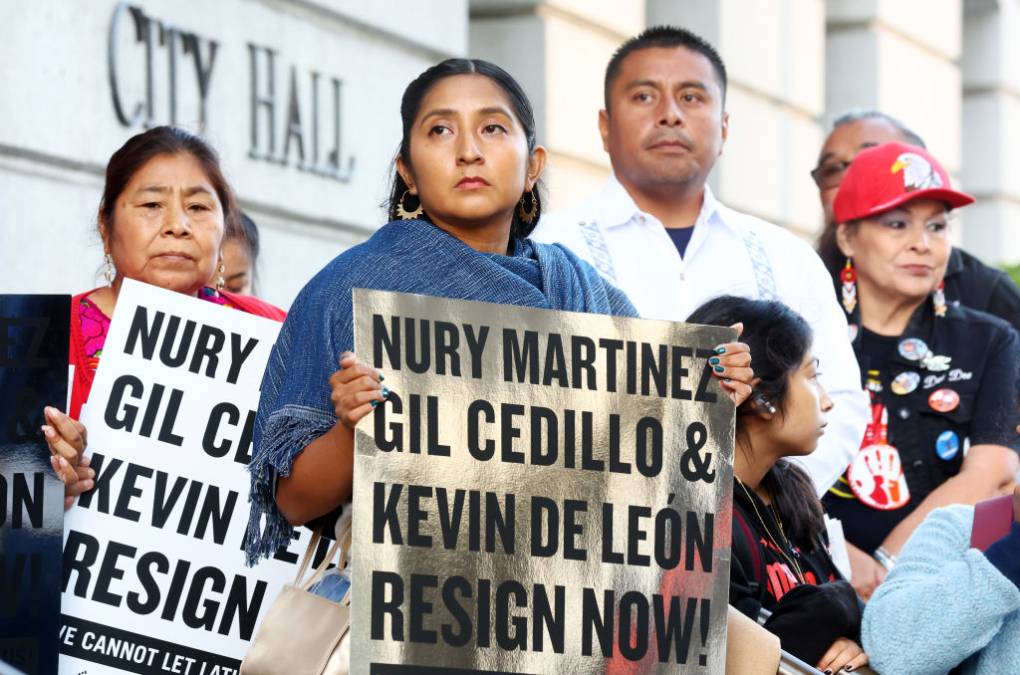
"caption": "Protestors demonstrate outside City Hall calling for the resignations of LA City Council members Kevin de Leon and Gil Cedillo in the wake of a leaked audio recording on Oct. 12.",
"description": null,
"title": "Demonstrators Demand Resignations For L.A. City Council Members After Racists Remarks Caught On Recording",
"credit": "Mario Tama/Getty Images",
"status": "inherit",
"altTag": "A young woman holds a sign that calls for the resignation of two city council members while others stand around her with various signs.",
"isLoading": false,
"fetchFailed": false
},
"news_11928586": {
"type": "attachments",
"id": "news_11928586",
"meta": {
"index": "attachments_1716263798",
"site": "news",
"id": "11928586",
"found": true
},
"parent": 11928579,
"imgSizes": {
"twentyfourteen-full-width": {
"file": "https://ww2.kqed.org/app/uploads/sites/10/2022/10/RS59303_IMG_4466-qut-1038x576.jpg",
"width": 1038,
"mimeType": "image/jpeg",
"height": 576
},
"thumbnail": {
"file": "https://ww2.kqed.org/app/uploads/sites/10/2022/10/RS59303_IMG_4466-qut-160x101.jpg",
"width": 160,
"mimeType": "image/jpeg",
"height": 101
},
"post-thumbnail": {
"file": "https://ww2.kqed.org/app/uploads/sites/10/2022/10/RS59303_IMG_4466-qut-672x372.jpg",
"width": 672,
"mimeType": "image/jpeg",
"height": 372
},
"kqedFullSize": {
"file": "https://ww2.kqed.org/app/uploads/sites/10/2022/10/RS59303_IMG_4466-qut.jpg",
"width": 1920,
"height": 1211
},
"large": {
"file": "https://ww2.kqed.org/app/uploads/sites/10/2022/10/RS59303_IMG_4466-qut-1020x643.jpg",
"width": 1020,
"mimeType": "image/jpeg",
"height": 643
},
"1536x1536": {
"file": "https://ww2.kqed.org/app/uploads/sites/10/2022/10/RS59303_IMG_4466-qut-1536x969.jpg",
"width": 1536,
"mimeType": "image/jpeg",
"height": 969
},
"medium": {
"file": "https://ww2.kqed.org/app/uploads/sites/10/2022/10/RS59303_IMG_4466-qut-800x505.jpg",
"width": 800,
"mimeType": "image/jpeg",
"height": 505
}
},
"publishDate": 1665598320,
"modified": 1665598550,
"caption": "Assemblyman Rudy Salas, a Democrat running for Congress in California's 22nd district, walks in the 2022 Delano Harvest Holidays parade.",
"description": null,
"title": "RS59303_IMG_4466-qut",
"credit": "Marisa Lagos/KQED",
"status": "inherit",
"altTag": null,
"isLoading": false,
"fetchFailed": false
},
"news_11928763": {
"type": "attachments",
"id": "news_11928763",
"meta": {
"index": "attachments_1716263798",
"site": "news",
"id": "11928763",
"found": true
},
"parent": 11928761,
"imgSizes": {
"twentyfourteen-full-width": {
"file": "https://ww2.kqed.org/app/uploads/sites/10/2022/10/RS48086_030_SanFrancisco_NewsomBontaPressConference_03242021-qut-1038x576.jpg",
"width": 1038,
"mimeType": "image/jpeg",
"height": 576
},
"thumbnail": {
"file": "https://ww2.kqed.org/app/uploads/sites/10/2022/10/RS48086_030_SanFrancisco_NewsomBontaPressConference_03242021-qut-160x107.jpg",
"width": 160,
"mimeType": "image/jpeg",
"height": 107
},
"post-thumbnail": {
"file": "https://ww2.kqed.org/app/uploads/sites/10/2022/10/RS48086_030_SanFrancisco_NewsomBontaPressConference_03242021-qut-672x372.jpg",
"width": 672,
"mimeType": "image/jpeg",
"height": 372
},
"kqedFullSize": {
"file": "https://ww2.kqed.org/app/uploads/sites/10/2022/10/RS48086_030_SanFrancisco_NewsomBontaPressConference_03242021-qut.jpg",
"width": 1920,
"height": 1278
},
"large": {
"file": "https://ww2.kqed.org/app/uploads/sites/10/2022/10/RS48086_030_SanFrancisco_NewsomBontaPressConference_03242021-qut-1020x679.jpg",
"width": 1020,
"mimeType": "image/jpeg",
"height": 679
},
"1536x1536": {
"file": "https://ww2.kqed.org/app/uploads/sites/10/2022/10/RS48086_030_SanFrancisco_NewsomBontaPressConference_03242021-qut-1536x1022.jpg",
"width": 1536,
"mimeType": "image/jpeg",
"height": 1022
},
"medium": {
"file": "https://ww2.kqed.org/app/uploads/sites/10/2022/10/RS48086_030_SanFrancisco_NewsomBontaPressConference_03242021-qut-800x533.jpg",
"width": 800,
"mimeType": "image/jpeg",
"height": 533
}
},
"publishDate": 1665695273,
"modified": 1665695413,
"caption": null,
"description": null,
"title": "RS48086_030_SanFrancisco_NewsomBontaPressConference_03242021-qut",
"credit": "Beth LaBerge/KQED",
"status": "inherit",
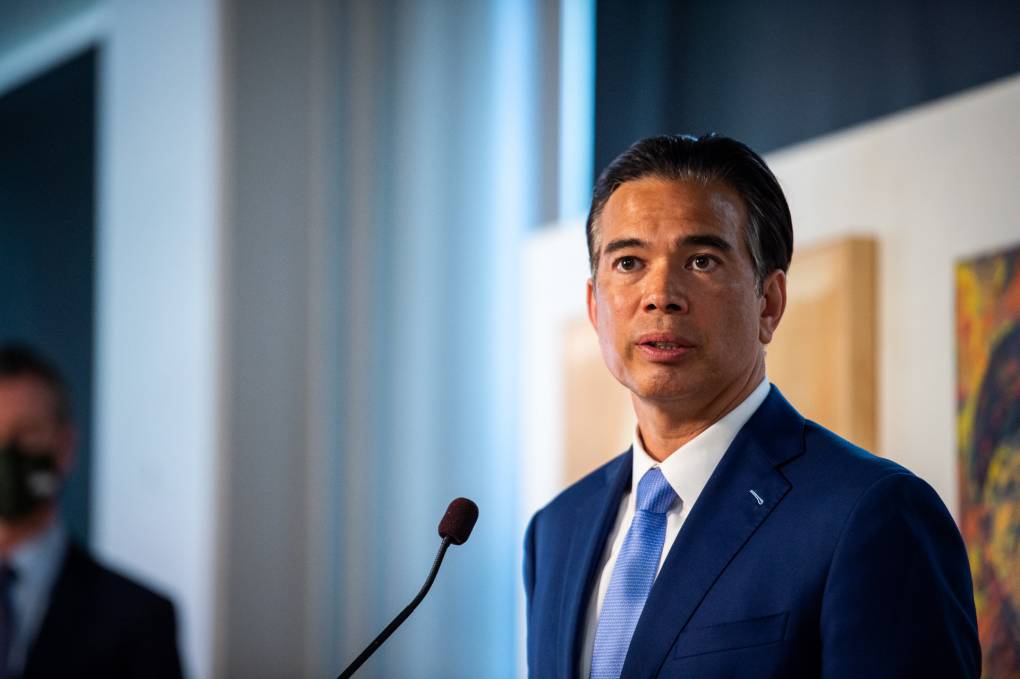
"altTag": "A middle-aged man in a blue suit with a light blue tie speaks into a microphone behind a dais.",
"isLoading": false,
"fetchFailed": false
},
"news_11928680": {
"type": "attachments",
"id": "news_11928680",
"meta": {
"index": "attachments_1716263798",
"site": "news",
"id": "11928680",
"found": true
},
"parent": 11928625,
"imgSizes": {
"thumbnail": {
"file": "https://ww2.kqed.org/app/uploads/sites/10/2022/10/GettyImages-1242826736-160x107.jpg",
"width": 160,
"mimeType": "image/jpeg",
"height": 107
},
"post-thumbnail": {
"file": "https://ww2.kqed.org/app/uploads/sites/10/2022/10/GettyImages-1242826736-594x372.jpg",
"width": 594,
"mimeType": "image/jpeg",
"height": 372
},
"kqedFullSize": {
"file": "https://ww2.kqed.org/app/uploads/sites/10/2022/10/GettyImages-1242826736.jpg",
"width": 594,
"height": 396
}
},
"publishDate": 1665622654,
"modified": 1665667950,
"caption": null,
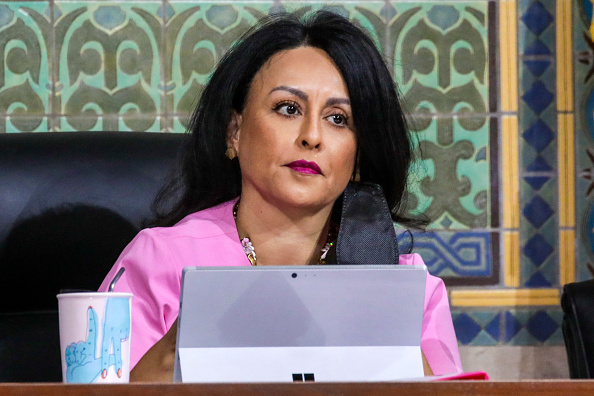
"description": "Former LA City Council President Nury Martinez announced her resignation as council member Wednesday.",
"title": "Heather Hutt appointment as interim council member for the 10th District.",
"credit": "Irfan Khan/Los Angeles Times via Getty Images",
"status": "inherit",
"altTag": "A Latina woman with a pink top sits behind a computer and looks away from the camera.",
"isLoading": false,
"fetchFailed": false
},
"news_11928158": {
"type": "attachments",
"id": "news_11928158",
"meta": {
"index": "attachments_1716263798",
"site": "news",
"id": "11928158",
"found": true
},
"parent": 11928149,
"imgSizes": {
"twentyfourteen-full-width": {
"file": "https://ww2.kqed.org/app/uploads/sites/10/2022/10/RS36032__M6A0599-qut-1038x576.jpg",
"width": 1038,
"mimeType": "image/jpeg",
"height": 576
},
"thumbnail": {
"file": "https://ww2.kqed.org/app/uploads/sites/10/2022/10/RS36032__M6A0599-qut-160x107.jpg",
"width": 160,
"mimeType": "image/jpeg",
"height": 107
},
"post-thumbnail": {
"file": "https://ww2.kqed.org/app/uploads/sites/10/2022/10/RS36032__M6A0599-qut-672x372.jpg",
"width": 672,
"mimeType": "image/jpeg",
"height": 372
},
"kqedFullSize": {
"file": "https://ww2.kqed.org/app/uploads/sites/10/2022/10/RS36032__M6A0599-qut.jpg",
"width": 1920,
"height": 1280
},
"large": {
"file": "https://ww2.kqed.org/app/uploads/sites/10/2022/10/RS36032__M6A0599-qut-1020x680.jpg",
"width": 1020,
"mimeType": "image/jpeg",
"height": 680
},
"1536x1536": {
"file": "https://ww2.kqed.org/app/uploads/sites/10/2022/10/RS36032__M6A0599-qut-1536x1024.jpg",
"width": 1536,
"mimeType": "image/jpeg",
"height": 1024
},
"medium": {
"file": "https://ww2.kqed.org/app/uploads/sites/10/2022/10/RS36032__M6A0599-qut-800x533.jpg",
"width": 800,
"mimeType": "image/jpeg",
"height": 533
}
},
"publishDate": 1665261056,
"modified": 1665435581,
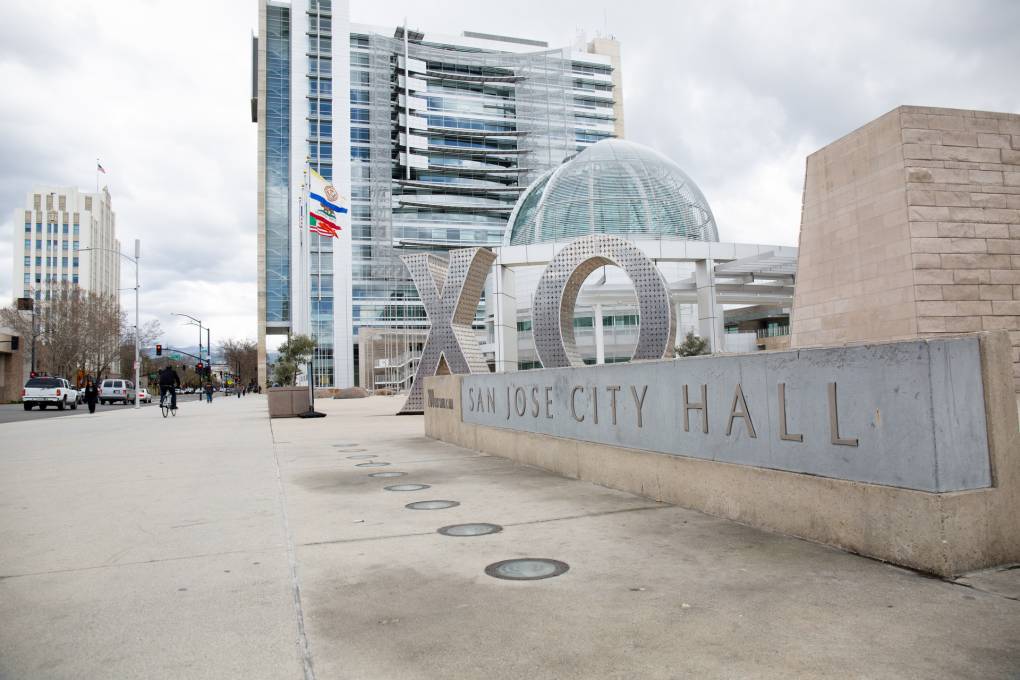
"caption": "The winner of the November 8 runoff faces a short runway to show results. San José's mayor has few powers beyond that of a councilmember, but both Mahan and Chavez feel an urgency to show immediate results.",
"description": null,
"title": "RS36032__M6A0599-qut",
"credit": "Sruti Mamidanna/KQED",
"status": "inherit",
"altTag": "A view of San Jose City Hall, a large modern white 15-story building with a glass dome in the foreground and a sign out front that says \"San Jose City Hall\"",
"isLoading": false,
"fetchFailed": false
},
"news_11928107": {
"type": "attachments",
"id": "news_11928107",
"meta": {
"index": "attachments_1716263798",
"site": "news",
"id": "11928107",
"found": true
},
"parent": 11928031,
"imgSizes": {
"twentyfourteen-full-width": {
"file": "https://ww2.kqed.org/app/uploads/sites/10/2022/10/LITERARY-OAKLAND-SWR-IP-ME-2_frame_23609-1038x576.jpeg",
"width": 1038,
"mimeType": "image/jpeg",
"height": 576
},
"thumbnail": {
"file": "https://ww2.kqed.org/app/uploads/sites/10/2022/10/LITERARY-OAKLAND-SWR-IP-ME-2_frame_23609-160x90.jpeg",
"width": 160,
"mimeType": "image/jpeg",
"height": 90
},
"post-thumbnail": {
"file": "https://ww2.kqed.org/app/uploads/sites/10/2022/10/LITERARY-OAKLAND-SWR-IP-ME-2_frame_23609-672x372.jpeg",
"width": 672,
"mimeType": "image/jpeg",
"height": 372
},
"kqedFullSize": {
"file": "https://ww2.kqed.org/app/uploads/sites/10/2022/10/LITERARY-OAKLAND-SWR-IP-ME-2_frame_23609.jpeg",
"width": 1920,
"height": 1080
},
"large": {
"file": "https://ww2.kqed.org/app/uploads/sites/10/2022/10/LITERARY-OAKLAND-SWR-IP-ME-2_frame_23609-1020x574.jpeg",
"width": 1020,
"mimeType": "image/jpeg",
"height": 574
},
"1536x1536": {
"file": "https://ww2.kqed.org/app/uploads/sites/10/2022/10/LITERARY-OAKLAND-SWR-IP-ME-2_frame_23609-1536x864.jpeg",
"width": 1536,
"mimeType": "image/jpeg",
"height": 864
},
"medium": {
"file": "https://ww2.kqed.org/app/uploads/sites/10/2022/10/LITERARY-OAKLAND-SWR-IP-ME-2_frame_23609-800x450.jpeg",
"width": 800,
"mimeType": "image/jpeg",
"height": 450
}
},
"publishDate": 1665179679,
"modified": 1665179679,
"caption": null,
"description": null,
"title": "LITERARY OAKLAND SWR IP ME-2_frame_23609",
"credit": null,
"status": "inherit",
"altTag": null,
"isLoading": false,
"fetchFailed": false
}
},
"audioPlayerReducer": {
"postId": "stream_live",
"isPaused": true,
"isPlaying": false,
"pfsActive": false,
"pledgeModalIsOpen": true,
"playerDrawerIsOpen": false,
"liveAudioPlayStartedAt": 0,
"liveAudioPlayContext": ""
},
"authorsReducer": {
"byline_news_11928926": {
"type": "authors",
"id": "byline_news_11928926",
"meta": {
"override": true
},
"slug": "byline_news_11928926",
"name": "\u003ca href=\"https://www.npr.org/people/776048102/rachel-treisman\">Rachel Treisman\u003c/a>",
"isLoading": false
},
"byline_news_11928761": {
"type": "authors",
"id": "byline_news_11928761",
"meta": {
"override": true
},
"slug": "byline_news_11928761",
"name": "\u003ca href=\"https://calmatters.org/author/ben-christopher/\">Ben Christopher\u003c/a>",
"isLoading": false
},
"gmarzorati": {
"type": "authors",
"id": "227",
"meta": {
"index": "authors_1716337520",
"id": "227",
"found": true
},
"name": "Guy Marzorati",
"firstName": "Guy",
"lastName": "Marzorati",
"slug": "gmarzorati",
"email": "gmarzorati@KQED.org",
"display_author_email": true,
"staff_mastheads": [
"news"
],
"title": "Correspondent",
"bio": "Guy Marzorati is a correspondent on KQED's California Politics and Government Desk, based in San Jose. A graduate of Santa Clara University, Guy joined KQED in 2013. He reports on state and local politics and produces KQED's digital voter guide.",
"avatar": "https://secure.gravatar.com/avatar/e7038b8dbfd55b104369b76b1cd0b9de?s=600&d=blank&r=g",
"twitter": "guymarzorati",
"facebook": null,
"instagram": null,
"linkedin": null,
"sites": [
{
"site": "",
"roles": [
"editor"
]
},
{
"site": "news",
"roles": [
"editor"
]
},
{
"site": "science",
"roles": [
"editor"
]
},
{
"site": "forum",
"roles": [
"editor"
]
},
{
"site": "elections",
"roles": [
"editor"
]
},
{
"site": "liveblog",
"roles": [
"editor"
]
}
],
"headData": {
"title": "Guy Marzorati | KQED",
"description": "Correspondent",
"ogImgSrc": "https://secure.gravatar.com/avatar/e7038b8dbfd55b104369b76b1cd0b9de?s=600&d=blank&r=g",
"twImgSrc": "https://secure.gravatar.com/avatar/e7038b8dbfd55b104369b76b1cd0b9de?s=600&d=blank&r=g"
},
"isLoading": false,
"link": "/author/gmarzorati"
},
"kqed": {
"type": "authors",
"id": "236",
"meta": {
"index": "authors_1716337520",
"id": "236",
"found": true
},
"name": "KQED News Staff",
"firstName": "KQED News Staff",
"lastName": null,
"slug": "kqed",
"email": "faq@kqed.org",
"display_author_email": false,
"staff_mastheads": [],
"title": null,
"bio": null,
"avatar": "https://secure.gravatar.com/avatar/ef0e801a68c4c54afa9180db14084167?s=600&d=blank&r=g",
"twitter": null,
"facebook": null,
"instagram": null,
"linkedin": null,
"sites": [
{
"site": "arts",
"roles": [
"contributor"
]
},
{
"site": "news",
"roles": [
"editor"
]
},
{
"site": "futureofyou",
"roles": [
"author"
]
}
],
"headData": {
"title": "KQED News Staff | KQED",
"description": null,
"ogImgSrc": "https://secure.gravatar.com/avatar/ef0e801a68c4c54afa9180db14084167?s=600&d=blank&r=g",
"twImgSrc": "https://secure.gravatar.com/avatar/ef0e801a68c4c54afa9180db14084167?s=600&d=blank&r=g"
},
"isLoading": false,
"link": "/author/kqed"
},
"kqednewsstaffandwires": {
"type": "authors",
"id": "237",
"meta": {
"index": "authors_1716337520",
"id": "237",
"found": true
},
"name": "KQED News Staff and Wires",
"firstName": "KQED News Staff and Wires",
"lastName": null,
"slug": "kqednewsstaffandwires",
"email": "onlinenewsstaff@kqed.org",
"display_author_email": false,
"staff_mastheads": [],
"title": null,
"bio": null,
"avatar": "https://secure.gravatar.com/avatar/72295af8ebbfbd19a4948f5271285664?s=600&d=blank&r=g",
"twitter": null,
"facebook": null,
"instagram": null,
"linkedin": null,
"sites": [
{
"site": "arts",
"roles": [
"contributor"
]
},
{
"site": "news",
"roles": [
"contributor"
]
},
{
"site": "lowdown",
"roles": [
"author"
]
},
{
"site": "stateofhealth",
"roles": [
"contributor"
]
},
{
"site": "food",
"roles": [
"author"
]
}
],
"headData": {
"title": "KQED News Staff and Wires | KQED",
"description": null,
"ogImgSrc": "https://secure.gravatar.com/avatar/72295af8ebbfbd19a4948f5271285664?s=600&d=blank&r=g",
"twImgSrc": "https://secure.gravatar.com/avatar/72295af8ebbfbd19a4948f5271285664?s=600&d=blank&r=g"
},
"isLoading": false,
"link": "/author/kqednewsstaffandwires"
},
"scottshafer": {
"type": "authors",
"id": "255",
"meta": {
"index": "authors_1716337520",
"id": "255",
"found": true
},
"name": "Scott Shafer",
"firstName": "Scott",
"lastName": "Shafer",
"slug": "scottshafer",
"email": "sshafer@kqed.org",
"display_author_email": false,
"staff_mastheads": [
"news"
],
"title": "KQED Contributor",
"bio": "Scott Shafer is a senior editor with the KQED Politics and Government desk. He is co-host of Political Breakdown, the award-winning radio show and podcast with a personal take on the world of politics. Scott came to KQED in 1998 to host the statewide\u003cem> California Report\u003c/em>. Prior to that he had extended stints in politics and government\u003cem>.\u003c/em> He uses that inside experience at KQED in his, reporting, hosting and analysis for the politics desk. Scott collaborated \u003cem>Political Breakdown a\u003c/em>nd on \u003cem>The Political Mind of Jerry Brown, \u003c/em>an eight-part series about the life and extraordinary political career of the former governor. For fun, he plays water polo with the San Francisco Tsunami.",
"avatar": "https://secure.gravatar.com/avatar/a62ebae45b79d7aed1a39a0e3bf68104?s=600&d=blank&r=g",
"twitter": "scottshafer",
"bluesky": null,
"facebook": null,
"instagram": null,
"linkedin": null,
"sites": [
{
"site": "news",
"roles": [
"editor"
]
},
{
"site": "stateofhealth",
"roles": [
"author"
]
},
{
"site": "science",
"roles": [
"author"
]
},
{
"site": "forum",
"roles": [
"subscriber"
]
},
{
"site": "liveblog",
"roles": [
"author"
]
}
],
"headData": {
"title": "Scott Shafer | KQED",
"description": "KQED Contributor",
"ogImgSrc": "https://secure.gravatar.com/avatar/a62ebae45b79d7aed1a39a0e3bf68104?s=600&d=blank&r=g",
"twImgSrc": "https://secure.gravatar.com/avatar/a62ebae45b79d7aed1a39a0e3bf68104?s=600&d=blank&r=g"
},
"isLoading": false,
"link": "/author/scottshafer"
},
"tychehendricks": {
"type": "authors",
"id": "259",
"meta": {
"index": "authors_1716337520",
"id": "259",
"found": true
},
"name": "Tyche Hendricks",
"firstName": "Tyche",
"lastName": "Hendricks",
"slug": "tychehendricks",
"email": "thendricks@kqed.org",
"display_author_email": true,
"staff_mastheads": [
"news"
],
"title": "KQED Senior Editor, Immigration",
"bio": "\u003cspan style=\"font-weight: 400;\">Tyche Hendricks is KQED’s senior editor for immigration, leading coverage of the policy and politics that affect California’s immigrant communities. Her work for KQED’s radio and online audiences is also carried on NPR and other national outlets. She has been recognized with awards from the Radio and Television News Directors Association, the Society for Professional Journalists; the Education Writers Association; the Best of the West and the National Federation of Community Broadcasters. Before joining KQED in 2010, Tyche spent more than a dozen years as a newspaper reporter, notably at the \u003c/span>\u003ci>\u003cspan style=\"font-weight: 400;\">San Francisco Chronicle\u003c/span>\u003c/i>\u003cspan style=\"font-weight: 400;\">. At different times she has covered criminal justice, government and politics and urban planning. Tyche has taught in the MFA Creative Writing program at the University of San Francisco and at UC Berkeley’s Graduate School of Journalism, where she was co-director of a national immigration symposium for professional journalists. She is the author of \u003c/span>\u003ci>\u003cspan style=\"font-weight: 400;\">The Wind Doesn't Need a Passport: Stories from the U.S.-Mexico Borderlands\u003c/span>\u003c/i>\u003cspan style=\"font-weight: 400;\"> (University of California Press). \u003c/span>",
"avatar": "https://secure.gravatar.com/avatar/b8ee458e2731c2d43df86882ce17267e?s=600&d=blank&r=g",
"twitter": "tychehendricks",
"facebook": null,
"instagram": null,
"linkedin": null,
"sites": [
{
"site": "news",
"roles": [
"editor"
]
},
{
"site": "stateofhealth",
"roles": [
"editor"
]
}
],
"headData": {
"title": "Tyche Hendricks | KQED",
"description": "KQED Senior Editor, Immigration",
"ogImgSrc": "https://secure.gravatar.com/avatar/b8ee458e2731c2d43df86882ce17267e?s=600&d=blank&r=g",
"twImgSrc": "https://secure.gravatar.com/avatar/b8ee458e2731c2d43df86882ce17267e?s=600&d=blank&r=g"
},
"isLoading": false,
"link": "/author/tychehendricks"
},
"mlagos": {
"type": "authors",
"id": "3239",
"meta": {
"index": "authors_1716337520",
"id": "3239",
"found": true
},
"name": "Marisa Lagos",
"firstName": "Marisa",
"lastName": "Lagos",
"slug": "mlagos",
"email": "mlagos@kqed.org",
"display_author_email": false,
"staff_mastheads": [
"news"
],
"title": "KQED Contributor",
"bio": "Marisa Lagos is a correspondent for KQED’s California Politics and Government Desk and co-hosts the award-winning show and podcast, Political Breakdown. At KQED, Lagos also conducts reporting, analysis and investigations into state, local and national politics for radio, TV, online and onstage. In 2022, she and co-host, Scott Shafer, moderated the only gubernatorial debate in California. In 2020, the \u003ci>Washington Post\u003c/i> named her one of the top political journalists in California; she was nominated for a Peabody and won several other awards for her work investigating the 2017 California wildfires. She has worked at the \u003ci>San Francisco Chronicle\u003c/i>, \u003ci>San Francisco Examiner\u003c/i> and \u003ci>Los Angeles Times\u003c/i>. A UC Santa Barbara graduate, she lives in San Francisco with her two sons and husband.",
"avatar": "https://secure.gravatar.com/avatar/a261a0d3696fc066871ef96b85b5e7d2?s=600&d=blank&r=g",
"twitter": "@mlagos",
"facebook": null,
"instagram": null,
"linkedin": null,
"sites": [
{
"site": "arts",
"roles": [
"author"
]
},
{
"site": "news",
"roles": [
"editor"
]
},
{
"site": "science",
"roles": [
"editor"
]
},
{
"site": "forum",
"roles": [
"author"
]
},
{
"site": "liveblog",
"roles": [
"author"
]
}
],
"headData": {
"title": "Marisa Lagos | KQED",
"description": "KQED Contributor",
"ogImgSrc": "https://secure.gravatar.com/avatar/a261a0d3696fc066871ef96b85b5e7d2?s=600&d=blank&r=g",
"twImgSrc": "https://secure.gravatar.com/avatar/a261a0d3696fc066871ef96b85b5e7d2?s=600&d=blank&r=g"
},
"isLoading": false,
"link": "/author/mlagos"
},
"kevinstark": {
"type": "authors",
"id": "11608",
"meta": {
"index": "authors_1716337520",
"id": "11608",
"found": true
},
"name": "Kevin Stark",
"firstName": "Kevin",
"lastName": "Stark",
"slug": "kevinstark",
"email": "kstark@kqed.org",
"display_author_email": true,
"staff_mastheads": [
"science"
],
"title": "Senior Editor",
"bio": "Kevin is a senior editor for KQED Science, managing the station's health and climate desks. His journalism career began in the Pacific Northwest, and he later became a lead reporter for the San Francisco Public Press. His work has appeared in Pacific Standard magazine, the Energy News Network, the Center for Investigative Reporting's Reveal and WBEZ in Chicago. Kevin joined KQED in 2019, and has covered issues related to energy, wildfire, climate change and the environment.",
"avatar": "https://secure.gravatar.com/avatar/1f646bf546a63d638e04ff23b52b0e79?s=600&d=blank&r=g",
"twitter": "starkkev",
"facebook": null,
"instagram": null,
"linkedin": null,
"sites": [
{
"site": "",
"roles": [
"editor"
]
},
{
"site": "news",
"roles": [
"editor"
]
},
{
"site": "science",
"roles": [
"administrator"
]
}
],
"headData": {
"title": "Kevin Stark | KQED",
"description": "Senior Editor",
"ogImgSrc": "https://secure.gravatar.com/avatar/1f646bf546a63d638e04ff23b52b0e79?s=600&d=blank&r=g",
"twImgSrc": "https://secure.gravatar.com/avatar/1f646bf546a63d638e04ff23b52b0e79?s=600&d=blank&r=g"
},
"isLoading": false,
"link": "/author/kevinstark"
},
"ebaldassari": {
"type": "authors",
"id": "11652",
"meta": {
"index": "authors_1716337520",
"id": "11652",
"found": true
},
"name": "Erin Baldassari",
"firstName": "Erin",
"lastName": "Baldassari",
"slug": "ebaldassari",
"email": "ebaldassari@KQED.org",
"display_author_email": true,
"staff_mastheads": [
"news"
],
"title": "Staff Writer",
"bio": "Erin Baldassari covers housing for KQED. She's a former print journalist and most recently worked as the transportation reporter for the \u003cem>Mercury News\u003c/em> and \u003cem>East Bay Times. \u003c/em>There, she focused on how the Bay Area’s housing shortage has changed the way people move around the region. She also served on the \u003cem>East Bay Times\u003c/em>’ 2017 Pulitzer Prize-winning team for coverage of the Ghost Ship Fire in Oakland. Prior to that, Erin worked as a breaking news and general assignment reporter for a variety of outlets in the Bay Area and the greater Boston area. A Tufts University alumna, Erin grew up in the foothills of the Sierra Nevada mountains and in Sonoma County. She is a life-long KQED listener.",
"avatar": "https://secure.gravatar.com/avatar/660ce35d088ca54ad606d7e941abc652?s=600&d=mm&r=g",
"twitter": "e_baldi",
"facebook": null,
"instagram": null,
"linkedin": null,
"sites": [
{
"site": "news",
"roles": [
"edit_others_posts",
"editor"
]
},
{
"site": "science",
"roles": [
"editor"
]
},
{
"site": "liveblog",
"roles": [
"editor"
]
}
],
"headData": {
"title": "Erin Baldassari | KQED",
"description": "Staff Writer",
"ogImgSrc": "https://secure.gravatar.com/avatar/660ce35d088ca54ad606d7e941abc652?s=600&d=mm&r=g",
"twImgSrc": "https://secure.gravatar.com/avatar/660ce35d088ca54ad606d7e941abc652?s=600&d=mm&r=g"
},
"isLoading": false,
"link": "/author/ebaldassari"
},
"jrodriguez": {
"type": "authors",
"id": "11690",
"meta": {
"index": "authors_1716337520",
"id": "11690",
"found": true
},
"name": "Joe Fitzgerald Rodriguez",
"firstName": "Joe",
"lastName": "Fitzgerald Rodriguez",
"slug": "jrodriguez",
"email": "jrodriguez@kqed.org",
"display_author_email": true,
"staff_mastheads": [
"news"
],
"title": "Reporter and Producer",
"bio": "Joe Fitzgerald Rodriguez is a reporter and digital producer for KQED covering politics. Joe most recently wrote for the \u003cem>San Francisco Examiner\u003c/em> as a political columnist covering The City. He was raised in San Francisco and has spent his reporting career in his beloved, foggy, city by the bay. Joe was 12-years-old when he conducted his first interview in journalism, grilling former San Francisco Mayor Willie Brown for the Marina Middle School newspaper, \u003cem>The Penguin Press, \u003c/em>and he continues to report on the San Francisco Bay Area to this day.",
"avatar": "https://secure.gravatar.com/avatar/2247beb0564c1e9c62228d5649d2edac?s=600&d=blank&r=g",
"twitter": "FitztheReporter",
"facebook": null,
"instagram": "https://www.instagram.com/fitzthereporter/",
"linkedin": null,
"sites": [
{
"site": "",
"roles": [
"editor"
]
},
{
"site": "arts",
"roles": [
"editor"
]
},
{
"site": "news",
"roles": [
"editor"
]
},
{
"site": "science",
"roles": [
"editor"
]
},
{
"site": "elections",
"roles": [
"editor"
]
},
{
"site": "liveblog",
"roles": [
"editor"
]
}
],
"headData": {
"title": "Joe Fitzgerald Rodriguez | KQED",
"description": "Reporter and Producer",
"ogImgSrc": "https://secure.gravatar.com/avatar/2247beb0564c1e9c62228d5649d2edac?s=600&d=blank&r=g",
"twImgSrc": "https://secure.gravatar.com/avatar/2247beb0564c1e9c62228d5649d2edac?s=600&d=blank&r=g"
},
"isLoading": false,
"link": "/author/jrodriguez"
}
},
"pagesReducer": {
"news_tag_politics": {
"type": "terms",
"id": "news_17968",
"meta": {
"index": "terms_1716263798",
"site": "news",
"id": "17968",
"score": 8.003286
},
"name": "Politics",
"slug": "politics",
"taxonomy": "tag",
"description": null,
"featImg": null,
"headData": {
"title": "Politics | KQED News",
"description": null,
"ogTitle": null,
"ogDescription": null,
"ogImgId": null,
"twTitle": null,
"twDescription": null,
"twImgId": null
},
"ttid": 18002,
"isLoading": false,
"title": "Politics",
"pageMeta": {
"site": "news",
"WpPageTemplate": "page-topic-editorial",
"currentPage": 168
},
"blocks": [
{
"blockName": "kqed/post-list",
"attrs": {
"layout": "cardArticle2",
"query": "posts/news?tag=politics",
"seeMore": false,
"paginated": true,
"page": 168
}
},
{
"blockName": "kqed/ad"
}
]
}
},
"pfsSessionReducer": {},
"postsReducer": {
"stream_live": {
"type": "live",
"id": "stream_live",
"audioUrl": "https://streams.kqed.org/kqedradio",
"title": "Live Stream",
"excerpt": "Live Stream information currently unavailable.",
"link": "/radio",
"featImg": "",
"label": {
"name": "KQED Live",
"link": "/"
}
},
"stream_kqedNewscast": {
"type": "posts",
"id": "stream_kqedNewscast",
"audioUrl": "https://www.kqed.org/.stream/anon/radio/RDnews/newscast.mp3?_=1",
"title": "KQED Newscast",
"featImg": "",
"label": {
"name": "88.5 FM",
"link": "/"
}
},
"news_11929505": {
"type": "posts",
"id": "news_11929505",
"meta": {
"index": "posts_1716263798",
"site": "news",
"id": "11929505",
"score": null,
"sort": [
1666285200000
]
},
"guestAuthors": [],
"slug": "from-menlo-park-to-laguna-beach-residents-turn-to-ballot-box-to-fight-new-california-housing-mandates",
"title": "From Menlo Park to Laguna Beach, Residents Turn to Ballot Box to Fight New California Housing Mandates",
"publishDate": 1666285200,
"format": "standard",
"headTitle": "From Menlo Park to Laguna Beach, Residents Turn to Ballot Box to Fight New California Housing Mandates | KQED",
"labelTerm": {
"site": "news"
},
"content": "\u003cp>Suburban Park lives up to its bucolic name. The trees are leafy. The lawns are manicured. School-age children glide by on push scooters and bounce basketballs on sun-dappled sidewalks.\u003c/p>\n\u003cp>And it’s here, amid the nearly \u003ca href=\"https://www.redfin.com/neighborhood/9706/CA/Menlo-Park/Suburban-Park-Lorelei-Manr-Flood-Park-Triangle/housing-market\">$2 million single-family homes\u003c/a> in this Menlo Park neighborhood, that a new battleground has emerged in the fight to preserve what some still consider an American ideal: one home for every lot.\u003c/p>\n\u003cp>Outside every fifth house or so are green lawn signs proclaiming “Yes on V,” in support of a \u003ca href=\"https://beta.menlopark.org/Government/Departments/City-Managers-Office/City-Clerk/Elections/November-8-2022-General-Election/Measure-V\">ballot measure\u003c/a> that would make it harder to build apartments throughout the city. The measure would require a vote for any changes to what can be built — but only in single-family neighborhoods.[pullquote size=\"medium\" align=\"right\" citation=\"Chris Elmendorf, law professor, UC Davis\"]‘The state housing agency is no longer treating housing element approvals as a one-and-done proposition.’[/pullquote]\u003c/p>\n\u003cp>“We have no choice,” said Nicole Chessari, a Suburban Park homeowner who is co-leading the Yes on Measure V campaign. “No one was listening to us.”\u003c/p>\n\u003cp>Californians opposed to new development in their neighborhoods have long had local elected leaders on their side. But their power to say no is waning. Faced with a massive housing shortage, state leaders over the past half-dozen years have approved a bevy of new laws to override opposition to new housing and have become more willing to take recalcitrant cities to court.\u003c/p>\n\u003cp>There are new laws to permit backyard apartments, allow duplexes on single-family lots, convert offices and big-box stores to housing and prohibit parking requirements near transit. Central to these changes are new mandates for cities to not only plan for more housing but to do so in a way that reverses racial segregation.\u003c/p>\n\u003cp>So, residents in some California cities are firing back. From Menlo Park to \u003ca href=\"https://www.votescount.us/Home/Elections/November2022CaliforniaGeneralElection/LocalMeasuresNovember2022/S-WATFuture.aspx\">Watsonville\u003c/a> and \u003ca href=\"https://www.lagunabeachindy.com/laguna-residents-form-new-pac-against-measure-q/\">Laguna Beach\u003c/a>, they’re hoping to rely on another time-tested tradition: using the ballot box to restrict growth.\u003c/p>\n\u003ch2>A case study\u003c/h2>\n\u003cp>Menlo Park’s Measure V arose to contest one specific project: ninety units of affordable housing with priority for teachers and staff of the Ravenswood City School District in Suburban Park.\u003c/p>\n\u003cp>The concrete lot is now overrun with weeds. But it was once home to the James Flood Elementary School, which closed in 2011 due to dwindling enrollment. Ravenswood district staff have been searching for a way to reuse the parcel — and generate income for the district — ever since, said William Eger, chief business officer for the district.\u003c/p>\n\u003cp>“When I arrived a couple years ago, the district was in the process of analyzing our overall district footprint, thinking about, ‘How do we address some of these funding inequities?’” Eger said. “How can we use some of the assets we have, including our physical assets, the land that we own, in order to provide for our staff to afford to live in the area?”[aside postID=\"news_11927941,news_11927063,news_11924697\" label=\"Related Posts\"]In January, the district’s board took a step toward building teacher housing on the former school site, when it voted unanimously to enter into \u003ca href=\"https://paloaltoonline.com/news/2022/01/24/developers-propose-affordable-housing-lab-offices-on-ravenswood-land\">an exclusive negotiating agreement\u003c/a> with a developer. And it was around that time that Chessari and her neighbors caught wind of the plan.\u003c/p>\n\u003cp>“When we heard that they wanted to build new housing on [the site], we were actually very excited about that,” she said. “But then we heard the volume, and were like, ‘Whoa, that’s going to transform the neighborhood into a thoroughfare and totally change it and make it unsafe for our kids.’”\u003c/p>\n\u003cfigure id=\"attachment_11929535\" class=\"wp-caption aligncenter\" style=\"max-width: 1920px\">\u003ca href=\"https://ww2.kqed.org/app/uploads/sites/10/2022/10/RS59454_Menlo-Park-Measure-V_07-qut.jpg\">\u003cimg loading=\"lazy\" decoding=\"async\" class=\"wp-image-11929535 size-full\" src=\"https://ww2.kqed.org/app/uploads/sites/10/2022/10/RS59454_Menlo-Park-Measure-V_07-qut.jpg\" alt=\"An outside view stowing a road, trees and house in the distance.\" width=\"1920\" height=\"1280\" srcset=\"https://cdn.kqed.org/wp-content/uploads/sites/10/2022/10/RS59454_Menlo-Park-Measure-V_07-qut.jpg 1920w, https://cdn.kqed.org/wp-content/uploads/sites/10/2022/10/RS59454_Menlo-Park-Measure-V_07-qut-800x533.jpg 800w, https://cdn.kqed.org/wp-content/uploads/sites/10/2022/10/RS59454_Menlo-Park-Measure-V_07-qut-1020x680.jpg 1020w, https://cdn.kqed.org/wp-content/uploads/sites/10/2022/10/RS59454_Menlo-Park-Measure-V_07-qut-160x107.jpg 160w, https://cdn.kqed.org/wp-content/uploads/sites/10/2022/10/RS59454_Menlo-Park-Measure-V_07-qut-1536x1024.jpg 1536w\" sizes=\"(max-width: 1920px) 100vw, 1920px\">\u003c/a>\u003cfigcaption class=\"wp-caption-text\">The site of the former James Flood Elementary School in Menlo Park on Thursday, Sept., 29, 2022. which the Ravenswood City School District has proposed to repurpose as affordable teacher housing, but a proposed ballot initiative, called Measure V, may delay or even potentially block the project. \u003ccite>(Erin Baldassari/KQED)\u003c/cite>\u003c/figcaption>\u003c/figure>\n\u003cp>The former school property is flanked on two sides by Suburban Park and rows of single-family homes. To the east is Highway 101, and to the west is Flood Park, a green space with a baseball diamond and picnic tables.\u003c/p>\n\u003cp>When the school was open, traffic flowed through the park. But in early discussions about housing on the site, the district contemplated routing traffic through the neighborhood instead.\u003c/p>\n\u003cp>What followed was several months of negotiations among some Suburban Park residents, district staff and city council members. Chessari said neighbors opposed to the district’s plans ultimately had three demands: reduce the number of housing units from 90 to 60; guarantee — as opposed to prioritize — 50% of the units would be used for Ravenswood staff; and provide a second egress.\u003c/p>\n\u003cp>She and some residents met with four of the city’s five council members but failed to reach an agreement.\u003c/p>\n\u003cp>[ad fullwidth]\u003c/p>\n\u003cp>If the council didn’t have her and her supporters’ interests in mind, then Chessari thought residents should be able to voice their concerns directly. So, she started gathering signatures for a ballot measure.\u003c/p>\n\u003cp>That way, she said, anytime developers propose projects in single-family neighborhoods across Menlo Park, residents would be able to weigh in. Nearly \u003ca href=\"https://drive.google.com/file/d/1K57fbpE9qWxsTM-gcXktsQLtK5disgx-/view\">80% of the city’s residential land\u003c/a> is zoned for single-family housing.\u003c/p>\n\u003cp>“After seeing what happened in our [neighborhood], it was kind of a case study,” Chessari said. “This can and will happen citywide.”\u003c/p>\n\u003ch2>Will it work?\u003c/h2>\n\u003cp>Since the 1970s, citizen-initiated ballot measures have been a favorite tool to thwart development in California. According to a 2004 doctoral dissertation by Mai Thi Nguyen at UC Irvine, there were more than \u003ca href=\"https://ww2.kqed.org/app/uploads/sites/10/2022/10/2004-Mai-Thi-Nguyen-dissertation.pdf\">140 such measures to control growth approved between 1986 and 1999 (PDF)\u003c/a>, though not all of them were aimed specifically at housing.\u003c/p>\n\u003cp>Those measures, however, have become increasingly at odds with changes to state law, said Chris Elmendorf, law professor at UC Davis.\u003c/p>\n\u003cp>“Ten years ago, this strategy … would have seemed pretty clever,” he said. “But I don’t think it’s necessarily so clever or effective now.”\u003c/p>\n\u003cp>Every eight years, cities produce housing element reports showing how they will rezone areas to meet state-mandated housing goals and — new for this cycle — reduce residential segregation. Local leaders have long written these reports only later to ignore them without consequence.\u003c/p>\n\u003cp>But that’s changed as state leaders have become more willing to hold cities accountable, Elmendorf said.\u003c/p>\n\u003cp>“The state housing agency is no longer treating housing element approvals as a one-and-done proposition,” he said. “It is instead treating the housing elements as an eight-year contract between the state and the city over things the city will do, including rezoning.”\u003c/p>\n\u003cfigure id=\"attachment_11929534\" class=\"wp-caption aligncenter\" style=\"max-width: 1920px\">\u003ca href=\"https://ww2.kqed.org/app/uploads/sites/10/2022/10/RS59450_Menlo-Park-Measure-V_03-qut.jpg\">\u003cimg loading=\"lazy\" decoding=\"async\" class=\"wp-image-11929534 size-full\" src=\"https://ww2.kqed.org/app/uploads/sites/10/2022/10/RS59450_Menlo-Park-Measure-V_03-qut.jpg\" alt=\"A woman wearing a light tank top shirt and blue jeans sits in a chair outside.\" width=\"1920\" height=\"1280\" srcset=\"https://cdn.kqed.org/wp-content/uploads/sites/10/2022/10/RS59450_Menlo-Park-Measure-V_03-qut.jpg 1920w, https://cdn.kqed.org/wp-content/uploads/sites/10/2022/10/RS59450_Menlo-Park-Measure-V_03-qut-800x533.jpg 800w, https://cdn.kqed.org/wp-content/uploads/sites/10/2022/10/RS59450_Menlo-Park-Measure-V_03-qut-1020x680.jpg 1020w, https://cdn.kqed.org/wp-content/uploads/sites/10/2022/10/RS59450_Menlo-Park-Measure-V_03-qut-160x107.jpg 160w, https://cdn.kqed.org/wp-content/uploads/sites/10/2022/10/RS59450_Menlo-Park-Measure-V_03-qut-1536x1024.jpg 1536w\" sizes=\"(max-width: 1920px) 100vw, 1920px\">\u003c/a>\u003cfigcaption class=\"wp-caption-text\">Suburban Park homeowner Nicole Chessari poses for a portrait at her home on Thursday, Sept. 29, 2022. Chessari is co-leading the Yes on Measure V campaign, a ballot initiative that would require a citywide vote to add apartments in single-family neighborhoods throughout Menlo Park. \u003ccite>(Erin Baldassari/KQED)\u003c/cite>\u003c/figcaption>\u003c/figure>\n\u003cp>In Menlo Park, city leaders included plans to rezone the Flood school to allow for 90 affordable housing units in its \u003ca href=\"https://beta.menlopark.org/files/sharedassets/public/community-development/documents/projects/housing-element-update/menlo-park-2023-2031-housing-element-primary-hcd-review-draft.pdf\">draft housing element\u003c/a>. Once a property is rezoned, new state laws prohibit the city from reducing the number of allowed housing units or requiring onerous conditions, like a second road, that might make the project financially infeasible.\u003c/p>\n\u003cp>Then, Chessari said, “It’s out of everybody’s hands. The city has very, very limited ability to control the project.”\u003c/p>\n\u003cp>There are also real consequences now for cities that fail to present housing plans that meet the state’s requirements. When that happens, they may lose control over what gets built there altogether.\u003c/p>\n\u003cp>Such is the case in Redondo Beach, where a developer in August proposed a \u003ca href=\"https://reason.com/2022/09/09/this-renegade-california-developer-wants-to-build-a-2300-unit-megaproject-in-a-nimby-stronghold/\">massive, 2,300-unit housing project\u003c/a> at the site of a defunct power plant, while the city was out of compliance.\u003c/p>\n\u003cp>“As long as that housing element is not compliant, people can come in and build some pretty dense housing,” said Michael Manville, associate professor of urban planning at the UCLA Luskin School of Public Affairs.\u003c/p>\n\u003cp>So, some cities have been ignoring their own voters’ ballot measures if they limit the amount of housing needed to satisfy the state.\u003c/p>\n\u003cp>In Alameda, for instance, residents voted in 1973 to prohibit apartment buildings across the island town. A second measure in 1991 capped densities to one home for every 2,000-square-foot lot.\u003c/p>\n\u003cp>Facing a mandate for 5,353 new housing units, city officials are \u003ca href=\"https://alamedapost.com/news/general-plan-and-draft-housing-element-update-debated/\">overriding those initiatives\u003c/a>, which state officials have called “\u003ca href=\"https://www.hcd.ca.gov/community-development/housing-element/docs/alaalamedacity-ta-112921.pdf\">preempted and unenforceable\u003c/a>,” in their draft housing element.\u003c/p>\n\u003cfigure id=\"attachment_11929536\" class=\"wp-caption aligncenter\" style=\"max-width: 2560px\">\u003ca href=\"https://ww2.kqed.org/app/uploads/sites/10/2022/10/RS59455_Menlo-Park-Measure-V_08-scaled.jpg\">\u003cimg loading=\"lazy\" decoding=\"async\" class=\"wp-image-11929536 size-full\" src=\"https://ww2.kqed.org/app/uploads/sites/10/2022/10/RS59455_Menlo-Park-Measure-V_08-scaled.jpg\" alt='An outdoor view with a green lawn sign and a large brown sign that reads \"Suburban Park.\"' width=\"2560\" height=\"1707\" srcset=\"https://cdn.kqed.org/wp-content/uploads/sites/10/2022/10/RS59455_Menlo-Park-Measure-V_08-scaled.jpg 2560w, https://cdn.kqed.org/wp-content/uploads/sites/10/2022/10/RS59455_Menlo-Park-Measure-V_08-800x533.jpg 800w, https://cdn.kqed.org/wp-content/uploads/sites/10/2022/10/RS59455_Menlo-Park-Measure-V_08-1020x680.jpg 1020w, https://cdn.kqed.org/wp-content/uploads/sites/10/2022/10/RS59455_Menlo-Park-Measure-V_08-160x107.jpg 160w, https://cdn.kqed.org/wp-content/uploads/sites/10/2022/10/RS59455_Menlo-Park-Measure-V_08-1536x1024.jpg 1536w, https://cdn.kqed.org/wp-content/uploads/sites/10/2022/10/RS59455_Menlo-Park-Measure-V_08-2048x1365.jpg 2048w, https://cdn.kqed.org/wp-content/uploads/sites/10/2022/10/RS59455_Menlo-Park-Measure-V_08-1920x1280.jpg 1920w\" sizes=\"(max-width: 2560px) 100vw, 2560px\">\u003c/a>\u003cfigcaption class=\"wp-caption-text\">A lawn sign supporting Measure V stands in front of the entrance to Suburban Park on Thursday, Sept. 29, 2022. The ballot initiative would require a citywide vote to add apartments in single-family neighborhoods throughout Menlo Park. \u003ccite>(Erin Baldassari/KQED)\u003c/cite>\u003c/figcaption>\u003c/figure>\n\u003cp>In the Southern California city of Encinitas, voters need to approve any major changes to what can be built there. City leaders have twice put the entire housing element to a vote only to have residents reject it. So, a judge allowed local leaders to ignore the voters.\u003c/p>\n\u003cp>Elmendorf said the lesson there is that while voter initiatives can clog up — or at least delay — the process for cities to rezone for more housing, they can’t override state law.\u003c/p>\n\u003cp>“There is no authority of the voters of Encinitas or Menlo Park or any other city to do through direct democracy something that the city council cannot do,” Elmendorf said. “Voters can’t exempt themselves from that law by passing a ballot measure.”\u003c/p>\n\u003cp>The question in Menlo Park is whether Measure V will prevent the city from meeting new obligations under the housing element to \u003ca href=\"https://www.hcd.ca.gov/community-development/affh/docs/affh_document_final_4-27-2021.pdf\">undo racial segregation\u003c/a> by requiring cities to site affordable housing in more affluent neighborhoods.\u003c/p>\n\u003ch2>‘Who are we really?’\u003c/h2>\n\u003cp>For many of the opponents of Menlo Park’s Measure V, the ballot initiative is not simply about limiting apartments in single-family neighborhoods: It’s also about whether the city will continue policies that have disproportionately harmed residents of color.\u003c/p>\n\u003cfigure id=\"attachment_11929520\" class=\"wp-caption alignright\" style=\"max-width: 160px\">\u003ca href=\"https://ww2.kqed.org/app/uploads/sites/10/2022/10/Palo-Alto-Daily-Times-Aug-10-1955-Belle-Haven-is-gone.jpg\">\u003cimg loading=\"lazy\" decoding=\"async\" class=\"wp-image-11929520 size-thumbnail\" src=\"https://ww2.kqed.org/app/uploads/sites/10/2022/10/Palo-Alto-Daily-Times-Aug-10-1955-Belle-Haven-is-gone-160x349.jpg\" alt=\"A black and white image of an old news article.\" width=\"160\" height=\"349\" srcset=\"https://cdn.kqed.org/wp-content/uploads/sites/10/2022/10/Palo-Alto-Daily-Times-Aug-10-1955-Belle-Haven-is-gone-160x349.jpg 160w, https://cdn.kqed.org/wp-content/uploads/sites/10/2022/10/Palo-Alto-Daily-Times-Aug-10-1955-Belle-Haven-is-gone.jpg 372w\" sizes=\"(max-width: 160px) 100vw, 160px\">\u003c/a>\u003cfigcaption class=\"wp-caption-text\">An excerpt from the Daily Palo Alto Times describing ‘blockbusting’ in Belle Haven, a real estate practice to scare white homeowners into selling their properties to encourage segregation, on Aug. 10, 1955. \u003ccite>(Courtesy of Pam Jones)\u003c/cite>\u003c/figcaption>\u003c/figure>\n\u003cp>Suburban Park was first established in the 1920s and grew during the post-WWII housing boom. In 1949, Menlo Park annexed it, along with the Belle Haven neighborhood directly to its east. At the time, both were mostly white neighborhoods.\u003c/p>\n\u003cp>But while \u003ca href=\"https://ww2.kqed.org/app/uploads/sites/10/2022/10/Margarita-Mendez-Deed.jpg\">Suburban Park was subject to racial covenants that barred Black residents\u003c/a> and other people of color from living there, Belle Haven became a predominantly Black neighborhood.\u003c/p>\n\u003cp>Real estate agents \u003ca href=\"https://babel.hathitrust.org/cgi/pt?id=mdp.39015018404650&view=1up&seq=510&q1=%22Menlo%20Park%22\">actively recruited\u003c/a> Black homeowners to Belle Haven in a process known as racial steering, and then tried to \u003ca href=\"https://www.menlotogether.org/wp-content/uploads/2021/02/MPCSD-Slides-Color-of-Law.pdf\">scare white homeowners\u003c/a> into selling their properties, a practice called blockbusting.\u003c/p>\n\u003cp>Belle Haven is separated from Suburban Park and the rest of the city by the Bayshore Highway, which was widened in 1956 to \u003ca href=\"http://libraryarchives.metro.net/DPGTL/Californiahighways/chpw_1959_marapr.pdf#page=8\">become Highway 101\u003c/a>. Pam Jones, a longtime Belle Haven resident who grew up in the area, remembers how the highway widening disconnected Belle Haven from the rest of the city.\u003c/p>\n\u003cp>“It changes everything, and it isolates you,” she said. “There was just this sense of being unwelcomed.”\u003c/p>\n\u003cfigure id=\"attachment_11929538\" class=\"wp-caption aligncenter\" style=\"max-width: 2560px\">\u003ca href=\"https://ww2.kqed.org/app/uploads/sites/10/2022/10/RS59439_DSC03495-scaled.jpg\">\u003cimg loading=\"lazy\" decoding=\"async\" class=\"wp-image-11929538 size-full\" src=\"https://ww2.kqed.org/app/uploads/sites/10/2022/10/RS59439_DSC03495-scaled.jpg\" alt=\"A woman wearing a green turtleneck sweater stands outside.\" width=\"2560\" height=\"1707\" srcset=\"https://cdn.kqed.org/wp-content/uploads/sites/10/2022/10/RS59439_DSC03495-scaled.jpg 2560w, https://cdn.kqed.org/wp-content/uploads/sites/10/2022/10/RS59439_DSC03495-800x533.jpg 800w, https://cdn.kqed.org/wp-content/uploads/sites/10/2022/10/RS59439_DSC03495-1020x680.jpg 1020w, https://cdn.kqed.org/wp-content/uploads/sites/10/2022/10/RS59439_DSC03495-160x107.jpg 160w, https://cdn.kqed.org/wp-content/uploads/sites/10/2022/10/RS59439_DSC03495-1536x1024.jpg 1536w, https://cdn.kqed.org/wp-content/uploads/sites/10/2022/10/RS59439_DSC03495-2048x1365.jpg 2048w, https://cdn.kqed.org/wp-content/uploads/sites/10/2022/10/RS59439_DSC03495-1920x1280.jpg 1920w\" sizes=\"(max-width: 2560px) 100vw, 2560px\">\u003c/a>\u003cfigcaption class=\"wp-caption-text\">Longtime Menlo Park resident Pam Jones opposes a ballot measure that would rewrite zoning laws to limit housing developments in the city. \u003ccite>(Aryk Copley/KQED)\u003c/cite>\u003c/figcaption>\u003c/figure>\n\u003cp>Both neighborhoods were originally part of the Ravenswood district, but Suburban Park seceded in 1975, joining the Menlo Park City School District instead. A 1976 lawsuit challenged the racial isolation of students of color at Ravenswood, ultimately resulting in a settlement agreement 10 years later. But Ravenswood continues to serve \u003ca href=\"http://www.ravenswoodschools.org/Choose-Ravenswood/index.html\">almost exclusively students of color\u003c/a>.\u003c/p>\n\u003cp>Of the four elementary school districts in Menlo Park, Ravenswood is one of the \u003ca href=\"https://drive.google.com/file/d/1K57fbpE9qWxsTM-gcXktsQLtK5disgx-/view\">least well-resourced\u003c/a> with the \u003ca href=\"https://drive.google.com/file/d/1r9lNoWauD6f341SPcJIHM3Q-Lupw9UU7/view\">lowest average teacher salaries\u003c/a>. Eger said the proposed housing project would generate roughly $500,000 for the district annually — money that would go to staff salaries.\u003c/p>\n\u003cp>“That’s big money for us,” he said. “We know this is a huge need for our staff, and it’s a huge need for our families.”\u003c/p>\n\u003cfigure id=\"attachment_11929521\" class=\"wp-caption aligncenter\" style=\"max-width: 416px\">\u003ca href=\"https://ww2.kqed.org/app/uploads/sites/10/2022/10/Ravenswood-Attendance-Area-1955.jpg\">\u003cimg loading=\"lazy\" decoding=\"async\" class=\"wp-image-11929521 size-full\" src=\"https://ww2.kqed.org/app/uploads/sites/10/2022/10/Ravenswood-Attendance-Area-1955.jpg\" alt='A black and white maps that reads \"Ravenswood Attendance Areas Set.\"' width=\"416\" height=\"339\" srcset=\"https://cdn.kqed.org/wp-content/uploads/sites/10/2022/10/Ravenswood-Attendance-Area-1955.jpg 416w, https://cdn.kqed.org/wp-content/uploads/sites/10/2022/10/Ravenswood-Attendance-Area-1955-160x130.jpg 160w\" sizes=\"(max-width: 416px) 100vw, 416px\">\u003c/a>\u003cfigcaption class=\"wp-caption-text\">The original Ravenswood City School District included Suburban Park and many other Menlo Park neighborhoods that ultimately seceded from the district, with the exception of Belle Haven. \u003ccite>(Courtesy of Pam Jones)\u003c/cite>\u003c/figcaption>\u003c/figure>\n\u003cp>The disparities between the two neighborhoods transcend educational outcomes, though, and also manifest in the city’s development patterns. Suburban Park has remained relatively unchanged in the past 20 years, but Belle Haven and the adjacent, formerly industrial area now known as the Bayfront, have seen rapid growth.\u003c/p>\n\u003cp>\u003ca href=\"https://www.latimes.com/archives/blogs/technology-blog/story/2011-02-08/facebook-moving-headquarters-from-palo-alto-to-former-sun-microsystems-campus-in-menlo-park#:~:text=Facebook%20is%20moving%20its%20headquarters,Sun%20Microsystems%20in%20Menlo%20Park.&text=David%20Ebersman%2C%20Facebook's%20chief%20financial,57%2Dacre%20Menlo%20Park%20property.\">Meta, Facebook’s parent company, moved its headquarters there\u003c/a> in 2011. Since then, the city has seen a staggering \u003ca href=\"https://beta.menlopark.org/files/sharedassets/public/community-development/documents/projects/housing-element-update/menlo-park-2023-2031-housing-element-primary-hcd-review-draft.pdf\">2,000% increase in tech jobs\u003c/a>, much of it centered in the Bayfront. And in 2016, \u003ca href=\"https://drive.google.com/file/d/1K57fbpE9qWxsTM-gcXktsQLtK5disgx-/view\">the city placed nearly all new development there\u003c/a>, including 4.1 million square feet of commercial development and 5,500 new housing units.\u003c/p>\n\u003cp>During a recent tour, construction cranes loomed in the sky as steel clanked and drills buzzed. Jones said the constant din has made it hard to live there.\u003c/p>\n\u003cp>“The pollution and the traffic are the other big things, and then a sense of, well, ‘You don’t have anyplace else to put it, so you’re dumping it on us,’” she said.\u003c/p>\n\u003cp>And, Jones said, Measure V could mean more of the same. By requiring a popular vote to add denser housing in single-family neighborhoods, city staff concluded \u003ca href=\"https://drive.google.com/file/d/1K57fbpE9qWxsTM-gcXktsQLtK5disgx-/view\">the measure would effectively redirect any new development into areas that are already zoned for denser housing\u003c/a>, which — with the exception of the city’s downtown area — are Belle Haven and Bayfront.\u003c/p>\n\u003cp>“The ballot measure can then be seen to continue the same cycle of putting the highest densities and most affordable units in the area of the community that is predominantly lower income, marginalized, and communities of color,” the \u003ca href=\"https://drive.google.com/file/d/1K57fbpE9qWxsTM-gcXktsQLtK5disgx-/view\">report\u003c/a> reads.\u003c/p>\n\u003cfigure id=\"attachment_11929539\" class=\"wp-caption aligncenter\" style=\"max-width: 2560px\">\u003ca href=\"https://ww2.kqed.org/app/uploads/sites/10/2022/10/RS59432_DSC03459-scaled.jpg\">\u003cimg loading=\"lazy\" decoding=\"async\" class=\"wp-image-11929539 size-full\" src=\"https://ww2.kqed.org/app/uploads/sites/10/2022/10/RS59432_DSC03459-scaled.jpg\" alt=\"A closeup view of a woman wearing a green turtleneck sweater stands outside.\" width=\"2560\" height=\"1707\" srcset=\"https://cdn.kqed.org/wp-content/uploads/sites/10/2022/10/RS59432_DSC03459-scaled.jpg 2560w, https://cdn.kqed.org/wp-content/uploads/sites/10/2022/10/RS59432_DSC03459-800x533.jpg 800w, https://cdn.kqed.org/wp-content/uploads/sites/10/2022/10/RS59432_DSC03459-1020x680.jpg 1020w, https://cdn.kqed.org/wp-content/uploads/sites/10/2022/10/RS59432_DSC03459-160x107.jpg 160w, https://cdn.kqed.org/wp-content/uploads/sites/10/2022/10/RS59432_DSC03459-1536x1024.jpg 1536w, https://cdn.kqed.org/wp-content/uploads/sites/10/2022/10/RS59432_DSC03459-2048x1365.jpg 2048w, https://cdn.kqed.org/wp-content/uploads/sites/10/2022/10/RS59432_DSC03459-1920x1280.jpg 1920w\" sizes=\"(max-width: 2560px) 100vw, 2560px\">\u003c/a>\u003cfigcaption class=\"wp-caption-text\">Longtime Menlo Park resident Pam Jones opposes a ballot measure that would rewrite zoning laws to limit housing developments in the city. \u003ccite>(Aryk Copley/KQED)\u003c/cite>\u003c/figcaption>\u003c/figure>\n\u003cp>For Jones, the intent of Measure V is clear.\u003c/p>\n\u003cp>“It’s really about racism. It’s about classism,” she said. “Whenever you say, ‘You’re going to change my neighborhood, you’re going to blight my neighborhood,’ you are talking about people of color that don’t look like you.”\u003c/p>\n\u003cp>Chessari recoiled at that suggestion.\u003c/p>\n\u003cp>“Honestly, that argument is very offensive to me,” she said. The city could choose to site increased development downtown.\u003c/p>\n\u003cp>Jones and Chessari do agree on one point, though: Measure V is about the future of Menlo Park and who gets the last word on what can be built, and where.\u003c/p>\n\u003cp>“Who are we really?” Jones wondered. “How do we really want to live? How do we want to treat our neighbors?”\u003c/p>\n\u003cp>She added, “We’ll know when all of the ballots are counted.”\u003c/p>\n\u003cp>[ad floatright]\u003c/p>\n",
"blocks": [],
"excerpt": "Local ballot measures to block housing are nothing new in California. It just might not work anymore.",
"status": "publish",
"parent": 0,
"modified": 1721135302,
"stats": {
"hasAudio": false,
"hasVideo": false,
"hasChartOrMap": false,
"iframeSrcs": [],
"hasGoogleForm": false,
"hasGallery": false,
"hasHearkenModule": false,
"hasPolis": false,
"paragraphCount": 60,
"wordCount": 2601
},
"headData": {
"title": "From Menlo Park to Laguna Beach, Residents Turn to Ballot Box to Fight New California Housing Mandates | KQED",
"description": "Local ballot measures to block housing are nothing new in California. It just might not work anymore.",
"ogTitle": "",
"ogDescription": "",
"ogImgId": "",
"twTitle": "",
"twDescription": "",
"twImgId": "",
"schema": {
"@context": "https://schema.org",
"@type": "NewsArticle",
"headline": "From Menlo Park to Laguna Beach, Residents Turn to Ballot Box to Fight New California Housing Mandates",
"datePublished": "2022-10-20T10:00:00-07:00",
"dateModified": "2024-07-16T06:08:22-07:00",
"image": "https://cdn.kqed.org/wp-content/uploads/2020/02/KQED-OG-Image@1x.png",
"isAccessibleForFree": "True",
"publisher": {
"@type": "NewsMediaOrganization",
"@id": "https://www.kqed.org/#organization",
"name": "KQED",
"logo": "https://cdn.kqed.org/wp-content/uploads/2020/02/KQED-OG-Image@1x.png",
"url": "https://www.kqed.org",
"sameAs": [
"https://www.facebook.com/KQED",
"https://twitter.com/KQED",
"https://www.instagram.com/kqed/",
"https://www.tiktok.com/@kqedofficial",
"https://www.linkedin.com/company/kqed",
"https://www.youtube.com/channel/UCeC0IOo7i1P_61zVUWbJ4nw"
]
}
}
},
"sticky": false,
"excludeFromSiteSearch": "Include",
"path": "/news/11929505/from-menlo-park-to-laguna-beach-residents-turn-to-ballot-box-to-fight-new-california-housing-mandates",
"audioTrackLength": null,
"parsedContent": [
{
"type": "contentString",
"content": "\u003cdiv class=\"post-body\">\u003cp>\u003cp>Suburban Park lives up to its bucolic name. The trees are leafy. The lawns are manicured. School-age children glide by on push scooters and bounce basketballs on sun-dappled sidewalks.\u003c/p>\n\u003cp>And it’s here, amid the nearly \u003ca href=\"https://www.redfin.com/neighborhood/9706/CA/Menlo-Park/Suburban-Park-Lorelei-Manr-Flood-Park-Triangle/housing-market\">$2 million single-family homes\u003c/a> in this Menlo Park neighborhood, that a new battleground has emerged in the fight to preserve what some still consider an American ideal: one home for every lot.\u003c/p>\n\u003cp>Outside every fifth house or so are green lawn signs proclaiming “Yes on V,” in support of a \u003ca href=\"https://beta.menlopark.org/Government/Departments/City-Managers-Office/City-Clerk/Elections/November-8-2022-General-Election/Measure-V\">ballot measure\u003c/a> that would make it harder to build apartments throughout the city. The measure would require a vote for any changes to what can be built — but only in single-family neighborhoods.\u003c/p>\u003c/div>",
"attributes": {
"named": {},
"numeric": []
}
},
{
"type": "component",
"content": "‘The state housing agency is no longer treating housing element approvals as a one-and-done proposition.’",
"name": "pullquote",
"attributes": {
"named": {
"size": "medium",
"align": "right",
"citation": "Chris Elmendorf, law professor, UC Davis",
"label": ""
},
"numeric": []
}
},
{
"type": "contentString",
"content": "\u003cdiv class=\"post-body\">\u003cp>\u003c/p>\n\u003cp>“We have no choice,” said Nicole Chessari, a Suburban Park homeowner who is co-leading the Yes on Measure V campaign. “No one was listening to us.”\u003c/p>\n\u003cp>Californians opposed to new development in their neighborhoods have long had local elected leaders on their side. But their power to say no is waning. Faced with a massive housing shortage, state leaders over the past half-dozen years have approved a bevy of new laws to override opposition to new housing and have become more willing to take recalcitrant cities to court.\u003c/p>\n\u003cp>There are new laws to permit backyard apartments, allow duplexes on single-family lots, convert offices and big-box stores to housing and prohibit parking requirements near transit. Central to these changes are new mandates for cities to not only plan for more housing but to do so in a way that reverses racial segregation.\u003c/p>\n\u003cp>So, residents in some California cities are firing back. From Menlo Park to \u003ca href=\"https://www.votescount.us/Home/Elections/November2022CaliforniaGeneralElection/LocalMeasuresNovember2022/S-WATFuture.aspx\">Watsonville\u003c/a> and \u003ca href=\"https://www.lagunabeachindy.com/laguna-residents-form-new-pac-against-measure-q/\">Laguna Beach\u003c/a>, they’re hoping to rely on another time-tested tradition: using the ballot box to restrict growth.\u003c/p>\n\u003ch2>A case study\u003c/h2>\n\u003cp>Menlo Park’s Measure V arose to contest one specific project: ninety units of affordable housing with priority for teachers and staff of the Ravenswood City School District in Suburban Park.\u003c/p>\n\u003cp>The concrete lot is now overrun with weeds. But it was once home to the James Flood Elementary School, which closed in 2011 due to dwindling enrollment. Ravenswood district staff have been searching for a way to reuse the parcel — and generate income for the district — ever since, said William Eger, chief business officer for the district.\u003c/p>\n\u003cp>“When I arrived a couple years ago, the district was in the process of analyzing our overall district footprint, thinking about, ‘How do we address some of these funding inequities?’” Eger said. “How can we use some of the assets we have, including our physical assets, the land that we own, in order to provide for our staff to afford to live in the area?”\u003c/p>\u003c/div>",
"attributes": {
"named": {},
"numeric": []
}
},
{
"type": "component",
"content": "",
"name": "aside",
"attributes": {
"named": {
"postid": "news_11927941,news_11927063,news_11924697",
"label": "Related Posts "
},
"numeric": []
}
},
{
"type": "contentString",
"content": "\u003cdiv class=\"post-body\">\u003cp>In January, the district’s board took a step toward building teacher housing on the former school site, when it voted unanimously to enter into \u003ca href=\"https://paloaltoonline.com/news/2022/01/24/developers-propose-affordable-housing-lab-offices-on-ravenswood-land\">an exclusive negotiating agreement\u003c/a> with a developer. And it was around that time that Chessari and her neighbors caught wind of the plan.\u003c/p>\n\u003cp>“When we heard that they wanted to build new housing on [the site], we were actually very excited about that,” she said. “But then we heard the volume, and were like, ‘Whoa, that’s going to transform the neighborhood into a thoroughfare and totally change it and make it unsafe for our kids.’”\u003c/p>\n\u003cfigure id=\"attachment_11929535\" class=\"wp-caption aligncenter\" style=\"max-width: 1920px\">\u003ca href=\"https://ww2.kqed.org/app/uploads/sites/10/2022/10/RS59454_Menlo-Park-Measure-V_07-qut.jpg\">\u003cimg loading=\"lazy\" decoding=\"async\" class=\"wp-image-11929535 size-full\" src=\"https://ww2.kqed.org/app/uploads/sites/10/2022/10/RS59454_Menlo-Park-Measure-V_07-qut.jpg\" alt=\"An outside view stowing a road, trees and house in the distance.\" width=\"1920\" height=\"1280\" srcset=\"https://cdn.kqed.org/wp-content/uploads/sites/10/2022/10/RS59454_Menlo-Park-Measure-V_07-qut.jpg 1920w, https://cdn.kqed.org/wp-content/uploads/sites/10/2022/10/RS59454_Menlo-Park-Measure-V_07-qut-800x533.jpg 800w, https://cdn.kqed.org/wp-content/uploads/sites/10/2022/10/RS59454_Menlo-Park-Measure-V_07-qut-1020x680.jpg 1020w, https://cdn.kqed.org/wp-content/uploads/sites/10/2022/10/RS59454_Menlo-Park-Measure-V_07-qut-160x107.jpg 160w, https://cdn.kqed.org/wp-content/uploads/sites/10/2022/10/RS59454_Menlo-Park-Measure-V_07-qut-1536x1024.jpg 1536w\" sizes=\"(max-width: 1920px) 100vw, 1920px\">\u003c/a>\u003cfigcaption class=\"wp-caption-text\">The site of the former James Flood Elementary School in Menlo Park on Thursday, Sept., 29, 2022. which the Ravenswood City School District has proposed to repurpose as affordable teacher housing, but a proposed ballot initiative, called Measure V, may delay or even potentially block the project. \u003ccite>(Erin Baldassari/KQED)\u003c/cite>\u003c/figcaption>\u003c/figure>\n\u003cp>The former school property is flanked on two sides by Suburban Park and rows of single-family homes. To the east is Highway 101, and to the west is Flood Park, a green space with a baseball diamond and picnic tables.\u003c/p>\n\u003cp>When the school was open, traffic flowed through the park. But in early discussions about housing on the site, the district contemplated routing traffic through the neighborhood instead.\u003c/p>\n\u003cp>What followed was several months of negotiations among some Suburban Park residents, district staff and city council members. Chessari said neighbors opposed to the district’s plans ultimately had three demands: reduce the number of housing units from 90 to 60; guarantee — as opposed to prioritize — 50% of the units would be used for Ravenswood staff; and provide a second egress.\u003c/p>\n\u003cp>She and some residents met with four of the city’s five council members but failed to reach an agreement.\u003c/p>\n\u003cp>\u003c/p>\u003c/div>",
"attributes": {
"named": {},
"numeric": []
}
},
{
"type": "component",
"content": "",
"name": "ad",
"attributes": {
"named": {
"label": "fullwidth"
},
"numeric": [
"fullwidth"
]
}
},
{
"type": "contentString",
"content": "\u003cdiv class=\"post-body\">\u003cp>\u003c/p>\n\u003cp>If the council didn’t have her and her supporters’ interests in mind, then Chessari thought residents should be able to voice their concerns directly. So, she started gathering signatures for a ballot measure.\u003c/p>\n\u003cp>That way, she said, anytime developers propose projects in single-family neighborhoods across Menlo Park, residents would be able to weigh in. Nearly \u003ca href=\"https://drive.google.com/file/d/1K57fbpE9qWxsTM-gcXktsQLtK5disgx-/view\">80% of the city’s residential land\u003c/a> is zoned for single-family housing.\u003c/p>\n\u003cp>“After seeing what happened in our [neighborhood], it was kind of a case study,” Chessari said. “This can and will happen citywide.”\u003c/p>\n\u003ch2>Will it work?\u003c/h2>\n\u003cp>Since the 1970s, citizen-initiated ballot measures have been a favorite tool to thwart development in California. According to a 2004 doctoral dissertation by Mai Thi Nguyen at UC Irvine, there were more than \u003ca href=\"https://ww2.kqed.org/app/uploads/sites/10/2022/10/2004-Mai-Thi-Nguyen-dissertation.pdf\">140 such measures to control growth approved between 1986 and 1999 (PDF)\u003c/a>, though not all of them were aimed specifically at housing.\u003c/p>\n\u003cp>Those measures, however, have become increasingly at odds with changes to state law, said Chris Elmendorf, law professor at UC Davis.\u003c/p>\n\u003cp>“Ten years ago, this strategy … would have seemed pretty clever,” he said. “But I don’t think it’s necessarily so clever or effective now.”\u003c/p>\n\u003cp>Every eight years, cities produce housing element reports showing how they will rezone areas to meet state-mandated housing goals and — new for this cycle — reduce residential segregation. Local leaders have long written these reports only later to ignore them without consequence.\u003c/p>\n\u003cp>But that’s changed as state leaders have become more willing to hold cities accountable, Elmendorf said.\u003c/p>\n\u003cp>“The state housing agency is no longer treating housing element approvals as a one-and-done proposition,” he said. “It is instead treating the housing elements as an eight-year contract between the state and the city over things the city will do, including rezoning.”\u003c/p>\n\u003cfigure id=\"attachment_11929534\" class=\"wp-caption aligncenter\" style=\"max-width: 1920px\">\u003ca href=\"https://ww2.kqed.org/app/uploads/sites/10/2022/10/RS59450_Menlo-Park-Measure-V_03-qut.jpg\">\u003cimg loading=\"lazy\" decoding=\"async\" class=\"wp-image-11929534 size-full\" src=\"https://ww2.kqed.org/app/uploads/sites/10/2022/10/RS59450_Menlo-Park-Measure-V_03-qut.jpg\" alt=\"A woman wearing a light tank top shirt and blue jeans sits in a chair outside.\" width=\"1920\" height=\"1280\" srcset=\"https://cdn.kqed.org/wp-content/uploads/sites/10/2022/10/RS59450_Menlo-Park-Measure-V_03-qut.jpg 1920w, https://cdn.kqed.org/wp-content/uploads/sites/10/2022/10/RS59450_Menlo-Park-Measure-V_03-qut-800x533.jpg 800w, https://cdn.kqed.org/wp-content/uploads/sites/10/2022/10/RS59450_Menlo-Park-Measure-V_03-qut-1020x680.jpg 1020w, https://cdn.kqed.org/wp-content/uploads/sites/10/2022/10/RS59450_Menlo-Park-Measure-V_03-qut-160x107.jpg 160w, https://cdn.kqed.org/wp-content/uploads/sites/10/2022/10/RS59450_Menlo-Park-Measure-V_03-qut-1536x1024.jpg 1536w\" sizes=\"(max-width: 1920px) 100vw, 1920px\">\u003c/a>\u003cfigcaption class=\"wp-caption-text\">Suburban Park homeowner Nicole Chessari poses for a portrait at her home on Thursday, Sept. 29, 2022. Chessari is co-leading the Yes on Measure V campaign, a ballot initiative that would require a citywide vote to add apartments in single-family neighborhoods throughout Menlo Park. \u003ccite>(Erin Baldassari/KQED)\u003c/cite>\u003c/figcaption>\u003c/figure>\n\u003cp>In Menlo Park, city leaders included plans to rezone the Flood school to allow for 90 affordable housing units in its \u003ca href=\"https://beta.menlopark.org/files/sharedassets/public/community-development/documents/projects/housing-element-update/menlo-park-2023-2031-housing-element-primary-hcd-review-draft.pdf\">draft housing element\u003c/a>. Once a property is rezoned, new state laws prohibit the city from reducing the number of allowed housing units or requiring onerous conditions, like a second road, that might make the project financially infeasible.\u003c/p>\n\u003cp>Then, Chessari said, “It’s out of everybody’s hands. The city has very, very limited ability to control the project.”\u003c/p>\n\u003cp>There are also real consequences now for cities that fail to present housing plans that meet the state’s requirements. When that happens, they may lose control over what gets built there altogether.\u003c/p>\n\u003cp>Such is the case in Redondo Beach, where a developer in August proposed a \u003ca href=\"https://reason.com/2022/09/09/this-renegade-california-developer-wants-to-build-a-2300-unit-megaproject-in-a-nimby-stronghold/\">massive, 2,300-unit housing project\u003c/a> at the site of a defunct power plant, while the city was out of compliance.\u003c/p>\n\u003cp>“As long as that housing element is not compliant, people can come in and build some pretty dense housing,” said Michael Manville, associate professor of urban planning at the UCLA Luskin School of Public Affairs.\u003c/p>\n\u003cp>So, some cities have been ignoring their own voters’ ballot measures if they limit the amount of housing needed to satisfy the state.\u003c/p>\n\u003cp>In Alameda, for instance, residents voted in 1973 to prohibit apartment buildings across the island town. A second measure in 1991 capped densities to one home for every 2,000-square-foot lot.\u003c/p>\n\u003cp>Facing a mandate for 5,353 new housing units, city officials are \u003ca href=\"https://alamedapost.com/news/general-plan-and-draft-housing-element-update-debated/\">overriding those initiatives\u003c/a>, which state officials have called “\u003ca href=\"https://www.hcd.ca.gov/community-development/housing-element/docs/alaalamedacity-ta-112921.pdf\">preempted and unenforceable\u003c/a>,” in their draft housing element.\u003c/p>\n\u003cfigure id=\"attachment_11929536\" class=\"wp-caption aligncenter\" style=\"max-width: 2560px\">\u003ca href=\"https://ww2.kqed.org/app/uploads/sites/10/2022/10/RS59455_Menlo-Park-Measure-V_08-scaled.jpg\">\u003cimg loading=\"lazy\" decoding=\"async\" class=\"wp-image-11929536 size-full\" src=\"https://ww2.kqed.org/app/uploads/sites/10/2022/10/RS59455_Menlo-Park-Measure-V_08-scaled.jpg\" alt='An outdoor view with a green lawn sign and a large brown sign that reads \"Suburban Park.\"' width=\"2560\" height=\"1707\" srcset=\"https://cdn.kqed.org/wp-content/uploads/sites/10/2022/10/RS59455_Menlo-Park-Measure-V_08-scaled.jpg 2560w, https://cdn.kqed.org/wp-content/uploads/sites/10/2022/10/RS59455_Menlo-Park-Measure-V_08-800x533.jpg 800w, https://cdn.kqed.org/wp-content/uploads/sites/10/2022/10/RS59455_Menlo-Park-Measure-V_08-1020x680.jpg 1020w, https://cdn.kqed.org/wp-content/uploads/sites/10/2022/10/RS59455_Menlo-Park-Measure-V_08-160x107.jpg 160w, https://cdn.kqed.org/wp-content/uploads/sites/10/2022/10/RS59455_Menlo-Park-Measure-V_08-1536x1024.jpg 1536w, https://cdn.kqed.org/wp-content/uploads/sites/10/2022/10/RS59455_Menlo-Park-Measure-V_08-2048x1365.jpg 2048w, https://cdn.kqed.org/wp-content/uploads/sites/10/2022/10/RS59455_Menlo-Park-Measure-V_08-1920x1280.jpg 1920w\" sizes=\"(max-width: 2560px) 100vw, 2560px\">\u003c/a>\u003cfigcaption class=\"wp-caption-text\">A lawn sign supporting Measure V stands in front of the entrance to Suburban Park on Thursday, Sept. 29, 2022. The ballot initiative would require a citywide vote to add apartments in single-family neighborhoods throughout Menlo Park. \u003ccite>(Erin Baldassari/KQED)\u003c/cite>\u003c/figcaption>\u003c/figure>\n\u003cp>In the Southern California city of Encinitas, voters need to approve any major changes to what can be built there. City leaders have twice put the entire housing element to a vote only to have residents reject it. So, a judge allowed local leaders to ignore the voters.\u003c/p>\n\u003cp>Elmendorf said the lesson there is that while voter initiatives can clog up — or at least delay — the process for cities to rezone for more housing, they can’t override state law.\u003c/p>\n\u003cp>“There is no authority of the voters of Encinitas or Menlo Park or any other city to do through direct democracy something that the city council cannot do,” Elmendorf said. “Voters can’t exempt themselves from that law by passing a ballot measure.”\u003c/p>\n\u003cp>The question in Menlo Park is whether Measure V will prevent the city from meeting new obligations under the housing element to \u003ca href=\"https://www.hcd.ca.gov/community-development/affh/docs/affh_document_final_4-27-2021.pdf\">undo racial segregation\u003c/a> by requiring cities to site affordable housing in more affluent neighborhoods.\u003c/p>\n\u003ch2>‘Who are we really?’\u003c/h2>\n\u003cp>For many of the opponents of Menlo Park’s Measure V, the ballot initiative is not simply about limiting apartments in single-family neighborhoods: It’s also about whether the city will continue policies that have disproportionately harmed residents of color.\u003c/p>\n\u003cfigure id=\"attachment_11929520\" class=\"wp-caption alignright\" style=\"max-width: 160px\">\u003ca href=\"https://ww2.kqed.org/app/uploads/sites/10/2022/10/Palo-Alto-Daily-Times-Aug-10-1955-Belle-Haven-is-gone.jpg\">\u003cimg loading=\"lazy\" decoding=\"async\" class=\"wp-image-11929520 size-thumbnail\" src=\"https://ww2.kqed.org/app/uploads/sites/10/2022/10/Palo-Alto-Daily-Times-Aug-10-1955-Belle-Haven-is-gone-160x349.jpg\" alt=\"A black and white image of an old news article.\" width=\"160\" height=\"349\" srcset=\"https://cdn.kqed.org/wp-content/uploads/sites/10/2022/10/Palo-Alto-Daily-Times-Aug-10-1955-Belle-Haven-is-gone-160x349.jpg 160w, https://cdn.kqed.org/wp-content/uploads/sites/10/2022/10/Palo-Alto-Daily-Times-Aug-10-1955-Belle-Haven-is-gone.jpg 372w\" sizes=\"(max-width: 160px) 100vw, 160px\">\u003c/a>\u003cfigcaption class=\"wp-caption-text\">An excerpt from the Daily Palo Alto Times describing ‘blockbusting’ in Belle Haven, a real estate practice to scare white homeowners into selling their properties to encourage segregation, on Aug. 10, 1955. \u003ccite>(Courtesy of Pam Jones)\u003c/cite>\u003c/figcaption>\u003c/figure>\n\u003cp>Suburban Park was first established in the 1920s and grew during the post-WWII housing boom. In 1949, Menlo Park annexed it, along with the Belle Haven neighborhood directly to its east. At the time, both were mostly white neighborhoods.\u003c/p>\n\u003cp>But while \u003ca href=\"https://ww2.kqed.org/app/uploads/sites/10/2022/10/Margarita-Mendez-Deed.jpg\">Suburban Park was subject to racial covenants that barred Black residents\u003c/a> and other people of color from living there, Belle Haven became a predominantly Black neighborhood.\u003c/p>\n\u003cp>Real estate agents \u003ca href=\"https://babel.hathitrust.org/cgi/pt?id=mdp.39015018404650&view=1up&seq=510&q1=%22Menlo%20Park%22\">actively recruited\u003c/a> Black homeowners to Belle Haven in a process known as racial steering, and then tried to \u003ca href=\"https://www.menlotogether.org/wp-content/uploads/2021/02/MPCSD-Slides-Color-of-Law.pdf\">scare white homeowners\u003c/a> into selling their properties, a practice called blockbusting.\u003c/p>\n\u003cp>Belle Haven is separated from Suburban Park and the rest of the city by the Bayshore Highway, which was widened in 1956 to \u003ca href=\"http://libraryarchives.metro.net/DPGTL/Californiahighways/chpw_1959_marapr.pdf#page=8\">become Highway 101\u003c/a>. Pam Jones, a longtime Belle Haven resident who grew up in the area, remembers how the highway widening disconnected Belle Haven from the rest of the city.\u003c/p>\n\u003cp>“It changes everything, and it isolates you,” she said. “There was just this sense of being unwelcomed.”\u003c/p>\n\u003cfigure id=\"attachment_11929538\" class=\"wp-caption aligncenter\" style=\"max-width: 2560px\">\u003ca href=\"https://ww2.kqed.org/app/uploads/sites/10/2022/10/RS59439_DSC03495-scaled.jpg\">\u003cimg loading=\"lazy\" decoding=\"async\" class=\"wp-image-11929538 size-full\" src=\"https://ww2.kqed.org/app/uploads/sites/10/2022/10/RS59439_DSC03495-scaled.jpg\" alt=\"A woman wearing a green turtleneck sweater stands outside.\" width=\"2560\" height=\"1707\" srcset=\"https://cdn.kqed.org/wp-content/uploads/sites/10/2022/10/RS59439_DSC03495-scaled.jpg 2560w, https://cdn.kqed.org/wp-content/uploads/sites/10/2022/10/RS59439_DSC03495-800x533.jpg 800w, https://cdn.kqed.org/wp-content/uploads/sites/10/2022/10/RS59439_DSC03495-1020x680.jpg 1020w, https://cdn.kqed.org/wp-content/uploads/sites/10/2022/10/RS59439_DSC03495-160x107.jpg 160w, https://cdn.kqed.org/wp-content/uploads/sites/10/2022/10/RS59439_DSC03495-1536x1024.jpg 1536w, https://cdn.kqed.org/wp-content/uploads/sites/10/2022/10/RS59439_DSC03495-2048x1365.jpg 2048w, https://cdn.kqed.org/wp-content/uploads/sites/10/2022/10/RS59439_DSC03495-1920x1280.jpg 1920w\" sizes=\"(max-width: 2560px) 100vw, 2560px\">\u003c/a>\u003cfigcaption class=\"wp-caption-text\">Longtime Menlo Park resident Pam Jones opposes a ballot measure that would rewrite zoning laws to limit housing developments in the city. \u003ccite>(Aryk Copley/KQED)\u003c/cite>\u003c/figcaption>\u003c/figure>\n\u003cp>Both neighborhoods were originally part of the Ravenswood district, but Suburban Park seceded in 1975, joining the Menlo Park City School District instead. A 1976 lawsuit challenged the racial isolation of students of color at Ravenswood, ultimately resulting in a settlement agreement 10 years later. But Ravenswood continues to serve \u003ca href=\"http://www.ravenswoodschools.org/Choose-Ravenswood/index.html\">almost exclusively students of color\u003c/a>.\u003c/p>\n\u003cp>Of the four elementary school districts in Menlo Park, Ravenswood is one of the \u003ca href=\"https://drive.google.com/file/d/1K57fbpE9qWxsTM-gcXktsQLtK5disgx-/view\">least well-resourced\u003c/a> with the \u003ca href=\"https://drive.google.com/file/d/1r9lNoWauD6f341SPcJIHM3Q-Lupw9UU7/view\">lowest average teacher salaries\u003c/a>. Eger said the proposed housing project would generate roughly $500,000 for the district annually — money that would go to staff salaries.\u003c/p>\n\u003cp>“That’s big money for us,” he said. “We know this is a huge need for our staff, and it’s a huge need for our families.”\u003c/p>\n\u003cfigure id=\"attachment_11929521\" class=\"wp-caption aligncenter\" style=\"max-width: 416px\">\u003ca href=\"https://ww2.kqed.org/app/uploads/sites/10/2022/10/Ravenswood-Attendance-Area-1955.jpg\">\u003cimg loading=\"lazy\" decoding=\"async\" class=\"wp-image-11929521 size-full\" src=\"https://ww2.kqed.org/app/uploads/sites/10/2022/10/Ravenswood-Attendance-Area-1955.jpg\" alt='A black and white maps that reads \"Ravenswood Attendance Areas Set.\"' width=\"416\" height=\"339\" srcset=\"https://cdn.kqed.org/wp-content/uploads/sites/10/2022/10/Ravenswood-Attendance-Area-1955.jpg 416w, https://cdn.kqed.org/wp-content/uploads/sites/10/2022/10/Ravenswood-Attendance-Area-1955-160x130.jpg 160w\" sizes=\"(max-width: 416px) 100vw, 416px\">\u003c/a>\u003cfigcaption class=\"wp-caption-text\">The original Ravenswood City School District included Suburban Park and many other Menlo Park neighborhoods that ultimately seceded from the district, with the exception of Belle Haven. \u003ccite>(Courtesy of Pam Jones)\u003c/cite>\u003c/figcaption>\u003c/figure>\n\u003cp>The disparities between the two neighborhoods transcend educational outcomes, though, and also manifest in the city’s development patterns. Suburban Park has remained relatively unchanged in the past 20 years, but Belle Haven and the adjacent, formerly industrial area now known as the Bayfront, have seen rapid growth.\u003c/p>\n\u003cp>\u003ca href=\"https://www.latimes.com/archives/blogs/technology-blog/story/2011-02-08/facebook-moving-headquarters-from-palo-alto-to-former-sun-microsystems-campus-in-menlo-park#:~:text=Facebook%20is%20moving%20its%20headquarters,Sun%20Microsystems%20in%20Menlo%20Park.&text=David%20Ebersman%2C%20Facebook's%20chief%20financial,57%2Dacre%20Menlo%20Park%20property.\">Meta, Facebook’s parent company, moved its headquarters there\u003c/a> in 2011. Since then, the city has seen a staggering \u003ca href=\"https://beta.menlopark.org/files/sharedassets/public/community-development/documents/projects/housing-element-update/menlo-park-2023-2031-housing-element-primary-hcd-review-draft.pdf\">2,000% increase in tech jobs\u003c/a>, much of it centered in the Bayfront. And in 2016, \u003ca href=\"https://drive.google.com/file/d/1K57fbpE9qWxsTM-gcXktsQLtK5disgx-/view\">the city placed nearly all new development there\u003c/a>, including 4.1 million square feet of commercial development and 5,500 new housing units.\u003c/p>\n\u003cp>During a recent tour, construction cranes loomed in the sky as steel clanked and drills buzzed. Jones said the constant din has made it hard to live there.\u003c/p>\n\u003cp>“The pollution and the traffic are the other big things, and then a sense of, well, ‘You don’t have anyplace else to put it, so you’re dumping it on us,’” she said.\u003c/p>\n\u003cp>And, Jones said, Measure V could mean more of the same. By requiring a popular vote to add denser housing in single-family neighborhoods, city staff concluded \u003ca href=\"https://drive.google.com/file/d/1K57fbpE9qWxsTM-gcXktsQLtK5disgx-/view\">the measure would effectively redirect any new development into areas that are already zoned for denser housing\u003c/a>, which — with the exception of the city’s downtown area — are Belle Haven and Bayfront.\u003c/p>\n\u003cp>“The ballot measure can then be seen to continue the same cycle of putting the highest densities and most affordable units in the area of the community that is predominantly lower income, marginalized, and communities of color,” the \u003ca href=\"https://drive.google.com/file/d/1K57fbpE9qWxsTM-gcXktsQLtK5disgx-/view\">report\u003c/a> reads.\u003c/p>\n\u003cfigure id=\"attachment_11929539\" class=\"wp-caption aligncenter\" style=\"max-width: 2560px\">\u003ca href=\"https://ww2.kqed.org/app/uploads/sites/10/2022/10/RS59432_DSC03459-scaled.jpg\">\u003cimg loading=\"lazy\" decoding=\"async\" class=\"wp-image-11929539 size-full\" src=\"https://ww2.kqed.org/app/uploads/sites/10/2022/10/RS59432_DSC03459-scaled.jpg\" alt=\"A closeup view of a woman wearing a green turtleneck sweater stands outside.\" width=\"2560\" height=\"1707\" srcset=\"https://cdn.kqed.org/wp-content/uploads/sites/10/2022/10/RS59432_DSC03459-scaled.jpg 2560w, https://cdn.kqed.org/wp-content/uploads/sites/10/2022/10/RS59432_DSC03459-800x533.jpg 800w, https://cdn.kqed.org/wp-content/uploads/sites/10/2022/10/RS59432_DSC03459-1020x680.jpg 1020w, https://cdn.kqed.org/wp-content/uploads/sites/10/2022/10/RS59432_DSC03459-160x107.jpg 160w, https://cdn.kqed.org/wp-content/uploads/sites/10/2022/10/RS59432_DSC03459-1536x1024.jpg 1536w, https://cdn.kqed.org/wp-content/uploads/sites/10/2022/10/RS59432_DSC03459-2048x1365.jpg 2048w, https://cdn.kqed.org/wp-content/uploads/sites/10/2022/10/RS59432_DSC03459-1920x1280.jpg 1920w\" sizes=\"(max-width: 2560px) 100vw, 2560px\">\u003c/a>\u003cfigcaption class=\"wp-caption-text\">Longtime Menlo Park resident Pam Jones opposes a ballot measure that would rewrite zoning laws to limit housing developments in the city. \u003ccite>(Aryk Copley/KQED)\u003c/cite>\u003c/figcaption>\u003c/figure>\n\u003cp>For Jones, the intent of Measure V is clear.\u003c/p>\n\u003cp>“It’s really about racism. It’s about classism,” she said. “Whenever you say, ‘You’re going to change my neighborhood, you’re going to blight my neighborhood,’ you are talking about people of color that don’t look like you.”\u003c/p>\n\u003cp>Chessari recoiled at that suggestion.\u003c/p>\n\u003cp>“Honestly, that argument is very offensive to me,” she said. The city could choose to site increased development downtown.\u003c/p>\n\u003cp>Jones and Chessari do agree on one point, though: Measure V is about the future of Menlo Park and who gets the last word on what can be built, and where.\u003c/p>\n\u003cp>“Who are we really?” Jones wondered. “How do we really want to live? How do we want to treat our neighbors?”\u003c/p>\n\u003cp>She added, “We’ll know when all of the ballots are counted.”\u003c/p>\n\u003cp>\u003c/p>\u003c/div>",
"attributes": {
"named": {},
"numeric": []
}
},
{
"type": "component",
"content": "",
"name": "ad",
"attributes": {
"named": {
"label": "floatright"
},
"numeric": [
"floatright"
]
}
},
{
"type": "contentString",
"content": "\u003cdiv class=\"post-body\">\u003cp>\u003c/p>\n\u003c/div>\u003c/p>",
"attributes": {
"named": {},
"numeric": []
}
}
],
"link": "/news/11929505/from-menlo-park-to-laguna-beach-residents-turn-to-ballot-box-to-fight-new-california-housing-mandates",
"authors": [
"11652"
],
"categories": [
"news_6266",
"news_8",
"news_13"
],
"tags": [
"news_3921",
"news_30879",
"news_1775",
"news_480",
"news_17968"
],
"featImg": "news_11929532",
"label": "news"
},
"news_11833960": {
"type": "posts",
"id": "news_11833960",
"meta": {
"index": "posts_1716263798",
"site": "news",
"id": "11833960",
"score": null,
"sort": [
1666260054000
]
},
"parent": 0,
"labelTerm": {},
"blocks": [],
"publishDate": 1666260054,
"format": "image",
"title": "When and Why Did the Bay Area Become So Liberal?",
"headTitle": "When and Why Did the Bay Area Become So Liberal? | KQED",
"content": "\u003cp>\u003cem>This article first published on August 20, 2020. It has been updated to reflect recent events, including the death of Lawrence Ferlinghetti on February 22, 2021. You can find a transcript of this Bay Curious episode \u003ca href=\"https://bit.ly/3N6YHg3\">here\u003c/a>.\u003c/em>\u003c/p>\n\u003cp>It’s a little hard to believe today, but the GOP nominated perhaps their most conservative presidential candidate in modern history right here in the Bay Area — at the Cow Palace in Daly City.\u003c/p>\n\u003cp>There’s no question that today, the nine-county Bay Area is solidly blue. But the first thing you notice when you ask people \u003ci>when\u003c/i> that happened, is that you get a lot of different answers.\u003c/p>\n\u003cp>“San Francisco is the center of that progressive liberal ethos. And I think it begins with the origins of the city in the Gold Rush,” said former San Francisco Mayor Art Agnos.\u003c/p>\n\u003cp>That would be like, \u003ci>18\u003c/i>50. But maybe it was more like the \u003ci>19\u003c/i>50s with the Beat Generation writers, like Allen Ginsburg.\u003c/p>\n\u003cp>[ad fullwidth]\u003c/p>\n\u003cp>“It was a sort of seminal moment, a turning point for the whole generation in the same way that Woodstock was for the hippies in that they basically saw that they existed, that there was this whole subculture of pot smoking, jazz loving, poetry, writing, painting-making people,” says writer Steve Silberman who came to San Francisco in 1979 and was friends with Ginsburg.\u003c/p>\n\u003cp>[baycuriouspodcastinfo]\u003c/p>\n\u003cp>Or maybe it was 10 years later.\u003c/p>\n\u003cp>“I think if you had to look at the one seminal event that changed things, it was the passage of the Civil Rights Act in 1964,” said former Republican Party chair Duf Sundheim.\u003c/p>\n\u003cp>There’s truth in all that.\u003c/p>\n\u003ch2>New Arrivals Have Long Shaped Local Politics\u003c/h2>\n\u003cp>The seeds of San Francisco’s liberal leanings were planted early and those seeds have one thing in common, says a guy who was part of the Bay Area’s liberal arc — Art Agnos.\u003c/p>\n\u003cp>“Over the years, what I call a cultural ideology has evolved in San Francisco from that time where people come to this city seeking opportunity and freedom,” he said recently.\u003c/p>\n\u003cp>Agnos was one of those people. Born in Springfield, Mass., he eventually got on a Greyhound bus and headed west.\u003c/p>\n\u003cp>“And then 10 years after I got off that bus, I was elected to the state Legislature. In 20 years. I’m the mayor of this magnificent city,” Agnos said. “Nowhere else in American could that happen. And so they want to change things. And San Francisco encourages that change.”\u003c/p>\n\u003cfigure id=\"attachment_11765137\" class=\"wp-caption aligncenter\" style=\"max-width: 800px\">\u003cimg decoding=\"async\" loading=\"lazy\" class=\"size-medium wp-image-11765137\" src=\"https://ww2.kqed.org/app/uploads/sites/10/2019/08/agnos2-800x586.jpg\" alt=\"\" width=\"800\" height=\"586\" srcset=\"https://ww2.kqed.org/app/uploads/sites/10/2019/08/agnos2-800x586.jpg 800w, https://ww2.kqed.org/app/uploads/sites/10/2019/08/agnos2-160x117.jpg 160w, https://ww2.kqed.org/app/uploads/sites/10/2019/08/agnos2.jpg 1000w\" sizes=\"(max-width: 800px) 100vw, 800px\">\u003cfigcaption class=\"wp-caption-text\">Mayor Art Agnos fields questions during a news conference in 1989 announcing the city’s master plan on homelessness. \u003ccite>(Sam Forencich/SF Chronicle)\u003c/cite>\u003c/figcaption>\u003c/figure>\n\u003cp>That story — leaving the place you were born and coming to San Francisco — has been repeated for 150 years.\u003c/p>\n\u003cp>“We see people who are not happy, not satisfied, express some kind of discomfort with the status quo from wherever they came from,” Agnos said.\u003c/p>\n\u003cp>Whether that status quo is poverty, political oppression, homophobia or racism, San Francisco became a beacon for people who wanted something different.\u003c/p>\n\u003cp>And a lot of those people — like Agnos — became very active in politics.\u003c/p>\n\u003cp>“Some of the brilliant politicians we see today, whether it’s Nancy Pelosi, whether it is Kamala Harris, Willie Brown, Leo McCarthy, Phil Burton, all of them \u003cem>came\u003c/em> to this city,” Agnos said.\u003c/p>\n\u003cp>Phil Burton is a key part of that. It was Burton’s brother, John, who pushed another newcomer to San Francisco toward politics: Willie Brown.\u003c/p>\n\u003cfigure id=\"attachment_11834223\" class=\"wp-caption aligncenter\" style=\"max-width: 501px\">\u003cimg decoding=\"async\" loading=\"lazy\" class=\"size-full wp-image-11834223\" src=\"https://ww2.kqed.org/app/uploads/sites/10/2020/08/AAZ-0358.jpg\" alt=\"\" width=\"501\" height=\"400\" srcset=\"https://ww2.kqed.org/app/uploads/sites/10/2020/08/AAZ-0358.jpg 501w, https://ww2.kqed.org/app/uploads/sites/10/2020/08/AAZ-0358-160x128.jpg 160w\" sizes=\"(max-width: 501px) 100vw, 501px\">\u003cfigcaption class=\"wp-caption-text\">Assemblyman Leo T. McCarthy, Assemblyman Willie L. Brown, Congressman Phil Burton, and Art Agnos in the early 1980’s. \u003ccite>(San Francisco History Center, San Francisco Public Library)\u003c/cite>\u003c/figcaption>\u003c/figure>\n\u003cp>Brown came to have a huge influence on California and Bay Area politics — some say he still does — as Assembly Speaker and later as mayor. But when he got here in 1951?\u003c/p>\n\u003cp>“I was not an observer of what was going on politically in San Francisco, although I instantly became a member of the youth group of the NAACP,” Brown said. “They talked about things like Black people becoming police officers, Black people driving busses, Black people becoming deputy sheriffs, Black people becoming firemen. I heard all those things in the NAACP.”\u003c/p>\n\u003cp>Brown enrolled at what is now San Francisco State University. That’s where he met a guy named John Burton. He was Phillip Burton’s brother.\u003c/p>\n\u003cp>“And I heard things about politics from Burton. As a matter of fact, I joined the Young Democrats because Burton encouraged me and invited me to join,” Brown says.\u003c/p>\n\u003cfigure id=\"attachment_11834227\" class=\"wp-caption aligncenter\" style=\"max-width: 800px\">\u003cimg decoding=\"async\" loading=\"lazy\" class=\"wp-image-11834227 size-medium\" src=\"https://ww2.kqed.org/app/uploads/sites/10/2020/08/RS8643_IMG_2139-800x533.jpg\" alt=\"\" width=\"800\" height=\"533\" srcset=\"https://ww2.kqed.org/app/uploads/sites/10/2020/08/RS8643_IMG_2139-800x533.jpg 800w, https://ww2.kqed.org/app/uploads/sites/10/2020/08/RS8643_IMG_2139-1020x680.jpg 1020w, https://ww2.kqed.org/app/uploads/sites/10/2020/08/RS8643_IMG_2139-160x107.jpg 160w, https://ww2.kqed.org/app/uploads/sites/10/2020/08/RS8643_IMG_2139-1536x1024.jpg 1536w, https://ww2.kqed.org/app/uploads/sites/10/2020/08/RS8643_IMG_2139-1920x1280.jpg 1920w, https://ww2.kqed.org/app/uploads/sites/10/2020/08/RS8643_IMG_2139.jpg 2000w\" sizes=\"(max-width: 800px) 100vw, 800px\">\u003cfigcaption class=\"wp-caption-text\">Willie Brown addresses guests at the dedication to the Willie L. Brown Jr. Bridge (better known as the Bay Bridge) in 2014, \u003ccite>(Mark Andrew Boyer/KQED)\u003c/cite>\u003c/figcaption>\u003c/figure>\n\u003cp>Brown says then, the political division wasn’t left or right, red or blue.\u003c/p>\n\u003cp>“There was a separation of newcomers and old timers. We didn’t call them liberals and we didn’t call them conservatives. But there were newcomers and old timers.”\u003c/p>\n\u003cp>Newcomers like him — and the Burtons.\u003c/p>\n\u003ch2>Cultural Changes Drive Politics\u003c/h2>\n\u003cp>That was in the mid-50s. San Francisco still had a pretty vibrant Republican party. In 1955 the city elected a Republican, George Christopher, as the city’s mayor in a landslide. He was reelected four years later.\u003c/p>\n\u003cp>But there was an alternate cultural movement underway.\u003c/p>\n\u003cfigure id=\"attachment_11834513\" class=\"wp-caption aligncenter\" style=\"max-width: 322px\">\u003cimg decoding=\"async\" loading=\"lazy\" class=\"size-full wp-image-11834513\" src=\"https://ww2.kqed.org/app/uploads/sites/10/2020/08/AAD-2816.jpg\" alt=\"\" width=\"322\" height=\"400\" srcset=\"https://ww2.kqed.org/app/uploads/sites/10/2020/08/AAD-2816.jpg 322w, https://ww2.kqed.org/app/uploads/sites/10/2020/08/AAD-2816-160x199.jpg 160w\" sizes=\"(max-width: 322px) 100vw, 322px\">\u003cfigcaption class=\"wp-caption-text\">Lawrence Ferlinghetti reading poetry at The Coffee Gallery on Grant Avenue in 1959. \u003ccite>(San Francisco History Center, San Francisco Public Library)\u003c/cite>\u003c/figcaption>\u003c/figure>\n\u003cp>“There was a lot of poetry and cultural ferment going on in the city at the time, in part because rents were still pretty low in neighborhoods like North Beach. City Lights Bookstore was already here, owned by Lawrence Ferlinghetti,” said author \u003ca href=\"https://www.stevesilberman.com\" target=\"_blank\" rel=\"noopener noreferrer\">Steve Silberman\u003c/a>.\u003c/p>\n\u003cp>That ferment was a stew of alternate voices, writing and thinking in the Bay Area — a generation known as the Beats. They had art shows and readings, studied Buddhism and took a lot of drugs.\u003c/p>\n\u003cp>Thinking back on the 1950s, Silberman says, “It was a sort of seminal moment, a turning point for the whole generation … in that they basically saw that they existed, that there was this whole subculture of pot smoking, jazz loving, poetry, writing, painting-making people.”\u003c/p>\n\u003cfigure id=\"attachment_11834515\" class=\"wp-caption aligncenter\" style=\"max-width: 282px\">\u003cimg decoding=\"async\" loading=\"lazy\" class=\"size-full wp-image-11834515\" src=\"https://ww2.kqed.org/app/uploads/sites/10/2020/08/alan.jpg\" alt=\"\" width=\"282\" height=\"400\" srcset=\"https://ww2.kqed.org/app/uploads/sites/10/2020/08/alan.jpg 282w, https://ww2.kqed.org/app/uploads/sites/10/2020/08/alan-160x227.jpg 160w\" sizes=\"(max-width: 282px) 100vw, 282px\">\u003cfigcaption class=\"wp-caption-text\">Poet Allen Ginsberg marching with a group of pickets protesting U.S. policies in Vietnam in 1963. \u003ccite>(San Francisco History Center, San Francisco Public Library)\u003c/cite>\u003c/figcaption>\u003c/figure>\n\u003cp>While that whole countercultural thing is happening, discrimination in the South created a great migration of Black Americans to the Bay Area and other parts of California.\u003c/p>\n\u003cp>“They were not run of the mill. These were the talented tenth, the best of the best. They came to the West Coast and it liberalized the Bay Area because it diversified it,” said USF political science professor James Taylor.\u003c/p>\n\u003cfigure id=\"attachment_11834511\" class=\"wp-caption aligncenter\" style=\"max-width: 497px\">\u003cimg decoding=\"async\" loading=\"lazy\" class=\"size-full wp-image-11834511\" src=\"https://ww2.kqed.org/app/uploads/sites/10/2020/08/MOR-0681.jpg\" alt=\"\" width=\"497\" height=\"400\" srcset=\"https://ww2.kqed.org/app/uploads/sites/10/2020/08/MOR-0681.jpg 497w, https://ww2.kqed.org/app/uploads/sites/10/2020/08/MOR-0681-160x129.jpg 160w\" sizes=\"(max-width: 497px) 100vw, 497px\">\u003cfigcaption class=\"wp-caption-text\">Jazz musician Dizzy Gillespie with Republican Mayor George Christopher. \u003ccite>(San Francisco History Center, San Francisco Public Library)\u003c/cite>\u003c/figcaption>\u003c/figure>\n\u003cp>Taylor says you can’t talk about the Bay Area’s changing politics without mentioning the jazz scene that developed in the city’s Fillmore District. And the conductor of that cacophony of liberalization — that guy named Phillip Burton.\u003c/p>\n\u003ch2>Burton Builds a Liberal Movement as Republicans Migrate Right\u003c/h2>\n\u003cp>In the 1960s Phillip Burton, a gruff, plain spoken and passionate political strategist, begins pulling together a liberal movement involving a wide range of groups — including labor unions, Black people and gay folks.\u003c/p>\n\u003cp>“Although Burton’s name does not get mentioned as regularly as it used to. It hangs over the city because it set the foundation for what the power establishment in the city is right now, which is mainstream liberalism,” Taylor says.\u003c/p>\n\u003cp>Phil Burton helped Willie Brown, a young defense lawyer whose clients included prostitutes and pimps, get elected to the State Assembly in 1964.\u003c/p>\n\u003cp>That same year Republicans held their national convention at the Cow Palace.\u003c/p>\n\u003cfigure id=\"attachment_11834514\" class=\"wp-caption aligncenter\" style=\"max-width: 475px\">\u003cimg decoding=\"async\" loading=\"lazy\" class=\"size-full wp-image-11834514\" src=\"https://ww2.kqed.org/app/uploads/sites/10/2020/08/protesters.jpg\" alt=\"\" width=\"475\" height=\"400\" srcset=\"https://ww2.kqed.org/app/uploads/sites/10/2020/08/protesters.jpg 475w, https://ww2.kqed.org/app/uploads/sites/10/2020/08/protesters-160x135.jpg 160w\" sizes=\"(max-width: 475px) 100vw, 475px\">\u003cfigcaption class=\"wp-caption-text\">Civil rights demonstrators blocked the an exit at the Cow Palace during the Republican National Convention in 1964. \u003ccite>(San Francisco History Center, San Francisco Public Library)\u003c/cite>\u003c/figcaption>\u003c/figure>\n\u003cp>There was a split between two wings of the party, with the more liberal segment supporting civil rights, while Sen. Barry Goldwater’s camp opposing it. Goldwater won out.\u003c/p>\n\u003cp>He ultimately lost California and the nation to Lyndon B. Johnson in a landslide.\u003c/p>\n\u003cp>By that time Democrats had almost 60% of registered voters in the nine-county Bay Area, compared to 40% for Republicans. There were still plenty of Republicans representing the Bay Area in Congress and the state legislature. But as Willie Brown notes, they were a different kind of Republican than the ones we think of today, especially in places like Marin County.\u003c/p>\n\u003cp>“And it was not conservative, but it was Republican, period. It was traditional Republicans rather than the kind that Goldwater advocated,” Brown says, adding that at that point there weren’t huge partisan differences on the major issues.\u003c/p>\n\u003cp>“Things like education, infrastructure or pollution — all those things were merged,” Brown says, meaning the two parties largely agreed or had modest disagreements.\u003c/p>\n\u003cp>But social issues that would come to divide Democrats and Republicans more sharply were becoming more evident.\u003c/p>\n\u003ch2>Hippies Come to Town as Burton’s Influence Grows\u003c/h2>\n\u003cp>In 1967, thousands of young people from all over the country — hippies they were called — converged on Golden Gate Park and the Haight Ashbury neighborhood.\u003c/p>\n\u003cp>The music, sex and drugs attracted a lot of free-spirited young people to San Francisco, and some stuck to channel their energy into causes like the environment and the women’s movement.\u003c/p>\n\u003cp>“It wasn’t any political party … It was activists creating the opportunity. And many of the people who embraced that early just happened have already been registered as Democrats,” said Willie Brown.\u003c/p>\n\u003cp>When San Francisco Mayor Joe Alioto went to the Democratic convention in Chicago in 1968 to introduced the party’s nominee, there was a lot of booing from Democrats opposed to the war. And representing the party’s anti-war faction? Congressman Phillip Burton.\u003c/p>\n\u003cp>That progressive strain in the Bay Area, especially in San Francisco and Oakland, was became known as the Burton Machine.\u003c/p>\n\u003cp>“The Burton machine was an assembly of people who shared what I’m calling in our discussion here, the cultural ideology of San Francisco, which they turned into politics,” said Agnos, who was part of that machine. “They brought together an assembly of people, activist volunteers, Civil Rights Act, all of that. And they hung together with a loyalty because of their common commitment to the issues that they all believed in.”\u003c/p>\n\u003cp>In 1974, the Burton Machine helped elect State Senator George Moscone as mayor of San Francisco. It ushered in a progressive era in the city which included the election of the first openly gay supervisor, Harvey Milk. It all came crashing down in 1978 when Moscone and Milk were murdered at City Hall.\u003c/p>\n\u003cfigure id=\"attachment_11834516\" class=\"wp-caption aligncenter\" style=\"max-width: 497px\">\u003cimg decoding=\"async\" loading=\"lazy\" class=\"size-full wp-image-11834516\" src=\"https://ww2.kqed.org/app/uploads/sites/10/2020/08/AAZ-0263.jpg\" alt=\"\" width=\"497\" height=\"400\" srcset=\"https://ww2.kqed.org/app/uploads/sites/10/2020/08/AAZ-0263.jpg 497w, https://ww2.kqed.org/app/uploads/sites/10/2020/08/AAZ-0263-160x129.jpg 160w\" sizes=\"(max-width: 497px) 100vw, 497px\">\u003cfigcaption class=\"wp-caption-text\">A crowd gathers at City Hall after the murders of Mayor George Moscone and Supervisor Harvey Milk. \u003ccite>(San Francisco History Center, San Francisco Public Library)\u003c/cite>\u003c/figcaption>\u003c/figure>\n\u003ch2>The Birth of “San Francisco Democrats”\u003c/h2>\n\u003cp>After the assassinations, Dianne Feinstein set out to boost the city’s image by hosting the Democratic National Convention in 1984.\u003c/p>\n\u003cp>Feinstein was on the cover of Time Magazine as one of two women being considered to be former Vice President Walter Mondale’s running mate. As it turned out the other woman on the cover — Geraldine Ferraro — was picked.\u003c/p>\n\u003cp>Besides Ferraro, the first woman on a major party ticket, the talk of the convention was the keynote speech of New York Governor Mario Cuomo, who belittled President Reagan’s vision of America.\u003c/p>\n\u003cp>https://www.youtube.com/watch?v=kOdIqKsv624&feature=youtu.be\u003c/p>\n\u003cp>Out of that convention came a phrase that came to symbolize liberals: “San Francisco Democrats.” It was used by Republicans as shorthand for extreme and liberal … anti-war, pro-gay rights and supporting a woman’s access to an abortion.\u003c/p>\n\u003cp>By then, the Bay Area had moved solidly to the left. The last Bay Area county carried by a Republican presidential candidate was Napa, carried by George Bush in 1988. Bill Clinton carried the state in 1992 and since then, it’s been sea of blue.\u003c/p>\n\u003ch2>National GOP Moves Further Right\u003c/h2>\n\u003cp>Duf Sundheim was chair of the California GOP when Arnold Schwarzenegger was governor. He says the 1990s were when Republicans fell off the cliff. Polling showed when California voters were asked who they thought of when they thought of Republican, most said GOP firebrand Newt Gingrich.\u003c/p>\n\u003cp>“And we asked them what their view was of a California Democrat. It was Bill Clinton. And it was very clear that people identified much more closely with Bill Clinton than they did with Newt Gingrich,” Sundheim said.\u003c/p>\n\u003cp>[emailsignup newslettername=\"baycurious\" align=\"right\"]\u003c/p>\n\u003cp>Soon the national Republican party realized California was a lost cause.\u003c/p>\n\u003cp>“Once there was a sense that we couldn’t hold on to California, we couldn’t hold on to New England, then those more conservative views came to dominate the Republican Party. And more liberal areas like the Bay Area really went heavily Democratic,” Sundheim said.\u003c/p>\n\u003cp>By then issues like immigration, gun control, gay rights and abortion were front and center. Sundheim remembers how hard it became to raise money from Bay Area corporations.\u003c/p>\n\u003cp>“The CEO would say, look, Duf, I’d love to write a check to the Republican Party, but if my wife ever sees that I write a check to the anti-abortion party, I’m gonna get divorced.”\u003c/p>\n\u003cp>By 2001 there was just one Republican congressman from the Bay Area, moderate Tom Campbell. And the number of Bay Area Republicans in Sacramento was shrinking fast.\u003c/p>\n\u003cp>The last Republican to represent the region in Sacramento was Catharine Baker, who won an Assembly seat in the East Bay in 2014.\u003c/p>\n\u003cp>“When I was in the legislature, I had a 100% score from Howard Jarvis and the California Taxpayers Association for my fiscal discipline,” Baker said recently. “The same year I had a 100% rating from Equality California and Planned Parenthood. That’s just the kind of Republican I was and continue to be.”\u003c/p>\n\u003cp>Baker sided with Democrats on issues like housing, LGBT rights and the environment. But by 2018, having that “R” next to her name was a scarlet letter. And she lost.\u003c/p>\n\u003cp>“I would say 80% of the feedback we receive is ‘I know who you are. I like what you do and how you vote. But I cannot vote for a Republican.’”\u003c/p>\n\u003cp>Today the entire Bay Area delegations to Sacramento and Washington are all Democrats. Registered Democrats far outnumber Republicans — who are essentially a third party now — there are now more voters registered no party preference than Republican. To Democrats, that’s a complete victory. Catharine Baker sees it differently.\u003c/p>\n\u003cp>“I think all the challenges that face our communities and California are best solved by both parties being in the room, even when you don’t have to have the votes of both parties,” Baker said. “You have longer lasting, better solutions. And that’s what we really need, not just now, but in the future.”\u003c/p>\n\u003cp>It’s hard to see Republicans making a comeback in California, let alone the liberal Bay Area any time soon, especially after four years of Donald Trump and his enduring impact on the Republican party nationwide.\u003c/p>\n\u003cp>[ad floatright]\u003c/p>\n\u003cp>[baycuriousquestion]\u003c/p>\n\n",
"stats": {
"hasVideo": true,
"hasChartOrMap": false,
"hasAudio": false,
"hasPolis": false,
"wordCount": 2659,
"hasGoogleForm": false,
"hasGallery": false,
"hasHearkenModule": true,
"iframeSrcs": [],
"paragraphCount": 75
},
"modified": 1700531984,
"excerpt": "There’s no question that today, the nine-county Bay Area is solidly blue. But if you ask people when that happened, you get a lot of different answers.",
"headData": {
"twImgId": "",
"twTitle": "",
"ogTitle": "",
"ogImgId": "",
"twDescription": "",
"description": "There’s no question that today, the nine-county Bay Area is solidly blue. But if you ask people when that happened, you get a lot of different answers.",
"title": "When and Why Did the Bay Area Become So Liberal? | KQED",
"ogDescription": "",
"schema": {
"@context": "https://schema.org",
"@type": "NewsArticle",
"headline": "When and Why Did the Bay Area Become So Liberal?",
"datePublished": "2022-10-20T03:00:54-07:00",
"dateModified": "2023-11-20T17:59:44-08:00",
"image": "https://cdn.kqed.org/wp-content/uploads/2020/02/KQED-OG-Image@1x.png",
"isAccessibleForFree": "True",
"publisher": {
"@type": "NewsMediaOrganization",
"@id": "https://www.kqed.org/#organization",
"name": "KQED",
"logo": "https://cdn.kqed.org/wp-content/uploads/2020/02/KQED-OG-Image@1x.png",
"url": "https://www.kqed.org",
"sameAs": [
"https://www.facebook.com/KQED",
"https://twitter.com/KQED",
"https://www.instagram.com/kqed/",
"https://www.tiktok.com/@kqedofficial",
"https://www.linkedin.com/company/kqed",
"https://www.youtube.com/channel/UCeC0IOo7i1P_61zVUWbJ4nw"
]
}
}
},
"guestAuthors": [],
"slug": "when-and-why-did-the-bay-area-become-so-liberal",
"status": "publish",
"sourceUrl": "http://baycurious.org/",
"audioUrl": "https://dcs.megaphone.fm/KQINC7476972016.mp3?key=dec84165d44e94bc37693c221f3b036a",
"excludeFromSiteSearch": "Include",
"source": "Bay Curious",
"path": "/news/11833960/when-and-why-did-the-bay-area-become-so-liberal",
"audioTrackLength": null,
"parsedContent": [
{
"type": "contentString",
"content": "\u003cdiv class=\"post-body\">\u003cp>\u003cp>\u003cem>This article first published on August 20, 2020. It has been updated to reflect recent events, including the death of Lawrence Ferlinghetti on February 22, 2021. You can find a transcript of this Bay Curious episode \u003ca href=\"https://bit.ly/3N6YHg3\">here\u003c/a>.\u003c/em>\u003c/p>\n\u003cp>It’s a little hard to believe today, but the GOP nominated perhaps their most conservative presidential candidate in modern history right here in the Bay Area — at the Cow Palace in Daly City.\u003c/p>\n\u003cp>There’s no question that today, the nine-county Bay Area is solidly blue. But the first thing you notice when you ask people \u003ci>when\u003c/i> that happened, is that you get a lot of different answers.\u003c/p>\n\u003cp>“San Francisco is the center of that progressive liberal ethos. And I think it begins with the origins of the city in the Gold Rush,” said former San Francisco Mayor Art Agnos.\u003c/p>\n\u003cp>That would be like, \u003ci>18\u003c/i>50. But maybe it was more like the \u003ci>19\u003c/i>50s with the Beat Generation writers, like Allen Ginsburg.\u003c/p>\n\u003cp>\u003c/p>\u003c/div>",
"attributes": {
"named": {},
"numeric": []
}
},
{
"type": "component",
"content": "",
"name": "ad",
"attributes": {
"named": {
"label": "fullwidth"
},
"numeric": [
"fullwidth"
]
}
},
{
"type": "contentString",
"content": "\u003cdiv class=\"post-body\">\u003cp>\u003c/p>\n\u003cp>“It was a sort of seminal moment, a turning point for the whole generation in the same way that Woodstock was for the hippies in that they basically saw that they existed, that there was this whole subculture of pot smoking, jazz loving, poetry, writing, painting-making people,” says writer Steve Silberman who came to San Francisco in 1979 and was friends with Ginsburg.\u003c/p>\n\u003cp>\u003c/p>\u003cp>\u003caside class=\"alignleft utils-parseShortcode-shortcodes-__bayCuriousPodcastShortcode__bayCurious\">\u003cimg src=https://cdn.kqed.org/wp-content/uploads/2023/02/bayCuriousLogo.png alt=\"Bay Curious Podcast\" loading=\"lazy\" />\n \u003ca href=\"/news/series/baycurious\">Bay Curious\u003c/a> is a podcast that answers your questions about the Bay Area.\n Subscribe on \u003ca href=\"https://itunes.apple.com/us/podcast/bay-curious/id1172473406\" target=\"_blank\" rel=\"noopener noreferrer\">Apple Podcasts\u003c/a>,\n \u003ca href=\"http://www.npr.org/podcasts/500557090/bay-curious\" target=\"_blank\" rel=\"noopener noreferrer\">NPR One\u003c/a> or your favorite podcast platform.\u003c/aside>\u003c/p>\u003cp>\u003c/p>\n\u003cp>Or maybe it was 10 years later.\u003c/p>\n\u003cp>“I think if you had to look at the one seminal event that changed things, it was the passage of the Civil Rights Act in 1964,” said former Republican Party chair Duf Sundheim.\u003c/p>\n\u003cp>There’s truth in all that.\u003c/p>\n\u003ch2>New Arrivals Have Long Shaped Local Politics\u003c/h2>\n\u003cp>The seeds of San Francisco’s liberal leanings were planted early and those seeds have one thing in common, says a guy who was part of the Bay Area’s liberal arc — Art Agnos.\u003c/p>\n\u003cp>“Over the years, what I call a cultural ideology has evolved in San Francisco from that time where people come to this city seeking opportunity and freedom,” he said recently.\u003c/p>\n\u003cp>Agnos was one of those people. Born in Springfield, Mass., he eventually got on a Greyhound bus and headed west.\u003c/p>\n\u003cp>“And then 10 years after I got off that bus, I was elected to the state Legislature. In 20 years. I’m the mayor of this magnificent city,” Agnos said. “Nowhere else in American could that happen. And so they want to change things. And San Francisco encourages that change.”\u003c/p>\n\u003cfigure id=\"attachment_11765137\" class=\"wp-caption aligncenter\" style=\"max-width: 800px\">\u003cimg decoding=\"async\" loading=\"lazy\" class=\"size-medium wp-image-11765137\" src=\"https://ww2.kqed.org/app/uploads/sites/10/2019/08/agnos2-800x586.jpg\" alt=\"\" width=\"800\" height=\"586\" srcset=\"https://ww2.kqed.org/app/uploads/sites/10/2019/08/agnos2-800x586.jpg 800w, https://ww2.kqed.org/app/uploads/sites/10/2019/08/agnos2-160x117.jpg 160w, https://ww2.kqed.org/app/uploads/sites/10/2019/08/agnos2.jpg 1000w\" sizes=\"(max-width: 800px) 100vw, 800px\">\u003cfigcaption class=\"wp-caption-text\">Mayor Art Agnos fields questions during a news conference in 1989 announcing the city’s master plan on homelessness. \u003ccite>(Sam Forencich/SF Chronicle)\u003c/cite>\u003c/figcaption>\u003c/figure>\n\u003cp>That story — leaving the place you were born and coming to San Francisco — has been repeated for 150 years.\u003c/p>\n\u003cp>“We see people who are not happy, not satisfied, express some kind of discomfort with the status quo from wherever they came from,” Agnos said.\u003c/p>\n\u003cp>Whether that status quo is poverty, political oppression, homophobia or racism, San Francisco became a beacon for people who wanted something different.\u003c/p>\n\u003cp>And a lot of those people — like Agnos — became very active in politics.\u003c/p>\n\u003cp>“Some of the brilliant politicians we see today, whether it’s Nancy Pelosi, whether it is Kamala Harris, Willie Brown, Leo McCarthy, Phil Burton, all of them \u003cem>came\u003c/em> to this city,” Agnos said.\u003c/p>\n\u003cp>Phil Burton is a key part of that. It was Burton’s brother, John, who pushed another newcomer to San Francisco toward politics: Willie Brown.\u003c/p>\n\u003cfigure id=\"attachment_11834223\" class=\"wp-caption aligncenter\" style=\"max-width: 501px\">\u003cimg decoding=\"async\" loading=\"lazy\" class=\"size-full wp-image-11834223\" src=\"https://ww2.kqed.org/app/uploads/sites/10/2020/08/AAZ-0358.jpg\" alt=\"\" width=\"501\" height=\"400\" srcset=\"https://ww2.kqed.org/app/uploads/sites/10/2020/08/AAZ-0358.jpg 501w, https://ww2.kqed.org/app/uploads/sites/10/2020/08/AAZ-0358-160x128.jpg 160w\" sizes=\"(max-width: 501px) 100vw, 501px\">\u003cfigcaption class=\"wp-caption-text\">Assemblyman Leo T. McCarthy, Assemblyman Willie L. Brown, Congressman Phil Burton, and Art Agnos in the early 1980’s. \u003ccite>(San Francisco History Center, San Francisco Public Library)\u003c/cite>\u003c/figcaption>\u003c/figure>\n\u003cp>Brown came to have a huge influence on California and Bay Area politics — some say he still does — as Assembly Speaker and later as mayor. But when he got here in 1951?\u003c/p>\n\u003cp>“I was not an observer of what was going on politically in San Francisco, although I instantly became a member of the youth group of the NAACP,” Brown said. “They talked about things like Black people becoming police officers, Black people driving busses, Black people becoming deputy sheriffs, Black people becoming firemen. I heard all those things in the NAACP.”\u003c/p>\n\u003cp>Brown enrolled at what is now San Francisco State University. That’s where he met a guy named John Burton. He was Phillip Burton’s brother.\u003c/p>\n\u003cp>“And I heard things about politics from Burton. As a matter of fact, I joined the Young Democrats because Burton encouraged me and invited me to join,” Brown says.\u003c/p>\n\u003cfigure id=\"attachment_11834227\" class=\"wp-caption aligncenter\" style=\"max-width: 800px\">\u003cimg decoding=\"async\" loading=\"lazy\" class=\"wp-image-11834227 size-medium\" src=\"https://ww2.kqed.org/app/uploads/sites/10/2020/08/RS8643_IMG_2139-800x533.jpg\" alt=\"\" width=\"800\" height=\"533\" srcset=\"https://ww2.kqed.org/app/uploads/sites/10/2020/08/RS8643_IMG_2139-800x533.jpg 800w, https://ww2.kqed.org/app/uploads/sites/10/2020/08/RS8643_IMG_2139-1020x680.jpg 1020w, https://ww2.kqed.org/app/uploads/sites/10/2020/08/RS8643_IMG_2139-160x107.jpg 160w, https://ww2.kqed.org/app/uploads/sites/10/2020/08/RS8643_IMG_2139-1536x1024.jpg 1536w, https://ww2.kqed.org/app/uploads/sites/10/2020/08/RS8643_IMG_2139-1920x1280.jpg 1920w, https://ww2.kqed.org/app/uploads/sites/10/2020/08/RS8643_IMG_2139.jpg 2000w\" sizes=\"(max-width: 800px) 100vw, 800px\">\u003cfigcaption class=\"wp-caption-text\">Willie Brown addresses guests at the dedication to the Willie L. Brown Jr. Bridge (better known as the Bay Bridge) in 2014, \u003ccite>(Mark Andrew Boyer/KQED)\u003c/cite>\u003c/figcaption>\u003c/figure>\n\u003cp>Brown says then, the political division wasn’t left or right, red or blue.\u003c/p>\n\u003cp>“There was a separation of newcomers and old timers. We didn’t call them liberals and we didn’t call them conservatives. But there were newcomers and old timers.”\u003c/p>\n\u003cp>Newcomers like him — and the Burtons.\u003c/p>\n\u003ch2>Cultural Changes Drive Politics\u003c/h2>\n\u003cp>That was in the mid-50s. San Francisco still had a pretty vibrant Republican party. In 1955 the city elected a Republican, George Christopher, as the city’s mayor in a landslide. He was reelected four years later.\u003c/p>\n\u003cp>But there was an alternate cultural movement underway.\u003c/p>\n\u003cfigure id=\"attachment_11834513\" class=\"wp-caption aligncenter\" style=\"max-width: 322px\">\u003cimg decoding=\"async\" loading=\"lazy\" class=\"size-full wp-image-11834513\" src=\"https://ww2.kqed.org/app/uploads/sites/10/2020/08/AAD-2816.jpg\" alt=\"\" width=\"322\" height=\"400\" srcset=\"https://ww2.kqed.org/app/uploads/sites/10/2020/08/AAD-2816.jpg 322w, https://ww2.kqed.org/app/uploads/sites/10/2020/08/AAD-2816-160x199.jpg 160w\" sizes=\"(max-width: 322px) 100vw, 322px\">\u003cfigcaption class=\"wp-caption-text\">Lawrence Ferlinghetti reading poetry at The Coffee Gallery on Grant Avenue in 1959. \u003ccite>(San Francisco History Center, San Francisco Public Library)\u003c/cite>\u003c/figcaption>\u003c/figure>\n\u003cp>“There was a lot of poetry and cultural ferment going on in the city at the time, in part because rents were still pretty low in neighborhoods like North Beach. City Lights Bookstore was already here, owned by Lawrence Ferlinghetti,” said author \u003ca href=\"https://www.stevesilberman.com\" target=\"_blank\" rel=\"noopener noreferrer\">Steve Silberman\u003c/a>.\u003c/p>\n\u003cp>That ferment was a stew of alternate voices, writing and thinking in the Bay Area — a generation known as the Beats. They had art shows and readings, studied Buddhism and took a lot of drugs.\u003c/p>\n\u003cp>Thinking back on the 1950s, Silberman says, “It was a sort of seminal moment, a turning point for the whole generation … in that they basically saw that they existed, that there was this whole subculture of pot smoking, jazz loving, poetry, writing, painting-making people.”\u003c/p>\n\u003cfigure id=\"attachment_11834515\" class=\"wp-caption aligncenter\" style=\"max-width: 282px\">\u003cimg decoding=\"async\" loading=\"lazy\" class=\"size-full wp-image-11834515\" src=\"https://ww2.kqed.org/app/uploads/sites/10/2020/08/alan.jpg\" alt=\"\" width=\"282\" height=\"400\" srcset=\"https://ww2.kqed.org/app/uploads/sites/10/2020/08/alan.jpg 282w, https://ww2.kqed.org/app/uploads/sites/10/2020/08/alan-160x227.jpg 160w\" sizes=\"(max-width: 282px) 100vw, 282px\">\u003cfigcaption class=\"wp-caption-text\">Poet Allen Ginsberg marching with a group of pickets protesting U.S. policies in Vietnam in 1963. \u003ccite>(San Francisco History Center, San Francisco Public Library)\u003c/cite>\u003c/figcaption>\u003c/figure>\n\u003cp>While that whole countercultural thing is happening, discrimination in the South created a great migration of Black Americans to the Bay Area and other parts of California.\u003c/p>\n\u003cp>“They were not run of the mill. These were the talented tenth, the best of the best. They came to the West Coast and it liberalized the Bay Area because it diversified it,” said USF political science professor James Taylor.\u003c/p>\n\u003cfigure id=\"attachment_11834511\" class=\"wp-caption aligncenter\" style=\"max-width: 497px\">\u003cimg decoding=\"async\" loading=\"lazy\" class=\"size-full wp-image-11834511\" src=\"https://ww2.kqed.org/app/uploads/sites/10/2020/08/MOR-0681.jpg\" alt=\"\" width=\"497\" height=\"400\" srcset=\"https://ww2.kqed.org/app/uploads/sites/10/2020/08/MOR-0681.jpg 497w, https://ww2.kqed.org/app/uploads/sites/10/2020/08/MOR-0681-160x129.jpg 160w\" sizes=\"(max-width: 497px) 100vw, 497px\">\u003cfigcaption class=\"wp-caption-text\">Jazz musician Dizzy Gillespie with Republican Mayor George Christopher. \u003ccite>(San Francisco History Center, San Francisco Public Library)\u003c/cite>\u003c/figcaption>\u003c/figure>\n\u003cp>Taylor says you can’t talk about the Bay Area’s changing politics without mentioning the jazz scene that developed in the city’s Fillmore District. And the conductor of that cacophony of liberalization — that guy named Phillip Burton.\u003c/p>\n\u003ch2>Burton Builds a Liberal Movement as Republicans Migrate Right\u003c/h2>\n\u003cp>In the 1960s Phillip Burton, a gruff, plain spoken and passionate political strategist, begins pulling together a liberal movement involving a wide range of groups — including labor unions, Black people and gay folks.\u003c/p>\n\u003cp>“Although Burton’s name does not get mentioned as regularly as it used to. It hangs over the city because it set the foundation for what the power establishment in the city is right now, which is mainstream liberalism,” Taylor says.\u003c/p>\n\u003cp>Phil Burton helped Willie Brown, a young defense lawyer whose clients included prostitutes and pimps, get elected to the State Assembly in 1964.\u003c/p>\n\u003cp>That same year Republicans held their national convention at the Cow Palace.\u003c/p>\n\u003cfigure id=\"attachment_11834514\" class=\"wp-caption aligncenter\" style=\"max-width: 475px\">\u003cimg decoding=\"async\" loading=\"lazy\" class=\"size-full wp-image-11834514\" src=\"https://ww2.kqed.org/app/uploads/sites/10/2020/08/protesters.jpg\" alt=\"\" width=\"475\" height=\"400\" srcset=\"https://ww2.kqed.org/app/uploads/sites/10/2020/08/protesters.jpg 475w, https://ww2.kqed.org/app/uploads/sites/10/2020/08/protesters-160x135.jpg 160w\" sizes=\"(max-width: 475px) 100vw, 475px\">\u003cfigcaption class=\"wp-caption-text\">Civil rights demonstrators blocked the an exit at the Cow Palace during the Republican National Convention in 1964. \u003ccite>(San Francisco History Center, San Francisco Public Library)\u003c/cite>\u003c/figcaption>\u003c/figure>\n\u003cp>There was a split between two wings of the party, with the more liberal segment supporting civil rights, while Sen. Barry Goldwater’s camp opposing it. Goldwater won out.\u003c/p>\n\u003cp>He ultimately lost California and the nation to Lyndon B. Johnson in a landslide.\u003c/p>\n\u003cp>By that time Democrats had almost 60% of registered voters in the nine-county Bay Area, compared to 40% for Republicans. There were still plenty of Republicans representing the Bay Area in Congress and the state legislature. But as Willie Brown notes, they were a different kind of Republican than the ones we think of today, especially in places like Marin County.\u003c/p>\n\u003cp>“And it was not conservative, but it was Republican, period. It was traditional Republicans rather than the kind that Goldwater advocated,” Brown says, adding that at that point there weren’t huge partisan differences on the major issues.\u003c/p>\n\u003cp>“Things like education, infrastructure or pollution — all those things were merged,” Brown says, meaning the two parties largely agreed or had modest disagreements.\u003c/p>\n\u003cp>But social issues that would come to divide Democrats and Republicans more sharply were becoming more evident.\u003c/p>\n\u003ch2>Hippies Come to Town as Burton’s Influence Grows\u003c/h2>\n\u003cp>In 1967, thousands of young people from all over the country — hippies they were called — converged on Golden Gate Park and the Haight Ashbury neighborhood.\u003c/p>\n\u003cp>The music, sex and drugs attracted a lot of free-spirited young people to San Francisco, and some stuck to channel their energy into causes like the environment and the women’s movement.\u003c/p>\n\u003cp>“It wasn’t any political party … It was activists creating the opportunity. And many of the people who embraced that early just happened have already been registered as Democrats,” said Willie Brown.\u003c/p>\n\u003cp>When San Francisco Mayor Joe Alioto went to the Democratic convention in Chicago in 1968 to introduced the party’s nominee, there was a lot of booing from Democrats opposed to the war. And representing the party’s anti-war faction? Congressman Phillip Burton.\u003c/p>\n\u003cp>That progressive strain in the Bay Area, especially in San Francisco and Oakland, was became known as the Burton Machine.\u003c/p>\n\u003cp>“The Burton machine was an assembly of people who shared what I’m calling in our discussion here, the cultural ideology of San Francisco, which they turned into politics,” said Agnos, who was part of that machine. “They brought together an assembly of people, activist volunteers, Civil Rights Act, all of that. And they hung together with a loyalty because of their common commitment to the issues that they all believed in.”\u003c/p>\n\u003cp>In 1974, the Burton Machine helped elect State Senator George Moscone as mayor of San Francisco. It ushered in a progressive era in the city which included the election of the first openly gay supervisor, Harvey Milk. It all came crashing down in 1978 when Moscone and Milk were murdered at City Hall.\u003c/p>\n\u003cfigure id=\"attachment_11834516\" class=\"wp-caption aligncenter\" style=\"max-width: 497px\">\u003cimg decoding=\"async\" loading=\"lazy\" class=\"size-full wp-image-11834516\" src=\"https://ww2.kqed.org/app/uploads/sites/10/2020/08/AAZ-0263.jpg\" alt=\"\" width=\"497\" height=\"400\" srcset=\"https://ww2.kqed.org/app/uploads/sites/10/2020/08/AAZ-0263.jpg 497w, https://ww2.kqed.org/app/uploads/sites/10/2020/08/AAZ-0263-160x129.jpg 160w\" sizes=\"(max-width: 497px) 100vw, 497px\">\u003cfigcaption class=\"wp-caption-text\">A crowd gathers at City Hall after the murders of Mayor George Moscone and Supervisor Harvey Milk. \u003ccite>(San Francisco History Center, San Francisco Public Library)\u003c/cite>\u003c/figcaption>\u003c/figure>\n\u003ch2>The Birth of “San Francisco Democrats”\u003c/h2>\n\u003cp>After the assassinations, Dianne Feinstein set out to boost the city’s image by hosting the Democratic National Convention in 1984.\u003c/p>\n\u003cp>Feinstein was on the cover of Time Magazine as one of two women being considered to be former Vice President Walter Mondale’s running mate. As it turned out the other woman on the cover — Geraldine Ferraro — was picked.\u003c/p>\n\u003cp>Besides Ferraro, the first woman on a major party ticket, the talk of the convention was the keynote speech of New York Governor Mario Cuomo, who belittled President Reagan’s vision of America.\u003c/p>\u003c/p>\u003cp>\u003cspan class='utils-parseShortcode-shortcodes-__youtubeShortcode__embedYoutube'>\n \u003cspan class='utils-parseShortcode-shortcodes-__youtubeShortcode__embedYoutubeInside'>\n \u003ciframe\n loading='lazy'\n class='utils-parseShortcode-shortcodes-__youtubeShortcode__youtubePlayer'\n type='text/html'\n src='//www.youtube.com/embed/kOdIqKsv624'\n title='//www.youtube.com/embed/kOdIqKsv624'\n allowfullscreen='true'\n style='border:0;'>\u003c/iframe>\n \u003c/span>\n \u003c/span>\u003c/p>\u003cp>\u003cp>Out of that convention came a phrase that came to symbolize liberals: “San Francisco Democrats.” It was used by Republicans as shorthand for extreme and liberal … anti-war, pro-gay rights and supporting a woman’s access to an abortion.\u003c/p>\n\u003cp>By then, the Bay Area had moved solidly to the left. The last Bay Area county carried by a Republican presidential candidate was Napa, carried by George Bush in 1988. Bill Clinton carried the state in 1992 and since then, it’s been sea of blue.\u003c/p>\n\u003ch2>National GOP Moves Further Right\u003c/h2>\n\u003cp>Duf Sundheim was chair of the California GOP when Arnold Schwarzenegger was governor. He says the 1990s were when Republicans fell off the cliff. Polling showed when California voters were asked who they thought of when they thought of Republican, most said GOP firebrand Newt Gingrich.\u003c/p>\n\u003cp>“And we asked them what their view was of a California Democrat. It was Bill Clinton. And it was very clear that people identified much more closely with Bill Clinton than they did with Newt Gingrich,” Sundheim said.\u003c/p>\n\u003cp>\u003c/p>\u003c/div>",
"attributes": {
"named": {},
"numeric": []
}
},
{
"type": "component",
"content": "",
"name": "emailsignup",
"attributes": {
"named": {
"newslettername": "baycurious",
"align": "right",
"label": ""
},
"numeric": []
}
},
{
"type": "contentString",
"content": "\u003cdiv class=\"post-body\">\u003cp>\u003c/p>\n\u003cp>Soon the national Republican party realized California was a lost cause.\u003c/p>\n\u003cp>“Once there was a sense that we couldn’t hold on to California, we couldn’t hold on to New England, then those more conservative views came to dominate the Republican Party. And more liberal areas like the Bay Area really went heavily Democratic,” Sundheim said.\u003c/p>\n\u003cp>By then issues like immigration, gun control, gay rights and abortion were front and center. Sundheim remembers how hard it became to raise money from Bay Area corporations.\u003c/p>\n\u003cp>“The CEO would say, look, Duf, I’d love to write a check to the Republican Party, but if my wife ever sees that I write a check to the anti-abortion party, I’m gonna get divorced.”\u003c/p>\n\u003cp>By 2001 there was just one Republican congressman from the Bay Area, moderate Tom Campbell. And the number of Bay Area Republicans in Sacramento was shrinking fast.\u003c/p>\n\u003cp>The last Republican to represent the region in Sacramento was Catharine Baker, who won an Assembly seat in the East Bay in 2014.\u003c/p>\n\u003cp>“When I was in the legislature, I had a 100% score from Howard Jarvis and the California Taxpayers Association for my fiscal discipline,” Baker said recently. “The same year I had a 100% rating from Equality California and Planned Parenthood. That’s just the kind of Republican I was and continue to be.”\u003c/p>\n\u003cp>Baker sided with Democrats on issues like housing, LGBT rights and the environment. But by 2018, having that “R” next to her name was a scarlet letter. And she lost.\u003c/p>\n\u003cp>“I would say 80% of the feedback we receive is ‘I know who you are. I like what you do and how you vote. But I cannot vote for a Republican.’”\u003c/p>\n\u003cp>Today the entire Bay Area delegations to Sacramento and Washington are all Democrats. Registered Democrats far outnumber Republicans — who are essentially a third party now — there are now more voters registered no party preference than Republican. To Democrats, that’s a complete victory. Catharine Baker sees it differently.\u003c/p>\n\u003cp>“I think all the challenges that face our communities and California are best solved by both parties being in the room, even when you don’t have to have the votes of both parties,” Baker said. “You have longer lasting, better solutions. And that’s what we really need, not just now, but in the future.”\u003c/p>\n\u003cp>It’s hard to see Republicans making a comeback in California, let alone the liberal Bay Area any time soon, especially after four years of Donald Trump and his enduring impact on the Republican party nationwide.\u003c/p>\n\u003cp>\u003c/p>\u003c/div>",
"attributes": {
"named": {},
"numeric": []
}
},
{
"type": "component",
"content": "",
"name": "ad",
"attributes": {
"named": {
"label": "floatright"
},
"numeric": [
"floatright"
]
}
},
{
"type": "contentString",
"content": "\u003cdiv class=\"post-body\">\u003cp>\u003c/p>\n\u003cp>\u003c/p>\u003c/div>",
"attributes": {
"named": {},
"numeric": []
}
},
{
"type": "component",
"content": "",
"name": "baycuriousquestion",
"attributes": {
"named": {
"label": ""
},
"numeric": []
}
},
{
"type": "contentString",
"content": "\u003cdiv class=\"post-body\">\u003cp>\u003c/p>\n\n\u003c/div>\u003c/p>",
"attributes": {
"named": {},
"numeric": []
}
}
],
"link": "/news/11833960/when-and-why-did-the-bay-area-become-so-liberal",
"authors": [
"255"
],
"programs": [
"news_33523"
],
"series": [
"news_17986"
],
"categories": [
"news_8",
"news_33520",
"news_13"
],
"tags": [
"news_20251",
"news_17968"
],
"featImg": "news_11834214",
"label": "source_news_11833960"
},
"news_11929224": {
"type": "posts",
"id": "news_11929224",
"meta": {
"index": "posts_1716263798",
"site": "news",
"id": "11929224",
"score": null,
"sort": [
1666131143000
]
},
"guestAuthors": [],
"slug": "tight-race-in-la-suburbs-may-be-key-to-control-of-congress",
"title": "Tight Race in LA Suburbs May Be Key to Control of Congress",
"publishDate": 1666131143,
"format": "link",
"headTitle": "Tight Race in LA Suburbs May Be Key to Control of Congress | KQED",
"labelTerm": {
"term": 72,
"site": "news"
},
"content": "\u003cp>At an outdoor cafe in suburban Santa Clarita, north of Los Angeles, two women chatting over coffee one recent afternoon said abortion rights would be a key factor in their voting decisions in the upcoming midterm elections.\u003c/p>\n\u003cp>“In the ’70s, this battle was already fought,” said acupuncturist Margaret Whipple, 69, who came of age before the U.S. Supreme Court’s 1973 landmark Roe v. Wade decision affirming the constitutional right to abortion, and then watched the court overturn it earlier this year. “Now, my question is, why would we be going backwards?”\u003c/p>\n\u003cp>Both Whipple and her companion, Helena Oda, 31, a film industry prop maker, said they’d previously voted Republican, but will be voting for Democratic candidate Christy Smith for Congress in next month’s election. \u003c/p>\n\u003cp>“I wouldn’t be able to live with myself if I didn’t stand up for women’s rights,” Oda said.\u003c/p>\n\u003cp>In this purple congressional district, these are the voters Smith is hoping will put her over the top in her rematch with Republican incumbent Mike Garcia, who beat her by just 333 votes in 2020. This time around, though, abortion rights — and Latino identity — are shaping up to be decisive issues.[aside label=\"Related Stories\" postID=\"news_11927919,news_11920806,news_11923252\"]The contest is one of a handful of competitive races in California that will help decide which party controls the House of Representatives, where Democrats are trying to cling to their paper-thin majority.\u003c/p>\n\u003cp>Republicans have represented this area for most of the past three decades. But after last year’s redistricting process, Democrats have a 12-point voter registration advantage in the new 27th Congressional District, which includes affluent Santa Clarita and the predominantly working-class cities of Lancaster and Palmdale in the Antelope Valley.\u003c/p>\n\u003cp>Smith, a former state Assembly member and school board member in Santa Clarita, has made reproductive rights central to her campaign, \u003ca href=\"https://www.youtube.com/watch?v=EoWsckqRpQA\">talking in campaign ads about her own high-risk pregnancies\u003c/a> and \u003ca href=\"https://www.youtube.com/watch?v=5WWwCKfdqW8\">calling out Garcia for his support of a national abortion ban\u003c/a>. Pro-abortion-rights groups, like the National Abortion Rights Action League, also are canvassing for her.\u003c/p>\n\u003cp>Garcia, for his part, has been a staunch Donald Trump ally, and on Jan. 6, 2021, voted to not certify Joe Biden’s presidential victory. In an August interview with a conservative podcast host, Garcia \u003ca href=\"https://www.youtube.com/watch?v=MuYCrsDLD3w\">likened the Biden administration to Hitler’s Third Reich\u003c/a> in response to the FBI’s search for classified documents at former President Trump’s Florida residence. (He apologized for those remarks \u003ca href=\"https://www.latimes.com/politics/story/2022-10-07/mike-garcia-fbi-search-trump-third-reich-apology-midterm-election\">at a Santa Clarita synagogue\u003c/a> on Yom Kippur, the Jewish day of atonement, earlier this month.)\u003c/p>\n\u003cp>[ad fullwidth]\u003c/p>\n\u003cp>In Garcia’s ads, he \u003ca href=\"https://www.electmikegarcia.com/garcia-campaign-releases-second-ad-of-general-election/\">vows he’ll tackle inflation\u003c/a> and pledges to lower taxes. His campaign also \u003ca href=\"https://www.youtube.com/watch?v=2MwqKBmX5zo\">touts his background as a Navy fighter pilot\u003c/a> and — in a district where the aerospace industry is a big employer — his decade working for the defense contractor Raytheon.\u003c/p>\n\u003cp>A third of eligible voters in this district are Latino. But unlike most other parts of the state, where Latinos vote solidly Democratic, here they tend to be a bit more conservative, said Fernando Guerra, political science professor at Loyola Marymount University. And that could work to the benefit of Garcia, whose father emigrated from Mexico.\u003c/p>\n\u003cp>“Given the voter registration numbers and the trends, this is clearly a Democratic seat,” Guerra said. “However, having so many Latinos and having the Republican nominee be Latino … Garcia might shave off enough Latino voters to change the dynamics. And that’s why this race is a toss-up.”\u003c/p>\n\u003cp>Guerra said the stakes are high because the election will have national impact.\u003c/p>\n\u003cp>“If the Democrats capture this district, they will have a chance to keep the House,” said Guerra. “If they lose this district, there is no way that Democrats can keep the House. That is the bottom line.”\u003c/p>\n\u003ch2>Door-to-door drive for new Latino voters\u003c/h2>\n\u003cp>In a Latino neighborhood in southeast Palmdale, where sagebrush and tumbleweed grow in vacant lots, María Elena Ibarra said the fact that Garcia is Mexican American, as she is, doesn’t count for a lot.\u003c/p>\n\u003cp>“No,” she laughed in Spanish. “He’s not supporting Latinos. I think he’s lost touch with his roots.”\u003c/p>\n\u003cp>Ibarra is a canvasser with the Coalition for Humane Immigrant Rights of Los Angeles (CHIRLA), which has been going door to door all year as part of a long-term grassroots campaign to turn out voters in the Antelope Valley and push for policies — and politicians — that benefit immigrant communities.\u003c/p>\n\u003cfigure id=\"attachment_11929372\" class=\"wp-caption alignnone\" style=\"max-width: 1920px\">\u003ca href=\"https://ww2.kqed.org/app/uploads/sites/10/2022/10/IMG_7497.jpeg\">\u003cimg loading=\"lazy\" decoding=\"async\" class=\"size-full wp-image-11929372\" src=\"https://ww2.kqed.org/app/uploads/sites/10/2022/10/IMG_7497.jpeg\" alt=\"A woman with a clipboard talks to three other men and women.\" width=\"1920\" height=\"1440\" srcset=\"https://cdn.kqed.org/wp-content/uploads/sites/10/2022/10/IMG_7497.jpeg 1920w, https://cdn.kqed.org/wp-content/uploads/sites/10/2022/10/IMG_7497-800x600.jpeg 800w, https://cdn.kqed.org/wp-content/uploads/sites/10/2022/10/IMG_7497-1020x765.jpeg 1020w, https://cdn.kqed.org/wp-content/uploads/sites/10/2022/10/IMG_7497-160x120.jpeg 160w, https://cdn.kqed.org/wp-content/uploads/sites/10/2022/10/IMG_7497-1536x1152.jpeg 1536w\" sizes=\"(max-width: 1920px) 100vw, 1920px\">\u003c/a>\u003cfigcaption class=\"wp-caption-text\">Karen Díaz (right), CHIRLA’s deputy director for civic engagement, talks with canvassers as they prepare to go door to door and engage with immigrant community voters in Palmdale, on Sept. 21, 2022. \u003ccite>(Tyche Hendricks/KQED)\u003c/cite>\u003c/figcaption>\u003c/figure>\n\u003cp>On this day in late September, Ibarra was one of nine canvassers in black CHIRLA T-shirts knocking on doors to ask voters on their list whether they had a plan to vote. Closer to the election, they’ll switch to working for CHIRLA’s Action Fund, and campaign directly for candidates the group has endorsed, including Smith.\u003c/p>\n\u003cp>“A lot of people don’t realize that even a single vote can make a difference,” Ibarra said. “I want to motivate them.”\u003c/p>\n\u003cp>For Ibarra, a mother of three, the most important issue in this election is education, specifically making college affordable for families like hers. Overall, she believes Democrats better represent her community.[pullquote align=\"right\" size=\"medium\" citation=\"María Elena Ibarra, canvasser, Coalition for Humane Immigrant Rights of Los Angeles (CHIRLA)\"]‘A lot of people don’t realize that even a single vote can make a difference. I want to motivate them.’[/pullquote]On abortion, it’s not so much that she’s in favor of it, but believes it’s a personal decision.\u003c/p>\n\u003cp>“Everyone’s circumstances are different,” Ibarra said. “And every woman should be free to make her own decision when it comes to her body.”\u003c/p>\n\u003cp>That view puts her in line with two-thirds of California Latinos — and three-quarters of California women — who \u003ca href=\"https://escholarship.org/uc/item/3rx1h9cv\">favor protecting abortion rights\u003c/a>, according to a recent poll from UC Berkeley’s Institute of Governmental Studies.\u003c/p>\n\u003cp>Karen Díaz, CHIRLA’s deputy director of civic engagement, said that, unlike most political campaigns, which focus on turning out reliable voters, her group is working to build a voter base from scratch.\u003c/p>\n\u003cp>“We focus on voters that have only voted one out of the last five elections,” she said. “People who just became new citizens. People who just turned 18 years old. That’s our voter base.”\u003c/p>\n\u003cfigure id=\"attachment_11929373\" class=\"wp-caption alignnone\" style=\"max-width: 1920px\">\u003ca href=\"https://ww2.kqed.org/app/uploads/sites/10/2022/10/IMG_7554.jpeg\">\u003cimg loading=\"lazy\" decoding=\"async\" class=\"wp-image-11929373 size-full\" src=\"https://ww2.kqed.org/app/uploads/sites/10/2022/10/IMG_7554.jpeg\" alt=\"\" width=\"1920\" height=\"1440\" srcset=\"https://cdn.kqed.org/wp-content/uploads/sites/10/2022/10/IMG_7554.jpeg 1920w, https://cdn.kqed.org/wp-content/uploads/sites/10/2022/10/IMG_7554-800x600.jpeg 800w, https://cdn.kqed.org/wp-content/uploads/sites/10/2022/10/IMG_7554-1020x765.jpeg 1020w, https://cdn.kqed.org/wp-content/uploads/sites/10/2022/10/IMG_7554-160x120.jpeg 160w, https://cdn.kqed.org/wp-content/uploads/sites/10/2022/10/IMG_7554-1536x1152.jpeg 1536w\" sizes=\"(max-width: 1920px) 100vw, 1920px\">\u003c/a>\u003cfigcaption class=\"wp-caption-text\">CHIRLA canvasser Nancy Zaragoza knocks on a door in Palmdale, on Sept. 21, 2022, as part of an effort to engage immigrant voters for the midterm elections. \u003ccite>(Tyche Hendricks/KQED)\u003c/cite>\u003c/figcaption>\u003c/figure>\n\u003ch2>A pivotal district\u003c/h2>\n\u003cp>The national political parties also are investing energy in this race.\u003c/p>\n\u003cp>The Democratic Congressional Campaign Committee has put Smith in their \u003ca href=\"https://redtoblue.dccc.org\">“Red to Blue” program\u003c/a>, opening a field office in the district and providing her with organizational and fundraising support, said Madison Mundy, a DCCC spokesperson.\u003c/p>\n\u003cp>Smith raised nearly $1.7 million in the three months ending September 30, making her one of the nation’s \u003ca href=\"https://www.axios.com/2022/10/06/house-democrats-challengers-fundraising\">top fundraisers\u003c/a> for the quarter among House Democratic challengers. That brings \u003ca href=\"https://www.fec.gov/data/elections/house/CA/27/2022/\">Smith’s total fundraising to $3 million\u003c/a>, according to filings with the Federal Election Commission.\u003c/p>\n\u003cp>Meanwhile, Garcia has raised twice as much — over $6 million in this election so far, \u003ca href=\"https://www.fec.gov/data/elections/house/CA/27/2022/\">according to the FEC\u003c/a> — and he’s benefitted from hundreds of thousands of dollars spent by \u003ca href=\"https://www.fec.gov/help-candidates-and-committees/candidate-taking-receipts/understanding-independent-expenditures/\">independent expenditure committees\u003c/a>.\u003c/p>\n\u003cp>The Republican National Committee also has set up shop in the district, with a campaign office focused on Latino voters. At its strip-mall storefront in Palmdale one evening in late September, volunteers were making calls in Spanish and English to Republican households.\u003c/p>\n\u003cp>“What would you say is the biggest issue facing our country?” José Alanís, regional field director for the California Republican Party, asked a voter in Spanish. “The economy? For sure.”\u003c/p>\n\u003cp>Nationally, Republicans have gained significant ground with Latino voters since the last midterm elections, according to \u003ca href=\"https://naleo.org/COMMS/PRA/2022/BSP_Latino_Voter_Tracking_Poll/10_11_22_-_BSP_NEF_Week_Five_Toplines_-_FINAL.pdf\">a tracking poll\u003c/a> by the National Association of Latino Elected and Appointed Officials. And the GOP is hoping to duplicate that in this race.\u003c/p>\n\u003cfigure id=\"attachment_11929378\" class=\"wp-caption alignnone\" style=\"max-width: 1920px\">\u003ca href=\"https://ww2.kqed.org/app/uploads/sites/10/2022/10/IMG_7362-1.jpeg\">\u003cimg loading=\"lazy\" decoding=\"async\" class=\"size-full wp-image-11929378\" src=\"https://ww2.kqed.org/app/uploads/sites/10/2022/10/IMG_7362-1.jpeg\" alt=\"A man sits at a desk in front of a computer, with signs for Mike Garcia posted behind him.\" width=\"1920\" height=\"1440\" srcset=\"https://cdn.kqed.org/wp-content/uploads/sites/10/2022/10/IMG_7362-1.jpeg 1920w, https://cdn.kqed.org/wp-content/uploads/sites/10/2022/10/IMG_7362-1-800x600.jpeg 800w, https://cdn.kqed.org/wp-content/uploads/sites/10/2022/10/IMG_7362-1-1020x765.jpeg 1020w, https://cdn.kqed.org/wp-content/uploads/sites/10/2022/10/IMG_7362-1-160x120.jpeg 160w, https://cdn.kqed.org/wp-content/uploads/sites/10/2022/10/IMG_7362-1-1536x1152.jpeg 1536w\" sizes=\"(max-width: 1920px) 100vw, 1920px\">\u003c/a>\u003cfigcaption class=\"wp-caption-text\">José Alanís, regional field director for the California Republican Party, phones Spanish-speaking voters from the Republican National Committee’s campaign office in Palmdale, on Sept. 20, 2022. \u003ccite>(Tyche Hendricks/KQED)\u003c/cite>\u003c/figcaption>\u003c/figure>\n\u003cp>“Latino voters are perceiving Republicans as less hostile towards them compared to 2018, and Republican outreach to Latino voters is at its highest level in our five weeks of polling,” said Arturo Vargas, CEO of the NALEO Educational Fund.\u003c/p>\n\u003cp>But in California, \u003ca href=\"https://www.ppic.org/wp-content/uploads/crosstabs-likely-voters-0922.pdf\">three-quarters of likely Latino voters in the state prefer the Democratic candidate for Congress in their district\u003c/a>, according to a recent poll by the Public Policy Institute of California.\u003c/p>\n\u003cp>Both polls found that the rising cost of living is a top concern for Latino voters.\u003c/p>\n\u003cp>That’s true for Lulu Vega, 70, who sells used housewares. She said her grocery bill has skyrocketed and, living on Social Security, it’s tough to make ends meet.\u003c/p>\n\u003cp>“We are in a really deep problem,” said Vega on a recent morning at the Santa Clarita Swap Meet, where she had set up her booth. “I was against Trump, but when Trump was in charge, the economy was nice. Now? It’s really, really hard.”\u003c/p>\n\u003cp>But Vega said she usually just votes in presidential elections and isn’t planning to cast a ballot this year because she hasn’t been following the candidates or the issues.\u003c/p>\n\u003ch2>Competing priorities: abortion and the economy\u003c/h2>\n\u003cp>At a Santa Clarita Valley Chamber of Commerce gathering in late September, to celebrate Hispanic Heritage Month, economic worries were not a driving force. There, at a historic adobe in a leafy park, Latino businesspeople hobnobbed over tacos and drinks, and chatted with local elected officials.\u003c/p>\n\u003cp>Winery owner Robert Reyes said he’s a conservative Christian and he’ll vote for Mike Garcia because he likes his values.\u003c/p>\n\u003cp>“He is a hard worker, somebody who really puts his heart into what he does,” Reyes said. “That’s what I love about him.”[pullquote align=\"right\" size=\"medium\" citation=\"Lulu Vega, local vendor\"]‘We are in a really deep problem. I was against Trump, but when Trump was in charge, the economy was nice. Now? It’s really, really hard.’[/pullquote]But for many women in the crowd, abortion was a pivotal issue.\u003c/p>\n\u003cp>“I just think women have a right to choose, you know, with their bodies,” said Jenori Galicia, who works in fundraising for a network of nonprofit health centers.\u003c/p>\n\u003cp>She heaved a sigh. “It’s a big issue,” she said.\u003c/p>\n\u003cp>Galicia said she’s still learning about the candidates, but considers herself a Democrat and plans to vote.\u003c/p>\n\u003cp>In addition to pushing pro-abortion-rights voters like Galicia toward the Democratic candidate, there’s also an indirect way the issue of abortion rights could factor into this election, said political data analyst Paul Mitchell.\u003c/p>\n\u003cp>“Every day that abortion crowds out inflation and the economy and Joe Biden from the news is probably a better day for Democrats and a worse day for Republicans,” he said. “Mike Garcia wants this to be a referendum on Biden and the economy. And it’s possible that this election could turn into a referendum on choice and Trump.”\u003c/p>\n\u003cp>Either way, the outcome of this close contest will come down to which side can more effectively motivate voters to cast their ballots.\u003c/p>\n\u003cp>[ad floatright]\u003c/p>\n",
"blocks": [],
"excerpt": "In 2020, Republican Rep. Mike Garcia beat Democrat Christy Smith by just 333 votes. In this year's rematch, in the newly redrawn 27th Congressional District, the race could hinge on abortion rights and Latino identity.",
"status": "publish",
"parent": 0,
"modified": 1728429940,
"stats": {
"hasAudio": false,
"hasVideo": false,
"hasChartOrMap": false,
"iframeSrcs": [],
"hasGoogleForm": false,
"hasGallery": false,
"hasHearkenModule": false,
"hasPolis": false,
"paragraphCount": 47,
"wordCount": 2042
},
"headData": {
"title": "Tight Race in LA Suburbs May Be Key to Control of Congress | KQED",
"description": "In 2020, Republican Rep. Mike Garcia beat Democrat Christy Smith by just 333 votes. In this year's rematch, in the newly redrawn 27th Congressional District, the race could hinge on abortion rights and Latino identity.",
"ogTitle": "",
"ogDescription": "",
"ogImgId": "",
"twTitle": "",
"twDescription": "",
"twImgId": "",
"schema": {
"@context": "https://schema.org",
"@type": "NewsArticle",
"headline": "Tight Race in LA Suburbs May Be Key to Control of Congress",
"datePublished": "2022-10-18T15:12:23-07:00",
"dateModified": "2024-10-08T16:25:40-07:00",
"image": "https://cdn.kqed.org/wp-content/uploads/2020/02/KQED-OG-Image@1x.png",
"isAccessibleForFree": "True",
"publisher": {
"@type": "NewsMediaOrganization",
"@id": "https://www.kqed.org/#organization",
"name": "KQED",
"logo": "https://cdn.kqed.org/wp-content/uploads/2020/02/KQED-OG-Image@1x.png",
"url": "https://www.kqed.org",
"sameAs": [
"https://www.facebook.com/KQED",
"https://twitter.com/KQED",
"https://www.instagram.com/kqed/",
"https://www.tiktok.com/@kqedofficial",
"https://www.linkedin.com/company/kqed",
"https://www.youtube.com/channel/UCeC0IOo7i1P_61zVUWbJ4nw"
]
}
}
},
"audioUrl": "https://traffic.omny.fm/d/clips/0af137ef-751e-4b19-a055-aaef00d2d578/ffca7e9f-6831-4[…]f-aaef00f5a073/4d033f0c-c166-4f48-a747-af2d01015746/audio.mp3",
"sticky": false,
"excludeFromSiteSearch": "Include",
"path": "/news/11929224/tight-race-in-la-suburbs-may-be-key-to-control-of-congress",
"audioTrackLength": null,
"parsedContent": [
{
"type": "contentString",
"content": "\u003cdiv class=\"post-body\">\u003cp>\u003cp>At an outdoor cafe in suburban Santa Clarita, north of Los Angeles, two women chatting over coffee one recent afternoon said abortion rights would be a key factor in their voting decisions in the upcoming midterm elections.\u003c/p>\n\u003cp>“In the ’70s, this battle was already fought,” said acupuncturist Margaret Whipple, 69, who came of age before the U.S. Supreme Court’s 1973 landmark Roe v. Wade decision affirming the constitutional right to abortion, and then watched the court overturn it earlier this year. “Now, my question is, why would we be going backwards?”\u003c/p>\n\u003cp>Both Whipple and her companion, Helena Oda, 31, a film industry prop maker, said they’d previously voted Republican, but will be voting for Democratic candidate Christy Smith for Congress in next month’s election. \u003c/p>\n\u003cp>“I wouldn’t be able to live with myself if I didn’t stand up for women’s rights,” Oda said.\u003c/p>\n\u003cp>In this purple congressional district, these are the voters Smith is hoping will put her over the top in her rematch with Republican incumbent Mike Garcia, who beat her by just 333 votes in 2020. This time around, though, abortion rights — and Latino identity — are shaping up to be decisive issues.\u003c/p>\u003c/div>",
"attributes": {
"named": {},
"numeric": []
}
},
{
"type": "component",
"content": "",
"name": "aside",
"attributes": {
"named": {
"label": "Related Stories ",
"postid": "news_11927919,news_11920806,news_11923252"
},
"numeric": []
}
},
{
"type": "contentString",
"content": "\u003cdiv class=\"post-body\">\u003cp>The contest is one of a handful of competitive races in California that will help decide which party controls the House of Representatives, where Democrats are trying to cling to their paper-thin majority.\u003c/p>\n\u003cp>Republicans have represented this area for most of the past three decades. But after last year’s redistricting process, Democrats have a 12-point voter registration advantage in the new 27th Congressional District, which includes affluent Santa Clarita and the predominantly working-class cities of Lancaster and Palmdale in the Antelope Valley.\u003c/p>\n\u003cp>Smith, a former state Assembly member and school board member in Santa Clarita, has made reproductive rights central to her campaign, \u003ca href=\"https://www.youtube.com/watch?v=EoWsckqRpQA\">talking in campaign ads about her own high-risk pregnancies\u003c/a> and \u003ca href=\"https://www.youtube.com/watch?v=5WWwCKfdqW8\">calling out Garcia for his support of a national abortion ban\u003c/a>. Pro-abortion-rights groups, like the National Abortion Rights Action League, also are canvassing for her.\u003c/p>\n\u003cp>Garcia, for his part, has been a staunch Donald Trump ally, and on Jan. 6, 2021, voted to not certify Joe Biden’s presidential victory. In an August interview with a conservative podcast host, Garcia \u003ca href=\"https://www.youtube.com/watch?v=MuYCrsDLD3w\">likened the Biden administration to Hitler’s Third Reich\u003c/a> in response to the FBI’s search for classified documents at former President Trump’s Florida residence. (He apologized for those remarks \u003ca href=\"https://www.latimes.com/politics/story/2022-10-07/mike-garcia-fbi-search-trump-third-reich-apology-midterm-election\">at a Santa Clarita synagogue\u003c/a> on Yom Kippur, the Jewish day of atonement, earlier this month.)\u003c/p>\n\u003cp>\u003c/p>\u003c/div>",
"attributes": {
"named": {},
"numeric": []
}
},
{
"type": "component",
"content": "",
"name": "ad",
"attributes": {
"named": {
"label": "fullwidth"
},
"numeric": [
"fullwidth"
]
}
},
{
"type": "contentString",
"content": "\u003cdiv class=\"post-body\">\u003cp>\u003c/p>\n\u003cp>In Garcia’s ads, he \u003ca href=\"https://www.electmikegarcia.com/garcia-campaign-releases-second-ad-of-general-election/\">vows he’ll tackle inflation\u003c/a> and pledges to lower taxes. His campaign also \u003ca href=\"https://www.youtube.com/watch?v=2MwqKBmX5zo\">touts his background as a Navy fighter pilot\u003c/a> and — in a district where the aerospace industry is a big employer — his decade working for the defense contractor Raytheon.\u003c/p>\n\u003cp>A third of eligible voters in this district are Latino. But unlike most other parts of the state, where Latinos vote solidly Democratic, here they tend to be a bit more conservative, said Fernando Guerra, political science professor at Loyola Marymount University. And that could work to the benefit of Garcia, whose father emigrated from Mexico.\u003c/p>\n\u003cp>“Given the voter registration numbers and the trends, this is clearly a Democratic seat,” Guerra said. “However, having so many Latinos and having the Republican nominee be Latino … Garcia might shave off enough Latino voters to change the dynamics. And that’s why this race is a toss-up.”\u003c/p>\n\u003cp>Guerra said the stakes are high because the election will have national impact.\u003c/p>\n\u003cp>“If the Democrats capture this district, they will have a chance to keep the House,” said Guerra. “If they lose this district, there is no way that Democrats can keep the House. That is the bottom line.”\u003c/p>\n\u003ch2>Door-to-door drive for new Latino voters\u003c/h2>\n\u003cp>In a Latino neighborhood in southeast Palmdale, where sagebrush and tumbleweed grow in vacant lots, María Elena Ibarra said the fact that Garcia is Mexican American, as she is, doesn’t count for a lot.\u003c/p>\n\u003cp>“No,” she laughed in Spanish. “He’s not supporting Latinos. I think he’s lost touch with his roots.”\u003c/p>\n\u003cp>Ibarra is a canvasser with the Coalition for Humane Immigrant Rights of Los Angeles (CHIRLA), which has been going door to door all year as part of a long-term grassroots campaign to turn out voters in the Antelope Valley and push for policies — and politicians — that benefit immigrant communities.\u003c/p>\n\u003cfigure id=\"attachment_11929372\" class=\"wp-caption alignnone\" style=\"max-width: 1920px\">\u003ca href=\"https://ww2.kqed.org/app/uploads/sites/10/2022/10/IMG_7497.jpeg\">\u003cimg loading=\"lazy\" decoding=\"async\" class=\"size-full wp-image-11929372\" src=\"https://ww2.kqed.org/app/uploads/sites/10/2022/10/IMG_7497.jpeg\" alt=\"A woman with a clipboard talks to three other men and women.\" width=\"1920\" height=\"1440\" srcset=\"https://cdn.kqed.org/wp-content/uploads/sites/10/2022/10/IMG_7497.jpeg 1920w, https://cdn.kqed.org/wp-content/uploads/sites/10/2022/10/IMG_7497-800x600.jpeg 800w, https://cdn.kqed.org/wp-content/uploads/sites/10/2022/10/IMG_7497-1020x765.jpeg 1020w, https://cdn.kqed.org/wp-content/uploads/sites/10/2022/10/IMG_7497-160x120.jpeg 160w, https://cdn.kqed.org/wp-content/uploads/sites/10/2022/10/IMG_7497-1536x1152.jpeg 1536w\" sizes=\"(max-width: 1920px) 100vw, 1920px\">\u003c/a>\u003cfigcaption class=\"wp-caption-text\">Karen Díaz (right), CHIRLA’s deputy director for civic engagement, talks with canvassers as they prepare to go door to door and engage with immigrant community voters in Palmdale, on Sept. 21, 2022. \u003ccite>(Tyche Hendricks/KQED)\u003c/cite>\u003c/figcaption>\u003c/figure>\n\u003cp>On this day in late September, Ibarra was one of nine canvassers in black CHIRLA T-shirts knocking on doors to ask voters on their list whether they had a plan to vote. Closer to the election, they’ll switch to working for CHIRLA’s Action Fund, and campaign directly for candidates the group has endorsed, including Smith.\u003c/p>\n\u003cp>“A lot of people don’t realize that even a single vote can make a difference,” Ibarra said. “I want to motivate them.”\u003c/p>\n\u003cp>For Ibarra, a mother of three, the most important issue in this election is education, specifically making college affordable for families like hers. Overall, she believes Democrats better represent her community.\u003c/p>\u003c/div>",
"attributes": {
"named": {},
"numeric": []
}
},
{
"type": "component",
"content": "‘A lot of people don’t realize that even a single vote can make a difference. I want to motivate them.’",
"name": "pullquote",
"attributes": {
"named": {
"align": "right",
"size": "medium",
"citation": "María Elena Ibarra, canvasser, Coalition for Humane Immigrant Rights of Los Angeles (CHIRLA)",
"label": ""
},
"numeric": []
}
},
{
"type": "contentString",
"content": "\u003cdiv class=\"post-body\">\u003cp>On abortion, it’s not so much that she’s in favor of it, but believes it’s a personal decision.\u003c/p>\n\u003cp>“Everyone’s circumstances are different,” Ibarra said. “And every woman should be free to make her own decision when it comes to her body.”\u003c/p>\n\u003cp>That view puts her in line with two-thirds of California Latinos — and three-quarters of California women — who \u003ca href=\"https://escholarship.org/uc/item/3rx1h9cv\">favor protecting abortion rights\u003c/a>, according to a recent poll from UC Berkeley’s Institute of Governmental Studies.\u003c/p>\n\u003cp>Karen Díaz, CHIRLA’s deputy director of civic engagement, said that, unlike most political campaigns, which focus on turning out reliable voters, her group is working to build a voter base from scratch.\u003c/p>\n\u003cp>“We focus on voters that have only voted one out of the last five elections,” she said. “People who just became new citizens. People who just turned 18 years old. That’s our voter base.”\u003c/p>\n\u003cfigure id=\"attachment_11929373\" class=\"wp-caption alignnone\" style=\"max-width: 1920px\">\u003ca href=\"https://ww2.kqed.org/app/uploads/sites/10/2022/10/IMG_7554.jpeg\">\u003cimg loading=\"lazy\" decoding=\"async\" class=\"wp-image-11929373 size-full\" src=\"https://ww2.kqed.org/app/uploads/sites/10/2022/10/IMG_7554.jpeg\" alt=\"\" width=\"1920\" height=\"1440\" srcset=\"https://cdn.kqed.org/wp-content/uploads/sites/10/2022/10/IMG_7554.jpeg 1920w, https://cdn.kqed.org/wp-content/uploads/sites/10/2022/10/IMG_7554-800x600.jpeg 800w, https://cdn.kqed.org/wp-content/uploads/sites/10/2022/10/IMG_7554-1020x765.jpeg 1020w, https://cdn.kqed.org/wp-content/uploads/sites/10/2022/10/IMG_7554-160x120.jpeg 160w, https://cdn.kqed.org/wp-content/uploads/sites/10/2022/10/IMG_7554-1536x1152.jpeg 1536w\" sizes=\"(max-width: 1920px) 100vw, 1920px\">\u003c/a>\u003cfigcaption class=\"wp-caption-text\">CHIRLA canvasser Nancy Zaragoza knocks on a door in Palmdale, on Sept. 21, 2022, as part of an effort to engage immigrant voters for the midterm elections. \u003ccite>(Tyche Hendricks/KQED)\u003c/cite>\u003c/figcaption>\u003c/figure>\n\u003ch2>A pivotal district\u003c/h2>\n\u003cp>The national political parties also are investing energy in this race.\u003c/p>\n\u003cp>The Democratic Congressional Campaign Committee has put Smith in their \u003ca href=\"https://redtoblue.dccc.org\">“Red to Blue” program\u003c/a>, opening a field office in the district and providing her with organizational and fundraising support, said Madison Mundy, a DCCC spokesperson.\u003c/p>\n\u003cp>Smith raised nearly $1.7 million in the three months ending September 30, making her one of the nation’s \u003ca href=\"https://www.axios.com/2022/10/06/house-democrats-challengers-fundraising\">top fundraisers\u003c/a> for the quarter among House Democratic challengers. That brings \u003ca href=\"https://www.fec.gov/data/elections/house/CA/27/2022/\">Smith’s total fundraising to $3 million\u003c/a>, according to filings with the Federal Election Commission.\u003c/p>\n\u003cp>Meanwhile, Garcia has raised twice as much — over $6 million in this election so far, \u003ca href=\"https://www.fec.gov/data/elections/house/CA/27/2022/\">according to the FEC\u003c/a> — and he’s benefitted from hundreds of thousands of dollars spent by \u003ca href=\"https://www.fec.gov/help-candidates-and-committees/candidate-taking-receipts/understanding-independent-expenditures/\">independent expenditure committees\u003c/a>.\u003c/p>\n\u003cp>The Republican National Committee also has set up shop in the district, with a campaign office focused on Latino voters. At its strip-mall storefront in Palmdale one evening in late September, volunteers were making calls in Spanish and English to Republican households.\u003c/p>\n\u003cp>“What would you say is the biggest issue facing our country?” José Alanís, regional field director for the California Republican Party, asked a voter in Spanish. “The economy? For sure.”\u003c/p>\n\u003cp>Nationally, Republicans have gained significant ground with Latino voters since the last midterm elections, according to \u003ca href=\"https://naleo.org/COMMS/PRA/2022/BSP_Latino_Voter_Tracking_Poll/10_11_22_-_BSP_NEF_Week_Five_Toplines_-_FINAL.pdf\">a tracking poll\u003c/a> by the National Association of Latino Elected and Appointed Officials. And the GOP is hoping to duplicate that in this race.\u003c/p>\n\u003cfigure id=\"attachment_11929378\" class=\"wp-caption alignnone\" style=\"max-width: 1920px\">\u003ca href=\"https://ww2.kqed.org/app/uploads/sites/10/2022/10/IMG_7362-1.jpeg\">\u003cimg loading=\"lazy\" decoding=\"async\" class=\"size-full wp-image-11929378\" src=\"https://ww2.kqed.org/app/uploads/sites/10/2022/10/IMG_7362-1.jpeg\" alt=\"A man sits at a desk in front of a computer, with signs for Mike Garcia posted behind him.\" width=\"1920\" height=\"1440\" srcset=\"https://cdn.kqed.org/wp-content/uploads/sites/10/2022/10/IMG_7362-1.jpeg 1920w, https://cdn.kqed.org/wp-content/uploads/sites/10/2022/10/IMG_7362-1-800x600.jpeg 800w, https://cdn.kqed.org/wp-content/uploads/sites/10/2022/10/IMG_7362-1-1020x765.jpeg 1020w, https://cdn.kqed.org/wp-content/uploads/sites/10/2022/10/IMG_7362-1-160x120.jpeg 160w, https://cdn.kqed.org/wp-content/uploads/sites/10/2022/10/IMG_7362-1-1536x1152.jpeg 1536w\" sizes=\"(max-width: 1920px) 100vw, 1920px\">\u003c/a>\u003cfigcaption class=\"wp-caption-text\">José Alanís, regional field director for the California Republican Party, phones Spanish-speaking voters from the Republican National Committee’s campaign office in Palmdale, on Sept. 20, 2022. \u003ccite>(Tyche Hendricks/KQED)\u003c/cite>\u003c/figcaption>\u003c/figure>\n\u003cp>“Latino voters are perceiving Republicans as less hostile towards them compared to 2018, and Republican outreach to Latino voters is at its highest level in our five weeks of polling,” said Arturo Vargas, CEO of the NALEO Educational Fund.\u003c/p>\n\u003cp>But in California, \u003ca href=\"https://www.ppic.org/wp-content/uploads/crosstabs-likely-voters-0922.pdf\">three-quarters of likely Latino voters in the state prefer the Democratic candidate for Congress in their district\u003c/a>, according to a recent poll by the Public Policy Institute of California.\u003c/p>\n\u003cp>Both polls found that the rising cost of living is a top concern for Latino voters.\u003c/p>\n\u003cp>That’s true for Lulu Vega, 70, who sells used housewares. She said her grocery bill has skyrocketed and, living on Social Security, it’s tough to make ends meet.\u003c/p>\n\u003cp>“We are in a really deep problem,” said Vega on a recent morning at the Santa Clarita Swap Meet, where she had set up her booth. “I was against Trump, but when Trump was in charge, the economy was nice. Now? It’s really, really hard.”\u003c/p>\n\u003cp>But Vega said she usually just votes in presidential elections and isn’t planning to cast a ballot this year because she hasn’t been following the candidates or the issues.\u003c/p>\n\u003ch2>Competing priorities: abortion and the economy\u003c/h2>\n\u003cp>At a Santa Clarita Valley Chamber of Commerce gathering in late September, to celebrate Hispanic Heritage Month, economic worries were not a driving force. There, at a historic adobe in a leafy park, Latino businesspeople hobnobbed over tacos and drinks, and chatted with local elected officials.\u003c/p>\n\u003cp>Winery owner Robert Reyes said he’s a conservative Christian and he’ll vote for Mike Garcia because he likes his values.\u003c/p>\n\u003cp>“He is a hard worker, somebody who really puts his heart into what he does,” Reyes said. “That’s what I love about him.”\u003c/p>\u003c/div>",
"attributes": {
"named": {},
"numeric": []
}
},
{
"type": "component",
"content": "‘We are in a really deep problem. I was against Trump, but when Trump was in charge, the economy was nice. Now? It’s really, really hard.’",
"name": "pullquote",
"attributes": {
"named": {
"align": "right",
"size": "medium",
"citation": "Lulu Vega, local vendor",
"label": ""
},
"numeric": []
}
},
{
"type": "contentString",
"content": "\u003cdiv class=\"post-body\">\u003cp>But for many women in the crowd, abortion was a pivotal issue.\u003c/p>\n\u003cp>“I just think women have a right to choose, you know, with their bodies,” said Jenori Galicia, who works in fundraising for a network of nonprofit health centers.\u003c/p>\n\u003cp>She heaved a sigh. “It’s a big issue,” she said.\u003c/p>\n\u003cp>Galicia said she’s still learning about the candidates, but considers herself a Democrat and plans to vote.\u003c/p>\n\u003cp>In addition to pushing pro-abortion-rights voters like Galicia toward the Democratic candidate, there’s also an indirect way the issue of abortion rights could factor into this election, said political data analyst Paul Mitchell.\u003c/p>\n\u003cp>“Every day that abortion crowds out inflation and the economy and Joe Biden from the news is probably a better day for Democrats and a worse day for Republicans,” he said. “Mike Garcia wants this to be a referendum on Biden and the economy. And it’s possible that this election could turn into a referendum on choice and Trump.”\u003c/p>\n\u003cp>Either way, the outcome of this close contest will come down to which side can more effectively motivate voters to cast their ballots.\u003c/p>\n\u003cp>\u003c/p>\u003c/div>",
"attributes": {
"named": {},
"numeric": []
}
},
{
"type": "component",
"content": "",
"name": "ad",
"attributes": {
"named": {
"label": "floatright"
},
"numeric": [
"floatright"
]
}
},
{
"type": "contentString",
"content": "\u003cdiv class=\"post-body\">\u003cp>\u003c/p>\n\u003c/div>\u003c/p>",
"attributes": {
"named": {},
"numeric": []
}
}
],
"link": "/news/11929224/tight-race-in-la-suburbs-may-be-key-to-control-of-congress",
"authors": [
"259"
],
"programs": [
"news_72"
],
"categories": [
"news_8",
"news_33520",
"news_13"
],
"tags": [
"news_20149",
"news_23728",
"news_30879",
"news_24474",
"news_17968"
],
"featImg": "news_11929370",
"label": "news_72"
},
"news_11929022": {
"type": "posts",
"id": "news_11929022",
"meta": {
"index": "posts_1716263798",
"site": "news",
"id": "11929022",
"score": null,
"sort": [
1665871995000
]
},
"guestAuthors": [],
"slug": "is-sf-reviving-the-war-on-drugs-former-cop-health-experts-say-yes",
"title": "Is SF Reviving the 'War on Drugs'? Former Cop, Health Experts Say 'Yes'",
"publishDate": 1665871995,
"format": "standard",
"headTitle": "Is SF Reviving the ‘War on Drugs’? Former Cop, Health Experts Say ‘Yes’ | KQED",
"labelTerm": {
"site": "news"
},
"content": "\u003cp>With a Sig Sauer .45 semiautomatic handgun holstered at his hip, and a San Francisco Police Department star chained around his neck, Carl Tennenbaum rolled through the streets of the Tenderloin undercover, day-in, day-out, for three years. It was the 1980s, when San Francisco still had a concrete slab of a freeway blocking the view of the Ferry Building from Market Street, and underneath its shadow the crack-cocaine epidemic gripped the city by the Bay as tightly as it did any American metropolis.\u003c/p>\n\u003cp>Tennenbaum, born and raised in San Francisco and a graduate of Lincoln High School, was a professional narc, a foot soldier in the nation’s war on drugs, and the Tenderloin was his theater. He bought cocaine from dealers on the corner of Eddy and Taylor streets, only to shove them against a wall as soon as the cash hit their hands. Sitting in the shade of the Henry Hotel, which even then was dilapidated, he found people shaking with tremors, hunched over crack pipes, and cuffed them.\u003c/p>\n\u003cp>Forty years ago, Tennenbaum arrested hundreds of people, far more than he can recall. Flash forward to 2022, and city leaders want the same from officers now.\u003c/p>\n\u003cp>In modern-day San Francisco, a growing swell of voices are supporting District Attorney Brooke Jenkins as she calls on San Francisco to bring what they call law and order to the Tenderloin. The scourge today is fentanyl, which has killed more San Franciscans than COVID, by a long shot.[pullquote size=\"medium\" align=\"right\" citation=\"Mano Raju, San Francisco public defender\"]‘DA Jenkins recently announced policies (that) are just more of the same regressive approaches … To be clear, as the war on drugs has clearly demonstrated, criminalizing the supply (does) nothing to reduce the demand.’[/pullquote]Fans of Jenkins’ recent policy changes — from homicide charges for drug dealers to steeper sentences against drug users — would probably praise Tennenbaum for his similar efforts against cocaine dealers and users.\u003c/p>\n\u003cp>Tennenbaum, however, regrets every second.\u003c/p>\n\u003cp>He’s far from alone. Some sectors of the city are now pushing back against renewed support for the war on drugs, which they see as a failed policy.\u003c/p>\n\u003cp>Now 65, the retired sergeant believes that by jailing drug users and dealers, he broke up families, prevented people from kicking their addictions, and ultimately did not rid the streets of San Francisco of drugs. Perhaps even worse, today he sees the city lurching back toward the unsuccessful policies of the past.\u003c/p>\n\u003cp>“I saw directly the impact I was having on families and on the community and society. And everything that I was doing was way worse than whatever the impact of the use of drugs was,” he told KQED.\u003c/p>\n\u003cp>Today, Tennenbaum said, “it’s more of the same.”\u003c/p>\n\u003cp>San Francisco Public Defender Mano Raju echoed those thoughts in a press conference this week.\u003c/p>\n\u003cp>“DA Jenkins recently announced policies (that) are just more of the same regressive approaches,” he said. “To be clear, as the war on drugs has clearly demonstrated, criminalizing the supply (does) nothing to reduce the demand.”\u003c/p>\n\u003cp>A bevy of experts including drug policy professionals, health care professionals, Tenderloin nonprofit leaders and a medical professor joined Raju to offer alternatives to incarceration to curb open drug use.\u003c/p>\n\u003cp>Known and proven methods of reducing harm need to be funded, they said, from behavioral health programs in San Francisco jails to more housing to help those dealing with substance use disorder have a secure place in which to combat their addictions. Safe injection sites are also needed, they said, so that trained professionals can keep drug users alive long enough for them to find a path to sobriety. Mayor London Breed has tried to get state support to open such a site, but Gov. Gavin Newsom recently vetoed a bill that would have done so.\u003c/p>\n\u003cp>Kara Simon Casey, from the nonprofit health care group Code Tenderloin, asserted that her organization offers case management for drug users, job placement and a safe place to recover. But they need more funding to step up what they do.\u003c/p>\n\u003cp>“That’s where the funding needs to go, from what I can see in the city, because I work daily with the population that are experiencing these traumas,” Simon Casey said, adding that the war on drugs just puts people in prisons, where they continue their drug use.\u003c/p>\n\u003cp>When DA Jenkins argues for a return to harsher penalties, she claims that a leftward swing by former District Attorney Chesa Boudin to move drug dealers and offenders to diversion programs has worsened drug dealing in the city.\u003c/p>\n\u003cp>But Leo Beletsky, associate professor at UC San Diego’s School of Medicine, said it is inaccurate to say San Francisco ever took its foot off the gas on enforcing anti-drug laws, especially in the Tenderloin.\u003c/p>\n\u003cp>“The federal initiative for the Tenderloin, which involves 15 local and federal and state law enforcement agencies, has been in place since 2019,” he said. “This is a very intensive drug-law-enforcement initiative in the Tenderloin and surrounding community and surrounding areas in San Francisco. And so the idea that somehow the former DA’s policies caused a complete stop to drug-law enforcement in San Francisco is just not true.”\u003c/p>\n\u003cp>Some at the press conference openly critiqued Jenkins’ recently announced effort to charge drug dealers with homicides in the case of drug overdoses. Norma Palacios, policy coordinator with the Drug Policy Alliance, said her organization issued a report in 2018 that looked at that particular charging policy, and found it lacking.\u003c/p>\n\u003cfigure id=\"attachment_11929112\" class=\"wp-caption alignnone\" style=\"max-width: 1024px\">\u003cimg loading=\"lazy\" decoding=\"async\" class=\"size-full wp-image-11929112\" src=\"https://ww2.kqed.org/app/uploads/sites/10/2022/10/CarlT1.jpeg\" alt=\"An SFPD police officer in full uniform looks at the camera.\" width=\"1024\" height=\"768\" srcset=\"https://cdn.kqed.org/wp-content/uploads/sites/10/2022/10/CarlT1.jpeg 1024w, https://cdn.kqed.org/wp-content/uploads/sites/10/2022/10/CarlT1-800x600.jpeg 800w, https://cdn.kqed.org/wp-content/uploads/sites/10/2022/10/CarlT1-1020x765.jpeg 1020w, https://cdn.kqed.org/wp-content/uploads/sites/10/2022/10/CarlT1-160x120.jpeg 160w\" sizes=\"(max-width: 1024px) 100vw, 1024px\">\u003cfigcaption class=\"wp-caption-text\">Retired police Sgt. Carl Tennenbaum told KQED, ‘I saw directly the impact I was having on families and on the community and society. And everything that I was doing was way worse than whatever the impact of the use of drugs was.’ \u003ccite>(Aryk Copley/KQED)\u003c/cite>\u003c/figcaption>\u003c/figure>\n\u003cp>“What the findings demonstrate is that these laws are counterproductive to reducing drug use and drug availability,” she said, adding that it even does harm because “it minimizes the chance that a person would call 911 in case someone is experiencing overdose.”\u003c/p>\n\u003cp>Tennenbaum, the retired SFPD sergeant, was not part of Raju’s press conference, but he’s now a speaker with the Law Enforcement Action Partnership, which advocates for the decriminalization of drug use.\u003c/p>\n\u003cp>The organization has no stake in or claim on any district attorney candidate, but Tennenbaum was clear that Jenkins’ recent law-and-order effort has its origins in another political era.\u003c/p>\n\u003cp>On June 17, 1971, then-President Richard Nixon made a speech from the White House that would begin a decades-long criminalization of impoverished communities of color, an effort known colloquially as “the war on drugs.”\u003c/p>\n\u003cp>“America’s public enemy No. 1 in the United States is drug abuse. In order to fight and defeat this enemy, it is necessary to wage a new all-out offensive,” Nixon told the nation, in a now-infamous address.\u003c/p>\n\u003cp>Following the passage of stiffer penalties for crack cocaine, the incarceration rate of Black people in America exploded from about 600 per 100,000 people in 1970, to 1,808 per 100,000 in 2000, according to an Associated Press review of federal and state incarceration data.\u003c/p>\n\u003cp>In the same time span, the rate for the Latino population grew from 208 per 100,000 people to 615 per 100,000, while the white incarceration rate grew from 103 per 100,000 people to 242 per 100,000.\u003c/p>\n\u003cp>Tennenbaum heard those same policies echoed at an early October press conference held by Mayor London Breed, San Francisco Police Chief Bill Scott, District Attorney Brooke Jenkins and Supervisor Matt Dorsey.\u003c/p>\n\u003cp>Standing at a lectern earlier this month, Jenkins gave voice to the need for treatment for drug users. But her method for compelling them into such treatment involves steeper consequences for refusing it, a method her critics say won’t work.\u003c/p>\n\u003cp>Jenkins rebuked those critics outright. But while she said her tough-on-crime policies aren’t linked to Nixon’s drug war, in the next breath she seemed to embrace the idea.\u003c/p>\n\u003cp>“People want to talk about, well, ‘The war on drugs this, the war on drugs that,’” Jenkins said. But, “It is a war on fentanyl. It is.”\u003c/p>\n\u003cp>She added, “When I’m having to give a lesson to my 6-year-old about not eating something that looks like candy because it can kill her, this is absolutely a war, on the most lethal drug our street has ever seen.”\u003c/p>\n\u003cp>That particular candy issue aside — \u003ca href=\"https://www.pbs.org/newshour/health/why-this-expert-says-rainbow-fentanyl-is-no-real-threat-to-your-halloween-this-year\">it’s a Fox News talking point that has been critiqued as overblown\u003c/a> — Tennenbaum sees the return to war-on-drug policies as potentially deadly. He’s seen it himself.\u003c/p>\n\u003cp>When he was a narcotics cop, he once arrested a young Black woman who was selling drugs on 16th and Capp streets in the Mission. Whether it was because they were both from the city — she attended Mission High School and grew up in the Valencia Gardens housing project — or simply because she was kind, they hit it off. She became a confidential informant for Tennenbaum, a useful ally in the war on drugs.\u003c/p>\n\u003cp>“She would give me little bits of information, nothing that led to anything big. And we just were back and forth. And I really have to be honest, I really, just really liked her. She was a very nice person,” he said.\u003c/p>\n\u003cp>But after a month or so, he didn’t hear from her. It was then that one of Tennenbaum’s superiors told him she was shot and killed. Her body was recovered by Candlestick Park, the now-bygone baseball stadium.\u003c/p>\n\u003cp>He felt responsible, that she died because of his willingness to partake in a drug war — one he said may cause more death, and lead to more drug use, should city leaders continue it.\u003c/p>\n\u003cp>“And yeah,” he said, “it stuck with me.”\u003c/p>\n\u003cp>\u003ci>The Associated Press contributed to this report.\u003c/i>\u003c/p>\n\u003cp>[ad fullwidth]\u003c/p>\n\u003cp>[ad floatright]\u003c/p>\n",
"blocks": [],
"excerpt": "As San Francisco grapples with the effects of an opioid epidemic, many remain skeptical that revisiting past law-and-order policies reminiscent of Nixon's war on drugs may do more harm than good.",
"status": "publish",
"parent": 0,
"modified": 1722986847,
"stats": {
"hasAudio": false,
"hasVideo": false,
"hasChartOrMap": false,
"iframeSrcs": [],
"hasGoogleForm": false,
"hasGallery": false,
"hasHearkenModule": false,
"hasPolis": false,
"paragraphCount": 40,
"wordCount": 1725
},
"headData": {
"title": "Is SF Reviving the 'War on Drugs'? Former Cop, Health Experts Say 'Yes' | KQED",
"description": "As San Francisco grapples with the effects of an opioid epidemic, many remain skeptical that revisiting past law-and-order policies reminiscent of Nixon's war on drugs may do more harm than good.",
"ogTitle": "",
"ogDescription": "",
"ogImgId": "",
"twTitle": "",
"twDescription": "",
"twImgId": "",
"schema": {
"@context": "https://schema.org",
"@type": "NewsArticle",
"headline": "Is SF Reviving the 'War on Drugs'? Former Cop, Health Experts Say 'Yes'",
"datePublished": "2022-10-15T15:13:15-07:00",
"dateModified": "2024-08-06T16:27:27-07:00",
"image": "https://cdn.kqed.org/wp-content/uploads/2020/02/KQED-OG-Image@1x.png",
"isAccessibleForFree": "True",
"publisher": {
"@type": "NewsMediaOrganization",
"@id": "https://www.kqed.org/#organization",
"name": "KQED",
"logo": "https://cdn.kqed.org/wp-content/uploads/2020/02/KQED-OG-Image@1x.png",
"url": "https://www.kqed.org",
"sameAs": [
"https://www.facebook.com/KQED",
"https://twitter.com/KQED",
"https://www.instagram.com/kqed/",
"https://www.tiktok.com/@kqedofficial",
"https://www.linkedin.com/company/kqed",
"https://www.youtube.com/channel/UCeC0IOo7i1P_61zVUWbJ4nw"
]
}
}
},
"sticky": false,
"excludeFromSiteSearch": "Include",
"path": "/news/11929022/is-sf-reviving-the-war-on-drugs-former-cop-health-experts-say-yes",
"audioTrackLength": null,
"parsedContent": [
{
"type": "contentString",
"content": "\u003cdiv class=\"post-body\">\u003cp>\u003cp>With a Sig Sauer .45 semiautomatic handgun holstered at his hip, and a San Francisco Police Department star chained around his neck, Carl Tennenbaum rolled through the streets of the Tenderloin undercover, day-in, day-out, for three years. It was the 1980s, when San Francisco still had a concrete slab of a freeway blocking the view of the Ferry Building from Market Street, and underneath its shadow the crack-cocaine epidemic gripped the city by the Bay as tightly as it did any American metropolis.\u003c/p>\n\u003cp>Tennenbaum, born and raised in San Francisco and a graduate of Lincoln High School, was a professional narc, a foot soldier in the nation’s war on drugs, and the Tenderloin was his theater. He bought cocaine from dealers on the corner of Eddy and Taylor streets, only to shove them against a wall as soon as the cash hit their hands. Sitting in the shade of the Henry Hotel, which even then was dilapidated, he found people shaking with tremors, hunched over crack pipes, and cuffed them.\u003c/p>\n\u003cp>Forty years ago, Tennenbaum arrested hundreds of people, far more than he can recall. Flash forward to 2022, and city leaders want the same from officers now.\u003c/p>\n\u003cp>In modern-day San Francisco, a growing swell of voices are supporting District Attorney Brooke Jenkins as she calls on San Francisco to bring what they call law and order to the Tenderloin. The scourge today is fentanyl, which has killed more San Franciscans than COVID, by a long shot.\u003c/p>\u003c/div>",
"attributes": {
"named": {},
"numeric": []
}
},
{
"type": "component",
"content": "‘DA Jenkins recently announced policies (that) are just more of the same regressive approaches … To be clear, as the war on drugs has clearly demonstrated, criminalizing the supply (does) nothing to reduce the demand.’",
"name": "pullquote",
"attributes": {
"named": {
"size": "medium",
"align": "right",
"citation": "Mano Raju, San Francisco public defender",
"label": ""
},
"numeric": []
}
},
{
"type": "contentString",
"content": "\u003cdiv class=\"post-body\">\u003cp>Fans of Jenkins’ recent policy changes — from homicide charges for drug dealers to steeper sentences against drug users — would probably praise Tennenbaum for his similar efforts against cocaine dealers and users.\u003c/p>\n\u003cp>Tennenbaum, however, regrets every second.\u003c/p>\n\u003cp>He’s far from alone. Some sectors of the city are now pushing back against renewed support for the war on drugs, which they see as a failed policy.\u003c/p>\n\u003cp>Now 65, the retired sergeant believes that by jailing drug users and dealers, he broke up families, prevented people from kicking their addictions, and ultimately did not rid the streets of San Francisco of drugs. Perhaps even worse, today he sees the city lurching back toward the unsuccessful policies of the past.\u003c/p>\n\u003cp>“I saw directly the impact I was having on families and on the community and society. And everything that I was doing was way worse than whatever the impact of the use of drugs was,” he told KQED.\u003c/p>\n\u003cp>Today, Tennenbaum said, “it’s more of the same.”\u003c/p>\n\u003cp>San Francisco Public Defender Mano Raju echoed those thoughts in a press conference this week.\u003c/p>\n\u003cp>“DA Jenkins recently announced policies (that) are just more of the same regressive approaches,” he said. “To be clear, as the war on drugs has clearly demonstrated, criminalizing the supply (does) nothing to reduce the demand.”\u003c/p>\n\u003cp>A bevy of experts including drug policy professionals, health care professionals, Tenderloin nonprofit leaders and a medical professor joined Raju to offer alternatives to incarceration to curb open drug use.\u003c/p>\n\u003cp>Known and proven methods of reducing harm need to be funded, they said, from behavioral health programs in San Francisco jails to more housing to help those dealing with substance use disorder have a secure place in which to combat their addictions. Safe injection sites are also needed, they said, so that trained professionals can keep drug users alive long enough for them to find a path to sobriety. Mayor London Breed has tried to get state support to open such a site, but Gov. Gavin Newsom recently vetoed a bill that would have done so.\u003c/p>\n\u003cp>Kara Simon Casey, from the nonprofit health care group Code Tenderloin, asserted that her organization offers case management for drug users, job placement and a safe place to recover. But they need more funding to step up what they do.\u003c/p>\n\u003cp>“That’s where the funding needs to go, from what I can see in the city, because I work daily with the population that are experiencing these traumas,” Simon Casey said, adding that the war on drugs just puts people in prisons, where they continue their drug use.\u003c/p>\n\u003cp>When DA Jenkins argues for a return to harsher penalties, she claims that a leftward swing by former District Attorney Chesa Boudin to move drug dealers and offenders to diversion programs has worsened drug dealing in the city.\u003c/p>\n\u003cp>But Leo Beletsky, associate professor at UC San Diego’s School of Medicine, said it is inaccurate to say San Francisco ever took its foot off the gas on enforcing anti-drug laws, especially in the Tenderloin.\u003c/p>\n\u003cp>“The federal initiative for the Tenderloin, which involves 15 local and federal and state law enforcement agencies, has been in place since 2019,” he said. “This is a very intensive drug-law-enforcement initiative in the Tenderloin and surrounding community and surrounding areas in San Francisco. And so the idea that somehow the former DA’s policies caused a complete stop to drug-law enforcement in San Francisco is just not true.”\u003c/p>\n\u003cp>Some at the press conference openly critiqued Jenkins’ recently announced effort to charge drug dealers with homicides in the case of drug overdoses. Norma Palacios, policy coordinator with the Drug Policy Alliance, said her organization issued a report in 2018 that looked at that particular charging policy, and found it lacking.\u003c/p>\n\u003cfigure id=\"attachment_11929112\" class=\"wp-caption alignnone\" style=\"max-width: 1024px\">\u003cimg loading=\"lazy\" decoding=\"async\" class=\"size-full wp-image-11929112\" src=\"https://ww2.kqed.org/app/uploads/sites/10/2022/10/CarlT1.jpeg\" alt=\"An SFPD police officer in full uniform looks at the camera.\" width=\"1024\" height=\"768\" srcset=\"https://cdn.kqed.org/wp-content/uploads/sites/10/2022/10/CarlT1.jpeg 1024w, https://cdn.kqed.org/wp-content/uploads/sites/10/2022/10/CarlT1-800x600.jpeg 800w, https://cdn.kqed.org/wp-content/uploads/sites/10/2022/10/CarlT1-1020x765.jpeg 1020w, https://cdn.kqed.org/wp-content/uploads/sites/10/2022/10/CarlT1-160x120.jpeg 160w\" sizes=\"(max-width: 1024px) 100vw, 1024px\">\u003cfigcaption class=\"wp-caption-text\">Retired police Sgt. Carl Tennenbaum told KQED, ‘I saw directly the impact I was having on families and on the community and society. And everything that I was doing was way worse than whatever the impact of the use of drugs was.’ \u003ccite>(Aryk Copley/KQED)\u003c/cite>\u003c/figcaption>\u003c/figure>\n\u003cp>“What the findings demonstrate is that these laws are counterproductive to reducing drug use and drug availability,” she said, adding that it even does harm because “it minimizes the chance that a person would call 911 in case someone is experiencing overdose.”\u003c/p>\n\u003cp>Tennenbaum, the retired SFPD sergeant, was not part of Raju’s press conference, but he’s now a speaker with the Law Enforcement Action Partnership, which advocates for the decriminalization of drug use.\u003c/p>\n\u003cp>The organization has no stake in or claim on any district attorney candidate, but Tennenbaum was clear that Jenkins’ recent law-and-order effort has its origins in another political era.\u003c/p>\n\u003cp>On June 17, 1971, then-President Richard Nixon made a speech from the White House that would begin a decades-long criminalization of impoverished communities of color, an effort known colloquially as “the war on drugs.”\u003c/p>\n\u003cp>“America’s public enemy No. 1 in the United States is drug abuse. In order to fight and defeat this enemy, it is necessary to wage a new all-out offensive,” Nixon told the nation, in a now-infamous address.\u003c/p>\n\u003cp>Following the passage of stiffer penalties for crack cocaine, the incarceration rate of Black people in America exploded from about 600 per 100,000 people in 1970, to 1,808 per 100,000 in 2000, according to an Associated Press review of federal and state incarceration data.\u003c/p>\n\u003cp>In the same time span, the rate for the Latino population grew from 208 per 100,000 people to 615 per 100,000, while the white incarceration rate grew from 103 per 100,000 people to 242 per 100,000.\u003c/p>\n\u003cp>Tennenbaum heard those same policies echoed at an early October press conference held by Mayor London Breed, San Francisco Police Chief Bill Scott, District Attorney Brooke Jenkins and Supervisor Matt Dorsey.\u003c/p>\n\u003cp>Standing at a lectern earlier this month, Jenkins gave voice to the need for treatment for drug users. But her method for compelling them into such treatment involves steeper consequences for refusing it, a method her critics say won’t work.\u003c/p>\n\u003cp>Jenkins rebuked those critics outright. But while she said her tough-on-crime policies aren’t linked to Nixon’s drug war, in the next breath she seemed to embrace the idea.\u003c/p>\n\u003cp>“People want to talk about, well, ‘The war on drugs this, the war on drugs that,’” Jenkins said. But, “It is a war on fentanyl. It is.”\u003c/p>\n\u003cp>She added, “When I’m having to give a lesson to my 6-year-old about not eating something that looks like candy because it can kill her, this is absolutely a war, on the most lethal drug our street has ever seen.”\u003c/p>\n\u003cp>That particular candy issue aside — \u003ca href=\"https://www.pbs.org/newshour/health/why-this-expert-says-rainbow-fentanyl-is-no-real-threat-to-your-halloween-this-year\">it’s a Fox News talking point that has been critiqued as overblown\u003c/a> — Tennenbaum sees the return to war-on-drug policies as potentially deadly. He’s seen it himself.\u003c/p>\n\u003cp>When he was a narcotics cop, he once arrested a young Black woman who was selling drugs on 16th and Capp streets in the Mission. Whether it was because they were both from the city — she attended Mission High School and grew up in the Valencia Gardens housing project — or simply because she was kind, they hit it off. She became a confidential informant for Tennenbaum, a useful ally in the war on drugs.\u003c/p>\n\u003cp>“She would give me little bits of information, nothing that led to anything big. And we just were back and forth. And I really have to be honest, I really, just really liked her. She was a very nice person,” he said.\u003c/p>\n\u003cp>But after a month or so, he didn’t hear from her. It was then that one of Tennenbaum’s superiors told him she was shot and killed. Her body was recovered by Candlestick Park, the now-bygone baseball stadium.\u003c/p>\n\u003cp>He felt responsible, that she died because of his willingness to partake in a drug war — one he said may cause more death, and lead to more drug use, should city leaders continue it.\u003c/p>\n\u003cp>“And yeah,” he said, “it stuck with me.”\u003c/p>\n\u003cp>\u003ci>The Associated Press contributed to this report.\u003c/i>\u003c/p>\n\u003cp>\u003c/p>\u003c/div>",
"attributes": {
"named": {},
"numeric": []
}
},
{
"type": "component",
"content": "",
"name": "ad",
"attributes": {
"named": {
"label": "fullwidth"
},
"numeric": [
"fullwidth"
]
}
},
{
"type": "contentString",
"content": "\u003cdiv class=\"post-body\">\u003cp>\u003c/p>\n\u003cp>\u003c/p>\u003c/div>",
"attributes": {
"named": {},
"numeric": []
}
},
{
"type": "component",
"content": "",
"name": "ad",
"attributes": {
"named": {
"label": "floatright"
},
"numeric": [
"floatright"
]
}
},
{
"type": "contentString",
"content": "\u003cdiv class=\"post-body\">\u003cp>\u003c/p>\n\u003c/div>\u003c/p>",
"attributes": {
"named": {},
"numeric": []
}
}
],
"link": "/news/11929022/is-sf-reviving-the-war-on-drugs-former-cop-health-experts-say-yes",
"authors": [
"11690"
],
"categories": [
"news_457",
"news_6188",
"news_8",
"news_13"
],
"tags": [
"news_31834",
"news_2587",
"news_23051",
"news_6931",
"news_17968",
"news_20331"
],
"featImg": "news_11929122",
"label": "news"
},
"news_11929046": {
"type": "posts",
"id": "news_11929046",
"meta": {
"index": "posts_1716263798",
"site": "news",
"id": "11929046",
"score": null,
"sort": [
1665851038000
]
},
"guestAuthors": [],
"slug": "some-key-questions-about-prop-30-answered",
"title": "Some Key Questions About Prop. 30 Answered",
"publishDate": 1665851038,
"format": "standard",
"headTitle": "Some Key Questions About Prop. 30 Answered | KQED",
"labelTerm": {
"site": "news"
},
"content": "\u003cp>Californians are just weeks away from voting on Proposition 30 in November. The plan to raise the income tax on Californians who make more than $2 million by 1.75% each year to pay for electric-vehicle incentives and wildfire prevention has split Democrats from Gov. Gavin Newsom, their standard-bearer in Sacramento.\u003c/p>\n\u003cp>State analysts estimate that the new tax on the state’s wealthiest would raise between $3.5 billion and $5 billion annually, growing over time until it expires in 2043.\u003c/p>\n\u003cp>The proposition requires that the state spend 80% of that revenue on EV rebates, to help people, businesses and government pay for electric trucks, cars and buses, and to pay for the installation of charging stations in public and in homes and apartment buildings. The remainder would be spent on hiring and training firefighters, and other wildfire mitigation measures.\u003c/p>\n\u003ch2>Why is the EV-loving Newsom opposing this measure?\u003c/h2>\n\u003cp>Newsom has vocally and publicly opposed the proposition, “warning” Californians not to be “fooled” by the campaign in support. He called it a “Trojan horse” and a “cynical scheme.”\u003c/p>\n\u003cp>His opposition surprised a lot of his fellow Democrats. Investing in electric vehicles is a top priority of his administration. He ordered the state to phase out the sale of new gasoline-powered cars by 2035 and said he wants to “\u003ca href=\"https://wamu.org/story/20/09/24/california-governor-on-his-order-to-ban-sale-of-new-gasoline-vehicles-by-2035/\">accelerate investment, accelerate innovation, research, development, accelerate manufacturing\u003c/a>” in that industry.[aside postID=news_11926998 hero='https://ww2.kqed.org/app/uploads/sites/10/2022/09/RS32599_ElectricCars_AW_03-qut-1020x680.jpg']So why is he opposing? He has said that the plan is unnecessary, pointing to the fact that the state invested billions of dollars this year on clean car rebates, electric vehicle chargers and other transportation projects.\u003c/p>\n\u003cp>In opposing Proposition 30, Newsom villainized Lyft, saying the ride-hailing company “devised” the measure to “funnel state income tax to benefit their company.”\u003c/p>\n\u003cp>Lyft certainly has skin in this game — and has dumped, at this writing, more than\u003ca href=\"https://cal-access.sos.ca.gov/Campaign/Committees/Detail.aspx?id=1443818&session=2021&view=received\"> $45 million into the Yes on 30 campaign\u003c/a>. Last year, California required that nearly all trips on ride-hailing platforms be in electric vehicles by the end of this decade.\u003c/p>\n\u003cp>Proposition 30 doesn’t mention the company’s name, nor would it funnel money directly to it. But it would make electric vehicles cheaper for its drivers (and all Californians) and pay to install public charging stations that these cars would use.\u003c/p>\n\u003ch2>Did Lyft devise the measure to direct state tax money its way?\u003c/h2>\n\u003cp>Newsom has claimed that Proposition 30 was “devised by a single corporation” (read: Lyft).\u003c/p>\n\u003cp>But the measure was actually designed by a coalition of environmental and other advocacy groups, including the Natural Resources Defense Council, SPUR and other groups. (Environmental attorneys told The Sacramento Bee that \u003ca href=\"https://www.sacbee.com/news/politics-government/article266237371.html\">Lyft was involved in drafting the measure\u003c/a>.)\u003c/p>\n\u003cp>There are receipts here. Back in 2020, Denny Zane, former mayor of Santa Monica and head of Move LA, a transit advocacy group based around Los Angeles, hosted a series of events about air pollution.\u003c/p>\n\u003cp>At one event, he asked state climate leaders, including Mary Nichols, Newsom’s former top air regulator, this question: \u003ca href=\"https://www.movela.org/climate_change_the_zoom_series\">If you had $30 billion to spend fighting climate change, what would you do?\u003c/a> Many responded by saying they would invest in electric vehicles.\u003c/p>\n\u003cp>Zane has a long history of pushing Californians to raise taxes to pay for clean transportation. He persuaded Los Angeles voters to pass a sales tax hike to pay for public transit with \u003ca href=\"https://www.metro.net/about/measure-r/\">Measure R\u003c/a> in 2008 and again with \u003ca href=\"https://www.metro.net/about/measure-m/\">Measure M\u003c/a> in 2016.\u003c/p>\n\u003cp>“We went to the ballot and it worked,” Zane told KQED in an interview. “LA now has about $120 billion over the next 40 years coming to invest in transportation.”\u003c/p>\n\u003cp>He thought Newsom would be a partner on a statewide version.\u003c/p>\n\u003cp>“We finally had somebody who was going to help back the signature drive,” he said. “Suddenly, it’s like a scheme. That’s just wrong. It’s just a mistake.”\u003c/p>\n\u003cp>Lyft President John Zimmer has also pushed back on Newsom’s assertion.\u003c/p>\n\u003cp>“This is about the health of our neighbors and communities,” he said. “That’s why we agreed to get involved when environmental leaders approached us with their plan to reduce California emissions.”\u003c/p>\n\u003ch2>How would it affect the state’s finances?\u003c/h2>\n\u003cp>Newsom’s opposition has him siding with conservatives and anti-tax groups like the California Chamber of Commerce and the Howard Jarvis Taxpayers Association.\u003c/p>\n\u003cp>They point out that the state already has the highest income tax rate in the country. But they also argue that it could disrupt the state’s notoriously complicated finances, in a couple of ways.\u003c/p>\n\u003cp>Remember, the measure would raise the income tax only on the state’s wealthiest, many of whom rely on the stock market and other investments for their income. Their taxes can fluctuate widely, and one strong recession could crater the program; that’s one reason the LA Times editorial board issued an \u003ca href=\"https://www.latimes.com/opinion/story/2022-09-20/endorsement-no-on-proposition-30\">endorsement for No on Prop. 30\u003c/a>. “It doesn’t make sense to pin another priority on such a volatile funding stream,” they wrote.\u003c/p>\n\u003cp>Also, California’s constitution limits how much the state can spend, and it has reached that limit in recent years. Here, the measure could have another unintended consequence, as it requires California to spend more money, up to $3 billion each year.\u003c/p>\n\u003cp>[ad fullwidth]\u003cbr>\nCalifornia’s Legislative Analyst’s Office found that the proposition could “require the state to reduce an equal amount of spending from other programs to ‘make room’ for the new required spending on ZEV [zero-emission vehicle] programs and wildfire activities.”\u003c/p>\n\u003ch2>Would the measure help the state reduce its greenhouse gas emissions?\u003c/h2>\n\u003cp>The Yes on 30 campaign has trotted out prominent Democrats like Oakland Mayor Libby Schaaf, who supports the measure, at a series of campaign events around the state. They note that California’s top source of greenhouse gas emissions is transportation and argue that climate change and air pollution are killing Californians.\u003c/p>\n\u003cp>“Prop. 30 is an innovative measure that all Californians must support, as if their lives depend on it,” Schaaf said at a campaign kickoff event.\u003c/p>\n\u003cp>But the main impact of the measure, if it were to pass, would not be to increase the number of electric vehicles on the road — although, \u003ca href=\"https://www.latimes.com/environment/newsletter/2022-10-13/how-proposition-30-could-help-california-tackle-climate-change-boiling-point\">as Sammy Roth wrote in The LA Times, the measure “could definitely speed things up.”\u003c/a>\u003c/p>\n\u003cp>In August, the state’s powerful Air Resources Board passed California’s new EV mandate, which bans the sale of gasoline-powered cars and trucks in the state after 2035.\u003c/p>\n\u003cp>The state’s new mandate requires a significant increase in the number of electric cars sold in California, no matter what happens with Proposition 30 in November.\u003c/p>\n\u003cp>If the measure passes, it would shift who pays for the vehicles, moving some cost onto higher-income taxpayers and away from consumers or carmakers.\u003c/p>\n\u003cp>\u003cem>This story was made possible as part of The California Newsroom, a collaboration of California’s public radio stations, NPR and CalMatters.\u003c/em>\u003c/p>\n\u003cp>[ad floatright]\u003c/p>\n",
"blocks": [],
"excerpt": "The plan to raise the income tax on Californians who make more than $2 million by 1.75% each year to pay for electric-vehicle incentives and wildfire prevention has split Democrats and Gov. Gavin Newsom.",
"status": "publish",
"parent": 0,
"modified": 1723498343,
"stats": {
"hasAudio": false,
"hasVideo": false,
"hasChartOrMap": false,
"iframeSrcs": [],
"hasGoogleForm": false,
"hasGallery": false,
"hasHearkenModule": false,
"hasPolis": false,
"paragraphCount": 31,
"wordCount": 1225
},
"headData": {
"title": "Some Key Questions About Prop. 30 Answered | KQED",
"description": "The plan to raise the income tax on Californians who make more than $2 million by 1.75% each year to pay for electric-vehicle incentives and wildfire prevention has split Democrats and Gov. Gavin Newsom.",
"ogTitle": "",
"ogDescription": "",
"ogImgId": "",
"twTitle": "",
"twDescription": "",
"twImgId": "",
"schema": {
"@context": "https://schema.org",
"@type": "NewsArticle",
"headline": "Some Key Questions About Prop. 30 Answered",
"datePublished": "2022-10-15T09:23:58-07:00",
"dateModified": "2024-08-12T14:32:23-07:00",
"image": "https://cdn.kqed.org/wp-content/uploads/2020/02/KQED-OG-Image@1x.png",
"isAccessibleForFree": "True",
"publisher": {
"@type": "NewsMediaOrganization",
"@id": "https://www.kqed.org/#organization",
"name": "KQED",
"logo": "https://cdn.kqed.org/wp-content/uploads/2020/02/KQED-OG-Image@1x.png",
"url": "https://www.kqed.org",
"sameAs": [
"https://www.facebook.com/KQED",
"https://twitter.com/KQED",
"https://www.instagram.com/kqed/",
"https://www.tiktok.com/@kqedofficial",
"https://www.linkedin.com/company/kqed",
"https://www.youtube.com/channel/UCeC0IOo7i1P_61zVUWbJ4nw"
]
}
}
},
"sticky": false,
"excludeFromSiteSearch": "Include",
"path": "/news/11929046/some-key-questions-about-prop-30-answered",
"audioTrackLength": null,
"parsedContent": [
{
"type": "contentString",
"content": "\u003cdiv class=\"post-body\">\u003cp>\u003cp>Californians are just weeks away from voting on Proposition 30 in November. The plan to raise the income tax on Californians who make more than $2 million by 1.75% each year to pay for electric-vehicle incentives and wildfire prevention has split Democrats from Gov. Gavin Newsom, their standard-bearer in Sacramento.\u003c/p>\n\u003cp>State analysts estimate that the new tax on the state’s wealthiest would raise between $3.5 billion and $5 billion annually, growing over time until it expires in 2043.\u003c/p>\n\u003cp>The proposition requires that the state spend 80% of that revenue on EV rebates, to help people, businesses and government pay for electric trucks, cars and buses, and to pay for the installation of charging stations in public and in homes and apartment buildings. The remainder would be spent on hiring and training firefighters, and other wildfire mitigation measures.\u003c/p>\n\u003ch2>Why is the EV-loving Newsom opposing this measure?\u003c/h2>\n\u003cp>Newsom has vocally and publicly opposed the proposition, “warning” Californians not to be “fooled” by the campaign in support. He called it a “Trojan horse” and a “cynical scheme.”\u003c/p>\n\u003cp>His opposition surprised a lot of his fellow Democrats. Investing in electric vehicles is a top priority of his administration. He ordered the state to phase out the sale of new gasoline-powered cars by 2035 and said he wants to “\u003ca href=\"https://wamu.org/story/20/09/24/california-governor-on-his-order-to-ban-sale-of-new-gasoline-vehicles-by-2035/\">accelerate investment, accelerate innovation, research, development, accelerate manufacturing\u003c/a>” in that industry.\u003c/p>\u003c/div>",
"attributes": {
"named": {},
"numeric": []
}
},
{
"type": "component",
"content": "",
"name": "aside",
"attributes": {
"named": {
"postid": "news_11926998",
"hero": "https://ww2.kqed.org/app/uploads/sites/10/2022/09/RS32599_ElectricCars_AW_03-qut-1020x680.jpg",
"label": ""
},
"numeric": []
}
},
{
"type": "contentString",
"content": "\u003cdiv class=\"post-body\">\u003cp>So why is he opposing? He has said that the plan is unnecessary, pointing to the fact that the state invested billions of dollars this year on clean car rebates, electric vehicle chargers and other transportation projects.\u003c/p>\n\u003cp>In opposing Proposition 30, Newsom villainized Lyft, saying the ride-hailing company “devised” the measure to “funnel state income tax to benefit their company.”\u003c/p>\n\u003cp>Lyft certainly has skin in this game — and has dumped, at this writing, more than\u003ca href=\"https://cal-access.sos.ca.gov/Campaign/Committees/Detail.aspx?id=1443818&session=2021&view=received\"> $45 million into the Yes on 30 campaign\u003c/a>. Last year, California required that nearly all trips on ride-hailing platforms be in electric vehicles by the end of this decade.\u003c/p>\n\u003cp>Proposition 30 doesn’t mention the company’s name, nor would it funnel money directly to it. But it would make electric vehicles cheaper for its drivers (and all Californians) and pay to install public charging stations that these cars would use.\u003c/p>\n\u003ch2>Did Lyft devise the measure to direct state tax money its way?\u003c/h2>\n\u003cp>Newsom has claimed that Proposition 30 was “devised by a single corporation” (read: Lyft).\u003c/p>\n\u003cp>But the measure was actually designed by a coalition of environmental and other advocacy groups, including the Natural Resources Defense Council, SPUR and other groups. (Environmental attorneys told The Sacramento Bee that \u003ca href=\"https://www.sacbee.com/news/politics-government/article266237371.html\">Lyft was involved in drafting the measure\u003c/a>.)\u003c/p>\n\u003cp>There are receipts here. Back in 2020, Denny Zane, former mayor of Santa Monica and head of Move LA, a transit advocacy group based around Los Angeles, hosted a series of events about air pollution.\u003c/p>\n\u003cp>At one event, he asked state climate leaders, including Mary Nichols, Newsom’s former top air regulator, this question: \u003ca href=\"https://www.movela.org/climate_change_the_zoom_series\">If you had $30 billion to spend fighting climate change, what would you do?\u003c/a> Many responded by saying they would invest in electric vehicles.\u003c/p>\n\u003cp>Zane has a long history of pushing Californians to raise taxes to pay for clean transportation. He persuaded Los Angeles voters to pass a sales tax hike to pay for public transit with \u003ca href=\"https://www.metro.net/about/measure-r/\">Measure R\u003c/a> in 2008 and again with \u003ca href=\"https://www.metro.net/about/measure-m/\">Measure M\u003c/a> in 2016.\u003c/p>\n\u003cp>“We went to the ballot and it worked,” Zane told KQED in an interview. “LA now has about $120 billion over the next 40 years coming to invest in transportation.”\u003c/p>\n\u003cp>He thought Newsom would be a partner on a statewide version.\u003c/p>\n\u003cp>“We finally had somebody who was going to help back the signature drive,” he said. “Suddenly, it’s like a scheme. That’s just wrong. It’s just a mistake.”\u003c/p>\n\u003cp>Lyft President John Zimmer has also pushed back on Newsom’s assertion.\u003c/p>\n\u003cp>“This is about the health of our neighbors and communities,” he said. “That’s why we agreed to get involved when environmental leaders approached us with their plan to reduce California emissions.”\u003c/p>\n\u003ch2>How would it affect the state’s finances?\u003c/h2>\n\u003cp>Newsom’s opposition has him siding with conservatives and anti-tax groups like the California Chamber of Commerce and the Howard Jarvis Taxpayers Association.\u003c/p>\n\u003cp>They point out that the state already has the highest income tax rate in the country. But they also argue that it could disrupt the state’s notoriously complicated finances, in a couple of ways.\u003c/p>\n\u003cp>Remember, the measure would raise the income tax only on the state’s wealthiest, many of whom rely on the stock market and other investments for their income. Their taxes can fluctuate widely, and one strong recession could crater the program; that’s one reason the LA Times editorial board issued an \u003ca href=\"https://www.latimes.com/opinion/story/2022-09-20/endorsement-no-on-proposition-30\">endorsement for No on Prop. 30\u003c/a>. “It doesn’t make sense to pin another priority on such a volatile funding stream,” they wrote.\u003c/p>\n\u003cp>Also, California’s constitution limits how much the state can spend, and it has reached that limit in recent years. Here, the measure could have another unintended consequence, as it requires California to spend more money, up to $3 billion each year.\u003c/p>\n\u003cp>\u003c/p>\u003c/div>",
"attributes": {
"named": {},
"numeric": []
}
},
{
"type": "component",
"content": "",
"name": "ad",
"attributes": {
"named": {
"label": "fullwidth"
},
"numeric": [
"fullwidth"
]
}
},
{
"type": "contentString",
"content": "\u003cdiv class=\"post-body\">\u003cp>\u003cbr>\nCalifornia’s Legislative Analyst’s Office found that the proposition could “require the state to reduce an equal amount of spending from other programs to ‘make room’ for the new required spending on ZEV [zero-emission vehicle] programs and wildfire activities.”\u003c/p>\n\u003ch2>Would the measure help the state reduce its greenhouse gas emissions?\u003c/h2>\n\u003cp>The Yes on 30 campaign has trotted out prominent Democrats like Oakland Mayor Libby Schaaf, who supports the measure, at a series of campaign events around the state. They note that California’s top source of greenhouse gas emissions is transportation and argue that climate change and air pollution are killing Californians.\u003c/p>\n\u003cp>“Prop. 30 is an innovative measure that all Californians must support, as if their lives depend on it,” Schaaf said at a campaign kickoff event.\u003c/p>\n\u003cp>But the main impact of the measure, if it were to pass, would not be to increase the number of electric vehicles on the road — although, \u003ca href=\"https://www.latimes.com/environment/newsletter/2022-10-13/how-proposition-30-could-help-california-tackle-climate-change-boiling-point\">as Sammy Roth wrote in The LA Times, the measure “could definitely speed things up.”\u003c/a>\u003c/p>\n\u003cp>In August, the state’s powerful Air Resources Board passed California’s new EV mandate, which bans the sale of gasoline-powered cars and trucks in the state after 2035.\u003c/p>\n\u003cp>The state’s new mandate requires a significant increase in the number of electric cars sold in California, no matter what happens with Proposition 30 in November.\u003c/p>\n\u003cp>If the measure passes, it would shift who pays for the vehicles, moving some cost onto higher-income taxpayers and away from consumers or carmakers.\u003c/p>\n\u003cp>\u003cem>This story was made possible as part of The California Newsroom, a collaboration of California’s public radio stations, NPR and CalMatters.\u003c/em>\u003c/p>\n\u003cp>\u003c/p>\u003c/div>",
"attributes": {
"named": {},
"numeric": []
}
},
{
"type": "component",
"content": "",
"name": "ad",
"attributes": {
"named": {
"label": "floatright"
},
"numeric": [
"floatright"
]
}
},
{
"type": "contentString",
"content": "\u003cdiv class=\"post-body\">\u003cp>\u003c/p>\n\u003c/div>\u003c/p>",
"attributes": {
"named": {},
"numeric": []
}
}
],
"link": "/news/11929046/some-key-questions-about-prop-30-answered",
"authors": [
"11608"
],
"categories": [
"news_1758",
"news_19906",
"news_8",
"news_13",
"news_356",
"news_248"
],
"tags": [
"news_18538",
"news_21348",
"news_31831",
"news_16",
"news_17968",
"news_17602"
],
"featImg": "news_11929072",
"label": "news"
},
"news_11928928": {
"type": "posts",
"id": "news_11928928",
"meta": {
"index": "posts_1716263798",
"site": "news",
"id": "11928928",
"score": null,
"sort": [
1665787465000
]
},
"guestAuthors": [],
"slug": "2022-election-special-ca-controllers-race",
"title": "2022 Election Special: CA Controller's Race",
"publishDate": 1665787465,
"format": "video",
"headTitle": "2022 Election Special: CA Controller’s Race | KQED",
"labelTerm": {
"term": 7052,
"site": "news"
},
"content": "\u003cp>\u003cb>What Does the State Controller Do?\u003cbr>\n\u003c/b>\u003cspan style=\"font-weight: 400\">The state controller acts as an independent financial watchdog over California’s finances. The controller pays the state’s bills and has the power to audit state agencies. The controller also helps administer the state’s pension funds and sits on more than 70 state boards and commissions.\u003c/span>\u003c/p>\n\u003cp>\u003cb>Democratic Candidate Malia Cohen\u003cbr>\n\u003c/b>\u003cspan style=\"font-weight: 400\">Democrat Malia Cohen got her start in public office as a member of the San Francisco Board of Supervisors, where she served for eight years representing Bayview-Hunters Point, Potrero Hill and other neighborhoods on the city’s east side. She currently chairs the State Board of Equalization, an obscure but powerful office that deals with issues related to property taxes and other financial matters. \u003c/span>\u003c/p>\n\u003cp>\u003cb>Republican Candidate Lanhee Chen\u003cbr>\n\u003c/b>\u003cspan style=\"font-weight: 400\">Republican Lanhee Chen is a public policy analyst and fellow at Stanford’s Hoover Institution. This is his first run for office, but in the past he’s advised several presidential candidates, including Mitt Romney and Marco Rubio. He also served in the Obama administration on the bipartisan Social Security Advisory Board. Chen is hoping to do something no Republican has done since 2006: win a statewide election in California.\u003c/span>\u003c/p>\n\u003cp>[ad fullwidth]\u003c/p>\u003cp>\u003c/p>\n",
"blocks": [],
"excerpt": null,
"status": "publish",
"parent": 0,
"modified": 1727130469,
"stats": {
"hasAudio": false,
"hasVideo": false,
"hasChartOrMap": false,
"iframeSrcs": [],
"hasGoogleForm": false,
"hasGallery": false,
"hasHearkenModule": false,
"hasPolis": false,
"paragraphCount": 5,
"wordCount": 206
},
"headData": {
"title": "2022 Election Special: CA Controller's Race | KQED",
"description": "What Does the State Controller Do? The state controller acts as an independent financial watchdog over California's finances. The controller pays the state's bills and has the power to audit state agencies. The controller also helps administer the state's pension funds and sits on more than 70 state boards and commissions. Democratic Candidate Malia Cohen Democrat Malia Cohen got her start in public office as a member of the San Francisco Board of Supervisors, where she served for eight years representing Bayview-Hunters Point, Potrero Hill and other neighborhoods on the city's east side. She currently chairs the State Board of",
"ogTitle": "",
"ogDescription": "",
"ogImgId": "",
"twTitle": "",
"twDescription": "",
"twImgId": "",
"schema": {
"@context": "https://schema.org",
"@type": "NewsArticle",
"headline": "2022 Election Special: CA Controller's Race",
"datePublished": "2022-10-14T15:44:25-07:00",
"dateModified": "2024-09-23T15:27:49-07:00",
"image": "https://cdn.kqed.org/wp-content/uploads/2020/02/KQED-OG-Image@1x.png",
"isAccessibleForFree": "True",
"publisher": {
"@type": "NewsMediaOrganization",
"@id": "https://www.kqed.org/#organization",
"name": "KQED",
"logo": "https://cdn.kqed.org/wp-content/uploads/2020/02/KQED-OG-Image@1x.png",
"url": "https://www.kqed.org",
"sameAs": [
"https://www.facebook.com/KQED",
"https://twitter.com/KQED",
"https://www.instagram.com/kqed/",
"https://www.tiktok.com/@kqedofficial",
"https://www.linkedin.com/company/kqed",
"https://www.youtube.com/channel/UCeC0IOo7i1P_61zVUWbJ4nw"
]
}
}
},
"videoEmbed": "https://youtu.be/2h3LdS9hqeo",
"sticky": false,
"excludeFromSiteSearch": "Include",
"path": "/news/11928928/2022-election-special-ca-controllers-race",
"audioTrackLength": null,
"parsedContent": [
{
"type": "contentString",
"content": "\u003cdiv class=\"post-body\">\u003cp>\u003cp>\u003cb>What Does the State Controller Do?\u003cbr>\n\u003c/b>\u003cspan style=\"font-weight: 400\">The state controller acts as an independent financial watchdog over California’s finances. The controller pays the state’s bills and has the power to audit state agencies. The controller also helps administer the state’s pension funds and sits on more than 70 state boards and commissions.\u003c/span>\u003c/p>\n\u003cp>\u003cb>Democratic Candidate Malia Cohen\u003cbr>\n\u003c/b>\u003cspan style=\"font-weight: 400\">Democrat Malia Cohen got her start in public office as a member of the San Francisco Board of Supervisors, where she served for eight years representing Bayview-Hunters Point, Potrero Hill and other neighborhoods on the city’s east side. She currently chairs the State Board of Equalization, an obscure but powerful office that deals with issues related to property taxes and other financial matters. \u003c/span>\u003c/p>\n\u003cp>\u003cb>Republican Candidate Lanhee Chen\u003cbr>\n\u003c/b>\u003cspan style=\"font-weight: 400\">Republican Lanhee Chen is a public policy analyst and fellow at Stanford’s Hoover Institution. This is his first run for office, but in the past he’s advised several presidential candidates, including Mitt Romney and Marco Rubio. He also served in the Obama administration on the bipartisan Social Security Advisory Board. Chen is hoping to do something no Republican has done since 2006: win a statewide election in California.\u003c/span>\u003c/p>\n\u003cp>\u003c/p>\u003c/div>",
"attributes": {
"named": {},
"numeric": []
}
},
{
"type": "component",
"content": "",
"name": "ad",
"attributes": {
"named": {
"label": "fullwidth"
},
"numeric": [
"fullwidth"
]
}
},
{
"type": "contentString",
"content": "\u003cdiv class=\"post-body\">\u003cp>\u003c/p>\u003cp>\u003c/p>\n\u003c/div>\u003c/p>",
"attributes": {
"named": {},
"numeric": []
}
}
],
"link": "/news/11928928/2022-election-special-ca-controllers-race",
"authors": [
"255",
"236"
],
"programs": [
"news_7052"
],
"categories": [
"news_6266",
"news_28250",
"news_8",
"news_13"
],
"tags": [
"news_30879",
"news_21899",
"news_2819",
"news_17968",
"news_163",
"news_4969"
],
"featImg": "news_11928929",
"label": "news_7052"
},
"news_11928926": {
"type": "posts",
"id": "news_11928926",
"meta": {
"index": "posts_1716263798",
"site": "news",
"id": "11928926",
"score": null,
"sort": [
1665775887000
]
},
"guestAuthors": [],
"slug": "what-the-city-council-scandal-reveals-about-las-racial-divides-and-solidarity",
"title": "What the City Council Scandal Reveals About LA's Racial Divides — and Solidarity",
"publishDate": 1665775887,
"format": "standard",
"headTitle": "What the City Council Scandal Reveals About LA’s Racial Divides — and Solidarity | KQED",
"labelTerm": {
"term": 253,
"site": "news"
},
"content": "\u003cp>A leaked Los Angeles City Council recording hasn’t just upended local politics. It also has highlighted long-simmering racial tensions within the multicultural city — and the work needed to help it heal.\u003c/p>\n\u003cp>First, a quick recap: Former city council president Nury Martinez \u003ca href=\"https://www.npr.org/2022/10/12/1128443565/la-city-council-protest-martinez\">resigned her seat\u003c/a> on Wednesday, days after a recording surfaced of her making racist remarks during an October 2021 conversation with two other councilmembers and a city union leader, all of whom are Latino.\u003c/p>\n\u003cp>They discussed strategies for using the city’s redistricting process to maximize Latino political power and dilute the power of Black voters (California’s attorney general is now \u003ca href=\"https://www.pbs.org/newshour/politics/california-attorney-general-to-investigate-la-redistricting-after-councilmembers-racist-remarks\">opening an investigation\u003c/a> into that process). Martinez used crude and racist language to describe the city’s Oaxacan and Black communities, including the Black adopted son of one of her white council colleagues.[aside postID=news_11928625 hero='https://ww2.kqed.org/app/uploads/sites/10/2022/10/GettyImages-1242826736.jpg']“What Nury Martinez was heard saying on this leaked tape were just about the worst things you could say as a politician in a city like Los Angeles, where cross-racial coalitions are so important in politics,” as NPR’s \u003ca href=\"https://www.npr.org/2022/10/13/1128623985/embattled-la-city-councilwoman-nury-martinez-resigns-her-seat-after-racist-comme\">Adrian Florido reported\u003c/a>.\u003c/p>\n\u003cp>After the recording emerged — first posted anonymously to Reddit and then published by the \u003cem>Los Angeles Times\u003c/em> — a growing chorus of voices, from local protesters to \u003ca href=\"https://www.npr.org/2022/10/11/1128287297/nury-martinez-biden-resignation-la-city-council-racist-remarks\">the White House\u003c/a>, called for the implicated council members to step down.\u003c/p>\n\u003cp>Martinez quit, and Ron Herrera has left his post as the head of the L.A. County Federation of Labor, but the other two councilmembers — Gil Cedillo and Kevin de León — have refused to resign. The acting council president \u003ca href=\"https://www.politico.com/news/2022/10/13/la-city-council-resign-leaked-recording-00061740\">canceled a meeting\u003c/a> that had been scheduled for Friday, saying the body couldn’t conduct business until those departures happen.\u003c/p>\n\u003cp>Los Angeles is electing a new mayor in less than a month, and \u003ca href=\"https://www.politico.com/news/2022/10/11/la-mayoral-candidates-racist-recording-00061364\">in this week’s debate candidates\u003c/a> focused largely on the turmoil, and on who would be best suited to heal the city’s racial divides. Beyond city hall, community groups are bringing Black and Latino residents together to promote solidarity and prevent long-running tensions from flaring up.\u003c/p>\n\u003ch2>Changing demographics have provoked racial tensions\u003c/h2>\n\u003cp>Los Angeles’ population has shifted from majority-Black to majority-Latino over the past several decades, and Black Angelenos are increasingly worried that their concerns (including gentrification and \u003ca href=\"https://laist.com/news/housing-homelessness/a-sea-of-black-mens-faces-la-black-homelessness-crisis-los-angeles\">homelessness\u003c/a>) will be ignored by leaders as Latino political power grows.\u003c/p>\n\u003cp>Erika Smith, a columnist for the \u003cem>Los Angeles Times\u003c/em>, \u003ca href=\"https://www.latimes.com/california/story/2022-10-09/latino-la-city-council-racism-fears-black-angelenos\">wrote this week\u003c/a> that the substance of the recording confirms the “worst fears of many Black Angelenos: That Latino politicians treat political power as a zero-sum game. That because of their numbers, they will take over the leadership of the city, and that because of their racist beliefs, they will ignore our needs.”\u003c/p>\n\u003cfigure id=\"attachment_11928933\" class=\"wp-caption alignnone\" style=\"max-width: 1024px\">\u003cimg loading=\"lazy\" decoding=\"async\" class=\"size-full wp-image-11928933\" src=\"https://ww2.kqed.org/app/uploads/sites/10/2022/10/GettyImages-1243926358.jpg\" alt=\"A crowd of protesters hold up signs calling for the resignation of three city council members in the City Hall chamber in Los Angeles.\" width=\"1024\" height=\"712\" srcset=\"https://cdn.kqed.org/wp-content/uploads/sites/10/2022/10/GettyImages-1243926358.jpg 1024w, https://cdn.kqed.org/wp-content/uploads/sites/10/2022/10/GettyImages-1243926358-800x556.jpg 800w, https://cdn.kqed.org/wp-content/uploads/sites/10/2022/10/GettyImages-1243926358-1020x709.jpg 1020w, https://cdn.kqed.org/wp-content/uploads/sites/10/2022/10/GettyImages-1243926358-160x111.jpg 160w\" sizes=\"(max-width: 1024px) 100vw, 1024px\">\u003cfigcaption class=\"wp-caption-text\">Members of the community are calling for the resignation of Nury Martinez, Kevin de Leon and Gil Cedillo at City Hall Council chambers in downtown Los Angeles on Wednesday, Oct. 12. \u003ccite>(Christina House/Los Angeles Times via Getty Images)\u003c/cite>\u003c/figcaption>\u003c/figure>\n\u003cp>Smith wrote that the incident has shattered the popular narrative of Los Angeles — and California in general — being some sort of “multicultural mecca, where Black and brown people build alliances to work together.”\u003c/p>\n\u003cp>Despite the tensions associated with its demographic shifts, Los Angeles does have a history of Black and brown communities cooperating in pursuit of progressive causes, according to University of Southern California sociology professor Manuel Pastor.\u003c/p>\n\u003cp>Both he and Smith spoke to \u003cem>Morning Edition\u003c/em> host A Martínez about how that came to be, and what needs to happen to preserve those alliances and help the city heal.\u003c/p>\n\u003ch2>But there is also common ground and collaboration\u003c/h2>\n\u003cp>“There really were tensions and conflicts around jobs and schools and communities, but … there’s been a tremendous access of Black-brown solidarity building, community bridging, power building that has occurred over the last 30, 40 years, with a lot of that happening in South L.A. but a lot of that being citywide,” Pastor says. “And so one of the things that I think is perhaps the most tragic about what’s been happening with the revelation of these racist comments by four Latino leaders is that decades and decades of solidarity building were eroded, really, in a very short amount of time.”\u003c/p>\n\u003cp>Smith says the recording has shown much work still needs to be done to bring those groups together, “where maybe a lot of people thought that the hardest part kind of was over.”\u003c/p>\n\u003cp>One challenge she mentions in her piece is underrepresentation on city council for Latinos, who make up half of L.A.’s population but less than a third of its councilmembers. Smith says the question isn’t whether Black people are overrepresented, but how the council can pursue equity in a way that isn’t at their expense.\u003c/p>\n\u003cp>“We’ve always kind of moved forward as if we just had Black and brown alliances and we’re moving together in equity,” she says. “But these very real concerns haven’t really been addressed recently.”\u003c/p>\n\u003ch2>The scandal could be an opportunity to foster unity\u003c/h2>\n\u003cp>Pastor is the co-author of a study called \u003ca href=\"https://www.cambridge.org/core/journals/du-bois-review-social-science-research-on-race/article/whats-going-on/FBD6961E5FAAF454637C0BCDEE7FEB6B/share/e8712587f3333c6d182079458d2d763fa5b353fc\">“Black Experiences of Latinization and Loss in South Los Angeles,\u003c/a>” which details the area’s shift from 80% Black in 1970 to majority-Latino today. He interviewed Black residents of South L.A. about their experiences losing what he describes as “hard-fought space.”\u003c/p>\n\u003cp>Black residents had long struggled to gain a foothold in certain parts of the city that had been inaccessible to them because of racially restrictive housing covenants, redlining and other racist real estate practices.\u003c/p>\n\u003cp>Pastor says he heard a variety of perspectives during these interviews. There was concern about the growing Latino presence, especially because it changes the language spoken in the neighborhood.\u003c/p>\n\u003cp>“Imagine if you’re a parent in a school in South L.A., you’re a Black parent, [and] all of a sudden the vast majority of kids are Latino,” he explains. “And the language that’s spoken at the PTA or when a principal is speaking to parents is Spanish, and someone is actually translating into English to you, in a space that was hard-fought.”\u003c/p>\n\u003cp>On the other hand, Pastor says, he heard many people say that Black and Latino communities face the same struggles, “in terms of job quality, unaffordable housing, environmental problems, schools that need significant improvement so that our kids can go to college.” He also heard people in predominantly Black spaces talk about the need to form alliances with Latinos.\u003c/p>\n\u003cp>“So I think there is definitely some sense of resentment that is there,” he says. “And there’s also some ground on which coalitions can continue to be built.”\u003c/p>\n\u003cp>Smith says Black and brown communities are going to continue to share spaces and interact, and so it’s important to find a way to continue to live and work together ways that benefits everybody. She believes those efforts start on the streets, at the grassroots level.\u003c/p>\n\u003cp>“I think right now we’re seeing a coming-together of people from various different races and ethnicities that are frankly just outraged at what has happened,” Smith adds. “And it’s brought about a unity that probably, frankly, wouldn’t have happened if this offensive recording had not been released.”\u003c/p>\n\u003cp>[ad fullwidth]\u003c/p>\n\u003cp>[ad floatright]\u003c/p>\n",
"blocks": [],
"excerpt": "As LA reels from the racist remarks and backroom dealings revealed by a leaked recording, two of the City Council members involved in the scandal are refusing to resign, despite mounting protests and calls for their ouster.",
"status": "publish",
"parent": 0,
"modified": 1721148954,
"stats": {
"hasAudio": false,
"hasVideo": false,
"hasChartOrMap": false,
"iframeSrcs": [],
"hasGoogleForm": false,
"hasGallery": false,
"hasHearkenModule": false,
"hasPolis": false,
"paragraphCount": 25,
"wordCount": 1314
},
"headData": {
"title": "What the City Council Scandal Reveals About LA's Racial Divides — and Solidarity | KQED",
"description": "As LA reels from the racist remarks and backroom dealings revealed by a leaked recording, two of the City Council members involved in the scandal are refusing to resign, despite mounting protests and calls for their ouster.",
"ogTitle": "",
"ogDescription": "",
"ogImgId": "",
"twTitle": "",
"twDescription": "",
"twImgId": "",
"schema": {
"@context": "https://schema.org",
"@type": "NewsArticle",
"headline": "What the City Council Scandal Reveals About LA's Racial Divides — and Solidarity",
"datePublished": "2022-10-14T12:31:27-07:00",
"dateModified": "2024-07-16T09:55:54-07:00",
"image": "https://cdn.kqed.org/wp-content/uploads/2020/02/KQED-OG-Image@1x.png",
"isAccessibleForFree": "True",
"publisher": {
"@type": "NewsMediaOrganization",
"@id": "https://www.kqed.org/#organization",
"name": "KQED",
"logo": "https://cdn.kqed.org/wp-content/uploads/2020/02/KQED-OG-Image@1x.png",
"url": "https://www.kqed.org",
"sameAs": [
"https://www.facebook.com/KQED",
"https://twitter.com/KQED",
"https://www.instagram.com/kqed/",
"https://www.tiktok.com/@kqedofficial",
"https://www.linkedin.com/company/kqed",
"https://www.youtube.com/channel/UCeC0IOo7i1P_61zVUWbJ4nw"
]
}
}
},
"sticky": false,
"nprByline": "\u003ca href=\"https://www.npr.org/people/776048102/rachel-treisman\">Rachel Treisman\u003c/a>",
"excludeFromSiteSearch": "Include",
"showOnAuthorArchivePages": "No",
"path": "/news/11928926/what-the-city-council-scandal-reveals-about-las-racial-divides-and-solidarity",
"audioTrackLength": null,
"parsedContent": [
{
"type": "contentString",
"content": "\u003cdiv class=\"post-body\">\u003cp>\u003cp>A leaked Los Angeles City Council recording hasn’t just upended local politics. It also has highlighted long-simmering racial tensions within the multicultural city — and the work needed to help it heal.\u003c/p>\n\u003cp>First, a quick recap: Former city council president Nury Martinez \u003ca href=\"https://www.npr.org/2022/10/12/1128443565/la-city-council-protest-martinez\">resigned her seat\u003c/a> on Wednesday, days after a recording surfaced of her making racist remarks during an October 2021 conversation with two other councilmembers and a city union leader, all of whom are Latino.\u003c/p>\n\u003cp>They discussed strategies for using the city’s redistricting process to maximize Latino political power and dilute the power of Black voters (California’s attorney general is now \u003ca href=\"https://www.pbs.org/newshour/politics/california-attorney-general-to-investigate-la-redistricting-after-councilmembers-racist-remarks\">opening an investigation\u003c/a> into that process). Martinez used crude and racist language to describe the city’s Oaxacan and Black communities, including the Black adopted son of one of her white council colleagues.\u003c/p>\u003c/div>",
"attributes": {
"named": {},
"numeric": []
}
},
{
"type": "component",
"content": "",
"name": "aside",
"attributes": {
"named": {
"postid": "news_11928625",
"hero": "https://ww2.kqed.org/app/uploads/sites/10/2022/10/GettyImages-1242826736.jpg",
"label": ""
},
"numeric": []
}
},
{
"type": "contentString",
"content": "\u003cdiv class=\"post-body\">\u003cp>“What Nury Martinez was heard saying on this leaked tape were just about the worst things you could say as a politician in a city like Los Angeles, where cross-racial coalitions are so important in politics,” as NPR’s \u003ca href=\"https://www.npr.org/2022/10/13/1128623985/embattled-la-city-councilwoman-nury-martinez-resigns-her-seat-after-racist-comme\">Adrian Florido reported\u003c/a>.\u003c/p>\n\u003cp>After the recording emerged — first posted anonymously to Reddit and then published by the \u003cem>Los Angeles Times\u003c/em> — a growing chorus of voices, from local protesters to \u003ca href=\"https://www.npr.org/2022/10/11/1128287297/nury-martinez-biden-resignation-la-city-council-racist-remarks\">the White House\u003c/a>, called for the implicated council members to step down.\u003c/p>\n\u003cp>Martinez quit, and Ron Herrera has left his post as the head of the L.A. County Federation of Labor, but the other two councilmembers — Gil Cedillo and Kevin de León — have refused to resign. The acting council president \u003ca href=\"https://www.politico.com/news/2022/10/13/la-city-council-resign-leaked-recording-00061740\">canceled a meeting\u003c/a> that had been scheduled for Friday, saying the body couldn’t conduct business until those departures happen.\u003c/p>\n\u003cp>Los Angeles is electing a new mayor in less than a month, and \u003ca href=\"https://www.politico.com/news/2022/10/11/la-mayoral-candidates-racist-recording-00061364\">in this week’s debate candidates\u003c/a> focused largely on the turmoil, and on who would be best suited to heal the city’s racial divides. Beyond city hall, community groups are bringing Black and Latino residents together to promote solidarity and prevent long-running tensions from flaring up.\u003c/p>\n\u003ch2>Changing demographics have provoked racial tensions\u003c/h2>\n\u003cp>Los Angeles’ population has shifted from majority-Black to majority-Latino over the past several decades, and Black Angelenos are increasingly worried that their concerns (including gentrification and \u003ca href=\"https://laist.com/news/housing-homelessness/a-sea-of-black-mens-faces-la-black-homelessness-crisis-los-angeles\">homelessness\u003c/a>) will be ignored by leaders as Latino political power grows.\u003c/p>\n\u003cp>Erika Smith, a columnist for the \u003cem>Los Angeles Times\u003c/em>, \u003ca href=\"https://www.latimes.com/california/story/2022-10-09/latino-la-city-council-racism-fears-black-angelenos\">wrote this week\u003c/a> that the substance of the recording confirms the “worst fears of many Black Angelenos: That Latino politicians treat political power as a zero-sum game. That because of their numbers, they will take over the leadership of the city, and that because of their racist beliefs, they will ignore our needs.”\u003c/p>\n\u003cfigure id=\"attachment_11928933\" class=\"wp-caption alignnone\" style=\"max-width: 1024px\">\u003cimg loading=\"lazy\" decoding=\"async\" class=\"size-full wp-image-11928933\" src=\"https://ww2.kqed.org/app/uploads/sites/10/2022/10/GettyImages-1243926358.jpg\" alt=\"A crowd of protesters hold up signs calling for the resignation of three city council members in the City Hall chamber in Los Angeles.\" width=\"1024\" height=\"712\" srcset=\"https://cdn.kqed.org/wp-content/uploads/sites/10/2022/10/GettyImages-1243926358.jpg 1024w, https://cdn.kqed.org/wp-content/uploads/sites/10/2022/10/GettyImages-1243926358-800x556.jpg 800w, https://cdn.kqed.org/wp-content/uploads/sites/10/2022/10/GettyImages-1243926358-1020x709.jpg 1020w, https://cdn.kqed.org/wp-content/uploads/sites/10/2022/10/GettyImages-1243926358-160x111.jpg 160w\" sizes=\"(max-width: 1024px) 100vw, 1024px\">\u003cfigcaption class=\"wp-caption-text\">Members of the community are calling for the resignation of Nury Martinez, Kevin de Leon and Gil Cedillo at City Hall Council chambers in downtown Los Angeles on Wednesday, Oct. 12. \u003ccite>(Christina House/Los Angeles Times via Getty Images)\u003c/cite>\u003c/figcaption>\u003c/figure>\n\u003cp>Smith wrote that the incident has shattered the popular narrative of Los Angeles — and California in general — being some sort of “multicultural mecca, where Black and brown people build alliances to work together.”\u003c/p>\n\u003cp>Despite the tensions associated with its demographic shifts, Los Angeles does have a history of Black and brown communities cooperating in pursuit of progressive causes, according to University of Southern California sociology professor Manuel Pastor.\u003c/p>\n\u003cp>Both he and Smith spoke to \u003cem>Morning Edition\u003c/em> host A Martínez about how that came to be, and what needs to happen to preserve those alliances and help the city heal.\u003c/p>\n\u003ch2>But there is also common ground and collaboration\u003c/h2>\n\u003cp>“There really were tensions and conflicts around jobs and schools and communities, but … there’s been a tremendous access of Black-brown solidarity building, community bridging, power building that has occurred over the last 30, 40 years, with a lot of that happening in South L.A. but a lot of that being citywide,” Pastor says. “And so one of the things that I think is perhaps the most tragic about what’s been happening with the revelation of these racist comments by four Latino leaders is that decades and decades of solidarity building were eroded, really, in a very short amount of time.”\u003c/p>\n\u003cp>Smith says the recording has shown much work still needs to be done to bring those groups together, “where maybe a lot of people thought that the hardest part kind of was over.”\u003c/p>\n\u003cp>One challenge she mentions in her piece is underrepresentation on city council for Latinos, who make up half of L.A.’s population but less than a third of its councilmembers. Smith says the question isn’t whether Black people are overrepresented, but how the council can pursue equity in a way that isn’t at their expense.\u003c/p>\n\u003cp>“We’ve always kind of moved forward as if we just had Black and brown alliances and we’re moving together in equity,” she says. “But these very real concerns haven’t really been addressed recently.”\u003c/p>\n\u003ch2>The scandal could be an opportunity to foster unity\u003c/h2>\n\u003cp>Pastor is the co-author of a study called \u003ca href=\"https://www.cambridge.org/core/journals/du-bois-review-social-science-research-on-race/article/whats-going-on/FBD6961E5FAAF454637C0BCDEE7FEB6B/share/e8712587f3333c6d182079458d2d763fa5b353fc\">“Black Experiences of Latinization and Loss in South Los Angeles,\u003c/a>” which details the area’s shift from 80% Black in 1970 to majority-Latino today. He interviewed Black residents of South L.A. about their experiences losing what he describes as “hard-fought space.”\u003c/p>\n\u003cp>Black residents had long struggled to gain a foothold in certain parts of the city that had been inaccessible to them because of racially restrictive housing covenants, redlining and other racist real estate practices.\u003c/p>\n\u003cp>Pastor says he heard a variety of perspectives during these interviews. There was concern about the growing Latino presence, especially because it changes the language spoken in the neighborhood.\u003c/p>\n\u003cp>“Imagine if you’re a parent in a school in South L.A., you’re a Black parent, [and] all of a sudden the vast majority of kids are Latino,” he explains. “And the language that’s spoken at the PTA or when a principal is speaking to parents is Spanish, and someone is actually translating into English to you, in a space that was hard-fought.”\u003c/p>\n\u003cp>On the other hand, Pastor says, he heard many people say that Black and Latino communities face the same struggles, “in terms of job quality, unaffordable housing, environmental problems, schools that need significant improvement so that our kids can go to college.” He also heard people in predominantly Black spaces talk about the need to form alliances with Latinos.\u003c/p>\n\u003cp>“So I think there is definitely some sense of resentment that is there,” he says. “And there’s also some ground on which coalitions can continue to be built.”\u003c/p>\n\u003cp>Smith says Black and brown communities are going to continue to share spaces and interact, and so it’s important to find a way to continue to live and work together ways that benefits everybody. She believes those efforts start on the streets, at the grassroots level.\u003c/p>\n\u003cp>“I think right now we’re seeing a coming-together of people from various different races and ethnicities that are frankly just outraged at what has happened,” Smith adds. “And it’s brought about a unity that probably, frankly, wouldn’t have happened if this offensive recording had not been released.”\u003c/p>\n\u003cp>\u003c/p>\u003c/div>",
"attributes": {
"named": {},
"numeric": []
}
},
{
"type": "component",
"content": "",
"name": "ad",
"attributes": {
"named": {
"label": "fullwidth"
},
"numeric": [
"fullwidth"
]
}
},
{
"type": "contentString",
"content": "\u003cdiv class=\"post-body\">\u003cp>\u003c/p>\n\u003cp>\u003c/p>\u003c/div>",
"attributes": {
"named": {},
"numeric": []
}
},
{
"type": "component",
"content": "",
"name": "ad",
"attributes": {
"named": {
"label": "floatright"
},
"numeric": [
"floatright"
]
}
},
{
"type": "contentString",
"content": "\u003cdiv class=\"post-body\">\u003cp>\u003c/p>\n\u003c/div>\u003c/p>",
"attributes": {
"named": {},
"numeric": []
}
}
],
"link": "/news/11928926/what-the-city-council-scandal-reveals-about-las-racial-divides-and-solidarity",
"authors": [
"byline_news_11928926"
],
"categories": [
"news_8",
"news_13"
],
"tags": [
"news_18391",
"news_17968",
"news_19216"
],
"affiliates": [
"news_253"
],
"featImg": "news_11928935",
"label": "news_253"
},
"news_11928579": {
"type": "posts",
"id": "news_11928579",
"meta": {
"index": "posts_1716263798",
"site": "news",
"id": "11928579",
"score": null,
"sort": [
1665710725000
]
},
"guestAuthors": [],
"slug": "swing-district-road-trip-with-will-rollins-and-rudy-salas",
"title": "Swing District Road Trip with Will Rollins and Rudy Salas",
"publishDate": 1665710725,
"format": "audio",
"headTitle": "Swing District Road Trip with Will Rollins and Rudy Salas | KQED",
"labelTerm": {},
"content": "\u003cp>Marisa and Scott hit the road to spend time in two of the most competitive congressional districts in California. Scott heads to Riverside County to interview Will Rollins, the Democrat taking on incumbent Republican Ken Calvert in the 41st district. And Marisa talks to Rudy Salas, the Democratic Assemblyman running for Congress against Republican David Valadao in the 22nd district.\u003c/p>\n\u003cp>[ad fullwidth]\u003c/p>\u003cp>\u003c/p>\n",
"blocks": [],
"excerpt": "Can Democrats unseat Republican incumbents Ken Calvert and David Valadao?",
"status": "publish",
"parent": 0,
"modified": 1721135238,
"stats": {
"hasAudio": false,
"hasVideo": false,
"hasChartOrMap": false,
"iframeSrcs": [],
"hasGoogleForm": false,
"hasGallery": false,
"hasHearkenModule": false,
"hasPolis": false,
"paragraphCount": 3,
"wordCount": 62
},
"headData": {
"title": "Swing District Road Trip with Will Rollins and Rudy Salas | KQED",
"description": "Can Democrats unseat Republican incumbents Ken Calvert and David Valadao?",
"ogTitle": "",
"ogDescription": "",
"ogImgId": "",
"twTitle": "",
"twDescription": "",
"twImgId": "",
"schema": {
"@context": "https://schema.org",
"@type": "NewsArticle",
"headline": "Swing District Road Trip with Will Rollins and Rudy Salas",
"datePublished": "2022-10-13T18:25:25-07:00",
"dateModified": "2024-07-16T06:07:18-07:00",
"image": "https://cdn.kqed.org/wp-content/uploads/2020/02/KQED-OG-Image@1x.png",
"isAccessibleForFree": "True",
"publisher": {
"@type": "NewsMediaOrganization",
"@id": "https://www.kqed.org/#organization",
"name": "KQED",
"logo": "https://cdn.kqed.org/wp-content/uploads/2020/02/KQED-OG-Image@1x.png",
"url": "https://www.kqed.org",
"sameAs": [
"https://www.facebook.com/KQED",
"https://twitter.com/KQED",
"https://www.instagram.com/kqed/",
"https://www.tiktok.com/@kqedofficial",
"https://www.linkedin.com/company/kqed",
"https://www.youtube.com/channel/UCeC0IOo7i1P_61zVUWbJ4nw"
]
}
}
},
"source": "Political Breakdown",
"audioUrl": "https://www.podtrac.com/pts/redirect.mp3/traffic.megaphone.fm/KQINC8616174004.mp3",
"sticky": false,
"excludeFromSiteSearch": "Include",
"path": "/news/11928579/swing-district-road-trip-with-will-rollins-and-rudy-salas",
"audioDuration": 1728000,
"audioTrackLength": null,
"parsedContent": [
{
"type": "contentString",
"content": "\u003cdiv class=\"post-body\">\u003cp>\u003cp>Marisa and Scott hit the road to spend time in two of the most competitive congressional districts in California. Scott heads to Riverside County to interview Will Rollins, the Democrat taking on incumbent Republican Ken Calvert in the 41st district. And Marisa talks to Rudy Salas, the Democratic Assemblyman running for Congress against Republican David Valadao in the 22nd district.\u003c/p>\n\u003cp>\u003c/p>\u003c/div>",
"attributes": {
"named": {},
"numeric": []
}
},
{
"type": "component",
"content": "",
"name": "ad",
"attributes": {
"named": {
"label": "fullwidth"
},
"numeric": [
"fullwidth"
]
}
},
{
"type": "contentString",
"content": "\u003cdiv class=\"post-body\">\u003cp>\u003c/p>\u003cp>\u003c/p>\n\u003c/div>\u003c/p>",
"attributes": {
"named": {},
"numeric": []
}
}
],
"link": "/news/11928579/swing-district-road-trip-with-will-rollins-and-rudy-salas",
"authors": [
"3239",
"255"
],
"programs": [
"news_33544"
],
"categories": [
"news_8",
"news_33520"
],
"tags": [
"news_30879",
"news_22235",
"news_17968"
],
"featImg": "news_11928586",
"label": "source_news_11928579"
},
"news_11928761": {
"type": "posts",
"id": "news_11928761",
"meta": {
"index": "posts_1716263798",
"site": "news",
"id": "11928761",
"score": null,
"sort": [
1665704326000
]
},
"guestAuthors": [],
"slug": "what-would-rob-bonta-do-next-as-california-attorney-general",
"title": "What Would Rob Bonta Do Next As California Attorney General?",
"publishDate": 1665704326,
"format": "standard",
"headTitle": "What Would Rob Bonta Do Next As California Attorney General? | KQED",
"labelTerm": {
"term": 18481,
"site": "news"
},
"content": "\u003cp>California’s attorney general is often described as the state’s top prosecutor, but that shorthand doesn’t do the position justice. At least not according to Rob Bonta, the current holder of that office.\u003c/p>\n\u003cp>Since Gov. Gavin Newsom appointed him to the role in March 2021, \u003ca href=\"https://calmatters.org/california-voter-guide-2022/attorney-general/rob-bonta/\">Bonta has broadened the scope and emphasis of the Department of Justice\u003c/a> into areas of the law once considered the principal domain of local prosecutors, elected officials and private litigants.\u003c/p>\n\u003cp>Taking on the role of\u003ca href=\"https://www.sfchronicle.com/politics/joegarofoli/article/california-housing-rules-17188267.php\"> housing enforcer\u003c/a>, Bonta has threatened lawsuits against apartment-averse cities, while issuing guidance to locals on where they can permit new construction.\u003c/p>\n\u003cp>With new bureaus and empowered by new laws, his office now serves as an investigative unit for\u003ca href=\"https://www.latimes.com/california/story/2021-05-12/racial-justice-bureau-to-fight-asian-racism-extremism\"> discriminatory law enforcement\u003c/a> and \u003ca href=\"https://calmatters.org/justice/2022/06/police-shootings-unarmed-civilians/\">police shootings of unarmed civilians\u003c/a>.\u003c/p>\n\u003cp>Just last month, Bonta announced the \u003ca href=\"https://calmatters.org/newsletters/2022/09/california-attorney-general-gun-violence/\">creation of a new office\u003c/a> tasked with researching and disseminating gun violence prevention tactics. The office still only exists on paper, but the proposal itself says a lot about Bonta’s view of his office’s expansive domain. For a department known for its prosecutors and its gun-toting officers, academic research is an unusual pivot.[aside postID=news_11926496 hero='https://ww2.kqed.org/app/uploads/sites/10/2022/09/RS58812_IMG_4401-qut.jpg']And as Los Angeles weathers \u003ca href=\"https://calmatters.org/newsletters/whatmatters/2022/10/california-pig-law-supreme-court/\">scandal\u003c/a> after \u003ca href=\"https://www.latimes.com/california/story/2022-09-20/kuehl-warrant-order\">scandal\u003c/a>, Bonta has now stepped in in lieu of local prosecutors, announcing that his office will investigate potential voting rights violations during \u003ca href=\"https://calmatters.org/newsletters/whatmatters/2022/10/la-city-council-racism-redistricting/\">the local redistricting process\u003c/a>, a subject at the center of racist conversations that forced the \u003ca href=\"https://www.latimes.com/california/story/2022-10-12/la-me-nury-martinez-resigns\">City Council president to resign Wednesday\u003c/a>.\u003c/p>\n\u003cp>Bonta, who visited CalMatters’ office for an hour-long interview this week, said he’s never been one to limit himself to just a handful of issues.\u003c/p>\n\u003cp>Early in his political career, he said he was told to “focus on a handful of things — maybe one, two or three — make those your signature issues, get known for those and make a difference there,” he said. “I’ve never, ever followed that advice.”\u003c/p>\n\u003cp>It’s a contrast with Bonta’s opponent in the November 8 \u003ca href=\"https://calmatters.org/california-voter-guide-2022/attorney-general/\">race for attorney general\u003c/a>, former federal prosecutor and longtime defense attorney \u003ca href=\"https://calmatters.org/california-voter-guide-2022/attorney-general/nathan-hochman/\">Nathan Hochman\u003c/a>. A Republican from Los Angeles, Hochman has spent the campaign\u003ca href=\"https://calmatters.org/politics/2022/04/nathan-hochman-california-attorney-general/\"> stressing his apolitical instincts\u003c/a> and his emphasis on criminal enforcement.\u003c/p>\n\u003cp>Bonta, a former state Assemblymember who is now asking voters to elect him to his current position for the first time, embraces the notion that the attorney general’s work isn’t just done in the courtroom, but in the Legislature and the political arena, too.\u003c/p>\n\u003cp>Here are five other highlights from our conversation with Bonta.\u003c/p>\n\u003ch2>1. Housing: ‘Not optional’\u003c/h2>\n\u003cp>Few areas of the law bear Bonta’s mark as indelibly as housing.\u003c/p>\n\u003cp>One of his first acts as top prosecutor was to create a “housing strike force.” That was over the \u003ca href=\"https://www.calcities.org/news/post/2021/11/04/joining-forces-not-strike-forces-needed-to-house-californians\">strenuous opposition of the League of California Cities\u003c/a>, the municipal government lobby, but something that Bonta calls one of his most significant accomplishments.\u003c/p>\n\u003cp>That strike force has already struck a handful of times. Earlier this year, Bonta threatened the cities of \u003ca href=\"https://oag.ca.gov/system/files/attachments/press-docs/AG%20Letter%20to%20Pasadena%20re%20SB%209%20Urgency%20Ordinance.pdf\">Pasadena\u003c/a> and \u003ca href=\"https://calmatters.org/housing/2022/02/california-zoning-housing-podcast/\">Woodside\u003c/a> with legal action for trying to avoid \u003ca href=\"https://calmatters.org/housing/2022/04/duplex-housing-resistance/\">denser development requirements\u003c/a>. His office has thrown its legal weight behind apartment projects facing local opposition in \u003ca href=\"https://www.sfchronicle.com/eastbay/article/Why-California-s-attorney-general-weighed-into-17364584.php\">Livermore\u003c/a> and \u003ca href=\"https://voiceofsandiego.org/2022/03/30/encinitas-in-hot-water-again/\">Encinitas\u003c/a>. Just this week he rushed to the defense of a \u003ca href=\"https://oag.ca.gov/news/press-releases/attorney-general-bonta-files-brief-defense-homekey-program-funded-project\">supportive housing project\u003c/a> in Marin and \u003ca href=\"https://www.mercurynews.com/2022/10/10/new-limits-recommended-for-building-homes-in-high-risk-wildfire-areas-in-california/\">rolled out new guidelines\u003c/a> for development in the wildfire-prone areas. Those development recommendations lack legal force, but they reinforce his office’s unprecedented emphasis on housing policy.[pullquote size=\"medium\" align=\"right\" citation=\"Rob Bonta, attorney general, California\"]‘(They said) focus on a handful of things — maybe one, two or three — make those your signature issues, get known for those and make a difference there … I’ve never, ever followed that advice.’[/pullquote]Though prior attorneys general in California have enforced housing laws, none has done so quite so deliberately or aggressively as Bonta. He credited his experience as a legislator in the housing-constrained Bay Area and said that his office is simply responding to the escalating severity of the affordable-housing crisis.\u003c/p>\n\u003cp>“We wanted to put a stake in the ground, to send a message to the state that there are laws in the state of California that are not optional. They must be followed, including by other governments, including cities and counties, who shouldn’t be calling themselves, wrongfully, mountain lion sanctuaries to escape the law,” said Bonta, in \u003ca href=\"https://www.almanacnews.com/news/2022/02/07/woodside-reverses-course-on-controversial-mountain-lion-moratorium-on-housing-projects\">reference to the city of Woodside\u003c/a>.\u003c/p>\n\u003cp>“People say, ‘I never thought of the AG as someone who could be involved in housing,’” he said. “We enforce all laws, not just criminal laws, but also civil laws, including housing laws.”\u003c/p>\n\u003ch2>2. Redefining ‘violent crime’\u003c/h2>\n\u003cp>In 2016, California voters passed Proposition 57 to make it easier for incarcerated people who committed nonviolent crimes to apply for early release.\u003c/p>\n\u003cp>But the law defined “violent” felonies with just \u003ca href=\"https://leginfo.legislature.ca.gov/faces/codes_displaySection.xhtml?sectionNum=667.5.&lawCode=PEN\">23 offenses\u003c/a>. Missing from that list are domestic violence, human trafficking and certain types of assault and rape.\u003c/p>\n\u003cp>Conservatives have been using those omissions as a \u003ca href=\"https://kmph.com/news/local/why-opposition-voted-down-sen-groves-human-trafficking-bill-and-local-reaction-about-it\">cudgel\u003c/a> \u003ca href=\"https://calmatters.org/election-2020-guide/proposition-20-crime/\">to\u003c/a> \u003ca href=\"https://calmatters.org/politics/2022/05/anne-marie-schubert-attorney-general/\">beat\u003c/a> “criminal justice reform”-aligned Democrats ever since. In the past, Bonta has hinted at \u003ca href=\"https://twitter.com/JeremyBWhite/status/1499552457969389570?s=20&t=Uv-MYDlUPGRjjYr8jNUM6A\">possible tweaks\u003c/a> to the law that he would support.\u003c/p>\n\u003cp>In the CalMatters interview, he was more explicit: “Domestic violence, human trafficking, rape of an unconscious person, all of those should be discussed, and potentially changed.”\u003c/p>\n\u003ch2>3. Death penalty and cash bail, reconsidered\u003c/h2>\n\u003cp>Unlike Hochman, Bonta has a lengthy political record as a legislator. And it’s a telling one.\u003c/p>\n\u003cp>In 2018, he co-authored a bill to \u003ca href=\"https://calmatters.org/politics/2018/08/california-bail-reform-splinters-left/\">ban county courts from setting cash bail\u003c/a> for people awaiting trial, instead leaving the decision about whether a person should go free or not to a judge using “risk-assessment tools.” That bill was signed into law. But \u003ca href=\"https://calmatters.org/politics/california-election-2020/2020/11/what-the-failure-of-prop-25-means-for-racial-justice-in-california/\">voters nixed that idea in a 2020 referendum\u003c/a> funded by the bail bond industry.\u003c/p>\n\u003cp>That public rebuke hasn’t changed Bonta’s mind. He argued that voters may have been wary of the risk-assessment system that would have replaced the current system, which he acknowledged was “not perfect.”\u003c/p>\n\u003cp>But cash bail, he insisted, remains unpopular — and manifestly unfair.\u003c/p>\n\u003cp>“I believe that the current bail system punishes poor people for being poor, makes the jailhouse door swing open and closed based on how much money you have in your pocket, and judges you based on the size of your wallet, instead of the size of your risk,” he said.\u003c/p>\n\u003cp>While in the Assembly, Bonta also supported a \u003ca href=\"https://leginfo.legislature.ca.gov/faces/billNavClient.xhtml?bill_id=201920200ACA12\">proposed constitutional amendment\u003c/a> to officially end the death penalty in California. That’s despite the fact that California voters have \u003ca href=\"https://calmatters.org/politics/2022/02/california-death-penalty-end/\">repeatedly turned down that opportunity\u003c/a>, including as recently as 2016. California hasn’t executed a prisoner since 2006, and in 2019 Newsom declared a \u003ca href=\"https://calmatters.org/justice/2019/03/gavin-newsom-halts-executions-california/\">moratorium\u003c/a> on the practice.\u003c/p>\n\u003cp>Bonta said that if a capital punishment ban were to return to the ballot, he would support it. But he also stressed that, for now, his personal views do not trump current law.\u003c/p>\n\u003ch2>4. Playing a ‘dangerous game,’ but ‘responsibly’\u003c/h2>\n\u003cp>Last year, before the U.S. Supreme Court \u003ca href=\"https://calmatters.org/abortion-rights/2022/06/california-abortion-roe-ruling/\">ended the federal constitutional right to an abortion entirely\u003c/a> in June, Texas lawmakers came up with a clever way to effectively ban most abortions in the state.\u003c/p>\n\u003cp>Rather than have law enforcement enforce the restriction on ending a pregnancy after six weeks, a \u003ca href=\"https://capitol.texas.gov/tlodocs/87R/billtext/pdf/SB00008F.pdf\">state law gave individual Texans the right to sue health care providers\u003c/a>, patients or anyone who “aided and abetted” an abortion, with the potential promise of a \u003ca href=\"https://calmatters.org/justice/2022/08/bounty-hunting-abortion-guns/\">$10,000 bounty\u003c/a> per violation. Because the state wasn’t enforcing the policy, the law was \u003ca href=\"https://www.scotusblog.com/2021/11/court-seems-inclined-to-let-abortion-providers-pursue-their-challenge-to-texas-law/\">harder to challenge in court\u003c/a>.\u003c/p>\n\u003cp>After the Supreme Court let the Texas law stand, Newsom clapped back, proposing a similarly structured bounty bill aimed at those who \u003ca href=\"https://calmatters.org/newsletters/whatmatters/2021/12/texas-abortion-ban-newsom-assault-weapons/\">violate certain California gun laws\u003c/a>. Bonta, whose office \u003ca href=\"https://oag.ca.gov/system/files/attachments/press-docs/Brief%20of%20Mass.%20et%20al.%20in%2021-463%20and%2021-588.pdfA_.pdf\">vociferously opposed\u003c/a> the Texas law, helped craft the California version and was one of its most vocal public champions.\u003c/p>\n\u003cp>Reporters and commentators have described the California rejoinder as “\u003ca href=\"https://www.vox.com/2022/7/25/23277211/supreme-court-gavin-newsom-sb-8-abortion-guns-california-assault-rifle-law\">trolling\u003c/a>,” a “\u003ca href=\"https://www.thedailybeast.com/californias-new-gun-bill-is-bad-law-and-dumb-politics\">legislative stunt\u003c/a>” and a blue state’s “\u003ca href=\"https://www.wsj.com/articles/gavin-newsom-taunts-texas-on-guns-abortion-sb8-11660154256\">taunt\u003c/a>” of a conservative Supreme Court.\u003c/p>\n\u003cp>Bonta insisted that the law is an earnest effort to “save lives,” but also acknowledged that it was meant to call the high court’s bluff.\u003c/p>\n\u003cp>“We’re using it in the best way that it can be used, in a way that advances California values,” he said. “But it’s dangerous. It’s a dangerous game. We’re using it responsibly. Now others can use it like Texas, and maybe the Supreme Court will look at the landscape of how this approach is being used and try to correct it. If that happens, that’s fine, too.”\u003c/p>\n\u003ch2>5. Ready to try again on concealed carry\u003c/h2>\n\u003cp>The most high-profile setback of Bonta’s tenure to date was the failure of a bill his office wrote that would have made it more difficult for Californians to apply for the right to carry concealed firearms and that would have placed new restrictions on where they can take those guns.\u003c/p>\n\u003cp>The failed proposal was a response to another \u003ca href=\"https://calmatters.org/justice/criminal-justice/2022/06/california-gun-laws-supreme-court/\">controversial decision by the U.S. Supreme Court\u003c/a> in June. This one barred states from requiring concealed carry applicants to prove that they have a compelling need. Bonta’s proposed legislative workaround would have instead introduced “objective” restrictions, such as a prolonged training course requirement and a psychological assessment. It also designated arenas and other public gathering places and most private businesses as gun-free “sensitive” places.\u003c/p>\n\u003cp>Despite arm-twisting by Bonta himself, the \u003ca href=\"https://calmatters.org/politics/california-legislature/2022/09/california-concealed-carry-bill/\">bill died in the final hours of the legislative session\u003c/a>, the victim of law enforcement opposition, an overly confident legislative strategy and rifts within the Assembly’s Democratic ranks.\u003c/p>\n\u003cp>Bonta said his sense of urgency remains as acute as ever.\u003c/p>\n\u003cp>“There will be, and there have been, huge spikes in the number of applicants,” he said. “We believe that it’s important to have a constitutional regime that allows for those who should constitutionally have a concealed carry weapon to have (one), but to take the steps to make sure that we are doing everything constitutionally permissible to keep people safe.”\u003c/p>\n\u003cp>Bonta echoed comments made by the bill’s author, state Sen. Anthony Portantino, a Glendale Democrat, who said that he would like to see the bill, or some version of it, introduced as soon as the next session begins in December.\u003c/p>\n\u003cp>That plan hit a possible speed bump late last month. Where California’s bill failed, a similar proposal in New York was signed into law, only for a \u003ca href=\"https://www.nytimes.com/2022/10/06/nyregion/judge-blocks-ny-gun-law.html\">federal judge to rule this month\u003c/a> that its long list of “sensitive places” is unconstitutional.\u003c/p>\n\u003cp>“So we need to look at that, and maybe it is over-broad,” Bonta said, “and we should take that to heart … and respond appropriately with any new (similar) bill.”\u003c/p>\n\u003cp>[ad fullwidth]\u003c/p>\n\u003cp>[ad floatright]\u003c/p>\n",
"blocks": [],
"excerpt": "Attorney General Rob Bonta talks about rising crime, affordable housing, concealed guns and other priorities if he wins a full term.",
"status": "publish",
"parent": 0,
"modified": 1727136979,
"stats": {
"hasAudio": false,
"hasVideo": false,
"hasChartOrMap": false,
"iframeSrcs": [],
"hasGoogleForm": false,
"hasGallery": false,
"hasHearkenModule": false,
"hasPolis": false,
"paragraphCount": 42,
"wordCount": 1953
},
"headData": {
"title": "What Would Rob Bonta Do Next As California Attorney General? | KQED",
"description": "Attorney General Rob Bonta talks about rising crime, affordable housing, concealed guns and other priorities if he wins a full term.",
"ogTitle": "",
"ogDescription": "",
"ogImgId": "",
"twTitle": "",
"twDescription": "",
"twImgId": "",
"schema": {
"@context": "https://schema.org",
"@type": "NewsArticle",
"headline": "What Would Rob Bonta Do Next As California Attorney General?",
"datePublished": "2022-10-13T16:38:46-07:00",
"dateModified": "2024-09-23T17:16:19-07:00",
"image": "https://cdn.kqed.org/wp-content/uploads/2020/02/KQED-OG-Image@1x.png",
"isAccessibleForFree": "True",
"publisher": {
"@type": "NewsMediaOrganization",
"@id": "https://www.kqed.org/#organization",
"name": "KQED",
"logo": "https://cdn.kqed.org/wp-content/uploads/2020/02/KQED-OG-Image@1x.png",
"url": "https://www.kqed.org",
"sameAs": [
"https://www.facebook.com/KQED",
"https://twitter.com/KQED",
"https://www.instagram.com/kqed/",
"https://www.tiktok.com/@kqedofficial",
"https://www.linkedin.com/company/kqed",
"https://www.youtube.com/channel/UCeC0IOo7i1P_61zVUWbJ4nw"
]
}
}
},
"sticky": false,
"nprByline": "\u003ca href=\"https://calmatters.org/author/ben-christopher/\">Ben Christopher\u003c/a>",
"excludeFromSiteSearch": "Include",
"showOnAuthorArchivePages": "No",
"path": "/news/11928761/what-would-rob-bonta-do-next-as-california-attorney-general",
"audioTrackLength": null,
"parsedContent": [
{
"type": "contentString",
"content": "\u003cdiv class=\"post-body\">\u003cp>\u003cp>California’s attorney general is often described as the state’s top prosecutor, but that shorthand doesn’t do the position justice. At least not according to Rob Bonta, the current holder of that office.\u003c/p>\n\u003cp>Since Gov. Gavin Newsom appointed him to the role in March 2021, \u003ca href=\"https://calmatters.org/california-voter-guide-2022/attorney-general/rob-bonta/\">Bonta has broadened the scope and emphasis of the Department of Justice\u003c/a> into areas of the law once considered the principal domain of local prosecutors, elected officials and private litigants.\u003c/p>\n\u003cp>Taking on the role of\u003ca href=\"https://www.sfchronicle.com/politics/joegarofoli/article/california-housing-rules-17188267.php\"> housing enforcer\u003c/a>, Bonta has threatened lawsuits against apartment-averse cities, while issuing guidance to locals on where they can permit new construction.\u003c/p>\n\u003cp>With new bureaus and empowered by new laws, his office now serves as an investigative unit for\u003ca href=\"https://www.latimes.com/california/story/2021-05-12/racial-justice-bureau-to-fight-asian-racism-extremism\"> discriminatory law enforcement\u003c/a> and \u003ca href=\"https://calmatters.org/justice/2022/06/police-shootings-unarmed-civilians/\">police shootings of unarmed civilians\u003c/a>.\u003c/p>\n\u003cp>Just last month, Bonta announced the \u003ca href=\"https://calmatters.org/newsletters/2022/09/california-attorney-general-gun-violence/\">creation of a new office\u003c/a> tasked with researching and disseminating gun violence prevention tactics. The office still only exists on paper, but the proposal itself says a lot about Bonta’s view of his office’s expansive domain. For a department known for its prosecutors and its gun-toting officers, academic research is an unusual pivot.\u003c/p>\u003c/div>",
"attributes": {
"named": {},
"numeric": []
}
},
{
"type": "component",
"content": "",
"name": "aside",
"attributes": {
"named": {
"postid": "news_11926496",
"hero": "https://ww2.kqed.org/app/uploads/sites/10/2022/09/RS58812_IMG_4401-qut.jpg",
"label": ""
},
"numeric": []
}
},
{
"type": "contentString",
"content": "\u003cdiv class=\"post-body\">\u003cp>And as Los Angeles weathers \u003ca href=\"https://calmatters.org/newsletters/whatmatters/2022/10/california-pig-law-supreme-court/\">scandal\u003c/a> after \u003ca href=\"https://www.latimes.com/california/story/2022-09-20/kuehl-warrant-order\">scandal\u003c/a>, Bonta has now stepped in in lieu of local prosecutors, announcing that his office will investigate potential voting rights violations during \u003ca href=\"https://calmatters.org/newsletters/whatmatters/2022/10/la-city-council-racism-redistricting/\">the local redistricting process\u003c/a>, a subject at the center of racist conversations that forced the \u003ca href=\"https://www.latimes.com/california/story/2022-10-12/la-me-nury-martinez-resigns\">City Council president to resign Wednesday\u003c/a>.\u003c/p>\n\u003cp>Bonta, who visited CalMatters’ office for an hour-long interview this week, said he’s never been one to limit himself to just a handful of issues.\u003c/p>\n\u003cp>Early in his political career, he said he was told to “focus on a handful of things — maybe one, two or three — make those your signature issues, get known for those and make a difference there,” he said. “I’ve never, ever followed that advice.”\u003c/p>\n\u003cp>It’s a contrast with Bonta’s opponent in the November 8 \u003ca href=\"https://calmatters.org/california-voter-guide-2022/attorney-general/\">race for attorney general\u003c/a>, former federal prosecutor and longtime defense attorney \u003ca href=\"https://calmatters.org/california-voter-guide-2022/attorney-general/nathan-hochman/\">Nathan Hochman\u003c/a>. A Republican from Los Angeles, Hochman has spent the campaign\u003ca href=\"https://calmatters.org/politics/2022/04/nathan-hochman-california-attorney-general/\"> stressing his apolitical instincts\u003c/a> and his emphasis on criminal enforcement.\u003c/p>\n\u003cp>Bonta, a former state Assemblymember who is now asking voters to elect him to his current position for the first time, embraces the notion that the attorney general’s work isn’t just done in the courtroom, but in the Legislature and the political arena, too.\u003c/p>\n\u003cp>Here are five other highlights from our conversation with Bonta.\u003c/p>\n\u003ch2>1. Housing: ‘Not optional’\u003c/h2>\n\u003cp>Few areas of the law bear Bonta’s mark as indelibly as housing.\u003c/p>\n\u003cp>One of his first acts as top prosecutor was to create a “housing strike force.” That was over the \u003ca href=\"https://www.calcities.org/news/post/2021/11/04/joining-forces-not-strike-forces-needed-to-house-californians\">strenuous opposition of the League of California Cities\u003c/a>, the municipal government lobby, but something that Bonta calls one of his most significant accomplishments.\u003c/p>\n\u003cp>That strike force has already struck a handful of times. Earlier this year, Bonta threatened the cities of \u003ca href=\"https://oag.ca.gov/system/files/attachments/press-docs/AG%20Letter%20to%20Pasadena%20re%20SB%209%20Urgency%20Ordinance.pdf\">Pasadena\u003c/a> and \u003ca href=\"https://calmatters.org/housing/2022/02/california-zoning-housing-podcast/\">Woodside\u003c/a> with legal action for trying to avoid \u003ca href=\"https://calmatters.org/housing/2022/04/duplex-housing-resistance/\">denser development requirements\u003c/a>. His office has thrown its legal weight behind apartment projects facing local opposition in \u003ca href=\"https://www.sfchronicle.com/eastbay/article/Why-California-s-attorney-general-weighed-into-17364584.php\">Livermore\u003c/a> and \u003ca href=\"https://voiceofsandiego.org/2022/03/30/encinitas-in-hot-water-again/\">Encinitas\u003c/a>. Just this week he rushed to the defense of a \u003ca href=\"https://oag.ca.gov/news/press-releases/attorney-general-bonta-files-brief-defense-homekey-program-funded-project\">supportive housing project\u003c/a> in Marin and \u003ca href=\"https://www.mercurynews.com/2022/10/10/new-limits-recommended-for-building-homes-in-high-risk-wildfire-areas-in-california/\">rolled out new guidelines\u003c/a> for development in the wildfire-prone areas. Those development recommendations lack legal force, but they reinforce his office’s unprecedented emphasis on housing policy.\u003c/p>\u003c/div>",
"attributes": {
"named": {},
"numeric": []
}
},
{
"type": "component",
"content": "‘(They said) focus on a handful of things — maybe one, two or three — make those your signature issues, get known for those and make a difference there … I’ve never, ever followed that advice.’",
"name": "pullquote",
"attributes": {
"named": {
"size": "medium",
"align": "right",
"citation": "Rob Bonta, attorney general, California",
"label": ""
},
"numeric": []
}
},
{
"type": "contentString",
"content": "\u003cdiv class=\"post-body\">\u003cp>Though prior attorneys general in California have enforced housing laws, none has done so quite so deliberately or aggressively as Bonta. He credited his experience as a legislator in the housing-constrained Bay Area and said that his office is simply responding to the escalating severity of the affordable-housing crisis.\u003c/p>\n\u003cp>“We wanted to put a stake in the ground, to send a message to the state that there are laws in the state of California that are not optional. They must be followed, including by other governments, including cities and counties, who shouldn’t be calling themselves, wrongfully, mountain lion sanctuaries to escape the law,” said Bonta, in \u003ca href=\"https://www.almanacnews.com/news/2022/02/07/woodside-reverses-course-on-controversial-mountain-lion-moratorium-on-housing-projects\">reference to the city of Woodside\u003c/a>.\u003c/p>\n\u003cp>“People say, ‘I never thought of the AG as someone who could be involved in housing,’” he said. “We enforce all laws, not just criminal laws, but also civil laws, including housing laws.”\u003c/p>\n\u003ch2>2. Redefining ‘violent crime’\u003c/h2>\n\u003cp>In 2016, California voters passed Proposition 57 to make it easier for incarcerated people who committed nonviolent crimes to apply for early release.\u003c/p>\n\u003cp>But the law defined “violent” felonies with just \u003ca href=\"https://leginfo.legislature.ca.gov/faces/codes_displaySection.xhtml?sectionNum=667.5.&lawCode=PEN\">23 offenses\u003c/a>. Missing from that list are domestic violence, human trafficking and certain types of assault and rape.\u003c/p>\n\u003cp>Conservatives have been using those omissions as a \u003ca href=\"https://kmph.com/news/local/why-opposition-voted-down-sen-groves-human-trafficking-bill-and-local-reaction-about-it\">cudgel\u003c/a> \u003ca href=\"https://calmatters.org/election-2020-guide/proposition-20-crime/\">to\u003c/a> \u003ca href=\"https://calmatters.org/politics/2022/05/anne-marie-schubert-attorney-general/\">beat\u003c/a> “criminal justice reform”-aligned Democrats ever since. In the past, Bonta has hinted at \u003ca href=\"https://twitter.com/JeremyBWhite/status/1499552457969389570?s=20&t=Uv-MYDlUPGRjjYr8jNUM6A\">possible tweaks\u003c/a> to the law that he would support.\u003c/p>\n\u003cp>In the CalMatters interview, he was more explicit: “Domestic violence, human trafficking, rape of an unconscious person, all of those should be discussed, and potentially changed.”\u003c/p>\n\u003ch2>3. Death penalty and cash bail, reconsidered\u003c/h2>\n\u003cp>Unlike Hochman, Bonta has a lengthy political record as a legislator. And it’s a telling one.\u003c/p>\n\u003cp>In 2018, he co-authored a bill to \u003ca href=\"https://calmatters.org/politics/2018/08/california-bail-reform-splinters-left/\">ban county courts from setting cash bail\u003c/a> for people awaiting trial, instead leaving the decision about whether a person should go free or not to a judge using “risk-assessment tools.” That bill was signed into law. But \u003ca href=\"https://calmatters.org/politics/california-election-2020/2020/11/what-the-failure-of-prop-25-means-for-racial-justice-in-california/\">voters nixed that idea in a 2020 referendum\u003c/a> funded by the bail bond industry.\u003c/p>\n\u003cp>That public rebuke hasn’t changed Bonta’s mind. He argued that voters may have been wary of the risk-assessment system that would have replaced the current system, which he acknowledged was “not perfect.”\u003c/p>\n\u003cp>But cash bail, he insisted, remains unpopular — and manifestly unfair.\u003c/p>\n\u003cp>“I believe that the current bail system punishes poor people for being poor, makes the jailhouse door swing open and closed based on how much money you have in your pocket, and judges you based on the size of your wallet, instead of the size of your risk,” he said.\u003c/p>\n\u003cp>While in the Assembly, Bonta also supported a \u003ca href=\"https://leginfo.legislature.ca.gov/faces/billNavClient.xhtml?bill_id=201920200ACA12\">proposed constitutional amendment\u003c/a> to officially end the death penalty in California. That’s despite the fact that California voters have \u003ca href=\"https://calmatters.org/politics/2022/02/california-death-penalty-end/\">repeatedly turned down that opportunity\u003c/a>, including as recently as 2016. California hasn’t executed a prisoner since 2006, and in 2019 Newsom declared a \u003ca href=\"https://calmatters.org/justice/2019/03/gavin-newsom-halts-executions-california/\">moratorium\u003c/a> on the practice.\u003c/p>\n\u003cp>Bonta said that if a capital punishment ban were to return to the ballot, he would support it. But he also stressed that, for now, his personal views do not trump current law.\u003c/p>\n\u003ch2>4. Playing a ‘dangerous game,’ but ‘responsibly’\u003c/h2>\n\u003cp>Last year, before the U.S. Supreme Court \u003ca href=\"https://calmatters.org/abortion-rights/2022/06/california-abortion-roe-ruling/\">ended the federal constitutional right to an abortion entirely\u003c/a> in June, Texas lawmakers came up with a clever way to effectively ban most abortions in the state.\u003c/p>\n\u003cp>Rather than have law enforcement enforce the restriction on ending a pregnancy after six weeks, a \u003ca href=\"https://capitol.texas.gov/tlodocs/87R/billtext/pdf/SB00008F.pdf\">state law gave individual Texans the right to sue health care providers\u003c/a>, patients or anyone who “aided and abetted” an abortion, with the potential promise of a \u003ca href=\"https://calmatters.org/justice/2022/08/bounty-hunting-abortion-guns/\">$10,000 bounty\u003c/a> per violation. Because the state wasn’t enforcing the policy, the law was \u003ca href=\"https://www.scotusblog.com/2021/11/court-seems-inclined-to-let-abortion-providers-pursue-their-challenge-to-texas-law/\">harder to challenge in court\u003c/a>.\u003c/p>\n\u003cp>After the Supreme Court let the Texas law stand, Newsom clapped back, proposing a similarly structured bounty bill aimed at those who \u003ca href=\"https://calmatters.org/newsletters/whatmatters/2021/12/texas-abortion-ban-newsom-assault-weapons/\">violate certain California gun laws\u003c/a>. Bonta, whose office \u003ca href=\"https://oag.ca.gov/system/files/attachments/press-docs/Brief%20of%20Mass.%20et%20al.%20in%2021-463%20and%2021-588.pdfA_.pdf\">vociferously opposed\u003c/a> the Texas law, helped craft the California version and was one of its most vocal public champions.\u003c/p>\n\u003cp>Reporters and commentators have described the California rejoinder as “\u003ca href=\"https://www.vox.com/2022/7/25/23277211/supreme-court-gavin-newsom-sb-8-abortion-guns-california-assault-rifle-law\">trolling\u003c/a>,” a “\u003ca href=\"https://www.thedailybeast.com/californias-new-gun-bill-is-bad-law-and-dumb-politics\">legislative stunt\u003c/a>” and a blue state’s “\u003ca href=\"https://www.wsj.com/articles/gavin-newsom-taunts-texas-on-guns-abortion-sb8-11660154256\">taunt\u003c/a>” of a conservative Supreme Court.\u003c/p>\n\u003cp>Bonta insisted that the law is an earnest effort to “save lives,” but also acknowledged that it was meant to call the high court’s bluff.\u003c/p>\n\u003cp>“We’re using it in the best way that it can be used, in a way that advances California values,” he said. “But it’s dangerous. It’s a dangerous game. We’re using it responsibly. Now others can use it like Texas, and maybe the Supreme Court will look at the landscape of how this approach is being used and try to correct it. If that happens, that’s fine, too.”\u003c/p>\n\u003ch2>5. Ready to try again on concealed carry\u003c/h2>\n\u003cp>The most high-profile setback of Bonta’s tenure to date was the failure of a bill his office wrote that would have made it more difficult for Californians to apply for the right to carry concealed firearms and that would have placed new restrictions on where they can take those guns.\u003c/p>\n\u003cp>The failed proposal was a response to another \u003ca href=\"https://calmatters.org/justice/criminal-justice/2022/06/california-gun-laws-supreme-court/\">controversial decision by the U.S. Supreme Court\u003c/a> in June. This one barred states from requiring concealed carry applicants to prove that they have a compelling need. Bonta’s proposed legislative workaround would have instead introduced “objective” restrictions, such as a prolonged training course requirement and a psychological assessment. It also designated arenas and other public gathering places and most private businesses as gun-free “sensitive” places.\u003c/p>\n\u003cp>Despite arm-twisting by Bonta himself, the \u003ca href=\"https://calmatters.org/politics/california-legislature/2022/09/california-concealed-carry-bill/\">bill died in the final hours of the legislative session\u003c/a>, the victim of law enforcement opposition, an overly confident legislative strategy and rifts within the Assembly’s Democratic ranks.\u003c/p>\n\u003cp>Bonta said his sense of urgency remains as acute as ever.\u003c/p>\n\u003cp>“There will be, and there have been, huge spikes in the number of applicants,” he said. “We believe that it’s important to have a constitutional regime that allows for those who should constitutionally have a concealed carry weapon to have (one), but to take the steps to make sure that we are doing everything constitutionally permissible to keep people safe.”\u003c/p>\n\u003cp>Bonta echoed comments made by the bill’s author, state Sen. Anthony Portantino, a Glendale Democrat, who said that he would like to see the bill, or some version of it, introduced as soon as the next session begins in December.\u003c/p>\n\u003cp>That plan hit a possible speed bump late last month. Where California’s bill failed, a similar proposal in New York was signed into law, only for a \u003ca href=\"https://www.nytimes.com/2022/10/06/nyregion/judge-blocks-ny-gun-law.html\">federal judge to rule this month\u003c/a> that its long list of “sensitive places” is unconstitutional.\u003c/p>\n\u003cp>“So we need to look at that, and maybe it is over-broad,” Bonta said, “and we should take that to heart … and respond appropriately with any new (similar) bill.”\u003c/p>\n\u003cp>\u003c/p>\u003c/div>",
"attributes": {
"named": {},
"numeric": []
}
},
{
"type": "component",
"content": "",
"name": "ad",
"attributes": {
"named": {
"label": "fullwidth"
},
"numeric": [
"fullwidth"
]
}
},
{
"type": "contentString",
"content": "\u003cdiv class=\"post-body\">\u003cp>\u003c/p>\n\u003cp>\u003c/p>\u003c/div>",
"attributes": {
"named": {},
"numeric": []
}
},
{
"type": "component",
"content": "",
"name": "ad",
"attributes": {
"named": {
"label": "floatright"
},
"numeric": [
"floatright"
]
}
},
{
"type": "contentString",
"content": "\u003cdiv class=\"post-body\">\u003cp>\u003c/p>\n\u003c/div>\u003c/p>",
"attributes": {
"named": {},
"numeric": []
}
}
],
"link": "/news/11928761/what-would-rob-bonta-do-next-as-california-attorney-general",
"authors": [
"byline_news_11928761"
],
"categories": [
"news_6188",
"news_8",
"news_13"
],
"tags": [
"news_4016",
"news_17968",
"news_3674"
],
"affiliates": [
"news_18481"
],
"featImg": "news_11928763",
"label": "news_18481"
},
"news_11928625": {
"type": "posts",
"id": "news_11928625",
"meta": {
"index": "posts_1716263798",
"site": "news",
"id": "11928625",
"score": null,
"sort": [
1665624577000
]
},
"guestAuthors": [],
"slug": "disgraced-la-council-leader-resigns-amid-swelling-anger-over-racist-remarks",
"title": "Disgraced LA Council Leader Resigns Amid Swelling Anger Over Racist Remarks",
"publishDate": 1665624577,
"format": "standard",
"headTitle": "Disgraced LA Council Leader Resigns Amid Swelling Anger Over Racist Remarks | KQED",
"labelTerm": {
"site": "news"
},
"content": "\u003cp>Former Los Angeles City Council President Nury Martinez on Wednesday announced she was resigning her seat amid recently revealed racist remarks she made last year during a closed-door meeting.\u003c/p>\n\u003cp>\u003ca href=\"https://www.latimes.com/california/story/2022-10-09/city-council-leaked-audio-nury-martinez-kevin-de-leon-gil-cedillo\">In the leaked recording\u003c/a>, which surfaced online this weekend, Martinez crudely disparaged the Black son of a white council member, among a slew of other racist snipes.\u003c/p>\n\u003cp>Her resignation statement did not mention those remarks, though in words directed at her daughter, she said: “I know I have fallen short recently of the expectations we have for our family. I vow to you that I will strive to be a better woman to make you proud.”\u003c/p>\n\u003cp>Martinez’s press release follows three days of angry protests at LA City Hall, with a growing number of local and national leaders, including President Biden, calling for her and the two other Democratic council members involved in the conversation to step down.[pullquote size=\"medium\" align=\"right\" citation=\"Mitch O'Farrell, acting president, LA City Council\"]‘For Los Angeles to heal, and for its City Council to govern, there must be accountability … I repeat my call on Councilmembers De León and Cedillo to also resign. There is no other way forward.’[/pullquote]The resignation also comes just hours after California Attorney General Rob Bonta said \u003ca href=\"https://www.latimes.com/california/story/2022-10-12/california-attorney-general-rob-bonta-redistricting-investigation-leaked-audio\">he would investigate Los Angeles’ redistricting process\u003c/a> that Martinez was discussing with fellow Councilmembers Kevin de León and Gil Cedillo, in which they schemed to protect Latino political strength in council districts. Bonta said the investigation could lead to civil liability or criminal charges, depending on what is found.\u003c/p>\n\u003cp>“It’s clear an investigation is sorely needed to help restore confidence in the redistricting process for the people of LA,” Bonta said.\u003c/p>\n\u003cp>Martinez, the first Latina to lead the Council, \u003ca href=\"https://apnews.com/article/los-angeles-city-council-nury-martinez-resignation-19571bf8ce0524dfa84b5784ce30f65d\">had stepped down as president on Monday\u003c/a> while still holding onto her seat. At the time, she said she was ashamed of her racist language, but stopped short of resigning.\u003c/p>\n\u003cp>In the recorded conversation, Martinez said that Councilmember Mike Bonin, who is white, handled his young Black son as if he were an “accessory” and said “parece changuito,” or “he’s like a monkey,” \u003ca href=\"https://www.latimes.com/california/story/2022-10-09/city-council-leaked-audio-nury-martinez-kevin-de-leon-gil-cedillo\">The Los Angeles Times reported Sunday\u003c/a>. She also referred to Bonin as a “little bitch.”\u003c/p>\n\u003cp>At another point on the hour-long recording, Martinez called Indigenous immigrants from the Mexican state of Oaxaca ugly, and made crass remarks about Jews and Armenians.\u003c/p>\n\u003cp>The council reconvened Wednesday, possibly to censure the three members, but it was unable to do business because a crowd of about 50 protesters drowned out the acting president, chanting slogans like, “No meeting without resignation.”\u003c/p>\n\u003cfigure id=\"attachment_11928686\" class=\"wp-caption alignnone\" style=\"max-width: 1024px\">\u003cimg loading=\"lazy\" decoding=\"async\" class=\"size-full wp-image-11928686\" src=\"https://ww2.kqed.org/app/uploads/sites/10/2022/10/GettyImages-1243898841-1.jpg\" alt=\"An angry crowd raise their fists in the City Hall Council chamber with a black woman in the center and foreground\" width=\"1024\" height=\"683\" srcset=\"https://cdn.kqed.org/wp-content/uploads/sites/10/2022/10/GettyImages-1243898841-1.jpg 1024w, https://cdn.kqed.org/wp-content/uploads/sites/10/2022/10/GettyImages-1243898841-1-800x534.jpg 800w, https://cdn.kqed.org/wp-content/uploads/sites/10/2022/10/GettyImages-1243898841-1-1020x680.jpg 1020w, https://cdn.kqed.org/wp-content/uploads/sites/10/2022/10/GettyImages-1243898841-1-160x107.jpg 160w\" sizes=\"(max-width: 1024px) 100vw, 1024px\">\u003cfigcaption class=\"wp-caption-text\">Protesters calling for the resignation of LA City Council members Nury Martinez, Kevin de León and Gil Cedillo at the Council meeting at City Hall on Tuesday. \u003ccite>(Gary Coronado/Los Angeles Times via Getty Images)\u003c/cite>\u003c/figcaption>\u003c/figure>\n\u003cp>A minimum of 10 out of 15 members necessary for a quorum had assembled, but the meeting was adjourned after one left. None of the three embattled council members showed up.\u003c/p>\n\u003cp>The Council cannot expel its own members. But acting Council President Mitch O’Farrell said that with no sign of anger subsiding, he didn’t think the body could resume its work until all three members stepped down.\u003c/p>\n\u003cp>“For Los Angeles to heal, and for its City Council to govern, there must be accountability,” he said in a statement. “I repeat my call on Councilmembers De León and Cedillo to also resign. There is no other way forward.”\u003c/p>\n\u003cp>The scene at City Hall was similarly raucous on Tuesday, when a large group of mostly African American and Latino protesters packed the Council chamber, chanting, “Resign, resign, resign,” and carrying signs with messages like “Take out the Trash” and “Shame on You!”\u003c/p>\n\u003cp>“These council members have to go! Their career needs to end,” said LA resident William Gude, one of the first to arrive that day.\u003c/p>\n\u003cp>He was joined by fellow resident Orma Mendez, who said, “We don’t need racists! We have to stand up and fight for our rights.”\u003c/p>\n\u003cp>During the session, Councilmember Bonin fought back tears when describing his reaction to the recording, and the emotional toll it had taken on his family and the city as a whole.\u003c/p>\n\u003cp>“I’m a dad who loves his son in ways that words cannot capture,” he said. “And I take a lot of hits and, hell, I know I invite a bunch of them. But my son? Man, that makes my soul bleed and it makes my temper burn. And I know I’m not alone because Los Angeles has spoken and it feels the same way.”\u003c/p>\n\u003cfigure id=\"attachment_11928688\" class=\"wp-caption alignnone\" style=\"max-width: 1024px\">\u003cimg loading=\"lazy\" decoding=\"async\" class=\"size-full wp-image-11928688\" src=\"https://ww2.kqed.org/app/uploads/sites/10/2022/10/GettyImages-1243902379-1.jpg\" alt=\"A white man in a suit with no tie wipes a tear from his eye as he stands behind a dais with people in the council chamber looking on\" width=\"1024\" height=\"683\" srcset=\"https://cdn.kqed.org/wp-content/uploads/sites/10/2022/10/GettyImages-1243902379-1.jpg 1024w, https://cdn.kqed.org/wp-content/uploads/sites/10/2022/10/GettyImages-1243902379-1-800x534.jpg 800w, https://cdn.kqed.org/wp-content/uploads/sites/10/2022/10/GettyImages-1243902379-1-1020x680.jpg 1020w, https://cdn.kqed.org/wp-content/uploads/sites/10/2022/10/GettyImages-1243902379-1-160x107.jpg 160w\" sizes=\"(max-width: 1024px) 100vw, 1024px\">\u003cfigcaption class=\"wp-caption-text\">LA City Council member Mike Bonin sheds tears as he speaks about the racist comments directed toward his son during Tuesday’s council meeting. \u003ccite>(Irfan Khan/Los Angeles Times via Getty Images)\u003c/cite>\u003c/figcaption>\u003c/figure>\n\u003cp>Martinez made history in 2019 when she became the first Latina elected to the Council presidency and described herself as “a glass-ceiling shattering leader who brings profound life experience as the proud daughter of working-class immigrants” on her website. She is the daughter of Mexican immigrants and was born and raised in the San Fernando Valley.\u003c/p>\n\u003cp>The scandal and its aftermath have inevitably resurfaced a larger conversation in Los Angeles about race, politics and power. The nation’s second largest city has a long history of political alliances built on racial, religious and geographic tensions and rivalries that often spill over into housing, education, jobs and prisons.\u003c/p>\n\u003cp>There have already been discussions about expanding the city’s 15-member City Council. At its current size, each Council member represents well over a quarter of a million people. A bigger Council, like those in New York or Chicago, some argue, would make it easier for elected officials to represent LA’s kaleidoscope of communities. Some reform advocates have also pushed to reexamine how the current City Council districts were drawn up, and to consider adopting new ones.\u003c/p>\n\u003cp>“One thing is we want to evaluate the redistricting process and ensure that redistricting isn’t used for City Council members to keep their seats safe but rather to ensure that everybody’s voices are heard,” said LA resident Shekinah Deocares, who attended Tuesday’s Council meeting. “We also want to create a system of accountability to make sure things like this don’t happen again.”\u003c/p>\n\u003cp>In a statement Tuesday, Los Angeles City Attorney Mike Feuer said, “It should be clear to everyone by now that leaving the power to draw their own district lines in the hands of the politicians who stand to benefit from how those lines are drawn is a massive conflict of interest and an invitation to the sort of backroom dealing this outrageous conversation revealed.”\u003c/p>\n\u003cp>\u003cem>This story includes reporting from KQED’s Saul Gonzalez and The Associated Press.\u003c/em>\u003c/p>\n\u003cp>[ad fullwidth]\u003c/p>\n\u003cp>[ad floatright]\u003c/p>\n",
"blocks": [],
"excerpt": "Former Los Angeles City Council President Nury Martinez announced she was resigning her seat amid a scandal over racist remarks that recently came to light in a leaked recording.",
"status": "publish",
"parent": 0,
"modified": 1721135265,
"stats": {
"hasAudio": false,
"hasVideo": false,
"hasChartOrMap": false,
"iframeSrcs": [],
"hasGoogleForm": false,
"hasGallery": false,
"hasHearkenModule": false,
"hasPolis": false,
"paragraphCount": 25,
"wordCount": 1203
},
"headData": {
"title": "Disgraced LA Council Leader Resigns Amid Swelling Anger Over Racist Remarks | KQED",
"description": "Former Los Angeles City Council President Nury Martinez announced she was resigning her seat amid a scandal over racist remarks that recently came to light in a leaked recording.",
"ogTitle": "",
"ogDescription": "",
"ogImgId": "",
"twTitle": "",
"twDescription": "",
"twImgId": "",
"schema": {
"@context": "https://schema.org",
"@type": "NewsArticle",
"headline": "Disgraced LA Council Leader Resigns Amid Swelling Anger Over Racist Remarks",
"datePublished": "2022-10-12T18:29:37-07:00",
"dateModified": "2024-07-16T06:07:45-07:00",
"image": "https://cdn.kqed.org/wp-content/uploads/2020/02/KQED-OG-Image@1x.png",
"isAccessibleForFree": "True",
"publisher": {
"@type": "NewsMediaOrganization",
"@id": "https://www.kqed.org/#organization",
"name": "KQED",
"logo": "https://cdn.kqed.org/wp-content/uploads/2020/02/KQED-OG-Image@1x.png",
"url": "https://www.kqed.org",
"sameAs": [
"https://www.facebook.com/KQED",
"https://twitter.com/KQED",
"https://www.instagram.com/kqed/",
"https://www.tiktok.com/@kqedofficial",
"https://www.linkedin.com/company/kqed",
"https://www.youtube.com/channel/UCeC0IOo7i1P_61zVUWbJ4nw"
]
}
}
},
"audioUrl": "https://traffic.omny.fm/d/clips/0af137ef-751e-4b19-a055-aaef00d2d578/ffca7e9f-6831-4[…]f-aaef00f5a073/6ad3fe09-84d2-4d6e-b9bb-af2c00f647dc/audio.mp3",
"sticky": false,
"excludeFromSiteSearch": "Include",
"path": "/news/11928625/disgraced-la-council-leader-resigns-amid-swelling-anger-over-racist-remarks",
"audioTrackLength": null,
"parsedContent": [
{
"type": "contentString",
"content": "\u003cdiv class=\"post-body\">\u003cp>\u003cp>Former Los Angeles City Council President Nury Martinez on Wednesday announced she was resigning her seat amid recently revealed racist remarks she made last year during a closed-door meeting.\u003c/p>\n\u003cp>\u003ca href=\"https://www.latimes.com/california/story/2022-10-09/city-council-leaked-audio-nury-martinez-kevin-de-leon-gil-cedillo\">In the leaked recording\u003c/a>, which surfaced online this weekend, Martinez crudely disparaged the Black son of a white council member, among a slew of other racist snipes.\u003c/p>\n\u003cp>Her resignation statement did not mention those remarks, though in words directed at her daughter, she said: “I know I have fallen short recently of the expectations we have for our family. I vow to you that I will strive to be a better woman to make you proud.”\u003c/p>\n\u003cp>Martinez’s press release follows three days of angry protests at LA City Hall, with a growing number of local and national leaders, including President Biden, calling for her and the two other Democratic council members involved in the conversation to step down.\u003c/p>\u003c/div>",
"attributes": {
"named": {},
"numeric": []
}
},
{
"type": "component",
"content": "‘For Los Angeles to heal, and for its City Council to govern, there must be accountability … I repeat my call on Councilmembers De León and Cedillo to also resign. There is no other way forward.’",
"name": "pullquote",
"attributes": {
"named": {
"size": "medium",
"align": "right",
"citation": "Mitch O'Farrell, acting president, LA City Council",
"label": ""
},
"numeric": []
}
},
{
"type": "contentString",
"content": "\u003cdiv class=\"post-body\">\u003cp>The resignation also comes just hours after California Attorney General Rob Bonta said \u003ca href=\"https://www.latimes.com/california/story/2022-10-12/california-attorney-general-rob-bonta-redistricting-investigation-leaked-audio\">he would investigate Los Angeles’ redistricting process\u003c/a> that Martinez was discussing with fellow Councilmembers Kevin de León and Gil Cedillo, in which they schemed to protect Latino political strength in council districts. Bonta said the investigation could lead to civil liability or criminal charges, depending on what is found.\u003c/p>\n\u003cp>“It’s clear an investigation is sorely needed to help restore confidence in the redistricting process for the people of LA,” Bonta said.\u003c/p>\n\u003cp>Martinez, the first Latina to lead the Council, \u003ca href=\"https://apnews.com/article/los-angeles-city-council-nury-martinez-resignation-19571bf8ce0524dfa84b5784ce30f65d\">had stepped down as president on Monday\u003c/a> while still holding onto her seat. At the time, she said she was ashamed of her racist language, but stopped short of resigning.\u003c/p>\n\u003cp>In the recorded conversation, Martinez said that Councilmember Mike Bonin, who is white, handled his young Black son as if he were an “accessory” and said “parece changuito,” or “he’s like a monkey,” \u003ca href=\"https://www.latimes.com/california/story/2022-10-09/city-council-leaked-audio-nury-martinez-kevin-de-leon-gil-cedillo\">The Los Angeles Times reported Sunday\u003c/a>. She also referred to Bonin as a “little bitch.”\u003c/p>\n\u003cp>At another point on the hour-long recording, Martinez called Indigenous immigrants from the Mexican state of Oaxaca ugly, and made crass remarks about Jews and Armenians.\u003c/p>\n\u003cp>The council reconvened Wednesday, possibly to censure the three members, but it was unable to do business because a crowd of about 50 protesters drowned out the acting president, chanting slogans like, “No meeting without resignation.”\u003c/p>\n\u003cfigure id=\"attachment_11928686\" class=\"wp-caption alignnone\" style=\"max-width: 1024px\">\u003cimg loading=\"lazy\" decoding=\"async\" class=\"size-full wp-image-11928686\" src=\"https://ww2.kqed.org/app/uploads/sites/10/2022/10/GettyImages-1243898841-1.jpg\" alt=\"An angry crowd raise their fists in the City Hall Council chamber with a black woman in the center and foreground\" width=\"1024\" height=\"683\" srcset=\"https://cdn.kqed.org/wp-content/uploads/sites/10/2022/10/GettyImages-1243898841-1.jpg 1024w, https://cdn.kqed.org/wp-content/uploads/sites/10/2022/10/GettyImages-1243898841-1-800x534.jpg 800w, https://cdn.kqed.org/wp-content/uploads/sites/10/2022/10/GettyImages-1243898841-1-1020x680.jpg 1020w, https://cdn.kqed.org/wp-content/uploads/sites/10/2022/10/GettyImages-1243898841-1-160x107.jpg 160w\" sizes=\"(max-width: 1024px) 100vw, 1024px\">\u003cfigcaption class=\"wp-caption-text\">Protesters calling for the resignation of LA City Council members Nury Martinez, Kevin de León and Gil Cedillo at the Council meeting at City Hall on Tuesday. \u003ccite>(Gary Coronado/Los Angeles Times via Getty Images)\u003c/cite>\u003c/figcaption>\u003c/figure>\n\u003cp>A minimum of 10 out of 15 members necessary for a quorum had assembled, but the meeting was adjourned after one left. None of the three embattled council members showed up.\u003c/p>\n\u003cp>The Council cannot expel its own members. But acting Council President Mitch O’Farrell said that with no sign of anger subsiding, he didn’t think the body could resume its work until all three members stepped down.\u003c/p>\n\u003cp>“For Los Angeles to heal, and for its City Council to govern, there must be accountability,” he said in a statement. “I repeat my call on Councilmembers De León and Cedillo to also resign. There is no other way forward.”\u003c/p>\n\u003cp>The scene at City Hall was similarly raucous on Tuesday, when a large group of mostly African American and Latino protesters packed the Council chamber, chanting, “Resign, resign, resign,” and carrying signs with messages like “Take out the Trash” and “Shame on You!”\u003c/p>\n\u003cp>“These council members have to go! Their career needs to end,” said LA resident William Gude, one of the first to arrive that day.\u003c/p>\n\u003cp>He was joined by fellow resident Orma Mendez, who said, “We don’t need racists! We have to stand up and fight for our rights.”\u003c/p>\n\u003cp>During the session, Councilmember Bonin fought back tears when describing his reaction to the recording, and the emotional toll it had taken on his family and the city as a whole.\u003c/p>\n\u003cp>“I’m a dad who loves his son in ways that words cannot capture,” he said. “And I take a lot of hits and, hell, I know I invite a bunch of them. But my son? Man, that makes my soul bleed and it makes my temper burn. And I know I’m not alone because Los Angeles has spoken and it feels the same way.”\u003c/p>\n\u003cfigure id=\"attachment_11928688\" class=\"wp-caption alignnone\" style=\"max-width: 1024px\">\u003cimg loading=\"lazy\" decoding=\"async\" class=\"size-full wp-image-11928688\" src=\"https://ww2.kqed.org/app/uploads/sites/10/2022/10/GettyImages-1243902379-1.jpg\" alt=\"A white man in a suit with no tie wipes a tear from his eye as he stands behind a dais with people in the council chamber looking on\" width=\"1024\" height=\"683\" srcset=\"https://cdn.kqed.org/wp-content/uploads/sites/10/2022/10/GettyImages-1243902379-1.jpg 1024w, https://cdn.kqed.org/wp-content/uploads/sites/10/2022/10/GettyImages-1243902379-1-800x534.jpg 800w, https://cdn.kqed.org/wp-content/uploads/sites/10/2022/10/GettyImages-1243902379-1-1020x680.jpg 1020w, https://cdn.kqed.org/wp-content/uploads/sites/10/2022/10/GettyImages-1243902379-1-160x107.jpg 160w\" sizes=\"(max-width: 1024px) 100vw, 1024px\">\u003cfigcaption class=\"wp-caption-text\">LA City Council member Mike Bonin sheds tears as he speaks about the racist comments directed toward his son during Tuesday’s council meeting. \u003ccite>(Irfan Khan/Los Angeles Times via Getty Images)\u003c/cite>\u003c/figcaption>\u003c/figure>\n\u003cp>Martinez made history in 2019 when she became the first Latina elected to the Council presidency and described herself as “a glass-ceiling shattering leader who brings profound life experience as the proud daughter of working-class immigrants” on her website. She is the daughter of Mexican immigrants and was born and raised in the San Fernando Valley.\u003c/p>\n\u003cp>The scandal and its aftermath have inevitably resurfaced a larger conversation in Los Angeles about race, politics and power. The nation’s second largest city has a long history of political alliances built on racial, religious and geographic tensions and rivalries that often spill over into housing, education, jobs and prisons.\u003c/p>\n\u003cp>There have already been discussions about expanding the city’s 15-member City Council. At its current size, each Council member represents well over a quarter of a million people. A bigger Council, like those in New York or Chicago, some argue, would make it easier for elected officials to represent LA’s kaleidoscope of communities. Some reform advocates have also pushed to reexamine how the current City Council districts were drawn up, and to consider adopting new ones.\u003c/p>\n\u003cp>“One thing is we want to evaluate the redistricting process and ensure that redistricting isn’t used for City Council members to keep their seats safe but rather to ensure that everybody’s voices are heard,” said LA resident Shekinah Deocares, who attended Tuesday’s Council meeting. “We also want to create a system of accountability to make sure things like this don’t happen again.”\u003c/p>\n\u003cp>In a statement Tuesday, Los Angeles City Attorney Mike Feuer said, “It should be clear to everyone by now that leaving the power to draw their own district lines in the hands of the politicians who stand to benefit from how those lines are drawn is a massive conflict of interest and an invitation to the sort of backroom dealing this outrageous conversation revealed.”\u003c/p>\n\u003cp>\u003cem>This story includes reporting from KQED’s Saul Gonzalez and The Associated Press.\u003c/em>\u003c/p>\n\u003cp>\u003c/p>\u003c/div>",
"attributes": {
"named": {},
"numeric": []
}
},
{
"type": "component",
"content": "",
"name": "ad",
"attributes": {
"named": {
"label": "fullwidth"
},
"numeric": [
"fullwidth"
]
}
},
{
"type": "contentString",
"content": "\u003cdiv class=\"post-body\">\u003cp>\u003c/p>\n\u003cp>\u003c/p>\u003c/div>",
"attributes": {
"named": {},
"numeric": []
}
},
{
"type": "component",
"content": "",
"name": "ad",
"attributes": {
"named": {
"label": "floatright"
},
"numeric": [
"floatright"
]
}
},
{
"type": "contentString",
"content": "\u003cdiv class=\"post-body\">\u003cp>\u003c/p>\n\u003c/div>\u003c/p>",
"attributes": {
"named": {},
"numeric": []
}
}
],
"link": "/news/11928625/disgraced-la-council-leader-resigns-amid-swelling-anger-over-racist-remarks",
"authors": [
"237"
],
"categories": [
"news_6188",
"news_8",
"news_13"
],
"tags": [
"news_4",
"news_17968"
],
"featImg": "news_11928680",
"label": "news"
},
"news_11928149": {
"type": "posts",
"id": "news_11928149",
"meta": {
"index": "posts_1716263798",
"site": "news",
"id": "11928149",
"score": null,
"sort": [
1665406842000
]
},
"guestAuthors": [],
"slug": "cindy-chavez-and-matt-mahan-vie-to-be-change-agent-for-san-jose",
"title": "Mayoral Candidates Cindy Chavez and Matt Mahan Vie to Be Change Agent for San José",
"publishDate": 1665406842,
"format": "standard",
"headTitle": "Mayoral Candidates Cindy Chavez and Matt Mahan Vie to Be Change Agent for San José | KQED",
"labelTerm": {
"site": "news"
},
"content": "\u003cp>\u003cspan style=\"font-weight: 400\">As voting gets underway Monday in the runoff election for San José mayor, Santa Clara County Supervisor Cindy Chavez and San José City Council member Matt Mahan are hoping to convince voters that they can move city government in a new direction in the nation’s 10th-largest city.\u003c/span>\u003c/p>\n\u003cp>\u003cspan style=\"font-weight: 400\">The question of which candidate is better positioned to be a force for change has assumed a central role in the race to lead a city grappling with rising homelessness, lack of affordable housing and\u003c/span>\u003cspan style=\"font-weight: 400\"> thinly staffed city departments like police and planning.\u003c/span>\u003cspan style=\"font-weight: 400\"> In interviews with KQED, Mahan and Chavez laid out their immediate and long-term visions, with a recent amendment to the city charter giving the winner of this race an opportunity to hold office for a decade. \u003c/span>\u003c/p>\n\u003cp>\u003cspan style=\"font-weight: 400\">Chavez has served in local government for most of the last quarter-century, first winning election to the San José City Council in 1998. Still, she has billed herself as a departure from current Mayor Sam Liccardo — who is supporting Mahan — by promising to bolster city staffing and to bring harmony to the council. \u003c/span>\u003c/p>\n\u003cp>\u003cspan style=\"font-weight: 400\">Mahan is a relative newcomer to San José politics, having won election to the Council in 2020 after a career in the tech industry. Liccardo and his business-aligned allies have spent heavily to back Mahan, but the first-term councilmember has run on a vow to shake up the city bureaucracy \u003c/span>\u003cspan style=\"font-weight: 400\">— \u003c/span>\u003cspan style=\"font-weight: 400\">in part by tying pay increases for city leaders, nearly all of whom are supporting Chavez, to progress on issues such as crime and homelessness. \u003c/span>\u003c/p>\n\u003cp>\u003cspan style=\"font-weight: 400\">With San José’s unhoused population \u003ca href=\"https://www.sanjoseca.gov/Home/Components/News/News/4103/4699#:~:text=The%20overall%20number%20of%20homeless,city%20limits%20of%20San%20Jos%C3%A9.%22\" target=\"_blank\" rel=\"noopener noreferrer\">rising 11% during the pandemic\u003c/a>, Mahan has attacked Chavez’s focus on constructing permanent supportive housing with services and has instead advocated to house the unhoused in quick-build tiny homes known as emergency interim housing. \u003c/span>\u003c/p>\n\u003cp>\u003cspan style=\"font-weight: 400\">“If it’s really a crisis, let’s go after scalable, efficient solutions to get people indoors and then invest in the supportive services from mental health and addiction counseling to job training, job placement,” Mahan said. “We should be buying (homes) in bulk rather than what we do today, which is extremely incremental and still leans far too heavily on building brand-new apartments.” \u003c/span>\u003c/p>\n\u003cfigure id=\"attachment_11928237\" class=\"wp-caption alignnone\" style=\"max-width: 800px\">\u003cimg loading=\"lazy\" decoding=\"async\" class=\"wp-image-11928237 size-medium\" src=\"https://ww2.kqed.org/app/uploads/sites/10/2022/10/RS59222_IMG_4462-qut-800x517.jpg\" alt=\"\" width=\"800\" height=\"517\" srcset=\"https://cdn.kqed.org/wp-content/uploads/sites/10/2022/10/RS59222_IMG_4462-qut-800x517.jpg 800w, https://cdn.kqed.org/wp-content/uploads/sites/10/2022/10/RS59222_IMG_4462-qut-1020x659.jpg 1020w, https://cdn.kqed.org/wp-content/uploads/sites/10/2022/10/RS59222_IMG_4462-qut-160x103.jpg 160w, https://cdn.kqed.org/wp-content/uploads/sites/10/2022/10/RS59222_IMG_4462-qut-1536x992.jpg 1536w, https://cdn.kqed.org/wp-content/uploads/sites/10/2022/10/RS59222_IMG_4462-qut.jpg 1919w\" sizes=\"(max-width: 800px) 100vw, 800px\">\u003cfigcaption class=\"wp-caption-text\">Santa Clara County Supervisor Cindy Chavez at an election night party for her campaign for mayor, at the San José Woman’s Club on June 7, 2022. \u003ccite>(Carlos Cabrera-Lomelí/KQED)\u003c/cite>\u003c/figcaption>\u003c/figure>\n\u003cp>\u003cspan style=\"font-weight: 400\">But the tiny-home policy has still generated predictable pushback from residents who don’t want unhoused people in their neighborhoods. When the City Council voted in June on four new and expanded emergency interim housing sites, Mahan was one of two “no” votes, asking city staff to spend more time exploring an alternative to the site proposed in his council district. \u003c/span>\u003c/p>\n\u003cp>\u003cspan style=\"font-weight: 400\">Chavez has defended the county’s focus on building supportive housing, a policy funded through Measure A, a $950 million housing bond that was voted on in 2016 and that Chavez championed. And she has pointed to Santa Clara County’s smaller increase in homelessness compared to neighboring counties. \u003c/span>\u003c/p>\n\u003cp>\u003cspan style=\"font-weight: 400\">“The reason for that is we kept thousands of families from becoming homeless, and we kept moving our program forward,” she said. “We kept building and we kept putting people in housing.” \u003c/span>\u003c/p>\n\u003cp>\u003cspan style=\"font-weight: 400\">Chavez has honed in on the issue of police staffing in her attempt to tie Mahan with the current administration. Over the summer, she blamed Liccardo and Mahan for allowing “dangerously low staffing levels” in San José, which employs fewer officers than most cities of its size. Notably, the critiques came as San José’s Police Officers’ Association, which has endorsed Chavez and spent heavily on her behalf, negotiated a new contract with the city. \u003c/span>\u003c/p>\n\u003cp>\u003cspan style=\"font-weight: 400\">Chavez has promised to hire 45 new officers every year, arguing that, regardless of contract talks, “if you live in San José, you know that when you dial 911, you’re waiting longer than you should. \u003c/span>\u003c/p>\n\u003cp>\u003cspan style=\"font-weight: 400\">“That is all about how many people we have that can respond to calls for service,” she added. “We do not have enough police officers, period.” \u003c/span>\u003c/p>\n\u003cfigure id=\"attachment_11928238\" class=\"wp-caption alignnone\" style=\"max-width: 800px\">\u003cimg loading=\"lazy\" decoding=\"async\" class=\"wp-image-11928238 size-medium\" src=\"https://ww2.kqed.org/app/uploads/sites/10/2022/10/RS59221_IMG_4461-qut-800x481.jpg\" alt=\"\" width=\"800\" height=\"481\" srcset=\"https://cdn.kqed.org/wp-content/uploads/sites/10/2022/10/RS59221_IMG_4461-qut-800x481.jpg 800w, https://cdn.kqed.org/wp-content/uploads/sites/10/2022/10/RS59221_IMG_4461-qut-1020x613.jpg 1020w, https://cdn.kqed.org/wp-content/uploads/sites/10/2022/10/RS59221_IMG_4461-qut-160x96.jpg 160w, https://cdn.kqed.org/wp-content/uploads/sites/10/2022/10/RS59221_IMG_4461-qut-1536x923.jpg 1536w, https://cdn.kqed.org/wp-content/uploads/sites/10/2022/10/RS59221_IMG_4461-qut.jpg 1918w\" sizes=\"(max-width: 800px) 100vw, 800px\">\u003cfigcaption class=\"wp-caption-text\">San José City Council member Matt Mahan at his election night party in downtown San José for his campaign for mayor on June 7, 2022. \u003ccite>(Carlos Cabrera-Lomelí/KQED)\u003c/cite>\u003c/figcaption>\u003c/figure>\n\u003cp>\u003cspan style=\"font-weight: 400\">Mahan said he will also work to increase staffing at the department, but said the financial limitations the city faces in hiring new employees can be traced back to overly generous health and retirement benefits for police that Chavez voted for as a councilmember in the early 2000s. \u003c/span>\u003c/p>\n\u003cp>\u003cspan style=\"font-weight: 400\">“We could hire hundreds of police officers if we didn’t have the legacy of that accumulated debt,” Mahan said. “Let’s not rewrite history here or promise something to the public that isn’t realistic or fiscally responsible.” \u003c/span>\u003c/p>\n\u003cp>\u003cspan style=\"font-weight: 400\">The winner of the November 8 runoff faces a short runway to show results. Measure B, approved by city voters in June, will align future mayoral contests with presidential elections, beginning in 2024. San José’s mayor has few powers beyond that of a councilmember, but both candidates feel an urgency to show immediate results.\u003c/span>\u003c/p>\n\u003cp>\u003cspan style=\"font-weight: 400\">“People will see a difference in the number of homeless people that we see on the streets, because I think that if we’re assertive about the programming that we’re doing and we’re collaborative with the county and the state and the federal government, that we’re going to be able to not just move the dial on paper, but people will be able to see the difference almost right away,” Chavez said. \u003c/span>\u003c/p>\n\u003cp>\u003cspan style=\"font-weight: 400\">But the time pressure created by Measure B comes with a trade-off: The next mayor will be allowed to run for two additional terms after 2024, with the potential of holding office until early 2033. With construction of Google’s Downtown West development and the projected arrival of BART at Diridon Station, the city’s downtown stands to be transformed during the next administration. \u003c/span>\u003c/p>\n\u003cp>\u003cspan style=\"font-weight: 400\">“I believe over the course of 10 years, if we fully staff our planning department, streamline some of those permitting processes, speed up our inspections, become a more business-friendly city, we could see a downtown that attracts the investment in housing and jobs and transit that we need, which can be transformative for our entire city,” Mahan said. \u003c/span>\u003c/p>\n\u003cp>[ad fullwidth]\u003c/p>\n\u003cp>[ad floatright]\u003c/p>\n",
"blocks": [],
"excerpt": "Voting begins Monday in the race to lead the Bay Area's largest city.",
"status": "publish",
"parent": 0,
"modified": 1728429336,
"stats": {
"hasAudio": false,
"hasVideo": false,
"hasChartOrMap": false,
"iframeSrcs": [],
"hasGoogleForm": false,
"hasGallery": false,
"hasHearkenModule": false,
"hasPolis": false,
"paragraphCount": 20,
"wordCount": 1133
},
"headData": {
"title": "Mayoral Candidates Cindy Chavez and Matt Mahan Vie to Be Change Agent for San José | KQED",
"description": "Voting begins Monday in the race to lead the Bay Area's largest city.",
"ogTitle": "",
"ogDescription": "",
"ogImgId": "",
"twTitle": "",
"twDescription": "",
"twImgId": "",
"schema": {
"@context": "https://schema.org",
"@type": "NewsArticle",
"headline": "Mayoral Candidates Cindy Chavez and Matt Mahan Vie to Be Change Agent for San José",
"datePublished": "2022-10-10T06:00:42-07:00",
"dateModified": "2024-10-08T16:15:36-07:00",
"image": "https://cdn.kqed.org/wp-content/uploads/2020/02/KQED-OG-Image@1x.png",
"isAccessibleForFree": "True",
"publisher": {
"@type": "NewsMediaOrganization",
"@id": "https://www.kqed.org/#organization",
"name": "KQED",
"logo": "https://cdn.kqed.org/wp-content/uploads/2020/02/KQED-OG-Image@1x.png",
"url": "https://www.kqed.org",
"sameAs": [
"https://www.facebook.com/KQED",
"https://twitter.com/KQED",
"https://www.instagram.com/kqed/",
"https://www.tiktok.com/@kqedofficial",
"https://www.linkedin.com/company/kqed",
"https://www.youtube.com/channel/UCeC0IOo7i1P_61zVUWbJ4nw"
]
}
}
},
"sticky": false,
"excludeFromSiteSearch": "Include",
"path": "/news/11928149/cindy-chavez-and-matt-mahan-vie-to-be-change-agent-for-san-jose",
"audioTrackLength": null,
"parsedContent": [
{
"type": "contentString",
"content": "\u003cdiv class=\"post-body\">\u003cp>\u003cp>\u003cspan style=\"font-weight: 400\">As voting gets underway Monday in the runoff election for San José mayor, Santa Clara County Supervisor Cindy Chavez and San José City Council member Matt Mahan are hoping to convince voters that they can move city government in a new direction in the nation’s 10th-largest city.\u003c/span>\u003c/p>\n\u003cp>\u003cspan style=\"font-weight: 400\">The question of which candidate is better positioned to be a force for change has assumed a central role in the race to lead a city grappling with rising homelessness, lack of affordable housing and\u003c/span>\u003cspan style=\"font-weight: 400\"> thinly staffed city departments like police and planning.\u003c/span>\u003cspan style=\"font-weight: 400\"> In interviews with KQED, Mahan and Chavez laid out their immediate and long-term visions, with a recent amendment to the city charter giving the winner of this race an opportunity to hold office for a decade. \u003c/span>\u003c/p>\n\u003cp>\u003cspan style=\"font-weight: 400\">Chavez has served in local government for most of the last quarter-century, first winning election to the San José City Council in 1998. Still, she has billed herself as a departure from current Mayor Sam Liccardo — who is supporting Mahan — by promising to bolster city staffing and to bring harmony to the council. \u003c/span>\u003c/p>\n\u003cp>\u003cspan style=\"font-weight: 400\">Mahan is a relative newcomer to San José politics, having won election to the Council in 2020 after a career in the tech industry. Liccardo and his business-aligned allies have spent heavily to back Mahan, but the first-term councilmember has run on a vow to shake up the city bureaucracy \u003c/span>\u003cspan style=\"font-weight: 400\">— \u003c/span>\u003cspan style=\"font-weight: 400\">in part by tying pay increases for city leaders, nearly all of whom are supporting Chavez, to progress on issues such as crime and homelessness. \u003c/span>\u003c/p>\n\u003cp>\u003cspan style=\"font-weight: 400\">With San José’s unhoused population \u003ca href=\"https://www.sanjoseca.gov/Home/Components/News/News/4103/4699#:~:text=The%20overall%20number%20of%20homeless,city%20limits%20of%20San%20Jos%C3%A9.%22\" target=\"_blank\" rel=\"noopener noreferrer\">rising 11% during the pandemic\u003c/a>, Mahan has attacked Chavez’s focus on constructing permanent supportive housing with services and has instead advocated to house the unhoused in quick-build tiny homes known as emergency interim housing. \u003c/span>\u003c/p>\n\u003cp>\u003cspan style=\"font-weight: 400\">“If it’s really a crisis, let’s go after scalable, efficient solutions to get people indoors and then invest in the supportive services from mental health and addiction counseling to job training, job placement,” Mahan said. “We should be buying (homes) in bulk rather than what we do today, which is extremely incremental and still leans far too heavily on building brand-new apartments.” \u003c/span>\u003c/p>\n\u003cfigure id=\"attachment_11928237\" class=\"wp-caption alignnone\" style=\"max-width: 800px\">\u003cimg loading=\"lazy\" decoding=\"async\" class=\"wp-image-11928237 size-medium\" src=\"https://ww2.kqed.org/app/uploads/sites/10/2022/10/RS59222_IMG_4462-qut-800x517.jpg\" alt=\"\" width=\"800\" height=\"517\" srcset=\"https://cdn.kqed.org/wp-content/uploads/sites/10/2022/10/RS59222_IMG_4462-qut-800x517.jpg 800w, https://cdn.kqed.org/wp-content/uploads/sites/10/2022/10/RS59222_IMG_4462-qut-1020x659.jpg 1020w, https://cdn.kqed.org/wp-content/uploads/sites/10/2022/10/RS59222_IMG_4462-qut-160x103.jpg 160w, https://cdn.kqed.org/wp-content/uploads/sites/10/2022/10/RS59222_IMG_4462-qut-1536x992.jpg 1536w, https://cdn.kqed.org/wp-content/uploads/sites/10/2022/10/RS59222_IMG_4462-qut.jpg 1919w\" sizes=\"(max-width: 800px) 100vw, 800px\">\u003cfigcaption class=\"wp-caption-text\">Santa Clara County Supervisor Cindy Chavez at an election night party for her campaign for mayor, at the San José Woman’s Club on June 7, 2022. \u003ccite>(Carlos Cabrera-Lomelí/KQED)\u003c/cite>\u003c/figcaption>\u003c/figure>\n\u003cp>\u003cspan style=\"font-weight: 400\">But the tiny-home policy has still generated predictable pushback from residents who don’t want unhoused people in their neighborhoods. When the City Council voted in June on four new and expanded emergency interim housing sites, Mahan was one of two “no” votes, asking city staff to spend more time exploring an alternative to the site proposed in his council district. \u003c/span>\u003c/p>\n\u003cp>\u003cspan style=\"font-weight: 400\">Chavez has defended the county’s focus on building supportive housing, a policy funded through Measure A, a $950 million housing bond that was voted on in 2016 and that Chavez championed. And she has pointed to Santa Clara County’s smaller increase in homelessness compared to neighboring counties. \u003c/span>\u003c/p>\n\u003cp>\u003cspan style=\"font-weight: 400\">“The reason for that is we kept thousands of families from becoming homeless, and we kept moving our program forward,” she said. “We kept building and we kept putting people in housing.” \u003c/span>\u003c/p>\n\u003cp>\u003cspan style=\"font-weight: 400\">Chavez has honed in on the issue of police staffing in her attempt to tie Mahan with the current administration. Over the summer, she blamed Liccardo and Mahan for allowing “dangerously low staffing levels” in San José, which employs fewer officers than most cities of its size. Notably, the critiques came as San José’s Police Officers’ Association, which has endorsed Chavez and spent heavily on her behalf, negotiated a new contract with the city. \u003c/span>\u003c/p>\n\u003cp>\u003cspan style=\"font-weight: 400\">Chavez has promised to hire 45 new officers every year, arguing that, regardless of contract talks, “if you live in San José, you know that when you dial 911, you’re waiting longer than you should. \u003c/span>\u003c/p>\n\u003cp>\u003cspan style=\"font-weight: 400\">“That is all about how many people we have that can respond to calls for service,” she added. “We do not have enough police officers, period.” \u003c/span>\u003c/p>\n\u003cfigure id=\"attachment_11928238\" class=\"wp-caption alignnone\" style=\"max-width: 800px\">\u003cimg loading=\"lazy\" decoding=\"async\" class=\"wp-image-11928238 size-medium\" src=\"https://ww2.kqed.org/app/uploads/sites/10/2022/10/RS59221_IMG_4461-qut-800x481.jpg\" alt=\"\" width=\"800\" height=\"481\" srcset=\"https://cdn.kqed.org/wp-content/uploads/sites/10/2022/10/RS59221_IMG_4461-qut-800x481.jpg 800w, https://cdn.kqed.org/wp-content/uploads/sites/10/2022/10/RS59221_IMG_4461-qut-1020x613.jpg 1020w, https://cdn.kqed.org/wp-content/uploads/sites/10/2022/10/RS59221_IMG_4461-qut-160x96.jpg 160w, https://cdn.kqed.org/wp-content/uploads/sites/10/2022/10/RS59221_IMG_4461-qut-1536x923.jpg 1536w, https://cdn.kqed.org/wp-content/uploads/sites/10/2022/10/RS59221_IMG_4461-qut.jpg 1918w\" sizes=\"(max-width: 800px) 100vw, 800px\">\u003cfigcaption class=\"wp-caption-text\">San José City Council member Matt Mahan at his election night party in downtown San José for his campaign for mayor on June 7, 2022. \u003ccite>(Carlos Cabrera-Lomelí/KQED)\u003c/cite>\u003c/figcaption>\u003c/figure>\n\u003cp>\u003cspan style=\"font-weight: 400\">Mahan said he will also work to increase staffing at the department, but said the financial limitations the city faces in hiring new employees can be traced back to overly generous health and retirement benefits for police that Chavez voted for as a councilmember in the early 2000s. \u003c/span>\u003c/p>\n\u003cp>\u003cspan style=\"font-weight: 400\">“We could hire hundreds of police officers if we didn’t have the legacy of that accumulated debt,” Mahan said. “Let’s not rewrite history here or promise something to the public that isn’t realistic or fiscally responsible.” \u003c/span>\u003c/p>\n\u003cp>\u003cspan style=\"font-weight: 400\">The winner of the November 8 runoff faces a short runway to show results. Measure B, approved by city voters in June, will align future mayoral contests with presidential elections, beginning in 2024. San José’s mayor has few powers beyond that of a councilmember, but both candidates feel an urgency to show immediate results.\u003c/span>\u003c/p>\n\u003cp>\u003cspan style=\"font-weight: 400\">“People will see a difference in the number of homeless people that we see on the streets, because I think that if we’re assertive about the programming that we’re doing and we’re collaborative with the county and the state and the federal government, that we’re going to be able to not just move the dial on paper, but people will be able to see the difference almost right away,” Chavez said. \u003c/span>\u003c/p>\n\u003cp>\u003cspan style=\"font-weight: 400\">But the time pressure created by Measure B comes with a trade-off: The next mayor will be allowed to run for two additional terms after 2024, with the potential of holding office until early 2033. With construction of Google’s Downtown West development and the projected arrival of BART at Diridon Station, the city’s downtown stands to be transformed during the next administration. \u003c/span>\u003c/p>\n\u003cp>\u003cspan style=\"font-weight: 400\">“I believe over the course of 10 years, if we fully staff our planning department, streamline some of those permitting processes, speed up our inspections, become a more business-friendly city, we could see a downtown that attracts the investment in housing and jobs and transit that we need, which can be transformative for our entire city,” Mahan said. \u003c/span>\u003c/p>\n\u003cp>\u003c/p>\u003c/div>",
"attributes": {
"named": {},
"numeric": []
}
},
{
"type": "component",
"content": "",
"name": "ad",
"attributes": {
"named": {
"label": "fullwidth"
},
"numeric": [
"fullwidth"
]
}
},
{
"type": "contentString",
"content": "\u003cdiv class=\"post-body\">\u003cp>\u003c/p>\n\u003cp>\u003c/p>\u003c/div>",
"attributes": {
"named": {},
"numeric": []
}
},
{
"type": "component",
"content": "",
"name": "ad",
"attributes": {
"named": {
"label": "floatright"
},
"numeric": [
"floatright"
]
}
},
{
"type": "contentString",
"content": "\u003cdiv class=\"post-body\">\u003cp>\u003c/p>\n\u003c/div>\u003c/p>",
"attributes": {
"named": {},
"numeric": []
}
}
],
"link": "/news/11928149/cindy-chavez-and-matt-mahan-vie-to-be-change-agent-for-san-jose",
"authors": [
"227"
],
"categories": [
"news_8",
"news_13"
],
"tags": [
"news_31196",
"news_31197",
"news_17968",
"news_18541"
],
"featImg": "news_11928158",
"label": "news"
},
"news_11928031": {
"type": "posts",
"id": "news_11928031",
"meta": {
"index": "posts_1716263798",
"site": "news",
"id": "11928031",
"score": null,
"sort": [
1665184344000
]
},
"guestAuthors": [],
"slug": "oakland-writers-ayodele-nzinga-and-leila-mottley",
"title": "Oakland Writers Ayodele Nzinga and Leila Mottley",
"publishDate": 1665184344,
"format": "video",
"headTitle": "Oakland Writers Ayodele Nzinga and Leila Mottley | KQED",
"labelTerm": {
"term": 7052,
"site": "news"
},
"content": "\u003cp>\u003cb>Oakland Writers Ayodele Nzinga and Leila Mottley\u003c/b>\u003c/p>\n\u003cp>\u003cspan style=\"font-weight: 400\">This week, we welcome two contemporary Oakland authors: Leila Mottley and Dr. Ayodele Nzinga. Mottley is an Oakland Youth Poet Laureate, who at just 19 years old published “Nightcrawling” — an immersive novel and an Oprah’s Book Club selection — based on local events. She’s joined by Oakland’s inaugural Poet Laureate, Dr. Ayodele Nzinga, who shines not only as an author but also as a director, actor and educator. \u003c/span>\u003c/p>\n\u003cp> \u003c/p>\n\u003cp>\u003cspan style=\"font-weight: 400\">Guests:\u003c/span>\u003c/p>\n\u003cul>\n\u003cli style=\"font-weight: 400\">\u003cspan style=\"font-weight: 400\">Leila Mottley, “Nightcrawling” author\u003c/span>\u003c/li>\n\u003cli style=\"font-weight: 400\">\u003cspan style=\"font-weight: 400\">Ayodele Nzinga, Oakland Poet Laureate\u003c/span>\u003c/li>\n\u003c/ul>\n\u003cp> \u003c/p>\n\u003cp>[ad fullwidth]\u003c/p>\n\u003cp>\u003cb>This Week in California News and Politics\u003c/b>\u003c/p>\n\u003cp>\u003cspan style=\"font-weight: 400\">San Francisco Mayor London Breed, together with San Francisco Police Chief Bill Scott and San Francisco District Attorney Brooke Jenkins, announced a renewed push to prosecute drug dealers while also helping people dealing with substance use disorder. We talk with \u003c/span>\u003cb>Scott Shafer,\u003c/b> \u003cb>KQED politics and government senior editor\u003c/b>\u003cspan style=\"font-weight: 400\">, who spoke with Mayor Breed this week.\u003c/span>\u003c/p>\n\u003cp> \u003c/p>\n\u003cp>\u003cb>Something Beautiful: West Oakland Mural Project\u003c/b>\u003c/p>\n\u003cp>\u003c/p>\n\u003cp>\u003cspan style=\"font-weight: 400\">The West Oakland Mural Project highlights the vital role women played in the revolutionary Black Panther Party.\u003c/span>\u003c/p>\n\n",
"blocks": [],
"excerpt": null,
"status": "publish",
"parent": 0,
"modified": 1740520226,
"stats": {
"hasAudio": false,
"hasVideo": false,
"hasChartOrMap": false,
"iframeSrcs": [],
"hasGoogleForm": false,
"hasGallery": false,
"hasHearkenModule": false,
"hasPolis": false,
"paragraphCount": 9,
"wordCount": 187
},
"headData": {
"title": "Oakland Writers Ayodele Nzinga and Leila Mottley | KQED",
"description": "Oakland Writers Ayodele Nzinga and Leila Mottley This week, we welcome two contemporary Oakland authors: Leila Mottley and Dr. Ayodele Nzinga. Mottley is an Oakland Youth Poet Laureate, who at just 19 years old published "Nightcrawling" — an immersive novel and an Oprah's Book Club selection — based on local events. She's joined by Oakland's inaugural Poet Laureate, Dr. Ayodele Nzinga, who shines not only as an author but also as a director, actor and educator. Guests: Leila Mottley, "Nightcrawling" author Ayodele Nzinga, Oakland Poet Laureate This Week in California News and Politics San Francisco Mayor London Breed,",
"ogTitle": "",
"ogDescription": "",
"ogImgId": "",
"twTitle": "",
"twDescription": "",
"twImgId": "",
"schema": {
"@context": "https://schema.org",
"@type": "NewsArticle",
"headline": "Oakland Writers Ayodele Nzinga and Leila Mottley",
"datePublished": "2022-10-07T16:12:24-07:00",
"dateModified": "2025-02-25T13:50:26-08:00",
"image": "https://cdn.kqed.org/wp-content/uploads/2020/02/KQED-OG-Image@1x.png",
"isAccessibleForFree": "True",
"publisher": {
"@type": "NewsMediaOrganization",
"@id": "https://www.kqed.org/#organization",
"name": "KQED",
"logo": "https://cdn.kqed.org/wp-content/uploads/2020/02/KQED-OG-Image@1x.png",
"url": "https://www.kqed.org",
"sameAs": [
"https://www.facebook.com/KQED",
"https://twitter.com/KQED",
"https://www.instagram.com/kqed/",
"https://www.tiktok.com/@kqedofficial",
"https://www.linkedin.com/company/kqed",
"https://www.youtube.com/channel/UCeC0IOo7i1P_61zVUWbJ4nw"
]
}
}
},
"videoEmbed": "https://youtu.be/v-_ee2Q1jFY",
"sticky": false,
"excludeFromSiteSearch": "Include",
"path": "/news/11928031/oakland-writers-ayodele-nzinga-and-leila-mottley",
"audioTrackLength": null,
"parsedContent": [
{
"type": "contentString",
"content": "\u003cdiv class=\"post-body\">\u003cp>\u003cp>\u003cb>Oakland Writers Ayodele Nzinga and Leila Mottley\u003c/b>\u003c/p>\n\u003cp>\u003cspan style=\"font-weight: 400\">This week, we welcome two contemporary Oakland authors: Leila Mottley and Dr. Ayodele Nzinga. Mottley is an Oakland Youth Poet Laureate, who at just 19 years old published “Nightcrawling” — an immersive novel and an Oprah’s Book Club selection — based on local events. She’s joined by Oakland’s inaugural Poet Laureate, Dr. Ayodele Nzinga, who shines not only as an author but also as a director, actor and educator. \u003c/span>\u003c/p>\n\u003cp> \u003c/p>\n\u003cp>\u003cspan style=\"font-weight: 400\">Guests:\u003c/span>\u003c/p>\n\u003cul>\n\u003cli style=\"font-weight: 400\">\u003cspan style=\"font-weight: 400\">Leila Mottley, “Nightcrawling” author\u003c/span>\u003c/li>\n\u003cli style=\"font-weight: 400\">\u003cspan style=\"font-weight: 400\">Ayodele Nzinga, Oakland Poet Laureate\u003c/span>\u003c/li>\n\u003c/ul>\n\u003cp> \u003c/p>\n\u003cp>\u003c/p>\u003c/div>",
"attributes": {
"named": {},
"numeric": []
}
},
{
"type": "component",
"content": "",
"name": "ad",
"attributes": {
"named": {
"label": "fullwidth"
},
"numeric": [
"fullwidth"
]
}
},
{
"type": "contentString",
"content": "\u003cdiv class=\"post-body\">\u003cp>\u003c/p>\n\u003cp>\u003cb>This Week in California News and Politics\u003c/b>\u003c/p>\n\u003cp>\u003cspan style=\"font-weight: 400\">San Francisco Mayor London Breed, together with San Francisco Police Chief Bill Scott and San Francisco District Attorney Brooke Jenkins, announced a renewed push to prosecute drug dealers while also helping people dealing with substance use disorder. We talk with \u003c/span>\u003cb>Scott Shafer,\u003c/b> \u003cb>KQED politics and government senior editor\u003c/b>\u003cspan style=\"font-weight: 400\">, who spoke with Mayor Breed this week.\u003c/span>\u003c/p>\n\u003cp> \u003c/p>\n\u003cp>\u003cb>Something Beautiful: West Oakland Mural Project\u003c/b>\u003c/p>\n\u003cp>\u003c/p>\n\u003cp>\u003cspan style=\"font-weight: 400\">The West Oakland Mural Project highlights the vital role women played in the revolutionary Black Panther Party.\u003c/span>\u003c/p>\n\n\u003c/div>\u003c/p>",
"attributes": {
"named": {},
"numeric": []
}
}
],
"link": "/news/11928031/oakland-writers-ayodele-nzinga-and-leila-mottley",
"authors": [
"236"
],
"programs": [
"news_7052"
],
"categories": [
"news_29992",
"news_223",
"news_1758",
"news_18540",
"news_457",
"news_6266",
"news_6188",
"news_28250",
"news_13"
],
"tags": [
"news_18880",
"news_31336",
"news_20013",
"news_30879",
"news_4020",
"news_1775",
"news_24474",
"news_1222",
"news_17968",
"news_30740",
"news_163"
],
"featImg": "news_11928107",
"label": "news_7052"
}
},
"podcastsReducer": {
"isFetching": false,
"fetchFailed": false,
"hasFetched": false,
"podcasts": {}
},
"radioProgramsReducer": {
"isFetching": false,
"fetchFailed": false,
"hasFetched": false,
"radioPrograms": {}
},
"programsReducer": {
"all-things-considered": {
"id": "all-things-considered",
"title": "All Things Considered",
"info": "Every weekday, \u003cem>All Things Considered\u003c/em> hosts Robert Siegel, Audie Cornish, Ari Shapiro, and Kelly McEvers present the program's trademark mix of news, interviews, commentaries, reviews, and offbeat features. Michel Martin hosts on the weekends.",
"airtime": "MON-FRI 1pm-2pm, 4:30pm-6:30pm\u003cbr />SAT-SUN 5pm-6pm",
"imageSrc": "https://cdn.kqed.org/wp-content/uploads/2024/04/All-Things-Considered-Podcast-Tile-360x360-1.jpg",
"officialWebsiteLink": "https://www.npr.org/programs/all-things-considered/",
"meta": {
"site": "news",
"source": "npr"
},
"link": "/radio/program/all-things-considered"
},
"american-suburb-podcast": {
"id": "american-suburb-podcast",
"title": "American Suburb: The Podcast",
"tagline": "The flip side of gentrification, told through one town",
"info": "Gentrification is changing cities across America, forcing people from neighborhoods they have long called home. Call them the displaced. Now those priced out of the Bay Area are looking for a better life in an unlikely place. American Suburb follows this migration to one California town along the Delta, 45 miles from San Francisco. But is this once sleepy suburb ready for them?",
"imageSrc": "https://cdn.kqed.org/wp-content/uploads/2024/04/American-Suburb-Podcast-Tile-703x703-1.jpg",
"officialWebsiteLink": "/news/series/american-suburb-podcast",
"meta": {
"site": "news",
"source": "kqed",
"order": 19
},
"link": "/news/series/american-suburb-podcast/",
"subscribe": {
"npr": "https://rpb3r.app.goo.gl/RBrW",
"apple": "https://itunes.apple.com/WebObjects/MZStore.woa/wa/viewPodcast?mt=2&id=1287748328",
"tuneIn": "https://tunein.com/radio/American-Suburb-p1086805/",
"rss": "https://ww2.kqed.org/news/series/american-suburb-podcast/feed/podcast",
"google": "https://podcasts.google.com/feed/aHR0cHM6Ly9mZWVkcy5tZWdhcGhvbmUuZm0vS1FJTkMzMDExODgxNjA5"
}
},
"baycurious": {
"id": "baycurious",
"title": "Bay Curious",
"tagline": "Exploring the Bay Area, one question at a time",
"info": "KQED’s new podcast, Bay Curious, gets to the bottom of the mysteries — both profound and peculiar — that give the Bay Area its unique identity. And we’ll do it with your help! You ask the questions. You decide what Bay Curious investigates. And you join us on the journey to find the answers.",
"imageSrc": "https://cdn.kqed.org/wp-content/uploads/2024/04/Bay-Curious-Podcast-Tile-703x703-1.jpg",
"imageAlt": "KQED Bay Curious",
"officialWebsiteLink": "/news/series/baycurious",
"meta": {
"site": "news",
"source": "kqed",
"order": 3
},
"link": "/podcasts/baycurious",
"subscribe": {
"apple": "https://podcasts.apple.com/us/podcast/bay-curious/id1172473406",
"npr": "https://www.npr.org/podcasts/500557090/bay-curious",
"rss": "https://ww2.kqed.org/news/category/bay-curious-podcast/feed/podcast",
"amazon": "https://music.amazon.com/podcasts/9a90d476-aa04-455d-9a4c-0871ed6216d4/bay-curious",
"stitcher": "https://www.stitcher.com/podcast/kqed/bay-curious",
"spotify": "https://open.spotify.com/show/6O76IdmhixfijmhTZLIJ8k"
}
},
"bbc-world-service": {
"id": "bbc-world-service",
"title": "BBC World Service",
"info": "The day's top stories from BBC News compiled twice daily in the week, once at weekends.",
"airtime": "MON-FRI 9pm-10pm, TUE-FRI 1am-2am",
"imageSrc": "https://cdn.kqed.org/wp-content/uploads/2024/04/BBC-World-Service-Podcast-Tile-360x360-1.jpg",
"officialWebsiteLink": "https://www.bbc.co.uk/sounds/play/live:bbc_world_service",
"meta": {
"site": "news",
"source": "BBC World Service"
},
"link": "/radio/program/bbc-world-service",
"subscribe": {
"apple": "https://itunes.apple.com/us/podcast/global-news-podcast/id135067274?mt=2",
"tuneIn": "https://tunein.com/radio/BBC-World-Service-p455581/",
"rss": "https://podcasts.files.bbci.co.uk/p02nq0gn.rss"
}
},
"californiareport": {
"id": "californiareport",
"title": "The California Report",
"tagline": "California, day by day",
"info": "KQED’s statewide radio news program providing daily coverage of issues, trends and public policy decisions.",
"imageSrc": "https://cdn.kqed.org/wp-content/uploads/2024/04/The-California-Report-Podcast-Tile-703x703-1.jpg",
"imageAlt": "KQED The California Report",
"officialWebsiteLink": "/californiareport",
"meta": {
"site": "news",
"source": "kqed",
"order": 8
},
"link": "/californiareport",
"subscribe": {
"apple": "https://podcasts.apple.com/us/podcast/kqeds-the-california-report/id79681292",
"amazon": "https://music.amazon.com/podcasts/26099305-72af-4542-9dde-ac1807fe36d5/kqed-s-the-california-report",
"npr": "https://www.npr.org/podcasts/432285393/the-california-report",
"stitcher": "https://www.stitcher.com/podcast/kqedfm-kqeds-the-california-report-podcast-8838",
"rss": "https://ww2.kqed.org/news/tag/tcram/feed/podcast"
}
},
"californiareportmagazine": {
"id": "californiareportmagazine",
"title": "The California Report Magazine",
"tagline": "Your state, your stories",
"info": "Every week, The California Report Magazine takes you on a road trip for the ears: to visit the places and meet the people who make California unique. The in-depth storytelling podcast from the California Report.",
"airtime": "FRI 4:30pm-5pm, 6:30pm-7pm, 11pm-11:30pm",
"imageSrc": "https://cdn.kqed.org/wp-content/uploads/2024/04/The-California-Report-Magazine-Podcast-Tile-703x703-1.jpg",
"imageAlt": "KQED The California Report Magazine",
"officialWebsiteLink": "/californiareportmagazine",
"meta": {
"site": "news",
"source": "kqed",
"order": 10
},
"link": "/californiareportmagazine",
"subscribe": {
"apple": "https://podcasts.apple.com/us/podcast/the-california-report-magazine/id1314750545",
"google": "https://podcasts.google.com/feed/aHR0cHM6Ly9mZWVkcy5tZWdhcGhvbmUuZm0vS1FJTkM3NjkwNjk1OTAz",
"npr": "https://www.npr.org/podcasts/564733126/the-california-report-magazine",
"stitcher": "https://www.stitcher.com/podcast/kqed/the-california-report-magazine",
"rss": "https://ww2.kqed.org/news/tag/tcrmag/feed/podcast"
}
},
"city-arts": {
"id": "city-arts",
"title": "City Arts & Lectures",
"info": "A one-hour radio program to hear celebrated writers, artists and thinkers address contemporary ideas and values, often discussing the creative process. Please note: tapes or transcripts are not available",
"imageSrc": "https://ww2.kqed.org/radio/wp-content/uploads/sites/50/2018/05/cityartsandlecture-300x300.jpg",
"officialWebsiteLink": "https://www.cityarts.net/",
"airtime": "SUN 1pm-2pm, TUE 10pm, WED 1am",
"meta": {
"site": "news",
"source": "City Arts & Lectures"
},
"link": "https://www.cityarts.net",
"subscribe": {
"tuneIn": "https://tunein.com/radio/City-Arts-and-Lectures-p692/",
"rss": "https://www.cityarts.net/feed/"
}
},
"closealltabs": {
"id": "closealltabs",
"title": "Close All Tabs",
"tagline": "Your irreverent guide to the trends redefining our world",
"info": "Close All Tabs breaks down how digital culture shapes our world through thoughtful insights and irreverent humor.",
"imageSrc": "https://cdn.kqed.org/wp-content/uploads/2025/02/CAT_2_Tile-scaled.jpg",
"imageAlt": "KQED Close All Tabs",
"officialWebsiteLink": "/podcasts/closealltabs",
"meta": {
"site": "news",
"source": "kqed",
"order": 1
},
"link": "/podcasts/closealltabs",
"subscribe": {
"apple": "https://podcasts.apple.com/us/podcast/close-all-tabs/id214663465",
"rss": "https://feeds.megaphone.fm/KQINC6993880386",
"amazon": "https://music.amazon.com/podcasts/92d9d4ac-67a3-4eed-b10a-fb45d45b1ef2/close-all-tabs",
"spotify": "https://open.spotify.com/show/6LAJFHnGK1pYXYzv6SIol6?si=deb0cae19813417c"
}
},
"code-switch-life-kit": {
"id": "code-switch-life-kit",
"title": "Code Switch / Life Kit",
"info": "\u003cem>Code Switch\u003c/em>, which listeners will hear in the first part of the hour, has fearless and much-needed conversations about race. Hosted by journalists of color, the show tackles the subject of race head-on, exploring how it impacts every part of society — from politics and pop culture to history, sports and more.\u003cbr />\u003cbr />\u003cem>Life Kit\u003c/em>, which will be in the second part of the hour, guides you through spaces and feelings no one prepares you for — from finances to mental health, from workplace microaggressions to imposter syndrome, from relationships to parenting. The show features experts with real world experience and shares their knowledge. Because everyone needs a little help being human.\u003cbr />\u003cbr />\u003ca href=\"https://www.npr.org/podcasts/510312/codeswitch\">\u003cem>Code Switch\u003c/em> offical site and podcast\u003c/a>\u003cbr />\u003ca href=\"https://www.npr.org/lifekit\">\u003cem>Life Kit\u003c/em> offical site and podcast\u003c/a>\u003cbr />",
"airtime": "SUN 9pm-10pm",
"imageSrc": "https://cdn.kqed.org/wp-content/uploads/2024/04/Code-Switch-Life-Kit-Podcast-Tile-360x360-1.jpg",
"meta": {
"site": "radio",
"source": "npr"
},
"link": "/radio/program/code-switch-life-kit",
"subscribe": {
"apple": "https://podcasts.apple.com/podcast/1112190608?mt=2&at=11l79Y&ct=nprdirectory",
"google": "https://podcasts.google.com/feed/aHR0cHM6Ly93d3cubnByLm9yZy9yc3MvcG9kY2FzdC5waHA_aWQ9NTEwMzEy",
"spotify": "https://open.spotify.com/show/3bExJ9JQpkwNhoHvaIIuyV",
"rss": "https://feeds.npr.org/510312/podcast.xml"
}
},
"commonwealth-club": {
"id": "commonwealth-club",
"title": "Commonwealth Club of California Podcast",
"info": "The Commonwealth Club of California is the nation's oldest and largest public affairs forum. As a non-partisan forum, The Club brings to the public airwaves diverse viewpoints on important topics. The Club's weekly radio broadcast - the oldest in the U.S., dating back to 1924 - is carried across the nation on public radio stations and is now podcasting. Our website archive features audio of our recent programs, as well as selected speeches from our long and distinguished history. This podcast feed is usually updated twice a week and is always un-edited.",
"airtime": "THU 10pm, FRI 1am",
"imageSrc": "https://cdn.kqed.org/wp-content/uploads/2024/04/Commonwealth-Club-Podcast-Tile-360x360-1.jpg",
"officialWebsiteLink": "https://www.commonwealthclub.org/podcasts",
"meta": {
"site": "news",
"source": "Commonwealth Club of California"
},
"link": "/radio/program/commonwealth-club",
"subscribe": {
"apple": "https://itunes.apple.com/us/podcast/commonwealth-club-of-california-podcast/id976334034?mt=2",
"google": "https://podcasts.google.com/feed/aHR0cDovL3d3dy5jb21tb253ZWFsdGhjbHViLm9yZy9hdWRpby9wb2RjYXN0L3dlZWtseS54bWw",
"tuneIn": "https://tunein.com/radio/Commonwealth-Club-of-California-p1060/"
}
},
"forum": {
"id": "forum",
"title": "Forum",
"tagline": "The conversation starts here",
"info": "KQED’s live call-in program discussing local, state, national and international issues, as well as in-depth interviews.",
"airtime": "MON-FRI 9am-11am, 10pm-11pm",
"imageSrc": "https://cdn.kqed.org/wp-content/uploads/2024/04/Forum-Podcast-Tile-703x703-1.jpg",
"imageAlt": "KQED Forum with Mina Kim and Alexis Madrigal",
"officialWebsiteLink": "/forum",
"meta": {
"site": "news",
"source": "kqed",
"order": 9
},
"link": "/forum",
"subscribe": {
"apple": "https://podcasts.apple.com/us/podcast/kqeds-forum/id73329719",
"google": "https://podcasts.google.com/feed/aHR0cHM6Ly9mZWVkcy5tZWdhcGhvbmUuZm0vS1FJTkM5NTU3MzgxNjMz",
"npr": "https://www.npr.org/podcasts/432307980/forum",
"stitcher": "https://www.stitcher.com/podcast/kqedfm-kqeds-forum-podcast",
"rss": "https://feeds.megaphone.fm/KQINC9557381633"
}
},
"freakonomics-radio": {
"id": "freakonomics-radio",
"title": "Freakonomics Radio",
"info": "Freakonomics Radio is a one-hour award-winning podcast and public-radio project hosted by Stephen Dubner, with co-author Steve Levitt as a regular guest. It is produced in partnership with WNYC.",
"imageSrc": "https://ww2.kqed.org/news/wp-content/uploads/sites/10/2018/05/freakonomicsRadio.png",
"officialWebsiteLink": "http://freakonomics.com/",
"airtime": "SUN 1am-2am, SAT 3pm-4pm",
"meta": {
"site": "radio",
"source": "WNYC"
},
"link": "/radio/program/freakonomics-radio",
"subscribe": {
"npr": "https://rpb3r.app.goo.gl/4s8b",
"apple": "https://itunes.apple.com/us/podcast/freakonomics-radio/id354668519",
"tuneIn": "https://tunein.com/podcasts/WNYC-Podcasts/Freakonomics-Radio-p272293/",
"rss": "https://feeds.feedburner.com/freakonomicsradio"
}
},
"fresh-air": {
"id": "fresh-air",
"title": "Fresh Air",
"info": "Hosted by Terry Gross, \u003cem>Fresh Air from WHYY\u003c/em> is the Peabody Award-winning weekday magazine of contemporary arts and issues. One of public radio's most popular programs, Fresh Air features intimate conversations with today's biggest luminaries.",
"airtime": "MON-FRI 7pm-8pm",
"imageSrc": "https://cdn.kqed.org/wp-content/uploads/2024/04/Fresh-Air-Podcast-Tile-360x360-1.jpg",
"officialWebsiteLink": "https://www.npr.org/programs/fresh-air/",
"meta": {
"site": "radio",
"source": "npr"
},
"link": "/radio/program/fresh-air",
"subscribe": {
"npr": "https://rpb3r.app.goo.gl/4s8b",
"apple": "https://itunes.apple.com/WebObjects/MZStore.woa/wa/viewPodcast?s=143441&mt=2&id=214089682&at=11l79Y&ct=nprdirectory",
"tuneIn": "https://tunein.com/radio/Fresh-Air-p17/",
"rss": "https://feeds.npr.org/381444908/podcast.xml"
}
},
"here-and-now": {
"id": "here-and-now",
"title": "Here & Now",
"info": "A live production of NPR and WBUR Boston, in collaboration with stations across the country, Here & Now reflects the fluid world of news as it's happening in the middle of the day, with timely, in-depth news, interviews and conversation. Hosted by Robin Young, Jeremy Hobson and Tonya Mosley.",
"airtime": "MON-THU 11am-12pm",
"imageSrc": "https://cdn.kqed.org/wp-content/uploads/2024/04/Here-And-Now-Podcast-Tile-360x360-1.jpg",
"officialWebsiteLink": "http://www.wbur.org/hereandnow",
"meta": {
"site": "news",
"source": "npr"
},
"link": "/radio/program/here-and-now",
"subsdcribe": {
"apple": "https://itunes.apple.com/WebObjects/MZStore.woa/wa/viewPodcast?mt=2&id=426698661",
"tuneIn": "https://tunein.com/radio/Here--Now-p211/",
"rss": "https://feeds.npr.org/510051/podcast.xml"
}
},
"hidden-brain": {
"id": "hidden-brain",
"title": "Hidden Brain",
"info": "Shankar Vedantam uses science and storytelling to reveal the unconscious patterns that drive human behavior, shape our choices and direct our relationships.",
"imageSrc": "https://ww2.kqed.org/radio/wp-content/uploads/sites/50/2018/05/hiddenbrain.jpg",
"officialWebsiteLink": "https://www.npr.org/series/423302056/hidden-brain",
"airtime": "SUN 7pm-8pm",
"meta": {
"site": "news",
"source": "NPR"
},
"link": "/radio/program/hidden-brain",
"subscribe": {
"apple": "https://itunes.apple.com/us/podcast/hidden-brain/id1028908750?mt=2",
"tuneIn": "https://tunein.com/podcasts/Science-Podcasts/Hidden-Brain-p787503/",
"rss": "https://feeds.npr.org/510308/podcast.xml"
}
},
"how-i-built-this": {
"id": "how-i-built-this",
"title": "How I Built This with Guy Raz",
"info": "Guy Raz dives into the stories behind some of the world's best known companies. How I Built This weaves a narrative journey about innovators, entrepreneurs and idealists—and the movements they built.",
"imageSrc": "https://ww2.kqed.org/news/wp-content/uploads/sites/10/2018/05/howIBuiltThis.png",
"officialWebsiteLink": "https://www.npr.org/podcasts/510313/how-i-built-this",
"airtime": "SUN 7:30pm-8pm",
"meta": {
"site": "news",
"source": "npr"
},
"link": "/radio/program/how-i-built-this",
"subscribe": {
"npr": "https://rpb3r.app.goo.gl/3zxy",
"apple": "https://itunes.apple.com/us/podcast/how-i-built-this-with-guy-raz/id1150510297?mt=2",
"tuneIn": "https://tunein.com/podcasts/Arts--Culture-Podcasts/How-I-Built-This-p910896/",
"rss": "https://feeds.npr.org/510313/podcast.xml"
}
},
"hyphenacion": {
"id": "hyphenacion",
"title": "Hyphenación",
"tagline": "Where conversation and cultura meet",
"info": "What kind of no sabo word is Hyphenación? For us, it’s about living within a hyphenation. Like being a third-gen Mexican-American from the Texas border now living that Bay Area Chicano life. Like Xorje! Each week we bring together a couple of hyphenated Latinos to talk all about personal life choices: family, careers, relationships, belonging … everything is on the table. ",
"imageSrc": "https://cdn.kqed.org/wp-content/uploads/2025/03/Hyphenacion_FinalAssets_PodcastTile.png",
"imageAlt": "KQED Hyphenación",
"officialWebsiteLink": "/podcasts/hyphenacion",
"meta": {
"site": "news",
"source": "kqed",
"order": 15
},
"link": "/podcasts/hyphenacion",
"subscribe": {
"apple": "https://podcasts.apple.com/us/podcast/hyphenaci%C3%B3n/id1191591838",
"spotify": "https://open.spotify.com/show/2p3Fifq96nw9BPcmFdIq0o?si=39209f7b25774f38",
"youtube": "https://www.youtube.com/c/kqedarts",
"amazon": "https://music.amazon.com/podcasts/6c3dd23c-93fb-4aab-97ba-1725fa6315f1/hyphenaci%C3%B3n",
"rss": "https://feeds.megaphone.fm/KQINC2275451163"
}
},
"jerrybrown": {
"id": "jerrybrown",
"title": "The Political Mind of Jerry Brown",
"tagline": "Lessons from a lifetime in politics",
"info": "The Political Mind of Jerry Brown brings listeners the wisdom of the former Governor, Mayor, and presidential candidate. Scott Shafer interviewed Brown for more than 40 hours, covering the former governor's life and half-century in the political game – and Brown has some lessons he'd like to share. ",
"imageSrc": "https://cdn.kqed.org/wp-content/uploads/2024/04/The-Political-Mind-of-Jerry-Brown-Podcast-Tile-703x703-1.jpg",
"imageAlt": "KQED The Political Mind of Jerry Brown",
"officialWebsiteLink": "/podcasts/jerrybrown",
"meta": {
"site": "news",
"source": "kqed",
"order": 18
},
"link": "/podcasts/jerrybrown",
"subscribe": {
"npr": "https://www.npr.org/podcasts/790253322/the-political-mind-of-jerry-brown",
"apple": "https://itunes.apple.com/us/podcast/id1492194549",
"rss": "https://ww2.kqed.org/news/series/jerrybrown/feed/podcast/",
"tuneIn": "http://tun.in/pjGcK",
"stitcher": "https://www.stitcher.com/podcast/kqed/the-political-mind-of-jerry-brown",
"spotify": "https://open.spotify.com/show/54C1dmuyFyKMFttY6X2j6r?si=K8SgRCoISNK6ZbjpXrX5-w",
"amazon": "https://music.amazon.com/podcasts/44420f75-3b0e-4301-ab3b-16da6b09e543/the-political-mind-of-jerry-brown"
}
},
"latino-usa": {
"id": "latino-usa",
"title": "Latino USA",
"airtime": "MON 1am-2am, SUN 6pm-7pm",
"info": "Latino USA, the radio journal of news and culture, is the only national, English-language radio program produced from a Latino perspective.",
"imageSrc": "https://ww2.kqed.org/radio/wp-content/uploads/sites/50/2018/04/latinoUsa.jpg",
"officialWebsiteLink": "http://latinousa.org/",
"meta": {
"site": "news",
"source": "npr"
},
"link": "/radio/program/latino-usa",
"subscribe": {
"npr": "https://rpb3r.app.goo.gl/xtTd",
"apple": "https://itunes.apple.com/WebObjects/MZStore.woa/wa/viewPodcast?s=143441&mt=2&id=79681317&at=11l79Y&ct=nprdirectory",
"tuneIn": "https://tunein.com/radio/Latino-USA-p621/",
"rss": "https://feeds.npr.org/510016/podcast.xml"
}
},
"marketplace": {
"id": "marketplace",
"title": "Marketplace",
"info": "Our flagship program, helmed by Kai Ryssdal, examines what the day in money delivered, through stories, conversations, newsworthy numbers and more. Updated Monday through Friday at about 3:30 p.m. PT.",
"airtime": "MON-FRI 4pm-4:30pm, MON-WED 6:30pm-7pm",
"imageSrc": "https://cdn.kqed.org/wp-content/uploads/2024/04/Marketplace-Podcast-Tile-360x360-1.jpg",
"officialWebsiteLink": "https://www.marketplace.org/",
"meta": {
"site": "news",
"source": "American Public Media"
},
"link": "/radio/program/marketplace",
"subscribe": {
"apple": "https://itunes.apple.com/WebObjects/MZStore.woa/wa/viewPodcast?s=143441&mt=2&id=201853034&at=11l79Y&ct=nprdirectory",
"tuneIn": "https://tunein.com/radio/APM-Marketplace-p88/",
"rss": "https://feeds.publicradio.org/public_feeds/marketplace-pm/rss/rss"
}
},
"masters-of-scale": {
"id": "masters-of-scale",
"title": "Masters of Scale",
"info": "Masters of Scale is an original podcast in which LinkedIn co-founder and Greylock Partner Reid Hoffman sets out to describe and prove theories that explain how great entrepreneurs take their companies from zero to a gazillion in ingenious fashion.",
"airtime": "Every other Wednesday June 12 through October 16 at 8pm (repeats Thursdays at 2am)",
"imageSrc": "https://cdn.kqed.org/wp-content/uploads/2024/04/Masters-of-Scale-Podcast-Tile-360x360-1.jpg",
"officialWebsiteLink": "https://mastersofscale.com/",
"meta": {
"site": "radio",
"source": "WaitWhat"
},
"link": "/radio/program/masters-of-scale",
"subscribe": {
"apple": "http://mastersofscale.app.link/",
"rss": "https://rss.art19.com/masters-of-scale"
}
},
"mindshift": {
"id": "mindshift",
"title": "MindShift",
"tagline": "A podcast about the future of learning and how we raise our kids",
"info": "The MindShift podcast explores the innovations in education that are shaping how kids learn. Hosts Ki Sung and Katrina Schwartz introduce listeners to educators, researchers, parents and students who are developing effective ways to improve how kids learn. We cover topics like how fed-up administrators are developing surprising tactics to deal with classroom disruptions; how listening to podcasts are helping kids develop reading skills; the consequences of overparenting; and why interdisciplinary learning can engage students on all ends of the traditional achievement spectrum. This podcast is part of the MindShift education site, a division of KQED News. KQED is an NPR/PBS member station based in San Francisco. You can also visit the MindShift website for episodes and supplemental blog posts or tweet us \u003ca href=\"https://twitter.com/MindShiftKQED\">@MindShiftKQED\u003c/a> or visit us at \u003ca href=\"/mindshift\">MindShift.KQED.org\u003c/a>",
"imageSrc": "https://cdn.kqed.org/wp-content/uploads/2024/04/Mindshift-Podcast-Tile-703x703-1.jpg",
"imageAlt": "KQED MindShift: How We Will Learn",
"officialWebsiteLink": "/mindshift/",
"meta": {
"site": "news",
"source": "kqed",
"order": 12
},
"link": "/podcasts/mindshift",
"subscribe": {
"apple": "https://podcasts.apple.com/us/podcast/mindshift-podcast/id1078765985",
"google": "https://podcasts.google.com/feed/aHR0cHM6Ly9mZWVkcy5tZWdhcGhvbmUuZm0vS1FJTkM1NzY0NjAwNDI5",
"npr": "https://www.npr.org/podcasts/464615685/mind-shift-podcast",
"stitcher": "https://www.stitcher.com/podcast/kqed/stories-teachers-share",
"spotify": "https://open.spotify.com/show/0MxSpNYZKNprFLCl7eEtyx"
}
},
"morning-edition": {
"id": "morning-edition",
"title": "Morning Edition",
"info": "\u003cem>Morning Edition\u003c/em> takes listeners around the country and the world with multi-faceted stories and commentaries every weekday. Hosts Steve Inskeep, David Greene and Rachel Martin bring you the latest breaking news and features to prepare you for the day.",
"airtime": "MON-FRI 3am-9am",
"imageSrc": "https://cdn.kqed.org/wp-content/uploads/2024/04/Morning-Edition-Podcast-Tile-360x360-1.jpg",
"officialWebsiteLink": "https://www.npr.org/programs/morning-edition/",
"meta": {
"site": "news",
"source": "npr"
},
"link": "/radio/program/morning-edition"
},
"onourwatch": {
"id": "onourwatch",
"title": "On Our Watch",
"tagline": "Deeply-reported investigative journalism",
"info": "For decades, the process for how police police themselves has been inconsistent – if not opaque. In some states, like California, these proceedings were completely hidden. After a new police transparency law unsealed scores of internal affairs files, our reporters set out to examine these cases and the shadow world of police discipline. On Our Watch brings listeners into the rooms where officers are questioned and witnesses are interrogated to find out who this system is really protecting. Is it the officers, or the public they've sworn to serve?",
"imageSrc": "https://cdn.kqed.org/wp-content/uploads/2024/04/On-Our-Watch-Podcast-Tile-703x703-1.jpg",
"imageAlt": "On Our Watch from NPR and KQED",
"officialWebsiteLink": "/podcasts/onourwatch",
"meta": {
"site": "news",
"source": "kqed",
"order": 11
},
"link": "/podcasts/onourwatch",
"subscribe": {
"apple": "https://podcasts.apple.com/podcast/id1567098962",
"google": "https://podcasts.google.com/feed/aHR0cHM6Ly9mZWVkcy5ucHIub3JnLzUxMDM2MC9wb2RjYXN0LnhtbD9zYz1nb29nbGVwb2RjYXN0cw",
"npr": "https://rpb3r.app.goo.gl/onourwatch",
"spotify": "https://open.spotify.com/show/0OLWoyizopu6tY1XiuX70x",
"tuneIn": "https://tunein.com/radio/On-Our-Watch-p1436229/",
"stitcher": "https://www.stitcher.com/show/on-our-watch",
"rss": "https://feeds.npr.org/510360/podcast.xml"
}
},
"on-the-media": {
"id": "on-the-media",
"title": "On The Media",
"info": "Our weekly podcast explores how the media 'sausage' is made, casts an incisive eye on fluctuations in the marketplace of ideas, and examines threats to the freedom of information and expression in America and abroad. For one hour a week, the show tries to lift the veil from the process of \"making media,\" especially news media, because it's through that lens that we see the world and the world sees us",
"airtime": "SUN 2pm-3pm, MON 12am-1am",
"imageSrc": "https://ww2.kqed.org/radio/wp-content/uploads/sites/50/2018/04/onTheMedia.png",
"officialWebsiteLink": "https://www.wnycstudios.org/shows/otm",
"meta": {
"site": "news",
"source": "wnyc"
},
"link": "/radio/program/on-the-media",
"subscribe": {
"apple": "https://itunes.apple.com/us/podcast/on-the-media/id73330715?mt=2",
"tuneIn": "https://tunein.com/radio/On-the-Media-p69/",
"rss": "http://feeds.wnyc.org/onthemedia"
}
},
"pbs-newshour": {
"id": "pbs-newshour",
"title": "PBS NewsHour",
"info": "Analysis, background reports and updates from the PBS NewsHour putting today's news in context.",
"airtime": "MON-FRI 3pm-4pm",
"imageSrc": "https://cdn.kqed.org/wp-content/uploads/2024/04/PBS-News-Hour-Podcast-Tile-360x360-1.jpg",
"officialWebsiteLink": "https://www.pbs.org/newshour/",
"meta": {
"site": "news",
"source": "pbs"
},
"link": "/radio/program/pbs-newshour",
"subscribe": {
"apple": "https://itunes.apple.com/us/podcast/pbs-newshour-full-show/id394432287?mt=2",
"tuneIn": "https://tunein.com/radio/PBS-NewsHour---Full-Show-p425698/",
"rss": "https://www.pbs.org/newshour/feeds/rss/podcasts/show"
}
},
"perspectives": {
"id": "perspectives",
"title": "Perspectives",
"tagline": "KQED's series of daily listener commentaries since 1991",
"info": "KQED's series of daily listener commentaries since 1991.",
"imageSrc": "https://cdn.kqed.org/wp-content/uploads/2025/01/Perspectives_Tile_Final.jpg",
"imageAlt": "KQED Perspectives",
"officialWebsiteLink": "/perspectives/",
"meta": {
"site": "radio",
"source": "kqed",
"order": 14
},
"link": "/perspectives",
"subscribe": {
"apple": "https://podcasts.apple.com/us/podcast/id73801135",
"npr": "https://www.npr.org/podcasts/432309616/perspectives",
"rss": "https://ww2.kqed.org/perspectives/category/perspectives/feed/",
"google": "https://podcasts.google.com/feed/aHR0cHM6Ly93dzIua3FlZC5vcmcvcGVyc3BlY3RpdmVzL2NhdGVnb3J5L3BlcnNwZWN0aXZlcy9mZWVkLw"
}
},
"planet-money": {
"id": "planet-money",
"title": "Planet Money",
"info": "The economy explained. Imagine you could call up a friend and say, Meet me at the bar and tell me what's going on with the economy. Now imagine that's actually a fun evening.",
"airtime": "SUN 3pm-4pm",
"imageSrc": "https://ww2.kqed.org/radio/wp-content/uploads/sites/50/2018/04/planetmoney.jpg",
"officialWebsiteLink": "https://www.npr.org/sections/money/",
"meta": {
"site": "news",
"source": "npr"
},
"link": "/radio/program/planet-money",
"subscribe": {
"npr": "https://rpb3r.app.goo.gl/M4f5",
"apple": "https://itunes.apple.com/us/podcast/planet-money/id290783428?mt=2",
"tuneIn": "https://tunein.com/podcasts/Business--Economics-Podcasts/Planet-Money-p164680/",
"rss": "https://feeds.npr.org/510289/podcast.xml"
}
},
"politicalbreakdown": {
"id": "politicalbreakdown",
"title": "Political Breakdown",
"tagline": "Politics from a personal perspective",
"info": "Political Breakdown is a new series that explores the political intersection of California and the nation. Each week hosts Scott Shafer and Marisa Lagos are joined with a new special guest to unpack politics -- with personality — and offer an insider’s glimpse at how politics happens.",
"airtime": "THU 6:30pm-7pm",
"imageSrc": "https://cdn.kqed.org/wp-content/uploads/2024/04/Political-Breakdown-2024-Podcast-Tile-703x703-1.jpg",
"imageAlt": "KQED Political Breakdown",
"officialWebsiteLink": "/podcasts/politicalbreakdown",
"meta": {
"site": "radio",
"source": "kqed",
"order": 5
},
"link": "/podcasts/politicalbreakdown",
"subscribe": {
"apple": "https://podcasts.apple.com/us/podcast/political-breakdown/id1327641087",
"amazon": "https://music.amazon.com/podcasts/e0c2d153-ad36-4c8d-901d-f1da6a724824/political-breakdown",
"npr": "https://www.npr.org/podcasts/572155894/political-breakdown",
"stitcher": "https://www.stitcher.com/podcast/kqed/political-breakdown",
"spotify": "https://open.spotify.com/show/07RVyIjIdk2WDuVehvBMoN",
"rss": "https://ww2.kqed.org/news/tag/political-breakdown/feed/podcast"
}
},
"possible": {
"id": "possible",
"title": "Possible",
"info": "Possible is hosted by entrepreneur Reid Hoffman and writer Aria Finger. Together in Possible, Hoffman and Finger lead enlightening discussions about building a brighter collective future. The show features interviews with visionary guests like Trevor Noah, Sam Altman and Janette Sadik-Khan. Possible paints an optimistic portrait of the world we can create through science, policy, business, art and our shared humanity. It asks: What if everything goes right for once? How can we get there? Each episode also includes a short fiction story generated by advanced AI GPT-4, serving as a thought-provoking springboard to speculate how humanity could leverage technology for good.",
"airtime": "SUN 2pm",
"imageSrc": "https://cdn.kqed.org/wp-content/uploads/2024/04/Possible-Podcast-Tile-360x360-1.jpg",
"officialWebsiteLink": "https://www.possible.fm/",
"meta": {
"site": "news",
"source": "Possible"
},
"link": "/radio/program/possible",
"subscribe": {
"apple": "https://podcasts.apple.com/us/podcast/possible/id1677184070",
"spotify": "https://open.spotify.com/show/730YpdUSNlMyPQwNnyjp4k"
}
},
"pri-the-world": {
"id": "pri-the-world",
"title": "PRI's The World: Latest Edition",
"info": "Each weekday, host Marco Werman and his team of producers bring you the world's most interesting stories in an hour of radio that reminds us just how small our planet really is.",
"airtime": "MON-FRI 2pm-3pm",
"imageSrc": "https://cdn.kqed.org/wp-content/uploads/2024/04/The-World-Podcast-Tile-360x360-1.jpg",
"officialWebsiteLink": "https://www.pri.org/programs/the-world",
"meta": {
"site": "news",
"source": "PRI"
},
"link": "/radio/program/pri-the-world",
"subscribe": {
"apple": "https://itunes.apple.com/us/podcast/pris-the-world-latest-edition/id278196007?mt=2",
"tuneIn": "https://tunein.com/podcasts/News--Politics-Podcasts/PRIs-The-World-p24/",
"rss": "http://feeds.feedburner.com/pri/theworld"
}
},
"radiolab": {
"id": "radiolab",
"title": "Radiolab",
"info": "A two-time Peabody Award-winner, Radiolab is an investigation told through sounds and stories, and centered around one big idea. In the Radiolab world, information sounds like music and science and culture collide. Hosted by Jad Abumrad and Robert Krulwich, the show is designed for listeners who demand skepticism, but appreciate wonder. WNYC Studios is the producer of other leading podcasts including Freakonomics Radio, Death, Sex & Money, On the Media and many more.",
"airtime": "SUN 12am-1am, SAT 2pm-3pm",
"imageSrc": "https://ww2.kqed.org/radio/wp-content/uploads/sites/50/2018/04/radiolab1400.png",
"officialWebsiteLink": "https://www.wnycstudios.org/shows/radiolab/",
"meta": {
"site": "science",
"source": "WNYC"
},
"link": "/radio/program/radiolab",
"subscribe": {
"apple": "https://itunes.apple.com/us/podcast/radiolab/id152249110?mt=2",
"tuneIn": "https://tunein.com/radio/RadioLab-p68032/",
"rss": "https://feeds.wnyc.org/radiolab"
}
},
"reveal": {
"id": "reveal",
"title": "Reveal",
"info": "Created by The Center for Investigative Reporting and PRX, Reveal is public radios first one-hour weekly radio show and podcast dedicated to investigative reporting. Credible, fact based and without a partisan agenda, Reveal combines the power and artistry of driveway moment storytelling with data-rich reporting on critically important issues. The result is stories that inform and inspire, arming our listeners with information to right injustices, hold the powerful accountable and improve lives.Reveal is hosted by Al Letson and showcases the award-winning work of CIR and newsrooms large and small across the nation. In a radio and podcast market crowded with choices, Reveal focuses on important and often surprising stories that illuminate the world for our listeners.",
"airtime": "SAT 4pm-5pm",
"imageSrc": "https://ww2.kqed.org/radio/wp-content/uploads/sites/50/2018/04/reveal300px.png",
"officialWebsiteLink": "https://www.revealnews.org/episodes/",
"meta": {
"site": "news",
"source": "npr"
},
"link": "/radio/program/reveal",
"subscribe": {
"apple": "https://itunes.apple.com/us/podcast/reveal/id886009669",
"tuneIn": "https://tunein.com/radio/Reveal-p679597/",
"rss": "http://feeds.revealradio.org/revealpodcast"
}
},
"rightnowish": {
"id": "rightnowish",
"title": "Rightnowish",
"tagline": "Art is where you find it",
"info": "Rightnowish digs into life in the Bay Area right now… ish. Journalist Pendarvis Harshaw takes us to galleries painted on the sides of liquor stores in West Oakland. We'll dance in warehouses in the Bayview, make smoothies with kids in South Berkeley, and listen to classical music in a 1984 Cutlass Supreme in Richmond. Every week, Pen talks to movers and shakers about how the Bay Area shapes what they create, and how they shape the place we call home.",
"imageSrc": "https://cdn.kqed.org/wp-content/uploads/2024/04/Rightnowish-Podcast-Tile-500x500-1.jpg",
"imageAlt": "KQED Rightnowish with Pendarvis Harshaw",
"officialWebsiteLink": "/podcasts/rightnowish",
"meta": {
"site": "arts",
"source": "kqed",
"order": 16
},
"link": "/podcasts/rightnowish",
"subscribe": {
"npr": "https://www.npr.org/podcasts/721590300/rightnowish",
"rss": "https://ww2.kqed.org/arts/programs/rightnowish/feed/podcast",
"apple": "https://podcasts.apple.com/us/podcast/rightnowish/id1482187648",
"stitcher": "https://www.stitcher.com/podcast/kqed/rightnowish",
"google": "https://podcasts.google.com/feed/aHR0cHM6Ly9mZWVkcy5tZWdhcGhvbmUuZm0vS1FJTkMxMjU5MTY3NDc4",
"spotify": "https://open.spotify.com/show/7kEJuafTzTVan7B78ttz1I"
}
},
"science-friday": {
"id": "science-friday",
"title": "Science Friday",
"info": "Science Friday is a weekly science talk show, broadcast live over public radio stations nationwide. Each week, the show focuses on science topics that are in the news and tries to bring an educated, balanced discussion to bear on the scientific issues at hand. Panels of expert guests join host Ira Flatow, a veteran science journalist, to discuss science and to take questions from listeners during the call-in portion of the program.",
"airtime": "FRI 11am-1pm",
"imageSrc": "https://cdn.kqed.org/wp-content/uploads/2024/04/Science-Friday-Podcast-Tile-360x360-1.jpg",
"officialWebsiteLink": "https://www.wnycstudios.org/shows/science-friday",
"meta": {
"site": "news",
"source": "npr"
},
"link": "/radio/program/science-friday",
"subscribe": {
"apple": "https://itunes.apple.com/WebObjects/MZStore.woa/wa/viewPodcast?s=143441&mt=2&id=73329284&at=11l79Y&ct=nprdirectory",
"tuneIn": "https://tunein.com/radio/Science-Friday-p394/",
"rss": "http://feeds.wnyc.org/science-friday"
}
},
"snap-judgment": {
"id": "snap-judgment",
"title": "Snap Judgment",
"tagline": "Real stories with killer beats",
"info": "The Snap Judgment radio show and podcast mixes real stories with killer beats to produce cinematic, dramatic radio. Snap's musical brand of storytelling dares listeners to see the world through the eyes of another. This is storytelling... with a BEAT!! Snap first aired on public radio stations nationwide in July 2010. Today, Snap Judgment airs on over 450 public radio stations and is brought to the airwaves by KQED & PRX.",
"airtime": "SAT 1pm-2pm, 9pm-10pm",
"imageSrc": "https://cdn.kqed.org/wp-content/uploads/2024/05/Snap-Judgment-Podcast-Tile-703x703-1.jpg",
"imageAlt": "KQED Snap Judgment",
"officialWebsiteLink": "https://snapjudgment.org",
"meta": {
"site": "arts",
"source": "kqed",
"order": 4
},
"link": "https://snapjudgment.org",
"subscribe": {
"apple": "https://podcasts.apple.com/us/podcast/snap-judgment/id283657561",
"npr": "https://www.npr.org/podcasts/449018144/snap-judgment",
"stitcher": "https://www.pandora.com/podcast/snap-judgment/PC:241?source=stitcher-sunset",
"spotify": "https://open.spotify.com/show/3Cct7ZWmxHNAtLgBTqjC5v",
"rss": "https://snap.feed.snapjudgment.org/"
}
},
"soldout": {
"id": "soldout",
"title": "SOLD OUT: Rethinking Housing in America",
"tagline": "A new future for housing",
"info": "Sold Out: Rethinking Housing in America",
"imageSrc": "https://cdn.kqed.org/wp-content/uploads/2024/04/Sold-Out-Podcast-Tile-703x703-1.jpg",
"imageAlt": "KQED Sold Out: Rethinking Housing in America",
"officialWebsiteLink": "/podcasts/soldout",
"meta": {
"site": "news",
"source": "kqed",
"order": 13
},
"link": "/podcasts/soldout",
"subscribe": {
"npr": "https://www.npr.org/podcasts/911586047/s-o-l-d-o-u-t-a-new-future-for-housing",
"apple": "https://podcasts.apple.com/us/podcast/introducing-sold-out-rethinking-housing-in-america/id1531354937",
"rss": "https://feeds.megaphone.fm/soldout",
"spotify": "https://open.spotify.com/show/38dTBSk2ISFoPiyYNoKn1X",
"stitcher": "https://www.stitcher.com/podcast/kqed/sold-out-rethinking-housing-in-america",
"tunein": "https://tunein.com/radio/SOLD-OUT-Rethinking-Housing-in-America-p1365871/"
}
},
"spooked": {
"id": "spooked",
"title": "Spooked",
"tagline": "True-life supernatural stories",
"info": "",
"imageSrc": "https://cdn.kqed.org/wp-content/uploads/2024/10/Spooked-Podcast-Tile-703x703-1.jpg",
"imageAlt": "KQED Spooked",
"officialWebsiteLink": "https://spookedpodcast.org/",
"meta": {
"site": "news",
"source": "kqed",
"order": 7
},
"link": "https://spookedpodcast.org/",
"subscribe": {
"apple": "https://podcasts.apple.com/us/podcast/spooked/id1279361017",
"npr": "https://www.npr.org/podcasts/549547848/snap-judgment-presents-spooked",
"spotify": "https://open.spotify.com/show/76571Rfl3m7PLJQZKQIGCT",
"rss": "https://feeds.simplecast.com/TBotaapn"
}
},
"tech-nation": {
"id": "tech-nation",
"title": "Tech Nation Radio Podcast",
"info": "Tech Nation is a weekly public radio program, hosted by Dr. Moira Gunn. Founded in 1993, it has grown from a simple interview show to a multi-faceted production, featuring conversations with noted technology and science leaders, and a weekly science and technology-related commentary.",
"airtime": "FRI 10pm",
"imageSrc": "https://cdn.kqed.org/wp-content/uploads/2024/04/Tech-Nation-Radio-Podcast-Tile-360x360-1.jpg",
"officialWebsiteLink": "http://technation.podomatic.com/",
"meta": {
"site": "science",
"source": "Tech Nation Media"
},
"link": "/radio/program/tech-nation",
"subscribe": {
"rss": "https://technation.podomatic.com/rss2.xml"
}
},
"ted-radio-hour": {
"id": "ted-radio-hour",
"title": "TED Radio Hour",
"info": "The TED Radio Hour is a journey through fascinating ideas, astonishing inventions, fresh approaches to old problems, and new ways to think and create.",
"airtime": "SUN 3pm-4pm, SAT 10pm-11pm",
"imageSrc": "https://ww2.kqed.org/radio/wp-content/uploads/sites/50/2018/04/tedRadioHour.jpg",
"officialWebsiteLink": "https://www.npr.org/programs/ted-radio-hour/?showDate=2018-06-22",
"meta": {
"site": "news",
"source": "npr"
},
"link": "/radio/program/ted-radio-hour",
"subscribe": {
"npr": "https://rpb3r.app.goo.gl/8vsS",
"apple": "https://itunes.apple.com/WebObjects/MZStore.woa/wa/viewPodcast?s=143441&mt=2&id=523121474&at=11l79Y&ct=nprdirectory",
"tuneIn": "https://tunein.com/radio/TED-Radio-Hour-p418021/",
"rss": "https://feeds.npr.org/510298/podcast.xml"
}
},
"thebay": {
"id": "thebay",
"title": "The Bay",
"tagline": "Local news to keep you rooted",
"info": "Host Devin Katayama walks you through the biggest story of the day with reporters and newsmakers.",
"imageSrc": "https://cdn.kqed.org/wp-content/uploads/2024/04/The-Bay-Podcast-Tile-703x703-1.jpg",
"imageAlt": "KQED The Bay",
"officialWebsiteLink": "/podcasts/thebay",
"meta": {
"site": "radio",
"source": "kqed",
"order": 2
},
"link": "/podcasts/thebay",
"subscribe": {
"apple": "https://podcasts.apple.com/us/podcast/the-bay/id1350043452",
"amazon": "https://music.amazon.com/podcasts/d800ea4c-7a2c-42f2-b861-edaf78a5db0b/the-bay",
"npr": "https://www.npr.org/podcasts/586725995/the-bay",
"stitcher": "https://www.stitcher.com/podcast/kqed/the-bay",
"spotify": "https://open.spotify.com/show/4BIKBKIujizLHlIlBNaAqQ",
"rss": "https://feeds.megaphone.fm/KQINC8259786327"
}
},
"thelatest": {
"id": "thelatest",
"title": "The Latest",
"tagline": "Trusted local news in real time",
"info": "",
"imageSrc": "https://cdn.kqed.org/wp-content/uploads/2025/05/The-Latest-2025-Podcast-Tile-703x703-1.jpg",
"imageAlt": "KQED The Latest",
"officialWebsiteLink": "/thelatest",
"meta": {
"site": "news",
"source": "kqed",
"order": 6
},
"link": "/thelatest",
"subscribe": {
"apple": "https://podcasts.apple.com/us/podcast/the-latest-from-kqed/id1197721799",
"npr": "https://www.npr.org/podcasts/1257949365/the-latest-from-k-q-e-d",
"spotify": "https://open.spotify.com/show/5KIIXMgM9GTi5AepwOYvIZ?si=bd3053fec7244dba",
"rss": "https://feeds.megaphone.fm/KQINC9137121918"
}
},
"theleap": {
"id": "theleap",
"title": "The Leap",
"tagline": "What if you closed your eyes, and jumped?",
"info": "Stories about people making dramatic, risky changes, told by award-winning public radio reporter Judy Campbell.",
"imageSrc": "https://cdn.kqed.org/wp-content/uploads/2024/04/The-Leap-Podcast-Tile-703x703-1.jpg",
"imageAlt": "KQED The Leap",
"officialWebsiteLink": "/podcasts/theleap",
"meta": {
"site": "news",
"source": "kqed",
"order": 17
},
"link": "/podcasts/theleap",
"subscribe": {
"apple": "https://podcasts.apple.com/us/podcast/the-leap/id1046668171",
"npr": "https://www.npr.org/podcasts/447248267/the-leap",
"stitcher": "https://www.stitcher.com/podcast/kqed/the-leap",
"spotify": "https://open.spotify.com/show/3sSlVHHzU0ytLwuGs1SD1U",
"rss": "https://ww2.kqed.org/news/programs/the-leap/feed/podcast"
}
},
"the-moth-radio-hour": {
"id": "the-moth-radio-hour",
"title": "The Moth Radio Hour",
"info": "Since its launch in 1997, The Moth has presented thousands of true stories, told live and without notes, to standing-room-only crowds worldwide. Moth storytellers stand alone, under a spotlight, with only a microphone and a roomful of strangers. The storyteller and the audience embark on a high-wire act of shared experience which is both terrifying and exhilarating. Since 2008, The Moth podcast has featured many of our favorite stories told live on Moth stages around the country. For information on all of our programs and live events, visit themoth.org.",
"airtime": "SAT 8pm-9pm and SUN 11am-12pm",
"imageSrc": "https://ww2.kqed.org/radio/wp-content/uploads/sites/50/2018/04/theMoth.jpg",
"officialWebsiteLink": "https://themoth.org/",
"meta": {
"site": "arts",
"source": "prx"
},
"link": "/radio/program/the-moth-radio-hour",
"subscribe": {
"apple": "https://itunes.apple.com/us/podcast/the-moth-podcast/id275699983?mt=2",
"tuneIn": "https://tunein.com/radio/The-Moth-p273888/",
"rss": "http://feeds.themoth.org/themothpodcast"
}
},
"the-new-yorker-radio-hour": {
"id": "the-new-yorker-radio-hour",
"title": "The New Yorker Radio Hour",
"info": "The New Yorker Radio Hour is a weekly program presented by the magazine's editor, David Remnick, and produced by WNYC Studios and The New Yorker. Each episode features a diverse mix of interviews, profiles, storytelling, and an occasional burst of humor inspired by the magazine, and shaped by its writers, artists, and editors. This isn't a radio version of a magazine, but something all its own, reflecting the rich possibilities of audio storytelling and conversation. Theme music for the show was composed and performed by Merrill Garbus of tUnE-YArDs.",
"airtime": "SAT 10am-11am",
"imageSrc": "https://cdn.kqed.org/wp-content/uploads/2024/04/The-New-Yorker-Podcast-Tile-360x360-1.jpg",
"officialWebsiteLink": "https://www.wnycstudios.org/shows/tnyradiohour",
"meta": {
"site": "arts",
"source": "WNYC"
},
"link": "/radio/program/the-new-yorker-radio-hour",
"subscribe": {
"apple": "https://itunes.apple.com/us/podcast/id1050430296",
"tuneIn": "https://tunein.com/podcasts/WNYC-Podcasts/New-Yorker-Radio-Hour-p803804/",
"rss": "https://feeds.feedburner.com/newyorkerradiohour"
}
},
"the-sam-sanders-show": {
"id": "the-sam-sanders-show",
"title": "The Sam Sanders Show",
"info": "One of public radio's most dynamic voices, Sam Sanders helped launch The NPR Politics Podcast and hosted NPR's hit show It's Been A Minute. Now, the award-winning host returns with something brand new, The Sam Sanders Show. Every week, Sam Sanders and friends dig into the culture that shapes our lives: what's driving the biggest trends, how artists really think, and even the memes you can't stop scrolling past. Sam is beloved for his way of unpacking the world and bringing you up close to fresh currents and engaging conversations. The Sam Sanders Show is smart, funny and always a good time.",
"airtime": "FRI 12-1pm AND SAT 11am-12pm",
"imageSrc": "https://cdn.kqed.org/wp-content/uploads/2025/11/The-Sam-Sanders-Show-Podcast-Tile-400x400-1.jpg",
"officialWebsiteLink": "https://www.kcrw.com/shows/the-sam-sanders-show/latest",
"meta": {
"site": "arts",
"source": "KCRW"
},
"link": "https://www.kcrw.com/shows/the-sam-sanders-show/latest",
"subscribe": {
"rss": "https://feed.cdnstream1.com/zjb/feed/download/ac/28/59/ac28594c-e1d0-4231-8728-61865cdc80e8.xml"
}
},
"the-splendid-table": {
"id": "the-splendid-table",
"title": "The Splendid Table",
"info": "\u003cem>The Splendid Table\u003c/em> hosts our nation's conversations about cooking, sustainability and food culture.",
"imageSrc": "https://cdn.kqed.org/wp-content/uploads/2024/04/The-Splendid-Table-Podcast-Tile-360x360-1.jpg",
"officialWebsiteLink": "https://www.splendidtable.org/",
"airtime": "SUN 10-11 pm",
"meta": {
"site": "radio",
"source": "npr"
},
"link": "/radio/program/the-splendid-table"
},
"this-american-life": {
"id": "this-american-life",
"title": "This American Life",
"info": "This American Life is a weekly public radio show, heard by 2.2 million people on more than 500 stations. Another 2.5 million people download the weekly podcast. It is hosted by Ira Glass, produced in collaboration with Chicago Public Media, delivered to stations by PRX The Public Radio Exchange, and has won all of the major broadcasting awards.",
"airtime": "SAT 12pm-1pm, 7pm-8pm",
"imageSrc": "https://ww2.kqed.org/radio/wp-content/uploads/sites/50/2018/04/thisAmericanLife.png",
"officialWebsiteLink": "https://www.thisamericanlife.org/",
"meta": {
"site": "news",
"source": "wbez"
},
"link": "/radio/program/this-american-life",
"subscribe": {
"apple": "https://itunes.apple.com/WebObjects/MZStore.woa/wa/viewPodcast?s=143441&mt=2&id=201671138&at=11l79Y&ct=nprdirectory",
"rss": "https://www.thisamericanlife.org/podcast/rss.xml"
}
},
"tinydeskradio": {
"id": "tinydeskradio",
"title": "Tiny Desk Radio",
"info": "We're bringing the best of Tiny Desk to the airwaves, only on public radio.",
"airtime": "SUN 8pm and SAT 9pm",
"imageSrc": "https://cdn.kqed.org/wp-content/uploads/2025/04/300x300-For-Member-Station-Logo-Tiny-Desk-Radio-@2x.png",
"officialWebsiteLink": "https://www.npr.org/series/g-s1-52030/tiny-desk-radio",
"meta": {
"site": "news",
"source": "npr"
},
"link": "/radio/program/tinydeskradio",
"subscribe": {
"rss": "https://feeds.npr.org/g-s1-52030/rss.xml"
}
},
"wait-wait-dont-tell-me": {
"id": "wait-wait-dont-tell-me",
"title": "Wait Wait... Don't Tell Me!",
"info": "Peter Sagal and Bill Kurtis host the weekly NPR News quiz show alongside some of the best and brightest news and entertainment personalities.",
"airtime": "SUN 10am-11am, SAT 11am-12pm, SAT 6pm-7pm",
"imageSrc": "https://cdn.kqed.org/wp-content/uploads/2024/04/Wait-Wait-Podcast-Tile-300x300-1.jpg",
"officialWebsiteLink": "https://www.npr.org/programs/wait-wait-dont-tell-me/",
"meta": {
"site": "news",
"source": "npr"
},
"link": "/radio/program/wait-wait-dont-tell-me",
"subscribe": {
"npr": "https://rpb3r.app.goo.gl/Xogv",
"apple": "https://itunes.apple.com/WebObjects/MZStore.woa/wa/viewPodcast?s=143441&mt=2&id=121493804&at=11l79Y&ct=nprdirectory",
"tuneIn": "https://tunein.com/radio/Wait-Wait-Dont-Tell-Me-p46/",
"rss": "https://feeds.npr.org/344098539/podcast.xml"
}
},
"weekend-edition-saturday": {
"id": "weekend-edition-saturday",
"title": "Weekend Edition Saturday",
"info": "Weekend Edition Saturday wraps up the week's news and offers a mix of analysis and features on a wide range of topics, including arts, sports, entertainment, and human interest stories. The two-hour program is hosted by NPR's Peabody Award-winning Scott Simon.",
"airtime": "SAT 5am-10am",
"imageSrc": "https://cdn.kqed.org/wp-content/uploads/2024/04/Weekend-Edition-Podcast-Tile-360x360-1.jpg",
"officialWebsiteLink": "https://www.npr.org/programs/weekend-edition-saturday/",
"meta": {
"site": "news",
"source": "npr"
},
"link": "/radio/program/weekend-edition-saturday"
},
"weekend-edition-sunday": {
"id": "weekend-edition-sunday",
"title": "Weekend Edition Sunday",
"info": "Weekend Edition Sunday features interviews with newsmakers, artists, scientists, politicians, musicians, writers, theologians and historians. The program has covered news events from Nelson Mandela's 1990 release from a South African prison to the capture of Saddam Hussein.",
"airtime": "SUN 5am-10am",
"imageSrc": "https://cdn.kqed.org/wp-content/uploads/2024/04/Weekend-Edition-Podcast-Tile-360x360-1.jpg",
"officialWebsiteLink": "https://www.npr.org/programs/weekend-edition-sunday/",
"meta": {
"site": "news",
"source": "npr"
},
"link": "/radio/program/weekend-edition-sunday"
}
},
"racesReducer": {},
"racesGenElectionReducer": {},
"racesGenElection2026Reducer": {},
"radioSchedulesReducer": {},
"listsReducer": {
"posts/news?tag=politics": {
"isFetching": false,
"latestQuery": {
"from": 2004,
"size": 12
},
"vitalsOnly": false,
"totalRequested": 12,
"isLoading": false,
"isLoadingMore": true,
"total": {
"value": 3255,
"relation": "eq"
},
"items": [
"news_11929505",
"news_11833960",
"news_11929224",
"news_11929022",
"news_11929046",
"news_11928928",
"news_11928926",
"news_11928579",
"news_11928761",
"news_11928625",
"news_11928149",
"news_11928031"
],
"complete": true
}
},
"recallGuideReducer": {
"intros": {},
"policy": {},
"candidates": {}
},
"savedArticleReducer": {
"articles": [],
"status": {}
},
"newslettersReducer": {
"isFetching": false,
"fetchFailed": false,
"hasFetched": false,
"newsletters": {},
"isSubscribing": false,
"isUnsubscribing": false,
"subscribedNewsletters": {}
},
"termsReducer": {
"about": {
"name": "About",
"type": "terms",
"id": "about",
"slug": "about",
"link": "/about",
"taxonomy": "site"
},
"arts": {
"name": "Arts & Culture",
"grouping": [
"arts",
"pop",
"trulyca"
],
"description": "KQED Arts provides daily in-depth coverage of the Bay Area's music, art, film, performing arts, literature and arts news, as well as cultural commentary and criticism.",
"type": "terms",
"id": "arts",
"slug": "arts",
"link": "/arts",
"taxonomy": "site"
},
"artschool": {
"name": "Art School",
"parent": "arts",
"type": "terms",
"id": "artschool",
"slug": "artschool",
"link": "/artschool",
"taxonomy": "site"
},
"bayareabites": {
"name": "KQED food",
"grouping": [
"food",
"bayareabites",
"checkplease"
],
"parent": "food",
"type": "terms",
"id": "bayareabites",
"slug": "bayareabites",
"link": "/food",
"taxonomy": "site"
},
"bayareahiphop": {
"name": "Bay Area Hiphop",
"type": "terms",
"id": "bayareahiphop",
"slug": "bayareahiphop",
"link": "/bayareahiphop",
"taxonomy": "site"
},
"campaign21": {
"name": "Campaign 21",
"type": "terms",
"id": "campaign21",
"slug": "campaign21",
"link": "/campaign21",
"taxonomy": "site"
},
"careers": {
"name": "Careers",
"type": "terms",
"id": "careers",
"slug": "careers",
"link": "/careers",
"taxonomy": "site"
},
"checkplease": {
"name": "KQED food",
"grouping": [
"food",
"bayareabites",
"checkplease"
],
"parent": "food",
"type": "terms",
"id": "checkplease",
"slug": "checkplease",
"link": "/food",
"taxonomy": "site"
},
"education": {
"name": "Education",
"grouping": [
"education"
],
"type": "terms",
"id": "education",
"slug": "education",
"link": "/education",
"taxonomy": "site"
},
"elections": {
"name": "Elections",
"type": "terms",
"id": "elections",
"slug": "elections",
"link": "/elections",
"taxonomy": "site"
},
"events": {
"name": "Events",
"type": "terms",
"id": "events",
"slug": "events",
"link": "/events",
"taxonomy": "site"
},
"event": {
"name": "Event",
"alias": "events",
"type": "terms",
"id": "event",
"slug": "event",
"link": "/event",
"taxonomy": "site"
},
"filmschoolshorts": {
"name": "Film School Shorts",
"type": "terms",
"id": "filmschoolshorts",
"slug": "filmschoolshorts",
"link": "/filmschoolshorts",
"taxonomy": "site"
},
"food": {
"name": "KQED food",
"grouping": [
"food",
"bayareabites",
"checkplease"
],
"type": "terms",
"id": "food",
"slug": "food",
"link": "/food",
"taxonomy": "site"
},
"forum": {
"name": "Forum",
"relatedContentQuery": "posts/forum?",
"parent": "news",
"type": "terms",
"id": "forum",
"slug": "forum",
"link": "/forum",
"taxonomy": "site"
},
"futureofyou": {
"name": "Future of You",
"grouping": [
"science",
"futureofyou"
],
"parent": "science",
"type": "terms",
"id": "futureofyou",
"slug": "futureofyou",
"link": "/futureofyou",
"taxonomy": "site"
},
"jpepinheart": {
"name": "KQED food",
"relatedContentQuery": "posts/food,bayareabites,checkplease",
"parent": "food",
"type": "terms",
"id": "jpepinheart",
"slug": "jpepinheart",
"link": "/food",
"taxonomy": "site"
},
"liveblog": {
"name": "Live Blog",
"type": "terms",
"id": "liveblog",
"slug": "liveblog",
"link": "/liveblog",
"taxonomy": "site"
},
"livetv": {
"name": "Live TV",
"parent": "tv",
"type": "terms",
"id": "livetv",
"slug": "livetv",
"link": "/livetv",
"taxonomy": "site"
},
"lowdown": {
"name": "The Lowdown",
"relatedContentQuery": "posts/lowdown?",
"parent": "news",
"type": "terms",
"id": "lowdown",
"slug": "lowdown",
"link": "/lowdown",
"taxonomy": "site"
},
"mindshift": {
"name": "Mindshift",
"parent": "news",
"description": "MindShift explores the future of education by highlighting the innovative – and sometimes counterintuitive – ways educators and parents are helping all children succeed.",
"type": "terms",
"id": "mindshift",
"slug": "mindshift",
"link": "/mindshift",
"taxonomy": "site"
},
"news": {
"name": "News",
"grouping": [
"news",
"forum"
],
"type": "terms",
"id": "news",
"slug": "news",
"link": "/news",
"taxonomy": "site"
},
"newsletters": {
"name": "newsletters",
"type": "terms",
"id": "newsletters",
"slug": "newsletters",
"link": "/newsletters",
"taxonomy": "site"
},
"perspectives": {
"name": "Perspectives",
"parent": "radio",
"type": "terms",
"id": "perspectives",
"slug": "perspectives",
"link": "/perspectives",
"taxonomy": "site"
},
"podcasts": {
"name": "Podcasts",
"type": "terms",
"id": "podcasts",
"slug": "podcasts",
"link": "/podcasts",
"taxonomy": "site"
},
"pop": {
"name": "Pop",
"parent": "arts",
"type": "terms",
"id": "pop",
"slug": "pop",
"link": "/pop",
"taxonomy": "site"
},
"pressroom": {
"name": "Pressroom",
"type": "terms",
"id": "pressroom",
"slug": "pressroom",
"link": "/pressroom",
"taxonomy": "site"
},
"quest": {
"name": "Quest",
"parent": "science",
"type": "terms",
"id": "quest",
"slug": "quest",
"link": "/quest",
"taxonomy": "site"
},
"radio": {
"name": "Radio",
"grouping": [
"forum",
"perspectives"
],
"description": "Listen to KQED Public Radio – home of Forum and The California Report – on 88.5 FM in San Francisco, 89.3 FM in Sacramento, 88.3 FM in Santa Rosa and 88.1 FM in Martinez.",
"type": "terms",
"id": "radio",
"slug": "radio",
"link": "/radio",
"taxonomy": "site"
},
"root": {
"name": "KQED",
"image": "https://ww2.kqed.org/app/uploads/2020/02/KQED-OG-Image@1x.png",
"imageWidth": 1200,
"imageHeight": 630,
"headData": {
"title": "KQED | News, Radio, Podcasts, TV | Public Media for Northern California",
"description": "KQED provides public radio, television, and independent reporting on issues that matter to the Bay Area. We’re the NPR and PBS member station for Northern California."
},
"type": "terms",
"id": "root",
"slug": "root",
"link": "/root",
"taxonomy": "site"
},
"science": {
"name": "Science",
"grouping": [
"science",
"futureofyou"
],
"description": "KQED Science brings you award-winning science and environment coverage from the Bay Area and beyond.",
"type": "terms",
"id": "science",
"slug": "science",
"link": "/science",
"taxonomy": "site"
},
"stateofhealth": {
"name": "State of Health",
"parent": "science",
"type": "terms",
"id": "stateofhealth",
"slug": "stateofhealth",
"link": "/stateofhealth",
"taxonomy": "site"
},
"support": {
"name": "Support",
"type": "terms",
"id": "support",
"slug": "support",
"link": "/support",
"taxonomy": "site"
},
"thedolist": {
"name": "The Do List",
"parent": "arts",
"type": "terms",
"id": "thedolist",
"slug": "thedolist",
"link": "/thedolist",
"taxonomy": "site"
},
"trulyca": {
"name": "Truly CA",
"grouping": [
"arts",
"pop",
"trulyca"
],
"parent": "arts",
"type": "terms",
"id": "trulyca",
"slug": "trulyca",
"link": "/trulyca",
"taxonomy": "site"
},
"tv": {
"name": "TV",
"type": "terms",
"id": "tv",
"slug": "tv",
"link": "/tv",
"taxonomy": "site"
},
"voterguide": {
"name": "Voter Guide",
"parent": "elections",
"alias": "elections",
"type": "terms",
"id": "voterguide",
"slug": "voterguide",
"link": "/voterguide",
"taxonomy": "site"
},
"guiaelectoral": {
"name": "Guia Electoral",
"parent": "elections",
"alias": "elections",
"type": "terms",
"id": "guiaelectoral",
"slug": "guiaelectoral",
"link": "/guiaelectoral",
"taxonomy": "site"
},
"news_tag_politics": {
"isLoading": true
},
"news_17968": {
"type": "terms",
"id": "news_17968",
"meta": {
"index": "terms_1716263798",
"site": "news",
"id": "17968",
"found": true
},
"relationships": {},
"name": "Politics",
"slug": "politics",
"taxonomy": "tag",
"description": null,
"featImg": null,
"headData": {
"title": "Politics | KQED News",
"description": null,
"ogTitle": null,
"ogDescription": null,
"ogImgId": null,
"twTitle": null,
"twDescription": null,
"twImgId": null
},
"ttid": 18002,
"isLoading": false,
"link": "/news/tag/politics"
},
"source_news_11833960": {
"type": "terms",
"id": "source_news_11833960",
"meta": {
"override": true
},
"name": "Bay Curious",
"link": "http://baycurious.org/",
"isLoading": false
},
"source_news_11928579": {
"type": "terms",
"id": "source_news_11928579",
"meta": {
"override": true
},
"name": "Political Breakdown",
"isLoading": false
},
"news_6266": {
"type": "terms",
"id": "news_6266",
"meta": {
"index": "terms_1716263798",
"site": "news",
"id": "6266",
"found": true
},
"relationships": {},
"featImg": null,
"name": "Housing",
"description": null,
"taxonomy": "category",
"headData": {
"twImgId": null,
"twTitle": null,
"ogTitle": null,
"ogImgId": null,
"twDescription": null,
"description": null,
"title": "Housing Archives | KQED News",
"ogDescription": null
},
"ttid": 6290,
"slug": "housing",
"isLoading": false,
"link": "/news/category/housing"
},
"news_8": {
"type": "terms",
"id": "news_8",
"meta": {
"index": "terms_1716263798",
"site": "news",
"id": "8",
"found": true
},
"relationships": {},
"featImg": null,
"name": "News",
"description": null,
"taxonomy": "category",
"headData": {
"twImgId": null,
"twTitle": null,
"ogTitle": null,
"ogImgId": null,
"twDescription": null,
"description": null,
"title": "News Archives | KQED News",
"ogDescription": null
},
"ttid": 8,
"slug": "news",
"isLoading": false,
"link": "/news/category/news"
},
"news_13": {
"type": "terms",
"id": "news_13",
"meta": {
"index": "terms_1716263798",
"site": "news",
"id": "13",
"found": true
},
"relationships": {},
"name": "Politics",
"slug": "politics",
"taxonomy": "category",
"description": null,
"featImg": null,
"headData": {
"title": "Politics | KQED News",
"description": null,
"ogTitle": null,
"ogDescription": null,
"ogImgId": null,
"twTitle": null,
"twDescription": null,
"twImgId": null
},
"ttid": 13,
"isLoading": false,
"link": "/news/category/politics"
},
"news_3921": {
"type": "terms",
"id": "news_3921",
"meta": {
"index": "terms_1716263798",
"site": "news",
"id": "3921",
"found": true
},
"relationships": {},
"featImg": null,
"name": "affordable housing",
"description": null,
"taxonomy": "tag",
"headData": {
"twImgId": null,
"twTitle": null,
"ogTitle": null,
"ogImgId": null,
"twDescription": null,
"description": null,
"title": "affordable housing Archives | KQED News",
"ogDescription": null
},
"ttid": 3940,
"slug": "affordable-housing",
"isLoading": false,
"link": "/news/tag/affordable-housing"
},
"news_30879": {
"type": "terms",
"id": "news_30879",
"meta": {
"index": "terms_1716263798",
"site": "news",
"id": "30879",
"found": true
},
"relationships": {},
"name": "Election 2022",
"slug": "election-2022",
"taxonomy": "tag",
"description": null,
"featImg": null,
"headData": {
"title": "Election 2022 | KQED News",
"description": null,
"ogTitle": null,
"ogDescription": null,
"ogImgId": null,
"twTitle": null,
"twDescription": null,
"twImgId": null
},
"ttid": 30896,
"isLoading": false,
"link": "/news/tag/election-2022"
},
"news_1775": {
"type": "terms",
"id": "news_1775",
"meta": {
"index": "terms_1716263798",
"site": "news",
"id": "1775",
"found": true
},
"relationships": {},
"featImg": null,
"name": "housing",
"description": null,
"taxonomy": "tag",
"headData": {
"twImgId": null,
"twTitle": null,
"ogTitle": null,
"ogImgId": null,
"twDescription": null,
"description": null,
"title": "housing Archives | KQED News",
"ogDescription": null
},
"ttid": 1790,
"slug": "housing",
"isLoading": false,
"link": "/news/tag/housing"
},
"news_480": {
"type": "terms",
"id": "news_480",
"meta": {
"index": "terms_1716263798",
"site": "news",
"id": "480",
"found": true
},
"relationships": {},
"featImg": null,
"name": "Menlo Park",
"description": null,
"taxonomy": "tag",
"headData": {
"twImgId": null,
"twTitle": null,
"ogTitle": null,
"ogImgId": null,
"twDescription": null,
"description": null,
"title": "Menlo Park Archives | KQED News",
"ogDescription": null
},
"ttid": 489,
"slug": "menlo-park",
"isLoading": false,
"link": "/news/tag/menlo-park"
},
"news_33523": {
"type": "terms",
"id": "news_33523",
"meta": {
"index": "terms_1716263798",
"site": "news",
"id": "33523",
"found": true
},
"relationships": {},
"featImg": null,
"name": "Bay Curious",
"description": null,
"taxonomy": "program",
"headData": {
"twImgId": null,
"twTitle": null,
"ogTitle": null,
"ogImgId": null,
"twDescription": null,
"description": null,
"title": "Bay Curious Archives | KQED News",
"ogDescription": null
},
"ttid": 33540,
"slug": "bay-curious",
"isLoading": false,
"link": "/news/program/bay-curious"
},
"news_17986": {
"type": "terms",
"id": "news_17986",
"meta": {
"index": "terms_1716263798",
"site": "news",
"id": "17986",
"found": true
},
"relationships": {},
"featImg": "https://ww2.kqed.org/app/uploads/sites/10/2016/11/BayCuriousLogoFinal01-e1493662037229.png",
"name": "Bay Curious",
"description": "\u003ch2>A podcast exploring the Bay Area one question at a time\u003c/h2>\r\n\r\n\u003caside>\r\n\u003cdiv style=\"width: 100%; padding-right: 20px;\">\r\n\r\nKQED’s \u003cstrong>Bay Curious\u003c/strong> gets to the bottom of the mysteries — both profound and peculiar — that give the Bay Area its unique identity. And we’ll do it with your help! You ask the questions. You decide what Bay Curious investigates. And you join us on the journey to find the answers.\r\n\u003cbr />\r\n\u003cspan class=\"alignleft\">\u003ca href=\"https://itunes.apple.com/us/podcast/id1172473406\">\u003cimg width=\"75px\" src=\"https://ww2.kqed.org/news/wp-content/uploads/sites/10/2016/11/DownloadOniTunes_100x100.png\">\u003c/a> \u003ca href=\"https://goo.gl/app/playmusic?ibi=com.google.PlayMusic&isi=691797987&ius=googleplaymusic&link=https://play.google.com/music/m/Ipi2mc5aqfen4nr2daayiziiyuy?t%3DBay_Curious\">\u003cimg width=\"75px\" src=\"https://ww2.kqed.org/news/wp-content/uploads/sites/10/2016/11/Google_Play_100x100.png\">\u003c/a>\u003c/span>\u003c/div>\r\n\u003c/aside> \r\n\u003ch2>What's your question?\u003c/h2>\r\n\u003cdiv id=\"huxq6\" class=\"curiosity-module\" data-pym-src=\"//modules.wearehearken.com/kqed/curiosity_modules/133\">\u003c/div>\r\n\u003cscript src=\"//assets.wearehearken.com/production/thirdparty/p.m.js\">\u003c/script>\r\n\u003ch2>Bay Curious monthly newsletter\u003c/h2>\r\nWe're launching it soon! \u003ca href=\"https://docs.google.com/forms/d/e/1FAIpQLSdEtzbyNbSQkRHCCAkKhoGiAl3Bd0zWxhk0ZseJ1KH_o_ZDjQ/viewform\" target=\"_blank\">Sign up\u003c/a> so you don't miss it when it drops.\r\n",
"taxonomy": "series",
"headData": {
"twImgId": null,
"twTitle": null,
"ogTitle": null,
"ogImgId": null,
"twDescription": null,
"description": "A podcast exploring the Bay Area one question at a time KQED’s Bay Curious gets to the bottom of the mysteries — both profound and peculiar — that give the Bay Area its unique identity. And we’ll do it with your help! You ask the questions. You decide what Bay Curious investigates. And you join us on the journey to find the answers. What's your question? Bay Curious monthly newsletter We're launching it soon! Sign up so you don't miss it when it drops.",
"title": "Bay Curious Archives | KQED News",
"ogDescription": null
},
"ttid": 18020,
"slug": "baycurious",
"isLoading": false,
"link": "/news/series/baycurious"
},
"news_33520": {
"type": "terms",
"id": "news_33520",
"meta": {
"index": "terms_1716263798",
"site": "news",
"id": "33520",
"found": true
},
"relationships": {},
"featImg": null,
"name": "Podcast",
"description": null,
"taxonomy": "category",
"headData": {
"twImgId": null,
"twTitle": null,
"ogTitle": null,
"ogImgId": null,
"twDescription": null,
"description": null,
"title": "Podcast Archives | KQED News",
"ogDescription": null
},
"ttid": 33537,
"slug": "podcast",
"isLoading": false,
"link": "/news/category/podcast"
},
"news_20251": {
"type": "terms",
"id": "news_20251",
"meta": {
"index": "terms_1716263798",
"site": "news",
"id": "20251",
"found": true
},
"relationships": {},
"featImg": null,
"name": "California Democrats",
"description": null,
"taxonomy": "tag",
"headData": {
"twImgId": null,
"twTitle": null,
"ogTitle": null,
"ogImgId": null,
"twDescription": null,
"description": null,
"title": "California Democrats Archives | KQED News",
"ogDescription": null
},
"ttid": 20268,
"slug": "california-democrats",
"isLoading": false,
"link": "/news/tag/california-democrats"
},
"news_72": {
"type": "terms",
"id": "news_72",
"meta": {
"index": "terms_1716263798",
"site": "news",
"id": "72",
"found": true
},
"relationships": {},
"featImg": "https://ww2.kqed.org/app/uploads/sites/10/2014/10/TCR-2-Logo-Web-Banners-03.png",
"name": "The California Report",
"description": null,
"taxonomy": "program",
"headData": {
"twImgId": null,
"twTitle": null,
"ogTitle": null,
"ogImgId": null,
"twDescription": null,
"description": null,
"title": "The California Report Archives | KQED News",
"ogDescription": null
},
"ttid": 6969,
"slug": "the-california-report",
"isLoading": false,
"link": "/news/program/the-california-report"
},
"news_20149": {
"type": "terms",
"id": "news_20149",
"meta": {
"index": "terms_1716263798",
"site": "news",
"id": "20149",
"found": true
},
"relationships": {},
"featImg": null,
"name": "Congress",
"description": null,
"taxonomy": "tag",
"headData": {
"twImgId": null,
"twTitle": null,
"ogTitle": null,
"ogImgId": null,
"twDescription": null,
"description": null,
"title": "Congress Archives | KQED News",
"ogDescription": null
},
"ttid": 20166,
"slug": "congress",
"isLoading": false,
"link": "/news/tag/congress"
},
"news_23728": {
"type": "terms",
"id": "news_23728",
"meta": {
"index": "terms_1716263798",
"site": "news",
"id": "23728",
"found": true
},
"relationships": {},
"featImg": null,
"name": "Congressional races",
"description": null,
"taxonomy": "tag",
"headData": {
"twImgId": null,
"twTitle": null,
"ogTitle": null,
"ogImgId": null,
"twDescription": null,
"description": null,
"title": "Congressional races Archives | KQED News",
"ogDescription": null
},
"ttid": 23745,
"slug": "congressional-races",
"isLoading": false,
"link": "/news/tag/congressional-races"
},
"news_24474": {
"type": "terms",
"id": "news_24474",
"meta": {
"index": "terms_1716263798",
"site": "news",
"id": "24474",
"found": true
},
"relationships": {},
"featImg": null,
"name": "midterm election",
"description": null,
"taxonomy": "tag",
"headData": {
"twImgId": null,
"twTitle": null,
"ogTitle": null,
"ogImgId": null,
"twDescription": null,
"description": null,
"title": "midterm election Archives | KQED News",
"ogDescription": null
},
"ttid": 24491,
"slug": "midterm-election",
"isLoading": false,
"link": "/news/tag/midterm-election"
},
"news_457": {
"type": "terms",
"id": "news_457",
"meta": {
"index": "terms_1716263798",
"site": "news",
"id": "457",
"found": true
},
"relationships": {},
"featImg": null,
"name": "Health",
"description": null,
"taxonomy": "category",
"headData": {
"twImgId": null,
"twTitle": null,
"ogTitle": null,
"ogImgId": null,
"twDescription": null,
"description": null,
"title": "Health Archives | KQED News",
"ogDescription": null
},
"ttid": 16998,
"slug": "health",
"isLoading": false,
"link": "/news/category/health"
},
"news_6188": {
"type": "terms",
"id": "news_6188",
"meta": {
"index": "terms_1716263798",
"site": "news",
"id": "6188",
"found": true
},
"relationships": {},
"featImg": null,
"name": "Law and Justice",
"description": null,
"taxonomy": "category",
"headData": {
"twImgId": null,
"twTitle": null,
"ogTitle": null,
"ogImgId": null,
"twDescription": null,
"description": null,
"title": "Law and Justice Archives | KQED News",
"ogDescription": null
},
"ttid": 6212,
"slug": "law-and-justice",
"isLoading": false,
"link": "/news/category/law-and-justice"
},
"news_31834": {
"type": "terms",
"id": "news_31834",
"meta": {
"index": "terms_1716263798",
"site": "news",
"id": "31834",
"found": true
},
"relationships": {},
"name": "cocaine",
"slug": "cocaine",
"taxonomy": "tag",
"description": null,
"featImg": null,
"headData": {
"title": "cocaine | KQED News",
"description": null,
"ogTitle": null,
"ogDescription": null,
"ogImgId": null,
"twTitle": null,
"twDescription": null,
"twImgId": null,
"metaRobotsNoIndex": "noindex"
},
"ttid": 31851,
"isLoading": false,
"link": "/news/tag/cocaine"
},
"news_2587": {
"type": "terms",
"id": "news_2587",
"meta": {
"index": "terms_1716263798",
"site": "news",
"id": "2587",
"found": true
},
"relationships": {},
"featImg": null,
"name": "drugs",
"description": null,
"taxonomy": "tag",
"headData": {
"twImgId": null,
"twTitle": null,
"ogTitle": null,
"ogImgId": null,
"twDescription": null,
"description": null,
"title": "drugs Archives | KQED News",
"ogDescription": null
},
"ttid": 2603,
"slug": "drugs",
"isLoading": false,
"link": "/news/tag/drugs"
},
"news_23051": {
"type": "terms",
"id": "news_23051",
"meta": {
"index": "terms_1716263798",
"site": "news",
"id": "23051",
"found": true
},
"relationships": {},
"featImg": null,
"name": "fentanyl",
"description": null,
"taxonomy": "tag",
"headData": {
"twImgId": null,
"twTitle": null,
"ogTitle": null,
"ogImgId": null,
"twDescription": null,
"description": null,
"title": "fentanyl Archives | KQED News",
"ogDescription": null
},
"ttid": 23068,
"slug": "fentanyl",
"isLoading": false,
"link": "/news/tag/fentanyl"
},
"news_6931": {
"type": "terms",
"id": "news_6931",
"meta": {
"index": "terms_1716263798",
"site": "news",
"id": "6931",
"found": true
},
"relationships": {},
"featImg": null,
"name": "London Breed",
"description": null,
"taxonomy": "tag",
"headData": {
"twImgId": null,
"twTitle": null,
"ogTitle": null,
"ogImgId": null,
"twDescription": null,
"description": null,
"title": "London Breed Archives | KQED News",
"ogDescription": null
},
"ttid": 6955,
"slug": "london-breed",
"isLoading": false,
"link": "/news/tag/london-breed"
},
"news_20331": {
"type": "terms",
"id": "news_20331",
"meta": {
"index": "terms_1716263798",
"site": "news",
"id": "20331",
"found": true
},
"relationships": {},
"featImg": null,
"name": "SFPD",
"description": null,
"taxonomy": "tag",
"headData": {
"twImgId": null,
"twTitle": null,
"ogTitle": null,
"ogImgId": null,
"twDescription": null,
"description": null,
"title": "SFPD Archives | KQED News",
"ogDescription": null
},
"ttid": 20348,
"slug": "sfpd",
"isLoading": false,
"link": "/news/tag/sfpd"
},
"news_1758": {
"type": "terms",
"id": "news_1758",
"meta": {
"index": "terms_1716263798",
"site": "news",
"id": "1758",
"found": true
},
"relationships": {},
"featImg": null,
"name": "Economy",
"description": null,
"taxonomy": "category",
"headData": {
"twImgId": null,
"twTitle": null,
"ogTitle": null,
"ogImgId": null,
"twDescription": null,
"description": "Full coverage of the economy",
"title": "Economy Archives | KQED News",
"ogDescription": null
},
"ttid": 2648,
"slug": "economy",
"isLoading": false,
"link": "/news/category/economy"
},
"news_19906": {
"type": "terms",
"id": "news_19906",
"meta": {
"index": "terms_1716263798",
"site": "news",
"id": "19906",
"found": true
},
"relationships": {},
"featImg": null,
"name": "Environment",
"description": null,
"taxonomy": "category",
"headData": {
"twImgId": null,
"twTitle": null,
"ogTitle": null,
"ogImgId": null,
"twDescription": null,
"description": null,
"title": "Environment Archives | KQED News",
"ogDescription": null
},
"ttid": 19923,
"slug": "environment",
"isLoading": false,
"link": "/news/category/environment"
},
"news_356": {
"type": "terms",
"id": "news_356",
"meta": {
"index": "terms_1716263798",
"site": "news",
"id": "356",
"found": true
},
"relationships": {},
"featImg": null,
"name": "Science",
"description": null,
"taxonomy": "category",
"headData": {
"twImgId": null,
"twTitle": null,
"ogTitle": null,
"ogImgId": null,
"twDescription": null,
"description": null,
"title": "Science Archives | KQED News",
"ogDescription": null
},
"ttid": 364,
"slug": "science",
"isLoading": false,
"link": "/news/category/science"
},
"news_248": {
"type": "terms",
"id": "news_248",
"meta": {
"index": "terms_1716263798",
"site": "news",
"id": "248",
"found": true
},
"relationships": {},
"featImg": null,
"name": "Technology",
"description": null,
"taxonomy": "category",
"headData": {
"twImgId": null,
"twTitle": null,
"ogTitle": null,
"ogImgId": null,
"twDescription": null,
"description": null,
"title": "Technology Archives | KQED News",
"ogDescription": null
},
"ttid": 256,
"slug": "technology",
"isLoading": false,
"link": "/news/category/technology"
},
"news_18538": {
"type": "terms",
"id": "news_18538",
"meta": {
"index": "terms_1716263798",
"site": "news",
"id": "18538",
"found": true
},
"relationships": {},
"featImg": null,
"name": "California",
"description": null,
"taxonomy": "tag",
"headData": {
"twImgId": null,
"twTitle": null,
"ogTitle": null,
"ogImgId": null,
"twDescription": null,
"description": null,
"title": "California Archives | KQED News",
"ogDescription": null
},
"ttid": 31,
"slug": "california",
"isLoading": false,
"link": "/news/tag/california"
},
"news_21348": {
"type": "terms",
"id": "news_21348",
"meta": {
"index": "terms_1716263798",
"site": "news",
"id": "21348",
"found": true
},
"relationships": {},
"featImg": null,
"name": "electric vehicles;",
"description": null,
"taxonomy": "tag",
"headData": {
"twImgId": null,
"twTitle": null,
"ogTitle": null,
"ogImgId": null,
"twDescription": null,
"description": null,
"title": "electric vehicles; Archives | KQED News",
"ogDescription": null
},
"ttid": 21365,
"slug": "electric-vehicles",
"isLoading": false,
"link": "/news/tag/electric-vehicles"
},
"news_31831": {
"type": "terms",
"id": "news_31831",
"meta": {
"index": "terms_1716263798",
"site": "news",
"id": "31831",
"found": true
},
"relationships": {},
"name": "EV",
"slug": "ev",
"taxonomy": "tag",
"description": null,
"featImg": null,
"headData": {
"title": "EV | KQED News",
"description": null,
"ogTitle": null,
"ogDescription": null,
"ogImgId": null,
"twTitle": null,
"twDescription": null,
"twImgId": null,
"metaRobotsNoIndex": "noindex"
},
"ttid": 31848,
"isLoading": false,
"link": "/news/tag/ev"
},
"news_16": {
"type": "terms",
"id": "news_16",
"meta": {
"index": "terms_1716263798",
"site": "news",
"id": "16",
"found": true
},
"relationships": {},
"featImg": null,
"name": "Gavin Newsom",
"description": null,
"taxonomy": "tag",
"headData": {
"twImgId": null,
"twTitle": null,
"ogTitle": null,
"ogImgId": null,
"twDescription": null,
"description": null,
"title": "Gavin Newsom Archives | KQED News",
"ogDescription": null
},
"ttid": 16,
"slug": "gavin-newsom",
"isLoading": false,
"link": "/news/tag/gavin-newsom"
},
"news_17602": {
"type": "terms",
"id": "news_17602",
"meta": {
"index": "terms_1716263798",
"site": "news",
"id": "17602",
"found": true
},
"relationships": {},
"featImg": null,
"name": "Proposition 30",
"description": null,
"taxonomy": "tag",
"headData": {
"twImgId": null,
"twTitle": null,
"ogTitle": null,
"ogImgId": null,
"twDescription": null,
"description": null,
"title": "Proposition 30 Archives | KQED News",
"ogDescription": null
},
"ttid": 17636,
"slug": "proposition-30",
"isLoading": false,
"link": "/news/tag/proposition-30"
},
"news_7052": {
"type": "terms",
"id": "news_7052",
"meta": {
"index": "terms_1716263798",
"site": "news",
"id": "7052",
"found": true
},
"relationships": {
"ogImgId": {
"data": {
"type": "attachments",
"id": "news_117396"
}
}
},
"featImg": "https://ww2.kqed.org/app/uploads/sites/10/2014/10/KQED-Newsroom-Logo-Web-Banners-051.png",
"name": "KQED Newsroom",
"description": null,
"taxonomy": "program",
"headData": {
"twImgId": null,
"twTitle": null,
"ogTitle": "KQED Newsroom",
"ogImgId": "news_117396",
"twDescription": null,
"description": "KQED Newsroom airs every Friday on KQED-9",
"title": "KQED Newsroom | KQED Arts",
"ogDescription": "KQED Newsroom is our weekly show highlighting the issues that matter most to the people of Northern California."
},
"ttid": 7078,
"slug": "kqed-newsroom",
"isLoading": false,
"link": "/news/program/kqed-newsroom"
},
"news_28250": {
"type": "terms",
"id": "news_28250",
"meta": {
"index": "terms_1716263798",
"site": "news",
"id": "28250",
"found": true
},
"relationships": {},
"featImg": null,
"name": "Local",
"description": null,
"taxonomy": "category",
"headData": {
"twImgId": null,
"twTitle": null,
"ogTitle": null,
"ogImgId": null,
"twDescription": null,
"description": null,
"title": "Local Archives | KQED News",
"ogDescription": null
},
"ttid": 28267,
"slug": "local",
"isLoading": false,
"link": "/news/category/local"
},
"news_21899": {
"type": "terms",
"id": "news_21899",
"meta": {
"index": "terms_1716263798",
"site": "news",
"id": "21899",
"found": true
},
"relationships": {},
"featImg": null,
"name": "Lanhee Chen",
"description": null,
"taxonomy": "tag",
"headData": {
"twImgId": null,
"twTitle": null,
"ogTitle": null,
"ogImgId": null,
"twDescription": null,
"description": null,
"title": "Lanhee Chen Archives | KQED News",
"ogDescription": null
},
"ttid": 21916,
"slug": "lanhee-chen",
"isLoading": false,
"link": "/news/tag/lanhee-chen"
},
"news_2819": {
"type": "terms",
"id": "news_2819",
"meta": {
"index": "terms_1716263798",
"site": "news",
"id": "2819",
"found": true
},
"relationships": {},
"featImg": null,
"name": "Malia Cohen",
"description": null,
"taxonomy": "tag",
"headData": {
"twImgId": null,
"twTitle": null,
"ogTitle": null,
"ogImgId": null,
"twDescription": null,
"description": null,
"title": "Malia Cohen Archives | KQED News",
"ogDescription": null
},
"ttid": 2837,
"slug": "malia-cohen",
"isLoading": false,
"link": "/news/tag/malia-cohen"
},
"news_163": {
"type": "terms",
"id": "news_163",
"meta": {
"index": "terms_1716263798",
"site": "news",
"id": "163",
"found": true
},
"relationships": {},
"featImg": null,
"name": "Scott Shafer",
"description": null,
"taxonomy": "tag",
"headData": {
"twImgId": null,
"twTitle": null,
"ogTitle": null,
"ogImgId": null,
"twDescription": null,
"description": null,
"title": "Scott Shafer Archives | KQED News",
"ogDescription": null
},
"ttid": 170,
"slug": "scott-shafer",
"isLoading": false,
"link": "/news/tag/scott-shafer"
},
"news_4969": {
"type": "terms",
"id": "news_4969",
"meta": {
"index": "terms_1716263798",
"site": "news",
"id": "4969",
"found": true
},
"relationships": {},
"featImg": null,
"name": "state controller",
"description": null,
"taxonomy": "tag",
"headData": {
"twImgId": null,
"twTitle": null,
"ogTitle": null,
"ogImgId": null,
"twDescription": null,
"description": null,
"title": "state controller Archives | KQED News",
"ogDescription": null
},
"ttid": 4988,
"slug": "state-controller",
"isLoading": false,
"link": "/news/tag/state-controller"
},
"news_18391": {
"type": "terms",
"id": "news_18391",
"meta": {
"index": "terms_1716263798",
"site": "news",
"id": "18391",
"found": true
},
"relationships": {},
"featImg": null,
"name": "Kevin de Leon",
"description": null,
"taxonomy": "tag",
"headData": {
"twImgId": null,
"twTitle": null,
"ogTitle": null,
"ogImgId": null,
"twDescription": null,
"description": null,
"title": "Kevin de Leon Archives | KQED News",
"ogDescription": null
},
"ttid": 18425,
"slug": "kevin-de-leon",
"isLoading": false,
"link": "/news/tag/kevin-de-leon"
},
"news_19216": {
"type": "terms",
"id": "news_19216",
"meta": {
"index": "terms_1716263798",
"site": "news",
"id": "19216",
"found": true
},
"relationships": {},
"featImg": null,
"name": "racism",
"description": null,
"taxonomy": "tag",
"headData": {
"twImgId": null,
"twTitle": null,
"ogTitle": null,
"ogImgId": null,
"twDescription": null,
"description": null,
"title": "racism Archives | KQED News",
"ogDescription": null
},
"ttid": 19233,
"slug": "racism",
"isLoading": false,
"link": "/news/tag/racism"
},
"news_253": {
"type": "terms",
"id": "news_253",
"meta": {
"index": "terms_1716263798",
"site": "news",
"id": "253",
"found": true
},
"relationships": {},
"featImg": null,
"name": "NPR",
"description": null,
"taxonomy": "affiliate",
"headData": {
"twImgId": null,
"twTitle": null,
"ogTitle": null,
"ogImgId": null,
"twDescription": null,
"description": "KQED is the NPR station for the Bay Area, providing award-winning news, programming, and community engagement.",
"title": "NPR Archives - Get the Latest News and Reports from California | KQED",
"ogDescription": null
},
"ttid": 7083,
"slug": "npr",
"isLoading": false,
"link": "/news/affiliate/npr"
},
"news_33544": {
"type": "terms",
"id": "news_33544",
"meta": {
"index": "terms_1716263798",
"site": "news",
"id": "33544",
"found": true
},
"relationships": {},
"featImg": null,
"name": "Political Breakdown",
"description": null,
"taxonomy": "program",
"headData": {
"twImgId": null,
"twTitle": null,
"ogTitle": null,
"ogImgId": null,
"twDescription": null,
"description": null,
"title": "Political Breakdown Archives | KQED News",
"ogDescription": null
},
"ttid": 33561,
"slug": "political-breakdown",
"isLoading": false,
"link": "/news/program/political-breakdown"
},
"news_22235": {
"type": "terms",
"id": "news_22235",
"meta": {
"index": "terms_1716263798",
"site": "news",
"id": "22235",
"found": true
},
"relationships": {},
"featImg": null,
"name": "Political Breakdown",
"description": "\u003cimg class=\"alignnone size-medium wp-image-11638190\" src=\"https://ww2.kqed.org/news/wp-content/uploads/sites/10/2018/01/PB-for-FB-links.png\" alt=\"\" />\r\n\r\nJoin hosts\u003cstrong> Scott Shafer\u003c/strong> and \u003cstrong>Marisa Lagos\u003c/strong> as they unpack the week in politics with a California perspective. Featuring interviews with reporters and other insiders involved in the craft of politics—including elected officials, candidates, pollsters, campaign managers, fundraisers, and other political players—\u003ci>Political Breakdown \u003c/i>pulls back the curtain to offer an insider’s glimpse at how politics works today.\r\n\r\n\u003ca href=\"https://itunes.apple.com/us/podcast/political-breakdown/id1327641087?mt=2\">\u003cimg src=\"https://ww2.kqed.org/news/wp-content/uploads/sites/10/2018/01/Listen_on_Apple_Podcasts_sRGB_US-e1515635079510.png\" />\u003c/a>",
"taxonomy": "tag",
"headData": {
"twImgId": null,
"twTitle": null,
"ogTitle": null,
"ogImgId": null,
"twDescription": null,
"description": "Join hosts Scott Shafer and Marisa Lagos as they unpack the week in politics with a California perspective. Featuring interviews with reporters and other insiders involved in the craft of politics—including elected officials, candidates, pollsters, campaign managers, fundraisers, and other political players—Political Breakdown pulls back the curtain to offer an insider’s glimpse at how politics works today.",
"title": "Political Breakdown Archives | KQED News",
"ogDescription": null
},
"ttid": 22252,
"slug": "political-breakdown",
"isLoading": false,
"link": "/news/tag/political-breakdown"
},
"news_4016": {
"type": "terms",
"id": "news_4016",
"meta": {
"index": "terms_1716263798",
"site": "news",
"id": "4016",
"found": true
},
"relationships": {},
"featImg": null,
"name": "Department of Justice",
"description": null,
"taxonomy": "tag",
"headData": {
"twImgId": null,
"twTitle": null,
"ogTitle": null,
"ogImgId": null,
"twDescription": null,
"description": null,
"title": "Department of Justice Archives | KQED News",
"ogDescription": null
},
"ttid": 4035,
"slug": "department-of-justice",
"isLoading": false,
"link": "/news/tag/department-of-justice"
},
"news_3674": {
"type": "terms",
"id": "news_3674",
"meta": {
"index": "terms_1716263798",
"site": "news",
"id": "3674",
"found": true
},
"relationships": {},
"featImg": null,
"name": "Rob Bonta",
"description": null,
"taxonomy": "tag",
"headData": {
"twImgId": null,
"twTitle": null,
"ogTitle": null,
"ogImgId": null,
"twDescription": null,
"description": null,
"title": "Rob Bonta Archives | KQED News",
"ogDescription": null
},
"ttid": 3692,
"slug": "rob-bonta",
"isLoading": false,
"link": "/news/tag/rob-bonta"
},
"news_18481": {
"type": "terms",
"id": "news_18481",
"meta": {
"index": "terms_1716263798",
"site": "news",
"id": "18481",
"found": true
},
"relationships": {},
"featImg": null,
"name": "CALmatters",
"description": null,
"taxonomy": "affiliate",
"headData": {
"twImgId": null,
"twTitle": null,
"ogTitle": null,
"ogImgId": null,
"twDescription": null,
"description": null,
"title": "CALmatters Archives | KQED Arts",
"ogDescription": null
},
"ttid": 18515,
"slug": "calmatters",
"isLoading": false,
"link": "/news/affiliate/calmatters"
},
"news_4": {
"type": "terms",
"id": "news_4",
"meta": {
"index": "terms_1716263798",
"site": "news",
"id": "4",
"found": true
},
"relationships": {},
"featImg": null,
"name": "los angeles",
"description": null,
"taxonomy": "tag",
"headData": {
"twImgId": null,
"twTitle": null,
"ogTitle": null,
"ogImgId": null,
"twDescription": null,
"description": null,
"title": "los angeles Archives | KQED News",
"ogDescription": null
},
"ttid": 4,
"slug": "los-angeles",
"isLoading": false,
"link": "/news/tag/los-angeles"
},
"news_31196": {
"type": "terms",
"id": "news_31196",
"meta": {
"index": "terms_1716263798",
"site": "news",
"id": "31196",
"found": true
},
"relationships": {},
"featImg": null,
"name": "cindy chavez",
"description": null,
"taxonomy": "tag",
"headData": {
"twImgId": null,
"twTitle": null,
"ogTitle": null,
"ogImgId": null,
"twDescription": null,
"description": null,
"title": "cindy chavez Archives | KQED News",
"ogDescription": null
},
"ttid": 31213,
"slug": "cindy-chavez",
"isLoading": false,
"link": "/news/tag/cindy-chavez"
},
"news_31197": {
"type": "terms",
"id": "news_31197",
"meta": {
"index": "terms_1716263798",
"site": "news",
"id": "31197",
"found": true
},
"relationships": {},
"name": "Matt Mahan",
"slug": "matt-mahan",
"taxonomy": "tag",
"description": null,
"featImg": null,
"headData": {
"title": "Matt Mahan | KQED News",
"description": null,
"ogTitle": null,
"ogDescription": null,
"ogImgId": null,
"twTitle": null,
"twDescription": null,
"twImgId": null
},
"ttid": 31214,
"isLoading": false,
"link": "/news/tag/matt-mahan"
},
"news_18541": {
"type": "terms",
"id": "news_18541",
"meta": {
"index": "terms_1716263798",
"site": "news",
"id": "18541",
"found": true
},
"relationships": {},
"featImg": null,
"name": "San Jose",
"description": null,
"taxonomy": "tag",
"headData": {
"twImgId": null,
"twTitle": null,
"ogTitle": null,
"ogImgId": null,
"twDescription": null,
"description": null,
"title": "San Jose Archives | KQED News",
"ogDescription": null
},
"ttid": 91,
"slug": "san-jose",
"isLoading": false,
"link": "/news/tag/san-jose"
},
"news_29992": {
"type": "terms",
"id": "news_29992",
"meta": {
"index": "terms_1716263798",
"site": "news",
"id": "29992",
"found": true
},
"relationships": {},
"featImg": null,
"name": "Arts",
"description": null,
"taxonomy": "category",
"headData": {
"twImgId": null,
"twTitle": null,
"ogTitle": null,
"ogImgId": null,
"twDescription": null,
"description": null,
"title": "Arts Archives | KQED News",
"ogDescription": null
},
"ttid": 30009,
"slug": "arts",
"isLoading": false,
"link": "/news/category/arts"
},
"news_223": {
"type": "terms",
"id": "news_223",
"meta": {
"index": "terms_1716263798",
"site": "news",
"id": "223",
"found": true
},
"relationships": {},
"featImg": null,
"name": "Arts and Culture",
"description": null,
"taxonomy": "category",
"headData": {
"twImgId": null,
"twTitle": null,
"ogTitle": null,
"ogImgId": null,
"twDescription": null,
"description": null,
"title": "Arts and Culture Archives | KQED News",
"ogDescription": null
},
"ttid": 231,
"slug": "arts-and-culture",
"isLoading": false,
"link": "/news/category/arts-and-culture"
},
"news_18540": {
"type": "terms",
"id": "news_18540",
"meta": {
"index": "terms_1716263798",
"site": "news",
"id": "18540",
"found": true
},
"relationships": {},
"featImg": null,
"name": "Education",
"description": null,
"taxonomy": "category",
"headData": {
"twImgId": null,
"twTitle": null,
"ogTitle": null,
"ogImgId": null,
"twDescription": null,
"description": null,
"title": "Education Archives | KQED News",
"ogDescription": null
},
"ttid": 2595,
"slug": "education",
"isLoading": false,
"link": "/news/category/education"
},
"news_18880": {
"type": "terms",
"id": "news_18880",
"meta": {
"index": "terms_1716263798",
"site": "news",
"id": "18880",
"found": true
},
"relationships": {},
"featImg": null,
"name": "books",
"description": null,
"taxonomy": "tag",
"headData": {
"twImgId": null,
"twTitle": null,
"ogTitle": null,
"ogImgId": null,
"twDescription": null,
"description": null,
"title": "books Archives | KQED News",
"ogDescription": null
},
"ttid": 18897,
"slug": "books",
"isLoading": false,
"link": "/news/tag/books"
},
"news_31336": {
"type": "terms",
"id": "news_31336",
"meta": {
"index": "terms_1716263798",
"site": "news",
"id": "31336",
"found": true
},
"relationships": {},
"featImg": null,
"name": "CARE court",
"description": null,
"taxonomy": "tag",
"headData": {
"twImgId": null,
"twTitle": null,
"ogTitle": null,
"ogImgId": null,
"twDescription": null,
"description": null,
"title": "CARE court Archives | KQED News",
"ogDescription": null
},
"ttid": 31353,
"slug": "care-court",
"isLoading": false,
"link": "/news/tag/care-court"
},
"news_20013": {
"type": "terms",
"id": "news_20013",
"meta": {
"index": "terms_1716263798",
"site": "news",
"id": "20013",
"found": true
},
"relationships": {},
"featImg": null,
"name": "education",
"description": null,
"taxonomy": "tag",
"headData": {
"twImgId": null,
"twTitle": null,
"ogTitle": null,
"ogImgId": null,
"twDescription": null,
"description": null,
"title": "education Archives | KQED News",
"ogDescription": null
},
"ttid": 20030,
"slug": "education",
"isLoading": false,
"link": "/news/tag/education"
},
"news_4020": {
"type": "terms",
"id": "news_4020",
"meta": {
"index": "terms_1716263798",
"site": "news",
"id": "4020",
"found": true
},
"relationships": {},
"name": "Homelessness",
"slug": "homelessness",
"taxonomy": "tag",
"description": null,
"featImg": null,
"headData": {
"title": "Homelessness | KQED News",
"description": null,
"ogTitle": null,
"ogDescription": null,
"ogImgId": null,
"twTitle": null,
"twDescription": null,
"twImgId": null,
"metaRobotsNoIndex": "index"
},
"ttid": 4039,
"isLoading": false,
"link": "/news/tag/homelessness"
},
"news_1222": {
"type": "terms",
"id": "news_1222",
"meta": {
"index": "terms_1716263798",
"site": "news",
"id": "1222",
"found": true
},
"relationships": {},
"featImg": null,
"name": "poetry",
"description": null,
"taxonomy": "tag",
"headData": {
"twImgId": null,
"twTitle": null,
"ogTitle": null,
"ogImgId": null,
"twDescription": null,
"description": null,
"title": "poetry Archives | KQED News",
"ogDescription": null
},
"ttid": 1234,
"slug": "poetry",
"isLoading": false,
"link": "/news/tag/poetry"
},
"news_30740": {
"type": "terms",
"id": "news_30740",
"meta": {
"index": "terms_1716263798",
"site": "news",
"id": "30740",
"found": true
},
"relationships": {},
"featImg": null,
"name": "Priya David Clemens",
"description": null,
"taxonomy": "tag",
"headData": {
"twImgId": null,
"twTitle": null,
"ogTitle": null,
"ogImgId": null,
"twDescription": null,
"description": null,
"title": "Priya David Clemens Archives | KQED News",
"ogDescription": null
},
"ttid": 30757,
"slug": "priya-david-clemens",
"isLoading": false,
"link": "/news/tag/priya-david-clemens"
}
},
"userPermissionsReducer": {
"wpLoggedIn": false
},
"eventsReducer": {},
"fssReducer": {},
"tvDailyScheduleReducer": {},
"tvWeeklyScheduleReducer": {},
"tvPrimetimeScheduleReducer": {},
"tvMonthlyScheduleReducer": {},
"userAccountReducer": {
"user": {
"email": null,
"emailStatus": "EMAIL_UNVALIDATED",
"loggedStatus": "LOGGED_OUT",
"loggingChecked": false,
"articles": [],
"firstName": null,
"lastName": null,
"phoneNumber": null,
"fetchingMembership": false,
"membershipError": false,
"memberships": [
{
"id": null,
"startDate": null,
"firstName": null,
"lastName": null,
"familyNumber": null,
"memberNumber": null,
"memberSince": null,
"expirationDate": null,
"pfsEligible": false,
"isSustaining": false,
"membershipLevel": "Prospect",
"membershipStatus": "Non Member",
"lastGiftDate": null,
"renewalDate": null,
"lastDonationAmount": null
}
]
},
"authModal": {
"isOpen": false,
"view": "LANDING_VIEW"
},
"error": null
},
"youthMediaReducer": {},
"checkPleaseReducer": {
"filterData": {
"region": {
"key": "Restaurant Region",
"filters": [
"Any Region"
]
},
"cuisine": {
"key": "Restaurant Cuisine",
"filters": [
"Any Cuisine"
]
}
},
"restaurantDataById": {},
"restaurantIdsSorted": [],
"error": null
},
"userAgentReducer": {
"userAgent": "Mozilla/5.0 AppleWebKit/537.36 (KHTML, like Gecko; compatible; ClaudeBot/1.0; +claudebot@anthropic.com)",
"isBot": true
}
}