window.__IS_SSR__=true
window.__INITIAL_STATE__={
"attachmentsReducer": {
"audio_0": {
"type": "attachments",
"id": "audio_0",
"imgSizes": {
"kqedFullSize": {
"file": "https://ww2.kqed.org/news/wp-content/themes/KQED-unified/img/audio_bgs/background0.jpg"
}
}
},
"audio_1": {
"type": "attachments",
"id": "audio_1",
"imgSizes": {
"kqedFullSize": {
"file": "https://ww2.kqed.org/news/wp-content/themes/KQED-unified/img/audio_bgs/background1.jpg"
}
}
},
"audio_2": {
"type": "attachments",
"id": "audio_2",
"imgSizes": {
"kqedFullSize": {
"file": "https://ww2.kqed.org/news/wp-content/themes/KQED-unified/img/audio_bgs/background2.jpg"
}
}
},
"audio_3": {
"type": "attachments",
"id": "audio_3",
"imgSizes": {
"kqedFullSize": {
"file": "https://ww2.kqed.org/news/wp-content/themes/KQED-unified/img/audio_bgs/background3.jpg"
}
}
},
"audio_4": {
"type": "attachments",
"id": "audio_4",
"imgSizes": {
"kqedFullSize": {
"file": "https://ww2.kqed.org/news/wp-content/themes/KQED-unified/img/audio_bgs/background4.jpg"
}
}
},
"placeholder": {
"type": "attachments",
"id": "placeholder",
"imgSizes": {
"thumbnail": {
"file": "https://cdn.kqed.org/wp-content/uploads/2024/12/KQED-Default-Image-816638274-2000x1333-1-160x107.jpg",
"width": 160,
"height": 107,
"mimeType": "image/jpeg"
},
"medium": {
"file": "https://cdn.kqed.org/wp-content/uploads/2024/12/KQED-Default-Image-816638274-2000x1333-1-800x533.jpg",
"width": 800,
"height": 533,
"mimeType": "image/jpeg"
},
"medium_large": {
"file": "https://cdn.kqed.org/wp-content/uploads/2024/12/KQED-Default-Image-816638274-2000x1333-1-768x512.jpg",
"width": 768,
"height": 512,
"mimeType": "image/jpeg"
},
"large": {
"file": "https://cdn.kqed.org/wp-content/uploads/2024/12/KQED-Default-Image-816638274-2000x1333-1-1020x680.jpg",
"width": 1020,
"height": 680,
"mimeType": "image/jpeg"
},
"1536x1536": {
"file": "https://cdn.kqed.org/wp-content/uploads/2024/12/KQED-Default-Image-816638274-2000x1333-1-1536x1024.jpg",
"width": 1536,
"height": 1024,
"mimeType": "image/jpeg"
},
"fd-lrg": {
"file": "https://cdn.kqed.org/wp-content/uploads/2024/12/KQED-Default-Image-816638274-2000x1333-1-1536x1024.jpg",
"width": 1536,
"height": 1024,
"mimeType": "image/jpeg"
},
"fd-med": {
"file": "https://cdn.kqed.org/wp-content/uploads/2024/12/KQED-Default-Image-816638274-2000x1333-1-1020x680.jpg",
"width": 1020,
"height": 680,
"mimeType": "image/jpeg"
},
"fd-sm": {
"file": "https://cdn.kqed.org/wp-content/uploads/2024/12/KQED-Default-Image-816638274-2000x1333-1-800x533.jpg",
"width": 800,
"height": 533,
"mimeType": "image/jpeg"
},
"post-thumbnail": {
"file": "https://cdn.kqed.org/wp-content/uploads/2024/12/KQED-Default-Image-816638274-2000x1333-1-672x372.jpg",
"width": 672,
"height": 372,
"mimeType": "image/jpeg"
},
"twentyfourteen-full-width": {
"file": "https://cdn.kqed.org/wp-content/uploads/2024/12/KQED-Default-Image-816638274-2000x1333-1-1038x576.jpg",
"width": 1038,
"height": 576,
"mimeType": "image/jpeg"
},
"xxsmall": {
"file": "https://cdn.kqed.org/wp-content/uploads/2024/12/KQED-Default-Image-816638274-2000x1333-1-160x107.jpg",
"width": 160,
"height": 107,
"mimeType": "image/jpeg"
},
"xsmall": {
"file": "https://cdn.kqed.org/wp-content/uploads/2024/12/KQED-Default-Image-816638274-2000x1333-1-672x372.jpg",
"width": 672,
"height": 372,
"mimeType": "image/jpeg"
},
"small": {
"file": "https://cdn.kqed.org/wp-content/uploads/2024/12/KQED-Default-Image-816638274-2000x1333-1-672x372.jpg",
"width": 672,
"height": 372,
"mimeType": "image/jpeg"
},
"xlarge": {
"file": "https://cdn.kqed.org/wp-content/uploads/2024/12/KQED-Default-Image-816638274-2000x1333-1-1020x680.jpg",
"width": 1020,
"height": 680,
"mimeType": "image/jpeg"
},
"full-width": {
"file": "https://cdn.kqed.org/wp-content/uploads/2024/12/KQED-Default-Image-816638274-2000x1333-1-1920x1280.jpg",
"width": 1920,
"height": 1280,
"mimeType": "image/jpeg"
},
"guest-author-32": {
"file": "https://cdn.kqed.org/wp-content/uploads/2025/01/KQED-Default-Image-816638274-1333x1333-1-160x160.jpg",
"width": 32,
"height": 32,
"mimeType": "image/jpeg"
},
"guest-author-50": {
"file": "https://cdn.kqed.org/wp-content/uploads/2025/01/KQED-Default-Image-816638274-1333x1333-1-160x160.jpg",
"width": 50,
"height": 50,
"mimeType": "image/jpeg"
},
"guest-author-64": {
"file": "https://cdn.kqed.org/wp-content/uploads/2025/01/KQED-Default-Image-816638274-1333x1333-1-160x160.jpg",
"width": 64,
"height": 64,
"mimeType": "image/jpeg"
},
"guest-author-96": {
"file": "https://cdn.kqed.org/wp-content/uploads/2025/01/KQED-Default-Image-816638274-1333x1333-1-160x160.jpg",
"width": 96,
"height": 96,
"mimeType": "image/jpeg"
},
"guest-author-128": {
"file": "https://cdn.kqed.org/wp-content/uploads/2025/01/KQED-Default-Image-816638274-1333x1333-1-160x160.jpg",
"width": 128,
"height": 128,
"mimeType": "image/jpeg"
},
"detail": {
"file": "https://cdn.kqed.org/wp-content/uploads/2025/01/KQED-Default-Image-816638274-1333x1333-1-160x160.jpg",
"width": 160,
"height": 160,
"mimeType": "image/jpeg"
},
"kqedFullSize": {
"file": "https://cdn.kqed.org/wp-content/uploads/2024/12/KQED-Default-Image-816638274-2000x1333-1.jpg",
"width": 2000,
"height": 1333
}
}
},
"news_11957496": {
"type": "attachments",
"id": "news_11957496",
"meta": {
"index": "attachments_1716263798",
"site": "news",
"id": "11957496",
"found": true
},
"parent": 11957487,
"imgSizes": {
"twentyfourteen-full-width": {
"file": "https://ww2.kqed.org/app/uploads/sites/10/2023/08/ezgif.com-webp-to-jpg-1038x576.jpg",
"width": 1038,
"mimeType": "image/jpeg",
"height": 576
},
"thumbnail": {
"file": "https://ww2.kqed.org/app/uploads/sites/10/2023/08/ezgif.com-webp-to-jpg-160x107.jpg",
"width": 160,
"mimeType": "image/jpeg",
"height": 107
},
"post-thumbnail": {
"file": "https://ww2.kqed.org/app/uploads/sites/10/2023/08/ezgif.com-webp-to-jpg-672x372.jpg",
"width": 672,
"mimeType": "image/jpeg",
"height": 372
},
"kqedFullSize": {
"file": "https://ww2.kqed.org/app/uploads/sites/10/2023/08/ezgif.com-webp-to-jpg.jpg",
"width": 2000,
"height": 1333
},
"large": {
"file": "https://ww2.kqed.org/app/uploads/sites/10/2023/08/ezgif.com-webp-to-jpg-1020x680.jpg",
"width": 1020,
"mimeType": "image/jpeg",
"height": 680
},
"1536x1536": {
"file": "https://ww2.kqed.org/app/uploads/sites/10/2023/08/ezgif.com-webp-to-jpg-1536x1024.jpg",
"width": 1536,
"mimeType": "image/jpeg",
"height": 1024
},
"full-width": {
"file": "https://ww2.kqed.org/app/uploads/sites/10/2023/08/ezgif.com-webp-to-jpg-1920x1280.jpg",
"width": 1920,
"mimeType": "image/jpeg",
"height": 1280
},
"medium": {
"file": "https://ww2.kqed.org/app/uploads/sites/10/2023/08/ezgif.com-webp-to-jpg-800x533.jpg",
"width": 800,
"mimeType": "image/jpeg",
"height": 533
}
},
"publishDate": 1691194646,
"modified": 1691248925,
"caption": "Bond measures can only be put before voters with a vote by the state Legislature and approval of the governor. ",
"description": null,
"title": "ezgif.com-webp-to-jpg",
"credit": "Illustration by Adriana Heldiz, CalMatters / iStock",
"status": "inherit",
"altTag": "An illustration with Gov. Gavin Newsom and Assemblymember Buffy Weeks, along with $100 dollar bills and piles of coins.",
"isLoading": false,
"fetchFailed": false
},
"news_11957214": {
"type": "attachments",
"id": "news_11957214",
"meta": {
"index": "attachments_1716263798",
"site": "news",
"id": "11957214",
"found": true
},
"parent": 0,
"imgSizes": {
"twentyfourteen-full-width": {
"file": "https://ww2.kqed.org/app/uploads/sites/10/2023/08/GettyImages-1371458544-1038x576.jpg",
"width": 1038,
"mimeType": "image/jpeg",
"height": 576
},
"thumbnail": {
"file": "https://ww2.kqed.org/app/uploads/sites/10/2023/08/GettyImages-1371458544-160x107.jpg",
"width": 160,
"mimeType": "image/jpeg",
"height": 107
},
"post-thumbnail": {
"file": "https://ww2.kqed.org/app/uploads/sites/10/2023/08/GettyImages-1371458544-672x372.jpg",
"width": 672,
"mimeType": "image/jpeg",
"height": 372
},
"kqedFullSize": {
"file": "https://ww2.kqed.org/app/uploads/sites/10/2023/08/GettyImages-1371458544-scaled.jpg",
"width": 2560,
"height": 1709
},
"2048x2048": {
"file": "https://ww2.kqed.org/app/uploads/sites/10/2023/08/GettyImages-1371458544-2048x1367.jpg",
"width": 2048,
"mimeType": "image/jpeg",
"height": 1367
},
"large": {
"file": "https://ww2.kqed.org/app/uploads/sites/10/2023/08/GettyImages-1371458544-1020x681.jpg",
"width": 1020,
"mimeType": "image/jpeg",
"height": 681
},
"1536x1536": {
"file": "https://ww2.kqed.org/app/uploads/sites/10/2023/08/GettyImages-1371458544-1536x1025.jpg",
"width": 1536,
"mimeType": "image/jpeg",
"height": 1025
},
"full-width": {
"file": "https://ww2.kqed.org/app/uploads/sites/10/2023/08/GettyImages-1371458544-1920x1281.jpg",
"width": 1920,
"mimeType": "image/jpeg",
"height": 1281
},
"medium": {
"file": "https://ww2.kqed.org/app/uploads/sites/10/2023/08/GettyImages-1371458544-800x534.jpg",
"width": 800,
"mimeType": "image/jpeg",
"height": 534
}
},
"publishDate": 1691006232,
"modified": 1691011452,
"caption": "A KC-10 Extender is parked on the ramp as a C-5M Super Galaxy takes off at Travis Air Force Base in Solano County, March 16, 2017. ",
"description": null,
"title": "A KC-10 Extender is parked on the ramp as a C-5M Super Galaxy takes off at Travis Air Force Base, Calif., March 16, 2017.",
"credit": "Hum Images/Universal Images Group via Getty Images",
"status": "inherit",
"altTag": "A jet is parked on a tarmac. Another airplane takes off in the sky in the background. It's daytime.",
"isLoading": false,
"fetchFailed": false
},
"news_11957101": {
"type": "attachments",
"id": "news_11957101",
"meta": {
"index": "attachments_1716263798",
"site": "news",
"id": "11957101",
"found": true
},
"parent": 0,
"imgSizes": {
"twentyfourteen-full-width": {
"file": "https://ww2.kqed.org/app/uploads/sites/10/2023/08/GettyImages-1563681481-1024x576.jpg",
"width": 1024,
"mimeType": "image/jpeg",
"height": 576
},
"thumbnail": {
"file": "https://ww2.kqed.org/app/uploads/sites/10/2023/08/GettyImages-1563681481-160x111.jpg",
"width": 160,
"mimeType": "image/jpeg",
"height": 111
},
"post-thumbnail": {
"file": "https://ww2.kqed.org/app/uploads/sites/10/2023/08/GettyImages-1563681481-672x372.jpg",
"width": 672,
"mimeType": "image/jpeg",
"height": 372
},
"kqedFullSize": {
"file": "https://ww2.kqed.org/app/uploads/sites/10/2023/08/GettyImages-1563681481.jpg",
"width": 1024,
"height": 713
},
"large": {
"file": "https://ww2.kqed.org/app/uploads/sites/10/2023/08/GettyImages-1563681481-1020x710.jpg",
"width": 1020,
"mimeType": "image/jpeg",
"height": 710
},
"medium": {
"file": "https://ww2.kqed.org/app/uploads/sites/10/2023/08/GettyImages-1563681481-800x557.jpg",
"width": 800,
"mimeType": "image/jpeg",
"height": 557
}
},
"publishDate": 1690930088,
"modified": 1690935936,
"caption": "Donald Trump, the former US president and current Republican frontrunner in the 2024 presidential race, enters Erie Insurance Arena for a political rally on July 29, 2023 in Erie, Pennsylvania. Just days later, on Aug. 1, Trump was indicted by the US Justice Department on felony charges for working to overturn the results of the 2020 presidential election.",
"description": null,
"title": "GettyImages-1563681481",
"credit": "Jeff Swensen/Getty Images",
"status": "inherit",
"altTag": "Former President Donald Trump, wearing his characteristic red tie, during a political rally.",
"isLoading": false,
"fetchFailed": false
},
"news_11956972": {
"type": "attachments",
"id": "news_11956972",
"meta": {
"index": "attachments_1716263798",
"site": "news",
"id": "11956972",
"found": true
},
"parent": 11956963,
"imgSizes": {
"twentyfourteen-full-width": {
"file": "https://ww2.kqed.org/app/uploads/sites/10/2023/07/LandTakenthumb_1-1038x576.png",
"width": 1038,
"mimeType": "image/png",
"height": 576
},
"thumbnail": {
"file": "https://ww2.kqed.org/app/uploads/sites/10/2023/07/LandTakenthumb_1-160x90.png",
"width": 160,
"mimeType": "image/png",
"height": 90
},
"post-thumbnail": {
"file": "https://ww2.kqed.org/app/uploads/sites/10/2023/07/LandTakenthumb_1-672x372.png",
"width": 672,
"mimeType": "image/png",
"height": 372
},
"kqedFullSize": {
"file": "https://ww2.kqed.org/app/uploads/sites/10/2023/07/LandTakenthumb_1.png",
"width": 1920,
"height": 1080
},
"large": {
"file": "https://ww2.kqed.org/app/uploads/sites/10/2023/07/LandTakenthumb_1-1020x574.png",
"width": 1020,
"mimeType": "image/png",
"height": 574
},
"1536x1536": {
"file": "https://ww2.kqed.org/app/uploads/sites/10/2023/07/LandTakenthumb_1-1536x864.png",
"width": 1536,
"mimeType": "image/png",
"height": 864
},
"medium": {
"file": "https://ww2.kqed.org/app/uploads/sites/10/2023/07/LandTakenthumb_1-800x450.png",
"width": 800,
"mimeType": "image/png",
"height": 450
}
},
"publishDate": 1690846085,
"modified": 1690850261,
"caption": "In the fourth episode of our video series on reparations, we explore the stories of thriving Black communities that were ravaged by racist policymaking.",
"description": null,
"title": "LandTakenthumb_1",
"credit": "Creo Noveno-Najam/KQED",
"status": "inherit",
"altTag": "A collage image intended to be the title page for a video, showing various faces depicting Black historical figures in black and white juxtaposed with contemporary photos of some of the Black voices featured in the story, with a tagline reading 'Episode 4: how land was taken from Black Americans'",
"isLoading": false,
"fetchFailed": false
},
"news_11878990": {
"type": "attachments",
"id": "news_11878990",
"meta": {
"index": "attachments_1716263798",
"site": "news",
"id": "11878990",
"found": true
},
"parent": 11878989,
"imgSizes": {
"thumbnail": {
"file": "https://ww2.kqed.org/app/uploads/sites/10/2021/06/gettyimages-1231093862_wide-4195c57f825738c502a8a11e343c9df96ca71caf-160x90.jpg",
"width": 160,
"mimeType": "image/jpeg",
"height": 90
},
"post-thumbnail": {
"file": "https://ww2.kqed.org/app/uploads/sites/10/2021/06/gettyimages-1231093862_wide-4195c57f825738c502a8a11e343c9df96ca71caf-672x372.jpg",
"width": 672,
"mimeType": "image/jpeg",
"height": 372
},
"kqedFullSize": {
"file": "https://ww2.kqed.org/app/uploads/sites/10/2021/06/gettyimages-1231093862_wide-4195c57f825738c502a8a11e343c9df96ca71caf.jpg",
"width": 1024,
"height": 576
},
"large": {
"file": "https://ww2.kqed.org/app/uploads/sites/10/2021/06/gettyimages-1231093862_wide-4195c57f825738c502a8a11e343c9df96ca71caf-1020x574.jpg",
"width": 1020,
"mimeType": "image/jpeg",
"height": 574
},
"medium": {
"file": "https://ww2.kqed.org/app/uploads/sites/10/2021/06/gettyimages-1231093862_wide-4195c57f825738c502a8a11e343c9df96ca71caf-800x450.jpg",
"width": 800,
"mimeType": "image/jpeg",
"height": 450
}
},
"publishDate": 1624465271,
"modified": 1690220476,
"caption": "Farmworkers harvest curly mustard in a field on Feb. 10, 2021 in Ventura County. ",
"description": "Farmworkers harvest curly mustard in a field on Feb. 10 in Ventura County. The Supreme Court handed the farmworkers union a loss Wednesday in a ruling about union organizers' access to farm property.",
"title": "Farmworkers harvest curly mustard in a field on Feb. 10 in Ventura County, Calif. The Supreme Court handed the farmworkers union a loss Wednesday in a ruling about union organizers' access to farm property.",
"credit": "Patrick T. Fallon/AFP via Getty Images",
"status": "inherit",
"altTag": "People bent over in a large field filled with rows of vegetables with a large vehicle in the background.",
"isLoading": false,
"fetchFailed": false
},
"news_11955918": {
"type": "attachments",
"id": "news_11955918",
"meta": {
"index": "attachments_1716263798",
"site": "news",
"id": "11955918",
"found": true
},
"parent": 0,
"imgSizes": {
"twentyfourteen-full-width": {
"file": "https://ww2.kqed.org/app/uploads/sites/10/2023/07/230718-CAR-WASH-WAGE-THEFT-Getty-GM-KQED-1038x576.jpg",
"width": 1038,
"mimeType": "image/jpeg",
"height": 576
},
"thumbnail": {
"file": "https://ww2.kqed.org/app/uploads/sites/10/2023/07/230718-CAR-WASH-WAGE-THEFT-Getty-GM-KQED-160x107.jpg",
"width": 160,
"mimeType": "image/jpeg",
"height": 107
},
"post-thumbnail": {
"file": "https://ww2.kqed.org/app/uploads/sites/10/2023/07/230718-CAR-WASH-WAGE-THEFT-Getty-GM-KQED-672x372.jpg",
"width": 672,
"mimeType": "image/jpeg",
"height": 372
},
"kqedFullSize": {
"file": "https://ww2.kqed.org/app/uploads/sites/10/2023/07/230718-CAR-WASH-WAGE-THEFT-Getty-GM-KQED.jpg",
"width": 2000,
"height": 1333
},
"large": {
"file": "https://ww2.kqed.org/app/uploads/sites/10/2023/07/230718-CAR-WASH-WAGE-THEFT-Getty-GM-KQED-1020x680.jpg",
"width": 1020,
"mimeType": "image/jpeg",
"height": 680
},
"1536x1536": {
"file": "https://ww2.kqed.org/app/uploads/sites/10/2023/07/230718-CAR-WASH-WAGE-THEFT-Getty-GM-KQED-1536x1024.jpg",
"width": 1536,
"mimeType": "image/jpeg",
"height": 1024
},
"full-width": {
"file": "https://ww2.kqed.org/app/uploads/sites/10/2023/07/230718-CAR-WASH-WAGE-THEFT-Getty-GM-KQED-1920x1280.jpg",
"width": 1920,
"mimeType": "image/jpeg",
"height": 1280
},
"medium": {
"file": "https://ww2.kqed.org/app/uploads/sites/10/2023/07/230718-CAR-WASH-WAGE-THEFT-Getty-GM-KQED-800x533.jpg",
"width": 800,
"mimeType": "image/jpeg",
"height": 533
}
},
"publishDate": 1689697200,
"modified": 1689718244,
"caption": "Protesters picket in front of the Shine N Brite Car Wash in Inglewood on July 11, 2023. Shine N Brite Car Wash was cited last November after state regulators found the carwash operator paid workers as low as $7 an hour.",
"description": null,
"title": "Hot weather photos",
"credit": "Genaro Molina/Los Angeles Times via Getty Images",
"status": "inherit",
"altTag": "A group of people holds signs and walks in a line in front of a car wash on a sunny day.",
"isLoading": false,
"fetchFailed": false
},
"news_11955507": {
"type": "attachments",
"id": "news_11955507",
"meta": {
"index": "attachments_1716263798",
"site": "news",
"id": "11955507",
"found": true
},
"parent": 11955465,
"imgSizes": {
"twentyfourteen-full-width": {
"file": "https://ww2.kqed.org/app/uploads/sites/10/2023/07/RS66907_GettyImages-1244393646-qut-1038x576.jpg",
"width": 1038,
"mimeType": "image/jpeg",
"height": 576
},
"thumbnail": {
"file": "https://ww2.kqed.org/app/uploads/sites/10/2023/07/RS66907_GettyImages-1244393646-qut-160x107.jpg",
"width": 160,
"mimeType": "image/jpeg",
"height": 107
},
"post-thumbnail": {
"file": "https://ww2.kqed.org/app/uploads/sites/10/2023/07/RS66907_GettyImages-1244393646-qut-672x372.jpg",
"width": 672,
"mimeType": "image/jpeg",
"height": 372
},
"kqedFullSize": {
"file": "https://ww2.kqed.org/app/uploads/sites/10/2023/07/RS66907_GettyImages-1244393646-qut.jpg",
"width": 1920,
"height": 1280
},
"large": {
"file": "https://ww2.kqed.org/app/uploads/sites/10/2023/07/RS66907_GettyImages-1244393646-qut-1020x680.jpg",
"width": 1020,
"mimeType": "image/jpeg",
"height": 680
},
"1536x1536": {
"file": "https://ww2.kqed.org/app/uploads/sites/10/2023/07/RS66907_GettyImages-1244393646-qut-1536x1024.jpg",
"width": 1536,
"mimeType": "image/jpeg",
"height": 1024
},
"medium": {
"file": "https://ww2.kqed.org/app/uploads/sites/10/2023/07/RS66907_GettyImages-1244393646-qut-800x533.jpg",
"width": 800,
"mimeType": "image/jpeg",
"height": 533
}
},
"publishDate": 1689193390,
"modified": 1689194554,
"caption": "Hundreds of young people gather on Dolores and 20th streets for last year's Dolores Park 'hill bomb' in San Francisco, on Oct. 31, 2022.",
"description": null,
"title": "dolores-park-hill-bom",
"credit": "Tayfun Coskun/Anadolu Agency via Getty Images",
"status": "inherit",
"altTag": "A nighttime image of a palm tree-lined street, with many people gathered under the street lights.",
"isLoading": false,
"fetchFailed": false
},
"news_11955343": {
"type": "attachments",
"id": "news_11955343",
"meta": {
"index": "attachments_1716263798",
"site": "news",
"id": "11955343",
"found": true
},
"parent": 11955326,
"imgSizes": {
"twentyfourteen-full-width": {
"file": "https://ww2.kqed.org/app/uploads/sites/10/2023/07/RS66861_GettyImages-1448512515-qut-1038x576.jpg",
"width": 1038,
"mimeType": "image/jpeg",
"height": 576
},
"thumbnail": {
"file": "https://ww2.kqed.org/app/uploads/sites/10/2023/07/RS66861_GettyImages-1448512515-qut-160x107.jpg",
"width": 160,
"mimeType": "image/jpeg",
"height": 107
},
"post-thumbnail": {
"file": "https://ww2.kqed.org/app/uploads/sites/10/2023/07/RS66861_GettyImages-1448512515-qut-672x372.jpg",
"width": 672,
"mimeType": "image/jpeg",
"height": 372
},
"kqedFullSize": {
"file": "https://ww2.kqed.org/app/uploads/sites/10/2023/07/RS66861_GettyImages-1448512515-qut.jpg",
"width": 1920,
"height": 1280
},
"large": {
"file": "https://ww2.kqed.org/app/uploads/sites/10/2023/07/RS66861_GettyImages-1448512515-qut-1020x680.jpg",
"width": 1020,
"mimeType": "image/jpeg",
"height": 680
},
"1536x1536": {
"file": "https://ww2.kqed.org/app/uploads/sites/10/2023/07/RS66861_GettyImages-1448512515-qut-1536x1024.jpg",
"width": 1536,
"mimeType": "image/jpeg",
"height": 1024
},
"medium": {
"file": "https://ww2.kqed.org/app/uploads/sites/10/2023/07/RS66861_GettyImages-1448512515-qut-800x533.jpg",
"width": 800,
"mimeType": "image/jpeg",
"height": 533
}
},
"publishDate": 1689032896,
"modified": 1689035273,
"caption": "The US Supreme Court in Washington, DC.",
"description": null,
"title": "supreme-court",
"credit": "Stefani Reynolds/Bloomberg",
"status": "inherit",
"altTag": "The Supreme Court building photographed at night.",
"isLoading": false,
"fetchFailed": false
},
"news_11955214": {
"type": "attachments",
"id": "news_11955214",
"meta": {
"index": "attachments_1716263798",
"site": "news",
"id": "11955214",
"found": true
},
"parent": 11955206,
"imgSizes": {
"twentyfourteen-full-width": {
"file": "https://ww2.kqed.org/app/uploads/sites/10/2023/07/GettyImages-1322014635-1024x576.jpg",
"width": 1024,
"mimeType": "image/jpeg",
"height": 576
},
"thumbnail": {
"file": "https://ww2.kqed.org/app/uploads/sites/10/2023/07/GettyImages-1322014635-160x107.jpg",
"width": 160,
"mimeType": "image/jpeg",
"height": 107
},
"post-thumbnail": {
"file": "https://ww2.kqed.org/app/uploads/sites/10/2023/07/GettyImages-1322014635-672x372.jpg",
"width": 672,
"mimeType": "image/jpeg",
"height": 372
},
"kqedFullSize": {
"file": "https://ww2.kqed.org/app/uploads/sites/10/2023/07/GettyImages-1322014635.jpg",
"width": 1024,
"height": 683
},
"large": {
"file": "https://ww2.kqed.org/app/uploads/sites/10/2023/07/GettyImages-1322014635-1020x680.jpg",
"width": 1020,
"mimeType": "image/jpeg",
"height": 680
},
"medium": {
"file": "https://ww2.kqed.org/app/uploads/sites/10/2023/07/GettyImages-1322014635-800x534.jpg",
"width": 800,
"mimeType": "image/jpeg",
"height": 534
}
},
"publishDate": 1688767371,
"modified": 1688769462,
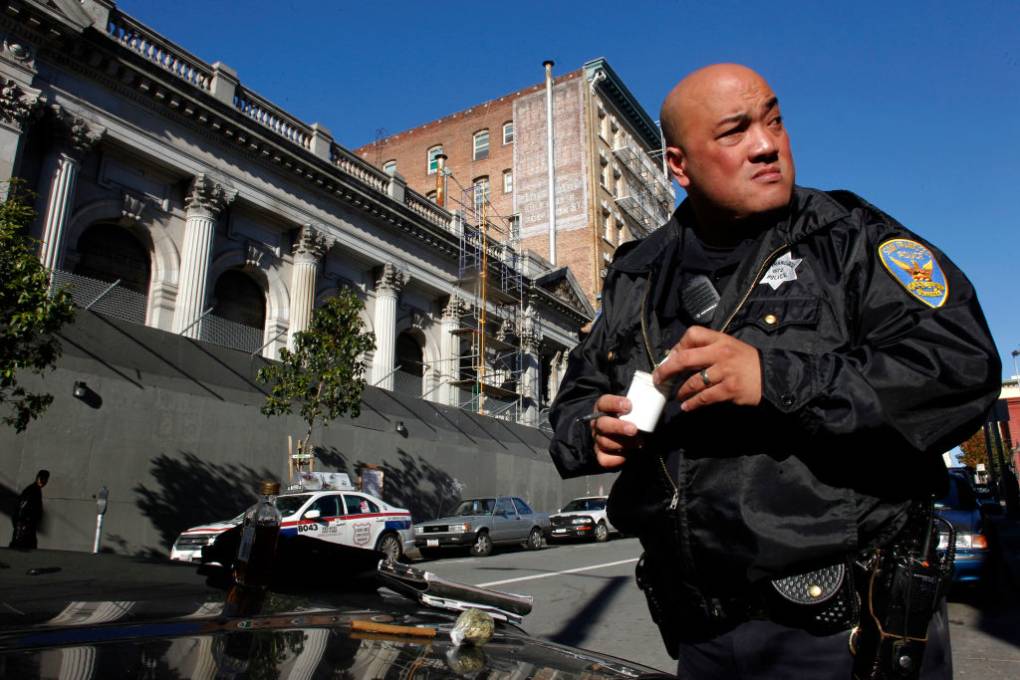
"caption": "Officer Louis Wong with the San Francisco Police Department with a jar of marijuana as he prepares to arrest a young man for drug possession in the Tenderloin neighborhood of San Francisco on Jan. 2, 2013.",
"description": null,
"title": "Officer Louis Wong with the San Francisco Police Department with a jar of marijuana as he prepares to arrest a young man for drug possession in the Tenderloin neighborhood of San Francisco, Calif. on Wednesday Jan. 2, 2013.",
"credit": "Michael Macor/The San Francisco Chronicle via Getty Images",
"status": "inherit",
"altTag": null,
"isLoading": false,
"fetchFailed": false
},
"news_11953070": {
"type": "attachments",
"id": "news_11953070",
"meta": {
"index": "attachments_1716263798",
"site": "news",
"id": "11953070",
"found": true
},
"title": "Tents line Fulton Street near City Hall on April 5, 2020.",
"publishDate": 1686863978,
"status": "inherit",
"parent": 11954718,
"modified": 1718058833,
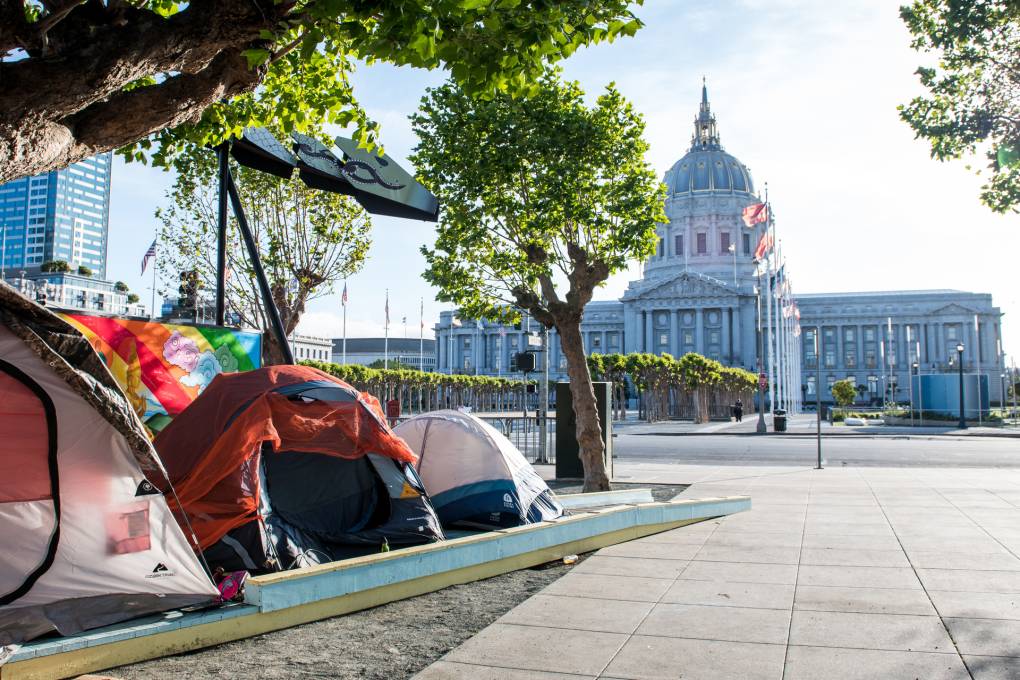
"caption": "Tents line Fulton Street near City Hall on April 5, 2020.",
"credit": "Beth LaBerge/KQED",
"altTag": "Three tents line a public street with San Francisco's City Hall building shining as the sun comes up in the early morning hours. Rows of trees line a path toward the city building.",
"description": "Tents line Fulton Street near City Hall on April 5, 2020. In June, budget battles are underway in the Bay Area's two largest cities, with Mayors London Breed in San Francisco and Matt Mahan in San José pushing for more voter-approved homelessness dollars to go toward temporary housing.",
"imgSizes": {
"medium": {
"file": "https://cdn.kqed.org/wp-content/uploads/sites/10/2023/06/RS43040_011_KQED_SanFrancisco_TentEncampments_05052020-qut-800x533.jpg",
"width": 800,
"height": 533,
"mimeType": "image/jpeg"
},
"large": {
"file": "https://cdn.kqed.org/wp-content/uploads/sites/10/2023/06/RS43040_011_KQED_SanFrancisco_TentEncampments_05052020-qut-1020x680.jpg",
"width": 1020,
"height": 680,
"mimeType": "image/jpeg"
},
"thumbnail": {
"file": "https://cdn.kqed.org/wp-content/uploads/sites/10/2023/06/RS43040_011_KQED_SanFrancisco_TentEncampments_05052020-qut-160x107.jpg",
"width": 160,
"height": 107,
"mimeType": "image/jpeg"
},
"1536x1536": {
"file": "https://cdn.kqed.org/wp-content/uploads/sites/10/2023/06/RS43040_011_KQED_SanFrancisco_TentEncampments_05052020-qut-1536x1024.jpg",
"width": 1536,
"height": 1024,
"mimeType": "image/jpeg"
},
"post-thumbnail": {
"file": "https://cdn.kqed.org/wp-content/uploads/sites/10/2023/06/RS43040_011_KQED_SanFrancisco_TentEncampments_05052020-qut-672x372.jpg",
"width": 672,
"height": 372,
"mimeType": "image/jpeg"
},
"twentyfourteen-full-width": {
"file": "https://cdn.kqed.org/wp-content/uploads/sites/10/2023/06/RS43040_011_KQED_SanFrancisco_TentEncampments_05052020-qut-1038x576.jpg",
"width": 1038,
"height": 576,
"mimeType": "image/jpeg"
},
"kqedFullSize": {
"file": "https://cdn.kqed.org/wp-content/uploads/sites/10/2023/06/RS43040_011_KQED_SanFrancisco_TentEncampments_05052020-qut.jpg",
"width": 1920,
"height": 1280
}
},
"isLoading": false,
"fetchFailed": false
},
"news_11860317": {
"type": "attachments",
"id": "news_11860317",
"meta": {
"index": "attachments_1716263798",
"site": "news",
"id": "11860317",
"found": true
},
"parent": 11860308,
"imgSizes": {
"apple_news_ca_landscape_5_5": {
"file": "https://ww2.kqed.org/app/uploads/sites/10/2021/02/RS41773_007_KQED_HousingSanFrancisco_02102020_2898-qut-1044x783.jpg",
"width": 1044,
"mimeType": "image/jpeg",
"height": 783
},
"apple_news_ca_square_4_0": {
"file": "https://ww2.kqed.org/app/uploads/sites/10/2021/02/RS41773_007_KQED_HousingSanFrancisco_02102020_2898-qut-470x470.jpg",
"width": 470,
"mimeType": "image/jpeg",
"height": 470
},
"twentyfourteen-full-width": {
"file": "https://ww2.kqed.org/app/uploads/sites/10/2021/02/RS41773_007_KQED_HousingSanFrancisco_02102020_2898-qut-1038x576.jpg",
"width": 1038,
"mimeType": "image/jpeg",
"height": 576
},
"thumbnail": {
"file": "https://ww2.kqed.org/app/uploads/sites/10/2021/02/RS41773_007_KQED_HousingSanFrancisco_02102020_2898-qut-160x107.jpg",
"width": 160,
"mimeType": "image/jpeg",
"height": 107
},
"post-thumbnail": {
"file": "https://ww2.kqed.org/app/uploads/sites/10/2021/02/RS41773_007_KQED_HousingSanFrancisco_02102020_2898-qut-672x372.jpg",
"width": 672,
"mimeType": "image/jpeg",
"height": 372
},
"kqedFullSize": {
"file": "https://ww2.kqed.org/app/uploads/sites/10/2021/02/RS41773_007_KQED_HousingSanFrancisco_02102020_2898-qut.jpg",
"width": 1920,
"height": 1280
},
"apple_news_ca_landscape_4_7": {
"file": "https://ww2.kqed.org/app/uploads/sites/10/2021/02/RS41773_007_KQED_HousingSanFrancisco_02102020_2898-qut-632x474.jpg",
"width": 632,
"mimeType": "image/jpeg",
"height": 474
},
"large": {
"file": "https://ww2.kqed.org/app/uploads/sites/10/2021/02/RS41773_007_KQED_HousingSanFrancisco_02102020_2898-qut-1020x680.jpg",
"width": 1020,
"mimeType": "image/jpeg",
"height": 680
},
"apple_news_ca_landscape_4_0": {
"file": "https://ww2.kqed.org/app/uploads/sites/10/2021/02/RS41773_007_KQED_HousingSanFrancisco_02102020_2898-qut-536x402.jpg",
"width": 536,
"mimeType": "image/jpeg",
"height": 402
},
"apple_news_ca_portrait_12_9": {
"file": "https://ww2.kqed.org/app/uploads/sites/10/2021/02/RS41773_007_KQED_HousingSanFrancisco_02102020_2898-qut-1122x1280.jpg",
"width": 1122,
"mimeType": "image/jpeg",
"height": 1280
},
"medium": {
"file": "https://ww2.kqed.org/app/uploads/sites/10/2021/02/RS41773_007_KQED_HousingSanFrancisco_02102020_2898-qut-800x533.jpg",
"width": 800,
"mimeType": "image/jpeg",
"height": 533
},
"apple_news_ca_portrait_4_0": {
"file": "https://ww2.kqed.org/app/uploads/sites/10/2021/02/RS41773_007_KQED_HousingSanFrancisco_02102020_2898-qut-354x472.jpg",
"width": 354,
"mimeType": "image/jpeg",
"height": 472
},
"apple_news_ca_portrait_9_7": {
"file": "https://ww2.kqed.org/app/uploads/sites/10/2021/02/RS41773_007_KQED_HousingSanFrancisco_02102020_2898-qut-840x1120.jpg",
"width": 840,
"mimeType": "image/jpeg",
"height": 1120
},
"apple_news_ca_landscape_12_9": {
"file": "https://ww2.kqed.org/app/uploads/sites/10/2021/02/RS41773_007_KQED_HousingSanFrancisco_02102020_2898-qut-1832x1280.jpg",
"width": 1832,
"mimeType": "image/jpeg",
"height": 1280
},
"apple_news_ca_square_9_7": {
"file": "https://ww2.kqed.org/app/uploads/sites/10/2021/02/RS41773_007_KQED_HousingSanFrancisco_02102020_2898-qut-1104x1104.jpg",
"width": 1104,
"mimeType": "image/jpeg",
"height": 1104
},
"1536x1536": {
"file": "https://ww2.kqed.org/app/uploads/sites/10/2021/02/RS41773_007_KQED_HousingSanFrancisco_02102020_2898-qut-1536x1024.jpg",
"width": 1536,
"mimeType": "image/jpeg",
"height": 1024
},
"apple_news_ca_portrait_4_7": {
"file": "https://ww2.kqed.org/app/uploads/sites/10/2021/02/RS41773_007_KQED_HousingSanFrancisco_02102020_2898-qut-414x552.jpg",
"width": 414,
"mimeType": "image/jpeg",
"height": 552
},
"apple_news_ca_square_12_9": {
"file": "https://ww2.kqed.org/app/uploads/sites/10/2021/02/RS41773_007_KQED_HousingSanFrancisco_02102020_2898-qut-1472x1280.jpg",
"width": 1472,
"mimeType": "image/jpeg",
"height": 1280
},
"apple_news_ca_portrait_5_5": {
"file": "https://ww2.kqed.org/app/uploads/sites/10/2021/02/RS41773_007_KQED_HousingSanFrancisco_02102020_2898-qut-687x916.jpg",
"width": 687,
"mimeType": "image/jpeg",
"height": 916
},
"apple_news_ca_square_4_7": {
"file": "https://ww2.kqed.org/app/uploads/sites/10/2021/02/RS41773_007_KQED_HousingSanFrancisco_02102020_2898-qut-550x550.jpg",
"width": 550,
"mimeType": "image/jpeg",
"height": 550
},
"apple_news_ca_landscape_9_7": {
"file": "https://ww2.kqed.org/app/uploads/sites/10/2021/02/RS41773_007_KQED_HousingSanFrancisco_02102020_2898-qut-1376x1032.jpg",
"width": 1376,
"mimeType": "image/jpeg",
"height": 1032
},
"apple_news_ca_square_5_5": {
"file": "https://ww2.kqed.org/app/uploads/sites/10/2021/02/RS41773_007_KQED_HousingSanFrancisco_02102020_2898-qut-912x912.jpg",
"width": 912,
"mimeType": "image/jpeg",
"height": 912
}
},
"publishDate": 1613174084,
"modified": 1686702012,
"caption": "In San Francisco, nearly three-quarters of all residential land is devoted to single-family homes and duplexes, as in this view of San Francisco on Feb. 10, 2020.",
"description": null,
"title": "RS41773_007_KQED_HousingSanFrancisco_02102020_2898-qut",
"credit": "Beth LaBerge/KQED",
"status": "inherit",
"altTag": "An aerial view of houses in a major city.",
"isLoading": false,
"fetchFailed": false
},
"news_11952718": {
"type": "attachments",
"id": "news_11952718",
"meta": {
"index": "attachments_1716263798",
"site": "news",
"id": "11952718",
"found": true
},
"parent": 11952689,
"imgSizes": {
"twentyfourteen-full-width": {
"file": "https://ww2.kqed.org/app/uploads/sites/10/2023/06/RS66195_GettyImages-1322093872-qut-1038x576.jpg",
"width": 1038,
"mimeType": "image/jpeg",
"height": 576
},
"thumbnail": {
"file": "https://ww2.kqed.org/app/uploads/sites/10/2023/06/RS66195_GettyImages-1322093872-qut-160x107.jpg",
"width": 160,
"mimeType": "image/jpeg",
"height": 107
},
"post-thumbnail": {
"file": "https://ww2.kqed.org/app/uploads/sites/10/2023/06/RS66195_GettyImages-1322093872-qut-672x372.jpg",
"width": 672,
"mimeType": "image/jpeg",
"height": 372
},
"kqedFullSize": {
"file": "https://ww2.kqed.org/app/uploads/sites/10/2023/06/RS66195_GettyImages-1322093872-qut.jpg",
"width": 1920,
"height": 1280
},
"large": {
"file": "https://ww2.kqed.org/app/uploads/sites/10/2023/06/RS66195_GettyImages-1322093872-qut-1020x680.jpg",
"width": 1020,
"mimeType": "image/jpeg",
"height": 680
},
"1536x1536": {
"file": "https://ww2.kqed.org/app/uploads/sites/10/2023/06/RS66195_GettyImages-1322093872-qut-1536x1024.jpg",
"width": 1536,
"mimeType": "image/jpeg",
"height": 1024
},
"medium": {
"file": "https://ww2.kqed.org/app/uploads/sites/10/2023/06/RS66195_GettyImages-1322093872-qut-800x533.jpg",
"width": 800,
"mimeType": "image/jpeg",
"height": 533
}
},
"publishDate": 1686357552,
"modified": 1686529935,
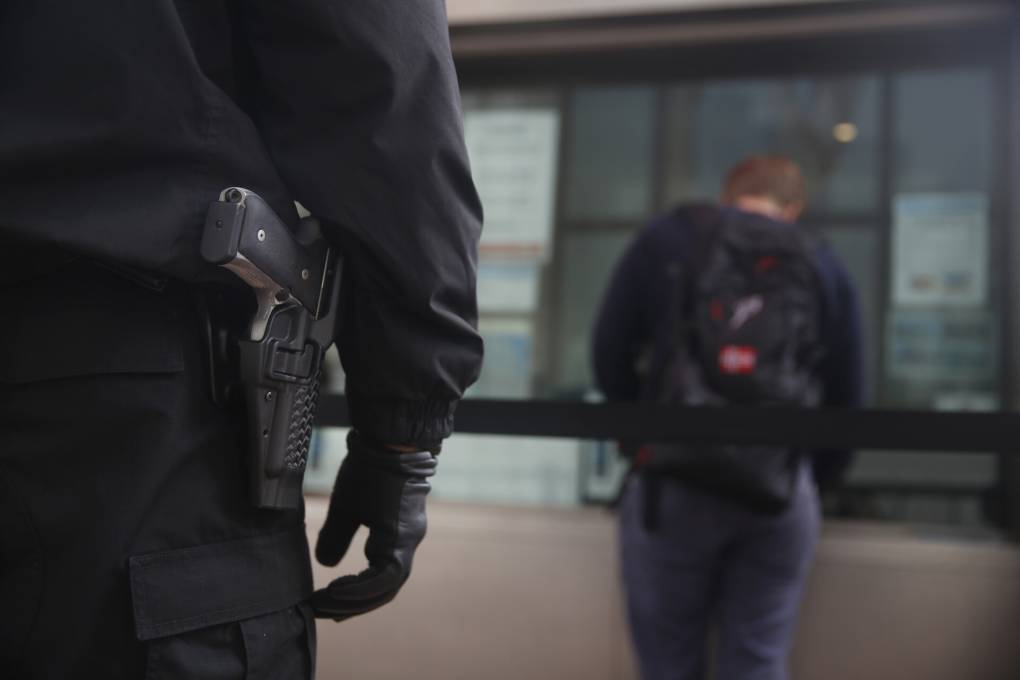
"caption": "An armed security guard stands next to the cable car fare kiosk at Powell and Market streets in San Francisco.",
"description": null,
"title": "Kasayle Howard (left), armed security guard with Cypress Security, stands next to the cable car fare kiosk while working at Powell and Market Streets on Monday, April 20, 2015 in San Francisco, Calif.",
"credit": "Lea Suzuki/The San Francisco Chronicle via Getty Images",
"status": "inherit",
"altTag": "a black-clad security guard's outstretched arm and leg are seen from behind in the left foreground, with a gun clearly visible on their hip, as a pedestrian stands with their back turned to the camera in the background",
"isLoading": false,
"fetchFailed": false
}
},
"audioPlayerReducer": {
"postId": "stream_live",
"isPaused": true,
"isPlaying": false,
"pfsActive": false,
"pledgeModalIsOpen": true,
"playerDrawerIsOpen": false,
"liveAudioPlayStartedAt": 0,
"liveAudioPlayContext": ""
},
"authorsReducer": {
"byline_news_11957487": {
"type": "authors",
"id": "byline_news_11957487",
"meta": {
"override": true
},
"slug": "byline_news_11957487",
"name": "\u003ca href=\"https://calmatters.org/author/ben-christopher/\">Ben Christopher\u003c/a>",
"isLoading": false
},
"byline_news_11957092": {
"type": "authors",
"id": "byline_news_11957092",
"meta": {
"override": true
},
"slug": "byline_news_11957092",
"name": "\u003ca href=\"https://apnews.com/\">Eric Tucker\u003c/a>\u003cbr>The Associated Press",
"isLoading": false
},
"byline_news_11956963": {
"type": "authors",
"id": "byline_news_11956963",
"meta": {
"override": true
},
"slug": "byline_news_11956963",
"name": "\u003ca href=\"https://www.kqed.org/author/otaylor\">Otis R. Taylor Jr.\u003c/a>",
"isLoading": false
},
"byline_news_11956315": {
"type": "authors",
"id": "byline_news_11956315",
"meta": {
"override": true
},
"slug": "byline_news_11956315",
"name": "\u003ca href=\"https://calmatters.org/author/nicole-foy/\">Nicole Foy\u003c/a>",
"isLoading": false
},
"byline_news_11952870": {
"type": "authors",
"id": "byline_news_11952870",
"meta": {
"override": true
},
"slug": "byline_news_11952870",
"name": "\u003ca href=\"https://calmatters.org/author/marisa-kendall\">Marisa Kendall\u003c/a>",
"isLoading": false
},
"gmarzorati": {
"type": "authors",
"id": "227",
"meta": {
"index": "authors_1716337520",
"id": "227",
"found": true
},
"name": "Guy Marzorati",
"firstName": "Guy",
"lastName": "Marzorati",
"slug": "gmarzorati",
"email": "gmarzorati@KQED.org",
"display_author_email": true,
"staff_mastheads": [
"news"
],
"title": "Correspondent",
"bio": "Guy Marzorati is a correspondent on KQED's California Politics and Government Desk, based in San Jose. A graduate of Santa Clara University, Guy joined KQED in 2013. He reports on state and local politics and produces KQED's digital voter guide.",
"avatar": "https://secure.gravatar.com/avatar/e7038b8dbfd55b104369b76b1cd0b9de?s=600&d=blank&r=g",
"twitter": "guymarzorati",
"facebook": null,
"instagram": null,
"linkedin": null,
"sites": [
{
"site": "",
"roles": [
"editor"
]
},
{
"site": "news",
"roles": [
"editor"
]
},
{
"site": "science",
"roles": [
"editor"
]
},
{
"site": "forum",
"roles": [
"editor"
]
},
{
"site": "elections",
"roles": [
"editor"
]
},
{
"site": "liveblog",
"roles": [
"editor"
]
}
],
"headData": {
"title": "Guy Marzorati | KQED",
"description": "Correspondent",
"ogImgSrc": "https://secure.gravatar.com/avatar/e7038b8dbfd55b104369b76b1cd0b9de?s=600&d=blank&r=g",
"twImgSrc": "https://secure.gravatar.com/avatar/e7038b8dbfd55b104369b76b1cd0b9de?s=600&d=blank&r=g"
},
"isLoading": false,
"link": "/author/gmarzorati"
},
"mlagos": {
"type": "authors",
"id": "3239",
"meta": {
"index": "authors_1716337520",
"id": "3239",
"found": true
},
"name": "Marisa Lagos",
"firstName": "Marisa",
"lastName": "Lagos",
"slug": "mlagos",
"email": "mlagos@kqed.org",
"display_author_email": false,
"staff_mastheads": [
"news"
],
"title": "KQED Contributor",
"bio": "Marisa Lagos is a correspondent for KQED’s California Politics and Government Desk and co-hosts the award-winning show and podcast, Political Breakdown. At KQED, Lagos also conducts reporting, analysis and investigations into state, local and national politics for radio, TV, online and onstage. In 2022, she and co-host, Scott Shafer, moderated the only gubernatorial debate in California. In 2020, the \u003ci>Washington Post\u003c/i> named her one of the top political journalists in California; she was nominated for a Peabody and won several other awards for her work investigating the 2017 California wildfires. She has worked at the \u003ci>San Francisco Chronicle\u003c/i>, \u003ci>San Francisco Examiner\u003c/i> and \u003ci>Los Angeles Times\u003c/i>. A UC Santa Barbara graduate, she lives in San Francisco with her two sons and husband.",
"avatar": "https://secure.gravatar.com/avatar/a261a0d3696fc066871ef96b85b5e7d2?s=600&d=blank&r=g",
"twitter": "@mlagos",
"facebook": null,
"instagram": null,
"linkedin": null,
"sites": [
{
"site": "arts",
"roles": [
"author"
]
},
{
"site": "news",
"roles": [
"editor"
]
},
{
"site": "science",
"roles": [
"editor"
]
},
{
"site": "forum",
"roles": [
"author"
]
},
{
"site": "liveblog",
"roles": [
"author"
]
}
],
"headData": {
"title": "Marisa Lagos | KQED",
"description": "KQED Contributor",
"ogImgSrc": "https://secure.gravatar.com/avatar/a261a0d3696fc066871ef96b85b5e7d2?s=600&d=blank&r=g",
"twImgSrc": "https://secure.gravatar.com/avatar/a261a0d3696fc066871ef96b85b5e7d2?s=600&d=blank&r=g"
},
"isLoading": false,
"link": "/author/mlagos"
},
"fjhabvala": {
"type": "authors",
"id": "8659",
"meta": {
"index": "authors_1716337520",
"id": "8659",
"found": true
},
"name": "Farida Jhabvala Romero",
"firstName": "Farida",
"lastName": "Jhabvala Romero",
"slug": "fjhabvala",
"email": "fjhabvala@kqed.org",
"display_author_email": true,
"staff_mastheads": [
"news"
],
"title": "KQED Contributor",
"bio": "Farida Jhabvala Romero is a Labor Correspondent for KQED. She previously covered immigration. Farida was \u003ca href=\"https://www.ccnma.org/2022-most-influential-latina-journalists\">named\u003c/a> one of the 10 Most Influential Latina Journalists in California in 2022 by the California Chicano News Media Association. Her work has won awards from the Society of Professional Journalists (Northern California), as well as a national and regional Edward M. Murrow Award for the collaborative reporting projects “Dangerous Air” and “Graying California.” Before joining KQED, Farida worked as a producer at Radio Bilingüe, a national public radio network. Farida earned her master’s degree in journalism from Stanford University.",
"avatar": "https://secure.gravatar.com/avatar/f9f022d4e2609741874222a1e9d41f48fea74011aa7c615eef91d9a50c944ebe?s=600&d=blank&r=g",
"twitter": "FaridaJhabvala",
"bluesky": null,
"facebook": null,
"instagram": null,
"linkedin": "https://www.linkedin.com/in/faridajhabvala/",
"sites": [
{
"site": "news",
"roles": [
"editor"
]
},
{
"site": "stateofhealth",
"roles": [
"author"
]
},
{
"site": "liveblog",
"roles": [
"author"
]
}
],
"headData": {
"title": "Farida Jhabvala Romero | KQED",
"description": "KQED Contributor",
"ogImgSrc": "https://secure.gravatar.com/avatar/f9f022d4e2609741874222a1e9d41f48fea74011aa7c615eef91d9a50c944ebe?s=600&d=blank&r=g",
"twImgSrc": "https://secure.gravatar.com/avatar/f9f022d4e2609741874222a1e9d41f48fea74011aa7c615eef91d9a50c944ebe?s=600&d=blank&r=g"
},
"isLoading": false,
"link": "/author/fjhabvala"
},
"jrodriguez": {
"type": "authors",
"id": "11690",
"meta": {
"index": "authors_1716337520",
"id": "11690",
"found": true
},
"name": "Joe Fitzgerald Rodriguez",
"firstName": "Joe",
"lastName": "Fitzgerald Rodriguez",
"slug": "jrodriguez",
"email": "jrodriguez@kqed.org",
"display_author_email": true,
"staff_mastheads": [
"news"
],
"title": "Reporter and Producer",
"bio": "Joe Fitzgerald Rodriguez is a reporter and digital producer for KQED covering politics. Joe most recently wrote for the \u003cem>San Francisco Examiner\u003c/em> as a political columnist covering The City. He was raised in San Francisco and has spent his reporting career in his beloved, foggy, city by the bay. Joe was 12-years-old when he conducted his first interview in journalism, grilling former San Francisco Mayor Willie Brown for the Marina Middle School newspaper, \u003cem>The Penguin Press, \u003c/em>and he continues to report on the San Francisco Bay Area to this day.",
"avatar": "https://secure.gravatar.com/avatar/2247beb0564c1e9c62228d5649d2edac?s=600&d=blank&r=g",
"twitter": "FitztheReporter",
"facebook": null,
"instagram": "https://www.instagram.com/fitzthereporter/",
"linkedin": null,
"sites": [
{
"site": "",
"roles": [
"editor"
]
},
{
"site": "arts",
"roles": [
"editor"
]
},
{
"site": "news",
"roles": [
"editor"
]
},
{
"site": "science",
"roles": [
"editor"
]
},
{
"site": "elections",
"roles": [
"editor"
]
},
{
"site": "liveblog",
"roles": [
"editor"
]
}
],
"headData": {
"title": "Joe Fitzgerald Rodriguez | KQED",
"description": "Reporter and Producer",
"ogImgSrc": "https://secure.gravatar.com/avatar/2247beb0564c1e9c62228d5649d2edac?s=600&d=blank&r=g",
"twImgSrc": "https://secure.gravatar.com/avatar/2247beb0564c1e9c62228d5649d2edac?s=600&d=blank&r=g"
},
"isLoading": false,
"link": "/author/jrodriguez"
},
"sjohnson": {
"type": "authors",
"id": "11840",
"meta": {
"index": "authors_1716337520",
"id": "11840",
"found": true
},
"name": "Sydney Johnson",
"firstName": "Sydney",
"lastName": "Johnson",
"slug": "sjohnson",
"email": "sjohnson@kqed.org",
"display_author_email": false,
"staff_mastheads": [
"news"
],
"title": "KQED Reporter",
"bio": "Sydney Johnson is a general assignment reporter at KQED. She previously reported on public health and city government at the San Francisco Examiner, and before that, she covered statewide education policy for EdSource. Her reporting has won multiple local, state and national awards. Sydney is a graduate of the University of California, Berkeley and lives in San Francisco.",
"avatar": "https://secure.gravatar.com/avatar/97855f2719b72ad6190b7c535fe642c8?s=600&d=blank&r=g",
"twitter": "sydneyfjohnson",
"facebook": null,
"instagram": null,
"linkedin": null,
"sites": [
{
"site": "news",
"roles": [
"editor"
]
}
],
"headData": {
"title": "Sydney Johnson | KQED",
"description": "KQED Reporter",
"ogImgSrc": "https://secure.gravatar.com/avatar/97855f2719b72ad6190b7c535fe642c8?s=600&d=blank&r=g",
"twImgSrc": "https://secure.gravatar.com/avatar/97855f2719b72ad6190b7c535fe642c8?s=600&d=blank&r=g"
},
"isLoading": false,
"link": "/author/sjohnson"
},
"nkhan": {
"type": "authors",
"id": "11867",
"meta": {
"index": "authors_1716337520",
"id": "11867",
"found": true
},
"name": "Nisa Khan",
"firstName": "Nisa",
"lastName": "Khan",
"slug": "nkhan",
"email": "nkhan@kqed.org",
"display_author_email": false,
"staff_mastheads": [],
"title": "KQED Contributor",
"bio": "Nisa Khan is a reporter for KQED's Audience News Desk. She was formerly a data reporter at Michigan Radio. She earned a Bachelor of Science in Information from the University of Michigan and a Master of Arts in Communication from Stanford University.",
"avatar": "https://secure.gravatar.com/avatar/8720459eef081ff64582b3506b124d58523e80e120704a0cbd9892533c914991?s=600&d=blank&r=g",
"twitter": "mnisakhan",
"bluesky": null,
"facebook": null,
"instagram": null,
"linkedin": null,
"sites": [
{
"site": "arts",
"roles": [
"editor"
]
},
{
"site": "news",
"roles": [
"editor"
]
},
{
"site": "science",
"roles": [
"editor",
"author"
]
},
{
"site": "forum",
"roles": [
"editor"
]
},
{
"site": "liveblog",
"roles": [
"contributor"
]
}
],
"headData": {
"title": "Nisa Khan | KQED",
"description": "KQED Contributor",
"ogImgSrc": "https://secure.gravatar.com/avatar/8720459eef081ff64582b3506b124d58523e80e120704a0cbd9892533c914991?s=600&d=blank&r=g",
"twImgSrc": "https://secure.gravatar.com/avatar/8720459eef081ff64582b3506b124d58523e80e120704a0cbd9892533c914991?s=600&d=blank&r=g"
},
"isLoading": false,
"link": "/author/nkhan"
}
},
"pagesReducer": {
"news_tag_politics": {
"type": "terms",
"id": "news_17968",
"meta": {
"index": "terms_1716263798",
"site": "news",
"id": "17968",
"score": 8.003347
},
"name": "Politics",
"slug": "politics",
"taxonomy": "tag",
"description": null,
"featImg": null,
"headData": {
"title": "Politics | KQED News",
"description": null,
"ogTitle": null,
"ogDescription": null,
"ogImgId": null,
"twTitle": null,
"twDescription": null,
"twImgId": null
},
"ttid": 18002,
"isLoading": false,
"title": "Politics",
"pageMeta": {
"site": "news",
"WpPageTemplate": "page-topic-editorial",
"currentPage": 159
},
"blocks": [
{
"blockName": "kqed/post-list",
"attrs": {
"layout": "cardArticle2",
"query": "posts/news?tag=politics",
"seeMore": false,
"paginated": true,
"page": 159
}
},
{
"blockName": "kqed/ad"
}
]
}
},
"pfsSessionReducer": {},
"postsReducer": {
"stream_live": {
"type": "live",
"id": "stream_live",
"audioUrl": "https://streams.kqed.org/kqedradio",
"title": "Live Stream",
"excerpt": "Live Stream information currently unavailable.",
"link": "/radio",
"featImg": "",
"label": {
"name": "KQED Live",
"link": "/"
}
},
"stream_kqedNewscast": {
"type": "posts",
"id": "stream_kqedNewscast",
"audioUrl": "https://www.kqed.org/.stream/anon/radio/RDnews/newscast.mp3?_=1",
"title": "KQED Newscast",
"featImg": "",
"label": {
"name": "88.5 FM",
"link": "/"
}
},
"news_11957487": {
"type": "posts",
"id": "news_11957487",
"meta": {
"index": "posts_1716263798",
"site": "news",
"id": "11957487",
"score": null,
"sort": [
1691240411000
]
},
"guestAuthors": [],
"slug": "california-could-borrow-a-record-breaking-35-billion-to-tackle-the-housing-crisis-will-voters-go-along",
"title": "California Could Borrow a Record-Breaking $35 Billion to Tackle the Housing Crisis. Will Voters Go Along?",
"publishDate": 1691240411,
"format": "standard",
"headTitle": "California Could Borrow a Record-Breaking $35 Billion to Tackle the Housing Crisis. Will Voters Go Along? | KQED",
"labelTerm": {
"term": 18481,
"site": "news"
},
"content": "\u003cp>California voters regularly name out-of-reach \u003ca href=\"https://www.ppic.org/survey/survey-data/?survey-search=true&AllWords=most+important&AnyWords=&DateSearchType=Last+Year&DateFromMonth=1&DateFromDay=1&DateFromYear=1998&DateToMonth=12&DateToDay=31&DateToYear=2023&SortOrder=desc#survey_results\">housing costs and homelessness\u003c/a> as among the most important issues facing the state.\u003c/p>\n\u003cp>Now lawmakers are calling their bluff. Next year the electorate will likely get the chance to put unprecedented gobs of money where its mouth is.\u003c/p>\n\u003cp>There’s the $10 billion bond proposal, spearheaded by Oakland Democratic Assemblymember \u003ca href=\"https://calmatters.org/legislator-tracker/buffy-wicks-1977/\">Buffy Wicks\u003c/a> and currently slated for the March ballot, that would replenish the coffers of some of the state’s premier affordable housing programs. If a majority of voters approve, it would be the largest housing-related IOU that California has issued since at least 1980.\u003c/p>\n\u003cp>Next, there’s the $4.68 billion measure, backed by Gov. Gavin Newsom and also scheduled for March, to \u003ca href=\"https://calmatters.org/health/mental-health/2023/06/mental-health-funding-2/\">build housing and expand psychiatric and substance abuse treatment for homeless Californians\u003c/a>. That would be the largest-ever expansion of behavioral health funding in California, according to the governor’s office. As a housing-related bond, it would also be the third largest such measure in recent memory.\u003c/p>\n\u003cp>[ad fullwidth]\u003c/p>\n\u003cp>But both of those state measures could be dwarfed by a third proposed at the regional level. The \u003ca href=\"https://www.sfchronicle.com/bayarea/article/New-agency-would-raise-public-dollars-to-build-13669232.php\">recently created Bay Area Housing Finance Authority\u003c/a>, tasked with funding affordable housing projects across the nine counties that surround the San Francisco Bay, is still figuring out exactly how much it wants to ask voters to sign off on in November 2024. But it could be as much as \u003ca href=\"https://www.sfchronicle.com/bayarea/article/affordable-housing-bond-measure-18189407.php\">$20 billion\u003c/a>.\u003c/p>\n\u003cp>Three of the largest housing bonds in California history would seem to be great news for housing advocates.\u003c/p>\n\u003cp>So why are some so worried?\u003c/p>\n\u003cp>“I’m a runner. I’ve never run my three best races in a row,” said Louis Mirante, a lobbyist with the Bay Area Council, where he focuses on housing legislation.\u003c/p>\n\u003cp>\u003c!-- iframe plugin v.4.3 wordpress.org/plugins/iframe/ -->\u003cbr>\n\u003ciframe loading=\"lazy\" src=\"https://flo.uri.sh/visualisation/14622594/embed?auto=1\" width=\"100%\" height=\"700\" scrolling=\"yes\" class=\"iframe-class\" frameborder=\"0\">\u003c/iframe>\u003c/p>\n\u003cp>With lawmakers considering a \u003ca href=\"https://www.politico.com/news/2023/07/24/gavin-newsom-democrats-gatekeeper-00107649\">bevy of other bond measures\u003c/a> in 2024 that could total as much as $80 billion — more potential debt than the state has put on the ballot since at least 1980, even adjusting for inflation — the sheer scale of the state’s potential borrowing plans could test the upper limit of what voters are willing to stomach.\u003c/p>\n\u003cp>“It’s conventional wisdom that if you put a bunch of bond proposals in front of voters, they get overwhelmed and are like ‘I don’t want to pay all of this money, so I don’t want to pay \u003cem>any\u003c/em> of this money,’” said Mirante.\u003c/p>\n\u003cp>And even before the question is put to voters, lawmakers will have to negotiate what goes on which ballot in the first place. Unlike the other \u003ca href=\"https://www.sos.ca.gov/elections/ballot-measures/initiative-and-referendum-status/eligible-statewide-initiative-measures\">initiatives, constitutional amendments\u003c/a> and \u003ca href=\"https://www.sos.ca.gov/elections/ballot-measures/qualified-ballot-measures\">referenda\u003c/a> that will already crowd the 2024 ballot, bond measures can only be put before voters with a vote by the Legislature and approval of the governor.\u003c/p>\n\u003cp>“There is only so much capacity that the state has for debt,” said Ray Pearl, executive director of the California Housing Consortium, which lobbies for more affordable housing construction in the Legislature. “And politically, for the governor and the Legislature, there’s only so much they are willing to take on.”[pullquote size='medium' align='right' citation=\"Louis Mirante, lobbyist, Bay Area Council\"]‘It’s conventional wisdom that if you put a bunch of bond proposals in front of voters, they get overwhelmed and are like ‘I don’t want to pay all of this money, so I don’t want to pay \u003cem>any\u003c/em> of this money.’[/pullquote]Lawmakers may not have long to hammer out those negotiations. Any bonds bound for the March ballot need to clear the Legislature by the end of the session on Sept. 14. Branch-on-branch negotiations have been slow to get going so far, but may ramp up once the lawmakers return from recess on Aug. 14.\u003c/p>\n\u003cp>“We want to make sure that we’re presenting a ballot to the electorate, in as much as we have the ability to, that is thoughtful and aims to tackle some of our tougher challenges, but in a way that doesn’t confuse voters with, like, ‘Here are your 10 opportunities to vote for housing,’” said Wicks. “I anticipate over the next probably two or three months that we’ll start landing some of these planes.”\u003c/p>\n\u003cp>Not everyone in housing world is so concerned. The mere fact that so many housing-related bond measures are vying for space on next year’s primary and general election ballots is a sign that the state’s affordability crisis is finally getting the political and fiscal attention it deserves, said Kate Hartley, who directs the Bay Area Housing Finance Authority.\u003c/p>\n\u003cp>“I don’t know what voters will think about” a glut of bond measures next year, she said. “But I do know that voters really care about this and they want solutions.”\u003c/p>\n\u003ch2>‘You name it, there’s a bond’\u003c/h2>\n\u003cp>Some of the most competitive real estate in California these days is a spot on either of the two 2024 ballots.\u003c/p>\n\u003cp>The Legislature is considering as many as ten borrowing measures for either the March primary or November general election next year. Among them are competing school bonds, climate and flood protection proposals and a \u003ca href=\"https://www.kcra.com/article/california-lawmakers-push-to-fight-fentanyl/44643707\">bond aimed at fighting the fentanyl crisis\u003c/a>. Though it isn’t likely that all will make the cut, taken together, they come with a collective debt of at least $80 billion, with the price tag on one proposal still undetermined.\u003c/p>\n\u003cp>“We have so many crises for people facing so many different challenges,” said Chris Martin, policy director with Housing California, an affordable housing advocacy group. “You name it, there’s a bond for it being considered in the Legislature and there’s only so much bonding authority.”\u003c/p>\n\u003cp>The Newsom administration has \u003ca href=\"https://www.politico.com/news/2023/07/24/gavin-newsom-democrats-gatekeeper-00107649\">reportedly set the borrowing limit\u003c/a> for both of next year’s ballots at $26 billion, but the final number is likely to be ironed out in negotiations with legislative leaders.\u003c/p>\n\u003cp>Whatever the borrowing cap, it’s as much a question of political arithmetic as it is budget math. There is no legal limit on how much debt voters can approve in a given election. Budget analysts keep their \u003ca href=\"https://www.treasurer.ca.gov/publications/dar/2022.pdf\">eye on different metrics comparing the state’s debt payments (PDF)\u003c/a> to its discretionary cash cushion, its overall budget or the total size of the California economy. Projections of future interest rates and future budget surpluses and deficits also get considered.\u003c/p>\n\u003cp>\u003c!-- iframe plugin v.4.3 wordpress.org/plugins/iframe/ -->\u003cbr>\n\u003ciframe loading=\"lazy\" src=\"https://flo.uri.sh/visualisation/14622746/embed?auto=1\" width=\"100%\" height=\"700\" scrolling=\"yes\" class=\"iframe-class\" frameborder=\"0\">\u003c/iframe>\u003c/p>\n\u003cp>One measure — the ratio of the state’s annual debt payments to the budget’s discretionary “general” fund — currently sits at roughly 3.5%, depending on how you measure it. That’s a tad high compared to other large states, but it’s far lower than it has been in the past. Keeping that figure below 6% is “generally considered prudent,” said H.D. Palmer, a spokesperson for the California Department of Finance.\u003c/p>\n\u003cp>There’s no evidence that voters have any of that in mind when they vote “yes” or “no.”\u003c/p>\n\u003cp>Californians have generally been perfectly happy to put big projects on the state’s credit card. That may be because bond proceeds are typically directed at politically sympathetic causes and the downsides of borrowing — higher debt payments in future years — are more abstract for the average voter.\u003c/p>\n\u003cp>Since 1980, the electorate has signed off on more than 75% of all state bonds put before them, approving $182 billion in new debt and rejecting only $42 billion. In contrast, voters have approved only \u003ca href=\"https://elections.cdn.sos.ca.gov/ballot-measures/pdf/initiatives-by-title-and-summary-year.pdf\">about 40% of all non-fiscal propositions (PDF)\u003c/a>.\u003c/p>\n\u003ch2>The prospect of ‘bond fatigue’\u003c/h2>\n\u003cp>There are clear exceptions. Sometimes the voting public, presented with particularly eye-popping sums, gets into a tight-fisted mood.\u003c/p>\n\u003cp>The November 1990 election was the most bond-happy in recent history, with 14 borrowing proposals in total. Voters batted down 12 of them.\u003c/p>\n\u003cp>A more recent example of bond failure: The March primary election in 2020, when voters rejected what would have been the largest school bond in California history, a $15 billion IOU. One of the \u003ca href=\"https://calmatters.org/education/2020/03/california-prop-13-school-bond-defeated/\">possible post-election explanations\u003c/a> offered at the time: Voters, saddled with a bumper crop of borrowing measures at the local level, succumbed to “bond fatigue.”[aside label=\"Related Stories\" tag=\"housing\"]Now, with 2024 approaching, some housing advocates worry the electorate is susceptible to the same condition.\u003c/p>\n\u003cp>As a matter of fiscal reality, the two major housing proposals — the affordable housing measure and the Newsom-backed mental health bond — are dipping from the same pool of fiscal overhead and electorate will.\u003c/p>\n\u003cp>But as policies — one that supports the construction of more housing and the other that boosts behavioral health treatment capacity for people living on the street — they could very well complement one another. According to the governor’s office, his mental health bond would allow for the shelter and treatment of 10,000 more unhoused Californians. As negotiations kick into gear, some proponents of both measures are hoping the governor and legislative leaders will see things that way.\u003c/p>\n\u003cp>“If you have temporary shelter beds and services for an individual suffering from mental health or substance abuse disorder but no affordable housing, that person is likely going to return to homelessness,” said Alex Visotzky, senior California policy fellow at the National Alliance to End Homelessness, which supports the affordable housing bond and is still reviewing the mental health-related proposal. “Conversely if you have affordable housing, but no services available, then that individual is going to struggle to maintain their housing.”\u003c/p>\n\u003cp>“We feel the Legislature has a real opportunity to connect the two,” he said.\u003c/p>\n\u003ch2>A race against the clock\u003c/h2>\n\u003cp>Politically, California voter frustration with unaffordable housing and homelessness could cut one of two ways.\u003c/p>\n\u003cp>Voters who believe public dollars are poorly spent may not welcome proposals to throw more money at the problem.\u003c/p>\n\u003cp>Earlier this year, lawmakers directed the state auditor’s office to\u003ca href=\"https://calmatters.org/housing/homelessness/2023/04/california-homeless-spending-audit/\"> dig into how the state’s homelessness funds are actually being spent\u003c/a>. A 2020 audit from the same office called for an “overhaul” of California’s “cumbersome” affordable housing funding process, after the state\u003ca href=\"https://www.capradio.org/articles/2020/11/20/its-a-shame-california-squandered-27-billion-for-affordable-housing-audit-says/\"> allowed $2.7 billion in bonds to expire untapped\u003c/a>. (The state application process has\u003ca href=\"https://www.thecentersquare.com/california/article_d56ec9a4-acc0-11ed-af17-93d7eb0b5a89.html\"> since been streamlined\u003c/a>.)\u003c/p>\n\u003cp>But many housing developers hope it will translate into the popular political will to ratchet up the spending. In fact, they’re counting on it.\u003c/p>\n\u003cp>Of the roughly 2.5 million units the state Housing and Community Development department says California communities need to build over the next eight years to make up for years of under-building, \u003ca href=\"https://storymaps.arcgis.com/stories/94729ab1648d43b1811c1698a748c136\">roughly 1 million must be set aside\u003c/a> for people earning less than 80% of the median income in their region.[pullquote size='medium' align='right' citation=\"Heather Hood, vice president and Northern California market leader, Enterprise Community Partners\"]‘The state’s been, on one hand, very clear about what the ambitions and goals are. And yet [it] hasn’t supplied the resources to enable that to happen.’[/pullquote]But that planned-for boom in affordable housing won’t materialize without some extra help, said Heather Hood, who manages the northern California market for Enterprise Community Partners, a nonprofit that funds, consults and advocates for affordable housing.\u003c/p>\n\u003cp>“The state’s been, on one hand, very clear about what the ambitions and goals are,” she said. “And yet [it] hasn’t supplied the resources to enable that to happen.”\u003c/p>\n\u003cp>It’s unclear how many additional units $10 billion in extra state funding could bring online. The cost per-unit of affordable housing climbs year after year, occasionally exceeding $1 million. By that math, the eye-popping face value on the bond would only be enough to fund 10,000 new units. But state funding is almost always used to supplement private, federal and local sources of cash.\u003c/p>\n\u003cp>“Housing isn’t completely paid for by public dollars,” said Hood. “Having this kind of security in the public realm means that there’s more security in the private realm and so it smooths the pipeline.”\u003c/p>\n\u003cp>The last time the state turned to the voters to fund affordable housing construction was in November 2018. Voters overwhelmingly approved Proposition 1, giving the state the go-ahead to borrow $4 billion. Of that, about half went toward the construction, rehabilitation and preservation of income-restricted rental housing. The remainder was meant to be split between programs that promote homeownership, the construction of farmworker housing and other housing-related infrastructure projects.\u003c/p>\n\u003cp>The timing of Wicks affordable housing bond next year is also no coincidence. With a little over $656 million remaining, that Proposition 1 funding is expected to run dry by next year\u003c/p>\n\u003cp>But even if voters are feeling generous next year and sign off on each of the housing bonds on the ballot, Wicks said she is only just getting started.\u003c/p>\n\u003cp>“We have to have significant ongoing investments for a serious amount of time in order to crawl out of where we are right now,” she said. That could mean putting yet more bond measures on the ballot or dedicating more money from the state budget on an ongoing basis. “That’s something that I want to work on next year. And probably the year after that.”\u003c/p>\n\u003cp>[ad floatright]\u003c/p>\n",
"blocks": [],
"excerpt": "Three of the biggest housing bonds in state history are bound for the 2024 ballot. But with no shortage of crises facing the state, California can only borrow so much and voters may succumb to 'bond fatigue.'",
"status": "publish",
"parent": 0,
"modified": 1721126792,
"stats": {
"hasAudio": false,
"hasVideo": false,
"hasChartOrMap": true,
"iframeSrcs": [
"https://flo.uri.sh/visualisation/14622594/embed",
"https://flo.uri.sh/visualisation/14622746/embed"
],
"hasGoogleForm": false,
"hasGallery": false,
"hasHearkenModule": false,
"hasPolis": false,
"paragraphCount": 47,
"wordCount": 2324
},
"headData": {
"title": "California Could Borrow a Record-Breaking $35 Billion to Tackle the Housing Crisis. Will Voters Go Along? | KQED",
"description": "Three of the biggest housing bonds in state history are bound for the 2024 ballot. But with no shortage of crises facing the state, California can only borrow so much and voters may succumb to 'bond fatigue.'",
"ogTitle": "",
"ogDescription": "",
"ogImgId": "",
"twTitle": "",
"twDescription": "",
"twImgId": "",
"schema": {
"@context": "https://schema.org",
"@type": "NewsArticle",
"headline": "California Could Borrow a Record-Breaking $35 Billion to Tackle the Housing Crisis. Will Voters Go Along?",
"datePublished": "2023-08-05T06:00:11-07:00",
"dateModified": "2024-07-16T03:46:32-07:00",
"image": "https://cdn.kqed.org/wp-content/uploads/2020/02/KQED-OG-Image@1x.png",
"isAccessibleForFree": "True",
"publisher": {
"@type": "NewsMediaOrganization",
"@id": "https://www.kqed.org/#organization",
"name": "KQED",
"logo": "https://cdn.kqed.org/wp-content/uploads/2020/02/KQED-OG-Image@1x.png",
"url": "https://www.kqed.org",
"sameAs": [
"https://www.facebook.com/KQED",
"https://twitter.com/KQED",
"https://www.instagram.com/kqed/",
"https://www.tiktok.com/@kqedofficial",
"https://www.linkedin.com/company/kqed",
"https://www.youtube.com/channel/UCeC0IOo7i1P_61zVUWbJ4nw"
]
}
}
},
"sticky": false,
"nprByline": "\u003ca href=\"https://calmatters.org/author/ben-christopher/\">Ben Christopher\u003c/a>",
"excludeFromSiteSearch": "Include",
"showOnAuthorArchivePages": "No",
"articleAge": "0",
"path": "/news/11957487/california-could-borrow-a-record-breaking-35-billion-to-tackle-the-housing-crisis-will-voters-go-along",
"audioTrackLength": null,
"parsedContent": [
{
"type": "contentString",
"content": "\u003cdiv class=\"post-body\">\u003cp>\u003cp>California voters regularly name out-of-reach \u003ca href=\"https://www.ppic.org/survey/survey-data/?survey-search=true&AllWords=most+important&AnyWords=&DateSearchType=Last+Year&DateFromMonth=1&DateFromDay=1&DateFromYear=1998&DateToMonth=12&DateToDay=31&DateToYear=2023&SortOrder=desc#survey_results\">housing costs and homelessness\u003c/a> as among the most important issues facing the state.\u003c/p>\n\u003cp>Now lawmakers are calling their bluff. Next year the electorate will likely get the chance to put unprecedented gobs of money where its mouth is.\u003c/p>\n\u003cp>There’s the $10 billion bond proposal, spearheaded by Oakland Democratic Assemblymember \u003ca href=\"https://calmatters.org/legislator-tracker/buffy-wicks-1977/\">Buffy Wicks\u003c/a> and currently slated for the March ballot, that would replenish the coffers of some of the state’s premier affordable housing programs. If a majority of voters approve, it would be the largest housing-related IOU that California has issued since at least 1980.\u003c/p>\n\u003cp>Next, there’s the $4.68 billion measure, backed by Gov. Gavin Newsom and also scheduled for March, to \u003ca href=\"https://calmatters.org/health/mental-health/2023/06/mental-health-funding-2/\">build housing and expand psychiatric and substance abuse treatment for homeless Californians\u003c/a>. That would be the largest-ever expansion of behavioral health funding in California, according to the governor’s office. As a housing-related bond, it would also be the third largest such measure in recent memory.\u003c/p>\n\u003cp>\u003c/p>\u003c/div>",
"attributes": {
"named": {},
"numeric": []
}
},
{
"type": "component",
"content": "",
"name": "ad",
"attributes": {
"named": {
"label": "fullwidth"
},
"numeric": [
"fullwidth"
]
}
},
{
"type": "contentString",
"content": "\u003cdiv class=\"post-body\">\u003cp>\u003c/p>\n\u003cp>But both of those state measures could be dwarfed by a third proposed at the regional level. The \u003ca href=\"https://www.sfchronicle.com/bayarea/article/New-agency-would-raise-public-dollars-to-build-13669232.php\">recently created Bay Area Housing Finance Authority\u003c/a>, tasked with funding affordable housing projects across the nine counties that surround the San Francisco Bay, is still figuring out exactly how much it wants to ask voters to sign off on in November 2024. But it could be as much as \u003ca href=\"https://www.sfchronicle.com/bayarea/article/affordable-housing-bond-measure-18189407.php\">$20 billion\u003c/a>.\u003c/p>\n\u003cp>Three of the largest housing bonds in California history would seem to be great news for housing advocates.\u003c/p>\n\u003cp>So why are some so worried?\u003c/p>\n\u003cp>“I’m a runner. I’ve never run my three best races in a row,” said Louis Mirante, a lobbyist with the Bay Area Council, where he focuses on housing legislation.\u003c/p>\n\u003cp>\u003c!-- iframe plugin v.4.3 wordpress.org/plugins/iframe/ -->\u003cbr>\n\u003ciframe loading=\"lazy\" src=\"https://flo.uri.sh/visualisation/14622594/embed?auto=1\" width=\"100%\" height=\"700\" scrolling=\"yes\" class=\"iframe-class\" frameborder=\"0\">\u003c/iframe>\u003c/p>\n\u003cp>With lawmakers considering a \u003ca href=\"https://www.politico.com/news/2023/07/24/gavin-newsom-democrats-gatekeeper-00107649\">bevy of other bond measures\u003c/a> in 2024 that could total as much as $80 billion — more potential debt than the state has put on the ballot since at least 1980, even adjusting for inflation — the sheer scale of the state’s potential borrowing plans could test the upper limit of what voters are willing to stomach.\u003c/p>\n\u003cp>“It’s conventional wisdom that if you put a bunch of bond proposals in front of voters, they get overwhelmed and are like ‘I don’t want to pay all of this money, so I don’t want to pay \u003cem>any\u003c/em> of this money,’” said Mirante.\u003c/p>\n\u003cp>And even before the question is put to voters, lawmakers will have to negotiate what goes on which ballot in the first place. Unlike the other \u003ca href=\"https://www.sos.ca.gov/elections/ballot-measures/initiative-and-referendum-status/eligible-statewide-initiative-measures\">initiatives, constitutional amendments\u003c/a> and \u003ca href=\"https://www.sos.ca.gov/elections/ballot-measures/qualified-ballot-measures\">referenda\u003c/a> that will already crowd the 2024 ballot, bond measures can only be put before voters with a vote by the Legislature and approval of the governor.\u003c/p>\n\u003cp>“There is only so much capacity that the state has for debt,” said Ray Pearl, executive director of the California Housing Consortium, which lobbies for more affordable housing construction in the Legislature. “And politically, for the governor and the Legislature, there’s only so much they are willing to take on.”\u003c/p>\u003c/div>",
"attributes": {
"named": {},
"numeric": []
}
},
{
"type": "component",
"content": "‘It’s conventional wisdom that if you put a bunch of bond proposals in front of voters, they get overwhelmed and are like ‘I don’t want to pay all of this money, so I don’t want to pay \u003cem>any\u003c/em> of this money.’",
"name": "pullquote",
"attributes": {
"named": {
"size": "medium",
"align": "right",
"citation": "Louis Mirante, lobbyist, Bay Area Council",
"label": ""
},
"numeric": []
}
},
{
"type": "contentString",
"content": "\u003cdiv class=\"post-body\">\u003cp>Lawmakers may not have long to hammer out those negotiations. Any bonds bound for the March ballot need to clear the Legislature by the end of the session on Sept. 14. Branch-on-branch negotiations have been slow to get going so far, but may ramp up once the lawmakers return from recess on Aug. 14.\u003c/p>\n\u003cp>“We want to make sure that we’re presenting a ballot to the electorate, in as much as we have the ability to, that is thoughtful and aims to tackle some of our tougher challenges, but in a way that doesn’t confuse voters with, like, ‘Here are your 10 opportunities to vote for housing,’” said Wicks. “I anticipate over the next probably two or three months that we’ll start landing some of these planes.”\u003c/p>\n\u003cp>Not everyone in housing world is so concerned. The mere fact that so many housing-related bond measures are vying for space on next year’s primary and general election ballots is a sign that the state’s affordability crisis is finally getting the political and fiscal attention it deserves, said Kate Hartley, who directs the Bay Area Housing Finance Authority.\u003c/p>\n\u003cp>“I don’t know what voters will think about” a glut of bond measures next year, she said. “But I do know that voters really care about this and they want solutions.”\u003c/p>\n\u003ch2>‘You name it, there’s a bond’\u003c/h2>\n\u003cp>Some of the most competitive real estate in California these days is a spot on either of the two 2024 ballots.\u003c/p>\n\u003cp>The Legislature is considering as many as ten borrowing measures for either the March primary or November general election next year. Among them are competing school bonds, climate and flood protection proposals and a \u003ca href=\"https://www.kcra.com/article/california-lawmakers-push-to-fight-fentanyl/44643707\">bond aimed at fighting the fentanyl crisis\u003c/a>. Though it isn’t likely that all will make the cut, taken together, they come with a collective debt of at least $80 billion, with the price tag on one proposal still undetermined.\u003c/p>\n\u003cp>“We have so many crises for people facing so many different challenges,” said Chris Martin, policy director with Housing California, an affordable housing advocacy group. “You name it, there’s a bond for it being considered in the Legislature and there’s only so much bonding authority.”\u003c/p>\n\u003cp>The Newsom administration has \u003ca href=\"https://www.politico.com/news/2023/07/24/gavin-newsom-democrats-gatekeeper-00107649\">reportedly set the borrowing limit\u003c/a> for both of next year’s ballots at $26 billion, but the final number is likely to be ironed out in negotiations with legislative leaders.\u003c/p>\n\u003cp>Whatever the borrowing cap, it’s as much a question of political arithmetic as it is budget math. There is no legal limit on how much debt voters can approve in a given election. Budget analysts keep their \u003ca href=\"https://www.treasurer.ca.gov/publications/dar/2022.pdf\">eye on different metrics comparing the state’s debt payments (PDF)\u003c/a> to its discretionary cash cushion, its overall budget or the total size of the California economy. Projections of future interest rates and future budget surpluses and deficits also get considered.\u003c/p>\n\u003cp>\u003c!-- iframe plugin v.4.3 wordpress.org/plugins/iframe/ -->\u003cbr>\n\u003ciframe loading=\"lazy\" src=\"https://flo.uri.sh/visualisation/14622746/embed?auto=1\" width=\"100%\" height=\"700\" scrolling=\"yes\" class=\"iframe-class\" frameborder=\"0\">\u003c/iframe>\u003c/p>\n\u003cp>One measure — the ratio of the state’s annual debt payments to the budget’s discretionary “general” fund — currently sits at roughly 3.5%, depending on how you measure it. That’s a tad high compared to other large states, but it’s far lower than it has been in the past. Keeping that figure below 6% is “generally considered prudent,” said H.D. Palmer, a spokesperson for the California Department of Finance.\u003c/p>\n\u003cp>There’s no evidence that voters have any of that in mind when they vote “yes” or “no.”\u003c/p>\n\u003cp>Californians have generally been perfectly happy to put big projects on the state’s credit card. That may be because bond proceeds are typically directed at politically sympathetic causes and the downsides of borrowing — higher debt payments in future years — are more abstract for the average voter.\u003c/p>\n\u003cp>Since 1980, the electorate has signed off on more than 75% of all state bonds put before them, approving $182 billion in new debt and rejecting only $42 billion. In contrast, voters have approved only \u003ca href=\"https://elections.cdn.sos.ca.gov/ballot-measures/pdf/initiatives-by-title-and-summary-year.pdf\">about 40% of all non-fiscal propositions (PDF)\u003c/a>.\u003c/p>\n\u003ch2>The prospect of ‘bond fatigue’\u003c/h2>\n\u003cp>There are clear exceptions. Sometimes the voting public, presented with particularly eye-popping sums, gets into a tight-fisted mood.\u003c/p>\n\u003cp>The November 1990 election was the most bond-happy in recent history, with 14 borrowing proposals in total. Voters batted down 12 of them.\u003c/p>\n\u003cp>A more recent example of bond failure: The March primary election in 2020, when voters rejected what would have been the largest school bond in California history, a $15 billion IOU. One of the \u003ca href=\"https://calmatters.org/education/2020/03/california-prop-13-school-bond-defeated/\">possible post-election explanations\u003c/a> offered at the time: Voters, saddled with a bumper crop of borrowing measures at the local level, succumbed to “bond fatigue.”\u003c/p>\u003c/div>",
"attributes": {
"named": {},
"numeric": []
}
},
{
"type": "component",
"content": "",
"name": "aside",
"attributes": {
"named": {
"label": "Related Stories ",
"tag": "housing"
},
"numeric": []
}
},
{
"type": "contentString",
"content": "\u003cdiv class=\"post-body\">\u003cp>Now, with 2024 approaching, some housing advocates worry the electorate is susceptible to the same condition.\u003c/p>\n\u003cp>As a matter of fiscal reality, the two major housing proposals — the affordable housing measure and the Newsom-backed mental health bond — are dipping from the same pool of fiscal overhead and electorate will.\u003c/p>\n\u003cp>But as policies — one that supports the construction of more housing and the other that boosts behavioral health treatment capacity for people living on the street — they could very well complement one another. According to the governor’s office, his mental health bond would allow for the shelter and treatment of 10,000 more unhoused Californians. As negotiations kick into gear, some proponents of both measures are hoping the governor and legislative leaders will see things that way.\u003c/p>\n\u003cp>“If you have temporary shelter beds and services for an individual suffering from mental health or substance abuse disorder but no affordable housing, that person is likely going to return to homelessness,” said Alex Visotzky, senior California policy fellow at the National Alliance to End Homelessness, which supports the affordable housing bond and is still reviewing the mental health-related proposal. “Conversely if you have affordable housing, but no services available, then that individual is going to struggle to maintain their housing.”\u003c/p>\n\u003cp>“We feel the Legislature has a real opportunity to connect the two,” he said.\u003c/p>\n\u003ch2>A race against the clock\u003c/h2>\n\u003cp>Politically, California voter frustration with unaffordable housing and homelessness could cut one of two ways.\u003c/p>\n\u003cp>Voters who believe public dollars are poorly spent may not welcome proposals to throw more money at the problem.\u003c/p>\n\u003cp>Earlier this year, lawmakers directed the state auditor’s office to\u003ca href=\"https://calmatters.org/housing/homelessness/2023/04/california-homeless-spending-audit/\"> dig into how the state’s homelessness funds are actually being spent\u003c/a>. A 2020 audit from the same office called for an “overhaul” of California’s “cumbersome” affordable housing funding process, after the state\u003ca href=\"https://www.capradio.org/articles/2020/11/20/its-a-shame-california-squandered-27-billion-for-affordable-housing-audit-says/\"> allowed $2.7 billion in bonds to expire untapped\u003c/a>. (The state application process has\u003ca href=\"https://www.thecentersquare.com/california/article_d56ec9a4-acc0-11ed-af17-93d7eb0b5a89.html\"> since been streamlined\u003c/a>.)\u003c/p>\n\u003cp>But many housing developers hope it will translate into the popular political will to ratchet up the spending. In fact, they’re counting on it.\u003c/p>\n\u003cp>Of the roughly 2.5 million units the state Housing and Community Development department says California communities need to build over the next eight years to make up for years of under-building, \u003ca href=\"https://storymaps.arcgis.com/stories/94729ab1648d43b1811c1698a748c136\">roughly 1 million must be set aside\u003c/a> for people earning less than 80% of the median income in their region.\u003c/p>\u003c/div>",
"attributes": {
"named": {},
"numeric": []
}
},
{
"type": "component",
"content": "‘The state’s been, on one hand, very clear about what the ambitions and goals are. And yet [it] hasn’t supplied the resources to enable that to happen.’",
"name": "pullquote",
"attributes": {
"named": {
"size": "medium",
"align": "right",
"citation": "Heather Hood, vice president and Northern California market leader, Enterprise Community Partners",
"label": ""
},
"numeric": []
}
},
{
"type": "contentString",
"content": "\u003cdiv class=\"post-body\">\u003cp>But that planned-for boom in affordable housing won’t materialize without some extra help, said Heather Hood, who manages the northern California market for Enterprise Community Partners, a nonprofit that funds, consults and advocates for affordable housing.\u003c/p>\n\u003cp>“The state’s been, on one hand, very clear about what the ambitions and goals are,” she said. “And yet [it] hasn’t supplied the resources to enable that to happen.”\u003c/p>\n\u003cp>It’s unclear how many additional units $10 billion in extra state funding could bring online. The cost per-unit of affordable housing climbs year after year, occasionally exceeding $1 million. By that math, the eye-popping face value on the bond would only be enough to fund 10,000 new units. But state funding is almost always used to supplement private, federal and local sources of cash.\u003c/p>\n\u003cp>“Housing isn’t completely paid for by public dollars,” said Hood. “Having this kind of security in the public realm means that there’s more security in the private realm and so it smooths the pipeline.”\u003c/p>\n\u003cp>The last time the state turned to the voters to fund affordable housing construction was in November 2018. Voters overwhelmingly approved Proposition 1, giving the state the go-ahead to borrow $4 billion. Of that, about half went toward the construction, rehabilitation and preservation of income-restricted rental housing. The remainder was meant to be split between programs that promote homeownership, the construction of farmworker housing and other housing-related infrastructure projects.\u003c/p>\n\u003cp>The timing of Wicks affordable housing bond next year is also no coincidence. With a little over $656 million remaining, that Proposition 1 funding is expected to run dry by next year\u003c/p>\n\u003cp>But even if voters are feeling generous next year and sign off on each of the housing bonds on the ballot, Wicks said she is only just getting started.\u003c/p>\n\u003cp>“We have to have significant ongoing investments for a serious amount of time in order to crawl out of where we are right now,” she said. That could mean putting yet more bond measures on the ballot or dedicating more money from the state budget on an ongoing basis. “That’s something that I want to work on next year. And probably the year after that.”\u003c/p>\n\u003cp>\u003c/p>\u003c/div>",
"attributes": {
"named": {},
"numeric": []
}
},
{
"type": "component",
"content": "",
"name": "ad",
"attributes": {
"named": {
"label": "floatright"
},
"numeric": [
"floatright"
]
}
},
{
"type": "contentString",
"content": "\u003cdiv class=\"post-body\">\u003cp>\u003c/p>\n\u003c/div>\u003c/p>",
"attributes": {
"named": {},
"numeric": []
}
}
],
"link": "/news/11957487/california-could-borrow-a-record-breaking-35-billion-to-tackle-the-housing-crisis-will-voters-go-along",
"authors": [
"byline_news_11957487"
],
"categories": [
"news_6266",
"news_8",
"news_13"
],
"tags": [
"news_26542",
"news_17725",
"news_16",
"news_1775",
"news_17968"
],
"affiliates": [
"news_18481"
],
"featImg": "news_11957496",
"label": "news_18481"
},
"news_11957208": {
"type": "posts",
"id": "news_11957208",
"meta": {
"index": "posts_1716263798",
"site": "news",
"id": "11957208",
"score": null,
"sort": [
1691013203000
]
},
"guestAuthors": [],
"slug": "near-1-billion-land-purchase-around-california-air-base-under-investigation",
"title": "Near $1 Billion Land Purchase Around California Air Base Under Investigation",
"publishDate": 1691013203,
"format": "standard",
"headTitle": "Near $1 Billion Land Purchase Around California Air Base Under Investigation | KQED",
"labelTerm": {
"site": "news"
},
"content": "\u003cp>Federal authorities are investigating a mysterious investment firm that bought nearly $1 billion worth of land surrounding Travis Air Force base, a prominent military base in Solano County.\u003c/p>\n\u003cp>Since 2018, Flannery Associates purchased 50,000 acres of agricultural land adjacent to Travis Air Force Base, the \u003cem>\u003ca href=\"https://www.wsj.com/articles/investors-bought-nearly-1-billion-in-land-near-a-california-air-force-base-officials-want-to-know-who-exactly-they-are-fd868e38\">Wall Street Journal\u003c/a>\u003c/em> reports, located about halfway between San Francisco and Sacramento in Solano County. Little is known about the investment firm. But local and federal policymakers say they are concerned about potential national security threats.\u003c/p>\n\u003cp>“They now surround three sides of Travis Air Force Base, which is a critical national security asset. That has raised significant concern for the Air Force,” Rep. John Garamendi (D-California), whose district includes the airbase, told KQED. “No one has been able to figure out where the $900 million has come from to purchase all the land in the area and what their intent is.”\u003c/p>\n\u003cp>[ad fullwidth]\u003c/p>\n\u003cp>The Federal Bureau of Investigation, the Treasury Department and the Department of Defense are all now investigating the group and its investments, Garamendi said. But because Flannery is incorporated in Delaware, a state with strong legal protections to shield corporate ownership, those probes have not yet uncovered who is behind the group.\u003c/p>\n\u003cp>Travis Air Force base contains the largest wing of the Air Force’s Air Mobility Command with aircraft regularly departing the site to send munitions to Europe and Ukraine. It’s “the Gateway to Europe and the Pacific,” Garamendi said. [pullquote size=\"medium\" align=\"right\" citation=\"Rep. John Garamendi (D-California)\"]‘They now surround three sides of Travis Air Force Base, which is a critical national security asset. That has raised significant concern for the Air Force.’[/pullquote] In May, \u003ca href=\"https://fingfx.thomsonreuters.com/gfx/legaldocs/zdpxdejmlpx/Flannery%20Associates%20-%20ED%20California%20-%202023-05-18.pdf\">Flannery filed a lawsuit against (PDF)\u003c/a> a handful of the family farms that the group wanted to buy up, alleging they were conspiring to hike up prices and deter a sale. But, Garamendi said, Flannery has already paid an unusually high amount for the dry, agricultural grazing land that it did buy.\u003c/p>\n\u003cp>“Flannery’s purchases are surrounding Travis Air Force Base, one of the most significant national security sites in our country, and it’s been devastating to family farmers due to related lawsuits,” Rep. Mike Thompson, whose district includes parts of Solano County, told KQED. “I will continue to work with local and federal partners to ensure that the concerns of our community are addressed and that we protect our national and food security.”\u003c/p>\n\u003cp>Flannery purchased land where the majority of wind turbines in Solano County are located, along with other critical electrical transmission lines.\u003c/p>\n\u003cp>Fueling the lawmakers’ concerns are recent attempts by Chinese companies to build a corn mill adjacent to the Grand Forks Air Base in North Dakota, another high-security base from which military aircraft take off for missions around the world. [aside label='More on Politics' tag='politics'] The project was initially boosted as an economic driver for the region, but has since halted after \u003ca href=\"https://www.hoeven.senate.gov/imo/media/doc/USAIRFORCE-FUFENG-LETTER-HOEVEN.pdf\">Air Force officials wrote to local government leaders with security concerns (PDF)\u003c/a> that the mill could be used to spy on the Air Force. The company denied those accusations, \u003ca href=\"https://www.nytimes.com/2023/01/31/us/corn-mill-fufeng-china-north-dakota.html\">\u003cem>The New York Times\u003c/em>\u003c/a> reported.\u003c/p>\n\u003cp>There’s no evidence so far to suggest Flannery has ties with China, but little is known about the group at all.\u003c/p>\n\u003cp>“The lawyer representing the company says not to worry, these are American investors and a couple Europeans,” Garamendi said. “We just don’t know. And until we know, we will remain very concerned.”\u003c/p>\n\u003cp>Lawmakers in nearly two dozen other states have passed or are seeking to pass legislation in recent years limiting farmland Chinese investors from purchasing U.S. farmland.[pullquote size=\"medium\" align=\"right\" citation=\"Rep. Mike Thompson (D-Napa)\"]‘Protecting national security and food security go hand in hand in our region — which is why it is vital to know who owns land around national security sites.’[/pullquote]Earlier this month, \u003ca href=\"https://mikethompson.house.gov/sites/evo-subsites/mikethompson.house.gov/files/evo-media-document/thompson-gallagher-land-purchase-bill-text.pdf\">Thompson introduced legislation (PDF)\u003c/a> to strengthen protections and reporting structures around national security sites, infrastructure and farmland. The bill would authorize the U.S. Department of the Treasury Committee on Foreign Investment in the United States (CFIUS) to review certain foreign investment transactions to evaluate security risk for all land purchases — except some real estate like single housing units — by foreign adversary entities. It would also expand the list of types of sites under the CFIUS to include all military facilities, intelligence sites, laboratories and other defense-funded research sites.\u003c/p>\n\u003cp>The bill is co-sponsored by Mike Gallagher, Chairman of the Select Committee on Strategic Competition, between the United States and the Chinese Communist Party.\u003c/p>\n\u003cp>“Protecting national security and food security go hand in hand in our region — which is why it is vital to know who owns land around national security sites,” Rep. Thompson said in a press release when the legislation was announced. “The bipartisan legislation I am introducing with Chairman Gallagher will help identify foreign actors who are seeking to purchase land near military installations while maintaining food security throughout our country.”\u003c/p>\n\u003cp>\u003c/p>\n",
"blocks": [],
"excerpt": "A mysterious firm called Flannery Associates bought 50,000 acres of agricultural land adjacent to Travis Air Force Base, raising national security concerns.",
"status": "publish",
"parent": 0,
"modified": 1728425480,
"stats": {
"hasAudio": false,
"hasVideo": false,
"hasChartOrMap": false,
"iframeSrcs": [],
"hasGoogleForm": false,
"hasGallery": false,
"hasHearkenModule": false,
"hasPolis": false,
"paragraphCount": 15,
"wordCount": 869
},
"headData": {
"title": "Near $1 Billion Land Purchase Around California Air Base Under Investigation | KQED",
"description": "A mysterious firm called Flannery Associates bought 50,000 acres of agricultural land adjacent to Travis Air Force Base, raising national security concerns.",
"ogTitle": "",
"ogDescription": "",
"ogImgId": "",
"twTitle": "",
"twDescription": "",
"twImgId": "",
"schema": {
"@context": "https://schema.org",
"@type": "NewsArticle",
"headline": "Near $1 Billion Land Purchase Around California Air Base Under Investigation",
"datePublished": "2023-08-02T14:53:23-07:00",
"dateModified": "2024-10-08T15:11:20-07:00",
"image": "https://cdn.kqed.org/wp-content/uploads/2020/02/KQED-OG-Image@1x.png",
"isAccessibleForFree": "True",
"publisher": {
"@type": "NewsMediaOrganization",
"@id": "https://www.kqed.org/#organization",
"name": "KQED",
"logo": "https://cdn.kqed.org/wp-content/uploads/2020/02/KQED-OG-Image@1x.png",
"url": "https://www.kqed.org",
"sameAs": [
"https://www.facebook.com/KQED",
"https://twitter.com/KQED",
"https://www.instagram.com/kqed/",
"https://www.tiktok.com/@kqedofficial",
"https://www.linkedin.com/company/kqed",
"https://www.youtube.com/channel/UCeC0IOo7i1P_61zVUWbJ4nw"
]
}
}
},
"sticky": false,
"excludeFromSiteSearch": "Include",
"articleAge": "0",
"path": "/news/11957208/near-1-billion-land-purchase-around-california-air-base-under-investigation",
"audioTrackLength": null,
"parsedContent": [
{
"type": "contentString",
"content": "\u003cdiv class=\"post-body\">\u003cp>\u003cp>Federal authorities are investigating a mysterious investment firm that bought nearly $1 billion worth of land surrounding Travis Air Force base, a prominent military base in Solano County.\u003c/p>\n\u003cp>Since 2018, Flannery Associates purchased 50,000 acres of agricultural land adjacent to Travis Air Force Base, the \u003cem>\u003ca href=\"https://www.wsj.com/articles/investors-bought-nearly-1-billion-in-land-near-a-california-air-force-base-officials-want-to-know-who-exactly-they-are-fd868e38\">Wall Street Journal\u003c/a>\u003c/em> reports, located about halfway between San Francisco and Sacramento in Solano County. Little is known about the investment firm. But local and federal policymakers say they are concerned about potential national security threats.\u003c/p>\n\u003cp>“They now surround three sides of Travis Air Force Base, which is a critical national security asset. That has raised significant concern for the Air Force,” Rep. John Garamendi (D-California), whose district includes the airbase, told KQED. “No one has been able to figure out where the $900 million has come from to purchase all the land in the area and what their intent is.”\u003c/p>\n\u003cp>\u003c/p>\u003c/div>",
"attributes": {
"named": {},
"numeric": []
}
},
{
"type": "component",
"content": "",
"name": "ad",
"attributes": {
"named": {
"label": "fullwidth"
},
"numeric": [
"fullwidth"
]
}
},
{
"type": "contentString",
"content": "\u003cdiv class=\"post-body\">\u003cp>\u003c/p>\n\u003cp>The Federal Bureau of Investigation, the Treasury Department and the Department of Defense are all now investigating the group and its investments, Garamendi said. But because Flannery is incorporated in Delaware, a state with strong legal protections to shield corporate ownership, those probes have not yet uncovered who is behind the group.\u003c/p>\n\u003cp>Travis Air Force base contains the largest wing of the Air Force’s Air Mobility Command with aircraft regularly departing the site to send munitions to Europe and Ukraine. It’s “the Gateway to Europe and the Pacific,” Garamendi said. \u003c/p>\u003c/div>",
"attributes": {
"named": {},
"numeric": []
}
},
{
"type": "component",
"content": "‘They now surround three sides of Travis Air Force Base, which is a critical national security asset. That has raised significant concern for the Air Force.’",
"name": "pullquote",
"attributes": {
"named": {
"size": "medium",
"align": "right",
"citation": "Rep. John Garamendi (D-California)",
"label": ""
},
"numeric": []
}
},
{
"type": "contentString",
"content": "\u003cdiv class=\"post-body\">\u003cp> In May, \u003ca href=\"https://fingfx.thomsonreuters.com/gfx/legaldocs/zdpxdejmlpx/Flannery%20Associates%20-%20ED%20California%20-%202023-05-18.pdf\">Flannery filed a lawsuit against (PDF)\u003c/a> a handful of the family farms that the group wanted to buy up, alleging they were conspiring to hike up prices and deter a sale. But, Garamendi said, Flannery has already paid an unusually high amount for the dry, agricultural grazing land that it did buy.\u003c/p>\n\u003cp>“Flannery’s purchases are surrounding Travis Air Force Base, one of the most significant national security sites in our country, and it’s been devastating to family farmers due to related lawsuits,” Rep. Mike Thompson, whose district includes parts of Solano County, told KQED. “I will continue to work with local and federal partners to ensure that the concerns of our community are addressed and that we protect our national and food security.”\u003c/p>\n\u003cp>Flannery purchased land where the majority of wind turbines in Solano County are located, along with other critical electrical transmission lines.\u003c/p>\n\u003cp>Fueling the lawmakers’ concerns are recent attempts by Chinese companies to build a corn mill adjacent to the Grand Forks Air Base in North Dakota, another high-security base from which military aircraft take off for missions around the world. \u003c/p>\u003c/div>",
"attributes": {
"named": {},
"numeric": []
}
},
{
"type": "component",
"content": "",
"name": "aside",
"attributes": {
"named": {
"label": "More on Politics ",
"tag": "politics"
},
"numeric": []
}
},
{
"type": "contentString",
"content": "\u003cdiv class=\"post-body\">\u003cp> The project was initially boosted as an economic driver for the region, but has since halted after \u003ca href=\"https://www.hoeven.senate.gov/imo/media/doc/USAIRFORCE-FUFENG-LETTER-HOEVEN.pdf\">Air Force officials wrote to local government leaders with security concerns (PDF)\u003c/a> that the mill could be used to spy on the Air Force. The company denied those accusations, \u003ca href=\"https://www.nytimes.com/2023/01/31/us/corn-mill-fufeng-china-north-dakota.html\">\u003cem>The New York Times\u003c/em>\u003c/a> reported.\u003c/p>\n\u003cp>There’s no evidence so far to suggest Flannery has ties with China, but little is known about the group at all.\u003c/p>\n\u003cp>“The lawyer representing the company says not to worry, these are American investors and a couple Europeans,” Garamendi said. “We just don’t know. And until we know, we will remain very concerned.”\u003c/p>\n\u003cp>Lawmakers in nearly two dozen other states have passed or are seeking to pass legislation in recent years limiting farmland Chinese investors from purchasing U.S. farmland.\u003c/p>\u003c/div>",
"attributes": {
"named": {},
"numeric": []
}
},
{
"type": "component",
"content": "‘Protecting national security and food security go hand in hand in our region — which is why it is vital to know who owns land around national security sites.’",
"name": "pullquote",
"attributes": {
"named": {
"size": "medium",
"align": "right",
"citation": "Rep. Mike Thompson (D-Napa)",
"label": ""
},
"numeric": []
}
},
{
"type": "contentString",
"content": "\u003cdiv class=\"post-body\">\u003cp>Earlier this month, \u003ca href=\"https://mikethompson.house.gov/sites/evo-subsites/mikethompson.house.gov/files/evo-media-document/thompson-gallagher-land-purchase-bill-text.pdf\">Thompson introduced legislation (PDF)\u003c/a> to strengthen protections and reporting structures around national security sites, infrastructure and farmland. The bill would authorize the U.S. Department of the Treasury Committee on Foreign Investment in the United States (CFIUS) to review certain foreign investment transactions to evaluate security risk for all land purchases — except some real estate like single housing units — by foreign adversary entities. It would also expand the list of types of sites under the CFIUS to include all military facilities, intelligence sites, laboratories and other defense-funded research sites.\u003c/p>\n\u003cp>The bill is co-sponsored by Mike Gallagher, Chairman of the Select Committee on Strategic Competition, between the United States and the Chinese Communist Party.\u003c/p>\n\u003cp>“Protecting national security and food security go hand in hand in our region — which is why it is vital to know who owns land around national security sites,” Rep. Thompson said in a press release when the legislation was announced. “The bipartisan legislation I am introducing with Chairman Gallagher will help identify foreign actors who are seeking to purchase land near military installations while maintaining food security throughout our country.”\u003c/p>\n\u003cp>\u003c/p>\n\u003c/div>\u003c/p>",
"attributes": {
"named": {},
"numeric": []
}
}
],
"link": "/news/11957208/near-1-billion-land-purchase-around-california-air-base-under-investigation",
"authors": [
"11840"
],
"categories": [
"news_31795",
"news_8"
],
"tags": [
"news_21653",
"news_18538",
"news_27626",
"news_32978",
"news_1537",
"news_24484",
"news_17968",
"news_23938",
"news_21140"
],
"featImg": "news_11957214",
"label": "news"
},
"news_11957092": {
"type": "posts",
"id": "news_11957092",
"meta": {
"index": "posts_1716263798",
"site": "news",
"id": "11957092",
"score": null,
"sort": [
1690935646000
]
},
"guestAuthors": [],
"slug": "donald-trump-indicted-2020-presidential-election-interference",
"title": "'Justice Must Be Served': Trump Indicted in Push to Overturn 2020 Election",
"publishDate": 1690935646,
"format": "standard",
"headTitle": "‘Justice Must Be Served’: Trump Indicted in Push to Overturn 2020 Election | KQED",
"labelTerm": {
"site": "news"
},
"content": "\u003cp>For Rep. Zoe Lofgren, news of Donald Trump’s indictment served as a major vindication of her years-long efforts to hold the former president accountable.\u003c/p>\n\u003cp>“I do think that the indictment pretty closely tracks the evidence that the Jan. 6 Committee uncovered, and I feel a level of appreciation that our hard work was of value,” the San Mateo Democrat told KQED Tuesday, shortly after Trump was indicted on felony charges for working \u003ca href=\"https://apnews.com/article/jan-6-hearings-trump-capitol-10351fe6d555eaee7554379ceed8bb24\">to overturn the results\u003c/a> of the 2020 presidential election.\u003c/p>\n\u003cp>Lofgren, a member of the House select committee investigating the Jan. 6, 2021 assault on the U.S. Capitol, underscored the seriousness of the allegations against Trump, and noted this was not an occasion to celebrate.[pullquote size=\"medium\" align=\"right\" citation=\"Former Speaker of the House Nancy Pelosi\"]‘The charges alleged in this indictment are very serious, and they must play out through the legal process, peacefully and without any outside interference.’[/pullquote]“At the same time, we can have some satisfaction that the rule of law applies. That it’s not just the foot soldiers that he incited to commit crimes,” she added. “The ex-president was the instigator of this entire plot [and] will be held to account. And I think that’s important for our nation and for the rule of law.”\u003c/p>\n\u003cp>The four-count indictment from the U.S. Justice Department reveals new details about a dark chapter in modern American history, detailing handwritten notes from former Vice President Mike Pence about Trump’s relentless goading as well as how Trump sought to exploit the violence of the Jan. 6, 2021 riot to remain in office.\u003c/p>\n\u003cp>Even in a year of rapid-succession legal reckonings for Trump, Tuesday’s criminal case, with charges including conspiring to defraud the United States government that he once led, was especially stunning in its allegations that a former president assaulted the underpinnings of democracy in a frantic but ultimately failed effort to cling to power.\u003c/p>\n\u003cp>It accuses him of repeatedly lying about the election results, turning aside repeated overtures from some aides to tell the truth but conspiring with others to try to improperly change vote totals in his favor. It says that on the day of the Jan. 6, 2021 riot, he attempted to “exploit” the chaos by pushing to delay the certification of the election results even after the building was cleared of violent protesters.\u003c/p>\n\u003cp>Trump’s claims of having won the election, said the indictment, were “false, and the Defendant knew they were false. But the defendant repeated and widely disseminated them anyway — to make his knowingly false claims appear legitimate, to create an intense national atmosphere of mistrust and anger, and to erode public faith in the administration of the election.”\u003c/p>\n\u003cp>Federal prosecutors say Donald Trump was “determined to remain in power” in conspiracies that targeted a “bedrock function of the United States federal government: the nation’s process of collecting, counting and certifying the results of the presidential election.”\u003c/p>\n\u003cp>The indictment, the third criminal case brought against the former president as he seeks to reclaim the White House in 2024, follows a \u003ca href=\"https://apnews.com/article/trump-jan-6-justice-department-charges-ab1ad197e9abcb3eb9095237b98bee7d\">long-running federal investigation\u003c/a> into schemes by Trump and his allies to subvert the peaceful transfer of power and keep him in office despite a decisive loss to Joe Biden.[aside label='More Stories on the 2020 Presidential Election' tag='2020-presidential-election']The mounting criminal cases against Trump — not to mention multiple civil cases — are unfolding in the heat of the 2024 race. A conviction in this case, or any other, would not prevent Trump from pursuing the White House or serving as president.\u003c/p>\n\u003cp>In New York, \u003ca href=\"https://apnews.com/article/trump-indictment-new-york-florida-hush-money-election-764309dce49f81a50bf9f610ffd5ceb6\">state prosecutors have charged Trump\u003c/a> with falsifying business records about a hush money payoff to a porn actor before the 2016 election. The trial begins in late March.\u003c/p>\n\u003cp>In Florida, the Justice Department has brought more than three dozen \u003ca href=\"https://apnews.com/article/trump-justice-department-indictment-classified-documents-miami-8315a5b23c18f27083ed64eef21efff3\">felony counts against Trump\u003c/a> accusing him of illegally possessing classified documents after leaving the White House and concealing them from the government. The trial begins in late May.\u003c/p>\n\u003cp>The latest federal indictment against Trump focuses heavily on actions taken in Washington, and the trial will be held there, in a courthouse located between the White House he once occupied and the Capitol his supporters once stormed. No trial date has been set.[pullquote size=\"medium\" align=\"right\" citation=\"Rep. Zoe Lofgren (D-San Mateo)\"]‘I don’t feel joyful today. This is a sad day that the next president would have committed such terrible things that the Department of Justice had to bring an indictment.’[/pullquote]Prosecutors in Georgia are investigating efforts by Trump and his allies to reverse his election loss to Biden there in 2020. The district attorney of Fulton County is expected to announce a decision on whether to indict the former president in early August.\u003c/p>\n\u003cp>The investigation of Trump’s efforts to overturn the 2020 election was led by Justice Department \u003ca href=\"https://apnews.com/article/jack-smith-special-counsel-prosecutor-donald-trump-garland-e1fdb71cfc258bc2be48a8b890a9269b\">special counsel Jack Smith\u003c/a>. His team of prosecutors has questioned senior Trump administration officials before a grand jury in Washington, \u003ca href=\"https://apnews.com/article/pence-trump-grand-jury-2020-jan-6-9dac6db37ab8923ff1b0f09f3a9a32c8\">including Pence\u003c/a> and \u003ca href=\"https://apnews.com/article/capitol-siege-biden-presidential-elections-election-2020-pat-cipollone-12a8357dfec8bc9a245e5e310638aedc\">top lawyers from the Trump White House\u003c/a>.\u003c/p>\n\u003cp>Rudy Giuliani, a Trump lawyer who pursued post-election legal challenges, \u003ca href=\"https://apnews.com/article/trump-giuliani-jan-6-justice-department-324e9537d58c0248806739d43b198d91\">spoke voluntarily to prosecutors\u003c/a> as part of a proffer agreement, in which a person’s statements can’t be used against them in any future criminal case that is brought.\u003c/p>\n\u003cp>Prosecutors also interviewed election officials in Georgia, Wisconsin, Michigan and elsewhere who came under pressure from Trump and his associates to change voting results in states won by Biden, a Democrat.\u003c/p>\n\u003cp>Focal points of the Justice Department’s election meddling investigation included the role played by some of Trump’s lawyers, post-election fundraising, \u003ca href=\"https://apnews.com/article/capitol-siege-panel-july-12-hearing-live-updates-78d2471f3788a82290f04d02b2b50520\">a chaotic December 2020\u003c/a> meeting at the White House in which some Trump aides discussed the possibility of seizing voting machines and the enlistment of fake electors to \u003ca href=\"https://apnews.com/article/capitol-siege-joe-biden-presidential-elections-election-2020-electoral-college-311f88768b65f7196f52a4757dc162e4\">submit certificates to the National Archives\u003c/a> and Congress falsely asserting that Trump, not Biden, had won their states’ votes.\u003c/p>\n\u003cp>Reaction among a contingent of Bay Area Democratic leaders was swift and unequivocal. Rep. Barbara Lee (D-Oakland) took to social media to express her strong support for the indictment, stressing that the new charges against Trump “should just be the start.”\u003c/p>\n\u003cp>“Trump’s 2020 election interference — culminating in January 6th — was the closest any US president has come to disrupting the peaceful transfer of power and ending over two centuries of democracy,” Lee wrote in a tweet. “Justice must be served.”\u003c/p>\n\u003cp>https://twitter.com/RepBarbaraLee/status/1686511359163314176\u003c/p>\n\u003cp>In a statement on Tuesday afternoon, former House Speaker Nancy Pelosi said that as this case proceeds through the courts, justice must be done according to the facts and the law.\u003c/p>\n\u003cp>“The charges alleged in this indictment are very serious, and they must play out through the legal process, peacefully and without any outside interference,” Pelosi said. “Like every criminal defendant, the former President is innocent until proven guilty. Our Founders made clear that, in the United States of America, no one is above the law — not even the former President of the United States.”\u003c/p>\n\u003cp>[ad fullwidth]\u003c/p>\n\u003cp>But John Dennis, chairman of the San Francisco Republican Party, said he reacted to the news with “profound sadness.”\u003c/p>\n\u003cp>“It feels like the legal system and specifically the DOJ have been weaponized against a sitting president,” Dennis said. “That’s something the Democrats decried when Trump was looking into Hunter and Joe Biden in Ukraine, but now they say you shouldn’t go after political opponents in the legal system and they are doing the same thing.”\u003c/p>\n\u003cp>None of his Republican colleagues “even talks about [Trump’s indictment] at this point,” he added. “Nobody takes any of the charges seriously.”\u003c/p>\n\u003cp>Trump has been trying to use the mounting legal troubles to his political advantage, claiming without evidence on social media and at public events that the cases are being driven by Democratic prosecutors out to hurt his 2024 election campaign.\u003c/p>\n\u003cp>The indictments have helped his campaign raise millions of dollars from supporters, though he raised less after the second than the first, raising questions about whether subsequent charges will have the same impact.\u003c/p>\n\u003cp>A fundraising committee backing Trump’s candidacy began soliciting contributions just hours after the ex-president revealed he was the focus of the Justice Department’s Jan. 6 investigation, casting it as “just another vicious act of Election Interference on behalf of the Deep State to try and stop the Silent Majority from having a voice in your own country.”[pullquote size=\"medium\" align=\"right\" citation=\"Rep. Adam Schiff (D-Burbank)\"]‘This is a necessary part of our democracy. We’re going to have to go through this as a country. It’ll be yet another test of the strength of our institutions.’[/pullquote]Attorney General Merrick Garland last year appointed Smith, an international war crimes prosecutor who also led the Justice Department’s public corruption section, as special counsel to investigate efforts to undo the 2020 election and Trump’s retention of hundreds of classified documents at his Palm Beach, Florida home, Mar-a-Lago. Although Trump has derided him as “deranged” and suggested that he is politically motivated, Smith’s past experience includes overseeing significant prosecutions against high-profile Democrats.\u003c/p>\n\u003cp>The Justice Department’s investigation into the efforts to overturn the 2020 election began well before Smith’s appointment, proceeding alongside separate criminal probes into the Jan. 6 rioters themselves.\u003c/p>\n\u003cp>More than 1,000 people have been charged in connection with the insurrection, including some with seditious conspiracy.\u003c/p>\n\u003cp>Rep. Adam Schiff (D-Burbank), also a member of the House select committee investigating the Jan. 6 attack, told KQED that Tuesday’s indictment closely tracked with his committees’s work, and the evidence that emerged in hearings and in its final report.\u003c/p>\n\u003cp>“The work had a huge influence on the actions of the Justice Department,” he said. “And it may very well be the Justice Department may not have reached this point of indicting the former president in the absence of our committee’s work.”\u003c/p>\n\u003cp>Schiff went on to stress the momentousness of the indictment, and the risks it poses to an already extremely politically polarized nation.\u003c/p>\n\u003cp>“I think the only thing worse, more dangerous than charging a candidate for president or former president is not charging them when they’ve committed a crime,” he said. “And so this is a necessary part of our democracy. We’re going to have to go through this as a country. It’ll be yet another test of the strength of our institutions.\u003c/p>\n\u003cp>\u003ci>This story includes reporting from KQED’s Steph Rodriguez, Natalia Navarro, Matthew Green and Sydney Johnson.\u003c/i>\u003c/p>\n\u003cp>[ad floatright]\u003c/p>\n",
"blocks": [],
"excerpt": "A contingent of prominent Bay Area Democratic leaders were quick to support the US Justice Department's indictment of Donald Trump on felony charges for working to overturn the results of the 2020 presidential election.",
"status": "publish",
"parent": 0,
"modified": 1728428026,
"stats": {
"hasAudio": false,
"hasVideo": false,
"hasChartOrMap": false,
"iframeSrcs": [],
"hasGoogleForm": false,
"hasGallery": false,
"hasHearkenModule": false,
"hasPolis": false,
"paragraphCount": 35,
"wordCount": 1879
},
"headData": {
"title": "'Justice Must Be Served': Trump Indicted in Push to Overturn 2020 Election | KQED",
"description": "A contingent of prominent Bay Area Democratic leaders were quick to support the US Justice Department's indictment of Donald Trump on felony charges for working to overturn the results of the 2020 presidential election.",
"ogTitle": "",
"ogDescription": "",
"ogImgId": "",
"twTitle": "",
"twDescription": "",
"twImgId": "",
"schema": {
"@context": "https://schema.org",
"@type": "NewsArticle",
"headline": "'Justice Must Be Served': Trump Indicted in Push to Overturn 2020 Election",
"datePublished": "2023-08-01T17:20:46-07:00",
"dateModified": "2024-10-08T15:53:46-07:00",
"image": "https://cdn.kqed.org/wp-content/uploads/2020/02/KQED-OG-Image@1x.png",
"isAccessibleForFree": "True",
"publisher": {
"@type": "NewsMediaOrganization",
"@id": "https://www.kqed.org/#organization",
"name": "KQED",
"logo": "https://cdn.kqed.org/wp-content/uploads/2020/02/KQED-OG-Image@1x.png",
"url": "https://www.kqed.org",
"sameAs": [
"https://www.facebook.com/KQED",
"https://twitter.com/KQED",
"https://www.instagram.com/kqed/",
"https://www.tiktok.com/@kqedofficial",
"https://www.linkedin.com/company/kqed",
"https://www.youtube.com/channel/UCeC0IOo7i1P_61zVUWbJ4nw"
]
}
}
},
"sticky": false,
"nprByline": "\u003ca href=\"https://apnews.com/\">Eric Tucker\u003c/a>\u003cbr>The Associated Press",
"excludeFromSiteSearch": "Include",
"showOnAuthorArchivePages": "No",
"articleAge": "0",
"path": "/news/11957092/donald-trump-indicted-2020-presidential-election-interference",
"audioTrackLength": null,
"parsedContent": [
{
"type": "contentString",
"content": "\u003cdiv class=\"post-body\">\u003cp>\u003cp>For Rep. Zoe Lofgren, news of Donald Trump’s indictment served as a major vindication of her years-long efforts to hold the former president accountable.\u003c/p>\n\u003cp>“I do think that the indictment pretty closely tracks the evidence that the Jan. 6 Committee uncovered, and I feel a level of appreciation that our hard work was of value,” the San Mateo Democrat told KQED Tuesday, shortly after Trump was indicted on felony charges for working \u003ca href=\"https://apnews.com/article/jan-6-hearings-trump-capitol-10351fe6d555eaee7554379ceed8bb24\">to overturn the results\u003c/a> of the 2020 presidential election.\u003c/p>\n\u003cp>Lofgren, a member of the House select committee investigating the Jan. 6, 2021 assault on the U.S. Capitol, underscored the seriousness of the allegations against Trump, and noted this was not an occasion to celebrate.\u003c/p>\u003c/div>",
"attributes": {
"named": {},
"numeric": []
}
},
{
"type": "component",
"content": "‘The charges alleged in this indictment are very serious, and they must play out through the legal process, peacefully and without any outside interference.’",
"name": "pullquote",
"attributes": {
"named": {
"size": "medium",
"align": "right",
"citation": "Former Speaker of the House Nancy Pelosi",
"label": ""
},
"numeric": []
}
},
{
"type": "contentString",
"content": "\u003cdiv class=\"post-body\">\u003cp>“At the same time, we can have some satisfaction that the rule of law applies. That it’s not just the foot soldiers that he incited to commit crimes,” she added. “The ex-president was the instigator of this entire plot [and] will be held to account. And I think that’s important for our nation and for the rule of law.”\u003c/p>\n\u003cp>The four-count indictment from the U.S. Justice Department reveals new details about a dark chapter in modern American history, detailing handwritten notes from former Vice President Mike Pence about Trump’s relentless goading as well as how Trump sought to exploit the violence of the Jan. 6, 2021 riot to remain in office.\u003c/p>\n\u003cp>Even in a year of rapid-succession legal reckonings for Trump, Tuesday’s criminal case, with charges including conspiring to defraud the United States government that he once led, was especially stunning in its allegations that a former president assaulted the underpinnings of democracy in a frantic but ultimately failed effort to cling to power.\u003c/p>\n\u003cp>It accuses him of repeatedly lying about the election results, turning aside repeated overtures from some aides to tell the truth but conspiring with others to try to improperly change vote totals in his favor. It says that on the day of the Jan. 6, 2021 riot, he attempted to “exploit” the chaos by pushing to delay the certification of the election results even after the building was cleared of violent protesters.\u003c/p>\n\u003cp>Trump’s claims of having won the election, said the indictment, were “false, and the Defendant knew they were false. But the defendant repeated and widely disseminated them anyway — to make his knowingly false claims appear legitimate, to create an intense national atmosphere of mistrust and anger, and to erode public faith in the administration of the election.”\u003c/p>\n\u003cp>Federal prosecutors say Donald Trump was “determined to remain in power” in conspiracies that targeted a “bedrock function of the United States federal government: the nation’s process of collecting, counting and certifying the results of the presidential election.”\u003c/p>\n\u003cp>The indictment, the third criminal case brought against the former president as he seeks to reclaim the White House in 2024, follows a \u003ca href=\"https://apnews.com/article/trump-jan-6-justice-department-charges-ab1ad197e9abcb3eb9095237b98bee7d\">long-running federal investigation\u003c/a> into schemes by Trump and his allies to subvert the peaceful transfer of power and keep him in office despite a decisive loss to Joe Biden.\u003c/p>\u003c/div>",
"attributes": {
"named": {},
"numeric": []
}
},
{
"type": "component",
"content": "",
"name": "aside",
"attributes": {
"named": {
"label": "More Stories on the 2020 Presidential Election ",
"tag": "2020-presidential-election"
},
"numeric": []
}
},
{
"type": "contentString",
"content": "\u003cdiv class=\"post-body\">\u003cp>The mounting criminal cases against Trump — not to mention multiple civil cases — are unfolding in the heat of the 2024 race. A conviction in this case, or any other, would not prevent Trump from pursuing the White House or serving as president.\u003c/p>\n\u003cp>In New York, \u003ca href=\"https://apnews.com/article/trump-indictment-new-york-florida-hush-money-election-764309dce49f81a50bf9f610ffd5ceb6\">state prosecutors have charged Trump\u003c/a> with falsifying business records about a hush money payoff to a porn actor before the 2016 election. The trial begins in late March.\u003c/p>\n\u003cp>In Florida, the Justice Department has brought more than three dozen \u003ca href=\"https://apnews.com/article/trump-justice-department-indictment-classified-documents-miami-8315a5b23c18f27083ed64eef21efff3\">felony counts against Trump\u003c/a> accusing him of illegally possessing classified documents after leaving the White House and concealing them from the government. The trial begins in late May.\u003c/p>\n\u003cp>The latest federal indictment against Trump focuses heavily on actions taken in Washington, and the trial will be held there, in a courthouse located between the White House he once occupied and the Capitol his supporters once stormed. No trial date has been set.\u003c/p>\u003c/div>",
"attributes": {
"named": {},
"numeric": []
}
},
{
"type": "component",
"content": "‘I don’t feel joyful today. This is a sad day that the next president would have committed such terrible things that the Department of Justice had to bring an indictment.’",
"name": "pullquote",
"attributes": {
"named": {
"size": "medium",
"align": "right",
"citation": "Rep. Zoe Lofgren (D-San Mateo)",
"label": ""
},
"numeric": []
}
},
{
"type": "contentString",
"content": "\u003cdiv class=\"post-body\">\u003cp>Prosecutors in Georgia are investigating efforts by Trump and his allies to reverse his election loss to Biden there in 2020. The district attorney of Fulton County is expected to announce a decision on whether to indict the former president in early August.\u003c/p>\n\u003cp>The investigation of Trump’s efforts to overturn the 2020 election was led by Justice Department \u003ca href=\"https://apnews.com/article/jack-smith-special-counsel-prosecutor-donald-trump-garland-e1fdb71cfc258bc2be48a8b890a9269b\">special counsel Jack Smith\u003c/a>. His team of prosecutors has questioned senior Trump administration officials before a grand jury in Washington, \u003ca href=\"https://apnews.com/article/pence-trump-grand-jury-2020-jan-6-9dac6db37ab8923ff1b0f09f3a9a32c8\">including Pence\u003c/a> and \u003ca href=\"https://apnews.com/article/capitol-siege-biden-presidential-elections-election-2020-pat-cipollone-12a8357dfec8bc9a245e5e310638aedc\">top lawyers from the Trump White House\u003c/a>.\u003c/p>\n\u003cp>Rudy Giuliani, a Trump lawyer who pursued post-election legal challenges, \u003ca href=\"https://apnews.com/article/trump-giuliani-jan-6-justice-department-324e9537d58c0248806739d43b198d91\">spoke voluntarily to prosecutors\u003c/a> as part of a proffer agreement, in which a person’s statements can’t be used against them in any future criminal case that is brought.\u003c/p>\n\u003cp>Prosecutors also interviewed election officials in Georgia, Wisconsin, Michigan and elsewhere who came under pressure from Trump and his associates to change voting results in states won by Biden, a Democrat.\u003c/p>\n\u003cp>Focal points of the Justice Department’s election meddling investigation included the role played by some of Trump’s lawyers, post-election fundraising, \u003ca href=\"https://apnews.com/article/capitol-siege-panel-july-12-hearing-live-updates-78d2471f3788a82290f04d02b2b50520\">a chaotic December 2020\u003c/a> meeting at the White House in which some Trump aides discussed the possibility of seizing voting machines and the enlistment of fake electors to \u003ca href=\"https://apnews.com/article/capitol-siege-joe-biden-presidential-elections-election-2020-electoral-college-311f88768b65f7196f52a4757dc162e4\">submit certificates to the National Archives\u003c/a> and Congress falsely asserting that Trump, not Biden, had won their states’ votes.\u003c/p>\n\u003cp>Reaction among a contingent of Bay Area Democratic leaders was swift and unequivocal. Rep. Barbara Lee (D-Oakland) took to social media to express her strong support for the indictment, stressing that the new charges against Trump “should just be the start.”\u003c/p>\n\u003cp>“Trump’s 2020 election interference — culminating in January 6th — was the closest any US president has come to disrupting the peaceful transfer of power and ending over two centuries of democracy,” Lee wrote in a tweet. “Justice must be served.”\u003c/p>\u003c/p>\u003c/div>",
"attributes": {
"named": {},
"numeric": []
}
},
{
"type": "component",
"content": "",
"name": "singleTwitterStatus",
"attributes": {
"named": {
"id": "1686511359163314176"
},
"numeric": []
}
},
{
"type": "contentString",
"content": "\u003cdiv class=\"post-body\">\u003cp>\n\u003cp>In a statement on Tuesday afternoon, former House Speaker Nancy Pelosi said that as this case proceeds through the courts, justice must be done according to the facts and the law.\u003c/p>\n\u003cp>“The charges alleged in this indictment are very serious, and they must play out through the legal process, peacefully and without any outside interference,” Pelosi said. “Like every criminal defendant, the former President is innocent until proven guilty. Our Founders made clear that, in the United States of America, no one is above the law — not even the former President of the United States.”\u003c/p>\n\u003cp>\u003c/p>\u003c/div>",
"attributes": {
"named": {},
"numeric": []
}
},
{
"type": "component",
"content": "",
"name": "ad",
"attributes": {
"named": {
"label": "fullwidth"
},
"numeric": [
"fullwidth"
]
}
},
{
"type": "contentString",
"content": "\u003cdiv class=\"post-body\">\u003cp>\u003c/p>\n\u003cp>But John Dennis, chairman of the San Francisco Republican Party, said he reacted to the news with “profound sadness.”\u003c/p>\n\u003cp>“It feels like the legal system and specifically the DOJ have been weaponized against a sitting president,” Dennis said. “That’s something the Democrats decried when Trump was looking into Hunter and Joe Biden in Ukraine, but now they say you shouldn’t go after political opponents in the legal system and they are doing the same thing.”\u003c/p>\n\u003cp>None of his Republican colleagues “even talks about [Trump’s indictment] at this point,” he added. “Nobody takes any of the charges seriously.”\u003c/p>\n\u003cp>Trump has been trying to use the mounting legal troubles to his political advantage, claiming without evidence on social media and at public events that the cases are being driven by Democratic prosecutors out to hurt his 2024 election campaign.\u003c/p>\n\u003cp>The indictments have helped his campaign raise millions of dollars from supporters, though he raised less after the second than the first, raising questions about whether subsequent charges will have the same impact.\u003c/p>\n\u003cp>A fundraising committee backing Trump’s candidacy began soliciting contributions just hours after the ex-president revealed he was the focus of the Justice Department’s Jan. 6 investigation, casting it as “just another vicious act of Election Interference on behalf of the Deep State to try and stop the Silent Majority from having a voice in your own country.”\u003c/p>\u003c/div>",
"attributes": {
"named": {},
"numeric": []
}
},
{
"type": "component",
"content": "‘This is a necessary part of our democracy. We’re going to have to go through this as a country. It’ll be yet another test of the strength of our institutions.’",
"name": "pullquote",
"attributes": {
"named": {
"size": "medium",
"align": "right",
"citation": "Rep. Adam Schiff (D-Burbank)",
"label": ""
},
"numeric": []
}
},
{
"type": "contentString",
"content": "\u003cdiv class=\"post-body\">\u003cp>Attorney General Merrick Garland last year appointed Smith, an international war crimes prosecutor who also led the Justice Department’s public corruption section, as special counsel to investigate efforts to undo the 2020 election and Trump’s retention of hundreds of classified documents at his Palm Beach, Florida home, Mar-a-Lago. Although Trump has derided him as “deranged” and suggested that he is politically motivated, Smith’s past experience includes overseeing significant prosecutions against high-profile Democrats.\u003c/p>\n\u003cp>The Justice Department’s investigation into the efforts to overturn the 2020 election began well before Smith’s appointment, proceeding alongside separate criminal probes into the Jan. 6 rioters themselves.\u003c/p>\n\u003cp>More than 1,000 people have been charged in connection with the insurrection, including some with seditious conspiracy.\u003c/p>\n\u003cp>Rep. Adam Schiff (D-Burbank), also a member of the House select committee investigating the Jan. 6 attack, told KQED that Tuesday’s indictment closely tracked with his committees’s work, and the evidence that emerged in hearings and in its final report.\u003c/p>\n\u003cp>“The work had a huge influence on the actions of the Justice Department,” he said. “And it may very well be the Justice Department may not have reached this point of indicting the former president in the absence of our committee’s work.”\u003c/p>\n\u003cp>Schiff went on to stress the momentousness of the indictment, and the risks it poses to an already extremely politically polarized nation.\u003c/p>\n\u003cp>“I think the only thing worse, more dangerous than charging a candidate for president or former president is not charging them when they’ve committed a crime,” he said. “And so this is a necessary part of our democracy. We’re going to have to go through this as a country. It’ll be yet another test of the strength of our institutions.\u003c/p>\n\u003cp>\u003ci>This story includes reporting from KQED’s Steph Rodriguez, Natalia Navarro, Matthew Green and Sydney Johnson.\u003c/i>\u003c/p>\n\u003cp>\u003c/p>\u003c/div>",
"attributes": {
"named": {},
"numeric": []
}
},
{
"type": "component",
"content": "",
"name": "ad",
"attributes": {
"named": {
"label": "floatright"
},
"numeric": [
"floatright"
]
}
},
{
"type": "contentString",
"content": "\u003cdiv class=\"post-body\">\u003cp>\u003c/p>\n\u003c/div>\u003c/p>",
"attributes": {
"named": {},
"numeric": []
}
}
],
"link": "/news/11957092/donald-trump-indicted-2020-presidential-election-interference",
"authors": [
"byline_news_11957092"
],
"categories": [
"news_8",
"news_13"
],
"tags": [
"news_20716",
"news_1323",
"news_28756",
"news_30470",
"news_2240",
"news_20010",
"news_177",
"news_17968"
],
"featImg": "news_11957101",
"label": "news"
},
"news_11956963": {
"type": "posts",
"id": "news_11956963",
"meta": {
"index": "posts_1716263798",
"site": "news",
"id": "11956963",
"score": null,
"sort": [
1690887700000
]
},
"guestAuthors": [],
"slug": "how-black-californians-had-their-land-stolen",
"title": "How Black Californians Had Their Land Stolen",
"publishDate": 1690887700,
"format": "standard",
"headTitle": "How Black Californians Had Their Land Stolen | KQED",
"labelTerm": {},
"content": "\u003cp>[dropcap]K[/dropcap]avon Ward lived in Manhattan Beach, a surfside city about 15 miles southwest of Los Angeles, for more than two years before she learned about the city’s racist history.\u003c/p>\n\u003cp>In 2020, not long after George Floyd was murdered by police, Ward, a poet and activist, began learning about \u003ca href=\"https://www.kqed.org/news/tag/bruces-beach\">Bruce’s Beach\u003c/a>, the beachfront real estate owned by a Black family before it was seized by the city of Manhattan Beach. The land was eventually turned into a park.\u003c/p>\n\u003cp>“I remember just looking out down the hill — I was at the top of the park — and seeing all of these white people and I’m thinking to myself, ‘How is it fair that all of these white people get to live here in front of what God created for everyone, after these Black people were run out?,’” Ward told me in a 2022 interview. “They take from us. They take our lives; they take our land; they take everything.”\u003c/p>\n\u003cp>Ward founded \u003ca href=\"https://justiceforbrucesbeach.com/\">Justice for Bruce’s Beach\u003c/a> to secure restitution for the descendants of the Bruces. She wanted reparations.\u003c/p>\n\u003cp>“It was not so much about it being land, it was more about it being justice served,” said Ward, who also launched \u003ca href=\"https://whereismyland.org/\">Where Is My Land\u003c/a>, a national organization focused on using research, advocacy and technology to help families from across the country get remuneration for land loss.\u003c/p>\n\u003cp>[ad fullwidth]\u003c/p>\n\u003cp>If you’re not familiar with Bruce’s Beach, here’s an unsanitized version: In 1912, Willa and Charles Bruce purchased a lot along the Strand, Manhattan Beach’s oceanfront neighborhood, for $1,225. The couple, part of the Great Migration of Black people who fled racial terror in the south, created a resort that served as a vacation destination for Black people living in California.\u003c/p>\n\u003cp>The resort became known as Bruce’s Beach. In America, segregative policies restricted Black people from accessing public beaches and swimming pools, but at Bruce’s Beach Black people could relax in the sun without being harassed for, well, being Black. In 1920, the Bruces purchased another lot. Other Black families did the same, creating a thriving Black community in Manhattan Beach.\u003c/p>\n\u003cp>By 1924, the community was swept away by eminent domain.\u003c/p>\n\u003cp>[pullquote size=\"medium\" align=\"right\" citation=\"Kavon Ward, poet, activist and founder of Justice for Bruce's Beach\"]‘In the beginning of the 20th century, Black people owned 15 million acres of land. By the beginning of the 21st century, 90% of the land was gone. It was taken.’[/pullquote]In America, Black prosperity — especially economic prosperity — has always been met with oppressive hostility. Sometimes it comes in the form of a lynch mob of rabid racists, like the one in 1921 that presided over a two-day massacre that destroyed the Black community in Tulsa, Oklahoma, known as “Black Wall Street.” Sometimes, like in the case of Bruce’s Beach, it comes in the form of eminent domain, a law that gives the government the right to expropriate private property.\u003c/p>\n\u003cp>That’s just a sanitized way of saying that Bruce’s Beach was stolen by the city of Manhattan Beach. This racially motivated process has been used in cities and states across the country. If you’ve driven on our nation’s highways, you should know much of the system \u003ca href=\"https://www.kqed.org/news/11943263/americas-highway-system-is-a-monument-to-environmental-racism-and-a-history-of-inequity\">is a monument to racism because significant portions were built on land that was taken from Black people\u003c/a>.\u003c/p>\n\u003cp>[aside postID=news_11943263]The theft of land, displacement and erasure has tormented Black people since emancipation. After the disbursement of land to the formerly enslaved was revoked following President Abraham Lincoln’s assassination, the call for reparations has had a steady drumbeat. But since the California Reparations Task Force delivered its landmark \u003ca href=\"https://oag.ca.gov/ab3121/report\">1,200-page report\u003c/a> in June, the drumbeat has never been louder.\u003c/p>\n\u003cp>The report has 115 recommendations for reparative measures, including restitution for racially motivated takings of homes.\u003c/p>\n\u003cp>In the \u003ca href=\"https://www.youtube.com/watch?v=Uss6JN2Ep60\">fourth episode of our video series on reparations\u003c/a>, we explore the stories of thriving Black communities — Bruce’s Beach, \u003ca href=\"https://www.kqed.org/news/11925020/promised-land-a-historically-black-california-town-honors-its-proud-painful-past-and-fights-for-its-future\">the town of Allensworth\u003c/a>, \u003ca href=\"https://www.kqed.org/news/11954111/longtime-fillmore-resident-hopes-to-restore-commerce-with-black-led-marketplace\">San Francisco’s Fillmore District\u003c/a> — that were ravaged by racist policymaking.\u003c/p>\n\u003cp>https://www.youtube.com/watch?v=Uss6JN2Ep60\u003c/p>\n\u003cp>“In the beginning of the 20th century, Black people owned 15 million acres of land,” Ward says at the beginning of the video. “By the beginning of the 21st century, 90% of the land was gone. It was taken.”\u003c/p>\n\u003cp>Millions of acres of Black-owned land was just simply taken. Please remember that the next time a friend, neighbor, colleague or presidential candidate insinuates that Black people aren’t worthy of reparations.\u003c/p>\n\u003cp>“African Americans in the history of the United States, and within the state of California, have been this kind of available category of persons who can be removed, who can be exploited when it suits the state,” Dr. Jovan Scott Lewis, a member of California’s Reparations Task Force, says in the video.\u003c/p>\n\u003cp>The denial of Black prosperity is a deliberate feature of the American experiment. In 1862, the federal government passed the Homestead Act, which gave American citizens and soon-to-be citizens the right to claim 160 acres of land as America expanded west. More than 160 million acres were claimed by almost 2 million homesteaders. Enslaved and free Black people were, of course, excluded from the wealth-generating bonanza.\u003c/p>\n\u003cp>Less than 100 years later, the federal government enacted the G.I. Bill, a program to assist World War II veterans through low-interest mortgages and loans. Black people were once again excluded.\u003c/p>\n\u003cp>“Between 1935 and the late 1940s, the government issued about $120 billion in low-interest housing assistance loans. Ninety-eight percent of those loans went to white people,” Donald K. Tamaki, a member of California’s Reparations Task Force, told Manjula Varghese, my colleague, who is the lead producer of the video series. “This was the transfer of wealth to help build today’s middle class.”\u003c/p>\n\u003cp>[aside label=\"Reparations in California\" link1=\"https://www.kqed.org/reparations,Explore why California launched the first-in-the-nation task force to study reparations for Black people\" hero=\"https://ww2.kqed.org/app/uploads/2022/02/RiCLandingPageGraphic-1020x574.png\"]In this country, homeownership is the largest source of wealth for families. More than 1 million Black people were displaced, according to the U.S. Department of Transportation estimates, when America erected the highway system. Private property was seized by eminent domain, and hundreds of neighborhoods across the country were demolished.\u003c/p>\n\u003cp>In San Francisco, the redevelopment of the Fillmore, a neighborhood once known as the “Harlem of the West” because of the large number of Black businesses and entertainment venues in the area, was one of the largest projects of urban renewal on the West Coast. The decade-long project would end up displacing more than 13,000 residents.\u003c/p>\n\u003cp>In addition to restitution for racially motivated takings of homes, the state task force recommended providing a right to return for displaced Black people and subsidizing the purchase of new homes through down payment and loan assistance programs.\u003c/p>\n\u003cp>The Bruces, who left Manhattan Beach in 1927, were paid about $15,000 at the time for their land, an insufficient sum for running people out of town. It took decades for the city, which, \u003ca href=\"https://www.census.gov/quickfacts/fact/table/manhattanbeachcitycalifornia/PST045222\">according to 2022 Census data is 71% white and less than 1% Black\u003c/a>, to turn Bruce’s Beach into a park.\u003c/p>\n\u003cp>According to Zillow, the real estate tracking website, the \u003ca href=\"https://www.zillow.com/home-values/19177/manhattan-beach-ca/\">average home price in Manhattan Beach at the end of June was roughly $3 million\u003c/a>. Homes along the Strand where Bruce’s Beach was located \u003ca href=\"https://www.zillow.com/manhattan-beach-ca/manhattan-beach-strand_att/\">cost almost $5 million more\u003c/a>.\u003c/p>\n\u003cp>[ad floatright]\u003c/p>\n\u003cp>In June 2022, ownership of the park property was transferred back to the descendants of the Bruces by Los Angeles County. The descendants then sold the land back to the county for $20 million —atonement for almost a century of harm.\u003c/p>\n\n",
"blocks": [],
"excerpt": "From Bruce's Beach to the highway system, eminent domain has been used to dispossess Black Californians of their property. The call for reparations has never been louder.",
"status": "publish",
"parent": 0,
"modified": 1727395164,
"stats": {
"hasAudio": false,
"hasVideo": true,
"hasChartOrMap": false,
"iframeSrcs": [],
"hasGoogleForm": false,
"hasGallery": false,
"hasHearkenModule": false,
"hasPolis": false,
"paragraphCount": 27,
"wordCount": 1364
},
"headData": {
"title": "How Black Californians Had Their Land Stolen | KQED",
"description": "From Bruce's Beach to the highway system, eminent domain has been used to dispossess Black Californians of their property. The call for reparations has never been louder.",
"ogTitle": "",
"ogDescription": "",
"ogImgId": "",
"twTitle": "",
"twDescription": "",
"twImgId": "",
"schema": {
"@context": "https://schema.org",
"@type": "NewsArticle",
"headline": "How Black Californians Had Their Land Stolen",
"datePublished": "2023-08-01T04:01:40-07:00",
"dateModified": "2024-09-26T16:59:24-07:00",
"image": "https://cdn.kqed.org/wp-content/uploads/2020/02/KQED-OG-Image@1x.png",
"isAccessibleForFree": "True",
"publisher": {
"@type": "NewsMediaOrganization",
"@id": "https://www.kqed.org/#organization",
"name": "KQED",
"logo": "https://cdn.kqed.org/wp-content/uploads/2020/02/KQED-OG-Image@1x.png",
"url": "https://www.kqed.org",
"sameAs": [
"https://www.facebook.com/KQED",
"https://twitter.com/KQED",
"https://www.instagram.com/kqed/",
"https://www.tiktok.com/@kqedofficial",
"https://www.linkedin.com/company/kqed",
"https://www.youtube.com/channel/UCeC0IOo7i1P_61zVUWbJ4nw"
]
}
}
},
"source": "Commentary",
"sticky": false,
"nprByline": "\u003ca href=\"https://www.kqed.org/author/otaylor\">Otis R. Taylor Jr.\u003c/a>",
"templateType": "standard",
"featuredImageType": "standard",
"excludeFromSiteSearch": "Include",
"showOnAuthorArchivePages": "Yes",
"articleAge": "0",
"path": "/news/11956963/how-black-californians-had-their-land-stolen",
"audioTrackLength": null,
"parsedContent": [
{
"type": "contentString",
"content": "\u003cdiv class=\"post-body\">\u003cp>\u003cp>\u003c/p>\u003cp>\u003cspan class=\"utils-parseShortcode-shortcodes-__dropcapShortcode__dropcap\">K\u003c/span>\u003c/p>\u003cp>avon Ward lived in Manhattan Beach, a surfside city about 15 miles southwest of Los Angeles, for more than two years before she learned about the city’s racist history.\u003c/p>\n\u003cp>In 2020, not long after George Floyd was murdered by police, Ward, a poet and activist, began learning about \u003ca href=\"https://www.kqed.org/news/tag/bruces-beach\">Bruce’s Beach\u003c/a>, the beachfront real estate owned by a Black family before it was seized by the city of Manhattan Beach. The land was eventually turned into a park.\u003c/p>\n\u003cp>“I remember just looking out down the hill — I was at the top of the park — and seeing all of these white people and I’m thinking to myself, ‘How is it fair that all of these white people get to live here in front of what God created for everyone, after these Black people were run out?,’” Ward told me in a 2022 interview. “They take from us. They take our lives; they take our land; they take everything.”\u003c/p>\n\u003cp>Ward founded \u003ca href=\"https://justiceforbrucesbeach.com/\">Justice for Bruce’s Beach\u003c/a> to secure restitution for the descendants of the Bruces. She wanted reparations.\u003c/p>\n\u003cp>“It was not so much about it being land, it was more about it being justice served,” said Ward, who also launched \u003ca href=\"https://whereismyland.org/\">Where Is My Land\u003c/a>, a national organization focused on using research, advocacy and technology to help families from across the country get remuneration for land loss.\u003c/p>\n\u003cp>\u003c/p>\u003c/div>",
"attributes": {
"named": {},
"numeric": []
}
},
{
"type": "component",
"content": "",
"name": "ad",
"attributes": {
"named": {
"label": "fullwidth"
},
"numeric": [
"fullwidth"
]
}
},
{
"type": "contentString",
"content": "\u003cdiv class=\"post-body\">\u003cp>\u003c/p>\n\u003cp>If you’re not familiar with Bruce’s Beach, here’s an unsanitized version: In 1912, Willa and Charles Bruce purchased a lot along the Strand, Manhattan Beach’s oceanfront neighborhood, for $1,225. The couple, part of the Great Migration of Black people who fled racial terror in the south, created a resort that served as a vacation destination for Black people living in California.\u003c/p>\n\u003cp>The resort became known as Bruce’s Beach. In America, segregative policies restricted Black people from accessing public beaches and swimming pools, but at Bruce’s Beach Black people could relax in the sun without being harassed for, well, being Black. In 1920, the Bruces purchased another lot. Other Black families did the same, creating a thriving Black community in Manhattan Beach.\u003c/p>\n\u003cp>By 1924, the community was swept away by eminent domain.\u003c/p>\n\u003cp>\u003c/p>\u003c/div>",
"attributes": {
"named": {},
"numeric": []
}
},
{
"type": "component",
"content": "‘In the beginning of the 20th century, Black people owned 15 million acres of land. By the beginning of the 21st century, 90% of the land was gone. It was taken.’",
"name": "pullquote",
"attributes": {
"named": {
"size": "medium",
"align": "right",
"citation": "Kavon Ward, poet, activist and founder of Justice for Bruce's Beach",
"label": ""
},
"numeric": []
}
},
{
"type": "contentString",
"content": "\u003cdiv class=\"post-body\">\u003cp>In America, Black prosperity — especially economic prosperity — has always been met with oppressive hostility. Sometimes it comes in the form of a lynch mob of rabid racists, like the one in 1921 that presided over a two-day massacre that destroyed the Black community in Tulsa, Oklahoma, known as “Black Wall Street.” Sometimes, like in the case of Bruce’s Beach, it comes in the form of eminent domain, a law that gives the government the right to expropriate private property.\u003c/p>\n\u003cp>That’s just a sanitized way of saying that Bruce’s Beach was stolen by the city of Manhattan Beach. This racially motivated process has been used in cities and states across the country. If you’ve driven on our nation’s highways, you should know much of the system \u003ca href=\"https://www.kqed.org/news/11943263/americas-highway-system-is-a-monument-to-environmental-racism-and-a-history-of-inequity\">is a monument to racism because significant portions were built on land that was taken from Black people\u003c/a>.\u003c/p>\n\u003cp>\u003c/p>\u003c/div>",
"attributes": {
"named": {},
"numeric": []
}
},
{
"type": "component",
"content": "",
"name": "aside",
"attributes": {
"named": {
"postid": "news_11943263",
"label": ""
},
"numeric": []
}
},
{
"type": "contentString",
"content": "\u003cdiv class=\"post-body\">\u003cp>The theft of land, displacement and erasure has tormented Black people since emancipation. After the disbursement of land to the formerly enslaved was revoked following President Abraham Lincoln’s assassination, the call for reparations has had a steady drumbeat. But since the California Reparations Task Force delivered its landmark \u003ca href=\"https://oag.ca.gov/ab3121/report\">1,200-page report\u003c/a> in June, the drumbeat has never been louder.\u003c/p>\n\u003cp>The report has 115 recommendations for reparative measures, including restitution for racially motivated takings of homes.\u003c/p>\n\u003cp>In the \u003ca href=\"https://www.youtube.com/watch?v=Uss6JN2Ep60\">fourth episode of our video series on reparations\u003c/a>, we explore the stories of thriving Black communities — Bruce’s Beach, \u003ca href=\"https://www.kqed.org/news/11925020/promised-land-a-historically-black-california-town-honors-its-proud-painful-past-and-fights-for-its-future\">the town of Allensworth\u003c/a>, \u003ca href=\"https://www.kqed.org/news/11954111/longtime-fillmore-resident-hopes-to-restore-commerce-with-black-led-marketplace\">San Francisco’s Fillmore District\u003c/a> — that were ravaged by racist policymaking.\u003c/p>\u003c/p>\u003cp>\u003cspan class='utils-parseShortcode-shortcodes-__youtubeShortcode__embedYoutube'>\n \u003cspan class='utils-parseShortcode-shortcodes-__youtubeShortcode__embedYoutubeInside'>\n \u003ciframe\n loading='lazy'\n class='utils-parseShortcode-shortcodes-__youtubeShortcode__youtubePlayer'\n type='text/html'\n src='//www.youtube.com/embed/Uss6JN2Ep60'\n title='//www.youtube.com/embed/Uss6JN2Ep60'\n allowfullscreen='true'\n style='border:0;'>\u003c/iframe>\n \u003c/span>\n \u003c/span>\u003c/p>\u003cp>\u003cp>“In the beginning of the 20th century, Black people owned 15 million acres of land,” Ward says at the beginning of the video. “By the beginning of the 21st century, 90% of the land was gone. It was taken.”\u003c/p>\n\u003cp>Millions of acres of Black-owned land was just simply taken. Please remember that the next time a friend, neighbor, colleague or presidential candidate insinuates that Black people aren’t worthy of reparations.\u003c/p>\n\u003cp>“African Americans in the history of the United States, and within the state of California, have been this kind of available category of persons who can be removed, who can be exploited when it suits the state,” Dr. Jovan Scott Lewis, a member of California’s Reparations Task Force, says in the video.\u003c/p>\n\u003cp>The denial of Black prosperity is a deliberate feature of the American experiment. In 1862, the federal government passed the Homestead Act, which gave American citizens and soon-to-be citizens the right to claim 160 acres of land as America expanded west. More than 160 million acres were claimed by almost 2 million homesteaders. Enslaved and free Black people were, of course, excluded from the wealth-generating bonanza.\u003c/p>\n\u003cp>Less than 100 years later, the federal government enacted the G.I. Bill, a program to assist World War II veterans through low-interest mortgages and loans. Black people were once again excluded.\u003c/p>\n\u003cp>“Between 1935 and the late 1940s, the government issued about $120 billion in low-interest housing assistance loans. Ninety-eight percent of those loans went to white people,” Donald K. Tamaki, a member of California’s Reparations Task Force, told Manjula Varghese, my colleague, who is the lead producer of the video series. “This was the transfer of wealth to help build today’s middle class.”\u003c/p>\n\u003cp>\u003c/p>\u003c/div>",
"attributes": {
"named": {},
"numeric": []
}
},
{
"type": "component",
"content": "",
"name": "aside",
"attributes": {
"named": {
"label": "Reparations in California ",
"link1": "https://www.kqed.org/reparations,Explore why California launched the first-in-the-nation task force to study reparations for Black people",
"hero": "https://ww2.kqed.org/app/uploads/2022/02/RiCLandingPageGraphic-1020x574.png"
},
"numeric": []
}
},
{
"type": "contentString",
"content": "\u003cdiv class=\"post-body\">\u003cp>In this country, homeownership is the largest source of wealth for families. More than 1 million Black people were displaced, according to the U.S. Department of Transportation estimates, when America erected the highway system. Private property was seized by eminent domain, and hundreds of neighborhoods across the country were demolished.\u003c/p>\n\u003cp>In San Francisco, the redevelopment of the Fillmore, a neighborhood once known as the “Harlem of the West” because of the large number of Black businesses and entertainment venues in the area, was one of the largest projects of urban renewal on the West Coast. The decade-long project would end up displacing more than 13,000 residents.\u003c/p>\n\u003cp>In addition to restitution for racially motivated takings of homes, the state task force recommended providing a right to return for displaced Black people and subsidizing the purchase of new homes through down payment and loan assistance programs.\u003c/p>\n\u003cp>The Bruces, who left Manhattan Beach in 1927, were paid about $15,000 at the time for their land, an insufficient sum for running people out of town. It took decades for the city, which, \u003ca href=\"https://www.census.gov/quickfacts/fact/table/manhattanbeachcitycalifornia/PST045222\">according to 2022 Census data is 71% white and less than 1% Black\u003c/a>, to turn Bruce’s Beach into a park.\u003c/p>\n\u003cp>According to Zillow, the real estate tracking website, the \u003ca href=\"https://www.zillow.com/home-values/19177/manhattan-beach-ca/\">average home price in Manhattan Beach at the end of June was roughly $3 million\u003c/a>. Homes along the Strand where Bruce’s Beach was located \u003ca href=\"https://www.zillow.com/manhattan-beach-ca/manhattan-beach-strand_att/\">cost almost $5 million more\u003c/a>.\u003c/p>\n\u003cp>\u003c/p>\u003c/div>",
"attributes": {
"named": {},
"numeric": []
}
},
{
"type": "component",
"content": "",
"name": "ad",
"attributes": {
"named": {
"label": "floatright"
},
"numeric": [
"floatright"
]
}
},
{
"type": "contentString",
"content": "\u003cdiv class=\"post-body\">\u003cp>\u003c/p>\n\u003cp>In June 2022, ownership of the park property was transferred back to the descendants of the Bruces by Los Angeles County. The descendants then sold the land back to the county for $20 million —atonement for almost a century of harm.\u003c/p>\n\n\u003c/div>\u003c/p>",
"attributes": {
"named": {},
"numeric": []
}
}
],
"link": "/news/11956963/how-black-californians-had-their-land-stolen",
"authors": [
"byline_news_11956963"
],
"series": [
"news_34369"
],
"categories": [
"news_223",
"news_6266",
"news_8"
],
"tags": [
"news_30656",
"news_32487",
"news_29336",
"news_30345",
"news_30652",
"news_1775",
"news_17968",
"news_30343"
],
"featImg": "news_11956972",
"label": "source_news_11956963"
},
"news_11956315": {
"type": "posts",
"id": "news_11956315",
"meta": {
"index": "posts_1716263798",
"site": "news",
"id": "11956315",
"score": null,
"sort": [
1690227639000
]
},
"parent": 0,
"labelTerm": {},
"blocks": [],
"publishDate": 1690227639,
"format": "standard",
"title": "Some Migrant Farmworkers to Get Free Legal Help With Immigration",
"headTitle": "Some Migrant Farmworkers to Get Free Legal Help With Immigration | KQED",
"content": "\u003cp>California will begin paying for free legal help with immigration for undocumented farmworkers who are involved in state investigations of wage theft or other labor violations, Gov. Gavin Newsom’s office announced last week.\u003c/p>\n\u003cp>The $4.5 million pilot program will provide qualifying farmworkers with referrals for legal help with their immigration status. \u003c/p>\n\u003cp>Roughly half of California’s farmworker population is believed to be undocumented. Fear of deportation and difficulties finding jobs \u003ca href=\"https://www.kqed.org/news/11918317/blacklisted-for-speaking-up-how-california-farmworkers-fighting-abuses-are-vulnerable-to-retaliation\">can discourage workers from filing labor complaints\u003c/a> or serving as witnesses in cases alleging unsafe work temperatures, wage theft, or employer retaliation for unionizing, officials said. \u003c/p>\n\u003cp>[pullquote size=\"medium\" align=\"right\" citation=\"Maria Elena De La Garza, executive director, Community Action Board of Santa Cruz County\"]‘The time is now for us to ensure that immigrant labor rights are upheld and respected.’[/pullquote]“Farmworkers are the backbone of our economy, and we won’t stand by as bad actors use the threat of deportation as a form of exploitation,” Newsom \u003ca href=\"https://www.gov.ca.gov/2023/07/19/california-providing-free-legal-services-for-undocumented-farmworkers/\">said in a press release\u003c/a>. “In the absence of Congress modernizing our broken, outdated immigration system, California continues our efforts to support immigrant families.”\u003c/p>\n\u003cp>State labor investigations into wage theft and other violations often take years to resolve, a \u003ca href=\"https://calmatters.org/california-divide/2022/11/california-wage-theft-workers/?series=unpaid-wages-california-workers\">CalMatters investigation revealed last year\u003c/a>. \u003c/p>\n\u003cp>Sometimes workers give up the battle.\u003c/p>\n\u003cp>[ad fullwidth]\u003c/p>\n\u003ch2>Respecting immigrant rights\u003c/h2>\n\u003cp>Farmworkers in labor investigations who qualify for the new state program will receive a direct referral to legal services organizations that already offer immigration services, such as the Community Action Board of Santa Cruz County or the United Farm Workers Foundation, which spoke in support of the program. \u003c/p>\n\u003cp>[aside postID=news_11918317 hero='https://ww2.kqed.org/app/uploads/sites/10/2022/06/FarmworkersIlloVignet-1020x659.jpg']The free legal services workers could receive include case review, legal advice and representation by an attorney, according to Newsom’s office.\u003c/p>\n\u003cp>“The time is now for us to ensure that immigrant labor rights are upheld and respected,” said Maria Elena De La Garza, executive director of the Community Action Board of Santa Cruz County. “We commend the state for supporting this pilot, which will help ensure that legal services are available and accessible through partnerships with trusted community-based organizations across California.”\u003c/p>\n\u003cp>State officials did not answer questions about when the program would begin this year, which community organizations it would partner with, or how many cases the pilot program is expected to process.\u003c/p>\n\u003cp>Funding for the pilot program will come from the $45 million the state annually allocates for immigration services from the California Department of Social Services, said Erin Hickey, spokesperson for the California Labor & Workforce Development Agency. The state is still completing contracts with selected immigration service providers, she said. \u003c/p>\n\u003ch2>Deferred deportation\u003c/h2>\n\u003cp>State officials said the pilot program aligns with a \u003ca href=\"https://www.dhs.gov/news/2023/01/13/dhs-announces-process-enhancements-supporting-labor-enforcement-investigations\">new Biden administration policy\u003c/a> that makes it easier for undocumented workers who are victims of labor rights violations to request deferred action from deportation. Because the federal Department of Homeland Security can’t respond to all immigration violations, it exercises “prosecutorial discretion” to decide who to try to deport.\u003c/p>\n\u003cp>\u003ca href=\"https://www.dir.ca.gov/dlse/dhs_deferred_action_FAQ.htm\">State officials said\u003c/a> they won’t ask for workers’ immigration status, but noncitizens granted this deferred action may be eligible for work authorization.\u003c/p>\n\u003cp>[aside postID=\"news_11955359,news_11955083,news_11940316\" label=\"Related Stories\"]This year, California labor department officials \u003ca href=\"https://www.dir.ca.gov/dlse/dhs_deferred_action_FAQ.htm\">began supporting\u003c/a> undocumented workers’ \u003ca href=\"https://www.dhs.gov/news/2023/01/13/dhs-announces-process-enhancements-supporting-labor-enforcement-investigations\">requests for prosecutorial discretion\u003c/a> or deferred action from federal immigration officials, including when employers threaten workers with immigration enforcement to prevent workers from cooperating with state investigators. \u003c/p>\n\u003cp>“The Department of Industrial Relations’ Labor Commissioner’s Office … was the first state agency to request deferred action from DHS for employees in an active investigation, and that request was successful,” Hickey said. “This is an important process for undocumented workers to be aware of.” \u003c/p>\n\u003cp>A point person assigned to the pilot program will help connect farmworkers with legal service providers. Other state labor agencies already have staffers working with federal immigration officials on prosecutorial discretion cases.\u003c/p>\n\u003cp>Assemblymember \u003ca href=\"https://calmatters.org/legislator-tracker/esmeralda-soria-1982/\">Esmerelda Soria\u003c/a>, a Merced Democrat and new chairperson of the Assembly Agriculture Committee, said this is a welcome way to ensure farmworkers among her Central Valley constituents won’t be exploited. Although other organizations serving farmworkers provide similar types of legal aid, she said, funding rarely matches the need.\u003c/p>\n\u003cp>“I think that in the absence of comprehensive immigration reform, California acknowledges that we have a broken system,” Soria told CalMatters. “Especially in the region that I represent, farmworkers are really the backbone of one of the largest agricultural economies in the country.”\u003c/p>\n\u003cp>\u003c/p>\n",
"stats": {
"hasVideo": false,
"hasChartOrMap": false,
"hasAudio": false,
"hasPolis": false,
"wordCount": 777,
"hasGoogleForm": false,
"hasGallery": false,
"hasHearkenModule": false,
"iframeSrcs": [],
"paragraphCount": 20
},
"modified": 1701974436,
"excerpt": "Gov. Gavin Newsom said the state will spend $4.5 million on free legal services for undocumented workers involved in state investigations of wage theft or other labor violations.",
"headData": {
"twImgId": "",
"twTitle": "",
"ogTitle": "",
"ogImgId": "",
"twDescription": "",
"description": "Gov. Gavin Newsom said the state will spend $4.5 million on free legal services for undocumented workers involved in state investigations of wage theft or other labor violations.",
"title": "Some Migrant Farmworkers to Get Free Legal Help With Immigration | KQED",
"ogDescription": "",
"schema": {
"@context": "https://schema.org",
"@type": "NewsArticle",
"headline": "Some Migrant Farmworkers to Get Free Legal Help With Immigration",
"datePublished": "2023-07-24T12:40:39-07:00",
"dateModified": "2023-12-07T10:40:36-08:00",
"image": "https://cdn.kqed.org/wp-content/uploads/2020/02/KQED-OG-Image@1x.png",
"isAccessibleForFree": "True",
"publisher": {
"@type": "NewsMediaOrganization",
"@id": "https://www.kqed.org/#organization",
"name": "KQED",
"logo": "https://cdn.kqed.org/wp-content/uploads/2020/02/KQED-OG-Image@1x.png",
"url": "https://www.kqed.org",
"sameAs": [
"https://www.facebook.com/KQED",
"https://twitter.com/KQED",
"https://www.instagram.com/kqed/",
"https://www.tiktok.com/@kqedofficial",
"https://www.linkedin.com/company/kqed",
"https://www.youtube.com/channel/UCeC0IOo7i1P_61zVUWbJ4nw"
]
}
}
},
"guestAuthors": [],
"slug": "some-migrant-farmworkers-to-get-free-legal-help-with-immigration",
"status": "publish",
"sourceUrl": "https://calmatters.org/",
"nprByline": "\u003ca href=\"https://calmatters.org/author/nicole-foy/\">Nicole Foy\u003c/a>",
"excludeFromSiteSearch": "Include",
"sticky": false,
"source": "Calmatters",
"showOnAuthorArchivePages": "No",
"articleAge": "0",
"path": "/news/11956315/some-migrant-farmworkers-to-get-free-legal-help-with-immigration",
"audioTrackLength": null,
"parsedContent": [
{
"type": "contentString",
"content": "\u003cdiv class=\"post-body\">\u003cp>\u003cp>California will begin paying for free legal help with immigration for undocumented farmworkers who are involved in state investigations of wage theft or other labor violations, Gov. Gavin Newsom’s office announced last week.\u003c/p>\n\u003cp>The $4.5 million pilot program will provide qualifying farmworkers with referrals for legal help with their immigration status. \u003c/p>\n\u003cp>Roughly half of California’s farmworker population is believed to be undocumented. Fear of deportation and difficulties finding jobs \u003ca href=\"https://www.kqed.org/news/11918317/blacklisted-for-speaking-up-how-california-farmworkers-fighting-abuses-are-vulnerable-to-retaliation\">can discourage workers from filing labor complaints\u003c/a> or serving as witnesses in cases alleging unsafe work temperatures, wage theft, or employer retaliation for unionizing, officials said. \u003c/p>\n\u003cp>\u003c/p>\u003c/div>",
"attributes": {
"named": {},
"numeric": []
}
},
{
"type": "component",
"content": "‘The time is now for us to ensure that immigrant labor rights are upheld and respected.’",
"name": "pullquote",
"attributes": {
"named": {
"size": "medium",
"align": "right",
"citation": "Maria Elena De La Garza, executive director, Community Action Board of Santa Cruz County",
"label": ""
},
"numeric": []
}
},
{
"type": "contentString",
"content": "\u003cdiv class=\"post-body\">\u003cp>“Farmworkers are the backbone of our economy, and we won’t stand by as bad actors use the threat of deportation as a form of exploitation,” Newsom \u003ca href=\"https://www.gov.ca.gov/2023/07/19/california-providing-free-legal-services-for-undocumented-farmworkers/\">said in a press release\u003c/a>. “In the absence of Congress modernizing our broken, outdated immigration system, California continues our efforts to support immigrant families.”\u003c/p>\n\u003cp>State labor investigations into wage theft and other violations often take years to resolve, a \u003ca href=\"https://calmatters.org/california-divide/2022/11/california-wage-theft-workers/?series=unpaid-wages-california-workers\">CalMatters investigation revealed last year\u003c/a>. \u003c/p>\n\u003cp>Sometimes workers give up the battle.\u003c/p>\n\u003cp>\u003c/p>\u003c/div>",
"attributes": {
"named": {},
"numeric": []
}
},
{
"type": "component",
"content": "",
"name": "ad",
"attributes": {
"named": {
"label": "fullwidth"
},
"numeric": [
"fullwidth"
]
}
},
{
"type": "contentString",
"content": "\u003cdiv class=\"post-body\">\u003cp>\u003c/p>\n\u003ch2>Respecting immigrant rights\u003c/h2>\n\u003cp>Farmworkers in labor investigations who qualify for the new state program will receive a direct referral to legal services organizations that already offer immigration services, such as the Community Action Board of Santa Cruz County or the United Farm Workers Foundation, which spoke in support of the program. \u003c/p>\n\u003cp>\u003c/p>\u003c/div>",
"attributes": {
"named": {},
"numeric": []
}
},
{
"type": "component",
"content": "",
"name": "aside",
"attributes": {
"named": {
"postid": "news_11918317",
"hero": "https://ww2.kqed.org/app/uploads/sites/10/2022/06/FarmworkersIlloVignet-1020x659.jpg",
"label": ""
},
"numeric": []
}
},
{
"type": "contentString",
"content": "\u003cdiv class=\"post-body\">\u003cp>The free legal services workers could receive include case review, legal advice and representation by an attorney, according to Newsom’s office.\u003c/p>\n\u003cp>“The time is now for us to ensure that immigrant labor rights are upheld and respected,” said Maria Elena De La Garza, executive director of the Community Action Board of Santa Cruz County. “We commend the state for supporting this pilot, which will help ensure that legal services are available and accessible through partnerships with trusted community-based organizations across California.”\u003c/p>\n\u003cp>State officials did not answer questions about when the program would begin this year, which community organizations it would partner with, or how many cases the pilot program is expected to process.\u003c/p>\n\u003cp>Funding for the pilot program will come from the $45 million the state annually allocates for immigration services from the California Department of Social Services, said Erin Hickey, spokesperson for the California Labor & Workforce Development Agency. The state is still completing contracts with selected immigration service providers, she said. \u003c/p>\n\u003ch2>Deferred deportation\u003c/h2>\n\u003cp>State officials said the pilot program aligns with a \u003ca href=\"https://www.dhs.gov/news/2023/01/13/dhs-announces-process-enhancements-supporting-labor-enforcement-investigations\">new Biden administration policy\u003c/a> that makes it easier for undocumented workers who are victims of labor rights violations to request deferred action from deportation. Because the federal Department of Homeland Security can’t respond to all immigration violations, it exercises “prosecutorial discretion” to decide who to try to deport.\u003c/p>\n\u003cp>\u003ca href=\"https://www.dir.ca.gov/dlse/dhs_deferred_action_FAQ.htm\">State officials said\u003c/a> they won’t ask for workers’ immigration status, but noncitizens granted this deferred action may be eligible for work authorization.\u003c/p>\n\u003cp>\u003c/p>\u003c/div>",
"attributes": {
"named": {},
"numeric": []
}
},
{
"type": "component",
"content": "",
"name": "aside",
"attributes": {
"named": {
"postid": "news_11955359,news_11955083,news_11940316",
"label": "Related Stories "
},
"numeric": []
}
},
{
"type": "contentString",
"content": "\u003cdiv class=\"post-body\">\u003cp>This year, California labor department officials \u003ca href=\"https://www.dir.ca.gov/dlse/dhs_deferred_action_FAQ.htm\">began supporting\u003c/a> undocumented workers’ \u003ca href=\"https://www.dhs.gov/news/2023/01/13/dhs-announces-process-enhancements-supporting-labor-enforcement-investigations\">requests for prosecutorial discretion\u003c/a> or deferred action from federal immigration officials, including when employers threaten workers with immigration enforcement to prevent workers from cooperating with state investigators. \u003c/p>\n\u003cp>“The Department of Industrial Relations’ Labor Commissioner’s Office … was the first state agency to request deferred action from DHS for employees in an active investigation, and that request was successful,” Hickey said. “This is an important process for undocumented workers to be aware of.” \u003c/p>\n\u003cp>A point person assigned to the pilot program will help connect farmworkers with legal service providers. Other state labor agencies already have staffers working with federal immigration officials on prosecutorial discretion cases.\u003c/p>\n\u003cp>Assemblymember \u003ca href=\"https://calmatters.org/legislator-tracker/esmeralda-soria-1982/\">Esmerelda Soria\u003c/a>, a Merced Democrat and new chairperson of the Assembly Agriculture Committee, said this is a welcome way to ensure farmworkers among her Central Valley constituents won’t be exploited. Although other organizations serving farmworkers provide similar types of legal aid, she said, funding rarely matches the need.\u003c/p>\n\u003cp>“I think that in the absence of comprehensive immigration reform, California acknowledges that we have a broken system,” Soria told CalMatters. “Especially in the region that I represent, farmworkers are really the backbone of one of the largest agricultural economies in the country.”\u003c/p>\n\u003cp>\u003c/p>\n\u003c/div>\u003c/p>",
"attributes": {
"named": {},
"numeric": []
}
}
],
"link": "/news/11956315/some-migrant-farmworkers-to-get-free-legal-help-with-immigration",
"authors": [
"byline_news_11956315"
],
"categories": [
"news_8",
"news_13"
],
"tags": [
"news_18269",
"news_27626",
"news_16",
"news_19904",
"news_17968",
"news_32944",
"news_32380",
"news_18208"
],
"affiliates": [
"news_18481"
],
"featImg": "news_11878990",
"label": "source_news_11956315"
},
"news_11955920": {
"type": "posts",
"id": "news_11955920",
"meta": {
"index": "posts_1716263798",
"site": "news",
"id": "11955920",
"score": null,
"sort": [
1689718405000
]
},
"guestAuthors": [],
"slug": "california-wage-theft-investigators-staffing-crisis",
"title": "State Wage-Theft Investigators Say Staffing Crisis Is Hurting the Agency",
"publishDate": 1689718405,
"format": "standard",
"headTitle": "State Wage-Theft Investigators Say Staffing Crisis Is Hurting the Agency | KQED",
"labelTerm": {
"site": "news"
},
"content": "\u003cp>About 1 in 3 positions at the \u003ca href=\"https://www.kqed.org/news/11906889/california-workers-face-years-long-waits-for-justice-in-wage-theft-cases-state-data-shows\">California Labor Commissioner’s Office\u003c/a>, the agency tasked with investigating wage theft and other labor law violations, remain unfilled. The vacancy “crisis” is leading to burnout, low morale and the hemorrhaging of staffers, according to a letter by dozens of department employees obtained by KQED.\u003c/p>\n\u003cp>This comes as tens of thousands of Californians, who claim their employers shorted them on their paychecks, are forced to contend with \u003ca href=\"https://www.kqed.org/news/11913910/despite-record-budget-surplus-california-unlikely-to-fix-massive-wage-theft-claim-delays-anytime-soon\">massive delays\u003c/a> in seeing their cases resolved by the state.\u003c/p>\n\u003cp>In their letter, the nearly 80 rank-and-file employees of the Labor Commissioner’s Office implored lawmakers to address major barriers such as an “unreasonably slow” hiring process and low compensation, which they say prevent the agency from achieving a fully staffed department that can efficiently tackle the growing backlog of cases.\u003c/p>\n\u003cp>Staffing vacancies have reached 30% to 40% in various units of the agency, they added.\u003c/p>\n\u003cp>[ad fullwidth]\u003c/p>\n\u003cp>“We are failing in our mission if we cannot hire and retain the necessary staff,” they wrote. “The high vacancy rate naturally leads to higher caseloads, additional work responding to members of the public inquiring about the status of their claims, lower morale due to historic backlogs and increased stress.”\u003c/p>\n\u003cp>The July 9 message to the Joint Legislative Audit Committee offers a rare behind-the-scenes perspective of agency employees who are struggling to respond to an increasing volume of new wage-theft complaints exacerbated by hundreds of unfilled positions the state has budgeted for.[pullquote size=\"medium\" align=\"right\" citation=\"Joint statement, California Labor Commissioner’s Office employees\"]‘The high vacancy rate naturally leads to higher caseloads, additional work responding to members of the public inquiring about the status of their claims, lower morale due to historic backlogs and increased stress.’[/pullquote]The Labor Commissioner employees requested an audit focusing on how to make salaries at their agency more competitive — and how to fix a “crippling inability” to hire and retain staff by the California Human Resources Department (CalHR) and human resources at the Department of Industrial Relations, which oversees the agency.\u003c/p>\n\u003cp>State government tends to offer lower wages when compared to the private sector, while hiring tends to be slower as well, according to experts. But salaries at the Labor Commissioner’s Office lag by nearly 30% compared to public-sector peers, said the employees, and the hiring process is so slow and inefficient that qualified candidates end up taking jobs elsewhere.\u003c/p>\n\u003cp>Those inefficiencies include making candidates apply multiple times for the same job after CalHR or the Department of Industrial Relations decides a new job posting is required, said the staffers, who include hearing officers, attorneys and investigators throughout the state.\u003c/p>\n\u003cp>All those hoops constitute extra work for Labor Commissioner employees, too. They worried that sometimes the HR departments decide “ … after our staff [spends] countless hours interviewing and vetting candidates, that the candidates … from the list HR itself provided, do not meet minimum qualifications for the positions,” the letter stated.\u003c/p>\n\u003ch2>Over 200 vacant positions\u003c/h2>\n\u003cp>Nearly 240 positions were vacant at the Labor Commissioner’s Office in May 2022, according to public testimony by agency officials. Even in years when Gov. Gavin \u003ca href=\"https://www.kqed.org/news/11913910/despite-record-budget-surplus-california-unlikely-to-fix-massive-wage-theft-claim-delays-anytime-soon\">Newsom proposed expanding the agency’s budget\u003c/a> to hire more employees, the agency remained severely understaffed.\u003c/p>\n\u003cp>The Department of Industrial Relations did not respond to requests for comment. A spokesperson for CalHR said the department is trying to improve the hiring process.\u003c/p>\n\u003cp>“CalHR is working on a number of strategies to help eliminate barriers to hiring and retaining employees,” said Camille Travis, deputy director of communications at CalHR, in a statement.\u003c/p>\n\u003cp>“They include the Work for California recruitment campaign which kicked off in February, increasing the number of hiring events with our department partners (virtual and in-person), and improvements to CalCareers that will make it easier for candidates to navigate the state hiring process,” Travis wrote.[aside postID=news_11944515 hero='https://ww2.kqed.org/app/uploads/sites/10/2023/03/CMWorkers01-1020x680.jpg']The Labor Commissioner’s wage claim process was created as a faster and free alternative for workers who lack the resources to hire an attorney and pursue their claim in court. Many of the workers who seek help from the state agency are living paycheck to paycheck.\u003c/p>\n\u003cp>Workers rights advocates and labor officials agree that the longer a wage claim languishes without resolution, the harder it tends to be for workers who win their cases to ultimately recover any money. That’s in part because many businesses close, go bankrupt or move assets to avoid paying.\u003c/p>\n\u003cp>But workers are often forced to wait years before receiving a hearing and a final decision from the state on their wage-theft cases.\u003c/p>\n\u003cp>As of May 2022, about half of the 36,000 pending claims for unpaid wages at the agency had taken longer than a year to resolve, according to Labor Commissioner figures obtained and analyzed by KQED. Nearly 4,000 of those cases had languished for three years or more.\u003c/p>\n\u003ch2>‘I feel betrayed’\u003c/h2>\n\u003cp>Landscaper Juan Carlos Alas has yet to receive a final decision on the complaint he began with the Labor Commissioner’s Office in September 2020, after his employer filed for bankruptcy and failed to pay him and co-workers the last of their wages. The father of two said he fell behind on rent payments and bills.\u003c/p>\n\u003cp>“It was hard because we needed the money they stole from us,” said Alas, 36, who lives in Redwood City. “If we work, we have the right to get paid for that work.”\u003c/p>\n\u003cp>But collecting any of the $22,000 in unpaid wages, overtime and penalties Alas claims may now be “difficult if not impossible,” said Jennifer Smith, Alas’ attorney at the nonprofit Community Legal Services in East Palo Alto. The defendant has since moved away and can’t be located, she said.[pullquote size=\"medium\" align=\"right\" citation=\"Juan Carlos Alas, landscaper\"]‘I feel betrayed. We trusted California’s laws, and up to now, we haven’t seen any results.’[/pullquote]The nearly three-year wait has frustrated Alas, who argues the agency is supposed to help workers like him gain some justice.\u003c/p>\n\u003cp>“I feel betrayed,” said Alas, who is originally from El Salvador. “We trusted California’s laws, and up to now, we haven’t seen any results.”\u003c/p>\n\u003cp>The chair of the Joint Legislative Audit Committee, Assemblymember David Alvarez, told KQED the Labor Commissioner employee letter was “alarming” and that staffers’ concerns would inform a \u003ca href=\"https://legaudit.assembly.ca.gov/sites/legaudit.assembly.ca.gov/files/2023-104%20%20California%20Labor%20Commissioner%E2%80%99s%20Office%E2%80%94Backlog%20of%20Wage%20Theft%20Cases%20%28Sen.%20Glazer%29.pdf\">proposed audit (PDF)\u003c/a> into the backlog of wage-theft cases that is expected to begin in September.\u003c/p>\n\u003cp>Alvarez, a Democrat who represents parts of San Diego County, said he would communicate with the State Auditor’s Office to ensure they take into account the staffers’ concerns. The state needs to take a close look at how the hiring process and employee compensation can be improved, he said, so that vulnerable workers get timely decisions on their wage-theft claims.\u003c/p>\n\u003cp>“We don’t believe anyone should be waiting anywhere in the magnitude of years. That is not acceptable,” said Alvarez. “That is why we approved the audit … because everybody is concerned that workers are not getting their due pay.”\u003c/p>\n\u003cp>[ad floatright]\u003c/p>\n",
"blocks": [],
"excerpt": "Job vacancies of more than 30% at the Labor Commissioner's Office are exacerbating years-long waits for thousands of Californians to see their cases resolved.",
"status": "publish",
"parent": 0,
"modified": 1740182239,
"stats": {
"hasAudio": false,
"hasVideo": false,
"hasChartOrMap": false,
"iframeSrcs": [],
"hasGoogleForm": false,
"hasGallery": false,
"hasHearkenModule": false,
"hasPolis": false,
"paragraphCount": 25,
"wordCount": 1259
},
"headData": {
"title": "State Wage-Theft Investigators Say Staffing Crisis Is Hurting the Agency | KQED",
"description": "Job vacancies of more than 30% at the Labor Commissioner's Office are exacerbating years-long waits for thousands of Californians to see their cases resolved.",
"ogTitle": "",
"ogDescription": "",
"ogImgId": "",
"twTitle": "",
"twDescription": "",
"twImgId": "",
"schema": {
"@context": "https://schema.org",
"@type": "NewsArticle",
"headline": "State Wage-Theft Investigators Say Staffing Crisis Is Hurting the Agency",
"datePublished": "2023-07-18T15:13:25-07:00",
"dateModified": "2025-02-21T15:57:19-08:00",
"image": "https://cdn.kqed.org/wp-content/uploads/2020/02/KQED-OG-Image@1x.png",
"isAccessibleForFree": "True",
"publisher": {
"@type": "NewsMediaOrganization",
"@id": "https://www.kqed.org/#organization",
"name": "KQED",
"logo": "https://cdn.kqed.org/wp-content/uploads/2020/02/KQED-OG-Image@1x.png",
"url": "https://www.kqed.org",
"sameAs": [
"https://www.facebook.com/KQED",
"https://twitter.com/KQED",
"https://www.instagram.com/kqed/",
"https://www.tiktok.com/@kqedofficial",
"https://www.linkedin.com/company/kqed",
"https://www.youtube.com/channel/UCeC0IOo7i1P_61zVUWbJ4nw"
]
}
}
},
"audioUrl": "https://traffic.omny.fm/d/clips/0af137ef-751e-4b19-a055-aaef00d2d578/ffca7e9f-6831-4[…]f-aaef00f5a073/f593301a-eb8a-4ad9-a9df-b03f018a5271/audio.mp3",
"sticky": false,
"excludeFromSiteSearch": "Include",
"articleAge": "0",
"path": "/news/11955920/california-wage-theft-investigators-staffing-crisis",
"audioTrackLength": null,
"parsedContent": [
{
"type": "contentString",
"content": "\u003cdiv class=\"post-body\">\u003cp>\u003cp>About 1 in 3 positions at the \u003ca href=\"https://www.kqed.org/news/11906889/california-workers-face-years-long-waits-for-justice-in-wage-theft-cases-state-data-shows\">California Labor Commissioner’s Office\u003c/a>, the agency tasked with investigating wage theft and other labor law violations, remain unfilled. The vacancy “crisis” is leading to burnout, low morale and the hemorrhaging of staffers, according to a letter by dozens of department employees obtained by KQED.\u003c/p>\n\u003cp>This comes as tens of thousands of Californians, who claim their employers shorted them on their paychecks, are forced to contend with \u003ca href=\"https://www.kqed.org/news/11913910/despite-record-budget-surplus-california-unlikely-to-fix-massive-wage-theft-claim-delays-anytime-soon\">massive delays\u003c/a> in seeing their cases resolved by the state.\u003c/p>\n\u003cp>In their letter, the nearly 80 rank-and-file employees of the Labor Commissioner’s Office implored lawmakers to address major barriers such as an “unreasonably slow” hiring process and low compensation, which they say prevent the agency from achieving a fully staffed department that can efficiently tackle the growing backlog of cases.\u003c/p>\n\u003cp>Staffing vacancies have reached 30% to 40% in various units of the agency, they added.\u003c/p>\n\u003cp>\u003c/p>\u003c/div>",
"attributes": {
"named": {},
"numeric": []
}
},
{
"type": "component",
"content": "",
"name": "ad",
"attributes": {
"named": {
"label": "fullwidth"
},
"numeric": [
"fullwidth"
]
}
},
{
"type": "contentString",
"content": "\u003cdiv class=\"post-body\">\u003cp>\u003c/p>\n\u003cp>“We are failing in our mission if we cannot hire and retain the necessary staff,” they wrote. “The high vacancy rate naturally leads to higher caseloads, additional work responding to members of the public inquiring about the status of their claims, lower morale due to historic backlogs and increased stress.”\u003c/p>\n\u003cp>The July 9 message to the Joint Legislative Audit Committee offers a rare behind-the-scenes perspective of agency employees who are struggling to respond to an increasing volume of new wage-theft complaints exacerbated by hundreds of unfilled positions the state has budgeted for.\u003c/p>\u003c/div>",
"attributes": {
"named": {},
"numeric": []
}
},
{
"type": "component",
"content": "‘The high vacancy rate naturally leads to higher caseloads, additional work responding to members of the public inquiring about the status of their claims, lower morale due to historic backlogs and increased stress.’",
"name": "pullquote",
"attributes": {
"named": {
"size": "medium",
"align": "right",
"citation": "Joint statement, California Labor Commissioner’s Office employees",
"label": ""
},
"numeric": []
}
},
{
"type": "contentString",
"content": "\u003cdiv class=\"post-body\">\u003cp>The Labor Commissioner employees requested an audit focusing on how to make salaries at their agency more competitive — and how to fix a “crippling inability” to hire and retain staff by the California Human Resources Department (CalHR) and human resources at the Department of Industrial Relations, which oversees the agency.\u003c/p>\n\u003cp>State government tends to offer lower wages when compared to the private sector, while hiring tends to be slower as well, according to experts. But salaries at the Labor Commissioner’s Office lag by nearly 30% compared to public-sector peers, said the employees, and the hiring process is so slow and inefficient that qualified candidates end up taking jobs elsewhere.\u003c/p>\n\u003cp>Those inefficiencies include making candidates apply multiple times for the same job after CalHR or the Department of Industrial Relations decides a new job posting is required, said the staffers, who include hearing officers, attorneys and investigators throughout the state.\u003c/p>\n\u003cp>All those hoops constitute extra work for Labor Commissioner employees, too. They worried that sometimes the HR departments decide “ … after our staff [spends] countless hours interviewing and vetting candidates, that the candidates … from the list HR itself provided, do not meet minimum qualifications for the positions,” the letter stated.\u003c/p>\n\u003ch2>Over 200 vacant positions\u003c/h2>\n\u003cp>Nearly 240 positions were vacant at the Labor Commissioner’s Office in May 2022, according to public testimony by agency officials. Even in years when Gov. Gavin \u003ca href=\"https://www.kqed.org/news/11913910/despite-record-budget-surplus-california-unlikely-to-fix-massive-wage-theft-claim-delays-anytime-soon\">Newsom proposed expanding the agency’s budget\u003c/a> to hire more employees, the agency remained severely understaffed.\u003c/p>\n\u003cp>The Department of Industrial Relations did not respond to requests for comment. A spokesperson for CalHR said the department is trying to improve the hiring process.\u003c/p>\n\u003cp>“CalHR is working on a number of strategies to help eliminate barriers to hiring and retaining employees,” said Camille Travis, deputy director of communications at CalHR, in a statement.\u003c/p>\n\u003cp>“They include the Work for California recruitment campaign which kicked off in February, increasing the number of hiring events with our department partners (virtual and in-person), and improvements to CalCareers that will make it easier for candidates to navigate the state hiring process,” Travis wrote.\u003c/p>\u003c/div>",
"attributes": {
"named": {},
"numeric": []
}
},
{
"type": "component",
"content": "",
"name": "aside",
"attributes": {
"named": {
"postid": "news_11944515",
"hero": "https://ww2.kqed.org/app/uploads/sites/10/2023/03/CMWorkers01-1020x680.jpg",
"label": ""
},
"numeric": []
}
},
{
"type": "contentString",
"content": "\u003cdiv class=\"post-body\">\u003cp>The Labor Commissioner’s wage claim process was created as a faster and free alternative for workers who lack the resources to hire an attorney and pursue their claim in court. Many of the workers who seek help from the state agency are living paycheck to paycheck.\u003c/p>\n\u003cp>Workers rights advocates and labor officials agree that the longer a wage claim languishes without resolution, the harder it tends to be for workers who win their cases to ultimately recover any money. That’s in part because many businesses close, go bankrupt or move assets to avoid paying.\u003c/p>\n\u003cp>But workers are often forced to wait years before receiving a hearing and a final decision from the state on their wage-theft cases.\u003c/p>\n\u003cp>As of May 2022, about half of the 36,000 pending claims for unpaid wages at the agency had taken longer than a year to resolve, according to Labor Commissioner figures obtained and analyzed by KQED. Nearly 4,000 of those cases had languished for three years or more.\u003c/p>\n\u003ch2>‘I feel betrayed’\u003c/h2>\n\u003cp>Landscaper Juan Carlos Alas has yet to receive a final decision on the complaint he began with the Labor Commissioner’s Office in September 2020, after his employer filed for bankruptcy and failed to pay him and co-workers the last of their wages. The father of two said he fell behind on rent payments and bills.\u003c/p>\n\u003cp>“It was hard because we needed the money they stole from us,” said Alas, 36, who lives in Redwood City. “If we work, we have the right to get paid for that work.”\u003c/p>\n\u003cp>But collecting any of the $22,000 in unpaid wages, overtime and penalties Alas claims may now be “difficult if not impossible,” said Jennifer Smith, Alas’ attorney at the nonprofit Community Legal Services in East Palo Alto. The defendant has since moved away and can’t be located, she said.\u003c/p>\u003c/div>",
"attributes": {
"named": {},
"numeric": []
}
},
{
"type": "component",
"content": "‘I feel betrayed. We trusted California’s laws, and up to now, we haven’t seen any results.’",
"name": "pullquote",
"attributes": {
"named": {
"size": "medium",
"align": "right",
"citation": "Juan Carlos Alas, landscaper",
"label": ""
},
"numeric": []
}
},
{
"type": "contentString",
"content": "\u003cdiv class=\"post-body\">\u003cp>The nearly three-year wait has frustrated Alas, who argues the agency is supposed to help workers like him gain some justice.\u003c/p>\n\u003cp>“I feel betrayed,” said Alas, who is originally from El Salvador. “We trusted California’s laws, and up to now, we haven’t seen any results.”\u003c/p>\n\u003cp>The chair of the Joint Legislative Audit Committee, Assemblymember David Alvarez, told KQED the Labor Commissioner employee letter was “alarming” and that staffers’ concerns would inform a \u003ca href=\"https://legaudit.assembly.ca.gov/sites/legaudit.assembly.ca.gov/files/2023-104%20%20California%20Labor%20Commissioner%E2%80%99s%20Office%E2%80%94Backlog%20of%20Wage%20Theft%20Cases%20%28Sen.%20Glazer%29.pdf\">proposed audit (PDF)\u003c/a> into the backlog of wage-theft cases that is expected to begin in September.\u003c/p>\n\u003cp>Alvarez, a Democrat who represents parts of San Diego County, said he would communicate with the State Auditor’s Office to ensure they take into account the staffers’ concerns. The state needs to take a close look at how the hiring process and employee compensation can be improved, he said, so that vulnerable workers get timely decisions on their wage-theft claims.\u003c/p>\n\u003cp>“We don’t believe anyone should be waiting anywhere in the magnitude of years. That is not acceptable,” said Alvarez. “That is why we approved the audit … because everybody is concerned that workers are not getting their due pay.”\u003c/p>\n\u003cp>\u003c/p>\u003c/div>",
"attributes": {
"named": {},
"numeric": []
}
},
{
"type": "component",
"content": "",
"name": "ad",
"attributes": {
"named": {
"label": "floatright"
},
"numeric": [
"floatright"
]
}
},
{
"type": "contentString",
"content": "\u003cdiv class=\"post-body\">\u003cp>\u003c/p>\n\u003c/div>\u003c/p>",
"attributes": {
"named": {},
"numeric": []
}
}
],
"link": "/news/11955920/california-wage-theft-investigators-staffing-crisis",
"authors": [
"8659"
],
"categories": [
"news_31795",
"news_8"
],
"tags": [
"news_18538",
"news_30731",
"news_27626",
"news_19904",
"news_21308",
"news_17968",
"news_794",
"news_18208"
],
"featImg": "news_11955918",
"label": "news"
},
"news_11955465": {
"type": "posts",
"id": "news_11955465",
"meta": {
"index": "posts_1716263798",
"site": "news",
"id": "11955465",
"score": null,
"sort": [
1689194700000
]
},
"guestAuthors": [],
"slug": "dolores-hill-bomb-legal-rights-spectator-onlooker",
"title": "Dolores Hill Bomb: Understanding Your Legal Rights as a Spectator",
"publishDate": 1689194700,
"format": "standard",
"headTitle": "Dolores Hill Bomb: Understanding Your Legal Rights as a Spectator | KQED",
"labelTerm": {
"site": "news"
},
"content": "\u003cp>\u003ca href=\"https://www.kqed.org/news/11955479/a-step-backward-sf-police-commission-questions-mass-arrest-at-skateboarding-event\">San Francisco police arrested over a hundred people in the city’s Mission District\u003c/a> Saturday night at an annual “hill bomb” event, where skaters and bikers ride down Dolores Street.\u003c/p>\n\u003cp>Most of the individuals arrested were under 18 years old, and had been surrounded by police at the event and prevented from leaving — \u003ca href=\"https://en.wikipedia.org/wiki/Kettling\">a law enforcement tactic known as “kettling.”\u003c/a> This police action has prompted severe criticism from residents and officials alike — plus a possible lawsuit by nonprofit legal organization \u003ca href=\"https://www.justiceonline.org/\">Partnership for Civil Justice\u003c/a>.\u003c/p>\n\u003cp>https://twitter.com/kqednews/status/1678204378665168897?s=21&t=Zlo82S9jhTVmhzmwTP19nA\u003c/p>\n\u003cp>Rachel Lederman, an attorney with Partnership for Civil Justice Fund and with the Center for Protest Law and Litigation, says she’s hoping to talk to more of the youth who were arrested — or their parents — “to explore what to do to challenge this outrageous conduct” by SFPD.\u003c/p>\n\u003cp>\u003cstrong>Jump straight to:\u003c/strong>\u003c/p>\n\u003cul>\n\u003cli>\u003cstrong>\u003ca href=\"#doloreshillbombonlooker\">What are your legal rights as a spectator at an event like this?\u003c/a>\u003c/strong>\u003c/li>\n\u003cli>\u003cstrong>\u003ca href=\"#childrendetained\">What should parents and caregivers know about their children being detained?\u003c/a>\u003c/strong>\u003c/li>\n\u003c/ul>\n\u003cp>“You have a right to be an onlooker on the street, as long as you’re not directly interfering in a police action,” Lederman said. “The police can’t just round everybody up. That’s what this sounds like, to me, happened on Saturday night, when \u003ca href=\"https://www.kqed.org/news/11955479/a-step-backward-sf-police-commission-questions-mass-arrest-at-skateboarding-event\">they just simply kettled the kids in a number of different areas, by just closing off the block\u003c/a>.”\u003c/p>\n\u003cfigure id=\"attachment_11955485\" class=\"wp-caption alignnone\" style=\"max-width: 1900px\">\u003cimg loading=\"lazy\" decoding=\"async\" class=\"size-full wp-image-11955485\" src=\"https://ww2.kqed.org/app/uploads/sites/10/2023/07/ig-SCREENSHOT.jpg\" alt=\"\" width=\"1900\" height=\"1240\" srcset=\"https://cdn.kqed.org/wp-content/uploads/sites/10/2023/07/ig-SCREENSHOT.jpg 1900w, https://cdn.kqed.org/wp-content/uploads/sites/10/2023/07/ig-SCREENSHOT-800x522.jpg 800w, https://cdn.kqed.org/wp-content/uploads/sites/10/2023/07/ig-SCREENSHOT-1020x666.jpg 1020w, https://cdn.kqed.org/wp-content/uploads/sites/10/2023/07/ig-SCREENSHOT-160x104.jpg 160w, https://cdn.kqed.org/wp-content/uploads/sites/10/2023/07/ig-SCREENSHOT-1536x1002.jpg 1536w\" sizes=\"auto, (max-width: 1900px) 100vw, 1900px\">\u003cfigcaption class=\"wp-caption-text\">An Instagram post from @sfskateclub that reads: ‘If you or your child was arrested at Dolores Park this weekend, attorneys at the Partnership for Civil Justice Fund (PCJF) would like to talk to you. They are exploring a possible lawsuit to challenge these arrests. Reach out to 415.508.4955 / rachel.lederman@justiceonline.org’ \u003ccite>(@sfskateclub on Instagram)\u003c/cite>\u003c/figcaption>\u003c/figure>\n\u003cp>Mission Local, a news organization serving the San Francisco district, reported that \u003ca href=\"https://missionlocal.org/2023/07/breaking-sfpd-shuts-down-dolores-park-hill-bomb-arrests-teenagers/\">young people were handcuffed by plastic zip ties\u003c/a> and made to sit on the street. The story also quoted a 15-year-old named Carmen who told Mission Local that other girls there were hyperventilating, with several peeing their pants while being kept zip-tied on the bus that was used to transfer them to the Mission police station. The last person arrested was released early the next morning.\u003c/p>\n\u003cp>In a statement, SFPD said that they declared the event an \u003ca href=\"https://www.law.cornell.edu/wex/unlawful_assembly\">unlawful assembly\u003c/a> after an officer was assaulted by a 15-year-old and a 16-year-old, according to police. An unlawful assembly is a gathering (of three or more people) with an intent to disturb the peace. In the same statement, SFPD claimed the skaters set off fireworks and vandalized Muni vehicles, and “it was decided that a mass arrest of the crowd was to be conducted to stop the ongoing unlawful assembly and destruction of property.”\u003c/p>\n\u003cp>Lederman said that in her conversations with the families of young people at the event, she talked to parents “whose kids were simply taking scooters to go to a friend’s house and they happened to pass by the area where this was happening. And they actually made the mistake of asking for instructions from the police and were told, ‘Oh, turn around and go that way.’”\u003c/p>\n\u003cp>Then, she said, those young people report being “confronted by another police line and not allowed to leave, and arrested and held for hours and hours.”\u003c/p>\n\u003cp>“This mass arrest was illegal as far as I’m concerned … There’s no guilt by association under the United States law or California law,” Lederman said. “And the police can’t just simply kettle people and arrest everyone in order to get rid of an event that they don’t like [which] in this case, happened to involve primarily children.”\u003c/p>\n\u003cul>\n\u003cli>\u003cstrong>\u003ca href=\"#tellus\">Tell us: What else do you need information about right now?\u003c/a>\u003c/strong>\u003c/li>\n\u003c/ul>\n\u003cp>“I’m demanding that all of these charges be dropped, and I hope nobody will face charges,” Lederman said.\u003c/p>\n\u003cp>It’s not the first time the police have cracked down on the Dolores Hill bomb — and \u003ca href=\"https://sfist.com/2023/07/09/annual-dolores-hill-bomb-shut-down-by-police-dozens-detained/\">the SFPD has faced lawsuits for use of force\u003c/a> when, in 2017, a skater sued the city and won over a quarter of million dollars after an officer pushed them down the hill and into a police vehicle.\u003c/p>\n\u003cp>https://twitter.com/j_oelhamill/status/884970060237766656?s=20\u003c/p>\n\u003cp>So if you — or your child — are ever an onlooker in the vicinity of an event like the hill bomb, or spectating an activity the police have deemed illegal: What are your rights? And \u003ca href=\"#childrendetained\">what should parents and caregivers especially know about their children being detained?\u003c/a>\u003c/p>\n\u003ch2>\u003ca id=\"doloreshillbombonlooker\">\u003c/a>What are the laws around being a spectator at an event like this?\u003c/h2>\n\u003cp>It’s tricky — and not always clean-cut, legally\u003c/p>\n\u003cp>“In general, you and I, and everyone has a right to travel safely and freely in public places,” said Chessie Thacher, senior attorney with ACLU NorCal’s Democracy and Civic Engagement Program.\u003c/p>\n\u003cp>“If you’re walking down the street and you see something that’s interesting — or you’re worried that something suspicious or unlawful is happening — then you stop: You look at it, you’re standing there, you want to record it,” Thacher said. “You have a First Amendment right to do that. And if you want to publish that out to the world, the public also has a First Amendment right to receive that information about newsworthy public events.”\u003c/p>\n\u003cp>Where it “gets tricky,” says Thacher, is if you’re planning to be present in a place that you know something unlawful will be happening. But even in those instances, Thacher says that the ACLU and other civil liberties organizations “believe that the laws that criminalize spectators are often too overbroad. They sweep in too many innocent people who are really not supposed to be caught up in any kind of a criminalization effort.”[aside postID=news_11871364 hero='https://ww2.kqed.org/app/uploads/sites/10/2021/04/GettyImages-1228205020-1.jpg']\u003c/p>\n\u003cp>But, she said, “the government is always trying to take a run at criminalizing spectators, and that’s a problem.”\u003c/p>\n\u003cp>Something that is clearer: Cities will have their own ordinances that say if participating in or spectating at a certain event is illegal, notes Robert Weisberg, faculty co-director at the Stanford Criminal Justice Center. And “if the city has that ordinance that you can’t do it, especially in a certain place, then you just can’t do it — and it’s not going to help you at all if you say, ‘Gee, I had no idea,’” he said.\u003c/p>\n\u003cp>Weidberg acknowledges that he finds these kinds of ordinances a “bit of a legal stretch” with the exception of illegal fireworks, given the elevated risk of wildfires in California. He said that that he can imagine a person challenging such an ordinance “ as unconstitutional, on the grounds that if you’re merely observing — and if the activity is not something that’s inherently illegal — then […] that’s a pretty rough ordinance.”\u003c/p>\n\u003cp>But regardless of whether there’s such an ordinance in the place you’re spectating, ignoring a police order to disperse from that place — even if you think it’s without legal justification — remains something that can nonetheless get you “in big trouble,” Weidberg warned.\u003c/p>\n\u003cp>You can read \u003ca href=\"https://sf.gov/sites/default/files/2023-04/Res%2023-14%20Approval%20of%20Revised%20DGO%205.07%20Rights%20of%20On-lookers%20for%20meet%20%26%20confer_0.pdf\">SFPD’s policy on the Rights of Onlookers here (PDF)\u003c/a>, which the department says it wants to revise once labor negotiations with the police association, according to San Francisco Commissioner Kevin M. Benedicto in an email to KQED.\u003c/p>\n\u003ch2>What kinds of events can get onlookers in trouble with police?\u003c/h2>\n\u003cp>Partnership for Civil Justice’s Lederman referenced the recent \u003ca href=\"https://missionlocal.org/2023/07/sfpd-rushes-disperses-july-4th-crowd-in-the-mission/\">crackdown by officers on a Fourth of July firework display\u003c/a> in San Francisco’s Mission District, calling it “alarming.” (In fact, \u003ca href=\"https://www.kqed.org/news/11954298/fireworks-near-me-fourth-of-july-safety\">being present at an illegal firework show is explicitly criminalized in San José\u003c/a>).\u003c/p>\n\u003cp>Such a crackdown, she says, seems “pretty extreme to me … I saw a bunch right outside my window. I live in the Mission. So am I guilty of watching illegal fireworks?”[pullquote size='medium' align='right' citation=\"Chessie Thacher, senior attorney, ACLU NorCal’s Democracy and Civic Engagement Program\"]‘The government is always trying to take a run at criminalizing spectators, and that’s a problem.’[/pullquote]\u003c/p>\n\u003cp>“It seems like a slippery slope,” she said. Although experts disagree, as Stanford’s Weisberg points out the wildfire problem in California.\u003c/p>\n\u003cp>For Lederman, this kind of criminalization of gathered onlookers is “part of the mayor and the police department’s attempt to look like they are getting tough on crime,” Lederman said. But the hill bomb event, she says, “was really not a crime. It was simply a kids and youth skateboarding event.”\u003c/p>\n\u003cp>Lederman said often the risks of spectating is a “judgment call,” with most tools people having if they are arrested are to challenge it in court afterwards.\u003c/p>\n\u003cp>The First Amendment Coalition and the Northern California chapter of the Society of Professional Journalists also sent a letter to the Alameda County Board of Supervisors last month expressing concern about \u003ca href=\"https://www.kron4.com/news/bay-area/supervisors-approve-law-targeting-sideshows-in-alameda-county/\">an ordinance that makes it illegal to be a spectator at a sideshow\u003c/a>, which was approved this week. (\u003ca href=\"https://www.modbee.com/article273963745.html\">Being an onlooker at a sideshow is already illegal elsewhere in California\u003c/a>, such as within the city of Turlock in Stanislaus County.)\u003c/p>\n\u003cp>The First Amendment Coalition Legal Director’s David Loy argued it would allow the arrest of people simply watching the cars, even if they were trying to record or report on it. Loy also said it could open the county up to litigation.\u003c/p>\n\u003cp>“We take no issue with appropriate enforcement of otherwise valid laws against unlawful conduct, but the First Amendment does not allow the government to punish the protected speech of observers or reporters as a means to address the illegal acts of others,” the letter reads.\u003c/p>\n\u003cp>“We therefore ask the Board to refrain from adopting an ordinance that would criminalize the exercise of First Amendment rights. The County need not and should not trample on freedom of speech to protect public safety.”\u003c/p>\n\u003cp>[ad fullwidth]\u003c/p>\n\u003ch2>What should you do if approached by police as an onlooker?\u003c/h2>\n\u003cp>Your main priority is keeping yourself safe, ACLU’s Thacher said.\u003c/p>\n\u003cp>“So if the police attempt to interact with you at a public event, you should stay calm,” she said. “You shouldn’t run, or resist, or argue. Keep your hands where officers can see them.”\u003c/p>\n\u003cp>In a typical encounter, police may approach and try to talk to you. It’s important to establish whether you’re free to leave this interaction, or the police are in fact detaining you. If you ask an officer if you are free to go and they say yes, “just calmly walk away,” Thacher said.\u003c/p>\n\u003cp>“If they say, ‘No, you’re not free to go,’ that means that you’re under arrest,” confirmed Thacher.\u003c/p>\n\u003cp>In California, if you are not being arrested, you do not need to show your ID or give your name to a police officer when asked for it “although sometimes it’s a judgment call about whether that might arouse suspicion,” Lederman said. \u003ca href=\"https://www.aclu.org/know-your-rights/immigrants-rights#:~:text=You%20have%20the%20right%20to,against%20you%20in%20immigration%20court.\">Officers can’t also ask about your immigrant status.\u003c/a>\u003c/p>\n\u003ch2>What if I’m arrested by police as an onlooker?\u003c/h2>\n\u003cp>At that point, ACLU’S Thacher recommends that you reply, “‘I’m not going to answer any questions. I’d like to talk to a lawyer.’ Say this as respectfully and as calmly as you can at that moment.”\u003c/p>\n\u003cp>“And if you end up being put under arrest, always ask the officers, ‘Why?’ Don’t try to argue. ‘Why am I being arrested?’ And then say you wish to remain silent after that,” Thacher said.\u003c/p>\n\u003cp>“The main advice that I would give is for anyone who was arrested [at the Dolores Hill bomb event is] if they’re asked to give a statement by the district attorney or juvenile probation or the police there, they’re not required to give a statement, or submit to an interview,” Lederman said. She would advise not giving such a statement or interview “without getting advice from an attorney.”\u003c/p>\n\u003cp>“If you are detained and the police say you’re not free to leave, you still don’t have to give a statement or submit or answer any questions,” said Lederman.\u003c/p>\n\u003cp>“If police are seeking to question you when you’re under arrest, when you’re taken into the jail, you will have to answer some basic booking questions,” said Lederman. “But you don’t have to answer questions about the incident that has led to your arrest. Only a judge can order you to answer questions.\u003c/p>\n\u003cp>What if you forget this advice in the moment, and begin talking to the police? Even after you’ve done this, “you can still invoke your right to remain silent,” Lederman said.\u003c/p>\n\u003cp>\u003cstrong>Where can I find a free attorney?\u003c/strong>\u003c/p>\n\u003cp>If you are lower-income or if you are under 18, you’re entitled to a free lawyer, a public defender, or court-appointed free lawyer, affirms Lederman.\u003c/p>\n\u003cp>You can \u003ca href=\"https://www.calbar.ca.gov/Access-to-Justice/Pro-Bono/Pro-Bono-Directory/San-Francisco-Area\">find pro bono (free) legal services for the San Francisco Bay Area in this resource\u003c/a> from the State Bar of California.\u003c/p>\n\u003cp>\u003cstrong>Can the police search my belongings?\u003c/strong>\u003c/p>\n\u003cp>Because police may try to conduct a search, and track you down at an event in order to do so, Lederman said that “it’s a good idea to actually say out loud, ‘I do not consent to a search.’ Because silence can be interpreted as consent.”\u003c/p>\n\u003cp>Even if your instinct is to cooperate, you can still say no, said Lederman — who also notes that “in general, police are more likely to ask for consent when they don’t have the legal right to do a search without your consent.”\u003c/p>\n\u003cp>For that reason, she said, “it’s really best just to decline and say ‘I don’t consent to a search.’ Even if they start searching, it’s important to just verbalize that you don’t consent.”\u003c/p>\n\u003cp>Lederman said it is important not to physically resist the search, because it could result in getting hurt or getting an extra criminal charge.\u003c/p>\n\u003cp>“If you are actually under arrest, the police can search your person and they can search the belongings that you have with you without your consent, and without a warrant,” Lederman said.\u003c/p>\n\u003cp>What about your phone? Lederman said that if the police don’t have a warrant, they can take your phone from you, “but if they ask you to unlock your phone, you don’t have to do that.”\u003c/p>\n\u003cp>If you’re heading into a situation that may potentially become intense or volatile, like a protest, technology and civil rights experts often recommend you investigate ways to \u003ca href=\"https://www.kqed.org/news/11871364/recording-the-police-what-to-know-and-how-to-stay-safe-doing-it\">temporarily turn off your phone’s ability to be unlocked with Face ID or your fingerprint\u003c/a> — because these unlocking techniques may allow anyone, including the police, to try to access your phone by holding it up to your face, or putting your thumb on it. Instead, you might consider using a multi-digit passcode to unlock your phone, which you cannot be forced to give.\u003c/p>\n\u003cp>\u003cstrong>Can I record the police?\u003c/strong>\u003c/p>\n\u003cp>“There’s a clearly established right in California, and pretty much all over the country, to record or video police action,” Lederman said.\u003c/p>\n\u003cp>Remember that if you’re so close to a police officer that you’re actually interfering with or obstructing their action, “You could get in trouble for that” said Lederman. “But you have a clear legal right — a First Amendment right — to video the police.”\u003c/p>\n\u003cp>“Videotaping and recording is a really good tool for police accountability,” Lederman said. “We can’t really count on the police body cameras to fill that need necessarily because police can switch them on and off. They don’t necessarily capture everything: So the citizen footage can be quite important.\u003c/p>\n\u003cp>\u003ca href=\"https://www.kqed.org/news/11871364/recording-the-police-what-to-know-and-how-to-stay-safe-doing-it\">KQED has a lengthy explainer on your rights to record the police\u003c/a> — and how to stay safe doing it and what possible pitfalls there are.\u003c/p>\n\u003cp>Thacher said people should remember the details of problematic encounters with the police they might be troubled by.\u003c/p>\n\u003cp>“Try to include the time, the date, the location, the officers’ badges and patrol car numbers,” she advised. “Just that information can be helpful.”\u003c/p>\n\u003cp>\u003cstrong>Document any injuries you’ve sustained as an onlooker\u003c/strong>\u003c/p>\n\u003cp>If a person has been injured — “for example, by the plastic zip tie handcuffs” that appear to have been used on minors by police at the Dolores Hill bomb — they should document these injuries with photographs ASAP, Lederman said. People should document if they have marks or any continuing problems with those injuries and what medical attention they got to take care of them if they wish to seek compensation for them.[pullquote size='medium' align='right' citation=\"Rachel Lederman, attorney, Partnership for Civil Justice Fund/Center for Protest Law and Litigation\"]‘Videotaping and recording is a really good tool for police accountability. We can’t really count on the police body cameras to fill that need necessarily because police can switch them on and off.’[/pullquote]People should also document things like missing work, or having to seek counseling.\u003c/p>\n\u003cp>“If kids were forced to miss work, like older teenagers, or if parents have to take off work in order to deal with this? I would just document all that,” Lederman said.\u003c/p>\n\u003ch2>\u003ca id=\"childrendetained\">\u003c/a>What should parents and caregivers know about minors being arrested at an event like the Dolores Hill bomb?\u003c/h2>\n\u003cp>Lederman said while kids are being held by the police, “there’s just not a lot that the parents can do” — besides calling and going to the station.\u003c/p>\n\u003cp>“There was a sizable group of parents who went out to try to pick up their kids, even while the kids were being held for hours and hours just sitting on the street,” Lederman said. “The police refused to release the kids to their parents, and instead put them on buses to drive them to Mission Station, which is just very close to where they’re being held [at the event].”\u003c/p>\n\u003cp>Because of police choosing to do a full processing on these minors, Lederman said, “some of the kids didn’t get out until four in the morning. I heard about kids having to walk home by themselves.”\u003c/p>\n\u003cp>“The police didn’t call families until maybe just before they were going to release the kids and so, because they had taken the kids’ phones when they detained them, really a lot of these children were just held incommunicado — and parents didn’t know where they were,” said Lederman.\u003c/p>\n\u003cp>Here’s what parents and caregiver can do in a situation like this:\u003c/p>\n\u003cp>\u003cstrong>Seek counseling, document any injuries\u003c/strong>\u003c/p>\n\u003cp>Lederman recommends that if possible, parents and caregivers explore seeking counseling for their kids if they were arrested at the Dolores Hill bomb — and again, that any injuries are documented swiftly.\u003c/p>\n\u003cp>\u003cstrong>Resist the impulse to insert yourself at the police station\u003c/strong>\u003c/p>\n\u003cp>Thacher said families should “not to try to go to the police station and explain your child’s current conduct, or what you view your child’s conduct was.”\u003c/p>\n\u003cp>”Really, it’s better to remain silent and get a lawyer and figure out what happened,” she advised.\u003c/p>\n\u003cp>\u003cstrong>Prep your kids for a situation like this\u003c/strong>\u003c/p>\n\u003cp>People who’ve been arrested have the right to make a phone call, and for this reason, your child should be able to memorize their parents’ or caretakers’ number. Because of kids’ access to cellphones, knowing a parent’s number by heart is not as common as it once was, notes Thacher.\u003c/p>\n\u003cp>Also,\u003ca href=\"https://www.aclu.org/know-your-rights/stopped-by-police\"> make sure kids know their rights around the police\u003c/a>.\u003c/p>\n\u003cp>\u003cstrong>Contact your local officials\u003c/strong>\u003c/p>\n\u003cp>Lederman said parents should think about reaching out to their officials “demanding that not only the charges be dropped, but there should be some accountability.”\u003c/p>\n\u003cp>For Lederman, the police action at the Dolores Hill bomb is “clearly just using these children as political pawns to try to seem tough on crime,” and if people feel similarly, she advises them to contact Mayor London Breed’s office to communicate that this “isn’t something that the people that vote in San Francisco are going to tolerate.”\u003c/p>\n\u003cul>\n\u003cli>To contact the mayor of San Francisco, email mayorlondonbreed@sfgov.org or call (415) 554-6141.\u003c/li>\n\u003cli>To contact the Department of Police Accountability, \u003ca href=\"https://sf.gov/file-complaint-about-police-services\">you can file a complaint online\u003c/a> or call (415) 241-7711.\u003c/li>\n\u003cli>To contact the \u003ca href=\"https://sf.gov/departments/police-commission\">San Francisco Police Commission\u003c/a>, email sfpd.commission@sfgov.org or call (415) 837-7070. Individual phone numbers are also made available to the public on \u003ca href=\"https://sf.gov/departments/police-commission\">the SF Police Commission site\u003c/a>. \u003ca href=\"https://sf.gov/meeting/july-12-2023/july-12-2023-police-commission-meeting\">The next meeting of the commission\u003c/a> is July 12 at 5:30 p.m.\u003c/li>\n\u003c/ul>\n\u003cp>Thacher said if people were to be swept up in an event like this, they are invited to contact a civil liberties organization for advice and potential legal next steps:\u003c/p>\n\u003cul>\n\u003cli>\u003ca href=\"https://www.aclunc.org/our-work/get-help\">ACLU Northern California’s page on needing legal help\u003c/a>\u003c/li>\n\u003cli>\u003ca href=\"https://firstamendmentcoalition.org/legal-hotline/\">First Amendment Coalition’s legal hotline\u003c/a>\u003c/li>\n\u003c/ul>\n\u003ch2>\u003ca id=\"tellus\">\u003c/a>Tell us: What else do you need information about?\u003c/h2>\n\u003cp>At KQED News, we know that it can sometimes be hard to track down the answers to navigate life in the Bay Area in 2023. We’ve published \u003ca href=\"https://www.kqed.org/news/tag/coronavirus-resources-and-explainers\">clear, practical explainers and guides about COVID\u003c/a>, \u003ca href=\"https://www.kqed.org/news/11936674/how-to-prepare-for-this-weeks-atmospheric-river-storm-sandbags-emergency-kits-and-more\">how to cope with intense winter weather\u003c/a> and \u003ca href=\"https://www.kqed.org/news/11821950/how-to-safely-attend-a-protest-in-the-bay-area\">how to exercise your right to protest safely\u003c/a>.\u003c/p>\n\u003cp>So tell us: What do you need to know more about? Tell us, and you could see your question answered online or on social media. What you submit will make our reporting stronger, and help us decide what to cover here on our site, and on KQED Public Radio, too.\u003c/p>\n\u003cp>[hearken id=\"10483\" src=\"https://modules.wearehearken.com/kqed/embed/10483.js\"]\u003c/p>\n\u003cp>\u003cem>This story has been updated to reflect that the letter sent to the Alameda County Board of Supervisors regarding the sideshow ordinance was sent by the First Amendment Coalition and the Northern California chapter of the Society of Professional Journalists, and not the NorCal ACLU.\u003c/em>\u003c/p>\n\u003cp>[ad floatright]\u003c/p>\n",
"blocks": [],
"excerpt": "Just being an onlooker at an event like a sideshow, an illegal fireworks display or a gathering like Saturday's Mission District 'hill bomb' in San Francisco could bring police interactions. Here are your legal rights as a spectator if you're arrested.",
"status": "publish",
"parent": 0,
"modified": 1746617650,
"stats": {
"hasAudio": false,
"hasVideo": false,
"hasChartOrMap": false,
"iframeSrcs": [],
"hasGoogleForm": false,
"hasGallery": false,
"hasHearkenModule": true,
"hasPolis": false,
"paragraphCount": 86,
"wordCount": 3904
},
"headData": {
"title": "Dolores Hill Bomb: Spectator Rights & Legal Info | KQED",
"description": "Identify your legal standing if you were a spectator at the Dolores Hill bomb. Learn your rights and potential liabilities now. Get informed today.",
"ogTitle": "",
"ogDescription": "",
"ogImgId": "",
"twTitle": "",
"twDescription": "",
"twImgId": "",
"socialTitle": "Dolores Hill Bomb: Spectator Rights & Legal Info | KQED",
"socialDescription": "Identify your legal standing if you were a spectator at the Dolores Hill bomb. Learn your rights and potential liabilities now. Get informed today.",
"schema": {
"@context": "https://schema.org",
"@type": "NewsArticle",
"headline": "Dolores Hill Bomb: Understanding Your Legal Rights as a Spectator",
"datePublished": "2023-07-12T13:45:00-07:00",
"dateModified": "2025-05-07T04:34:10-07:00",
"image": "https://cdn.kqed.org/wp-content/uploads/2020/02/KQED-OG-Image@1x.png",
"isAccessibleForFree": "True",
"publisher": {
"@type": "NewsMediaOrganization",
"@id": "https://www.kqed.org/#organization",
"name": "KQED",
"logo": "https://cdn.kqed.org/wp-content/uploads/2020/02/KQED-OG-Image@1x.png",
"url": "https://www.kqed.org",
"sameAs": [
"https://www.facebook.com/KQED",
"https://twitter.com/KQED",
"https://www.instagram.com/kqed/",
"https://www.tiktok.com/@kqedofficial",
"https://www.linkedin.com/company/kqed",
"https://www.youtube.com/channel/UCeC0IOo7i1P_61zVUWbJ4nw"
]
}
}
},
"sticky": false,
"templateType": "standard",
"featuredImageType": "standard",
"excludeFromSiteSearch": "Include",
"articleAge": "0",
"path": "/news/11955465/dolores-hill-bomb-legal-rights-spectator-onlooker",
"audioTrackLength": null,
"parsedContent": [
{
"type": "contentString",
"content": "\u003cdiv class=\"post-body\">\u003cp>\u003cp>\u003ca href=\"https://www.kqed.org/news/11955479/a-step-backward-sf-police-commission-questions-mass-arrest-at-skateboarding-event\">San Francisco police arrested over a hundred people in the city’s Mission District\u003c/a> Saturday night at an annual “hill bomb” event, where skaters and bikers ride down Dolores Street.\u003c/p>\n\u003cp>Most of the individuals arrested were under 18 years old, and had been surrounded by police at the event and prevented from leaving — \u003ca href=\"https://en.wikipedia.org/wiki/Kettling\">a law enforcement tactic known as “kettling.”\u003c/a> This police action has prompted severe criticism from residents and officials alike — plus a possible lawsuit by nonprofit legal organization \u003ca href=\"https://www.justiceonline.org/\">Partnership for Civil Justice\u003c/a>.\u003c/p>\u003c/p>\u003c/div>",
"attributes": {
"named": {},
"numeric": []
}
},
{
"type": "component",
"content": "",
"name": "singleTwitterStatus",
"attributes": {
"named": {
"id": "1678204378665168897"
},
"numeric": []
}
},
{
"type": "contentString",
"content": "\u003cdiv class=\"post-body\">\u003cp>\n\u003cp>Rachel Lederman, an attorney with Partnership for Civil Justice Fund and with the Center for Protest Law and Litigation, says she’s hoping to talk to more of the youth who were arrested — or their parents — “to explore what to do to challenge this outrageous conduct” by SFPD.\u003c/p>\n\u003cp>\u003cstrong>Jump straight to:\u003c/strong>\u003c/p>\n\u003cul>\n\u003cli>\u003cstrong>\u003ca href=\"#doloreshillbombonlooker\">What are your legal rights as a spectator at an event like this?\u003c/a>\u003c/strong>\u003c/li>\n\u003cli>\u003cstrong>\u003ca href=\"#childrendetained\">What should parents and caregivers know about their children being detained?\u003c/a>\u003c/strong>\u003c/li>\n\u003c/ul>\n\u003cp>“You have a right to be an onlooker on the street, as long as you’re not directly interfering in a police action,” Lederman said. “The police can’t just round everybody up. That’s what this sounds like, to me, happened on Saturday night, when \u003ca href=\"https://www.kqed.org/news/11955479/a-step-backward-sf-police-commission-questions-mass-arrest-at-skateboarding-event\">they just simply kettled the kids in a number of different areas, by just closing off the block\u003c/a>.”\u003c/p>\n\u003cfigure id=\"attachment_11955485\" class=\"wp-caption alignnone\" style=\"max-width: 1900px\">\u003cimg loading=\"lazy\" decoding=\"async\" class=\"size-full wp-image-11955485\" src=\"https://ww2.kqed.org/app/uploads/sites/10/2023/07/ig-SCREENSHOT.jpg\" alt=\"\" width=\"1900\" height=\"1240\" srcset=\"https://cdn.kqed.org/wp-content/uploads/sites/10/2023/07/ig-SCREENSHOT.jpg 1900w, https://cdn.kqed.org/wp-content/uploads/sites/10/2023/07/ig-SCREENSHOT-800x522.jpg 800w, https://cdn.kqed.org/wp-content/uploads/sites/10/2023/07/ig-SCREENSHOT-1020x666.jpg 1020w, https://cdn.kqed.org/wp-content/uploads/sites/10/2023/07/ig-SCREENSHOT-160x104.jpg 160w, https://cdn.kqed.org/wp-content/uploads/sites/10/2023/07/ig-SCREENSHOT-1536x1002.jpg 1536w\" sizes=\"auto, (max-width: 1900px) 100vw, 1900px\">\u003cfigcaption class=\"wp-caption-text\">An Instagram post from @sfskateclub that reads: ‘If you or your child was arrested at Dolores Park this weekend, attorneys at the Partnership for Civil Justice Fund (PCJF) would like to talk to you. They are exploring a possible lawsuit to challenge these arrests. Reach out to 415.508.4955 / rachel.lederman@justiceonline.org’ \u003ccite>(@sfskateclub on Instagram)\u003c/cite>\u003c/figcaption>\u003c/figure>\n\u003cp>Mission Local, a news organization serving the San Francisco district, reported that \u003ca href=\"https://missionlocal.org/2023/07/breaking-sfpd-shuts-down-dolores-park-hill-bomb-arrests-teenagers/\">young people were handcuffed by plastic zip ties\u003c/a> and made to sit on the street. The story also quoted a 15-year-old named Carmen who told Mission Local that other girls there were hyperventilating, with several peeing their pants while being kept zip-tied on the bus that was used to transfer them to the Mission police station. The last person arrested was released early the next morning.\u003c/p>\n\u003cp>In a statement, SFPD said that they declared the event an \u003ca href=\"https://www.law.cornell.edu/wex/unlawful_assembly\">unlawful assembly\u003c/a> after an officer was assaulted by a 15-year-old and a 16-year-old, according to police. An unlawful assembly is a gathering (of three or more people) with an intent to disturb the peace. In the same statement, SFPD claimed the skaters set off fireworks and vandalized Muni vehicles, and “it was decided that a mass arrest of the crowd was to be conducted to stop the ongoing unlawful assembly and destruction of property.”\u003c/p>\n\u003cp>Lederman said that in her conversations with the families of young people at the event, she talked to parents “whose kids were simply taking scooters to go to a friend’s house and they happened to pass by the area where this was happening. And they actually made the mistake of asking for instructions from the police and were told, ‘Oh, turn around and go that way.’”\u003c/p>\n\u003cp>Then, she said, those young people report being “confronted by another police line and not allowed to leave, and arrested and held for hours and hours.”\u003c/p>\n\u003cp>“This mass arrest was illegal as far as I’m concerned … There’s no guilt by association under the United States law or California law,” Lederman said. “And the police can’t just simply kettle people and arrest everyone in order to get rid of an event that they don’t like [which] in this case, happened to involve primarily children.”\u003c/p>\n\u003cul>\n\u003cli>\u003cstrong>\u003ca href=\"#tellus\">Tell us: What else do you need information about right now?\u003c/a>\u003c/strong>\u003c/li>\n\u003c/ul>\n\u003cp>“I’m demanding that all of these charges be dropped, and I hope nobody will face charges,” Lederman said.\u003c/p>\n\u003cp>It’s not the first time the police have cracked down on the Dolores Hill bomb — and \u003ca href=\"https://sfist.com/2023/07/09/annual-dolores-hill-bomb-shut-down-by-police-dozens-detained/\">the SFPD has faced lawsuits for use of force\u003c/a> when, in 2017, a skater sued the city and won over a quarter of million dollars after an officer pushed them down the hill and into a police vehicle.\u003c/p>\u003c/p>\u003c/div>",
"attributes": {
"named": {},
"numeric": []
}
},
{
"type": "component",
"content": "",
"name": "singleTwitterStatus",
"attributes": {
"named": {
"id": "884970060237766656"
},
"numeric": []
}
},
{
"type": "contentString",
"content": "\u003cdiv class=\"post-body\">\u003cp>\n\u003cp>So if you — or your child — are ever an onlooker in the vicinity of an event like the hill bomb, or spectating an activity the police have deemed illegal: What are your rights? And \u003ca href=\"#childrendetained\">what should parents and caregivers especially know about their children being detained?\u003c/a>\u003c/p>\n\u003ch2>\u003ca id=\"doloreshillbombonlooker\">\u003c/a>What are the laws around being a spectator at an event like this?\u003c/h2>\n\u003cp>It’s tricky — and not always clean-cut, legally\u003c/p>\n\u003cp>“In general, you and I, and everyone has a right to travel safely and freely in public places,” said Chessie Thacher, senior attorney with ACLU NorCal’s Democracy and Civic Engagement Program.\u003c/p>\n\u003cp>“If you’re walking down the street and you see something that’s interesting — or you’re worried that something suspicious or unlawful is happening — then you stop: You look at it, you’re standing there, you want to record it,” Thacher said. “You have a First Amendment right to do that. And if you want to publish that out to the world, the public also has a First Amendment right to receive that information about newsworthy public events.”\u003c/p>\n\u003cp>Where it “gets tricky,” says Thacher, is if you’re planning to be present in a place that you know something unlawful will be happening. But even in those instances, Thacher says that the ACLU and other civil liberties organizations “believe that the laws that criminalize spectators are often too overbroad. They sweep in too many innocent people who are really not supposed to be caught up in any kind of a criminalization effort.”\u003c/p>\u003c/div>",
"attributes": {
"named": {},
"numeric": []
}
},
{
"type": "component",
"content": "",
"name": "aside",
"attributes": {
"named": {
"postid": "news_11871364",
"hero": "https://ww2.kqed.org/app/uploads/sites/10/2021/04/GettyImages-1228205020-1.jpg",
"label": ""
},
"numeric": []
}
},
{
"type": "contentString",
"content": "\u003cdiv class=\"post-body\">\u003cp>\u003c/p>\n\u003cp>But, she said, “the government is always trying to take a run at criminalizing spectators, and that’s a problem.”\u003c/p>\n\u003cp>Something that is clearer: Cities will have their own ordinances that say if participating in or spectating at a certain event is illegal, notes Robert Weisberg, faculty co-director at the Stanford Criminal Justice Center. And “if the city has that ordinance that you can’t do it, especially in a certain place, then you just can’t do it — and it’s not going to help you at all if you say, ‘Gee, I had no idea,’” he said.\u003c/p>\n\u003cp>Weidberg acknowledges that he finds these kinds of ordinances a “bit of a legal stretch” with the exception of illegal fireworks, given the elevated risk of wildfires in California. He said that that he can imagine a person challenging such an ordinance “ as unconstitutional, on the grounds that if you’re merely observing — and if the activity is not something that’s inherently illegal — then […] that’s a pretty rough ordinance.”\u003c/p>\n\u003cp>But regardless of whether there’s such an ordinance in the place you’re spectating, ignoring a police order to disperse from that place — even if you think it’s without legal justification — remains something that can nonetheless get you “in big trouble,” Weidberg warned.\u003c/p>\n\u003cp>You can read \u003ca href=\"https://sf.gov/sites/default/files/2023-04/Res%2023-14%20Approval%20of%20Revised%20DGO%205.07%20Rights%20of%20On-lookers%20for%20meet%20%26%20confer_0.pdf\">SFPD’s policy on the Rights of Onlookers here (PDF)\u003c/a>, which the department says it wants to revise once labor negotiations with the police association, according to San Francisco Commissioner Kevin M. Benedicto in an email to KQED.\u003c/p>\n\u003ch2>What kinds of events can get onlookers in trouble with police?\u003c/h2>\n\u003cp>Partnership for Civil Justice’s Lederman referenced the recent \u003ca href=\"https://missionlocal.org/2023/07/sfpd-rushes-disperses-july-4th-crowd-in-the-mission/\">crackdown by officers on a Fourth of July firework display\u003c/a> in San Francisco’s Mission District, calling it “alarming.” (In fact, \u003ca href=\"https://www.kqed.org/news/11954298/fireworks-near-me-fourth-of-july-safety\">being present at an illegal firework show is explicitly criminalized in San José\u003c/a>).\u003c/p>\n\u003cp>Such a crackdown, she says, seems “pretty extreme to me … I saw a bunch right outside my window. I live in the Mission. So am I guilty of watching illegal fireworks?”\u003c/p>\u003c/div>",
"attributes": {
"named": {},
"numeric": []
}
},
{
"type": "component",
"content": "‘The government is always trying to take a run at criminalizing spectators, and that’s a problem.’",
"name": "pullquote",
"attributes": {
"named": {
"size": "medium",
"align": "right",
"citation": "Chessie Thacher, senior attorney, ACLU NorCal’s Democracy and Civic Engagement Program",
"label": ""
},
"numeric": []
}
},
{
"type": "contentString",
"content": "\u003cdiv class=\"post-body\">\u003cp>\u003c/p>\n\u003cp>“It seems like a slippery slope,” she said. Although experts disagree, as Stanford’s Weisberg points out the wildfire problem in California.\u003c/p>\n\u003cp>For Lederman, this kind of criminalization of gathered onlookers is “part of the mayor and the police department’s attempt to look like they are getting tough on crime,” Lederman said. But the hill bomb event, she says, “was really not a crime. It was simply a kids and youth skateboarding event.”\u003c/p>\n\u003cp>Lederman said often the risks of spectating is a “judgment call,” with most tools people having if they are arrested are to challenge it in court afterwards.\u003c/p>\n\u003cp>The First Amendment Coalition and the Northern California chapter of the Society of Professional Journalists also sent a letter to the Alameda County Board of Supervisors last month expressing concern about \u003ca href=\"https://www.kron4.com/news/bay-area/supervisors-approve-law-targeting-sideshows-in-alameda-county/\">an ordinance that makes it illegal to be a spectator at a sideshow\u003c/a>, which was approved this week. (\u003ca href=\"https://www.modbee.com/article273963745.html\">Being an onlooker at a sideshow is already illegal elsewhere in California\u003c/a>, such as within the city of Turlock in Stanislaus County.)\u003c/p>\n\u003cp>The First Amendment Coalition Legal Director’s David Loy argued it would allow the arrest of people simply watching the cars, even if they were trying to record or report on it. Loy also said it could open the county up to litigation.\u003c/p>\n\u003cp>“We take no issue with appropriate enforcement of otherwise valid laws against unlawful conduct, but the First Amendment does not allow the government to punish the protected speech of observers or reporters as a means to address the illegal acts of others,” the letter reads.\u003c/p>\n\u003cp>“We therefore ask the Board to refrain from adopting an ordinance that would criminalize the exercise of First Amendment rights. The County need not and should not trample on freedom of speech to protect public safety.”\u003c/p>\n\u003cp>\u003c/p>\u003c/div>",
"attributes": {
"named": {},
"numeric": []
}
},
{
"type": "component",
"content": "",
"name": "ad",
"attributes": {
"named": {
"label": "fullwidth"
},
"numeric": [
"fullwidth"
]
}
},
{
"type": "contentString",
"content": "\u003cdiv class=\"post-body\">\u003cp>\u003c/p>\n\u003ch2>What should you do if approached by police as an onlooker?\u003c/h2>\n\u003cp>Your main priority is keeping yourself safe, ACLU’s Thacher said.\u003c/p>\n\u003cp>“So if the police attempt to interact with you at a public event, you should stay calm,” she said. “You shouldn’t run, or resist, or argue. Keep your hands where officers can see them.”\u003c/p>\n\u003cp>In a typical encounter, police may approach and try to talk to you. It’s important to establish whether you’re free to leave this interaction, or the police are in fact detaining you. If you ask an officer if you are free to go and they say yes, “just calmly walk away,” Thacher said.\u003c/p>\n\u003cp>“If they say, ‘No, you’re not free to go,’ that means that you’re under arrest,” confirmed Thacher.\u003c/p>\n\u003cp>In California, if you are not being arrested, you do not need to show your ID or give your name to a police officer when asked for it “although sometimes it’s a judgment call about whether that might arouse suspicion,” Lederman said. \u003ca href=\"https://www.aclu.org/know-your-rights/immigrants-rights#:~:text=You%20have%20the%20right%20to,against%20you%20in%20immigration%20court.\">Officers can’t also ask about your immigrant status.\u003c/a>\u003c/p>\n\u003ch2>What if I’m arrested by police as an onlooker?\u003c/h2>\n\u003cp>At that point, ACLU’S Thacher recommends that you reply, “‘I’m not going to answer any questions. I’d like to talk to a lawyer.’ Say this as respectfully and as calmly as you can at that moment.”\u003c/p>\n\u003cp>“And if you end up being put under arrest, always ask the officers, ‘Why?’ Don’t try to argue. ‘Why am I being arrested?’ And then say you wish to remain silent after that,” Thacher said.\u003c/p>\n\u003cp>“The main advice that I would give is for anyone who was arrested [at the Dolores Hill bomb event is] if they’re asked to give a statement by the district attorney or juvenile probation or the police there, they’re not required to give a statement, or submit to an interview,” Lederman said. She would advise not giving such a statement or interview “without getting advice from an attorney.”\u003c/p>\n\u003cp>“If you are detained and the police say you’re not free to leave, you still don’t have to give a statement or submit or answer any questions,” said Lederman.\u003c/p>\n\u003cp>“If police are seeking to question you when you’re under arrest, when you’re taken into the jail, you will have to answer some basic booking questions,” said Lederman. “But you don’t have to answer questions about the incident that has led to your arrest. Only a judge can order you to answer questions.\u003c/p>\n\u003cp>What if you forget this advice in the moment, and begin talking to the police? Even after you’ve done this, “you can still invoke your right to remain silent,” Lederman said.\u003c/p>\n\u003cp>\u003cstrong>Where can I find a free attorney?\u003c/strong>\u003c/p>\n\u003cp>If you are lower-income or if you are under 18, you’re entitled to a free lawyer, a public defender, or court-appointed free lawyer, affirms Lederman.\u003c/p>\n\u003cp>You can \u003ca href=\"https://www.calbar.ca.gov/Access-to-Justice/Pro-Bono/Pro-Bono-Directory/San-Francisco-Area\">find pro bono (free) legal services for the San Francisco Bay Area in this resource\u003c/a> from the State Bar of California.\u003c/p>\n\u003cp>\u003cstrong>Can the police search my belongings?\u003c/strong>\u003c/p>\n\u003cp>Because police may try to conduct a search, and track you down at an event in order to do so, Lederman said that “it’s a good idea to actually say out loud, ‘I do not consent to a search.’ Because silence can be interpreted as consent.”\u003c/p>\n\u003cp>Even if your instinct is to cooperate, you can still say no, said Lederman — who also notes that “in general, police are more likely to ask for consent when they don’t have the legal right to do a search without your consent.”\u003c/p>\n\u003cp>For that reason, she said, “it’s really best just to decline and say ‘I don’t consent to a search.’ Even if they start searching, it’s important to just verbalize that you don’t consent.”\u003c/p>\n\u003cp>Lederman said it is important not to physically resist the search, because it could result in getting hurt or getting an extra criminal charge.\u003c/p>\n\u003cp>“If you are actually under arrest, the police can search your person and they can search the belongings that you have with you without your consent, and without a warrant,” Lederman said.\u003c/p>\n\u003cp>What about your phone? Lederman said that if the police don’t have a warrant, they can take your phone from you, “but if they ask you to unlock your phone, you don’t have to do that.”\u003c/p>\n\u003cp>If you’re heading into a situation that may potentially become intense or volatile, like a protest, technology and civil rights experts often recommend you investigate ways to \u003ca href=\"https://www.kqed.org/news/11871364/recording-the-police-what-to-know-and-how-to-stay-safe-doing-it\">temporarily turn off your phone’s ability to be unlocked with Face ID or your fingerprint\u003c/a> — because these unlocking techniques may allow anyone, including the police, to try to access your phone by holding it up to your face, or putting your thumb on it. Instead, you might consider using a multi-digit passcode to unlock your phone, which you cannot be forced to give.\u003c/p>\n\u003cp>\u003cstrong>Can I record the police?\u003c/strong>\u003c/p>\n\u003cp>“There’s a clearly established right in California, and pretty much all over the country, to record or video police action,” Lederman said.\u003c/p>\n\u003cp>Remember that if you’re so close to a police officer that you’re actually interfering with or obstructing their action, “You could get in trouble for that” said Lederman. “But you have a clear legal right — a First Amendment right — to video the police.”\u003c/p>\n\u003cp>“Videotaping and recording is a really good tool for police accountability,” Lederman said. “We can’t really count on the police body cameras to fill that need necessarily because police can switch them on and off. They don’t necessarily capture everything: So the citizen footage can be quite important.\u003c/p>\n\u003cp>\u003ca href=\"https://www.kqed.org/news/11871364/recording-the-police-what-to-know-and-how-to-stay-safe-doing-it\">KQED has a lengthy explainer on your rights to record the police\u003c/a> — and how to stay safe doing it and what possible pitfalls there are.\u003c/p>\n\u003cp>Thacher said people should remember the details of problematic encounters with the police they might be troubled by.\u003c/p>\n\u003cp>“Try to include the time, the date, the location, the officers’ badges and patrol car numbers,” she advised. “Just that information can be helpful.”\u003c/p>\n\u003cp>\u003cstrong>Document any injuries you’ve sustained as an onlooker\u003c/strong>\u003c/p>\n\u003cp>If a person has been injured — “for example, by the plastic zip tie handcuffs” that appear to have been used on minors by police at the Dolores Hill bomb — they should document these injuries with photographs ASAP, Lederman said. People should document if they have marks or any continuing problems with those injuries and what medical attention they got to take care of them if they wish to seek compensation for them.\u003c/p>\u003c/div>",
"attributes": {
"named": {},
"numeric": []
}
},
{
"type": "component",
"content": "‘Videotaping and recording is a really good tool for police accountability. We can’t really count on the police body cameras to fill that need necessarily because police can switch them on and off.’",
"name": "pullquote",
"attributes": {
"named": {
"size": "medium",
"align": "right",
"citation": "Rachel Lederman, attorney, Partnership for Civil Justice Fund/Center for Protest Law and Litigation",
"label": ""
},
"numeric": []
}
},
{
"type": "contentString",
"content": "\u003cdiv class=\"post-body\">\u003cp>People should also document things like missing work, or having to seek counseling.\u003c/p>\n\u003cp>“If kids were forced to miss work, like older teenagers, or if parents have to take off work in order to deal with this? I would just document all that,” Lederman said.\u003c/p>\n\u003ch2>\u003ca id=\"childrendetained\">\u003c/a>What should parents and caregivers know about minors being arrested at an event like the Dolores Hill bomb?\u003c/h2>\n\u003cp>Lederman said while kids are being held by the police, “there’s just not a lot that the parents can do” — besides calling and going to the station.\u003c/p>\n\u003cp>“There was a sizable group of parents who went out to try to pick up their kids, even while the kids were being held for hours and hours just sitting on the street,” Lederman said. “The police refused to release the kids to their parents, and instead put them on buses to drive them to Mission Station, which is just very close to where they’re being held [at the event].”\u003c/p>\n\u003cp>Because of police choosing to do a full processing on these minors, Lederman said, “some of the kids didn’t get out until four in the morning. I heard about kids having to walk home by themselves.”\u003c/p>\n\u003cp>“The police didn’t call families until maybe just before they were going to release the kids and so, because they had taken the kids’ phones when they detained them, really a lot of these children were just held incommunicado — and parents didn’t know where they were,” said Lederman.\u003c/p>\n\u003cp>Here’s what parents and caregiver can do in a situation like this:\u003c/p>\n\u003cp>\u003cstrong>Seek counseling, document any injuries\u003c/strong>\u003c/p>\n\u003cp>Lederman recommends that if possible, parents and caregivers explore seeking counseling for their kids if they were arrested at the Dolores Hill bomb — and again, that any injuries are documented swiftly.\u003c/p>\n\u003cp>\u003cstrong>Resist the impulse to insert yourself at the police station\u003c/strong>\u003c/p>\n\u003cp>Thacher said families should “not to try to go to the police station and explain your child’s current conduct, or what you view your child’s conduct was.”\u003c/p>\n\u003cp>”Really, it’s better to remain silent and get a lawyer and figure out what happened,” she advised.\u003c/p>\n\u003cp>\u003cstrong>Prep your kids for a situation like this\u003c/strong>\u003c/p>\n\u003cp>People who’ve been arrested have the right to make a phone call, and for this reason, your child should be able to memorize their parents’ or caretakers’ number. Because of kids’ access to cellphones, knowing a parent’s number by heart is not as common as it once was, notes Thacher.\u003c/p>\n\u003cp>Also,\u003ca href=\"https://www.aclu.org/know-your-rights/stopped-by-police\"> make sure kids know their rights around the police\u003c/a>.\u003c/p>\n\u003cp>\u003cstrong>Contact your local officials\u003c/strong>\u003c/p>\n\u003cp>Lederman said parents should think about reaching out to their officials “demanding that not only the charges be dropped, but there should be some accountability.”\u003c/p>\n\u003cp>For Lederman, the police action at the Dolores Hill bomb is “clearly just using these children as political pawns to try to seem tough on crime,” and if people feel similarly, she advises them to contact Mayor London Breed’s office to communicate that this “isn’t something that the people that vote in San Francisco are going to tolerate.”\u003c/p>\n\u003cul>\n\u003cli>To contact the mayor of San Francisco, email mayorlondonbreed@sfgov.org or call (415) 554-6141.\u003c/li>\n\u003cli>To contact the Department of Police Accountability, \u003ca href=\"https://sf.gov/file-complaint-about-police-services\">you can file a complaint online\u003c/a> or call (415) 241-7711.\u003c/li>\n\u003cli>To contact the \u003ca href=\"https://sf.gov/departments/police-commission\">San Francisco Police Commission\u003c/a>, email sfpd.commission@sfgov.org or call (415) 837-7070. Individual phone numbers are also made available to the public on \u003ca href=\"https://sf.gov/departments/police-commission\">the SF Police Commission site\u003c/a>. \u003ca href=\"https://sf.gov/meeting/july-12-2023/july-12-2023-police-commission-meeting\">The next meeting of the commission\u003c/a> is July 12 at 5:30 p.m.\u003c/li>\n\u003c/ul>\n\u003cp>Thacher said if people were to be swept up in an event like this, they are invited to contact a civil liberties organization for advice and potential legal next steps:\u003c/p>\n\u003cul>\n\u003cli>\u003ca href=\"https://www.aclunc.org/our-work/get-help\">ACLU Northern California’s page on needing legal help\u003c/a>\u003c/li>\n\u003cli>\u003ca href=\"https://firstamendmentcoalition.org/legal-hotline/\">First Amendment Coalition’s legal hotline\u003c/a>\u003c/li>\n\u003c/ul>\n\u003ch2>\u003ca id=\"tellus\">\u003c/a>Tell us: What else do you need information about?\u003c/h2>\n\u003cp>At KQED News, we know that it can sometimes be hard to track down the answers to navigate life in the Bay Area in 2023. We’ve published \u003ca href=\"https://www.kqed.org/news/tag/coronavirus-resources-and-explainers\">clear, practical explainers and guides about COVID\u003c/a>, \u003ca href=\"https://www.kqed.org/news/11936674/how-to-prepare-for-this-weeks-atmospheric-river-storm-sandbags-emergency-kits-and-more\">how to cope with intense winter weather\u003c/a> and \u003ca href=\"https://www.kqed.org/news/11821950/how-to-safely-attend-a-protest-in-the-bay-area\">how to exercise your right to protest safely\u003c/a>.\u003c/p>\n\u003cp>So tell us: What do you need to know more about? Tell us, and you could see your question answered online or on social media. What you submit will make our reporting stronger, and help us decide what to cover here on our site, and on KQED Public Radio, too.\u003c/p>\n\u003cp>\u003c/p>\u003c/div>",
"attributes": {
"named": {},
"numeric": []
}
},
{
"type": "component",
"content": "",
"name": "hearken",
"attributes": {
"named": {
"id": "10483",
"src": "https://modules.wearehearken.com/kqed/embed/10483.js",
"label": ""
},
"numeric": []
}
},
{
"type": "contentString",
"content": "\u003cdiv class=\"post-body\">\u003cp>\u003c/p>\n\u003cp>\u003cem>This story has been updated to reflect that the letter sent to the Alameda County Board of Supervisors regarding the sideshow ordinance was sent by the First Amendment Coalition and the Northern California chapter of the Society of Professional Journalists, and not the NorCal ACLU.\u003c/em>\u003c/p>\n\u003cp>\u003c/p>\u003c/div>",
"attributes": {
"named": {},
"numeric": []
}
},
{
"type": "component",
"content": "",
"name": "ad",
"attributes": {
"named": {
"label": "floatright"
},
"numeric": [
"floatright"
]
}
},
{
"type": "contentString",
"content": "\u003cdiv class=\"post-body\">\u003cp>\u003c/p>\n\u003c/div>\u003c/p>",
"attributes": {
"named": {},
"numeric": []
}
}
],
"link": "/news/11955465/dolores-hill-bomb-legal-rights-spectator-onlooker",
"authors": [
"11867"
],
"categories": [
"news_8"
],
"tags": [
"news_350",
"news_32707",
"news_4750",
"news_27626",
"news_17968",
"news_545"
],
"featImg": "news_11955507",
"label": "news"
},
"news_11955326": {
"type": "posts",
"id": "news_11955326",
"meta": {
"index": "posts_1716263798",
"site": "news",
"id": "11955326",
"score": null,
"sort": [
1689080410000
]
},
"guestAuthors": [],
"slug": "supreme-court-reform-would-ro-khannas-term-limit-proposal-work",
"title": "Ro Khanna's Term Limit Proposal: Would It Reform the Supreme Court?",
"publishDate": 1689080410,
"format": "standard",
"headTitle": "Ro Khanna’s Term Limit Proposal: Would It Reform the Supreme Court? | KQED",
"labelTerm": {
"site": "news"
},
"content": "\u003cp>Controversial decisions by the Supreme Court in late June have dealt a blow to programs aimed at increasing \u003ca href=\"https://www.kqed.org/news/11954709/timeline-a-heated-history-of-affirmative-action-in-america\">racial diversity in college admissions\u003c/a>, \u003ca href=\"https://www.kqed.org/news/11954743/supreme-court-rules-in-favor-of-christian-web-designer-who-denies-lgbtq-clients\">LGBTQ+ rights\u003c/a> and the ability of 43 million Americans to get some \u003ca href=\"https://www.kqed.org/news/11954741/supreme-court-student-loan-decision-how-affects-you\">relief from their student loan debt\u003c/a> — all a year after the high court overturned Roe v. Wade, eliminating the constitutional right to an abortion in the United States and leading to a flood of abortion restrictions and bans across the country.\u003c/p>\n\u003cp>The recent slew of decisions prompted a wave of criticism from liberals and supporters of diversity in higher education and the workplace — including \u003ca href=\"https://www.google.com/url?q=https://www.kqed.org/news/11954741/supreme-court-student-loan-decision-how-affects-you&sa=D&source=docs&ust=1689028990768007&usg=AOvVaw0G7lqsvIXKTHU-9HKW4UiH\">Representative Barbara Lee (D-Calif.), who called the Supreme Court a “corrupt, right-wing court”\u003c/a> — and reignited long-standing calls for reforming the judicial branch.\u003c/p>\n\u003cp>California Representative Ro Khanna (D-Fremont) led the call by reintroducing the \u003ca href=\"https://khanna.house.gov/media/press-releases/khanna-and-beyer-reintroduce-scotus-term-limits-bill-following-court-blocking\">Supreme Court Term Limits and Regular Appointments Act\u003c/a> on June 30, specifically prompted by the Supreme Court’s decision that blocked the Biden administration’s plan to forgive student loan debt.\u003c/p>\n\u003cp>Taking aim at the current lifetime tenure of Supreme Court justices, Khanna’s bill aims to \u003ca href=\"https://khanna.house.gov/media/press-releases/khanna-and-beyer-reintroduce-scotus-term-limits-bill-following-court-blocking\">enact 18-year term limits for the justices and to “stop extreme partisanship”\u003c/a> in a court he described as “regressive.”\u003c/p>\n\u003cp>However, congressional reforms to the Supreme Court — called \u003ca href=\"https://fixthecourt.com/about-us/\">the least accountable branch of the United States’ government\u003c/a> by nonpartisan \u003ca href=\"https://fixthecourt.com/\">advocacy group Fix the Court\u003c/a> — is an uphill climb, given Republican control of the House and the reluctance of even some Democrats (and independents like Sen. Kyrsten Sinema) to tamper with Supreme Court policies.\u003c/p>\n\u003cp>Keep reading for what to know about Khanna’s bill, its possible chances of success and what to know about reforming the Supreme Court.\u003c/p>\n\u003ch2>Why don’t Supreme Court justices have term limits? Do other countries do this?\u003c/h2>\n\u003cp>The Constitution says that Supreme Court justices “shall hold their Offices during good Behaviour,” meaning they have a lifetime tenure “\u003ca href=\"https://www.supremecourt.gov/about/faq_general.aspx#:~:text=How%20long%20is%20the%20term,removed%20from%20office%20by%20impeachment.\">as long as they choose and can only be removed from office by impeachment\u003c/a>.” For example, former Justice Stephen G. Breyer retired at 83 last June, and had been on the Supreme Court since 1994. Ruth Bader Ginberg died at 87 in 2020, after serving for 27 years.\u003c/p>\n\u003cp>This is all \u003ca href=\"https://constitution.congress.gov/browse/article-3/#:~:text=Article%20III%20Judicial%20Branch&text=The%20judicial%20Power%20of%20the,to%20time%20ordain%20and%20establish.\">according to Article III of the U.S. Constitution\u003c/a>. And in drafting the Constitution, the framers harkened back to experiences with England and erratic decision-making from monarchs — according to Gabe Roth, executive director of Fix the Court, which \u003ca href=\"https://fixthecourt.com/about-us/\">advocates for non-ideological “fixes” that would make the Supreme Court more accountable\u003c/a>. (Roth says he’s discussed the term limits bill with Khanna for years, and was part of the recent reintroduction announcement.)\u003c/p>\n\u003cp>Roth explains that in the late 1700s, King George III himself was firing judges in United States colonies — which prompted state courts to write their own constitutions to say judges can hold their offices during good behavior. This line was then adopted in the U.S. Constitution.\u003c/p>\n\u003cp>“The U.S. is really different from other countries,” said Roth, “because our Constitution is so old, and it traces its roots to the 1700s.” The roots of our current Supreme Court situation lie, says Roth, with government dysfunction in England and this growing conflict between King George and the colonies. “And that’s — to me — not a great reason to maintain the practice of life tenure,” he said.\u003c/p>\n\u003cp>Roth notes that “most countries have a mandatory retirement age or a retention election or a term limit or some combination thereof.” For example, \u003ca href=\"https://www.brazilcounsel.com/blog/the-supreme-court-of-brazil#:~:text=Once%20appointed%2C%20Supreme%20Court%20justices,themselves%20to%20represent%20the%20court.\">the retirement age in Brazil\u003c/a>, \u003ca href=\"https://www.scc-csc.ca/contact/faq/qa-qr-eng.aspx#:~:text=A%20Judge%20holds%20office%20during,Senate%20and%20House%20of%20Commons.\">Canada\u003c/a> and \u003ca href=\"https://www.jcpc.uk/news/new-appointments-to-the-uks-top-appeal-court-2022.html#:~:text=Following%20the%20increase%20of%20the,re%2Dappointed%20as%20a%20Justice.\">the United Kingdom\u003c/a> is 75. In \u003ca href=\"https://collections.concourt.org.za/bitstream/handle/20.500.12144/3644/Third%20Amicus%20Curiae%20Heads%20of%20Argument-17086.pdf?sequence=12&isAllowed=y#:~:text=The%20words%20%E2%80%9CA%20Constitutional%20Court,or%20until%20they%20reach%2070\">South Africa (PDF)\u003c/a>, it’s 70. And \u003ca href=\"https://www.bundesverfassungsgericht.de/EN/Das-Gericht/Organisation/organisation_node.html#:~:text=A%20Justice's%20term%20of%20office,may%20not%20be%20re%2Delected.\">in Germany, it is 68 years old\u003c/a>.\u003c/p>\n\u003cp>Other democracies have reflections of increased life expectancy in the modern age and accumulation of power by judges, and needed ways to reduce those things by instituting term limits or mandatory retirement ages.\u003c/p>\n\u003cp>In contrast to the Supreme Court, \u003ca href=\"https://ballotpedia.org/Length_of_terms_of_state_supreme_court_justices\">almost all U.S. states have a mandatory retirement age\u003c/a> or retention election or term limit for its state court judges. “So the U.S. is not only an outlier globally — it’s an outlier within the various systems of the judiciary that are set up within the [U.S.],” Roth said.\u003c/p>\n\u003cfigure id=\"attachment_11955166\" class=\"wp-caption alignnone\" style=\"max-width: 1920px\">\u003cimg loading=\"lazy\" decoding=\"async\" class=\"size-full wp-image-11955166\" src=\"https://ww2.kqed.org/app/uploads/sites/10/2023/07/AffirmativeActionRally01.jpg\" alt=\"Opposing protestors clash at a rally about the Supreme Court's ruling on affirmative action. One side of demonstrators hold signs that read, "Stop Discriminating on the Basis of Race," while others hold signs that read, "Diversity Opportunity Justice."\" width=\"1920\" height=\"1279\" srcset=\"https://cdn.kqed.org/wp-content/uploads/sites/10/2023/07/AffirmativeActionRally01.jpg 1920w, https://cdn.kqed.org/wp-content/uploads/sites/10/2023/07/AffirmativeActionRally01-800x533.jpg 800w, https://cdn.kqed.org/wp-content/uploads/sites/10/2023/07/AffirmativeActionRally01-1020x679.jpg 1020w, https://cdn.kqed.org/wp-content/uploads/sites/10/2023/07/AffirmativeActionRally01-160x107.jpg 160w, https://cdn.kqed.org/wp-content/uploads/sites/10/2023/07/AffirmativeActionRally01-1536x1023.jpg 1536w\" sizes=\"auto, (max-width: 1920px) 100vw, 1920px\">\u003cfigcaption class=\"wp-caption-text\">Protesters for and against affirmative action rally on Capitol Hill in Washington, DC, on June 29. In a decision that split its conservative and liberal justices, the Supreme Court ruled that race-conscious admissions programs at Harvard University and the University of North Carolina were unconstitutional, setting a precedent for admissions at other universities and colleges. \u003ccite>(Anna Moneymaker/Getty Images)\u003c/cite>\u003c/figcaption>\u003c/figure>\n\u003ch2>So, can a Supreme Court justice be impeached?\u003c/h2>\n\u003cp>Yes — but \u003ca href=\"https://www.supremecourt.gov/about/faq_general.aspx#:~:text=The%20only%20Justice%20to%20be,Have%20there%20always%20been%20nine%3F\">only one justice has ever been impeached\u003c/a>.\u003c/p>\n\u003cp>In 1805, the justice in question, \u003ca href=\"https://www.visitthecapitol.gov/artifact/us-v-samuel-chase-answer-samuel-chase-1805\">Samuel Chase, was under fire for partisan leanings\u003c/a> but was acquitted by the Senate. So he was never removed from office.\u003c/p>\n\u003cp>More recently, in 1965, Abe Fortas was a justice appointed by President Lyndon B. Johnson. In the following years, \u003ca href=\"https://www.oyez.org/justices/abe_fortas\">Fortas was accused of accepting money\u003c/a> from a financier and resigned in 1969.\u003c/p>\n\u003cp>Impeaching a Supreme Court justice, said Roth, is “the same process as impeaching and removing a president.”\u003c/p>\n\u003cp>“We need a majority of the House to impeach, which is like an indictment, essentially. And you need two-thirds of the Senate to vote to remove,” Roth explained.\u003c/p>\n\u003cp>“The lower court judges have been removed via impeachment for things like taking bribes or acting erratically in the courtroom,” he said. “But just given how partisan our country and our House and Senate are, I think it would be very difficult in the Senate … to get 67 senators to agree on anything, let alone removing a Supreme Court justice.”\u003c/p>\n\u003cp>“The way that Supreme Court justices are going to leave the court, I think it’s going to be mostly death or retirement and old age,” he said.\u003c/p>\n\u003ch2>Who is on the Supreme Court now?\u003c/h2>\n\u003cp>\u003ca href=\"https://www.supremecourt.gov/about/biographies.aspx\">There are nine justices on the Supreme Court\u003c/a>, most of whom were appointed by Republican presidents — one from George H.W. Bush, two from George W. Bush and three from Donald Trump. These justices are, in order of appointment, John Roberts, Clarence Thomas, Samuel Alito, Sonia Sotomayor, Elena Kagan, Neil Gorsuch, Brett Kavanaugh, Amy Coney Barrett and Ketanji Brown Jackson.\u003c/p>\n\u003cp>The Court recently has also been facing controversies outside of its recent rulings. \u003ca href=\"https://www.propublica.org/series/supreme-court-scotus\">A series of investigations from ProPublica\u003c/a>, a nonprofit, non-partisan news organization, found conflicts of interest among several conservative justices who took lavish gifts from conservative activist donors. The articles specifically highlighted Clarence Thomas and Samuel Alito.\u003c/p>\n\u003cp>[ad fullwidth]\u003c/p>\n\u003ch2>What does Rep. Khanna’s bill propose for the Supreme Court?\u003c/h2>\n\u003cp>Rep. Ro Khanna’s bill aims to enact \u003ca href=\"https://khanna.house.gov/media/press-releases/khanna-and-beyer-reintroduce-scotus-term-limits-bill-following-court-blocking\">18-year terms on the Supreme Court justices to “restore judicial independence”\u003c/a> — after which justices could then continue their work on lower courts.\u003c/p>\n\u003cp>“Going forward, the bill would create a regular process to allow presidents to nominate a new justice to the Supreme Court every odd year — so two justices per four-year term,” Rep. Khanna said in \u003ca href=\"https://khanna.house.gov/media/editorials/rep-ro-khanna-how-term-limits-would-restore-stability-and-impartiality-supreme\">a release explaining a past iteration of the bill\u003c/a>. “Justices would no longer have an incentive to strategize and plan their retirements around whichever party holds the White House. The goal of this bill is to restore judicial independence and ensure that justices are not too far out of step with the current generation.”\u003c/p>\n\u003cp>“Our Founding Fathers intended for lifetime appointments to ensure impartiality,” Khanna said “The decision today (on student loans) demonstrates how justices have become partisan and out of step with the American public.”\u003c/p>\n\u003cp>https://twitter.com/RepRoKhanna/status/1676681160049532930\u003c/p>\n\u003cp>“For many Americans, the Supreme Court is a distant, secretive, unelected body that can make drastic changes in their lives without any accountability,” said co-sponsor Virginia Rep. Don Beyer. “I have long supported reforming the Supreme Court to limit terms to end lifetime tenures and ensure the court remains a fair and impartial arbiter of justice. Our bill would achieve this and help restore balance to a heavily politicized court.”\u003c/p>\n\u003cp>In a release, \u003ca href=\"https://khanna.house.gov/media/editorials/rep-ro-khanna-how-term-limits-would-restore-stability-and-impartiality-supreme\">Khanna said he was not worried about the 18-year limits further politicizing the court\u003c/a>, as some opponents claim.\u003c/p>\n\u003cp>“The regular appointment process will help judges rotate more frequently instead of justices waiting to retire based on which party controls the White House and holds a Senate majority,” he said. “Confirmation hearings will also become an expected and regular part of the process instead of a life-and-death partisan fight that only further erodes the public’s trust in the court.”\u003c/p>\n\u003cp>Fix the Court’s Roth says 18 years is a standard number referenced and debated among law experts.\u003c/p>\n\u003cp>“You have nine justices and new justices added every Congress, every two years. Nine times two is 18,” he explained, saying the 18-year plan became more popular during the recent 11-year period that saw no justice turnover from 1994 to 2005.\u003c/p>\n\u003ch2>Is there support for this kind of Supreme Court reform?\u003c/h2>\n\u003cp>A NPR/PBS NewsHour/Marist national poll from April shows \u003ca href=\"https://maristpoll.marist.edu/polls/medication-abortions-and-the-u-s-supreme-court/\">68% of Americans support term limits for Supreme Court justices\u003c/a>. In fact, a majority of Republicans, Independents and Democrats who responded to the poll all agreed that there should be term limits.\u003c/p>\n\u003cp>Currently, Khanna’s bill is supported by mostly Democrats, like California Rep. Rep. Barbara Lee and Michigan Rep. Rashida Tlaib. But term limits or some kind of Court reform have been a Republican talking point in the recent past, Roth said, citing essays written by \u003ca href=\"https://www.nationalaffairs.com/publications/detail/the-most-dangerous-branch\">Missouri Sen. Joshua Hawley\u003c/a> and \u003ca href=\"https://www.nationalreview.com/2015/06/ted-cruz-supreme-court-constitutional-amendment/\">Texas Sen. Ted Cruz\u003c/a>. In 2016, then-Republican presidential candidates \u003ca href=\"https://www.washingtonpost.com/news/wonk/wp/2016/02/13/why-its-time-to-get-serious-about-supreme-court-term-limits/\">Ben Carson, Mike Huckabee and Rand Paul also endorsed the idea\u003c/a>.\u003c/p>\n\u003cp>“Fast-forward nine years and now it’s only Democrats talking about term limits,” said Roth. “It’s interesting how the issue has been sort of flipped on its head from a partisan perspective.\u003c/p>\n\u003cp>“(But) this is an apolitical reform. There is no partisan balance to an 18-year term. It would apply to future justices that are appointed by Democratic presidents and Republican presidents alike.”\u003c/p>\n\u003cp>“Currently the bill is Democrats only, but there’s no reason it can’t be a bipartisan effort,” Roth said.\u003c/p>\n\u003cfigure id=\"attachment_11954754\" class=\"wp-caption alignnone\" style=\"max-width: 1920px\">\u003cimg loading=\"lazy\" decoding=\"async\" class=\"size-full wp-image-11954754\" src=\"https://ww2.kqed.org/app/uploads/sites/10/2023/06/RS66659_GettyImages-1364803352-qut.jpg\" alt='A group of protesters hold signs reading \"Cancel Student Debt Now\" and \"End Student Debt\"' width=\"1920\" height=\"1280\" srcset=\"https://cdn.kqed.org/wp-content/uploads/sites/10/2023/06/RS66659_GettyImages-1364803352-qut.jpg 1920w, https://cdn.kqed.org/wp-content/uploads/sites/10/2023/06/RS66659_GettyImages-1364803352-qut-800x533.jpg 800w, https://cdn.kqed.org/wp-content/uploads/sites/10/2023/06/RS66659_GettyImages-1364803352-qut-1020x680.jpg 1020w, https://cdn.kqed.org/wp-content/uploads/sites/10/2023/06/RS66659_GettyImages-1364803352-qut-160x107.jpg 160w, https://cdn.kqed.org/wp-content/uploads/sites/10/2023/06/RS66659_GettyImages-1364803352-qut-1536x1024.jpg 1536w\" sizes=\"auto, (max-width: 1920px) 100vw, 1920px\">\u003cfigcaption class=\"wp-caption-text\">Supporters of student debt forgiveness demonstrate outside the US Supreme Court on June 30, 2023, in Washington, DC. The court dealt President Joe Biden a significant political setback when it overruled his key program to cancel the student debt of millions of Americans. \u003ccite>(Olivier Douliery/AFP via Getty Images)\u003c/cite>\u003c/figcaption>\u003c/figure>\n\u003ch2>What are the arguments against SCOTUS term limits?\u003c/h2>\n\u003cp>In 2021, President Joe Biden formed a commission to discuss court reform. The commission was bipartisan and included former federal judges, practitioners and advocates. However, \u003ca href=\"https://www.wsj.com/articles/commission-approves-report-on-supreme-court-amid-partisan-differences-11638923592?mod=article_inline\">the commission did not have a consensus or recommendations for the court\u003c/a> in its final report, according to \u003cem>The Wall Street Journal\u003c/em>. \u003ca href=\"https://www.whitehouse.gov/wp-content/uploads/2021/12/SCOTUS-Report-Final-12.8.21-1.pdf\">Read the entire report here (PDF).\u003c/a>\u003c/p>\n\u003cp>One of the commissioners, Adam White, a senior fellow at the \u003ca href=\"https://www.c-span.org/organization/?2006/American-Enterprise-Institute\">conservative think tank The American Enterprise Institute\u003c/a>, said in a statement that \u003ca href=\"https://www.whitehouse.gov/wp-content/uploads/2021/12/White-Statement.pdf\">term limits were problematic “especially when they are intended to allocate appointments on the calendar of presidential terms” (PDF)\u003c/a>.\u003c/p>\n\u003cp>“By tying Supreme Court vacancies and appointments directly and exclusively to the outcomes of presidential elections, a term-limits framework would further corrode the appearance of judicial neutrality and independence, making the Court a spoil not just of politics, but of presidential politics exclusively,” he wrote.\u003c/p>\n\u003ch2>Is there a chance of Ro Khanna’s SCOTUS reform proposal actually passing?\u003c/h2>\n\u003cp>This is the third time Khanna has brought this bill to Congress, introducing it in 2020 and 2021. And experts, like Cody Harris, partner at San Francisco law firm Keker, Van Nest and Peters, find it hard to see a bill like this passing — at least right now, in 2023.\u003c/p>\n\u003cp>“We’re talking about the Constitution here. The Constitution can be amended,” Harris said at a recent town hall event focused on the Supreme Court, at Manny’s, a community space in San Francisco. “It’s been amended plenty of times and 27 times, and it could always be amended further: for good or ill.”\u003c/p>\n\u003cp>\u003c!-- iframe plugin v.4.3 wordpress.org/plugins/iframe/ -->\u003cbr>\n\u003ciframe loading=\"lazy\" src=\"https://www.facebook.com/plugins/video.php?height=314&href=https%3A%2F%2Fwww.facebook.com%2Fwelcometomannys%2Fvideos%2F831600378368776%2F&show_text=false&width=560&t=5250\" width=\"800\" height=\"500\" style=\"border:none;overflow:hidden\" scrolling=\"no\" frameborder=\"0\" allowfullscreen=\"true\" allow=\"autoplay; clipboard-write; encrypted-media; picture-in-picture; web-share\" class=\"iframe-class\">\u003c/iframe>\u003c/p>\n\u003cp>“It’s very hard to amend the Constitution,” said Harris — but, he added, it’s “not impossible. And if enough states, enough people in enough states want to change some of this stuff, they can.” (Skip to 1:27:30 in the above Facebook Watch video to see a panel of legal experts, including Harris, debate this issue.)\u003c/p>\n\u003cp>Roth agrees with that perspective, not expecting Ro Khanna’s bill to advance with a Republican-controlled House at this tie.\u003c/p>\n\u003cp>“Republicans have said that they don’t want to reform the court, which is (what I) think is a a historical view. There have been Republicans in the past who have wanted to reform the court,” Roth said.\u003c/p>\n\u003cp>“But I still think it’s an important marker to put down to say, ‘Look, we shouldn’t have nine individuals with this much power for this long.’”\u003c/p>\n\u003cp>[ad floatright]\u003c/p>\n",
"blocks": [],
"excerpt": "When the Supreme Court struck down Biden's student debt forgiveness program, California Representative Ro Khanna responded by reintroducing a bill that would impose term limits on SCOTUS justices. Does it have a chance?",
"status": "publish",
"parent": 0,
"modified": 1746618092,
"stats": {
"hasAudio": false,
"hasVideo": false,
"hasChartOrMap": false,
"iframeSrcs": [],
"hasGoogleForm": false,
"hasGallery": false,
"hasHearkenModule": false,
"hasPolis": false,
"paragraphCount": 47,
"wordCount": 2268
},
"headData": {
"title": "Supreme Court Reform: Ro Khanna's Term Limit Plan | KQED",
"description": "Examine Ro Khanna's Supreme Court term limit proposal. Analyze its potential impact on the court's structure and future appointments. Get the details now.",
"ogTitle": "",
"ogDescription": "",
"ogImgId": "",
"twTitle": "",
"twDescription": "",
"twImgId": "",
"socialTitle": "Supreme Court Reform: Ro Khanna's Term Limit Plan | KQED",
"socialDescription": "Examine Ro Khanna's Supreme Court term limit proposal. Analyze its potential impact on the court's structure and future appointments. Get the details now.",
"schema": {
"@context": "https://schema.org",
"@type": "NewsArticle",
"headline": "Ro Khanna's Term Limit Proposal: Would It Reform the Supreme Court?",
"datePublished": "2023-07-11T06:00:10-07:00",
"dateModified": "2025-05-07T04:41:32-07:00",
"image": "https://cdn.kqed.org/wp-content/uploads/2020/02/KQED-OG-Image@1x.png",
"isAccessibleForFree": "True",
"publisher": {
"@type": "NewsMediaOrganization",
"@id": "https://www.kqed.org/#organization",
"name": "KQED",
"logo": "https://cdn.kqed.org/wp-content/uploads/2020/02/KQED-OG-Image@1x.png",
"url": "https://www.kqed.org",
"sameAs": [
"https://www.facebook.com/KQED",
"https://twitter.com/KQED",
"https://www.instagram.com/kqed/",
"https://www.tiktok.com/@kqedofficial",
"https://www.linkedin.com/company/kqed",
"https://www.youtube.com/channel/UCeC0IOo7i1P_61zVUWbJ4nw"
]
}
}
},
"sticky": false,
"templateType": "standard",
"featuredImageType": "standard",
"excludeFromSiteSearch": "Include",
"articleAge": "0",
"path": "/news/11955326/supreme-court-reform-would-ro-khannas-term-limit-proposal-work",
"audioTrackLength": null,
"parsedContent": [
{
"type": "contentString",
"content": "\u003cdiv class=\"post-body\">\u003cp>\u003cp>Controversial decisions by the Supreme Court in late June have dealt a blow to programs aimed at increasing \u003ca href=\"https://www.kqed.org/news/11954709/timeline-a-heated-history-of-affirmative-action-in-america\">racial diversity in college admissions\u003c/a>, \u003ca href=\"https://www.kqed.org/news/11954743/supreme-court-rules-in-favor-of-christian-web-designer-who-denies-lgbtq-clients\">LGBTQ+ rights\u003c/a> and the ability of 43 million Americans to get some \u003ca href=\"https://www.kqed.org/news/11954741/supreme-court-student-loan-decision-how-affects-you\">relief from their student loan debt\u003c/a> — all a year after the high court overturned Roe v. Wade, eliminating the constitutional right to an abortion in the United States and leading to a flood of abortion restrictions and bans across the country.\u003c/p>\n\u003cp>The recent slew of decisions prompted a wave of criticism from liberals and supporters of diversity in higher education and the workplace — including \u003ca href=\"https://www.google.com/url?q=https://www.kqed.org/news/11954741/supreme-court-student-loan-decision-how-affects-you&sa=D&source=docs&ust=1689028990768007&usg=AOvVaw0G7lqsvIXKTHU-9HKW4UiH\">Representative Barbara Lee (D-Calif.), who called the Supreme Court a “corrupt, right-wing court”\u003c/a> — and reignited long-standing calls for reforming the judicial branch.\u003c/p>\n\u003cp>California Representative Ro Khanna (D-Fremont) led the call by reintroducing the \u003ca href=\"https://khanna.house.gov/media/press-releases/khanna-and-beyer-reintroduce-scotus-term-limits-bill-following-court-blocking\">Supreme Court Term Limits and Regular Appointments Act\u003c/a> on June 30, specifically prompted by the Supreme Court’s decision that blocked the Biden administration’s plan to forgive student loan debt.\u003c/p>\n\u003cp>Taking aim at the current lifetime tenure of Supreme Court justices, Khanna’s bill aims to \u003ca href=\"https://khanna.house.gov/media/press-releases/khanna-and-beyer-reintroduce-scotus-term-limits-bill-following-court-blocking\">enact 18-year term limits for the justices and to “stop extreme partisanship”\u003c/a> in a court he described as “regressive.”\u003c/p>\n\u003cp>However, congressional reforms to the Supreme Court — called \u003ca href=\"https://fixthecourt.com/about-us/\">the least accountable branch of the United States’ government\u003c/a> by nonpartisan \u003ca href=\"https://fixthecourt.com/\">advocacy group Fix the Court\u003c/a> — is an uphill climb, given Republican control of the House and the reluctance of even some Democrats (and independents like Sen. Kyrsten Sinema) to tamper with Supreme Court policies.\u003c/p>\n\u003cp>Keep reading for what to know about Khanna’s bill, its possible chances of success and what to know about reforming the Supreme Court.\u003c/p>\n\u003ch2>Why don’t Supreme Court justices have term limits? Do other countries do this?\u003c/h2>\n\u003cp>The Constitution says that Supreme Court justices “shall hold their Offices during good Behaviour,” meaning they have a lifetime tenure “\u003ca href=\"https://www.supremecourt.gov/about/faq_general.aspx#:~:text=How%20long%20is%20the%20term,removed%20from%20office%20by%20impeachment.\">as long as they choose and can only be removed from office by impeachment\u003c/a>.” For example, former Justice Stephen G. Breyer retired at 83 last June, and had been on the Supreme Court since 1994. Ruth Bader Ginberg died at 87 in 2020, after serving for 27 years.\u003c/p>\n\u003cp>This is all \u003ca href=\"https://constitution.congress.gov/browse/article-3/#:~:text=Article%20III%20Judicial%20Branch&text=The%20judicial%20Power%20of%20the,to%20time%20ordain%20and%20establish.\">according to Article III of the U.S. Constitution\u003c/a>. And in drafting the Constitution, the framers harkened back to experiences with England and erratic decision-making from monarchs — according to Gabe Roth, executive director of Fix the Court, which \u003ca href=\"https://fixthecourt.com/about-us/\">advocates for non-ideological “fixes” that would make the Supreme Court more accountable\u003c/a>. (Roth says he’s discussed the term limits bill with Khanna for years, and was part of the recent reintroduction announcement.)\u003c/p>\n\u003cp>Roth explains that in the late 1700s, King George III himself was firing judges in United States colonies — which prompted state courts to write their own constitutions to say judges can hold their offices during good behavior. This line was then adopted in the U.S. Constitution.\u003c/p>\n\u003cp>“The U.S. is really different from other countries,” said Roth, “because our Constitution is so old, and it traces its roots to the 1700s.” The roots of our current Supreme Court situation lie, says Roth, with government dysfunction in England and this growing conflict between King George and the colonies. “And that’s — to me — not a great reason to maintain the practice of life tenure,” he said.\u003c/p>\n\u003cp>Roth notes that “most countries have a mandatory retirement age or a retention election or a term limit or some combination thereof.” For example, \u003ca href=\"https://www.brazilcounsel.com/blog/the-supreme-court-of-brazil#:~:text=Once%20appointed%2C%20Supreme%20Court%20justices,themselves%20to%20represent%20the%20court.\">the retirement age in Brazil\u003c/a>, \u003ca href=\"https://www.scc-csc.ca/contact/faq/qa-qr-eng.aspx#:~:text=A%20Judge%20holds%20office%20during,Senate%20and%20House%20of%20Commons.\">Canada\u003c/a> and \u003ca href=\"https://www.jcpc.uk/news/new-appointments-to-the-uks-top-appeal-court-2022.html#:~:text=Following%20the%20increase%20of%20the,re%2Dappointed%20as%20a%20Justice.\">the United Kingdom\u003c/a> is 75. In \u003ca href=\"https://collections.concourt.org.za/bitstream/handle/20.500.12144/3644/Third%20Amicus%20Curiae%20Heads%20of%20Argument-17086.pdf?sequence=12&isAllowed=y#:~:text=The%20words%20%E2%80%9CA%20Constitutional%20Court,or%20until%20they%20reach%2070\">South Africa (PDF)\u003c/a>, it’s 70. And \u003ca href=\"https://www.bundesverfassungsgericht.de/EN/Das-Gericht/Organisation/organisation_node.html#:~:text=A%20Justice's%20term%20of%20office,may%20not%20be%20re%2Delected.\">in Germany, it is 68 years old\u003c/a>.\u003c/p>\n\u003cp>Other democracies have reflections of increased life expectancy in the modern age and accumulation of power by judges, and needed ways to reduce those things by instituting term limits or mandatory retirement ages.\u003c/p>\n\u003cp>In contrast to the Supreme Court, \u003ca href=\"https://ballotpedia.org/Length_of_terms_of_state_supreme_court_justices\">almost all U.S. states have a mandatory retirement age\u003c/a> or retention election or term limit for its state court judges. “So the U.S. is not only an outlier globally — it’s an outlier within the various systems of the judiciary that are set up within the [U.S.],” Roth said.\u003c/p>\n\u003cfigure id=\"attachment_11955166\" class=\"wp-caption alignnone\" style=\"max-width: 1920px\">\u003cimg loading=\"lazy\" decoding=\"async\" class=\"size-full wp-image-11955166\" src=\"https://ww2.kqed.org/app/uploads/sites/10/2023/07/AffirmativeActionRally01.jpg\" alt=\"Opposing protestors clash at a rally about the Supreme Court's ruling on affirmative action. One side of demonstrators hold signs that read, "Stop Discriminating on the Basis of Race," while others hold signs that read, "Diversity Opportunity Justice."\" width=\"1920\" height=\"1279\" srcset=\"https://cdn.kqed.org/wp-content/uploads/sites/10/2023/07/AffirmativeActionRally01.jpg 1920w, https://cdn.kqed.org/wp-content/uploads/sites/10/2023/07/AffirmativeActionRally01-800x533.jpg 800w, https://cdn.kqed.org/wp-content/uploads/sites/10/2023/07/AffirmativeActionRally01-1020x679.jpg 1020w, https://cdn.kqed.org/wp-content/uploads/sites/10/2023/07/AffirmativeActionRally01-160x107.jpg 160w, https://cdn.kqed.org/wp-content/uploads/sites/10/2023/07/AffirmativeActionRally01-1536x1023.jpg 1536w\" sizes=\"auto, (max-width: 1920px) 100vw, 1920px\">\u003cfigcaption class=\"wp-caption-text\">Protesters for and against affirmative action rally on Capitol Hill in Washington, DC, on June 29. In a decision that split its conservative and liberal justices, the Supreme Court ruled that race-conscious admissions programs at Harvard University and the University of North Carolina were unconstitutional, setting a precedent for admissions at other universities and colleges. \u003ccite>(Anna Moneymaker/Getty Images)\u003c/cite>\u003c/figcaption>\u003c/figure>\n\u003ch2>So, can a Supreme Court justice be impeached?\u003c/h2>\n\u003cp>Yes — but \u003ca href=\"https://www.supremecourt.gov/about/faq_general.aspx#:~:text=The%20only%20Justice%20to%20be,Have%20there%20always%20been%20nine%3F\">only one justice has ever been impeached\u003c/a>.\u003c/p>\n\u003cp>In 1805, the justice in question, \u003ca href=\"https://www.visitthecapitol.gov/artifact/us-v-samuel-chase-answer-samuel-chase-1805\">Samuel Chase, was under fire for partisan leanings\u003c/a> but was acquitted by the Senate. So he was never removed from office.\u003c/p>\n\u003cp>More recently, in 1965, Abe Fortas was a justice appointed by President Lyndon B. Johnson. In the following years, \u003ca href=\"https://www.oyez.org/justices/abe_fortas\">Fortas was accused of accepting money\u003c/a> from a financier and resigned in 1969.\u003c/p>\n\u003cp>Impeaching a Supreme Court justice, said Roth, is “the same process as impeaching and removing a president.”\u003c/p>\n\u003cp>“We need a majority of the House to impeach, which is like an indictment, essentially. And you need two-thirds of the Senate to vote to remove,” Roth explained.\u003c/p>\n\u003cp>“The lower court judges have been removed via impeachment for things like taking bribes or acting erratically in the courtroom,” he said. “But just given how partisan our country and our House and Senate are, I think it would be very difficult in the Senate … to get 67 senators to agree on anything, let alone removing a Supreme Court justice.”\u003c/p>\n\u003cp>“The way that Supreme Court justices are going to leave the court, I think it’s going to be mostly death or retirement and old age,” he said.\u003c/p>\n\u003ch2>Who is on the Supreme Court now?\u003c/h2>\n\u003cp>\u003ca href=\"https://www.supremecourt.gov/about/biographies.aspx\">There are nine justices on the Supreme Court\u003c/a>, most of whom were appointed by Republican presidents — one from George H.W. Bush, two from George W. Bush and three from Donald Trump. These justices are, in order of appointment, John Roberts, Clarence Thomas, Samuel Alito, Sonia Sotomayor, Elena Kagan, Neil Gorsuch, Brett Kavanaugh, Amy Coney Barrett and Ketanji Brown Jackson.\u003c/p>\n\u003cp>The Court recently has also been facing controversies outside of its recent rulings. \u003ca href=\"https://www.propublica.org/series/supreme-court-scotus\">A series of investigations from ProPublica\u003c/a>, a nonprofit, non-partisan news organization, found conflicts of interest among several conservative justices who took lavish gifts from conservative activist donors. The articles specifically highlighted Clarence Thomas and Samuel Alito.\u003c/p>\n\u003cp>\u003c/p>\u003c/div>",
"attributes": {
"named": {},
"numeric": []
}
},
{
"type": "component",
"content": "",
"name": "ad",
"attributes": {
"named": {
"label": "fullwidth"
},
"numeric": [
"fullwidth"
]
}
},
{
"type": "contentString",
"content": "\u003cdiv class=\"post-body\">\u003cp>\u003c/p>\n\u003ch2>What does Rep. Khanna’s bill propose for the Supreme Court?\u003c/h2>\n\u003cp>Rep. Ro Khanna’s bill aims to enact \u003ca href=\"https://khanna.house.gov/media/press-releases/khanna-and-beyer-reintroduce-scotus-term-limits-bill-following-court-blocking\">18-year terms on the Supreme Court justices to “restore judicial independence”\u003c/a> — after which justices could then continue their work on lower courts.\u003c/p>\n\u003cp>“Going forward, the bill would create a regular process to allow presidents to nominate a new justice to the Supreme Court every odd year — so two justices per four-year term,” Rep. Khanna said in \u003ca href=\"https://khanna.house.gov/media/editorials/rep-ro-khanna-how-term-limits-would-restore-stability-and-impartiality-supreme\">a release explaining a past iteration of the bill\u003c/a>. “Justices would no longer have an incentive to strategize and plan their retirements around whichever party holds the White House. The goal of this bill is to restore judicial independence and ensure that justices are not too far out of step with the current generation.”\u003c/p>\n\u003cp>“Our Founding Fathers intended for lifetime appointments to ensure impartiality,” Khanna said “The decision today (on student loans) demonstrates how justices have become partisan and out of step with the American public.”\u003c/p>\u003c/p>\u003c/div>",
"attributes": {
"named": {},
"numeric": []
}
},
{
"type": "component",
"content": "",
"name": "singleTwitterStatus",
"attributes": {
"named": {
"id": "1676681160049532930"
},
"numeric": []
}
},
{
"type": "contentString",
"content": "\u003cdiv class=\"post-body\">\u003cp>\n\u003cp>“For many Americans, the Supreme Court is a distant, secretive, unelected body that can make drastic changes in their lives without any accountability,” said co-sponsor Virginia Rep. Don Beyer. “I have long supported reforming the Supreme Court to limit terms to end lifetime tenures and ensure the court remains a fair and impartial arbiter of justice. Our bill would achieve this and help restore balance to a heavily politicized court.”\u003c/p>\n\u003cp>In a release, \u003ca href=\"https://khanna.house.gov/media/editorials/rep-ro-khanna-how-term-limits-would-restore-stability-and-impartiality-supreme\">Khanna said he was not worried about the 18-year limits further politicizing the court\u003c/a>, as some opponents claim.\u003c/p>\n\u003cp>“The regular appointment process will help judges rotate more frequently instead of justices waiting to retire based on which party controls the White House and holds a Senate majority,” he said. “Confirmation hearings will also become an expected and regular part of the process instead of a life-and-death partisan fight that only further erodes the public’s trust in the court.”\u003c/p>\n\u003cp>Fix the Court’s Roth says 18 years is a standard number referenced and debated among law experts.\u003c/p>\n\u003cp>“You have nine justices and new justices added every Congress, every two years. Nine times two is 18,” he explained, saying the 18-year plan became more popular during the recent 11-year period that saw no justice turnover from 1994 to 2005.\u003c/p>\n\u003ch2>Is there support for this kind of Supreme Court reform?\u003c/h2>\n\u003cp>A NPR/PBS NewsHour/Marist national poll from April shows \u003ca href=\"https://maristpoll.marist.edu/polls/medication-abortions-and-the-u-s-supreme-court/\">68% of Americans support term limits for Supreme Court justices\u003c/a>. In fact, a majority of Republicans, Independents and Democrats who responded to the poll all agreed that there should be term limits.\u003c/p>\n\u003cp>Currently, Khanna’s bill is supported by mostly Democrats, like California Rep. Rep. Barbara Lee and Michigan Rep. Rashida Tlaib. But term limits or some kind of Court reform have been a Republican talking point in the recent past, Roth said, citing essays written by \u003ca href=\"https://www.nationalaffairs.com/publications/detail/the-most-dangerous-branch\">Missouri Sen. Joshua Hawley\u003c/a> and \u003ca href=\"https://www.nationalreview.com/2015/06/ted-cruz-supreme-court-constitutional-amendment/\">Texas Sen. Ted Cruz\u003c/a>. In 2016, then-Republican presidential candidates \u003ca href=\"https://www.washingtonpost.com/news/wonk/wp/2016/02/13/why-its-time-to-get-serious-about-supreme-court-term-limits/\">Ben Carson, Mike Huckabee and Rand Paul also endorsed the idea\u003c/a>.\u003c/p>\n\u003cp>“Fast-forward nine years and now it’s only Democrats talking about term limits,” said Roth. “It’s interesting how the issue has been sort of flipped on its head from a partisan perspective.\u003c/p>\n\u003cp>“(But) this is an apolitical reform. There is no partisan balance to an 18-year term. It would apply to future justices that are appointed by Democratic presidents and Republican presidents alike.”\u003c/p>\n\u003cp>“Currently the bill is Democrats only, but there’s no reason it can’t be a bipartisan effort,” Roth said.\u003c/p>\n\u003cfigure id=\"attachment_11954754\" class=\"wp-caption alignnone\" style=\"max-width: 1920px\">\u003cimg loading=\"lazy\" decoding=\"async\" class=\"size-full wp-image-11954754\" src=\"https://ww2.kqed.org/app/uploads/sites/10/2023/06/RS66659_GettyImages-1364803352-qut.jpg\" alt='A group of protesters hold signs reading \"Cancel Student Debt Now\" and \"End Student Debt\"' width=\"1920\" height=\"1280\" srcset=\"https://cdn.kqed.org/wp-content/uploads/sites/10/2023/06/RS66659_GettyImages-1364803352-qut.jpg 1920w, https://cdn.kqed.org/wp-content/uploads/sites/10/2023/06/RS66659_GettyImages-1364803352-qut-800x533.jpg 800w, https://cdn.kqed.org/wp-content/uploads/sites/10/2023/06/RS66659_GettyImages-1364803352-qut-1020x680.jpg 1020w, https://cdn.kqed.org/wp-content/uploads/sites/10/2023/06/RS66659_GettyImages-1364803352-qut-160x107.jpg 160w, https://cdn.kqed.org/wp-content/uploads/sites/10/2023/06/RS66659_GettyImages-1364803352-qut-1536x1024.jpg 1536w\" sizes=\"auto, (max-width: 1920px) 100vw, 1920px\">\u003cfigcaption class=\"wp-caption-text\">Supporters of student debt forgiveness demonstrate outside the US Supreme Court on June 30, 2023, in Washington, DC. The court dealt President Joe Biden a significant political setback when it overruled his key program to cancel the student debt of millions of Americans. \u003ccite>(Olivier Douliery/AFP via Getty Images)\u003c/cite>\u003c/figcaption>\u003c/figure>\n\u003ch2>What are the arguments against SCOTUS term limits?\u003c/h2>\n\u003cp>In 2021, President Joe Biden formed a commission to discuss court reform. The commission was bipartisan and included former federal judges, practitioners and advocates. However, \u003ca href=\"https://www.wsj.com/articles/commission-approves-report-on-supreme-court-amid-partisan-differences-11638923592?mod=article_inline\">the commission did not have a consensus or recommendations for the court\u003c/a> in its final report, according to \u003cem>The Wall Street Journal\u003c/em>. \u003ca href=\"https://www.whitehouse.gov/wp-content/uploads/2021/12/SCOTUS-Report-Final-12.8.21-1.pdf\">Read the entire report here (PDF).\u003c/a>\u003c/p>\n\u003cp>One of the commissioners, Adam White, a senior fellow at the \u003ca href=\"https://www.c-span.org/organization/?2006/American-Enterprise-Institute\">conservative think tank The American Enterprise Institute\u003c/a>, said in a statement that \u003ca href=\"https://www.whitehouse.gov/wp-content/uploads/2021/12/White-Statement.pdf\">term limits were problematic “especially when they are intended to allocate appointments on the calendar of presidential terms” (PDF)\u003c/a>.\u003c/p>\n\u003cp>“By tying Supreme Court vacancies and appointments directly and exclusively to the outcomes of presidential elections, a term-limits framework would further corrode the appearance of judicial neutrality and independence, making the Court a spoil not just of politics, but of presidential politics exclusively,” he wrote.\u003c/p>\n\u003ch2>Is there a chance of Ro Khanna’s SCOTUS reform proposal actually passing?\u003c/h2>\n\u003cp>This is the third time Khanna has brought this bill to Congress, introducing it in 2020 and 2021. And experts, like Cody Harris, partner at San Francisco law firm Keker, Van Nest and Peters, find it hard to see a bill like this passing — at least right now, in 2023.\u003c/p>\n\u003cp>“We’re talking about the Constitution here. The Constitution can be amended,” Harris said at a recent town hall event focused on the Supreme Court, at Manny’s, a community space in San Francisco. “It’s been amended plenty of times and 27 times, and it could always be amended further: for good or ill.”\u003c/p>\n\u003cp>\u003c!-- iframe plugin v.4.3 wordpress.org/plugins/iframe/ -->\u003cbr>\n\u003ciframe loading=\"lazy\" src=\"https://www.facebook.com/plugins/video.php?height=314&href=https%3A%2F%2Fwww.facebook.com%2Fwelcometomannys%2Fvideos%2F831600378368776%2F&show_text=false&width=560&t=5250\" width=\"800\" height=\"500\" style=\"border:none;overflow:hidden\" scrolling=\"no\" frameborder=\"0\" allowfullscreen=\"true\" allow=\"autoplay; clipboard-write; encrypted-media; picture-in-picture; web-share\" class=\"iframe-class\">\u003c/iframe>\u003c/p>\n\u003cp>“It’s very hard to amend the Constitution,” said Harris — but, he added, it’s “not impossible. And if enough states, enough people in enough states want to change some of this stuff, they can.” (Skip to 1:27:30 in the above Facebook Watch video to see a panel of legal experts, including Harris, debate this issue.)\u003c/p>\n\u003cp>Roth agrees with that perspective, not expecting Ro Khanna’s bill to advance with a Republican-controlled House at this tie.\u003c/p>\n\u003cp>“Republicans have said that they don’t want to reform the court, which is (what I) think is a a historical view. There have been Republicans in the past who have wanted to reform the court,” Roth said.\u003c/p>\n\u003cp>“But I still think it’s an important marker to put down to say, ‘Look, we shouldn’t have nine individuals with this much power for this long.’”\u003c/p>\n\u003cp>\u003c/p>\u003c/div>",
"attributes": {
"named": {},
"numeric": []
}
},
{
"type": "component",
"content": "",
"name": "ad",
"attributes": {
"named": {
"label": "floatright"
},
"numeric": [
"floatright"
]
}
},
{
"type": "contentString",
"content": "\u003cdiv class=\"post-body\">\u003cp>\u003c/p>\n\u003c/div>\u003c/p>",
"attributes": {
"named": {},
"numeric": []
}
}
],
"link": "/news/11955326/supreme-court-reform-would-ro-khannas-term-limit-proposal-work",
"authors": [
"11867"
],
"categories": [
"news_8",
"news_13"
],
"tags": [
"news_32707",
"news_32909",
"news_17968",
"news_6238",
"news_201",
"news_18037",
"news_6299"
],
"featImg": "news_11955343",
"label": "news"
},
"news_11955206": {
"type": "posts",
"id": "news_11955206",
"meta": {
"index": "posts_1716263798",
"site": "news",
"id": "11955206",
"score": null,
"sort": [
1688770790000
]
},
"guestAuthors": [],
"slug": "millions-of-criminal-records-erased-after-landmark-california-law-takes-effect",
"title": "Millions of Criminal Records Cleared After Landmark California Law Takes Effect",
"publishDate": 1688770790,
"format": "standard",
"headTitle": "Millions of Criminal Records Cleared After Landmark California Law Takes Effect | KQED",
"labelTerm": {
"site": "news"
},
"content": "\u003cp>\u003cem>\u003ca href=\"#correction\">This story contains a correction.\u003c/a>\u003c/em>\u003c/p>\n\u003cp>More than 11 million arrest and conviction records have been wiped clean in the first six months of the implementation of a new California law, marking the largest expungement over that time period in the country’s history.\u003c/p>\n\u003cp>The mass expungement follows the years-long effort by lawmakers and voters dating back to 2016 — when marijuana was legalized in the state — to clear certain criminal records and open up employment and housing opportunities for Californians.\u003c/p>\n\u003cp>“After someone has completed their sentence and paid their debts, we cannot continue to allow old legal records to create barriers to opportunity that destabilize families, undermine our economy, and worsen racial injustices,” Assemblymember Phil Ting (D-San Francisco) \u003ca href=\"https://safeandjust.org/news/millions-of-old-conviction-and-arrest-records-have-been-expunged-under-unprecedented-state-law-doj-says/\">said in a press statement\u003c/a>.\u003c/p>\n\u003cp>Ting authored \u003ca href=\"https://leginfo.legislature.ca.gov/faces/billTextClient.xhtml?bill_id=201920200AB1076\">AB 1076\u003c/a>, a 2019 law which requires the state’s Dept. of Justice to review and automatically clear certain non-serious offense records for people who already completed their sentence or diversion program, or if their arrest did not lead to a conviction.\u003c/p>\n\u003cp>Expungements of records under the law began a year ago. Between July 1 and Dec. 31, 2022, more than 8.4 million arrests that never resulted in a conviction were cleared from Californians’ records, according to the \u003ca href=\"https://data-openjustice.doj.ca.gov/sites/default/files/dataset/2023-06/arr-mandated-stats.pdf\">latest relief data from the DOJ (PDF)\u003c/a>. More than 2.6 million conviction records were also expunged during the same time period.\u003c/p>\n\u003cp>“We have over 58 million records that represent 6 to 7 million people in California that just weren’t getting their records expunged,” Jay Jordan, CEO of the Alliance for Safety and Justice, a public safety advocacy organization, told KQED. “As a result, they couldn’t find good-paying jobs, they couldn’t get apartments, and they couldn’t do things like coach their kid’s Little League teams.”\u003c/p>\n\u003cp>[ad fullwidth]\u003c/p>\n\u003cp>In 2016, \u003ca href=\"https://leginfo.legislature.ca.gov/faces/billNavClient.xhtml?bill_id=201720180AB64\">California voters approved Proposition 64\u003c/a>, which legalized cannabis and required the state to expunge prior cannabis-related records that were no longer considered criminal.\u003c/p>\n\u003cp>But while cannabis sales and businesses were quick to boom after legalization, expungement for prior convictions was slow because the process largely fell on individuals to do the work of determining whether they are eligible and bringing their case up for review.\u003c/p>\n\u003cp>Individuals who wanted to expunge an arrest or a completed sentence from their record typically would have to go to court, fill out a CR-180 form to apply for dismissal, pay around $125, coordinate with the district attorney’s office, then be granted a court date for when their case could be reviewed.\u003c/p>\n\u003cp>“People didn’t have the time or money to do it,” said Jordan. \u003c/p>\n\u003cp>[pullquote align=\"right\" size=\"medium\" citation=\"Assemblymember Phil Ting (D-San Francisco)\"]‘California laws that prevent people living with a past conviction or arrest record from positively contributing to our communities make us all less safe.’[/pullquote]In 2018, under former Gov. Jerry Brown, \u003ca href=\"https://www.kqed.org/news/11688824/california-measure-would-expunge-many-marijuana-related-crimes\">the state approved AB 1793\u003c/a> to help speed up the process by automating it and requiring courts to identify all eligible cannabis-related records and seal them, removing the onus to do so from affected people who may not even know they are eligible. Rollout of AB 1793 was uneven, however, and many local agencies delayed the process as the COVID-19 pandemic disrupted court proceedings across the state.\u003c/p>\n\u003cp>To get the effort moving again, in 2019, Ting’s bill automated expungements for eligible arrests and convictions and expanded eligibility to every misdemeanor – not just those related to cannabis – so long as the arrest didn’t result in a prison sentence and if the person completed their sentence.\u003c/p>\n\u003cp>The DOJ, along with the nonprofit Code for America, created an automated system that started expunging records on July 1, 2022. That will now continue on a rolling basis.\u003c/p>\n\u003cfigure id=\"attachment_11803065\" class=\"wp-caption aligncenter\" style=\"max-width: 1920px\">\u003cimg loading=\"lazy\" decoding=\"async\" class=\"size-full wp-image-11803065\" src=\"https://ww2.kqed.org/app/uploads/sites/10/2020/02/RS6157_002-1.jpg\" alt=\"An Asian man in a suit and tie speaks from behind a dais with a California emblem.\" width=\"1920\" height=\"1280\" srcset=\"https://cdn.kqed.org/wp-content/uploads/sites/10/2020/02/RS6157_002-1.jpg 1920w, https://cdn.kqed.org/wp-content/uploads/sites/10/2020/02/RS6157_002-1-160x107.jpg 160w, https://cdn.kqed.org/wp-content/uploads/sites/10/2020/02/RS6157_002-1-800x533.jpg 800w, https://cdn.kqed.org/wp-content/uploads/sites/10/2020/02/RS6157_002-1-1020x680.jpg 1020w\" sizes=\"(max-width: 1920px) 100vw, 1920px\">\u003cfigcaption class=\"wp-caption-text\">Assemblymember Phil Ting (D-San Francisco) at a community meeting about language access and the Affordable Care Act on Aug. 14, 2013. \u003ccite>(Deborah Svoboda/KQED)\u003c/cite>\u003c/figcaption>\u003c/figure>\n\u003cp>Specifically for cannabis-related sentences, Gov. Gavin Newsom signed AB 1706 in Sept. 2022, which required counties and courts to seal eligible cannabis-related records if they had not been challenged by March 2023. \u003c/p>\n\u003cp>Bay Area counties such as San Francisco, San Mateo and Sonoma had sealed nearly all of those records that were found to be eligible as of April 6, 2023, \u003ca href=\"https://oag.ca.gov/system/files/media/ab1706-legreport-06012023.pdf\">according to a June report from the DOJ (PDF)\u003c/a>. Others, like Contra Costa and Alameda counties, have a higher proportion of cases to get through.\u003c/p>\n\u003cp>The DOJ report showed a racial equity gap among people who are relieved from their past cannabis-related arrests or sentences under AB 1706. More white men have been both found eligible and granted relief, compared with Hispanic, Black, Asian or other racial groups, according to the DOJ report.\u003c/p>\n\u003cp>In addition, lawmakers in 2022 passed another bill, \u003ca href=\"https://leginfo.legislature.ca.gov/faces/billTextClient.xhtml?bill_id=202120220SB731\">SB 731\u003c/a>, which creates a pathway to sealing records for a much wider range of criminal convictions beyond cannabis, excluding sex offenses. Under that bill, a person can apply to seal their records within four years of completing a sentence, as long as they don’t have a new arrest. Some agencies like schools and police, however, can still access the criminal history, but it would not show up in regular background checks.\u003c/p>\n\u003cp>“California laws that prevent people living with a past conviction or arrest record from positively contributing to our communities make us all less safe,” Ting said.\u003c/p>\n\u003cp>\u003cem>This story includes reporting by KQED’s Billy Cruz.\u003c/em>\u003c/p>\n\u003cp>\u003cem>\u003ca id=\"correction\">\u003c/a>July 10: An earlier version of this story conflated AB 1076 with AB 1706. This story has been edited to correct the inaccuracy.\u003c/em>\u003c/p>\n\u003cp>\u003c/p>\n",
"blocks": [],
"excerpt": "Many of the past convictions now cleared include illegal possession, selling or growing of marijuana, all of which were decriminalized in California in 2016.",
"status": "publish",
"parent": 0,
"modified": 1730494710,
"stats": {
"hasAudio": false,
"hasVideo": false,
"hasChartOrMap": false,
"iframeSrcs": [],
"hasGoogleForm": false,
"hasGallery": false,
"hasHearkenModule": false,
"hasPolis": false,
"paragraphCount": 23,
"wordCount": 956
},
"headData": {
"title": "Millions of Criminal Records Cleared After Landmark California Law Takes Effect | KQED",
"description": "Many of the past convictions now cleared include illegal possession, selling or growing of marijuana, all of which were decriminalized in California in 2016.",
"ogTitle": "",
"ogDescription": "",
"ogImgId": "",
"twTitle": "",
"twDescription": "",
"twImgId": "",
"schema": {
"@context": "https://schema.org",
"@type": "NewsArticle",
"headline": "Millions of Criminal Records Cleared After Landmark California Law Takes Effect",
"datePublished": "2023-07-07T15:59:50-07:00",
"dateModified": "2024-11-01T13:58:30-07:00",
"image": "https://cdn.kqed.org/wp-content/uploads/2020/02/KQED-OG-Image@1x.png",
"isAccessibleForFree": "True",
"publisher": {
"@type": "NewsMediaOrganization",
"@id": "https://www.kqed.org/#organization",
"name": "KQED",
"logo": "https://cdn.kqed.org/wp-content/uploads/2020/02/KQED-OG-Image@1x.png",
"url": "https://www.kqed.org",
"sameAs": [
"https://www.facebook.com/KQED",
"https://twitter.com/KQED",
"https://www.instagram.com/kqed/",
"https://www.tiktok.com/@kqedofficial",
"https://www.linkedin.com/company/kqed",
"https://www.youtube.com/channel/UCeC0IOo7i1P_61zVUWbJ4nw"
]
}
}
},
"sticky": false,
"excludeFromSiteSearch": "Include",
"articleAge": "0",
"path": "/news/11955206/millions-of-criminal-records-erased-after-landmark-california-law-takes-effect",
"audioTrackLength": null,
"parsedContent": [
{
"type": "contentString",
"content": "\u003cdiv class=\"post-body\">\u003cp>\u003cp>\u003cem>\u003ca href=\"#correction\">This story contains a correction.\u003c/a>\u003c/em>\u003c/p>\n\u003cp>More than 11 million arrest and conviction records have been wiped clean in the first six months of the implementation of a new California law, marking the largest expungement over that time period in the country’s history.\u003c/p>\n\u003cp>The mass expungement follows the years-long effort by lawmakers and voters dating back to 2016 — when marijuana was legalized in the state — to clear certain criminal records and open up employment and housing opportunities for Californians.\u003c/p>\n\u003cp>“After someone has completed their sentence and paid their debts, we cannot continue to allow old legal records to create barriers to opportunity that destabilize families, undermine our economy, and worsen racial injustices,” Assemblymember Phil Ting (D-San Francisco) \u003ca href=\"https://safeandjust.org/news/millions-of-old-conviction-and-arrest-records-have-been-expunged-under-unprecedented-state-law-doj-says/\">said in a press statement\u003c/a>.\u003c/p>\n\u003cp>Ting authored \u003ca href=\"https://leginfo.legislature.ca.gov/faces/billTextClient.xhtml?bill_id=201920200AB1076\">AB 1076\u003c/a>, a 2019 law which requires the state’s Dept. of Justice to review and automatically clear certain non-serious offense records for people who already completed their sentence or diversion program, or if their arrest did not lead to a conviction.\u003c/p>\n\u003cp>Expungements of records under the law began a year ago. Between July 1 and Dec. 31, 2022, more than 8.4 million arrests that never resulted in a conviction were cleared from Californians’ records, according to the \u003ca href=\"https://data-openjustice.doj.ca.gov/sites/default/files/dataset/2023-06/arr-mandated-stats.pdf\">latest relief data from the DOJ (PDF)\u003c/a>. More than 2.6 million conviction records were also expunged during the same time period.\u003c/p>\n\u003cp>“We have over 58 million records that represent 6 to 7 million people in California that just weren’t getting their records expunged,” Jay Jordan, CEO of the Alliance for Safety and Justice, a public safety advocacy organization, told KQED. “As a result, they couldn’t find good-paying jobs, they couldn’t get apartments, and they couldn’t do things like coach their kid’s Little League teams.”\u003c/p>\n\u003cp>\u003c/p>\u003c/div>",
"attributes": {
"named": {},
"numeric": []
}
},
{
"type": "component",
"content": "",
"name": "ad",
"attributes": {
"named": {
"label": "fullwidth"
},
"numeric": [
"fullwidth"
]
}
},
{
"type": "contentString",
"content": "\u003cdiv class=\"post-body\">\u003cp>\u003c/p>\n\u003cp>In 2016, \u003ca href=\"https://leginfo.legislature.ca.gov/faces/billNavClient.xhtml?bill_id=201720180AB64\">California voters approved Proposition 64\u003c/a>, which legalized cannabis and required the state to expunge prior cannabis-related records that were no longer considered criminal.\u003c/p>\n\u003cp>But while cannabis sales and businesses were quick to boom after legalization, expungement for prior convictions was slow because the process largely fell on individuals to do the work of determining whether they are eligible and bringing their case up for review.\u003c/p>\n\u003cp>Individuals who wanted to expunge an arrest or a completed sentence from their record typically would have to go to court, fill out a CR-180 form to apply for dismissal, pay around $125, coordinate with the district attorney’s office, then be granted a court date for when their case could be reviewed.\u003c/p>\n\u003cp>“People didn’t have the time or money to do it,” said Jordan. \u003c/p>\n\u003cp>\u003c/p>\u003c/div>",
"attributes": {
"named": {},
"numeric": []
}
},
{
"type": "component",
"content": "‘California laws that prevent people living with a past conviction or arrest record from positively contributing to our communities make us all less safe.’",
"name": "pullquote",
"attributes": {
"named": {
"align": "right",
"size": "medium",
"citation": "Assemblymember Phil Ting (D-San Francisco)",
"label": ""
},
"numeric": []
}
},
{
"type": "contentString",
"content": "\u003cdiv class=\"post-body\">\u003cp>In 2018, under former Gov. Jerry Brown, \u003ca href=\"https://www.kqed.org/news/11688824/california-measure-would-expunge-many-marijuana-related-crimes\">the state approved AB 1793\u003c/a> to help speed up the process by automating it and requiring courts to identify all eligible cannabis-related records and seal them, removing the onus to do so from affected people who may not even know they are eligible. Rollout of AB 1793 was uneven, however, and many local agencies delayed the process as the COVID-19 pandemic disrupted court proceedings across the state.\u003c/p>\n\u003cp>To get the effort moving again, in 2019, Ting’s bill automated expungements for eligible arrests and convictions and expanded eligibility to every misdemeanor – not just those related to cannabis – so long as the arrest didn’t result in a prison sentence and if the person completed their sentence.\u003c/p>\n\u003cp>The DOJ, along with the nonprofit Code for America, created an automated system that started expunging records on July 1, 2022. That will now continue on a rolling basis.\u003c/p>\n\u003cfigure id=\"attachment_11803065\" class=\"wp-caption aligncenter\" style=\"max-width: 1920px\">\u003cimg loading=\"lazy\" decoding=\"async\" class=\"size-full wp-image-11803065\" src=\"https://ww2.kqed.org/app/uploads/sites/10/2020/02/RS6157_002-1.jpg\" alt=\"An Asian man in a suit and tie speaks from behind a dais with a California emblem.\" width=\"1920\" height=\"1280\" srcset=\"https://cdn.kqed.org/wp-content/uploads/sites/10/2020/02/RS6157_002-1.jpg 1920w, https://cdn.kqed.org/wp-content/uploads/sites/10/2020/02/RS6157_002-1-160x107.jpg 160w, https://cdn.kqed.org/wp-content/uploads/sites/10/2020/02/RS6157_002-1-800x533.jpg 800w, https://cdn.kqed.org/wp-content/uploads/sites/10/2020/02/RS6157_002-1-1020x680.jpg 1020w\" sizes=\"(max-width: 1920px) 100vw, 1920px\">\u003cfigcaption class=\"wp-caption-text\">Assemblymember Phil Ting (D-San Francisco) at a community meeting about language access and the Affordable Care Act on Aug. 14, 2013. \u003ccite>(Deborah Svoboda/KQED)\u003c/cite>\u003c/figcaption>\u003c/figure>\n\u003cp>Specifically for cannabis-related sentences, Gov. Gavin Newsom signed AB 1706 in Sept. 2022, which required counties and courts to seal eligible cannabis-related records if they had not been challenged by March 2023. \u003c/p>\n\u003cp>Bay Area counties such as San Francisco, San Mateo and Sonoma had sealed nearly all of those records that were found to be eligible as of April 6, 2023, \u003ca href=\"https://oag.ca.gov/system/files/media/ab1706-legreport-06012023.pdf\">according to a June report from the DOJ (PDF)\u003c/a>. Others, like Contra Costa and Alameda counties, have a higher proportion of cases to get through.\u003c/p>\n\u003cp>The DOJ report showed a racial equity gap among people who are relieved from their past cannabis-related arrests or sentences under AB 1706. More white men have been both found eligible and granted relief, compared with Hispanic, Black, Asian or other racial groups, according to the DOJ report.\u003c/p>\n\u003cp>In addition, lawmakers in 2022 passed another bill, \u003ca href=\"https://leginfo.legislature.ca.gov/faces/billTextClient.xhtml?bill_id=202120220SB731\">SB 731\u003c/a>, which creates a pathway to sealing records for a much wider range of criminal convictions beyond cannabis, excluding sex offenses. Under that bill, a person can apply to seal their records within four years of completing a sentence, as long as they don’t have a new arrest. Some agencies like schools and police, however, can still access the criminal history, but it would not show up in regular background checks.\u003c/p>\n\u003cp>“California laws that prevent people living with a past conviction or arrest record from positively contributing to our communities make us all less safe,” Ting said.\u003c/p>\n\u003cp>\u003cem>This story includes reporting by KQED’s Billy Cruz.\u003c/em>\u003c/p>\n\u003cp>\u003cem>\u003ca id=\"correction\">\u003c/a>July 10: An earlier version of this story conflated AB 1076 with AB 1706. This story has been edited to correct the inaccuracy.\u003c/em>\u003c/p>\n\u003cp>\u003c/p>\n\u003c/div>\u003c/p>",
"attributes": {
"named": {},
"numeric": []
}
}
],
"link": "/news/11955206/millions-of-criminal-records-erased-after-landmark-california-law-takes-effect",
"authors": [
"11840"
],
"categories": [
"news_34167",
"news_6188",
"news_8"
],
"tags": [
"news_19963",
"news_17725",
"news_4016",
"news_32894",
"news_27626",
"news_102",
"news_20720",
"news_17968"
],
"featImg": "news_11955214",
"label": "news"
},
"news_11953006": {
"type": "posts",
"id": "news_11953006",
"meta": {
"index": "posts_1716263798",
"site": "news",
"id": "11953006",
"score": null,
"sort": [
1686925837000
]
},
"guestAuthors": [],
"slug": "sf-san-jose-mayors-push-to-fund-shelters-as-pressure-builds-on-encampments",
"title": "SF, San José Mayors Push to Fund Shelters as Pressure Builds on Encampments",
"publishDate": 1686925837,
"format": "standard",
"headTitle": "SF, San José Mayors Push to Fund Shelters as Pressure Builds on Encampments | KQED",
"labelTerm": {
"site": "news"
},
"content": "\u003cp>A growing number of California mayors are pushing for a realignment of homelessness spending \u003ca href=\"https://www.kqed.org/news/11952913/san-jose-council-approves-modest-shift-toward-temporary-homeless-housing\">toward shelters and temporary housing\u003c/a> in the face of political pressure to clear encampments and deliver visible reductions of people experiencing homelessness.\u003c/p>\n\u003cp>But that shift has a trade-off: In a world of limited and often dwindling local dollars, more money for short-term solutions means less funding for permanent housing.\u003c/p>\n\u003cp>This dynamic has led to pitched budget battles this month in the Bay Area’s two largest cities, with Mayors London Breed in San Francisco and Matt Mahan in San José pushing for more voter-approved homelessness dollars to go toward temporary housing.\u003c/p>\n\u003cp>\u003cspan style=\"font-weight: 400\">[ad fullwidth]\u003c/span>\u003c/p>\n\u003cp>The mayors are grappling with the legal reality that making housing available is a prerequisite for clearing tents — and they are bolstered by advancements in the quality of temporary shelters they can offer residents living on the street.\u003c/p>\n\u003cp>“We certainly need housing at all levels of affordability that will require public subsidy — not disagreeing with any of that,” said Mahan, who was dealt a setback this week \u003ca href=\"https://www.kqed.org/news/11952913/san-jose-council-approves-modest-shift-toward-temporary-homeless-housing\">when his homelessness spending plan was voted down\u003c/a> by the city council.\u003c/p>\n\u003cp>\u003cspan style=\"font-weight: 400\">[pullquote size=\"medium\" align=\"right\" citation=\"San Francisco Mayor London Breed\"]‘The goal is to shift it towards what the needs are. And so that includes housing, it includes shelter because we need to immediately get people into a place to help decide where they belong.’[/pullquote]\u003c/span>\u003c/p>\n\u003cp>“But as long as we have thousands of people living and literally dying on our streets, I think we have to lean into the faster-to-deploy, more cost-effective solutions for getting people into a safe, managed environment with the privacy and stability that they need to take advantage of supportive services,” he said.\u003c/p>\n\u003cp>The pressures driving this pivot are familiar to mayors across the state and the nation. Thousands of unsheltered residents are suffering and dying on city sidewalks, and \u003ca href=\"https://www.ppic.org/blog/homeless-populations-are-rising-around-california/\">homelessness in California has risen since the pandemic at a higher rate than elsewhere in the country\u003c/a>.\u003c/p>\n\u003cp>For Breed, the shift is a political response to worsening street conditions. In her budget reveal at the end of May, she proposed a controversial move to help fund temporary shelters for unhoused adults by reallocating funding meant to build housing for families and young adults.\u003c/p>\n\u003cp>“The goal is to shift it towards what the needs are. And so that includes housing, it includes shelter because we need to immediately get people into a place to help decide where they belong,” Breed said.\u003c/p>\n\u003cfigure id=\"attachment_11953071\" class=\"wp-caption aligncenter\" style=\"max-width: 1920px\">\u003cimg loading=\"lazy\" decoding=\"async\" class=\"size-full wp-image-11953071\" src=\"https://ww2.kqed.org/app/uploads/sites/10/2023/06/RS52736_023_SanFrancisco_OmicronPressConference_12012021-qut.jpg\" alt=\"A woman with brown hair and a light blue dress stands with her hands folded in front of her. She is looking toward the left. She is standing in front of San Francisco's City Hall building listening to a speech.\" width=\"1920\" height=\"1278\" srcset=\"https://cdn.kqed.org/wp-content/uploads/sites/10/2023/06/RS52736_023_SanFrancisco_OmicronPressConference_12012021-qut.jpg 1920w, https://cdn.kqed.org/wp-content/uploads/sites/10/2023/06/RS52736_023_SanFrancisco_OmicronPressConference_12012021-qut-800x533.jpg 800w, https://cdn.kqed.org/wp-content/uploads/sites/10/2023/06/RS52736_023_SanFrancisco_OmicronPressConference_12012021-qut-1020x679.jpg 1020w, https://cdn.kqed.org/wp-content/uploads/sites/10/2023/06/RS52736_023_SanFrancisco_OmicronPressConference_12012021-qut-160x107.jpg 160w, https://cdn.kqed.org/wp-content/uploads/sites/10/2023/06/RS52736_023_SanFrancisco_OmicronPressConference_12012021-qut-1536x1022.jpg 1536w\" sizes=\"auto, (max-width: 1920px) 100vw, 1920px\">\u003cfigcaption class=\"wp-caption-text\">Mayor London Breed at San Francisco City Hall on Dec. 1, 2021. \u003ccite>(Beth LaBerge/KQED)\u003c/cite>\u003c/figcaption>\u003c/figure>\n\u003cp>In Los Angeles, Mayor Karen Bass defeated a more pro-shelter opponent in last year’s mayoral election. But she has turned to temporary units and hotels as a way to ameliorate street homelessness.\u003c/p>\n\u003cp>In Sacramento, city officials are scrambling to implement a voter-approved measure requiring a certain level of shelter capacity. And hours after San José’s vote, the city council in San Diego approved \u003ca href=\"https://www.sandiegouniontribune.com/news/homelessness/story/2023-06-13/study-shows-san-diego-falls-far-short-of-shelter-beds-needed-to-house-homeless-people\">an encampment ban that will necessitate an expansion of shelter beds\u003c/a>.\u003c/p>\n\u003cp>“We are seeing interest in the quick-build, particularly, because I think to really address the dangerous encampments, to try to do it as quickly as possible, you need this kind of mid-term or interim approach,” said Michael Lane, state policy director at SPUR, a Bay Area think tank.\u003c/p>\n\u003cp>“I think that’s why you’re seeing some of these fights at the local level, because that is a relatively new development over the past few years to really say, yes, we need all of this,” he said.\u003c/p>\n\u003cp>Lane shares in the consensus that cities need investments in permanent as well as temporary housing. But debates in San José and San Francisco have centered on limited pools of tax dollars dedicated to reducing homelessness.\u003cspan style=\"font-weight: 400\">[aside postID=news_11952870 hero='https://ww2.kqed.org/app/uploads/sites/10/2021/02/RS41773_007_KQED_HousingSanFrancisco_02102020_2898-qut-1020x680.jpg']\u003c/span>In that context, a dollar spent paying for an affordable apartment complex can’t be used for a shelter bed. And then, there’s the politics: Both Mahan and Breed are up for reelection next year and face “tremendous pressure” to ensure their city streets are clear of homelessness, Lane said.\u003c/p>\n\u003cp>On Tuesday, Mahan’s homelessness spending plan ran into heavy opposition from members of the city council, who \u003ca href=\"https://www.kqed.org/news/11952913/san-jose-council-approves-modest-shift-toward-temporary-homeless-housing\">instead opted to approve a more modest reallocation toward temporary beds\u003c/a>. Nevertheless, Mahan said that conversations with fellow mayors have led him to believe a broader “rebalancing” of homelessness spending priorities is underway.\u003c/p>\n\u003cp>“I believe this is a trend across the state,” he said. “I suspect that we will see federal, state and county sources shift toward the solutions that are faster and more cost-effective and help us scale solutions.”\u003c/p>\n\u003cp>Also informing the mayors’ moves: the changing nature of shelter beds and the length of time people can stay in them.\u003c/p>\n\u003cp>San José has opened six interim housing sites that bear little resemblance to traditional congregate shelters. Instead of a cot in a large room, residents of the city’s emergency interim housing units can stay for months — and sometimes longer — in a prefabricated apartment, often with a private bathroom and on-site supportive services. When Breed announced her homelessness funding plan in May, she did so at the site of a tiny-home village on Gough Street.\u003c/p>\n\u003ch2>\u003cstrong>San Francisco mayor looks to redirect money for youth\u003c/strong>\u003c/h2>\n\u003cp>In San Francisco, the permanent housing funds that Breed wants to tap come from a hard-fought pot of money intended for youth and families.\u003c/p>\n\u003cp>The 2018 ballot measure known as Proposition C, the Our City, Our Home tax, got just under a two-thirds majority vote to pass, opening it up to legal challenge — even after the effort got major financial backing from Salesforce CEO Marc Benioff. The measure eventually won out, and it taxes businesses making more than $50 million to raise an expected $300 million annually, half of which was earmarked for permanent housing by voter mandate.\u003c/p>\n\u003cp>Facing a $780 million budget shortfall over the next two years, however, Breed’s new budget proposes the city reallocate roughly $60 million of Proposition C funding over the next two years — money that was intended to build permanent homes for young people age 18–24 who are experiencing homelessness, or families with children.\u003c/p>\n\u003cp>Now, that funding may pay for the expansion of hours at two city homeless shelters, add 350 slots for temporary rental assistance and 75 units of supportive housing for adults, maintain the operation of a program helping people who live in oversize RVs to repair their vehicles, and to help fund a Bayview small-cabin shelter site.\u003c/p>\n\u003cp>Sherilyn Adams, executive director of Larkin Street Youth Services, a service provider focused on unhoused youth, said the city already under-spends on young people as well as “transitional age youth,” who are between 18 and 25.[pullquote size=\"medium\" align=\"right\" citation=\"Sherilyn Adams, executive director, Larkin Street Youth Services\"]‘The reason there are people living outside is because we have insufficient housing stock for young people. That only gets worse if we don’t bring on any new interventions.’[/pullquote]There were roughly 1,100 people under 25 years old living on San Francisco’s streets during the last point-in-time count.\u003c/p>\n\u003cp>“The reason there are people living outside is because we have insufficient housing stock for young people. That only gets worse if we don’t bring on any new interventions” like building more housing, Adams said.\u003c/p>\n\u003cp>On \u003ca href=\"https://www.kqed.org/forum/2010101893348/s-f-mayor-london-breed-on-how-to-prevent-an-economic-doom-loop-and-her-new-budget\">KQED’s Forum in early June\u003c/a>, Breed defended her budget reallocation, saying there aren’t any sites in San Francisco that have been identified yet to build housing for transitional-age youth. But Adams said that’s an easily fixable problem.\u003c/p>\n\u003cp>“Not having a building identified for transition-aged youth, so that they could allocate or use the existing Prop. C funds, does not mean that there’s not young people sleeping outside. It means you didn’t find a building. Unallocated is not the same as unneeded,” Adams said.\u003c/p>\n\u003ch2>\u003cstrong>Legal and national pressures on mayors \u003c/strong>\u003c/h2>\n\u003cp>Part of the push for California mayors to favor shelters over permanent housing is the result of legal constraints. The \u003ca href=\"https://www.vox.com/23748522/tent-encampments-martin-boise-homelessness-housing\">2018 Martin v. City of Boise federal appeals court decision\u003c/a> bars locales from clearing out tent encampments if they don’t have enough shelter to offer.\u003c/p>\n\u003cp>San Francisco doesn’t have enough shelter placements for the number of people experiencing homelessness in the city, which in December prompted U.S. Magistrate Judge Donna M. Ryu to place an \u003ca href=\"https://www.kqed.org/news/11950967/advocates-for-unhoused-san-franciscans-say-encampment-sweeps-continue-despite-court-order-call-on-judge-to-rein-city-in\">injunction against encampment sweeps\u003c/a>.\u003cspan style=\"font-weight: 400\">[pullquote size=\"medium\" align=\"right\" citation=\"Eric Tars, legal director, National Homelessness Law Center\"]‘When you have that increased street homelessness, in particular, you get this pressure for increased short-term, quick-fix kind of solutions. People want folks out of sight, out of mind.’[/pullquote]\u003c/span>Building more temporary shelters, then, is a pathway to gain the legal go-ahead to conduct more encampment sweeps.\u003c/p>\n\u003cp>So while California is home to 30% of the U.S. unhoused population, the shift in funding allocation to favor temporary shelter is a national one.\u003c/p>\n\u003cp>Eric Tars, legal director of the National Homelessness Law Center, said in addition to the push being seen in Democratic California cities, many red states are contemplating the adoption of model legislation to put more funding toward short-term housing.\u003c/p>\n\u003cp>“When you have that increased street homelessness, in particular, you get this pressure for increased short-term, quick-fix kind of solutions. People want folks out of sight, out of mind. And so our elected officials are under pressure to kind of get those quick results,” Tars said.\u003c/p>\n\u003cp>While he doesn’t think shelters are unnecessary — far from it — he does think the budget reallocations are shortsighted, and will actually increase homelessness rates in the long term.\u003c/p>\n\u003ch2>\u003cstrong>Budget challenges ahead sharpen the debate\u003c/strong>\u003c/h2>\n\u003cp>Advocates involved in homelessness policy expect the tug-of-war between permanent and temporary housing to intensify — infusing future debates over shrinking local budgets and any attempts to bolster city coffers with new tax or bond money.\u003c/p>\n\u003cp>In San Francisco, long-term budget projections are far from rosy. The Mayor’s Office confirmed its budget proposal still has structural deficits that will remain in future years and has large amounts of deficits plugged by one-time funding sources. The San Francisco Board of Supervisors is expected to debate the budget with the mayor throughout June and put forward a compromise budget proposal by July.\u003c/p>\n\u003cfigure id=\"attachment_11953073\" class=\"wp-caption aligncenter\" style=\"max-width: 1920px\">\u003cimg loading=\"lazy\" decoding=\"async\" class=\"size-full wp-image-11953073\" src=\"https://ww2.kqed.org/app/uploads/sites/10/2023/06/RS61499_IMG_4613-qut.jpg\" alt='A man with a beard wearing a suit and tie stands behind a podium labeled, \"San José Capital of Silicon Valley.\" He is surrounded by people holding various signs. Some read, \"Protect our Democracy.\"' width=\"1920\" height=\"1182\" srcset=\"https://cdn.kqed.org/wp-content/uploads/sites/10/2023/06/RS61499_IMG_4613-qut.jpg 1920w, https://cdn.kqed.org/wp-content/uploads/sites/10/2023/06/RS61499_IMG_4613-qut-800x493.jpg 800w, https://cdn.kqed.org/wp-content/uploads/sites/10/2023/06/RS61499_IMG_4613-qut-1020x628.jpg 1020w, https://cdn.kqed.org/wp-content/uploads/sites/10/2023/06/RS61499_IMG_4613-qut-160x99.jpg 160w, https://cdn.kqed.org/wp-content/uploads/sites/10/2023/06/RS61499_IMG_4613-qut-1536x946.jpg 1536w\" sizes=\"auto, (max-width: 1920px) 100vw, 1920px\">\u003cfigcaption class=\"wp-caption-text\">San José Mayor Matt Mahan said that conversations with fellow mayors have led him to believe a broader ‘rebalancing’ of homelessness spending priorities is underway. ‘I believe this is a trend across the state,’ he said. ‘I suspect that we will see federal, state and county sources shift toward the solutions that are faster and more cost-effective and help us scale solutions.’ \u003ccite>(Guy Marzorati/KQED)\u003c/cite>\u003c/figcaption>\u003c/figure>\n\u003cp>The debate over homelessness spending in San José hinged on money created by Measure E, a voter-approved tax on expensive home sales in the city. Mahan proposed spending $40 million in Measure E funds on short-term solutions such as prefabricated homes and parking lots for RV dwellers. When that plan was voted down, he joined a council majority to support putting $29 million toward those interim programs — leaving the largest share of city homelessness dollars for permanent housing.\u003cspan style=\"font-weight: 400\">[aside label='More Stories on the Unhoused Community' tag='unhoused']\u003c/span>David Low, director of policy and communications for the nonprofit Destination: Home, said those funds are vital for the half-dozen permanent affordable housing projects awaiting Measure E funding next year.\u003c/p>\n\u003cp>“We have affordable housing projects ready to go, and without that funding, we will see further delays, increased costs, at a time we can afford neither, or the very serious risk that some of these projects will all fall apart together,” said Low, a former senior adviser to San José’s previous mayor, Sam Liccardo. “So it’s that real-world trade-off and that real-world opportunity we have to build more affordable housing that we don’t want to lose.”\u003c/p>\n\u003cp>Those trade-offs are likely to dominate future budget discussions across the region and state, particularly as cities grapple with diminished general fund resources, said Lane, with SPUR.\u003c/p>\n\u003cp>The push and pull between permanent and temporary housing will animate discussions about state housing aid from the Legislature and Gov. Gavin Newsom. And the fight could be a key factor in determining the shape of a regional housing bond that could go before Bay Area voters next year.\u003c/p>\n\u003cp>“To show that we actually have a way that we can move people from off the streets ultimately into permanent affordable housing … interim and mid-term types of solutions have to be a key part of that,” Lane said. “And I think that the voters will expect to see that as well.”\u003c/p>\n\u003cp>Tomiquia Moss, CEO of the nonprofit All Home, sees the injection of new revenue as an opportunity to break the growing homelessness policy binary. Her organization works with elected officials, businesses and nonprofits across the Bay Area to promote regional strategies to reduce homelessness. At the core is a belief in concurrent investments in both temporary and permanent housing, in addition to aid for renters.\u003c/p>\n\u003cp>Tax and bond measures are no easy lift, particularly across a nine-county region. But Moss, who previously worked for Mayors Ed Lee in San Francisco and Libby Schaaf in Oakland, said such an initiative could unlock that full portfolio of solutions — and unite the factions of homelessness spending around a single cause.\u003c/p>\n\u003cp>“That, to me, is where you are growing the pie,” Moss added. “You are not robbing Peter to pay Paul. You are increasing resources for the entire region.”\u003c/p>\n\u003cp>[ad floatright]\u003c/p>\n",
"blocks": [],
"excerpt": "San José Mayor Matt Mahan and San Francisco’s London Breed are pushing to divert money from permanent affordable housing plans to temporary ones to aid the unhoused.",
"status": "publish",
"parent": 0,
"modified": 1740530027,
"stats": {
"hasAudio": false,
"hasVideo": false,
"hasChartOrMap": false,
"iframeSrcs": [],
"hasGoogleForm": false,
"hasGallery": false,
"hasHearkenModule": false,
"hasPolis": false,
"paragraphCount": 45,
"wordCount": 2393
},
"headData": {
"title": "SF, San José Mayors Push to Fund Shelters as Pressure Builds on Encampments | KQED",
"description": "San José Mayor Matt Mahan and San Francisco’s London Breed are pushing to divert money from permanent affordable housing plans to temporary ones to aid the unhoused.",
"ogTitle": "",
"ogDescription": "",
"ogImgId": "",
"twTitle": "",
"twDescription": "",
"twImgId": "",
"schema": {
"@context": "https://schema.org",
"@type": "NewsArticle",
"headline": "SF, San José Mayors Push to Fund Shelters as Pressure Builds on Encampments",
"datePublished": "2023-06-16T07:30:37-07:00",
"dateModified": "2025-02-25T16:33:47-08:00",
"image": "https://cdn.kqed.org/wp-content/uploads/2020/02/KQED-OG-Image@1x.png",
"isAccessibleForFree": "True",
"publisher": {
"@type": "NewsMediaOrganization",
"@id": "https://www.kqed.org/#organization",
"name": "KQED",
"logo": "https://cdn.kqed.org/wp-content/uploads/2020/02/KQED-OG-Image@1x.png",
"url": "https://www.kqed.org",
"sameAs": [
"https://www.facebook.com/KQED",
"https://twitter.com/KQED",
"https://www.instagram.com/kqed/",
"https://www.tiktok.com/@kqedofficial",
"https://www.linkedin.com/company/kqed",
"https://www.youtube.com/channel/UCeC0IOo7i1P_61zVUWbJ4nw"
]
}
}
},
"sticky": false,
"excludeFromSiteSearch": "Include",
"articleAge": "0",
"path": "/news/11953006/sf-san-jose-mayors-push-to-fund-shelters-as-pressure-builds-on-encampments",
"audioTrackLength": null,
"parsedContent": [
{
"type": "contentString",
"content": "\u003cdiv class=\"post-body\">\u003cp>\u003cp>A growing number of California mayors are pushing for a realignment of homelessness spending \u003ca href=\"https://www.kqed.org/news/11952913/san-jose-council-approves-modest-shift-toward-temporary-homeless-housing\">toward shelters and temporary housing\u003c/a> in the face of political pressure to clear encampments and deliver visible reductions of people experiencing homelessness.\u003c/p>\n\u003cp>But that shift has a trade-off: In a world of limited and often dwindling local dollars, more money for short-term solutions means less funding for permanent housing.\u003c/p>\n\u003cp>This dynamic has led to pitched budget battles this month in the Bay Area’s two largest cities, with Mayors London Breed in San Francisco and Matt Mahan in San José pushing for more voter-approved homelessness dollars to go toward temporary housing.\u003c/p>\n\u003cp>\u003cspan style=\"font-weight: 400\">\u003c/p>\u003c/div>",
"attributes": {
"named": {},
"numeric": []
}
},
{
"type": "component",
"content": "",
"name": "ad",
"attributes": {
"named": {
"label": "fullwidth"
},
"numeric": [
"fullwidth"
]
}
},
{
"type": "contentString",
"content": "\u003cdiv class=\"post-body\">\u003cp>\u003c/span>\u003c/p>\n\u003cp>The mayors are grappling with the legal reality that making housing available is a prerequisite for clearing tents — and they are bolstered by advancements in the quality of temporary shelters they can offer residents living on the street.\u003c/p>\n\u003cp>“We certainly need housing at all levels of affordability that will require public subsidy — not disagreeing with any of that,” said Mahan, who was dealt a setback this week \u003ca href=\"https://www.kqed.org/news/11952913/san-jose-council-approves-modest-shift-toward-temporary-homeless-housing\">when his homelessness spending plan was voted down\u003c/a> by the city council.\u003c/p>\n\u003cp>\u003cspan style=\"font-weight: 400\">\u003c/p>\u003c/div>",
"attributes": {
"named": {},
"numeric": []
}
},
{
"type": "component",
"content": "‘The goal is to shift it towards what the needs are. And so that includes housing, it includes shelter because we need to immediately get people into a place to help decide where they belong.’",
"name": "pullquote",
"attributes": {
"named": {
"size": "medium",
"align": "right",
"citation": "San Francisco Mayor London Breed",
"label": ""
},
"numeric": []
}
},
{
"type": "contentString",
"content": "\u003cdiv class=\"post-body\">\u003cp>\u003c/span>\u003c/p>\n\u003cp>“But as long as we have thousands of people living and literally dying on our streets, I think we have to lean into the faster-to-deploy, more cost-effective solutions for getting people into a safe, managed environment with the privacy and stability that they need to take advantage of supportive services,” he said.\u003c/p>\n\u003cp>The pressures driving this pivot are familiar to mayors across the state and the nation. Thousands of unsheltered residents are suffering and dying on city sidewalks, and \u003ca href=\"https://www.ppic.org/blog/homeless-populations-are-rising-around-california/\">homelessness in California has risen since the pandemic at a higher rate than elsewhere in the country\u003c/a>.\u003c/p>\n\u003cp>For Breed, the shift is a political response to worsening street conditions. In her budget reveal at the end of May, she proposed a controversial move to help fund temporary shelters for unhoused adults by reallocating funding meant to build housing for families and young adults.\u003c/p>\n\u003cp>“The goal is to shift it towards what the needs are. And so that includes housing, it includes shelter because we need to immediately get people into a place to help decide where they belong,” Breed said.\u003c/p>\n\u003cfigure id=\"attachment_11953071\" class=\"wp-caption aligncenter\" style=\"max-width: 1920px\">\u003cimg loading=\"lazy\" decoding=\"async\" class=\"size-full wp-image-11953071\" src=\"https://ww2.kqed.org/app/uploads/sites/10/2023/06/RS52736_023_SanFrancisco_OmicronPressConference_12012021-qut.jpg\" alt=\"A woman with brown hair and a light blue dress stands with her hands folded in front of her. She is looking toward the left. She is standing in front of San Francisco's City Hall building listening to a speech.\" width=\"1920\" height=\"1278\" srcset=\"https://cdn.kqed.org/wp-content/uploads/sites/10/2023/06/RS52736_023_SanFrancisco_OmicronPressConference_12012021-qut.jpg 1920w, https://cdn.kqed.org/wp-content/uploads/sites/10/2023/06/RS52736_023_SanFrancisco_OmicronPressConference_12012021-qut-800x533.jpg 800w, https://cdn.kqed.org/wp-content/uploads/sites/10/2023/06/RS52736_023_SanFrancisco_OmicronPressConference_12012021-qut-1020x679.jpg 1020w, https://cdn.kqed.org/wp-content/uploads/sites/10/2023/06/RS52736_023_SanFrancisco_OmicronPressConference_12012021-qut-160x107.jpg 160w, https://cdn.kqed.org/wp-content/uploads/sites/10/2023/06/RS52736_023_SanFrancisco_OmicronPressConference_12012021-qut-1536x1022.jpg 1536w\" sizes=\"auto, (max-width: 1920px) 100vw, 1920px\">\u003cfigcaption class=\"wp-caption-text\">Mayor London Breed at San Francisco City Hall on Dec. 1, 2021. \u003ccite>(Beth LaBerge/KQED)\u003c/cite>\u003c/figcaption>\u003c/figure>\n\u003cp>In Los Angeles, Mayor Karen Bass defeated a more pro-shelter opponent in last year’s mayoral election. But she has turned to temporary units and hotels as a way to ameliorate street homelessness.\u003c/p>\n\u003cp>In Sacramento, city officials are scrambling to implement a voter-approved measure requiring a certain level of shelter capacity. And hours after San José’s vote, the city council in San Diego approved \u003ca href=\"https://www.sandiegouniontribune.com/news/homelessness/story/2023-06-13/study-shows-san-diego-falls-far-short-of-shelter-beds-needed-to-house-homeless-people\">an encampment ban that will necessitate an expansion of shelter beds\u003c/a>.\u003c/p>\n\u003cp>“We are seeing interest in the quick-build, particularly, because I think to really address the dangerous encampments, to try to do it as quickly as possible, you need this kind of mid-term or interim approach,” said Michael Lane, state policy director at SPUR, a Bay Area think tank.\u003c/p>\n\u003cp>“I think that’s why you’re seeing some of these fights at the local level, because that is a relatively new development over the past few years to really say, yes, we need all of this,” he said.\u003c/p>\n\u003cp>Lane shares in the consensus that cities need investments in permanent as well as temporary housing. But debates in San José and San Francisco have centered on limited pools of tax dollars dedicated to reducing homelessness.\u003cspan style=\"font-weight: 400\">\u003c/p>\u003c/div>",
"attributes": {
"named": {},
"numeric": []
}
},
{
"type": "component",
"content": "",
"name": "aside",
"attributes": {
"named": {
"postid": "news_11952870",
"hero": "https://ww2.kqed.org/app/uploads/sites/10/2021/02/RS41773_007_KQED_HousingSanFrancisco_02102020_2898-qut-1020x680.jpg",
"label": ""
},
"numeric": []
}
},
{
"type": "contentString",
"content": "\u003cdiv class=\"post-body\">\u003cp>\u003c/span>In that context, a dollar spent paying for an affordable apartment complex can’t be used for a shelter bed. And then, there’s the politics: Both Mahan and Breed are up for reelection next year and face “tremendous pressure” to ensure their city streets are clear of homelessness, Lane said.\u003c/p>\n\u003cp>On Tuesday, Mahan’s homelessness spending plan ran into heavy opposition from members of the city council, who \u003ca href=\"https://www.kqed.org/news/11952913/san-jose-council-approves-modest-shift-toward-temporary-homeless-housing\">instead opted to approve a more modest reallocation toward temporary beds\u003c/a>. Nevertheless, Mahan said that conversations with fellow mayors have led him to believe a broader “rebalancing” of homelessness spending priorities is underway.\u003c/p>\n\u003cp>“I believe this is a trend across the state,” he said. “I suspect that we will see federal, state and county sources shift toward the solutions that are faster and more cost-effective and help us scale solutions.”\u003c/p>\n\u003cp>Also informing the mayors’ moves: the changing nature of shelter beds and the length of time people can stay in them.\u003c/p>\n\u003cp>San José has opened six interim housing sites that bear little resemblance to traditional congregate shelters. Instead of a cot in a large room, residents of the city’s emergency interim housing units can stay for months — and sometimes longer — in a prefabricated apartment, often with a private bathroom and on-site supportive services. When Breed announced her homelessness funding plan in May, she did so at the site of a tiny-home village on Gough Street.\u003c/p>\n\u003ch2>\u003cstrong>San Francisco mayor looks to redirect money for youth\u003c/strong>\u003c/h2>\n\u003cp>In San Francisco, the permanent housing funds that Breed wants to tap come from a hard-fought pot of money intended for youth and families.\u003c/p>\n\u003cp>The 2018 ballot measure known as Proposition C, the Our City, Our Home tax, got just under a two-thirds majority vote to pass, opening it up to legal challenge — even after the effort got major financial backing from Salesforce CEO Marc Benioff. The measure eventually won out, and it taxes businesses making more than $50 million to raise an expected $300 million annually, half of which was earmarked for permanent housing by voter mandate.\u003c/p>\n\u003cp>Facing a $780 million budget shortfall over the next two years, however, Breed’s new budget proposes the city reallocate roughly $60 million of Proposition C funding over the next two years — money that was intended to build permanent homes for young people age 18–24 who are experiencing homelessness, or families with children.\u003c/p>\n\u003cp>Now, that funding may pay for the expansion of hours at two city homeless shelters, add 350 slots for temporary rental assistance and 75 units of supportive housing for adults, maintain the operation of a program helping people who live in oversize RVs to repair their vehicles, and to help fund a Bayview small-cabin shelter site.\u003c/p>\n\u003cp>Sherilyn Adams, executive director of Larkin Street Youth Services, a service provider focused on unhoused youth, said the city already under-spends on young people as well as “transitional age youth,” who are between 18 and 25.\u003c/p>\u003c/div>",
"attributes": {
"named": {},
"numeric": []
}
},
{
"type": "component",
"content": "‘The reason there are people living outside is because we have insufficient housing stock for young people. That only gets worse if we don’t bring on any new interventions.’",
"name": "pullquote",
"attributes": {
"named": {
"size": "medium",
"align": "right",
"citation": "Sherilyn Adams, executive director, Larkin Street Youth Services",
"label": ""
},
"numeric": []
}
},
{
"type": "contentString",
"content": "\u003cdiv class=\"post-body\">\u003cp>There were roughly 1,100 people under 25 years old living on San Francisco’s streets during the last point-in-time count.\u003c/p>\n\u003cp>“The reason there are people living outside is because we have insufficient housing stock for young people. That only gets worse if we don’t bring on any new interventions” like building more housing, Adams said.\u003c/p>\n\u003cp>On \u003ca href=\"https://www.kqed.org/forum/2010101893348/s-f-mayor-london-breed-on-how-to-prevent-an-economic-doom-loop-and-her-new-budget\">KQED’s Forum in early June\u003c/a>, Breed defended her budget reallocation, saying there aren’t any sites in San Francisco that have been identified yet to build housing for transitional-age youth. But Adams said that’s an easily fixable problem.\u003c/p>\n\u003cp>“Not having a building identified for transition-aged youth, so that they could allocate or use the existing Prop. C funds, does not mean that there’s not young people sleeping outside. It means you didn’t find a building. Unallocated is not the same as unneeded,” Adams said.\u003c/p>\n\u003ch2>\u003cstrong>Legal and national pressures on mayors \u003c/strong>\u003c/h2>\n\u003cp>Part of the push for California mayors to favor shelters over permanent housing is the result of legal constraints. The \u003ca href=\"https://www.vox.com/23748522/tent-encampments-martin-boise-homelessness-housing\">2018 Martin v. City of Boise federal appeals court decision\u003c/a> bars locales from clearing out tent encampments if they don’t have enough shelter to offer.\u003c/p>\n\u003cp>San Francisco doesn’t have enough shelter placements for the number of people experiencing homelessness in the city, which in December prompted U.S. Magistrate Judge Donna M. Ryu to place an \u003ca href=\"https://www.kqed.org/news/11950967/advocates-for-unhoused-san-franciscans-say-encampment-sweeps-continue-despite-court-order-call-on-judge-to-rein-city-in\">injunction against encampment sweeps\u003c/a>.\u003cspan style=\"font-weight: 400\">\u003c/p>\u003c/div>",
"attributes": {
"named": {},
"numeric": []
}
},
{
"type": "component",
"content": "‘When you have that increased street homelessness, in particular, you get this pressure for increased short-term, quick-fix kind of solutions. People want folks out of sight, out of mind.’",
"name": "pullquote",
"attributes": {
"named": {
"size": "medium",
"align": "right",
"citation": "Eric Tars, legal director, National Homelessness Law Center",
"label": ""
},
"numeric": []
}
},
{
"type": "contentString",
"content": "\u003cdiv class=\"post-body\">\u003cp>\u003c/span>Building more temporary shelters, then, is a pathway to gain the legal go-ahead to conduct more encampment sweeps.\u003c/p>\n\u003cp>So while California is home to 30% of the U.S. unhoused population, the shift in funding allocation to favor temporary shelter is a national one.\u003c/p>\n\u003cp>Eric Tars, legal director of the National Homelessness Law Center, said in addition to the push being seen in Democratic California cities, many red states are contemplating the adoption of model legislation to put more funding toward short-term housing.\u003c/p>\n\u003cp>“When you have that increased street homelessness, in particular, you get this pressure for increased short-term, quick-fix kind of solutions. People want folks out of sight, out of mind. And so our elected officials are under pressure to kind of get those quick results,” Tars said.\u003c/p>\n\u003cp>While he doesn’t think shelters are unnecessary — far from it — he does think the budget reallocations are shortsighted, and will actually increase homelessness rates in the long term.\u003c/p>\n\u003ch2>\u003cstrong>Budget challenges ahead sharpen the debate\u003c/strong>\u003c/h2>\n\u003cp>Advocates involved in homelessness policy expect the tug-of-war between permanent and temporary housing to intensify — infusing future debates over shrinking local budgets and any attempts to bolster city coffers with new tax or bond money.\u003c/p>\n\u003cp>In San Francisco, long-term budget projections are far from rosy. The Mayor’s Office confirmed its budget proposal still has structural deficits that will remain in future years and has large amounts of deficits plugged by one-time funding sources. The San Francisco Board of Supervisors is expected to debate the budget with the mayor throughout June and put forward a compromise budget proposal by July.\u003c/p>\n\u003cfigure id=\"attachment_11953073\" class=\"wp-caption aligncenter\" style=\"max-width: 1920px\">\u003cimg loading=\"lazy\" decoding=\"async\" class=\"size-full wp-image-11953073\" src=\"https://ww2.kqed.org/app/uploads/sites/10/2023/06/RS61499_IMG_4613-qut.jpg\" alt='A man with a beard wearing a suit and tie stands behind a podium labeled, \"San José Capital of Silicon Valley.\" He is surrounded by people holding various signs. Some read, \"Protect our Democracy.\"' width=\"1920\" height=\"1182\" srcset=\"https://cdn.kqed.org/wp-content/uploads/sites/10/2023/06/RS61499_IMG_4613-qut.jpg 1920w, https://cdn.kqed.org/wp-content/uploads/sites/10/2023/06/RS61499_IMG_4613-qut-800x493.jpg 800w, https://cdn.kqed.org/wp-content/uploads/sites/10/2023/06/RS61499_IMG_4613-qut-1020x628.jpg 1020w, https://cdn.kqed.org/wp-content/uploads/sites/10/2023/06/RS61499_IMG_4613-qut-160x99.jpg 160w, https://cdn.kqed.org/wp-content/uploads/sites/10/2023/06/RS61499_IMG_4613-qut-1536x946.jpg 1536w\" sizes=\"auto, (max-width: 1920px) 100vw, 1920px\">\u003cfigcaption class=\"wp-caption-text\">San José Mayor Matt Mahan said that conversations with fellow mayors have led him to believe a broader ‘rebalancing’ of homelessness spending priorities is underway. ‘I believe this is a trend across the state,’ he said. ‘I suspect that we will see federal, state and county sources shift toward the solutions that are faster and more cost-effective and help us scale solutions.’ \u003ccite>(Guy Marzorati/KQED)\u003c/cite>\u003c/figcaption>\u003c/figure>\n\u003cp>The debate over homelessness spending in San José hinged on money created by Measure E, a voter-approved tax on expensive home sales in the city. Mahan proposed spending $40 million in Measure E funds on short-term solutions such as prefabricated homes and parking lots for RV dwellers. When that plan was voted down, he joined a council majority to support putting $29 million toward those interim programs — leaving the largest share of city homelessness dollars for permanent housing.\u003cspan style=\"font-weight: 400\">\u003c/p>\u003c/div>",
"attributes": {
"named": {},
"numeric": []
}
},
{
"type": "component",
"content": "",
"name": "aside",
"attributes": {
"named": {
"label": "More Stories on the Unhoused Community ",
"tag": "unhoused"
},
"numeric": []
}
},
{
"type": "contentString",
"content": "\u003cdiv class=\"post-body\">\u003cp>\u003c/span>David Low, director of policy and communications for the nonprofit Destination: Home, said those funds are vital for the half-dozen permanent affordable housing projects awaiting Measure E funding next year.\u003c/p>\n\u003cp>“We have affordable housing projects ready to go, and without that funding, we will see further delays, increased costs, at a time we can afford neither, or the very serious risk that some of these projects will all fall apart together,” said Low, a former senior adviser to San José’s previous mayor, Sam Liccardo. “So it’s that real-world trade-off and that real-world opportunity we have to build more affordable housing that we don’t want to lose.”\u003c/p>\n\u003cp>Those trade-offs are likely to dominate future budget discussions across the region and state, particularly as cities grapple with diminished general fund resources, said Lane, with SPUR.\u003c/p>\n\u003cp>The push and pull between permanent and temporary housing will animate discussions about state housing aid from the Legislature and Gov. Gavin Newsom. And the fight could be a key factor in determining the shape of a regional housing bond that could go before Bay Area voters next year.\u003c/p>\n\u003cp>“To show that we actually have a way that we can move people from off the streets ultimately into permanent affordable housing … interim and mid-term types of solutions have to be a key part of that,” Lane said. “And I think that the voters will expect to see that as well.”\u003c/p>\n\u003cp>Tomiquia Moss, CEO of the nonprofit All Home, sees the injection of new revenue as an opportunity to break the growing homelessness policy binary. Her organization works with elected officials, businesses and nonprofits across the Bay Area to promote regional strategies to reduce homelessness. At the core is a belief in concurrent investments in both temporary and permanent housing, in addition to aid for renters.\u003c/p>\n\u003cp>Tax and bond measures are no easy lift, particularly across a nine-county region. But Moss, who previously worked for Mayors Ed Lee in San Francisco and Libby Schaaf in Oakland, said such an initiative could unlock that full portfolio of solutions — and unite the factions of homelessness spending around a single cause.\u003c/p>\n\u003cp>“That, to me, is where you are growing the pie,” Moss added. “You are not robbing Peter to pay Paul. You are increasing resources for the entire region.”\u003c/p>\n\u003cp>\u003c/p>\u003c/div>",
"attributes": {
"named": {},
"numeric": []
}
},
{
"type": "component",
"content": "",
"name": "ad",
"attributes": {
"named": {
"label": "floatright"
},
"numeric": [
"floatright"
]
}
},
{
"type": "contentString",
"content": "\u003cdiv class=\"post-body\">\u003cp>\u003c/p>\n\u003c/div>\u003c/p>",
"attributes": {
"named": {},
"numeric": []
}
}
],
"link": "/news/11953006/sf-san-jose-mayors-push-to-fund-shelters-as-pressure-builds-on-encampments",
"authors": [
"227",
"11690"
],
"categories": [
"news_6266",
"news_8",
"news_13"
],
"tags": [
"news_18538",
"news_16",
"news_21214",
"news_4020",
"news_1775",
"news_6931",
"news_31197",
"news_17968",
"news_38",
"news_18541",
"news_29607"
],
"featImg": "news_11953070",
"label": "news"
},
"news_11952870": {
"type": "posts",
"id": "news_11952870",
"meta": {
"index": "posts_1716263798",
"site": "news",
"id": "11952870",
"score": null,
"sort": [
1686740458000
]
},
"guestAuthors": [],
"slug": "is-housing-a-human-right-california-voters-could-decide",
"title": "Is Housing a Human Right? California Voters Could Decide",
"publishDate": 1686740458,
"format": "standard",
"headTitle": "Is Housing a Human Right? California Voters Could Decide | KQED",
"labelTerm": {},
"content": "\u003cp>Life, liberty, the pursuit of happiness and … housing?\u003c/p>\n\u003cp>California lawmakers are trying to \u003ca href=\"https://leginfo.legislature.ca.gov/faces/billNavClient.xhtml?bill_id=202320240ACA10\">enshrine the right to housing\u003c/a> in the state’s constitution. But what exactly does that mean in a state that lacks the resources to give everyone a roof over their heads? Supporters say the constitutional amendment would hold state and local officials more accountable for solving California’s homelessness crisis.\u003c/p>\n\u003cp>“It’s really a way to make sure elected officials and the government does its job and doesn’t continue to fail so miserably in ensuring access to housing for all,” said the author of Assembly Constitutional Amendment 10, \u003ca href=\"https://calmatters.org/legislator-tracker/matt-haney-1982/\">San Francisco Democrat Matt Haney\u003c/a>.\u003c/p>\n\u003cp>[pullquote size=\"medium\" align=\"right\" citation=\"Ann Owens, sociology professor, University of Southern California\"]‘You can have this constitutional amendment, but what happens when you don’t actually have the money to provide it?’[/pullquote]But the language of the measure is brief and vague, and doesn’t specify what a right to housing entails or how it would be enforced. Some critics worry the amendment wouldn’t do much. Others fear it would do too much — with unintended consequences.\u003c/p>\n\u003cp>While several prior attempts to create a right to housing in California failed, this one recently passed its first committee vote. Even if it passes, the proposed amendment would still need approval from California voters.\u003c/p>\n\u003ch2>What would a right to housing do?\u003c/h2>\n\u003cp>The proposed amendment recognizes the fundamental right to “adequate housing” for everyone in California. Local and state lawmakers must work toward fulfilling that right “by all appropriate means.”\u003c/p>\n\u003cp>That’s about it. What that looks like in practice and how it is enforced would be hammered out by local officials and the courts.\u003c/p>\n\u003cp>[ad fullwidth]\u003c/p>\n\u003cp>Haney, one of the few state legislators who rents rather than owns a home, called the measure a “game changer” during a recent rally in front of the Capitol. He was backed by several dozen people carrying signs that read “Housing is a human right” and “Keep families home.”\u003c/p>\n\u003cp>He said the amendment could influence local planning decisions, such as by empowering lawsuits against zoning rules or policy decisions that restrict affordable housing development. It could also help the state enforce existing pro-housing laws, he said.\u003c/p>\n\u003cfigure id=\"attachment_10889597\" class=\"wp-caption aligncenter\" style=\"max-width: 800px\">\u003ca href=\"https://ww2.kqed.org/app/uploads/sites/10/2016/03/floridastreet.jpg\">\u003cimg loading=\"lazy\" decoding=\"async\" class=\"wp-image-10889597 size-medium\" src=\"https://ww2.kqed.org/app/uploads/sites/10/2016/03/floridastreet-800x600.jpg\" alt=\"A grimy, wet sidewalk lines an asphalt strip of road bordered by a cement railing, elevated alongside a neighboring building. In the foreground is an olive green tent, and beyond it, down the sidewalk, is a bright orange tent.\" width=\"800\" height=\"600\" srcset=\"https://cdn.kqed.org/wp-content/uploads/sites/10/2016/03/floridastreet-800x600.jpg 800w, https://cdn.kqed.org/wp-content/uploads/sites/10/2016/03/floridastreet-400x300.jpg 400w, https://cdn.kqed.org/wp-content/uploads/sites/10/2016/03/floridastreet.jpg 1920w, https://cdn.kqed.org/wp-content/uploads/sites/10/2016/03/floridastreet-1180x885.jpg 1180w, https://cdn.kqed.org/wp-content/uploads/sites/10/2016/03/floridastreet-960x720.jpg 960w\" sizes=\"(max-width: 800px) 100vw, 800px\">\u003c/a>\u003cfigcaption class=\"wp-caption-text\">Tents pitched on Florida Street, north of 16th Street, in the northeastern corner of the Mission District. \u003ccite>(Dan Brekke/KQED)\u003c/cite>\u003c/figcaption>\u003c/figure>\n\u003cp>According to Michael Tubbs, former mayor of Stockton and now an adviser to Gov. Gavin Newsom, a right to housing also would require the government to regulate landlords, potentially by enacting rent control or tenant anti-harassment policies, or guaranteeing renters a right to counsel during evictions. It also would create an obligation for the government to budget for housing programs, \u003ca href=\"https://calmatters.org/housing/2023/05/housing-crisis-california-constitution-amendment/\">he wrote in a recent op-ed for CalMatters\u003c/a>. Newsom has not endorsed the right-to-housing amendment.\u003c/p>\n\u003ch2>What would a ‘right to housing’ cost California?\u003c/h2>\n\u003cp>Declaring a right to housing wouldn’t immediately solve California’s homelessness crisis, Haney acknowledged, nor would it require cities to provide housing to everyone or entitle people to free housing.\u003c/p>\n\u003cp>Decades of under-building have led to soaring housing prices and more people living on the streets. \u003ca href=\"https://calmatters.org/housing/2023/05/california-exodus-housing-cost/\">The state needed to build 220,000 new homes per year\u003c/a> for two decades to meet its population’s needs, California’s Department of Housing and Community Development estimated in 2000. Last year, the state added just 113,130.\u003c/p>\n\u003cp>[aside postID=\"news_11950199,news_11949978,news_11950483\" label=\"Related Posts\"]As a result, rents are unaffordable for many Californians. The median rent for a two-bedroom home in San José, for example, is $3,100, according to Zillow. It’s the same in Los Angeles.\u003c/p>\n\u003cp>Ann Owens, a sociology professor at the University of Southern California specializing in social inequality and housing, believes everyone has a right to housing. But she’s not sure how much good putting it in the state’s constitution will do.\u003c/p>\n\u003cp>“The resources part, I think, is where the right to housing often hits a wall,” she said. “You can have this constitutional amendment, but what happens when you don’t actually have the money to provide it?”\u003c/p>\n\u003cp>In 2020, Newsom \u003ca href=\"https://www.gov.ca.gov/wp-content/uploads/2020/09/AB-2405.pdf\">vetoed a bill that would have guaranteed a right to housing (PDF)\u003c/a>, citing its estimated price tag of more than $10 billion a year. An analysis by the Senate Appropriations Committee laid out billions in potential costs for state agencies to design programs and connect people with housing and other services.\u003c/p>\n\u003cp>Haney’s amendment doesn’t yet have a cost estimate. California \u003ca href=\"https://calneeds.csh.org/\">would have to spend $8.1 billion a year for the next dozen years\u003c/a> to house all its unhoused residents, according to a 2022 analysis by the Corporation for Supportive Housing and the California Housing Partnership.\u003c/p>\n\u003cp>At the same time, several lawmakers expressed concern that a right to housing would go too far.\u003c/p>\n\u003cp>Assemblymember \u003ca href=\"https://calmatters.org/legislator-tracker/joe-patterson-1982/\">Joe Patterson, a Granite Bay Republican\u003c/a>, voted against the measure in committee last week. He said he’s “really scared” about the leeway California’s judges would have when interpreting a right to housing.\u003c/p>\n\u003cp>\u003ca href=\"https://calmatters.org/legislator-tracker/jesse-gabriel-1981/\">Assemblymember Jesse Gabriel, a Democrat from Woodland Hills\u003c/a> and an attorney, worried it would subject every budget decision the Legislature makes to litigation. If legislators allocate money to clean energy or health care, he asked, could someone sue because that money wasn’t being spent on housing?\u003c/p>\n\u003cp>“The major, major heartburn I’m having right now is around enforcement and implementation of this,” he said, though he ended up voting for the amendment.\u003c/p>\n\u003cp>Haney dismissed Gabriel’s argument as a “straw man if there ever was one.” But he promised to work with legislators, constitutional experts and housing leaders to address his colleagues’ concerns.\u003c/p>\n\u003cp>The measure narrowly passed the Assembly’s housing committee and next must clear appropriations.\u003c/p>\n\u003ch2>California renter groups back amendment\u003c/h2>\n\u003cp>If this idea makes it onto the ballot and voters OK it, California would become the first U.S. state to legally recognize a right to housing.\u003c/p>\n\u003cp>“It would be a really big deal,” said Eric Tars, legal director for the National Homelessness Law Center.\u003c/p>\n\u003cp>It’s not for lack of trying that it hasn’t been done before. Attempts in 2020 and in 2022 to put the right in the state constitution both failed — neither was heard in committee. And \u003ca href=\"https://calmatters.org/housing/2021/12/california-homeless-housing-podcast/\">Sacramento Mayor Darrell Steinberg proposed a right to housing\u003c/a> in his city, paired with an obligation for unhoused people to accept a bed when it was offered, but it didn’t get far.\u003c/p>\n\u003cp>The new state proposal likely will meet the same fate, said political consultant Steven Maviglio, who served as spokesperson for the campaign against \u003ca href=\"https://calmatters.org/election-2020-guide/proposition-21-rent-control/\">California’s Proposition 21 rent control initiative\u003c/a> in 2020. Local officials likely will balk at the cost, he said, as will individual homeowners worried about tax increases.\u003c/p>\n\u003cp>“I don’t see it having a very long future,” he said.\u003c/p>\n\u003cp>More than 100 housing and renter advocacy groups and other organizations support the amendment, which is co-sponsored by the Alliance of Californians for Community Empowerment Action, ACLU California Action, Abundant Housing LA and several others.\u003c/p>\n\u003cp>No organizations are on the record opposing the amendment, but the League of California Cities has expressed reservations.\u003c/p>\n\u003cp>“Cal Cities has concerns with ACA 10, as it does not include the significant investment needed from the state to jumpstart the construction of sorely needed affordable housing throughout California,” Jason Rhine, assistant director of legislative affairs said in an emailed statement.\u003c/p>\n\u003ch2>What’s next?\u003c/h2>\n\u003cp>To make it onto the March 2024 primary ballot, the right-to-housing amendment must pass the Legislature before it adjourns in mid-September. To hit the November 2024 ballot, it has until June 2024. It needs a two-thirds vote in both houses.\u003c/p>\n\u003cp>After hearing the feedback from his colleagues Wednesday, Haney said it might take longer than this year to pass his measure.\u003c/p>\n\u003cp>“I’m not trying to rush this just to force it to the ballot,” he said.\u003c/p>\n\u003cp>If it does pass, Haney hopes it will help people like Peggy Pleasant, who spoke at the committee hearing on behalf of the amendment. The Los Angeles mother lost her job in 2008 and became unhoused, sleeping with her daughter in her car until it was repossessed. She eventually found housing, but recognizes she’s one of the lucky few who did.\u003c/p>\n\u003cp>“When you’re homeless, you lose housing, whatever, you lose family members,” Pleasant said. “But you lose your hope. And when you lose your hope, that makes you an inadequate person.”\u003c/p>\n\u003cp>[ad floatright]\u003c/p>\n",
"blocks": [],
"excerpt": "More than 170,000 people are unhoused in California. Some Democrats want to make the state the nation's first to declare housing a human right, but opponents worry it would be costly.",
"status": "publish",
"parent": 0,
"modified": 1721127407,
"stats": {
"hasAudio": false,
"hasVideo": false,
"hasChartOrMap": false,
"iframeSrcs": [],
"hasGoogleForm": false,
"hasGallery": false,
"hasHearkenModule": false,
"hasPolis": false,
"paragraphCount": 38,
"wordCount": 1489
},
"headData": {
"title": "Is Housing a Human Right? California Voters Could Decide | KQED",
"description": "More than 170,000 people are unhoused in California. Some Democrats want to make the state the nation's first to declare housing a human right, but opponents worry it would be costly.",
"ogTitle": "",
"ogDescription": "",
"ogImgId": "",
"twTitle": "",
"twDescription": "",
"twImgId": "",
"schema": {
"@context": "https://schema.org",
"@type": "NewsArticle",
"headline": "Is Housing a Human Right? California Voters Could Decide",
"datePublished": "2023-06-14T04:00:58-07:00",
"dateModified": "2024-07-16T03:56:47-07:00",
"image": "https://cdn.kqed.org/wp-content/uploads/2020/02/KQED-OG-Image@1x.png",
"isAccessibleForFree": "True",
"publisher": {
"@type": "NewsMediaOrganization",
"@id": "https://www.kqed.org/#organization",
"name": "KQED",
"logo": "https://cdn.kqed.org/wp-content/uploads/2020/02/KQED-OG-Image@1x.png",
"url": "https://www.kqed.org",
"sameAs": [
"https://www.facebook.com/KQED",
"https://twitter.com/KQED",
"https://www.instagram.com/kqed/",
"https://www.tiktok.com/@kqedofficial",
"https://www.linkedin.com/company/kqed",
"https://www.youtube.com/channel/UCeC0IOo7i1P_61zVUWbJ4nw"
]
}
}
},
"source": "CalMatters",
"sourceUrl": "https://calmatters.org",
"sticky": false,
"nprByline": "\u003ca href=\"https://calmatters.org/author/marisa-kendall\">Marisa Kendall\u003c/a>",
"excludeFromSiteSearch": "Include",
"showOnAuthorArchivePages": "No",
"articleAge": "0",
"path": "/news/11952870/is-housing-a-human-right-california-voters-could-decide",
"audioTrackLength": null,
"parsedContent": [
{
"type": "contentString",
"content": "\u003cdiv class=\"post-body\">\u003cp>\u003cp>Life, liberty, the pursuit of happiness and … housing?\u003c/p>\n\u003cp>California lawmakers are trying to \u003ca href=\"https://leginfo.legislature.ca.gov/faces/billNavClient.xhtml?bill_id=202320240ACA10\">enshrine the right to housing\u003c/a> in the state’s constitution. But what exactly does that mean in a state that lacks the resources to give everyone a roof over their heads? Supporters say the constitutional amendment would hold state and local officials more accountable for solving California’s homelessness crisis.\u003c/p>\n\u003cp>“It’s really a way to make sure elected officials and the government does its job and doesn’t continue to fail so miserably in ensuring access to housing for all,” said the author of Assembly Constitutional Amendment 10, \u003ca href=\"https://calmatters.org/legislator-tracker/matt-haney-1982/\">San Francisco Democrat Matt Haney\u003c/a>.\u003c/p>\n\u003cp>\u003c/p>\u003c/div>",
"attributes": {
"named": {},
"numeric": []
}
},
{
"type": "component",
"content": "‘You can have this constitutional amendment, but what happens when you don’t actually have the money to provide it?’",
"name": "pullquote",
"attributes": {
"named": {
"size": "medium",
"align": "right",
"citation": "Ann Owens, sociology professor, University of Southern California",
"label": ""
},
"numeric": []
}
},
{
"type": "contentString",
"content": "\u003cdiv class=\"post-body\">\u003cp>But the language of the measure is brief and vague, and doesn’t specify what a right to housing entails or how it would be enforced. Some critics worry the amendment wouldn’t do much. Others fear it would do too much — with unintended consequences.\u003c/p>\n\u003cp>While several prior attempts to create a right to housing in California failed, this one recently passed its first committee vote. Even if it passes, the proposed amendment would still need approval from California voters.\u003c/p>\n\u003ch2>What would a right to housing do?\u003c/h2>\n\u003cp>The proposed amendment recognizes the fundamental right to “adequate housing” for everyone in California. Local and state lawmakers must work toward fulfilling that right “by all appropriate means.”\u003c/p>\n\u003cp>That’s about it. What that looks like in practice and how it is enforced would be hammered out by local officials and the courts.\u003c/p>\n\u003cp>\u003c/p>\u003c/div>",
"attributes": {
"named": {},
"numeric": []
}
},
{
"type": "component",
"content": "",
"name": "ad",
"attributes": {
"named": {
"label": "fullwidth"
},
"numeric": [
"fullwidth"
]
}
},
{
"type": "contentString",
"content": "\u003cdiv class=\"post-body\">\u003cp>\u003c/p>\n\u003cp>Haney, one of the few state legislators who rents rather than owns a home, called the measure a “game changer” during a recent rally in front of the Capitol. He was backed by several dozen people carrying signs that read “Housing is a human right” and “Keep families home.”\u003c/p>\n\u003cp>He said the amendment could influence local planning decisions, such as by empowering lawsuits against zoning rules or policy decisions that restrict affordable housing development. It could also help the state enforce existing pro-housing laws, he said.\u003c/p>\n\u003cfigure id=\"attachment_10889597\" class=\"wp-caption aligncenter\" style=\"max-width: 800px\">\u003ca href=\"https://ww2.kqed.org/app/uploads/sites/10/2016/03/floridastreet.jpg\">\u003cimg loading=\"lazy\" decoding=\"async\" class=\"wp-image-10889597 size-medium\" src=\"https://ww2.kqed.org/app/uploads/sites/10/2016/03/floridastreet-800x600.jpg\" alt=\"A grimy, wet sidewalk lines an asphalt strip of road bordered by a cement railing, elevated alongside a neighboring building. In the foreground is an olive green tent, and beyond it, down the sidewalk, is a bright orange tent.\" width=\"800\" height=\"600\" srcset=\"https://cdn.kqed.org/wp-content/uploads/sites/10/2016/03/floridastreet-800x600.jpg 800w, https://cdn.kqed.org/wp-content/uploads/sites/10/2016/03/floridastreet-400x300.jpg 400w, https://cdn.kqed.org/wp-content/uploads/sites/10/2016/03/floridastreet.jpg 1920w, https://cdn.kqed.org/wp-content/uploads/sites/10/2016/03/floridastreet-1180x885.jpg 1180w, https://cdn.kqed.org/wp-content/uploads/sites/10/2016/03/floridastreet-960x720.jpg 960w\" sizes=\"(max-width: 800px) 100vw, 800px\">\u003c/a>\u003cfigcaption class=\"wp-caption-text\">Tents pitched on Florida Street, north of 16th Street, in the northeastern corner of the Mission District. \u003ccite>(Dan Brekke/KQED)\u003c/cite>\u003c/figcaption>\u003c/figure>\n\u003cp>According to Michael Tubbs, former mayor of Stockton and now an adviser to Gov. Gavin Newsom, a right to housing also would require the government to regulate landlords, potentially by enacting rent control or tenant anti-harassment policies, or guaranteeing renters a right to counsel during evictions. It also would create an obligation for the government to budget for housing programs, \u003ca href=\"https://calmatters.org/housing/2023/05/housing-crisis-california-constitution-amendment/\">he wrote in a recent op-ed for CalMatters\u003c/a>. Newsom has not endorsed the right-to-housing amendment.\u003c/p>\n\u003ch2>What would a ‘right to housing’ cost California?\u003c/h2>\n\u003cp>Declaring a right to housing wouldn’t immediately solve California’s homelessness crisis, Haney acknowledged, nor would it require cities to provide housing to everyone or entitle people to free housing.\u003c/p>\n\u003cp>Decades of under-building have led to soaring housing prices and more people living on the streets. \u003ca href=\"https://calmatters.org/housing/2023/05/california-exodus-housing-cost/\">The state needed to build 220,000 new homes per year\u003c/a> for two decades to meet its population’s needs, California’s Department of Housing and Community Development estimated in 2000. Last year, the state added just 113,130.\u003c/p>\n\u003cp>\u003c/p>\u003c/div>",
"attributes": {
"named": {},
"numeric": []
}
},
{
"type": "component",
"content": "",
"name": "aside",
"attributes": {
"named": {
"postid": "news_11950199,news_11949978,news_11950483",
"label": "Related Posts "
},
"numeric": []
}
},
{
"type": "contentString",
"content": "\u003cdiv class=\"post-body\">\u003cp>As a result, rents are unaffordable for many Californians. The median rent for a two-bedroom home in San José, for example, is $3,100, according to Zillow. It’s the same in Los Angeles.\u003c/p>\n\u003cp>Ann Owens, a sociology professor at the University of Southern California specializing in social inequality and housing, believes everyone has a right to housing. But she’s not sure how much good putting it in the state’s constitution will do.\u003c/p>\n\u003cp>“The resources part, I think, is where the right to housing often hits a wall,” she said. “You can have this constitutional amendment, but what happens when you don’t actually have the money to provide it?”\u003c/p>\n\u003cp>In 2020, Newsom \u003ca href=\"https://www.gov.ca.gov/wp-content/uploads/2020/09/AB-2405.pdf\">vetoed a bill that would have guaranteed a right to housing (PDF)\u003c/a>, citing its estimated price tag of more than $10 billion a year. An analysis by the Senate Appropriations Committee laid out billions in potential costs for state agencies to design programs and connect people with housing and other services.\u003c/p>\n\u003cp>Haney’s amendment doesn’t yet have a cost estimate. California \u003ca href=\"https://calneeds.csh.org/\">would have to spend $8.1 billion a year for the next dozen years\u003c/a> to house all its unhoused residents, according to a 2022 analysis by the Corporation for Supportive Housing and the California Housing Partnership.\u003c/p>\n\u003cp>At the same time, several lawmakers expressed concern that a right to housing would go too far.\u003c/p>\n\u003cp>Assemblymember \u003ca href=\"https://calmatters.org/legislator-tracker/joe-patterson-1982/\">Joe Patterson, a Granite Bay Republican\u003c/a>, voted against the measure in committee last week. He said he’s “really scared” about the leeway California’s judges would have when interpreting a right to housing.\u003c/p>\n\u003cp>\u003ca href=\"https://calmatters.org/legislator-tracker/jesse-gabriel-1981/\">Assemblymember Jesse Gabriel, a Democrat from Woodland Hills\u003c/a> and an attorney, worried it would subject every budget decision the Legislature makes to litigation. If legislators allocate money to clean energy or health care, he asked, could someone sue because that money wasn’t being spent on housing?\u003c/p>\n\u003cp>“The major, major heartburn I’m having right now is around enforcement and implementation of this,” he said, though he ended up voting for the amendment.\u003c/p>\n\u003cp>Haney dismissed Gabriel’s argument as a “straw man if there ever was one.” But he promised to work with legislators, constitutional experts and housing leaders to address his colleagues’ concerns.\u003c/p>\n\u003cp>The measure narrowly passed the Assembly’s housing committee and next must clear appropriations.\u003c/p>\n\u003ch2>California renter groups back amendment\u003c/h2>\n\u003cp>If this idea makes it onto the ballot and voters OK it, California would become the first U.S. state to legally recognize a right to housing.\u003c/p>\n\u003cp>“It would be a really big deal,” said Eric Tars, legal director for the National Homelessness Law Center.\u003c/p>\n\u003cp>It’s not for lack of trying that it hasn’t been done before. Attempts in 2020 and in 2022 to put the right in the state constitution both failed — neither was heard in committee. And \u003ca href=\"https://calmatters.org/housing/2021/12/california-homeless-housing-podcast/\">Sacramento Mayor Darrell Steinberg proposed a right to housing\u003c/a> in his city, paired with an obligation for unhoused people to accept a bed when it was offered, but it didn’t get far.\u003c/p>\n\u003cp>The new state proposal likely will meet the same fate, said political consultant Steven Maviglio, who served as spokesperson for the campaign against \u003ca href=\"https://calmatters.org/election-2020-guide/proposition-21-rent-control/\">California’s Proposition 21 rent control initiative\u003c/a> in 2020. Local officials likely will balk at the cost, he said, as will individual homeowners worried about tax increases.\u003c/p>\n\u003cp>“I don’t see it having a very long future,” he said.\u003c/p>\n\u003cp>More than 100 housing and renter advocacy groups and other organizations support the amendment, which is co-sponsored by the Alliance of Californians for Community Empowerment Action, ACLU California Action, Abundant Housing LA and several others.\u003c/p>\n\u003cp>No organizations are on the record opposing the amendment, but the League of California Cities has expressed reservations.\u003c/p>\n\u003cp>“Cal Cities has concerns with ACA 10, as it does not include the significant investment needed from the state to jumpstart the construction of sorely needed affordable housing throughout California,” Jason Rhine, assistant director of legislative affairs said in an emailed statement.\u003c/p>\n\u003ch2>What’s next?\u003c/h2>\n\u003cp>To make it onto the March 2024 primary ballot, the right-to-housing amendment must pass the Legislature before it adjourns in mid-September. To hit the November 2024 ballot, it has until June 2024. It needs a two-thirds vote in both houses.\u003c/p>\n\u003cp>After hearing the feedback from his colleagues Wednesday, Haney said it might take longer than this year to pass his measure.\u003c/p>\n\u003cp>“I’m not trying to rush this just to force it to the ballot,” he said.\u003c/p>\n\u003cp>If it does pass, Haney hopes it will help people like Peggy Pleasant, who spoke at the committee hearing on behalf of the amendment. The Los Angeles mother lost her job in 2008 and became unhoused, sleeping with her daughter in her car until it was repossessed. She eventually found housing, but recognizes she’s one of the lucky few who did.\u003c/p>\n\u003cp>“When you’re homeless, you lose housing, whatever, you lose family members,” Pleasant said. “But you lose your hope. And when you lose your hope, that makes you an inadequate person.”\u003c/p>\n\u003cp>\u003c/p>\u003c/div>",
"attributes": {
"named": {},
"numeric": []
}
},
{
"type": "component",
"content": "",
"name": "ad",
"attributes": {
"named": {
"label": "floatright"
},
"numeric": [
"floatright"
]
}
},
{
"type": "contentString",
"content": "\u003cdiv class=\"post-body\">\u003cp>\u003c/p>\n\u003c/div>\u003c/p>",
"attributes": {
"named": {},
"numeric": []
}
}
],
"link": "/news/11952870/is-housing-a-human-right-california-voters-could-decide",
"authors": [
"byline_news_11952870"
],
"categories": [
"news_6266",
"news_8"
],
"tags": [
"news_3921",
"news_27626",
"news_4020",
"news_1775",
"news_17968"
],
"affiliates": [
"news_18481"
],
"featImg": "news_11860317",
"label": "source_news_11952870"
},
"news_11952689": {
"type": "posts",
"id": "news_11952689",
"meta": {
"index": "posts_1716263798",
"site": "news",
"id": "11952689",
"score": null,
"sort": [
1686573028000
]
},
"guestAuthors": [],
"slug": "they-carry-weapons-so-why-dont-security-guards-have-to-get-use-of-force-training",
"title": "They Carry Weapons. So Why Don't Security Guards Have to Get Use-of-Force Training?",
"publishDate": 1686573028,
"format": "standard",
"headTitle": "They Carry Weapons. So Why Don’t Security Guards Have to Get Use-of-Force Training? | KQED",
"labelTerm": {
"site": "news"
},
"content": "\u003cp>In 2004, when California first started regulating security-guard licenses more extensively, the nation was at war and the memory of 9/11 was fresh.\u003c/p>\n\u003cp>It made sense, then, that state leaders decided to dedicate four hours of the 40-hour course to handling threats related to weapons of mass destruction and other forms of terrorism.\u003c/p>\n\u003cp>Nearly 20 years later, some in the industry say that part of the training is looking outdated — especially as businesses around the state increasingly rely on private security guards to protect their stores not from terror threats, but from shoplifters.\u003c/p>\n\u003cp>In late April, that reliance came to a tragic end when a security guard at a San Francisco Walgreens store near Union Square \u003ca href=\"https://www.kqed.org/news/11949558/district-attorney-releases-video-of-banko-brown-shooting-at-walgreens-wont-files-charges-against-security-gaurd\">shot and killed Banko Brown\u003c/a>, a man accused of shoplifting about $14 worth of merchandise, including a box of cereal.\u003c/p>\n\u003cp>Like the rest of the more than 301,000 licensed security guards in California, Michael Earl-Wayne Anthony, the guard at Walgreens, had been required to watch four hours of training videos focused on WMDs — but not a single minute on appropriate use of force and deescalation techniques.\u003c/p>\n\u003cp>[pullquote size=\"medium\" align=\"right\" citation=\"Assemblymember Chris Holden (D-Pasadena)\"]‘We realized that these private security guards … are not taught deescalation techniques. They are not taught how to use objectively reasonable force or understand implicit and explicit cultural training.’[/pullquote]“To be honest with you, from 2004 to now, there’s not been a security officer in the state of California that’s found any weapons of mass destruction,” said David Chandler, president of the California Association of Licensed Security Agencies, Guards and Associates, or CALSAGA.\u003c/p>\n\u003cp>“I think we’re teaching the wrong subject for four hours and not teaching the security guards how to get along with people and how to protect people’s rights,” he added.\u003c/p>\n\u003cp>The Walgreens killing of Banko Brown isn’t the first time in recent years that an altercation with a security guard in California has resulted in someone’s death. In 2019, a man caught trespassing in the Golden 1 Center in Sacramento \u003ca href=\"https://www.latimes.com/california/story/2020-07-08/a-man-died-after-sacramento-police-kneeled-on-his-neck-for-four-minutes-lawsuit-alleges-police-kneeled-on-a-mans-neck-for-four-minutes-resulting-in-his-death\">ended up on life support and later died\u003c/a> after a security guard allegedly kneeled on his neck for more than four minutes.\u003c/p>\n\u003cp>That incident took on new significance after George Floyd was murdered in a similar manner the following year by a Minneapolis police officer, said Democratic state Assemblymember Chris Holden, from Pasadena.\u003c/p>\n\u003cp>“It just seemed to be so senseless,” Holden said of the death of Mario Matthews, who was found to have had methamphetamine in his system when he entered the arena around 3:30 a.m. and ran around the court pretending to dribble a basketball.\u003c/p>\n\u003cp>“We realized that these private security guards, who also carry a baton and a gun, are not trained to intervene in those kinds of situations at all,” he said. “They are not taught deescalation techniques. They are not taught how to use objectively reasonable force or understand implicit and explicit cultural training.”\u003c/p>\n\u003cp>[ad fullwidth]\u003c/p>\n\u003cp>Matthews’ death prompted Holden to introduce \u003ca href=\"https://leginfo.legislature.ca.gov/faces/billNavClient.xhtml?bill_id=202120220AB229\">legislation\u003c/a> in 2021 updating the training requirements for security guards. The law, which took effect in January, mandates eight hours of training in “the exercise of the appropriate use of force.”\u003c/p>\n\u003cp>The state agency overseeing security guards, the \u003ca href=\"https://www.bsis.ca.gov/\">Bureau of Security and Investigative Services\u003c/a>, is currently drafting regulations for the new training, which likely won’t be implemented until October at the earliest.\u003c/p>\n\u003cp>“The real emphasis is making sure that these private security officers are getting the appropriate training that they need to hopefully put them in a better position to use better judgment in how to address members of the public,” Holden said. “Obviously there’s a responsibility to address criminal behavior.”\u003c/p>\n\u003cp>But when $14 leads to a loss of life, he said, “we’ve got to do better.”\u003c/p>\n\u003cfigure id=\"attachment_11950897\" class=\"wp-caption aligncenter\" style=\"max-width: 1920px\">\u003cimg loading=\"lazy\" decoding=\"async\" class=\"size-full wp-image-11950897\" src=\"https://ww2.kqed.org/app/uploads/sites/10/2023/05/RS65175_013_KQED_WalgreensBankoBrown_05092023-qut.jpg\" alt=\"flowers and a memorial are tied to a fence with a Walgreens store in the background\" width=\"1920\" height=\"1280\" srcset=\"https://cdn.kqed.org/wp-content/uploads/sites/10/2023/05/RS65175_013_KQED_WalgreensBankoBrown_05092023-qut.jpg 1920w, https://cdn.kqed.org/wp-content/uploads/sites/10/2023/05/RS65175_013_KQED_WalgreensBankoBrown_05092023-qut-800x533.jpg 800w, https://cdn.kqed.org/wp-content/uploads/sites/10/2023/05/RS65175_013_KQED_WalgreensBankoBrown_05092023-qut-1020x680.jpg 1020w, https://cdn.kqed.org/wp-content/uploads/sites/10/2023/05/RS65175_013_KQED_WalgreensBankoBrown_05092023-qut-160x107.jpg 160w, https://cdn.kqed.org/wp-content/uploads/sites/10/2023/05/RS65175_013_KQED_WalgreensBankoBrown_05092023-qut-1536x1024.jpg 1536w\" sizes=\"(max-width: 1920px) 100vw, 1920px\">\u003cfigcaption class=\"wp-caption-text\">People walk past a memorial for Banko Brown outside a Walgreens in San Francisco, where Brown was shot to death by a store security guard on April 27. \u003ccite>(Beth LaBerge/KQED)\u003c/cite>\u003c/figcaption>\u003c/figure>\n\u003cp>Holden’s bill also requires security companies to report within seven days any physical altercation between their guards and the public that results in an injury requiring medical attention, and any force used by a guard while on duty.\u003c/p>\n\u003cp>But implementing the law’s training requirement is what’s needed most urgently, said policing expert LaDoris Cordell, a retired judge who worked as San José’s independent police auditor for five years.\u003c/p>\n\u003cp>“I’d made certain assumptions about private security guards, because they are basically doing police work — and I was stunned to find out that there is no requirement that they be trained in the use of force,” she said.\u003c/p>\n\u003cp>Cordell praised the specificity of Holden’s legislation for spelling out in detail what the training needs to cover — including the limitations, responsibilities and ethics involved in making a citizen’s arrest, restrictions on searches and seizures, and criminal and civil liabilities.\u003c/p>\n\u003cp>One Bay Area security guard said the lack of any current use-of-force training — combined with evolving guidance from the security companies themselves — leaves both the public and security guards at greater risk of unnecessary altercations.\u003c/p>\n\u003cp>“I make it very clear to people: ‘No, I’m security, I’m not police.’ I don’t want to be police. But, we do need more training because a lot of people look at us as police,” said the guard, who has worked in the field for two years, and didn’t want to use his name because his employer doesn’t allow their guards to speak to the press. “You have to have training, you have to have accountability.”\u003c/p>\n\u003cp>He also noted that guards, who typically start out making less than $25 an hour, are putting themselves at personal legal risk when they engage physically with someone, regardless of what their employer has advised them to do. For example, even though the district attorney is not filing criminal charges against Anthony, the guard at Walgreens who shot Brown, he is still being sued by Brown’s family. A police officer in a similar situation generally couldn’t be sued as an individual.\u003c/p>\n\u003cp>[aside label='Banko Brown Coverage' tag='banko-brown']Chandler, of CALSAGA, agreed. He said his group supported Holden’s legislation in part because security guards are now being asked to do more than ever before — and are encountering far different responses from the public.\u003c/p>\n\u003cp>“The unhoused community — they’re pushing back now,” he said. “Years ago, they would find somebody who’s unhoused, they would say you need to move along. … Now, these guys are fighting back. They’re attacking guards. They’re getting into physical altercations with guards. So the guards really need training on deescalation tactics and getting along with people, especially people with mental issues.”\u003c/p>\n\u003cp>Chandler said responsibility also lies with the security firms that hire the guards, to make clear that human life is more important than property. The security firm that employed Anthony, Kingdom Group Protective Services, had \u003ca href=\"https://sfdistrictattorney.org/wp-content/uploads/2023/05/05.15.23-Banko-Brown-Report-.pdf\">changed its policies (PDF)\u003c/a> just weeks before Brown’s shooting, \u003ca href=\"https://www.sfchronicle.com/crime/article/walgrreens-shooting-banko-brown-security-18100148.php\">instructing its guards to be more hands-on\u003c/a> when witnessing someone trying to steal merchandise.\u003c/p>\n\u003cp>With that kind of policy, said Chandler, “you’re asking for a fight. You’re looking for a fight.”\u003c/p>\n\u003cp>“All these major companies have insurance,” he added. “You know, if you’re losing so much money that you can’t afford to be in business, well, then guess what? You can’t be in business.”\u003c/p>\n\u003cp>Cordell, the retired judge, agreed, noting that huge companies like Walgreens and the security firms are asking low-paid workers to take the risk — and fall — for them.\u003c/p>\n\u003cp>“We’re living in a society where the distance between the haves and the have-nots is getting wider and wider and wider and greater and greater,” she said. “We have this big corporation that nobody’s really looking at and saying, ‘What are you doing about this issue?’ [They know] full well that the folks that they’re bringing in are not well-trained. They’re not well-paid.”\u003c/p>\n\u003cp>And now, Cordell said, two lives are ruined.\u003c/p>\n\u003cp>“This security guard — he’s going to be messed up for the rest of his life. The family of this young man [Brown], I mean, he’s gone,” she said. “Everybody’s messed up. And yet you have the company sitting back and nobody’s kind of saying, ‘Well, wait a minute, what’s your responsibility in all of this stuff?’”\u003c/p>\n\u003cp>[ad floatright]\u003c/p>\n",
"blocks": [],
"excerpt": "The recent killing of Banko Brown isn't the first time in recent years that an altercation with a security guard in California has resulted in a death.\r\n",
"status": "publish",
"parent": 0,
"modified": 1721158742,
"stats": {
"hasAudio": false,
"hasVideo": false,
"hasChartOrMap": false,
"iframeSrcs": [],
"hasGoogleForm": false,
"hasGallery": false,
"hasHearkenModule": false,
"hasPolis": false,
"paragraphCount": 33,
"wordCount": 1521
},
"headData": {
"title": "They Carry Weapons. So Why Don't Security Guards Have to Get Use-of-Force Training? | KQED",
"description": "The recent killing of Banko Brown isn't the first time in recent years that an altercation with a security guard in California has resulted in a death.\r\n",
"ogTitle": "",
"ogDescription": "",
"ogImgId": "",
"twTitle": "",
"twDescription": "",
"twImgId": "",
"schema": {
"@context": "https://schema.org",
"@type": "NewsArticle",
"headline": "They Carry Weapons. So Why Don't Security Guards Have to Get Use-of-Force Training?",
"datePublished": "2023-06-12T05:30:28-07:00",
"dateModified": "2024-07-16T12:39:02-07:00",
"image": "https://cdn.kqed.org/wp-content/uploads/2020/02/KQED-OG-Image@1x.png",
"isAccessibleForFree": "True",
"publisher": {
"@type": "NewsMediaOrganization",
"@id": "https://www.kqed.org/#organization",
"name": "KQED",
"logo": "https://cdn.kqed.org/wp-content/uploads/2020/02/KQED-OG-Image@1x.png",
"url": "https://www.kqed.org",
"sameAs": [
"https://www.facebook.com/KQED",
"https://twitter.com/KQED",
"https://www.instagram.com/kqed/",
"https://www.tiktok.com/@kqedofficial",
"https://www.linkedin.com/company/kqed",
"https://www.youtube.com/channel/UCeC0IOo7i1P_61zVUWbJ4nw"
]
}
}
},
"sticky": false,
"excludeFromSiteSearch": "Include",
"articleAge": "0",
"path": "/news/11952689/they-carry-weapons-so-why-dont-security-guards-have-to-get-use-of-force-training",
"audioTrackLength": null,
"parsedContent": [
{
"type": "contentString",
"content": "\u003cdiv class=\"post-body\">\u003cp>\u003cp>In 2004, when California first started regulating security-guard licenses more extensively, the nation was at war and the memory of 9/11 was fresh.\u003c/p>\n\u003cp>It made sense, then, that state leaders decided to dedicate four hours of the 40-hour course to handling threats related to weapons of mass destruction and other forms of terrorism.\u003c/p>\n\u003cp>Nearly 20 years later, some in the industry say that part of the training is looking outdated — especially as businesses around the state increasingly rely on private security guards to protect their stores not from terror threats, but from shoplifters.\u003c/p>\n\u003cp>In late April, that reliance came to a tragic end when a security guard at a San Francisco Walgreens store near Union Square \u003ca href=\"https://www.kqed.org/news/11949558/district-attorney-releases-video-of-banko-brown-shooting-at-walgreens-wont-files-charges-against-security-gaurd\">shot and killed Banko Brown\u003c/a>, a man accused of shoplifting about $14 worth of merchandise, including a box of cereal.\u003c/p>\n\u003cp>Like the rest of the more than 301,000 licensed security guards in California, Michael Earl-Wayne Anthony, the guard at Walgreens, had been required to watch four hours of training videos focused on WMDs — but not a single minute on appropriate use of force and deescalation techniques.\u003c/p>\n\u003cp>\u003c/p>\u003c/div>",
"attributes": {
"named": {},
"numeric": []
}
},
{
"type": "component",
"content": "‘We realized that these private security guards … are not taught deescalation techniques. They are not taught how to use objectively reasonable force or understand implicit and explicit cultural training.’",
"name": "pullquote",
"attributes": {
"named": {
"size": "medium",
"align": "right",
"citation": "Assemblymember Chris Holden (D-Pasadena)",
"label": ""
},
"numeric": []
}
},
{
"type": "contentString",
"content": "\u003cdiv class=\"post-body\">\u003cp>“To be honest with you, from 2004 to now, there’s not been a security officer in the state of California that’s found any weapons of mass destruction,” said David Chandler, president of the California Association of Licensed Security Agencies, Guards and Associates, or CALSAGA.\u003c/p>\n\u003cp>“I think we’re teaching the wrong subject for four hours and not teaching the security guards how to get along with people and how to protect people’s rights,” he added.\u003c/p>\n\u003cp>The Walgreens killing of Banko Brown isn’t the first time in recent years that an altercation with a security guard in California has resulted in someone’s death. In 2019, a man caught trespassing in the Golden 1 Center in Sacramento \u003ca href=\"https://www.latimes.com/california/story/2020-07-08/a-man-died-after-sacramento-police-kneeled-on-his-neck-for-four-minutes-lawsuit-alleges-police-kneeled-on-a-mans-neck-for-four-minutes-resulting-in-his-death\">ended up on life support and later died\u003c/a> after a security guard allegedly kneeled on his neck for more than four minutes.\u003c/p>\n\u003cp>That incident took on new significance after George Floyd was murdered in a similar manner the following year by a Minneapolis police officer, said Democratic state Assemblymember Chris Holden, from Pasadena.\u003c/p>\n\u003cp>“It just seemed to be so senseless,” Holden said of the death of Mario Matthews, who was found to have had methamphetamine in his system when he entered the arena around 3:30 a.m. and ran around the court pretending to dribble a basketball.\u003c/p>\n\u003cp>“We realized that these private security guards, who also carry a baton and a gun, are not trained to intervene in those kinds of situations at all,” he said. “They are not taught deescalation techniques. They are not taught how to use objectively reasonable force or understand implicit and explicit cultural training.”\u003c/p>\n\u003cp>\u003c/p>\u003c/div>",
"attributes": {
"named": {},
"numeric": []
}
},
{
"type": "component",
"content": "",
"name": "ad",
"attributes": {
"named": {
"label": "fullwidth"
},
"numeric": [
"fullwidth"
]
}
},
{
"type": "contentString",
"content": "\u003cdiv class=\"post-body\">\u003cp>\u003c/p>\n\u003cp>Matthews’ death prompted Holden to introduce \u003ca href=\"https://leginfo.legislature.ca.gov/faces/billNavClient.xhtml?bill_id=202120220AB229\">legislation\u003c/a> in 2021 updating the training requirements for security guards. The law, which took effect in January, mandates eight hours of training in “the exercise of the appropriate use of force.”\u003c/p>\n\u003cp>The state agency overseeing security guards, the \u003ca href=\"https://www.bsis.ca.gov/\">Bureau of Security and Investigative Services\u003c/a>, is currently drafting regulations for the new training, which likely won’t be implemented until October at the earliest.\u003c/p>\n\u003cp>“The real emphasis is making sure that these private security officers are getting the appropriate training that they need to hopefully put them in a better position to use better judgment in how to address members of the public,” Holden said. “Obviously there’s a responsibility to address criminal behavior.”\u003c/p>\n\u003cp>But when $14 leads to a loss of life, he said, “we’ve got to do better.”\u003c/p>\n\u003cfigure id=\"attachment_11950897\" class=\"wp-caption aligncenter\" style=\"max-width: 1920px\">\u003cimg loading=\"lazy\" decoding=\"async\" class=\"size-full wp-image-11950897\" src=\"https://ww2.kqed.org/app/uploads/sites/10/2023/05/RS65175_013_KQED_WalgreensBankoBrown_05092023-qut.jpg\" alt=\"flowers and a memorial are tied to a fence with a Walgreens store in the background\" width=\"1920\" height=\"1280\" srcset=\"https://cdn.kqed.org/wp-content/uploads/sites/10/2023/05/RS65175_013_KQED_WalgreensBankoBrown_05092023-qut.jpg 1920w, https://cdn.kqed.org/wp-content/uploads/sites/10/2023/05/RS65175_013_KQED_WalgreensBankoBrown_05092023-qut-800x533.jpg 800w, https://cdn.kqed.org/wp-content/uploads/sites/10/2023/05/RS65175_013_KQED_WalgreensBankoBrown_05092023-qut-1020x680.jpg 1020w, https://cdn.kqed.org/wp-content/uploads/sites/10/2023/05/RS65175_013_KQED_WalgreensBankoBrown_05092023-qut-160x107.jpg 160w, https://cdn.kqed.org/wp-content/uploads/sites/10/2023/05/RS65175_013_KQED_WalgreensBankoBrown_05092023-qut-1536x1024.jpg 1536w\" sizes=\"(max-width: 1920px) 100vw, 1920px\">\u003cfigcaption class=\"wp-caption-text\">People walk past a memorial for Banko Brown outside a Walgreens in San Francisco, where Brown was shot to death by a store security guard on April 27. \u003ccite>(Beth LaBerge/KQED)\u003c/cite>\u003c/figcaption>\u003c/figure>\n\u003cp>Holden’s bill also requires security companies to report within seven days any physical altercation between their guards and the public that results in an injury requiring medical attention, and any force used by a guard while on duty.\u003c/p>\n\u003cp>But implementing the law’s training requirement is what’s needed most urgently, said policing expert LaDoris Cordell, a retired judge who worked as San José’s independent police auditor for five years.\u003c/p>\n\u003cp>“I’d made certain assumptions about private security guards, because they are basically doing police work — and I was stunned to find out that there is no requirement that they be trained in the use of force,” she said.\u003c/p>\n\u003cp>Cordell praised the specificity of Holden’s legislation for spelling out in detail what the training needs to cover — including the limitations, responsibilities and ethics involved in making a citizen’s arrest, restrictions on searches and seizures, and criminal and civil liabilities.\u003c/p>\n\u003cp>One Bay Area security guard said the lack of any current use-of-force training — combined with evolving guidance from the security companies themselves — leaves both the public and security guards at greater risk of unnecessary altercations.\u003c/p>\n\u003cp>“I make it very clear to people: ‘No, I’m security, I’m not police.’ I don’t want to be police. But, we do need more training because a lot of people look at us as police,” said the guard, who has worked in the field for two years, and didn’t want to use his name because his employer doesn’t allow their guards to speak to the press. “You have to have training, you have to have accountability.”\u003c/p>\n\u003cp>He also noted that guards, who typically start out making less than $25 an hour, are putting themselves at personal legal risk when they engage physically with someone, regardless of what their employer has advised them to do. For example, even though the district attorney is not filing criminal charges against Anthony, the guard at Walgreens who shot Brown, he is still being sued by Brown’s family. A police officer in a similar situation generally couldn’t be sued as an individual.\u003c/p>\n\u003cp>\u003c/p>\u003c/div>",
"attributes": {
"named": {},
"numeric": []
}
},
{
"type": "component",
"content": "",
"name": "aside",
"attributes": {
"named": {
"label": "Banko Brown Coverage ",
"tag": "banko-brown"
},
"numeric": []
}
},
{
"type": "contentString",
"content": "\u003cdiv class=\"post-body\">\u003cp>Chandler, of CALSAGA, agreed. He said his group supported Holden’s legislation in part because security guards are now being asked to do more than ever before — and are encountering far different responses from the public.\u003c/p>\n\u003cp>“The unhoused community — they’re pushing back now,” he said. “Years ago, they would find somebody who’s unhoused, they would say you need to move along. … Now, these guys are fighting back. They’re attacking guards. They’re getting into physical altercations with guards. So the guards really need training on deescalation tactics and getting along with people, especially people with mental issues.”\u003c/p>\n\u003cp>Chandler said responsibility also lies with the security firms that hire the guards, to make clear that human life is more important than property. The security firm that employed Anthony, Kingdom Group Protective Services, had \u003ca href=\"https://sfdistrictattorney.org/wp-content/uploads/2023/05/05.15.23-Banko-Brown-Report-.pdf\">changed its policies (PDF)\u003c/a> just weeks before Brown’s shooting, \u003ca href=\"https://www.sfchronicle.com/crime/article/walgrreens-shooting-banko-brown-security-18100148.php\">instructing its guards to be more hands-on\u003c/a> when witnessing someone trying to steal merchandise.\u003c/p>\n\u003cp>With that kind of policy, said Chandler, “you’re asking for a fight. You’re looking for a fight.”\u003c/p>\n\u003cp>“All these major companies have insurance,” he added. “You know, if you’re losing so much money that you can’t afford to be in business, well, then guess what? You can’t be in business.”\u003c/p>\n\u003cp>Cordell, the retired judge, agreed, noting that huge companies like Walgreens and the security firms are asking low-paid workers to take the risk — and fall — for them.\u003c/p>\n\u003cp>“We’re living in a society where the distance between the haves and the have-nots is getting wider and wider and wider and greater and greater,” she said. “We have this big corporation that nobody’s really looking at and saying, ‘What are you doing about this issue?’ [They know] full well that the folks that they’re bringing in are not well-trained. They’re not well-paid.”\u003c/p>\n\u003cp>And now, Cordell said, two lives are ruined.\u003c/p>\n\u003cp>“This security guard — he’s going to be messed up for the rest of his life. The family of this young man [Brown], I mean, he’s gone,” she said. “Everybody’s messed up. And yet you have the company sitting back and nobody’s kind of saying, ‘Well, wait a minute, what’s your responsibility in all of this stuff?’”\u003c/p>\n\u003cp>\u003c/p>\u003c/div>",
"attributes": {
"named": {},
"numeric": []
}
},
{
"type": "component",
"content": "",
"name": "ad",
"attributes": {
"named": {
"label": "floatright"
},
"numeric": [
"floatright"
]
}
},
{
"type": "contentString",
"content": "\u003cdiv class=\"post-body\">\u003cp>\u003c/p>\n\u003c/div>\u003c/p>",
"attributes": {
"named": {},
"numeric": []
}
}
],
"link": "/news/11952689/they-carry-weapons-so-why-dont-security-guards-have-to-get-use-of-force-training",
"authors": [
"3239"
],
"categories": [
"news_6188",
"news_8",
"news_13"
],
"tags": [
"news_32718",
"news_22009",
"news_32719",
"news_116",
"news_28089",
"news_27858",
"news_17968",
"news_25418",
"news_2211"
],
"featImg": "news_11952718",
"label": "news"
}
},
"podcastsReducer": {
"isFetching": false,
"fetchFailed": false,
"hasFetched": false,
"podcasts": {}
},
"radioProgramsReducer": {
"isFetching": false,
"fetchFailed": false,
"hasFetched": false,
"radioPrograms": {}
},
"radioSearchSegmentsReducer": {},
"programsReducer": {
"all-things-considered": {
"id": "all-things-considered",
"title": "All Things Considered",
"info": "Every weekday, \u003cem>All Things Considered\u003c/em> hosts Robert Siegel, Audie Cornish, Ari Shapiro, and Kelly McEvers present the program's trademark mix of news, interviews, commentaries, reviews, and offbeat features. Michel Martin hosts on the weekends.",
"airtime": "MON-FRI 1pm-2pm, 4:30pm-6:30pm\u003cbr />SAT-SUN 5pm-6pm",
"imageSrc": "https://cdn.kqed.org/wp-content/uploads/2024/04/All-Things-Considered-Podcast-Tile-360x360-1.jpg",
"officialWebsiteLink": "https://www.npr.org/programs/all-things-considered/",
"meta": {
"site": "news",
"source": "npr"
},
"link": "/radio/program/all-things-considered"
},
"american-suburb-podcast": {
"id": "american-suburb-podcast",
"title": "American Suburb: The Podcast",
"tagline": "The flip side of gentrification, told through one town",
"info": "Gentrification is changing cities across America, forcing people from neighborhoods they have long called home. Call them the displaced. Now those priced out of the Bay Area are looking for a better life in an unlikely place. American Suburb follows this migration to one California town along the Delta, 45 miles from San Francisco. But is this once sleepy suburb ready for them?",
"imageSrc": "https://cdn.kqed.org/wp-content/uploads/2024/04/American-Suburb-Podcast-Tile-703x703-1.jpg",
"officialWebsiteLink": "/news/series/american-suburb-podcast",
"meta": {
"site": "news",
"source": "kqed",
"order": 19
},
"link": "/news/series/american-suburb-podcast/",
"subscribe": {
"npr": "https://rpb3r.app.goo.gl/RBrW",
"apple": "https://itunes.apple.com/WebObjects/MZStore.woa/wa/viewPodcast?mt=2&id=1287748328",
"tuneIn": "https://tunein.com/radio/American-Suburb-p1086805/",
"rss": "https://ww2.kqed.org/news/series/american-suburb-podcast/feed/podcast",
"google": "https://podcasts.google.com/feed/aHR0cHM6Ly9mZWVkcy5tZWdhcGhvbmUuZm0vS1FJTkMzMDExODgxNjA5"
}
},
"baycurious": {
"id": "baycurious",
"title": "Bay Curious",
"tagline": "Exploring the Bay Area, one question at a time",
"info": "KQED’s new podcast, Bay Curious, gets to the bottom of the mysteries — both profound and peculiar — that give the Bay Area its unique identity. And we’ll do it with your help! You ask the questions. You decide what Bay Curious investigates. And you join us on the journey to find the answers.",
"imageSrc": "https://cdn.kqed.org/wp-content/uploads/2024/04/Bay-Curious-Podcast-Tile-703x703-1.jpg",
"imageAlt": "KQED Bay Curious",
"officialWebsiteLink": "/news/series/baycurious",
"meta": {
"site": "news",
"source": "kqed",
"order": 3
},
"link": "/podcasts/baycurious",
"subscribe": {
"apple": "https://podcasts.apple.com/us/podcast/bay-curious/id1172473406",
"npr": "https://www.npr.org/podcasts/500557090/bay-curious",
"rss": "https://ww2.kqed.org/news/category/bay-curious-podcast/feed/podcast",
"amazon": "https://music.amazon.com/podcasts/9a90d476-aa04-455d-9a4c-0871ed6216d4/bay-curious",
"stitcher": "https://www.stitcher.com/podcast/kqed/bay-curious",
"spotify": "https://open.spotify.com/show/6O76IdmhixfijmhTZLIJ8k"
}
},
"bbc-world-service": {
"id": "bbc-world-service",
"title": "BBC World Service",
"info": "The day's top stories from BBC News compiled twice daily in the week, once at weekends.",
"airtime": "MON-FRI 9pm-10pm, TUE-FRI 1am-2am",
"imageSrc": "https://cdn.kqed.org/wp-content/uploads/2024/04/BBC-World-Service-Podcast-Tile-360x360-1.jpg",
"officialWebsiteLink": "https://www.bbc.co.uk/sounds/play/live:bbc_world_service",
"meta": {
"site": "news",
"source": "BBC World Service"
},
"link": "/radio/program/bbc-world-service",
"subscribe": {
"apple": "https://itunes.apple.com/us/podcast/global-news-podcast/id135067274?mt=2",
"tuneIn": "https://tunein.com/radio/BBC-World-Service-p455581/",
"rss": "https://podcasts.files.bbci.co.uk/p02nq0gn.rss"
}
},
"californiareport": {
"id": "californiareport",
"title": "The California Report",
"tagline": "California, day by day",
"info": "KQED’s statewide radio news program providing daily coverage of issues, trends and public policy decisions.",
"imageSrc": "https://cdn.kqed.org/wp-content/uploads/2024/04/The-California-Report-Podcast-Tile-703x703-1.jpg",
"imageAlt": "KQED The California Report",
"officialWebsiteLink": "/californiareport",
"meta": {
"site": "news",
"source": "kqed",
"order": 8
},
"link": "/californiareport",
"subscribe": {
"apple": "https://podcasts.apple.com/us/podcast/kqeds-the-california-report/id79681292",
"amazon": "https://music.amazon.com/podcasts/26099305-72af-4542-9dde-ac1807fe36d5/kqed-s-the-california-report",
"npr": "https://www.npr.org/podcasts/432285393/the-california-report",
"stitcher": "https://www.stitcher.com/podcast/kqedfm-kqeds-the-california-report-podcast-8838",
"rss": "https://ww2.kqed.org/news/tag/tcram/feed/podcast"
}
},
"californiareportmagazine": {
"id": "californiareportmagazine",
"title": "The California Report Magazine",
"tagline": "Your state, your stories",
"info": "Every week, The California Report Magazine takes you on a road trip for the ears: to visit the places and meet the people who make California unique. The in-depth storytelling podcast from the California Report.",
"airtime": "FRI 4:30pm-5pm, 6:30pm-7pm, 11pm-11:30pm",
"imageSrc": "https://cdn.kqed.org/wp-content/uploads/2024/04/The-California-Report-Magazine-Podcast-Tile-703x703-1.jpg",
"imageAlt": "KQED The California Report Magazine",
"officialWebsiteLink": "/californiareportmagazine",
"meta": {
"site": "news",
"source": "kqed",
"order": 10
},
"link": "/californiareportmagazine",
"subscribe": {
"apple": "https://podcasts.apple.com/us/podcast/the-california-report-magazine/id1314750545",
"google": "https://podcasts.google.com/feed/aHR0cHM6Ly9mZWVkcy5tZWdhcGhvbmUuZm0vS1FJTkM3NjkwNjk1OTAz",
"npr": "https://www.npr.org/podcasts/564733126/the-california-report-magazine",
"stitcher": "https://www.stitcher.com/podcast/kqed/the-california-report-magazine",
"rss": "https://ww2.kqed.org/news/tag/tcrmag/feed/podcast"
}
},
"city-arts": {
"id": "city-arts",
"title": "City Arts & Lectures",
"info": "A one-hour radio program to hear celebrated writers, artists and thinkers address contemporary ideas and values, often discussing the creative process. Please note: tapes or transcripts are not available",
"imageSrc": "https://ww2.kqed.org/radio/wp-content/uploads/sites/50/2018/05/cityartsandlecture-300x300.jpg",
"officialWebsiteLink": "https://www.cityarts.net/",
"airtime": "SUN 1pm-2pm, TUE 10pm, WED 1am",
"meta": {
"site": "news",
"source": "City Arts & Lectures"
},
"link": "https://www.cityarts.net",
"subscribe": {
"tuneIn": "https://tunein.com/radio/City-Arts-and-Lectures-p692/",
"rss": "https://www.cityarts.net/feed/"
}
},
"closealltabs": {
"id": "closealltabs",
"title": "Close All Tabs",
"tagline": "Your irreverent guide to the trends redefining our world",
"info": "Close All Tabs breaks down how digital culture shapes our world through thoughtful insights and irreverent humor.",
"imageSrc": "https://cdn.kqed.org/wp-content/uploads/2025/02/CAT_2_Tile-scaled.jpg",
"imageAlt": "KQED Close All Tabs",
"officialWebsiteLink": "/podcasts/closealltabs",
"meta": {
"site": "news",
"source": "kqed",
"order": 1
},
"link": "/podcasts/closealltabs",
"subscribe": {
"apple": "https://podcasts.apple.com/us/podcast/close-all-tabs/id214663465",
"rss": "https://feeds.megaphone.fm/KQINC6993880386",
"amazon": "https://music.amazon.com/podcasts/92d9d4ac-67a3-4eed-b10a-fb45d45b1ef2/close-all-tabs",
"spotify": "https://open.spotify.com/show/6LAJFHnGK1pYXYzv6SIol6?si=deb0cae19813417c"
}
},
"code-switch-life-kit": {
"id": "code-switch-life-kit",
"title": "Code Switch / Life Kit",
"info": "\u003cem>Code Switch\u003c/em>, which listeners will hear in the first part of the hour, has fearless and much-needed conversations about race. Hosted by journalists of color, the show tackles the subject of race head-on, exploring how it impacts every part of society — from politics and pop culture to history, sports and more.\u003cbr />\u003cbr />\u003cem>Life Kit\u003c/em>, which will be in the second part of the hour, guides you through spaces and feelings no one prepares you for — from finances to mental health, from workplace microaggressions to imposter syndrome, from relationships to parenting. The show features experts with real world experience and shares their knowledge. Because everyone needs a little help being human.\u003cbr />\u003cbr />\u003ca href=\"https://www.npr.org/podcasts/510312/codeswitch\">\u003cem>Code Switch\u003c/em> offical site and podcast\u003c/a>\u003cbr />\u003ca href=\"https://www.npr.org/lifekit\">\u003cem>Life Kit\u003c/em> offical site and podcast\u003c/a>\u003cbr />",
"airtime": "SUN 9pm-10pm",
"imageSrc": "https://cdn.kqed.org/wp-content/uploads/2024/04/Code-Switch-Life-Kit-Podcast-Tile-360x360-1.jpg",
"meta": {
"site": "radio",
"source": "npr"
},
"link": "/radio/program/code-switch-life-kit",
"subscribe": {
"apple": "https://podcasts.apple.com/podcast/1112190608?mt=2&at=11l79Y&ct=nprdirectory",
"google": "https://podcasts.google.com/feed/aHR0cHM6Ly93d3cubnByLm9yZy9yc3MvcG9kY2FzdC5waHA_aWQ9NTEwMzEy",
"spotify": "https://open.spotify.com/show/3bExJ9JQpkwNhoHvaIIuyV",
"rss": "https://feeds.npr.org/510312/podcast.xml"
}
},
"commonwealth-club": {
"id": "commonwealth-club",
"title": "Commonwealth Club of California Podcast",
"info": "The Commonwealth Club of California is the nation's oldest and largest public affairs forum. As a non-partisan forum, The Club brings to the public airwaves diverse viewpoints on important topics. The Club's weekly radio broadcast - the oldest in the U.S., dating back to 1924 - is carried across the nation on public radio stations and is now podcasting. Our website archive features audio of our recent programs, as well as selected speeches from our long and distinguished history. This podcast feed is usually updated twice a week and is always un-edited.",
"airtime": "THU 10pm, FRI 1am",
"imageSrc": "https://cdn.kqed.org/wp-content/uploads/2024/04/Commonwealth-Club-Podcast-Tile-360x360-1.jpg",
"officialWebsiteLink": "https://www.commonwealthclub.org/podcasts",
"meta": {
"site": "news",
"source": "Commonwealth Club of California"
},
"link": "/radio/program/commonwealth-club",
"subscribe": {
"apple": "https://itunes.apple.com/us/podcast/commonwealth-club-of-california-podcast/id976334034?mt=2",
"google": "https://podcasts.google.com/feed/aHR0cDovL3d3dy5jb21tb253ZWFsdGhjbHViLm9yZy9hdWRpby9wb2RjYXN0L3dlZWtseS54bWw",
"tuneIn": "https://tunein.com/radio/Commonwealth-Club-of-California-p1060/"
}
},
"forum": {
"id": "forum",
"title": "Forum",
"tagline": "The conversation starts here",
"info": "KQED’s live call-in program discussing local, state, national and international issues, as well as in-depth interviews.",
"airtime": "MON-FRI 9am-11am, 10pm-11pm",
"imageSrc": "https://cdn.kqed.org/wp-content/uploads/2024/04/Forum-Podcast-Tile-703x703-1.jpg",
"imageAlt": "KQED Forum with Mina Kim and Alexis Madrigal",
"officialWebsiteLink": "/forum",
"meta": {
"site": "news",
"source": "kqed",
"order": 9
},
"link": "/forum",
"subscribe": {
"apple": "https://podcasts.apple.com/us/podcast/kqeds-forum/id73329719",
"google": "https://podcasts.google.com/feed/aHR0cHM6Ly9mZWVkcy5tZWdhcGhvbmUuZm0vS1FJTkM5NTU3MzgxNjMz",
"npr": "https://www.npr.org/podcasts/432307980/forum",
"stitcher": "https://www.stitcher.com/podcast/kqedfm-kqeds-forum-podcast",
"rss": "https://feeds.megaphone.fm/KQINC9557381633"
}
},
"freakonomics-radio": {
"id": "freakonomics-radio",
"title": "Freakonomics Radio",
"info": "Freakonomics Radio is a one-hour award-winning podcast and public-radio project hosted by Stephen Dubner, with co-author Steve Levitt as a regular guest. It is produced in partnership with WNYC.",
"imageSrc": "https://ww2.kqed.org/news/wp-content/uploads/sites/10/2018/05/freakonomicsRadio.png",
"officialWebsiteLink": "http://freakonomics.com/",
"airtime": "SUN 1am-2am, SAT 3pm-4pm",
"meta": {
"site": "radio",
"source": "WNYC"
},
"link": "/radio/program/freakonomics-radio",
"subscribe": {
"npr": "https://rpb3r.app.goo.gl/4s8b",
"apple": "https://itunes.apple.com/us/podcast/freakonomics-radio/id354668519",
"tuneIn": "https://tunein.com/podcasts/WNYC-Podcasts/Freakonomics-Radio-p272293/",
"rss": "https://feeds.feedburner.com/freakonomicsradio"
}
},
"fresh-air": {
"id": "fresh-air",
"title": "Fresh Air",
"info": "Hosted by Terry Gross, \u003cem>Fresh Air from WHYY\u003c/em> is the Peabody Award-winning weekday magazine of contemporary arts and issues. One of public radio's most popular programs, Fresh Air features intimate conversations with today's biggest luminaries.",
"airtime": "MON-FRI 7pm-8pm",
"imageSrc": "https://cdn.kqed.org/wp-content/uploads/2024/04/Fresh-Air-Podcast-Tile-360x360-1.jpg",
"officialWebsiteLink": "https://www.npr.org/programs/fresh-air/",
"meta": {
"site": "radio",
"source": "npr"
},
"link": "/radio/program/fresh-air",
"subscribe": {
"npr": "https://rpb3r.app.goo.gl/4s8b",
"apple": "https://itunes.apple.com/WebObjects/MZStore.woa/wa/viewPodcast?s=143441&mt=2&id=214089682&at=11l79Y&ct=nprdirectory",
"tuneIn": "https://tunein.com/radio/Fresh-Air-p17/",
"rss": "https://feeds.npr.org/381444908/podcast.xml"
}
},
"here-and-now": {
"id": "here-and-now",
"title": "Here & Now",
"info": "A live production of NPR and WBUR Boston, in collaboration with stations across the country, Here & Now reflects the fluid world of news as it's happening in the middle of the day, with timely, in-depth news, interviews and conversation. Hosted by Robin Young, Jeremy Hobson and Tonya Mosley.",
"airtime": "MON-THU 11am-12pm",
"imageSrc": "https://cdn.kqed.org/wp-content/uploads/2024/04/Here-And-Now-Podcast-Tile-360x360-1.jpg",
"officialWebsiteLink": "http://www.wbur.org/hereandnow",
"meta": {
"site": "news",
"source": "npr"
},
"link": "/radio/program/here-and-now",
"subsdcribe": {
"apple": "https://itunes.apple.com/WebObjects/MZStore.woa/wa/viewPodcast?mt=2&id=426698661",
"tuneIn": "https://tunein.com/radio/Here--Now-p211/",
"rss": "https://feeds.npr.org/510051/podcast.xml"
}
},
"hidden-brain": {
"id": "hidden-brain",
"title": "Hidden Brain",
"info": "Shankar Vedantam uses science and storytelling to reveal the unconscious patterns that drive human behavior, shape our choices and direct our relationships.",
"imageSrc": "https://ww2.kqed.org/radio/wp-content/uploads/sites/50/2018/05/hiddenbrain.jpg",
"officialWebsiteLink": "https://www.npr.org/series/423302056/hidden-brain",
"airtime": "SUN 7pm-8pm",
"meta": {
"site": "news",
"source": "NPR"
},
"link": "/radio/program/hidden-brain",
"subscribe": {
"apple": "https://itunes.apple.com/us/podcast/hidden-brain/id1028908750?mt=2",
"tuneIn": "https://tunein.com/podcasts/Science-Podcasts/Hidden-Brain-p787503/",
"rss": "https://feeds.npr.org/510308/podcast.xml"
}
},
"how-i-built-this": {
"id": "how-i-built-this",
"title": "How I Built This with Guy Raz",
"info": "Guy Raz dives into the stories behind some of the world's best known companies. How I Built This weaves a narrative journey about innovators, entrepreneurs and idealists—and the movements they built.",
"imageSrc": "https://ww2.kqed.org/news/wp-content/uploads/sites/10/2018/05/howIBuiltThis.png",
"officialWebsiteLink": "https://www.npr.org/podcasts/510313/how-i-built-this",
"airtime": "SUN 7:30pm-8pm",
"meta": {
"site": "news",
"source": "npr"
},
"link": "/radio/program/how-i-built-this",
"subscribe": {
"npr": "https://rpb3r.app.goo.gl/3zxy",
"apple": "https://itunes.apple.com/us/podcast/how-i-built-this-with-guy-raz/id1150510297?mt=2",
"tuneIn": "https://tunein.com/podcasts/Arts--Culture-Podcasts/How-I-Built-This-p910896/",
"rss": "https://feeds.npr.org/510313/podcast.xml"
}
},
"hyphenacion": {
"id": "hyphenacion",
"title": "Hyphenación",
"tagline": "Where conversation and cultura meet",
"info": "What kind of no sabo word is Hyphenación? For us, it’s about living within a hyphenation. Like being a third-gen Mexican-American from the Texas border now living that Bay Area Chicano life. Like Xorje! Each week we bring together a couple of hyphenated Latinos to talk all about personal life choices: family, careers, relationships, belonging … everything is on the table. ",
"imageSrc": "https://cdn.kqed.org/wp-content/uploads/2025/03/Hyphenacion_FinalAssets_PodcastTile.png",
"imageAlt": "KQED Hyphenación",
"officialWebsiteLink": "/podcasts/hyphenacion",
"meta": {
"site": "news",
"source": "kqed",
"order": 15
},
"link": "/podcasts/hyphenacion",
"subscribe": {
"apple": "https://podcasts.apple.com/us/podcast/hyphenaci%C3%B3n/id1191591838",
"spotify": "https://open.spotify.com/show/2p3Fifq96nw9BPcmFdIq0o?si=39209f7b25774f38",
"youtube": "https://www.youtube.com/c/kqedarts",
"amazon": "https://music.amazon.com/podcasts/6c3dd23c-93fb-4aab-97ba-1725fa6315f1/hyphenaci%C3%B3n",
"rss": "https://feeds.megaphone.fm/KQINC2275451163"
}
},
"jerrybrown": {
"id": "jerrybrown",
"title": "The Political Mind of Jerry Brown",
"tagline": "Lessons from a lifetime in politics",
"info": "The Political Mind of Jerry Brown brings listeners the wisdom of the former Governor, Mayor, and presidential candidate. Scott Shafer interviewed Brown for more than 40 hours, covering the former governor's life and half-century in the political game – and Brown has some lessons he'd like to share. ",
"imageSrc": "https://cdn.kqed.org/wp-content/uploads/2024/04/The-Political-Mind-of-Jerry-Brown-Podcast-Tile-703x703-1.jpg",
"imageAlt": "KQED The Political Mind of Jerry Brown",
"officialWebsiteLink": "/podcasts/jerrybrown",
"meta": {
"site": "news",
"source": "kqed",
"order": 18
},
"link": "/podcasts/jerrybrown",
"subscribe": {
"npr": "https://www.npr.org/podcasts/790253322/the-political-mind-of-jerry-brown",
"apple": "https://itunes.apple.com/us/podcast/id1492194549",
"rss": "https://ww2.kqed.org/news/series/jerrybrown/feed/podcast/",
"tuneIn": "http://tun.in/pjGcK",
"stitcher": "https://www.stitcher.com/podcast/kqed/the-political-mind-of-jerry-brown",
"spotify": "https://open.spotify.com/show/54C1dmuyFyKMFttY6X2j6r?si=K8SgRCoISNK6ZbjpXrX5-w",
"amazon": "https://music.amazon.com/podcasts/44420f75-3b0e-4301-ab3b-16da6b09e543/the-political-mind-of-jerry-brown"
}
},
"latino-usa": {
"id": "latino-usa",
"title": "Latino USA",
"airtime": "MON 1am-2am, SUN 6pm-7pm",
"info": "Latino USA, the radio journal of news and culture, is the only national, English-language radio program produced from a Latino perspective.",
"imageSrc": "https://ww2.kqed.org/radio/wp-content/uploads/sites/50/2018/04/latinoUsa.jpg",
"officialWebsiteLink": "http://latinousa.org/",
"meta": {
"site": "news",
"source": "npr"
},
"link": "/radio/program/latino-usa",
"subscribe": {
"npr": "https://rpb3r.app.goo.gl/xtTd",
"apple": "https://itunes.apple.com/WebObjects/MZStore.woa/wa/viewPodcast?s=143441&mt=2&id=79681317&at=11l79Y&ct=nprdirectory",
"tuneIn": "https://tunein.com/radio/Latino-USA-p621/",
"rss": "https://feeds.npr.org/510016/podcast.xml"
}
},
"marketplace": {
"id": "marketplace",
"title": "Marketplace",
"info": "Our flagship program, helmed by Kai Ryssdal, examines what the day in money delivered, through stories, conversations, newsworthy numbers and more. Updated Monday through Friday at about 3:30 p.m. PT.",
"airtime": "MON-FRI 4pm-4:30pm, MON-WED 6:30pm-7pm",
"imageSrc": "https://cdn.kqed.org/wp-content/uploads/2024/04/Marketplace-Podcast-Tile-360x360-1.jpg",
"officialWebsiteLink": "https://www.marketplace.org/",
"meta": {
"site": "news",
"source": "American Public Media"
},
"link": "/radio/program/marketplace",
"subscribe": {
"apple": "https://itunes.apple.com/WebObjects/MZStore.woa/wa/viewPodcast?s=143441&mt=2&id=201853034&at=11l79Y&ct=nprdirectory",
"tuneIn": "https://tunein.com/radio/APM-Marketplace-p88/",
"rss": "https://feeds.publicradio.org/public_feeds/marketplace-pm/rss/rss"
}
},
"masters-of-scale": {
"id": "masters-of-scale",
"title": "Masters of Scale",
"info": "Masters of Scale is an original podcast in which LinkedIn co-founder and Greylock Partner Reid Hoffman sets out to describe and prove theories that explain how great entrepreneurs take their companies from zero to a gazillion in ingenious fashion.",
"airtime": "Every other Wednesday June 12 through October 16 at 8pm (repeats Thursdays at 2am)",
"imageSrc": "https://cdn.kqed.org/wp-content/uploads/2024/04/Masters-of-Scale-Podcast-Tile-360x360-1.jpg",
"officialWebsiteLink": "https://mastersofscale.com/",
"meta": {
"site": "radio",
"source": "WaitWhat"
},
"link": "/radio/program/masters-of-scale",
"subscribe": {
"apple": "http://mastersofscale.app.link/",
"rss": "https://rss.art19.com/masters-of-scale"
}
},
"mindshift": {
"id": "mindshift",
"title": "MindShift",
"tagline": "A podcast about the future of learning and how we raise our kids",
"info": "The MindShift podcast explores the innovations in education that are shaping how kids learn. Hosts Ki Sung and Katrina Schwartz introduce listeners to educators, researchers, parents and students who are developing effective ways to improve how kids learn. We cover topics like how fed-up administrators are developing surprising tactics to deal with classroom disruptions; how listening to podcasts are helping kids develop reading skills; the consequences of overparenting; and why interdisciplinary learning can engage students on all ends of the traditional achievement spectrum. This podcast is part of the MindShift education site, a division of KQED News. KQED is an NPR/PBS member station based in San Francisco. You can also visit the MindShift website for episodes and supplemental blog posts or tweet us \u003ca href=\"https://twitter.com/MindShiftKQED\">@MindShiftKQED\u003c/a> or visit us at \u003ca href=\"/mindshift\">MindShift.KQED.org\u003c/a>",
"imageSrc": "https://cdn.kqed.org/wp-content/uploads/2024/04/Mindshift-Podcast-Tile-703x703-1.jpg",
"imageAlt": "KQED MindShift: How We Will Learn",
"officialWebsiteLink": "/mindshift/",
"meta": {
"site": "news",
"source": "kqed",
"order": 12
},
"link": "/podcasts/mindshift",
"subscribe": {
"apple": "https://podcasts.apple.com/us/podcast/mindshift-podcast/id1078765985",
"google": "https://podcasts.google.com/feed/aHR0cHM6Ly9mZWVkcy5tZWdhcGhvbmUuZm0vS1FJTkM1NzY0NjAwNDI5",
"npr": "https://www.npr.org/podcasts/464615685/mind-shift-podcast",
"stitcher": "https://www.stitcher.com/podcast/kqed/stories-teachers-share",
"spotify": "https://open.spotify.com/show/0MxSpNYZKNprFLCl7eEtyx"
}
},
"morning-edition": {
"id": "morning-edition",
"title": "Morning Edition",
"info": "\u003cem>Morning Edition\u003c/em> takes listeners around the country and the world with multi-faceted stories and commentaries every weekday. Hosts Steve Inskeep, David Greene and Rachel Martin bring you the latest breaking news and features to prepare you for the day.",
"airtime": "MON-FRI 3am-9am",
"imageSrc": "https://cdn.kqed.org/wp-content/uploads/2024/04/Morning-Edition-Podcast-Tile-360x360-1.jpg",
"officialWebsiteLink": "https://www.npr.org/programs/morning-edition/",
"meta": {
"site": "news",
"source": "npr"
},
"link": "/radio/program/morning-edition"
},
"onourwatch": {
"id": "onourwatch",
"title": "On Our Watch",
"tagline": "Deeply-reported investigative journalism",
"info": "For decades, the process for how police police themselves has been inconsistent – if not opaque. In some states, like California, these proceedings were completely hidden. After a new police transparency law unsealed scores of internal affairs files, our reporters set out to examine these cases and the shadow world of police discipline. On Our Watch brings listeners into the rooms where officers are questioned and witnesses are interrogated to find out who this system is really protecting. Is it the officers, or the public they've sworn to serve?",
"imageSrc": "https://cdn.kqed.org/wp-content/uploads/2024/04/On-Our-Watch-Podcast-Tile-703x703-1.jpg",
"imageAlt": "On Our Watch from NPR and KQED",
"officialWebsiteLink": "/podcasts/onourwatch",
"meta": {
"site": "news",
"source": "kqed",
"order": 11
},
"link": "/podcasts/onourwatch",
"subscribe": {
"apple": "https://podcasts.apple.com/podcast/id1567098962",
"google": "https://podcasts.google.com/feed/aHR0cHM6Ly9mZWVkcy5ucHIub3JnLzUxMDM2MC9wb2RjYXN0LnhtbD9zYz1nb29nbGVwb2RjYXN0cw",
"npr": "https://rpb3r.app.goo.gl/onourwatch",
"spotify": "https://open.spotify.com/show/0OLWoyizopu6tY1XiuX70x",
"tuneIn": "https://tunein.com/radio/On-Our-Watch-p1436229/",
"stitcher": "https://www.stitcher.com/show/on-our-watch",
"rss": "https://feeds.npr.org/510360/podcast.xml"
}
},
"on-the-media": {
"id": "on-the-media",
"title": "On The Media",
"info": "Our weekly podcast explores how the media 'sausage' is made, casts an incisive eye on fluctuations in the marketplace of ideas, and examines threats to the freedom of information and expression in America and abroad. For one hour a week, the show tries to lift the veil from the process of \"making media,\" especially news media, because it's through that lens that we see the world and the world sees us",
"airtime": "SUN 2pm-3pm, MON 12am-1am",
"imageSrc": "https://ww2.kqed.org/radio/wp-content/uploads/sites/50/2018/04/onTheMedia.png",
"officialWebsiteLink": "https://www.wnycstudios.org/shows/otm",
"meta": {
"site": "news",
"source": "wnyc"
},
"link": "/radio/program/on-the-media",
"subscribe": {
"apple": "https://itunes.apple.com/us/podcast/on-the-media/id73330715?mt=2",
"tuneIn": "https://tunein.com/radio/On-the-Media-p69/",
"rss": "http://feeds.wnyc.org/onthemedia"
}
},
"pbs-newshour": {
"id": "pbs-newshour",
"title": "PBS NewsHour",
"info": "Analysis, background reports and updates from the PBS NewsHour putting today's news in context.",
"airtime": "MON-FRI 3pm-4pm",
"imageSrc": "https://cdn.kqed.org/wp-content/uploads/2024/04/PBS-News-Hour-Podcast-Tile-360x360-1.jpg",
"officialWebsiteLink": "https://www.pbs.org/newshour/",
"meta": {
"site": "news",
"source": "pbs"
},
"link": "/radio/program/pbs-newshour",
"subscribe": {
"apple": "https://itunes.apple.com/us/podcast/pbs-newshour-full-show/id394432287?mt=2",
"tuneIn": "https://tunein.com/radio/PBS-NewsHour---Full-Show-p425698/",
"rss": "https://www.pbs.org/newshour/feeds/rss/podcasts/show"
}
},
"perspectives": {
"id": "perspectives",
"title": "Perspectives",
"tagline": "KQED's series of daily listener commentaries since 1991",
"info": "KQED's series of daily listener commentaries since 1991.",
"imageSrc": "https://cdn.kqed.org/wp-content/uploads/2025/01/Perspectives_Tile_Final.jpg",
"imageAlt": "KQED Perspectives",
"officialWebsiteLink": "/perspectives/",
"meta": {
"site": "radio",
"source": "kqed",
"order": 14
},
"link": "/perspectives",
"subscribe": {
"apple": "https://podcasts.apple.com/us/podcast/id73801135",
"npr": "https://www.npr.org/podcasts/432309616/perspectives",
"rss": "https://ww2.kqed.org/perspectives/category/perspectives/feed/",
"google": "https://podcasts.google.com/feed/aHR0cHM6Ly93dzIua3FlZC5vcmcvcGVyc3BlY3RpdmVzL2NhdGVnb3J5L3BlcnNwZWN0aXZlcy9mZWVkLw"
}
},
"planet-money": {
"id": "planet-money",
"title": "Planet Money",
"info": "The economy explained. Imagine you could call up a friend and say, Meet me at the bar and tell me what's going on with the economy. Now imagine that's actually a fun evening.",
"airtime": "SUN 3pm-4pm",
"imageSrc": "https://ww2.kqed.org/radio/wp-content/uploads/sites/50/2018/04/planetmoney.jpg",
"officialWebsiteLink": "https://www.npr.org/sections/money/",
"meta": {
"site": "news",
"source": "npr"
},
"link": "/radio/program/planet-money",
"subscribe": {
"npr": "https://rpb3r.app.goo.gl/M4f5",
"apple": "https://itunes.apple.com/us/podcast/planet-money/id290783428?mt=2",
"tuneIn": "https://tunein.com/podcasts/Business--Economics-Podcasts/Planet-Money-p164680/",
"rss": "https://feeds.npr.org/510289/podcast.xml"
}
},
"politicalbreakdown": {
"id": "politicalbreakdown",
"title": "Political Breakdown",
"tagline": "Politics from a personal perspective",
"info": "Political Breakdown is a new series that explores the political intersection of California and the nation. Each week hosts Scott Shafer and Marisa Lagos are joined with a new special guest to unpack politics -- with personality — and offer an insider’s glimpse at how politics happens.",
"airtime": "THU 6:30pm-7pm",
"imageSrc": "https://cdn.kqed.org/wp-content/uploads/2024/04/Political-Breakdown-2024-Podcast-Tile-703x703-1.jpg",
"imageAlt": "KQED Political Breakdown",
"officialWebsiteLink": "/podcasts/politicalbreakdown",
"meta": {
"site": "radio",
"source": "kqed",
"order": 5
},
"link": "/podcasts/politicalbreakdown",
"subscribe": {
"apple": "https://podcasts.apple.com/us/podcast/political-breakdown/id1327641087",
"amazon": "https://music.amazon.com/podcasts/e0c2d153-ad36-4c8d-901d-f1da6a724824/political-breakdown",
"npr": "https://www.npr.org/podcasts/572155894/political-breakdown",
"stitcher": "https://www.stitcher.com/podcast/kqed/political-breakdown",
"spotify": "https://open.spotify.com/show/07RVyIjIdk2WDuVehvBMoN",
"rss": "https://ww2.kqed.org/news/tag/political-breakdown/feed/podcast"
}
},
"possible": {
"id": "possible",
"title": "Possible",
"info": "Possible is hosted by entrepreneur Reid Hoffman and writer Aria Finger. Together in Possible, Hoffman and Finger lead enlightening discussions about building a brighter collective future. The show features interviews with visionary guests like Trevor Noah, Sam Altman and Janette Sadik-Khan. Possible paints an optimistic portrait of the world we can create through science, policy, business, art and our shared humanity. It asks: What if everything goes right for once? How can we get there? Each episode also includes a short fiction story generated by advanced AI GPT-4, serving as a thought-provoking springboard to speculate how humanity could leverage technology for good.",
"airtime": "SUN 2pm",
"imageSrc": "https://cdn.kqed.org/wp-content/uploads/2024/04/Possible-Podcast-Tile-360x360-1.jpg",
"officialWebsiteLink": "https://www.possible.fm/",
"meta": {
"site": "news",
"source": "Possible"
},
"link": "/radio/program/possible",
"subscribe": {
"apple": "https://podcasts.apple.com/us/podcast/possible/id1677184070",
"spotify": "https://open.spotify.com/show/730YpdUSNlMyPQwNnyjp4k"
}
},
"pri-the-world": {
"id": "pri-the-world",
"title": "PRI's The World: Latest Edition",
"info": "Each weekday, host Marco Werman and his team of producers bring you the world's most interesting stories in an hour of radio that reminds us just how small our planet really is.",
"airtime": "MON-FRI 2pm-3pm",
"imageSrc": "https://cdn.kqed.org/wp-content/uploads/2024/04/The-World-Podcast-Tile-360x360-1.jpg",
"officialWebsiteLink": "https://www.pri.org/programs/the-world",
"meta": {
"site": "news",
"source": "PRI"
},
"link": "/radio/program/pri-the-world",
"subscribe": {
"apple": "https://itunes.apple.com/us/podcast/pris-the-world-latest-edition/id278196007?mt=2",
"tuneIn": "https://tunein.com/podcasts/News--Politics-Podcasts/PRIs-The-World-p24/",
"rss": "http://feeds.feedburner.com/pri/theworld"
}
},
"radiolab": {
"id": "radiolab",
"title": "Radiolab",
"info": "A two-time Peabody Award-winner, Radiolab is an investigation told through sounds and stories, and centered around one big idea. In the Radiolab world, information sounds like music and science and culture collide. Hosted by Jad Abumrad and Robert Krulwich, the show is designed for listeners who demand skepticism, but appreciate wonder. WNYC Studios is the producer of other leading podcasts including Freakonomics Radio, Death, Sex & Money, On the Media and many more.",
"airtime": "SUN 12am-1am, SAT 2pm-3pm",
"imageSrc": "https://ww2.kqed.org/radio/wp-content/uploads/sites/50/2018/04/radiolab1400.png",
"officialWebsiteLink": "https://www.wnycstudios.org/shows/radiolab/",
"meta": {
"site": "science",
"source": "WNYC"
},
"link": "/radio/program/radiolab",
"subscribe": {
"apple": "https://itunes.apple.com/us/podcast/radiolab/id152249110?mt=2",
"tuneIn": "https://tunein.com/radio/RadioLab-p68032/",
"rss": "https://feeds.wnyc.org/radiolab"
}
},
"reveal": {
"id": "reveal",
"title": "Reveal",
"info": "Created by The Center for Investigative Reporting and PRX, Reveal is public radios first one-hour weekly radio show and podcast dedicated to investigative reporting. Credible, fact based and without a partisan agenda, Reveal combines the power and artistry of driveway moment storytelling with data-rich reporting on critically important issues. The result is stories that inform and inspire, arming our listeners with information to right injustices, hold the powerful accountable and improve lives.Reveal is hosted by Al Letson and showcases the award-winning work of CIR and newsrooms large and small across the nation. In a radio and podcast market crowded with choices, Reveal focuses on important and often surprising stories that illuminate the world for our listeners.",
"airtime": "SAT 4pm-5pm",
"imageSrc": "https://ww2.kqed.org/radio/wp-content/uploads/sites/50/2018/04/reveal300px.png",
"officialWebsiteLink": "https://www.revealnews.org/episodes/",
"meta": {
"site": "news",
"source": "npr"
},
"link": "/radio/program/reveal",
"subscribe": {
"apple": "https://itunes.apple.com/us/podcast/reveal/id886009669",
"tuneIn": "https://tunein.com/radio/Reveal-p679597/",
"rss": "http://feeds.revealradio.org/revealpodcast"
}
},
"rightnowish": {
"id": "rightnowish",
"title": "Rightnowish",
"tagline": "Art is where you find it",
"info": "Rightnowish digs into life in the Bay Area right now… ish. Journalist Pendarvis Harshaw takes us to galleries painted on the sides of liquor stores in West Oakland. We'll dance in warehouses in the Bayview, make smoothies with kids in South Berkeley, and listen to classical music in a 1984 Cutlass Supreme in Richmond. Every week, Pen talks to movers and shakers about how the Bay Area shapes what they create, and how they shape the place we call home.",
"imageSrc": "https://cdn.kqed.org/wp-content/uploads/2024/04/Rightnowish-Podcast-Tile-500x500-1.jpg",
"imageAlt": "KQED Rightnowish with Pendarvis Harshaw",
"officialWebsiteLink": "/podcasts/rightnowish",
"meta": {
"site": "arts",
"source": "kqed",
"order": 16
},
"link": "/podcasts/rightnowish",
"subscribe": {
"npr": "https://www.npr.org/podcasts/721590300/rightnowish",
"rss": "https://ww2.kqed.org/arts/programs/rightnowish/feed/podcast",
"apple": "https://podcasts.apple.com/us/podcast/rightnowish/id1482187648",
"stitcher": "https://www.stitcher.com/podcast/kqed/rightnowish",
"google": "https://podcasts.google.com/feed/aHR0cHM6Ly9mZWVkcy5tZWdhcGhvbmUuZm0vS1FJTkMxMjU5MTY3NDc4",
"spotify": "https://open.spotify.com/show/7kEJuafTzTVan7B78ttz1I"
}
},
"science-friday": {
"id": "science-friday",
"title": "Science Friday",
"info": "Science Friday is a weekly science talk show, broadcast live over public radio stations nationwide. Each week, the show focuses on science topics that are in the news and tries to bring an educated, balanced discussion to bear on the scientific issues at hand. Panels of expert guests join host Ira Flatow, a veteran science journalist, to discuss science and to take questions from listeners during the call-in portion of the program.",
"airtime": "FRI 11am-1pm",
"imageSrc": "https://cdn.kqed.org/wp-content/uploads/2024/04/Science-Friday-Podcast-Tile-360x360-1.jpg",
"officialWebsiteLink": "https://www.wnycstudios.org/shows/science-friday",
"meta": {
"site": "news",
"source": "npr"
},
"link": "/radio/program/science-friday",
"subscribe": {
"apple": "https://itunes.apple.com/WebObjects/MZStore.woa/wa/viewPodcast?s=143441&mt=2&id=73329284&at=11l79Y&ct=nprdirectory",
"tuneIn": "https://tunein.com/radio/Science-Friday-p394/",
"rss": "http://feeds.wnyc.org/science-friday"
}
},
"snap-judgment": {
"id": "snap-judgment",
"title": "Snap Judgment",
"tagline": "Real stories with killer beats",
"info": "The Snap Judgment radio show and podcast mixes real stories with killer beats to produce cinematic, dramatic radio. Snap's musical brand of storytelling dares listeners to see the world through the eyes of another. This is storytelling... with a BEAT!! Snap first aired on public radio stations nationwide in July 2010. Today, Snap Judgment airs on over 450 public radio stations and is brought to the airwaves by KQED & PRX.",
"airtime": "SAT 1pm-2pm, 9pm-10pm",
"imageSrc": "https://cdn.kqed.org/wp-content/uploads/2024/05/Snap-Judgment-Podcast-Tile-703x703-1.jpg",
"imageAlt": "KQED Snap Judgment",
"officialWebsiteLink": "https://snapjudgment.org",
"meta": {
"site": "arts",
"source": "kqed",
"order": 4
},
"link": "https://snapjudgment.org",
"subscribe": {
"apple": "https://podcasts.apple.com/us/podcast/snap-judgment/id283657561",
"npr": "https://www.npr.org/podcasts/449018144/snap-judgment",
"stitcher": "https://www.pandora.com/podcast/snap-judgment/PC:241?source=stitcher-sunset",
"spotify": "https://open.spotify.com/show/3Cct7ZWmxHNAtLgBTqjC5v",
"rss": "https://snap.feed.snapjudgment.org/"
}
},
"soldout": {
"id": "soldout",
"title": "SOLD OUT: Rethinking Housing in America",
"tagline": "A new future for housing",
"info": "Sold Out: Rethinking Housing in America",
"imageSrc": "https://cdn.kqed.org/wp-content/uploads/2024/04/Sold-Out-Podcast-Tile-703x703-1.jpg",
"imageAlt": "KQED Sold Out: Rethinking Housing in America",
"officialWebsiteLink": "/podcasts/soldout",
"meta": {
"site": "news",
"source": "kqed",
"order": 13
},
"link": "/podcasts/soldout",
"subscribe": {
"npr": "https://www.npr.org/podcasts/911586047/s-o-l-d-o-u-t-a-new-future-for-housing",
"apple": "https://podcasts.apple.com/us/podcast/introducing-sold-out-rethinking-housing-in-america/id1531354937",
"rss": "https://feeds.megaphone.fm/soldout",
"spotify": "https://open.spotify.com/show/38dTBSk2ISFoPiyYNoKn1X",
"stitcher": "https://www.stitcher.com/podcast/kqed/sold-out-rethinking-housing-in-america",
"tunein": "https://tunein.com/radio/SOLD-OUT-Rethinking-Housing-in-America-p1365871/"
}
},
"spooked": {
"id": "spooked",
"title": "Spooked",
"tagline": "True-life supernatural stories",
"info": "",
"imageSrc": "https://cdn.kqed.org/wp-content/uploads/2024/10/Spooked-Podcast-Tile-703x703-1.jpg",
"imageAlt": "KQED Spooked",
"officialWebsiteLink": "https://spookedpodcast.org/",
"meta": {
"site": "news",
"source": "kqed",
"order": 7
},
"link": "https://spookedpodcast.org/",
"subscribe": {
"apple": "https://podcasts.apple.com/us/podcast/spooked/id1279361017",
"npr": "https://www.npr.org/podcasts/549547848/snap-judgment-presents-spooked",
"spotify": "https://open.spotify.com/show/76571Rfl3m7PLJQZKQIGCT",
"rss": "https://feeds.simplecast.com/TBotaapn"
}
},
"tech-nation": {
"id": "tech-nation",
"title": "Tech Nation Radio Podcast",
"info": "Tech Nation is a weekly public radio program, hosted by Dr. Moira Gunn. Founded in 1993, it has grown from a simple interview show to a multi-faceted production, featuring conversations with noted technology and science leaders, and a weekly science and technology-related commentary.",
"airtime": "FRI 10pm",
"imageSrc": "https://cdn.kqed.org/wp-content/uploads/2024/04/Tech-Nation-Radio-Podcast-Tile-360x360-1.jpg",
"officialWebsiteLink": "http://technation.podomatic.com/",
"meta": {
"site": "science",
"source": "Tech Nation Media"
},
"link": "/radio/program/tech-nation",
"subscribe": {
"rss": "https://technation.podomatic.com/rss2.xml"
}
},
"ted-radio-hour": {
"id": "ted-radio-hour",
"title": "TED Radio Hour",
"info": "The TED Radio Hour is a journey through fascinating ideas, astonishing inventions, fresh approaches to old problems, and new ways to think and create.",
"airtime": "SUN 3pm-4pm, SAT 10pm-11pm",
"imageSrc": "https://ww2.kqed.org/radio/wp-content/uploads/sites/50/2018/04/tedRadioHour.jpg",
"officialWebsiteLink": "https://www.npr.org/programs/ted-radio-hour/?showDate=2018-06-22",
"meta": {
"site": "news",
"source": "npr"
},
"link": "/radio/program/ted-radio-hour",
"subscribe": {
"npr": "https://rpb3r.app.goo.gl/8vsS",
"apple": "https://itunes.apple.com/WebObjects/MZStore.woa/wa/viewPodcast?s=143441&mt=2&id=523121474&at=11l79Y&ct=nprdirectory",
"tuneIn": "https://tunein.com/radio/TED-Radio-Hour-p418021/",
"rss": "https://feeds.npr.org/510298/podcast.xml"
}
},
"thebay": {
"id": "thebay",
"title": "The Bay",
"tagline": "Local news to keep you rooted",
"info": "Host Devin Katayama walks you through the biggest story of the day with reporters and newsmakers.",
"imageSrc": "https://cdn.kqed.org/wp-content/uploads/2024/04/The-Bay-Podcast-Tile-703x703-1.jpg",
"imageAlt": "KQED The Bay",
"officialWebsiteLink": "/podcasts/thebay",
"meta": {
"site": "radio",
"source": "kqed",
"order": 2
},
"link": "/podcasts/thebay",
"subscribe": {
"apple": "https://podcasts.apple.com/us/podcast/the-bay/id1350043452",
"amazon": "https://music.amazon.com/podcasts/d800ea4c-7a2c-42f2-b861-edaf78a5db0b/the-bay",
"npr": "https://www.npr.org/podcasts/586725995/the-bay",
"stitcher": "https://www.stitcher.com/podcast/kqed/the-bay",
"spotify": "https://open.spotify.com/show/4BIKBKIujizLHlIlBNaAqQ",
"rss": "https://feeds.megaphone.fm/KQINC8259786327"
}
},
"thelatest": {
"id": "thelatest",
"title": "The Latest",
"tagline": "Trusted local news in real time",
"info": "",
"imageSrc": "https://cdn.kqed.org/wp-content/uploads/2025/05/The-Latest-2025-Podcast-Tile-703x703-1.jpg",
"imageAlt": "KQED The Latest",
"officialWebsiteLink": "/thelatest",
"meta": {
"site": "news",
"source": "kqed",
"order": 6
},
"link": "/thelatest",
"subscribe": {
"apple": "https://podcasts.apple.com/us/podcast/the-latest-from-kqed/id1197721799",
"npr": "https://www.npr.org/podcasts/1257949365/the-latest-from-k-q-e-d",
"spotify": "https://open.spotify.com/show/5KIIXMgM9GTi5AepwOYvIZ?si=bd3053fec7244dba",
"rss": "https://feeds.megaphone.fm/KQINC9137121918"
}
},
"theleap": {
"id": "theleap",
"title": "The Leap",
"tagline": "What if you closed your eyes, and jumped?",
"info": "Stories about people making dramatic, risky changes, told by award-winning public radio reporter Judy Campbell.",
"imageSrc": "https://cdn.kqed.org/wp-content/uploads/2024/04/The-Leap-Podcast-Tile-703x703-1.jpg",
"imageAlt": "KQED The Leap",
"officialWebsiteLink": "/podcasts/theleap",
"meta": {
"site": "news",
"source": "kqed",
"order": 17
},
"link": "/podcasts/theleap",
"subscribe": {
"apple": "https://podcasts.apple.com/us/podcast/the-leap/id1046668171",
"npr": "https://www.npr.org/podcasts/447248267/the-leap",
"stitcher": "https://www.stitcher.com/podcast/kqed/the-leap",
"spotify": "https://open.spotify.com/show/3sSlVHHzU0ytLwuGs1SD1U",
"rss": "https://ww2.kqed.org/news/programs/the-leap/feed/podcast"
}
},
"the-moth-radio-hour": {
"id": "the-moth-radio-hour",
"title": "The Moth Radio Hour",
"info": "Since its launch in 1997, The Moth has presented thousands of true stories, told live and without notes, to standing-room-only crowds worldwide. Moth storytellers stand alone, under a spotlight, with only a microphone and a roomful of strangers. The storyteller and the audience embark on a high-wire act of shared experience which is both terrifying and exhilarating. Since 2008, The Moth podcast has featured many of our favorite stories told live on Moth stages around the country. For information on all of our programs and live events, visit themoth.org.",
"airtime": "SAT 8pm-9pm and SUN 11am-12pm",
"imageSrc": "https://ww2.kqed.org/radio/wp-content/uploads/sites/50/2018/04/theMoth.jpg",
"officialWebsiteLink": "https://themoth.org/",
"meta": {
"site": "arts",
"source": "prx"
},
"link": "/radio/program/the-moth-radio-hour",
"subscribe": {
"apple": "https://itunes.apple.com/us/podcast/the-moth-podcast/id275699983?mt=2",
"tuneIn": "https://tunein.com/radio/The-Moth-p273888/",
"rss": "http://feeds.themoth.org/themothpodcast"
}
},
"the-new-yorker-radio-hour": {
"id": "the-new-yorker-radio-hour",
"title": "The New Yorker Radio Hour",
"info": "The New Yorker Radio Hour is a weekly program presented by the magazine's editor, David Remnick, and produced by WNYC Studios and The New Yorker. Each episode features a diverse mix of interviews, profiles, storytelling, and an occasional burst of humor inspired by the magazine, and shaped by its writers, artists, and editors. This isn't a radio version of a magazine, but something all its own, reflecting the rich possibilities of audio storytelling and conversation. Theme music for the show was composed and performed by Merrill Garbus of tUnE-YArDs.",
"airtime": "SAT 10am-11am",
"imageSrc": "https://cdn.kqed.org/wp-content/uploads/2024/04/The-New-Yorker-Podcast-Tile-360x360-1.jpg",
"officialWebsiteLink": "https://www.wnycstudios.org/shows/tnyradiohour",
"meta": {
"site": "arts",
"source": "WNYC"
},
"link": "/radio/program/the-new-yorker-radio-hour",
"subscribe": {
"apple": "https://itunes.apple.com/us/podcast/id1050430296",
"tuneIn": "https://tunein.com/podcasts/WNYC-Podcasts/New-Yorker-Radio-Hour-p803804/",
"rss": "https://feeds.feedburner.com/newyorkerradiohour"
}
},
"the-sam-sanders-show": {
"id": "the-sam-sanders-show",
"title": "The Sam Sanders Show",
"info": "One of public radio's most dynamic voices, Sam Sanders helped launch The NPR Politics Podcast and hosted NPR's hit show It's Been A Minute. Now, the award-winning host returns with something brand new, The Sam Sanders Show. Every week, Sam Sanders and friends dig into the culture that shapes our lives: what's driving the biggest trends, how artists really think, and even the memes you can't stop scrolling past. Sam is beloved for his way of unpacking the world and bringing you up close to fresh currents and engaging conversations. The Sam Sanders Show is smart, funny and always a good time.",
"airtime": "FRI 12-1pm AND SAT 11am-12pm",
"imageSrc": "https://cdn.kqed.org/wp-content/uploads/2025/11/The-Sam-Sanders-Show-Podcast-Tile-400x400-1.jpg",
"officialWebsiteLink": "https://www.kcrw.com/shows/the-sam-sanders-show/latest",
"meta": {
"site": "arts",
"source": "KCRW"
},
"link": "https://www.kcrw.com/shows/the-sam-sanders-show/latest",
"subscribe": {
"rss": "https://feed.cdnstream1.com/zjb/feed/download/ac/28/59/ac28594c-e1d0-4231-8728-61865cdc80e8.xml"
}
},
"the-splendid-table": {
"id": "the-splendid-table",
"title": "The Splendid Table",
"info": "\u003cem>The Splendid Table\u003c/em> hosts our nation's conversations about cooking, sustainability and food culture.",
"imageSrc": "https://cdn.kqed.org/wp-content/uploads/2024/04/The-Splendid-Table-Podcast-Tile-360x360-1.jpg",
"officialWebsiteLink": "https://www.splendidtable.org/",
"airtime": "SUN 10-11 pm",
"meta": {
"site": "radio",
"source": "npr"
},
"link": "/radio/program/the-splendid-table"
},
"this-american-life": {
"id": "this-american-life",
"title": "This American Life",
"info": "This American Life is a weekly public radio show, heard by 2.2 million people on more than 500 stations. Another 2.5 million people download the weekly podcast. It is hosted by Ira Glass, produced in collaboration with Chicago Public Media, delivered to stations by PRX The Public Radio Exchange, and has won all of the major broadcasting awards.",
"airtime": "SAT 12pm-1pm, 7pm-8pm",
"imageSrc": "https://ww2.kqed.org/radio/wp-content/uploads/sites/50/2018/04/thisAmericanLife.png",
"officialWebsiteLink": "https://www.thisamericanlife.org/",
"meta": {
"site": "news",
"source": "wbez"
},
"link": "/radio/program/this-american-life",
"subscribe": {
"apple": "https://itunes.apple.com/WebObjects/MZStore.woa/wa/viewPodcast?s=143441&mt=2&id=201671138&at=11l79Y&ct=nprdirectory",
"rss": "https://www.thisamericanlife.org/podcast/rss.xml"
}
},
"tinydeskradio": {
"id": "tinydeskradio",
"title": "Tiny Desk Radio",
"info": "We're bringing the best of Tiny Desk to the airwaves, only on public radio.",
"airtime": "SUN 8pm and SAT 9pm",
"imageSrc": "https://cdn.kqed.org/wp-content/uploads/2025/04/300x300-For-Member-Station-Logo-Tiny-Desk-Radio-@2x.png",
"officialWebsiteLink": "https://www.npr.org/series/g-s1-52030/tiny-desk-radio",
"meta": {
"site": "news",
"source": "npr"
},
"link": "/radio/program/tinydeskradio",
"subscribe": {
"rss": "https://feeds.npr.org/g-s1-52030/rss.xml"
}
},
"wait-wait-dont-tell-me": {
"id": "wait-wait-dont-tell-me",
"title": "Wait Wait... Don't Tell Me!",
"info": "Peter Sagal and Bill Kurtis host the weekly NPR News quiz show alongside some of the best and brightest news and entertainment personalities.",
"airtime": "SUN 10am-11am, SAT 11am-12pm, SAT 6pm-7pm",
"imageSrc": "https://cdn.kqed.org/wp-content/uploads/2024/04/Wait-Wait-Podcast-Tile-300x300-1.jpg",
"officialWebsiteLink": "https://www.npr.org/programs/wait-wait-dont-tell-me/",
"meta": {
"site": "news",
"source": "npr"
},
"link": "/radio/program/wait-wait-dont-tell-me",
"subscribe": {
"npr": "https://rpb3r.app.goo.gl/Xogv",
"apple": "https://itunes.apple.com/WebObjects/MZStore.woa/wa/viewPodcast?s=143441&mt=2&id=121493804&at=11l79Y&ct=nprdirectory",
"tuneIn": "https://tunein.com/radio/Wait-Wait-Dont-Tell-Me-p46/",
"rss": "https://feeds.npr.org/344098539/podcast.xml"
}
},
"weekend-edition-saturday": {
"id": "weekend-edition-saturday",
"title": "Weekend Edition Saturday",
"info": "Weekend Edition Saturday wraps up the week's news and offers a mix of analysis and features on a wide range of topics, including arts, sports, entertainment, and human interest stories. The two-hour program is hosted by NPR's Peabody Award-winning Scott Simon.",
"airtime": "SAT 5am-10am",
"imageSrc": "https://cdn.kqed.org/wp-content/uploads/2024/04/Weekend-Edition-Podcast-Tile-360x360-1.jpg",
"officialWebsiteLink": "https://www.npr.org/programs/weekend-edition-saturday/",
"meta": {
"site": "news",
"source": "npr"
},
"link": "/radio/program/weekend-edition-saturday"
},
"weekend-edition-sunday": {
"id": "weekend-edition-sunday",
"title": "Weekend Edition Sunday",
"info": "Weekend Edition Sunday features interviews with newsmakers, artists, scientists, politicians, musicians, writers, theologians and historians. The program has covered news events from Nelson Mandela's 1990 release from a South African prison to the capture of Saddam Hussein.",
"airtime": "SUN 5am-10am",
"imageSrc": "https://cdn.kqed.org/wp-content/uploads/2024/04/Weekend-Edition-Podcast-Tile-360x360-1.jpg",
"officialWebsiteLink": "https://www.npr.org/programs/weekend-edition-sunday/",
"meta": {
"site": "news",
"source": "npr"
},
"link": "/radio/program/weekend-edition-sunday"
}
},
"racesReducer": {},
"racesGenElectionReducer": {},
"racesGenElection2026Reducer": {},
"radioSchedulesReducer": {},
"listsReducer": {
"posts/news?tag=politics": {
"isFetching": false,
"latestQuery": {
"from": 1896,
"size": 12
},
"vitalsOnly": false,
"totalRequested": 12,
"isLoading": false,
"isLoadingMore": true,
"total": {
"value": 3256,
"relation": "eq"
},
"items": [
"news_11957487",
"news_11957208",
"news_11957092",
"news_11956963",
"news_11956315",
"news_11955920",
"news_11955465",
"news_11955326",
"news_11955206",
"news_11953006",
"news_11952870",
"news_11952689"
],
"complete": true
}
},
"recallGuideReducer": {
"intros": {},
"policy": {},
"candidates": {}
},
"savedArticleReducer": {
"articles": [],
"status": {}
},
"newslettersReducer": {
"isFetching": false,
"fetchFailed": false,
"hasFetched": false,
"newsletters": {},
"isSubscribing": false,
"isUnsubscribing": false,
"subscribedNewsletters": {}
},
"termsReducer": {
"about": {
"name": "About",
"type": "terms",
"id": "about",
"slug": "about",
"link": "/about",
"taxonomy": "site"
},
"arts": {
"name": "Arts & Culture",
"grouping": [
"arts",
"pop",
"trulyca"
],
"description": "KQED Arts provides daily in-depth coverage of the Bay Area's music, art, film, performing arts, literature and arts news, as well as cultural commentary and criticism.",
"type": "terms",
"id": "arts",
"slug": "arts",
"link": "/arts",
"taxonomy": "site"
},
"artschool": {
"name": "Art School",
"parent": "arts",
"type": "terms",
"id": "artschool",
"slug": "artschool",
"link": "/artschool",
"taxonomy": "site"
},
"bayareabites": {
"name": "KQED food",
"grouping": [
"food",
"bayareabites",
"checkplease"
],
"parent": "food",
"type": "terms",
"id": "bayareabites",
"slug": "bayareabites",
"link": "/food",
"taxonomy": "site"
},
"bayareahiphop": {
"name": "Bay Area Hiphop",
"type": "terms",
"id": "bayareahiphop",
"slug": "bayareahiphop",
"link": "/bayareahiphop",
"taxonomy": "site"
},
"campaign21": {
"name": "Campaign 21",
"type": "terms",
"id": "campaign21",
"slug": "campaign21",
"link": "/campaign21",
"taxonomy": "site"
},
"careers": {
"name": "Careers",
"type": "terms",
"id": "careers",
"slug": "careers",
"link": "/careers",
"taxonomy": "site"
},
"checkplease": {
"name": "KQED food",
"grouping": [
"food",
"bayareabites",
"checkplease"
],
"parent": "food",
"type": "terms",
"id": "checkplease",
"slug": "checkplease",
"link": "/food",
"taxonomy": "site"
},
"education": {
"name": "Education",
"grouping": [
"education"
],
"type": "terms",
"id": "education",
"slug": "education",
"link": "/education",
"taxonomy": "site"
},
"elections": {
"name": "Elections",
"type": "terms",
"id": "elections",
"slug": "elections",
"link": "/elections",
"taxonomy": "site"
},
"events": {
"name": "Events",
"type": "terms",
"id": "events",
"slug": "events",
"link": "/events",
"taxonomy": "site"
},
"event": {
"name": "Event",
"alias": "events",
"type": "terms",
"id": "event",
"slug": "event",
"link": "/event",
"taxonomy": "site"
},
"filmschoolshorts": {
"name": "Film School Shorts",
"type": "terms",
"id": "filmschoolshorts",
"slug": "filmschoolshorts",
"link": "/filmschoolshorts",
"taxonomy": "site"
},
"food": {
"name": "KQED food",
"grouping": [
"food",
"bayareabites",
"checkplease"
],
"type": "terms",
"id": "food",
"slug": "food",
"link": "/food",
"taxonomy": "site"
},
"forum": {
"name": "Forum",
"relatedContentQuery": "posts/forum?",
"parent": "news",
"type": "terms",
"id": "forum",
"slug": "forum",
"link": "/forum",
"taxonomy": "site"
},
"futureofyou": {
"name": "Future of You",
"grouping": [
"science",
"futureofyou"
],
"parent": "science",
"type": "terms",
"id": "futureofyou",
"slug": "futureofyou",
"link": "/futureofyou",
"taxonomy": "site"
},
"jpepinheart": {
"name": "KQED food",
"relatedContentQuery": "posts/food,bayareabites,checkplease",
"parent": "food",
"type": "terms",
"id": "jpepinheart",
"slug": "jpepinheart",
"link": "/food",
"taxonomy": "site"
},
"liveblog": {
"name": "Live Blog",
"type": "terms",
"id": "liveblog",
"slug": "liveblog",
"link": "/liveblog",
"taxonomy": "site"
},
"livetv": {
"name": "Live TV",
"parent": "tv",
"type": "terms",
"id": "livetv",
"slug": "livetv",
"link": "/livetv",
"taxonomy": "site"
},
"lowdown": {
"name": "The Lowdown",
"relatedContentQuery": "posts/lowdown?",
"parent": "news",
"type": "terms",
"id": "lowdown",
"slug": "lowdown",
"link": "/lowdown",
"taxonomy": "site"
},
"mindshift": {
"name": "Mindshift",
"parent": "news",
"description": "MindShift explores the future of education by highlighting the innovative – and sometimes counterintuitive – ways educators and parents are helping all children succeed.",
"type": "terms",
"id": "mindshift",
"slug": "mindshift",
"link": "/mindshift",
"taxonomy": "site"
},
"news": {
"name": "News",
"grouping": [
"news",
"forum"
],
"type": "terms",
"id": "news",
"slug": "news",
"link": "/news",
"taxonomy": "site"
},
"newsletters": {
"name": "newsletters",
"type": "terms",
"id": "newsletters",
"slug": "newsletters",
"link": "/newsletters",
"taxonomy": "site"
},
"perspectives": {
"name": "Perspectives",
"parent": "radio",
"type": "terms",
"id": "perspectives",
"slug": "perspectives",
"link": "/perspectives",
"taxonomy": "site"
},
"podcasts": {
"name": "Podcasts",
"type": "terms",
"id": "podcasts",
"slug": "podcasts",
"link": "/podcasts",
"taxonomy": "site"
},
"pop": {
"name": "Pop",
"parent": "arts",
"type": "terms",
"id": "pop",
"slug": "pop",
"link": "/pop",
"taxonomy": "site"
},
"pressroom": {
"name": "Pressroom",
"type": "terms",
"id": "pressroom",
"slug": "pressroom",
"link": "/pressroom",
"taxonomy": "site"
},
"quest": {
"name": "Quest",
"parent": "science",
"type": "terms",
"id": "quest",
"slug": "quest",
"link": "/quest",
"taxonomy": "site"
},
"radio": {
"name": "Radio",
"grouping": [
"forum",
"perspectives"
],
"description": "Listen to KQED Public Radio – home of Forum and The California Report – on 88.5 FM in San Francisco, 89.3 FM in Sacramento, 88.3 FM in Santa Rosa and 88.1 FM in Martinez.",
"type": "terms",
"id": "radio",
"slug": "radio",
"link": "/radio",
"taxonomy": "site"
},
"root": {
"name": "KQED",
"image": "https://ww2.kqed.org/app/uploads/2020/02/KQED-OG-Image@1x.png",
"imageWidth": 1200,
"imageHeight": 630,
"headData": {
"title": "KQED | News, Radio, Podcasts, TV | Public Media for Northern California",
"description": "KQED provides public radio, television, and independent reporting on issues that matter to the Bay Area. We’re the NPR and PBS member station for Northern California."
},
"type": "terms",
"id": "root",
"slug": "root",
"link": "/root",
"taxonomy": "site"
},
"science": {
"name": "Science",
"grouping": [
"science",
"futureofyou"
],
"description": "KQED Science brings you award-winning science and environment coverage from the Bay Area and beyond.",
"type": "terms",
"id": "science",
"slug": "science",
"link": "/science",
"taxonomy": "site"
},
"stateofhealth": {
"name": "State of Health",
"parent": "science",
"type": "terms",
"id": "stateofhealth",
"slug": "stateofhealth",
"link": "/stateofhealth",
"taxonomy": "site"
},
"support": {
"name": "Support",
"type": "terms",
"id": "support",
"slug": "support",
"link": "/support",
"taxonomy": "site"
},
"thedolist": {
"name": "The Do List",
"parent": "arts",
"type": "terms",
"id": "thedolist",
"slug": "thedolist",
"link": "/thedolist",
"taxonomy": "site"
},
"trulyca": {
"name": "Truly CA",
"grouping": [
"arts",
"pop",
"trulyca"
],
"parent": "arts",
"type": "terms",
"id": "trulyca",
"slug": "trulyca",
"link": "/trulyca",
"taxonomy": "site"
},
"tv": {
"name": "TV",
"type": "terms",
"id": "tv",
"slug": "tv",
"link": "/tv",
"taxonomy": "site"
},
"voterguide": {
"name": "Voter Guide",
"parent": "elections",
"alias": "elections",
"type": "terms",
"id": "voterguide",
"slug": "voterguide",
"link": "/voterguide",
"taxonomy": "site"
},
"guiaelectoral": {
"name": "Guia Electoral",
"parent": "elections",
"alias": "elections",
"type": "terms",
"id": "guiaelectoral",
"slug": "guiaelectoral",
"link": "/guiaelectoral",
"taxonomy": "site"
},
"news_tag_politics": {
"isLoading": true
},
"news_17968": {
"type": "terms",
"id": "news_17968",
"meta": {
"index": "terms_1716263798",
"site": "news",
"id": "17968",
"found": true
},
"relationships": {},
"name": "Politics",
"slug": "politics",
"taxonomy": "tag",
"description": null,
"featImg": null,
"headData": {
"title": "Politics | KQED News",
"description": null,
"ogTitle": null,
"ogDescription": null,
"ogImgId": null,
"twTitle": null,
"twDescription": null,
"twImgId": null
},
"ttid": 18002,
"isLoading": false,
"link": "/news/tag/politics"
},
"source_news_11956963": {
"type": "terms",
"id": "source_news_11956963",
"meta": {
"override": true
},
"name": "Commentary",
"isLoading": false
},
"source_news_11956315": {
"type": "terms",
"id": "source_news_11956315",
"meta": {
"override": true
},
"name": "Calmatters",
"link": "https://calmatters.org/",
"isLoading": false
},
"source_news_11952870": {
"type": "terms",
"id": "source_news_11952870",
"meta": {
"override": true
},
"name": "CalMatters",
"link": "https://calmatters.org",
"isLoading": false
},
"news_6266": {
"type": "terms",
"id": "news_6266",
"meta": {
"index": "terms_1716263798",
"site": "news",
"id": "6266",
"found": true
},
"relationships": {},
"featImg": null,
"name": "Housing",
"description": null,
"taxonomy": "category",
"headData": {
"twImgId": null,
"twTitle": null,
"ogTitle": null,
"ogImgId": null,
"twDescription": null,
"description": null,
"title": "Housing Archives | KQED News",
"ogDescription": null
},
"ttid": 6290,
"slug": "housing",
"isLoading": false,
"link": "/news/category/housing"
},
"news_8": {
"type": "terms",
"id": "news_8",
"meta": {
"index": "terms_1716263798",
"site": "news",
"id": "8",
"found": true
},
"relationships": {},
"featImg": null,
"name": "News",
"description": null,
"taxonomy": "category",
"headData": {
"twImgId": null,
"twTitle": null,
"ogTitle": null,
"ogImgId": null,
"twDescription": null,
"description": null,
"title": "News Archives | KQED News",
"ogDescription": null
},
"ttid": 8,
"slug": "news",
"isLoading": false,
"link": "/news/category/news"
},
"news_13": {
"type": "terms",
"id": "news_13",
"meta": {
"index": "terms_1716263798",
"site": "news",
"id": "13",
"found": true
},
"relationships": {},
"name": "Politics",
"slug": "politics",
"taxonomy": "category",
"description": null,
"featImg": null,
"headData": {
"title": "Politics | KQED News",
"description": null,
"ogTitle": null,
"ogDescription": null,
"ogImgId": null,
"twTitle": null,
"twDescription": null,
"twImgId": null
},
"ttid": 13,
"isLoading": false,
"link": "/news/category/politics"
},
"news_26542": {
"type": "terms",
"id": "news_26542",
"meta": {
"index": "terms_1716263798",
"site": "news",
"id": "26542",
"found": true
},
"relationships": {},
"featImg": null,
"name": "CA Legislature",
"description": null,
"taxonomy": "tag",
"headData": {
"twImgId": null,
"twTitle": null,
"ogTitle": null,
"ogImgId": null,
"twDescription": null,
"description": null,
"title": "CA Legislature Archives | KQED News",
"ogDescription": null
},
"ttid": 26559,
"slug": "ca-legislature",
"isLoading": false,
"link": "/news/tag/ca-legislature"
},
"news_17725": {
"type": "terms",
"id": "news_17725",
"meta": {
"index": "terms_1716263798",
"site": "news",
"id": "17725",
"found": true
},
"relationships": {},
"featImg": null,
"name": "criminal justice",
"description": null,
"taxonomy": "tag",
"headData": {
"twImgId": null,
"twTitle": null,
"ogTitle": null,
"ogImgId": null,
"twDescription": null,
"description": null,
"title": "criminal justice Archives | KQED News",
"ogDescription": null
},
"ttid": 17759,
"slug": "criminal-justice",
"isLoading": false,
"link": "/news/tag/criminal-justice"
},
"news_16": {
"type": "terms",
"id": "news_16",
"meta": {
"index": "terms_1716263798",
"site": "news",
"id": "16",
"found": true
},
"relationships": {},
"featImg": null,
"name": "Gavin Newsom",
"description": null,
"taxonomy": "tag",
"headData": {
"twImgId": null,
"twTitle": null,
"ogTitle": null,
"ogImgId": null,
"twDescription": null,
"description": null,
"title": "Gavin Newsom Archives | KQED News",
"ogDescription": null
},
"ttid": 16,
"slug": "gavin-newsom",
"isLoading": false,
"link": "/news/tag/gavin-newsom"
},
"news_1775": {
"type": "terms",
"id": "news_1775",
"meta": {
"index": "terms_1716263798",
"site": "news",
"id": "1775",
"found": true
},
"relationships": {},
"featImg": null,
"name": "housing",
"description": null,
"taxonomy": "tag",
"headData": {
"twImgId": null,
"twTitle": null,
"ogTitle": null,
"ogImgId": null,
"twDescription": null,
"description": null,
"title": "housing Archives | KQED News",
"ogDescription": null
},
"ttid": 1790,
"slug": "housing",
"isLoading": false,
"link": "/news/tag/housing"
},
"news_18481": {
"type": "terms",
"id": "news_18481",
"meta": {
"index": "terms_1716263798",
"site": "news",
"id": "18481",
"found": true
},
"relationships": {},
"featImg": null,
"name": "CALmatters",
"description": null,
"taxonomy": "affiliate",
"headData": {
"twImgId": null,
"twTitle": null,
"ogTitle": null,
"ogImgId": null,
"twDescription": null,
"description": null,
"title": "CALmatters Archives | KQED Arts",
"ogDescription": null
},
"ttid": 18515,
"slug": "calmatters",
"isLoading": false,
"link": "/news/affiliate/calmatters"
},
"news_31795": {
"type": "terms",
"id": "news_31795",
"meta": {
"index": "terms_1716263798",
"site": "news",
"id": "31795",
"found": true
},
"relationships": {},
"featImg": null,
"name": "California",
"description": null,
"taxonomy": "category",
"headData": {
"twImgId": null,
"twTitle": null,
"ogTitle": null,
"ogImgId": null,
"twDescription": null,
"description": null,
"title": "California Archives | KQED News",
"ogDescription": null
},
"ttid": 31812,
"slug": "california",
"isLoading": false,
"link": "/news/category/california"
},
"news_21653": {
"type": "terms",
"id": "news_21653",
"meta": {
"index": "terms_1716263798",
"site": "news",
"id": "21653",
"found": true
},
"relationships": {},
"featImg": null,
"name": "Air Force",
"description": null,
"taxonomy": "tag",
"headData": {
"twImgId": null,
"twTitle": null,
"ogTitle": null,
"ogImgId": null,
"twDescription": null,
"description": null,
"title": "Air Force Archives | KQED News",
"ogDescription": null
},
"ttid": 21670,
"slug": "air-force",
"isLoading": false,
"link": "/news/tag/air-force"
},
"news_18538": {
"type": "terms",
"id": "news_18538",
"meta": {
"index": "terms_1716263798",
"site": "news",
"id": "18538",
"found": true
},
"relationships": {},
"featImg": null,
"name": "California",
"description": null,
"taxonomy": "tag",
"headData": {
"twImgId": null,
"twTitle": null,
"ogTitle": null,
"ogImgId": null,
"twDescription": null,
"description": null,
"title": "California Archives | KQED News",
"ogDescription": null
},
"ttid": 31,
"slug": "california",
"isLoading": false,
"link": "/news/tag/california"
},
"news_27626": {
"type": "terms",
"id": "news_27626",
"meta": {
"index": "terms_1716263798",
"site": "news",
"id": "27626",
"found": true
},
"relationships": {},
"featImg": null,
"name": "featured-news",
"description": null,
"taxonomy": "tag",
"headData": {
"twImgId": null,
"twTitle": null,
"ogTitle": null,
"ogImgId": null,
"twDescription": null,
"description": null,
"title": "featured-news Archives | KQED News",
"ogDescription": null
},
"ttid": 27643,
"slug": "featured-news",
"isLoading": false,
"link": "/news/tag/featured-news"
},
"news_32978": {
"type": "terms",
"id": "news_32978",
"meta": {
"index": "terms_1716263798",
"site": "news",
"id": "32978",
"found": true
},
"relationships": {},
"name": "Flannery Associates",
"slug": "flannery-associates",
"taxonomy": "tag",
"description": null,
"featImg": null,
"headData": {
"title": "Flannery Associates | KQED News",
"description": null,
"ogTitle": null,
"ogDescription": null,
"ogImgId": null,
"twTitle": null,
"twDescription": null,
"twImgId": null,
"metaRobotsNoIndex": "noindex"
},
"ttid": 32995,
"isLoading": false,
"link": "/news/tag/flannery-associates"
},
"news_1537": {
"type": "terms",
"id": "news_1537",
"meta": {
"index": "terms_1716263798",
"site": "news",
"id": "1537",
"found": true
},
"relationships": {},
"featImg": null,
"name": "John Garamendi",
"description": null,
"taxonomy": "tag",
"headData": {
"twImgId": null,
"twTitle": null,
"ogTitle": null,
"ogImgId": null,
"twDescription": null,
"description": null,
"title": "John Garamendi Archives | KQED News",
"ogDescription": null
},
"ttid": 1549,
"slug": "john-garamendi",
"isLoading": false,
"link": "/news/tag/john-garamendi"
},
"news_24484": {
"type": "terms",
"id": "news_24484",
"meta": {
"index": "terms_1716263798",
"site": "news",
"id": "24484",
"found": true
},
"relationships": {},
"featImg": null,
"name": "mike thompson",
"description": null,
"taxonomy": "tag",
"headData": {
"twImgId": null,
"twTitle": null,
"ogTitle": null,
"ogImgId": null,
"twDescription": null,
"description": null,
"title": "mike thompson Archives | KQED News",
"ogDescription": null
},
"ttid": 24501,
"slug": "mike-thompson",
"isLoading": false,
"link": "/news/tag/mike-thompson"
},
"news_23938": {
"type": "terms",
"id": "news_23938",
"meta": {
"index": "terms_1716263798",
"site": "news",
"id": "23938",
"found": true
},
"relationships": {},
"featImg": null,
"name": "Solano County",
"description": null,
"taxonomy": "tag",
"headData": {
"twImgId": null,
"twTitle": null,
"ogTitle": null,
"ogImgId": null,
"twDescription": null,
"description": null,
"title": "Solano County Archives | KQED News",
"ogDescription": null
},
"ttid": 23955,
"slug": "solano-county",
"isLoading": false,
"link": "/news/tag/solano-county"
},
"news_21140": {
"type": "terms",
"id": "news_21140",
"meta": {
"index": "terms_1716263798",
"site": "news",
"id": "21140",
"found": true
},
"relationships": {},
"featImg": null,
"name": "Travis Air Force Base",
"description": null,
"taxonomy": "tag",
"headData": {
"twImgId": null,
"twTitle": null,
"ogTitle": null,
"ogImgId": null,
"twDescription": null,
"description": null,
"title": "Travis Air Force Base Archives | KQED News",
"ogDescription": null
},
"ttid": 21157,
"slug": "travis-air-force-base",
"isLoading": false,
"link": "/news/tag/travis-air-force-base"
},
"news_20716": {
"type": "terms",
"id": "news_20716",
"meta": {
"index": "terms_1716263798",
"site": "news",
"id": "20716",
"found": true
},
"relationships": {},
"featImg": null,
"name": "Adam Schiff",
"description": null,
"taxonomy": "tag",
"headData": {
"twImgId": null,
"twTitle": null,
"ogTitle": null,
"ogImgId": null,
"twDescription": null,
"description": null,
"title": "Adam Schiff Archives | KQED News",
"ogDescription": null
},
"ttid": 20733,
"slug": "adam-schiff",
"isLoading": false,
"link": "/news/tag/adam-schiff"
},
"news_1323": {
"type": "terms",
"id": "news_1323",
"meta": {
"index": "terms_1716263798",
"site": "news",
"id": "1323",
"found": true
},
"relationships": {},
"featImg": null,
"name": "Donald Trump",
"description": null,
"taxonomy": "tag",
"headData": {
"twImgId": null,
"twTitle": null,
"ogTitle": null,
"ogImgId": null,
"twDescription": null,
"description": null,
"title": "Donald Trump Archives | KQED News",
"ogDescription": null
},
"ttid": 1335,
"slug": "donald-trump",
"isLoading": false,
"link": "/news/tag/donald-trump"
},
"news_28756": {
"type": "terms",
"id": "news_28756",
"meta": {
"index": "terms_1716263798",
"site": "news",
"id": "28756",
"found": true
},
"relationships": {},
"name": "Election 2020",
"slug": "election-2020",
"taxonomy": "tag",
"description": null,
"featImg": null,
"headData": {
"title": "Election 2020 | KQED News",
"description": null,
"ogTitle": null,
"ogDescription": null,
"ogImgId": null,
"twTitle": null,
"twDescription": null,
"twImgId": null
},
"ttid": 28773,
"isLoading": false,
"link": "/news/tag/election-2020"
},
"news_30470": {
"type": "terms",
"id": "news_30470",
"meta": {
"index": "terms_1716263798",
"site": "news",
"id": "30470",
"found": true
},
"relationships": {},
"featImg": null,
"name": "January 6",
"description": null,
"taxonomy": "tag",
"headData": {
"twImgId": null,
"twTitle": null,
"ogTitle": null,
"ogImgId": null,
"twDescription": null,
"description": null,
"title": "January 6 Archives | KQED News",
"ogDescription": null
},
"ttid": 30487,
"slug": "january-6",
"isLoading": false,
"link": "/news/tag/january-6"
},
"news_2240": {
"type": "terms",
"id": "news_2240",
"meta": {
"index": "terms_1716263798",
"site": "news",
"id": "2240",
"found": true
},
"relationships": {},
"featImg": null,
"name": "Justice Department",
"description": null,
"taxonomy": "tag",
"headData": {
"twImgId": null,
"twTitle": null,
"ogTitle": null,
"ogImgId": null,
"twDescription": null,
"description": null,
"title": "Justice Department Archives | KQED News",
"ogDescription": null
},
"ttid": 2255,
"slug": "justice-department",
"isLoading": false,
"link": "/news/tag/justice-department"
},
"news_20010": {
"type": "terms",
"id": "news_20010",
"meta": {
"index": "terms_1716263798",
"site": "news",
"id": "20010",
"found": true
},
"relationships": {},
"featImg": null,
"name": "Mike Pence",
"description": null,
"taxonomy": "tag",
"headData": {
"twImgId": null,
"twTitle": null,
"ogTitle": null,
"ogImgId": null,
"twDescription": null,
"description": null,
"title": "Mike Pence Archives | KQED News",
"ogDescription": null
},
"ttid": 20027,
"slug": "mike-pence",
"isLoading": false,
"link": "/news/tag/mike-pence"
},
"news_177": {
"type": "terms",
"id": "news_177",
"meta": {
"index": "terms_1716263798",
"site": "news",
"id": "177",
"found": true
},
"relationships": {},
"featImg": null,
"name": "Nancy Pelosi",
"description": null,
"taxonomy": "tag",
"headData": {
"twImgId": null,
"twTitle": null,
"ogTitle": null,
"ogImgId": null,
"twDescription": null,
"description": null,
"title": "Nancy Pelosi Archives | KQED News",
"ogDescription": null
},
"ttid": 184,
"slug": "nancy-pelosi",
"isLoading": false,
"link": "/news/tag/nancy-pelosi"
},
"news_34369": {
"type": "terms",
"id": "news_34369",
"meta": {
"index": "terms_1716263798",
"site": "news",
"id": "34369",
"found": true
},
"relationships": {},
"name": "Reparations",
"slug": "reparations",
"taxonomy": "series",
"description": null,
"featImg": null,
"headData": {
"title": "Reparations Archives | KQED News",
"description": null,
"ogTitle": null,
"ogDescription": null,
"ogImgId": null,
"twTitle": null,
"twDescription": null,
"twImgId": null
},
"ttid": 34386,
"isLoading": false,
"link": "/news/series/reparations"
},
"news_223": {
"type": "terms",
"id": "news_223",
"meta": {
"index": "terms_1716263798",
"site": "news",
"id": "223",
"found": true
},
"relationships": {},
"featImg": null,
"name": "Arts and Culture",
"description": null,
"taxonomy": "category",
"headData": {
"twImgId": null,
"twTitle": null,
"ogTitle": null,
"ogImgId": null,
"twDescription": null,
"description": null,
"title": "Arts and Culture Archives | KQED News",
"ogDescription": null
},
"ttid": 231,
"slug": "arts-and-culture",
"isLoading": false,
"link": "/news/category/arts-and-culture"
},
"news_30656": {
"type": "terms",
"id": "news_30656",
"meta": {
"index": "terms_1716263798",
"site": "news",
"id": "30656",
"found": true
},
"relationships": {},
"featImg": null,
"name": "African American reparations",
"description": null,
"taxonomy": "tag",
"headData": {
"twImgId": null,
"twTitle": null,
"ogTitle": null,
"ogImgId": null,
"twDescription": null,
"description": null,
"title": "African American reparations Archives | KQED News",
"ogDescription": null
},
"ttid": 30673,
"slug": "african-american-reparations",
"isLoading": false,
"link": "/news/tag/african-american-reparations"
},
"news_32487": {
"type": "terms",
"id": "news_32487",
"meta": {
"index": "terms_1716263798",
"site": "news",
"id": "32487",
"found": true
},
"relationships": {},
"featImg": null,
"name": "Black reparations",
"description": null,
"taxonomy": "tag",
"headData": {
"twImgId": null,
"twTitle": null,
"ogTitle": null,
"ogImgId": null,
"twDescription": null,
"description": null,
"title": "Black reparations Archives | KQED News",
"ogDescription": null
},
"ttid": 32504,
"slug": "black-reparations",
"isLoading": false,
"link": "/news/tag/black-reparations"
},
"news_29336": {
"type": "terms",
"id": "news_29336",
"meta": {
"index": "terms_1716263798",
"site": "news",
"id": "29336",
"found": true
},
"relationships": {},
"name": "Bruce's beach",
"slug": "bruces-beach",
"taxonomy": "tag",
"description": null,
"featImg": null,
"headData": {
"title": "Bruce's beach | KQED News",
"description": null,
"ogTitle": null,
"ogDescription": null,
"ogImgId": null,
"twTitle": null,
"twDescription": null,
"twImgId": null,
"metaRobotsNoIndex": "noindex"
},
"ttid": 29353,
"isLoading": false,
"link": "/news/tag/bruces-beach"
},
"news_30345": {
"type": "terms",
"id": "news_30345",
"meta": {
"index": "terms_1716263798",
"site": "news",
"id": "30345",
"found": true
},
"relationships": {},
"featImg": null,
"name": "California reparations task force",
"description": null,
"taxonomy": "tag",
"headData": {
"twImgId": null,
"twTitle": null,
"ogTitle": null,
"ogImgId": null,
"twDescription": null,
"description": null,
"title": "California reparations task force Archives | KQED News",
"ogDescription": null
},
"ttid": 30362,
"slug": "california-reparations-task-force",
"isLoading": false,
"link": "/news/tag/california-reparations-task-force"
},
"news_30652": {
"type": "terms",
"id": "news_30652",
"meta": {
"index": "terms_1716263798",
"site": "news",
"id": "30652",
"found": true
},
"relationships": {},
"featImg": null,
"name": "california-reparations",
"description": null,
"taxonomy": "tag",
"headData": {
"twImgId": null,
"twTitle": null,
"ogTitle": null,
"ogImgId": null,
"twDescription": null,
"description": null,
"title": "california-reparations Archives | KQED News",
"ogDescription": null
},
"ttid": 30669,
"slug": "california-reparations",
"isLoading": false,
"link": "/news/tag/california-reparations"
},
"news_30343": {
"type": "terms",
"id": "news_30343",
"meta": {
"index": "terms_1716263798",
"site": "news",
"id": "30343",
"found": true
},
"relationships": {},
"featImg": null,
"name": "reparations task force",
"description": null,
"taxonomy": "tag",
"headData": {
"twImgId": null,
"twTitle": null,
"ogTitle": null,
"ogImgId": null,
"twDescription": null,
"description": null,
"title": "reparations task force Archives | KQED News",
"ogDescription": null
},
"ttid": 30360,
"slug": "reparations-task-force",
"isLoading": false,
"link": "/news/tag/reparations-task-force"
},
"news_18269": {
"type": "terms",
"id": "news_18269",
"meta": {
"index": "terms_1716263798",
"site": "news",
"id": "18269",
"found": true
},
"relationships": {},
"featImg": null,
"name": "farmworkers",
"description": null,
"taxonomy": "tag",
"headData": {
"twImgId": null,
"twTitle": null,
"ogTitle": null,
"ogImgId": null,
"twDescription": null,
"description": null,
"title": "farmworkers Archives | KQED News",
"ogDescription": null
},
"ttid": 18303,
"slug": "farmworkers",
"isLoading": false,
"link": "/news/tag/farmworkers"
},
"news_19904": {
"type": "terms",
"id": "news_19904",
"meta": {
"index": "terms_1716263798",
"site": "news",
"id": "19904",
"found": true
},
"relationships": {},
"name": "Labor",
"slug": "labor",
"taxonomy": "tag",
"description": null,
"featImg": null,
"headData": {
"title": "Labor | KQED News",
"description": null,
"ogTitle": null,
"ogDescription": null,
"ogImgId": null,
"twTitle": null,
"twDescription": null,
"twImgId": null
},
"ttid": 19921,
"isLoading": false,
"link": "/news/tag/labor"
},
"news_32380": {
"type": "terms",
"id": "news_32380",
"meta": {
"index": "terms_1716263798",
"site": "news",
"id": "32380",
"found": true
},
"relationships": {},
"featImg": null,
"name": "undocumented workers",
"description": null,
"taxonomy": "tag",
"headData": {
"twImgId": null,
"twTitle": null,
"ogTitle": null,
"ogImgId": null,
"twDescription": null,
"description": null,
"title": "undocumented workers Archives | KQED News",
"ogDescription": null
},
"ttid": 32397,
"slug": "undocumented-workers",
"isLoading": false,
"link": "/news/tag/undocumented-workers"
},
"news_18208": {
"type": "terms",
"id": "news_18208",
"meta": {
"index": "terms_1716263798",
"site": "news",
"id": "18208",
"found": true
},
"relationships": {},
"featImg": null,
"name": "wage theft",
"description": null,
"taxonomy": "tag",
"headData": {
"twImgId": null,
"twTitle": null,
"ogTitle": null,
"ogImgId": null,
"twDescription": null,
"description": null,
"title": "wage theft Archives | KQED News",
"ogDescription": null
},
"ttid": 18242,
"slug": "wage-theft",
"isLoading": false,
"link": "/news/tag/wage-theft"
},
"news_30731": {
"type": "terms",
"id": "news_30731",
"meta": {
"index": "terms_1716263798",
"site": "news",
"id": "30731",
"found": true
},
"relationships": {},
"featImg": null,
"name": "California Labor Commissioner’s Office",
"description": null,
"taxonomy": "tag",
"headData": {
"twImgId": null,
"twTitle": null,
"ogTitle": null,
"ogImgId": null,
"twDescription": null,
"description": null,
"title": "California Labor Commissioner’s Office Archives | KQED News",
"ogDescription": null
},
"ttid": 30748,
"slug": "california-labor-commissioners-office",
"isLoading": false,
"link": "/news/tag/california-labor-commissioners-office"
},
"news_21308": {
"type": "terms",
"id": "news_21308",
"meta": {
"index": "terms_1716263798",
"site": "news",
"id": "21308",
"found": true
},
"relationships": {},
"featImg": null,
"name": "low-income",
"description": null,
"taxonomy": "tag",
"headData": {
"twImgId": null,
"twTitle": null,
"ogTitle": null,
"ogImgId": null,
"twDescription": null,
"description": null,
"title": "low-income Archives | KQED News",
"ogDescription": null
},
"ttid": 21325,
"slug": "low-income",
"isLoading": false,
"link": "/news/tag/low-income"
},
"news_794": {
"type": "terms",
"id": "news_794",
"meta": {
"index": "terms_1716263798",
"site": "news",
"id": "794",
"found": true
},
"relationships": {},
"name": "Unions",
"slug": "unions",
"taxonomy": "tag",
"description": null,
"featImg": null,
"headData": {
"title": "Unions | KQED News",
"description": null,
"ogTitle": null,
"ogDescription": null,
"ogImgId": null,
"twTitle": null,
"twDescription": null,
"twImgId": null
},
"ttid": 804,
"isLoading": false,
"link": "/news/tag/unions"
},
"news_350": {
"type": "terms",
"id": "news_350",
"meta": {
"index": "terms_1716263798",
"site": "news",
"id": "350",
"found": true
},
"relationships": {},
"featImg": null,
"name": "ACLU",
"description": null,
"taxonomy": "tag",
"headData": {
"twImgId": null,
"twTitle": null,
"ogTitle": null,
"ogImgId": null,
"twDescription": null,
"description": null,
"title": "ACLU Archives | KQED News",
"ogDescription": null
},
"ttid": 358,
"slug": "aclu",
"isLoading": false,
"link": "/news/tag/aclu"
},
"news_32707": {
"type": "terms",
"id": "news_32707",
"meta": {
"index": "terms_1716263798",
"site": "news",
"id": "32707",
"found": true
},
"relationships": {},
"featImg": null,
"name": "audience-news",
"description": null,
"taxonomy": "tag",
"headData": {
"twImgId": null,
"twTitle": null,
"ogTitle": null,
"ogImgId": null,
"twDescription": null,
"description": null,
"title": "audience-news Archives | KQED News",
"ogDescription": null
},
"ttid": 32724,
"slug": "audience-news",
"isLoading": false,
"link": "/news/tag/audience-news"
},
"news_4750": {
"type": "terms",
"id": "news_4750",
"meta": {
"index": "terms_1716263798",
"site": "news",
"id": "4750",
"found": true
},
"relationships": {},
"featImg": null,
"name": "civil rights",
"description": null,
"taxonomy": "tag",
"headData": {
"twImgId": null,
"twTitle": null,
"ogTitle": null,
"ogImgId": null,
"twDescription": null,
"description": null,
"title": "civil rights Archives | KQED News",
"ogDescription": null
},
"ttid": 4769,
"slug": "civil-rights",
"isLoading": false,
"link": "/news/tag/civil-rights"
},
"news_545": {
"type": "terms",
"id": "news_545",
"meta": {
"index": "terms_1716263798",
"site": "news",
"id": "545",
"found": true
},
"relationships": {},
"featImg": null,
"name": "San Francisco Police Department",
"description": null,
"taxonomy": "tag",
"headData": {
"twImgId": null,
"twTitle": null,
"ogTitle": null,
"ogImgId": null,
"twDescription": null,
"description": null,
"title": "San Francisco Police Department Archives | KQED News",
"ogDescription": null
},
"ttid": 554,
"slug": "san-francisco-police-department",
"isLoading": false,
"link": "/news/tag/san-francisco-police-department"
},
"news_32909": {
"type": "terms",
"id": "news_32909",
"meta": {
"index": "terms_1716263798",
"site": "news",
"id": "32909",
"found": true
},
"relationships": {},
"name": "Explaining the Supreme Court",
"slug": "explaining-the-supreme-court",
"taxonomy": "tag",
"description": null,
"featImg": null,
"headData": {
"title": "Explaining the Supreme Court | KQED News",
"description": null,
"ogTitle": null,
"ogDescription": null,
"ogImgId": null,
"twTitle": null,
"twDescription": null,
"twImgId": null,
"metaRobotsNoIndex": "noindex"
},
"ttid": 32926,
"isLoading": false,
"link": "/news/tag/explaining-the-supreme-court"
},
"news_6238": {
"type": "terms",
"id": "news_6238",
"meta": {
"index": "terms_1716263798",
"site": "news",
"id": "6238",
"found": true
},
"relationships": {},
"featImg": null,
"name": "Ro Khanna",
"description": null,
"taxonomy": "tag",
"headData": {
"twImgId": null,
"twTitle": null,
"ogTitle": null,
"ogImgId": null,
"twDescription": null,
"description": null,
"title": "Ro Khanna Archives | KQED News",
"ogDescription": null
},
"ttid": 6262,
"slug": "ro-khanna",
"isLoading": false,
"link": "/news/tag/ro-khanna"
},
"news_201": {
"type": "terms",
"id": "news_201",
"meta": {
"index": "terms_1716263798",
"site": "news",
"id": "201",
"found": true
},
"relationships": {},
"featImg": null,
"name": "SCOTUS",
"description": null,
"taxonomy": "tag",
"headData": {
"twImgId": null,
"twTitle": null,
"ogTitle": null,
"ogImgId": null,
"twDescription": null,
"description": null,
"title": "SCOTUS Archives | KQED News",
"ogDescription": null
},
"ttid": 209,
"slug": "scotus",
"isLoading": false,
"link": "/news/tag/scotus"
},
"news_18037": {
"type": "terms",
"id": "news_18037",
"meta": {
"index": "terms_1716263798",
"site": "news",
"id": "18037",
"found": true
},
"relationships": {},
"featImg": null,
"name": "Supreme Court of the United States",
"description": null,
"taxonomy": "tag",
"headData": {
"twImgId": null,
"twTitle": null,
"ogTitle": null,
"ogImgId": null,
"twDescription": null,
"description": null,
"title": "Supreme Court of the United States Archives | KQED News",
"ogDescription": null
},
"ttid": 18071,
"slug": "supreme-court-of-the-united-states",
"isLoading": false,
"link": "/news/tag/supreme-court-of-the-united-states"
},
"news_6299": {
"type": "terms",
"id": "news_6299",
"meta": {
"index": "terms_1716263798",
"site": "news",
"id": "6299",
"found": true
},
"relationships": {},
"name": "Term Limits",
"slug": "term-limits",
"taxonomy": "tag",
"description": null,
"featImg": null,
"headData": {
"title": "Term Limits | KQED News",
"description": null,
"ogTitle": null,
"ogDescription": null,
"ogImgId": null,
"twTitle": null,
"twDescription": null,
"twImgId": null,
"metaRobotsNoIndex": "noindex"
},
"ttid": 6323,
"isLoading": false,
"link": "/news/tag/term-limits"
},
"news_34167": {
"type": "terms",
"id": "news_34167",
"meta": {
"index": "terms_1716263798",
"site": "news",
"id": "34167",
"found": true
},
"relationships": {},
"name": "Criminal Justice",
"slug": "criminal-justice",
"taxonomy": "category",
"description": null,
"featImg": null,
"headData": {
"title": "Criminal Justice Archives | KQED News",
"description": null,
"ogTitle": null,
"ogDescription": null,
"ogImgId": null,
"twTitle": null,
"twDescription": null,
"twImgId": null
},
"ttid": 34184,
"isLoading": false,
"link": "/news/category/criminal-justice"
},
"news_6188": {
"type": "terms",
"id": "news_6188",
"meta": {
"index": "terms_1716263798",
"site": "news",
"id": "6188",
"found": true
},
"relationships": {},
"featImg": null,
"name": "Law and Justice",
"description": null,
"taxonomy": "category",
"headData": {
"twImgId": null,
"twTitle": null,
"ogTitle": null,
"ogImgId": null,
"twDescription": null,
"description": null,
"title": "Law and Justice Archives | KQED News",
"ogDescription": null
},
"ttid": 6212,
"slug": "law-and-justice",
"isLoading": false,
"link": "/news/category/law-and-justice"
},
"news_19963": {
"type": "terms",
"id": "news_19963",
"meta": {
"index": "terms_1716263798",
"site": "news",
"id": "19963",
"found": true
},
"relationships": {},
"featImg": null,
"name": "Cannabis",
"description": null,
"taxonomy": "tag",
"headData": {
"twImgId": null,
"twTitle": null,
"ogTitle": null,
"ogImgId": null,
"twDescription": null,
"description": null,
"title": "Cannabis Archives | KQED News",
"ogDescription": null
},
"ttid": 19980,
"slug": "cannabis",
"isLoading": false,
"link": "/news/tag/cannabis"
},
"news_4016": {
"type": "terms",
"id": "news_4016",
"meta": {
"index": "terms_1716263798",
"site": "news",
"id": "4016",
"found": true
},
"relationships": {},
"featImg": null,
"name": "Department of Justice",
"description": null,
"taxonomy": "tag",
"headData": {
"twImgId": null,
"twTitle": null,
"ogTitle": null,
"ogImgId": null,
"twDescription": null,
"description": null,
"title": "Department of Justice Archives | KQED News",
"ogDescription": null
},
"ttid": 4035,
"slug": "department-of-justice",
"isLoading": false,
"link": "/news/tag/department-of-justice"
},
"news_32894": {
"type": "terms",
"id": "news_32894",
"meta": {
"index": "terms_1716263798",
"site": "news",
"id": "32894",
"found": true
},
"relationships": {},
"name": "DOJ",
"slug": "doj",
"taxonomy": "tag",
"description": null,
"featImg": null,
"headData": {
"title": "DOJ | KQED News",
"description": null,
"ogTitle": null,
"ogDescription": null,
"ogImgId": null,
"twTitle": null,
"twDescription": null,
"twImgId": null,
"metaRobotsNoIndex": "noindex"
},
"ttid": 32911,
"isLoading": false,
"link": "/news/tag/doj"
},
"news_102": {
"type": "terms",
"id": "news_102",
"meta": {
"index": "terms_1716263798",
"site": "news",
"id": "102",
"found": true
},
"relationships": {},
"featImg": null,
"name": "marijuana",
"description": null,
"taxonomy": "tag",
"headData": {
"twImgId": null,
"twTitle": null,
"ogTitle": null,
"ogImgId": null,
"twDescription": null,
"description": null,
"title": "marijuana Archives | KQED News",
"ogDescription": null
},
"ttid": 106,
"slug": "marijuana",
"isLoading": false,
"link": "/news/tag/marijuana"
},
"news_20720": {
"type": "terms",
"id": "news_20720",
"meta": {
"index": "terms_1716263798",
"site": "news",
"id": "20720",
"found": true
},
"relationships": {},
"featImg": null,
"name": "Phil Ting",
"description": null,
"taxonomy": "tag",
"headData": {
"twImgId": null,
"twTitle": null,
"ogTitle": null,
"ogImgId": null,
"twDescription": null,
"description": null,
"title": "Phil Ting Archives | KQED News",
"ogDescription": null
},
"ttid": 20737,
"slug": "phil-ting",
"isLoading": false,
"link": "/news/tag/phil-ting"
},
"news_21214": {
"type": "terms",
"id": "news_21214",
"meta": {
"index": "terms_1716263798",
"site": "news",
"id": "21214",
"found": true
},
"relationships": {},
"featImg": null,
"name": "homeless encampments",
"description": null,
"taxonomy": "tag",
"headData": {
"twImgId": null,
"twTitle": null,
"ogTitle": null,
"ogImgId": null,
"twDescription": null,
"description": null,
"title": "homeless encampments Archives | KQED News",
"ogDescription": null
},
"ttid": 21231,
"slug": "homeless-encampments",
"isLoading": false,
"link": "/news/tag/homeless-encampments"
},
"news_4020": {
"type": "terms",
"id": "news_4020",
"meta": {
"index": "terms_1716263798",
"site": "news",
"id": "4020",
"found": true
},
"relationships": {},
"name": "Homelessness",
"slug": "homelessness",
"taxonomy": "tag",
"description": null,
"featImg": null,
"headData": {
"title": "Homelessness | KQED News",
"description": null,
"ogTitle": null,
"ogDescription": null,
"ogImgId": null,
"twTitle": null,
"twDescription": null,
"twImgId": null,
"metaRobotsNoIndex": "index"
},
"ttid": 4039,
"isLoading": false,
"link": "/news/tag/homelessness"
},
"news_6931": {
"type": "terms",
"id": "news_6931",
"meta": {
"index": "terms_1716263798",
"site": "news",
"id": "6931",
"found": true
},
"relationships": {},
"featImg": null,
"name": "London Breed",
"description": null,
"taxonomy": "tag",
"headData": {
"twImgId": null,
"twTitle": null,
"ogTitle": null,
"ogImgId": null,
"twDescription": null,
"description": null,
"title": "London Breed Archives | KQED News",
"ogDescription": null
},
"ttid": 6955,
"slug": "london-breed",
"isLoading": false,
"link": "/news/tag/london-breed"
},
"news_31197": {
"type": "terms",
"id": "news_31197",
"meta": {
"index": "terms_1716263798",
"site": "news",
"id": "31197",
"found": true
},
"relationships": {},
"name": "Matt Mahan",
"slug": "matt-mahan",
"taxonomy": "tag",
"description": null,
"featImg": null,
"headData": {
"title": "Matt Mahan | KQED News",
"description": null,
"ogTitle": null,
"ogDescription": null,
"ogImgId": null,
"twTitle": null,
"twDescription": null,
"twImgId": null
},
"ttid": 31214,
"isLoading": false,
"link": "/news/tag/matt-mahan"
},
"news_38": {
"type": "terms",
"id": "news_38",
"meta": {
"index": "terms_1716263798",
"site": "news",
"id": "38",
"found": true
},
"relationships": {},
"featImg": null,
"name": "San Francisco",
"description": null,
"taxonomy": "tag",
"headData": {
"twImgId": null,
"twTitle": null,
"ogTitle": null,
"ogImgId": null,
"twDescription": null,
"description": null,
"title": "San Francisco Archives | KQED News",
"ogDescription": null
},
"ttid": 58,
"slug": "san-francisco",
"isLoading": false,
"link": "/news/tag/san-francisco"
},
"news_18541": {
"type": "terms",
"id": "news_18541",
"meta": {
"index": "terms_1716263798",
"site": "news",
"id": "18541",
"found": true
},
"relationships": {},
"featImg": null,
"name": "San Jose",
"description": null,
"taxonomy": "tag",
"headData": {
"twImgId": null,
"twTitle": null,
"ogTitle": null,
"ogImgId": null,
"twDescription": null,
"description": null,
"title": "San Jose Archives | KQED News",
"ogDescription": null
},
"ttid": 91,
"slug": "san-jose",
"isLoading": false,
"link": "/news/tag/san-jose"
},
"news_29607": {
"type": "terms",
"id": "news_29607",
"meta": {
"index": "terms_1716263798",
"site": "news",
"id": "29607",
"found": true
},
"relationships": {},
"featImg": null,
"name": "unhoused",
"description": null,
"taxonomy": "tag",
"headData": {
"twImgId": null,
"twTitle": null,
"ogTitle": null,
"ogImgId": null,
"twDescription": null,
"description": null,
"title": "unhoused Archives | KQED News",
"ogDescription": null
},
"ttid": 29624,
"slug": "unhoused",
"isLoading": false,
"link": "/news/tag/unhoused"
},
"news_3921": {
"type": "terms",
"id": "news_3921",
"meta": {
"index": "terms_1716263798",
"site": "news",
"id": "3921",
"found": true
},
"relationships": {},
"featImg": null,
"name": "affordable housing",
"description": null,
"taxonomy": "tag",
"headData": {
"twImgId": null,
"twTitle": null,
"ogTitle": null,
"ogImgId": null,
"twDescription": null,
"description": null,
"title": "affordable housing Archives | KQED News",
"ogDescription": null
},
"ttid": 3940,
"slug": "affordable-housing",
"isLoading": false,
"link": "/news/tag/affordable-housing"
},
"news_32718": {
"type": "terms",
"id": "news_32718",
"meta": {
"index": "terms_1716263798",
"site": "news",
"id": "32718",
"found": true
},
"relationships": {},
"featImg": null,
"name": "banko brown",
"description": null,
"taxonomy": "tag",
"headData": {
"twImgId": null,
"twTitle": null,
"ogTitle": null,
"ogImgId": null,
"twDescription": null,
"description": null,
"title": "banko brown Archives | KQED News",
"ogDescription": null
},
"ttid": 32735,
"slug": "banko-brown",
"isLoading": false,
"link": "/news/tag/banko-brown"
},
"news_22009": {
"type": "terms",
"id": "news_22009",
"meta": {
"index": "terms_1716263798",
"site": "news",
"id": "22009",
"found": true
},
"relationships": {},
"featImg": null,
"name": "excessive use of force",
"description": null,
"taxonomy": "tag",
"headData": {
"twImgId": null,
"twTitle": null,
"ogTitle": null,
"ogImgId": null,
"twDescription": null,
"description": null,
"title": "excessive use of force Archives | KQED News",
"ogDescription": null
},
"ttid": 22026,
"slug": "excessive-use-of-force",
"isLoading": false,
"link": "/news/tag/excessive-use-of-force"
},
"news_32719": {
"type": "terms",
"id": "news_32719",
"meta": {
"index": "terms_1716263798",
"site": "news",
"id": "32719",
"found": true
},
"relationships": {},
"featImg": null,
"name": "Michael Earl-Wayne Anthony",
"description": null,
"taxonomy": "tag",
"headData": {
"twImgId": null,
"twTitle": null,
"ogTitle": null,
"ogImgId": null,
"twDescription": null,
"description": null,
"title": "Michael Earl-Wayne Anthony Archives | KQED News",
"ogDescription": null
},
"ttid": 32736,
"slug": "michael-earl-wayne-anthony",
"isLoading": false,
"link": "/news/tag/michael-earl-wayne-anthony"
},
"news_116": {
"type": "terms",
"id": "news_116",
"meta": {
"index": "terms_1716263798",
"site": "news",
"id": "116",
"found": true
},
"relationships": {},
"featImg": null,
"name": "police",
"description": null,
"taxonomy": "tag",
"headData": {
"twImgId": null,
"twTitle": null,
"ogTitle": null,
"ogImgId": null,
"twDescription": null,
"description": null,
"title": "police Archives | KQED News",
"ogDescription": null
},
"ttid": 120,
"slug": "police",
"isLoading": false,
"link": "/news/tag/police"
},
"news_28089": {
"type": "terms",
"id": "news_28089",
"meta": {
"index": "terms_1716263798",
"site": "news",
"id": "28089",
"found": true
},
"relationships": {},
"featImg": null,
"name": "police killings",
"description": null,
"taxonomy": "tag",
"headData": {
"twImgId": null,
"twTitle": null,
"ogTitle": null,
"ogImgId": null,
"twDescription": null,
"description": null,
"title": "police killings Archives | KQED News",
"ogDescription": null
},
"ttid": 28106,
"slug": "police-killings",
"isLoading": false,
"link": "/news/tag/police-killings"
},
"news_27858": {
"type": "terms",
"id": "news_27858",
"meta": {
"index": "terms_1716263798",
"site": "news",
"id": "27858",
"found": true
},
"relationships": {},
"featImg": null,
"name": "police use of force",
"description": null,
"taxonomy": "tag",
"headData": {
"twImgId": null,
"twTitle": null,
"ogTitle": null,
"ogImgId": null,
"twDescription": null,
"description": null,
"title": "police use of force Archives | KQED News",
"ogDescription": null
},
"ttid": 27875,
"slug": "police-use-of-force",
"isLoading": false,
"link": "/news/tag/police-use-of-force"
},
"news_25418": {
"type": "terms",
"id": "news_25418",
"meta": {
"index": "terms_1716263798",
"site": "news",
"id": "25418",
"found": true
},
"relationships": {},
"featImg": null,
"name": "Use of Force",
"description": null,
"taxonomy": "tag",
"headData": {
"twImgId": null,
"twTitle": null,
"ogTitle": null,
"ogImgId": null,
"twDescription": null,
"description": null,
"title": "Use of Force Archives | KQED News",
"ogDescription": null
},
"ttid": 25435,
"slug": "use-of-force",
"isLoading": false,
"link": "/news/tag/use-of-force"
},
"news_2211": {
"type": "terms",
"id": "news_2211",
"meta": {
"index": "terms_1716263798",
"site": "news",
"id": "2211",
"found": true
},
"relationships": {},
"featImg": null,
"name": "Walgreens",
"description": null,
"taxonomy": "tag",
"headData": {
"twImgId": null,
"twTitle": null,
"ogTitle": null,
"ogImgId": null,
"twDescription": null,
"description": null,
"title": "Walgreens Archives | KQED News",
"ogDescription": null
},
"ttid": 2226,
"slug": "walgreens",
"isLoading": false,
"link": "/news/tag/walgreens"
}
},
"userPermissionsReducer": {
"wpLoggedIn": false
},
"eventsReducer": {},
"fssReducer": {},
"tvDailyScheduleReducer": {},
"tvWeeklyScheduleReducer": {},
"tvPrimetimeScheduleReducer": {},
"tvMonthlyScheduleReducer": {},
"userAccountReducer": {
"user": {
"email": null,
"emailStatus": "EMAIL_UNVALIDATED",
"loggedStatus": "LOGGED_OUT",
"loggingChecked": false,
"articles": [],
"firstName": null,
"lastName": null,
"phoneNumber": null,
"fetchingMembership": false,
"membershipError": false,
"memberships": [
{
"id": null,
"startDate": null,
"firstName": null,
"lastName": null,
"familyNumber": null,
"memberNumber": null,
"memberSince": null,
"expirationDate": null,
"pfsEligible": false,
"isSustaining": false,
"membershipLevel": "Prospect",
"membershipStatus": "Non Member",
"lastGiftDate": null,
"renewalDate": null,
"lastDonationAmount": null
}
]
},
"authModal": {
"isOpen": false,
"view": "LANDING_VIEW"
},
"error": null
},
"youthMediaReducer": {},
"checkPleaseReducer": {
"filterData": {
"region": {
"key": "Restaurant Region",
"filters": [
"Any Region"
]
},
"cuisine": {
"key": "Restaurant Cuisine",
"filters": [
"Any Cuisine"
]
}
},
"restaurantDataById": {},
"restaurantIdsSorted": [],
"error": null
},
"userAgentReducer": {
"userAgent": "Mozilla/5.0 AppleWebKit/537.36 (KHTML, like Gecko; compatible; ClaudeBot/1.0; +claudebot@anthropic.com)",
"isBot": true
}
}