window.__IS_SSR__=true
window.__INITIAL_STATE__={
"attachmentsReducer": {
"audio_0": {
"type": "attachments",
"id": "audio_0",
"imgSizes": {
"kqedFullSize": {
"file": "https://ww2.kqed.org/news/wp-content/themes/KQED-unified/img/audio_bgs/background0.jpg"
}
}
},
"audio_1": {
"type": "attachments",
"id": "audio_1",
"imgSizes": {
"kqedFullSize": {
"file": "https://ww2.kqed.org/news/wp-content/themes/KQED-unified/img/audio_bgs/background1.jpg"
}
}
},
"audio_2": {
"type": "attachments",
"id": "audio_2",
"imgSizes": {
"kqedFullSize": {
"file": "https://ww2.kqed.org/news/wp-content/themes/KQED-unified/img/audio_bgs/background2.jpg"
}
}
},
"audio_3": {
"type": "attachments",
"id": "audio_3",
"imgSizes": {
"kqedFullSize": {
"file": "https://ww2.kqed.org/news/wp-content/themes/KQED-unified/img/audio_bgs/background3.jpg"
}
}
},
"audio_4": {
"type": "attachments",
"id": "audio_4",
"imgSizes": {
"kqedFullSize": {
"file": "https://ww2.kqed.org/news/wp-content/themes/KQED-unified/img/audio_bgs/background4.jpg"
}
}
},
"placeholder": {
"type": "attachments",
"id": "placeholder",
"imgSizes": {
"thumbnail": {
"file": "https://cdn.kqed.org/wp-content/uploads/2024/12/KQED-Default-Image-816638274-2000x1333-1-160x107.jpg",
"width": 160,
"height": 107,
"mimeType": "image/jpeg"
},
"medium": {
"file": "https://cdn.kqed.org/wp-content/uploads/2024/12/KQED-Default-Image-816638274-2000x1333-1-800x533.jpg",
"width": 800,
"height": 533,
"mimeType": "image/jpeg"
},
"medium_large": {
"file": "https://cdn.kqed.org/wp-content/uploads/2024/12/KQED-Default-Image-816638274-2000x1333-1-768x512.jpg",
"width": 768,
"height": 512,
"mimeType": "image/jpeg"
},
"large": {
"file": "https://cdn.kqed.org/wp-content/uploads/2024/12/KQED-Default-Image-816638274-2000x1333-1-1020x680.jpg",
"width": 1020,
"height": 680,
"mimeType": "image/jpeg"
},
"1536x1536": {
"file": "https://cdn.kqed.org/wp-content/uploads/2024/12/KQED-Default-Image-816638274-2000x1333-1-1536x1024.jpg",
"width": 1536,
"height": 1024,
"mimeType": "image/jpeg"
},
"fd-lrg": {
"file": "https://cdn.kqed.org/wp-content/uploads/2024/12/KQED-Default-Image-816638274-2000x1333-1-1536x1024.jpg",
"width": 1536,
"height": 1024,
"mimeType": "image/jpeg"
},
"fd-med": {
"file": "https://cdn.kqed.org/wp-content/uploads/2024/12/KQED-Default-Image-816638274-2000x1333-1-1020x680.jpg",
"width": 1020,
"height": 680,
"mimeType": "image/jpeg"
},
"fd-sm": {
"file": "https://cdn.kqed.org/wp-content/uploads/2024/12/KQED-Default-Image-816638274-2000x1333-1-800x533.jpg",
"width": 800,
"height": 533,
"mimeType": "image/jpeg"
},
"post-thumbnail": {
"file": "https://cdn.kqed.org/wp-content/uploads/2024/12/KQED-Default-Image-816638274-2000x1333-1-672x372.jpg",
"width": 672,
"height": 372,
"mimeType": "image/jpeg"
},
"twentyfourteen-full-width": {
"file": "https://cdn.kqed.org/wp-content/uploads/2024/12/KQED-Default-Image-816638274-2000x1333-1-1038x576.jpg",
"width": 1038,
"height": 576,
"mimeType": "image/jpeg"
},
"xxsmall": {
"file": "https://cdn.kqed.org/wp-content/uploads/2024/12/KQED-Default-Image-816638274-2000x1333-1-160x107.jpg",
"width": 160,
"height": 107,
"mimeType": "image/jpeg"
},
"xsmall": {
"file": "https://cdn.kqed.org/wp-content/uploads/2024/12/KQED-Default-Image-816638274-2000x1333-1-672x372.jpg",
"width": 672,
"height": 372,
"mimeType": "image/jpeg"
},
"small": {
"file": "https://cdn.kqed.org/wp-content/uploads/2024/12/KQED-Default-Image-816638274-2000x1333-1-672x372.jpg",
"width": 672,
"height": 372,
"mimeType": "image/jpeg"
},
"xlarge": {
"file": "https://cdn.kqed.org/wp-content/uploads/2024/12/KQED-Default-Image-816638274-2000x1333-1-1020x680.jpg",
"width": 1020,
"height": 680,
"mimeType": "image/jpeg"
},
"full-width": {
"file": "https://cdn.kqed.org/wp-content/uploads/2024/12/KQED-Default-Image-816638274-2000x1333-1-1920x1280.jpg",
"width": 1920,
"height": 1280,
"mimeType": "image/jpeg"
},
"guest-author-32": {
"file": "https://cdn.kqed.org/wp-content/uploads/2025/01/KQED-Default-Image-816638274-1333x1333-1-160x160.jpg",
"width": 32,
"height": 32,
"mimeType": "image/jpeg"
},
"guest-author-50": {
"file": "https://cdn.kqed.org/wp-content/uploads/2025/01/KQED-Default-Image-816638274-1333x1333-1-160x160.jpg",
"width": 50,
"height": 50,
"mimeType": "image/jpeg"
},
"guest-author-64": {
"file": "https://cdn.kqed.org/wp-content/uploads/2025/01/KQED-Default-Image-816638274-1333x1333-1-160x160.jpg",
"width": 64,
"height": 64,
"mimeType": "image/jpeg"
},
"guest-author-96": {
"file": "https://cdn.kqed.org/wp-content/uploads/2025/01/KQED-Default-Image-816638274-1333x1333-1-160x160.jpg",
"width": 96,
"height": 96,
"mimeType": "image/jpeg"
},
"guest-author-128": {
"file": "https://cdn.kqed.org/wp-content/uploads/2025/01/KQED-Default-Image-816638274-1333x1333-1-160x160.jpg",
"width": 128,
"height": 128,
"mimeType": "image/jpeg"
},
"detail": {
"file": "https://cdn.kqed.org/wp-content/uploads/2025/01/KQED-Default-Image-816638274-1333x1333-1-160x160.jpg",
"width": 160,
"height": 160,
"mimeType": "image/jpeg"
},
"kqedFullSize": {
"file": "https://cdn.kqed.org/wp-content/uploads/2024/12/KQED-Default-Image-816638274-2000x1333-1.jpg",
"width": 2000,
"height": 1333
}
}
},
"news_11823916": {
"type": "attachments",
"id": "news_11823916",
"meta": {
"index": "attachments_1716263798",
"site": "news",
"id": "11823916",
"found": true
},
"parent": 11823891,
"imgSizes": {
"apple_news_ca_landscape_5_5": {
"file": "https://ww2.kqed.org/app/uploads/sites/10/2020/06/RS41398_005_KQED_Housing_MountainView_02192020_3321-qut-1044x783.jpg",
"width": 1044,
"mimeType": "image/jpeg",
"height": 783
},
"apple_news_ca_square_4_0": {
"file": "https://ww2.kqed.org/app/uploads/sites/10/2020/06/RS41398_005_KQED_Housing_MountainView_02192020_3321-qut-470x470.jpg",
"width": 470,
"mimeType": "image/jpeg",
"height": 470
},
"twentyfourteen-full-width": {
"file": "https://ww2.kqed.org/app/uploads/sites/10/2020/06/RS41398_005_KQED_Housing_MountainView_02192020_3321-qut-1038x576.jpg",
"width": 1038,
"mimeType": "image/jpeg",
"height": 576
},
"thumbnail": {
"file": "https://ww2.kqed.org/app/uploads/sites/10/2020/06/RS41398_005_KQED_Housing_MountainView_02192020_3321-qut-160x107.jpg",
"width": 160,
"mimeType": "image/jpeg",
"height": 107
},
"post-thumbnail": {
"file": "https://ww2.kqed.org/app/uploads/sites/10/2020/06/RS41398_005_KQED_Housing_MountainView_02192020_3321-qut-672x372.jpg",
"width": 672,
"mimeType": "image/jpeg",
"height": 372
},
"kqedFullSize": {
"file": "https://ww2.kqed.org/app/uploads/sites/10/2020/06/RS41398_005_KQED_Housing_MountainView_02192020_3321-qut.jpg",
"width": 1920,
"height": 1280
},
"apple_news_ca_landscape_4_7": {
"file": "https://ww2.kqed.org/app/uploads/sites/10/2020/06/RS41398_005_KQED_Housing_MountainView_02192020_3321-qut-632x474.jpg",
"width": 632,
"mimeType": "image/jpeg",
"height": 474
},
"large": {
"file": "https://ww2.kqed.org/app/uploads/sites/10/2020/06/RS41398_005_KQED_Housing_MountainView_02192020_3321-qut-1020x680.jpg",
"width": 1020,
"mimeType": "image/jpeg",
"height": 680
},
"apple_news_ca_landscape_4_0": {
"file": "https://ww2.kqed.org/app/uploads/sites/10/2020/06/RS41398_005_KQED_Housing_MountainView_02192020_3321-qut-536x402.jpg",
"width": 536,
"mimeType": "image/jpeg",
"height": 402
},
"apple_news_ca_portrait_12_9": {
"file": "https://ww2.kqed.org/app/uploads/sites/10/2020/06/RS41398_005_KQED_Housing_MountainView_02192020_3321-qut-1122x1280.jpg",
"width": 1122,
"mimeType": "image/jpeg",
"height": 1280
},
"medium": {
"file": "https://ww2.kqed.org/app/uploads/sites/10/2020/06/RS41398_005_KQED_Housing_MountainView_02192020_3321-qut-800x533.jpg",
"width": 800,
"mimeType": "image/jpeg",
"height": 533
},
"apple_news_ca_portrait_4_0": {
"file": "https://ww2.kqed.org/app/uploads/sites/10/2020/06/RS41398_005_KQED_Housing_MountainView_02192020_3321-qut-354x472.jpg",
"width": 354,
"mimeType": "image/jpeg",
"height": 472
},
"apple_news_ca_portrait_9_7": {
"file": "https://ww2.kqed.org/app/uploads/sites/10/2020/06/RS41398_005_KQED_Housing_MountainView_02192020_3321-qut-840x1120.jpg",
"width": 840,
"mimeType": "image/jpeg",
"height": 1120
},
"apple_news_ca_landscape_12_9": {
"file": "https://ww2.kqed.org/app/uploads/sites/10/2020/06/RS41398_005_KQED_Housing_MountainView_02192020_3321-qut-1832x1280.jpg",
"width": 1832,
"mimeType": "image/jpeg",
"height": 1280
},
"apple_news_ca_square_9_7": {
"file": "https://ww2.kqed.org/app/uploads/sites/10/2020/06/RS41398_005_KQED_Housing_MountainView_02192020_3321-qut-1104x1104.jpg",
"width": 1104,
"mimeType": "image/jpeg",
"height": 1104
},
"apple_news_ca_portrait_4_7": {
"file": "https://ww2.kqed.org/app/uploads/sites/10/2020/06/RS41398_005_KQED_Housing_MountainView_02192020_3321-qut-414x552.jpg",
"width": 414,
"mimeType": "image/jpeg",
"height": 552
},
"apple_news_ca_square_12_9": {
"file": "https://ww2.kqed.org/app/uploads/sites/10/2020/06/RS41398_005_KQED_Housing_MountainView_02192020_3321-qut-1472x1280.jpg",
"width": 1472,
"mimeType": "image/jpeg",
"height": 1280
},
"apple_news_ca_portrait_5_5": {
"file": "https://ww2.kqed.org/app/uploads/sites/10/2020/06/RS41398_005_KQED_Housing_MountainView_02192020_3321-qut-687x916.jpg",
"width": 687,
"mimeType": "image/jpeg",
"height": 916
},
"full-width": {
"file": "https://ww2.kqed.org/app/uploads/sites/10/2020/06/RS41398_005_KQED_Housing_MountainView_02192020_3321-qut-1920x1280.jpg",
"width": 1920,
"mimeType": "image/jpeg",
"height": 1280
},
"apple_news_ca_square_4_7": {
"file": "https://ww2.kqed.org/app/uploads/sites/10/2020/06/RS41398_005_KQED_Housing_MountainView_02192020_3321-qut-550x550.jpg",
"width": 550,
"mimeType": "image/jpeg",
"height": 550
},
"apple_news_ca_landscape_9_7": {
"file": "https://ww2.kqed.org/app/uploads/sites/10/2020/06/RS41398_005_KQED_Housing_MountainView_02192020_3321-qut-1376x1032.jpg",
"width": 1376,
"mimeType": "image/jpeg",
"height": 1032
},
"apple_news_ca_square_5_5": {
"file": "https://ww2.kqed.org/app/uploads/sites/10/2020/06/RS41398_005_KQED_Housing_MountainView_02192020_3321-qut-912x912.jpg",
"width": 912,
"mimeType": "image/jpeg",
"height": 912
}
},
"publishDate": 1591847616,
"modified": 1597355407,
"caption": "Houses in Mountain View, pictured on Feb. 19, 2020.",
"description": "Houses in Mountain View, pictured on Feb. 19, 2020.",
"title": "RS41398_005_KQED_Housing_MountainView_02192020_3321-qut",
"credit": "Beth LaBerge/KQED",
"status": "inherit",
"isLoading": false,
"fetchFailed": false
},
"news_11833128": {
"type": "attachments",
"id": "news_11833128",
"meta": {
"index": "attachments_1716263798",
"site": "news",
"id": "11833128",
"found": true
},
"parent": 11833113,
"imgSizes": {
"apple_news_ca_landscape_5_5": {
"file": "https://ww2.kqed.org/app/uploads/sites/10/2020/08/SanRafaelEssentialWorkersTesting-1044x783.jpg",
"width": 1044,
"mimeType": "image/jpeg",
"height": 783
},
"apple_news_ca_square_4_0": {
"file": "https://ww2.kqed.org/app/uploads/sites/10/2020/08/SanRafaelEssentialWorkersTesting-470x470.jpg",
"width": 470,
"mimeType": "image/jpeg",
"height": 470
},
"twentyfourteen-full-width": {
"file": "https://ww2.kqed.org/app/uploads/sites/10/2020/08/SanRafaelEssentialWorkersTesting-1038x576.jpg",
"width": 1038,
"mimeType": "image/jpeg",
"height": 576
},
"thumbnail": {
"file": "https://ww2.kqed.org/app/uploads/sites/10/2020/08/SanRafaelEssentialWorkersTesting-160x118.jpg",
"width": 160,
"mimeType": "image/jpeg",
"height": 118
},
"post-thumbnail": {
"file": "https://ww2.kqed.org/app/uploads/sites/10/2020/08/SanRafaelEssentialWorkersTesting-672x372.jpg",
"width": 672,
"mimeType": "image/jpeg",
"height": 372
},
"kqedFullSize": {
"file": "https://ww2.kqed.org/app/uploads/sites/10/2020/08/SanRafaelEssentialWorkersTesting.jpg",
"width": 1920,
"height": 1410
},
"apple_news_ca_landscape_4_7": {
"file": "https://ww2.kqed.org/app/uploads/sites/10/2020/08/SanRafaelEssentialWorkersTesting-632x474.jpg",
"width": 632,
"mimeType": "image/jpeg",
"height": 474
},
"large": {
"file": "https://ww2.kqed.org/app/uploads/sites/10/2020/08/SanRafaelEssentialWorkersTesting-1020x749.jpg",
"width": 1020,
"mimeType": "image/jpeg",
"height": 749
},
"apple_news_ca_landscape_4_0": {
"file": "https://ww2.kqed.org/app/uploads/sites/10/2020/08/SanRafaelEssentialWorkersTesting-536x402.jpg",
"width": 536,
"mimeType": "image/jpeg",
"height": 402
},
"apple_news_ca_portrait_12_9": {
"file": "https://ww2.kqed.org/app/uploads/sites/10/2020/08/SanRafaelEssentialWorkersTesting-1122x1410.jpg",
"width": 1122,
"mimeType": "image/jpeg",
"height": 1410
},
"medium": {
"file": "https://ww2.kqed.org/app/uploads/sites/10/2020/08/SanRafaelEssentialWorkersTesting-800x588.jpg",
"width": 800,
"mimeType": "image/jpeg",
"height": 588
},
"apple_news_ca_portrait_4_0": {
"file": "https://ww2.kqed.org/app/uploads/sites/10/2020/08/SanRafaelEssentialWorkersTesting-354x472.jpg",
"width": 354,
"mimeType": "image/jpeg",
"height": 472
},
"apple_news_ca_portrait_9_7": {
"file": "https://ww2.kqed.org/app/uploads/sites/10/2020/08/SanRafaelEssentialWorkersTesting-840x1120.jpg",
"width": 840,
"mimeType": "image/jpeg",
"height": 1120
},
"apple_news_ca_landscape_12_9": {
"file": "https://ww2.kqed.org/app/uploads/sites/10/2020/08/SanRafaelEssentialWorkersTesting-1832x1374.jpg",
"width": 1832,
"mimeType": "image/jpeg",
"height": 1374
},
"apple_news_ca_square_9_7": {
"file": "https://ww2.kqed.org/app/uploads/sites/10/2020/08/SanRafaelEssentialWorkersTesting-1104x1104.jpg",
"width": 1104,
"mimeType": "image/jpeg",
"height": 1104
},
"1536x1536": {
"file": "https://ww2.kqed.org/app/uploads/sites/10/2020/08/SanRafaelEssentialWorkersTesting-1536x1128.jpg",
"width": 1536,
"mimeType": "image/jpeg",
"height": 1128
},
"apple_news_ca_portrait_4_7": {
"file": "https://ww2.kqed.org/app/uploads/sites/10/2020/08/SanRafaelEssentialWorkersTesting-414x552.jpg",
"width": 414,
"mimeType": "image/jpeg",
"height": 552
},
"apple_news_ca_square_12_9": {
"file": "https://ww2.kqed.org/app/uploads/sites/10/2020/08/SanRafaelEssentialWorkersTesting-1472x1410.jpg",
"width": 1472,
"mimeType": "image/jpeg",
"height": 1410
},
"apple_news_ca_portrait_5_5": {
"file": "https://ww2.kqed.org/app/uploads/sites/10/2020/08/SanRafaelEssentialWorkersTesting-687x916.jpg",
"width": 687,
"mimeType": "image/jpeg",
"height": 916
},
"apple_news_ca_square_4_7": {
"file": "https://ww2.kqed.org/app/uploads/sites/10/2020/08/SanRafaelEssentialWorkersTesting-550x550.jpg",
"width": 550,
"mimeType": "image/jpeg",
"height": 550
},
"apple_news_ca_landscape_9_7": {
"file": "https://ww2.kqed.org/app/uploads/sites/10/2020/08/SanRafaelEssentialWorkersTesting-1376x1032.jpg",
"width": 1376,
"mimeType": "image/jpeg",
"height": 1032
},
"apple_news_ca_square_5_5": {
"file": "https://ww2.kqed.org/app/uploads/sites/10/2020/08/SanRafaelEssentialWorkersTesting-912x912.jpg",
"width": 912,
"mimeType": "image/jpeg",
"height": 912
}
},
"publishDate": 1597260456,
"modified": 1597260680,
"caption": "Jennifer Tores, a lifelong resident of San Rafael's Canal neighborhood, waits at a local COVID-19 testing site recently. The neighborhood is one of the most heavily tested communities in the state, say health officials, who are struggling to control the spread of the COVID-19.",
"description": "Jennifer Tores, a lifelong resident of San Rafael's Canal neighborhood, waits at a local COVID-19 testing site recently. The neighborhood is one of the most heavily tested communities in the state, say health officials, who are struggling to control the spread of the COVID-19.",
"title": "SanRafaelEssentialWorkersTesting",
"credit": "Rachel Scheier/California Healthline",
"status": "inherit",
"isLoading": false,
"fetchFailed": false
},
"news_11833058": {
"type": "attachments",
"id": "news_11833058",
"meta": {
"index": "attachments_1716263798",
"site": "news",
"id": "11833058",
"found": true
},
"parent": 11833056,
"imgSizes": {
"apple_news_ca_square_4_0": {
"file": "https://ww2.kqed.org/app/uploads/sites/10/2020/08/RS44334_IMG-20200810-WA0001_104405150868869-qut-470x470.jpg",
"width": 470,
"mimeType": "image/jpeg",
"height": 470
},
"thumbnail": {
"file": "https://ww2.kqed.org/app/uploads/sites/10/2020/08/RS44334_IMG-20200810-WA0001_104405150868869-qut-160x90.jpg",
"width": 160,
"mimeType": "image/jpeg",
"height": 90
},
"post-thumbnail": {
"file": "https://ww2.kqed.org/app/uploads/sites/10/2020/08/RS44334_IMG-20200810-WA0001_104405150868869-qut-672x372.jpg",
"width": 672,
"mimeType": "image/jpeg",
"height": 372
},
"kqedFullSize": {
"file": "https://ww2.kqed.org/app/uploads/sites/10/2020/08/RS44334_IMG-20200810-WA0001_104405150868869-qut.jpg",
"width": 840,
"height": 473
},
"apple_news_ca_landscape_4_7": {
"file": "https://ww2.kqed.org/app/uploads/sites/10/2020/08/RS44334_IMG-20200810-WA0001_104405150868869-qut-632x473.jpg",
"width": 632,
"mimeType": "image/jpeg",
"height": 473
},
"apple_news_ca_portrait_4_7": {
"file": "https://ww2.kqed.org/app/uploads/sites/10/2020/08/RS44334_IMG-20200810-WA0001_104405150868869-qut-414x473.jpg",
"width": 414,
"mimeType": "image/jpeg",
"height": 473
},
"apple_news_ca_portrait_5_5": {
"file": "https://ww2.kqed.org/app/uploads/sites/10/2020/08/RS44334_IMG-20200810-WA0001_104405150868869-qut-687x473.jpg",
"width": 687,
"mimeType": "image/jpeg",
"height": 473
},
"apple_news_ca_square_4_7": {
"file": "https://ww2.kqed.org/app/uploads/sites/10/2020/08/RS44334_IMG-20200810-WA0001_104405150868869-qut-550x473.jpg",
"width": 550,
"mimeType": "image/jpeg",
"height": 473
},
"apple_news_ca_landscape_4_0": {
"file": "https://ww2.kqed.org/app/uploads/sites/10/2020/08/RS44334_IMG-20200810-WA0001_104405150868869-qut-536x402.jpg",
"width": 536,
"mimeType": "image/jpeg",
"height": 402
},
"medium": {
"file": "https://ww2.kqed.org/app/uploads/sites/10/2020/08/RS44334_IMG-20200810-WA0001_104405150868869-qut-800x450.jpg",
"width": 800,
"mimeType": "image/jpeg",
"height": 450
},
"apple_news_ca_portrait_4_0": {
"file": "https://ww2.kqed.org/app/uploads/sites/10/2020/08/RS44334_IMG-20200810-WA0001_104405150868869-qut-354x472.jpg",
"width": 354,
"mimeType": "image/jpeg",
"height": 472
}
},
"publishDate": 1597191864,
"modified": 1597260247,
"caption": "Hunger strikers gathered in the courtyard at the Mesa Verde ICE Processing Center in Bakersfield on April 10, 2020.",
"description": "Hunger strikers gathered in the courtyard at the Mesa Verde ICE Processing Center in Bakersfield on April 10, 2020. (This image was captured by a drone.)",
"title": "RS44334_IMG-20200810-WA0001_104405150868869-qut",
"credit": "Courtesy of Kern Youth Abolitionists",
"status": "inherit",
"isLoading": false,
"fetchFailed": false
},
"news_11831531": {
"type": "attachments",
"id": "news_11831531",
"meta": {
"index": "attachments_1716263798",
"site": "news",
"id": "11831531",
"found": true
},
"parent": 11831285,
"imgSizes": {
"apple_news_ca_landscape_5_5": {
"file": "https://ww2.kqed.org/app/uploads/sites/10/2020/09/Kamala-Harris-Biden-Endorsement-1044x783.jpg",
"width": 1044,
"mimeType": "image/jpeg",
"height": 783
},
"apple_news_ca_square_4_0": {
"file": "https://ww2.kqed.org/app/uploads/sites/10/2020/09/Kamala-Harris-Biden-Endorsement-470x470.jpg",
"width": 470,
"mimeType": "image/jpeg",
"height": 470
},
"twentyfourteen-full-width": {
"file": "https://ww2.kqed.org/app/uploads/sites/10/2020/09/Kamala-Harris-Biden-Endorsement-1038x576.jpg",
"width": 1038,
"mimeType": "image/jpeg",
"height": 576
},
"thumbnail": {
"file": "https://ww2.kqed.org/app/uploads/sites/10/2020/09/Kamala-Harris-Biden-Endorsement-160x107.jpg",
"width": 160,
"mimeType": "image/jpeg",
"height": 107
},
"post-thumbnail": {
"file": "https://ww2.kqed.org/app/uploads/sites/10/2020/09/Kamala-Harris-Biden-Endorsement-672x372.jpg",
"width": 672,
"mimeType": "image/jpeg",
"height": 372
},
"kqedFullSize": {
"file": "https://ww2.kqed.org/app/uploads/sites/10/2020/09/Kamala-Harris-Biden-Endorsement.jpg",
"width": 1663,
"height": 1107
},
"apple_news_ca_landscape_4_7": {
"file": "https://ww2.kqed.org/app/uploads/sites/10/2020/09/Kamala-Harris-Biden-Endorsement-632x474.jpg",
"width": 632,
"mimeType": "image/jpeg",
"height": 474
},
"large": {
"file": "https://ww2.kqed.org/app/uploads/sites/10/2020/09/Kamala-Harris-Biden-Endorsement-1020x679.jpg",
"width": 1020,
"mimeType": "image/jpeg",
"height": 679
},
"apple_news_ca_landscape_4_0": {
"file": "https://ww2.kqed.org/app/uploads/sites/10/2020/09/Kamala-Harris-Biden-Endorsement-536x402.jpg",
"width": 536,
"mimeType": "image/jpeg",
"height": 402
},
"apple_news_ca_portrait_12_9": {
"file": "https://ww2.kqed.org/app/uploads/sites/10/2020/09/Kamala-Harris-Biden-Endorsement-1122x1107.jpg",
"width": 1122,
"mimeType": "image/jpeg",
"height": 1107
},
"medium": {
"file": "https://ww2.kqed.org/app/uploads/sites/10/2020/09/Kamala-Harris-Biden-Endorsement-800x533.jpg",
"width": 800,
"mimeType": "image/jpeg",
"height": 533
},
"apple_news_ca_portrait_4_0": {
"file": "https://ww2.kqed.org/app/uploads/sites/10/2020/09/Kamala-Harris-Biden-Endorsement-354x472.jpg",
"width": 354,
"mimeType": "image/jpeg",
"height": 472
},
"apple_news_ca_portrait_9_7": {
"file": "https://ww2.kqed.org/app/uploads/sites/10/2020/09/Kamala-Harris-Biden-Endorsement-840x1107.jpg",
"width": 840,
"mimeType": "image/jpeg",
"height": 1107
},
"apple_news_ca_square_9_7": {
"file": "https://ww2.kqed.org/app/uploads/sites/10/2020/09/Kamala-Harris-Biden-Endorsement-1104x1104.jpg",
"width": 1104,
"mimeType": "image/jpeg",
"height": 1104
},
"1536x1536": {
"file": "https://ww2.kqed.org/app/uploads/sites/10/2020/09/Kamala-Harris-Biden-Endorsement-1536x1022.jpg",
"width": 1536,
"mimeType": "image/jpeg",
"height": 1022
},
"apple_news_ca_portrait_4_7": {
"file": "https://ww2.kqed.org/app/uploads/sites/10/2020/09/Kamala-Harris-Biden-Endorsement-414x552.jpg",
"width": 414,
"mimeType": "image/jpeg",
"height": 552
},
"apple_news_ca_square_12_9": {
"file": "https://ww2.kqed.org/app/uploads/sites/10/2020/09/Kamala-Harris-Biden-Endorsement-1472x1107.jpg",
"width": 1472,
"mimeType": "image/jpeg",
"height": 1107
},
"apple_news_ca_portrait_5_5": {
"file": "https://ww2.kqed.org/app/uploads/sites/10/2020/09/Kamala-Harris-Biden-Endorsement-687x916.jpg",
"width": 687,
"mimeType": "image/jpeg",
"height": 916
},
"apple_news_ca_square_4_7": {
"file": "https://ww2.kqed.org/app/uploads/sites/10/2020/09/Kamala-Harris-Biden-Endorsement-550x550.jpg",
"width": 550,
"mimeType": "image/jpeg",
"height": 550
},
"apple_news_ca_landscape_9_7": {
"file": "https://ww2.kqed.org/app/uploads/sites/10/2020/09/Kamala-Harris-Biden-Endorsement-1376x1032.jpg",
"width": 1376,
"mimeType": "image/jpeg",
"height": 1032
},
"apple_news_ca_square_5_5": {
"file": "https://ww2.kqed.org/app/uploads/sites/10/2020/09/Kamala-Harris-Biden-Endorsement-912x912.jpg",
"width": 912,
"mimeType": "image/jpeg",
"height": 912
}
},
"publishDate": 1596241880,
"modified": 1597184171,
"caption": "California Sen. Kamala Harris endorses Democratic presidential candidate Joe Biden as she speaks to supporters during a campaign rally in Detroit, Michigan on March 9, 2020.",
"description": "California Sen. Kamala Harris endorses Democratic presidential candidate Joe Biden as she speaks to supporters during a campaign rally in Detroit, Michigan on March 9, 2020.",
"title": "Kamala-Harris-Biden-Endorsement",
"credit": "Jeff Kowalsky/AFP via Getty Images",
"status": "inherit",
"isLoading": false,
"fetchFailed": false
},
"news_11832881": {
"type": "attachments",
"id": "news_11832881",
"meta": {
"index": "attachments_1716263798",
"site": "news",
"id": "11832881",
"found": true
},
"parent": 11832880,
"imgSizes": {
"apple_news_ca_landscape_5_5": {
"file": "https://ww2.kqed.org/app/uploads/sites/10/2020/08/gettyimages-1227939563-990bd0824f2e90f39e972f5a6cd13f6e318fa589-1044x783.jpg",
"width": 1044,
"mimeType": "image/jpeg",
"height": 783
},
"apple_news_ca_square_4_0": {
"file": "https://ww2.kqed.org/app/uploads/sites/10/2020/08/gettyimages-1227939563-990bd0824f2e90f39e972f5a6cd13f6e318fa589-470x470.jpg",
"width": 470,
"mimeType": "image/jpeg",
"height": 470
},
"twentyfourteen-full-width": {
"file": "https://ww2.kqed.org/app/uploads/sites/10/2020/08/gettyimages-1227939563-990bd0824f2e90f39e972f5a6cd13f6e318fa589-1038x576.jpg",
"width": 1038,
"mimeType": "image/jpeg",
"height": 576
},
"thumbnail": {
"file": "https://ww2.kqed.org/app/uploads/sites/10/2020/08/gettyimages-1227939563-990bd0824f2e90f39e972f5a6cd13f6e318fa589-160x120.jpg",
"width": 160,
"mimeType": "image/jpeg",
"height": 120
},
"post-thumbnail": {
"file": "https://ww2.kqed.org/app/uploads/sites/10/2020/08/gettyimages-1227939563-990bd0824f2e90f39e972f5a6cd13f6e318fa589-672x372.jpg",
"width": 672,
"mimeType": "image/jpeg",
"height": 372
},
"kqedFullSize": {
"file": "https://ww2.kqed.org/app/uploads/sites/10/2020/08/gettyimages-1227939563-990bd0824f2e90f39e972f5a6cd13f6e318fa589-scaled-e1597104075537.jpg",
"width": 1920,
"height": 1440
},
"2048x2048": {
"file": "https://ww2.kqed.org/app/uploads/sites/10/2020/08/gettyimages-1227939563-990bd0824f2e90f39e972f5a6cd13f6e318fa589-2048x1536.jpg",
"width": 2048,
"mimeType": "image/jpeg",
"height": 1536
},
"apple_news_ca_landscape_4_7": {
"file": "https://ww2.kqed.org/app/uploads/sites/10/2020/08/gettyimages-1227939563-990bd0824f2e90f39e972f5a6cd13f6e318fa589-632x474.jpg",
"width": 632,
"mimeType": "image/jpeg",
"height": 474
},
"large": {
"file": "https://ww2.kqed.org/app/uploads/sites/10/2020/08/gettyimages-1227939563-990bd0824f2e90f39e972f5a6cd13f6e318fa589-1020x765.jpg",
"width": 1020,
"mimeType": "image/jpeg",
"height": 765
},
"apple_news_ca_landscape_4_0": {
"file": "https://ww2.kqed.org/app/uploads/sites/10/2020/08/gettyimages-1227939563-990bd0824f2e90f39e972f5a6cd13f6e318fa589-536x402.jpg",
"width": 536,
"mimeType": "image/jpeg",
"height": 402
},
"apple_news_ca_portrait_12_9": {
"file": "https://ww2.kqed.org/app/uploads/sites/10/2020/08/gettyimages-1227939563-990bd0824f2e90f39e972f5a6cd13f6e318fa589-1122x1496.jpg",
"width": 1122,
"mimeType": "image/jpeg",
"height": 1496
},
"medium": {
"file": "https://ww2.kqed.org/app/uploads/sites/10/2020/08/gettyimages-1227939563-990bd0824f2e90f39e972f5a6cd13f6e318fa589-800x600.jpg",
"width": 800,
"mimeType": "image/jpeg",
"height": 600
},
"apple_news_ca_portrait_4_0": {
"file": "https://ww2.kqed.org/app/uploads/sites/10/2020/08/gettyimages-1227939563-990bd0824f2e90f39e972f5a6cd13f6e318fa589-354x472.jpg",
"width": 354,
"mimeType": "image/jpeg",
"height": 472
},
"apple_news_ca_portrait_9_7": {
"file": "https://ww2.kqed.org/app/uploads/sites/10/2020/08/gettyimages-1227939563-990bd0824f2e90f39e972f5a6cd13f6e318fa589-840x1120.jpg",
"width": 840,
"mimeType": "image/jpeg",
"height": 1120
},
"apple_news_ca_landscape_12_9": {
"file": "https://ww2.kqed.org/app/uploads/sites/10/2020/08/gettyimages-1227939563-990bd0824f2e90f39e972f5a6cd13f6e318fa589-1832x1374.jpg",
"width": 1832,
"mimeType": "image/jpeg",
"height": 1374
},
"apple_news_ca_square_9_7": {
"file": "https://ww2.kqed.org/app/uploads/sites/10/2020/08/gettyimages-1227939563-990bd0824f2e90f39e972f5a6cd13f6e318fa589-1104x1104.jpg",
"width": 1104,
"mimeType": "image/jpeg",
"height": 1104
},
"1536x1536": {
"file": "https://ww2.kqed.org/app/uploads/sites/10/2020/08/gettyimages-1227939563-990bd0824f2e90f39e972f5a6cd13f6e318fa589-1536x1152.jpg",
"width": 1536,
"mimeType": "image/jpeg",
"height": 1152
},
"apple_news_ca_portrait_4_7": {
"file": "https://ww2.kqed.org/app/uploads/sites/10/2020/08/gettyimages-1227939563-990bd0824f2e90f39e972f5a6cd13f6e318fa589-414x552.jpg",
"width": 414,
"mimeType": "image/jpeg",
"height": 552
},
"apple_news_ca_square_12_9": {
"file": "https://ww2.kqed.org/app/uploads/sites/10/2020/08/gettyimages-1227939563-990bd0824f2e90f39e972f5a6cd13f6e318fa589-1472x1472.jpg",
"width": 1472,
"mimeType": "image/jpeg",
"height": 1472
},
"apple_news_ca_portrait_5_5": {
"file": "https://ww2.kqed.org/app/uploads/sites/10/2020/08/gettyimages-1227939563-990bd0824f2e90f39e972f5a6cd13f6e318fa589-687x916.jpg",
"width": 687,
"mimeType": "image/jpeg",
"height": 916
},
"full-width": {
"file": "https://ww2.kqed.org/app/uploads/sites/10/2020/08/gettyimages-1227939563-990bd0824f2e90f39e972f5a6cd13f6e318fa589-1920x1440.jpg",
"width": 1920,
"mimeType": "image/jpeg",
"height": 1440
},
"apple_news_ca_square_4_7": {
"file": "https://ww2.kqed.org/app/uploads/sites/10/2020/08/gettyimages-1227939563-990bd0824f2e90f39e972f5a6cd13f6e318fa589-550x550.jpg",
"width": 550,
"mimeType": "image/jpeg",
"height": 550
},
"apple_news_ca_landscape_9_7": {
"file": "https://ww2.kqed.org/app/uploads/sites/10/2020/08/gettyimages-1227939563-990bd0824f2e90f39e972f5a6cd13f6e318fa589-1376x1032.jpg",
"width": 1376,
"mimeType": "image/jpeg",
"height": 1032
},
"apple_news_ca_square_5_5": {
"file": "https://ww2.kqed.org/app/uploads/sites/10/2020/08/gettyimages-1227939563-990bd0824f2e90f39e972f5a6cd13f6e318fa589-912x912.jpg",
"width": 912,
"mimeType": "image/jpeg",
"height": 912
}
},
"publishDate": 1597103925,
"modified": 1597778666,
"caption": "In a ruling Monday, a California judge said Lyft and Uber have refused to comply with a California law, known as AB5, passed last year that was supposed to make it harder for companies in the state to hire workers as contractors.",
"description": "Rideshare drivers demonstrate against rideshare companies Uber and Lyft during a car caravan protest on August 6, 2020 in Los Angeles.",
"title": "In a ruling Monday, a California judge said Lyft and Uber have refused to comply with a California law, known as AB5, passed last year that was supposed to make it harder for companies in the state to hire workers as contractors.",
"credit": "Robyn Beck/AFP via Getty Images",
"status": "inherit",
"isLoading": false,
"fetchFailed": false
},
"news_11812025": {
"type": "attachments",
"id": "news_11812025",
"meta": {
"index": "attachments_1716263798",
"site": "news",
"id": "11812025",
"found": true
},
"parent": 11806938,
"imgSizes": {
"apple_news_ca_landscape_5_5": {
"file": "https://ww2.kqed.org/app/uploads/sites/10/2020/03/RS42106_004_KQED_EDD_UnemploymentApplication_03162020_8407-qut-1-1044x783.jpg",
"width": 1044,
"mimeType": "image/jpeg",
"height": 783
},
"apple_news_ca_square_4_0": {
"file": "https://ww2.kqed.org/app/uploads/sites/10/2020/03/RS42106_004_KQED_EDD_UnemploymentApplication_03162020_8407-qut-1-470x470.jpg",
"width": 470,
"mimeType": "image/jpeg",
"height": 470
},
"twentyfourteen-full-width": {
"file": "https://ww2.kqed.org/app/uploads/sites/10/2020/03/RS42106_004_KQED_EDD_UnemploymentApplication_03162020_8407-qut-1-1038x576.jpg",
"width": 1038,
"mimeType": "image/jpeg",
"height": 576
},
"thumbnail": {
"file": "https://ww2.kqed.org/app/uploads/sites/10/2020/03/RS42106_004_KQED_EDD_UnemploymentApplication_03162020_8407-qut-1-160x107.jpg",
"width": 160,
"mimeType": "image/jpeg",
"height": 107
},
"post-thumbnail": {
"file": "https://ww2.kqed.org/app/uploads/sites/10/2020/03/RS42106_004_KQED_EDD_UnemploymentApplication_03162020_8407-qut-1-672x372.jpg",
"width": 672,
"mimeType": "image/jpeg",
"height": 372
},
"kqedFullSize": {
"file": "https://ww2.kqed.org/app/uploads/sites/10/2020/03/RS42106_004_KQED_EDD_UnemploymentApplication_03162020_8407-qut-1.jpg",
"width": 1920,
"height": 1280
},
"apple_news_ca_landscape_4_7": {
"file": "https://ww2.kqed.org/app/uploads/sites/10/2020/03/RS42106_004_KQED_EDD_UnemploymentApplication_03162020_8407-qut-1-632x474.jpg",
"width": 632,
"mimeType": "image/jpeg",
"height": 474
},
"large": {
"file": "https://ww2.kqed.org/app/uploads/sites/10/2020/03/RS42106_004_KQED_EDD_UnemploymentApplication_03162020_8407-qut-1-1020x680.jpg",
"width": 1020,
"mimeType": "image/jpeg",
"height": 680
},
"apple_news_ca_landscape_4_0": {
"file": "https://ww2.kqed.org/app/uploads/sites/10/2020/03/RS42106_004_KQED_EDD_UnemploymentApplication_03162020_8407-qut-1-536x402.jpg",
"width": 536,
"mimeType": "image/jpeg",
"height": 402
},
"apple_news_ca_portrait_12_9": {
"file": "https://ww2.kqed.org/app/uploads/sites/10/2020/03/RS42106_004_KQED_EDD_UnemploymentApplication_03162020_8407-qut-1-1122x1280.jpg",
"width": 1122,
"mimeType": "image/jpeg",
"height": 1280
},
"medium": {
"file": "https://ww2.kqed.org/app/uploads/sites/10/2020/03/RS42106_004_KQED_EDD_UnemploymentApplication_03162020_8407-qut-1-800x533.jpg",
"width": 800,
"mimeType": "image/jpeg",
"height": 533
},
"apple_news_ca_portrait_4_0": {
"file": "https://ww2.kqed.org/app/uploads/sites/10/2020/03/RS42106_004_KQED_EDD_UnemploymentApplication_03162020_8407-qut-1-354x472.jpg",
"width": 354,
"mimeType": "image/jpeg",
"height": 472
},
"apple_news_ca_portrait_9_7": {
"file": "https://ww2.kqed.org/app/uploads/sites/10/2020/03/RS42106_004_KQED_EDD_UnemploymentApplication_03162020_8407-qut-1-840x1120.jpg",
"width": 840,
"mimeType": "image/jpeg",
"height": 1120
},
"apple_news_ca_landscape_12_9": {
"file": "https://ww2.kqed.org/app/uploads/sites/10/2020/03/RS42106_004_KQED_EDD_UnemploymentApplication_03162020_8407-qut-1-1832x1280.jpg",
"width": 1832,
"mimeType": "image/jpeg",
"height": 1280
},
"apple_news_ca_square_9_7": {
"file": "https://ww2.kqed.org/app/uploads/sites/10/2020/03/RS42106_004_KQED_EDD_UnemploymentApplication_03162020_8407-qut-1-1104x1104.jpg",
"width": 1104,
"mimeType": "image/jpeg",
"height": 1104
},
"apple_news_ca_portrait_4_7": {
"file": "https://ww2.kqed.org/app/uploads/sites/10/2020/03/RS42106_004_KQED_EDD_UnemploymentApplication_03162020_8407-qut-1-414x552.jpg",
"width": 414,
"mimeType": "image/jpeg",
"height": 552
},
"apple_news_ca_square_12_9": {
"file": "https://ww2.kqed.org/app/uploads/sites/10/2020/03/RS42106_004_KQED_EDD_UnemploymentApplication_03162020_8407-qut-1-1472x1280.jpg",
"width": 1472,
"mimeType": "image/jpeg",
"height": 1280
},
"apple_news_ca_portrait_5_5": {
"file": "https://ww2.kqed.org/app/uploads/sites/10/2020/03/RS42106_004_KQED_EDD_UnemploymentApplication_03162020_8407-qut-1-687x916.jpg",
"width": 687,
"mimeType": "image/jpeg",
"height": 916
},
"full-width": {
"file": "https://ww2.kqed.org/app/uploads/sites/10/2020/03/RS42106_004_KQED_EDD_UnemploymentApplication_03162020_8407-qut-1-1920x1280.jpg",
"width": 1920,
"mimeType": "image/jpeg",
"height": 1280
},
"apple_news_ca_square_4_7": {
"file": "https://ww2.kqed.org/app/uploads/sites/10/2020/03/RS42106_004_KQED_EDD_UnemploymentApplication_03162020_8407-qut-1-550x550.jpg",
"width": 550,
"mimeType": "image/jpeg",
"height": 550
},
"apple_news_ca_landscape_9_7": {
"file": "https://ww2.kqed.org/app/uploads/sites/10/2020/03/RS42106_004_KQED_EDD_UnemploymentApplication_03162020_8407-qut-1-1376x1032.jpg",
"width": 1376,
"mimeType": "image/jpeg",
"height": 1032
},
"apple_news_ca_square_5_5": {
"file": "https://ww2.kqed.org/app/uploads/sites/10/2020/03/RS42106_004_KQED_EDD_UnemploymentApplication_03162020_8407-qut-1-912x912.jpg",
"width": 912,
"mimeType": "image/jpeg",
"height": 912
}
},
"publishDate": 1586634094,
"modified": 1600720143,
"caption": "A woman looks at the Employment Development Department (EDD) website, where California residents can file for unemployment, on March 16, 2020.",
"description": null,
"title": "RS42106_004_KQED_EDD_UnemploymentApplication_03162020_8407-qut",
"credit": "Beth LaBerge/KQED",
"status": "inherit",
"isLoading": false,
"fetchFailed": false
},
"news_11832709": {
"type": "attachments",
"id": "news_11832709",
"meta": {
"index": "attachments_1716263798",
"site": "news",
"id": "11832709",
"found": true
},
"parent": 11832708,
"imgSizes": {
"apple_news_ca_landscape_5_5": {
"file": "https://ww2.kqed.org/app/uploads/sites/10/2020/08/1920_RS43460_062_KQED_Oakland_GeorgeFloydProtest_05292020-qut-1044x783.jpg",
"width": 1044,
"mimeType": "image/jpeg",
"height": 783
},
"apple_news_ca_square_4_0": {
"file": "https://ww2.kqed.org/app/uploads/sites/10/2020/08/1920_RS43460_062_KQED_Oakland_GeorgeFloydProtest_05292020-qut-470x470.jpg",
"width": 470,
"mimeType": "image/jpeg",
"height": 470
},
"twentyfourteen-full-width": {
"file": "https://ww2.kqed.org/app/uploads/sites/10/2020/08/1920_RS43460_062_KQED_Oakland_GeorgeFloydProtest_05292020-qut-1038x576.jpg",
"width": 1038,
"mimeType": "image/jpeg",
"height": 576
},
"thumbnail": {
"file": "https://ww2.kqed.org/app/uploads/sites/10/2020/08/1920_RS43460_062_KQED_Oakland_GeorgeFloydProtest_05292020-qut-160x90.jpg",
"width": 160,
"mimeType": "image/jpeg",
"height": 90
},
"post-thumbnail": {
"file": "https://ww2.kqed.org/app/uploads/sites/10/2020/08/1920_RS43460_062_KQED_Oakland_GeorgeFloydProtest_05292020-qut-672x372.jpg",
"width": 672,
"mimeType": "image/jpeg",
"height": 372
},
"kqedFullSize": {
"file": "https://ww2.kqed.org/app/uploads/sites/10/2020/08/1920_RS43460_062_KQED_Oakland_GeorgeFloydProtest_05292020-qut.jpg",
"width": 1920,
"height": 1080
},
"apple_news_ca_landscape_4_7": {
"file": "https://ww2.kqed.org/app/uploads/sites/10/2020/08/1920_RS43460_062_KQED_Oakland_GeorgeFloydProtest_05292020-qut-632x474.jpg",
"width": 632,
"mimeType": "image/jpeg",
"height": 474
},
"large": {
"file": "https://ww2.kqed.org/app/uploads/sites/10/2020/08/1920_RS43460_062_KQED_Oakland_GeorgeFloydProtest_05292020-qut-1020x574.jpg",
"width": 1020,
"mimeType": "image/jpeg",
"height": 574
},
"apple_news_ca_landscape_4_0": {
"file": "https://ww2.kqed.org/app/uploads/sites/10/2020/08/1920_RS43460_062_KQED_Oakland_GeorgeFloydProtest_05292020-qut-536x402.jpg",
"width": 536,
"mimeType": "image/jpeg",
"height": 402
},
"apple_news_ca_portrait_12_9": {
"file": "https://ww2.kqed.org/app/uploads/sites/10/2020/08/1920_RS43460_062_KQED_Oakland_GeorgeFloydProtest_05292020-qut-1122x1080.jpg",
"width": 1122,
"mimeType": "image/jpeg",
"height": 1080
},
"medium": {
"file": "https://ww2.kqed.org/app/uploads/sites/10/2020/08/1920_RS43460_062_KQED_Oakland_GeorgeFloydProtest_05292020-qut-800x450.jpg",
"width": 800,
"mimeType": "image/jpeg",
"height": 450
},
"apple_news_ca_portrait_4_0": {
"file": "https://ww2.kqed.org/app/uploads/sites/10/2020/08/1920_RS43460_062_KQED_Oakland_GeorgeFloydProtest_05292020-qut-354x472.jpg",
"width": 354,
"mimeType": "image/jpeg",
"height": 472
},
"apple_news_ca_portrait_9_7": {
"file": "https://ww2.kqed.org/app/uploads/sites/10/2020/08/1920_RS43460_062_KQED_Oakland_GeorgeFloydProtest_05292020-qut-840x1080.jpg",
"width": 840,
"mimeType": "image/jpeg",
"height": 1080
},
"apple_news_ca_landscape_12_9": {
"file": "https://ww2.kqed.org/app/uploads/sites/10/2020/08/1920_RS43460_062_KQED_Oakland_GeorgeFloydProtest_05292020-qut-1832x1080.jpg",
"width": 1832,
"mimeType": "image/jpeg",
"height": 1080
},
"apple_news_ca_square_9_7": {
"file": "https://ww2.kqed.org/app/uploads/sites/10/2020/08/1920_RS43460_062_KQED_Oakland_GeorgeFloydProtest_05292020-qut-1104x1080.jpg",
"width": 1104,
"mimeType": "image/jpeg",
"height": 1080
},
"1536x1536": {
"file": "https://ww2.kqed.org/app/uploads/sites/10/2020/08/1920_RS43460_062_KQED_Oakland_GeorgeFloydProtest_05292020-qut-1536x864.jpg",
"width": 1536,
"mimeType": "image/jpeg",
"height": 864
},
"apple_news_ca_portrait_4_7": {
"file": "https://ww2.kqed.org/app/uploads/sites/10/2020/08/1920_RS43460_062_KQED_Oakland_GeorgeFloydProtest_05292020-qut-414x552.jpg",
"width": 414,
"mimeType": "image/jpeg",
"height": 552
},
"apple_news_ca_square_12_9": {
"file": "https://ww2.kqed.org/app/uploads/sites/10/2020/08/1920_RS43460_062_KQED_Oakland_GeorgeFloydProtest_05292020-qut-1472x1080.jpg",
"width": 1472,
"mimeType": "image/jpeg",
"height": 1080
},
"apple_news_ca_portrait_5_5": {
"file": "https://ww2.kqed.org/app/uploads/sites/10/2020/08/1920_RS43460_062_KQED_Oakland_GeorgeFloydProtest_05292020-qut-687x916.jpg",
"width": 687,
"mimeType": "image/jpeg",
"height": 916
},
"apple_news_ca_square_4_7": {
"file": "https://ww2.kqed.org/app/uploads/sites/10/2020/08/1920_RS43460_062_KQED_Oakland_GeorgeFloydProtest_05292020-qut-550x550.jpg",
"width": 550,
"mimeType": "image/jpeg",
"height": 550
},
"apple_news_ca_landscape_9_7": {
"file": "https://ww2.kqed.org/app/uploads/sites/10/2020/08/1920_RS43460_062_KQED_Oakland_GeorgeFloydProtest_05292020-qut-1376x1032.jpg",
"width": 1376,
"mimeType": "image/jpeg",
"height": 1032
},
"apple_news_ca_square_5_5": {
"file": "https://ww2.kqed.org/app/uploads/sites/10/2020/08/1920_RS43460_062_KQED_Oakland_GeorgeFloydProtest_05292020-qut-912x912.jpg",
"width": 912,
"mimeType": "image/jpeg",
"height": 912
}
},
"publishDate": 1596987250,
"modified": 1596987307,
"caption": "Demonstrators face off with a police line-up in Downtown Oakland on May 29, 2020 during a protest after the Minneapolis police killing of George Floyd.",
"description": null,
"title": "1920_RS43460_062_KQED_Oakland_GeorgeFloydProtest_05292020-qut",
"credit": "Beth LaBerge/KQED",
"status": "inherit",
"isLoading": false,
"fetchFailed": false
},
"news_11832032": {
"type": "attachments",
"id": "news_11832032",
"meta": {
"index": "attachments_1716263798",
"site": "news",
"id": "11832032",
"found": true
},
"parent": 11832028,
"imgSizes": {
"apple_news_ca_landscape_5_5": {
"file": "https://ww2.kqed.org/app/uploads/sites/10/2020/08/Alice-Stebbins-1044x783.jpg",
"width": 1044,
"mimeType": "image/jpeg",
"height": 783
},
"apple_news_ca_square_4_0": {
"file": "https://ww2.kqed.org/app/uploads/sites/10/2020/08/Alice-Stebbins-470x470.jpg",
"width": 470,
"mimeType": "image/jpeg",
"height": 470
},
"twentyfourteen-full-width": {
"file": "https://ww2.kqed.org/app/uploads/sites/10/2020/08/Alice-Stebbins-1038x576.jpg",
"width": 1038,
"mimeType": "image/jpeg",
"height": 576
},
"thumbnail": {
"file": "https://ww2.kqed.org/app/uploads/sites/10/2020/08/Alice-Stebbins-160x105.jpg",
"width": 160,
"mimeType": "image/jpeg",
"height": 105
},
"post-thumbnail": {
"file": "https://ww2.kqed.org/app/uploads/sites/10/2020/08/Alice-Stebbins-672x372.jpg",
"width": 672,
"mimeType": "image/jpeg",
"height": 372
},
"kqedFullSize": {
"file": "https://ww2.kqed.org/app/uploads/sites/10/2020/08/Alice-Stebbins.jpg",
"width": 1542,
"height": 1012
},
"apple_news_ca_landscape_4_7": {
"file": "https://ww2.kqed.org/app/uploads/sites/10/2020/08/Alice-Stebbins-632x474.jpg",
"width": 632,
"mimeType": "image/jpeg",
"height": 474
},
"large": {
"file": "https://ww2.kqed.org/app/uploads/sites/10/2020/08/Alice-Stebbins-1020x669.jpg",
"width": 1020,
"mimeType": "image/jpeg",
"height": 669
},
"apple_news_ca_landscape_4_0": {
"file": "https://ww2.kqed.org/app/uploads/sites/10/2020/08/Alice-Stebbins-536x402.jpg",
"width": 536,
"mimeType": "image/jpeg",
"height": 402
},
"apple_news_ca_portrait_12_9": {
"file": "https://ww2.kqed.org/app/uploads/sites/10/2020/08/Alice-Stebbins-1122x1012.jpg",
"width": 1122,
"mimeType": "image/jpeg",
"height": 1012
},
"medium": {
"file": "https://ww2.kqed.org/app/uploads/sites/10/2020/08/Alice-Stebbins-800x525.jpg",
"width": 800,
"mimeType": "image/jpeg",
"height": 525
},
"apple_news_ca_portrait_4_0": {
"file": "https://ww2.kqed.org/app/uploads/sites/10/2020/08/Alice-Stebbins-354x472.jpg",
"width": 354,
"mimeType": "image/jpeg",
"height": 472
},
"apple_news_ca_portrait_9_7": {
"file": "https://ww2.kqed.org/app/uploads/sites/10/2020/08/Alice-Stebbins-840x1012.jpg",
"width": 840,
"mimeType": "image/jpeg",
"height": 1012
},
"apple_news_ca_square_9_7": {
"file": "https://ww2.kqed.org/app/uploads/sites/10/2020/08/Alice-Stebbins-1104x1012.jpg",
"width": 1104,
"mimeType": "image/jpeg",
"height": 1012
},
"1536x1536": {
"file": "https://ww2.kqed.org/app/uploads/sites/10/2020/08/Alice-Stebbins-1536x1008.jpg",
"width": 1536,
"mimeType": "image/jpeg",
"height": 1008
},
"apple_news_ca_portrait_4_7": {
"file": "https://ww2.kqed.org/app/uploads/sites/10/2020/08/Alice-Stebbins-414x552.jpg",
"width": 414,
"mimeType": "image/jpeg",
"height": 552
},
"apple_news_ca_square_12_9": {
"file": "https://ww2.kqed.org/app/uploads/sites/10/2020/08/Alice-Stebbins-1472x1012.jpg",
"width": 1472,
"mimeType": "image/jpeg",
"height": 1012
},
"apple_news_ca_portrait_5_5": {
"file": "https://ww2.kqed.org/app/uploads/sites/10/2020/08/Alice-Stebbins-687x916.jpg",
"width": 687,
"mimeType": "image/jpeg",
"height": 916
},
"apple_news_ca_square_4_7": {
"file": "https://ww2.kqed.org/app/uploads/sites/10/2020/08/Alice-Stebbins-550x550.jpg",
"width": 550,
"mimeType": "image/jpeg",
"height": 550
},
"apple_news_ca_landscape_9_7": {
"file": "https://ww2.kqed.org/app/uploads/sites/10/2020/08/Alice-Stebbins-1376x1012.jpg",
"width": 1376,
"mimeType": "image/jpeg",
"height": 1012
},
"apple_news_ca_square_5_5": {
"file": "https://ww2.kqed.org/app/uploads/sites/10/2020/08/Alice-Stebbins-912x912.jpg",
"width": 912,
"mimeType": "image/jpeg",
"height": 912
}
},
"publishDate": 1596669258,
"modified": 1596669481,
"caption": "Alice Stebbins, executive director of the CPUC, speaks at a wildfire summit in 2019. Stebbins claims she's being forced out of a job for 'trying to clean up a broken CPUC.'",
"description": "Alice Stebbins, executive director of the CPUC, speaks at a wildfire summit in 2019. Stebbins claims she's being forced out of a job for 'trying to clean up a broken CPUC.'",
"title": "Alice-Stebbins",
"credit": "CaliforniaPUC/YouTube",
"status": "inherit",
"isLoading": false,
"fetchFailed": false
},
"news_11832005": {
"type": "attachments",
"id": "news_11832005",
"meta": {
"index": "attachments_1716263798",
"site": "news",
"id": "11832005",
"found": true
},
"parent": 11831997,
"imgSizes": {
"apple_news_ca_landscape_5_5": {
"file": "https://ww2.kqed.org/app/uploads/sites/10/2020/08/yo-semite_080520_final-1044x783.png",
"width": 1044,
"mimeType": "image/png",
"height": 783
},
"apple_news_ca_square_4_0": {
"file": "https://ww2.kqed.org/app/uploads/sites/10/2020/08/yo-semite_080520_final-470x470.png",
"width": 470,
"mimeType": "image/png",
"height": 470
},
"twentyfourteen-full-width": {
"file": "https://ww2.kqed.org/app/uploads/sites/10/2020/08/yo-semite_080520_final-1038x576.png",
"width": 1038,
"mimeType": "image/png",
"height": 576
},
"thumbnail": {
"file": "https://ww2.kqed.org/app/uploads/sites/10/2020/08/yo-semite_080520_final-160x111.png",
"width": 160,
"mimeType": "image/png",
"height": 111
},
"post-thumbnail": {
"file": "https://ww2.kqed.org/app/uploads/sites/10/2020/08/yo-semite_080520_final-672x372.png",
"width": 672,
"mimeType": "image/png",
"height": 372
},
"kqedFullSize": {
"file": "https://ww2.kqed.org/app/uploads/sites/10/2020/08/yo-semite_080520_final.png",
"width": 1920,
"height": 1335
},
"apple_news_ca_landscape_4_7": {
"file": "https://ww2.kqed.org/app/uploads/sites/10/2020/08/yo-semite_080520_final-632x474.png",
"width": 632,
"mimeType": "image/png",
"height": 474
},
"large": {
"file": "https://ww2.kqed.org/app/uploads/sites/10/2020/08/yo-semite_080520_final-1020x709.png",
"width": 1020,
"mimeType": "image/png",
"height": 709
},
"apple_news_ca_landscape_4_0": {
"file": "https://ww2.kqed.org/app/uploads/sites/10/2020/08/yo-semite_080520_final-536x402.png",
"width": 536,
"mimeType": "image/png",
"height": 402
},
"apple_news_ca_portrait_12_9": {
"file": "https://ww2.kqed.org/app/uploads/sites/10/2020/08/yo-semite_080520_final-1122x1335.png",
"width": 1122,
"mimeType": "image/png",
"height": 1335
},
"medium": {
"file": "https://ww2.kqed.org/app/uploads/sites/10/2020/08/yo-semite_080520_final-800x556.png",
"width": 800,
"mimeType": "image/png",
"height": 556
},
"apple_news_ca_portrait_4_0": {
"file": "https://ww2.kqed.org/app/uploads/sites/10/2020/08/yo-semite_080520_final-354x472.png",
"width": 354,
"mimeType": "image/png",
"height": 472
},
"apple_news_ca_portrait_9_7": {
"file": "https://ww2.kqed.org/app/uploads/sites/10/2020/08/yo-semite_080520_final-840x1120.png",
"width": 840,
"mimeType": "image/png",
"height": 1120
},
"apple_news_ca_landscape_12_9": {
"file": "https://ww2.kqed.org/app/uploads/sites/10/2020/08/yo-semite_080520_final-1832x1335.png",
"width": 1832,
"mimeType": "image/png",
"height": 1335
},
"apple_news_ca_square_9_7": {
"file": "https://ww2.kqed.org/app/uploads/sites/10/2020/08/yo-semite_080520_final-1104x1104.png",
"width": 1104,
"mimeType": "image/png",
"height": 1104
},
"1536x1536": {
"file": "https://ww2.kqed.org/app/uploads/sites/10/2020/08/yo-semite_080520_final-1536x1068.png",
"width": 1536,
"mimeType": "image/png",
"height": 1068
},
"apple_news_ca_portrait_4_7": {
"file": "https://ww2.kqed.org/app/uploads/sites/10/2020/08/yo-semite_080520_final-414x552.png",
"width": 414,
"mimeType": "image/png",
"height": 552
},
"apple_news_ca_square_12_9": {
"file": "https://ww2.kqed.org/app/uploads/sites/10/2020/08/yo-semite_080520_final-1472x1335.png",
"width": 1472,
"mimeType": "image/png",
"height": 1335
},
"apple_news_ca_portrait_5_5": {
"file": "https://ww2.kqed.org/app/uploads/sites/10/2020/08/yo-semite_080520_final-687x916.png",
"width": 687,
"mimeType": "image/png",
"height": 916
},
"apple_news_ca_square_4_7": {
"file": "https://ww2.kqed.org/app/uploads/sites/10/2020/08/yo-semite_080520_final-550x550.png",
"width": 550,
"mimeType": "image/png",
"height": 550
},
"apple_news_ca_landscape_9_7": {
"file": "https://ww2.kqed.org/app/uploads/sites/10/2020/08/yo-semite_080520_final-1376x1032.png",
"width": 1376,
"mimeType": "image/png",
"height": 1032
},
"apple_news_ca_square_5_5": {
"file": "https://ww2.kqed.org/app/uploads/sites/10/2020/08/yo-semite_080520_final-912x912.png",
"width": 912,
"mimeType": "image/png",
"height": 912
}
},
"publishDate": 1596662071,
"modified": 1596662119,
"caption": null,
"description": null,
"title": "yo-semite_080520_final",
"credit": null,
"status": "inherit",
"isLoading": false,
"fetchFailed": false
},
"news_11831919": {
"type": "attachments",
"id": "news_11831919",
"meta": {
"index": "attachments_1716263798",
"site": "news",
"id": "11831919",
"found": true
},
"parent": 11831812,
"imgSizes": {
"apple_news_ca_landscape_5_5": {
"file": "https://ww2.kqed.org/app/uploads/sites/10/2020/08/San-Quentin-Main-Gate-COVID-prison-releases-1044x783.jpg",
"width": 1044,
"mimeType": "image/jpeg",
"height": 783
},
"apple_news_ca_square_4_0": {
"file": "https://ww2.kqed.org/app/uploads/sites/10/2020/08/San-Quentin-Main-Gate-COVID-prison-releases-470x470.jpg",
"width": 470,
"mimeType": "image/jpeg",
"height": 470
},
"twentyfourteen-full-width": {
"file": "https://ww2.kqed.org/app/uploads/sites/10/2020/08/San-Quentin-Main-Gate-COVID-prison-releases-1038x576.jpg",
"width": 1038,
"mimeType": "image/jpeg",
"height": 576
},
"thumbnail": {
"file": "https://ww2.kqed.org/app/uploads/sites/10/2020/08/San-Quentin-Main-Gate-COVID-prison-releases-160x104.jpg",
"width": 160,
"mimeType": "image/jpeg",
"height": 104
},
"post-thumbnail": {
"file": "https://ww2.kqed.org/app/uploads/sites/10/2020/08/San-Quentin-Main-Gate-COVID-prison-releases-672x372.jpg",
"width": 672,
"mimeType": "image/jpeg",
"height": 372
},
"kqedFullSize": {
"file": "https://ww2.kqed.org/app/uploads/sites/10/2020/08/San-Quentin-Main-Gate-COVID-prison-releases.jpg",
"width": 1920,
"height": 1250
},
"apple_news_ca_landscape_4_7": {
"file": "https://ww2.kqed.org/app/uploads/sites/10/2020/08/San-Quentin-Main-Gate-COVID-prison-releases-632x474.jpg",
"width": 632,
"mimeType": "image/jpeg",
"height": 474
},
"large": {
"file": "https://ww2.kqed.org/app/uploads/sites/10/2020/08/San-Quentin-Main-Gate-COVID-prison-releases-1020x664.jpg",
"width": 1020,
"mimeType": "image/jpeg",
"height": 664
},
"apple_news_ca_landscape_4_0": {
"file": "https://ww2.kqed.org/app/uploads/sites/10/2020/08/San-Quentin-Main-Gate-COVID-prison-releases-536x402.jpg",
"width": 536,
"mimeType": "image/jpeg",
"height": 402
},
"apple_news_ca_portrait_12_9": {
"file": "https://ww2.kqed.org/app/uploads/sites/10/2020/08/San-Quentin-Main-Gate-COVID-prison-releases-1122x1250.jpg",
"width": 1122,
"mimeType": "image/jpeg",
"height": 1250
},
"medium": {
"file": "https://ww2.kqed.org/app/uploads/sites/10/2020/08/San-Quentin-Main-Gate-COVID-prison-releases-800x521.jpg",
"width": 800,
"mimeType": "image/jpeg",
"height": 521
},
"apple_news_ca_portrait_4_0": {
"file": "https://ww2.kqed.org/app/uploads/sites/10/2020/08/San-Quentin-Main-Gate-COVID-prison-releases-354x472.jpg",
"width": 354,
"mimeType": "image/jpeg",
"height": 472
},
"apple_news_ca_portrait_9_7": {
"file": "https://ww2.kqed.org/app/uploads/sites/10/2020/08/San-Quentin-Main-Gate-COVID-prison-releases-840x1120.jpg",
"width": 840,
"mimeType": "image/jpeg",
"height": 1120
},
"apple_news_ca_landscape_12_9": {
"file": "https://ww2.kqed.org/app/uploads/sites/10/2020/08/San-Quentin-Main-Gate-COVID-prison-releases-1832x1250.jpg",
"width": 1832,
"mimeType": "image/jpeg",
"height": 1250
},
"apple_news_ca_square_9_7": {
"file": "https://ww2.kqed.org/app/uploads/sites/10/2020/08/San-Quentin-Main-Gate-COVID-prison-releases-1104x1104.jpg",
"width": 1104,
"mimeType": "image/jpeg",
"height": 1104
},
"1536x1536": {
"file": "https://ww2.kqed.org/app/uploads/sites/10/2020/08/San-Quentin-Main-Gate-COVID-prison-releases-1536x1000.jpg",
"width": 1536,
"mimeType": "image/jpeg",
"height": 1000
},
"apple_news_ca_portrait_4_7": {
"file": "https://ww2.kqed.org/app/uploads/sites/10/2020/08/San-Quentin-Main-Gate-COVID-prison-releases-414x552.jpg",
"width": 414,
"mimeType": "image/jpeg",
"height": 552
},
"apple_news_ca_square_12_9": {
"file": "https://ww2.kqed.org/app/uploads/sites/10/2020/08/San-Quentin-Main-Gate-COVID-prison-releases-1472x1250.jpg",
"width": 1472,
"mimeType": "image/jpeg",
"height": 1250
},
"apple_news_ca_portrait_5_5": {
"file": "https://ww2.kqed.org/app/uploads/sites/10/2020/08/San-Quentin-Main-Gate-COVID-prison-releases-687x916.jpg",
"width": 687,
"mimeType": "image/jpeg",
"height": 916
},
"apple_news_ca_square_4_7": {
"file": "https://ww2.kqed.org/app/uploads/sites/10/2020/08/San-Quentin-Main-Gate-COVID-prison-releases-550x550.jpg",
"width": 550,
"mimeType": "image/jpeg",
"height": 550
},
"apple_news_ca_landscape_9_7": {
"file": "https://ww2.kqed.org/app/uploads/sites/10/2020/08/San-Quentin-Main-Gate-COVID-prison-releases-1376x1032.jpg",
"width": 1376,
"mimeType": "image/jpeg",
"height": 1032
},
"apple_news_ca_square_5_5": {
"file": "https://ww2.kqed.org/app/uploads/sites/10/2020/08/San-Quentin-Main-Gate-COVID-prison-releases-912x912.jpg",
"width": 912,
"mimeType": "image/jpeg",
"height": 912
}
},
"publishDate": 1596588203,
"modified": 1638221612,
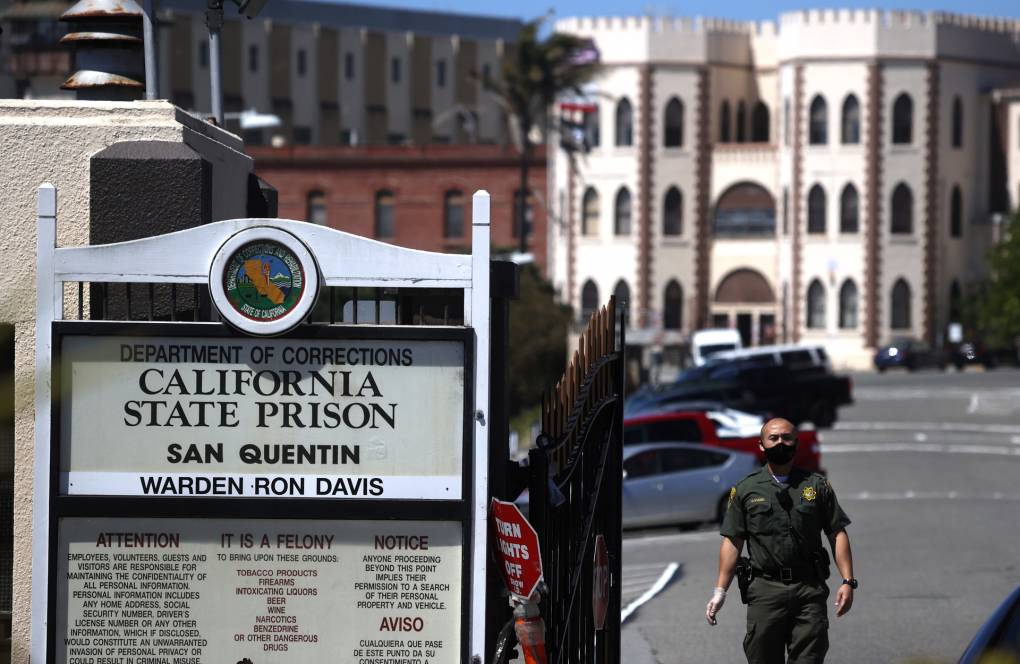
"caption": "A California Department of Corrections and Rehabilitation officer wears a protective mask as he stands guard at the front gate of San Quentin State Prison on June 29, 2020. ",
"description": "A California Department of Corrections and Rehabilitation (CDCR) officer wears a protective mask as he stands guard at the front gate of San Quentin State Prison on June 29, 2020. A COVID-19 outbreak has ravaged the prison's population.",
"title": "Coronavirus Cases Surge To Over A Thousand At San Quentin Prison",
"credit": "Justin Sullivan/Getty Images",
"status": "inherit",
"altTag": "A man stands with a mask at the entrance to San Quentin State Prison.",
"isLoading": false,
"fetchFailed": false
},
"news_11831885": {
"type": "attachments",
"id": "news_11831885",
"meta": {
"index": "attachments_1716263798",
"site": "news",
"id": "11831885",
"found": true
},
"parent": 11831871,
"imgSizes": {
"apple_news_ca_landscape_5_5": {
"file": "https://ww2.kqed.org/app/uploads/sites/10/2020/08/RS42240_029_KQED_Hayward_CoronavirusTesting_03232020_9898-qut-1044x783.jpg",
"width": 1044,
"mimeType": "image/jpeg",
"height": 783
},
"apple_news_ca_square_4_0": {
"file": "https://ww2.kqed.org/app/uploads/sites/10/2020/08/RS42240_029_KQED_Hayward_CoronavirusTesting_03232020_9898-qut-470x470.jpg",
"width": 470,
"mimeType": "image/jpeg",
"height": 470
},
"twentyfourteen-full-width": {
"file": "https://ww2.kqed.org/app/uploads/sites/10/2020/08/RS42240_029_KQED_Hayward_CoronavirusTesting_03232020_9898-qut-1038x576.jpg",
"width": 1038,
"mimeType": "image/jpeg",
"height": 576
},
"thumbnail": {
"file": "https://ww2.kqed.org/app/uploads/sites/10/2020/08/RS42240_029_KQED_Hayward_CoronavirusTesting_03232020_9898-qut-160x107.jpg",
"width": 160,
"mimeType": "image/jpeg",
"height": 107
},
"post-thumbnail": {
"file": "https://ww2.kqed.org/app/uploads/sites/10/2020/08/RS42240_029_KQED_Hayward_CoronavirusTesting_03232020_9898-qut-672x372.jpg",
"width": 672,
"mimeType": "image/jpeg",
"height": 372
},
"kqedFullSize": {
"file": "https://ww2.kqed.org/app/uploads/sites/10/2020/08/RS42240_029_KQED_Hayward_CoronavirusTesting_03232020_9898-qut.jpg",
"width": 1920,
"height": 1280
},
"apple_news_ca_landscape_4_7": {
"file": "https://ww2.kqed.org/app/uploads/sites/10/2020/08/RS42240_029_KQED_Hayward_CoronavirusTesting_03232020_9898-qut-632x474.jpg",
"width": 632,
"mimeType": "image/jpeg",
"height": 474
},
"large": {
"file": "https://ww2.kqed.org/app/uploads/sites/10/2020/08/RS42240_029_KQED_Hayward_CoronavirusTesting_03232020_9898-qut-1020x680.jpg",
"width": 1020,
"mimeType": "image/jpeg",
"height": 680
},
"apple_news_ca_landscape_4_0": {
"file": "https://ww2.kqed.org/app/uploads/sites/10/2020/08/RS42240_029_KQED_Hayward_CoronavirusTesting_03232020_9898-qut-536x402.jpg",
"width": 536,
"mimeType": "image/jpeg",
"height": 402
},
"apple_news_ca_portrait_12_9": {
"file": "https://ww2.kqed.org/app/uploads/sites/10/2020/08/RS42240_029_KQED_Hayward_CoronavirusTesting_03232020_9898-qut-1122x1280.jpg",
"width": 1122,
"mimeType": "image/jpeg",
"height": 1280
},
"medium": {
"file": "https://ww2.kqed.org/app/uploads/sites/10/2020/08/RS42240_029_KQED_Hayward_CoronavirusTesting_03232020_9898-qut-800x533.jpg",
"width": 800,
"mimeType": "image/jpeg",
"height": 533
},
"apple_news_ca_portrait_4_0": {
"file": "https://ww2.kqed.org/app/uploads/sites/10/2020/08/RS42240_029_KQED_Hayward_CoronavirusTesting_03232020_9898-qut-354x472.jpg",
"width": 354,
"mimeType": "image/jpeg",
"height": 472
},
"apple_news_ca_portrait_9_7": {
"file": "https://ww2.kqed.org/app/uploads/sites/10/2020/08/RS42240_029_KQED_Hayward_CoronavirusTesting_03232020_9898-qut-840x1120.jpg",
"width": 840,
"mimeType": "image/jpeg",
"height": 1120
},
"apple_news_ca_landscape_12_9": {
"file": "https://ww2.kqed.org/app/uploads/sites/10/2020/08/RS42240_029_KQED_Hayward_CoronavirusTesting_03232020_9898-qut-1832x1280.jpg",
"width": 1832,
"mimeType": "image/jpeg",
"height": 1280
},
"apple_news_ca_square_9_7": {
"file": "https://ww2.kqed.org/app/uploads/sites/10/2020/08/RS42240_029_KQED_Hayward_CoronavirusTesting_03232020_9898-qut-1104x1104.jpg",
"width": 1104,
"mimeType": "image/jpeg",
"height": 1104
},
"1536x1536": {
"file": "https://ww2.kqed.org/app/uploads/sites/10/2020/08/RS42240_029_KQED_Hayward_CoronavirusTesting_03232020_9898-qut-1536x1024.jpg",
"width": 1536,
"mimeType": "image/jpeg",
"height": 1024
},
"apple_news_ca_portrait_4_7": {
"file": "https://ww2.kqed.org/app/uploads/sites/10/2020/08/RS42240_029_KQED_Hayward_CoronavirusTesting_03232020_9898-qut-414x552.jpg",
"width": 414,
"mimeType": "image/jpeg",
"height": 552
},
"apple_news_ca_square_12_9": {
"file": "https://ww2.kqed.org/app/uploads/sites/10/2020/08/RS42240_029_KQED_Hayward_CoronavirusTesting_03232020_9898-qut-1472x1280.jpg",
"width": 1472,
"mimeType": "image/jpeg",
"height": 1280
},
"apple_news_ca_portrait_5_5": {
"file": "https://ww2.kqed.org/app/uploads/sites/10/2020/08/RS42240_029_KQED_Hayward_CoronavirusTesting_03232020_9898-qut-687x916.jpg",
"width": 687,
"mimeType": "image/jpeg",
"height": 916
},
"apple_news_ca_square_4_7": {
"file": "https://ww2.kqed.org/app/uploads/sites/10/2020/08/RS42240_029_KQED_Hayward_CoronavirusTesting_03232020_9898-qut-550x550.jpg",
"width": 550,
"mimeType": "image/jpeg",
"height": 550
},
"apple_news_ca_landscape_9_7": {
"file": "https://ww2.kqed.org/app/uploads/sites/10/2020/08/RS42240_029_KQED_Hayward_CoronavirusTesting_03232020_9898-qut-1376x1032.jpg",
"width": 1376,
"mimeType": "image/jpeg",
"height": 1032
},
"apple_news_ca_square_5_5": {
"file": "https://ww2.kqed.org/app/uploads/sites/10/2020/08/RS42240_029_KQED_Hayward_CoronavirusTesting_03232020_9898-qut-912x912.jpg",
"width": 912,
"mimeType": "image/jpeg",
"height": 912
}
},
"publishDate": 1596582042,
"modified": 1596582128,
"caption": "Medical personnel test patients for COVID-19 at a facility in Hayward in March. ",
"description": "Medical personnel test patients for COVID-19 at a facility in Hayward in March. ",
"title": "RS42240_029_KQED_Hayward_CoronavirusTesting_03232020_9898-qut",
"credit": "Beth LaBerge/KQED",
"status": "inherit",
"isLoading": false,
"fetchFailed": false
},
"news_11831756": {
"type": "attachments",
"id": "news_11831756",
"meta": {
"index": "attachments_1716263798",
"site": "news",
"id": "11831756",
"found": true
},
"parent": 11831748,
"imgSizes": {
"apple_news_ca_landscape_5_5": {
"file": "https://ww2.kqed.org/app/uploads/sites/10/2020/08/Trump-Citizenship-Application-Rule-Change-1044x783.jpg",
"width": 1044,
"mimeType": "image/jpeg",
"height": 783
},
"apple_news_ca_square_4_0": {
"file": "https://ww2.kqed.org/app/uploads/sites/10/2020/08/Trump-Citizenship-Application-Rule-Change-470x470.jpg",
"width": 470,
"mimeType": "image/jpeg",
"height": 470
},
"twentyfourteen-full-width": {
"file": "https://ww2.kqed.org/app/uploads/sites/10/2020/08/Trump-Citizenship-Application-Rule-Change-1038x576.jpg",
"width": 1038,
"mimeType": "image/jpeg",
"height": 576
},
"thumbnail": {
"file": "https://ww2.kqed.org/app/uploads/sites/10/2020/08/Trump-Citizenship-Application-Rule-Change-160x107.jpg",
"width": 160,
"mimeType": "image/jpeg",
"height": 107
},
"post-thumbnail": {
"file": "https://ww2.kqed.org/app/uploads/sites/10/2020/08/Trump-Citizenship-Application-Rule-Change-672x372.jpg",
"width": 672,
"mimeType": "image/jpeg",
"height": 372
},
"kqedFullSize": {
"file": "https://ww2.kqed.org/app/uploads/sites/10/2020/08/Trump-Citizenship-Application-Rule-Change.jpg",
"width": 1920,
"height": 1280
},
"apple_news_ca_landscape_4_7": {
"file": "https://ww2.kqed.org/app/uploads/sites/10/2020/08/Trump-Citizenship-Application-Rule-Change-632x474.jpg",
"width": 632,
"mimeType": "image/jpeg",
"height": 474
},
"large": {
"file": "https://ww2.kqed.org/app/uploads/sites/10/2020/08/Trump-Citizenship-Application-Rule-Change-1020x680.jpg",
"width": 1020,
"mimeType": "image/jpeg",
"height": 680
},
"apple_news_ca_landscape_4_0": {
"file": "https://ww2.kqed.org/app/uploads/sites/10/2020/08/Trump-Citizenship-Application-Rule-Change-536x402.jpg",
"width": 536,
"mimeType": "image/jpeg",
"height": 402
},
"apple_news_ca_portrait_12_9": {
"file": "https://ww2.kqed.org/app/uploads/sites/10/2020/08/Trump-Citizenship-Application-Rule-Change-1122x1280.jpg",
"width": 1122,
"mimeType": "image/jpeg",
"height": 1280
},
"medium": {
"file": "https://ww2.kqed.org/app/uploads/sites/10/2020/08/Trump-Citizenship-Application-Rule-Change-800x533.jpg",
"width": 800,
"mimeType": "image/jpeg",
"height": 533
},
"apple_news_ca_portrait_4_0": {
"file": "https://ww2.kqed.org/app/uploads/sites/10/2020/08/Trump-Citizenship-Application-Rule-Change-354x472.jpg",
"width": 354,
"mimeType": "image/jpeg",
"height": 472
},
"apple_news_ca_portrait_9_7": {
"file": "https://ww2.kqed.org/app/uploads/sites/10/2020/08/Trump-Citizenship-Application-Rule-Change-840x1120.jpg",
"width": 840,
"mimeType": "image/jpeg",
"height": 1120
},
"apple_news_ca_landscape_12_9": {
"file": "https://ww2.kqed.org/app/uploads/sites/10/2020/08/Trump-Citizenship-Application-Rule-Change-1832x1280.jpg",
"width": 1832,
"mimeType": "image/jpeg",
"height": 1280
},
"apple_news_ca_square_9_7": {
"file": "https://ww2.kqed.org/app/uploads/sites/10/2020/08/Trump-Citizenship-Application-Rule-Change-1104x1104.jpg",
"width": 1104,
"mimeType": "image/jpeg",
"height": 1104
},
"1536x1536": {
"file": "https://ww2.kqed.org/app/uploads/sites/10/2020/08/Trump-Citizenship-Application-Rule-Change-1536x1024.jpg",
"width": 1536,
"mimeType": "image/jpeg",
"height": 1024
},
"apple_news_ca_portrait_4_7": {
"file": "https://ww2.kqed.org/app/uploads/sites/10/2020/08/Trump-Citizenship-Application-Rule-Change-414x552.jpg",
"width": 414,
"mimeType": "image/jpeg",
"height": 552
},
"apple_news_ca_square_12_9": {
"file": "https://ww2.kqed.org/app/uploads/sites/10/2020/08/Trump-Citizenship-Application-Rule-Change-1472x1280.jpg",
"width": 1472,
"mimeType": "image/jpeg",
"height": 1280
},
"apple_news_ca_portrait_5_5": {
"file": "https://ww2.kqed.org/app/uploads/sites/10/2020/08/Trump-Citizenship-Application-Rule-Change-687x916.jpg",
"width": 687,
"mimeType": "image/jpeg",
"height": 916
},
"apple_news_ca_square_4_7": {
"file": "https://ww2.kqed.org/app/uploads/sites/10/2020/08/Trump-Citizenship-Application-Rule-Change-550x550.jpg",
"width": 550,
"mimeType": "image/jpeg",
"height": 550
},
"apple_news_ca_landscape_9_7": {
"file": "https://ww2.kqed.org/app/uploads/sites/10/2020/08/Trump-Citizenship-Application-Rule-Change-1376x1032.jpg",
"width": 1376,
"mimeType": "image/jpeg",
"height": 1032
},
"apple_news_ca_square_5_5": {
"file": "https://ww2.kqed.org/app/uploads/sites/10/2020/08/Trump-Citizenship-Application-Rule-Change-912x912.jpg",
"width": 912,
"mimeType": "image/jpeg",
"height": 912
}
},
"publishDate": 1596502320,
"modified": 1596502401,
"caption": "A volunteer (R) assists an immigrant with her U.S. citizenship application in 2016. ",
"description": null,
"title": "Immigrants Apply For US Citizenship In Increasing Numbers During Election Year",
"credit": "John Moore/Getty Images",
"status": "inherit",
"isLoading": false,
"fetchFailed": false
}
},
"audioPlayerReducer": {
"postId": "stream_live",
"isPaused": true,
"isPlaying": false,
"pfsActive": false,
"pledgeModalIsOpen": true,
"playerDrawerIsOpen": false,
"liveAudioPlayStartedAt": 0,
"liveAudioPlayContext": ""
},
"authorsReducer": {
"byline_news_11833113": {
"type": "authors",
"id": "byline_news_11833113",
"meta": {
"override": true
},
"slug": "byline_news_11833113",
"name": "\u003ca href=\"https://californiahealthline.org/news/author/rachel-scheier/\">Rachel Scheier\u003c/a>",
"isLoading": false
},
"byline_news_11832880": {
"type": "authors",
"id": "byline_news_11832880",
"meta": {
"override": true
},
"slug": "byline_news_11832880",
"name": "Bobby Allyn",
"isLoading": false
},
"byline_news_11832708": {
"type": "authors",
"id": "byline_news_11832708",
"meta": {
"override": true
},
"slug": "byline_news_11832708",
"name": "Don Thompson \u003cbr> Associated Press",
"isLoading": false
},
"byline_news_11832028": {
"type": "authors",
"id": "byline_news_11832028",
"meta": {
"override": true
},
"slug": "byline_news_11832028",
"name": "The Associated Press",
"isLoading": false
},
"kqednewsstaffandwires": {
"type": "authors",
"id": "237",
"meta": {
"index": "authors_1716337520",
"id": "237",
"found": true
},
"name": "KQED News Staff and Wires",
"firstName": "KQED News Staff and Wires",
"lastName": null,
"slug": "kqednewsstaffandwires",
"email": "onlinenewsstaff@kqed.org",
"display_author_email": false,
"staff_mastheads": [],
"title": null,
"bio": null,
"avatar": "https://secure.gravatar.com/avatar/72295af8ebbfbd19a4948f5271285664?s=600&d=blank&r=g",
"twitter": null,
"facebook": null,
"instagram": null,
"linkedin": null,
"sites": [
{
"site": "arts",
"roles": [
"contributor"
]
},
{
"site": "news",
"roles": [
"contributor"
]
},
{
"site": "lowdown",
"roles": [
"author"
]
},
{
"site": "stateofhealth",
"roles": [
"contributor"
]
},
{
"site": "food",
"roles": [
"author"
]
}
],
"headData": {
"title": "KQED News Staff and Wires | KQED",
"description": null,
"ogImgSrc": "https://secure.gravatar.com/avatar/72295af8ebbfbd19a4948f5271285664?s=600&d=blank&r=g",
"twImgSrc": "https://secure.gravatar.com/avatar/72295af8ebbfbd19a4948f5271285664?s=600&d=blank&r=g"
},
"isLoading": false,
"link": "/author/kqednewsstaffandwires"
},
"scottshafer": {
"type": "authors",
"id": "255",
"meta": {
"index": "authors_1716337520",
"id": "255",
"found": true
},
"name": "Scott Shafer",
"firstName": "Scott",
"lastName": "Shafer",
"slug": "scottshafer",
"email": "sshafer@kqed.org",
"display_author_email": false,
"staff_mastheads": [
"news"
],
"title": "KQED Contributor",
"bio": "Scott Shafer is a senior editor with the KQED Politics and Government desk. He is co-host of Political Breakdown, the award-winning radio show and podcast with a personal take on the world of politics. Scott came to KQED in 1998 to host the statewide\u003cem> California Report\u003c/em>. Prior to that he had extended stints in politics and government\u003cem>.\u003c/em> He uses that inside experience at KQED in his, reporting, hosting and analysis for the politics desk. Scott collaborated \u003cem>Political Breakdown a\u003c/em>nd on \u003cem>The Political Mind of Jerry Brown, \u003c/em>an eight-part series about the life and extraordinary political career of the former governor. For fun, he plays water polo with the San Francisco Tsunami.",
"avatar": "https://secure.gravatar.com/avatar/a62ebae45b79d7aed1a39a0e3bf68104?s=600&d=blank&r=g",
"twitter": "scottshafer",
"bluesky": null,
"facebook": null,
"instagram": null,
"linkedin": null,
"sites": [
{
"site": "news",
"roles": [
"editor"
]
},
{
"site": "stateofhealth",
"roles": [
"author"
]
},
{
"site": "science",
"roles": [
"author"
]
},
{
"site": "forum",
"roles": [
"subscriber"
]
},
{
"site": "liveblog",
"roles": [
"author"
]
}
],
"headData": {
"title": "Scott Shafer | KQED",
"description": "KQED Contributor",
"ogImgSrc": "https://secure.gravatar.com/avatar/a62ebae45b79d7aed1a39a0e3bf68104?s=600&d=blank&r=g",
"twImgSrc": "https://secure.gravatar.com/avatar/a62ebae45b79d7aed1a39a0e3bf68104?s=600&d=blank&r=g"
},
"isLoading": false,
"link": "/author/scottshafer"
},
"markfiore": {
"type": "authors",
"id": "3236",
"meta": {
"index": "authors_1716337520",
"id": "3236",
"found": true
},
"name": "Mark Fiore",
"firstName": "Mark",
"lastName": "Fiore",
"slug": "markfiore",
"email": "mark@markfiore.com",
"display_author_email": false,
"staff_mastheads": [
"news"
],
"title": "KQED News Cartoonist",
"bio": "\u003ca href=\"http://www.MarkFiore.com\">MarkFiore.com\u003c/a> | \u003ca href=\"https://twitter.com/markfiore\">Follow on Twitter\u003c/a> | \u003ca href=\"https://www.facebook.com/pages/Mark-Fiore-Animated-Political-Cartoons/94451707396?ref=bookmarks\">Facebook\u003c/a> | \u003ca href=\"mailto:mark@markfiore.com\">email\u003c/a>\r\n\r\nPulitzer Prize-winner, Mark Fiore, who the Wall Street Journal has called “the undisputed guru of the form,” creates animated political cartoons in San Francisco, where his work has been featured regularly on the San Francisco Chronicle’s web site, SFGate.com. His work has appeared on Newsweek.com, Slate.com, CBSNews.com, MotherJones.com, DailyKos.com and NPR’s web site. Fiore’s political animation has appeared on CNN, Frontline, Bill Moyers Journal, Salon.com and cable and broadcast outlets across the globe.\r\n\r\nBeginning his professional life by drawing traditional political cartoons for newspapers, Fiore’s work appeared in publications ranging from the Washington Post to the Los Angeles Times. In the late 1990s, he began to experiment with animating political cartoons and, after a short stint at the San Jose Mercury News as their staff cartoonist, Fiore devoted all his energies to animation.\r\nGrowing up in California, Fiore also spent a good portion of his life in the backwoods of Idaho. It was this combination that shaped him politically. Mark majored in political science at Colorado College, where, in a perfect send-off for a cartoonist, he received his diploma in 1991 as commencement speaker Dick Cheney smiled approvingly.\r\nMark Fiore was awarded the Pulitzer Prize for political cartooning in 2010, a Robert F. Kennedy Journalism Award in 2004 and has twice received an Online Journalism Award for commentary from the Online News Association (2002, 2008). Fiore has received two awards for his work in new media from the National Cartoonists Society (2001, 2002), and in 2006 received The James Madison Freedom of Information Award from The Society of Professional Journalists.",
"avatar": "https://secure.gravatar.com/avatar/fc4e2a612b15b67bad0c6f0e1db4ca9b?s=600&d=blank&r=g",
"twitter": "MarkFiore",
"facebook": null,
"instagram": "https://www.instagram.com/markfiore/?hl=en",
"linkedin": null,
"sites": [
{
"site": "arts",
"roles": [
"contributor"
]
},
{
"site": "news",
"roles": [
"editor"
]
},
{
"site": "futureofyou",
"roles": [
"editor"
]
},
{
"site": "science",
"roles": [
"editor"
]
}
],
"headData": {
"title": "Mark Fiore | KQED",
"description": "KQED News Cartoonist",
"ogImgSrc": "https://secure.gravatar.com/avatar/fc4e2a612b15b67bad0c6f0e1db4ca9b?s=600&d=blank&r=g",
"twImgSrc": "https://secure.gravatar.com/avatar/fc4e2a612b15b67bad0c6f0e1db4ca9b?s=600&d=blank&r=g"
},
"isLoading": false,
"link": "/author/markfiore"
},
"mlagos": {
"type": "authors",
"id": "3239",
"meta": {
"index": "authors_1716337520",
"id": "3239",
"found": true
},
"name": "Marisa Lagos",
"firstName": "Marisa",
"lastName": "Lagos",
"slug": "mlagos",
"email": "mlagos@kqed.org",
"display_author_email": false,
"staff_mastheads": [
"news"
],
"title": "KQED Contributor",
"bio": "Marisa Lagos is a correspondent for KQED’s California Politics and Government Desk and co-hosts the award-winning show and podcast, Political Breakdown. At KQED, Lagos also conducts reporting, analysis and investigations into state, local and national politics for radio, TV, online and onstage. In 2022, she and co-host, Scott Shafer, moderated the only gubernatorial debate in California. In 2020, the \u003ci>Washington Post\u003c/i> named her one of the top political journalists in California; she was nominated for a Peabody and won several other awards for her work investigating the 2017 California wildfires. She has worked at the \u003ci>San Francisco Chronicle\u003c/i>, \u003ci>San Francisco Examiner\u003c/i> and \u003ci>Los Angeles Times\u003c/i>. A UC Santa Barbara graduate, she lives in San Francisco with her two sons and husband.",
"avatar": "https://secure.gravatar.com/avatar/a261a0d3696fc066871ef96b85b5e7d2?s=600&d=blank&r=g",
"twitter": "@mlagos",
"facebook": null,
"instagram": null,
"linkedin": null,
"sites": [
{
"site": "arts",
"roles": [
"author"
]
},
{
"site": "news",
"roles": [
"editor"
]
},
{
"site": "science",
"roles": [
"editor"
]
},
{
"site": "forum",
"roles": [
"author"
]
},
{
"site": "liveblog",
"roles": [
"author"
]
}
],
"headData": {
"title": "Marisa Lagos | KQED",
"description": "KQED Contributor",
"ogImgSrc": "https://secure.gravatar.com/avatar/a261a0d3696fc066871ef96b85b5e7d2?s=600&d=blank&r=g",
"twImgSrc": "https://secure.gravatar.com/avatar/a261a0d3696fc066871ef96b85b5e7d2?s=600&d=blank&r=g"
},
"isLoading": false,
"link": "/author/mlagos"
},
"fjhabvala": {
"type": "authors",
"id": "8659",
"meta": {
"index": "authors_1716337520",
"id": "8659",
"found": true
},
"name": "Farida Jhabvala Romero",
"firstName": "Farida",
"lastName": "Jhabvala Romero",
"slug": "fjhabvala",
"email": "fjhabvala@kqed.org",
"display_author_email": true,
"staff_mastheads": [
"news"
],
"title": "KQED Contributor",
"bio": "\u003cspan style=\"font-weight: 400;\">Farida Jhabvala Romero is a Labor Correspondent for KQED. She previously covered immigration. Farida was \u003ca href=\"https://www.ccnma.org/2022-most-influential-latina-journalists\">named\u003c/a> one of the 10 Most Influential Latina Journalists in California in 2022 by the California Chicano News Media Association. Her work has won awards from the Society of Professional Journalists (Northern California), as well as a national and regional Edward M. Murrow Award for the collaborative reporting projects “Dangerous Air” and “Graying California.” \u003c/span>\u003cspan style=\"font-weight: 400;\">Before joining KQED, Farida worked as a producer at Radio Bilingüe, a national public radio network. Farida earned her master’s degree in journalism from Stanford University.\u003c/span>",
"avatar": "https://secure.gravatar.com/avatar/c3ab27c5554b67b478f80971e515aa02?s=600&d=blank&r=g",
"twitter": "FaridaJhabvala",
"facebook": null,
"instagram": null,
"linkedin": "https://www.linkedin.com/in/faridajhabvala/",
"sites": [
{
"site": "news",
"roles": [
"editor"
]
},
{
"site": "stateofhealth",
"roles": [
"author"
]
}
],
"headData": {
"title": "Farida Jhabvala Romero | KQED",
"description": "KQED Contributor",
"ogImgSrc": "https://secure.gravatar.com/avatar/c3ab27c5554b67b478f80971e515aa02?s=600&d=blank&r=g",
"twImgSrc": "https://secure.gravatar.com/avatar/c3ab27c5554b67b478f80971e515aa02?s=600&d=blank&r=g"
},
"isLoading": false,
"link": "/author/fjhabvala"
},
"mwiley": {
"type": "authors",
"id": "11526",
"meta": {
"index": "authors_1716337520",
"id": "11526",
"found": true
},
"name": "Michelle Wiley",
"firstName": "Michelle",
"lastName": "Wiley",
"slug": "mwiley",
"email": "mwiley@KQED.org",
"display_author_email": true,
"staff_mastheads": [],
"title": null,
"bio": "Michelle Wiley was the senior editor of weekends.",
"avatar": "https://secure.gravatar.com/avatar/3b897d82a09e8587e8e73fa69fbcc635?s=600&d=blank&r=g",
"twitter": "michelleewiley",
"facebook": null,
"instagram": null,
"linkedin": null,
"sites": [
{
"site": "",
"roles": [
"editor"
]
},
{
"site": "arts",
"roles": [
"editor"
]
},
{
"site": "news",
"roles": [
"subscriber"
]
},
{
"site": "lowdown",
"roles": [
"editor"
]
},
{
"site": "science",
"roles": [
"editor"
]
},
{
"site": "podcasts",
"roles": [
"editor"
]
}
],
"headData": {
"title": "Michelle Wiley | KQED",
"description": null,
"ogImgSrc": "https://secure.gravatar.com/avatar/3b897d82a09e8587e8e73fa69fbcc635?s=600&d=blank&r=g",
"twImgSrc": "https://secure.gravatar.com/avatar/3b897d82a09e8587e8e73fa69fbcc635?s=600&d=blank&r=g"
},
"isLoading": false,
"link": "/author/mwiley"
},
"mfharvin": {
"type": "authors",
"id": "11583",
"meta": {
"index": "authors_1716337520",
"id": "11583",
"found": true
},
"name": "Mary Franklin Harvin",
"firstName": "Mary Franklin",
"lastName": "Harvin",
"slug": "mfharvin",
"email": "mfharvin@KQED.org",
"display_author_email": false,
"staff_mastheads": [
"news"
],
"title": "KQED Contributor",
"bio": null,
"avatar": "https://secure.gravatar.com/avatar/0e53510a7d48cfbdebfc9b11357d845f?s=600&d=blank&r=g",
"twitter": "EmEffHarvin",
"facebook": null,
"instagram": null,
"linkedin": null,
"sites": [
{
"site": "news",
"roles": [
"author",
"edit_others_posts"
]
},
{
"site": "science",
"roles": [
"editor"
]
}
],
"headData": {
"title": "Mary Franklin Harvin | KQED",
"description": "KQED Contributor",
"ogImgSrc": "https://secure.gravatar.com/avatar/0e53510a7d48cfbdebfc9b11357d845f?s=600&d=blank&r=g",
"twImgSrc": "https://secure.gravatar.com/avatar/0e53510a7d48cfbdebfc9b11357d845f?s=600&d=blank&r=g"
},
"isLoading": false,
"link": "/author/mfharvin"
},
"lsarah": {
"type": "authors",
"id": "11626",
"meta": {
"index": "authors_1716337520",
"id": "11626",
"found": true
},
"name": "Lakshmi Sarah",
"firstName": "Lakshmi",
"lastName": "Sarah",
"slug": "lsarah",
"email": "lsarah@kqed.org",
"display_author_email": false,
"staff_mastheads": [],
"title": "Digital Producer",
"bio": "Lakshmi Sarah is an educator, author and journalist with a focus on innovative storytelling. She has worked with newspapers, radio and magazines from Ahmedabad, India to Los Angeles, California. She has written and produced for Die Zeit, Global Voices, AJ+, KQED, Fusion Media Group and the New York Times.",
"avatar": "https://secure.gravatar.com/avatar/652dcaecd8b28826fc17a8b2d6bb4e93?s=600&d=blank&r=g",
"twitter": "lakitalki",
"facebook": null,
"instagram": "https://www.instagram.com/laki.talki/",
"linkedin": "https://www.linkedin.com/in/lakisarah/",
"sites": [
{
"site": "arts",
"roles": []
},
{
"site": "news",
"roles": []
},
{
"site": "bayareabites",
"roles": []
},
{
"site": "science",
"roles": []
}
],
"headData": {
"title": "Lakshmi Sarah | KQED",
"description": "Digital Producer",
"ogImgSrc": "https://secure.gravatar.com/avatar/652dcaecd8b28826fc17a8b2d6bb4e93?s=600&d=blank&r=g",
"twImgSrc": "https://secure.gravatar.com/avatar/652dcaecd8b28826fc17a8b2d6bb4e93?s=600&d=blank&r=g"
},
"isLoading": false,
"link": "/author/lsarah"
},
"jrodriguez": {
"type": "authors",
"id": "11690",
"meta": {
"index": "authors_1716337520",
"id": "11690",
"found": true
},
"name": "Joe Fitzgerald Rodriguez",
"firstName": "Joe",
"lastName": "Fitzgerald Rodriguez",
"slug": "jrodriguez",
"email": "jrodriguez@kqed.org",
"display_author_email": true,
"staff_mastheads": [
"news"
],
"title": "Reporter and Producer",
"bio": "Joe Fitzgerald Rodriguez is a reporter and digital producer for KQED covering politics. Joe most recently wrote for the \u003cem>San Francisco Examiner\u003c/em> as a political columnist covering The City. He was raised in San Francisco and has spent his reporting career in his beloved, foggy, city by the bay. Joe was 12-years-old when he conducted his first interview in journalism, grilling former San Francisco Mayor Willie Brown for the Marina Middle School newspaper, \u003cem>The Penguin Press, \u003c/em>and he continues to report on the San Francisco Bay Area to this day.",
"avatar": "https://secure.gravatar.com/avatar/2247beb0564c1e9c62228d5649d2edac?s=600&d=blank&r=g",
"twitter": "FitztheReporter",
"facebook": null,
"instagram": "https://www.instagram.com/fitzthereporter/",
"linkedin": null,
"sites": [
{
"site": "",
"roles": [
"editor"
]
},
{
"site": "arts",
"roles": [
"editor"
]
},
{
"site": "news",
"roles": [
"editor"
]
},
{
"site": "science",
"roles": [
"editor"
]
},
{
"site": "elections",
"roles": [
"editor"
]
},
{
"site": "liveblog",
"roles": [
"editor"
]
}
],
"headData": {
"title": "Joe Fitzgerald Rodriguez | KQED",
"description": "Reporter and Producer",
"ogImgSrc": "https://secure.gravatar.com/avatar/2247beb0564c1e9c62228d5649d2edac?s=600&d=blank&r=g",
"twImgSrc": "https://secure.gravatar.com/avatar/2247beb0564c1e9c62228d5649d2edac?s=600&d=blank&r=g"
},
"isLoading": false,
"link": "/author/jrodriguez"
}
},
"pagesReducer": {
"news_tag_california": {
"type": "terms",
"id": "news_18538",
"meta": {
"index": "terms_1716263798",
"site": "news",
"id": "18538",
"score": 6.8450828
},
"featImg": null,
"name": "California",
"description": null,
"taxonomy": "tag",
"headData": {
"twImgId": null,
"twTitle": null,
"ogTitle": null,
"ogImgId": null,
"twDescription": null,
"description": null,
"title": "California Archives | KQED News",
"ogDescription": null
},
"ttid": 31,
"slug": "california",
"isLoading": false,
"title": "California",
"pageMeta": {
"site": "news",
"WpPageTemplate": "page-topic-editorial",
"currentPage": 197
},
"blocks": [
{
"blockName": "kqed/post-list",
"attrs": {
"layout": "cardArticle2",
"query": "posts/news?tag=california",
"seeMore": false,
"paginated": true,
"page": 197
}
},
{
"blockName": "kqed/ad"
}
]
}
},
"pfsSessionReducer": {},
"postsReducer": {
"stream_live": {
"type": "live",
"id": "stream_live",
"audioUrl": "https://streams.kqed.org/kqedradio",
"title": "Live Stream",
"excerpt": "Live Stream information currently unavailable.",
"link": "/radio",
"featImg": "",
"label": {
"name": "KQED Live",
"link": "/"
}
},
"stream_kqedNewscast": {
"type": "posts",
"id": "stream_kqedNewscast",
"audioUrl": "https://www.kqed.org/.stream/anon/radio/RDnews/newscast.mp3?_=1",
"title": "KQED Newscast",
"featImg": "",
"label": {
"name": "88.5 FM",
"link": "/"
}
},
"news_11833268": {
"type": "posts",
"id": "news_11833268",
"meta": {
"index": "posts_1716263798",
"site": "news",
"id": "11833268",
"score": null,
"sort": [
1597354048000
]
},
"parent": 0,
"labelTerm": {
"site": "news"
},
"blocks": [],
"publishDate": 1597354048,
"format": "standard",
"disqusTitle": "California Eviction Moratorium to End Sept. 1, Judicial Council Says",
"title": "California Eviction Moratorium to End Sept. 1, Judicial Council Says",
"headTitle": "KQED News",
"content": "\u003cp>The Judicial Council of California voted Thursday to end its moratorium on evictions and foreclosure filings on Sept. 1, about two weeks later than they were initially set to end.\u003c/p>\n\u003cp>The move gives lawmakers a little more time to fashion new protections for millions of California tenants facing eviction, and property owners struggling to pay their mortgages.\u003c/p>\n\u003cp>Legislative leaders and Gov. Gavin Newsom are knee-deep in negotiations over a long-term solution, which would pick up when the current moratorium expires. Assemblymember David Chiu, D-San Francisco, who authored AB 1436 — one of the bills under consideration — told KQED those two weeks are preciously needed time.\u003c/p>\n\u003cp>\"We are breathing a very quick sigh of relief, but we have a ton of work in front of us,\" Chiu said. \"We simply cannot allow a massive wave of evictions to occur in California. It would be catastrophic.\"\u003c/p>\n\u003cp>\"The human suffering would be extraordinary,\" Chiu said.\u003c/p>\n\u003cp>Roughly 4 million California renters are at risk for eviction by the end of September, \u003ca href=\"https://www.aspeninstitute.org/blog-posts/20-million-renters-are-at-risk-of-eviction/\">according to a model to predict national eviction risk developed by The Aspen Institute\u003c/a>, a coalition of economists and legal experts.\u003c/p>\n\u003cp>The Judicial Council – the state court system's policymaking body – first enacted an emergency eviction moratorium and halt on foreclosures in an April decision, which they were poised to end in June. But California Chief Justice Tani G. Cantil-Sakauye \u003ca href=\"https://www.kqed.org/news/11823891/california-courts-halt-plan-to-lift-eviction-moratorium-in-august\">called off that vote\u003c/a> to provide more time to Gov. Newsom and the legislative branch to find an alternative solution to halt evictions.\u003c/p>\n\u003cp>[ad fullwidth]\u003c/p>\n\u003cp>\"The Judicial Council has received thousands of comments from those affected – from tenants who fear homelessness to small landlords who face losing their livelihoods or fear bankruptcy,\" Cantil-Sakauye said in a statement.\u003c/p>\n\u003cp>\"I promised the Governor that we would assume this responsibility with the greatest care,\" Cantil-Sakauye added, but \"the duty of the judicial branch is to resolve disputes under the law and not to legislate.\"\u003c/p>\n\u003cp>The legislative branch is negotiating solutions, even now.\u003c/p>\n\u003ch3>Legislative Solutions\u003c/h3>\n\u003cp>AB 1436 proposes extending eviction moratoriums for as long as California remains in a state of emergency, and includes extra time for landlords and any homeowners to pay their mortgages in the form of forbearance. The bill largely has the backing of tenants groups and unions.\u003c/p>\n\u003cp>Lawmakers are also considering Senate Bill 1410, introduced by state Sen. Anna M. Caballero, D–Salinas, and others.\u003c/p>\n\u003cp>That bill would offer tax credits to property owners to make up for any unpaid rent due to the pandemic. SB 1410's backers include advocacy groups representing property owners, like the California Apartment Association.\u003c/p>\n\u003cp>[aside label='Related Coverage' tag='eviction-moratorium']SB 1410 \"offered a solution that will help housing providers continue to pay their bills, and their employees, while also making it a little easier for struggling renters to get back on their feet financially when the pandemic ends,\" said Debra Carlton, the Apartment Association's executive vice president of state government affairs and compliance, in a statement.\u003c/p>\n\u003cp>While Chiu said talks are early, he said it's important any final compromise bills include enough time for tenants to repay any owed rent.\u003c/p>\n\u003cp>\"That's what we are trying to figure out. What does that timeframe look like with the uncertainty of stay-at-home orders and this economy? And it's very difficult to predict,\" Chiu said. \u003c/p>\n\u003cp>\"But we know the longer this goes on, the harder it is for tenants to make it. But also it creates ripple effects with other parts of the economy, (like) struggling landlords and homeowners who are trying to make mortgages.\"\u003c/p>\n\u003cp>\u003c/p>\n",
"disqusIdentifier": "11833268 https://ww2.kqed.org/news/?p=11833268",
"disqusUrl": "https://ww2.kqed.org/news/2020/08/13/california-eviction-moratorium-to-end-on-sept-1-court-says/",
"stats": {
"hasVideo": false,
"hasChartOrMap": false,
"hasAudio": false,
"hasPolis": false,
"wordCount": 603,
"hasGoogleForm": false,
"hasGallery": false,
"hasHearkenModule": false,
"iframeSrcs": [],
"paragraphCount": 19
},
"modified": 1597358489,
"excerpt": "State lawmakers are scrambling to fashion long-term eviction protections for millions of California tenants.",
"headData": {
"twImgId": "",
"twTitle": "",
"ogTitle": "",
"ogImgId": "",
"twDescription": "",
"description": "State lawmakers are scrambling to fashion long-term eviction protections for millions of California tenants.",
"title": "California Eviction Moratorium to End Sept. 1, Judicial Council Says | KQED",
"ogDescription": "",
"schema": {
"@context": "https://schema.org",
"@type": "NewsArticle",
"headline": "California Eviction Moratorium to End Sept. 1, Judicial Council Says",
"datePublished": "2020-08-13T14:27:28-07:00",
"dateModified": "2020-08-13T15:41:29-07:00",
"image": "https://cdn.kqed.org/wp-content/uploads/2020/02/KQED-OG-Image@1x.png",
"isAccessibleForFree": "True",
"publisher": {
"@type": "NewsMediaOrganization",
"@id": "https://www.kqed.org/#organization",
"name": "KQED",
"logo": "https://cdn.kqed.org/wp-content/uploads/2020/02/KQED-OG-Image@1x.png",
"url": "https://www.kqed.org",
"sameAs": [
"https://www.facebook.com/KQED",
"https://twitter.com/KQED",
"https://www.instagram.com/kqed/",
"https://www.tiktok.com/@kqedofficial",
"https://www.linkedin.com/company/kqed",
"https://www.youtube.com/channel/UCeC0IOo7i1P_61zVUWbJ4nw"
]
}
}
},
"guestAuthors": [],
"slug": "california-eviction-moratorium-to-end-on-sept-1-court-says",
"status": "publish",
"path": "/news/11833268/california-eviction-moratorium-to-end-on-sept-1-court-says",
"audioTrackLength": null,
"parsedContent": [
{
"type": "contentString",
"content": "\u003cdiv class=\"post-body\">\u003cp>\u003cp>The Judicial Council of California voted Thursday to end its moratorium on evictions and foreclosure filings on Sept. 1, about two weeks later than they were initially set to end.\u003c/p>\n\u003cp>The move gives lawmakers a little more time to fashion new protections for millions of California tenants facing eviction, and property owners struggling to pay their mortgages.\u003c/p>\n\u003cp>Legislative leaders and Gov. Gavin Newsom are knee-deep in negotiations over a long-term solution, which would pick up when the current moratorium expires. Assemblymember David Chiu, D-San Francisco, who authored AB 1436 — one of the bills under consideration — told KQED those two weeks are preciously needed time.\u003c/p>\n\u003cp>\"We are breathing a very quick sigh of relief, but we have a ton of work in front of us,\" Chiu said. \"We simply cannot allow a massive wave of evictions to occur in California. It would be catastrophic.\"\u003c/p>\n\u003cp>\"The human suffering would be extraordinary,\" Chiu said.\u003c/p>\n\u003cp>Roughly 4 million California renters are at risk for eviction by the end of September, \u003ca href=\"https://www.aspeninstitute.org/blog-posts/20-million-renters-are-at-risk-of-eviction/\">according to a model to predict national eviction risk developed by The Aspen Institute\u003c/a>, a coalition of economists and legal experts.\u003c/p>\n\u003cp>The Judicial Council – the state court system's policymaking body – first enacted an emergency eviction moratorium and halt on foreclosures in an April decision, which they were poised to end in June. But California Chief Justice Tani G. Cantil-Sakauye \u003ca href=\"https://www.kqed.org/news/11823891/california-courts-halt-plan-to-lift-eviction-moratorium-in-august\">called off that vote\u003c/a> to provide more time to Gov. Newsom and the legislative branch to find an alternative solution to halt evictions.\u003c/p>\n\u003cp>\u003c/p>\u003c/div>",
"attributes": {
"named": {},
"numeric": []
}
},
{
"type": "component",
"content": "",
"name": "ad",
"attributes": {
"named": {
"label": "fullwidth"
},
"numeric": [
"fullwidth"
]
}
},
{
"type": "contentString",
"content": "\u003cdiv class=\"post-body\">\u003cp>\u003c/p>\n\u003cp>\"The Judicial Council has received thousands of comments from those affected – from tenants who fear homelessness to small landlords who face losing their livelihoods or fear bankruptcy,\" Cantil-Sakauye said in a statement.\u003c/p>\n\u003cp>\"I promised the Governor that we would assume this responsibility with the greatest care,\" Cantil-Sakauye added, but \"the duty of the judicial branch is to resolve disputes under the law and not to legislate.\"\u003c/p>\n\u003cp>The legislative branch is negotiating solutions, even now.\u003c/p>\n\u003ch3>Legislative Solutions\u003c/h3>\n\u003cp>AB 1436 proposes extending eviction moratoriums for as long as California remains in a state of emergency, and includes extra time for landlords and any homeowners to pay their mortgages in the form of forbearance. The bill largely has the backing of tenants groups and unions.\u003c/p>\n\u003cp>Lawmakers are also considering Senate Bill 1410, introduced by state Sen. Anna M. Caballero, D–Salinas, and others.\u003c/p>\n\u003cp>That bill would offer tax credits to property owners to make up for any unpaid rent due to the pandemic. SB 1410's backers include advocacy groups representing property owners, like the California Apartment Association.\u003c/p>\n\u003cp>\u003c/p>\u003c/div>",
"attributes": {
"named": {},
"numeric": []
}
},
{
"type": "component",
"content": "",
"name": "aside",
"attributes": {
"named": {
"label": "Related Coverage ",
"tag": "eviction-moratorium"
},
"numeric": []
}
},
{
"type": "contentString",
"content": "\u003cdiv class=\"post-body\">\u003cp>SB 1410 \"offered a solution that will help housing providers continue to pay their bills, and their employees, while also making it a little easier for struggling renters to get back on their feet financially when the pandemic ends,\" said Debra Carlton, the Apartment Association's executive vice president of state government affairs and compliance, in a statement.\u003c/p>\n\u003cp>While Chiu said talks are early, he said it's important any final compromise bills include enough time for tenants to repay any owed rent.\u003c/p>\n\u003cp>\"That's what we are trying to figure out. What does that timeframe look like with the uncertainty of stay-at-home orders and this economy? And it's very difficult to predict,\" Chiu said. \u003c/p>\n\u003cp>\"But we know the longer this goes on, the harder it is for tenants to make it. But also it creates ripple effects with other parts of the economy, (like) struggling landlords and homeowners who are trying to make mortgages.\"\u003c/p>\n\u003cp>\u003c/p>\n\u003c/div>\u003c/p>",
"attributes": {
"named": {},
"numeric": []
}
}
],
"link": "/news/11833268/california-eviction-moratorium-to-end-on-sept-1-court-says",
"authors": [
"11690"
],
"categories": [
"news_1758",
"news_6266",
"news_6188",
"news_8",
"news_13"
],
"tags": [
"news_18538",
"news_27350",
"news_27504",
"news_167",
"news_27701",
"news_18372",
"news_27626",
"news_16",
"news_1775",
"news_28396",
"news_17968"
],
"featImg": "news_11823916",
"label": "news"
},
"news_11833113": {
"type": "posts",
"id": "news_11833113",
"meta": {
"index": "posts_1716263798",
"site": "news",
"id": "11833113",
"score": null,
"sort": [
1597262467000
]
},
"parent": 0,
"labelTerm": {},
"blocks": [],
"publishDate": 1597262467,
"format": "standard",
"disqusTitle": "In Health-Conscious Marin County, Virus Runs Rampant Among Latino Essential Workers",
"title": "In Health-Conscious Marin County, Virus Runs Rampant Among Latino Essential Workers",
"headTitle": "KQED News",
"content": "\u003cp>On a warm evening in late June, people flocked to alfresco tables set up along San Rafael's main drag to sip sauvignon blanc and eat wood-oven pizza for Dining Under the Lights, an event to welcome Marin County residents back to one of their favorite pastimes.\u003c/p>\n\u003cp>About a mile away, Crisalia Calderon was hunkered down in her apartment facing a sleepless night as she grappled with the early symptoms of COVID-19.\u003c/p>\n\u003cp>The 29-year-old house cleaner and her husband Henry, a construction worker, both suffered terrible back pain, and she struggled to breathe. \u003c/p>\n\u003cp>“Every time I tried to sleep, I felt like I was drowning,” she said recently, speaking in Spanish through an interpreter.\u003c/p>\n\u003cp>A few days earlier, Henry had called her sobbing from a hospital emergency room after testing positive for the coronavirus. The couple and their three small children share their Canal neighborhood flat with Crisalia’s sister and her four family members. “He didn’t want to come home,” she said. “But what could we do? Where could he go?”\u003c/p>\n\u003cp>[pullquote size=\"medium\" align=\"right\" citation=\"Matt Willis, Marin County public health officer\"]'This is our essential workforce. This isn’t the result of casual socializing at happy hour.'[/pullquote]\u003c/p>\n\u003cp>At home, Henry tried to isolate himself in the top bunk of one of their kids’ beds. But it was too late. Within about a week, all but two of the 10 people in the household had tested positive for COVID-19.\u003c/p>\n\u003cp>Low-income communities of color — especially Latinos — are increasingly bearing the brunt of the coronavirus pandemic in California, where spreading infections among poor service workers living in crowded conditions has highlighted widening racial and economic inequities. These disparities are particularly stark in idyllic Marin, where a surge of new COVID-19 cases concentrated in one crowded neighborhood has helped land the county on the \u003ca href=\"https://www.cdph.ca.gov/Programs/CID/DCDC/Pages/COVID-19/CountyMonitoringDataStep2.aspx\">state’s pandemic watchlist.\u003c/a>\u003c/p>\n\u003cp>[ad fullwidth]\u003c/p>\n\u003cp>Latinos, who comprise 16% of the county’s population, account for 75% of coronavirus infections — closer to 90% since mid-June, according to Dr. Matt Willis, the public health officer for Marin County. After recording only a handful of coronavirus cases in the early months of the pandemic, the county now has the highest per-capita rate in the Bay Area.\u003c/p>\n\u003cp>“This is our essential workforce,” said Willis. “This isn’t the result of casual socializing at happy hour.”\u003c/p>\n\u003cp>The Canal, named for the waterway on its northern border that was once San Rafael’s commercial waterfront, is a flat, densely populated district in a Bay Area suburb famous for its wooded hillside hamlets and multimillion-dollar vistas. The Canal’s 2.5 square miles are dotted by auto shops, scruffy palm trees and rows of low-slung apartment buildings occupied by immigrants from countries such as Mexico, Guatemala and El Salvador. An influx of young Latinos has nearly tripled the neighborhood’s population since the 1990s.\u003c/p>\n\u003cp>“It’s like a Hispanic village where everybody knows everybody else,” said Jennifer Tores, 22, a Canal native who works at a discount clothing store.\u003c/p>\n\u003cp>[aside postID=news_11828620 hero='https://ww2.kqed.org/app/uploads/sites/10/2020/07/GettyImages-1211223326-1-1020x720.jpg']The laborers of the Canal are both a world away from and intimately connected to well-heeled towns like San Anselmo and Tiburon, where they clean mansions, wax Teslas and steam milk for $6 lattes.\u003c/p>\n\u003cp>More than half of families in the neighborhood earn less than $35,000 a year, in a county where the median income is almost triple that. People are often squeezed two or three families to an apartment in order to afford Marin’s infamously high rents. The Calderons live paycheck-to-paycheck to cover their half of the $2,100 monthly rent while also managing to send money back home to relatives in Guatemala.\u003c/p>\n\u003cp>Willis said such living arrangements “can easily translate one case of COVID-19 into five or 10.”\u003c/p>\n\u003cp>Even more contagious than the virus is the misinformation that’s spread quickly through the Latino community, including a rumor that local testing sites were infecting people and claims that beer is a cure.\u003c/p>\n\u003cp>Confused and isolated at home in quarantine for several weeks with her entire family, Crisalia Calderon began to worry. “I was getting really scared,” she said. “We were running out of food and money.”\u003c/p>\n\u003cfigure id=\"attachment_11833135\" class=\"wp-caption aligncenter\" style=\"max-width: 1920px\">\u003cimg src=\"https://ww2.kqed.org/app/uploads/sites/10/2020/08/Calderon-Family.jpg\" alt=\"Crisalia Calderon with her children, Neymar (left), Daisy and Katy. The whole family tested positive for COVID-19 in late June but have since recovered.\" width=\"1920\" height=\"1440\" class=\"size-full wp-image-11833135\" srcset=\"https://ww2.kqed.org/app/uploads/sites/10/2020/08/Calderon-Family.jpg 1920w, https://ww2.kqed.org/app/uploads/sites/10/2020/08/Calderon-Family-800x600.jpg 800w, https://ww2.kqed.org/app/uploads/sites/10/2020/08/Calderon-Family-1020x765.jpg 1020w, https://ww2.kqed.org/app/uploads/sites/10/2020/08/Calderon-Family-160x120.jpg 160w, https://ww2.kqed.org/app/uploads/sites/10/2020/08/Calderon-Family-1536x1152.jpg 1536w, https://ww2.kqed.org/app/uploads/sites/10/2020/08/Calderon-Family-1832x1374.jpg 1832w, https://ww2.kqed.org/app/uploads/sites/10/2020/08/Calderon-Family-1376x1032.jpg 1376w, https://ww2.kqed.org/app/uploads/sites/10/2020/08/Calderon-Family-1044x783.jpg 1044w, https://ww2.kqed.org/app/uploads/sites/10/2020/08/Calderon-Family-632x474.jpg 632w, https://ww2.kqed.org/app/uploads/sites/10/2020/08/Calderon-Family-536x402.jpg 536w\" sizes=\"(max-width: 1920px) 100vw, 1920px\">\u003cfigcaption class=\"wp-caption-text\">Crisalia Calderon with her children, Neymar (left), Daisy and Katy. The whole family tested positive for COVID-19 in late June but have since recovered. \u003ccite>(Rachel Scheier/California Healthline)\u003c/cite>\u003c/figcaption>\u003c/figure>\n\u003cp>She spent hours dialing county officials and local nonprofits, but no one called back. Finally, someone at a community organization promised to deliver meals to the family, but all that arrived the next day was some expired ground meat and a few potatoes.\u003c/p>\n\u003cp>So Calderon turned to the same informal safety net she’d relied on in the rural village she left at 16 to migrate north. A fellow Guatemalan neighbor went to Costco and brought her ibuprofen for the aches and fever, and diapers and PediaSure for the kids, who are aged 5, 3, and 2 years old. Someone else brought vegetables, milk and beans from a Latin American market. After three hours on the phone, Calderon managed to qualify for $500 in state coronavirus aid for undocumented residents.\u003c/p>\n\u003cp>Willis said officials are working with Canal Alliance, a neighborhood group, to provide support to residents who contract the virus — in the form of cash and hotel rooms to isolate the infected. The county is recruiting bilingual contact tracers from the Latino community.\u003c/p>\n\u003ch3>'These People Were in Survival Mode Before COVID-19'\u003c/h3>\n\u003cp>Marin is one of California’s healthiest, wealthiest and best-educated counties, and one of the \u003ca href=\"https://www.racecounts.org/county/marin/\">most segregated\u003c/a>. The county has fiercely preserved its natural beauty and wide-open spaces over the years — often at the cost of public transit and affordable housing.\u003c/p>\n\u003cp>A 2012 \u003ca href=\"http://measureofamerica.org/docs/APOM_Final-SinglePages_12.14.11.pdf\">report on Marin County by the American Human Development Project\u003c/a> showed that fewer than half of adults in the Canal had a high school diploma. It ranked the neighborhood’s nearly 12,000 residents dead-last among the county’s 51 census tracts for community well-being and opportunity.\u003c/p>\n\u003cp>In light of these disparities, it’s not surprising that people like Calderon are falling through the cracks, said Omar Carrera, Canal Alliance’s CEO.\u003c/p>\n\u003cp>“These people were in survival mode before COVID-19,” Carrera said on a recent afternoon, standing before a mural that adorns the group’s headquarters. \u003c/p>\n\u003cp>People had been lining up since 7 a.m. for free coronavirus testing that began at 1 p.m. Health officials are scrambling to keep pace with demand for tests as infections have surged and employers such as gas stations and grocery stores have started requiring workers to be tested regularly.\u003c/p>\n\u003cp>[aside postID=news_11818312 hero='https://ww2.kqed.org/app/uploads/sites/10/2020/03/HaywardCoronavirusTesting-1020x664.jpg']An average of 20% of Canal tests are coming back positive. Some days, the positivity rate has been as high as 40%, said Willis. With many of the infected showing few or no symptoms, the virus has raced through this relatively young community.\u003c/p>\n\u003cp>But people around here have to go to work, so life continues mostly as usual in the Canal. Day laborers still gather in the parking lots at dawn; vendors set up at street corners beneath colorful umbrellas to hawk roasted corn or bags of fruit.\u003c/p>\n\u003cp>Conspiracy theories continue to multiply; one circulating in Spanish on social media holds that the virus was a government conspiracy. Another says local testing sites are reusing dirty test swabs to deliberately infect people. The rumors have fed a climate of fear and silence around the virus.\u003c/p>\n\u003cp>One resident said neighbors painted an “X” on the front door of a friend of her husband’s to warn others he was infected.\u003c/p>\n\u003cp>Crisalia Calderon and her family have all recovered and since tested negative for COVID-19, but still, “there are neighbors who run away from us,” she said. She waits until late at night to do the laundry in her building, when no one else is around.\u003c/p>\n\u003cp>The other day, Calderon decided it was finally time to ask her landlord to come to her apartment to fix a long-festering plumbing problem and some broken burners. But he said he couldn’t come. He was home sick with COVID-19.\u003c/p>\n\u003cp>\u003cem>\u003ca href=\"https://californiahealthline.org/morning-briefing/\">Subscribe\u003c/a> to KHN's free Morning Briefing.\u003c/em>\u003c/p>\n\u003cp>\u003cimg src=\"https://ssl.google-analytics.com/collect?v=1&t=event&ec=Republish&tid=UA-72777370-1&z=1597257004628&cid=640a36bd-3433-4fd0-9e1d-0128c549a9ca&ea=https%3A%2F%2Fcaliforniahealthline.org%2Fnews%2Fin-health-conscious-marin-county-virus-runs-rampant-among-essential-latino-workers%2F&el=In%20Health-Conscious%20Marin%20County%2C%20Virus%20Runs%20Rampant%20Among%20%E2%80%98Essential%E2%80%99%20Latino%20Workers\">\u003c/p>\n\u003cp>[ad floatright]\u003c/p>\n",
"disqusIdentifier": "11833113 https://ww2.kqed.org/news/?p=11833113",
"disqusUrl": "https://ww2.kqed.org/news/2020/08/12/in-health-conscious-marin-county-virus-runs-rampant-among-latino-essential-workers/",
"stats": {
"hasVideo": false,
"hasChartOrMap": false,
"hasAudio": false,
"hasPolis": false,
"wordCount": 1456,
"hasGoogleForm": false,
"hasGallery": false,
"hasHearkenModule": false,
"iframeSrcs": [],
"paragraphCount": 35
},
"modified": 1597269792,
"excerpt": "Low-income communities of color – especially Latinos – are increasingly bearing the brunt of the state's COVID-19 pandemic. Health disparities are particularly stark in idyllic Marin County.",
"headData": {
"twImgId": "",
"twTitle": "",
"ogTitle": "",
"ogImgId": "",
"twDescription": "",
"description": "Low-income communities of color are bearing the brunt of the state's COVID-19 pandemic. Health disparities are particularly stark in idyllic Marin County.",
"title": "In Health-Conscious Marin County, Virus Runs Rampant Among Latino Essential Workers | KQED",
"ogDescription": "",
"schema": {
"@context": "https://schema.org",
"@type": "NewsArticle",
"headline": "In Health-Conscious Marin County, Virus Runs Rampant Among Latino Essential Workers",
"datePublished": "2020-08-12T13:01:07-07:00",
"dateModified": "2020-08-12T15:03:12-07:00",
"image": "https://cdn.kqed.org/wp-content/uploads/2020/02/KQED-OG-Image@1x.png",
"isAccessibleForFree": "True",
"publisher": {
"@type": "NewsMediaOrganization",
"@id": "https://www.kqed.org/#organization",
"name": "KQED",
"logo": "https://cdn.kqed.org/wp-content/uploads/2020/02/KQED-OG-Image@1x.png",
"url": "https://www.kqed.org",
"sameAs": [
"https://www.facebook.com/KQED",
"https://twitter.com/KQED",
"https://www.instagram.com/kqed/",
"https://www.tiktok.com/@kqedofficial",
"https://www.linkedin.com/company/kqed",
"https://www.youtube.com/channel/UCeC0IOo7i1P_61zVUWbJ4nw"
]
}
}
},
"guestAuthors": [],
"slug": "in-health-conscious-marin-county-virus-runs-rampant-among-latino-essential-workers",
"status": "publish",
"sourceUrl": "https://californiahealthline.org/",
"nprByline": "\u003ca href=\"https://californiahealthline.org/news/author/rachel-scheier/\">Rachel Scheier\u003c/a>",
"source": "California Healthline",
"path": "/news/11833113/in-health-conscious-marin-county-virus-runs-rampant-among-latino-essential-workers",
"audioTrackLength": null,
"parsedContent": [
{
"type": "contentString",
"content": "\u003cdiv class=\"post-body\">\u003cp>\u003cp>On a warm evening in late June, people flocked to alfresco tables set up along San Rafael's main drag to sip sauvignon blanc and eat wood-oven pizza for Dining Under the Lights, an event to welcome Marin County residents back to one of their favorite pastimes.\u003c/p>\n\u003cp>About a mile away, Crisalia Calderon was hunkered down in her apartment facing a sleepless night as she grappled with the early symptoms of COVID-19.\u003c/p>\n\u003cp>The 29-year-old house cleaner and her husband Henry, a construction worker, both suffered terrible back pain, and she struggled to breathe. \u003c/p>\n\u003cp>“Every time I tried to sleep, I felt like I was drowning,” she said recently, speaking in Spanish through an interpreter.\u003c/p>\n\u003cp>A few days earlier, Henry had called her sobbing from a hospital emergency room after testing positive for the coronavirus. The couple and their three small children share their Canal neighborhood flat with Crisalia’s sister and her four family members. “He didn’t want to come home,” she said. “But what could we do? Where could he go?”\u003c/p>\n\u003cp>\u003c/p>\u003c/div>",
"attributes": {
"named": {},
"numeric": []
}
},
{
"type": "component",
"content": "'This is our essential workforce. This isn’t the result of casual socializing at happy hour.'",
"name": "pullquote",
"attributes": {
"named": {
"size": "medium",
"align": "right",
"citation": "Matt Willis, Marin County public health officer",
"label": ""
},
"numeric": []
}
},
{
"type": "contentString",
"content": "\u003cdiv class=\"post-body\">\u003cp>\u003c/p>\n\u003cp>At home, Henry tried to isolate himself in the top bunk of one of their kids’ beds. But it was too late. Within about a week, all but two of the 10 people in the household had tested positive for COVID-19.\u003c/p>\n\u003cp>Low-income communities of color — especially Latinos — are increasingly bearing the brunt of the coronavirus pandemic in California, where spreading infections among poor service workers living in crowded conditions has highlighted widening racial and economic inequities. These disparities are particularly stark in idyllic Marin, where a surge of new COVID-19 cases concentrated in one crowded neighborhood has helped land the county on the \u003ca href=\"https://www.cdph.ca.gov/Programs/CID/DCDC/Pages/COVID-19/CountyMonitoringDataStep2.aspx\">state’s pandemic watchlist.\u003c/a>\u003c/p>\n\u003cp>\u003c/p>\u003c/div>",
"attributes": {
"named": {},
"numeric": []
}
},
{
"type": "component",
"content": "",
"name": "ad",
"attributes": {
"named": {
"label": "fullwidth"
},
"numeric": [
"fullwidth"
]
}
},
{
"type": "contentString",
"content": "\u003cdiv class=\"post-body\">\u003cp>\u003c/p>\n\u003cp>Latinos, who comprise 16% of the county’s population, account for 75% of coronavirus infections — closer to 90% since mid-June, according to Dr. Matt Willis, the public health officer for Marin County. After recording only a handful of coronavirus cases in the early months of the pandemic, the county now has the highest per-capita rate in the Bay Area.\u003c/p>\n\u003cp>“This is our essential workforce,” said Willis. “This isn’t the result of casual socializing at happy hour.”\u003c/p>\n\u003cp>The Canal, named for the waterway on its northern border that was once San Rafael’s commercial waterfront, is a flat, densely populated district in a Bay Area suburb famous for its wooded hillside hamlets and multimillion-dollar vistas. The Canal’s 2.5 square miles are dotted by auto shops, scruffy palm trees and rows of low-slung apartment buildings occupied by immigrants from countries such as Mexico, Guatemala and El Salvador. An influx of young Latinos has nearly tripled the neighborhood’s population since the 1990s.\u003c/p>\n\u003cp>“It’s like a Hispanic village where everybody knows everybody else,” said Jennifer Tores, 22, a Canal native who works at a discount clothing store.\u003c/p>\n\u003cp>\u003c/p>\u003c/div>",
"attributes": {
"named": {},
"numeric": []
}
},
{
"type": "component",
"content": "",
"name": "aside",
"attributes": {
"named": {
"postid": "news_11828620",
"hero": "https://ww2.kqed.org/app/uploads/sites/10/2020/07/GettyImages-1211223326-1-1020x720.jpg",
"label": ""
},
"numeric": []
}
},
{
"type": "contentString",
"content": "\u003cdiv class=\"post-body\">\u003cp>The laborers of the Canal are both a world away from and intimately connected to well-heeled towns like San Anselmo and Tiburon, where they clean mansions, wax Teslas and steam milk for $6 lattes.\u003c/p>\n\u003cp>More than half of families in the neighborhood earn less than $35,000 a year, in a county where the median income is almost triple that. People are often squeezed two or three families to an apartment in order to afford Marin’s infamously high rents. The Calderons live paycheck-to-paycheck to cover their half of the $2,100 monthly rent while also managing to send money back home to relatives in Guatemala.\u003c/p>\n\u003cp>Willis said such living arrangements “can easily translate one case of COVID-19 into five or 10.”\u003c/p>\n\u003cp>Even more contagious than the virus is the misinformation that’s spread quickly through the Latino community, including a rumor that local testing sites were infecting people and claims that beer is a cure.\u003c/p>\n\u003cp>Confused and isolated at home in quarantine for several weeks with her entire family, Crisalia Calderon began to worry. “I was getting really scared,” she said. “We were running out of food and money.”\u003c/p>\n\u003cfigure id=\"attachment_11833135\" class=\"wp-caption aligncenter\" style=\"max-width: 1920px\">\u003cimg src=\"https://ww2.kqed.org/app/uploads/sites/10/2020/08/Calderon-Family.jpg\" alt=\"Crisalia Calderon with her children, Neymar (left), Daisy and Katy. The whole family tested positive for COVID-19 in late June but have since recovered.\" width=\"1920\" height=\"1440\" class=\"size-full wp-image-11833135\" srcset=\"https://ww2.kqed.org/app/uploads/sites/10/2020/08/Calderon-Family.jpg 1920w, https://ww2.kqed.org/app/uploads/sites/10/2020/08/Calderon-Family-800x600.jpg 800w, https://ww2.kqed.org/app/uploads/sites/10/2020/08/Calderon-Family-1020x765.jpg 1020w, https://ww2.kqed.org/app/uploads/sites/10/2020/08/Calderon-Family-160x120.jpg 160w, https://ww2.kqed.org/app/uploads/sites/10/2020/08/Calderon-Family-1536x1152.jpg 1536w, https://ww2.kqed.org/app/uploads/sites/10/2020/08/Calderon-Family-1832x1374.jpg 1832w, https://ww2.kqed.org/app/uploads/sites/10/2020/08/Calderon-Family-1376x1032.jpg 1376w, https://ww2.kqed.org/app/uploads/sites/10/2020/08/Calderon-Family-1044x783.jpg 1044w, https://ww2.kqed.org/app/uploads/sites/10/2020/08/Calderon-Family-632x474.jpg 632w, https://ww2.kqed.org/app/uploads/sites/10/2020/08/Calderon-Family-536x402.jpg 536w\" sizes=\"(max-width: 1920px) 100vw, 1920px\">\u003cfigcaption class=\"wp-caption-text\">Crisalia Calderon with her children, Neymar (left), Daisy and Katy. The whole family tested positive for COVID-19 in late June but have since recovered. \u003ccite>(Rachel Scheier/California Healthline)\u003c/cite>\u003c/figcaption>\u003c/figure>\n\u003cp>She spent hours dialing county officials and local nonprofits, but no one called back. Finally, someone at a community organization promised to deliver meals to the family, but all that arrived the next day was some expired ground meat and a few potatoes.\u003c/p>\n\u003cp>So Calderon turned to the same informal safety net she’d relied on in the rural village she left at 16 to migrate north. A fellow Guatemalan neighbor went to Costco and brought her ibuprofen for the aches and fever, and diapers and PediaSure for the kids, who are aged 5, 3, and 2 years old. Someone else brought vegetables, milk and beans from a Latin American market. After three hours on the phone, Calderon managed to qualify for $500 in state coronavirus aid for undocumented residents.\u003c/p>\n\u003cp>Willis said officials are working with Canal Alliance, a neighborhood group, to provide support to residents who contract the virus — in the form of cash and hotel rooms to isolate the infected. The county is recruiting bilingual contact tracers from the Latino community.\u003c/p>\n\u003ch3>'These People Were in Survival Mode Before COVID-19'\u003c/h3>\n\u003cp>Marin is one of California’s healthiest, wealthiest and best-educated counties, and one of the \u003ca href=\"https://www.racecounts.org/county/marin/\">most segregated\u003c/a>. The county has fiercely preserved its natural beauty and wide-open spaces over the years — often at the cost of public transit and affordable housing.\u003c/p>\n\u003cp>A 2012 \u003ca href=\"http://measureofamerica.org/docs/APOM_Final-SinglePages_12.14.11.pdf\">report on Marin County by the American Human Development Project\u003c/a> showed that fewer than half of adults in the Canal had a high school diploma. It ranked the neighborhood’s nearly 12,000 residents dead-last among the county’s 51 census tracts for community well-being and opportunity.\u003c/p>\n\u003cp>In light of these disparities, it’s not surprising that people like Calderon are falling through the cracks, said Omar Carrera, Canal Alliance’s CEO.\u003c/p>\n\u003cp>“These people were in survival mode before COVID-19,” Carrera said on a recent afternoon, standing before a mural that adorns the group’s headquarters. \u003c/p>\n\u003cp>People had been lining up since 7 a.m. for free coronavirus testing that began at 1 p.m. Health officials are scrambling to keep pace with demand for tests as infections have surged and employers such as gas stations and grocery stores have started requiring workers to be tested regularly.\u003c/p>\n\u003cp>\u003c/p>\u003c/div>",
"attributes": {
"named": {},
"numeric": []
}
},
{
"type": "component",
"content": "",
"name": "aside",
"attributes": {
"named": {
"postid": "news_11818312",
"hero": "https://ww2.kqed.org/app/uploads/sites/10/2020/03/HaywardCoronavirusTesting-1020x664.jpg",
"label": ""
},
"numeric": []
}
},
{
"type": "contentString",
"content": "\u003cdiv class=\"post-body\">\u003cp>An average of 20% of Canal tests are coming back positive. Some days, the positivity rate has been as high as 40%, said Willis. With many of the infected showing few or no symptoms, the virus has raced through this relatively young community.\u003c/p>\n\u003cp>But people around here have to go to work, so life continues mostly as usual in the Canal. Day laborers still gather in the parking lots at dawn; vendors set up at street corners beneath colorful umbrellas to hawk roasted corn or bags of fruit.\u003c/p>\n\u003cp>Conspiracy theories continue to multiply; one circulating in Spanish on social media holds that the virus was a government conspiracy. Another says local testing sites are reusing dirty test swabs to deliberately infect people. The rumors have fed a climate of fear and silence around the virus.\u003c/p>\n\u003cp>One resident said neighbors painted an “X” on the front door of a friend of her husband’s to warn others he was infected.\u003c/p>\n\u003cp>Crisalia Calderon and her family have all recovered and since tested negative for COVID-19, but still, “there are neighbors who run away from us,” she said. She waits until late at night to do the laundry in her building, when no one else is around.\u003c/p>\n\u003cp>The other day, Calderon decided it was finally time to ask her landlord to come to her apartment to fix a long-festering plumbing problem and some broken burners. But he said he couldn’t come. He was home sick with COVID-19.\u003c/p>\n\u003cp>\u003cem>\u003ca href=\"https://californiahealthline.org/morning-briefing/\">Subscribe\u003c/a> to KHN's free Morning Briefing.\u003c/em>\u003c/p>\n\u003cp>\u003cimg src=\"https://ssl.google-analytics.com/collect?v=1&t=event&ec=Republish&tid=UA-72777370-1&z=1597257004628&cid=640a36bd-3433-4fd0-9e1d-0128c549a9ca&ea=https%3A%2F%2Fcaliforniahealthline.org%2Fnews%2Fin-health-conscious-marin-county-virus-runs-rampant-among-essential-latino-workers%2F&el=In%20Health-Conscious%20Marin%20County%2C%20Virus%20Runs%20Rampant%20Among%20%E2%80%98Essential%E2%80%99%20Latino%20Workers\">\u003c/p>\n\u003cp>\u003c/p>\u003c/div>",
"attributes": {
"named": {},
"numeric": []
}
},
{
"type": "component",
"content": "",
"name": "ad",
"attributes": {
"named": {
"label": "floatright"
},
"numeric": [
"floatright"
]
}
},
{
"type": "contentString",
"content": "\u003cdiv class=\"post-body\">\u003cp>\u003c/p>\n\u003c/div>\u003c/p>",
"attributes": {
"named": {},
"numeric": []
}
}
],
"link": "/news/11833113/in-health-conscious-marin-county-virus-runs-rampant-among-latino-essential-workers",
"authors": [
"byline_news_11833113"
],
"categories": [
"news_1758",
"news_457",
"news_1169",
"news_8"
],
"tags": [
"news_18538",
"news_27350",
"news_27504",
"news_27698",
"news_18142",
"news_3729",
"news_23515"
],
"featImg": "news_11833128",
"label": "source_news_11833113"
},
"news_11833056": {
"type": "posts",
"id": "news_11833056",
"meta": {
"index": "posts_1716263798",
"site": "news",
"id": "11833056",
"score": null,
"sort": [
1597261072000
]
},
"guestAuthors": [],
"slug": "he-won-case-before-immigration-judge-but-hes-still-detained-and-now-has-covid-19",
"title": "ICE Kept Man in Detention After Judge Granted Him Relief – Then He Got COVID-19",
"publishDate": 1597261072,
"format": "audio",
"headTitle": "ICE Kept Man in Detention After Judge Granted Him Relief – Then He Got COVID-19 | KQED",
"labelTerm": {
"term": 72,
"site": "news"
},
"content": "\u003cp>More than a month after he was granted relief from deportation by an immigration judge, a 22-year-old Salvadoran man remains locked up at a privately run detention facility in Bakersfield, where he’s now diagnosed with COVID-19.\u003c/p>\n\u003cp>Christian Orellana, who was diagnosed with schizophrenia and other psychological disorders, proved he would likely suffer persecution or torture because of his mental illness if returned to El Salvador, said Orellana’s attorney, Ambar Tovar, with the United Farm Workers Foundation.\u003c/p>\n\u003cp>In a June 25 order, Judge Ila C. Deiss at the immigration court in San Francisco authorized a “withholding of removal” for Orellana, who grew up in Los Angeles, so that he can remain in the U.S.\u003c/p>\n\u003cp>But immigration authorities appealed Deiss’ ruling and kept Orellana detained at the Mesa Verde Immigration and Customs Enforcement Processing Center, where he contracted the coronavirus in July and reportedly became ill.\u003c/p>\n\u003cp>As of Tuesday, at least 10 detainees at the facility who were diagnosed with COVID-19 are being monitored, according to \u003ca href=\"https://www.ice.gov/coronavirus\" target=\"_blank\" rel=\"noopener noreferrer\">U.S. Immigration and Customs Enforcement\u003c/a> (ICE).\u003c/p>\n\u003cp>[ad fullwidth]\u003c/p>\n\u003cp>But lawyers for people held at Mesa Verde say four more men have tested positive, raising the tally of detainees who are infected to 14. ICE and the GEO Group, the company that owns and operates the detention center, did not confirm whether the outbreak had grown.\u003c/p>\n\u003cp>Last week, U.S. District Judge Vince Chhabria \u003ca href=\"https://www.kqed.org/news/11832472/people-are-terrified-sf-judge-orders-covid-19-testing-at-ice-facility\" target=\"_blank\" rel=\"noopener noreferrer\">ordered\u003c/a> ICE and GEO to administer weekly coronavirus tests to all detainees at the facility and to segregate those who are diagnosed. Chhabria also directed immigration officials to stop admitting new detainees to the Mesa Verde facility for now.\u003c/p>\n\u003ch3>‘I’m Afraid for My Life’\u003c/h3>\n\u003cp>Orellana, who has lived in the U.S. since age 2, has felt COVID-19 symptoms for which the Centers for Disease Control and Prevention recommends seeking immediate emergency medical care, including persistent chest pain and trouble breathing, said his attorney Tovar.\u003c/p>\n\u003cp>Tovar said ICE officials maintain Orellana is “OK” and getting treatment, including Tylenol and an inhaler. But over the weekend, Orellana collapsed on the floor of his dorm and has continued to complain of shortness of breath, she said.\u003c/p>\n\u003cp>“I asked him if he was OK and he just said, ‘I am having trouble breathing. I can’t breathe. I’m afraid for my life,’ ” said Tovar, who speaks regularly with Orellana by phone. “That desperation coming from him led me to call 911 to make sure that he was getting the help that he needs.”\u003c/p>\n\u003cp>But after paramedics arrived at Mesa Verde on Sunday afternoon, officials at the detention facility turned them away before they could check on Orellana and another detainee who felt very ill, she said.\u003c/p>\n\u003cp>A spokesman with the GEO Group said Orellana and the other resident have received consistent medical attention, including having their temperature and vital signs checked, and have exhibited “no signs of distress.”\u003c/p>\n\u003cp>“We find it appalling that legal professionals would exhibit such inappropriate use of emergency service personnel,” said the GEO spokesman. “We take the health and safety of those in our care with the utmost seriousness and will continue to work with the federal government and local health officials to ensure their health and safety.”\u003c/p>\n\u003cp>ICE declined to comment on Orellana’s condition due to pending litigation.\u003c/p>\n\u003ch3>Reluctance to Test\u003c/h3>\n\u003cp>In April, immigrants held at Mesa Verde and another detention facility north of Sacramento \u003ca href=\"https://www.kqed.org/news/11813475/sf-public-defender-sues-for-release-of-ice-detainees-to-reduce-crowding\" target=\"_blank\" rel=\"noopener noreferrer\">sued\u003c/a> to force ICE to release detainees on bond or parole to allow for social distancing and other preventive actions at the jail-like facilities during the pandemic.\u003c/p>\n\u003cp>Chhabria, who is ruling on that case, \u003ca href=\"https://www.kqed.org/news/11832472/people-are-terrified-sf-judge-orders-covid-19-testing-at-ice-facility\" target=\"_blank\" rel=\"noopener noreferrer\">scolded\u003c/a> ICE officials last week for avoiding widespread testing at the facility. Chhabria said emails between ICE and GEO in May — unearthed during litigation — showed immigration officials were afraid “positive test results would require them to implement safety measures they apparently felt were not worth the trouble.”\u003c/p>\n\u003cp>The agency reports that nearly 4,500 detainees nationwide have been confirmed with COVID-19, including more than 1,000 who are currently in isolation or under monitoring.\u003c/p>\n\u003cp>As part of its response to the pandemic, ICE has tested about 22,500 detainees and released more than 900 people from facilities, including Mesa Verde.\u003c/p>\n\u003cp>But on Monday, ICE officials denied a request to let Orellana out on humanitarian parole while his immigration case is pending, said Tovar.\u003c/p>\n\u003cp>She said the agency has refused to release Orellana because of his criminal record. He served four months in state prison for threatening to harm a passerby in Los Angeles, said Tovar, adding that the offense was due to his untreated mental illness.\u003c/p>\n\u003cp>[aside label=\"related coverage\" tag=\"ice-detention\"]\u003c/p>\n\u003cp>When Orellana was being released from state prison in October 2019, ICE detained him and began deportation proceedings, she said.\u003c/p>\n\u003cp>After the immigration judge ruled Orellana could remain in the U.S., the federal government appealed the decision, saying he hadn’t provided enough evidence he would be seriously harmed on account of his mental illness if deported to El Salvador.\u003c/p>\n\u003cp>Orellana could wait in detention another four to six months while the Board of Immigration Appeals decides his case, said Tovar, unless Judge Chhabria approves a petition to let him out so he can recover with his family.\u003c/p>\n\u003cp>“On top of having COVID, he suffers from suicidal ideations,” said Tovar. “It’s a concern that his COVID is making him so anxious and aggravating his mental health.”\u003c/p>\n\u003cp>Since March, several detainees at the detention center have gone on four hunger strikes to pressure GEO to improve conditions at the facility, which they say places them at risk of serious illness and even death from COVID-19.\u003c/p>\n\u003cp>Those who are sick have to wait days to see a doctor in unsanitary housing and receive insufficient medical care, said the detainees in a \u003ca href=\"https://www.centrolegal.org/wp-content/uploads/2020/08/MV-COVID-19-Outbreak-Statement.pdf\" target=\"_blank\" rel=\"noopener noreferrer\">statement\u003c/a> distributed last week by advocates.\u003c/p>\n\u003cp>\u003c/p>\n\u003cp>“Dozens of people in our dorms are showing symptoms of COVID-19, and are desperate for care,” they said. “We remain at the mercy of a for-profit corporation who cares only about its profits and not our safety or well-being.”\u003c/p>\n\n",
"blocks": [],
"excerpt": "Christian Orellana is seriously ill from COVID-19 and not getting adequate medical care at a detention center in Bakersfield, according to his lawyer.",
"status": "publish",
"parent": 0,
"modified": 1738715793,
"stats": {
"hasAudio": false,
"hasVideo": false,
"hasChartOrMap": false,
"iframeSrcs": [],
"hasGoogleForm": false,
"hasGallery": false,
"hasHearkenModule": false,
"hasPolis": false,
"paragraphCount": 30,
"wordCount": 1054
},
"headData": {
"title": "ICE Kept Man in Detention After Judge Granted Him Relief – Then He Got COVID-19 | KQED",
"description": "Christian Orellana is seriously ill from COVID-19 and not getting adequate medical care at a detention center in Bakersfield, according to his lawyer.",
"ogTitle": "",
"ogDescription": "",
"ogImgId": "",
"twTitle": "",
"twDescription": "",
"twImgId": "",
"schema": {
"@context": "https://schema.org",
"@type": "NewsArticle",
"headline": "ICE Kept Man in Detention After Judge Granted Him Relief – Then He Got COVID-19",
"datePublished": "2020-08-12T12:37:52-07:00",
"dateModified": "2025-02-04T16:36:33-08:00",
"image": "https://cdn.kqed.org/wp-content/uploads/2020/02/KQED-OG-Image@1x.png",
"isAccessibleForFree": "True",
"publisher": {
"@type": "NewsMediaOrganization",
"@id": "https://www.kqed.org/#organization",
"name": "KQED",
"logo": "https://cdn.kqed.org/wp-content/uploads/2020/02/KQED-OG-Image@1x.png",
"url": "https://www.kqed.org",
"sameAs": [
"https://www.facebook.com/KQED",
"https://twitter.com/KQED",
"https://www.instagram.com/kqed/",
"https://www.tiktok.com/@kqedofficial",
"https://www.linkedin.com/company/kqed",
"https://www.youtube.com/channel/UCeC0IOo7i1P_61zVUWbJ4nw"
]
}
}
},
"audioUrl": "https://traffic.omny.fm/d/clips/0af137ef-751e-4b19-a055-aaef00d2d578/ffca7e9f-6831-41c5-bcaf-aaef00f5a073/ca7a0569-7759-4cf6-aca7-ac15000d4c80/audio.mp3",
"sticky": false,
"path": "/news/11833056/he-won-case-before-immigration-judge-but-hes-still-detained-and-now-has-covid-19",
"audioTrackLength": null,
"parsedContent": [
{
"type": "contentString",
"content": "\u003cdiv class=\"post-body\">\u003cp>\u003cp>More than a month after he was granted relief from deportation by an immigration judge, a 22-year-old Salvadoran man remains locked up at a privately run detention facility in Bakersfield, where he’s now diagnosed with COVID-19.\u003c/p>\n\u003cp>Christian Orellana, who was diagnosed with schizophrenia and other psychological disorders, proved he would likely suffer persecution or torture because of his mental illness if returned to El Salvador, said Orellana’s attorney, Ambar Tovar, with the United Farm Workers Foundation.\u003c/p>\n\u003cp>In a June 25 order, Judge Ila C. Deiss at the immigration court in San Francisco authorized a “withholding of removal” for Orellana, who grew up in Los Angeles, so that he can remain in the U.S.\u003c/p>\n\u003cp>But immigration authorities appealed Deiss’ ruling and kept Orellana detained at the Mesa Verde Immigration and Customs Enforcement Processing Center, where he contracted the coronavirus in July and reportedly became ill.\u003c/p>\n\u003cp>As of Tuesday, at least 10 detainees at the facility who were diagnosed with COVID-19 are being monitored, according to \u003ca href=\"https://www.ice.gov/coronavirus\" target=\"_blank\" rel=\"noopener noreferrer\">U.S. Immigration and Customs Enforcement\u003c/a> (ICE).\u003c/p>\n\u003cp>\u003c/p>\u003c/div>",
"attributes": {
"named": {},
"numeric": []
}
},
{
"type": "component",
"content": "",
"name": "ad",
"attributes": {
"named": {
"label": "fullwidth"
},
"numeric": [
"fullwidth"
]
}
},
{
"type": "contentString",
"content": "\u003cdiv class=\"post-body\">\u003cp>\u003c/p>\n\u003cp>But lawyers for people held at Mesa Verde say four more men have tested positive, raising the tally of detainees who are infected to 14. ICE and the GEO Group, the company that owns and operates the detention center, did not confirm whether the outbreak had grown.\u003c/p>\n\u003cp>Last week, U.S. District Judge Vince Chhabria \u003ca href=\"https://www.kqed.org/news/11832472/people-are-terrified-sf-judge-orders-covid-19-testing-at-ice-facility\" target=\"_blank\" rel=\"noopener noreferrer\">ordered\u003c/a> ICE and GEO to administer weekly coronavirus tests to all detainees at the facility and to segregate those who are diagnosed. Chhabria also directed immigration officials to stop admitting new detainees to the Mesa Verde facility for now.\u003c/p>\n\u003ch3>‘I’m Afraid for My Life’\u003c/h3>\n\u003cp>Orellana, who has lived in the U.S. since age 2, has felt COVID-19 symptoms for which the Centers for Disease Control and Prevention recommends seeking immediate emergency medical care, including persistent chest pain and trouble breathing, said his attorney Tovar.\u003c/p>\n\u003cp>Tovar said ICE officials maintain Orellana is “OK” and getting treatment, including Tylenol and an inhaler. But over the weekend, Orellana collapsed on the floor of his dorm and has continued to complain of shortness of breath, she said.\u003c/p>\n\u003cp>“I asked him if he was OK and he just said, ‘I am having trouble breathing. I can’t breathe. I’m afraid for my life,’ ” said Tovar, who speaks regularly with Orellana by phone. “That desperation coming from him led me to call 911 to make sure that he was getting the help that he needs.”\u003c/p>\n\u003cp>But after paramedics arrived at Mesa Verde on Sunday afternoon, officials at the detention facility turned them away before they could check on Orellana and another detainee who felt very ill, she said.\u003c/p>\n\u003cp>A spokesman with the GEO Group said Orellana and the other resident have received consistent medical attention, including having their temperature and vital signs checked, and have exhibited “no signs of distress.”\u003c/p>\n\u003cp>“We find it appalling that legal professionals would exhibit such inappropriate use of emergency service personnel,” said the GEO spokesman. “We take the health and safety of those in our care with the utmost seriousness and will continue to work with the federal government and local health officials to ensure their health and safety.”\u003c/p>\n\u003cp>ICE declined to comment on Orellana’s condition due to pending litigation.\u003c/p>\n\u003ch3>Reluctance to Test\u003c/h3>\n\u003cp>In April, immigrants held at Mesa Verde and another detention facility north of Sacramento \u003ca href=\"https://www.kqed.org/news/11813475/sf-public-defender-sues-for-release-of-ice-detainees-to-reduce-crowding\" target=\"_blank\" rel=\"noopener noreferrer\">sued\u003c/a> to force ICE to release detainees on bond or parole to allow for social distancing and other preventive actions at the jail-like facilities during the pandemic.\u003c/p>\n\u003cp>Chhabria, who is ruling on that case, \u003ca href=\"https://www.kqed.org/news/11832472/people-are-terrified-sf-judge-orders-covid-19-testing-at-ice-facility\" target=\"_blank\" rel=\"noopener noreferrer\">scolded\u003c/a> ICE officials last week for avoiding widespread testing at the facility. Chhabria said emails between ICE and GEO in May — unearthed during litigation — showed immigration officials were afraid “positive test results would require them to implement safety measures they apparently felt were not worth the trouble.”\u003c/p>\n\u003cp>The agency reports that nearly 4,500 detainees nationwide have been confirmed with COVID-19, including more than 1,000 who are currently in isolation or under monitoring.\u003c/p>\n\u003cp>As part of its response to the pandemic, ICE has tested about 22,500 detainees and released more than 900 people from facilities, including Mesa Verde.\u003c/p>\n\u003cp>But on Monday, ICE officials denied a request to let Orellana out on humanitarian parole while his immigration case is pending, said Tovar.\u003c/p>\n\u003cp>She said the agency has refused to release Orellana because of his criminal record. He served four months in state prison for threatening to harm a passerby in Los Angeles, said Tovar, adding that the offense was due to his untreated mental illness.\u003c/p>\n\u003cp>\u003c/p>\u003c/div>",
"attributes": {
"named": {},
"numeric": []
}
},
{
"type": "component",
"content": "",
"name": "aside",
"attributes": {
"named": {
"label": "related coverage ",
"tag": "ice-detention"
},
"numeric": []
}
},
{
"type": "contentString",
"content": "\u003cdiv class=\"post-body\">\u003cp>\u003c/p>\n\u003cp>When Orellana was being released from state prison in October 2019, ICE detained him and began deportation proceedings, she said.\u003c/p>\n\u003cp>After the immigration judge ruled Orellana could remain in the U.S., the federal government appealed the decision, saying he hadn’t provided enough evidence he would be seriously harmed on account of his mental illness if deported to El Salvador.\u003c/p>\n\u003cp>Orellana could wait in detention another four to six months while the Board of Immigration Appeals decides his case, said Tovar, unless Judge Chhabria approves a petition to let him out so he can recover with his family.\u003c/p>\n\u003cp>“On top of having COVID, he suffers from suicidal ideations,” said Tovar. “It’s a concern that his COVID is making him so anxious and aggravating his mental health.”\u003c/p>\n\u003cp>Since March, several detainees at the detention center have gone on four hunger strikes to pressure GEO to improve conditions at the facility, which they say places them at risk of serious illness and even death from COVID-19.\u003c/p>\n\u003cp>Those who are sick have to wait days to see a doctor in unsanitary housing and receive insufficient medical care, said the detainees in a \u003ca href=\"https://www.centrolegal.org/wp-content/uploads/2020/08/MV-COVID-19-Outbreak-Statement.pdf\" target=\"_blank\" rel=\"noopener noreferrer\">statement\u003c/a> distributed last week by advocates.\u003c/p>\n\u003cp>\u003c/p>\n\u003cp>“Dozens of people in our dorms are showing symptoms of COVID-19, and are desperate for care,” they said. “We remain at the mercy of a for-profit corporation who cares only about its profits and not our safety or well-being.”\u003c/p>\n\n\u003c/div>\u003c/p>",
"attributes": {
"named": {},
"numeric": []
}
}
],
"link": "/news/11833056/he-won-case-before-immigration-judge-but-hes-still-detained-and-now-has-covid-19",
"authors": [
"8659"
],
"programs": [
"news_72"
],
"categories": [
"news_457",
"news_1169",
"news_6188",
"news_8",
"news_33520"
],
"tags": [
"news_18538",
"news_27350",
"news_27504",
"news_24253",
"news_21027",
"news_6884",
"news_20202",
"news_27797"
],
"featImg": "news_11833058",
"label": "news_72"
},
"news_11831285": {
"type": "posts",
"id": "news_11831285",
"meta": {
"index": "posts_1716263798",
"site": "news",
"id": "11831285",
"score": null,
"sort": [
1597177348000
]
},
"guestAuthors": [],
"slug": "kamala-harris-is-bidens-vp-pick-first-black-woman-on-a-major-party-national-ticket",
"title": "Kamala Harris Is Biden's VP Pick; First Black and South Asian Woman on a Major-Party National Ticket",
"publishDate": 1597177348,
"format": "audio",
"headTitle": "Kamala Harris Is Biden’s VP Pick; First Black and South Asian Woman on a Major-Party National Ticket | KQED",
"labelTerm": {
"term": 72,
"site": "news"
},
"content": "\u003cp>After an exhaustive and unusually public vetting process, presumptive Democratic presidential nominee Joe Biden announced Tuesday via Twitter that California’s 55-year-old junior Sen. Kamala Harris is his pick to join him on the ticket as his party’s vice presidential candidate in November.\u003c/p>\n\u003cp>“I have the great honor to announce that I’ve picked @KamalaHarris – a fearless fighter for the little guy, and one of the country’s finest public servants – as my running mates,” Biden said in a tweet around 1:20 Pacific Time.\u003c/p>\n\u003cp>The Biden campaign said the two will deliver remarks in Delaware soon.\u003c/p>\n\u003cp>https://twitter.com/JoeBiden/status/1293280411150217219?s=20\u003c/p>\n\u003cp>As the Oakland-born child of a Jamaican American father and a mother who emigrated from India, Harris will be the first Black or Asian American woman to run as vice president on a major-party presidential ticket. She will also be the first California Democrat ever to be in that position.\u003c/p>\n\u003cp>In a statement, House Speaker Nancy Pelosi praised Biden’s choice.\u003c/p>\n\u003cp>“Joe Biden’s naming of Senator Kamala Harris as the Democratic nominee for Vice President marks an historic and proud milestone for our country. As the Vice President of the United States, Senator Harris will continue her legacy of trailblazing leadership to move our nation forward,” Pelosi said.\u003c/p>\n\u003cp>Los Angeles Mayor Eric Garcetti, who was one of four people on the team vetting VP candidates, offered congratulations to Harris, saying they had been “friends for many years.”\u003c/p>\n\u003cp>“She is passionate. She is powerful. She is brilliant. She is compassionate. Kamala Harris will help Joe Biden unite the American people, restore our nation’s soul, and rebuild our country so it’s even stronger than it was before,” Garcetti said in a statement.\u003c/p>\n\u003cp>California Attorney General Xavier Becerra, who replaced Harris when she was elected to the U.S. Senate, praised Biden’s choice and said a Biden/Harris win would be good for California.\u003c/p>\n\u003cp>“And so I think what it means is all the innovation, all those ideas, all that energy, all that forward-leaning motion that California is known for will be there present in the White House. And I think that’s good for everybody. As goes California, so goes the country,” Becerra told KQED.\u003c/p>\n\u003cp>[ad fullwidth]\u003c/p>\n\u003cp>The Republican National Committee greeted news of Harris’ selection with scorn, calling her policies “radical” and “extreme.”\u003c/p>\n\u003cp>“Kamala Harris’ extreme positions, from raising taxes to abolishing private health insurance to comparing law enforcement officials to the KKK, show that the left-wing mob is controlling Biden’s candidacy,” said RNC Chairwoman Ronna McDaniel. “These radical policies might be popular among liberals, but they are well outside the mainstream for most Americans.”\u003c/p>\n\u003cp>Former Democratic California Sen. Barbara Boxer, whose seat Harris now holds, said the most important policy records for voters to consider are Joe Biden’s and President Trump’s.\u003c/p>\n\u003cp>“I think that every single person who’s ever held public office has a record that can be attacked, and Kamala has a record that can be attacked,” Boxer said. “It also can be supported. So right now, she’s not running on her record. She’s running to help Joe Biden get elected. And the record that’s going to be in front of us is really his record. Joe’s and Trump’s.”\u003c/p>\n\u003cp>Setting aside animosity from the primary campaign where Harris invoked Biden’s \u003ca href=\"https://www.youtube.com/watch?v=JYMm3tivK7A\" target=\"_blank\" rel=\"noopener noreferrer\">opposition to busing\u003c/a> school children during the 1970s as a personal affront to her, the former vice president made clear he was holding no grudges.\u003c/p>\n\u003cfigure id=\"attachment_11764850\" class=\"wp-caption aligncenter\" style=\"max-width: 1920px\">\u003cimg loading=\"lazy\" decoding=\"async\" class=\"size-full wp-image-11764850\" src=\"https://ww2.kqed.org/app/uploads/sites/10/2019/07/07312019_Kamala-Harris_Joe-Biden_Democratic-Primary-Debate_Detroit_2020-election-qut.jpg\" alt=\"Democratic presidential candidate former Vice President Joe Biden (L) and Sen. Kamala Harris (D-CA) during the Democratic Presidential Debate at the Fox Theatre on July 31, 2019, in Detroit, Michigan.\" width=\"1920\" height=\"1268\" srcset=\"https://cdn.kqed.org/wp-content/uploads/sites/10/2019/07/07312019_Kamala-Harris_Joe-Biden_Democratic-Primary-Debate_Detroit_2020-election-qut.jpg 1920w, https://cdn.kqed.org/wp-content/uploads/sites/10/2019/07/07312019_Kamala-Harris_Joe-Biden_Democratic-Primary-Debate_Detroit_2020-election-qut-160x106.jpg 160w, https://cdn.kqed.org/wp-content/uploads/sites/10/2019/07/07312019_Kamala-Harris_Joe-Biden_Democratic-Primary-Debate_Detroit_2020-election-qut-800x528.jpg 800w, https://cdn.kqed.org/wp-content/uploads/sites/10/2019/07/07312019_Kamala-Harris_Joe-Biden_Democratic-Primary-Debate_Detroit_2020-election-qut-1020x674.jpg 1020w, https://cdn.kqed.org/wp-content/uploads/sites/10/2019/07/07312019_Kamala-Harris_Joe-Biden_Democratic-Primary-Debate_Detroit_2020-election-qut-1200x793.jpg 1200w\" sizes=\"(max-width: 1920px) 100vw, 1920px\">\u003cfigcaption class=\"wp-caption-text\">Democratic presidential candidate former Vice President Joe Biden (L) and Sen. Kamala Harris (D-CA) during the second Democratic presidential debate at the Fox Theatre on July 31, 2019, in Detroit, Michigan. \u003ccite>(Scott Olson/Getty Images)\u003c/cite>\u003c/figcaption>\u003c/figure>\n\u003cp>Given Biden’s age (77), the possibility he will serve only one term if he wins and the leg up Harris would have among Democrats seeking the nomination in 2024, the number two spot on the ticket holds unusually high value this year.\u003c/p>\n\u003cp>In fact, in becoming Biden’s pick Harris had to overcome doubts about her loyalty and whether her own political ambitions to be president would prevent her from being a trustworthy partner in a Biden administration.\u003c/p>\n\u003cp>Biden announced he would name a woman as his vice presidential nominee during a Democratic debate earlier this year, and as the killing of George Floyd by police in Minnesota energized the Black Lives Matter movement and raised the profile of racial injustice as a top national issue, the imperative of naming a woman of color grew.\u003c/p>\n\u003cp>In addition to strong national name recognition stemming from her unsuccessful presidential campaign and high-profile questioning of nominees to the U.S. Supreme Court, Harris brings solid fundraising ability, charisma and a compelling personal story to a ticket headed by an elderly white man who just six months ago was written off as politically wounded.\u003c/p>\n\u003cp>Harris launched her own campaign for president with an impressive rally in her hometown of Oakland in January 2019, just two years after joining the U.S. Senate. Harris was seen as a top-tier contender for the nomination, a former state attorney general whose slogan “Kamala Harris: For the People” was intended to underscore her credentials as “a progressive prosecutor.”\u003c/p>\n\u003cp>Despite the early promise of her candidacy, Harris stumbled out of the gate, backing off her early support for “Medicare for All” and creating the impression among some voters that she lacked core convictions and was more driven by poll-tested opinions and politically expedient positions on issues of the day.\u003c/p>\n\u003cp>With her campaign rife with infighting and her fundraising lagging, Harris dropped out of the presidential contest in December of 2019, in time to assure that her name would not appear on the California March primary ballot where she seemed heading for a weak finish.\u003c/p>\n\u003cp>Harris \u003ca href=\"https://www.kqed.org/news/11720952/how-sf-helped-make-kamala-harris\" target=\"_blank\" rel=\"noopener noreferrer\">began her political career \u003c/a>in 2003 by taking on a liberal district attorney in San Francisco. Harris ran as a centrist, to the right of her former boss, incumbent District Attorney Terence Hallinan, who was a champion of liberal causes but despised by law enforcement groups. Harris won support from much of the city’s political establishment, including her mentor, former Mayor Willie Brown, whom she briefly dated in the 1990s.\u003c/p>\n\u003cp>[aside postID=news_11720952 hero='https://ww2.kqed.org/app/uploads/sites/10/2016/11/HarrisVictory-1180x776.jpg']Harris defeated Hallinan in a runoff, 56% to 44%, in the same election where Gavin Newsom was elected mayor. Harris said she would professionalize the office, with a focus on rehabilitation and preventing crime. Her pledge to never seek the death penalty was immediately put to the test when a San Francisco police officer was shot and killed by a gang member during her first months in office.\u003c/p>\n\u003cp>True to her word, Harris didn’t seek the death penalty. But the decision, announced before the officer’s funeral, infuriated the city’s police union and generated a public rebuke from Sen. Dianne Feinstein at the memorial service.\u003c/p>\n\u003cp>Harris was reelected district attorney in 2007, then ran for California attorney general in 2010, narrowly edging out Los Angeles District Attorney Steve Cooley, a Republican who supported some progressive initiatives such as reforming California’s three-strikes law.\u003c/p>\n\u003cp>As attorney general, Harris took credit for refusing to join a settlement negotiated by the Obama administration after the mortgage meltdown. Instead, she negotiated California’s own settlement with more than $25 billion in debt relief, although critics said she was too lenient on banks and overstated the amount of relief homeowners would get.\u003c/p>\n\u003cp>Her 2016 election to the U.S. Senate seat vacated by Barbara Boxer prompted former “Today Show” host Matt Lauer to call Harris “the female Obama,” a superficial reference to the biracial background she shares with the former president.\u003c/p>\n\u003cp>Harris quickly rose in the Senate, earning spots on the prestigious Intelligence and Judiciary committees, where her prosecutorial skills were used to mixed effect in her pointed questioning of President Trump’s nominees, including Supreme Court Justices Neil Gorsuch and \u003ca href=\"https://www.youtube.com/watch?v=3DH8WnLLT4I\">Brett Kavanaugh\u003c/a>.\u003c/p>\n\u003cp>Her assertive \u003ca href=\"https://www.youtube.com/watch?v=mK_HmEFxCpI\" target=\"_blank\" rel=\"noopener noreferrer\">style\u003c/a> with former U.S. Attorney General Jeff Sessions prompted him to say that her questioning “makes me nervous.”\u003c/p>\n\u003cp>Democrats hope Harris will use that prosecutorial acumen against Vice President Mike Pence when they hold their one and only debate on Oct. 7 in Utah.\u003c/p>\n\u003cp>Recent polls have shown Biden with a solid and consistent lead nationally and in key battleground states.\u003c/p>\n\u003cp>If the Biden/Harris ticket prevails in November, Gov. Gavin Newsom would appoint someone to serve out the remainder of Harris’s term until the 2022 election.\u003c/p>\n\u003cp>[ad floatright]\u003c/p>\n",
"blocks": [],
"excerpt": "Sen. Kamala Harris will also be the first California Democrat on a national presidential ticket.",
"status": "publish",
"parent": 0,
"modified": 1722892267,
"stats": {
"hasAudio": false,
"hasVideo": false,
"hasChartOrMap": false,
"iframeSrcs": [],
"hasGoogleForm": false,
"hasGallery": false,
"hasHearkenModule": false,
"hasPolis": false,
"paragraphCount": 35,
"wordCount": 1513
},
"headData": {
"title": "Kamala Harris Is Biden's VP Pick; First Black and South Asian Woman on a Major-Party National Ticket | KQED",
"description": "Sen. Kamala Harris will also be the first California Democrat on a national presidential ticket.",
"ogTitle": "",
"ogDescription": "",
"ogImgId": "",
"twTitle": "",
"twDescription": "",
"twImgId": "",
"schema": {
"@context": "https://schema.org",
"@type": "NewsArticle",
"headline": "Kamala Harris Is Biden's VP Pick; First Black and South Asian Woman on a Major-Party National Ticket",
"datePublished": "2020-08-11T13:22:28-07:00",
"dateModified": "2024-08-05T14:11:07-07:00",
"image": "https://cdn.kqed.org/wp-content/uploads/2020/02/KQED-OG-Image@1x.png",
"isAccessibleForFree": "True",
"publisher": {
"@type": "NewsMediaOrganization",
"@id": "https://www.kqed.org/#organization",
"name": "KQED",
"logo": "https://cdn.kqed.org/wp-content/uploads/2020/02/KQED-OG-Image@1x.png",
"url": "https://www.kqed.org",
"sameAs": [
"https://www.facebook.com/KQED",
"https://twitter.com/KQED",
"https://www.instagram.com/kqed/",
"https://www.tiktok.com/@kqedofficial",
"https://www.linkedin.com/company/kqed",
"https://www.youtube.com/channel/UCeC0IOo7i1P_61zVUWbJ4nw"
]
}
}
},
"audioUrl": "https://traffic.omny.fm/d/clips/0af137ef-751e-4b19-a055-aaef00d2d578/ffca7e9f-6831-41c5-bcaf-aaef00f5a073/a71281ff-5bcc-43a4-8071-ac1500ecb79c/audio.mp3",
"sticky": false,
"path": "/news/11831285/kamala-harris-is-bidens-vp-pick-first-black-woman-on-a-major-party-national-ticket",
"audioDuration": 261000,
"audioTrackLength": null,
"parsedContent": [
{
"type": "contentString",
"content": "\u003cdiv class=\"post-body\">\u003cp>\u003cp>After an exhaustive and unusually public vetting process, presumptive Democratic presidential nominee Joe Biden announced Tuesday via Twitter that California’s 55-year-old junior Sen. Kamala Harris is his pick to join him on the ticket as his party’s vice presidential candidate in November.\u003c/p>\n\u003cp>“I have the great honor to announce that I’ve picked @KamalaHarris – a fearless fighter for the little guy, and one of the country’s finest public servants – as my running mates,” Biden said in a tweet around 1:20 Pacific Time.\u003c/p>\n\u003cp>The Biden campaign said the two will deliver remarks in Delaware soon.\u003c/p>\u003c/p>\u003c/div>",
"attributes": {
"named": {},
"numeric": []
}
},
{
"type": "component",
"content": "",
"name": "singleTwitterStatus",
"attributes": {
"named": {
"id": "1293280411150217219"
},
"numeric": []
}
},
{
"type": "contentString",
"content": "\u003cdiv class=\"post-body\">\u003cp>\n\u003cp>As the Oakland-born child of a Jamaican American father and a mother who emigrated from India, Harris will be the first Black or Asian American woman to run as vice president on a major-party presidential ticket. She will also be the first California Democrat ever to be in that position.\u003c/p>\n\u003cp>In a statement, House Speaker Nancy Pelosi praised Biden’s choice.\u003c/p>\n\u003cp>“Joe Biden’s naming of Senator Kamala Harris as the Democratic nominee for Vice President marks an historic and proud milestone for our country. As the Vice President of the United States, Senator Harris will continue her legacy of trailblazing leadership to move our nation forward,” Pelosi said.\u003c/p>\n\u003cp>Los Angeles Mayor Eric Garcetti, who was one of four people on the team vetting VP candidates, offered congratulations to Harris, saying they had been “friends for many years.”\u003c/p>\n\u003cp>“She is passionate. She is powerful. She is brilliant. She is compassionate. Kamala Harris will help Joe Biden unite the American people, restore our nation’s soul, and rebuild our country so it’s even stronger than it was before,” Garcetti said in a statement.\u003c/p>\n\u003cp>California Attorney General Xavier Becerra, who replaced Harris when she was elected to the U.S. Senate, praised Biden’s choice and said a Biden/Harris win would be good for California.\u003c/p>\n\u003cp>“And so I think what it means is all the innovation, all those ideas, all that energy, all that forward-leaning motion that California is known for will be there present in the White House. And I think that’s good for everybody. As goes California, so goes the country,” Becerra told KQED.\u003c/p>\n\u003cp>\u003c/p>\u003c/div>",
"attributes": {
"named": {},
"numeric": []
}
},
{
"type": "component",
"content": "",
"name": "ad",
"attributes": {
"named": {
"label": "fullwidth"
},
"numeric": [
"fullwidth"
]
}
},
{
"type": "contentString",
"content": "\u003cdiv class=\"post-body\">\u003cp>\u003c/p>\n\u003cp>The Republican National Committee greeted news of Harris’ selection with scorn, calling her policies “radical” and “extreme.”\u003c/p>\n\u003cp>“Kamala Harris’ extreme positions, from raising taxes to abolishing private health insurance to comparing law enforcement officials to the KKK, show that the left-wing mob is controlling Biden’s candidacy,” said RNC Chairwoman Ronna McDaniel. “These radical policies might be popular among liberals, but they are well outside the mainstream for most Americans.”\u003c/p>\n\u003cp>Former Democratic California Sen. Barbara Boxer, whose seat Harris now holds, said the most important policy records for voters to consider are Joe Biden’s and President Trump’s.\u003c/p>\n\u003cp>“I think that every single person who’s ever held public office has a record that can be attacked, and Kamala has a record that can be attacked,” Boxer said. “It also can be supported. So right now, she’s not running on her record. She’s running to help Joe Biden get elected. And the record that’s going to be in front of us is really his record. Joe’s and Trump’s.”\u003c/p>\n\u003cp>Setting aside animosity from the primary campaign where Harris invoked Biden’s \u003ca href=\"https://www.youtube.com/watch?v=JYMm3tivK7A\" target=\"_blank\" rel=\"noopener noreferrer\">opposition to busing\u003c/a> school children during the 1970s as a personal affront to her, the former vice president made clear he was holding no grudges.\u003c/p>\n\u003cfigure id=\"attachment_11764850\" class=\"wp-caption aligncenter\" style=\"max-width: 1920px\">\u003cimg loading=\"lazy\" decoding=\"async\" class=\"size-full wp-image-11764850\" src=\"https://ww2.kqed.org/app/uploads/sites/10/2019/07/07312019_Kamala-Harris_Joe-Biden_Democratic-Primary-Debate_Detroit_2020-election-qut.jpg\" alt=\"Democratic presidential candidate former Vice President Joe Biden (L) and Sen. Kamala Harris (D-CA) during the Democratic Presidential Debate at the Fox Theatre on July 31, 2019, in Detroit, Michigan.\" width=\"1920\" height=\"1268\" srcset=\"https://cdn.kqed.org/wp-content/uploads/sites/10/2019/07/07312019_Kamala-Harris_Joe-Biden_Democratic-Primary-Debate_Detroit_2020-election-qut.jpg 1920w, https://cdn.kqed.org/wp-content/uploads/sites/10/2019/07/07312019_Kamala-Harris_Joe-Biden_Democratic-Primary-Debate_Detroit_2020-election-qut-160x106.jpg 160w, https://cdn.kqed.org/wp-content/uploads/sites/10/2019/07/07312019_Kamala-Harris_Joe-Biden_Democratic-Primary-Debate_Detroit_2020-election-qut-800x528.jpg 800w, https://cdn.kqed.org/wp-content/uploads/sites/10/2019/07/07312019_Kamala-Harris_Joe-Biden_Democratic-Primary-Debate_Detroit_2020-election-qut-1020x674.jpg 1020w, https://cdn.kqed.org/wp-content/uploads/sites/10/2019/07/07312019_Kamala-Harris_Joe-Biden_Democratic-Primary-Debate_Detroit_2020-election-qut-1200x793.jpg 1200w\" sizes=\"(max-width: 1920px) 100vw, 1920px\">\u003cfigcaption class=\"wp-caption-text\">Democratic presidential candidate former Vice President Joe Biden (L) and Sen. Kamala Harris (D-CA) during the second Democratic presidential debate at the Fox Theatre on July 31, 2019, in Detroit, Michigan. \u003ccite>(Scott Olson/Getty Images)\u003c/cite>\u003c/figcaption>\u003c/figure>\n\u003cp>Given Biden’s age (77), the possibility he will serve only one term if he wins and the leg up Harris would have among Democrats seeking the nomination in 2024, the number two spot on the ticket holds unusually high value this year.\u003c/p>\n\u003cp>In fact, in becoming Biden’s pick Harris had to overcome doubts about her loyalty and whether her own political ambitions to be president would prevent her from being a trustworthy partner in a Biden administration.\u003c/p>\n\u003cp>Biden announced he would name a woman as his vice presidential nominee during a Democratic debate earlier this year, and as the killing of George Floyd by police in Minnesota energized the Black Lives Matter movement and raised the profile of racial injustice as a top national issue, the imperative of naming a woman of color grew.\u003c/p>\n\u003cp>In addition to strong national name recognition stemming from her unsuccessful presidential campaign and high-profile questioning of nominees to the U.S. Supreme Court, Harris brings solid fundraising ability, charisma and a compelling personal story to a ticket headed by an elderly white man who just six months ago was written off as politically wounded.\u003c/p>\n\u003cp>Harris launched her own campaign for president with an impressive rally in her hometown of Oakland in January 2019, just two years after joining the U.S. Senate. Harris was seen as a top-tier contender for the nomination, a former state attorney general whose slogan “Kamala Harris: For the People” was intended to underscore her credentials as “a progressive prosecutor.”\u003c/p>\n\u003cp>Despite the early promise of her candidacy, Harris stumbled out of the gate, backing off her early support for “Medicare for All” and creating the impression among some voters that she lacked core convictions and was more driven by poll-tested opinions and politically expedient positions on issues of the day.\u003c/p>\n\u003cp>With her campaign rife with infighting and her fundraising lagging, Harris dropped out of the presidential contest in December of 2019, in time to assure that her name would not appear on the California March primary ballot where she seemed heading for a weak finish.\u003c/p>\n\u003cp>Harris \u003ca href=\"https://www.kqed.org/news/11720952/how-sf-helped-make-kamala-harris\" target=\"_blank\" rel=\"noopener noreferrer\">began her political career \u003c/a>in 2003 by taking on a liberal district attorney in San Francisco. Harris ran as a centrist, to the right of her former boss, incumbent District Attorney Terence Hallinan, who was a champion of liberal causes but despised by law enforcement groups. Harris won support from much of the city’s political establishment, including her mentor, former Mayor Willie Brown, whom she briefly dated in the 1990s.\u003c/p>\n\u003cp>\u003c/p>\u003c/div>",
"attributes": {
"named": {},
"numeric": []
}
},
{
"type": "component",
"content": "",
"name": "aside",
"attributes": {
"named": {
"postid": "news_11720952",
"hero": "https://ww2.kqed.org/app/uploads/sites/10/2016/11/HarrisVictory-1180x776.jpg",
"label": ""
},
"numeric": []
}
},
{
"type": "contentString",
"content": "\u003cdiv class=\"post-body\">\u003cp>Harris defeated Hallinan in a runoff, 56% to 44%, in the same election where Gavin Newsom was elected mayor. Harris said she would professionalize the office, with a focus on rehabilitation and preventing crime. Her pledge to never seek the death penalty was immediately put to the test when a San Francisco police officer was shot and killed by a gang member during her first months in office.\u003c/p>\n\u003cp>True to her word, Harris didn’t seek the death penalty. But the decision, announced before the officer’s funeral, infuriated the city’s police union and generated a public rebuke from Sen. Dianne Feinstein at the memorial service.\u003c/p>\n\u003cp>Harris was reelected district attorney in 2007, then ran for California attorney general in 2010, narrowly edging out Los Angeles District Attorney Steve Cooley, a Republican who supported some progressive initiatives such as reforming California’s three-strikes law.\u003c/p>\n\u003cp>As attorney general, Harris took credit for refusing to join a settlement negotiated by the Obama administration after the mortgage meltdown. Instead, she negotiated California’s own settlement with more than $25 billion in debt relief, although critics said she was too lenient on banks and overstated the amount of relief homeowners would get.\u003c/p>\n\u003cp>Her 2016 election to the U.S. Senate seat vacated by Barbara Boxer prompted former “Today Show” host Matt Lauer to call Harris “the female Obama,” a superficial reference to the biracial background she shares with the former president.\u003c/p>\n\u003cp>Harris quickly rose in the Senate, earning spots on the prestigious Intelligence and Judiciary committees, where her prosecutorial skills were used to mixed effect in her pointed questioning of President Trump’s nominees, including Supreme Court Justices Neil Gorsuch and \u003ca href=\"https://www.youtube.com/watch?v=3DH8WnLLT4I\">Brett Kavanaugh\u003c/a>.\u003c/p>\n\u003cp>Her assertive \u003ca href=\"https://www.youtube.com/watch?v=mK_HmEFxCpI\" target=\"_blank\" rel=\"noopener noreferrer\">style\u003c/a> with former U.S. Attorney General Jeff Sessions prompted him to say that her questioning “makes me nervous.”\u003c/p>\n\u003cp>Democrats hope Harris will use that prosecutorial acumen against Vice President Mike Pence when they hold their one and only debate on Oct. 7 in Utah.\u003c/p>\n\u003cp>Recent polls have shown Biden with a solid and consistent lead nationally and in key battleground states.\u003c/p>\n\u003cp>If the Biden/Harris ticket prevails in November, Gov. Gavin Newsom would appoint someone to serve out the remainder of Harris’s term until the 2022 election.\u003c/p>\n\u003cp>\u003c/p>\u003c/div>",
"attributes": {
"named": {},
"numeric": []
}
},
{
"type": "component",
"content": "",
"name": "ad",
"attributes": {
"named": {
"label": "floatright"
},
"numeric": [
"floatright"
]
}
},
{
"type": "contentString",
"content": "\u003cdiv class=\"post-body\">\u003cp>\u003c/p>\n\u003c/div>\u003c/p>",
"attributes": {
"named": {},
"numeric": []
}
}
],
"link": "/news/11831285/kamala-harris-is-bidens-vp-pick-first-black-woman-on-a-major-party-national-ticket",
"authors": [
"255"
],
"programs": [
"news_72"
],
"categories": [
"news_8",
"news_13"
],
"tags": [
"news_18538",
"news_28756",
"news_27626",
"news_717",
"news_61",
"news_17968"
],
"featImg": "news_11831531",
"label": "news_72"
},
"news_11832880": {
"type": "posts",
"id": "news_11832880",
"meta": {
"index": "posts_1716263798",
"site": "news",
"id": "11832880",
"score": null,
"sort": [
1597104475000
]
},
"parent": 0,
"labelTerm": {},
"blocks": [],
"publishDate": 1597104475,
"format": "standard",
"disqusTitle": "Uber and Lyft Must Classify Drivers as Employees, California Judge Rules",
"title": "Uber and Lyft Must Classify Drivers as Employees, California Judge Rules",
"headTitle": "KQED News",
"content": "\u003cp>A California judge has ordered Uber and Lyft to reclassify their workers from independent contractors to employees with benefits, a ruling that could be consequential for gig economy workers if it survives the appeals process.\u003c/p>\n\u003cp>Superior Court Judge Ethan Schulman \u003ca href=\"https://assets.documentcloud.org/documents/7032764/Judge-Ethan-Schulman-Order-on-Lyft-and-Uber.pdf\">ruled Monday\u003c/a> that Lyft and Uber's thousands of contract drivers should be given the same protections and benefits under labor law as other full-time employees of the ride-hailing companies.\u003c/p>\n\u003cp>Schulman said Lyft and Uber use \"circular reasoning\" by only treating tech workers, not drivers, as employees.\u003c/p>\n\u003cp>\"Were this reasoning to be accepted, the rapidly expanding majority of industries that rely heavily on technology could with impunity deprive legions of workers of the basic protections afforded to employees by state labor and employment laws,\" Schulman wrote.\u003c/p>\n\u003cp>The judge said Uber and Lyft have refused to comply with \u003ca href=\"https://www.npr.org/2020/01/04/793142903/as-california-tries-to-make-contract-workers-employees-industries-push-back\">a California law\u003c/a> passed last year that was supposed to make it harder for companies in the state to hire workers as contractors, so gig economy workers such as drivers for the ride-hailing companies would receive health insurance, workers' compensation and paid sick and family leave. As independent contractors, Uber and Lyft drivers are not provided these benefits. \u003c/p>\n\u003cp>\"It bears emphasis that these harms are not mere abstractions; they represent real harms to real working people,\" Schulman wrote. \u003c/p>\n\u003cp>California Attorney General Xavier Becerra called the judge's preliminary order a victory for drivers.\u003c/p>\n\u003cp>\"The court has weighed in and agreed: Uber and Lyft need to put a stop to unlawful misclassification of their drivers while our litigation continues,\" Becerra said in a statement. \"Our state and workers shouldn't have to foot the bill when big businesses try to skip out on their responsibilities. We're going to keep working to make sure Uber and Lyft play by the rules.\"\u003c/p>\n\u003cp>The judge's order does not take effect for 10 days. Both Uber and Lyft said they plan to appeal.\u003c/p>\n\u003cp>[ad fullwidth]\u003c/p>\n\u003cp>\"The vast majority of drivers want to work independently, and we've already made significant changes to our app to ensure that remains the case under California law,\" Uber spokesman Matt Kallman said. \"When over 3 million Californians are without a job, our elected leaders should be focused on creating work, not trying to shut down an entire industry during an economic depression.\"\u003c/p>\n\u003cp>In a statement, Lyft said: \"Drivers do not want to be employees, full stop. We'll immediately appeal this ruling and continue to fight for their independence. Ultimately, we believe this issue will be decided by California voters and that they will side with drivers.\"\u003c/p>\n\u003cp>After the new state law, \u003ca href=\"https://www.npr.org/2019/09/18/762108954/california-governor-signs-law-protecting-gig-economy-workers\">known as AB 5\u003c/a>, was passed, Becerra and city officials in Los Angeles, San Diego and San Francisco \u003ca href=\"https://www.npr.org/2020/05/05/850969759/california-sues-uber-and-lyft-for-cheating-drivers-and-taxpayers\">sued\u003c/a> Uber and Lyft to force the companies to comply.\u003c/p>\n\u003cp>Monday's order comes ahead of a trial in that case. But Schulman said there was an \"overwhelming likelihood\" that the state of California would win the case.\u003c/p>\n\u003cp>Uber and Lyft have asked the court to delay the order until after November when California voters will be asked whether to keep drivers as independent contractors, but Schulman rejected this request.\u003c/p>\n\u003cp>\"Defendants are not entitled to an indefinite postponement of their day of reckoning,\" the judge wrote.\u003c/p>\n\u003cp>[aside label='Related Coverage' tag='uber,lyft']Uber and Lyft, which already have trouble turning a profit, have argued that converting drivers to full-time employees would force the companies to lay off drivers and result in higher prices for passengers.\u003c/p>\n\u003cp>Ride-hailing companies have suffered mightily during the pandemic.\u003c/p>\n\u003cp>In its earnings call with investors this month, Uber said its core business of picking and dropping people off has fallen nearly 75%.\u003c/p>\n\u003cp>Uber is now making more money delivering food than it is from ride-hailing. Still, its revenue remains down 30% from the same period last year.\u003c/p>\n\u003cp>Since the coronavirus outbreak started, Uber has laid off some 6,700 office workers, and Lyft has let go of nearly 1,000 employees.\u003c/p>\n\u003cp>San Francisco City Attorney Dennis Herrera said in a statement Monday that drivers need additional protections, such as qualifying for unemployment benefits, now more than ever as the economic downturn leaves many workers especially vulnerable.\u003c/p>\n\u003cp>\"These companies have pocketed millions of dollars by leaving taxpayers to foot the bill. That's unacceptable,\" Herrera said. \"There is no rule that prevents these drivers from continuing to have all of the flexibility they currently enjoy. Being properly classified as an employee doesn't change that.\" \u003c/p>\n\u003cdiv class=\"fullattribution\">Copyright 2020 NPR. To see more, visit \u003ca href=\"https://www.npr.org\">NPR.org\u003c/a>.\u003cimg src=\"https://www.google-analytics.com/__utm.gif?utmac=UA-5828686-4&utmdt=California+Judge+Orders+Uber+And+Lyft+To+Consider+All+Drivers+Employees+&utme=8(APIKey)9(MDAxOTAwOTE4MDEyMTkxMDAzNjczZDljZA004)\">\u003c/div>\n\u003cp>\u003c/p>\n",
"disqusIdentifier": "11832880 https://ww2.kqed.org/news/?p=11832880",
"disqusUrl": "https://ww2.kqed.org/news/2020/08/10/uber-and-lyft-must-classify-drivers-as-employees-california-judge-rules/",
"stats": {
"hasVideo": false,
"hasChartOrMap": false,
"hasAudio": false,
"hasPolis": false,
"wordCount": 754,
"hasGoogleForm": false,
"hasGallery": false,
"hasHearkenModule": false,
"iframeSrcs": [],
"paragraphCount": 24
},
"modified": 1597181765,
"excerpt": "Uber and Lyft have been fighting California over whether drivers are employees, entitled to benefits, or independent contractors. A state judge orders them to consider all those drivers employees.",
"headData": {
"twImgId": "",
"twTitle": "",
"ogTitle": "",
"ogImgId": "",
"twDescription": "",
"description": "Uber and Lyft have been fighting California over whether drivers are employees, entitled to benefits, or independent contractors. A state judge orders them to consider all those drivers employees.",
"title": "Uber and Lyft Must Classify Drivers as Employees, California Judge Rules | KQED",
"ogDescription": "",
"schema": {
"@context": "https://schema.org",
"@type": "NewsArticle",
"headline": "Uber and Lyft Must Classify Drivers as Employees, California Judge Rules",
"datePublished": "2020-08-10T17:07:55-07:00",
"dateModified": "2020-08-11T14:36:05-07:00",
"image": "https://cdn.kqed.org/wp-content/uploads/2020/02/KQED-OG-Image@1x.png",
"isAccessibleForFree": "True",
"publisher": {
"@type": "NewsMediaOrganization",
"@id": "https://www.kqed.org/#organization",
"name": "KQED",
"logo": "https://cdn.kqed.org/wp-content/uploads/2020/02/KQED-OG-Image@1x.png",
"url": "https://www.kqed.org",
"sameAs": [
"https://www.facebook.com/KQED",
"https://twitter.com/KQED",
"https://www.instagram.com/kqed/",
"https://www.tiktok.com/@kqedofficial",
"https://www.linkedin.com/company/kqed",
"https://www.youtube.com/channel/UCeC0IOo7i1P_61zVUWbJ4nw"
]
}
}
},
"guestAuthors": [],
"slug": "uber-and-lyft-must-classify-drivers-as-employees-california-judge-rules",
"status": "publish",
"nprApiLink": "http://api.npr.org/query?id=901099643&apiKey=MDAxOTAwOTE4MDEyMTkxMDAzNjczZDljZA004",
"nprStoryDate": "Mon, 10 Aug 2020 17:30:00 -0400",
"nprLastModifiedDate": "Mon, 10 Aug 2020 19:42:53 -0400",
"nprHtmlLink": "https://www.npr.org/2020/08/10/901099643/california-judge-orders-uber-and-lyft-to-consider-all-drivers-employees?ft=nprml&f=901099643",
"nprAudio": "https://ondemand.npr.org/anon.npr-mp3/npr/atc/2020/08/20200810_atc_lawsuit_over_ride-hailing_drivers.mp3?orgId=1&topicId=1006&d=231&p=2&story=901099643&ft=nprml&f=901099643",
"nprImageAgency": "AFP via Getty Images",
"source": "NPR",
"nprAudioM3u": "http://api.npr.org/m3u/1901144395-b9067b.m3u?orgId=1&topicId=1006&d=231&p=2&story=901099643&ft=nprml&f=901099643",
"nprStoryId": "901099643",
"sourceUrl": "https://www.npr.org/",
"nprByline": "Bobby Allyn",
"nprImageCredit": "Robyn Beck",
"nprRetrievedStory": "1",
"nprPubDate": "Mon, 10 Aug 2020 19:42:00 -0400",
"path": "/news/11832880/uber-and-lyft-must-classify-drivers-as-employees-california-judge-rules",
"audioUrl": "https://ondemand.npr.org/anon.npr-mp3/npr/atc/2020/08/20200810_atc_lawsuit_over_ride-hailing_drivers.mp3?orgId=1&topicId=1006&d=231&p=2&story=901099643&ft=nprml&f=901099643",
"audioTrackLength": null,
"parsedContent": [
{
"type": "contentString",
"content": "\u003cdiv class=\"post-body\">\u003cp>\u003cp>A California judge has ordered Uber and Lyft to reclassify their workers from independent contractors to employees with benefits, a ruling that could be consequential for gig economy workers if it survives the appeals process.\u003c/p>\n\u003cp>Superior Court Judge Ethan Schulman \u003ca href=\"https://assets.documentcloud.org/documents/7032764/Judge-Ethan-Schulman-Order-on-Lyft-and-Uber.pdf\">ruled Monday\u003c/a> that Lyft and Uber's thousands of contract drivers should be given the same protections and benefits under labor law as other full-time employees of the ride-hailing companies.\u003c/p>\n\u003cp>Schulman said Lyft and Uber use \"circular reasoning\" by only treating tech workers, not drivers, as employees.\u003c/p>\n\u003cp>\"Were this reasoning to be accepted, the rapidly expanding majority of industries that rely heavily on technology could with impunity deprive legions of workers of the basic protections afforded to employees by state labor and employment laws,\" Schulman wrote.\u003c/p>\n\u003cp>The judge said Uber and Lyft have refused to comply with \u003ca href=\"https://www.npr.org/2020/01/04/793142903/as-california-tries-to-make-contract-workers-employees-industries-push-back\">a California law\u003c/a> passed last year that was supposed to make it harder for companies in the state to hire workers as contractors, so gig economy workers such as drivers for the ride-hailing companies would receive health insurance, workers' compensation and paid sick and family leave. As independent contractors, Uber and Lyft drivers are not provided these benefits. \u003c/p>\n\u003cp>\"It bears emphasis that these harms are not mere abstractions; they represent real harms to real working people,\" Schulman wrote. \u003c/p>\n\u003cp>California Attorney General Xavier Becerra called the judge's preliminary order a victory for drivers.\u003c/p>\n\u003cp>\"The court has weighed in and agreed: Uber and Lyft need to put a stop to unlawful misclassification of their drivers while our litigation continues,\" Becerra said in a statement. \"Our state and workers shouldn't have to foot the bill when big businesses try to skip out on their responsibilities. We're going to keep working to make sure Uber and Lyft play by the rules.\"\u003c/p>\n\u003cp>The judge's order does not take effect for 10 days. Both Uber and Lyft said they plan to appeal.\u003c/p>\n\u003cp>\u003c/p>\u003c/div>",
"attributes": {
"named": {},
"numeric": []
}
},
{
"type": "component",
"content": "",
"name": "ad",
"attributes": {
"named": {
"label": "fullwidth"
},
"numeric": [
"fullwidth"
]
}
},
{
"type": "contentString",
"content": "\u003cdiv class=\"post-body\">\u003cp>\u003c/p>\n\u003cp>\"The vast majority of drivers want to work independently, and we've already made significant changes to our app to ensure that remains the case under California law,\" Uber spokesman Matt Kallman said. \"When over 3 million Californians are without a job, our elected leaders should be focused on creating work, not trying to shut down an entire industry during an economic depression.\"\u003c/p>\n\u003cp>In a statement, Lyft said: \"Drivers do not want to be employees, full stop. We'll immediately appeal this ruling and continue to fight for their independence. Ultimately, we believe this issue will be decided by California voters and that they will side with drivers.\"\u003c/p>\n\u003cp>After the new state law, \u003ca href=\"https://www.npr.org/2019/09/18/762108954/california-governor-signs-law-protecting-gig-economy-workers\">known as AB 5\u003c/a>, was passed, Becerra and city officials in Los Angeles, San Diego and San Francisco \u003ca href=\"https://www.npr.org/2020/05/05/850969759/california-sues-uber-and-lyft-for-cheating-drivers-and-taxpayers\">sued\u003c/a> Uber and Lyft to force the companies to comply.\u003c/p>\n\u003cp>Monday's order comes ahead of a trial in that case. But Schulman said there was an \"overwhelming likelihood\" that the state of California would win the case.\u003c/p>\n\u003cp>Uber and Lyft have asked the court to delay the order until after November when California voters will be asked whether to keep drivers as independent contractors, but Schulman rejected this request.\u003c/p>\n\u003cp>\"Defendants are not entitled to an indefinite postponement of their day of reckoning,\" the judge wrote.\u003c/p>\n\u003cp>\u003c/p>\u003c/div>",
"attributes": {
"named": {},
"numeric": []
}
},
{
"type": "component",
"content": "",
"name": "aside",
"attributes": {
"named": {
"label": "Related Coverage ",
"tag": "uber,lyft"
},
"numeric": []
}
},
{
"type": "contentString",
"content": "\u003cdiv class=\"post-body\">\u003cp>Uber and Lyft, which already have trouble turning a profit, have argued that converting drivers to full-time employees would force the companies to lay off drivers and result in higher prices for passengers.\u003c/p>\n\u003cp>Ride-hailing companies have suffered mightily during the pandemic.\u003c/p>\n\u003cp>In its earnings call with investors this month, Uber said its core business of picking and dropping people off has fallen nearly 75%.\u003c/p>\n\u003cp>Uber is now making more money delivering food than it is from ride-hailing. Still, its revenue remains down 30% from the same period last year.\u003c/p>\n\u003cp>Since the coronavirus outbreak started, Uber has laid off some 6,700 office workers, and Lyft has let go of nearly 1,000 employees.\u003c/p>\n\u003cp>San Francisco City Attorney Dennis Herrera said in a statement Monday that drivers need additional protections, such as qualifying for unemployment benefits, now more than ever as the economic downturn leaves many workers especially vulnerable.\u003c/p>\n\u003cp>\"These companies have pocketed millions of dollars by leaving taxpayers to foot the bill. That's unacceptable,\" Herrera said. \"There is no rule that prevents these drivers from continuing to have all of the flexibility they currently enjoy. Being properly classified as an employee doesn't change that.\" \u003c/p>\n\u003cdiv class=\"fullattribution\">Copyright 2020 NPR. To see more, visit \u003ca href=\"https://www.npr.org\">NPR.org\u003c/a>.\u003cimg src=\"https://www.google-analytics.com/__utm.gif?utmac=UA-5828686-4&utmdt=California+Judge+Orders+Uber+And+Lyft+To+Consider+All+Drivers+Employees+&utme=8(APIKey)9(MDAxOTAwOTE4MDEyMTkxMDAzNjczZDljZA004)\">\u003c/div>\n\u003cp>\u003c/p>\n\u003c/div>\u003c/p>",
"attributes": {
"named": {},
"numeric": []
}
}
],
"link": "/news/11832880/uber-and-lyft-must-classify-drivers-as-employees-california-judge-rules",
"authors": [
"byline_news_11832880"
],
"categories": [
"news_6188",
"news_8",
"news_248",
"news_1397"
],
"tags": [
"news_26117",
"news_26512",
"news_18538",
"news_24822",
"news_17994",
"news_26585",
"news_19904",
"news_4524",
"news_23667",
"news_4523",
"news_4569"
],
"featImg": "news_11832881",
"label": "source_news_11832880"
},
"news_11806938": {
"type": "posts",
"id": "news_11806938",
"meta": {
"index": "posts_1716263798",
"site": "news",
"id": "11806938",
"score": null,
"sort": [
1597092322000
]
},
"parent": 0,
"labelTerm": {},
"blocks": [],
"publishDate": 1597092322,
"format": "audio",
"disqusTitle": "How to File for Unemployment in California During the Coronavirus Pandemic",
"title": "How to File for Unemployment in California During the Coronavirus Pandemic",
"headTitle": "KQED News",
"content": "\u003cp>\u003cem>Updated Oct. 6.\u003c/em>\u003c/p>\n\u003cp>\u003cem>California's Employment Development Department began accepting new applications for unemployment insurance on Oct. 5, after completing a two-week \"reset period.\"\u003c/em>\u003c/p>\n\u003cp>\u003cem>Developments and guidance on how to file for unemployment insurance have been changing rapidly. For additional support, please refer to the official \u003ca href=\"http://edd.ca.gov\" target=\"_blank\" rel=\"noopener noreferrer\">Employment Development Department website\u003c/a>, the \u003ca href=\"https://www.facebook.com/groups/3296311573733137\" target=\"_blank\" rel=\"noopener noreferrer\">Unofficial California Unemployment Help public group on Facebook\u003c/a> or refer to this resource \u003ca href=\"https://www.kqed.org/news/11820299/applying-for-unemployment-in-california-unofficial-facebook-group-creates-help-website\" target=\"_blank\" rel=\"noopener noreferrer\">created by volunteers\u003c/a>. \u003c/em>\u003c/p>\n\u003cp>\u003cstrong>Skip to:\u003c/strong>\u003c/p>\n\u003cul>\n\u003cli>\u003cstrong>\u003ca href=\"#disaster\">How to File for Disaster Unemployment\u003c/a>\u003c/strong>\u003c/li>\n\u003cli>\u003cstrong>\u003ca href=\"#change\">What's Changed During COVID-19?\u003c/a>\u003c/strong>\u003c/li>\n\u003cli>\u003cstrong>\u003ca href=\"#why\">Why Does it Take So Long to Get Paid?\u003c/a>\u003c/strong>\u003c/li>\n\u003cli>\u003cstrong>\u003ca href=\"#how\">How to File for Unemployment in California\u003c/a>\u003c/strong>\u003c/li>\n\u003cli>\u003cstrong>\u003ca href=\"#eligibility\">General Eligibility Requirements for California\u003c/a>\u003c/strong>\u003c/li>\n\u003cli>\u003cstrong>\u003ca href=\"#faq\">Frequently Asked Questions\u003c/a>\u003c/strong>\u003c/li>\n\u003cli>\u003cstrong>\u003ca href=\"#federal\">What Happens Next?\u003c/a>\u003c/strong>\u003c/li>\n\u003c/ul>\n\u003cfigure id=\"attachment_11831949\" class=\"wp-caption alignnone\" style=\"max-width: 524px\">\u003cimg class=\"wp-image-11831949 size-full\" src=\"https://ww2.kqed.org/app/uploads/sites/10/2020/04/Screen-Shot-2020-08-04-at-8.51.54-PM-e1596600437617.png\" alt=\"\" width=\"524\" height=\"697\" srcset=\"https://ww2.kqed.org/app/uploads/sites/10/2020/04/Screen-Shot-2020-08-04-at-8.51.54-PM-e1596600437617.png 524w, https://ww2.kqed.org/app/uploads/sites/10/2020/04/Screen-Shot-2020-08-04-at-8.51.54-PM-e1596600437617-160x213.png 160w, https://ww2.kqed.org/app/uploads/sites/10/2020/04/Screen-Shot-2020-08-04-at-8.51.54-PM-e1596600437617-414x552.png 414w, https://ww2.kqed.org/app/uploads/sites/10/2020/04/Screen-Shot-2020-08-04-at-8.51.54-PM-e1596600437617-354x472.png 354w\" sizes=\"(max-width: 524px) 100vw, 524px\">\u003cfigcaption class=\"wp-caption-text\">Source: California Employment Development Department \u003ccite>(Courtesy of CalMatters)\u003c/cite>\u003c/figcaption>\u003c/figure>\n\u003cp>Many Californians missing work because of the coronavirus can access benefits, including unemployment.\u003c/p>\n\u003cp>Benefits are not only for people who have been laid off, they also apply to caregivers, those who are quarantined and workers whose hours have been reduced.\u003c/p>\n\u003cp>However, California’s Employment Development Department (EDD) will halt accepting new unemployment claims until Oct. 5 while it tackles a massive backlog of cases and retools its website to process new cases more quickly. In the meantime, anyone filing an unemployment claim will be directed to a temporary website \u003ca href=\"https://edd.ca.gov/about_edd/pdf/edd-response-letter.pdf\">where they can leave their contact information\u003c/a>.\u003c/p>\n\u003ch3>\u003ca id=\"disaster\">\u003c/a>How to File for Disaster Unemployment\u003c/h3>\n\u003cp>\u003cstrong>Federal Disaster Unemployment Assistance\u003c/strong> (DUA) benefits are available for those who lost their jobs or businesses as a result of the wildfires beginning on August 14, 2020.\u003c/p>\n\u003cp>An \u003ca href=\"https://www.whitehouse.gov/briefings-statements/president-donald-j-trump-approves-california-disaster-declaration-082220/\" target=\"_blank\" rel=\"noopener noreferrer\">August 22 disaster declaration\u003c/a> provides disaster unemployment to those who do not qualify for the current state Unemployment Insurance.\u003c/p>\n\u003cp>A \u003ca href=\"https://www.edd.ca.gov/About_EDD/pdf/news-20-43.pdf\" target=\"_blank\" rel=\"noopener noreferrer\">press release\u003c/a> from the EDD encourages individuals to apply through the EDD and the deadline for filing a claim related to the fires is September 28, 2020.\u003c/p>\n\u003cp>Benefits are available to those in the following counties:\u003c/p>\n\u003cul>\n\u003cli>Lake\u003c/li>\n\u003cli>Monterey\u003c/li>\n\u003cli>Napa\u003c/li>\n\u003cli>Santa Cruz\u003c/li>\n\u003cli>San Mateo\u003c/li>\n\u003cli>Solano\u003c/li>\n\u003cli>Sonoma\u003c/li>\n\u003cli>Yolo\u003c/li>\n\u003c/ul>\n\u003cp>These unemployment benefits are available to those who meet any of the following criteria:\u003c/p>\n\u003cul>\n\u003cli>Worked or were a business owner or self-employed, or were scheduled to begin work or self-employment, in the disaster area.\u003c/li>\n\u003cli>Cannot reach work because of the disaster or can no longer work because of physical damage or destruction to the place of employment as a direct result of the disaster.\u003c/li>\n\u003cli>Can establish that the work or self-employment they can no longer perform was their primary source of income.\u003c/li>\n\u003cli>Cannot perform work or self-employment because of an injury as a direct result of the disaster.\u003c/li>\n\u003cli>Became the head of their households because of a death caused by the disaster.\u003c/li>\n\u003cli>Have applied for and used all regular unemployment benefits from any state, or do not qualify for regular unemployment benefits and remain unemployed as a direct result of the disaster.\u003c/li>\n\u003c/ul>\n\u003cp>To receive benefits, documentation must be submitted within 21 days from the day the DUA application is filed. Documentation includes:\u003c/p>\n\u003cul>\n\u003cli>Social Security number;\u003c/li>\n\u003cli>Copy of the most recent federal income tax form or check stubs, or;\u003c/li>\n\u003cli>Documentation to prove self-employment which can be obtained from banks, government entities, or affidavits from individuals having knowledge of an individual’s business.\u003c/li>\n\u003c/ul>\n\u003ch3>\u003ca id=\"change\">\u003c/a>What's Changed During COVID-19?\u003c/h3>\n\u003cp>From stimulus checks and enhanced unemployment to tax extensions and relaxed rules, the government — state and federal — is pulling strings everywhere to respond to the COVID-19 crisis.\u003c/p>\n\u003cul>\n\u003cli>\u003cstrong>Unemployment Insurance\u003c/strong> eligibility has been expanded and may include those who have to miss work to care for children. While benefits are typically capped at 26 weeks in a year, two new extensions allow for 13 and then 20 additional weeks.\u003c/li>\n\u003cli>\u003cstrong>Pandemic Unemployment Assistance\u003c/strong> is a new federal program that provides unemployment benefits ranging from $167-$450 per week to those ineligible for typical unemployment insurance, like freelancers, independent contractors, gig workers and people with limited work histories. COVID-19-related job impacts qualify workers for this program.\u003c/li>\n\u003c/ul>\n\u003cp>The reason for the drastic measures is clear. [aside postID=\"news_11830937\" label=\"More on Rent\"]Millions of Californians have been hit hard by the pandemic, particularly workers who are young, female or non-white. One survey showed a third of state residents don’t know how they’ll pay next month’s rent. Another researcher estimated that the rate of household food insecurity has doubled.\u003c/p>\n\u003ch3>\u003ca id=\"why\">\u003c/a>Why Does it Take So Long to Get Paid?\u003c/h3>\n\u003cp>This summer, the unemployment horror stories started to boil over. As out-of-work Californians \u003ca href=\"https://www.latimes.com/california/story/2020-07-11/california-covid-19-coronavirus-unemployment-calls-issues\" target=\"_blank\" rel=\"noopener noreferrer\">slogged through\u003c/a> “150 redials” to the unemployment office or \u003ca href=\"https://www.sfweekly.com/news/a-bureaucratic-nightmare-on-hold-with-the-edd/\" target=\"_blank\" rel=\"noopener noreferrer\">long waits\u003c/a> for checks docked for previously unknown penalties, \u003ca href=\"https://www.mercurynews.com/2020/07/08/coronavirus-unemployment-california-jobless-claims-backlog-jumps-layoff-job-tech-edd-ui-economy/\" target=\"_blank\" rel=\"noopener noreferrer\">The Mercury News reported\u003c/a> that just 3.1 million of the more than 5 million California workers who applied for benefits from March to May had received their first checks by early July.\u003c/p>\n\u003cp>In late September, officials at EDD made the decision to \u003ca href=\"https://www.kqed.org/news/11838939/california-to-pause-accepting-unemployment-claims-until-oct-5\">pause accepting unemployment claims\u003c/a> until early October, after the release of \u003ca href=\"https://www.govops.ca.gov/wp-content/uploads/sites/11/2020/09/Detailed-Assessment.pdf\">a \"strike team\" report\u003c/a> commissioned by Gov. Gavin Newsom that highlights the department's need for a massive overhaul to meet the demand of millions of people who are out of work.\u003c/p>\n\u003cp>The report, released Sept. 19, emphasizes that the department is wholly unequipped to handle its rapidly growing backlog of some 10,000 unemployment claims a day. In a letter to Newsom, EDD Director Sharon Hilliard said the \"pause\" would allow her department to catch up with its backlog and implement new technologies, strategies and protocols to tackle the overwhelming number of claims.\u003c/p>\n\u003cp>The department is once again accepting new unemployment insurance claims as of Oct. 5.\u003c/p>\n\u003cp>All over the state, public officials have been \u003ca href=\"https://www.sfchronicle.com/business/networth/article/SF-legislators-furious-California-EDD-limits-15383204.php\" target=\"_blank\" rel=\"noopener noreferrer\">demanding answers\u003c/a> and an audit of the EDD after delays process claims that in some cases stretched for months. Confusingly worded questions on forms and a lack of staff to update applications — in addition to reports of technical glitches and unexplained delays — still abound in Facebook support groups and news articles. Officials \u003ca href=\"https://edd.ca.gov/about_edd/coronavirus-2019/faqs/unemployment.htm\" target=\"_blank\" rel=\"noopener noreferrer\">say\u003c/a> that common reasons for holdups include identity verification, missing information on wages and application errors like incomplete work histories.\u003c/p>\n\u003cp>\u003ca href=\"https://www.kqed.org/coronavirusliveupdates/news/11838994/faster-streamlined-access-to-unemployment-benefits-is-two-weeks-away-newsom-says\">During its reboot\u003c/a>, the EDD worked to launch a system called \u003ca href=\"https://www.id.me\">ID.me\u003c/a> to automatically verify the identity of a claimant. The hope is the changes will make it easier for newcomers to file claims, mitigate fraud and help the department work through a backlog of cases. The department says more details about the rollout of the new system are coming soon.\u003c/p>\n\u003cp>There’s also no denying how drastically the workload has increased. The state processed eight times as many applications during the worst week so far of the coronavirus recession — 1,058,325 in the third week of March — than the worst week after the financial crisis, according to a \u003ca href=\"https://calmatters.org/economy/2020/07/unemployment-benefits-california-stimulus-ting/?_gl=1*1uwymxo*_ga*MTQxOTIzOTk2OC4xNTkyOTYxOTEy\" target=\"_blank\" rel=\"noopener noreferrer\">CalMatters analysis\u003c/a>.\u003c/p>\n\u003ch3>\u003ca id=\"how\">\u003c/a>How to File for Unemployment in California\u003c/h3>\n\u003cp>Californians who may be missing work because of the coronavirus can apply for benefits through the state's \u003ca href=\"https://www.edd.ca.gov/about_edd/coronavirus-2019.htm\" target=\"_blank\" rel=\"noopener noreferrer\">EDD\u003c/a> once the agency begins accepting new claims again on Oct. 5. Specific policies instituted as a result of the coronavirus can be seen \u003ca href=\"https://www.edd.ca.gov/about_edd/coronavirus-2019/faqs.htm\" target=\"_blank\" rel=\"noopener noreferrer\">here\u003c/a> (also available in \u003ca href=\"https://edd.ca.gov/about_edd/coronavirus-2019-espanol.htm\" target=\"_blank\" rel=\"noopener noreferrer\">Spanish\u003c/a>). The department is providing workers and caregivers various options to collect payment.\u003c/p>\n\u003cp>Sick or quarantined Californians who are unable to work as a result of the virus can file a \u003ca href=\"https://www.edd.ca.gov/Disability/How_to_File_a_DI_Claim_in_SDI_Online.htm\" target=\"_blank\" rel=\"noopener noreferrer\">disability insurance\u003c/a> claim online.\u003c/p>\n\u003cp>If you're unable to work because you're taking care of a sick or quarantined relative with COVID-19, you can file a \u003ca href=\"https://www.edd.ca.gov/Disability/How_to_File_a_PFL_Claim_in_SDI_Online.htm\" target=\"_blank\" rel=\"noopener noreferrer\">paid family leave \u003c/a>claim.\u003c/p>\n\u003cp>Those who have had reduced hours or have lost their job due to their employer shutting down operations can file an \u003ca href=\"https://www.edd.ca.gov/Unemployment/Filing_a_Claim.htm\" target=\"_blank\" rel=\"noopener noreferrer\">unemployment insurance\u003c/a> claim.\u003c/p>\n\u003cp>EDD encourages Californians to check the \u003ca href=\"https://edd.ca.gov/about_edd/coronavirus-2019.htm\" target=\"_blank\" rel=\"noopener noreferrer\">COVID-19 resources page\u003c/a> for developments.\u003c/p>\n\u003ch3>\u003ca id=\"eligibility\">\u003c/a>General Eligibility Requirements for California\u003c/h3>\n\u003cp>When filing for unemployment, you must have \u003ca href=\"https://fileunemployment.org/california/\">earned a certain threshold of wages\u003c/a> to establish a claim, and be:\u003c/p>\n\u003cul>\n\u003cli>Totally or partially unemployed\u003c/li>\n\u003cli>Unemployed through no fault of your own\u003c/li>\n\u003cli>Physically able to work\u003c/li>\n\u003cli>Available for work\u003c/li>\n\u003cli>Ready and willing to accept work immediately\u003c/li>\n\u003cli>Actively looking for work\u003c/li>\n\u003c/ul>\n\u003cp>In addition, according to EDD, you must continually meet eligibility requirements — meaning on a weekly basis you must continually prove the points above.\u003c/p>\n\u003cp>The federal government is allowing new options for states to amend their laws to provide unemployment insurance benefits related to COVID-19. For example, federal law now allows states to pay benefits where:\u003c/p>\n\u003cul>\n\u003cli>An employer temporarily ceases operations due to COVID-19, preventing employees from coming to work.\u003c/li>\n\u003cli>An individual is quarantined with the expectation of returning to work after the quarantine is over.\u003c/li>\n\u003cli>An individual leaves employment due to a risk of exposure or infection or to care for a family member.\u003c/li>\n\u003cli>In addition, federal law does not require an employee to quit in order to receive benefits due to the impact of COVID-19.\u003c/li>\n\u003c/ul>\n\u003ch3>\u003ca id=\"faq\">\u003c/a>Frequently Asked Questions on Unemployment\u003c/h3>\n\u003cp>Frequently asked questions continue to change. The EDD website has an updated list \u003ca href=\"https://edd.ca.gov/about_edd/coronavirus-2019/faqs.htm\" target=\"_blank\" rel=\"noopener noreferrer\">here\u003c/a>.\u003c/p>\n\u003ch4>Can I file for unemployment if I am self-employed, an independent contractor or gig worker?\u003c/h4>\n\u003cp>In certain cases, you may be eligible if you meet the following criteria:\u003c/p>\n\u003cul>\n\u003cli>You chose to contribute to unemployment \u003ca href=\"https://edd.ca.gov/pdf_pub_ctr/de231ec.pdf\" target=\"_blank\" rel=\"noopener noreferrer\">elective coverage\u003c/a> and paid contributions to be considered potentially eligible for benefits.\u003c/li>\n\u003cli>Your past employer made contributions on your behalf over the past five to 18 months.\u003c/li>\n\u003cli>You may have been misclassified as an independent contractor instead of an employee.\u003c/li>\n\u003cli>When filing for your unemployment claim, you will be asked for your last employer.\u003c/li>\n\u003c/ul>\n\u003cp>If you own your business or are self-employed, you should list yourself as your last employer. If you are an independent contractor, you should list yourself as your last employer. If you believe you are misclassified as an independent contractor instead of an employee, you should list the business you contract with as your last employer.\u003c/p>\n\u003cp>Be sure to include:\u003c/p>\n\u003cul>\n\u003cli>The employer name, phone number and address.\u003c/li>\n\u003cli>Type of work performed.\u003c/li>\n\u003cli>Dates worked.\u003c/li>\n\u003cli>Your gross wages and how you were paid (such as hourly or weekly).\u003c/li>\n\u003cli>If you are a gig worker, you should list your gig employer as your last employer.\u003c/li>\n\u003c/ul>\n\u003ch4>Would I qualify for benefits if I choose to stay home from work due to underlying health conditions and concerns about exposure to the virus?\u003c/h4>\n\u003cp>You can be eligible for benefits if you choose to stay home. Once you file your claim, the department will contact you if they need more information.\u003c/p>\n\u003ch4>Would I qualify for benefits if my child’s school shuts down and I have to miss work to care for that child who is not ill?\u003c/h4>\n\u003cp>You may be eligible for unemployment benefits. The EDD has said a representative will determine eligibility on a case-by-case basis by scheduling a phone interview. For example, you may be eligible for unemployment benefits if your employer has temporarily allowed you to work less than full-time hours due to your child care situation.\u003c/p>\n\u003cp>In such cases, you may be eligible for reduced benefits based on the amount of your weekly earnings, as long as you meet all other eligibility requirements. The department will contact you and your employer for information to determine your eligibility.\u003c/p>\n\u003ch4>Can I collect benefits if my child’s school shuts down and I have to stay home to care for my child if I’m not currently employed or I had to quit work because of my child care needs?\u003c/h4>\n\u003cp>You may be eligible for unemployment benefits. An EDD representative will determine eligibility on a case-by-case basis by scheduling a phone interview with you.\u003c/p>\n\u003ch4>Are benefits available if my employer reduces my hours or shuts down operations due to impacts of the coronavirus?\u003c/h4>\n\u003cp>If your employer reduced your hours or shut down operations due to COVID-19, you are encouraged to file a claim. Unemployment provides partial wage replacement to workers who lose their job or have their hours reduced, through no fault of their own. Workers who are temporarily unemployed due to COVID-19 and expected to return to work with their employer within a few weeks are not required to actively seek work each week. However, they must remain able, available and ready to work during their unemployment for each week of benefits claimed and meet all other eligibility criteria.\u003c/p>\n\u003ch4>How much can I collect in benefits with an unemployment insurance claim?\u003c/h4>\n\u003cp>You can use the \u003ca href=\"https://www.edd.ca.gov/Unemployment/UI-Calculator.htm\" target=\"_blank\" rel=\"noopener noreferrer\">unemployment insurance calculator\u003c/a> to help estimate your potential weekly benefit amount.\u003c/p>\n\u003ch4>Can I still collect unemployment benefits if I am able to work remotely from home?\u003c/h4>\n\u003cp>Working your full normal hours remotely would not qualify you for benefits. However, you could collect some benefits if your usual number of work hours are reduced through no fault of your own. The first $25 or 25% of your wages, whichever is the greater amount, is not counted as wages earned and will not be reduced from your weekly benefit amount. For example, if you earned $100 in a week, the department would not count $25 as wages and would only deduct $75 from your weekly benefit amount. For someone who has a weekly benefit amount of $450, they would be paid a reduced amount of $375.\u003c/p>\n\u003ch4>Can I collect disability and unemployment benefits at the same time?\u003c/h4>\n\u003cp>You have the right to apply and file a claim for unemployment and disability benefits at the same time, but you can only collect payments under one benefit program at a time. The EDD encourages people to file a claim under one program based on your circumstances or file under both programs if you are unsure of which program is most appropriate. The department has said they will review the facts and determine eligibility for the appropriate program.\u003c/p>\n\u003ch4>Can I start collecting disability benefits and then transition to an unemployment claim if my workplace operations continue to be impacted with a slowdown or shutdown?\u003c/h4>\n\u003cp>Yes. If your employer shuts down operations or reduces hours for workers while you are on your disability claim, you may apply for unemployment benefits at that time. The EDD said they will help determine the start of your unemployment claim as long as you meet all other eligibility requirements.\u003c/p>\n\u003ch4>Can I start collecting unemployment benefits because I am laid off or have had my work hours reduced, and then switch to a disability claim if I become sick?\u003c/h4>\n\u003cp>Yes. If you become sick while you are out of work, you can apply for a disability claim, which can provide a higher benefit amount if you’re eligible. A medical certification is required to substantiate your illness. If you are approved for a disability insurance claim, your unemployment claim will be suspended. If you recover but remain unemployed, you may then return to the remainder of your benefits as long as you remain out of work and are otherwise eligible. You will need to reapply to reopen your unemployment claim.\u003c/p>\n\u003ch4>Can I start collecting unemployment benefits because I am laid off or have had my work hours reduced, and then switch to a Paid Family Leave claim if I have to care for a family member who is sick?\u003c/h4>\n\u003cp>Yes. If you have a family member who becomes sick while you are out of work, you can apply for a Paid Family Leave claim which can provide a higher benefit amount. A medical certification is required to prove your family member’s illness. If you are approved for a \u003ca href=\"https://www.edd.ca.gov/Disability/How_to_File_a_PFL_Claim_in_SDI_Online.htm\" target=\"_blank\" rel=\"noopener noreferrer\">Paid Family Leave\u003c/a> claim, your Unemployment Insurance (UI) claim will be suspended. If you complete your Paid Family Leave claim and remain unemployed, you may then return to the remainder of your unemployment benefits as long as you are out of work and eligible. You will need to reapply to reopen your unemployment claim.\u003c/p>\n\u003cp>[ad fullwidth]\u003c/p>\n\u003ch3>\u003ca id=\"federal\">\u003c/a>What Happens Next?\u003c/h3>\n\u003cp>The first big challenge for Californians receiving (or still waiting to receive) unemployment benefits came on July 31 — the end of the last week for the federal $600-per-week supplement. But in August, a \u003ca href=\"https://www.whitehouse.gov/presidential-actions/memorandum-authorizing-needs-assistance-program-major-disaster-declarations-related-coronavirus-disease-2019/\">Presidential Memorandum\u003c/a> authorized a\u003ca href=\"https://edd.ca.gov/about_edd/coronavirus-2019/lost-wages-assistance.htm\"> Lost Wages Assistance\u003c/a> program, which provides Californians an additional $300 per week for up to six weeks, if an individual's weekly benefit amount is at least $100 per week.\u003c/p>\n\u003cp>Whether additional safety net funds will be made available is a big question for working class residents, especially those staring down the end of \u003ca href=\"https://calmatters.org/housing/2020/07/imperial-county-evictions-rules/\" target=\"_blank\" rel=\"noopener noreferrer\">short-term eviction protections\u003c/a>. Another large segment of the workforce at risk of falling through \u003ca href=\"https://calmatters.org/explainers/financial-help-coronavirus-in-california-is-it-enough/\" target=\"_blank\" rel=\"noopener noreferrer\">holes in the pandemic safety net\u003c/a> are working parents weighing \u003ca href=\"https://calmatters.org/education/2020/07/california-parents-education-pandemic/?_gl=1*op5e66*_ga*MTQxOTIzOTk2OC4xNTkyOTYxOTEy\" target=\"_blank\" rel=\"noopener noreferrer\">whether to quit their jobs\u003c/a> or reduce hours to supervise their children attending school remotely.\u003c/p>\n\u003cp>According to reporting by \u003ca href=\"https://calmatters.org/explainers/california-unemployment-benefits/#4212dfa0-ed24-437e-89f1-74c5db15fd82\" target=\"_blank\" rel=\"noopener noreferrer\">CalMatters\u003c/a>, the next question California legislators will have to answer is how they'll deal with the financial toll that paying out these claims will take on the state budget.\u003c/p>\n\u003ch3>Additional Sources of Financial Support\u003c/h3>\n\u003cp>For those in need of immediate relief, a group of companies and foundations have launched \u003ca href=\"https://onwardca.org/\" target=\"_blank\" rel=\"noopener noreferrer\">OnwardCA\u003c/a> — an initiative to get California workers essential services and back to work as soon as possible. Here you can search for food assistance, shelter and child care in addition to training and jobs.\u003c/p>\n\u003cp>\u003ca href=\"https://www.kqed.org/arts/13876893/emergency-funds-for-freelancers-creatives-losing-income-during-coronavirus\" target=\"_blank\" rel=\"noopener noreferrer\">Emergency Funds for Freelancers, Creatives Losing Income During Coronavirus\u003c/a> is a list of resources compiled by KQED Arts focusing on freelancers and creatives.\u003c/p>\n\u003cp>Corporations such as Facebook have funding available for \u003ca href=\"https://www.facebook.com/business/boost/grant\" target=\"_blank\" rel=\"noopener noreferrer\">small businesses\u003c/a>, and UberEats has \u003ca href=\"https://www.uber.com/newsroom/food-not-finances\" target=\"_blank\" rel=\"noopener noreferrer\">waived delivery fees\u003c/a> for independent restaurants.\u003c/p>\n\u003ch4>Support in San Francisco\u003c/h4>\n\u003cp>The city of San Francisco has launched a \u003ca href=\"https://sf.gov/give-city-respond-covid-19\" target=\"_blank\" rel=\"noopener noreferrer\">Give2SF fund\u003c/a> with a \u003ca href=\"https://www.sfchronicle.com/business/article/SF-starts-coronavirus-aid-fund-with-1-5-million-15130406.php#\" target=\"_blank\" rel=\"noopener noreferrer\">$1.5 million contribution from Salesforce\u003c/a> to “help protect the health of San Francisco and support the most vulnerable, including individuals, families, and local businesses.\" Additional resources for workers in San Francisco can be found \u003ca href=\"https://oewd.org/assistance-guidance-businesses-and-workers-impacted-covid-19#Employees%20Banner\" target=\"_blank\" rel=\"noopener noreferrer\">here\u003c/a>. There is also a \u003ca href=\"https://oewd.org/covid-19-small-business-resiliency-fund\" target=\"_blank\" rel=\"noopener noreferrer\">small business resiliency fund\u003c/a> for the city of San Francisco.\u003c/p>\n\u003ch4>Santa Clara County Assistance\u003c/h4>\n\u003cp>The Santa Clara County homelessness prevention system has \u003ca href=\"https://sacredheartcs.org/covid19/\" target=\"_blank\" rel=\"noopener noreferrer\">temporary financial assistance\u003c/a> available to help low-income residents of Santa Clara County who have lost income and are unable to pay rent as a result of COVID-related impacts.\u003c/p>\n\u003ch4>Open Health Insurance Enrollment\u003c/h4>\n\u003cp>If you've lost a job and no longer have health insurance, \u003ca href=\"https://www.coveredca.com/\" target=\"_blank\" rel=\"noopener noreferrer\">Covered California\u003c/a> has opened \u003ca href=\"https://www.kqed.org/news/11807676/covered-california-opens-special-enrollment-period-in-wake-of-coronavirus-crisis\" target=\"_blank\" rel=\"noopener noreferrer\">a special enrollment period \u003c/a>which means you can still get health insurance.\u003c/p>\n\u003cp>\u003cem>Additional reporting by Lauren Hepler and Stephen Council with \u003ca href=\"https://calmatters.org/explainers/california-unemployment-benefits/#9ef3cb94-c3eb-440f-8130-398e4b71191b\" target=\"_blank\" rel=\"noopener noreferrer\">CalMatters\u003c/a>.\u003c/em>\u003c/p>\n\u003cp>\u003cem>An earlier version of this story was originally published on March 17, 2020.\u003c/em>\u003c/p>\n\u003cp>[ad floatright]\u003c/p>\n",
"disqusIdentifier": "11806938 https://ww2.kqed.org/news/?p=11806938",
"disqusUrl": "https://ww2.kqed.org/news/2020/08/10/how-to-file-for-unemployment-in-california-during-the-coronavirus-pandemic/",
"stats": {
"hasVideo": false,
"hasChartOrMap": false,
"hasAudio": false,
"hasPolis": false,
"wordCount": 3049,
"hasGoogleForm": false,
"hasGallery": false,
"hasHearkenModule": false,
"iframeSrcs": [],
"paragraphCount": 58
},
"modified": 1610566932,
"excerpt": "A guide to navigating unemployment, disaster unemployment, paid family leave and disability insurance during coronavirus.",
"headData": {
"twImgId": "",
"twTitle": "",
"ogTitle": "",
"ogImgId": "",
"twDescription": "",
"description": "A guide to navigating unemployment, disaster unemployment, paid family leave and disability insurance during coronavirus.",
"title": "How to File for Unemployment in California During the Coronavirus Pandemic | KQED",
"ogDescription": "",
"schema": {
"@context": "https://schema.org",
"@type": "NewsArticle",
"headline": "How to File for Unemployment in California During the Coronavirus Pandemic",
"datePublished": "2020-08-10T13:45:22-07:00",
"dateModified": "2021-01-13T11:42:12-08:00",
"image": "https://cdn.kqed.org/wp-content/uploads/2020/02/KQED-OG-Image@1x.png",
"isAccessibleForFree": "True",
"publisher": {
"@type": "NewsMediaOrganization",
"@id": "https://www.kqed.org/#organization",
"name": "KQED",
"logo": "https://cdn.kqed.org/wp-content/uploads/2020/02/KQED-OG-Image@1x.png",
"url": "https://www.kqed.org",
"sameAs": [
"https://www.facebook.com/KQED",
"https://twitter.com/KQED",
"https://www.instagram.com/kqed/",
"https://www.tiktok.com/@kqedofficial",
"https://www.linkedin.com/company/kqed",
"https://www.youtube.com/channel/UCeC0IOo7i1P_61zVUWbJ4nw"
]
}
}
},
"guestAuthors": [],
"slug": "how-to-file-for-unemployment-in-california-during-the-coronavirus-pandemic",
"status": "publish",
"sourceUrl": "https://www.kqed.org/coronavirus",
"templateType": "standard",
"audioUrl": "https://traffic.omny.fm/d/clips/0af137ef-751e-4b19-a055-aaef00d2d578/ffca7e9f-6831-41c5-bcaf-aaef00f5a073/ac86a553-363f-4102-bda7-ab8901066bf4/audio.mp3",
"featuredImageType": "standard",
"source": "Coronavirus",
"path": "/news/11806938/how-to-file-for-unemployment-in-california-during-the-coronavirus-pandemic",
"audioDuration": null,
"audioTrackLength": null,
"parsedContent": [
{
"type": "contentString",
"content": "\u003cdiv class=\"post-body\">\u003cp>\u003cp>\u003cem>Updated Oct. 6.\u003c/em>\u003c/p>\n\u003cp>\u003cem>California's Employment Development Department began accepting new applications for unemployment insurance on Oct. 5, after completing a two-week \"reset period.\"\u003c/em>\u003c/p>\n\u003cp>\u003cem>Developments and guidance on how to file for unemployment insurance have been changing rapidly. For additional support, please refer to the official \u003ca href=\"http://edd.ca.gov\" target=\"_blank\" rel=\"noopener noreferrer\">Employment Development Department website\u003c/a>, the \u003ca href=\"https://www.facebook.com/groups/3296311573733137\" target=\"_blank\" rel=\"noopener noreferrer\">Unofficial California Unemployment Help public group on Facebook\u003c/a> or refer to this resource \u003ca href=\"https://www.kqed.org/news/11820299/applying-for-unemployment-in-california-unofficial-facebook-group-creates-help-website\" target=\"_blank\" rel=\"noopener noreferrer\">created by volunteers\u003c/a>. \u003c/em>\u003c/p>\n\u003cp>\u003cstrong>Skip to:\u003c/strong>\u003c/p>\n\u003cul>\n\u003cli>\u003cstrong>\u003ca href=\"#disaster\">How to File for Disaster Unemployment\u003c/a>\u003c/strong>\u003c/li>\n\u003cli>\u003cstrong>\u003ca href=\"#change\">What's Changed During COVID-19?\u003c/a>\u003c/strong>\u003c/li>\n\u003cli>\u003cstrong>\u003ca href=\"#why\">Why Does it Take So Long to Get Paid?\u003c/a>\u003c/strong>\u003c/li>\n\u003cli>\u003cstrong>\u003ca href=\"#how\">How to File for Unemployment in California\u003c/a>\u003c/strong>\u003c/li>\n\u003cli>\u003cstrong>\u003ca href=\"#eligibility\">General Eligibility Requirements for California\u003c/a>\u003c/strong>\u003c/li>\n\u003cli>\u003cstrong>\u003ca href=\"#faq\">Frequently Asked Questions\u003c/a>\u003c/strong>\u003c/li>\n\u003cli>\u003cstrong>\u003ca href=\"#federal\">What Happens Next?\u003c/a>\u003c/strong>\u003c/li>\n\u003c/ul>\n\u003cfigure id=\"attachment_11831949\" class=\"wp-caption alignnone\" style=\"max-width: 524px\">\u003cimg class=\"wp-image-11831949 size-full\" src=\"https://ww2.kqed.org/app/uploads/sites/10/2020/04/Screen-Shot-2020-08-04-at-8.51.54-PM-e1596600437617.png\" alt=\"\" width=\"524\" height=\"697\" srcset=\"https://ww2.kqed.org/app/uploads/sites/10/2020/04/Screen-Shot-2020-08-04-at-8.51.54-PM-e1596600437617.png 524w, https://ww2.kqed.org/app/uploads/sites/10/2020/04/Screen-Shot-2020-08-04-at-8.51.54-PM-e1596600437617-160x213.png 160w, https://ww2.kqed.org/app/uploads/sites/10/2020/04/Screen-Shot-2020-08-04-at-8.51.54-PM-e1596600437617-414x552.png 414w, https://ww2.kqed.org/app/uploads/sites/10/2020/04/Screen-Shot-2020-08-04-at-8.51.54-PM-e1596600437617-354x472.png 354w\" sizes=\"(max-width: 524px) 100vw, 524px\">\u003cfigcaption class=\"wp-caption-text\">Source: California Employment Development Department \u003ccite>(Courtesy of CalMatters)\u003c/cite>\u003c/figcaption>\u003c/figure>\n\u003cp>Many Californians missing work because of the coronavirus can access benefits, including unemployment.\u003c/p>\n\u003cp>Benefits are not only for people who have been laid off, they also apply to caregivers, those who are quarantined and workers whose hours have been reduced.\u003c/p>\n\u003cp>However, California’s Employment Development Department (EDD) will halt accepting new unemployment claims until Oct. 5 while it tackles a massive backlog of cases and retools its website to process new cases more quickly. In the meantime, anyone filing an unemployment claim will be directed to a temporary website \u003ca href=\"https://edd.ca.gov/about_edd/pdf/edd-response-letter.pdf\">where they can leave their contact information\u003c/a>.\u003c/p>\n\u003ch3>\u003ca id=\"disaster\">\u003c/a>How to File for Disaster Unemployment\u003c/h3>\n\u003cp>\u003cstrong>Federal Disaster Unemployment Assistance\u003c/strong> (DUA) benefits are available for those who lost their jobs or businesses as a result of the wildfires beginning on August 14, 2020.\u003c/p>\n\u003cp>An \u003ca href=\"https://www.whitehouse.gov/briefings-statements/president-donald-j-trump-approves-california-disaster-declaration-082220/\" target=\"_blank\" rel=\"noopener noreferrer\">August 22 disaster declaration\u003c/a> provides disaster unemployment to those who do not qualify for the current state Unemployment Insurance.\u003c/p>\n\u003cp>A \u003ca href=\"https://www.edd.ca.gov/About_EDD/pdf/news-20-43.pdf\" target=\"_blank\" rel=\"noopener noreferrer\">press release\u003c/a> from the EDD encourages individuals to apply through the EDD and the deadline for filing a claim related to the fires is September 28, 2020.\u003c/p>\n\u003cp>Benefits are available to those in the following counties:\u003c/p>\n\u003cul>\n\u003cli>Lake\u003c/li>\n\u003cli>Monterey\u003c/li>\n\u003cli>Napa\u003c/li>\n\u003cli>Santa Cruz\u003c/li>\n\u003cli>San Mateo\u003c/li>\n\u003cli>Solano\u003c/li>\n\u003cli>Sonoma\u003c/li>\n\u003cli>Yolo\u003c/li>\n\u003c/ul>\n\u003cp>These unemployment benefits are available to those who meet any of the following criteria:\u003c/p>\n\u003cul>\n\u003cli>Worked or were a business owner or self-employed, or were scheduled to begin work or self-employment, in the disaster area.\u003c/li>\n\u003cli>Cannot reach work because of the disaster or can no longer work because of physical damage or destruction to the place of employment as a direct result of the disaster.\u003c/li>\n\u003cli>Can establish that the work or self-employment they can no longer perform was their primary source of income.\u003c/li>\n\u003cli>Cannot perform work or self-employment because of an injury as a direct result of the disaster.\u003c/li>\n\u003cli>Became the head of their households because of a death caused by the disaster.\u003c/li>\n\u003cli>Have applied for and used all regular unemployment benefits from any state, or do not qualify for regular unemployment benefits and remain unemployed as a direct result of the disaster.\u003c/li>\n\u003c/ul>\n\u003cp>To receive benefits, documentation must be submitted within 21 days from the day the DUA application is filed. Documentation includes:\u003c/p>\n\u003cul>\n\u003cli>Social Security number;\u003c/li>\n\u003cli>Copy of the most recent federal income tax form or check stubs, or;\u003c/li>\n\u003cli>Documentation to prove self-employment which can be obtained from banks, government entities, or affidavits from individuals having knowledge of an individual’s business.\u003c/li>\n\u003c/ul>\n\u003ch3>\u003ca id=\"change\">\u003c/a>What's Changed During COVID-19?\u003c/h3>\n\u003cp>From stimulus checks and enhanced unemployment to tax extensions and relaxed rules, the government — state and federal — is pulling strings everywhere to respond to the COVID-19 crisis.\u003c/p>\n\u003cul>\n\u003cli>\u003cstrong>Unemployment Insurance\u003c/strong> eligibility has been expanded and may include those who have to miss work to care for children. While benefits are typically capped at 26 weeks in a year, two new extensions allow for 13 and then 20 additional weeks.\u003c/li>\n\u003cli>\u003cstrong>Pandemic Unemployment Assistance\u003c/strong> is a new federal program that provides unemployment benefits ranging from $167-$450 per week to those ineligible for typical unemployment insurance, like freelancers, independent contractors, gig workers and people with limited work histories. COVID-19-related job impacts qualify workers for this program.\u003c/li>\n\u003c/ul>\n\u003cp>The reason for the drastic measures is clear. \u003c/p>\u003c/div>",
"attributes": {
"named": {},
"numeric": []
}
},
{
"type": "component",
"content": "",
"name": "aside",
"attributes": {
"named": {
"postid": "news_11830937",
"label": "More on Rent "
},
"numeric": []
}
},
{
"type": "contentString",
"content": "\u003cdiv class=\"post-body\">\u003cp>Millions of Californians have been hit hard by the pandemic, particularly workers who are young, female or non-white. One survey showed a third of state residents don’t know how they’ll pay next month’s rent. Another researcher estimated that the rate of household food insecurity has doubled.\u003c/p>\n\u003ch3>\u003ca id=\"why\">\u003c/a>Why Does it Take So Long to Get Paid?\u003c/h3>\n\u003cp>This summer, the unemployment horror stories started to boil over. As out-of-work Californians \u003ca href=\"https://www.latimes.com/california/story/2020-07-11/california-covid-19-coronavirus-unemployment-calls-issues\" target=\"_blank\" rel=\"noopener noreferrer\">slogged through\u003c/a> “150 redials” to the unemployment office or \u003ca href=\"https://www.sfweekly.com/news/a-bureaucratic-nightmare-on-hold-with-the-edd/\" target=\"_blank\" rel=\"noopener noreferrer\">long waits\u003c/a> for checks docked for previously unknown penalties, \u003ca href=\"https://www.mercurynews.com/2020/07/08/coronavirus-unemployment-california-jobless-claims-backlog-jumps-layoff-job-tech-edd-ui-economy/\" target=\"_blank\" rel=\"noopener noreferrer\">The Mercury News reported\u003c/a> that just 3.1 million of the more than 5 million California workers who applied for benefits from March to May had received their first checks by early July.\u003c/p>\n\u003cp>In late September, officials at EDD made the decision to \u003ca href=\"https://www.kqed.org/news/11838939/california-to-pause-accepting-unemployment-claims-until-oct-5\">pause accepting unemployment claims\u003c/a> until early October, after the release of \u003ca href=\"https://www.govops.ca.gov/wp-content/uploads/sites/11/2020/09/Detailed-Assessment.pdf\">a \"strike team\" report\u003c/a> commissioned by Gov. Gavin Newsom that highlights the department's need for a massive overhaul to meet the demand of millions of people who are out of work.\u003c/p>\n\u003cp>The report, released Sept. 19, emphasizes that the department is wholly unequipped to handle its rapidly growing backlog of some 10,000 unemployment claims a day. In a letter to Newsom, EDD Director Sharon Hilliard said the \"pause\" would allow her department to catch up with its backlog and implement new technologies, strategies and protocols to tackle the overwhelming number of claims.\u003c/p>\n\u003cp>The department is once again accepting new unemployment insurance claims as of Oct. 5.\u003c/p>\n\u003cp>All over the state, public officials have been \u003ca href=\"https://www.sfchronicle.com/business/networth/article/SF-legislators-furious-California-EDD-limits-15383204.php\" target=\"_blank\" rel=\"noopener noreferrer\">demanding answers\u003c/a> and an audit of the EDD after delays process claims that in some cases stretched for months. Confusingly worded questions on forms and a lack of staff to update applications — in addition to reports of technical glitches and unexplained delays — still abound in Facebook support groups and news articles. Officials \u003ca href=\"https://edd.ca.gov/about_edd/coronavirus-2019/faqs/unemployment.htm\" target=\"_blank\" rel=\"noopener noreferrer\">say\u003c/a> that common reasons for holdups include identity verification, missing information on wages and application errors like incomplete work histories.\u003c/p>\n\u003cp>\u003ca href=\"https://www.kqed.org/coronavirusliveupdates/news/11838994/faster-streamlined-access-to-unemployment-benefits-is-two-weeks-away-newsom-says\">During its reboot\u003c/a>, the EDD worked to launch a system called \u003ca href=\"https://www.id.me\">ID.me\u003c/a> to automatically verify the identity of a claimant. The hope is the changes will make it easier for newcomers to file claims, mitigate fraud and help the department work through a backlog of cases. The department says more details about the rollout of the new system are coming soon.\u003c/p>\n\u003cp>There’s also no denying how drastically the workload has increased. The state processed eight times as many applications during the worst week so far of the coronavirus recession — 1,058,325 in the third week of March — than the worst week after the financial crisis, according to a \u003ca href=\"https://calmatters.org/economy/2020/07/unemployment-benefits-california-stimulus-ting/?_gl=1*1uwymxo*_ga*MTQxOTIzOTk2OC4xNTkyOTYxOTEy\" target=\"_blank\" rel=\"noopener noreferrer\">CalMatters analysis\u003c/a>.\u003c/p>\n\u003ch3>\u003ca id=\"how\">\u003c/a>How to File for Unemployment in California\u003c/h3>\n\u003cp>Californians who may be missing work because of the coronavirus can apply for benefits through the state's \u003ca href=\"https://www.edd.ca.gov/about_edd/coronavirus-2019.htm\" target=\"_blank\" rel=\"noopener noreferrer\">EDD\u003c/a> once the agency begins accepting new claims again on Oct. 5. Specific policies instituted as a result of the coronavirus can be seen \u003ca href=\"https://www.edd.ca.gov/about_edd/coronavirus-2019/faqs.htm\" target=\"_blank\" rel=\"noopener noreferrer\">here\u003c/a> (also available in \u003ca href=\"https://edd.ca.gov/about_edd/coronavirus-2019-espanol.htm\" target=\"_blank\" rel=\"noopener noreferrer\">Spanish\u003c/a>). The department is providing workers and caregivers various options to collect payment.\u003c/p>\n\u003cp>Sick or quarantined Californians who are unable to work as a result of the virus can file a \u003ca href=\"https://www.edd.ca.gov/Disability/How_to_File_a_DI_Claim_in_SDI_Online.htm\" target=\"_blank\" rel=\"noopener noreferrer\">disability insurance\u003c/a> claim online.\u003c/p>\n\u003cp>If you're unable to work because you're taking care of a sick or quarantined relative with COVID-19, you can file a \u003ca href=\"https://www.edd.ca.gov/Disability/How_to_File_a_PFL_Claim_in_SDI_Online.htm\" target=\"_blank\" rel=\"noopener noreferrer\">paid family leave \u003c/a>claim.\u003c/p>\n\u003cp>Those who have had reduced hours or have lost their job due to their employer shutting down operations can file an \u003ca href=\"https://www.edd.ca.gov/Unemployment/Filing_a_Claim.htm\" target=\"_blank\" rel=\"noopener noreferrer\">unemployment insurance\u003c/a> claim.\u003c/p>\n\u003cp>EDD encourages Californians to check the \u003ca href=\"https://edd.ca.gov/about_edd/coronavirus-2019.htm\" target=\"_blank\" rel=\"noopener noreferrer\">COVID-19 resources page\u003c/a> for developments.\u003c/p>\n\u003ch3>\u003ca id=\"eligibility\">\u003c/a>General Eligibility Requirements for California\u003c/h3>\n\u003cp>When filing for unemployment, you must have \u003ca href=\"https://fileunemployment.org/california/\">earned a certain threshold of wages\u003c/a> to establish a claim, and be:\u003c/p>\n\u003cul>\n\u003cli>Totally or partially unemployed\u003c/li>\n\u003cli>Unemployed through no fault of your own\u003c/li>\n\u003cli>Physically able to work\u003c/li>\n\u003cli>Available for work\u003c/li>\n\u003cli>Ready and willing to accept work immediately\u003c/li>\n\u003cli>Actively looking for work\u003c/li>\n\u003c/ul>\n\u003cp>In addition, according to EDD, you must continually meet eligibility requirements — meaning on a weekly basis you must continually prove the points above.\u003c/p>\n\u003cp>The federal government is allowing new options for states to amend their laws to provide unemployment insurance benefits related to COVID-19. For example, federal law now allows states to pay benefits where:\u003c/p>\n\u003cul>\n\u003cli>An employer temporarily ceases operations due to COVID-19, preventing employees from coming to work.\u003c/li>\n\u003cli>An individual is quarantined with the expectation of returning to work after the quarantine is over.\u003c/li>\n\u003cli>An individual leaves employment due to a risk of exposure or infection or to care for a family member.\u003c/li>\n\u003cli>In addition, federal law does not require an employee to quit in order to receive benefits due to the impact of COVID-19.\u003c/li>\n\u003c/ul>\n\u003ch3>\u003ca id=\"faq\">\u003c/a>Frequently Asked Questions on Unemployment\u003c/h3>\n\u003cp>Frequently asked questions continue to change. The EDD website has an updated list \u003ca href=\"https://edd.ca.gov/about_edd/coronavirus-2019/faqs.htm\" target=\"_blank\" rel=\"noopener noreferrer\">here\u003c/a>.\u003c/p>\n\u003ch4>Can I file for unemployment if I am self-employed, an independent contractor or gig worker?\u003c/h4>\n\u003cp>In certain cases, you may be eligible if you meet the following criteria:\u003c/p>\n\u003cul>\n\u003cli>You chose to contribute to unemployment \u003ca href=\"https://edd.ca.gov/pdf_pub_ctr/de231ec.pdf\" target=\"_blank\" rel=\"noopener noreferrer\">elective coverage\u003c/a> and paid contributions to be considered potentially eligible for benefits.\u003c/li>\n\u003cli>Your past employer made contributions on your behalf over the past five to 18 months.\u003c/li>\n\u003cli>You may have been misclassified as an independent contractor instead of an employee.\u003c/li>\n\u003cli>When filing for your unemployment claim, you will be asked for your last employer.\u003c/li>\n\u003c/ul>\n\u003cp>If you own your business or are self-employed, you should list yourself as your last employer. If you are an independent contractor, you should list yourself as your last employer. If you believe you are misclassified as an independent contractor instead of an employee, you should list the business you contract with as your last employer.\u003c/p>\n\u003cp>Be sure to include:\u003c/p>\n\u003cul>\n\u003cli>The employer name, phone number and address.\u003c/li>\n\u003cli>Type of work performed.\u003c/li>\n\u003cli>Dates worked.\u003c/li>\n\u003cli>Your gross wages and how you were paid (such as hourly or weekly).\u003c/li>\n\u003cli>If you are a gig worker, you should list your gig employer as your last employer.\u003c/li>\n\u003c/ul>\n\u003ch4>Would I qualify for benefits if I choose to stay home from work due to underlying health conditions and concerns about exposure to the virus?\u003c/h4>\n\u003cp>You can be eligible for benefits if you choose to stay home. Once you file your claim, the department will contact you if they need more information.\u003c/p>\n\u003ch4>Would I qualify for benefits if my child’s school shuts down and I have to miss work to care for that child who is not ill?\u003c/h4>\n\u003cp>You may be eligible for unemployment benefits. The EDD has said a representative will determine eligibility on a case-by-case basis by scheduling a phone interview. For example, you may be eligible for unemployment benefits if your employer has temporarily allowed you to work less than full-time hours due to your child care situation.\u003c/p>\n\u003cp>In such cases, you may be eligible for reduced benefits based on the amount of your weekly earnings, as long as you meet all other eligibility requirements. The department will contact you and your employer for information to determine your eligibility.\u003c/p>\n\u003ch4>Can I collect benefits if my child’s school shuts down and I have to stay home to care for my child if I’m not currently employed or I had to quit work because of my child care needs?\u003c/h4>\n\u003cp>You may be eligible for unemployment benefits. An EDD representative will determine eligibility on a case-by-case basis by scheduling a phone interview with you.\u003c/p>\n\u003ch4>Are benefits available if my employer reduces my hours or shuts down operations due to impacts of the coronavirus?\u003c/h4>\n\u003cp>If your employer reduced your hours or shut down operations due to COVID-19, you are encouraged to file a claim. Unemployment provides partial wage replacement to workers who lose their job or have their hours reduced, through no fault of their own. Workers who are temporarily unemployed due to COVID-19 and expected to return to work with their employer within a few weeks are not required to actively seek work each week. However, they must remain able, available and ready to work during their unemployment for each week of benefits claimed and meet all other eligibility criteria.\u003c/p>\n\u003ch4>How much can I collect in benefits with an unemployment insurance claim?\u003c/h4>\n\u003cp>You can use the \u003ca href=\"https://www.edd.ca.gov/Unemployment/UI-Calculator.htm\" target=\"_blank\" rel=\"noopener noreferrer\">unemployment insurance calculator\u003c/a> to help estimate your potential weekly benefit amount.\u003c/p>\n\u003ch4>Can I still collect unemployment benefits if I am able to work remotely from home?\u003c/h4>\n\u003cp>Working your full normal hours remotely would not qualify you for benefits. However, you could collect some benefits if your usual number of work hours are reduced through no fault of your own. The first $25 or 25% of your wages, whichever is the greater amount, is not counted as wages earned and will not be reduced from your weekly benefit amount. For example, if you earned $100 in a week, the department would not count $25 as wages and would only deduct $75 from your weekly benefit amount. For someone who has a weekly benefit amount of $450, they would be paid a reduced amount of $375.\u003c/p>\n\u003ch4>Can I collect disability and unemployment benefits at the same time?\u003c/h4>\n\u003cp>You have the right to apply and file a claim for unemployment and disability benefits at the same time, but you can only collect payments under one benefit program at a time. The EDD encourages people to file a claim under one program based on your circumstances or file under both programs if you are unsure of which program is most appropriate. The department has said they will review the facts and determine eligibility for the appropriate program.\u003c/p>\n\u003ch4>Can I start collecting disability benefits and then transition to an unemployment claim if my workplace operations continue to be impacted with a slowdown or shutdown?\u003c/h4>\n\u003cp>Yes. If your employer shuts down operations or reduces hours for workers while you are on your disability claim, you may apply for unemployment benefits at that time. The EDD said they will help determine the start of your unemployment claim as long as you meet all other eligibility requirements.\u003c/p>\n\u003ch4>Can I start collecting unemployment benefits because I am laid off or have had my work hours reduced, and then switch to a disability claim if I become sick?\u003c/h4>\n\u003cp>Yes. If you become sick while you are out of work, you can apply for a disability claim, which can provide a higher benefit amount if you’re eligible. A medical certification is required to substantiate your illness. If you are approved for a disability insurance claim, your unemployment claim will be suspended. If you recover but remain unemployed, you may then return to the remainder of your benefits as long as you remain out of work and are otherwise eligible. You will need to reapply to reopen your unemployment claim.\u003c/p>\n\u003ch4>Can I start collecting unemployment benefits because I am laid off or have had my work hours reduced, and then switch to a Paid Family Leave claim if I have to care for a family member who is sick?\u003c/h4>\n\u003cp>Yes. If you have a family member who becomes sick while you are out of work, you can apply for a Paid Family Leave claim which can provide a higher benefit amount. A medical certification is required to prove your family member’s illness. If you are approved for a \u003ca href=\"https://www.edd.ca.gov/Disability/How_to_File_a_PFL_Claim_in_SDI_Online.htm\" target=\"_blank\" rel=\"noopener noreferrer\">Paid Family Leave\u003c/a> claim, your Unemployment Insurance (UI) claim will be suspended. If you complete your Paid Family Leave claim and remain unemployed, you may then return to the remainder of your unemployment benefits as long as you are out of work and eligible. You will need to reapply to reopen your unemployment claim.\u003c/p>\n\u003cp>\u003c/p>\u003c/div>",
"attributes": {
"named": {},
"numeric": []
}
},
{
"type": "component",
"content": "",
"name": "ad",
"attributes": {
"named": {
"label": "fullwidth"
},
"numeric": [
"fullwidth"
]
}
},
{
"type": "contentString",
"content": "\u003cdiv class=\"post-body\">\u003cp>\u003c/p>\n\u003ch3>\u003ca id=\"federal\">\u003c/a>What Happens Next?\u003c/h3>\n\u003cp>The first big challenge for Californians receiving (or still waiting to receive) unemployment benefits came on July 31 — the end of the last week for the federal $600-per-week supplement. But in August, a \u003ca href=\"https://www.whitehouse.gov/presidential-actions/memorandum-authorizing-needs-assistance-program-major-disaster-declarations-related-coronavirus-disease-2019/\">Presidential Memorandum\u003c/a> authorized a\u003ca href=\"https://edd.ca.gov/about_edd/coronavirus-2019/lost-wages-assistance.htm\"> Lost Wages Assistance\u003c/a> program, which provides Californians an additional $300 per week for up to six weeks, if an individual's weekly benefit amount is at least $100 per week.\u003c/p>\n\u003cp>Whether additional safety net funds will be made available is a big question for working class residents, especially those staring down the end of \u003ca href=\"https://calmatters.org/housing/2020/07/imperial-county-evictions-rules/\" target=\"_blank\" rel=\"noopener noreferrer\">short-term eviction protections\u003c/a>. Another large segment of the workforce at risk of falling through \u003ca href=\"https://calmatters.org/explainers/financial-help-coronavirus-in-california-is-it-enough/\" target=\"_blank\" rel=\"noopener noreferrer\">holes in the pandemic safety net\u003c/a> are working parents weighing \u003ca href=\"https://calmatters.org/education/2020/07/california-parents-education-pandemic/?_gl=1*op5e66*_ga*MTQxOTIzOTk2OC4xNTkyOTYxOTEy\" target=\"_blank\" rel=\"noopener noreferrer\">whether to quit their jobs\u003c/a> or reduce hours to supervise their children attending school remotely.\u003c/p>\n\u003cp>According to reporting by \u003ca href=\"https://calmatters.org/explainers/california-unemployment-benefits/#4212dfa0-ed24-437e-89f1-74c5db15fd82\" target=\"_blank\" rel=\"noopener noreferrer\">CalMatters\u003c/a>, the next question California legislators will have to answer is how they'll deal with the financial toll that paying out these claims will take on the state budget.\u003c/p>\n\u003ch3>Additional Sources of Financial Support\u003c/h3>\n\u003cp>For those in need of immediate relief, a group of companies and foundations have launched \u003ca href=\"https://onwardca.org/\" target=\"_blank\" rel=\"noopener noreferrer\">OnwardCA\u003c/a> — an initiative to get California workers essential services and back to work as soon as possible. Here you can search for food assistance, shelter and child care in addition to training and jobs.\u003c/p>\n\u003cp>\u003ca href=\"https://www.kqed.org/arts/13876893/emergency-funds-for-freelancers-creatives-losing-income-during-coronavirus\" target=\"_blank\" rel=\"noopener noreferrer\">Emergency Funds for Freelancers, Creatives Losing Income During Coronavirus\u003c/a> is a list of resources compiled by KQED Arts focusing on freelancers and creatives.\u003c/p>\n\u003cp>Corporations such as Facebook have funding available for \u003ca href=\"https://www.facebook.com/business/boost/grant\" target=\"_blank\" rel=\"noopener noreferrer\">small businesses\u003c/a>, and UberEats has \u003ca href=\"https://www.uber.com/newsroom/food-not-finances\" target=\"_blank\" rel=\"noopener noreferrer\">waived delivery fees\u003c/a> for independent restaurants.\u003c/p>\n\u003ch4>Support in San Francisco\u003c/h4>\n\u003cp>The city of San Francisco has launched a \u003ca href=\"https://sf.gov/give-city-respond-covid-19\" target=\"_blank\" rel=\"noopener noreferrer\">Give2SF fund\u003c/a> with a \u003ca href=\"https://www.sfchronicle.com/business/article/SF-starts-coronavirus-aid-fund-with-1-5-million-15130406.php#\" target=\"_blank\" rel=\"noopener noreferrer\">$1.5 million contribution from Salesforce\u003c/a> to “help protect the health of San Francisco and support the most vulnerable, including individuals, families, and local businesses.\" Additional resources for workers in San Francisco can be found \u003ca href=\"https://oewd.org/assistance-guidance-businesses-and-workers-impacted-covid-19#Employees%20Banner\" target=\"_blank\" rel=\"noopener noreferrer\">here\u003c/a>. There is also a \u003ca href=\"https://oewd.org/covid-19-small-business-resiliency-fund\" target=\"_blank\" rel=\"noopener noreferrer\">small business resiliency fund\u003c/a> for the city of San Francisco.\u003c/p>\n\u003ch4>Santa Clara County Assistance\u003c/h4>\n\u003cp>The Santa Clara County homelessness prevention system has \u003ca href=\"https://sacredheartcs.org/covid19/\" target=\"_blank\" rel=\"noopener noreferrer\">temporary financial assistance\u003c/a> available to help low-income residents of Santa Clara County who have lost income and are unable to pay rent as a result of COVID-related impacts.\u003c/p>\n\u003ch4>Open Health Insurance Enrollment\u003c/h4>\n\u003cp>If you've lost a job and no longer have health insurance, \u003ca href=\"https://www.coveredca.com/\" target=\"_blank\" rel=\"noopener noreferrer\">Covered California\u003c/a> has opened \u003ca href=\"https://www.kqed.org/news/11807676/covered-california-opens-special-enrollment-period-in-wake-of-coronavirus-crisis\" target=\"_blank\" rel=\"noopener noreferrer\">a special enrollment period \u003c/a>which means you can still get health insurance.\u003c/p>\n\u003cp>\u003cem>Additional reporting by Lauren Hepler and Stephen Council with \u003ca href=\"https://calmatters.org/explainers/california-unemployment-benefits/#9ef3cb94-c3eb-440f-8130-398e4b71191b\" target=\"_blank\" rel=\"noopener noreferrer\">CalMatters\u003c/a>.\u003c/em>\u003c/p>\n\u003cp>\u003cem>An earlier version of this story was originally published on March 17, 2020.\u003c/em>\u003c/p>\n\u003cp>\u003c/p>\u003c/div>",
"attributes": {
"named": {},
"numeric": []
}
},
{
"type": "component",
"content": "",
"name": "ad",
"attributes": {
"named": {
"label": "floatright"
},
"numeric": [
"floatright"
]
}
},
{
"type": "contentString",
"content": "\u003cdiv class=\"post-body\">\u003cp>\u003c/p>\n\u003c/div>\u003c/p>",
"attributes": {
"named": {},
"numeric": []
}
}
],
"link": "/news/11806938/how-to-file-for-unemployment-in-california-during-the-coronavirus-pandemic",
"authors": [
"11626",
"11526",
"11583"
],
"categories": [
"news_1758",
"news_457",
"news_8"
],
"tags": [
"news_1386",
"news_18538",
"news_27350",
"news_29029",
"news_27504",
"news_27645",
"news_25405",
"news_27808",
"news_631",
"news_27765"
],
"featImg": "news_11812025",
"label": "source_news_11806938"
},
"news_11832708": {
"type": "posts",
"id": "news_11832708",
"meta": {
"index": "posts_1716263798",
"site": "news",
"id": "11832708",
"score": null,
"sort": [
1596987777000
]
},
"parent": 0,
"labelTerm": {},
"blocks": [],
"publishDate": 1596987777,
"format": "standard",
"disqusTitle": "State Lawmakers Eye 11 Police Reforms After George Floyd’s Death",
"title": "State Lawmakers Eye 11 Police Reforms After George Floyd’s Death",
"headTitle": "KQED News",
"content": "\u003cp>California state lawmakers are pushing to enact nearly a dozen policing reform laws driven by nationwide outrage and protests after George Floyd’s death in Minneapolis in May. Lawmakers have until Aug. 31 to approve and send legislation to Gov. Gavin Newsom.\u003c/p>\n\u003cp>The bills include:\u003c/p>\n\u003ch3>\u003cstrong>Chokeholds\u003c/strong>\u003c/h3>\n\u003cp>[aside postID=\"news_11832502\" label=\"More Related Coverage\"]Assembly Bill 1196 by Assemblyman Mike Gipson, D-Carson, would bar law enforcement agencies from using carotid restraints, chokeholds or similar techniques.\u003c/p>\n\u003cp>The California Police Chiefs Association initially called for banning the carotid and chokeholds, but withdrew its support after it said Gipson broadened his bill “to include additional restrictions that are vague and subjective.”\u003c/p>\n\u003ch3>Duty to Intercede\u003c/h3>\n\u003cp>AB 1022 by Assemblyman Chris Holden, D-Pasadena, would require law enforcement officers to immediately intercede and report what they believe to be the use of excessive force.\u003c/p>\n\u003cp>[ad fullwidth]\u003c/p>\n\u003cp>Officers’ careers would end if they are found to have used excessive force resulting in serious injury or death, or failed to stop the overuse of force by another officer. Officers who don’t intercede could be criminally charged as accessories to any crimes committed by those who use excessive force.\u003c/p>\n\u003cp>Associations representing police officers say a new state law already gives officers a duty to intercede. They say more training and strong policies are better than criminalizing officers who may only have passing involvement.\u003c/p>\n\u003ch3>Victims’ Compensation\u003c/h3>\n\u003cp>\u003cspan style=\"font-weight: 400\">[aside tag=\"sean-monterrosa, vallejo\" label=\"more related stories\"] \u003c/span>AB 767 by Assemblyman Tim Grayson, D-Concord, would allow even criminal suspects and their survivors to apply for victims’ compensation if they were injured or killed by police use of excessive force. The first-in-the-nation proposal supported by State Treasurer Betty Yee, who sits on the California Victim Compensation Board, would also let the board consider documents beyond police reports that proponents said can be biased.\u003c/p>\n\u003cp>Advocates include the sisters of 22-year-old Sean Monterrosa, who was killed June 2 in Vallejo, near San Francisco, when police suspected him of stealing from a pharmacy on the night of a national protests over Floyd’s death. Police say what they thought was a gun turned out to be a hammer.\u003c/p>\n\u003ch3>Rubber Bullets\u003c/h3>\n\u003cp>AB 66 by Assemblywoman Lorena Gonzalez, D-San Diego, would respond to perceived police overreactions during recent protests by limiting the use of tear gas, pepper spray, rubber bullets and other projectiles against demonstrators. [aside postID=\"news_11822442\" label=\"More on Tear Gas\"]\u003c/p>\n\u003cp>The Los Angeles County Sheriff’s Department says barring tear gas risks escalating physical confrontations between officers and demonstrators.\u003c/p>\n\u003ch3>Journalists\u003c/h3>\n\u003cp>Senate Bill 629 by state Sen. Mike McGuire, D-Healdsburg, would protect the right of journalists to cover protests without interference from police.\u003c/p>\n\u003ch3>Military Uniforms\u003c/h3>\n\u003cp>SB 480 would bar law enforcement officials from wearing military-style uniforms. State Sen. Bob Archuleta, D-Pico Rivera, said that can make it difficult for civilians to distinguish officers from members of the National Guard. He said it can also sow fear and confusion, as when federal officers wore camouflage while confronting protesters in Portland, Oregon.\u003c/p>\n\u003ch3>Independent Investigations\u003c/h3>\n\u003cp>AB 1506 by Assemblyman Kevin McCarty, D-Sacramento, would create a new division within the state Department of Justice that, if requested by a local law enforcement agency, would investigate an officer-involved shooting or other use of force that kills a civilian. The department could also prosecute any officer it found had violated state law.\u003c/p>\n\u003ch3>Sheriffs Oversight\u003c/h3>\n\u003cp>AB1185, also by McCarty, would let county supervisors name inspectors general to help oversee independently elected county sheriffs.\u003c/p>\n\u003ch3>Police Records\u003c/h3>\n\u003cp>SB 776 by state Sen. Nancy Skinner, D-Berkeley, would expand a 2019 law that lifted some of the nation’s most secretive police records by requiring public access to disciplinary records involving investigations into officer shootings, use-of-force incidents and incidents involving officer misconduct.\u003c/p>\n\u003cp>It would add records of discipline against officers accused of racist or discriminatory actions, or those who have a history of wrongful arrests or searches, among others. Investigations would be completed even if officers resign. Records fees would be limited and fines imposed on agencies that don’t comply.\u003c/p>\n\u003cp>Numerous law enforcement organizations say the bill would remove a requirement that only sustained complaints be made public.\u003c/p>\n\u003ch3>Decertifying Officers\u003c/h3>\n\u003cp>SB 731 by state Sen. Steven Bradford, D-Gardena, would allow the state Department of Justice to revoke the certification of officers if they are fired for misconduct or convicted of certain crimes, to prevent them from getting new law enforcement jobs elsewhere.\u003c/p>\n\u003cp>The California Police Chiefs Association, which initially supported the idea, now says the legislation “is overly complex” and would remove immunity protections for all public employees.\u003c/p>\n\u003ch3>Juvenile Interrogations\u003c/h3>\n\u003cp>\u003c/p>\n\u003cp>SB 203, also by Bradford, would would bar those who are 17 years old or younger from being questioned by police or waiving their rights until they have a chance to consult with an attorney. California currently applies those restrictions to youths 15 years or younger.\u003c/p>\n\n",
"disqusIdentifier": "11832708 https://ww2.kqed.org/news/?p=11832708",
"disqusUrl": "https://ww2.kqed.org/news/2020/08/09/state-lawmakers-eye-11-police-reforms-after-george-floyds-death/",
"stats": {
"hasVideo": false,
"hasChartOrMap": false,
"hasAudio": false,
"hasPolis": false,
"wordCount": 831,
"hasGoogleForm": false,
"hasGallery": false,
"hasHearkenModule": false,
"iframeSrcs": [],
"paragraphCount": 23
},
"modified": 1597081249,
"excerpt": "Lawmakers in the state have until Aug. 31 to approve and send nearly a dozen police reform laws to Gov. Gavin Newsom.",
"headData": {
"twImgId": "",
"twTitle": "",
"ogTitle": "",
"ogImgId": "",
"twDescription": "",
"description": "Lawmakers in the state have until Aug. 31 to approve and send nearly a dozen police reform laws to Gov. Gavin Newsom.",
"title": "State Lawmakers Eye 11 Police Reforms After George Floyd’s Death | KQED",
"ogDescription": "",
"schema": {
"@context": "https://schema.org",
"@type": "NewsArticle",
"headline": "State Lawmakers Eye 11 Police Reforms After George Floyd’s Death",
"datePublished": "2020-08-09T08:42:57-07:00",
"dateModified": "2020-08-10T10:40:49-07:00",
"image": "https://cdn.kqed.org/wp-content/uploads/2020/02/KQED-OG-Image@1x.png",
"isAccessibleForFree": "True",
"publisher": {
"@type": "NewsMediaOrganization",
"@id": "https://www.kqed.org/#organization",
"name": "KQED",
"logo": "https://cdn.kqed.org/wp-content/uploads/2020/02/KQED-OG-Image@1x.png",
"url": "https://www.kqed.org",
"sameAs": [
"https://www.facebook.com/KQED",
"https://twitter.com/KQED",
"https://www.instagram.com/kqed/",
"https://www.tiktok.com/@kqedofficial",
"https://www.linkedin.com/company/kqed",
"https://www.youtube.com/channel/UCeC0IOo7i1P_61zVUWbJ4nw"
]
}
}
},
"guestAuthors": [],
"slug": "state-lawmakers-eye-11-police-reforms-after-george-floyds-death",
"status": "publish",
"sourceUrl": "http://kqed.org/",
"nprByline": "Don Thompson \u003cbr> Associated Press",
"source": "News",
"path": "/news/11832708/state-lawmakers-eye-11-police-reforms-after-george-floyds-death",
"audioTrackLength": null,
"parsedContent": [
{
"type": "contentString",
"content": "\u003cdiv class=\"post-body\">\u003cp>\u003cp>California state lawmakers are pushing to enact nearly a dozen policing reform laws driven by nationwide outrage and protests after George Floyd’s death in Minneapolis in May. Lawmakers have until Aug. 31 to approve and send legislation to Gov. Gavin Newsom.\u003c/p>\n\u003cp>The bills include:\u003c/p>\n\u003ch3>\u003cstrong>Chokeholds\u003c/strong>\u003c/h3>\n\u003cp>\u003c/p>\u003c/div>",
"attributes": {
"named": {},
"numeric": []
}
},
{
"type": "component",
"content": "",
"name": "aside",
"attributes": {
"named": {
"postid": "news_11832502",
"label": "More Related Coverage "
},
"numeric": []
}
},
{
"type": "contentString",
"content": "\u003cdiv class=\"post-body\">\u003cp>Assembly Bill 1196 by Assemblyman Mike Gipson, D-Carson, would bar law enforcement agencies from using carotid restraints, chokeholds or similar techniques.\u003c/p>\n\u003cp>The California Police Chiefs Association initially called for banning the carotid and chokeholds, but withdrew its support after it said Gipson broadened his bill “to include additional restrictions that are vague and subjective.”\u003c/p>\n\u003ch3>Duty to Intercede\u003c/h3>\n\u003cp>AB 1022 by Assemblyman Chris Holden, D-Pasadena, would require law enforcement officers to immediately intercede and report what they believe to be the use of excessive force.\u003c/p>\n\u003cp>\u003c/p>\u003c/div>",
"attributes": {
"named": {},
"numeric": []
}
},
{
"type": "component",
"content": "",
"name": "ad",
"attributes": {
"named": {
"label": "fullwidth"
},
"numeric": [
"fullwidth"
]
}
},
{
"type": "contentString",
"content": "\u003cdiv class=\"post-body\">\u003cp>\u003c/p>\n\u003cp>Officers’ careers would end if they are found to have used excessive force resulting in serious injury or death, or failed to stop the overuse of force by another officer. Officers who don’t intercede could be criminally charged as accessories to any crimes committed by those who use excessive force.\u003c/p>\n\u003cp>Associations representing police officers say a new state law already gives officers a duty to intercede. They say more training and strong policies are better than criminalizing officers who may only have passing involvement.\u003c/p>\n\u003ch3>Victims’ Compensation\u003c/h3>\n\u003cp>\u003cspan style=\"font-weight: 400\">\u003c/p>\u003c/div>",
"attributes": {
"named": {},
"numeric": []
}
},
{
"type": "component",
"content": "",
"name": "aside",
"attributes": {
"named": {
"tag": "sean-monterrosa, vallejo",
"label": "more related stories "
},
"numeric": []
}
},
{
"type": "contentString",
"content": "\u003cdiv class=\"post-body\">\u003cp> \u003c/span>AB 767 by Assemblyman Tim Grayson, D-Concord, would allow even criminal suspects and their survivors to apply for victims’ compensation if they were injured or killed by police use of excessive force. The first-in-the-nation proposal supported by State Treasurer Betty Yee, who sits on the California Victim Compensation Board, would also let the board consider documents beyond police reports that proponents said can be biased.\u003c/p>\n\u003cp>Advocates include the sisters of 22-year-old Sean Monterrosa, who was killed June 2 in Vallejo, near San Francisco, when police suspected him of stealing from a pharmacy on the night of a national protests over Floyd’s death. Police say what they thought was a gun turned out to be a hammer.\u003c/p>\n\u003ch3>Rubber Bullets\u003c/h3>\n\u003cp>AB 66 by Assemblywoman Lorena Gonzalez, D-San Diego, would respond to perceived police overreactions during recent protests by limiting the use of tear gas, pepper spray, rubber bullets and other projectiles against demonstrators. \u003c/p>\u003c/div>",
"attributes": {
"named": {},
"numeric": []
}
},
{
"type": "component",
"content": "",
"name": "aside",
"attributes": {
"named": {
"postid": "news_11822442",
"label": "More on Tear Gas "
},
"numeric": []
}
},
{
"type": "contentString",
"content": "\u003cdiv class=\"post-body\">\u003cp>\u003c/p>\n\u003cp>The Los Angeles County Sheriff’s Department says barring tear gas risks escalating physical confrontations between officers and demonstrators.\u003c/p>\n\u003ch3>Journalists\u003c/h3>\n\u003cp>Senate Bill 629 by state Sen. Mike McGuire, D-Healdsburg, would protect the right of journalists to cover protests without interference from police.\u003c/p>\n\u003ch3>Military Uniforms\u003c/h3>\n\u003cp>SB 480 would bar law enforcement officials from wearing military-style uniforms. State Sen. Bob Archuleta, D-Pico Rivera, said that can make it difficult for civilians to distinguish officers from members of the National Guard. He said it can also sow fear and confusion, as when federal officers wore camouflage while confronting protesters in Portland, Oregon.\u003c/p>\n\u003ch3>Independent Investigations\u003c/h3>\n\u003cp>AB 1506 by Assemblyman Kevin McCarty, D-Sacramento, would create a new division within the state Department of Justice that, if requested by a local law enforcement agency, would investigate an officer-involved shooting or other use of force that kills a civilian. The department could also prosecute any officer it found had violated state law.\u003c/p>\n\u003ch3>Sheriffs Oversight\u003c/h3>\n\u003cp>AB1185, also by McCarty, would let county supervisors name inspectors general to help oversee independently elected county sheriffs.\u003c/p>\n\u003ch3>Police Records\u003c/h3>\n\u003cp>SB 776 by state Sen. Nancy Skinner, D-Berkeley, would expand a 2019 law that lifted some of the nation’s most secretive police records by requiring public access to disciplinary records involving investigations into officer shootings, use-of-force incidents and incidents involving officer misconduct.\u003c/p>\n\u003cp>It would add records of discipline against officers accused of racist or discriminatory actions, or those who have a history of wrongful arrests or searches, among others. Investigations would be completed even if officers resign. Records fees would be limited and fines imposed on agencies that don’t comply.\u003c/p>\n\u003cp>Numerous law enforcement organizations say the bill would remove a requirement that only sustained complaints be made public.\u003c/p>\n\u003ch3>Decertifying Officers\u003c/h3>\n\u003cp>SB 731 by state Sen. Steven Bradford, D-Gardena, would allow the state Department of Justice to revoke the certification of officers if they are fired for misconduct or convicted of certain crimes, to prevent them from getting new law enforcement jobs elsewhere.\u003c/p>\n\u003cp>The California Police Chiefs Association, which initially supported the idea, now says the legislation “is overly complex” and would remove immunity protections for all public employees.\u003c/p>\n\u003ch3>Juvenile Interrogations\u003c/h3>\n\u003cp>\u003c/p>\n\u003cp>SB 203, also by Bradford, would would bar those who are 17 years old or younger from being questioned by police or waiving their rights until they have a chance to consult with an attorney. California currently applies those restrictions to youths 15 years or younger.\u003c/p>\n\n\u003c/div>\u003c/p>",
"attributes": {
"named": {},
"numeric": []
}
}
],
"link": "/news/11832708/state-lawmakers-eye-11-police-reforms-after-george-floyds-death",
"authors": [
"byline_news_11832708"
],
"categories": [
"news_6188",
"news_8",
"news_13"
],
"tags": [
"news_28383",
"news_18538",
"news_27626",
"news_28031",
"news_2997",
"news_1852"
],
"featImg": "news_11832709",
"label": "source_news_11832708"
},
"news_11832028": {
"type": "posts",
"id": "news_11832028",
"meta": {
"index": "posts_1716263798",
"site": "news",
"id": "11832028",
"score": null,
"sort": [
1596670423000
]
},
"guestAuthors": [],
"slug": "senior-california-utility-regulator-claims-shes-being-ousted-for-whistleblowing",
"title": "Senior California Utility Regulator Claims She's Being Ousted for Whistleblowing",
"publishDate": 1596670423,
"format": "audio",
"headTitle": "Senior California Utility Regulator Claims She’s Being Ousted for Whistleblowing | KQED",
"labelTerm": {
"site": "news"
},
"content": "\u003cp>A high-ranking official at the California agency that regulates utility companies including PG&E claims she’s being forced out of her job for seeking to recover $200 million in fees that the agency did not collect over nearly 20 years. \u003c/p>\n\u003cp>Alice Stebbins, executive director of the California Public Utilities Commission, said in a letter to the five commissioners who govern the agency that she was being retaliated against for trying to “clean up a broken CPUC,” the San Francisco Chronicle \u003ca href=\"https://www.sfchronicle.com/business/article/Senior-CPUC-official-claims-she-s-being-ousted-15459461.php#photo-19768166\">reported\u003c/a> Wednesday. \u003c/p>\n\u003cp>Stebbins is the top administrative official at the commission, which regulates businesses that provide electricity, gas, water, phone and transportation services in California. \u003c/p>\n\u003cp>She said she was placed on administrative leave and told by CPUC President Marybel Batjer she may be ousted because of ethical concerns over several hires that she allowed.\u003c/p>\n\u003cfigure id=\"attachment_11781226\" class=\"wp-caption aligncenter\" style=\"max-width: 1024px\">\u003cimg loading=\"lazy\" decoding=\"async\" src=\"https://ww2.kqed.org/app/uploads/sites/10/2019/10/Batjer-CPUC.jpg\" alt=\"CPUC President Marybel Batjer listens as PG&E executives speak at an emergency meeting in San Francisco on Oct. 18, 2019.\" width=\"1024\" height=\"683\" class=\"size-full wp-image-11781226\" srcset=\"https://cdn.kqed.org/wp-content/uploads/sites/10/2019/10/Batjer-CPUC.jpg 1024w, https://cdn.kqed.org/wp-content/uploads/sites/10/2019/10/Batjer-CPUC-160x107.jpg 160w, https://cdn.kqed.org/wp-content/uploads/sites/10/2019/10/Batjer-CPUC-800x534.jpg 800w, https://cdn.kqed.org/wp-content/uploads/sites/10/2019/10/Batjer-CPUC-1020x680.jpg 1020w\" sizes=\"(max-width: 1024px) 100vw, 1024px\">\u003cfigcaption class=\"wp-caption-text\">CPUC President Marybel Batjer listens as PG&E executives speak at an emergency meeting in San Francisco on Oct. 18, 2019. \u003ccite>(Stephanie Lister/KQED)\u003c/cite>\u003c/figcaption>\u003c/figure>\n\u003cp>The commissioners were expected to consider Stebbins’ dismissal at a meeting Thursday, her attorney Karl Olson said.\u003c/p>\n\u003cp>The letter by Olson acknowledged a state report that was critical of “a half-dozen hires” among hundreds of state government employees hired during her tenure. But it contends her pursuit of the unpaid fees play a bigger role in the matter. \u003c/p>\n\u003cp>[ad fullwidth]\u003c/p>\n\u003cp>Stebbins said when staff told her about the unpaid fees after reviewing a state report, she raised the issue to the commissioners but they hardly reacted. \u003c/p>\n\u003cp>“The fox should not be guarding the henhouse and, to put it simply, it appears to us that the threatened termination of Ms. Stebbins’ employment results not from anything she or her staff did wrong but because they were trying to hold regulated entities accountable,” the letter said. \u003c/p>\n\u003cp>A spokeswoman for the CPUC declined to comment because of the pending litigation and because it is a personnel matter.\u003c/p>\n\u003cp>[aside label='Related Coverage' tag='cpuc']The San Francisco-based commission has for many years come under scrutiny for being ineffective and too cozy with sectors it’s supposed to regulate. \u003c/p>\n\u003cp>Last year, Gov. Gavin Newsom \u003ca href=\"https://www.kqed.org/news/11760618/newsom-signs-wildfire-liability-bill-utility-customers-to-pay-10-5-billion-into-new-fund\">appointed\u003c/a> Batjer president of the commission to shake up management after the CPUC was criticized for failing to properly enforce a 2016 law requiring utility companies like PG&E to have a wildfire action plan. \u003c/p>\n\u003cp>In May, the CPUC approved PG&E’s $58 billion plan for getting out of bankruptcy despite ongoing worries about the utility’s ability to safely operate its crumbling electrical grid.\u003c/p>\n\u003cp>The governor’s office has not responded to a request for comment.\u003c/p>\n\u003cp>\u003c/p>\n",
"blocks": [],
"excerpt": "Alice Stebbins, executive director of the CPUC, said in a letter that she was being retaliated against for trying to 'clean up a broken CPUC.'",
"status": "publish",
"parent": 0,
"modified": 1721125886,
"stats": {
"hasAudio": false,
"hasVideo": false,
"hasChartOrMap": false,
"iframeSrcs": [],
"hasGoogleForm": false,
"hasGallery": false,
"hasHearkenModule": false,
"hasPolis": false,
"paragraphCount": 15,
"wordCount": 446
},
"headData": {
"title": "Senior California Utility Regulator Claims She's Being Ousted for Whistleblowing | KQED",
"description": "Alice Stebbins, executive director of the CPUC, said in a letter that she was being retaliated against for trying to 'clean up a broken CPUC.'",
"ogTitle": "",
"ogDescription": "",
"ogImgId": "",
"twTitle": "",
"twDescription": "",
"twImgId": "",
"schema": {
"@context": "https://schema.org",
"@type": "NewsArticle",
"headline": "Senior California Utility Regulator Claims She's Being Ousted for Whistleblowing",
"datePublished": "2020-08-05T16:33:43-07:00",
"dateModified": "2024-07-16T03:31:26-07:00",
"image": "https://cdn.kqed.org/wp-content/uploads/2020/02/KQED-OG-Image@1x.png",
"isAccessibleForFree": "True",
"publisher": {
"@type": "NewsMediaOrganization",
"@id": "https://www.kqed.org/#organization",
"name": "KQED",
"logo": "https://cdn.kqed.org/wp-content/uploads/2020/02/KQED-OG-Image@1x.png",
"url": "https://www.kqed.org",
"sameAs": [
"https://www.facebook.com/KQED",
"https://twitter.com/KQED",
"https://www.instagram.com/kqed/",
"https://www.tiktok.com/@kqedofficial",
"https://www.linkedin.com/company/kqed",
"https://www.youtube.com/channel/UCeC0IOo7i1P_61zVUWbJ4nw"
]
}
}
},
"audioUrl": "https://www.kqed.org/.stream/anon/radio/RDnews/2020/08/SilerCPUCForcedOut.mp3",
"sticky": false,
"nprByline": "The Associated Press",
"path": "/news/11832028/senior-california-utility-regulator-claims-shes-being-ousted-for-whistleblowing",
"audioDuration": 42000,
"audioTrackLength": null,
"parsedContent": [
{
"type": "contentString",
"content": "\u003cdiv class=\"post-body\">\u003cp>\u003cp>A high-ranking official at the California agency that regulates utility companies including PG&E claims she’s being forced out of her job for seeking to recover $200 million in fees that the agency did not collect over nearly 20 years. \u003c/p>\n\u003cp>Alice Stebbins, executive director of the California Public Utilities Commission, said in a letter to the five commissioners who govern the agency that she was being retaliated against for trying to “clean up a broken CPUC,” the San Francisco Chronicle \u003ca href=\"https://www.sfchronicle.com/business/article/Senior-CPUC-official-claims-she-s-being-ousted-15459461.php#photo-19768166\">reported\u003c/a> Wednesday. \u003c/p>\n\u003cp>Stebbins is the top administrative official at the commission, which regulates businesses that provide electricity, gas, water, phone and transportation services in California. \u003c/p>\n\u003cp>She said she was placed on administrative leave and told by CPUC President Marybel Batjer she may be ousted because of ethical concerns over several hires that she allowed.\u003c/p>\n\u003cfigure id=\"attachment_11781226\" class=\"wp-caption aligncenter\" style=\"max-width: 1024px\">\u003cimg loading=\"lazy\" decoding=\"async\" src=\"https://ww2.kqed.org/app/uploads/sites/10/2019/10/Batjer-CPUC.jpg\" alt=\"CPUC President Marybel Batjer listens as PG&E executives speak at an emergency meeting in San Francisco on Oct. 18, 2019.\" width=\"1024\" height=\"683\" class=\"size-full wp-image-11781226\" srcset=\"https://cdn.kqed.org/wp-content/uploads/sites/10/2019/10/Batjer-CPUC.jpg 1024w, https://cdn.kqed.org/wp-content/uploads/sites/10/2019/10/Batjer-CPUC-160x107.jpg 160w, https://cdn.kqed.org/wp-content/uploads/sites/10/2019/10/Batjer-CPUC-800x534.jpg 800w, https://cdn.kqed.org/wp-content/uploads/sites/10/2019/10/Batjer-CPUC-1020x680.jpg 1020w\" sizes=\"(max-width: 1024px) 100vw, 1024px\">\u003cfigcaption class=\"wp-caption-text\">CPUC President Marybel Batjer listens as PG&E executives speak at an emergency meeting in San Francisco on Oct. 18, 2019. \u003ccite>(Stephanie Lister/KQED)\u003c/cite>\u003c/figcaption>\u003c/figure>\n\u003cp>The commissioners were expected to consider Stebbins’ dismissal at a meeting Thursday, her attorney Karl Olson said.\u003c/p>\n\u003cp>The letter by Olson acknowledged a state report that was critical of “a half-dozen hires” among hundreds of state government employees hired during her tenure. But it contends her pursuit of the unpaid fees play a bigger role in the matter. \u003c/p>\n\u003cp>\u003c/p>\u003c/div>",
"attributes": {
"named": {},
"numeric": []
}
},
{
"type": "component",
"content": "",
"name": "ad",
"attributes": {
"named": {
"label": "fullwidth"
},
"numeric": [
"fullwidth"
]
}
},
{
"type": "contentString",
"content": "\u003cdiv class=\"post-body\">\u003cp>\u003c/p>\n\u003cp>Stebbins said when staff told her about the unpaid fees after reviewing a state report, she raised the issue to the commissioners but they hardly reacted. \u003c/p>\n\u003cp>“The fox should not be guarding the henhouse and, to put it simply, it appears to us that the threatened termination of Ms. Stebbins’ employment results not from anything she or her staff did wrong but because they were trying to hold regulated entities accountable,” the letter said. \u003c/p>\n\u003cp>A spokeswoman for the CPUC declined to comment because of the pending litigation and because it is a personnel matter.\u003c/p>\n\u003cp>\u003c/p>\u003c/div>",
"attributes": {
"named": {},
"numeric": []
}
},
{
"type": "component",
"content": "",
"name": "aside",
"attributes": {
"named": {
"label": "Related Coverage ",
"tag": "cpuc"
},
"numeric": []
}
},
{
"type": "contentString",
"content": "\u003cdiv class=\"post-body\">\u003cp>The San Francisco-based commission has for many years come under scrutiny for being ineffective and too cozy with sectors it’s supposed to regulate. \u003c/p>\n\u003cp>Last year, Gov. Gavin Newsom \u003ca href=\"https://www.kqed.org/news/11760618/newsom-signs-wildfire-liability-bill-utility-customers-to-pay-10-5-billion-into-new-fund\">appointed\u003c/a> Batjer president of the commission to shake up management after the CPUC was criticized for failing to properly enforce a 2016 law requiring utility companies like PG&E to have a wildfire action plan. \u003c/p>\n\u003cp>In May, the CPUC approved PG&E’s $58 billion plan for getting out of bankruptcy despite ongoing worries about the utility’s ability to safely operate its crumbling electrical grid.\u003c/p>\n\u003cp>The governor’s office has not responded to a request for comment.\u003c/p>\n\u003cp>\u003c/p>\n\u003c/div>\u003c/p>",
"attributes": {
"named": {},
"numeric": []
}
}
],
"link": "/news/11832028/senior-california-utility-regulator-claims-shes-being-ousted-for-whistleblowing",
"authors": [
"byline_news_11832028"
],
"categories": [
"news_19906",
"news_6188",
"news_8",
"news_13",
"news_356"
],
"tags": [
"news_18538",
"news_19179",
"news_140",
"news_17968"
],
"featImg": "news_11832032",
"label": "news"
},
"news_11831997": {
"type": "posts",
"id": "news_11831997",
"meta": {
"index": "posts_1716263798",
"site": "news",
"id": "11831997",
"score": null,
"sort": [
1596663271000
]
},
"parent": 0,
"labelTerm": {
"site": "news",
"term": 18515
},
"blocks": [],
"publishDate": 1596663271,
"format": "standard",
"disqusTitle": "A Multibillion-Dollar Pronouncement",
"title": "A Multibillion-Dollar Pronouncement",
"headTitle": "Mark Fiore: Drawn to the Bay | KQED News",
"content": "\u003cp>President Trump signed a law that will give \u003ca href=\"https://bit.ly/fioreyosemite\">$3 billion each year for conservation and national parks\u003c/a>, including \"Yo, semite.\"\u003c/p>\n\u003cp>Even though there is an estimated $20 billion backlog of deferred maintenance on federal lands, this is a welcome infusion of cash for something that doesn't seem very, well, Trumpian.\u003c/p>\n\u003cp>In case you missed it, the president had a little difficulty with the pronunciation of \"Yosemite.\"\u003c/p>\n\u003cp>https://twitter.com/alexnazaryan/status/1290664907772506112\u003c/p>\n\u003cp>[ad fullwidth]\u003c/p>\n\u003cp>\u003c/p>\n",
"disqusIdentifier": "11831997 https://ww2.kqed.org/news/?p=11831997",
"disqusUrl": "https://ww2.kqed.org/news/2020/08/05/a-multi-billion-dollar-pronouncement/",
"stats": {
"hasVideo": false,
"hasChartOrMap": false,
"hasAudio": false,
"hasPolis": false,
"wordCount": 75,
"hasGoogleForm": false,
"hasGallery": false,
"hasHearkenModule": false,
"iframeSrcs": [],
"paragraphCount": 5
},
"modified": 1596664027,
"excerpt": "President Trump signed a law that will give $3 billion each year for conservation and national parks, including 'Yo, semite.'",
"headData": {
"twImgId": "",
"twTitle": "",
"ogTitle": "",
"ogImgId": "",
"twDescription": "",
"description": "President Trump signed a law that will give $3 billion each year for conservation and national parks, including 'Yo, semite.'",
"title": "A Multibillion-Dollar Pronouncement | KQED",
"ogDescription": "",
"schema": {
"@context": "https://schema.org",
"@type": "NewsArticle",
"headline": "A Multibillion-Dollar Pronouncement",
"datePublished": "2020-08-05T14:34:31-07:00",
"dateModified": "2020-08-05T14:47:07-07:00",
"image": "https://cdn.kqed.org/wp-content/uploads/2020/02/KQED-OG-Image@1x.png",
"isAccessibleForFree": "True",
"publisher": {
"@type": "NewsMediaOrganization",
"@id": "https://www.kqed.org/#organization",
"name": "KQED",
"logo": "https://cdn.kqed.org/wp-content/uploads/2020/02/KQED-OG-Image@1x.png",
"url": "https://www.kqed.org",
"sameAs": [
"https://www.facebook.com/KQED",
"https://twitter.com/KQED",
"https://www.instagram.com/kqed/",
"https://www.tiktok.com/@kqedofficial",
"https://www.linkedin.com/company/kqed",
"https://www.youtube.com/channel/UCeC0IOo7i1P_61zVUWbJ4nw"
]
}
}
},
"guestAuthors": [],
"slug": "a-multi-billion-dollar-pronouncement",
"status": "publish",
"path": "/news/11831997/a-multi-billion-dollar-pronouncement",
"audioTrackLength": null,
"parsedContent": [
{
"type": "contentString",
"content": "\u003cdiv class=\"post-body\">\u003cp>\u003cp>President Trump signed a law that will give \u003ca href=\"https://bit.ly/fioreyosemite\">$3 billion each year for conservation and national parks\u003c/a>, including \"Yo, semite.\"\u003c/p>\n\u003cp>Even though there is an estimated $20 billion backlog of deferred maintenance on federal lands, this is a welcome infusion of cash for something that doesn't seem very, well, Trumpian.\u003c/p>\n\u003cp>In case you missed it, the president had a little difficulty with the pronunciation of \"Yosemite.\"\u003c/p>\u003c/p>\u003c/div>",
"attributes": {
"named": {},
"numeric": []
}
},
{
"type": "component",
"content": "",
"name": "singleTwitterStatus",
"attributes": {
"named": {
"id": "1290664907772506112"
},
"numeric": []
}
},
{
"type": "contentString",
"content": "\u003cdiv class=\"post-body\">\u003cp>\n\u003cp>\u003c/p>\u003c/div>",
"attributes": {
"named": {},
"numeric": []
}
},
{
"type": "component",
"content": "",
"name": "ad",
"attributes": {
"named": {
"label": "fullwidth"
},
"numeric": [
"fullwidth"
]
}
},
{
"type": "contentString",
"content": "\u003cdiv class=\"post-body\">\u003cp>\u003c/p>\n\u003cp>\u003c/p>\n\u003c/div>\u003c/p>",
"attributes": {
"named": {},
"numeric": []
}
}
],
"link": "/news/11831997/a-multi-billion-dollar-pronouncement",
"authors": [
"3236"
],
"series": [
"news_18515"
],
"categories": [
"news_19906",
"news_13"
],
"tags": [
"news_18538",
"news_21074",
"news_1323",
"news_20949",
"news_2715",
"news_17603",
"news_4746"
],
"featImg": "news_11832005",
"label": "news_18515"
},
"news_11831812": {
"type": "posts",
"id": "news_11831812",
"meta": {
"index": "posts_1716263798",
"site": "news",
"id": "11831812",
"score": null,
"sort": [
1596612949000
]
},
"guestAuthors": [],
"slug": "even-in-pandemic-prison-releases-pose-political-risk",
"title": "Even in Pandemic, Prison Releases Pose Political Risk",
"publishDate": 1596612949,
"format": "audio",
"headTitle": "Even in Pandemic, Prison Releases Pose Political Risk | KQED",
"labelTerm": {
"site": "news"
},
"content": "\u003cp>When \u003ca href=\"https://www.thedreamcorps.org/bio/michael-mendoza/\">Michael Mendoza\u003c/a> was arrested at age 15 in 1996 for his involvement in a gang-related murder, California was in the throes of its tough-on-crime phase.\u003c/p>\n\u003cp>Gang violence was exploding. Bill Clinton was president and Republican Pete Wilson was governor. Two years earlier, led by Democrats, Congress had passed a \u003ca href=\"https://www.vox.com/policy-and-politics/2019/6/20/18677998/joe-biden-1994-crime-bill-law-mass-incarceration\">national crime bill\u003c/a>, while California voters overwhelmingly approved the state’s draconian \u003ca href=\"https://www.courts.ca.gov/20142.htm#:~:text=California's%20Three%20Strikes%20sentencing%20law%20was%20originally%20enacted%20in%201994,otherwise%20provided%20for%20the%20crime\">three-strikes law\u003c/a> a few months later.\u003c/p>\n\u003cp>It was a movement that crossed party lines.\u003c/p>\n\u003cp>“I found myself standing before a judge … where I was being sentenced and tried as an adult and basically told that I was gonna go to prison for the rest of my life,” Mendoza recalled. \u003c/p>\n\u003cp>“(I was) called the super predator, a monster, a kid who was never going to succeed … At that age, I couldn’t fathom or understand why I was being thrown away. And it felt really hopeless,” he said.\u003c/p>\n\u003cp>Mendoza likely would have spent the rest of his life in prison. But in 2013, state lawmakers passed \u003ca href=\"http://leginfo.legislature.ca.gov/faces/billNavClient.xhtml?bill_id=201320140SB260\">a bill\u003c/a> allowing parole hearings for inmates like him, who committed their crimes as juveniles.\u003c/p>\n\u003cp>[pullquote size=\"medium\" align=\"right\" citation=\"Jessica Levinson, Loyola Law School\"]‘What’s gonna hurt Gov. Newsom more? Is it a story that there was a coronavirus explosion in prisons, or is it a story that a prisoner he released committed a heinous crime? I think it’s probably door number two.’[/pullquote]\u003c/p>\n\u003cp>Even in the face of a 2011 U.S. Supreme Court order to reduce the state’s prison population, that legislation is the type of go-slow, incremental approach to prison release that California has embraced over the past decade.\u003c/p>\n\u003cp>The federal court order to reduce the inmate population is still in place – and now, with COVID-19 exploding in state prisons, Gov. Gavin Newsom has moved to release thousands of state prisoners early.\u003c/p>\n\u003cp>Newsom’s decision is being criticized by criminal justice hardliners as as a threat to public safety even as advocates for prisoners say it doesn’t go far enough. More than \u003ca href=\"https://www.cdcr.ca.gov/covid19/population-status-tracking/\">8,300 prisoners have tested positive for COVID-19 and 50 inmates have died\u003c/a> so far from coronavirus complications.\u003c/p>\n\u003cp>[ad fullwidth]\u003c/p>\n\u003cp>Mendoza, who is now national director of the \u003ca href=\"https://www.thedreamcorps.org/our-programs/cut50/\">#Cut50 campaign\u003c/a>, which aims to reduce both incarceration and crime across the nation, said it’s not surprising that Newsom hasn’t gone even further with those releases, offering them only to people who would be getting out within six months anyway or are at severe risk of dying from COVID-19.\u003c/p>\n\u003cp>“I believe that within the last five governors, starting from 2000 till now, (criminal justice reform) has been piecemeal and it’s been piecemeal because of the scare tactics and the Willie Horton stories and the politics,” he said.\u003c/p>\n\u003cp>Willie Horton. It’s a name that inevitably comes up when you talk about the intersection of politics and criminal justice. \u003c/p>\n\u003cp>Horton, a Black man, was used in Republican campaign ads to attack Democrat Michael Dukakis during the 1988 presidential race against George H.W. Bush. Horton, a convicted murderer, was furloughed from prison for a weekend and went on to commit rape, assault and robbery.\u003c/p>\n\u003cp>https://www.youtube.com/watch?v=Io9KMSSEZ0Y\u003c/p>\n\u003cp>It’s the nightmare scenario for any politician, said Loyola Law School professor Jessica Levinson.\u003c/p>\n\u003cp>“What governors don’t want when we’re talking about prisoner release is the headline that says, ‘Gov. Newsom released this prisoner and then they did this egregious thing,’ ” she said.\u003c/p>\n\u003cp>Even a progressive Democrat in a deep-blue state will consider the political tradeoffs, Levinson said. She noted that under both Newsom and his predecessor, Jerry Brown, the state only moved to cut the prison population under duress: first a court order, now a global pandemic.\u003c/p>\n\u003cp>“What’s gonna hurt Gov. Newsom more? Is it a story that there was a coronavirus explosion in the prisons or is it a story that a prisoner that he released committed a heinous crime? I think it’s probably door number two, and I think that could be part of his reticence,” she said.\u003c/p>\n\u003cp>Mark Leno spent 14 years in the state Legislature starting in 2002. He had a front-row seat to the state’s evolution on criminal justice policy over that period, as voters became more disillusioned with prison spending and more open to rolling back the harsh laws of the 1990s. He acknowledged that just one Willie Horton can do lasting political damage.\u003c/p>\n\u003cp>[aside postID=news_11830217 hero='https://ww2.kqed.org/app/uploads/sites/10/2020/07/Image-from-iOS-5-1.jpg']“Just one, just one. That’s all you need. One horrible situation where someone re-offends in a very unpleasant, brutal way,” Leno said. “And so that’s always in the back of someone’s mind. And nothing is foolproof. Nothing is 100% … There is risk involved.”\u003c/p>\n\u003cp>Leno was among the Democrats pushing most aggressively for more prison releases during his time in the Legislature, and he came up against staunch opposition, even when the \u003ca href=\"http://leginfo.legislature.ca.gov/faces/billTextClient.xhtml?bill_id=200920100SB1399\">prisoners in question were comatose\u003c/a>.\u003c/p>\n\u003cp>“You’d think that would be the low-hanging fruit, that would be the slam dunk,” he said of the bill to release medically incapacitated prisoners, who were costing the state tens of millions of dollars a year. “We got a lot of resistance to this.”\u003c/p>\n\u003cp>Leno noted that it wasn’t just the Supreme Court order that finally prompted state leaders to consider laws aimed at reducing the prison population: It was that order, combined with a state budget crisis, as well as shifting public opinion. Many of the most significant criminal justice reforms enacted in California over the past decade were passed by voters, not lawmakers.\u003c/p>\n\u003cp>Among those who have voted against those types of laws consistently is state Sen. Jim Nielsen, R-Tehama. He opposes Newsom’s release plan, even though it is largely limited to prisoners set for release soon anyway, saying it ignores the rights of victims.\u003c/p>\n\u003cp>“The victims, they are the most forgotten individuals in all of criminal justice today … They have no standing anymore. And that’s very tragically sad,” Nielsen said.\u003c/p>\n\u003cp>[aside postID=news_11829407 hero='https://ww2.kqed.org/app/uploads/sites/10/2020/07/DSC01718-1020x681.jpeg']Nielsen also believes that the prisoners set for release are not yet rehabilitated, and that they could spread COVID-19 to the broader community.\u003c/p>\n\u003cp>“They will be doing what un-rehabilitated criminals do. They will re-offend,” he said. “And in this particular case, they have been in an infected environment. And it’s rather ironic and risky, ironic and risky, to put individuals who have been in a high-risk environment into the community.”\u003c/p>\n\u003cp>But former prisoners like Michael Mendoza are hopeful. He said he’s seen a notable shift among both state leaders and the public in recent years, and the substantive policy change that’s come out of that evolution.\u003c/p>\n\u003cp>“There are more people that are impacted by the criminal justice system like myself that are out here and advocating, sharing our stories … How we are human beings, how we do have the capacity to grow, mature and change,” Mendoza said.\u003c/p>\n\u003cp>While Newsom may be not going as far or as fast as Mendoza would like, he still sees this governor as the most willing to try in recent memory.\u003c/p>\n\u003cp>[ad floatright]\u003c/p>\n",
"blocks": [],
"excerpt": "As COVID-19 ravages state prisons, Gov. Gavin Newsom is feeling pressure from all sides over his decision to release some prisoners early. ",
"status": "publish",
"parent": 0,
"modified": 1730494519,
"stats": {
"hasAudio": false,
"hasVideo": true,
"hasChartOrMap": false,
"iframeSrcs": [],
"hasGoogleForm": false,
"hasGallery": false,
"hasHearkenModule": false,
"hasPolis": false,
"paragraphCount": 32,
"wordCount": 1291
},
"headData": {
"title": "Even in Pandemic, Prison Releases Pose Political Risk | KQED",
"description": "As COVID-19 ravages state prisons, Gov. Gavin Newsom is feeling pressure from all sides over his decision to release some prisoners early. ",
"ogTitle": "",
"ogDescription": "",
"ogImgId": "",
"twTitle": "",
"twDescription": "",
"twImgId": "",
"schema": {
"@context": "https://schema.org",
"@type": "NewsArticle",
"headline": "Even in Pandemic, Prison Releases Pose Political Risk",
"datePublished": "2020-08-05T00:35:49-07:00",
"dateModified": "2024-11-01T13:55:19-07:00",
"image": "https://cdn.kqed.org/wp-content/uploads/2020/02/KQED-OG-Image@1x.png",
"isAccessibleForFree": "True",
"publisher": {
"@type": "NewsMediaOrganization",
"@id": "https://www.kqed.org/#organization",
"name": "KQED",
"logo": "https://cdn.kqed.org/wp-content/uploads/2020/02/KQED-OG-Image@1x.png",
"url": "https://www.kqed.org",
"sameAs": [
"https://www.facebook.com/KQED",
"https://twitter.com/KQED",
"https://www.instagram.com/kqed/",
"https://www.tiktok.com/@kqedofficial",
"https://www.linkedin.com/company/kqed",
"https://www.youtube.com/channel/UCeC0IOo7i1P_61zVUWbJ4nw"
]
}
}
},
"audioUrl": "https://traffic.omny.fm/d/clips/0af137ef-751e-4b19-a055-aaef00d2d578/ffca7e9f-6831-41c5-bcaf-aaef00f5a073/0dd11156-24b3-4f25-8949-ac0e012734fd/audio.mp3",
"sticky": false,
"path": "/news/11831812/even-in-pandemic-prison-releases-pose-political-risk",
"audioDuration": 185000,
"audioTrackLength": null,
"parsedContent": [
{
"type": "contentString",
"content": "\u003cdiv class=\"post-body\">\u003cp>\u003cp>When \u003ca href=\"https://www.thedreamcorps.org/bio/michael-mendoza/\">Michael Mendoza\u003c/a> was arrested at age 15 in 1996 for his involvement in a gang-related murder, California was in the throes of its tough-on-crime phase.\u003c/p>\n\u003cp>Gang violence was exploding. Bill Clinton was president and Republican Pete Wilson was governor. Two years earlier, led by Democrats, Congress had passed a \u003ca href=\"https://www.vox.com/policy-and-politics/2019/6/20/18677998/joe-biden-1994-crime-bill-law-mass-incarceration\">national crime bill\u003c/a>, while California voters overwhelmingly approved the state’s draconian \u003ca href=\"https://www.courts.ca.gov/20142.htm#:~:text=California's%20Three%20Strikes%20sentencing%20law%20was%20originally%20enacted%20in%201994,otherwise%20provided%20for%20the%20crime\">three-strikes law\u003c/a> a few months later.\u003c/p>\n\u003cp>It was a movement that crossed party lines.\u003c/p>\n\u003cp>“I found myself standing before a judge … where I was being sentenced and tried as an adult and basically told that I was gonna go to prison for the rest of my life,” Mendoza recalled. \u003c/p>\n\u003cp>“(I was) called the super predator, a monster, a kid who was never going to succeed … At that age, I couldn’t fathom or understand why I was being thrown away. And it felt really hopeless,” he said.\u003c/p>\n\u003cp>Mendoza likely would have spent the rest of his life in prison. But in 2013, state lawmakers passed \u003ca href=\"http://leginfo.legislature.ca.gov/faces/billNavClient.xhtml?bill_id=201320140SB260\">a bill\u003c/a> allowing parole hearings for inmates like him, who committed their crimes as juveniles.\u003c/p>\n\u003cp>\u003c/p>\u003c/div>",
"attributes": {
"named": {},
"numeric": []
}
},
{
"type": "component",
"content": "‘What’s gonna hurt Gov. Newsom more? Is it a story that there was a coronavirus explosion in prisons, or is it a story that a prisoner he released committed a heinous crime? I think it’s probably door number two.’",
"name": "pullquote",
"attributes": {
"named": {
"size": "medium",
"align": "right",
"citation": "Jessica Levinson, Loyola Law School",
"label": ""
},
"numeric": []
}
},
{
"type": "contentString",
"content": "\u003cdiv class=\"post-body\">\u003cp>\u003c/p>\n\u003cp>Even in the face of a 2011 U.S. Supreme Court order to reduce the state’s prison population, that legislation is the type of go-slow, incremental approach to prison release that California has embraced over the past decade.\u003c/p>\n\u003cp>The federal court order to reduce the inmate population is still in place – and now, with COVID-19 exploding in state prisons, Gov. Gavin Newsom has moved to release thousands of state prisoners early.\u003c/p>\n\u003cp>Newsom’s decision is being criticized by criminal justice hardliners as as a threat to public safety even as advocates for prisoners say it doesn’t go far enough. More than \u003ca href=\"https://www.cdcr.ca.gov/covid19/population-status-tracking/\">8,300 prisoners have tested positive for COVID-19 and 50 inmates have died\u003c/a> so far from coronavirus complications.\u003c/p>\n\u003cp>\u003c/p>\u003c/div>",
"attributes": {
"named": {},
"numeric": []
}
},
{
"type": "component",
"content": "",
"name": "ad",
"attributes": {
"named": {
"label": "fullwidth"
},
"numeric": [
"fullwidth"
]
}
},
{
"type": "contentString",
"content": "\u003cdiv class=\"post-body\">\u003cp>\u003c/p>\n\u003cp>Mendoza, who is now national director of the \u003ca href=\"https://www.thedreamcorps.org/our-programs/cut50/\">#Cut50 campaign\u003c/a>, which aims to reduce both incarceration and crime across the nation, said it’s not surprising that Newsom hasn’t gone even further with those releases, offering them only to people who would be getting out within six months anyway or are at severe risk of dying from COVID-19.\u003c/p>\n\u003cp>“I believe that within the last five governors, starting from 2000 till now, (criminal justice reform) has been piecemeal and it’s been piecemeal because of the scare tactics and the Willie Horton stories and the politics,” he said.\u003c/p>\n\u003cp>Willie Horton. It’s a name that inevitably comes up when you talk about the intersection of politics and criminal justice. \u003c/p>\n\u003cp>Horton, a Black man, was used in Republican campaign ads to attack Democrat Michael Dukakis during the 1988 presidential race against George H.W. Bush. Horton, a convicted murderer, was furloughed from prison for a weekend and went on to commit rape, assault and robbery.\u003c/p>\u003c/p>\u003cp>\u003cspan class='utils-parseShortcode-shortcodes-__youtubeShortcode__embedYoutube'>\n \u003cspan class='utils-parseShortcode-shortcodes-__youtubeShortcode__embedYoutubeInside'>\n \u003ciframe\n loading='lazy'\n class='utils-parseShortcode-shortcodes-__youtubeShortcode__youtubePlayer'\n type='text/html'\n src='//www.youtube.com/embed/Io9KMSSEZ0Y'\n title='//www.youtube.com/embed/Io9KMSSEZ0Y'\n allowfullscreen='true'\n style='border:0;'>\u003c/iframe>\n \u003c/span>\n \u003c/span>\u003c/p>\u003cp>\u003cp>It’s the nightmare scenario for any politician, said Loyola Law School professor Jessica Levinson.\u003c/p>\n\u003cp>“What governors don’t want when we’re talking about prisoner release is the headline that says, ‘Gov. Newsom released this prisoner and then they did this egregious thing,’ ” she said.\u003c/p>\n\u003cp>Even a progressive Democrat in a deep-blue state will consider the political tradeoffs, Levinson said. She noted that under both Newsom and his predecessor, Jerry Brown, the state only moved to cut the prison population under duress: first a court order, now a global pandemic.\u003c/p>\n\u003cp>“What’s gonna hurt Gov. Newsom more? Is it a story that there was a coronavirus explosion in the prisons or is it a story that a prisoner that he released committed a heinous crime? I think it’s probably door number two, and I think that could be part of his reticence,” she said.\u003c/p>\n\u003cp>Mark Leno spent 14 years in the state Legislature starting in 2002. He had a front-row seat to the state’s evolution on criminal justice policy over that period, as voters became more disillusioned with prison spending and more open to rolling back the harsh laws of the 1990s. He acknowledged that just one Willie Horton can do lasting political damage.\u003c/p>\n\u003cp>\u003c/p>\u003c/div>",
"attributes": {
"named": {},
"numeric": []
}
},
{
"type": "component",
"content": "",
"name": "aside",
"attributes": {
"named": {
"postid": "news_11830217",
"hero": "https://ww2.kqed.org/app/uploads/sites/10/2020/07/Image-from-iOS-5-1.jpg",
"label": ""
},
"numeric": []
}
},
{
"type": "contentString",
"content": "\u003cdiv class=\"post-body\">\u003cp>“Just one, just one. That’s all you need. One horrible situation where someone re-offends in a very unpleasant, brutal way,” Leno said. “And so that’s always in the back of someone’s mind. And nothing is foolproof. Nothing is 100% … There is risk involved.”\u003c/p>\n\u003cp>Leno was among the Democrats pushing most aggressively for more prison releases during his time in the Legislature, and he came up against staunch opposition, even when the \u003ca href=\"http://leginfo.legislature.ca.gov/faces/billTextClient.xhtml?bill_id=200920100SB1399\">prisoners in question were comatose\u003c/a>.\u003c/p>\n\u003cp>“You’d think that would be the low-hanging fruit, that would be the slam dunk,” he said of the bill to release medically incapacitated prisoners, who were costing the state tens of millions of dollars a year. “We got a lot of resistance to this.”\u003c/p>\n\u003cp>Leno noted that it wasn’t just the Supreme Court order that finally prompted state leaders to consider laws aimed at reducing the prison population: It was that order, combined with a state budget crisis, as well as shifting public opinion. Many of the most significant criminal justice reforms enacted in California over the past decade were passed by voters, not lawmakers.\u003c/p>\n\u003cp>Among those who have voted against those types of laws consistently is state Sen. Jim Nielsen, R-Tehama. He opposes Newsom’s release plan, even though it is largely limited to prisoners set for release soon anyway, saying it ignores the rights of victims.\u003c/p>\n\u003cp>“The victims, they are the most forgotten individuals in all of criminal justice today … They have no standing anymore. And that’s very tragically sad,” Nielsen said.\u003c/p>\n\u003cp>\u003c/p>\u003c/div>",
"attributes": {
"named": {},
"numeric": []
}
},
{
"type": "component",
"content": "",
"name": "aside",
"attributes": {
"named": {
"postid": "news_11829407",
"hero": "https://ww2.kqed.org/app/uploads/sites/10/2020/07/DSC01718-1020x681.jpeg",
"label": ""
},
"numeric": []
}
},
{
"type": "contentString",
"content": "\u003cdiv class=\"post-body\">\u003cp>Nielsen also believes that the prisoners set for release are not yet rehabilitated, and that they could spread COVID-19 to the broader community.\u003c/p>\n\u003cp>“They will be doing what un-rehabilitated criminals do. They will re-offend,” he said. “And in this particular case, they have been in an infected environment. And it’s rather ironic and risky, ironic and risky, to put individuals who have been in a high-risk environment into the community.”\u003c/p>\n\u003cp>But former prisoners like Michael Mendoza are hopeful. He said he’s seen a notable shift among both state leaders and the public in recent years, and the substantive policy change that’s come out of that evolution.\u003c/p>\n\u003cp>“There are more people that are impacted by the criminal justice system like myself that are out here and advocating, sharing our stories … How we are human beings, how we do have the capacity to grow, mature and change,” Mendoza said.\u003c/p>\n\u003cp>While Newsom may be not going as far or as fast as Mendoza would like, he still sees this governor as the most willing to try in recent memory.\u003c/p>\n\u003cp>\u003c/p>\u003c/div>",
"attributes": {
"named": {},
"numeric": []
}
},
{
"type": "component",
"content": "",
"name": "ad",
"attributes": {
"named": {
"label": "floatright"
},
"numeric": [
"floatright"
]
}
},
{
"type": "contentString",
"content": "\u003cdiv class=\"post-body\">\u003cp>\u003c/p>\n\u003c/div>\u003c/p>",
"attributes": {
"named": {},
"numeric": []
}
}
],
"link": "/news/11831812/even-in-pandemic-prison-releases-pose-political-risk",
"authors": [
"3239"
],
"categories": [
"news_34167",
"news_457",
"news_6188",
"news_8",
"news_13"
],
"tags": [
"news_18538",
"news_20397",
"news_5294",
"news_616",
"news_17725",
"news_27626",
"news_16",
"news_17968",
"news_4918"
],
"featImg": "news_11831919",
"label": "news"
},
"news_11831871": {
"type": "posts",
"id": "news_11831871",
"meta": {
"index": "posts_1716263798",
"site": "news",
"id": "11831871",
"score": null,
"sort": [
1596582268000
]
},
"parent": 0,
"labelTerm": {
"site": "news"
},
"blocks": [],
"publishDate": 1596582268,
"format": "standard",
"disqusTitle": "California Is Underreporting Recent COVID-19 Cases Due to Technical Issue",
"title": "California Is Underreporting Recent COVID-19 Cases Due to Technical Issue",
"headTitle": "KQED News",
"content": "\u003cp>A technical problem has caused a lag in California's tally of coronavirus test results, casting doubt on the accuracy of recent data showing improvements in the infection rate and number of positive cases, and hindering efforts to track the spread, the state's top health official said Tuesday. \u003c/p>\n\u003cp>Health and Human Services Secretary Dr. Mark Ghaly said in a news briefing Tuesday that in recent days, California has not been receiving a full count of tests conducted, or positive results, through electronic lab reports due to the unresolved issue, which he did not describe in detail.\u003c/p>\n\u003cp>The technical problems have affected the state's electronic lab reporting system known as CalREDIE.\u003c/p>\n\u003cp>\"There's a specific component that feeds information from labs to both the state system and the local public health system,\" Ghaly said. \"That may actually be the place where data is getting stuck.\"\u003c/p>\n\u003cp>Ghaly said the state is working \"around the clock\" to fix the problem, and is now asking labs to report cases manually.\u003c/p>\n\u003cp>\"We're not sure when we will have a definitive fix,\" he said.\u003c/p>\n\u003cp>The state's data page now carries a disclaimer saying the numbers \"represent an underreporting of actual positive cases\" per day. \u003c/p>\n\u003cp>The latest daily tally posted Tuesday showed 4,526 new confirmed positives, the lowest total in more than six weeks and a precipitous drop from the record nearly 13,000 reported two weeks ago. County health officials have posted notices on their sites advising of the lag and that a drop in cases might not paint a full picture. \u003c/p>\n\u003cp>\"Some counties, many counties, in fact, depend on the state's information to keep their own data up to date,\" Ghaly said. \"There is no doubt that their ability to address in a timely way specific cases, case investigation[s] and contact tracing is limited.\"\u003c/p>\n\u003cp>[ad fullwidth]\u003c/p>\n\u003cp>Wendy Hetherington, Riverside County's chief of epidemiology and program evaluation, said she believes hundreds of cases a day haven't been reported in her county. The undercount impedes the ability to find newly infected individuals and quickly contact those who have been in close contact with them so they can self-quarantine to avoid spreading the disease. \u003c/p>\n\u003cp>\"We're delaying case investigations. We're delaying follow up,\" she said. \"We can't tell how well we're doing until this issue is resolved.\"\u003c/p>\n\u003cp>Even with the underreporting of cases, California has recorded more total positive tests than any other state, about 520,000. \u003c/p>\n\u003cp>[aside label='Coronavirus Coverage' tag='coronavirus']On Monday, Gov. Gavin Newsom gave his most optimistic report on the state's virus efforts since a second surge of cases in early June. He noted daily cases had dropped by an average of 2,200 in the last week and the infection rate of 6.1% was significantly lower than the nearly 8% recorded last month. \u003c/p>\n\u003cp>Ghaly acknowledged on Tuesday that the rate Newsom highlighted was based on incomplete data and that missing data is being inputted manually. He stressed that looking at one- and two-week trends can help account for missing data from individual days. \u003c/p>\n\u003cp>Ghaly said hospitalization data – which doesn't run through the same troubled system – has seen signs of improvement. \u003c/p>\n\u003cp>\"These data centers [affected by the IT issue] do not have overlap with our hospitalization and ICU numbers,\" Ghaly said. \u003c/p>\n\u003cp>\"And we feel confident that [those numbers] are beginning to stabilize, as the governor mentioned yesterday ... We're now down to an 11% reduction over the past 14 days. And similarly, our ICU admissions continue to reduce. That is good news.\"\u003c/p>\n\u003cp>The latest count Tuesday showed 6,302 people were hospitalized across the state, a 12% drop from the high recorded in July. Total deaths have now topped 9,500.\u003c/p>\n\u003cp>Ghaly advised people who think they’ve been exposed to the coronavirus to quarantine before getting their test results back.\u003c/p>\n\u003cp>\u003cem>KQED's Peter Arcuni and The Associated Press contributed reporting to this story.\u003c/em>\u003c/p>\n\u003cp>\u003c/p>\n",
"disqusIdentifier": "11831871 https://ww2.kqed.org/news/?p=11831871",
"disqusUrl": "https://ww2.kqed.org/news/2020/08/04/california-is-under-reporting-recent-covid-19-cases-due-to-technical-issue/",
"stats": {
"hasVideo": false,
"hasChartOrMap": false,
"hasAudio": false,
"hasPolis": false,
"wordCount": 661,
"hasGoogleForm": false,
"hasGallery": false,
"hasHearkenModule": false,
"iframeSrcs": [],
"paragraphCount": 22
},
"modified": 1596585508,
"excerpt": "An IT problem has caused a lag in California's tally of coronavirus test results, casting doubt on the accuracy of recent data showing improvements in the state's infection rate.",
"headData": {
"twImgId": "",
"twTitle": "",
"ogTitle": "",
"ogImgId": "",
"twDescription": "",
"description": "An IT problem has caused a lag in California's tally of coronavirus test results, casting doubt on the accuracy of recent data showing improvements in the state's infection rate.",
"title": "California Is Underreporting Recent COVID-19 Cases Due to Technical Issue | KQED",
"ogDescription": "",
"schema": {
"@context": "https://schema.org",
"@type": "NewsArticle",
"headline": "California Is Underreporting Recent COVID-19 Cases Due to Technical Issue",
"datePublished": "2020-08-04T16:04:28-07:00",
"dateModified": "2020-08-04T16:58:28-07:00",
"image": "https://cdn.kqed.org/wp-content/uploads/2020/02/KQED-OG-Image@1x.png",
"isAccessibleForFree": "True",
"publisher": {
"@type": "NewsMediaOrganization",
"@id": "https://www.kqed.org/#organization",
"name": "KQED",
"logo": "https://cdn.kqed.org/wp-content/uploads/2020/02/KQED-OG-Image@1x.png",
"url": "https://www.kqed.org",
"sameAs": [
"https://www.facebook.com/KQED",
"https://twitter.com/KQED",
"https://www.instagram.com/kqed/",
"https://www.tiktok.com/@kqedofficial",
"https://www.linkedin.com/company/kqed",
"https://www.youtube.com/channel/UCeC0IOo7i1P_61zVUWbJ4nw"
]
}
}
},
"guestAuthors": [],
"slug": "california-is-under-reporting-recent-covid-19-cases-due-to-technical-issue",
"status": "publish",
"path": "/news/11831871/california-is-under-reporting-recent-covid-19-cases-due-to-technical-issue",
"audioTrackLength": null,
"parsedContent": [
{
"type": "contentString",
"content": "\u003cdiv class=\"post-body\">\u003cp>\u003cp>A technical problem has caused a lag in California's tally of coronavirus test results, casting doubt on the accuracy of recent data showing improvements in the infection rate and number of positive cases, and hindering efforts to track the spread, the state's top health official said Tuesday. \u003c/p>\n\u003cp>Health and Human Services Secretary Dr. Mark Ghaly said in a news briefing Tuesday that in recent days, California has not been receiving a full count of tests conducted, or positive results, through electronic lab reports due to the unresolved issue, which he did not describe in detail.\u003c/p>\n\u003cp>The technical problems have affected the state's electronic lab reporting system known as CalREDIE.\u003c/p>\n\u003cp>\"There's a specific component that feeds information from labs to both the state system and the local public health system,\" Ghaly said. \"That may actually be the place where data is getting stuck.\"\u003c/p>\n\u003cp>Ghaly said the state is working \"around the clock\" to fix the problem, and is now asking labs to report cases manually.\u003c/p>\n\u003cp>\"We're not sure when we will have a definitive fix,\" he said.\u003c/p>\n\u003cp>The state's data page now carries a disclaimer saying the numbers \"represent an underreporting of actual positive cases\" per day. \u003c/p>\n\u003cp>The latest daily tally posted Tuesday showed 4,526 new confirmed positives, the lowest total in more than six weeks and a precipitous drop from the record nearly 13,000 reported two weeks ago. County health officials have posted notices on their sites advising of the lag and that a drop in cases might not paint a full picture. \u003c/p>\n\u003cp>\"Some counties, many counties, in fact, depend on the state's information to keep their own data up to date,\" Ghaly said. \"There is no doubt that their ability to address in a timely way specific cases, case investigation[s] and contact tracing is limited.\"\u003c/p>\n\u003cp>\u003c/p>\u003c/div>",
"attributes": {
"named": {},
"numeric": []
}
},
{
"type": "component",
"content": "",
"name": "ad",
"attributes": {
"named": {
"label": "fullwidth"
},
"numeric": [
"fullwidth"
]
}
},
{
"type": "contentString",
"content": "\u003cdiv class=\"post-body\">\u003cp>\u003c/p>\n\u003cp>Wendy Hetherington, Riverside County's chief of epidemiology and program evaluation, said she believes hundreds of cases a day haven't been reported in her county. The undercount impedes the ability to find newly infected individuals and quickly contact those who have been in close contact with them so they can self-quarantine to avoid spreading the disease. \u003c/p>\n\u003cp>\"We're delaying case investigations. We're delaying follow up,\" she said. \"We can't tell how well we're doing until this issue is resolved.\"\u003c/p>\n\u003cp>Even with the underreporting of cases, California has recorded more total positive tests than any other state, about 520,000. \u003c/p>\n\u003cp>\u003c/p>\u003c/div>",
"attributes": {
"named": {},
"numeric": []
}
},
{
"type": "component",
"content": "",
"name": "aside",
"attributes": {
"named": {
"label": "Coronavirus Coverage ",
"tag": "coronavirus"
},
"numeric": []
}
},
{
"type": "contentString",
"content": "\u003cdiv class=\"post-body\">\u003cp>On Monday, Gov. Gavin Newsom gave his most optimistic report on the state's virus efforts since a second surge of cases in early June. He noted daily cases had dropped by an average of 2,200 in the last week and the infection rate of 6.1% was significantly lower than the nearly 8% recorded last month. \u003c/p>\n\u003cp>Ghaly acknowledged on Tuesday that the rate Newsom highlighted was based on incomplete data and that missing data is being inputted manually. He stressed that looking at one- and two-week trends can help account for missing data from individual days. \u003c/p>\n\u003cp>Ghaly said hospitalization data – which doesn't run through the same troubled system – has seen signs of improvement. \u003c/p>\n\u003cp>\"These data centers [affected by the IT issue] do not have overlap with our hospitalization and ICU numbers,\" Ghaly said. \u003c/p>\n\u003cp>\"And we feel confident that [those numbers] are beginning to stabilize, as the governor mentioned yesterday ... We're now down to an 11% reduction over the past 14 days. And similarly, our ICU admissions continue to reduce. That is good news.\"\u003c/p>\n\u003cp>The latest count Tuesday showed 6,302 people were hospitalized across the state, a 12% drop from the high recorded in July. Total deaths have now topped 9,500.\u003c/p>\n\u003cp>Ghaly advised people who think they’ve been exposed to the coronavirus to quarantine before getting their test results back.\u003c/p>\n\u003cp>\u003cem>KQED's Peter Arcuni and The Associated Press contributed reporting to this story.\u003c/em>\u003c/p>\n\u003cp>\u003c/p>\n\u003c/div>\u003c/p>",
"attributes": {
"named": {},
"numeric": []
}
}
],
"link": "/news/11831871/california-is-under-reporting-recent-covid-19-cases-due-to-technical-issue",
"authors": [
"237"
],
"categories": [
"news_457",
"news_8",
"news_13"
],
"tags": [
"news_18538",
"news_6456",
"news_27350",
"news_27504",
"news_28352"
],
"featImg": "news_11831885",
"label": "news"
},
"news_11831748": {
"type": "posts",
"id": "news_11831748",
"meta": {
"index": "posts_1716263798",
"site": "news",
"id": "11831748",
"score": null,
"sort": [
1596542487000
]
},
"parent": 0,
"labelTerm": {
"site": "news"
},
"blocks": [],
"publishDate": 1596542487,
"format": "standard",
"disqusTitle": "A 'Wealth Test for Citizenship': California Advocates Slam Trump Plan to Hike Fees",
"title": "A 'Wealth Test for Citizenship': California Advocates Slam Trump Plan to Hike Fees",
"headTitle": "KQED News",
"content": "\u003cp>Immigration advocates in California decried the Trump administration’s decision to sharply increase the cost of U.S. citizenship, work permits and other immigration benefits at a time when non-citizens face particularly devastating job losses because of the coronavirus pandemic.\u003c/p>\n\u003cp>U.S. Citizenship and Immigration Services (USCIS), the agency that oversees lawful immigration to this country, plans to eliminate most of the fee waivers that have helped millions of low-income immigrants afford these petitions in the past.\u003c/p>\n\u003cp>The changes, set to go into effect on Oct. 2, will nearly double the naturalization fee to up to $1,170, and start charging asylum seekers $550 to request an initial work permit, according to a \u003ca href=\"https://www.federalregister.gov/documents/2020/08/03/2020-16389/us-citizenship-and-immigration-services-fee-schedule-and-changes-to-certain-other-immigration#footnote-11-p46792\" target=\"_blank\" rel=\"noopener noreferrer\">new rule published Monday\u003c/a> after an eight-month review.\u003c/p>\n\u003cp>[pullquote size=\"medium\" align=\"right\" citation=\"Melissa Rodgers, New Americans Campaign\"]'We have the Trump administration creating the United States’ first-ever wealth test for citizenship.'[/pullquote]\u003c/p>\n\u003cp>“It’s a terrible, terrible rule,” said Melissa Rodgers, who directs the New Americans Campaign, a nationwide network of organizations helping immigrants apply for naturalization. “We have the Trump administration creating the United States’ first-ever wealth test for citizenship, and that in a year when more than 50 million residents have filed for unemployment.”\u003c/p>\n\u003cp>Under the new rule, applicants for lawful permanent residency – also known as a green card – will be charged an additional $550 for work authorization, raising the total cost of the application to at least $1,680.\u003c/p>\n\u003cp>For the first time ever, asylum seekers will be charged $50 to apply for the protections. Only \u003ca href=\"https://www.cnn.com/2020/07/31/politics/uscis-new-fees/index.html\" target=\"_blank\" rel=\"noopener noreferrer\">three other countries\u003c/a> – Australia, Fiji and Iran – charge fees for asylum seekers.\u003c/p>\n\u003cp>[ad fullwidth]\u003c/p>\n\u003cp>The fee increases come at a time when USCIS is \u003ca href=\"https://www.kqed.org/news/11830463/federal-citizenship-agency-delays-furloughs-for-two-thirds-of-its-staff\" target=\"_blank\" rel=\"noopener noreferrer\">threatening to furlough\u003c/a> more than two-thirds of its staff later this month, unless Congress provides it with a $1.2 billion bailout to sustain operations.\u003c/p>\n\u003cp>Unlike other federal agencies, USCIS depends on application fees to fund the vast majority of its operations. In its new rule, the Department of Homeland Security, which oversees USCIS, said getting rid of fee exemptions and raising charges will help the agency recuperate the full costs of adjudicating petitions.\u003c/p>\n\u003cp>[aside postID=news_11830463 hero='https://ww2.kqed.org/app/uploads/sites/10/2020/07/RS44036_GettyImages-1257627413-qut-1020x680.jpg']After DHS proposed most of the changes back in November, many raised concerns eligible immigrants would be discouraged or priced out from U.S. citizenship and other petitions. But DHS largely dismissed those public comments.\u003c/p>\n\u003cp>“DHS believes that immigration to the United States remains attractive to millions of individuals around the world and that its benefits continue to outweigh the costs noted by the commenters,” according to the rule.\u003c/p>\n\u003cp>In California, more than \u003ca href=\"https://dornsife.usc.edu/csii/eligible-to-naturalize-map/\" target=\"_blank\" rel=\"noopener noreferrer\">2.2 million immigrants\u003c/a> are eligible to become U.S. citizens, the most of any state nationwide.\u003c/p>\n\u003cp>The current cost of applying, $725, \u003ca href=\"https://www.kqed.org/news/11660853/immigrants-seek-stability-of-u-s-citizenship-but-cost-is-often-a-barrier\" target=\"_blank\" rel=\"noopener noreferrer\">is a barrier\u003c/a> to many low-income immigrants who are eligible to naturalize as American citizens.\u003c/p>\n\u003cp>USCIS may waive the fees associated with processing an application if the individual proves they are unable to pay. Between 2013 and 2016, the agency approved 2 million requests for fee waivers, foregoing more than $1 billion in revenue, according to the \u003ca href=\"https://www.dhs.gov/sites/default/files/publications/USCIS%20-%20Fee%20Waiver%20Policies%20and%20Data.pdf\" target=\"_blank\" rel=\"noopener noreferrer\">agency\u003c/a>.\u003c/p>\n\u003cp>Under the new rule, only victims of domestic violence or severe human trafficking crimes and other vulnerable populations who are very low income will be eligible for fee waivers. Green card, naturalization and other applicants will no longer have the option of fee exemptions regardless of their income level, while facing dramatically higher charges.\u003c/p>\n\u003cp>“The increases are sending a really loud message that there is a paywall to receive immigration benefits,” said Elena Fairley, programs director at Mission Asset Fund, a nonprofit in San Francisco that provided 0% interest loans to hundreds of people to apply for U.S. citizenship last year.\u003c/p>\n\u003cp>“And that combined with other policies from the current administration, is making it exceedingly difficult for people to become citizens in this country and participate fully,” she added.\u003c/p>\n\u003cp>Fairley said her organization expects more immigrants will need financial help to afford application fees, but she anticipates raising funds to cover those loans will become more difficult because of the pandemic.\u003c/p>\n\u003cp>Immigrants have faced deeper job cuts than U.S.-born workers during the COVID-19 recession: a 19% drop in employment compared to 12%, according to the Pew Research Center. In California, UC Merced researchers estimate 688,000 non-citizens lost jobs during the first weeks of the pandemic, with the highest impact among immigrant women.\u003c/p>\n\u003cp>\u003c/p>\n",
"disqusIdentifier": "11831748 https://ww2.kqed.org/news/?p=11831748",
"disqusUrl": "https://ww2.kqed.org/news/2020/08/04/a-wealth-test-for-citizenship-california-advocates-slam-trump-plan-to-hike-fees/",
"stats": {
"hasVideo": false,
"hasChartOrMap": false,
"hasAudio": false,
"hasPolis": false,
"wordCount": 767,
"hasGoogleForm": false,
"hasGallery": false,
"hasHearkenModule": false,
"iframeSrcs": [],
"paragraphCount": 21
},
"modified": 1596583785,
"excerpt": "A rule set to go into effect on Oct. 2 will nearly double the naturalization fee to up to $1,170, and start charging asylum seekers $500 to request a work permit.",
"headData": {
"twImgId": "",
"twTitle": "",
"ogTitle": "",
"ogImgId": "",
"twDescription": "",
"description": "A new federal rule is set to nearly double the naturalization fee to up to $1,170, and start charging asylum seekers $500 to request a work permit.",
"title": "A 'Wealth Test for Citizenship': California Advocates Slam Trump Plan to Hike Fees | KQED",
"ogDescription": "",
"schema": {
"@context": "https://schema.org",
"@type": "NewsArticle",
"headline": "A 'Wealth Test for Citizenship': California Advocates Slam Trump Plan to Hike Fees",
"datePublished": "2020-08-04T05:01:27-07:00",
"dateModified": "2020-08-04T16:29:45-07:00",
"image": "https://cdn.kqed.org/wp-content/uploads/2020/02/KQED-OG-Image@1x.png",
"isAccessibleForFree": "True",
"publisher": {
"@type": "NewsMediaOrganization",
"@id": "https://www.kqed.org/#organization",
"name": "KQED",
"logo": "https://cdn.kqed.org/wp-content/uploads/2020/02/KQED-OG-Image@1x.png",
"url": "https://www.kqed.org",
"sameAs": [
"https://www.facebook.com/KQED",
"https://twitter.com/KQED",
"https://www.instagram.com/kqed/",
"https://www.tiktok.com/@kqedofficial",
"https://www.linkedin.com/company/kqed",
"https://www.youtube.com/channel/UCeC0IOo7i1P_61zVUWbJ4nw"
]
}
}
},
"guestAuthors": [],
"slug": "a-wealth-test-for-citizenship-california-advocates-slam-trump-plan-to-hike-fees",
"status": "publish",
"audioUrl": "https://traffic.omny.fm/d/clips/0af137ef-751e-4b19-a055-aaef00d2d578/ffca7e9f-6831-41c5-bcaf-aaef00f5a073/4c787d96-9588-4c76-8f98-ac0d0113e7c1/audio.mp3",
"path": "/news/11831748/a-wealth-test-for-citizenship-california-advocates-slam-trump-plan-to-hike-fees",
"audioTrackLength": null,
"parsedContent": [
{
"type": "contentString",
"content": "\u003cdiv class=\"post-body\">\u003cp>\u003cp>Immigration advocates in California decried the Trump administration’s decision to sharply increase the cost of U.S. citizenship, work permits and other immigration benefits at a time when non-citizens face particularly devastating job losses because of the coronavirus pandemic.\u003c/p>\n\u003cp>U.S. Citizenship and Immigration Services (USCIS), the agency that oversees lawful immigration to this country, plans to eliminate most of the fee waivers that have helped millions of low-income immigrants afford these petitions in the past.\u003c/p>\n\u003cp>The changes, set to go into effect on Oct. 2, will nearly double the naturalization fee to up to $1,170, and start charging asylum seekers $550 to request an initial work permit, according to a \u003ca href=\"https://www.federalregister.gov/documents/2020/08/03/2020-16389/us-citizenship-and-immigration-services-fee-schedule-and-changes-to-certain-other-immigration#footnote-11-p46792\" target=\"_blank\" rel=\"noopener noreferrer\">new rule published Monday\u003c/a> after an eight-month review.\u003c/p>\n\u003cp>\u003c/p>\u003c/div>",
"attributes": {
"named": {},
"numeric": []
}
},
{
"type": "component",
"content": "'We have the Trump administration creating the United States’ first-ever wealth test for citizenship.'",
"name": "pullquote",
"attributes": {
"named": {
"size": "medium",
"align": "right",
"citation": "Melissa Rodgers, New Americans Campaign",
"label": ""
},
"numeric": []
}
},
{
"type": "contentString",
"content": "\u003cdiv class=\"post-body\">\u003cp>\u003c/p>\n\u003cp>“It’s a terrible, terrible rule,” said Melissa Rodgers, who directs the New Americans Campaign, a nationwide network of organizations helping immigrants apply for naturalization. “We have the Trump administration creating the United States’ first-ever wealth test for citizenship, and that in a year when more than 50 million residents have filed for unemployment.”\u003c/p>\n\u003cp>Under the new rule, applicants for lawful permanent residency – also known as a green card – will be charged an additional $550 for work authorization, raising the total cost of the application to at least $1,680.\u003c/p>\n\u003cp>For the first time ever, asylum seekers will be charged $50 to apply for the protections. Only \u003ca href=\"https://www.cnn.com/2020/07/31/politics/uscis-new-fees/index.html\" target=\"_blank\" rel=\"noopener noreferrer\">three other countries\u003c/a> – Australia, Fiji and Iran – charge fees for asylum seekers.\u003c/p>\n\u003cp>\u003c/p>\u003c/div>",
"attributes": {
"named": {},
"numeric": []
}
},
{
"type": "component",
"content": "",
"name": "ad",
"attributes": {
"named": {
"label": "fullwidth"
},
"numeric": [
"fullwidth"
]
}
},
{
"type": "contentString",
"content": "\u003cdiv class=\"post-body\">\u003cp>\u003c/p>\n\u003cp>The fee increases come at a time when USCIS is \u003ca href=\"https://www.kqed.org/news/11830463/federal-citizenship-agency-delays-furloughs-for-two-thirds-of-its-staff\" target=\"_blank\" rel=\"noopener noreferrer\">threatening to furlough\u003c/a> more than two-thirds of its staff later this month, unless Congress provides it with a $1.2 billion bailout to sustain operations.\u003c/p>\n\u003cp>Unlike other federal agencies, USCIS depends on application fees to fund the vast majority of its operations. In its new rule, the Department of Homeland Security, which oversees USCIS, said getting rid of fee exemptions and raising charges will help the agency recuperate the full costs of adjudicating petitions.\u003c/p>\n\u003cp>\u003c/p>\u003c/div>",
"attributes": {
"named": {},
"numeric": []
}
},
{
"type": "component",
"content": "",
"name": "aside",
"attributes": {
"named": {
"postid": "news_11830463",
"hero": "https://ww2.kqed.org/app/uploads/sites/10/2020/07/RS44036_GettyImages-1257627413-qut-1020x680.jpg",
"label": ""
},
"numeric": []
}
},
{
"type": "contentString",
"content": "\u003cdiv class=\"post-body\">\u003cp>After DHS proposed most of the changes back in November, many raised concerns eligible immigrants would be discouraged or priced out from U.S. citizenship and other petitions. But DHS largely dismissed those public comments.\u003c/p>\n\u003cp>“DHS believes that immigration to the United States remains attractive to millions of individuals around the world and that its benefits continue to outweigh the costs noted by the commenters,” according to the rule.\u003c/p>\n\u003cp>In California, more than \u003ca href=\"https://dornsife.usc.edu/csii/eligible-to-naturalize-map/\" target=\"_blank\" rel=\"noopener noreferrer\">2.2 million immigrants\u003c/a> are eligible to become U.S. citizens, the most of any state nationwide.\u003c/p>\n\u003cp>The current cost of applying, $725, \u003ca href=\"https://www.kqed.org/news/11660853/immigrants-seek-stability-of-u-s-citizenship-but-cost-is-often-a-barrier\" target=\"_blank\" rel=\"noopener noreferrer\">is a barrier\u003c/a> to many low-income immigrants who are eligible to naturalize as American citizens.\u003c/p>\n\u003cp>USCIS may waive the fees associated with processing an application if the individual proves they are unable to pay. Between 2013 and 2016, the agency approved 2 million requests for fee waivers, foregoing more than $1 billion in revenue, according to the \u003ca href=\"https://www.dhs.gov/sites/default/files/publications/USCIS%20-%20Fee%20Waiver%20Policies%20and%20Data.pdf\" target=\"_blank\" rel=\"noopener noreferrer\">agency\u003c/a>.\u003c/p>\n\u003cp>Under the new rule, only victims of domestic violence or severe human trafficking crimes and other vulnerable populations who are very low income will be eligible for fee waivers. Green card, naturalization and other applicants will no longer have the option of fee exemptions regardless of their income level, while facing dramatically higher charges.\u003c/p>\n\u003cp>“The increases are sending a really loud message that there is a paywall to receive immigration benefits,” said Elena Fairley, programs director at Mission Asset Fund, a nonprofit in San Francisco that provided 0% interest loans to hundreds of people to apply for U.S. citizenship last year.\u003c/p>\n\u003cp>“And that combined with other policies from the current administration, is making it exceedingly difficult for people to become citizens in this country and participate fully,” she added.\u003c/p>\n\u003cp>Fairley said her organization expects more immigrants will need financial help to afford application fees, but she anticipates raising funds to cover those loans will become more difficult because of the pandemic.\u003c/p>\n\u003cp>Immigrants have faced deeper job cuts than U.S.-born workers during the COVID-19 recession: a 19% drop in employment compared to 12%, according to the Pew Research Center. In California, UC Merced researchers estimate 688,000 non-citizens lost jobs during the first weeks of the pandemic, with the highest impact among immigrant women.\u003c/p>\n\u003cp>\u003c/p>\n\u003c/div>\u003c/p>",
"attributes": {
"named": {},
"numeric": []
}
}
],
"link": "/news/11831748/a-wealth-test-for-citizenship-california-advocates-slam-trump-plan-to-hike-fees",
"authors": [
"8659"
],
"categories": [
"news_1169",
"news_6188",
"news_8",
"news_13"
],
"tags": [
"news_23087",
"news_23653",
"news_18538",
"news_22883",
"news_1323",
"news_27626",
"news_20202",
"news_22530",
"news_26537"
],
"featImg": "news_11831756",
"label": "news"
}
},
"podcastsReducer": {
"isFetching": false,
"fetchFailed": false,
"hasFetched": false,
"podcasts": {}
},
"radioProgramsReducer": {
"isFetching": false,
"fetchFailed": false,
"hasFetched": false,
"radioPrograms": {}
},
"programsReducer": {
"all-things-considered": {
"id": "all-things-considered",
"title": "All Things Considered",
"info": "Every weekday, \u003cem>All Things Considered\u003c/em> hosts Robert Siegel, Audie Cornish, Ari Shapiro, and Kelly McEvers present the program's trademark mix of news, interviews, commentaries, reviews, and offbeat features. Michel Martin hosts on the weekends.",
"airtime": "MON-FRI 1pm-2pm, 4:30pm-6:30pm\u003cbr />SAT-SUN 5pm-6pm",
"imageSrc": "https://cdn.kqed.org/wp-content/uploads/2024/04/All-Things-Considered-Podcast-Tile-360x360-1.jpg",
"officialWebsiteLink": "https://www.npr.org/programs/all-things-considered/",
"meta": {
"site": "news",
"source": "npr"
},
"link": "/radio/program/all-things-considered"
},
"american-suburb-podcast": {
"id": "american-suburb-podcast",
"title": "American Suburb: The Podcast",
"tagline": "The flip side of gentrification, told through one town",
"info": "Gentrification is changing cities across America, forcing people from neighborhoods they have long called home. Call them the displaced. Now those priced out of the Bay Area are looking for a better life in an unlikely place. American Suburb follows this migration to one California town along the Delta, 45 miles from San Francisco. But is this once sleepy suburb ready for them?",
"imageSrc": "https://cdn.kqed.org/wp-content/uploads/2024/04/American-Suburb-Podcast-Tile-703x703-1.jpg",
"officialWebsiteLink": "/news/series/american-suburb-podcast",
"meta": {
"site": "news",
"source": "kqed",
"order": 19
},
"link": "/news/series/american-suburb-podcast/",
"subscribe": {
"npr": "https://rpb3r.app.goo.gl/RBrW",
"apple": "https://itunes.apple.com/WebObjects/MZStore.woa/wa/viewPodcast?mt=2&id=1287748328",
"tuneIn": "https://tunein.com/radio/American-Suburb-p1086805/",
"rss": "https://ww2.kqed.org/news/series/american-suburb-podcast/feed/podcast",
"google": "https://podcasts.google.com/feed/aHR0cHM6Ly9mZWVkcy5tZWdhcGhvbmUuZm0vS1FJTkMzMDExODgxNjA5"
}
},
"baycurious": {
"id": "baycurious",
"title": "Bay Curious",
"tagline": "Exploring the Bay Area, one question at a time",
"info": "KQED’s new podcast, Bay Curious, gets to the bottom of the mysteries — both profound and peculiar — that give the Bay Area its unique identity. And we’ll do it with your help! You ask the questions. You decide what Bay Curious investigates. And you join us on the journey to find the answers.",
"imageSrc": "https://cdn.kqed.org/wp-content/uploads/2024/04/Bay-Curious-Podcast-Tile-703x703-1.jpg",
"imageAlt": "KQED Bay Curious",
"officialWebsiteLink": "/news/series/baycurious",
"meta": {
"site": "news",
"source": "kqed",
"order": 3
},
"link": "/podcasts/baycurious",
"subscribe": {
"apple": "https://podcasts.apple.com/us/podcast/bay-curious/id1172473406",
"npr": "https://www.npr.org/podcasts/500557090/bay-curious",
"rss": "https://ww2.kqed.org/news/category/bay-curious-podcast/feed/podcast",
"amazon": "https://music.amazon.com/podcasts/9a90d476-aa04-455d-9a4c-0871ed6216d4/bay-curious",
"stitcher": "https://www.stitcher.com/podcast/kqed/bay-curious",
"spotify": "https://open.spotify.com/show/6O76IdmhixfijmhTZLIJ8k"
}
},
"bbc-world-service": {
"id": "bbc-world-service",
"title": "BBC World Service",
"info": "The day's top stories from BBC News compiled twice daily in the week, once at weekends.",
"airtime": "MON-FRI 9pm-10pm, TUE-FRI 1am-2am",
"imageSrc": "https://cdn.kqed.org/wp-content/uploads/2024/04/BBC-World-Service-Podcast-Tile-360x360-1.jpg",
"officialWebsiteLink": "https://www.bbc.co.uk/sounds/play/live:bbc_world_service",
"meta": {
"site": "news",
"source": "BBC World Service"
},
"link": "/radio/program/bbc-world-service",
"subscribe": {
"apple": "https://itunes.apple.com/us/podcast/global-news-podcast/id135067274?mt=2",
"tuneIn": "https://tunein.com/radio/BBC-World-Service-p455581/",
"rss": "https://podcasts.files.bbci.co.uk/p02nq0gn.rss"
}
},
"californiareport": {
"id": "californiareport",
"title": "The California Report",
"tagline": "California, day by day",
"info": "KQED’s statewide radio news program providing daily coverage of issues, trends and public policy decisions.",
"imageSrc": "https://cdn.kqed.org/wp-content/uploads/2024/04/The-California-Report-Podcast-Tile-703x703-1.jpg",
"imageAlt": "KQED The California Report",
"officialWebsiteLink": "/californiareport",
"meta": {
"site": "news",
"source": "kqed",
"order": 8
},
"link": "/californiareport",
"subscribe": {
"apple": "https://podcasts.apple.com/us/podcast/kqeds-the-california-report/id79681292",
"amazon": "https://music.amazon.com/podcasts/26099305-72af-4542-9dde-ac1807fe36d5/kqed-s-the-california-report",
"npr": "https://www.npr.org/podcasts/432285393/the-california-report",
"stitcher": "https://www.stitcher.com/podcast/kqedfm-kqeds-the-california-report-podcast-8838",
"rss": "https://ww2.kqed.org/news/tag/tcram/feed/podcast"
}
},
"californiareportmagazine": {
"id": "californiareportmagazine",
"title": "The California Report Magazine",
"tagline": "Your state, your stories",
"info": "Every week, The California Report Magazine takes you on a road trip for the ears: to visit the places and meet the people who make California unique. The in-depth storytelling podcast from the California Report.",
"airtime": "FRI 4:30pm-5pm, 6:30pm-7pm, 11pm-11:30pm",
"imageSrc": "https://cdn.kqed.org/wp-content/uploads/2024/04/The-California-Report-Magazine-Podcast-Tile-703x703-1.jpg",
"imageAlt": "KQED The California Report Magazine",
"officialWebsiteLink": "/californiareportmagazine",
"meta": {
"site": "news",
"source": "kqed",
"order": 10
},
"link": "/californiareportmagazine",
"subscribe": {
"apple": "https://podcasts.apple.com/us/podcast/the-california-report-magazine/id1314750545",
"google": "https://podcasts.google.com/feed/aHR0cHM6Ly9mZWVkcy5tZWdhcGhvbmUuZm0vS1FJTkM3NjkwNjk1OTAz",
"npr": "https://www.npr.org/podcasts/564733126/the-california-report-magazine",
"stitcher": "https://www.stitcher.com/podcast/kqed/the-california-report-magazine",
"rss": "https://ww2.kqed.org/news/tag/tcrmag/feed/podcast"
}
},
"city-arts": {
"id": "city-arts",
"title": "City Arts & Lectures",
"info": "A one-hour radio program to hear celebrated writers, artists and thinkers address contemporary ideas and values, often discussing the creative process. Please note: tapes or transcripts are not available",
"imageSrc": "https://ww2.kqed.org/radio/wp-content/uploads/sites/50/2018/05/cityartsandlecture-300x300.jpg",
"officialWebsiteLink": "https://www.cityarts.net/",
"airtime": "SUN 1pm-2pm, TUE 10pm, WED 1am",
"meta": {
"site": "news",
"source": "City Arts & Lectures"
},
"link": "https://www.cityarts.net",
"subscribe": {
"tuneIn": "https://tunein.com/radio/City-Arts-and-Lectures-p692/",
"rss": "https://www.cityarts.net/feed/"
}
},
"closealltabs": {
"id": "closealltabs",
"title": "Close All Tabs",
"tagline": "Your irreverent guide to the trends redefining our world",
"info": "Close All Tabs breaks down how digital culture shapes our world through thoughtful insights and irreverent humor.",
"imageSrc": "https://cdn.kqed.org/wp-content/uploads/2025/02/CAT_2_Tile-scaled.jpg",
"imageAlt": "KQED Close All Tabs",
"officialWebsiteLink": "/podcasts/closealltabs",
"meta": {
"site": "news",
"source": "kqed",
"order": 1
},
"link": "/podcasts/closealltabs",
"subscribe": {
"apple": "https://podcasts.apple.com/us/podcast/close-all-tabs/id214663465",
"rss": "https://feeds.megaphone.fm/KQINC6993880386",
"amazon": "https://music.amazon.com/podcasts/92d9d4ac-67a3-4eed-b10a-fb45d45b1ef2/close-all-tabs",
"spotify": "https://open.spotify.com/show/6LAJFHnGK1pYXYzv6SIol6?si=deb0cae19813417c"
}
},
"code-switch-life-kit": {
"id": "code-switch-life-kit",
"title": "Code Switch / Life Kit",
"info": "\u003cem>Code Switch\u003c/em>, which listeners will hear in the first part of the hour, has fearless and much-needed conversations about race. Hosted by journalists of color, the show tackles the subject of race head-on, exploring how it impacts every part of society — from politics and pop culture to history, sports and more.\u003cbr />\u003cbr />\u003cem>Life Kit\u003c/em>, which will be in the second part of the hour, guides you through spaces and feelings no one prepares you for — from finances to mental health, from workplace microaggressions to imposter syndrome, from relationships to parenting. The show features experts with real world experience and shares their knowledge. Because everyone needs a little help being human.\u003cbr />\u003cbr />\u003ca href=\"https://www.npr.org/podcasts/510312/codeswitch\">\u003cem>Code Switch\u003c/em> offical site and podcast\u003c/a>\u003cbr />\u003ca href=\"https://www.npr.org/lifekit\">\u003cem>Life Kit\u003c/em> offical site and podcast\u003c/a>\u003cbr />",
"airtime": "SUN 9pm-10pm",
"imageSrc": "https://cdn.kqed.org/wp-content/uploads/2024/04/Code-Switch-Life-Kit-Podcast-Tile-360x360-1.jpg",
"meta": {
"site": "radio",
"source": "npr"
},
"link": "/radio/program/code-switch-life-kit",
"subscribe": {
"apple": "https://podcasts.apple.com/podcast/1112190608?mt=2&at=11l79Y&ct=nprdirectory",
"google": "https://podcasts.google.com/feed/aHR0cHM6Ly93d3cubnByLm9yZy9yc3MvcG9kY2FzdC5waHA_aWQ9NTEwMzEy",
"spotify": "https://open.spotify.com/show/3bExJ9JQpkwNhoHvaIIuyV",
"rss": "https://feeds.npr.org/510312/podcast.xml"
}
},
"commonwealth-club": {
"id": "commonwealth-club",
"title": "Commonwealth Club of California Podcast",
"info": "The Commonwealth Club of California is the nation's oldest and largest public affairs forum. As a non-partisan forum, The Club brings to the public airwaves diverse viewpoints on important topics. The Club's weekly radio broadcast - the oldest in the U.S., dating back to 1924 - is carried across the nation on public radio stations and is now podcasting. Our website archive features audio of our recent programs, as well as selected speeches from our long and distinguished history. This podcast feed is usually updated twice a week and is always un-edited.",
"airtime": "THU 10pm, FRI 1am",
"imageSrc": "https://cdn.kqed.org/wp-content/uploads/2024/04/Commonwealth-Club-Podcast-Tile-360x360-1.jpg",
"officialWebsiteLink": "https://www.commonwealthclub.org/podcasts",
"meta": {
"site": "news",
"source": "Commonwealth Club of California"
},
"link": "/radio/program/commonwealth-club",
"subscribe": {
"apple": "https://itunes.apple.com/us/podcast/commonwealth-club-of-california-podcast/id976334034?mt=2",
"google": "https://podcasts.google.com/feed/aHR0cDovL3d3dy5jb21tb253ZWFsdGhjbHViLm9yZy9hdWRpby9wb2RjYXN0L3dlZWtseS54bWw",
"tuneIn": "https://tunein.com/radio/Commonwealth-Club-of-California-p1060/"
}
},
"forum": {
"id": "forum",
"title": "Forum",
"tagline": "The conversation starts here",
"info": "KQED’s live call-in program discussing local, state, national and international issues, as well as in-depth interviews.",
"airtime": "MON-FRI 9am-11am, 10pm-11pm",
"imageSrc": "https://cdn.kqed.org/wp-content/uploads/2024/04/Forum-Podcast-Tile-703x703-1.jpg",
"imageAlt": "KQED Forum with Mina Kim and Alexis Madrigal",
"officialWebsiteLink": "/forum",
"meta": {
"site": "news",
"source": "kqed",
"order": 9
},
"link": "/forum",
"subscribe": {
"apple": "https://podcasts.apple.com/us/podcast/kqeds-forum/id73329719",
"google": "https://podcasts.google.com/feed/aHR0cHM6Ly9mZWVkcy5tZWdhcGhvbmUuZm0vS1FJTkM5NTU3MzgxNjMz",
"npr": "https://www.npr.org/podcasts/432307980/forum",
"stitcher": "https://www.stitcher.com/podcast/kqedfm-kqeds-forum-podcast",
"rss": "https://feeds.megaphone.fm/KQINC9557381633"
}
},
"freakonomics-radio": {
"id": "freakonomics-radio",
"title": "Freakonomics Radio",
"info": "Freakonomics Radio is a one-hour award-winning podcast and public-radio project hosted by Stephen Dubner, with co-author Steve Levitt as a regular guest. It is produced in partnership with WNYC.",
"imageSrc": "https://ww2.kqed.org/news/wp-content/uploads/sites/10/2018/05/freakonomicsRadio.png",
"officialWebsiteLink": "http://freakonomics.com/",
"airtime": "SUN 1am-2am, SAT 3pm-4pm",
"meta": {
"site": "radio",
"source": "WNYC"
},
"link": "/radio/program/freakonomics-radio",
"subscribe": {
"npr": "https://rpb3r.app.goo.gl/4s8b",
"apple": "https://itunes.apple.com/us/podcast/freakonomics-radio/id354668519",
"tuneIn": "https://tunein.com/podcasts/WNYC-Podcasts/Freakonomics-Radio-p272293/",
"rss": "https://feeds.feedburner.com/freakonomicsradio"
}
},
"fresh-air": {
"id": "fresh-air",
"title": "Fresh Air",
"info": "Hosted by Terry Gross, \u003cem>Fresh Air from WHYY\u003c/em> is the Peabody Award-winning weekday magazine of contemporary arts and issues. One of public radio's most popular programs, Fresh Air features intimate conversations with today's biggest luminaries.",
"airtime": "MON-FRI 7pm-8pm",
"imageSrc": "https://cdn.kqed.org/wp-content/uploads/2024/04/Fresh-Air-Podcast-Tile-360x360-1.jpg",
"officialWebsiteLink": "https://www.npr.org/programs/fresh-air/",
"meta": {
"site": "radio",
"source": "npr"
},
"link": "/radio/program/fresh-air",
"subscribe": {
"npr": "https://rpb3r.app.goo.gl/4s8b",
"apple": "https://itunes.apple.com/WebObjects/MZStore.woa/wa/viewPodcast?s=143441&mt=2&id=214089682&at=11l79Y&ct=nprdirectory",
"tuneIn": "https://tunein.com/radio/Fresh-Air-p17/",
"rss": "https://feeds.npr.org/381444908/podcast.xml"
}
},
"here-and-now": {
"id": "here-and-now",
"title": "Here & Now",
"info": "A live production of NPR and WBUR Boston, in collaboration with stations across the country, Here & Now reflects the fluid world of news as it's happening in the middle of the day, with timely, in-depth news, interviews and conversation. Hosted by Robin Young, Jeremy Hobson and Tonya Mosley.",
"airtime": "MON-THU 11am-12pm",
"imageSrc": "https://cdn.kqed.org/wp-content/uploads/2024/04/Here-And-Now-Podcast-Tile-360x360-1.jpg",
"officialWebsiteLink": "http://www.wbur.org/hereandnow",
"meta": {
"site": "news",
"source": "npr"
},
"link": "/radio/program/here-and-now",
"subsdcribe": {
"apple": "https://itunes.apple.com/WebObjects/MZStore.woa/wa/viewPodcast?mt=2&id=426698661",
"tuneIn": "https://tunein.com/radio/Here--Now-p211/",
"rss": "https://feeds.npr.org/510051/podcast.xml"
}
},
"hidden-brain": {
"id": "hidden-brain",
"title": "Hidden Brain",
"info": "Shankar Vedantam uses science and storytelling to reveal the unconscious patterns that drive human behavior, shape our choices and direct our relationships.",
"imageSrc": "https://ww2.kqed.org/radio/wp-content/uploads/sites/50/2018/05/hiddenbrain.jpg",
"officialWebsiteLink": "https://www.npr.org/series/423302056/hidden-brain",
"airtime": "SUN 7pm-8pm",
"meta": {
"site": "news",
"source": "NPR"
},
"link": "/radio/program/hidden-brain",
"subscribe": {
"apple": "https://itunes.apple.com/us/podcast/hidden-brain/id1028908750?mt=2",
"tuneIn": "https://tunein.com/podcasts/Science-Podcasts/Hidden-Brain-p787503/",
"rss": "https://feeds.npr.org/510308/podcast.xml"
}
},
"how-i-built-this": {
"id": "how-i-built-this",
"title": "How I Built This with Guy Raz",
"info": "Guy Raz dives into the stories behind some of the world's best known companies. How I Built This weaves a narrative journey about innovators, entrepreneurs and idealists—and the movements they built.",
"imageSrc": "https://ww2.kqed.org/news/wp-content/uploads/sites/10/2018/05/howIBuiltThis.png",
"officialWebsiteLink": "https://www.npr.org/podcasts/510313/how-i-built-this",
"airtime": "SUN 7:30pm-8pm",
"meta": {
"site": "news",
"source": "npr"
},
"link": "/radio/program/how-i-built-this",
"subscribe": {
"npr": "https://rpb3r.app.goo.gl/3zxy",
"apple": "https://itunes.apple.com/us/podcast/how-i-built-this-with-guy-raz/id1150510297?mt=2",
"tuneIn": "https://tunein.com/podcasts/Arts--Culture-Podcasts/How-I-Built-This-p910896/",
"rss": "https://feeds.npr.org/510313/podcast.xml"
}
},
"hyphenacion": {
"id": "hyphenacion",
"title": "Hyphenación",
"tagline": "Where conversation and cultura meet",
"info": "What kind of no sabo word is Hyphenación? For us, it’s about living within a hyphenation. Like being a third-gen Mexican-American from the Texas border now living that Bay Area Chicano life. Like Xorje! Each week we bring together a couple of hyphenated Latinos to talk all about personal life choices: family, careers, relationships, belonging … everything is on the table. ",
"imageSrc": "https://cdn.kqed.org/wp-content/uploads/2025/03/Hyphenacion_FinalAssets_PodcastTile.png",
"imageAlt": "KQED Hyphenación",
"officialWebsiteLink": "/podcasts/hyphenacion",
"meta": {
"site": "news",
"source": "kqed",
"order": 15
},
"link": "/podcasts/hyphenacion",
"subscribe": {
"apple": "https://podcasts.apple.com/us/podcast/hyphenaci%C3%B3n/id1191591838",
"spotify": "https://open.spotify.com/show/2p3Fifq96nw9BPcmFdIq0o?si=39209f7b25774f38",
"youtube": "https://www.youtube.com/c/kqedarts",
"amazon": "https://music.amazon.com/podcasts/6c3dd23c-93fb-4aab-97ba-1725fa6315f1/hyphenaci%C3%B3n",
"rss": "https://feeds.megaphone.fm/KQINC2275451163"
}
},
"jerrybrown": {
"id": "jerrybrown",
"title": "The Political Mind of Jerry Brown",
"tagline": "Lessons from a lifetime in politics",
"info": "The Political Mind of Jerry Brown brings listeners the wisdom of the former Governor, Mayor, and presidential candidate. Scott Shafer interviewed Brown for more than 40 hours, covering the former governor's life and half-century in the political game – and Brown has some lessons he'd like to share. ",
"imageSrc": "https://cdn.kqed.org/wp-content/uploads/2024/04/The-Political-Mind-of-Jerry-Brown-Podcast-Tile-703x703-1.jpg",
"imageAlt": "KQED The Political Mind of Jerry Brown",
"officialWebsiteLink": "/podcasts/jerrybrown",
"meta": {
"site": "news",
"source": "kqed",
"order": 18
},
"link": "/podcasts/jerrybrown",
"subscribe": {
"npr": "https://www.npr.org/podcasts/790253322/the-political-mind-of-jerry-brown",
"apple": "https://itunes.apple.com/us/podcast/id1492194549",
"rss": "https://ww2.kqed.org/news/series/jerrybrown/feed/podcast/",
"tuneIn": "http://tun.in/pjGcK",
"stitcher": "https://www.stitcher.com/podcast/kqed/the-political-mind-of-jerry-brown",
"spotify": "https://open.spotify.com/show/54C1dmuyFyKMFttY6X2j6r?si=K8SgRCoISNK6ZbjpXrX5-w",
"amazon": "https://music.amazon.com/podcasts/44420f75-3b0e-4301-ab3b-16da6b09e543/the-political-mind-of-jerry-brown"
}
},
"latino-usa": {
"id": "latino-usa",
"title": "Latino USA",
"airtime": "MON 1am-2am, SUN 6pm-7pm",
"info": "Latino USA, the radio journal of news and culture, is the only national, English-language radio program produced from a Latino perspective.",
"imageSrc": "https://ww2.kqed.org/radio/wp-content/uploads/sites/50/2018/04/latinoUsa.jpg",
"officialWebsiteLink": "http://latinousa.org/",
"meta": {
"site": "news",
"source": "npr"
},
"link": "/radio/program/latino-usa",
"subscribe": {
"npr": "https://rpb3r.app.goo.gl/xtTd",
"apple": "https://itunes.apple.com/WebObjects/MZStore.woa/wa/viewPodcast?s=143441&mt=2&id=79681317&at=11l79Y&ct=nprdirectory",
"tuneIn": "https://tunein.com/radio/Latino-USA-p621/",
"rss": "https://feeds.npr.org/510016/podcast.xml"
}
},
"marketplace": {
"id": "marketplace",
"title": "Marketplace",
"info": "Our flagship program, helmed by Kai Ryssdal, examines what the day in money delivered, through stories, conversations, newsworthy numbers and more. Updated Monday through Friday at about 3:30 p.m. PT.",
"airtime": "MON-FRI 4pm-4:30pm, MON-WED 6:30pm-7pm",
"imageSrc": "https://cdn.kqed.org/wp-content/uploads/2024/04/Marketplace-Podcast-Tile-360x360-1.jpg",
"officialWebsiteLink": "https://www.marketplace.org/",
"meta": {
"site": "news",
"source": "American Public Media"
},
"link": "/radio/program/marketplace",
"subscribe": {
"apple": "https://itunes.apple.com/WebObjects/MZStore.woa/wa/viewPodcast?s=143441&mt=2&id=201853034&at=11l79Y&ct=nprdirectory",
"tuneIn": "https://tunein.com/radio/APM-Marketplace-p88/",
"rss": "https://feeds.publicradio.org/public_feeds/marketplace-pm/rss/rss"
}
},
"masters-of-scale": {
"id": "masters-of-scale",
"title": "Masters of Scale",
"info": "Masters of Scale is an original podcast in which LinkedIn co-founder and Greylock Partner Reid Hoffman sets out to describe and prove theories that explain how great entrepreneurs take their companies from zero to a gazillion in ingenious fashion.",
"airtime": "Every other Wednesday June 12 through October 16 at 8pm (repeats Thursdays at 2am)",
"imageSrc": "https://cdn.kqed.org/wp-content/uploads/2024/04/Masters-of-Scale-Podcast-Tile-360x360-1.jpg",
"officialWebsiteLink": "https://mastersofscale.com/",
"meta": {
"site": "radio",
"source": "WaitWhat"
},
"link": "/radio/program/masters-of-scale",
"subscribe": {
"apple": "http://mastersofscale.app.link/",
"rss": "https://rss.art19.com/masters-of-scale"
}
},
"mindshift": {
"id": "mindshift",
"title": "MindShift",
"tagline": "A podcast about the future of learning and how we raise our kids",
"info": "The MindShift podcast explores the innovations in education that are shaping how kids learn. Hosts Ki Sung and Katrina Schwartz introduce listeners to educators, researchers, parents and students who are developing effective ways to improve how kids learn. We cover topics like how fed-up administrators are developing surprising tactics to deal with classroom disruptions; how listening to podcasts are helping kids develop reading skills; the consequences of overparenting; and why interdisciplinary learning can engage students on all ends of the traditional achievement spectrum. This podcast is part of the MindShift education site, a division of KQED News. KQED is an NPR/PBS member station based in San Francisco. You can also visit the MindShift website for episodes and supplemental blog posts or tweet us \u003ca href=\"https://twitter.com/MindShiftKQED\">@MindShiftKQED\u003c/a> or visit us at \u003ca href=\"/mindshift\">MindShift.KQED.org\u003c/a>",
"imageSrc": "https://cdn.kqed.org/wp-content/uploads/2024/04/Mindshift-Podcast-Tile-703x703-1.jpg",
"imageAlt": "KQED MindShift: How We Will Learn",
"officialWebsiteLink": "/mindshift/",
"meta": {
"site": "news",
"source": "kqed",
"order": 12
},
"link": "/podcasts/mindshift",
"subscribe": {
"apple": "https://podcasts.apple.com/us/podcast/mindshift-podcast/id1078765985",
"google": "https://podcasts.google.com/feed/aHR0cHM6Ly9mZWVkcy5tZWdhcGhvbmUuZm0vS1FJTkM1NzY0NjAwNDI5",
"npr": "https://www.npr.org/podcasts/464615685/mind-shift-podcast",
"stitcher": "https://www.stitcher.com/podcast/kqed/stories-teachers-share",
"spotify": "https://open.spotify.com/show/0MxSpNYZKNprFLCl7eEtyx"
}
},
"morning-edition": {
"id": "morning-edition",
"title": "Morning Edition",
"info": "\u003cem>Morning Edition\u003c/em> takes listeners around the country and the world with multi-faceted stories and commentaries every weekday. Hosts Steve Inskeep, David Greene and Rachel Martin bring you the latest breaking news and features to prepare you for the day.",
"airtime": "MON-FRI 3am-9am",
"imageSrc": "https://cdn.kqed.org/wp-content/uploads/2024/04/Morning-Edition-Podcast-Tile-360x360-1.jpg",
"officialWebsiteLink": "https://www.npr.org/programs/morning-edition/",
"meta": {
"site": "news",
"source": "npr"
},
"link": "/radio/program/morning-edition"
},
"onourwatch": {
"id": "onourwatch",
"title": "On Our Watch",
"tagline": "Deeply-reported investigative journalism",
"info": "For decades, the process for how police police themselves has been inconsistent – if not opaque. In some states, like California, these proceedings were completely hidden. After a new police transparency law unsealed scores of internal affairs files, our reporters set out to examine these cases and the shadow world of police discipline. On Our Watch brings listeners into the rooms where officers are questioned and witnesses are interrogated to find out who this system is really protecting. Is it the officers, or the public they've sworn to serve?",
"imageSrc": "https://cdn.kqed.org/wp-content/uploads/2024/04/On-Our-Watch-Podcast-Tile-703x703-1.jpg",
"imageAlt": "On Our Watch from NPR and KQED",
"officialWebsiteLink": "/podcasts/onourwatch",
"meta": {
"site": "news",
"source": "kqed",
"order": 11
},
"link": "/podcasts/onourwatch",
"subscribe": {
"apple": "https://podcasts.apple.com/podcast/id1567098962",
"google": "https://podcasts.google.com/feed/aHR0cHM6Ly9mZWVkcy5ucHIub3JnLzUxMDM2MC9wb2RjYXN0LnhtbD9zYz1nb29nbGVwb2RjYXN0cw",
"npr": "https://rpb3r.app.goo.gl/onourwatch",
"spotify": "https://open.spotify.com/show/0OLWoyizopu6tY1XiuX70x",
"tuneIn": "https://tunein.com/radio/On-Our-Watch-p1436229/",
"stitcher": "https://www.stitcher.com/show/on-our-watch",
"rss": "https://feeds.npr.org/510360/podcast.xml"
}
},
"on-the-media": {
"id": "on-the-media",
"title": "On The Media",
"info": "Our weekly podcast explores how the media 'sausage' is made, casts an incisive eye on fluctuations in the marketplace of ideas, and examines threats to the freedom of information and expression in America and abroad. For one hour a week, the show tries to lift the veil from the process of \"making media,\" especially news media, because it's through that lens that we see the world and the world sees us",
"airtime": "SUN 2pm-3pm, MON 12am-1am",
"imageSrc": "https://ww2.kqed.org/radio/wp-content/uploads/sites/50/2018/04/onTheMedia.png",
"officialWebsiteLink": "https://www.wnycstudios.org/shows/otm",
"meta": {
"site": "news",
"source": "wnyc"
},
"link": "/radio/program/on-the-media",
"subscribe": {
"apple": "https://itunes.apple.com/us/podcast/on-the-media/id73330715?mt=2",
"tuneIn": "https://tunein.com/radio/On-the-Media-p69/",
"rss": "http://feeds.wnyc.org/onthemedia"
}
},
"pbs-newshour": {
"id": "pbs-newshour",
"title": "PBS NewsHour",
"info": "Analysis, background reports and updates from the PBS NewsHour putting today's news in context.",
"airtime": "MON-FRI 3pm-4pm",
"imageSrc": "https://cdn.kqed.org/wp-content/uploads/2024/04/PBS-News-Hour-Podcast-Tile-360x360-1.jpg",
"officialWebsiteLink": "https://www.pbs.org/newshour/",
"meta": {
"site": "news",
"source": "pbs"
},
"link": "/radio/program/pbs-newshour",
"subscribe": {
"apple": "https://itunes.apple.com/us/podcast/pbs-newshour-full-show/id394432287?mt=2",
"tuneIn": "https://tunein.com/radio/PBS-NewsHour---Full-Show-p425698/",
"rss": "https://www.pbs.org/newshour/feeds/rss/podcasts/show"
}
},
"perspectives": {
"id": "perspectives",
"title": "Perspectives",
"tagline": "KQED's series of daily listener commentaries since 1991",
"info": "KQED's series of daily listener commentaries since 1991.",
"imageSrc": "https://cdn.kqed.org/wp-content/uploads/2025/01/Perspectives_Tile_Final.jpg",
"imageAlt": "KQED Perspectives",
"officialWebsiteLink": "/perspectives/",
"meta": {
"site": "radio",
"source": "kqed",
"order": 14
},
"link": "/perspectives",
"subscribe": {
"apple": "https://podcasts.apple.com/us/podcast/id73801135",
"npr": "https://www.npr.org/podcasts/432309616/perspectives",
"rss": "https://ww2.kqed.org/perspectives/category/perspectives/feed/",
"google": "https://podcasts.google.com/feed/aHR0cHM6Ly93dzIua3FlZC5vcmcvcGVyc3BlY3RpdmVzL2NhdGVnb3J5L3BlcnNwZWN0aXZlcy9mZWVkLw"
}
},
"planet-money": {
"id": "planet-money",
"title": "Planet Money",
"info": "The economy explained. Imagine you could call up a friend and say, Meet me at the bar and tell me what's going on with the economy. Now imagine that's actually a fun evening.",
"airtime": "SUN 3pm-4pm",
"imageSrc": "https://ww2.kqed.org/radio/wp-content/uploads/sites/50/2018/04/planetmoney.jpg",
"officialWebsiteLink": "https://www.npr.org/sections/money/",
"meta": {
"site": "news",
"source": "npr"
},
"link": "/radio/program/planet-money",
"subscribe": {
"npr": "https://rpb3r.app.goo.gl/M4f5",
"apple": "https://itunes.apple.com/us/podcast/planet-money/id290783428?mt=2",
"tuneIn": "https://tunein.com/podcasts/Business--Economics-Podcasts/Planet-Money-p164680/",
"rss": "https://feeds.npr.org/510289/podcast.xml"
}
},
"politicalbreakdown": {
"id": "politicalbreakdown",
"title": "Political Breakdown",
"tagline": "Politics from a personal perspective",
"info": "Political Breakdown is a new series that explores the political intersection of California and the nation. Each week hosts Scott Shafer and Marisa Lagos are joined with a new special guest to unpack politics -- with personality — and offer an insider’s glimpse at how politics happens.",
"airtime": "THU 6:30pm-7pm",
"imageSrc": "https://cdn.kqed.org/wp-content/uploads/2024/04/Political-Breakdown-2024-Podcast-Tile-703x703-1.jpg",
"imageAlt": "KQED Political Breakdown",
"officialWebsiteLink": "/podcasts/politicalbreakdown",
"meta": {
"site": "radio",
"source": "kqed",
"order": 5
},
"link": "/podcasts/politicalbreakdown",
"subscribe": {
"apple": "https://podcasts.apple.com/us/podcast/political-breakdown/id1327641087",
"amazon": "https://music.amazon.com/podcasts/e0c2d153-ad36-4c8d-901d-f1da6a724824/political-breakdown",
"npr": "https://www.npr.org/podcasts/572155894/political-breakdown",
"stitcher": "https://www.stitcher.com/podcast/kqed/political-breakdown",
"spotify": "https://open.spotify.com/show/07RVyIjIdk2WDuVehvBMoN",
"rss": "https://ww2.kqed.org/news/tag/political-breakdown/feed/podcast"
}
},
"possible": {
"id": "possible",
"title": "Possible",
"info": "Possible is hosted by entrepreneur Reid Hoffman and writer Aria Finger. Together in Possible, Hoffman and Finger lead enlightening discussions about building a brighter collective future. The show features interviews with visionary guests like Trevor Noah, Sam Altman and Janette Sadik-Khan. Possible paints an optimistic portrait of the world we can create through science, policy, business, art and our shared humanity. It asks: What if everything goes right for once? How can we get there? Each episode also includes a short fiction story generated by advanced AI GPT-4, serving as a thought-provoking springboard to speculate how humanity could leverage technology for good.",
"airtime": "SUN 2pm",
"imageSrc": "https://cdn.kqed.org/wp-content/uploads/2024/04/Possible-Podcast-Tile-360x360-1.jpg",
"officialWebsiteLink": "https://www.possible.fm/",
"meta": {
"site": "news",
"source": "Possible"
},
"link": "/radio/program/possible",
"subscribe": {
"apple": "https://podcasts.apple.com/us/podcast/possible/id1677184070",
"spotify": "https://open.spotify.com/show/730YpdUSNlMyPQwNnyjp4k"
}
},
"pri-the-world": {
"id": "pri-the-world",
"title": "PRI's The World: Latest Edition",
"info": "Each weekday, host Marco Werman and his team of producers bring you the world's most interesting stories in an hour of radio that reminds us just how small our planet really is.",
"airtime": "MON-FRI 2pm-3pm",
"imageSrc": "https://cdn.kqed.org/wp-content/uploads/2024/04/The-World-Podcast-Tile-360x360-1.jpg",
"officialWebsiteLink": "https://www.pri.org/programs/the-world",
"meta": {
"site": "news",
"source": "PRI"
},
"link": "/radio/program/pri-the-world",
"subscribe": {
"apple": "https://itunes.apple.com/us/podcast/pris-the-world-latest-edition/id278196007?mt=2",
"tuneIn": "https://tunein.com/podcasts/News--Politics-Podcasts/PRIs-The-World-p24/",
"rss": "http://feeds.feedburner.com/pri/theworld"
}
},
"radiolab": {
"id": "radiolab",
"title": "Radiolab",
"info": "A two-time Peabody Award-winner, Radiolab is an investigation told through sounds and stories, and centered around one big idea. In the Radiolab world, information sounds like music and science and culture collide. Hosted by Jad Abumrad and Robert Krulwich, the show is designed for listeners who demand skepticism, but appreciate wonder. WNYC Studios is the producer of other leading podcasts including Freakonomics Radio, Death, Sex & Money, On the Media and many more.",
"airtime": "SUN 12am-1am, SAT 2pm-3pm",
"imageSrc": "https://ww2.kqed.org/radio/wp-content/uploads/sites/50/2018/04/radiolab1400.png",
"officialWebsiteLink": "https://www.wnycstudios.org/shows/radiolab/",
"meta": {
"site": "science",
"source": "WNYC"
},
"link": "/radio/program/radiolab",
"subscribe": {
"apple": "https://itunes.apple.com/us/podcast/radiolab/id152249110?mt=2",
"tuneIn": "https://tunein.com/radio/RadioLab-p68032/",
"rss": "https://feeds.wnyc.org/radiolab"
}
},
"reveal": {
"id": "reveal",
"title": "Reveal",
"info": "Created by The Center for Investigative Reporting and PRX, Reveal is public radios first one-hour weekly radio show and podcast dedicated to investigative reporting. Credible, fact based and without a partisan agenda, Reveal combines the power and artistry of driveway moment storytelling with data-rich reporting on critically important issues. The result is stories that inform and inspire, arming our listeners with information to right injustices, hold the powerful accountable and improve lives.Reveal is hosted by Al Letson and showcases the award-winning work of CIR and newsrooms large and small across the nation. In a radio and podcast market crowded with choices, Reveal focuses on important and often surprising stories that illuminate the world for our listeners.",
"airtime": "SAT 4pm-5pm",
"imageSrc": "https://ww2.kqed.org/radio/wp-content/uploads/sites/50/2018/04/reveal300px.png",
"officialWebsiteLink": "https://www.revealnews.org/episodes/",
"meta": {
"site": "news",
"source": "npr"
},
"link": "/radio/program/reveal",
"subscribe": {
"apple": "https://itunes.apple.com/us/podcast/reveal/id886009669",
"tuneIn": "https://tunein.com/radio/Reveal-p679597/",
"rss": "http://feeds.revealradio.org/revealpodcast"
}
},
"rightnowish": {
"id": "rightnowish",
"title": "Rightnowish",
"tagline": "Art is where you find it",
"info": "Rightnowish digs into life in the Bay Area right now… ish. Journalist Pendarvis Harshaw takes us to galleries painted on the sides of liquor stores in West Oakland. We'll dance in warehouses in the Bayview, make smoothies with kids in South Berkeley, and listen to classical music in a 1984 Cutlass Supreme in Richmond. Every week, Pen talks to movers and shakers about how the Bay Area shapes what they create, and how they shape the place we call home.",
"imageSrc": "https://cdn.kqed.org/wp-content/uploads/2024/04/Rightnowish-Podcast-Tile-500x500-1.jpg",
"imageAlt": "KQED Rightnowish with Pendarvis Harshaw",
"officialWebsiteLink": "/podcasts/rightnowish",
"meta": {
"site": "arts",
"source": "kqed",
"order": 16
},
"link": "/podcasts/rightnowish",
"subscribe": {
"npr": "https://www.npr.org/podcasts/721590300/rightnowish",
"rss": "https://ww2.kqed.org/arts/programs/rightnowish/feed/podcast",
"apple": "https://podcasts.apple.com/us/podcast/rightnowish/id1482187648",
"stitcher": "https://www.stitcher.com/podcast/kqed/rightnowish",
"google": "https://podcasts.google.com/feed/aHR0cHM6Ly9mZWVkcy5tZWdhcGhvbmUuZm0vS1FJTkMxMjU5MTY3NDc4",
"spotify": "https://open.spotify.com/show/7kEJuafTzTVan7B78ttz1I"
}
},
"science-friday": {
"id": "science-friday",
"title": "Science Friday",
"info": "Science Friday is a weekly science talk show, broadcast live over public radio stations nationwide. Each week, the show focuses on science topics that are in the news and tries to bring an educated, balanced discussion to bear on the scientific issues at hand. Panels of expert guests join host Ira Flatow, a veteran science journalist, to discuss science and to take questions from listeners during the call-in portion of the program.",
"airtime": "FRI 11am-1pm",
"imageSrc": "https://cdn.kqed.org/wp-content/uploads/2024/04/Science-Friday-Podcast-Tile-360x360-1.jpg",
"officialWebsiteLink": "https://www.wnycstudios.org/shows/science-friday",
"meta": {
"site": "news",
"source": "npr"
},
"link": "/radio/program/science-friday",
"subscribe": {
"apple": "https://itunes.apple.com/WebObjects/MZStore.woa/wa/viewPodcast?s=143441&mt=2&id=73329284&at=11l79Y&ct=nprdirectory",
"tuneIn": "https://tunein.com/radio/Science-Friday-p394/",
"rss": "http://feeds.wnyc.org/science-friday"
}
},
"snap-judgment": {
"id": "snap-judgment",
"title": "Snap Judgment",
"tagline": "Real stories with killer beats",
"info": "The Snap Judgment radio show and podcast mixes real stories with killer beats to produce cinematic, dramatic radio. Snap's musical brand of storytelling dares listeners to see the world through the eyes of another. This is storytelling... with a BEAT!! Snap first aired on public radio stations nationwide in July 2010. Today, Snap Judgment airs on over 450 public radio stations and is brought to the airwaves by KQED & PRX.",
"airtime": "SAT 1pm-2pm, 9pm-10pm",
"imageSrc": "https://cdn.kqed.org/wp-content/uploads/2024/05/Snap-Judgment-Podcast-Tile-703x703-1.jpg",
"imageAlt": "KQED Snap Judgment",
"officialWebsiteLink": "https://snapjudgment.org",
"meta": {
"site": "arts",
"source": "kqed",
"order": 4
},
"link": "https://snapjudgment.org",
"subscribe": {
"apple": "https://podcasts.apple.com/us/podcast/snap-judgment/id283657561",
"npr": "https://www.npr.org/podcasts/449018144/snap-judgment",
"stitcher": "https://www.pandora.com/podcast/snap-judgment/PC:241?source=stitcher-sunset",
"spotify": "https://open.spotify.com/show/3Cct7ZWmxHNAtLgBTqjC5v",
"rss": "https://snap.feed.snapjudgment.org/"
}
},
"soldout": {
"id": "soldout",
"title": "SOLD OUT: Rethinking Housing in America",
"tagline": "A new future for housing",
"info": "Sold Out: Rethinking Housing in America",
"imageSrc": "https://cdn.kqed.org/wp-content/uploads/2024/04/Sold-Out-Podcast-Tile-703x703-1.jpg",
"imageAlt": "KQED Sold Out: Rethinking Housing in America",
"officialWebsiteLink": "/podcasts/soldout",
"meta": {
"site": "news",
"source": "kqed",
"order": 13
},
"link": "/podcasts/soldout",
"subscribe": {
"npr": "https://www.npr.org/podcasts/911586047/s-o-l-d-o-u-t-a-new-future-for-housing",
"apple": "https://podcasts.apple.com/us/podcast/introducing-sold-out-rethinking-housing-in-america/id1531354937",
"rss": "https://feeds.megaphone.fm/soldout",
"spotify": "https://open.spotify.com/show/38dTBSk2ISFoPiyYNoKn1X",
"stitcher": "https://www.stitcher.com/podcast/kqed/sold-out-rethinking-housing-in-america",
"tunein": "https://tunein.com/radio/SOLD-OUT-Rethinking-Housing-in-America-p1365871/"
}
},
"spooked": {
"id": "spooked",
"title": "Spooked",
"tagline": "True-life supernatural stories",
"info": "",
"imageSrc": "https://cdn.kqed.org/wp-content/uploads/2024/10/Spooked-Podcast-Tile-703x703-1.jpg",
"imageAlt": "KQED Spooked",
"officialWebsiteLink": "https://spookedpodcast.org/",
"meta": {
"site": "news",
"source": "kqed",
"order": 7
},
"link": "https://spookedpodcast.org/",
"subscribe": {
"apple": "https://podcasts.apple.com/us/podcast/spooked/id1279361017",
"npr": "https://www.npr.org/podcasts/549547848/snap-judgment-presents-spooked",
"spotify": "https://open.spotify.com/show/76571Rfl3m7PLJQZKQIGCT",
"rss": "https://feeds.simplecast.com/TBotaapn"
}
},
"tech-nation": {
"id": "tech-nation",
"title": "Tech Nation Radio Podcast",
"info": "Tech Nation is a weekly public radio program, hosted by Dr. Moira Gunn. Founded in 1993, it has grown from a simple interview show to a multi-faceted production, featuring conversations with noted technology and science leaders, and a weekly science and technology-related commentary.",
"airtime": "FRI 10pm",
"imageSrc": "https://cdn.kqed.org/wp-content/uploads/2024/04/Tech-Nation-Radio-Podcast-Tile-360x360-1.jpg",
"officialWebsiteLink": "http://technation.podomatic.com/",
"meta": {
"site": "science",
"source": "Tech Nation Media"
},
"link": "/radio/program/tech-nation",
"subscribe": {
"rss": "https://technation.podomatic.com/rss2.xml"
}
},
"ted-radio-hour": {
"id": "ted-radio-hour",
"title": "TED Radio Hour",
"info": "The TED Radio Hour is a journey through fascinating ideas, astonishing inventions, fresh approaches to old problems, and new ways to think and create.",
"airtime": "SUN 3pm-4pm, SAT 10pm-11pm",
"imageSrc": "https://ww2.kqed.org/radio/wp-content/uploads/sites/50/2018/04/tedRadioHour.jpg",
"officialWebsiteLink": "https://www.npr.org/programs/ted-radio-hour/?showDate=2018-06-22",
"meta": {
"site": "news",
"source": "npr"
},
"link": "/radio/program/ted-radio-hour",
"subscribe": {
"npr": "https://rpb3r.app.goo.gl/8vsS",
"apple": "https://itunes.apple.com/WebObjects/MZStore.woa/wa/viewPodcast?s=143441&mt=2&id=523121474&at=11l79Y&ct=nprdirectory",
"tuneIn": "https://tunein.com/radio/TED-Radio-Hour-p418021/",
"rss": "https://feeds.npr.org/510298/podcast.xml"
}
},
"thebay": {
"id": "thebay",
"title": "The Bay",
"tagline": "Local news to keep you rooted",
"info": "Host Devin Katayama walks you through the biggest story of the day with reporters and newsmakers.",
"imageSrc": "https://cdn.kqed.org/wp-content/uploads/2024/04/The-Bay-Podcast-Tile-703x703-1.jpg",
"imageAlt": "KQED The Bay",
"officialWebsiteLink": "/podcasts/thebay",
"meta": {
"site": "radio",
"source": "kqed",
"order": 2
},
"link": "/podcasts/thebay",
"subscribe": {
"apple": "https://podcasts.apple.com/us/podcast/the-bay/id1350043452",
"amazon": "https://music.amazon.com/podcasts/d800ea4c-7a2c-42f2-b861-edaf78a5db0b/the-bay",
"npr": "https://www.npr.org/podcasts/586725995/the-bay",
"stitcher": "https://www.stitcher.com/podcast/kqed/the-bay",
"spotify": "https://open.spotify.com/show/4BIKBKIujizLHlIlBNaAqQ",
"rss": "https://feeds.megaphone.fm/KQINC8259786327"
}
},
"thelatest": {
"id": "thelatest",
"title": "The Latest",
"tagline": "Trusted local news in real time",
"info": "",
"imageSrc": "https://cdn.kqed.org/wp-content/uploads/2025/05/The-Latest-2025-Podcast-Tile-703x703-1.jpg",
"imageAlt": "KQED The Latest",
"officialWebsiteLink": "/thelatest",
"meta": {
"site": "news",
"source": "kqed",
"order": 6
},
"link": "/thelatest",
"subscribe": {
"apple": "https://podcasts.apple.com/us/podcast/the-latest-from-kqed/id1197721799",
"npr": "https://www.npr.org/podcasts/1257949365/the-latest-from-k-q-e-d",
"spotify": "https://open.spotify.com/show/5KIIXMgM9GTi5AepwOYvIZ?si=bd3053fec7244dba",
"rss": "https://feeds.megaphone.fm/KQINC9137121918"
}
},
"theleap": {
"id": "theleap",
"title": "The Leap",
"tagline": "What if you closed your eyes, and jumped?",
"info": "Stories about people making dramatic, risky changes, told by award-winning public radio reporter Judy Campbell.",
"imageSrc": "https://cdn.kqed.org/wp-content/uploads/2024/04/The-Leap-Podcast-Tile-703x703-1.jpg",
"imageAlt": "KQED The Leap",
"officialWebsiteLink": "/podcasts/theleap",
"meta": {
"site": "news",
"source": "kqed",
"order": 17
},
"link": "/podcasts/theleap",
"subscribe": {
"apple": "https://podcasts.apple.com/us/podcast/the-leap/id1046668171",
"npr": "https://www.npr.org/podcasts/447248267/the-leap",
"stitcher": "https://www.stitcher.com/podcast/kqed/the-leap",
"spotify": "https://open.spotify.com/show/3sSlVHHzU0ytLwuGs1SD1U",
"rss": "https://ww2.kqed.org/news/programs/the-leap/feed/podcast"
}
},
"the-moth-radio-hour": {
"id": "the-moth-radio-hour",
"title": "The Moth Radio Hour",
"info": "Since its launch in 1997, The Moth has presented thousands of true stories, told live and without notes, to standing-room-only crowds worldwide. Moth storytellers stand alone, under a spotlight, with only a microphone and a roomful of strangers. The storyteller and the audience embark on a high-wire act of shared experience which is both terrifying and exhilarating. Since 2008, The Moth podcast has featured many of our favorite stories told live on Moth stages around the country. For information on all of our programs and live events, visit themoth.org.",
"airtime": "SAT 8pm-9pm and SUN 11am-12pm",
"imageSrc": "https://ww2.kqed.org/radio/wp-content/uploads/sites/50/2018/04/theMoth.jpg",
"officialWebsiteLink": "https://themoth.org/",
"meta": {
"site": "arts",
"source": "prx"
},
"link": "/radio/program/the-moth-radio-hour",
"subscribe": {
"apple": "https://itunes.apple.com/us/podcast/the-moth-podcast/id275699983?mt=2",
"tuneIn": "https://tunein.com/radio/The-Moth-p273888/",
"rss": "http://feeds.themoth.org/themothpodcast"
}
},
"the-new-yorker-radio-hour": {
"id": "the-new-yorker-radio-hour",
"title": "The New Yorker Radio Hour",
"info": "The New Yorker Radio Hour is a weekly program presented by the magazine's editor, David Remnick, and produced by WNYC Studios and The New Yorker. Each episode features a diverse mix of interviews, profiles, storytelling, and an occasional burst of humor inspired by the magazine, and shaped by its writers, artists, and editors. This isn't a radio version of a magazine, but something all its own, reflecting the rich possibilities of audio storytelling and conversation. Theme music for the show was composed and performed by Merrill Garbus of tUnE-YArDs.",
"airtime": "SAT 10am-11am",
"imageSrc": "https://cdn.kqed.org/wp-content/uploads/2024/04/The-New-Yorker-Podcast-Tile-360x360-1.jpg",
"officialWebsiteLink": "https://www.wnycstudios.org/shows/tnyradiohour",
"meta": {
"site": "arts",
"source": "WNYC"
},
"link": "/radio/program/the-new-yorker-radio-hour",
"subscribe": {
"apple": "https://itunes.apple.com/us/podcast/id1050430296",
"tuneIn": "https://tunein.com/podcasts/WNYC-Podcasts/New-Yorker-Radio-Hour-p803804/",
"rss": "https://feeds.feedburner.com/newyorkerradiohour"
}
},
"the-sam-sanders-show": {
"id": "the-sam-sanders-show",
"title": "The Sam Sanders Show",
"info": "One of public radio's most dynamic voices, Sam Sanders helped launch The NPR Politics Podcast and hosted NPR's hit show It's Been A Minute. Now, the award-winning host returns with something brand new, The Sam Sanders Show. Every week, Sam Sanders and friends dig into the culture that shapes our lives: what's driving the biggest trends, how artists really think, and even the memes you can't stop scrolling past. Sam is beloved for his way of unpacking the world and bringing you up close to fresh currents and engaging conversations. The Sam Sanders Show is smart, funny and always a good time.",
"airtime": "FRI 12-1pm AND SAT 11am-12pm",
"imageSrc": "https://cdn.kqed.org/wp-content/uploads/2025/11/The-Sam-Sanders-Show-Podcast-Tile-400x400-1.jpg",
"officialWebsiteLink": "https://www.kcrw.com/shows/the-sam-sanders-show/latest",
"meta": {
"site": "arts",
"source": "KCRW"
},
"link": "https://www.kcrw.com/shows/the-sam-sanders-show/latest",
"subscribe": {
"rss": "https://feed.cdnstream1.com/zjb/feed/download/ac/28/59/ac28594c-e1d0-4231-8728-61865cdc80e8.xml"
}
},
"the-splendid-table": {
"id": "the-splendid-table",
"title": "The Splendid Table",
"info": "\u003cem>The Splendid Table\u003c/em> hosts our nation's conversations about cooking, sustainability and food culture.",
"imageSrc": "https://cdn.kqed.org/wp-content/uploads/2024/04/The-Splendid-Table-Podcast-Tile-360x360-1.jpg",
"officialWebsiteLink": "https://www.splendidtable.org/",
"airtime": "SUN 10-11 pm",
"meta": {
"site": "radio",
"source": "npr"
},
"link": "/radio/program/the-splendid-table"
},
"this-american-life": {
"id": "this-american-life",
"title": "This American Life",
"info": "This American Life is a weekly public radio show, heard by 2.2 million people on more than 500 stations. Another 2.5 million people download the weekly podcast. It is hosted by Ira Glass, produced in collaboration with Chicago Public Media, delivered to stations by PRX The Public Radio Exchange, and has won all of the major broadcasting awards.",
"airtime": "SAT 12pm-1pm, 7pm-8pm",
"imageSrc": "https://ww2.kqed.org/radio/wp-content/uploads/sites/50/2018/04/thisAmericanLife.png",
"officialWebsiteLink": "https://www.thisamericanlife.org/",
"meta": {
"site": "news",
"source": "wbez"
},
"link": "/radio/program/this-american-life",
"subscribe": {
"apple": "https://itunes.apple.com/WebObjects/MZStore.woa/wa/viewPodcast?s=143441&mt=2&id=201671138&at=11l79Y&ct=nprdirectory",
"rss": "https://www.thisamericanlife.org/podcast/rss.xml"
}
},
"tinydeskradio": {
"id": "tinydeskradio",
"title": "Tiny Desk Radio",
"info": "We're bringing the best of Tiny Desk to the airwaves, only on public radio.",
"airtime": "SUN 8pm and SAT 9pm",
"imageSrc": "https://cdn.kqed.org/wp-content/uploads/2025/04/300x300-For-Member-Station-Logo-Tiny-Desk-Radio-@2x.png",
"officialWebsiteLink": "https://www.npr.org/series/g-s1-52030/tiny-desk-radio",
"meta": {
"site": "news",
"source": "npr"
},
"link": "/radio/program/tinydeskradio",
"subscribe": {
"rss": "https://feeds.npr.org/g-s1-52030/rss.xml"
}
},
"wait-wait-dont-tell-me": {
"id": "wait-wait-dont-tell-me",
"title": "Wait Wait... Don't Tell Me!",
"info": "Peter Sagal and Bill Kurtis host the weekly NPR News quiz show alongside some of the best and brightest news and entertainment personalities.",
"airtime": "SUN 10am-11am, SAT 11am-12pm, SAT 6pm-7pm",
"imageSrc": "https://cdn.kqed.org/wp-content/uploads/2024/04/Wait-Wait-Podcast-Tile-300x300-1.jpg",
"officialWebsiteLink": "https://www.npr.org/programs/wait-wait-dont-tell-me/",
"meta": {
"site": "news",
"source": "npr"
},
"link": "/radio/program/wait-wait-dont-tell-me",
"subscribe": {
"npr": "https://rpb3r.app.goo.gl/Xogv",
"apple": "https://itunes.apple.com/WebObjects/MZStore.woa/wa/viewPodcast?s=143441&mt=2&id=121493804&at=11l79Y&ct=nprdirectory",
"tuneIn": "https://tunein.com/radio/Wait-Wait-Dont-Tell-Me-p46/",
"rss": "https://feeds.npr.org/344098539/podcast.xml"
}
},
"weekend-edition-saturday": {
"id": "weekend-edition-saturday",
"title": "Weekend Edition Saturday",
"info": "Weekend Edition Saturday wraps up the week's news and offers a mix of analysis and features on a wide range of topics, including arts, sports, entertainment, and human interest stories. The two-hour program is hosted by NPR's Peabody Award-winning Scott Simon.",
"airtime": "SAT 5am-10am",
"imageSrc": "https://cdn.kqed.org/wp-content/uploads/2024/04/Weekend-Edition-Podcast-Tile-360x360-1.jpg",
"officialWebsiteLink": "https://www.npr.org/programs/weekend-edition-saturday/",
"meta": {
"site": "news",
"source": "npr"
},
"link": "/radio/program/weekend-edition-saturday"
},
"weekend-edition-sunday": {
"id": "weekend-edition-sunday",
"title": "Weekend Edition Sunday",
"info": "Weekend Edition Sunday features interviews with newsmakers, artists, scientists, politicians, musicians, writers, theologians and historians. The program has covered news events from Nelson Mandela's 1990 release from a South African prison to the capture of Saddam Hussein.",
"airtime": "SUN 5am-10am",
"imageSrc": "https://cdn.kqed.org/wp-content/uploads/2024/04/Weekend-Edition-Podcast-Tile-360x360-1.jpg",
"officialWebsiteLink": "https://www.npr.org/programs/weekend-edition-sunday/",
"meta": {
"site": "news",
"source": "npr"
},
"link": "/radio/program/weekend-edition-sunday"
}
},
"racesReducer": {},
"racesGenElectionReducer": {},
"racesGenElection2026Reducer": {},
"radioSchedulesReducer": {},
"listsReducer": {
"posts/news?tag=california": {
"isFetching": false,
"latestQuery": {
"from": 2352,
"size": 12
},
"vitalsOnly": false,
"totalRequested": 12,
"isLoading": false,
"isLoadingMore": true,
"total": {
"value": 2769,
"relation": "eq"
},
"items": [
"news_11833268",
"news_11833113",
"news_11833056",
"news_11831285",
"news_11832880",
"news_11806938",
"news_11832708",
"news_11832028",
"news_11831997",
"news_11831812",
"news_11831871",
"news_11831748"
],
"complete": true
}
},
"recallGuideReducer": {
"intros": {},
"policy": {},
"candidates": {}
},
"savedArticleReducer": {
"articles": [],
"status": {}
},
"newslettersReducer": {
"isFetching": false,
"fetchFailed": false,
"hasFetched": false,
"newsletters": {},
"isSubscribing": false,
"isUnsubscribing": false,
"subscribedNewsletters": {}
},
"termsReducer": {
"about": {
"name": "About",
"type": "terms",
"id": "about",
"slug": "about",
"link": "/about",
"taxonomy": "site"
},
"arts": {
"name": "Arts & Culture",
"grouping": [
"arts",
"pop",
"trulyca"
],
"description": "KQED Arts provides daily in-depth coverage of the Bay Area's music, art, film, performing arts, literature and arts news, as well as cultural commentary and criticism.",
"type": "terms",
"id": "arts",
"slug": "arts",
"link": "/arts",
"taxonomy": "site"
},
"artschool": {
"name": "Art School",
"parent": "arts",
"type": "terms",
"id": "artschool",
"slug": "artschool",
"link": "/artschool",
"taxonomy": "site"
},
"bayareabites": {
"name": "KQED food",
"grouping": [
"food",
"bayareabites",
"checkplease"
],
"parent": "food",
"type": "terms",
"id": "bayareabites",
"slug": "bayareabites",
"link": "/food",
"taxonomy": "site"
},
"bayareahiphop": {
"name": "Bay Area Hiphop",
"type": "terms",
"id": "bayareahiphop",
"slug": "bayareahiphop",
"link": "/bayareahiphop",
"taxonomy": "site"
},
"campaign21": {
"name": "Campaign 21",
"type": "terms",
"id": "campaign21",
"slug": "campaign21",
"link": "/campaign21",
"taxonomy": "site"
},
"careers": {
"name": "Careers",
"type": "terms",
"id": "careers",
"slug": "careers",
"link": "/careers",
"taxonomy": "site"
},
"checkplease": {
"name": "KQED food",
"grouping": [
"food",
"bayareabites",
"checkplease"
],
"parent": "food",
"type": "terms",
"id": "checkplease",
"slug": "checkplease",
"link": "/food",
"taxonomy": "site"
},
"education": {
"name": "Education",
"grouping": [
"education"
],
"type": "terms",
"id": "education",
"slug": "education",
"link": "/education",
"taxonomy": "site"
},
"elections": {
"name": "Elections",
"type": "terms",
"id": "elections",
"slug": "elections",
"link": "/elections",
"taxonomy": "site"
},
"events": {
"name": "Events",
"type": "terms",
"id": "events",
"slug": "events",
"link": "/events",
"taxonomy": "site"
},
"event": {
"name": "Event",
"alias": "events",
"type": "terms",
"id": "event",
"slug": "event",
"link": "/event",
"taxonomy": "site"
},
"filmschoolshorts": {
"name": "Film School Shorts",
"type": "terms",
"id": "filmschoolshorts",
"slug": "filmschoolshorts",
"link": "/filmschoolshorts",
"taxonomy": "site"
},
"food": {
"name": "KQED food",
"grouping": [
"food",
"bayareabites",
"checkplease"
],
"type": "terms",
"id": "food",
"slug": "food",
"link": "/food",
"taxonomy": "site"
},
"forum": {
"name": "Forum",
"relatedContentQuery": "posts/forum?",
"parent": "news",
"type": "terms",
"id": "forum",
"slug": "forum",
"link": "/forum",
"taxonomy": "site"
},
"futureofyou": {
"name": "Future of You",
"grouping": [
"science",
"futureofyou"
],
"parent": "science",
"type": "terms",
"id": "futureofyou",
"slug": "futureofyou",
"link": "/futureofyou",
"taxonomy": "site"
},
"jpepinheart": {
"name": "KQED food",
"relatedContentQuery": "posts/food,bayareabites,checkplease",
"parent": "food",
"type": "terms",
"id": "jpepinheart",
"slug": "jpepinheart",
"link": "/food",
"taxonomy": "site"
},
"liveblog": {
"name": "Live Blog",
"type": "terms",
"id": "liveblog",
"slug": "liveblog",
"link": "/liveblog",
"taxonomy": "site"
},
"livetv": {
"name": "Live TV",
"parent": "tv",
"type": "terms",
"id": "livetv",
"slug": "livetv",
"link": "/livetv",
"taxonomy": "site"
},
"lowdown": {
"name": "The Lowdown",
"relatedContentQuery": "posts/lowdown?",
"parent": "news",
"type": "terms",
"id": "lowdown",
"slug": "lowdown",
"link": "/lowdown",
"taxonomy": "site"
},
"mindshift": {
"name": "Mindshift",
"parent": "news",
"description": "MindShift explores the future of education by highlighting the innovative – and sometimes counterintuitive – ways educators and parents are helping all children succeed.",
"type": "terms",
"id": "mindshift",
"slug": "mindshift",
"link": "/mindshift",
"taxonomy": "site"
},
"news": {
"name": "News",
"grouping": [
"news",
"forum"
],
"type": "terms",
"id": "news",
"slug": "news",
"link": "/news",
"taxonomy": "site"
},
"newsletters": {
"name": "newsletters",
"type": "terms",
"id": "newsletters",
"slug": "newsletters",
"link": "/newsletters",
"taxonomy": "site"
},
"perspectives": {
"name": "Perspectives",
"parent": "radio",
"type": "terms",
"id": "perspectives",
"slug": "perspectives",
"link": "/perspectives",
"taxonomy": "site"
},
"podcasts": {
"name": "Podcasts",
"type": "terms",
"id": "podcasts",
"slug": "podcasts",
"link": "/podcasts",
"taxonomy": "site"
},
"pop": {
"name": "Pop",
"parent": "arts",
"type": "terms",
"id": "pop",
"slug": "pop",
"link": "/pop",
"taxonomy": "site"
},
"pressroom": {
"name": "Pressroom",
"type": "terms",
"id": "pressroom",
"slug": "pressroom",
"link": "/pressroom",
"taxonomy": "site"
},
"quest": {
"name": "Quest",
"parent": "science",
"type": "terms",
"id": "quest",
"slug": "quest",
"link": "/quest",
"taxonomy": "site"
},
"radio": {
"name": "Radio",
"grouping": [
"forum",
"perspectives"
],
"description": "Listen to KQED Public Radio – home of Forum and The California Report – on 88.5 FM in San Francisco, 89.3 FM in Sacramento, 88.3 FM in Santa Rosa and 88.1 FM in Martinez.",
"type": "terms",
"id": "radio",
"slug": "radio",
"link": "/radio",
"taxonomy": "site"
},
"root": {
"name": "KQED",
"image": "https://ww2.kqed.org/app/uploads/2020/02/KQED-OG-Image@1x.png",
"imageWidth": 1200,
"imageHeight": 630,
"headData": {
"title": "KQED | News, Radio, Podcasts, TV | Public Media for Northern California",
"description": "KQED provides public radio, television, and independent reporting on issues that matter to the Bay Area. We’re the NPR and PBS member station for Northern California."
},
"type": "terms",
"id": "root",
"slug": "root",
"link": "/root",
"taxonomy": "site"
},
"science": {
"name": "Science",
"grouping": [
"science",
"futureofyou"
],
"description": "KQED Science brings you award-winning science and environment coverage from the Bay Area and beyond.",
"type": "terms",
"id": "science",
"slug": "science",
"link": "/science",
"taxonomy": "site"
},
"stateofhealth": {
"name": "State of Health",
"parent": "science",
"type": "terms",
"id": "stateofhealth",
"slug": "stateofhealth",
"link": "/stateofhealth",
"taxonomy": "site"
},
"support": {
"name": "Support",
"type": "terms",
"id": "support",
"slug": "support",
"link": "/support",
"taxonomy": "site"
},
"thedolist": {
"name": "The Do List",
"parent": "arts",
"type": "terms",
"id": "thedolist",
"slug": "thedolist",
"link": "/thedolist",
"taxonomy": "site"
},
"trulyca": {
"name": "Truly CA",
"grouping": [
"arts",
"pop",
"trulyca"
],
"parent": "arts",
"type": "terms",
"id": "trulyca",
"slug": "trulyca",
"link": "/trulyca",
"taxonomy": "site"
},
"tv": {
"name": "TV",
"type": "terms",
"id": "tv",
"slug": "tv",
"link": "/tv",
"taxonomy": "site"
},
"voterguide": {
"name": "Voter Guide",
"parent": "elections",
"alias": "elections",
"type": "terms",
"id": "voterguide",
"slug": "voterguide",
"link": "/voterguide",
"taxonomy": "site"
},
"guiaelectoral": {
"name": "Guia Electoral",
"parent": "elections",
"alias": "elections",
"type": "terms",
"id": "guiaelectoral",
"slug": "guiaelectoral",
"link": "/guiaelectoral",
"taxonomy": "site"
},
"news_tag_california": {
"isLoading": true
},
"news_18538": {
"type": "terms",
"id": "news_18538",
"meta": {
"index": "terms_1716263798",
"site": "news",
"id": "18538",
"found": true
},
"relationships": {},
"featImg": null,
"name": "California",
"description": null,
"taxonomy": "tag",
"headData": {
"twImgId": null,
"twTitle": null,
"ogTitle": null,
"ogImgId": null,
"twDescription": null,
"description": null,
"title": "California Archives | KQED News",
"ogDescription": null
},
"ttid": 31,
"slug": "california",
"isLoading": false,
"link": "/news/tag/california"
},
"source_news_11833113": {
"type": "terms",
"id": "source_news_11833113",
"meta": {
"override": true
},
"name": "California Healthline",
"link": "https://californiahealthline.org/",
"isLoading": false
},
"source_news_11832880": {
"type": "terms",
"id": "source_news_11832880",
"meta": {
"override": true
},
"name": "NPR",
"link": "https://www.npr.org/",
"isLoading": false
},
"source_news_11806938": {
"type": "terms",
"id": "source_news_11806938",
"meta": {
"override": true
},
"name": "Coronavirus",
"link": "https://www.kqed.org/coronavirus",
"isLoading": false
},
"source_news_11832708": {
"type": "terms",
"id": "source_news_11832708",
"meta": {
"override": true
},
"name": "News",
"link": "http://kqed.org/",
"isLoading": false
},
"news_1758": {
"type": "terms",
"id": "news_1758",
"meta": {
"index": "terms_1716263798",
"site": "news",
"id": "1758",
"found": true
},
"relationships": {},
"featImg": null,
"name": "Economy",
"description": null,
"taxonomy": "category",
"headData": {
"twImgId": null,
"twTitle": null,
"ogTitle": null,
"ogImgId": null,
"twDescription": null,
"description": "Full coverage of the economy",
"title": "Economy Archives | KQED News",
"ogDescription": null
},
"ttid": 2648,
"slug": "economy",
"isLoading": false,
"link": "/news/category/economy"
},
"news_6266": {
"type": "terms",
"id": "news_6266",
"meta": {
"index": "terms_1716263798",
"site": "news",
"id": "6266",
"found": true
},
"relationships": {},
"featImg": null,
"name": "Housing",
"description": null,
"taxonomy": "category",
"headData": {
"twImgId": null,
"twTitle": null,
"ogTitle": null,
"ogImgId": null,
"twDescription": null,
"description": null,
"title": "Housing Archives | KQED News",
"ogDescription": null
},
"ttid": 6290,
"slug": "housing",
"isLoading": false,
"link": "/news/category/housing"
},
"news_6188": {
"type": "terms",
"id": "news_6188",
"meta": {
"index": "terms_1716263798",
"site": "news",
"id": "6188",
"found": true
},
"relationships": {},
"featImg": null,
"name": "Law and Justice",
"description": null,
"taxonomy": "category",
"headData": {
"twImgId": null,
"twTitle": null,
"ogTitle": null,
"ogImgId": null,
"twDescription": null,
"description": null,
"title": "Law and Justice Archives | KQED News",
"ogDescription": null
},
"ttid": 6212,
"slug": "law-and-justice",
"isLoading": false,
"link": "/news/category/law-and-justice"
},
"news_8": {
"type": "terms",
"id": "news_8",
"meta": {
"index": "terms_1716263798",
"site": "news",
"id": "8",
"found": true
},
"relationships": {},
"featImg": null,
"name": "News",
"description": null,
"taxonomy": "category",
"headData": {
"twImgId": null,
"twTitle": null,
"ogTitle": null,
"ogImgId": null,
"twDescription": null,
"description": null,
"title": "News Archives | KQED News",
"ogDescription": null
},
"ttid": 8,
"slug": "news",
"isLoading": false,
"link": "/news/category/news"
},
"news_13": {
"type": "terms",
"id": "news_13",
"meta": {
"index": "terms_1716263798",
"site": "news",
"id": "13",
"found": true
},
"relationships": {},
"name": "Politics",
"slug": "politics",
"taxonomy": "category",
"description": null,
"featImg": null,
"headData": {
"title": "Politics | KQED News",
"description": null,
"ogTitle": null,
"ogDescription": null,
"ogImgId": null,
"twTitle": null,
"twDescription": null,
"twImgId": null
},
"ttid": 13,
"isLoading": false,
"link": "/news/category/politics"
},
"news_27350": {
"type": "terms",
"id": "news_27350",
"meta": {
"index": "terms_1716263798",
"site": "news",
"id": "27350",
"found": true
},
"relationships": {},
"featImg": null,
"name": "coronavirus",
"description": null,
"taxonomy": "tag",
"headData": {
"twImgId": null,
"twTitle": null,
"ogTitle": null,
"ogImgId": null,
"twDescription": null,
"description": null,
"title": "coronavirus Archives | KQED News",
"ogDescription": null
},
"ttid": 27367,
"slug": "coronavirus",
"isLoading": false,
"link": "/news/tag/coronavirus"
},
"news_27504": {
"type": "terms",
"id": "news_27504",
"meta": {
"index": "terms_1716263798",
"site": "news",
"id": "27504",
"found": true
},
"relationships": {},
"featImg": null,
"name": "covid-19",
"description": null,
"taxonomy": "tag",
"headData": {
"twImgId": null,
"twTitle": null,
"ogTitle": null,
"ogImgId": null,
"twDescription": null,
"description": null,
"title": "covid-19 Archives | KQED News",
"ogDescription": null
},
"ttid": 27521,
"slug": "covid-19",
"isLoading": false,
"link": "/news/tag/covid-19"
},
"news_167": {
"type": "terms",
"id": "news_167",
"meta": {
"index": "terms_1716263798",
"site": "news",
"id": "167",
"found": true
},
"relationships": {},
"featImg": null,
"name": "David Chiu",
"description": null,
"taxonomy": "tag",
"headData": {
"twImgId": null,
"twTitle": null,
"ogTitle": null,
"ogImgId": null,
"twDescription": null,
"description": null,
"title": "David Chiu Archives | KQED News",
"ogDescription": null
},
"ttid": 174,
"slug": "david-chiu",
"isLoading": false,
"link": "/news/tag/david-chiu"
},
"news_27701": {
"type": "terms",
"id": "news_27701",
"meta": {
"index": "terms_1716263798",
"site": "news",
"id": "27701",
"found": true
},
"relationships": {},
"featImg": null,
"name": "eviction moratorium",
"description": null,
"taxonomy": "tag",
"headData": {
"twImgId": null,
"twTitle": null,
"ogTitle": null,
"ogImgId": null,
"twDescription": null,
"description": null,
"title": "eviction moratorium Archives | KQED News",
"ogDescription": null
},
"ttid": 27718,
"slug": "eviction-moratorium",
"isLoading": false,
"link": "/news/tag/eviction-moratorium"
},
"news_18372": {
"type": "terms",
"id": "news_18372",
"meta": {
"index": "terms_1716263798",
"site": "news",
"id": "18372",
"found": true
},
"relationships": {},
"featImg": null,
"name": "evictions",
"description": null,
"taxonomy": "tag",
"headData": {
"twImgId": null,
"twTitle": null,
"ogTitle": null,
"ogImgId": null,
"twDescription": null,
"description": null,
"title": "evictions Archives | KQED News",
"ogDescription": null
},
"ttid": 18406,
"slug": "evictions",
"isLoading": false,
"link": "/news/tag/evictions"
},
"news_27626": {
"type": "terms",
"id": "news_27626",
"meta": {
"index": "terms_1716263798",
"site": "news",
"id": "27626",
"found": true
},
"relationships": {},
"featImg": null,
"name": "featured-news",
"description": null,
"taxonomy": "tag",
"headData": {
"twImgId": null,
"twTitle": null,
"ogTitle": null,
"ogImgId": null,
"twDescription": null,
"description": null,
"title": "featured-news Archives | KQED News",
"ogDescription": null
},
"ttid": 27643,
"slug": "featured-news",
"isLoading": false,
"link": "/news/tag/featured-news"
},
"news_16": {
"type": "terms",
"id": "news_16",
"meta": {
"index": "terms_1716263798",
"site": "news",
"id": "16",
"found": true
},
"relationships": {},
"featImg": null,
"name": "Gavin Newsom",
"description": null,
"taxonomy": "tag",
"headData": {
"twImgId": null,
"twTitle": null,
"ogTitle": null,
"ogImgId": null,
"twDescription": null,
"description": null,
"title": "Gavin Newsom Archives | KQED News",
"ogDescription": null
},
"ttid": 16,
"slug": "gavin-newsom",
"isLoading": false,
"link": "/news/tag/gavin-newsom"
},
"news_1775": {
"type": "terms",
"id": "news_1775",
"meta": {
"index": "terms_1716263798",
"site": "news",
"id": "1775",
"found": true
},
"relationships": {},
"featImg": null,
"name": "housing",
"description": null,
"taxonomy": "tag",
"headData": {
"twImgId": null,
"twTitle": null,
"ogTitle": null,
"ogImgId": null,
"twDescription": null,
"description": null,
"title": "housing Archives | KQED News",
"ogDescription": null
},
"ttid": 1790,
"slug": "housing",
"isLoading": false,
"link": "/news/tag/housing"
},
"news_17968": {
"type": "terms",
"id": "news_17968",
"meta": {
"index": "terms_1716263798",
"site": "news",
"id": "17968",
"found": true
},
"relationships": {},
"name": "Politics",
"slug": "politics",
"taxonomy": "tag",
"description": null,
"featImg": null,
"headData": {
"title": "Politics | KQED News",
"description": null,
"ogTitle": null,
"ogDescription": null,
"ogImgId": null,
"twTitle": null,
"twDescription": null,
"twImgId": null
},
"ttid": 18002,
"isLoading": false,
"link": "/news/tag/politics"
},
"news_457": {
"type": "terms",
"id": "news_457",
"meta": {
"index": "terms_1716263798",
"site": "news",
"id": "457",
"found": true
},
"relationships": {},
"featImg": null,
"name": "Health",
"description": null,
"taxonomy": "category",
"headData": {
"twImgId": null,
"twTitle": null,
"ogTitle": null,
"ogImgId": null,
"twDescription": null,
"description": null,
"title": "Health Archives | KQED News",
"ogDescription": null
},
"ttid": 16998,
"slug": "health",
"isLoading": false,
"link": "/news/category/health"
},
"news_1169": {
"type": "terms",
"id": "news_1169",
"meta": {
"index": "terms_1716263798",
"site": "news",
"id": "1169",
"found": true
},
"relationships": {},
"featImg": null,
"name": "Immigration",
"description": null,
"taxonomy": "category",
"headData": {
"twImgId": null,
"twTitle": null,
"ogTitle": null,
"ogImgId": null,
"twDescription": null,
"description": null,
"title": "Immigration Archives | KQED News",
"ogDescription": null
},
"ttid": 1180,
"slug": "immigration",
"isLoading": false,
"link": "/news/category/immigration"
},
"news_27698": {
"type": "terms",
"id": "news_27698",
"meta": {
"index": "terms_1716263798",
"site": "news",
"id": "27698",
"found": true
},
"relationships": {},
"featImg": null,
"name": "essential workers",
"description": null,
"taxonomy": "tag",
"headData": {
"twImgId": null,
"twTitle": null,
"ogTitle": null,
"ogImgId": null,
"twDescription": null,
"description": null,
"title": "essential workers Archives | KQED News",
"ogDescription": null
},
"ttid": 27715,
"slug": "essential-workers",
"isLoading": false,
"link": "/news/tag/essential-workers"
},
"news_18142": {
"type": "terms",
"id": "news_18142",
"meta": {
"index": "terms_1716263798",
"site": "news",
"id": "18142",
"found": true
},
"relationships": {},
"featImg": null,
"name": "Latinos",
"description": null,
"taxonomy": "tag",
"headData": {
"twImgId": null,
"twTitle": null,
"ogTitle": null,
"ogImgId": null,
"twDescription": null,
"description": null,
"title": "Latinos Archives | KQED News",
"ogDescription": null
},
"ttid": 18176,
"slug": "latinos",
"isLoading": false,
"link": "/news/tag/latinos"
},
"news_3729": {
"type": "terms",
"id": "news_3729",
"meta": {
"index": "terms_1716263798",
"site": "news",
"id": "3729",
"found": true
},
"relationships": {},
"featImg": null,
"name": "Marin County",
"description": null,
"taxonomy": "tag",
"headData": {
"twImgId": null,
"twTitle": null,
"ogTitle": null,
"ogImgId": null,
"twDescription": null,
"description": null,
"title": "Marin County Archives | KQED News",
"ogDescription": null
},
"ttid": 3747,
"slug": "marin-county",
"isLoading": false,
"link": "/news/tag/marin-county"
},
"news_23515": {
"type": "terms",
"id": "news_23515",
"meta": {
"index": "terms_1716263798",
"site": "news",
"id": "23515",
"found": true
},
"relationships": {},
"featImg": null,
"name": "San Rafael",
"description": null,
"taxonomy": "tag",
"headData": {
"twImgId": null,
"twTitle": null,
"ogTitle": null,
"ogImgId": null,
"twDescription": null,
"description": null,
"title": "San Rafael Archives | KQED News",
"ogDescription": null
},
"ttid": 23532,
"slug": "san-rafael",
"isLoading": false,
"link": "/news/tag/san-rafael"
},
"news_72": {
"type": "terms",
"id": "news_72",
"meta": {
"index": "terms_1716263798",
"site": "news",
"id": "72",
"found": true
},
"relationships": {},
"featImg": "https://ww2.kqed.org/app/uploads/sites/10/2014/10/TCR-2-Logo-Web-Banners-03.png",
"name": "The California Report",
"description": null,
"taxonomy": "program",
"headData": {
"twImgId": null,
"twTitle": null,
"ogTitle": null,
"ogImgId": null,
"twDescription": null,
"description": null,
"title": "The California Report Archives | KQED News",
"ogDescription": null
},
"ttid": 6969,
"slug": "the-california-report",
"isLoading": false,
"link": "/news/program/the-california-report"
},
"news_33520": {
"type": "terms",
"id": "news_33520",
"meta": {
"index": "terms_1716263798",
"site": "news",
"id": "33520",
"found": true
},
"relationships": {},
"featImg": null,
"name": "Podcast",
"description": null,
"taxonomy": "category",
"headData": {
"twImgId": null,
"twTitle": null,
"ogTitle": null,
"ogImgId": null,
"twDescription": null,
"description": null,
"title": "Podcast Archives | KQED News",
"ogDescription": null
},
"ttid": 33537,
"slug": "podcast",
"isLoading": false,
"link": "/news/category/podcast"
},
"news_24253": {
"type": "terms",
"id": "news_24253",
"meta": {
"index": "terms_1716263798",
"site": "news",
"id": "24253",
"found": true
},
"relationships": {},
"featImg": null,
"name": "detention",
"description": null,
"taxonomy": "tag",
"headData": {
"twImgId": null,
"twTitle": null,
"ogTitle": null,
"ogImgId": null,
"twDescription": null,
"description": null,
"title": "detention Archives | KQED News",
"ogDescription": null
},
"ttid": 24270,
"slug": "detention",
"isLoading": false,
"link": "/news/tag/detention"
},
"news_21027": {
"type": "terms",
"id": "news_21027",
"meta": {
"index": "terms_1716263798",
"site": "news",
"id": "21027",
"found": true
},
"relationships": {},
"featImg": null,
"name": "ICE",
"description": null,
"taxonomy": "tag",
"headData": {
"twImgId": null,
"twTitle": null,
"ogTitle": null,
"ogImgId": null,
"twDescription": null,
"description": null,
"title": "ICE Archives | KQED News",
"ogDescription": null
},
"ttid": 21044,
"slug": "ice",
"isLoading": false,
"link": "/news/tag/ice"
},
"news_6884": {
"type": "terms",
"id": "news_6884",
"meta": {
"index": "terms_1716263798",
"site": "news",
"id": "6884",
"found": true
},
"relationships": {},
"featImg": null,
"name": "ICE detention",
"description": null,
"taxonomy": "tag",
"headData": {
"twImgId": null,
"twTitle": null,
"ogTitle": null,
"ogImgId": null,
"twDescription": null,
"description": null,
"title": "ICE detention Archives | KQED News",
"ogDescription": null
},
"ttid": 6908,
"slug": "ice-detention",
"isLoading": false,
"link": "/news/tag/ice-detention"
},
"news_20202": {
"type": "terms",
"id": "news_20202",
"meta": {
"index": "terms_1716263798",
"site": "news",
"id": "20202",
"found": true
},
"relationships": {},
"featImg": null,
"name": "immigration",
"description": null,
"taxonomy": "tag",
"headData": {
"twImgId": null,
"twTitle": null,
"ogTitle": null,
"ogImgId": null,
"twDescription": null,
"description": null,
"title": "immigration Archives | KQED News",
"ogDescription": null
},
"ttid": 20219,
"slug": "immigration",
"isLoading": false,
"link": "/news/tag/immigration"
},
"news_27797": {
"type": "terms",
"id": "news_27797",
"meta": {
"index": "terms_1716263798",
"site": "news",
"id": "27797",
"found": true
},
"relationships": {},
"featImg": null,
"name": "Mesa Verde",
"description": null,
"taxonomy": "tag",
"headData": {
"twImgId": null,
"twTitle": null,
"ogTitle": null,
"ogImgId": null,
"twDescription": null,
"description": null,
"title": "Mesa Verde Archives | KQED News",
"ogDescription": null
},
"ttid": 27814,
"slug": "mesa-verde",
"isLoading": false,
"link": "/news/tag/mesa-verde"
},
"news_28756": {
"type": "terms",
"id": "news_28756",
"meta": {
"index": "terms_1716263798",
"site": "news",
"id": "28756",
"found": true
},
"relationships": {},
"name": "Election 2020",
"slug": "election-2020",
"taxonomy": "tag",
"description": null,
"featImg": null,
"headData": {
"title": "Election 2020 | KQED News",
"description": null,
"ogTitle": null,
"ogDescription": null,
"ogImgId": null,
"twTitle": null,
"twDescription": null,
"twImgId": null
},
"ttid": 28773,
"isLoading": false,
"link": "/news/tag/election-2020"
},
"news_717": {
"type": "terms",
"id": "news_717",
"meta": {
"index": "terms_1716263798",
"site": "news",
"id": "717",
"found": true
},
"relationships": {},
"featImg": null,
"name": "Joe Biden",
"description": null,
"taxonomy": "tag",
"headData": {
"twImgId": null,
"twTitle": null,
"ogTitle": null,
"ogImgId": null,
"twDescription": null,
"description": null,
"title": "Joe Biden Archives | KQED News",
"ogDescription": null
},
"ttid": 726,
"slug": "joe-biden",
"isLoading": false,
"link": "/news/tag/joe-biden"
},
"news_61": {
"type": "terms",
"id": "news_61",
"meta": {
"index": "terms_1716263798",
"site": "news",
"id": "61",
"found": true
},
"relationships": {},
"name": "Kamala Harris",
"slug": "kamala-harris",
"taxonomy": "tag",
"description": "Browse all our stories on Vice President Kamala Harris, including archive coverage of her accomplishments — and controversies — during her time in Bay Area and California politics before 2020.\r\n\r\nThe Oakland-born, Berkeley-raised Harris was San Francisco district attorney from 2004–10, California attorney general from 2011–17 and United States senator for California from 2017–21. In 2020, she became the first woman, the first Black woman and the first South Asian woman to be elected to vice president.",
"featImg": null,
"headData": {
"title": "Kamala Harris Archives | KQED News",
"description": "Browse all our stories on Vice President Kamala Harris, including archive coverage of her accomplishments — and controversies — during her time in Bay Area and California politics before 2020. The Oakland-born, Berkeley-raised Harris was San Francisco district attorney from 2004–10, California attorney general from 2011–17 and United States senator for California from 2017–21. In 2020, she became the first woman, the first Black woman and the first South Asian woman to be elected to vice president.",
"ogTitle": null,
"ogDescription": null,
"ogImgId": null,
"twTitle": null,
"twDescription": null,
"twImgId": null
},
"ttid": 62,
"isLoading": false,
"link": "/news/tag/kamala-harris"
},
"news_248": {
"type": "terms",
"id": "news_248",
"meta": {
"index": "terms_1716263798",
"site": "news",
"id": "248",
"found": true
},
"relationships": {},
"featImg": null,
"name": "Technology",
"description": null,
"taxonomy": "category",
"headData": {
"twImgId": null,
"twTitle": null,
"ogTitle": null,
"ogImgId": null,
"twDescription": null,
"description": null,
"title": "Technology Archives | KQED News",
"ogDescription": null
},
"ttid": 256,
"slug": "technology",
"isLoading": false,
"link": "/news/category/technology"
},
"news_1397": {
"type": "terms",
"id": "news_1397",
"meta": {
"index": "terms_1716263798",
"site": "news",
"id": "1397",
"found": true
},
"relationships": {},
"featImg": null,
"name": "Transportation",
"description": null,
"taxonomy": "category",
"headData": {
"twImgId": null,
"twTitle": null,
"ogTitle": null,
"ogImgId": null,
"twDescription": null,
"description": null,
"title": "Transportation Archives | KQED News",
"ogDescription": null
},
"ttid": 1409,
"slug": "transportation",
"isLoading": false,
"link": "/news/category/transportation"
},
"news_26117": {
"type": "terms",
"id": "news_26117",
"meta": {
"index": "terms_1716263798",
"site": "news",
"id": "26117",
"found": true
},
"relationships": {},
"name": "AB 5",
"slug": "ab-5",
"taxonomy": "tag",
"description": null,
"featImg": null,
"headData": {
"title": "AB 5 | KQED News",
"description": null,
"ogTitle": null,
"ogDescription": null,
"ogImgId": null,
"twTitle": null,
"twDescription": null,
"twImgId": null,
"metaRobotsNoIndex": "noindex"
},
"ttid": 26134,
"isLoading": false,
"link": "/news/tag/ab-5"
},
"news_26512": {
"type": "terms",
"id": "news_26512",
"meta": {
"index": "terms_1716263798",
"site": "news",
"id": "26512",
"found": true
},
"relationships": {},
"name": "AB5",
"slug": "ab5",
"taxonomy": "tag",
"description": null,
"featImg": null,
"headData": {
"title": "AB5 | KQED News",
"description": null,
"ogTitle": null,
"ogDescription": null,
"ogImgId": null,
"twTitle": null,
"twDescription": null,
"twImgId": null,
"metaRobotsNoIndex": "noindex"
},
"ttid": 26529,
"isLoading": false,
"link": "/news/tag/ab5"
},
"news_24822": {
"type": "terms",
"id": "news_24822",
"meta": {
"index": "terms_1716263798",
"site": "news",
"id": "24822",
"found": true
},
"relationships": {},
"featImg": null,
"name": "Dynamex",
"description": null,
"taxonomy": "tag",
"headData": {
"twImgId": null,
"twTitle": null,
"ogTitle": null,
"ogImgId": null,
"twDescription": null,
"description": null,
"title": "Dynamex Archives | KQED News",
"ogDescription": null
},
"ttid": 24839,
"slug": "dynamex",
"isLoading": false,
"link": "/news/tag/dynamex"
},
"news_17994": {
"type": "terms",
"id": "news_17994",
"meta": {
"index": "terms_1716263798",
"site": "news",
"id": "17994",
"found": true
},
"relationships": {},
"featImg": null,
"name": "gig economy",
"description": null,
"taxonomy": "tag",
"headData": {
"twImgId": null,
"twTitle": null,
"ogTitle": null,
"ogImgId": null,
"twDescription": null,
"description": null,
"title": "gig economy Archives | KQED News",
"ogDescription": null
},
"ttid": 18028,
"slug": "gig-economy",
"isLoading": false,
"link": "/news/tag/gig-economy"
},
"news_26585": {
"type": "terms",
"id": "news_26585",
"meta": {
"index": "terms_1716263798",
"site": "news",
"id": "26585",
"found": true
},
"relationships": {},
"featImg": null,
"name": "gig workers",
"description": null,
"taxonomy": "tag",
"headData": {
"twImgId": null,
"twTitle": null,
"ogTitle": null,
"ogImgId": null,
"twDescription": null,
"description": null,
"title": "gig workers Archives | KQED News",
"ogDescription": null
},
"ttid": 26602,
"slug": "gig-workers",
"isLoading": false,
"link": "/news/tag/gig-workers"
},
"news_19904": {
"type": "terms",
"id": "news_19904",
"meta": {
"index": "terms_1716263798",
"site": "news",
"id": "19904",
"found": true
},
"relationships": {},
"name": "Labor",
"slug": "labor",
"taxonomy": "tag",
"description": null,
"featImg": null,
"headData": {
"title": "Labor | KQED News",
"description": null,
"ogTitle": null,
"ogDescription": null,
"ogImgId": null,
"twTitle": null,
"twDescription": null,
"twImgId": null
},
"ttid": 19921,
"isLoading": false,
"link": "/news/tag/labor"
},
"news_4524": {
"type": "terms",
"id": "news_4524",
"meta": {
"index": "terms_1716263798",
"site": "news",
"id": "4524",
"found": true
},
"relationships": {},
"featImg": null,
"name": "Lyft",
"description": null,
"taxonomy": "tag",
"headData": {
"twImgId": null,
"twTitle": null,
"ogTitle": null,
"ogImgId": null,
"twDescription": null,
"description": null,
"title": "Lyft Archives | KQED News",
"ogDescription": null
},
"ttid": 4543,
"slug": "lyft",
"isLoading": false,
"link": "/news/tag/lyft"
},
"news_23667": {
"type": "terms",
"id": "news_23667",
"meta": {
"index": "terms_1716263798",
"site": "news",
"id": "23667",
"found": true
},
"relationships": {},
"featImg": null,
"name": "ride-hailing",
"description": null,
"taxonomy": "tag",
"headData": {
"twImgId": null,
"twTitle": null,
"ogTitle": null,
"ogImgId": null,
"twDescription": null,
"description": null,
"title": "ride-hailing Archives | KQED News",
"ogDescription": null
},
"ttid": 23684,
"slug": "ride-hailing",
"isLoading": false,
"link": "/news/tag/ride-hailing"
},
"news_4523": {
"type": "terms",
"id": "news_4523",
"meta": {
"index": "terms_1716263798",
"site": "news",
"id": "4523",
"found": true
},
"relationships": {},
"featImg": null,
"name": "Uber",
"description": null,
"taxonomy": "tag",
"headData": {
"twImgId": null,
"twTitle": null,
"ogTitle": null,
"ogImgId": null,
"twDescription": null,
"description": null,
"title": "Uber Archives | KQED News",
"ogDescription": null
},
"ttid": 4542,
"slug": "uber",
"isLoading": false,
"link": "/news/tag/uber"
},
"news_4569": {
"type": "terms",
"id": "news_4569",
"meta": {
"index": "terms_1716263798",
"site": "news",
"id": "4569",
"found": true
},
"relationships": {},
"featImg": null,
"name": "Workers",
"description": null,
"taxonomy": "tag",
"headData": {
"twImgId": null,
"twTitle": null,
"ogTitle": null,
"ogImgId": null,
"twDescription": null,
"description": null,
"title": "Workers Archives | KQED News",
"ogDescription": null
},
"ttid": 4588,
"slug": "workers",
"isLoading": false,
"link": "/news/tag/workers"
},
"news_1386": {
"type": "terms",
"id": "news_1386",
"meta": {
"index": "terms_1716263798",
"site": "news",
"id": "1386",
"found": true
},
"relationships": {},
"featImg": null,
"name": "Bay Area",
"description": null,
"taxonomy": "tag",
"headData": {
"twImgId": null,
"twTitle": null,
"ogTitle": null,
"ogImgId": null,
"twDescription": null,
"description": null,
"title": "Bay Area Archives | KQED News",
"ogDescription": null
},
"ttid": 1398,
"slug": "bay-area",
"isLoading": false,
"link": "/news/tag/bay-area"
},
"news_29029": {
"type": "terms",
"id": "news_29029",
"meta": {
"index": "terms_1716263798",
"site": "news",
"id": "29029",
"found": true
},
"relationships": {},
"featImg": null,
"name": "Coronavirus Resources and Explainers",
"description": null,
"taxonomy": "tag",
"headData": {
"twImgId": null,
"twTitle": null,
"ogTitle": null,
"ogImgId": null,
"twDescription": null,
"description": null,
"title": "Coronavirus Resources and Explainers Archives | KQED News",
"ogDescription": null
},
"ttid": 29046,
"slug": "coronavirus-resources-and-explainers",
"isLoading": false,
"link": "/news/tag/coronavirus-resources-and-explainers"
},
"news_25405": {
"type": "terms",
"id": "news_25405",
"meta": {
"index": "terms_1716263798",
"site": "news",
"id": "25405",
"found": true
},
"relationships": {},
"featImg": null,
"name": "Paid Family Leave",
"description": null,
"taxonomy": "tag",
"headData": {
"twImgId": null,
"twTitle": null,
"ogTitle": null,
"ogImgId": null,
"twDescription": null,
"description": null,
"title": "Paid Family Leave Archives | KQED News",
"ogDescription": null
},
"ttid": 25422,
"slug": "paid-family-leave",
"isLoading": false,
"link": "/news/tag/paid-family-leave"
},
"news_27808": {
"type": "terms",
"id": "news_27808",
"meta": {
"index": "terms_1716263798",
"site": "news",
"id": "27808",
"found": true
},
"relationships": {},
"featImg": null,
"name": "resource",
"description": null,
"taxonomy": "tag",
"headData": {
"twImgId": null,
"twTitle": null,
"ogTitle": null,
"ogImgId": null,
"twDescription": null,
"description": null,
"title": "resource Archives | KQED News",
"ogDescription": null
},
"ttid": 27825,
"slug": "resource",
"isLoading": false,
"link": "/news/tag/resource"
},
"news_631": {
"type": "terms",
"id": "news_631",
"meta": {
"index": "terms_1716263798",
"site": "news",
"id": "631",
"found": true
},
"relationships": {},
"featImg": null,
"name": "unemployment",
"description": null,
"taxonomy": "tag",
"headData": {
"twImgId": null,
"twTitle": null,
"ogTitle": null,
"ogImgId": null,
"twDescription": null,
"description": null,
"title": "unemployment Archives | KQED News",
"ogDescription": null
},
"ttid": 640,
"slug": "unemployment",
"isLoading": false,
"link": "/news/tag/unemployment"
},
"news_27765": {
"type": "terms",
"id": "news_27765",
"meta": {
"index": "terms_1716263798",
"site": "news",
"id": "27765",
"found": true
},
"relationships": {},
"featImg": null,
"name": "unemployment insurance",
"description": null,
"taxonomy": "tag",
"headData": {
"twImgId": null,
"twTitle": null,
"ogTitle": null,
"ogImgId": null,
"twDescription": null,
"description": null,
"title": "unemployment insurance Archives | KQED News",
"ogDescription": null
},
"ttid": 27782,
"slug": "unemployment-insurance",
"isLoading": false,
"link": "/news/tag/unemployment-insurance"
},
"news_28383": {
"type": "terms",
"id": "news_28383",
"meta": {
"index": "terms_1716263798",
"site": "news",
"id": "28383",
"found": true
},
"relationships": {},
"name": "2020 protest",
"slug": "2020-protest",
"taxonomy": "tag",
"description": null,
"featImg": null,
"headData": {
"title": "2020 protest | KQED News",
"description": null,
"ogTitle": null,
"ogDescription": null,
"ogImgId": null,
"twTitle": null,
"twDescription": null,
"twImgId": null,
"metaRobotsNoIndex": "noindex"
},
"ttid": 28400,
"isLoading": false,
"link": "/news/tag/2020-protest"
},
"news_28031": {
"type": "terms",
"id": "news_28031",
"meta": {
"index": "terms_1716263798",
"site": "news",
"id": "28031",
"found": true
},
"relationships": {},
"featImg": null,
"name": "George Floyd",
"description": null,
"taxonomy": "tag",
"headData": {
"twImgId": null,
"twTitle": null,
"ogTitle": null,
"ogImgId": null,
"twDescription": null,
"description": null,
"title": "George Floyd Archives | KQED News",
"ogDescription": null
},
"ttid": 28048,
"slug": "george-floyd",
"isLoading": false,
"link": "/news/tag/george-floyd"
},
"news_2997": {
"type": "terms",
"id": "news_2997",
"meta": {
"index": "terms_1716263798",
"site": "news",
"id": "2997",
"found": true
},
"relationships": {},
"featImg": null,
"name": "justice",
"description": null,
"taxonomy": "tag",
"headData": {
"twImgId": null,
"twTitle": null,
"ogTitle": null,
"ogImgId": null,
"twDescription": null,
"description": null,
"title": "justice Archives | KQED News",
"ogDescription": null
},
"ttid": 3015,
"slug": "justice",
"isLoading": false,
"link": "/news/tag/justice"
},
"news_1852": {
"type": "terms",
"id": "news_1852",
"meta": {
"index": "terms_1716263798",
"site": "news",
"id": "1852",
"found": true
},
"relationships": {},
"featImg": null,
"name": "legislature",
"description": null,
"taxonomy": "tag",
"headData": {
"twImgId": null,
"twTitle": null,
"ogTitle": null,
"ogImgId": null,
"twDescription": null,
"description": null,
"title": "legislature Archives | KQED News",
"ogDescription": null
},
"ttid": 1867,
"slug": "legislature",
"isLoading": false,
"link": "/news/tag/legislature"
},
"news_19906": {
"type": "terms",
"id": "news_19906",
"meta": {
"index": "terms_1716263798",
"site": "news",
"id": "19906",
"found": true
},
"relationships": {},
"featImg": null,
"name": "Environment",
"description": null,
"taxonomy": "category",
"headData": {
"twImgId": null,
"twTitle": null,
"ogTitle": null,
"ogImgId": null,
"twDescription": null,
"description": null,
"title": "Environment Archives | KQED News",
"ogDescription": null
},
"ttid": 19923,
"slug": "environment",
"isLoading": false,
"link": "/news/category/environment"
},
"news_356": {
"type": "terms",
"id": "news_356",
"meta": {
"index": "terms_1716263798",
"site": "news",
"id": "356",
"found": true
},
"relationships": {},
"featImg": null,
"name": "Science",
"description": null,
"taxonomy": "category",
"headData": {
"twImgId": null,
"twTitle": null,
"ogTitle": null,
"ogImgId": null,
"twDescription": null,
"description": null,
"title": "Science Archives | KQED News",
"ogDescription": null
},
"ttid": 364,
"slug": "science",
"isLoading": false,
"link": "/news/category/science"
},
"news_19179": {
"type": "terms",
"id": "news_19179",
"meta": {
"index": "terms_1716263798",
"site": "news",
"id": "19179",
"found": true
},
"relationships": {},
"featImg": null,
"name": "CPUC",
"description": null,
"taxonomy": "tag",
"headData": {
"twImgId": null,
"twTitle": null,
"ogTitle": null,
"ogImgId": null,
"twDescription": null,
"description": null,
"title": "CPUC Archives | KQED News",
"ogDescription": null
},
"ttid": 19196,
"slug": "cpuc",
"isLoading": false,
"link": "/news/tag/cpuc"
},
"news_140": {
"type": "terms",
"id": "news_140",
"meta": {
"index": "terms_1716263798",
"site": "news",
"id": "140",
"found": true
},
"relationships": {},
"featImg": null,
"name": "PG&E",
"description": null,
"taxonomy": "tag",
"headData": {
"twImgId": null,
"twTitle": null,
"ogTitle": null,
"ogImgId": null,
"twDescription": null,
"description": null,
"title": "PG&E Archives | KQED News",
"ogDescription": null
},
"ttid": 144,
"slug": "pge",
"isLoading": false,
"link": "/news/tag/pge"
},
"news_18515": {
"type": "terms",
"id": "news_18515",
"meta": {
"index": "terms_1716263798",
"site": "news",
"id": "18515",
"found": true
},
"relationships": {},
"featImg": "https://ww2.kqed.org/app/uploads/sites/10/2015/09/DrawnBayHeader.jpg",
"name": "Mark Fiore: Drawn to the Bay",
"description": "\"Mark Fiore: Drawn to the Bay\" is a look at the Bay Area through the eyes of a longtime local cartoonist. Sometimes current, sometimes quirky, always interesting and engaging, you can find Drawn to the Bay here and on KQED’s Facebook, Twitter and Instagram feeds Monday through Friday. Mark Fiore is a Pulitzer Prize-winning political animator and cartoonist who hatched in California before the Intertubes were even invented.\r\n",
"taxonomy": "series",
"headData": {
"twImgId": null,
"twTitle": null,
"ogTitle": null,
"ogImgId": null,
"twDescription": null,
"description": "\"Mark Fiore: Drawn to the Bay\" is a look at the Bay Area through the eyes of a longtime local cartoonist. Sometimes current, sometimes quirky, always interesting and engaging, you can find Drawn to the Bay here and on KQED’s Facebook, Twitter and Instagram feeds Monday through Friday. Mark Fiore is a Pulitzer Prize-winning political animator and cartoonist who hatched in California before the Intertubes were even invented.",
"title": "Mark Fiore: Drawn to the Bay Archives | KQED News",
"ogDescription": null
},
"ttid": 18549,
"slug": "mark-fiore-drawn-to-the-bay",
"isLoading": false,
"link": "/news/series/mark-fiore-drawn-to-the-bay"
},
"news_21074": {
"type": "terms",
"id": "news_21074",
"meta": {
"index": "terms_1716263798",
"site": "news",
"id": "21074",
"found": true
},
"relationships": {},
"featImg": null,
"name": "Conservation",
"description": null,
"taxonomy": "tag",
"headData": {
"twImgId": null,
"twTitle": null,
"ogTitle": null,
"ogImgId": null,
"twDescription": null,
"description": null,
"title": "Conservation Archives | KQED News",
"ogDescription": null
},
"ttid": 21091,
"slug": "conservation",
"isLoading": false,
"link": "/news/tag/conservation"
},
"news_1323": {
"type": "terms",
"id": "news_1323",
"meta": {
"index": "terms_1716263798",
"site": "news",
"id": "1323",
"found": true
},
"relationships": {},
"featImg": null,
"name": "Donald Trump",
"description": null,
"taxonomy": "tag",
"headData": {
"twImgId": null,
"twTitle": null,
"ogTitle": null,
"ogImgId": null,
"twDescription": null,
"description": null,
"title": "Donald Trump Archives | KQED News",
"ogDescription": null
},
"ttid": 1335,
"slug": "donald-trump",
"isLoading": false,
"link": "/news/tag/donald-trump"
},
"news_20949": {
"type": "terms",
"id": "news_20949",
"meta": {
"index": "terms_1716263798",
"site": "news",
"id": "20949",
"found": true
},
"relationships": {},
"featImg": null,
"name": "mark-fiore-drawn-to-the-bay-featured",
"description": null,
"taxonomy": "tag",
"headData": {
"twImgId": null,
"twTitle": null,
"ogTitle": null,
"ogImgId": null,
"twDescription": null,
"description": null,
"title": "mark-fiore-drawn-to-the-bay-featured Archives | KQED News",
"ogDescription": null
},
"ttid": 20966,
"slug": "mark-fiore-drawn-to-the-bay-featured",
"isLoading": false,
"link": "/news/tag/mark-fiore-drawn-to-the-bay-featured"
},
"news_2715": {
"type": "terms",
"id": "news_2715",
"meta": {
"index": "terms_1716263798",
"site": "news",
"id": "2715",
"found": true
},
"relationships": {},
"featImg": null,
"name": "national parks",
"description": null,
"taxonomy": "tag",
"headData": {
"twImgId": null,
"twTitle": null,
"ogTitle": null,
"ogImgId": null,
"twDescription": null,
"description": null,
"title": "national parks Archives | KQED News",
"ogDescription": null
},
"ttid": 2733,
"slug": "national-parks",
"isLoading": false,
"link": "/news/tag/national-parks"
},
"news_17603": {
"type": "terms",
"id": "news_17603",
"meta": {
"index": "terms_1716263798",
"site": "news",
"id": "17603",
"found": true
},
"relationships": {},
"featImg": null,
"name": "Yosemite",
"description": null,
"taxonomy": "tag",
"headData": {
"twImgId": null,
"twTitle": null,
"ogTitle": null,
"ogImgId": null,
"twDescription": null,
"description": null,
"title": "Yosemite Archives | KQED News",
"ogDescription": null
},
"ttid": 17637,
"slug": "yosemite",
"isLoading": false,
"link": "/news/tag/yosemite"
},
"news_4746": {
"type": "terms",
"id": "news_4746",
"meta": {
"index": "terms_1716263798",
"site": "news",
"id": "4746",
"found": true
},
"relationships": {},
"featImg": null,
"name": "Yosemite National Park",
"description": null,
"taxonomy": "tag",
"headData": {
"twImgId": null,
"twTitle": null,
"ogTitle": null,
"ogImgId": null,
"twDescription": null,
"description": null,
"title": "Yosemite National Park Archives | KQED News",
"ogDescription": null
},
"ttid": 4765,
"slug": "yosemite-national-park",
"isLoading": false,
"link": "/news/tag/yosemite-national-park"
},
"news_34167": {
"type": "terms",
"id": "news_34167",
"meta": {
"index": "terms_1716263798",
"site": "news",
"id": "34167",
"found": true
},
"relationships": {},
"name": "Criminal Justice",
"slug": "criminal-justice",
"taxonomy": "category",
"description": null,
"featImg": null,
"headData": {
"title": "Criminal Justice Archives | KQED News",
"description": null,
"ogTitle": null,
"ogDescription": null,
"ogImgId": null,
"twTitle": null,
"twDescription": null,
"twImgId": null
},
"ttid": 34184,
"isLoading": false,
"link": "/news/category/criminal-justice"
},
"news_20397": {
"type": "terms",
"id": "news_20397",
"meta": {
"index": "terms_1716263798",
"site": "news",
"id": "20397",
"found": true
},
"relationships": {},
"featImg": null,
"name": "California history",
"description": null,
"taxonomy": "tag",
"headData": {
"twImgId": null,
"twTitle": null,
"ogTitle": null,
"ogImgId": null,
"twDescription": null,
"description": null,
"title": "California history Archives | KQED News",
"ogDescription": null
},
"ttid": 20414,
"slug": "california-history",
"isLoading": false,
"link": "/news/tag/california-history"
},
"news_5294": {
"type": "terms",
"id": "news_5294",
"meta": {
"index": "terms_1716263798",
"site": "news",
"id": "5294",
"found": true
},
"relationships": {},
"featImg": null,
"name": "California prison overcrowding",
"description": null,
"taxonomy": "tag",
"headData": {
"twImgId": null,
"twTitle": null,
"ogTitle": null,
"ogImgId": null,
"twDescription": null,
"description": null,
"title": "California prison overcrowding Archives | KQED News",
"ogDescription": null
},
"ttid": 5316,
"slug": "california-prison-overcrowding",
"isLoading": false,
"link": "/news/tag/california-prison-overcrowding"
},
"news_616": {
"type": "terms",
"id": "news_616",
"meta": {
"index": "terms_1716263798",
"site": "news",
"id": "616",
"found": true
},
"relationships": {},
"featImg": null,
"name": "California prisons",
"description": null,
"taxonomy": "tag",
"headData": {
"twImgId": null,
"twTitle": null,
"ogTitle": null,
"ogImgId": null,
"twDescription": null,
"description": null,
"title": "California prisons Archives | KQED News",
"ogDescription": null
},
"ttid": 625,
"slug": "california-prisons",
"isLoading": false,
"link": "/news/tag/california-prisons"
},
"news_17725": {
"type": "terms",
"id": "news_17725",
"meta": {
"index": "terms_1716263798",
"site": "news",
"id": "17725",
"found": true
},
"relationships": {},
"featImg": null,
"name": "criminal justice",
"description": null,
"taxonomy": "tag",
"headData": {
"twImgId": null,
"twTitle": null,
"ogTitle": null,
"ogImgId": null,
"twDescription": null,
"description": null,
"title": "criminal justice Archives | KQED News",
"ogDescription": null
},
"ttid": 17759,
"slug": "criminal-justice",
"isLoading": false,
"link": "/news/tag/criminal-justice"
},
"news_4918": {
"type": "terms",
"id": "news_4918",
"meta": {
"index": "terms_1716263798",
"site": "news",
"id": "4918",
"found": true
},
"relationships": {},
"featImg": null,
"name": "state prisons",
"description": null,
"taxonomy": "tag",
"headData": {
"twImgId": null,
"twTitle": null,
"ogTitle": null,
"ogImgId": null,
"twDescription": null,
"description": null,
"title": "state prisons Archives | KQED News",
"ogDescription": null
},
"ttid": 4937,
"slug": "state-prisons",
"isLoading": false,
"link": "/news/tag/state-prisons"
},
"news_6456": {
"type": "terms",
"id": "news_6456",
"meta": {
"index": "terms_1716263798",
"site": "news",
"id": "6456",
"found": true
},
"relationships": {},
"featImg": null,
"name": "CDPH",
"description": null,
"taxonomy": "tag",
"headData": {
"twImgId": null,
"twTitle": null,
"ogTitle": null,
"ogImgId": null,
"twDescription": null,
"description": null,
"title": "CDPH Archives | KQED News",
"ogDescription": null
},
"ttid": 6480,
"slug": "cdph",
"isLoading": false,
"link": "/news/tag/cdph"
},
"news_28352": {
"type": "terms",
"id": "news_28352",
"meta": {
"index": "terms_1716263798",
"site": "news",
"id": "28352",
"found": true
},
"relationships": {},
"featImg": null,
"name": "mark ghaly",
"description": null,
"taxonomy": "tag",
"headData": {
"twImgId": null,
"twTitle": null,
"ogTitle": null,
"ogImgId": null,
"twDescription": null,
"description": null,
"title": "mark ghaly Archives | KQED News",
"ogDescription": null
},
"ttid": 28369,
"slug": "mark-ghaly",
"isLoading": false,
"link": "/news/tag/mark-ghaly"
},
"news_23087": {
"type": "terms",
"id": "news_23087",
"meta": {
"index": "terms_1716263798",
"site": "news",
"id": "23087",
"found": true
},
"relationships": {},
"featImg": null,
"name": "Asylum",
"description": null,
"taxonomy": "tag",
"headData": {
"twImgId": null,
"twTitle": null,
"ogTitle": null,
"ogImgId": null,
"twDescription": null,
"description": null,
"title": "Asylum Archives | KQED News",
"ogDescription": null
},
"ttid": 23104,
"slug": "asylum",
"isLoading": false,
"link": "/news/tag/asylum"
},
"news_23653": {
"type": "terms",
"id": "news_23653",
"meta": {
"index": "terms_1716263798",
"site": "news",
"id": "23653",
"found": true
},
"relationships": {},
"featImg": null,
"name": "Asylum-seekers",
"description": null,
"taxonomy": "tag",
"headData": {
"twImgId": null,
"twTitle": null,
"ogTitle": null,
"ogImgId": null,
"twDescription": null,
"description": null,
"title": "Asylum-seekers Archives | KQED News",
"ogDescription": null
},
"ttid": 23670,
"slug": "asylum-seekers",
"isLoading": false,
"link": "/news/tag/asylum-seekers"
},
"news_22883": {
"type": "terms",
"id": "news_22883",
"meta": {
"index": "terms_1716263798",
"site": "news",
"id": "22883",
"found": true
},
"relationships": {},
"featImg": null,
"name": "citizenship",
"description": null,
"taxonomy": "tag",
"headData": {
"twImgId": null,
"twTitle": null,
"ogTitle": null,
"ogImgId": null,
"twDescription": null,
"description": null,
"title": "citizenship Archives | KQED News",
"ogDescription": null
},
"ttid": 22900,
"slug": "citizenship",
"isLoading": false,
"link": "/news/tag/citizenship"
},
"news_22530": {
"type": "terms",
"id": "news_22530",
"meta": {
"index": "terms_1716263798",
"site": "news",
"id": "22530",
"found": true
},
"relationships": {},
"featImg": null,
"name": "U.S.Citizenship and Immigration Services",
"description": null,
"taxonomy": "tag",
"headData": {
"twImgId": null,
"twTitle": null,
"ogTitle": null,
"ogImgId": null,
"twDescription": null,
"description": null,
"title": "U.S.Citizenship and Immigration Services Archives | KQED News",
"ogDescription": null
},
"ttid": 22547,
"slug": "u-s-citizenship-and-immigration-services",
"isLoading": false,
"link": "/news/tag/u-s-citizenship-and-immigration-services"
},
"news_26537": {
"type": "terms",
"id": "news_26537",
"meta": {
"index": "terms_1716263798",
"site": "news",
"id": "26537",
"found": true
},
"relationships": {},
"featImg": null,
"name": "USCIS",
"description": null,
"taxonomy": "tag",
"headData": {
"twImgId": null,
"twTitle": null,
"ogTitle": null,
"ogImgId": null,
"twDescription": null,
"description": null,
"title": "USCIS Archives | KQED News",
"ogDescription": null
},
"ttid": 26554,
"slug": "uscis",
"isLoading": false,
"link": "/news/tag/uscis"
}
},
"userPermissionsReducer": {
"wpLoggedIn": false
},
"eventsReducer": {},
"fssReducer": {},
"tvDailyScheduleReducer": {},
"tvWeeklyScheduleReducer": {},
"tvPrimetimeScheduleReducer": {},
"tvMonthlyScheduleReducer": {},
"userAccountReducer": {
"user": {
"email": null,
"emailStatus": "EMAIL_UNVALIDATED",
"loggedStatus": "LOGGED_OUT",
"loggingChecked": false,
"articles": [],
"firstName": null,
"lastName": null,
"phoneNumber": null,
"fetchingMembership": false,
"membershipError": false,
"memberships": [
{
"id": null,
"startDate": null,
"firstName": null,
"lastName": null,
"familyNumber": null,
"memberNumber": null,
"memberSince": null,
"expirationDate": null,
"pfsEligible": false,
"isSustaining": false,
"membershipLevel": "Prospect",
"membershipStatus": "Non Member",
"lastGiftDate": null,
"renewalDate": null,
"lastDonationAmount": null
}
]
},
"authModal": {
"isOpen": false,
"view": "LANDING_VIEW"
},
"error": null
},
"youthMediaReducer": {},
"checkPleaseReducer": {
"filterData": {
"region": {
"key": "Restaurant Region",
"filters": [
"Any Region"
]
},
"cuisine": {
"key": "Restaurant Cuisine",
"filters": [
"Any Cuisine"
]
}
},
"restaurantDataById": {},
"restaurantIdsSorted": [],
"error": null
},
"userAgentReducer": {
"userAgent": "Mozilla/5.0 AppleWebKit/537.36 (KHTML, like Gecko; compatible; ClaudeBot/1.0; +claudebot@anthropic.com)",
"isBot": true
}
}