window.__IS_SSR__=true
window.__INITIAL_STATE__={
"attachmentsReducer": {
"audio_0": {
"type": "attachments",
"id": "audio_0",
"imgSizes": {
"kqedFullSize": {
"file": "https://ww2.kqed.org/news/wp-content/themes/KQED-unified/img/audio_bgs/background0.jpg"
}
}
},
"audio_1": {
"type": "attachments",
"id": "audio_1",
"imgSizes": {
"kqedFullSize": {
"file": "https://ww2.kqed.org/news/wp-content/themes/KQED-unified/img/audio_bgs/background1.jpg"
}
}
},
"audio_2": {
"type": "attachments",
"id": "audio_2",
"imgSizes": {
"kqedFullSize": {
"file": "https://ww2.kqed.org/news/wp-content/themes/KQED-unified/img/audio_bgs/background2.jpg"
}
}
},
"audio_3": {
"type": "attachments",
"id": "audio_3",
"imgSizes": {
"kqedFullSize": {
"file": "https://ww2.kqed.org/news/wp-content/themes/KQED-unified/img/audio_bgs/background3.jpg"
}
}
},
"audio_4": {
"type": "attachments",
"id": "audio_4",
"imgSizes": {
"kqedFullSize": {
"file": "https://ww2.kqed.org/news/wp-content/themes/KQED-unified/img/audio_bgs/background4.jpg"
}
}
},
"placeholder": {
"type": "attachments",
"id": "placeholder",
"imgSizes": {
"thumbnail": {
"file": "https://cdn.kqed.org/wp-content/uploads/2024/12/KQED-Default-Image-816638274-2000x1333-1-160x107.jpg",
"width": 160,
"height": 107,
"mimeType": "image/jpeg"
},
"medium": {
"file": "https://cdn.kqed.org/wp-content/uploads/2024/12/KQED-Default-Image-816638274-2000x1333-1-800x533.jpg",
"width": 800,
"height": 533,
"mimeType": "image/jpeg"
},
"medium_large": {
"file": "https://cdn.kqed.org/wp-content/uploads/2024/12/KQED-Default-Image-816638274-2000x1333-1-768x512.jpg",
"width": 768,
"height": 512,
"mimeType": "image/jpeg"
},
"large": {
"file": "https://cdn.kqed.org/wp-content/uploads/2024/12/KQED-Default-Image-816638274-2000x1333-1-1020x680.jpg",
"width": 1020,
"height": 680,
"mimeType": "image/jpeg"
},
"1536x1536": {
"file": "https://cdn.kqed.org/wp-content/uploads/2024/12/KQED-Default-Image-816638274-2000x1333-1-1536x1024.jpg",
"width": 1536,
"height": 1024,
"mimeType": "image/jpeg"
},
"fd-lrg": {
"file": "https://cdn.kqed.org/wp-content/uploads/2024/12/KQED-Default-Image-816638274-2000x1333-1-1536x1024.jpg",
"width": 1536,
"height": 1024,
"mimeType": "image/jpeg"
},
"fd-med": {
"file": "https://cdn.kqed.org/wp-content/uploads/2024/12/KQED-Default-Image-816638274-2000x1333-1-1020x680.jpg",
"width": 1020,
"height": 680,
"mimeType": "image/jpeg"
},
"fd-sm": {
"file": "https://cdn.kqed.org/wp-content/uploads/2024/12/KQED-Default-Image-816638274-2000x1333-1-800x533.jpg",
"width": 800,
"height": 533,
"mimeType": "image/jpeg"
},
"post-thumbnail": {
"file": "https://cdn.kqed.org/wp-content/uploads/2024/12/KQED-Default-Image-816638274-2000x1333-1-672x372.jpg",
"width": 672,
"height": 372,
"mimeType": "image/jpeg"
},
"twentyfourteen-full-width": {
"file": "https://cdn.kqed.org/wp-content/uploads/2024/12/KQED-Default-Image-816638274-2000x1333-1-1038x576.jpg",
"width": 1038,
"height": 576,
"mimeType": "image/jpeg"
},
"xxsmall": {
"file": "https://cdn.kqed.org/wp-content/uploads/2024/12/KQED-Default-Image-816638274-2000x1333-1-160x107.jpg",
"width": 160,
"height": 107,
"mimeType": "image/jpeg"
},
"xsmall": {
"file": "https://cdn.kqed.org/wp-content/uploads/2024/12/KQED-Default-Image-816638274-2000x1333-1-672x372.jpg",
"width": 672,
"height": 372,
"mimeType": "image/jpeg"
},
"small": {
"file": "https://cdn.kqed.org/wp-content/uploads/2024/12/KQED-Default-Image-816638274-2000x1333-1-672x372.jpg",
"width": 672,
"height": 372,
"mimeType": "image/jpeg"
},
"xlarge": {
"file": "https://cdn.kqed.org/wp-content/uploads/2024/12/KQED-Default-Image-816638274-2000x1333-1-1020x680.jpg",
"width": 1020,
"height": 680,
"mimeType": "image/jpeg"
},
"full-width": {
"file": "https://cdn.kqed.org/wp-content/uploads/2024/12/KQED-Default-Image-816638274-2000x1333-1-1920x1280.jpg",
"width": 1920,
"height": 1280,
"mimeType": "image/jpeg"
},
"guest-author-32": {
"file": "https://cdn.kqed.org/wp-content/uploads/2025/01/KQED-Default-Image-816638274-1333x1333-1-160x160.jpg",
"width": 32,
"height": 32,
"mimeType": "image/jpeg"
},
"guest-author-50": {
"file": "https://cdn.kqed.org/wp-content/uploads/2025/01/KQED-Default-Image-816638274-1333x1333-1-160x160.jpg",
"width": 50,
"height": 50,
"mimeType": "image/jpeg"
},
"guest-author-64": {
"file": "https://cdn.kqed.org/wp-content/uploads/2025/01/KQED-Default-Image-816638274-1333x1333-1-160x160.jpg",
"width": 64,
"height": 64,
"mimeType": "image/jpeg"
},
"guest-author-96": {
"file": "https://cdn.kqed.org/wp-content/uploads/2025/01/KQED-Default-Image-816638274-1333x1333-1-160x160.jpg",
"width": 96,
"height": 96,
"mimeType": "image/jpeg"
},
"guest-author-128": {
"file": "https://cdn.kqed.org/wp-content/uploads/2025/01/KQED-Default-Image-816638274-1333x1333-1-160x160.jpg",
"width": 128,
"height": 128,
"mimeType": "image/jpeg"
},
"detail": {
"file": "https://cdn.kqed.org/wp-content/uploads/2025/01/KQED-Default-Image-816638274-1333x1333-1-160x160.jpg",
"width": 160,
"height": 160,
"mimeType": "image/jpeg"
},
"kqedFullSize": {
"file": "https://cdn.kqed.org/wp-content/uploads/2024/12/KQED-Default-Image-816638274-2000x1333-1.jpg",
"width": 2000,
"height": 1333
}
}
},
"news_11964041": {
"type": "attachments",
"id": "news_11964041",
"meta": {
"index": "attachments_1716263798",
"site": "news",
"id": "11964041",
"found": true
},
"parent": 0,
"imgSizes": {
"twentyfourteen-full-width": {
"file": "https://ww2.kqed.org/app/uploads/sites/10/2023/10/IMG_0434-1038x576.jpg",
"width": 1038,
"mimeType": "image/jpeg",
"height": 576
},
"thumbnail": {
"file": "https://ww2.kqed.org/app/uploads/sites/10/2023/10/IMG_0434-160x103.jpg",
"width": 160,
"mimeType": "image/jpeg",
"height": 103
},
"post-thumbnail": {
"file": "https://ww2.kqed.org/app/uploads/sites/10/2023/10/IMG_0434-672x372.jpg",
"width": 672,
"mimeType": "image/jpeg",
"height": 372
},
"kqedFullSize": {
"file": "https://ww2.kqed.org/app/uploads/sites/10/2023/10/IMG_0434.jpg",
"width": 1920,
"height": 1240
},
"large": {
"file": "https://ww2.kqed.org/app/uploads/sites/10/2023/10/IMG_0434-1020x659.jpg",
"width": 1020,
"mimeType": "image/jpeg",
"height": 659
},
"1536x1536": {
"file": "https://ww2.kqed.org/app/uploads/sites/10/2023/10/IMG_0434-1536x992.jpg",
"width": 1536,
"mimeType": "image/jpeg",
"height": 992
},
"medium": {
"file": "https://ww2.kqed.org/app/uploads/sites/10/2023/10/IMG_0434-800x517.jpg",
"width": 800,
"mimeType": "image/jpeg",
"height": 517
}
},
"publishDate": 1696981622,
"modified": 1697050132,
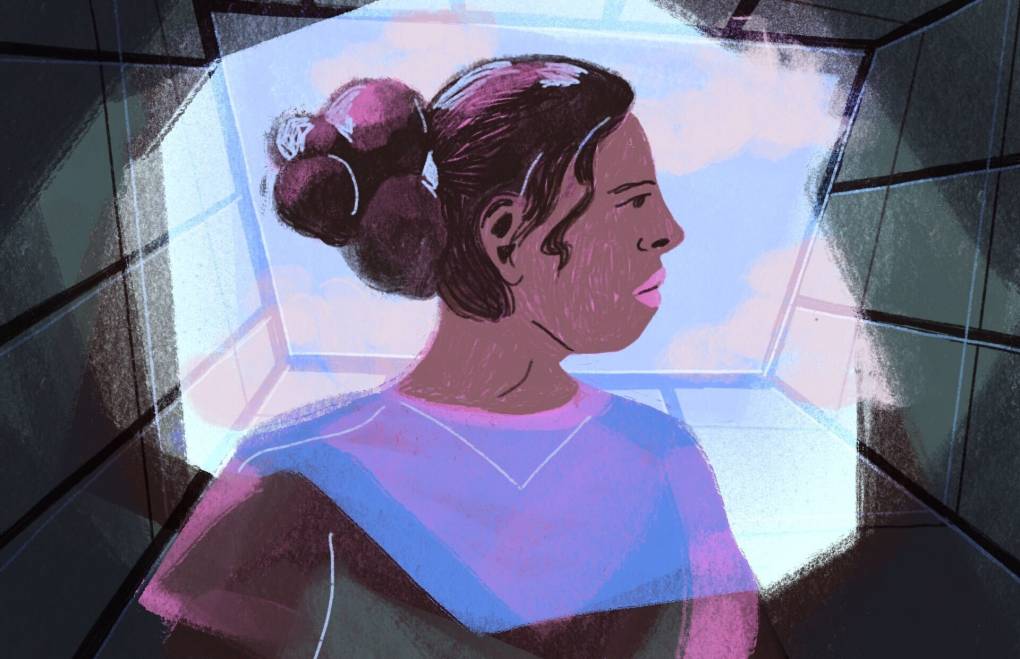
"caption": "A recent state law aims to make prison safer for transgender people. But for many trans women it hasn’t worked out that way.",
"description": null,
"title": "IMG_0434",
"credit": "Anna Vignet/KQED",
"status": "inherit",
"altTag": "An illustration of a Black woman with her hair tied back in a bun. It's a side profile shot of her upper torso and face. She is trapped within enclosing walls and shadows surround her. Her face is solemn.",
"isLoading": false,
"fetchFailed": false
},
"news_11963695": {
"type": "attachments",
"id": "news_11963695",
"meta": {
"index": "attachments_1716263798",
"site": "news",
"id": "11963695",
"found": true
},
"parent": 0,
"imgSizes": {
"twentyfourteen-full-width": {
"file": "https://ww2.kqed.org/app/uploads/sites/10/2023/10/231004-ChildCareLaborMovement-005-KQED-1038x576.jpg",
"width": 1038,
"mimeType": "image/jpeg",
"height": 576
},
"thumbnail": {
"file": "https://ww2.kqed.org/app/uploads/sites/10/2023/10/231004-ChildCareLaborMovement-005-KQED-160x107.jpg",
"width": 160,
"mimeType": "image/jpeg",
"height": 107
},
"post-thumbnail": {
"file": "https://ww2.kqed.org/app/uploads/sites/10/2023/10/231004-ChildCareLaborMovement-005-KQED-672x372.jpg",
"width": 672,
"mimeType": "image/jpeg",
"height": 372
},
"kqedFullSize": {
"file": "https://ww2.kqed.org/app/uploads/sites/10/2023/10/231004-ChildCareLaborMovement-005-KQED.jpg",
"width": 2000,
"height": 1333
},
"large": {
"file": "https://ww2.kqed.org/app/uploads/sites/10/2023/10/231004-ChildCareLaborMovement-005-KQED-1020x680.jpg",
"width": 1020,
"mimeType": "image/jpeg",
"height": 680
},
"1536x1536": {
"file": "https://ww2.kqed.org/app/uploads/sites/10/2023/10/231004-ChildCareLaborMovement-005-KQED-1536x1024.jpg",
"width": 1536,
"mimeType": "image/jpeg",
"height": 1024
},
"full-width": {
"file": "https://ww2.kqed.org/app/uploads/sites/10/2023/10/231004-ChildCareLaborMovement-005-KQED-1920x1280.jpg",
"width": 1920,
"mimeType": "image/jpeg",
"height": 1280
},
"medium": {
"file": "https://ww2.kqed.org/app/uploads/sites/10/2023/10/231004-ChildCareLaborMovement-005-KQED-800x533.jpg",
"width": 800,
"mimeType": "image/jpeg",
"height": 533
}
},
"publishDate": 1696612069,
"modified": 1696612374,
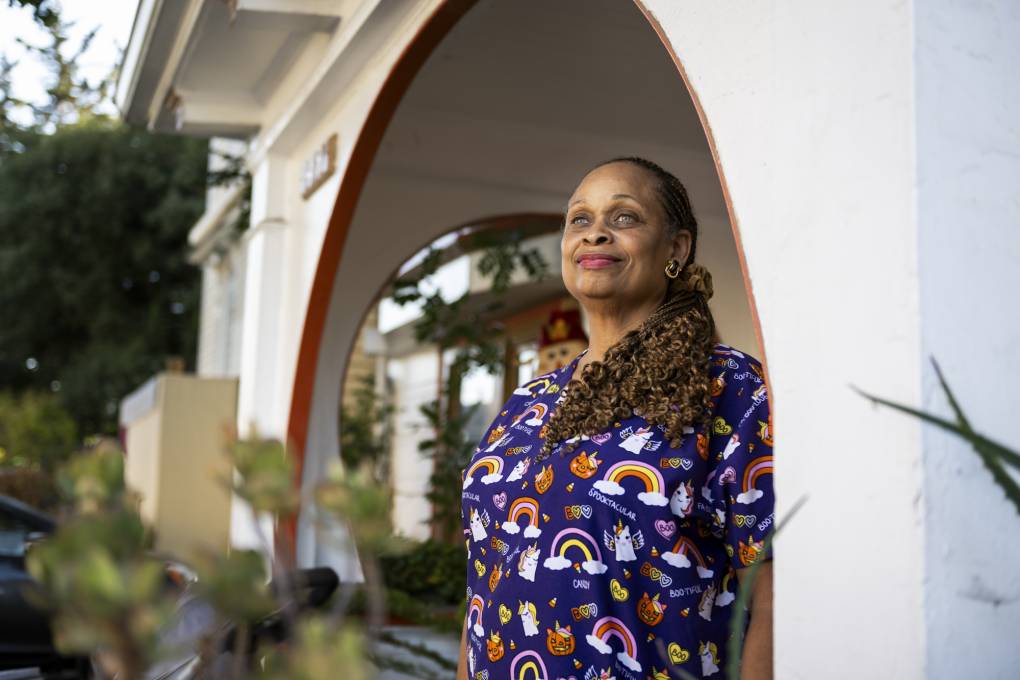
"caption": "Nancy Harvey stands outside of her childcare and early childhood education center, L’il Nancy’s Primary Schoolhouse, in Oakland on Oct. 4, 2023.",
"description": null,
"title": "231004-ChildCareLaborMovement-005-KQED",
"credit": "Beth LaBerge/KQED",
"status": "inherit",
"altTag": "A person with long hair smiles and leans against a wall.",
"isLoading": false,
"fetchFailed": false
},
"news_11964286": {
"type": "attachments",
"id": "news_11964286",
"meta": {
"index": "attachments_1716263798",
"site": "news",
"id": "11964286",
"found": true
},
"parent": 0,
"imgSizes": {
"twentyfourteen-full-width": {
"file": "https://ww2.kqed.org/app/uploads/sites/10/2023/10/231012-NEWSOM-MENTAL-HEALTH-AP-DD-01-KQED-1038x576.jpg",
"width": 1038,
"mimeType": "image/jpeg",
"height": 576
},
"thumbnail": {
"file": "https://ww2.kqed.org/app/uploads/sites/10/2023/10/231012-NEWSOM-MENTAL-HEALTH-AP-DD-01-KQED-160x107.jpg",
"width": 160,
"mimeType": "image/jpeg",
"height": 107
},
"post-thumbnail": {
"file": "https://ww2.kqed.org/app/uploads/sites/10/2023/10/231012-NEWSOM-MENTAL-HEALTH-AP-DD-01-KQED-672x372.jpg",
"width": 672,
"mimeType": "image/jpeg",
"height": 372
},
"kqedFullSize": {
"file": "https://ww2.kqed.org/app/uploads/sites/10/2023/10/231012-NEWSOM-MENTAL-HEALTH-AP-DD-01-KQED.jpg",
"width": 2000,
"height": 1333
},
"large": {
"file": "https://ww2.kqed.org/app/uploads/sites/10/2023/10/231012-NEWSOM-MENTAL-HEALTH-AP-DD-01-KQED-1020x680.jpg",
"width": 1020,
"mimeType": "image/jpeg",
"height": 680
},
"1536x1536": {
"file": "https://ww2.kqed.org/app/uploads/sites/10/2023/10/231012-NEWSOM-MENTAL-HEALTH-AP-DD-01-KQED-1536x1024.jpg",
"width": 1536,
"mimeType": "image/jpeg",
"height": 1024
},
"full-width": {
"file": "https://ww2.kqed.org/app/uploads/sites/10/2023/10/231012-NEWSOM-MENTAL-HEALTH-AP-DD-01-KQED-1920x1280.jpg",
"width": 1920,
"mimeType": "image/jpeg",
"height": 1280
},
"medium": {
"file": "https://ww2.kqed.org/app/uploads/sites/10/2023/10/231012-NEWSOM-MENTAL-HEALTH-AP-DD-01-KQED-800x533.jpg",
"width": 800,
"mimeType": "image/jpeg",
"height": 533
}
},
"publishDate": 1697144472,
"modified": 1697151766,
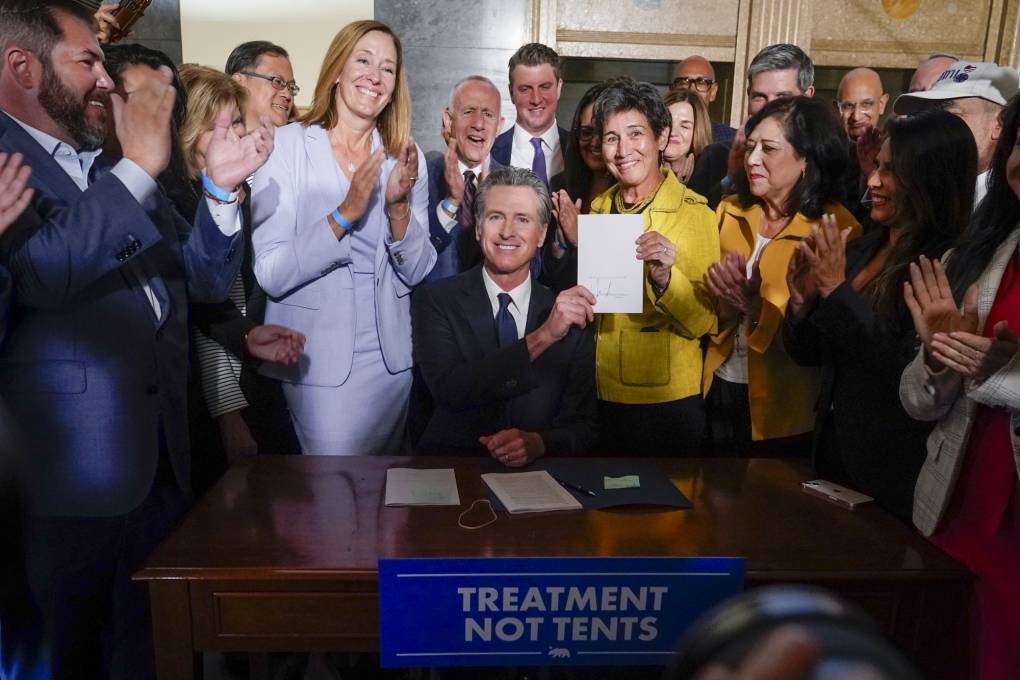
"caption": "Gov. Gavin Newsom signs off on 2 proposals in Los Angeles, Thursday, Oct. 12, 2023, to transform the state's mental health system and address the state's worsening homelessness crisis, putting them both before voters in 2024. ",
"description": null,
"title": "Gavin Newsom",
"credit": "Damian Dovarganes/AP Photo",
"status": "inherit",
"altTag": "A group of people standing around a table and posing for a photo with two people in the center holding a piece of paper together.",
"isLoading": false,
"fetchFailed": false
},
"news_11962881": {
"type": "attachments",
"id": "news_11962881",
"meta": {
"index": "attachments_1716263798",
"site": "news",
"id": "11962881",
"found": true
},
"parent": 11962877,
"imgSizes": {
"twentyfourteen-full-width": {
"file": "https://ww2.kqed.org/app/uploads/sites/10/2023/09/AP23272503321402-1024x576.jpg",
"width": 1024,
"mimeType": "image/jpeg",
"height": 576
},
"thumbnail": {
"file": "https://ww2.kqed.org/app/uploads/sites/10/2023/09/AP23272503321402-160x110.jpg",
"width": 160,
"mimeType": "image/jpeg",
"height": 110
},
"post-thumbnail": {
"file": "https://ww2.kqed.org/app/uploads/sites/10/2023/09/AP23272503321402-672x372.jpg",
"width": 672,
"mimeType": "image/jpeg",
"height": 372
},
"kqedFullSize": {
"file": "https://ww2.kqed.org/app/uploads/sites/10/2023/09/AP23272503321402.jpg",
"width": 1024,
"height": 707
},
"large": {
"file": "https://ww2.kqed.org/app/uploads/sites/10/2023/09/AP23272503321402-1020x704.jpg",
"width": 1020,
"mimeType": "image/jpeg",
"height": 704
},
"medium": {
"file": "https://ww2.kqed.org/app/uploads/sites/10/2023/09/AP23272503321402-800x552.jpg",
"width": 800,
"mimeType": "image/jpeg",
"height": 552
}
},
"publishDate": 1696013016,
"modified": 1696013914,
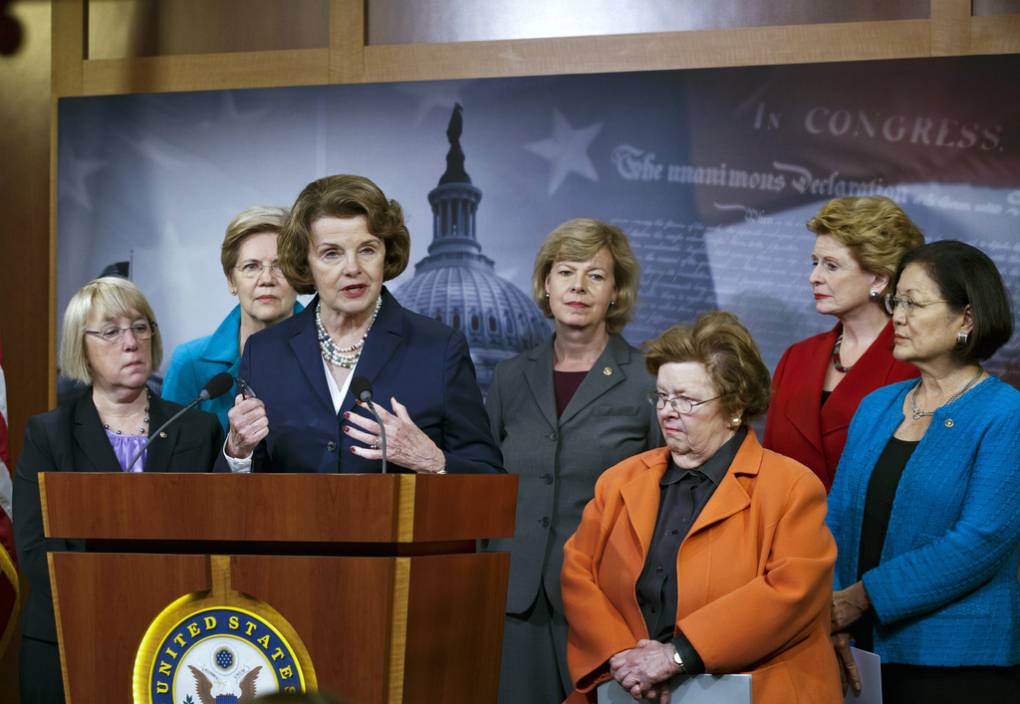
"caption": "California Democratic Sen. Dianne Feinstein, and a group of women senators gather at a news conference on Capitol Hill on June 4, 2014. From left are, Sen. Patty Murray (D-Wash.) Sen. Elizabeth Warren (D-Mass.) Feinstein, Sen. Tammy Baldwin (D-Wis.), Sen. Barbara A. Mikulski, (D-Md.), Sen. Mazie K. Hirono (D-Hawaii). Feinstein died Thursday night, at the age of 90.",
"description": null,
"title": "Obit Feinstein",
"credit": "J. Scott Applewhite/AP",
"status": "inherit",
"altTag": "Sen. Dianne Feinstein stands at a podium, surrounded by other female senators.",
"isLoading": false,
"fetchFailed": false
},
"news_11962654": {
"type": "attachments",
"id": "news_11962654",
"meta": {
"index": "attachments_1716263798",
"site": "news",
"id": "11962654",
"found": true
},
"parent": 0,
"imgSizes": {
"twentyfourteen-full-width": {
"file": "https://ww2.kqed.org/app/uploads/sites/10/2023/09/230927-RITCHIE-VALENS-GETTY-01-KQED-1038x576.jpg",
"width": 1038,
"mimeType": "image/jpeg",
"height": 576
},
"thumbnail": {
"file": "https://ww2.kqed.org/app/uploads/sites/10/2023/09/230927-RITCHIE-VALENS-GETTY-01-KQED-160x107.jpg",
"width": 160,
"mimeType": "image/jpeg",
"height": 107
},
"post-thumbnail": {
"file": "https://ww2.kqed.org/app/uploads/sites/10/2023/09/230927-RITCHIE-VALENS-GETTY-01-KQED-672x372.jpg",
"width": 672,
"mimeType": "image/jpeg",
"height": 372
},
"kqedFullSize": {
"file": "https://ww2.kqed.org/app/uploads/sites/10/2023/09/230927-RITCHIE-VALENS-GETTY-01-KQED.jpg",
"width": 2000,
"height": 1333
},
"large": {
"file": "https://ww2.kqed.org/app/uploads/sites/10/2023/09/230927-RITCHIE-VALENS-GETTY-01-KQED-1020x680.jpg",
"width": 1020,
"mimeType": "image/jpeg",
"height": 680
},
"1536x1536": {
"file": "https://ww2.kqed.org/app/uploads/sites/10/2023/09/230927-RITCHIE-VALENS-GETTY-01-KQED-1536x1024.jpg",
"width": 1536,
"mimeType": "image/jpeg",
"height": 1024
},
"full-width": {
"file": "https://ww2.kqed.org/app/uploads/sites/10/2023/09/230927-RITCHIE-VALENS-GETTY-01-KQED-1920x1280.jpg",
"width": 1920,
"mimeType": "image/jpeg",
"height": 1280
},
"medium": {
"file": "https://ww2.kqed.org/app/uploads/sites/10/2023/09/230927-RITCHIE-VALENS-GETTY-01-KQED-800x533.jpg",
"width": 800,
"mimeType": "image/jpeg",
"height": 533
}
},
"publishDate": 1695856030,
"modified": 1695857140,
"caption": "Ritchie Valens (left) and president of Del-Fi Records Bob Keane on a TV show in 1958 in Los Angeles.",
"description": null,
"title": "Ritchie Valens And Bob Keane",
"credit": "Michael Ochs Archives/Getty Images",
"status": "inherit",
"altTag": "A two people, one holding a guitar, point at a wall of records.",
"isLoading": false,
"fetchFailed": false
},
"news_11947244": {
"type": "attachments",
"id": "news_11947244",
"meta": {
"index": "attachments_1716263798",
"site": "news",
"id": "11947244",
"found": true
},
"parent": 0,
"imgSizes": {
"twentyfourteen-full-width": {
"file": "https://ww2.kqed.org/app/uploads/sites/10/2023/04/RS33369_102318_AW_DianeFeinstein_04-qut-1038x576.jpg",
"width": 1038,
"mimeType": "image/jpeg",
"height": 576
},
"thumbnail": {
"file": "https://ww2.kqed.org/app/uploads/sites/10/2023/04/RS33369_102318_AW_DianeFeinstein_04-qut-160x107.jpg",
"width": 160,
"mimeType": "image/jpeg",
"height": 107
},
"post-thumbnail": {
"file": "https://ww2.kqed.org/app/uploads/sites/10/2023/04/RS33369_102318_AW_DianeFeinstein_04-qut-672x372.jpg",
"width": 672,
"mimeType": "image/jpeg",
"height": 372
},
"kqedFullSize": {
"file": "https://ww2.kqed.org/app/uploads/sites/10/2023/04/RS33369_102318_AW_DianeFeinstein_04-qut.jpg",
"width": 1920,
"height": 1280
},
"large": {
"file": "https://ww2.kqed.org/app/uploads/sites/10/2023/04/RS33369_102318_AW_DianeFeinstein_04-qut-1020x680.jpg",
"width": 1020,
"mimeType": "image/jpeg",
"height": 680
},
"1536x1536": {
"file": "https://ww2.kqed.org/app/uploads/sites/10/2023/04/RS33369_102318_AW_DianeFeinstein_04-qut-1536x1024.jpg",
"width": 1536,
"mimeType": "image/jpeg",
"height": 1024
},
"medium": {
"file": "https://ww2.kqed.org/app/uploads/sites/10/2023/04/RS33369_102318_AW_DianeFeinstein_04-qut-800x533.jpg",
"width": 800,
"mimeType": "image/jpeg",
"height": 533
}
},
"publishDate": 1682029492,
"modified": 1696029077,
"caption": "Sen. Dianne Feinstein (D-Calif.) at the KQED studios for tapings of KQED Newsroom and Political Breakdown on Oct. 23, 2018.",
"description": null,
"title": "RS33369_102318_AW_DianeFeinstein_04-qut",
"credit": "Anne Wernikoff/KQED",
"status": "inherit",
"altTag": "An older white lade with brown short hair and a pink top and scarf speaks while looking away from the camera, seen from the shoulder up.",
"isLoading": false,
"fetchFailed": false
},
"news_11957101": {
"type": "attachments",
"id": "news_11957101",
"meta": {
"index": "attachments_1716263798",
"site": "news",
"id": "11957101",
"found": true
},
"parent": 0,
"imgSizes": {
"twentyfourteen-full-width": {
"file": "https://ww2.kqed.org/app/uploads/sites/10/2023/08/GettyImages-1563681481-1024x576.jpg",
"width": 1024,
"mimeType": "image/jpeg",
"height": 576
},
"thumbnail": {
"file": "https://ww2.kqed.org/app/uploads/sites/10/2023/08/GettyImages-1563681481-160x111.jpg",
"width": 160,
"mimeType": "image/jpeg",
"height": 111
},
"post-thumbnail": {
"file": "https://ww2.kqed.org/app/uploads/sites/10/2023/08/GettyImages-1563681481-672x372.jpg",
"width": 672,
"mimeType": "image/jpeg",
"height": 372
},
"kqedFullSize": {
"file": "https://ww2.kqed.org/app/uploads/sites/10/2023/08/GettyImages-1563681481.jpg",
"width": 1024,
"height": 713
},
"large": {
"file": "https://ww2.kqed.org/app/uploads/sites/10/2023/08/GettyImages-1563681481-1020x710.jpg",
"width": 1020,
"mimeType": "image/jpeg",
"height": 710
},
"medium": {
"file": "https://ww2.kqed.org/app/uploads/sites/10/2023/08/GettyImages-1563681481-800x557.jpg",
"width": 800,
"mimeType": "image/jpeg",
"height": 557
}
},
"publishDate": 1690930088,
"modified": 1690935936,
"caption": "Donald Trump, the former US president and current Republican frontrunner in the 2024 presidential race, enters Erie Insurance Arena for a political rally on July 29, 2023 in Erie, Pennsylvania. Just days later, on Aug. 1, Trump was indicted by the US Justice Department on felony charges for working to overturn the results of the 2020 presidential election.",
"description": null,
"title": "GettyImages-1563681481",
"credit": "Jeff Swensen/Getty Images",
"status": "inherit",
"altTag": "Former President Donald Trump, wearing his characteristic red tie, during a political rally.",
"isLoading": false,
"fetchFailed": false
},
"news_11962623": {
"type": "attachments",
"id": "news_11962623",
"meta": {
"index": "attachments_1716263798",
"site": "news",
"id": "11962623",
"found": true
},
"parent": 0,
"imgSizes": {
"twentyfourteen-full-width": {
"file": "https://ww2.kqed.org/app/uploads/sites/10/2023/09/230927-CHINO-TRANSGENDER-SCHOOL-BOARD-Getty-DM-KQED-1038x576.jpg",
"width": 1038,
"mimeType": "image/jpeg",
"height": 576
},
"thumbnail": {
"file": "https://ww2.kqed.org/app/uploads/sites/10/2023/09/230927-CHINO-TRANSGENDER-SCHOOL-BOARD-Getty-DM-KQED-160x107.jpg",
"width": 160,
"mimeType": "image/jpeg",
"height": 107
},
"post-thumbnail": {
"file": "https://ww2.kqed.org/app/uploads/sites/10/2023/09/230927-CHINO-TRANSGENDER-SCHOOL-BOARD-Getty-DM-KQED-672x372.jpg",
"width": 672,
"mimeType": "image/jpeg",
"height": 372
},
"kqedFullSize": {
"file": "https://ww2.kqed.org/app/uploads/sites/10/2023/09/230927-CHINO-TRANSGENDER-SCHOOL-BOARD-Getty-DM-KQED.jpg",
"width": 2000,
"height": 1334
},
"large": {
"file": "https://ww2.kqed.org/app/uploads/sites/10/2023/09/230927-CHINO-TRANSGENDER-SCHOOL-BOARD-Getty-DM-KQED-1020x680.jpg",
"width": 1020,
"mimeType": "image/jpeg",
"height": 680
},
"1536x1536": {
"file": "https://ww2.kqed.org/app/uploads/sites/10/2023/09/230927-CHINO-TRANSGENDER-SCHOOL-BOARD-Getty-DM-KQED-1536x1025.jpg",
"width": 1536,
"mimeType": "image/jpeg",
"height": 1025
},
"full-width": {
"file": "https://ww2.kqed.org/app/uploads/sites/10/2023/09/230927-CHINO-TRANSGENDER-SCHOOL-BOARD-Getty-DM-KQED-1920x1281.jpg",
"width": 1920,
"mimeType": "image/jpeg",
"height": 1281
},
"medium": {
"file": "https://ww2.kqed.org/app/uploads/sites/10/2023/09/230927-CHINO-TRANSGENDER-SCHOOL-BOARD-Getty-DM-KQED-800x534.jpg",
"width": 800,
"mimeType": "image/jpeg",
"height": 534
}
},
"publishDate": 1695850696,
"modified": 1695853730,
"caption": "A person holds a sign in opposition to a policy that the Chino Valley school board is meeting to vote on which would require school staff to 'out' students to their parents if they ask to be identified by a gender that is not listed on their birth certificate, in Chino, San Bernardino County, on July 20, 2023.",
"description": null,
"title": "Chino Valley School Board Votes On Student Transgender Policy",
"credit": "David McNew/Getty Images",
"status": "inherit",
"altTag": "A person holds a sign above their head that reads \"protect all kids\" in a crowded indoor space.",
"isLoading": false,
"fetchFailed": false
},
"news_11917005": {
"type": "attachments",
"id": "news_11917005",
"meta": {
"index": "attachments_1716263798",
"site": "news",
"id": "11917005",
"found": true
},
"parent": 11916962,
"imgSizes": {
"twentyfourteen-full-width": {
"file": "https://ww2.kqed.org/app/uploads/sites/10/2022/06/GettyImages-1172021652-1024x576.jpg",
"width": 1024,
"mimeType": "image/jpeg",
"height": 576
},
"thumbnail": {
"file": "https://ww2.kqed.org/app/uploads/sites/10/2022/06/GettyImages-1172021652-160x107.jpg",
"width": 160,
"mimeType": "image/jpeg",
"height": 107
},
"post-thumbnail": {
"file": "https://ww2.kqed.org/app/uploads/sites/10/2022/06/GettyImages-1172021652-672x372.jpg",
"width": 672,
"mimeType": "image/jpeg",
"height": 372
},
"kqedFullSize": {
"file": "https://ww2.kqed.org/app/uploads/sites/10/2022/06/GettyImages-1172021652.jpg",
"width": 1024,
"height": 683
},
"large": {
"file": "https://ww2.kqed.org/app/uploads/sites/10/2022/06/GettyImages-1172021652-1020x680.jpg",
"width": 1020,
"mimeType": "image/jpeg",
"height": 680
},
"medium": {
"file": "https://ww2.kqed.org/app/uploads/sites/10/2022/06/GettyImages-1172021652-800x534.jpg",
"width": 800,
"mimeType": "image/jpeg",
"height": 534
}
},
"publishDate": 1655154480,
"modified": 1695573222,
"caption": "Trucks move containers in and out of the Ben E. Nutter terminal at the Port of Oakland on Sept. 3, 2019, in Oakland. ",
"description": null,
"title": "Markets Drop As U.S. And China Impose New Tariffs",
"credit": "Justin Sullivan/Getty Images",
"status": "inherit",
"altTag": "Two bright green containers on flatbed trucks (the white cab of one truck is visible), with lettering on the side that says \"Evergreen\" in white, sit in a shipping yard. Around them are many other flatbeds, carrying mostly blue or red containers. In the distance, on the left, you can see a sliver of the San Francisco Bay; the Bay Bridge crosses the entire frame, and beyond that is the SF skyline, including the Salesforce and Transamerica towers.",
"isLoading": false,
"fetchFailed": false
},
"news_11961745": {
"type": "attachments",
"id": "news_11961745",
"meta": {
"index": "attachments_1716263798",
"site": "news",
"id": "11961745",
"found": true
},
"parent": 0,
"imgSizes": {
"twentyfourteen-full-width": {
"file": "https://ww2.kqed.org/app/uploads/sites/10/2023/09/CMHousing01-1038x576.jpg",
"width": 1038,
"mimeType": "image/jpeg",
"height": 576
},
"thumbnail": {
"file": "https://ww2.kqed.org/app/uploads/sites/10/2023/09/CMHousing01-160x107.jpg",
"width": 160,
"mimeType": "image/jpeg",
"height": 107
},
"post-thumbnail": {
"file": "https://ww2.kqed.org/app/uploads/sites/10/2023/09/CMHousing01-672x372.jpg",
"width": 672,
"mimeType": "image/jpeg",
"height": 372
},
"kqedFullSize": {
"file": "https://ww2.kqed.org/app/uploads/sites/10/2023/09/CMHousing01.jpg",
"width": 2000,
"height": 1333
},
"large": {
"file": "https://ww2.kqed.org/app/uploads/sites/10/2023/09/CMHousing01-1020x680.jpg",
"width": 1020,
"mimeType": "image/jpeg",
"height": 680
},
"1536x1536": {
"file": "https://ww2.kqed.org/app/uploads/sites/10/2023/09/CMHousing01-1536x1024.jpg",
"width": 1536,
"mimeType": "image/jpeg",
"height": 1024
},
"full-width": {
"file": "https://ww2.kqed.org/app/uploads/sites/10/2023/09/CMHousing01-1920x1280.jpg",
"width": 1920,
"mimeType": "image/jpeg",
"height": 1280
},
"medium": {
"file": "https://ww2.kqed.org/app/uploads/sites/10/2023/09/CMHousing01-800x533.jpg",
"width": 800,
"mimeType": "image/jpeg",
"height": 533
}
},
"publishDate": 1695146057,
"modified": 1695161084,
"caption": "Casa Sueños, an affordable housing complex at 3500 E. 12th St. in Oakland on Aug. 7, 2023.",
"description": null,
"title": "CMHousing01",
"credit": "Semantha Norris/CalMatters",
"status": "inherit",
"altTag": "A big corner building in Oakland. A surrounding chain-link fence is covered in graffiti.",
"isLoading": false,
"fetchFailed": false
},
"news_11961810": {
"type": "attachments",
"id": "news_11961810",
"meta": {
"index": "attachments_1716263798",
"site": "news",
"id": "11961810",
"found": true
},
"parent": 0,
"imgSizes": {
"twentyfourteen-full-width": {
"file": "https://ww2.kqed.org/app/uploads/sites/10/2023/09/IMG_1902-1038x576.jpg",
"width": 1038,
"mimeType": "image/jpeg",
"height": 576
},
"thumbnail": {
"file": "https://ww2.kqed.org/app/uploads/sites/10/2023/09/IMG_1902-160x120.jpg",
"width": 160,
"mimeType": "image/jpeg",
"height": 120
},
"post-thumbnail": {
"file": "https://ww2.kqed.org/app/uploads/sites/10/2023/09/IMG_1902-672x372.jpg",
"width": 672,
"mimeType": "image/jpeg",
"height": 372
},
"kqedFullSize": {
"file": "https://ww2.kqed.org/app/uploads/sites/10/2023/09/IMG_1902.jpg",
"width": 2272,
"height": 1704
},
"2048x2048": {
"file": "https://ww2.kqed.org/app/uploads/sites/10/2023/09/IMG_1902-2048x1536.jpg",
"width": 2048,
"mimeType": "image/jpeg",
"height": 1536
},
"large": {
"file": "https://ww2.kqed.org/app/uploads/sites/10/2023/09/IMG_1902-1020x765.jpg",
"width": 1020,
"mimeType": "image/jpeg",
"height": 765
},
"1536x1536": {
"file": "https://ww2.kqed.org/app/uploads/sites/10/2023/09/IMG_1902-1536x1152.jpg",
"width": 1536,
"mimeType": "image/jpeg",
"height": 1152
},
"full-width": {
"file": "https://ww2.kqed.org/app/uploads/sites/10/2023/09/IMG_1902-1920x1440.jpg",
"width": 1920,
"mimeType": "image/jpeg",
"height": 1440
},
"medium": {
"file": "https://ww2.kqed.org/app/uploads/sites/10/2023/09/IMG_1902-800x600.jpg",
"width": 800,
"mimeType": "image/jpeg",
"height": 600
}
},
"publishDate": 1695164183,
"modified": 1695167754,
"caption": "Sacramento’s top prosecutor is suing the city’s leaders over failure to cleanup homeless encampments, escalating a monthslong dispute with leaders in the state capital.",
"description": null,
"title": "IMG_1902",
"credit": "Craig Miller/KQED",
"status": "inherit",
"altTag": "A tall, white, capital building is seen with an American flag raised on a pole.",
"isLoading": false,
"fetchFailed": false
},
"news_11961770": {
"type": "attachments",
"id": "news_11961770",
"meta": {
"index": "attachments_1716263798",
"site": "news",
"id": "11961770",
"found": true
},
"parent": 0,
"imgSizes": {
"twentyfourteen-full-width": {
"file": "https://ww2.kqed.org/app/uploads/sites/10/2023/09/004_KQED_BerkeleyYMCAEricaDavis_11162022-KQED-1038x576.jpg",
"width": 1038,
"mimeType": "image/jpeg",
"height": 576
},
"thumbnail": {
"file": "https://ww2.kqed.org/app/uploads/sites/10/2023/09/004_KQED_BerkeleyYMCAEricaDavis_11162022-KQED-160x107.jpg",
"width": 160,
"mimeType": "image/jpeg",
"height": 107
},
"post-thumbnail": {
"file": "https://ww2.kqed.org/app/uploads/sites/10/2023/09/004_KQED_BerkeleyYMCAEricaDavis_11162022-KQED-672x372.jpg",
"width": 672,
"mimeType": "image/jpeg",
"height": 372
},
"kqedFullSize": {
"file": "https://ww2.kqed.org/app/uploads/sites/10/2023/09/004_KQED_BerkeleyYMCAEricaDavis_11162022-KQED.jpg",
"width": 2000,
"height": 1333
},
"large": {
"file": "https://ww2.kqed.org/app/uploads/sites/10/2023/09/004_KQED_BerkeleyYMCAEricaDavis_11162022-KQED-1020x680.jpg",
"width": 1020,
"mimeType": "image/jpeg",
"height": 680
},
"1536x1536": {
"file": "https://ww2.kqed.org/app/uploads/sites/10/2023/09/004_KQED_BerkeleyYMCAEricaDavis_11162022-KQED-1536x1024.jpg",
"width": 1536,
"mimeType": "image/jpeg",
"height": 1024
},
"full-width": {
"file": "https://ww2.kqed.org/app/uploads/sites/10/2023/09/004_KQED_BerkeleyYMCAEricaDavis_11162022-KQED-1920x1280.jpg",
"width": 1920,
"mimeType": "image/jpeg",
"height": 1280
},
"medium": {
"file": "https://ww2.kqed.org/app/uploads/sites/10/2023/09/004_KQED_BerkeleyYMCAEricaDavis_11162022-KQED-800x533.jpg",
"width": 800,
"mimeType": "image/jpeg",
"height": 533
}
},
"publishDate": 1695151800,
"modified": 1695151846,
"caption": "Erica Davis, a YMCA East Bay apprenticeship program member, talks with a child using KQED reporter Daisy Nguyen's microphone during recess in Berkeley on Nov. 16, 2022.",
"description": null,
"title": "004_KQED_BerkeleyYMCAEricaDavis_11162022-KQED",
"credit": "Beth LaBerge/KQED",
"status": "inherit",
"altTag": "A young person wearing a face mask holds a microphone with KQED branding on it as an adult kneels next to them and looks on.",
"isLoading": false,
"fetchFailed": false
}
},
"audioPlayerReducer": {
"postId": "stream_live",
"isPaused": true,
"isPlaying": false,
"pfsActive": false,
"pledgeModalIsOpen": true,
"playerDrawerIsOpen": false,
"liveAudioPlayStartedAt": 0,
"liveAudioPlayContext": ""
},
"authorsReducer": {
"byline_news_11964027": {
"type": "authors",
"id": "byline_news_11964027",
"meta": {
"override": true
},
"slug": "byline_news_11964027",
"name": "\u003ca href=\"https://www.novemberinmysoul.com/about/#62b093f21c801819ce513743\">Lee Romney and Jenny Johnson\u003c/a>",
"isLoading": false
},
"byline_news_11962877": {
"type": "authors",
"id": "byline_news_11962877",
"meta": {
"override": true
},
"slug": "byline_news_11962877",
"name": "Michelle L. Price\u003cbr>The Associated Press",
"isLoading": false
},
"byline_news_11962630": {
"type": "authors",
"id": "byline_news_11962630",
"meta": {
"override": true
},
"slug": "byline_news_11962630",
"name": "\u003ca href=\"https://jessicakariisa.com/\">Jessica Kariisa and Sasha Khokha\u003c/a>",
"isLoading": false
},
"byline_news_11962643": {
"type": "authors",
"id": "byline_news_11962643",
"meta": {
"override": true
},
"slug": "byline_news_11962643",
"name": "Michael R. Blood \u003cbr> The Associated Press",
"isLoading": false
},
"byline_news_11962285": {
"type": "authors",
"id": "byline_news_11962285",
"meta": {
"override": true
},
"slug": "byline_news_11962285",
"name": "The Associated Press",
"isLoading": false
},
"byline_news_11961732": {
"type": "authors",
"id": "byline_news_11961732",
"meta": {
"override": true
},
"slug": "byline_news_11961732",
"name": "\u003ca href=\"https://calmatters.org/author/ben-christopher/\">Ben Christopher\u003c/a>",
"isLoading": false
},
"byline_news_11961802": {
"type": "authors",
"id": "byline_news_11961802",
"meta": {
"override": true
},
"slug": "byline_news_11961802",
"name": "\u003ca href=\"https://twitter.com/nguyenntrann\">Trân Nguyễn\u003c/a>\u003cbr>The Associated Press",
"isLoading": false
},
"gmarzorati": {
"type": "authors",
"id": "227",
"meta": {
"index": "authors_1716337520",
"id": "227",
"found": true
},
"name": "Guy Marzorati",
"firstName": "Guy",
"lastName": "Marzorati",
"slug": "gmarzorati",
"email": "gmarzorati@KQED.org",
"display_author_email": true,
"staff_mastheads": [
"news"
],
"title": "Correspondent",
"bio": "Guy Marzorati is a correspondent on KQED's California Politics and Government Desk, based in San Jose. A graduate of Santa Clara University, Guy joined KQED in 2013. He reports on state and local politics and produces KQED's digital voter guide.",
"avatar": "https://secure.gravatar.com/avatar/e7038b8dbfd55b104369b76b1cd0b9de?s=600&d=blank&r=g",
"twitter": "guymarzorati",
"facebook": null,
"instagram": null,
"linkedin": null,
"sites": [
{
"site": "",
"roles": [
"editor"
]
},
{
"site": "news",
"roles": [
"editor"
]
},
{
"site": "science",
"roles": [
"editor"
]
},
{
"site": "forum",
"roles": [
"editor"
]
},
{
"site": "elections",
"roles": [
"editor"
]
},
{
"site": "liveblog",
"roles": [
"editor"
]
}
],
"headData": {
"title": "Guy Marzorati | KQED",
"description": "Correspondent",
"ogImgSrc": "https://secure.gravatar.com/avatar/e7038b8dbfd55b104369b76b1cd0b9de?s=600&d=blank&r=g",
"twImgSrc": "https://secure.gravatar.com/avatar/e7038b8dbfd55b104369b76b1cd0b9de?s=600&d=blank&r=g"
},
"isLoading": false,
"link": "/author/gmarzorati"
},
"scottshafer": {
"type": "authors",
"id": "255",
"meta": {
"index": "authors_1716337520",
"id": "255",
"found": true
},
"name": "Scott Shafer",
"firstName": "Scott",
"lastName": "Shafer",
"slug": "scottshafer",
"email": "sshafer@kqed.org",
"display_author_email": false,
"staff_mastheads": [
"news"
],
"title": "KQED Contributor",
"bio": "Scott Shafer is a senior editor with the KQED Politics and Government desk. He is co-host of Political Breakdown, the award-winning radio show and podcast with a personal take on the world of politics. Scott came to KQED in 1998 to host the statewide\u003cem> California Report\u003c/em>. Prior to that he had extended stints in politics and government\u003cem>.\u003c/em> He uses that inside experience at KQED in his, reporting, hosting and analysis for the politics desk. Scott collaborated \u003cem>Political Breakdown a\u003c/em>nd on \u003cem>The Political Mind of Jerry Brown, \u003c/em>an eight-part series about the life and extraordinary political career of the former governor. For fun, he plays water polo with the San Francisco Tsunami.",
"avatar": "https://secure.gravatar.com/avatar/a62ebae45b79d7aed1a39a0e3bf68104?s=600&d=blank&r=g",
"twitter": "scottshafer",
"bluesky": null,
"facebook": null,
"instagram": null,
"linkedin": null,
"sites": [
{
"site": "news",
"roles": [
"editor"
]
},
{
"site": "stateofhealth",
"roles": [
"author"
]
},
{
"site": "science",
"roles": [
"author"
]
},
{
"site": "forum",
"roles": [
"subscriber"
]
},
{
"site": "liveblog",
"roles": [
"author"
]
}
],
"headData": {
"title": "Scott Shafer | KQED",
"description": "KQED Contributor",
"ogImgSrc": "https://secure.gravatar.com/avatar/a62ebae45b79d7aed1a39a0e3bf68104?s=600&d=blank&r=g",
"twImgSrc": "https://secure.gravatar.com/avatar/a62ebae45b79d7aed1a39a0e3bf68104?s=600&d=blank&r=g"
},
"isLoading": false,
"link": "/author/scottshafer"
},
"mlagos": {
"type": "authors",
"id": "3239",
"meta": {
"index": "authors_1716337520",
"id": "3239",
"found": true
},
"name": "Marisa Lagos",
"firstName": "Marisa",
"lastName": "Lagos",
"slug": "mlagos",
"email": "mlagos@kqed.org",
"display_author_email": false,
"staff_mastheads": [
"news"
],
"title": "KQED Contributor",
"bio": "Marisa Lagos is a correspondent for KQED’s California Politics and Government Desk and co-hosts the award-winning show and podcast, Political Breakdown. At KQED, Lagos also conducts reporting, analysis and investigations into state, local and national politics for radio, TV, online and onstage. In 2022, she and co-host, Scott Shafer, moderated the only gubernatorial debate in California. In 2020, the \u003ci>Washington Post\u003c/i> named her one of the top political journalists in California; she was nominated for a Peabody and won several other awards for her work investigating the 2017 California wildfires. She has worked at the \u003ci>San Francisco Chronicle\u003c/i>, \u003ci>San Francisco Examiner\u003c/i> and \u003ci>Los Angeles Times\u003c/i>. A UC Santa Barbara graduate, she lives in San Francisco with her two sons and husband.",
"avatar": "https://secure.gravatar.com/avatar/a261a0d3696fc066871ef96b85b5e7d2?s=600&d=blank&r=g",
"twitter": "@mlagos",
"facebook": null,
"instagram": null,
"linkedin": null,
"sites": [
{
"site": "arts",
"roles": [
"author"
]
},
{
"site": "news",
"roles": [
"editor"
]
},
{
"site": "science",
"roles": [
"editor"
]
},
{
"site": "forum",
"roles": [
"author"
]
},
{
"site": "liveblog",
"roles": [
"author"
]
}
],
"headData": {
"title": "Marisa Lagos | KQED",
"description": "KQED Contributor",
"ogImgSrc": "https://secure.gravatar.com/avatar/a261a0d3696fc066871ef96b85b5e7d2?s=600&d=blank&r=g",
"twImgSrc": "https://secure.gravatar.com/avatar/a261a0d3696fc066871ef96b85b5e7d2?s=600&d=blank&r=g"
},
"isLoading": false,
"link": "/author/mlagos"
},
"ccabreralomeli": {
"type": "authors",
"id": "11708",
"meta": {
"index": "authors_1716337520",
"id": "11708",
"found": true
},
"name": "Carlos Cabrera-Lomelí",
"firstName": "Carlos",
"lastName": "Cabrera-Lomelí",
"slug": "ccabreralomeli",
"email": "ccabreralomeli@KQED.org",
"display_author_email": true,
"staff_mastheads": [
"news"
],
"title": "Community Reporter",
"bio": "Carlos Cabrera-Lomelí is a community reporter with KQED's digital engagement team. He also reports and co-produces for KQED's bilingual news hub KQED en Español. He grew up in San Francisco's Mission District and has previously worked with Univision, 48 Hills and REFORMA in Mexico City.",
"avatar": "https://secure.gravatar.com/avatar/c309be9665e484f887b818c89e273ecc673004f426f36b24d00a4d813a2e0518?s=600&d=blank&r=g",
"twitter": "@LomeliCabrera",
"bluesky": null,
"facebook": null,
"instagram": null,
"linkedin": null,
"sites": [
{
"site": "arts",
"roles": [
"editor"
]
},
{
"site": "news",
"roles": [
"editor"
]
},
{
"site": "about",
"roles": [
"editor"
]
},
{
"site": "science",
"roles": [
"editor"
]
},
{
"site": "perspectives",
"roles": [
"editor"
]
},
{
"site": "elections",
"roles": [
"editor"
]
},
{
"site": "liveblog",
"roles": [
"contributor"
]
}
],
"headData": {
"title": "Carlos Cabrera-Lomelí | KQED",
"description": "Community Reporter",
"ogImgSrc": "https://secure.gravatar.com/avatar/c309be9665e484f887b818c89e273ecc673004f426f36b24d00a4d813a2e0518?s=600&d=blank&r=g",
"twImgSrc": "https://secure.gravatar.com/avatar/c309be9665e484f887b818c89e273ecc673004f426f36b24d00a4d813a2e0518?s=600&d=blank&r=g"
},
"isLoading": false,
"link": "/author/ccabreralomeli"
},
"daisynguyen": {
"type": "authors",
"id": "11829",
"meta": {
"index": "authors_1716337520",
"id": "11829",
"found": true
},
"name": "Daisy Nguyen",
"firstName": "Daisy",
"lastName": "Nguyen",
"slug": "daisynguyen",
"email": "daisynguyen@kqed.org",
"display_author_email": true,
"staff_mastheads": [
"news"
],
"title": "KQED Contributor",
"bio": "I have covered early childhood education and child care for KQED since 2022. I focus on policies aimed at increasing access to early care and education and how they shape individual lives. I've been a journalist for more than two decades, with most of that time devoted to covering breaking news throughout California for The Associated Press. I grew up in San Francisco and studied at UC Davis and Columbia University's Graduate School of Journalism. I live in Oakland with my husband and two kids.",
"avatar": "https://secure.gravatar.com/avatar/2da2127c27f7143b53ebd419800fd55f?s=600&d=blank&r=g",
"twitter": null,
"facebook": null,
"instagram": null,
"linkedin": "https://www.linkedin.com/in/daisynguyen/",
"sites": [
{
"site": "news",
"roles": [
"author"
]
},
{
"site": "liveblog",
"roles": [
"author"
]
}
],
"headData": {
"title": "Daisy Nguyen | KQED",
"description": "KQED Contributor",
"ogImgSrc": "https://secure.gravatar.com/avatar/2da2127c27f7143b53ebd419800fd55f?s=600&d=blank&r=g",
"twImgSrc": "https://secure.gravatar.com/avatar/2da2127c27f7143b53ebd419800fd55f?s=600&d=blank&r=g"
},
"isLoading": false,
"link": "/author/daisynguyen"
}
},
"pagesReducer": {
"news_tag_california": {
"type": "terms",
"id": "news_18538",
"meta": {
"index": "terms_1716263798",
"site": "news",
"id": "18538",
"score": 6.8457103
},
"featImg": null,
"name": "California",
"description": null,
"taxonomy": "tag",
"headData": {
"twImgId": null,
"twTitle": null,
"ogTitle": null,
"ogImgId": null,
"twDescription": null,
"description": null,
"title": "California Archives | KQED News",
"ogDescription": null
},
"ttid": 31,
"slug": "california",
"isLoading": false,
"title": "California",
"pageMeta": {
"site": "news",
"WpPageTemplate": "page-topic-editorial",
"currentPage": 148
},
"blocks": [
{
"blockName": "kqed/post-list",
"attrs": {
"layout": "cardArticle2",
"query": "posts/news?tag=california",
"seeMore": false,
"paginated": true,
"page": 148
}
},
{
"blockName": "kqed/ad"
}
]
}
},
"pfsSessionReducer": {},
"postsReducer": {
"stream_live": {
"type": "live",
"id": "stream_live",
"audioUrl": "https://streams.kqed.org/kqedradio",
"title": "Live Stream",
"excerpt": "Live Stream information currently unavailable.",
"link": "/radio",
"featImg": "",
"label": {
"name": "KQED Live",
"link": "/"
}
},
"stream_kqedNewscast": {
"type": "posts",
"id": "stream_kqedNewscast",
"audioUrl": "https://www.kqed.org/.stream/anon/radio/RDnews/newscast.mp3?_=1",
"title": "KQED Newscast",
"featImg": "",
"label": {
"name": "88.5 FM",
"link": "/"
}
},
"news_11964027": {
"type": "posts",
"id": "news_11964027",
"meta": {
"index": "posts_1716263798",
"site": "news",
"id": "11964027",
"score": null,
"sort": [
1697209258000
]
},
"guestAuthors": [],
"slug": "california-prisons-fail-to-uphold-transgender-rights-despite-state-law",
"title": "California Prisons Fail to Uphold Transgender Rights Despite State Law",
"publishDate": 1697209258,
"format": "standard",
"headTitle": "California Prisons Fail to Uphold Transgender Rights Despite State Law | KQED",
"labelTerm": {
"term": 26731,
"site": "news"
},
"content": "\u003cp>\u003cem>Warning: There are descriptions of physical and sexual violence in this piece. Also, where legal names and chosen names differ, we’re using chosen names.\u003c/em>\u003c/p>\n\u003cp>[dropcap]S[/dropcap]yiaah Skylit had been stuck in solitary confinement at a maximum-security men’s prison for months when, in the fall of 2020, she got the news that gave her hope: Gov. Gavin Newsom had signed the \u003ca href=\"https://leginfo.legislature.ca.gov/faces/billTextClient.xhtml?bill_id=201920200SB132\">Transgender Respect, Agency and Dignity Act\u003c/a>.\u003c/p>\n\u003cp>Authored by state Sen. Scott Wiener (D-San Francisco), the law requires California prison staff to use the chosen pronouns of incarcerated people who are intersex or identify as nonbinary or transgender, as Skylit does.\u003c/p>\n\u003cp>It allows those incarcerated people to \u003ca href=\"https://www.cdcr.ca.gov/prea/sb-132-faqs/\">select a gender preference for the guards who search them\u003c/a>. Most significantly, it mandates that prison officials, under most circumstances, honor requests to be housed at the type of facility — male or female — that aligns with the incarcerated person’s gender identity.\u003c/p>\n\u003cp>For six years, the California Department of Corrections and Rehabilitation bounced Skylit from one men’s prison to another. At each, safety proved elusive. By 2020, she was isolated in a cell for her own protection after brutal attacks by people she was incarcerated with and, \u003ca href=\"https://www.documentcloud.org/documents/23991903-syiaahkvsp2ndamendedcomplaint2022-03-03\">a lawsuit alleges (PDF)\u003c/a>, by guards.\u003c/p>\n\u003cp>The prospect of serving out her remaining sentence in a women’s facility seemed nothing short of a miracle.\u003c/p>\n\u003cp>[ad fullwidth]\u003c/p>\n\u003cp>“For me, what it felt like was a sanctuary,” she said in one of several dozen interviews with KQED over the course of a year. “A place to be who you were meant to be without any retaliation, without any violence, without any judgment.”\u003c/p>\n\u003cp>Decades have passed since simply \u003ca href=\"https://www.kqed.org/news/11917624/how-a-young-gay-man-survived-one-of-the-darkest-eras-in-california-queer-history\">being LGBTQ+ was considered a crime and a mental illness\u003c/a>. But bias and marginalization still lead to high rates of criminalization, especially for \u003ca href=\"https://transequality.org/sites/default/files/docs/resources/NTDS_Report.pdf\">Black trans women (PDF)\u003c/a> like Skylit. Once incarcerated, harsh prison conditions take a serious toll on mental health.\u003c/p>\n\u003cp>\u003ca href=\"https://cpb-us-e2.wpmucdn.com/sites.uci.edu/dist/0/1149/files/2013/06/BulletinVol2Issue2.pdf\">Studies (PDF)\u003c/a>, \u003ca href=\"https://transequality.org/sites/default/files/docs/usts/USTS%20Full%20Report%20-%20FINAL%201.6.17.pdf\">surveys (PDF)\u003c/a> and \u003ca href=\"https://bjs.ojp.gov/content/pub/pdf/pdca15.pdf\">federal data (PDF)\u003c/a> show that trans women held in men’s prisons are sexually and physically assaulted at rates as much as 13 times higher than cisgender men. When they report assaults or fears for their safety, they’re often met with \u003ca href=\"https://www.documentcloud.org/documents/23991938-tni-coalition-letter-to-governor-newsom-71723pdf-2\">staff retaliation (PDF)\u003c/a>. It’s not uncommon for trans women to harm themselves — just to get to the safety of a prison mental health bed. Skylit had lived that, too.\u003c/p>\n\u003cp>[pullquote size=\"medium\" align=\"right\" citation=\"Syiaah Skylit, transgender woman in California prison\"]‘For me, what it felt like was a sanctuary. A place to be who you were meant to be without any retaliation, without any violence, without any judgment.’[/pullquote]The Transgender Respect, Agency and Dignity Act promised an end to those nightmares.\u003c/p>\n\u003cp>“No more having to hide in fear,” Skylit said. “No more having to be quiet about who I really am. I was excited. I couldn’t wait.”\u003c/p>\n\u003cp>This story is a result of a year-long investigation into the effectiveness of the legislation that aimed to reduce the trauma of transgender women in California’s prisons. KQED’s reporters interviewed a dozen incarcerated people and reviewed data along with several hundred pages of prison grievances, disciplinary records and legal filings. The reporting revealed that trans women like Skylit and many others transferred to a women’s prison under the new law have not found the sanctuary they were seeking.\u003c/p>\n\u003cp>For Skylit, the nightmares have only gotten worse.\u003c/p>\n\u003ch2>Living with secrets\u003c/h2>\n\u003cp>Skylit grew up in Compton. When she was 5, she and her siblings entered the foster care system after their mother suffered a mental health break. When Skylit was 14, her mother died by apparent suicide, and the following year, she said, “I tried to kill myself by running in front of a moving train.”\u003c/p>\n\u003cp>She was physically uninjured but sent to a psychiatric hospital. It wouldn’t be the last time she’d tried to take her own life.\u003c/p>\n\u003cfigure id=\"attachment_11964099\" class=\"wp-caption alignleft\" style=\"max-width: 800px\">\u003cimg loading=\"lazy\" decoding=\"async\" class=\"size-medium wp-image-11964099\" src=\"https://ww2.kqed.org/app/uploads/sites/10/2023/10/Free-Syiaah-social-KQED-800x949.jpg\" alt=\"\" width=\"800\" height=\"949\" srcset=\"https://cdn.kqed.org/wp-content/uploads/sites/10/2023/10/Free-Syiaah-social-KQED-800x949.jpg 800w, https://cdn.kqed.org/wp-content/uploads/sites/10/2023/10/Free-Syiaah-social-KQED-1020x1210.jpg 1020w, https://cdn.kqed.org/wp-content/uploads/sites/10/2023/10/Free-Syiaah-social-KQED-160x190.jpg 160w, https://cdn.kqed.org/wp-content/uploads/sites/10/2023/10/Free-Syiaah-social-KQED-1295x1536.jpg 1295w, https://cdn.kqed.org/wp-content/uploads/sites/10/2023/10/Free-Syiaah-social-KQED.jpg 1686w\" sizes=\"auto, (max-width: 800px) 100vw, 800px\">\u003cfigcaption class=\"wp-caption-text\">In August 2020, as Syiaah Skylit sat in solitary confinement at Kern Valley State Prison for her own protection, transgender advocates launched a Change.org campaign urging clemency for her. She helped with the design of the artwork. \u003ccite>(Courtesy of Syiaah Skylit, Micah Bazant and Freddie Francis)\u003c/cite>\u003c/figcaption>\u003c/figure>\n\u003cp>Skylit is a slight 5 feet, 5 inches tall with a big, dimpled smile. As a teen and living as a boy, she was bullied for being a flashy dresser, for the way she carried herself. She experimented with a gay relationship, but it left her feeling “confused.” The adults in her life were religious and viewed LGBTQ+ people as sinners. Her brothers were gang members. She did what they asked of her, she said, because “I didn’t want to look weak.”\u003c/p>\n\u003cp>“I couldn’t come out and be myself around people like my family and my friends that I grew up with,” Skylit said. “I grew up in a hard-ass neighborhood. That ain’t about to fly.”\u003c/p>\n\u003cp>Still, she harbored a secret she never shared with her brothers, one even she didn’t fully comprehend.\u003c/p>\n\u003cp>“I would dress up. I would put makeup on. All I understood as a person was, ‘Hey, I like this,’” she said. “So if I like this, why is it so bad? Am I a bad person?”\u003c/p>\n\u003cp>A stint in juvenile detention didn’t stop Skylit from setting her sights on a bright future. She finished high school on time, enrolled in community college, worked multiple jobs and, for a while, paid her rent. But anxiety, depression and drug use interrupted her stability. She’d already been homeless once when, facing eviction in 2012, she and a friend robbed a convenience store in San Bernardino County. It yielded little, so they robbed a Los Angeles County jewelry store — and got caught.\u003c/p>\n\u003cp>At 22, Skylit was facing criminal trials in both counties.\u003c/p>\n\u003cp>[pullquote size=\"medium\" align=\"right\" citation=\"Syiaah Skylit, transgender woman in California prison\"]‘I couldn’t come out and be myself around people like my family and my friends that I grew up with. I grew up in a hard-ass neighborhood. That ain’t about to fly.’[/pullquote]Her first stop was a San Bernardino County jail, where she came out as gay to get to the relative safety of what was then called the “alternative lifestyles tank.” According to a \u003ca href=\"https://www.documentcloud.org/documents/23999484-syiaah2015sanbernardinocolawsuit\">class-action lawsuit (DOC)\u003c/a>, the conditions were distressing: discrimination by staff and denial of basic services. Skylit, under her legal name, was among the named plaintiffs. A settlement led to \u003ca href=\"https://www.documentcloud.org/documents/24002812-sanbernardinoinjunctiverelief\">significant reforms (DOC)\u003c/a>. It was in that jail, she said, where she first learned to advocate for her rights, even in the face of retaliation.\u003c/p>\n\u003cp>It’s also where she first encountered openly transgender women and was blown away by their courage and joyful confidence. In their midst, Skylit said, she at last felt free of judgment, open to self-acceptance. Her next stop — a stint in the segregated LGBTQ+ tank at the Los Angeles County jail — only reinforced those feelings.\u003c/p>\n\u003cp>“That’s when I got a taste of all the ‘T’ and I was just living it,” she said of the ‘T’ for Transgender in the alphabet soup of LGBTQ+. “It was like discovering myself.”\u003c/p>\n\u003cp>She was sentenced to 16 years in prison. It may seem paradoxical, but incarceration gave Skylit breathing room to explore her gender identity. In court, she apologized to her robbery victims. Then, she made a promise to herself to use “every second, every minute” of her time inside “to really find out who I am. I mean, this is a once-in-a-lifetime opportunity that I felt I had.”\u003c/p>\n\u003cp>Skylit entered California’s prison system for men in December 2015. Soon, she chose her new name. “Syiaah” is an acronym — sexy, young, intelligent, ambitious, authentic and heroic. She picked “Sky” as “an inspiration to reach higher limits.” And “lit” is a nod to her hip-hop Compton roots “to be vibrant, live.”\u003c/p>\n\u003cp>“Put it together, it’s ‘I keep the sky lit’,” she said.\u003c/p>\n\u003cp>In keeping with the up-to-date \u003ca href=\"https://www.documentcloud.org/documents/24002874-ama-medical-spectrum-of-gender-d-295312\">medical (DOC)\u003c/a> and \u003ca href=\"https://www.psychiatry.org/psychiatrists/diversity/education/transgender-and-gender-nonconforming-patients\">psychiatric\u003c/a> understanding of gender identity, the Transgender Respect, Agency and Dignity Act doesn’t require incarcerated people to be on hormone replacement therapy or to be interested in gender-affirming surgeries to be transferred to housing that aligns with their sense of safety. During Skylit’s early years in prison, that wasn’t the case.\u003c/p>\n\u003cp>[aside postID=news_11957664 hero='https://ww2.kqed.org/app/uploads/sites/10/2023/08/110822-KernValleyPrison-LV_CM_04-1020x680.jpg']The California Department of Corrections and Rehabilitation \u003cem>did\u003c/em> consider such transfer requests. The federal Prison Rape Elimination Act had since 2012 \u003ca href=\"https://www.prearesourcecenter.org/frequently-asked-questions/does-policy-houses-transgender-or-intersex-inmates-based-exclusively\">forbidden\u003c/a> the department from housing prisoners based solely on external genital anatomy. But the CDCR did it on a case-by-case basis, and the tiny number granted all happened to be for trans women who’d had gender-affirming genital surgery.\u003c/p>\n\u003cp>Not everybody wants that. Gender identity and gender transition are deeply personal. Skylit’s records show she declared her transgender identity on a special CDCR form about a year after arrival — and soon after started \u003ca href=\"https://www.documentcloud.org/documents/24018578-skylit-2019-housing-complaint\">asking to be transferred to a women’s prison (DOC)\u003c/a>. That went nowhere. So Skylit worked to stay true to her transition, even as she was funneled through a series of men’s prisons.\u003c/p>\n\u003cp>“When I tapped into it, despite the long time I was facing, I was happy,” she said. “But that happiness turned into survival real fast.”\u003c/p>\n\u003ch2>Met by violence\u003c/h2>\n\u003cp>Almost immediately, Skylit’s gender identity and small stature made her a target. On several occasions, she said, correctional officers placed her in cells with large men who specifically requested her and then pressured her for sex. When she filed grievances in an attempt to switch cells or responded to physical assaults by fighting, she said, staff responded with Rule Violation Reports, known as RVRs.\u003c/p>\n\u003cp>“The more I would push back,” she said, “the more they would attack me with RVRs.”\u003c/p>\n\u003cp>Still, Skylit pressed on. She requested hormone replacement therapy, and by the time those treatments started, in 2018, she’d been moved to Mule Creek State Prison near the small Sierra foothills town of Ione. It’s one of a dozen or so facilities in the state designated as “transgender hubs.” That means, medical and mental services for trans prisoners are concentrated there, as are prison commissary items unavailable elsewhere, such as sports bras and makeup for trans women, and boxer shorts for trans men.\u003c/p>\n\u003cp>Skylit could finally stop MacGyvering her fashion looks. She could style her hair, wear makeup and earrings. On the prison yard, she said she found a sense of belonging with her trans sisters.\u003c/p>\n\u003cp>“We were out there,” she said. “Having fun, protecting each other.”\u003c/p>\n\u003cp>But even at men’s prisons designated as transgender hubs, trans women were mixed with cisgender men in common areas and their assigned cells. The truer Skylit felt to herself, she said, the greater the danger she experienced.\u003c/p>\n\u003cp>“Yeah, it’s OK to come out and you got a nice little outfit on, but guess what you just did?” she said. “You just called attention to yourself and now you have certain people who are making sexual advances towards you, and some of them don’t stop.”\u003c/p>\n\u003cp>Some of her trans sisters exchanged sex for safety. But even that was no guarantee of safety. Skylit wept while recounting how a close friend staggered out of her cell “with a huge gash in her skull, busted lip, trying to get out of the room that she placed herself in because she wanted to be \u003cem>herself\u003c/em>. And she couldn’t complain to the officers, because they’re not gonna do anything.”\u003c/p>\n\u003cp>[pullquote size=\"medium\" align=\"right\" citation=\"Syiaah Skylit, transgender woman in California prison\"]‘Either I’m gonna be who I wanna be or I’m gonna end up dead. Girl, I can’t be dead and be myself at the same time.’[/pullquote]So Skylit found herself facing a soul-crushing choice between her safety and her identity. Skylit drew a line against assault. That meant more fights and more disciplinary write-ups. The hormone treatments caused muscle weakness, so she made another compromise. She began stopping and starting the medications depending on the danger she was facing.\u003c/p>\n\u003cp>“Either I’m gonna be who I wanna be or I’m gonna end up dead,” she said. “Girl, I can’t be dead and be myself at the same time.”\u003c/p>\n\u003cp>As a survival strategy it made sense, but abruptly going on and off hormones brings on acute mood swings. It also heightens \u003ca href=\"https://www.psychiatry.org/psychiatrists/diversity/education/transgender-and-gender-nonconforming-patients/gender-dysphoria-diagnosis\">gender dysphoria\u003c/a>, a mental health diagnosis associated with distress a person can feel at being a gender other than the one assigned at birth. Skylit had experienced that for most of her life, as she hid her true gender identity, and it caused depression, anxiety and suicidal thoughts.\u003c/p>\n\u003cp>As Skylit juggled these stressors, prison officials transferred her again — this time to Kern Valley State Prison, a maximum-security facility in the Central Valley town of Delano that houses some of the state’s most violent offenders. Among them, transgender advocates \u003ca href=\"https://prisonhealth.news/2021/10/29/lgbtq-prison-testimonies-dakota-rose-in-california/\">note\u003c/a>, are gang members known to target LGBTQ+ people in prisons. That’s where she \u003ca href=\"https://sfbayview.com/2021/05/trans-woman-seeks-release-from-cdcr-custody-after-attacks/\">hit a new low\u003c/a>.\u003c/p>\n\u003cp>According to Skylit and a \u003ca href=\"https://www.documentcloud.org/documents/23991903-syiaahkvsp2ndamendedcomplaint2022-03-03\">lawsuit filed on her behalf (DOC),\u003c/a> she was assaulted twice by incarcerated men and witnessed gruesome attacks on two other trans women. Terrified, she says she asked to speak to a sergeant about her safety concerns. Instead, she alleges, two officers followed her into her cell. One pulled down her pants, ran a baton along her bottom and threatened to rape her with it.\u003c/p>\n\u003cp>“And I’m just sitting there like this can’t be real,” she said.\u003c/p>\n\u003cp>[aside postID=news_11954055 hero='https://ww2.kqed.org/app/uploads/sites/10/2023/06/230626-CALIFORNIA-PRISONERS-AP-RP-KQED-1020x735.jpg']That night, she drank from a bottle of laundry detergent in a desperate attempt to get sent to a mental health crisis unit. An officer stripped her of her clothes and left her lying naked in her cell next to the empty bottle. The next day, an officer pepper sprayed her at close range. Others beat her with batons. CDCR does not comment on active litigation. In legal filings, the named officers have denied wrongdoing.\u003c/p>\n\u003cp>Finally, Skylit said, a sergeant agreed to isolate her for her protection. That’s \u003ca href=\"https://www.vera.org/news/violence-torture-and-isolation-what-its-like-to-be-trans-in-prison\">a common fate for trans women\u003c/a>.\u003c/p>\n\u003cp>“It’s sad to be thankful for complete solitary confinement, isolation,” she said.\u003c/p>\n\u003cp>She would stay there for seven months.\u003c/p>\n\u003cp>Skylit had sought help from various attorneys. One responded. Jen Orthwein is a forensic psychologist who once treated transgender clients behind prison walls. They later co-founded a queer-owned law firm to challenge the harsh conditions they’d witnessed. Orthwein worked with other transgender advocates to launch a \u003ca href=\"https://www.change.org/p/gavin-newsom-call-for-the-immediate-release-of-syiaah-skylit-from-cdcr-custody-blacktranslivesmatter?utm_source=share_petition&utm_medium=custom_url&recruited_by_id=cc830240-3ea3-11e9-a4df-e5579d49cec9\">petition\u003c/a> for clemency on Skylit’s behalf.\u003c/p>\n\u003cp>Meanwhile, with colored pencils and paper, Skylit got to work crafting a series of illustrated \u003ca href=\"https://www.documentcloud.org/documents/24018571-its-a-colorful-world-by-syiaah-skylit\">children’s books (DOC)\u003c/a> featuring gender-non-conforming characters. Among them is a rainbow-colored kid named Unique, who is fully embraced by loving parents but bullied on the playground for delighting in toys conventionally meant for both boys and girls.\u003c/p>\n\u003cp>The project helped Skylit reimagine her traumatic past. She also hoped her books might make their way into the world and change the mindset of young readers “to where they’re not growing into hatred, but actually out of it.” She finished two, got started on a third. And that’s where she was when Orthewin gave her the good news. The Transgender Respect, Agency and Dignity Act was state law.\u003c/p>\n\u003cfigure id=\"attachment_11964104\" class=\"wp-caption aligncenter\" style=\"max-width: 800px\">\u003cimg loading=\"lazy\" decoding=\"async\" class=\"size-medium wp-image-11964104\" src=\"https://ww2.kqed.org/app/uploads/sites/10/2023/10/231011-ITS-A-COLORFUL-WORLD-2-KQED-800x533.jpg\" alt=\"Scans of two pages of drawing and text from a hand written book.\" width=\"800\" height=\"533\" srcset=\"https://cdn.kqed.org/wp-content/uploads/sites/10/2023/10/231011-ITS-A-COLORFUL-WORLD-2-KQED-800x533.jpg 800w, https://cdn.kqed.org/wp-content/uploads/sites/10/2023/10/231011-ITS-A-COLORFUL-WORLD-2-KQED-1020x680.jpg 1020w, https://cdn.kqed.org/wp-content/uploads/sites/10/2023/10/231011-ITS-A-COLORFUL-WORLD-2-KQED-160x107.jpg 160w, https://cdn.kqed.org/wp-content/uploads/sites/10/2023/10/231011-ITS-A-COLORFUL-WORLD-2-KQED-1536x1024.jpg 1536w, https://cdn.kqed.org/wp-content/uploads/sites/10/2023/10/231011-ITS-A-COLORFUL-WORLD-2-KQED-1920x1280.jpg 1920w, https://cdn.kqed.org/wp-content/uploads/sites/10/2023/10/231011-ITS-A-COLORFUL-WORLD-2-KQED.jpg 2000w\" sizes=\"auto, (max-width: 800px) 100vw, 800px\">\u003cfigcaption class=\"wp-caption-text\">Excerpts from ‘It’s a Colorful World.’ \u003ccite>(Courtesy of Syiaah Skylit)\u003c/cite>\u003c/figcaption>\u003c/figure>\n\u003cp>“It was like a prayer had been answered,” Skylit said. “Like, ‘This is it!’ This is going to be the beginning of Syiaah Skylit at her best, at completely being herself.”\u003c/p>\n\u003ch2>New perils\u003c/h2>\n\u003cp>Wiener’s bill was years in the making, and he’s quick to note that top CDCR officials were on board. They welcomed advocates to join a working group to brainstorm solutions to unsafe conditions and sought input directly from incarcerated transgender people. The Office of Inspector General detailed in \u003ca href=\"https://www.oig.ca.gov/wp-content/uploads/2020/09/Special-Review-Incarcerated-Transgender-Nonbinary-Intersex-Individuals.pdf\">a 2020 report (PDF)\u003c/a> the painful responses to those surveys.\u003c/p>\n\u003cp>Laws in \u003ca href=\"https://www.acluct.org/en/know-your-rights/know-your-rights-trans-people-who-are-incarcerated-connecticut\">Connecticut\u003c/a>, \u003ca href=\"https://www.documentcloud.org/documents/23991974-952-management-of-gender-diverse-and-intersex-inmates-final-version\">Rhode Island (DOC)\u003c/a> and \u003ca href=\"https://lgbtqbar.org/bar-news/tiproject/ma/\">Massachusetts\u003c/a> call for similar reforms, while \u003ca href=\"https://www.aclu-nj.org/en/press-releases/settlement-nj-civil-rights-suit-promises-necessary-reform-affirming-transgender\">New Jersey\u003c/a> has made comparable policy changes in response to litigation. But advocates who helped craft California’s law say it is the most expansive.\u003c/p>\n\u003cp>Wiener said in an interview that he knew at the start that the magnitude of changes mandated by the law required patience and that it would take time to implement. More recently, though, he’s grown deeply concerned about the way his legislation has played out on the ground. Because, he said, even with senior CDCR management on board, “the culture in the individual prisons is just so challenging that it doesn’t translate.”\u003c/p>\n\u003cfigure id=\"attachment_11964100\" class=\"wp-caption aligncenter\" style=\"max-width: 800px\">\u003cimg loading=\"lazy\" decoding=\"async\" class=\"size-medium wp-image-11964100\" src=\"https://ww2.kqed.org/app/uploads/sites/10/2023/10/SenWienerAtSanQuentinTransRemembranceDay-2019-KQED-800x539.jpg\" alt='A group of people, most wearing the same uniform of blue shirts and pants, stand together holding signs and joined by a person wearing a suit helping to hold a banner reading \"trans lives matter.\"' width=\"800\" height=\"539\" srcset=\"https://cdn.kqed.org/wp-content/uploads/sites/10/2023/10/SenWienerAtSanQuentinTransRemembranceDay-2019-KQED-800x539.jpg 800w, https://cdn.kqed.org/wp-content/uploads/sites/10/2023/10/SenWienerAtSanQuentinTransRemembranceDay-2019-KQED-1020x687.jpg 1020w, https://cdn.kqed.org/wp-content/uploads/sites/10/2023/10/SenWienerAtSanQuentinTransRemembranceDay-2019-KQED-160x108.jpg 160w, https://cdn.kqed.org/wp-content/uploads/sites/10/2023/10/SenWienerAtSanQuentinTransRemembranceDay-2019-KQED-1536x1035.jpg 1536w, https://cdn.kqed.org/wp-content/uploads/sites/10/2023/10/SenWienerAtSanQuentinTransRemembranceDay-2019-KQED-1920x1294.jpg 1920w, https://cdn.kqed.org/wp-content/uploads/sites/10/2023/10/SenWienerAtSanQuentinTransRemembranceDay-2019-KQED.jpg 2000w\" sizes=\"auto, (max-width: 800px) 100vw, 800px\">\u003cfigcaption class=\"wp-caption-text\">Sen. Scott Wiener (D-San Francisco) attends CDCR’s first Transgender Remembrance Day in 2019, organized jointly by trans and cisgender incarcerated people. Wiener had already authored the bill that would become the Transgender Respect, Agency and Dignity Act, with buy-in from top CDCR officials. \u003ccite>(California Department of Corrections and Rehabilitation)\u003c/cite>\u003c/figcaption>\u003c/figure>\n\u003cp>Officials chose the Central California Women’s Facility, or CCWF, in Chowchilla as the prison where all the trans women would go first. It’s a facility with a \u003ca href=\"https://prisonlaw.com/wp-content/uploads/2016/08/16.08.18-Prison-Law-Office-report-on-CCWF.pdf\">troubled history (PDF)\u003c/a> when it comes to staff accountability.\u003c/p>\n\u003cp>Of a dozen CCWF prisoners interviewed by KQED, all said they heard correctional staff express hostility to the new law even before the transfers began, warning the cisgender population that fakers and sexual predators were heading their way.\u003c/p>\n\u003cp>Tasha Brown, a cisgender woman, said she heard guards say, “The doors were going to be open for people to come in to violate us, to rape us.”\u003c/p>\n\u003cp>Tomas Green, a transgender man, said he heard guards “telling women here that the trans women were men and that they were gonna get raped.”\u003c/p>\n\u003cp>[aside postID=news_11936438 hero='https://ww2.kqed.org/app/uploads/sites/10/2022/12/1920px-CentralCaliforniaWomensFacility-1020x816.jpeg']Alexanne Danis, a cisgender woman, said she heard a lieutenant openly state that the transfers “don’t belong here, that they have to leave.”\u003c/p>\n\u003cp>Officers and fellow cisgender incarcerated people, Danis said, also spoke about driving the new transfers out, “saying that they were gonna stage stuff and that they were gonna make it sound worse than it was if anything did happen.”\u003c/p>\n\u003cp>Michelle Calvin was one of the first transgender women to arrive at CCWF. She helped work on Wiener’s legislation and has since transferred to the lower-security California Institution for Women. She heard the characterizations by staff that trans women were “gonna come over here and rape y’all and beat y’all up and take y’all stuff.”\u003c/p>\n\u003cp>The power to reverse the law, she heard officers tell incarcerated people, rested in their hands: “Take your house back. Take your prison back.”\u003c/p>\n\u003cp>Advocates who helped craft the law were well aware of this toxic environment. They say they pressed officials to allow them to hold a town hall at the women’s prison to defuse these narratives before the transfers began. It never happened.\u003c/p>\n\u003cp>Meanwhile, the trans women who began arriving in the first half of 2021 had no idea what they were stepping into.\u003c/p>\n\u003cp>Orthwein, Skylit’s attorney, was part of the working group that informed the new law and said key CDCR decisions around implementation proved harmful. The new arrivals were held in segregation for their first month. There, they were issued new prison identification numbers beginning with a distinctive two-letter combination. Instead of “some semblance of privacy about their transgender status,” which advocates had pressed for, this immediately outed them, feeding hostility and rejection.\u003c/p>\n\u003cp>CCWF houses people in dorms, as many as eight to a room. Without exception, the trans women interviewed by KQED said they have been refused entry to dorms by prisoners who viewed them as “men.”\u003c/p>\n\u003cp>On Skylit’s first day in the general population, in mid-July 2021, guards started writing her up for minor violations. Within a month, she was in solitary confinement, accused of having a consensual relationship with her cisgender female bunkmate.\u003c/p>\n\u003cp>Sex is against prison rules systemwide, but every CCWF prisoner interviewed for this piece said it’s extremely common, especially in women’s prisons.\u003c/p>\n\u003cp>[pullquote size=\"medium\" align=\"right\" citation=\"Tomas Green, transgender man in California prison\"]‘At the end of the day, we’re humans. I’m not saying every relationship in here is just peachy perfect, no. You have a lot of relationships in here that are toxic — fight, argue. But that’s life in the free world.’[/pullquote]“Yes, you’re not supposed to have sex but it happens. It’s natural and there’s nothing that’s gonna stop it from happening,” said Giovanni Gonzales, a transgender man who runs a group to educate peers about gender identity.\u003c/p>\n\u003cp>Relationships form quickly.\u003c/p>\n\u003cp>“At the end of the day, we’re humans,” Green said. “I’m not saying every relationship in here is just peachy perfect, no. You have a lot of relationships in here that are toxic — fight, argue. But that’s life in the free world.”\u003c/p>\n\u003cp>Still, while sex and intimacy may be universal, punishment is not.\u003c/p>\n\u003cp>Gonzales and Green said staff often turn a blind eye to cisgender women who couple up, especially if they express their gender in stereotypically feminine ways. If a transgender man is caught being amorous, they said, a rule violation is more likely. As for the trans women who were just arriving at CCWF, a harsher set of unwritten rules seemed to apply.\u003c/p>\n\u003cp>One cisgender couple in Skylit’s dorm had been having regular sex without consequence, she said. As Skylit was handcuffed and written up for her relationship, she asked an officer why she was going to isolation and the bunkmate wasn’t. He replied, “Because you’re a man and she’s a woman.”\u003c/p>\n\u003cp>At a hearing to discuss her situation, records show that Acting Warden Michael Pallares told her he would push to send her back to men’s prison. She claimed he was hostile, “calling me a predator, saying that I’m preying on women.”\u003c/p>\n\u003cp>In men’s prison, Skylit had lived in constant fear of sexual assault. Now \u003cem>she \u003c/em>was cast as a sexual predator. Her disciplinary paperwork relied on “confidential sources” to suggest she was faking her status because she “displays very masculine behavior when with the inmate population.”\u003c/p>\n\u003cp>In isolation, according to grievances and a government claim filed by Orthwein, Skylit’s gender identity was undermined. She had trouble accessing her hormones and was denied a razor for 40 days straight. She grew a full beard.\u003c/p>\n\u003cp>“People screaming at me, yelling at me, calling me a man, and I need to go back to the men’s prison,” she said. “‘Look at the hair on yo’ face.’ [I was] pleading, pleading, pleading, ‘Please give me a razor, please give me a razor,’ and denied every time.”\u003c/p>\n\u003cp>A psychologist misgendered Skylit in a report, yet \u003ca href=\"https://www.documentcloud.org/documents/24018435-psychologist-note-razors-clothing\">noted (DOC)\u003c/a> that an extended stay in isolation would likely increase her mental health symptoms.\u003c/p>\n\u003cp>In the months that followed, Skylit was sent multiple times to a mental health unit for being suicidal. She was bumped up to a more intensive level of mental health care. Yet she remained in solitary confinement for eight months. Then, without explanation, Pallares released her to the general population.\u003c/p>\n\u003cp>Her freedom wouldn’t last.\u003c/p>\n\u003ch2>‘What did you all do to our homegirl?’\u003c/h2>\n\u003cp>Skylit’s time in isolation had taken a toll. On the yard, she said she made enemies when she responded to threats and harassment with aggressive posturing and language. She said she tried not to engage, hanging out and playing cards every day with a couple of other trans women and one cisgender woman who was sweet on her.\u003c/p>\n\u003cp>“We would hold hands,” she said. “We would hug, we would kiss.”\u003c/p>\n\u003cp>Prison officials aren’t supposed to penalize trans women more harshly for breaking rules that cisgender prisoners also break, like the one forbidding any behavior that could lead to sex. But the atmosphere around these relationships, interviews and records reveal, was tense and complex.\u003c/p>\n\u003cp>While some cisgender women feared or lashed out at the new arrivals, others were eager to partner with them. Of a half-dozen transgender women at CCWF who were interviewed by KQED, the five who have not had gender-affirming genital surgery, said they’ve been subject to sexual advances.\u003c/p>\n\u003cp>[aside postID=news_11955680 hero='https://ww2.kqed.org/app/uploads/sites/10/2023/07/GettyImages-180517172-1020x680.jpg']Meanwhile, \u003ca href=\"https://www.documentcloud.org/documents/24016207-mossgroup-sb132-cdcr-assessment-report\">a report (DOC)\u003c/a> on the implementation of the new law commissioned by CDCR found that a “sexualized environment, including being sexually pressured or pursued,” was among the reasons given by transgender women who voluntarily returned to men’s prison. Other reasons included “hostile reception from staff or incarcerated individuals,” “false allegations to be removed from room” and “issues with getting hygiene items, such as razors.”\u003c/p>\n\u003cp>In men’s prison, Skylit said, consensual sex generally went unpunished. That made it hard for her to imagine just how much the bond with her new “bestie” would cost her.\u003c/p>\n\u003cp>On May 19, 2022, Skylit and her friends were on the yard drinking prison-made wine, disciplinary records show. Skylit and her girlfriend were kissing. A few minutes after Skylit went to use the porta-potty, she said, the girlfriend followed her in and started throwing up.\u003c/p>\n\u003cp>Skylit said she was holding her hair back when Calvin, one of the trans friends she played cards with, let her know a guard was approaching. Skylit stepped out and asked a couple of other people to check on the girlfriend.\u003c/p>\n\u003cp>They “opened the door and they say, ‘What did you all do to our homegirl? We don’t know what you two doing, we don’t know what’s going on over here,’” Skylit recounted. “And I said, ‘We just been drinking and she was in the thing throwing up.’ But now, it’s a commotion. It’s a crowd coming up.”\u003c/p>\n\u003cp>According to Skylit and two other witnesses, the girlfriend came out, and the guard scolded them. “She was like, ‘I’m OK bestie, I love you so much,’ and I hugged her and I walked away.”\u003c/p>\n\u003cp>Rumors about a rape started circulating. Skylit said she heard it “from like one or two people. It wasn’t \u003cem>big\u003c/em> until the next day.”\u003c/p>\n\u003cp>[pullquote size=\"medium\" align=\"right\" citation=\"Syiaah Skylit, transgender woman in California prison\"]‘They were surrounding me and pushing me and spitting on me and swinging at me.’[/pullquote]By then, a fictional narrative had taken shape: In those few moments inside the porta-potty, Skylit had committed rape, while Calvin stood guard. To be clear, prison officials never accused her of rape or sexual assault. The girlfriend told them — and KQED — that it never happened. Still, the rumors proved to be Skylit’s undoing.\u003c/p>\n\u003cp>That next day, according to Skylit and five witnesses, as she was returning from a mental health appointment, she was roughed up on the yard by 12 to 15 incarcerated people who called her “nothing but a rapist.”\u003c/p>\n\u003cp>“They were surrounding me and pushing me and spitting on me and swinging at me,” she said.\u003c/p>\n\u003cp>KQED obtained video of the incident through a public records request. There’s no audio, but the grainy image shows Skylit, who had a pass to be on the yard, doing an about-face as a group of incarcerated people in civilian clothes approached her. One appears to throw liquid at her. A few shove and punch her. She gets agitated. At one point, it’s clear that she’s yelling. But she mostly keeps her arms crossed. She never hits back. Still, she is the only one punished.\u003c/p>\n\u003cp>https://youtu.be/nS5qpi-NXfE\u003c/p>\n\u003cp>\u003cem>As Syiaah Skylit, wearing a long-sleeved white shirt under her prison blues, walked through the yard at Central California Women’s Facility in May 2022, she was accosted by incarcerated people who accused her of being a rapist. Courtesy of the California Department of Corrections and Rehabilitation.\u003c/em>\u003c/p>\n\u003cp>She’d been out of solitary confinement for just four weeks. She went right back in — and she hasn’t come out in more than a year.\u003c/p>\n\u003cp>A sergeant who, the video shows, does not walk out to the yard until Skylit is handcuffed, wrote her \u003ca href=\"https://www.documentcloud.org/documents/24018553-referring-to-sexual-intercourse-through-rape\">rule violation report (DOC)\u003c/a>. He states that he heard her yell, “I’m gonna f- you bitches,” and a few variations on that theme. Then, using her legal name, he adds an editorial aside: “It should be known that when [Skylit] mentioned f-, [Skylit] was referring to sexual intercourse through rape.”\u003c/p>\n\u003cp>CCWF initially accused Skylit of “threatening the life of a prisoner,” and referred her to the local district attorney for felony prosecution. It didn’t stick. Ultimately, her writeup was reduced to “behavior which could lead to violence.”\u003c/p>\n\u003cp>[pullquote size=\"medium\" align=\"right\" citation=\"Syiaah Skylit, transgender woman in California prison\"]‘It’s sad to be thankful for complete solitary confinement, isolation.’[/pullquote]In her defense, Skylit pointed to the video as evidence that she wasn’t the aggressor and that others had committed violence against \u003cem>her.\u003c/em> Records show that the senior hearing officer called the video “irrelevant.”\u003c/p>\n\u003cp>CDCR does not comment on specific incarcerated people. Asked to respond to the behavior of the sergeant, it said state regulations forbid discrimination by staff and grant incarcerated people the right to be treated “respectfully, impartially, and fairly by all employees.”\u003c/p>\n\u003cp>Skylit was far from alone in experiencing false allegations. Of the trans women at CCWF interviewed by KQED, each said they had been similarly targeted by others who were incarcerated and even by staff. Most were sent to solitary confinement pending investigations. Some were already there when they said they were framed.\u003c/p>\n\u003cp>Fancy Lipsey, records show, spent seven months in isolation after she was physically assaulted by other incarcerated people. As soon as she got out, a cisgender woman “went over to the officers and told them that I touched her vagina and her breasts in the dayroom.”\u003c/p>\n\u003cp>They reviewed the video on the spot “and saw that I was nowhere near this woman.” Still, they told Lipsey they were taking her back to solitary confinement. That’s when she cut her wrists, ending up on suicide watch instead.\u003c/p>\n\u003cp>Calvin said she was punished after a roommate “went up to the program office and said I supposedly choked” another cisgender woman in their dorm in the middle of the night. The allegation came days after the alleged assault, which no one witnessed or reported at the time. Calvin said it took months to clear her name.\u003c/p>\n\u003cp>Tremayne Carroll, a trans woman who uses a wheelchair, said that after she rebuffed sexual advances from a cisgender woman, that woman yelled to guards that Carroll had sexually assaulted her. When that went nowhere, the woman changed her story and said the two had had consensual sex.\u003c/p>\n\u003cp>Freddy Fox, an intersex prisoner who identifies as a trans woman and goes by “Foxy,” said she landed in solitary confinement after being assaulted. Alone in her cell in the weeks that followed, she was verbally harassed and accused of sexual impropriety.\u003c/p>\n\u003cp>“They would allege that I had exposed myself, then I’d have to go to the cameras to show that I did not expose myself,” Foxy said. The officers would then reduce the write-up to a lesser violation, she said, “but it’s still a sexual misconduct! That was the go-to thing in 2021 when we first arrived.”\u003c/p>\n\u003ch2>‘Porta-potty rapist’\u003c/h2>\n\u003cp>Skylit’s case stands out in one crucial way: The false rape allegation went viral. Her chosen and legal names ended up all \u003ca href=\"https://reduxx.info/exclusive-female-inmate-reports-rape-occurred-in-california-womens-prison/\">over the internet.\u003c/a> One outlet called her the perpetrator of a “\u003ca href=\"https://justthenews.com/government/courts-law/alleged-port-potty-rape-throws-harsh-glare-california-coed-prison-law-after\">port-a-potty rape\u003c/a>.”\u003c/p>\n\u003cp>That’s because, as soon as the Transgender Respect, Agency and Dignity Act went into effect, an anti-trans organization called the Women’s Liberation Front started working to roll it back.\u003c/p>\n\u003cp>In November 2021, it filed \u003ca href=\"https://www.documentcloud.org/documents/22276203-chandlervcdcrcomplaint\">a lawsuit (DOC)\u003c/a> in federal court alleging the law violates the constitutional rights of cisgender women by forcing them to be housed with trans women who still have male genitalia. Simply having them there, the pending suit alleges, “substantially” increases the risk “of sexual harassment, sexual assault, rape, and physical violence, and to psychological fear of such harms.”\u003c/p>\n\u003cp>The Women’s Liberation Front was looking for a villain. The rumors about Skylit fit its narrative perfectly. Even though there were no eyewitnesses, no prison investigation and a girlfriend who \u003ca href=\"https://www.documentcloud.org/documents/22276218-43-3-asia-davis-declaration\">said the rape never happened (DOC)\u003c/a>, attorneys for the organization gathered hearsay declarations. The attorney handed them over to anti-trans websites and \u003ca href=\"https://www.documentcloud.org/documents/22276220-decl-of-plaintiff-supporter-mimi-lee-alleging-rape-of-ad-in-opposition-to-dismissal-033113109979\">attached them to a motion in the legal docket (DOC)\u003c/a>, making the declarations public record.\u003c/p>\n\u003cp>On the tier in solitary confinement, the taunts of “porta-potty rapist” have been endless.\u003c/p>\n\u003cp>[aside label='More on LGBTQI+ Rights' tag='transgender-rights']“I tell people, stop calling me that,” Skylit said. “Then, I’m a problem because I say things like, ‘Well, if I’m a rapist, then you a rapist,’ and then it’s like, ‘Oh, now he’s a threat, he’s arguing, he’s aggressive.’ I’m in a cage. By myself.”\u003c/p>\n\u003cp>Skylit said cisgender incarcerated people have threatened to stab her, even chop off her penis. They’ve done it in front of officers without consequence. Yet just about every time she has erupted with verbal threats, she is written up. Prison officials have used the outbursts, and the enemies she’s made, as justification to keep her in solitary confinement, labeling her a “threat to the management and security of the institution.”\u003c/p>\n\u003cp>Some prisoners in solitary confinement — what CDCR calls restricted housing — are allowed cellmates for company. Skylit has had to cell alone. Some are allowed onto an open yard. But Skylit was designated a potential threat to others, so she has had to exercise in a cage that’s about 12-by-8 feet, often surrounded by other incarcerated people who insult her. When she attends her mental health groups, she is among those who must sit in a cage the size of a telephone booth called a “therapeutic module.”\u003c/p>\n\u003cp>Multiple \u003ca href=\"https://www.ncbi.nlm.nih.gov/pmc/articles/PMC6987940/\">studies \u003c/a>confirm how damaging long-term solitary confinement is to mental health. So it’s no surprise that Skylit has struggled. Records show she has harmed herself on several occasions, once punching the wall until her hand bled. After that incident, for a few weeks in August 2022, she was medicated against her will with high doses of antipsychotic drugs. Too drugged to mount a defense, she was found guilty of multiple rule violations.\u003c/p>\n\u003cp>A judge determined the prison violated her civil rights by force-medicating her. For Skylit, it was an important victory. But the whole experience eroded her faith in the prison mental health system. As the months ticked by, she went off all her medications — not just the hormones, but also the ones that treat depression, anxiety and post-traumatic stress disorder.\u003c/p>\n\u003ch2>Shattered trust\u003c/h2>\n\u003cp>It’s important to note that many cisgender incarcerated people at CCWF with histories of sexual victimization were truly scared of the newly arriving transgender women. Some still are. The fear-mongering from staff and outside anti-trans groups has not helped. But those fears appear to be unfounded.\u003c/p>\n\u003cp>KQED requested discipline data from CCWF. In the two years after the new law took effect, staff did not issue a single rule violation for physical or sexual violence to the trans women who came over from men’s prisons.\u003c/p>\n\u003cp>Meanwhile, write-ups for violence were common in the rest of the prison population, including for fighting, assault and battery on prisoners and staff, and even inciting a riot. The data also show that the new arrivals under the law were six times more likely than other CCWF prisoners to be punished for behavior that could lead to consensual sex.\u003c/p>\n\u003cp>As it happens, there was a violent predator at CCWF. Allegedly, there was more than one and they weren’t transgender women. They were cisgender men, employees of the state.\u003c/p>\n\u003cp>In May 2023, as Skylit struggled to hold onto herself in her solitary cell, she heard the news that Gregory Rodriguez, a longtime guard at CCWF, was facing a 96-count criminal complaint for allegedly sexually assaulting more than a dozen incarcerated women over the course of years.\u003c/p>\n\u003cp>He’d been allowed to retire in August 2022 while under investigation. In addition to those charges, six women filed lawsuits under Jane Roe or Jane Doe pseudonyms against Rodriguez in federal court, contending he lured them to a suite of offices where there are no cameras and forcibly raped them. One of these alleged assaults took place on May 20, 2022, the same day that the crowd surrounded Skylit and called \u003cem>her\u003c/em> a rapist.\u003c/p>\n\u003cp>CDCR \u003ca href=\"https://www.sacbee.com/news/local/crime/article280162624.html\">settled those suits\u003c/a> earlier this month for $3.7 million. More lawsuits have been filed alleging sexual assaults by CCWF employees. Four of the named victims are transgender women, Skylit among them. Her \u003ca href=\"https://www.documentcloud.org/documents/24018568-skylitsexabusecomplaintaug14_2023\">lawsuit (DOC)\u003c/a> contends that Rodriguez and Pallares, the warden who called her a predator, each demanded sexual favors from her in the spring of 2022 “for the purpose of humiliating, degrading and demeaning” her.\u003c/p>\n\u003cp>“For him to have me come into that room, it’s just so dirty,” Skylit said. “I feel dirty.”\u003c/p>\n\u003cp>Pallares was demoted in January after the Rodriguez scandal broke. Currently, an associate warden at Pleasant Valley State Prison, he declined comment. Prison officials wouldn’t say whether Pallares was under investigation. But in a statement, officials said CDCR investigates all sexual assault allegations, and “resolutely condemns any staff member who violates their oath and shatters the trust of the public.”\u003c/p>\n\u003cp>[pullquote size=\"medium\" align=\"right\" citation=\"Syiaah Skylit, transgender woman in California prison\"]‘I don’t even understand who I am anymore. I’m full of anger. Hatred, ooh, hatred is huge for me right now. I’m lost, I’m completely lost.’[/pullquote]The totality of Skylit’s experience has left \u003cem>her \u003c/em>shattered.\u003c/p>\n\u003cp>“They come to my door every day asking me if I want to take my hormones. No, I don’t want to take no hormones,” she told KQED in March after 10 months of isolation. “I don’t even understand who I am anymore. I’m full of anger. Hatred, ooh, hatred is huge for me right now. I’m lost, I’m completely lost.”\u003c/p>\n\u003cp>Spending more than two years in solitary confinement means she hasn’t had access to the kind of programming that would earn her good-time credits and earlier release, like school, work and vocational training. She has never laid a finger on another prisoner or an officer, but her disciplinary write-ups have nevertheless added more than a year to her original 16-year sentence.\u003c/p>\n\u003cp>Prison officials are again recommending that Skylit be returned to a men’s prison. It requires a hearing that’s already been postponed for 17 months. She’s flip-flopped on whether to go back voluntarily. Being stuck in a box is destroying her, she said, and getting back into the general population may help her get out sooner. But with being falsely labeled a rapist, she’s terrified.\u003c/p>\n\u003cp>“They will kill me,” she said.\u003c/p>\n\u003cp>If she does end up back in men’s prison, she shared in an emotional phone call, she plans to keep her gender identity secret. To prepare for the possibility, she started working out so she could fight for her life. She sold her earrings. And she cut off all her hair. She’d been growing it out for more than eight years, ever since those trans women in county jail lit a fire inside her.\u003c/p>\n\u003cp>Making herself “bald-headed” as she said, was a painful act of surrender.\u003c/p>\n\u003cp>Skylit also threw away the trans-friendly children’s books she’d worked so hard to bring to life.\u003c/p>\n\u003cp>“I told myself, I’m not gonna get emotional or emo with this stuff no more,” she said.\u003c/p>\n\u003ch2>A path forward\u003c/h2>\n\u003cp>California’s law was meant to protect transgender women, but the culture at CCWF and rising anti-trans fervor all over the country have exposed them to new traumas. Implementation has been slow. A \u003ca href=\"https://www.oig.ca.gov/wp-content/uploads/2023/08/Special-Review-No.-22-01.pdf\">report (PDF)\u003c/a> issued in late August by the current inspector general noted a “significant backlog” in transfer requests.\u003c/p>\n\u003cp>Of nearly 400 incarcerated people who’ve requested housing transfers under the law — the vast majority transgender women asking to move to women’s prison — more than 300 are still waiting for a committee to hear their case. Many live in daily fear of sexual and physical assault, said A.D. Lewis, an attorney who runs Trans Beyond Bars, a project for the Berkeley-based Prison Law Office.\u003c/p>\n\u003cp>A transgender man, Lewis regularly communicates with trans-incarcerated people.\u003c/p>\n\u003cp>The three dozen or so trans women who made it to CCWF — most during the first six months of implementation — are the vanguard. Many, like Skylit, have suffered. A small number have been transferred to the California Institution for Women, a lower security prison in San Bernardino County, where they say conditions are slightly better.\u003c/p>\n\u003cp>[pullquote size=\"medium\" align=\"right\" citation=\"Jen Orthwein, forensic psychologist, co-founder of Medina Orthwein LLP\"]‘These systems are so built to destroy people, and if they survive and get out, they’re not better and they’re often much worse.’[/pullquote]In a statement, CDCR said it is working to implement some of the changes \u003ca href=\"https://www.documentcloud.org/documents/24016207-mossgroup-sb132-cdcr-assessment-report\">recommended by outside consultants (DOC)\u003c/a> earlier this year and is committed to providing “a safe, humane, respectful and rehabilitative environment for all incarcerated people, including the transgender, non-binary and intersex community.”\u003c/p>\n\u003cp>Advocates acknowledge that the cycles of harm continue.\u003c/p>\n\u003cp>“Instead of respecting trans people’s self-determination and prioritizing their safety, as the law requires,” Lewis said, correctional staff and other incarcerated people have used it “to put a target on trans peoples’ back.”\u003c/p>\n\u003cp>Shortly after prison officials received KQED’s questions for this story in September, CCWF revoked all phone privileges for Skylit and others in solitary confinement. In an email to KQED after the initial publication of this story, a CDCR official said the revocation of phone privileges was a policy change ending what had been a temporary, more liberal phone privileges policy instituted in the early days of the COVID pandemic. \u003c/p>\n\u003cp>Skylit’s attorney worries about the impact of the trauma on her future.\u003c/p>\n\u003cp>“These systems are so built to destroy people, and if they survive and get out, they’re not better and they’re often much worse,” Orthwein said.\u003c/p>\n\u003cp>In a letter sent in July 2023 to Newsom, nearly two-dozen advocacy and legal organizations pressing for better treatment for transgender, nonbinary and intersex prisoners \u003ca href=\"https://www.documentcloud.org/documents/23991938-tni-coalition-letter-to-governor-newsom-71723pdf-2\">urged clemency (DOC)\u003c/a> for those who have experienced harm in prison.\u003c/p>\n\u003cp>Wiener, meanwhile, expressed deep frustration with the pace of implementation. In response to KQED’s findings, he said he was “horrified to hear how trans women are being treated in women’s prison, both by the prisons and by other inmates. The fact that they’re being treated harshly and slandered, called rapists when they’re not, it’s terrifying and we’re not going to just let this go.”\u003c/p>\n\u003cp>\u003cem>Lee Romney is a longtime journalist who spent 23 years at the \u003c/em>Los Angeles Times\u003cem>. Jennifer Johnson is a former career public defender who helped launch San Francisco’s Behavioral Health Court. This reporting, supported by the Fund for Investigative Journalism and the California Health Care Foundation, is part of a forthcoming podcast they’re co-creating. Called \u003c/em>\u003ca href=\"https://www.novemberinmysoul.com/\">\u003cem>November In My Soul\u003c/em>\u003c/a>\u003cem>, it explores the way bias makes its way into our intertwined mental health and criminal legal systems.\u003c/em>\u003c/p>\n\u003cp>\u003cem>This story has been updated.\u003c/em>\u003c/p>\n\u003cp>[ad floatright]\u003c/p>\n",
"blocks": [],
"excerpt": "California’s Transgender Respect, Agency and Dignity Act was meant to protect transgender people, but the culture at state prisons and rising anti-trans fervor throughout the country have exposed them to new traumas.",
"status": "publish",
"parent": 0,
"modified": 1738782735,
"stats": {
"hasAudio": false,
"hasVideo": false,
"hasChartOrMap": false,
"iframeSrcs": [],
"hasGoogleForm": false,
"hasGallery": false,
"hasHearkenModule": false,
"hasPolis": false,
"paragraphCount": 155,
"wordCount": 7792
},
"headData": {
"title": "California Prisons Fail to Uphold Transgender Rights Despite State Law | KQED",
"description": "California’s Transgender Respect, Agency and Dignity Act was meant to protect transgender people, but the culture at state prisons and rising anti-trans fervor throughout the country have exposed them to new traumas.",
"ogTitle": "",
"ogDescription": "",
"ogImgId": "",
"twTitle": "",
"twDescription": "",
"twImgId": "",
"schema": {
"@context": "https://schema.org",
"@type": "NewsArticle",
"headline": "California Prisons Fail to Uphold Transgender Rights Despite State Law",
"datePublished": "2023-10-13T08:00:58-07:00",
"dateModified": "2025-02-05T11:12:15-08:00",
"image": "https://cdn.kqed.org/wp-content/uploads/2020/02/KQED-OG-Image@1x.png",
"isAccessibleForFree": "True",
"publisher": {
"@type": "NewsMediaOrganization",
"@id": "https://www.kqed.org/#organization",
"name": "KQED",
"logo": "https://cdn.kqed.org/wp-content/uploads/2020/02/KQED-OG-Image@1x.png",
"url": "https://www.kqed.org",
"sameAs": [
"https://www.facebook.com/KQED",
"https://twitter.com/KQED",
"https://www.instagram.com/kqed/",
"https://www.tiktok.com/@kqedofficial",
"https://www.linkedin.com/company/kqed",
"https://www.youtube.com/channel/UCeC0IOo7i1P_61zVUWbJ4nw"
]
}
}
},
"audioUrl": "https://www.podtrac.com/pts/redirect.mp3/chrt.fm/track/G6C7C3/traffic.megaphone.fm/KQINC2105203052.mp3?updated=1697154277",
"sticky": false,
"nprByline": "\u003ca href=\"https://www.novemberinmysoul.com/about/#62b093f21c801819ce513743\">Lee Romney and Jenny Johnson\u003c/a>",
"excludeFromSiteSearch": "Include",
"showOnAuthorArchivePages": "No",
"articleAge": "0",
"path": "/news/11964027/california-prisons-fail-to-uphold-transgender-rights-despite-state-law",
"audioTrackLength": null,
"parsedContent": [
{
"type": "contentString",
"content": "\u003cdiv class=\"post-body\">\u003cp>\u003cp>\u003cem>Warning: There are descriptions of physical and sexual violence in this piece. Also, where legal names and chosen names differ, we’re using chosen names.\u003c/em>\u003c/p>\n\u003cp>\u003c/p>\u003cp>\u003cspan class=\"utils-parseShortcode-shortcodes-__dropcapShortcode__dropcap\">S\u003c/span>\u003c/p>\u003cp>yiaah Skylit had been stuck in solitary confinement at a maximum-security men’s prison for months when, in the fall of 2020, she got the news that gave her hope: Gov. Gavin Newsom had signed the \u003ca href=\"https://leginfo.legislature.ca.gov/faces/billTextClient.xhtml?bill_id=201920200SB132\">Transgender Respect, Agency and Dignity Act\u003c/a>.\u003c/p>\n\u003cp>Authored by state Sen. Scott Wiener (D-San Francisco), the law requires California prison staff to use the chosen pronouns of incarcerated people who are intersex or identify as nonbinary or transgender, as Skylit does.\u003c/p>\n\u003cp>It allows those incarcerated people to \u003ca href=\"https://www.cdcr.ca.gov/prea/sb-132-faqs/\">select a gender preference for the guards who search them\u003c/a>. Most significantly, it mandates that prison officials, under most circumstances, honor requests to be housed at the type of facility — male or female — that aligns with the incarcerated person’s gender identity.\u003c/p>\n\u003cp>For six years, the California Department of Corrections and Rehabilitation bounced Skylit from one men’s prison to another. At each, safety proved elusive. By 2020, she was isolated in a cell for her own protection after brutal attacks by people she was incarcerated with and, \u003ca href=\"https://www.documentcloud.org/documents/23991903-syiaahkvsp2ndamendedcomplaint2022-03-03\">a lawsuit alleges (PDF)\u003c/a>, by guards.\u003c/p>\n\u003cp>The prospect of serving out her remaining sentence in a women’s facility seemed nothing short of a miracle.\u003c/p>\n\u003cp>\u003c/p>\u003c/div>",
"attributes": {
"named": {},
"numeric": []
}
},
{
"type": "component",
"content": "",
"name": "ad",
"attributes": {
"named": {
"label": "fullwidth"
},
"numeric": [
"fullwidth"
]
}
},
{
"type": "contentString",
"content": "\u003cdiv class=\"post-body\">\u003cp>\u003c/p>\n\u003cp>“For me, what it felt like was a sanctuary,” she said in one of several dozen interviews with KQED over the course of a year. “A place to be who you were meant to be without any retaliation, without any violence, without any judgment.”\u003c/p>\n\u003cp>Decades have passed since simply \u003ca href=\"https://www.kqed.org/news/11917624/how-a-young-gay-man-survived-one-of-the-darkest-eras-in-california-queer-history\">being LGBTQ+ was considered a crime and a mental illness\u003c/a>. But bias and marginalization still lead to high rates of criminalization, especially for \u003ca href=\"https://transequality.org/sites/default/files/docs/resources/NTDS_Report.pdf\">Black trans women (PDF)\u003c/a> like Skylit. Once incarcerated, harsh prison conditions take a serious toll on mental health.\u003c/p>\n\u003cp>\u003ca href=\"https://cpb-us-e2.wpmucdn.com/sites.uci.edu/dist/0/1149/files/2013/06/BulletinVol2Issue2.pdf\">Studies (PDF)\u003c/a>, \u003ca href=\"https://transequality.org/sites/default/files/docs/usts/USTS%20Full%20Report%20-%20FINAL%201.6.17.pdf\">surveys (PDF)\u003c/a> and \u003ca href=\"https://bjs.ojp.gov/content/pub/pdf/pdca15.pdf\">federal data (PDF)\u003c/a> show that trans women held in men’s prisons are sexually and physically assaulted at rates as much as 13 times higher than cisgender men. When they report assaults or fears for their safety, they’re often met with \u003ca href=\"https://www.documentcloud.org/documents/23991938-tni-coalition-letter-to-governor-newsom-71723pdf-2\">staff retaliation (PDF)\u003c/a>. It’s not uncommon for trans women to harm themselves — just to get to the safety of a prison mental health bed. Skylit had lived that, too.\u003c/p>\n\u003cp>\u003c/p>\u003c/div>",
"attributes": {
"named": {},
"numeric": []
}
},
{
"type": "component",
"content": "‘For me, what it felt like was a sanctuary. A place to be who you were meant to be without any retaliation, without any violence, without any judgment.’",
"name": "pullquote",
"attributes": {
"named": {
"size": "medium",
"align": "right",
"citation": "Syiaah Skylit, transgender woman in California prison",
"label": ""
},
"numeric": []
}
},
{
"type": "contentString",
"content": "\u003cdiv class=\"post-body\">\u003cp>The Transgender Respect, Agency and Dignity Act promised an end to those nightmares.\u003c/p>\n\u003cp>“No more having to hide in fear,” Skylit said. “No more having to be quiet about who I really am. I was excited. I couldn’t wait.”\u003c/p>\n\u003cp>This story is a result of a year-long investigation into the effectiveness of the legislation that aimed to reduce the trauma of transgender women in California’s prisons. KQED’s reporters interviewed a dozen incarcerated people and reviewed data along with several hundred pages of prison grievances, disciplinary records and legal filings. The reporting revealed that trans women like Skylit and many others transferred to a women’s prison under the new law have not found the sanctuary they were seeking.\u003c/p>\n\u003cp>For Skylit, the nightmares have only gotten worse.\u003c/p>\n\u003ch2>Living with secrets\u003c/h2>\n\u003cp>Skylit grew up in Compton. When she was 5, she and her siblings entered the foster care system after their mother suffered a mental health break. When Skylit was 14, her mother died by apparent suicide, and the following year, she said, “I tried to kill myself by running in front of a moving train.”\u003c/p>\n\u003cp>She was physically uninjured but sent to a psychiatric hospital. It wouldn’t be the last time she’d tried to take her own life.\u003c/p>\n\u003cfigure id=\"attachment_11964099\" class=\"wp-caption alignleft\" style=\"max-width: 800px\">\u003cimg loading=\"lazy\" decoding=\"async\" class=\"size-medium wp-image-11964099\" src=\"https://ww2.kqed.org/app/uploads/sites/10/2023/10/Free-Syiaah-social-KQED-800x949.jpg\" alt=\"\" width=\"800\" height=\"949\" srcset=\"https://cdn.kqed.org/wp-content/uploads/sites/10/2023/10/Free-Syiaah-social-KQED-800x949.jpg 800w, https://cdn.kqed.org/wp-content/uploads/sites/10/2023/10/Free-Syiaah-social-KQED-1020x1210.jpg 1020w, https://cdn.kqed.org/wp-content/uploads/sites/10/2023/10/Free-Syiaah-social-KQED-160x190.jpg 160w, https://cdn.kqed.org/wp-content/uploads/sites/10/2023/10/Free-Syiaah-social-KQED-1295x1536.jpg 1295w, https://cdn.kqed.org/wp-content/uploads/sites/10/2023/10/Free-Syiaah-social-KQED.jpg 1686w\" sizes=\"auto, (max-width: 800px) 100vw, 800px\">\u003cfigcaption class=\"wp-caption-text\">In August 2020, as Syiaah Skylit sat in solitary confinement at Kern Valley State Prison for her own protection, transgender advocates launched a Change.org campaign urging clemency for her. She helped with the design of the artwork. \u003ccite>(Courtesy of Syiaah Skylit, Micah Bazant and Freddie Francis)\u003c/cite>\u003c/figcaption>\u003c/figure>\n\u003cp>Skylit is a slight 5 feet, 5 inches tall with a big, dimpled smile. As a teen and living as a boy, she was bullied for being a flashy dresser, for the way she carried herself. She experimented with a gay relationship, but it left her feeling “confused.” The adults in her life were religious and viewed LGBTQ+ people as sinners. Her brothers were gang members. She did what they asked of her, she said, because “I didn’t want to look weak.”\u003c/p>\n\u003cp>“I couldn’t come out and be myself around people like my family and my friends that I grew up with,” Skylit said. “I grew up in a hard-ass neighborhood. That ain’t about to fly.”\u003c/p>\n\u003cp>Still, she harbored a secret she never shared with her brothers, one even she didn’t fully comprehend.\u003c/p>\n\u003cp>“I would dress up. I would put makeup on. All I understood as a person was, ‘Hey, I like this,’” she said. “So if I like this, why is it so bad? Am I a bad person?”\u003c/p>\n\u003cp>A stint in juvenile detention didn’t stop Skylit from setting her sights on a bright future. She finished high school on time, enrolled in community college, worked multiple jobs and, for a while, paid her rent. But anxiety, depression and drug use interrupted her stability. She’d already been homeless once when, facing eviction in 2012, she and a friend robbed a convenience store in San Bernardino County. It yielded little, so they robbed a Los Angeles County jewelry store — and got caught.\u003c/p>\n\u003cp>At 22, Skylit was facing criminal trials in both counties.\u003c/p>\n\u003cp>\u003c/p>\u003c/div>",
"attributes": {
"named": {},
"numeric": []
}
},
{
"type": "component",
"content": "‘I couldn’t come out and be myself around people like my family and my friends that I grew up with. I grew up in a hard-ass neighborhood. That ain’t about to fly.’",
"name": "pullquote",
"attributes": {
"named": {
"size": "medium",
"align": "right",
"citation": "Syiaah Skylit, transgender woman in California prison",
"label": ""
},
"numeric": []
}
},
{
"type": "contentString",
"content": "\u003cdiv class=\"post-body\">\u003cp>Her first stop was a San Bernardino County jail, where she came out as gay to get to the relative safety of what was then called the “alternative lifestyles tank.” According to a \u003ca href=\"https://www.documentcloud.org/documents/23999484-syiaah2015sanbernardinocolawsuit\">class-action lawsuit (DOC)\u003c/a>, the conditions were distressing: discrimination by staff and denial of basic services. Skylit, under her legal name, was among the named plaintiffs. A settlement led to \u003ca href=\"https://www.documentcloud.org/documents/24002812-sanbernardinoinjunctiverelief\">significant reforms (DOC)\u003c/a>. It was in that jail, she said, where she first learned to advocate for her rights, even in the face of retaliation.\u003c/p>\n\u003cp>It’s also where she first encountered openly transgender women and was blown away by their courage and joyful confidence. In their midst, Skylit said, she at last felt free of judgment, open to self-acceptance. Her next stop — a stint in the segregated LGBTQ+ tank at the Los Angeles County jail — only reinforced those feelings.\u003c/p>\n\u003cp>“That’s when I got a taste of all the ‘T’ and I was just living it,” she said of the ‘T’ for Transgender in the alphabet soup of LGBTQ+. “It was like discovering myself.”\u003c/p>\n\u003cp>She was sentenced to 16 years in prison. It may seem paradoxical, but incarceration gave Skylit breathing room to explore her gender identity. In court, she apologized to her robbery victims. Then, she made a promise to herself to use “every second, every minute” of her time inside “to really find out who I am. I mean, this is a once-in-a-lifetime opportunity that I felt I had.”\u003c/p>\n\u003cp>Skylit entered California’s prison system for men in December 2015. Soon, she chose her new name. “Syiaah” is an acronym — sexy, young, intelligent, ambitious, authentic and heroic. She picked “Sky” as “an inspiration to reach higher limits.” And “lit” is a nod to her hip-hop Compton roots “to be vibrant, live.”\u003c/p>\n\u003cp>“Put it together, it’s ‘I keep the sky lit’,” she said.\u003c/p>\n\u003cp>In keeping with the up-to-date \u003ca href=\"https://www.documentcloud.org/documents/24002874-ama-medical-spectrum-of-gender-d-295312\">medical (DOC)\u003c/a> and \u003ca href=\"https://www.psychiatry.org/psychiatrists/diversity/education/transgender-and-gender-nonconforming-patients\">psychiatric\u003c/a> understanding of gender identity, the Transgender Respect, Agency and Dignity Act doesn’t require incarcerated people to be on hormone replacement therapy or to be interested in gender-affirming surgeries to be transferred to housing that aligns with their sense of safety. During Skylit’s early years in prison, that wasn’t the case.\u003c/p>\n\u003cp>\u003c/p>\u003c/div>",
"attributes": {
"named": {},
"numeric": []
}
},
{
"type": "component",
"content": "",
"name": "aside",
"attributes": {
"named": {
"postid": "news_11957664",
"hero": "https://ww2.kqed.org/app/uploads/sites/10/2023/08/110822-KernValleyPrison-LV_CM_04-1020x680.jpg",
"label": ""
},
"numeric": []
}
},
{
"type": "contentString",
"content": "\u003cdiv class=\"post-body\">\u003cp>The California Department of Corrections and Rehabilitation \u003cem>did\u003c/em> consider such transfer requests. The federal Prison Rape Elimination Act had since 2012 \u003ca href=\"https://www.prearesourcecenter.org/frequently-asked-questions/does-policy-houses-transgender-or-intersex-inmates-based-exclusively\">forbidden\u003c/a> the department from housing prisoners based solely on external genital anatomy. But the CDCR did it on a case-by-case basis, and the tiny number granted all happened to be for trans women who’d had gender-affirming genital surgery.\u003c/p>\n\u003cp>Not everybody wants that. Gender identity and gender transition are deeply personal. Skylit’s records show she declared her transgender identity on a special CDCR form about a year after arrival — and soon after started \u003ca href=\"https://www.documentcloud.org/documents/24018578-skylit-2019-housing-complaint\">asking to be transferred to a women’s prison (DOC)\u003c/a>. That went nowhere. So Skylit worked to stay true to her transition, even as she was funneled through a series of men’s prisons.\u003c/p>\n\u003cp>“When I tapped into it, despite the long time I was facing, I was happy,” she said. “But that happiness turned into survival real fast.”\u003c/p>\n\u003ch2>Met by violence\u003c/h2>\n\u003cp>Almost immediately, Skylit’s gender identity and small stature made her a target. On several occasions, she said, correctional officers placed her in cells with large men who specifically requested her and then pressured her for sex. When she filed grievances in an attempt to switch cells or responded to physical assaults by fighting, she said, staff responded with Rule Violation Reports, known as RVRs.\u003c/p>\n\u003cp>“The more I would push back,” she said, “the more they would attack me with RVRs.”\u003c/p>\n\u003cp>Still, Skylit pressed on. She requested hormone replacement therapy, and by the time those treatments started, in 2018, she’d been moved to Mule Creek State Prison near the small Sierra foothills town of Ione. It’s one of a dozen or so facilities in the state designated as “transgender hubs.” That means, medical and mental services for trans prisoners are concentrated there, as are prison commissary items unavailable elsewhere, such as sports bras and makeup for trans women, and boxer shorts for trans men.\u003c/p>\n\u003cp>Skylit could finally stop MacGyvering her fashion looks. She could style her hair, wear makeup and earrings. On the prison yard, she said she found a sense of belonging with her trans sisters.\u003c/p>\n\u003cp>“We were out there,” she said. “Having fun, protecting each other.”\u003c/p>\n\u003cp>But even at men’s prisons designated as transgender hubs, trans women were mixed with cisgender men in common areas and their assigned cells. The truer Skylit felt to herself, she said, the greater the danger she experienced.\u003c/p>\n\u003cp>“Yeah, it’s OK to come out and you got a nice little outfit on, but guess what you just did?” she said. “You just called attention to yourself and now you have certain people who are making sexual advances towards you, and some of them don’t stop.”\u003c/p>\n\u003cp>Some of her trans sisters exchanged sex for safety. But even that was no guarantee of safety. Skylit wept while recounting how a close friend staggered out of her cell “with a huge gash in her skull, busted lip, trying to get out of the room that she placed herself in because she wanted to be \u003cem>herself\u003c/em>. And she couldn’t complain to the officers, because they’re not gonna do anything.”\u003c/p>\n\u003cp>\u003c/p>\u003c/div>",
"attributes": {
"named": {},
"numeric": []
}
},
{
"type": "component",
"content": "‘Either I’m gonna be who I wanna be or I’m gonna end up dead. Girl, I can’t be dead and be myself at the same time.’",
"name": "pullquote",
"attributes": {
"named": {
"size": "medium",
"align": "right",
"citation": "Syiaah Skylit, transgender woman in California prison",
"label": ""
},
"numeric": []
}
},
{
"type": "contentString",
"content": "\u003cdiv class=\"post-body\">\u003cp>So Skylit found herself facing a soul-crushing choice between her safety and her identity. Skylit drew a line against assault. That meant more fights and more disciplinary write-ups. The hormone treatments caused muscle weakness, so she made another compromise. She began stopping and starting the medications depending on the danger she was facing.\u003c/p>\n\u003cp>“Either I’m gonna be who I wanna be or I’m gonna end up dead,” she said. “Girl, I can’t be dead and be myself at the same time.”\u003c/p>\n\u003cp>As a survival strategy it made sense, but abruptly going on and off hormones brings on acute mood swings. It also heightens \u003ca href=\"https://www.psychiatry.org/psychiatrists/diversity/education/transgender-and-gender-nonconforming-patients/gender-dysphoria-diagnosis\">gender dysphoria\u003c/a>, a mental health diagnosis associated with distress a person can feel at being a gender other than the one assigned at birth. Skylit had experienced that for most of her life, as she hid her true gender identity, and it caused depression, anxiety and suicidal thoughts.\u003c/p>\n\u003cp>As Skylit juggled these stressors, prison officials transferred her again — this time to Kern Valley State Prison, a maximum-security facility in the Central Valley town of Delano that houses some of the state’s most violent offenders. Among them, transgender advocates \u003ca href=\"https://prisonhealth.news/2021/10/29/lgbtq-prison-testimonies-dakota-rose-in-california/\">note\u003c/a>, are gang members known to target LGBTQ+ people in prisons. That’s where she \u003ca href=\"https://sfbayview.com/2021/05/trans-woman-seeks-release-from-cdcr-custody-after-attacks/\">hit a new low\u003c/a>.\u003c/p>\n\u003cp>According to Skylit and a \u003ca href=\"https://www.documentcloud.org/documents/23991903-syiaahkvsp2ndamendedcomplaint2022-03-03\">lawsuit filed on her behalf (DOC),\u003c/a> she was assaulted twice by incarcerated men and witnessed gruesome attacks on two other trans women. Terrified, she says she asked to speak to a sergeant about her safety concerns. Instead, she alleges, two officers followed her into her cell. One pulled down her pants, ran a baton along her bottom and threatened to rape her with it.\u003c/p>\n\u003cp>“And I’m just sitting there like this can’t be real,” she said.\u003c/p>\n\u003cp>\u003c/p>\u003c/div>",
"attributes": {
"named": {},
"numeric": []
}
},
{
"type": "component",
"content": "",
"name": "aside",
"attributes": {
"named": {
"postid": "news_11954055",
"hero": "https://ww2.kqed.org/app/uploads/sites/10/2023/06/230626-CALIFORNIA-PRISONERS-AP-RP-KQED-1020x735.jpg",
"label": ""
},
"numeric": []
}
},
{
"type": "contentString",
"content": "\u003cdiv class=\"post-body\">\u003cp>That night, she drank from a bottle of laundry detergent in a desperate attempt to get sent to a mental health crisis unit. An officer stripped her of her clothes and left her lying naked in her cell next to the empty bottle. The next day, an officer pepper sprayed her at close range. Others beat her with batons. CDCR does not comment on active litigation. In legal filings, the named officers have denied wrongdoing.\u003c/p>\n\u003cp>Finally, Skylit said, a sergeant agreed to isolate her for her protection. That’s \u003ca href=\"https://www.vera.org/news/violence-torture-and-isolation-what-its-like-to-be-trans-in-prison\">a common fate for trans women\u003c/a>.\u003c/p>\n\u003cp>“It’s sad to be thankful for complete solitary confinement, isolation,” she said.\u003c/p>\n\u003cp>She would stay there for seven months.\u003c/p>\n\u003cp>Skylit had sought help from various attorneys. One responded. Jen Orthwein is a forensic psychologist who once treated transgender clients behind prison walls. They later co-founded a queer-owned law firm to challenge the harsh conditions they’d witnessed. Orthwein worked with other transgender advocates to launch a \u003ca href=\"https://www.change.org/p/gavin-newsom-call-for-the-immediate-release-of-syiaah-skylit-from-cdcr-custody-blacktranslivesmatter?utm_source=share_petition&utm_medium=custom_url&recruited_by_id=cc830240-3ea3-11e9-a4df-e5579d49cec9\">petition\u003c/a> for clemency on Skylit’s behalf.\u003c/p>\n\u003cp>Meanwhile, with colored pencils and paper, Skylit got to work crafting a series of illustrated \u003ca href=\"https://www.documentcloud.org/documents/24018571-its-a-colorful-world-by-syiaah-skylit\">children’s books (DOC)\u003c/a> featuring gender-non-conforming characters. Among them is a rainbow-colored kid named Unique, who is fully embraced by loving parents but bullied on the playground for delighting in toys conventionally meant for both boys and girls.\u003c/p>\n\u003cp>The project helped Skylit reimagine her traumatic past. She also hoped her books might make their way into the world and change the mindset of young readers “to where they’re not growing into hatred, but actually out of it.” She finished two, got started on a third. And that’s where she was when Orthewin gave her the good news. The Transgender Respect, Agency and Dignity Act was state law.\u003c/p>\n\u003cfigure id=\"attachment_11964104\" class=\"wp-caption aligncenter\" style=\"max-width: 800px\">\u003cimg loading=\"lazy\" decoding=\"async\" class=\"size-medium wp-image-11964104\" src=\"https://ww2.kqed.org/app/uploads/sites/10/2023/10/231011-ITS-A-COLORFUL-WORLD-2-KQED-800x533.jpg\" alt=\"Scans of two pages of drawing and text from a hand written book.\" width=\"800\" height=\"533\" srcset=\"https://cdn.kqed.org/wp-content/uploads/sites/10/2023/10/231011-ITS-A-COLORFUL-WORLD-2-KQED-800x533.jpg 800w, https://cdn.kqed.org/wp-content/uploads/sites/10/2023/10/231011-ITS-A-COLORFUL-WORLD-2-KQED-1020x680.jpg 1020w, https://cdn.kqed.org/wp-content/uploads/sites/10/2023/10/231011-ITS-A-COLORFUL-WORLD-2-KQED-160x107.jpg 160w, https://cdn.kqed.org/wp-content/uploads/sites/10/2023/10/231011-ITS-A-COLORFUL-WORLD-2-KQED-1536x1024.jpg 1536w, https://cdn.kqed.org/wp-content/uploads/sites/10/2023/10/231011-ITS-A-COLORFUL-WORLD-2-KQED-1920x1280.jpg 1920w, https://cdn.kqed.org/wp-content/uploads/sites/10/2023/10/231011-ITS-A-COLORFUL-WORLD-2-KQED.jpg 2000w\" sizes=\"auto, (max-width: 800px) 100vw, 800px\">\u003cfigcaption class=\"wp-caption-text\">Excerpts from ‘It’s a Colorful World.’ \u003ccite>(Courtesy of Syiaah Skylit)\u003c/cite>\u003c/figcaption>\u003c/figure>\n\u003cp>“It was like a prayer had been answered,” Skylit said. “Like, ‘This is it!’ This is going to be the beginning of Syiaah Skylit at her best, at completely being herself.”\u003c/p>\n\u003ch2>New perils\u003c/h2>\n\u003cp>Wiener’s bill was years in the making, and he’s quick to note that top CDCR officials were on board. They welcomed advocates to join a working group to brainstorm solutions to unsafe conditions and sought input directly from incarcerated transgender people. The Office of Inspector General detailed in \u003ca href=\"https://www.oig.ca.gov/wp-content/uploads/2020/09/Special-Review-Incarcerated-Transgender-Nonbinary-Intersex-Individuals.pdf\">a 2020 report (PDF)\u003c/a> the painful responses to those surveys.\u003c/p>\n\u003cp>Laws in \u003ca href=\"https://www.acluct.org/en/know-your-rights/know-your-rights-trans-people-who-are-incarcerated-connecticut\">Connecticut\u003c/a>, \u003ca href=\"https://www.documentcloud.org/documents/23991974-952-management-of-gender-diverse-and-intersex-inmates-final-version\">Rhode Island (DOC)\u003c/a> and \u003ca href=\"https://lgbtqbar.org/bar-news/tiproject/ma/\">Massachusetts\u003c/a> call for similar reforms, while \u003ca href=\"https://www.aclu-nj.org/en/press-releases/settlement-nj-civil-rights-suit-promises-necessary-reform-affirming-transgender\">New Jersey\u003c/a> has made comparable policy changes in response to litigation. But advocates who helped craft California’s law say it is the most expansive.\u003c/p>\n\u003cp>Wiener said in an interview that he knew at the start that the magnitude of changes mandated by the law required patience and that it would take time to implement. More recently, though, he’s grown deeply concerned about the way his legislation has played out on the ground. Because, he said, even with senior CDCR management on board, “the culture in the individual prisons is just so challenging that it doesn’t translate.”\u003c/p>\n\u003cfigure id=\"attachment_11964100\" class=\"wp-caption aligncenter\" style=\"max-width: 800px\">\u003cimg loading=\"lazy\" decoding=\"async\" class=\"size-medium wp-image-11964100\" src=\"https://ww2.kqed.org/app/uploads/sites/10/2023/10/SenWienerAtSanQuentinTransRemembranceDay-2019-KQED-800x539.jpg\" alt='A group of people, most wearing the same uniform of blue shirts and pants, stand together holding signs and joined by a person wearing a suit helping to hold a banner reading \"trans lives matter.\"' width=\"800\" height=\"539\" srcset=\"https://cdn.kqed.org/wp-content/uploads/sites/10/2023/10/SenWienerAtSanQuentinTransRemembranceDay-2019-KQED-800x539.jpg 800w, https://cdn.kqed.org/wp-content/uploads/sites/10/2023/10/SenWienerAtSanQuentinTransRemembranceDay-2019-KQED-1020x687.jpg 1020w, https://cdn.kqed.org/wp-content/uploads/sites/10/2023/10/SenWienerAtSanQuentinTransRemembranceDay-2019-KQED-160x108.jpg 160w, https://cdn.kqed.org/wp-content/uploads/sites/10/2023/10/SenWienerAtSanQuentinTransRemembranceDay-2019-KQED-1536x1035.jpg 1536w, https://cdn.kqed.org/wp-content/uploads/sites/10/2023/10/SenWienerAtSanQuentinTransRemembranceDay-2019-KQED-1920x1294.jpg 1920w, https://cdn.kqed.org/wp-content/uploads/sites/10/2023/10/SenWienerAtSanQuentinTransRemembranceDay-2019-KQED.jpg 2000w\" sizes=\"auto, (max-width: 800px) 100vw, 800px\">\u003cfigcaption class=\"wp-caption-text\">Sen. Scott Wiener (D-San Francisco) attends CDCR’s first Transgender Remembrance Day in 2019, organized jointly by trans and cisgender incarcerated people. Wiener had already authored the bill that would become the Transgender Respect, Agency and Dignity Act, with buy-in from top CDCR officials. \u003ccite>(California Department of Corrections and Rehabilitation)\u003c/cite>\u003c/figcaption>\u003c/figure>\n\u003cp>Officials chose the Central California Women’s Facility, or CCWF, in Chowchilla as the prison where all the trans women would go first. It’s a facility with a \u003ca href=\"https://prisonlaw.com/wp-content/uploads/2016/08/16.08.18-Prison-Law-Office-report-on-CCWF.pdf\">troubled history (PDF)\u003c/a> when it comes to staff accountability.\u003c/p>\n\u003cp>Of a dozen CCWF prisoners interviewed by KQED, all said they heard correctional staff express hostility to the new law even before the transfers began, warning the cisgender population that fakers and sexual predators were heading their way.\u003c/p>\n\u003cp>Tasha Brown, a cisgender woman, said she heard guards say, “The doors were going to be open for people to come in to violate us, to rape us.”\u003c/p>\n\u003cp>Tomas Green, a transgender man, said he heard guards “telling women here that the trans women were men and that they were gonna get raped.”\u003c/p>\n\u003cp>\u003c/p>\u003c/div>",
"attributes": {
"named": {},
"numeric": []
}
},
{
"type": "component",
"content": "",
"name": "aside",
"attributes": {
"named": {
"postid": "news_11936438",
"hero": "https://ww2.kqed.org/app/uploads/sites/10/2022/12/1920px-CentralCaliforniaWomensFacility-1020x816.jpeg",
"label": ""
},
"numeric": []
}
},
{
"type": "contentString",
"content": "\u003cdiv class=\"post-body\">\u003cp>Alexanne Danis, a cisgender woman, said she heard a lieutenant openly state that the transfers “don’t belong here, that they have to leave.”\u003c/p>\n\u003cp>Officers and fellow cisgender incarcerated people, Danis said, also spoke about driving the new transfers out, “saying that they were gonna stage stuff and that they were gonna make it sound worse than it was if anything did happen.”\u003c/p>\n\u003cp>Michelle Calvin was one of the first transgender women to arrive at CCWF. She helped work on Wiener’s legislation and has since transferred to the lower-security California Institution for Women. She heard the characterizations by staff that trans women were “gonna come over here and rape y’all and beat y’all up and take y’all stuff.”\u003c/p>\n\u003cp>The power to reverse the law, she heard officers tell incarcerated people, rested in their hands: “Take your house back. Take your prison back.”\u003c/p>\n\u003cp>Advocates who helped craft the law were well aware of this toxic environment. They say they pressed officials to allow them to hold a town hall at the women’s prison to defuse these narratives before the transfers began. It never happened.\u003c/p>\n\u003cp>Meanwhile, the trans women who began arriving in the first half of 2021 had no idea what they were stepping into.\u003c/p>\n\u003cp>Orthwein, Skylit’s attorney, was part of the working group that informed the new law and said key CDCR decisions around implementation proved harmful. The new arrivals were held in segregation for their first month. There, they were issued new prison identification numbers beginning with a distinctive two-letter combination. Instead of “some semblance of privacy about their transgender status,” which advocates had pressed for, this immediately outed them, feeding hostility and rejection.\u003c/p>\n\u003cp>CCWF houses people in dorms, as many as eight to a room. Without exception, the trans women interviewed by KQED said they have been refused entry to dorms by prisoners who viewed them as “men.”\u003c/p>\n\u003cp>On Skylit’s first day in the general population, in mid-July 2021, guards started writing her up for minor violations. Within a month, she was in solitary confinement, accused of having a consensual relationship with her cisgender female bunkmate.\u003c/p>\n\u003cp>Sex is against prison rules systemwide, but every CCWF prisoner interviewed for this piece said it’s extremely common, especially in women’s prisons.\u003c/p>\n\u003cp>\u003c/p>\u003c/div>",
"attributes": {
"named": {},
"numeric": []
}
},
{
"type": "component",
"content": "‘At the end of the day, we’re humans. I’m not saying every relationship in here is just peachy perfect, no. You have a lot of relationships in here that are toxic — fight, argue. But that’s life in the free world.’",
"name": "pullquote",
"attributes": {
"named": {
"size": "medium",
"align": "right",
"citation": "Tomas Green, transgender man in California prison",
"label": ""
},
"numeric": []
}
},
{
"type": "contentString",
"content": "\u003cdiv class=\"post-body\">\u003cp>“Yes, you’re not supposed to have sex but it happens. It’s natural and there’s nothing that’s gonna stop it from happening,” said Giovanni Gonzales, a transgender man who runs a group to educate peers about gender identity.\u003c/p>\n\u003cp>Relationships form quickly.\u003c/p>\n\u003cp>“At the end of the day, we’re humans,” Green said. “I’m not saying every relationship in here is just peachy perfect, no. You have a lot of relationships in here that are toxic — fight, argue. But that’s life in the free world.”\u003c/p>\n\u003cp>Still, while sex and intimacy may be universal, punishment is not.\u003c/p>\n\u003cp>Gonzales and Green said staff often turn a blind eye to cisgender women who couple up, especially if they express their gender in stereotypically feminine ways. If a transgender man is caught being amorous, they said, a rule violation is more likely. As for the trans women who were just arriving at CCWF, a harsher set of unwritten rules seemed to apply.\u003c/p>\n\u003cp>One cisgender couple in Skylit’s dorm had been having regular sex without consequence, she said. As Skylit was handcuffed and written up for her relationship, she asked an officer why she was going to isolation and the bunkmate wasn’t. He replied, “Because you’re a man and she’s a woman.”\u003c/p>\n\u003cp>At a hearing to discuss her situation, records show that Acting Warden Michael Pallares told her he would push to send her back to men’s prison. She claimed he was hostile, “calling me a predator, saying that I’m preying on women.”\u003c/p>\n\u003cp>In men’s prison, Skylit had lived in constant fear of sexual assault. Now \u003cem>she \u003c/em>was cast as a sexual predator. Her disciplinary paperwork relied on “confidential sources” to suggest she was faking her status because she “displays very masculine behavior when with the inmate population.”\u003c/p>\n\u003cp>In isolation, according to grievances and a government claim filed by Orthwein, Skylit’s gender identity was undermined. She had trouble accessing her hormones and was denied a razor for 40 days straight. She grew a full beard.\u003c/p>\n\u003cp>“People screaming at me, yelling at me, calling me a man, and I need to go back to the men’s prison,” she said. “‘Look at the hair on yo’ face.’ [I was] pleading, pleading, pleading, ‘Please give me a razor, please give me a razor,’ and denied every time.”\u003c/p>\n\u003cp>A psychologist misgendered Skylit in a report, yet \u003ca href=\"https://www.documentcloud.org/documents/24018435-psychologist-note-razors-clothing\">noted (DOC)\u003c/a> that an extended stay in isolation would likely increase her mental health symptoms.\u003c/p>\n\u003cp>In the months that followed, Skylit was sent multiple times to a mental health unit for being suicidal. She was bumped up to a more intensive level of mental health care. Yet she remained in solitary confinement for eight months. Then, without explanation, Pallares released her to the general population.\u003c/p>\n\u003cp>Her freedom wouldn’t last.\u003c/p>\n\u003ch2>‘What did you all do to our homegirl?’\u003c/h2>\n\u003cp>Skylit’s time in isolation had taken a toll. On the yard, she said she made enemies when she responded to threats and harassment with aggressive posturing and language. She said she tried not to engage, hanging out and playing cards every day with a couple of other trans women and one cisgender woman who was sweet on her.\u003c/p>\n\u003cp>“We would hold hands,” she said. “We would hug, we would kiss.”\u003c/p>\n\u003cp>Prison officials aren’t supposed to penalize trans women more harshly for breaking rules that cisgender prisoners also break, like the one forbidding any behavior that could lead to sex. But the atmosphere around these relationships, interviews and records reveal, was tense and complex.\u003c/p>\n\u003cp>While some cisgender women feared or lashed out at the new arrivals, others were eager to partner with them. Of a half-dozen transgender women at CCWF who were interviewed by KQED, the five who have not had gender-affirming genital surgery, said they’ve been subject to sexual advances.\u003c/p>\n\u003cp>\u003c/p>\u003c/div>",
"attributes": {
"named": {},
"numeric": []
}
},
{
"type": "component",
"content": "",
"name": "aside",
"attributes": {
"named": {
"postid": "news_11955680",
"hero": "https://ww2.kqed.org/app/uploads/sites/10/2023/07/GettyImages-180517172-1020x680.jpg",
"label": ""
},
"numeric": []
}
},
{
"type": "contentString",
"content": "\u003cdiv class=\"post-body\">\u003cp>Meanwhile, \u003ca href=\"https://www.documentcloud.org/documents/24016207-mossgroup-sb132-cdcr-assessment-report\">a report (DOC)\u003c/a> on the implementation of the new law commissioned by CDCR found that a “sexualized environment, including being sexually pressured or pursued,” was among the reasons given by transgender women who voluntarily returned to men’s prison. Other reasons included “hostile reception from staff or incarcerated individuals,” “false allegations to be removed from room” and “issues with getting hygiene items, such as razors.”\u003c/p>\n\u003cp>In men’s prison, Skylit said, consensual sex generally went unpunished. That made it hard for her to imagine just how much the bond with her new “bestie” would cost her.\u003c/p>\n\u003cp>On May 19, 2022, Skylit and her friends were on the yard drinking prison-made wine, disciplinary records show. Skylit and her girlfriend were kissing. A few minutes after Skylit went to use the porta-potty, she said, the girlfriend followed her in and started throwing up.\u003c/p>\n\u003cp>Skylit said she was holding her hair back when Calvin, one of the trans friends she played cards with, let her know a guard was approaching. Skylit stepped out and asked a couple of other people to check on the girlfriend.\u003c/p>\n\u003cp>They “opened the door and they say, ‘What did you all do to our homegirl? We don’t know what you two doing, we don’t know what’s going on over here,’” Skylit recounted. “And I said, ‘We just been drinking and she was in the thing throwing up.’ But now, it’s a commotion. It’s a crowd coming up.”\u003c/p>\n\u003cp>According to Skylit and two other witnesses, the girlfriend came out, and the guard scolded them. “She was like, ‘I’m OK bestie, I love you so much,’ and I hugged her and I walked away.”\u003c/p>\n\u003cp>Rumors about a rape started circulating. Skylit said she heard it “from like one or two people. It wasn’t \u003cem>big\u003c/em> until the next day.”\u003c/p>\n\u003cp>\u003c/p>\u003c/div>",
"attributes": {
"named": {},
"numeric": []
}
},
{
"type": "component",
"content": "‘They were surrounding me and pushing me and spitting on me and swinging at me.’",
"name": "pullquote",
"attributes": {
"named": {
"size": "medium",
"align": "right",
"citation": "Syiaah Skylit, transgender woman in California prison",
"label": ""
},
"numeric": []
}
},
{
"type": "contentString",
"content": "\u003cdiv class=\"post-body\">\u003cp>By then, a fictional narrative had taken shape: In those few moments inside the porta-potty, Skylit had committed rape, while Calvin stood guard. To be clear, prison officials never accused her of rape or sexual assault. The girlfriend told them — and KQED — that it never happened. Still, the rumors proved to be Skylit’s undoing.\u003c/p>\n\u003cp>That next day, according to Skylit and five witnesses, as she was returning from a mental health appointment, she was roughed up on the yard by 12 to 15 incarcerated people who called her “nothing but a rapist.”\u003c/p>\n\u003cp>“They were surrounding me and pushing me and spitting on me and swinging at me,” she said.\u003c/p>\n\u003cp>KQED obtained video of the incident through a public records request. There’s no audio, but the grainy image shows Skylit, who had a pass to be on the yard, doing an about-face as a group of incarcerated people in civilian clothes approached her. One appears to throw liquid at her. A few shove and punch her. She gets agitated. At one point, it’s clear that she’s yelling. But she mostly keeps her arms crossed. She never hits back. Still, she is the only one punished.\u003c/p>\u003c/p>\u003cp>\u003cspan class='utils-parseShortcode-shortcodes-__youtubeShortcode__embedYoutube'>\n \u003cspan class='utils-parseShortcode-shortcodes-__youtubeShortcode__embedYoutubeInside'>\n \u003ciframe\n loading='lazy'\n class='utils-parseShortcode-shortcodes-__youtubeShortcode__youtubePlayer'\n type='text/html'\n src='//www.youtube.com/embed/nS5qpi-NXfE'\n title='//www.youtube.com/embed/nS5qpi-NXfE'\n allowfullscreen='true'\n style='border:0;'>\u003c/iframe>\n \u003c/span>\n \u003c/span>\u003c/p>\u003cp>\u003cp>\u003cem>As Syiaah Skylit, wearing a long-sleeved white shirt under her prison blues, walked through the yard at Central California Women’s Facility in May 2022, she was accosted by incarcerated people who accused her of being a rapist. Courtesy of the California Department of Corrections and Rehabilitation.\u003c/em>\u003c/p>\n\u003cp>She’d been out of solitary confinement for just four weeks. She went right back in — and she hasn’t come out in more than a year.\u003c/p>\n\u003cp>A sergeant who, the video shows, does not walk out to the yard until Skylit is handcuffed, wrote her \u003ca href=\"https://www.documentcloud.org/documents/24018553-referring-to-sexual-intercourse-through-rape\">rule violation report (DOC)\u003c/a>. He states that he heard her yell, “I’m gonna f- you bitches,” and a few variations on that theme. Then, using her legal name, he adds an editorial aside: “It should be known that when [Skylit] mentioned f-, [Skylit] was referring to sexual intercourse through rape.”\u003c/p>\n\u003cp>CCWF initially accused Skylit of “threatening the life of a prisoner,” and referred her to the local district attorney for felony prosecution. It didn’t stick. Ultimately, her writeup was reduced to “behavior which could lead to violence.”\u003c/p>\n\u003cp>\u003c/p>\u003c/div>",
"attributes": {
"named": {},
"numeric": []
}
},
{
"type": "component",
"content": "‘It’s sad to be thankful for complete solitary confinement, isolation.’",
"name": "pullquote",
"attributes": {
"named": {
"size": "medium",
"align": "right",
"citation": "Syiaah Skylit, transgender woman in California prison",
"label": ""
},
"numeric": []
}
},
{
"type": "contentString",
"content": "\u003cdiv class=\"post-body\">\u003cp>In her defense, Skylit pointed to the video as evidence that she wasn’t the aggressor and that others had committed violence against \u003cem>her.\u003c/em> Records show that the senior hearing officer called the video “irrelevant.”\u003c/p>\n\u003cp>CDCR does not comment on specific incarcerated people. Asked to respond to the behavior of the sergeant, it said state regulations forbid discrimination by staff and grant incarcerated people the right to be treated “respectfully, impartially, and fairly by all employees.”\u003c/p>\n\u003cp>Skylit was far from alone in experiencing false allegations. Of the trans women at CCWF interviewed by KQED, each said they had been similarly targeted by others who were incarcerated and even by staff. Most were sent to solitary confinement pending investigations. Some were already there when they said they were framed.\u003c/p>\n\u003cp>Fancy Lipsey, records show, spent seven months in isolation after she was physically assaulted by other incarcerated people. As soon as she got out, a cisgender woman “went over to the officers and told them that I touched her vagina and her breasts in the dayroom.”\u003c/p>\n\u003cp>They reviewed the video on the spot “and saw that I was nowhere near this woman.” Still, they told Lipsey they were taking her back to solitary confinement. That’s when she cut her wrists, ending up on suicide watch instead.\u003c/p>\n\u003cp>Calvin said she was punished after a roommate “went up to the program office and said I supposedly choked” another cisgender woman in their dorm in the middle of the night. The allegation came days after the alleged assault, which no one witnessed or reported at the time. Calvin said it took months to clear her name.\u003c/p>\n\u003cp>Tremayne Carroll, a trans woman who uses a wheelchair, said that after she rebuffed sexual advances from a cisgender woman, that woman yelled to guards that Carroll had sexually assaulted her. When that went nowhere, the woman changed her story and said the two had had consensual sex.\u003c/p>\n\u003cp>Freddy Fox, an intersex prisoner who identifies as a trans woman and goes by “Foxy,” said she landed in solitary confinement after being assaulted. Alone in her cell in the weeks that followed, she was verbally harassed and accused of sexual impropriety.\u003c/p>\n\u003cp>“They would allege that I had exposed myself, then I’d have to go to the cameras to show that I did not expose myself,” Foxy said. The officers would then reduce the write-up to a lesser violation, she said, “but it’s still a sexual misconduct! That was the go-to thing in 2021 when we first arrived.”\u003c/p>\n\u003ch2>‘Porta-potty rapist’\u003c/h2>\n\u003cp>Skylit’s case stands out in one crucial way: The false rape allegation went viral. Her chosen and legal names ended up all \u003ca href=\"https://reduxx.info/exclusive-female-inmate-reports-rape-occurred-in-california-womens-prison/\">over the internet.\u003c/a> One outlet called her the perpetrator of a “\u003ca href=\"https://justthenews.com/government/courts-law/alleged-port-potty-rape-throws-harsh-glare-california-coed-prison-law-after\">port-a-potty rape\u003c/a>.”\u003c/p>\n\u003cp>That’s because, as soon as the Transgender Respect, Agency and Dignity Act went into effect, an anti-trans organization called the Women’s Liberation Front started working to roll it back.\u003c/p>\n\u003cp>In November 2021, it filed \u003ca href=\"https://www.documentcloud.org/documents/22276203-chandlervcdcrcomplaint\">a lawsuit (DOC)\u003c/a> in federal court alleging the law violates the constitutional rights of cisgender women by forcing them to be housed with trans women who still have male genitalia. Simply having them there, the pending suit alleges, “substantially” increases the risk “of sexual harassment, sexual assault, rape, and physical violence, and to psychological fear of such harms.”\u003c/p>\n\u003cp>The Women’s Liberation Front was looking for a villain. The rumors about Skylit fit its narrative perfectly. Even though there were no eyewitnesses, no prison investigation and a girlfriend who \u003ca href=\"https://www.documentcloud.org/documents/22276218-43-3-asia-davis-declaration\">said the rape never happened (DOC)\u003c/a>, attorneys for the organization gathered hearsay declarations. The attorney handed them over to anti-trans websites and \u003ca href=\"https://www.documentcloud.org/documents/22276220-decl-of-plaintiff-supporter-mimi-lee-alleging-rape-of-ad-in-opposition-to-dismissal-033113109979\">attached them to a motion in the legal docket (DOC)\u003c/a>, making the declarations public record.\u003c/p>\n\u003cp>On the tier in solitary confinement, the taunts of “porta-potty rapist” have been endless.\u003c/p>\n\u003cp>\u003c/p>\u003c/div>",
"attributes": {
"named": {},
"numeric": []
}
},
{
"type": "component",
"content": "",
"name": "aside",
"attributes": {
"named": {
"label": "More on LGBTQI+ Rights ",
"tag": "transgender-rights"
},
"numeric": []
}
},
{
"type": "contentString",
"content": "\u003cdiv class=\"post-body\">\u003cp>“I tell people, stop calling me that,” Skylit said. “Then, I’m a problem because I say things like, ‘Well, if I’m a rapist, then you a rapist,’ and then it’s like, ‘Oh, now he’s a threat, he’s arguing, he’s aggressive.’ I’m in a cage. By myself.”\u003c/p>\n\u003cp>Skylit said cisgender incarcerated people have threatened to stab her, even chop off her penis. They’ve done it in front of officers without consequence. Yet just about every time she has erupted with verbal threats, she is written up. Prison officials have used the outbursts, and the enemies she’s made, as justification to keep her in solitary confinement, labeling her a “threat to the management and security of the institution.”\u003c/p>\n\u003cp>Some prisoners in solitary confinement — what CDCR calls restricted housing — are allowed cellmates for company. Skylit has had to cell alone. Some are allowed onto an open yard. But Skylit was designated a potential threat to others, so she has had to exercise in a cage that’s about 12-by-8 feet, often surrounded by other incarcerated people who insult her. When she attends her mental health groups, she is among those who must sit in a cage the size of a telephone booth called a “therapeutic module.”\u003c/p>\n\u003cp>Multiple \u003ca href=\"https://www.ncbi.nlm.nih.gov/pmc/articles/PMC6987940/\">studies \u003c/a>confirm how damaging long-term solitary confinement is to mental health. So it’s no surprise that Skylit has struggled. Records show she has harmed herself on several occasions, once punching the wall until her hand bled. After that incident, for a few weeks in August 2022, she was medicated against her will with high doses of antipsychotic drugs. Too drugged to mount a defense, she was found guilty of multiple rule violations.\u003c/p>\n\u003cp>A judge determined the prison violated her civil rights by force-medicating her. For Skylit, it was an important victory. But the whole experience eroded her faith in the prison mental health system. As the months ticked by, she went off all her medications — not just the hormones, but also the ones that treat depression, anxiety and post-traumatic stress disorder.\u003c/p>\n\u003ch2>Shattered trust\u003c/h2>\n\u003cp>It’s important to note that many cisgender incarcerated people at CCWF with histories of sexual victimization were truly scared of the newly arriving transgender women. Some still are. The fear-mongering from staff and outside anti-trans groups has not helped. But those fears appear to be unfounded.\u003c/p>\n\u003cp>KQED requested discipline data from CCWF. In the two years after the new law took effect, staff did not issue a single rule violation for physical or sexual violence to the trans women who came over from men’s prisons.\u003c/p>\n\u003cp>Meanwhile, write-ups for violence were common in the rest of the prison population, including for fighting, assault and battery on prisoners and staff, and even inciting a riot. The data also show that the new arrivals under the law were six times more likely than other CCWF prisoners to be punished for behavior that could lead to consensual sex.\u003c/p>\n\u003cp>As it happens, there was a violent predator at CCWF. Allegedly, there was more than one and they weren’t transgender women. They were cisgender men, employees of the state.\u003c/p>\n\u003cp>In May 2023, as Skylit struggled to hold onto herself in her solitary cell, she heard the news that Gregory Rodriguez, a longtime guard at CCWF, was facing a 96-count criminal complaint for allegedly sexually assaulting more than a dozen incarcerated women over the course of years.\u003c/p>\n\u003cp>He’d been allowed to retire in August 2022 while under investigation. In addition to those charges, six women filed lawsuits under Jane Roe or Jane Doe pseudonyms against Rodriguez in federal court, contending he lured them to a suite of offices where there are no cameras and forcibly raped them. One of these alleged assaults took place on May 20, 2022, the same day that the crowd surrounded Skylit and called \u003cem>her\u003c/em> a rapist.\u003c/p>\n\u003cp>CDCR \u003ca href=\"https://www.sacbee.com/news/local/crime/article280162624.html\">settled those suits\u003c/a> earlier this month for $3.7 million. More lawsuits have been filed alleging sexual assaults by CCWF employees. Four of the named victims are transgender women, Skylit among them. Her \u003ca href=\"https://www.documentcloud.org/documents/24018568-skylitsexabusecomplaintaug14_2023\">lawsuit (DOC)\u003c/a> contends that Rodriguez and Pallares, the warden who called her a predator, each demanded sexual favors from her in the spring of 2022 “for the purpose of humiliating, degrading and demeaning” her.\u003c/p>\n\u003cp>“For him to have me come into that room, it’s just so dirty,” Skylit said. “I feel dirty.”\u003c/p>\n\u003cp>Pallares was demoted in January after the Rodriguez scandal broke. Currently, an associate warden at Pleasant Valley State Prison, he declined comment. Prison officials wouldn’t say whether Pallares was under investigation. But in a statement, officials said CDCR investigates all sexual assault allegations, and “resolutely condemns any staff member who violates their oath and shatters the trust of the public.”\u003c/p>\n\u003cp>\u003c/p>\u003c/div>",
"attributes": {
"named": {},
"numeric": []
}
},
{
"type": "component",
"content": "‘I don’t even understand who I am anymore. I’m full of anger. Hatred, ooh, hatred is huge for me right now. I’m lost, I’m completely lost.’",
"name": "pullquote",
"attributes": {
"named": {
"size": "medium",
"align": "right",
"citation": "Syiaah Skylit, transgender woman in California prison",
"label": ""
},
"numeric": []
}
},
{
"type": "contentString",
"content": "\u003cdiv class=\"post-body\">\u003cp>The totality of Skylit’s experience has left \u003cem>her \u003c/em>shattered.\u003c/p>\n\u003cp>“They come to my door every day asking me if I want to take my hormones. No, I don’t want to take no hormones,” she told KQED in March after 10 months of isolation. “I don’t even understand who I am anymore. I’m full of anger. Hatred, ooh, hatred is huge for me right now. I’m lost, I’m completely lost.”\u003c/p>\n\u003cp>Spending more than two years in solitary confinement means she hasn’t had access to the kind of programming that would earn her good-time credits and earlier release, like school, work and vocational training. She has never laid a finger on another prisoner or an officer, but her disciplinary write-ups have nevertheless added more than a year to her original 16-year sentence.\u003c/p>\n\u003cp>Prison officials are again recommending that Skylit be returned to a men’s prison. It requires a hearing that’s already been postponed for 17 months. She’s flip-flopped on whether to go back voluntarily. Being stuck in a box is destroying her, she said, and getting back into the general population may help her get out sooner. But with being falsely labeled a rapist, she’s terrified.\u003c/p>\n\u003cp>“They will kill me,” she said.\u003c/p>\n\u003cp>If she does end up back in men’s prison, she shared in an emotional phone call, she plans to keep her gender identity secret. To prepare for the possibility, she started working out so she could fight for her life. She sold her earrings. And she cut off all her hair. She’d been growing it out for more than eight years, ever since those trans women in county jail lit a fire inside her.\u003c/p>\n\u003cp>Making herself “bald-headed” as she said, was a painful act of surrender.\u003c/p>\n\u003cp>Skylit also threw away the trans-friendly children’s books she’d worked so hard to bring to life.\u003c/p>\n\u003cp>“I told myself, I’m not gonna get emotional or emo with this stuff no more,” she said.\u003c/p>\n\u003ch2>A path forward\u003c/h2>\n\u003cp>California’s law was meant to protect transgender women, but the culture at CCWF and rising anti-trans fervor all over the country have exposed them to new traumas. Implementation has been slow. A \u003ca href=\"https://www.oig.ca.gov/wp-content/uploads/2023/08/Special-Review-No.-22-01.pdf\">report (PDF)\u003c/a> issued in late August by the current inspector general noted a “significant backlog” in transfer requests.\u003c/p>\n\u003cp>Of nearly 400 incarcerated people who’ve requested housing transfers under the law — the vast majority transgender women asking to move to women’s prison — more than 300 are still waiting for a committee to hear their case. Many live in daily fear of sexual and physical assault, said A.D. Lewis, an attorney who runs Trans Beyond Bars, a project for the Berkeley-based Prison Law Office.\u003c/p>\n\u003cp>A transgender man, Lewis regularly communicates with trans-incarcerated people.\u003c/p>\n\u003cp>The three dozen or so trans women who made it to CCWF — most during the first six months of implementation — are the vanguard. Many, like Skylit, have suffered. A small number have been transferred to the California Institution for Women, a lower security prison in San Bernardino County, where they say conditions are slightly better.\u003c/p>\n\u003cp>\u003c/p>\u003c/div>",
"attributes": {
"named": {},
"numeric": []
}
},
{
"type": "component",
"content": "‘These systems are so built to destroy people, and if they survive and get out, they’re not better and they’re often much worse.’",
"name": "pullquote",
"attributes": {
"named": {
"size": "medium",
"align": "right",
"citation": "Jen Orthwein, forensic psychologist, co-founder of Medina Orthwein LLP",
"label": ""
},
"numeric": []
}
},
{
"type": "contentString",
"content": "\u003cdiv class=\"post-body\">\u003cp>In a statement, CDCR said it is working to implement some of the changes \u003ca href=\"https://www.documentcloud.org/documents/24016207-mossgroup-sb132-cdcr-assessment-report\">recommended by outside consultants (DOC)\u003c/a> earlier this year and is committed to providing “a safe, humane, respectful and rehabilitative environment for all incarcerated people, including the transgender, non-binary and intersex community.”\u003c/p>\n\u003cp>Advocates acknowledge that the cycles of harm continue.\u003c/p>\n\u003cp>“Instead of respecting trans people’s self-determination and prioritizing their safety, as the law requires,” Lewis said, correctional staff and other incarcerated people have used it “to put a target on trans peoples’ back.”\u003c/p>\n\u003cp>Shortly after prison officials received KQED’s questions for this story in September, CCWF revoked all phone privileges for Skylit and others in solitary confinement. In an email to KQED after the initial publication of this story, a CDCR official said the revocation of phone privileges was a policy change ending what had been a temporary, more liberal phone privileges policy instituted in the early days of the COVID pandemic. \u003c/p>\n\u003cp>Skylit’s attorney worries about the impact of the trauma on her future.\u003c/p>\n\u003cp>“These systems are so built to destroy people, and if they survive and get out, they’re not better and they’re often much worse,” Orthwein said.\u003c/p>\n\u003cp>In a letter sent in July 2023 to Newsom, nearly two-dozen advocacy and legal organizations pressing for better treatment for transgender, nonbinary and intersex prisoners \u003ca href=\"https://www.documentcloud.org/documents/23991938-tni-coalition-letter-to-governor-newsom-71723pdf-2\">urged clemency (DOC)\u003c/a> for those who have experienced harm in prison.\u003c/p>\n\u003cp>Wiener, meanwhile, expressed deep frustration with the pace of implementation. In response to KQED’s findings, he said he was “horrified to hear how trans women are being treated in women’s prison, both by the prisons and by other inmates. The fact that they’re being treated harshly and slandered, called rapists when they’re not, it’s terrifying and we’re not going to just let this go.”\u003c/p>\n\u003cp>\u003cem>Lee Romney is a longtime journalist who spent 23 years at the \u003c/em>Los Angeles Times\u003cem>. Jennifer Johnson is a former career public defender who helped launch San Francisco’s Behavioral Health Court. This reporting, supported by the Fund for Investigative Journalism and the California Health Care Foundation, is part of a forthcoming podcast they’re co-creating. Called \u003c/em>\u003ca href=\"https://www.novemberinmysoul.com/\">\u003cem>November In My Soul\u003c/em>\u003c/a>\u003cem>, it explores the way bias makes its way into our intertwined mental health and criminal legal systems.\u003c/em>\u003c/p>\n\u003cp>\u003cem>This story has been updated.\u003c/em>\u003c/p>\n\u003cp>\u003c/p>\u003c/div>",
"attributes": {
"named": {},
"numeric": []
}
},
{
"type": "component",
"content": "",
"name": "ad",
"attributes": {
"named": {
"label": "floatright"
},
"numeric": [
"floatright"
]
}
},
{
"type": "contentString",
"content": "\u003cdiv class=\"post-body\">\u003cp>\u003c/p>\n\u003c/div>\u003c/p>",
"attributes": {
"named": {},
"numeric": []
}
}
],
"link": "/news/11964027/california-prisons-fail-to-uphold-transgender-rights-despite-state-law",
"authors": [
"byline_news_11964027"
],
"programs": [
"news_72",
"news_26731"
],
"categories": [
"news_34167",
"news_6188",
"news_8",
"news_33520"
],
"tags": [
"news_18538",
"news_616",
"news_3149",
"news_1629",
"news_17725",
"news_27626",
"news_20004",
"news_24732",
"news_116",
"news_1471",
"news_2717",
"news_1527",
"news_20851",
"news_30162",
"news_2486"
],
"featImg": "news_11964041",
"label": "news_26731"
},
"news_11964236": {
"type": "posts",
"id": "news_11964236",
"meta": {
"index": "posts_1716263798",
"site": "news",
"id": "11964236",
"score": null,
"sort": [
1697205619000
]
},
"guestAuthors": [],
"slug": "how-a-california-child-care-workers-union-fought-for-living-wages-and-won",
"title": "How a California Child Care Workers' Union Fought for Living Wages — and Won",
"publishDate": 1697205619,
"format": "standard",
"headTitle": "How a California Child Care Workers’ Union Fought for Living Wages — and Won | KQED",
"labelTerm": {},
"content": "\u003cp>When Nancy Harvey opened a daycare out of her West Oakland home nearly two decades ago, she wanted to give kids in her neighborhood a high-quality preschool.\u003c/p>\n\u003cp>She was up for the challenge, but what she wasn’t prepared for was the low pay and lack of benefits: two things she took for granted when she worked in marketing and taught in private schools.\u003c/p>\n\u003cp>“A retirement plan was essential for anyone that worked a job and I couldn’t understand how this very valuable industry did not have that,” Harvey said.\u003c/p>\n\u003cp>[ad fullwidth]\u003c/p>\n\u003cp>As workers across occupations walked off the job during this \u003ca href=\"https://www.kqed.org/news/11963717/amid-kaiser-strike-a-look-at-the-biggest-union-walkouts-in-california-recently\">remarkable year of strikes\u003c/a>, a union representing 40,000 home-based child care providers like Harvey approved a landmark deal, which included a roughly 20% pay increase and unprecedented benefits. It was a big moment for a labor movement largely led by immigrants and women of color — two groups whose domestic work has \u003ca href=\"https://www.epi.org/blog/black-womens-labor-market-history-reveals-deep-seated-race-and-gender-discrimination/\">historically been undervalued and excluded \u003c/a>from labor protection laws.\u003c/p>\n\u003cp>Since child care in the United States is largely privatized, home-based providers are considered self-employed small business owners. But those who serve lower-income families have long argued they should be classified as public employees since their salaries depend on reimbursements from the state. In California, two-thirds of families who receive child care subsidies send their kids to home-based daycares.\u003c/p>\n\u003cp>For years, these providers complained \u003ca href=\"https://cscce.berkeley.edu/workforce-index-2020/the-early-educator-workforce/early-educator-pay-economic-insecurity-across-the-states/\">they were paid so little that they \u003cem>themselves\u003c/em> qualify for public assistance\u003c/a>.\u003c/p>\n\u003cp>“It spoke pretty loudly as to what folks really thought of child care providers, that we were just folks that they could use and not necessarily think about our well-being and our future,” Harvey said.\u003c/p>\n\u003cp>For Harvey, her involvement started with a knock on her door not long after she started her daycare. A union rep came in the middle of the children’s nap time and pitched unionizing as a strategy to improve pay and gain benefits. She said she didn’t hesitate to sign up.\u003c/p>\n\u003cp>[pullquote size=\"medium\" align=\"right\" citation=\"Nancy Harvey, child care provider, West Oakland\"]‘We have set them aside long enough and we can’t do that.’[/pullquote]Organizing isn’t easy for home-based workers because they work independently, but Harvey said she felt a duty to speak up for her industry because many providers were in the same situation she was in, but were too busy to effect change.\u003c/p>\n\u003cp>It took two decades of organizing — a lot of it done during nap time — before Child Care Providers United \u003ca href=\"https://www.gov.ca.gov/2019/09/30/governor-newsom-signs-legislation-allowing-child-care-providers-the-right-to-unionize/\">won the right in 2019 to collectively bargain\u003c/a>. The union represents 40,000 home-based child care providers. It is a partnership between two chapters of the Service Employees International Union locals and the American Federation of State, County and Municipal Employees.\u003c/p>\n\u003cp>But just as Harvey and other providers got ready to negotiate their first contract with the state, the pandemic hit, greatly intensifying their economic insecurity. As essential workers, many home-based providers kept their doors open, but still struggled to pay their bills. They said they were seeing lower revenues due to enrollment declines and higher costs due to inflation.\u003c/p>\n\u003cfigure id=\"attachment_11963691\" class=\"wp-caption aligncenter\" style=\"max-width: 800px\">\u003cimg loading=\"lazy\" decoding=\"async\" class=\"size-medium wp-image-11963691\" src=\"https://ww2.kqed.org/app/uploads/sites/10/2023/10/230810-FeltonInstituteRally-21-BL-KQED-800x533.jpg\" alt=\"A person speaks into a megaphone in front of a group of people.\" width=\"800\" height=\"533\" srcset=\"https://cdn.kqed.org/wp-content/uploads/sites/10/2023/10/230810-FeltonInstituteRally-21-BL-KQED-800x533.jpg 800w, https://cdn.kqed.org/wp-content/uploads/sites/10/2023/10/230810-FeltonInstituteRally-21-BL-KQED-1020x680.jpg 1020w, https://cdn.kqed.org/wp-content/uploads/sites/10/2023/10/230810-FeltonInstituteRally-21-BL-KQED-160x107.jpg 160w, https://cdn.kqed.org/wp-content/uploads/sites/10/2023/10/230810-FeltonInstituteRally-21-BL-KQED-1536x1024.jpg 1536w, https://cdn.kqed.org/wp-content/uploads/sites/10/2023/10/230810-FeltonInstituteRally-21-BL-KQED-1920x1280.jpg 1920w, https://cdn.kqed.org/wp-content/uploads/sites/10/2023/10/230810-FeltonInstituteRally-21-BL-KQED.jpg 2000w\" sizes=\"(max-width: 800px) 100vw, 800px\">\u003cfigcaption class=\"wp-caption-text\">Nancy Harvey speaks during a rally to bring attention to a gas leak Felton Institute employees say went unaddressed for more than a year outside of Felton’s Sunshine Community Center in San Francisco’s Mission District on Aug. 10, 2023. Felton Institute is a nonprofit serving children and families in the Bay Area. \u003ccite>(Beth LaBerge/KQED)\u003c/cite>\u003c/figcaption>\u003c/figure>\n\u003cp>“It was at that point that people really recognized the fact that, hey, this industry is important,” Harvey recalled. “We have set them aside long enough and we can’t do that.”\u003c/p>\n\u003cp>The union reached its first contract in 2021, securing $100 million for health care, plus funding for training and pandemic relief. \u003ca href=\"https://laborcenter.berkeley.edu/many-california-family-child-care-providers-will-now-be-better-able-to-afford-health-care/\">In one survey\u003c/a>, many home-based providers reported delaying or not getting needed health care because they couldn’t afford out-of-pocket costs.\u003c/p>\n\u003cp>Gaining the health care fund was bittersweet for Patricia Moran, a daycare owner in San José. She said a fellow provider and member of the negotiation team was diagnosed with lung cancer during the talks and didn’t live long enough to see it.\u003c/p>\n\u003cp>“I knew providers who were going to Mexico, crossing the border for cheaper medical care and going so fast and coming back so fast they would sometimes get into car accidents,” she said.\u003c/p>\n\u003cp>Moran, Harvey and dozens of providers bargained for the second contract this past year. They spent nights and weekends negotiating and held union demonstrations, including rallies outside the Capitol and the governor’s mansion.\u003c/p>\n\u003cfigure id=\"attachment_11963692\" class=\"wp-caption aligncenter\" style=\"max-width: 800px\">\u003cimg loading=\"lazy\" decoding=\"async\" class=\"size-medium wp-image-11963692\" src=\"https://ww2.kqed.org/app/uploads/sites/10/2023/10/231002-ChildCareLaborMovement-003-BL-KQED-800x533.jpg\" alt=\"A person stands by a window and looks at the camera.\" width=\"800\" height=\"533\" srcset=\"https://cdn.kqed.org/wp-content/uploads/sites/10/2023/10/231002-ChildCareLaborMovement-003-BL-KQED-800x533.jpg 800w, https://cdn.kqed.org/wp-content/uploads/sites/10/2023/10/231002-ChildCareLaborMovement-003-BL-KQED-1020x680.jpg 1020w, https://cdn.kqed.org/wp-content/uploads/sites/10/2023/10/231002-ChildCareLaborMovement-003-BL-KQED-160x107.jpg 160w, https://cdn.kqed.org/wp-content/uploads/sites/10/2023/10/231002-ChildCareLaborMovement-003-BL-KQED-1536x1024.jpg 1536w, https://cdn.kqed.org/wp-content/uploads/sites/10/2023/10/231002-ChildCareLaborMovement-003-BL-KQED-1920x1280.jpg 1920w, https://cdn.kqed.org/wp-content/uploads/sites/10/2023/10/231002-ChildCareLaborMovement-003-BL-KQED.jpg 2000w\" sizes=\"(max-width: 800px) 100vw, 800px\">\u003cfigcaption class=\"wp-caption-text\">Patricia Moran stands in her child care facility in San José on Oct. 2, 2023. \u003ccite>(Beth LaBerge/KQED)\u003c/cite>\u003c/figcaption>\u003c/figure>\n\u003cp>“I remember I slept like two hours because, in my daycare, some parents are bringing children at 5 o’clock in the morning,” Moran said. “I was like, OK, I’m going to sleep. Maybe, maybe not. No, I’m going to stay awake.”\u003c/p>\n\u003cp>The organizing paid off. Last month, the state finalized \u003ca href=\"https://www.kqed.org/news/11961256/newsom-signs-bills-boosting-child-care-for-struggling-californians-and-providers\">a landmark $2 billion deal \u003c/a>to give them their largest pay raise to date and launch the nation’s first retirement fund for unionized child care workers. The $80 million fund made California the first of \u003ca href=\"https://www.clasp.org/wp-content/uploads/2023/04/4.3.2023_Unionizing-Home-Based-Providers-to-Address-the-Child-Care-Crisis.pdf\">11 states with home-based child care worker unions (PDF) \u003c/a>to offer this benefit.\u003c/p>\n\u003cp>[pullquote size=\"medium\" align=\"right\" citation=\"Patricia Moran, child care provider, San José\"]‘I knew providers who were going to Mexico, crossing the border for cheaper medical care and going so fast and coming back so fast they would sometimes get into car accidents.’[/pullquote]Overall, the push to unionize child care workers has had more success in some states than others. Seven other states, for example, had granted that right to home-based child care providers before backing out, \u003ca href=\"https://www.clasp.org/wp-content/uploads/2023/04/4.3.2023_Unionizing-Home-Based-Providers-to-Address-the-Child-Care-Crisis.pdf\">according to the Center for Law and Social Policy (PDF)\u003c/a>.\u003c/p>\n\u003cp>It helped that in California, a record number of women in the state Legislature made \u003ca href=\"https://womenscaucus.legislature.ca.gov/news/2023-03-30-ca-legislative-women%E2%80%99s-caucus-announces-2023-priority-bill-package\">child care funding a priority in the 2023–24 budget year. \u003c/a>\u003c/p>\n\u003cp>State Sen. Nancy Skinner, an East Bay Democrat who chairs the Legislative Women’s Caucus, said funding was urgently needed because many child care programs permanently closed after the pandemic.\u003c/p>\n\u003cp>“So we just saw this collapse that affected not only families, obviously, and the little kids that really deserve good child care, but also affected California’s employers and our economy,” she said.\u003c/p>\n\u003cp>But perhaps the biggest victory is that they got the state to \u003ca href=\"https://calbudgetcenter.org/resources/californias-subsidized-child-care-providers-are-overdue-for-pay-raise/\">fundamentally change the way it pays\u003c/a> providers of subsidized child care programs so that they’ll get closer to earning a fair wage, whether they’re in the union or not.\u003c/p>\n\u003cp>That means, the benefit will extend to larger state-funded child care centers.\u003c/p>\n\u003cp>“They fought for the entire system … which is incredibly tremendous for all of us,” said Nina Buthee, executive director of the advocacy group EveryChild California.\u003c/p>\n\u003cp>Buthee said she hopes better pay will encourage more private daycares to serve families who qualify for child care subsidies.\u003c/p>\n\u003cp>[aside label='More on Affordable Child Care' tag='child-care']“It’s really a huge step forward in terms of equity when you think about who our workforce is,” said Brandy Jones Lawrence, a senior analyst at the Center for the Study of Child Care Employment at the University of California, Berkeley.\u003c/p>\n\u003cp>“It’s also a huge step forward in our commitment to systemic reform,” she added\u003cem>.\u003c/em>\u003c/p>\n\u003cp>Harvey said these gains were long overdue. She’s ecstatic about the changes and hopes child care workers in other states will follow in her union’s footsteps.\u003c/p>\n\u003cp>At 61 years old, she said she feels more secure about retiring in a few years.\u003c/p>\n\u003cp>“We think of a retirement plan as a pot of money that’s going to help you survive. And if you don’t have that, then how are you going to survive?” she said. “I’m glad that the state of California heard our cry.”\u003c/p>\n\u003cp>[ad floatright]\u003c/p>\n",
"blocks": [],
"excerpt": "A union of 40,000 home-based child care providers, largely led by immigrants and women of color, secured a 20% raise and new benefits, a win for labor rights.",
"status": "publish",
"parent": 0,
"modified": 1726004827,
"stats": {
"hasAudio": false,
"hasVideo": false,
"hasChartOrMap": false,
"iframeSrcs": [],
"hasGoogleForm": false,
"hasGallery": false,
"hasHearkenModule": false,
"hasPolis": false,
"paragraphCount": 33,
"wordCount": 1396
},
"headData": {
"title": "How a California Child Care Workers' Union Fought for Living Wages — and Won | KQED",
"description": "A union of 40,000 home-based child care providers, largely led by immigrants and women of color, secured a 20% raise and new benefits, a win for labor rights.",
"ogTitle": "",
"ogDescription": "",
"ogImgId": "",
"twTitle": "",
"twDescription": "",
"twImgId": "",
"schema": {
"@context": "https://schema.org",
"@type": "NewsArticle",
"headline": "How a California Child Care Workers' Union Fought for Living Wages — and Won",
"datePublished": "2023-10-13T07:00:19-07:00",
"dateModified": "2024-09-10T14:47:07-07:00",
"image": "https://cdn.kqed.org/wp-content/uploads/2020/02/KQED-OG-Image@1x.png",
"isAccessibleForFree": "True",
"publisher": {
"@type": "NewsMediaOrganization",
"@id": "https://www.kqed.org/#organization",
"name": "KQED",
"logo": "https://cdn.kqed.org/wp-content/uploads/2020/02/KQED-OG-Image@1x.png",
"url": "https://www.kqed.org",
"sameAs": [
"https://www.facebook.com/KQED",
"https://twitter.com/KQED",
"https://www.instagram.com/kqed/",
"https://www.tiktok.com/@kqedofficial",
"https://www.linkedin.com/company/kqed",
"https://www.youtube.com/channel/UCeC0IOo7i1P_61zVUWbJ4nw"
]
}
}
},
"source": "Early Childhood Education and Care",
"sourceUrl": "https://www.kqed.org/early-childhood-education-and-care",
"audioUrl": "https://traffic.omny.fm/d/clips/0af137ef-751e-4b19-a055-aaef00d2d578/ffca7e9f-6831-41c5-bcaf-aaef00f5a073/aecc4a92-1c62-4ae1-b927-b0960100d28d/audio.mp3",
"sticky": false,
"templateType": "standard",
"featuredImageType": "standard",
"excludeFromSiteSearch": "Include",
"articleAge": "0",
"path": "/news/11964236/how-a-california-child-care-workers-union-fought-for-living-wages-and-won",
"audioTrackLength": null,
"parsedContent": [
{
"type": "contentString",
"content": "\u003cdiv class=\"post-body\">\u003cp>\u003cp>When Nancy Harvey opened a daycare out of her West Oakland home nearly two decades ago, she wanted to give kids in her neighborhood a high-quality preschool.\u003c/p>\n\u003cp>She was up for the challenge, but what she wasn’t prepared for was the low pay and lack of benefits: two things she took for granted when she worked in marketing and taught in private schools.\u003c/p>\n\u003cp>“A retirement plan was essential for anyone that worked a job and I couldn’t understand how this very valuable industry did not have that,” Harvey said.\u003c/p>\n\u003cp>\u003c/p>\u003c/div>",
"attributes": {
"named": {},
"numeric": []
}
},
{
"type": "component",
"content": "",
"name": "ad",
"attributes": {
"named": {
"label": "fullwidth"
},
"numeric": [
"fullwidth"
]
}
},
{
"type": "contentString",
"content": "\u003cdiv class=\"post-body\">\u003cp>\u003c/p>\n\u003cp>As workers across occupations walked off the job during this \u003ca href=\"https://www.kqed.org/news/11963717/amid-kaiser-strike-a-look-at-the-biggest-union-walkouts-in-california-recently\">remarkable year of strikes\u003c/a>, a union representing 40,000 home-based child care providers like Harvey approved a landmark deal, which included a roughly 20% pay increase and unprecedented benefits. It was a big moment for a labor movement largely led by immigrants and women of color — two groups whose domestic work has \u003ca href=\"https://www.epi.org/blog/black-womens-labor-market-history-reveals-deep-seated-race-and-gender-discrimination/\">historically been undervalued and excluded \u003c/a>from labor protection laws.\u003c/p>\n\u003cp>Since child care in the United States is largely privatized, home-based providers are considered self-employed small business owners. But those who serve lower-income families have long argued they should be classified as public employees since their salaries depend on reimbursements from the state. In California, two-thirds of families who receive child care subsidies send their kids to home-based daycares.\u003c/p>\n\u003cp>For years, these providers complained \u003ca href=\"https://cscce.berkeley.edu/workforce-index-2020/the-early-educator-workforce/early-educator-pay-economic-insecurity-across-the-states/\">they were paid so little that they \u003cem>themselves\u003c/em> qualify for public assistance\u003c/a>.\u003c/p>\n\u003cp>“It spoke pretty loudly as to what folks really thought of child care providers, that we were just folks that they could use and not necessarily think about our well-being and our future,” Harvey said.\u003c/p>\n\u003cp>For Harvey, her involvement started with a knock on her door not long after she started her daycare. A union rep came in the middle of the children’s nap time and pitched unionizing as a strategy to improve pay and gain benefits. She said she didn’t hesitate to sign up.\u003c/p>\n\u003cp>\u003c/p>\u003c/div>",
"attributes": {
"named": {},
"numeric": []
}
},
{
"type": "component",
"content": "‘We have set them aside long enough and we can’t do that.’",
"name": "pullquote",
"attributes": {
"named": {
"size": "medium",
"align": "right",
"citation": "Nancy Harvey, child care provider, West Oakland",
"label": ""
},
"numeric": []
}
},
{
"type": "contentString",
"content": "\u003cdiv class=\"post-body\">\u003cp>Organizing isn’t easy for home-based workers because they work independently, but Harvey said she felt a duty to speak up for her industry because many providers were in the same situation she was in, but were too busy to effect change.\u003c/p>\n\u003cp>It took two decades of organizing — a lot of it done during nap time — before Child Care Providers United \u003ca href=\"https://www.gov.ca.gov/2019/09/30/governor-newsom-signs-legislation-allowing-child-care-providers-the-right-to-unionize/\">won the right in 2019 to collectively bargain\u003c/a>. The union represents 40,000 home-based child care providers. It is a partnership between two chapters of the Service Employees International Union locals and the American Federation of State, County and Municipal Employees.\u003c/p>\n\u003cp>But just as Harvey and other providers got ready to negotiate their first contract with the state, the pandemic hit, greatly intensifying their economic insecurity. As essential workers, many home-based providers kept their doors open, but still struggled to pay their bills. They said they were seeing lower revenues due to enrollment declines and higher costs due to inflation.\u003c/p>\n\u003cfigure id=\"attachment_11963691\" class=\"wp-caption aligncenter\" style=\"max-width: 800px\">\u003cimg loading=\"lazy\" decoding=\"async\" class=\"size-medium wp-image-11963691\" src=\"https://ww2.kqed.org/app/uploads/sites/10/2023/10/230810-FeltonInstituteRally-21-BL-KQED-800x533.jpg\" alt=\"A person speaks into a megaphone in front of a group of people.\" width=\"800\" height=\"533\" srcset=\"https://cdn.kqed.org/wp-content/uploads/sites/10/2023/10/230810-FeltonInstituteRally-21-BL-KQED-800x533.jpg 800w, https://cdn.kqed.org/wp-content/uploads/sites/10/2023/10/230810-FeltonInstituteRally-21-BL-KQED-1020x680.jpg 1020w, https://cdn.kqed.org/wp-content/uploads/sites/10/2023/10/230810-FeltonInstituteRally-21-BL-KQED-160x107.jpg 160w, https://cdn.kqed.org/wp-content/uploads/sites/10/2023/10/230810-FeltonInstituteRally-21-BL-KQED-1536x1024.jpg 1536w, https://cdn.kqed.org/wp-content/uploads/sites/10/2023/10/230810-FeltonInstituteRally-21-BL-KQED-1920x1280.jpg 1920w, https://cdn.kqed.org/wp-content/uploads/sites/10/2023/10/230810-FeltonInstituteRally-21-BL-KQED.jpg 2000w\" sizes=\"(max-width: 800px) 100vw, 800px\">\u003cfigcaption class=\"wp-caption-text\">Nancy Harvey speaks during a rally to bring attention to a gas leak Felton Institute employees say went unaddressed for more than a year outside of Felton’s Sunshine Community Center in San Francisco’s Mission District on Aug. 10, 2023. Felton Institute is a nonprofit serving children and families in the Bay Area. \u003ccite>(Beth LaBerge/KQED)\u003c/cite>\u003c/figcaption>\u003c/figure>\n\u003cp>“It was at that point that people really recognized the fact that, hey, this industry is important,” Harvey recalled. “We have set them aside long enough and we can’t do that.”\u003c/p>\n\u003cp>The union reached its first contract in 2021, securing $100 million for health care, plus funding for training and pandemic relief. \u003ca href=\"https://laborcenter.berkeley.edu/many-california-family-child-care-providers-will-now-be-better-able-to-afford-health-care/\">In one survey\u003c/a>, many home-based providers reported delaying or not getting needed health care because they couldn’t afford out-of-pocket costs.\u003c/p>\n\u003cp>Gaining the health care fund was bittersweet for Patricia Moran, a daycare owner in San José. She said a fellow provider and member of the negotiation team was diagnosed with lung cancer during the talks and didn’t live long enough to see it.\u003c/p>\n\u003cp>“I knew providers who were going to Mexico, crossing the border for cheaper medical care and going so fast and coming back so fast they would sometimes get into car accidents,” she said.\u003c/p>\n\u003cp>Moran, Harvey and dozens of providers bargained for the second contract this past year. They spent nights and weekends negotiating and held union demonstrations, including rallies outside the Capitol and the governor’s mansion.\u003c/p>\n\u003cfigure id=\"attachment_11963692\" class=\"wp-caption aligncenter\" style=\"max-width: 800px\">\u003cimg loading=\"lazy\" decoding=\"async\" class=\"size-medium wp-image-11963692\" src=\"https://ww2.kqed.org/app/uploads/sites/10/2023/10/231002-ChildCareLaborMovement-003-BL-KQED-800x533.jpg\" alt=\"A person stands by a window and looks at the camera.\" width=\"800\" height=\"533\" srcset=\"https://cdn.kqed.org/wp-content/uploads/sites/10/2023/10/231002-ChildCareLaborMovement-003-BL-KQED-800x533.jpg 800w, https://cdn.kqed.org/wp-content/uploads/sites/10/2023/10/231002-ChildCareLaborMovement-003-BL-KQED-1020x680.jpg 1020w, https://cdn.kqed.org/wp-content/uploads/sites/10/2023/10/231002-ChildCareLaborMovement-003-BL-KQED-160x107.jpg 160w, https://cdn.kqed.org/wp-content/uploads/sites/10/2023/10/231002-ChildCareLaborMovement-003-BL-KQED-1536x1024.jpg 1536w, https://cdn.kqed.org/wp-content/uploads/sites/10/2023/10/231002-ChildCareLaborMovement-003-BL-KQED-1920x1280.jpg 1920w, https://cdn.kqed.org/wp-content/uploads/sites/10/2023/10/231002-ChildCareLaborMovement-003-BL-KQED.jpg 2000w\" sizes=\"(max-width: 800px) 100vw, 800px\">\u003cfigcaption class=\"wp-caption-text\">Patricia Moran stands in her child care facility in San José on Oct. 2, 2023. \u003ccite>(Beth LaBerge/KQED)\u003c/cite>\u003c/figcaption>\u003c/figure>\n\u003cp>“I remember I slept like two hours because, in my daycare, some parents are bringing children at 5 o’clock in the morning,” Moran said. “I was like, OK, I’m going to sleep. Maybe, maybe not. No, I’m going to stay awake.”\u003c/p>\n\u003cp>The organizing paid off. Last month, the state finalized \u003ca href=\"https://www.kqed.org/news/11961256/newsom-signs-bills-boosting-child-care-for-struggling-californians-and-providers\">a landmark $2 billion deal \u003c/a>to give them their largest pay raise to date and launch the nation’s first retirement fund for unionized child care workers. The $80 million fund made California the first of \u003ca href=\"https://www.clasp.org/wp-content/uploads/2023/04/4.3.2023_Unionizing-Home-Based-Providers-to-Address-the-Child-Care-Crisis.pdf\">11 states with home-based child care worker unions (PDF) \u003c/a>to offer this benefit.\u003c/p>\n\u003cp>\u003c/p>\u003c/div>",
"attributes": {
"named": {},
"numeric": []
}
},
{
"type": "component",
"content": "‘I knew providers who were going to Mexico, crossing the border for cheaper medical care and going so fast and coming back so fast they would sometimes get into car accidents.’",
"name": "pullquote",
"attributes": {
"named": {
"size": "medium",
"align": "right",
"citation": "Patricia Moran, child care provider, San José",
"label": ""
},
"numeric": []
}
},
{
"type": "contentString",
"content": "\u003cdiv class=\"post-body\">\u003cp>Overall, the push to unionize child care workers has had more success in some states than others. Seven other states, for example, had granted that right to home-based child care providers before backing out, \u003ca href=\"https://www.clasp.org/wp-content/uploads/2023/04/4.3.2023_Unionizing-Home-Based-Providers-to-Address-the-Child-Care-Crisis.pdf\">according to the Center for Law and Social Policy (PDF)\u003c/a>.\u003c/p>\n\u003cp>It helped that in California, a record number of women in the state Legislature made \u003ca href=\"https://womenscaucus.legislature.ca.gov/news/2023-03-30-ca-legislative-women%E2%80%99s-caucus-announces-2023-priority-bill-package\">child care funding a priority in the 2023–24 budget year. \u003c/a>\u003c/p>\n\u003cp>State Sen. Nancy Skinner, an East Bay Democrat who chairs the Legislative Women’s Caucus, said funding was urgently needed because many child care programs permanently closed after the pandemic.\u003c/p>\n\u003cp>“So we just saw this collapse that affected not only families, obviously, and the little kids that really deserve good child care, but also affected California’s employers and our economy,” she said.\u003c/p>\n\u003cp>But perhaps the biggest victory is that they got the state to \u003ca href=\"https://calbudgetcenter.org/resources/californias-subsidized-child-care-providers-are-overdue-for-pay-raise/\">fundamentally change the way it pays\u003c/a> providers of subsidized child care programs so that they’ll get closer to earning a fair wage, whether they’re in the union or not.\u003c/p>\n\u003cp>That means, the benefit will extend to larger state-funded child care centers.\u003c/p>\n\u003cp>“They fought for the entire system … which is incredibly tremendous for all of us,” said Nina Buthee, executive director of the advocacy group EveryChild California.\u003c/p>\n\u003cp>Buthee said she hopes better pay will encourage more private daycares to serve families who qualify for child care subsidies.\u003c/p>\n\u003cp>\u003c/p>\u003c/div>",
"attributes": {
"named": {},
"numeric": []
}
},
{
"type": "component",
"content": "",
"name": "aside",
"attributes": {
"named": {
"label": "More on Affordable Child Care ",
"tag": "child-care"
},
"numeric": []
}
},
{
"type": "contentString",
"content": "\u003cdiv class=\"post-body\">\u003cp>“It’s really a huge step forward in terms of equity when you think about who our workforce is,” said Brandy Jones Lawrence, a senior analyst at the Center for the Study of Child Care Employment at the University of California, Berkeley.\u003c/p>\n\u003cp>“It’s also a huge step forward in our commitment to systemic reform,” she added\u003cem>.\u003c/em>\u003c/p>\n\u003cp>Harvey said these gains were long overdue. She’s ecstatic about the changes and hopes child care workers in other states will follow in her union’s footsteps.\u003c/p>\n\u003cp>At 61 years old, she said she feels more secure about retiring in a few years.\u003c/p>\n\u003cp>“We think of a retirement plan as a pot of money that’s going to help you survive. And if you don’t have that, then how are you going to survive?” she said. “I’m glad that the state of California heard our cry.”\u003c/p>\n\u003cp>\u003c/p>\u003c/div>",
"attributes": {
"named": {},
"numeric": []
}
},
{
"type": "component",
"content": "",
"name": "ad",
"attributes": {
"named": {
"label": "floatright"
},
"numeric": [
"floatright"
]
}
},
{
"type": "contentString",
"content": "\u003cdiv class=\"post-body\">\u003cp>\u003c/p>\n\u003c/div>\u003c/p>",
"attributes": {
"named": {},
"numeric": []
}
}
],
"link": "/news/11964236/how-a-california-child-care-workers-union-fought-for-living-wages-and-won",
"authors": [
"11829"
],
"programs": [
"news_72"
],
"categories": [
"news_31795",
"news_457",
"news_8"
],
"tags": [
"news_25647",
"news_18538",
"news_32887",
"news_20754",
"news_25966",
"news_32102",
"news_18543",
"news_20851",
"news_2318"
],
"featImg": "news_11963695",
"label": "source_news_11964236"
},
"news_11964277": {
"type": "posts",
"id": "news_11964277",
"meta": {
"index": "posts_1716263798",
"site": "news",
"id": "11964277",
"score": null,
"sort": [
1697156172000
]
},
"guestAuthors": [],
"slug": "california-voters-to-weigh-behavioral-health-reforms-after-newsom-signature",
"title": "California Voters to Weigh Behavioral Health Reforms After Newsom Signature",
"publishDate": 1697156172,
"format": "standard",
"headTitle": "California Voters to Weigh Behavioral Health Reforms After Newsom Signature | KQED",
"labelTerm": {
"site": "news"
},
"content": "\u003cp>An \u003ca href=\"https://www.kqed.org/news/11961241/inside-californias-landmark-mental-health-reforms\">ambitious plan to change how California funds mental health care\u003c/a> will go before voters in March after Gov. Gavin Newsom signed a pair of bills Thursday to place the reforms on the primary ballot.\u003c/p>\n\u003cp>The changes to the Mental Health Services Act and a corresponding housing bond are aimed at helping Californians with severe mental illness while living on the street. The measures won overwhelming support in the Legislature despite concerns from California counties and some mental health advocates. Together, they represent Newsom’s latest effort to transform care at the intersection of mental health and homelessness.\u003c/p>\n\u003cp>The two bills Newsom signed on Thursday — Senate Bill 326 and Assembly Bill 531 — will appear on the March 5, 2024 ballot as Proposition 1.\u003c/p>\n\u003cp>[ad fullwidth]\u003c/p>\n\u003cp>“This was bipartisan legislation that we signed today, Democrats, Republicans — all of us impacted by the issue of mental health, mental illness,” Newsom said at a bill signing ceremony in Los Angeles. “So we’re very excited about the prospect of our success in March.”\u003c/p>\n\u003cp>SB 326 reworks the state’s Mental Health Services Act, first approved by voters in 2004. The MHSA places a 1% tax on personal income over $1 million to fund mental health care, along with services aimed at preventing mental health issues in kids and teens from becoming more severe.\u003c/p>\n\u003cp>[pullquote size=\"medium\" align=\"right\" citation=\"California Gov. Gavin Newsom\"]‘This was bipartisan legislation that we signed today, Democrats, Republicans — all of us impacted by the issue of mental health, mental illness.’[/pullquote]Under the changes, the law would be renamed the Behavioral Health Services Act, and tax dollars could be used to treat substance abuse, in addition to mental illness.\u003c/p>\n\u003cp>Going forward, 30% of the act’s revenue would be set aside for housing, which could include temporary units or rental subsidies for Californians with acute mental health care needs.\u003c/p>\n\u003cp>“We all come to this with our own personal stories about the frustrations of knocking our heads against walls, trying to get people we love help,” said Sen. Susan Talamantes Eggman (D-Stockton), the bill’s author. “Well, now we have all the pieces together.”\u003c/p>\n\u003cp>The bill faced initial opposition from providers of youth mental health services, who argued the plan lacked clear set-asides to pay for early interventions — such as paying for mental health clinicians to come into classrooms and help early childhood educators identify issues with students. The plan was amended to include specific set-asides for early intervention and Californians younger than 25.\u003c/p>\n\u003cp>County governments remained skeptical of the bill. Tax revenue from wealthy Californians is a volatile revenue source, and directing more of that money toward housing could leave less funding for core mental health services.\u003c/p>\n\u003cp>[aside label='More on California Law' tag='california-law']“Counties have a significant and growing obligation to fund behavioral health services under the Medi-Cal entitlement and use MHSA funds to support that obligation,” according to the final Senate analysis of the bill. “This proposal leaves counties with fewer resources to do so, including less funding available to use as a Medi-Cal match to draw down additional federal dollars.”\u003c/p>\n\u003cp>AB 531 proposes a $6.38 billion bond, with the goal of providing 10,000 new beds and supportive housing units for those with severe behavioral health needs who, supporters of the plan argue, currently end up in emergency rooms or back on the streets.\u003c/p>\n\u003cp>Over $1 billion will be set aside for veterans with behavioral health needs. Supporters of the plan are promising community-based facilities, and not the locked state mental hospitals of years past.\u003c/p>\n\u003cp>Jolissa Hebard, an outreach supervisor with the National Alliance on Mental Illness in Westside Los Angeles, said she has lived with substance use and has relatives with bipolar disorder. She also has a son who has attempted suicide.\u003c/p>\n\u003cp>“The stuff that we are doing today is going to help families to help themselves and help their loved ones,” she said.\u003c/p>\n\u003cp>The Newsom administration pushed hard to win support for the mental health changes in the state Legislature and the governor will actively pitch his plan to voters next year, said Dana Williamson, Newsom’s chief of staff.\u003c/p>\n\u003cp>“If he were here, he’d tell you this is his biggest priority,” Williamson told KQED’s Political Breakdown last month.\u003c/p>\n\u003cp>[pullquote size=\"medium\" align=\"right\" citation=\"Jolissa Hebard, outreach supervisor, National Alliance on Mental Illness\"]‘The stuff that we are doing today is going to help families to help themselves and help their loved ones.’[/pullquote]Since taking office, Newsom has pushed for changes to how state and local governments deal with people suffering from severe psychosis or substance abuse — many of whom end up living in encampments on sidewalks or riverbeds.\u003c/p>\n\u003cp>Last year, the \u003ca href=\"https://www.kqed.org/news/11924117/governors-care-court-plan-passes-assembly-clearing-way-to-become-law\">governor signed into law the CARE Court program\u003c/a>, which authorizes judges to compel care and housing for Californians with severe mental illness. That law is \u003ca href=\"https://www.kqed.org/forum/2010101894425/care-court-is-coming-to-san-francisco-heres-what-we-can-expect\">rolling out this fall in eight counties\u003c/a> before statewide implementation next year.\u003c/p>\n\u003cp>Earlier this week, Newsom signed a bill \u003ca href=\"https://www.kqed.org/news/11963961/newsom-signs-law-expanding-conservatorships-for-those-experiencing-severe-mental-illness-substance-abuse\">expanding the state’s conservatorship law\u003c/a> governing the use of involuntary medical care.\u003c/p>\n\u003cp>Proposition 1 will be the only statewide measure on the March 5 ballot. Voters will also weigh in on primaries for president and California’s U.S. Senate seat.\u003c/p>\n\u003cp>\u003c/p>\n",
"blocks": [],
"excerpt": "The changes to the Mental Health Services Act represent Gov. Gavin Newsom's latest effort to transform care at the intersection of mental health and homelessness.",
"status": "publish",
"parent": 0,
"modified": 1728425441,
"stats": {
"hasAudio": false,
"hasVideo": false,
"hasChartOrMap": false,
"iframeSrcs": [],
"hasGoogleForm": false,
"hasGallery": false,
"hasHearkenModule": false,
"hasPolis": false,
"paragraphCount": 23,
"wordCount": 914
},
"headData": {
"title": "California Voters to Weigh Behavioral Health Reforms After Newsom Signature | KQED",
"description": "The changes to the Mental Health Services Act represent Gov. Gavin Newsom's latest effort to transform care at the intersection of mental health and homelessness.",
"ogTitle": "",
"ogDescription": "",
"ogImgId": "",
"twTitle": "",
"twDescription": "",
"twImgId": "",
"schema": {
"@context": "https://schema.org",
"@type": "NewsArticle",
"headline": "California Voters to Weigh Behavioral Health Reforms After Newsom Signature",
"datePublished": "2023-10-12T17:16:12-07:00",
"dateModified": "2024-10-08T15:10:41-07:00",
"image": "https://cdn.kqed.org/wp-content/uploads/2020/02/KQED-OG-Image@1x.png",
"isAccessibleForFree": "True",
"publisher": {
"@type": "NewsMediaOrganization",
"@id": "https://www.kqed.org/#organization",
"name": "KQED",
"logo": "https://cdn.kqed.org/wp-content/uploads/2020/02/KQED-OG-Image@1x.png",
"url": "https://www.kqed.org",
"sameAs": [
"https://www.facebook.com/KQED",
"https://twitter.com/KQED",
"https://www.instagram.com/kqed/",
"https://www.tiktok.com/@kqedofficial",
"https://www.linkedin.com/company/kqed",
"https://www.youtube.com/channel/UCeC0IOo7i1P_61zVUWbJ4nw"
]
}
}
},
"sticky": false,
"excludeFromSiteSearch": "Include",
"articleAge": "0",
"path": "/news/11964277/california-voters-to-weigh-behavioral-health-reforms-after-newsom-signature",
"audioTrackLength": null,
"parsedContent": [
{
"type": "contentString",
"content": "\u003cdiv class=\"post-body\">\u003cp>\u003cp>An \u003ca href=\"https://www.kqed.org/news/11961241/inside-californias-landmark-mental-health-reforms\">ambitious plan to change how California funds mental health care\u003c/a> will go before voters in March after Gov. Gavin Newsom signed a pair of bills Thursday to place the reforms on the primary ballot.\u003c/p>\n\u003cp>The changes to the Mental Health Services Act and a corresponding housing bond are aimed at helping Californians with severe mental illness while living on the street. The measures won overwhelming support in the Legislature despite concerns from California counties and some mental health advocates. Together, they represent Newsom’s latest effort to transform care at the intersection of mental health and homelessness.\u003c/p>\n\u003cp>The two bills Newsom signed on Thursday — Senate Bill 326 and Assembly Bill 531 — will appear on the March 5, 2024 ballot as Proposition 1.\u003c/p>\n\u003cp>\u003c/p>\u003c/div>",
"attributes": {
"named": {},
"numeric": []
}
},
{
"type": "component",
"content": "",
"name": "ad",
"attributes": {
"named": {
"label": "fullwidth"
},
"numeric": [
"fullwidth"
]
}
},
{
"type": "contentString",
"content": "\u003cdiv class=\"post-body\">\u003cp>\u003c/p>\n\u003cp>“This was bipartisan legislation that we signed today, Democrats, Republicans — all of us impacted by the issue of mental health, mental illness,” Newsom said at a bill signing ceremony in Los Angeles. “So we’re very excited about the prospect of our success in March.”\u003c/p>\n\u003cp>SB 326 reworks the state’s Mental Health Services Act, first approved by voters in 2004. The MHSA places a 1% tax on personal income over $1 million to fund mental health care, along with services aimed at preventing mental health issues in kids and teens from becoming more severe.\u003c/p>\n\u003cp>\u003c/p>\u003c/div>",
"attributes": {
"named": {},
"numeric": []
}
},
{
"type": "component",
"content": "‘This was bipartisan legislation that we signed today, Democrats, Republicans — all of us impacted by the issue of mental health, mental illness.’",
"name": "pullquote",
"attributes": {
"named": {
"size": "medium",
"align": "right",
"citation": "California Gov. Gavin Newsom",
"label": ""
},
"numeric": []
}
},
{
"type": "contentString",
"content": "\u003cdiv class=\"post-body\">\u003cp>Under the changes, the law would be renamed the Behavioral Health Services Act, and tax dollars could be used to treat substance abuse, in addition to mental illness.\u003c/p>\n\u003cp>Going forward, 30% of the act’s revenue would be set aside for housing, which could include temporary units or rental subsidies for Californians with acute mental health care needs.\u003c/p>\n\u003cp>“We all come to this with our own personal stories about the frustrations of knocking our heads against walls, trying to get people we love help,” said Sen. Susan Talamantes Eggman (D-Stockton), the bill’s author. “Well, now we have all the pieces together.”\u003c/p>\n\u003cp>The bill faced initial opposition from providers of youth mental health services, who argued the plan lacked clear set-asides to pay for early interventions — such as paying for mental health clinicians to come into classrooms and help early childhood educators identify issues with students. The plan was amended to include specific set-asides for early intervention and Californians younger than 25.\u003c/p>\n\u003cp>County governments remained skeptical of the bill. Tax revenue from wealthy Californians is a volatile revenue source, and directing more of that money toward housing could leave less funding for core mental health services.\u003c/p>\n\u003cp>\u003c/p>\u003c/div>",
"attributes": {
"named": {},
"numeric": []
}
},
{
"type": "component",
"content": "",
"name": "aside",
"attributes": {
"named": {
"label": "More on California Law ",
"tag": "california-law"
},
"numeric": []
}
},
{
"type": "contentString",
"content": "\u003cdiv class=\"post-body\">\u003cp>“Counties have a significant and growing obligation to fund behavioral health services under the Medi-Cal entitlement and use MHSA funds to support that obligation,” according to the final Senate analysis of the bill. “This proposal leaves counties with fewer resources to do so, including less funding available to use as a Medi-Cal match to draw down additional federal dollars.”\u003c/p>\n\u003cp>AB 531 proposes a $6.38 billion bond, with the goal of providing 10,000 new beds and supportive housing units for those with severe behavioral health needs who, supporters of the plan argue, currently end up in emergency rooms or back on the streets.\u003c/p>\n\u003cp>Over $1 billion will be set aside for veterans with behavioral health needs. Supporters of the plan are promising community-based facilities, and not the locked state mental hospitals of years past.\u003c/p>\n\u003cp>Jolissa Hebard, an outreach supervisor with the National Alliance on Mental Illness in Westside Los Angeles, said she has lived with substance use and has relatives with bipolar disorder. She also has a son who has attempted suicide.\u003c/p>\n\u003cp>“The stuff that we are doing today is going to help families to help themselves and help their loved ones,” she said.\u003c/p>\n\u003cp>The Newsom administration pushed hard to win support for the mental health changes in the state Legislature and the governor will actively pitch his plan to voters next year, said Dana Williamson, Newsom’s chief of staff.\u003c/p>\n\u003cp>“If he were here, he’d tell you this is his biggest priority,” Williamson told KQED’s Political Breakdown last month.\u003c/p>\n\u003cp>\u003c/p>\u003c/div>",
"attributes": {
"named": {},
"numeric": []
}
},
{
"type": "component",
"content": "‘The stuff that we are doing today is going to help families to help themselves and help their loved ones.’",
"name": "pullquote",
"attributes": {
"named": {
"size": "medium",
"align": "right",
"citation": "Jolissa Hebard, outreach supervisor, National Alliance on Mental Illness",
"label": ""
},
"numeric": []
}
},
{
"type": "contentString",
"content": "\u003cdiv class=\"post-body\">\u003cp>Since taking office, Newsom has pushed for changes to how state and local governments deal with people suffering from severe psychosis or substance abuse — many of whom end up living in encampments on sidewalks or riverbeds.\u003c/p>\n\u003cp>Last year, the \u003ca href=\"https://www.kqed.org/news/11924117/governors-care-court-plan-passes-assembly-clearing-way-to-become-law\">governor signed into law the CARE Court program\u003c/a>, which authorizes judges to compel care and housing for Californians with severe mental illness. That law is \u003ca href=\"https://www.kqed.org/forum/2010101894425/care-court-is-coming-to-san-francisco-heres-what-we-can-expect\">rolling out this fall in eight counties\u003c/a> before statewide implementation next year.\u003c/p>\n\u003cp>Earlier this week, Newsom signed a bill \u003ca href=\"https://www.kqed.org/news/11963961/newsom-signs-law-expanding-conservatorships-for-those-experiencing-severe-mental-illness-substance-abuse\">expanding the state’s conservatorship law\u003c/a> governing the use of involuntary medical care.\u003c/p>\n\u003cp>Proposition 1 will be the only statewide measure on the March 5 ballot. Voters will also weigh in on primaries for president and California’s U.S. Senate seat.\u003c/p>\n\u003cp>\u003c/p>\n\u003c/div>\u003c/p>",
"attributes": {
"named": {},
"numeric": []
}
}
],
"link": "/news/11964277/california-voters-to-weigh-behavioral-health-reforms-after-newsom-signature",
"authors": [
"227"
],
"categories": [
"news_457",
"news_6266",
"news_8",
"news_13"
],
"tags": [
"news_18538",
"news_30069",
"news_22307",
"news_16",
"news_18543",
"news_4020",
"news_2109",
"news_33195",
"news_17968"
],
"featImg": "news_11964286",
"label": "news"
},
"news_11962877": {
"type": "posts",
"id": "news_11962877",
"meta": {
"index": "posts_1716263798",
"site": "news",
"id": "11962877",
"score": null,
"sort": [
1696014628000
]
},
"parent": 0,
"labelTerm": {
"site": "news"
},
"blocks": [],
"publishDate": 1696014628,
"format": "standard",
"title": "What Does Feinstein's Death Mean for Senate Control — and the Looming Government Shutdown?",
"headTitle": "What Does Feinstein’s Death Mean for Senate Control — and the Looming Government Shutdown? | KQED",
"content": "\u003cp>U.S. Sen. \u003ca href=\"https://www.kqed.org/news/11946670/dianne-feinstein-californias-longest-serving-us-senator-dies-at-age-90\">Dianne Feinstein’s death\u003c/a> creates a vacancy in the Senate at a time when her Democrats hold the slightest majority in the chamber.\u003c/p>\n\u003cp>Feinstein, a centrist Democrat who had represented California since 1992, \u003ca href=\"https://apnews.com/article/dianne-feinstein-medical-bills-senate-health-trust-42cdcaa61134f2597458d54a62e2437c\">had medical struggles in recent months\u003c/a> that already prompted questions about whether she’d resign and \u003ca href=\"https://www.kqed.org/news/11957755/sen-dianne-feinstein-back-home-from-hospital-after-falling\">who might replace her\u003c/a>.\u003c/p>\n\u003cp>Gov. Gavin Newsom \u003ca href=\"https://apnews.com/article/feinstein-replacement-newsom-democrat-death-528b55aa50d06aa3901b16c129aa3fe0\">is expected to pick a replacement soon\u003c/a>. An election to pick the state’s next senator serving a full six-year term is scheduled for next year.\u003c/p>\n\u003cp>Here’s a look at what Feinstein’s death means for the Senate at a critical time on Capitol Hill:\u003c/p>\n\u003ch2>How does it impact control of the Senate?\u003c/h2>\n\u003cp>Before Feinstein’s death, Democrats held a 51–49 majority. They had control of 48 seats, plus three independent members who generally vote with Democrats. Until her seat is filled, Democrats will be at least one vote short of a majority as they try to advance their priorities. There are no major votes currently looming in the Senate that are expected to fall totally along party lines.\u003c/p>\n\u003ch2>How will Feinstein’s seat be filled?\u003c/h2>\n\u003cp>Newsom, a Democrat, has the power to appoint a replacement for the rest of Feinstein’s term, which ends in January 2025.\u003c/p>\n\u003cp>[ad fullwidth]\u003c/p>\n\u003cp>The race to replace her in the fall 2024 election is already underway, with a primary scheduled for March. Reps. Katie Porter (Irvine) , Adam Schiff (Burbank), and Barbara Lee (Oakland) are among the top Democrats vying for the seat.\u003c/p>\n\u003cp>In the meantime, Newsom is expected to select a Democrat to fill the seat.\u003c/p>\n\u003ch2>How long will her seat be vacant?\u003c/h2>\n\u003cp>It’s not immediately clear how quickly Newsom will move to pick a replacement. No timeline is set forth in state law.\u003c/p>\n\u003cp>When then-Sen. Kamala Harris left her seat after being elected vice president in 2020, it went vacant for about two weeks until Newsom appointed then-Secretary of State Alex Padilla.\u003c/p>\n\u003ch2>Who will replace Feinstein?\u003c/h2>\n\u003cp>Harris’ departure from the Senate left Black women without any representation in the chamber. Newsom was under dual pressures to name either a Black woman or a Latino person to replace her, and he chose Padilla, who became California’s first Latino U.S. senator. After that, Newsom said that if Feinstein’s seat became vacant, he’d appoint a Black woman.\u003c/p>\n\u003cp>Newsom, who is seen as a potential 2028 Democratic presidential candidate, will face pressure to make good on his promise. He has already said he does not plan to select one of the Democratic candidates currently running for Feinstein’s seat, including Lee, who is a Black woman.\u003c/p>\n\u003cp>Newsom may choose merely a caretaker to hold the seat as a short-term replacement until someone is elected in November 2024.\u003c/p>\n\u003cp>San Francisco Mayor London Breed, who is Black, shied away from directly answering a question Friday about whether she would consider serving as a replacement if Newsom chose her.\u003c/p>\n\u003cp>Newsom could also appoint himself, though that is seen as unlikely.\u003c/p>\n\u003ch2>Is there any impact on the looming government shutdown?\u003c/h2>\n\u003cp>The biggest issue Congress is currently facing is the near-certain shutdown. Unlike in the bitterly divided House of Representatives, there has so far been overwhelming bipartisan support for Senate spending bills so far.\u003c/p>\n\u003cp>Still, if Newsom doesn’t appoint a replacement quickly, Senate Democrats could have a more difficult time winning enough votes as they try to keep the government open over the weekend.\u003c/p>\n\u003cp>It’s unlikely that Senate Minority Leader Mitch McConnell and his Republican caucus in the Senate will suddenly side with House Republicans pushing for a shutdown, but if that were to happen, it could make it tougher for Democrats, with their razor-thin majority, to bring in the votes they need to stave off a shutdown.\u003c/p>\n\u003cp>\u003c/p>\n\u003cp>\u003cem>Associated Press writer Mary Clare Jalonick in Washington contributed to this report.\u003c/em>\u003c/p>\n\n",
"stats": {
"hasVideo": false,
"hasChartOrMap": false,
"hasAudio": false,
"hasPolis": false,
"wordCount": 664,
"hasGoogleForm": false,
"hasGallery": false,
"hasHearkenModule": false,
"iframeSrcs": [],
"paragraphCount": 21
},
"modified": 1696014628,
"excerpt": "Sen. Dianne Feinstein's death creates a vacancy in the Senate at a time when her Democrats hold the slightest majority in the chamber, and as Congress braces for a likely government shutdown. ",
"headData": {
"twImgId": "",
"twTitle": "",
"ogTitle": "",
"ogImgId": "",
"twDescription": "",
"description": "Sen. Dianne Feinstein's death creates a vacancy in the Senate at a time when her Democrats hold the slightest majority in the chamber, and as Congress braces for a likely government shutdown. ",
"title": "What Does Feinstein's Death Mean for Senate Control — and the Looming Government Shutdown? | KQED",
"ogDescription": "",
"schema": {
"@context": "https://schema.org",
"@type": "NewsArticle",
"headline": "What Does Feinstein's Death Mean for Senate Control — and the Looming Government Shutdown?",
"datePublished": "2023-09-29T12:10:28-07:00",
"dateModified": "2023-09-29T12:10:28-07:00",
"image": "https://cdn.kqed.org/wp-content/uploads/2020/02/KQED-OG-Image@1x.png",
"isAccessibleForFree": "True",
"publisher": {
"@type": "NewsMediaOrganization",
"@id": "https://www.kqed.org/#organization",
"name": "KQED",
"logo": "https://cdn.kqed.org/wp-content/uploads/2020/02/KQED-OG-Image@1x.png",
"url": "https://www.kqed.org",
"sameAs": [
"https://www.facebook.com/KQED",
"https://twitter.com/KQED",
"https://www.instagram.com/kqed/",
"https://www.tiktok.com/@kqedofficial",
"https://www.linkedin.com/company/kqed",
"https://www.youtube.com/channel/UCeC0IOo7i1P_61zVUWbJ4nw"
]
}
}
},
"guestAuthors": [],
"slug": "what-does-feinsteins-death-mean-for-senate-control-and-the-looming-government-shutdown",
"status": "publish",
"nprByline": "Michelle L. Price\u003cbr>The Associated Press",
"excludeFromSiteSearch": "Include",
"showOnAuthorArchivePages": "No",
"articleAge": "0",
"path": "/news/11962877/what-does-feinsteins-death-mean-for-senate-control-and-the-looming-government-shutdown",
"audioTrackLength": null,
"parsedContent": [
{
"type": "contentString",
"content": "\u003cdiv class=\"post-body\">\u003cp>\u003cp>U.S. Sen. \u003ca href=\"https://www.kqed.org/news/11946670/dianne-feinstein-californias-longest-serving-us-senator-dies-at-age-90\">Dianne Feinstein’s death\u003c/a> creates a vacancy in the Senate at a time when her Democrats hold the slightest majority in the chamber.\u003c/p>\n\u003cp>Feinstein, a centrist Democrat who had represented California since 1992, \u003ca href=\"https://apnews.com/article/dianne-feinstein-medical-bills-senate-health-trust-42cdcaa61134f2597458d54a62e2437c\">had medical struggles in recent months\u003c/a> that already prompted questions about whether she’d resign and \u003ca href=\"https://www.kqed.org/news/11957755/sen-dianne-feinstein-back-home-from-hospital-after-falling\">who might replace her\u003c/a>.\u003c/p>\n\u003cp>Gov. Gavin Newsom \u003ca href=\"https://apnews.com/article/feinstein-replacement-newsom-democrat-death-528b55aa50d06aa3901b16c129aa3fe0\">is expected to pick a replacement soon\u003c/a>. An election to pick the state’s next senator serving a full six-year term is scheduled for next year.\u003c/p>\n\u003cp>Here’s a look at what Feinstein’s death means for the Senate at a critical time on Capitol Hill:\u003c/p>\n\u003ch2>How does it impact control of the Senate?\u003c/h2>\n\u003cp>Before Feinstein’s death, Democrats held a 51–49 majority. They had control of 48 seats, plus three independent members who generally vote with Democrats. Until her seat is filled, Democrats will be at least one vote short of a majority as they try to advance their priorities. There are no major votes currently looming in the Senate that are expected to fall totally along party lines.\u003c/p>\n\u003ch2>How will Feinstein’s seat be filled?\u003c/h2>\n\u003cp>Newsom, a Democrat, has the power to appoint a replacement for the rest of Feinstein’s term, which ends in January 2025.\u003c/p>\n\u003cp>\u003c/p>\u003c/div>",
"attributes": {
"named": {},
"numeric": []
}
},
{
"type": "component",
"content": "",
"name": "ad",
"attributes": {
"named": {
"label": "fullwidth"
},
"numeric": [
"fullwidth"
]
}
},
{
"type": "contentString",
"content": "\u003cdiv class=\"post-body\">\u003cp>\u003c/p>\n\u003cp>The race to replace her in the fall 2024 election is already underway, with a primary scheduled for March. Reps. Katie Porter (Irvine) , Adam Schiff (Burbank), and Barbara Lee (Oakland) are among the top Democrats vying for the seat.\u003c/p>\n\u003cp>In the meantime, Newsom is expected to select a Democrat to fill the seat.\u003c/p>\n\u003ch2>How long will her seat be vacant?\u003c/h2>\n\u003cp>It’s not immediately clear how quickly Newsom will move to pick a replacement. No timeline is set forth in state law.\u003c/p>\n\u003cp>When then-Sen. Kamala Harris left her seat after being elected vice president in 2020, it went vacant for about two weeks until Newsom appointed then-Secretary of State Alex Padilla.\u003c/p>\n\u003ch2>Who will replace Feinstein?\u003c/h2>\n\u003cp>Harris’ departure from the Senate left Black women without any representation in the chamber. Newsom was under dual pressures to name either a Black woman or a Latino person to replace her, and he chose Padilla, who became California’s first Latino U.S. senator. After that, Newsom said that if Feinstein’s seat became vacant, he’d appoint a Black woman.\u003c/p>\n\u003cp>Newsom, who is seen as a potential 2028 Democratic presidential candidate, will face pressure to make good on his promise. He has already said he does not plan to select one of the Democratic candidates currently running for Feinstein’s seat, including Lee, who is a Black woman.\u003c/p>\n\u003cp>Newsom may choose merely a caretaker to hold the seat as a short-term replacement until someone is elected in November 2024.\u003c/p>\n\u003cp>San Francisco Mayor London Breed, who is Black, shied away from directly answering a question Friday about whether she would consider serving as a replacement if Newsom chose her.\u003c/p>\n\u003cp>Newsom could also appoint himself, though that is seen as unlikely.\u003c/p>\n\u003ch2>Is there any impact on the looming government shutdown?\u003c/h2>\n\u003cp>The biggest issue Congress is currently facing is the near-certain shutdown. Unlike in the bitterly divided House of Representatives, there has so far been overwhelming bipartisan support for Senate spending bills so far.\u003c/p>\n\u003cp>Still, if Newsom doesn’t appoint a replacement quickly, Senate Democrats could have a more difficult time winning enough votes as they try to keep the government open over the weekend.\u003c/p>\n\u003cp>It’s unlikely that Senate Minority Leader Mitch McConnell and his Republican caucus in the Senate will suddenly side with House Republicans pushing for a shutdown, but if that were to happen, it could make it tougher for Democrats, with their razor-thin majority, to bring in the votes they need to stave off a shutdown.\u003c/p>\n\u003cp>\u003c/p>\n\u003cp>\u003cem>Associated Press writer Mary Clare Jalonick in Washington contributed to this report.\u003c/em>\u003c/p>\n\n\u003c/div>\u003c/p>",
"attributes": {
"named": {},
"numeric": []
}
}
],
"link": "/news/11962877/what-does-feinsteins-death-mean-for-senate-control-and-the-looming-government-shutdown",
"authors": [
"byline_news_11962877"
],
"categories": [
"news_8"
],
"tags": [
"news_18538",
"news_274",
"news_16",
"news_17628"
],
"featImg": "news_11962881",
"label": "news"
},
"news_11962630": {
"type": "posts",
"id": "news_11962630",
"meta": {
"index": "posts_1716263798",
"site": "news",
"id": "11962630",
"score": null,
"sort": [
1695997851000
]
},
"parent": 0,
"labelTerm": {
"site": "news",
"term": 26731
},
"blocks": [],
"publishDate": 1695997851,
"format": "standard",
"title": "'We Belong Together': How Ritchie Valens' Music Inspired a New Book of Poetry",
"headTitle": "‘We Belong Together’: How Ritchie Valens’ Music Inspired a New Book of Poetry | KQED",
"content": "\u003cp>Few dates hold as much resonance in the history of American rock ’n’ roll as Feb. 3, 1959.\u003c/p>\n\u003cp>On that day, a single-engine plane with room for only three passengers crashed into a cornfield in Clear Lake, Iowa, just minutes after takeoff. The pilot and three budding stars of rock ’n’ roll — Buddy Holly, J.P. Richardson Jr. aka The Big Bopper, and Ritchie Valens — all died. That winter day became known as “The Day the Music Died,” and was immortalized in the 1971 song “American Pie” by Don McLean.\u003c/p>\n\u003cfigure id=\"attachment_11962655\" class=\"wp-caption alignleft\" style=\"max-width: 800px\">\u003cimg decoding=\"async\" loading=\"lazy\" class=\"size-medium wp-image-11962655\" src=\"https://ww2.kqed.org/app/uploads/sites/10/2023/09/230927-TARTA-AMERICANA-02-KQED-800x1200.jpg\" alt=\"An ornate pink and white book cover.\" width=\"800\" height=\"1200\" srcset=\"https://ww2.kqed.org/app/uploads/sites/10/2023/09/230927-TARTA-AMERICANA-02-KQED-800x1200.jpg 800w, https://ww2.kqed.org/app/uploads/sites/10/2023/09/230927-TARTA-AMERICANA-02-KQED-1020x1530.jpg 1020w, https://ww2.kqed.org/app/uploads/sites/10/2023/09/230927-TARTA-AMERICANA-02-KQED-160x240.jpg 160w, https://ww2.kqed.org/app/uploads/sites/10/2023/09/230927-TARTA-AMERICANA-02-KQED-1024x1536.jpg 1024w, https://ww2.kqed.org/app/uploads/sites/10/2023/09/230927-TARTA-AMERICANA-02-KQED.jpg 1333w\" sizes=\"(max-width: 800px) 100vw, 800px\">\u003cfigcaption class=\"wp-caption-text\">A new book by award-winning poet J. Michael Martinez uses the life and music of ‘La Bamba’ singer Ritchie Valens to explore identity, culture and politics. \u003ccite>(Courtesy of J. Michael Martinez)\u003c/cite>\u003c/figcaption>\u003c/figure>\n\u003cp>Valens was the youngest on board at 17 years old. The Mexican-American singer from Pacoima, in the San Fernando Valley, had begun his career less than a year earlier. Yet, his legacy was already cemented through his timeless hits including, “We Belong Together,” “Donna,” and his widely beloved interpretation of the Mexican folk song, “La Bamba.”\u003c/p>\n\u003cp>In 1987, the film \u003cem>La Bamba\u003c/em> starring Lou Diamond Phillips, captured Valens’ life story. Los Lobos, the veteran East Los Angeles rockers, performed Valens’ music. The band’s cover of “La Bamba,” went on to become a No. 1 hit upon the film’s release, reintroducing the music of Ritchie Valens to a new generation of fans.\u003c/p>\n\u003cp>Almost 40 years later, award-winning poet and San José State professor J. Michael Martinez has created a new, poetic ode to Valens. \u003cem>Tarta Americana\u003c/em>, which is Spanish for American Pie, uses the life and music of Valens to better understand issues around race, culture and politics as they show up in Martinez’s own life.\u003c/p>\n\u003cp>\u003cem>Sasha Khokha’s interview with J. Michael Martinez has been edited for length and clarity — for the full version, listen to the audio at the top of the page.\u003c/em>\u003c/p>\n\u003cp>\u003cstrong>Sasha Khokha: \u003c/strong>How did you first get into Ritchie Valens’ music?\u003c/p>\n\u003cp>\u003cstrong>Michael Martinez: \u003c/strong>My mother had “La Bamba” on vinyl, and it was actually the first record that she owned, so she would throw it on the record player growing up. After the movie came out, I was completely enthralled. And so, we ended up having the soundtrack always going and as a child, I would dance to “La Bamba.”\u003c/p>\n\u003cp>My mom had such a visceral, joyous response to the sound of his voice and to that opening pluck of guitar. To see my mother immediately joyous and jovial, shaking and ready to dance, that was always a sign that it was going to be a good day.\u003c/p>\n\u003cp>https://www.youtube.com/watch?v=BycLmWI97Nc\u003c/p>\n\u003cp>\u003cstrong>You mention the film \u003cem>La Bamba\u003c/em> a lot in this book. Tell me your first memories of watching it.\u003c/strong>\u003c/p>\n\u003cp>I distinctly remember this. We were in our little TV room. We’d ordered pepperoni pizza and my mother pushed it into the VHS and [hit] play. And [there’s] the opening music that the film has and then this particular scene of Latinos and Latinas in the fields harvesting and gathering.\u003c/p>\n\u003cfigure id=\"attachment_11962656\" class=\"wp-caption alignright\" style=\"max-width: 800px\">\u003cimg decoding=\"async\" loading=\"lazy\" class=\"size-medium wp-image-11962656\" src=\"https://ww2.kqed.org/app/uploads/sites/10/2023/09/230927-TARTA-AMERICANA-03-KQED-800x1110.jpg\" alt=\"A scan of a photo of you children smiling and posing for a photo.\" width=\"800\" height=\"1110\" srcset=\"https://ww2.kqed.org/app/uploads/sites/10/2023/09/230927-TARTA-AMERICANA-03-KQED-800x1110.jpg 800w, https://ww2.kqed.org/app/uploads/sites/10/2023/09/230927-TARTA-AMERICANA-03-KQED-1020x1416.jpg 1020w, https://ww2.kqed.org/app/uploads/sites/10/2023/09/230927-TARTA-AMERICANA-03-KQED-160x222.jpg 160w, https://ww2.kqed.org/app/uploads/sites/10/2023/09/230927-TARTA-AMERICANA-03-KQED-1107x1536.jpg 1107w, https://ww2.kqed.org/app/uploads/sites/10/2023/09/230927-TARTA-AMERICANA-03-KQED.jpg 1441w\" sizes=\"(max-width: 800px) 100vw, 800px\">\u003cfigcaption class=\"wp-caption-text\">Ivan Martinez and 5-year-old J. Michael Martinez, around the time he first watched the film La Bamba. \u003ccite>(Courtesy of J. Michael Martinez)\u003c/cite>\u003c/figcaption>\u003c/figure>\n\u003cp>No other film that I’d seen up to that point as a child had ever resonated with me in that way before. Because there were people that looked like my uncles and aunts, that looked like my mother, my father, and then Ritchie who was not able to speak Spanish fluently, like me.\u003c/p>\n\u003cp>It really changed my perspective of racial identification. Even as a child, I was like, “Oh, here’s a Chicano that can’t speak Spanish fluently like me that is interested in art like me.” He was deeply, deeply important — a pivotal figure for me to comprehend what it means to be a Chicano, a Latino, in the U.S.\u003c/p>\n\u003cp>\u003cstrong>Are there parallels that you see in terms of Valens’ journey as an artist and yours?\u003c/strong>\u003c/p>\n\u003cp>He was very much a presence in my young childhood, and so radically influenced my visions of what an artist can be. When he was singing, that music was meant to generate community and to generate hope and love, to bring people together, to see them in their joy. That full effort to pursue art, to pursue music, parallels for me the desire to pursue poetry in language and to cultivate community in the hopes of providing some avenue toward joy.\u003c/p>\n\u003cp>[ad fullwidth]\u003c/p>\n\u003cp>\u003cstrong>Valens’ name was actually whitewashed by his record producer. His real name was Richard Valenzuela, right?\u003c/strong>\u003c/p>\n\u003cp>Certain people, because they’re lighter, they’re more digestible in terms of cultural perception and cultural difference. The more you look like me, the more I can comprehend you. And I think with Valens, that name becomes more legible to audiences that may not understand the “Zuela” of “Valenzuela.”\u003c/p>\n\u003cp>\u003cstrong>But what’s incredible is that one of his hit songs ended up being in Spanish.\u003c/strong>\u003c/p>\n\u003cp>Isn’t that ironic? Isn’t that beautiful? You don’t need to compromise in order to be popular, to create art that finds itself accessible to different audiences. That still informs my revolutionary attitude toward language, toward teaching; that there can be integrity and you don’t necessarily need to compromise in the name of capital to sell a product.\u003c/p>\n\u003cfigure id=\"attachment_11962660\" class=\"wp-caption aligncenter\" style=\"max-width: 2000px\">\u003cimg decoding=\"async\" loading=\"lazy\" class=\"size-full wp-image-11962660\" src=\"https://ww2.kqed.org/app/uploads/sites/10/2023/09/230927-TARTA-AMERICANA-07-KQED.jpg\" alt=\"A group of people outdoors beside a house.\" width=\"2000\" height=\"1333\" srcset=\"https://ww2.kqed.org/app/uploads/sites/10/2023/09/230927-TARTA-AMERICANA-07-KQED.jpg 2000w, https://ww2.kqed.org/app/uploads/sites/10/2023/09/230927-TARTA-AMERICANA-07-KQED-800x533.jpg 800w, https://ww2.kqed.org/app/uploads/sites/10/2023/09/230927-TARTA-AMERICANA-07-KQED-1020x680.jpg 1020w, https://ww2.kqed.org/app/uploads/sites/10/2023/09/230927-TARTA-AMERICANA-07-KQED-160x107.jpg 160w, https://ww2.kqed.org/app/uploads/sites/10/2023/09/230927-TARTA-AMERICANA-07-KQED-1536x1024.jpg 1536w, https://ww2.kqed.org/app/uploads/sites/10/2023/09/230927-TARTA-AMERICANA-07-KQED-1920x1280.jpg 1920w\" sizes=\"(max-width: 2000px) 100vw, 2000px\">\u003cfigcaption class=\"wp-caption-text\">A Martinez family gathering. \u003ccite>(Courtesy of J. Michael Martinez)\u003c/cite>\u003c/figcaption>\u003c/figure>\n\u003cp>\u003cstrong>A lot of this book is in the form of letters from you to Valens. One of my favorite letters is where you talk about an experience your niece had and how you reacted to it. \u003c/strong>\u003c/p>\n\u003cblockquote>\u003cp>\u003cem>Letters to Ritchie XI\u003c/em>\u003c/p>\n\u003cp>Ritchie,\u003c/p>\n\u003cp>This morning my seven-year-old niece told me a story\u003c/p>\n\u003cp>about a girl in her class asking her if she was a “dirty\u003c/p>\n\u003cp>Mexican,” & frowning, I recalled a conversation with\u003c/p>\n\u003cp>my mother two days prior, when my mother reminded\u003c/p>\n\u003cp>me: when I was five, when we were the only “colored”\u003c/p>\n\u003cp>people in the freshly painted suburban all-American\u003c/p>\n\u003cp>picket fence dream on the northwest side of a pretty\u003c/p>\n\u003cp>square town; my mother said, one day, after playing on\u003c/p>\n\u003cp>the sparkly slide side of the park, I stumbled home,\u003c/p>\n\u003cp>crying, & Baby-Me told my Mom-Then that an older,\u003c/p>\n\u003cp>tall, freckle-faced, red-haired boy kept calling me a\u003c/p>\n\u003cp>“dirty Mexican,” & my mom said I cry-sighed to her, “I\u003c/p>\n\u003cp>take showers, Mommy, I’m not\u003c/p>\n\u003cp style=\"padding-left: 120px;\">dirty,”\u003c/p>\n\u003cp style=\"padding-left: 120px;\">&, Ritchie,\u003c/p>\n\u003cp style=\"padding-left: 120px;\">heart emojis\u003c/p>\n\u003cp style=\"padding-left: 160px;\">pop-tart\u003c/p>\n\u003cp>around me as I try to remember being such a small\u003c/p>\n\u003cp>bucktoothed bowl-cut, &, Ritchie, this morning, forty\u003c/p>\n\u003cp>years older than four feet, I asked my niece how she\u003c/p>\n\u003cp>replied, & my niece flipped her long, chestnut-brown\u003c/p>\n\u003cp>hair over her shoulder, & after an intentionally dramatic\u003c/p>\n\u003cp>pause, she lifted her chin, & rocking her head on her\u003c/p>\n\u003cp>neck, all Beyoncé-Queen-B-has-deemed-you-Oh-No-\u003c/p>\n\u003cp>You-Didn’t, she said, “I told her I was a Martinez, & then\u003c/p>\n\u003cp>I pushed her butt to the ground,” &, Ritchie, fireworks\u003c/p>\n\u003cp>smiling out of the corner of her eyes, for one moment we\u003c/p>\n\u003cp>were both one anticipation, then, heads thrown back,\u003c/p>\n\u003cp>we’re braying trombones, stomping merry—joy our\u003c/p>\n\u003cp>preferred stereotype.\u003c/p>\u003c/blockquote>\n\u003cp>[aside label='More Stories on the Arts' tag='arts']\u003cstrong>Valens almost becomes the listener and somebody to bear witness to your own biographical journey as you’re mining his.\u003c/strong>\u003c/p>\n\u003cp>Yeah, I think that’s really right on. Ritchie became synonymous for me as this energy that we associate with love and how it brings generations like me and my mother, my niece who loves \u003cem>La Bamba\u003c/em>, different races together.\u003c/p>\n\u003cp>He’s a vehicle, a spirit and energy that I can ride and identify with toward this plane of understanding.\u003c/p>\n\u003cp>[ad floatright]\u003c/p>\n",
"stats": {
"hasVideo": true,
"hasChartOrMap": false,
"hasAudio": false,
"hasPolis": false,
"wordCount": 1370,
"hasGoogleForm": false,
"hasGallery": false,
"hasHearkenModule": false,
"iframeSrcs": [],
"paragraphCount": 53
},
"modified": 1695958953,
"excerpt": "J. Michael Martinez's new poetry book, 'Tarta Americana,' takes inspiration from the life and music of the late rock 'n' roll icon Ritchie Valens. ",
"headData": {
"twImgId": "",
"twTitle": "",
"ogTitle": "",
"ogImgId": "",
"twDescription": "",
"description": "J. Michael Martinez's new poetry book, 'Tarta Americana,' takes inspiration from the life and music of the late rock 'n' roll icon Ritchie Valens. ",
"title": "'We Belong Together': How Ritchie Valens' Music Inspired a New Book of Poetry | KQED",
"ogDescription": "",
"schema": {
"@context": "https://schema.org",
"@type": "NewsArticle",
"headline": "'We Belong Together': How Ritchie Valens' Music Inspired a New Book of Poetry",
"datePublished": "2023-09-29T07:30:51-07:00",
"dateModified": "2023-09-28T20:42:33-07:00",
"image": "https://cdn.kqed.org/wp-content/uploads/2020/02/KQED-OG-Image@1x.png",
"isAccessibleForFree": "True",
"publisher": {
"@type": "NewsMediaOrganization",
"@id": "https://www.kqed.org/#organization",
"name": "KQED",
"logo": "https://cdn.kqed.org/wp-content/uploads/2020/02/KQED-OG-Image@1x.png",
"url": "https://www.kqed.org",
"sameAs": [
"https://www.facebook.com/KQED",
"https://twitter.com/KQED",
"https://www.instagram.com/kqed/",
"https://www.tiktok.com/@kqedofficial",
"https://www.linkedin.com/company/kqed",
"https://www.youtube.com/channel/UCeC0IOo7i1P_61zVUWbJ4nw"
]
}
}
},
"guestAuthors": [],
"slug": "we-belong-together-how-ritchie-valens-music-inspired-a-new-book-of-poetry",
"status": "publish",
"audioUrl": "https://traffic.omny.fm/d/clips/0af137ef-751e-4b19-a055-aaef00d2d578/ffca7e9f-6831-41c5-bcaf-aaef00f5a073/eaad2e5e-7e45-4309-b571-b08b013abb6b/audio.mp3",
"nprByline": "\u003ca href=\"https://jessicakariisa.com/\">Jessica Kariisa and Sasha Khokha\u003c/a>",
"excludeFromSiteSearch": "Include",
"showOnAuthorArchivePages": "No",
"articleAge": "0",
"path": "/news/11962630/we-belong-together-how-ritchie-valens-music-inspired-a-new-book-of-poetry",
"audioTrackLength": null,
"parsedContent": [
{
"type": "contentString",
"content": "\u003cdiv class=\"post-body\">\u003cp>\u003cp>Few dates hold as much resonance in the history of American rock ’n’ roll as Feb. 3, 1959.\u003c/p>\n\u003cp>On that day, a single-engine plane with room for only three passengers crashed into a cornfield in Clear Lake, Iowa, just minutes after takeoff. The pilot and three budding stars of rock ’n’ roll — Buddy Holly, J.P. Richardson Jr. aka The Big Bopper, and Ritchie Valens — all died. That winter day became known as “The Day the Music Died,” and was immortalized in the 1971 song “American Pie” by Don McLean.\u003c/p>\n\u003cfigure id=\"attachment_11962655\" class=\"wp-caption alignleft\" style=\"max-width: 800px\">\u003cimg decoding=\"async\" loading=\"lazy\" class=\"size-medium wp-image-11962655\" src=\"https://ww2.kqed.org/app/uploads/sites/10/2023/09/230927-TARTA-AMERICANA-02-KQED-800x1200.jpg\" alt=\"An ornate pink and white book cover.\" width=\"800\" height=\"1200\" srcset=\"https://ww2.kqed.org/app/uploads/sites/10/2023/09/230927-TARTA-AMERICANA-02-KQED-800x1200.jpg 800w, https://ww2.kqed.org/app/uploads/sites/10/2023/09/230927-TARTA-AMERICANA-02-KQED-1020x1530.jpg 1020w, https://ww2.kqed.org/app/uploads/sites/10/2023/09/230927-TARTA-AMERICANA-02-KQED-160x240.jpg 160w, https://ww2.kqed.org/app/uploads/sites/10/2023/09/230927-TARTA-AMERICANA-02-KQED-1024x1536.jpg 1024w, https://ww2.kqed.org/app/uploads/sites/10/2023/09/230927-TARTA-AMERICANA-02-KQED.jpg 1333w\" sizes=\"(max-width: 800px) 100vw, 800px\">\u003cfigcaption class=\"wp-caption-text\">A new book by award-winning poet J. Michael Martinez uses the life and music of ‘La Bamba’ singer Ritchie Valens to explore identity, culture and politics. \u003ccite>(Courtesy of J. Michael Martinez)\u003c/cite>\u003c/figcaption>\u003c/figure>\n\u003cp>Valens was the youngest on board at 17 years old. The Mexican-American singer from Pacoima, in the San Fernando Valley, had begun his career less than a year earlier. Yet, his legacy was already cemented through his timeless hits including, “We Belong Together,” “Donna,” and his widely beloved interpretation of the Mexican folk song, “La Bamba.”\u003c/p>\n\u003cp>In 1987, the film \u003cem>La Bamba\u003c/em> starring Lou Diamond Phillips, captured Valens’ life story. Los Lobos, the veteran East Los Angeles rockers, performed Valens’ music. The band’s cover of “La Bamba,” went on to become a No. 1 hit upon the film’s release, reintroducing the music of Ritchie Valens to a new generation of fans.\u003c/p>\n\u003cp>Almost 40 years later, award-winning poet and San José State professor J. Michael Martinez has created a new, poetic ode to Valens. \u003cem>Tarta Americana\u003c/em>, which is Spanish for American Pie, uses the life and music of Valens to better understand issues around race, culture and politics as they show up in Martinez’s own life.\u003c/p>\n\u003cp>\u003cem>Sasha Khokha’s interview with J. Michael Martinez has been edited for length and clarity — for the full version, listen to the audio at the top of the page.\u003c/em>\u003c/p>\n\u003cp>\u003cstrong>Sasha Khokha: \u003c/strong>How did you first get into Ritchie Valens’ music?\u003c/p>\n\u003cp>\u003cstrong>Michael Martinez: \u003c/strong>My mother had “La Bamba” on vinyl, and it was actually the first record that she owned, so she would throw it on the record player growing up. After the movie came out, I was completely enthralled. And so, we ended up having the soundtrack always going and as a child, I would dance to “La Bamba.”\u003c/p>\n\u003cp>My mom had such a visceral, joyous response to the sound of his voice and to that opening pluck of guitar. To see my mother immediately joyous and jovial, shaking and ready to dance, that was always a sign that it was going to be a good day.\u003c/p>\u003c/p>\u003cp>\u003cspan class='utils-parseShortcode-shortcodes-__youtubeShortcode__embedYoutube'>\n \u003cspan class='utils-parseShortcode-shortcodes-__youtubeShortcode__embedYoutubeInside'>\n \u003ciframe\n loading='lazy'\n class='utils-parseShortcode-shortcodes-__youtubeShortcode__youtubePlayer'\n type='text/html'\n src='//www.youtube.com/embed/BycLmWI97Nc'\n title='//www.youtube.com/embed/BycLmWI97Nc'\n allowfullscreen='true'\n style='border:0;'>\u003c/iframe>\n \u003c/span>\n \u003c/span>\u003c/p>\u003cp>\u003cp>\u003cstrong>You mention the film \u003cem>La Bamba\u003c/em> a lot in this book. Tell me your first memories of watching it.\u003c/strong>\u003c/p>\n\u003cp>I distinctly remember this. We were in our little TV room. We’d ordered pepperoni pizza and my mother pushed it into the VHS and [hit] play. And [there’s] the opening music that the film has and then this particular scene of Latinos and Latinas in the fields harvesting and gathering.\u003c/p>\n\u003cfigure id=\"attachment_11962656\" class=\"wp-caption alignright\" style=\"max-width: 800px\">\u003cimg decoding=\"async\" loading=\"lazy\" class=\"size-medium wp-image-11962656\" src=\"https://ww2.kqed.org/app/uploads/sites/10/2023/09/230927-TARTA-AMERICANA-03-KQED-800x1110.jpg\" alt=\"A scan of a photo of you children smiling and posing for a photo.\" width=\"800\" height=\"1110\" srcset=\"https://ww2.kqed.org/app/uploads/sites/10/2023/09/230927-TARTA-AMERICANA-03-KQED-800x1110.jpg 800w, https://ww2.kqed.org/app/uploads/sites/10/2023/09/230927-TARTA-AMERICANA-03-KQED-1020x1416.jpg 1020w, https://ww2.kqed.org/app/uploads/sites/10/2023/09/230927-TARTA-AMERICANA-03-KQED-160x222.jpg 160w, https://ww2.kqed.org/app/uploads/sites/10/2023/09/230927-TARTA-AMERICANA-03-KQED-1107x1536.jpg 1107w, https://ww2.kqed.org/app/uploads/sites/10/2023/09/230927-TARTA-AMERICANA-03-KQED.jpg 1441w\" sizes=\"(max-width: 800px) 100vw, 800px\">\u003cfigcaption class=\"wp-caption-text\">Ivan Martinez and 5-year-old J. Michael Martinez, around the time he first watched the film La Bamba. \u003ccite>(Courtesy of J. Michael Martinez)\u003c/cite>\u003c/figcaption>\u003c/figure>\n\u003cp>No other film that I’d seen up to that point as a child had ever resonated with me in that way before. Because there were people that looked like my uncles and aunts, that looked like my mother, my father, and then Ritchie who was not able to speak Spanish fluently, like me.\u003c/p>\n\u003cp>It really changed my perspective of racial identification. Even as a child, I was like, “Oh, here’s a Chicano that can’t speak Spanish fluently like me that is interested in art like me.” He was deeply, deeply important — a pivotal figure for me to comprehend what it means to be a Chicano, a Latino, in the U.S.\u003c/p>\n\u003cp>\u003cstrong>Are there parallels that you see in terms of Valens’ journey as an artist and yours?\u003c/strong>\u003c/p>\n\u003cp>He was very much a presence in my young childhood, and so radically influenced my visions of what an artist can be. When he was singing, that music was meant to generate community and to generate hope and love, to bring people together, to see them in their joy. That full effort to pursue art, to pursue music, parallels for me the desire to pursue poetry in language and to cultivate community in the hopes of providing some avenue toward joy.\u003c/p>\n\u003cp>\u003c/p>\u003c/div>",
"attributes": {
"named": {},
"numeric": []
}
},
{
"type": "component",
"content": "",
"name": "ad",
"attributes": {
"named": {
"label": "fullwidth"
},
"numeric": [
"fullwidth"
]
}
},
{
"type": "contentString",
"content": "\u003cdiv class=\"post-body\">\u003cp>\u003c/p>\n\u003cp>\u003cstrong>Valens’ name was actually whitewashed by his record producer. His real name was Richard Valenzuela, right?\u003c/strong>\u003c/p>\n\u003cp>Certain people, because they’re lighter, they’re more digestible in terms of cultural perception and cultural difference. The more you look like me, the more I can comprehend you. And I think with Valens, that name becomes more legible to audiences that may not understand the “Zuela” of “Valenzuela.”\u003c/p>\n\u003cp>\u003cstrong>But what’s incredible is that one of his hit songs ended up being in Spanish.\u003c/strong>\u003c/p>\n\u003cp>Isn’t that ironic? Isn’t that beautiful? You don’t need to compromise in order to be popular, to create art that finds itself accessible to different audiences. That still informs my revolutionary attitude toward language, toward teaching; that there can be integrity and you don’t necessarily need to compromise in the name of capital to sell a product.\u003c/p>\n\u003cfigure id=\"attachment_11962660\" class=\"wp-caption aligncenter\" style=\"max-width: 2000px\">\u003cimg decoding=\"async\" loading=\"lazy\" class=\"size-full wp-image-11962660\" src=\"https://ww2.kqed.org/app/uploads/sites/10/2023/09/230927-TARTA-AMERICANA-07-KQED.jpg\" alt=\"A group of people outdoors beside a house.\" width=\"2000\" height=\"1333\" srcset=\"https://ww2.kqed.org/app/uploads/sites/10/2023/09/230927-TARTA-AMERICANA-07-KQED.jpg 2000w, https://ww2.kqed.org/app/uploads/sites/10/2023/09/230927-TARTA-AMERICANA-07-KQED-800x533.jpg 800w, https://ww2.kqed.org/app/uploads/sites/10/2023/09/230927-TARTA-AMERICANA-07-KQED-1020x680.jpg 1020w, https://ww2.kqed.org/app/uploads/sites/10/2023/09/230927-TARTA-AMERICANA-07-KQED-160x107.jpg 160w, https://ww2.kqed.org/app/uploads/sites/10/2023/09/230927-TARTA-AMERICANA-07-KQED-1536x1024.jpg 1536w, https://ww2.kqed.org/app/uploads/sites/10/2023/09/230927-TARTA-AMERICANA-07-KQED-1920x1280.jpg 1920w\" sizes=\"(max-width: 2000px) 100vw, 2000px\">\u003cfigcaption class=\"wp-caption-text\">A Martinez family gathering. \u003ccite>(Courtesy of J. Michael Martinez)\u003c/cite>\u003c/figcaption>\u003c/figure>\n\u003cp>\u003cstrong>A lot of this book is in the form of letters from you to Valens. One of my favorite letters is where you talk about an experience your niece had and how you reacted to it. \u003c/strong>\u003c/p>\n\u003cblockquote>\u003cp>\u003cem>Letters to Ritchie XI\u003c/em>\u003c/p>\n\u003cp>Ritchie,\u003c/p>\n\u003cp>This morning my seven-year-old niece told me a story\u003c/p>\n\u003cp>about a girl in her class asking her if she was a “dirty\u003c/p>\n\u003cp>Mexican,” & frowning, I recalled a conversation with\u003c/p>\n\u003cp>my mother two days prior, when my mother reminded\u003c/p>\n\u003cp>me: when I was five, when we were the only “colored”\u003c/p>\n\u003cp>people in the freshly painted suburban all-American\u003c/p>\n\u003cp>picket fence dream on the northwest side of a pretty\u003c/p>\n\u003cp>square town; my mother said, one day, after playing on\u003c/p>\n\u003cp>the sparkly slide side of the park, I stumbled home,\u003c/p>\n\u003cp>crying, & Baby-Me told my Mom-Then that an older,\u003c/p>\n\u003cp>tall, freckle-faced, red-haired boy kept calling me a\u003c/p>\n\u003cp>“dirty Mexican,” & my mom said I cry-sighed to her, “I\u003c/p>\n\u003cp>take showers, Mommy, I’m not\u003c/p>\n\u003cp style=\"padding-left: 120px;\">dirty,”\u003c/p>\n\u003cp style=\"padding-left: 120px;\">&, Ritchie,\u003c/p>\n\u003cp style=\"padding-left: 120px;\">heart emojis\u003c/p>\n\u003cp style=\"padding-left: 160px;\">pop-tart\u003c/p>\n\u003cp>around me as I try to remember being such a small\u003c/p>\n\u003cp>bucktoothed bowl-cut, &, Ritchie, this morning, forty\u003c/p>\n\u003cp>years older than four feet, I asked my niece how she\u003c/p>\n\u003cp>replied, & my niece flipped her long, chestnut-brown\u003c/p>\n\u003cp>hair over her shoulder, & after an intentionally dramatic\u003c/p>\n\u003cp>pause, she lifted her chin, & rocking her head on her\u003c/p>\n\u003cp>neck, all Beyoncé-Queen-B-has-deemed-you-Oh-No-\u003c/p>\n\u003cp>You-Didn’t, she said, “I told her I was a Martinez, & then\u003c/p>\n\u003cp>I pushed her butt to the ground,” &, Ritchie, fireworks\u003c/p>\n\u003cp>smiling out of the corner of her eyes, for one moment we\u003c/p>\n\u003cp>were both one anticipation, then, heads thrown back,\u003c/p>\n\u003cp>we’re braying trombones, stomping merry—joy our\u003c/p>\n\u003cp>preferred stereotype.\u003c/p>\u003c/blockquote>\n\u003cp>\u003c/p>\u003c/div>",
"attributes": {
"named": {},
"numeric": []
}
},
{
"type": "component",
"content": "",
"name": "aside",
"attributes": {
"named": {
"label": "More Stories on the Arts ",
"tag": "arts"
},
"numeric": []
}
},
{
"type": "contentString",
"content": "\u003cdiv class=\"post-body\">\u003cp>\u003cstrong>Valens almost becomes the listener and somebody to bear witness to your own biographical journey as you’re mining his.\u003c/strong>\u003c/p>\n\u003cp>Yeah, I think that’s really right on. Ritchie became synonymous for me as this energy that we associate with love and how it brings generations like me and my mother, my niece who loves \u003cem>La Bamba\u003c/em>, different races together.\u003c/p>\n\u003cp>He’s a vehicle, a spirit and energy that I can ride and identify with toward this plane of understanding.\u003c/p>\n\u003cp>\u003c/p>\u003c/div>",
"attributes": {
"named": {},
"numeric": []
}
},
{
"type": "component",
"content": "",
"name": "ad",
"attributes": {
"named": {
"label": "floatright"
},
"numeric": [
"floatright"
]
}
},
{
"type": "contentString",
"content": "\u003cdiv class=\"post-body\">\u003cp>\u003c/p>\n\u003c/div>\u003c/p>",
"attributes": {
"named": {},
"numeric": []
}
}
],
"link": "/news/11962630/we-belong-together-how-ritchie-valens-music-inspired-a-new-book-of-poetry",
"authors": [
"byline_news_11962630"
],
"programs": [
"news_72",
"news_26731"
],
"categories": [
"news_29992",
"news_8"
],
"tags": [
"news_19133",
"news_33259",
"news_18538",
"news_33261",
"news_1425",
"news_1222",
"news_33258",
"news_5711",
"news_33260"
],
"featImg": "news_11962654",
"label": "news_26731"
},
"news_11946670": {
"type": "posts",
"id": "news_11946670",
"meta": {
"index": "posts_1716263798",
"site": "news",
"id": "11946670",
"score": null,
"sort": [
1695993890000
]
},
"guestAuthors": [],
"slug": "dianne-feinstein-californias-longest-serving-us-senator-dies-at-age-90",
"title": "Senator Dianne Feinstein Dies at Age 90",
"publishDate": 1695993890,
"format": "standard",
"headTitle": "Senator Dianne Feinstein Dies at Age 90 | KQED",
"labelTerm": {
"site": "news"
},
"content": "\u003cp>\u003cstrong>\u003cem>Follow live ongoing coverage: \u003ca href=\"https://www.kqed.org/liveblog/dianne-feinstein-dies\">Senator Dianne Feinstein dies at 90: Live Updates\u003c/a>\u003c/em>\u003c/strong>\u003c/p>\n\u003cp>Dianne Feinstein, a champion of gun control who broke glass ceilings for women in local, state and national politics, died Thursday night, KQED has confirmed. She was 90 years old.\u003c/p>\n\u003cp>“Sadly, Senator Feinstein passed away last night at her home in Washington, D.C.,” Feinstein’s chief of staff James Sauls wrote in a statement Friday. “Her passing is a great loss for so many, from those who loved and cared for her to the people of California that she dedicated her life to serving.”\u003c/p>\n\u003cp>Feinstein was elected to the U.S. Senate from California in 1992 on a wave of support for female candidates nationwide known as the “Year of the Woman” and went on to become the longest serving U.S. Senator in California history. But her rise in politics began in 1978 when the city was jolted by two assassinations at City Hall. As president of the San Francisco Board of Supervisors, it was left to Feinstein to announce the stunning news.\u003c/p>\n\u003cp>Standing before a crowd of reporters outside the mayor’s office in San Francisco City Hall on November 27, 1978 — long before news traveled around the world instantaneously — Feinstein’s announcement was delivered with both anguish and self-control, an image that would define her political reputation as a strong leader.\u003c/p>\n\u003cfigure id=\"attachment_11946694\" class=\"wp-caption alignright\" style=\"max-width: 683px\">\u003cimg loading=\"lazy\" decoding=\"async\" class=\"size-full wp-image-11946694\" src=\"https://ww2.kqed.org/app/uploads/sites/10/2023/04/GettyImages-1298948404.jpg\" alt=\"\" width=\"683\" height=\"1024\" srcset=\"https://cdn.kqed.org/wp-content/uploads/sites/10/2023/04/GettyImages-1298948404.jpg 683w, https://cdn.kqed.org/wp-content/uploads/sites/10/2023/04/GettyImages-1298948404-160x240.jpg 160w\" sizes=\"(max-width: 683px) 100vw, 683px\">\u003cfigcaption class=\"wp-caption-text\">Dianne Feinstein bows her head for a moment of silence in memory of slain Mayor George Moscone and Supervisor Harvey Milk, just before the supervisors meeting on the day of the killings, Nov. 27, 1978. \u003ccite>(Jerry Telfer/San Francisco Chronicle via Getty Images)\u003c/cite>\u003c/figcaption>\u003c/figure>\n\u003cp>“Both Mayor Moscone and Supervisor Milk have been shot and killed,” she said as cries of shock and dismay rang out. “The suspect is Supervisor Dan White.”\u003c/p>\n\u003cp>Minutes earlier, Feinstein found Milk’s body down the hall from her office. It was a day seared into her memory. “I remember leaning over his body. … this is San Francisco, how can this be? How can this be? But it was,” Feinstein \u003ca href=\"https://www.kqed.org/news/11701374/i-get-things-done-dianne-feinstein-on-her-history-political-style-and-the-future-of-compromise-in-the-senate\">recounted to KQED in 2018.\u003c/a>\u003c/p>\n\u003cp>Upon Mayor George Moscone’s death, Feinstein became mayor — a job she held for nearly a decade, first as acting mayor before being elected twice to full four-year terms. Former San Francisco Mayor Willie Brown — a longtime political ally of hers — said Feinstein’s handling of the assassinations crisis cemented her reputation.\u003c/p>\n\u003cp>“It was a dramatic demonstration of how, in the face of total and complete disaster, somebody could stand up to settle the ship,” Brown said.\u003c/p>\n\u003cp>“She’s really a healer,” said Bay Area Council CEO Jim Wunderman in 2023 after Feinstein announced her retirement from the Senate.\u003c/p>\n\u003cp>Wunderman, who worked for Feinstein at City Hall when she was mayor, said “she first and foremost sees the opportunities to be able to bring people together in very difficult situations to solve extremely challenging problems. And she doesn’t shy away from it. You know, she kind of runs at the problem rather than running away from it.”\u003c/p>\n\u003cfigure id=\"attachment_11946782\" class=\"wp-caption alignnone\" style=\"max-width: 1024px\">\u003cimg loading=\"lazy\" decoding=\"async\" class=\"size-full wp-image-11946782\" src=\"https://ww2.kqed.org/app/uploads/sites/10/2050/12/GettyImages-541891634.jpg\" alt=\"A white woman in a red suit dress speaks at a press conference.\" width=\"1024\" height=\"725\" srcset=\"https://cdn.kqed.org/wp-content/uploads/sites/10/2050/12/GettyImages-541891634.jpg 1024w, https://cdn.kqed.org/wp-content/uploads/sites/10/2050/12/GettyImages-541891634-800x566.jpg 800w, https://cdn.kqed.org/wp-content/uploads/sites/10/2050/12/GettyImages-541891634-1020x722.jpg 1020w, https://cdn.kqed.org/wp-content/uploads/sites/10/2050/12/GettyImages-541891634-160x113.jpg 160w\" sizes=\"(max-width: 1024px) 100vw, 1024px\">\u003cfigcaption class=\"wp-caption-text\">Sen. Dianne Feinstein (D-Calif.) speaks as Sen. Richard Blumenthal (D-Conn.) looks on at a news conference on gun control at the US Capitol June 20, 2016 in Washington, DC. \u003ccite>(Alex Wong/Getty Images)\u003c/cite>\u003c/figcaption>\u003c/figure>\n\u003cp>As mayor, Feinstein governed from the center — winning support from business groups, law enforcement unions and the city’s more moderate-to-conservative voters. In a 2001 interview with C-SPAN, Feinstein attributed her political philosophy to her upbringing.\u003c/p>\n\u003cp>“My mother was a Democrat. My father was a Goldwater Republican. So we had a split family. It made for some very interesting dinner conversations,” she said.\u003c/p>\n\u003cp>Dianne Goldman was born in San Francisco in 1933, the oldest of three girls. Her father Leon Goldman was a surgeon and her mother, Betty, was a Russian immigrant who worked as a model. She did not have a particularly happy childhood. Years later Feinstein recounted how her mother would fly into fits of alcohol-fueled rage.[pullquote align=\"right\" size=\"medium\" citation=\"Dianne Feinstein\"]‘You have to rise from your own ashes. You have to learn in the process. And you have to really care. Really care that the government serves the people. That the government is honest. And I really believe that to my depth.’[/pullquote]Feinstein graduated from Stanford University in 1955 after studying political science. She eloped with her first husband, attorney Jack Berman, but they soon divorced. The two had a daughter, Katherine, who took the name of Feinstein’s second husband Bert Feinstein, who died of cancer in 1978.\u003c/p>\n\u003cp>Feinstein’s first foray into elected office came in 1969 when she ran a successful campaign for the San Francisco Board of Supervisors. By then she had established policy credentials as a member of state and local boards focused on criminal justice issues. In a crowded field of candidates, Feinstein finished first and became the first woman to be president of the board.\u003c/p>\n\u003cp>Feinstein tried to parlay that early success into higher office, running for mayor of San Francisco in 1971. She came in third. In 1973 she once again became president of the board of supervisors after topping the field. Two years later she waged a second campaign for mayor, but once again finished a disappointing third in an election that was eventually won by State Senator George Moscone.\u003c/p>\n\u003cp>In 1978, just hours before the City Hall assassinations, Feinstein mentioned that she was thinking of leaving politics altogether. The murders changed everything.\u003c/p>\n\u003cp>As mayor, Feinstein focused largely on the nuts and bolts of running a city. She took a hands-on interest in the workings of local government, regularly showing up at major fires and monitoring police radio calls. When the city’s renowned but aging cable cars were faced with extinction, Feinstein successfully rallied the business community to raise funds to refurbish them.\u003c/p>\n\u003cp>[ad fullwidth]\u003c/p>\n\u003cp>By then the AIDS epidemic was ravaging her city. The federal government under President Ronald Reagan mostly ignored it. As a young physician at San Francisco General Hospital, Dr. Paul Volberding often briefed Mayor Feinstein on what was needed to fight the disease.\u003c/p>\n\u003cp>“I don’t recall any moment in the early epidemic when I was told, ‘No, we can’t do that because we don’t have the resources.’ And that really goes to her leadership and a great credit to her,” said Volberding, who has since retired.\u003c/p>\n\u003cp>In 1984, San Francisco hosted the Democratic National Convention. Feinstein landed on the cover of \u003cem>Time Magazine\u003c/em>, making the short list to become presidential nominee Walter Mondale’s running mate, a position that ultimately went to Geraldine Ferraro.\u003c/p>\n\u003cfigure id=\"attachment_11946698\" class=\"wp-caption alignnone\" style=\"max-width: 1024px\">\u003cimg loading=\"lazy\" decoding=\"async\" class=\"size-full wp-image-11946698\" src=\"https://ww2.kqed.org/app/uploads/sites/10/2023/04/GettyImages-526599204.jpg\" alt='A white woman speaks to supporters at a convention with signs around her that read \"Dianne\"' width=\"1024\" height=\"699\" srcset=\"https://cdn.kqed.org/wp-content/uploads/sites/10/2023/04/GettyImages-526599204.jpg 1024w, https://cdn.kqed.org/wp-content/uploads/sites/10/2023/04/GettyImages-526599204-800x546.jpg 800w, https://cdn.kqed.org/wp-content/uploads/sites/10/2023/04/GettyImages-526599204-1020x696.jpg 1020w, https://cdn.kqed.org/wp-content/uploads/sites/10/2023/04/GettyImages-526599204-160x109.jpg 160w\" sizes=\"(max-width: 1024px) 100vw, 1024px\">\u003cfigcaption class=\"wp-caption-text\">Dianne Feinstein, then mayor of San Francisco, addresses the Democratic National Convention. She would be elected to the Senate in November of 1992. \u003ccite>(Mark Reinstein/Corbis via Getty Images)\u003c/cite>\u003c/figcaption>\u003c/figure>\n\u003cp>In 1990, after leaving the mayor’s office, Feinstein ran for governor. She won the Democratic primary but lost narrowly in November to Republican U.S. Senator Pete Wilson. But a year later, the political climate changed with the Senate confirmation hearings of Supreme Court nominee Clarence Thomas.\u003c/p>\n\u003cp>When law professor Anita Hill accused Thomas of sexual misconduct when they worked together, the Judiciary Committee questioned Hill’s integrity and motivation, as did Democratic Senator Howell Heflin of Alabama.\u003c/p>\n\u003cp>“Are you a scorned woman? Do you have a militant attitude relative to the area of civil rights?” Heflin said in one of many out-of-touch comments by senators that infuriated women.\u003c/p>\n\u003cp>Feinstein used those widely criticized hearings as a springboard to the U.S. Senate.\u003c/p>\n\u003cp>“Many people took a look at that all-male Judiciary Committee and frankly felt they badly botched the job,” Feinstein said.\u003c/p>\n\u003cp>Campaigning for the Senate in San Diego in 1992, Feinstein championed legislation to codify a woman’s right to an abortion into federal law.[aside label=\"Related Stories\" postID=\"news_11941047,news_11941247,news_11942511\"]“The Congress must pass it and the president must sign it. And if he vetoes it, we must override that veto,” she said.\u003c/p>\n\u003cp>Feinstein rode the moment to victory, part of a wave that tripled the number of women in the U.S. Senate from two to six.\u003c/p>\n\u003cp>In Washington, she championed gun control, overcoming stiff odds to pass a federal ban on assault weapons in 1994. Later that year she almost lost reelection to a self-funded millionaire, Michael Huffington, a Republican member of Congress from Santa Barbara.\u003c/p>\n\u003cp>In Washington, D.C., Feinstein developed a reputation as a workhorse, someone who did her homework and wasn’t afraid to rock the boat. She sponsored the Desert Protection Act, which successfully protected 9.6 million acres of open space in California, creating among other things the Death Valley and Joshua Tree National Parks.\u003c/p>\n\u003cp>Throughout her career Feinstein had to deal with men who underestimated and talked down to her. In a Senate Judiciary Committee hearing on gun violence in 2013, Feinstein chastised Texas Senator Ted Cruz who belittled her understanding of guns.\u003c/p>\n\u003cp>“I’m not a sixth grader. Senator, I’ve been on this committee for 20 years. I was a mayor for nine years. I walked in. I saw people shot. I’ve looked at bodies that have been shot with these weapons,” she said.\u003c/p>\n\u003cp>In 2014, over objections from the Obama administration, she took to the Senate floor to release a comprehensive report on torture by the CIA following the 9/11 attacks.\u003c/p>\n\u003cfigure id=\"attachment_11946700\" class=\"wp-caption alignnone\" style=\"max-width: 1024px\">\u003cimg loading=\"lazy\" decoding=\"async\" class=\"size-full wp-image-11946700\" src=\"https://ww2.kqed.org/app/uploads/sites/10/2023/04/GettyImages-451932837.jpg\" alt=\"A white woman in a red suit opens her arms to embrace an African American man in a blue suit on a runway.\" width=\"1024\" height=\"690\" srcset=\"https://cdn.kqed.org/wp-content/uploads/sites/10/2023/04/GettyImages-451932837.jpg 1024w, https://cdn.kqed.org/wp-content/uploads/sites/10/2023/04/GettyImages-451932837-800x539.jpg 800w, https://cdn.kqed.org/wp-content/uploads/sites/10/2023/04/GettyImages-451932837-1020x687.jpg 1020w, https://cdn.kqed.org/wp-content/uploads/sites/10/2023/04/GettyImages-451932837-160x108.jpg 160w\" sizes=\"(max-width: 1024px) 100vw, 1024px\">\u003cfigcaption class=\"wp-caption-text\">Former US President Barack Obama is greeted by Sen. Diane Feinstein (D-Calif.) upon arriving at San Francisco International Airport in San Francisco, on Nov. 25, 2013. \u003ccite>(JEWEL SAMAD/AFP via Getty Images)\u003c/cite>\u003c/figcaption>\u003c/figure>\n\u003cp>“Releasing this report is an important step to restore our values and show the world that we are, in fact, a just and lawful society,” Feinstein said on the Senate floor.\u003c/p>\n\u003cp>The 500-page summary report by the Senate Intelligence Committee Feinstein chaired revealed in stark detail CIA mistreatment of prisoners, things like waterboarding and sleep deprivation.\u003c/p>\n\u003cp>Tom Blanton, who heads the National Security Archive at George Washington University, says the investigation Feinstein directed made the intelligence community accountable.\u003c/p>\n\u003cp>“I think the Senate torture report was probably the high point of Senator Feinstein’s entire Senate career,” Blanton said.\u003c/p>\n\u003cfigure id=\"attachment_11946701\" class=\"wp-caption alignnone\" style=\"max-width: 1024px\">\u003cimg loading=\"lazy\" decoding=\"async\" class=\"size-full wp-image-11946701\" src=\"https://ww2.kqed.org/app/uploads/sites/10/2023/04/GettyImages-460203282.jpg\" alt=\"A white woman smiles while surrounded by journalists holding microphones to her.\" width=\"1024\" height=\"681\" srcset=\"https://cdn.kqed.org/wp-content/uploads/sites/10/2023/04/GettyImages-460203282.jpg 1024w, https://cdn.kqed.org/wp-content/uploads/sites/10/2023/04/GettyImages-460203282-800x532.jpg 800w, https://cdn.kqed.org/wp-content/uploads/sites/10/2023/04/GettyImages-460203282-1020x678.jpg 1020w, https://cdn.kqed.org/wp-content/uploads/sites/10/2023/04/GettyImages-460203282-160x106.jpg 160w\" sizes=\"(max-width: 1024px) 100vw, 1024px\">\u003cfigcaption class=\"wp-caption-text\">Sen. Dianne Feinstein (D-Calif.), chairwoman of the Senate Intelligence Committee, talks with reporters after sharing a report on the CIA and its torture methods, Dec. 9, 2014. \u003ccite>(Tom Williams/CQ Roll Call via Getty Images)\u003c/cite>\u003c/figcaption>\u003c/figure>\n\u003cp>Despite that leadership, Feinstein was often regarded as too conservative, especially for the Democratic Party, especially in California. And the election of Donald Trump in 2016 put Feinstein’s brand of bipartisanship even further out of step within her own party.\u003c/p>\n\u003cp>By the summer of 2017 Trump’s pattern of lies and racist comments was well established. During an onstage interview at the Commonwealth Club in San Francisco, when Feinstein was asked about how Democrats should deal with Trump, her response triggered audible gasps in the audience.\u003c/p>\n\u003cp>“Look, this man is going to be president most likely for the rest of this term. I just hope he has the ability to learn. And if he does, he can be a good president. And that’s my hope,” she said.\u003c/p>\n\u003cp>Her comments prompted critics to say that Feinstein was hopelessly out of touch with her state, which voted overwhelmingly for Hillary Clinton.\u003c/p>\n\u003cfigure id=\"attachment_11947243\" class=\"wp-caption alignnone\" style=\"max-width: 1920px\">\u003cimg loading=\"lazy\" decoding=\"async\" class=\"size-full wp-image-11947243\" src=\"https://ww2.kqed.org/app/uploads/sites/10/2023/04/RS33382_102318_AW_DianeFeinstein_17-qut.jpg\" alt=\"A white woman with a pink blazer jacket and red scarf seated in front of a microphone with a middle aged in a shirt and tie standing but bent over beside her saying something into a microphone.\" width=\"1920\" height=\"1280\" srcset=\"https://cdn.kqed.org/wp-content/uploads/sites/10/2023/04/RS33382_102318_AW_DianeFeinstein_17-qut.jpg 1920w, https://cdn.kqed.org/wp-content/uploads/sites/10/2023/04/RS33382_102318_AW_DianeFeinstein_17-qut-800x533.jpg 800w, https://cdn.kqed.org/wp-content/uploads/sites/10/2023/04/RS33382_102318_AW_DianeFeinstein_17-qut-1020x680.jpg 1020w, https://cdn.kqed.org/wp-content/uploads/sites/10/2023/04/RS33382_102318_AW_DianeFeinstein_17-qut-160x107.jpg 160w, https://cdn.kqed.org/wp-content/uploads/sites/10/2023/04/RS33382_102318_AW_DianeFeinstein_17-qut-1536x1024.jpg 1536w\" sizes=\"(max-width: 1920px) 100vw, 1920px\">\u003cfigcaption class=\"wp-caption-text\">Sen. Diane Feinstein (D-Calif.) during recordings at the KQED studios for tapings of KQED Newsroom and Political Breakdown on Oct. 23, 2018. \u003ccite>(Anne Wernikoff/KQED)\u003c/cite>\u003c/figcaption>\u003c/figure>\n\u003cp>Democrats who hoped Feinstein would step aside for a new generation of candidates were disappointed — even angry — when she sought and won another six-year term in 2018 at the age of 85. During her final term in office it was clear to many that Feinstein was not fully up to the task of representing 40 million Californians in the U.S. Media reports detailed concern among her colleagues that Feinstein, who was once a formidable presence in Washington, was losing her short-term memory and her effectiveness as a Senator.\u003c/p>\n\u003cp>\u003cspan style=\"font-weight: 400\">Earlier this year, a serious bout of shingles forced Feinstein to miss nearly a hundred votes while she recovered at home in San Francisco. When she returned to Washington three months later, she appeared even more frail with lingering side effects from shingles that limited her ability to work. Feinstein might have hoped her return to work would silence calls for her to resign, but her obviously diminished state only fueled concerns that she was unable to do the job. \u003c/span>\u003c/p>\n\u003cp>Former aide Jim Lazarus believes her reasons for staying in office, rather than enjoying retirement, were intensely personal.\u003c/p>\n\u003cp>“I just don’t think she could see what else to do on a daily, weekly, monthly basis. She felt well enough and alert enough and strong enough to serve,” Lazarus said.\u003c/p>\n\u003cp>In the 2001 interview with CSPAN, Feinstein compared herself to the city’s symbol of resilience — the phoenix.\u003c/p>\n\u003cp>“You have to rise from your own ashes. You have to learn in the process. And you have to really care. Really care that the government serves the people. That the government is honest. And I really believe that to my depth,” she said.\u003c/p>\n\u003cfigure id=\"attachment_11947240\" class=\"wp-caption alignnone\" style=\"max-width: 720px\">\u003cimg loading=\"lazy\" decoding=\"async\" class=\"size-full wp-image-11947240\" src=\"https://ww2.kqed.org/app/uploads/sites/10/2050/12/gettyimages-1466074311_720.jpg\" alt=\"An older white woman with a blue dress suit seen from the right profile, waist up.\" width=\"720\" height=\"480\" srcset=\"https://cdn.kqed.org/wp-content/uploads/sites/10/2050/12/gettyimages-1466074311_720.jpg 720w, https://cdn.kqed.org/wp-content/uploads/sites/10/2050/12/gettyimages-1466074311_720-160x107.jpg 160w\" sizes=\"(max-width: 720px) 100vw, 720px\">\u003cfigcaption class=\"wp-caption-text\">Sen. Dianne Feinstein (D-Calif.) leaves the Senate Chamber following a vote in the US Capitol on Feb. 14, 2023 in Washington, DC, the day Feinstein announced that she will not seek reelection in 2024. \u003ccite>(Chip Somodevilla/Getty Images)\u003c/cite>\u003c/figcaption>\u003c/figure>\n\u003cp>Feinstein’s most enduring legacy may be that she opened more doors for women in politics.\u003c/p>\n\u003cp>Malia Cohen, who served on the San Francisco Board of Supervisors before becoming State Controller in 2022, remembers meeting Feinstein at City Hall on a third grade field trip, where Feinstein told her class one of \u003cem>them\u003c/em> could be mayor one day.\u003c/p>\n\u003cp>“I believe that I’m standing on her shoulders. And I wouldn’t be here without her leadership,” Cohen said.\u003c/p>\n\u003cp>While some Democrats felt Feinstein was too moderate and stayed in office too long, she’ll also be remembered as a woman who led her city through moments of extraordinary grief and crises, and became an effective champion for important national issues in the U.S. Senate.\u003c/p>\n\u003cp>[ad floatright]\u003c/p>\n",
"blocks": [],
"excerpt": "A champion of gun control and a trailblazer for women in federal politics, Dianne Feinstein served as senator representing California since 1992. Her death comes after a series of health crises that called Feinstein's ability to carry out her duties into question, with some members of the Democratic Party having called for her to step down.",
"status": "publish",
"parent": 0,
"modified": 1727200383,
"stats": {
"hasAudio": false,
"hasVideo": false,
"hasChartOrMap": false,
"iframeSrcs": [],
"hasGoogleForm": false,
"hasGallery": false,
"hasHearkenModule": false,
"hasPolis": false,
"paragraphCount": 53,
"wordCount": 2454
},
"headData": {
"title": "Senator Dianne Feinstein Dies at Age 90 | KQED",
"description": "A champion of gun control and a trailblazer for women in federal politics, Dianne Feinstein served as senator representing California since 1992. Her death comes after a series of health crises that called Feinstein's ability to carry out her duties into question, with some members of the Democratic Party having called for her to step down.",
"ogTitle": "",
"ogDescription": "",
"ogImgId": "",
"twTitle": "",
"twDescription": "",
"twImgId": "",
"schema": {
"@context": "https://schema.org",
"@type": "NewsArticle",
"headline": "Senator Dianne Feinstein Dies at Age 90",
"datePublished": "2023-09-29T06:24:50-07:00",
"dateModified": "2024-09-24T10:53:03-07:00",
"image": "https://cdn.kqed.org/wp-content/uploads/2020/02/KQED-OG-Image@1x.png",
"isAccessibleForFree": "True",
"publisher": {
"@type": "NewsMediaOrganization",
"@id": "https://www.kqed.org/#organization",
"name": "KQED",
"logo": "https://cdn.kqed.org/wp-content/uploads/2020/02/KQED-OG-Image@1x.png",
"url": "https://www.kqed.org",
"sameAs": [
"https://www.facebook.com/KQED",
"https://twitter.com/KQED",
"https://www.instagram.com/kqed/",
"https://www.tiktok.com/@kqedofficial",
"https://www.linkedin.com/company/kqed",
"https://www.youtube.com/channel/UCeC0IOo7i1P_61zVUWbJ4nw"
]
}
}
},
"audioUrl": "https://www.podtrac.com/pts/redirect.mp3/chrt.fm/track/G6C7C3/traffic.megaphone.fm/KQINC7091285963.mp3?updated=1696035366",
"sticky": false,
"excludeFromSiteSearch": "Include",
"articleAge": "0",
"path": "/news/11946670/dianne-feinstein-californias-longest-serving-us-senator-dies-at-age-90",
"audioTrackLength": null,
"parsedContent": [
{
"type": "contentString",
"content": "\u003cdiv class=\"post-body\">\u003cp>\u003cp>\u003cstrong>\u003cem>Follow live ongoing coverage: \u003ca href=\"https://www.kqed.org/liveblog/dianne-feinstein-dies\">Senator Dianne Feinstein dies at 90: Live Updates\u003c/a>\u003c/em>\u003c/strong>\u003c/p>\n\u003cp>Dianne Feinstein, a champion of gun control who broke glass ceilings for women in local, state and national politics, died Thursday night, KQED has confirmed. She was 90 years old.\u003c/p>\n\u003cp>“Sadly, Senator Feinstein passed away last night at her home in Washington, D.C.,” Feinstein’s chief of staff James Sauls wrote in a statement Friday. “Her passing is a great loss for so many, from those who loved and cared for her to the people of California that she dedicated her life to serving.”\u003c/p>\n\u003cp>Feinstein was elected to the U.S. Senate from California in 1992 on a wave of support for female candidates nationwide known as the “Year of the Woman” and went on to become the longest serving U.S. Senator in California history. But her rise in politics began in 1978 when the city was jolted by two assassinations at City Hall. As president of the San Francisco Board of Supervisors, it was left to Feinstein to announce the stunning news.\u003c/p>\n\u003cp>Standing before a crowd of reporters outside the mayor’s office in San Francisco City Hall on November 27, 1978 — long before news traveled around the world instantaneously — Feinstein’s announcement was delivered with both anguish and self-control, an image that would define her political reputation as a strong leader.\u003c/p>\n\u003cfigure id=\"attachment_11946694\" class=\"wp-caption alignright\" style=\"max-width: 683px\">\u003cimg loading=\"lazy\" decoding=\"async\" class=\"size-full wp-image-11946694\" src=\"https://ww2.kqed.org/app/uploads/sites/10/2023/04/GettyImages-1298948404.jpg\" alt=\"\" width=\"683\" height=\"1024\" srcset=\"https://cdn.kqed.org/wp-content/uploads/sites/10/2023/04/GettyImages-1298948404.jpg 683w, https://cdn.kqed.org/wp-content/uploads/sites/10/2023/04/GettyImages-1298948404-160x240.jpg 160w\" sizes=\"(max-width: 683px) 100vw, 683px\">\u003cfigcaption class=\"wp-caption-text\">Dianne Feinstein bows her head for a moment of silence in memory of slain Mayor George Moscone and Supervisor Harvey Milk, just before the supervisors meeting on the day of the killings, Nov. 27, 1978. \u003ccite>(Jerry Telfer/San Francisco Chronicle via Getty Images)\u003c/cite>\u003c/figcaption>\u003c/figure>\n\u003cp>“Both Mayor Moscone and Supervisor Milk have been shot and killed,” she said as cries of shock and dismay rang out. “The suspect is Supervisor Dan White.”\u003c/p>\n\u003cp>Minutes earlier, Feinstein found Milk’s body down the hall from her office. It was a day seared into her memory. “I remember leaning over his body. … this is San Francisco, how can this be? How can this be? But it was,” Feinstein \u003ca href=\"https://www.kqed.org/news/11701374/i-get-things-done-dianne-feinstein-on-her-history-political-style-and-the-future-of-compromise-in-the-senate\">recounted to KQED in 2018.\u003c/a>\u003c/p>\n\u003cp>Upon Mayor George Moscone’s death, Feinstein became mayor — a job she held for nearly a decade, first as acting mayor before being elected twice to full four-year terms. Former San Francisco Mayor Willie Brown — a longtime political ally of hers — said Feinstein’s handling of the assassinations crisis cemented her reputation.\u003c/p>\n\u003cp>“It was a dramatic demonstration of how, in the face of total and complete disaster, somebody could stand up to settle the ship,” Brown said.\u003c/p>\n\u003cp>“She’s really a healer,” said Bay Area Council CEO Jim Wunderman in 2023 after Feinstein announced her retirement from the Senate.\u003c/p>\n\u003cp>Wunderman, who worked for Feinstein at City Hall when she was mayor, said “she first and foremost sees the opportunities to be able to bring people together in very difficult situations to solve extremely challenging problems. And she doesn’t shy away from it. You know, she kind of runs at the problem rather than running away from it.”\u003c/p>\n\u003cfigure id=\"attachment_11946782\" class=\"wp-caption alignnone\" style=\"max-width: 1024px\">\u003cimg loading=\"lazy\" decoding=\"async\" class=\"size-full wp-image-11946782\" src=\"https://ww2.kqed.org/app/uploads/sites/10/2050/12/GettyImages-541891634.jpg\" alt=\"A white woman in a red suit dress speaks at a press conference.\" width=\"1024\" height=\"725\" srcset=\"https://cdn.kqed.org/wp-content/uploads/sites/10/2050/12/GettyImages-541891634.jpg 1024w, https://cdn.kqed.org/wp-content/uploads/sites/10/2050/12/GettyImages-541891634-800x566.jpg 800w, https://cdn.kqed.org/wp-content/uploads/sites/10/2050/12/GettyImages-541891634-1020x722.jpg 1020w, https://cdn.kqed.org/wp-content/uploads/sites/10/2050/12/GettyImages-541891634-160x113.jpg 160w\" sizes=\"(max-width: 1024px) 100vw, 1024px\">\u003cfigcaption class=\"wp-caption-text\">Sen. Dianne Feinstein (D-Calif.) speaks as Sen. Richard Blumenthal (D-Conn.) looks on at a news conference on gun control at the US Capitol June 20, 2016 in Washington, DC. \u003ccite>(Alex Wong/Getty Images)\u003c/cite>\u003c/figcaption>\u003c/figure>\n\u003cp>As mayor, Feinstein governed from the center — winning support from business groups, law enforcement unions and the city’s more moderate-to-conservative voters. In a 2001 interview with C-SPAN, Feinstein attributed her political philosophy to her upbringing.\u003c/p>\n\u003cp>“My mother was a Democrat. My father was a Goldwater Republican. So we had a split family. It made for some very interesting dinner conversations,” she said.\u003c/p>\n\u003cp>Dianne Goldman was born in San Francisco in 1933, the oldest of three girls. Her father Leon Goldman was a surgeon and her mother, Betty, was a Russian immigrant who worked as a model. She did not have a particularly happy childhood. Years later Feinstein recounted how her mother would fly into fits of alcohol-fueled rage.\u003c/p>\u003c/div>",
"attributes": {
"named": {},
"numeric": []
}
},
{
"type": "component",
"content": "‘You have to rise from your own ashes. You have to learn in the process. And you have to really care. Really care that the government serves the people. That the government is honest. And I really believe that to my depth.’",
"name": "pullquote",
"attributes": {
"named": {
"align": "right",
"size": "medium",
"citation": "Dianne Feinstein",
"label": ""
},
"numeric": []
}
},
{
"type": "contentString",
"content": "\u003cdiv class=\"post-body\">\u003cp>Feinstein graduated from Stanford University in 1955 after studying political science. She eloped with her first husband, attorney Jack Berman, but they soon divorced. The two had a daughter, Katherine, who took the name of Feinstein’s second husband Bert Feinstein, who died of cancer in 1978.\u003c/p>\n\u003cp>Feinstein’s first foray into elected office came in 1969 when she ran a successful campaign for the San Francisco Board of Supervisors. By then she had established policy credentials as a member of state and local boards focused on criminal justice issues. In a crowded field of candidates, Feinstein finished first and became the first woman to be president of the board.\u003c/p>\n\u003cp>Feinstein tried to parlay that early success into higher office, running for mayor of San Francisco in 1971. She came in third. In 1973 she once again became president of the board of supervisors after topping the field. Two years later she waged a second campaign for mayor, but once again finished a disappointing third in an election that was eventually won by State Senator George Moscone.\u003c/p>\n\u003cp>In 1978, just hours before the City Hall assassinations, Feinstein mentioned that she was thinking of leaving politics altogether. The murders changed everything.\u003c/p>\n\u003cp>As mayor, Feinstein focused largely on the nuts and bolts of running a city. She took a hands-on interest in the workings of local government, regularly showing up at major fires and monitoring police radio calls. When the city’s renowned but aging cable cars were faced with extinction, Feinstein successfully rallied the business community to raise funds to refurbish them.\u003c/p>\n\u003cp>\u003c/p>\u003c/div>",
"attributes": {
"named": {},
"numeric": []
}
},
{
"type": "component",
"content": "",
"name": "ad",
"attributes": {
"named": {
"label": "fullwidth"
},
"numeric": [
"fullwidth"
]
}
},
{
"type": "contentString",
"content": "\u003cdiv class=\"post-body\">\u003cp>\u003c/p>\n\u003cp>By then the AIDS epidemic was ravaging her city. The federal government under President Ronald Reagan mostly ignored it. As a young physician at San Francisco General Hospital, Dr. Paul Volberding often briefed Mayor Feinstein on what was needed to fight the disease.\u003c/p>\n\u003cp>“I don’t recall any moment in the early epidemic when I was told, ‘No, we can’t do that because we don’t have the resources.’ And that really goes to her leadership and a great credit to her,” said Volberding, who has since retired.\u003c/p>\n\u003cp>In 1984, San Francisco hosted the Democratic National Convention. Feinstein landed on the cover of \u003cem>Time Magazine\u003c/em>, making the short list to become presidential nominee Walter Mondale’s running mate, a position that ultimately went to Geraldine Ferraro.\u003c/p>\n\u003cfigure id=\"attachment_11946698\" class=\"wp-caption alignnone\" style=\"max-width: 1024px\">\u003cimg loading=\"lazy\" decoding=\"async\" class=\"size-full wp-image-11946698\" src=\"https://ww2.kqed.org/app/uploads/sites/10/2023/04/GettyImages-526599204.jpg\" alt='A white woman speaks to supporters at a convention with signs around her that read \"Dianne\"' width=\"1024\" height=\"699\" srcset=\"https://cdn.kqed.org/wp-content/uploads/sites/10/2023/04/GettyImages-526599204.jpg 1024w, https://cdn.kqed.org/wp-content/uploads/sites/10/2023/04/GettyImages-526599204-800x546.jpg 800w, https://cdn.kqed.org/wp-content/uploads/sites/10/2023/04/GettyImages-526599204-1020x696.jpg 1020w, https://cdn.kqed.org/wp-content/uploads/sites/10/2023/04/GettyImages-526599204-160x109.jpg 160w\" sizes=\"(max-width: 1024px) 100vw, 1024px\">\u003cfigcaption class=\"wp-caption-text\">Dianne Feinstein, then mayor of San Francisco, addresses the Democratic National Convention. She would be elected to the Senate in November of 1992. \u003ccite>(Mark Reinstein/Corbis via Getty Images)\u003c/cite>\u003c/figcaption>\u003c/figure>\n\u003cp>In 1990, after leaving the mayor’s office, Feinstein ran for governor. She won the Democratic primary but lost narrowly in November to Republican U.S. Senator Pete Wilson. But a year later, the political climate changed with the Senate confirmation hearings of Supreme Court nominee Clarence Thomas.\u003c/p>\n\u003cp>When law professor Anita Hill accused Thomas of sexual misconduct when they worked together, the Judiciary Committee questioned Hill’s integrity and motivation, as did Democratic Senator Howell Heflin of Alabama.\u003c/p>\n\u003cp>“Are you a scorned woman? Do you have a militant attitude relative to the area of civil rights?” Heflin said in one of many out-of-touch comments by senators that infuriated women.\u003c/p>\n\u003cp>Feinstein used those widely criticized hearings as a springboard to the U.S. Senate.\u003c/p>\n\u003cp>“Many people took a look at that all-male Judiciary Committee and frankly felt they badly botched the job,” Feinstein said.\u003c/p>\n\u003cp>Campaigning for the Senate in San Diego in 1992, Feinstein championed legislation to codify a woman’s right to an abortion into federal law.\u003c/p>\u003c/div>",
"attributes": {
"named": {},
"numeric": []
}
},
{
"type": "component",
"content": "",
"name": "aside",
"attributes": {
"named": {
"label": "Related Stories ",
"postid": "news_11941047,news_11941247,news_11942511"
},
"numeric": []
}
},
{
"type": "contentString",
"content": "\u003cdiv class=\"post-body\">\u003cp>“The Congress must pass it and the president must sign it. And if he vetoes it, we must override that veto,” she said.\u003c/p>\n\u003cp>Feinstein rode the moment to victory, part of a wave that tripled the number of women in the U.S. Senate from two to six.\u003c/p>\n\u003cp>In Washington, she championed gun control, overcoming stiff odds to pass a federal ban on assault weapons in 1994. Later that year she almost lost reelection to a self-funded millionaire, Michael Huffington, a Republican member of Congress from Santa Barbara.\u003c/p>\n\u003cp>In Washington, D.C., Feinstein developed a reputation as a workhorse, someone who did her homework and wasn’t afraid to rock the boat. She sponsored the Desert Protection Act, which successfully protected 9.6 million acres of open space in California, creating among other things the Death Valley and Joshua Tree National Parks.\u003c/p>\n\u003cp>Throughout her career Feinstein had to deal with men who underestimated and talked down to her. In a Senate Judiciary Committee hearing on gun violence in 2013, Feinstein chastised Texas Senator Ted Cruz who belittled her understanding of guns.\u003c/p>\n\u003cp>“I’m not a sixth grader. Senator, I’ve been on this committee for 20 years. I was a mayor for nine years. I walked in. I saw people shot. I’ve looked at bodies that have been shot with these weapons,” she said.\u003c/p>\n\u003cp>In 2014, over objections from the Obama administration, she took to the Senate floor to release a comprehensive report on torture by the CIA following the 9/11 attacks.\u003c/p>\n\u003cfigure id=\"attachment_11946700\" class=\"wp-caption alignnone\" style=\"max-width: 1024px\">\u003cimg loading=\"lazy\" decoding=\"async\" class=\"size-full wp-image-11946700\" src=\"https://ww2.kqed.org/app/uploads/sites/10/2023/04/GettyImages-451932837.jpg\" alt=\"A white woman in a red suit opens her arms to embrace an African American man in a blue suit on a runway.\" width=\"1024\" height=\"690\" srcset=\"https://cdn.kqed.org/wp-content/uploads/sites/10/2023/04/GettyImages-451932837.jpg 1024w, https://cdn.kqed.org/wp-content/uploads/sites/10/2023/04/GettyImages-451932837-800x539.jpg 800w, https://cdn.kqed.org/wp-content/uploads/sites/10/2023/04/GettyImages-451932837-1020x687.jpg 1020w, https://cdn.kqed.org/wp-content/uploads/sites/10/2023/04/GettyImages-451932837-160x108.jpg 160w\" sizes=\"(max-width: 1024px) 100vw, 1024px\">\u003cfigcaption class=\"wp-caption-text\">Former US President Barack Obama is greeted by Sen. Diane Feinstein (D-Calif.) upon arriving at San Francisco International Airport in San Francisco, on Nov. 25, 2013. \u003ccite>(JEWEL SAMAD/AFP via Getty Images)\u003c/cite>\u003c/figcaption>\u003c/figure>\n\u003cp>“Releasing this report is an important step to restore our values and show the world that we are, in fact, a just and lawful society,” Feinstein said on the Senate floor.\u003c/p>\n\u003cp>The 500-page summary report by the Senate Intelligence Committee Feinstein chaired revealed in stark detail CIA mistreatment of prisoners, things like waterboarding and sleep deprivation.\u003c/p>\n\u003cp>Tom Blanton, who heads the National Security Archive at George Washington University, says the investigation Feinstein directed made the intelligence community accountable.\u003c/p>\n\u003cp>“I think the Senate torture report was probably the high point of Senator Feinstein’s entire Senate career,” Blanton said.\u003c/p>\n\u003cfigure id=\"attachment_11946701\" class=\"wp-caption alignnone\" style=\"max-width: 1024px\">\u003cimg loading=\"lazy\" decoding=\"async\" class=\"size-full wp-image-11946701\" src=\"https://ww2.kqed.org/app/uploads/sites/10/2023/04/GettyImages-460203282.jpg\" alt=\"A white woman smiles while surrounded by journalists holding microphones to her.\" width=\"1024\" height=\"681\" srcset=\"https://cdn.kqed.org/wp-content/uploads/sites/10/2023/04/GettyImages-460203282.jpg 1024w, https://cdn.kqed.org/wp-content/uploads/sites/10/2023/04/GettyImages-460203282-800x532.jpg 800w, https://cdn.kqed.org/wp-content/uploads/sites/10/2023/04/GettyImages-460203282-1020x678.jpg 1020w, https://cdn.kqed.org/wp-content/uploads/sites/10/2023/04/GettyImages-460203282-160x106.jpg 160w\" sizes=\"(max-width: 1024px) 100vw, 1024px\">\u003cfigcaption class=\"wp-caption-text\">Sen. Dianne Feinstein (D-Calif.), chairwoman of the Senate Intelligence Committee, talks with reporters after sharing a report on the CIA and its torture methods, Dec. 9, 2014. \u003ccite>(Tom Williams/CQ Roll Call via Getty Images)\u003c/cite>\u003c/figcaption>\u003c/figure>\n\u003cp>Despite that leadership, Feinstein was often regarded as too conservative, especially for the Democratic Party, especially in California. And the election of Donald Trump in 2016 put Feinstein’s brand of bipartisanship even further out of step within her own party.\u003c/p>\n\u003cp>By the summer of 2017 Trump’s pattern of lies and racist comments was well established. During an onstage interview at the Commonwealth Club in San Francisco, when Feinstein was asked about how Democrats should deal with Trump, her response triggered audible gasps in the audience.\u003c/p>\n\u003cp>“Look, this man is going to be president most likely for the rest of this term. I just hope he has the ability to learn. And if he does, he can be a good president. And that’s my hope,” she said.\u003c/p>\n\u003cp>Her comments prompted critics to say that Feinstein was hopelessly out of touch with her state, which voted overwhelmingly for Hillary Clinton.\u003c/p>\n\u003cfigure id=\"attachment_11947243\" class=\"wp-caption alignnone\" style=\"max-width: 1920px\">\u003cimg loading=\"lazy\" decoding=\"async\" class=\"size-full wp-image-11947243\" src=\"https://ww2.kqed.org/app/uploads/sites/10/2023/04/RS33382_102318_AW_DianeFeinstein_17-qut.jpg\" alt=\"A white woman with a pink blazer jacket and red scarf seated in front of a microphone with a middle aged in a shirt and tie standing but bent over beside her saying something into a microphone.\" width=\"1920\" height=\"1280\" srcset=\"https://cdn.kqed.org/wp-content/uploads/sites/10/2023/04/RS33382_102318_AW_DianeFeinstein_17-qut.jpg 1920w, https://cdn.kqed.org/wp-content/uploads/sites/10/2023/04/RS33382_102318_AW_DianeFeinstein_17-qut-800x533.jpg 800w, https://cdn.kqed.org/wp-content/uploads/sites/10/2023/04/RS33382_102318_AW_DianeFeinstein_17-qut-1020x680.jpg 1020w, https://cdn.kqed.org/wp-content/uploads/sites/10/2023/04/RS33382_102318_AW_DianeFeinstein_17-qut-160x107.jpg 160w, https://cdn.kqed.org/wp-content/uploads/sites/10/2023/04/RS33382_102318_AW_DianeFeinstein_17-qut-1536x1024.jpg 1536w\" sizes=\"(max-width: 1920px) 100vw, 1920px\">\u003cfigcaption class=\"wp-caption-text\">Sen. Diane Feinstein (D-Calif.) during recordings at the KQED studios for tapings of KQED Newsroom and Political Breakdown on Oct. 23, 2018. \u003ccite>(Anne Wernikoff/KQED)\u003c/cite>\u003c/figcaption>\u003c/figure>\n\u003cp>Democrats who hoped Feinstein would step aside for a new generation of candidates were disappointed — even angry — when she sought and won another six-year term in 2018 at the age of 85. During her final term in office it was clear to many that Feinstein was not fully up to the task of representing 40 million Californians in the U.S. Media reports detailed concern among her colleagues that Feinstein, who was once a formidable presence in Washington, was losing her short-term memory and her effectiveness as a Senator.\u003c/p>\n\u003cp>\u003cspan style=\"font-weight: 400\">Earlier this year, a serious bout of shingles forced Feinstein to miss nearly a hundred votes while she recovered at home in San Francisco. When she returned to Washington three months later, she appeared even more frail with lingering side effects from shingles that limited her ability to work. Feinstein might have hoped her return to work would silence calls for her to resign, but her obviously diminished state only fueled concerns that she was unable to do the job. \u003c/span>\u003c/p>\n\u003cp>Former aide Jim Lazarus believes her reasons for staying in office, rather than enjoying retirement, were intensely personal.\u003c/p>\n\u003cp>“I just don’t think she could see what else to do on a daily, weekly, monthly basis. She felt well enough and alert enough and strong enough to serve,” Lazarus said.\u003c/p>\n\u003cp>In the 2001 interview with CSPAN, Feinstein compared herself to the city’s symbol of resilience — the phoenix.\u003c/p>\n\u003cp>“You have to rise from your own ashes. You have to learn in the process. And you have to really care. Really care that the government serves the people. That the government is honest. And I really believe that to my depth,” she said.\u003c/p>\n\u003cfigure id=\"attachment_11947240\" class=\"wp-caption alignnone\" style=\"max-width: 720px\">\u003cimg loading=\"lazy\" decoding=\"async\" class=\"size-full wp-image-11947240\" src=\"https://ww2.kqed.org/app/uploads/sites/10/2050/12/gettyimages-1466074311_720.jpg\" alt=\"An older white woman with a blue dress suit seen from the right profile, waist up.\" width=\"720\" height=\"480\" srcset=\"https://cdn.kqed.org/wp-content/uploads/sites/10/2050/12/gettyimages-1466074311_720.jpg 720w, https://cdn.kqed.org/wp-content/uploads/sites/10/2050/12/gettyimages-1466074311_720-160x107.jpg 160w\" sizes=\"(max-width: 720px) 100vw, 720px\">\u003cfigcaption class=\"wp-caption-text\">Sen. Dianne Feinstein (D-Calif.) leaves the Senate Chamber following a vote in the US Capitol on Feb. 14, 2023 in Washington, DC, the day Feinstein announced that she will not seek reelection in 2024. \u003ccite>(Chip Somodevilla/Getty Images)\u003c/cite>\u003c/figcaption>\u003c/figure>\n\u003cp>Feinstein’s most enduring legacy may be that she opened more doors for women in politics.\u003c/p>\n\u003cp>Malia Cohen, who served on the San Francisco Board of Supervisors before becoming State Controller in 2022, remembers meeting Feinstein at City Hall on a third grade field trip, where Feinstein told her class one of \u003cem>them\u003c/em> could be mayor one day.\u003c/p>\n\u003cp>“I believe that I’m standing on her shoulders. And I wouldn’t be here without her leadership,” Cohen said.\u003c/p>\n\u003cp>While some Democrats felt Feinstein was too moderate and stayed in office too long, she’ll also be remembered as a woman who led her city through moments of extraordinary grief and crises, and became an effective champion for important national issues in the U.S. Senate.\u003c/p>\n\u003cp>\u003c/p>\u003c/div>",
"attributes": {
"named": {},
"numeric": []
}
},
{
"type": "component",
"content": "",
"name": "ad",
"attributes": {
"named": {
"label": "floatright"
},
"numeric": [
"floatright"
]
}
},
{
"type": "contentString",
"content": "\u003cdiv class=\"post-body\">\u003cp>\u003c/p>\n\u003c/div>\u003c/p>",
"attributes": {
"named": {},
"numeric": []
}
}
],
"link": "/news/11946670/dianne-feinstein-californias-longest-serving-us-senator-dies-at-age-90",
"authors": [
"255"
],
"categories": [
"news_31795",
"news_8",
"news_13"
],
"tags": [
"news_18538",
"news_274",
"news_27626",
"news_38",
"news_17628"
],
"featImg": "news_11947244",
"label": "news"
},
"news_11962643": {
"type": "posts",
"id": "news_11962643",
"meta": {
"index": "posts_1716263798",
"site": "news",
"id": "11962643",
"score": null,
"sort": [
1695911425000
]
},
"guestAuthors": [],
"slug": "california-may-give-donald-trump-an-unlikely-boost-in-2024",
"title": "Deep Blue California May Give Donald Trump an Unlikely Boost in the 2024 Primary",
"publishDate": 1695911425,
"format": "standard",
"headTitle": "Deep Blue California May Give Donald Trump an Unlikely Boost in the 2024 Primary | KQED",
"labelTerm": {
"site": "news"
},
"content": "\u003cp>Few corners of the U.S. may be less hospitable to \u003ca href=\"https://apnews.com/donald-trump\">Donald Trump\u003c/a> than California, where he lost by more than 5 million votes in the 2020 election. But as the former president seeks to return to the White House, the state may give him an unlikely boost.\u003c/p>\n\u003cp>A state GOP rule change has opened the possibility that Trump could sweep each of the state’s 169 delegates on March 5, when California is among more than a dozen states participating in the so-called \u003ca href=\"https://apnews.com/article/election-2024-republicans-desantis-trump-super-tuesday-297403b2df67925ecb2b53b4b0c50b85\">Super Tuesday\u003c/a> contests. With Trump already \u003ca href=\"https://apnews.com/video/new-york-city-joe-biden-2020-united-states-presidential-election-michael-pence-mike-pence-1f1960ffc6594fac895bdb153d8d636b\">leading his rivals\u003c/a> in many state and national polls, a dominant performance in California could move him much closer to the GOP nomination.\u003c/p>\n\u003cp>“This race is quickly consolidating,” said GOP fundraiser Charles Moran, a Trump delegate in 2016 and 2020. With a win in California, he added, “I truly think Trump could take the nomination on Super Tuesday — then this is over.”\u003c/p>\n\u003cp>With \u003ca href=\"https://apnews.com/hub/election-2024\">less than four months\u003c/a> before the Iowa caucuses officially kick off the GOP nomination process, the dynamics of the race could still change. But Trump is keeping a close eye on the state. While Trump is skipping the debate, he has made sure to be in California on Friday to appear at the state’s GOP convention, where many of the people who will ultimately serve as delegates will be in attendance.\u003c/p>\n\u003cp>In what would be an ironic twist, the state where the former president is widely loathed outside his conservative base could help him tighten his grip on the Republican White House nomination.\u003c/p>\n\u003cp>Trump, who is \u003ca href=\"https://apnews.com/article/donald-trump-investigations-other-charges-b8b064a00caad4306fb54d2f6a320468\">facing criminal charges\u003c/a> in four separate cases, has long had a conflicted relationship with California, the nation’s most populous state, where Democrats haven’t lost a statewide election since 2006 and outnumber registered Republicans by about 2-to-1.\u003c/p>\n\u003cp>California was home to the so-called \u003ca href=\"https://apnews.com/article/218628ed691e4ae39d3c85be781db511\">Trump resistance\u003c/a> during his time in office, and Trump often depicts California as representing all he sees wrong in America. As president, he called the homeless crises in Los Angeles, San Francisco and other big cities disgraceful, and threatened to intercede — faulting the “liberal establishment” for what he described as a “terrible situation.”\u003c/p>\n\u003cp>[ad fullwidth]\u003c/p>\n\u003cp>He berated state Democrats who supported funding health care for some adults who entered the U.S. illegally, and challenged California’s authority to reduce car emissions. Then-state Attorney General Xavier Becerra filed more than 50 lawsuits against the Trump administration, targeting initiatives on immigration, health care and the environment.\u003c/p>\n\u003cp>Still, the Trump National Golf Club Los Angeles sits on the Pacific coast south of the city. And even in losing California in a landslide in 2020, Trump received over 6 million votes — more than any Republican presidential candidate before him — with his margins topping 70% in some rural counties that \u003ca href=\"https://www.kqed.org/news/11889147/almost-like-two-states-recall-results-highlight-californias-geopolitical-divisions\">typically favor conservative candidates\u003c/a>.\u003c/p>\n\u003cp>The former president was conspicuously absent — once again — for the second Republican \u003ca href=\"https://apnews.com/article/republican-second-presidential-debate-2024-46ce9209b5150d577d5ff361522f6bed\">presidential debate on Wednesday night\u003c/a>, held near his golf course, at the Ronald Reagan Presidential Library, and attended by seven of his GOP rivals.\u003c/p>\n\u003cp>President Biden, \u003ca href=\"https://apnews.com/article/biden-trump-2024-election-president-republican-debate-5ecec325ce60121bf38a94b63c1dd388\">who was in San Francisco on Wednesday raising campaign cash\u003c/a>, has been increasingly calling out Trump by name and referring to him as his “likely opponent” in 2024, signaling a likely rematch from four years earlier and warning of what he sees as major dangers to the nation if he is not reelected.\u003c/p>\n\u003cp>California will probably be an afterthought in November 2024 — the state’s lopsided electorate makes it a virtual lock for Democrats on Election Day. You’d have to go back to 2000 to find a Republican nominee pushing hard to win California, when George W. Bush invested millions in the state then lost to Democrat Al Gore by 12 points.\u003c/p>\n\u003cp>Under the rule change, a Republican presidential candidate who pulls in more than 50% of the primary vote would be awarded all 169 delegates. If no candidate hits that threshold, delegates will be awarded proportionally.\u003c/p>\n\u003cp>Such a winner-take-all rule didn’t exist in recent presidential elections in the state. Previously, the California GOP primary amounted to dozens of separate races on a single day — one in each congressional district across the sprawling state, and then one statewide. The winner in each district collected three delegates; the candidate who received the largest number of votes statewide claimed a bonus of about a dozen more.\u003c/p>\n\u003cp>That created a competitive environment where Democratic Rep. \u003ca href=\"https://apnews.com/nancy-pelosi\">Nancy Pelosi\u003c/a>’s district in San Francisco awarded the same number of GOP delegates as a rural, conservative heartland district.\u003c/p>\n\u003cp>When the change was adopted in late July, state party Chairwoman Jessica Millan Patterson predicted it would lure GOP presidential candidates to California to campaign, drive turnout and make the state relevant in picking the party’s 2024 nominee.\u003c/p>\n\u003cp>But others believe it has had the opposite effect, stifling competition in a state where buying media advertising across half a dozen markets comes at a huge, prohibitive cost. The vastness of the state, home to nearly 1-in-8 Americans, makes it hard to get to all the regions. The \u003ca href=\"https://bakersfieldnow.com/amp/news/local/once-forgotten-a-california-primary-could-sway-2016-contest\">previous guidelines\u003c/a> encouraged candidates to target specific districts — now, one candidate can collect them all.\u003c/p>\n\u003cp>“The effect of the change has been to effectively terminate the Republican primary in California,” said conservative activist Jon Fleishman, a former executive director of the state GOP.\u003c/p>\n\u003cp>The state party — strongly influenced by House Speaker \u003ca href=\"https://apnews.com/article/apnews.com/hub/kevin-mccarthy\">Kevin McCarthy\u003c/a> of Bakersfield, a Trump loyalist — “shifted everything to help Donald Trump,” Fleishman said.\u003c/p>\n\u003cp>In a sign of the fallout, a super PAC supporting Florida Gov. \u003ca href=\"https://apnews.com/ron-desantis\">Ron DeSantis\u003c/a>, Never Back Down, recently curtailed operations in California. The committee says it had knocked on over 100,000 doors over several months but has shifted its focus elsewhere.\u003c/p>\n\u003cp>“The Trump team came in to rig the rules in their favor,” Ken Cuccinelli, who was deputy secretary of Homeland Security during the Trump administration and founded the PAC, said in a statement.\u003c/p>\n\u003cp>[aside tag=\"politics, Trump\" label=\"More Related Stories\"]Similar rule changes seen as benefiting the Trump campaign are \u003ca href=\"https://apnews.com/article/trump-election-2024-nevada-republicans-43adbee9a837d17decdd5c6d0dcb79a9\">playing out elsewhere\u003c/a>, including in Michigan and Nevada, where some GOP leaders fear changing guidelines could confuse voters. The California rules are expected to be challenged at a state party convention next week, though reversing course is seen as unlikely.\u003c/p>\n\u003cp>“Nobody is seriously trying to repeal it,” said longtime conservative activist Steve Frank.\u003c/p>\n\u003cp>The home turf of former Presidents Richard Nixon and Ronald Reagan, California was once reliably Republican in presidential elections. Pronounced demographic shifts, particularly a boom in the Hispanic population, and a shifting economy that included the collapse of the defense industry, changed everything.\u003c/p>\n\u003cp>The number of Hispanics, Blacks and Asian Americans combined has outnumbered whites in California since 1998, and Latinos alone have outnumbered the white population for about a decade. Most new voters are Democrats or left-leaning independents. Democrats hold every statewide office and dominate the Legislature and the congressional delegation.\u003c/p>\n\u003cp>California’s Republican Party has been in decline for years, and GOP voters account for just 23.8% of the statewide total, slightly ahead of independents. Infighting between conservatives and moderates persists, and dueling factions are expected to brawl at the state party convention over a proposed rewrite of the party platform, moving it toward the political center.\u003c/p>\n\u003cp>The last Republican to win a presidential contest in California was George H.W. Bush, in 1988. Since then, it’s been a long string of \u003ca href=\"https://www.sandiegouniontribune.com/sdut-road-to-270-gops-california-dream-has-long-proven-2016jun20-story.html\">Election Day misery\u003c/a>: John McCain, the 2008 GOP nominee against Barack Obama, boasted about competing in California but lost by 24 points. Mitt Romney suffered a 23-point loss to Obama in 2012. Trump lost there to Hillary Clinton in 2016 \u003ca href=\"https://elections.cdn.sos.ca.gov/sov/2016-general/sov/17-presidential-formatted.pdf\">by 30 points (PDF)\u003c/a>.\u003c/p>\n\u003cp>However, pockets of Republican strength remain, including in the vast Central Valley farm belt and the so-called Inland Empire running east and north of Los Angeles. Despite his penchant for California-bashing, \u003ca href=\"https://elections.cdn.sos.ca.gov/sov/2020-general/sov/18-presidential.pdf\">Trump won 23\u003c/a> of the state’s 58 counties in 2020, mostly in the state’s farm belt and rural interior.\u003c/p>\n\u003cp>Once the primary is over, California’s relevance may lie in a string of competitive House seats, including several in Orange County southeast of Los Angeles, which are expected to \u003ca href=\"https://apnews.com/article/california-house-2024-election-b6211c2fa126ad6c422c174c309a9da7\">play into control\u003c/a> of the closely divided chamber next year.\u003c/p>\n\u003cp>[ad floatright]\u003c/p>\n",
"blocks": [],
"excerpt": "'This race is quickly consolidating,' said GOP fundraiser Charles Moran. With a win in California, 'I truly think Trump could take the nomination on Super Tuesday — then this is over.'",
"status": "publish",
"parent": 0,
"modified": 1738109871,
"stats": {
"hasAudio": false,
"hasVideo": false,
"hasChartOrMap": false,
"iframeSrcs": [],
"hasGoogleForm": false,
"hasGallery": false,
"hasHearkenModule": false,
"hasPolis": false,
"paragraphCount": 31,
"wordCount": 1417
},
"headData": {
"title": "Deep Blue California May Give Donald Trump an Unlikely Boost in the 2024 Primary | KQED",
"description": "'This race is quickly consolidating,' said GOP fundraiser Charles Moran. With a win in California, 'I truly think Trump could take the nomination on Super Tuesday — then this is over.'",
"ogTitle": "",
"ogDescription": "",
"ogImgId": "",
"twTitle": "",
"twDescription": "",
"twImgId": "",
"schema": {
"@context": "https://schema.org",
"@type": "NewsArticle",
"headline": "Deep Blue California May Give Donald Trump an Unlikely Boost in the 2024 Primary",
"datePublished": "2023-09-28T07:30:25-07:00",
"dateModified": "2025-01-28T16:17:51-08:00",
"image": "https://cdn.kqed.org/wp-content/uploads/2020/02/KQED-OG-Image@1x.png",
"isAccessibleForFree": "True",
"publisher": {
"@type": "NewsMediaOrganization",
"@id": "https://www.kqed.org/#organization",
"name": "KQED",
"logo": "https://cdn.kqed.org/wp-content/uploads/2020/02/KQED-OG-Image@1x.png",
"url": "https://www.kqed.org",
"sameAs": [
"https://www.facebook.com/KQED",
"https://twitter.com/KQED",
"https://www.instagram.com/kqed/",
"https://www.tiktok.com/@kqedofficial",
"https://www.linkedin.com/company/kqed",
"https://www.youtube.com/channel/UCeC0IOo7i1P_61zVUWbJ4nw"
]
}
}
},
"sticky": false,
"nprByline": "Michael R. Blood \u003cbr> The Associated Press",
"excludeFromSiteSearch": "Include",
"showOnAuthorArchivePages": "No",
"articleAge": "0",
"path": "/news/11962643/california-may-give-donald-trump-an-unlikely-boost-in-2024",
"audioTrackLength": null,
"parsedContent": [
{
"type": "contentString",
"content": "\u003cdiv class=\"post-body\">\u003cp>\u003cp>Few corners of the U.S. may be less hospitable to \u003ca href=\"https://apnews.com/donald-trump\">Donald Trump\u003c/a> than California, where he lost by more than 5 million votes in the 2020 election. But as the former president seeks to return to the White House, the state may give him an unlikely boost.\u003c/p>\n\u003cp>A state GOP rule change has opened the possibility that Trump could sweep each of the state’s 169 delegates on March 5, when California is among more than a dozen states participating in the so-called \u003ca href=\"https://apnews.com/article/election-2024-republicans-desantis-trump-super-tuesday-297403b2df67925ecb2b53b4b0c50b85\">Super Tuesday\u003c/a> contests. With Trump already \u003ca href=\"https://apnews.com/video/new-york-city-joe-biden-2020-united-states-presidential-election-michael-pence-mike-pence-1f1960ffc6594fac895bdb153d8d636b\">leading his rivals\u003c/a> in many state and national polls, a dominant performance in California could move him much closer to the GOP nomination.\u003c/p>\n\u003cp>“This race is quickly consolidating,” said GOP fundraiser Charles Moran, a Trump delegate in 2016 and 2020. With a win in California, he added, “I truly think Trump could take the nomination on Super Tuesday — then this is over.”\u003c/p>\n\u003cp>With \u003ca href=\"https://apnews.com/hub/election-2024\">less than four months\u003c/a> before the Iowa caucuses officially kick off the GOP nomination process, the dynamics of the race could still change. But Trump is keeping a close eye on the state. While Trump is skipping the debate, he has made sure to be in California on Friday to appear at the state’s GOP convention, where many of the people who will ultimately serve as delegates will be in attendance.\u003c/p>\n\u003cp>In what would be an ironic twist, the state where the former president is widely loathed outside his conservative base could help him tighten his grip on the Republican White House nomination.\u003c/p>\n\u003cp>Trump, who is \u003ca href=\"https://apnews.com/article/donald-trump-investigations-other-charges-b8b064a00caad4306fb54d2f6a320468\">facing criminal charges\u003c/a> in four separate cases, has long had a conflicted relationship with California, the nation’s most populous state, where Democrats haven’t lost a statewide election since 2006 and outnumber registered Republicans by about 2-to-1.\u003c/p>\n\u003cp>California was home to the so-called \u003ca href=\"https://apnews.com/article/218628ed691e4ae39d3c85be781db511\">Trump resistance\u003c/a> during his time in office, and Trump often depicts California as representing all he sees wrong in America. As president, he called the homeless crises in Los Angeles, San Francisco and other big cities disgraceful, and threatened to intercede — faulting the “liberal establishment” for what he described as a “terrible situation.”\u003c/p>\n\u003cp>\u003c/p>\u003c/div>",
"attributes": {
"named": {},
"numeric": []
}
},
{
"type": "component",
"content": "",
"name": "ad",
"attributes": {
"named": {
"label": "fullwidth"
},
"numeric": [
"fullwidth"
]
}
},
{
"type": "contentString",
"content": "\u003cdiv class=\"post-body\">\u003cp>\u003c/p>\n\u003cp>He berated state Democrats who supported funding health care for some adults who entered the U.S. illegally, and challenged California’s authority to reduce car emissions. Then-state Attorney General Xavier Becerra filed more than 50 lawsuits against the Trump administration, targeting initiatives on immigration, health care and the environment.\u003c/p>\n\u003cp>Still, the Trump National Golf Club Los Angeles sits on the Pacific coast south of the city. And even in losing California in a landslide in 2020, Trump received over 6 million votes — more than any Republican presidential candidate before him — with his margins topping 70% in some rural counties that \u003ca href=\"https://www.kqed.org/news/11889147/almost-like-two-states-recall-results-highlight-californias-geopolitical-divisions\">typically favor conservative candidates\u003c/a>.\u003c/p>\n\u003cp>The former president was conspicuously absent — once again — for the second Republican \u003ca href=\"https://apnews.com/article/republican-second-presidential-debate-2024-46ce9209b5150d577d5ff361522f6bed\">presidential debate on Wednesday night\u003c/a>, held near his golf course, at the Ronald Reagan Presidential Library, and attended by seven of his GOP rivals.\u003c/p>\n\u003cp>President Biden, \u003ca href=\"https://apnews.com/article/biden-trump-2024-election-president-republican-debate-5ecec325ce60121bf38a94b63c1dd388\">who was in San Francisco on Wednesday raising campaign cash\u003c/a>, has been increasingly calling out Trump by name and referring to him as his “likely opponent” in 2024, signaling a likely rematch from four years earlier and warning of what he sees as major dangers to the nation if he is not reelected.\u003c/p>\n\u003cp>California will probably be an afterthought in November 2024 — the state’s lopsided electorate makes it a virtual lock for Democrats on Election Day. You’d have to go back to 2000 to find a Republican nominee pushing hard to win California, when George W. Bush invested millions in the state then lost to Democrat Al Gore by 12 points.\u003c/p>\n\u003cp>Under the rule change, a Republican presidential candidate who pulls in more than 50% of the primary vote would be awarded all 169 delegates. If no candidate hits that threshold, delegates will be awarded proportionally.\u003c/p>\n\u003cp>Such a winner-take-all rule didn’t exist in recent presidential elections in the state. Previously, the California GOP primary amounted to dozens of separate races on a single day — one in each congressional district across the sprawling state, and then one statewide. The winner in each district collected three delegates; the candidate who received the largest number of votes statewide claimed a bonus of about a dozen more.\u003c/p>\n\u003cp>That created a competitive environment where Democratic Rep. \u003ca href=\"https://apnews.com/nancy-pelosi\">Nancy Pelosi\u003c/a>’s district in San Francisco awarded the same number of GOP delegates as a rural, conservative heartland district.\u003c/p>\n\u003cp>When the change was adopted in late July, state party Chairwoman Jessica Millan Patterson predicted it would lure GOP presidential candidates to California to campaign, drive turnout and make the state relevant in picking the party’s 2024 nominee.\u003c/p>\n\u003cp>But others believe it has had the opposite effect, stifling competition in a state where buying media advertising across half a dozen markets comes at a huge, prohibitive cost. The vastness of the state, home to nearly 1-in-8 Americans, makes it hard to get to all the regions. The \u003ca href=\"https://bakersfieldnow.com/amp/news/local/once-forgotten-a-california-primary-could-sway-2016-contest\">previous guidelines\u003c/a> encouraged candidates to target specific districts — now, one candidate can collect them all.\u003c/p>\n\u003cp>“The effect of the change has been to effectively terminate the Republican primary in California,” said conservative activist Jon Fleishman, a former executive director of the state GOP.\u003c/p>\n\u003cp>The state party — strongly influenced by House Speaker \u003ca href=\"https://apnews.com/article/apnews.com/hub/kevin-mccarthy\">Kevin McCarthy\u003c/a> of Bakersfield, a Trump loyalist — “shifted everything to help Donald Trump,” Fleishman said.\u003c/p>\n\u003cp>In a sign of the fallout, a super PAC supporting Florida Gov. \u003ca href=\"https://apnews.com/ron-desantis\">Ron DeSantis\u003c/a>, Never Back Down, recently curtailed operations in California. The committee says it had knocked on over 100,000 doors over several months but has shifted its focus elsewhere.\u003c/p>\n\u003cp>“The Trump team came in to rig the rules in their favor,” Ken Cuccinelli, who was deputy secretary of Homeland Security during the Trump administration and founded the PAC, said in a statement.\u003c/p>\n\u003cp>\u003c/p>\u003c/div>",
"attributes": {
"named": {},
"numeric": []
}
},
{
"type": "component",
"content": "",
"name": "aside",
"attributes": {
"named": {
"tag": "politics, Trump",
"label": "More Related Stories "
},
"numeric": []
}
},
{
"type": "contentString",
"content": "\u003cdiv class=\"post-body\">\u003cp>Similar rule changes seen as benefiting the Trump campaign are \u003ca href=\"https://apnews.com/article/trump-election-2024-nevada-republicans-43adbee9a837d17decdd5c6d0dcb79a9\">playing out elsewhere\u003c/a>, including in Michigan and Nevada, where some GOP leaders fear changing guidelines could confuse voters. The California rules are expected to be challenged at a state party convention next week, though reversing course is seen as unlikely.\u003c/p>\n\u003cp>“Nobody is seriously trying to repeal it,” said longtime conservative activist Steve Frank.\u003c/p>\n\u003cp>The home turf of former Presidents Richard Nixon and Ronald Reagan, California was once reliably Republican in presidential elections. Pronounced demographic shifts, particularly a boom in the Hispanic population, and a shifting economy that included the collapse of the defense industry, changed everything.\u003c/p>\n\u003cp>The number of Hispanics, Blacks and Asian Americans combined has outnumbered whites in California since 1998, and Latinos alone have outnumbered the white population for about a decade. Most new voters are Democrats or left-leaning independents. Democrats hold every statewide office and dominate the Legislature and the congressional delegation.\u003c/p>\n\u003cp>California’s Republican Party has been in decline for years, and GOP voters account for just 23.8% of the statewide total, slightly ahead of independents. Infighting between conservatives and moderates persists, and dueling factions are expected to brawl at the state party convention over a proposed rewrite of the party platform, moving it toward the political center.\u003c/p>\n\u003cp>The last Republican to win a presidential contest in California was George H.W. Bush, in 1988. Since then, it’s been a long string of \u003ca href=\"https://www.sandiegouniontribune.com/sdut-road-to-270-gops-california-dream-has-long-proven-2016jun20-story.html\">Election Day misery\u003c/a>: John McCain, the 2008 GOP nominee against Barack Obama, boasted about competing in California but lost by 24 points. Mitt Romney suffered a 23-point loss to Obama in 2012. Trump lost there to Hillary Clinton in 2016 \u003ca href=\"https://elections.cdn.sos.ca.gov/sov/2016-general/sov/17-presidential-formatted.pdf\">by 30 points (PDF)\u003c/a>.\u003c/p>\n\u003cp>However, pockets of Republican strength remain, including in the vast Central Valley farm belt and the so-called Inland Empire running east and north of Los Angeles. Despite his penchant for California-bashing, \u003ca href=\"https://elections.cdn.sos.ca.gov/sov/2020-general/sov/18-presidential.pdf\">Trump won 23\u003c/a> of the state’s 58 counties in 2020, mostly in the state’s farm belt and rural interior.\u003c/p>\n\u003cp>Once the primary is over, California’s relevance may lie in a string of competitive House seats, including several in Orange County southeast of Los Angeles, which are expected to \u003ca href=\"https://apnews.com/article/california-house-2024-election-b6211c2fa126ad6c422c174c309a9da7\">play into control\u003c/a> of the closely divided chamber next year.\u003c/p>\n\u003cp>\u003c/p>\u003c/div>",
"attributes": {
"named": {},
"numeric": []
}
},
{
"type": "component",
"content": "",
"name": "ad",
"attributes": {
"named": {
"label": "floatright"
},
"numeric": [
"floatright"
]
}
},
{
"type": "contentString",
"content": "\u003cdiv class=\"post-body\">\u003cp>\u003c/p>\n\u003c/div>\u003c/p>",
"attributes": {
"named": {},
"numeric": []
}
}
],
"link": "/news/11962643/california-may-give-donald-trump-an-unlikely-boost-in-2024",
"authors": [
"byline_news_11962643"
],
"categories": [
"news_31795",
"news_8",
"news_13"
],
"tags": [
"news_18538",
"news_1323",
"news_23394",
"news_3037"
],
"featImg": "news_11957101",
"label": "news"
},
"news_11962571": {
"type": "posts",
"id": "news_11962571",
"meta": {
"index": "posts_1716263798",
"site": "news",
"id": "11962571",
"score": null,
"sort": [
1695898802000
]
},
"guestAuthors": [],
"slug": "california-democrats-search-for-counter-to-transgender-reporting-policies",
"title": "California Democrats Search for 'Counter' to Transgender Reporting Policies",
"publishDate": 1695898802,
"format": "standard",
"headTitle": "California Democrats Search for ‘Counter’ to Transgender Reporting Policies | KQED",
"labelTerm": {
"site": "news"
},
"content": "\u003cp>When California’s top education official, Tony Thurmond, \u003ca href=\"https://www.kqed.org/news/11959851/tony-thurmond-on-culture-wars-in-california-schools\">showed up at a local school board meeting in Chino\u003c/a> this summer, he was ready for a fight.\u003c/p>\n\u003cp>But this conservative school board was ready, too.\u003c/p>\n\u003cp>Like dozens of local school board candidates across the state, their president and other members were backed by both local religious leaders and national far-right groups. Frustrated by the domination of California Democrats in Sacramento and around the state, those groups have focused not on electing state lawmakers or even local city leaders, but instead on \u003ca href=\"https://www.latimes.com/california/story/2022-11-29/despite-statewide-losses-california-conservatives-say-school-board-wars-arent-over\">putting conservative majorities\u003c/a> on local school boards.\u003c/p>\n\u003cp>In Chino, that resulted in a ban on the pride flag and then, this summer, a policy to require teachers and school staff to alert parents if a student requests to be “identified or treated” as a gender other than the one listed on their birth certificate.\u003c/p>\n\u003cp>Some supporters argue the policy is necessary to keep parents abreast of what their kids are doing at school, while others have gone further to suggest that teachers are pushing students to change their gender identities.\u003c/p>\n\u003cp>[ad fullwidth]\u003c/p>\n\u003cp>When Thurmond, who this week \u003ca href=\"https://www.kqed.org/news/11962489/california-education-chief-tony-thurmond-announces-run-for-governor-in-2026-race\">announced his bid for governor\u003c/a> in the 2026 race, showed up to the board meeting in San Bernardino County to voice his opposition to the notification proposal, he was berated by board president Sonja Shaw. That evening, Chino Valley Unified School District passed the transgender reporting policy, which has now been adopted by a half-dozen districts across California.\u003c/p>\n\u003cp>Now, Democrats are grappling with how to respond. While party leaders like Thurmond have spoken out strongly against the transgender notification policies — and the state attorney general is suing the district over its policy — the state Legislature recently ended its annual session without any concrete action on the parental notification issue. Lawmakers have also acknowledged the challenge of crafting responses on a fast-moving issue largely playing out on the local level. When recently asked if he thinks Democrats were caught off guard by the push, Thurmond was blunt.\u003c/p>\n\u003cfigure id=\"attachment_11962595\" class=\"wp-caption aligncenter\" style=\"max-width: 1920px\">\u003cimg loading=\"lazy\" decoding=\"async\" class=\"size-full wp-image-11962595\" src=\"https://ww2.kqed.org/app/uploads/sites/10/2023/09/022_ElSobrante_BettyReidSoskinMiddleSchool_09222021-qut.jpg\" alt=\"California Superintendent Tony Thurmond is pictured speaking from a wooden podium. He has a business suit and black face mask on. It's daytime.\" width=\"1920\" height=\"1278\" srcset=\"https://cdn.kqed.org/wp-content/uploads/sites/10/2023/09/022_ElSobrante_BettyReidSoskinMiddleSchool_09222021-qut.jpg 1920w, https://cdn.kqed.org/wp-content/uploads/sites/10/2023/09/022_ElSobrante_BettyReidSoskinMiddleSchool_09222021-qut-800x533.jpg 800w, https://cdn.kqed.org/wp-content/uploads/sites/10/2023/09/022_ElSobrante_BettyReidSoskinMiddleSchool_09222021-qut-1020x679.jpg 1020w, https://cdn.kqed.org/wp-content/uploads/sites/10/2023/09/022_ElSobrante_BettyReidSoskinMiddleSchool_09222021-qut-160x107.jpg 160w, https://cdn.kqed.org/wp-content/uploads/sites/10/2023/09/022_ElSobrante_BettyReidSoskinMiddleSchool_09222021-qut-1536x1022.jpg 1536w\" sizes=\"auto, (max-width: 1920px) 100vw, 1920px\">\u003cfigcaption class=\"wp-caption-text\">California Superintendent Tony Thurmond told KQED that Democrats and progressives need to come up with ways to counter what some are calling anti-trans policies throughout California that focus on LGBTQ students. Thurmond recently showed up to a school board meeting in San Bernardino County to voice his opposition to a transgender reporting policy, which has now been adopted by a half-dozen districts across California. \u003ccite>(Beth LaBerge/KQED)\u003c/cite>\u003c/figcaption>\u003c/figure>\n\u003cp>“I think the short answer is yes,” he \u003ca href=\"https://www.kqed.org/news/11959851/tony-thurmond-on-culture-wars-in-california-schools\">said on KQED’s Political Breakdown\u003c/a>. “This is a scripted playbook. It is a nationally driven playbook by groups that have been losing at the ballot box in congressional races, and [for] the White House and in state legislatures. And they’ve made a decision that they’re going to wage war at the local level, at the school district level and the school board. And so, Democrats and progressives and others need to come back with ways to counter this.”\u003c/p>\n\u003cp>But countering what backers frame not as anti-trans policies, but simply “parental rights” is proving to be a more politically fraught conversation for Democrats than other conservative culture crusades, such as banning books or restricting abortion.\u003c/p>\n\u003cp>[pullquote size=\"medium\" align=\"right\" citation=\"State Superintendent of Public Instruction Tony Thurmond\"]‘It is a nationally driven playbook by groups that have been losing at the ballot box. … They’re going to wage war at the local level, at the school district level and the school board. And so, Democrats and progressives and others need to come back with ways to counter this.’[/pullquote]And Gov. Gavin Newsom — who normally relishes his role publicly baiting Republicans for issues he sees as politically expedient for the left — has acknowledged the political minefield that issues involving transgender students present for Democrats.\u003c/p>\n\u003cp>While broadly defending transgender kids, the governor has also, at times, acknowledged the nuance of an issue that intersects with not one, but two, thorny political questions: One, the public’s general uneasiness with transgender issues, which were not even part of the broader political debate a few years ago. And two, the public support for including parents in conversations about their kids.\u003c/p>\n\u003cp>Late last week, Newsom signed a bill requiring all public schools to have at least one gender-neutral bathroom, but vetoed legislation requiring courts to consider a parent’s affirmation of their child’s gender identity in custody and visitation decisions.\u003c/p>\n\u003cp>At a recent onstage interview with Politico, Newsom mocked Republican leaders for focusing on transgender kids over issues like academics and for obsessively talking about a group that makes up just a tiny fraction of the population. But he also said, that after talking to parents, he gets why they’re angry.\u003c/p>\n\u003cp>“I totally understand why you were out there. If I were told those things, I would’ve been out there too,” he said. “People are being ginned up. And so, I’m not here to criticize them, but there’s a lot of misunderstanding, misrepresentation out there because people are weaponizing these grievances against vulnerable communities.”\u003c/p>\n\u003cfigure id=\"attachment_11962596\" class=\"wp-caption aligncenter\" style=\"max-width: 1920px\">\u003cimg loading=\"lazy\" decoding=\"async\" class=\"size-full wp-image-11962596\" src=\"https://ww2.kqed.org/app/uploads/sites/10/2023/09/003_SanFrancisco_NewsomRecallEvent_09142021-qut.jpg\" alt=\"California Gov. Gavin Newsom is pictured speaking from a podium inside a conference room.\" width=\"1920\" height=\"1280\" srcset=\"https://cdn.kqed.org/wp-content/uploads/sites/10/2023/09/003_SanFrancisco_NewsomRecallEvent_09142021-qut.jpg 1920w, https://cdn.kqed.org/wp-content/uploads/sites/10/2023/09/003_SanFrancisco_NewsomRecallEvent_09142021-qut-800x533.jpg 800w, https://cdn.kqed.org/wp-content/uploads/sites/10/2023/09/003_SanFrancisco_NewsomRecallEvent_09142021-qut-1020x680.jpg 1020w, https://cdn.kqed.org/wp-content/uploads/sites/10/2023/09/003_SanFrancisco_NewsomRecallEvent_09142021-qut-160x107.jpg 160w, https://cdn.kqed.org/wp-content/uploads/sites/10/2023/09/003_SanFrancisco_NewsomRecallEvent_09142021-qut-1536x1024.jpg 1536w\" sizes=\"auto, (max-width: 1920px) 100vw, 1920px\">\u003cfigcaption class=\"wp-caption-text\">Gov. Newsom signed Senate Bill 760 on Saturday, Sept. 23, that requires all public schools to have at least 1 gender-neutral bathroom. Newsom later vetoed legislation requiring courts to consider a parent’s affirmation of their child’s gender identity in custody and visitation decisions. \u003ccite>(Beth LaBerge/KQED)\u003c/cite>\u003c/figcaption>\u003c/figure>\n\u003cp>At the state Capitol, Democrats lambasted the transgender reporting policies as an affront to student privacy that will potentially endanger kids and thrust teachers into the middle of delicate family conversations. A direct legislative response, however, was constrained by both the Capitol calendar and the power local governments have over decision-making in California schools.\u003c/p>\n\u003cp>When the Temecula Valley Unified School District in Riverside County voted earlier this year to ban curriculum materials that referenced gay rights leader Harvey Milk, the state Legislature fired back, passing a bill to prevent book banning in the state. Newsom signed that bill Monday.\u003c/p>\n\u003cp>[pullquote size=\"medium\" align=\"right\" citation=\"Gov. Gavin Newsom\"]‘People are being ginned up. And so, I’m not here to criticize them, but there’s a lot of misunderstanding, misrepresentation out there because people are weaponizing these grievances against vulnerable communities.’[/pullquote]But that legislation was the product of months of compromise — which led to the removal of language placing tougher restrictions on districts, in the face of opposition from the group representing California school boards.\u003c/p>\n\u003cp>When the transgender reporting policies began to proliferate this summer, Assemblymember Alex Lee (D-San José) said his colleagues in the Legislative LGBTQ caucus had conversations with fellow Democrats and the Newsom administration about a legislative response, but decided that more time was needed to craft a bill that could pass legal muster.\u003c/p>\n\u003cp>“We’re really playing kind of a whack-a-mole approach to it — when they come up with new ways to hurt LGBTQ families and kids, we have to make sure we are approaching it with much more sensitivity and much more nuance,” Lee said. “So, there is more time and delay when we’re coming up with [a] new policy.”\u003c/p>\n\u003cp>Lee vowed “quick, decisive action” on the issue when the Legislature reconvenes in January, though he acknowledged a political response on the local level will be critical as LGBTQ rights debates continue to serve as flashpoints in districts up and down the state.\u003c/p>\n\u003cp>[aside label='More on LGBTQ Students’ Rights' tag='lgbtq-students']“I really hope that folks will take that to heart and really get involved in local school districts,” Lee added. “Local control does matter, so it really matters who actually runs for school board, who’s involved in that process.”\u003c/p>\n\u003cp>In Chino, the board was swung toward a conservative majority in last year’s election \u003ca href=\"https://www.kqed.org/news/11922860/california-republicans-are-betting-big-on-local-school-board-races\">through the organizing work of the California Republican Party\u003c/a> and Real Impact, a political group run by local pastor Jack Hibbs.\u003c/p>\n\u003cp>Chino’s transgender reporting policy followed a ban on the display of certain flags, including the LGBTQ pride flag. The moves came after a series of tense meetings marked by personal attacks and heightened rhetoric. On both issues, the lone dissenting vote on the five-member board was cast by Donald Bridge, the former president of the local teachers union.\u003c/p>\n\u003cp>Opponents of the policies pushed by the board majority worry this year’s raucous debates could stymie efforts to reverse the political balance of the board in the future.\u003c/p>\n\u003cp>“When potential candidates look at what he’s going through, are they going to jump in? I wouldn’t,” said Brenda Walker, current president of the Associated Chino Teachers union. “So, yes, it’s going to be difficult to find candidates.”\u003c/p>\n\u003cp>Walker said her members have already noticed a chilling effect on both students and teachers compared to last school year.\u003c/p>\n\u003cp>For now, the concerns are moot: A superior court judge in San Bernardino County has put Chino’s transgender notification policy on hold after California Attorney General Rob Bonta filed a lawsuit arguing the policy violates the privacy rights of students.\u003c/p>\n\u003cp>But supporters of similar policies are hoping to expand their campaign beyond this initial series of local skirmishes.\u003c/p>\n\u003cp>Nearly two dozen conservative and religious groups, including Real Impact, have formed the Coalition for Parental Rights, to encourage more California school districts to adopt transgender reporting policies.\u003c/p>\n\u003cp>Some members of that group are also attempting to qualify three statewide initiatives for the November ballot: a transgender notification law, a ban on transgender students from competing on sports teams consistent with their gender identity, and a ban on puberty blockers and sexual reassignment surgery for minors.\u003c/p>\n\u003cp>Erin Friday, who heads the group Our Duty, and who is sponsoring the notification ballot measure, said she’s turning to California voters after a similar policy was blocked by the state Legislature.\u003c/p>\n\u003cp>“They’re ignoring [us] and saying that we’re right-wing bigots,” Friday said. “And that’s just not true. We’re parents who are safeguarding the bodily integrity of our children.”\u003c/p>\n\u003cp>[pullquote size=\"medium\" align=\"right\" citation=\"Rob Stutzman, GOP consultant\"]‘If voters are presented with a specific question about, you know, ‘Should parents be notified if their minor child identifies as transgender?’ I think that’s likely to pass.’[/pullquote]If the transgender reporting law qualifies for the ballot, progressives would be wise to define the effort as an attack on LGBTQ children, said GOP consultant Rob Stutzman.\u003c/p>\n\u003cp>“To the extent that it starts to become a backlash to LGBTQ citizens, that’s not going to fly in California,” Stutzman said. “But if voters are presented with a specific question about, you know, ‘Should parents be notified if their minor child identifies as transgender?’ I think that’s likely to pass. Now, the people running the campaign could be distasteful enough that it clouds out the actual policy question before them.”\u003c/p>\n\u003cp>Those who have been involved in education leadership say that while the details of the current dustup are new, the broad contours are not.\u003c/p>\n\u003cp>[aside postID=news_11936552 hero='https://ww2.kqed.org/app/uploads/sites/10/2023/01/122622-Eli-Erlick-TH-01-CM-1020x680.jpg']Camille Maben served on the Rocklin School Board for nearly 30 years, starting in the early 1990s. She recalled a debate 20 years ago over sex education curriculum at the board that also made national headlines. The conservative majority at the time, she said, voted to institute an “abstinence only” curriculum — and were promptly voted out of power in the next election. The new board repealed the abstinence-only class in lieu of a more “well-rounded” approach.\u003c/p>\n\u003cp>“What it did really was kind of reset our community’s look at education … and work to have a board that was balanced, that put students first always,” she said. “When an issue takes off and becomes part of a bigger conversation or agenda … it’s easy to lose sight of … you’re locally elected to serve the people within your community and do your best for those people.”\u003c/p>\n\u003cp>Maben said the current debate seems strikingly similar. Rocklin’s new conservative majority recently passed a policy nearly identical to the Chino Hills one, also requiring school staff to notify parents of a change to a kid’s gender status. Teachers and others are already planning to sue.\u003c/p>\n\u003cp>Mabel said in any community, school board members would do well to listen to the entire community — not just their allies. If they don’t, she said, each community has recourse.\u003c/p>\n\u003cp>\u003cem>“\u003c/em>The process we have in place, not only locally, but as a country, is if you really don’t like it, no matter what side you’re on, then when it comes time for election, you change that. And you elect someone else. That’s the process we have. That’s how democracy works,” she said.\u003c/p>\n\u003cp>[ad floatright]\u003c/p>\n",
"blocks": [],
"excerpt": "With some school districts passing anti-LGBTQ policies and conservative groups threatening ballot measures, KQED looks at how Democrats are responding and the political dilemma it presents.",
"status": "publish",
"parent": 0,
"modified": 1738777716,
"stats": {
"hasAudio": false,
"hasVideo": false,
"hasChartOrMap": false,
"iframeSrcs": [],
"hasGoogleForm": false,
"hasGallery": false,
"hasHearkenModule": false,
"hasPolis": false,
"paragraphCount": 42,
"wordCount": 2245
},
"headData": {
"title": "California Democrats Search for 'Counter' to Transgender Reporting Policies | KQED",
"description": "With some school districts passing anti-LGBTQ policies and conservative groups threatening ballot measures, KQED looks at how Democrats are responding and the political dilemma it presents.",
"ogTitle": "",
"ogDescription": "",
"ogImgId": "",
"twTitle": "",
"twDescription": "",
"twImgId": "",
"schema": {
"@context": "https://schema.org",
"@type": "NewsArticle",
"headline": "California Democrats Search for 'Counter' to Transgender Reporting Policies",
"datePublished": "2023-09-28T04:00:02-07:00",
"dateModified": "2025-02-05T09:48:36-08:00",
"image": "https://cdn.kqed.org/wp-content/uploads/2020/02/KQED-OG-Image@1x.png",
"isAccessibleForFree": "True",
"publisher": {
"@type": "NewsMediaOrganization",
"@id": "https://www.kqed.org/#organization",
"name": "KQED",
"logo": "https://cdn.kqed.org/wp-content/uploads/2020/02/KQED-OG-Image@1x.png",
"url": "https://www.kqed.org",
"sameAs": [
"https://www.facebook.com/KQED",
"https://twitter.com/KQED",
"https://www.instagram.com/kqed/",
"https://www.tiktok.com/@kqedofficial",
"https://www.linkedin.com/company/kqed",
"https://www.youtube.com/channel/UCeC0IOo7i1P_61zVUWbJ4nw"
]
}
}
},
"sticky": false,
"excludeFromSiteSearch": "Include",
"articleAge": "0",
"path": "/news/11962571/california-democrats-search-for-counter-to-transgender-reporting-policies",
"audioTrackLength": null,
"parsedContent": [
{
"type": "contentString",
"content": "\u003cdiv class=\"post-body\">\u003cp>\u003cp>When California’s top education official, Tony Thurmond, \u003ca href=\"https://www.kqed.org/news/11959851/tony-thurmond-on-culture-wars-in-california-schools\">showed up at a local school board meeting in Chino\u003c/a> this summer, he was ready for a fight.\u003c/p>\n\u003cp>But this conservative school board was ready, too.\u003c/p>\n\u003cp>Like dozens of local school board candidates across the state, their president and other members were backed by both local religious leaders and national far-right groups. Frustrated by the domination of California Democrats in Sacramento and around the state, those groups have focused not on electing state lawmakers or even local city leaders, but instead on \u003ca href=\"https://www.latimes.com/california/story/2022-11-29/despite-statewide-losses-california-conservatives-say-school-board-wars-arent-over\">putting conservative majorities\u003c/a> on local school boards.\u003c/p>\n\u003cp>In Chino, that resulted in a ban on the pride flag and then, this summer, a policy to require teachers and school staff to alert parents if a student requests to be “identified or treated” as a gender other than the one listed on their birth certificate.\u003c/p>\n\u003cp>Some supporters argue the policy is necessary to keep parents abreast of what their kids are doing at school, while others have gone further to suggest that teachers are pushing students to change their gender identities.\u003c/p>\n\u003cp>\u003c/p>\u003c/div>",
"attributes": {
"named": {},
"numeric": []
}
},
{
"type": "component",
"content": "",
"name": "ad",
"attributes": {
"named": {
"label": "fullwidth"
},
"numeric": [
"fullwidth"
]
}
},
{
"type": "contentString",
"content": "\u003cdiv class=\"post-body\">\u003cp>\u003c/p>\n\u003cp>When Thurmond, who this week \u003ca href=\"https://www.kqed.org/news/11962489/california-education-chief-tony-thurmond-announces-run-for-governor-in-2026-race\">announced his bid for governor\u003c/a> in the 2026 race, showed up to the board meeting in San Bernardino County to voice his opposition to the notification proposal, he was berated by board president Sonja Shaw. That evening, Chino Valley Unified School District passed the transgender reporting policy, which has now been adopted by a half-dozen districts across California.\u003c/p>\n\u003cp>Now, Democrats are grappling with how to respond. While party leaders like Thurmond have spoken out strongly against the transgender notification policies — and the state attorney general is suing the district over its policy — the state Legislature recently ended its annual session without any concrete action on the parental notification issue. Lawmakers have also acknowledged the challenge of crafting responses on a fast-moving issue largely playing out on the local level. When recently asked if he thinks Democrats were caught off guard by the push, Thurmond was blunt.\u003c/p>\n\u003cfigure id=\"attachment_11962595\" class=\"wp-caption aligncenter\" style=\"max-width: 1920px\">\u003cimg loading=\"lazy\" decoding=\"async\" class=\"size-full wp-image-11962595\" src=\"https://ww2.kqed.org/app/uploads/sites/10/2023/09/022_ElSobrante_BettyReidSoskinMiddleSchool_09222021-qut.jpg\" alt=\"California Superintendent Tony Thurmond is pictured speaking from a wooden podium. He has a business suit and black face mask on. It's daytime.\" width=\"1920\" height=\"1278\" srcset=\"https://cdn.kqed.org/wp-content/uploads/sites/10/2023/09/022_ElSobrante_BettyReidSoskinMiddleSchool_09222021-qut.jpg 1920w, https://cdn.kqed.org/wp-content/uploads/sites/10/2023/09/022_ElSobrante_BettyReidSoskinMiddleSchool_09222021-qut-800x533.jpg 800w, https://cdn.kqed.org/wp-content/uploads/sites/10/2023/09/022_ElSobrante_BettyReidSoskinMiddleSchool_09222021-qut-1020x679.jpg 1020w, https://cdn.kqed.org/wp-content/uploads/sites/10/2023/09/022_ElSobrante_BettyReidSoskinMiddleSchool_09222021-qut-160x107.jpg 160w, https://cdn.kqed.org/wp-content/uploads/sites/10/2023/09/022_ElSobrante_BettyReidSoskinMiddleSchool_09222021-qut-1536x1022.jpg 1536w\" sizes=\"auto, (max-width: 1920px) 100vw, 1920px\">\u003cfigcaption class=\"wp-caption-text\">California Superintendent Tony Thurmond told KQED that Democrats and progressives need to come up with ways to counter what some are calling anti-trans policies throughout California that focus on LGBTQ students. Thurmond recently showed up to a school board meeting in San Bernardino County to voice his opposition to a transgender reporting policy, which has now been adopted by a half-dozen districts across California. \u003ccite>(Beth LaBerge/KQED)\u003c/cite>\u003c/figcaption>\u003c/figure>\n\u003cp>“I think the short answer is yes,” he \u003ca href=\"https://www.kqed.org/news/11959851/tony-thurmond-on-culture-wars-in-california-schools\">said on KQED’s Political Breakdown\u003c/a>. “This is a scripted playbook. It is a nationally driven playbook by groups that have been losing at the ballot box in congressional races, and [for] the White House and in state legislatures. And they’ve made a decision that they’re going to wage war at the local level, at the school district level and the school board. And so, Democrats and progressives and others need to come back with ways to counter this.”\u003c/p>\n\u003cp>But countering what backers frame not as anti-trans policies, but simply “parental rights” is proving to be a more politically fraught conversation for Democrats than other conservative culture crusades, such as banning books or restricting abortion.\u003c/p>\n\u003cp>\u003c/p>\u003c/div>",
"attributes": {
"named": {},
"numeric": []
}
},
{
"type": "component",
"content": "‘It is a nationally driven playbook by groups that have been losing at the ballot box. … They’re going to wage war at the local level, at the school district level and the school board. And so, Democrats and progressives and others need to come back with ways to counter this.’",
"name": "pullquote",
"attributes": {
"named": {
"size": "medium",
"align": "right",
"citation": "State Superintendent of Public Instruction Tony Thurmond",
"label": ""
},
"numeric": []
}
},
{
"type": "contentString",
"content": "\u003cdiv class=\"post-body\">\u003cp>And Gov. Gavin Newsom — who normally relishes his role publicly baiting Republicans for issues he sees as politically expedient for the left — has acknowledged the political minefield that issues involving transgender students present for Democrats.\u003c/p>\n\u003cp>While broadly defending transgender kids, the governor has also, at times, acknowledged the nuance of an issue that intersects with not one, but two, thorny political questions: One, the public’s general uneasiness with transgender issues, which were not even part of the broader political debate a few years ago. And two, the public support for including parents in conversations about their kids.\u003c/p>\n\u003cp>Late last week, Newsom signed a bill requiring all public schools to have at least one gender-neutral bathroom, but vetoed legislation requiring courts to consider a parent’s affirmation of their child’s gender identity in custody and visitation decisions.\u003c/p>\n\u003cp>At a recent onstage interview with Politico, Newsom mocked Republican leaders for focusing on transgender kids over issues like academics and for obsessively talking about a group that makes up just a tiny fraction of the population. But he also said, that after talking to parents, he gets why they’re angry.\u003c/p>\n\u003cp>“I totally understand why you were out there. If I were told those things, I would’ve been out there too,” he said. “People are being ginned up. And so, I’m not here to criticize them, but there’s a lot of misunderstanding, misrepresentation out there because people are weaponizing these grievances against vulnerable communities.”\u003c/p>\n\u003cfigure id=\"attachment_11962596\" class=\"wp-caption aligncenter\" style=\"max-width: 1920px\">\u003cimg loading=\"lazy\" decoding=\"async\" class=\"size-full wp-image-11962596\" src=\"https://ww2.kqed.org/app/uploads/sites/10/2023/09/003_SanFrancisco_NewsomRecallEvent_09142021-qut.jpg\" alt=\"California Gov. Gavin Newsom is pictured speaking from a podium inside a conference room.\" width=\"1920\" height=\"1280\" srcset=\"https://cdn.kqed.org/wp-content/uploads/sites/10/2023/09/003_SanFrancisco_NewsomRecallEvent_09142021-qut.jpg 1920w, https://cdn.kqed.org/wp-content/uploads/sites/10/2023/09/003_SanFrancisco_NewsomRecallEvent_09142021-qut-800x533.jpg 800w, https://cdn.kqed.org/wp-content/uploads/sites/10/2023/09/003_SanFrancisco_NewsomRecallEvent_09142021-qut-1020x680.jpg 1020w, https://cdn.kqed.org/wp-content/uploads/sites/10/2023/09/003_SanFrancisco_NewsomRecallEvent_09142021-qut-160x107.jpg 160w, https://cdn.kqed.org/wp-content/uploads/sites/10/2023/09/003_SanFrancisco_NewsomRecallEvent_09142021-qut-1536x1024.jpg 1536w\" sizes=\"auto, (max-width: 1920px) 100vw, 1920px\">\u003cfigcaption class=\"wp-caption-text\">Gov. Newsom signed Senate Bill 760 on Saturday, Sept. 23, that requires all public schools to have at least 1 gender-neutral bathroom. Newsom later vetoed legislation requiring courts to consider a parent’s affirmation of their child’s gender identity in custody and visitation decisions. \u003ccite>(Beth LaBerge/KQED)\u003c/cite>\u003c/figcaption>\u003c/figure>\n\u003cp>At the state Capitol, Democrats lambasted the transgender reporting policies as an affront to student privacy that will potentially endanger kids and thrust teachers into the middle of delicate family conversations. A direct legislative response, however, was constrained by both the Capitol calendar and the power local governments have over decision-making in California schools.\u003c/p>\n\u003cp>When the Temecula Valley Unified School District in Riverside County voted earlier this year to ban curriculum materials that referenced gay rights leader Harvey Milk, the state Legislature fired back, passing a bill to prevent book banning in the state. Newsom signed that bill Monday.\u003c/p>\n\u003cp>\u003c/p>\u003c/div>",
"attributes": {
"named": {},
"numeric": []
}
},
{
"type": "component",
"content": "‘People are being ginned up. And so, I’m not here to criticize them, but there’s a lot of misunderstanding, misrepresentation out there because people are weaponizing these grievances against vulnerable communities.’",
"name": "pullquote",
"attributes": {
"named": {
"size": "medium",
"align": "right",
"citation": "Gov. Gavin Newsom",
"label": ""
},
"numeric": []
}
},
{
"type": "contentString",
"content": "\u003cdiv class=\"post-body\">\u003cp>But that legislation was the product of months of compromise — which led to the removal of language placing tougher restrictions on districts, in the face of opposition from the group representing California school boards.\u003c/p>\n\u003cp>When the transgender reporting policies began to proliferate this summer, Assemblymember Alex Lee (D-San José) said his colleagues in the Legislative LGBTQ caucus had conversations with fellow Democrats and the Newsom administration about a legislative response, but decided that more time was needed to craft a bill that could pass legal muster.\u003c/p>\n\u003cp>“We’re really playing kind of a whack-a-mole approach to it — when they come up with new ways to hurt LGBTQ families and kids, we have to make sure we are approaching it with much more sensitivity and much more nuance,” Lee said. “So, there is more time and delay when we’re coming up with [a] new policy.”\u003c/p>\n\u003cp>Lee vowed “quick, decisive action” on the issue when the Legislature reconvenes in January, though he acknowledged a political response on the local level will be critical as LGBTQ rights debates continue to serve as flashpoints in districts up and down the state.\u003c/p>\n\u003cp>\u003c/p>\u003c/div>",
"attributes": {
"named": {},
"numeric": []
}
},
{
"type": "component",
"content": "",
"name": "aside",
"attributes": {
"named": {
"label": "More on LGBTQ Students Rights ",
"tag": "lgbtq-students"
},
"numeric": []
}
},
{
"type": "contentString",
"content": "\u003cdiv class=\"post-body\">\u003cp>“I really hope that folks will take that to heart and really get involved in local school districts,” Lee added. “Local control does matter, so it really matters who actually runs for school board, who’s involved in that process.”\u003c/p>\n\u003cp>In Chino, the board was swung toward a conservative majority in last year’s election \u003ca href=\"https://www.kqed.org/news/11922860/california-republicans-are-betting-big-on-local-school-board-races\">through the organizing work of the California Republican Party\u003c/a> and Real Impact, a political group run by local pastor Jack Hibbs.\u003c/p>\n\u003cp>Chino’s transgender reporting policy followed a ban on the display of certain flags, including the LGBTQ pride flag. The moves came after a series of tense meetings marked by personal attacks and heightened rhetoric. On both issues, the lone dissenting vote on the five-member board was cast by Donald Bridge, the former president of the local teachers union.\u003c/p>\n\u003cp>Opponents of the policies pushed by the board majority worry this year’s raucous debates could stymie efforts to reverse the political balance of the board in the future.\u003c/p>\n\u003cp>“When potential candidates look at what he’s going through, are they going to jump in? I wouldn’t,” said Brenda Walker, current president of the Associated Chino Teachers union. “So, yes, it’s going to be difficult to find candidates.”\u003c/p>\n\u003cp>Walker said her members have already noticed a chilling effect on both students and teachers compared to last school year.\u003c/p>\n\u003cp>For now, the concerns are moot: A superior court judge in San Bernardino County has put Chino’s transgender notification policy on hold after California Attorney General Rob Bonta filed a lawsuit arguing the policy violates the privacy rights of students.\u003c/p>\n\u003cp>But supporters of similar policies are hoping to expand their campaign beyond this initial series of local skirmishes.\u003c/p>\n\u003cp>Nearly two dozen conservative and religious groups, including Real Impact, have formed the Coalition for Parental Rights, to encourage more California school districts to adopt transgender reporting policies.\u003c/p>\n\u003cp>Some members of that group are also attempting to qualify three statewide initiatives for the November ballot: a transgender notification law, a ban on transgender students from competing on sports teams consistent with their gender identity, and a ban on puberty blockers and sexual reassignment surgery for minors.\u003c/p>\n\u003cp>Erin Friday, who heads the group Our Duty, and who is sponsoring the notification ballot measure, said she’s turning to California voters after a similar policy was blocked by the state Legislature.\u003c/p>\n\u003cp>“They’re ignoring [us] and saying that we’re right-wing bigots,” Friday said. “And that’s just not true. We’re parents who are safeguarding the bodily integrity of our children.”\u003c/p>\n\u003cp>\u003c/p>\u003c/div>",
"attributes": {
"named": {},
"numeric": []
}
},
{
"type": "component",
"content": "‘If voters are presented with a specific question about, you know, ‘Should parents be notified if their minor child identifies as transgender?’ I think that’s likely to pass.’",
"name": "pullquote",
"attributes": {
"named": {
"size": "medium",
"align": "right",
"citation": "Rob Stutzman, GOP consultant",
"label": ""
},
"numeric": []
}
},
{
"type": "contentString",
"content": "\u003cdiv class=\"post-body\">\u003cp>If the transgender reporting law qualifies for the ballot, progressives would be wise to define the effort as an attack on LGBTQ children, said GOP consultant Rob Stutzman.\u003c/p>\n\u003cp>“To the extent that it starts to become a backlash to LGBTQ citizens, that’s not going to fly in California,” Stutzman said. “But if voters are presented with a specific question about, you know, ‘Should parents be notified if their minor child identifies as transgender?’ I think that’s likely to pass. Now, the people running the campaign could be distasteful enough that it clouds out the actual policy question before them.”\u003c/p>\n\u003cp>Those who have been involved in education leadership say that while the details of the current dustup are new, the broad contours are not.\u003c/p>\n\u003cp>\u003c/p>\u003c/div>",
"attributes": {
"named": {},
"numeric": []
}
},
{
"type": "component",
"content": "",
"name": "aside",
"attributes": {
"named": {
"postid": "news_11936552",
"hero": "https://ww2.kqed.org/app/uploads/sites/10/2023/01/122622-Eli-Erlick-TH-01-CM-1020x680.jpg",
"label": ""
},
"numeric": []
}
},
{
"type": "contentString",
"content": "\u003cdiv class=\"post-body\">\u003cp>Camille Maben served on the Rocklin School Board for nearly 30 years, starting in the early 1990s. She recalled a debate 20 years ago over sex education curriculum at the board that also made national headlines. The conservative majority at the time, she said, voted to institute an “abstinence only” curriculum — and were promptly voted out of power in the next election. The new board repealed the abstinence-only class in lieu of a more “well-rounded” approach.\u003c/p>\n\u003cp>“What it did really was kind of reset our community’s look at education … and work to have a board that was balanced, that put students first always,” she said. “When an issue takes off and becomes part of a bigger conversation or agenda … it’s easy to lose sight of … you’re locally elected to serve the people within your community and do your best for those people.”\u003c/p>\n\u003cp>Maben said the current debate seems strikingly similar. Rocklin’s new conservative majority recently passed a policy nearly identical to the Chino Hills one, also requiring school staff to notify parents of a change to a kid’s gender status. Teachers and others are already planning to sue.\u003c/p>\n\u003cp>Mabel said in any community, school board members would do well to listen to the entire community — not just their allies. If they don’t, she said, each community has recourse.\u003c/p>\n\u003cp>\u003cem>“\u003c/em>The process we have in place, not only locally, but as a country, is if you really don’t like it, no matter what side you’re on, then when it comes time for election, you change that. And you elect someone else. That’s the process we have. That’s how democracy works,” she said.\u003c/p>\n\u003cp>\u003c/p>\u003c/div>",
"attributes": {
"named": {},
"numeric": []
}
},
{
"type": "component",
"content": "",
"name": "ad",
"attributes": {
"named": {
"label": "floatright"
},
"numeric": [
"floatright"
]
}
},
{
"type": "contentString",
"content": "\u003cdiv class=\"post-body\">\u003cp>\u003c/p>\n\u003c/div>\u003c/p>",
"attributes": {
"named": {},
"numeric": []
}
}
],
"link": "/news/11962571/california-democrats-search-for-counter-to-transgender-reporting-policies",
"authors": [
"227",
"3239"
],
"categories": [
"news_8",
"news_13"
],
"tags": [
"news_18538",
"news_23177",
"news_33094",
"news_27626",
"news_16",
"news_20004",
"news_19345",
"news_17968",
"news_33256",
"news_20859",
"news_3674",
"news_95",
"news_2717",
"news_2486"
],
"featImg": "news_11962623",
"label": "news"
},
"news_11962285": {
"type": "posts",
"id": "news_11962285",
"meta": {
"index": "posts_1716263798",
"site": "news",
"id": "11962285",
"score": null,
"sort": [
1695578581000
]
},
"guestAuthors": [],
"slug": "newsom-vetoes-bill-that-would-mandate-humans-in-autonomous-trucks-could-cost-state-a-quarter-million-jobs",
"title": "Newsom Vetoes Bill to Require Humans in Autonomous Trucks – Critics Say That Could Cost a Quarter-Million Jobs",
"publishDate": 1695578581,
"format": "standard",
"headTitle": "Newsom Vetoes Bill to Require Humans in Autonomous Trucks – Critics Say That Could Cost a Quarter-Million Jobs | KQED",
"labelTerm": {
"site": "news"
},
"content": "\u003cp>California Gov. Gavin Newsom has vetoed a bill to require human drivers on board \u003ca href=\"https://apnews.com/article/technology-california-state-government-gavin-newsom-business-2577c0328ec9e7138bcd1e079cc5ce29\" target=\"_blank\" rel=\"noopener\">self-driving trucks\u003c/a>, a measure that union leaders and truck drivers said would save hundreds of thousands of jobs in the state.\u003c/p>\n\u003cp>The legislation vetoed Friday night would have banned self-driving trucks weighing more than 10,000 pounds — ranging from UPS delivery vans to massive big rigs — from operating on public roads unless a human driver is on board.\u003c/p>\n\u003cp>Lorena Gonzalez Fletcher, head of the California Labor Federation, said driverless trucks are dangerous and called Newsom’s veto shocking. She estimates that removing drivers would cost a quarter-million jobs in the state.\u003c/p>\n\u003cp>“We will not sit by as bureaucrats side with tech companies, trading our safety and jobs for increased corporate profits. We will continue to fight to make sure that robots do not replace human drivers and that technology is not used to destroy good jobs,” Fletcher said in a statement late Friday.\u003c/p>\n\u003cp>In a statement announcing that he would not sign the bill, the Democratic governor said additional regulation of autonomous trucks was unnecessary because existing laws are sufficient.\u003c/p>\n\u003cp>[ad fullwidth]\u003c/p>\n\u003cp>Newsom pointed to 2012 legislation that allows the state Department of Motor Vehicles to work with the California Highway Patrol, the National Highway Traffic Safety Administration “and others with relevant expertise to determine the regulations necessary for the safe operation of autonomous vehicles on public roads.”\u003c/p>\n\u003cp>Opponents of the bill argued self-driving cars that are already on the roads haven’t caused many serious accidents compared to cars driven by people. Businesses say self-driving trucks would help them transport products more efficiently.\u003c/p>\n\u003cp>Union leaders and drivers said the bill would have helped address concerns about safety and losing truck driving jobs to automation.\u003c/p>\n\u003cp>The bill coasted through the Legislature with few lawmakers voting against it. It’s part of ongoing debates about the potential risks of self-driving vehicles and how workforces adapt to a new era as companies deploy technologies to do work traditionally done by humans.\u003c/p>\n\u003cp>Newsom, who typically enjoys strong support from labor, faced some pressure from within his administration not to sign it. His administration’s Office of Business and Economic Development says it would push companies making self-driving technologies to move out-of-state.\u003c/p>\n\u003cp>The veto comes as the debate over the future of autonomous vehicles heats up. In San Francisco, two robotaxi companies \u003ca href=\"https://www.kqed.org/news/11957833/are-you-ready-for-more-driverless-taxis-cpuc-votes-on-whether-to-let-cruise-waymo-expand-in-sf\">got approval\u003c/a> last month from state regulators to operate in the city at all hours.\u003c/p>\n\u003cp>Last Tuesday in Sacramento, hundreds of truck drivers, union leaders and other supporters of the bill rallied at the state Capitol. Drivers chanted “sign that bill” as semi-trucks lined a street in front of the Capitol. There are about 200,000 commercial truck drivers in California, according to Teamsters officials.\u003c/p>\n\u003cp>\u003c/p>\n\u003cp>Also Friday, Newsom \u003ca href=\"https://apnews.com/article/california-gender-affirm-transgender-nonbinary-children-parents-336c3a7ac2706eb185aa4285b02368ea\">vetoed a bill\u003c/a> that would have required judges in custody cases to consider whether a parent affirms their child’s gender identity and another measure that would have barred state prison officials from sharing information about incarcerated immigrants with federal officials.\u003c/p>\n\n",
"blocks": [],
"excerpt": "Lorena Gonzalez Fletcher, head of the California Labor Federation, said driverless trucks are dangerous and called Newsom’s veto shocking. She estimates that removing drivers would cost a quarter million jobs in the state.",
"status": "publish",
"parent": 0,
"modified": 1723498330,
"stats": {
"hasAudio": false,
"hasVideo": false,
"hasChartOrMap": false,
"iframeSrcs": [],
"hasGoogleForm": false,
"hasGallery": false,
"hasHearkenModule": false,
"hasPolis": false,
"paragraphCount": 15,
"wordCount": 524
},
"headData": {
"title": "Newsom Vetoes Bill to Require Humans in Autonomous Trucks – Critics Say That Could Cost a Quarter-Million Jobs | KQED",
"description": "Lorena Gonzalez Fletcher, head of the California Labor Federation, said driverless trucks are dangerous and called Newsom’s veto shocking. She estimates that removing drivers would cost a quarter million jobs in the state.",
"ogTitle": "",
"ogDescription": "",
"ogImgId": "",
"twTitle": "",
"twDescription": "",
"twImgId": "",
"schema": {
"@context": "https://schema.org",
"@type": "NewsArticle",
"headline": "Newsom Vetoes Bill to Require Humans in Autonomous Trucks – Critics Say That Could Cost a Quarter-Million Jobs",
"datePublished": "2023-09-24T11:03:01-07:00",
"dateModified": "2024-08-12T14:32:10-07:00",
"image": "https://cdn.kqed.org/wp-content/uploads/2020/02/KQED-OG-Image@1x.png",
"isAccessibleForFree": "True",
"publisher": {
"@type": "NewsMediaOrganization",
"@id": "https://www.kqed.org/#organization",
"name": "KQED",
"logo": "https://cdn.kqed.org/wp-content/uploads/2020/02/KQED-OG-Image@1x.png",
"url": "https://www.kqed.org",
"sameAs": [
"https://www.facebook.com/KQED",
"https://twitter.com/KQED",
"https://www.instagram.com/kqed/",
"https://www.tiktok.com/@kqedofficial",
"https://www.linkedin.com/company/kqed",
"https://www.youtube.com/channel/UCeC0IOo7i1P_61zVUWbJ4nw"
]
}
}
},
"sticky": false,
"nprByline": "The Associated Press",
"excludeFromSiteSearch": "Include",
"showOnAuthorArchivePages": "No",
"articleAge": "0",
"path": "/news/11962285/newsom-vetoes-bill-that-would-mandate-humans-in-autonomous-trucks-could-cost-state-a-quarter-million-jobs",
"audioTrackLength": null,
"parsedContent": [
{
"type": "contentString",
"content": "\u003cdiv class=\"post-body\">\u003cp>\u003cp>California Gov. Gavin Newsom has vetoed a bill to require human drivers on board \u003ca href=\"https://apnews.com/article/technology-california-state-government-gavin-newsom-business-2577c0328ec9e7138bcd1e079cc5ce29\" target=\"_blank\" rel=\"noopener\">self-driving trucks\u003c/a>, a measure that union leaders and truck drivers said would save hundreds of thousands of jobs in the state.\u003c/p>\n\u003cp>The legislation vetoed Friday night would have banned self-driving trucks weighing more than 10,000 pounds — ranging from UPS delivery vans to massive big rigs — from operating on public roads unless a human driver is on board.\u003c/p>\n\u003cp>Lorena Gonzalez Fletcher, head of the California Labor Federation, said driverless trucks are dangerous and called Newsom’s veto shocking. She estimates that removing drivers would cost a quarter-million jobs in the state.\u003c/p>\n\u003cp>“We will not sit by as bureaucrats side with tech companies, trading our safety and jobs for increased corporate profits. We will continue to fight to make sure that robots do not replace human drivers and that technology is not used to destroy good jobs,” Fletcher said in a statement late Friday.\u003c/p>\n\u003cp>In a statement announcing that he would not sign the bill, the Democratic governor said additional regulation of autonomous trucks was unnecessary because existing laws are sufficient.\u003c/p>\n\u003cp>\u003c/p>\u003c/div>",
"attributes": {
"named": {},
"numeric": []
}
},
{
"type": "component",
"content": "",
"name": "ad",
"attributes": {
"named": {
"label": "fullwidth"
},
"numeric": [
"fullwidth"
]
}
},
{
"type": "contentString",
"content": "\u003cdiv class=\"post-body\">\u003cp>\u003c/p>\n\u003cp>Newsom pointed to 2012 legislation that allows the state Department of Motor Vehicles to work with the California Highway Patrol, the National Highway Traffic Safety Administration “and others with relevant expertise to determine the regulations necessary for the safe operation of autonomous vehicles on public roads.”\u003c/p>\n\u003cp>Opponents of the bill argued self-driving cars that are already on the roads haven’t caused many serious accidents compared to cars driven by people. Businesses say self-driving trucks would help them transport products more efficiently.\u003c/p>\n\u003cp>Union leaders and drivers said the bill would have helped address concerns about safety and losing truck driving jobs to automation.\u003c/p>\n\u003cp>The bill coasted through the Legislature with few lawmakers voting against it. It’s part of ongoing debates about the potential risks of self-driving vehicles and how workforces adapt to a new era as companies deploy technologies to do work traditionally done by humans.\u003c/p>\n\u003cp>Newsom, who typically enjoys strong support from labor, faced some pressure from within his administration not to sign it. His administration’s Office of Business and Economic Development says it would push companies making self-driving technologies to move out-of-state.\u003c/p>\n\u003cp>The veto comes as the debate over the future of autonomous vehicles heats up. In San Francisco, two robotaxi companies \u003ca href=\"https://www.kqed.org/news/11957833/are-you-ready-for-more-driverless-taxis-cpuc-votes-on-whether-to-let-cruise-waymo-expand-in-sf\">got approval\u003c/a> last month from state regulators to operate in the city at all hours.\u003c/p>\n\u003cp>Last Tuesday in Sacramento, hundreds of truck drivers, union leaders and other supporters of the bill rallied at the state Capitol. Drivers chanted “sign that bill” as semi-trucks lined a street in front of the Capitol. There are about 200,000 commercial truck drivers in California, according to Teamsters officials.\u003c/p>\n\u003cp>\u003c/p>\n\u003cp>Also Friday, Newsom \u003ca href=\"https://apnews.com/article/california-gender-affirm-transgender-nonbinary-children-parents-336c3a7ac2706eb185aa4285b02368ea\">vetoed a bill\u003c/a> that would have required judges in custody cases to consider whether a parent affirms their child’s gender identity and another measure that would have barred state prison officials from sharing information about incarcerated immigrants with federal officials.\u003c/p>\n\n\u003c/div>\u003c/p>",
"attributes": {
"named": {},
"numeric": []
}
}
],
"link": "/news/11962285/newsom-vetoes-bill-that-would-mandate-humans-in-autonomous-trucks-could-cost-state-a-quarter-million-jobs",
"authors": [
"byline_news_11962285"
],
"categories": [
"news_8",
"news_13"
],
"tags": [
"news_18538",
"news_26650",
"news_27626",
"news_16"
],
"featImg": "news_11917005",
"label": "news"
},
"news_11961732": {
"type": "posts",
"id": "news_11961732",
"meta": {
"index": "posts_1716263798",
"site": "news",
"id": "11961732",
"score": null,
"sort": [
1695220235000
]
},
"parent": 0,
"labelTerm": {
"site": "news",
"term": 18481
},
"blocks": [],
"publishDate": 1695220235,
"format": "standard",
"title": "'We Want to See Results': Affordable Housing Bills Inch Closer to Approval",
"headTitle": "‘We Want to See Results’: Affordable Housing Bills Inch Closer to Approval | KQED",
"content": "\u003cp>You may not have seen the headlines (there weren’t any). You may have missed the raucous debate (there wasn’t much of one). But with the \u003ca href=\"https://calmatters.org/explainers/new-california-laws/\">end of the legislative session\u003c/a> last week, California is now on the verge of laying down a welcome mat for most major affordable housing projects across the state.\u003c/p>\n\u003cp>That’s not because of a single bill, but a patchwork of current and former legislation that, taken together, “basically covers any flavor of affordable housing you could possibly want to build,” said Linda Mandolini, president of Eden Housing, an affordable housing development nonprofit.\u003c/p>\n\u003cp>Homes designated for lower-income occupants, like all housing projects, face a gauntlet of potential challenges and holdups that add to the \u003ca href=\"https://www.sacbee.com/news/local/homeless/article278499379.html\">already exorbitant cost of affordable housing\u003c/a> in California. Those hurdles include lawsuits filed under the \u003ca href=\"https://calmatters.org/housing/2023/08/ceqa-noise-pollution/\">wide-ranging California Environmental Quality Act\u003c/a>, extensive public hearings and other forms of opposition from local government.\u003c/p>\n\u003cp>[ad fullwidth]\u003c/p>\n\u003cp>Now, affordable housing projects — in most places and most of the time — may soon be exempt from all that, fitted out in a suit of procedural armor made up of some half a dozen bills and laws.\u003c/p>\n\u003cp>A bill now sitting on the governor’s desk would cover up one of the last chinks in that armor. \u003ca href=\"https://leginfo.legislature.ca.gov/faces/billNavClient.xhtml?bill_id=202320240AB1449\">Assembly Bill 1449\u003c/a>, authored by two Democratic Assembly members, \u003ca href=\"https://calmatters.org/legislator-tracker/david-alvarez-1980/\">David Alvarez\u003c/a> of San Diego and \u003ca href=\"https://calmatters.org/legislator-tracker/home/\">Buffy Wicks\u003c/a> of Oakland, would exempt certain affordable apartment developments from review under CEQA. To qualify, projects would have to be located in dense urban areas, set aside each unit for someone earning less than 80% of the area median income and abide by \u003ca href=\"https://calmatters.org/housing/2023/04/california-housing-law-union-dispute-2/\">stricter labor standards\u003c/a>, among other requirements.\u003c/p>\n\u003cp>Though modest and technical-sounding, that’s unusually broad for new construction in California. [pullquote size=\"medium\" align=\"right\" citation=\"Assemblymember David Alvarez (D-San Diego) \"]‘The politics of where Californians are and certainly where the Legislature is — we want to see results. We want to see housing being produced.’[/pullquote] “I do think it’s gonna be very consequential but it’s kind of flown under the radar,” Alvarez said.\u003c/p>\n\u003cp>His explanation why: “The politics of where Californians are and certainly where the Legislature is — we want to see results. We want to see housing being produced.”\u003c/p>\n\u003cp>Taken together with a handful of other bills and current laws, said Mark Stivers, a lobbyist with the California Housing Partnership, which co-sponsored AB 1449, the new legislation “effectively makes it possible for affordable housing providers to develop nearly all viable sites in California by-right and exempt from CEQA review.”\u003c/p>\n\u003cp>Speeding up approval for these projects comes with a trade-off. Environmental justice organizations, labor unions and various opponents of new development see CEQA as a vital tool to weigh in on what gets built, where and under what terms.\u003c/p>\n\u003cp>“Our communities rely heavily on CEQA to be able to get more information about proposed developments that might be contributing to further pollution,” said Grecia Orozco, a staff attorney with the nonprofit Center on Race, Poverty and the Environment.\u003c/p>\n\u003cp>Local activists also often flood the public meetings of city councils and planning boards to pressure elected officials to \u003ca href=\"https://www.cbsnews.com/sanfrancisco/news/neighbors-question-plan-millbrae-hotel-homeless-housing/\">block unpopular projects\u003c/a> or extract concessions from developers.\u003c/p>\n\u003cp>Whether AB 1449 and a handful of similar bills become law is now up to Gov. Gavin Newsom. Supporters have reason to be optimistic. The Newsom administration is pushing local governments to approve an \u003ca href=\"https://calmatters.org/housing/2023/05/california-exodus-housing-cost/\">unprecedented 2.5 million additional homes\u003c/a> by 2030, he called the \u003ca href=\"https://twitter.com/CAgovernor/status/1629602373319688192\">CEQA process “broken”\u003c/a> and in the spring he \u003ca href=\"https://calmatters.org/environment/2023/05/gavin-newsom-ceqa-reform/\">rolled out a package of bills\u003c/a> aimed at speeding up environmental challenges to projects — though \u003ca href=\"https://www.sfchronicle.com/politics/article/gavin-newsom-ceqa-reform-18114747.php\">housing was not included\u003c/a>.\u003c/p>\n\u003cp>He has until Oct. 14 to sign or veto the bills now sitting on his desk.\u003c/p>\n\u003ch2>A patchwork of carve-outs\u003c/h2>\n\u003cp>The Alvarez-Wicks bill isn’t the first legislative effort to grease the skids for new affordable housing.\u003c/p>\n\u003cp>Two others, both authored by San Francisco Democratic Sen. \u003ca href=\"https://calmatters.org/legislator-tracker/scott-wiener-1970/\">Scott Wiener\u003c/a>, would force local governments to automatically approve \u003ca href=\"https://calmatters.org/housing/2023/07/california-coast-housing-bill/\">apartment buildings in housing-strapped parts of the state\u003c/a> and most affordable housing projects on the \u003ca href=\"https://www.latimes.com/california/story/2022-12-06/california-churches-nonprofit-colleges-could-build-homes-on-their-land-with-new-bill\">properties of houses of worship and nonprofit colleges\u003c/a>, so long as they comply with a list of zoning, affordability and labor requirements.\u003c/p>\n\u003cp>A third piece of legislation by San José Democratic Sen. \u003ca href=\"https://calmatters.org/legislator-tracker/dave-cortese-1956/\">Dave Cortese\u003c/a> exempts the decision by local governments to \u003ca href=\"https://leginfo.legislature.ca.gov/faces/billNavClient.xhtml?bill_id=202320240SB406\">fund affordable housing projects\u003c/a> from environmental challenges, too. Newsom already signed it. [aside postID=news_11956396 hero='https://ww2.kqed.org/app/uploads/sites/10/2023/06/RS66358_230615-brooklyn-basin-239-ks.NEF-24-ks-KQED-1020x679.jpg'] Still awaiting the governor’s pen are a handful of bills that make it more difficult to stall housing projects through environmental lawsuits in general. That includes a bill by Sen. \u003ca href=\"https://calmatters.org/legislator-tracker/nancy-skinner-1954/\">Nancy Skinner\u003c/a>, a Berkeley Democrat, that would make it easier for \u003ca href=\"https://leginfo.legislature.ca.gov/faces/billTextClient.xhtml?bill_id=202320240SB439\">courts to toss out environmental challenges they deem “frivolous”\u003c/a> or “solely intended to cause unnecessary delay.” Another by Assemblymember \u003ca href=\"https://calmatters.org/legislator-tracker/philip-ting-1969/\">Phil Ting\u003c/a>, a San Francisco Democrat, would give local officials a \u003ca href=\"https://leginfo.legislature.ca.gov/faces/billNavClient.xhtml?bill_id=202320240AB1633\">deadline by which to approve or deny a project’s environmental review\u003c/a>.\u003c/p>\n\u003cp>The Ting proposal was fiercely opposed by many environmental activists and the State Building and Construction Trades Council, an umbrella group that represents many unionized construction workers. The bill would also make it more difficult for courts to award legal fees to groups that sue to block projects through CEQA.\u003c/p>\n\u003cp>J.P. Rose, a staff attorney with the Center for Biological Diversity, which regularly brings such suits, called that provision “the largest weakening of CEQA in recent history.” [aside label='More on Affordable Housing' tag='affordable-housing'] The fact that this long list of bills passed the Legislature — some by healthy margins — amounts to a notable political shift, said Christopher Elmendorf, a law professor at UC Davis who advised Ting on the bill.\u003c/p>\n\u003cp>“I think it illustrates that a sea change is underfoot in how people are starting to think about these environmental review laws,” he said, though he noted that the shift in California is still modest compared to those underway in other states.\u003c/p>\n\u003cp>Earlier this year, the Washington legislature nearly unanimously passed a law to \u003ca href=\"https://lawfilesext.leg.wa.gov/biennium/2023-24/Pdf/Bill%20Reports/Senate/5412-S2%20SBR%20FBR%2023.pdf?q=20230621165457\">exempt virtually all new urban housing (PDF)\u003c/a> from that state’s environmental protection law.\u003c/p>\n\u003ch2>The grand bargain continued\u003c/h2>\n\u003cp>Many of the California bills build on a law passed last year that streamlines affordable housing construction along commercial corridors.\u003c/p>\n\u003cp>In cobbling together \u003ca href=\"https://leginfo.legislature.ca.gov/faces/billNavClient.xhtml?bill_id=202120220AB2011\">the law\u003c/a>, its author, Wicks, \u003ca href=\"https://calmatters.org/housing/2022/08/california-housing-crisis-labor-deal/\">struck a compromise\u003c/a>: In exempting certain housing projects from environmental challenges and other local hurdles, developers would pay workers a higher minimum wage, provide them with health care benefits and abide by other stricter labor standards. That trade was the \u003ca href=\"https://calmatters.org/housing/2023/04/california-housing-law-union-dispute-2/\">key to winning the support of the state carpenters’ union\u003c/a> and breaking up a legislative logjam that had stymied housing production bills for years.\u003c/p>\n\u003cp>It also provided a template for Wiener’s two streamlining bills this year, along with the Alvarez-Wicks CEQA exemption proposal.\u003c/p>\n\u003cp>“That really laid the foundation for those of us who did work in the housing space this year,” said Alvarez.\u003c/p>\n\u003cp>Not every pro-housing advocate or CEQA critic is so content with the bargain. [pullquote size=\"medium\" align=\"right\" citation=\"Linda Mandolini, president, Eden Housing\"]‘You’ve got really strong laws, clear exemptions, and an attorney general who’s willing to step up and say you got to build it.’’[/pullquote] “A lot of these bills help a little,” said Jennifer Hernandez, a land-use attorney at the law firm Holland & Knight, who has \u003ca href=\"https://www.hklaw.com/en/insights/publications/2015/08/in-the-name-of-the-environment-litigation-abuse-un\">cataloged CEQA challenges to housing projects\u003c/a> for years. But she notes that swapping out the threat of environmental litigation with higher payroll expenses just replaces one cost with another.\u003c/p>\n\u003cp>In practice, she said, these exemptions are only likely to clear the way for substantial new housing construction in higher-cost areas where developers can make up the difference by charging higher rents to non-subsidized residents. “You really need premium rentals to pay for those higher labor standards,” she said.\u003c/p>\n\u003cp>But for many affordable housing developers, it’s still a trade worth making.\u003c/p>\n\u003cp>“You’ve got really strong laws, clear exemptions, and an attorney general who’s willing to step up and say you got to build it,” said Mandolini with Eden Housing, who has been working on housing in the state for more than two decades. “This is the best it has been in California. … If this had all existed 20 years ago, we might have built a lot more housing a lot faster.”\u003c/p>\n\u003cp>[ad floatright]\u003c/p>\n",
"stats": {
"hasVideo": false,
"hasChartOrMap": false,
"hasAudio": false,
"hasPolis": false,
"wordCount": 1507,
"hasGoogleForm": false,
"hasGallery": false,
"hasHearkenModule": false,
"iframeSrcs": [],
"paragraphCount": 30
},
"modified": 1695161087,
"excerpt": "A patchwork of California bills is giving housing developers and local governments more options to reduce red tape for housing projects.",
"headData": {
"twImgId": "",
"twTitle": "",
"ogTitle": "",
"ogImgId": "",
"twDescription": "",
"description": "A patchwork of California bills is giving housing developers and local governments more options to reduce red tape for housing projects.",
"title": "'We Want to See Results': Affordable Housing Bills Inch Closer to Approval | KQED",
"ogDescription": "",
"schema": {
"@context": "https://schema.org",
"@type": "NewsArticle",
"headline": "'We Want to See Results': Affordable Housing Bills Inch Closer to Approval",
"datePublished": "2023-09-20T07:30:35-07:00",
"dateModified": "2023-09-19T15:04:47-07:00",
"image": "https://cdn.kqed.org/wp-content/uploads/2020/02/KQED-OG-Image@1x.png",
"isAccessibleForFree": "True",
"publisher": {
"@type": "NewsMediaOrganization",
"@id": "https://www.kqed.org/#organization",
"name": "KQED",
"logo": "https://cdn.kqed.org/wp-content/uploads/2020/02/KQED-OG-Image@1x.png",
"url": "https://www.kqed.org",
"sameAs": [
"https://www.facebook.com/KQED",
"https://twitter.com/KQED",
"https://www.instagram.com/kqed/",
"https://www.tiktok.com/@kqedofficial",
"https://www.linkedin.com/company/kqed",
"https://www.youtube.com/channel/UCeC0IOo7i1P_61zVUWbJ4nw"
]
}
}
},
"guestAuthors": [],
"slug": "we-want-to-see-results-affordable-housing-bills-inch-closer-to-approval",
"status": "publish",
"nprByline": "\u003ca href=\"https://calmatters.org/author/ben-christopher/\">Ben Christopher\u003c/a>",
"excludeFromSiteSearch": "Include",
"showOnAuthorArchivePages": "No",
"articleAge": "0",
"path": "/news/11961732/we-want-to-see-results-affordable-housing-bills-inch-closer-to-approval",
"audioTrackLength": null,
"parsedContent": [
{
"type": "contentString",
"content": "\u003cdiv class=\"post-body\">\u003cp>\u003cp>You may not have seen the headlines (there weren’t any). You may have missed the raucous debate (there wasn’t much of one). But with the \u003ca href=\"https://calmatters.org/explainers/new-california-laws/\">end of the legislative session\u003c/a> last week, California is now on the verge of laying down a welcome mat for most major affordable housing projects across the state.\u003c/p>\n\u003cp>That’s not because of a single bill, but a patchwork of current and former legislation that, taken together, “basically covers any flavor of affordable housing you could possibly want to build,” said Linda Mandolini, president of Eden Housing, an affordable housing development nonprofit.\u003c/p>\n\u003cp>Homes designated for lower-income occupants, like all housing projects, face a gauntlet of potential challenges and holdups that add to the \u003ca href=\"https://www.sacbee.com/news/local/homeless/article278499379.html\">already exorbitant cost of affordable housing\u003c/a> in California. Those hurdles include lawsuits filed under the \u003ca href=\"https://calmatters.org/housing/2023/08/ceqa-noise-pollution/\">wide-ranging California Environmental Quality Act\u003c/a>, extensive public hearings and other forms of opposition from local government.\u003c/p>\n\u003cp>\u003c/p>\u003c/div>",
"attributes": {
"named": {},
"numeric": []
}
},
{
"type": "component",
"content": "",
"name": "ad",
"attributes": {
"named": {
"label": "fullwidth"
},
"numeric": [
"fullwidth"
]
}
},
{
"type": "contentString",
"content": "\u003cdiv class=\"post-body\">\u003cp>\u003c/p>\n\u003cp>Now, affordable housing projects — in most places and most of the time — may soon be exempt from all that, fitted out in a suit of procedural armor made up of some half a dozen bills and laws.\u003c/p>\n\u003cp>A bill now sitting on the governor’s desk would cover up one of the last chinks in that armor. \u003ca href=\"https://leginfo.legislature.ca.gov/faces/billNavClient.xhtml?bill_id=202320240AB1449\">Assembly Bill 1449\u003c/a>, authored by two Democratic Assembly members, \u003ca href=\"https://calmatters.org/legislator-tracker/david-alvarez-1980/\">David Alvarez\u003c/a> of San Diego and \u003ca href=\"https://calmatters.org/legislator-tracker/home/\">Buffy Wicks\u003c/a> of Oakland, would exempt certain affordable apartment developments from review under CEQA. To qualify, projects would have to be located in dense urban areas, set aside each unit for someone earning less than 80% of the area median income and abide by \u003ca href=\"https://calmatters.org/housing/2023/04/california-housing-law-union-dispute-2/\">stricter labor standards\u003c/a>, among other requirements.\u003c/p>\n\u003cp>Though modest and technical-sounding, that’s unusually broad for new construction in California. \u003c/p>\u003c/div>",
"attributes": {
"named": {},
"numeric": []
}
},
{
"type": "component",
"content": "‘The politics of where Californians are and certainly where the Legislature is — we want to see results. We want to see housing being produced.’",
"name": "pullquote",
"attributes": {
"named": {
"size": "medium",
"align": "right",
"citation": "Assemblymember David Alvarez (D-San Diego) ",
"label": ""
},
"numeric": []
}
},
{
"type": "contentString",
"content": "\u003cdiv class=\"post-body\">\u003cp> “I do think it’s gonna be very consequential but it’s kind of flown under the radar,” Alvarez said.\u003c/p>\n\u003cp>His explanation why: “The politics of where Californians are and certainly where the Legislature is — we want to see results. We want to see housing being produced.”\u003c/p>\n\u003cp>Taken together with a handful of other bills and current laws, said Mark Stivers, a lobbyist with the California Housing Partnership, which co-sponsored AB 1449, the new legislation “effectively makes it possible for affordable housing providers to develop nearly all viable sites in California by-right and exempt from CEQA review.”\u003c/p>\n\u003cp>Speeding up approval for these projects comes with a trade-off. Environmental justice organizations, labor unions and various opponents of new development see CEQA as a vital tool to weigh in on what gets built, where and under what terms.\u003c/p>\n\u003cp>“Our communities rely heavily on CEQA to be able to get more information about proposed developments that might be contributing to further pollution,” said Grecia Orozco, a staff attorney with the nonprofit Center on Race, Poverty and the Environment.\u003c/p>\n\u003cp>Local activists also often flood the public meetings of city councils and planning boards to pressure elected officials to \u003ca href=\"https://www.cbsnews.com/sanfrancisco/news/neighbors-question-plan-millbrae-hotel-homeless-housing/\">block unpopular projects\u003c/a> or extract concessions from developers.\u003c/p>\n\u003cp>Whether AB 1449 and a handful of similar bills become law is now up to Gov. Gavin Newsom. Supporters have reason to be optimistic. The Newsom administration is pushing local governments to approve an \u003ca href=\"https://calmatters.org/housing/2023/05/california-exodus-housing-cost/\">unprecedented 2.5 million additional homes\u003c/a> by 2030, he called the \u003ca href=\"https://twitter.com/CAgovernor/status/1629602373319688192\">CEQA process “broken”\u003c/a> and in the spring he \u003ca href=\"https://calmatters.org/environment/2023/05/gavin-newsom-ceqa-reform/\">rolled out a package of bills\u003c/a> aimed at speeding up environmental challenges to projects — though \u003ca href=\"https://www.sfchronicle.com/politics/article/gavin-newsom-ceqa-reform-18114747.php\">housing was not included\u003c/a>.\u003c/p>\n\u003cp>He has until Oct. 14 to sign or veto the bills now sitting on his desk.\u003c/p>\n\u003ch2>A patchwork of carve-outs\u003c/h2>\n\u003cp>The Alvarez-Wicks bill isn’t the first legislative effort to grease the skids for new affordable housing.\u003c/p>\n\u003cp>Two others, both authored by San Francisco Democratic Sen. \u003ca href=\"https://calmatters.org/legislator-tracker/scott-wiener-1970/\">Scott Wiener\u003c/a>, would force local governments to automatically approve \u003ca href=\"https://calmatters.org/housing/2023/07/california-coast-housing-bill/\">apartment buildings in housing-strapped parts of the state\u003c/a> and most affordable housing projects on the \u003ca href=\"https://www.latimes.com/california/story/2022-12-06/california-churches-nonprofit-colleges-could-build-homes-on-their-land-with-new-bill\">properties of houses of worship and nonprofit colleges\u003c/a>, so long as they comply with a list of zoning, affordability and labor requirements.\u003c/p>\n\u003cp>A third piece of legislation by San José Democratic Sen. \u003ca href=\"https://calmatters.org/legislator-tracker/dave-cortese-1956/\">Dave Cortese\u003c/a> exempts the decision by local governments to \u003ca href=\"https://leginfo.legislature.ca.gov/faces/billNavClient.xhtml?bill_id=202320240SB406\">fund affordable housing projects\u003c/a> from environmental challenges, too. Newsom already signed it. \u003c/p>\u003c/div>",
"attributes": {
"named": {},
"numeric": []
}
},
{
"type": "component",
"content": "",
"name": "aside",
"attributes": {
"named": {
"postid": "news_11956396",
"hero": "https://ww2.kqed.org/app/uploads/sites/10/2023/06/RS66358_230615-brooklyn-basin-239-ks.NEF-24-ks-KQED-1020x679.jpg",
"label": ""
},
"numeric": []
}
},
{
"type": "contentString",
"content": "\u003cdiv class=\"post-body\">\u003cp> Still awaiting the governor’s pen are a handful of bills that make it more difficult to stall housing projects through environmental lawsuits in general. That includes a bill by Sen. \u003ca href=\"https://calmatters.org/legislator-tracker/nancy-skinner-1954/\">Nancy Skinner\u003c/a>, a Berkeley Democrat, that would make it easier for \u003ca href=\"https://leginfo.legislature.ca.gov/faces/billTextClient.xhtml?bill_id=202320240SB439\">courts to toss out environmental challenges they deem “frivolous”\u003c/a> or “solely intended to cause unnecessary delay.” Another by Assemblymember \u003ca href=\"https://calmatters.org/legislator-tracker/philip-ting-1969/\">Phil Ting\u003c/a>, a San Francisco Democrat, would give local officials a \u003ca href=\"https://leginfo.legislature.ca.gov/faces/billNavClient.xhtml?bill_id=202320240AB1633\">deadline by which to approve or deny a project’s environmental review\u003c/a>.\u003c/p>\n\u003cp>The Ting proposal was fiercely opposed by many environmental activists and the State Building and Construction Trades Council, an umbrella group that represents many unionized construction workers. The bill would also make it more difficult for courts to award legal fees to groups that sue to block projects through CEQA.\u003c/p>\n\u003cp>J.P. Rose, a staff attorney with the Center for Biological Diversity, which regularly brings such suits, called that provision “the largest weakening of CEQA in recent history.” \u003c/p>\u003c/div>",
"attributes": {
"named": {},
"numeric": []
}
},
{
"type": "component",
"content": "",
"name": "aside",
"attributes": {
"named": {
"label": "More on Affordable Housing ",
"tag": "affordable-housing"
},
"numeric": []
}
},
{
"type": "contentString",
"content": "\u003cdiv class=\"post-body\">\u003cp> The fact that this long list of bills passed the Legislature — some by healthy margins — amounts to a notable political shift, said Christopher Elmendorf, a law professor at UC Davis who advised Ting on the bill.\u003c/p>\n\u003cp>“I think it illustrates that a sea change is underfoot in how people are starting to think about these environmental review laws,” he said, though he noted that the shift in California is still modest compared to those underway in other states.\u003c/p>\n\u003cp>Earlier this year, the Washington legislature nearly unanimously passed a law to \u003ca href=\"https://lawfilesext.leg.wa.gov/biennium/2023-24/Pdf/Bill%20Reports/Senate/5412-S2%20SBR%20FBR%2023.pdf?q=20230621165457\">exempt virtually all new urban housing (PDF)\u003c/a> from that state’s environmental protection law.\u003c/p>\n\u003ch2>The grand bargain continued\u003c/h2>\n\u003cp>Many of the California bills build on a law passed last year that streamlines affordable housing construction along commercial corridors.\u003c/p>\n\u003cp>In cobbling together \u003ca href=\"https://leginfo.legislature.ca.gov/faces/billNavClient.xhtml?bill_id=202120220AB2011\">the law\u003c/a>, its author, Wicks, \u003ca href=\"https://calmatters.org/housing/2022/08/california-housing-crisis-labor-deal/\">struck a compromise\u003c/a>: In exempting certain housing projects from environmental challenges and other local hurdles, developers would pay workers a higher minimum wage, provide them with health care benefits and abide by other stricter labor standards. That trade was the \u003ca href=\"https://calmatters.org/housing/2023/04/california-housing-law-union-dispute-2/\">key to winning the support of the state carpenters’ union\u003c/a> and breaking up a legislative logjam that had stymied housing production bills for years.\u003c/p>\n\u003cp>It also provided a template for Wiener’s two streamlining bills this year, along with the Alvarez-Wicks CEQA exemption proposal.\u003c/p>\n\u003cp>“That really laid the foundation for those of us who did work in the housing space this year,” said Alvarez.\u003c/p>\n\u003cp>Not every pro-housing advocate or CEQA critic is so content with the bargain. \u003c/p>\u003c/div>",
"attributes": {
"named": {},
"numeric": []
}
},
{
"type": "component",
"content": "‘You’ve got really strong laws, clear exemptions, and an attorney general who’s willing to step up and say you got to build it.’’",
"name": "pullquote",
"attributes": {
"named": {
"size": "medium",
"align": "right",
"citation": "Linda Mandolini, president, Eden Housing",
"label": ""
},
"numeric": []
}
},
{
"type": "contentString",
"content": "\u003cdiv class=\"post-body\">\u003cp> “A lot of these bills help a little,” said Jennifer Hernandez, a land-use attorney at the law firm Holland & Knight, who has \u003ca href=\"https://www.hklaw.com/en/insights/publications/2015/08/in-the-name-of-the-environment-litigation-abuse-un\">cataloged CEQA challenges to housing projects\u003c/a> for years. But she notes that swapping out the threat of environmental litigation with higher payroll expenses just replaces one cost with another.\u003c/p>\n\u003cp>In practice, she said, these exemptions are only likely to clear the way for substantial new housing construction in higher-cost areas where developers can make up the difference by charging higher rents to non-subsidized residents. “You really need premium rentals to pay for those higher labor standards,” she said.\u003c/p>\n\u003cp>But for many affordable housing developers, it’s still a trade worth making.\u003c/p>\n\u003cp>“You’ve got really strong laws, clear exemptions, and an attorney general who’s willing to step up and say you got to build it,” said Mandolini with Eden Housing, who has been working on housing in the state for more than two decades. “This is the best it has been in California. … If this had all existed 20 years ago, we might have built a lot more housing a lot faster.”\u003c/p>\n\u003cp>\u003c/p>\u003c/div>",
"attributes": {
"named": {},
"numeric": []
}
},
{
"type": "component",
"content": "",
"name": "ad",
"attributes": {
"named": {
"label": "floatright"
},
"numeric": [
"floatright"
]
}
},
{
"type": "contentString",
"content": "\u003cdiv class=\"post-body\">\u003cp>\u003c/p>\n\u003c/div>\u003c/p>",
"attributes": {
"named": {},
"numeric": []
}
}
],
"link": "/news/11961732/we-want-to-see-results-affordable-housing-bills-inch-closer-to-approval",
"authors": [
"byline_news_11961732"
],
"categories": [
"news_6266",
"news_8"
],
"tags": [
"news_3921",
"news_18538"
],
"affiliates": [
"news_18481"
],
"featImg": "news_11961745",
"label": "news_18481"
},
"news_11961802": {
"type": "posts",
"id": "news_11961802",
"meta": {
"index": "posts_1716263798",
"site": "news",
"id": "11961802",
"score": null,
"sort": [
1695167892000
]
},
"guestAuthors": [],
"slug": "sacramento-da-sues-city-over-failure-to-sweep-homeless-encampments",
"title": "Sacramento DA Sues City Over Failure to Sweep Homeless Encampments",
"publishDate": 1695167892,
"format": "standard",
"headTitle": "Sacramento DA Sues City Over Failure to Sweep Homeless Encampments | KQED",
"labelTerm": {
"site": "news"
},
"content": "\u003cp>Sacramento’s top prosecutor is suing the city’s leaders over failure to clean up homeless encampments, escalating a monthslong dispute with leaders in the state capital.\u003c/p>\n\u003cp>County District Attorney Thien Ho announced the lawsuit Tuesday during a news conference in Sacramento, noting the homeless population in the city has jumped 250% in the last seven years. A group of residents and business owners also filed a companion lawsuit against the city.\u003c/p>\n\u003cp>Ho said his office had asked the city to enforce local laws around sidewalk obstruction and to create additional professionally operated camping sites, but that the city did not.\u003c/p>\n\u003cp>Ho said the city is seeing a “collapse into chaos” and an “erosion of everyday life.” Courthouse workers have been harassed and assaulted downtown, and residents and businesses have to deal with drug users and property break-ins, while calls for help to city officials went unanswered, the lawsuit said.\u003c/p>\n\u003cp>[ad fullwidth]\u003c/p>\n\u003cp>“It’s not compassionate to allow unsafe conditions to fester so badly that a 14-year-old boy cannot ride his bike to school or a group of little girls can’t play soccer on a field littered with needles,” the lawsuit said. “It’s not compassionate when someone in a wheelchair cannot use a sidewalk blocked by tents or a small business is forced to close forever due to repeated broken windows and vandalism.”\u003c/p>\n\u003cp>Sacramento County had nearly 9,300 homeless people in 2022, based on data from the annual Point-in-Time count. That was up 67% from 2019. Roughly three-quarters of the county’s homeless population is unsheltered, and the majority of that group is living on Sacramento streets.\u003c/p>\n\u003cp>Homeless tent encampments have grown visibly in cities across the U.S. but especially in California, which is home to \u003ca href=\"https://apnews.com/article/homeless-california-study-poverty-high-rent-a2a4bfc9b386cb70fdd14d593f31b68c\">nearly one-third of unhoused people\u003c/a> in the country. [pullquote size=\"medium\" align=\"right\" citation=\"Sacramento Mayor Darrell Steinberg\"]‘The city needs real partnership from the region’s leaders, not politics and lawsuits.’[/pullquote] Ho \u003ca href=\"https://apnews.com/article/homelessness-sacramento-district-attorney-mayor-lawsuit-b01d68283afea8a3010fc959180a5a5f\">had threatened in August\u003c/a> to file charges against city officials if they didn’t implement changes within 30 days. In a letter to the city, Ho demanded that Sacramento implement a daytime camping ban where homeless people have to put their belongings in storage between 6 a.m. and 9 p.m.\u003c/p>\n\u003cp>Sacramento Mayor Darrell Steinberg said Ho was politicizing the issue. The city has added 1,200 emergency shelter beds, passed ordinances to protect sidewalks and schools and has created more affordable housing, Steinberg said in a statement.\u003c/p>\n\u003cp>The city is trying to avoid “the futile trap of just moving people endlessly from one block to the next,” Steinberg said. People’s frustrations are “absolutely justified” but Ho’s actions are a “performative distraction,” he said.\u003c/p>\n\u003cp>“The city needs real partnership from the region’s leaders, not politics and lawsuits,” he said.\u003c/p>\n\u003cp>City Attorney Susana Alcala Wood’s office has also repeatedly urged Ho to work with the city to address the issue, she said.\u003c/p>\n\u003cp>“It sadly appears the DA would rather point fingers and cast blame than partner to achieve meaningful solutions for our community,” Alcala Wood said in a statement.\u003c/p>\n\u003cp>Ho, elected in 2022 after vowing on the campaign trail to address the city’s homelessness crisis, said he’s asked the city to share real-time data about available shelter beds with law enforcement.\u003c/p>\n\u003cp>“This is a rare opportunity — a rare opportunity — for us to effectuate meaningful, efficient means of getting the critically, chronically unhoused off the streets,” Ho said.\u003c/p>\n\u003cp>Ho said he supports a variety of solutions including enforcing laws and establishing new programs to provide services to people facing addiction or mental health issues. He said he supports a \u003ca href=\"https://apnews.com/article/mental-health-reform-investment-ballot-measure-eaed6702d5dd8e9a7d611029fdb0667c\">statewide bond measure\u003c/a> that would go toward building more treatment facilities. Voters will weigh in on that measure next year.\u003c/p>\n\u003cp>The dispute between the district attorney and the city was further complicated by a lawsuit filed by a homeless advocacy group earlier this year that resulted in an order from a federal judge \u003ca href=\"https://apnews.com/article/heat-wave-homeless-sweeps-judge-order-58173a538f07b113557bf89ed8017309\">temporarily banning the city from clearing homeless encampments\u003c/a> during extreme heat. That order is now lifted but the group wants to see it extended.\u003c/p>\n\u003cp>The attorney for the homeless coalition also filed a complaint with the state bar this month, saying Ho abused his power by pushing the city to clear encampments when the order was in place. [aside label='More Stories on California’s Unhoused Community' tag='homelessness'] Ho’s news conference included testimony from residents who say the city is not providing resources to deal with homelessness. Emily Webb said people living in an encampment near her home have trespassed on her property, blocked her driveway and threatened her family, but city officials have done little to clear the camp.\u003c/p>\n\u003cp>“We’re losing sleep and exhausted from this stress,” she said Tuesday. “We are beyond frustrated and no longer feel comfortable or safe in our home.”\u003c/p>\n\u003cp>Critics have said encampments are unsanitary and lawless, and block children, older residents and disabled people from using public space such as sidewalks. They say allowing people to deteriorate outdoors is neither humane nor compassionate.\u003c/p>\n\u003cp>But advocates for homeless people say they can’t alleviate the crisis without more investment in affordable housing and services, and that camping bans and encampment sweeps unnecessarily traumatize homeless people.\u003c/p>\n\u003cp>\u003c/p>\n",
"blocks": [],
"excerpt": "Sacramento District Attorney Thien Ho announced the lawsuit Tuesday during a news conference in Sacramento.",
"status": "publish",
"parent": 0,
"modified": 1725922168,
"stats": {
"hasAudio": false,
"hasVideo": false,
"hasChartOrMap": false,
"iframeSrcs": [],
"hasGoogleForm": false,
"hasGallery": false,
"hasHearkenModule": false,
"hasPolis": false,
"paragraphCount": 22,
"wordCount": 936
},
"headData": {
"title": "Sacramento DA Sues City Over Failure to Sweep Homeless Encampments | KQED",
"description": "Sacramento District Attorney Thien Ho announced the lawsuit Tuesday during a news conference in Sacramento.",
"ogTitle": "",
"ogDescription": "",
"ogImgId": "",
"twTitle": "",
"twDescription": "",
"twImgId": "",
"schema": {
"@context": "https://schema.org",
"@type": "NewsArticle",
"headline": "Sacramento DA Sues City Over Failure to Sweep Homeless Encampments",
"datePublished": "2023-09-19T16:58:12-07:00",
"dateModified": "2024-09-09T15:49:28-07:00",
"image": "https://cdn.kqed.org/wp-content/uploads/2020/02/KQED-OG-Image@1x.png",
"isAccessibleForFree": "True",
"publisher": {
"@type": "NewsMediaOrganization",
"@id": "https://www.kqed.org/#organization",
"name": "KQED",
"logo": "https://cdn.kqed.org/wp-content/uploads/2020/02/KQED-OG-Image@1x.png",
"url": "https://www.kqed.org",
"sameAs": [
"https://www.facebook.com/KQED",
"https://twitter.com/KQED",
"https://www.instagram.com/kqed/",
"https://www.tiktok.com/@kqedofficial",
"https://www.linkedin.com/company/kqed",
"https://www.youtube.com/channel/UCeC0IOo7i1P_61zVUWbJ4nw"
]
}
}
},
"sticky": false,
"nprByline": "\u003ca href=\"https://twitter.com/nguyenntrann\">Trân Nguyễn\u003c/a>\u003cbr>The Associated Press",
"excludeFromSiteSearch": "Include",
"showOnAuthorArchivePages": "No",
"articleAge": "0",
"path": "/news/11961802/sacramento-da-sues-city-over-failure-to-sweep-homeless-encampments",
"audioTrackLength": null,
"parsedContent": [
{
"type": "contentString",
"content": "\u003cdiv class=\"post-body\">\u003cp>\u003cp>Sacramento’s top prosecutor is suing the city’s leaders over failure to clean up homeless encampments, escalating a monthslong dispute with leaders in the state capital.\u003c/p>\n\u003cp>County District Attorney Thien Ho announced the lawsuit Tuesday during a news conference in Sacramento, noting the homeless population in the city has jumped 250% in the last seven years. A group of residents and business owners also filed a companion lawsuit against the city.\u003c/p>\n\u003cp>Ho said his office had asked the city to enforce local laws around sidewalk obstruction and to create additional professionally operated camping sites, but that the city did not.\u003c/p>\n\u003cp>Ho said the city is seeing a “collapse into chaos” and an “erosion of everyday life.” Courthouse workers have been harassed and assaulted downtown, and residents and businesses have to deal with drug users and property break-ins, while calls for help to city officials went unanswered, the lawsuit said.\u003c/p>\n\u003cp>\u003c/p>\u003c/div>",
"attributes": {
"named": {},
"numeric": []
}
},
{
"type": "component",
"content": "",
"name": "ad",
"attributes": {
"named": {
"label": "fullwidth"
},
"numeric": [
"fullwidth"
]
}
},
{
"type": "contentString",
"content": "\u003cdiv class=\"post-body\">\u003cp>\u003c/p>\n\u003cp>“It’s not compassionate to allow unsafe conditions to fester so badly that a 14-year-old boy cannot ride his bike to school or a group of little girls can’t play soccer on a field littered with needles,” the lawsuit said. “It’s not compassionate when someone in a wheelchair cannot use a sidewalk blocked by tents or a small business is forced to close forever due to repeated broken windows and vandalism.”\u003c/p>\n\u003cp>Sacramento County had nearly 9,300 homeless people in 2022, based on data from the annual Point-in-Time count. That was up 67% from 2019. Roughly three-quarters of the county’s homeless population is unsheltered, and the majority of that group is living on Sacramento streets.\u003c/p>\n\u003cp>Homeless tent encampments have grown visibly in cities across the U.S. but especially in California, which is home to \u003ca href=\"https://apnews.com/article/homeless-california-study-poverty-high-rent-a2a4bfc9b386cb70fdd14d593f31b68c\">nearly one-third of unhoused people\u003c/a> in the country. \u003c/p>\u003c/div>",
"attributes": {
"named": {},
"numeric": []
}
},
{
"type": "component",
"content": "‘The city needs real partnership from the region’s leaders, not politics and lawsuits.’",
"name": "pullquote",
"attributes": {
"named": {
"size": "medium",
"align": "right",
"citation": "Sacramento Mayor Darrell Steinberg",
"label": ""
},
"numeric": []
}
},
{
"type": "contentString",
"content": "\u003cdiv class=\"post-body\">\u003cp> Ho \u003ca href=\"https://apnews.com/article/homelessness-sacramento-district-attorney-mayor-lawsuit-b01d68283afea8a3010fc959180a5a5f\">had threatened in August\u003c/a> to file charges against city officials if they didn’t implement changes within 30 days. In a letter to the city, Ho demanded that Sacramento implement a daytime camping ban where homeless people have to put their belongings in storage between 6 a.m. and 9 p.m.\u003c/p>\n\u003cp>Sacramento Mayor Darrell Steinberg said Ho was politicizing the issue. The city has added 1,200 emergency shelter beds, passed ordinances to protect sidewalks and schools and has created more affordable housing, Steinberg said in a statement.\u003c/p>\n\u003cp>The city is trying to avoid “the futile trap of just moving people endlessly from one block to the next,” Steinberg said. People’s frustrations are “absolutely justified” but Ho’s actions are a “performative distraction,” he said.\u003c/p>\n\u003cp>“The city needs real partnership from the region’s leaders, not politics and lawsuits,” he said.\u003c/p>\n\u003cp>City Attorney Susana Alcala Wood’s office has also repeatedly urged Ho to work with the city to address the issue, she said.\u003c/p>\n\u003cp>“It sadly appears the DA would rather point fingers and cast blame than partner to achieve meaningful solutions for our community,” Alcala Wood said in a statement.\u003c/p>\n\u003cp>Ho, elected in 2022 after vowing on the campaign trail to address the city’s homelessness crisis, said he’s asked the city to share real-time data about available shelter beds with law enforcement.\u003c/p>\n\u003cp>“This is a rare opportunity — a rare opportunity — for us to effectuate meaningful, efficient means of getting the critically, chronically unhoused off the streets,” Ho said.\u003c/p>\n\u003cp>Ho said he supports a variety of solutions including enforcing laws and establishing new programs to provide services to people facing addiction or mental health issues. He said he supports a \u003ca href=\"https://apnews.com/article/mental-health-reform-investment-ballot-measure-eaed6702d5dd8e9a7d611029fdb0667c\">statewide bond measure\u003c/a> that would go toward building more treatment facilities. Voters will weigh in on that measure next year.\u003c/p>\n\u003cp>The dispute between the district attorney and the city was further complicated by a lawsuit filed by a homeless advocacy group earlier this year that resulted in an order from a federal judge \u003ca href=\"https://apnews.com/article/heat-wave-homeless-sweeps-judge-order-58173a538f07b113557bf89ed8017309\">temporarily banning the city from clearing homeless encampments\u003c/a> during extreme heat. That order is now lifted but the group wants to see it extended.\u003c/p>\n\u003cp>The attorney for the homeless coalition also filed a complaint with the state bar this month, saying Ho abused his power by pushing the city to clear encampments when the order was in place. \u003c/p>\u003c/div>",
"attributes": {
"named": {},
"numeric": []
}
},
{
"type": "component",
"content": "",
"name": "aside",
"attributes": {
"named": {
"label": "More Stories on Californias Unhoused Community ",
"tag": "homelessness"
},
"numeric": []
}
},
{
"type": "contentString",
"content": "\u003cdiv class=\"post-body\">\u003cp> Ho’s news conference included testimony from residents who say the city is not providing resources to deal with homelessness. Emily Webb said people living in an encampment near her home have trespassed on her property, blocked her driveway and threatened her family, but city officials have done little to clear the camp.\u003c/p>\n\u003cp>“We’re losing sleep and exhausted from this stress,” she said Tuesday. “We are beyond frustrated and no longer feel comfortable or safe in our home.”\u003c/p>\n\u003cp>Critics have said encampments are unsanitary and lawless, and block children, older residents and disabled people from using public space such as sidewalks. They say allowing people to deteriorate outdoors is neither humane nor compassionate.\u003c/p>\n\u003cp>But advocates for homeless people say they can’t alleviate the crisis without more investment in affordable housing and services, and that camping bans and encampment sweeps unnecessarily traumatize homeless people.\u003c/p>\n\u003cp>\u003c/p>\n\u003c/div>\u003c/p>",
"attributes": {
"named": {},
"numeric": []
}
}
],
"link": "/news/11961802/sacramento-da-sues-city-over-failure-to-sweep-homeless-encampments",
"authors": [
"byline_news_11961802"
],
"categories": [
"news_31795",
"news_6266",
"news_8"
],
"tags": [
"news_18538",
"news_596",
"news_21214",
"news_4020",
"news_1775",
"news_95"
],
"featImg": "news_11961810",
"label": "news"
},
"news_11960940": {
"type": "posts",
"id": "news_11960940",
"meta": {
"index": "posts_1716263798",
"site": "news",
"id": "11960940",
"score": null,
"sort": [
1695157254000
]
},
"guestAuthors": [],
"slug": "the-bay-areas-your-home-whats-the-real-story-of-living-here",
"title": "Living in the Bay Area: The Real Story Behind the Headlines",
"publishDate": 1695157254,
"format": "standard",
"headTitle": "Living in the Bay Area: The Real Story Behind the Headlines | KQED",
"labelTerm": {
"site": "news"
},
"content": "\u003cp>Perhaps Jimmie Fails said it best in the 2019 film, \u003ca href=\"https://www.kqed.org/pop/112325/the-last-black-man-in-san-francisco-is-about-who-belongs-in-the-city\">\u003cem>The Last Black Man in San Francisco\u003c/em>\u003c/a>.\u003c/p>\n\u003cp>As he rides Muni, Fails — an actor who himself is a born-and-raised San Franciscan — overhears a conversation between two other passengers who are listing off their complaints about moving to and living in the city. One of them suggests that they move to Southern California. “The city is dead,” she says.\u003c/p>\n\u003cp>Fails interrupts their conversation. \u003ca href=\"https://www.youtube.com/watch?v=pAFI7NYLI5Y\">“You don’t get to hate San Francisco,” he says. “You don’t get to hate it unless you love it.”\u003c/a>\u003c/p>\n\u003cp>Living in the Bay Area is definitely \u003cem>not\u003c/em> always straightforward or easy. Ask anyone working two or even three jobs to afford their rent. Or someone who no longer feels safe parking their car to get groceries after being \u003ca href=\"https://www.kqed.org/news/11959799/how-to-avoid-a-car-break-in-bay-area\">robbed in a car break-in\u003c/a>.\u003c/p>\n\u003cp>But despite how complicated it is to live here, the Bay Area still inspires love and community for so many of us who call this place home — and don’t necessarily want the Bay’s story to always be told by national news outlets or online commentators who’ve never lived here.\u003c/p>\n\u003cp>So we want to know: What stories are not being told about the Bay Area? How do \u003cem>you\u003c/em> think the place we call home is misunderstood?\u003c/p>\n\u003ch2>\u003ca id=\"tellus\">\u003c/a>Tell us: What does the Bay mean to you?\u003c/h2>\n\u003cp>You could share:\u003c/p>\n\u003cul>\n\u003cli>Your favorite place in the Bay and what it means to you.\u003c/li>\n\u003cli>An aspect of living here that makes it worth it for you.\u003c/li>\n\u003cli>How you define your feelings for this place (even if they’re complex).\u003c/li>\n\u003cli>What you think the rest of the country should know about this place — that they haven’t already heard before.\u003c/li>\n\u003c/ul>\n\u003cp>You could see your answer featured on KQED.org, KQED’s social media or on KQED Public Radio. We’ll only use your email address to get back in touch with you if we have follow-up questions about what you tell us, or to sign you up for our News Daily email \u003cem>if\u003c/em> you check that box below.\u003c/p>\n\u003cp>[hearken id=\"11073\" src=\"https://modules.wearehearken.com/kqed/embed/11073.js\"]\u003c/p>\n\u003ch2>Why we’re asking\u003c/h2>\n\u003cp>\u003cstrong>The “doom loop” narrative\u003c/strong>\u003c/p>\n\u003cp>San Francisco, along with the rest of the Bay Area, has received significant coverage the past few years from national news outlets. And the focus is usually on crime, substance abuse and homelessness in the region.\u003c/p>\n\u003cp>On Fox News, \u003ca href=\"https://www.foxnews.com/video/6337046185112\">conservative commentators bash San Francisco as a “hellhole”\u003c/a> on the regular. And even Florida Gov. Ron DeSantis — an aspiring Republican presidential candidate — \u003ca href=\"https://abc7news.com/florida-governor-ron-desantis-san-francisco-gavin-newsom-2024-presidential-election/13408706/\">came to the city to film a campaign ad\u003c/a>, pointing to one littered street corner in the Tenderloin as proof that “the city … really collapsed.”\u003c/p>\n\u003cp>Even here at home, some folks have developed a pessimistic view of the Bay. Last month, \u003ca href=\"https://www.theguardian.com/us-news/2023/aug/29/san-francisco-doom-loop-tour-flop\">a San Francisco city commissioner organized a “doom loop” tour\u003c/a> that would show attendees the “squalor” of the city’s downtown. The event quickly attracted controversy, and less than 24 hours before it was due to take place, the tour was cancelled. The commissioner later resigned. For many residents, this was a sign that even some city leaders have adopted the narrative that San Francisco, and the Bay Area more generally, are on some sort of downward social and economic spiral — \u003ca href=\"https://www.sfgate.com/local/article/san-francisco-doom-loop-imprecise-thinkpieces-18106896.php\">the infamous, much-discussed “doom loop.”\u003c/a>\u003c/p>\n\u003cp>And yes, there \u003cem>are\u003c/em> tough realities we cannot gloss over. Cities across the Bay Area have seen a spike in certain types of crime since 2020, including retail theft and \u003ca href=\"https://www.kqed.org/news/11959477/car-break-ins-bay-area-glass-repair-what-to-do\">car break-ins, popularly known as “bipping.”\u003c/a>\u003c/p>\n\u003cp>Building affordable housing in the region — necessary to house working- and middle-class families — is still something that eludes political leaders, and many Bay Area cities are struggling to meet \u003ca href=\"https://www.gov.ca.gov/2022/11/04/governor-newsoms-newly-created-housing-accountability-unit-marks-first-year/#:~:text=Under%20Governor%20Newsom%2C%20for%20the,of%20which%20must%20be%20affordable\">the state’s housing goals\u003c/a>. And the continuation of the fentanyl epidemic is straining the capacity of public health officials \u003ca href=\"https://www.kqed.org/news/11894981/how-san-franciscos-street-overdose-response-team-is-trying-to-bring-clinical-care-to-the-streets\">to respond to the needs of those struggling with substance abuse\u003c/a>.\u003c/p>\n\u003cp>But it would be inaccurate to say that these very real problems are the only things that define the Bay Area.\u003c/p>\n\u003cp>[ad fullwidth]\u003c/p>\n\u003cp>\u003cstrong>Resilience in community\u003c/strong>\u003c/p>\n\u003cp>As COVID-19 cases were quickly spiking in March 2020, the Bay Area set an example for the rest of the country by being the first metropolitan area to order residents to stay home. Across the region, \u003ca href=\"https://www.kqed.org/news/11909218/in-2020-mutual-aid-was-in-the-spotlight-how-are-organizers-holding-up-in-2022\">neighbors quickly came together to organize mutual aid efforts\u003c/a> to safely distribute groceries to the elderly and immunocompromised residents. In San Francisco, Oakland and San José, \u003ca href=\"https://www.kqed.org/news/11860883/trusted-leaders-are-fighting-covid-19-vaccine-fears-in-black-and-latino-communities\">public health officials partnered up with community organizers to design testing and vaccination programs\u003c/a> that would effectively serve the Bay Area’s diverse communities.\u003c/p>\n\u003cp>When the ownership of the Oakland A’s announced in April that the team would be moving to Las Vegas, fans processed the loss by quickly mobilizing a campaign to push the team owners to sell the team so it stays in Oakland. When the A’s played the San Francisco Giants at Oracle Park on July 25, \u003ca href=\"https://twitter.com/NBCSAuthentic/status/1684032890026467330\">the stadium erupted in “Sell the Team” chants taken up by both A’s and Giants fans alike\u003c/a>. And just last week, Oakland’s USL Championship soccer club, the Oakland Roots, announced that they raised $1 million in six hours \u003ca href=\"https://wefunder.com/oakland\">through a community investment campaign \u003c/a>that invites residents and fans to invest in the team.\u003c/p>\n\u003cp>Love for the Bay Area may be a hard-fought love.\u003c/p>\n\u003cp>And it’s one that’s complicated to explain to folks that have never lived here. That’s why we want to better understand the relationship you, as a Bay Area resident, have with your home — that mix of joy, frustration, affection and all. \u003ca href=\"#tellus\">Tell us: What does the Bay mean to you? \u003c/a>\u003c/p>\n\u003cp>\u003c/p>\n",
"blocks": [],
"excerpt": "Headlines about the so-called 'doom loop' decline of cities like San Francisco might make you feel sometimes like you're reading about another world to the one you inhabit. That's why we want to pass the mic to you.",
"status": "publish",
"parent": 0,
"modified": 1747672586,
"stats": {
"hasAudio": false,
"hasVideo": false,
"hasChartOrMap": false,
"iframeSrcs": [],
"hasGoogleForm": false,
"hasGallery": false,
"hasHearkenModule": true,
"hasPolis": false,
"paragraphCount": 23,
"wordCount": 998
},
"headData": {
"title": "Living in the Bay Area: Residents Share Their Stories | KQED",
"description": "Uncover the real Bay Area through local voices. Residents reveal the complexities, culture, and everyday triumphs of life in this vibrant region.",
"ogTitle": "",
"ogDescription": "",
"ogImgId": "",
"twTitle": "",
"twDescription": "",
"twImgId": "",
"socialTitle": "Living in the Bay Area: Residents Share Their Stories | KQED",
"socialDescription": "Uncover the real Bay Area through local voices. Residents reveal the complexities, culture, and everyday triumphs of life in this vibrant region.",
"schema": {
"@context": "https://schema.org",
"@type": "NewsArticle",
"headline": "Living in the Bay Area: The Real Story Behind the Headlines",
"datePublished": "2023-09-19T14:00:54-07:00",
"dateModified": "2025-05-19T09:36:26-07:00",
"image": "https://cdn.kqed.org/wp-content/uploads/2020/02/KQED-OG-Image@1x.png",
"isAccessibleForFree": "True",
"publisher": {
"@type": "NewsMediaOrganization",
"@id": "https://www.kqed.org/#organization",
"name": "KQED",
"logo": "https://cdn.kqed.org/wp-content/uploads/2020/02/KQED-OG-Image@1x.png",
"url": "https://www.kqed.org",
"sameAs": [
"https://www.facebook.com/KQED",
"https://twitter.com/KQED",
"https://www.instagram.com/kqed/",
"https://www.tiktok.com/@kqedofficial",
"https://www.linkedin.com/company/kqed",
"https://www.youtube.com/channel/UCeC0IOo7i1P_61zVUWbJ4nw"
]
}
}
},
"sticky": false,
"templateType": "standard",
"featuredImageType": "standard",
"excludeFromSiteSearch": "Include",
"articleAge": "0",
"path": "/news/11960940/the-bay-areas-your-home-whats-the-real-story-of-living-here",
"audioTrackLength": null,
"parsedContent": [
{
"type": "contentString",
"content": "\u003cdiv class=\"post-body\">\u003cp>\u003cp>Perhaps Jimmie Fails said it best in the 2019 film, \u003ca href=\"https://www.kqed.org/pop/112325/the-last-black-man-in-san-francisco-is-about-who-belongs-in-the-city\">\u003cem>The Last Black Man in San Francisco\u003c/em>\u003c/a>.\u003c/p>\n\u003cp>As he rides Muni, Fails — an actor who himself is a born-and-raised San Franciscan — overhears a conversation between two other passengers who are listing off their complaints about moving to and living in the city. One of them suggests that they move to Southern California. “The city is dead,” she says.\u003c/p>\n\u003cp>Fails interrupts their conversation. \u003ca href=\"https://www.youtube.com/watch?v=pAFI7NYLI5Y\">“You don’t get to hate San Francisco,” he says. “You don’t get to hate it unless you love it.”\u003c/a>\u003c/p>\n\u003cp>Living in the Bay Area is definitely \u003cem>not\u003c/em> always straightforward or easy. Ask anyone working two or even three jobs to afford their rent. Or someone who no longer feels safe parking their car to get groceries after being \u003ca href=\"https://www.kqed.org/news/11959799/how-to-avoid-a-car-break-in-bay-area\">robbed in a car break-in\u003c/a>.\u003c/p>\n\u003cp>But despite how complicated it is to live here, the Bay Area still inspires love and community for so many of us who call this place home — and don’t necessarily want the Bay’s story to always be told by national news outlets or online commentators who’ve never lived here.\u003c/p>\n\u003cp>So we want to know: What stories are not being told about the Bay Area? How do \u003cem>you\u003c/em> think the place we call home is misunderstood?\u003c/p>\n\u003ch2>\u003ca id=\"tellus\">\u003c/a>Tell us: What does the Bay mean to you?\u003c/h2>\n\u003cp>You could share:\u003c/p>\n\u003cul>\n\u003cli>Your favorite place in the Bay and what it means to you.\u003c/li>\n\u003cli>An aspect of living here that makes it worth it for you.\u003c/li>\n\u003cli>How you define your feelings for this place (even if they’re complex).\u003c/li>\n\u003cli>What you think the rest of the country should know about this place — that they haven’t already heard before.\u003c/li>\n\u003c/ul>\n\u003cp>You could see your answer featured on KQED.org, KQED’s social media or on KQED Public Radio. We’ll only use your email address to get back in touch with you if we have follow-up questions about what you tell us, or to sign you up for our News Daily email \u003cem>if\u003c/em> you check that box below.\u003c/p>\n\u003cp>\u003c/p>\u003c/div>",
"attributes": {
"named": {},
"numeric": []
}
},
{
"type": "component",
"content": "",
"name": "hearken",
"attributes": {
"named": {
"id": "11073",
"src": "https://modules.wearehearken.com/kqed/embed/11073.js",
"label": ""
},
"numeric": []
}
},
{
"type": "contentString",
"content": "\u003cdiv class=\"post-body\">\u003cp>\u003c/p>\n\u003ch2>Why we’re asking\u003c/h2>\n\u003cp>\u003cstrong>The “doom loop” narrative\u003c/strong>\u003c/p>\n\u003cp>San Francisco, along with the rest of the Bay Area, has received significant coverage the past few years from national news outlets. And the focus is usually on crime, substance abuse and homelessness in the region.\u003c/p>\n\u003cp>On Fox News, \u003ca href=\"https://www.foxnews.com/video/6337046185112\">conservative commentators bash San Francisco as a “hellhole”\u003c/a> on the regular. And even Florida Gov. Ron DeSantis — an aspiring Republican presidential candidate — \u003ca href=\"https://abc7news.com/florida-governor-ron-desantis-san-francisco-gavin-newsom-2024-presidential-election/13408706/\">came to the city to film a campaign ad\u003c/a>, pointing to one littered street corner in the Tenderloin as proof that “the city … really collapsed.”\u003c/p>\n\u003cp>Even here at home, some folks have developed a pessimistic view of the Bay. Last month, \u003ca href=\"https://www.theguardian.com/us-news/2023/aug/29/san-francisco-doom-loop-tour-flop\">a San Francisco city commissioner organized a “doom loop” tour\u003c/a> that would show attendees the “squalor” of the city’s downtown. The event quickly attracted controversy, and less than 24 hours before it was due to take place, the tour was cancelled. The commissioner later resigned. For many residents, this was a sign that even some city leaders have adopted the narrative that San Francisco, and the Bay Area more generally, are on some sort of downward social and economic spiral — \u003ca href=\"https://www.sfgate.com/local/article/san-francisco-doom-loop-imprecise-thinkpieces-18106896.php\">the infamous, much-discussed “doom loop.”\u003c/a>\u003c/p>\n\u003cp>And yes, there \u003cem>are\u003c/em> tough realities we cannot gloss over. Cities across the Bay Area have seen a spike in certain types of crime since 2020, including retail theft and \u003ca href=\"https://www.kqed.org/news/11959477/car-break-ins-bay-area-glass-repair-what-to-do\">car break-ins, popularly known as “bipping.”\u003c/a>\u003c/p>\n\u003cp>Building affordable housing in the region — necessary to house working- and middle-class families — is still something that eludes political leaders, and many Bay Area cities are struggling to meet \u003ca href=\"https://www.gov.ca.gov/2022/11/04/governor-newsoms-newly-created-housing-accountability-unit-marks-first-year/#:~:text=Under%20Governor%20Newsom%2C%20for%20the,of%20which%20must%20be%20affordable\">the state’s housing goals\u003c/a>. And the continuation of the fentanyl epidemic is straining the capacity of public health officials \u003ca href=\"https://www.kqed.org/news/11894981/how-san-franciscos-street-overdose-response-team-is-trying-to-bring-clinical-care-to-the-streets\">to respond to the needs of those struggling with substance abuse\u003c/a>.\u003c/p>\n\u003cp>But it would be inaccurate to say that these very real problems are the only things that define the Bay Area.\u003c/p>\n\u003cp>\u003c/p>\u003c/div>",
"attributes": {
"named": {},
"numeric": []
}
},
{
"type": "component",
"content": "",
"name": "ad",
"attributes": {
"named": {
"label": "fullwidth"
},
"numeric": [
"fullwidth"
]
}
},
{
"type": "contentString",
"content": "\u003cdiv class=\"post-body\">\u003cp>\u003c/p>\n\u003cp>\u003cstrong>Resilience in community\u003c/strong>\u003c/p>\n\u003cp>As COVID-19 cases were quickly spiking in March 2020, the Bay Area set an example for the rest of the country by being the first metropolitan area to order residents to stay home. Across the region, \u003ca href=\"https://www.kqed.org/news/11909218/in-2020-mutual-aid-was-in-the-spotlight-how-are-organizers-holding-up-in-2022\">neighbors quickly came together to organize mutual aid efforts\u003c/a> to safely distribute groceries to the elderly and immunocompromised residents. In San Francisco, Oakland and San José, \u003ca href=\"https://www.kqed.org/news/11860883/trusted-leaders-are-fighting-covid-19-vaccine-fears-in-black-and-latino-communities\">public health officials partnered up with community organizers to design testing and vaccination programs\u003c/a> that would effectively serve the Bay Area’s diverse communities.\u003c/p>\n\u003cp>When the ownership of the Oakland A’s announced in April that the team would be moving to Las Vegas, fans processed the loss by quickly mobilizing a campaign to push the team owners to sell the team so it stays in Oakland. When the A’s played the San Francisco Giants at Oracle Park on July 25, \u003ca href=\"https://twitter.com/NBCSAuthentic/status/1684032890026467330\">the stadium erupted in “Sell the Team” chants taken up by both A’s and Giants fans alike\u003c/a>. And just last week, Oakland’s USL Championship soccer club, the Oakland Roots, announced that they raised $1 million in six hours \u003ca href=\"https://wefunder.com/oakland\">through a community investment campaign \u003c/a>that invites residents and fans to invest in the team.\u003c/p>\n\u003cp>Love for the Bay Area may be a hard-fought love.\u003c/p>\n\u003cp>And it’s one that’s complicated to explain to folks that have never lived here. That’s why we want to better understand the relationship you, as a Bay Area resident, have with your home — that mix of joy, frustration, affection and all. \u003ca href=\"#tellus\">Tell us: What does the Bay mean to you? \u003c/a>\u003c/p>\n\u003cp>\u003c/p>\n\u003c/div>\u003c/p>",
"attributes": {
"named": {},
"numeric": []
}
}
],
"link": "/news/11960940/the-bay-areas-your-home-whats-the-real-story-of-living-here",
"authors": [
"11708"
],
"categories": [
"news_31795",
"news_28250",
"news_8"
],
"tags": [
"news_32707",
"news_1386",
"news_18538",
"news_32848",
"news_27626",
"news_5605"
],
"featImg": "news_11961770",
"label": "news"
}
},
"podcastsReducer": {
"isFetching": false,
"fetchFailed": false,
"hasFetched": false,
"podcasts": {}
},
"radioProgramsReducer": {
"isFetching": false,
"fetchFailed": false,
"hasFetched": false,
"radioPrograms": {}
},
"programsReducer": {
"all-things-considered": {
"id": "all-things-considered",
"title": "All Things Considered",
"info": "Every weekday, \u003cem>All Things Considered\u003c/em> hosts Robert Siegel, Audie Cornish, Ari Shapiro, and Kelly McEvers present the program's trademark mix of news, interviews, commentaries, reviews, and offbeat features. Michel Martin hosts on the weekends.",
"airtime": "MON-FRI 1pm-2pm, 4:30pm-6:30pm\u003cbr />SAT-SUN 5pm-6pm",
"imageSrc": "https://cdn.kqed.org/wp-content/uploads/2024/04/All-Things-Considered-Podcast-Tile-360x360-1.jpg",
"officialWebsiteLink": "https://www.npr.org/programs/all-things-considered/",
"meta": {
"site": "news",
"source": "npr"
},
"link": "/radio/program/all-things-considered"
},
"american-suburb-podcast": {
"id": "american-suburb-podcast",
"title": "American Suburb: The Podcast",
"tagline": "The flip side of gentrification, told through one town",
"info": "Gentrification is changing cities across America, forcing people from neighborhoods they have long called home. Call them the displaced. Now those priced out of the Bay Area are looking for a better life in an unlikely place. American Suburb follows this migration to one California town along the Delta, 45 miles from San Francisco. But is this once sleepy suburb ready for them?",
"imageSrc": "https://cdn.kqed.org/wp-content/uploads/2024/04/American-Suburb-Podcast-Tile-703x703-1.jpg",
"officialWebsiteLink": "/news/series/american-suburb-podcast",
"meta": {
"site": "news",
"source": "kqed",
"order": 19
},
"link": "/news/series/american-suburb-podcast/",
"subscribe": {
"npr": "https://rpb3r.app.goo.gl/RBrW",
"apple": "https://itunes.apple.com/WebObjects/MZStore.woa/wa/viewPodcast?mt=2&id=1287748328",
"tuneIn": "https://tunein.com/radio/American-Suburb-p1086805/",
"rss": "https://ww2.kqed.org/news/series/american-suburb-podcast/feed/podcast",
"google": "https://podcasts.google.com/feed/aHR0cHM6Ly9mZWVkcy5tZWdhcGhvbmUuZm0vS1FJTkMzMDExODgxNjA5"
}
},
"baycurious": {
"id": "baycurious",
"title": "Bay Curious",
"tagline": "Exploring the Bay Area, one question at a time",
"info": "KQED’s new podcast, Bay Curious, gets to the bottom of the mysteries — both profound and peculiar — that give the Bay Area its unique identity. And we’ll do it with your help! You ask the questions. You decide what Bay Curious investigates. And you join us on the journey to find the answers.",
"imageSrc": "https://cdn.kqed.org/wp-content/uploads/2024/04/Bay-Curious-Podcast-Tile-703x703-1.jpg",
"imageAlt": "KQED Bay Curious",
"officialWebsiteLink": "/news/series/baycurious",
"meta": {
"site": "news",
"source": "kqed",
"order": 3
},
"link": "/podcasts/baycurious",
"subscribe": {
"apple": "https://podcasts.apple.com/us/podcast/bay-curious/id1172473406",
"npr": "https://www.npr.org/podcasts/500557090/bay-curious",
"rss": "https://ww2.kqed.org/news/category/bay-curious-podcast/feed/podcast",
"amazon": "https://music.amazon.com/podcasts/9a90d476-aa04-455d-9a4c-0871ed6216d4/bay-curious",
"stitcher": "https://www.stitcher.com/podcast/kqed/bay-curious",
"spotify": "https://open.spotify.com/show/6O76IdmhixfijmhTZLIJ8k"
}
},
"bbc-world-service": {
"id": "bbc-world-service",
"title": "BBC World Service",
"info": "The day's top stories from BBC News compiled twice daily in the week, once at weekends.",
"airtime": "MON-FRI 9pm-10pm, TUE-FRI 1am-2am",
"imageSrc": "https://cdn.kqed.org/wp-content/uploads/2024/04/BBC-World-Service-Podcast-Tile-360x360-1.jpg",
"officialWebsiteLink": "https://www.bbc.co.uk/sounds/play/live:bbc_world_service",
"meta": {
"site": "news",
"source": "BBC World Service"
},
"link": "/radio/program/bbc-world-service",
"subscribe": {
"apple": "https://itunes.apple.com/us/podcast/global-news-podcast/id135067274?mt=2",
"tuneIn": "https://tunein.com/radio/BBC-World-Service-p455581/",
"rss": "https://podcasts.files.bbci.co.uk/p02nq0gn.rss"
}
},
"californiareport": {
"id": "californiareport",
"title": "The California Report",
"tagline": "California, day by day",
"info": "KQED’s statewide radio news program providing daily coverage of issues, trends and public policy decisions.",
"imageSrc": "https://cdn.kqed.org/wp-content/uploads/2024/04/The-California-Report-Podcast-Tile-703x703-1.jpg",
"imageAlt": "KQED The California Report",
"officialWebsiteLink": "/californiareport",
"meta": {
"site": "news",
"source": "kqed",
"order": 8
},
"link": "/californiareport",
"subscribe": {
"apple": "https://podcasts.apple.com/us/podcast/kqeds-the-california-report/id79681292",
"amazon": "https://music.amazon.com/podcasts/26099305-72af-4542-9dde-ac1807fe36d5/kqed-s-the-california-report",
"npr": "https://www.npr.org/podcasts/432285393/the-california-report",
"stitcher": "https://www.stitcher.com/podcast/kqedfm-kqeds-the-california-report-podcast-8838",
"rss": "https://ww2.kqed.org/news/tag/tcram/feed/podcast"
}
},
"californiareportmagazine": {
"id": "californiareportmagazine",
"title": "The California Report Magazine",
"tagline": "Your state, your stories",
"info": "Every week, The California Report Magazine takes you on a road trip for the ears: to visit the places and meet the people who make California unique. The in-depth storytelling podcast from the California Report.",
"airtime": "FRI 4:30pm-5pm, 6:30pm-7pm, 11pm-11:30pm",
"imageSrc": "https://cdn.kqed.org/wp-content/uploads/2024/04/The-California-Report-Magazine-Podcast-Tile-703x703-1.jpg",
"imageAlt": "KQED The California Report Magazine",
"officialWebsiteLink": "/californiareportmagazine",
"meta": {
"site": "news",
"source": "kqed",
"order": 10
},
"link": "/californiareportmagazine",
"subscribe": {
"apple": "https://podcasts.apple.com/us/podcast/the-california-report-magazine/id1314750545",
"google": "https://podcasts.google.com/feed/aHR0cHM6Ly9mZWVkcy5tZWdhcGhvbmUuZm0vS1FJTkM3NjkwNjk1OTAz",
"npr": "https://www.npr.org/podcasts/564733126/the-california-report-magazine",
"stitcher": "https://www.stitcher.com/podcast/kqed/the-california-report-magazine",
"rss": "https://ww2.kqed.org/news/tag/tcrmag/feed/podcast"
}
},
"city-arts": {
"id": "city-arts",
"title": "City Arts & Lectures",
"info": "A one-hour radio program to hear celebrated writers, artists and thinkers address contemporary ideas and values, often discussing the creative process. Please note: tapes or transcripts are not available",
"imageSrc": "https://ww2.kqed.org/radio/wp-content/uploads/sites/50/2018/05/cityartsandlecture-300x300.jpg",
"officialWebsiteLink": "https://www.cityarts.net/",
"airtime": "SUN 1pm-2pm, TUE 10pm, WED 1am",
"meta": {
"site": "news",
"source": "City Arts & Lectures"
},
"link": "https://www.cityarts.net",
"subscribe": {
"tuneIn": "https://tunein.com/radio/City-Arts-and-Lectures-p692/",
"rss": "https://www.cityarts.net/feed/"
}
},
"closealltabs": {
"id": "closealltabs",
"title": "Close All Tabs",
"tagline": "Your irreverent guide to the trends redefining our world",
"info": "Close All Tabs breaks down how digital culture shapes our world through thoughtful insights and irreverent humor.",
"imageSrc": "https://cdn.kqed.org/wp-content/uploads/2025/02/CAT_2_Tile-scaled.jpg",
"imageAlt": "KQED Close All Tabs",
"officialWebsiteLink": "/podcasts/closealltabs",
"meta": {
"site": "news",
"source": "kqed",
"order": 1
},
"link": "/podcasts/closealltabs",
"subscribe": {
"apple": "https://podcasts.apple.com/us/podcast/close-all-tabs/id214663465",
"rss": "https://feeds.megaphone.fm/KQINC6993880386",
"amazon": "https://music.amazon.com/podcasts/92d9d4ac-67a3-4eed-b10a-fb45d45b1ef2/close-all-tabs",
"spotify": "https://open.spotify.com/show/6LAJFHnGK1pYXYzv6SIol6?si=deb0cae19813417c"
}
},
"code-switch-life-kit": {
"id": "code-switch-life-kit",
"title": "Code Switch / Life Kit",
"info": "\u003cem>Code Switch\u003c/em>, which listeners will hear in the first part of the hour, has fearless and much-needed conversations about race. Hosted by journalists of color, the show tackles the subject of race head-on, exploring how it impacts every part of society — from politics and pop culture to history, sports and more.\u003cbr />\u003cbr />\u003cem>Life Kit\u003c/em>, which will be in the second part of the hour, guides you through spaces and feelings no one prepares you for — from finances to mental health, from workplace microaggressions to imposter syndrome, from relationships to parenting. The show features experts with real world experience and shares their knowledge. Because everyone needs a little help being human.\u003cbr />\u003cbr />\u003ca href=\"https://www.npr.org/podcasts/510312/codeswitch\">\u003cem>Code Switch\u003c/em> offical site and podcast\u003c/a>\u003cbr />\u003ca href=\"https://www.npr.org/lifekit\">\u003cem>Life Kit\u003c/em> offical site and podcast\u003c/a>\u003cbr />",
"airtime": "SUN 9pm-10pm",
"imageSrc": "https://cdn.kqed.org/wp-content/uploads/2024/04/Code-Switch-Life-Kit-Podcast-Tile-360x360-1.jpg",
"meta": {
"site": "radio",
"source": "npr"
},
"link": "/radio/program/code-switch-life-kit",
"subscribe": {
"apple": "https://podcasts.apple.com/podcast/1112190608?mt=2&at=11l79Y&ct=nprdirectory",
"google": "https://podcasts.google.com/feed/aHR0cHM6Ly93d3cubnByLm9yZy9yc3MvcG9kY2FzdC5waHA_aWQ9NTEwMzEy",
"spotify": "https://open.spotify.com/show/3bExJ9JQpkwNhoHvaIIuyV",
"rss": "https://feeds.npr.org/510312/podcast.xml"
}
},
"commonwealth-club": {
"id": "commonwealth-club",
"title": "Commonwealth Club of California Podcast",
"info": "The Commonwealth Club of California is the nation's oldest and largest public affairs forum. As a non-partisan forum, The Club brings to the public airwaves diverse viewpoints on important topics. The Club's weekly radio broadcast - the oldest in the U.S., dating back to 1924 - is carried across the nation on public radio stations and is now podcasting. Our website archive features audio of our recent programs, as well as selected speeches from our long and distinguished history. This podcast feed is usually updated twice a week and is always un-edited.",
"airtime": "THU 10pm, FRI 1am",
"imageSrc": "https://cdn.kqed.org/wp-content/uploads/2024/04/Commonwealth-Club-Podcast-Tile-360x360-1.jpg",
"officialWebsiteLink": "https://www.commonwealthclub.org/podcasts",
"meta": {
"site": "news",
"source": "Commonwealth Club of California"
},
"link": "/radio/program/commonwealth-club",
"subscribe": {
"apple": "https://itunes.apple.com/us/podcast/commonwealth-club-of-california-podcast/id976334034?mt=2",
"google": "https://podcasts.google.com/feed/aHR0cDovL3d3dy5jb21tb253ZWFsdGhjbHViLm9yZy9hdWRpby9wb2RjYXN0L3dlZWtseS54bWw",
"tuneIn": "https://tunein.com/radio/Commonwealth-Club-of-California-p1060/"
}
},
"forum": {
"id": "forum",
"title": "Forum",
"tagline": "The conversation starts here",
"info": "KQED’s live call-in program discussing local, state, national and international issues, as well as in-depth interviews.",
"airtime": "MON-FRI 9am-11am, 10pm-11pm",
"imageSrc": "https://cdn.kqed.org/wp-content/uploads/2024/04/Forum-Podcast-Tile-703x703-1.jpg",
"imageAlt": "KQED Forum with Mina Kim and Alexis Madrigal",
"officialWebsiteLink": "/forum",
"meta": {
"site": "news",
"source": "kqed",
"order": 9
},
"link": "/forum",
"subscribe": {
"apple": "https://podcasts.apple.com/us/podcast/kqeds-forum/id73329719",
"google": "https://podcasts.google.com/feed/aHR0cHM6Ly9mZWVkcy5tZWdhcGhvbmUuZm0vS1FJTkM5NTU3MzgxNjMz",
"npr": "https://www.npr.org/podcasts/432307980/forum",
"stitcher": "https://www.stitcher.com/podcast/kqedfm-kqeds-forum-podcast",
"rss": "https://feeds.megaphone.fm/KQINC9557381633"
}
},
"freakonomics-radio": {
"id": "freakonomics-radio",
"title": "Freakonomics Radio",
"info": "Freakonomics Radio is a one-hour award-winning podcast and public-radio project hosted by Stephen Dubner, with co-author Steve Levitt as a regular guest. It is produced in partnership with WNYC.",
"imageSrc": "https://ww2.kqed.org/news/wp-content/uploads/sites/10/2018/05/freakonomicsRadio.png",
"officialWebsiteLink": "http://freakonomics.com/",
"airtime": "SUN 1am-2am, SAT 3pm-4pm",
"meta": {
"site": "radio",
"source": "WNYC"
},
"link": "/radio/program/freakonomics-radio",
"subscribe": {
"npr": "https://rpb3r.app.goo.gl/4s8b",
"apple": "https://itunes.apple.com/us/podcast/freakonomics-radio/id354668519",
"tuneIn": "https://tunein.com/podcasts/WNYC-Podcasts/Freakonomics-Radio-p272293/",
"rss": "https://feeds.feedburner.com/freakonomicsradio"
}
},
"fresh-air": {
"id": "fresh-air",
"title": "Fresh Air",
"info": "Hosted by Terry Gross, \u003cem>Fresh Air from WHYY\u003c/em> is the Peabody Award-winning weekday magazine of contemporary arts and issues. One of public radio's most popular programs, Fresh Air features intimate conversations with today's biggest luminaries.",
"airtime": "MON-FRI 7pm-8pm",
"imageSrc": "https://cdn.kqed.org/wp-content/uploads/2024/04/Fresh-Air-Podcast-Tile-360x360-1.jpg",
"officialWebsiteLink": "https://www.npr.org/programs/fresh-air/",
"meta": {
"site": "radio",
"source": "npr"
},
"link": "/radio/program/fresh-air",
"subscribe": {
"npr": "https://rpb3r.app.goo.gl/4s8b",
"apple": "https://itunes.apple.com/WebObjects/MZStore.woa/wa/viewPodcast?s=143441&mt=2&id=214089682&at=11l79Y&ct=nprdirectory",
"tuneIn": "https://tunein.com/radio/Fresh-Air-p17/",
"rss": "https://feeds.npr.org/381444908/podcast.xml"
}
},
"here-and-now": {
"id": "here-and-now",
"title": "Here & Now",
"info": "A live production of NPR and WBUR Boston, in collaboration with stations across the country, Here & Now reflects the fluid world of news as it's happening in the middle of the day, with timely, in-depth news, interviews and conversation. Hosted by Robin Young, Jeremy Hobson and Tonya Mosley.",
"airtime": "MON-THU 11am-12pm",
"imageSrc": "https://cdn.kqed.org/wp-content/uploads/2024/04/Here-And-Now-Podcast-Tile-360x360-1.jpg",
"officialWebsiteLink": "http://www.wbur.org/hereandnow",
"meta": {
"site": "news",
"source": "npr"
},
"link": "/radio/program/here-and-now",
"subsdcribe": {
"apple": "https://itunes.apple.com/WebObjects/MZStore.woa/wa/viewPodcast?mt=2&id=426698661",
"tuneIn": "https://tunein.com/radio/Here--Now-p211/",
"rss": "https://feeds.npr.org/510051/podcast.xml"
}
},
"hidden-brain": {
"id": "hidden-brain",
"title": "Hidden Brain",
"info": "Shankar Vedantam uses science and storytelling to reveal the unconscious patterns that drive human behavior, shape our choices and direct our relationships.",
"imageSrc": "https://ww2.kqed.org/radio/wp-content/uploads/sites/50/2018/05/hiddenbrain.jpg",
"officialWebsiteLink": "https://www.npr.org/series/423302056/hidden-brain",
"airtime": "SUN 7pm-8pm",
"meta": {
"site": "news",
"source": "NPR"
},
"link": "/radio/program/hidden-brain",
"subscribe": {
"apple": "https://itunes.apple.com/us/podcast/hidden-brain/id1028908750?mt=2",
"tuneIn": "https://tunein.com/podcasts/Science-Podcasts/Hidden-Brain-p787503/",
"rss": "https://feeds.npr.org/510308/podcast.xml"
}
},
"how-i-built-this": {
"id": "how-i-built-this",
"title": "How I Built This with Guy Raz",
"info": "Guy Raz dives into the stories behind some of the world's best known companies. How I Built This weaves a narrative journey about innovators, entrepreneurs and idealists—and the movements they built.",
"imageSrc": "https://ww2.kqed.org/news/wp-content/uploads/sites/10/2018/05/howIBuiltThis.png",
"officialWebsiteLink": "https://www.npr.org/podcasts/510313/how-i-built-this",
"airtime": "SUN 7:30pm-8pm",
"meta": {
"site": "news",
"source": "npr"
},
"link": "/radio/program/how-i-built-this",
"subscribe": {
"npr": "https://rpb3r.app.goo.gl/3zxy",
"apple": "https://itunes.apple.com/us/podcast/how-i-built-this-with-guy-raz/id1150510297?mt=2",
"tuneIn": "https://tunein.com/podcasts/Arts--Culture-Podcasts/How-I-Built-This-p910896/",
"rss": "https://feeds.npr.org/510313/podcast.xml"
}
},
"hyphenacion": {
"id": "hyphenacion",
"title": "Hyphenación",
"tagline": "Where conversation and cultura meet",
"info": "What kind of no sabo word is Hyphenación? For us, it’s about living within a hyphenation. Like being a third-gen Mexican-American from the Texas border now living that Bay Area Chicano life. Like Xorje! Each week we bring together a couple of hyphenated Latinos to talk all about personal life choices: family, careers, relationships, belonging … everything is on the table. ",
"imageSrc": "https://cdn.kqed.org/wp-content/uploads/2025/03/Hyphenacion_FinalAssets_PodcastTile.png",
"imageAlt": "KQED Hyphenación",
"officialWebsiteLink": "/podcasts/hyphenacion",
"meta": {
"site": "news",
"source": "kqed",
"order": 15
},
"link": "/podcasts/hyphenacion",
"subscribe": {
"apple": "https://podcasts.apple.com/us/podcast/hyphenaci%C3%B3n/id1191591838",
"spotify": "https://open.spotify.com/show/2p3Fifq96nw9BPcmFdIq0o?si=39209f7b25774f38",
"youtube": "https://www.youtube.com/c/kqedarts",
"amazon": "https://music.amazon.com/podcasts/6c3dd23c-93fb-4aab-97ba-1725fa6315f1/hyphenaci%C3%B3n",
"rss": "https://feeds.megaphone.fm/KQINC2275451163"
}
},
"jerrybrown": {
"id": "jerrybrown",
"title": "The Political Mind of Jerry Brown",
"tagline": "Lessons from a lifetime in politics",
"info": "The Political Mind of Jerry Brown brings listeners the wisdom of the former Governor, Mayor, and presidential candidate. Scott Shafer interviewed Brown for more than 40 hours, covering the former governor's life and half-century in the political game – and Brown has some lessons he'd like to share. ",
"imageSrc": "https://cdn.kqed.org/wp-content/uploads/2024/04/The-Political-Mind-of-Jerry-Brown-Podcast-Tile-703x703-1.jpg",
"imageAlt": "KQED The Political Mind of Jerry Brown",
"officialWebsiteLink": "/podcasts/jerrybrown",
"meta": {
"site": "news",
"source": "kqed",
"order": 18
},
"link": "/podcasts/jerrybrown",
"subscribe": {
"npr": "https://www.npr.org/podcasts/790253322/the-political-mind-of-jerry-brown",
"apple": "https://itunes.apple.com/us/podcast/id1492194549",
"rss": "https://ww2.kqed.org/news/series/jerrybrown/feed/podcast/",
"tuneIn": "http://tun.in/pjGcK",
"stitcher": "https://www.stitcher.com/podcast/kqed/the-political-mind-of-jerry-brown",
"spotify": "https://open.spotify.com/show/54C1dmuyFyKMFttY6X2j6r?si=K8SgRCoISNK6ZbjpXrX5-w",
"amazon": "https://music.amazon.com/podcasts/44420f75-3b0e-4301-ab3b-16da6b09e543/the-political-mind-of-jerry-brown"
}
},
"latino-usa": {
"id": "latino-usa",
"title": "Latino USA",
"airtime": "MON 1am-2am, SUN 6pm-7pm",
"info": "Latino USA, the radio journal of news and culture, is the only national, English-language radio program produced from a Latino perspective.",
"imageSrc": "https://ww2.kqed.org/radio/wp-content/uploads/sites/50/2018/04/latinoUsa.jpg",
"officialWebsiteLink": "http://latinousa.org/",
"meta": {
"site": "news",
"source": "npr"
},
"link": "/radio/program/latino-usa",
"subscribe": {
"npr": "https://rpb3r.app.goo.gl/xtTd",
"apple": "https://itunes.apple.com/WebObjects/MZStore.woa/wa/viewPodcast?s=143441&mt=2&id=79681317&at=11l79Y&ct=nprdirectory",
"tuneIn": "https://tunein.com/radio/Latino-USA-p621/",
"rss": "https://feeds.npr.org/510016/podcast.xml"
}
},
"marketplace": {
"id": "marketplace",
"title": "Marketplace",
"info": "Our flagship program, helmed by Kai Ryssdal, examines what the day in money delivered, through stories, conversations, newsworthy numbers and more. Updated Monday through Friday at about 3:30 p.m. PT.",
"airtime": "MON-FRI 4pm-4:30pm, MON-WED 6:30pm-7pm",
"imageSrc": "https://cdn.kqed.org/wp-content/uploads/2024/04/Marketplace-Podcast-Tile-360x360-1.jpg",
"officialWebsiteLink": "https://www.marketplace.org/",
"meta": {
"site": "news",
"source": "American Public Media"
},
"link": "/radio/program/marketplace",
"subscribe": {
"apple": "https://itunes.apple.com/WebObjects/MZStore.woa/wa/viewPodcast?s=143441&mt=2&id=201853034&at=11l79Y&ct=nprdirectory",
"tuneIn": "https://tunein.com/radio/APM-Marketplace-p88/",
"rss": "https://feeds.publicradio.org/public_feeds/marketplace-pm/rss/rss"
}
},
"masters-of-scale": {
"id": "masters-of-scale",
"title": "Masters of Scale",
"info": "Masters of Scale is an original podcast in which LinkedIn co-founder and Greylock Partner Reid Hoffman sets out to describe and prove theories that explain how great entrepreneurs take their companies from zero to a gazillion in ingenious fashion.",
"airtime": "Every other Wednesday June 12 through October 16 at 8pm (repeats Thursdays at 2am)",
"imageSrc": "https://cdn.kqed.org/wp-content/uploads/2024/04/Masters-of-Scale-Podcast-Tile-360x360-1.jpg",
"officialWebsiteLink": "https://mastersofscale.com/",
"meta": {
"site": "radio",
"source": "WaitWhat"
},
"link": "/radio/program/masters-of-scale",
"subscribe": {
"apple": "http://mastersofscale.app.link/",
"rss": "https://rss.art19.com/masters-of-scale"
}
},
"mindshift": {
"id": "mindshift",
"title": "MindShift",
"tagline": "A podcast about the future of learning and how we raise our kids",
"info": "The MindShift podcast explores the innovations in education that are shaping how kids learn. Hosts Ki Sung and Katrina Schwartz introduce listeners to educators, researchers, parents and students who are developing effective ways to improve how kids learn. We cover topics like how fed-up administrators are developing surprising tactics to deal with classroom disruptions; how listening to podcasts are helping kids develop reading skills; the consequences of overparenting; and why interdisciplinary learning can engage students on all ends of the traditional achievement spectrum. This podcast is part of the MindShift education site, a division of KQED News. KQED is an NPR/PBS member station based in San Francisco. You can also visit the MindShift website for episodes and supplemental blog posts or tweet us \u003ca href=\"https://twitter.com/MindShiftKQED\">@MindShiftKQED\u003c/a> or visit us at \u003ca href=\"/mindshift\">MindShift.KQED.org\u003c/a>",
"imageSrc": "https://cdn.kqed.org/wp-content/uploads/2024/04/Mindshift-Podcast-Tile-703x703-1.jpg",
"imageAlt": "KQED MindShift: How We Will Learn",
"officialWebsiteLink": "/mindshift/",
"meta": {
"site": "news",
"source": "kqed",
"order": 12
},
"link": "/podcasts/mindshift",
"subscribe": {
"apple": "https://podcasts.apple.com/us/podcast/mindshift-podcast/id1078765985",
"google": "https://podcasts.google.com/feed/aHR0cHM6Ly9mZWVkcy5tZWdhcGhvbmUuZm0vS1FJTkM1NzY0NjAwNDI5",
"npr": "https://www.npr.org/podcasts/464615685/mind-shift-podcast",
"stitcher": "https://www.stitcher.com/podcast/kqed/stories-teachers-share",
"spotify": "https://open.spotify.com/show/0MxSpNYZKNprFLCl7eEtyx"
}
},
"morning-edition": {
"id": "morning-edition",
"title": "Morning Edition",
"info": "\u003cem>Morning Edition\u003c/em> takes listeners around the country and the world with multi-faceted stories and commentaries every weekday. Hosts Steve Inskeep, David Greene and Rachel Martin bring you the latest breaking news and features to prepare you for the day.",
"airtime": "MON-FRI 3am-9am",
"imageSrc": "https://cdn.kqed.org/wp-content/uploads/2024/04/Morning-Edition-Podcast-Tile-360x360-1.jpg",
"officialWebsiteLink": "https://www.npr.org/programs/morning-edition/",
"meta": {
"site": "news",
"source": "npr"
},
"link": "/radio/program/morning-edition"
},
"onourwatch": {
"id": "onourwatch",
"title": "On Our Watch",
"tagline": "Deeply-reported investigative journalism",
"info": "For decades, the process for how police police themselves has been inconsistent – if not opaque. In some states, like California, these proceedings were completely hidden. After a new police transparency law unsealed scores of internal affairs files, our reporters set out to examine these cases and the shadow world of police discipline. On Our Watch brings listeners into the rooms where officers are questioned and witnesses are interrogated to find out who this system is really protecting. Is it the officers, or the public they've sworn to serve?",
"imageSrc": "https://cdn.kqed.org/wp-content/uploads/2024/04/On-Our-Watch-Podcast-Tile-703x703-1.jpg",
"imageAlt": "On Our Watch from NPR and KQED",
"officialWebsiteLink": "/podcasts/onourwatch",
"meta": {
"site": "news",
"source": "kqed",
"order": 11
},
"link": "/podcasts/onourwatch",
"subscribe": {
"apple": "https://podcasts.apple.com/podcast/id1567098962",
"google": "https://podcasts.google.com/feed/aHR0cHM6Ly9mZWVkcy5ucHIub3JnLzUxMDM2MC9wb2RjYXN0LnhtbD9zYz1nb29nbGVwb2RjYXN0cw",
"npr": "https://rpb3r.app.goo.gl/onourwatch",
"spotify": "https://open.spotify.com/show/0OLWoyizopu6tY1XiuX70x",
"tuneIn": "https://tunein.com/radio/On-Our-Watch-p1436229/",
"stitcher": "https://www.stitcher.com/show/on-our-watch",
"rss": "https://feeds.npr.org/510360/podcast.xml"
}
},
"on-the-media": {
"id": "on-the-media",
"title": "On The Media",
"info": "Our weekly podcast explores how the media 'sausage' is made, casts an incisive eye on fluctuations in the marketplace of ideas, and examines threats to the freedom of information and expression in America and abroad. For one hour a week, the show tries to lift the veil from the process of \"making media,\" especially news media, because it's through that lens that we see the world and the world sees us",
"airtime": "SUN 2pm-3pm, MON 12am-1am",
"imageSrc": "https://ww2.kqed.org/radio/wp-content/uploads/sites/50/2018/04/onTheMedia.png",
"officialWebsiteLink": "https://www.wnycstudios.org/shows/otm",
"meta": {
"site": "news",
"source": "wnyc"
},
"link": "/radio/program/on-the-media",
"subscribe": {
"apple": "https://itunes.apple.com/us/podcast/on-the-media/id73330715?mt=2",
"tuneIn": "https://tunein.com/radio/On-the-Media-p69/",
"rss": "http://feeds.wnyc.org/onthemedia"
}
},
"pbs-newshour": {
"id": "pbs-newshour",
"title": "PBS NewsHour",
"info": "Analysis, background reports and updates from the PBS NewsHour putting today's news in context.",
"airtime": "MON-FRI 3pm-4pm",
"imageSrc": "https://cdn.kqed.org/wp-content/uploads/2024/04/PBS-News-Hour-Podcast-Tile-360x360-1.jpg",
"officialWebsiteLink": "https://www.pbs.org/newshour/",
"meta": {
"site": "news",
"source": "pbs"
},
"link": "/radio/program/pbs-newshour",
"subscribe": {
"apple": "https://itunes.apple.com/us/podcast/pbs-newshour-full-show/id394432287?mt=2",
"tuneIn": "https://tunein.com/radio/PBS-NewsHour---Full-Show-p425698/",
"rss": "https://www.pbs.org/newshour/feeds/rss/podcasts/show"
}
},
"perspectives": {
"id": "perspectives",
"title": "Perspectives",
"tagline": "KQED's series of daily listener commentaries since 1991",
"info": "KQED's series of daily listener commentaries since 1991.",
"imageSrc": "https://cdn.kqed.org/wp-content/uploads/2025/01/Perspectives_Tile_Final.jpg",
"imageAlt": "KQED Perspectives",
"officialWebsiteLink": "/perspectives/",
"meta": {
"site": "radio",
"source": "kqed",
"order": 14
},
"link": "/perspectives",
"subscribe": {
"apple": "https://podcasts.apple.com/us/podcast/id73801135",
"npr": "https://www.npr.org/podcasts/432309616/perspectives",
"rss": "https://ww2.kqed.org/perspectives/category/perspectives/feed/",
"google": "https://podcasts.google.com/feed/aHR0cHM6Ly93dzIua3FlZC5vcmcvcGVyc3BlY3RpdmVzL2NhdGVnb3J5L3BlcnNwZWN0aXZlcy9mZWVkLw"
}
},
"planet-money": {
"id": "planet-money",
"title": "Planet Money",
"info": "The economy explained. Imagine you could call up a friend and say, Meet me at the bar and tell me what's going on with the economy. Now imagine that's actually a fun evening.",
"airtime": "SUN 3pm-4pm",
"imageSrc": "https://ww2.kqed.org/radio/wp-content/uploads/sites/50/2018/04/planetmoney.jpg",
"officialWebsiteLink": "https://www.npr.org/sections/money/",
"meta": {
"site": "news",
"source": "npr"
},
"link": "/radio/program/planet-money",
"subscribe": {
"npr": "https://rpb3r.app.goo.gl/M4f5",
"apple": "https://itunes.apple.com/us/podcast/planet-money/id290783428?mt=2",
"tuneIn": "https://tunein.com/podcasts/Business--Economics-Podcasts/Planet-Money-p164680/",
"rss": "https://feeds.npr.org/510289/podcast.xml"
}
},
"politicalbreakdown": {
"id": "politicalbreakdown",
"title": "Political Breakdown",
"tagline": "Politics from a personal perspective",
"info": "Political Breakdown is a new series that explores the political intersection of California and the nation. Each week hosts Scott Shafer and Marisa Lagos are joined with a new special guest to unpack politics -- with personality — and offer an insider’s glimpse at how politics happens.",
"airtime": "THU 6:30pm-7pm",
"imageSrc": "https://cdn.kqed.org/wp-content/uploads/2024/04/Political-Breakdown-2024-Podcast-Tile-703x703-1.jpg",
"imageAlt": "KQED Political Breakdown",
"officialWebsiteLink": "/podcasts/politicalbreakdown",
"meta": {
"site": "radio",
"source": "kqed",
"order": 5
},
"link": "/podcasts/politicalbreakdown",
"subscribe": {
"apple": "https://podcasts.apple.com/us/podcast/political-breakdown/id1327641087",
"amazon": "https://music.amazon.com/podcasts/e0c2d153-ad36-4c8d-901d-f1da6a724824/political-breakdown",
"npr": "https://www.npr.org/podcasts/572155894/political-breakdown",
"stitcher": "https://www.stitcher.com/podcast/kqed/political-breakdown",
"spotify": "https://open.spotify.com/show/07RVyIjIdk2WDuVehvBMoN",
"rss": "https://ww2.kqed.org/news/tag/political-breakdown/feed/podcast"
}
},
"possible": {
"id": "possible",
"title": "Possible",
"info": "Possible is hosted by entrepreneur Reid Hoffman and writer Aria Finger. Together in Possible, Hoffman and Finger lead enlightening discussions about building a brighter collective future. The show features interviews with visionary guests like Trevor Noah, Sam Altman and Janette Sadik-Khan. Possible paints an optimistic portrait of the world we can create through science, policy, business, art and our shared humanity. It asks: What if everything goes right for once? How can we get there? Each episode also includes a short fiction story generated by advanced AI GPT-4, serving as a thought-provoking springboard to speculate how humanity could leverage technology for good.",
"airtime": "SUN 2pm",
"imageSrc": "https://cdn.kqed.org/wp-content/uploads/2024/04/Possible-Podcast-Tile-360x360-1.jpg",
"officialWebsiteLink": "https://www.possible.fm/",
"meta": {
"site": "news",
"source": "Possible"
},
"link": "/radio/program/possible",
"subscribe": {
"apple": "https://podcasts.apple.com/us/podcast/possible/id1677184070",
"spotify": "https://open.spotify.com/show/730YpdUSNlMyPQwNnyjp4k"
}
},
"pri-the-world": {
"id": "pri-the-world",
"title": "PRI's The World: Latest Edition",
"info": "Each weekday, host Marco Werman and his team of producers bring you the world's most interesting stories in an hour of radio that reminds us just how small our planet really is.",
"airtime": "MON-FRI 2pm-3pm",
"imageSrc": "https://cdn.kqed.org/wp-content/uploads/2024/04/The-World-Podcast-Tile-360x360-1.jpg",
"officialWebsiteLink": "https://www.pri.org/programs/the-world",
"meta": {
"site": "news",
"source": "PRI"
},
"link": "/radio/program/pri-the-world",
"subscribe": {
"apple": "https://itunes.apple.com/us/podcast/pris-the-world-latest-edition/id278196007?mt=2",
"tuneIn": "https://tunein.com/podcasts/News--Politics-Podcasts/PRIs-The-World-p24/",
"rss": "http://feeds.feedburner.com/pri/theworld"
}
},
"radiolab": {
"id": "radiolab",
"title": "Radiolab",
"info": "A two-time Peabody Award-winner, Radiolab is an investigation told through sounds and stories, and centered around one big idea. In the Radiolab world, information sounds like music and science and culture collide. Hosted by Jad Abumrad and Robert Krulwich, the show is designed for listeners who demand skepticism, but appreciate wonder. WNYC Studios is the producer of other leading podcasts including Freakonomics Radio, Death, Sex & Money, On the Media and many more.",
"airtime": "SUN 12am-1am, SAT 2pm-3pm",
"imageSrc": "https://ww2.kqed.org/radio/wp-content/uploads/sites/50/2018/04/radiolab1400.png",
"officialWebsiteLink": "https://www.wnycstudios.org/shows/radiolab/",
"meta": {
"site": "science",
"source": "WNYC"
},
"link": "/radio/program/radiolab",
"subscribe": {
"apple": "https://itunes.apple.com/us/podcast/radiolab/id152249110?mt=2",
"tuneIn": "https://tunein.com/radio/RadioLab-p68032/",
"rss": "https://feeds.wnyc.org/radiolab"
}
},
"reveal": {
"id": "reveal",
"title": "Reveal",
"info": "Created by The Center for Investigative Reporting and PRX, Reveal is public radios first one-hour weekly radio show and podcast dedicated to investigative reporting. Credible, fact based and without a partisan agenda, Reveal combines the power and artistry of driveway moment storytelling with data-rich reporting on critically important issues. The result is stories that inform and inspire, arming our listeners with information to right injustices, hold the powerful accountable and improve lives.Reveal is hosted by Al Letson and showcases the award-winning work of CIR and newsrooms large and small across the nation. In a radio and podcast market crowded with choices, Reveal focuses on important and often surprising stories that illuminate the world for our listeners.",
"airtime": "SAT 4pm-5pm",
"imageSrc": "https://ww2.kqed.org/radio/wp-content/uploads/sites/50/2018/04/reveal300px.png",
"officialWebsiteLink": "https://www.revealnews.org/episodes/",
"meta": {
"site": "news",
"source": "npr"
},
"link": "/radio/program/reveal",
"subscribe": {
"apple": "https://itunes.apple.com/us/podcast/reveal/id886009669",
"tuneIn": "https://tunein.com/radio/Reveal-p679597/",
"rss": "http://feeds.revealradio.org/revealpodcast"
}
},
"rightnowish": {
"id": "rightnowish",
"title": "Rightnowish",
"tagline": "Art is where you find it",
"info": "Rightnowish digs into life in the Bay Area right now… ish. Journalist Pendarvis Harshaw takes us to galleries painted on the sides of liquor stores in West Oakland. We'll dance in warehouses in the Bayview, make smoothies with kids in South Berkeley, and listen to classical music in a 1984 Cutlass Supreme in Richmond. Every week, Pen talks to movers and shakers about how the Bay Area shapes what they create, and how they shape the place we call home.",
"imageSrc": "https://cdn.kqed.org/wp-content/uploads/2024/04/Rightnowish-Podcast-Tile-500x500-1.jpg",
"imageAlt": "KQED Rightnowish with Pendarvis Harshaw",
"officialWebsiteLink": "/podcasts/rightnowish",
"meta": {
"site": "arts",
"source": "kqed",
"order": 16
},
"link": "/podcasts/rightnowish",
"subscribe": {
"npr": "https://www.npr.org/podcasts/721590300/rightnowish",
"rss": "https://ww2.kqed.org/arts/programs/rightnowish/feed/podcast",
"apple": "https://podcasts.apple.com/us/podcast/rightnowish/id1482187648",
"stitcher": "https://www.stitcher.com/podcast/kqed/rightnowish",
"google": "https://podcasts.google.com/feed/aHR0cHM6Ly9mZWVkcy5tZWdhcGhvbmUuZm0vS1FJTkMxMjU5MTY3NDc4",
"spotify": "https://open.spotify.com/show/7kEJuafTzTVan7B78ttz1I"
}
},
"science-friday": {
"id": "science-friday",
"title": "Science Friday",
"info": "Science Friday is a weekly science talk show, broadcast live over public radio stations nationwide. Each week, the show focuses on science topics that are in the news and tries to bring an educated, balanced discussion to bear on the scientific issues at hand. Panels of expert guests join host Ira Flatow, a veteran science journalist, to discuss science and to take questions from listeners during the call-in portion of the program.",
"airtime": "FRI 11am-1pm",
"imageSrc": "https://cdn.kqed.org/wp-content/uploads/2024/04/Science-Friday-Podcast-Tile-360x360-1.jpg",
"officialWebsiteLink": "https://www.wnycstudios.org/shows/science-friday",
"meta": {
"site": "news",
"source": "npr"
},
"link": "/radio/program/science-friday",
"subscribe": {
"apple": "https://itunes.apple.com/WebObjects/MZStore.woa/wa/viewPodcast?s=143441&mt=2&id=73329284&at=11l79Y&ct=nprdirectory",
"tuneIn": "https://tunein.com/radio/Science-Friday-p394/",
"rss": "http://feeds.wnyc.org/science-friday"
}
},
"snap-judgment": {
"id": "snap-judgment",
"title": "Snap Judgment",
"tagline": "Real stories with killer beats",
"info": "The Snap Judgment radio show and podcast mixes real stories with killer beats to produce cinematic, dramatic radio. Snap's musical brand of storytelling dares listeners to see the world through the eyes of another. This is storytelling... with a BEAT!! Snap first aired on public radio stations nationwide in July 2010. Today, Snap Judgment airs on over 450 public radio stations and is brought to the airwaves by KQED & PRX.",
"airtime": "SAT 1pm-2pm, 9pm-10pm",
"imageSrc": "https://cdn.kqed.org/wp-content/uploads/2024/05/Snap-Judgment-Podcast-Tile-703x703-1.jpg",
"imageAlt": "KQED Snap Judgment",
"officialWebsiteLink": "https://snapjudgment.org",
"meta": {
"site": "arts",
"source": "kqed",
"order": 4
},
"link": "https://snapjudgment.org",
"subscribe": {
"apple": "https://podcasts.apple.com/us/podcast/snap-judgment/id283657561",
"npr": "https://www.npr.org/podcasts/449018144/snap-judgment",
"stitcher": "https://www.pandora.com/podcast/snap-judgment/PC:241?source=stitcher-sunset",
"spotify": "https://open.spotify.com/show/3Cct7ZWmxHNAtLgBTqjC5v",
"rss": "https://snap.feed.snapjudgment.org/"
}
},
"soldout": {
"id": "soldout",
"title": "SOLD OUT: Rethinking Housing in America",
"tagline": "A new future for housing",
"info": "Sold Out: Rethinking Housing in America",
"imageSrc": "https://cdn.kqed.org/wp-content/uploads/2024/04/Sold-Out-Podcast-Tile-703x703-1.jpg",
"imageAlt": "KQED Sold Out: Rethinking Housing in America",
"officialWebsiteLink": "/podcasts/soldout",
"meta": {
"site": "news",
"source": "kqed",
"order": 13
},
"link": "/podcasts/soldout",
"subscribe": {
"npr": "https://www.npr.org/podcasts/911586047/s-o-l-d-o-u-t-a-new-future-for-housing",
"apple": "https://podcasts.apple.com/us/podcast/introducing-sold-out-rethinking-housing-in-america/id1531354937",
"rss": "https://feeds.megaphone.fm/soldout",
"spotify": "https://open.spotify.com/show/38dTBSk2ISFoPiyYNoKn1X",
"stitcher": "https://www.stitcher.com/podcast/kqed/sold-out-rethinking-housing-in-america",
"tunein": "https://tunein.com/radio/SOLD-OUT-Rethinking-Housing-in-America-p1365871/"
}
},
"spooked": {
"id": "spooked",
"title": "Spooked",
"tagline": "True-life supernatural stories",
"info": "",
"imageSrc": "https://cdn.kqed.org/wp-content/uploads/2024/10/Spooked-Podcast-Tile-703x703-1.jpg",
"imageAlt": "KQED Spooked",
"officialWebsiteLink": "https://spookedpodcast.org/",
"meta": {
"site": "news",
"source": "kqed",
"order": 7
},
"link": "https://spookedpodcast.org/",
"subscribe": {
"apple": "https://podcasts.apple.com/us/podcast/spooked/id1279361017",
"npr": "https://www.npr.org/podcasts/549547848/snap-judgment-presents-spooked",
"spotify": "https://open.spotify.com/show/76571Rfl3m7PLJQZKQIGCT",
"rss": "https://feeds.simplecast.com/TBotaapn"
}
},
"tech-nation": {
"id": "tech-nation",
"title": "Tech Nation Radio Podcast",
"info": "Tech Nation is a weekly public radio program, hosted by Dr. Moira Gunn. Founded in 1993, it has grown from a simple interview show to a multi-faceted production, featuring conversations with noted technology and science leaders, and a weekly science and technology-related commentary.",
"airtime": "FRI 10pm",
"imageSrc": "https://cdn.kqed.org/wp-content/uploads/2024/04/Tech-Nation-Radio-Podcast-Tile-360x360-1.jpg",
"officialWebsiteLink": "http://technation.podomatic.com/",
"meta": {
"site": "science",
"source": "Tech Nation Media"
},
"link": "/radio/program/tech-nation",
"subscribe": {
"rss": "https://technation.podomatic.com/rss2.xml"
}
},
"ted-radio-hour": {
"id": "ted-radio-hour",
"title": "TED Radio Hour",
"info": "The TED Radio Hour is a journey through fascinating ideas, astonishing inventions, fresh approaches to old problems, and new ways to think and create.",
"airtime": "SUN 3pm-4pm, SAT 10pm-11pm",
"imageSrc": "https://ww2.kqed.org/radio/wp-content/uploads/sites/50/2018/04/tedRadioHour.jpg",
"officialWebsiteLink": "https://www.npr.org/programs/ted-radio-hour/?showDate=2018-06-22",
"meta": {
"site": "news",
"source": "npr"
},
"link": "/radio/program/ted-radio-hour",
"subscribe": {
"npr": "https://rpb3r.app.goo.gl/8vsS",
"apple": "https://itunes.apple.com/WebObjects/MZStore.woa/wa/viewPodcast?s=143441&mt=2&id=523121474&at=11l79Y&ct=nprdirectory",
"tuneIn": "https://tunein.com/radio/TED-Radio-Hour-p418021/",
"rss": "https://feeds.npr.org/510298/podcast.xml"
}
},
"thebay": {
"id": "thebay",
"title": "The Bay",
"tagline": "Local news to keep you rooted",
"info": "Host Devin Katayama walks you through the biggest story of the day with reporters and newsmakers.",
"imageSrc": "https://cdn.kqed.org/wp-content/uploads/2024/04/The-Bay-Podcast-Tile-703x703-1.jpg",
"imageAlt": "KQED The Bay",
"officialWebsiteLink": "/podcasts/thebay",
"meta": {
"site": "radio",
"source": "kqed",
"order": 2
},
"link": "/podcasts/thebay",
"subscribe": {
"apple": "https://podcasts.apple.com/us/podcast/the-bay/id1350043452",
"amazon": "https://music.amazon.com/podcasts/d800ea4c-7a2c-42f2-b861-edaf78a5db0b/the-bay",
"npr": "https://www.npr.org/podcasts/586725995/the-bay",
"stitcher": "https://www.stitcher.com/podcast/kqed/the-bay",
"spotify": "https://open.spotify.com/show/4BIKBKIujizLHlIlBNaAqQ",
"rss": "https://feeds.megaphone.fm/KQINC8259786327"
}
},
"thelatest": {
"id": "thelatest",
"title": "The Latest",
"tagline": "Trusted local news in real time",
"info": "",
"imageSrc": "https://cdn.kqed.org/wp-content/uploads/2025/05/The-Latest-2025-Podcast-Tile-703x703-1.jpg",
"imageAlt": "KQED The Latest",
"officialWebsiteLink": "/thelatest",
"meta": {
"site": "news",
"source": "kqed",
"order": 6
},
"link": "/thelatest",
"subscribe": {
"apple": "https://podcasts.apple.com/us/podcast/the-latest-from-kqed/id1197721799",
"npr": "https://www.npr.org/podcasts/1257949365/the-latest-from-k-q-e-d",
"spotify": "https://open.spotify.com/show/5KIIXMgM9GTi5AepwOYvIZ?si=bd3053fec7244dba",
"rss": "https://feeds.megaphone.fm/KQINC9137121918"
}
},
"theleap": {
"id": "theleap",
"title": "The Leap",
"tagline": "What if you closed your eyes, and jumped?",
"info": "Stories about people making dramatic, risky changes, told by award-winning public radio reporter Judy Campbell.",
"imageSrc": "https://cdn.kqed.org/wp-content/uploads/2024/04/The-Leap-Podcast-Tile-703x703-1.jpg",
"imageAlt": "KQED The Leap",
"officialWebsiteLink": "/podcasts/theleap",
"meta": {
"site": "news",
"source": "kqed",
"order": 17
},
"link": "/podcasts/theleap",
"subscribe": {
"apple": "https://podcasts.apple.com/us/podcast/the-leap/id1046668171",
"npr": "https://www.npr.org/podcasts/447248267/the-leap",
"stitcher": "https://www.stitcher.com/podcast/kqed/the-leap",
"spotify": "https://open.spotify.com/show/3sSlVHHzU0ytLwuGs1SD1U",
"rss": "https://ww2.kqed.org/news/programs/the-leap/feed/podcast"
}
},
"the-moth-radio-hour": {
"id": "the-moth-radio-hour",
"title": "The Moth Radio Hour",
"info": "Since its launch in 1997, The Moth has presented thousands of true stories, told live and without notes, to standing-room-only crowds worldwide. Moth storytellers stand alone, under a spotlight, with only a microphone and a roomful of strangers. The storyteller and the audience embark on a high-wire act of shared experience which is both terrifying and exhilarating. Since 2008, The Moth podcast has featured many of our favorite stories told live on Moth stages around the country. For information on all of our programs and live events, visit themoth.org.",
"airtime": "SAT 8pm-9pm and SUN 11am-12pm",
"imageSrc": "https://ww2.kqed.org/radio/wp-content/uploads/sites/50/2018/04/theMoth.jpg",
"officialWebsiteLink": "https://themoth.org/",
"meta": {
"site": "arts",
"source": "prx"
},
"link": "/radio/program/the-moth-radio-hour",
"subscribe": {
"apple": "https://itunes.apple.com/us/podcast/the-moth-podcast/id275699983?mt=2",
"tuneIn": "https://tunein.com/radio/The-Moth-p273888/",
"rss": "http://feeds.themoth.org/themothpodcast"
}
},
"the-new-yorker-radio-hour": {
"id": "the-new-yorker-radio-hour",
"title": "The New Yorker Radio Hour",
"info": "The New Yorker Radio Hour is a weekly program presented by the magazine's editor, David Remnick, and produced by WNYC Studios and The New Yorker. Each episode features a diverse mix of interviews, profiles, storytelling, and an occasional burst of humor inspired by the magazine, and shaped by its writers, artists, and editors. This isn't a radio version of a magazine, but something all its own, reflecting the rich possibilities of audio storytelling and conversation. Theme music for the show was composed and performed by Merrill Garbus of tUnE-YArDs.",
"airtime": "SAT 10am-11am",
"imageSrc": "https://cdn.kqed.org/wp-content/uploads/2024/04/The-New-Yorker-Podcast-Tile-360x360-1.jpg",
"officialWebsiteLink": "https://www.wnycstudios.org/shows/tnyradiohour",
"meta": {
"site": "arts",
"source": "WNYC"
},
"link": "/radio/program/the-new-yorker-radio-hour",
"subscribe": {
"apple": "https://itunes.apple.com/us/podcast/id1050430296",
"tuneIn": "https://tunein.com/podcasts/WNYC-Podcasts/New-Yorker-Radio-Hour-p803804/",
"rss": "https://feeds.feedburner.com/newyorkerradiohour"
}
},
"the-sam-sanders-show": {
"id": "the-sam-sanders-show",
"title": "The Sam Sanders Show",
"info": "One of public radio's most dynamic voices, Sam Sanders helped launch The NPR Politics Podcast and hosted NPR's hit show It's Been A Minute. Now, the award-winning host returns with something brand new, The Sam Sanders Show. Every week, Sam Sanders and friends dig into the culture that shapes our lives: what's driving the biggest trends, how artists really think, and even the memes you can't stop scrolling past. Sam is beloved for his way of unpacking the world and bringing you up close to fresh currents and engaging conversations. The Sam Sanders Show is smart, funny and always a good time.",
"airtime": "FRI 12-1pm AND SAT 11am-12pm",
"imageSrc": "https://cdn.kqed.org/wp-content/uploads/2025/11/The-Sam-Sanders-Show-Podcast-Tile-400x400-1.jpg",
"officialWebsiteLink": "https://www.kcrw.com/shows/the-sam-sanders-show/latest",
"meta": {
"site": "arts",
"source": "KCRW"
},
"link": "https://www.kcrw.com/shows/the-sam-sanders-show/latest",
"subscribe": {
"rss": "https://feed.cdnstream1.com/zjb/feed/download/ac/28/59/ac28594c-e1d0-4231-8728-61865cdc80e8.xml"
}
},
"the-splendid-table": {
"id": "the-splendid-table",
"title": "The Splendid Table",
"info": "\u003cem>The Splendid Table\u003c/em> hosts our nation's conversations about cooking, sustainability and food culture.",
"imageSrc": "https://cdn.kqed.org/wp-content/uploads/2024/04/The-Splendid-Table-Podcast-Tile-360x360-1.jpg",
"officialWebsiteLink": "https://www.splendidtable.org/",
"airtime": "SUN 10-11 pm",
"meta": {
"site": "radio",
"source": "npr"
},
"link": "/radio/program/the-splendid-table"
},
"this-american-life": {
"id": "this-american-life",
"title": "This American Life",
"info": "This American Life is a weekly public radio show, heard by 2.2 million people on more than 500 stations. Another 2.5 million people download the weekly podcast. It is hosted by Ira Glass, produced in collaboration with Chicago Public Media, delivered to stations by PRX The Public Radio Exchange, and has won all of the major broadcasting awards.",
"airtime": "SAT 12pm-1pm, 7pm-8pm",
"imageSrc": "https://ww2.kqed.org/radio/wp-content/uploads/sites/50/2018/04/thisAmericanLife.png",
"officialWebsiteLink": "https://www.thisamericanlife.org/",
"meta": {
"site": "news",
"source": "wbez"
},
"link": "/radio/program/this-american-life",
"subscribe": {
"apple": "https://itunes.apple.com/WebObjects/MZStore.woa/wa/viewPodcast?s=143441&mt=2&id=201671138&at=11l79Y&ct=nprdirectory",
"rss": "https://www.thisamericanlife.org/podcast/rss.xml"
}
},
"tinydeskradio": {
"id": "tinydeskradio",
"title": "Tiny Desk Radio",
"info": "We're bringing the best of Tiny Desk to the airwaves, only on public radio.",
"airtime": "SUN 8pm and SAT 9pm",
"imageSrc": "https://cdn.kqed.org/wp-content/uploads/2025/04/300x300-For-Member-Station-Logo-Tiny-Desk-Radio-@2x.png",
"officialWebsiteLink": "https://www.npr.org/series/g-s1-52030/tiny-desk-radio",
"meta": {
"site": "news",
"source": "npr"
},
"link": "/radio/program/tinydeskradio",
"subscribe": {
"rss": "https://feeds.npr.org/g-s1-52030/rss.xml"
}
},
"wait-wait-dont-tell-me": {
"id": "wait-wait-dont-tell-me",
"title": "Wait Wait... Don't Tell Me!",
"info": "Peter Sagal and Bill Kurtis host the weekly NPR News quiz show alongside some of the best and brightest news and entertainment personalities.",
"airtime": "SUN 10am-11am, SAT 11am-12pm, SAT 6pm-7pm",
"imageSrc": "https://cdn.kqed.org/wp-content/uploads/2024/04/Wait-Wait-Podcast-Tile-300x300-1.jpg",
"officialWebsiteLink": "https://www.npr.org/programs/wait-wait-dont-tell-me/",
"meta": {
"site": "news",
"source": "npr"
},
"link": "/radio/program/wait-wait-dont-tell-me",
"subscribe": {
"npr": "https://rpb3r.app.goo.gl/Xogv",
"apple": "https://itunes.apple.com/WebObjects/MZStore.woa/wa/viewPodcast?s=143441&mt=2&id=121493804&at=11l79Y&ct=nprdirectory",
"tuneIn": "https://tunein.com/radio/Wait-Wait-Dont-Tell-Me-p46/",
"rss": "https://feeds.npr.org/344098539/podcast.xml"
}
},
"weekend-edition-saturday": {
"id": "weekend-edition-saturday",
"title": "Weekend Edition Saturday",
"info": "Weekend Edition Saturday wraps up the week's news and offers a mix of analysis and features on a wide range of topics, including arts, sports, entertainment, and human interest stories. The two-hour program is hosted by NPR's Peabody Award-winning Scott Simon.",
"airtime": "SAT 5am-10am",
"imageSrc": "https://cdn.kqed.org/wp-content/uploads/2024/04/Weekend-Edition-Podcast-Tile-360x360-1.jpg",
"officialWebsiteLink": "https://www.npr.org/programs/weekend-edition-saturday/",
"meta": {
"site": "news",
"source": "npr"
},
"link": "/radio/program/weekend-edition-saturday"
},
"weekend-edition-sunday": {
"id": "weekend-edition-sunday",
"title": "Weekend Edition Sunday",
"info": "Weekend Edition Sunday features interviews with newsmakers, artists, scientists, politicians, musicians, writers, theologians and historians. The program has covered news events from Nelson Mandela's 1990 release from a South African prison to the capture of Saddam Hussein.",
"airtime": "SUN 5am-10am",
"imageSrc": "https://cdn.kqed.org/wp-content/uploads/2024/04/Weekend-Edition-Podcast-Tile-360x360-1.jpg",
"officialWebsiteLink": "https://www.npr.org/programs/weekend-edition-sunday/",
"meta": {
"site": "news",
"source": "npr"
},
"link": "/radio/program/weekend-edition-sunday"
}
},
"racesReducer": {},
"racesGenElectionReducer": {},
"racesGenElection2026Reducer": {},
"radioSchedulesReducer": {},
"listsReducer": {
"posts/news?tag=california": {
"isFetching": false,
"latestQuery": {
"from": 1764,
"size": 12
},
"vitalsOnly": false,
"totalRequested": 12,
"isLoading": false,
"isLoadingMore": true,
"total": {
"value": 2773,
"relation": "eq"
},
"items": [
"news_11964027",
"news_11964236",
"news_11964277",
"news_11962877",
"news_11962630",
"news_11946670",
"news_11962643",
"news_11962571",
"news_11962285",
"news_11961732",
"news_11961802",
"news_11960940"
],
"complete": true
}
},
"recallGuideReducer": {
"intros": {},
"policy": {},
"candidates": {}
},
"savedArticleReducer": {
"articles": [],
"status": {}
},
"newslettersReducer": {
"isFetching": false,
"fetchFailed": false,
"hasFetched": false,
"newsletters": {},
"isSubscribing": false,
"isUnsubscribing": false,
"subscribedNewsletters": {}
},
"termsReducer": {
"about": {
"name": "About",
"type": "terms",
"id": "about",
"slug": "about",
"link": "/about",
"taxonomy": "site"
},
"arts": {
"name": "Arts & Culture",
"grouping": [
"arts",
"pop",
"trulyca"
],
"description": "KQED Arts provides daily in-depth coverage of the Bay Area's music, art, film, performing arts, literature and arts news, as well as cultural commentary and criticism.",
"type": "terms",
"id": "arts",
"slug": "arts",
"link": "/arts",
"taxonomy": "site"
},
"artschool": {
"name": "Art School",
"parent": "arts",
"type": "terms",
"id": "artschool",
"slug": "artschool",
"link": "/artschool",
"taxonomy": "site"
},
"bayareabites": {
"name": "KQED food",
"grouping": [
"food",
"bayareabites",
"checkplease"
],
"parent": "food",
"type": "terms",
"id": "bayareabites",
"slug": "bayareabites",
"link": "/food",
"taxonomy": "site"
},
"bayareahiphop": {
"name": "Bay Area Hiphop",
"type": "terms",
"id": "bayareahiphop",
"slug": "bayareahiphop",
"link": "/bayareahiphop",
"taxonomy": "site"
},
"campaign21": {
"name": "Campaign 21",
"type": "terms",
"id": "campaign21",
"slug": "campaign21",
"link": "/campaign21",
"taxonomy": "site"
},
"careers": {
"name": "Careers",
"type": "terms",
"id": "careers",
"slug": "careers",
"link": "/careers",
"taxonomy": "site"
},
"checkplease": {
"name": "KQED food",
"grouping": [
"food",
"bayareabites",
"checkplease"
],
"parent": "food",
"type": "terms",
"id": "checkplease",
"slug": "checkplease",
"link": "/food",
"taxonomy": "site"
},
"education": {
"name": "Education",
"grouping": [
"education"
],
"type": "terms",
"id": "education",
"slug": "education",
"link": "/education",
"taxonomy": "site"
},
"elections": {
"name": "Elections",
"type": "terms",
"id": "elections",
"slug": "elections",
"link": "/elections",
"taxonomy": "site"
},
"events": {
"name": "Events",
"type": "terms",
"id": "events",
"slug": "events",
"link": "/events",
"taxonomy": "site"
},
"event": {
"name": "Event",
"alias": "events",
"type": "terms",
"id": "event",
"slug": "event",
"link": "/event",
"taxonomy": "site"
},
"filmschoolshorts": {
"name": "Film School Shorts",
"type": "terms",
"id": "filmschoolshorts",
"slug": "filmschoolshorts",
"link": "/filmschoolshorts",
"taxonomy": "site"
},
"food": {
"name": "KQED food",
"grouping": [
"food",
"bayareabites",
"checkplease"
],
"type": "terms",
"id": "food",
"slug": "food",
"link": "/food",
"taxonomy": "site"
},
"forum": {
"name": "Forum",
"relatedContentQuery": "posts/forum?",
"parent": "news",
"type": "terms",
"id": "forum",
"slug": "forum",
"link": "/forum",
"taxonomy": "site"
},
"futureofyou": {
"name": "Future of You",
"grouping": [
"science",
"futureofyou"
],
"parent": "science",
"type": "terms",
"id": "futureofyou",
"slug": "futureofyou",
"link": "/futureofyou",
"taxonomy": "site"
},
"jpepinheart": {
"name": "KQED food",
"relatedContentQuery": "posts/food,bayareabites,checkplease",
"parent": "food",
"type": "terms",
"id": "jpepinheart",
"slug": "jpepinheart",
"link": "/food",
"taxonomy": "site"
},
"liveblog": {
"name": "Live Blog",
"type": "terms",
"id": "liveblog",
"slug": "liveblog",
"link": "/liveblog",
"taxonomy": "site"
},
"livetv": {
"name": "Live TV",
"parent": "tv",
"type": "terms",
"id": "livetv",
"slug": "livetv",
"link": "/livetv",
"taxonomy": "site"
},
"lowdown": {
"name": "The Lowdown",
"relatedContentQuery": "posts/lowdown?",
"parent": "news",
"type": "terms",
"id": "lowdown",
"slug": "lowdown",
"link": "/lowdown",
"taxonomy": "site"
},
"mindshift": {
"name": "Mindshift",
"parent": "news",
"description": "MindShift explores the future of education by highlighting the innovative – and sometimes counterintuitive – ways educators and parents are helping all children succeed.",
"type": "terms",
"id": "mindshift",
"slug": "mindshift",
"link": "/mindshift",
"taxonomy": "site"
},
"news": {
"name": "News",
"grouping": [
"news",
"forum"
],
"type": "terms",
"id": "news",
"slug": "news",
"link": "/news",
"taxonomy": "site"
},
"newsletters": {
"name": "newsletters",
"type": "terms",
"id": "newsletters",
"slug": "newsletters",
"link": "/newsletters",
"taxonomy": "site"
},
"perspectives": {
"name": "Perspectives",
"parent": "radio",
"type": "terms",
"id": "perspectives",
"slug": "perspectives",
"link": "/perspectives",
"taxonomy": "site"
},
"podcasts": {
"name": "Podcasts",
"type": "terms",
"id": "podcasts",
"slug": "podcasts",
"link": "/podcasts",
"taxonomy": "site"
},
"pop": {
"name": "Pop",
"parent": "arts",
"type": "terms",
"id": "pop",
"slug": "pop",
"link": "/pop",
"taxonomy": "site"
},
"pressroom": {
"name": "Pressroom",
"type": "terms",
"id": "pressroom",
"slug": "pressroom",
"link": "/pressroom",
"taxonomy": "site"
},
"quest": {
"name": "Quest",
"parent": "science",
"type": "terms",
"id": "quest",
"slug": "quest",
"link": "/quest",
"taxonomy": "site"
},
"radio": {
"name": "Radio",
"grouping": [
"forum",
"perspectives"
],
"description": "Listen to KQED Public Radio – home of Forum and The California Report – on 88.5 FM in San Francisco, 89.3 FM in Sacramento, 88.3 FM in Santa Rosa and 88.1 FM in Martinez.",
"type": "terms",
"id": "radio",
"slug": "radio",
"link": "/radio",
"taxonomy": "site"
},
"root": {
"name": "KQED",
"image": "https://ww2.kqed.org/app/uploads/2020/02/KQED-OG-Image@1x.png",
"imageWidth": 1200,
"imageHeight": 630,
"headData": {
"title": "KQED | News, Radio, Podcasts, TV | Public Media for Northern California",
"description": "KQED provides public radio, television, and independent reporting on issues that matter to the Bay Area. We’re the NPR and PBS member station for Northern California."
},
"type": "terms",
"id": "root",
"slug": "root",
"link": "/root",
"taxonomy": "site"
},
"science": {
"name": "Science",
"grouping": [
"science",
"futureofyou"
],
"description": "KQED Science brings you award-winning science and environment coverage from the Bay Area and beyond.",
"type": "terms",
"id": "science",
"slug": "science",
"link": "/science",
"taxonomy": "site"
},
"stateofhealth": {
"name": "State of Health",
"parent": "science",
"type": "terms",
"id": "stateofhealth",
"slug": "stateofhealth",
"link": "/stateofhealth",
"taxonomy": "site"
},
"support": {
"name": "Support",
"type": "terms",
"id": "support",
"slug": "support",
"link": "/support",
"taxonomy": "site"
},
"thedolist": {
"name": "The Do List",
"parent": "arts",
"type": "terms",
"id": "thedolist",
"slug": "thedolist",
"link": "/thedolist",
"taxonomy": "site"
},
"trulyca": {
"name": "Truly CA",
"grouping": [
"arts",
"pop",
"trulyca"
],
"parent": "arts",
"type": "terms",
"id": "trulyca",
"slug": "trulyca",
"link": "/trulyca",
"taxonomy": "site"
},
"tv": {
"name": "TV",
"type": "terms",
"id": "tv",
"slug": "tv",
"link": "/tv",
"taxonomy": "site"
},
"voterguide": {
"name": "Voter Guide",
"parent": "elections",
"alias": "elections",
"type": "terms",
"id": "voterguide",
"slug": "voterguide",
"link": "/voterguide",
"taxonomy": "site"
},
"guiaelectoral": {
"name": "Guia Electoral",
"parent": "elections",
"alias": "elections",
"type": "terms",
"id": "guiaelectoral",
"slug": "guiaelectoral",
"link": "/guiaelectoral",
"taxonomy": "site"
},
"news_tag_california": {
"isLoading": true
},
"news_18538": {
"type": "terms",
"id": "news_18538",
"meta": {
"index": "terms_1716263798",
"site": "news",
"id": "18538",
"found": true
},
"relationships": {},
"featImg": null,
"name": "California",
"description": null,
"taxonomy": "tag",
"headData": {
"twImgId": null,
"twTitle": null,
"ogTitle": null,
"ogImgId": null,
"twDescription": null,
"description": null,
"title": "California Archives | KQED News",
"ogDescription": null
},
"ttid": 31,
"slug": "california",
"isLoading": false,
"link": "/news/tag/california"
},
"source_news_11964236": {
"type": "terms",
"id": "source_news_11964236",
"meta": {
"override": true
},
"name": "Early Childhood Education and Care",
"link": "https://www.kqed.org/early-childhood-education-and-care",
"isLoading": false
},
"news_72": {
"type": "terms",
"id": "news_72",
"meta": {
"index": "terms_1716263798",
"site": "news",
"id": "72",
"found": true
},
"relationships": {},
"featImg": "https://ww2.kqed.org/app/uploads/sites/10/2014/10/TCR-2-Logo-Web-Banners-03.png",
"name": "The California Report",
"description": null,
"taxonomy": "program",
"headData": {
"twImgId": null,
"twTitle": null,
"ogTitle": null,
"ogImgId": null,
"twDescription": null,
"description": null,
"title": "The California Report Archives | KQED News",
"ogDescription": null
},
"ttid": 6969,
"slug": "the-california-report",
"isLoading": false,
"link": "/news/program/the-california-report"
},
"news_26731": {
"type": "terms",
"id": "news_26731",
"meta": {
"index": "terms_1716263798",
"site": "news",
"id": "26731",
"found": true
},
"relationships": {},
"featImg": null,
"name": "The California Report Magazine",
"description": null,
"taxonomy": "program",
"headData": {
"twImgId": null,
"twTitle": null,
"ogTitle": null,
"ogImgId": null,
"twDescription": null,
"description": null,
"title": "The California Report Magazine Archives | KQED News",
"ogDescription": null
},
"ttid": 26748,
"slug": "the-california-report-magazine",
"isLoading": false,
"link": "/news/program/the-california-report-magazine"
},
"news_34167": {
"type": "terms",
"id": "news_34167",
"meta": {
"index": "terms_1716263798",
"site": "news",
"id": "34167",
"found": true
},
"relationships": {},
"name": "Criminal Justice",
"slug": "criminal-justice",
"taxonomy": "category",
"description": null,
"featImg": null,
"headData": {
"title": "Criminal Justice Archives | KQED News",
"description": null,
"ogTitle": null,
"ogDescription": null,
"ogImgId": null,
"twTitle": null,
"twDescription": null,
"twImgId": null
},
"ttid": 34184,
"isLoading": false,
"link": "/news/category/criminal-justice"
},
"news_6188": {
"type": "terms",
"id": "news_6188",
"meta": {
"index": "terms_1716263798",
"site": "news",
"id": "6188",
"found": true
},
"relationships": {},
"featImg": null,
"name": "Law and Justice",
"description": null,
"taxonomy": "category",
"headData": {
"twImgId": null,
"twTitle": null,
"ogTitle": null,
"ogImgId": null,
"twDescription": null,
"description": null,
"title": "Law and Justice Archives | KQED News",
"ogDescription": null
},
"ttid": 6212,
"slug": "law-and-justice",
"isLoading": false,
"link": "/news/category/law-and-justice"
},
"news_8": {
"type": "terms",
"id": "news_8",
"meta": {
"index": "terms_1716263798",
"site": "news",
"id": "8",
"found": true
},
"relationships": {},
"featImg": null,
"name": "News",
"description": null,
"taxonomy": "category",
"headData": {
"twImgId": null,
"twTitle": null,
"ogTitle": null,
"ogImgId": null,
"twDescription": null,
"description": null,
"title": "News Archives | KQED News",
"ogDescription": null
},
"ttid": 8,
"slug": "news",
"isLoading": false,
"link": "/news/category/news"
},
"news_33520": {
"type": "terms",
"id": "news_33520",
"meta": {
"index": "terms_1716263798",
"site": "news",
"id": "33520",
"found": true
},
"relationships": {},
"featImg": null,
"name": "Podcast",
"description": null,
"taxonomy": "category",
"headData": {
"twImgId": null,
"twTitle": null,
"ogTitle": null,
"ogImgId": null,
"twDescription": null,
"description": null,
"title": "Podcast Archives | KQED News",
"ogDescription": null
},
"ttid": 33537,
"slug": "podcast",
"isLoading": false,
"link": "/news/category/podcast"
},
"news_616": {
"type": "terms",
"id": "news_616",
"meta": {
"index": "terms_1716263798",
"site": "news",
"id": "616",
"found": true
},
"relationships": {},
"featImg": null,
"name": "California prisons",
"description": null,
"taxonomy": "tag",
"headData": {
"twImgId": null,
"twTitle": null,
"ogTitle": null,
"ogImgId": null,
"twDescription": null,
"description": null,
"title": "California prisons Archives | KQED News",
"ogDescription": null
},
"ttid": 625,
"slug": "california-prisons",
"isLoading": false,
"link": "/news/tag/california-prisons"
},
"news_3149": {
"type": "terms",
"id": "news_3149",
"meta": {
"index": "terms_1716263798",
"site": "news",
"id": "3149",
"found": true
},
"relationships": {},
"featImg": null,
"name": "California State Prison",
"description": null,
"taxonomy": "tag",
"headData": {
"twImgId": null,
"twTitle": null,
"ogTitle": null,
"ogImgId": null,
"twDescription": null,
"description": null,
"title": "California State Prison Archives | KQED News",
"ogDescription": null
},
"ttid": 3167,
"slug": "california-state-prison",
"isLoading": false,
"link": "/news/tag/california-state-prison"
},
"news_1629": {
"type": "terms",
"id": "news_1629",
"meta": {
"index": "terms_1716263798",
"site": "news",
"id": "1629",
"found": true
},
"relationships": {},
"featImg": null,
"name": "CDCR",
"description": null,
"taxonomy": "tag",
"headData": {
"twImgId": null,
"twTitle": null,
"ogTitle": null,
"ogImgId": null,
"twDescription": null,
"description": null,
"title": "CDCR Archives | KQED News",
"ogDescription": null
},
"ttid": 1641,
"slug": "cdcr",
"isLoading": false,
"link": "/news/tag/cdcr"
},
"news_17725": {
"type": "terms",
"id": "news_17725",
"meta": {
"index": "terms_1716263798",
"site": "news",
"id": "17725",
"found": true
},
"relationships": {},
"featImg": null,
"name": "criminal justice",
"description": null,
"taxonomy": "tag",
"headData": {
"twImgId": null,
"twTitle": null,
"ogTitle": null,
"ogImgId": null,
"twDescription": null,
"description": null,
"title": "criminal justice Archives | KQED News",
"ogDescription": null
},
"ttid": 17759,
"slug": "criminal-justice",
"isLoading": false,
"link": "/news/tag/criminal-justice"
},
"news_27626": {
"type": "terms",
"id": "news_27626",
"meta": {
"index": "terms_1716263798",
"site": "news",
"id": "27626",
"found": true
},
"relationships": {},
"featImg": null,
"name": "featured-news",
"description": null,
"taxonomy": "tag",
"headData": {
"twImgId": null,
"twTitle": null,
"ogTitle": null,
"ogImgId": null,
"twDescription": null,
"description": null,
"title": "featured-news Archives | KQED News",
"ogDescription": null
},
"ttid": 27643,
"slug": "featured-news",
"isLoading": false,
"link": "/news/tag/featured-news"
},
"news_20004": {
"type": "terms",
"id": "news_20004",
"meta": {
"index": "terms_1716263798",
"site": "news",
"id": "20004",
"found": true
},
"relationships": {},
"featImg": null,
"name": "LGBTQ",
"description": null,
"taxonomy": "tag",
"headData": {
"twImgId": null,
"twTitle": null,
"ogTitle": null,
"ogImgId": null,
"twDescription": null,
"description": null,
"title": "LGBTQ Archives | KQED News",
"ogDescription": null
},
"ttid": 20021,
"slug": "lgbtq",
"isLoading": false,
"link": "/news/tag/lgbtq"
},
"news_24732": {
"type": "terms",
"id": "news_24732",
"meta": {
"index": "terms_1716263798",
"site": "news",
"id": "24732",
"found": true
},
"relationships": {},
"featImg": null,
"name": "nonbinary",
"description": null,
"taxonomy": "tag",
"headData": {
"twImgId": null,
"twTitle": null,
"ogTitle": null,
"ogImgId": null,
"twDescription": null,
"description": null,
"title": "nonbinary Archives | KQED News",
"ogDescription": null
},
"ttid": 24749,
"slug": "nonbinary",
"isLoading": false,
"link": "/news/tag/nonbinary"
},
"news_116": {
"type": "terms",
"id": "news_116",
"meta": {
"index": "terms_1716263798",
"site": "news",
"id": "116",
"found": true
},
"relationships": {},
"featImg": null,
"name": "police",
"description": null,
"taxonomy": "tag",
"headData": {
"twImgId": null,
"twTitle": null,
"ogTitle": null,
"ogImgId": null,
"twDescription": null,
"description": null,
"title": "police Archives | KQED News",
"ogDescription": null
},
"ttid": 120,
"slug": "police",
"isLoading": false,
"link": "/news/tag/police"
},
"news_1471": {
"type": "terms",
"id": "news_1471",
"meta": {
"index": "terms_1716263798",
"site": "news",
"id": "1471",
"found": true
},
"relationships": {},
"featImg": null,
"name": "prisons",
"description": null,
"taxonomy": "tag",
"headData": {
"twImgId": null,
"twTitle": null,
"ogTitle": null,
"ogImgId": null,
"twDescription": null,
"description": null,
"title": "prisons Archives | KQED News",
"ogDescription": null
},
"ttid": 1483,
"slug": "prisons",
"isLoading": false,
"link": "/news/tag/prisons"
},
"news_2717": {
"type": "terms",
"id": "news_2717",
"meta": {
"index": "terms_1716263798",
"site": "news",
"id": "2717",
"found": true
},
"relationships": {},
"featImg": null,
"name": "San Bernardino",
"description": null,
"taxonomy": "tag",
"headData": {
"twImgId": null,
"twTitle": null,
"ogTitle": null,
"ogImgId": null,
"twDescription": null,
"description": null,
"title": "San Bernardino Archives | KQED News",
"ogDescription": null
},
"ttid": 2735,
"slug": "san-bernardino",
"isLoading": false,
"link": "/news/tag/san-bernardino"
},
"news_1527": {
"type": "terms",
"id": "news_1527",
"meta": {
"index": "terms_1716263798",
"site": "news",
"id": "1527",
"found": true
},
"relationships": {},
"featImg": null,
"name": "sexual assault",
"description": null,
"taxonomy": "tag",
"headData": {
"twImgId": null,
"twTitle": null,
"ogTitle": null,
"ogImgId": null,
"twDescription": null,
"description": null,
"title": "sexual assault Archives | KQED News",
"ogDescription": null
},
"ttid": 1539,
"slug": "sexual-assault",
"isLoading": false,
"link": "/news/tag/sexual-assault"
},
"news_20851": {
"type": "terms",
"id": "news_20851",
"meta": {
"index": "terms_1716263798",
"site": "news",
"id": "20851",
"found": true
},
"relationships": {},
"featImg": null,
"name": "The California Report",
"description": null,
"taxonomy": "tag",
"headData": {
"twImgId": null,
"twTitle": null,
"ogTitle": null,
"ogImgId": null,
"twDescription": null,
"description": null,
"title": "The California Report Archives | KQED News",
"ogDescription": null
},
"ttid": 20868,
"slug": "the-california-report",
"isLoading": false,
"link": "/news/tag/the-california-report"
},
"news_30162": {
"type": "terms",
"id": "news_30162",
"meta": {
"index": "terms_1716263798",
"site": "news",
"id": "30162",
"found": true
},
"relationships": {},
"featImg": null,
"name": "The California Report Magazine",
"description": null,
"taxonomy": "tag",
"headData": {
"twImgId": null,
"twTitle": null,
"ogTitle": null,
"ogImgId": null,
"twDescription": null,
"description": null,
"title": "The California Report Magazine Archives | KQED News",
"ogDescription": null
},
"ttid": 30179,
"slug": "the-california-report-magazine",
"isLoading": false,
"link": "/news/tag/the-california-report-magazine"
},
"news_2486": {
"type": "terms",
"id": "news_2486",
"meta": {
"index": "terms_1716263798",
"site": "news",
"id": "2486",
"found": true
},
"relationships": {},
"featImg": null,
"name": "transgender",
"description": null,
"taxonomy": "tag",
"headData": {
"twImgId": null,
"twTitle": null,
"ogTitle": null,
"ogImgId": null,
"twDescription": null,
"description": null,
"title": "transgender Archives | KQED News",
"ogDescription": null
},
"ttid": 2501,
"slug": "transgender",
"isLoading": false,
"link": "/news/tag/transgender"
},
"news_31795": {
"type": "terms",
"id": "news_31795",
"meta": {
"index": "terms_1716263798",
"site": "news",
"id": "31795",
"found": true
},
"relationships": {},
"featImg": null,
"name": "California",
"description": null,
"taxonomy": "category",
"headData": {
"twImgId": null,
"twTitle": null,
"ogTitle": null,
"ogImgId": null,
"twDescription": null,
"description": null,
"title": "California Archives | KQED News",
"ogDescription": null
},
"ttid": 31812,
"slug": "california",
"isLoading": false,
"link": "/news/category/california"
},
"news_457": {
"type": "terms",
"id": "news_457",
"meta": {
"index": "terms_1716263798",
"site": "news",
"id": "457",
"found": true
},
"relationships": {},
"featImg": null,
"name": "Health",
"description": null,
"taxonomy": "category",
"headData": {
"twImgId": null,
"twTitle": null,
"ogTitle": null,
"ogImgId": null,
"twDescription": null,
"description": null,
"title": "Health Archives | KQED News",
"ogDescription": null
},
"ttid": 16998,
"slug": "health",
"isLoading": false,
"link": "/news/category/health"
},
"news_25647": {
"type": "terms",
"id": "news_25647",
"meta": {
"index": "terms_1716263798",
"site": "news",
"id": "25647",
"found": true
},
"relationships": {},
"name": "affordable child care",
"slug": "affordable-child-care",
"taxonomy": "tag",
"description": null,
"featImg": null,
"headData": {
"title": "affordable child care | KQED News",
"description": null,
"ogTitle": null,
"ogDescription": null,
"ogImgId": null,
"twTitle": null,
"twDescription": null,
"twImgId": null,
"metaRobotsNoIndex": "noindex"
},
"ttid": 25664,
"isLoading": false,
"link": "/news/tag/affordable-child-care"
},
"news_32887": {
"type": "terms",
"id": "news_32887",
"meta": {
"index": "terms_1716263798",
"site": "news",
"id": "32887",
"found": true
},
"relationships": {},
"featImg": null,
"name": "California child care workers",
"description": null,
"taxonomy": "tag",
"headData": {
"twImgId": null,
"twTitle": null,
"ogTitle": null,
"ogImgId": null,
"twDescription": null,
"description": null,
"title": "California child care workers Archives | KQED News",
"ogDescription": null
},
"ttid": 32904,
"slug": "california-child-care-workers",
"isLoading": false,
"link": "/news/tag/california-child-care-workers"
},
"news_20754": {
"type": "terms",
"id": "news_20754",
"meta": {
"index": "terms_1716263798",
"site": "news",
"id": "20754",
"found": true
},
"relationships": {},
"featImg": null,
"name": "child care",
"description": null,
"taxonomy": "tag",
"headData": {
"twImgId": null,
"twTitle": null,
"ogTitle": null,
"ogImgId": null,
"twDescription": null,
"description": null,
"title": "child care Archives | KQED News",
"ogDescription": null
},
"ttid": 20771,
"slug": "child-care",
"isLoading": false,
"link": "/news/tag/child-care"
},
"news_25966": {
"type": "terms",
"id": "news_25966",
"meta": {
"index": "terms_1716263798",
"site": "news",
"id": "25966",
"found": true
},
"relationships": {},
"featImg": null,
"name": "child care providers",
"description": null,
"taxonomy": "tag",
"headData": {
"twImgId": null,
"twTitle": null,
"ogTitle": null,
"ogImgId": null,
"twDescription": null,
"description": null,
"title": "child care providers Archives | KQED News",
"ogDescription": null
},
"ttid": 25983,
"slug": "child-care-providers",
"isLoading": false,
"link": "/news/tag/child-care-providers"
},
"news_32102": {
"type": "terms",
"id": "news_32102",
"meta": {
"index": "terms_1716263798",
"site": "news",
"id": "32102",
"found": true
},
"relationships": {},
"featImg": null,
"name": "early childhood education and care",
"description": null,
"taxonomy": "tag",
"headData": {
"twImgId": null,
"twTitle": null,
"ogTitle": null,
"ogImgId": null,
"twDescription": null,
"description": null,
"title": "early childhood education and care Archives | KQED News",
"ogDescription": null
},
"ttid": 32119,
"slug": "early-childhood-education-and-care",
"isLoading": false,
"link": "/news/tag/early-childhood-education-and-care"
},
"news_18543": {
"type": "terms",
"id": "news_18543",
"meta": {
"index": "terms_1716263798",
"site": "news",
"id": "18543",
"found": true
},
"relationships": {},
"featImg": null,
"name": "Health",
"description": null,
"taxonomy": "tag",
"headData": {
"twImgId": null,
"twTitle": null,
"ogTitle": null,
"ogImgId": null,
"twDescription": null,
"description": null,
"title": "Health Archives | KQED News",
"ogDescription": null
},
"ttid": 466,
"slug": "health",
"isLoading": false,
"link": "/news/tag/health"
},
"news_2318": {
"type": "terms",
"id": "news_2318",
"meta": {
"index": "terms_1716263798",
"site": "news",
"id": "2318",
"found": true
},
"relationships": {},
"featImg": null,
"name": "West Oakland",
"description": null,
"taxonomy": "tag",
"headData": {
"twImgId": null,
"twTitle": null,
"ogTitle": null,
"ogImgId": null,
"twDescription": null,
"description": null,
"title": "West Oakland Archives | KQED News",
"ogDescription": null
},
"ttid": 2333,
"slug": "west-oakland",
"isLoading": false,
"link": "/news/tag/west-oakland"
},
"news_6266": {
"type": "terms",
"id": "news_6266",
"meta": {
"index": "terms_1716263798",
"site": "news",
"id": "6266",
"found": true
},
"relationships": {},
"featImg": null,
"name": "Housing",
"description": null,
"taxonomy": "category",
"headData": {
"twImgId": null,
"twTitle": null,
"ogTitle": null,
"ogImgId": null,
"twDescription": null,
"description": null,
"title": "Housing Archives | KQED News",
"ogDescription": null
},
"ttid": 6290,
"slug": "housing",
"isLoading": false,
"link": "/news/category/housing"
},
"news_13": {
"type": "terms",
"id": "news_13",
"meta": {
"index": "terms_1716263798",
"site": "news",
"id": "13",
"found": true
},
"relationships": {},
"name": "Politics",
"slug": "politics",
"taxonomy": "category",
"description": null,
"featImg": null,
"headData": {
"title": "Politics | KQED News",
"description": null,
"ogTitle": null,
"ogDescription": null,
"ogImgId": null,
"twTitle": null,
"twDescription": null,
"twImgId": null
},
"ttid": 13,
"isLoading": false,
"link": "/news/category/politics"
},
"news_30069": {
"type": "terms",
"id": "news_30069",
"meta": {
"index": "terms_1716263798",
"site": "news",
"id": "30069",
"found": true
},
"relationships": {},
"featImg": null,
"name": "california law",
"description": null,
"taxonomy": "tag",
"headData": {
"twImgId": null,
"twTitle": null,
"ogTitle": null,
"ogImgId": null,
"twDescription": null,
"description": null,
"title": "california law Archives | KQED News",
"ogDescription": null
},
"ttid": 30086,
"slug": "california-law",
"isLoading": false,
"link": "/news/tag/california-law"
},
"news_22307": {
"type": "terms",
"id": "news_22307",
"meta": {
"index": "terms_1716263798",
"site": "news",
"id": "22307",
"found": true
},
"relationships": {},
"featImg": null,
"name": "california laws",
"description": null,
"taxonomy": "tag",
"headData": {
"twImgId": null,
"twTitle": null,
"ogTitle": null,
"ogImgId": null,
"twDescription": null,
"description": null,
"title": "california laws Archives | KQED News",
"ogDescription": null
},
"ttid": 22324,
"slug": "california-laws",
"isLoading": false,
"link": "/news/tag/california-laws"
},
"news_16": {
"type": "terms",
"id": "news_16",
"meta": {
"index": "terms_1716263798",
"site": "news",
"id": "16",
"found": true
},
"relationships": {},
"featImg": null,
"name": "Gavin Newsom",
"description": null,
"taxonomy": "tag",
"headData": {
"twImgId": null,
"twTitle": null,
"ogTitle": null,
"ogImgId": null,
"twDescription": null,
"description": null,
"title": "Gavin Newsom Archives | KQED News",
"ogDescription": null
},
"ttid": 16,
"slug": "gavin-newsom",
"isLoading": false,
"link": "/news/tag/gavin-newsom"
},
"news_4020": {
"type": "terms",
"id": "news_4020",
"meta": {
"index": "terms_1716263798",
"site": "news",
"id": "4020",
"found": true
},
"relationships": {},
"name": "Homelessness",
"slug": "homelessness",
"taxonomy": "tag",
"description": null,
"featImg": null,
"headData": {
"title": "Homelessness | KQED News",
"description": null,
"ogTitle": null,
"ogDescription": null,
"ogImgId": null,
"twTitle": null,
"twDescription": null,
"twImgId": null,
"metaRobotsNoIndex": "index"
},
"ttid": 4039,
"isLoading": false,
"link": "/news/tag/homelessness"
},
"news_2109": {
"type": "terms",
"id": "news_2109",
"meta": {
"index": "terms_1716263798",
"site": "news",
"id": "2109",
"found": true
},
"relationships": {},
"featImg": null,
"name": "mental health",
"description": null,
"taxonomy": "tag",
"headData": {
"twImgId": null,
"twTitle": null,
"ogTitle": null,
"ogImgId": null,
"twDescription": null,
"description": null,
"title": "mental health Archives | KQED News",
"ogDescription": null
},
"ttid": 2124,
"slug": "mental-health",
"isLoading": false,
"link": "/news/tag/mental-health"
},
"news_33195": {
"type": "terms",
"id": "news_33195",
"meta": {
"index": "terms_1716263798",
"site": "news",
"id": "33195",
"found": true
},
"relationships": {},
"name": "mental health services act",
"slug": "mental-health-services-act",
"taxonomy": "tag",
"description": null,
"featImg": null,
"headData": {
"title": "mental health services act | KQED News",
"description": null,
"ogTitle": null,
"ogDescription": null,
"ogImgId": null,
"twTitle": null,
"twDescription": null,
"twImgId": null,
"metaRobotsNoIndex": "noindex"
},
"ttid": 33212,
"isLoading": false,
"link": "/news/tag/mental-health-services-act"
},
"news_17968": {
"type": "terms",
"id": "news_17968",
"meta": {
"index": "terms_1716263798",
"site": "news",
"id": "17968",
"found": true
},
"relationships": {},
"name": "Politics",
"slug": "politics",
"taxonomy": "tag",
"description": null,
"featImg": null,
"headData": {
"title": "Politics | KQED News",
"description": null,
"ogTitle": null,
"ogDescription": null,
"ogImgId": null,
"twTitle": null,
"twDescription": null,
"twImgId": null
},
"ttid": 18002,
"isLoading": false,
"link": "/news/tag/politics"
},
"news_274": {
"type": "terms",
"id": "news_274",
"meta": {
"index": "terms_1716263798",
"site": "news",
"id": "274",
"found": true
},
"relationships": {},
"featImg": null,
"name": "Dianne Feinstein",
"description": null,
"taxonomy": "tag",
"headData": {
"twImgId": null,
"twTitle": null,
"ogTitle": null,
"ogImgId": null,
"twDescription": null,
"description": null,
"title": "Dianne Feinstein Archives | KQED News",
"ogDescription": null
},
"ttid": 282,
"slug": "dianne-feinstein",
"isLoading": false,
"link": "/news/tag/dianne-feinstein"
},
"news_17628": {
"type": "terms",
"id": "news_17628",
"meta": {
"index": "terms_1716263798",
"site": "news",
"id": "17628",
"found": true
},
"relationships": {},
"featImg": null,
"name": "U.S. Senate",
"description": null,
"taxonomy": "tag",
"headData": {
"twImgId": null,
"twTitle": null,
"ogTitle": null,
"ogImgId": null,
"twDescription": null,
"description": null,
"title": "U.S. Senate Archives | KQED News",
"ogDescription": null
},
"ttid": 17662,
"slug": "u-s-senate",
"isLoading": false,
"link": "/news/tag/u-s-senate"
},
"news_29992": {
"type": "terms",
"id": "news_29992",
"meta": {
"index": "terms_1716263798",
"site": "news",
"id": "29992",
"found": true
},
"relationships": {},
"featImg": null,
"name": "Arts",
"description": null,
"taxonomy": "category",
"headData": {
"twImgId": null,
"twTitle": null,
"ogTitle": null,
"ogImgId": null,
"twDescription": null,
"description": null,
"title": "Arts Archives | KQED News",
"ogDescription": null
},
"ttid": 30009,
"slug": "arts",
"isLoading": false,
"link": "/news/category/arts"
},
"news_19133": {
"type": "terms",
"id": "news_19133",
"meta": {
"index": "terms_1716263798",
"site": "news",
"id": "19133",
"found": true
},
"relationships": {},
"featImg": null,
"name": "Arts",
"description": null,
"taxonomy": "tag",
"headData": {
"twImgId": null,
"twTitle": null,
"ogTitle": null,
"ogImgId": null,
"twDescription": null,
"description": null,
"title": "Arts Archives | KQED News",
"ogDescription": null
},
"ttid": 19150,
"slug": "arts",
"isLoading": false,
"link": "/news/tag/arts"
},
"news_1425": {
"type": "terms",
"id": "news_1425",
"meta": {
"index": "terms_1716263798",
"site": "news",
"id": "1425",
"found": true
},
"relationships": {},
"featImg": null,
"name": "music",
"description": null,
"taxonomy": "tag",
"headData": {
"twImgId": null,
"twTitle": null,
"ogTitle": null,
"ogImgId": null,
"twDescription": null,
"description": null,
"title": "music Archives | KQED News",
"ogDescription": null
},
"ttid": 1437,
"slug": "music",
"isLoading": false,
"link": "/news/tag/music"
},
"news_1222": {
"type": "terms",
"id": "news_1222",
"meta": {
"index": "terms_1716263798",
"site": "news",
"id": "1222",
"found": true
},
"relationships": {},
"featImg": null,
"name": "poetry",
"description": null,
"taxonomy": "tag",
"headData": {
"twImgId": null,
"twTitle": null,
"ogTitle": null,
"ogImgId": null,
"twDescription": null,
"description": null,
"title": "poetry Archives | KQED News",
"ogDescription": null
},
"ttid": 1234,
"slug": "poetry",
"isLoading": false,
"link": "/news/tag/poetry"
},
"news_5711": {
"type": "terms",
"id": "news_5711",
"meta": {
"index": "terms_1716263798",
"site": "news",
"id": "5711",
"found": true
},
"relationships": {},
"featImg": null,
"name": "San Jose State University",
"description": null,
"taxonomy": "tag",
"headData": {
"twImgId": null,
"twTitle": null,
"ogTitle": null,
"ogImgId": null,
"twDescription": null,
"description": null,
"title": "San Jose State University Archives | KQED News",
"ogDescription": null
},
"ttid": 5735,
"slug": "san-jose-state-university",
"isLoading": false,
"link": "/news/tag/san-jose-state-university"
},
"news_38": {
"type": "terms",
"id": "news_38",
"meta": {
"index": "terms_1716263798",
"site": "news",
"id": "38",
"found": true
},
"relationships": {},
"featImg": null,
"name": "San Francisco",
"description": null,
"taxonomy": "tag",
"headData": {
"twImgId": null,
"twTitle": null,
"ogTitle": null,
"ogImgId": null,
"twDescription": null,
"description": null,
"title": "San Francisco Archives | KQED News",
"ogDescription": null
},
"ttid": 58,
"slug": "san-francisco",
"isLoading": false,
"link": "/news/tag/san-francisco"
},
"news_1323": {
"type": "terms",
"id": "news_1323",
"meta": {
"index": "terms_1716263798",
"site": "news",
"id": "1323",
"found": true
},
"relationships": {},
"featImg": null,
"name": "Donald Trump",
"description": null,
"taxonomy": "tag",
"headData": {
"twImgId": null,
"twTitle": null,
"ogTitle": null,
"ogImgId": null,
"twDescription": null,
"description": null,
"title": "Donald Trump Archives | KQED News",
"ogDescription": null
},
"ttid": 1335,
"slug": "donald-trump",
"isLoading": false,
"link": "/news/tag/donald-trump"
},
"news_23394": {
"type": "terms",
"id": "news_23394",
"meta": {
"index": "terms_1716263798",
"site": "news",
"id": "23394",
"found": true
},
"relationships": {},
"featImg": null,
"name": "elections",
"description": null,
"taxonomy": "tag",
"headData": {
"twImgId": null,
"twTitle": null,
"ogTitle": null,
"ogImgId": null,
"twDescription": null,
"description": null,
"title": "elections Archives | KQED News",
"ogDescription": null
},
"ttid": 23411,
"slug": "elections",
"isLoading": false,
"link": "/news/tag/elections"
},
"news_3037": {
"type": "terms",
"id": "news_3037",
"meta": {
"index": "terms_1716263798",
"site": "news",
"id": "3037",
"found": true
},
"relationships": {},
"featImg": null,
"name": "GOP",
"description": null,
"taxonomy": "tag",
"headData": {
"twImgId": null,
"twTitle": null,
"ogTitle": null,
"ogImgId": null,
"twDescription": null,
"description": null,
"title": "GOP Archives | KQED News",
"ogDescription": null
},
"ttid": 3055,
"slug": "gop",
"isLoading": false,
"link": "/news/tag/gop"
},
"news_23177": {
"type": "terms",
"id": "news_23177",
"meta": {
"index": "terms_1716263798",
"site": "news",
"id": "23177",
"found": true
},
"relationships": {},
"featImg": null,
"name": "California Republican Party",
"description": null,
"taxonomy": "tag",
"headData": {
"twImgId": null,
"twTitle": null,
"ogTitle": null,
"ogImgId": null,
"twDescription": null,
"description": null,
"title": "California Republican Party Archives | KQED News",
"ogDescription": null
},
"ttid": 23194,
"slug": "california-republican-party",
"isLoading": false,
"link": "/news/tag/california-republican-party"
},
"news_33094": {
"type": "terms",
"id": "news_33094",
"meta": {
"index": "terms_1716263798",
"site": "news",
"id": "33094",
"found": true
},
"relationships": {},
"name": "Chino Valley Unified School District",
"slug": "chino-valley-unified-school-district",
"taxonomy": "tag",
"description": null,
"featImg": null,
"headData": {
"title": "Chino Valley Unified School District | KQED News",
"description": null,
"ogTitle": null,
"ogDescription": null,
"ogImgId": null,
"twTitle": null,
"twDescription": null,
"twImgId": null,
"metaRobotsNoIndex": "noindex"
},
"ttid": 33111,
"isLoading": false,
"link": "/news/tag/chino-valley-unified-school-district"
},
"news_19345": {
"type": "terms",
"id": "news_19345",
"meta": {
"index": "terms_1716263798",
"site": "news",
"id": "19345",
"found": true
},
"relationships": {},
"featImg": null,
"name": "LGBTQ rights",
"description": null,
"taxonomy": "tag",
"headData": {
"twImgId": null,
"twTitle": null,
"ogTitle": null,
"ogImgId": null,
"twDescription": null,
"description": null,
"title": "LGBTQ rights Archives | KQED News",
"ogDescription": null
},
"ttid": 19362,
"slug": "lgbtq-rights",
"isLoading": false,
"link": "/news/tag/lgbtq-rights"
},
"news_33256": {
"type": "terms",
"id": "news_33256",
"meta": {
"index": "terms_1716263798",
"site": "news",
"id": "33256",
"found": true
},
"relationships": {},
"name": "pride flag",
"slug": "pride-flag",
"taxonomy": "tag",
"description": null,
"featImg": null,
"headData": {
"title": "pride flag | KQED News",
"description": null,
"ogTitle": null,
"ogDescription": null,
"ogImgId": null,
"twTitle": null,
"twDescription": null,
"twImgId": null,
"metaRobotsNoIndex": "noindex"
},
"ttid": 33273,
"isLoading": false,
"link": "/news/tag/pride-flag"
},
"news_20859": {
"type": "terms",
"id": "news_20859",
"meta": {
"index": "terms_1716263798",
"site": "news",
"id": "20859",
"found": true
},
"relationships": {},
"featImg": null,
"name": "Riverside County",
"description": null,
"taxonomy": "tag",
"headData": {
"twImgId": null,
"twTitle": null,
"ogTitle": null,
"ogImgId": null,
"twDescription": null,
"description": null,
"title": "Riverside County Archives | KQED News",
"ogDescription": null
},
"ttid": 20876,
"slug": "riverside-county",
"isLoading": false,
"link": "/news/tag/riverside-county"
},
"news_3674": {
"type": "terms",
"id": "news_3674",
"meta": {
"index": "terms_1716263798",
"site": "news",
"id": "3674",
"found": true
},
"relationships": {},
"featImg": null,
"name": "Rob Bonta",
"description": null,
"taxonomy": "tag",
"headData": {
"twImgId": null,
"twTitle": null,
"ogTitle": null,
"ogImgId": null,
"twDescription": null,
"description": null,
"title": "Rob Bonta Archives | KQED News",
"ogDescription": null
},
"ttid": 3692,
"slug": "rob-bonta",
"isLoading": false,
"link": "/news/tag/rob-bonta"
},
"news_95": {
"type": "terms",
"id": "news_95",
"meta": {
"index": "terms_1716263798",
"site": "news",
"id": "95",
"found": true
},
"relationships": {},
"featImg": null,
"name": "Sacramento",
"description": null,
"taxonomy": "tag",
"headData": {
"twImgId": null,
"twTitle": null,
"ogTitle": null,
"ogImgId": null,
"twDescription": null,
"description": null,
"title": "Sacramento Archives | KQED News",
"ogDescription": null
},
"ttid": 411,
"slug": "sacramento",
"isLoading": false,
"link": "/news/tag/sacramento"
},
"news_26650": {
"type": "terms",
"id": "news_26650",
"meta": {
"index": "terms_1716263798",
"site": "news",
"id": "26650",
"found": true
},
"relationships": {},
"featImg": null,
"name": "California State Legislature",
"description": null,
"taxonomy": "tag",
"headData": {
"twImgId": null,
"twTitle": null,
"ogTitle": null,
"ogImgId": null,
"twDescription": null,
"description": null,
"title": "California State Legislature Archives | KQED News",
"ogDescription": null
},
"ttid": 26667,
"slug": "california-state-legislature",
"isLoading": false,
"link": "/news/tag/california-state-legislature"
},
"news_3921": {
"type": "terms",
"id": "news_3921",
"meta": {
"index": "terms_1716263798",
"site": "news",
"id": "3921",
"found": true
},
"relationships": {},
"featImg": null,
"name": "affordable housing",
"description": null,
"taxonomy": "tag",
"headData": {
"twImgId": null,
"twTitle": null,
"ogTitle": null,
"ogImgId": null,
"twDescription": null,
"description": null,
"title": "affordable housing Archives | KQED News",
"ogDescription": null
},
"ttid": 3940,
"slug": "affordable-housing",
"isLoading": false,
"link": "/news/tag/affordable-housing"
},
"news_18481": {
"type": "terms",
"id": "news_18481",
"meta": {
"index": "terms_1716263798",
"site": "news",
"id": "18481",
"found": true
},
"relationships": {},
"featImg": null,
"name": "CALmatters",
"description": null,
"taxonomy": "affiliate",
"headData": {
"twImgId": null,
"twTitle": null,
"ogTitle": null,
"ogImgId": null,
"twDescription": null,
"description": null,
"title": "CALmatters Archives | KQED Arts",
"ogDescription": null
},
"ttid": 18515,
"slug": "calmatters",
"isLoading": false,
"link": "/news/affiliate/calmatters"
},
"news_596": {
"type": "terms",
"id": "news_596",
"meta": {
"index": "terms_1716263798",
"site": "news",
"id": "596",
"found": true
},
"relationships": {},
"featImg": null,
"name": "Darrell Steinberg",
"description": null,
"taxonomy": "tag",
"headData": {
"twImgId": null,
"twTitle": null,
"ogTitle": null,
"ogImgId": null,
"twDescription": null,
"description": null,
"title": "Darrell Steinberg Archives | KQED News",
"ogDescription": null
},
"ttid": 605,
"slug": "darrell-steinberg",
"isLoading": false,
"link": "/news/tag/darrell-steinberg"
},
"news_21214": {
"type": "terms",
"id": "news_21214",
"meta": {
"index": "terms_1716263798",
"site": "news",
"id": "21214",
"found": true
},
"relationships": {},
"featImg": null,
"name": "homeless encampments",
"description": null,
"taxonomy": "tag",
"headData": {
"twImgId": null,
"twTitle": null,
"ogTitle": null,
"ogImgId": null,
"twDescription": null,
"description": null,
"title": "homeless encampments Archives | KQED News",
"ogDescription": null
},
"ttid": 21231,
"slug": "homeless-encampments",
"isLoading": false,
"link": "/news/tag/homeless-encampments"
},
"news_1775": {
"type": "terms",
"id": "news_1775",
"meta": {
"index": "terms_1716263798",
"site": "news",
"id": "1775",
"found": true
},
"relationships": {},
"featImg": null,
"name": "housing",
"description": null,
"taxonomy": "tag",
"headData": {
"twImgId": null,
"twTitle": null,
"ogTitle": null,
"ogImgId": null,
"twDescription": null,
"description": null,
"title": "housing Archives | KQED News",
"ogDescription": null
},
"ttid": 1790,
"slug": "housing",
"isLoading": false,
"link": "/news/tag/housing"
},
"news_28250": {
"type": "terms",
"id": "news_28250",
"meta": {
"index": "terms_1716263798",
"site": "news",
"id": "28250",
"found": true
},
"relationships": {},
"featImg": null,
"name": "Local",
"description": null,
"taxonomy": "category",
"headData": {
"twImgId": null,
"twTitle": null,
"ogTitle": null,
"ogImgId": null,
"twDescription": null,
"description": null,
"title": "Local Archives | KQED News",
"ogDescription": null
},
"ttid": 28267,
"slug": "local",
"isLoading": false,
"link": "/news/category/local"
},
"news_32707": {
"type": "terms",
"id": "news_32707",
"meta": {
"index": "terms_1716263798",
"site": "news",
"id": "32707",
"found": true
},
"relationships": {},
"featImg": null,
"name": "audience-news",
"description": null,
"taxonomy": "tag",
"headData": {
"twImgId": null,
"twTitle": null,
"ogTitle": null,
"ogImgId": null,
"twDescription": null,
"description": null,
"title": "audience-news Archives | KQED News",
"ogDescription": null
},
"ttid": 32724,
"slug": "audience-news",
"isLoading": false,
"link": "/news/tag/audience-news"
},
"news_1386": {
"type": "terms",
"id": "news_1386",
"meta": {
"index": "terms_1716263798",
"site": "news",
"id": "1386",
"found": true
},
"relationships": {},
"featImg": null,
"name": "Bay Area",
"description": null,
"taxonomy": "tag",
"headData": {
"twImgId": null,
"twTitle": null,
"ogTitle": null,
"ogImgId": null,
"twDescription": null,
"description": null,
"title": "Bay Area Archives | KQED News",
"ogDescription": null
},
"ttid": 1398,
"slug": "bay-area",
"isLoading": false,
"link": "/news/tag/bay-area"
},
"news_32848": {
"type": "terms",
"id": "news_32848",
"meta": {
"index": "terms_1716263798",
"site": "news",
"id": "32848",
"found": true
},
"relationships": {},
"name": "doom loop",
"slug": "doom-loop",
"taxonomy": "tag",
"description": null,
"featImg": null,
"headData": {
"title": "doom loop | KQED News",
"description": null,
"ogTitle": null,
"ogDescription": null,
"ogImgId": null,
"twTitle": null,
"twDescription": null,
"twImgId": null,
"metaRobotsNoIndex": "noindex"
},
"ttid": 32865,
"isLoading": false,
"link": "/news/tag/doom-loop"
},
"news_5605": {
"type": "terms",
"id": "news_5605",
"meta": {
"index": "terms_1716263798",
"site": "news",
"id": "5605",
"found": true
},
"relationships": {},
"featImg": null,
"name": "inequality",
"description": null,
"taxonomy": "tag",
"headData": {
"twImgId": null,
"twTitle": null,
"ogTitle": null,
"ogImgId": null,
"twDescription": null,
"description": null,
"title": "inequality Archives | KQED News",
"ogDescription": null
},
"ttid": 5629,
"slug": "inequality",
"isLoading": false,
"link": "/news/tag/inequality"
}
},
"userPermissionsReducer": {
"wpLoggedIn": false
},
"eventsReducer": {},
"fssReducer": {},
"tvDailyScheduleReducer": {},
"tvWeeklyScheduleReducer": {},
"tvPrimetimeScheduleReducer": {},
"tvMonthlyScheduleReducer": {},
"userAccountReducer": {
"user": {
"email": null,
"emailStatus": "EMAIL_UNVALIDATED",
"loggedStatus": "LOGGED_OUT",
"loggingChecked": false,
"articles": [],
"firstName": null,
"lastName": null,
"phoneNumber": null,
"fetchingMembership": false,
"membershipError": false,
"memberships": [
{
"id": null,
"startDate": null,
"firstName": null,
"lastName": null,
"familyNumber": null,
"memberNumber": null,
"memberSince": null,
"expirationDate": null,
"pfsEligible": false,
"isSustaining": false,
"membershipLevel": "Prospect",
"membershipStatus": "Non Member",
"lastGiftDate": null,
"renewalDate": null,
"lastDonationAmount": null
}
]
},
"authModal": {
"isOpen": false,
"view": "LANDING_VIEW"
},
"error": null
},
"youthMediaReducer": {},
"checkPleaseReducer": {
"filterData": {
"region": {
"key": "Restaurant Region",
"filters": [
"Any Region"
]
},
"cuisine": {
"key": "Restaurant Cuisine",
"filters": [
"Any Cuisine"
]
}
},
"restaurantDataById": {},
"restaurantIdsSorted": [],
"error": null
},
"userAgentReducer": {
"userAgent": "Mozilla/5.0 AppleWebKit/537.36 (KHTML, like Gecko; compatible; ClaudeBot/1.0; +claudebot@anthropic.com)",
"isBot": true
}
}