window.__IS_SSR__=true
window.__INITIAL_STATE__={
"attachmentsReducer": {
"audio_0": {
"type": "attachments",
"id": "audio_0",
"imgSizes": {
"kqedFullSize": {
"file": "https://ww2.kqed.org/news/wp-content/themes/KQED-unified/img/audio_bgs/background0.jpg"
}
}
},
"audio_1": {
"type": "attachments",
"id": "audio_1",
"imgSizes": {
"kqedFullSize": {
"file": "https://ww2.kqed.org/news/wp-content/themes/KQED-unified/img/audio_bgs/background1.jpg"
}
}
},
"audio_2": {
"type": "attachments",
"id": "audio_2",
"imgSizes": {
"kqedFullSize": {
"file": "https://ww2.kqed.org/news/wp-content/themes/KQED-unified/img/audio_bgs/background2.jpg"
}
}
},
"audio_3": {
"type": "attachments",
"id": "audio_3",
"imgSizes": {
"kqedFullSize": {
"file": "https://ww2.kqed.org/news/wp-content/themes/KQED-unified/img/audio_bgs/background3.jpg"
}
}
},
"audio_4": {
"type": "attachments",
"id": "audio_4",
"imgSizes": {
"kqedFullSize": {
"file": "https://ww2.kqed.org/news/wp-content/themes/KQED-unified/img/audio_bgs/background4.jpg"
}
}
},
"placeholder": {
"type": "attachments",
"id": "placeholder",
"imgSizes": {
"thumbnail": {
"file": "https://cdn.kqed.org/wp-content/uploads/2024/12/KQED-Default-Image-816638274-2000x1333-1-160x107.jpg",
"width": 160,
"height": 107,
"mimeType": "image/jpeg"
},
"medium": {
"file": "https://cdn.kqed.org/wp-content/uploads/2024/12/KQED-Default-Image-816638274-2000x1333-1-800x533.jpg",
"width": 800,
"height": 533,
"mimeType": "image/jpeg"
},
"medium_large": {
"file": "https://cdn.kqed.org/wp-content/uploads/2024/12/KQED-Default-Image-816638274-2000x1333-1-768x512.jpg",
"width": 768,
"height": 512,
"mimeType": "image/jpeg"
},
"large": {
"file": "https://cdn.kqed.org/wp-content/uploads/2024/12/KQED-Default-Image-816638274-2000x1333-1-1020x680.jpg",
"width": 1020,
"height": 680,
"mimeType": "image/jpeg"
},
"1536x1536": {
"file": "https://cdn.kqed.org/wp-content/uploads/2024/12/KQED-Default-Image-816638274-2000x1333-1-1536x1024.jpg",
"width": 1536,
"height": 1024,
"mimeType": "image/jpeg"
},
"fd-lrg": {
"file": "https://cdn.kqed.org/wp-content/uploads/2024/12/KQED-Default-Image-816638274-2000x1333-1-1536x1024.jpg",
"width": 1536,
"height": 1024,
"mimeType": "image/jpeg"
},
"fd-med": {
"file": "https://cdn.kqed.org/wp-content/uploads/2024/12/KQED-Default-Image-816638274-2000x1333-1-1020x680.jpg",
"width": 1020,
"height": 680,
"mimeType": "image/jpeg"
},
"fd-sm": {
"file": "https://cdn.kqed.org/wp-content/uploads/2024/12/KQED-Default-Image-816638274-2000x1333-1-800x533.jpg",
"width": 800,
"height": 533,
"mimeType": "image/jpeg"
},
"post-thumbnail": {
"file": "https://cdn.kqed.org/wp-content/uploads/2024/12/KQED-Default-Image-816638274-2000x1333-1-672x372.jpg",
"width": 672,
"height": 372,
"mimeType": "image/jpeg"
},
"twentyfourteen-full-width": {
"file": "https://cdn.kqed.org/wp-content/uploads/2024/12/KQED-Default-Image-816638274-2000x1333-1-1038x576.jpg",
"width": 1038,
"height": 576,
"mimeType": "image/jpeg"
},
"xxsmall": {
"file": "https://cdn.kqed.org/wp-content/uploads/2024/12/KQED-Default-Image-816638274-2000x1333-1-160x107.jpg",
"width": 160,
"height": 107,
"mimeType": "image/jpeg"
},
"xsmall": {
"file": "https://cdn.kqed.org/wp-content/uploads/2024/12/KQED-Default-Image-816638274-2000x1333-1-672x372.jpg",
"width": 672,
"height": 372,
"mimeType": "image/jpeg"
},
"small": {
"file": "https://cdn.kqed.org/wp-content/uploads/2024/12/KQED-Default-Image-816638274-2000x1333-1-672x372.jpg",
"width": 672,
"height": 372,
"mimeType": "image/jpeg"
},
"xlarge": {
"file": "https://cdn.kqed.org/wp-content/uploads/2024/12/KQED-Default-Image-816638274-2000x1333-1-1020x680.jpg",
"width": 1020,
"height": 680,
"mimeType": "image/jpeg"
},
"full-width": {
"file": "https://cdn.kqed.org/wp-content/uploads/2024/12/KQED-Default-Image-816638274-2000x1333-1-1920x1280.jpg",
"width": 1920,
"height": 1280,
"mimeType": "image/jpeg"
},
"guest-author-32": {
"file": "https://cdn.kqed.org/wp-content/uploads/2025/01/KQED-Default-Image-816638274-1333x1333-1-160x160.jpg",
"width": 32,
"height": 32,
"mimeType": "image/jpeg"
},
"guest-author-50": {
"file": "https://cdn.kqed.org/wp-content/uploads/2025/01/KQED-Default-Image-816638274-1333x1333-1-160x160.jpg",
"width": 50,
"height": 50,
"mimeType": "image/jpeg"
},
"guest-author-64": {
"file": "https://cdn.kqed.org/wp-content/uploads/2025/01/KQED-Default-Image-816638274-1333x1333-1-160x160.jpg",
"width": 64,
"height": 64,
"mimeType": "image/jpeg"
},
"guest-author-96": {
"file": "https://cdn.kqed.org/wp-content/uploads/2025/01/KQED-Default-Image-816638274-1333x1333-1-160x160.jpg",
"width": 96,
"height": 96,
"mimeType": "image/jpeg"
},
"guest-author-128": {
"file": "https://cdn.kqed.org/wp-content/uploads/2025/01/KQED-Default-Image-816638274-1333x1333-1-160x160.jpg",
"width": 128,
"height": 128,
"mimeType": "image/jpeg"
},
"detail": {
"file": "https://cdn.kqed.org/wp-content/uploads/2025/01/KQED-Default-Image-816638274-1333x1333-1-160x160.jpg",
"width": 160,
"height": 160,
"mimeType": "image/jpeg"
},
"kqedFullSize": {
"file": "https://cdn.kqed.org/wp-content/uploads/2024/12/KQED-Default-Image-816638274-2000x1333-1.jpg",
"width": 2000,
"height": 1333
}
}
},
"news_12020380": {
"type": "attachments",
"id": "news_12020380",
"meta": {
"index": "attachments_1716263798",
"site": "news",
"id": "12020380",
"found": true
},
"title": "250105-BalajiDeathOpenAI-08",
"publishDate": 1736139044,
"status": "inherit",
"parent": 0,
"modified": 1736455696,
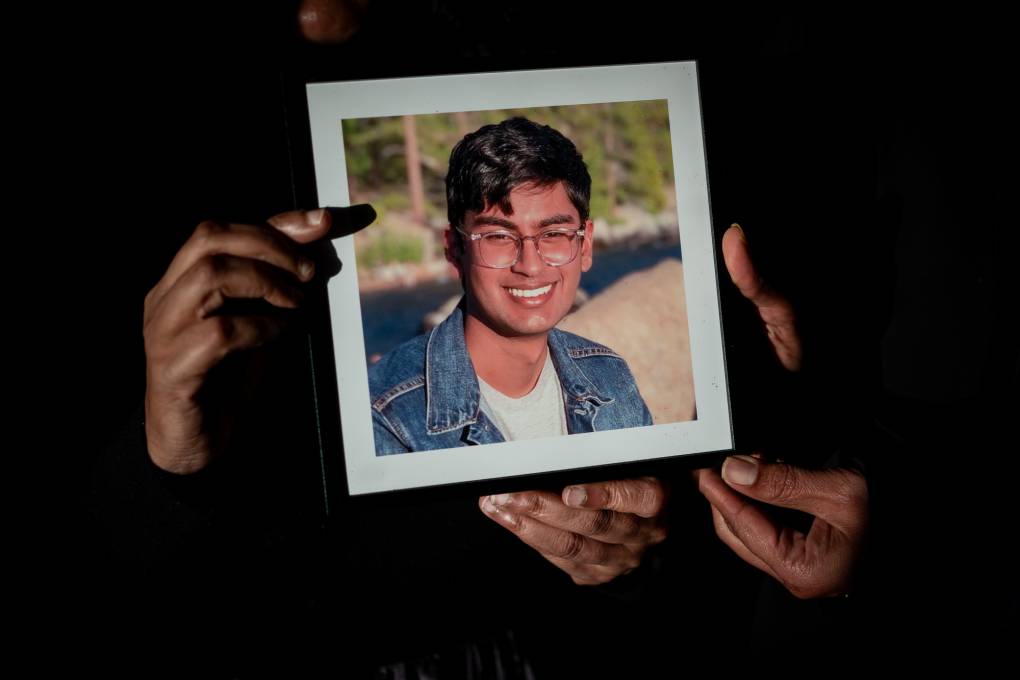
"caption": "The hands of Poornima Ramarao and Balaji Ramamurthy, parents of Suchir Balaji, hold a photo of their son at their home in Union City on Jan. 5, 2024. Suchir Balaji was found dead in his San Francisco apartment on Nov. 26. In the months since his death, in which officials ruled a suicide, his parents are still waiting to receive a final autopsy report.",
"credit": "Beth LaBerge/KQED",
"altTag": null,
"description": null,
"imgSizes": {
"medium": {
"file": "https://cdn.kqed.org/wp-content/uploads/sites/10/2025/01/250105-BalajiDeathOpenAI-08-800x533.jpg",
"width": 800,
"height": 533,
"mimeType": "image/jpeg"
},
"large": {
"file": "https://cdn.kqed.org/wp-content/uploads/sites/10/2025/01/250105-BalajiDeathOpenAI-08-1020x680.jpg",
"width": 1020,
"height": 680,
"mimeType": "image/jpeg"
},
"thumbnail": {
"file": "https://cdn.kqed.org/wp-content/uploads/sites/10/2025/01/250105-BalajiDeathOpenAI-08-160x107.jpg",
"width": 160,
"height": 107,
"mimeType": "image/jpeg"
},
"1536x1536": {
"file": "https://cdn.kqed.org/wp-content/uploads/sites/10/2025/01/250105-BalajiDeathOpenAI-08-1536x1024.jpg",
"width": 1536,
"height": 1024,
"mimeType": "image/jpeg"
},
"post-thumbnail": {
"file": "https://cdn.kqed.org/wp-content/uploads/sites/10/2025/01/250105-BalajiDeathOpenAI-08-672x372.jpg",
"width": 672,
"height": 372,
"mimeType": "image/jpeg"
},
"twentyfourteen-full-width": {
"file": "https://cdn.kqed.org/wp-content/uploads/sites/10/2025/01/250105-BalajiDeathOpenAI-08-1038x576.jpg",
"width": 1038,
"height": 576,
"mimeType": "image/jpeg"
},
"full-width": {
"file": "https://cdn.kqed.org/wp-content/uploads/sites/10/2025/01/250105-BalajiDeathOpenAI-08-1920x1280.jpg",
"width": 1920,
"height": 1280,
"mimeType": "image/jpeg"
},
"kqedFullSize": {
"file": "https://cdn.kqed.org/wp-content/uploads/sites/10/2025/01/250105-BalajiDeathOpenAI-08.jpg",
"width": 2000,
"height": 1333
}
},
"isLoading": false,
"fetchFailed": false
},
"news_12024820": {
"type": "attachments",
"id": "news_12024820",
"meta": {
"index": "attachments_1716263798",
"site": "news",
"id": "12024820",
"found": true
},
"title": "031711-Diablo-Canyon-Nuclear-Power-Plant-REUTERS-CM-01 copy",
"publishDate": 1738261272,
"status": "inherit",
"parent": 12024817,
"modified": 1738261293,
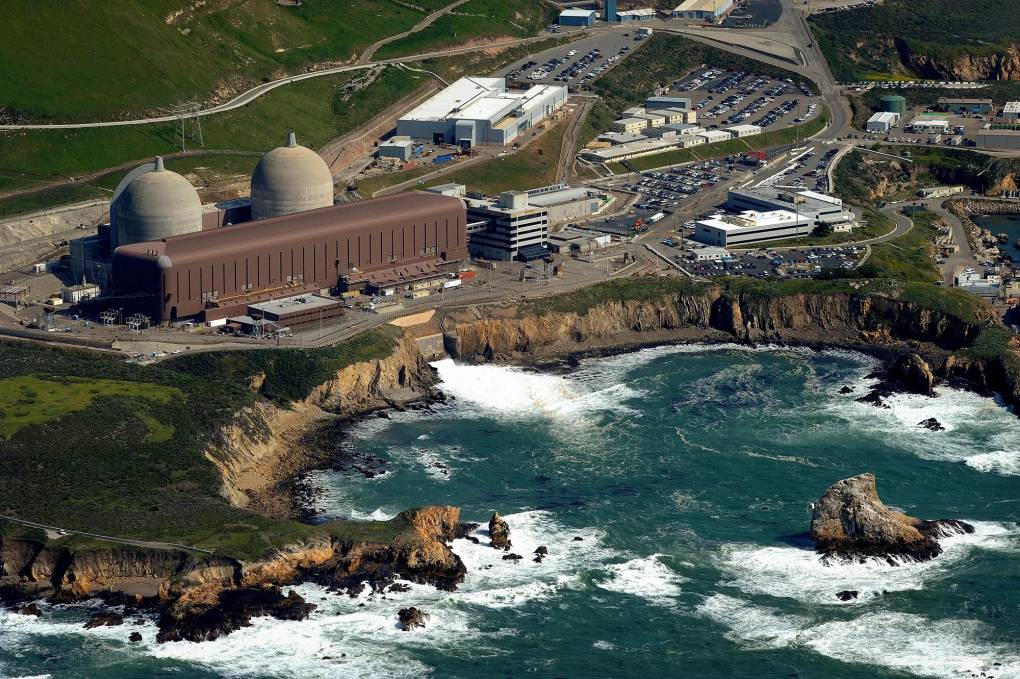
"caption": "Amid growing energy demands from the tech sector, California legislators have examined a number of ways to use more nuclear power to fill the gap. That includes potentially extending the lifespan of the Diablo Canyon nuclear power plant in San Luis Obispo County, which has been providing electricity for 38 years.",
"credit": "Lionel Hahn/Reuters",
"altTag": null,
"description": null,
"imgSizes": {
"medium": {
"file": "https://cdn.kqed.org/wp-content/uploads/sites/10/2025/01/031711-Diablo-Canyon-Nuclear-Power-Plant-REUTERS-CM-01-copy-800x532.jpg",
"width": 800,
"height": 532,
"mimeType": "image/jpeg"
},
"large": {
"file": "https://cdn.kqed.org/wp-content/uploads/sites/10/2025/01/031711-Diablo-Canyon-Nuclear-Power-Plant-REUTERS-CM-01-copy-1020x679.jpg",
"width": 1020,
"height": 679,
"mimeType": "image/jpeg"
},
"thumbnail": {
"file": "https://cdn.kqed.org/wp-content/uploads/sites/10/2025/01/031711-Diablo-Canyon-Nuclear-Power-Plant-REUTERS-CM-01-copy-160x106.jpg",
"width": 160,
"height": 106,
"mimeType": "image/jpeg"
},
"1536x1536": {
"file": "https://cdn.kqed.org/wp-content/uploads/sites/10/2025/01/031711-Diablo-Canyon-Nuclear-Power-Plant-REUTERS-CM-01-copy-1536x1022.jpg",
"width": 1536,
"height": 1022,
"mimeType": "image/jpeg"
},
"post-thumbnail": {
"file": "https://cdn.kqed.org/wp-content/uploads/sites/10/2025/01/031711-Diablo-Canyon-Nuclear-Power-Plant-REUTERS-CM-01-copy-672x372.jpg",
"width": 672,
"height": 372,
"mimeType": "image/jpeg"
},
"twentyfourteen-full-width": {
"file": "https://cdn.kqed.org/wp-content/uploads/sites/10/2025/01/031711-Diablo-Canyon-Nuclear-Power-Plant-REUTERS-CM-01-copy-1038x576.jpg",
"width": 1038,
"height": 576,
"mimeType": "image/jpeg"
},
"full-width": {
"file": "https://cdn.kqed.org/wp-content/uploads/sites/10/2025/01/031711-Diablo-Canyon-Nuclear-Power-Plant-REUTERS-CM-01-copy-1920x1278.jpg",
"width": 1920,
"height": 1278,
"mimeType": "image/jpeg"
},
"kqedFullSize": {
"file": "https://cdn.kqed.org/wp-content/uploads/sites/10/2025/01/031711-Diablo-Canyon-Nuclear-Power-Plant-REUTERS-CM-01-copy.jpg",
"width": 2000,
"height": 1331
}
},
"isLoading": false,
"fetchFailed": false
},
"news_12016604": {
"type": "attachments",
"id": "news_12016604",
"meta": {
"index": "attachments_1716263798",
"site": "news",
"id": "12016604",
"found": true
},
"title": "The UC Berkeley Campus in Berkeley on Aug. 17, 2023.",
"publishDate": 1733334753,
"status": "inherit",
"parent": 12016602,
"modified": 1733334766,
"caption": "The UC Berkeley Campus in Berkeley on Aug. 17, 2023.",
"credit": "Martin do Nascimento/KQED",
"altTag": null,
"description": null,
"imgSizes": {
"medium": {
"file": "https://cdn.kqed.org/wp-content/uploads/sites/10/2024/12/230817-UC-BERKELEY-CAMPUS-MD-02_qed-800x533.jpg",
"width": 800,
"height": 533,
"mimeType": "image/jpeg"
},
"large": {
"file": "https://cdn.kqed.org/wp-content/uploads/sites/10/2024/12/230817-UC-BERKELEY-CAMPUS-MD-02_qed-1020x680.jpg",
"width": 1020,
"height": 680,
"mimeType": "image/jpeg"
},
"thumbnail": {
"file": "https://cdn.kqed.org/wp-content/uploads/sites/10/2024/12/230817-UC-BERKELEY-CAMPUS-MD-02_qed-160x107.jpg",
"width": 160,
"height": 107,
"mimeType": "image/jpeg"
},
"1536x1536": {
"file": "https://cdn.kqed.org/wp-content/uploads/sites/10/2024/12/230817-UC-BERKELEY-CAMPUS-MD-02_qed-1536x1024.jpg",
"width": 1536,
"height": 1024,
"mimeType": "image/jpeg"
},
"post-thumbnail": {
"file": "https://cdn.kqed.org/wp-content/uploads/sites/10/2024/12/230817-UC-BERKELEY-CAMPUS-MD-02_qed-672x372.jpg",
"width": 672,
"height": 372,
"mimeType": "image/jpeg"
},
"twentyfourteen-full-width": {
"file": "https://cdn.kqed.org/wp-content/uploads/sites/10/2024/12/230817-UC-BERKELEY-CAMPUS-MD-02_qed-1038x576.jpg",
"width": 1038,
"height": 576,
"mimeType": "image/jpeg"
},
"full-width": {
"file": "https://cdn.kqed.org/wp-content/uploads/sites/10/2024/12/230817-UC-BERKELEY-CAMPUS-MD-02_qed-1920x1280.jpg",
"width": 1920,
"height": 1280,
"mimeType": "image/jpeg"
},
"kqedFullSize": {
"file": "https://cdn.kqed.org/wp-content/uploads/sites/10/2024/12/230817-UC-BERKELEY-CAMPUS-MD-02_qed.jpg",
"width": 2000,
"height": 1333
}
},
"isLoading": false,
"fetchFailed": false
},
"news_12020381": {
"type": "attachments",
"id": "news_12020381",
"meta": {
"index": "attachments_1716263798",
"site": "news",
"id": "12020381",
"found": true
},
"title": "250105-BalajiDeathOpenAI-09",
"publishDate": 1736139049,
"status": "inherit",
"parent": 0,
"modified": 1736375562,
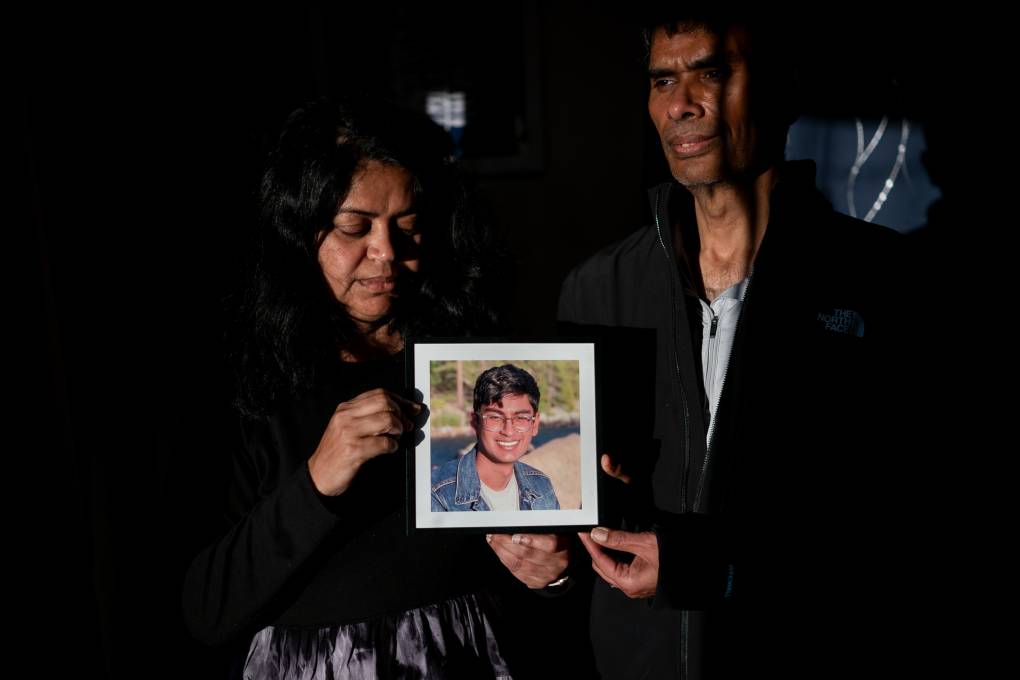
"caption": "Poornima Ramarao (left) and Balaji Ramamurthy, parents of Suchir Balaji, hold a photo of their son at their home in Union City on Jan. 5, 2024. Suchir Balaji was found dead in his San Francisco apartment on Nov. 26.",
"credit": "Beth LaBerge/KQED",
"altTag": null,
"description": null,
"imgSizes": {
"medium": {
"file": "https://cdn.kqed.org/wp-content/uploads/sites/10/2025/01/250105-BalajiDeathOpenAI-09-800x533.jpg",
"width": 800,
"height": 533,
"mimeType": "image/jpeg"
},
"large": {
"file": "https://cdn.kqed.org/wp-content/uploads/sites/10/2025/01/250105-BalajiDeathOpenAI-09-1020x680.jpg",
"width": 1020,
"height": 680,
"mimeType": "image/jpeg"
},
"thumbnail": {
"file": "https://cdn.kqed.org/wp-content/uploads/sites/10/2025/01/250105-BalajiDeathOpenAI-09-160x107.jpg",
"width": 160,
"height": 107,
"mimeType": "image/jpeg"
},
"1536x1536": {
"file": "https://cdn.kqed.org/wp-content/uploads/sites/10/2025/01/250105-BalajiDeathOpenAI-09-1536x1024.jpg",
"width": 1536,
"height": 1024,
"mimeType": "image/jpeg"
},
"post-thumbnail": {
"file": "https://cdn.kqed.org/wp-content/uploads/sites/10/2025/01/250105-BalajiDeathOpenAI-09-672x372.jpg",
"width": 672,
"height": 372,
"mimeType": "image/jpeg"
},
"twentyfourteen-full-width": {
"file": "https://cdn.kqed.org/wp-content/uploads/sites/10/2025/01/250105-BalajiDeathOpenAI-09-1038x576.jpg",
"width": 1038,
"height": 576,
"mimeType": "image/jpeg"
},
"full-width": {
"file": "https://cdn.kqed.org/wp-content/uploads/sites/10/2025/01/250105-BalajiDeathOpenAI-09-1920x1280.jpg",
"width": 1920,
"height": 1280,
"mimeType": "image/jpeg"
},
"kqedFullSize": {
"file": "https://cdn.kqed.org/wp-content/uploads/sites/10/2025/01/250105-BalajiDeathOpenAI-09.jpg",
"width": 2000,
"height": 1333
}
},
"isLoading": false,
"fetchFailed": false
},
"news_12010450": {
"type": "attachments",
"id": "news_12010450",
"meta": {
"index": "attachments_1716263798",
"site": "news",
"id": "12010450",
"found": true
},
"title": "241021-SFUSD BREED STATE PRESSER-MD-09-KQED",
"publishDate": 1729540484,
"status": "inherit",
"parent": 12024206,
"modified": 1738020041,
"caption": "State Sen. Scott Wiener speaks at a press event in front of the SFUSD offices in San Francisco on Oct. 21, 2024.",
"credit": "Martin do Nascimento/KQED",
"altTag": null,
"description": null,
"imgSizes": {
"medium": {
"file": "https://cdn.kqed.org/wp-content/uploads/sites/10/2024/10/241021-SFUSD-BREED-STATE-PRESSER-MD-09-KQED-800x533.jpg",
"width": 800,
"height": 533,
"mimeType": "image/jpeg"
},
"large": {
"file": "https://cdn.kqed.org/wp-content/uploads/sites/10/2024/10/241021-SFUSD-BREED-STATE-PRESSER-MD-09-KQED-1020x680.jpg",
"width": 1020,
"height": 680,
"mimeType": "image/jpeg"
},
"thumbnail": {
"file": "https://cdn.kqed.org/wp-content/uploads/sites/10/2024/10/241021-SFUSD-BREED-STATE-PRESSER-MD-09-KQED-160x107.jpg",
"width": 160,
"height": 107,
"mimeType": "image/jpeg"
},
"1536x1536": {
"file": "https://cdn.kqed.org/wp-content/uploads/sites/10/2024/10/241021-SFUSD-BREED-STATE-PRESSER-MD-09-KQED-1536x1024.jpg",
"width": 1536,
"height": 1024,
"mimeType": "image/jpeg"
},
"post-thumbnail": {
"file": "https://cdn.kqed.org/wp-content/uploads/sites/10/2024/10/241021-SFUSD-BREED-STATE-PRESSER-MD-09-KQED-672x372.jpg",
"width": 672,
"height": 372,
"mimeType": "image/jpeg"
},
"twentyfourteen-full-width": {
"file": "https://cdn.kqed.org/wp-content/uploads/sites/10/2024/10/241021-SFUSD-BREED-STATE-PRESSER-MD-09-KQED-1038x576.jpg",
"width": 1038,
"height": 576,
"mimeType": "image/jpeg"
},
"full-width": {
"file": "https://cdn.kqed.org/wp-content/uploads/sites/10/2024/10/241021-SFUSD-BREED-STATE-PRESSER-MD-09-KQED-1920x1280.jpg",
"width": 1920,
"height": 1280,
"mimeType": "image/jpeg"
},
"kqedFullSize": {
"file": "https://cdn.kqed.org/wp-content/uploads/sites/10/2024/10/241021-SFUSD-BREED-STATE-PRESSER-MD-09-KQED.jpg",
"width": 2000,
"height": 1333
}
},
"isLoading": false,
"fetchFailed": false
},
"news_12016273": {
"type": "attachments",
"id": "news_12016273",
"meta": {
"index": "attachments_1716263798",
"site": "news",
"id": "12016273",
"found": true
},
"title": "110524_RealPage_AH_CM_01",
"publishDate": 1733163377,
"status": "inherit",
"parent": 12016271,
"modified": 1733167761,
"caption": "San Francisco has approved a ban on the use of algorithmic rent-pricing software of the sort made by market leader RealPage. San Diego and San Jose are considering similar laws. ",
"credit": "Illustration by Adriana Heldiz, CalMatters; iStock, RentCafe",
"altTag": null,
"description": null,
"imgSizes": {
"medium": {
"file": "https://cdn.kqed.org/wp-content/uploads/sites/10/2024/12/110524_RealPage_AH_CM_01-800x533.jpg",
"width": 800,
"height": 533,
"mimeType": "image/jpeg"
},
"large": {
"file": "https://cdn.kqed.org/wp-content/uploads/sites/10/2024/12/110524_RealPage_AH_CM_01-1020x680.jpg",
"width": 1020,
"height": 680,
"mimeType": "image/jpeg"
},
"thumbnail": {
"file": "https://cdn.kqed.org/wp-content/uploads/sites/10/2024/12/110524_RealPage_AH_CM_01-160x107.jpg",
"width": 160,
"height": 107,
"mimeType": "image/jpeg"
},
"1536x1536": {
"file": "https://cdn.kqed.org/wp-content/uploads/sites/10/2024/12/110524_RealPage_AH_CM_01-1536x1024.jpg",
"width": 1536,
"height": 1024,
"mimeType": "image/jpeg"
},
"post-thumbnail": {
"file": "https://cdn.kqed.org/wp-content/uploads/sites/10/2024/12/110524_RealPage_AH_CM_01-672x372.jpg",
"width": 672,
"height": 372,
"mimeType": "image/jpeg"
},
"twentyfourteen-full-width": {
"file": "https://cdn.kqed.org/wp-content/uploads/sites/10/2024/12/110524_RealPage_AH_CM_01-1038x576.jpg",
"width": 1038,
"height": 576,
"mimeType": "image/jpeg"
},
"full-width": {
"file": "https://cdn.kqed.org/wp-content/uploads/sites/10/2024/12/110524_RealPage_AH_CM_01-1920x1280.jpg",
"width": 1920,
"height": 1280,
"mimeType": "image/jpeg"
},
"kqedFullSize": {
"file": "https://cdn.kqed.org/wp-content/uploads/sites/10/2024/12/110524_RealPage_AH_CM_01.jpg",
"width": 2000,
"height": 1333
}
},
"isLoading": false,
"fetchFailed": false
},
"news_12014179": {
"type": "attachments",
"id": "news_12014179",
"meta": {
"index": "attachments_1716263798",
"site": "news",
"id": "12014179",
"found": true
},
"title": "Trump Campaign",
"publishDate": 1731461786,
"status": "inherit",
"parent": 12014081,
"modified": 1739045390,
"caption": "Elon Musk speaks at a Republican campaign rally at Madison Square Garden in New York, NY on Sunday, Oct. 27, 2024.",
"credit": "Jabin Botsford/The Washington Post via Getty Images",
"altTag": null,
"description": null,
"imgSizes": {
"medium": {
"file": "https://cdn.kqed.org/wp-content/uploads/sites/10/2024/11/GettyImages-2181962905-800x533.jpg",
"width": 800,
"height": 533,
"mimeType": "image/jpeg"
},
"large": {
"file": "https://cdn.kqed.org/wp-content/uploads/sites/10/2024/11/GettyImages-2181962905-1020x680.jpg",
"width": 1020,
"height": 680,
"mimeType": "image/jpeg"
},
"thumbnail": {
"file": "https://cdn.kqed.org/wp-content/uploads/sites/10/2024/11/GettyImages-2181962905-160x107.jpg",
"width": 160,
"height": 107,
"mimeType": "image/jpeg"
},
"1536x1536": {
"file": "https://cdn.kqed.org/wp-content/uploads/sites/10/2024/11/GettyImages-2181962905-1536x1024.jpg",
"width": 1536,
"height": 1024,
"mimeType": "image/jpeg"
},
"2048x2048": {
"file": "https://cdn.kqed.org/wp-content/uploads/sites/10/2024/11/GettyImages-2181962905-2048x1365.jpg",
"width": 2048,
"height": 1365,
"mimeType": "image/jpeg"
},
"post-thumbnail": {
"file": "https://cdn.kqed.org/wp-content/uploads/sites/10/2024/11/GettyImages-2181962905-672x372.jpg",
"width": 672,
"height": 372,
"mimeType": "image/jpeg"
},
"twentyfourteen-full-width": {
"file": "https://cdn.kqed.org/wp-content/uploads/sites/10/2024/11/GettyImages-2181962905-1038x576.jpg",
"width": 1038,
"height": 576,
"mimeType": "image/jpeg"
},
"full-width": {
"file": "https://cdn.kqed.org/wp-content/uploads/sites/10/2024/11/GettyImages-2181962905-1920x1280.jpg",
"width": 1920,
"height": 1280,
"mimeType": "image/jpeg"
},
"kqedFullSize": {
"file": "https://cdn.kqed.org/wp-content/uploads/sites/10/2024/11/GettyImages-2181962905-scaled.jpg",
"width": 2560,
"height": 1707
}
},
"isLoading": false,
"fetchFailed": false
},
"news_11984250": {
"type": "attachments",
"id": "news_11984250",
"meta": {
"index": "attachments_1716263798",
"site": "news",
"id": "11984250",
"found": true
},
"parent": 11984246,
"imgSizes": {
"twentyfourteen-full-width": {
"file": "https://cdn.kqed.org/wp-content/uploads/sites/10/2024/04/San-Jose-overview-1038x576.jpg",
"width": 1038,
"mimeType": "image/jpeg",
"height": 576
},
"thumbnail": {
"file": "https://cdn.kqed.org/wp-content/uploads/sites/10/2024/04/San-Jose-overview-160x120.jpg",
"width": 160,
"mimeType": "image/jpeg",
"height": 120
},
"post-thumbnail": {
"file": "https://cdn.kqed.org/wp-content/uploads/sites/10/2024/04/San-Jose-overview-672x372.jpg",
"width": 672,
"mimeType": "image/jpeg",
"height": 372
},
"kqedFullSize": {
"file": "https://cdn.kqed.org/wp-content/uploads/sites/10/2024/04/San-Jose-overview.jpg",
"width": 2000,
"height": 1506
},
"large": {
"file": "https://cdn.kqed.org/wp-content/uploads/sites/10/2024/04/San-Jose-overview-1020x768.jpg",
"width": 1020,
"mimeType": "image/jpeg",
"height": 768
},
"1536x1536": {
"file": "https://cdn.kqed.org/wp-content/uploads/sites/10/2024/04/San-Jose-overview-1536x1157.jpg",
"width": 1536,
"mimeType": "image/jpeg",
"height": 1157
},
"full-width": {
"file": "https://cdn.kqed.org/wp-content/uploads/sites/10/2024/04/San-Jose-overview-1920x1446.jpg",
"width": 1920,
"mimeType": "image/jpeg",
"height": 1446
},
"medium": {
"file": "https://cdn.kqed.org/wp-content/uploads/sites/10/2024/04/San-Jose-overview-800x602.jpg",
"width": 800,
"mimeType": "image/jpeg",
"height": 602
}
},
"publishDate": 1714172424,
"modified": 1714173015,
"caption": "An aerial photo of San José from City Hall on April 16, 2024. ",
"description": null,
"title": "San Jose overview",
"credit": "Joseph Geha/KQED",
"status": "inherit",
"altTag": null,
"isLoading": false,
"fetchFailed": false
},
"news_12006142": {
"type": "attachments",
"id": "news_12006142",
"meta": {
"index": "attachments_1716263798",
"site": "news",
"id": "12006142",
"found": true
},
"title": "240923-AI IN POLICING-MD-13-KQED",
"publishDate": 1727195611,
"status": "inherit",
"parent": 0,
"modified": 1727903836,
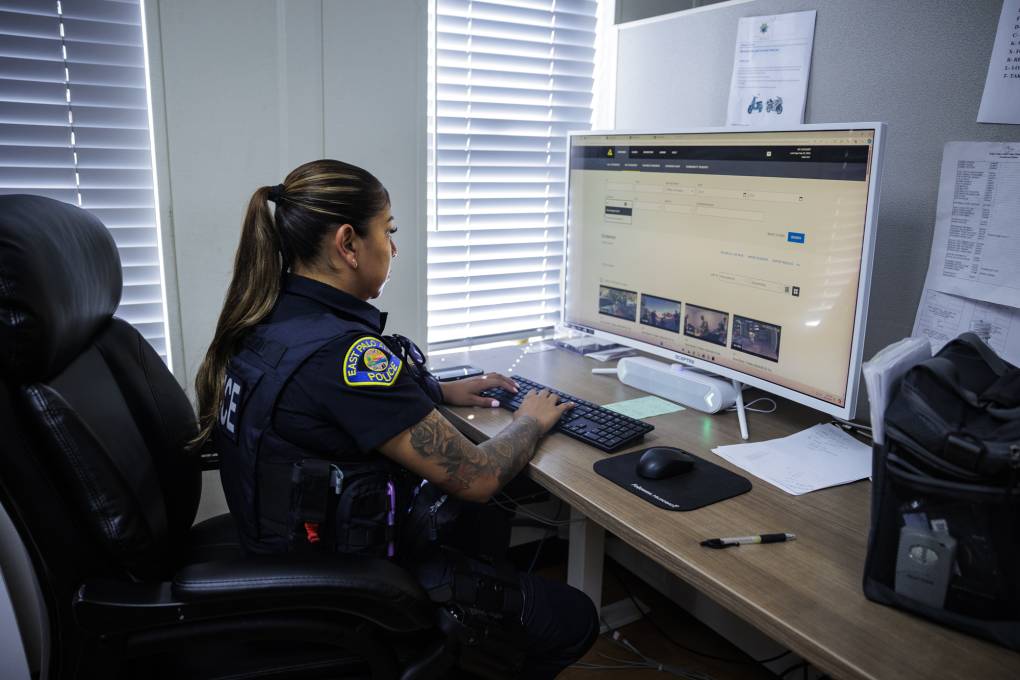
"caption": "East Palo Alto Police Officer Wendy Venegas reviews body camera footage and uses Axon's Draft One AI-based software to draft reports based on the audio from the camera at police headquarters in East Palo Alto on Sept. 23, 2024.",
"credit": "Martin do Nascimento/KQED",
"altTag": "A woman dressed in a police uniform sits at a desk in an office looking at a computer screen.",
"description": null,
"imgSizes": {
"medium": {
"file": "https://cdn.kqed.org/wp-content/uploads/sites/10/2024/09/240923-AI-IN-POLICING-MD-13-KQED-800x533.jpg",
"width": 800,
"height": 533,
"mimeType": "image/jpeg"
},
"large": {
"file": "https://cdn.kqed.org/wp-content/uploads/sites/10/2024/09/240923-AI-IN-POLICING-MD-13-KQED-1020x680.jpg",
"width": 1020,
"height": 680,
"mimeType": "image/jpeg"
},
"thumbnail": {
"file": "https://cdn.kqed.org/wp-content/uploads/sites/10/2024/09/240923-AI-IN-POLICING-MD-13-KQED-160x107.jpg",
"width": 160,
"height": 107,
"mimeType": "image/jpeg"
},
"1536x1536": {
"file": "https://cdn.kqed.org/wp-content/uploads/sites/10/2024/09/240923-AI-IN-POLICING-MD-13-KQED-1536x1024.jpg",
"width": 1536,
"height": 1024,
"mimeType": "image/jpeg"
},
"post-thumbnail": {
"file": "https://cdn.kqed.org/wp-content/uploads/sites/10/2024/09/240923-AI-IN-POLICING-MD-13-KQED-672x372.jpg",
"width": 672,
"height": 372,
"mimeType": "image/jpeg"
},
"twentyfourteen-full-width": {
"file": "https://cdn.kqed.org/wp-content/uploads/sites/10/2024/09/240923-AI-IN-POLICING-MD-13-KQED-1038x576.jpg",
"width": 1038,
"height": 576,
"mimeType": "image/jpeg"
},
"full-width": {
"file": "https://cdn.kqed.org/wp-content/uploads/sites/10/2024/09/240923-AI-IN-POLICING-MD-13-KQED-1920x1280.jpg",
"width": 1920,
"height": 1280,
"mimeType": "image/jpeg"
},
"kqedFullSize": {
"file": "https://cdn.kqed.org/wp-content/uploads/sites/10/2024/09/240923-AI-IN-POLICING-MD-13-KQED.jpg?ver=1727270167",
"width": 2000,
"height": 1333
}
},
"isLoading": false,
"fetchFailed": false
},
"news_12006141": {
"type": "attachments",
"id": "news_12006141",
"meta": {
"index": "attachments_1716263798",
"site": "news",
"id": "12006141",
"found": true
},
"title": "240923-AI IN POLICING-MD-11-KQED",
"publishDate": 1727195605,
"status": "inherit",
"parent": 0,
"modified": 1727903821,
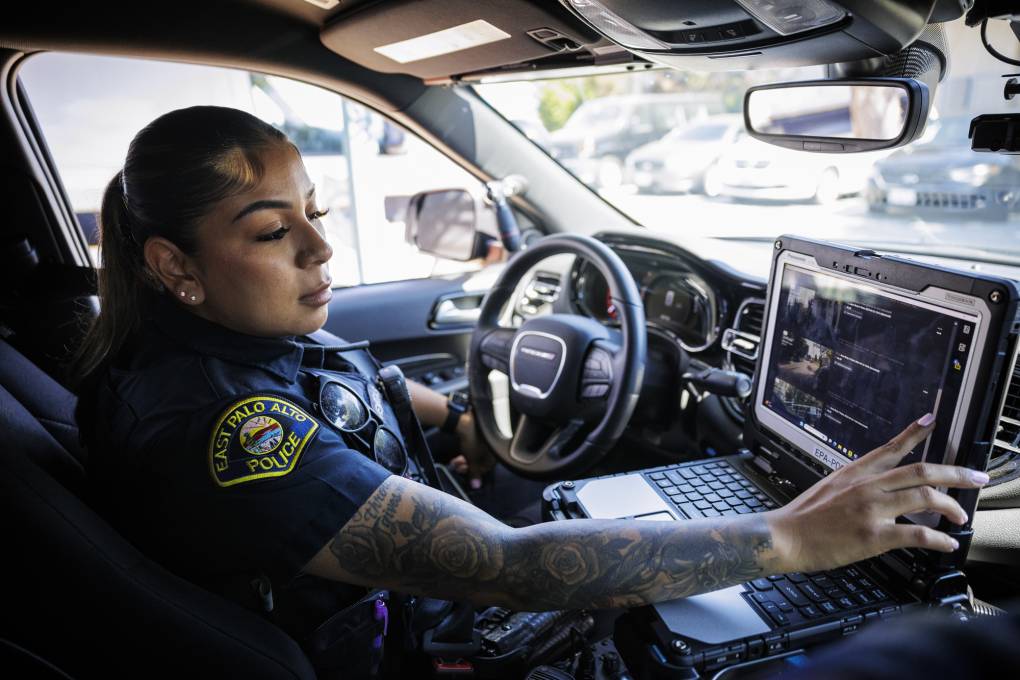
"caption": "East Palo Alto Police Officer Wendy Venegas reviews footage from her body camera in her police vehicle after responding to a call in East Palo Alto on Sept. 23, 2024.",
"credit": "Martin do Nascimento/KQED",
"altTag": "A woman dressed in a police uniform sits in a police vehicle and touches the screen of a laptop.",
"description": null,
"imgSizes": {
"medium": {
"file": "https://cdn.kqed.org/wp-content/uploads/sites/10/2024/09/240923-AI-IN-POLICING-MD-11-KQED-800x533.jpg",
"width": 800,
"height": 533,
"mimeType": "image/jpeg"
},
"large": {
"file": "https://cdn.kqed.org/wp-content/uploads/sites/10/2024/09/240923-AI-IN-POLICING-MD-11-KQED-1020x680.jpg",
"width": 1020,
"height": 680,
"mimeType": "image/jpeg"
},
"thumbnail": {
"file": "https://cdn.kqed.org/wp-content/uploads/sites/10/2024/09/240923-AI-IN-POLICING-MD-11-KQED-160x107.jpg",
"width": 160,
"height": 107,
"mimeType": "image/jpeg"
},
"1536x1536": {
"file": "https://cdn.kqed.org/wp-content/uploads/sites/10/2024/09/240923-AI-IN-POLICING-MD-11-KQED-1536x1024.jpg",
"width": 1536,
"height": 1024,
"mimeType": "image/jpeg"
},
"post-thumbnail": {
"file": "https://cdn.kqed.org/wp-content/uploads/sites/10/2024/09/240923-AI-IN-POLICING-MD-11-KQED-672x372.jpg",
"width": 672,
"height": 372,
"mimeType": "image/jpeg"
},
"twentyfourteen-full-width": {
"file": "https://cdn.kqed.org/wp-content/uploads/sites/10/2024/09/240923-AI-IN-POLICING-MD-11-KQED-1038x576.jpg",
"width": 1038,
"height": 576,
"mimeType": "image/jpeg"
},
"full-width": {
"file": "https://cdn.kqed.org/wp-content/uploads/sites/10/2024/09/240923-AI-IN-POLICING-MD-11-KQED-1920x1280.jpg",
"width": 1920,
"height": 1280,
"mimeType": "image/jpeg"
},
"kqedFullSize": {
"file": "https://cdn.kqed.org/wp-content/uploads/sites/10/2024/09/240923-AI-IN-POLICING-MD-11-KQED.jpg",
"width": 2000,
"height": 1333
}
},
"isLoading": false,
"fetchFailed": false
},
"news_12000982": {
"type": "attachments",
"id": "news_12000982",
"meta": {
"index": "attachments_1716263798",
"site": "news",
"id": "12000982",
"found": true
},
"title": "Senator Scott Wiener comes in to talk to the editorial board at the Chronicle on Friday, Jan. 10, 2020, in San Francisco, Calif.",
"publishDate": 1724187287,
"status": "inherit",
"parent": 0,
"modified": 1724187370,
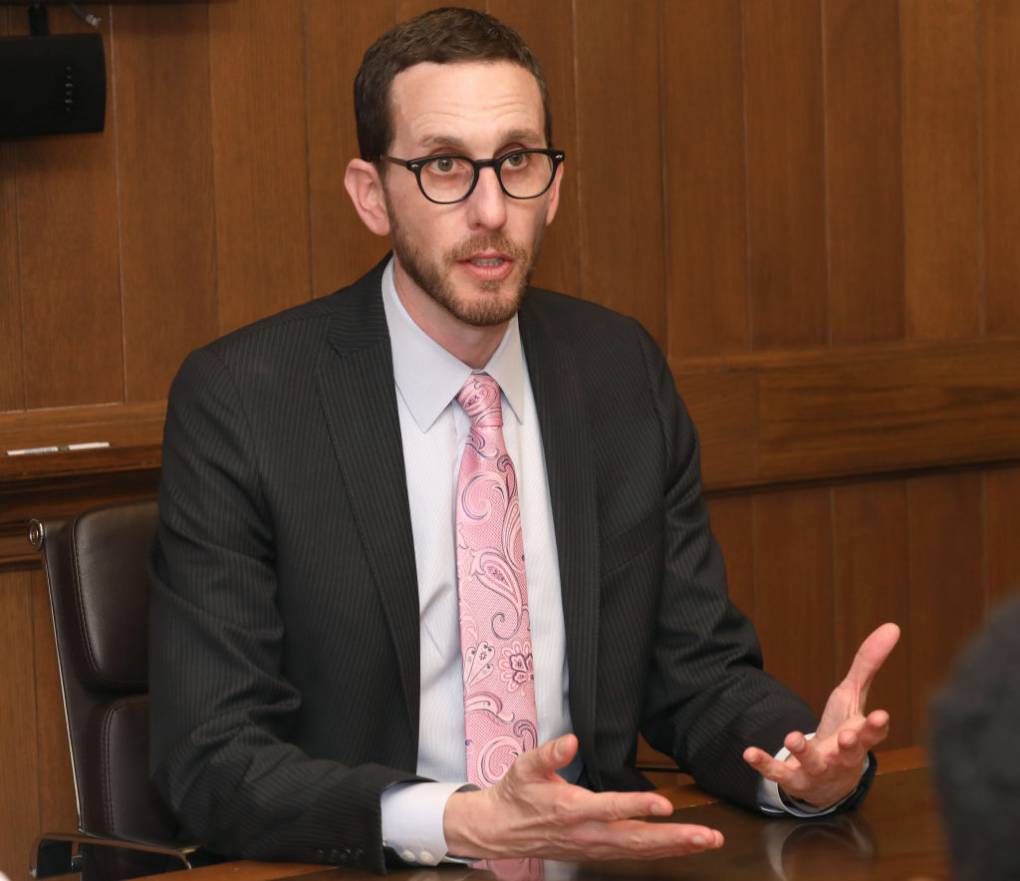
"caption": "Senator Scott Wiener introduced SB 1047, a bill that would mandate safety testing for developers of the largest AI models.",
"credit": "Liz Hafalia/The San Francisco Chronicle via Getty Images",
"altTag": null,
"description": null,
"imgSizes": {
"medium": {
"file": "https://cdn.kqed.org/wp-content/uploads/sites/10/2024/08/GettyImages-1321791737-800x691.jpg",
"width": 800,
"height": 691,
"mimeType": "image/jpeg"
},
"large": {
"file": "https://cdn.kqed.org/wp-content/uploads/sites/10/2024/08/GettyImages-1321791737-1020x881.jpg",
"width": 1020,
"height": 881,
"mimeType": "image/jpeg"
},
"thumbnail": {
"file": "https://cdn.kqed.org/wp-content/uploads/sites/10/2024/08/GettyImages-1321791737-160x138.jpg",
"width": 160,
"height": 138,
"mimeType": "image/jpeg"
},
"post-thumbnail": {
"file": "https://cdn.kqed.org/wp-content/uploads/sites/10/2024/08/GettyImages-1321791737-672x372.jpg",
"width": 672,
"height": 372,
"mimeType": "image/jpeg"
},
"twentyfourteen-full-width": {
"file": "https://cdn.kqed.org/wp-content/uploads/sites/10/2024/08/GettyImages-1321791737-1024x576.jpg",
"width": 1024,
"height": 576,
"mimeType": "image/jpeg"
},
"kqedFullSize": {
"file": "https://cdn.kqed.org/wp-content/uploads/sites/10/2024/08/GettyImages-1321791737.jpg",
"width": 1024,
"height": 884
}
},
"isLoading": false,
"fetchFailed": false
},
"news_12007100": {
"type": "attachments",
"id": "news_12007100",
"meta": {
"index": "attachments_1716263798",
"site": "news",
"id": "12007100",
"found": true
},
"title": "RobynWilliams_2",
"publishDate": 1727705081,
"status": "inherit",
"parent": 12007099,
"modified": 1727705184,
"caption": "Robyn Williams, an L.A. resident, gives a personal perspective on Prop. 36, given her past experiences as an offender and substance abuser.",
"credit": "Saul Gonzalez/The California Report",
"altTag": null,
"description": null,
"imgSizes": {
"medium": {
"file": "https://cdn.kqed.org/wp-content/uploads/sites/10/2024/09/RobynWilliams_2-800x600.jpg",
"width": 800,
"height": 600,
"mimeType": "image/jpeg"
},
"large": {
"file": "https://cdn.kqed.org/wp-content/uploads/sites/10/2024/09/RobynWilliams_2-1020x765.jpg",
"width": 1020,
"height": 765,
"mimeType": "image/jpeg"
},
"thumbnail": {
"file": "https://cdn.kqed.org/wp-content/uploads/sites/10/2024/09/RobynWilliams_2-160x120.jpg",
"width": 160,
"height": 120,
"mimeType": "image/jpeg"
},
"1536x1536": {
"file": "https://cdn.kqed.org/wp-content/uploads/sites/10/2024/09/RobynWilliams_2-1536x1152.jpg",
"width": 1536,
"height": 1152,
"mimeType": "image/jpeg"
},
"2048x2048": {
"file": "https://cdn.kqed.org/wp-content/uploads/sites/10/2024/09/RobynWilliams_2-2048x1536.jpg",
"width": 2048,
"height": 1536,
"mimeType": "image/jpeg"
},
"post-thumbnail": {
"file": "https://cdn.kqed.org/wp-content/uploads/sites/10/2024/09/RobynWilliams_2-672x372.jpg",
"width": 672,
"height": 372,
"mimeType": "image/jpeg"
},
"twentyfourteen-full-width": {
"file": "https://cdn.kqed.org/wp-content/uploads/sites/10/2024/09/RobynWilliams_2-1038x576.jpg",
"width": 1038,
"height": 576,
"mimeType": "image/jpeg"
},
"full-width": {
"file": "https://cdn.kqed.org/wp-content/uploads/sites/10/2024/09/RobynWilliams_2-1920x1440.jpg",
"width": 1920,
"height": 1440,
"mimeType": "image/jpeg"
},
"kqedFullSize": {
"file": "https://cdn.kqed.org/wp-content/uploads/sites/10/2024/09/RobynWilliams_2-scaled.jpg",
"width": 2560,
"height": 1920
}
},
"isLoading": false,
"fetchFailed": false
}
},
"audioPlayerReducer": {
"postId": "stream_live",
"isPaused": true,
"isPlaying": false,
"pfsActive": false,
"pledgeModalIsOpen": true,
"playerDrawerIsOpen": false,
"liveAudioPlayStartedAt": 0,
"liveAudioPlayContext": ""
},
"authorsReducer": {
"byline_news_12024817": {
"type": "authors",
"id": "byline_news_12024817",
"meta": {
"override": true
},
"slug": "byline_news_12024817",
"name": "\u003ca href=\"https://calmatters.org/author/alex-shultz/\">Alex Shultz\u003c/a>, CalMatters",
"isLoading": false
},
"byline_news_12016271": {
"type": "authors",
"id": "byline_news_12016271",
"meta": {
"override": true
},
"slug": "byline_news_12016271",
"name": "Wendy Fry",
"isLoading": false
},
"rachael-myrow": {
"type": "authors",
"id": "251",
"meta": {
"index": "authors_1716337520",
"id": "251",
"found": true
},
"name": "Rachael Myrow",
"firstName": "Rachael",
"lastName": "Myrow",
"slug": "rachael-myrow",
"email": "rmyrow@kqed.org",
"display_author_email": true,
"staff_mastheads": [
"news"
],
"title": "Senior Editor of KQED's Silicon Valley News Desk",
"bio": "• I write and edit stories about how Silicon Valley power and policies shape everyday life in California. I’m also passionate about making Bay Area history and culture more accessible to a broad public. • I’ve been a journalist for most of my life, starting in high school with The Franklin Press in Los Angeles, where I grew up. While earning my first degree in English at UC Berkeley, I got my start in public radio at KALX-FM. After completing a second degree in journalism at Cal, I landed my first professional job at Marketplace, then moved on to KPCC (now LAist), and then KQED, where I hosted The California Report for more than seven years. • My reporting has appeared on NPR, The World, WBUR’s \u003ci>Here & Now\u003c/i>, and the BBC. I also guest host for KQED’s \u003ci>Forum\u003c/i>, as well as the Commonwealth Club in San Francisco. • I speak periodically on media, democracy and technology issues, and do voiceover work for documentaries and educational video projects. • Outside of the studio, you'll find me hiking Bay Area trails and whipping up Insta-ready meals in my kitchen. • I do not accept gifts, money, or favors from anyone connected to my reporting, I don't pay people for information, and I do not support or donate to political causes. • I strive to treat the people I report on with fairness, honesty, and respect. I also recognize there are often multiple sides to a story and work to verify information through multiple sources and documentation. If I get something wrong, I correct it.",
"avatar": "https://secure.gravatar.com/avatar/3ed8a3c5f26025e4a805ba634cda8cd764906b97438a6d9ce216b044e340da4e?s=600&d=blank&r=g",
"twitter": "rachaelmyrow",
"bluesky": null,
"facebook": null,
"instagram": null,
"linkedin": "https://www.linkedin.com/in/rachaelmyrow/",
"sites": [
{
"site": "arts",
"roles": [
"administrator"
]
},
{
"site": "news",
"roles": [
"edit_others_posts",
"editor"
]
},
{
"site": "futureofyou",
"roles": [
"editor"
]
},
{
"site": "bayareabites",
"roles": [
"editor"
]
},
{
"site": "stateofhealth",
"roles": [
"editor"
]
},
{
"site": "science",
"roles": [
"editor"
]
},
{
"site": "food",
"roles": [
"editor"
]
},
{
"site": "forum",
"roles": [
"editor"
]
},
{
"site": "liveblog",
"roles": [
"author"
]
}
],
"headData": {
"title": "Rachael Myrow | KQED",
"description": "Senior Editor of KQED's Silicon Valley News Desk",
"ogImgSrc": "https://secure.gravatar.com/avatar/3ed8a3c5f26025e4a805ba634cda8cd764906b97438a6d9ce216b044e340da4e?s=600&d=blank&r=g",
"twImgSrc": "https://secure.gravatar.com/avatar/3ed8a3c5f26025e4a805ba634cda8cd764906b97438a6d9ce216b044e340da4e?s=600&d=blank&r=g"
},
"isLoading": false,
"link": "/author/rachael-myrow"
},
"scottshafer": {
"type": "authors",
"id": "255",
"meta": {
"index": "authors_1716337520",
"id": "255",
"found": true
},
"name": "Scott Shafer",
"firstName": "Scott",
"lastName": "Shafer",
"slug": "scottshafer",
"email": "sshafer@kqed.org",
"display_author_email": false,
"staff_mastheads": [
"news"
],
"title": "KQED Contributor",
"bio": "Scott Shafer is a senior editor with the KQED Politics and Government desk. He is co-host of Political Breakdown, the award-winning radio show and podcast with a personal take on the world of politics. Scott came to KQED in 1998 to host the statewide\u003cem> California Report\u003c/em>. Prior to that he had extended stints in politics and government\u003cem>.\u003c/em> He uses that inside experience at KQED in his, reporting, hosting and analysis for the politics desk. Scott collaborated \u003cem>Political Breakdown a\u003c/em>nd on \u003cem>The Political Mind of Jerry Brown, \u003c/em>an eight-part series about the life and extraordinary political career of the former governor. For fun, he plays water polo with the San Francisco Tsunami.",
"avatar": "https://secure.gravatar.com/avatar/a62ebae45b79d7aed1a39a0e3bf68104?s=600&d=blank&r=g",
"twitter": "scottshafer",
"bluesky": null,
"facebook": null,
"instagram": null,
"linkedin": null,
"sites": [
{
"site": "news",
"roles": [
"editor"
]
},
{
"site": "stateofhealth",
"roles": [
"author"
]
},
{
"site": "science",
"roles": [
"author"
]
},
{
"site": "forum",
"roles": [
"subscriber"
]
},
{
"site": "liveblog",
"roles": [
"author"
]
}
],
"headData": {
"title": "Scott Shafer | KQED",
"description": "KQED Contributor",
"ogImgSrc": "https://secure.gravatar.com/avatar/a62ebae45b79d7aed1a39a0e3bf68104?s=600&d=blank&r=g",
"twImgSrc": "https://secure.gravatar.com/avatar/a62ebae45b79d7aed1a39a0e3bf68104?s=600&d=blank&r=g"
},
"isLoading": false,
"link": "/author/scottshafer"
},
"slewis": {
"type": "authors",
"id": "8676",
"meta": {
"index": "authors_1716337520",
"id": "8676",
"found": true
},
"name": "Sukey Lewis",
"firstName": "Sukey",
"lastName": "Lewis",
"slug": "slewis",
"email": "slewis@kqed.org",
"display_author_email": true,
"staff_mastheads": [
"news"
],
"title": "KQED Contributor",
"bio": "Sukey Lewis is a criminal justice reporter and host of \u003cem>On Our Watch\u003c/em>, a new podcast from NPR and KQED about the shadow world of police discipline. In 2018, she co-founded the California Reporting Project, a coalition of newsrooms across the state focused on obtaining previously sealed internal affairs records from law enforcement. In addition to her reporting on police accountability, Sukey has investigated the bail bonds industry, California's wildfires and the high cost of prison phone calls. Sukey earned a master's degree in journalism from the University of California at Berkeley. Send news tips to slewis@kqed.org.",
"avatar": "https://secure.gravatar.com/avatar/03fd6b21024f99d8b0a1966654586de7?s=600&d=blank&r=g",
"twitter": "SukeyLewis",
"facebook": null,
"instagram": null,
"linkedin": null,
"sites": [
{
"site": "news",
"roles": [
"author",
"edit_others_posts"
]
}
],
"headData": {
"title": "Sukey Lewis | KQED",
"description": "KQED Contributor",
"ogImgSrc": "https://secure.gravatar.com/avatar/03fd6b21024f99d8b0a1966654586de7?s=600&d=blank&r=g",
"twImgSrc": "https://secure.gravatar.com/avatar/03fd6b21024f99d8b0a1966654586de7?s=600&d=blank&r=g"
},
"isLoading": false,
"link": "/author/slewis"
},
"lsarah": {
"type": "authors",
"id": "11626",
"meta": {
"index": "authors_1716337520",
"id": "11626",
"found": true
},
"name": "Lakshmi Sarah",
"firstName": "Lakshmi",
"lastName": "Sarah",
"slug": "lsarah",
"email": "lsarah@kqed.org",
"display_author_email": false,
"staff_mastheads": [],
"title": "Digital Producer",
"bio": "Lakshmi Sarah is an educator, author and journalist with a focus on innovative storytelling. She has worked with newspapers, radio and magazines from Ahmedabad, India to Los Angeles, California. She has written and produced for Die Zeit, Global Voices, AJ+, KQED, Fusion Media Group and the New York Times.",
"avatar": "https://secure.gravatar.com/avatar/652dcaecd8b28826fc17a8b2d6bb4e93?s=600&d=blank&r=g",
"twitter": "lakitalki",
"facebook": null,
"instagram": "https://www.instagram.com/laki.talki/",
"linkedin": "https://www.linkedin.com/in/lakisarah/",
"sites": [
{
"site": "arts",
"roles": []
},
{
"site": "news",
"roles": []
},
{
"site": "bayareabites",
"roles": []
},
{
"site": "science",
"roles": []
}
],
"headData": {
"title": "Lakshmi Sarah | KQED",
"description": "Digital Producer",
"ogImgSrc": "https://secure.gravatar.com/avatar/652dcaecd8b28826fc17a8b2d6bb4e93?s=600&d=blank&r=g",
"twImgSrc": "https://secure.gravatar.com/avatar/652dcaecd8b28826fc17a8b2d6bb4e93?s=600&d=blank&r=g"
},
"isLoading": false,
"link": "/author/lsarah"
},
"kmizuguchi": {
"type": "authors",
"id": "11739",
"meta": {
"index": "authors_1716337520",
"id": "11739",
"found": true
},
"name": "Keith Mizuguchi",
"firstName": "Keith",
"lastName": "Mizuguchi",
"slug": "kmizuguchi",
"email": "kmizuguchi@kqed.org",
"display_author_email": false,
"staff_mastheads": [],
"title": "KQED Contributor",
"bio": null,
"avatar": "https://secure.gravatar.com/avatar/64d8a7de0723d4099b9fe4e915136103febcc20809abce228ee4415bcb237023?s=600&d=blank&r=g",
"twitter": null,
"bluesky": null,
"facebook": null,
"instagram": null,
"linkedin": null,
"sites": [
{
"site": "news",
"roles": [
"editor"
]
},
{
"site": "science",
"roles": [
"editor"
]
}
],
"headData": {
"title": "Keith Mizuguchi | KQED",
"description": "KQED Contributor",
"ogImgSrc": "https://secure.gravatar.com/avatar/64d8a7de0723d4099b9fe4e915136103febcc20809abce228ee4415bcb237023?s=600&d=blank&r=g",
"twImgSrc": "https://secure.gravatar.com/avatar/64d8a7de0723d4099b9fe4e915136103febcc20809abce228ee4415bcb237023?s=600&d=blank&r=g"
},
"isLoading": false,
"link": "/author/kmizuguchi"
},
"jgeha": {
"type": "authors",
"id": "11906",
"meta": {
"index": "authors_1716337520",
"id": "11906",
"found": true
},
"name": "Joseph Geha",
"firstName": "Joseph",
"lastName": "Geha",
"slug": "jgeha",
"email": "jgeha@kqed.org",
"display_author_email": false,
"staff_mastheads": [
"news",
"science"
],
"title": "KQED Contributor",
"bio": null,
"avatar": "https://secure.gravatar.com/avatar/ea84d2b6dd93d6369d453edf19dd583f117cd1759d2d9c9c92f9de77017354fe?s=600&d=blank&r=g",
"twitter": null,
"bluesky": null,
"facebook": null,
"instagram": null,
"linkedin": null,
"sites": [
{
"site": "news",
"roles": [
"editor"
]
},
{
"site": "liveblog",
"roles": [
"author"
]
}
],
"headData": {
"title": "Joseph Geha | KQED",
"description": "KQED Contributor",
"ogImgSrc": "https://secure.gravatar.com/avatar/ea84d2b6dd93d6369d453edf19dd583f117cd1759d2d9c9c92f9de77017354fe?s=600&d=blank&r=g",
"twImgSrc": "https://secure.gravatar.com/avatar/ea84d2b6dd93d6369d453edf19dd583f117cd1759d2d9c9c92f9de77017354fe?s=600&d=blank&r=g"
},
"isLoading": false,
"link": "/author/jgeha"
}
},
"pagesReducer": {
"news_tag_ai": {
"type": "terms",
"id": "news_25184",
"meta": {
"index": "terms_1716263798",
"site": "news",
"id": "25184",
"score": 9.304801
},
"featImg": null,
"name": "AI",
"description": null,
"taxonomy": "tag",
"headData": {
"twImgId": null,
"twTitle": null,
"ogTitle": null,
"ogImgId": null,
"twDescription": null,
"description": null,
"title": "AI Archives | KQED News",
"ogDescription": null
},
"ttid": 25201,
"slug": "ai",
"isLoading": false,
"title": "AI",
"pageMeta": {
"site": "news",
"WpPageTemplate": "page-topic-editorial",
"currentPage": 11
},
"blocks": [
{
"blockName": "kqed/post-list",
"attrs": {
"layout": "cardArticle2",
"query": "posts/news?tag=ai",
"seeMore": false,
"paginated": true,
"page": 11
}
},
{
"blockName": "kqed/ad"
}
]
}
},
"pfsSessionReducer": {},
"postsReducer": {
"stream_live": {
"type": "live",
"id": "stream_live",
"audioUrl": "https://streams.kqed.org/kqedradio",
"title": "Live Stream",
"excerpt": "Live Stream information currently unavailable.",
"link": "/radio",
"featImg": "",
"label": {
"name": "KQED Live",
"link": "/"
}
},
"stream_kqedNewscast": {
"type": "posts",
"id": "stream_kqedNewscast",
"audioUrl": "https://www.kqed.org/.stream/anon/radio/RDnews/newscast.mp3?_=1",
"title": "KQED Newscast",
"featImg": "",
"label": {
"name": "88.5 FM",
"link": "/"
}
},
"news_12025604": {
"type": "posts",
"id": "news_12025604",
"meta": {
"index": "posts_1716263798",
"site": "news",
"id": "12025604",
"score": null,
"sort": [
1738704938000
]
},
"guestAuthors": [],
"slug": "openai-whistleblowers-parents-sue-san-francisco-release-death-records",
"title": "OpenAI Whistleblower's Parents Sue San Francisco to Release His Death Records",
"publishDate": 1738704938,
"format": "standard",
"headTitle": "OpenAI Whistleblower’s Parents Sue San Francisco to Release His Death Records | KQED",
"labelTerm": {
"site": "news"
},
"content": "\u003cp>The parents of Suchir Balaji, the \u003ca href=\"https://www.kqed.org/news/tag/openai\">OpenAI\u003c/a> critic who was found dead in his San Francisco apartment in November, are suing the city to force the release of records related to their son’s death.\u003c/p>\n\u003cp>The San Francisco Police Department and the Office of the Chief Medical Examiner have said the 26-year-old’s death was a suicide, but a full autopsy has not yet been released.\u003c/p>\n\u003cp>Balaji’s parents have said they \u003ca href=\"https://www.kqed.org/news/12020909/openai-whistleblowers-death-sf-parents-skeptical-citys-investigation\">believe foul play was involved\u003c/a> in his death, and Kevin J. Rooney, a lawyer representing the family, cast doubt on the official determination.\u003c/p>\n\u003cp>[ad fullwidth]\u003c/p>\n\u003cp>“We believe that there are lots of facts and evidence that are inconsistent with this being a suicide,” Rooney said. “We believe that it was a homicide.”\u003c/p>\n\u003cp>Balaji quit his job as an artificial intelligence researcher at OpenAI in August and \u003ca href=\"https://www.nytimes.com/2024/10/23/technology/openai-copyright-law.html\">spoke out in \u003cem>The New York Times\u003c/em>\u003c/a> about the company’s use of copyrighted data. Roughly a month later — a week after he was named as a potential witness for a lawsuit against OpenAI and Microsoft — Balaji was found dead.\u003c/p>\n\u003cfigure id=\"attachment_12020377\" class=\"wp-caption aligncenter\" style=\"max-width: 2000px\">\u003cimg loading=\"lazy\" decoding=\"async\" class=\"size-full wp-image-12020377\" src=\"https://cdn.kqed.org/wp-content/uploads/sites/10/2025/01/250103-BalajiDeathOpenAI-04.jpg\" alt=\"\" width=\"2000\" height=\"1333\" srcset=\"https://cdn.kqed.org/wp-content/uploads/sites/10/2025/01/250103-BalajiDeathOpenAI-04.jpg 2000w, https://cdn.kqed.org/wp-content/uploads/sites/10/2025/01/250103-BalajiDeathOpenAI-04-800x533.jpg 800w, https://cdn.kqed.org/wp-content/uploads/sites/10/2025/01/250103-BalajiDeathOpenAI-04-1020x680.jpg 1020w, https://cdn.kqed.org/wp-content/uploads/sites/10/2025/01/250103-BalajiDeathOpenAI-04-160x107.jpg 160w, https://cdn.kqed.org/wp-content/uploads/sites/10/2025/01/250103-BalajiDeathOpenAI-04-1536x1024.jpg 1536w, https://cdn.kqed.org/wp-content/uploads/sites/10/2025/01/250103-BalajiDeathOpenAI-04-1920x1280.jpg 1920w\" sizes=\"auto, (max-width: 2000px) 100vw, 2000px\">\u003cfigcaption class=\"wp-caption-text\">Balaji Ramamurthy (left) and Poornima Ramarao, parents of Suchir Balaji, stand next to the apartment building where their son lived in San Francisco on Jan. 3, 2024. \u003ccite>(Beth LaBerge/KQED)\u003c/cite>\u003c/figcaption>\u003c/figure>\n\u003cp>Balaji’s mother, Poornima Ramarao, believes that because no report has been released, the police have not investigated her son’s case. “What bothers us is that the police are not doing any investigations,” Ramarao said.\u003c/p>\n\u003cp>The SFPD has previously said the investigation is active and being led by the medical examiner’s office.\u003c/p>\n\u003cp>[aside postID=news_12020909 hero='https://cdn.kqed.org/wp-content/uploads/sites/10/2025/01/250105-BalajiDeathOpenAI-09-1020x680.jpg']\u003c/p>\n\u003cp>“They should release the report. And it’s very obvious without doing the investigations, they’re just making press releases that the investigation is active and open,” Ramarao said. “It becomes more obvious that this is a cover-up because if it’s really what they’re claiming, why would they hold on to the report?”\u003c/p>\n\u003cp>Rooney said he wished they didn’t have to file the petition but hopes the legal action will prompt clearer communication — noting that the city has said the investigation was closed without releasing a report, then said it could not release a report because the investigation was open.\u003c/p>\n\u003cp>Rooney, who previously worked on homicide investigations, said there are good reasons to keep certain details private, “but you should at least be updating the family on where we are or what they’re pursuing, at least in general terms. And there’s been no such communication.”\u003c/p>\n\u003cp>Rooney formerly worked as a prosecutor in New York City at the Manhattan district attorney’s office and then in his hometown of Stockton. “It should be a collaborative effort to try to figure out what happened and, when a crime has been committed, to bring the people who committed that crime to justice,” he said of death investigations.\u003c/p>\n\u003cp>The San Francisco Police Department and the Office of the Chief Medical Examiner did not respond to a request for comment.\u003c/p>\n\u003cp>\u003c/p>\n",
"blocks": [],
"excerpt": "Months since Suchir Balaji, 26, was found dead in what officials ruled a suicide, his parents are still waiting to receive a final autopsy report.",
"status": "publish",
"parent": 0,
"modified": 1738706420,
"stats": {
"hasAudio": false,
"hasVideo": false,
"hasChartOrMap": false,
"iframeSrcs": [],
"hasGoogleForm": false,
"hasGallery": false,
"hasHearkenModule": false,
"hasPolis": false,
"paragraphCount": 15,
"wordCount": 547
},
"headData": {
"title": "OpenAI Whistleblower's Parents Sue San Francisco to Release His Death Records | KQED",
"description": "Months since Suchir Balaji, 26, was found dead in what officials ruled a suicide, his parents are still waiting to receive a final autopsy report.",
"ogTitle": "",
"ogDescription": "",
"ogImgId": "",
"twTitle": "",
"twDescription": "",
"twImgId": "",
"schema": {
"@context": "https://schema.org",
"@type": "NewsArticle",
"headline": "OpenAI Whistleblower's Parents Sue San Francisco to Release His Death Records",
"datePublished": "2025-02-04T13:35:38-08:00",
"dateModified": "2025-02-04T14:00:20-08:00",
"image": "https://cdn.kqed.org/wp-content/uploads/2020/02/KQED-OG-Image@1x.png",
"isAccessibleForFree": "True",
"publisher": {
"@type": "NewsMediaOrganization",
"@id": "https://www.kqed.org/#organization",
"name": "KQED",
"logo": "https://cdn.kqed.org/wp-content/uploads/2020/02/KQED-OG-Image@1x.png",
"url": "https://www.kqed.org",
"sameAs": [
"https://www.facebook.com/KQED",
"https://twitter.com/KQED",
"https://www.instagram.com/kqed/",
"https://www.tiktok.com/@kqedofficial",
"https://www.linkedin.com/company/kqed",
"https://www.youtube.com/channel/UCeC0IOo7i1P_61zVUWbJ4nw"
]
}
}
},
"sticky": false,
"nprStoryId": "kqed-12025604",
"excludeFromSiteSearch": "Include",
"articleAge": "0",
"path": "/news/12025604/openai-whistleblowers-parents-sue-san-francisco-release-death-records",
"audioTrackLength": null,
"parsedContent": [
{
"type": "contentString",
"content": "\u003cdiv class=\"post-body\">\u003cp>\u003cp>The parents of Suchir Balaji, the \u003ca href=\"https://www.kqed.org/news/tag/openai\">OpenAI\u003c/a> critic who was found dead in his San Francisco apartment in November, are suing the city to force the release of records related to their son’s death.\u003c/p>\n\u003cp>The San Francisco Police Department and the Office of the Chief Medical Examiner have said the 26-year-old’s death was a suicide, but a full autopsy has not yet been released.\u003c/p>\n\u003cp>Balaji’s parents have said they \u003ca href=\"https://www.kqed.org/news/12020909/openai-whistleblowers-death-sf-parents-skeptical-citys-investigation\">believe foul play was involved\u003c/a> in his death, and Kevin J. Rooney, a lawyer representing the family, cast doubt on the official determination.\u003c/p>\n\u003cp>\u003c/p>\u003c/div>",
"attributes": {
"named": {},
"numeric": []
}
},
{
"type": "component",
"content": "",
"name": "ad",
"attributes": {
"named": {
"label": "fullwidth"
},
"numeric": [
"fullwidth"
]
}
},
{
"type": "contentString",
"content": "\u003cdiv class=\"post-body\">\u003cp>\u003c/p>\n\u003cp>“We believe that there are lots of facts and evidence that are inconsistent with this being a suicide,” Rooney said. “We believe that it was a homicide.”\u003c/p>\n\u003cp>Balaji quit his job as an artificial intelligence researcher at OpenAI in August and \u003ca href=\"https://www.nytimes.com/2024/10/23/technology/openai-copyright-law.html\">spoke out in \u003cem>The New York Times\u003c/em>\u003c/a> about the company’s use of copyrighted data. Roughly a month later — a week after he was named as a potential witness for a lawsuit against OpenAI and Microsoft — Balaji was found dead.\u003c/p>\n\u003cfigure id=\"attachment_12020377\" class=\"wp-caption aligncenter\" style=\"max-width: 2000px\">\u003cimg loading=\"lazy\" decoding=\"async\" class=\"size-full wp-image-12020377\" src=\"https://cdn.kqed.org/wp-content/uploads/sites/10/2025/01/250103-BalajiDeathOpenAI-04.jpg\" alt=\"\" width=\"2000\" height=\"1333\" srcset=\"https://cdn.kqed.org/wp-content/uploads/sites/10/2025/01/250103-BalajiDeathOpenAI-04.jpg 2000w, https://cdn.kqed.org/wp-content/uploads/sites/10/2025/01/250103-BalajiDeathOpenAI-04-800x533.jpg 800w, https://cdn.kqed.org/wp-content/uploads/sites/10/2025/01/250103-BalajiDeathOpenAI-04-1020x680.jpg 1020w, https://cdn.kqed.org/wp-content/uploads/sites/10/2025/01/250103-BalajiDeathOpenAI-04-160x107.jpg 160w, https://cdn.kqed.org/wp-content/uploads/sites/10/2025/01/250103-BalajiDeathOpenAI-04-1536x1024.jpg 1536w, https://cdn.kqed.org/wp-content/uploads/sites/10/2025/01/250103-BalajiDeathOpenAI-04-1920x1280.jpg 1920w\" sizes=\"auto, (max-width: 2000px) 100vw, 2000px\">\u003cfigcaption class=\"wp-caption-text\">Balaji Ramamurthy (left) and Poornima Ramarao, parents of Suchir Balaji, stand next to the apartment building where their son lived in San Francisco on Jan. 3, 2024. \u003ccite>(Beth LaBerge/KQED)\u003c/cite>\u003c/figcaption>\u003c/figure>\n\u003cp>Balaji’s mother, Poornima Ramarao, believes that because no report has been released, the police have not investigated her son’s case. “What bothers us is that the police are not doing any investigations,” Ramarao said.\u003c/p>\n\u003cp>The SFPD has previously said the investigation is active and being led by the medical examiner’s office.\u003c/p>\n\u003cp>\u003c/p>\u003c/div>",
"attributes": {
"named": {},
"numeric": []
}
},
{
"type": "component",
"content": "",
"name": "aside",
"attributes": {
"named": {
"postid": "news_12020909",
"hero": "https://cdn.kqed.org/wp-content/uploads/sites/10/2025/01/250105-BalajiDeathOpenAI-09-1020x680.jpg",
"label": ""
},
"numeric": []
}
},
{
"type": "contentString",
"content": "\u003cdiv class=\"post-body\">\u003cp>\u003c/p>\n\u003cp>“They should release the report. And it’s very obvious without doing the investigations, they’re just making press releases that the investigation is active and open,” Ramarao said. “It becomes more obvious that this is a cover-up because if it’s really what they’re claiming, why would they hold on to the report?”\u003c/p>\n\u003cp>Rooney said he wished they didn’t have to file the petition but hopes the legal action will prompt clearer communication — noting that the city has said the investigation was closed without releasing a report, then said it could not release a report because the investigation was open.\u003c/p>\n\u003cp>Rooney, who previously worked on homicide investigations, said there are good reasons to keep certain details private, “but you should at least be updating the family on where we are or what they’re pursuing, at least in general terms. And there’s been no such communication.”\u003c/p>\n\u003cp>Rooney formerly worked as a prosecutor in New York City at the Manhattan district attorney’s office and then in his hometown of Stockton. “It should be a collaborative effort to try to figure out what happened and, when a crime has been committed, to bring the people who committed that crime to justice,” he said of death investigations.\u003c/p>\n\u003cp>The San Francisco Police Department and the Office of the Chief Medical Examiner did not respond to a request for comment.\u003c/p>\n\u003cp>\u003c/p>\n\u003c/div>\u003c/p>",
"attributes": {
"named": {},
"numeric": []
}
}
],
"link": "/news/12025604/openai-whistleblowers-parents-sue-san-francisco-release-death-records",
"authors": [
"11626"
],
"categories": [
"news_34167",
"news_8",
"news_248"
],
"tags": [
"news_25184",
"news_34755",
"news_17626",
"news_17725",
"news_22434",
"news_27626",
"news_33542",
"news_38",
"news_545",
"news_1631"
],
"featImg": "news_12020380",
"label": "news"
},
"news_12024817": {
"type": "posts",
"id": "news_12024817",
"meta": {
"index": "posts_1716263798",
"site": "news",
"id": "12024817",
"score": null,
"sort": [
1738508405000
]
},
"guestAuthors": [],
"slug": "ai-is-bringing-nuclear-power-back-from-the-dead-maybe-even-in-california",
"title": "Will California Revive Nuclear Power to Feed AI Energy Demands?",
"publishDate": 1738508405,
"format": "standard",
"headTitle": "Will California Revive Nuclear Power to Feed AI Energy Demands? | KQED",
"labelTerm": {
"term": 18481,
"site": "news"
},
"content": "\u003cp>If you’ve used ChatGPT to write a breakup text or figure out how to not burn the Christmas roast, you might’ve actually helped create jobs and profits in California, where the artificial intelligence tool was born.\u003c/p>\n\u003cp>Unfortunately, you’ve probably also contributed to climate change. Artificial intelligence is an energy hog, and every query to ChatGPT is like running a lightbulb for 20 minutes, a \u003ca href=\"https://www.npr.org/2024/07/10/nx-s1-5028558/artificial-intelligences-thirst-for-electricity\">research scientist recently told NPR\u003c/a>.\u003c/p>\n\u003cp>Artificial intelligence is so wasteful, in fact, that its rapid spread could endanger California’s goal of eliminating all carbon emissions by 2045 — even as AI companies may be \u003ca href=\"https://calmatters.org/economy/technology/2024/10/ca-corporate-tax-revenue-surge/\">flooding the state treasury with tax revenue\u003c/a>.\u003c/p>\n\u003cp>The conundrum has legislators considering what was once unthinkable: Bringing back nuclear power as a driver of innovation and economic growth, sort of like it was the 1960s all over again.\u003c/p>\n\u003cp>[ad fullwidth]\u003c/p>\n\u003cp>Some lawmakers are pushing for exemptions to the state’s 49-year-old moratorium on the construction of new nuclear power plants; they’re also mulling a possible future for the once-left-for-dead Diablo Canyon on the Central Coast, the state’s last operational plant whose operator, Pacific Gas & Electric, said it is prepared for the possibility of the plant staying open longer.\u003c/p>\n\u003cp>Those are some of the signs of a subtle shift among state legislators and agencies, who just a few years ago seemed assured in their determination to close the book on nuclear power in California. They are being encouraged by a few outside influences: \u003ca href=\"https://apnews.com/article/climate-google-environmental-report-greenhouse-gases-emissions-3ccf95b9125831d66e676e811ece8a18\">Sweating their own emissions goals,\u003c/a> the state’s Big Tech companies have begun national efforts to rejuvenate the carbon-neutral energy source. And last summer, federal lawmakers \u003ca href=\"https://www.nrc.gov/about-nrc/governing-laws/advance-act.html\">overwhelmingly passed a bill\u003c/a>, signed by President Biden, to accelerate the development of nuclear reactors and new technologies.\u003c/p>\n\u003cp>“There have been a couple times where there’s been momentum, where people use the word ‘renaissance’” around nuclear energy, said Maureen Zawalick, PG&E vice president of business and technical services. “But nothing like it is now, where there’s bipartisan support, a significant amount of federal funding, programs and incentives.”\u003c/p>\n\u003cp>Democratic State Sen. Henry Stern, a member of the Senate Energy Committee and an environmental attorney, was mentored by anti-nuclear advocates/environmentalists and has been a critic of Diablo Canyon and PG&E. But he, too, believes “there’s going to be broader and broader bipartisan support to just put this stuff on the table,” he said, referencing certain forms of nuclear energy in the state.\u003c/p>\n\u003cp>It’s possible artificial intelligence could grow more energy efficient, reducing the need for new power plants. Energy stocks \u003ca href=\"https://www.wsj.com/finance/stocks/deepseek-is-upending-wall-streets-big-ai-power-trade-0e649925?st=agHiPL&reflink=desktopwebshare_permalink\">recently sold off\u003c/a> after a Chinese company, DeepSeek, unveiled a powerful AI model it said was produced with a fraction of the resources used by its American rivals. The accuracy of those claims and how DeepSeek might change industry practices are hotly debated.[aside label='Related Coverage' tag='nuclear-power']Even assuming AI continues to stoke demand for electricity, nuclear power remains anathema to much of the statehouse, which in the last legislative session kept a measure to partially lift the moratorium bottled up in committee. Reactors are consistent sources of energy but also incredibly expensive to build and maintain, requiring stringent regulatory oversight, staffing, and upkeep. Disposing of radioactive waste is a time-intensive process with potential environmental harms, and there are always concerns of catastrophic outcomes at nuclear facilities: reactor meltdowns, cyberattacks, and other security threats. Building new facilities in the state means lifting the moratorium and clearing not only the federal Nuclear Regulatory Commission but also a thicket of California agencies like the Public Utilities Commission, Water Resources Control Board and, depending on site location, potentially the Coastal Commission and State Lands Commission.\u003c/p>\n\u003cp>These are among the reasons nuclear power skeptics are dubious of a comeback. Critics similarly question the merits of an emerging, allegedly safer form of nuclear power known as small modular reactors and whether tech companies are committed in their push for nuclear or if they’ll lose interest once they face the inevitable headwinds.\u003c/p>\n\u003cp>“Nuclear is desperate to seem relevant, new, and improved,” said Sharon Squassoni, a research professor at George Washington University who specializes in the risks posed by nuclear weapons and nuclear energy. Of the use of nuclear power to power AI she added that “it’s a marriage that looks good on paper.”\u003c/p>\n\u003ch2>Big Tech ushers in a round of nuclear hype\u003c/h2>\n\u003cp>Renewed interest in nuclear harkens back to earlier times. President Richard Nixon \u003ca href=\"https://www.nytimes.com/2011/03/19/science/earth/19antinuke.html\">once called\u003c/a> for the construction of 1,000 nuclear reactors in the United States by the year 2000. That moonshot missed by roughly 900 reactors, and there are approximately 90 commercial reactors today.\u003c/p>\n\u003cp>Tech companies have signaled that they’d like to boost those numbers — and they’ve already taken steps outside of California to harness nuclear power.\u003c/p>\n\u003cp>\u003ca href=\"https://www.microsoft.com/en-us/microsoft-cloud/blog/2024/09/20/accelerating-the-addition-of-carbon-free-energy-an-update-on-progress/\">Citing the need\u003c/a> to add “carbon-free electricity and capacity in the grids where we operate,” \u003ca href=\"https://apnews.com/article/8f47ba63a7aab8831a7805dfde0e2c39\">Microsoft signed a deal\u003c/a> in late September to eventually get one of the reactors at Three Mile Island in southeastern Pennsylvania, site of a partial meltdown in 1979, back up and running. In mid-October, \u003ca href=\"https://www.aboutamazon.com/news/sustainability/amazon-nuclear-small-modular-reactor-net-carbon-zero\">Amazon\u003c/a> and \u003ca href=\"https://blog.google/outreach-initiatives/sustainability/google-kairos-power-nuclear-energy-agreement/\">Google\u003c/a> separately announced agreements with energy companies—one of which, Kairos Power, is based in California—that are in the business of designing small modular reactors. “The grid needs new electricity sources to support AI technologies that are powering major scientific advances, improving services for businesses and customers, and driving national competitiveness and economic growth,” \u003ca href=\"https://blog.google/outreach-initiatives/sustainability/google-kairos-power-nuclear-energy-agreement/\">Google wrote\u003c/a> in a statement about its deal with Kairos Power.\u003c/p>\n\u003cp>\u003ca href=\"https://sustainability.atmeta.com/blog/2024/12/03/accelerating-the-next-wave-of-nuclear-to-power-ai-innovation/\">Meta announced\u003c/a> in early December that it was seeking proposals from nuclear energy developers who could help in the pursuit of “AI innovation and sustainability objectives.”\u003c/p>\n\u003cp>Big tech’s ambitions for new plants are especially focused on small modular reactors. The idea behind the reactors is that they’d function as mini-reactors, \u003ca href=\"https://www.iaea.org/newscenter/news/what-are-small-modular-reactors-smrs\">producing up to roughly one-third of the energy\u003c/a> as a conventional facility, but with factory-designed components that could be shipped to a predetermined location. This would, in theory, cut down on costs, allow for more flexible siting, and reduce the lengthy construction period typical for larger nuclear reactors. The International Atomic Energy Agency \u003ca href=\"https://www.iaea.org/topics/small-modular-reactors\">characterized\u003c/a> proposed designs as simpler and safer than already-running reactors, and more recently, the Department of Energy\u003ca href=\"https://www.energy.gov/articles/biden-harris-administration-announces-900-million-build-and-deploy-next-generation-nuclear\"> accepted applications\u003c/a> to help fund the design and development of these smaller reactors.\u003c/p>\n\u003cp>The problem is that small reactors exist more in the abstract than in reality. “They’re totally unproven. They exist basically on a computer,” said Allison Macfarlane, former chair of the Nuclear Regulatory Commission under the Obama administration. “Nuclear reactors aren’t like software or social media products. They’re not fungible in the same way. … You can’t apply the tech bro mentality to these nuclear facilities, but that is what is happening.”\u003c/p>\n\u003cp>Squassoni \u003ca href=\"https://bpb-us-e1.wpmucdn.com/blogs.gwu.edu/dist/7/1053/files/2024/04/NewNuclearRisk_Report_2024_v4-1-0b59385f1c7d4153.pdf\">released a study in April 2024 (PDF)\u003c/a> noting that, “Although they are marketed as new and advanced, small modular reactors so far feature few true innovations among the scores of designs. Quite a few are old wine in new bottles.”\u003c/p>\n\u003cp>Other than Microsoft’s Three Mile Island investment, and a Bill Gates-backed venture in Wyoming, it’s hard to say which other states could someday house the tech industry’s hypothetical nuclear facilities — small reactors or otherwise. California is currently one of the only states that \u003cem>isn’t\u003c/em> an option.\u003c/p>\n\u003cp>\u003ca href=\"https://www.energy.ca.gov/sites/default/files/2020-03/Nuclear_Power_Reactors_in_California_ada.pdf\">In 1976\u003c/a>, a California law placed a moratorium on the development of additional nuclear facility sites in the state until the federal government could come up with a permanent nuclear waste disposal plan. The moratorium was largely in response to environmentalist and anti-nuclear groups in California. Almost five decades later, the federal government still has not figured out a permanent disposal method. Nowadays, spent fuel often ends up in dry casks, which are generally considered a solid, but interim, solution for storing radioactive waste. California remains one of nine states with a nuclear energy moratorium, \u003ca href=\"https://www.energy.gov/ne/articles/what-nuclear-moratorium\">according to the Department of Energy\u003c/a>. Four states have repealed their moratoriums since 2016, and Illinois recently carved out an exemption for the construction of small modular reactors.\u003c/p>\n\u003cp>In 2013, Southern California Edison announced it would shutter reactors at the San Onofre Nuclear Generating Station in San Diego County \u003ca href=\"https://www.latimes.com/local/la-xpm-2013-jun-07-la-me-0608-san-onofre-20130608-story.html\">due to defects in new steam generators\u003c/a>. That reduced California’s nuclear energy arsenal to just the two reactors at Diablo Canyon.\u003c/p>\n\u003cp>The issues at San Onofre, in addition to the 2011 Fukushima Daiichi nuclear power plant disaster in Japan, further limited California lawmakers’ appetite for nuclear energy. Diablo Canyon was scheduled to shut down beginning in 2024, but those plans have been postponed a half-decade. The site’s two remaining reactors are a vital part of California’s power grid, even more so because of environmental concerns brought about by climate change, as well as the state’s growing energy needs.\u003c/p>\n\u003ch2>The legislators trying to spark a chain reaction in the Capitol\u003c/h2>\n\u003cp>The world’s largest tech companies are racing to train and develop AI tools, which require immense amounts of electricity. The exact metrics, as far as total AI energy consumption is concerned, remain murky, largely because\u003ca href=\"https://www.theverge.com/24066646/ai-electricity-energy-watts-generative-consumption\"> the tech industry has been murky\u003c/a> on the subject. It’s clear, though, that tech companies are reliant on big, windowless data centers to power AI, and that these data centers are extremely energy-intensive — and prevalent in California. The \u003cem>Los Angeles Times\u003c/em> \u003ca href=\"https://www.latimes.com/environment/story/2024-08-12/california-data-centers-could-derail-clean-energy-goals\">reported in August\u003c/a> that the state has at least 270 data centers, many clustered, perhaps unsurprisingly, in Silicon Valley. Tech companies have eyed dozens more data centers up and down the state, the \u003cem>Times\u003c/em> reported.\u003c/p>\n\u003cp>Those sorts of statistics are a major concern for California lawmakers. “Tech is a new part of the equation because of data centers, AI, and all these things,” said Republican Assemblymember Josh Hoover, a proponent of nuclear energy from the Sacramento suburbs. “The reality is that even before all of that, our grid was not nearly prepared for the energy demands of a clean energy future. And so I am a big believer that nuclear energy needs to be part of that conversation.”[aside label=\"Related Stories\" postID=\"science_1995286,news_12020857,news_11987803\"]Hoover is referring to California’s power grid and the state’s mandatory transition to 100% carbon-free energy by 2045, \u003ca href=\"https://www.latimes.com/politics/la-pol-ca-renewable-energy-law-signed-20180910-story.html\">under a 2018 measure\u003c/a>. California has \u003ca href=\"https://calmatters.org/environment/climate-change/2024/08/california-clean-power-progress-grid/\">made significant strides\u003c/a> toward the target but \u003ca href=\"https://gridclue.com/StateProfile?rs=California\">scores a low D- rating\u003c/a> for its resilience to extreme weather events and other disruptive threats, according to measurements by the nonprofit Grid Clue. Despite an ongoing shift to renewables, California is still heavily reliant on fossil fuels, and its grid is increasingly under peril because of wildfires, heat waves, and other weather events linked to climate change.\u003c/p>\n\u003cp>Diablo Canyon provides roughly 9% of the state’s electricity, which is partly why Gov. Gavin Newsom \u003ca href=\"https://www.gov.ca.gov/2023/03/02/photos-governor-newsom-visits-diablo-canyon-power-plant/\">supported extending the use of its reactors to 2029 and 2030\u003c/a>. “That struck me as a courageous decision and the right decision, and I would hope that that’s reflective of his belief to look at all different energy sources,” said Republican Assemblymember Diane Dixon, who represents Newport Beach.\u003c/p>\n\u003cp>Representatives for PG&E, which owns and operates Diablo Canyon, have typically adopted a defensive posture when asked about their nuclear facility and the \u003ca href=\"https://www.sfchronicle.com/california/article/pge-bills-diablo-canyon-19821155.php\">cost overruns\u003c/a> it routinely incurs. But the utility company has been singing a different tune lately.\u003c/p>\n\u003cp>Zawalick, the PG&E vice president, demurred when asked if she thinks Diablo Canyon will ultimately stay open past the station’s latest deadline. “We have to be asked by the state legislators to go longer than 2030,” she said. “But we will be ready, is what I say. And we’re planning to be.” She told CalMatters she hasn’t had any “formal” conversations with tech companies about Diablo Canyon’s future.\u003c/p>\n\u003cp>Stern described Diablo Canyon as a “cost-suck” and “old,” adding, “If you were building new nuclear, you would not build it like Diablo Canyon.” But Stern conceded that San Onofre’s shutdown strained the state’s energy grid (it also led to more greenhouse gas production), and he’s come to accept Diablo Canyon’s role, at least for now.\u003c/p>\n\u003cp>Democratic Assemblymember Joaquin Arambula, who represents Fresno and has co-sponsored nuclear energy legislation, also worries “about what would occur if a member of our energy portfolio was taken offline, how that would increase rates for the rest of us.” Hoover echoed Arambula’s view and said he wants Diablo Canyon to stay open indefinitely.\u003c/p>\n\u003ch2>An opening for small modular reactors\u003c/h2>\n\u003cp>Diablo Canyon is one (complicated) piece of the nuclear puzzle. Then there’s the separate conundrum of whether to roll back all, or some, of the state’s nuclear energy moratorium. As it stands, Republican lawmakers are the political faction that has pushed to change the moratorium. Last year, Dixon was a cosponsor of \u003ca href=\"https://digitaldemocracy.calmatters.org/bills/ca_202320240ab2092\">Assembly Bill 2092\u003c/a>, which would’ve asked the California Public Utilities Commission to conduct a feasibility studies about the possible benefits and effects of small modular reactors by the beginning of 2027. The bill never got a vote on the Assembly floor.\u003c/p>\n\u003cp>“It’s good to have stretch goals,” Dixon said of the state’s zero emissions target. “But we have to be mindful of the impact on the local economy, on jobs, and driving businesses out of California. I want to at least start the process to study this important possible new alternative.”\u003c/p>\n\u003cp>Another recent proposal, \u003ca href=\"https://digitaldemocracy.calmatters.org/bills/ca_202320240ab65\">Assembly Bill 65,\u003c/a> would’ve created a moratorium exemption for the development of small modular reactors. Hoover and Arambula were co-sponsors on AB 65, and Arambula said he hopes to introduce a similar measure in the 2025–26 legislative session.\u003c/p>\n\u003cp>In April 2023, the last time lawmakers debated the bill to allow small modular reactors, Arambula was one of few Democratic politicians to publicly back pro-nuclear legislation. Los Angeles Democratic Assemblymember Rick Zbur, for instance, told his colleagues he couldn’t support the measure because, while he “used to be someone who believed that nuclear was part of the solution to a carbon-free future,” he changed his views after the 2011 nuclear power plant disaster in Japan. “I don’t think that the California public supports this,” he continued. “I don’t think that we need this to get to a carbon-free future.” (Zbur confirmed to CalMatters that his stance hasn’t changed of late.)\u003c/p>\n\u003cp>Other prominent Democratic politicians are beginning to sound more bullish on nuclear energy sources. Democratic state Sen. Scott Wiener of San Francisco told CalMatters that he’s noticed “a gradual increased openness among Democrats to nuclear,” and that he thinks nuclear “should certainly be part of the conversation.” Stern, the Senate environment committee member, said he’s interested in giving consideration to some nuclear power bills.\u003c/p>\n\u003cp>Stern previously authored a law that required the California Energy Commission, in consultation with other state agencies, to write an assessment of commercially feasible energy sources. That assessment, \u003ca href=\"https://efiling.energy.ca.gov/Lists/DocketLog.aspx?docketnumber=21-ESR-01\">which was released in August 2024\u003c/a>, suggested more research and development into small modular reactors and recommended that the legislature pass a law to exempt such reactors from the state’s nuclear moratorium.\u003c/p>\n\u003cp>In a statement, Newsom’s office left the door open to the possibility of small modular reactors and a nuclear moratorium exemption in California. “The Governor has always maintained an interest in new, promising technologies, including advancements in emerging nuclear power technologies, that follow strong safety, cost, and environmental considerations,” Newsom’s Deputy Director of Communications Daniel Villaseñor wrote to CalMatters.\u003c/p>\n\u003cp>State Sen. Josh Becker, the new chair of the Senate Energy Committee, also left the door open to nuclear technologies in California: “Climate change is an urgent crisis demanding a comprehensive and proactive response,” the Silicon Valley Democrat wrote in a statement. “To address it effectively, we must consider every viable solution.”\u003c/p>\n\u003ch2>What happens next?\u003c/h2>\n\u003cp>The 2025–26 legislative session will be instructive in showing state lawmakers’ willingness to embrace nuclear energy. Any policy changes in California — followed by a hypothetical nuclear site selection process — would proceed at a slow, methodical pace, the exact opposite of how tech companies prefer to operate.\u003c/p>\n\u003cp>In addition to needing to get a carve-out from the state’s nuclear moratorium and approvals from various state and federal entities, nuclear plant builders could well face lawsuits and other pushback from anti-nuclear groups.\u003c/p>\n\u003cp>With all those factors in mind, the legislative session will \u003cem>also \u003c/em>reveal whether tech companies feel emboldened to push for nuclear energy sites in California, or if they’re satisfied pursuing their energy needs in other states.\u003c/p>\n\u003cp>After all, just because many key AI companies are based in California doesn’t mean their data centers have to be. The recent failed bills to permit some kind of nuclear power in California were proposed shortly before tech’s fast and furious incursion into the nuclear energy space and thus weren’t part of the industry’s 2023–24 legislative lobbying efforts. Public support and lobbying for the two bills came from a handful of relatively small pro-nuclear advocacy groups, as well as a handful of labor groups, and the Nuclear Energy Institute, a pro-nuclear trade association.\u003c/p>\n\u003cp>“It’s too soon to tell how serious these tech firms are about promoting nuclear energy to power their electricity needs,” Squassoni said. “It could be a fad — it could be that once they get a real whiff of the costs and time it takes to build new plants, they may back off a little bit.”\u003c/p>\n\u003cp>Lawmakers who spoke to CalMatters said they aren’t against tech companies joining in on broader policy debates around California’s energy grid. Hoover said tech’s nascent nuclear interest may “allow for new conversations to happen,” while Wiener characterized the industry’s involvement as a “positive thing,” so long as companies participate in expanded clean energy initiatives that aren’t exclusively nuclear.\u003c/p>\n\u003cp>Stern, for his part, posited that tech’s interest “certainly doesn’t hurt the zeitgeist around nuclear being a less toxic and scary thing.” He added: “There’s some other incredible tech that, in a lot of cases, beats nuclear from a cost perspective. But it doesn’t quite make sense to me anymore that we don’t let nuclear compete in that contest.”\u003c/p>\n\u003cp>[ad floatright]\u003c/p>\n",
"blocks": [],
"excerpt": "Energy demands from big tech, including for AI, has elected officials giving an old power source a second look.",
"status": "publish",
"parent": 0,
"modified": 1738279532,
"stats": {
"hasAudio": false,
"hasVideo": false,
"hasChartOrMap": false,
"iframeSrcs": [],
"hasGoogleForm": false,
"hasGallery": false,
"hasHearkenModule": false,
"hasPolis": false,
"paragraphCount": 46,
"wordCount": 3262
},
"headData": {
"title": "Will California Revive Nuclear Power to Feed AI Energy Demands? | KQED",
"description": "Energy demands from big tech, including for AI, has elected officials giving an old power source a second look.",
"ogTitle": "",
"ogDescription": "",
"ogImgId": "",
"twTitle": "",
"twDescription": "",
"twImgId": "",
"schema": {
"@context": "https://schema.org",
"@type": "NewsArticle",
"headline": "Will California Revive Nuclear Power to Feed AI Energy Demands?",
"datePublished": "2025-02-02T07:00:05-08:00",
"dateModified": "2025-01-30T15:25:32-08:00",
"image": "https://cdn.kqed.org/wp-content/uploads/2020/02/KQED-OG-Image@1x.png",
"isAccessibleForFree": "True",
"publisher": {
"@type": "NewsMediaOrganization",
"@id": "https://www.kqed.org/#organization",
"name": "KQED",
"logo": "https://cdn.kqed.org/wp-content/uploads/2020/02/KQED-OG-Image@1x.png",
"url": "https://www.kqed.org",
"sameAs": [
"https://www.facebook.com/KQED",
"https://twitter.com/KQED",
"https://www.instagram.com/kqed/",
"https://www.tiktok.com/@kqedofficial",
"https://www.linkedin.com/company/kqed",
"https://www.youtube.com/channel/UCeC0IOo7i1P_61zVUWbJ4nw"
]
}
}
},
"sticky": false,
"nprByline": "\u003ca href=\"https://calmatters.org/author/alex-shultz/\">Alex Shultz\u003c/a>, CalMatters",
"excludeFromSiteSearch": "Include",
"showOnAuthorArchivePages": "No",
"articleAge": "0",
"path": "/news/12024817/ai-is-bringing-nuclear-power-back-from-the-dead-maybe-even-in-california",
"audioTrackLength": null,
"parsedContent": [
{
"type": "contentString",
"content": "\u003cdiv class=\"post-body\">\u003cp>\u003cp>If you’ve used ChatGPT to write a breakup text or figure out how to not burn the Christmas roast, you might’ve actually helped create jobs and profits in California, where the artificial intelligence tool was born.\u003c/p>\n\u003cp>Unfortunately, you’ve probably also contributed to climate change. Artificial intelligence is an energy hog, and every query to ChatGPT is like running a lightbulb for 20 minutes, a \u003ca href=\"https://www.npr.org/2024/07/10/nx-s1-5028558/artificial-intelligences-thirst-for-electricity\">research scientist recently told NPR\u003c/a>.\u003c/p>\n\u003cp>Artificial intelligence is so wasteful, in fact, that its rapid spread could endanger California’s goal of eliminating all carbon emissions by 2045 — even as AI companies may be \u003ca href=\"https://calmatters.org/economy/technology/2024/10/ca-corporate-tax-revenue-surge/\">flooding the state treasury with tax revenue\u003c/a>.\u003c/p>\n\u003cp>The conundrum has legislators considering what was once unthinkable: Bringing back nuclear power as a driver of innovation and economic growth, sort of like it was the 1960s all over again.\u003c/p>\n\u003cp>\u003c/p>\u003c/div>",
"attributes": {
"named": {},
"numeric": []
}
},
{
"type": "component",
"content": "",
"name": "ad",
"attributes": {
"named": {
"label": "fullwidth"
},
"numeric": [
"fullwidth"
]
}
},
{
"type": "contentString",
"content": "\u003cdiv class=\"post-body\">\u003cp>\u003c/p>\n\u003cp>Some lawmakers are pushing for exemptions to the state’s 49-year-old moratorium on the construction of new nuclear power plants; they’re also mulling a possible future for the once-left-for-dead Diablo Canyon on the Central Coast, the state’s last operational plant whose operator, Pacific Gas & Electric, said it is prepared for the possibility of the plant staying open longer.\u003c/p>\n\u003cp>Those are some of the signs of a subtle shift among state legislators and agencies, who just a few years ago seemed assured in their determination to close the book on nuclear power in California. They are being encouraged by a few outside influences: \u003ca href=\"https://apnews.com/article/climate-google-environmental-report-greenhouse-gases-emissions-3ccf95b9125831d66e676e811ece8a18\">Sweating their own emissions goals,\u003c/a> the state’s Big Tech companies have begun national efforts to rejuvenate the carbon-neutral energy source. And last summer, federal lawmakers \u003ca href=\"https://www.nrc.gov/about-nrc/governing-laws/advance-act.html\">overwhelmingly passed a bill\u003c/a>, signed by President Biden, to accelerate the development of nuclear reactors and new technologies.\u003c/p>\n\u003cp>“There have been a couple times where there’s been momentum, where people use the word ‘renaissance’” around nuclear energy, said Maureen Zawalick, PG&E vice president of business and technical services. “But nothing like it is now, where there’s bipartisan support, a significant amount of federal funding, programs and incentives.”\u003c/p>\n\u003cp>Democratic State Sen. Henry Stern, a member of the Senate Energy Committee and an environmental attorney, was mentored by anti-nuclear advocates/environmentalists and has been a critic of Diablo Canyon and PG&E. But he, too, believes “there’s going to be broader and broader bipartisan support to just put this stuff on the table,” he said, referencing certain forms of nuclear energy in the state.\u003c/p>\n\u003cp>It’s possible artificial intelligence could grow more energy efficient, reducing the need for new power plants. Energy stocks \u003ca href=\"https://www.wsj.com/finance/stocks/deepseek-is-upending-wall-streets-big-ai-power-trade-0e649925?st=agHiPL&reflink=desktopwebshare_permalink\">recently sold off\u003c/a> after a Chinese company, DeepSeek, unveiled a powerful AI model it said was produced with a fraction of the resources used by its American rivals. The accuracy of those claims and how DeepSeek might change industry practices are hotly debated.\u003c/p>\u003c/div>",
"attributes": {
"named": {},
"numeric": []
}
},
{
"type": "component",
"content": "",
"name": "aside",
"attributes": {
"named": {
"label": "Related Coverage ",
"tag": "nuclear-power"
},
"numeric": []
}
},
{
"type": "contentString",
"content": "\u003cdiv class=\"post-body\">\u003cp>Even assuming AI continues to stoke demand for electricity, nuclear power remains anathema to much of the statehouse, which in the last legislative session kept a measure to partially lift the moratorium bottled up in committee. Reactors are consistent sources of energy but also incredibly expensive to build and maintain, requiring stringent regulatory oversight, staffing, and upkeep. Disposing of radioactive waste is a time-intensive process with potential environmental harms, and there are always concerns of catastrophic outcomes at nuclear facilities: reactor meltdowns, cyberattacks, and other security threats. Building new facilities in the state means lifting the moratorium and clearing not only the federal Nuclear Regulatory Commission but also a thicket of California agencies like the Public Utilities Commission, Water Resources Control Board and, depending on site location, potentially the Coastal Commission and State Lands Commission.\u003c/p>\n\u003cp>These are among the reasons nuclear power skeptics are dubious of a comeback. Critics similarly question the merits of an emerging, allegedly safer form of nuclear power known as small modular reactors and whether tech companies are committed in their push for nuclear or if they’ll lose interest once they face the inevitable headwinds.\u003c/p>\n\u003cp>“Nuclear is desperate to seem relevant, new, and improved,” said Sharon Squassoni, a research professor at George Washington University who specializes in the risks posed by nuclear weapons and nuclear energy. Of the use of nuclear power to power AI she added that “it’s a marriage that looks good on paper.”\u003c/p>\n\u003ch2>Big Tech ushers in a round of nuclear hype\u003c/h2>\n\u003cp>Renewed interest in nuclear harkens back to earlier times. President Richard Nixon \u003ca href=\"https://www.nytimes.com/2011/03/19/science/earth/19antinuke.html\">once called\u003c/a> for the construction of 1,000 nuclear reactors in the United States by the year 2000. That moonshot missed by roughly 900 reactors, and there are approximately 90 commercial reactors today.\u003c/p>\n\u003cp>Tech companies have signaled that they’d like to boost those numbers — and they’ve already taken steps outside of California to harness nuclear power.\u003c/p>\n\u003cp>\u003ca href=\"https://www.microsoft.com/en-us/microsoft-cloud/blog/2024/09/20/accelerating-the-addition-of-carbon-free-energy-an-update-on-progress/\">Citing the need\u003c/a> to add “carbon-free electricity and capacity in the grids where we operate,” \u003ca href=\"https://apnews.com/article/8f47ba63a7aab8831a7805dfde0e2c39\">Microsoft signed a deal\u003c/a> in late September to eventually get one of the reactors at Three Mile Island in southeastern Pennsylvania, site of a partial meltdown in 1979, back up and running. In mid-October, \u003ca href=\"https://www.aboutamazon.com/news/sustainability/amazon-nuclear-small-modular-reactor-net-carbon-zero\">Amazon\u003c/a> and \u003ca href=\"https://blog.google/outreach-initiatives/sustainability/google-kairos-power-nuclear-energy-agreement/\">Google\u003c/a> separately announced agreements with energy companies—one of which, Kairos Power, is based in California—that are in the business of designing small modular reactors. “The grid needs new electricity sources to support AI technologies that are powering major scientific advances, improving services for businesses and customers, and driving national competitiveness and economic growth,” \u003ca href=\"https://blog.google/outreach-initiatives/sustainability/google-kairos-power-nuclear-energy-agreement/\">Google wrote\u003c/a> in a statement about its deal with Kairos Power.\u003c/p>\n\u003cp>\u003ca href=\"https://sustainability.atmeta.com/blog/2024/12/03/accelerating-the-next-wave-of-nuclear-to-power-ai-innovation/\">Meta announced\u003c/a> in early December that it was seeking proposals from nuclear energy developers who could help in the pursuit of “AI innovation and sustainability objectives.”\u003c/p>\n\u003cp>Big tech’s ambitions for new plants are especially focused on small modular reactors. The idea behind the reactors is that they’d function as mini-reactors, \u003ca href=\"https://www.iaea.org/newscenter/news/what-are-small-modular-reactors-smrs\">producing up to roughly one-third of the energy\u003c/a> as a conventional facility, but with factory-designed components that could be shipped to a predetermined location. This would, in theory, cut down on costs, allow for more flexible siting, and reduce the lengthy construction period typical for larger nuclear reactors. The International Atomic Energy Agency \u003ca href=\"https://www.iaea.org/topics/small-modular-reactors\">characterized\u003c/a> proposed designs as simpler and safer than already-running reactors, and more recently, the Department of Energy\u003ca href=\"https://www.energy.gov/articles/biden-harris-administration-announces-900-million-build-and-deploy-next-generation-nuclear\"> accepted applications\u003c/a> to help fund the design and development of these smaller reactors.\u003c/p>\n\u003cp>The problem is that small reactors exist more in the abstract than in reality. “They’re totally unproven. They exist basically on a computer,” said Allison Macfarlane, former chair of the Nuclear Regulatory Commission under the Obama administration. “Nuclear reactors aren’t like software or social media products. They’re not fungible in the same way. … You can’t apply the tech bro mentality to these nuclear facilities, but that is what is happening.”\u003c/p>\n\u003cp>Squassoni \u003ca href=\"https://bpb-us-e1.wpmucdn.com/blogs.gwu.edu/dist/7/1053/files/2024/04/NewNuclearRisk_Report_2024_v4-1-0b59385f1c7d4153.pdf\">released a study in April 2024 (PDF)\u003c/a> noting that, “Although they are marketed as new and advanced, small modular reactors so far feature few true innovations among the scores of designs. Quite a few are old wine in new bottles.”\u003c/p>\n\u003cp>Other than Microsoft’s Three Mile Island investment, and a Bill Gates-backed venture in Wyoming, it’s hard to say which other states could someday house the tech industry’s hypothetical nuclear facilities — small reactors or otherwise. California is currently one of the only states that \u003cem>isn’t\u003c/em> an option.\u003c/p>\n\u003cp>\u003ca href=\"https://www.energy.ca.gov/sites/default/files/2020-03/Nuclear_Power_Reactors_in_California_ada.pdf\">In 1976\u003c/a>, a California law placed a moratorium on the development of additional nuclear facility sites in the state until the federal government could come up with a permanent nuclear waste disposal plan. The moratorium was largely in response to environmentalist and anti-nuclear groups in California. Almost five decades later, the federal government still has not figured out a permanent disposal method. Nowadays, spent fuel often ends up in dry casks, which are generally considered a solid, but interim, solution for storing radioactive waste. California remains one of nine states with a nuclear energy moratorium, \u003ca href=\"https://www.energy.gov/ne/articles/what-nuclear-moratorium\">according to the Department of Energy\u003c/a>. Four states have repealed their moratoriums since 2016, and Illinois recently carved out an exemption for the construction of small modular reactors.\u003c/p>\n\u003cp>In 2013, Southern California Edison announced it would shutter reactors at the San Onofre Nuclear Generating Station in San Diego County \u003ca href=\"https://www.latimes.com/local/la-xpm-2013-jun-07-la-me-0608-san-onofre-20130608-story.html\">due to defects in new steam generators\u003c/a>. That reduced California’s nuclear energy arsenal to just the two reactors at Diablo Canyon.\u003c/p>\n\u003cp>The issues at San Onofre, in addition to the 2011 Fukushima Daiichi nuclear power plant disaster in Japan, further limited California lawmakers’ appetite for nuclear energy. Diablo Canyon was scheduled to shut down beginning in 2024, but those plans have been postponed a half-decade. The site’s two remaining reactors are a vital part of California’s power grid, even more so because of environmental concerns brought about by climate change, as well as the state’s growing energy needs.\u003c/p>\n\u003ch2>The legislators trying to spark a chain reaction in the Capitol\u003c/h2>\n\u003cp>The world’s largest tech companies are racing to train and develop AI tools, which require immense amounts of electricity. The exact metrics, as far as total AI energy consumption is concerned, remain murky, largely because\u003ca href=\"https://www.theverge.com/24066646/ai-electricity-energy-watts-generative-consumption\"> the tech industry has been murky\u003c/a> on the subject. It’s clear, though, that tech companies are reliant on big, windowless data centers to power AI, and that these data centers are extremely energy-intensive — and prevalent in California. The \u003cem>Los Angeles Times\u003c/em> \u003ca href=\"https://www.latimes.com/environment/story/2024-08-12/california-data-centers-could-derail-clean-energy-goals\">reported in August\u003c/a> that the state has at least 270 data centers, many clustered, perhaps unsurprisingly, in Silicon Valley. Tech companies have eyed dozens more data centers up and down the state, the \u003cem>Times\u003c/em> reported.\u003c/p>\n\u003cp>Those sorts of statistics are a major concern for California lawmakers. “Tech is a new part of the equation because of data centers, AI, and all these things,” said Republican Assemblymember Josh Hoover, a proponent of nuclear energy from the Sacramento suburbs. “The reality is that even before all of that, our grid was not nearly prepared for the energy demands of a clean energy future. And so I am a big believer that nuclear energy needs to be part of that conversation.”\u003c/p>\u003c/div>",
"attributes": {
"named": {},
"numeric": []
}
},
{
"type": "component",
"content": "",
"name": "aside",
"attributes": {
"named": {
"label": "Related Stories ",
"postid": "science_1995286,news_12020857,news_11987803"
},
"numeric": []
}
},
{
"type": "contentString",
"content": "\u003cdiv class=\"post-body\">\u003cp>Hoover is referring to California’s power grid and the state’s mandatory transition to 100% carbon-free energy by 2045, \u003ca href=\"https://www.latimes.com/politics/la-pol-ca-renewable-energy-law-signed-20180910-story.html\">under a 2018 measure\u003c/a>. California has \u003ca href=\"https://calmatters.org/environment/climate-change/2024/08/california-clean-power-progress-grid/\">made significant strides\u003c/a> toward the target but \u003ca href=\"https://gridclue.com/StateProfile?rs=California\">scores a low D- rating\u003c/a> for its resilience to extreme weather events and other disruptive threats, according to measurements by the nonprofit Grid Clue. Despite an ongoing shift to renewables, California is still heavily reliant on fossil fuels, and its grid is increasingly under peril because of wildfires, heat waves, and other weather events linked to climate change.\u003c/p>\n\u003cp>Diablo Canyon provides roughly 9% of the state’s electricity, which is partly why Gov. Gavin Newsom \u003ca href=\"https://www.gov.ca.gov/2023/03/02/photos-governor-newsom-visits-diablo-canyon-power-plant/\">supported extending the use of its reactors to 2029 and 2030\u003c/a>. “That struck me as a courageous decision and the right decision, and I would hope that that’s reflective of his belief to look at all different energy sources,” said Republican Assemblymember Diane Dixon, who represents Newport Beach.\u003c/p>\n\u003cp>Representatives for PG&E, which owns and operates Diablo Canyon, have typically adopted a defensive posture when asked about their nuclear facility and the \u003ca href=\"https://www.sfchronicle.com/california/article/pge-bills-diablo-canyon-19821155.php\">cost overruns\u003c/a> it routinely incurs. But the utility company has been singing a different tune lately.\u003c/p>\n\u003cp>Zawalick, the PG&E vice president, demurred when asked if she thinks Diablo Canyon will ultimately stay open past the station’s latest deadline. “We have to be asked by the state legislators to go longer than 2030,” she said. “But we will be ready, is what I say. And we’re planning to be.” She told CalMatters she hasn’t had any “formal” conversations with tech companies about Diablo Canyon’s future.\u003c/p>\n\u003cp>Stern described Diablo Canyon as a “cost-suck” and “old,” adding, “If you were building new nuclear, you would not build it like Diablo Canyon.” But Stern conceded that San Onofre’s shutdown strained the state’s energy grid (it also led to more greenhouse gas production), and he’s come to accept Diablo Canyon’s role, at least for now.\u003c/p>\n\u003cp>Democratic Assemblymember Joaquin Arambula, who represents Fresno and has co-sponsored nuclear energy legislation, also worries “about what would occur if a member of our energy portfolio was taken offline, how that would increase rates for the rest of us.” Hoover echoed Arambula’s view and said he wants Diablo Canyon to stay open indefinitely.\u003c/p>\n\u003ch2>An opening for small modular reactors\u003c/h2>\n\u003cp>Diablo Canyon is one (complicated) piece of the nuclear puzzle. Then there’s the separate conundrum of whether to roll back all, or some, of the state’s nuclear energy moratorium. As it stands, Republican lawmakers are the political faction that has pushed to change the moratorium. Last year, Dixon was a cosponsor of \u003ca href=\"https://digitaldemocracy.calmatters.org/bills/ca_202320240ab2092\">Assembly Bill 2092\u003c/a>, which would’ve asked the California Public Utilities Commission to conduct a feasibility studies about the possible benefits and effects of small modular reactors by the beginning of 2027. The bill never got a vote on the Assembly floor.\u003c/p>\n\u003cp>“It’s good to have stretch goals,” Dixon said of the state’s zero emissions target. “But we have to be mindful of the impact on the local economy, on jobs, and driving businesses out of California. I want to at least start the process to study this important possible new alternative.”\u003c/p>\n\u003cp>Another recent proposal, \u003ca href=\"https://digitaldemocracy.calmatters.org/bills/ca_202320240ab65\">Assembly Bill 65,\u003c/a> would’ve created a moratorium exemption for the development of small modular reactors. Hoover and Arambula were co-sponsors on AB 65, and Arambula said he hopes to introduce a similar measure in the 2025–26 legislative session.\u003c/p>\n\u003cp>In April 2023, the last time lawmakers debated the bill to allow small modular reactors, Arambula was one of few Democratic politicians to publicly back pro-nuclear legislation. Los Angeles Democratic Assemblymember Rick Zbur, for instance, told his colleagues he couldn’t support the measure because, while he “used to be someone who believed that nuclear was part of the solution to a carbon-free future,” he changed his views after the 2011 nuclear power plant disaster in Japan. “I don’t think that the California public supports this,” he continued. “I don’t think that we need this to get to a carbon-free future.” (Zbur confirmed to CalMatters that his stance hasn’t changed of late.)\u003c/p>\n\u003cp>Other prominent Democratic politicians are beginning to sound more bullish on nuclear energy sources. Democratic state Sen. Scott Wiener of San Francisco told CalMatters that he’s noticed “a gradual increased openness among Democrats to nuclear,” and that he thinks nuclear “should certainly be part of the conversation.” Stern, the Senate environment committee member, said he’s interested in giving consideration to some nuclear power bills.\u003c/p>\n\u003cp>Stern previously authored a law that required the California Energy Commission, in consultation with other state agencies, to write an assessment of commercially feasible energy sources. That assessment, \u003ca href=\"https://efiling.energy.ca.gov/Lists/DocketLog.aspx?docketnumber=21-ESR-01\">which was released in August 2024\u003c/a>, suggested more research and development into small modular reactors and recommended that the legislature pass a law to exempt such reactors from the state’s nuclear moratorium.\u003c/p>\n\u003cp>In a statement, Newsom’s office left the door open to the possibility of small modular reactors and a nuclear moratorium exemption in California. “The Governor has always maintained an interest in new, promising technologies, including advancements in emerging nuclear power technologies, that follow strong safety, cost, and environmental considerations,” Newsom’s Deputy Director of Communications Daniel Villaseñor wrote to CalMatters.\u003c/p>\n\u003cp>State Sen. Josh Becker, the new chair of the Senate Energy Committee, also left the door open to nuclear technologies in California: “Climate change is an urgent crisis demanding a comprehensive and proactive response,” the Silicon Valley Democrat wrote in a statement. “To address it effectively, we must consider every viable solution.”\u003c/p>\n\u003ch2>What happens next?\u003c/h2>\n\u003cp>The 2025–26 legislative session will be instructive in showing state lawmakers’ willingness to embrace nuclear energy. Any policy changes in California — followed by a hypothetical nuclear site selection process — would proceed at a slow, methodical pace, the exact opposite of how tech companies prefer to operate.\u003c/p>\n\u003cp>In addition to needing to get a carve-out from the state’s nuclear moratorium and approvals from various state and federal entities, nuclear plant builders could well face lawsuits and other pushback from anti-nuclear groups.\u003c/p>\n\u003cp>With all those factors in mind, the legislative session will \u003cem>also \u003c/em>reveal whether tech companies feel emboldened to push for nuclear energy sites in California, or if they’re satisfied pursuing their energy needs in other states.\u003c/p>\n\u003cp>After all, just because many key AI companies are based in California doesn’t mean their data centers have to be. The recent failed bills to permit some kind of nuclear power in California were proposed shortly before tech’s fast and furious incursion into the nuclear energy space and thus weren’t part of the industry’s 2023–24 legislative lobbying efforts. Public support and lobbying for the two bills came from a handful of relatively small pro-nuclear advocacy groups, as well as a handful of labor groups, and the Nuclear Energy Institute, a pro-nuclear trade association.\u003c/p>\n\u003cp>“It’s too soon to tell how serious these tech firms are about promoting nuclear energy to power their electricity needs,” Squassoni said. “It could be a fad — it could be that once they get a real whiff of the costs and time it takes to build new plants, they may back off a little bit.”\u003c/p>\n\u003cp>Lawmakers who spoke to CalMatters said they aren’t against tech companies joining in on broader policy debates around California’s energy grid. Hoover said tech’s nascent nuclear interest may “allow for new conversations to happen,” while Wiener characterized the industry’s involvement as a “positive thing,” so long as companies participate in expanded clean energy initiatives that aren’t exclusively nuclear.\u003c/p>\n\u003cp>Stern, for his part, posited that tech’s interest “certainly doesn’t hurt the zeitgeist around nuclear being a less toxic and scary thing.” He added: “There’s some other incredible tech that, in a lot of cases, beats nuclear from a cost perspective. But it doesn’t quite make sense to me anymore that we don’t let nuclear compete in that contest.”\u003c/p>\n\u003cp>\u003c/p>\u003c/div>",
"attributes": {
"named": {},
"numeric": []
}
},
{
"type": "component",
"content": "",
"name": "ad",
"attributes": {
"named": {
"label": "floatright"
},
"numeric": [
"floatright"
]
}
},
{
"type": "contentString",
"content": "\u003cdiv class=\"post-body\">\u003cp>\u003c/p>\n\u003c/div>\u003c/p>",
"attributes": {
"named": {},
"numeric": []
}
}
],
"link": "/news/12024817/ai-is-bringing-nuclear-power-back-from-the-dead-maybe-even-in-california",
"authors": [
"byline_news_12024817"
],
"categories": [
"news_31795",
"news_34165",
"news_19906",
"news_8",
"news_356",
"news_248"
],
"tags": [
"news_25184",
"news_34755",
"news_18538",
"news_23716",
"news_32668",
"news_21349",
"news_1068",
"news_21973",
"news_1029",
"news_1069",
"news_140",
"news_20592",
"news_34586",
"news_1631"
],
"affiliates": [
"news_18481"
],
"featImg": "news_12024820",
"label": "news_18481"
},
"news_12022776": {
"type": "posts",
"id": "news_12022776",
"meta": {
"index": "posts_1716263798",
"site": "news",
"id": "12022776",
"score": null,
"sort": [
1737151109000
]
},
"guestAuthors": [],
"slug": "googles-journalism-deal-california-up-in-air-after-uc-berkeley-backs-out",
"title": "Google’s Journalism Deal With California Up in the Air After UC Berkeley Backs Out",
"publishDate": 1737151109,
"format": "standard",
"headTitle": "Google’s Journalism Deal With California Up in the Air After UC Berkeley Backs Out | KQED",
"labelTerm": {
"site": "news"
},
"content": "\u003cp>California officials are looking for another school to help execute its \u003ca href=\"https://www.kqed.org/news/12020406/journalists-union-california-should-renegotiate-states-newsroom-funding-deal-google\">controversial\u003c/a> deal with Google to fund journalism in the state after the University of California, Berkeley, announced it would not host the partnership.\u003c/p>\n\u003cp>The deal, reached last summer, came after Google and Meta lobbied against legislation, modeled after agreements in\u003ca href=\"https://www.latimes.com/world-nation/story/2024-07-24/california-is-trying-to-pressure-big-tech-to-pay-for-news-what-can-we-learn-from-australia-and-canada\"> Australia and Canada\u003c/a>, that would have mandated that digital platforms pay publishers for using their content.\u003c/p>\n\u003cp>The legislation, authored by Assemblymember Buffy Wicks and approved by Gov. Gavin Newsom, promises to send $180 million to California journalism programs over five years, beginning in 2025. Of that money, $125 million was earmarked for a proposed News Transformation Fund to be housed at the UC Berkeley Graduate School of Journalism.\u003c/p>\n\u003cp>[ad fullwidth]\u003c/p>\n\u003cp>However, a spokesperson for Wicks confirmed, “The journalism school did write a letter indicating that UC Berkeley cannot serve as a passthrough for funds from Google and the state. However, the letter does express an interest in other potential ways for us to work together, and there have been continuing conversations with members of the journalism school in recent months,” Erin Ivie wrote.\u003c/p>\n\u003cp>In the letter sent to Wicks’ office in mid-October, school officials wrote they had concerns about the fact the school would not have the power to determine how money would be allocated to newsrooms. The agreement would leave decisions up to a seven-member board that has yet to be named.\u003c/p>\n\u003cp>[aside postID=news_12020406 hero='https://cdn.kqed.org/wp-content/uploads/sites/10/2022/07/RS26525_GettyImages-486234008-1020x681.jpg']\u003c/p>\n\u003cp>“We remain actively in conversation with Assemblymember Wicks about how our school can be helpful and about any and all efforts that can support California newsrooms,” Acting Dean Elena Conis told KQED.\u003c/p>\n\u003cp>A spokesperson for Gov. Gavin Newsom’s office wrote to KQED, “The Governor agreed to allocate $30 million as part of the proposed budget for this program, and we have done that,” in his 2025 budget proposal, released last week. The final budget is expected to be approved this summer.\u003c/p>\n\u003cp>A spokesperson for the University of Southern California — which previously indicated it was approached by state negotiators about housing the fund — told KQED that no final decision had been made.\u003c/p>\n\u003cp>“We were contacted about the proposal last fall. We are learning more, and no commitment has been made,” the USC spokesperson wrote in an email on Thursday.\u003c/p>\n\u003cp>Earlier this month, the Media Guild of the West \u003ca href=\"https://www.kqed.org/news/12020406/journalists-union-california-should-renegotiate-states-newsroom-funding-deal-google\">called for an overhaul\u003c/a> of the agreement. Union President Matt Pearce wrote that the “meager” contributions of the deal will not be enough to “correct” the market and stimulate job growth across California’s collapsing news sector.\u003c/p>\n\u003cp>Google did not respond to repeated requests for comment.\u003c/p>\n\u003cp>\u003c/p>\n",
"blocks": [],
"excerpt": "The university’s journalism school informed Assemblymember Buffy Wicks that it could not act as an intermediary for funds from Google and the state.",
"status": "publish",
"parent": 0,
"modified": 1737153369,
"stats": {
"hasAudio": false,
"hasVideo": false,
"hasChartOrMap": false,
"iframeSrcs": [],
"hasGoogleForm": false,
"hasGallery": false,
"hasHearkenModule": false,
"hasPolis": false,
"paragraphCount": 14,
"wordCount": 466
},
"headData": {
"title": "Google’s Journalism Deal With California Up in the Air After UC Berkeley Backs Out | KQED",
"description": "The university’s journalism school informed Assemblymember Buffy Wicks that it could not act as an intermediary for funds from Google and the state.",
"ogTitle": "",
"ogDescription": "",
"ogImgId": "",
"twTitle": "",
"twDescription": "",
"twImgId": "",
"schema": {
"@context": "https://schema.org",
"@type": "NewsArticle",
"headline": "Google’s Journalism Deal With California Up in the Air After UC Berkeley Backs Out",
"datePublished": "2025-01-17T13:58:29-08:00",
"dateModified": "2025-01-17T14:36:09-08:00",
"image": "https://cdn.kqed.org/wp-content/uploads/2020/02/KQED-OG-Image@1x.png",
"isAccessibleForFree": "True",
"publisher": {
"@type": "NewsMediaOrganization",
"@id": "https://www.kqed.org/#organization",
"name": "KQED",
"logo": "https://cdn.kqed.org/wp-content/uploads/2020/02/KQED-OG-Image@1x.png",
"url": "https://www.kqed.org",
"sameAs": [
"https://www.facebook.com/KQED",
"https://twitter.com/KQED",
"https://www.instagram.com/kqed/",
"https://www.tiktok.com/@kqedofficial",
"https://www.linkedin.com/company/kqed",
"https://www.youtube.com/channel/UCeC0IOo7i1P_61zVUWbJ4nw"
]
}
}
},
"sticky": false,
"nprStoryId": "kqed-12022776",
"excludeFromSiteSearch": "Include",
"articleAge": "0",
"path": "/news/12022776/googles-journalism-deal-california-up-in-air-after-uc-berkeley-backs-out",
"audioTrackLength": null,
"parsedContent": [
{
"type": "contentString",
"content": "\u003cdiv class=\"post-body\">\u003cp>\u003cp>California officials are looking for another school to help execute its \u003ca href=\"https://www.kqed.org/news/12020406/journalists-union-california-should-renegotiate-states-newsroom-funding-deal-google\">controversial\u003c/a> deal with Google to fund journalism in the state after the University of California, Berkeley, announced it would not host the partnership.\u003c/p>\n\u003cp>The deal, reached last summer, came after Google and Meta lobbied against legislation, modeled after agreements in\u003ca href=\"https://www.latimes.com/world-nation/story/2024-07-24/california-is-trying-to-pressure-big-tech-to-pay-for-news-what-can-we-learn-from-australia-and-canada\"> Australia and Canada\u003c/a>, that would have mandated that digital platforms pay publishers for using their content.\u003c/p>\n\u003cp>The legislation, authored by Assemblymember Buffy Wicks and approved by Gov. Gavin Newsom, promises to send $180 million to California journalism programs over five years, beginning in 2025. Of that money, $125 million was earmarked for a proposed News Transformation Fund to be housed at the UC Berkeley Graduate School of Journalism.\u003c/p>\n\u003cp>\u003c/p>\u003c/div>",
"attributes": {
"named": {},
"numeric": []
}
},
{
"type": "component",
"content": "",
"name": "ad",
"attributes": {
"named": {
"label": "fullwidth"
},
"numeric": [
"fullwidth"
]
}
},
{
"type": "contentString",
"content": "\u003cdiv class=\"post-body\">\u003cp>\u003c/p>\n\u003cp>However, a spokesperson for Wicks confirmed, “The journalism school did write a letter indicating that UC Berkeley cannot serve as a passthrough for funds from Google and the state. However, the letter does express an interest in other potential ways for us to work together, and there have been continuing conversations with members of the journalism school in recent months,” Erin Ivie wrote.\u003c/p>\n\u003cp>In the letter sent to Wicks’ office in mid-October, school officials wrote they had concerns about the fact the school would not have the power to determine how money would be allocated to newsrooms. The agreement would leave decisions up to a seven-member board that has yet to be named.\u003c/p>\n\u003cp>\u003c/p>\u003c/div>",
"attributes": {
"named": {},
"numeric": []
}
},
{
"type": "component",
"content": "",
"name": "aside",
"attributes": {
"named": {
"postid": "news_12020406",
"hero": "https://cdn.kqed.org/wp-content/uploads/sites/10/2022/07/RS26525_GettyImages-486234008-1020x681.jpg",
"label": ""
},
"numeric": []
}
},
{
"type": "contentString",
"content": "\u003cdiv class=\"post-body\">\u003cp>\u003c/p>\n\u003cp>“We remain actively in conversation with Assemblymember Wicks about how our school can be helpful and about any and all efforts that can support California newsrooms,” Acting Dean Elena Conis told KQED.\u003c/p>\n\u003cp>A spokesperson for Gov. Gavin Newsom’s office wrote to KQED, “The Governor agreed to allocate $30 million as part of the proposed budget for this program, and we have done that,” in his 2025 budget proposal, released last week. The final budget is expected to be approved this summer.\u003c/p>\n\u003cp>A spokesperson for the University of Southern California — which previously indicated it was approached by state negotiators about housing the fund — told KQED that no final decision had been made.\u003c/p>\n\u003cp>“We were contacted about the proposal last fall. We are learning more, and no commitment has been made,” the USC spokesperson wrote in an email on Thursday.\u003c/p>\n\u003cp>Earlier this month, the Media Guild of the West \u003ca href=\"https://www.kqed.org/news/12020406/journalists-union-california-should-renegotiate-states-newsroom-funding-deal-google\">called for an overhaul\u003c/a> of the agreement. Union President Matt Pearce wrote that the “meager” contributions of the deal will not be enough to “correct” the market and stimulate job growth across California’s collapsing news sector.\u003c/p>\n\u003cp>Google did not respond to repeated requests for comment.\u003c/p>\n\u003cp>\u003c/p>\n\u003c/div>\u003c/p>",
"attributes": {
"named": {},
"numeric": []
}
}
],
"link": "/news/12022776/googles-journalism-deal-california-up-in-air-after-uc-berkeley-backs-out",
"authors": [
"251"
],
"categories": [
"news_31795",
"news_8",
"news_248"
],
"tags": [
"news_25184",
"news_34755",
"news_18538",
"news_20013",
"news_34377",
"news_16",
"news_93",
"news_2670",
"news_17968",
"news_34586",
"news_1631",
"news_17597"
],
"featImg": "news_12016604",
"label": "news"
},
"news_12020909": {
"type": "posts",
"id": "news_12020909",
"meta": {
"index": "posts_1716263798",
"site": "news",
"id": "12020909",
"score": null,
"sort": [
1736456448000
]
},
"guestAuthors": [],
"slug": "openai-whistleblowers-death-sf-parents-skeptical-citys-investigation",
"title": "OpenAI Whistleblower’s Death in SF Has His Parents Skeptical of City’s Investigation",
"publishDate": 1736456448,
"format": "audio",
"headTitle": "OpenAI Whistleblower’s Death in SF Has His Parents Skeptical of City’s Investigation | KQED",
"labelTerm": {
"site": "news"
},
"content": "\u003cp>Poornima Ramarao scans the buildings surrounding her son’s Lower Haight apartment for visible video cameras. Walking past one of the doors to the modern complex, across the street from old Victorian homes, Balaji Ramamurthy said someone might have gotten in through a number of possible entries.\u003c/p>\n\u003cp>The couple’s son, Suchir Balaji, quit his job at \u003ca href=\"https://www.kqed.org/news/tag/openai\">OpenAI\u003c/a> in August and, by October, was profiled in \u003ca href=\"https://www.nytimes.com/2024/10/23/technology/openai-copyright-law.html\">\u003cem>The New York Times\u003c/em>\u003c/a> saying, “If you believe what I believe, you have to just leave the company.” One of his first projects helped pave the way for ChatGPT — a product that he had come to believe was misusing copyrighted data.\u003c/p>\n\u003cp>Roughly a month later — a week after he was named as a witness for a lawsuit against OpenAI and Microsoft — Balaji, 26, was found dead in his San Francisco apartment. The Office of the Chief Medical Examiner certified the cause and manner as a suicide, but a full autopsy has not yet been released, a spokesperson told KQED.\u003c/p>\n\u003cp>[ad fullwidth]\u003c/p>\n\u003cp>His parents, however, believe there has been foul play, and they are calling for a federal investigation. “Our best interest is to have the FBI give us an unbiased investigation,” Ramarao said.\u003c/p>\n\u003cp>In recent days, Ramarao and Ramamurthy have been on calls and video chats with media from around the world at all hours, in an effort to get their son’s story into the world.\u003c/p>\n\u003cfigure id=\"attachment_12020380\" class=\"wp-caption aligncenter\" style=\"max-width: 2000px\">\u003cimg loading=\"lazy\" decoding=\"async\" class=\"size-full wp-image-12020380\" src=\"https://cdn.kqed.org/wp-content/uploads/sites/10/2025/01/250105-BalajiDeathOpenAI-08.jpg\" alt=\"\" width=\"2000\" height=\"1333\" srcset=\"https://cdn.kqed.org/wp-content/uploads/sites/10/2025/01/250105-BalajiDeathOpenAI-08.jpg 2000w, https://cdn.kqed.org/wp-content/uploads/sites/10/2025/01/250105-BalajiDeathOpenAI-08-800x533.jpg 800w, https://cdn.kqed.org/wp-content/uploads/sites/10/2025/01/250105-BalajiDeathOpenAI-08-1020x680.jpg 1020w, https://cdn.kqed.org/wp-content/uploads/sites/10/2025/01/250105-BalajiDeathOpenAI-08-160x107.jpg 160w, https://cdn.kqed.org/wp-content/uploads/sites/10/2025/01/250105-BalajiDeathOpenAI-08-1536x1024.jpg 1536w, https://cdn.kqed.org/wp-content/uploads/sites/10/2025/01/250105-BalajiDeathOpenAI-08-1920x1280.jpg 1920w\" sizes=\"auto, (max-width: 2000px) 100vw, 2000px\">\u003cfigcaption class=\"wp-caption-text\">The hands of Poornima Ramarao and Balaji Ramamurthy, parents of Suchir Balaji, hold a photo of their son at their home in Union City on Jan. 5, 2024. Suchir Balaji was found dead in his San Francisco apartment on Nov. 26. \u003ccite>(Beth LaBerge/KQED)\u003c/cite>\u003c/figcaption>\u003c/figure>\n\u003cp>“He was the sweetest human being and the kindest human being I’ve ever known in my life,” Ramarao said. “I’m proud to say that I gave birth to such an amazing person.”\u003c/p>\n\u003cp>Ramamurthy shared a story of how his son was always protecting his parents — looking out for them at crosswalks when they weren’t paying attention, pulling his father back from a fast-moving river on a trip to Yosemite.\u003c/p>\n\u003cp>Balaji was usually responsive, so when the parents hadn’t heard from him the week of Thanksgiving, Ramarao called for a wellness check. She said she waited outside while the police went in to check the apartment.\u003c/p>\n\u003cp>Eventually, she saw a white van leave.\u003c/p>\n\u003cp>“Fear gripped me because it was not an ambulance,” Ramarao said.\u003c/p>\n\u003cp>The next morning, Ramarao called the police for an update, she said.\u003c/p>\n\u003cfigure id=\"attachment_12020377\" class=\"wp-caption aligncenter\" style=\"max-width: 2000px\">\u003cimg loading=\"lazy\" decoding=\"async\" class=\"size-full wp-image-12020377\" src=\"https://cdn.kqed.org/wp-content/uploads/sites/10/2025/01/250103-BalajiDeathOpenAI-04.jpg\" alt=\"\" width=\"2000\" height=\"1333\" srcset=\"https://cdn.kqed.org/wp-content/uploads/sites/10/2025/01/250103-BalajiDeathOpenAI-04.jpg 2000w, https://cdn.kqed.org/wp-content/uploads/sites/10/2025/01/250103-BalajiDeathOpenAI-04-800x533.jpg 800w, https://cdn.kqed.org/wp-content/uploads/sites/10/2025/01/250103-BalajiDeathOpenAI-04-1020x680.jpg 1020w, https://cdn.kqed.org/wp-content/uploads/sites/10/2025/01/250103-BalajiDeathOpenAI-04-160x107.jpg 160w, https://cdn.kqed.org/wp-content/uploads/sites/10/2025/01/250103-BalajiDeathOpenAI-04-1536x1024.jpg 1536w, https://cdn.kqed.org/wp-content/uploads/sites/10/2025/01/250103-BalajiDeathOpenAI-04-1920x1280.jpg 1920w\" sizes=\"auto, (max-width: 2000px) 100vw, 2000px\">\u003cfigcaption class=\"wp-caption-text\">Balaji Ramamurthy (left) and Poornima Ramarao, parents of Suchir Balaji, stand next to the apartment building where their son lived in San Francisco on Jan. 3, 2024. \u003ccite>(Beth LaBerge/KQED)\u003c/cite>\u003c/figcaption>\u003c/figure>\n\u003cp>“They said we are not investigating. Medical examiner is investigating,” so she called the medical examiner, who said, “We are not investigating, police are investigating.” When she called the homicide unit, they said they don’t get involved unless the medical examiner says there is a reason.\u003c/p>\n\u003cp>Since then, Ramarao and her husband have taken matters into their own hands as they push for further investigation. She called the apartment leasing office and asked them not to clean Balaji’s unit.\u003c/p>\n\u003cp>“Keep the crime scene as is,” she told them. She said the apartment was disorganized, and there was blood in several locations.\u003c/p>\n\u003cp>“We questioned the authorities, who said there was no sign of struggle,” Ramarao said. “It was very brutal seeing his blood all over. I don’t think it was instantaneous.”\u003c/p>\n\u003cp>A representative for the San Francisco Police Department referred KQED’s questions to the medical examiner’s office, saying it was the lead investigative agency in the case. The medical examiner’s office said the death report is still being finalized.\u003c/p>\n\u003cp>Ramarao said her son was being considered as a witness for a federal lawsuit \u003ca href=\"https://www.nytimes.com/2023/12/27/business/media/new-york-times-open-ai-microsoft-lawsuit.html\">brought by \u003cem>The New York Times\u003c/em>\u003c/a> against OpenAI and Microsoft. “Among 12 people, my son was the key evidence, and he had solid proof against them,” she said.\u003c/p>\n\u003cp>https://twitter.com/suchirbalaji/status/1849192575758139733\u003c/p>\n\u003cp>According to \u003ca href=\"https://apnews.com/article/openai-whistleblower-suchir-balaji-death-283e70b31d34ebb71b62e73aafb56a7d\">the \u003cem>Associated Press\u003c/em>\u003c/a>, lawyers for the \u003cem>Times\u003c/em> named him in a November court filing as someone who might have “unique and relevant documents” supporting their claim that OpenAI had willfully broken copyright law.\u003c/p>\n\u003cp>That could have a major impact on any potential damages that come out of the lawsuit. Damages can be tripled “when infringement is willful, meaning done intentionally or with reckless disregard for the law, which incriminating emails would show,” said Colleen Chien, a professor and co-director of UC Berkeley’s Center for Law and Technology.\u003c/p>\n\u003cp>[aside postID=news_12014714 hero='https://cdn.kqed.org/wp-content/uploads/sites/10/2024/11/241108-LurieVictoryPresser-29-BL_qed-1020x680.jpg']\u003c/p>\n\u003cp>And because the legal question of whether or not using copyright works for training AI is unsettled, “unsavory facts” such as emails or documentation of conversations “could color not only public opinion but also the development of the law,” Chien said.\u003c/p>\n\u003cp>When asked about Balaji’s death, OpenAI referred KQED to \u003ca href=\"https://x.com/OpenAINewsroom/status/1872312018994352636\">a statement released on social media platform X\u003c/a>, saying they were “devastated to learn of this tragic news” and have been in touch with Balaji’s family to offer their full support. “We respect his, and others’, right to share views freely,” the statement said.\u003c/p>\n\u003cp>For Ramarao and Ramamurthy, everywhere in the Bay Area reminds them of their son, from the trails of Coyote Creek, where they hiked to the science museums they took him to as a child.\u003c/p>\n\u003cp>“The worst part is because of the fight for justice, we can’t even grieve,” Ramarao said. “I feel like part of me is missing.”\u003c/p>\n\u003cp>The family is planning a vigil in front of the San Francisco medical examiner’s office on Jan. 19 at 11 a.m.\u003c/p>\n\u003cp>\u003cem>This story includes discussion of suicide. If you or someone you know needs help, the national suicide and crisis lifeline in the U.S. is available by calling or texting 988. There is also an online chat at \u003c/em>\u003ca href=\"http://988lifeline.org\">\u003cem>988lifeline.org\u003c/em>\u003c/a>\u003cem>.\u003c/em>\u003c/p>\n\u003cp>\u003c/p>\n",
"blocks": [],
"excerpt": "Suchir Balaji, who quit his job at OpenAI and spoke out against its use of data, died in November. Authorities determined he died by suicide, but his parents want further investigation.",
"status": "publish",
"parent": 0,
"modified": 1736709632,
"stats": {
"hasAudio": false,
"hasVideo": false,
"hasChartOrMap": false,
"iframeSrcs": [],
"hasGoogleForm": false,
"hasGallery": false,
"hasHearkenModule": false,
"hasPolis": false,
"paragraphCount": 28,
"wordCount": 1060
},
"headData": {
"title": "OpenAI Whistleblower’s Death in SF Has His Parents Skeptical of City’s Investigation | KQED",
"description": "Suchir Balaji, who quit his job at OpenAI and spoke out against its use of data, died in November. Authorities determined he died by suicide, but his parents want further investigation.",
"ogTitle": "",
"ogDescription": "",
"ogImgId": "",
"twTitle": "",
"twDescription": "",
"twImgId": "",
"schema": {
"@context": "https://schema.org",
"@type": "NewsArticle",
"headline": "OpenAI Whistleblower’s Death in SF Has His Parents Skeptical of City’s Investigation",
"datePublished": "2025-01-09T13:00:48-08:00",
"dateModified": "2025-01-12T11:20:32-08:00",
"image": "https://cdn.kqed.org/wp-content/uploads/2020/02/KQED-OG-Image@1x.png",
"isAccessibleForFree": "True",
"publisher": {
"@type": "NewsMediaOrganization",
"@id": "https://www.kqed.org/#organization",
"name": "KQED",
"logo": "https://cdn.kqed.org/wp-content/uploads/2020/02/KQED-OG-Image@1x.png",
"url": "https://www.kqed.org",
"sameAs": [
"https://www.facebook.com/KQED",
"https://twitter.com/KQED",
"https://www.instagram.com/kqed/",
"https://www.tiktok.com/@kqedofficial",
"https://www.linkedin.com/company/kqed",
"https://www.youtube.com/channel/UCeC0IOo7i1P_61zVUWbJ4nw"
]
}
}
},
"audioUrl": "https://traffic.omny.fm/d/clips/0af137ef-751e-4b19-a055-aaef00d2d578/ffca7e9f-6831-4[…]f-aaef00f5a073/7df0f6e6-cb7b-4c73-b04a-b25f00f9391e/audio.mp3",
"sticky": false,
"nprStoryId": "kqed-12020909",
"excludeFromSiteSearch": "Include",
"articleAge": "0",
"path": "/news/12020909/openai-whistleblowers-death-sf-parents-skeptical-citys-investigation",
"audioTrackLength": null,
"parsedContent": [
{
"type": "contentString",
"content": "\u003cdiv class=\"post-body\">\u003cp>\u003cp>Poornima Ramarao scans the buildings surrounding her son’s Lower Haight apartment for visible video cameras. Walking past one of the doors to the modern complex, across the street from old Victorian homes, Balaji Ramamurthy said someone might have gotten in through a number of possible entries.\u003c/p>\n\u003cp>The couple’s son, Suchir Balaji, quit his job at \u003ca href=\"https://www.kqed.org/news/tag/openai\">OpenAI\u003c/a> in August and, by October, was profiled in \u003ca href=\"https://www.nytimes.com/2024/10/23/technology/openai-copyright-law.html\">\u003cem>The New York Times\u003c/em>\u003c/a> saying, “If you believe what I believe, you have to just leave the company.” One of his first projects helped pave the way for ChatGPT — a product that he had come to believe was misusing copyrighted data.\u003c/p>\n\u003cp>Roughly a month later — a week after he was named as a witness for a lawsuit against OpenAI and Microsoft — Balaji, 26, was found dead in his San Francisco apartment. The Office of the Chief Medical Examiner certified the cause and manner as a suicide, but a full autopsy has not yet been released, a spokesperson told KQED.\u003c/p>\n\u003cp>\u003c/p>\u003c/div>",
"attributes": {
"named": {},
"numeric": []
}
},
{
"type": "component",
"content": "",
"name": "ad",
"attributes": {
"named": {
"label": "fullwidth"
},
"numeric": [
"fullwidth"
]
}
},
{
"type": "contentString",
"content": "\u003cdiv class=\"post-body\">\u003cp>\u003c/p>\n\u003cp>His parents, however, believe there has been foul play, and they are calling for a federal investigation. “Our best interest is to have the FBI give us an unbiased investigation,” Ramarao said.\u003c/p>\n\u003cp>In recent days, Ramarao and Ramamurthy have been on calls and video chats with media from around the world at all hours, in an effort to get their son’s story into the world.\u003c/p>\n\u003cfigure id=\"attachment_12020380\" class=\"wp-caption aligncenter\" style=\"max-width: 2000px\">\u003cimg loading=\"lazy\" decoding=\"async\" class=\"size-full wp-image-12020380\" src=\"https://cdn.kqed.org/wp-content/uploads/sites/10/2025/01/250105-BalajiDeathOpenAI-08.jpg\" alt=\"\" width=\"2000\" height=\"1333\" srcset=\"https://cdn.kqed.org/wp-content/uploads/sites/10/2025/01/250105-BalajiDeathOpenAI-08.jpg 2000w, https://cdn.kqed.org/wp-content/uploads/sites/10/2025/01/250105-BalajiDeathOpenAI-08-800x533.jpg 800w, https://cdn.kqed.org/wp-content/uploads/sites/10/2025/01/250105-BalajiDeathOpenAI-08-1020x680.jpg 1020w, https://cdn.kqed.org/wp-content/uploads/sites/10/2025/01/250105-BalajiDeathOpenAI-08-160x107.jpg 160w, https://cdn.kqed.org/wp-content/uploads/sites/10/2025/01/250105-BalajiDeathOpenAI-08-1536x1024.jpg 1536w, https://cdn.kqed.org/wp-content/uploads/sites/10/2025/01/250105-BalajiDeathOpenAI-08-1920x1280.jpg 1920w\" sizes=\"auto, (max-width: 2000px) 100vw, 2000px\">\u003cfigcaption class=\"wp-caption-text\">The hands of Poornima Ramarao and Balaji Ramamurthy, parents of Suchir Balaji, hold a photo of their son at their home in Union City on Jan. 5, 2024. Suchir Balaji was found dead in his San Francisco apartment on Nov. 26. \u003ccite>(Beth LaBerge/KQED)\u003c/cite>\u003c/figcaption>\u003c/figure>\n\u003cp>“He was the sweetest human being and the kindest human being I’ve ever known in my life,” Ramarao said. “I’m proud to say that I gave birth to such an amazing person.”\u003c/p>\n\u003cp>Ramamurthy shared a story of how his son was always protecting his parents — looking out for them at crosswalks when they weren’t paying attention, pulling his father back from a fast-moving river on a trip to Yosemite.\u003c/p>\n\u003cp>Balaji was usually responsive, so when the parents hadn’t heard from him the week of Thanksgiving, Ramarao called for a wellness check. She said she waited outside while the police went in to check the apartment.\u003c/p>\n\u003cp>Eventually, she saw a white van leave.\u003c/p>\n\u003cp>“Fear gripped me because it was not an ambulance,” Ramarao said.\u003c/p>\n\u003cp>The next morning, Ramarao called the police for an update, she said.\u003c/p>\n\u003cfigure id=\"attachment_12020377\" class=\"wp-caption aligncenter\" style=\"max-width: 2000px\">\u003cimg loading=\"lazy\" decoding=\"async\" class=\"size-full wp-image-12020377\" src=\"https://cdn.kqed.org/wp-content/uploads/sites/10/2025/01/250103-BalajiDeathOpenAI-04.jpg\" alt=\"\" width=\"2000\" height=\"1333\" srcset=\"https://cdn.kqed.org/wp-content/uploads/sites/10/2025/01/250103-BalajiDeathOpenAI-04.jpg 2000w, https://cdn.kqed.org/wp-content/uploads/sites/10/2025/01/250103-BalajiDeathOpenAI-04-800x533.jpg 800w, https://cdn.kqed.org/wp-content/uploads/sites/10/2025/01/250103-BalajiDeathOpenAI-04-1020x680.jpg 1020w, https://cdn.kqed.org/wp-content/uploads/sites/10/2025/01/250103-BalajiDeathOpenAI-04-160x107.jpg 160w, https://cdn.kqed.org/wp-content/uploads/sites/10/2025/01/250103-BalajiDeathOpenAI-04-1536x1024.jpg 1536w, https://cdn.kqed.org/wp-content/uploads/sites/10/2025/01/250103-BalajiDeathOpenAI-04-1920x1280.jpg 1920w\" sizes=\"auto, (max-width: 2000px) 100vw, 2000px\">\u003cfigcaption class=\"wp-caption-text\">Balaji Ramamurthy (left) and Poornima Ramarao, parents of Suchir Balaji, stand next to the apartment building where their son lived in San Francisco on Jan. 3, 2024. \u003ccite>(Beth LaBerge/KQED)\u003c/cite>\u003c/figcaption>\u003c/figure>\n\u003cp>“They said we are not investigating. Medical examiner is investigating,” so she called the medical examiner, who said, “We are not investigating, police are investigating.” When she called the homicide unit, they said they don’t get involved unless the medical examiner says there is a reason.\u003c/p>\n\u003cp>Since then, Ramarao and her husband have taken matters into their own hands as they push for further investigation. She called the apartment leasing office and asked them not to clean Balaji’s unit.\u003c/p>\n\u003cp>“Keep the crime scene as is,” she told them. She said the apartment was disorganized, and there was blood in several locations.\u003c/p>\n\u003cp>“We questioned the authorities, who said there was no sign of struggle,” Ramarao said. “It was very brutal seeing his blood all over. I don’t think it was instantaneous.”\u003c/p>\n\u003cp>A representative for the San Francisco Police Department referred KQED’s questions to the medical examiner’s office, saying it was the lead investigative agency in the case. The medical examiner’s office said the death report is still being finalized.\u003c/p>\n\u003cp>Ramarao said her son was being considered as a witness for a federal lawsuit \u003ca href=\"https://www.nytimes.com/2023/12/27/business/media/new-york-times-open-ai-microsoft-lawsuit.html\">brought by \u003cem>The New York Times\u003c/em>\u003c/a> against OpenAI and Microsoft. “Among 12 people, my son was the key evidence, and he had solid proof against them,” she said.\u003c/p>\u003c/p>\u003c/div>",
"attributes": {
"named": {},
"numeric": []
}
},
{
"type": "component",
"content": "",
"name": "singleTwitterStatus",
"attributes": {
"named": {
"id": "1849192575758139733"
},
"numeric": []
}
},
{
"type": "contentString",
"content": "\u003cdiv class=\"post-body\">\u003cp>\n\u003cp>According to \u003ca href=\"https://apnews.com/article/openai-whistleblower-suchir-balaji-death-283e70b31d34ebb71b62e73aafb56a7d\">the \u003cem>Associated Press\u003c/em>\u003c/a>, lawyers for the \u003cem>Times\u003c/em> named him in a November court filing as someone who might have “unique and relevant documents” supporting their claim that OpenAI had willfully broken copyright law.\u003c/p>\n\u003cp>That could have a major impact on any potential damages that come out of the lawsuit. Damages can be tripled “when infringement is willful, meaning done intentionally or with reckless disregard for the law, which incriminating emails would show,” said Colleen Chien, a professor and co-director of UC Berkeley’s Center for Law and Technology.\u003c/p>\n\u003cp>\u003c/p>\u003c/div>",
"attributes": {
"named": {},
"numeric": []
}
},
{
"type": "component",
"content": "",
"name": "aside",
"attributes": {
"named": {
"postid": "news_12014714",
"hero": "https://cdn.kqed.org/wp-content/uploads/sites/10/2024/11/241108-LurieVictoryPresser-29-BL_qed-1020x680.jpg",
"label": ""
},
"numeric": []
}
},
{
"type": "contentString",
"content": "\u003cdiv class=\"post-body\">\u003cp>\u003c/p>\n\u003cp>And because the legal question of whether or not using copyright works for training AI is unsettled, “unsavory facts” such as emails or documentation of conversations “could color not only public opinion but also the development of the law,” Chien said.\u003c/p>\n\u003cp>When asked about Balaji’s death, OpenAI referred KQED to \u003ca href=\"https://x.com/OpenAINewsroom/status/1872312018994352636\">a statement released on social media platform X\u003c/a>, saying they were “devastated to learn of this tragic news” and have been in touch with Balaji’s family to offer their full support. “We respect his, and others’, right to share views freely,” the statement said.\u003c/p>\n\u003cp>For Ramarao and Ramamurthy, everywhere in the Bay Area reminds them of their son, from the trails of Coyote Creek, where they hiked to the science museums they took him to as a child.\u003c/p>\n\u003cp>“The worst part is because of the fight for justice, we can’t even grieve,” Ramarao said. “I feel like part of me is missing.”\u003c/p>\n\u003cp>The family is planning a vigil in front of the San Francisco medical examiner’s office on Jan. 19 at 11 a.m.\u003c/p>\n\u003cp>\u003cem>This story includes discussion of suicide. If you or someone you know needs help, the national suicide and crisis lifeline in the U.S. is available by calling or texting 988. There is also an online chat at \u003c/em>\u003ca href=\"http://988lifeline.org\">\u003cem>988lifeline.org\u003c/em>\u003c/a>\u003cem>.\u003c/em>\u003c/p>\n\u003cp>\u003c/p>\n\u003c/div>\u003c/p>",
"attributes": {
"named": {},
"numeric": []
}
}
],
"link": "/news/12020909/openai-whistleblowers-death-sf-parents-skeptical-citys-investigation",
"authors": [
"11626"
],
"categories": [
"news_34167",
"news_8",
"news_248"
],
"tags": [
"news_25184",
"news_22434",
"news_425",
"news_33542",
"news_2883",
"news_1631"
],
"featImg": "news_12020381",
"label": "news"
},
"news_12020857": {
"type": "posts",
"id": "news_12020857",
"meta": {
"index": "posts_1716263798",
"site": "news",
"id": "12020857",
"score": null,
"sort": [
1736434852000
]
},
"guestAuthors": [],
"slug": "california-lawmaker-ready-revive-fight-regulating-ai",
"title": "California Lawmaker Ready to Revive the Fight Over Regulating AI",
"publishDate": 1736434852,
"format": "standard",
"headTitle": "California Lawmaker Ready to Revive the Fight Over Regulating AI | KQED",
"labelTerm": {
"site": "news"
},
"content": "\u003cp>State Sen. \u003ca href=\"https://www.kqed.org/news/tag/scott-wiener\">Scott Wiener (\u003c/a>D-San Francisco) unveiled his plans on Wednesday for\u003ca href=\"https://leginfo.legislature.ca.gov/faces/billNavClient.xhtml?bill_id=202520260SB53\"> a bill\u003c/a> that would create safety guardrails around the development of artificial intelligence.\u003c/p>\n\u003cp>“This bill would establish safeguards for the development of AI frontier models, and that would build state capacity for the use of AI,” the draft language now in place declares. Wiener plans to deliver a more detailed bill in about a month.\u003c/p>\n\u003cp>SB 53 is the latest salvo from the senate budget chair, whose\u003ca href=\"https://www.kqed.org/forum/2010101906887/californias-controversial-bill-to-regulate-ai\"> first bill\u003c/a> threatening to regulate large language model developers was\u003ca href=\"https://www.kqed.org/news/12007087/california-blinks-governor-newsom-vetoes-ai-bill-aimed-at-catastrophic-harms\"> vetoed\u003c/a> by Gov. Gavin Newsom last fall.\u003c/p>\n\u003cp>[ad fullwidth]\u003c/p>\n\u003cp>“We immediately got to work talking to both supporters and critics of that bill, trying to figure out if there’s a path forward, if we can build more support,” Wiener told KQED. “The goal here is to produce good policy.”\u003c/p>\n\u003cp>Wiener’s previous AI safety bill,\u003ca href=\"https://www.kqed.org/news/12000892/ai-safety-testing-bill-heads-for-a-floor-vote-in-sacramento-taking-heavy-fire-from-silicon-valley\"> SB-1947\u003c/a>, drew international attention and controversy because it proposed establishing the toughest safety-testing standards in the United States for the largest generative AI models.\u003c/p>\n\u003cp>[aside postID=news_12007087 hero='https://cdn.kqed.org/wp-content/uploads/sites/10/2024/09/GettyImages-2171266139-1020x680.jpg']\u003c/p>\n\u003cp>As part of Newsom’s veto message, his office announced the establishment of an AI working group, which includes experts at Stanford and UC Berkeley. Wiener said his legislation could incorporate the work of Newsom’s \u003ca href=\"https://hai.stanford.edu/sites/default/files/2024-12/20241211_Joint_CA_AI_Update.pdf\">AI group\u003c/a>, although its first policy recommendations are not expected until this summer.\u003c/p>\n\u003cp>“We can’t wait until the summer to introduce a bill,” Wiener said. “But once those recommendations come out, we’re going to be taking a close look at them, and we could potentially include some or all of those recommendations in our bill.”\u003c/p>\n\u003cp>Newsom’s office did not respond to a request for comment.\u003c/p>\n\u003cp>Wiener said he still has the support of Amazon’s Anthropic, based in San Francisco, which helped to redraft SB 1047 to allay concerns from some in Silicon Valley that regulating AI could chill innovation in the still-nascent field.\u003c/p>\n\u003cp>Anthropic declined to comment for this story. Wiener said his office is talking to other tech companies as well but declined to name them.\u003c/p>\n\u003cp>“The Legislature is on record that it is able and willing to grapple with catastrophic AI risks,” said Wiener, the chair of the Senate Budget Committee. “The governor disagreed, and I respect his decision, even though I disagree with him. But the governor also made very clear in his detailed veto message that he recognizes this is an issue.”\u003c/p>\n\u003cp>\u003c/p>\n",
"blocks": [],
"excerpt": "State Sen. Scott Wiener unveiled a new bill to create guardrails around AI after Gov. Gavin Newsom vetoed his first effort.",
"status": "publish",
"parent": 0,
"modified": 1740181171,
"stats": {
"hasAudio": false,
"hasVideo": false,
"hasChartOrMap": false,
"iframeSrcs": [],
"hasGoogleForm": false,
"hasGallery": false,
"hasHearkenModule": false,
"hasPolis": false,
"paragraphCount": 14,
"wordCount": 440
},
"headData": {
"title": "California Lawmaker Ready to Revive the Fight Over Regulating AI | KQED",
"description": "State Sen. Scott Wiener unveiled a new bill to create guardrails around AI after Gov. Gavin Newsom vetoed his first effort.",
"ogTitle": "",
"ogDescription": "",
"ogImgId": "",
"twTitle": "",
"twDescription": "",
"twImgId": "",
"schema": {
"@context": "https://schema.org",
"@type": "NewsArticle",
"headline": "California Lawmaker Ready to Revive the Fight Over Regulating AI",
"datePublished": "2025-01-09T07:00:52-08:00",
"dateModified": "2025-02-21T15:39:31-08:00",
"image": "https://cdn.kqed.org/wp-content/uploads/2020/02/KQED-OG-Image@1x.png",
"isAccessibleForFree": "True",
"publisher": {
"@type": "NewsMediaOrganization",
"@id": "https://www.kqed.org/#organization",
"name": "KQED",
"logo": "https://cdn.kqed.org/wp-content/uploads/2020/02/KQED-OG-Image@1x.png",
"url": "https://www.kqed.org",
"sameAs": [
"https://www.facebook.com/KQED",
"https://twitter.com/KQED",
"https://www.instagram.com/kqed/",
"https://www.tiktok.com/@kqedofficial",
"https://www.linkedin.com/company/kqed",
"https://www.youtube.com/channel/UCeC0IOo7i1P_61zVUWbJ4nw"
]
}
}
},
"sticky": false,
"excludeFromSiteSearch": "Include",
"articleAge": "0",
"path": "/news/12020857/california-lawmaker-ready-revive-fight-regulating-ai",
"audioTrackLength": null,
"parsedContent": [
{
"type": "contentString",
"content": "\u003cdiv class=\"post-body\">\u003cp>\u003cp>State Sen. \u003ca href=\"https://www.kqed.org/news/tag/scott-wiener\">Scott Wiener (\u003c/a>D-San Francisco) unveiled his plans on Wednesday for\u003ca href=\"https://leginfo.legislature.ca.gov/faces/billNavClient.xhtml?bill_id=202520260SB53\"> a bill\u003c/a> that would create safety guardrails around the development of artificial intelligence.\u003c/p>\n\u003cp>“This bill would establish safeguards for the development of AI frontier models, and that would build state capacity for the use of AI,” the draft language now in place declares. Wiener plans to deliver a more detailed bill in about a month.\u003c/p>\n\u003cp>SB 53 is the latest salvo from the senate budget chair, whose\u003ca href=\"https://www.kqed.org/forum/2010101906887/californias-controversial-bill-to-regulate-ai\"> first bill\u003c/a> threatening to regulate large language model developers was\u003ca href=\"https://www.kqed.org/news/12007087/california-blinks-governor-newsom-vetoes-ai-bill-aimed-at-catastrophic-harms\"> vetoed\u003c/a> by Gov. Gavin Newsom last fall.\u003c/p>\n\u003cp>\u003c/p>\u003c/div>",
"attributes": {
"named": {},
"numeric": []
}
},
{
"type": "component",
"content": "",
"name": "ad",
"attributes": {
"named": {
"label": "fullwidth"
},
"numeric": [
"fullwidth"
]
}
},
{
"type": "contentString",
"content": "\u003cdiv class=\"post-body\">\u003cp>\u003c/p>\n\u003cp>“We immediately got to work talking to both supporters and critics of that bill, trying to figure out if there’s a path forward, if we can build more support,” Wiener told KQED. “The goal here is to produce good policy.”\u003c/p>\n\u003cp>Wiener’s previous AI safety bill,\u003ca href=\"https://www.kqed.org/news/12000892/ai-safety-testing-bill-heads-for-a-floor-vote-in-sacramento-taking-heavy-fire-from-silicon-valley\"> SB-1947\u003c/a>, drew international attention and controversy because it proposed establishing the toughest safety-testing standards in the United States for the largest generative AI models.\u003c/p>\n\u003cp>\u003c/p>\u003c/div>",
"attributes": {
"named": {},
"numeric": []
}
},
{
"type": "component",
"content": "",
"name": "aside",
"attributes": {
"named": {
"postid": "news_12007087",
"hero": "https://cdn.kqed.org/wp-content/uploads/sites/10/2024/09/GettyImages-2171266139-1020x680.jpg",
"label": ""
},
"numeric": []
}
},
{
"type": "contentString",
"content": "\u003cdiv class=\"post-body\">\u003cp>\u003c/p>\n\u003cp>As part of Newsom’s veto message, his office announced the establishment of an AI working group, which includes experts at Stanford and UC Berkeley. Wiener said his legislation could incorporate the work of Newsom’s \u003ca href=\"https://hai.stanford.edu/sites/default/files/2024-12/20241211_Joint_CA_AI_Update.pdf\">AI group\u003c/a>, although its first policy recommendations are not expected until this summer.\u003c/p>\n\u003cp>“We can’t wait until the summer to introduce a bill,” Wiener said. “But once those recommendations come out, we’re going to be taking a close look at them, and we could potentially include some or all of those recommendations in our bill.”\u003c/p>\n\u003cp>Newsom’s office did not respond to a request for comment.\u003c/p>\n\u003cp>Wiener said he still has the support of Amazon’s Anthropic, based in San Francisco, which helped to redraft SB 1047 to allay concerns from some in Silicon Valley that regulating AI could chill innovation in the still-nascent field.\u003c/p>\n\u003cp>Anthropic declined to comment for this story. Wiener said his office is talking to other tech companies as well but declined to name them.\u003c/p>\n\u003cp>“The Legislature is on record that it is able and willing to grapple with catastrophic AI risks,” said Wiener, the chair of the Senate Budget Committee. “The governor disagreed, and I respect his decision, even though I disagree with him. But the governor also made very clear in his detailed veto message that he recognizes this is an issue.”\u003c/p>\n\u003cp>\u003c/p>\n\u003c/div>\u003c/p>",
"attributes": {
"named": {},
"numeric": []
}
}
],
"link": "/news/12020857/california-lawmaker-ready-revive-fight-regulating-ai",
"authors": [
"251"
],
"categories": [
"news_31795",
"news_8",
"news_13"
],
"tags": [
"news_25184",
"news_18538",
"news_2960",
"news_34586",
"news_1631"
],
"featImg": "news_12010450",
"label": "news"
},
"news_12016271": {
"type": "posts",
"id": "news_12016271",
"meta": {
"index": "posts_1716263798",
"site": "news",
"id": "12016271",
"score": null,
"sort": [
1733180445000
]
},
"guestAuthors": [],
"slug": "more-california-cities-are-banning-landlords-from-using-ai-software-to-raise-rents",
"title": "More California Cities Are Banning Landlords From Using AI Software to Raise Rents",
"publishDate": 1733180445,
"format": "standard",
"headTitle": "More California Cities Are Banning Landlords From Using AI Software to Raise Rents | KQED",
"labelTerm": {},
"content": "\u003cp>If you’ve hunted for apartments recently and felt like all the rents were equally high, you’re not crazy: Many landlords now use a single company’s software — which uses an algorithm based on proprietary lease information — to help set rent prices.\u003c/p>\n\u003cp>Federal prosecutors say the practice amounts to “an unlawful information-sharing scheme,” and some lawmakers throughout California are moving to curb it. San Diego’s city council president is the latest to do so, proposing to prevent local apartment owners from using the pricing software, which he maintains is driving up housing costs.\u003c/p>\n\u003cp>San Diego’s proposed ordinance, now being drafted by the city attorney, comes after San Francisco supervisors in July enacted a similar, \u003ca href=\"https://sfgov.legistar.com/View.ashx?M=F&ID=13157163&GUID=BC67A1E5-F3C7-4EF9-929A-46203D6E63B1\">first-in-the-nation ban\u003c/a> on “the sale or use of algorithmic devices to set rents or manage occupancy levels” for residences. \u003ca href=\"https://www.mercurynews.com/2024/09/05/san-jose-may-consider-ban-on-rent-setting-software-after-antitrust-suit/\">San Jose is considering\u003c/a> a similar approach.\u003c/p>\n\u003cp>And California and seven other states have also joined the federal prosecutors’ \u003ca href=\"https://www.justice.gov/opa/media/1364976/dl?inline\">antitrust suit\u003c/a>, which targets the leading rental pricing platform, Texas-based RealPage. The complaint alleges that “RealPage is an algorithmic intermediary that collects, combines, and exploits landlords’ competitively sensitive information. And in so doing, it enriches itself and compliant landlords at the expense of renters who pay inflated prices…”\u003c/p>\n\u003cp>However, state lawmakers, this year, failed to advance \u003ca href=\"https://digitaldemocracy.calmatters.org/bills/ca_202320240sb1154?_gl=1*skqse8*_gcl_au*Nzk3MzE2MDMuMTczMTAyMjU2Mg..*_ga*Mjk2NjI4MjAxLjE3MzEwMjI1NjI.*_ga_5TKXNLE5NK*MTczMzE2MjY3Ny4xMy4xLjE3MzMxNjM1NDYuNjAuMC4w*_ga_DX0K9PCWYH*MTczMzE2MjY3Ny4xMy4wLjE3MzMxNjI2NzcuMC4wLjA.*_ga_GNY4L81DZE*MTczMzE2MjY3Ny4xMy4wLjE3MzMxNjI2NzcuMC4wLjA.\">legislation\u003c/a> by Bakersfield Democratic \u003ca href=\"https://digitaldemocracy.calmatters.org/legislators/melissa-hurtado-165039?_gl=1*skqse8*_gcl_au*Nzk3MzE2MDMuMTczMTAyMjU2Mg..*_ga*Mjk2NjI4MjAxLjE3MzEwMjI1NjI.*_ga_5TKXNLE5NK*MTczMzE2MjY3Ny4xMy4xLjE3MzMxNjM1NDYuNjAuMC4w*_ga_DX0K9PCWYH*MTczMzE2MjY3Ny4xMy4wLjE3MzMxNjI2NzcuMC4wLjA.*_ga_GNY4L81DZE*MTczMzE2MjY3Ny4xMy4wLjE3MzMxNjI2NzcuMC4wLjA.\">Sen. Melissa Hurtado\u003c/a> that would have banned the use of any pricing algorithms based on nonpublic data provided by competing companies. She said she plans to bring the bill back during the next legislative session because of what she described as ongoing harms from such algorithms.\u003c/p>\n\u003cp>[ad fullwidth]\u003c/p>\n\u003cp>“We’ve got to make sure the economy is fair and … that every individual who wants a shot at creating a business has a shot without being destroyed along the way, and that we’re also protecting consumers because it is hurting the pocketbooks of everybody in one way or another,” Hurtado said.\u003c/p>\n\u003cp>RealPage has been a major impetus for all of the actions. The company counts as its customers landlords with thousands of apartment units across California. Some officials accused the company of thwarting competition that would otherwise drive rents down, exacerbating the state’s housing shortage and driving up rents in the process.\u003c/p>\n\u003cp>“Every day, millions of Californians worry about keeping a roof over their head and RealPage has directly made it more difficult to do so,” California Attorney General Rob Bonta said in a written statement.\u003c/p>\n\u003cp>A RealPage spokesperson, Jennifer Bowcock, told CalMatters that a lack of housing supply, not the company’s technology, is the real problem — and that its technology benefits residents, property managers, and others associated with the rental market. The spokesperson later wrote that a “misplaced focus on nonpublic information is a distraction… that will only make San Francisco and San Diego’s historical problems worse.”\u003c/p>\n\u003cp>As for the federal lawsuit, the company called the claims in it “devoid of merit” and said it plans to “vigorously defend ourselves against these accusations.”\u003c/p>\n\u003cp>“We are disappointed that, after multiple years of education and cooperation on the antitrust matters concerning RealPage, the (Justice Department) has chosen this moment to pursue a lawsuit that seeks to scapegoat pro-competitive technology that has been used responsibly for years,” the company’s statement read in part. “RealPage’s revenue management software is purposely built to be legally compliant, and we have a long history of working constructively with the (department) to show that.”\u003c/p>\n\u003cp>The company’s challenges will only grow if pricing software becomes another instance in which California lawmakers lead the nation. Following San Francisco’s ban, the Philadelphia City Council \u003ca href=\"https://phlcouncil.com/weekly-report-democracy-in-action-during-this-weeks-philadelphia-city-council-session/\">passed a ban on algorithmic rental price-fixing\u003c/a> with a veto-proof vote last month. \u003ca href=\"https://newjerseymonitor.com/2024/10/24/lawmakers-advance-bill-to-ban-landlords-use-of-rent-setting-software/\">New Jersey has been considering\u003c/a> its own ban.\u003c/p>\n\u003cfigure id=\"attachment_12006179\" class=\"wp-caption aligncenter\" style=\"max-width: 1999px\">\u003cimg loading=\"lazy\" decoding=\"async\" class=\"size-full wp-image-12006179\" src=\"https://cdn.kqed.org/wp-content/uploads/sites/10/2024/09/011_SanFrancisco_Housing_07292021_qed.jpg\" alt=\"\" width=\"1999\" height=\"1333\" srcset=\"https://cdn.kqed.org/wp-content/uploads/sites/10/2024/09/011_SanFrancisco_Housing_07292021_qed.jpg 1999w, https://cdn.kqed.org/wp-content/uploads/sites/10/2024/09/011_SanFrancisco_Housing_07292021_qed-800x533.jpg 800w, https://cdn.kqed.org/wp-content/uploads/sites/10/2024/09/011_SanFrancisco_Housing_07292021_qed-1020x680.jpg 1020w, https://cdn.kqed.org/wp-content/uploads/sites/10/2024/09/011_SanFrancisco_Housing_07292021_qed-160x107.jpg 160w, https://cdn.kqed.org/wp-content/uploads/sites/10/2024/09/011_SanFrancisco_Housing_07292021_qed-1536x1024.jpg 1536w, https://cdn.kqed.org/wp-content/uploads/sites/10/2024/09/011_SanFrancisco_Housing_07292021_qed-1920x1280.jpg 1920w\" sizes=\"(max-width: 1999px) 100vw, 1999px\">\u003cfigcaption class=\"wp-caption-text\">A “For Rent” sign hangs in the window of an apartment building in San Francisco on July 29, 2021. \u003ccite>(Beth LaBerge/KQED)\u003c/cite>\u003c/figcaption>\u003c/figure>\n\u003ch2>Is it price fixing — or coaching landlords?\u003c/h2>\n\u003cp>According to federal prosecutors, RealPage controls 80% of the market for commercial revenue management software. Its product is called YieldStar, and its successor is AI Revenue Management, which uses much of the same codebase as YieldStar but has more precise forecasting. RealPage told CalMatters it serves only 10% of the rental markets in both San Francisco and San Diego across its three revenue management software products.\u003c/p>\n\u003cp>Here’s how it works:\u003c/p>\n\u003cp>In order to use YieldStar and AIRM, landlords have historically provided RealPage with their own private data from their rental applications, rent prices, executed new leases, renewal offers and acceptances, and estimates of future occupancy, although a recent change allows landlords to choose to share only public data. This information from all participating landlords in an area is then pooled and run through mathematical forecasting to generate pricing recommendations for the landlords and their competitors.\u003c/p>\n\u003cp>The San Diego council president, Sean Elo-Rivera, explained it like this:\u003c/p>\n\u003cp>“In the simplest terms, what this platform is doing is providing what we think of as that dark, smoky room for big companies to get together and set prices,” he said. “The technology is being used as a way of keeping an arm’s length from one big company to the other. But that’s an illusion.”\u003c/p>\n\u003cp>In the company’s own words, from company documents included in the lawsuit, RealPage “ensures that (landlords) are driving every possible opportunity to increase price even in the most downward trending or unexpected conditions.” The company also said in the documents that it “helps curb (landlords’) instincts to respond to down-market conditions by either dramatically lowering price or by holding price.”\u003c/p>\n\u003cp>Providing rent guidance isn’t the only service RealPage has offered landlords. In 2020, \u003ca href=\"https://themarkup.org/locked-out/2020/05/28/access-denied-faulty-automated-background-checks-freeze-out-renters\">a Markup and \u003cem>New York Times\u003c/em> investigation\u003c/a> found that RealPage, alongside other companies, used faulty computer algorithms to do automated background checks on tenants. As a result, tenants were associated with criminal charges they never faced and denied homes.\u003c/p>\n\u003ch2>Impact on tenants\u003c/h2>\n\u003cp>Thirty-one-year-old Navy veteran Alan Pickens and his wife move nearly every year, “Because the rent goes up, it gets unaffordable, so we look for a new place to stay,” he said. The northeastern San Diego apartment complex where they just relocated has two-bedroom apartments advertised for between $2,995 and $3,215.\u003c/p>\n\u003cp>They live in an area of San Diego where the U.S. Justice Department said information-sharing agreements between landlords and RealPage have harmed or are likely to harm renters.\u003c/p>\n\u003cp>The department in August filed its antitrust lawsuit against RealPage, alleging the company, through its legacy YieldStar software, engaged in an “\u003ca href=\"https://www.justice.gov/opa/pr/justice-department-sues-realpage-algorithmic-pricing-scheme-harms-millions-american-renters\">unlawful scheme to decrease competition among landlords in apartment pricing.\u003c/a>” The complaint names specific areas where rents are artificially high. Beyond the part of San Diego where Pickens lives, those areas include South Orange County, Rancho Cucamonga, Temecula, and Murrieta and northeastern San Diego.\u003c/p>\n\u003cp>In the second quarter of 2020, the average rent in San Diego County was $1,926, reflecting a 26% increase over three years, \u003ca href=\"https://www.sandiegouniontribune.com/2023/09/11/san-diego-rents-are-cooling-off-heres-how-changes-break-down-by-area/#:~:text=In%20the%20second%20quarter%20of,was%20a%20few%20years%20ago.\">according to the \u003cem>San Diego Union-Tribune\u003c/em>\u003c/a>. Rents have since risen even more in the city of San Diego, to $2,336 per month as of November 2024 – up 21% from 2020, \u003ca href=\"https://www.rentcafe.com/average-rent-market-trends/us/ca/san-diego/\">according to RentCafe\u003c/a> and the \u003cem>Tribune\u003c/em>. That’s 50% higher than the national average rent.\u003c/p>\n\u003cp>The attorneys general of eight states, including California, joined the Justice Department’s antitrust suit, filed in the U.S. District Court for the Middle District of North Carolina.\u003c/p>\n\u003cp>The California Justice Department contends RealPage artificially inflated prices to keep them above a certain minimum level, department spokesperson Elissa Perez said. This was particularly harmful given the high cost of housing in the state, she added. “The illegally maintained profits that result from these price alignment schemes come out of the pockets of the people that can least afford it.”\u003c/p>\n\u003cp>Renters \u003ca href=\"https://www.ppic.org/blog/californias-renters/\">make up a larger share of households\u003c/a> in California than in the rest of the country — 44% here compared to 35% nationwide. The Golden State also has a higher percentage of renters than any state other than New York, according to the \u003ca href=\"https://data.census.gov/table/ACSST1Y2023.S1901?q=rent&g=010XX00US%240400000\">latest U.S. Census data\u003c/a>.\u003c/p>\n\u003cp>San Diego has the \u003ca href=\"https://www.sandiegouniontribune.com/2024/11/07/a-city-of-renters-san-diego-has-fourth-highest-percentage-of-renters-in-the-u-s/\">fourth-highest percentage of renters of any major city in the nation\u003c/a>.\u003c/p>\n\u003cp>\u003cspan style=\"font-weight: 400\">[aside label='More Housing Coverage' tag='housing']\u003c/span>\u003c/p>\n\u003cp>The recent ranks of California legislators, however, have included few renters: As of 2019, CalMatters could \u003ca href=\"https://calmatters.org/politics/2019/04/california-legislature-lawmakers-who-are-landlords/\">find only one state lawmaker who did not own a home\u003c/a> — and found that more than a quarter of legislators at the time were landlords.\u003c/p>\n\u003cp>Studies show that rising rents impact low-income residents more heavily. Nationally, between 2000 and 2017, Americans without a college degree spent a higher percentage of their income on rent. That percentage ballooned from 30% to 42%. For college graduates, that percentage increased from 26% to 34%.\u003c/p>\n\u003cp>“In my estimation, the only winners in this situation are the richest companies who are either using this technology or creating this technology,” Elo-Rivera said. “There couldn’t be a more clear example of the rich getting richer while the rest of us are struggling to get by.”\u003c/p>\n\u003ch2>The state has invested in RealPage\u003c/h2>\n\u003cp>Private equity giant Thoma Bravo \u003ca href=\"https://www.sec.gov/Archives/edgar/data/1286225/000119312521011569/d52613dprem14a.htm\">acquired RealPage in January 2021\u003c/a> through two funds that have hundreds of millions of dollars in investments from California public pension funds, including the California Public Employees’ Retirement System, the California State Teachers’ Retirement System, the Regents of the University of California and the Los Angeles police and fire pension funds, according to the Private Equity Stakeholder Project.\u003c/p>\n\u003cp>“They’re invested in things that are directly hurting their pensioners,” said K Agbebiyi, a senior housing campaign coordinator with the Private Equity Stakeholder Project, a nonprofit private equity watchdog that \u003ca href=\"https://pestakeholder.org/wp-content/uploads/2024/07/PESP_Report_Helter_Shelter_2024.pdf\">produced a report about corporate landlords’\u003c/a> impact on rental hikes in San Diego.\u003c/p>\n\u003cp>RealPage argues that landlords are free to reject the price recommendations generated by its software. However, the U.S. Justice Department alleges that trying to do so requires a series of steps, including a conversation with a RealPage pricing adviser. The advisers try to “stop property managers from acting on emotions,” according to the department’s lawsuit.\u003c/p>\n\u003cp>If a property manager disagrees with the price the algorithm suggests and wants to decrease rent rather than increase it, a pricing adviser will “escalate the dispute to the manager’s superior,” prosecutors allege in the suit.\u003c/p>\n\u003cp>In San Diego, the Pickenses, who are expecting their first child, have given up their gym memberships and downsized their cars to remain in the area. They’ve considered moving to Denver.\u003c/p>\n\u003cp>“All the extras pretty much have to go,” Pickens said. “I mean, we love San Diego, but it’s getting hard to live here.”\u003c/p>\n\u003cp>[ad floatright]\u003c/p>\n\u003cp>“My wife is an attorney, and I served in the Navy for 10 years and now work at Qualcomm,” he said. “Why are we struggling? Why are we struggling?”\u003c/p>\n\n",
"blocks": [],
"excerpt": "California and federal prosecutors say RealPage software makes renters \"pay inflated prices” as San Jose seeks to follow San Francisco's lead in banning the software.",
"status": "publish",
"parent": 0,
"modified": 1733170548,
"stats": {
"hasAudio": false,
"hasVideo": false,
"hasChartOrMap": false,
"iframeSrcs": [],
"hasGoogleForm": false,
"hasGallery": false,
"hasHearkenModule": false,
"hasPolis": false,
"paragraphCount": 40,
"wordCount": 1897
},
"headData": {
"title": "More California Cities Are Banning Landlords From Using AI Software to Raise Rents | KQED",
"description": "California and federal prosecutors say RealPage software makes renters "pay inflated prices” as San Jose seeks to follow San Francisco's lead in banning the software.",
"ogTitle": "",
"ogDescription": "",
"ogImgId": "",
"twTitle": "",
"twDescription": "",
"twImgId": "",
"schema": {
"@context": "https://schema.org",
"@type": "NewsArticle",
"headline": "More California Cities Are Banning Landlords From Using AI Software to Raise Rents",
"datePublished": "2024-12-02T15:00:45-08:00",
"dateModified": "2024-12-02T12:15:48-08:00",
"image": "https://cdn.kqed.org/wp-content/uploads/2020/02/KQED-OG-Image@1x.png",
"isAccessibleForFree": "True",
"publisher": {
"@type": "NewsMediaOrganization",
"@id": "https://www.kqed.org/#organization",
"name": "KQED",
"logo": "https://cdn.kqed.org/wp-content/uploads/2020/02/KQED-OG-Image@1x.png",
"url": "https://www.kqed.org",
"sameAs": [
"https://www.facebook.com/KQED",
"https://twitter.com/KQED",
"https://www.instagram.com/kqed/",
"https://www.tiktok.com/@kqedofficial",
"https://www.linkedin.com/company/kqed",
"https://www.youtube.com/channel/UCeC0IOo7i1P_61zVUWbJ4nw"
]
}
}
},
"source": "CalMatters",
"sourceUrl": "https://calmatters.org/",
"sticky": false,
"nprByline": "Wendy Fry",
"excludeFromSiteSearch": "Include",
"showOnAuthorArchivePages": "No",
"articleAge": "0",
"path": "/news/12016271/more-california-cities-are-banning-landlords-from-using-ai-software-to-raise-rents",
"audioTrackLength": null,
"parsedContent": [
{
"type": "contentString",
"content": "\u003cdiv class=\"post-body\">\u003cp>\u003cp>If you’ve hunted for apartments recently and felt like all the rents were equally high, you’re not crazy: Many landlords now use a single company’s software — which uses an algorithm based on proprietary lease information — to help set rent prices.\u003c/p>\n\u003cp>Federal prosecutors say the practice amounts to “an unlawful information-sharing scheme,” and some lawmakers throughout California are moving to curb it. San Diego’s city council president is the latest to do so, proposing to prevent local apartment owners from using the pricing software, which he maintains is driving up housing costs.\u003c/p>\n\u003cp>San Diego’s proposed ordinance, now being drafted by the city attorney, comes after San Francisco supervisors in July enacted a similar, \u003ca href=\"https://sfgov.legistar.com/View.ashx?M=F&ID=13157163&GUID=BC67A1E5-F3C7-4EF9-929A-46203D6E63B1\">first-in-the-nation ban\u003c/a> on “the sale or use of algorithmic devices to set rents or manage occupancy levels” for residences. \u003ca href=\"https://www.mercurynews.com/2024/09/05/san-jose-may-consider-ban-on-rent-setting-software-after-antitrust-suit/\">San Jose is considering\u003c/a> a similar approach.\u003c/p>\n\u003cp>And California and seven other states have also joined the federal prosecutors’ \u003ca href=\"https://www.justice.gov/opa/media/1364976/dl?inline\">antitrust suit\u003c/a>, which targets the leading rental pricing platform, Texas-based RealPage. The complaint alleges that “RealPage is an algorithmic intermediary that collects, combines, and exploits landlords’ competitively sensitive information. And in so doing, it enriches itself and compliant landlords at the expense of renters who pay inflated prices…”\u003c/p>\n\u003cp>However, state lawmakers, this year, failed to advance \u003ca href=\"https://digitaldemocracy.calmatters.org/bills/ca_202320240sb1154?_gl=1*skqse8*_gcl_au*Nzk3MzE2MDMuMTczMTAyMjU2Mg..*_ga*Mjk2NjI4MjAxLjE3MzEwMjI1NjI.*_ga_5TKXNLE5NK*MTczMzE2MjY3Ny4xMy4xLjE3MzMxNjM1NDYuNjAuMC4w*_ga_DX0K9PCWYH*MTczMzE2MjY3Ny4xMy4wLjE3MzMxNjI2NzcuMC4wLjA.*_ga_GNY4L81DZE*MTczMzE2MjY3Ny4xMy4wLjE3MzMxNjI2NzcuMC4wLjA.\">legislation\u003c/a> by Bakersfield Democratic \u003ca href=\"https://digitaldemocracy.calmatters.org/legislators/melissa-hurtado-165039?_gl=1*skqse8*_gcl_au*Nzk3MzE2MDMuMTczMTAyMjU2Mg..*_ga*Mjk2NjI4MjAxLjE3MzEwMjI1NjI.*_ga_5TKXNLE5NK*MTczMzE2MjY3Ny4xMy4xLjE3MzMxNjM1NDYuNjAuMC4w*_ga_DX0K9PCWYH*MTczMzE2MjY3Ny4xMy4wLjE3MzMxNjI2NzcuMC4wLjA.*_ga_GNY4L81DZE*MTczMzE2MjY3Ny4xMy4wLjE3MzMxNjI2NzcuMC4wLjA.\">Sen. Melissa Hurtado\u003c/a> that would have banned the use of any pricing algorithms based on nonpublic data provided by competing companies. She said she plans to bring the bill back during the next legislative session because of what she described as ongoing harms from such algorithms.\u003c/p>\n\u003cp>\u003c/p>\u003c/div>",
"attributes": {
"named": {},
"numeric": []
}
},
{
"type": "component",
"content": "",
"name": "ad",
"attributes": {
"named": {
"label": "fullwidth"
},
"numeric": [
"fullwidth"
]
}
},
{
"type": "contentString",
"content": "\u003cdiv class=\"post-body\">\u003cp>\u003c/p>\n\u003cp>“We’ve got to make sure the economy is fair and … that every individual who wants a shot at creating a business has a shot without being destroyed along the way, and that we’re also protecting consumers because it is hurting the pocketbooks of everybody in one way or another,” Hurtado said.\u003c/p>\n\u003cp>RealPage has been a major impetus for all of the actions. The company counts as its customers landlords with thousands of apartment units across California. Some officials accused the company of thwarting competition that would otherwise drive rents down, exacerbating the state’s housing shortage and driving up rents in the process.\u003c/p>\n\u003cp>“Every day, millions of Californians worry about keeping a roof over their head and RealPage has directly made it more difficult to do so,” California Attorney General Rob Bonta said in a written statement.\u003c/p>\n\u003cp>A RealPage spokesperson, Jennifer Bowcock, told CalMatters that a lack of housing supply, not the company’s technology, is the real problem — and that its technology benefits residents, property managers, and others associated with the rental market. The spokesperson later wrote that a “misplaced focus on nonpublic information is a distraction… that will only make San Francisco and San Diego’s historical problems worse.”\u003c/p>\n\u003cp>As for the federal lawsuit, the company called the claims in it “devoid of merit” and said it plans to “vigorously defend ourselves against these accusations.”\u003c/p>\n\u003cp>“We are disappointed that, after multiple years of education and cooperation on the antitrust matters concerning RealPage, the (Justice Department) has chosen this moment to pursue a lawsuit that seeks to scapegoat pro-competitive technology that has been used responsibly for years,” the company’s statement read in part. “RealPage’s revenue management software is purposely built to be legally compliant, and we have a long history of working constructively with the (department) to show that.”\u003c/p>\n\u003cp>The company’s challenges will only grow if pricing software becomes another instance in which California lawmakers lead the nation. Following San Francisco’s ban, the Philadelphia City Council \u003ca href=\"https://phlcouncil.com/weekly-report-democracy-in-action-during-this-weeks-philadelphia-city-council-session/\">passed a ban on algorithmic rental price-fixing\u003c/a> with a veto-proof vote last month. \u003ca href=\"https://newjerseymonitor.com/2024/10/24/lawmakers-advance-bill-to-ban-landlords-use-of-rent-setting-software/\">New Jersey has been considering\u003c/a> its own ban.\u003c/p>\n\u003cfigure id=\"attachment_12006179\" class=\"wp-caption aligncenter\" style=\"max-width: 1999px\">\u003cimg loading=\"lazy\" decoding=\"async\" class=\"size-full wp-image-12006179\" src=\"https://cdn.kqed.org/wp-content/uploads/sites/10/2024/09/011_SanFrancisco_Housing_07292021_qed.jpg\" alt=\"\" width=\"1999\" height=\"1333\" srcset=\"https://cdn.kqed.org/wp-content/uploads/sites/10/2024/09/011_SanFrancisco_Housing_07292021_qed.jpg 1999w, https://cdn.kqed.org/wp-content/uploads/sites/10/2024/09/011_SanFrancisco_Housing_07292021_qed-800x533.jpg 800w, https://cdn.kqed.org/wp-content/uploads/sites/10/2024/09/011_SanFrancisco_Housing_07292021_qed-1020x680.jpg 1020w, https://cdn.kqed.org/wp-content/uploads/sites/10/2024/09/011_SanFrancisco_Housing_07292021_qed-160x107.jpg 160w, https://cdn.kqed.org/wp-content/uploads/sites/10/2024/09/011_SanFrancisco_Housing_07292021_qed-1536x1024.jpg 1536w, https://cdn.kqed.org/wp-content/uploads/sites/10/2024/09/011_SanFrancisco_Housing_07292021_qed-1920x1280.jpg 1920w\" sizes=\"(max-width: 1999px) 100vw, 1999px\">\u003cfigcaption class=\"wp-caption-text\">A “For Rent” sign hangs in the window of an apartment building in San Francisco on July 29, 2021. \u003ccite>(Beth LaBerge/KQED)\u003c/cite>\u003c/figcaption>\u003c/figure>\n\u003ch2>Is it price fixing — or coaching landlords?\u003c/h2>\n\u003cp>According to federal prosecutors, RealPage controls 80% of the market for commercial revenue management software. Its product is called YieldStar, and its successor is AI Revenue Management, which uses much of the same codebase as YieldStar but has more precise forecasting. RealPage told CalMatters it serves only 10% of the rental markets in both San Francisco and San Diego across its three revenue management software products.\u003c/p>\n\u003cp>Here’s how it works:\u003c/p>\n\u003cp>In order to use YieldStar and AIRM, landlords have historically provided RealPage with their own private data from their rental applications, rent prices, executed new leases, renewal offers and acceptances, and estimates of future occupancy, although a recent change allows landlords to choose to share only public data. This information from all participating landlords in an area is then pooled and run through mathematical forecasting to generate pricing recommendations for the landlords and their competitors.\u003c/p>\n\u003cp>The San Diego council president, Sean Elo-Rivera, explained it like this:\u003c/p>\n\u003cp>“In the simplest terms, what this platform is doing is providing what we think of as that dark, smoky room for big companies to get together and set prices,” he said. “The technology is being used as a way of keeping an arm’s length from one big company to the other. But that’s an illusion.”\u003c/p>\n\u003cp>In the company’s own words, from company documents included in the lawsuit, RealPage “ensures that (landlords) are driving every possible opportunity to increase price even in the most downward trending or unexpected conditions.” The company also said in the documents that it “helps curb (landlords’) instincts to respond to down-market conditions by either dramatically lowering price or by holding price.”\u003c/p>\n\u003cp>Providing rent guidance isn’t the only service RealPage has offered landlords. In 2020, \u003ca href=\"https://themarkup.org/locked-out/2020/05/28/access-denied-faulty-automated-background-checks-freeze-out-renters\">a Markup and \u003cem>New York Times\u003c/em> investigation\u003c/a> found that RealPage, alongside other companies, used faulty computer algorithms to do automated background checks on tenants. As a result, tenants were associated with criminal charges they never faced and denied homes.\u003c/p>\n\u003ch2>Impact on tenants\u003c/h2>\n\u003cp>Thirty-one-year-old Navy veteran Alan Pickens and his wife move nearly every year, “Because the rent goes up, it gets unaffordable, so we look for a new place to stay,” he said. The northeastern San Diego apartment complex where they just relocated has two-bedroom apartments advertised for between $2,995 and $3,215.\u003c/p>\n\u003cp>They live in an area of San Diego where the U.S. Justice Department said information-sharing agreements between landlords and RealPage have harmed or are likely to harm renters.\u003c/p>\n\u003cp>The department in August filed its antitrust lawsuit against RealPage, alleging the company, through its legacy YieldStar software, engaged in an “\u003ca href=\"https://www.justice.gov/opa/pr/justice-department-sues-realpage-algorithmic-pricing-scheme-harms-millions-american-renters\">unlawful scheme to decrease competition among landlords in apartment pricing.\u003c/a>” The complaint names specific areas where rents are artificially high. Beyond the part of San Diego where Pickens lives, those areas include South Orange County, Rancho Cucamonga, Temecula, and Murrieta and northeastern San Diego.\u003c/p>\n\u003cp>In the second quarter of 2020, the average rent in San Diego County was $1,926, reflecting a 26% increase over three years, \u003ca href=\"https://www.sandiegouniontribune.com/2023/09/11/san-diego-rents-are-cooling-off-heres-how-changes-break-down-by-area/#:~:text=In%20the%20second%20quarter%20of,was%20a%20few%20years%20ago.\">according to the \u003cem>San Diego Union-Tribune\u003c/em>\u003c/a>. Rents have since risen even more in the city of San Diego, to $2,336 per month as of November 2024 – up 21% from 2020, \u003ca href=\"https://www.rentcafe.com/average-rent-market-trends/us/ca/san-diego/\">according to RentCafe\u003c/a> and the \u003cem>Tribune\u003c/em>. That’s 50% higher than the national average rent.\u003c/p>\n\u003cp>The attorneys general of eight states, including California, joined the Justice Department’s antitrust suit, filed in the U.S. District Court for the Middle District of North Carolina.\u003c/p>\n\u003cp>The California Justice Department contends RealPage artificially inflated prices to keep them above a certain minimum level, department spokesperson Elissa Perez said. This was particularly harmful given the high cost of housing in the state, she added. “The illegally maintained profits that result from these price alignment schemes come out of the pockets of the people that can least afford it.”\u003c/p>\n\u003cp>Renters \u003ca href=\"https://www.ppic.org/blog/californias-renters/\">make up a larger share of households\u003c/a> in California than in the rest of the country — 44% here compared to 35% nationwide. The Golden State also has a higher percentage of renters than any state other than New York, according to the \u003ca href=\"https://data.census.gov/table/ACSST1Y2023.S1901?q=rent&g=010XX00US%240400000\">latest U.S. Census data\u003c/a>.\u003c/p>\n\u003cp>San Diego has the \u003ca href=\"https://www.sandiegouniontribune.com/2024/11/07/a-city-of-renters-san-diego-has-fourth-highest-percentage-of-renters-in-the-u-s/\">fourth-highest percentage of renters of any major city in the nation\u003c/a>.\u003c/p>\n\u003cp>\u003cspan style=\"font-weight: 400\">\u003c/p>\u003c/div>",
"attributes": {
"named": {},
"numeric": []
}
},
{
"type": "component",
"content": "",
"name": "aside",
"attributes": {
"named": {
"label": "More Housing Coverage ",
"tag": "housing"
},
"numeric": []
}
},
{
"type": "contentString",
"content": "\u003cdiv class=\"post-body\">\u003cp>\u003c/span>\u003c/p>\n\u003cp>The recent ranks of California legislators, however, have included few renters: As of 2019, CalMatters could \u003ca href=\"https://calmatters.org/politics/2019/04/california-legislature-lawmakers-who-are-landlords/\">find only one state lawmaker who did not own a home\u003c/a> — and found that more than a quarter of legislators at the time were landlords.\u003c/p>\n\u003cp>Studies show that rising rents impact low-income residents more heavily. Nationally, between 2000 and 2017, Americans without a college degree spent a higher percentage of their income on rent. That percentage ballooned from 30% to 42%. For college graduates, that percentage increased from 26% to 34%.\u003c/p>\n\u003cp>“In my estimation, the only winners in this situation are the richest companies who are either using this technology or creating this technology,” Elo-Rivera said. “There couldn’t be a more clear example of the rich getting richer while the rest of us are struggling to get by.”\u003c/p>\n\u003ch2>The state has invested in RealPage\u003c/h2>\n\u003cp>Private equity giant Thoma Bravo \u003ca href=\"https://www.sec.gov/Archives/edgar/data/1286225/000119312521011569/d52613dprem14a.htm\">acquired RealPage in January 2021\u003c/a> through two funds that have hundreds of millions of dollars in investments from California public pension funds, including the California Public Employees’ Retirement System, the California State Teachers’ Retirement System, the Regents of the University of California and the Los Angeles police and fire pension funds, according to the Private Equity Stakeholder Project.\u003c/p>\n\u003cp>“They’re invested in things that are directly hurting their pensioners,” said K Agbebiyi, a senior housing campaign coordinator with the Private Equity Stakeholder Project, a nonprofit private equity watchdog that \u003ca href=\"https://pestakeholder.org/wp-content/uploads/2024/07/PESP_Report_Helter_Shelter_2024.pdf\">produced a report about corporate landlords’\u003c/a> impact on rental hikes in San Diego.\u003c/p>\n\u003cp>RealPage argues that landlords are free to reject the price recommendations generated by its software. However, the U.S. Justice Department alleges that trying to do so requires a series of steps, including a conversation with a RealPage pricing adviser. The advisers try to “stop property managers from acting on emotions,” according to the department’s lawsuit.\u003c/p>\n\u003cp>If a property manager disagrees with the price the algorithm suggests and wants to decrease rent rather than increase it, a pricing adviser will “escalate the dispute to the manager’s superior,” prosecutors allege in the suit.\u003c/p>\n\u003cp>In San Diego, the Pickenses, who are expecting their first child, have given up their gym memberships and downsized their cars to remain in the area. They’ve considered moving to Denver.\u003c/p>\n\u003cp>“All the extras pretty much have to go,” Pickens said. “I mean, we love San Diego, but it’s getting hard to live here.”\u003c/p>\n\u003cp>\u003c/p>\u003c/div>",
"attributes": {
"named": {},
"numeric": []
}
},
{
"type": "component",
"content": "",
"name": "ad",
"attributes": {
"named": {
"label": "floatright"
},
"numeric": [
"floatright"
]
}
},
{
"type": "contentString",
"content": "\u003cdiv class=\"post-body\">\u003cp>\u003c/p>\n\u003cp>“My wife is an attorney, and I served in the Navy for 10 years and now work at Qualcomm,” he said. “Why are we struggling? Why are we struggling?”\u003c/p>\n\n\u003c/div>\u003c/p>",
"attributes": {
"named": {},
"numeric": []
}
}
],
"link": "/news/12016271/more-california-cities-are-banning-landlords-from-using-ai-software-to-raise-rents",
"authors": [
"byline_news_12016271"
],
"categories": [
"news_8"
],
"tags": [
"news_24805",
"news_25184",
"news_32664",
"news_20472",
"news_1775",
"news_38",
"news_18541"
],
"affiliates": [
"news_18481"
],
"featImg": "news_12016273",
"label": "source_news_12016271"
},
"news_12014081": {
"type": "posts",
"id": "news_12014081",
"meta": {
"index": "posts_1716263798",
"site": "news",
"id": "12014081",
"score": null,
"sort": [
1731461855000
]
},
"guestAuthors": [],
"slug": "how-a-republican-trifecta-could-change-tech-policy",
"title": "How A Republican Trifecta Could Change Tech Policy",
"publishDate": 1731461855,
"format": "audio",
"headTitle": "How A Republican Trifecta Could Change Tech Policy | KQED",
"labelTerm": {
"term": 33544,
"site": "news"
},
"content": "\u003cp>Republicans have won the presidency and Senate majority and appear on the cusp of holding a narrow majority in the House of Representatives. How might a Republican governing trifecta affect tech policy — on everything from AI to cryptocurrency, consumer privacy, antitrust lawsuits and TikTok? Scott talks with Cristiano Lima-Strong, a tech policy reporter and co-author of The Washington Post’s Tech Brief newsletter.\u003c/p>\n\u003cp>[ad fullwidth]\u003c/p>\u003cp>\u003c/p>\n",
"blocks": [],
"excerpt": null,
"status": "publish",
"parent": 0,
"modified": 1740178954,
"stats": {
"hasAudio": false,
"hasVideo": false,
"hasChartOrMap": false,
"iframeSrcs": [],
"hasGoogleForm": false,
"hasGallery": false,
"hasHearkenModule": false,
"hasPolis": false,
"paragraphCount": 3,
"wordCount": 69
},
"headData": {
"title": "How A Republican Trifecta Could Change Tech Policy | KQED",
"description": "Republicans have won the presidency and Senate majority and appear on the cusp of holding a narrow majority in the House of Representatives. How might a Republican governing trifecta affect tech policy — on everything from AI to cryptocurrency, consumer privacy, antitrust lawsuits and TikTok? Scott talks with Cristiano Lima-Strong, a tech policy reporter and co-author of The Washington Post's Tech Brief newsletter.",
"ogTitle": "",
"ogDescription": "",
"ogImgId": "",
"twTitle": "",
"twDescription": "",
"twImgId": "",
"schema": {
"@context": "https://schema.org",
"@type": "NewsArticle",
"headline": "How A Republican Trifecta Could Change Tech Policy",
"datePublished": "2024-11-12T17:37:35-08:00",
"dateModified": "2025-02-21T15:02:34-08:00",
"image": "https://cdn.kqed.org/wp-content/uploads/2020/02/KQED-OG-Image@1x.png",
"isAccessibleForFree": "True",
"publisher": {
"@type": "NewsMediaOrganization",
"@id": "https://www.kqed.org/#organization",
"name": "KQED",
"logo": "https://cdn.kqed.org/wp-content/uploads/2020/02/KQED-OG-Image@1x.png",
"url": "https://www.kqed.org",
"sameAs": [
"https://www.facebook.com/KQED",
"https://twitter.com/KQED",
"https://www.instagram.com/kqed/",
"https://www.tiktok.com/@kqedofficial",
"https://www.linkedin.com/company/kqed",
"https://www.youtube.com/channel/UCeC0IOo7i1P_61zVUWbJ4nw"
]
}
}
},
"audioUrl": "https://www.podtrac.com/pts/redirect.mp3/chrt.fm/track/G6C7C3/traffic.megaphone.fm/KQINC2211798837.mp3?updated=1731462141",
"sticky": false,
"nprStoryId": "kqed-12014081",
"excludeFromSiteSearch": "Include",
"articleAge": "0",
"path": "/news/12014081/how-a-republican-trifecta-could-change-tech-policy",
"audioTrackLength": null,
"parsedContent": [
{
"type": "contentString",
"content": "\u003cdiv class=\"post-body\">\u003cp>\u003cp>Republicans have won the presidency and Senate majority and appear on the cusp of holding a narrow majority in the House of Representatives. How might a Republican governing trifecta affect tech policy — on everything from AI to cryptocurrency, consumer privacy, antitrust lawsuits and TikTok? Scott talks with Cristiano Lima-Strong, a tech policy reporter and co-author of The Washington Post’s Tech Brief newsletter.\u003c/p>\n\u003cp>\u003c/p>\u003c/div>",
"attributes": {
"named": {},
"numeric": []
}
},
{
"type": "component",
"content": "",
"name": "ad",
"attributes": {
"named": {
"label": "fullwidth"
},
"numeric": [
"fullwidth"
]
}
},
{
"type": "contentString",
"content": "\u003cdiv class=\"post-body\">\u003cp>\u003c/p>\u003cp>\u003c/p>\n\u003c/div>\u003c/p>",
"attributes": {
"named": {},
"numeric": []
}
}
],
"link": "/news/12014081/how-a-republican-trifecta-could-change-tech-policy",
"authors": [
"255"
],
"programs": [
"news_33544"
],
"categories": [
"news_248",
"news_21291"
],
"tags": [
"news_25184",
"news_1323",
"news_22235",
"news_17968",
"news_34624",
"news_34586",
"news_1631"
],
"featImg": "news_12014179",
"label": "news_33544"
},
"news_12009822": {
"type": "posts",
"id": "news_12009822",
"meta": {
"index": "posts_1716263798",
"site": "news",
"id": "12009822",
"score": null,
"sort": [
1729526400000
]
},
"guestAuthors": [],
"slug": "stanford-ai-model-helps-locate-racist-deeds-in-santa-clara-county",
"title": "Stanford AI Model Helps Locate Racist Deeds in Santa Clara County",
"publishDate": 1729526400,
"format": "standard",
"headTitle": "Stanford AI Model Helps Locate Racist Deeds in Santa Clara County | KQED",
"labelTerm": {
"site": "news"
},
"content": "\u003cp>Even in \u003ca href=\"https://www.kqed.org/news/tag/santa-clara\">Santa Clara\u003c/a> County, home to many of the companies and centers of innovation that have earned Silicon Valley its name, governments often do things in an old-fashioned manner.\u003c/p>\n\u003cp>So when California lawmakers handed down a mandate in 2021 that all counties in the state needed to cull their property deed records to find and redact racially restrictive covenants, Santa Clara County put two employees on the daunting task.\u003c/p>\n\u003cp>They began in 2022 what they expected might be an up to five-year project to manually sift through tens of millions of pages of paper and digitized property deed records. They were looking for racist language that barred people of specific races or ethnicities from owning properties in the county.\u003c/p>\n\u003cp>“I mean, it was literally eyes on paper turning pages, then it was eyes on the computer going through those same type of pages on the reels. And they did an excellent job,” said Louis Chiaramonte, the county’s assistant clerk-recorder.\u003c/p>\n\u003cp>The county’s team only made its way through around 100,000 records, finding about 400 of the thousands of defunct racist clauses that are tucked into documents related to ownership of homes and control of blocks and neighborhoods of the South Bay.\u003c/p>\n\u003cp>That’s when the county and \u003ca href=\"https://reglab.stanford.edu/\">Stanford University’s RegLab\u003c/a>, a hub for research and development into how government agencies can perform core services more efficiently, partnered to bring the power of AI language models onto the job, significantly speeding up the process.\u003c/p>\n\u003cp>[ad fullwidth]\u003c/p>\n\u003cp>After curating racist covenant documents from seven counties across the nation, the RegLab researchers trained an open-source language model on those examples. They then put it to work, scanning 5.2 million Santa Clara County deed records from 1902 through 1980.\u003c/p>\n\u003cp>It took about a week.\u003c/p>\n\u003cp>“What our project really shows is there’s a very different and compelling path forward to achieving these kinds of tasks that don’t suffer the kinds of cost overruns that have historically really plagued government technology contracting,” said Daniel Ho, a professor and the director of the RegLab.\u003c/p>\n\u003cp>Los Angeles County, for example, \u003ca href=\"https://www.latimes.com/california/story/2024-02-06/l-a-county-will-remove-racist-restrictive-covenant-language-from-millions-of-documents\">outsourced the work\u003c/a> to a contractor for about $8 million in a process expected to take about seven years to finish, Ho said.\u003c/p>\n\u003cp>Chiaramonte said the RegLab model helped Santa Clara County accelerate the process of flagging and mapping about 7,500 restrictive covenants. From there, the covenants are reviewed and sent to the county’s lawyers for final approval before a new, modified version of the deed is recorded. About 4,500 have been completed, and the original deeds remain unchanged for historical reference.\u003c/p>\n\u003cp>“It’s just amazing. I’m very thankful that this opportunity presented itself, and we’re able to work with them, Chiaramonte said. “And it appears that this language model tool that they have is extremely effective and has produced meaningful changes to how we could approach things in the future.”\u003c/p>\n\u003cp>The county employees who started the work will shift their focus to manually culling through the remaining records from 1850 to 1901 — most of which were handwritten — and digitizing newer records from after 1981.\u003c/p>\n\u003cp>\u003c!-- iframe plugin v.4.3 wordpress.org/plugins/iframe/ -->\u003cbr>\n\u003ciframe loading=\"lazy\" src=\"https://reglab.github.io/racialcovenants/static/maps/dotmap_embedded.html\" width=\"1000\" height=\"700\" scrolling=\"yes\" class=\"iframe-class\" frameborder=\"0\">\u003c/iframe>\u003c/p>\n\u003cp>\u003ci>Map by \u003ca href=\"https://reglab.github.io/racialcovenants/\">Stanford University’s RegLab\u003c/a>\u003c/i>\u003c/p>\n\u003cp>Faiz Surani, one of the co-authors of the \u003ca href=\"https://reglab.github.io/racialcovenants/\">research paper on the project\u003c/a>, noted that the curation of examples and the training of the open-source model was the bulk of the front-end work, and it needed to be precise. The team trained the model to recognize not just simple keywords but also to identify a covenant even when a document scan is degraded, common strings of words and where in the document covenants are often located.\u003c/p>\n\u003cp>“If you ask ChatGPT to detect racial covenants, it’ll do a decent job out of the box,” Surani said. “The challenge is when you are going over 5 million, 10 million, 20 million records, you need to be virtually perfect, or else you’re going to be missing something or you’re going to be buried under a pile of false positives.”\u003c/p>\n\u003cp>Surani and Ho said the model has so far shown itself to be nearly 100% accurate in finding covenants in the records it searched. In all, the AI-based technology was able to save about 86,000 person-hours for the county.\u003c/p>\n\u003cp>The racist covenants and restrictions often included racial epithets. The covenants were less often seen in the very early 20th century because it was still legal to zone by race. After the nation outlawed that practice as unconstitutional in 1917, deed restrictions became more commonplace as a way to use private transactions to maintain segregation.\u003c/p>\n\u003cp>“The language in these covenants became more targeted and explicit. Deed records reveal widespread exclusion of specific ethnic groups, including African Americans, Chinese, Japanese, and other non-Caucasian communities. Terms such as ‘Negro,’ ‘Mongolian,’ and ‘colored’ were commonly employed to delineate the racial boundaries of acceptable property owners and tenants,” the RegLab’s research paper said.\u003c/p>\n\u003cfigure id=\"attachment_12010146\" class=\"wp-caption aligncenter\" style=\"max-width: 1953px\">\u003cimg loading=\"lazy\" decoding=\"async\" class=\"size-full wp-image-12010146\" src=\"https://cdn.kqed.org/wp-content/uploads/sites/10/2024/10/241018-Covenant-Example-2-KQED.png\" alt=\"\" width=\"1953\" height=\"612\" srcset=\"https://cdn.kqed.org/wp-content/uploads/sites/10/2024/10/241018-Covenant-Example-2-KQED.png 1953w, https://cdn.kqed.org/wp-content/uploads/sites/10/2024/10/241018-Covenant-Example-2-KQED-800x251.png 800w, https://cdn.kqed.org/wp-content/uploads/sites/10/2024/10/241018-Covenant-Example-2-KQED-1020x320.png 1020w, https://cdn.kqed.org/wp-content/uploads/sites/10/2024/10/241018-Covenant-Example-2-KQED-160x50.png 160w, https://cdn.kqed.org/wp-content/uploads/sites/10/2024/10/241018-Covenant-Example-2-KQED-1536x481.png 1536w, https://cdn.kqed.org/wp-content/uploads/sites/10/2024/10/241018-Covenant-Example-2-KQED-1920x602.png 1920w\" sizes=\"auto, (max-width: 1953px) 100vw, 1953px\">\u003cfigcaption class=\"wp-caption-text\">An example of racist covenant clauses found in thousands of Santa Clara County deed records that were flagged by an AI-powered tool from Stanford University’s RegLab. \u003ccite>(Courtesy Stanford RegLab)\u003c/cite>\u003c/figcaption>\u003c/figure>\n\u003cp>Ho said he is optimistic the technology could be used to help governments look for other violations of California’s fair housing laws, including protections based on veteran status, family status, income and religion.\u003c/p>\n\u003cp>Surani said that as someone who identifies as Asian American, he was struck by the bluntness and banality of how the covenants were included in contracts.\u003c/p>\n\u003cp>“There will be one provision which says, you know, you have to install a sewage tank. The next provision, only Caucasians may live here. The next provision, you can’t construct an outhouse here,” he said.\u003c/p>\n\u003cp>Surani said another “gut punch” was how the research helped crystallize the widespread nature of the covenants.\u003c/p>\n\u003cp>“We find entire towns — not just neighborhoods — towns that were racially restricted from their founding,” Surani said, such as Redwood Estates, an unincorporated town along Highway 17 in the county.\u003c/p>\n\u003cp>There were heavy concentrations around Stanford and even a city-owned cemetery in San José with dozens of covenants allowing only white people to be interred.\u003c/p>\n\u003cp>Overall, Ho said the research showed that in 1950, about a decade after the peak use of covenants, about one in every four housing units in the county was under some sort of racially restrictive covenant.\u003c/p>\n\u003cp>[aside label='Related Coverage' tag='santa-clara']\u003c/p>\n\u003cp>He estimates that about 10 developers were responsible for roughly a third of all the covenants in the county, suggesting that a small group had a major influence on how Santa Clara County was plotted and built.\u003c/p>\n\u003cp>Some successful developers, like Joseph Eichler, chose not to include such covenants in their home tracts, “contrary to some historical scholarship, which notes that at that time, you would have lost business and would have gone out of business by not including that,” Ho said.\u003c/p>\n\u003cp>Walter Wilson, a co-founder of the Minority Business Consortium and \u003ca href=\"https://www.kqed.org/news/11988184/african-american-cultural-center-planned-for-south-bay-gets-federal-grant\">an advocate for African Americans and Black people in the South Bay\u003c/a>, said these long-unenforceable covenants were one of the biggest ways long-term wealth was concentrated in the hands of a few and laid the foundation for \u003ca href=\"https://www.kqed.org/news/11984246/less-than-1-of-santa-clara-county-contracts-go-to-black-and-latino-businesses-study-shows\">ongoing systemic discrimination\u003c/a>.\u003c/p>\n\u003cp>“That still continues to this day by design,” Wilson said. “Among those people in those communities and the folks who control the politics, there’s almost an unwritten word, where they won’t even say it.\u003c/p>\n\u003cp>“But you don’t see very many Black people in Cupertino. You don’t see very many Latinos in Cupertino.”\u003c/p>\n\u003cp>He added: “California racism is the most dangerous in the world because it is just under the surface. It lies just under the law.”\u003c/p>\n\u003cp>Wilson said it’s exciting to see technology being used to address written discrimination but suggests the technology should also be targeted at current racist systems and practices.\u003c/p>\n\u003cp>“How is it addressing real discrimination that’s impacting people’s lives?” he said.\u003c/p>\n\u003cp>[ad floatright]\u003c/p>\n",
"blocks": [],
"excerpt": "Santa Clara County’s effort to find racially restrictive covenants in the county’s property deed records has been accelerated by AI technology developed at Stanford University's RegLab.\r\n",
"status": "publish",
"parent": 0,
"modified": 1740181215,
"stats": {
"hasAudio": false,
"hasVideo": false,
"hasChartOrMap": true,
"iframeSrcs": [
"https://reglab.github.io/racialcovenants/static/maps/dotmap_embedded.html"
],
"hasGoogleForm": false,
"hasGallery": false,
"hasHearkenModule": false,
"hasPolis": false,
"paragraphCount": 38,
"wordCount": 1393
},
"headData": {
"title": "Stanford AI Model Helps Locate Racist Deeds in Santa Clara County | KQED",
"description": "Santa Clara County’s effort to find racially restrictive covenants in the county’s property deed records has been accelerated by AI technology developed at Stanford University's RegLab.\r\n",
"ogTitle": "",
"ogDescription": "",
"ogImgId": "",
"twTitle": "",
"twDescription": "",
"twImgId": "",
"schema": {
"@context": "https://schema.org",
"@type": "NewsArticle",
"headline": "Stanford AI Model Helps Locate Racist Deeds in Santa Clara County",
"datePublished": "2024-10-21T09:00:00-07:00",
"dateModified": "2025-02-21T15:40:15-08:00",
"image": "https://cdn.kqed.org/wp-content/uploads/2020/02/KQED-OG-Image@1x.png",
"isAccessibleForFree": "True",
"publisher": {
"@type": "NewsMediaOrganization",
"@id": "https://www.kqed.org/#organization",
"name": "KQED",
"logo": "https://cdn.kqed.org/wp-content/uploads/2020/02/KQED-OG-Image@1x.png",
"url": "https://www.kqed.org",
"sameAs": [
"https://www.facebook.com/KQED",
"https://twitter.com/KQED",
"https://www.instagram.com/kqed/",
"https://www.tiktok.com/@kqedofficial",
"https://www.linkedin.com/company/kqed",
"https://www.youtube.com/channel/UCeC0IOo7i1P_61zVUWbJ4nw"
]
}
}
},
"sticky": false,
"nprStoryId": "kqed-12009822",
"excludeFromSiteSearch": "Include",
"articleAge": "0",
"path": "/news/12009822/stanford-ai-model-helps-locate-racist-deeds-in-santa-clara-county",
"audioTrackLength": null,
"parsedContent": [
{
"type": "contentString",
"content": "\u003cdiv class=\"post-body\">\u003cp>\u003cp>Even in \u003ca href=\"https://www.kqed.org/news/tag/santa-clara\">Santa Clara\u003c/a> County, home to many of the companies and centers of innovation that have earned Silicon Valley its name, governments often do things in an old-fashioned manner.\u003c/p>\n\u003cp>So when California lawmakers handed down a mandate in 2021 that all counties in the state needed to cull their property deed records to find and redact racially restrictive covenants, Santa Clara County put two employees on the daunting task.\u003c/p>\n\u003cp>They began in 2022 what they expected might be an up to five-year project to manually sift through tens of millions of pages of paper and digitized property deed records. They were looking for racist language that barred people of specific races or ethnicities from owning properties in the county.\u003c/p>\n\u003cp>“I mean, it was literally eyes on paper turning pages, then it was eyes on the computer going through those same type of pages on the reels. And they did an excellent job,” said Louis Chiaramonte, the county’s assistant clerk-recorder.\u003c/p>\n\u003cp>The county’s team only made its way through around 100,000 records, finding about 400 of the thousands of defunct racist clauses that are tucked into documents related to ownership of homes and control of blocks and neighborhoods of the South Bay.\u003c/p>\n\u003cp>That’s when the county and \u003ca href=\"https://reglab.stanford.edu/\">Stanford University’s RegLab\u003c/a>, a hub for research and development into how government agencies can perform core services more efficiently, partnered to bring the power of AI language models onto the job, significantly speeding up the process.\u003c/p>\n\u003cp>\u003c/p>\u003c/div>",
"attributes": {
"named": {},
"numeric": []
}
},
{
"type": "component",
"content": "",
"name": "ad",
"attributes": {
"named": {
"label": "fullwidth"
},
"numeric": [
"fullwidth"
]
}
},
{
"type": "contentString",
"content": "\u003cdiv class=\"post-body\">\u003cp>\u003c/p>\n\u003cp>After curating racist covenant documents from seven counties across the nation, the RegLab researchers trained an open-source language model on those examples. They then put it to work, scanning 5.2 million Santa Clara County deed records from 1902 through 1980.\u003c/p>\n\u003cp>It took about a week.\u003c/p>\n\u003cp>“What our project really shows is there’s a very different and compelling path forward to achieving these kinds of tasks that don’t suffer the kinds of cost overruns that have historically really plagued government technology contracting,” said Daniel Ho, a professor and the director of the RegLab.\u003c/p>\n\u003cp>Los Angeles County, for example, \u003ca href=\"https://www.latimes.com/california/story/2024-02-06/l-a-county-will-remove-racist-restrictive-covenant-language-from-millions-of-documents\">outsourced the work\u003c/a> to a contractor for about $8 million in a process expected to take about seven years to finish, Ho said.\u003c/p>\n\u003cp>Chiaramonte said the RegLab model helped Santa Clara County accelerate the process of flagging and mapping about 7,500 restrictive covenants. From there, the covenants are reviewed and sent to the county’s lawyers for final approval before a new, modified version of the deed is recorded. About 4,500 have been completed, and the original deeds remain unchanged for historical reference.\u003c/p>\n\u003cp>“It’s just amazing. I’m very thankful that this opportunity presented itself, and we’re able to work with them, Chiaramonte said. “And it appears that this language model tool that they have is extremely effective and has produced meaningful changes to how we could approach things in the future.”\u003c/p>\n\u003cp>The county employees who started the work will shift their focus to manually culling through the remaining records from 1850 to 1901 — most of which were handwritten — and digitizing newer records from after 1981.\u003c/p>\n\u003cp>\u003c!-- iframe plugin v.4.3 wordpress.org/plugins/iframe/ -->\u003cbr>\n\u003ciframe loading=\"lazy\" src=\"https://reglab.github.io/racialcovenants/static/maps/dotmap_embedded.html\" width=\"1000\" height=\"700\" scrolling=\"yes\" class=\"iframe-class\" frameborder=\"0\">\u003c/iframe>\u003c/p>\n\u003cp>\u003ci>Map by \u003ca href=\"https://reglab.github.io/racialcovenants/\">Stanford University’s RegLab\u003c/a>\u003c/i>\u003c/p>\n\u003cp>Faiz Surani, one of the co-authors of the \u003ca href=\"https://reglab.github.io/racialcovenants/\">research paper on the project\u003c/a>, noted that the curation of examples and the training of the open-source model was the bulk of the front-end work, and it needed to be precise. The team trained the model to recognize not just simple keywords but also to identify a covenant even when a document scan is degraded, common strings of words and where in the document covenants are often located.\u003c/p>\n\u003cp>“If you ask ChatGPT to detect racial covenants, it’ll do a decent job out of the box,” Surani said. “The challenge is when you are going over 5 million, 10 million, 20 million records, you need to be virtually perfect, or else you’re going to be missing something or you’re going to be buried under a pile of false positives.”\u003c/p>\n\u003cp>Surani and Ho said the model has so far shown itself to be nearly 100% accurate in finding covenants in the records it searched. In all, the AI-based technology was able to save about 86,000 person-hours for the county.\u003c/p>\n\u003cp>The racist covenants and restrictions often included racial epithets. The covenants were less often seen in the very early 20th century because it was still legal to zone by race. After the nation outlawed that practice as unconstitutional in 1917, deed restrictions became more commonplace as a way to use private transactions to maintain segregation.\u003c/p>\n\u003cp>“The language in these covenants became more targeted and explicit. Deed records reveal widespread exclusion of specific ethnic groups, including African Americans, Chinese, Japanese, and other non-Caucasian communities. Terms such as ‘Negro,’ ‘Mongolian,’ and ‘colored’ were commonly employed to delineate the racial boundaries of acceptable property owners and tenants,” the RegLab’s research paper said.\u003c/p>\n\u003cfigure id=\"attachment_12010146\" class=\"wp-caption aligncenter\" style=\"max-width: 1953px\">\u003cimg loading=\"lazy\" decoding=\"async\" class=\"size-full wp-image-12010146\" src=\"https://cdn.kqed.org/wp-content/uploads/sites/10/2024/10/241018-Covenant-Example-2-KQED.png\" alt=\"\" width=\"1953\" height=\"612\" srcset=\"https://cdn.kqed.org/wp-content/uploads/sites/10/2024/10/241018-Covenant-Example-2-KQED.png 1953w, https://cdn.kqed.org/wp-content/uploads/sites/10/2024/10/241018-Covenant-Example-2-KQED-800x251.png 800w, https://cdn.kqed.org/wp-content/uploads/sites/10/2024/10/241018-Covenant-Example-2-KQED-1020x320.png 1020w, https://cdn.kqed.org/wp-content/uploads/sites/10/2024/10/241018-Covenant-Example-2-KQED-160x50.png 160w, https://cdn.kqed.org/wp-content/uploads/sites/10/2024/10/241018-Covenant-Example-2-KQED-1536x481.png 1536w, https://cdn.kqed.org/wp-content/uploads/sites/10/2024/10/241018-Covenant-Example-2-KQED-1920x602.png 1920w\" sizes=\"auto, (max-width: 1953px) 100vw, 1953px\">\u003cfigcaption class=\"wp-caption-text\">An example of racist covenant clauses found in thousands of Santa Clara County deed records that were flagged by an AI-powered tool from Stanford University’s RegLab. \u003ccite>(Courtesy Stanford RegLab)\u003c/cite>\u003c/figcaption>\u003c/figure>\n\u003cp>Ho said he is optimistic the technology could be used to help governments look for other violations of California’s fair housing laws, including protections based on veteran status, family status, income and religion.\u003c/p>\n\u003cp>Surani said that as someone who identifies as Asian American, he was struck by the bluntness and banality of how the covenants were included in contracts.\u003c/p>\n\u003cp>“There will be one provision which says, you know, you have to install a sewage tank. The next provision, only Caucasians may live here. The next provision, you can’t construct an outhouse here,” he said.\u003c/p>\n\u003cp>Surani said another “gut punch” was how the research helped crystallize the widespread nature of the covenants.\u003c/p>\n\u003cp>“We find entire towns — not just neighborhoods — towns that were racially restricted from their founding,” Surani said, such as Redwood Estates, an unincorporated town along Highway 17 in the county.\u003c/p>\n\u003cp>There were heavy concentrations around Stanford and even a city-owned cemetery in San José with dozens of covenants allowing only white people to be interred.\u003c/p>\n\u003cp>Overall, Ho said the research showed that in 1950, about a decade after the peak use of covenants, about one in every four housing units in the county was under some sort of racially restrictive covenant.\u003c/p>\n\u003cp>\u003c/p>\u003c/div>",
"attributes": {
"named": {},
"numeric": []
}
},
{
"type": "component",
"content": "",
"name": "aside",
"attributes": {
"named": {
"label": "Related Coverage ",
"tag": "santa-clara"
},
"numeric": []
}
},
{
"type": "contentString",
"content": "\u003cdiv class=\"post-body\">\u003cp>\u003c/p>\n\u003cp>He estimates that about 10 developers were responsible for roughly a third of all the covenants in the county, suggesting that a small group had a major influence on how Santa Clara County was plotted and built.\u003c/p>\n\u003cp>Some successful developers, like Joseph Eichler, chose not to include such covenants in their home tracts, “contrary to some historical scholarship, which notes that at that time, you would have lost business and would have gone out of business by not including that,” Ho said.\u003c/p>\n\u003cp>Walter Wilson, a co-founder of the Minority Business Consortium and \u003ca href=\"https://www.kqed.org/news/11988184/african-american-cultural-center-planned-for-south-bay-gets-federal-grant\">an advocate for African Americans and Black people in the South Bay\u003c/a>, said these long-unenforceable covenants were one of the biggest ways long-term wealth was concentrated in the hands of a few and laid the foundation for \u003ca href=\"https://www.kqed.org/news/11984246/less-than-1-of-santa-clara-county-contracts-go-to-black-and-latino-businesses-study-shows\">ongoing systemic discrimination\u003c/a>.\u003c/p>\n\u003cp>“That still continues to this day by design,” Wilson said. “Among those people in those communities and the folks who control the politics, there’s almost an unwritten word, where they won’t even say it.\u003c/p>\n\u003cp>“But you don’t see very many Black people in Cupertino. You don’t see very many Latinos in Cupertino.”\u003c/p>\n\u003cp>He added: “California racism is the most dangerous in the world because it is just under the surface. It lies just under the law.”\u003c/p>\n\u003cp>Wilson said it’s exciting to see technology being used to address written discrimination but suggests the technology should also be targeted at current racist systems and practices.\u003c/p>\n\u003cp>“How is it addressing real discrimination that’s impacting people’s lives?” he said.\u003c/p>\n\u003cp>\u003c/p>\u003c/div>",
"attributes": {
"named": {},
"numeric": []
}
},
{
"type": "component",
"content": "",
"name": "ad",
"attributes": {
"named": {
"label": "floatright"
},
"numeric": [
"floatright"
]
}
},
{
"type": "contentString",
"content": "\u003cdiv class=\"post-body\">\u003cp>\u003c/p>\n\u003c/div>\u003c/p>",
"attributes": {
"named": {},
"numeric": []
}
}
],
"link": "/news/12009822/stanford-ai-model-helps-locate-racist-deeds-in-santa-clara-county",
"authors": [
"11906"
],
"categories": [
"news_31795",
"news_6266",
"news_8",
"news_248"
],
"tags": [
"news_25184",
"news_32664",
"news_28095",
"news_30069",
"news_20228",
"news_27626",
"news_1775",
"news_25329",
"news_28180",
"news_18188",
"news_34586",
"news_178",
"news_1928"
],
"featImg": "news_11984250",
"label": "news"
},
"news_12007673": {
"type": "posts",
"id": "news_12007673",
"meta": {
"index": "posts_1716263798",
"site": "news",
"id": "12007673",
"score": null,
"sort": [
1727980457000
]
},
"guestAuthors": [],
"slug": "how-ai-is-changing-the-nature-of-police-reports",
"title": "How AI Is Changing The Nature Of Police Reports",
"publishDate": 1727980457,
"format": "standard",
"headTitle": "How AI Is Changing The Nature Of Police Reports | KQED",
"labelTerm": {},
"content": "\u003cp>\u003cb>Here are the morning’s top stories on Thursday, October 3, 2024…\u003c/b>\u003c/p>\n\u003cul>\n\u003cli style=\"font-weight: 400\">\u003cspan style=\"font-weight: 400\">Draft One is software that uses basically the same AI as Chat GPT. In seconds it generates the narrative for a police officer’s report by analyzing the transcript of their body cam audio. \u003c/span>\u003ca href=\"https://www.kqed.org/news/12007520/how-artificial-intelligence-is-changing-the-reports-police-write\">\u003cspan style=\"font-weight: 400\">East Palo Alto is among a handful of cities across the state\u003c/span>\u003c/a>\u003cspan style=\"font-weight: 400\"> including Fresno, San Mateo, Campbell and Bishop that have started testing or using the program. But some experts are questioning its accuracy.\u003c/span>\u003c/li>\n\u003cli style=\"font-weight: 400\">\u003cspan style=\"font-weight: 400\">Flood officials \u003c/span>\u003ca href=\"https://www.kqed.org/science/1994596/pajaro-river-levee-project-breaks-ground-as-winter-flood-concerns-loom\">\u003cspan style=\"font-weight: 400\">are strengthening a levee system\u003c/span>\u003c/a>\u003cspan style=\"font-weight: 400\"> in Monterey County that burst during a storm last year, flooding nearly 300 homes in Pajaro.\u003c/span>\u003c/li>\n\u003cli>The \u003ca href=\"https://apnews.com/article/klamath-dam-removal-completed-tribes-435b955f5bfdeaca82de66bfc6551ba1\">largest dam removal project in U.S. history \u003c/a>was completed Wednesday on the Klamath River near the California-Oregon border.\u003c/li>\n\u003c/ul>\n\u003ch2>\u003ca href=\"https://www.kqed.org/news/12007520/how-artificial-intelligence-is-changing-the-reports-police-write\">\u003cb>How Artificial Intelligence Is Changing The Reports Police Write\u003c/b>\u003c/a>\u003c/h2>\n\u003cp>\u003cspan style=\"font-weight: 400\">East Palo Alto, a small working-class city that can feel a world away from its Silicon Valley neighbors, is among a handful of California departments, including Campbell, San Mateo, Bishop and Fresno, that have started to use or test the AI-powered software developed by Axon, an industry leader in body cameras and tasers. Axon said the program can help officers produce more objective reports in less time. But as more agencies adopt these kinds of tools, some experts wonder if they give artificial intelligence too big a part in the criminal justice system.\u003c/span>\u003c/p>\n\u003cp>\u003cspan style=\"font-weight: 400\">“We forget that that document plays a really central role in decisions that change people’s lives,” said Andrew Ferguson, a criminal law professor at American University Washington College of Law who wrote the first law review \u003c/span>\u003ca href=\"https://papers.ssrn.com/sol3/papers.cfm?abstract_id=4897632\">\u003cspan style=\"font-weight: 400\">article\u003c/span>\u003c/a>\u003cspan style=\"font-weight: 400\"> on AI-assisted police reports, which he expects to publish next year.\u003c/span>\u003c/p>\n\u003cp>\u003cspan style=\"font-weight: 400\">From documenting the details of complex homicides to recording the basics of a stolen bicycle, police reports have been at the heart of police work. “They actually are kind of the building block of the criminal justice system because they are the official sort of memorialization of what happened, when, and sometimes why,” Ferguson said. Prosecutors make charging decisions, judges make bail decisions and people make decisions about their own defense based — at least in part — on what is on this initial piece of paper.\u003c/span>\u003c/p>\n\u003ch2 class=\"routes-Site-routes-Post-Title-__Title__title\">\u003ca href=\"https://www.kqed.org/science/1994596/pajaro-river-levee-project-breaks-ground-as-winter-flood-concerns-loom\">\u003cstrong>Pajaro River Levee Project Breaks Ground As Winter Flood Concerns Loom\u003c/strong>\u003c/a>\u003c/h2>\n\u003cp>Over a year and a half after the \u003ca href=\"https://www.kqed.org/news/tag/pajaro-river\">Pajaro River\u003c/a> levee burst, inundating \u003ca href=\"https://www.kqed.org/science/1984643/reluctant-retreat-one-familys-fight-against-climate-induced-flooding\">nearly 300 homes\u003c/a> in Monterey County with chocolate milk-colored water, flood agencies broke ground on Wednesday on a massive levee project to protect the river valley from future storms.\u003c/p>\n\u003cp>[ad fullwidth]\u003c/p>\n\u003cp>“We’re turning the page from decades of fighting for a project [to] now just a handful of years of constructing a project for a new safe and secure Pajaro Valley,” Santa Cruz County Supervisor Zach Friend said.\u003c/p>\n\u003cp>The nearly 14-mile levee project, managed by the U.S. Army Corps of Engineers in partnership with the Pajaro Regional Flood Management Agency, is expected to be finished early next decade.\u003c/p>\n\u003ch2 class=\"Page-headline\">\u003ca href=\"https://apnews.com/article/klamath-dam-removal-completed-tribes-435b955f5bfdeaca82de66bfc6551ba1\">\u003cstrong>Tribes Celebrate End Of The Largest Dam Removal Project In US History\u003c/strong>\u003c/a>\u003c/h2>\n\u003cp>The \u003cspan class=\"LinkEnhancement\">\u003ca class=\"Link AnClick-LinkEnhancement\" href=\"https://apnews.com/article/klamath-dams-removal-california-oregon-river-salmon-44fefba145d74383aa70a68d50597299\" data-gtm-enhancement-style=\"LinkEnhancementA\">largest dam removal project\u003c/a>\u003c/span> in U.S. history was completed Wednesday, marking a major victory for tribes in the region who fought for decades to free hundreds of miles of the Klamath River near the California-Oregon border.\u003c/p>\n\u003cp>Through protests, testimony and lawsuits, local tribes showcased the environmental devastation due to the four towering hydroelectric dams, especially to salmon, which are are culturally and spiritually significant to tribes in the region. The dams cut salmon off from their historic habitat and caused them to die in alarming numbers because of bad water-quality conditions.\u003c/p>\n\u003cp>\u003c/p>\n\u003cp>Without the tribes’ work “to point out the damage that these dams were doing, not only to the environment, but to the social and cultural fabric of these tribal nations, there would be no dam removal,” said Mark Bransom, chief executive of the Klamath River Renewal Corporation, the nonprofit entity created to oversee the project.\u003c/p>\n\n",
"blocks": [],
"excerpt": null,
"status": "publish",
"parent": 0,
"modified": 1738793658,
"stats": {
"hasAudio": false,
"hasVideo": false,
"hasChartOrMap": false,
"iframeSrcs": [],
"hasGoogleForm": false,
"hasGallery": false,
"hasHearkenModule": false,
"hasPolis": false,
"paragraphCount": 12,
"wordCount": 673
},
"headData": {
"title": "How AI Is Changing The Nature Of Police Reports | KQED",
"description": "Here are the morning's top stories on Thursday, October 3, 2024… Draft One is software that uses basically the same AI as Chat GPT. In seconds it generates the narrative for a police officer's report by analyzing the transcript of their body cam audio. East Palo Alto is among a handful of cities across the state including Fresno, San Mateo, Campbell and Bishop that have started testing or using the program. But some experts are questioning its accuracy. Flood officials are strengthening a levee system in Monterey County that burst during a storm last year, flooding nearly 300 homes in",
"ogTitle": "",
"ogDescription": "",
"ogImgId": "",
"twTitle": "",
"twDescription": "",
"twImgId": "",
"schema": {
"@context": "https://schema.org",
"@type": "NewsArticle",
"headline": "How AI Is Changing The Nature Of Police Reports",
"datePublished": "2024-10-03T11:34:17-07:00",
"dateModified": "2025-02-05T14:14:18-08:00",
"image": "https://cdn.kqed.org/wp-content/uploads/2020/02/KQED-OG-Image@1x.png",
"isAccessibleForFree": "True",
"publisher": {
"@type": "NewsMediaOrganization",
"@id": "https://www.kqed.org/#organization",
"name": "KQED",
"logo": "https://cdn.kqed.org/wp-content/uploads/2020/02/KQED-OG-Image@1x.png",
"url": "https://www.kqed.org",
"sameAs": [
"https://www.facebook.com/KQED",
"https://twitter.com/KQED",
"https://www.instagram.com/kqed/",
"https://www.tiktok.com/@kqedofficial",
"https://www.linkedin.com/company/kqed",
"https://www.youtube.com/channel/UCeC0IOo7i1P_61zVUWbJ4nw"
]
}
}
},
"source": "The California Report",
"sourceUrl": "https://www.kqed.org/news/tag/tcrarchive/",
"audioUrl": "https://www.podtrac.com/pts/redirect.mp3/chrt.fm/track/G6C7C3/traffic.megaphone.fm/KQINC8625043263.mp3?updated=1727964319",
"sticky": false,
"nprStoryId": "kqed-12007673",
"excludeFromSiteSearch": "Include",
"articleAge": "0",
"path": "/news/12007673/how-ai-is-changing-the-nature-of-police-reports",
"audioTrackLength": null,
"parsedContent": [
{
"type": "contentString",
"content": "\u003cdiv class=\"post-body\">\u003cp>\u003cp>\u003cb>Here are the morning’s top stories on Thursday, October 3, 2024…\u003c/b>\u003c/p>\n\u003cul>\n\u003cli style=\"font-weight: 400\">\u003cspan style=\"font-weight: 400\">Draft One is software that uses basically the same AI as Chat GPT. In seconds it generates the narrative for a police officer’s report by analyzing the transcript of their body cam audio. \u003c/span>\u003ca href=\"https://www.kqed.org/news/12007520/how-artificial-intelligence-is-changing-the-reports-police-write\">\u003cspan style=\"font-weight: 400\">East Palo Alto is among a handful of cities across the state\u003c/span>\u003c/a>\u003cspan style=\"font-weight: 400\"> including Fresno, San Mateo, Campbell and Bishop that have started testing or using the program. But some experts are questioning its accuracy.\u003c/span>\u003c/li>\n\u003cli style=\"font-weight: 400\">\u003cspan style=\"font-weight: 400\">Flood officials \u003c/span>\u003ca href=\"https://www.kqed.org/science/1994596/pajaro-river-levee-project-breaks-ground-as-winter-flood-concerns-loom\">\u003cspan style=\"font-weight: 400\">are strengthening a levee system\u003c/span>\u003c/a>\u003cspan style=\"font-weight: 400\"> in Monterey County that burst during a storm last year, flooding nearly 300 homes in Pajaro.\u003c/span>\u003c/li>\n\u003cli>The \u003ca href=\"https://apnews.com/article/klamath-dam-removal-completed-tribes-435b955f5bfdeaca82de66bfc6551ba1\">largest dam removal project in U.S. history \u003c/a>was completed Wednesday on the Klamath River near the California-Oregon border.\u003c/li>\n\u003c/ul>\n\u003ch2>\u003ca href=\"https://www.kqed.org/news/12007520/how-artificial-intelligence-is-changing-the-reports-police-write\">\u003cb>How Artificial Intelligence Is Changing The Reports Police Write\u003c/b>\u003c/a>\u003c/h2>\n\u003cp>\u003cspan style=\"font-weight: 400\">East Palo Alto, a small working-class city that can feel a world away from its Silicon Valley neighbors, is among a handful of California departments, including Campbell, San Mateo, Bishop and Fresno, that have started to use or test the AI-powered software developed by Axon, an industry leader in body cameras and tasers. Axon said the program can help officers produce more objective reports in less time. But as more agencies adopt these kinds of tools, some experts wonder if they give artificial intelligence too big a part in the criminal justice system.\u003c/span>\u003c/p>\n\u003cp>\u003cspan style=\"font-weight: 400\">“We forget that that document plays a really central role in decisions that change people’s lives,” said Andrew Ferguson, a criminal law professor at American University Washington College of Law who wrote the first law review \u003c/span>\u003ca href=\"https://papers.ssrn.com/sol3/papers.cfm?abstract_id=4897632\">\u003cspan style=\"font-weight: 400\">article\u003c/span>\u003c/a>\u003cspan style=\"font-weight: 400\"> on AI-assisted police reports, which he expects to publish next year.\u003c/span>\u003c/p>\n\u003cp>\u003cspan style=\"font-weight: 400\">From documenting the details of complex homicides to recording the basics of a stolen bicycle, police reports have been at the heart of police work. “They actually are kind of the building block of the criminal justice system because they are the official sort of memorialization of what happened, when, and sometimes why,” Ferguson said. Prosecutors make charging decisions, judges make bail decisions and people make decisions about their own defense based — at least in part — on what is on this initial piece of paper.\u003c/span>\u003c/p>\n\u003ch2 class=\"routes-Site-routes-Post-Title-__Title__title\">\u003ca href=\"https://www.kqed.org/science/1994596/pajaro-river-levee-project-breaks-ground-as-winter-flood-concerns-loom\">\u003cstrong>Pajaro River Levee Project Breaks Ground As Winter Flood Concerns Loom\u003c/strong>\u003c/a>\u003c/h2>\n\u003cp>Over a year and a half after the \u003ca href=\"https://www.kqed.org/news/tag/pajaro-river\">Pajaro River\u003c/a> levee burst, inundating \u003ca href=\"https://www.kqed.org/science/1984643/reluctant-retreat-one-familys-fight-against-climate-induced-flooding\">nearly 300 homes\u003c/a> in Monterey County with chocolate milk-colored water, flood agencies broke ground on Wednesday on a massive levee project to protect the river valley from future storms.\u003c/p>\n\u003cp>\u003c/p>\u003c/div>",
"attributes": {
"named": {},
"numeric": []
}
},
{
"type": "component",
"content": "",
"name": "ad",
"attributes": {
"named": {
"label": "fullwidth"
},
"numeric": [
"fullwidth"
]
}
},
{
"type": "contentString",
"content": "\u003cdiv class=\"post-body\">\u003cp>\u003c/p>\n\u003cp>“We’re turning the page from decades of fighting for a project [to] now just a handful of years of constructing a project for a new safe and secure Pajaro Valley,” Santa Cruz County Supervisor Zach Friend said.\u003c/p>\n\u003cp>The nearly 14-mile levee project, managed by the U.S. Army Corps of Engineers in partnership with the Pajaro Regional Flood Management Agency, is expected to be finished early next decade.\u003c/p>\n\u003ch2 class=\"Page-headline\">\u003ca href=\"https://apnews.com/article/klamath-dam-removal-completed-tribes-435b955f5bfdeaca82de66bfc6551ba1\">\u003cstrong>Tribes Celebrate End Of The Largest Dam Removal Project In US History\u003c/strong>\u003c/a>\u003c/h2>\n\u003cp>The \u003cspan class=\"LinkEnhancement\">\u003ca class=\"Link AnClick-LinkEnhancement\" href=\"https://apnews.com/article/klamath-dams-removal-california-oregon-river-salmon-44fefba145d74383aa70a68d50597299\" data-gtm-enhancement-style=\"LinkEnhancementA\">largest dam removal project\u003c/a>\u003c/span> in U.S. history was completed Wednesday, marking a major victory for tribes in the region who fought for decades to free hundreds of miles of the Klamath River near the California-Oregon border.\u003c/p>\n\u003cp>Through protests, testimony and lawsuits, local tribes showcased the environmental devastation due to the four towering hydroelectric dams, especially to salmon, which are are culturally and spiritually significant to tribes in the region. The dams cut salmon off from their historic habitat and caused them to die in alarming numbers because of bad water-quality conditions.\u003c/p>\n\u003cp>\u003c/p>\n\u003cp>Without the tribes’ work “to point out the damage that these dams were doing, not only to the environment, but to the social and cultural fabric of these tribal nations, there would be no dam removal,” said Mark Bransom, chief executive of the Klamath River Renewal Corporation, the nonprofit entity created to oversee the project.\u003c/p>\n\n\u003c/div>\u003c/p>",
"attributes": {
"named": {},
"numeric": []
}
}
],
"link": "/news/12007673/how-ai-is-changing-the-nature-of-police-reports",
"authors": [
"11739"
],
"programs": [
"news_72"
],
"categories": [
"news_33520",
"news_34018"
],
"tags": [
"news_25184",
"news_34612",
"news_3431",
"news_6801",
"news_34611",
"news_32519",
"news_34610",
"news_21998",
"news_21268"
],
"featImg": "news_12006142",
"label": "source_news_12007673"
},
"news_12007520": {
"type": "posts",
"id": "news_12007520",
"meta": {
"index": "posts_1716263798",
"site": "news",
"id": "12007520",
"score": null,
"sort": [
1727953230000
]
},
"guestAuthors": [],
"slug": "how-artificial-intelligence-is-changing-the-reports-police-write",
"title": "How Artificial Intelligence Is Changing The Reports Police Write",
"publishDate": 1727953230,
"format": "standard",
"headTitle": "How Artificial Intelligence Is Changing The Reports Police Write | KQED",
"labelTerm": {
"term": 72,
"site": "news"
},
"content": "\u003cp>[dropcap]O[/dropcap]fficer Wendy Venegas spoke softly in Spanish to the 14-year-old standing on the side of a narrow residential road in East Palo Alto. The girl’s face was puffy from crying as she quietly explained what had happened.\u003c/p>\n\u003cp>The girl said her father had caught her and her boyfriend “doing stuff” that morning, and her dad had either struck or pushed the boy, Venegas later explained. Now, the police had arrived to interview all three of them. So far, this was all standard procedure.\u003c/p>\n\u003cp>But when it came time to turn this incident into a report, Venegas would have help from a new assistant: a cutting-edge artificial intelligence tool called Draft One.\u003c/p>\n\u003cp>East Palo Alto, a small working-class city that can feel a world away from its Silicon Valley neighbors, is among a handful of California departments, including Campbell, San Mateo, Bishop and Fresno, that have started to use or test the AI-powered software developed by Axon, an industry leader in body cameras and tasers. Axon said the program can help officers produce more objective reports in less time. But as more agencies adopt these kinds of tools, some experts wonder if they give artificial intelligence too big a part in the criminal justice system.\u003c/p>\n\u003cp>“We forget that that document plays a really central role in decisions that change people’s lives,” said Andrew Ferguson, a criminal law professor at American University Washington College of Law who wrote the first law review \u003ca href=\"https://papers.ssrn.com/sol3/papers.cfm?abstract_id=4897632\">article\u003c/a> on AI-assisted police reports, which he expects to publish next year.\u003c/p>\n\u003cfigure id=\"attachment_12007615\" class=\"wp-caption aligncenter\" style=\"max-width: 2000px\">\u003ca href=\"https://cdn.kqed.org/wp-content/uploads/sites/10/2024/10/240923-AI-IN-POLICING-MD-15-KQED-5.jpg\">\u003cimg loading=\"lazy\" decoding=\"async\" class=\"size-full wp-image-12007615\" src=\"https://cdn.kqed.org/wp-content/uploads/sites/10/2024/10/240923-AI-IN-POLICING-MD-15-KQED-5.jpg\" alt=\"A woman dressed in a police uniform sits at a desk in an office looking at a computer screen.\" width=\"2000\" height=\"1333\" srcset=\"https://cdn.kqed.org/wp-content/uploads/sites/10/2024/10/240923-AI-IN-POLICING-MD-15-KQED-5.jpg 2000w, https://cdn.kqed.org/wp-content/uploads/sites/10/2024/10/240923-AI-IN-POLICING-MD-15-KQED-5-800x533.jpg 800w, https://cdn.kqed.org/wp-content/uploads/sites/10/2024/10/240923-AI-IN-POLICING-MD-15-KQED-5-1020x680.jpg 1020w, https://cdn.kqed.org/wp-content/uploads/sites/10/2024/10/240923-AI-IN-POLICING-MD-15-KQED-5-160x107.jpg 160w, https://cdn.kqed.org/wp-content/uploads/sites/10/2024/10/240923-AI-IN-POLICING-MD-15-KQED-5-1536x1024.jpg 1536w, https://cdn.kqed.org/wp-content/uploads/sites/10/2024/10/240923-AI-IN-POLICING-MD-15-KQED-5-1920x1280.jpg 1920w\" sizes=\"(max-width: 2000px) 100vw, 2000px\">\u003c/a>\u003cfigcaption class=\"wp-caption-text\">East Palo Alto Police Officer Wendy Venegas reviews body camera footage and uses Axon’s Draft One AI-based system to draft reports based on the audio from the camera at police headquarters in East Palo Alto on Sept. 23, 2024. \u003ccite>(Martin do Nascimento/KQED)\u003c/cite>\u003c/figcaption>\u003c/figure>\n\u003cp>From documenting the details of complex homicides to recording the basics of a stolen bicycle, police reports have been at the heart of police work.\u003c/p>\n\u003cp>[ad fullwidth]\u003c/p>\n\u003cp>“They actually are kind of the building block of the criminal justice system because they are the official sort of memorialization of what happened, when, and sometimes why,” Ferguson said.\u003c/p>\n\u003cp>Prosecutors make charging decisions, judges make bail decisions and people make decisions about their own defense based — at least in part — on what is on this initial piece of paper.\u003c/p>\n\u003cp>“If part of that is being shaped by AI, it raises some real concerns about whether we can rely on it,” Ferguson said. The potential for error or bias introduced by AI is still being studied. But, he added, law enforcement leaders have an understandable desire to improve efficiency.\u003c/p>\n\u003cfigure id=\"attachment_12006137\" class=\"wp-caption aligncenter\" style=\"max-width: 2000px\">\u003ca href=\"https://cdn.kqed.org/wp-content/uploads/sites/10/2024/09/240923-AI-IN-POLICING-MD-03-KQED.jpg?ver=1727233046\">\u003cimg loading=\"lazy\" decoding=\"async\" class=\"size-full wp-image-12006137\" src=\"https://cdn.kqed.org/wp-content/uploads/sites/10/2024/09/240923-AI-IN-POLICING-MD-03-KQED.jpg\" alt=\"A woman wearing a pink shirt stands in front of a man and woman dressed in police uniforms.\" width=\"2000\" height=\"1333\" srcset=\"https://cdn.kqed.org/wp-content/uploads/sites/10/2024/09/240923-AI-IN-POLICING-MD-03-KQED.jpg 2000w, https://cdn.kqed.org/wp-content/uploads/sites/10/2024/09/240923-AI-IN-POLICING-MD-03-KQED-800x533.jpg 800w, https://cdn.kqed.org/wp-content/uploads/sites/10/2024/09/240923-AI-IN-POLICING-MD-03-KQED-1020x680.jpg 1020w, https://cdn.kqed.org/wp-content/uploads/sites/10/2024/09/240923-AI-IN-POLICING-MD-03-KQED-160x107.jpg 160w, https://cdn.kqed.org/wp-content/uploads/sites/10/2024/09/240923-AI-IN-POLICING-MD-03-KQED-1536x1024.jpg 1536w, https://cdn.kqed.org/wp-content/uploads/sites/10/2024/09/240923-AI-IN-POLICING-MD-03-KQED-1920x1280.jpg 1920w\" sizes=\"(max-width: 2000px) 100vw, 2000px\">\u003c/a>\u003cfigcaption class=\"wp-caption-text\">East Palo Alto Police Officers Wendy Venegas (left) and Spencer Lawrence take a statement from a subject while responding to a call in East Palo Alto on Sept. 23, 2024. \u003ccite>(Martin do Nascimento/KQED)\u003c/cite>\u003c/figcaption>\u003c/figure>\n\u003cp>Axon is marketing its Draft One tool as a force multiplier, which is attractive to many police departments struggling to recruit and retain officers, a \u003ca href=\"https://www.theiacp.org/sites/default/files/239416_IACP_RecruitmentBR_HR_0.pdf\">crisis\u003c/a> that many in law enforcement say was exacerbated by the murder of George Floyd and the subsequent protests.\u003c/p>\n\u003cp>“The pendulum is swinging, but many of them are still 15, 20% below their targeted force numbers,” Axon founder Rick Smith said on an August earnings call with shareholders. “And so that’s where we’re hearing this sort of magical feedback, where they’re like, ‘Man, with Draft One, if it’s freeing up 20, 25% of my officers’ day from writing reports, that’s almost like a 20% bump in my, in my force power overnight.’”\u003c/p>\n\u003cp>East Palo Alto Chief Jeff Liu said his agency isn’t immune to these staffing concerns. The department is budgeted for 36 sworn officers, including the chief, but he’s currently short eight positions. He doesn’t see Draft One as a turn-key solution but hopes it can help officers spend more time on the streets.\u003c/p>\n\u003cp>“If this AI is going to speed up the reports, but without compromising accuracy, I think it’s a win,” he said. East Palo Alto’s \u003ca href=\"https://d3n9y02raazwpg.cloudfront.net/cityofepa/0b769671-d804-11ee-98bb-0050569183fa-3408cd31-ecd7-4429-9d91-65986d552499-1721442774.pdf\">contract\u003c/a> shows Draft One costs the city about $70 per body camera per month or about $40,000 per year.\u003c/p>\n\u003cfigure id=\"attachment_12006138\" class=\"wp-caption aligncenter\" style=\"max-width: 2000px\">\u003ca href=\"https://cdn.kqed.org/wp-content/uploads/sites/10/2024/09/240923-AI-IN-POLICING-MD-06-KQED.jpg\">\u003cimg loading=\"lazy\" decoding=\"async\" class=\"size-full wp-image-12006138\" src=\"https://cdn.kqed.org/wp-content/uploads/sites/10/2024/09/240923-AI-IN-POLICING-MD-06-KQED.jpg\" alt=\"The torso of a person dressed in a police uniform holds a hand over a body camera.\" width=\"2000\" height=\"1333\" srcset=\"https://cdn.kqed.org/wp-content/uploads/sites/10/2024/09/240923-AI-IN-POLICING-MD-06-KQED.jpg 2000w, https://cdn.kqed.org/wp-content/uploads/sites/10/2024/09/240923-AI-IN-POLICING-MD-06-KQED-800x533.jpg 800w, https://cdn.kqed.org/wp-content/uploads/sites/10/2024/09/240923-AI-IN-POLICING-MD-06-KQED-1020x680.jpg 1020w, https://cdn.kqed.org/wp-content/uploads/sites/10/2024/09/240923-AI-IN-POLICING-MD-06-KQED-160x107.jpg 160w, https://cdn.kqed.org/wp-content/uploads/sites/10/2024/09/240923-AI-IN-POLICING-MD-06-KQED-1536x1024.jpg 1536w, https://cdn.kqed.org/wp-content/uploads/sites/10/2024/09/240923-AI-IN-POLICING-MD-06-KQED-1920x1280.jpg 1920w\" sizes=\"(max-width: 2000px) 100vw, 2000px\">\u003c/a>\u003cfigcaption class=\"wp-caption-text\">East Palo Alto Police Officer Wendy Venegas’ Axon body camera in East Palo Alto on Sept. 23, 2024. \u003ccite>(Martin do Nascimento/KQED)\u003c/cite>\u003c/figcaption>\u003c/figure>\n\u003cp>Liu said while he doesn’t write many reports these days, he does use Chat GPT to draft social media posts and even condolence letters, which he then customizes in his own voice. Working with the popular AI chatbot made him more open to Draft One, he said. Draft One uses the same underlying AI as \u003ca href=\"https://openai.com/index/chatgpt/\">Chat GPT\u003c/a>, but departmental data is stored on a secure government cloud service developed by Microsoft.\u003c/p>\n\u003cp>Axon is not the only company that offers this service. \u003ca href=\"https://truleo.co/\">Truleo\u003c/a> — a company that uses AI to analyze vast swaths of bodycam footage to make sure officers are acting professionally — offers a similar report-writing program, but it hasn’t been marketed or adopted as widely as Axon’s Draft One.\u003c/p>\n\u003cp>In nearby Santa Clara County, Campbell police Capt. Ian White said that in his department’s first month of testing Draft One, officers said it saved them about 50 hours overall. The police department in Fort Collins, Colorado, found that, on average, reports written with Draft One were produced in eight minutes, while those not using the software took 23 minutes.\u003c/p>\n\u003cp>But the first independent \u003ca class=\"c-link\" href=\"https://link.springer.com/article/10.1007/s11292-024-09644-7\" target=\"_blank\" rel=\"noopener noreferrer\" data-stringify-link=\"https://link.springer.com/article/10.1007/s11292-024-09644-7\" data-sk=\"tooltip_parent\">study\u003c/a> of the Draft One software published this week in The Journal of Experimental Criminology, did not corroborate the time savings that White and others reported. Researchers at the University of South Carolina did a randomized controlled trial with a New Hampshire police department over the past year, which found officers who used Draft One didn’t write reports any faster than those in the control group.\u003c/p>\n\u003cp>Assistant Professor Ian Adams, who led the study, said he can’t yet draw conclusions about why there were no time-savings — he and his colleagues are still looking into that — but he said the results surprised him. He also cautioned against giving his findings too much weight. “It is in one agency, about one outcome at one point in time,” Adams said.\u003c/p>\n\u003cp>His team is still researching whether there could be other benefits like accuracy or completeness. If technology like Draft One can produce better-written reports, he said, “maybe they get returned for editing or revision less [often], and so you could maybe see systemic savings.”\u003c/p>\n\u003cfigure id=\"attachment_12006142\" class=\"wp-caption aligncenter\" style=\"max-width: 2000px\">\u003ca href=\"https://cdn.kqed.org/wp-content/uploads/sites/10/2024/09/240923-AI-IN-POLICING-MD-13-KQED.jpg?ver=1727270167\">\u003cimg loading=\"lazy\" decoding=\"async\" class=\"size-full wp-image-12006142\" src=\"https://cdn.kqed.org/wp-content/uploads/sites/10/2024/09/240923-AI-IN-POLICING-MD-13-KQED.jpg\" alt=\"A woman dressed in a police uniform sits at a desk in an office looking at a computer screen.\" width=\"2000\" height=\"1333\" srcset=\"https://cdn.kqed.org/wp-content/uploads/sites/10/2024/09/240923-AI-IN-POLICING-MD-13-KQED.jpg 2000w, https://cdn.kqed.org/wp-content/uploads/sites/10/2024/09/240923-AI-IN-POLICING-MD-13-KQED-800x533.jpg 800w, https://cdn.kqed.org/wp-content/uploads/sites/10/2024/09/240923-AI-IN-POLICING-MD-13-KQED-1020x680.jpg 1020w, https://cdn.kqed.org/wp-content/uploads/sites/10/2024/09/240923-AI-IN-POLICING-MD-13-KQED-160x107.jpg 160w, https://cdn.kqed.org/wp-content/uploads/sites/10/2024/09/240923-AI-IN-POLICING-MD-13-KQED-1536x1024.jpg 1536w, https://cdn.kqed.org/wp-content/uploads/sites/10/2024/09/240923-AI-IN-POLICING-MD-13-KQED-1920x1280.jpg 1920w\" sizes=\"(max-width: 2000px) 100vw, 2000px\">\u003c/a>\u003cfigcaption class=\"wp-caption-text\">East Palo Alto Police Officer Wendy Venegas reviews body camera footage and uses Axon’s Draft One AI-based software to draft reports based on the audio from the camera at police headquarters in East Palo Alto on Sept. 23, 2024. \u003ccite>(Martin do Nascimento/KQED)\u003c/cite>\u003c/figcaption>\u003c/figure>\n\u003cp>Officer Venegas in East Palo Alto said the program helps her overcome writer’s block, especially after a long day on patrol. She can just push the Draft One button on her computer, and a narrative based on the audio transcript of her bodycam footage appears within seconds.\u003c/p>\n\u003cp>“When you don’t know what words you’re trying to write, and then you just look, and you’re like, ‘Oh, that’s exactly what I was thinking!’ That’s the best,” she said. Draft One is also changing the way she works in the field. Because the report is based on the audio transcript, Venegas said she will purposefully talk about what is happening during an incident.\u003c/p>\n\u003cp>“I’ll be like, ‘Did you see that? The mirror is broken,’” Venegas said. “‘Did you see that? There’s stuff on the floor. The knife, the bloody knife, is on the floor.’”\u003c/p>\n\u003cp>Axon product designer Noah Spitzer-Williams said this was one of the most surprising and fascinating side-effects of the software: it incentivizes officers to be more verbal overall, even talking into their camera’s microphone to provide context — like the parole status of a subject or whether a weapon has been reported before arriving at a scene — so the audio transcript contains key details that Draft One puts in the report.\u003c/p>\n\u003cp>“Then, during the interaction, the officer is asking more questions,” Spitzer-Williams said. “They’re echoing back statements like, ‘Okay, Jimmy. You’re giving me consent to search your backpack.’”\u003c/p>\n\u003cp>Spitzer-Williams said this also helps community relations because officers are explaining what they’re doing and why.\u003c/p>\n\u003cp>But \u003ca href=\"https://www.aclu.org/news/privacy-technology/acting-and-directing-police-cameras\">research\u003c/a> by the American Civil Liberties Union shows the ways officers’ real-time narration has also been used to manipulate evidence. A common example is when officers shout “stop resisting” to justify use of force even when the individual is complying. Axon’s Spitzer-Williams said he doesn’t believe Draft One will make this “real concern” any worse.\u003c/p>\n\u003cp>Spitzer-Williams also pointed to an Axon \u003ca href=\"https://a.storyblok.com/f/198504/x/7a83779017/axon_marketing_draft-one_double-blind-study_fnl.pdf\">study\u003c/a> that found reports written by the software tended to use less biased language than reports written by officers.\u003c/p>\n\u003cp>Back in a conference room at the East Palo Alto Police Department, Venegas read from her AI-generated report. “September 23, 2024, at approximately 10:49, I, Officer Venegas, responded to a call for service involving a minor and a domestic disturbance.’”\u003c/p>\n\u003cp>The program produced a good rough draft, she said, but it has some limitations. At this point, Draft One only understands English, so it got some things wrong, like who was speaking and who was related to whom.\u003c/p>\n\u003cp>“Sometimes it makes small mistakes like that,” Venegas said, “Which are easy to correct.”\u003c/p>\n\u003cfigure id=\"attachment_12006139\" class=\"wp-caption aligncenter\" style=\"max-width: 2000px\">\u003ca href=\"https://cdn.kqed.org/wp-content/uploads/sites/10/2024/09/240923-AI-IN-POLICING-MD-08-KQED.jpg\">\u003cimg loading=\"lazy\" decoding=\"async\" class=\"size-full wp-image-12006139\" src=\"https://cdn.kqed.org/wp-content/uploads/sites/10/2024/09/240923-AI-IN-POLICING-MD-08-KQED.jpg\" alt=\"Three people dressed in police uniforms stand around outside next to a man with a white t-shirt.\" width=\"2000\" height=\"1333\" srcset=\"https://cdn.kqed.org/wp-content/uploads/sites/10/2024/09/240923-AI-IN-POLICING-MD-08-KQED.jpg 2000w, https://cdn.kqed.org/wp-content/uploads/sites/10/2024/09/240923-AI-IN-POLICING-MD-08-KQED-800x533.jpg 800w, https://cdn.kqed.org/wp-content/uploads/sites/10/2024/09/240923-AI-IN-POLICING-MD-08-KQED-1020x680.jpg 1020w, https://cdn.kqed.org/wp-content/uploads/sites/10/2024/09/240923-AI-IN-POLICING-MD-08-KQED-160x107.jpg 160w, https://cdn.kqed.org/wp-content/uploads/sites/10/2024/09/240923-AI-IN-POLICING-MD-08-KQED-1536x1024.jpg 1536w, https://cdn.kqed.org/wp-content/uploads/sites/10/2024/09/240923-AI-IN-POLICING-MD-08-KQED-1920x1280.jpg 1920w\" sizes=\"(max-width: 2000px) 100vw, 2000px\">\u003c/a>\u003cfigcaption class=\"wp-caption-text\">East Palo Alto Police Officers (from left) Guadalupe Juarez, Spencer Lawrence and Wendy Venegas speak with a subject while responding to a call in East Palo Alto on Sept. 23, 2024. \u003ccite>(Martin do Nascimento/KQED)\u003c/cite>\u003c/figcaption>\u003c/figure>\n\u003cp>Some in the criminal justice sector said these seemingly small mistakes point to bigger questions of authorship, which can become critical in the adjudication process. Dr. Matthew Guariglia, a policy analyst for the Electronic Frontier Foundation, said he’s concerned these reports are “going to destroy the ability to cross-examine officers. Because if an officer is caught in a lie on the stand, they can always just say, ‘Well, the AI wrote that.’” [aside postID=\"news_12002254,news_12005186,news_12007087\" label=\"Related Stories\"]\u003c/p>\n\u003cp>Capt. Ian White of the Campbell Police Department, which has been using the software since May, said his department’s policy ensures officers take responsibility for authoring the reports produced by Draft One. Even if an officer “screwed up” and an error was introduced into the report, he said, it should be easily resolvable by reviewing what he called the “gold standard” of evidence: the bodycam video.\u003c/p>\n\u003cp>“There’s error in any human activity,” White said. He thinks AI will make things more accurate, not less.\u003c/p>\n\u003cp>San Mateo County Assistant District Attorney Rebecca Baum, who has been talking with East Palo Alto and San Mateo police departments about their shift toward AI-assisted reports, said her office is cautiously optimistic about the new program. Her chief concern is that body cameras, and especially body camera audio, don’t capture everything that happens during an incident.\u003c/p>\n\u003cp>“Witness demeanor, if someone’s under the influence of drugs or alcohol, if there’s injuries,” Baum said, “this is not coming through from an audio recording of the body camera.”\u003c/p>\n\u003cfigure id=\"attachment_12007590\" class=\"wp-caption aligncenter\" style=\"max-width: 2000px\">\u003ca href=\"https://cdn.kqed.org/wp-content/uploads/sites/10/2024/10/240923-AI-IN-POLICING-MD-16.-KQED.jpg\">\u003cimg loading=\"lazy\" decoding=\"async\" class=\"size-full wp-image-12007590\" src=\"https://cdn.kqed.org/wp-content/uploads/sites/10/2024/10/240923-AI-IN-POLICING-MD-16.-KQED.jpg\" alt=\"An image of a computer screen with text highlighted in blue.\" width=\"2000\" height=\"1333\" srcset=\"https://cdn.kqed.org/wp-content/uploads/sites/10/2024/10/240923-AI-IN-POLICING-MD-16.-KQED.jpg 2000w, https://cdn.kqed.org/wp-content/uploads/sites/10/2024/10/240923-AI-IN-POLICING-MD-16.-KQED-800x533.jpg 800w, https://cdn.kqed.org/wp-content/uploads/sites/10/2024/10/240923-AI-IN-POLICING-MD-16.-KQED-1020x680.jpg 1020w, https://cdn.kqed.org/wp-content/uploads/sites/10/2024/10/240923-AI-IN-POLICING-MD-16.-KQED-160x107.jpg 160w, https://cdn.kqed.org/wp-content/uploads/sites/10/2024/10/240923-AI-IN-POLICING-MD-16.-KQED-1536x1024.jpg 1536w, https://cdn.kqed.org/wp-content/uploads/sites/10/2024/10/240923-AI-IN-POLICING-MD-16.-KQED-1920x1280.jpg 1920w\" sizes=\"(max-width: 2000px) 100vw, 2000px\">\u003c/a>\u003cfigcaption class=\"wp-caption-text\">East Palo Alto Police Officer Wendy Venegas reviews the draft report generated by Axon Draft One’s based on the audio from her body camera at police headquarters in East Palo Alto on Sept. 23, 2024. \u003ccite>(Martin do Nascimento/KQED)\u003c/cite>\u003c/figcaption>\u003c/figure>\n\u003cp>Officers need to remain very engaged in the process of writing these reports, Baum said, so they don’t leave something out — particularly information that shows a person might be innocent, which prosecutors have a duty to turn over.\u003c/p>\n\u003cp>For its part, Axon has also built a number of safeguards into the application to ensure that an officer goes through the report in detail to proofread it and make sure it’s accurate.\u003c/p>\n\u003cp>On the computer screen, Officer Venegas demonstrated how each paragraph of the report includes comments that need to be resolved before she can move the report out of Draft One and into the departmental system.\u003c/p>\n\u003cp>And at the very bottom of the screen, Venegas pointed to a box she has to click, a final step that Spitzer-Williams, of Axon, said is “arguably the most important,” given the potential ramifications of each report.\u003c/p>\n\u003cp>“I acknowledge that this report was generated using Draft One by Axon,” Venegas read aloud. “And that I further acknowledge that I have viewed the report in detail, made any necessary edits, and believe it to be an accurate representation of my recollection of the reported events. If needed, I’m willing to testify to the accuracy of this report.”\u003c/p>\n\u003cp>[ad floatright]\u003c/p>\n\u003cp>\u003cem>This story is a collaboration between \u003ca href=\"https://www.kqed.org/\">KQED\u003c/a>, The Guardian US, and the \u003ca href=\"https://www.kqed.org/californianewsroom\">California Newsroom\u003c/a>.\u003c/em>\u003c/p>\n\n",
"blocks": [],
"excerpt": "East Palo Alto is among a handful of California departments that have started to use or test the AI-powered software developed by Axon, an industry leader in body cameras and tasers. Some experts wonder if they give AI too big a part in the criminal justice system. ",
"status": "publish",
"parent": 0,
"modified": 1728321043,
"stats": {
"hasAudio": false,
"hasVideo": false,
"hasChartOrMap": false,
"iframeSrcs": [],
"hasGoogleForm": false,
"hasGallery": false,
"hasHearkenModule": false,
"hasPolis": false,
"paragraphCount": 43,
"wordCount": 2265
},
"headData": {
"title": "How Artificial Intelligence Is Changing The Reports Police Write | KQED",
"description": "East Palo Alto is among a handful of California departments that have started to use or test the AI-powered software developed by Axon, an industry leader in body cameras and tasers. Some experts wonder if they give AI too big a part in the criminal justice system. ",
"ogTitle": "",
"ogDescription": "",
"ogImgId": "",
"twTitle": "",
"twDescription": "",
"twImgId": "",
"schema": {
"@context": "https://schema.org",
"@type": "NewsArticle",
"headline": "How Artificial Intelligence Is Changing The Reports Police Write",
"datePublished": "2024-10-03T04:00:30-07:00",
"dateModified": "2024-10-07T10:10:43-07:00",
"image": "https://cdn.kqed.org/wp-content/uploads/2020/02/KQED-OG-Image@1x.png",
"isAccessibleForFree": "True",
"publisher": {
"@type": "NewsMediaOrganization",
"@id": "https://www.kqed.org/#organization",
"name": "KQED",
"logo": "https://cdn.kqed.org/wp-content/uploads/2020/02/KQED-OG-Image@1x.png",
"url": "https://www.kqed.org",
"sameAs": [
"https://www.facebook.com/KQED",
"https://twitter.com/KQED",
"https://www.instagram.com/kqed/",
"https://www.tiktok.com/@kqedofficial",
"https://www.linkedin.com/company/kqed",
"https://www.youtube.com/channel/UCeC0IOo7i1P_61zVUWbJ4nw"
]
}
}
},
"audioUrl": "https://traffic.omny.fm/d/clips/0af137ef-751e-4b19-a055-aaef00d2d578/ffca7e9f-6831-41c5-bcaf-aaef00f5a073/d07a1c25-3592-4792-a8d7-b1fe00fcbb4a/audio.mp3",
"sticky": false,
"nprStoryId": "kqed-12007520",
"excludeFromSiteSearch": "Include",
"articleAge": "0",
"path": "/news/12007520/how-artificial-intelligence-is-changing-the-reports-police-write",
"audioTrackLength": null,
"parsedContent": [
{
"type": "contentString",
"content": "\u003cdiv class=\"post-body\">\u003cp>\u003cp>\u003c/p>\u003cp>\u003cspan class=\"utils-parseShortcode-shortcodes-__dropcapShortcode__dropcap\">O\u003c/span>\u003c/p>\u003cp>fficer Wendy Venegas spoke softly in Spanish to the 14-year-old standing on the side of a narrow residential road in East Palo Alto. The girl’s face was puffy from crying as she quietly explained what had happened.\u003c/p>\n\u003cp>The girl said her father had caught her and her boyfriend “doing stuff” that morning, and her dad had either struck or pushed the boy, Venegas later explained. Now, the police had arrived to interview all three of them. So far, this was all standard procedure.\u003c/p>\n\u003cp>But when it came time to turn this incident into a report, Venegas would have help from a new assistant: a cutting-edge artificial intelligence tool called Draft One.\u003c/p>\n\u003cp>East Palo Alto, a small working-class city that can feel a world away from its Silicon Valley neighbors, is among a handful of California departments, including Campbell, San Mateo, Bishop and Fresno, that have started to use or test the AI-powered software developed by Axon, an industry leader in body cameras and tasers. Axon said the program can help officers produce more objective reports in less time. But as more agencies adopt these kinds of tools, some experts wonder if they give artificial intelligence too big a part in the criminal justice system.\u003c/p>\n\u003cp>“We forget that that document plays a really central role in decisions that change people’s lives,” said Andrew Ferguson, a criminal law professor at American University Washington College of Law who wrote the first law review \u003ca href=\"https://papers.ssrn.com/sol3/papers.cfm?abstract_id=4897632\">article\u003c/a> on AI-assisted police reports, which he expects to publish next year.\u003c/p>\n\u003cfigure id=\"attachment_12007615\" class=\"wp-caption aligncenter\" style=\"max-width: 2000px\">\u003ca href=\"https://cdn.kqed.org/wp-content/uploads/sites/10/2024/10/240923-AI-IN-POLICING-MD-15-KQED-5.jpg\">\u003cimg loading=\"lazy\" decoding=\"async\" class=\"size-full wp-image-12007615\" src=\"https://cdn.kqed.org/wp-content/uploads/sites/10/2024/10/240923-AI-IN-POLICING-MD-15-KQED-5.jpg\" alt=\"A woman dressed in a police uniform sits at a desk in an office looking at a computer screen.\" width=\"2000\" height=\"1333\" srcset=\"https://cdn.kqed.org/wp-content/uploads/sites/10/2024/10/240923-AI-IN-POLICING-MD-15-KQED-5.jpg 2000w, https://cdn.kqed.org/wp-content/uploads/sites/10/2024/10/240923-AI-IN-POLICING-MD-15-KQED-5-800x533.jpg 800w, https://cdn.kqed.org/wp-content/uploads/sites/10/2024/10/240923-AI-IN-POLICING-MD-15-KQED-5-1020x680.jpg 1020w, https://cdn.kqed.org/wp-content/uploads/sites/10/2024/10/240923-AI-IN-POLICING-MD-15-KQED-5-160x107.jpg 160w, https://cdn.kqed.org/wp-content/uploads/sites/10/2024/10/240923-AI-IN-POLICING-MD-15-KQED-5-1536x1024.jpg 1536w, https://cdn.kqed.org/wp-content/uploads/sites/10/2024/10/240923-AI-IN-POLICING-MD-15-KQED-5-1920x1280.jpg 1920w\" sizes=\"(max-width: 2000px) 100vw, 2000px\">\u003c/a>\u003cfigcaption class=\"wp-caption-text\">East Palo Alto Police Officer Wendy Venegas reviews body camera footage and uses Axon’s Draft One AI-based system to draft reports based on the audio from the camera at police headquarters in East Palo Alto on Sept. 23, 2024. \u003ccite>(Martin do Nascimento/KQED)\u003c/cite>\u003c/figcaption>\u003c/figure>\n\u003cp>From documenting the details of complex homicides to recording the basics of a stolen bicycle, police reports have been at the heart of police work.\u003c/p>\n\u003cp>\u003c/p>\u003c/div>",
"attributes": {
"named": {},
"numeric": []
}
},
{
"type": "component",
"content": "",
"name": "ad",
"attributes": {
"named": {
"label": "fullwidth"
},
"numeric": [
"fullwidth"
]
}
},
{
"type": "contentString",
"content": "\u003cdiv class=\"post-body\">\u003cp>\u003c/p>\n\u003cp>“They actually are kind of the building block of the criminal justice system because they are the official sort of memorialization of what happened, when, and sometimes why,” Ferguson said.\u003c/p>\n\u003cp>Prosecutors make charging decisions, judges make bail decisions and people make decisions about their own defense based — at least in part — on what is on this initial piece of paper.\u003c/p>\n\u003cp>“If part of that is being shaped by AI, it raises some real concerns about whether we can rely on it,” Ferguson said. The potential for error or bias introduced by AI is still being studied. But, he added, law enforcement leaders have an understandable desire to improve efficiency.\u003c/p>\n\u003cfigure id=\"attachment_12006137\" class=\"wp-caption aligncenter\" style=\"max-width: 2000px\">\u003ca href=\"https://cdn.kqed.org/wp-content/uploads/sites/10/2024/09/240923-AI-IN-POLICING-MD-03-KQED.jpg?ver=1727233046\">\u003cimg loading=\"lazy\" decoding=\"async\" class=\"size-full wp-image-12006137\" src=\"https://cdn.kqed.org/wp-content/uploads/sites/10/2024/09/240923-AI-IN-POLICING-MD-03-KQED.jpg\" alt=\"A woman wearing a pink shirt stands in front of a man and woman dressed in police uniforms.\" width=\"2000\" height=\"1333\" srcset=\"https://cdn.kqed.org/wp-content/uploads/sites/10/2024/09/240923-AI-IN-POLICING-MD-03-KQED.jpg 2000w, https://cdn.kqed.org/wp-content/uploads/sites/10/2024/09/240923-AI-IN-POLICING-MD-03-KQED-800x533.jpg 800w, https://cdn.kqed.org/wp-content/uploads/sites/10/2024/09/240923-AI-IN-POLICING-MD-03-KQED-1020x680.jpg 1020w, https://cdn.kqed.org/wp-content/uploads/sites/10/2024/09/240923-AI-IN-POLICING-MD-03-KQED-160x107.jpg 160w, https://cdn.kqed.org/wp-content/uploads/sites/10/2024/09/240923-AI-IN-POLICING-MD-03-KQED-1536x1024.jpg 1536w, https://cdn.kqed.org/wp-content/uploads/sites/10/2024/09/240923-AI-IN-POLICING-MD-03-KQED-1920x1280.jpg 1920w\" sizes=\"(max-width: 2000px) 100vw, 2000px\">\u003c/a>\u003cfigcaption class=\"wp-caption-text\">East Palo Alto Police Officers Wendy Venegas (left) and Spencer Lawrence take a statement from a subject while responding to a call in East Palo Alto on Sept. 23, 2024. \u003ccite>(Martin do Nascimento/KQED)\u003c/cite>\u003c/figcaption>\u003c/figure>\n\u003cp>Axon is marketing its Draft One tool as a force multiplier, which is attractive to many police departments struggling to recruit and retain officers, a \u003ca href=\"https://www.theiacp.org/sites/default/files/239416_IACP_RecruitmentBR_HR_0.pdf\">crisis\u003c/a> that many in law enforcement say was exacerbated by the murder of George Floyd and the subsequent protests.\u003c/p>\n\u003cp>“The pendulum is swinging, but many of them are still 15, 20% below their targeted force numbers,” Axon founder Rick Smith said on an August earnings call with shareholders. “And so that’s where we’re hearing this sort of magical feedback, where they’re like, ‘Man, with Draft One, if it’s freeing up 20, 25% of my officers’ day from writing reports, that’s almost like a 20% bump in my, in my force power overnight.’”\u003c/p>\n\u003cp>East Palo Alto Chief Jeff Liu said his agency isn’t immune to these staffing concerns. The department is budgeted for 36 sworn officers, including the chief, but he’s currently short eight positions. He doesn’t see Draft One as a turn-key solution but hopes it can help officers spend more time on the streets.\u003c/p>\n\u003cp>“If this AI is going to speed up the reports, but without compromising accuracy, I think it’s a win,” he said. East Palo Alto’s \u003ca href=\"https://d3n9y02raazwpg.cloudfront.net/cityofepa/0b769671-d804-11ee-98bb-0050569183fa-3408cd31-ecd7-4429-9d91-65986d552499-1721442774.pdf\">contract\u003c/a> shows Draft One costs the city about $70 per body camera per month or about $40,000 per year.\u003c/p>\n\u003cfigure id=\"attachment_12006138\" class=\"wp-caption aligncenter\" style=\"max-width: 2000px\">\u003ca href=\"https://cdn.kqed.org/wp-content/uploads/sites/10/2024/09/240923-AI-IN-POLICING-MD-06-KQED.jpg\">\u003cimg loading=\"lazy\" decoding=\"async\" class=\"size-full wp-image-12006138\" src=\"https://cdn.kqed.org/wp-content/uploads/sites/10/2024/09/240923-AI-IN-POLICING-MD-06-KQED.jpg\" alt=\"The torso of a person dressed in a police uniform holds a hand over a body camera.\" width=\"2000\" height=\"1333\" srcset=\"https://cdn.kqed.org/wp-content/uploads/sites/10/2024/09/240923-AI-IN-POLICING-MD-06-KQED.jpg 2000w, https://cdn.kqed.org/wp-content/uploads/sites/10/2024/09/240923-AI-IN-POLICING-MD-06-KQED-800x533.jpg 800w, https://cdn.kqed.org/wp-content/uploads/sites/10/2024/09/240923-AI-IN-POLICING-MD-06-KQED-1020x680.jpg 1020w, https://cdn.kqed.org/wp-content/uploads/sites/10/2024/09/240923-AI-IN-POLICING-MD-06-KQED-160x107.jpg 160w, https://cdn.kqed.org/wp-content/uploads/sites/10/2024/09/240923-AI-IN-POLICING-MD-06-KQED-1536x1024.jpg 1536w, https://cdn.kqed.org/wp-content/uploads/sites/10/2024/09/240923-AI-IN-POLICING-MD-06-KQED-1920x1280.jpg 1920w\" sizes=\"(max-width: 2000px) 100vw, 2000px\">\u003c/a>\u003cfigcaption class=\"wp-caption-text\">East Palo Alto Police Officer Wendy Venegas’ Axon body camera in East Palo Alto on Sept. 23, 2024. \u003ccite>(Martin do Nascimento/KQED)\u003c/cite>\u003c/figcaption>\u003c/figure>\n\u003cp>Liu said while he doesn’t write many reports these days, he does use Chat GPT to draft social media posts and even condolence letters, which he then customizes in his own voice. Working with the popular AI chatbot made him more open to Draft One, he said. Draft One uses the same underlying AI as \u003ca href=\"https://openai.com/index/chatgpt/\">Chat GPT\u003c/a>, but departmental data is stored on a secure government cloud service developed by Microsoft.\u003c/p>\n\u003cp>Axon is not the only company that offers this service. \u003ca href=\"https://truleo.co/\">Truleo\u003c/a> — a company that uses AI to analyze vast swaths of bodycam footage to make sure officers are acting professionally — offers a similar report-writing program, but it hasn’t been marketed or adopted as widely as Axon’s Draft One.\u003c/p>\n\u003cp>In nearby Santa Clara County, Campbell police Capt. Ian White said that in his department’s first month of testing Draft One, officers said it saved them about 50 hours overall. The police department in Fort Collins, Colorado, found that, on average, reports written with Draft One were produced in eight minutes, while those not using the software took 23 minutes.\u003c/p>\n\u003cp>But the first independent \u003ca class=\"c-link\" href=\"https://link.springer.com/article/10.1007/s11292-024-09644-7\" target=\"_blank\" rel=\"noopener noreferrer\" data-stringify-link=\"https://link.springer.com/article/10.1007/s11292-024-09644-7\" data-sk=\"tooltip_parent\">study\u003c/a> of the Draft One software published this week in The Journal of Experimental Criminology, did not corroborate the time savings that White and others reported. Researchers at the University of South Carolina did a randomized controlled trial with a New Hampshire police department over the past year, which found officers who used Draft One didn’t write reports any faster than those in the control group.\u003c/p>\n\u003cp>Assistant Professor Ian Adams, who led the study, said he can’t yet draw conclusions about why there were no time-savings — he and his colleagues are still looking into that — but he said the results surprised him. He also cautioned against giving his findings too much weight. “It is in one agency, about one outcome at one point in time,” Adams said.\u003c/p>\n\u003cp>His team is still researching whether there could be other benefits like accuracy or completeness. If technology like Draft One can produce better-written reports, he said, “maybe they get returned for editing or revision less [often], and so you could maybe see systemic savings.”\u003c/p>\n\u003cfigure id=\"attachment_12006142\" class=\"wp-caption aligncenter\" style=\"max-width: 2000px\">\u003ca href=\"https://cdn.kqed.org/wp-content/uploads/sites/10/2024/09/240923-AI-IN-POLICING-MD-13-KQED.jpg?ver=1727270167\">\u003cimg loading=\"lazy\" decoding=\"async\" class=\"size-full wp-image-12006142\" src=\"https://cdn.kqed.org/wp-content/uploads/sites/10/2024/09/240923-AI-IN-POLICING-MD-13-KQED.jpg\" alt=\"A woman dressed in a police uniform sits at a desk in an office looking at a computer screen.\" width=\"2000\" height=\"1333\" srcset=\"https://cdn.kqed.org/wp-content/uploads/sites/10/2024/09/240923-AI-IN-POLICING-MD-13-KQED.jpg 2000w, https://cdn.kqed.org/wp-content/uploads/sites/10/2024/09/240923-AI-IN-POLICING-MD-13-KQED-800x533.jpg 800w, https://cdn.kqed.org/wp-content/uploads/sites/10/2024/09/240923-AI-IN-POLICING-MD-13-KQED-1020x680.jpg 1020w, https://cdn.kqed.org/wp-content/uploads/sites/10/2024/09/240923-AI-IN-POLICING-MD-13-KQED-160x107.jpg 160w, https://cdn.kqed.org/wp-content/uploads/sites/10/2024/09/240923-AI-IN-POLICING-MD-13-KQED-1536x1024.jpg 1536w, https://cdn.kqed.org/wp-content/uploads/sites/10/2024/09/240923-AI-IN-POLICING-MD-13-KQED-1920x1280.jpg 1920w\" sizes=\"(max-width: 2000px) 100vw, 2000px\">\u003c/a>\u003cfigcaption class=\"wp-caption-text\">East Palo Alto Police Officer Wendy Venegas reviews body camera footage and uses Axon’s Draft One AI-based software to draft reports based on the audio from the camera at police headquarters in East Palo Alto on Sept. 23, 2024. \u003ccite>(Martin do Nascimento/KQED)\u003c/cite>\u003c/figcaption>\u003c/figure>\n\u003cp>Officer Venegas in East Palo Alto said the program helps her overcome writer’s block, especially after a long day on patrol. She can just push the Draft One button on her computer, and a narrative based on the audio transcript of her bodycam footage appears within seconds.\u003c/p>\n\u003cp>“When you don’t know what words you’re trying to write, and then you just look, and you’re like, ‘Oh, that’s exactly what I was thinking!’ That’s the best,” she said. Draft One is also changing the way she works in the field. Because the report is based on the audio transcript, Venegas said she will purposefully talk about what is happening during an incident.\u003c/p>\n\u003cp>“I’ll be like, ‘Did you see that? The mirror is broken,’” Venegas said. “‘Did you see that? There’s stuff on the floor. The knife, the bloody knife, is on the floor.’”\u003c/p>\n\u003cp>Axon product designer Noah Spitzer-Williams said this was one of the most surprising and fascinating side-effects of the software: it incentivizes officers to be more verbal overall, even talking into their camera’s microphone to provide context — like the parole status of a subject or whether a weapon has been reported before arriving at a scene — so the audio transcript contains key details that Draft One puts in the report.\u003c/p>\n\u003cp>“Then, during the interaction, the officer is asking more questions,” Spitzer-Williams said. “They’re echoing back statements like, ‘Okay, Jimmy. You’re giving me consent to search your backpack.’”\u003c/p>\n\u003cp>Spitzer-Williams said this also helps community relations because officers are explaining what they’re doing and why.\u003c/p>\n\u003cp>But \u003ca href=\"https://www.aclu.org/news/privacy-technology/acting-and-directing-police-cameras\">research\u003c/a> by the American Civil Liberties Union shows the ways officers’ real-time narration has also been used to manipulate evidence. A common example is when officers shout “stop resisting” to justify use of force even when the individual is complying. Axon’s Spitzer-Williams said he doesn’t believe Draft One will make this “real concern” any worse.\u003c/p>\n\u003cp>Spitzer-Williams also pointed to an Axon \u003ca href=\"https://a.storyblok.com/f/198504/x/7a83779017/axon_marketing_draft-one_double-blind-study_fnl.pdf\">study\u003c/a> that found reports written by the software tended to use less biased language than reports written by officers.\u003c/p>\n\u003cp>Back in a conference room at the East Palo Alto Police Department, Venegas read from her AI-generated report. “September 23, 2024, at approximately 10:49, I, Officer Venegas, responded to a call for service involving a minor and a domestic disturbance.’”\u003c/p>\n\u003cp>The program produced a good rough draft, she said, but it has some limitations. At this point, Draft One only understands English, so it got some things wrong, like who was speaking and who was related to whom.\u003c/p>\n\u003cp>“Sometimes it makes small mistakes like that,” Venegas said, “Which are easy to correct.”\u003c/p>\n\u003cfigure id=\"attachment_12006139\" class=\"wp-caption aligncenter\" style=\"max-width: 2000px\">\u003ca href=\"https://cdn.kqed.org/wp-content/uploads/sites/10/2024/09/240923-AI-IN-POLICING-MD-08-KQED.jpg\">\u003cimg loading=\"lazy\" decoding=\"async\" class=\"size-full wp-image-12006139\" src=\"https://cdn.kqed.org/wp-content/uploads/sites/10/2024/09/240923-AI-IN-POLICING-MD-08-KQED.jpg\" alt=\"Three people dressed in police uniforms stand around outside next to a man with a white t-shirt.\" width=\"2000\" height=\"1333\" srcset=\"https://cdn.kqed.org/wp-content/uploads/sites/10/2024/09/240923-AI-IN-POLICING-MD-08-KQED.jpg 2000w, https://cdn.kqed.org/wp-content/uploads/sites/10/2024/09/240923-AI-IN-POLICING-MD-08-KQED-800x533.jpg 800w, https://cdn.kqed.org/wp-content/uploads/sites/10/2024/09/240923-AI-IN-POLICING-MD-08-KQED-1020x680.jpg 1020w, https://cdn.kqed.org/wp-content/uploads/sites/10/2024/09/240923-AI-IN-POLICING-MD-08-KQED-160x107.jpg 160w, https://cdn.kqed.org/wp-content/uploads/sites/10/2024/09/240923-AI-IN-POLICING-MD-08-KQED-1536x1024.jpg 1536w, https://cdn.kqed.org/wp-content/uploads/sites/10/2024/09/240923-AI-IN-POLICING-MD-08-KQED-1920x1280.jpg 1920w\" sizes=\"(max-width: 2000px) 100vw, 2000px\">\u003c/a>\u003cfigcaption class=\"wp-caption-text\">East Palo Alto Police Officers (from left) Guadalupe Juarez, Spencer Lawrence and Wendy Venegas speak with a subject while responding to a call in East Palo Alto on Sept. 23, 2024. \u003ccite>(Martin do Nascimento/KQED)\u003c/cite>\u003c/figcaption>\u003c/figure>\n\u003cp>Some in the criminal justice sector said these seemingly small mistakes point to bigger questions of authorship, which can become critical in the adjudication process. Dr. Matthew Guariglia, a policy analyst for the Electronic Frontier Foundation, said he’s concerned these reports are “going to destroy the ability to cross-examine officers. Because if an officer is caught in a lie on the stand, they can always just say, ‘Well, the AI wrote that.’” \u003c/p>\u003c/div>",
"attributes": {
"named": {},
"numeric": []
}
},
{
"type": "component",
"content": "",
"name": "aside",
"attributes": {
"named": {
"postid": "news_12002254,news_12005186,news_12007087",
"label": "Related Stories "
},
"numeric": []
}
},
{
"type": "contentString",
"content": "\u003cdiv class=\"post-body\">\u003cp>\u003c/p>\n\u003cp>Capt. Ian White of the Campbell Police Department, which has been using the software since May, said his department’s policy ensures officers take responsibility for authoring the reports produced by Draft One. Even if an officer “screwed up” and an error was introduced into the report, he said, it should be easily resolvable by reviewing what he called the “gold standard” of evidence: the bodycam video.\u003c/p>\n\u003cp>“There’s error in any human activity,” White said. He thinks AI will make things more accurate, not less.\u003c/p>\n\u003cp>San Mateo County Assistant District Attorney Rebecca Baum, who has been talking with East Palo Alto and San Mateo police departments about their shift toward AI-assisted reports, said her office is cautiously optimistic about the new program. Her chief concern is that body cameras, and especially body camera audio, don’t capture everything that happens during an incident.\u003c/p>\n\u003cp>“Witness demeanor, if someone’s under the influence of drugs or alcohol, if there’s injuries,” Baum said, “this is not coming through from an audio recording of the body camera.”\u003c/p>\n\u003cfigure id=\"attachment_12007590\" class=\"wp-caption aligncenter\" style=\"max-width: 2000px\">\u003ca href=\"https://cdn.kqed.org/wp-content/uploads/sites/10/2024/10/240923-AI-IN-POLICING-MD-16.-KQED.jpg\">\u003cimg loading=\"lazy\" decoding=\"async\" class=\"size-full wp-image-12007590\" src=\"https://cdn.kqed.org/wp-content/uploads/sites/10/2024/10/240923-AI-IN-POLICING-MD-16.-KQED.jpg\" alt=\"An image of a computer screen with text highlighted in blue.\" width=\"2000\" height=\"1333\" srcset=\"https://cdn.kqed.org/wp-content/uploads/sites/10/2024/10/240923-AI-IN-POLICING-MD-16.-KQED.jpg 2000w, https://cdn.kqed.org/wp-content/uploads/sites/10/2024/10/240923-AI-IN-POLICING-MD-16.-KQED-800x533.jpg 800w, https://cdn.kqed.org/wp-content/uploads/sites/10/2024/10/240923-AI-IN-POLICING-MD-16.-KQED-1020x680.jpg 1020w, https://cdn.kqed.org/wp-content/uploads/sites/10/2024/10/240923-AI-IN-POLICING-MD-16.-KQED-160x107.jpg 160w, https://cdn.kqed.org/wp-content/uploads/sites/10/2024/10/240923-AI-IN-POLICING-MD-16.-KQED-1536x1024.jpg 1536w, https://cdn.kqed.org/wp-content/uploads/sites/10/2024/10/240923-AI-IN-POLICING-MD-16.-KQED-1920x1280.jpg 1920w\" sizes=\"(max-width: 2000px) 100vw, 2000px\">\u003c/a>\u003cfigcaption class=\"wp-caption-text\">East Palo Alto Police Officer Wendy Venegas reviews the draft report generated by Axon Draft One’s based on the audio from her body camera at police headquarters in East Palo Alto on Sept. 23, 2024. \u003ccite>(Martin do Nascimento/KQED)\u003c/cite>\u003c/figcaption>\u003c/figure>\n\u003cp>Officers need to remain very engaged in the process of writing these reports, Baum said, so they don’t leave something out — particularly information that shows a person might be innocent, which prosecutors have a duty to turn over.\u003c/p>\n\u003cp>For its part, Axon has also built a number of safeguards into the application to ensure that an officer goes through the report in detail to proofread it and make sure it’s accurate.\u003c/p>\n\u003cp>On the computer screen, Officer Venegas demonstrated how each paragraph of the report includes comments that need to be resolved before she can move the report out of Draft One and into the departmental system.\u003c/p>\n\u003cp>And at the very bottom of the screen, Venegas pointed to a box she has to click, a final step that Spitzer-Williams, of Axon, said is “arguably the most important,” given the potential ramifications of each report.\u003c/p>\n\u003cp>“I acknowledge that this report was generated using Draft One by Axon,” Venegas read aloud. “And that I further acknowledge that I have viewed the report in detail, made any necessary edits, and believe it to be an accurate representation of my recollection of the reported events. If needed, I’m willing to testify to the accuracy of this report.”\u003c/p>\n\u003cp>\u003c/p>\u003c/div>",
"attributes": {
"named": {},
"numeric": []
}
},
{
"type": "component",
"content": "",
"name": "ad",
"attributes": {
"named": {
"label": "floatright"
},
"numeric": [
"floatright"
]
}
},
{
"type": "contentString",
"content": "\u003cdiv class=\"post-body\">\u003cp>\u003c/p>\n\u003cp>\u003cem>This story is a collaboration between \u003ca href=\"https://www.kqed.org/\">KQED\u003c/a>, The Guardian US, and the \u003ca href=\"https://www.kqed.org/californianewsroom\">California Newsroom\u003c/a>.\u003c/em>\u003c/p>\n\n\u003c/div>\u003c/p>",
"attributes": {
"named": {},
"numeric": []
}
}
],
"link": "/news/12007520/how-artificial-intelligence-is-changing-the-reports-police-write",
"authors": [
"8676"
],
"programs": [
"news_72"
],
"categories": [
"news_34167",
"news_8",
"news_248"
],
"tags": [
"news_25184",
"news_33136",
"news_32668",
"news_21593",
"news_27626"
],
"featImg": "news_12006141",
"label": "news_72"
},
"news_12007323": {
"type": "posts",
"id": "news_12007323",
"meta": {
"index": "posts_1716263798",
"site": "news",
"id": "12007323",
"score": null,
"sort": [
1727827548000
]
},
"guestAuthors": [],
"slug": "can-california-still-lead-on-ai-regulation-following-newsoms-veto-of-ai-safety-bill",
"title": "Can California Still Lead on AI Regulation Following Newsom’s Veto of AI Safety Bill?",
"publishDate": 1727827548,
"format": "audio",
"headTitle": "Can California Still Lead on AI Regulation Following Newsom’s Veto of AI Safety Bill? | KQED",
"labelTerm": {},
"content": "\u003cp>Governor Gavin Newsom vetoed a high profile bill aimed at regulating the artificial intelligence industry. Senate Bill 1047 would have implemented rules for AI developers and was aimed at preventing catastrophes like an attack on the power grid. The bill divided Silicon Valley, with tech titans on both sides of the issue. Scott and senior editor of KQED’s Silicon Valley news desk Rachael Myrow talk with state Senator Scott Wiener, who authored the legislation\u003c/p>\n\u003cp>[ad fullwidth]\u003c/p>\u003cp>\u003c/p>\n",
"blocks": [],
"excerpt": null,
"status": "publish",
"parent": 0,
"modified": 1729132976,
"stats": {
"hasAudio": false,
"hasVideo": false,
"hasChartOrMap": false,
"iframeSrcs": [],
"hasGoogleForm": false,
"hasGallery": false,
"hasHearkenModule": false,
"hasPolis": false,
"paragraphCount": 3,
"wordCount": 80
},
"headData": {
"title": "Can California Still Lead on AI Regulation Following Newsom’s Veto of AI Safety Bill? | KQED",
"description": "Governor Gavin Newsom vetoed a high profile bill aimed at regulating the artificial intelligence industry. Senate Bill 1047 would have implemented rules for AI developers and was aimed at preventing catastrophes like an attack on the power grid. The bill divided Silicon Valley, with tech titans on both sides of the issue. Scott and senior editor of KQED’s Silicon Valley news desk Rachael Myrow talk with state Senator Scott Wiener, who authored the legislation",
"ogTitle": "",
"ogDescription": "",
"ogImgId": "",
"twTitle": "",
"twDescription": "",
"twImgId": "",
"schema": {
"@context": "https://schema.org",
"@type": "NewsArticle",
"headline": "Can California Still Lead on AI Regulation Following Newsom’s Veto of AI Safety Bill?",
"datePublished": "2024-10-01T17:05:48-07:00",
"dateModified": "2024-10-16T19:42:56-07:00",
"image": "https://cdn.kqed.org/wp-content/uploads/2020/02/KQED-OG-Image@1x.png",
"isAccessibleForFree": "True",
"publisher": {
"@type": "NewsMediaOrganization",
"@id": "https://www.kqed.org/#organization",
"name": "KQED",
"logo": "https://cdn.kqed.org/wp-content/uploads/2020/02/KQED-OG-Image@1x.png",
"url": "https://www.kqed.org",
"sameAs": [
"https://www.facebook.com/KQED",
"https://twitter.com/KQED",
"https://www.instagram.com/kqed/",
"https://www.tiktok.com/@kqedofficial",
"https://www.linkedin.com/company/kqed",
"https://www.youtube.com/channel/UCeC0IOo7i1P_61zVUWbJ4nw"
]
}
}
},
"source": "Political Breakdown",
"audioUrl": "https://www.podtrac.com/pts/redirect.mp3/chrt.fm/track/G6C7C3/traffic.megaphone.fm/KQINC4562129437.mp3?updated=1727821493",
"sticky": false,
"nprStoryId": "kqed-12007323",
"excludeFromSiteSearch": "Include",
"articleAge": "0",
"path": "/news/12007323/can-california-still-lead-on-ai-regulation-following-newsoms-veto-of-ai-safety-bill",
"audioTrackLength": null,
"parsedContent": [
{
"type": "contentString",
"content": "\u003cdiv class=\"post-body\">\u003cp>\u003cp>Governor Gavin Newsom vetoed a high profile bill aimed at regulating the artificial intelligence industry. Senate Bill 1047 would have implemented rules for AI developers and was aimed at preventing catastrophes like an attack on the power grid. The bill divided Silicon Valley, with tech titans on both sides of the issue. Scott and senior editor of KQED’s Silicon Valley news desk Rachael Myrow talk with state Senator Scott Wiener, who authored the legislation\u003c/p>\n\u003cp>\u003c/p>\u003c/div>",
"attributes": {
"named": {},
"numeric": []
}
},
{
"type": "component",
"content": "",
"name": "ad",
"attributes": {
"named": {
"label": "fullwidth"
},
"numeric": [
"fullwidth"
]
}
},
{
"type": "contentString",
"content": "\u003cdiv class=\"post-body\">\u003cp>\u003c/p>\u003cp>\u003c/p>\n\u003c/div>\u003c/p>",
"attributes": {
"named": {},
"numeric": []
}
}
],
"link": "/news/12007323/can-california-still-lead-on-ai-regulation-following-newsoms-veto-of-ai-safety-bill",
"authors": [
"255",
"251"
],
"programs": [
"news_33544"
],
"categories": [
"news_8",
"news_33520",
"news_13",
"news_248"
],
"tags": [
"news_25184",
"news_32839",
"news_34377",
"news_22235",
"news_17968",
"news_23282",
"news_34586"
],
"featImg": "news_12000982",
"label": "source_news_12007323"
},
"news_12007099": {
"type": "posts",
"id": "news_12007099",
"meta": {
"index": "posts_1716263798",
"site": "news",
"id": "12007099",
"score": null,
"sort": [
1727724590000
]
},
"guestAuthors": [],
"slug": "former-offender-provides-unique-view-on-prop-36",
"title": "Former Offender Provides Unique View On Prop 36",
"publishDate": 1727724590,
"format": "standard",
"headTitle": "Former Offender Provides Unique View On Prop 36 | KQED",
"labelTerm": {},
"content": "\u003cp>\u003cb>Here are the morning’s top stories on Monday, September 30, 2024…\u003c/b>\u003c/p>\n\u003cul>\n\u003cli style=\"font-weight: 400\">\u003cspan style=\"font-weight: 400\">One of the highest profile measures on California’s November ballot is \u003c/span>\u003ca href=\"https://www.kqed.org/voterguide/california/proposition-36\">\u003cspan style=\"font-weight: 400\">Proposition 36\u003c/span>\u003c/a>\u003cspan style=\"font-weight: 400\">. If passed, it would roll back criminal justice reforms approved by voters ten years ago to reduce incarceration rates and increase punishments for certain drug and theft crimes like carjacking, burglary and shoplifting. Supporters say Prop 36 needs to pass because of increases in some property crimes and growing public anxiety over retail theft. But what does a person who once committed those kinds of offenses think about the measure?\u003c/span>\u003c/li>\n\u003cli style=\"font-weight: 400\">\u003cspan style=\"font-weight: 400\">Nearly 90% of young infants who had to be hospitalized for COVID had mothers who didn’t get the vaccine while they were pregnant, \u003c/span>\u003ca href=\"https://www.npr.org/sections/shots-health-news/2024/09/27/g-s1-25069/getting-the-covid-vaccine-during-pregnancy-protects-newborns-from-hospitalization\">\u003cspan style=\"font-weight: 400\">according to new data\u003c/span>\u003c/a>\u003cspan style=\"font-weight: 400\"> from the CDC. \u003c/span>\u003c/li>\n\u003cli style=\"font-weight: 400\">\u003cspan style=\"font-weight: 400\">A \u003c/span>\u003ca href=\"https://today.usc.edu/wp-content/uploads/2024/09/USC-CSU-California-Elections-and-Policy-Polls-8-US-House-Districts-Sept-14-21-2024-FINAL-09242024-release.pdf\">\u003cspan style=\"font-weight: 400\">new poll\u003c/span>\u003c/a>\u003cspan style=\"font-weight: 400\"> finds a majority of California voters support two bond measures on the November ballot. \u003c/span>\u003c/li>\n\u003cli>Governor Gavin Newsom has \u003ca href=\"https://calmatters.org/explainers/new-california-laws-2024/\">until the end of Monday\u003c/a> to either sign into law or veto bills that were passed by the state legislature before September 1.\u003c/li>\n\u003c/ul>\n\u003ch2>\u003cb>Proposition 36 Sparks Concerns From Former Offender\u003c/b>\u003c/h2>\n\u003cp>\u003cspan style=\"font-weight: 400\">Should California \u003c/span>\u003ca href=\"https://www.kqed.org/voterguide/california/proposition-36\">\u003cspan style=\"font-weight: 400\">roll back past reforms\u003c/span>\u003c/a>\u003cspan style=\"font-weight: 400\"> and make it easier to charge people with felony crimes and send them to jail or prison if they repeatedly shoplift, or possess some drugs, including fentanyl and methamphetamine?\u003c/span>\u003c/p>\n\u003cp>\u003ca href=\"https://voterguide.sos.ca.gov/propositions/36/\">\u003cspan style=\"font-weight: 400\">Proposition 36\u003c/span>\u003c/a>\u003cspan style=\"font-weight: 400\"> would roll back parts of a 2014 ballot measure (Proposition 47) which reclassified certain petty theft and drug possession crimes as misdemeanors instead of felonies. Proposition 36 would allow prosecutors to charge someone with a felony if they steal anything and have been convicted of theft twice before. It also lets prosecutors seek felony charges against people possessing drugs, including fentanyl, heroin and cocaine — although they could also be given the choice to enter drug treatment.\u003c/span>\u003c/p>\n\u003cp>\u003cspan style=\"font-weight: 400\">Supporters say Prop 36 needs to pass because of increases in some property crimes and growing public anxiety over retail theft. But Robyn Williams, an LA resident, disagrees. Williams struggled for decades with addiction and homelessness and in 2020, was facing years in prison after being arrested for retail theft. But instead, she got a chance to travel a different path. \u003c/span>\u003cspan style=\"font-weight: 400\">“I was given the opportunity to go to a program versus being incarcerated,” she said. “In the beginning and at the sentencing, they were offering me 25 years to life. And instead, I was afforded to go into a program. And in that program, it changed my life and made me the woman that I am today. \u003c/span>\u003c/p>\n\u003cp>\u003cspan style=\"font-weight: 400\">Williams argues that mass incarceration is not the answer. “Putting people in jail, adding more bars to jails is not going to help eliminate the problem,” she said. \u003c/span>\u003c/p>\n\u003ch2>\u003ca href=\"https://www.npr.org/sections/shots-health-news/2024/09/27/g-s1-25069/getting-the-covid-vaccine-during-pregnancy-protects-newborns-from-hospitalization\">\u003cb>Getting The COVID Vaccine During Pregnancy Protects Newborns From Hospitalization\u003c/b>\u003c/a>\u003c/h2>\n\u003cp>\u003cspan style=\"font-weight: 400\">Nearly 90% of babies who had to be hospitalized for COVID-19 had mothers who didn’t get the vaccine during pregnancy, according to \u003c/span>\u003ca href=\"https://www.cdc.gov/mmwr/volumes/73/wr/mm7338a1.htm?s_cid=mm7338a1_w\">\u003cspan style=\"font-weight: 400\">new data\u003c/span>\u003c/a>\u003cspan style=\"font-weight: 400\"> from the Centers for Disease Control and Prevention.\u003c/span>\u003c/p>\n\u003cp>[ad fullwidth]\u003c/p>\n\u003cp>\u003cspan style=\"font-weight: 400\">Babies too young to be vaccinated had the highest COVID hospitalization rate of any age group except people over 75.\u003c/span>\u003c/p>\n\u003cp>\u003cspan style=\"font-weight: 400\">Infants can’t get vaccinated against COVID until they are at least six months old. That leaves a “huge window” when infants are most vulnerable, said \u003c/span>\u003ca href=\"https://www.uclahealth.org/providers/neil-silverman\">\u003cspan style=\"font-weight: 400\">Dr. Neil Silverman\u003c/span>\u003c/a>\u003cspan style=\"font-weight: 400\">, director of the \u003c/span>\u003ca href=\"https://www.uclahealth.org/medical-services/obgyn/maternal-fetal-medicine/clinical-programs/infectious-diseases-pregnancy\">\u003cspan style=\"font-weight: 400\">Infectious Disease in Pregnancy\u003c/span>\u003c/a>\u003cspan style=\"font-weight: 400\"> program at the David Geffen School of Medicine at UCLA.\u003c/span>\u003c/p>\n\u003cp>The only effective protection for babies during those six months comes from vaccinating pregnant women, so they pass the antibodies on to their newborns. Vaccination during pregnancy also protects pregnant people from contracting severe disease.\u003c/p>\n\u003ch2>\u003cb>New Poll Shows Support For Two Bond Measures\u003c/b>\u003c/h2>\n\u003cp>\u003cspan style=\"font-weight: 400\">A \u003c/span>\u003ca href=\"https://dornsife.usc.edu/news-briefs/wp-content/uploads/sites/182/2024/01/USC-CSU-CEPPoll.pdf\">\u003cspan style=\"font-weight: 400\">poll\u003c/span>\u003c/a>\u003cspan style=\"font-weight: 400\"> from USC, Cal State Long Beach and Cal Poly Pomona shows six in ten voters back \u003c/span>\u003ca href=\"https://calmatters.org/california-voter-guide-2024/propositions/prop-4-climate-bond/\">\u003cspan style=\"font-weight: 400\">Proposition 4\u003c/span>\u003c/a>\u003cspan style=\"font-weight: 400\">, a $10 billion climate bond for drought and wildfire prevention. \u003c/span>\u003c/p>\n\u003cp>\u003cspan style=\"font-weight: 400\">And 54% of voters support \u003c/span>\u003ca href=\"https://calmatters.org/california-voter-guide-2024/propositions/prop-2-school-bond/\">\u003cspan style=\"font-weight: 400\">Proposition 2\u003c/span>\u003c/a>\u003cspan style=\"font-weight: 400\">, another $10 billion bond for school construction and improvement.\u003c/span>\u003c/p>\n\u003cp>\u003cspan style=\"font-weight: 400\">The polling counters concerns about voters’ appetite for more state borrowing, after a homelessness and mental health bond narrowly passed in March.\u003c/span>\u003c/p>\n\u003ch2>\u003cb>Newsom Signs, Vetoes Last Of Bills\u003c/b>\u003c/h2>\n\u003cp>\u003cspan style=\"font-weight: 400\">Monday is the last day Governor Gavin Newsom has to either \u003c/span>\u003ca href=\"https://calmatters.org/explainers/new-california-laws-2024/#c350b92f-f26e-4add-a331-3fd1924a0572\">\u003cspan style=\"font-weight: 400\">sign into law or veto bills\u003c/span>\u003c/a>\u003cspan style=\"font-weight: 400\"> that were passed by the state legislature.\u003c/span>\u003c/p>\n\u003cp>\u003cspan style=\"font-weight: 400\">Over the weekend, Newsom signed a bill that bans food with synthetic dye from schools. The dyes make snack food products look more vibrant and visually appealing, but they’ve also been linked to behavioral and development problems in children.\u003c/span>\u003c/p>\n\u003cp>\u003cspan style=\"font-weight: 400\">The governor also \u003c/span>\u003ca href=\"https://calmatters.org/health/2024/09/ivf-health-insurance-coverage-law/\">\u003cspan style=\"font-weight: 400\">signed a bill\u003c/span>\u003c/a>\u003cspan style=\"font-weight: 400\"> into law that requires large health insurers to cover in vitro fertilization. \u003c/span>\u003c/p>\n\u003cp>\u003c/p>\n\u003cp>\u003cspan style=\"font-weight: 400\">On Sunday, Newsom vetoed \u003c/span>\u003ca href=\"https://www.kqed.org/news/12007087/california-blinks-governor-newsom-vetoes-ai-bill-aimed-at-catastrophic-harms\">\u003cspan style=\"font-weight: 400\">a bill\u003c/span>\u003c/a>\u003cspan style=\"font-weight: 400\"> that would have required AI developers to develop safety protocols aimed at stopping AI-generated threats to public safety. The bill was opposed by many tech companies. In his veto message, Newsom said the bill covered all AI models with the same standard no matter what their function and would provide Californians with “a false sense of security” in controlling rapidly advancing technology.\u003c/span>\u003c/p>\n\n",
"blocks": [],
"excerpt": null,
"status": "publish",
"parent": 0,
"modified": 1740614055,
"stats": {
"hasAudio": false,
"hasVideo": false,
"hasChartOrMap": false,
"iframeSrcs": [],
"hasGoogleForm": false,
"hasGallery": false,
"hasHearkenModule": false,
"hasPolis": false,
"paragraphCount": 18,
"wordCount": 844
},
"headData": {
"title": "Former Offender Provides Unique View On Prop 36 | KQED",
"description": "Here are the morning’s top stories on Monday, September 30, 2024… One of the highest profile measures on California’s November ballot is Proposition 36. If passed, it would roll back criminal justice reforms approved by voters ten years ago to reduce incarceration rates and increase punishments for certain drug and theft crimes like carjacking, burglary and shoplifting. Supporters say Prop 36 needs to pass because of increases in some property crimes and growing public anxiety over retail theft. But what does a person who once committed those kinds of offenses think about the measure? Nearly 90% of young infants who",
"ogTitle": "",
"ogDescription": "",
"ogImgId": "",
"twTitle": "",
"twDescription": "",
"twImgId": "",
"schema": {
"@context": "https://schema.org",
"@type": "NewsArticle",
"headline": "Former Offender Provides Unique View On Prop 36",
"datePublished": "2024-09-30T12:29:50-07:00",
"dateModified": "2025-02-26T15:54:15-08:00",
"image": "https://cdn.kqed.org/wp-content/uploads/2020/02/KQED-OG-Image@1x.png",
"isAccessibleForFree": "True",
"publisher": {
"@type": "NewsMediaOrganization",
"@id": "https://www.kqed.org/#organization",
"name": "KQED",
"logo": "https://cdn.kqed.org/wp-content/uploads/2020/02/KQED-OG-Image@1x.png",
"url": "https://www.kqed.org",
"sameAs": [
"https://www.facebook.com/KQED",
"https://twitter.com/KQED",
"https://www.instagram.com/kqed/",
"https://www.tiktok.com/@kqedofficial",
"https://www.linkedin.com/company/kqed",
"https://www.youtube.com/channel/UCeC0IOo7i1P_61zVUWbJ4nw"
]
}
}
},
"source": "The California Report",
"sourceUrl": "https://www.kqed.org/news/tag/tcrarchive/",
"audioUrl": "https://www.podtrac.com/pts/redirect.mp3/chrt.fm/track/G6C7C3/traffic.megaphone.fm/KQINC9341014878.mp3?updated=1727705897",
"sticky": false,
"nprStoryId": "kqed-12007099",
"excludeFromSiteSearch": "Include",
"articleAge": "0",
"path": "/news/12007099/former-offender-provides-unique-view-on-prop-36",
"audioTrackLength": null,
"parsedContent": [
{
"type": "contentString",
"content": "\u003cdiv class=\"post-body\">\u003cp>\u003cp>\u003cb>Here are the morning’s top stories on Monday, September 30, 2024…\u003c/b>\u003c/p>\n\u003cul>\n\u003cli style=\"font-weight: 400\">\u003cspan style=\"font-weight: 400\">One of the highest profile measures on California’s November ballot is \u003c/span>\u003ca href=\"https://www.kqed.org/voterguide/california/proposition-36\">\u003cspan style=\"font-weight: 400\">Proposition 36\u003c/span>\u003c/a>\u003cspan style=\"font-weight: 400\">. If passed, it would roll back criminal justice reforms approved by voters ten years ago to reduce incarceration rates and increase punishments for certain drug and theft crimes like carjacking, burglary and shoplifting. Supporters say Prop 36 needs to pass because of increases in some property crimes and growing public anxiety over retail theft. But what does a person who once committed those kinds of offenses think about the measure?\u003c/span>\u003c/li>\n\u003cli style=\"font-weight: 400\">\u003cspan style=\"font-weight: 400\">Nearly 90% of young infants who had to be hospitalized for COVID had mothers who didn’t get the vaccine while they were pregnant, \u003c/span>\u003ca href=\"https://www.npr.org/sections/shots-health-news/2024/09/27/g-s1-25069/getting-the-covid-vaccine-during-pregnancy-protects-newborns-from-hospitalization\">\u003cspan style=\"font-weight: 400\">according to new data\u003c/span>\u003c/a>\u003cspan style=\"font-weight: 400\"> from the CDC. \u003c/span>\u003c/li>\n\u003cli style=\"font-weight: 400\">\u003cspan style=\"font-weight: 400\">A \u003c/span>\u003ca href=\"https://today.usc.edu/wp-content/uploads/2024/09/USC-CSU-California-Elections-and-Policy-Polls-8-US-House-Districts-Sept-14-21-2024-FINAL-09242024-release.pdf\">\u003cspan style=\"font-weight: 400\">new poll\u003c/span>\u003c/a>\u003cspan style=\"font-weight: 400\"> finds a majority of California voters support two bond measures on the November ballot. \u003c/span>\u003c/li>\n\u003cli>Governor Gavin Newsom has \u003ca href=\"https://calmatters.org/explainers/new-california-laws-2024/\">until the end of Monday\u003c/a> to either sign into law or veto bills that were passed by the state legislature before September 1.\u003c/li>\n\u003c/ul>\n\u003ch2>\u003cb>Proposition 36 Sparks Concerns From Former Offender\u003c/b>\u003c/h2>\n\u003cp>\u003cspan style=\"font-weight: 400\">Should California \u003c/span>\u003ca href=\"https://www.kqed.org/voterguide/california/proposition-36\">\u003cspan style=\"font-weight: 400\">roll back past reforms\u003c/span>\u003c/a>\u003cspan style=\"font-weight: 400\"> and make it easier to charge people with felony crimes and send them to jail or prison if they repeatedly shoplift, or possess some drugs, including fentanyl and methamphetamine?\u003c/span>\u003c/p>\n\u003cp>\u003ca href=\"https://voterguide.sos.ca.gov/propositions/36/\">\u003cspan style=\"font-weight: 400\">Proposition 36\u003c/span>\u003c/a>\u003cspan style=\"font-weight: 400\"> would roll back parts of a 2014 ballot measure (Proposition 47) which reclassified certain petty theft and drug possession crimes as misdemeanors instead of felonies. Proposition 36 would allow prosecutors to charge someone with a felony if they steal anything and have been convicted of theft twice before. It also lets prosecutors seek felony charges against people possessing drugs, including fentanyl, heroin and cocaine — although they could also be given the choice to enter drug treatment.\u003c/span>\u003c/p>\n\u003cp>\u003cspan style=\"font-weight: 400\">Supporters say Prop 36 needs to pass because of increases in some property crimes and growing public anxiety over retail theft. But Robyn Williams, an LA resident, disagrees. Williams struggled for decades with addiction and homelessness and in 2020, was facing years in prison after being arrested for retail theft. But instead, she got a chance to travel a different path. \u003c/span>\u003cspan style=\"font-weight: 400\">“I was given the opportunity to go to a program versus being incarcerated,” she said. “In the beginning and at the sentencing, they were offering me 25 years to life. And instead, I was afforded to go into a program. And in that program, it changed my life and made me the woman that I am today. \u003c/span>\u003c/p>\n\u003cp>\u003cspan style=\"font-weight: 400\">Williams argues that mass incarceration is not the answer. “Putting people in jail, adding more bars to jails is not going to help eliminate the problem,” she said. \u003c/span>\u003c/p>\n\u003ch2>\u003ca href=\"https://www.npr.org/sections/shots-health-news/2024/09/27/g-s1-25069/getting-the-covid-vaccine-during-pregnancy-protects-newborns-from-hospitalization\">\u003cb>Getting The COVID Vaccine During Pregnancy Protects Newborns From Hospitalization\u003c/b>\u003c/a>\u003c/h2>\n\u003cp>\u003cspan style=\"font-weight: 400\">Nearly 90% of babies who had to be hospitalized for COVID-19 had mothers who didn’t get the vaccine during pregnancy, according to \u003c/span>\u003ca href=\"https://www.cdc.gov/mmwr/volumes/73/wr/mm7338a1.htm?s_cid=mm7338a1_w\">\u003cspan style=\"font-weight: 400\">new data\u003c/span>\u003c/a>\u003cspan style=\"font-weight: 400\"> from the Centers for Disease Control and Prevention.\u003c/span>\u003c/p>\n\u003cp>\u003c/p>\u003c/div>",
"attributes": {
"named": {},
"numeric": []
}
},
{
"type": "component",
"content": "",
"name": "ad",
"attributes": {
"named": {
"label": "fullwidth"
},
"numeric": [
"fullwidth"
]
}
},
{
"type": "contentString",
"content": "\u003cdiv class=\"post-body\">\u003cp>\u003c/p>\n\u003cp>\u003cspan style=\"font-weight: 400\">Babies too young to be vaccinated had the highest COVID hospitalization rate of any age group except people over 75.\u003c/span>\u003c/p>\n\u003cp>\u003cspan style=\"font-weight: 400\">Infants can’t get vaccinated against COVID until they are at least six months old. That leaves a “huge window” when infants are most vulnerable, said \u003c/span>\u003ca href=\"https://www.uclahealth.org/providers/neil-silverman\">\u003cspan style=\"font-weight: 400\">Dr. Neil Silverman\u003c/span>\u003c/a>\u003cspan style=\"font-weight: 400\">, director of the \u003c/span>\u003ca href=\"https://www.uclahealth.org/medical-services/obgyn/maternal-fetal-medicine/clinical-programs/infectious-diseases-pregnancy\">\u003cspan style=\"font-weight: 400\">Infectious Disease in Pregnancy\u003c/span>\u003c/a>\u003cspan style=\"font-weight: 400\"> program at the David Geffen School of Medicine at UCLA.\u003c/span>\u003c/p>\n\u003cp>The only effective protection for babies during those six months comes from vaccinating pregnant women, so they pass the antibodies on to their newborns. Vaccination during pregnancy also protects pregnant people from contracting severe disease.\u003c/p>\n\u003ch2>\u003cb>New Poll Shows Support For Two Bond Measures\u003c/b>\u003c/h2>\n\u003cp>\u003cspan style=\"font-weight: 400\">A \u003c/span>\u003ca href=\"https://dornsife.usc.edu/news-briefs/wp-content/uploads/sites/182/2024/01/USC-CSU-CEPPoll.pdf\">\u003cspan style=\"font-weight: 400\">poll\u003c/span>\u003c/a>\u003cspan style=\"font-weight: 400\"> from USC, Cal State Long Beach and Cal Poly Pomona shows six in ten voters back \u003c/span>\u003ca href=\"https://calmatters.org/california-voter-guide-2024/propositions/prop-4-climate-bond/\">\u003cspan style=\"font-weight: 400\">Proposition 4\u003c/span>\u003c/a>\u003cspan style=\"font-weight: 400\">, a $10 billion climate bond for drought and wildfire prevention. \u003c/span>\u003c/p>\n\u003cp>\u003cspan style=\"font-weight: 400\">And 54% of voters support \u003c/span>\u003ca href=\"https://calmatters.org/california-voter-guide-2024/propositions/prop-2-school-bond/\">\u003cspan style=\"font-weight: 400\">Proposition 2\u003c/span>\u003c/a>\u003cspan style=\"font-weight: 400\">, another $10 billion bond for school construction and improvement.\u003c/span>\u003c/p>\n\u003cp>\u003cspan style=\"font-weight: 400\">The polling counters concerns about voters’ appetite for more state borrowing, after a homelessness and mental health bond narrowly passed in March.\u003c/span>\u003c/p>\n\u003ch2>\u003cb>Newsom Signs, Vetoes Last Of Bills\u003c/b>\u003c/h2>\n\u003cp>\u003cspan style=\"font-weight: 400\">Monday is the last day Governor Gavin Newsom has to either \u003c/span>\u003ca href=\"https://calmatters.org/explainers/new-california-laws-2024/#c350b92f-f26e-4add-a331-3fd1924a0572\">\u003cspan style=\"font-weight: 400\">sign into law or veto bills\u003c/span>\u003c/a>\u003cspan style=\"font-weight: 400\"> that were passed by the state legislature.\u003c/span>\u003c/p>\n\u003cp>\u003cspan style=\"font-weight: 400\">Over the weekend, Newsom signed a bill that bans food with synthetic dye from schools. The dyes make snack food products look more vibrant and visually appealing, but they’ve also been linked to behavioral and development problems in children.\u003c/span>\u003c/p>\n\u003cp>\u003cspan style=\"font-weight: 400\">The governor also \u003c/span>\u003ca href=\"https://calmatters.org/health/2024/09/ivf-health-insurance-coverage-law/\">\u003cspan style=\"font-weight: 400\">signed a bill\u003c/span>\u003c/a>\u003cspan style=\"font-weight: 400\"> into law that requires large health insurers to cover in vitro fertilization. \u003c/span>\u003c/p>\n\u003cp>\u003c/p>\n\u003cp>\u003cspan style=\"font-weight: 400\">On Sunday, Newsom vetoed \u003c/span>\u003ca href=\"https://www.kqed.org/news/12007087/california-blinks-governor-newsom-vetoes-ai-bill-aimed-at-catastrophic-harms\">\u003cspan style=\"font-weight: 400\">a bill\u003c/span>\u003c/a>\u003cspan style=\"font-weight: 400\"> that would have required AI developers to develop safety protocols aimed at stopping AI-generated threats to public safety. The bill was opposed by many tech companies. In his veto message, Newsom said the bill covered all AI models with the same standard no matter what their function and would provide Californians with “a false sense of security” in controlling rapidly advancing technology.\u003c/span>\u003c/p>\n\n\u003c/div>\u003c/p>",
"attributes": {
"named": {},
"numeric": []
}
}
],
"link": "/news/12007099/former-offender-provides-unique-view-on-prop-36",
"authors": [
"11739"
],
"programs": [
"news_72"
],
"categories": [
"news_33520",
"news_34018"
],
"tags": [
"news_25184",
"news_34590",
"news_28801",
"news_17626",
"news_34532",
"news_34589",
"news_3611",
"news_21998",
"news_21268"
],
"featImg": "news_12007100",
"label": "source_news_12007099"
}
},
"podcastsReducer": {
"isFetching": false,
"fetchFailed": false,
"hasFetched": false,
"podcasts": {}
},
"radioProgramsReducer": {
"isFetching": false,
"fetchFailed": false,
"hasFetched": false,
"radioPrograms": {}
},
"radioSearchSegmentsReducer": {},
"programsReducer": {
"all-things-considered": {
"id": "all-things-considered",
"title": "All Things Considered",
"info": "Every weekday, \u003cem>All Things Considered\u003c/em> hosts Robert Siegel, Audie Cornish, Ari Shapiro, and Kelly McEvers present the program's trademark mix of news, interviews, commentaries, reviews, and offbeat features. Michel Martin hosts on the weekends.",
"airtime": "MON-FRI 1pm-2pm, 4:30pm-6:30pm\u003cbr />SAT-SUN 5pm-6pm",
"imageSrc": "https://cdn.kqed.org/wp-content/uploads/2024/04/All-Things-Considered-Podcast-Tile-360x360-1.jpg",
"officialWebsiteLink": "https://www.npr.org/programs/all-things-considered/",
"meta": {
"site": "news",
"source": "npr"
},
"link": "/radio/program/all-things-considered"
},
"american-suburb-podcast": {
"id": "american-suburb-podcast",
"title": "American Suburb: The Podcast",
"tagline": "The flip side of gentrification, told through one town",
"info": "Gentrification is changing cities across America, forcing people from neighborhoods they have long called home. Call them the displaced. Now those priced out of the Bay Area are looking for a better life in an unlikely place. American Suburb follows this migration to one California town along the Delta, 45 miles from San Francisco. But is this once sleepy suburb ready for them?",
"imageSrc": "https://cdn.kqed.org/wp-content/uploads/2024/04/American-Suburb-Podcast-Tile-703x703-1.jpg",
"officialWebsiteLink": "/news/series/american-suburb-podcast",
"meta": {
"site": "news",
"source": "kqed",
"order": 19
},
"link": "/news/series/american-suburb-podcast/",
"subscribe": {
"npr": "https://rpb3r.app.goo.gl/RBrW",
"apple": "https://itunes.apple.com/WebObjects/MZStore.woa/wa/viewPodcast?mt=2&id=1287748328",
"tuneIn": "https://tunein.com/radio/American-Suburb-p1086805/",
"rss": "https://ww2.kqed.org/news/series/american-suburb-podcast/feed/podcast",
"google": "https://podcasts.google.com/feed/aHR0cHM6Ly9mZWVkcy5tZWdhcGhvbmUuZm0vS1FJTkMzMDExODgxNjA5"
}
},
"baycurious": {
"id": "baycurious",
"title": "Bay Curious",
"tagline": "Exploring the Bay Area, one question at a time",
"info": "KQED’s new podcast, Bay Curious, gets to the bottom of the mysteries — both profound and peculiar — that give the Bay Area its unique identity. And we’ll do it with your help! You ask the questions. You decide what Bay Curious investigates. And you join us on the journey to find the answers.",
"imageSrc": "https://cdn.kqed.org/wp-content/uploads/2024/04/Bay-Curious-Podcast-Tile-703x703-1.jpg",
"imageAlt": "KQED Bay Curious",
"officialWebsiteLink": "/news/series/baycurious",
"meta": {
"site": "news",
"source": "kqed",
"order": 3
},
"link": "/podcasts/baycurious",
"subscribe": {
"apple": "https://podcasts.apple.com/us/podcast/bay-curious/id1172473406",
"npr": "https://www.npr.org/podcasts/500557090/bay-curious",
"rss": "https://ww2.kqed.org/news/category/bay-curious-podcast/feed/podcast",
"amazon": "https://music.amazon.com/podcasts/9a90d476-aa04-455d-9a4c-0871ed6216d4/bay-curious",
"stitcher": "https://www.stitcher.com/podcast/kqed/bay-curious",
"spotify": "https://open.spotify.com/show/6O76IdmhixfijmhTZLIJ8k"
}
},
"bbc-world-service": {
"id": "bbc-world-service",
"title": "BBC World Service",
"info": "The day's top stories from BBC News compiled twice daily in the week, once at weekends.",
"airtime": "MON-FRI 9pm-10pm, TUE-FRI 1am-2am",
"imageSrc": "https://cdn.kqed.org/wp-content/uploads/2024/04/BBC-World-Service-Podcast-Tile-360x360-1.jpg",
"officialWebsiteLink": "https://www.bbc.co.uk/sounds/play/live:bbc_world_service",
"meta": {
"site": "news",
"source": "BBC World Service"
},
"link": "/radio/program/bbc-world-service",
"subscribe": {
"apple": "https://itunes.apple.com/us/podcast/global-news-podcast/id135067274?mt=2",
"tuneIn": "https://tunein.com/radio/BBC-World-Service-p455581/",
"rss": "https://podcasts.files.bbci.co.uk/p02nq0gn.rss"
}
},
"californiareport": {
"id": "californiareport",
"title": "The California Report",
"tagline": "California, day by day",
"info": "KQED’s statewide radio news program providing daily coverage of issues, trends and public policy decisions.",
"imageSrc": "https://cdn.kqed.org/wp-content/uploads/2024/04/The-California-Report-Podcast-Tile-703x703-1.jpg",
"imageAlt": "KQED The California Report",
"officialWebsiteLink": "/californiareport",
"meta": {
"site": "news",
"source": "kqed",
"order": 8
},
"link": "/californiareport",
"subscribe": {
"apple": "https://podcasts.apple.com/us/podcast/kqeds-the-california-report/id79681292",
"amazon": "https://music.amazon.com/podcasts/26099305-72af-4542-9dde-ac1807fe36d5/kqed-s-the-california-report",
"npr": "https://www.npr.org/podcasts/432285393/the-california-report",
"stitcher": "https://www.stitcher.com/podcast/kqedfm-kqeds-the-california-report-podcast-8838",
"rss": "https://ww2.kqed.org/news/tag/tcram/feed/podcast"
}
},
"californiareportmagazine": {
"id": "californiareportmagazine",
"title": "The California Report Magazine",
"tagline": "Your state, your stories",
"info": "Every week, The California Report Magazine takes you on a road trip for the ears: to visit the places and meet the people who make California unique. The in-depth storytelling podcast from the California Report.",
"airtime": "FRI 4:30pm-5pm, 6:30pm-7pm, 11pm-11:30pm",
"imageSrc": "https://cdn.kqed.org/wp-content/uploads/2024/04/The-California-Report-Magazine-Podcast-Tile-703x703-1.jpg",
"imageAlt": "KQED The California Report Magazine",
"officialWebsiteLink": "/californiareportmagazine",
"meta": {
"site": "news",
"source": "kqed",
"order": 10
},
"link": "/californiareportmagazine",
"subscribe": {
"apple": "https://podcasts.apple.com/us/podcast/the-california-report-magazine/id1314750545",
"google": "https://podcasts.google.com/feed/aHR0cHM6Ly9mZWVkcy5tZWdhcGhvbmUuZm0vS1FJTkM3NjkwNjk1OTAz",
"npr": "https://www.npr.org/podcasts/564733126/the-california-report-magazine",
"stitcher": "https://www.stitcher.com/podcast/kqed/the-california-report-magazine",
"rss": "https://ww2.kqed.org/news/tag/tcrmag/feed/podcast"
}
},
"city-arts": {
"id": "city-arts",
"title": "City Arts & Lectures",
"info": "A one-hour radio program to hear celebrated writers, artists and thinkers address contemporary ideas and values, often discussing the creative process. Please note: tapes or transcripts are not available",
"imageSrc": "https://ww2.kqed.org/radio/wp-content/uploads/sites/50/2018/05/cityartsandlecture-300x300.jpg",
"officialWebsiteLink": "https://www.cityarts.net/",
"airtime": "SUN 1pm-2pm, TUE 10pm, WED 1am",
"meta": {
"site": "news",
"source": "City Arts & Lectures"
},
"link": "https://www.cityarts.net",
"subscribe": {
"tuneIn": "https://tunein.com/radio/City-Arts-and-Lectures-p692/",
"rss": "https://www.cityarts.net/feed/"
}
},
"closealltabs": {
"id": "closealltabs",
"title": "Close All Tabs",
"tagline": "Your irreverent guide to the trends redefining our world",
"info": "Close All Tabs breaks down how digital culture shapes our world through thoughtful insights and irreverent humor.",
"imageSrc": "https://cdn.kqed.org/wp-content/uploads/2025/02/CAT_2_Tile-scaled.jpg",
"imageAlt": "KQED Close All Tabs",
"officialWebsiteLink": "/podcasts/closealltabs",
"meta": {
"site": "news",
"source": "kqed",
"order": 1
},
"link": "/podcasts/closealltabs",
"subscribe": {
"apple": "https://podcasts.apple.com/us/podcast/close-all-tabs/id214663465",
"rss": "https://feeds.megaphone.fm/KQINC6993880386",
"amazon": "https://music.amazon.com/podcasts/92d9d4ac-67a3-4eed-b10a-fb45d45b1ef2/close-all-tabs",
"spotify": "https://open.spotify.com/show/6LAJFHnGK1pYXYzv6SIol6?si=deb0cae19813417c"
}
},
"code-switch-life-kit": {
"id": "code-switch-life-kit",
"title": "Code Switch / Life Kit",
"info": "\u003cem>Code Switch\u003c/em>, which listeners will hear in the first part of the hour, has fearless and much-needed conversations about race. Hosted by journalists of color, the show tackles the subject of race head-on, exploring how it impacts every part of society — from politics and pop culture to history, sports and more.\u003cbr />\u003cbr />\u003cem>Life Kit\u003c/em>, which will be in the second part of the hour, guides you through spaces and feelings no one prepares you for — from finances to mental health, from workplace microaggressions to imposter syndrome, from relationships to parenting. The show features experts with real world experience and shares their knowledge. Because everyone needs a little help being human.\u003cbr />\u003cbr />\u003ca href=\"https://www.npr.org/podcasts/510312/codeswitch\">\u003cem>Code Switch\u003c/em> offical site and podcast\u003c/a>\u003cbr />\u003ca href=\"https://www.npr.org/lifekit\">\u003cem>Life Kit\u003c/em> offical site and podcast\u003c/a>\u003cbr />",
"airtime": "SUN 9pm-10pm",
"imageSrc": "https://cdn.kqed.org/wp-content/uploads/2024/04/Code-Switch-Life-Kit-Podcast-Tile-360x360-1.jpg",
"meta": {
"site": "radio",
"source": "npr"
},
"link": "/radio/program/code-switch-life-kit",
"subscribe": {
"apple": "https://podcasts.apple.com/podcast/1112190608?mt=2&at=11l79Y&ct=nprdirectory",
"google": "https://podcasts.google.com/feed/aHR0cHM6Ly93d3cubnByLm9yZy9yc3MvcG9kY2FzdC5waHA_aWQ9NTEwMzEy",
"spotify": "https://open.spotify.com/show/3bExJ9JQpkwNhoHvaIIuyV",
"rss": "https://feeds.npr.org/510312/podcast.xml"
}
},
"commonwealth-club": {
"id": "commonwealth-club",
"title": "Commonwealth Club of California Podcast",
"info": "The Commonwealth Club of California is the nation's oldest and largest public affairs forum. As a non-partisan forum, The Club brings to the public airwaves diverse viewpoints on important topics. The Club's weekly radio broadcast - the oldest in the U.S., dating back to 1924 - is carried across the nation on public radio stations and is now podcasting. Our website archive features audio of our recent programs, as well as selected speeches from our long and distinguished history. This podcast feed is usually updated twice a week and is always un-edited.",
"airtime": "THU 10pm, FRI 1am",
"imageSrc": "https://cdn.kqed.org/wp-content/uploads/2024/04/Commonwealth-Club-Podcast-Tile-360x360-1.jpg",
"officialWebsiteLink": "https://www.commonwealthclub.org/podcasts",
"meta": {
"site": "news",
"source": "Commonwealth Club of California"
},
"link": "/radio/program/commonwealth-club",
"subscribe": {
"apple": "https://itunes.apple.com/us/podcast/commonwealth-club-of-california-podcast/id976334034?mt=2",
"google": "https://podcasts.google.com/feed/aHR0cDovL3d3dy5jb21tb253ZWFsdGhjbHViLm9yZy9hdWRpby9wb2RjYXN0L3dlZWtseS54bWw",
"tuneIn": "https://tunein.com/radio/Commonwealth-Club-of-California-p1060/"
}
},
"forum": {
"id": "forum",
"title": "Forum",
"tagline": "The conversation starts here",
"info": "KQED’s live call-in program discussing local, state, national and international issues, as well as in-depth interviews.",
"airtime": "MON-FRI 9am-11am, 10pm-11pm",
"imageSrc": "https://cdn.kqed.org/wp-content/uploads/2024/04/Forum-Podcast-Tile-703x703-1.jpg",
"imageAlt": "KQED Forum with Mina Kim and Alexis Madrigal",
"officialWebsiteLink": "/forum",
"meta": {
"site": "news",
"source": "kqed",
"order": 9
},
"link": "/forum",
"subscribe": {
"apple": "https://podcasts.apple.com/us/podcast/kqeds-forum/id73329719",
"google": "https://podcasts.google.com/feed/aHR0cHM6Ly9mZWVkcy5tZWdhcGhvbmUuZm0vS1FJTkM5NTU3MzgxNjMz",
"npr": "https://www.npr.org/podcasts/432307980/forum",
"stitcher": "https://www.stitcher.com/podcast/kqedfm-kqeds-forum-podcast",
"rss": "https://feeds.megaphone.fm/KQINC9557381633"
}
},
"freakonomics-radio": {
"id": "freakonomics-radio",
"title": "Freakonomics Radio",
"info": "Freakonomics Radio is a one-hour award-winning podcast and public-radio project hosted by Stephen Dubner, with co-author Steve Levitt as a regular guest. It is produced in partnership with WNYC.",
"imageSrc": "https://ww2.kqed.org/news/wp-content/uploads/sites/10/2018/05/freakonomicsRadio.png",
"officialWebsiteLink": "http://freakonomics.com/",
"airtime": "SUN 1am-2am, SAT 3pm-4pm",
"meta": {
"site": "radio",
"source": "WNYC"
},
"link": "/radio/program/freakonomics-radio",
"subscribe": {
"npr": "https://rpb3r.app.goo.gl/4s8b",
"apple": "https://itunes.apple.com/us/podcast/freakonomics-radio/id354668519",
"tuneIn": "https://tunein.com/podcasts/WNYC-Podcasts/Freakonomics-Radio-p272293/",
"rss": "https://feeds.feedburner.com/freakonomicsradio"
}
},
"fresh-air": {
"id": "fresh-air",
"title": "Fresh Air",
"info": "Hosted by Terry Gross, \u003cem>Fresh Air from WHYY\u003c/em> is the Peabody Award-winning weekday magazine of contemporary arts and issues. One of public radio's most popular programs, Fresh Air features intimate conversations with today's biggest luminaries.",
"airtime": "MON-FRI 7pm-8pm",
"imageSrc": "https://cdn.kqed.org/wp-content/uploads/2024/04/Fresh-Air-Podcast-Tile-360x360-1.jpg",
"officialWebsiteLink": "https://www.npr.org/programs/fresh-air/",
"meta": {
"site": "radio",
"source": "npr"
},
"link": "/radio/program/fresh-air",
"subscribe": {
"npr": "https://rpb3r.app.goo.gl/4s8b",
"apple": "https://itunes.apple.com/WebObjects/MZStore.woa/wa/viewPodcast?s=143441&mt=2&id=214089682&at=11l79Y&ct=nprdirectory",
"tuneIn": "https://tunein.com/radio/Fresh-Air-p17/",
"rss": "https://feeds.npr.org/381444908/podcast.xml"
}
},
"here-and-now": {
"id": "here-and-now",
"title": "Here & Now",
"info": "A live production of NPR and WBUR Boston, in collaboration with stations across the country, Here & Now reflects the fluid world of news as it's happening in the middle of the day, with timely, in-depth news, interviews and conversation. Hosted by Robin Young, Jeremy Hobson and Tonya Mosley.",
"airtime": "MON-THU 11am-12pm",
"imageSrc": "https://cdn.kqed.org/wp-content/uploads/2024/04/Here-And-Now-Podcast-Tile-360x360-1.jpg",
"officialWebsiteLink": "http://www.wbur.org/hereandnow",
"meta": {
"site": "news",
"source": "npr"
},
"link": "/radio/program/here-and-now",
"subsdcribe": {
"apple": "https://itunes.apple.com/WebObjects/MZStore.woa/wa/viewPodcast?mt=2&id=426698661",
"tuneIn": "https://tunein.com/radio/Here--Now-p211/",
"rss": "https://feeds.npr.org/510051/podcast.xml"
}
},
"hidden-brain": {
"id": "hidden-brain",
"title": "Hidden Brain",
"info": "Shankar Vedantam uses science and storytelling to reveal the unconscious patterns that drive human behavior, shape our choices and direct our relationships.",
"imageSrc": "https://ww2.kqed.org/radio/wp-content/uploads/sites/50/2018/05/hiddenbrain.jpg",
"officialWebsiteLink": "https://www.npr.org/series/423302056/hidden-brain",
"airtime": "SUN 7pm-8pm",
"meta": {
"site": "news",
"source": "NPR"
},
"link": "/radio/program/hidden-brain",
"subscribe": {
"apple": "https://itunes.apple.com/us/podcast/hidden-brain/id1028908750?mt=2",
"tuneIn": "https://tunein.com/podcasts/Science-Podcasts/Hidden-Brain-p787503/",
"rss": "https://feeds.npr.org/510308/podcast.xml"
}
},
"how-i-built-this": {
"id": "how-i-built-this",
"title": "How I Built This with Guy Raz",
"info": "Guy Raz dives into the stories behind some of the world's best known companies. How I Built This weaves a narrative journey about innovators, entrepreneurs and idealists—and the movements they built.",
"imageSrc": "https://ww2.kqed.org/news/wp-content/uploads/sites/10/2018/05/howIBuiltThis.png",
"officialWebsiteLink": "https://www.npr.org/podcasts/510313/how-i-built-this",
"airtime": "SUN 7:30pm-8pm",
"meta": {
"site": "news",
"source": "npr"
},
"link": "/radio/program/how-i-built-this",
"subscribe": {
"npr": "https://rpb3r.app.goo.gl/3zxy",
"apple": "https://itunes.apple.com/us/podcast/how-i-built-this-with-guy-raz/id1150510297?mt=2",
"tuneIn": "https://tunein.com/podcasts/Arts--Culture-Podcasts/How-I-Built-This-p910896/",
"rss": "https://feeds.npr.org/510313/podcast.xml"
}
},
"hyphenacion": {
"id": "hyphenacion",
"title": "Hyphenación",
"tagline": "Where conversation and cultura meet",
"info": "What kind of no sabo word is Hyphenación? For us, it’s about living within a hyphenation. Like being a third-gen Mexican-American from the Texas border now living that Bay Area Chicano life. Like Xorje! Each week we bring together a couple of hyphenated Latinos to talk all about personal life choices: family, careers, relationships, belonging … everything is on the table. ",
"imageSrc": "https://cdn.kqed.org/wp-content/uploads/2025/03/Hyphenacion_FinalAssets_PodcastTile.png",
"imageAlt": "KQED Hyphenación",
"officialWebsiteLink": "/podcasts/hyphenacion",
"meta": {
"site": "news",
"source": "kqed",
"order": 15
},
"link": "/podcasts/hyphenacion",
"subscribe": {
"apple": "https://podcasts.apple.com/us/podcast/hyphenaci%C3%B3n/id1191591838",
"spotify": "https://open.spotify.com/show/2p3Fifq96nw9BPcmFdIq0o?si=39209f7b25774f38",
"youtube": "https://www.youtube.com/c/kqedarts",
"amazon": "https://music.amazon.com/podcasts/6c3dd23c-93fb-4aab-97ba-1725fa6315f1/hyphenaci%C3%B3n",
"rss": "https://feeds.megaphone.fm/KQINC2275451163"
}
},
"jerrybrown": {
"id": "jerrybrown",
"title": "The Political Mind of Jerry Brown",
"tagline": "Lessons from a lifetime in politics",
"info": "The Political Mind of Jerry Brown brings listeners the wisdom of the former Governor, Mayor, and presidential candidate. Scott Shafer interviewed Brown for more than 40 hours, covering the former governor's life and half-century in the political game – and Brown has some lessons he'd like to share. ",
"imageSrc": "https://cdn.kqed.org/wp-content/uploads/2024/04/The-Political-Mind-of-Jerry-Brown-Podcast-Tile-703x703-1.jpg",
"imageAlt": "KQED The Political Mind of Jerry Brown",
"officialWebsiteLink": "/podcasts/jerrybrown",
"meta": {
"site": "news",
"source": "kqed",
"order": 18
},
"link": "/podcasts/jerrybrown",
"subscribe": {
"npr": "https://www.npr.org/podcasts/790253322/the-political-mind-of-jerry-brown",
"apple": "https://itunes.apple.com/us/podcast/id1492194549",
"rss": "https://ww2.kqed.org/news/series/jerrybrown/feed/podcast/",
"tuneIn": "http://tun.in/pjGcK",
"stitcher": "https://www.stitcher.com/podcast/kqed/the-political-mind-of-jerry-brown",
"spotify": "https://open.spotify.com/show/54C1dmuyFyKMFttY6X2j6r?si=K8SgRCoISNK6ZbjpXrX5-w",
"amazon": "https://music.amazon.com/podcasts/44420f75-3b0e-4301-ab3b-16da6b09e543/the-political-mind-of-jerry-brown"
}
},
"latino-usa": {
"id": "latino-usa",
"title": "Latino USA",
"airtime": "MON 1am-2am, SUN 6pm-7pm",
"info": "Latino USA, the radio journal of news and culture, is the only national, English-language radio program produced from a Latino perspective.",
"imageSrc": "https://ww2.kqed.org/radio/wp-content/uploads/sites/50/2018/04/latinoUsa.jpg",
"officialWebsiteLink": "http://latinousa.org/",
"meta": {
"site": "news",
"source": "npr"
},
"link": "/radio/program/latino-usa",
"subscribe": {
"npr": "https://rpb3r.app.goo.gl/xtTd",
"apple": "https://itunes.apple.com/WebObjects/MZStore.woa/wa/viewPodcast?s=143441&mt=2&id=79681317&at=11l79Y&ct=nprdirectory",
"tuneIn": "https://tunein.com/radio/Latino-USA-p621/",
"rss": "https://feeds.npr.org/510016/podcast.xml"
}
},
"marketplace": {
"id": "marketplace",
"title": "Marketplace",
"info": "Our flagship program, helmed by Kai Ryssdal, examines what the day in money delivered, through stories, conversations, newsworthy numbers and more. Updated Monday through Friday at about 3:30 p.m. PT.",
"airtime": "MON-FRI 4pm-4:30pm, MON-WED 6:30pm-7pm",
"imageSrc": "https://cdn.kqed.org/wp-content/uploads/2024/04/Marketplace-Podcast-Tile-360x360-1.jpg",
"officialWebsiteLink": "https://www.marketplace.org/",
"meta": {
"site": "news",
"source": "American Public Media"
},
"link": "/radio/program/marketplace",
"subscribe": {
"apple": "https://itunes.apple.com/WebObjects/MZStore.woa/wa/viewPodcast?s=143441&mt=2&id=201853034&at=11l79Y&ct=nprdirectory",
"tuneIn": "https://tunein.com/radio/APM-Marketplace-p88/",
"rss": "https://feeds.publicradio.org/public_feeds/marketplace-pm/rss/rss"
}
},
"masters-of-scale": {
"id": "masters-of-scale",
"title": "Masters of Scale",
"info": "Masters of Scale is an original podcast in which LinkedIn co-founder and Greylock Partner Reid Hoffman sets out to describe and prove theories that explain how great entrepreneurs take their companies from zero to a gazillion in ingenious fashion.",
"airtime": "Every other Wednesday June 12 through October 16 at 8pm (repeats Thursdays at 2am)",
"imageSrc": "https://cdn.kqed.org/wp-content/uploads/2024/04/Masters-of-Scale-Podcast-Tile-360x360-1.jpg",
"officialWebsiteLink": "https://mastersofscale.com/",
"meta": {
"site": "radio",
"source": "WaitWhat"
},
"link": "/radio/program/masters-of-scale",
"subscribe": {
"apple": "http://mastersofscale.app.link/",
"rss": "https://rss.art19.com/masters-of-scale"
}
},
"mindshift": {
"id": "mindshift",
"title": "MindShift",
"tagline": "A podcast about the future of learning and how we raise our kids",
"info": "The MindShift podcast explores the innovations in education that are shaping how kids learn. Hosts Ki Sung and Katrina Schwartz introduce listeners to educators, researchers, parents and students who are developing effective ways to improve how kids learn. We cover topics like how fed-up administrators are developing surprising tactics to deal with classroom disruptions; how listening to podcasts are helping kids develop reading skills; the consequences of overparenting; and why interdisciplinary learning can engage students on all ends of the traditional achievement spectrum. This podcast is part of the MindShift education site, a division of KQED News. KQED is an NPR/PBS member station based in San Francisco. You can also visit the MindShift website for episodes and supplemental blog posts or tweet us \u003ca href=\"https://twitter.com/MindShiftKQED\">@MindShiftKQED\u003c/a> or visit us at \u003ca href=\"/mindshift\">MindShift.KQED.org\u003c/a>",
"imageSrc": "https://cdn.kqed.org/wp-content/uploads/2024/04/Mindshift-Podcast-Tile-703x703-1.jpg",
"imageAlt": "KQED MindShift: How We Will Learn",
"officialWebsiteLink": "/mindshift/",
"meta": {
"site": "news",
"source": "kqed",
"order": 12
},
"link": "/podcasts/mindshift",
"subscribe": {
"apple": "https://podcasts.apple.com/us/podcast/mindshift-podcast/id1078765985",
"google": "https://podcasts.google.com/feed/aHR0cHM6Ly9mZWVkcy5tZWdhcGhvbmUuZm0vS1FJTkM1NzY0NjAwNDI5",
"npr": "https://www.npr.org/podcasts/464615685/mind-shift-podcast",
"stitcher": "https://www.stitcher.com/podcast/kqed/stories-teachers-share",
"spotify": "https://open.spotify.com/show/0MxSpNYZKNprFLCl7eEtyx"
}
},
"morning-edition": {
"id": "morning-edition",
"title": "Morning Edition",
"info": "\u003cem>Morning Edition\u003c/em> takes listeners around the country and the world with multi-faceted stories and commentaries every weekday. Hosts Steve Inskeep, David Greene and Rachel Martin bring you the latest breaking news and features to prepare you for the day.",
"airtime": "MON-FRI 3am-9am",
"imageSrc": "https://cdn.kqed.org/wp-content/uploads/2024/04/Morning-Edition-Podcast-Tile-360x360-1.jpg",
"officialWebsiteLink": "https://www.npr.org/programs/morning-edition/",
"meta": {
"site": "news",
"source": "npr"
},
"link": "/radio/program/morning-edition"
},
"onourwatch": {
"id": "onourwatch",
"title": "On Our Watch",
"tagline": "Deeply-reported investigative journalism",
"info": "For decades, the process for how police police themselves has been inconsistent – if not opaque. In some states, like California, these proceedings were completely hidden. After a new police transparency law unsealed scores of internal affairs files, our reporters set out to examine these cases and the shadow world of police discipline. On Our Watch brings listeners into the rooms where officers are questioned and witnesses are interrogated to find out who this system is really protecting. Is it the officers, or the public they've sworn to serve?",
"imageSrc": "https://cdn.kqed.org/wp-content/uploads/2024/04/On-Our-Watch-Podcast-Tile-703x703-1.jpg",
"imageAlt": "On Our Watch from NPR and KQED",
"officialWebsiteLink": "/podcasts/onourwatch",
"meta": {
"site": "news",
"source": "kqed",
"order": 11
},
"link": "/podcasts/onourwatch",
"subscribe": {
"apple": "https://podcasts.apple.com/podcast/id1567098962",
"google": "https://podcasts.google.com/feed/aHR0cHM6Ly9mZWVkcy5ucHIub3JnLzUxMDM2MC9wb2RjYXN0LnhtbD9zYz1nb29nbGVwb2RjYXN0cw",
"npr": "https://rpb3r.app.goo.gl/onourwatch",
"spotify": "https://open.spotify.com/show/0OLWoyizopu6tY1XiuX70x",
"tuneIn": "https://tunein.com/radio/On-Our-Watch-p1436229/",
"stitcher": "https://www.stitcher.com/show/on-our-watch",
"rss": "https://feeds.npr.org/510360/podcast.xml"
}
},
"on-the-media": {
"id": "on-the-media",
"title": "On The Media",
"info": "Our weekly podcast explores how the media 'sausage' is made, casts an incisive eye on fluctuations in the marketplace of ideas, and examines threats to the freedom of information and expression in America and abroad. For one hour a week, the show tries to lift the veil from the process of \"making media,\" especially news media, because it's through that lens that we see the world and the world sees us",
"airtime": "SUN 2pm-3pm, MON 12am-1am",
"imageSrc": "https://ww2.kqed.org/radio/wp-content/uploads/sites/50/2018/04/onTheMedia.png",
"officialWebsiteLink": "https://www.wnycstudios.org/shows/otm",
"meta": {
"site": "news",
"source": "wnyc"
},
"link": "/radio/program/on-the-media",
"subscribe": {
"apple": "https://itunes.apple.com/us/podcast/on-the-media/id73330715?mt=2",
"tuneIn": "https://tunein.com/radio/On-the-Media-p69/",
"rss": "http://feeds.wnyc.org/onthemedia"
}
},
"pbs-newshour": {
"id": "pbs-newshour",
"title": "PBS NewsHour",
"info": "Analysis, background reports and updates from the PBS NewsHour putting today's news in context.",
"airtime": "MON-FRI 3pm-4pm",
"imageSrc": "https://cdn.kqed.org/wp-content/uploads/2024/04/PBS-News-Hour-Podcast-Tile-360x360-1.jpg",
"officialWebsiteLink": "https://www.pbs.org/newshour/",
"meta": {
"site": "news",
"source": "pbs"
},
"link": "/radio/program/pbs-newshour",
"subscribe": {
"apple": "https://itunes.apple.com/us/podcast/pbs-newshour-full-show/id394432287?mt=2",
"tuneIn": "https://tunein.com/radio/PBS-NewsHour---Full-Show-p425698/",
"rss": "https://www.pbs.org/newshour/feeds/rss/podcasts/show"
}
},
"perspectives": {
"id": "perspectives",
"title": "Perspectives",
"tagline": "KQED's series of daily listener commentaries since 1991",
"info": "KQED's series of daily listener commentaries since 1991.",
"imageSrc": "https://cdn.kqed.org/wp-content/uploads/2025/01/Perspectives_Tile_Final.jpg",
"imageAlt": "KQED Perspectives",
"officialWebsiteLink": "/perspectives/",
"meta": {
"site": "radio",
"source": "kqed",
"order": 14
},
"link": "/perspectives",
"subscribe": {
"apple": "https://podcasts.apple.com/us/podcast/id73801135",
"npr": "https://www.npr.org/podcasts/432309616/perspectives",
"rss": "https://ww2.kqed.org/perspectives/category/perspectives/feed/",
"google": "https://podcasts.google.com/feed/aHR0cHM6Ly93dzIua3FlZC5vcmcvcGVyc3BlY3RpdmVzL2NhdGVnb3J5L3BlcnNwZWN0aXZlcy9mZWVkLw"
}
},
"planet-money": {
"id": "planet-money",
"title": "Planet Money",
"info": "The economy explained. Imagine you could call up a friend and say, Meet me at the bar and tell me what's going on with the economy. Now imagine that's actually a fun evening.",
"airtime": "SUN 3pm-4pm",
"imageSrc": "https://ww2.kqed.org/radio/wp-content/uploads/sites/50/2018/04/planetmoney.jpg",
"officialWebsiteLink": "https://www.npr.org/sections/money/",
"meta": {
"site": "news",
"source": "npr"
},
"link": "/radio/program/planet-money",
"subscribe": {
"npr": "https://rpb3r.app.goo.gl/M4f5",
"apple": "https://itunes.apple.com/us/podcast/planet-money/id290783428?mt=2",
"tuneIn": "https://tunein.com/podcasts/Business--Economics-Podcasts/Planet-Money-p164680/",
"rss": "https://feeds.npr.org/510289/podcast.xml"
}
},
"politicalbreakdown": {
"id": "politicalbreakdown",
"title": "Political Breakdown",
"tagline": "Politics from a personal perspective",
"info": "Political Breakdown is a new series that explores the political intersection of California and the nation. Each week hosts Scott Shafer and Marisa Lagos are joined with a new special guest to unpack politics -- with personality — and offer an insider’s glimpse at how politics happens.",
"airtime": "THU 6:30pm-7pm",
"imageSrc": "https://cdn.kqed.org/wp-content/uploads/2024/04/Political-Breakdown-2024-Podcast-Tile-703x703-1.jpg",
"imageAlt": "KQED Political Breakdown",
"officialWebsiteLink": "/podcasts/politicalbreakdown",
"meta": {
"site": "radio",
"source": "kqed",
"order": 5
},
"link": "/podcasts/politicalbreakdown",
"subscribe": {
"apple": "https://podcasts.apple.com/us/podcast/political-breakdown/id1327641087",
"amazon": "https://music.amazon.com/podcasts/e0c2d153-ad36-4c8d-901d-f1da6a724824/political-breakdown",
"npr": "https://www.npr.org/podcasts/572155894/political-breakdown",
"stitcher": "https://www.stitcher.com/podcast/kqed/political-breakdown",
"spotify": "https://open.spotify.com/show/07RVyIjIdk2WDuVehvBMoN",
"rss": "https://ww2.kqed.org/news/tag/political-breakdown/feed/podcast"
}
},
"possible": {
"id": "possible",
"title": "Possible",
"info": "Possible is hosted by entrepreneur Reid Hoffman and writer Aria Finger. Together in Possible, Hoffman and Finger lead enlightening discussions about building a brighter collective future. The show features interviews with visionary guests like Trevor Noah, Sam Altman and Janette Sadik-Khan. Possible paints an optimistic portrait of the world we can create through science, policy, business, art and our shared humanity. It asks: What if everything goes right for once? How can we get there? Each episode also includes a short fiction story generated by advanced AI GPT-4, serving as a thought-provoking springboard to speculate how humanity could leverage technology for good.",
"airtime": "SUN 2pm",
"imageSrc": "https://cdn.kqed.org/wp-content/uploads/2024/04/Possible-Podcast-Tile-360x360-1.jpg",
"officialWebsiteLink": "https://www.possible.fm/",
"meta": {
"site": "news",
"source": "Possible"
},
"link": "/radio/program/possible",
"subscribe": {
"apple": "https://podcasts.apple.com/us/podcast/possible/id1677184070",
"spotify": "https://open.spotify.com/show/730YpdUSNlMyPQwNnyjp4k"
}
},
"pri-the-world": {
"id": "pri-the-world",
"title": "PRI's The World: Latest Edition",
"info": "Each weekday, host Marco Werman and his team of producers bring you the world's most interesting stories in an hour of radio that reminds us just how small our planet really is.",
"airtime": "MON-FRI 2pm-3pm",
"imageSrc": "https://cdn.kqed.org/wp-content/uploads/2024/04/The-World-Podcast-Tile-360x360-1.jpg",
"officialWebsiteLink": "https://www.pri.org/programs/the-world",
"meta": {
"site": "news",
"source": "PRI"
},
"link": "/radio/program/pri-the-world",
"subscribe": {
"apple": "https://itunes.apple.com/us/podcast/pris-the-world-latest-edition/id278196007?mt=2",
"tuneIn": "https://tunein.com/podcasts/News--Politics-Podcasts/PRIs-The-World-p24/",
"rss": "http://feeds.feedburner.com/pri/theworld"
}
},
"radiolab": {
"id": "radiolab",
"title": "Radiolab",
"info": "A two-time Peabody Award-winner, Radiolab is an investigation told through sounds and stories, and centered around one big idea. In the Radiolab world, information sounds like music and science and culture collide. Hosted by Jad Abumrad and Robert Krulwich, the show is designed for listeners who demand skepticism, but appreciate wonder. WNYC Studios is the producer of other leading podcasts including Freakonomics Radio, Death, Sex & Money, On the Media and many more.",
"airtime": "SUN 12am-1am, SAT 2pm-3pm",
"imageSrc": "https://ww2.kqed.org/radio/wp-content/uploads/sites/50/2018/04/radiolab1400.png",
"officialWebsiteLink": "https://www.wnycstudios.org/shows/radiolab/",
"meta": {
"site": "science",
"source": "WNYC"
},
"link": "/radio/program/radiolab",
"subscribe": {
"apple": "https://itunes.apple.com/us/podcast/radiolab/id152249110?mt=2",
"tuneIn": "https://tunein.com/radio/RadioLab-p68032/",
"rss": "https://feeds.wnyc.org/radiolab"
}
},
"reveal": {
"id": "reveal",
"title": "Reveal",
"info": "Created by The Center for Investigative Reporting and PRX, Reveal is public radios first one-hour weekly radio show and podcast dedicated to investigative reporting. Credible, fact based and without a partisan agenda, Reveal combines the power and artistry of driveway moment storytelling with data-rich reporting on critically important issues. The result is stories that inform and inspire, arming our listeners with information to right injustices, hold the powerful accountable and improve lives.Reveal is hosted by Al Letson and showcases the award-winning work of CIR and newsrooms large and small across the nation. In a radio and podcast market crowded with choices, Reveal focuses on important and often surprising stories that illuminate the world for our listeners.",
"airtime": "SAT 4pm-5pm",
"imageSrc": "https://ww2.kqed.org/radio/wp-content/uploads/sites/50/2018/04/reveal300px.png",
"officialWebsiteLink": "https://www.revealnews.org/episodes/",
"meta": {
"site": "news",
"source": "npr"
},
"link": "/radio/program/reveal",
"subscribe": {
"apple": "https://itunes.apple.com/us/podcast/reveal/id886009669",
"tuneIn": "https://tunein.com/radio/Reveal-p679597/",
"rss": "http://feeds.revealradio.org/revealpodcast"
}
},
"rightnowish": {
"id": "rightnowish",
"title": "Rightnowish",
"tagline": "Art is where you find it",
"info": "Rightnowish digs into life in the Bay Area right now… ish. Journalist Pendarvis Harshaw takes us to galleries painted on the sides of liquor stores in West Oakland. We'll dance in warehouses in the Bayview, make smoothies with kids in South Berkeley, and listen to classical music in a 1984 Cutlass Supreme in Richmond. Every week, Pen talks to movers and shakers about how the Bay Area shapes what they create, and how they shape the place we call home.",
"imageSrc": "https://cdn.kqed.org/wp-content/uploads/2024/04/Rightnowish-Podcast-Tile-500x500-1.jpg",
"imageAlt": "KQED Rightnowish with Pendarvis Harshaw",
"officialWebsiteLink": "/podcasts/rightnowish",
"meta": {
"site": "arts",
"source": "kqed",
"order": 16
},
"link": "/podcasts/rightnowish",
"subscribe": {
"npr": "https://www.npr.org/podcasts/721590300/rightnowish",
"rss": "https://ww2.kqed.org/arts/programs/rightnowish/feed/podcast",
"apple": "https://podcasts.apple.com/us/podcast/rightnowish/id1482187648",
"stitcher": "https://www.stitcher.com/podcast/kqed/rightnowish",
"google": "https://podcasts.google.com/feed/aHR0cHM6Ly9mZWVkcy5tZWdhcGhvbmUuZm0vS1FJTkMxMjU5MTY3NDc4",
"spotify": "https://open.spotify.com/show/7kEJuafTzTVan7B78ttz1I"
}
},
"science-friday": {
"id": "science-friday",
"title": "Science Friday",
"info": "Science Friday is a weekly science talk show, broadcast live over public radio stations nationwide. Each week, the show focuses on science topics that are in the news and tries to bring an educated, balanced discussion to bear on the scientific issues at hand. Panels of expert guests join host Ira Flatow, a veteran science journalist, to discuss science and to take questions from listeners during the call-in portion of the program.",
"airtime": "FRI 11am-1pm",
"imageSrc": "https://cdn.kqed.org/wp-content/uploads/2024/04/Science-Friday-Podcast-Tile-360x360-1.jpg",
"officialWebsiteLink": "https://www.wnycstudios.org/shows/science-friday",
"meta": {
"site": "news",
"source": "npr"
},
"link": "/radio/program/science-friday",
"subscribe": {
"apple": "https://itunes.apple.com/WebObjects/MZStore.woa/wa/viewPodcast?s=143441&mt=2&id=73329284&at=11l79Y&ct=nprdirectory",
"tuneIn": "https://tunein.com/radio/Science-Friday-p394/",
"rss": "http://feeds.wnyc.org/science-friday"
}
},
"snap-judgment": {
"id": "snap-judgment",
"title": "Snap Judgment",
"tagline": "Real stories with killer beats",
"info": "The Snap Judgment radio show and podcast mixes real stories with killer beats to produce cinematic, dramatic radio. Snap's musical brand of storytelling dares listeners to see the world through the eyes of another. This is storytelling... with a BEAT!! Snap first aired on public radio stations nationwide in July 2010. Today, Snap Judgment airs on over 450 public radio stations and is brought to the airwaves by KQED & PRX.",
"airtime": "SAT 1pm-2pm, 9pm-10pm",
"imageSrc": "https://cdn.kqed.org/wp-content/uploads/2024/05/Snap-Judgment-Podcast-Tile-703x703-1.jpg",
"imageAlt": "KQED Snap Judgment",
"officialWebsiteLink": "https://snapjudgment.org",
"meta": {
"site": "arts",
"source": "kqed",
"order": 4
},
"link": "https://snapjudgment.org",
"subscribe": {
"apple": "https://podcasts.apple.com/us/podcast/snap-judgment/id283657561",
"npr": "https://www.npr.org/podcasts/449018144/snap-judgment",
"stitcher": "https://www.pandora.com/podcast/snap-judgment/PC:241?source=stitcher-sunset",
"spotify": "https://open.spotify.com/show/3Cct7ZWmxHNAtLgBTqjC5v",
"rss": "https://snap.feed.snapjudgment.org/"
}
},
"soldout": {
"id": "soldout",
"title": "SOLD OUT: Rethinking Housing in America",
"tagline": "A new future for housing",
"info": "Sold Out: Rethinking Housing in America",
"imageSrc": "https://cdn.kqed.org/wp-content/uploads/2024/04/Sold-Out-Podcast-Tile-703x703-1.jpg",
"imageAlt": "KQED Sold Out: Rethinking Housing in America",
"officialWebsiteLink": "/podcasts/soldout",
"meta": {
"site": "news",
"source": "kqed",
"order": 13
},
"link": "/podcasts/soldout",
"subscribe": {
"npr": "https://www.npr.org/podcasts/911586047/s-o-l-d-o-u-t-a-new-future-for-housing",
"apple": "https://podcasts.apple.com/us/podcast/introducing-sold-out-rethinking-housing-in-america/id1531354937",
"rss": "https://feeds.megaphone.fm/soldout",
"spotify": "https://open.spotify.com/show/38dTBSk2ISFoPiyYNoKn1X",
"stitcher": "https://www.stitcher.com/podcast/kqed/sold-out-rethinking-housing-in-america",
"tunein": "https://tunein.com/radio/SOLD-OUT-Rethinking-Housing-in-America-p1365871/"
}
},
"spooked": {
"id": "spooked",
"title": "Spooked",
"tagline": "True-life supernatural stories",
"info": "",
"imageSrc": "https://cdn.kqed.org/wp-content/uploads/2024/10/Spooked-Podcast-Tile-703x703-1.jpg",
"imageAlt": "KQED Spooked",
"officialWebsiteLink": "https://spookedpodcast.org/",
"meta": {
"site": "news",
"source": "kqed",
"order": 7
},
"link": "https://spookedpodcast.org/",
"subscribe": {
"apple": "https://podcasts.apple.com/us/podcast/spooked/id1279361017",
"npr": "https://www.npr.org/podcasts/549547848/snap-judgment-presents-spooked",
"spotify": "https://open.spotify.com/show/76571Rfl3m7PLJQZKQIGCT",
"rss": "https://feeds.simplecast.com/TBotaapn"
}
},
"tech-nation": {
"id": "tech-nation",
"title": "Tech Nation Radio Podcast",
"info": "Tech Nation is a weekly public radio program, hosted by Dr. Moira Gunn. Founded in 1993, it has grown from a simple interview show to a multi-faceted production, featuring conversations with noted technology and science leaders, and a weekly science and technology-related commentary.",
"airtime": "FRI 10pm",
"imageSrc": "https://cdn.kqed.org/wp-content/uploads/2024/04/Tech-Nation-Radio-Podcast-Tile-360x360-1.jpg",
"officialWebsiteLink": "http://technation.podomatic.com/",
"meta": {
"site": "science",
"source": "Tech Nation Media"
},
"link": "/radio/program/tech-nation",
"subscribe": {
"rss": "https://technation.podomatic.com/rss2.xml"
}
},
"ted-radio-hour": {
"id": "ted-radio-hour",
"title": "TED Radio Hour",
"info": "The TED Radio Hour is a journey through fascinating ideas, astonishing inventions, fresh approaches to old problems, and new ways to think and create.",
"airtime": "SUN 3pm-4pm, SAT 10pm-11pm",
"imageSrc": "https://ww2.kqed.org/radio/wp-content/uploads/sites/50/2018/04/tedRadioHour.jpg",
"officialWebsiteLink": "https://www.npr.org/programs/ted-radio-hour/?showDate=2018-06-22",
"meta": {
"site": "news",
"source": "npr"
},
"link": "/radio/program/ted-radio-hour",
"subscribe": {
"npr": "https://rpb3r.app.goo.gl/8vsS",
"apple": "https://itunes.apple.com/WebObjects/MZStore.woa/wa/viewPodcast?s=143441&mt=2&id=523121474&at=11l79Y&ct=nprdirectory",
"tuneIn": "https://tunein.com/radio/TED-Radio-Hour-p418021/",
"rss": "https://feeds.npr.org/510298/podcast.xml"
}
},
"thebay": {
"id": "thebay",
"title": "The Bay",
"tagline": "Local news to keep you rooted",
"info": "Host Devin Katayama walks you through the biggest story of the day with reporters and newsmakers.",
"imageSrc": "https://cdn.kqed.org/wp-content/uploads/2024/04/The-Bay-Podcast-Tile-703x703-1.jpg",
"imageAlt": "KQED The Bay",
"officialWebsiteLink": "/podcasts/thebay",
"meta": {
"site": "radio",
"source": "kqed",
"order": 2
},
"link": "/podcasts/thebay",
"subscribe": {
"apple": "https://podcasts.apple.com/us/podcast/the-bay/id1350043452",
"amazon": "https://music.amazon.com/podcasts/d800ea4c-7a2c-42f2-b861-edaf78a5db0b/the-bay",
"npr": "https://www.npr.org/podcasts/586725995/the-bay",
"stitcher": "https://www.stitcher.com/podcast/kqed/the-bay",
"spotify": "https://open.spotify.com/show/4BIKBKIujizLHlIlBNaAqQ",
"rss": "https://feeds.megaphone.fm/KQINC8259786327"
}
},
"thelatest": {
"id": "thelatest",
"title": "The Latest",
"tagline": "Trusted local news in real time",
"info": "",
"imageSrc": "https://cdn.kqed.org/wp-content/uploads/2025/05/The-Latest-2025-Podcast-Tile-703x703-1.jpg",
"imageAlt": "KQED The Latest",
"officialWebsiteLink": "/thelatest",
"meta": {
"site": "news",
"source": "kqed",
"order": 6
},
"link": "/thelatest",
"subscribe": {
"apple": "https://podcasts.apple.com/us/podcast/the-latest-from-kqed/id1197721799",
"npr": "https://www.npr.org/podcasts/1257949365/the-latest-from-k-q-e-d",
"spotify": "https://open.spotify.com/show/5KIIXMgM9GTi5AepwOYvIZ?si=bd3053fec7244dba",
"rss": "https://feeds.megaphone.fm/KQINC9137121918"
}
},
"theleap": {
"id": "theleap",
"title": "The Leap",
"tagline": "What if you closed your eyes, and jumped?",
"info": "Stories about people making dramatic, risky changes, told by award-winning public radio reporter Judy Campbell.",
"imageSrc": "https://cdn.kqed.org/wp-content/uploads/2024/04/The-Leap-Podcast-Tile-703x703-1.jpg",
"imageAlt": "KQED The Leap",
"officialWebsiteLink": "/podcasts/theleap",
"meta": {
"site": "news",
"source": "kqed",
"order": 17
},
"link": "/podcasts/theleap",
"subscribe": {
"apple": "https://podcasts.apple.com/us/podcast/the-leap/id1046668171",
"npr": "https://www.npr.org/podcasts/447248267/the-leap",
"stitcher": "https://www.stitcher.com/podcast/kqed/the-leap",
"spotify": "https://open.spotify.com/show/3sSlVHHzU0ytLwuGs1SD1U",
"rss": "https://ww2.kqed.org/news/programs/the-leap/feed/podcast"
}
},
"the-moth-radio-hour": {
"id": "the-moth-radio-hour",
"title": "The Moth Radio Hour",
"info": "Since its launch in 1997, The Moth has presented thousands of true stories, told live and without notes, to standing-room-only crowds worldwide. Moth storytellers stand alone, under a spotlight, with only a microphone and a roomful of strangers. The storyteller and the audience embark on a high-wire act of shared experience which is both terrifying and exhilarating. Since 2008, The Moth podcast has featured many of our favorite stories told live on Moth stages around the country. For information on all of our programs and live events, visit themoth.org.",
"airtime": "SAT 8pm-9pm and SUN 11am-12pm",
"imageSrc": "https://ww2.kqed.org/radio/wp-content/uploads/sites/50/2018/04/theMoth.jpg",
"officialWebsiteLink": "https://themoth.org/",
"meta": {
"site": "arts",
"source": "prx"
},
"link": "/radio/program/the-moth-radio-hour",
"subscribe": {
"apple": "https://itunes.apple.com/us/podcast/the-moth-podcast/id275699983?mt=2",
"tuneIn": "https://tunein.com/radio/The-Moth-p273888/",
"rss": "http://feeds.themoth.org/themothpodcast"
}
},
"the-new-yorker-radio-hour": {
"id": "the-new-yorker-radio-hour",
"title": "The New Yorker Radio Hour",
"info": "The New Yorker Radio Hour is a weekly program presented by the magazine's editor, David Remnick, and produced by WNYC Studios and The New Yorker. Each episode features a diverse mix of interviews, profiles, storytelling, and an occasional burst of humor inspired by the magazine, and shaped by its writers, artists, and editors. This isn't a radio version of a magazine, but something all its own, reflecting the rich possibilities of audio storytelling and conversation. Theme music for the show was composed and performed by Merrill Garbus of tUnE-YArDs.",
"airtime": "SAT 10am-11am",
"imageSrc": "https://cdn.kqed.org/wp-content/uploads/2024/04/The-New-Yorker-Podcast-Tile-360x360-1.jpg",
"officialWebsiteLink": "https://www.wnycstudios.org/shows/tnyradiohour",
"meta": {
"site": "arts",
"source": "WNYC"
},
"link": "/radio/program/the-new-yorker-radio-hour",
"subscribe": {
"apple": "https://itunes.apple.com/us/podcast/id1050430296",
"tuneIn": "https://tunein.com/podcasts/WNYC-Podcasts/New-Yorker-Radio-Hour-p803804/",
"rss": "https://feeds.feedburner.com/newyorkerradiohour"
}
},
"the-sam-sanders-show": {
"id": "the-sam-sanders-show",
"title": "The Sam Sanders Show",
"info": "One of public radio's most dynamic voices, Sam Sanders helped launch The NPR Politics Podcast and hosted NPR's hit show It's Been A Minute. Now, the award-winning host returns with something brand new, The Sam Sanders Show. Every week, Sam Sanders and friends dig into the culture that shapes our lives: what's driving the biggest trends, how artists really think, and even the memes you can't stop scrolling past. Sam is beloved for his way of unpacking the world and bringing you up close to fresh currents and engaging conversations. The Sam Sanders Show is smart, funny and always a good time.",
"airtime": "FRI 12-1pm AND SAT 11am-12pm",
"imageSrc": "https://cdn.kqed.org/wp-content/uploads/2025/11/The-Sam-Sanders-Show-Podcast-Tile-400x400-1.jpg",
"officialWebsiteLink": "https://www.kcrw.com/shows/the-sam-sanders-show/latest",
"meta": {
"site": "arts",
"source": "KCRW"
},
"link": "https://www.kcrw.com/shows/the-sam-sanders-show/latest",
"subscribe": {
"rss": "https://feed.cdnstream1.com/zjb/feed/download/ac/28/59/ac28594c-e1d0-4231-8728-61865cdc80e8.xml"
}
},
"the-splendid-table": {
"id": "the-splendid-table",
"title": "The Splendid Table",
"info": "\u003cem>The Splendid Table\u003c/em> hosts our nation's conversations about cooking, sustainability and food culture.",
"imageSrc": "https://cdn.kqed.org/wp-content/uploads/2024/04/The-Splendid-Table-Podcast-Tile-360x360-1.jpg",
"officialWebsiteLink": "https://www.splendidtable.org/",
"airtime": "SUN 10-11 pm",
"meta": {
"site": "radio",
"source": "npr"
},
"link": "/radio/program/the-splendid-table"
},
"this-american-life": {
"id": "this-american-life",
"title": "This American Life",
"info": "This American Life is a weekly public radio show, heard by 2.2 million people on more than 500 stations. Another 2.5 million people download the weekly podcast. It is hosted by Ira Glass, produced in collaboration with Chicago Public Media, delivered to stations by PRX The Public Radio Exchange, and has won all of the major broadcasting awards.",
"airtime": "SAT 12pm-1pm, 7pm-8pm",
"imageSrc": "https://ww2.kqed.org/radio/wp-content/uploads/sites/50/2018/04/thisAmericanLife.png",
"officialWebsiteLink": "https://www.thisamericanlife.org/",
"meta": {
"site": "news",
"source": "wbez"
},
"link": "/radio/program/this-american-life",
"subscribe": {
"apple": "https://itunes.apple.com/WebObjects/MZStore.woa/wa/viewPodcast?s=143441&mt=2&id=201671138&at=11l79Y&ct=nprdirectory",
"rss": "https://www.thisamericanlife.org/podcast/rss.xml"
}
},
"tinydeskradio": {
"id": "tinydeskradio",
"title": "Tiny Desk Radio",
"info": "We're bringing the best of Tiny Desk to the airwaves, only on public radio.",
"airtime": "SUN 8pm and SAT 9pm",
"imageSrc": "https://cdn.kqed.org/wp-content/uploads/2025/04/300x300-For-Member-Station-Logo-Tiny-Desk-Radio-@2x.png",
"officialWebsiteLink": "https://www.npr.org/series/g-s1-52030/tiny-desk-radio",
"meta": {
"site": "news",
"source": "npr"
},
"link": "/radio/program/tinydeskradio",
"subscribe": {
"rss": "https://feeds.npr.org/g-s1-52030/rss.xml"
}
},
"wait-wait-dont-tell-me": {
"id": "wait-wait-dont-tell-me",
"title": "Wait Wait... Don't Tell Me!",
"info": "Peter Sagal and Bill Kurtis host the weekly NPR News quiz show alongside some of the best and brightest news and entertainment personalities.",
"airtime": "SUN 10am-11am, SAT 11am-12pm, SAT 6pm-7pm",
"imageSrc": "https://cdn.kqed.org/wp-content/uploads/2024/04/Wait-Wait-Podcast-Tile-300x300-1.jpg",
"officialWebsiteLink": "https://www.npr.org/programs/wait-wait-dont-tell-me/",
"meta": {
"site": "news",
"source": "npr"
},
"link": "/radio/program/wait-wait-dont-tell-me",
"subscribe": {
"npr": "https://rpb3r.app.goo.gl/Xogv",
"apple": "https://itunes.apple.com/WebObjects/MZStore.woa/wa/viewPodcast?s=143441&mt=2&id=121493804&at=11l79Y&ct=nprdirectory",
"tuneIn": "https://tunein.com/radio/Wait-Wait-Dont-Tell-Me-p46/",
"rss": "https://feeds.npr.org/344098539/podcast.xml"
}
},
"weekend-edition-saturday": {
"id": "weekend-edition-saturday",
"title": "Weekend Edition Saturday",
"info": "Weekend Edition Saturday wraps up the week's news and offers a mix of analysis and features on a wide range of topics, including arts, sports, entertainment, and human interest stories. The two-hour program is hosted by NPR's Peabody Award-winning Scott Simon.",
"airtime": "SAT 5am-10am",
"imageSrc": "https://cdn.kqed.org/wp-content/uploads/2024/04/Weekend-Edition-Podcast-Tile-360x360-1.jpg",
"officialWebsiteLink": "https://www.npr.org/programs/weekend-edition-saturday/",
"meta": {
"site": "news",
"source": "npr"
},
"link": "/radio/program/weekend-edition-saturday"
},
"weekend-edition-sunday": {
"id": "weekend-edition-sunday",
"title": "Weekend Edition Sunday",
"info": "Weekend Edition Sunday features interviews with newsmakers, artists, scientists, politicians, musicians, writers, theologians and historians. The program has covered news events from Nelson Mandela's 1990 release from a South African prison to the capture of Saddam Hussein.",
"airtime": "SUN 5am-10am",
"imageSrc": "https://cdn.kqed.org/wp-content/uploads/2024/04/Weekend-Edition-Podcast-Tile-360x360-1.jpg",
"officialWebsiteLink": "https://www.npr.org/programs/weekend-edition-sunday/",
"meta": {
"site": "news",
"source": "npr"
},
"link": "/radio/program/weekend-edition-sunday"
}
},
"racesReducer": {},
"racesGenElectionReducer": {},
"racesGenElection2026Reducer": {},
"radioSchedulesReducer": {},
"listsReducer": {
"posts/news?tag=ai": {
"isFetching": false,
"latestQuery": {
"from": 120,
"size": 12
},
"vitalsOnly": false,
"totalRequested": 12,
"isLoading": false,
"isLoadingMore": true,
"total": {
"value": 186,
"relation": "eq"
},
"items": [
"news_12025604",
"news_12024817",
"news_12022776",
"news_12020909",
"news_12020857",
"news_12016271",
"news_12014081",
"news_12009822",
"news_12007673",
"news_12007520",
"news_12007323",
"news_12007099"
],
"complete": true
}
},
"recallGuideReducer": {
"intros": {},
"policy": {},
"candidates": {}
},
"savedArticleReducer": {
"articles": [],
"status": {}
},
"newslettersReducer": {
"isFetching": false,
"fetchFailed": false,
"hasFetched": false,
"newsletters": {},
"isSubscribing": false,
"isUnsubscribing": false,
"subscribedNewsletters": {}
},
"termsReducer": {
"about": {
"name": "About",
"type": "terms",
"id": "about",
"slug": "about",
"link": "/about",
"taxonomy": "site"
},
"arts": {
"name": "Arts & Culture",
"grouping": [
"arts",
"pop",
"trulyca"
],
"description": "KQED Arts provides daily in-depth coverage of the Bay Area's music, art, film, performing arts, literature and arts news, as well as cultural commentary and criticism.",
"type": "terms",
"id": "arts",
"slug": "arts",
"link": "/arts",
"taxonomy": "site"
},
"artschool": {
"name": "Art School",
"parent": "arts",
"type": "terms",
"id": "artschool",
"slug": "artschool",
"link": "/artschool",
"taxonomy": "site"
},
"bayareabites": {
"name": "KQED food",
"grouping": [
"food",
"bayareabites",
"checkplease"
],
"parent": "food",
"type": "terms",
"id": "bayareabites",
"slug": "bayareabites",
"link": "/food",
"taxonomy": "site"
},
"bayareahiphop": {
"name": "Bay Area Hiphop",
"type": "terms",
"id": "bayareahiphop",
"slug": "bayareahiphop",
"link": "/bayareahiphop",
"taxonomy": "site"
},
"campaign21": {
"name": "Campaign 21",
"type": "terms",
"id": "campaign21",
"slug": "campaign21",
"link": "/campaign21",
"taxonomy": "site"
},
"careers": {
"name": "Careers",
"type": "terms",
"id": "careers",
"slug": "careers",
"link": "/careers",
"taxonomy": "site"
},
"checkplease": {
"name": "KQED food",
"grouping": [
"food",
"bayareabites",
"checkplease"
],
"parent": "food",
"type": "terms",
"id": "checkplease",
"slug": "checkplease",
"link": "/food",
"taxonomy": "site"
},
"education": {
"name": "Education",
"grouping": [
"education"
],
"type": "terms",
"id": "education",
"slug": "education",
"link": "/education",
"taxonomy": "site"
},
"elections": {
"name": "Elections",
"type": "terms",
"id": "elections",
"slug": "elections",
"link": "/elections",
"taxonomy": "site"
},
"events": {
"name": "Events",
"type": "terms",
"id": "events",
"slug": "events",
"link": "/events",
"taxonomy": "site"
},
"event": {
"name": "Event",
"alias": "events",
"type": "terms",
"id": "event",
"slug": "event",
"link": "/event",
"taxonomy": "site"
},
"filmschoolshorts": {
"name": "Film School Shorts",
"type": "terms",
"id": "filmschoolshorts",
"slug": "filmschoolshorts",
"link": "/filmschoolshorts",
"taxonomy": "site"
},
"food": {
"name": "KQED food",
"grouping": [
"food",
"bayareabites",
"checkplease"
],
"type": "terms",
"id": "food",
"slug": "food",
"link": "/food",
"taxonomy": "site"
},
"forum": {
"name": "Forum",
"relatedContentQuery": "posts/forum?",
"parent": "news",
"type": "terms",
"id": "forum",
"slug": "forum",
"link": "/forum",
"taxonomy": "site"
},
"futureofyou": {
"name": "Future of You",
"grouping": [
"science",
"futureofyou"
],
"parent": "science",
"type": "terms",
"id": "futureofyou",
"slug": "futureofyou",
"link": "/futureofyou",
"taxonomy": "site"
},
"jpepinheart": {
"name": "KQED food",
"relatedContentQuery": "posts/food,bayareabites,checkplease",
"parent": "food",
"type": "terms",
"id": "jpepinheart",
"slug": "jpepinheart",
"link": "/food",
"taxonomy": "site"
},
"liveblog": {
"name": "Live Blog",
"type": "terms",
"id": "liveblog",
"slug": "liveblog",
"link": "/liveblog",
"taxonomy": "site"
},
"livetv": {
"name": "Live TV",
"parent": "tv",
"type": "terms",
"id": "livetv",
"slug": "livetv",
"link": "/livetv",
"taxonomy": "site"
},
"lowdown": {
"name": "The Lowdown",
"relatedContentQuery": "posts/lowdown?",
"parent": "news",
"type": "terms",
"id": "lowdown",
"slug": "lowdown",
"link": "/lowdown",
"taxonomy": "site"
},
"mindshift": {
"name": "Mindshift",
"parent": "news",
"description": "MindShift explores the future of education by highlighting the innovative – and sometimes counterintuitive – ways educators and parents are helping all children succeed.",
"type": "terms",
"id": "mindshift",
"slug": "mindshift",
"link": "/mindshift",
"taxonomy": "site"
},
"news": {
"name": "News",
"grouping": [
"news",
"forum"
],
"type": "terms",
"id": "news",
"slug": "news",
"link": "/news",
"taxonomy": "site"
},
"newsletters": {
"name": "newsletters",
"type": "terms",
"id": "newsletters",
"slug": "newsletters",
"link": "/newsletters",
"taxonomy": "site"
},
"perspectives": {
"name": "Perspectives",
"parent": "radio",
"type": "terms",
"id": "perspectives",
"slug": "perspectives",
"link": "/perspectives",
"taxonomy": "site"
},
"podcasts": {
"name": "Podcasts",
"type": "terms",
"id": "podcasts",
"slug": "podcasts",
"link": "/podcasts",
"taxonomy": "site"
},
"pop": {
"name": "Pop",
"parent": "arts",
"type": "terms",
"id": "pop",
"slug": "pop",
"link": "/pop",
"taxonomy": "site"
},
"pressroom": {
"name": "Pressroom",
"type": "terms",
"id": "pressroom",
"slug": "pressroom",
"link": "/pressroom",
"taxonomy": "site"
},
"quest": {
"name": "Quest",
"parent": "science",
"type": "terms",
"id": "quest",
"slug": "quest",
"link": "/quest",
"taxonomy": "site"
},
"radio": {
"name": "Radio",
"grouping": [
"forum",
"perspectives"
],
"description": "Listen to KQED Public Radio – home of Forum and The California Report – on 88.5 FM in San Francisco, 89.3 FM in Sacramento, 88.3 FM in Santa Rosa and 88.1 FM in Martinez.",
"type": "terms",
"id": "radio",
"slug": "radio",
"link": "/radio",
"taxonomy": "site"
},
"root": {
"name": "KQED",
"image": "https://ww2.kqed.org/app/uploads/2020/02/KQED-OG-Image@1x.png",
"imageWidth": 1200,
"imageHeight": 630,
"headData": {
"title": "KQED | News, Radio, Podcasts, TV | Public Media for Northern California",
"description": "KQED provides public radio, television, and independent reporting on issues that matter to the Bay Area. We’re the NPR and PBS member station for Northern California."
},
"type": "terms",
"id": "root",
"slug": "root",
"link": "/root",
"taxonomy": "site"
},
"science": {
"name": "Science",
"grouping": [
"science",
"futureofyou"
],
"description": "KQED Science brings you award-winning science and environment coverage from the Bay Area and beyond.",
"type": "terms",
"id": "science",
"slug": "science",
"link": "/science",
"taxonomy": "site"
},
"stateofhealth": {
"name": "State of Health",
"parent": "science",
"type": "terms",
"id": "stateofhealth",
"slug": "stateofhealth",
"link": "/stateofhealth",
"taxonomy": "site"
},
"support": {
"name": "Support",
"type": "terms",
"id": "support",
"slug": "support",
"link": "/support",
"taxonomy": "site"
},
"thedolist": {
"name": "The Do List",
"parent": "arts",
"type": "terms",
"id": "thedolist",
"slug": "thedolist",
"link": "/thedolist",
"taxonomy": "site"
},
"trulyca": {
"name": "Truly CA",
"grouping": [
"arts",
"pop",
"trulyca"
],
"parent": "arts",
"type": "terms",
"id": "trulyca",
"slug": "trulyca",
"link": "/trulyca",
"taxonomy": "site"
},
"tv": {
"name": "TV",
"type": "terms",
"id": "tv",
"slug": "tv",
"link": "/tv",
"taxonomy": "site"
},
"voterguide": {
"name": "Voter Guide",
"parent": "elections",
"alias": "elections",
"type": "terms",
"id": "voterguide",
"slug": "voterguide",
"link": "/voterguide",
"taxonomy": "site"
},
"guiaelectoral": {
"name": "Guia Electoral",
"parent": "elections",
"alias": "elections",
"type": "terms",
"id": "guiaelectoral",
"slug": "guiaelectoral",
"link": "/guiaelectoral",
"taxonomy": "site"
},
"news_tag_ai": {
"isLoading": true
},
"news_25184": {
"type": "terms",
"id": "news_25184",
"meta": {
"index": "terms_1716263798",
"site": "news",
"id": "25184",
"found": true
},
"relationships": {},
"featImg": null,
"name": "AI",
"description": null,
"taxonomy": "tag",
"headData": {
"twImgId": null,
"twTitle": null,
"ogTitle": null,
"ogImgId": null,
"twDescription": null,
"description": null,
"title": "AI Archives | KQED News",
"ogDescription": null
},
"ttid": 25201,
"slug": "ai",
"isLoading": false,
"link": "/news/tag/ai"
},
"source_news_12016271": {
"type": "terms",
"id": "source_news_12016271",
"meta": {
"override": true
},
"name": "CalMatters",
"link": "https://calmatters.org/",
"isLoading": false
},
"source_news_12007673": {
"type": "terms",
"id": "source_news_12007673",
"meta": {
"override": true
},
"name": "The California Report",
"link": "https://www.kqed.org/news/tag/tcrarchive/",
"isLoading": false
},
"source_news_12007323": {
"type": "terms",
"id": "source_news_12007323",
"meta": {
"override": true
},
"name": "Political Breakdown",
"isLoading": false
},
"source_news_12007099": {
"type": "terms",
"id": "source_news_12007099",
"meta": {
"override": true
},
"name": "The California Report",
"link": "https://www.kqed.org/news/tag/tcrarchive/",
"isLoading": false
},
"news_34167": {
"type": "terms",
"id": "news_34167",
"meta": {
"index": "terms_1716263798",
"site": "news",
"id": "34167",
"found": true
},
"relationships": {},
"name": "Criminal Justice",
"slug": "criminal-justice",
"taxonomy": "category",
"description": null,
"featImg": null,
"headData": {
"title": "Criminal Justice Archives | KQED News",
"description": null,
"ogTitle": null,
"ogDescription": null,
"ogImgId": null,
"twTitle": null,
"twDescription": null,
"twImgId": null
},
"ttid": 34184,
"isLoading": false,
"link": "/news/category/criminal-justice"
},
"news_8": {
"type": "terms",
"id": "news_8",
"meta": {
"index": "terms_1716263798",
"site": "news",
"id": "8",
"found": true
},
"relationships": {},
"featImg": null,
"name": "News",
"description": null,
"taxonomy": "category",
"headData": {
"twImgId": null,
"twTitle": null,
"ogTitle": null,
"ogImgId": null,
"twDescription": null,
"description": null,
"title": "News Archives | KQED News",
"ogDescription": null
},
"ttid": 8,
"slug": "news",
"isLoading": false,
"link": "/news/category/news"
},
"news_248": {
"type": "terms",
"id": "news_248",
"meta": {
"index": "terms_1716263798",
"site": "news",
"id": "248",
"found": true
},
"relationships": {},
"featImg": null,
"name": "Technology",
"description": null,
"taxonomy": "category",
"headData": {
"twImgId": null,
"twTitle": null,
"ogTitle": null,
"ogImgId": null,
"twDescription": null,
"description": null,
"title": "Technology Archives | KQED News",
"ogDescription": null
},
"ttid": 256,
"slug": "technology",
"isLoading": false,
"link": "/news/category/technology"
},
"news_34755": {
"type": "terms",
"id": "news_34755",
"meta": {
"index": "terms_1716263798",
"site": "news",
"id": "34755",
"found": true
},
"relationships": {},
"name": "artificial intelligence",
"slug": "artificial-intelligence",
"taxonomy": "tag",
"description": null,
"featImg": null,
"headData": {
"title": "artificial intelligence | KQED News",
"description": null,
"ogTitle": null,
"ogDescription": null,
"ogImgId": null,
"twTitle": null,
"twDescription": null,
"twImgId": null
},
"ttid": 34772,
"isLoading": false,
"link": "/news/tag/artificial-intelligence"
},
"news_17626": {
"type": "terms",
"id": "news_17626",
"meta": {
"index": "terms_1716263798",
"site": "news",
"id": "17626",
"found": true
},
"relationships": {},
"featImg": null,
"name": "crime",
"description": null,
"taxonomy": "tag",
"headData": {
"twImgId": null,
"twTitle": null,
"ogTitle": null,
"ogImgId": null,
"twDescription": null,
"description": null,
"title": "crime Archives | KQED News",
"ogDescription": null
},
"ttid": 17660,
"slug": "crime",
"isLoading": false,
"link": "/news/tag/crime"
},
"news_17725": {
"type": "terms",
"id": "news_17725",
"meta": {
"index": "terms_1716263798",
"site": "news",
"id": "17725",
"found": true
},
"relationships": {},
"featImg": null,
"name": "criminal justice",
"description": null,
"taxonomy": "tag",
"headData": {
"twImgId": null,
"twTitle": null,
"ogTitle": null,
"ogImgId": null,
"twDescription": null,
"description": null,
"title": "criminal justice Archives | KQED News",
"ogDescription": null
},
"ttid": 17759,
"slug": "criminal-justice",
"isLoading": false,
"link": "/news/tag/criminal-justice"
},
"news_22434": {
"type": "terms",
"id": "news_22434",
"meta": {
"index": "terms_1716263798",
"site": "news",
"id": "22434",
"found": true
},
"relationships": {},
"featImg": null,
"name": "death",
"description": null,
"taxonomy": "tag",
"headData": {
"twImgId": null,
"twTitle": null,
"ogTitle": null,
"ogImgId": null,
"twDescription": null,
"description": null,
"title": "death Archives | KQED News",
"ogDescription": null
},
"ttid": 22451,
"slug": "death",
"isLoading": false,
"link": "/news/tag/death"
},
"news_27626": {
"type": "terms",
"id": "news_27626",
"meta": {
"index": "terms_1716263798",
"site": "news",
"id": "27626",
"found": true
},
"relationships": {},
"featImg": null,
"name": "featured-news",
"description": null,
"taxonomy": "tag",
"headData": {
"twImgId": null,
"twTitle": null,
"ogTitle": null,
"ogImgId": null,
"twDescription": null,
"description": null,
"title": "featured-news Archives | KQED News",
"ogDescription": null
},
"ttid": 27643,
"slug": "featured-news",
"isLoading": false,
"link": "/news/tag/featured-news"
},
"news_33542": {
"type": "terms",
"id": "news_33542",
"meta": {
"index": "terms_1716263798",
"site": "news",
"id": "33542",
"found": true
},
"relationships": {},
"featImg": null,
"name": "OpenAI",
"description": null,
"taxonomy": "tag",
"headData": {
"twImgId": null,
"twTitle": null,
"ogTitle": null,
"ogImgId": null,
"twDescription": null,
"description": null,
"title": "OpenAI Archives | KQED News",
"ogDescription": null
},
"ttid": 33559,
"slug": "openai",
"isLoading": false,
"link": "/news/tag/openai"
},
"news_38": {
"type": "terms",
"id": "news_38",
"meta": {
"index": "terms_1716263798",
"site": "news",
"id": "38",
"found": true
},
"relationships": {},
"featImg": null,
"name": "San Francisco",
"description": null,
"taxonomy": "tag",
"headData": {
"twImgId": null,
"twTitle": null,
"ogTitle": null,
"ogImgId": null,
"twDescription": null,
"description": null,
"title": "San Francisco Archives | KQED News",
"ogDescription": null
},
"ttid": 58,
"slug": "san-francisco",
"isLoading": false,
"link": "/news/tag/san-francisco"
},
"news_545": {
"type": "terms",
"id": "news_545",
"meta": {
"index": "terms_1716263798",
"site": "news",
"id": "545",
"found": true
},
"relationships": {},
"featImg": null,
"name": "San Francisco Police Department",
"description": null,
"taxonomy": "tag",
"headData": {
"twImgId": null,
"twTitle": null,
"ogTitle": null,
"ogImgId": null,
"twDescription": null,
"description": null,
"title": "San Francisco Police Department Archives | KQED News",
"ogDescription": null
},
"ttid": 554,
"slug": "san-francisco-police-department",
"isLoading": false,
"link": "/news/tag/san-francisco-police-department"
},
"news_1631": {
"type": "terms",
"id": "news_1631",
"meta": {
"index": "terms_1716263798",
"site": "news",
"id": "1631",
"found": true
},
"relationships": {},
"name": "Technology",
"slug": "technology",
"taxonomy": "tag",
"description": null,
"featImg": null,
"headData": {
"title": "Technology | KQED News",
"description": null,
"ogTitle": null,
"ogDescription": null,
"ogImgId": null,
"twTitle": null,
"twDescription": null,
"twImgId": null
},
"ttid": 1643,
"isLoading": false,
"link": "/news/tag/technology"
},
"news_33745": {
"type": "terms",
"id": "news_33745",
"meta": {
"index": "terms_1716263798",
"site": "news",
"id": "33745",
"found": true
},
"relationships": {},
"featImg": null,
"name": "Criminal Justice",
"description": null,
"taxonomy": "interest",
"headData": {
"twImgId": null,
"twTitle": null,
"ogTitle": null,
"ogImgId": null,
"twDescription": null,
"description": null,
"title": "Criminal Justice Archives | KQED News",
"ogDescription": null
},
"ttid": 33762,
"slug": "criminal-justice",
"isLoading": false,
"link": "/news/interest/criminal-justice"
},
"news_33733": {
"type": "terms",
"id": "news_33733",
"meta": {
"index": "terms_1716263798",
"site": "news",
"id": "33733",
"found": true
},
"relationships": {},
"featImg": null,
"name": "News",
"description": null,
"taxonomy": "interest",
"headData": {
"twImgId": null,
"twTitle": null,
"ogTitle": null,
"ogImgId": null,
"twDescription": null,
"description": null,
"title": "News Archives | KQED News",
"ogDescription": null
},
"ttid": 33750,
"slug": "news",
"isLoading": false,
"link": "/news/interest/news"
},
"news_33729": {
"type": "terms",
"id": "news_33729",
"meta": {
"index": "terms_1716263798",
"site": "news",
"id": "33729",
"found": true
},
"relationships": {},
"featImg": null,
"name": "San Francisco",
"description": null,
"taxonomy": "interest",
"headData": {
"twImgId": null,
"twTitle": null,
"ogTitle": null,
"ogImgId": null,
"twDescription": null,
"description": null,
"title": "San Francisco Archives | KQED News",
"ogDescription": null
},
"ttid": 33746,
"slug": "san-francisco",
"isLoading": false,
"link": "/news/interest/san-francisco"
},
"news_31795": {
"type": "terms",
"id": "news_31795",
"meta": {
"index": "terms_1716263798",
"site": "news",
"id": "31795",
"found": true
},
"relationships": {},
"featImg": null,
"name": "California",
"description": null,
"taxonomy": "category",
"headData": {
"twImgId": null,
"twTitle": null,
"ogTitle": null,
"ogImgId": null,
"twDescription": null,
"description": null,
"title": "California Archives | KQED News",
"ogDescription": null
},
"ttid": 31812,
"slug": "california",
"isLoading": false,
"link": "/news/category/california"
},
"news_34165": {
"type": "terms",
"id": "news_34165",
"meta": {
"index": "terms_1716263798",
"site": "news",
"id": "34165",
"found": true
},
"relationships": {},
"name": "Climate",
"slug": "climate",
"taxonomy": "category",
"description": null,
"featImg": null,
"headData": {
"title": "Climate Archives | KQED News",
"description": null,
"ogTitle": null,
"ogDescription": null,
"ogImgId": null,
"twTitle": null,
"twDescription": null,
"twImgId": null
},
"ttid": 34182,
"isLoading": false,
"link": "/news/category/climate"
},
"news_19906": {
"type": "terms",
"id": "news_19906",
"meta": {
"index": "terms_1716263798",
"site": "news",
"id": "19906",
"found": true
},
"relationships": {},
"featImg": null,
"name": "Environment",
"description": null,
"taxonomy": "category",
"headData": {
"twImgId": null,
"twTitle": null,
"ogTitle": null,
"ogImgId": null,
"twDescription": null,
"description": null,
"title": "Environment Archives | KQED News",
"ogDescription": null
},
"ttid": 19923,
"slug": "environment",
"isLoading": false,
"link": "/news/category/environment"
},
"news_356": {
"type": "terms",
"id": "news_356",
"meta": {
"index": "terms_1716263798",
"site": "news",
"id": "356",
"found": true
},
"relationships": {},
"featImg": null,
"name": "Science",
"description": null,
"taxonomy": "category",
"headData": {
"twImgId": null,
"twTitle": null,
"ogTitle": null,
"ogImgId": null,
"twDescription": null,
"description": null,
"title": "Science Archives | KQED News",
"ogDescription": null
},
"ttid": 364,
"slug": "science",
"isLoading": false,
"link": "/news/category/science"
},
"news_18538": {
"type": "terms",
"id": "news_18538",
"meta": {
"index": "terms_1716263798",
"site": "news",
"id": "18538",
"found": true
},
"relationships": {},
"featImg": null,
"name": "California",
"description": null,
"taxonomy": "tag",
"headData": {
"twImgId": null,
"twTitle": null,
"ogTitle": null,
"ogImgId": null,
"twDescription": null,
"description": null,
"title": "California Archives | KQED News",
"ogDescription": null
},
"ttid": 31,
"slug": "california",
"isLoading": false,
"link": "/news/tag/california"
},
"news_23716": {
"type": "terms",
"id": "news_23716",
"meta": {
"index": "terms_1716263798",
"site": "news",
"id": "23716",
"found": true
},
"relationships": {},
"featImg": null,
"name": "carbon emissions",
"description": null,
"taxonomy": "tag",
"headData": {
"twImgId": null,
"twTitle": null,
"ogTitle": null,
"ogImgId": null,
"twDescription": null,
"description": null,
"title": "carbon emissions Archives | KQED News",
"ogDescription": null
},
"ttid": 23733,
"slug": "carbon-emissions",
"isLoading": false,
"link": "/news/tag/carbon-emissions"
},
"news_32668": {
"type": "terms",
"id": "news_32668",
"meta": {
"index": "terms_1716263798",
"site": "news",
"id": "32668",
"found": true
},
"relationships": {},
"featImg": null,
"name": "ChatGPT",
"description": null,
"taxonomy": "tag",
"headData": {
"twImgId": null,
"twTitle": null,
"ogTitle": null,
"ogImgId": null,
"twDescription": null,
"description": null,
"title": "ChatGPT Archives | KQED News",
"ogDescription": null
},
"ttid": 32685,
"slug": "chatgpt",
"isLoading": false,
"link": "/news/tag/chatgpt"
},
"news_21349": {
"type": "terms",
"id": "news_21349",
"meta": {
"index": "terms_1716263798",
"site": "news",
"id": "21349",
"found": true
},
"relationships": {},
"featImg": null,
"name": "clean energy",
"description": null,
"taxonomy": "tag",
"headData": {
"twImgId": null,
"twTitle": null,
"ogTitle": null,
"ogImgId": null,
"twDescription": null,
"description": null,
"title": "clean energy Archives | KQED News",
"ogDescription": null
},
"ttid": 21366,
"slug": "clean-energy",
"isLoading": false,
"link": "/news/tag/clean-energy"
},
"news_1068": {
"type": "terms",
"id": "news_1068",
"meta": {
"index": "terms_1716263798",
"site": "news",
"id": "1068",
"found": true
},
"relationships": {},
"featImg": null,
"name": "Diablo Canyon",
"description": null,
"taxonomy": "tag",
"headData": {
"twImgId": null,
"twTitle": null,
"ogTitle": null,
"ogImgId": null,
"twDescription": null,
"description": null,
"title": "Diablo Canyon Archives | KQED News",
"ogDescription": null
},
"ttid": 1079,
"slug": "diablo-canyon",
"isLoading": false,
"link": "/news/tag/diablo-canyon"
},
"news_21973": {
"type": "terms",
"id": "news_21973",
"meta": {
"index": "terms_1716263798",
"site": "news",
"id": "21973",
"found": true
},
"relationships": {},
"featImg": null,
"name": "energy",
"description": null,
"taxonomy": "tag",
"headData": {
"twImgId": null,
"twTitle": null,
"ogTitle": null,
"ogImgId": null,
"twDescription": null,
"description": null,
"title": "energy Archives | KQED News",
"ogDescription": null
},
"ttid": 21990,
"slug": "energy",
"isLoading": false,
"link": "/news/tag/energy"
},
"news_1029": {
"type": "terms",
"id": "news_1029",
"meta": {
"index": "terms_1716263798",
"site": "news",
"id": "1029",
"found": true
},
"relationships": {},
"featImg": null,
"name": "nuclear plants",
"description": null,
"taxonomy": "tag",
"headData": {
"twImgId": null,
"twTitle": null,
"ogTitle": null,
"ogImgId": null,
"twDescription": null,
"description": null,
"title": "nuclear plants Archives | KQED News",
"ogDescription": null
},
"ttid": 1039,
"slug": "nuclear-plants",
"isLoading": false,
"link": "/news/tag/nuclear-plants"
},
"news_1069": {
"type": "terms",
"id": "news_1069",
"meta": {
"index": "terms_1716263798",
"site": "news",
"id": "1069",
"found": true
},
"relationships": {},
"featImg": null,
"name": "nuclear power",
"description": null,
"taxonomy": "tag",
"headData": {
"twImgId": null,
"twTitle": null,
"ogTitle": null,
"ogImgId": null,
"twDescription": null,
"description": null,
"title": "nuclear power Archives | KQED News",
"ogDescription": null
},
"ttid": 1080,
"slug": "nuclear-power",
"isLoading": false,
"link": "/news/tag/nuclear-power"
},
"news_140": {
"type": "terms",
"id": "news_140",
"meta": {
"index": "terms_1716263798",
"site": "news",
"id": "140",
"found": true
},
"relationships": {},
"featImg": null,
"name": "PG&E",
"description": null,
"taxonomy": "tag",
"headData": {
"twImgId": null,
"twTitle": null,
"ogTitle": null,
"ogImgId": null,
"twDescription": null,
"description": null,
"title": "PG&E Archives | KQED News",
"ogDescription": null
},
"ttid": 144,
"slug": "pge",
"isLoading": false,
"link": "/news/tag/pge"
},
"news_20592": {
"type": "terms",
"id": "news_20592",
"meta": {
"index": "terms_1716263798",
"site": "news",
"id": "20592",
"found": true
},
"relationships": {},
"featImg": null,
"name": "power",
"description": null,
"taxonomy": "tag",
"headData": {
"twImgId": null,
"twTitle": null,
"ogTitle": null,
"ogImgId": null,
"twDescription": null,
"description": null,
"title": "power Archives | KQED News",
"ogDescription": null
},
"ttid": 20609,
"slug": "power",
"isLoading": false,
"link": "/news/tag/power"
},
"news_34586": {
"type": "terms",
"id": "news_34586",
"meta": {
"index": "terms_1716263798",
"site": "news",
"id": "34586",
"found": true
},
"relationships": {},
"name": "Silicon Valley",
"slug": "silicon-valley",
"taxonomy": "tag",
"description": null,
"featImg": null,
"headData": {
"title": "Silicon Valley | KQED News",
"description": null,
"ogTitle": null,
"ogDescription": null,
"ogImgId": null,
"twTitle": null,
"twDescription": null,
"twImgId": null
},
"ttid": 34603,
"isLoading": false,
"link": "/news/tag/silicon-valley"
},
"news_18481": {
"type": "terms",
"id": "news_18481",
"meta": {
"index": "terms_1716263798",
"site": "news",
"id": "18481",
"found": true
},
"relationships": {},
"featImg": null,
"name": "CALmatters",
"description": null,
"taxonomy": "affiliate",
"headData": {
"twImgId": null,
"twTitle": null,
"ogTitle": null,
"ogImgId": null,
"twDescription": null,
"description": null,
"title": "CALmatters Archives | KQED Arts",
"ogDescription": null
},
"ttid": 18515,
"slug": "calmatters",
"isLoading": false,
"link": "/news/affiliate/calmatters"
},
"news_33738": {
"type": "terms",
"id": "news_33738",
"meta": {
"index": "terms_1716263798",
"site": "news",
"id": "33738",
"found": true
},
"relationships": {},
"featImg": null,
"name": "California",
"description": null,
"taxonomy": "interest",
"headData": {
"twImgId": null,
"twTitle": null,
"ogTitle": null,
"ogImgId": null,
"twDescription": null,
"description": null,
"title": "California Archives | KQED News",
"ogDescription": null
},
"ttid": 33755,
"slug": "california",
"isLoading": false,
"link": "/news/interest/california"
},
"news_33750": {
"type": "terms",
"id": "news_33750",
"meta": {
"index": "terms_1716263798",
"site": "news",
"id": "33750",
"found": true
},
"relationships": {},
"featImg": null,
"name": "Climate",
"description": null,
"taxonomy": "interest",
"headData": {
"twImgId": null,
"twTitle": null,
"ogTitle": null,
"ogImgId": null,
"twDescription": null,
"description": null,
"title": "Climate Archives | KQED News",
"ogDescription": null
},
"ttid": 33767,
"slug": "climate",
"isLoading": false,
"link": "/news/interest/climate"
},
"news_33737": {
"type": "terms",
"id": "news_33737",
"meta": {
"index": "terms_1716263798",
"site": "news",
"id": "33737",
"found": true
},
"relationships": {},
"featImg": null,
"name": "Science",
"description": null,
"taxonomy": "interest",
"headData": {
"twImgId": null,
"twTitle": null,
"ogTitle": null,
"ogImgId": null,
"twDescription": null,
"description": null,
"title": "Science Archives | KQED News",
"ogDescription": null
},
"ttid": 33754,
"slug": "science",
"isLoading": false,
"link": "/news/interest/science"
},
"news_33732": {
"type": "terms",
"id": "news_33732",
"meta": {
"index": "terms_1716263798",
"site": "news",
"id": "33732",
"found": true
},
"relationships": {},
"featImg": null,
"name": "Technology",
"description": null,
"taxonomy": "interest",
"headData": {
"twImgId": null,
"twTitle": null,
"ogTitle": null,
"ogImgId": null,
"twDescription": null,
"description": null,
"title": "Technology Archives | KQED News",
"ogDescription": null
},
"ttid": 33749,
"slug": "technology",
"isLoading": false,
"link": "/news/interest/technology"
},
"news_20013": {
"type": "terms",
"id": "news_20013",
"meta": {
"index": "terms_1716263798",
"site": "news",
"id": "20013",
"found": true
},
"relationships": {},
"featImg": null,
"name": "education",
"description": null,
"taxonomy": "tag",
"headData": {
"twImgId": null,
"twTitle": null,
"ogTitle": null,
"ogImgId": null,
"twDescription": null,
"description": null,
"title": "education Archives | KQED News",
"ogDescription": null
},
"ttid": 20030,
"slug": "education",
"isLoading": false,
"link": "/news/tag/education"
},
"news_34377": {
"type": "terms",
"id": "news_34377",
"meta": {
"index": "terms_1716263798",
"site": "news",
"id": "34377",
"found": true
},
"relationships": {},
"name": "featured-politics",
"slug": "featured-politics",
"taxonomy": "tag",
"description": null,
"featImg": null,
"headData": {
"title": "featured-politics Archives | KQED News",
"description": null,
"ogTitle": null,
"ogDescription": null,
"ogImgId": null,
"twTitle": null,
"twDescription": null,
"twImgId": null
},
"ttid": 34394,
"isLoading": false,
"link": "/news/tag/featured-politics"
},
"news_16": {
"type": "terms",
"id": "news_16",
"meta": {
"index": "terms_1716263798",
"site": "news",
"id": "16",
"found": true
},
"relationships": {},
"featImg": null,
"name": "Gavin Newsom",
"description": null,
"taxonomy": "tag",
"headData": {
"twImgId": null,
"twTitle": null,
"ogTitle": null,
"ogImgId": null,
"twDescription": null,
"description": null,
"title": "Gavin Newsom Archives | KQED News",
"ogDescription": null
},
"ttid": 16,
"slug": "gavin-newsom",
"isLoading": false,
"link": "/news/tag/gavin-newsom"
},
"news_93": {
"type": "terms",
"id": "news_93",
"meta": {
"index": "terms_1716263798",
"site": "news",
"id": "93",
"found": true
},
"relationships": {},
"featImg": null,
"name": "Google",
"description": null,
"taxonomy": "tag",
"headData": {
"twImgId": null,
"twTitle": null,
"ogTitle": null,
"ogImgId": null,
"twDescription": null,
"description": null,
"title": "Google Archives | KQED News",
"ogDescription": null
},
"ttid": 96,
"slug": "google",
"isLoading": false,
"link": "/news/tag/google"
},
"news_2670": {
"type": "terms",
"id": "news_2670",
"meta": {
"index": "terms_1716263798",
"site": "news",
"id": "2670",
"found": true
},
"relationships": {},
"featImg": null,
"name": "journalism",
"description": null,
"taxonomy": "tag",
"headData": {
"twImgId": null,
"twTitle": null,
"ogTitle": null,
"ogImgId": null,
"twDescription": null,
"description": null,
"title": "journalism Archives | KQED News",
"ogDescription": null
},
"ttid": 2687,
"slug": "journalism",
"isLoading": false,
"link": "/news/tag/journalism"
},
"news_17968": {
"type": "terms",
"id": "news_17968",
"meta": {
"index": "terms_1716263798",
"site": "news",
"id": "17968",
"found": true
},
"relationships": {},
"name": "Politics",
"slug": "politics",
"taxonomy": "tag",
"description": null,
"featImg": null,
"headData": {
"title": "Politics | KQED News",
"description": null,
"ogTitle": null,
"ogDescription": null,
"ogImgId": null,
"twTitle": null,
"twDescription": null,
"twImgId": null
},
"ttid": 18002,
"isLoading": false,
"link": "/news/tag/politics"
},
"news_17597": {
"type": "terms",
"id": "news_17597",
"meta": {
"index": "terms_1716263798",
"site": "news",
"id": "17597",
"found": true
},
"relationships": {},
"featImg": null,
"name": "UC Berkeley",
"description": null,
"taxonomy": "tag",
"headData": {
"twImgId": null,
"twTitle": null,
"ogTitle": null,
"ogImgId": null,
"twDescription": null,
"description": null,
"title": "UC Berkeley Archives | KQED News",
"ogDescription": null
},
"ttid": 17631,
"slug": "uc-berkeley",
"isLoading": false,
"link": "/news/tag/uc-berkeley"
},
"news_33742": {
"type": "terms",
"id": "news_33742",
"meta": {
"index": "terms_1716263798",
"site": "news",
"id": "33742",
"found": true
},
"relationships": {},
"featImg": null,
"name": "Berkeley",
"description": null,
"taxonomy": "interest",
"headData": {
"twImgId": null,
"twTitle": null,
"ogTitle": null,
"ogImgId": null,
"twDescription": null,
"description": null,
"title": "Berkeley Archives | KQED News",
"ogDescription": null
},
"ttid": 33759,
"slug": "berkeley",
"isLoading": false,
"link": "/news/interest/berkeley"
},
"news_425": {
"type": "terms",
"id": "news_425",
"meta": {
"index": "terms_1716263798",
"site": "news",
"id": "425",
"found": true
},
"relationships": {},
"featImg": null,
"name": "FBI",
"description": null,
"taxonomy": "tag",
"headData": {
"twImgId": null,
"twTitle": null,
"ogTitle": null,
"ogImgId": null,
"twDescription": null,
"description": null,
"title": "FBI Archives | KQED News",
"ogDescription": null
},
"ttid": 434,
"slug": "fbi",
"isLoading": false,
"link": "/news/tag/fbi"
},
"news_2883": {
"type": "terms",
"id": "news_2883",
"meta": {
"index": "terms_1716263798",
"site": "news",
"id": "2883",
"found": true
},
"relationships": {},
"featImg": null,
"name": "suicide",
"description": null,
"taxonomy": "tag",
"headData": {
"twImgId": null,
"twTitle": null,
"ogTitle": null,
"ogImgId": null,
"twDescription": null,
"description": null,
"title": "suicide Archives | KQED News",
"ogDescription": null
},
"ttid": 2901,
"slug": "suicide",
"isLoading": false,
"link": "/news/tag/suicide"
},
"news_13": {
"type": "terms",
"id": "news_13",
"meta": {
"index": "terms_1716263798",
"site": "news",
"id": "13",
"found": true
},
"relationships": {},
"name": "Politics",
"slug": "politics",
"taxonomy": "category",
"description": null,
"featImg": null,
"headData": {
"title": "Politics | KQED News",
"description": null,
"ogTitle": null,
"ogDescription": null,
"ogImgId": null,
"twTitle": null,
"twDescription": null,
"twImgId": null
},
"ttid": 13,
"isLoading": false,
"link": "/news/category/politics"
},
"news_2960": {
"type": "terms",
"id": "news_2960",
"meta": {
"index": "terms_1716263798",
"site": "news",
"id": "2960",
"found": true
},
"relationships": {},
"featImg": null,
"name": "legislation",
"description": null,
"taxonomy": "tag",
"headData": {
"twImgId": null,
"twTitle": null,
"ogTitle": null,
"ogImgId": null,
"twDescription": null,
"description": null,
"title": "legislation Archives | KQED News",
"ogDescription": null
},
"ttid": 2978,
"slug": "legislation",
"isLoading": false,
"link": "/news/tag/legislation"
},
"news_24805": {
"type": "terms",
"id": "news_24805",
"meta": {
"index": "terms_1716263798",
"site": "news",
"id": "24805",
"found": true
},
"relationships": {},
"featImg": null,
"name": "affordable housing crisis",
"description": null,
"taxonomy": "tag",
"headData": {
"twImgId": null,
"twTitle": null,
"ogTitle": null,
"ogImgId": null,
"twDescription": null,
"description": null,
"title": "affordable housing crisis Archives | KQED News",
"ogDescription": null
},
"ttid": 24822,
"slug": "affordable-housing-crisis",
"isLoading": false,
"link": "/news/tag/affordable-housing-crisis"
},
"news_32664": {
"type": "terms",
"id": "news_32664",
"meta": {
"index": "terms_1716263798",
"site": "news",
"id": "32664",
"found": true
},
"relationships": {},
"name": "AI software",
"slug": "ai-software",
"taxonomy": "tag",
"description": null,
"featImg": null,
"headData": {
"title": "AI software | KQED News",
"description": null,
"ogTitle": null,
"ogDescription": null,
"ogImgId": null,
"twTitle": null,
"twDescription": null,
"twImgId": null
},
"ttid": 32681,
"isLoading": false,
"link": "/news/tag/ai-software"
},
"news_20472": {
"type": "terms",
"id": "news_20472",
"meta": {
"index": "terms_1716263798",
"site": "news",
"id": "20472",
"found": true
},
"relationships": {},
"featImg": null,
"name": "california housing",
"description": null,
"taxonomy": "tag",
"headData": {
"twImgId": null,
"twTitle": null,
"ogTitle": null,
"ogImgId": null,
"twDescription": null,
"description": null,
"title": "california housing Archives | KQED News",
"ogDescription": null
},
"ttid": 20489,
"slug": "california-housing",
"isLoading": false,
"link": "/news/tag/california-housing"
},
"news_1775": {
"type": "terms",
"id": "news_1775",
"meta": {
"index": "terms_1716263798",
"site": "news",
"id": "1775",
"found": true
},
"relationships": {},
"featImg": null,
"name": "housing",
"description": null,
"taxonomy": "tag",
"headData": {
"twImgId": null,
"twTitle": null,
"ogTitle": null,
"ogImgId": null,
"twDescription": null,
"description": null,
"title": "housing Archives | KQED News",
"ogDescription": null
},
"ttid": 1790,
"slug": "housing",
"isLoading": false,
"link": "/news/tag/housing"
},
"news_18541": {
"type": "terms",
"id": "news_18541",
"meta": {
"index": "terms_1716263798",
"site": "news",
"id": "18541",
"found": true
},
"relationships": {},
"featImg": null,
"name": "San Jose",
"description": null,
"taxonomy": "tag",
"headData": {
"twImgId": null,
"twTitle": null,
"ogTitle": null,
"ogImgId": null,
"twDescription": null,
"description": null,
"title": "San Jose Archives | KQED News",
"ogDescription": null
},
"ttid": 91,
"slug": "san-jose",
"isLoading": false,
"link": "/news/tag/san-jose"
},
"news_33739": {
"type": "terms",
"id": "news_33739",
"meta": {
"index": "terms_1716263798",
"site": "news",
"id": "33739",
"found": true
},
"relationships": {},
"featImg": null,
"name": "Housing",
"description": null,
"taxonomy": "interest",
"headData": {
"twImgId": null,
"twTitle": null,
"ogTitle": null,
"ogImgId": null,
"twDescription": null,
"description": null,
"title": "Housing Archives | KQED News",
"ogDescription": null
},
"ttid": 33756,
"slug": "housing",
"isLoading": false,
"link": "/news/interest/housing"
},
"news_33734": {
"type": "terms",
"id": "news_33734",
"meta": {
"index": "terms_1716263798",
"site": "news",
"id": "33734",
"found": true
},
"relationships": {},
"featImg": null,
"name": "Local Politics",
"description": null,
"taxonomy": "interest",
"headData": {
"twImgId": null,
"twTitle": null,
"ogTitle": null,
"ogImgId": null,
"twDescription": null,
"description": null,
"title": "Local Politics Archives | KQED News",
"ogDescription": null
},
"ttid": 33751,
"slug": "local-politics",
"isLoading": false,
"link": "/news/interest/local-politics"
},
"news_33544": {
"type": "terms",
"id": "news_33544",
"meta": {
"index": "terms_1716263798",
"site": "news",
"id": "33544",
"found": true
},
"relationships": {},
"featImg": null,
"name": "Political Breakdown",
"description": null,
"taxonomy": "program",
"headData": {
"twImgId": null,
"twTitle": null,
"ogTitle": null,
"ogImgId": null,
"twDescription": null,
"description": null,
"title": "Political Breakdown Archives | KQED News",
"ogDescription": null
},
"ttid": 33561,
"slug": "political-breakdown",
"isLoading": false,
"link": "/news/program/political-breakdown"
},
"news_21291": {
"type": "terms",
"id": "news_21291",
"meta": {
"index": "terms_1716263798",
"site": "news",
"id": "21291",
"found": true
},
"relationships": {},
"featImg": null,
"name": "Uncategorized",
"description": null,
"taxonomy": "category",
"headData": {
"twImgId": null,
"twTitle": null,
"ogTitle": null,
"ogImgId": null,
"twDescription": null,
"description": null,
"title": "Uncategorized Archives | KQED News",
"ogDescription": null
},
"ttid": 21308,
"slug": "uncategorized",
"isLoading": false,
"link": "/news/category/uncategorized"
},
"news_1323": {
"type": "terms",
"id": "news_1323",
"meta": {
"index": "terms_1716263798",
"site": "news",
"id": "1323",
"found": true
},
"relationships": {},
"featImg": null,
"name": "Donald Trump",
"description": null,
"taxonomy": "tag",
"headData": {
"twImgId": null,
"twTitle": null,
"ogTitle": null,
"ogImgId": null,
"twDescription": null,
"description": null,
"title": "Donald Trump Archives | KQED News",
"ogDescription": null
},
"ttid": 1335,
"slug": "donald-trump",
"isLoading": false,
"link": "/news/tag/donald-trump"
},
"news_22235": {
"type": "terms",
"id": "news_22235",
"meta": {
"index": "terms_1716263798",
"site": "news",
"id": "22235",
"found": true
},
"relationships": {},
"featImg": null,
"name": "Political Breakdown",
"description": "\u003cimg class=\"alignnone size-medium wp-image-11638190\" src=\"https://ww2.kqed.org/news/wp-content/uploads/sites/10/2018/01/PB-for-FB-links.png\" alt=\"\" />\r\n\r\nJoin hosts\u003cstrong> Scott Shafer\u003c/strong> and \u003cstrong>Marisa Lagos\u003c/strong> as they unpack the week in politics with a California perspective. Featuring interviews with reporters and other insiders involved in the craft of politics—including elected officials, candidates, pollsters, campaign managers, fundraisers, and other political players—\u003ci>Political Breakdown \u003c/i>pulls back the curtain to offer an insider’s glimpse at how politics works today.\r\n\r\n\u003ca href=\"https://itunes.apple.com/us/podcast/political-breakdown/id1327641087?mt=2\">\u003cimg src=\"https://ww2.kqed.org/news/wp-content/uploads/sites/10/2018/01/Listen_on_Apple_Podcasts_sRGB_US-e1515635079510.png\" />\u003c/a>",
"taxonomy": "tag",
"headData": {
"twImgId": null,
"twTitle": null,
"ogTitle": null,
"ogImgId": null,
"twDescription": null,
"description": "Join hosts Scott Shafer and Marisa Lagos as they unpack the week in politics with a California perspective. Featuring interviews with reporters and other insiders involved in the craft of politics—including elected officials, candidates, pollsters, campaign managers, fundraisers, and other political players—Political Breakdown pulls back the curtain to offer an insider’s glimpse at how politics works today.",
"title": "Political Breakdown Archives | KQED News",
"ogDescription": null
},
"ttid": 22252,
"slug": "political-breakdown",
"isLoading": false,
"link": "/news/tag/political-breakdown"
},
"news_34624": {
"type": "terms",
"id": "news_34624",
"meta": {
"index": "terms_1716263798",
"site": "news",
"id": "34624",
"found": true
},
"relationships": {},
"name": "politics featured",
"slug": "politics-featured",
"taxonomy": "tag",
"description": null,
"featImg": null,
"headData": {
"title": "politics featured | KQED News",
"description": null,
"ogTitle": null,
"ogDescription": null,
"ogImgId": null,
"twTitle": null,
"twDescription": null,
"twImgId": null
},
"ttid": 34641,
"isLoading": false,
"link": "/news/tag/politics-featured"
},
"news_6266": {
"type": "terms",
"id": "news_6266",
"meta": {
"index": "terms_1716263798",
"site": "news",
"id": "6266",
"found": true
},
"relationships": {},
"featImg": null,
"name": "Housing",
"description": null,
"taxonomy": "category",
"headData": {
"twImgId": null,
"twTitle": null,
"ogTitle": null,
"ogImgId": null,
"twDescription": null,
"description": null,
"title": "Housing Archives | KQED News",
"ogDescription": null
},
"ttid": 6290,
"slug": "housing",
"isLoading": false,
"link": "/news/category/housing"
},
"news_28095": {
"type": "terms",
"id": "news_28095",
"meta": {
"index": "terms_1716263798",
"site": "news",
"id": "28095",
"found": true
},
"relationships": {},
"featImg": null,
"name": "anti-racism",
"description": null,
"taxonomy": "tag",
"headData": {
"twImgId": null,
"twTitle": null,
"ogTitle": null,
"ogImgId": null,
"twDescription": null,
"description": null,
"title": "anti-racism Archives | KQED News",
"ogDescription": null
},
"ttid": 28112,
"slug": "anti-racism",
"isLoading": false,
"link": "/news/tag/anti-racism"
},
"news_30069": {
"type": "terms",
"id": "news_30069",
"meta": {
"index": "terms_1716263798",
"site": "news",
"id": "30069",
"found": true
},
"relationships": {},
"featImg": null,
"name": "california law",
"description": null,
"taxonomy": "tag",
"headData": {
"twImgId": null,
"twTitle": null,
"ogTitle": null,
"ogImgId": null,
"twDescription": null,
"description": null,
"title": "california law Archives | KQED News",
"ogDescription": null
},
"ttid": 30086,
"slug": "california-law",
"isLoading": false,
"link": "/news/tag/california-law"
},
"news_20228": {
"type": "terms",
"id": "news_20228",
"meta": {
"index": "terms_1716263798",
"site": "news",
"id": "20228",
"found": true
},
"relationships": {},
"featImg": null,
"name": "discrimination",
"description": null,
"taxonomy": "tag",
"headData": {
"twImgId": null,
"twTitle": null,
"ogTitle": null,
"ogImgId": null,
"twDescription": null,
"description": null,
"title": "discrimination Archives | KQED News",
"ogDescription": null
},
"ttid": 20245,
"slug": "discrimination",
"isLoading": false,
"link": "/news/tag/discrimination"
},
"news_25329": {
"type": "terms",
"id": "news_25329",
"meta": {
"index": "terms_1716263798",
"site": "news",
"id": "25329",
"found": true
},
"relationships": {},
"featImg": null,
"name": "housing discrimination",
"description": null,
"taxonomy": "tag",
"headData": {
"twImgId": null,
"twTitle": null,
"ogTitle": null,
"ogImgId": null,
"twDescription": null,
"description": null,
"title": "housing discrimination Archives | KQED News",
"ogDescription": null
},
"ttid": 25346,
"slug": "housing-discrimination",
"isLoading": false,
"link": "/news/tag/housing-discrimination"
},
"news_28180": {
"type": "terms",
"id": "news_28180",
"meta": {
"index": "terms_1716263798",
"site": "news",
"id": "28180",
"found": true
},
"relationships": {},
"featImg": null,
"name": "racial discrimination",
"description": null,
"taxonomy": "tag",
"headData": {
"twImgId": null,
"twTitle": null,
"ogTitle": null,
"ogImgId": null,
"twDescription": null,
"description": null,
"title": "racial discrimination Archives | KQED News",
"ogDescription": null
},
"ttid": 28197,
"slug": "racial-discrimination",
"isLoading": false,
"link": "/news/tag/racial-discrimination"
},
"news_18188": {
"type": "terms",
"id": "news_18188",
"meta": {
"index": "terms_1716263798",
"site": "news",
"id": "18188",
"found": true
},
"relationships": {},
"featImg": null,
"name": "Santa Clara County",
"description": null,
"taxonomy": "tag",
"headData": {
"twImgId": null,
"twTitle": null,
"ogTitle": null,
"ogImgId": null,
"twDescription": null,
"description": null,
"title": "Santa Clara County Archives | KQED News",
"ogDescription": null
},
"ttid": 18222,
"slug": "santa-clara-county",
"isLoading": false,
"link": "/news/tag/santa-clara-county"
},
"news_178": {
"type": "terms",
"id": "news_178",
"meta": {
"index": "terms_1716263798",
"site": "news",
"id": "178",
"found": true
},
"relationships": {},
"featImg": null,
"name": "Stanford",
"description": null,
"taxonomy": "tag",
"headData": {
"twImgId": null,
"twTitle": null,
"ogTitle": null,
"ogImgId": null,
"twDescription": null,
"description": null,
"title": "Stanford Archives | KQED News",
"ogDescription": null
},
"ttid": 185,
"slug": "stanford",
"isLoading": false,
"link": "/news/tag/stanford"
},
"news_1928": {
"type": "terms",
"id": "news_1928",
"meta": {
"index": "terms_1716263798",
"site": "news",
"id": "1928",
"found": true
},
"relationships": {},
"featImg": null,
"name": "Stanford University",
"description": null,
"taxonomy": "tag",
"headData": {
"twImgId": null,
"twTitle": null,
"ogTitle": null,
"ogImgId": null,
"twDescription": null,
"description": null,
"title": "Stanford University Archives | KQED News",
"ogDescription": null
},
"ttid": 1943,
"slug": "stanford-university",
"isLoading": false,
"link": "/news/tag/stanford-university"
},
"news_72": {
"type": "terms",
"id": "news_72",
"meta": {
"index": "terms_1716263798",
"site": "news",
"id": "72",
"found": true
},
"relationships": {},
"featImg": "https://ww2.kqed.org/app/uploads/sites/10/2014/10/TCR-2-Logo-Web-Banners-03.png",
"name": "The California Report",
"description": null,
"taxonomy": "program",
"headData": {
"twImgId": null,
"twTitle": null,
"ogTitle": null,
"ogImgId": null,
"twDescription": null,
"description": null,
"title": "The California Report Archives | KQED News",
"ogDescription": null
},
"ttid": 6969,
"slug": "the-california-report",
"isLoading": false,
"link": "/news/program/the-california-report"
},
"news_33520": {
"type": "terms",
"id": "news_33520",
"meta": {
"index": "terms_1716263798",
"site": "news",
"id": "33520",
"found": true
},
"relationships": {},
"featImg": null,
"name": "Podcast",
"description": null,
"taxonomy": "category",
"headData": {
"twImgId": null,
"twTitle": null,
"ogTitle": null,
"ogImgId": null,
"twDescription": null,
"description": null,
"title": "Podcast Archives | KQED News",
"ogDescription": null
},
"ttid": 33537,
"slug": "podcast",
"isLoading": false,
"link": "/news/category/podcast"
},
"news_34018": {
"type": "terms",
"id": "news_34018",
"meta": {
"index": "terms_1716263798",
"site": "news",
"id": "34018",
"found": true
},
"relationships": {},
"featImg": null,
"name": "tcr",
"description": null,
"taxonomy": "category",
"headData": {
"twImgId": null,
"twTitle": null,
"ogTitle": null,
"ogImgId": null,
"twDescription": null,
"description": null,
"title": "tcr Archives | KQED News",
"ogDescription": null
},
"ttid": 34035,
"slug": "tcr",
"isLoading": false,
"link": "/news/category/tcr"
},
"news_34612": {
"type": "terms",
"id": "news_34612",
"meta": {
"index": "terms_1716263798",
"site": "news",
"id": "34612",
"found": true
},
"relationships": {},
"name": "dam removal",
"slug": "dam-removal",
"taxonomy": "tag",
"description": null,
"featImg": null,
"headData": {
"title": "dam removal | KQED News",
"description": null,
"ogTitle": null,
"ogDescription": null,
"ogImgId": null,
"twTitle": null,
"twDescription": null,
"twImgId": null,
"metaRobotsNoIndex": "noindex"
},
"ttid": 34629,
"isLoading": false,
"link": "/news/tag/dam-removal"
},
"news_3431": {
"type": "terms",
"id": "news_3431",
"meta": {
"index": "terms_1716263798",
"site": "news",
"id": "3431",
"found": true
},
"relationships": {},
"name": "Flooding",
"slug": "flooding",
"taxonomy": "tag",
"description": null,
"featImg": null,
"headData": {
"title": "Flooding | KQED News",
"description": null,
"ogTitle": null,
"ogDescription": null,
"ogImgId": null,
"twTitle": null,
"twDescription": null,
"twImgId": null
},
"ttid": 3449,
"isLoading": false,
"link": "/news/tag/flooding"
},
"news_6801": {
"type": "terms",
"id": "news_6801",
"meta": {
"index": "terms_1716263798",
"site": "news",
"id": "6801",
"found": true
},
"relationships": {},
"featImg": null,
"name": "Klamath River",
"description": null,
"taxonomy": "tag",
"headData": {
"twImgId": null,
"twTitle": null,
"ogTitle": null,
"ogImgId": null,
"twDescription": null,
"description": null,
"title": "Klamath River Archives | KQED News",
"ogDescription": null
},
"ttid": 6825,
"slug": "klamath-river",
"isLoading": false,
"link": "/news/tag/klamath-river"
},
"news_34611": {
"type": "terms",
"id": "news_34611",
"meta": {
"index": "terms_1716263798",
"site": "news",
"id": "34611",
"found": true
},
"relationships": {},
"name": "levee",
"slug": "levee",
"taxonomy": "tag",
"description": null,
"featImg": null,
"headData": {
"title": "levee | KQED News",
"description": null,
"ogTitle": null,
"ogDescription": null,
"ogImgId": null,
"twTitle": null,
"twDescription": null,
"twImgId": null
},
"ttid": 34628,
"isLoading": false,
"link": "/news/tag/levee"
},
"news_32519": {
"type": "terms",
"id": "news_32519",
"meta": {
"index": "terms_1716263798",
"site": "news",
"id": "32519",
"found": true
},
"relationships": {},
"featImg": null,
"name": "pajaro",
"description": null,
"taxonomy": "tag",
"headData": {
"twImgId": null,
"twTitle": null,
"ogTitle": null,
"ogImgId": null,
"twDescription": null,
"description": null,
"title": "pajaro Archives | KQED News",
"ogDescription": null
},
"ttid": 32536,
"slug": "pajaro",
"isLoading": false,
"link": "/news/tag/pajaro"
},
"news_34610": {
"type": "terms",
"id": "news_34610",
"meta": {
"index": "terms_1716263798",
"site": "news",
"id": "34610",
"found": true
},
"relationships": {},
"name": "police reports",
"slug": "police-reports",
"taxonomy": "tag",
"description": null,
"featImg": null,
"headData": {
"title": "police reports | KQED News",
"description": null,
"ogTitle": null,
"ogDescription": null,
"ogImgId": null,
"twTitle": null,
"twDescription": null,
"twImgId": null,
"metaRobotsNoIndex": "noindex"
},
"ttid": 34627,
"isLoading": false,
"link": "/news/tag/police-reports"
},
"news_21998": {
"type": "terms",
"id": "news_21998",
"meta": {
"index": "terms_1716263798",
"site": "news",
"id": "21998",
"found": true
},
"relationships": {},
"featImg": null,
"name": "TCRAM",
"description": null,
"taxonomy": "tag",
"headData": {
"twImgId": null,
"twTitle": null,
"ogTitle": null,
"ogImgId": null,
"twDescription": null,
"description": null,
"title": "TCRAM Archives | KQED News",
"ogDescription": null
},
"ttid": 22015,
"slug": "tcram",
"isLoading": false,
"link": "/news/tag/tcram"
},
"news_21268": {
"type": "terms",
"id": "news_21268",
"meta": {
"index": "terms_1716263798",
"site": "news",
"id": "21268",
"found": true
},
"relationships": {},
"featImg": null,
"name": "tcrarchive",
"description": null,
"taxonomy": "tag",
"headData": {
"twImgId": null,
"twTitle": null,
"ogTitle": null,
"ogImgId": null,
"twDescription": null,
"description": null,
"title": "tcrarchive Archives | KQED News",
"ogDescription": null
},
"ttid": 21285,
"slug": "tcrarchive",
"isLoading": false,
"link": "/news/tag/tcrarchive"
},
"news_33136": {
"type": "terms",
"id": "news_33136",
"meta": {
"index": "terms_1716263798",
"site": "news",
"id": "33136",
"found": true
},
"relationships": {},
"featImg": null,
"name": "california police",
"description": null,
"taxonomy": "tag",
"headData": {
"twImgId": null,
"twTitle": null,
"ogTitle": null,
"ogImgId": null,
"twDescription": null,
"description": null,
"title": "california police Archives | KQED News",
"ogDescription": null
},
"ttid": 33153,
"slug": "california-police",
"isLoading": false,
"link": "/news/tag/california-police"
},
"news_21593": {
"type": "terms",
"id": "news_21593",
"meta": {
"index": "terms_1716263798",
"site": "news",
"id": "21593",
"found": true
},
"relationships": {},
"featImg": null,
"name": "data",
"description": null,
"taxonomy": "tag",
"headData": {
"twImgId": null,
"twTitle": null,
"ogTitle": null,
"ogImgId": null,
"twDescription": null,
"description": null,
"title": "data Archives | KQED News",
"ogDescription": null
},
"ttid": 21610,
"slug": "data",
"isLoading": false,
"link": "/news/tag/data"
},
"news_32839": {
"type": "terms",
"id": "news_32839",
"meta": {
"index": "terms_1716263798",
"site": "news",
"id": "32839",
"found": true
},
"relationships": {},
"featImg": null,
"name": "Election 2024",
"description": null,
"taxonomy": "tag",
"headData": {
"twImgId": null,
"twTitle": null,
"ogTitle": null,
"ogImgId": null,
"twDescription": null,
"description": null,
"title": "Election 2024 Archives | KQED News",
"ogDescription": null
},
"ttid": 32856,
"slug": "election-2024",
"isLoading": false,
"link": "/news/tag/election-2024"
},
"news_23282": {
"type": "terms",
"id": "news_23282",
"meta": {
"index": "terms_1716263798",
"site": "news",
"id": "23282",
"found": true
},
"relationships": {},
"featImg": null,
"name": "Sen. Scott Wiener",
"description": null,
"taxonomy": "tag",
"headData": {
"twImgId": null,
"twTitle": null,
"ogTitle": null,
"ogImgId": null,
"twDescription": null,
"description": null,
"title": "Sen. Scott Wiener Archives | KQED News",
"ogDescription": null
},
"ttid": 23299,
"slug": "sen-scott-wiener",
"isLoading": false,
"link": "/news/tag/sen-scott-wiener"
},
"news_34590": {
"type": "terms",
"id": "news_34590",
"meta": {
"index": "terms_1716263798",
"site": "news",
"id": "34590",
"found": true
},
"relationships": {},
"name": "bond measures",
"slug": "bond-measures",
"taxonomy": "tag",
"description": null,
"featImg": null,
"headData": {
"title": "bond measures | KQED News",
"description": null,
"ogTitle": null,
"ogDescription": null,
"ogImgId": null,
"twTitle": null,
"twDescription": null,
"twImgId": null,
"metaRobotsNoIndex": "noindex"
},
"ttid": 34607,
"isLoading": false,
"link": "/news/tag/bond-measures"
},
"news_28801": {
"type": "terms",
"id": "news_28801",
"meta": {
"index": "terms_1716263798",
"site": "news",
"id": "28801",
"found": true
},
"relationships": {},
"name": "COVID vaccines",
"slug": "covid-vaccines",
"taxonomy": "tag",
"description": null,
"featImg": null,
"headData": {
"title": "COVID vaccines | KQED News",
"description": null,
"ogTitle": null,
"ogDescription": null,
"ogImgId": null,
"twTitle": null,
"twDescription": null,
"twImgId": null
},
"ttid": 28818,
"isLoading": false,
"link": "/news/tag/covid-vaccines"
},
"news_34532": {
"type": "terms",
"id": "news_34532",
"meta": {
"index": "terms_1716263798",
"site": "news",
"id": "34532",
"found": true
},
"relationships": {},
"name": "new bills",
"slug": "new-bills",
"taxonomy": "tag",
"description": null,
"featImg": null,
"headData": {
"title": "new bills | KQED News",
"description": null,
"ogTitle": null,
"ogDescription": null,
"ogImgId": null,
"twTitle": null,
"twDescription": null,
"twImgId": null,
"metaRobotsNoIndex": "noindex"
},
"ttid": 34549,
"isLoading": false,
"link": "/news/tag/new-bills"
},
"news_34589": {
"type": "terms",
"id": "news_34589",
"meta": {
"index": "terms_1716263798",
"site": "news",
"id": "34589",
"found": true
},
"relationships": {},
"name": "newborns",
"slug": "newborns",
"taxonomy": "tag",
"description": null,
"featImg": null,
"headData": {
"title": "newborns | KQED News",
"description": null,
"ogTitle": null,
"ogDescription": null,
"ogImgId": null,
"twTitle": null,
"twDescription": null,
"twImgId": null,
"metaRobotsNoIndex": "noindex"
},
"ttid": 34606,
"isLoading": false,
"link": "/news/tag/newborns"
},
"news_3611": {
"type": "terms",
"id": "news_3611",
"meta": {
"index": "terms_1716263798",
"site": "news",
"id": "3611",
"found": true
},
"relationships": {},
"featImg": null,
"name": "Proposition 36",
"description": null,
"taxonomy": "tag",
"headData": {
"twImgId": null,
"twTitle": null,
"ogTitle": null,
"ogImgId": null,
"twDescription": null,
"description": null,
"title": "Proposition 36 Archives | KQED News",
"ogDescription": null
},
"ttid": 3629,
"slug": "proposition-36",
"isLoading": false,
"link": "/news/tag/proposition-36"
}
},
"userPermissionsReducer": {
"wpLoggedIn": false
},
"eventsReducer": {},
"fssReducer": {},
"tvDailyScheduleReducer": {},
"tvWeeklyScheduleReducer": {},
"tvPrimetimeScheduleReducer": {},
"tvMonthlyScheduleReducer": {},
"userAccountReducer": {
"user": {
"email": null,
"emailStatus": "EMAIL_UNVALIDATED",
"loggedStatus": "LOGGED_OUT",
"loggingChecked": false,
"articles": [],
"firstName": null,
"lastName": null,
"phoneNumber": null,
"fetchingMembership": false,
"membershipError": false,
"memberships": [
{
"id": null,
"startDate": null,
"firstName": null,
"lastName": null,
"familyNumber": null,
"memberNumber": null,
"memberSince": null,
"expirationDate": null,
"pfsEligible": false,
"isSustaining": false,
"membershipLevel": "Prospect",
"membershipStatus": "Non Member",
"lastGiftDate": null,
"renewalDate": null,
"lastDonationAmount": null
}
]
},
"authModal": {
"isOpen": false,
"view": "LANDING_VIEW"
},
"error": null
},
"youthMediaReducer": {},
"checkPleaseReducer": {
"filterData": {
"region": {
"key": "Restaurant Region",
"filters": [
"Any Region"
]
},
"cuisine": {
"key": "Restaurant Cuisine",
"filters": [
"Any Cuisine"
]
}
},
"restaurantDataById": {},
"restaurantIdsSorted": [],
"error": null
},
"userAgentReducer": {
"userAgent": "Mozilla/5.0 AppleWebKit/537.36 (KHTML, like Gecko; compatible; ClaudeBot/1.0; +claudebot@anthropic.com)",
"isBot": true
},
"requestOutcomesReducer": {
"notFound": []
}
}