Jaime Gonzalez: [00:00:35] I’m a baggage handler. These companies that we work for, they know that the cost of living is so steep here, and yet they seem to believe that $22 an hour is enough, and it’s just frustrating.
Ericka Cruz Guevarra: [00:00:47] SFO workers who clean airplane cabins, handle baggage, work security, and push wheelchairs have been asking for higher wages for over a year, all while domestic airliners have seen record profits.
Noyra Gonzalez: [00:01:05] Many of my co-workers, they sleep at the parking lot in their cars because they have two or three jobs, so they basically live at the airport, like living for the airport.
Ericka Cruz Guevarra: [00:01:15] Today, KQED’s Azul Dahlstrom Ekman introduces us to the workers who make SFO go round and their fight for better wages.
Ericka Cruz Guevarra: [00:01:33] So Azul, you went to a San Francisco Board of Supervisors meeting last week. What was the mood and what was being discussed there?
Board of Supervisors Meeting: [00:01:42] Good morning. This meeting will come to order. Welcome to the May 7th.
Azul Dahlstrom-Eckman: [00:01:47] So this was a hearing basically called by the board of supervisors to hear about how labor negotiations are going on the stalled contract between subcontractors who provide essential passenger services at SFO and the unions that represent these workers.
Noyra Gonzalez: [00:02:07] Good morning, my name is Noyra. I am here representing my brothers and sisters of the International Airport of San Francisco. We are the workers that help millions of people travel safely to our city.
Azul Dahlstrom-Eckman: [00:02:21] People who work at SFO came to give testimony about how hard their lives are, how little they’re paid and how that affects their lives.
Noyra Gonzalez: [00:02:32] We are earning poverty wages in a city that doesn’t match this cost of living. So today I am asking you to stand with us, investing your workers that make the city alive. Thank you.
Azul Dahlstrom-Eckman: [00:02:46] So right now, on average, they’re paid around $22 to $24 an hour, and they’re asking for $30 an hour. Their contract expired in April of last year. They’ve been working under an extension. That extension expired this month. And the Board of Supervisors basically called this meeting to essentially call attention to these kind of stalled negotiations and I think put some pressure on both groups to come to a resolution.
Ericka Cruz Guevarra: [00:03:18] And passenger service workers at SFO, who are we talking about exactly? What kind of work are we talkin’ about?
Azul Dahlstrom-Eckman: [00:03:24] Yeah, so these are really like the essential workers that keep the airport running. And they’re not the ones like flying the planes or doing aircraft control, but they’re cleaning terminals. They’re the people that meet you with a wheelchair if you need one when you get off the plane. Baggage handlers, chefs, you know, the people really are behind the passenger experience at SFO. So SEIU-USWW represents 2,000 airport workers who work in these roles. So. It’s a lot of people that are doing this work that’s keeping SFO running.
Ericka Cruz Guevarra: [00:03:57] And you actually talked with some of these workers outside of this hearing. Who did you meet and what did they tell you about the work that they’re doing and how hard it is?
Azul Dahlstrom-Eckman: [00:04:10] Yeah, well, I mean, imagine pushing a wheelchair for eight hours every day.
Nestor Dolde: [00:04:14] I need to work hard. I sacrifice health and safety of myself just to give a decent living with my family.
Azul Dahlstrom-Eckman: [00:04:24] I talked to Nestor Dolde, for instance. He is a 73 year old wheelchair agent who works 16 hours a day. He actually carries two jobs.
Nestor Dolde: [00:04:35] I don’t sleep too much. I work 16 hours a day, I sleep only 4 hours and then come back to the airport to work.
Azul Dahlstrom-Eckman: [00:04:44] He starts work at 5.30 in the morning, finishes at 2.30. When he finishes at 2:30, he turns right around and starts another shift for another company. Gets off at 11.30, so working most of the day.
Nestor Dolde: [00:04:57] I have a family of four. You have to pay rent for the house. You have the pay the food. You have a few else to very skyrocketing too because of living in the Bay Area. That’s why I need to work harder.
Ericka Cruz Guevarra: [00:05:19] And he’s 73, you said?
Azul Dahlstrom-Eckman: [00:05:22] He’s 73.
Ericka Cruz Guevarra: [00:05:22] Wow.
Azul Dahlstrom-Eckman: [00:05:23] And still working.
Nestor Dolde: [00:05:25] I felt disgusted because the minimum wage that we have here in San Francisco, we need more just to survive.
Ericka Cruz Guevarra: [00:05:42] Well, I wanna step back just a little bit, Azul, because I just am curious why airport worker pay is being discussed at a San Francisco Board of Supervisors meeting at all. Like, what does San Francisco Board of supervisors have to do with airport worker wages?
Azul Dahlstrom-Eckman: [00:05:59] Yeah, there’s a few reasons. I mean, I think at a very general level, like the board of supervisors wants to see, especially at places like SFO, which are these kind of reflections of the city that there is fair negotiated contracts between organized labor and contractors. The other thing is that the current rate of pay at SFO was actually set by the board supervisors in 2000. So there is a history of the board of supervisors. Determining wages at SFO. It’s called the minimum compensation ordinance and it actually covers more than just airport workers, but it’s basically saying like people that work with the city and county of San Francisco are gonna get a minimum.
Ericka Cruz Guevarra: [00:06:43] So the San Francisco Board of Supervisors sets the minimum wage, but these workers are actually employed not by the city, right?
Azul Dahlstrom-Eckman: [00:06:53] So these employees and these union members work for subcontractors. And these subcontractors are hired by the airlines to perform these vital services. SFO is kind of not a party to these negotiations at all. They’re involved in so much as that they negotiate leases with the airlines. So you can kind of think of it as a food chain. SFO was on top and they’re coming to agreements with the Airlines about like, you know, Delta. Here’s how much it is to rent a terminal at SFO. And then Delta takes that and then they subcontract out to these companies to provide the services and then the workers are sort of, you know, at the bottom of the food chain. And these are just sort of everyday Bay Area people. I mean, they’re people that are getting paid around $22 an hour. That’s the current wage. Basically blue collar workers.
Ericka Cruz Guevarra: [00:07:57] I feel like I have noticed anytime I walk through SFO, there’s just like a lot of Filipino, immigrant SFO workers, I feel.
Azul Dahlstrom-Eckman: [00:08:06] Yeah, like Nestor Dolde. He’s a Filipino immigrant. At the Board of Supervisors meeting, these workers were characterized as sort of like, this is our immigrant working class who is fulfilling these roles at SFO.
Ericka Cruz Guevarra: [00:08:29] Coming up, whether relief is on the horizon for SFO workers. We’ll be right back.
Ericka Cruz Guevarra: [00:08:41] Well, let’s talk a little bit more about what these workers want. I mean, how much are they getting paid now and what are they asking for?
Azul Dahlstrom-Eckman: [00:08:49] Right, so the contract that is covering these workers goes over things like health care, wages, time off.
Cam Roberts: [00:08:56] Some of the things we’re asking for are really basic things that any person who lives in the Bay Area would need.
Azul Dahlstrom-Eckman: [00:09:04] Cam Roberts is the airport’s coordinator for SEIU-USWW, and she’s been at the negotiating table with these contractors. She basically said they’re asking for $30 an hour, sick time, more PTO.
Cam Roberts: [00:09:17] We’ve been at the bargaining table, we’ve met numerous times over the past year, they’ve responded to some of it but they have not given us a full economic package and they have not responded to our wages.
Azul Dahlstrom-Eckman: [00:09:32] Workers say that this wage that they’re currently paid is not even a survival wage.
Jaime Gonzalez: [00:09:43] I’m being paid like $22.75 an hour, something like that.
Azul Dahlstrom-Eckman: [00:09:49] And tell me about like how does that wage affect your life?
Jaime Gonzalez: [00:09:56] Well, it’s terrible, I mean, I don’t know how to even put it in words.
Azul Dahlstrom-Eckman: [00:10:03] Jaime Gonzalez is a baggage handler at SFO. He’s been doing that for about two years. And he said, look, we should be getting paid $40 an hour.
Jaime Gonzalez: [00:10:11] It’s barely, barely covering the essentials. So basically, if I need some kind of emergency fund or if I have something I need to spend money on, I have to use my credit card. And then it’s like I dig myself in a credit card hole because what I’m being paid now is just barely covering my car insurance, car notes, rent, food.
Azul Dahlstrom-Eckman: [00:10:36] You know, he’s a San Francisco native, grew up in Portrero Hill, shout out Portrero Hill. He said he had to move to a not so good neighborhood in East Oakland and he has a daughter and he’s feeling the stress of being a parent where he’s having to raise his daughter in a place that isn’t great according to him because he can’t afford it.
Jaime Gonzalez: [00:10:56] And that’s one of the main reasons why I’m fighting for $30 an hour so I can save up to put a down payment on a house in a nicer neighborhood where I can raise my daughter and where she can blossom.
Azul Dahlstrom-Eckman: [00:11:12] People are talking about sleeping on couches, working two or three jobs, sleeping in the parking lot in their cars in order to make ends meet. Global airline industry was projected to make $41 billion dollars in 2026. That projection was before the current jump in fuel prices, so we can hedge that a little bit. But I think for these workers, you know, they see that compared with their $22 an hour and think that, okay, these contractors can pony up a little more.
Ericka Cruz Guevarra: [00:11:46] Azul, these workers have been under negotiations with these companies for about a year now. What’s the holdup?
Azul Dahlstrom-Eckman: [00:11:53] According to the union, these five subcontractors have basically not responded to the economic proposal, meaning they haven’t come back with sort of a counteroffer that says like, okay, you’re asking for 30, we’re gonna give you this. They have been sitting down at the table, there are negotiations ongoing, but they’re certainly not going fast for what the union wants or what the workers want. We reached out to all five of the subcontractors and they did not respond to requests for comment.
Ericka Cruz Guevarra: [00:12:26] If the board of supervisors can decide how much these workers make, can’t the board of supervisors just sort of step in here and raise these workers’ wages?
Azul Dahlstrom-Eckman: [00:12:37] Right, and I put that exact question to Supervisor Rafael Mandelman.
Rafael Mandelman: [00:12:42] It would be great for them to figure out a way to resolve this soon.
Azul Dahlstrom-Eckman: [00:12:46] He said they would like to see a negotiated resolution, meaning they’d like to the union and the subcontractors that actually operate under a consolidated agreement. So it’s just one negotiation come to a resolution. But he said, we have legislated on wages at the airport in the past and we’re prepared to do it again.
Rafael Mandelman: [00:13:08] It is just such a contrast between the evident wealth of that airport and the working conditions of the lowest wage workers at the airport and I think it’s good for the Board of Supervisors to weigh in to try and support them as they’re trying to raise their wages and get better benefits.
Ericka Cruz Guevarra: [00:13:29] What are the next steps from here? Azul, what’s the timeline? Especially for these workers who I imagine would love to see their wages up… now.
Azul Dahlstrom-Eckman: [00:13:40] Wage negotiations between unions and contractors are really not transparent. We don’t get a lot of updates. I did reach out to the union and ask if the hearing had brought any urgency to the negotiations. I didn’t get response. So I think we’ll just have to wait and see.
Ericka Cruz Guevarra: [00:14:05] What do you think this story says about life in the Bay Area right now, especially for the sort of lower wage immigrant workers who make this institution really go round?
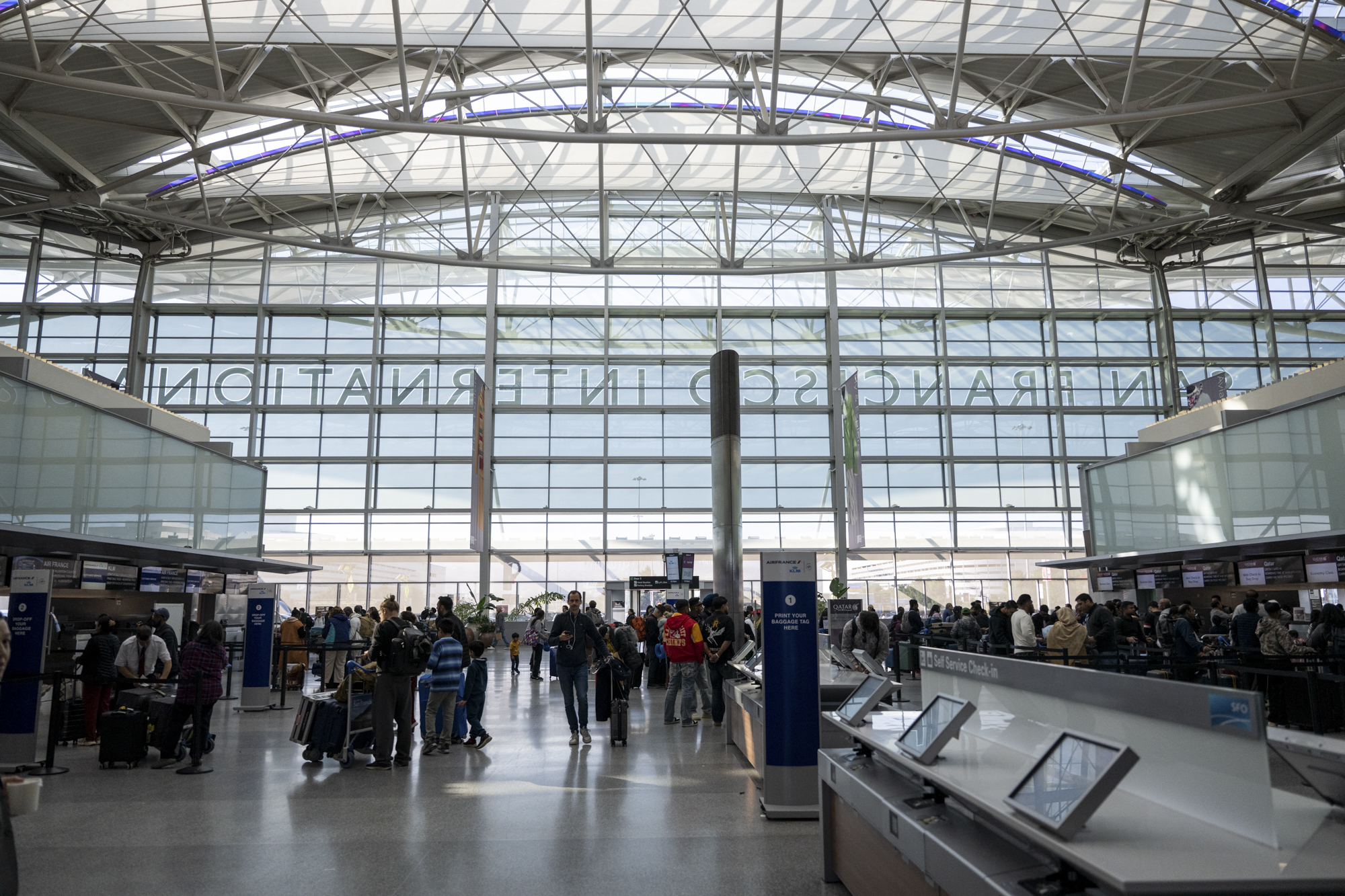
Azul Dahlstrom-Eckman: [00:14:18] As a reporter, I go out and talk to people a lot and I was kind of having deja vu when I was talking to these workers where they’re like, the Bay area is so expensive and I don’t make enough money and it feels like I’m just hearing that a lot. You know, SFO is like this beautiful state of the art facility where you can have a robot serve you coffee and there’s a yoga room and like, you can choose between hot ambient and cold water for your refillable water bottle, you know? But at the same time, The people that are literally… Cleaning this airport, making it run, getting people to where they need to go are not being paid enough to get by in the Bay Area. The World Cup’s coming soon, you know, there’s gonna be this huge influx of visitors to the Bay Area and SFO is the first thing people see when they get to San Francisco. And so it’s kind of a reflection of both sides of the Bay area, right? Like this beautiful place that we live in and then also the intense struggles people are in just to survive here.
Ericka Cruz Guevarra: [00:15:24] Azul, thank you so much for joining me on the show. Appreciate it.
Azul Dahlstrom-Eckman: [00:15:27] Yeah, you’re welcome.