window.__IS_SSR__=true
window.__INITIAL_STATE__={
"attachmentsReducer": {
"audio_0": {
"type": "attachments",
"id": "audio_0",
"imgSizes": {
"kqedFullSize": {
"file": "https://ww2.kqed.org/news/wp-content/themes/KQED-unified/img/audio_bgs/background0.jpg"
}
}
},
"audio_1": {
"type": "attachments",
"id": "audio_1",
"imgSizes": {
"kqedFullSize": {
"file": "https://ww2.kqed.org/news/wp-content/themes/KQED-unified/img/audio_bgs/background1.jpg"
}
}
},
"audio_2": {
"type": "attachments",
"id": "audio_2",
"imgSizes": {
"kqedFullSize": {
"file": "https://ww2.kqed.org/news/wp-content/themes/KQED-unified/img/audio_bgs/background2.jpg"
}
}
},
"audio_3": {
"type": "attachments",
"id": "audio_3",
"imgSizes": {
"kqedFullSize": {
"file": "https://ww2.kqed.org/news/wp-content/themes/KQED-unified/img/audio_bgs/background3.jpg"
}
}
},
"audio_4": {
"type": "attachments",
"id": "audio_4",
"imgSizes": {
"kqedFullSize": {
"file": "https://ww2.kqed.org/news/wp-content/themes/KQED-unified/img/audio_bgs/background4.jpg"
}
}
},
"placeholder": {
"type": "attachments",
"id": "placeholder",
"imgSizes": {
"thumbnail": {
"file": "https://cdn.kqed.org/wp-content/uploads/2024/12/KQED-Default-Image-816638274-2000x1333-1-160x107.jpg",
"width": 160,
"height": 107,
"mimeType": "image/jpeg"
},
"medium": {
"file": "https://cdn.kqed.org/wp-content/uploads/2024/12/KQED-Default-Image-816638274-2000x1333-1-800x533.jpg",
"width": 800,
"height": 533,
"mimeType": "image/jpeg"
},
"medium_large": {
"file": "https://cdn.kqed.org/wp-content/uploads/2024/12/KQED-Default-Image-816638274-2000x1333-1-768x512.jpg",
"width": 768,
"height": 512,
"mimeType": "image/jpeg"
},
"large": {
"file": "https://cdn.kqed.org/wp-content/uploads/2024/12/KQED-Default-Image-816638274-2000x1333-1-1020x680.jpg",
"width": 1020,
"height": 680,
"mimeType": "image/jpeg"
},
"1536x1536": {
"file": "https://cdn.kqed.org/wp-content/uploads/2024/12/KQED-Default-Image-816638274-2000x1333-1-1536x1024.jpg",
"width": 1536,
"height": 1024,
"mimeType": "image/jpeg"
},
"fd-lrg": {
"file": "https://cdn.kqed.org/wp-content/uploads/2024/12/KQED-Default-Image-816638274-2000x1333-1-1536x1024.jpg",
"width": 1536,
"height": 1024,
"mimeType": "image/jpeg"
},
"fd-med": {
"file": "https://cdn.kqed.org/wp-content/uploads/2024/12/KQED-Default-Image-816638274-2000x1333-1-1020x680.jpg",
"width": 1020,
"height": 680,
"mimeType": "image/jpeg"
},
"fd-sm": {
"file": "https://cdn.kqed.org/wp-content/uploads/2024/12/KQED-Default-Image-816638274-2000x1333-1-800x533.jpg",
"width": 800,
"height": 533,
"mimeType": "image/jpeg"
},
"post-thumbnail": {
"file": "https://cdn.kqed.org/wp-content/uploads/2024/12/KQED-Default-Image-816638274-2000x1333-1-672x372.jpg",
"width": 672,
"height": 372,
"mimeType": "image/jpeg"
},
"twentyfourteen-full-width": {
"file": "https://cdn.kqed.org/wp-content/uploads/2024/12/KQED-Default-Image-816638274-2000x1333-1-1038x576.jpg",
"width": 1038,
"height": 576,
"mimeType": "image/jpeg"
},
"xxsmall": {
"file": "https://cdn.kqed.org/wp-content/uploads/2024/12/KQED-Default-Image-816638274-2000x1333-1-160x107.jpg",
"width": 160,
"height": 107,
"mimeType": "image/jpeg"
},
"xsmall": {
"file": "https://cdn.kqed.org/wp-content/uploads/2024/12/KQED-Default-Image-816638274-2000x1333-1-672x372.jpg",
"width": 672,
"height": 372,
"mimeType": "image/jpeg"
},
"small": {
"file": "https://cdn.kqed.org/wp-content/uploads/2024/12/KQED-Default-Image-816638274-2000x1333-1-672x372.jpg",
"width": 672,
"height": 372,
"mimeType": "image/jpeg"
},
"xlarge": {
"file": "https://cdn.kqed.org/wp-content/uploads/2024/12/KQED-Default-Image-816638274-2000x1333-1-1020x680.jpg",
"width": 1020,
"height": 680,
"mimeType": "image/jpeg"
},
"full-width": {
"file": "https://cdn.kqed.org/wp-content/uploads/2024/12/KQED-Default-Image-816638274-2000x1333-1-1920x1280.jpg",
"width": 1920,
"height": 1280,
"mimeType": "image/jpeg"
},
"guest-author-32": {
"file": "https://cdn.kqed.org/wp-content/uploads/2025/01/KQED-Default-Image-816638274-1333x1333-1-160x160.jpg",
"width": 32,
"height": 32,
"mimeType": "image/jpeg"
},
"guest-author-50": {
"file": "https://cdn.kqed.org/wp-content/uploads/2025/01/KQED-Default-Image-816638274-1333x1333-1-160x160.jpg",
"width": 50,
"height": 50,
"mimeType": "image/jpeg"
},
"guest-author-64": {
"file": "https://cdn.kqed.org/wp-content/uploads/2025/01/KQED-Default-Image-816638274-1333x1333-1-160x160.jpg",
"width": 64,
"height": 64,
"mimeType": "image/jpeg"
},
"guest-author-96": {
"file": "https://cdn.kqed.org/wp-content/uploads/2025/01/KQED-Default-Image-816638274-1333x1333-1-160x160.jpg",
"width": 96,
"height": 96,
"mimeType": "image/jpeg"
},
"guest-author-128": {
"file": "https://cdn.kqed.org/wp-content/uploads/2025/01/KQED-Default-Image-816638274-1333x1333-1-160x160.jpg",
"width": 128,
"height": 128,
"mimeType": "image/jpeg"
},
"detail": {
"file": "https://cdn.kqed.org/wp-content/uploads/2025/01/KQED-Default-Image-816638274-1333x1333-1-160x160.jpg",
"width": 160,
"height": 160,
"mimeType": "image/jpeg"
},
"kqedFullSize": {
"file": "https://cdn.kqed.org/wp-content/uploads/2024/12/KQED-Default-Image-816638274-2000x1333-1.jpg",
"width": 2000,
"height": 1333
}
}
},
"arts_13952456": {
"type": "attachments",
"id": "arts_13952456",
"meta": {
"index": "attachments_1716263798",
"site": "arts",
"id": "13952456",
"found": true
},
"parent": 13952460,
"imgSizes": {
"twentyfourteen-full-width": {
"file": "https://cdn.kqed.org/wp-content/uploads/sites/2/2024/02/240215-YBCAGazaProtest-33-BL_qut-1038x576.jpg",
"width": 1038,
"mimeType": "image/jpeg",
"height": 576
},
"thumbnail": {
"file": "https://cdn.kqed.org/wp-content/uploads/sites/2/2024/02/240215-YBCAGazaProtest-33-BL_qut-160x107.jpg",
"width": 160,
"mimeType": "image/jpeg",
"height": 107
},
"post-thumbnail": {
"file": "https://cdn.kqed.org/wp-content/uploads/sites/2/2024/02/240215-YBCAGazaProtest-33-BL_qut-672x372.jpg",
"width": 672,
"mimeType": "image/jpeg",
"height": 372
},
"kqedFullSize": {
"file": "https://cdn.kqed.org/wp-content/uploads/sites/2/2024/02/240215-YBCAGazaProtest-33-BL_qut.jpg",
"width": 1920,
"height": 1280
},
"large": {
"file": "https://cdn.kqed.org/wp-content/uploads/sites/2/2024/02/240215-YBCAGazaProtest-33-BL_qut-1020x680.jpg",
"width": 1020,
"mimeType": "image/jpeg",
"height": 680
},
"1536x1536": {
"file": "https://cdn.kqed.org/wp-content/uploads/sites/2/2024/02/240215-YBCAGazaProtest-33-BL_qut-1536x1024.jpg",
"width": 1536,
"mimeType": "image/jpeg",
"height": 1024
},
"medium": {
"file": "https://cdn.kqed.org/wp-content/uploads/sites/2/2024/02/240215-YBCAGazaProtest-33-BL_qut-800x533.jpg",
"width": 800,
"mimeType": "image/jpeg",
"height": 533
},
"medium_large": {
"file": "https://cdn.kqed.org/wp-content/uploads/sites/2/2024/02/240215-YBCAGazaProtest-33-BL_qut-768x512.jpg",
"width": 768,
"mimeType": "image/jpeg",
"height": 512
}
},
"publishDate": 1708072433,
"modified": 1708100874,
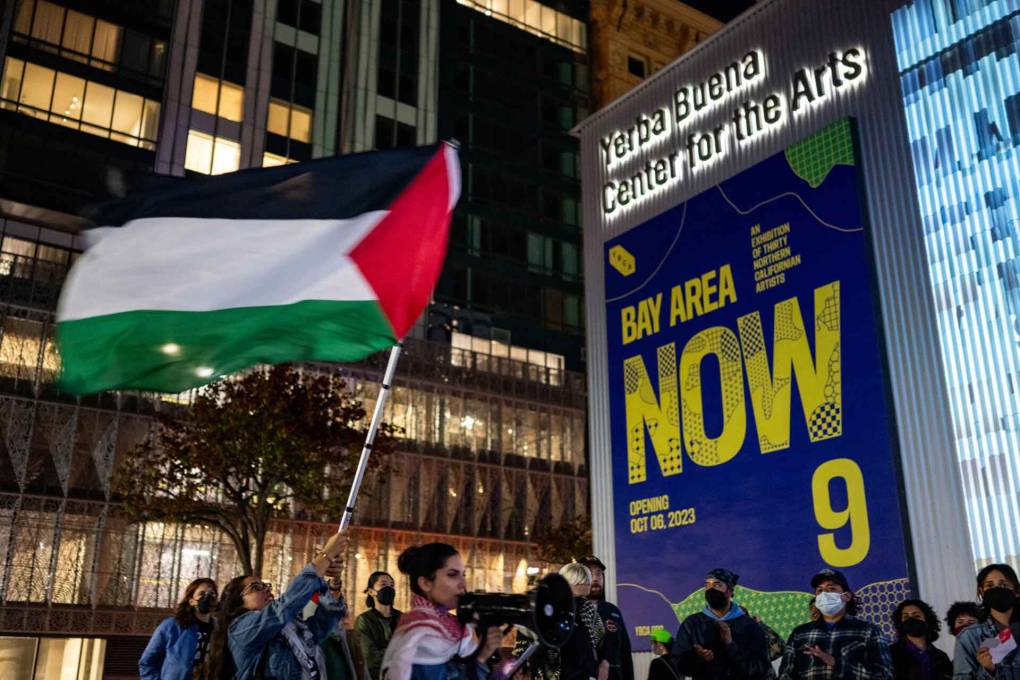
"caption": "Demonstrators calling for a ceasefire in Gaza protest at the show Bay Area Now at Yerba Buena Center for the Arts in San Francisco on Feb. 15, 2024.",
"description": null,
"title": "240215-YBCAGazaProtest-33-BL_qut",
"credit": "Beth LaBerge/KQED",
"status": "inherit",
"altTag": "A woman in a denim jacket waves a Palestinian flag outside a museum building at night",
"isLoading": false,
"fetchFailed": false
},
"arts_13952458": {
"type": "attachments",
"id": "arts_13952458",
"meta": {
"index": "attachments_1716263798",
"site": "arts",
"id": "13952458",
"found": true
},
"parent": 0,
"imgSizes": {
"twentyfourteen-full-width": {
"file": "https://cdn.kqed.org/wp-content/uploads/sites/2/2024/02/240215-YBCAGazaProtest-02-BL_qut-1038x576.jpg",
"width": 1038,
"mimeType": "image/jpeg",
"height": 576
},
"thumbnail": {
"file": "https://cdn.kqed.org/wp-content/uploads/sites/2/2024/02/240215-YBCAGazaProtest-02-BL_qut-160x107.jpg",
"width": 160,
"mimeType": "image/jpeg",
"height": 107
},
"post-thumbnail": {
"file": "https://cdn.kqed.org/wp-content/uploads/sites/2/2024/02/240215-YBCAGazaProtest-02-BL_qut-672x372.jpg",
"width": 672,
"mimeType": "image/jpeg",
"height": 372
},
"kqedFullSize": {
"file": "https://cdn.kqed.org/wp-content/uploads/sites/2/2024/02/240215-YBCAGazaProtest-02-BL_qut.jpg",
"width": 1920,
"height": 1280
},
"large": {
"file": "https://cdn.kqed.org/wp-content/uploads/sites/2/2024/02/240215-YBCAGazaProtest-02-BL_qut-1020x680.jpg",
"width": 1020,
"mimeType": "image/jpeg",
"height": 680
},
"1536x1536": {
"file": "https://cdn.kqed.org/wp-content/uploads/sites/2/2024/02/240215-YBCAGazaProtest-02-BL_qut-1536x1024.jpg",
"width": 1536,
"mimeType": "image/jpeg",
"height": 1024
},
"medium": {
"file": "https://cdn.kqed.org/wp-content/uploads/sites/2/2024/02/240215-YBCAGazaProtest-02-BL_qut-800x533.jpg",
"width": 800,
"mimeType": "image/jpeg",
"height": 533
},
"medium_large": {
"file": "https://cdn.kqed.org/wp-content/uploads/sites/2/2024/02/240215-YBCAGazaProtest-02-BL_qut-768x512.jpg",
"width": 768,
"mimeType": "image/jpeg",
"height": 512
}
},
"publishDate": 1708072448,
"modified": 1708100821,
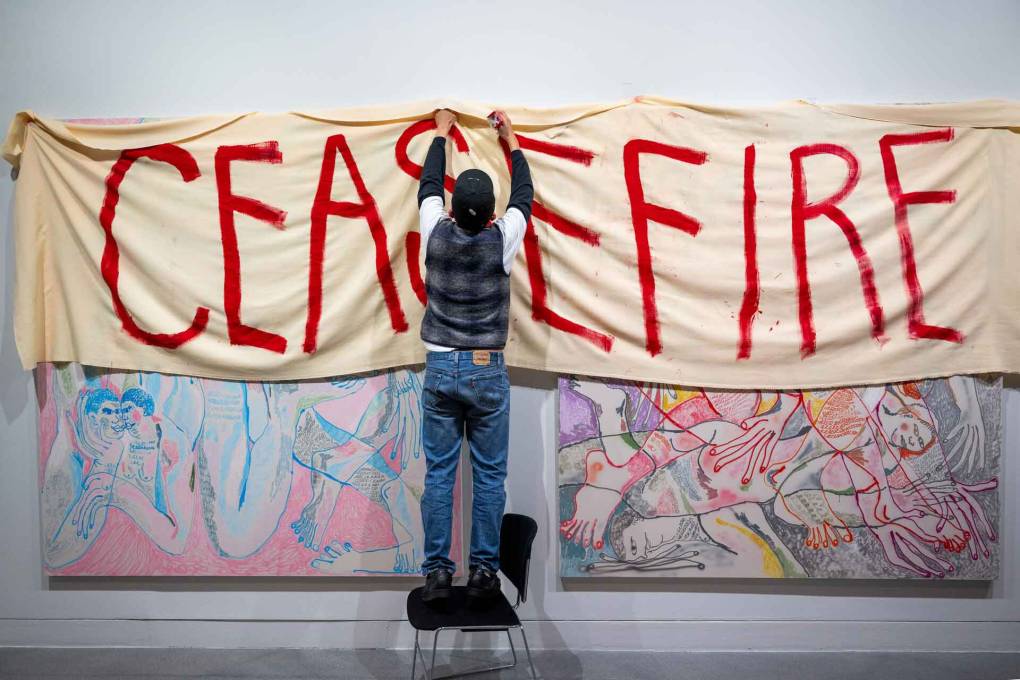
"caption": "Artist Jeffrey Cheung alters his own work with a cloth that says 'Ceasefire Now!' during a demonstration calling for a ceasefire in Gaza and criticizing YBCA leadership for their support of Israel at the show Bay Area Now at Yerba Buena Center for the Arts in San Francisco on Feb. 15, 2024.",
"description": null,
"title": "240215-YBCAGazaProtest-02-BL_qut",
"credit": "Beth LaBerge/KQED",
"status": "inherit",
"altTag": "a man in jeans hangs a sign reading Ceasefire over two paintings against a white wall",
"isLoading": false,
"fetchFailed": false
},
"arts_13938915": {
"type": "attachments",
"id": "arts_13938915",
"meta": {
"index": "attachments_1716263798",
"site": "arts",
"id": "13938915",
"found": true
},
"parent": 0,
"imgSizes": {
"twentyfourteen-full-width": {
"file": "https://cdn.kqed.org/wp-content/uploads/sites/2/2023/12/20231204-SFFILM-Festival-Awards-036-JY-KQED-1038x576.jpg",
"width": 1038,
"mimeType": "image/jpeg",
"height": 576
},
"thumbnail": {
"file": "https://cdn.kqed.org/wp-content/uploads/sites/2/2023/12/20231204-SFFILM-Festival-Awards-036-JY-KQED-160x107.jpg",
"width": 160,
"mimeType": "image/jpeg",
"height": 107
},
"post-thumbnail": {
"file": "https://cdn.kqed.org/wp-content/uploads/sites/2/2023/12/20231204-SFFILM-Festival-Awards-036-JY-KQED-672x372.jpg",
"width": 672,
"mimeType": "image/jpeg",
"height": 372
},
"kqedFullSize": {
"file": "https://cdn.kqed.org/wp-content/uploads/sites/2/2023/12/20231204-SFFILM-Festival-Awards-036-JY-KQED.jpg",
"width": 2000,
"height": 1333
},
"large": {
"file": "https://cdn.kqed.org/wp-content/uploads/sites/2/2023/12/20231204-SFFILM-Festival-Awards-036-JY-KQED-1020x680.jpg",
"width": 1020,
"mimeType": "image/jpeg",
"height": 680
},
"1536x1536": {
"file": "https://cdn.kqed.org/wp-content/uploads/sites/2/2023/12/20231204-SFFILM-Festival-Awards-036-JY-KQED-1536x1024.jpg",
"width": 1536,
"mimeType": "image/jpeg",
"height": 1024
},
"full-width": {
"file": "https://cdn.kqed.org/wp-content/uploads/sites/2/2023/12/20231204-SFFILM-Festival-Awards-036-JY-KQED-1920x1280.jpg",
"width": 1920,
"mimeType": "image/jpeg",
"height": 1280
},
"medium": {
"file": "https://cdn.kqed.org/wp-content/uploads/sites/2/2023/12/20231204-SFFILM-Festival-Awards-036-JY-KQED-800x533.jpg",
"width": 800,
"mimeType": "image/jpeg",
"height": 533
},
"medium_large": {
"file": "https://cdn.kqed.org/wp-content/uploads/sites/2/2023/12/20231204-SFFILM-Festival-Awards-036-JY-KQED-768x512.jpg",
"width": 768,
"mimeType": "image/jpeg",
"height": 512
}
},
"publishDate": 1701796340,
"modified": 1706045725,
"caption": "Director and actress Greta Gerwig poses on the red carpet at the 2023 SFFILM Festival Awards at the Yerba Buena Center for the Arts in San Francisco on Monday, Dec. 4, 2023. Gerwig received the Irving M. Levin Award for Film Direction on Monday.",
"description": null,
"title": "SFFILM Festival Awards",
"credit": "Juliana Yamada/ KQED",
"status": "inherit",
"altTag": "A person in a blue dress in front of a backdrop with the words \"SFFILM\" written on it.",
"isLoading": false,
"fetchFailed": false
},
"arts_13928967": {
"type": "attachments",
"id": "arts_13928967",
"meta": {
"index": "attachments_1716263798",
"site": "arts",
"id": "13928967",
"found": true
},
"parent": 13928948,
"imgSizes": {
"twentyfourteen-full-width": {
"file": "https://ww2.kqed.org/app/uploads/sites/2/2023/05/BR.SelfReflection-1038x576.jpg",
"width": 1038,
"mimeType": "image/jpeg",
"height": 576
},
"thumbnail": {
"file": "https://ww2.kqed.org/app/uploads/sites/2/2023/05/BR.SelfReflection-160x160.jpg",
"width": 160,
"mimeType": "image/jpeg",
"height": 160
},
"post-thumbnail": {
"file": "https://ww2.kqed.org/app/uploads/sites/2/2023/05/BR.SelfReflection-672x372.jpg",
"width": 672,
"mimeType": "image/jpeg",
"height": 372
},
"kqedFullSize": {
"file": "https://ww2.kqed.org/app/uploads/sites/2/2023/05/BR.SelfReflection.jpg",
"width": 1920,
"height": 1920
},
"large": {
"file": "https://ww2.kqed.org/app/uploads/sites/2/2023/05/BR.SelfReflection-1020x1020.jpg",
"width": 1020,
"mimeType": "image/jpeg",
"height": 1020
},
"1536x1536": {
"file": "https://ww2.kqed.org/app/uploads/sites/2/2023/05/BR.SelfReflection-1536x1536.jpg",
"width": 1536,
"mimeType": "image/jpeg",
"height": 1536
},
"medium": {
"file": "https://ww2.kqed.org/app/uploads/sites/2/2023/05/BR.SelfReflection-800x800.jpg",
"width": 800,
"mimeType": "image/jpeg",
"height": 800
},
"medium_large": {
"file": "https://ww2.kqed.org/app/uploads/sites/2/2023/05/BR.SelfReflection-768x768.jpg",
"width": 768,
"mimeType": "image/jpeg",
"height": 768
}
},
"publishDate": 1683755291,
"modified": 1683762115,
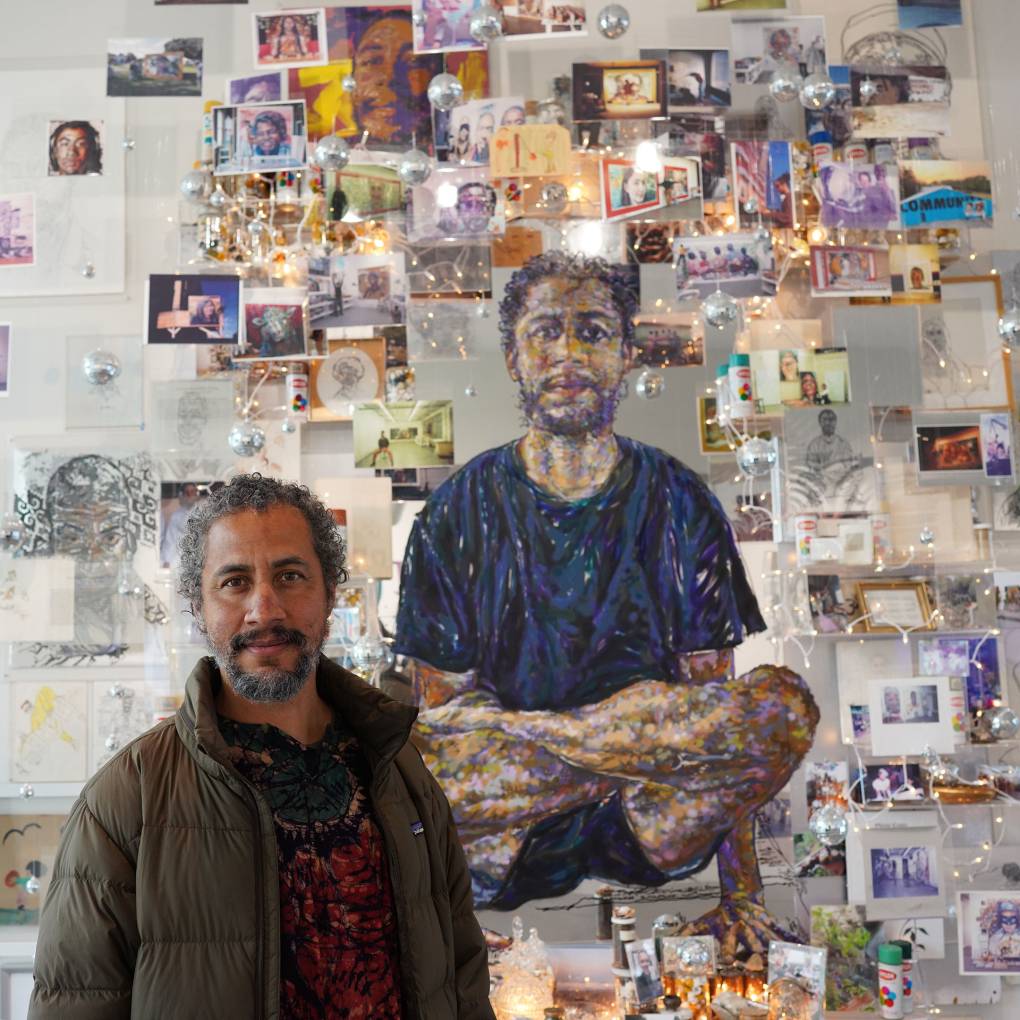
"caption": "Brett Cook stands before his piece 'Self Reflection' at YBCA, as part of the exhibition 'Reflection & Action.'",
"description": null,
"title": "BR.SelfReflection",
"credit": "Eric Arnold/KQED",
"status": "inherit",
"altTag": null,
"isLoading": false,
"fetchFailed": false
},
"arts_13928990": {
"type": "attachments",
"id": "arts_13928990",
"meta": {
"index": "attachments_1716263798",
"site": "arts",
"id": "13928990",
"found": true
},
"parent": 13928948,
"imgSizes": {
"twentyfourteen-full-width": {
"file": "https://ww2.kqed.org/app/uploads/sites/2/2023/05/BR.SelfReflection.16.9-1038x576.jpg",
"width": 1038,
"mimeType": "image/jpeg",
"height": 576
},
"thumbnail": {
"file": "https://ww2.kqed.org/app/uploads/sites/2/2023/05/BR.SelfReflection.16.9-160x90.jpg",
"width": 160,
"mimeType": "image/jpeg",
"height": 90
},
"post-thumbnail": {
"file": "https://ww2.kqed.org/app/uploads/sites/2/2023/05/BR.SelfReflection.16.9-672x372.jpg",
"width": 672,
"mimeType": "image/jpeg",
"height": 372
},
"kqedFullSize": {
"file": "https://ww2.kqed.org/app/uploads/sites/2/2023/05/BR.SelfReflection.16.9.jpg",
"width": 1664,
"height": 936
},
"large": {
"file": "https://ww2.kqed.org/app/uploads/sites/2/2023/05/BR.SelfReflection.16.9-1020x574.jpg",
"width": 1020,
"mimeType": "image/jpeg",
"height": 574
},
"1536x1536": {
"file": "https://ww2.kqed.org/app/uploads/sites/2/2023/05/BR.SelfReflection.16.9-1536x864.jpg",
"width": 1536,
"mimeType": "image/jpeg",
"height": 864
},
"medium": {
"file": "https://ww2.kqed.org/app/uploads/sites/2/2023/05/BR.SelfReflection.16.9-800x450.jpg",
"width": 800,
"mimeType": "image/jpeg",
"height": 450
},
"medium_large": {
"file": "https://ww2.kqed.org/app/uploads/sites/2/2023/05/BR.SelfReflection.16.9-768x432.jpg",
"width": 768,
"mimeType": "image/jpeg",
"height": 432
}
},
"publishDate": 1683763584,
"modified": 1683763609,
"caption": "Brett Cook at YBCA in San Francisco.",
"description": null,
"title": "BR.SelfReflection.16.9",
"credit": "Eric Arnold/KQED",
"status": "inherit",
"altTag": null,
"isLoading": false,
"fetchFailed": false
},
"arts_13923622": {
"type": "attachments",
"id": "arts_13923622",
"meta": {
"index": "attachments_1716263798",
"site": "arts",
"id": "13923622",
"found": true
},
"parent": 13923606,
"imgSizes": {
"twentyfourteen-full-width": {
"file": "https://ww2.kqed.org/app/uploads/sites/2/2023/01/BCAF-2021-FINAL-1038x576.jpg",
"width": 1038,
"mimeType": "image/jpeg",
"height": 576
},
"thumbnail": {
"file": "https://ww2.kqed.org/app/uploads/sites/2/2023/01/BCAF-2021-FINAL-160x90.jpg",
"width": 160,
"mimeType": "image/jpeg",
"height": 90
},
"post-thumbnail": {
"file": "https://ww2.kqed.org/app/uploads/sites/2/2023/01/BCAF-2021-FINAL-672x372.jpg",
"width": 672,
"mimeType": "image/jpeg",
"height": 372
},
"kqedFullSize": {
"file": "https://ww2.kqed.org/app/uploads/sites/2/2023/01/BCAF-2021-FINAL.jpg",
"width": 1920,
"height": 1080
},
"large": {
"file": "https://ww2.kqed.org/app/uploads/sites/2/2023/01/BCAF-2021-FINAL-1020x574.jpg",
"width": 1020,
"mimeType": "image/jpeg",
"height": 574
},
"1536x1536": {
"file": "https://ww2.kqed.org/app/uploads/sites/2/2023/01/BCAF-2021-FINAL-1536x864.jpg",
"width": 1536,
"mimeType": "image/jpeg",
"height": 864
},
"medium": {
"file": "https://ww2.kqed.org/app/uploads/sites/2/2023/01/BCAF-2021-FINAL-800x450.jpg",
"width": 800,
"mimeType": "image/jpeg",
"height": 450
},
"medium_large": {
"file": "https://ww2.kqed.org/app/uploads/sites/2/2023/01/BCAF-2021-FINAL-768x432.jpg",
"width": 768,
"mimeType": "image/jpeg",
"height": 432
}
},
"publishDate": 1673478776,
"modified": 1673481056,
"caption": "Cartoonist Tim Fielder’s 'Promise Mountain' explores the concept of family through the lens of sci-fi and Afrofuturism.",
"description": null,
"title": "BCAF 2021 FINAL",
"credit": "Tim Fielder Art",
"status": "inherit",
"altTag": "a colorful futuristic image with spaceships and an illustration of MLK Jr.",
"isLoading": false,
"fetchFailed": false
},
"arts_13922368": {
"type": "attachments",
"id": "arts_13922368",
"meta": {
"index": "attachments_1716263798",
"site": "arts",
"id": "13922368",
"found": true
},
"parent": 13922365,
"imgSizes": {
"thumbnail": {
"file": "https://ww2.kqed.org/app/uploads/sites/2/2022/12/Coogler.crop_.SFFILM-160x90.jpg",
"width": 160,
"mimeType": "image/jpeg",
"height": 90
},
"post-thumbnail": {
"file": "https://ww2.kqed.org/app/uploads/sites/2/2022/12/Coogler.crop_.SFFILM-672x372.jpg",
"width": 672,
"mimeType": "image/jpeg",
"height": 372
},
"kqedFullSize": {
"file": "https://ww2.kqed.org/app/uploads/sites/2/2022/12/Coogler.crop_.SFFILM.jpg",
"width": 1024,
"height": 576
},
"large": {
"file": "https://ww2.kqed.org/app/uploads/sites/2/2022/12/Coogler.crop_.SFFILM-1020x574.jpg",
"width": 1020,
"mimeType": "image/jpeg",
"height": 574
},
"medium": {
"file": "https://ww2.kqed.org/app/uploads/sites/2/2022/12/Coogler.crop_.SFFILM-800x450.jpg",
"width": 800,
"mimeType": "image/jpeg",
"height": 450
},
"medium_large": {
"file": "https://ww2.kqed.org/app/uploads/sites/2/2022/12/Coogler.crop_.SFFILM-768x432.jpg",
"width": 768,
"mimeType": "image/jpeg",
"height": 432
}
},
"publishDate": 1670353019,
"modified": 1670353113,
"caption": "Zinzi Evans (R) and director Ryan Coogler arrive at SFFILM Awards Night at Yerba Buena Center for the Arts on Dec. 05, 2022 in San Francisco, California.",
"description": null,
"title": "Coogler.crop.SFFILM",
"credit": "Miikka Skaffari/Getty Images",
"status": "inherit",
"altTag": "A man in a suit and glasses poses next to a woman against a promotional backdrop",
"isLoading": false,
"fetchFailed": false
},
"arts_13915367": {
"type": "attachments",
"id": "arts_13915367",
"meta": {
"index": "attachments_1716263798",
"site": "arts",
"id": "13915367",
"found": true
},
"parent": 13915178,
"imgSizes": {
"twentyfourteen-full-width": {
"file": "https://ww2.kqed.org/app/uploads/sites/2/2022/06/Javier-Reyes-YBCAGIP-4-1038x576.jpg",
"width": 1038,
"mimeType": "image/jpeg",
"height": 576
},
"thumbnail": {
"file": "https://ww2.kqed.org/app/uploads/sites/2/2022/06/Javier-Reyes-YBCAGIP-4-160x107.jpg",
"width": 160,
"mimeType": "image/jpeg",
"height": 107
},
"post-thumbnail": {
"file": "https://ww2.kqed.org/app/uploads/sites/2/2022/06/Javier-Reyes-YBCAGIP-4-672x372.jpg",
"width": 672,
"mimeType": "image/jpeg",
"height": 372
},
"kqedFullSize": {
"file": "https://ww2.kqed.org/app/uploads/sites/2/2022/06/Javier-Reyes-YBCAGIP-4.jpg",
"width": 1920,
"height": 1280
},
"large": {
"file": "https://ww2.kqed.org/app/uploads/sites/2/2022/06/Javier-Reyes-YBCAGIP-4-1020x680.jpg",
"width": 1020,
"mimeType": "image/jpeg",
"height": 680
},
"1536x1536": {
"file": "https://ww2.kqed.org/app/uploads/sites/2/2022/06/Javier-Reyes-YBCAGIP-4-1536x1024.jpg",
"width": 1536,
"mimeType": "image/jpeg",
"height": 1024
},
"medium": {
"file": "https://ww2.kqed.org/app/uploads/sites/2/2022/06/Javier-Reyes-YBCAGIP-4-800x533.jpg",
"width": 800,
"mimeType": "image/jpeg",
"height": 533
},
"medium_large": {
"file": "https://ww2.kqed.org/app/uploads/sites/2/2022/06/Javier-Reyes-YBCAGIP-4-768x512.jpg",
"width": 768,
"mimeType": "image/jpeg",
"height": 512
}
},
"publishDate": 1656433760,
"modified": 1656434215,
"caption": "The San Francisco Guaranteed Income Pilot for Artists has given Javier Reyes more flexibility to work on a youth development project at City Life Church.",
"description": null,
"title": "Javier-Reyes-YBCAGIP-4",
"credit": "Alexa Trevino",
"status": "inherit",
"altTag": "Javier Reyes sits on the stage of a church while a youth band plays behind him.",
"isLoading": false,
"fetchFailed": false
},
"arts_13913900": {
"type": "attachments",
"id": "arts_13913900",
"meta": {
"index": "attachments_1716263798",
"site": "arts",
"id": "13913900",
"found": true
},
"parent": 13913890,
"imgSizes": {
"twentyfourteen-full-width": {
"file": "https://ww2.kqed.org/app/uploads/sites/2/2022/05/Our-Creative-Futures-Featured-Image-La-Dona-1038x576.jpg",
"width": 1038,
"mimeType": "image/jpeg",
"height": 576
},
"thumbnail": {
"file": "https://ww2.kqed.org/app/uploads/sites/2/2022/05/Our-Creative-Futures-Featured-Image-La-Dona-160x90.jpg",
"width": 160,
"mimeType": "image/jpeg",
"height": 90
},
"post-thumbnail": {
"file": "https://ww2.kqed.org/app/uploads/sites/2/2022/05/Our-Creative-Futures-Featured-Image-La-Dona-672x372.jpg",
"width": 672,
"mimeType": "image/jpeg",
"height": 372
},
"kqedFullSize": {
"file": "https://ww2.kqed.org/app/uploads/sites/2/2022/05/Our-Creative-Futures-Featured-Image-La-Dona.jpg",
"width": 1920,
"height": 1080
},
"large": {
"file": "https://ww2.kqed.org/app/uploads/sites/2/2022/05/Our-Creative-Futures-Featured-Image-La-Dona-1020x574.jpg",
"width": 1020,
"mimeType": "image/jpeg",
"height": 574
},
"1536x1536": {
"file": "https://ww2.kqed.org/app/uploads/sites/2/2022/05/Our-Creative-Futures-Featured-Image-La-Dona-1536x864.jpg",
"width": 1536,
"mimeType": "image/jpeg",
"height": 864
},
"medium": {
"file": "https://ww2.kqed.org/app/uploads/sites/2/2022/05/Our-Creative-Futures-Featured-Image-La-Dona-800x450.jpg",
"width": 800,
"mimeType": "image/jpeg",
"height": 450
},
"medium_large": {
"file": "https://ww2.kqed.org/app/uploads/sites/2/2022/05/Our-Creative-Futures-Featured-Image-La-Dona-768x432.jpg",
"width": 768,
"mimeType": "image/jpeg",
"height": 432
}
},
"publishDate": 1653425970,
"modified": 1653426039,
"caption": "La Doña's singular blend of Latin musical traditions, reggaeton and hyphy has made her one of San Francisco's biggest breakout stars since the pandemic. YBCA's Guaranteed Income Pilot for Artists is helping fuel her rising career. ",
"description": null,
"title": "Our Creative Futures Featured Image-La Dona",
"credit": "Photos: Beth LaBerge; design: Kelly Heigert",
"status": "inherit",
"altTag": null,
"isLoading": false,
"fetchFailed": false
},
"arts_13913898": {
"type": "attachments",
"id": "arts_13913898",
"meta": {
"index": "attachments_1716263798",
"site": "arts",
"id": "13913898",
"found": true
},
"parent": 13913890,
"imgSizes": {
"twentyfourteen-full-width": {
"file": "https://ww2.kqed.org/app/uploads/sites/2/2022/05/014_KQEDArts_Alameda_LaDona_07202021-1038x576.jpg",
"width": 1038,
"mimeType": "image/jpeg",
"height": 576
},
"thumbnail": {
"file": "https://ww2.kqed.org/app/uploads/sites/2/2022/05/014_KQEDArts_Alameda_LaDona_07202021-160x107.jpg",
"width": 160,
"mimeType": "image/jpeg",
"height": 107
},
"post-thumbnail": {
"file": "https://ww2.kqed.org/app/uploads/sites/2/2022/05/014_KQEDArts_Alameda_LaDona_07202021-672x372.jpg",
"width": 672,
"mimeType": "image/jpeg",
"height": 372
},
"kqedFullSize": {
"file": "https://ww2.kqed.org/app/uploads/sites/2/2022/05/014_KQEDArts_Alameda_LaDona_07202021.jpg",
"width": 1920,
"height": 1280
},
"large": {
"file": "https://ww2.kqed.org/app/uploads/sites/2/2022/05/014_KQEDArts_Alameda_LaDona_07202021-1020x680.jpg",
"width": 1020,
"mimeType": "image/jpeg",
"height": 680
},
"1536x1536": {
"file": "https://ww2.kqed.org/app/uploads/sites/2/2022/05/014_KQEDArts_Alameda_LaDona_07202021-1536x1024.jpg",
"width": 1536,
"mimeType": "image/jpeg",
"height": 1024
},
"medium": {
"file": "https://ww2.kqed.org/app/uploads/sites/2/2022/05/014_KQEDArts_Alameda_LaDona_07202021-800x533.jpg",
"width": 800,
"mimeType": "image/jpeg",
"height": 533
},
"medium_large": {
"file": "https://ww2.kqed.org/app/uploads/sites/2/2022/05/014_KQEDArts_Alameda_LaDona_07202021-768x512.jpg",
"width": 768,
"mimeType": "image/jpeg",
"height": 512
}
},
"publishDate": 1653425673,
"modified": 1653425695,
"caption": "Cecilia Peña-Govea, a.k.a. La Doña.",
"description": null,
"title": "Cecilia Peña-Govea, a.k.a. La Doña, sits at Alameda Beach on July 20, 2021.",
"credit": "Beth LaBerge",
"status": "inherit",
"altTag": null,
"isLoading": false,
"fetchFailed": false
},
"arts_13912637": {
"type": "attachments",
"id": "arts_13912637",
"meta": {
"index": "attachments_1716263798",
"site": "arts",
"id": "13912637",
"found": true
},
"parent": 13912633,
"imgSizes": {
"twentyfourteen-full-width": {
"file": "https://ww2.kqed.org/app/uploads/sites/2/2022/04/20220416_galerialaraza_Yamada_062_COVER-1038x576.jpg",
"width": 1038,
"mimeType": "image/jpeg",
"height": 576
},
"thumbnail": {
"file": "https://ww2.kqed.org/app/uploads/sites/2/2022/04/20220416_galerialaraza_Yamada_062_COVER-160x107.jpg",
"width": 160,
"mimeType": "image/jpeg",
"height": 107
},
"post-thumbnail": {
"file": "https://ww2.kqed.org/app/uploads/sites/2/2022/04/20220416_galerialaraza_Yamada_062_COVER-672x372.jpg",
"width": 672,
"mimeType": "image/jpeg",
"height": 372
},
"kqedFullSize": {
"file": "https://ww2.kqed.org/app/uploads/sites/2/2022/04/20220416_galerialaraza_Yamada_062_COVER.jpg",
"width": 1920,
"height": 1279
},
"large": {
"file": "https://ww2.kqed.org/app/uploads/sites/2/2022/04/20220416_galerialaraza_Yamada_062_COVER-1020x679.jpg",
"width": 1020,
"mimeType": "image/jpeg",
"height": 679
},
"1536x1536": {
"file": "https://ww2.kqed.org/app/uploads/sites/2/2022/04/20220416_galerialaraza_Yamada_062_COVER-1536x1023.jpg",
"width": 1536,
"mimeType": "image/jpeg",
"height": 1023
},
"medium": {
"file": "https://ww2.kqed.org/app/uploads/sites/2/2022/04/20220416_galerialaraza_Yamada_062_COVER-800x533.jpg",
"width": 800,
"mimeType": "image/jpeg",
"height": 533
},
"medium_large": {
"file": "https://ww2.kqed.org/app/uploads/sites/2/2022/04/20220416_galerialaraza_Yamada_062_COVER-768x512.jpg",
"width": 768,
"mimeType": "image/jpeg",
"height": 512
}
},
"publishDate": 1651175876,
"modified": 1651175931,
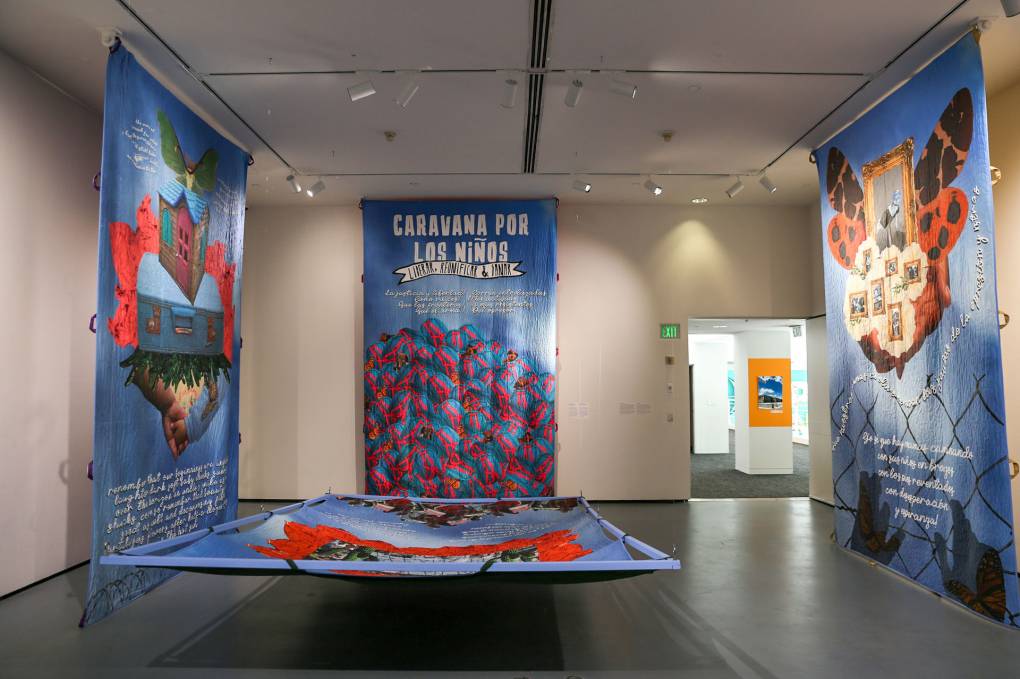
"caption": "Installation view of ‘Pedagogy of Hope: Uncage, Reunify, Heal’ at YBCA.",
"description": null,
"title": "20220416_galerialaraza_Yamada_062_COVER",
"credit": "Juliana Yamada",
"status": "inherit",
"altTag": "Gallery with three large textiles on walls, and one suspended parallel to floor",
"isLoading": false,
"fetchFailed": false
},
"arts_13911261": {
"type": "attachments",
"id": "arts_13911261",
"meta": {
"index": "attachments_1716263798",
"site": "arts",
"id": "13911261",
"found": true
},
"parent": 13911226,
"imgSizes": {
"twentyfourteen-full-width": {
"file": "https://ww2.kqed.org/app/uploads/sites/2/2022/03/SamoraPinderhughes.CRED_.ChloeVeltman-1038x576.jpg",
"width": 1038,
"mimeType": "image/jpeg",
"height": 576
},
"thumbnail": {
"file": "https://ww2.kqed.org/app/uploads/sites/2/2022/03/SamoraPinderhughes.CRED_.ChloeVeltman-160x90.jpg",
"width": 160,
"mimeType": "image/jpeg",
"height": 90
},
"post-thumbnail": {
"file": "https://ww2.kqed.org/app/uploads/sites/2/2022/03/SamoraPinderhughes.CRED_.ChloeVeltman-672x372.jpg",
"width": 672,
"mimeType": "image/jpeg",
"height": 372
},
"kqedFullSize": {
"file": "https://ww2.kqed.org/app/uploads/sites/2/2022/03/SamoraPinderhughes.CRED_.ChloeVeltman.jpg",
"width": 1920,
"height": 1080
},
"large": {
"file": "https://ww2.kqed.org/app/uploads/sites/2/2022/03/SamoraPinderhughes.CRED_.ChloeVeltman-1020x574.jpg",
"width": 1020,
"mimeType": "image/jpeg",
"height": 574
},
"1536x1536": {
"file": "https://ww2.kqed.org/app/uploads/sites/2/2022/03/SamoraPinderhughes.CRED_.ChloeVeltman-1536x864.jpg",
"width": 1536,
"mimeType": "image/jpeg",
"height": 864
},
"medium": {
"file": "https://ww2.kqed.org/app/uploads/sites/2/2022/03/SamoraPinderhughes.CRED_.ChloeVeltman-800x450.jpg",
"width": 800,
"mimeType": "image/jpeg",
"height": 450
},
"medium_large": {
"file": "https://ww2.kqed.org/app/uploads/sites/2/2022/03/SamoraPinderhughes.CRED_.ChloeVeltman-768x432.jpg",
"width": 768,
"mimeType": "image/jpeg",
"height": 432
}
},
"publishDate": 1648534923,
"modified": 1648534976,
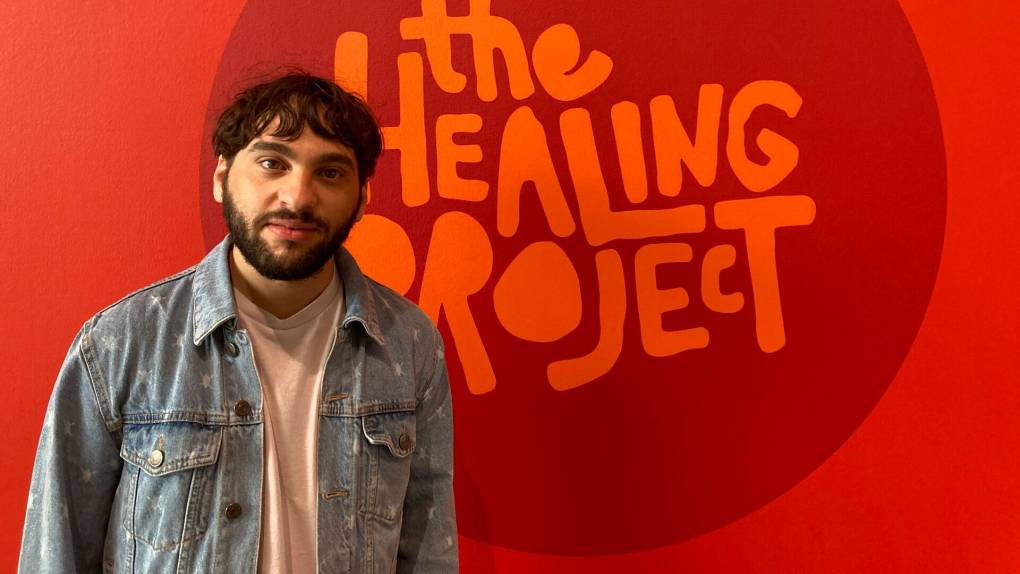
"caption": "Artist and activist Samora Pinderhughes is the force behind 'The Healing Project', a multidisciplinary art project about survival and healing. ",
"description": null,
"title": "SamoraPinderhughes.CRED.ChloeVeltman",
"credit": "Chloe Veltman/KQED",
"status": "inherit",
"altTag": "Man with dark hair and beard in denim jacket and white t-shirt standing in front of red wall art that says \"The Healing Project\" in a circle",
"isLoading": false,
"fetchFailed": false
},
"arts_13897577": {
"type": "attachments",
"id": "arts_13897577",
"meta": {
"index": "attachments_1716263798",
"site": "arts",
"id": "13897577",
"found": true
},
"parent": 13897576,
"imgSizes": {
"twentyfourteen-full-width": {
"file": "https://ww2.kqed.org/app/uploads/sites/2/2021/05/RS49220_diego-gomez-qut-1038x576.jpg",
"width": 1038,
"mimeType": "image/jpeg",
"height": 576
},
"thumbnail": {
"file": "https://ww2.kqed.org/app/uploads/sites/2/2021/05/RS49220_diego-gomez-qut-160x120.jpg",
"width": 160,
"mimeType": "image/jpeg",
"height": 120
},
"post-thumbnail": {
"file": "https://ww2.kqed.org/app/uploads/sites/2/2021/05/RS49220_diego-gomez-qut-672x372.jpg",
"width": 672,
"mimeType": "image/jpeg",
"height": 372
},
"kqedFullSize": {
"file": "https://ww2.kqed.org/app/uploads/sites/2/2021/05/RS49220_diego-gomez-qut.jpg",
"width": 1920,
"height": 1440
},
"large": {
"file": "https://ww2.kqed.org/app/uploads/sites/2/2021/05/RS49220_diego-gomez-qut-1020x765.jpg",
"width": 1020,
"mimeType": "image/jpeg",
"height": 765
},
"1536x1536": {
"file": "https://ww2.kqed.org/app/uploads/sites/2/2021/05/RS49220_diego-gomez-qut-1536x1152.jpg",
"width": 1536,
"mimeType": "image/jpeg",
"height": 1152
},
"medium": {
"file": "https://ww2.kqed.org/app/uploads/sites/2/2021/05/RS49220_diego-gomez-qut-800x600.jpg",
"width": 800,
"mimeType": "image/jpeg",
"height": 600
},
"medium_large": {
"file": "https://ww2.kqed.org/app/uploads/sites/2/2021/05/RS49220_diego-gomez-qut-768x576.jpg",
"width": 768,
"mimeType": "image/jpeg",
"height": 576
}
},
"publishDate": 1621541496,
"modified": 1621541548,
"caption": "San Francisco artist Diego Gomez was among the 130 recipients of city's Guaranteed Income Pilot.",
"description": "San Francisco artist Diego Gomez was among the 130 recipients of city's Guaranteed Income Pilot.",
"title": "RS49220_diego gomez-qut",
"credit": "Chloe Veltman/KQED",
"status": "inherit",
"altTag": null,
"isLoading": false,
"fetchFailed": false
},
"arts_13895905": {
"type": "attachments",
"id": "arts_13895905",
"meta": {
"index": "attachments_1716263798",
"site": "arts",
"id": "13895905",
"found": true
},
"parent": 13895904,
"imgSizes": {
"thumbnail": {
"file": "https://ww2.kqed.org/app/uploads/sites/2/2021/04/YBCA10-160x90.jpg",
"width": 160,
"mimeType": "image/jpeg",
"height": 90
},
"post-thumbnail": {
"file": "https://ww2.kqed.org/app/uploads/sites/2/2021/04/YBCA10-672x372.jpg",
"width": 672,
"mimeType": "image/jpeg",
"height": 372
},
"kqedFullSize": {
"file": "https://ww2.kqed.org/app/uploads/sites/2/2021/04/YBCA10.jpg",
"width": 802,
"height": 451
},
"medium": {
"file": "https://ww2.kqed.org/app/uploads/sites/2/2021/04/YBCA10-800x450.jpg",
"width": 800,
"mimeType": "image/jpeg",
"height": 450
},
"medium_large": {
"file": "https://ww2.kqed.org/app/uploads/sites/2/2021/04/YBCA10-768x432.jpg",
"width": 768,
"mimeType": "image/jpeg",
"height": 432
}
},
"publishDate": 1618598471,
"modified": 1618598715,
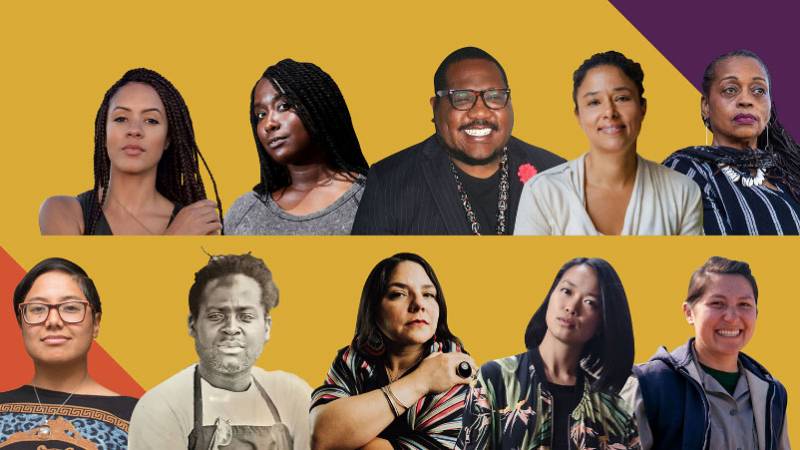
"caption": "Recipients of the 'YBCA 10' (clockwise from upper left): Alex J. Bledsoe, Binta Ayofemi, Darryl Ratcliff, Deanna Van Buren, Ayodele Nzinga, Dorothy R. Santos, Hasain Rasheed, Leticia Hernández-Linares, My-Linh Le, and Nikiko Masumoto.",
"description": "Recipients of the 'YBCA 10' (clockwise from upper left): Alex J. Bledsoe, Binta Ayofemi, Darryl Ratcliff, Deanna Van Buren, Ayodele Nzinga, Dorothy R. Santos, Hasain Rasheed, Leticia Hernández-Linares, My-Linh Le, and Nikiko Masumoto.",
"title": "YBCA10",
"credit": "YBCA",
"status": "inherit",
"altTag": "Recipients of the 'YBCA 10' (clockwise from upper left): Alex J. Bledsoe, Binta Ayofemi, Darryl Ratcliff, Deanna Van Buren, Ayodele Nzinga, Dorothy R. Santos, Hasain Rasheed, Leticia Hernández-Linares, My-Linh Le, and Nikiko Masumoto.",
"isLoading": false,
"fetchFailed": false
}
},
"audioPlayerReducer": {
"postId": "stream_live",
"isPaused": true,
"isPlaying": false,
"pfsActive": false,
"pledgeModalIsOpen": true,
"playerDrawerIsOpen": false,
"liveAudioPlayStartedAt": 0,
"liveAudioPlayContext": ""
},
"authorsReducer": {
"cveltman": {
"type": "authors",
"id": "8608",
"meta": {
"index": "authors_1716337520",
"id": "8608",
"found": true
},
"name": "Chloe Veltman",
"firstName": "Chloe",
"lastName": "Veltman",
"slug": "cveltman",
"email": "cveltman@kqed.org",
"display_author_email": true,
"staff_mastheads": [],
"title": "Arts and Culture Reporter",
"bio": "Chloe Veltman is a former arts and culture reporter for KQED. Prior to joining the organization, she launched and led the arts bureau at Colorado Public Radio, served as the Bay Area's culture columnist for the New York Times, and was the founder, host and executive producer of VoiceBox, a national award-winning weekly podcast/radio show and live events series all about the human voice. Chloe is the recipient of numerous prizes, grants and fellowships including a Webby Award for her work on interactive storytelling, both the John S Knight Journalism Fellowship and Humanities Center Fellowship at Stanford University, the Sundance Arts Writing Fellowship and a Library of Congress Research Fellowship. She is the author of the book \"On Acting\" and has appeared as a guest lecturer at Yale University and the San Francisco Conservatory of Music among other institutions. She holds a BA in english literature from King's College, Cambridge, and a Masters in Dramaturgy from the Central School of Speech and Drama/Harvard Institute for Advanced Theater Training.\r\n\u003ca href=\"https://www.chloeveltman.com\">www.chloeveltman.com\u003c/a>",
"avatar": "https://secure.gravatar.com/avatar/55403394b00a1ddab683952c2eb2cf85?s=600&d=blank&r=g",
"twitter": "chloeveltman",
"facebook": null,
"instagram": null,
"linkedin": null,
"sites": [
{
"site": "arts",
"roles": []
},
{
"site": "news",
"roles": [
"author"
]
},
{
"site": "pop",
"roles": [
"editor"
]
},
{
"site": "science",
"roles": []
}
],
"headData": {
"title": "Chloe Veltman | KQED",
"description": "Arts and Culture Reporter",
"ogImgSrc": "https://secure.gravatar.com/avatar/55403394b00a1ddab683952c2eb2cf85?s=600&d=blank&r=g",
"twImgSrc": "https://secure.gravatar.com/avatar/55403394b00a1ddab683952c2eb2cf85?s=600&d=blank&r=g"
},
"isLoading": false,
"link": "/author/cveltman"
},
"aproehl": {
"type": "authors",
"id": "11296",
"meta": {
"index": "authors_1716337520",
"id": "11296",
"found": true
},
"name": "Ariana Proehl",
"firstName": "Ariana",
"lastName": "Proehl",
"slug": "aproehl",
"email": "aproehl@KQED.org",
"display_author_email": true,
"staff_mastheads": [
"news"
],
"title": "Culture Reporter, KQED",
"bio": "Ariana Proehl is a Culture Reporter and Host.",
"avatar": "https://secure.gravatar.com/avatar/c96b24567eb5bb3a4f8bb295ed53e232?s=600&d=blank&r=g",
"twitter": "ArianaProehl",
"facebook": null,
"instagram": null,
"linkedin": null,
"sites": [
{
"site": "arts",
"roles": []
},
{
"site": "news",
"roles": []
},
{
"site": "education",
"roles": []
},
{
"site": "forum",
"roles": []
}
],
"headData": {
"title": "Ariana Proehl | KQED",
"description": "Culture Reporter, KQED",
"ogImgSrc": "https://secure.gravatar.com/avatar/c96b24567eb5bb3a4f8bb295ed53e232?s=600&d=blank&r=g",
"twImgSrc": "https://secure.gravatar.com/avatar/c96b24567eb5bb3a4f8bb295ed53e232?s=600&d=blank&r=g"
},
"isLoading": false,
"link": "/author/aproehl"
},
"nvoynovskaya": {
"type": "authors",
"id": "11387",
"meta": {
"index": "authors_1716337520",
"id": "11387",
"found": true
},
"name": "Nastia Voynovskaya",
"firstName": "Nastia",
"lastName": "Voynovskaya",
"slug": "nvoynovskaya",
"email": "nvoynovskaya@kqed.org",
"display_author_email": false,
"staff_mastheads": [
"arts"
],
"title": "Editor and reporter",
"bio": "Nastia Voynovskaya is a reporter, editor and host at KQED Arts & Culture. She's been covering the arts in the Bay Area for over a decade, with a focus on music, queer culture, labor issues and grassroots organizing. She has edited KQED story series such as Trans Bay: A History of San Francisco's Gender-Diverse Community, and co-created KQED's Bay Area hip-hop history project, That's My Word. Nastia's work has been recognized by the Society of Professional Journalists and San Francisco Press Club. She regularly appears on podcasts and radio programs, including NPR's All Songs Considered, and hosts live events where music, culture and conversation meet.",
"avatar": "https://secure.gravatar.com/avatar/5025ee460e5a85d69ca20ea6c6f2f80d7e17795c828f61ea3aecfcd924e9042e?s=600&d=blank&r=g",
"twitter": null,
"bluesky": null,
"facebook": null,
"instagram": "https://www.instagram.com/nananastia/",
"linkedin": null,
"sites": [
{
"site": "",
"roles": [
"editor"
]
},
{
"site": "arts",
"roles": [
"administrator"
]
},
{
"site": "news",
"roles": [
"editor"
]
},
{
"site": "pop",
"roles": [
"administrator"
]
},
{
"site": "bayareabites",
"roles": [
"editor"
]
},
{
"site": "podcasts",
"roles": [
"editor"
]
},
{
"site": "hiphop",
"roles": [
"editor"
]
}
],
"headData": {
"title": "Nastia Voynovskaya | KQED",
"description": "Editor and reporter",
"ogImgSrc": "https://secure.gravatar.com/avatar/5025ee460e5a85d69ca20ea6c6f2f80d7e17795c828f61ea3aecfcd924e9042e?s=600&d=blank&r=g",
"twImgSrc": "https://secure.gravatar.com/avatar/5025ee460e5a85d69ca20ea6c6f2f80d7e17795c828f61ea3aecfcd924e9042e?s=600&d=blank&r=g"
},
"isLoading": false,
"link": "/author/nvoynovskaya"
},
"sgetachew": {
"type": "authors",
"id": "11734",
"meta": {
"index": "authors_1716337520",
"id": "11734",
"found": true
},
"name": "Samuel Getachew",
"firstName": "Samuel",
"lastName": "Getachew",
"slug": "sgetachew",
"email": "sgetachew@kqed.org",
"display_author_email": false,
"staff_mastheads": [],
"title": "KQED Contributor",
"bio": "\u003cspan style=\"font-weight: 400;\">Samuel Getachew is an 18-year-old poet and writer from Oakland, California. He is the 2019 Oakland Youth Poet Laureate, a 2020 Finalist for National Youth Poet Laureate, and a 4-time YoungArts Winner. His writing has been published in Teen Vogue, the New York Times, the Washington Post, and more. He will attend Yale University in the fall of 2021.\u003c/span>",
"avatar": "https://secure.gravatar.com/avatar/ebad3dcf2295975cfe77698fa670a089?s=600&d=blank&r=g",
"twitter": null,
"facebook": null,
"instagram": null,
"linkedin": null,
"sites": [
{
"site": "arts",
"roles": [
"subscriber"
]
}
],
"headData": {
"title": "Samuel Getachew | KQED",
"description": "KQED Contributor",
"ogImgSrc": "https://secure.gravatar.com/avatar/ebad3dcf2295975cfe77698fa670a089?s=600&d=blank&r=g",
"twImgSrc": "https://secure.gravatar.com/avatar/ebad3dcf2295975cfe77698fa670a089?s=600&d=blank&r=g"
},
"isLoading": false,
"link": "/author/sgetachew"
},
"achazaro": {
"type": "authors",
"id": "11748",
"meta": {
"index": "authors_1716337520",
"id": "11748",
"found": true
},
"name": "Alan Chazaro",
"firstName": "Alan",
"lastName": "Chazaro",
"slug": "achazaro",
"email": "agchazaro@gmail.com",
"display_author_email": true,
"staff_mastheads": [],
"title": "Food Writer and Reporter",
"bio": "Alan Chazaro is the author of \u003cem>This Is Not a Frank Ocean Cover Album\u003c/em> (Black Lawrence Press, 2019), \u003cem>Piñata Theory\u003c/em> (Black Lawrence Press, 2020), and \u003cem>Notes from the Eastern Span of the Bay Bridge\u003c/em> (Ghost City Press, 2021). He is a graduate of June Jordan’s Poetry for the People program at UC Berkeley and a former Lawrence Ferlinghetti Fellow at the University of San Francisco. He writes about sports, food, art, music, education, and culture while repping the Bay on \u003ca href=\"https://twitter.com/alan_chazaro\">Twitter\u003c/a> and \u003ca href=\"https://www.instagram.com/alan_chazaro/?hl=en\">Instagram\u003c/a> at @alan_chazaro.",
"avatar": "https://secure.gravatar.com/avatar/ea8b6dd970fc5c29e7a188e7d5861df7?s=600&d=blank&r=g",
"twitter": "alan_chazaro",
"facebook": null,
"instagram": null,
"linkedin": null,
"sites": [
{
"site": "arts",
"roles": [
"contributor"
]
},
{
"site": "news",
"roles": [
"editor"
]
}
],
"headData": {
"title": "Alan Chazaro | KQED",
"description": "Food Writer and Reporter",
"ogImgSrc": "https://secure.gravatar.com/avatar/ea8b6dd970fc5c29e7a188e7d5861df7?s=600&d=blank&r=g",
"twImgSrc": "https://secure.gravatar.com/avatar/ea8b6dd970fc5c29e7a188e7d5861df7?s=600&d=blank&r=g"
},
"isLoading": false,
"link": "/author/achazaro"
},
"ksong": {
"type": "authors",
"id": "11813",
"meta": {
"index": "authors_1716337520",
"id": "11813",
"found": true
},
"name": "Kristie Song",
"firstName": "Kristie",
"lastName": "Song",
"slug": "ksong",
"email": "ksong@kqed.org",
"display_author_email": false,
"staff_mastheads": [],
"title": "Editorial Intern ",
"bio": "Kristie Song is an Arts & Culture Intern at KQED. She is currently a graduate student at UC Berkeley, where she studies audio and multimedia journalism. Previously, she covered the local community for Oakland North, produced episodes for The Science of Happiness, and served as news director for KUCI, UC Irvine’s radio station. Outside of reporting, she likes drawing comics, listening to angsty rock, and practicing the guitar.",
"avatar": "https://secure.gravatar.com/avatar/c1149e78c3c44f92d4945a8ab0711af6?s=600&d=blank&r=g",
"twitter": null,
"facebook": null,
"instagram": null,
"linkedin": null,
"sites": [
{
"site": "arts",
"roles": [
"editor"
]
}
],
"headData": {
"title": "Kristie Song | KQED",
"description": "Editorial Intern ",
"ogImgSrc": "https://secure.gravatar.com/avatar/c1149e78c3c44f92d4945a8ab0711af6?s=600&d=blank&r=g",
"twImgSrc": "https://secure.gravatar.com/avatar/c1149e78c3c44f92d4945a8ab0711af6?s=600&d=blank&r=g"
},
"isLoading": false,
"link": "/author/ksong"
},
"earnold": {
"type": "authors",
"id": "11839",
"meta": {
"index": "authors_1716337520",
"id": "11839",
"found": true
},
"name": "Eric Arnold",
"firstName": "Eric",
"lastName": "Arnold",
"slug": "earnold",
"email": "earnold@kqed.org",
"display_author_email": false,
"staff_mastheads": [],
"title": "Contributing Editor, 'That's My Word'",
"bio": "Eric Arnold has covered hip-hop locally and nationally for over 30 years. Formerly the managing editor of \u003cem>4080\u003c/em> and columnist for \u003cem>The Source\u003c/em>, he chronicled hyphy’s rise and fall, co-curated the Oakland Museum of California’s first hip-hop exhibit in 2018 and won a 2022 Northern California Emmy Award for a mini-documentary on Oakland’s Boogaloo dance culture. He is a contributing editor for \u003cem>That’s My Word\u003c/em>, KQED's series on the history of Bay Area hip-hop.",
"avatar": "https://secure.gravatar.com/avatar/ede45b04898456ad0893a2811e78b0a2?s=600&d=blank&r=g",
"twitter": null,
"facebook": null,
"instagram": null,
"linkedin": null,
"sites": [
{
"site": "arts",
"roles": [
"contributor"
]
},
{
"site": "news",
"roles": [
"contributor"
]
},
{
"site": "hiphop",
"roles": [
"contributor"
]
}
],
"headData": {
"title": "Eric Arnold | KQED",
"description": "Contributing Editor, 'That's My Word'",
"ogImgSrc": "https://secure.gravatar.com/avatar/ede45b04898456ad0893a2811e78b0a2?s=600&d=blank&r=g",
"twImgSrc": "https://secure.gravatar.com/avatar/ede45b04898456ad0893a2811e78b0a2?s=600&d=blank&r=g"
},
"isLoading": false,
"link": "/author/earnold"
},
"omayeda": {
"type": "authors",
"id": "11872",
"meta": {
"index": "authors_1716337520",
"id": "11872",
"found": true
},
"name": "Olivia Cruz Mayeda",
"firstName": "Olivia Cruz",
"lastName": "Mayeda",
"slug": "omayeda",
"email": "omayeda@kqed.org",
"display_author_email": false,
"staff_mastheads": [],
"title": "Reporter",
"bio": "Olivia Cruz Mayeda is a journalist covering style, culture and reparations in the Bay Area, a place that has been home to her family for over 100 years. Her writing has also appeared in the \u003cem>San Francisco Chronicle\u003c/em> and \u003cem>El Tecolote\u003c/em>.",
"avatar": "https://secure.gravatar.com/avatar/a8c0baa30219ce1071a9474f4c14141f?s=600&d=blank&r=g",
"twitter": null,
"facebook": null,
"instagram": null,
"linkedin": null,
"sites": [
{
"site": "arts",
"roles": [
"contributor"
]
}
],
"headData": {
"title": "Olivia Cruz Mayeda | KQED",
"description": "Reporter",
"ogImgSrc": "https://secure.gravatar.com/avatar/a8c0baa30219ce1071a9474f4c14141f?s=600&d=blank&r=g",
"twImgSrc": "https://secure.gravatar.com/avatar/a8c0baa30219ce1071a9474f4c14141f?s=600&d=blank&r=g"
},
"isLoading": false,
"link": "/author/omayeda"
}
},
"pagesReducer": {
"arts_tag_ybca": {
"type": "terms",
"id": "arts_1040",
"meta": {
"index": "terms_1716263798",
"site": "arts",
"id": "1040",
"score": 10.403414
},
"featImg": null,
"name": "YBCA",
"description": null,
"taxonomy": "tag",
"headData": {
"twImgId": null,
"twTitle": null,
"ogTitle": null,
"ogImgId": null,
"twDescription": null,
"description": null,
"title": "YBCA Archives | KQED Arts",
"ogDescription": null
},
"ttid": 1057,
"slug": "ybca",
"isLoading": false,
"title": "YBCA",
"pageMeta": {
"site": "arts",
"WpPageTemplate": "page-topic-editorial",
"currentPage": 2
},
"blocks": [
{
"blockName": "kqed/post-list",
"attrs": {
"layout": "cardArticle2",
"query": "posts/arts?tag=ybca",
"seeMore": false,
"paginated": true,
"page": 2
}
},
{
"blockName": "kqed/ad"
}
]
}
},
"pfsSessionReducer": {},
"postsReducer": {
"stream_live": {
"type": "live",
"id": "stream_live",
"audioUrl": "https://streams.kqed.org/kqedradio",
"title": "Live Stream",
"excerpt": "Live Stream information currently unavailable.",
"link": "/radio",
"featImg": "",
"label": {
"name": "KQED Live",
"link": "/"
}
},
"stream_kqedNewscast": {
"type": "posts",
"id": "stream_kqedNewscast",
"audioUrl": "https://www.kqed.org/.stream/anon/radio/RDnews/newscast.mp3?_=1",
"title": "KQED Newscast",
"featImg": "",
"label": {
"name": "88.5 FM",
"link": "/"
}
},
"arts_13953032": {
"type": "posts",
"id": "arts_13953032",
"meta": {
"index": "posts_1716263798",
"site": "arts",
"id": "13953032",
"score": null,
"sort": [
1708992750000
]
},
"parent": 0,
"labelTerm": {
"site": "arts"
},
"blocks": [],
"publishDate": 1708992750,
"format": "standard",
"title": "YBCA Gallery Remains Closed; Pro-Palestinian Artists Claim Censorship",
"headTitle": "YBCA Gallery Remains Closed; Pro-Palestinian Artists Claim Censorship | KQED",
"content": "\u003cp>After a Feb. 15 protest in which artists altered their own exhibited works with pro-Palestinian messages at the Yerba Buena Center for the Arts (YBCA) in San Francisco, YBCA’s galleries remain closed with no reopening date in sight.\u003c/p>\n\u003cp>The \u003ca href=\"https://docs.google.com/document/d/1ZAoljeQycemJrzYNDyVoSN0gc6ogp5B3jUzj77qua2g/edit\">eight protesting artists\u003c/a> along with \u003ca href=\"https://docs.google.com/forms/d/e/1FAIpQLSdLNnUvnx74rLWZKIJaHUsMt4qOogFrBZ2OIeUjKjM2gblk6Q/viewform\">15 current museum employees\u003c/a> decried YBCA’s actions as censorship in two Feb. 26 open letters, and the artists have called for a boycott of the museum. [aside label='YBCA Updates' postid='arts_13953653,arts_13952460']\u003c/p>\n\u003cp>At the demonstration, artists draped banners and painted over their own work in the museum’s \u003ci>Bay Area Now 9\u003c/i> (\u003ci>BAN 9\u003c/i>) exhibition. As they modified their pieces, Palestinian, Arab and Jewish community organizers gave speeches calling for a ceasefire in Gaza and accused YBCA of censoring pro-Palestinian messages.\u003c/p>\n\u003cp>“I refuse to be told that I cannot speak to the Palestinian struggle or genocide in my public programming, as I believe that Palestinian liberation means liberation for all,” said artist and protest co-organizer Paz G, in an interview on Monday. Paz G spray painted their ceramic sculpture with the words “Viva Palestina — Free Palestine” during the protest.\u003c/p>\n\u003cp>“Saying no to genocide does not feel radical to me, and it doesn’t feel problematic, and it doesn’t feel divisive,” Paz G added.\u003c/p>\n\u003cfigure id=\"attachment_13953034\" class=\"wp-caption aligncenter\" style=\"max-width: 800px\">\u003cimg loading=\"lazy\" decoding=\"async\" class=\"size-medium wp-image-13953034\" src=\"https://cdn.kqed.org/wp-content/uploads/sites/2/2024/02/240215-YBCAGazaProtest-11-BL_qut-800x533.jpg\" alt=\"\" width=\"800\" height=\"533\" srcset=\"https://cdn.kqed.org/wp-content/uploads/sites/2/2024/02/240215-YBCAGazaProtest-11-BL_qut-800x533.jpg 800w, https://cdn.kqed.org/wp-content/uploads/sites/2/2024/02/240215-YBCAGazaProtest-11-BL_qut-1020x680.jpg 1020w, https://cdn.kqed.org/wp-content/uploads/sites/2/2024/02/240215-YBCAGazaProtest-11-BL_qut-160x107.jpg 160w, https://cdn.kqed.org/wp-content/uploads/sites/2/2024/02/240215-YBCAGazaProtest-11-BL_qut-768x512.jpg 768w, https://cdn.kqed.org/wp-content/uploads/sites/2/2024/02/240215-YBCAGazaProtest-11-BL_qut-1536x1024.jpg 1536w, https://cdn.kqed.org/wp-content/uploads/sites/2/2024/02/240215-YBCAGazaProtest-11-BL_qut.jpg 1920w\" sizes=\"(max-width: 800px) 100vw, 800px\">\u003cfigcaption class=\"wp-caption-text\">A sign covers art by Courtney Desiree Morris during a protest calling for a ceasefire in Gaza at the show Bay Area Now at Yerba Buena Center for the Arts in San Francisco on Feb. 15, 2024. \u003ccite>(Beth LaBerge/KQED)\u003c/cite>\u003c/figcaption>\u003c/figure>\n\u003cp>Fellow organizer Lukaza Branfman-Verissimo, who currently has an outdoor installation on YBCA’s Third Street wall, also expressed disappointment at the museum’s decision. “So much of this action was not only to call for the museum to call for a ceasefire and to acknowledge this genocide and to end censorship, but also to demand that the museum commit to the lifelong work of standing with the Palestinian people,” Branfman-Verissimo said.\u003c/p>\n\u003cp>[ad fullwidth]\u003c/p>\n\u003cp>On Feb. 24, YBCA CEO Sara Fenske Bahat emailed the eight protesting artists to indicate that their works would be de-installed on Monday, Feb. 26, and that she would be available for “curatorial conversations” one-on-one beforehand, according to an email reviewed by KQED. The artists requested more time in order to coordinate a meeting with Fenske Bahat as a collective.\u003c/p>\n\u003cp>Though Fenske Bahat declined an interview request, she emailed KQED a statement through a spokesperson: “We are eager to meet with [the artists] to have a meaningful conversation and hear how they would like to present their works. … All of the artworks remain in the gallery as they were, as we were hoping to have a conversation with the artists before moving forward. We don’t yet have a firm date for the reopening of the galleries.”\u003c/p>\n\u003cp>On Feb. 21, YBCA published its first \u003ca href=\"https://ybca.org/statement-on-2-15-protest/\">public statement about the protest\u003c/a>, underscoring the institution’s refusal to take a public stance on Israel’s military offensive in Gaza, the death toll of which is expected to \u003ca href=\"https://www.theguardian.com/world/2024/feb/25/gaza-death-toll-set-to-pass-30000-as-israel-prepares-assault-on-rafah\">rise above 30,000 this week\u003c/a>. “If YBCA has refrained from lending its voice to any side, it has been so that our many stakeholders can hold theirs,” the statement read.\u003c/p>\n\u003cp>YBCA’s statement also referred to the artists’ protest tactics as “polarizing” and “disruptive,” and asserted that ignoring the protest would set a “dangerous precedent”: “We risk descending into a world where cooperative curation and community building is governed by chaos, and the public is left wondering if visits to view artists’ works will be marred by disruption.”\u003c/p>\n\u003cp>Paz G and Branfman-Verissimo characterized YBCA’s statement as a distraction.\u003c/p>\n\u003cp>“It’s a tactic used for political repression to paint us as these violent, dangerous protesters and not speak to the meat of the issue, which is that there is a genocide happening in Palestine,” Paz G said.\u003c/p>\n\u003cfigure id=\"attachment_13952464\" class=\"wp-caption aligncenter\" style=\"max-width: 800px\">\u003cimg loading=\"lazy\" decoding=\"async\" class=\"size-medium wp-image-13952464\" src=\"https://cdn.kqed.org/wp-content/uploads/sites/2/2024/02/240215-YBCAGazaProtest-29-BL_qut-800x533.jpg\" alt=\"\" width=\"800\" height=\"533\" srcset=\"https://cdn.kqed.org/wp-content/uploads/sites/2/2024/02/240215-YBCAGazaProtest-29-BL_qut-800x533.jpg 800w, https://cdn.kqed.org/wp-content/uploads/sites/2/2024/02/240215-YBCAGazaProtest-29-BL_qut-1020x680.jpg 1020w, https://cdn.kqed.org/wp-content/uploads/sites/2/2024/02/240215-YBCAGazaProtest-29-BL_qut-160x107.jpg 160w, https://cdn.kqed.org/wp-content/uploads/sites/2/2024/02/240215-YBCAGazaProtest-29-BL_qut-768x512.jpg 768w, https://cdn.kqed.org/wp-content/uploads/sites/2/2024/02/240215-YBCAGazaProtest-29-BL_qut-1536x1024.jpg 1536w, https://cdn.kqed.org/wp-content/uploads/sites/2/2024/02/240215-YBCAGazaProtest-29-BL_qut.jpg 1920w\" sizes=\"(max-width: 800px) 100vw, 800px\">\u003cfigcaption class=\"wp-caption-text\">Demonstators chant during a protest calling for a ceasefire in Gaza at the show Bay Area Now at Yerba Buena Center for the Arts in San Francisco on Feb. 15, 2024. \u003ccite>(Beth LaBerge/KQED)\u003c/cite>\u003c/figcaption>\u003c/figure>\n\u003cp>The \u003ci>BAN 9\u003c/i> artists’ accusations of censorship go back to an incident from December 2023, when YBCA prevented Branfman-Verissimo from including the words “Free Palestine” on its outdoor marquee. The museum had previously used that display space for protest slogans in support of movements such as Black Lives Matter and Woman Life Freedom. Fellow \u003ci>BAN 9\u003c/i> artist Jeff Cheung also accused the museum of preventing him from using the colors of the Palestinian flag in an outdoor mural, which Fenske Bahat denied.\u003c/p>\n\u003cp>Now, the protesting artists say that YBCA’s removal of the modified artworks amounts to further censorship. Fenske Bahat did not address questions from KQED about why the institution views the pro-Palestinian movement differently from other social justice movements such as \u003ca href=\"https://ybca.org/2020-black-lives-matter/\">Black Lives Matter, which the museum endorsed\u003c/a> with an official statement on its website in 2020.\u003c/p>\n\u003cp>“They are out of touch with the community they claim to represent and serve,” Paz G said, noting that the cities of San Francisco, Oakland and Richmond have adopted resolutions calling for a ceasefire in Gaza, and that tens of thousands of Bay Area protesters have mobilized around the issue. Paz G and Branfman-Verissimo said over 2,200 people have emailed YBCA supporting the artist protest through a form that the artists set up.\u003c/p>\n\u003cfigure id=\"attachment_13953036\" class=\"wp-caption aligncenter\" style=\"max-width: 800px\">\u003cimg loading=\"lazy\" decoding=\"async\" class=\"size-medium wp-image-13953036\" src=\"https://cdn.kqed.org/wp-content/uploads/sites/2/2024/02/240215-YBCAGazaProtest-07-BL_qut-800x533.jpg\" alt='A sign over a wool rug reads \"No More Blood Money - Ceasefire Now!\"' width=\"800\" height=\"533\" srcset=\"https://cdn.kqed.org/wp-content/uploads/sites/2/2024/02/240215-YBCAGazaProtest-07-BL_qut-800x533.jpg 800w, https://cdn.kqed.org/wp-content/uploads/sites/2/2024/02/240215-YBCAGazaProtest-07-BL_qut-1020x680.jpg 1020w, https://cdn.kqed.org/wp-content/uploads/sites/2/2024/02/240215-YBCAGazaProtest-07-BL_qut-160x107.jpg 160w, https://cdn.kqed.org/wp-content/uploads/sites/2/2024/02/240215-YBCAGazaProtest-07-BL_qut-768x512.jpg 768w, https://cdn.kqed.org/wp-content/uploads/sites/2/2024/02/240215-YBCAGazaProtest-07-BL_qut-1536x1024.jpg 1536w, https://cdn.kqed.org/wp-content/uploads/sites/2/2024/02/240215-YBCAGazaProtest-07-BL_qut.jpg 1920w\" sizes=\"(max-width: 800px) 100vw, 800px\">\u003cfigcaption class=\"wp-caption-text\">A sign covers art by Tracy Ren during a protest calling for a ceasefire in Gaza at the show Bay Area Now at Yerba Buena Center for the Arts in San Francisco on Feb. 15, 2024. \u003ccite>(Beth LaBerge/KQED)\u003c/cite>\u003c/figcaption>\u003c/figure>\n\u003cp>During the Feb. 15 demonstration, protesters passed out flyers with demands, two of which called for YBCA to join the Palestinian Campaign for the Academic and Cultural Boycott of Israel (PACBI), and to “remove all Zionist funders and board members,” without naming specific people.\u003c/p>\n\u003cp>“Such language is neither productive nor tolerable,” reads the YBCA statement in response, which also refers to protest demands as amounting to a call for “illegal, identity-based discrimination.”\u003c/p>\n\u003cp>Protest organizers denied this charge, and pointed out that Zionism is a political ideology, not a religion or ethnicity. “This is a tactic that is being used against people fighting for a ceasefire and to end the genocide in Palestine. … We’re being essentially painted as anti-Semitic,” Paz G said.\u003c/p>\n\u003cp>“There have been hundreds of organizations nationwide that have stood with PACBI,” said Branfman-Verissimo, who is Jewish. Activists from Jewish Voice for Peace also joined the Feb. 15 demonstration among Palestinian groups such as the U.S. Palestinian Community Network.\u003c/p>\n\u003cp>Paz G and Branfman-Verissimo said the eight artists hope to meet with YBCA leadership this week. In addition to protest demands, they will ask YBCA to create an artist advisory board so that it can better serve public interests. Until then, they are asking the public not to support the institution.\u003c/p>\n\u003cp>“[It’s] a way for YBCA to move forward and to show the Bay area that they stand with us, that they care,” Paz G said.\u003c/p>\n\u003cp>[ad floatright]\u003c/p>\n\u003cp>\u003cimg loading=\"lazy\" decoding=\"async\" class=\"aligncenter size-medium wp-image-12127869\" src=\"https://cdn.kqed.org/wp-content/uploads/sites/2/2016/09/Q.Logo_.Break_-800x78.jpg\" alt=\"\" width=\"800\" height=\"78\" srcset=\"https://cdn.kqed.org/wp-content/uploads/sites/2/2016/09/Q.Logo_.Break_.jpg 800w, https://cdn.kqed.org/wp-content/uploads/sites/2/2016/09/Q.Logo_.Break_-400x39.jpg 400w, https://cdn.kqed.org/wp-content/uploads/sites/2/2016/09/Q.Logo_.Break_-768x75.jpg 768w\" sizes=\"(max-width: 800px) 100vw, 800px\">\u003c/p>\n\n",
"stats": {
"hasVideo": false,
"hasChartOrMap": false,
"hasAudio": false,
"hasPolis": false,
"wordCount": 1241,
"hasGoogleForm": false,
"hasGallery": false,
"hasHearkenModule": false,
"iframeSrcs": [],
"paragraphCount": 24
},
"modified": 1710176401,
"excerpt": "Eight artists are calling for a boycott of the San Francisco museum.",
"headData": {
"twImgId": "",
"twTitle": "",
"ogTitle": "",
"ogImgId": "",
"twDescription": "",
"description": "Eight artists are calling for a boycott of the San Francisco museum.",
"title": "YBCA Gallery Remains Closed; Pro-Palestinian Artists Claim Censorship | KQED",
"ogDescription": "",
"schema": {
"@context": "https://schema.org",
"@type": "Article",
"headline": "YBCA Gallery Remains Closed; Pro-Palestinian Artists Claim Censorship",
"datePublished": "2024-02-26T16:12:30-08:00",
"dateModified": "2024-03-11T10:00:01-07:00",
"image": "https://cdn.kqed.org/wp-content/uploads/2020/02/KQED-OG-Image@1x.png"
}
},
"guestAuthors": [],
"slug": "ybca-pro-palestinian-artist-protest-censorship-allegations-boycott",
"status": "publish",
"templateType": "standard",
"excludeFromSiteSearch": "Include",
"featuredImageType": "standard",
"sticky": false,
"articleAge": "0",
"path": "/arts/13953032/ybca-pro-palestinian-artist-protest-censorship-allegations-boycott",
"audioTrackLength": null,
"parsedContent": [
{
"type": "contentString",
"content": "\u003cdiv class=\"post-body\">\u003cp>\u003cp>After a Feb. 15 protest in which artists altered their own exhibited works with pro-Palestinian messages at the Yerba Buena Center for the Arts (YBCA) in San Francisco, YBCA’s galleries remain closed with no reopening date in sight.\u003c/p>\n\u003cp>The \u003ca href=\"https://docs.google.com/document/d/1ZAoljeQycemJrzYNDyVoSN0gc6ogp5B3jUzj77qua2g/edit\">eight protesting artists\u003c/a> along with \u003ca href=\"https://docs.google.com/forms/d/e/1FAIpQLSdLNnUvnx74rLWZKIJaHUsMt4qOogFrBZ2OIeUjKjM2gblk6Q/viewform\">15 current museum employees\u003c/a> decried YBCA’s actions as censorship in two Feb. 26 open letters, and the artists have called for a boycott of the museum. \u003c/p>\u003c/div>",
"attributes": {
"named": {},
"numeric": []
}
},
{
"type": "component",
"content": "",
"name": "aside",
"attributes": {
"named": {
"label": "YBCA Updates ",
"postid": "arts_13953653,arts_13952460"
},
"numeric": []
}
},
{
"type": "contentString",
"content": "\u003cdiv class=\"post-body\">\u003cp>\u003c/p>\n\u003cp>At the demonstration, artists draped banners and painted over their own work in the museum’s \u003ci>Bay Area Now 9\u003c/i> (\u003ci>BAN 9\u003c/i>) exhibition. As they modified their pieces, Palestinian, Arab and Jewish community organizers gave speeches calling for a ceasefire in Gaza and accused YBCA of censoring pro-Palestinian messages.\u003c/p>\n\u003cp>“I refuse to be told that I cannot speak to the Palestinian struggle or genocide in my public programming, as I believe that Palestinian liberation means liberation for all,” said artist and protest co-organizer Paz G, in an interview on Monday. Paz G spray painted their ceramic sculpture with the words “Viva Palestina — Free Palestine” during the protest.\u003c/p>\n\u003cp>“Saying no to genocide does not feel radical to me, and it doesn’t feel problematic, and it doesn’t feel divisive,” Paz G added.\u003c/p>\n\u003cfigure id=\"attachment_13953034\" class=\"wp-caption aligncenter\" style=\"max-width: 800px\">\u003cimg loading=\"lazy\" decoding=\"async\" class=\"size-medium wp-image-13953034\" src=\"https://cdn.kqed.org/wp-content/uploads/sites/2/2024/02/240215-YBCAGazaProtest-11-BL_qut-800x533.jpg\" alt=\"\" width=\"800\" height=\"533\" srcset=\"https://cdn.kqed.org/wp-content/uploads/sites/2/2024/02/240215-YBCAGazaProtest-11-BL_qut-800x533.jpg 800w, https://cdn.kqed.org/wp-content/uploads/sites/2/2024/02/240215-YBCAGazaProtest-11-BL_qut-1020x680.jpg 1020w, https://cdn.kqed.org/wp-content/uploads/sites/2/2024/02/240215-YBCAGazaProtest-11-BL_qut-160x107.jpg 160w, https://cdn.kqed.org/wp-content/uploads/sites/2/2024/02/240215-YBCAGazaProtest-11-BL_qut-768x512.jpg 768w, https://cdn.kqed.org/wp-content/uploads/sites/2/2024/02/240215-YBCAGazaProtest-11-BL_qut-1536x1024.jpg 1536w, https://cdn.kqed.org/wp-content/uploads/sites/2/2024/02/240215-YBCAGazaProtest-11-BL_qut.jpg 1920w\" sizes=\"(max-width: 800px) 100vw, 800px\">\u003cfigcaption class=\"wp-caption-text\">A sign covers art by Courtney Desiree Morris during a protest calling for a ceasefire in Gaza at the show Bay Area Now at Yerba Buena Center for the Arts in San Francisco on Feb. 15, 2024. \u003ccite>(Beth LaBerge/KQED)\u003c/cite>\u003c/figcaption>\u003c/figure>\n\u003cp>Fellow organizer Lukaza Branfman-Verissimo, who currently has an outdoor installation on YBCA’s Third Street wall, also expressed disappointment at the museum’s decision. “So much of this action was not only to call for the museum to call for a ceasefire and to acknowledge this genocide and to end censorship, but also to demand that the museum commit to the lifelong work of standing with the Palestinian people,” Branfman-Verissimo said.\u003c/p>\n\u003cp>\u003c/p>\u003c/div>",
"attributes": {
"named": {},
"numeric": []
}
},
{
"type": "component",
"content": "",
"name": "ad",
"attributes": {
"named": {
"label": "fullwidth"
},
"numeric": [
"fullwidth"
]
}
},
{
"type": "contentString",
"content": "\u003cdiv class=\"post-body\">\u003cp>\u003c/p>\n\u003cp>On Feb. 24, YBCA CEO Sara Fenske Bahat emailed the eight protesting artists to indicate that their works would be de-installed on Monday, Feb. 26, and that she would be available for “curatorial conversations” one-on-one beforehand, according to an email reviewed by KQED. The artists requested more time in order to coordinate a meeting with Fenske Bahat as a collective.\u003c/p>\n\u003cp>Though Fenske Bahat declined an interview request, she emailed KQED a statement through a spokesperson: “We are eager to meet with [the artists] to have a meaningful conversation and hear how they would like to present their works. … All of the artworks remain in the gallery as they were, as we were hoping to have a conversation with the artists before moving forward. We don’t yet have a firm date for the reopening of the galleries.”\u003c/p>\n\u003cp>On Feb. 21, YBCA published its first \u003ca href=\"https://ybca.org/statement-on-2-15-protest/\">public statement about the protest\u003c/a>, underscoring the institution’s refusal to take a public stance on Israel’s military offensive in Gaza, the death toll of which is expected to \u003ca href=\"https://www.theguardian.com/world/2024/feb/25/gaza-death-toll-set-to-pass-30000-as-israel-prepares-assault-on-rafah\">rise above 30,000 this week\u003c/a>. “If YBCA has refrained from lending its voice to any side, it has been so that our many stakeholders can hold theirs,” the statement read.\u003c/p>\n\u003cp>YBCA’s statement also referred to the artists’ protest tactics as “polarizing” and “disruptive,” and asserted that ignoring the protest would set a “dangerous precedent”: “We risk descending into a world where cooperative curation and community building is governed by chaos, and the public is left wondering if visits to view artists’ works will be marred by disruption.”\u003c/p>\n\u003cp>Paz G and Branfman-Verissimo characterized YBCA’s statement as a distraction.\u003c/p>\n\u003cp>“It’s a tactic used for political repression to paint us as these violent, dangerous protesters and not speak to the meat of the issue, which is that there is a genocide happening in Palestine,” Paz G said.\u003c/p>\n\u003cfigure id=\"attachment_13952464\" class=\"wp-caption aligncenter\" style=\"max-width: 800px\">\u003cimg loading=\"lazy\" decoding=\"async\" class=\"size-medium wp-image-13952464\" src=\"https://cdn.kqed.org/wp-content/uploads/sites/2/2024/02/240215-YBCAGazaProtest-29-BL_qut-800x533.jpg\" alt=\"\" width=\"800\" height=\"533\" srcset=\"https://cdn.kqed.org/wp-content/uploads/sites/2/2024/02/240215-YBCAGazaProtest-29-BL_qut-800x533.jpg 800w, https://cdn.kqed.org/wp-content/uploads/sites/2/2024/02/240215-YBCAGazaProtest-29-BL_qut-1020x680.jpg 1020w, https://cdn.kqed.org/wp-content/uploads/sites/2/2024/02/240215-YBCAGazaProtest-29-BL_qut-160x107.jpg 160w, https://cdn.kqed.org/wp-content/uploads/sites/2/2024/02/240215-YBCAGazaProtest-29-BL_qut-768x512.jpg 768w, https://cdn.kqed.org/wp-content/uploads/sites/2/2024/02/240215-YBCAGazaProtest-29-BL_qut-1536x1024.jpg 1536w, https://cdn.kqed.org/wp-content/uploads/sites/2/2024/02/240215-YBCAGazaProtest-29-BL_qut.jpg 1920w\" sizes=\"(max-width: 800px) 100vw, 800px\">\u003cfigcaption class=\"wp-caption-text\">Demonstators chant during a protest calling for a ceasefire in Gaza at the show Bay Area Now at Yerba Buena Center for the Arts in San Francisco on Feb. 15, 2024. \u003ccite>(Beth LaBerge/KQED)\u003c/cite>\u003c/figcaption>\u003c/figure>\n\u003cp>The \u003ci>BAN 9\u003c/i> artists’ accusations of censorship go back to an incident from December 2023, when YBCA prevented Branfman-Verissimo from including the words “Free Palestine” on its outdoor marquee. The museum had previously used that display space for protest slogans in support of movements such as Black Lives Matter and Woman Life Freedom. Fellow \u003ci>BAN 9\u003c/i> artist Jeff Cheung also accused the museum of preventing him from using the colors of the Palestinian flag in an outdoor mural, which Fenske Bahat denied.\u003c/p>\n\u003cp>Now, the protesting artists say that YBCA’s removal of the modified artworks amounts to further censorship. Fenske Bahat did not address questions from KQED about why the institution views the pro-Palestinian movement differently from other social justice movements such as \u003ca href=\"https://ybca.org/2020-black-lives-matter/\">Black Lives Matter, which the museum endorsed\u003c/a> with an official statement on its website in 2020.\u003c/p>\n\u003cp>“They are out of touch with the community they claim to represent and serve,” Paz G said, noting that the cities of San Francisco, Oakland and Richmond have adopted resolutions calling for a ceasefire in Gaza, and that tens of thousands of Bay Area protesters have mobilized around the issue. Paz G and Branfman-Verissimo said over 2,200 people have emailed YBCA supporting the artist protest through a form that the artists set up.\u003c/p>\n\u003cfigure id=\"attachment_13953036\" class=\"wp-caption aligncenter\" style=\"max-width: 800px\">\u003cimg loading=\"lazy\" decoding=\"async\" class=\"size-medium wp-image-13953036\" src=\"https://cdn.kqed.org/wp-content/uploads/sites/2/2024/02/240215-YBCAGazaProtest-07-BL_qut-800x533.jpg\" alt='A sign over a wool rug reads \"No More Blood Money - Ceasefire Now!\"' width=\"800\" height=\"533\" srcset=\"https://cdn.kqed.org/wp-content/uploads/sites/2/2024/02/240215-YBCAGazaProtest-07-BL_qut-800x533.jpg 800w, https://cdn.kqed.org/wp-content/uploads/sites/2/2024/02/240215-YBCAGazaProtest-07-BL_qut-1020x680.jpg 1020w, https://cdn.kqed.org/wp-content/uploads/sites/2/2024/02/240215-YBCAGazaProtest-07-BL_qut-160x107.jpg 160w, https://cdn.kqed.org/wp-content/uploads/sites/2/2024/02/240215-YBCAGazaProtest-07-BL_qut-768x512.jpg 768w, https://cdn.kqed.org/wp-content/uploads/sites/2/2024/02/240215-YBCAGazaProtest-07-BL_qut-1536x1024.jpg 1536w, https://cdn.kqed.org/wp-content/uploads/sites/2/2024/02/240215-YBCAGazaProtest-07-BL_qut.jpg 1920w\" sizes=\"(max-width: 800px) 100vw, 800px\">\u003cfigcaption class=\"wp-caption-text\">A sign covers art by Tracy Ren during a protest calling for a ceasefire in Gaza at the show Bay Area Now at Yerba Buena Center for the Arts in San Francisco on Feb. 15, 2024. \u003ccite>(Beth LaBerge/KQED)\u003c/cite>\u003c/figcaption>\u003c/figure>\n\u003cp>During the Feb. 15 demonstration, protesters passed out flyers with demands, two of which called for YBCA to join the Palestinian Campaign for the Academic and Cultural Boycott of Israel (PACBI), and to “remove all Zionist funders and board members,” without naming specific people.\u003c/p>\n\u003cp>“Such language is neither productive nor tolerable,” reads the YBCA statement in response, which also refers to protest demands as amounting to a call for “illegal, identity-based discrimination.”\u003c/p>\n\u003cp>Protest organizers denied this charge, and pointed out that Zionism is a political ideology, not a religion or ethnicity. “This is a tactic that is being used against people fighting for a ceasefire and to end the genocide in Palestine. … We’re being essentially painted as anti-Semitic,” Paz G said.\u003c/p>\n\u003cp>“There have been hundreds of organizations nationwide that have stood with PACBI,” said Branfman-Verissimo, who is Jewish. Activists from Jewish Voice for Peace also joined the Feb. 15 demonstration among Palestinian groups such as the U.S. Palestinian Community Network.\u003c/p>\n\u003cp>Paz G and Branfman-Verissimo said the eight artists hope to meet with YBCA leadership this week. In addition to protest demands, they will ask YBCA to create an artist advisory board so that it can better serve public interests. Until then, they are asking the public not to support the institution.\u003c/p>\n\u003cp>“[It’s] a way for YBCA to move forward and to show the Bay area that they stand with us, that they care,” Paz G said.\u003c/p>\n\u003cp>\u003c/p>\u003c/div>",
"attributes": {
"named": {},
"numeric": []
}
},
{
"type": "component",
"content": "",
"name": "ad",
"attributes": {
"named": {
"label": "floatright"
},
"numeric": [
"floatright"
]
}
},
{
"type": "contentString",
"content": "\u003cdiv class=\"post-body\">\u003cp>\u003c/p>\n\u003cp>\u003cimg loading=\"lazy\" decoding=\"async\" class=\"aligncenter size-medium wp-image-12127869\" src=\"https://cdn.kqed.org/wp-content/uploads/sites/2/2016/09/Q.Logo_.Break_-800x78.jpg\" alt=\"\" width=\"800\" height=\"78\" srcset=\"https://cdn.kqed.org/wp-content/uploads/sites/2/2016/09/Q.Logo_.Break_.jpg 800w, https://cdn.kqed.org/wp-content/uploads/sites/2/2016/09/Q.Logo_.Break_-400x39.jpg 400w, https://cdn.kqed.org/wp-content/uploads/sites/2/2016/09/Q.Logo_.Break_-768x75.jpg 768w\" sizes=\"(max-width: 800px) 100vw, 800px\">\u003c/p>\n\n\u003c/div>\u003c/p>",
"attributes": {
"named": {},
"numeric": []
}
}
],
"link": "/arts/13953032/ybca-pro-palestinian-artist-protest-censorship-allegations-boycott",
"authors": [
"11387"
],
"categories": [
"arts_1",
"arts_235",
"arts_70"
],
"tags": [
"arts_10342",
"arts_10278",
"arts_8838",
"arts_1040"
],
"featImg": "arts_13952456",
"label": "arts"
},
"arts_13952460": {
"type": "posts",
"id": "arts_13952460",
"meta": {
"index": "posts_1716263798",
"site": "arts",
"id": "13952460",
"score": null,
"sort": [
1708105168000
]
},
"parent": 0,
"labelTerm": {
"site": "arts"
},
"blocks": [],
"publishDate": 1708105168,
"format": "standard",
"title": "Artists Alter Their Own Work at YBCA in Pro-Palestinian Protest",
"headTitle": "Artists Alter Their Own Work at YBCA in Pro-Palestinian Protest | KQED",
"content": "\u003cp>Eight artists painted and draped pro-Palestinian messages over their own work during an event at the \u003ca href=\"https://www.kqed.org/arts/tag/ybca\">Yerba Buena Center for the Arts\u003c/a> (YBCA) on Thursday evening as part of a surprise protest to demand the museum show support, publicly and institutionally, for the people of Gaza. [aside label='YBCA Updates' postid='arts_13953653,arts_13953032']\u003c/p>\n\u003cp>At the event, titled \u003ca href=\"https://ybca.org/event/love-letter-to-soma/\">A Love Letter to SOMA\u003c/a>, protesters unfurled a sign reading “Stop Funding Genocide” as several artists currently featured in the museum’s \u003ci>Bay Area Now 9\u003c/i> group show began to alter their pieces on display.\u003c/p>\n\u003cp>Ceramic artist Paz G spray painted their sculpture \u003cem>You Have a Broken Heart\u003c/em> in bright pink letters reading “Viva Palestina — Free Palestine.” Jeffrey Cheung, whose colorful, large-scale paintings of abstracted nude forms hang in the main gallery, hung a sign reading “Ceasefire Now!” over his works.\u003c/p>\n\u003cfigure id=\"attachment_13952454\" class=\"wp-caption aligncenter\" style=\"max-width: 1920px\">\u003cimg loading=\"lazy\" decoding=\"async\" class=\"size-full wp-image-13952454\" src=\"https://cdn.kqed.org/wp-content/uploads/sites/2/2024/02/240215-YBCAGazaProtest-14-BL_qut.jpg\" alt='A black ceramic sculpture in a shallow pool is covered with pink spray paint reading \"Viva Palestina - Free Palestine\"' width=\"1920\" height=\"1280\" srcset=\"https://cdn.kqed.org/wp-content/uploads/sites/2/2024/02/240215-YBCAGazaProtest-14-BL_qut.jpg 1920w, https://cdn.kqed.org/wp-content/uploads/sites/2/2024/02/240215-YBCAGazaProtest-14-BL_qut-800x533.jpg 800w, https://cdn.kqed.org/wp-content/uploads/sites/2/2024/02/240215-YBCAGazaProtest-14-BL_qut-1020x680.jpg 1020w, https://cdn.kqed.org/wp-content/uploads/sites/2/2024/02/240215-YBCAGazaProtest-14-BL_qut-160x107.jpg 160w, https://cdn.kqed.org/wp-content/uploads/sites/2/2024/02/240215-YBCAGazaProtest-14-BL_qut-768x512.jpg 768w, https://cdn.kqed.org/wp-content/uploads/sites/2/2024/02/240215-YBCAGazaProtest-14-BL_qut-1536x1024.jpg 1536w\" sizes=\"(max-width: 1920px) 100vw, 1920px\">\u003cfigcaption class=\"wp-caption-text\">Artist Paz G altered their work with spray paint that says ‘Viva Palestina – Free Palestine,’ calling for a ceasefire in Gaza during a protest at the show ‘Bay Area Now’ at Yerba Buena Center for the Arts in San Francisco on Feb. 15, 2024. \u003ccite>(Beth LaBerge/KQED)\u003c/cite>\u003c/figcaption>\u003c/figure>\n\u003cp>The protest at YBCA comes during a week in which pro-Palestinian demonstrators \u003ca href=\"https://www.artforum.com/news/pro-palestine-demonstrators-take-message-to-museums-549239/\">disrupted programming at other high-profile arts institutions\u003c/a>. A reported 800 people flooded New York’s Museum of Modern Art with pro-Palestinian chants and flyers, causing security to shut down the galleries within 15 minutes. Other protests have occurred at the Brooklyn Museum and Jewish Museum in New York, the British Museum in London, and the Hamburger Bahnhof museum in Berlin.\u003c/p>\n\u003cp>At YBCA, the artist champoy, along with several people wearing masks and keffiyehs, turned champoy’s boat sculpture into an altar for Gazan people killed in Israeli airstrikes, with their names and ages written on notecards. Tracy Ren laid a banner on their wool rug installation that read “No more blood money — ceasefire now.”\u003c/p>\n\u003cfigure id=\"attachment_13952453\" class=\"wp-caption aligncenter\" style=\"max-width: 1920px\">\u003cimg loading=\"lazy\" decoding=\"async\" class=\"size-full wp-image-13952453\" src=\"https://cdn.kqed.org/wp-content/uploads/sites/2/2024/02/240215-YBCAGazaProtest-05-BL_qut.jpg\" alt=\"A scultupre of a boat is covered in a drape of white and red, with notecards surrounding on the wooden floor below\" width=\"1920\" height=\"1280\" srcset=\"https://cdn.kqed.org/wp-content/uploads/sites/2/2024/02/240215-YBCAGazaProtest-05-BL_qut.jpg 1920w, https://cdn.kqed.org/wp-content/uploads/sites/2/2024/02/240215-YBCAGazaProtest-05-BL_qut-800x533.jpg 800w, https://cdn.kqed.org/wp-content/uploads/sites/2/2024/02/240215-YBCAGazaProtest-05-BL_qut-1020x680.jpg 1020w, https://cdn.kqed.org/wp-content/uploads/sites/2/2024/02/240215-YBCAGazaProtest-05-BL_qut-160x107.jpg 160w, https://cdn.kqed.org/wp-content/uploads/sites/2/2024/02/240215-YBCAGazaProtest-05-BL_qut-768x512.jpg 768w, https://cdn.kqed.org/wp-content/uploads/sites/2/2024/02/240215-YBCAGazaProtest-05-BL_qut-1536x1024.jpg 1536w\" sizes=\"(max-width: 1920px) 100vw, 1920px\">\u003cfigcaption class=\"wp-caption-text\">Art by champoy is altered during a protest calling for a ceasefire in Gaza at the show ‘Bay Area Now’ at Yerba Buena Center for the Arts in San Francisco on Feb. 15, 2024. \u003ccite>(Beth LaBerge/KQED)\u003c/cite>\u003c/figcaption>\u003c/figure>\n\u003cp>Other artists who modified their works included Sholeh Asgary, Courtney Desiree Morris and Leila Weefur.\u003c/p>\n\u003cp>[ad fullwidth]\u003c/p>\n\u003cp>Meanwhile, protestors from several Bay Area activist groups — including Jewish Voice for Peace, Palestinian Feminist Collective, U.S. Palestinian Communities Network and Palestinian Youth Movement — addressed the crowd through a megaphone.\u003c/p>\n\u003cp>“Art is a universal language meant to speak out against injustice. The institution of art, just like every U.S. corporation, is aligned with the state of Israel,” said Palestinian American muralist Chris Gazaleh. “As an artist, I use my art to educate about my people. Artists in general — we need to speak out against what is happening. It is our duty.”\u003c/p>\n\u003cfigure id=\"attachment_13952457\" class=\"wp-caption aligncenter\" style=\"max-width: 1920px\">\u003cimg loading=\"lazy\" decoding=\"async\" class=\"size-full wp-image-13952457\" src=\"https://cdn.kqed.org/wp-content/uploads/sites/2/2024/02/240215-YBCAGazaProtest-17-BL_qut.jpg\" alt=\"an overhead view of a museum gallery full of artworks, with a Palestinian flag hanging to the right\" width=\"1920\" height=\"1280\" srcset=\"https://cdn.kqed.org/wp-content/uploads/sites/2/2024/02/240215-YBCAGazaProtest-17-BL_qut.jpg 1920w, https://cdn.kqed.org/wp-content/uploads/sites/2/2024/02/240215-YBCAGazaProtest-17-BL_qut-800x533.jpg 800w, https://cdn.kqed.org/wp-content/uploads/sites/2/2024/02/240215-YBCAGazaProtest-17-BL_qut-1020x680.jpg 1020w, https://cdn.kqed.org/wp-content/uploads/sites/2/2024/02/240215-YBCAGazaProtest-17-BL_qut-160x107.jpg 160w, https://cdn.kqed.org/wp-content/uploads/sites/2/2024/02/240215-YBCAGazaProtest-17-BL_qut-768x512.jpg 768w, https://cdn.kqed.org/wp-content/uploads/sites/2/2024/02/240215-YBCAGazaProtest-17-BL_qut-1536x1024.jpg 1536w\" sizes=\"(max-width: 1920px) 100vw, 1920px\">\u003cfigcaption class=\"wp-caption-text\">Demonstrators calling for a ceasefire in Gaza alter art during protest at the show Bay Area Now at Yerba Buena Center for the Arts in San Francisco on Feb. 15, 2024. \u003ccite>(Beth LaBerge/KQED)\u003c/cite>\u003c/figcaption>\u003c/figure>\n\u003cp>“We’ve come to tell San Francisco and the people of Yerba Buena that we’re not gonna stop,” said Maisa Morrar of Palestinian Feminist Collective. “We’re gonna show up in your art exhibits, at the Academy of Sciences, at the Golden Gate Bridge, at the Bay Bridge, at the Federal Building — we’re gonna be there. This genocide is one too many lives lost.”\u003c/p>\n\u003cp>The protest took place as the death toll in Gaza, according to Gaza’s Health Ministry, climbs to upwards of 28,000, including 12,300 children and 8,400 women.\u003c/p>\n\u003cp>When approached at the museum for comment, YBCA’s head of art and public programs Amy Kisch directed inquiries to Lauren Macmadu, head of external relations, in attendance nearby.\u003c/p>\n\u003cp>“We really want to be a space where we can support the community and bring people together to have open conversations,” Macmadu said, adding that she was not prepared to discuss the specifics of the protesters’ demands.\u003c/p>\n\u003cfigure id=\"attachment_13952465\" class=\"wp-caption aligncenter\" style=\"max-width: 1920px\">\u003cimg loading=\"lazy\" decoding=\"async\" class=\"size-full wp-image-13952465\" src=\"https://cdn.kqed.org/wp-content/uploads/sites/2/2024/02/240215-YBCAGazaProtest-06-BL_qut.jpg\" alt=\"\" width=\"1920\" height=\"1280\" srcset=\"https://cdn.kqed.org/wp-content/uploads/sites/2/2024/02/240215-YBCAGazaProtest-06-BL_qut.jpg 1920w, https://cdn.kqed.org/wp-content/uploads/sites/2/2024/02/240215-YBCAGazaProtest-06-BL_qut-800x533.jpg 800w, https://cdn.kqed.org/wp-content/uploads/sites/2/2024/02/240215-YBCAGazaProtest-06-BL_qut-1020x680.jpg 1020w, https://cdn.kqed.org/wp-content/uploads/sites/2/2024/02/240215-YBCAGazaProtest-06-BL_qut-160x107.jpg 160w, https://cdn.kqed.org/wp-content/uploads/sites/2/2024/02/240215-YBCAGazaProtest-06-BL_qut-768x512.jpg 768w, https://cdn.kqed.org/wp-content/uploads/sites/2/2024/02/240215-YBCAGazaProtest-06-BL_qut-1536x1024.jpg 1536w\" sizes=\"(max-width: 1920px) 100vw, 1920px\">\u003cfigcaption class=\"wp-caption-text\">Artist Chris Gazaleh speaks during a protest calling for a ceasefire in Gaza at the show ‘Bay Area Now’ at Yerba Buena Center for the Arts in San Francisco on Feb. 15, 2024. \u003ccite>(Beth LaBerge/KQED)\u003c/cite>\u003c/figcaption>\u003c/figure>\n\u003cp>During the protest, activists passed out flyers with the heading “Love Letter to Gaza” that contained a list of demands for YBCA leadership — firstly, that the museum join the Palestinian Campaign for the Academic and Cultural Boycott of Israel, which calls for international cultural institutions and universities to refrain from working with Israeli institutions. Without naming examples, the flyer also demands that YBCA “stop censoring artists’ language, work and programming that involves and centers Palestinian liberation.”\u003c/p>\n\u003cp>When reached by phone, exhibiting artist Lukaza Branfman-Verissimo — who helped coordinate the protest, but was not in attendance — told KQED that in 2023, YBCA had prevented them from including the words “Free Palestine” on the building’s orange marquee as part of their outdoor installation commissioned by the museum. YBCA has previously displayed messages on the marquee \u003ca href=\"https://www.instagram.com/ybca/p/CtkentCvY-8/\">supporting Iran’s Woman Life Freedom movement\u003c/a> and \u003ca href=\"https://ybca.org/2020-black-lives-matter/\">Black Lives Matter\u003c/a>.\u003c/p>\n\u003cfigure id=\"attachment_13952464\" class=\"wp-caption aligncenter\" style=\"max-width: 1920px\">\u003cimg loading=\"lazy\" decoding=\"async\" class=\"size-full wp-image-13952464\" src=\"https://cdn.kqed.org/wp-content/uploads/sites/2/2024/02/240215-YBCAGazaProtest-29-BL_qut.jpg\" alt=\"\" width=\"1920\" height=\"1280\" srcset=\"https://cdn.kqed.org/wp-content/uploads/sites/2/2024/02/240215-YBCAGazaProtest-29-BL_qut.jpg 1920w, https://cdn.kqed.org/wp-content/uploads/sites/2/2024/02/240215-YBCAGazaProtest-29-BL_qut-800x533.jpg 800w, https://cdn.kqed.org/wp-content/uploads/sites/2/2024/02/240215-YBCAGazaProtest-29-BL_qut-1020x680.jpg 1020w, https://cdn.kqed.org/wp-content/uploads/sites/2/2024/02/240215-YBCAGazaProtest-29-BL_qut-160x107.jpg 160w, https://cdn.kqed.org/wp-content/uploads/sites/2/2024/02/240215-YBCAGazaProtest-29-BL_qut-768x512.jpg 768w, https://cdn.kqed.org/wp-content/uploads/sites/2/2024/02/240215-YBCAGazaProtest-29-BL_qut-1536x1024.jpg 1536w\" sizes=\"(max-width: 1920px) 100vw, 1920px\">\u003cfigcaption class=\"wp-caption-text\">Demonstrators chant during a protest calling for a ceasefire in Gaza at the show Bay Area Now at Yerba Buena Center for the Arts in San Francisco on Feb. 15, 2024. \u003ccite>(Beth LaBerge/KQED)\u003c/cite>\u003c/figcaption>\u003c/figure>\n\u003cp>In a Dec. 20 email reviewed by KQED, Kisch told Branfman-Verissimo that YBCA “will not be able to include mention of Palestine on the marquee,” citing YBCA’s 501(c)(3) status, as well as its position in the SOMA neighborhood, directly across from the Contemporary Jewish Museum.\u003c/p>\n\u003cp>Asked for comment over email, YBCA CEO Sara Fenske Bahat replied that throughout the process with Branfman-Verissimo, “YBCA remained committed to exploring options to highlight their advocacy work through programming and/or on other platforms. Lukaza did not respond to our offer, but continued to collaborate on the installation of their mural.” (Branfman-Verissimo disputed this characterization in a follow-up interview.)\u003c/p>\n\u003cfigure id=\"attachment_13953036\" class=\"wp-caption aligncenter\" style=\"max-width: 1920px\">\u003cimg loading=\"lazy\" decoding=\"async\" class=\"size-full wp-image-13953036\" src=\"https://cdn.kqed.org/wp-content/uploads/sites/2/2024/02/240215-YBCAGazaProtest-07-BL_qut.jpg\" alt='A sign over a wool rug reads \"No More Blood Money - Ceasefire Now!\"' width=\"1920\" height=\"1280\" srcset=\"https://cdn.kqed.org/wp-content/uploads/sites/2/2024/02/240215-YBCAGazaProtest-07-BL_qut.jpg 1920w, https://cdn.kqed.org/wp-content/uploads/sites/2/2024/02/240215-YBCAGazaProtest-07-BL_qut-800x533.jpg 800w, https://cdn.kqed.org/wp-content/uploads/sites/2/2024/02/240215-YBCAGazaProtest-07-BL_qut-1020x680.jpg 1020w, https://cdn.kqed.org/wp-content/uploads/sites/2/2024/02/240215-YBCAGazaProtest-07-BL_qut-160x107.jpg 160w, https://cdn.kqed.org/wp-content/uploads/sites/2/2024/02/240215-YBCAGazaProtest-07-BL_qut-768x512.jpg 768w, https://cdn.kqed.org/wp-content/uploads/sites/2/2024/02/240215-YBCAGazaProtest-07-BL_qut-1536x1024.jpg 1536w\" sizes=\"(max-width: 1920px) 100vw, 1920px\">\u003cfigcaption class=\"wp-caption-text\">A sign covers art by Tracy Ren during a protest calling for a ceasefire in Gaza at the show Bay Area Now at Yerba Buena Center for the Arts in San Francisco on Feb. 15, 2024. \u003ccite>(Beth LaBerge/KQED)\u003c/cite>\u003c/figcaption>\u003c/figure>\n\u003cp>Fenske Bahat also noted that YBCA did not interrupt or attempt to stop Thursday night’s protest, and reiterated the museum’s commitment to serving as a safe gathering space for people of different identities and viewpoints. She did not address a KQED inquiry about YBCA’s decision to display marquee messages for Black Lives Matter and Iran’s Woman Life Freedom Movement while refusing a message in support of Palestinians.\u003c/p>\n\u003cp>“As you might imagine, in our own curatorial and programming decisions we need to carefully weigh whether we are in fact contributing to deeper division, something we actively seek not to do, while striving to ensure different perspectives are heard,” she wrote. “To date, we are not aware of any accusations that any \u003cem>BAN9\u003c/em> artists have been mistreated by our team.”\u003c/p>\n\u003cp>For their part, the artists who altered their own exhibition work are primarily asking YBCA to make a statement of solidarity with the Palestinian people.\u003c/p>\n\u003cp>[ad floatright]\u003c/p>\n\u003cp>“We invite YBCA to join us in this fight for Palestinian liberation,” Branfman-Verissimo said. “And make sure that they know that the artists that they’re working with are keeping an eye on them.”\u003c/p>\n\n",
"stats": {
"hasVideo": false,
"hasChartOrMap": false,
"hasAudio": false,
"hasPolis": false,
"wordCount": 1292,
"hasGoogleForm": false,
"hasGallery": false,
"hasHearkenModule": false,
"iframeSrcs": [],
"paragraphCount": 22
},
"modified": 1715272714,
"excerpt": "Eight artists and dozens of protestors accused the museum of censorship and called attention to Israel's ongoing attacks on Gaza. ",
"headData": {
"twImgId": "",
"twTitle": "",
"ogTitle": "",
"ogImgId": "",
"twDescription": "",
"description": "Eight artists and dozens of protestors accused the museum of censorship and called attention to Israel's ongoing attacks on Gaza. ",
"title": "Artists Alter Their Own Work at YBCA in Pro-Palestinian Protest | KQED",
"ogDescription": "",
"schema": {
"@context": "https://schema.org",
"@type": "Article",
"headline": "Artists Alter Their Own Work at YBCA in Pro-Palestinian Protest",
"datePublished": "2024-02-16T09:39:28-08:00",
"dateModified": "2024-05-09T09:38:34-07:00",
"image": "https://cdn.kqed.org/wp-content/uploads/2020/02/KQED-OG-Image@1x.png"
}
},
"guestAuthors": [],
"slug": "artists-deface-work-ybca-pro-palestine-protest",
"status": "publish",
"templateType": "standard",
"excludeFromSiteSearch": "Include",
"featuredImageType": "standard",
"sticky": false,
"articleAge": "0",
"nprStoryId": "kqed-13952460",
"path": "/arts/13952460/artists-deface-work-ybca-pro-palestine-protest",
"audioTrackLength": null,
"parsedContent": [
{
"type": "contentString",
"content": "\u003cdiv class=\"post-body\">\u003cp>\u003cp>Eight artists painted and draped pro-Palestinian messages over their own work during an event at the \u003ca href=\"https://www.kqed.org/arts/tag/ybca\">Yerba Buena Center for the Arts\u003c/a> (YBCA) on Thursday evening as part of a surprise protest to demand the museum show support, publicly and institutionally, for the people of Gaza. \u003c/p>\u003c/div>",
"attributes": {
"named": {},
"numeric": []
}
},
{
"type": "component",
"content": "",
"name": "aside",
"attributes": {
"named": {
"label": "YBCA Updates ",
"postid": "arts_13953653,arts_13953032"
},
"numeric": []
}
},
{
"type": "contentString",
"content": "\u003cdiv class=\"post-body\">\u003cp>\u003c/p>\n\u003cp>At the event, titled \u003ca href=\"https://ybca.org/event/love-letter-to-soma/\">A Love Letter to SOMA\u003c/a>, protesters unfurled a sign reading “Stop Funding Genocide” as several artists currently featured in the museum’s \u003ci>Bay Area Now 9\u003c/i> group show began to alter their pieces on display.\u003c/p>\n\u003cp>Ceramic artist Paz G spray painted their sculpture \u003cem>You Have a Broken Heart\u003c/em> in bright pink letters reading “Viva Palestina — Free Palestine.” Jeffrey Cheung, whose colorful, large-scale paintings of abstracted nude forms hang in the main gallery, hung a sign reading “Ceasefire Now!” over his works.\u003c/p>\n\u003cfigure id=\"attachment_13952454\" class=\"wp-caption aligncenter\" style=\"max-width: 1920px\">\u003cimg loading=\"lazy\" decoding=\"async\" class=\"size-full wp-image-13952454\" src=\"https://cdn.kqed.org/wp-content/uploads/sites/2/2024/02/240215-YBCAGazaProtest-14-BL_qut.jpg\" alt='A black ceramic sculpture in a shallow pool is covered with pink spray paint reading \"Viva Palestina - Free Palestine\"' width=\"1920\" height=\"1280\" srcset=\"https://cdn.kqed.org/wp-content/uploads/sites/2/2024/02/240215-YBCAGazaProtest-14-BL_qut.jpg 1920w, https://cdn.kqed.org/wp-content/uploads/sites/2/2024/02/240215-YBCAGazaProtest-14-BL_qut-800x533.jpg 800w, https://cdn.kqed.org/wp-content/uploads/sites/2/2024/02/240215-YBCAGazaProtest-14-BL_qut-1020x680.jpg 1020w, https://cdn.kqed.org/wp-content/uploads/sites/2/2024/02/240215-YBCAGazaProtest-14-BL_qut-160x107.jpg 160w, https://cdn.kqed.org/wp-content/uploads/sites/2/2024/02/240215-YBCAGazaProtest-14-BL_qut-768x512.jpg 768w, https://cdn.kqed.org/wp-content/uploads/sites/2/2024/02/240215-YBCAGazaProtest-14-BL_qut-1536x1024.jpg 1536w\" sizes=\"(max-width: 1920px) 100vw, 1920px\">\u003cfigcaption class=\"wp-caption-text\">Artist Paz G altered their work with spray paint that says ‘Viva Palestina – Free Palestine,’ calling for a ceasefire in Gaza during a protest at the show ‘Bay Area Now’ at Yerba Buena Center for the Arts in San Francisco on Feb. 15, 2024. \u003ccite>(Beth LaBerge/KQED)\u003c/cite>\u003c/figcaption>\u003c/figure>\n\u003cp>The protest at YBCA comes during a week in which pro-Palestinian demonstrators \u003ca href=\"https://www.artforum.com/news/pro-palestine-demonstrators-take-message-to-museums-549239/\">disrupted programming at other high-profile arts institutions\u003c/a>. A reported 800 people flooded New York’s Museum of Modern Art with pro-Palestinian chants and flyers, causing security to shut down the galleries within 15 minutes. Other protests have occurred at the Brooklyn Museum and Jewish Museum in New York, the British Museum in London, and the Hamburger Bahnhof museum in Berlin.\u003c/p>\n\u003cp>At YBCA, the artist champoy, along with several people wearing masks and keffiyehs, turned champoy’s boat sculpture into an altar for Gazan people killed in Israeli airstrikes, with their names and ages written on notecards. Tracy Ren laid a banner on their wool rug installation that read “No more blood money — ceasefire now.”\u003c/p>\n\u003cfigure id=\"attachment_13952453\" class=\"wp-caption aligncenter\" style=\"max-width: 1920px\">\u003cimg loading=\"lazy\" decoding=\"async\" class=\"size-full wp-image-13952453\" src=\"https://cdn.kqed.org/wp-content/uploads/sites/2/2024/02/240215-YBCAGazaProtest-05-BL_qut.jpg\" alt=\"A scultupre of a boat is covered in a drape of white and red, with notecards surrounding on the wooden floor below\" width=\"1920\" height=\"1280\" srcset=\"https://cdn.kqed.org/wp-content/uploads/sites/2/2024/02/240215-YBCAGazaProtest-05-BL_qut.jpg 1920w, https://cdn.kqed.org/wp-content/uploads/sites/2/2024/02/240215-YBCAGazaProtest-05-BL_qut-800x533.jpg 800w, https://cdn.kqed.org/wp-content/uploads/sites/2/2024/02/240215-YBCAGazaProtest-05-BL_qut-1020x680.jpg 1020w, https://cdn.kqed.org/wp-content/uploads/sites/2/2024/02/240215-YBCAGazaProtest-05-BL_qut-160x107.jpg 160w, https://cdn.kqed.org/wp-content/uploads/sites/2/2024/02/240215-YBCAGazaProtest-05-BL_qut-768x512.jpg 768w, https://cdn.kqed.org/wp-content/uploads/sites/2/2024/02/240215-YBCAGazaProtest-05-BL_qut-1536x1024.jpg 1536w\" sizes=\"(max-width: 1920px) 100vw, 1920px\">\u003cfigcaption class=\"wp-caption-text\">Art by champoy is altered during a protest calling for a ceasefire in Gaza at the show ‘Bay Area Now’ at Yerba Buena Center for the Arts in San Francisco on Feb. 15, 2024. \u003ccite>(Beth LaBerge/KQED)\u003c/cite>\u003c/figcaption>\u003c/figure>\n\u003cp>Other artists who modified their works included Sholeh Asgary, Courtney Desiree Morris and Leila Weefur.\u003c/p>\n\u003cp>\u003c/p>\u003c/div>",
"attributes": {
"named": {},
"numeric": []
}
},
{
"type": "component",
"content": "",
"name": "ad",
"attributes": {
"named": {
"label": "fullwidth"
},
"numeric": [
"fullwidth"
]
}
},
{
"type": "contentString",
"content": "\u003cdiv class=\"post-body\">\u003cp>\u003c/p>\n\u003cp>Meanwhile, protestors from several Bay Area activist groups — including Jewish Voice for Peace, Palestinian Feminist Collective, U.S. Palestinian Communities Network and Palestinian Youth Movement — addressed the crowd through a megaphone.\u003c/p>\n\u003cp>“Art is a universal language meant to speak out against injustice. The institution of art, just like every U.S. corporation, is aligned with the state of Israel,” said Palestinian American muralist Chris Gazaleh. “As an artist, I use my art to educate about my people. Artists in general — we need to speak out against what is happening. It is our duty.”\u003c/p>\n\u003cfigure id=\"attachment_13952457\" class=\"wp-caption aligncenter\" style=\"max-width: 1920px\">\u003cimg loading=\"lazy\" decoding=\"async\" class=\"size-full wp-image-13952457\" src=\"https://cdn.kqed.org/wp-content/uploads/sites/2/2024/02/240215-YBCAGazaProtest-17-BL_qut.jpg\" alt=\"an overhead view of a museum gallery full of artworks, with a Palestinian flag hanging to the right\" width=\"1920\" height=\"1280\" srcset=\"https://cdn.kqed.org/wp-content/uploads/sites/2/2024/02/240215-YBCAGazaProtest-17-BL_qut.jpg 1920w, https://cdn.kqed.org/wp-content/uploads/sites/2/2024/02/240215-YBCAGazaProtest-17-BL_qut-800x533.jpg 800w, https://cdn.kqed.org/wp-content/uploads/sites/2/2024/02/240215-YBCAGazaProtest-17-BL_qut-1020x680.jpg 1020w, https://cdn.kqed.org/wp-content/uploads/sites/2/2024/02/240215-YBCAGazaProtest-17-BL_qut-160x107.jpg 160w, https://cdn.kqed.org/wp-content/uploads/sites/2/2024/02/240215-YBCAGazaProtest-17-BL_qut-768x512.jpg 768w, https://cdn.kqed.org/wp-content/uploads/sites/2/2024/02/240215-YBCAGazaProtest-17-BL_qut-1536x1024.jpg 1536w\" sizes=\"(max-width: 1920px) 100vw, 1920px\">\u003cfigcaption class=\"wp-caption-text\">Demonstrators calling for a ceasefire in Gaza alter art during protest at the show Bay Area Now at Yerba Buena Center for the Arts in San Francisco on Feb. 15, 2024. \u003ccite>(Beth LaBerge/KQED)\u003c/cite>\u003c/figcaption>\u003c/figure>\n\u003cp>“We’ve come to tell San Francisco and the people of Yerba Buena that we’re not gonna stop,” said Maisa Morrar of Palestinian Feminist Collective. “We’re gonna show up in your art exhibits, at the Academy of Sciences, at the Golden Gate Bridge, at the Bay Bridge, at the Federal Building — we’re gonna be there. This genocide is one too many lives lost.”\u003c/p>\n\u003cp>The protest took place as the death toll in Gaza, according to Gaza’s Health Ministry, climbs to upwards of 28,000, including 12,300 children and 8,400 women.\u003c/p>\n\u003cp>When approached at the museum for comment, YBCA’s head of art and public programs Amy Kisch directed inquiries to Lauren Macmadu, head of external relations, in attendance nearby.\u003c/p>\n\u003cp>“We really want to be a space where we can support the community and bring people together to have open conversations,” Macmadu said, adding that she was not prepared to discuss the specifics of the protesters’ demands.\u003c/p>\n\u003cfigure id=\"attachment_13952465\" class=\"wp-caption aligncenter\" style=\"max-width: 1920px\">\u003cimg loading=\"lazy\" decoding=\"async\" class=\"size-full wp-image-13952465\" src=\"https://cdn.kqed.org/wp-content/uploads/sites/2/2024/02/240215-YBCAGazaProtest-06-BL_qut.jpg\" alt=\"\" width=\"1920\" height=\"1280\" srcset=\"https://cdn.kqed.org/wp-content/uploads/sites/2/2024/02/240215-YBCAGazaProtest-06-BL_qut.jpg 1920w, https://cdn.kqed.org/wp-content/uploads/sites/2/2024/02/240215-YBCAGazaProtest-06-BL_qut-800x533.jpg 800w, https://cdn.kqed.org/wp-content/uploads/sites/2/2024/02/240215-YBCAGazaProtest-06-BL_qut-1020x680.jpg 1020w, https://cdn.kqed.org/wp-content/uploads/sites/2/2024/02/240215-YBCAGazaProtest-06-BL_qut-160x107.jpg 160w, https://cdn.kqed.org/wp-content/uploads/sites/2/2024/02/240215-YBCAGazaProtest-06-BL_qut-768x512.jpg 768w, https://cdn.kqed.org/wp-content/uploads/sites/2/2024/02/240215-YBCAGazaProtest-06-BL_qut-1536x1024.jpg 1536w\" sizes=\"(max-width: 1920px) 100vw, 1920px\">\u003cfigcaption class=\"wp-caption-text\">Artist Chris Gazaleh speaks during a protest calling for a ceasefire in Gaza at the show ‘Bay Area Now’ at Yerba Buena Center for the Arts in San Francisco on Feb. 15, 2024. \u003ccite>(Beth LaBerge/KQED)\u003c/cite>\u003c/figcaption>\u003c/figure>\n\u003cp>During the protest, activists passed out flyers with the heading “Love Letter to Gaza” that contained a list of demands for YBCA leadership — firstly, that the museum join the Palestinian Campaign for the Academic and Cultural Boycott of Israel, which calls for international cultural institutions and universities to refrain from working with Israeli institutions. Without naming examples, the flyer also demands that YBCA “stop censoring artists’ language, work and programming that involves and centers Palestinian liberation.”\u003c/p>\n\u003cp>When reached by phone, exhibiting artist Lukaza Branfman-Verissimo — who helped coordinate the protest, but was not in attendance — told KQED that in 2023, YBCA had prevented them from including the words “Free Palestine” on the building’s orange marquee as part of their outdoor installation commissioned by the museum. YBCA has previously displayed messages on the marquee \u003ca href=\"https://www.instagram.com/ybca/p/CtkentCvY-8/\">supporting Iran’s Woman Life Freedom movement\u003c/a> and \u003ca href=\"https://ybca.org/2020-black-lives-matter/\">Black Lives Matter\u003c/a>.\u003c/p>\n\u003cfigure id=\"attachment_13952464\" class=\"wp-caption aligncenter\" style=\"max-width: 1920px\">\u003cimg loading=\"lazy\" decoding=\"async\" class=\"size-full wp-image-13952464\" src=\"https://cdn.kqed.org/wp-content/uploads/sites/2/2024/02/240215-YBCAGazaProtest-29-BL_qut.jpg\" alt=\"\" width=\"1920\" height=\"1280\" srcset=\"https://cdn.kqed.org/wp-content/uploads/sites/2/2024/02/240215-YBCAGazaProtest-29-BL_qut.jpg 1920w, https://cdn.kqed.org/wp-content/uploads/sites/2/2024/02/240215-YBCAGazaProtest-29-BL_qut-800x533.jpg 800w, https://cdn.kqed.org/wp-content/uploads/sites/2/2024/02/240215-YBCAGazaProtest-29-BL_qut-1020x680.jpg 1020w, https://cdn.kqed.org/wp-content/uploads/sites/2/2024/02/240215-YBCAGazaProtest-29-BL_qut-160x107.jpg 160w, https://cdn.kqed.org/wp-content/uploads/sites/2/2024/02/240215-YBCAGazaProtest-29-BL_qut-768x512.jpg 768w, https://cdn.kqed.org/wp-content/uploads/sites/2/2024/02/240215-YBCAGazaProtest-29-BL_qut-1536x1024.jpg 1536w\" sizes=\"(max-width: 1920px) 100vw, 1920px\">\u003cfigcaption class=\"wp-caption-text\">Demonstrators chant during a protest calling for a ceasefire in Gaza at the show Bay Area Now at Yerba Buena Center for the Arts in San Francisco on Feb. 15, 2024. \u003ccite>(Beth LaBerge/KQED)\u003c/cite>\u003c/figcaption>\u003c/figure>\n\u003cp>In a Dec. 20 email reviewed by KQED, Kisch told Branfman-Verissimo that YBCA “will not be able to include mention of Palestine on the marquee,” citing YBCA’s 501(c)(3) status, as well as its position in the SOMA neighborhood, directly across from the Contemporary Jewish Museum.\u003c/p>\n\u003cp>Asked for comment over email, YBCA CEO Sara Fenske Bahat replied that throughout the process with Branfman-Verissimo, “YBCA remained committed to exploring options to highlight their advocacy work through programming and/or on other platforms. Lukaza did not respond to our offer, but continued to collaborate on the installation of their mural.” (Branfman-Verissimo disputed this characterization in a follow-up interview.)\u003c/p>\n\u003cfigure id=\"attachment_13953036\" class=\"wp-caption aligncenter\" style=\"max-width: 1920px\">\u003cimg loading=\"lazy\" decoding=\"async\" class=\"size-full wp-image-13953036\" src=\"https://cdn.kqed.org/wp-content/uploads/sites/2/2024/02/240215-YBCAGazaProtest-07-BL_qut.jpg\" alt='A sign over a wool rug reads \"No More Blood Money - Ceasefire Now!\"' width=\"1920\" height=\"1280\" srcset=\"https://cdn.kqed.org/wp-content/uploads/sites/2/2024/02/240215-YBCAGazaProtest-07-BL_qut.jpg 1920w, https://cdn.kqed.org/wp-content/uploads/sites/2/2024/02/240215-YBCAGazaProtest-07-BL_qut-800x533.jpg 800w, https://cdn.kqed.org/wp-content/uploads/sites/2/2024/02/240215-YBCAGazaProtest-07-BL_qut-1020x680.jpg 1020w, https://cdn.kqed.org/wp-content/uploads/sites/2/2024/02/240215-YBCAGazaProtest-07-BL_qut-160x107.jpg 160w, https://cdn.kqed.org/wp-content/uploads/sites/2/2024/02/240215-YBCAGazaProtest-07-BL_qut-768x512.jpg 768w, https://cdn.kqed.org/wp-content/uploads/sites/2/2024/02/240215-YBCAGazaProtest-07-BL_qut-1536x1024.jpg 1536w\" sizes=\"(max-width: 1920px) 100vw, 1920px\">\u003cfigcaption class=\"wp-caption-text\">A sign covers art by Tracy Ren during a protest calling for a ceasefire in Gaza at the show Bay Area Now at Yerba Buena Center for the Arts in San Francisco on Feb. 15, 2024. \u003ccite>(Beth LaBerge/KQED)\u003c/cite>\u003c/figcaption>\u003c/figure>\n\u003cp>Fenske Bahat also noted that YBCA did not interrupt or attempt to stop Thursday night’s protest, and reiterated the museum’s commitment to serving as a safe gathering space for people of different identities and viewpoints. She did not address a KQED inquiry about YBCA’s decision to display marquee messages for Black Lives Matter and Iran’s Woman Life Freedom Movement while refusing a message in support of Palestinians.\u003c/p>\n\u003cp>“As you might imagine, in our own curatorial and programming decisions we need to carefully weigh whether we are in fact contributing to deeper division, something we actively seek not to do, while striving to ensure different perspectives are heard,” she wrote. “To date, we are not aware of any accusations that any \u003cem>BAN9\u003c/em> artists have been mistreated by our team.”\u003c/p>\n\u003cp>For their part, the artists who altered their own exhibition work are primarily asking YBCA to make a statement of solidarity with the Palestinian people.\u003c/p>\n\u003cp>\u003c/p>\u003c/div>",
"attributes": {
"named": {},
"numeric": []
}
},
{
"type": "component",
"content": "",
"name": "ad",
"attributes": {
"named": {
"label": "floatright"
},
"numeric": [
"floatright"
]
}
},
{
"type": "contentString",
"content": "\u003cdiv class=\"post-body\">\u003cp>\u003c/p>\n\u003cp>“We invite YBCA to join us in this fight for Palestinian liberation,” Branfman-Verissimo said. “And make sure that they know that the artists that they’re working with are keeping an eye on them.”\u003c/p>\n\n\u003c/div>\u003c/p>",
"attributes": {
"named": {},
"numeric": []
}
}
],
"link": "/arts/13952460/artists-deface-work-ybca-pro-palestine-protest",
"authors": [
"11387"
],
"categories": [
"arts_1",
"arts_235",
"arts_70"
],
"tags": [
"arts_10342",
"arts_10278",
"arts_8838",
"arts_21682",
"arts_822",
"arts_1756",
"arts_1040"
],
"featImg": "arts_13952458",
"label": "arts"
},
"arts_13938908": {
"type": "posts",
"id": "arts_13938908",
"meta": {
"index": "posts_1716263798",
"site": "arts",
"id": "13938908",
"score": null,
"sort": [
1701798330000
]
},
"parent": 0,
"labelTerm": {
"site": "arts"
},
"blocks": [],
"publishDate": 1701798330,
"format": "standard",
"title": "Greta Gerwig Wants to Make Two More Movies About Sacramento",
"headTitle": "Greta Gerwig Wants to Make Two More Movies About Sacramento | KQED",
"content": "\u003cp>At the SFFILM Awards Night on Monday, \u003cem>Barbie\u003c/em> director Greta Gerwig said she has two more movies about her hometown of Sacramento that she’d like to make. \u003c/p>\n\u003cp>“All filmmakers have a fantasy baseball team of movies they hope to make. And there’s actually two other movies I’d like to make in Sacramento, in the future,” she told KQED. Gerwig’s acclaimed 2017 film \u003cem>Lady Bird\u003c/em> was set and filmed in Sacramento. \u003c/p>\n\u003cp>As for any details on the films, “I have little inklings. But I have to keep them to myself. If I expose them to air, they’ll run away from me,” Gerwig said.\u003c/p>\n\u003cfigure id=\"attachment_13938913\" class=\"wp-caption aligncenter\" style=\"max-width: 2000px\">\u003cimg loading=\"lazy\" decoding=\"async\" src=\"https://ww2.kqed.org/app/uploads/sites/2/2023/12/20231204-SFFILM-Festival-Awards-021-JY-KQED.jpg\" alt=\"A person in a suit.\" width=\"2000\" height=\"1333\" class=\"size-full wp-image-13938913\" srcset=\"https://cdn.kqed.org/wp-content/uploads/sites/2/2023/12/20231204-SFFILM-Festival-Awards-021-JY-KQED.jpg 2000w, https://cdn.kqed.org/wp-content/uploads/sites/2/2023/12/20231204-SFFILM-Festival-Awards-021-JY-KQED-800x533.jpg 800w, https://cdn.kqed.org/wp-content/uploads/sites/2/2023/12/20231204-SFFILM-Festival-Awards-021-JY-KQED-1020x680.jpg 1020w, https://cdn.kqed.org/wp-content/uploads/sites/2/2023/12/20231204-SFFILM-Festival-Awards-021-JY-KQED-160x107.jpg 160w, https://cdn.kqed.org/wp-content/uploads/sites/2/2023/12/20231204-SFFILM-Festival-Awards-021-JY-KQED-768x512.jpg 768w, https://cdn.kqed.org/wp-content/uploads/sites/2/2023/12/20231204-SFFILM-Festival-Awards-021-JY-KQED-1536x1024.jpg 1536w, https://cdn.kqed.org/wp-content/uploads/sites/2/2023/12/20231204-SFFILM-Festival-Awards-021-JY-KQED-1920x1280.jpg 1920w\" sizes=\"(max-width: 2000px) 100vw, 2000px\">\u003cfigcaption class=\"wp-caption-text\">Actor Ryan Gosling poses on the red carpet at the 2023 SFFILM Awards Night at the Yerba Buena Center for the Arts in San Francisco on Monday, Dec. 4, 2023. Gosling presented the Irving M. Levin Award for Film Direction to director Greta Gerwig, who he worked with on the Barbie movie. \u003ccite>(Juliana Yamada/KQED)\u003c/cite>\u003c/figcaption>\u003c/figure>\n\u003cp>Introduced later by \u003cem>Barbie\u003c/em> star Ryan Gosling, Gerwig joined \u003cem>American Fiction\u003c/em> director Cord Jefferson and Roger Ross Williams as the three directors were honored at the SFFILM Awards Night, held at the Yerba Buena Center for the Arts on Monday. SFFILM also honored Nicolas Cage with a lifetime achievement award for acting during the annual ceremony.\u003c/p>\n\u003ch2>Greta Gerwig’s Bay Area Nostalgia\u003c/h2>\n\u003cp>Amidst a steady flow of booze and a crowd with hundreds of thousands of dollars in donations at the ready, Ryan Gosling described Gerwig to the crowd in a sentence as imaginative as it was befuddling. \u003c/p>\n\u003cp>[ad fullwidth]\u003c/p>\n\u003cp>“Working with Greta Gerwig is like getting a private tour of the Louvre, but you have total access to the Cheesecake Factory menu,” he said. \u003c/p>\n\u003cfigure id=\"attachment_13938917\" class=\"wp-caption aligncenter\" style=\"max-width: 2000px\">\u003cimg loading=\"lazy\" decoding=\"async\" src=\"https://ww2.kqed.org/app/uploads/sites/2/2023/12/20231204-SFFILM-Festival-Awards-046-JY-KQED.jpg\" alt=\"A person wearing earrings speaks in front of a row of cameras and microphones.\" width=\"2000\" height=\"1333\" class=\"size-full wp-image-13938917\" srcset=\"https://cdn.kqed.org/wp-content/uploads/sites/2/2023/12/20231204-SFFILM-Festival-Awards-046-JY-KQED.jpg 2000w, https://cdn.kqed.org/wp-content/uploads/sites/2/2023/12/20231204-SFFILM-Festival-Awards-046-JY-KQED-800x533.jpg 800w, https://cdn.kqed.org/wp-content/uploads/sites/2/2023/12/20231204-SFFILM-Festival-Awards-046-JY-KQED-1020x680.jpg 1020w, https://cdn.kqed.org/wp-content/uploads/sites/2/2023/12/20231204-SFFILM-Festival-Awards-046-JY-KQED-160x107.jpg 160w, https://cdn.kqed.org/wp-content/uploads/sites/2/2023/12/20231204-SFFILM-Festival-Awards-046-JY-KQED-768x512.jpg 768w, https://cdn.kqed.org/wp-content/uploads/sites/2/2023/12/20231204-SFFILM-Festival-Awards-046-JY-KQED-1536x1024.jpg 1536w, https://cdn.kqed.org/wp-content/uploads/sites/2/2023/12/20231204-SFFILM-Festival-Awards-046-JY-KQED-1920x1280.jpg 1920w\" sizes=\"(max-width: 2000px) 100vw, 2000px\">\u003cfigcaption class=\"wp-caption-text\">Director and actress Greta Gerwig speaks to the press at the 2023 SFFILM Awards Night at the Yerba Buena Center for the Arts in San Francisco on Monday, Dec. 4, 2023. Gerwig received the Irving M. Levin Award for Film Direction on Monday. \u003ccite>(Juliana Yamada/KQED)\u003c/cite>\u003c/figcaption>\u003c/figure>\n\u003cp>And yet the description holds up, in a way. Gerwig is known for striking a balance between high art and salt-of-the-Earth, Sacramento realness — where there is in fact a Cheesecake Factory a few miles from where she grew up.\u003c/p>\n\u003cp>Gerwig, who accepted the Irving M. Levin award for film direction, reminisced about seeing plays at Berkeley Repertory Theatre with her parents and thinking San Francisco was “the coolest place ever.” \u003c/p>\n\u003cp>“San Francisco and the East Bay — it was like the place you’d go if you’d cut class senior year and got on Amtrak to Richmond, and then you got on BART, and then you’d go to City Lights bookstore,” she said.\u003c/p>\n\u003ch2>Nicolas Cage on Broadway?\u003c/h2>\n\u003cp>Nicolas Cage, who owned a house on Russian Hill up until the early 2000s, also shared some Bay Area stories on the carpet. He remembered Charlie Sheen’s request when he visited to eat “square tube pasta” at Cafe Tiramisu in downtown San Francisco, and was introduced at the ceremony by the normally reclusive songwriter and singer Tom Waits, who lives in Sonoma County.\u003c/p>\n\u003cfigure id=\"attachment_13938911\" class=\"wp-caption aligncenter\" style=\"max-width: 2000px\">\u003cimg loading=\"lazy\" decoding=\"async\" src=\"https://ww2.kqed.org/app/uploads/sites/2/2023/12/20231204-SFFILM-Festival-Awards-005-JY-KQED.jpg\" alt=\"A person in a suit.\" width=\"2000\" height=\"1333\" class=\"size-full wp-image-13938911\" srcset=\"https://cdn.kqed.org/wp-content/uploads/sites/2/2023/12/20231204-SFFILM-Festival-Awards-005-JY-KQED.jpg 2000w, https://cdn.kqed.org/wp-content/uploads/sites/2/2023/12/20231204-SFFILM-Festival-Awards-005-JY-KQED-800x533.jpg 800w, https://cdn.kqed.org/wp-content/uploads/sites/2/2023/12/20231204-SFFILM-Festival-Awards-005-JY-KQED-1020x680.jpg 1020w, https://cdn.kqed.org/wp-content/uploads/sites/2/2023/12/20231204-SFFILM-Festival-Awards-005-JY-KQED-160x107.jpg 160w, https://cdn.kqed.org/wp-content/uploads/sites/2/2023/12/20231204-SFFILM-Festival-Awards-005-JY-KQED-768x512.jpg 768w, https://cdn.kqed.org/wp-content/uploads/sites/2/2023/12/20231204-SFFILM-Festival-Awards-005-JY-KQED-1536x1024.jpg 1536w, https://cdn.kqed.org/wp-content/uploads/sites/2/2023/12/20231204-SFFILM-Festival-Awards-005-JY-KQED-1920x1280.jpg 1920w\" sizes=\"(max-width: 2000px) 100vw, 2000px\">\u003cfigcaption class=\"wp-caption-text\">Actor Nicolas Cage talks to the media at the 2023 SFFILM Awards Night at the Yerba Buena Center for the Arts in San Francisco on Monday, Dec. 4, 2023. Cage received the Maria Manetti Shrem Lifetime Achievement award for his work as an actor. \u003ccite>(Juliana Yamada/KQED)\u003c/cite>\u003c/figcaption>\u003c/figure>\n\u003cp>Cage has played roles ranging from rogue treasure hunter to a satirical version of himself, and currently stars as a biology professor in the surreal \u003cem>Dream Scenario\u003c/em>. But there’s another role he’d want to tackle in the future.\u003c/p>\n\u003cp>“I think it would be interesting to try one of these reverse-time things where you’re a child in an adult body, like \u003cem>Big\u003c/em>,” he told KQED. “I remember I loved Martin Short in \u003cem>Clifford\u003c/em> — something like that.”\u003c/p>\n\u003cfigure id=\"attachment_13938912\" class=\"wp-caption aligncenter\" style=\"max-width: 2000px\">\u003cimg loading=\"lazy\" decoding=\"async\" src=\"https://ww2.kqed.org/app/uploads/sites/2/2023/12/20231204-SFFILM-Festival-Awards-006-JY-KQED.jpg\" alt=\"A person in a suit in front of a row of cameras and microphones.\" width=\"2000\" height=\"1333\" class=\"size-full wp-image-13938912\" srcset=\"https://cdn.kqed.org/wp-content/uploads/sites/2/2023/12/20231204-SFFILM-Festival-Awards-006-JY-KQED.jpg 2000w, https://cdn.kqed.org/wp-content/uploads/sites/2/2023/12/20231204-SFFILM-Festival-Awards-006-JY-KQED-800x533.jpg 800w, https://cdn.kqed.org/wp-content/uploads/sites/2/2023/12/20231204-SFFILM-Festival-Awards-006-JY-KQED-1020x680.jpg 1020w, https://cdn.kqed.org/wp-content/uploads/sites/2/2023/12/20231204-SFFILM-Festival-Awards-006-JY-KQED-160x107.jpg 160w, https://cdn.kqed.org/wp-content/uploads/sites/2/2023/12/20231204-SFFILM-Festival-Awards-006-JY-KQED-768x512.jpg 768w, https://cdn.kqed.org/wp-content/uploads/sites/2/2023/12/20231204-SFFILM-Festival-Awards-006-JY-KQED-1536x1024.jpg 1536w, https://cdn.kqed.org/wp-content/uploads/sites/2/2023/12/20231204-SFFILM-Festival-Awards-006-JY-KQED-1920x1280.jpg 1920w\" sizes=\"(max-width: 2000px) 100vw, 2000px\">\u003cfigcaption class=\"wp-caption-text\">Actor Nicolas Cage talks to the media at the 2023 SFFILM Awards Night at the Yerba Buena Center for the Arts in San Francisco on Monday, Dec. 4, 2023. Cage received the Maria Manetti Shrem Lifetime Achievement award for his work as an actor. \u003ccite>(Juliana Yamada/KQED)\u003c/cite>\u003c/figcaption>\u003c/figure>\n\u003cp>Cage added that he wants to pivot away from movies.\u003c/p>\n\u003cp>“I’ve pretty much said what I’ve wanted to say with screen acting,” he said. “I’m about ready to try my hand at television or Broadway — we’ll see what happens.”\u003c/p>\n\u003ch2>A Gate-Kept Industry for Black Directors\u003c/h2>\n\u003cp>\u003cem>Cassandro\u003c/em> director and storytelling award recipient Roger Ross Williams contributed his own Bay Area memories to the mix, including the premiere of his film at the Castro Theatre and the “incomparable San Francisco audience” in attendance.\u003c/p>\n\u003cp>“The response was so tremendous that it really made us feel that we had something special with this film,” he said. “And I have an incredible relationship with the San Francisco community.”\u003c/p>\n\u003cfigure id=\"attachment_13938914\" class=\"wp-caption aligncenter\" style=\"max-width: 2000px\">\u003cimg loading=\"lazy\" decoding=\"async\" src=\"https://ww2.kqed.org/app/uploads/sites/2/2023/12/20231204-SFFILM-Festival-Awards-030-JY-KQED.jpg\" alt='Two people wearing sport coats in front of a backdrop with the words \"SFFILM\" written on it.' width=\"2000\" height=\"1333\" class=\"size-full wp-image-13938914\" srcset=\"https://cdn.kqed.org/wp-content/uploads/sites/2/2023/12/20231204-SFFILM-Festival-Awards-030-JY-KQED.jpg 2000w, https://cdn.kqed.org/wp-content/uploads/sites/2/2023/12/20231204-SFFILM-Festival-Awards-030-JY-KQED-800x533.jpg 800w, https://cdn.kqed.org/wp-content/uploads/sites/2/2023/12/20231204-SFFILM-Festival-Awards-030-JY-KQED-1020x680.jpg 1020w, https://cdn.kqed.org/wp-content/uploads/sites/2/2023/12/20231204-SFFILM-Festival-Awards-030-JY-KQED-160x107.jpg 160w, https://cdn.kqed.org/wp-content/uploads/sites/2/2023/12/20231204-SFFILM-Festival-Awards-030-JY-KQED-768x512.jpg 768w, https://cdn.kqed.org/wp-content/uploads/sites/2/2023/12/20231204-SFFILM-Festival-Awards-030-JY-KQED-1536x1024.jpg 1536w, https://cdn.kqed.org/wp-content/uploads/sites/2/2023/12/20231204-SFFILM-Festival-Awards-030-JY-KQED-1920x1280.jpg 1920w\" sizes=\"(max-width: 2000px) 100vw, 2000px\">\u003cfigcaption class=\"wp-caption-text\">Raúl Castillo (left) and Roger Ross Williams (right) pose on the red carpet at the 2023 SFFILM Awards Night at the Yerba Buena Center for the Arts in San Francisco on Monday, Dec. 4, 2023. Castillo presented Williams with the Nion McEvoy & Leslie Berriman Award for Storytelling on Monday. \u003ccite>(Juliana Yamada/KQED)\u003c/cite>\u003c/figcaption>\u003c/figure>\n\u003cp>Williams was also Celebrity Grand Marshal for the 2013 San Francisco Pride parade, which he remembers as a deeply powerful moment. Since then, he’s directed nine films, including \u003cem>God Loves Uganda\u003c/em>, \u003cem>Life, Animated\u003c/em> and \u003cem>Love to Love You, Donna Summer\u003c/em>.\u003c/p>\n\u003cp>“I never thought [as] a gay Black man from a small town in Pennsylvania this would ever be possible for someone like me,” Williams said. \u003c/p>\n\u003cp>Williams also reflected on being the first-ever Black director to win an Oscar, in 2010 for the documentary short \u003cem>Music By Prudence\u003c/em>, and explained why he feels it’s a shame.\u003c/p>\n\u003cp>“This to me is a sin considering all the incredible Black directors that came before me should’ve won an Oscar,” he said. “The fact of the matter is the gatekeepers in this business didn’t really see someone like me — my phone didn’t ring after I got that Oscar, no agents called, no managers called.”\u003c/p>\n\u003cfigure id=\"attachment_13938916\" class=\"wp-caption aligncenter\" style=\"max-width: 2000px\">\u003cimg loading=\"lazy\" decoding=\"async\" src=\"https://ww2.kqed.org/app/uploads/sites/2/2023/12/20231204-SFFILM-Festival-Awards-043-JY-KQED.jpg\" alt='Two people wearing sport coats in front of a backdrop with the words \"SFFILM\" written on it.' width=\"2000\" height=\"1333\" class=\"size-full wp-image-13938916\" srcset=\"https://cdn.kqed.org/wp-content/uploads/sites/2/2023/12/20231204-SFFILM-Festival-Awards-043-JY-KQED.jpg 2000w, https://cdn.kqed.org/wp-content/uploads/sites/2/2023/12/20231204-SFFILM-Festival-Awards-043-JY-KQED-800x533.jpg 800w, https://cdn.kqed.org/wp-content/uploads/sites/2/2023/12/20231204-SFFILM-Festival-Awards-043-JY-KQED-1020x680.jpg 1020w, https://cdn.kqed.org/wp-content/uploads/sites/2/2023/12/20231204-SFFILM-Festival-Awards-043-JY-KQED-160x107.jpg 160w, https://cdn.kqed.org/wp-content/uploads/sites/2/2023/12/20231204-SFFILM-Festival-Awards-043-JY-KQED-768x512.jpg 768w, https://cdn.kqed.org/wp-content/uploads/sites/2/2023/12/20231204-SFFILM-Festival-Awards-043-JY-KQED-1536x1024.jpg 1536w, https://cdn.kqed.org/wp-content/uploads/sites/2/2023/12/20231204-SFFILM-Festival-Awards-043-JY-KQED-1920x1280.jpg 1920w\" sizes=\"(max-width: 2000px) 100vw, 2000px\">\u003cfigcaption class=\"wp-caption-text\">Actor John Ortiz (left) and director Cord Jefferson (right) pose on the red carpet at the 2023 SFFILM Awards Night at the Yerba Buena Center for the Arts in San Francisco on Monday, Dec. 4, 2023. Ortiz presented Jefferson with the George Gund III Award for Virtuosity on Monday. \u003ccite>(Juliana Yamada/KQED)\u003c/cite>\u003c/figcaption>\u003c/figure>\n\u003cp>\u003cem>American Fiction\u003c/em> director and Award for Virtuosity recipient Cord Jefferson echoed Williams’ sentiment when he described the process for pitching the movie, due to be released Dec. 15, that stars Jeffrey Wright.\u003c/p>\n\u003cp>[aside postID='arts_13932865']“I had several people tell me that this was one of the best scripts they’d read in years,” Jefferson said. “When I asked those same people to give me money to make the film, the vast majority of them — all but one, in fact — said no.”\u003c/p>\n\u003cp>Jefferson was told “it was just too risky,” underscoring a disparity in the speeches of the award recipients. Both Black directors dedicated time to explain how difficult it was to get their movies made, telling stories of structural inequity and discrimination that were not at all present in the speeches of their white counterparts. \u003c/p>\n\u003cfigure id=\"attachment_13938935\" class=\"wp-caption aligncenter\" style=\"max-width: 1000px\">\u003cimg loading=\"lazy\" decoding=\"async\" src=\"https://ww2.kqed.org/app/uploads/sites/2/2023/12/GettyImages-1832758409.jpg\" alt=\"A man in a black shirt, tousled hair and glasses speaks at a podium.\" width=\"1000\" height=\"683\" class=\"size-full wp-image-13938935\" srcset=\"https://cdn.kqed.org/wp-content/uploads/sites/2/2023/12/GettyImages-1832758409.jpg 1000w, https://cdn.kqed.org/wp-content/uploads/sites/2/2023/12/GettyImages-1832758409-800x546.jpg 800w, https://cdn.kqed.org/wp-content/uploads/sites/2/2023/12/GettyImages-1832758409-160x109.jpg 160w, https://cdn.kqed.org/wp-content/uploads/sites/2/2023/12/GettyImages-1832758409-768x525.jpg 768w\" sizes=\"(max-width: 1000px) 100vw, 1000px\">\u003cfigcaption class=\"wp-caption-text\">Musician Tom Waits presents a Lifetime Achievement Award for Acting to Nicolas Cage at the 2023 SFFILM Awards Night on Dec. 4, 2023 in San Francisco, California. \u003ccite>(Steve Jennings/Getty Images)\u003c/cite>\u003c/figcaption>\u003c/figure>\n\u003ch2>Filmmakers of the Future\u003c/h2>\n\u003cp>The awards ceremony generated hundreds of thousands of dollars in donations for the nonprofit, including $20,000 each from Gerwig and Gosling. Throughout the night, award recipients and SFFILM staff underscored the need to fund the filmmakers of the future.\u003c/p>\n\u003cp>The night concluded with an earnest and tearful message from Gerwig.\u003c/p>\n\u003cp>[ad floatright]\u003c/p>\n\u003cp>“It’s such a gift to make movies,” she said. “It’s the gift of my life, and it’s such a gift to be a part of this community.”\u003c/p>\n\n",
"stats": {
"hasVideo": false,
"hasChartOrMap": false,
"hasAudio": false,
"hasPolis": false,
"wordCount": 1401,
"hasGoogleForm": false,
"hasGallery": false,
"hasHearkenModule": false,
"iframeSrcs": [],
"paragraphCount": 28
},
"modified": 1705003021,
"excerpt": "The 'Barbie' director was honored at the SFFILM Awards in San Francisco, along with Nicolas Cage, Roger Ross Williams and Cord Jefferson.",
"headData": {
"twImgId": "",
"twTitle": "",
"ogTitle": "",
"ogImgId": "",
"twDescription": "",
"description": "The 'Barbie' director was honored at the SFFILM Awards in San Francisco, along with Nicolas Cage, Roger Ross Williams and Cord Jefferson.",
"title": "Greta Gerwig Wants to Make Two More Movies About Sacramento | KQED",
"ogDescription": "",
"schema": {
"@context": "https://schema.org",
"@type": "Article",
"headline": "Greta Gerwig Wants to Make Two More Movies About Sacramento",
"datePublished": "2023-12-05T09:45:30-08:00",
"dateModified": "2024-01-11T11:57:01-08:00",
"image": "https://cdn.kqed.org/wp-content/uploads/2020/02/KQED-OG-Image@1x.png"
}
},
"guestAuthors": [],
"slug": "greta-gerwig-sacramento-ryan-gosling-nicolas-cage-sffilm-awards",
"status": "publish",
"templateType": "standard",
"excludeFromSiteSearch": "Include",
"featuredImageType": "standard",
"sticky": false,
"articleAge": "0",
"path": "/arts/13938908/greta-gerwig-sacramento-ryan-gosling-nicolas-cage-sffilm-awards",
"audioTrackLength": null,
"parsedContent": [
{
"type": "contentString",
"content": "\u003cdiv class=\"post-body\">\u003cp>\u003cp>At the SFFILM Awards Night on Monday, \u003cem>Barbie\u003c/em> director Greta Gerwig said she has two more movies about her hometown of Sacramento that she’d like to make. \u003c/p>\n\u003cp>“All filmmakers have a fantasy baseball team of movies they hope to make. And there’s actually two other movies I’d like to make in Sacramento, in the future,” she told KQED. Gerwig’s acclaimed 2017 film \u003cem>Lady Bird\u003c/em> was set and filmed in Sacramento. \u003c/p>\n\u003cp>As for any details on the films, “I have little inklings. But I have to keep them to myself. If I expose them to air, they’ll run away from me,” Gerwig said.\u003c/p>\n\u003cfigure id=\"attachment_13938913\" class=\"wp-caption aligncenter\" style=\"max-width: 2000px\">\u003cimg loading=\"lazy\" decoding=\"async\" src=\"https://ww2.kqed.org/app/uploads/sites/2/2023/12/20231204-SFFILM-Festival-Awards-021-JY-KQED.jpg\" alt=\"A person in a suit.\" width=\"2000\" height=\"1333\" class=\"size-full wp-image-13938913\" srcset=\"https://cdn.kqed.org/wp-content/uploads/sites/2/2023/12/20231204-SFFILM-Festival-Awards-021-JY-KQED.jpg 2000w, https://cdn.kqed.org/wp-content/uploads/sites/2/2023/12/20231204-SFFILM-Festival-Awards-021-JY-KQED-800x533.jpg 800w, https://cdn.kqed.org/wp-content/uploads/sites/2/2023/12/20231204-SFFILM-Festival-Awards-021-JY-KQED-1020x680.jpg 1020w, https://cdn.kqed.org/wp-content/uploads/sites/2/2023/12/20231204-SFFILM-Festival-Awards-021-JY-KQED-160x107.jpg 160w, https://cdn.kqed.org/wp-content/uploads/sites/2/2023/12/20231204-SFFILM-Festival-Awards-021-JY-KQED-768x512.jpg 768w, https://cdn.kqed.org/wp-content/uploads/sites/2/2023/12/20231204-SFFILM-Festival-Awards-021-JY-KQED-1536x1024.jpg 1536w, https://cdn.kqed.org/wp-content/uploads/sites/2/2023/12/20231204-SFFILM-Festival-Awards-021-JY-KQED-1920x1280.jpg 1920w\" sizes=\"(max-width: 2000px) 100vw, 2000px\">\u003cfigcaption class=\"wp-caption-text\">Actor Ryan Gosling poses on the red carpet at the 2023 SFFILM Awards Night at the Yerba Buena Center for the Arts in San Francisco on Monday, Dec. 4, 2023. Gosling presented the Irving M. Levin Award for Film Direction to director Greta Gerwig, who he worked with on the Barbie movie. \u003ccite>(Juliana Yamada/KQED)\u003c/cite>\u003c/figcaption>\u003c/figure>\n\u003cp>Introduced later by \u003cem>Barbie\u003c/em> star Ryan Gosling, Gerwig joined \u003cem>American Fiction\u003c/em> director Cord Jefferson and Roger Ross Williams as the three directors were honored at the SFFILM Awards Night, held at the Yerba Buena Center for the Arts on Monday. SFFILM also honored Nicolas Cage with a lifetime achievement award for acting during the annual ceremony.\u003c/p>\n\u003ch2>Greta Gerwig’s Bay Area Nostalgia\u003c/h2>\n\u003cp>Amidst a steady flow of booze and a crowd with hundreds of thousands of dollars in donations at the ready, Ryan Gosling described Gerwig to the crowd in a sentence as imaginative as it was befuddling. \u003c/p>\n\u003cp>\u003c/p>\u003c/div>",
"attributes": {
"named": {},
"numeric": []
}
},
{
"type": "component",
"content": "",
"name": "ad",
"attributes": {
"named": {
"label": "fullwidth"
},
"numeric": [
"fullwidth"
]
}
},
{
"type": "contentString",
"content": "\u003cdiv class=\"post-body\">\u003cp>\u003c/p>\n\u003cp>“Working with Greta Gerwig is like getting a private tour of the Louvre, but you have total access to the Cheesecake Factory menu,” he said. \u003c/p>\n\u003cfigure id=\"attachment_13938917\" class=\"wp-caption aligncenter\" style=\"max-width: 2000px\">\u003cimg loading=\"lazy\" decoding=\"async\" src=\"https://ww2.kqed.org/app/uploads/sites/2/2023/12/20231204-SFFILM-Festival-Awards-046-JY-KQED.jpg\" alt=\"A person wearing earrings speaks in front of a row of cameras and microphones.\" width=\"2000\" height=\"1333\" class=\"size-full wp-image-13938917\" srcset=\"https://cdn.kqed.org/wp-content/uploads/sites/2/2023/12/20231204-SFFILM-Festival-Awards-046-JY-KQED.jpg 2000w, https://cdn.kqed.org/wp-content/uploads/sites/2/2023/12/20231204-SFFILM-Festival-Awards-046-JY-KQED-800x533.jpg 800w, https://cdn.kqed.org/wp-content/uploads/sites/2/2023/12/20231204-SFFILM-Festival-Awards-046-JY-KQED-1020x680.jpg 1020w, https://cdn.kqed.org/wp-content/uploads/sites/2/2023/12/20231204-SFFILM-Festival-Awards-046-JY-KQED-160x107.jpg 160w, https://cdn.kqed.org/wp-content/uploads/sites/2/2023/12/20231204-SFFILM-Festival-Awards-046-JY-KQED-768x512.jpg 768w, https://cdn.kqed.org/wp-content/uploads/sites/2/2023/12/20231204-SFFILM-Festival-Awards-046-JY-KQED-1536x1024.jpg 1536w, https://cdn.kqed.org/wp-content/uploads/sites/2/2023/12/20231204-SFFILM-Festival-Awards-046-JY-KQED-1920x1280.jpg 1920w\" sizes=\"(max-width: 2000px) 100vw, 2000px\">\u003cfigcaption class=\"wp-caption-text\">Director and actress Greta Gerwig speaks to the press at the 2023 SFFILM Awards Night at the Yerba Buena Center for the Arts in San Francisco on Monday, Dec. 4, 2023. Gerwig received the Irving M. Levin Award for Film Direction on Monday. \u003ccite>(Juliana Yamada/KQED)\u003c/cite>\u003c/figcaption>\u003c/figure>\n\u003cp>And yet the description holds up, in a way. Gerwig is known for striking a balance between high art and salt-of-the-Earth, Sacramento realness — where there is in fact a Cheesecake Factory a few miles from where she grew up.\u003c/p>\n\u003cp>Gerwig, who accepted the Irving M. Levin award for film direction, reminisced about seeing plays at Berkeley Repertory Theatre with her parents and thinking San Francisco was “the coolest place ever.” \u003c/p>\n\u003cp>“San Francisco and the East Bay — it was like the place you’d go if you’d cut class senior year and got on Amtrak to Richmond, and then you got on BART, and then you’d go to City Lights bookstore,” she said.\u003c/p>\n\u003ch2>Nicolas Cage on Broadway?\u003c/h2>\n\u003cp>Nicolas Cage, who owned a house on Russian Hill up until the early 2000s, also shared some Bay Area stories on the carpet. He remembered Charlie Sheen’s request when he visited to eat “square tube pasta” at Cafe Tiramisu in downtown San Francisco, and was introduced at the ceremony by the normally reclusive songwriter and singer Tom Waits, who lives in Sonoma County.\u003c/p>\n\u003cfigure id=\"attachment_13938911\" class=\"wp-caption aligncenter\" style=\"max-width: 2000px\">\u003cimg loading=\"lazy\" decoding=\"async\" src=\"https://ww2.kqed.org/app/uploads/sites/2/2023/12/20231204-SFFILM-Festival-Awards-005-JY-KQED.jpg\" alt=\"A person in a suit.\" width=\"2000\" height=\"1333\" class=\"size-full wp-image-13938911\" srcset=\"https://cdn.kqed.org/wp-content/uploads/sites/2/2023/12/20231204-SFFILM-Festival-Awards-005-JY-KQED.jpg 2000w, https://cdn.kqed.org/wp-content/uploads/sites/2/2023/12/20231204-SFFILM-Festival-Awards-005-JY-KQED-800x533.jpg 800w, https://cdn.kqed.org/wp-content/uploads/sites/2/2023/12/20231204-SFFILM-Festival-Awards-005-JY-KQED-1020x680.jpg 1020w, https://cdn.kqed.org/wp-content/uploads/sites/2/2023/12/20231204-SFFILM-Festival-Awards-005-JY-KQED-160x107.jpg 160w, https://cdn.kqed.org/wp-content/uploads/sites/2/2023/12/20231204-SFFILM-Festival-Awards-005-JY-KQED-768x512.jpg 768w, https://cdn.kqed.org/wp-content/uploads/sites/2/2023/12/20231204-SFFILM-Festival-Awards-005-JY-KQED-1536x1024.jpg 1536w, https://cdn.kqed.org/wp-content/uploads/sites/2/2023/12/20231204-SFFILM-Festival-Awards-005-JY-KQED-1920x1280.jpg 1920w\" sizes=\"(max-width: 2000px) 100vw, 2000px\">\u003cfigcaption class=\"wp-caption-text\">Actor Nicolas Cage talks to the media at the 2023 SFFILM Awards Night at the Yerba Buena Center for the Arts in San Francisco on Monday, Dec. 4, 2023. Cage received the Maria Manetti Shrem Lifetime Achievement award for his work as an actor. \u003ccite>(Juliana Yamada/KQED)\u003c/cite>\u003c/figcaption>\u003c/figure>\n\u003cp>Cage has played roles ranging from rogue treasure hunter to a satirical version of himself, and currently stars as a biology professor in the surreal \u003cem>Dream Scenario\u003c/em>. But there’s another role he’d want to tackle in the future.\u003c/p>\n\u003cp>“I think it would be interesting to try one of these reverse-time things where you’re a child in an adult body, like \u003cem>Big\u003c/em>,” he told KQED. “I remember I loved Martin Short in \u003cem>Clifford\u003c/em> — something like that.”\u003c/p>\n\u003cfigure id=\"attachment_13938912\" class=\"wp-caption aligncenter\" style=\"max-width: 2000px\">\u003cimg loading=\"lazy\" decoding=\"async\" src=\"https://ww2.kqed.org/app/uploads/sites/2/2023/12/20231204-SFFILM-Festival-Awards-006-JY-KQED.jpg\" alt=\"A person in a suit in front of a row of cameras and microphones.\" width=\"2000\" height=\"1333\" class=\"size-full wp-image-13938912\" srcset=\"https://cdn.kqed.org/wp-content/uploads/sites/2/2023/12/20231204-SFFILM-Festival-Awards-006-JY-KQED.jpg 2000w, https://cdn.kqed.org/wp-content/uploads/sites/2/2023/12/20231204-SFFILM-Festival-Awards-006-JY-KQED-800x533.jpg 800w, https://cdn.kqed.org/wp-content/uploads/sites/2/2023/12/20231204-SFFILM-Festival-Awards-006-JY-KQED-1020x680.jpg 1020w, https://cdn.kqed.org/wp-content/uploads/sites/2/2023/12/20231204-SFFILM-Festival-Awards-006-JY-KQED-160x107.jpg 160w, https://cdn.kqed.org/wp-content/uploads/sites/2/2023/12/20231204-SFFILM-Festival-Awards-006-JY-KQED-768x512.jpg 768w, https://cdn.kqed.org/wp-content/uploads/sites/2/2023/12/20231204-SFFILM-Festival-Awards-006-JY-KQED-1536x1024.jpg 1536w, https://cdn.kqed.org/wp-content/uploads/sites/2/2023/12/20231204-SFFILM-Festival-Awards-006-JY-KQED-1920x1280.jpg 1920w\" sizes=\"(max-width: 2000px) 100vw, 2000px\">\u003cfigcaption class=\"wp-caption-text\">Actor Nicolas Cage talks to the media at the 2023 SFFILM Awards Night at the Yerba Buena Center for the Arts in San Francisco on Monday, Dec. 4, 2023. Cage received the Maria Manetti Shrem Lifetime Achievement award for his work as an actor. \u003ccite>(Juliana Yamada/KQED)\u003c/cite>\u003c/figcaption>\u003c/figure>\n\u003cp>Cage added that he wants to pivot away from movies.\u003c/p>\n\u003cp>“I’ve pretty much said what I’ve wanted to say with screen acting,” he said. “I’m about ready to try my hand at television or Broadway — we’ll see what happens.”\u003c/p>\n\u003ch2>A Gate-Kept Industry for Black Directors\u003c/h2>\n\u003cp>\u003cem>Cassandro\u003c/em> director and storytelling award recipient Roger Ross Williams contributed his own Bay Area memories to the mix, including the premiere of his film at the Castro Theatre and the “incomparable San Francisco audience” in attendance.\u003c/p>\n\u003cp>“The response was so tremendous that it really made us feel that we had something special with this film,” he said. “And I have an incredible relationship with the San Francisco community.”\u003c/p>\n\u003cfigure id=\"attachment_13938914\" class=\"wp-caption aligncenter\" style=\"max-width: 2000px\">\u003cimg loading=\"lazy\" decoding=\"async\" src=\"https://ww2.kqed.org/app/uploads/sites/2/2023/12/20231204-SFFILM-Festival-Awards-030-JY-KQED.jpg\" alt='Two people wearing sport coats in front of a backdrop with the words \"SFFILM\" written on it.' width=\"2000\" height=\"1333\" class=\"size-full wp-image-13938914\" srcset=\"https://cdn.kqed.org/wp-content/uploads/sites/2/2023/12/20231204-SFFILM-Festival-Awards-030-JY-KQED.jpg 2000w, https://cdn.kqed.org/wp-content/uploads/sites/2/2023/12/20231204-SFFILM-Festival-Awards-030-JY-KQED-800x533.jpg 800w, https://cdn.kqed.org/wp-content/uploads/sites/2/2023/12/20231204-SFFILM-Festival-Awards-030-JY-KQED-1020x680.jpg 1020w, https://cdn.kqed.org/wp-content/uploads/sites/2/2023/12/20231204-SFFILM-Festival-Awards-030-JY-KQED-160x107.jpg 160w, https://cdn.kqed.org/wp-content/uploads/sites/2/2023/12/20231204-SFFILM-Festival-Awards-030-JY-KQED-768x512.jpg 768w, https://cdn.kqed.org/wp-content/uploads/sites/2/2023/12/20231204-SFFILM-Festival-Awards-030-JY-KQED-1536x1024.jpg 1536w, https://cdn.kqed.org/wp-content/uploads/sites/2/2023/12/20231204-SFFILM-Festival-Awards-030-JY-KQED-1920x1280.jpg 1920w\" sizes=\"(max-width: 2000px) 100vw, 2000px\">\u003cfigcaption class=\"wp-caption-text\">Raúl Castillo (left) and Roger Ross Williams (right) pose on the red carpet at the 2023 SFFILM Awards Night at the Yerba Buena Center for the Arts in San Francisco on Monday, Dec. 4, 2023. Castillo presented Williams with the Nion McEvoy & Leslie Berriman Award for Storytelling on Monday. \u003ccite>(Juliana Yamada/KQED)\u003c/cite>\u003c/figcaption>\u003c/figure>\n\u003cp>Williams was also Celebrity Grand Marshal for the 2013 San Francisco Pride parade, which he remembers as a deeply powerful moment. Since then, he’s directed nine films, including \u003cem>God Loves Uganda\u003c/em>, \u003cem>Life, Animated\u003c/em> and \u003cem>Love to Love You, Donna Summer\u003c/em>.\u003c/p>\n\u003cp>“I never thought [as] a gay Black man from a small town in Pennsylvania this would ever be possible for someone like me,” Williams said. \u003c/p>\n\u003cp>Williams also reflected on being the first-ever Black director to win an Oscar, in 2010 for the documentary short \u003cem>Music By Prudence\u003c/em>, and explained why he feels it’s a shame.\u003c/p>\n\u003cp>“This to me is a sin considering all the incredible Black directors that came before me should’ve won an Oscar,” he said. “The fact of the matter is the gatekeepers in this business didn’t really see someone like me — my phone didn’t ring after I got that Oscar, no agents called, no managers called.”\u003c/p>\n\u003cfigure id=\"attachment_13938916\" class=\"wp-caption aligncenter\" style=\"max-width: 2000px\">\u003cimg loading=\"lazy\" decoding=\"async\" src=\"https://ww2.kqed.org/app/uploads/sites/2/2023/12/20231204-SFFILM-Festival-Awards-043-JY-KQED.jpg\" alt='Two people wearing sport coats in front of a backdrop with the words \"SFFILM\" written on it.' width=\"2000\" height=\"1333\" class=\"size-full wp-image-13938916\" srcset=\"https://cdn.kqed.org/wp-content/uploads/sites/2/2023/12/20231204-SFFILM-Festival-Awards-043-JY-KQED.jpg 2000w, https://cdn.kqed.org/wp-content/uploads/sites/2/2023/12/20231204-SFFILM-Festival-Awards-043-JY-KQED-800x533.jpg 800w, https://cdn.kqed.org/wp-content/uploads/sites/2/2023/12/20231204-SFFILM-Festival-Awards-043-JY-KQED-1020x680.jpg 1020w, https://cdn.kqed.org/wp-content/uploads/sites/2/2023/12/20231204-SFFILM-Festival-Awards-043-JY-KQED-160x107.jpg 160w, https://cdn.kqed.org/wp-content/uploads/sites/2/2023/12/20231204-SFFILM-Festival-Awards-043-JY-KQED-768x512.jpg 768w, https://cdn.kqed.org/wp-content/uploads/sites/2/2023/12/20231204-SFFILM-Festival-Awards-043-JY-KQED-1536x1024.jpg 1536w, https://cdn.kqed.org/wp-content/uploads/sites/2/2023/12/20231204-SFFILM-Festival-Awards-043-JY-KQED-1920x1280.jpg 1920w\" sizes=\"(max-width: 2000px) 100vw, 2000px\">\u003cfigcaption class=\"wp-caption-text\">Actor John Ortiz (left) and director Cord Jefferson (right) pose on the red carpet at the 2023 SFFILM Awards Night at the Yerba Buena Center for the Arts in San Francisco on Monday, Dec. 4, 2023. Ortiz presented Jefferson with the George Gund III Award for Virtuosity on Monday. \u003ccite>(Juliana Yamada/KQED)\u003c/cite>\u003c/figcaption>\u003c/figure>\n\u003cp>\u003cem>American Fiction\u003c/em> director and Award for Virtuosity recipient Cord Jefferson echoed Williams’ sentiment when he described the process for pitching the movie, due to be released Dec. 15, that stars Jeffrey Wright.\u003c/p>\n\u003cp>\u003c/p>\u003c/div>",
"attributes": {
"named": {},
"numeric": []
}
},
{
"type": "component",
"content": "",
"name": "aside",
"attributes": {
"named": {
"postid": "arts_13932865",
"label": ""
},
"numeric": []
}
},
{
"type": "contentString",
"content": "\u003cdiv class=\"post-body\">\u003cp>“I had several people tell me that this was one of the best scripts they’d read in years,” Jefferson said. “When I asked those same people to give me money to make the film, the vast majority of them — all but one, in fact — said no.”\u003c/p>\n\u003cp>Jefferson was told “it was just too risky,” underscoring a disparity in the speeches of the award recipients. Both Black directors dedicated time to explain how difficult it was to get their movies made, telling stories of structural inequity and discrimination that were not at all present in the speeches of their white counterparts. \u003c/p>\n\u003cfigure id=\"attachment_13938935\" class=\"wp-caption aligncenter\" style=\"max-width: 1000px\">\u003cimg loading=\"lazy\" decoding=\"async\" src=\"https://ww2.kqed.org/app/uploads/sites/2/2023/12/GettyImages-1832758409.jpg\" alt=\"A man in a black shirt, tousled hair and glasses speaks at a podium.\" width=\"1000\" height=\"683\" class=\"size-full wp-image-13938935\" srcset=\"https://cdn.kqed.org/wp-content/uploads/sites/2/2023/12/GettyImages-1832758409.jpg 1000w, https://cdn.kqed.org/wp-content/uploads/sites/2/2023/12/GettyImages-1832758409-800x546.jpg 800w, https://cdn.kqed.org/wp-content/uploads/sites/2/2023/12/GettyImages-1832758409-160x109.jpg 160w, https://cdn.kqed.org/wp-content/uploads/sites/2/2023/12/GettyImages-1832758409-768x525.jpg 768w\" sizes=\"(max-width: 1000px) 100vw, 1000px\">\u003cfigcaption class=\"wp-caption-text\">Musician Tom Waits presents a Lifetime Achievement Award for Acting to Nicolas Cage at the 2023 SFFILM Awards Night on Dec. 4, 2023 in San Francisco, California. \u003ccite>(Steve Jennings/Getty Images)\u003c/cite>\u003c/figcaption>\u003c/figure>\n\u003ch2>Filmmakers of the Future\u003c/h2>\n\u003cp>The awards ceremony generated hundreds of thousands of dollars in donations for the nonprofit, including $20,000 each from Gerwig and Gosling. Throughout the night, award recipients and SFFILM staff underscored the need to fund the filmmakers of the future.\u003c/p>\n\u003cp>The night concluded with an earnest and tearful message from Gerwig.\u003c/p>\n\u003cp>\u003c/p>\u003c/div>",
"attributes": {
"named": {},
"numeric": []
}
},
{
"type": "component",
"content": "",
"name": "ad",
"attributes": {
"named": {
"label": "floatright"
},
"numeric": [
"floatright"
]
}
},
{
"type": "contentString",
"content": "\u003cdiv class=\"post-body\">\u003cp>\u003c/p>\n\u003cp>“It’s such a gift to make movies,” she said. “It’s the gift of my life, and it’s such a gift to be a part of this community.”\u003c/p>\n\n\u003c/div>\u003c/p>",
"attributes": {
"named": {},
"numeric": []
}
}
],
"link": "/arts/13938908/greta-gerwig-sacramento-ryan-gosling-nicolas-cage-sffilm-awards",
"authors": [
"11872"
],
"categories": [
"arts_1",
"arts_74",
"arts_235"
],
"tags": [
"arts_11374",
"arts_9943",
"arts_21780",
"arts_1146",
"arts_3772",
"arts_1040"
],
"featImg": "arts_13938915",
"label": "arts"
},
"arts_13928948": {
"type": "posts",
"id": "arts_13928948",
"meta": {
"index": "posts_1716263798",
"site": "arts",
"id": "13928948",
"score": null,
"sort": [
1683820845000
]
},
"guestAuthors": [],
"slug": "brett-cook-reflects-on-30-years-of-socially-conscious-art",
"title": "Brett Cook Reflects on 30 Years of Socially Conscious Art",
"publishDate": 1683820845,
"format": "standard",
"headTitle": "Brett Cook Reflects on 30 Years of Socially Conscious Art | KQED",
"labelTerm": {},
"content": "\u003cp>One of the highlights of \u003cem>Reflection & Action\u003c/em>, Brett Cook’s career-spanning exhibit at Yerba Buena Center for the Arts (with choreographer Liz Leman) seeks to make poignant, emotionally-resonant art out of unthinkable tragedy.\u003c/p>\n\u003cp>“The Black (W)hole” is an installation of six “Young Ghosts” — people of color from Oakland, all killed before their 32nd birthdays. Cook fashioned ancestor altars for the six subjects – Alex Goodwin Jr., Sahleem Tindle, Sultan Bey, Vernon Eddins Jr., Victor McElhaney, and Yasmeen Vaughan – using oil paint, mirrored plexiglass, wood, dye-infused metal prints, artificial flowers, and string lights. The choice of a mirrored surface is especially appropriate, as viewers can gaze deeply into the portal-like portraits and see their own reflections. \u003c/p>\n\u003cp>The portraits, adorned with photographs of their subjects from various stages of their brief lives, effectively serve as bridges to the spirit world, and reminders that urban youth of today often face greater trauma than their parents once did. These six Black lives mattered. Honoring their lives is an opportunity to lift up community health by naming them and acknowledging their existence. Some of us knew these six young people. Many of us know people just like them, who were taken too soon. While grief is unavoidable in these situations, there is solace to be found in Cook’s art, which celebrates these unfortunate martyrs while issuing a subliminal call to end the violence on our streets that kills our youth. \u003c/p>\n\u003cfigure id=\"attachment_13928966\" class=\"wp-caption aligncenter\" style=\"max-width: 640px\">\u003cimg loading=\"lazy\" decoding=\"async\" src=\"https://ww2.kqed.org/app/uploads/sites/2/2023/05/BR.victor-1020x801.jpg\" alt=\"\" width=\"640\" height=\"503\" class=\"size-large wp-image-13928966\" srcset=\"https://cdn.kqed.org/wp-content/uploads/sites/2/2023/05/BR.victor-1020x801.jpg 1020w, https://cdn.kqed.org/wp-content/uploads/sites/2/2023/05/BR.victor-800x628.jpg 800w, https://cdn.kqed.org/wp-content/uploads/sites/2/2023/05/BR.victor-160x126.jpg 160w, https://cdn.kqed.org/wp-content/uploads/sites/2/2023/05/BR.victor-768x603.jpg 768w, https://cdn.kqed.org/wp-content/uploads/sites/2/2023/05/BR.victor-1536x1206.jpg 1536w, https://cdn.kqed.org/wp-content/uploads/sites/2/2023/05/BR.victor.jpg 1920w\" sizes=\"(max-width: 640px) 100vw, 640px\">\u003cfigcaption class=\"wp-caption-text\">Brett Cook’s portrait of Victor McElhaney, as part of the ‘The Black (W)hole.’ \u003ccite>(Eric Arnold)\u003c/cite>\u003c/figcaption>\u003c/figure>\n\u003cp>That the installation serves its intended function was confirmed by a recent visit to the YBCA gallery, where Lynette McElhaney, Victor’s mother and a former Oakland city councilmember, was observed communing with her son’s portrait. McElhaney’s suffering has been the most public of all the Young Ghosts’ mothers; it’s entirely ironic that the founder of Oakland’s Department of Violence Prevention was later personally impacted by violence. She will never be the same again. But on this Thursday afternoon, in a nearly-empty gallery, she appears to be having a therapeutic experience, staring into Victor’s portrait and thinking unspoken words. The installation won’t bring her son back. But it allows her to interact with his image in a deeply spiritual way. \u003c/p>\n\u003cp>Cook’s artistic practice over the past 30-something years has frequently attained these elevated levels of poignance. His journey of creative expression began with a cultural identification with hip-hop, and an attraction to graffiti. Cook went from being a tagger to a piecer, and then a muralist, portraitist and multimedia creator, mastering each step along the way. His art has been intertwined with his work in education, which has added pedagogy, often of a radical nature, to his toolkit. And though he’s exhibited in Europe, completed projects in Mexico, and been part of an avant-garde New York loft scene during the late ’90s and early 2000s, much of his formative years as an artist-educator were shaped by his time in the Bay Area of the early ’80s through mid-’90s. \u003c/p>\n\u003cp>[ad fullwidth]\u003c/p>\n\u003cp>“When I started painting on walls, there was no hip-hop section at the record store,” Cook remembers, though hip-hop was already an extension of his cultural existence. “I was a popper. I was a writer. I wrote rhymes. And because I could draw good, I started painting on walls. I was painting in San Diego before Beat Street, before Sprite commercials with beats in them. And so there wasn’t even that traditional apprenticeship program, to kind of scaffold what I thought graffiti or hip-hop was supposed to be. It was really just a cultural expression of myself.” \u003c/p>\n\u003cfigure id=\"attachment_13928965\" class=\"wp-caption aligncenter\" style=\"max-width: 800px\">\u003cimg loading=\"lazy\" decoding=\"async\" src=\"https://ww2.kqed.org/app/uploads/sites/2/2023/05/BR.Crayon-800x530.jpg\" alt=\"\" width=\"800\" height=\"530\" class=\"size-medium wp-image-13928965\" srcset=\"https://cdn.kqed.org/wp-content/uploads/sites/2/2023/05/BR.Crayon-800x530.jpg 800w, https://cdn.kqed.org/wp-content/uploads/sites/2/2023/05/BR.Crayon-1020x676.jpg 1020w, https://cdn.kqed.org/wp-content/uploads/sites/2/2023/05/BR.Crayon-160x106.jpg 160w, https://cdn.kqed.org/wp-content/uploads/sites/2/2023/05/BR.Crayon-768x509.jpg 768w, https://cdn.kqed.org/wp-content/uploads/sites/2/2023/05/BR.Crayon.jpg 1089w\" sizes=\"(max-width: 800px) 100vw, 800px\">\u003cfigcaption class=\"wp-caption-text\">‘The Crayon,’ spray enamel on masonry (non-permissional\u003cbr>work), Psycho City, Market and Franklin Streets, San Francisco, 1988. \u003ccite>(Courtesy Brett Cook)\u003c/cite>\u003c/figcaption>\u003c/figure>\n\u003ch2>Coming of age in hip-hop\u003c/h2>\n\u003cp>Cook arrived in the Bay Area as a young UC Berkeley undergrad in 1986 – a time when local hip-hop and the graffiti subculture were both in formative stages. During the late ’80s, “there were comic book stores all over Telegraph (Avenue in Berkeley), and people were tagging all around. You could tell what a writer looked like, and you’re still stealing caps from spray fixative shops, from the art stores. For me, that was the burgeoning of the golden age of graffiti here in the Bay.”\u003c/p>\n\u003cp>[aside postID='arts_13926619']Cook studied art classes as an undergrad. But he also got an education in Hip-Hop Community 101. His neighbor in the UC Berkeley dorms was Ben “Beni B” Nickleberry – a hip-hop DJ who would mix records on turntables in his dorm room, whose KALX-FM show featured some of the earliest appearances by Digital Underground, and who would go on to become a founding member of the Bay Area Hip-Hop Coalition and the force behind indie hip-hop label ABB Records. Cook also soon met Dave “Davey D” Cook (no relation), who would go from KALX DJ to KMEL on-air personality to KPFA public affairs host and San Francisco State professor. Cook the art student also played on the lacrosse team with Michael O’Connor, who would later become a nightlife impresario, known for legendary venues Mr. Fives, the Justice League, and the New Parish. He remembers zipping on a scooter with O’Connor to catch shows at Wolfgang’s nightclub.\u003c/p>\n\u003cp>“We’re all just there as part of the same cultural tokens, all these people that became pillars of hip-hop evolution,” Cook says. “That was just part of our social network, you know, we need to call it hip-hop. (But) we were just like, yeah, that’s our folks.” \u003c/p>\n\u003cfigure id=\"attachment_13928969\" class=\"wp-caption aligncenter\" style=\"max-width: 600px\">\u003cimg loading=\"lazy\" decoding=\"async\" src=\"https://ww2.kqed.org/app/uploads/sites/2/2023/05/BR.self_.jpg\" alt=\"\" width=\"600\" height=\"745\" class=\"size-full wp-image-13928969\" srcset=\"https://cdn.kqed.org/wp-content/uploads/sites/2/2023/05/BR.self_.jpg 600w, https://cdn.kqed.org/wp-content/uploads/sites/2/2023/05/BR.self_-160x199.jpg 160w\" sizes=\"(max-width: 600px) 100vw, 600px\">\u003cfigcaption class=\"wp-caption-text\">‘Self,’ spray enamel on masonry,\u003cbr>non-permissional public work, Fruitvale tracks, Oakland, 1998.\u003cbr>The text reads: ‘The wall is my canvas, the canvas is my message, the message is my theory, the theory is my life.’ \u003ccite>(Courtesy Brett Cook)\u003c/cite>\u003c/figcaption>\u003c/figure>\n\u003cp>Back then, aerosol art was regarded as “a pejorative medium,” Cook says. When he started studying painting at UC Berkeley, his art teachers “would not look at this as a legitimate medium. And I understood that as racist. It was almost part of this chip on my shoulder that I had as a young practitioner.”\u003c/p>\n\u003cp>In San Diego, Cook recalls associating hip-hop with Black and brown inner-city communities, and thinking that was what defined hip-hop. The Bay’s multiculturalism threw him for a loop, before becoming part of his milieu. Another compelling aspect was the Bay’s focus on social justice and activism, and the influence of both institutional and non-profit spaces. In addition to hip-hop culture and graffiti style being embraced locally, he says, “this is a place with a mural tradition. This is a place with a public art tradition. There were all these other kind of engines that gave it energy in a unique way.” \u003c/p>\n\u003cp>In the late ’80s, he says, the Bay stood out from other regions. “Chicago, Los Angeles and San Francisco were all mural-making centers at that time,” Cook says, but “spray paint was not really embraced the same way it was here.” While New York also had an established mural tradition, and was obviously a major center of hip-hop culture, Cook notes street artists there felt more pressured to go the commercial route. \u003c/p>\n\u003cfigure id=\"attachment_13928959\" class=\"wp-caption aligncenter\" style=\"max-width: 600px\">\u003cimg loading=\"lazy\" decoding=\"async\" src=\"https://ww2.kqed.org/app/uploads/sites/2/2023/05/BR.headshot-800x800.jpg\" alt=\"\" width=\"600\" height=\"600\" class=\"size-medium wp-image-13928959\" srcset=\"https://cdn.kqed.org/wp-content/uploads/sites/2/2023/05/BR.headshot-800x800.jpg 800w, https://cdn.kqed.org/wp-content/uploads/sites/2/2023/05/BR.headshot-160x160.jpg 160w, https://cdn.kqed.org/wp-content/uploads/sites/2/2023/05/BR.headshot-768x768.jpg 768w, https://cdn.kqed.org/wp-content/uploads/sites/2/2023/05/BR.headshot.jpg 1000w\" sizes=\"(max-width: 600px) 100vw, 600px\">\u003cfigcaption class=\"wp-caption-text\">Brett Cook. \u003ccite>(Courtesy Brett Cook)\u003c/cite>\u003c/figcaption>\u003c/figure>\n\u003cp>In the ’90s, Cook threw himself into street art, most of it non-permitted, sometimes collaborating with another artist named Aaron Wade, sometimes piecing on his own. In addition to graffiti’s continued development, all kinds of other public work flourished at the time, in what Cook refers to as “a high-water mark of public art expression.”\u003c/p>\n\u003cp>Institutional support came first from community-oriented nonprofits and cultural centers, and later spread to museums and academic institutions. Early on, he says, the Luggage Store and Mural Resource Center supported emerging artists, as did Precita Eyes, which named Cook “Best New Muralist” for his spray-paint creations in 1993. \u003c/p>\n\u003cp>[aside postID='arts_13928681']In the mid-’90s, Cook became part of the first wave of Bay Area aerosol artists to exhibit at larger, well-respected institutional spaces, along with Barry “Twist” McGee. Those years were especially vibrant: Cook worked at Southern Exposure as a curator, created murals in Mission District alleys and elsewhere around the city, and still painted at the railroad tracks. “There was a really diverse way of understanding what it meant to be an artist,” he says. “(You) didn’t have to just be a writer, didn’t have to just do portraits, didn’t have to just be in the nonprofit system. That, I think, is part of how I got to manifest in the complexity that I am now.”\u003c/p>\n\u003cfigure id=\"attachment_13928962\" class=\"wp-caption aligncenter\" style=\"max-width: 800px\">\u003cimg loading=\"lazy\" decoding=\"async\" src=\"https://ww2.kqed.org/app/uploads/sites/2/2023/05/BR.youngghosts-800x450.jpg\" alt=\"\" width=\"800\" height=\"450\" class=\"size-medium wp-image-13928962\" srcset=\"https://cdn.kqed.org/wp-content/uploads/sites/2/2023/05/BR.youngghosts-800x450.jpg 800w, https://cdn.kqed.org/wp-content/uploads/sites/2/2023/05/BR.youngghosts-1020x574.jpg 1020w, https://cdn.kqed.org/wp-content/uploads/sites/2/2023/05/BR.youngghosts-160x90.jpg 160w, https://cdn.kqed.org/wp-content/uploads/sites/2/2023/05/BR.youngghosts-768x432.jpg 768w, https://cdn.kqed.org/wp-content/uploads/sites/2/2023/05/BR.youngghosts-1536x864.jpg 1536w, https://cdn.kqed.org/wp-content/uploads/sites/2/2023/05/BR.youngghosts.jpg 1920w\" sizes=\"(max-width: 800px) 100vw, 800px\">\u003cfigcaption class=\"wp-caption-text\">A portion of Brett Cook’s ‘Reflection & Action,’ at YBCA. \u003ccite>(Eric Arnold/KQED)\u003c/cite>\u003c/figcaption>\u003c/figure>\n\u003ch2>Voices of the people\u003c/h2>\n\u003cp>Intentionally, Cook’s portraits at YBCA aren’t overly photorealistic, which would perhaps conceal the human essence of the subjects, the seeming imperfections which reveal character and intangible qualities. Instead, though his portraits utilize photos as starting points, the finished images contain vibrant color palettes imbued with dynamic energy that become windows into the souls of the people Cook paints. The Young Ghosts – all of them joyful and filled with vitality – will be remembered as they were on their best days.\u003c/p>\n\u003cp>This empathetic connection with his subjects stretches back at least three decades. One of Cook’s first major installations, Homelessness, was completed in 1993 on the exterior of YBCA while the center was under construction. By all accounts, that project – photos of which are included in the current exhibition – was a turning point for the artist. \u003c/p>\n\u003cp>He recalls applying for the project (“at the time, no one was doing construction walls”) and being accepted, along with Michael Rios and Barry McGee. In those years, SoMA “was really an extension of the Tenderloin at that time,” he says, with working-class and immigrant families alongside unhoused people, who in the public’s perception were an eyesore but not yet an epidemic. \u003c/p>\n\u003cfigure id=\"attachment_13928963\" class=\"wp-caption aligncenter\" style=\"max-width: 800px\">\u003cimg loading=\"lazy\" decoding=\"async\" src=\"https://ww2.kqed.org/app/uploads/sites/2/2023/05/BR.YBCA_93-800x533.jpg\" alt=\"\" width=\"800\" height=\"533\" class=\"size-medium wp-image-13928963\" srcset=\"https://cdn.kqed.org/wp-content/uploads/sites/2/2023/05/BR.YBCA_93-800x533.jpg 800w, https://cdn.kqed.org/wp-content/uploads/sites/2/2023/05/BR.YBCA_93-1020x680.jpg 1020w, https://cdn.kqed.org/wp-content/uploads/sites/2/2023/05/BR.YBCA_93-160x107.jpg 160w, https://cdn.kqed.org/wp-content/uploads/sites/2/2023/05/BR.YBCA_93-768x512.jpg 768w, https://cdn.kqed.org/wp-content/uploads/sites/2/2023/05/BR.YBCA_93.jpg 1086w\" sizes=\"(max-width: 800px) 100vw, 800px\">\u003cfigcaption class=\"wp-caption-text\">A portion of ‘Homelessness,’ from the YBCA construction wall site.\u003cbr>Spray enamel on wood, Third\u003cbr>and Howard Streets, San Francisco, 1992. \u003ccite>(Courtesy Brett Cook )\u003c/cite>\u003c/figcaption>\u003c/figure>\n\u003cp>Initially, for the project, Cook “was just going to do portraits with statistics about homelessness, or being unhoused — we didn’t even use that term then. And then somewhere in the process, I got this idea to actually interview the people and use their voices, their quotes. And really, that was the beginning of my 30-year practice.”\u003c/p>\n\u003cp>After graduating from college, Cook moved to New York City in the late ’90s – a vibrant time for the city, with all kinds of cultural immersion opportunities. Headquartered in a live-work loft that he used as a studio, as well as to throw memorable all-night parties, he eased into the NYC art world and was embraced by the city’s hip-hop community. He took part in the first hip-hop exhibition at the Brooklyn Museum, and later exhibited in Europe with Sanford Biggars in another hip-hop-themed exhibition.\u003c/p>\n\u003cp>While his art eschews hip-hop cliches, incorporating hip-hop’s social and cultural sensibilities lent Cook agency. “Doing a project in hip-hop in Brooklyn in 1999, it was an investigation for me to realize like, yeah, really, hip-hop is me,” Cook says. “It’s my culture. It comes from me, from being a Black American exposed to the kind of aesthetic cues and the postmodernist sensibility of what it was and really the expression of my voice at that time.”\u003c/p>\n\u003cfigure id=\"attachment_13928964\" class=\"wp-caption aligncenter\" style=\"max-width: 800px\">\u003cimg loading=\"lazy\" decoding=\"async\" src=\"https://ww2.kqed.org/app/uploads/sites/2/2023/05/BR.Poor_-800x531.jpg\" alt=\"\" width=\"800\" height=\"531\" class=\"size-medium wp-image-13928964\" srcset=\"https://cdn.kqed.org/wp-content/uploads/sites/2/2023/05/BR.Poor_-800x531.jpg 800w, https://cdn.kqed.org/wp-content/uploads/sites/2/2023/05/BR.Poor_-1020x677.jpg 1020w, https://cdn.kqed.org/wp-content/uploads/sites/2/2023/05/BR.Poor_-160x106.jpg 160w, https://cdn.kqed.org/wp-content/uploads/sites/2/2023/05/BR.Poor_-768x510.jpg 768w, https://cdn.kqed.org/wp-content/uploads/sites/2/2023/05/BR.Poor_-1536x1019.jpg 1536w, https://cdn.kqed.org/wp-content/uploads/sites/2/2023/05/BR.Poor_.jpg 1810w\" sizes=\"(max-width: 800px) 100vw, 800px\">\u003cfigcaption class=\"wp-caption-text\">A public project with photos from the 6th Street photography workshop and the Luggage Store. Spray enamel on wood, San Francisco, 1993. \u003ccite>(Courtesy Brett Cook)\u003c/cite>\u003c/figcaption>\u003c/figure>\n\u003cp>Cook’s approach may not sound like the revolutionary counternarrative that it is. “In the history of Western art,” he explains, “the model almost never has a voice. …When you see Gauguin paint those naked ladies in Polynesia, even when you see someone doing a character on a wall somewhere, it’s usually through the filter of the artist (that) you’re hearing about that person. What started for me 30 years ago, and now has kind of evolved, is recognizing that actually, this is an opportunity to magnify this person’s voice, both literally and using quotations from interviews with them.”\u003c/p>\n\u003cp>Examples of this technique inform nearly every aspect of \u003cem>Reflection & Action\u003c/em>. Some of Cook’s subjects are well-known, with a degree of familiarity, celebrity, or at least expertise in their fields. But the majority are unsung figures like Oakland muralist Melanie Cervantes, grounded in community sensibilities and/or a personal aesthetic, who will be unfamiliar to many viewers. \u003c/p>\n\u003cfigure id=\"attachment_13928968\" class=\"wp-caption aligncenter\" style=\"max-width: 800px\">\u003cimg loading=\"lazy\" decoding=\"async\" src=\"https://ww2.kqed.org/app/uploads/sites/2/2023/05/BR.Bedoya-800x450.jpg\" alt=\"\" width=\"800\" height=\"450\" class=\"size-medium wp-image-13928968\" srcset=\"https://cdn.kqed.org/wp-content/uploads/sites/2/2023/05/BR.Bedoya-800x450.jpg 800w, https://cdn.kqed.org/wp-content/uploads/sites/2/2023/05/BR.Bedoya-1020x574.jpg 1020w, https://cdn.kqed.org/wp-content/uploads/sites/2/2023/05/BR.Bedoya-160x90.jpg 160w, https://cdn.kqed.org/wp-content/uploads/sites/2/2023/05/BR.Bedoya-768x432.jpg 768w, https://cdn.kqed.org/wp-content/uploads/sites/2/2023/05/BR.Bedoya-1536x864.jpg 1536w, https://cdn.kqed.org/wp-content/uploads/sites/2/2023/05/BR.Bedoya.jpg 1920w\" sizes=\"(max-width: 800px) 100vw, 800px\">\u003cfigcaption class=\"wp-caption-text\">Brett Cook with his portrait of Oakland poet and Cultural Affairs Manager Robert Bedoya at YBCA in San Francisco. \u003ccite>(Eric Arnold)\u003c/cite>\u003c/figcaption>\u003c/figure>\n\u003cp>Encountering Cook’s portrait of Roberto Bedoya, the viewer is led to contrast the portrait with its source photo, but also to balance the visual image with quotes about belonging, equity, and culture as important societal values. Awareness of Bedoya’s long history as a progressive Chicano-Latino poet, cultural policy advocate, and current Cultural Affairs Manager for the City of Oakland aren’t prerequisites for allowing his words and likeness to resonate. \u003c/p>\n\u003cp>“When I think about the conventions of the way people are trained to come into a museum or come into a gallery, there’s not the expectation that they’re supposed to do anything other than consume these passive objects,” he says. His work, however, has been informed “by the crucible of the Bay Area, of having a social justice sensibility, for so much of my life that it wasn’t just enough to make an object.”\u003c/p>\n\u003cfigure id=\"attachment_13928958\" class=\"wp-caption aligncenter\" style=\"max-width: 800px\">\u003cimg loading=\"lazy\" decoding=\"async\" src=\"https://ww2.kqed.org/app/uploads/sites/2/2023/05/BR.LilBobby-800x435.jpg\" alt=\"\" width=\"800\" height=\"435\" class=\"size-medium wp-image-13928958\" srcset=\"https://cdn.kqed.org/wp-content/uploads/sites/2/2023/05/BR.LilBobby-800x435.jpg 800w, https://cdn.kqed.org/wp-content/uploads/sites/2/2023/05/BR.LilBobby-1020x555.jpg 1020w, https://cdn.kqed.org/wp-content/uploads/sites/2/2023/05/BR.LilBobby-160x87.jpg 160w, https://cdn.kqed.org/wp-content/uploads/sites/2/2023/05/BR.LilBobby-768x418.jpg 768w, https://cdn.kqed.org/wp-content/uploads/sites/2/2023/05/BR.LilBobby.jpg 1500w\" sizes=\"(max-width: 800px) 100vw, 800px\">\u003cfigcaption class=\"wp-caption-text\">Brett Cook’s portrait of Little Bobby Hutton, accompanied by the 10th point of the Black Panthers’ Ten-Point Program, as part of a 2012 Oakland Museum of California installation in collaboration with Life is Living/Reflections of Healing. \u003ccite>(Courtesy Brett Cook)\u003c/cite>\u003c/figcaption>\u003c/figure>\n\u003ch2>Art as a healing force\u003c/h2>\n\u003cp>Healing urban communities of deep-rooted trauma has been a recurring theme of Cook’s work long before “The Black (W)hole.” \u003cem>Reflection & Action\u003c/em> includes a series of portraits done while Cook was living in Harlem in the late ’90 and 2000s that show everyday denizens of the New York neighborhood, which first appeared as public art installations intended to foster an authentic sense of community. Cook’s “Reflections of Healing” series from the 2010s immortalized local legends like former Black Panthers Lil Bobby Hutton — depicted as an angel, with wings — and Joan Tarika Lewis. This series was displayed during the annual Life Is Living festival in West Oakland’s DeFremery Park, which Cook assisted in curating, and has appeared on the exterior wall of the Oakland Museum of California, facing traffic on Lake Merritt Boulevard. \u003c/p>\n\u003cp>Addressing trauma remains a common theme in hip-hop as well, whether expressed through R.I.P. T-shirts, mural memorials, rapped eulogies, or turf dance tributes. Urban dwellers often have to maintain positivity in less-than-ideal living and environmental conditions, address social, cultural and economic inequity in positive ways, and claim identity separate from being othered.\u003c/p>\n\u003cfigure id=\"attachment_13928957\" class=\"wp-caption aligncenter\" style=\"max-width: 800px\">\u003cimg loading=\"lazy\" decoding=\"async\" src=\"https://ww2.kqed.org/app/uploads/sites/2/2023/05/BR.Overhead.YBCA_-800x533.jpg\" alt=\"\" width=\"800\" height=\"533\" class=\"size-medium wp-image-13928957\" srcset=\"https://cdn.kqed.org/wp-content/uploads/sites/2/2023/05/BR.Overhead.YBCA_-800x533.jpg 800w, https://cdn.kqed.org/wp-content/uploads/sites/2/2023/05/BR.Overhead.YBCA_-1020x680.jpg 1020w, https://cdn.kqed.org/wp-content/uploads/sites/2/2023/05/BR.Overhead.YBCA_-160x107.jpg 160w, https://cdn.kqed.org/wp-content/uploads/sites/2/2023/05/BR.Overhead.YBCA_-768x512.jpg 768w, https://cdn.kqed.org/wp-content/uploads/sites/2/2023/05/BR.Overhead.YBCA_-1536x1024.jpg 1536w, https://cdn.kqed.org/wp-content/uploads/sites/2/2023/05/BR.Overhead.YBCA_.jpg 1920w\" sizes=\"(max-width: 800px) 100vw, 800px\">\u003cfigcaption class=\"wp-caption-text\">An installation view of ‘Reflection & Action’ at YBCA. \u003ccite>(Charlie Villyard/YBCA)\u003c/cite>\u003c/figcaption>\u003c/figure>\n\u003cp>But while hip-hop has leaned in on social, economic and environmental conditions as causes for trauma and PTSD, considerably less emphasis has been placed on finding ways to heal. Cook doesn’t necessarily have all the answers. But he believes members of urban communities who can relate to the struggle do; they may just not know it yet. This is where the “Action” in \u003cem>Reflection & Action\u003c/em> comes in. Cook’s art is not intended to elicit passive participation. It’s a call for an intentional response; to find answers by looking at static-seeming fields like policymaking with creative eyes.\u003c/p>\n\u003cp>Cook explains how, a few years ago, he was involved in a collaborative project with SF State and the Health Equity Institute, “looking at public housing in San Francisco and what art and healing existed there, with the idea to support funding and programs through the development of these public housing projects, to give people more access to those things.”\u003c/p>\n\u003cp>The experience cemented a core belief in Cook’s work, and the way art interacts with the world. “I don’t think it’s just about developers,” he says. “It’s policymakers, it’s politicians, it’s educators. Within all of these different sectors, there is the possibility to be more creative with the way that we work.”\u003c/p>\n\u003cp>\u003cimg loading=\"lazy\" decoding=\"async\" src=\"https://ww2.kqed.org/app/uploads/sites/2/2017/03/Q.Logo_.Break_-400x39.jpg\" alt=\"\" width=\"400\" height=\"39\" class=\"aligncenter size-full wp-image-12904247\" srcset=\"https://cdn.kqed.org/wp-content/uploads/sites/2/2017/03/Q.Logo_.Break_-400x39.jpg 400w, https://cdn.kqed.org/wp-content/uploads/sites/2/2017/03/Q.Logo_.Break_-400x39-160x16.jpg 160w, https://cdn.kqed.org/wp-content/uploads/sites/2/2017/03/Q.Logo_.Break_-400x39-240x23.jpg 240w, https://cdn.kqed.org/wp-content/uploads/sites/2/2017/03/Q.Logo_.Break_-400x39-375x37.jpg 375w\" sizes=\"(max-width: 400px) 100vw, 400px\">\u003c/p>\n\u003cp>[ad floatright]\u003c/p>\n\u003cp>\u003cem>‘Reflection & Action’ runs through June 11, 2023, at the Yerba Buena Center for the Arts. \u003ca href=\"https://ybca.org/event/brett-cook-liz-lerman-reflection-and-action/\">Details here\u003c/a>.\u003c/em>\u003c/p>\n\n",
"blocks": [],
"excerpt": "Rooted in hip-hop, the Bay Area multimedia artist empathetically addresses trauma and healing.",
"status": "publish",
"parent": 0,
"modified": 1726791182,
"stats": {
"hasAudio": false,
"hasVideo": false,
"hasChartOrMap": false,
"iframeSrcs": [],
"hasGoogleForm": false,
"hasGallery": false,
"hasHearkenModule": false,
"hasPolis": false,
"paragraphCount": 34,
"wordCount": 2963
},
"headData": {
"title": "Brett Cook Reflects on 30 Years of Socially Conscious Art | KQED",
"description": "Rooted in hip-hop, the Bay Area multimedia artist empathetically addresses trauma and healing.",
"ogTitle": "Brett Cook Reflects on 30 Years of Socially Conscious Art",
"ogDescription": "Rooted in hip-hop, the Bay Area multimedia artist empathetically addresses trauma and healing.",
"ogImgId": "arts_13928990",
"twTitle": "Brett Cook Reflects on 30 Years of Socially Conscious Art",
"twDescription": "Rooted in hip-hop, the Bay Area multimedia artist empathetically addresses trauma and healing.",
"twImgId": "arts_13928990",
"schema": {
"@context": "https://schema.org",
"@type": "Article",
"headline": "Brett Cook Reflects on 30 Years of Socially Conscious Art",
"datePublished": "2023-05-11T09:00:45-07:00",
"dateModified": "2024-09-19T17:13:02-07:00",
"image": "https://cdn.kqed.org/wp-content/uploads/2020/02/KQED-OG-Image@1x.png"
}
},
"source": "That's My Word",
"sourceUrl": "/bayareahiphop",
"sticky": false,
"templateType": "standard",
"featuredImageType": "standard",
"excludeFromSiteSearch": "Include",
"articleAge": "0",
"path": "/arts/13928948/brett-cook-reflects-on-30-years-of-socially-conscious-art",
"audioTrackLength": null,
"parsedContent": [
{
"type": "contentString",
"content": "\u003cdiv class=\"post-body\">\u003cp>\u003cp>One of the highlights of \u003cem>Reflection & Action\u003c/em>, Brett Cook’s career-spanning exhibit at Yerba Buena Center for the Arts (with choreographer Liz Leman) seeks to make poignant, emotionally-resonant art out of unthinkable tragedy.\u003c/p>\n\u003cp>“The Black (W)hole” is an installation of six “Young Ghosts” — people of color from Oakland, all killed before their 32nd birthdays. Cook fashioned ancestor altars for the six subjects – Alex Goodwin Jr., Sahleem Tindle, Sultan Bey, Vernon Eddins Jr., Victor McElhaney, and Yasmeen Vaughan – using oil paint, mirrored plexiglass, wood, dye-infused metal prints, artificial flowers, and string lights. The choice of a mirrored surface is especially appropriate, as viewers can gaze deeply into the portal-like portraits and see their own reflections. \u003c/p>\n\u003cp>The portraits, adorned with photographs of their subjects from various stages of their brief lives, effectively serve as bridges to the spirit world, and reminders that urban youth of today often face greater trauma than their parents once did. These six Black lives mattered. Honoring their lives is an opportunity to lift up community health by naming them and acknowledging their existence. Some of us knew these six young people. Many of us know people just like them, who were taken too soon. While grief is unavoidable in these situations, there is solace to be found in Cook’s art, which celebrates these unfortunate martyrs while issuing a subliminal call to end the violence on our streets that kills our youth. \u003c/p>\n\u003cfigure id=\"attachment_13928966\" class=\"wp-caption aligncenter\" style=\"max-width: 640px\">\u003cimg loading=\"lazy\" decoding=\"async\" src=\"https://ww2.kqed.org/app/uploads/sites/2/2023/05/BR.victor-1020x801.jpg\" alt=\"\" width=\"640\" height=\"503\" class=\"size-large wp-image-13928966\" srcset=\"https://cdn.kqed.org/wp-content/uploads/sites/2/2023/05/BR.victor-1020x801.jpg 1020w, https://cdn.kqed.org/wp-content/uploads/sites/2/2023/05/BR.victor-800x628.jpg 800w, https://cdn.kqed.org/wp-content/uploads/sites/2/2023/05/BR.victor-160x126.jpg 160w, https://cdn.kqed.org/wp-content/uploads/sites/2/2023/05/BR.victor-768x603.jpg 768w, https://cdn.kqed.org/wp-content/uploads/sites/2/2023/05/BR.victor-1536x1206.jpg 1536w, https://cdn.kqed.org/wp-content/uploads/sites/2/2023/05/BR.victor.jpg 1920w\" sizes=\"(max-width: 640px) 100vw, 640px\">\u003cfigcaption class=\"wp-caption-text\">Brett Cook’s portrait of Victor McElhaney, as part of the ‘The Black (W)hole.’ \u003ccite>(Eric Arnold)\u003c/cite>\u003c/figcaption>\u003c/figure>\n\u003cp>That the installation serves its intended function was confirmed by a recent visit to the YBCA gallery, where Lynette McElhaney, Victor’s mother and a former Oakland city councilmember, was observed communing with her son’s portrait. McElhaney’s suffering has been the most public of all the Young Ghosts’ mothers; it’s entirely ironic that the founder of Oakland’s Department of Violence Prevention was later personally impacted by violence. She will never be the same again. But on this Thursday afternoon, in a nearly-empty gallery, she appears to be having a therapeutic experience, staring into Victor’s portrait and thinking unspoken words. The installation won’t bring her son back. But it allows her to interact with his image in a deeply spiritual way. \u003c/p>\n\u003cp>Cook’s artistic practice over the past 30-something years has frequently attained these elevated levels of poignance. His journey of creative expression began with a cultural identification with hip-hop, and an attraction to graffiti. Cook went from being a tagger to a piecer, and then a muralist, portraitist and multimedia creator, mastering each step along the way. His art has been intertwined with his work in education, which has added pedagogy, often of a radical nature, to his toolkit. And though he’s exhibited in Europe, completed projects in Mexico, and been part of an avant-garde New York loft scene during the late ’90s and early 2000s, much of his formative years as an artist-educator were shaped by his time in the Bay Area of the early ’80s through mid-’90s. \u003c/p>\n\u003cp>\u003c/p>\u003c/div>",
"attributes": {
"named": {},
"numeric": []
}
},
{
"type": "component",
"content": "",
"name": "ad",
"attributes": {
"named": {
"label": "fullwidth"
},
"numeric": [
"fullwidth"
]
}
},
{
"type": "contentString",
"content": "\u003cdiv class=\"post-body\">\u003cp>\u003c/p>\n\u003cp>“When I started painting on walls, there was no hip-hop section at the record store,” Cook remembers, though hip-hop was already an extension of his cultural existence. “I was a popper. I was a writer. I wrote rhymes. And because I could draw good, I started painting on walls. I was painting in San Diego before Beat Street, before Sprite commercials with beats in them. And so there wasn’t even that traditional apprenticeship program, to kind of scaffold what I thought graffiti or hip-hop was supposed to be. It was really just a cultural expression of myself.” \u003c/p>\n\u003cfigure id=\"attachment_13928965\" class=\"wp-caption aligncenter\" style=\"max-width: 800px\">\u003cimg loading=\"lazy\" decoding=\"async\" src=\"https://ww2.kqed.org/app/uploads/sites/2/2023/05/BR.Crayon-800x530.jpg\" alt=\"\" width=\"800\" height=\"530\" class=\"size-medium wp-image-13928965\" srcset=\"https://cdn.kqed.org/wp-content/uploads/sites/2/2023/05/BR.Crayon-800x530.jpg 800w, https://cdn.kqed.org/wp-content/uploads/sites/2/2023/05/BR.Crayon-1020x676.jpg 1020w, https://cdn.kqed.org/wp-content/uploads/sites/2/2023/05/BR.Crayon-160x106.jpg 160w, https://cdn.kqed.org/wp-content/uploads/sites/2/2023/05/BR.Crayon-768x509.jpg 768w, https://cdn.kqed.org/wp-content/uploads/sites/2/2023/05/BR.Crayon.jpg 1089w\" sizes=\"(max-width: 800px) 100vw, 800px\">\u003cfigcaption class=\"wp-caption-text\">‘The Crayon,’ spray enamel on masonry (non-permissional\u003cbr>work), Psycho City, Market and Franklin Streets, San Francisco, 1988. \u003ccite>(Courtesy Brett Cook)\u003c/cite>\u003c/figcaption>\u003c/figure>\n\u003ch2>Coming of age in hip-hop\u003c/h2>\n\u003cp>Cook arrived in the Bay Area as a young UC Berkeley undergrad in 1986 – a time when local hip-hop and the graffiti subculture were both in formative stages. During the late ’80s, “there were comic book stores all over Telegraph (Avenue in Berkeley), and people were tagging all around. You could tell what a writer looked like, and you’re still stealing caps from spray fixative shops, from the art stores. For me, that was the burgeoning of the golden age of graffiti here in the Bay.”\u003c/p>\n\u003cp>\u003c/p>\u003c/div>",
"attributes": {
"named": {},
"numeric": []
}
},
{
"type": "component",
"content": "",
"name": "aside",
"attributes": {
"named": {
"postid": "arts_13926619",
"label": ""
},
"numeric": []
}
},
{
"type": "contentString",
"content": "\u003cdiv class=\"post-body\">\u003cp>Cook studied art classes as an undergrad. But he also got an education in Hip-Hop Community 101. His neighbor in the UC Berkeley dorms was Ben “Beni B” Nickleberry – a hip-hop DJ who would mix records on turntables in his dorm room, whose KALX-FM show featured some of the earliest appearances by Digital Underground, and who would go on to become a founding member of the Bay Area Hip-Hop Coalition and the force behind indie hip-hop label ABB Records. Cook also soon met Dave “Davey D” Cook (no relation), who would go from KALX DJ to KMEL on-air personality to KPFA public affairs host and San Francisco State professor. Cook the art student also played on the lacrosse team with Michael O’Connor, who would later become a nightlife impresario, known for legendary venues Mr. Fives, the Justice League, and the New Parish. He remembers zipping on a scooter with O’Connor to catch shows at Wolfgang’s nightclub.\u003c/p>\n\u003cp>“We’re all just there as part of the same cultural tokens, all these people that became pillars of hip-hop evolution,” Cook says. “That was just part of our social network, you know, we need to call it hip-hop. (But) we were just like, yeah, that’s our folks.” \u003c/p>\n\u003cfigure id=\"attachment_13928969\" class=\"wp-caption aligncenter\" style=\"max-width: 600px\">\u003cimg loading=\"lazy\" decoding=\"async\" src=\"https://ww2.kqed.org/app/uploads/sites/2/2023/05/BR.self_.jpg\" alt=\"\" width=\"600\" height=\"745\" class=\"size-full wp-image-13928969\" srcset=\"https://cdn.kqed.org/wp-content/uploads/sites/2/2023/05/BR.self_.jpg 600w, https://cdn.kqed.org/wp-content/uploads/sites/2/2023/05/BR.self_-160x199.jpg 160w\" sizes=\"(max-width: 600px) 100vw, 600px\">\u003cfigcaption class=\"wp-caption-text\">‘Self,’ spray enamel on masonry,\u003cbr>non-permissional public work, Fruitvale tracks, Oakland, 1998.\u003cbr>The text reads: ‘The wall is my canvas, the canvas is my message, the message is my theory, the theory is my life.’ \u003ccite>(Courtesy Brett Cook)\u003c/cite>\u003c/figcaption>\u003c/figure>\n\u003cp>Back then, aerosol art was regarded as “a pejorative medium,” Cook says. When he started studying painting at UC Berkeley, his art teachers “would not look at this as a legitimate medium. And I understood that as racist. It was almost part of this chip on my shoulder that I had as a young practitioner.”\u003c/p>\n\u003cp>In San Diego, Cook recalls associating hip-hop with Black and brown inner-city communities, and thinking that was what defined hip-hop. The Bay’s multiculturalism threw him for a loop, before becoming part of his milieu. Another compelling aspect was the Bay’s focus on social justice and activism, and the influence of both institutional and non-profit spaces. In addition to hip-hop culture and graffiti style being embraced locally, he says, “this is a place with a mural tradition. This is a place with a public art tradition. There were all these other kind of engines that gave it energy in a unique way.” \u003c/p>\n\u003cp>In the late ’80s, he says, the Bay stood out from other regions. “Chicago, Los Angeles and San Francisco were all mural-making centers at that time,” Cook says, but “spray paint was not really embraced the same way it was here.” While New York also had an established mural tradition, and was obviously a major center of hip-hop culture, Cook notes street artists there felt more pressured to go the commercial route. \u003c/p>\n\u003cfigure id=\"attachment_13928959\" class=\"wp-caption aligncenter\" style=\"max-width: 600px\">\u003cimg loading=\"lazy\" decoding=\"async\" src=\"https://ww2.kqed.org/app/uploads/sites/2/2023/05/BR.headshot-800x800.jpg\" alt=\"\" width=\"600\" height=\"600\" class=\"size-medium wp-image-13928959\" srcset=\"https://cdn.kqed.org/wp-content/uploads/sites/2/2023/05/BR.headshot-800x800.jpg 800w, https://cdn.kqed.org/wp-content/uploads/sites/2/2023/05/BR.headshot-160x160.jpg 160w, https://cdn.kqed.org/wp-content/uploads/sites/2/2023/05/BR.headshot-768x768.jpg 768w, https://cdn.kqed.org/wp-content/uploads/sites/2/2023/05/BR.headshot.jpg 1000w\" sizes=\"(max-width: 600px) 100vw, 600px\">\u003cfigcaption class=\"wp-caption-text\">Brett Cook. \u003ccite>(Courtesy Brett Cook)\u003c/cite>\u003c/figcaption>\u003c/figure>\n\u003cp>In the ’90s, Cook threw himself into street art, most of it non-permitted, sometimes collaborating with another artist named Aaron Wade, sometimes piecing on his own. In addition to graffiti’s continued development, all kinds of other public work flourished at the time, in what Cook refers to as “a high-water mark of public art expression.”\u003c/p>\n\u003cp>Institutional support came first from community-oriented nonprofits and cultural centers, and later spread to museums and academic institutions. Early on, he says, the Luggage Store and Mural Resource Center supported emerging artists, as did Precita Eyes, which named Cook “Best New Muralist” for his spray-paint creations in 1993. \u003c/p>\n\u003cp>\u003c/p>\u003c/div>",
"attributes": {
"named": {},
"numeric": []
}
},
{
"type": "component",
"content": "",
"name": "aside",
"attributes": {
"named": {
"postid": "arts_13928681",
"label": ""
},
"numeric": []
}
},
{
"type": "contentString",
"content": "\u003cdiv class=\"post-body\">\u003cp>In the mid-’90s, Cook became part of the first wave of Bay Area aerosol artists to exhibit at larger, well-respected institutional spaces, along with Barry “Twist” McGee. Those years were especially vibrant: Cook worked at Southern Exposure as a curator, created murals in Mission District alleys and elsewhere around the city, and still painted at the railroad tracks. “There was a really diverse way of understanding what it meant to be an artist,” he says. “(You) didn’t have to just be a writer, didn’t have to just do portraits, didn’t have to just be in the nonprofit system. That, I think, is part of how I got to manifest in the complexity that I am now.”\u003c/p>\n\u003cfigure id=\"attachment_13928962\" class=\"wp-caption aligncenter\" style=\"max-width: 800px\">\u003cimg loading=\"lazy\" decoding=\"async\" src=\"https://ww2.kqed.org/app/uploads/sites/2/2023/05/BR.youngghosts-800x450.jpg\" alt=\"\" width=\"800\" height=\"450\" class=\"size-medium wp-image-13928962\" srcset=\"https://cdn.kqed.org/wp-content/uploads/sites/2/2023/05/BR.youngghosts-800x450.jpg 800w, https://cdn.kqed.org/wp-content/uploads/sites/2/2023/05/BR.youngghosts-1020x574.jpg 1020w, https://cdn.kqed.org/wp-content/uploads/sites/2/2023/05/BR.youngghosts-160x90.jpg 160w, https://cdn.kqed.org/wp-content/uploads/sites/2/2023/05/BR.youngghosts-768x432.jpg 768w, https://cdn.kqed.org/wp-content/uploads/sites/2/2023/05/BR.youngghosts-1536x864.jpg 1536w, https://cdn.kqed.org/wp-content/uploads/sites/2/2023/05/BR.youngghosts.jpg 1920w\" sizes=\"(max-width: 800px) 100vw, 800px\">\u003cfigcaption class=\"wp-caption-text\">A portion of Brett Cook’s ‘Reflection & Action,’ at YBCA. \u003ccite>(Eric Arnold/KQED)\u003c/cite>\u003c/figcaption>\u003c/figure>\n\u003ch2>Voices of the people\u003c/h2>\n\u003cp>Intentionally, Cook’s portraits at YBCA aren’t overly photorealistic, which would perhaps conceal the human essence of the subjects, the seeming imperfections which reveal character and intangible qualities. Instead, though his portraits utilize photos as starting points, the finished images contain vibrant color palettes imbued with dynamic energy that become windows into the souls of the people Cook paints. The Young Ghosts – all of them joyful and filled with vitality – will be remembered as they were on their best days.\u003c/p>\n\u003cp>This empathetic connection with his subjects stretches back at least three decades. One of Cook’s first major installations, Homelessness, was completed in 1993 on the exterior of YBCA while the center was under construction. By all accounts, that project – photos of which are included in the current exhibition – was a turning point for the artist. \u003c/p>\n\u003cp>He recalls applying for the project (“at the time, no one was doing construction walls”) and being accepted, along with Michael Rios and Barry McGee. In those years, SoMA “was really an extension of the Tenderloin at that time,” he says, with working-class and immigrant families alongside unhoused people, who in the public’s perception were an eyesore but not yet an epidemic. \u003c/p>\n\u003cfigure id=\"attachment_13928963\" class=\"wp-caption aligncenter\" style=\"max-width: 800px\">\u003cimg loading=\"lazy\" decoding=\"async\" src=\"https://ww2.kqed.org/app/uploads/sites/2/2023/05/BR.YBCA_93-800x533.jpg\" alt=\"\" width=\"800\" height=\"533\" class=\"size-medium wp-image-13928963\" srcset=\"https://cdn.kqed.org/wp-content/uploads/sites/2/2023/05/BR.YBCA_93-800x533.jpg 800w, https://cdn.kqed.org/wp-content/uploads/sites/2/2023/05/BR.YBCA_93-1020x680.jpg 1020w, https://cdn.kqed.org/wp-content/uploads/sites/2/2023/05/BR.YBCA_93-160x107.jpg 160w, https://cdn.kqed.org/wp-content/uploads/sites/2/2023/05/BR.YBCA_93-768x512.jpg 768w, https://cdn.kqed.org/wp-content/uploads/sites/2/2023/05/BR.YBCA_93.jpg 1086w\" sizes=\"(max-width: 800px) 100vw, 800px\">\u003cfigcaption class=\"wp-caption-text\">A portion of ‘Homelessness,’ from the YBCA construction wall site.\u003cbr>Spray enamel on wood, Third\u003cbr>and Howard Streets, San Francisco, 1992. \u003ccite>(Courtesy Brett Cook )\u003c/cite>\u003c/figcaption>\u003c/figure>\n\u003cp>Initially, for the project, Cook “was just going to do portraits with statistics about homelessness, or being unhoused — we didn’t even use that term then. And then somewhere in the process, I got this idea to actually interview the people and use their voices, their quotes. And really, that was the beginning of my 30-year practice.”\u003c/p>\n\u003cp>After graduating from college, Cook moved to New York City in the late ’90s – a vibrant time for the city, with all kinds of cultural immersion opportunities. Headquartered in a live-work loft that he used as a studio, as well as to throw memorable all-night parties, he eased into the NYC art world and was embraced by the city’s hip-hop community. He took part in the first hip-hop exhibition at the Brooklyn Museum, and later exhibited in Europe with Sanford Biggars in another hip-hop-themed exhibition.\u003c/p>\n\u003cp>While his art eschews hip-hop cliches, incorporating hip-hop’s social and cultural sensibilities lent Cook agency. “Doing a project in hip-hop in Brooklyn in 1999, it was an investigation for me to realize like, yeah, really, hip-hop is me,” Cook says. “It’s my culture. It comes from me, from being a Black American exposed to the kind of aesthetic cues and the postmodernist sensibility of what it was and really the expression of my voice at that time.”\u003c/p>\n\u003cfigure id=\"attachment_13928964\" class=\"wp-caption aligncenter\" style=\"max-width: 800px\">\u003cimg loading=\"lazy\" decoding=\"async\" src=\"https://ww2.kqed.org/app/uploads/sites/2/2023/05/BR.Poor_-800x531.jpg\" alt=\"\" width=\"800\" height=\"531\" class=\"size-medium wp-image-13928964\" srcset=\"https://cdn.kqed.org/wp-content/uploads/sites/2/2023/05/BR.Poor_-800x531.jpg 800w, https://cdn.kqed.org/wp-content/uploads/sites/2/2023/05/BR.Poor_-1020x677.jpg 1020w, https://cdn.kqed.org/wp-content/uploads/sites/2/2023/05/BR.Poor_-160x106.jpg 160w, https://cdn.kqed.org/wp-content/uploads/sites/2/2023/05/BR.Poor_-768x510.jpg 768w, https://cdn.kqed.org/wp-content/uploads/sites/2/2023/05/BR.Poor_-1536x1019.jpg 1536w, https://cdn.kqed.org/wp-content/uploads/sites/2/2023/05/BR.Poor_.jpg 1810w\" sizes=\"(max-width: 800px) 100vw, 800px\">\u003cfigcaption class=\"wp-caption-text\">A public project with photos from the 6th Street photography workshop and the Luggage Store. Spray enamel on wood, San Francisco, 1993. \u003ccite>(Courtesy Brett Cook)\u003c/cite>\u003c/figcaption>\u003c/figure>\n\u003cp>Cook’s approach may not sound like the revolutionary counternarrative that it is. “In the history of Western art,” he explains, “the model almost never has a voice. …When you see Gauguin paint those naked ladies in Polynesia, even when you see someone doing a character on a wall somewhere, it’s usually through the filter of the artist (that) you’re hearing about that person. What started for me 30 years ago, and now has kind of evolved, is recognizing that actually, this is an opportunity to magnify this person’s voice, both literally and using quotations from interviews with them.”\u003c/p>\n\u003cp>Examples of this technique inform nearly every aspect of \u003cem>Reflection & Action\u003c/em>. Some of Cook’s subjects are well-known, with a degree of familiarity, celebrity, or at least expertise in their fields. But the majority are unsung figures like Oakland muralist Melanie Cervantes, grounded in community sensibilities and/or a personal aesthetic, who will be unfamiliar to many viewers. \u003c/p>\n\u003cfigure id=\"attachment_13928968\" class=\"wp-caption aligncenter\" style=\"max-width: 800px\">\u003cimg loading=\"lazy\" decoding=\"async\" src=\"https://ww2.kqed.org/app/uploads/sites/2/2023/05/BR.Bedoya-800x450.jpg\" alt=\"\" width=\"800\" height=\"450\" class=\"size-medium wp-image-13928968\" srcset=\"https://cdn.kqed.org/wp-content/uploads/sites/2/2023/05/BR.Bedoya-800x450.jpg 800w, https://cdn.kqed.org/wp-content/uploads/sites/2/2023/05/BR.Bedoya-1020x574.jpg 1020w, https://cdn.kqed.org/wp-content/uploads/sites/2/2023/05/BR.Bedoya-160x90.jpg 160w, https://cdn.kqed.org/wp-content/uploads/sites/2/2023/05/BR.Bedoya-768x432.jpg 768w, https://cdn.kqed.org/wp-content/uploads/sites/2/2023/05/BR.Bedoya-1536x864.jpg 1536w, https://cdn.kqed.org/wp-content/uploads/sites/2/2023/05/BR.Bedoya.jpg 1920w\" sizes=\"(max-width: 800px) 100vw, 800px\">\u003cfigcaption class=\"wp-caption-text\">Brett Cook with his portrait of Oakland poet and Cultural Affairs Manager Robert Bedoya at YBCA in San Francisco. \u003ccite>(Eric Arnold)\u003c/cite>\u003c/figcaption>\u003c/figure>\n\u003cp>Encountering Cook’s portrait of Roberto Bedoya, the viewer is led to contrast the portrait with its source photo, but also to balance the visual image with quotes about belonging, equity, and culture as important societal values. Awareness of Bedoya’s long history as a progressive Chicano-Latino poet, cultural policy advocate, and current Cultural Affairs Manager for the City of Oakland aren’t prerequisites for allowing his words and likeness to resonate. \u003c/p>\n\u003cp>“When I think about the conventions of the way people are trained to come into a museum or come into a gallery, there’s not the expectation that they’re supposed to do anything other than consume these passive objects,” he says. His work, however, has been informed “by the crucible of the Bay Area, of having a social justice sensibility, for so much of my life that it wasn’t just enough to make an object.”\u003c/p>\n\u003cfigure id=\"attachment_13928958\" class=\"wp-caption aligncenter\" style=\"max-width: 800px\">\u003cimg loading=\"lazy\" decoding=\"async\" src=\"https://ww2.kqed.org/app/uploads/sites/2/2023/05/BR.LilBobby-800x435.jpg\" alt=\"\" width=\"800\" height=\"435\" class=\"size-medium wp-image-13928958\" srcset=\"https://cdn.kqed.org/wp-content/uploads/sites/2/2023/05/BR.LilBobby-800x435.jpg 800w, https://cdn.kqed.org/wp-content/uploads/sites/2/2023/05/BR.LilBobby-1020x555.jpg 1020w, https://cdn.kqed.org/wp-content/uploads/sites/2/2023/05/BR.LilBobby-160x87.jpg 160w, https://cdn.kqed.org/wp-content/uploads/sites/2/2023/05/BR.LilBobby-768x418.jpg 768w, https://cdn.kqed.org/wp-content/uploads/sites/2/2023/05/BR.LilBobby.jpg 1500w\" sizes=\"(max-width: 800px) 100vw, 800px\">\u003cfigcaption class=\"wp-caption-text\">Brett Cook’s portrait of Little Bobby Hutton, accompanied by the 10th point of the Black Panthers’ Ten-Point Program, as part of a 2012 Oakland Museum of California installation in collaboration with Life is Living/Reflections of Healing. \u003ccite>(Courtesy Brett Cook)\u003c/cite>\u003c/figcaption>\u003c/figure>\n\u003ch2>Art as a healing force\u003c/h2>\n\u003cp>Healing urban communities of deep-rooted trauma has been a recurring theme of Cook’s work long before “The Black (W)hole.” \u003cem>Reflection & Action\u003c/em> includes a series of portraits done while Cook was living in Harlem in the late ’90 and 2000s that show everyday denizens of the New York neighborhood, which first appeared as public art installations intended to foster an authentic sense of community. Cook’s “Reflections of Healing” series from the 2010s immortalized local legends like former Black Panthers Lil Bobby Hutton — depicted as an angel, with wings — and Joan Tarika Lewis. This series was displayed during the annual Life Is Living festival in West Oakland’s DeFremery Park, which Cook assisted in curating, and has appeared on the exterior wall of the Oakland Museum of California, facing traffic on Lake Merritt Boulevard. \u003c/p>\n\u003cp>Addressing trauma remains a common theme in hip-hop as well, whether expressed through R.I.P. T-shirts, mural memorials, rapped eulogies, or turf dance tributes. Urban dwellers often have to maintain positivity in less-than-ideal living and environmental conditions, address social, cultural and economic inequity in positive ways, and claim identity separate from being othered.\u003c/p>\n\u003cfigure id=\"attachment_13928957\" class=\"wp-caption aligncenter\" style=\"max-width: 800px\">\u003cimg loading=\"lazy\" decoding=\"async\" src=\"https://ww2.kqed.org/app/uploads/sites/2/2023/05/BR.Overhead.YBCA_-800x533.jpg\" alt=\"\" width=\"800\" height=\"533\" class=\"size-medium wp-image-13928957\" srcset=\"https://cdn.kqed.org/wp-content/uploads/sites/2/2023/05/BR.Overhead.YBCA_-800x533.jpg 800w, https://cdn.kqed.org/wp-content/uploads/sites/2/2023/05/BR.Overhead.YBCA_-1020x680.jpg 1020w, https://cdn.kqed.org/wp-content/uploads/sites/2/2023/05/BR.Overhead.YBCA_-160x107.jpg 160w, https://cdn.kqed.org/wp-content/uploads/sites/2/2023/05/BR.Overhead.YBCA_-768x512.jpg 768w, https://cdn.kqed.org/wp-content/uploads/sites/2/2023/05/BR.Overhead.YBCA_-1536x1024.jpg 1536w, https://cdn.kqed.org/wp-content/uploads/sites/2/2023/05/BR.Overhead.YBCA_.jpg 1920w\" sizes=\"(max-width: 800px) 100vw, 800px\">\u003cfigcaption class=\"wp-caption-text\">An installation view of ‘Reflection & Action’ at YBCA. \u003ccite>(Charlie Villyard/YBCA)\u003c/cite>\u003c/figcaption>\u003c/figure>\n\u003cp>But while hip-hop has leaned in on social, economic and environmental conditions as causes for trauma and PTSD, considerably less emphasis has been placed on finding ways to heal. Cook doesn’t necessarily have all the answers. But he believes members of urban communities who can relate to the struggle do; they may just not know it yet. This is where the “Action” in \u003cem>Reflection & Action\u003c/em> comes in. Cook’s art is not intended to elicit passive participation. It’s a call for an intentional response; to find answers by looking at static-seeming fields like policymaking with creative eyes.\u003c/p>\n\u003cp>Cook explains how, a few years ago, he was involved in a collaborative project with SF State and the Health Equity Institute, “looking at public housing in San Francisco and what art and healing existed there, with the idea to support funding and programs through the development of these public housing projects, to give people more access to those things.”\u003c/p>\n\u003cp>The experience cemented a core belief in Cook’s work, and the way art interacts with the world. “I don’t think it’s just about developers,” he says. “It’s policymakers, it’s politicians, it’s educators. Within all of these different sectors, there is the possibility to be more creative with the way that we work.”\u003c/p>\n\u003cp>\u003cimg loading=\"lazy\" decoding=\"async\" src=\"https://ww2.kqed.org/app/uploads/sites/2/2017/03/Q.Logo_.Break_-400x39.jpg\" alt=\"\" width=\"400\" height=\"39\" class=\"aligncenter size-full wp-image-12904247\" srcset=\"https://cdn.kqed.org/wp-content/uploads/sites/2/2017/03/Q.Logo_.Break_-400x39.jpg 400w, https://cdn.kqed.org/wp-content/uploads/sites/2/2017/03/Q.Logo_.Break_-400x39-160x16.jpg 160w, https://cdn.kqed.org/wp-content/uploads/sites/2/2017/03/Q.Logo_.Break_-400x39-240x23.jpg 240w, https://cdn.kqed.org/wp-content/uploads/sites/2/2017/03/Q.Logo_.Break_-400x39-375x37.jpg 375w\" sizes=\"(max-width: 400px) 100vw, 400px\">\u003c/p>\n\u003cp>\u003c/p>\u003c/div>",
"attributes": {
"named": {},
"numeric": []
}
},
{
"type": "component",
"content": "",
"name": "ad",
"attributes": {
"named": {
"label": "floatright"
},
"numeric": [
"floatright"
]
}
},
{
"type": "contentString",
"content": "\u003cdiv class=\"post-body\">\u003cp>\u003c/p>\n\u003cp>\u003cem>‘Reflection & Action’ runs through June 11, 2023, at the Yerba Buena Center for the Arts. \u003ca href=\"https://ybca.org/event/brett-cook-liz-lerman-reflection-and-action/\">Details here\u003c/a>.\u003c/em>\u003c/p>\n\n\u003c/div>\u003c/p>",
"attributes": {
"named": {},
"numeric": []
}
}
],
"link": "/arts/13928948/brett-cook-reflects-on-30-years-of-socially-conscious-art",
"authors": [
"11839"
],
"series": [
"arts_22314"
],
"categories": [
"arts_1",
"arts_69",
"arts_70"
],
"tags": [
"arts_903",
"arts_831",
"arts_19347",
"arts_1040"
],
"featImg": "arts_13928967",
"label": "source_arts_13928948"
},
"arts_13923606": {
"type": "posts",
"id": "arts_13923606",
"meta": {
"index": "posts_1716263798",
"site": "arts",
"id": "13923606",
"score": null,
"sort": [
1673483056000
]
},
"guestAuthors": [],
"slug": "at-the-black-and-brown-comix-arts-festival-a-geeks-and-sci-fi-lovers-family-reunion",
"title": "At the Black and Brown Comix Arts Festival, a Geeks’ and Sci-fi Lovers’ Family Reunion",
"publishDate": 1673483056,
"format": "standard",
"headTitle": "At the Black and Brown Comix Arts Festival, a Geeks’ and Sci-fi Lovers’ Family Reunion | KQED",
"labelTerm": {
"term": 140,
"site": "arts"
},
"content": "\u003cp>During the weekend of Martin Luther King Jr. Day, the \u003ca href=\"https://bcafcon.org/\">Black and Brown Comix Arts Festival\u003c/a> (BCAF) will make its in-person return at the \u003ca href=\"https://ybca.org/\">Yerba Buena Center for the Arts\u003c/a>. The two-day fest, which debuted in 2015, aims to decenter the white gaze of the mainstream comics industry in favor of narratives that explore Black and brown history, culture, imagination and possibility.\u003c/p>\n\u003cp>After a two-year virtual run due to the pandemic, the San Francisco festival has reemerged with a stacked slate of programming. Jan. 15 will feature film screenings alongside a series of panels on Afrofuturism; Egyptian influences on modern-day superheroes; and how the past, present and future can be interwoven into new, expansive stories. Jan. 16 will welcome the long-awaited BCAF Expo, a convention-style event where a wide range of mainstream and indie artists will be selling their comics, illustrations, books and other creative works.[aside label=\"Related Stories\" postID=\"arts_13921425,arts_13890579,arts_13914865\"]\u003c/p>\n\u003cp>“It’s like the Super Bowl of Black creators on the West Coast,” says Oakland artist \u003ca href=\"https://www.instagram.com/nuthingoodat4/\">Avy Jetter\u003c/a>, a longtime BCAF exhibitor known for her zombie horror comic \u003cem>Nuthin Good Ever Happens at 4 a.m.\u003c/em> and a series of personal zines that detail her struggles with grief and health. At the first fest, she felt like “such a noob,” worried that she would stick out amongst the other more established artists. But as the day went on, Jetter was surprised at how many fellow comics lovers and creators approached her to offer support, encouragement and collaboration. Now, every time she returns, it “feels like a family reunion.”\u003c/p>\n\u003cp>BCAF was sparked by a conversation between comic book artist \u003ca href=\"https://www.johnjenningsstudio.com/\">John Jennings\u003c/a> and NorCalMLK Foundation executive director \u003ca href=\"https://norcalmlkfoundation.org/people/aaron-grizzell/\">Aaron Grizzell\u003c/a> as they sat for a meal in the summer of 2014. Inspired by the Schomburg Center’s annual \u003ca href=\"https://www.schomcom.org/\">Black Comic Book Festival\u003c/a> in New York, the two were determined to carve out a space that would celebrate and honor Black imagination in the Bay Area. Soon after, comics creator \u003ca href=\"https://bcafcon.org/about/advisors/david-walker/\">David Walker\u003c/a> and cultural anthropologist \u003ca href=\"https://twitter.com/swcarpenter\">Stanford Carpenter\u003c/a> got on board, forming a seminal part of the fest’s advisory committee.\u003c/p>\n\u003cp>“You have a group of people who are creatives, who are scholars and who are managers and executives at nonprofits, who just got together and asked, ‘Would it be cool if we did this?’” says Carpenter. “And then answered it by doing it.”\u003c/p>\n\u003cp>https://www.youtube.com/watch?v=BjR5aoP8dOM\u003c/p>\n\u003cp>Organizers say BCAF was a success from the get-go, drawing large crowds who were hungry for the bold, diverse stories that were often missing from the shelves of their local comic stores. In place of cookie-cutter superheroes, attendees found Black characters like the brawny vigilante Luke Cage, the nerdy and sensitive student Miles Morales and the katana-wielding apocalyptic survivor Michonne Grimes.\u003c/p>\n\u003cp>There were also independently published zines, comics and graphic novels that illustrated poignant stories — both real and fiction — about the struggles and joys of navigating different worlds and challenges as a person of color. From the beginning, organizers stressed the importance of spotlighting local, indie creators at the convention, as well as the power of representation.\u003c/p>\n\u003cp>“When we begin to see ourselves in cultural spaces and sort of interact with ourselves in regular and normal ways in popular culture,” says Grizzell, “then we find out that, like back in the day, ‘Black is beautiful,’ right?”\u003c/p>\n\u003cp>At BCAF, all comics lovers, old and young, are encouraged to wander without shame. Nothing is a “guilty pleasure,” says writer and BCAF advisor \u003ca href=\"https://www.shawntaylor.net/\">Shawn Taylor.\u003c/a> “It’s such a liberating feeling,” Taylor continues. “Imagine being able to be in your full cultural, ethnic, mythological, folkloric self without having to filter that self through oppressive whiteness, or oppressive maleness or oppressive heterosexuality.”\u003c/p>\n\u003cp>\u003cimg loading=\"lazy\" decoding=\"async\" class=\"aligncenter size-full wp-image-12127869\" src=\"https://ww2.kqed.org/app/uploads/sites/2/2016/09/Q.Logo_.Break_.jpg\" alt=\"\" width=\"800\" height=\"78\" srcset=\"https://cdn.kqed.org/wp-content/uploads/sites/2/2016/09/Q.Logo_.Break_.jpg 800w, https://cdn.kqed.org/wp-content/uploads/sites/2/2016/09/Q.Logo_.Break_-400x39.jpg 400w, https://cdn.kqed.org/wp-content/uploads/sites/2/2016/09/Q.Logo_.Break_-768x75.jpg 768w\" sizes=\"auto, (max-width: 800px) 100vw, 800px\">\u003c/p>\n\u003cp>\u003cem>BCAF 2023 will take place on Jan. 15 and Jan. 16 at the Yerba Buena Center for the Arts in San Francisco. Attendance is free. Limited space is available for the BCAF Party, a celebration at the Cartoon Art Museum on the evening of Jan. 15. Registration is required. \u003ca href=\"https://bcafcon.org/events/\">More information here\u003c/a>.\u003c/em>\u003c/p>\n\u003cp>[ad fullwidth]\u003c/p>\n\u003cp>\u003c/p>\n",
"blocks": [],
"excerpt": "The festival, a hub for BIPOC cartoonists and makers, returns in person Jan. 15 and 16 in San Francisco. ",
"status": "publish",
"parent": 0,
"modified": 1777324297,
"stats": {
"hasAudio": false,
"hasVideo": true,
"hasChartOrMap": false,
"iframeSrcs": [],
"hasGoogleForm": false,
"hasGallery": false,
"hasHearkenModule": false,
"hasPolis": false,
"paragraphCount": 13,
"wordCount": 711
},
"headData": {
"title": "At the Black and Brown Comix Arts Festival, a Geeks’ and Sci-fi Lovers’ Family Reunion | KQED",
"description": "The festival, a hub for BIPOC cartoonists and makers, returns in person Jan. 15 and 16 in San Francisco. ",
"ogTitle": "",
"ogDescription": "",
"ogImgId": "",
"twTitle": "",
"twDescription": "",
"twImgId": "",
"schema": {
"@context": "https://schema.org",
"@type": "Article",
"headline": "At the Black and Brown Comix Arts Festival, a Geeks’ and Sci-fi Lovers’ Family Reunion",
"datePublished": "2023-01-11T16:24:16-08:00",
"dateModified": "2026-04-27T14:11:37-07:00",
"image": "https://cdn.kqed.org/wp-content/uploads/2020/02/KQED-OG-Image@1x.png"
}
},
"primaryCategory": {
"termId": 1,
"slug": "arts",
"name": "Arts"
},
"sticky": false,
"excludeFromSiteSearch": "Include",
"articleAge": "0",
"path": "/arts/13923606/at-the-black-and-brown-comix-arts-festival-a-geeks-and-sci-fi-lovers-family-reunion",
"audioTrackLength": null,
"parsedContent": [
{
"type": "contentString",
"content": "\u003cdiv class=\"post-body\">\u003cp>\u003cp>During the weekend of Martin Luther King Jr. Day, the \u003ca href=\"https://bcafcon.org/\">Black and Brown Comix Arts Festival\u003c/a> (BCAF) will make its in-person return at the \u003ca href=\"https://ybca.org/\">Yerba Buena Center for the Arts\u003c/a>. The two-day fest, which debuted in 2015, aims to decenter the white gaze of the mainstream comics industry in favor of narratives that explore Black and brown history, culture, imagination and possibility.\u003c/p>\n\u003cp>After a two-year virtual run due to the pandemic, the San Francisco festival has reemerged with a stacked slate of programming. Jan. 15 will feature film screenings alongside a series of panels on Afrofuturism; Egyptian influences on modern-day superheroes; and how the past, present and future can be interwoven into new, expansive stories. Jan. 16 will welcome the long-awaited BCAF Expo, a convention-style event where a wide range of mainstream and indie artists will be selling their comics, illustrations, books and other creative works.\u003c/p>\u003c/div>",
"attributes": {
"named": {},
"numeric": []
}
},
{
"type": "component",
"content": "",
"name": "aside",
"attributes": {
"named": {
"label": "Related Stories ",
"postid": "arts_13921425,arts_13890579,arts_13914865"
},
"numeric": []
}
},
{
"type": "contentString",
"content": "\u003cdiv class=\"post-body\">\u003cp>\u003c/p>\n\u003cp>“It’s like the Super Bowl of Black creators on the West Coast,” says Oakland artist \u003ca href=\"https://www.instagram.com/nuthingoodat4/\">Avy Jetter\u003c/a>, a longtime BCAF exhibitor known for her zombie horror comic \u003cem>Nuthin Good Ever Happens at 4 a.m.\u003c/em> and a series of personal zines that detail her struggles with grief and health. At the first fest, she felt like “such a noob,” worried that she would stick out amongst the other more established artists. But as the day went on, Jetter was surprised at how many fellow comics lovers and creators approached her to offer support, encouragement and collaboration. Now, every time she returns, it “feels like a family reunion.”\u003c/p>\n\u003cp>BCAF was sparked by a conversation between comic book artist \u003ca href=\"https://www.johnjenningsstudio.com/\">John Jennings\u003c/a> and NorCalMLK Foundation executive director \u003ca href=\"https://norcalmlkfoundation.org/people/aaron-grizzell/\">Aaron Grizzell\u003c/a> as they sat for a meal in the summer of 2014. Inspired by the Schomburg Center’s annual \u003ca href=\"https://www.schomcom.org/\">Black Comic Book Festival\u003c/a> in New York, the two were determined to carve out a space that would celebrate and honor Black imagination in the Bay Area. Soon after, comics creator \u003ca href=\"https://bcafcon.org/about/advisors/david-walker/\">David Walker\u003c/a> and cultural anthropologist \u003ca href=\"https://twitter.com/swcarpenter\">Stanford Carpenter\u003c/a> got on board, forming a seminal part of the fest’s advisory committee.\u003c/p>\n\u003cp>“You have a group of people who are creatives, who are scholars and who are managers and executives at nonprofits, who just got together and asked, ‘Would it be cool if we did this?’” says Carpenter. “And then answered it by doing it.”\u003c/p>\u003c/p>\u003cp>\u003cspan class='utils-parseShortcode-shortcodes-__youtubeShortcode__embedYoutube'>\n \u003cspan class='utils-parseShortcode-shortcodes-__youtubeShortcode__embedYoutubeInside'>\n \u003ciframe\n loading='lazy'\n class='utils-parseShortcode-shortcodes-__youtubeShortcode__youtubePlayer'\n type='text/html'\n src='//www.youtube.com/embed/BjR5aoP8dOM'\n title='//www.youtube.com/embed/BjR5aoP8dOM'\n allowfullscreen='true'\n style='border:0;'>\u003c/iframe>\n \u003c/span>\n \u003c/span>\u003c/p>\u003cp>\u003cp>Organizers say BCAF was a success from the get-go, drawing large crowds who were hungry for the bold, diverse stories that were often missing from the shelves of their local comic stores. In place of cookie-cutter superheroes, attendees found Black characters like the brawny vigilante Luke Cage, the nerdy and sensitive student Miles Morales and the katana-wielding apocalyptic survivor Michonne Grimes.\u003c/p>\n\u003cp>There were also independently published zines, comics and graphic novels that illustrated poignant stories — both real and fiction — about the struggles and joys of navigating different worlds and challenges as a person of color. From the beginning, organizers stressed the importance of spotlighting local, indie creators at the convention, as well as the power of representation.\u003c/p>\n\u003cp>“When we begin to see ourselves in cultural spaces and sort of interact with ourselves in regular and normal ways in popular culture,” says Grizzell, “then we find out that, like back in the day, ‘Black is beautiful,’ right?”\u003c/p>\n\u003cp>At BCAF, all comics lovers, old and young, are encouraged to wander without shame. Nothing is a “guilty pleasure,” says writer and BCAF advisor \u003ca href=\"https://www.shawntaylor.net/\">Shawn Taylor.\u003c/a> “It’s such a liberating feeling,” Taylor continues. “Imagine being able to be in your full cultural, ethnic, mythological, folkloric self without having to filter that self through oppressive whiteness, or oppressive maleness or oppressive heterosexuality.”\u003c/p>\n\u003cp>\u003cimg loading=\"lazy\" decoding=\"async\" class=\"aligncenter size-full wp-image-12127869\" src=\"https://ww2.kqed.org/app/uploads/sites/2/2016/09/Q.Logo_.Break_.jpg\" alt=\"\" width=\"800\" height=\"78\" srcset=\"https://cdn.kqed.org/wp-content/uploads/sites/2/2016/09/Q.Logo_.Break_.jpg 800w, https://cdn.kqed.org/wp-content/uploads/sites/2/2016/09/Q.Logo_.Break_-400x39.jpg 400w, https://cdn.kqed.org/wp-content/uploads/sites/2/2016/09/Q.Logo_.Break_-768x75.jpg 768w\" sizes=\"auto, (max-width: 800px) 100vw, 800px\">\u003c/p>\n\u003cp>\u003cem>BCAF 2023 will take place on Jan. 15 and Jan. 16 at the Yerba Buena Center for the Arts in San Francisco. Attendance is free. Limited space is available for the BCAF Party, a celebration at the Cartoon Art Museum on the evening of Jan. 15. Registration is required. \u003ca href=\"https://bcafcon.org/events/\">More information here\u003c/a>.\u003c/em>\u003c/p>\n\u003cp>\u003c/p>\u003c/div>",
"attributes": {
"named": {},
"numeric": []
}
},
{
"type": "component",
"content": "",
"name": "ad",
"attributes": {
"named": {
"label": "fullwidth"
},
"numeric": [
"fullwidth"
]
}
},
{
"type": "contentString",
"content": "\u003cdiv class=\"post-body\">\u003cp>\u003c/p>\n\u003cp>\u003c/p>\n\u003c/div>\u003c/p>",
"attributes": {
"named": {},
"numeric": []
}
}
],
"link": "/arts/13923606/at-the-black-and-brown-comix-arts-festival-a-geeks-and-sci-fi-lovers-family-reunion",
"authors": [
"11813"
],
"programs": [
"arts_140"
],
"categories": [
"arts_1",
"arts_73"
],
"tags": [
"arts_11374",
"arts_1942",
"arts_10278",
"arts_10629",
"arts_1694",
"arts_1334",
"arts_585",
"arts_699",
"arts_1040",
"arts_1955"
],
"featImg": "arts_13923622",
"label": "arts_140"
},
"arts_13922365": {
"type": "posts",
"id": "arts_13922365",
"meta": {
"index": "posts_1716263798",
"site": "arts",
"id": "13922365",
"score": null,
"sort": [
1670353902000
]
},
"parent": 0,
"labelTerm": {
"site": "arts"
},
"blocks": [],
"publishDate": 1670353902,
"format": "aside",
"title": "Bay Area’s Own Ryan Coogler Honored at SFFILM Awards Night",
"headTitle": "Bay Area’s Own Ryan Coogler Honored at SFFILM Awards Night | KQED",
"content": "\u003cfigure id=\"attachment_13922367\" class=\"wp-caption aligncenter\" style=\"max-width: 800px\">\u003cimg loading=\"lazy\" decoding=\"async\" src=\"https://ww2.kqed.org/app/uploads/sites/2/2022/12/Coogler.Zinzi_.SFFILM-800x534.jpg\" alt=\"A man in a suit and glasses poses next to a woman against a promotional backdrop\" width=\"800\" height=\"534\" class=\"size-medium wp-image-13922367\" srcset=\"https://cdn.kqed.org/wp-content/uploads/sites/2/2022/12/Coogler.Zinzi_.SFFILM-800x534.jpg 800w, https://cdn.kqed.org/wp-content/uploads/sites/2/2022/12/Coogler.Zinzi_.SFFILM-1020x680.jpg 1020w, https://cdn.kqed.org/wp-content/uploads/sites/2/2022/12/Coogler.Zinzi_.SFFILM-160x107.jpg 160w, https://cdn.kqed.org/wp-content/uploads/sites/2/2022/12/Coogler.Zinzi_.SFFILM-768x512.jpg 768w, https://cdn.kqed.org/wp-content/uploads/sites/2/2022/12/Coogler.Zinzi_.SFFILM.jpg 1024w\" sizes=\"(max-width: 800px) 100vw, 800px\">\u003cfigcaption class=\"wp-caption-text\">Zinzi Evans (R) and director Ryan Coogler arrive at SFFILM Awards Night at Yerba Buena Center for the Arts on Dec. 05, 2022 in San Francisco, California. \u003ccite>(Miikka Skaffari/Getty Images)\u003c/cite>\u003c/figcaption>\u003c/figure>\n\u003cp>Ryan Coogler received a hero’s welcome.\u003c/p>\n\u003cp>At the 2022 SFFILM Awards Night on Monday evening, the Bay Area-raised film director was honored with the Irving M. Levin Award for Film Direction. “I’m from here, so this hits very different,” Coogler said while accepting the award for his body of work to date, which includes \u003cem>Fruitvale Station\u003c/em>, \u003cem>Creed\u003c/em> and both \u003cem>Black Panther\u003c/em> films. \u003c/p>\n\u003cp>From behind the podium at the Yerba Buena Center for the Arts in San Francisco, Coogler reflected on his early days as a struggling filmmaker: Moving back in with his parents in the East Bay after attending film school in Los Angeles. Being saddled with student loan debt while working a day job in San Francisco. Wondering if his dream to be a filmmaker would ever be realized.\u003c/p>\n\u003cp>Then, Coogler recounted, “I ended up getting into the Sundance Institute Screenwriting Lab. That’s where I met the great Anne Lai.” Lai – at the time working with Sundance, now SFFILM’s executive director – made the introductions that led to Coogler’s first filmmaking grant from SFFILM, then known as the San Francisco Film Society. The grant proved pivotal, helping him move out of his parent’s house and into production on his first feature film, \u003cem>Fruitvale Station\u003c/em>. \u003c/p>\n\u003cfigure id=\"attachment_13922372\" class=\"wp-caption aligncenter\" style=\"max-width: 800px\">\u003cimg loading=\"lazy\" decoding=\"async\" src=\"https://ww2.kqed.org/app/uploads/sites/2/2022/12/SFFILM.group_-800x534.jpg\" alt=\"\" width=\"800\" height=\"534\" class=\"size-medium wp-image-13922372\" srcset=\"https://cdn.kqed.org/wp-content/uploads/sites/2/2022/12/SFFILM.group_-800x534.jpg 800w, https://cdn.kqed.org/wp-content/uploads/sites/2/2022/12/SFFILM.group_-1020x680.jpg 1020w, https://cdn.kqed.org/wp-content/uploads/sites/2/2022/12/SFFILM.group_-160x107.jpg 160w, https://cdn.kqed.org/wp-content/uploads/sites/2/2022/12/SFFILM.group_-768x512.jpg 768w, https://cdn.kqed.org/wp-content/uploads/sites/2/2022/12/SFFILM.group_.jpg 1024w\" sizes=\"(max-width: 800px) 100vw, 800px\">\u003cfigcaption class=\"wp-caption-text\">Director of Programming Jessie Fairbanks, actress Danai Gurira and Executive Director Anne Lai arrive at SFFILM Awards Night at Yerba Buena Center for the Arts on Dec. 5, 2022 in San Francisco, California. \u003ccite>(Miikka Skaffari/Getty Images)\u003c/cite>\u003c/figcaption>\u003c/figure>\n\u003cp>One of Coogler’s guests for the evening, along with his wife Zinzi Evans, was one of his former college professors, who he thanked for having “a profound impact” on his life. “I didn’t know I wanted to make movies seriously until my professor, Rosemary Graham, suggested it,” Coogler revealed. Graham retired this year after 30 years teaching English and Creative Writing at Saint Mary’s College in Moraga, where she taught Coogler as a freshman in 2004.\u003c/p>\n\u003cp>[ad fullwidth]\u003c/p>\n\u003cp>After the event, Graham remembered the impression that 17-year old Coogler made on her. “His writing really stood out from the beginning,” Graham told KQED. “Very cinematic action, emotion, dialogue. It was all there.” \u003c/p>\n\u003cp>Graham remembered telling Coogler that he should go to Hollywood to write screenplays, “and I don’t know what possessed me,” she said. “I had never said it to anyone before, and I haven’t said it to anyone since.” \u003c/p>\n\u003cp>Graham’s comments echoed actor Danai Gurira’s effusive, poetic praise for Coogler when presenting him with the award. “His uniqueness is contagious,” Gurira repeated multiple times between stories about Coogler’s character, work and impact. Gurira, who stars as Okuye in the \u003cem>Black Panther\u003c/em> films, added that “it is beyond rare to find someone whose sum parts are wildly talented and simultaneously solid, honest, direct, gentle, deeply thoughtful and grounded in integrity.” \u003c/p>\n\u003cfigure id=\"attachment_13922371\" class=\"wp-caption aligncenter\" style=\"max-width: 800px\">\u003cimg loading=\"lazy\" decoding=\"async\" src=\"https://ww2.kqed.org/app/uploads/sites/2/2022/12/Margot.Robbie.SFFILM-800x565.jpg\" alt=\"A woman in a black top and long black skirt poses in front of a promotional backdrop \" width=\"800\" height=\"565\" class=\"size-medium wp-image-13922371\" srcset=\"https://cdn.kqed.org/wp-content/uploads/sites/2/2022/12/Margot.Robbie.SFFILM-800x565.jpg 800w, https://cdn.kqed.org/wp-content/uploads/sites/2/2022/12/Margot.Robbie.SFFILM-1020x720.jpg 1020w, https://cdn.kqed.org/wp-content/uploads/sites/2/2022/12/Margot.Robbie.SFFILM-160x113.jpg 160w, https://cdn.kqed.org/wp-content/uploads/sites/2/2022/12/Margot.Robbie.SFFILM-768x542.jpg 768w, https://cdn.kqed.org/wp-content/uploads/sites/2/2022/12/Margot.Robbie.SFFILM.jpg 1024w\" sizes=\"(max-width: 800px) 100vw, 800px\">\u003cfigcaption class=\"wp-caption-text\">Actress Margot Robbie arrives at SFFILM Awards Night at Yerba Buena Center for the Arts on Dec. 5, 2022 in San Francisco, California. \u003ccite>(Steve Jennings/WireImage)\u003c/cite>\u003c/figcaption>\u003c/figure>\n\u003cp>Other honorees Monday night included Canadian writer, actor and director Sarah Polley, who wrote and directed \u003cem>\u003ca href=\"https://www.youtube.com/watch?v=pD0mFhMqDCE\">Women Talking\u003c/a>\u003c/em>; actor Stephanie Hsu of the fantastical indie blockbuster \u003cem>\u003ca href=\"https://www.youtube.com/watch?v=wxN1T1uxQ2g\">Everything Everywhere All At Once\u003c/a>\u003c/em>; and actor Margot Robbie, who’s gotten early Oscar buzz for her performance in Damien Chazelle’s \u003cem>\u003ca href=\"https://www.youtube.com/watch?v=5muQK7CuFtY\">Babylon\u003c/a>\u003c/em>, out later this month. \u003c/p>\n\u003cp>Robbie thanked Chazelle for giving her “the role of a lifetime” with the character Nellie, who “dreams of being a part of something bigger than her. Something that means something.” Robbie added: “I feel that way too. And I think cinema at its best can do that.”\u003c/p>\n\u003cp>In the end, though, it was Coogler who got the audience on its feet — twice. Expressing his gratitude for filmmaking grants like SFFILM’s, and citing himself as living proof of their impact on an artist’s career, Coogler concluded his remarks with an acknowledgment of the influence he now has.\u003c/p>\n\u003cp>\u003c/p>\n\u003cp>“I promise,” he said, “to continue to pay it forward.”\u003c/p>\n\n",
"stats": {
"hasVideo": false,
"hasChartOrMap": false,
"hasAudio": false,
"hasPolis": false,
"wordCount": 746,
"hasGoogleForm": false,
"hasGallery": false,
"hasHearkenModule": false,
"iframeSrcs": [],
"paragraphCount": 14
},
"modified": 1705006090,
"excerpt": "The director of ‘Black Panther’ and ‘Fruitvale Station’ recounted his journey to Hollywood.",
"headData": {
"twImgId": "",
"twTitle": "Ryan Coogler Honored at SFFILM Awards Night",
"socialTitle": "Ryan Coogler Honored at SFFILM Awards Night %%page%% %%sep%% KQED",
"ogTitle": "Ryan Coogler Honored at SFFILM Awards Night",
"ogImgId": "",
"twDescription": "",
"description": "The director of ‘Black Panther’ and ‘Fruitvale Station’ recounted his journey to Hollywood.",
"title": "Ryan Coogler Honored at SFFILM Awards Night | KQED",
"ogDescription": "",
"schema": {
"@context": "https://schema.org",
"@type": "Article",
"headline": "Bay Area’s Own Ryan Coogler Honored at SFFILM Awards Night",
"datePublished": "2022-12-06T11:11:42-08:00",
"dateModified": "2024-01-11T12:48:10-08:00",
"image": "https://cdn.kqed.org/wp-content/uploads/2020/02/KQED-OG-Image@1x.png"
}
},
"guestAuthors": [],
"slug": "ryan-coogler-sffilm-awards",
"status": "publish",
"templateType": "standard",
"excludeFromSiteSearch": "Include",
"featuredImageType": "standard",
"sticky": false,
"path": "/arts/13922365/ryan-coogler-sffilm-awards",
"audioTrackLength": null,
"parsedContent": [
{
"type": "contentString",
"content": "\u003cdiv class=\"post-body\">\u003cp>\u003cfigure id=\"attachment_13922367\" class=\"wp-caption aligncenter\" style=\"max-width: 800px\">\u003cimg loading=\"lazy\" decoding=\"async\" src=\"https://ww2.kqed.org/app/uploads/sites/2/2022/12/Coogler.Zinzi_.SFFILM-800x534.jpg\" alt=\"A man in a suit and glasses poses next to a woman against a promotional backdrop\" width=\"800\" height=\"534\" class=\"size-medium wp-image-13922367\" srcset=\"https://cdn.kqed.org/wp-content/uploads/sites/2/2022/12/Coogler.Zinzi_.SFFILM-800x534.jpg 800w, https://cdn.kqed.org/wp-content/uploads/sites/2/2022/12/Coogler.Zinzi_.SFFILM-1020x680.jpg 1020w, https://cdn.kqed.org/wp-content/uploads/sites/2/2022/12/Coogler.Zinzi_.SFFILM-160x107.jpg 160w, https://cdn.kqed.org/wp-content/uploads/sites/2/2022/12/Coogler.Zinzi_.SFFILM-768x512.jpg 768w, https://cdn.kqed.org/wp-content/uploads/sites/2/2022/12/Coogler.Zinzi_.SFFILM.jpg 1024w\" sizes=\"(max-width: 800px) 100vw, 800px\">\u003cfigcaption class=\"wp-caption-text\">Zinzi Evans (R) and director Ryan Coogler arrive at SFFILM Awards Night at Yerba Buena Center for the Arts on Dec. 05, 2022 in San Francisco, California. \u003ccite>(Miikka Skaffari/Getty Images)\u003c/cite>\u003c/figcaption>\u003c/figure>\n\u003cp>Ryan Coogler received a hero’s welcome.\u003c/p>\n\u003cp>At the 2022 SFFILM Awards Night on Monday evening, the Bay Area-raised film director was honored with the Irving M. Levin Award for Film Direction. “I’m from here, so this hits very different,” Coogler said while accepting the award for his body of work to date, which includes \u003cem>Fruitvale Station\u003c/em>, \u003cem>Creed\u003c/em> and both \u003cem>Black Panther\u003c/em> films. \u003c/p>\n\u003cp>From behind the podium at the Yerba Buena Center for the Arts in San Francisco, Coogler reflected on his early days as a struggling filmmaker: Moving back in with his parents in the East Bay after attending film school in Los Angeles. Being saddled with student loan debt while working a day job in San Francisco. Wondering if his dream to be a filmmaker would ever be realized.\u003c/p>\n\u003cp>Then, Coogler recounted, “I ended up getting into the Sundance Institute Screenwriting Lab. That’s where I met the great Anne Lai.” Lai – at the time working with Sundance, now SFFILM’s executive director – made the introductions that led to Coogler’s first filmmaking grant from SFFILM, then known as the San Francisco Film Society. The grant proved pivotal, helping him move out of his parent’s house and into production on his first feature film, \u003cem>Fruitvale Station\u003c/em>. \u003c/p>\n\u003cfigure id=\"attachment_13922372\" class=\"wp-caption aligncenter\" style=\"max-width: 800px\">\u003cimg loading=\"lazy\" decoding=\"async\" src=\"https://ww2.kqed.org/app/uploads/sites/2/2022/12/SFFILM.group_-800x534.jpg\" alt=\"\" width=\"800\" height=\"534\" class=\"size-medium wp-image-13922372\" srcset=\"https://cdn.kqed.org/wp-content/uploads/sites/2/2022/12/SFFILM.group_-800x534.jpg 800w, https://cdn.kqed.org/wp-content/uploads/sites/2/2022/12/SFFILM.group_-1020x680.jpg 1020w, https://cdn.kqed.org/wp-content/uploads/sites/2/2022/12/SFFILM.group_-160x107.jpg 160w, https://cdn.kqed.org/wp-content/uploads/sites/2/2022/12/SFFILM.group_-768x512.jpg 768w, https://cdn.kqed.org/wp-content/uploads/sites/2/2022/12/SFFILM.group_.jpg 1024w\" sizes=\"(max-width: 800px) 100vw, 800px\">\u003cfigcaption class=\"wp-caption-text\">Director of Programming Jessie Fairbanks, actress Danai Gurira and Executive Director Anne Lai arrive at SFFILM Awards Night at Yerba Buena Center for the Arts on Dec. 5, 2022 in San Francisco, California. \u003ccite>(Miikka Skaffari/Getty Images)\u003c/cite>\u003c/figcaption>\u003c/figure>\n\u003cp>One of Coogler’s guests for the evening, along with his wife Zinzi Evans, was one of his former college professors, who he thanked for having “a profound impact” on his life. “I didn’t know I wanted to make movies seriously until my professor, Rosemary Graham, suggested it,” Coogler revealed. Graham retired this year after 30 years teaching English and Creative Writing at Saint Mary’s College in Moraga, where she taught Coogler as a freshman in 2004.\u003c/p>\n\u003cp>\u003c/p>\u003c/div>",
"attributes": {
"named": {},
"numeric": []
}
},
{
"type": "component",
"content": "",
"name": "ad",
"attributes": {
"named": {
"label": "fullwidth"
},
"numeric": [
"fullwidth"
]
}
},
{
"type": "contentString",
"content": "\u003cdiv class=\"post-body\">\u003cp>\u003c/p>\n\u003cp>After the event, Graham remembered the impression that 17-year old Coogler made on her. “His writing really stood out from the beginning,” Graham told KQED. “Very cinematic action, emotion, dialogue. It was all there.” \u003c/p>\n\u003cp>Graham remembered telling Coogler that he should go to Hollywood to write screenplays, “and I don’t know what possessed me,” she said. “I had never said it to anyone before, and I haven’t said it to anyone since.” \u003c/p>\n\u003cp>Graham’s comments echoed actor Danai Gurira’s effusive, poetic praise for Coogler when presenting him with the award. “His uniqueness is contagious,” Gurira repeated multiple times between stories about Coogler’s character, work and impact. Gurira, who stars as Okuye in the \u003cem>Black Panther\u003c/em> films, added that “it is beyond rare to find someone whose sum parts are wildly talented and simultaneously solid, honest, direct, gentle, deeply thoughtful and grounded in integrity.” \u003c/p>\n\u003cfigure id=\"attachment_13922371\" class=\"wp-caption aligncenter\" style=\"max-width: 800px\">\u003cimg loading=\"lazy\" decoding=\"async\" src=\"https://ww2.kqed.org/app/uploads/sites/2/2022/12/Margot.Robbie.SFFILM-800x565.jpg\" alt=\"A woman in a black top and long black skirt poses in front of a promotional backdrop \" width=\"800\" height=\"565\" class=\"size-medium wp-image-13922371\" srcset=\"https://cdn.kqed.org/wp-content/uploads/sites/2/2022/12/Margot.Robbie.SFFILM-800x565.jpg 800w, https://cdn.kqed.org/wp-content/uploads/sites/2/2022/12/Margot.Robbie.SFFILM-1020x720.jpg 1020w, https://cdn.kqed.org/wp-content/uploads/sites/2/2022/12/Margot.Robbie.SFFILM-160x113.jpg 160w, https://cdn.kqed.org/wp-content/uploads/sites/2/2022/12/Margot.Robbie.SFFILM-768x542.jpg 768w, https://cdn.kqed.org/wp-content/uploads/sites/2/2022/12/Margot.Robbie.SFFILM.jpg 1024w\" sizes=\"(max-width: 800px) 100vw, 800px\">\u003cfigcaption class=\"wp-caption-text\">Actress Margot Robbie arrives at SFFILM Awards Night at Yerba Buena Center for the Arts on Dec. 5, 2022 in San Francisco, California. \u003ccite>(Steve Jennings/WireImage)\u003c/cite>\u003c/figcaption>\u003c/figure>\n\u003cp>Other honorees Monday night included Canadian writer, actor and director Sarah Polley, who wrote and directed \u003cem>\u003ca href=\"https://www.youtube.com/watch?v=pD0mFhMqDCE\">Women Talking\u003c/a>\u003c/em>; actor Stephanie Hsu of the fantastical indie blockbuster \u003cem>\u003ca href=\"https://www.youtube.com/watch?v=wxN1T1uxQ2g\">Everything Everywhere All At Once\u003c/a>\u003c/em>; and actor Margot Robbie, who’s gotten early Oscar buzz for her performance in Damien Chazelle’s \u003cem>\u003ca href=\"https://www.youtube.com/watch?v=5muQK7CuFtY\">Babylon\u003c/a>\u003c/em>, out later this month. \u003c/p>\n\u003cp>Robbie thanked Chazelle for giving her “the role of a lifetime” with the character Nellie, who “dreams of being a part of something bigger than her. Something that means something.” Robbie added: “I feel that way too. And I think cinema at its best can do that.”\u003c/p>\n\u003cp>In the end, though, it was Coogler who got the audience on its feet — twice. Expressing his gratitude for filmmaking grants like SFFILM’s, and citing himself as living proof of their impact on an artist’s career, Coogler concluded his remarks with an acknowledgment of the influence he now has.\u003c/p>\n\u003cp>\u003c/p>\n\u003cp>“I promise,” he said, “to continue to pay it forward.”\u003c/p>\n\n\u003c/div>\u003c/p>",
"attributes": {
"named": {},
"numeric": []
}
}
],
"link": "/arts/13922365/ryan-coogler-sffilm-awards",
"authors": [
"11296"
],
"categories": [
"arts_1",
"arts_74"
],
"tags": [
"arts_3563",
"arts_10278",
"arts_3852",
"arts_3410",
"arts_3961",
"arts_3772",
"arts_1040"
],
"featImg": "arts_13922368",
"label": "arts"
},
"arts_13915178": {
"type": "posts",
"id": "arts_13915178",
"meta": {
"index": "posts_1716263798",
"site": "arts",
"id": "13915178",
"score": null,
"sort": [
1656436573000
]
},
"guestAuthors": [],
"slug": "ybca-sf-gipa-guaranteed-income-artists-phase-two",
"title": "60 More San Francisco Artists Receive Guaranteed Income Payments Through YBCA",
"publishDate": 1656436573,
"format": "standard",
"headTitle": "60 More San Francisco Artists Receive Guaranteed Income Payments Through YBCA | KQED",
"labelTerm": {
"site": "arts"
},
"content": "\u003cp>For the poets, musicians and visual artists receiving its $1,000 direct deposits every month, the \u003ca href=\"https://www.guaranteedinc.org/\" target=\"_blank\" rel=\"noopener noreferrer\">San Francisco Guaranteed Income Pilot for Artists (SF-GIPA)\u003c/a> has been a lifeline in one of the most expensive cities in the world.\u003c/p>\n\u003cp>But not everyone was pleased with the way SF-GIPA was rolled out in May 2021. \u003ca href=\"https://www.kqed.org/arts/13897576/sf-sends-1000-in-monthly-relief-to-artists-critics-say-process-inequitable\" target=\"_blank\" rel=\"noopener noreferrer\">Critics argued\u003c/a> that the Mayor’s Office should have selected an organization embedded in communities of color to administer the program—instead of the large, white-led institution Yerba Buena Center for the Arts (YBCA). And some took issue with YBCA narrowing down the final pool of 1,409 eligible applicants to 130 recipients using a randomization tool (essentially, a lottery system) rather than determining which artists faced the biggest financial hardships.\u003c/p>\n\u003cp>YBCA sought to remedy some of these issues in the selection process for SF-GIPA’s second cohort, which the organization is publicly announcing today. Thanks to funding from \u003ca href=\"https://startsmall.llc/\" target=\"_blank\" rel=\"noopener noreferrer\">Jack Dorsey’s #StartSmall\u003c/a> foundation and a donation from billionaire \u003ca href=\"https://www.nytimes.com/2022/04/10/business/mackenzie-scott-charity.html\" target=\"_blank\" rel=\"noopener noreferrer\">McKenzie Scott\u003c/a>, which supplanted the city’s initial investment with $3.5 million, 60 additional artists began receiving monthly $1,000 payments between October 2021 and February 2022—funding which will continue for a total of 18 months.\u003c/p>\n\u003cp>While the first SF-GIPA cohort was selected through a public application process—the restrictions for which included an income cap and specific zip codes hit hardest by COVID-19—the second cohort was nominated by six partnering organizations, with years of grassroots work in their communities, that YBCA is calling the Creative Communities Coalition for Guaranteed Income.\u003c/p>\n\u003cp>“The organizations that we’re partnered with in this program were organizations that are cultural, spiritual, political leaders and anchors of their communities,” says Stephanie Imah, senior manager of artist investments at YBCA.\u003c/p>\n\u003cp>[ad fullwidth]\u003c/p>\n\u003cp>Those organizations include \u003ca href=\"http://www.galeriadelaraza.org/\" target=\"_blank\" rel=\"noopener noreferrer\">Galería De La Raza\u003c/a> and the \u003ca href=\"https://www.cccsf.us/\" target=\"_blank\" rel=\"noopener noreferrer\">Chinese Culture Center of San Francisco\u003c/a>, both social justice arts spaces open since the 1970s; \u003ca href=\"https://www.blackfreighterpress.com/\" target=\"_blank\" rel=\"noopener noreferrer\">Black Freighter Press\u003c/a>, the publishing house co-founded by San Francisco Poet Laureate \u003ca href=\"https://www.kqed.org/arts/13893308/tongo-eisen-martin-on-a-poets-role-in-a-protest\" target=\"_blank\" rel=\"noopener noreferrer\">Tongo Eisen-Martin\u003c/a> and writer Alie Jones; \u003ca href=\"https://dancemissiontheater.org/\" target=\"_blank\" rel=\"noopener noreferrer\">Dance Mission Theater\u003c/a> and \u003ca href=\"https://www.sfbatco.org/\" target=\"_blank\" rel=\"noopener noreferrer\">San Francisco Bay Area Theatre Company\u003c/a>, both performing arts organizations that center artists of color; and the \u003ca href=\"https://www.transgenderdistrictsf.com/\" target=\"_blank\" rel=\"noopener noreferrer\">Transgender District\u003c/a>, which formed in 2017 and offers career development and housing assistance programs for trans and gender-nonconforming people. [aside postid='arts_13913890']\u003c/p>\n\u003cp>Imah says YBCA let each of the six organizations choose 10 artists based on their own criteria. With so much need among San Francisco artists, YBCA wanted to avoid creating an “oppression Olympics” dynamic where artists must put their trauma on display to compete for funding. “For us working with these partners, it was really trust-based,” Imah says. “It was really leaning on this ethos that you are rooted in your communities, you are the best deciders of what your community needs and you are the closest to the issues.”\u003c/p>\n\u003cfigure id=\"attachment_13915184\" class=\"wp-caption aligncenter\" style=\"max-width: 800px\">\u003cimg loading=\"lazy\" decoding=\"async\" class=\"size-medium wp-image-13915184\" src=\"https://ww2.kqed.org/app/uploads/sites/2/2022/06/GIP-IRL-35-800x450.jpg\" alt=\"\" width=\"800\" height=\"450\" srcset=\"https://cdn.kqed.org/wp-content/uploads/sites/2/2022/06/GIP-IRL-35-800x450.jpg 800w, https://cdn.kqed.org/wp-content/uploads/sites/2/2022/06/GIP-IRL-35-1020x574.jpg 1020w, https://cdn.kqed.org/wp-content/uploads/sites/2/2022/06/GIP-IRL-35-160x90.jpg 160w, https://cdn.kqed.org/wp-content/uploads/sites/2/2022/06/GIP-IRL-35-768x432.jpg 768w, https://cdn.kqed.org/wp-content/uploads/sites/2/2022/06/GIP-IRL-35-1536x864.jpg 1536w, https://cdn.kqed.org/wp-content/uploads/sites/2/2022/06/GIP-IRL-35.jpg 1689w\" sizes=\"auto, (max-width: 800px) 100vw, 800px\">\u003cfigcaption class=\"wp-caption-text\">YBCA partnered with six community organizations to nominate 60 additional artists for the San Francisco Guaranteed Income Pilot for Artists. From left to right: Ani Rivera of Galeria de la Raza, Jenny Leung of Chinese Culture Center, Rodney Jackson of SFBATCO (seated), Jiatian Wu of Chinese Culture Center, Ivette Diaz of Galeria de la Raza, Christian Medina Beltz of YBCA, Stella Adelman of Dance Mission Theater, Stephanie Imah of YBCA and Aisa Villarosa of YBCA. \u003ccite>(Alexa Trevino)\u003c/cite>\u003c/figcaption>\u003c/figure>\n\u003cp>Imah says YBCA chose the partnering organizations not only for their connections to artists of color and LGBTQ+ artists, but because they’re trusted by people who aren’t the typical audience for a capital-A Art institution like YBCA: immigrants and refugees who aren’t fluent English speakers, sex workers and people who’ve experienced homelessness. Many of the selected artists are involved in community organizing, often without pay. And all of them were hit hard with financial losses during the pandemic.\u003c/p>\n\u003cp>“This went to artists who were the heartbeat of the city, and who give so much to the city,” Imah says.\u003c/p>\n\u003ch2>Giving artists room to flourish\u003c/h2>\n\u003cp>\u003ca href=\"https://www.instagram.com/improvjav/?hl=en\" target=\"_blank\" rel=\"noopener noreferrer\">Javier Reyes\u003c/a> is a perfect example of the type of artist YBCA wanted to reach. A poet nominated for SF-GIPA through Black Freighter Press, Reyes is a Christian faith leader and youth mentor born and raised in San Francisco. He connected with Black Freighter when he hosted a free writing workshop during the early part of the pandemic.\u003c/p>\n\u003cfigure id=\"attachment_13915366\" class=\"wp-caption aligncenter\" style=\"max-width: 800px\">\u003cimg loading=\"lazy\" decoding=\"async\" class=\"size-medium wp-image-13915366\" src=\"https://ww2.kqed.org/app/uploads/sites/2/2022/06/Javier-Reyes-YBCAGIP-6-800x533.jpg\" alt=\"\" width=\"800\" height=\"533\" srcset=\"https://cdn.kqed.org/wp-content/uploads/sites/2/2022/06/Javier-Reyes-YBCAGIP-6-800x533.jpg 800w, https://cdn.kqed.org/wp-content/uploads/sites/2/2022/06/Javier-Reyes-YBCAGIP-6-1020x680.jpg 1020w, https://cdn.kqed.org/wp-content/uploads/sites/2/2022/06/Javier-Reyes-YBCAGIP-6-160x107.jpg 160w, https://cdn.kqed.org/wp-content/uploads/sites/2/2022/06/Javier-Reyes-YBCAGIP-6-768x512.jpg 768w, https://cdn.kqed.org/wp-content/uploads/sites/2/2022/06/Javier-Reyes-YBCAGIP-6-1536x1024.jpg 1536w, https://cdn.kqed.org/wp-content/uploads/sites/2/2022/06/Javier-Reyes-YBCAGIP-6.jpg 1920w\" sizes=\"auto, (max-width: 800px) 100vw, 800px\">\u003cfigcaption class=\"wp-caption-text\">Javier Reyes does youth ministry work at City Life Church. \u003ccite>(Alexa Trevino)\u003c/cite>\u003c/figcaption>\u003c/figure>\n\u003cp>Reyes is used to working 10-hour days. Now, thanks to the Guaranteed Income payments, he can afford to take the summer off from his job at 100% College Prep to focus on building an e-sports lounge for teens at City Life Church in the Bayview. (Reyes says he got a $10,000 grant to pay youth to set up the facility; he’s not making money from it himself.)\u003c/p>\n\u003cp>“I thought it would be a good opportunity to get kids into college to think about the industry of video gaming and entertainment,” Reyes says.\u003c/p>\n\u003cp>Reyes considers himself a bridge-builder between the arts, San Francisco’s Black and Brown youth and the philanthropists who have the ability to fund much-needed community projects. Cultivating those relationships is often unpaid work. But guaranteed income gives him more freedom to focus on that, and the ability to turn down underpaying gigs.\u003c/p>\n\u003cp>“As artists, we just don’t use our money for us. We give back to our community,” Reyes says.\u003c/p>\n\u003cfigure id=\"attachment_13915365\" class=\"wp-caption aligncenter\" style=\"max-width: 800px\">\u003cimg loading=\"lazy\" decoding=\"async\" class=\"size-medium wp-image-13915365\" src=\"https://ww2.kqed.org/app/uploads/sites/2/2022/06/Javier-Reyes-YBCAGIP-21-800x533.jpg\" alt=\"\" width=\"800\" height=\"533\" srcset=\"https://cdn.kqed.org/wp-content/uploads/sites/2/2022/06/Javier-Reyes-YBCAGIP-21-800x533.jpg 800w, https://cdn.kqed.org/wp-content/uploads/sites/2/2022/06/Javier-Reyes-YBCAGIP-21-1020x680.jpg 1020w, https://cdn.kqed.org/wp-content/uploads/sites/2/2022/06/Javier-Reyes-YBCAGIP-21-160x107.jpg 160w, https://cdn.kqed.org/wp-content/uploads/sites/2/2022/06/Javier-Reyes-YBCAGIP-21-768x512.jpg 768w, https://cdn.kqed.org/wp-content/uploads/sites/2/2022/06/Javier-Reyes-YBCAGIP-21-1536x1024.jpg 1536w, https://cdn.kqed.org/wp-content/uploads/sites/2/2022/06/Javier-Reyes-YBCAGIP-21.jpg 1920w\" sizes=\"auto, (max-width: 800px) 100vw, 800px\">\u003cfigcaption class=\"wp-caption-text\">The e-sports lounge in progress at City Life Church. \u003ccite>(Alexa Trevino)\u003c/cite>\u003c/figcaption>\u003c/figure>\n\u003cp>For another SF-GIPA recipient nominated by the Chinese Culture Center, \u003ca href=\"https://www.homeisahotel.com/home/the-team\" target=\"_blank\" rel=\"noopener noreferrer\">Kar Yin Tham\u003c/a>, the guaranteed $1,000 per month allows her to focus on a film project years in the making: the documentary \u003ca href=\"https://www.homeisahotel.com/\" target=\"_blank\" rel=\"noopener noreferrer\">\u003ci>Home is a Hotel\u003c/i>\u003c/a>, which she’s co-directing and producing. \u003ci>Home is a Hotel\u003c/i> follows several residents of SROs, or single room occupancy hotels, as they attempt to rebuild their lives after facing incarceration and addiction or arriving to the United States as immigrants.\u003c/p>\n\u003cp>https://youtu.be/AGMXdl9Rjq0\u003c/p>\n\u003cp>Getting the SF-GIPA funding every month means Tham doesn’t need to take on as many corporate video gigs to make ends meet. “A lot of the commercial work that I had worked on is basically profiling these big companies and whatever products they’re trying to do,” she says. “And what I care about is social justice, what I care about is our communities.”\u003c/p>\n\u003cp>She says guaranteed income is an important way to support projects like \u003ci>Home is a Hotel\u003c/i>, which centers the most vulnerable members of society—the kind of story that typically doesn’t get funded in Hollywood. “A lot of times the investments are made into either an already-famous director or properties they consider to be easy to make profit,” says Tham.\u003c/p>\n\u003cfigure id=\"attachment_13915369\" class=\"wp-caption aligncenter\" style=\"max-width: 800px\">\u003cimg loading=\"lazy\" decoding=\"async\" class=\"size-medium wp-image-13915369\" src=\"https://ww2.kqed.org/app/uploads/sites/2/2022/06/Kar-Yin-YBCAGIP-2-800x533.jpg\" alt=\"\" width=\"800\" height=\"533\" srcset=\"https://cdn.kqed.org/wp-content/uploads/sites/2/2022/06/Kar-Yin-YBCAGIP-2-800x533.jpg 800w, https://cdn.kqed.org/wp-content/uploads/sites/2/2022/06/Kar-Yin-YBCAGIP-2-1020x680.jpg 1020w, https://cdn.kqed.org/wp-content/uploads/sites/2/2022/06/Kar-Yin-YBCAGIP-2-160x107.jpg 160w, https://cdn.kqed.org/wp-content/uploads/sites/2/2022/06/Kar-Yin-YBCAGIP-2-768x512.jpg 768w, https://cdn.kqed.org/wp-content/uploads/sites/2/2022/06/Kar-Yin-YBCAGIP-2-1536x1024.jpg 1536w, https://cdn.kqed.org/wp-content/uploads/sites/2/2022/06/Kar-Yin-YBCAGIP-2.jpg 1920w\" sizes=\"auto, (max-width: 800px) 100vw, 800px\">\u003cfigcaption class=\"wp-caption-text\">Kar Yin Tham films b-roll in Chinatown. The San Francisco Guaranteed Income for Artists has allowed her to focus on her documentary about SRO residents, ‘Home is a Hotel.’ \u003ccite>(Alexa Trevino)\u003c/cite>\u003c/figcaption>\u003c/figure>\n\u003cp>“The kinds of stories I’m interested in are not usually what’s considered—how shall we say—‘worthy’ in mainstream media,” she says.\u003c/p>\n\u003cp>Arron Ritschell, a program associate at the Transgender District, observed a similar kind of flourishing in the artists their organization nominated for SF-GIPA. Ritschell says the Transgender District sought out people who were dealing with housing and job instability but didn’t qualify for pandemic unemployment. “We also wanted to prioritize transgender people of color and, specifically, Black transgender artists,” Ritschell says. [aside postid='arts_13914743']\u003c/p>\n\u003cp>Since the Transgender District’s 10 artists began receiving their $1,000 monthly payments in October, Ritschell and their team have checked in with participants in optional focus groups every few months. One artist shared that they’re using the funds to support a film project. Another was able to afford the tradeoff of taking a lower-paid, entry-level job in order to learn new skills, which they hope will set them up to apply for better paying work in the future. And a third artist used the money to buy video equipment and start a YouTube channel, which helped them build a resumé and get a well-paying job in social media marketing.\u003c/p>\n\u003cp>“That was amazing just to hear that they went from being denied for unemployment and having to rely on sex work and couch surfing,” says Ritschell, noting that they don’t see sex work as a bad thing, but are glad the participants can focus on their art. “Now they’re making the type of income where they’re able to not panic about where the rent money is coming in.”\u003c/p>\n\u003cfigure id=\"attachment_13915211\" class=\"wp-caption alignright\" style=\"max-width: 800px\">\u003cimg loading=\"lazy\" decoding=\"async\" class=\"size-medium wp-image-13915211\" src=\"https://ww2.kqed.org/app/uploads/sites/2/2022/06/arron-ritschell-headshot-800x1067.jpg\" alt=\"\" width=\"800\" height=\"1067\">\u003cfigcaption class=\"wp-caption-text\">Arron Ritschell, program associate at the Transgender District, says Guaranteed Income has helped some trans artists out of precarious financial situations. \u003ccite>(Courtesy of Arron Ritschell)\u003c/cite>\u003c/figcaption>\u003c/figure>\n\u003ch2>YBCA seeks to rebuild community trust\u003c/h2>\n\u003cp>“There’s a community of us that’s really just supporting each other and rooting for each other,” YBCA’s Imah says. “And I think that is probably one of the most beautiful things, especially when you compound that with gentrification, displacement and inability to fund for your basic needs and seeing individuals in other spaces like tech thriving.”\u003c/p>\n\u003cp>Along with YBCA’s announcement of the Creative Communities Coalition for Guaranteed Income, the organization also published an \u003ca href=\"https://ybca.org/learnings-on-equity-solidarity/\" target=\"_blank\" rel=\"noopener noreferrer\">accountability statement\u003c/a> that acknowledges previous criticism of how the program was rolled out in May 2021. “We heard from many community leaders, activists, and organizations the ways in which our outreach and engagement efforts for SF-GIPA fell short. Pivotal conversation that followed affirmed that the pilot design process diminished authentic community input and created barriers around the application process most hurtful to BIPOC artists,” the statement reads in part.\u003c/p>\n\u003cp>Imah explained that some of YBCA’s advisors, including some leaders of the six Creative Communities Coalition organizations, were critical of the program’s rollout at first. “Now they’re working with us to build [the second phase] in the way that is truly in line with what they believe should have been done in the first place,” she says. “I think for me, that is a healing. That is a healing and an accountability that is rarely seen as a story of an institution, not only being accountable to themselves, being accountable to the community, and then doing the work to make it right.”\u003c/p>\n\u003cfigure id=\"attachment_13915368\" class=\"wp-caption aligncenter\" style=\"max-width: 800px\">\u003cimg loading=\"lazy\" decoding=\"async\" class=\"size-medium wp-image-13915368\" src=\"https://ww2.kqed.org/app/uploads/sites/2/2022/06/Kar-Yin-YBCAGIP-3-800x533.jpg\" alt=\"\" width=\"800\" height=\"533\" srcset=\"https://cdn.kqed.org/wp-content/uploads/sites/2/2022/06/Kar-Yin-YBCAGIP-3-800x533.jpg 800w, https://cdn.kqed.org/wp-content/uploads/sites/2/2022/06/Kar-Yin-YBCAGIP-3-1020x680.jpg 1020w, https://cdn.kqed.org/wp-content/uploads/sites/2/2022/06/Kar-Yin-YBCAGIP-3-160x107.jpg 160w, https://cdn.kqed.org/wp-content/uploads/sites/2/2022/06/Kar-Yin-YBCAGIP-3-768x512.jpg 768w, https://cdn.kqed.org/wp-content/uploads/sites/2/2022/06/Kar-Yin-YBCAGIP-3-1536x1024.jpg 1536w, https://cdn.kqed.org/wp-content/uploads/sites/2/2022/06/Kar-Yin-YBCAGIP-3.jpg 1920w\" sizes=\"auto, (max-width: 800px) 100vw, 800px\">\u003cfigcaption class=\"wp-caption-text\">Kar Yin Tham in Chinatown. \u003ccite>(Alexa Trevino )\u003c/cite>\u003c/figcaption>\u003c/figure>\n\u003cp>Imah acknowledges that implementing SF-GIPA was an imperfect process. Even though artists have received payments since at least February, it took until now to announce the existence of the second cohort, she says, due to a combination of \u003ca href=\"https://ybca.org/ybca-celebrates-deborah-cullinan/\" target=\"_blank\" rel=\"noopener noreferrer\">leadership changes at YBCA\u003c/a>, a small, stretched-thin SF-GIPA team and changes within the Creative Communities Coalition organizations themselves. Furthermore, the coalition strived for a consensus-based approach, and hit some delays due to COVID illness within the participating group, Imah explains.\u003c/p>\n\u003cp>In a city like San Francisco, there’s far greater need than a pilot like this one could ever satisfy. Imah hopes SF-GIPA will become a permanent solution to fund the arts as the cost of housing and basic needs remains out of reach for many.\u003c/p>\n\u003cp>[ad floatright]\u003c/p>\n\u003cp>“This is why we need guaranteed income from the city, and on the federal and on the state level,” she says. “This can’t be the burden of small organizations to [put] a Band-Aid on what is a systemic issue.”\u003c/p>\n\n",
"blocks": [],
"excerpt": "Galería de la Raza, the Chinese Culture Center and four other organizations selected artists integral to their communities.",
"status": "publish",
"parent": 0,
"modified": 1777324302,
"stats": {
"hasAudio": false,
"hasVideo": false,
"hasChartOrMap": false,
"iframeSrcs": [],
"hasGoogleForm": false,
"hasGallery": false,
"hasHearkenModule": false,
"hasPolis": false,
"paragraphCount": 29,
"wordCount": 1985
},
"headData": {
"title": "60 More San Francisco Artists Receive Guaranteed Income Payments Through YBCA | KQED",
"description": "Galería de la Raza, the Chinese Culture Center and four other organizations selected artists integral to their communities.",
"ogTitle": "",
"ogDescription": "",
"ogImgId": "",
"twTitle": "",
"twDescription": "",
"twImgId": "",
"schema": {
"@context": "https://schema.org",
"@type": "Article",
"headline": "60 More San Francisco Artists Receive Guaranteed Income Payments Through YBCA",
"datePublished": "2022-06-28T10:16:13-07:00",
"dateModified": "2026-04-27T14:11:42-07:00",
"image": "https://cdn.kqed.org/wp-content/uploads/2020/02/KQED-OG-Image@1x.png"
}
},
"primaryCategory": {
"termId": 1,
"slug": "arts",
"name": "Arts"
},
"sticky": false,
"templateType": "standard",
"featuredImageType": "standard",
"excludeFromSiteSearch": "Include",
"path": "/arts/13915178/ybca-sf-gipa-guaranteed-income-artists-phase-two",
"audioTrackLength": null,
"parsedContent": [
{
"type": "contentString",
"content": "\u003cdiv class=\"post-body\">\u003cp>\u003cp>For the poets, musicians and visual artists receiving its $1,000 direct deposits every month, the \u003ca href=\"https://www.guaranteedinc.org/\" target=\"_blank\" rel=\"noopener noreferrer\">San Francisco Guaranteed Income Pilot for Artists (SF-GIPA)\u003c/a> has been a lifeline in one of the most expensive cities in the world.\u003c/p>\n\u003cp>But not everyone was pleased with the way SF-GIPA was rolled out in May 2021. \u003ca href=\"https://www.kqed.org/arts/13897576/sf-sends-1000-in-monthly-relief-to-artists-critics-say-process-inequitable\" target=\"_blank\" rel=\"noopener noreferrer\">Critics argued\u003c/a> that the Mayor’s Office should have selected an organization embedded in communities of color to administer the program—instead of the large, white-led institution Yerba Buena Center for the Arts (YBCA). And some took issue with YBCA narrowing down the final pool of 1,409 eligible applicants to 130 recipients using a randomization tool (essentially, a lottery system) rather than determining which artists faced the biggest financial hardships.\u003c/p>\n\u003cp>YBCA sought to remedy some of these issues in the selection process for SF-GIPA’s second cohort, which the organization is publicly announcing today. Thanks to funding from \u003ca href=\"https://startsmall.llc/\" target=\"_blank\" rel=\"noopener noreferrer\">Jack Dorsey’s #StartSmall\u003c/a> foundation and a donation from billionaire \u003ca href=\"https://www.nytimes.com/2022/04/10/business/mackenzie-scott-charity.html\" target=\"_blank\" rel=\"noopener noreferrer\">McKenzie Scott\u003c/a>, which supplanted the city’s initial investment with $3.5 million, 60 additional artists began receiving monthly $1,000 payments between October 2021 and February 2022—funding which will continue for a total of 18 months.\u003c/p>\n\u003cp>While the first SF-GIPA cohort was selected through a public application process—the restrictions for which included an income cap and specific zip codes hit hardest by COVID-19—the second cohort was nominated by six partnering organizations, with years of grassroots work in their communities, that YBCA is calling the Creative Communities Coalition for Guaranteed Income.\u003c/p>\n\u003cp>“The organizations that we’re partnered with in this program were organizations that are cultural, spiritual, political leaders and anchors of their communities,” says Stephanie Imah, senior manager of artist investments at YBCA.\u003c/p>\n\u003cp>\u003c/p>\u003c/div>",
"attributes": {
"named": {},
"numeric": []
}
},
{
"type": "component",
"content": "",
"name": "ad",
"attributes": {
"named": {
"label": "fullwidth"
},
"numeric": [
"fullwidth"
]
}
},
{
"type": "contentString",
"content": "\u003cdiv class=\"post-body\">\u003cp>\u003c/p>\n\u003cp>Those organizations include \u003ca href=\"http://www.galeriadelaraza.org/\" target=\"_blank\" rel=\"noopener noreferrer\">Galería De La Raza\u003c/a> and the \u003ca href=\"https://www.cccsf.us/\" target=\"_blank\" rel=\"noopener noreferrer\">Chinese Culture Center of San Francisco\u003c/a>, both social justice arts spaces open since the 1970s; \u003ca href=\"https://www.blackfreighterpress.com/\" target=\"_blank\" rel=\"noopener noreferrer\">Black Freighter Press\u003c/a>, the publishing house co-founded by San Francisco Poet Laureate \u003ca href=\"https://www.kqed.org/arts/13893308/tongo-eisen-martin-on-a-poets-role-in-a-protest\" target=\"_blank\" rel=\"noopener noreferrer\">Tongo Eisen-Martin\u003c/a> and writer Alie Jones; \u003ca href=\"https://dancemissiontheater.org/\" target=\"_blank\" rel=\"noopener noreferrer\">Dance Mission Theater\u003c/a> and \u003ca href=\"https://www.sfbatco.org/\" target=\"_blank\" rel=\"noopener noreferrer\">San Francisco Bay Area Theatre Company\u003c/a>, both performing arts organizations that center artists of color; and the \u003ca href=\"https://www.transgenderdistrictsf.com/\" target=\"_blank\" rel=\"noopener noreferrer\">Transgender District\u003c/a>, which formed in 2017 and offers career development and housing assistance programs for trans and gender-nonconforming people. \u003c/p>\u003c/div>",
"attributes": {
"named": {},
"numeric": []
}
},
{
"type": "component",
"content": "",
"name": "aside",
"attributes": {
"named": {
"postid": "arts_13913890",
"label": ""
},
"numeric": []
}
},
{
"type": "contentString",
"content": "\u003cdiv class=\"post-body\">\u003cp>\u003c/p>\n\u003cp>Imah says YBCA let each of the six organizations choose 10 artists based on their own criteria. With so much need among San Francisco artists, YBCA wanted to avoid creating an “oppression Olympics” dynamic where artists must put their trauma on display to compete for funding. “For us working with these partners, it was really trust-based,” Imah says. “It was really leaning on this ethos that you are rooted in your communities, you are the best deciders of what your community needs and you are the closest to the issues.”\u003c/p>\n\u003cfigure id=\"attachment_13915184\" class=\"wp-caption aligncenter\" style=\"max-width: 800px\">\u003cimg loading=\"lazy\" decoding=\"async\" class=\"size-medium wp-image-13915184\" src=\"https://ww2.kqed.org/app/uploads/sites/2/2022/06/GIP-IRL-35-800x450.jpg\" alt=\"\" width=\"800\" height=\"450\" srcset=\"https://cdn.kqed.org/wp-content/uploads/sites/2/2022/06/GIP-IRL-35-800x450.jpg 800w, https://cdn.kqed.org/wp-content/uploads/sites/2/2022/06/GIP-IRL-35-1020x574.jpg 1020w, https://cdn.kqed.org/wp-content/uploads/sites/2/2022/06/GIP-IRL-35-160x90.jpg 160w, https://cdn.kqed.org/wp-content/uploads/sites/2/2022/06/GIP-IRL-35-768x432.jpg 768w, https://cdn.kqed.org/wp-content/uploads/sites/2/2022/06/GIP-IRL-35-1536x864.jpg 1536w, https://cdn.kqed.org/wp-content/uploads/sites/2/2022/06/GIP-IRL-35.jpg 1689w\" sizes=\"auto, (max-width: 800px) 100vw, 800px\">\u003cfigcaption class=\"wp-caption-text\">YBCA partnered with six community organizations to nominate 60 additional artists for the San Francisco Guaranteed Income Pilot for Artists. From left to right: Ani Rivera of Galeria de la Raza, Jenny Leung of Chinese Culture Center, Rodney Jackson of SFBATCO (seated), Jiatian Wu of Chinese Culture Center, Ivette Diaz of Galeria de la Raza, Christian Medina Beltz of YBCA, Stella Adelman of Dance Mission Theater, Stephanie Imah of YBCA and Aisa Villarosa of YBCA. \u003ccite>(Alexa Trevino)\u003c/cite>\u003c/figcaption>\u003c/figure>\n\u003cp>Imah says YBCA chose the partnering organizations not only for their connections to artists of color and LGBTQ+ artists, but because they’re trusted by people who aren’t the typical audience for a capital-A Art institution like YBCA: immigrants and refugees who aren’t fluent English speakers, sex workers and people who’ve experienced homelessness. Many of the selected artists are involved in community organizing, often without pay. And all of them were hit hard with financial losses during the pandemic.\u003c/p>\n\u003cp>“This went to artists who were the heartbeat of the city, and who give so much to the city,” Imah says.\u003c/p>\n\u003ch2>Giving artists room to flourish\u003c/h2>\n\u003cp>\u003ca href=\"https://www.instagram.com/improvjav/?hl=en\" target=\"_blank\" rel=\"noopener noreferrer\">Javier Reyes\u003c/a> is a perfect example of the type of artist YBCA wanted to reach. A poet nominated for SF-GIPA through Black Freighter Press, Reyes is a Christian faith leader and youth mentor born and raised in San Francisco. He connected with Black Freighter when he hosted a free writing workshop during the early part of the pandemic.\u003c/p>\n\u003cfigure id=\"attachment_13915366\" class=\"wp-caption aligncenter\" style=\"max-width: 800px\">\u003cimg loading=\"lazy\" decoding=\"async\" class=\"size-medium wp-image-13915366\" src=\"https://ww2.kqed.org/app/uploads/sites/2/2022/06/Javier-Reyes-YBCAGIP-6-800x533.jpg\" alt=\"\" width=\"800\" height=\"533\" srcset=\"https://cdn.kqed.org/wp-content/uploads/sites/2/2022/06/Javier-Reyes-YBCAGIP-6-800x533.jpg 800w, https://cdn.kqed.org/wp-content/uploads/sites/2/2022/06/Javier-Reyes-YBCAGIP-6-1020x680.jpg 1020w, https://cdn.kqed.org/wp-content/uploads/sites/2/2022/06/Javier-Reyes-YBCAGIP-6-160x107.jpg 160w, https://cdn.kqed.org/wp-content/uploads/sites/2/2022/06/Javier-Reyes-YBCAGIP-6-768x512.jpg 768w, https://cdn.kqed.org/wp-content/uploads/sites/2/2022/06/Javier-Reyes-YBCAGIP-6-1536x1024.jpg 1536w, https://cdn.kqed.org/wp-content/uploads/sites/2/2022/06/Javier-Reyes-YBCAGIP-6.jpg 1920w\" sizes=\"auto, (max-width: 800px) 100vw, 800px\">\u003cfigcaption class=\"wp-caption-text\">Javier Reyes does youth ministry work at City Life Church. \u003ccite>(Alexa Trevino)\u003c/cite>\u003c/figcaption>\u003c/figure>\n\u003cp>Reyes is used to working 10-hour days. Now, thanks to the Guaranteed Income payments, he can afford to take the summer off from his job at 100% College Prep to focus on building an e-sports lounge for teens at City Life Church in the Bayview. (Reyes says he got a $10,000 grant to pay youth to set up the facility; he’s not making money from it himself.)\u003c/p>\n\u003cp>“I thought it would be a good opportunity to get kids into college to think about the industry of video gaming and entertainment,” Reyes says.\u003c/p>\n\u003cp>Reyes considers himself a bridge-builder between the arts, San Francisco’s Black and Brown youth and the philanthropists who have the ability to fund much-needed community projects. Cultivating those relationships is often unpaid work. But guaranteed income gives him more freedom to focus on that, and the ability to turn down underpaying gigs.\u003c/p>\n\u003cp>“As artists, we just don’t use our money for us. We give back to our community,” Reyes says.\u003c/p>\n\u003cfigure id=\"attachment_13915365\" class=\"wp-caption aligncenter\" style=\"max-width: 800px\">\u003cimg loading=\"lazy\" decoding=\"async\" class=\"size-medium wp-image-13915365\" src=\"https://ww2.kqed.org/app/uploads/sites/2/2022/06/Javier-Reyes-YBCAGIP-21-800x533.jpg\" alt=\"\" width=\"800\" height=\"533\" srcset=\"https://cdn.kqed.org/wp-content/uploads/sites/2/2022/06/Javier-Reyes-YBCAGIP-21-800x533.jpg 800w, https://cdn.kqed.org/wp-content/uploads/sites/2/2022/06/Javier-Reyes-YBCAGIP-21-1020x680.jpg 1020w, https://cdn.kqed.org/wp-content/uploads/sites/2/2022/06/Javier-Reyes-YBCAGIP-21-160x107.jpg 160w, https://cdn.kqed.org/wp-content/uploads/sites/2/2022/06/Javier-Reyes-YBCAGIP-21-768x512.jpg 768w, https://cdn.kqed.org/wp-content/uploads/sites/2/2022/06/Javier-Reyes-YBCAGIP-21-1536x1024.jpg 1536w, https://cdn.kqed.org/wp-content/uploads/sites/2/2022/06/Javier-Reyes-YBCAGIP-21.jpg 1920w\" sizes=\"auto, (max-width: 800px) 100vw, 800px\">\u003cfigcaption class=\"wp-caption-text\">The e-sports lounge in progress at City Life Church. \u003ccite>(Alexa Trevino)\u003c/cite>\u003c/figcaption>\u003c/figure>\n\u003cp>For another SF-GIPA recipient nominated by the Chinese Culture Center, \u003ca href=\"https://www.homeisahotel.com/home/the-team\" target=\"_blank\" rel=\"noopener noreferrer\">Kar Yin Tham\u003c/a>, the guaranteed $1,000 per month allows her to focus on a film project years in the making: the documentary \u003ca href=\"https://www.homeisahotel.com/\" target=\"_blank\" rel=\"noopener noreferrer\">\u003ci>Home is a Hotel\u003c/i>\u003c/a>, which she’s co-directing and producing. \u003ci>Home is a Hotel\u003c/i> follows several residents of SROs, or single room occupancy hotels, as they attempt to rebuild their lives after facing incarceration and addiction or arriving to the United States as immigrants.\u003c/p>\u003c/p>\u003cp>\u003cspan class='utils-parseShortcode-shortcodes-__youtubeShortcode__embedYoutube'>\n \u003cspan class='utils-parseShortcode-shortcodes-__youtubeShortcode__embedYoutubeInside'>\n \u003ciframe\n loading='lazy'\n class='utils-parseShortcode-shortcodes-__youtubeShortcode__youtubePlayer'\n type='text/html'\n src='//www.youtube.com/embed/AGMXdl9Rjq0'\n title='//www.youtube.com/embed/AGMXdl9Rjq0'\n allowfullscreen='true'\n style='border:0;'>\u003c/iframe>\n \u003c/span>\n \u003c/span>\u003c/p>\u003cp>\u003cp>Getting the SF-GIPA funding every month means Tham doesn’t need to take on as many corporate video gigs to make ends meet. “A lot of the commercial work that I had worked on is basically profiling these big companies and whatever products they’re trying to do,” she says. “And what I care about is social justice, what I care about is our communities.”\u003c/p>\n\u003cp>She says guaranteed income is an important way to support projects like \u003ci>Home is a Hotel\u003c/i>, which centers the most vulnerable members of society—the kind of story that typically doesn’t get funded in Hollywood. “A lot of times the investments are made into either an already-famous director or properties they consider to be easy to make profit,” says Tham.\u003c/p>\n\u003cfigure id=\"attachment_13915369\" class=\"wp-caption aligncenter\" style=\"max-width: 800px\">\u003cimg loading=\"lazy\" decoding=\"async\" class=\"size-medium wp-image-13915369\" src=\"https://ww2.kqed.org/app/uploads/sites/2/2022/06/Kar-Yin-YBCAGIP-2-800x533.jpg\" alt=\"\" width=\"800\" height=\"533\" srcset=\"https://cdn.kqed.org/wp-content/uploads/sites/2/2022/06/Kar-Yin-YBCAGIP-2-800x533.jpg 800w, https://cdn.kqed.org/wp-content/uploads/sites/2/2022/06/Kar-Yin-YBCAGIP-2-1020x680.jpg 1020w, https://cdn.kqed.org/wp-content/uploads/sites/2/2022/06/Kar-Yin-YBCAGIP-2-160x107.jpg 160w, https://cdn.kqed.org/wp-content/uploads/sites/2/2022/06/Kar-Yin-YBCAGIP-2-768x512.jpg 768w, https://cdn.kqed.org/wp-content/uploads/sites/2/2022/06/Kar-Yin-YBCAGIP-2-1536x1024.jpg 1536w, https://cdn.kqed.org/wp-content/uploads/sites/2/2022/06/Kar-Yin-YBCAGIP-2.jpg 1920w\" sizes=\"auto, (max-width: 800px) 100vw, 800px\">\u003cfigcaption class=\"wp-caption-text\">Kar Yin Tham films b-roll in Chinatown. The San Francisco Guaranteed Income for Artists has allowed her to focus on her documentary about SRO residents, ‘Home is a Hotel.’ \u003ccite>(Alexa Trevino)\u003c/cite>\u003c/figcaption>\u003c/figure>\n\u003cp>“The kinds of stories I’m interested in are not usually what’s considered—how shall we say—‘worthy’ in mainstream media,” she says.\u003c/p>\n\u003cp>Arron Ritschell, a program associate at the Transgender District, observed a similar kind of flourishing in the artists their organization nominated for SF-GIPA. Ritschell says the Transgender District sought out people who were dealing with housing and job instability but didn’t qualify for pandemic unemployment. “We also wanted to prioritize transgender people of color and, specifically, Black transgender artists,” Ritschell says. \u003c/p>\u003c/div>",
"attributes": {
"named": {},
"numeric": []
}
},
{
"type": "component",
"content": "",
"name": "aside",
"attributes": {
"named": {
"postid": "arts_13914743",
"label": ""
},
"numeric": []
}
},
{
"type": "contentString",
"content": "\u003cdiv class=\"post-body\">\u003cp>\u003c/p>\n\u003cp>Since the Transgender District’s 10 artists began receiving their $1,000 monthly payments in October, Ritschell and their team have checked in with participants in optional focus groups every few months. One artist shared that they’re using the funds to support a film project. Another was able to afford the tradeoff of taking a lower-paid, entry-level job in order to learn new skills, which they hope will set them up to apply for better paying work in the future. And a third artist used the money to buy video equipment and start a YouTube channel, which helped them build a resumé and get a well-paying job in social media marketing.\u003c/p>\n\u003cp>“That was amazing just to hear that they went from being denied for unemployment and having to rely on sex work and couch surfing,” says Ritschell, noting that they don’t see sex work as a bad thing, but are glad the participants can focus on their art. “Now they’re making the type of income where they’re able to not panic about where the rent money is coming in.”\u003c/p>\n\u003cfigure id=\"attachment_13915211\" class=\"wp-caption alignright\" style=\"max-width: 800px\">\u003cimg loading=\"lazy\" decoding=\"async\" class=\"size-medium wp-image-13915211\" src=\"https://ww2.kqed.org/app/uploads/sites/2/2022/06/arron-ritschell-headshot-800x1067.jpg\" alt=\"\" width=\"800\" height=\"1067\">\u003cfigcaption class=\"wp-caption-text\">Arron Ritschell, program associate at the Transgender District, says Guaranteed Income has helped some trans artists out of precarious financial situations. \u003ccite>(Courtesy of Arron Ritschell)\u003c/cite>\u003c/figcaption>\u003c/figure>\n\u003ch2>YBCA seeks to rebuild community trust\u003c/h2>\n\u003cp>“There’s a community of us that’s really just supporting each other and rooting for each other,” YBCA’s Imah says. “And I think that is probably one of the most beautiful things, especially when you compound that with gentrification, displacement and inability to fund for your basic needs and seeing individuals in other spaces like tech thriving.”\u003c/p>\n\u003cp>Along with YBCA’s announcement of the Creative Communities Coalition for Guaranteed Income, the organization also published an \u003ca href=\"https://ybca.org/learnings-on-equity-solidarity/\" target=\"_blank\" rel=\"noopener noreferrer\">accountability statement\u003c/a> that acknowledges previous criticism of how the program was rolled out in May 2021. “We heard from many community leaders, activists, and organizations the ways in which our outreach and engagement efforts for SF-GIPA fell short. Pivotal conversation that followed affirmed that the pilot design process diminished authentic community input and created barriers around the application process most hurtful to BIPOC artists,” the statement reads in part.\u003c/p>\n\u003cp>Imah explained that some of YBCA’s advisors, including some leaders of the six Creative Communities Coalition organizations, were critical of the program’s rollout at first. “Now they’re working with us to build [the second phase] in the way that is truly in line with what they believe should have been done in the first place,” she says. “I think for me, that is a healing. That is a healing and an accountability that is rarely seen as a story of an institution, not only being accountable to themselves, being accountable to the community, and then doing the work to make it right.”\u003c/p>\n\u003cfigure id=\"attachment_13915368\" class=\"wp-caption aligncenter\" style=\"max-width: 800px\">\u003cimg loading=\"lazy\" decoding=\"async\" class=\"size-medium wp-image-13915368\" src=\"https://ww2.kqed.org/app/uploads/sites/2/2022/06/Kar-Yin-YBCAGIP-3-800x533.jpg\" alt=\"\" width=\"800\" height=\"533\" srcset=\"https://cdn.kqed.org/wp-content/uploads/sites/2/2022/06/Kar-Yin-YBCAGIP-3-800x533.jpg 800w, https://cdn.kqed.org/wp-content/uploads/sites/2/2022/06/Kar-Yin-YBCAGIP-3-1020x680.jpg 1020w, https://cdn.kqed.org/wp-content/uploads/sites/2/2022/06/Kar-Yin-YBCAGIP-3-160x107.jpg 160w, https://cdn.kqed.org/wp-content/uploads/sites/2/2022/06/Kar-Yin-YBCAGIP-3-768x512.jpg 768w, https://cdn.kqed.org/wp-content/uploads/sites/2/2022/06/Kar-Yin-YBCAGIP-3-1536x1024.jpg 1536w, https://cdn.kqed.org/wp-content/uploads/sites/2/2022/06/Kar-Yin-YBCAGIP-3.jpg 1920w\" sizes=\"auto, (max-width: 800px) 100vw, 800px\">\u003cfigcaption class=\"wp-caption-text\">Kar Yin Tham in Chinatown. \u003ccite>(Alexa Trevino )\u003c/cite>\u003c/figcaption>\u003c/figure>\n\u003cp>Imah acknowledges that implementing SF-GIPA was an imperfect process. Even though artists have received payments since at least February, it took until now to announce the existence of the second cohort, she says, due to a combination of \u003ca href=\"https://ybca.org/ybca-celebrates-deborah-cullinan/\" target=\"_blank\" rel=\"noopener noreferrer\">leadership changes at YBCA\u003c/a>, a small, stretched-thin SF-GIPA team and changes within the Creative Communities Coalition organizations themselves. Furthermore, the coalition strived for a consensus-based approach, and hit some delays due to COVID illness within the participating group, Imah explains.\u003c/p>\n\u003cp>In a city like San Francisco, there’s far greater need than a pilot like this one could ever satisfy. Imah hopes SF-GIPA will become a permanent solution to fund the arts as the cost of housing and basic needs remains out of reach for many.\u003c/p>\n\u003cp>\u003c/p>\u003c/div>",
"attributes": {
"named": {},
"numeric": []
}
},
{
"type": "component",
"content": "",
"name": "ad",
"attributes": {
"named": {
"label": "floatright"
},
"numeric": [
"floatright"
]
}
},
{
"type": "contentString",
"content": "\u003cdiv class=\"post-body\">\u003cp>\u003c/p>\n\u003cp>“This is why we need guaranteed income from the city, and on the federal and on the state level,” she says. “This can’t be the burden of small organizations to [put] a Band-Aid on what is a systemic issue.”\u003c/p>\n\n\u003c/div>\u003c/p>",
"attributes": {
"named": {},
"numeric": []
}
}
],
"link": "/arts/13915178/ybca-sf-gipa-guaranteed-income-artists-phase-two",
"authors": [
"11387"
],
"categories": [
"arts_1",
"arts_235"
],
"tags": [
"arts_3835",
"arts_879",
"arts_3447",
"arts_17882",
"arts_3226",
"arts_2209",
"arts_1040",
"arts_1955"
],
"featImg": "arts_13915367",
"label": "arts"
},
"arts_13913890": {
"type": "posts",
"id": "arts_13913890",
"meta": {
"index": "posts_1716263798",
"site": "arts",
"id": "13913890",
"score": null,
"sort": [
1653508803000
]
},
"guestAuthors": [],
"slug": "la-dona-ybca-san-francisco-guaranteed-income-pilot-artists",
"title": "For La Doña, SF’s Guaranteed Income Pilot Supports A Rising Music Career",
"publishDate": 1653508803,
"format": "standard",
"headTitle": "For La Doña, SF’s Guaranteed Income Pilot Supports A Rising Music Career | KQED",
"labelTerm": {},
"content": "\u003cp>\u003cem>\u003cstrong>Editor’s note:\u003c/strong> Two years into the pandemic, artists are charting new paths forward. Across the Bay Area, they’re advocating for better pay, sharing resources and looking out for their communities’ well-being. Welcome to \u003c/em>\u003ca href=\"http://kqed.org/ourcreativefutures\" target=\"_blank\" rel=\"noopener noreferrer\">Our Creative Futures\u003c/a>\u003cem>, a KQED Arts & Culture series that takes stock of the arts in this unpredictable climate. \u003ca href=\"https://artskqed.typeform.com/Artist2022\" target=\"_blank\" rel=\"noopener noreferrer\">Share your story here\u003c/a>.\u003c/em>\u003c/p>\n\u003cp>It’s no coincidence that \u003ca href=\"https://www.ladona415.com/\" target=\"_blank\" rel=\"noopener noreferrer\">La Doña\u003c/a> has become one of San Francisco’s biggest breakout stars in the past two years. If you’ve been to her concerts or seen her \u003ca href=\"https://www.youtube.com/watch?v=0W-FaXYeHmg\" target=\"_blank\" rel=\"noopener noreferrer\">music videos\u003c/a>, you’ve immediately noticed that she places a premium on \u003ci>craft\u003c/i>. [aside postID=\"arts_13913750\" hero=\"https://ww2.kqed.org/app/uploads/sites/2/2022/05/WORKING-FILE-Our-Creative-Futures-Featured-Image-2-1020x574.jpg\"]\u003c/p>\n\u003cp>On stage last Saturday at Oakland’s Fox Theater, La Doña expertly hyped the crowd while switching from powerful vocal runs to trumpet solos and dance moves, all while leading a six-piece band. She’s currently on tour with soul quintet \u003ca href=\"https://www.instagram.com/p/Cd6CMUblMhf/\" target=\"_blank\" rel=\"noopener noreferrer\">Durand Jones & the Indications\u003c/a>, and juggling a busy schedule of studio sessions (not least a collaboration with fellow San Francisco native \u003ca href=\"https://www.instagram.com/p/CdetN7YLFJh/\" target=\"_blank\" rel=\"noopener noreferrer\">Stunnaman02\u003c/a>).\u003c/p>\n\u003cp>The artist, whose real name is Cecilia Peña-Govea, is in go-mode. Even though the pandemic disrupted the rollout of her highly anticipated debut album, 2020’s \u003ci>Algo Nuevo\u003c/i>, her singular Bay Area blend of rancheras, salsa, reggaeton and hyphy caught the attention of national publications like \u003ci>The New York Times\u003c/i> and \u003ci>Billboard\u003c/i>. This year, she followed up her initial success with a slate of singles, sold-out hometown shows and six performances at South By Southwest. [pullquote size=\"medium\" align=\"right\" citation=\"Stephanie Imah, YBCA\"]‘Artists truly offer unique talent and skill—creativity that fosters social cohesion and belonging, trust, civic engagement. Artists bring so much to a community’s identity.’[/pullquote]\u003c/p>\n\u003cp>But excellence is expensive, and Peña-Govea, who’s not signed to a label, often has to pay out of her own pocket to maintain the momentum of her career. That’s gotten a little easier since she became a recipient of the \u003ca href=\"https://www.guaranteedinc.org/#about\" target=\"_blank\" rel=\"noopener noreferrer\">San Francisco Guaranteed Income Pilot for Artists\u003c/a> (SF-GIPA), a program administered by \u003ca href=\"https://ybca.org/\" target=\"_blank\" rel=\"noopener noreferrer\">Yerba Buena Center for the Arts\u003c/a>. Given \u003ca href=\"https://www.kqed.org/arts/13893952/musicians-demand-better-pay-at-spotify-headquarters-around-the-world\" target=\"_blank\" rel=\"noopener noreferrer\">how little musicians earn from streaming\u003c/a>—coupled with the fact that COVID erased two years of touring revenue—the guaranteed income program is proving to be a crucial support structure for independent artists at a time when the economics of the music industry mostly work against them.\u003c/p>\n\u003cp>“[Independent artists] are always hustling,” says Peña-Govea. “Especially because creating art in the way that it needs to be consumed is super expensive, right? Music videos, photo shoots, mixing and mastering, playlisting, doing publicity, all of these things. It’ll cost you $10,000 to put out one single song if you do it to the industry standard.”\u003c/p>\n\u003cp>https://www.instagram.com/p/Cd4isQmr0_d/\u003c/p>\n\u003ch2>Artists are Essential for Healthy Communities\u003c/h2>\n\u003cp>The 130 artists selected for the SF Guaranteed Income Pilot for Artists, which \u003ca href=\"https://www.kqed.org/news/11874499/san-franciscos-guaranteed-income-for-struggling-artists\" target=\"_blank\" rel=\"noopener noreferrer\">launched in May 2021\u003c/a>, receive $1,000 a month for 18 months, no strings attached. Unlike most grants, which fund specific projects, there’s no requirement for output, and no tracking of expenses. The model operates on the principle that artists are vital components of thriving communities, whether their work is profitable in the commercial market or not. (SF-GIPA hasn’t been without controversy: Some artists and organizers have taken issue with \u003ca class=\"c-link\" href=\"https://www.kqed.org/arts/13897576/sf-sends-1000-in-monthly-relief-to-artists-critics-say-process-inequitable\" target=\"_blank\" rel=\"noopener noreferrer\" data-stringify-link=\"https://www.kqed.org/arts/13897576/sf-sends-1000-in-monthly-relief-to-artists-critics-say-process-inequitable\" data-sk=\"tooltip_parent\" data-remove-tab-index=\"true\">the choice of YBCA to administer the program\u003c/a>, arguing that Mayor London Breed’s office should have selected an organization more embedded in communities of color. Others criticized its \u003ca class=\"c-link\" href=\"https://datebook.sfchronicle.com/entertainment/conflict-over-s-f-and-ybcas-guaranteed-income-for-artists-shows-tension-in-movement-for-racial-equity\" target=\"_blank\" rel=\"noopener noreferrer\" data-stringify-link=\"https://datebook.sfchronicle.com/entertainment/conflict-over-s-f-and-ybcas-guaranteed-income-for-artists-shows-tension-in-movement-for-racial-equity\" data-sk=\"tooltip_parent\" data-remove-tab-index=\"true\">eligibility criteria and selection process\u003c/a>. YBCA addressed some of the concerns \u003ca href=\"https://static1.squarespace.com/static/61520b7a3397d0569808c600/t/61786fe974d2cf2cbe97b109/1635282924074/Guaranteed+Income+Pilot+Report.pdf\" target=\"_blank\" rel=\"noopener noreferrer\">in an Oct. 2021 report\u003c/a>.)\u003c/p>\n\u003cp>“Artists truly offer unique talent and skill—creativity that fosters social cohesion and belonging, trust, civic engagement,” says Stephanie Imah, senior manager of artists investments at YBCA. “Artists bring so much to a community’s identity.” [aside postID=\"arts_13913821\" hero=\"https://ww2.kqed.org/app/uploads/sites/2/2022/05/Our-Creative-Futures-Featured-Image-Endeavors-1020x574.jpg\"]\u003c/p>\n\u003cp>That’s certainly true for Peña-Govea, whose lyrics—among narratives of love, queerness and self-empowerment—give voice to Frisco pride and the grief of gentrification, displacement and cultural loss. Raised by a village of artists, teachers and activists in Bernal Heights, she’s buoyed by a close-knit team that wants to see her shine. That includes her partner, her dad and a handful of childhood friends, all of whom are in her band.\u003c/p>\n\u003cp>Peña-Govea is both a culture keeper and an innovator: Growing up as a member of her family band, \u003ca href=\"https://ww2.kqed.org/spark/la-familia-pea-govea/\" target=\"_blank\" rel=\"noopener noreferrer\">La Familia Peña-Govea\u003c/a>, she honed her trumpet, guitarron and vocal skills and mastered a variety of Latin musical traditions. She does her part to pass them down as a mariachi music teacher in the San Francisco and Oakland Unified School Districts, and is a teaching artist in \u003ca href=\"https://sites.google.com/sfjazz.org/sfjazzeducationonline/jazz-in-the-middle\" target=\"_blank\" rel=\"noopener noreferrer\">SFJAZZ’s Jazz in the Middle\u003c/a> music program. And as La Doña, she pushes these traditions forward by blending them with feminist lyrical concepts and the party energy of rap, dembow and reggaeton.\u003c/p>\n\u003cp>Peña-Govea’s approach is resonating with a new generation, as her 54,573 monthly Spotify listeners can attest. But, because Spotify only pays about $0.0038 per stream (this is an unofficial calculation; the streaming service is notoriously opaque about its finances), she says she only earns about $300 a year from the platform. Her art is clearly impactful, but the commercial market isn’t designed to support it. And as housing in the Bay Area only grows more expensive, and gas prices and inflation mount, guaranteed income could emerge as a permanent strategy of keeping music scenes alive in cities like San Francisco. [pullquote size=\"medium\" align=\"right\" citation=\"La Doña, a.k.a. Cecilia Peña-Govea\"]‘It doesn’t have to be Apple’s featured artist for it to be important and impactful artwork. I think the way that we value different types of artists also definitely has to change.’[/pullquote]\u003c/p>\n\u003cp>“Guaranteed income is rooted in this belief that everyone deserves economic security,” says Imah of YBCA. She says other recipients of the program have used the funds to rent studio spaces, and \u003ca href=\"https://www.kqed.org/arts/13912500/liminal-space-sf-trans-artists\" target=\"_blank\" rel=\"noopener noreferrer\">Liminal Space\u003c/a>, San Francisco’s new trans-centering art gallery, received funding from the program. According to YBCA’s voluntary surveys and informal conversations with recipients, other artists have used the funds to travel and see family for the first time in years, pursue educational opportunities, or simply take better care of themselves.\u003c/p>\n\u003cp>“[There are] improvements to mental to mental and emotional health, less stress,” Imah adds.\u003c/p>\n\u003cp>And less financial stress frees up energy to make better art. For Peña-Govea, the Guaranteed Income Pilot provides much-needed stability. “It’s the end of the month and I’m like, ‘Oh my God, what is happening? How am I going to do this?’ I look at the next tour. I have to book all these things,” she says. “And then it’s the first, and I have this little angel descending a grand into my account, and I’m like, ‘OK, thank God.’”\u003c/p>\n\u003cfigure id=\"attachment_13913897\" class=\"wp-caption aligncenter\" style=\"max-width: 800px\">\u003cimg loading=\"lazy\" decoding=\"async\" class=\"size-medium wp-image-13913897\" src=\"https://ww2.kqed.org/app/uploads/sites/2/2022/05/ybca-800x533.jpg\" alt=\"An exterior shot of Yerba Buena Center for the Arts with visitors lined up outside.\" width=\"800\" height=\"533\" srcset=\"https://cdn.kqed.org/wp-content/uploads/sites/2/2022/05/ybca-800x533.jpg 800w, https://cdn.kqed.org/wp-content/uploads/sites/2/2022/05/ybca-1020x680.jpg 1020w, https://cdn.kqed.org/wp-content/uploads/sites/2/2022/05/ybca-160x107.jpg 160w, https://cdn.kqed.org/wp-content/uploads/sites/2/2022/05/ybca-768x512.jpg 768w, https://cdn.kqed.org/wp-content/uploads/sites/2/2022/05/ybca-1536x1024.jpg 1536w, https://cdn.kqed.org/wp-content/uploads/sites/2/2022/05/ybca-2048x1365.jpg 2048w, https://cdn.kqed.org/wp-content/uploads/sites/2/2022/05/ybca-1920x1280.jpg 1920w\" sizes=\"auto, (max-width: 800px) 100vw, 800px\">\u003cfigcaption class=\"wp-caption-text\">Yerba Buena Center for the Arts administers the San Francisco Guaranteed Income Pilot for Artists. \u003ccite>(Tommy Lau )\u003c/cite>\u003c/figcaption>\u003c/figure>\n\u003ch2>The Many Jobs of an Independent Artist\u003c/h2>\n\u003cp>Independent artists like Peña-Govea must juggle multiple roles that—in the well-resourced ecosystem of a major label—are each jobs of their own. There are rehearsals with the band; time in the studio crafting new material; creating social media content and monitoring engagement; and managing all the contracts and logistics that go into booking live performances.\u003c/p>\n\u003cp>“I can’t work a nine-to-five if I have to go on tour and if I have to be churning out all this content and going to different sites for gigs and, you know—I mean, it’s an artist’s life,” says Peña-Govea. “It’s not very conducive [to a job] with full benefits and stable income.”\u003c/p>\n\u003cp>Her teaching work—made up of contract gigs—helps her pay the bills, but that comes with its own challenges. Many children are traumatized from pandemic isolation and poverty; some have fallen behind because of distance learning.\u003c/p>\n\u003cp>“Most of the artists I know definitely do teaching work,” she says. “It’s kind of a catch-22. … If I get sick in the classroom, then I can’t play my gig and I miss that income. What happens if \u003ca href=\"https://www.kqed.org/arts/13912324/mask-requirements-touring-musicians-covid-tsa\" target=\"_blank\" rel=\"noopener noreferrer\">I get sick on the road and I have to quarantine\u003c/a>, and I can’t teach when I get home?”\u003c/p>\n\u003cfigure id=\"attachment_13913898\" class=\"wp-caption aligncenter\" style=\"max-width: 800px\">\u003cimg loading=\"lazy\" decoding=\"async\" class=\"size-medium wp-image-13913898\" src=\"https://ww2.kqed.org/app/uploads/sites/2/2022/05/014_KQEDArts_Alameda_LaDona_07202021-800x533.jpg\" alt=\"\" width=\"800\" height=\"533\" srcset=\"https://cdn.kqed.org/wp-content/uploads/sites/2/2022/05/014_KQEDArts_Alameda_LaDona_07202021-800x533.jpg 800w, https://cdn.kqed.org/wp-content/uploads/sites/2/2022/05/014_KQEDArts_Alameda_LaDona_07202021-1020x680.jpg 1020w, https://cdn.kqed.org/wp-content/uploads/sites/2/2022/05/014_KQEDArts_Alameda_LaDona_07202021-160x107.jpg 160w, https://cdn.kqed.org/wp-content/uploads/sites/2/2022/05/014_KQEDArts_Alameda_LaDona_07202021-768x512.jpg 768w, https://cdn.kqed.org/wp-content/uploads/sites/2/2022/05/014_KQEDArts_Alameda_LaDona_07202021-1536x1024.jpg 1536w, https://cdn.kqed.org/wp-content/uploads/sites/2/2022/05/014_KQEDArts_Alameda_LaDona_07202021.jpg 1920w\" sizes=\"auto, (max-width: 800px) 100vw, 800px\">\u003cfigcaption class=\"wp-caption-text\">Cecilia Peña-Govea, a.k.a. La Doña. \u003ccite>(Beth LaBerge)\u003c/cite>\u003c/figcaption>\u003c/figure>\n\u003cp>The $1,000 a month from the Guaranteed Income Pilot only covers a fraction of Peña-Govea’s expenses. It’s crucial to take her band along on tour to capture the full dimension and energy of her sound, she says, but it’s costly. The South by Southwest trip cost about $5,000, and she crowdfunded to cover costs for her current tour with Durand Jones & the Indications. With the Guaranteed Income Pilot, the regular check on top of earnings from teaching means that she can breathe easier, and spend more time working on her craft instead of constantly hustling for grants.\u003c/p>\n\u003ch2>Taking Guaranteed Income from Pilot to Policy\u003c/h2>\n\u003cp>There’s a lot of need among artists in a gentrified city like San Francisco, which Peña-Govea refers to as a “contested area.” Coming to fill that need is an expanding array of guaranteed income programs, engineered to deal with the realities of rising inequality at a time when wages haven’t increased to keep up with the cost of living.\u003c/p>\n\u003cfigure id=\"attachment_13913912\" class=\"wp-caption aligncenter\" style=\"max-width: 800px\">\u003cimg loading=\"lazy\" decoding=\"async\" class=\"size-medium wp-image-13913912\" src=\"https://ww2.kqed.org/app/uploads/sites/2/2022/05/ybca-artists-composite-800x432.jpg\" alt=\"\" width=\"800\" height=\"432\" srcset=\"https://cdn.kqed.org/wp-content/uploads/sites/2/2022/05/ybca-artists-composite-800x432.jpg 800w, https://cdn.kqed.org/wp-content/uploads/sites/2/2022/05/ybca-artists-composite-1020x551.jpg 1020w, https://cdn.kqed.org/wp-content/uploads/sites/2/2022/05/ybca-artists-composite-160x86.jpg 160w, https://cdn.kqed.org/wp-content/uploads/sites/2/2022/05/ybca-artists-composite-768x415.jpg 768w, https://cdn.kqed.org/wp-content/uploads/sites/2/2022/05/ybca-artists-composite-1536x829.jpg 1536w, https://cdn.kqed.org/wp-content/uploads/sites/2/2022/05/ybca-artists-composite-1920x1037.jpg 1920w, https://cdn.kqed.org/wp-content/uploads/sites/2/2022/05/ybca-artists-composite.jpg 2000w\" sizes=\"auto, (max-width: 800px) 100vw, 800px\">\u003cfigcaption class=\"wp-caption-text\">Recipients of the San Francisco Guaranteed Income Pilot for Artists include choreographer Marika Brussel, writer and poet Kevin Dublin and dancer Clarissa Dyas. \u003ccite>(Alexa Trevino)\u003c/cite>\u003c/figcaption>\u003c/figure>\n\u003cp>According to the \u003ca href=\"https://sftreasurer.org/pilots-policy-change#1\" target=\"_blank\" rel=\"noopener noreferrer\">San Francisco Guaranteed Income Advisory Group\u003c/a>, there are currently nearly a dozen guaranteed income programs either in practice or development in San Francisco alone, and at least six in neighboring counties. In the city, that includes cash payments for \u003ca href=\"https://www.sfexaminer.com/news/pilot-program-would-provide-basic-income-to-aid-san-franciscos-transgender-community/\" target=\"_blank\" rel=\"noopener noreferrer\">low-income transgender people\u003c/a>, as well as for \u003ca href=\"https://sfmayor.org/article/mayor-london-breed-announces-launch-pilot-program-provide-basic-income-black-and-pacific\" target=\"_blank\" rel=\"noopener noreferrer\">Black and Pacific Islanders during pregnancy and six months post-partum\u003c/a>. Oakland has a program for \u003ca href=\"https://www.oaklandca.gov/news/2021/oakland-guaranteed-income-pilot-now-accepting-applications-for-phase-2\" target=\"_blank\" rel=\"noopener noreferrer\">low-income families\u003c/a>, and the \u003ca href=\"https://www.cdss.ca.gov/inforesources/guaranteed-basic-income-projects\" target=\"_blank\" rel=\"noopener noreferrer\">California Department of Social Services\u003c/a> has announced a 2022 rollout of its own pilot focused on young adults who’ve aged out of foster care, as well as low-income pregnant people.\u003c/p>\n\u003cp>The goal for the Guaranteed Income Pilot for Artists, Imah says, is to take the program from pilot to policy. She wants to see it written into law. “We’re really, truly advocating for the city, state and federal level of guaranteed income implementation,” she says. [aside postID=\"arts_13913584\" hero=\"https://ww2.kqed.org/app/uploads/sites/2/2022/05/WORKING-FILE-Our-Creative-Futures-Featured-Image-1-1020x574.jpg\"]\u003c/p>\n\u003cp>For artists like Peña-Govea, investments in guaranteed income are part of a necessary reexamination of the value of art in society, which isn’t always legible from earnings reports or follower counts. “You’re not going to go see Beyoncé playing at 24th Street BART. What about the people that show up there every single week and are playing for free and vivifying our whole lives?” she says. “It doesn’t have to be Apple’s featured artist for it to be important and impactful artwork. I think the way that we value different types of artists definitely has to change.”\u003c/p>\n\u003cp>\u003cimg loading=\"lazy\" decoding=\"async\" class=\"aligncenter size-medium wp-image-12127869\" src=\"https://ww2.kqed.org/app/uploads/sites/2/2016/09/Q.Logo_.Break_-800x78.jpg\" alt=\"\" width=\"800\" height=\"78\" srcset=\"https://cdn.kqed.org/wp-content/uploads/sites/2/2016/09/Q.Logo_.Break_.jpg 800w, https://cdn.kqed.org/wp-content/uploads/sites/2/2016/09/Q.Logo_.Break_-400x39.jpg 400w, https://cdn.kqed.org/wp-content/uploads/sites/2/2016/09/Q.Logo_.Break_-768x75.jpg 768w\" sizes=\"auto, (max-width: 800px) 100vw, 800px\">\u003c/p>\n\u003cp>\u003cem>Read more stories from \u003c/em>\u003ca href=\"http://kqed.org/ourcreativefutures\" target=\"_blank\" rel=\"noopener noreferrer\">Our Creative Futures\u003c/a>\u003cem> here. Have something to share? Tell us about how \u003ca href=\"https://artskqed.typeform.com/Artist2022\" target=\"_blank\" rel=\"noopener noreferrer\">the pandemic has impacted your art practice or community\u003c/a>.\u003c/em>\u003c/p>\n\u003cp>[ad fullwidth]\u003c/p>\n\u003cp>[ad floatright]\u003c/p>\n",
"blocks": [],
"excerpt": "Streaming pays pennies, and the pandemic disrupted touring. Here's how guaranteed income can sustain music in San Francisco. ",
"status": "publish",
"parent": 0,
"modified": 1777324308,
"stats": {
"hasAudio": false,
"hasVideo": false,
"hasChartOrMap": false,
"iframeSrcs": [],
"hasGoogleForm": false,
"hasGallery": false,
"hasHearkenModule": false,
"hasPolis": false,
"paragraphCount": 27,
"wordCount": 2091
},
"headData": {
"title": "For La Doña, SF’s Guaranteed Income Pilot Supports A Rising Music Career | KQED",
"description": "Streaming pays pennies, and the pandemic disrupted touring. Here's how guaranteed income can sustain music in San Francisco. ",
"ogTitle": "",
"ogDescription": "",
"ogImgId": "arts_13913898",
"twTitle": "",
"twDescription": "",
"twImgId": "arts_13913898",
"schema": {
"@context": "https://schema.org",
"@type": "Article",
"headline": "For La Doña, SF’s Guaranteed Income Pilot Supports A Rising Music Career",
"datePublished": "2022-05-25T13:00:03-07:00",
"dateModified": "2026-04-27T14:11:48-07:00",
"image": "https://cdn.kqed.org/wp-content/uploads/2020/02/KQED-OG-Image@1x.png"
}
},
"primaryCategory": {
"termId": 1,
"slug": "arts",
"name": "Arts"
},
"source": "Our Creative Futures",
"sourceUrl": "http://kqed.org/ourcreativefutures",
"sticky": false,
"templateType": "standard",
"featuredImageType": "standard",
"excludeFromSiteSearch": "Include",
"path": "/arts/13913890/la-dona-ybca-san-francisco-guaranteed-income-pilot-artists",
"audioTrackLength": null,
"parsedContent": [
{
"type": "contentString",
"content": "\u003cdiv class=\"post-body\">\u003cp>\u003cp>\u003cem>\u003cstrong>Editor’s note:\u003c/strong> Two years into the pandemic, artists are charting new paths forward. Across the Bay Area, they’re advocating for better pay, sharing resources and looking out for their communities’ well-being. Welcome to \u003c/em>\u003ca href=\"http://kqed.org/ourcreativefutures\" target=\"_blank\" rel=\"noopener noreferrer\">Our Creative Futures\u003c/a>\u003cem>, a KQED Arts & Culture series that takes stock of the arts in this unpredictable climate. \u003ca href=\"https://artskqed.typeform.com/Artist2022\" target=\"_blank\" rel=\"noopener noreferrer\">Share your story here\u003c/a>.\u003c/em>\u003c/p>\n\u003cp>It’s no coincidence that \u003ca href=\"https://www.ladona415.com/\" target=\"_blank\" rel=\"noopener noreferrer\">La Doña\u003c/a> has become one of San Francisco’s biggest breakout stars in the past two years. If you’ve been to her concerts or seen her \u003ca href=\"https://www.youtube.com/watch?v=0W-FaXYeHmg\" target=\"_blank\" rel=\"noopener noreferrer\">music videos\u003c/a>, you’ve immediately noticed that she places a premium on \u003ci>craft\u003c/i>. \u003c/p>\u003c/div>",
"attributes": {
"named": {},
"numeric": []
}
},
{
"type": "component",
"content": "",
"name": "aside",
"attributes": {
"named": {
"postid": "arts_13913750",
"hero": "https://ww2.kqed.org/app/uploads/sites/2/2022/05/WORKING-FILE-Our-Creative-Futures-Featured-Image-2-1020x574.jpg",
"label": ""
},
"numeric": []
}
},
{
"type": "contentString",
"content": "\u003cdiv class=\"post-body\">\u003cp>\u003c/p>\n\u003cp>On stage last Saturday at Oakland’s Fox Theater, La Doña expertly hyped the crowd while switching from powerful vocal runs to trumpet solos and dance moves, all while leading a six-piece band. She’s currently on tour with soul quintet \u003ca href=\"https://www.instagram.com/p/Cd6CMUblMhf/\" target=\"_blank\" rel=\"noopener noreferrer\">Durand Jones & the Indications\u003c/a>, and juggling a busy schedule of studio sessions (not least a collaboration with fellow San Francisco native \u003ca href=\"https://www.instagram.com/p/CdetN7YLFJh/\" target=\"_blank\" rel=\"noopener noreferrer\">Stunnaman02\u003c/a>).\u003c/p>\n\u003cp>The artist, whose real name is Cecilia Peña-Govea, is in go-mode. Even though the pandemic disrupted the rollout of her highly anticipated debut album, 2020’s \u003ci>Algo Nuevo\u003c/i>, her singular Bay Area blend of rancheras, salsa, reggaeton and hyphy caught the attention of national publications like \u003ci>The New York Times\u003c/i> and \u003ci>Billboard\u003c/i>. This year, she followed up her initial success with a slate of singles, sold-out hometown shows and six performances at South By Southwest. \u003c/p>\u003c/div>",
"attributes": {
"named": {},
"numeric": []
}
},
{
"type": "component",
"content": "‘Artists truly offer unique talent and skill—creativity that fosters social cohesion and belonging, trust, civic engagement. Artists bring so much to a community’s identity.’",
"name": "pullquote",
"attributes": {
"named": {
"size": "medium",
"align": "right",
"citation": "Stephanie Imah, YBCA",
"label": ""
},
"numeric": []
}
},
{
"type": "contentString",
"content": "\u003cdiv class=\"post-body\">\u003cp>\u003c/p>\n\u003cp>But excellence is expensive, and Peña-Govea, who’s not signed to a label, often has to pay out of her own pocket to maintain the momentum of her career. That’s gotten a little easier since she became a recipient of the \u003ca href=\"https://www.guaranteedinc.org/#about\" target=\"_blank\" rel=\"noopener noreferrer\">San Francisco Guaranteed Income Pilot for Artists\u003c/a> (SF-GIPA), a program administered by \u003ca href=\"https://ybca.org/\" target=\"_blank\" rel=\"noopener noreferrer\">Yerba Buena Center for the Arts\u003c/a>. Given \u003ca href=\"https://www.kqed.org/arts/13893952/musicians-demand-better-pay-at-spotify-headquarters-around-the-world\" target=\"_blank\" rel=\"noopener noreferrer\">how little musicians earn from streaming\u003c/a>—coupled with the fact that COVID erased two years of touring revenue—the guaranteed income program is proving to be a crucial support structure for independent artists at a time when the economics of the music industry mostly work against them.\u003c/p>\n\u003cp>“[Independent artists] are always hustling,” says Peña-Govea. “Especially because creating art in the way that it needs to be consumed is super expensive, right? Music videos, photo shoots, mixing and mastering, playlisting, doing publicity, all of these things. It’ll cost you $10,000 to put out one single song if you do it to the industry standard.”\u003c/p>\u003c/p>\u003c/div>",
"attributes": {
"named": {},
"numeric": []
}
},
{
"type": "component",
"content": "",
"name": "instagramLink",
"attributes": {
"named": {
"instagramUrl": "https://www.instagram.com/p/Cd4isQmr0_d/"
},
"numeric": []
}
},
{
"type": "contentString",
"content": "\u003cdiv class=\"post-body\">\u003cp>\u003ch2>Artists are Essential for Healthy Communities\u003c/h2>\n\u003cp>The 130 artists selected for the SF Guaranteed Income Pilot for Artists, which \u003ca href=\"https://www.kqed.org/news/11874499/san-franciscos-guaranteed-income-for-struggling-artists\" target=\"_blank\" rel=\"noopener noreferrer\">launched in May 2021\u003c/a>, receive $1,000 a month for 18 months, no strings attached. Unlike most grants, which fund specific projects, there’s no requirement for output, and no tracking of expenses. The model operates on the principle that artists are vital components of thriving communities, whether their work is profitable in the commercial market or not. (SF-GIPA hasn’t been without controversy: Some artists and organizers have taken issue with \u003ca class=\"c-link\" href=\"https://www.kqed.org/arts/13897576/sf-sends-1000-in-monthly-relief-to-artists-critics-say-process-inequitable\" target=\"_blank\" rel=\"noopener noreferrer\" data-stringify-link=\"https://www.kqed.org/arts/13897576/sf-sends-1000-in-monthly-relief-to-artists-critics-say-process-inequitable\" data-sk=\"tooltip_parent\" data-remove-tab-index=\"true\">the choice of YBCA to administer the program\u003c/a>, arguing that Mayor London Breed’s office should have selected an organization more embedded in communities of color. Others criticized its \u003ca class=\"c-link\" href=\"https://datebook.sfchronicle.com/entertainment/conflict-over-s-f-and-ybcas-guaranteed-income-for-artists-shows-tension-in-movement-for-racial-equity\" target=\"_blank\" rel=\"noopener noreferrer\" data-stringify-link=\"https://datebook.sfchronicle.com/entertainment/conflict-over-s-f-and-ybcas-guaranteed-income-for-artists-shows-tension-in-movement-for-racial-equity\" data-sk=\"tooltip_parent\" data-remove-tab-index=\"true\">eligibility criteria and selection process\u003c/a>. YBCA addressed some of the concerns \u003ca href=\"https://static1.squarespace.com/static/61520b7a3397d0569808c600/t/61786fe974d2cf2cbe97b109/1635282924074/Guaranteed+Income+Pilot+Report.pdf\" target=\"_blank\" rel=\"noopener noreferrer\">in an Oct. 2021 report\u003c/a>.)\u003c/p>\n\u003cp>“Artists truly offer unique talent and skill—creativity that fosters social cohesion and belonging, trust, civic engagement,” says Stephanie Imah, senior manager of artists investments at YBCA. “Artists bring so much to a community’s identity.” \u003c/p>\u003c/div>",
"attributes": {
"named": {},
"numeric": []
}
},
{
"type": "component",
"content": "",
"name": "aside",
"attributes": {
"named": {
"postid": "arts_13913821",
"hero": "https://ww2.kqed.org/app/uploads/sites/2/2022/05/Our-Creative-Futures-Featured-Image-Endeavors-1020x574.jpg",
"label": ""
},
"numeric": []
}
},
{
"type": "contentString",
"content": "\u003cdiv class=\"post-body\">\u003cp>\u003c/p>\n\u003cp>That’s certainly true for Peña-Govea, whose lyrics—among narratives of love, queerness and self-empowerment—give voice to Frisco pride and the grief of gentrification, displacement and cultural loss. Raised by a village of artists, teachers and activists in Bernal Heights, she’s buoyed by a close-knit team that wants to see her shine. That includes her partner, her dad and a handful of childhood friends, all of whom are in her band.\u003c/p>\n\u003cp>Peña-Govea is both a culture keeper and an innovator: Growing up as a member of her family band, \u003ca href=\"https://ww2.kqed.org/spark/la-familia-pea-govea/\" target=\"_blank\" rel=\"noopener noreferrer\">La Familia Peña-Govea\u003c/a>, she honed her trumpet, guitarron and vocal skills and mastered a variety of Latin musical traditions. She does her part to pass them down as a mariachi music teacher in the San Francisco and Oakland Unified School Districts, and is a teaching artist in \u003ca href=\"https://sites.google.com/sfjazz.org/sfjazzeducationonline/jazz-in-the-middle\" target=\"_blank\" rel=\"noopener noreferrer\">SFJAZZ’s Jazz in the Middle\u003c/a> music program. And as La Doña, she pushes these traditions forward by blending them with feminist lyrical concepts and the party energy of rap, dembow and reggaeton.\u003c/p>\n\u003cp>Peña-Govea’s approach is resonating with a new generation, as her 54,573 monthly Spotify listeners can attest. But, because Spotify only pays about $0.0038 per stream (this is an unofficial calculation; the streaming service is notoriously opaque about its finances), she says she only earns about $300 a year from the platform. Her art is clearly impactful, but the commercial market isn’t designed to support it. And as housing in the Bay Area only grows more expensive, and gas prices and inflation mount, guaranteed income could emerge as a permanent strategy of keeping music scenes alive in cities like San Francisco. \u003c/p>\u003c/div>",
"attributes": {
"named": {},
"numeric": []
}
},
{
"type": "component",
"content": "‘It doesn’t have to be Apple’s featured artist for it to be important and impactful artwork. I think the way that we value different types of artists also definitely has to change.’",
"name": "pullquote",
"attributes": {
"named": {
"size": "medium",
"align": "right",
"citation": "La Doña, a.k.a. Cecilia Peña-Govea",
"label": ""
},
"numeric": []
}
},
{
"type": "contentString",
"content": "\u003cdiv class=\"post-body\">\u003cp>\u003c/p>\n\u003cp>“Guaranteed income is rooted in this belief that everyone deserves economic security,” says Imah of YBCA. She says other recipients of the program have used the funds to rent studio spaces, and \u003ca href=\"https://www.kqed.org/arts/13912500/liminal-space-sf-trans-artists\" target=\"_blank\" rel=\"noopener noreferrer\">Liminal Space\u003c/a>, San Francisco’s new trans-centering art gallery, received funding from the program. According to YBCA’s voluntary surveys and informal conversations with recipients, other artists have used the funds to travel and see family for the first time in years, pursue educational opportunities, or simply take better care of themselves.\u003c/p>\n\u003cp>“[There are] improvements to mental to mental and emotional health, less stress,” Imah adds.\u003c/p>\n\u003cp>And less financial stress frees up energy to make better art. For Peña-Govea, the Guaranteed Income Pilot provides much-needed stability. “It’s the end of the month and I’m like, ‘Oh my God, what is happening? How am I going to do this?’ I look at the next tour. I have to book all these things,” she says. “And then it’s the first, and I have this little angel descending a grand into my account, and I’m like, ‘OK, thank God.’”\u003c/p>\n\u003cfigure id=\"attachment_13913897\" class=\"wp-caption aligncenter\" style=\"max-width: 800px\">\u003cimg loading=\"lazy\" decoding=\"async\" class=\"size-medium wp-image-13913897\" src=\"https://ww2.kqed.org/app/uploads/sites/2/2022/05/ybca-800x533.jpg\" alt=\"An exterior shot of Yerba Buena Center for the Arts with visitors lined up outside.\" width=\"800\" height=\"533\" srcset=\"https://cdn.kqed.org/wp-content/uploads/sites/2/2022/05/ybca-800x533.jpg 800w, https://cdn.kqed.org/wp-content/uploads/sites/2/2022/05/ybca-1020x680.jpg 1020w, https://cdn.kqed.org/wp-content/uploads/sites/2/2022/05/ybca-160x107.jpg 160w, https://cdn.kqed.org/wp-content/uploads/sites/2/2022/05/ybca-768x512.jpg 768w, https://cdn.kqed.org/wp-content/uploads/sites/2/2022/05/ybca-1536x1024.jpg 1536w, https://cdn.kqed.org/wp-content/uploads/sites/2/2022/05/ybca-2048x1365.jpg 2048w, https://cdn.kqed.org/wp-content/uploads/sites/2/2022/05/ybca-1920x1280.jpg 1920w\" sizes=\"auto, (max-width: 800px) 100vw, 800px\">\u003cfigcaption class=\"wp-caption-text\">Yerba Buena Center for the Arts administers the San Francisco Guaranteed Income Pilot for Artists. \u003ccite>(Tommy Lau )\u003c/cite>\u003c/figcaption>\u003c/figure>\n\u003ch2>The Many Jobs of an Independent Artist\u003c/h2>\n\u003cp>Independent artists like Peña-Govea must juggle multiple roles that—in the well-resourced ecosystem of a major label—are each jobs of their own. There are rehearsals with the band; time in the studio crafting new material; creating social media content and monitoring engagement; and managing all the contracts and logistics that go into booking live performances.\u003c/p>\n\u003cp>“I can’t work a nine-to-five if I have to go on tour and if I have to be churning out all this content and going to different sites for gigs and, you know—I mean, it’s an artist’s life,” says Peña-Govea. “It’s not very conducive [to a job] with full benefits and stable income.”\u003c/p>\n\u003cp>Her teaching work—made up of contract gigs—helps her pay the bills, but that comes with its own challenges. Many children are traumatized from pandemic isolation and poverty; some have fallen behind because of distance learning.\u003c/p>\n\u003cp>“Most of the artists I know definitely do teaching work,” she says. “It’s kind of a catch-22. … If I get sick in the classroom, then I can’t play my gig and I miss that income. What happens if \u003ca href=\"https://www.kqed.org/arts/13912324/mask-requirements-touring-musicians-covid-tsa\" target=\"_blank\" rel=\"noopener noreferrer\">I get sick on the road and I have to quarantine\u003c/a>, and I can’t teach when I get home?”\u003c/p>\n\u003cfigure id=\"attachment_13913898\" class=\"wp-caption aligncenter\" style=\"max-width: 800px\">\u003cimg loading=\"lazy\" decoding=\"async\" class=\"size-medium wp-image-13913898\" src=\"https://ww2.kqed.org/app/uploads/sites/2/2022/05/014_KQEDArts_Alameda_LaDona_07202021-800x533.jpg\" alt=\"\" width=\"800\" height=\"533\" srcset=\"https://cdn.kqed.org/wp-content/uploads/sites/2/2022/05/014_KQEDArts_Alameda_LaDona_07202021-800x533.jpg 800w, https://cdn.kqed.org/wp-content/uploads/sites/2/2022/05/014_KQEDArts_Alameda_LaDona_07202021-1020x680.jpg 1020w, https://cdn.kqed.org/wp-content/uploads/sites/2/2022/05/014_KQEDArts_Alameda_LaDona_07202021-160x107.jpg 160w, https://cdn.kqed.org/wp-content/uploads/sites/2/2022/05/014_KQEDArts_Alameda_LaDona_07202021-768x512.jpg 768w, https://cdn.kqed.org/wp-content/uploads/sites/2/2022/05/014_KQEDArts_Alameda_LaDona_07202021-1536x1024.jpg 1536w, https://cdn.kqed.org/wp-content/uploads/sites/2/2022/05/014_KQEDArts_Alameda_LaDona_07202021.jpg 1920w\" sizes=\"auto, (max-width: 800px) 100vw, 800px\">\u003cfigcaption class=\"wp-caption-text\">Cecilia Peña-Govea, a.k.a. La Doña. \u003ccite>(Beth LaBerge)\u003c/cite>\u003c/figcaption>\u003c/figure>\n\u003cp>The $1,000 a month from the Guaranteed Income Pilot only covers a fraction of Peña-Govea’s expenses. It’s crucial to take her band along on tour to capture the full dimension and energy of her sound, she says, but it’s costly. The South by Southwest trip cost about $5,000, and she crowdfunded to cover costs for her current tour with Durand Jones & the Indications. With the Guaranteed Income Pilot, the regular check on top of earnings from teaching means that she can breathe easier, and spend more time working on her craft instead of constantly hustling for grants.\u003c/p>\n\u003ch2>Taking Guaranteed Income from Pilot to Policy\u003c/h2>\n\u003cp>There’s a lot of need among artists in a gentrified city like San Francisco, which Peña-Govea refers to as a “contested area.” Coming to fill that need is an expanding array of guaranteed income programs, engineered to deal with the realities of rising inequality at a time when wages haven’t increased to keep up with the cost of living.\u003c/p>\n\u003cfigure id=\"attachment_13913912\" class=\"wp-caption aligncenter\" style=\"max-width: 800px\">\u003cimg loading=\"lazy\" decoding=\"async\" class=\"size-medium wp-image-13913912\" src=\"https://ww2.kqed.org/app/uploads/sites/2/2022/05/ybca-artists-composite-800x432.jpg\" alt=\"\" width=\"800\" height=\"432\" srcset=\"https://cdn.kqed.org/wp-content/uploads/sites/2/2022/05/ybca-artists-composite-800x432.jpg 800w, https://cdn.kqed.org/wp-content/uploads/sites/2/2022/05/ybca-artists-composite-1020x551.jpg 1020w, https://cdn.kqed.org/wp-content/uploads/sites/2/2022/05/ybca-artists-composite-160x86.jpg 160w, https://cdn.kqed.org/wp-content/uploads/sites/2/2022/05/ybca-artists-composite-768x415.jpg 768w, https://cdn.kqed.org/wp-content/uploads/sites/2/2022/05/ybca-artists-composite-1536x829.jpg 1536w, https://cdn.kqed.org/wp-content/uploads/sites/2/2022/05/ybca-artists-composite-1920x1037.jpg 1920w, https://cdn.kqed.org/wp-content/uploads/sites/2/2022/05/ybca-artists-composite.jpg 2000w\" sizes=\"auto, (max-width: 800px) 100vw, 800px\">\u003cfigcaption class=\"wp-caption-text\">Recipients of the San Francisco Guaranteed Income Pilot for Artists include choreographer Marika Brussel, writer and poet Kevin Dublin and dancer Clarissa Dyas. \u003ccite>(Alexa Trevino)\u003c/cite>\u003c/figcaption>\u003c/figure>\n\u003cp>According to the \u003ca href=\"https://sftreasurer.org/pilots-policy-change#1\" target=\"_blank\" rel=\"noopener noreferrer\">San Francisco Guaranteed Income Advisory Group\u003c/a>, there are currently nearly a dozen guaranteed income programs either in practice or development in San Francisco alone, and at least six in neighboring counties. In the city, that includes cash payments for \u003ca href=\"https://www.sfexaminer.com/news/pilot-program-would-provide-basic-income-to-aid-san-franciscos-transgender-community/\" target=\"_blank\" rel=\"noopener noreferrer\">low-income transgender people\u003c/a>, as well as for \u003ca href=\"https://sfmayor.org/article/mayor-london-breed-announces-launch-pilot-program-provide-basic-income-black-and-pacific\" target=\"_blank\" rel=\"noopener noreferrer\">Black and Pacific Islanders during pregnancy and six months post-partum\u003c/a>. Oakland has a program for \u003ca href=\"https://www.oaklandca.gov/news/2021/oakland-guaranteed-income-pilot-now-accepting-applications-for-phase-2\" target=\"_blank\" rel=\"noopener noreferrer\">low-income families\u003c/a>, and the \u003ca href=\"https://www.cdss.ca.gov/inforesources/guaranteed-basic-income-projects\" target=\"_blank\" rel=\"noopener noreferrer\">California Department of Social Services\u003c/a> has announced a 2022 rollout of its own pilot focused on young adults who’ve aged out of foster care, as well as low-income pregnant people.\u003c/p>\n\u003cp>The goal for the Guaranteed Income Pilot for Artists, Imah says, is to take the program from pilot to policy. She wants to see it written into law. “We’re really, truly advocating for the city, state and federal level of guaranteed income implementation,” she says. \u003c/p>\u003c/div>",
"attributes": {
"named": {},
"numeric": []
}
},
{
"type": "component",
"content": "",
"name": "aside",
"attributes": {
"named": {
"postid": "arts_13913584",
"hero": "https://ww2.kqed.org/app/uploads/sites/2/2022/05/WORKING-FILE-Our-Creative-Futures-Featured-Image-1-1020x574.jpg",
"label": ""
},
"numeric": []
}
},
{
"type": "contentString",
"content": "\u003cdiv class=\"post-body\">\u003cp>\u003c/p>\n\u003cp>For artists like Peña-Govea, investments in guaranteed income are part of a necessary reexamination of the value of art in society, which isn’t always legible from earnings reports or follower counts. “You’re not going to go see Beyoncé playing at 24th Street BART. What about the people that show up there every single week and are playing for free and vivifying our whole lives?” she says. “It doesn’t have to be Apple’s featured artist for it to be important and impactful artwork. I think the way that we value different types of artists definitely has to change.”\u003c/p>\n\u003cp>\u003cimg loading=\"lazy\" decoding=\"async\" class=\"aligncenter size-medium wp-image-12127869\" src=\"https://ww2.kqed.org/app/uploads/sites/2/2016/09/Q.Logo_.Break_-800x78.jpg\" alt=\"\" width=\"800\" height=\"78\" srcset=\"https://cdn.kqed.org/wp-content/uploads/sites/2/2016/09/Q.Logo_.Break_.jpg 800w, https://cdn.kqed.org/wp-content/uploads/sites/2/2016/09/Q.Logo_.Break_-400x39.jpg 400w, https://cdn.kqed.org/wp-content/uploads/sites/2/2016/09/Q.Logo_.Break_-768x75.jpg 768w\" sizes=\"auto, (max-width: 800px) 100vw, 800px\">\u003c/p>\n\u003cp>\u003cem>Read more stories from \u003c/em>\u003ca href=\"http://kqed.org/ourcreativefutures\" target=\"_blank\" rel=\"noopener noreferrer\">Our Creative Futures\u003c/a>\u003cem> here. Have something to share? Tell us about how \u003ca href=\"https://artskqed.typeform.com/Artist2022\" target=\"_blank\" rel=\"noopener noreferrer\">the pandemic has impacted your art practice or community\u003c/a>.\u003c/em>\u003c/p>\n\u003cp>\u003c/p>\u003c/div>",
"attributes": {
"named": {},
"numeric": []
}
},
{
"type": "component",
"content": "",
"name": "ad",
"attributes": {
"named": {
"label": "fullwidth"
},
"numeric": [
"fullwidth"
]
}
},
{
"type": "contentString",
"content": "\u003cdiv class=\"post-body\">\u003cp>\u003c/p>\n\u003cp>\u003c/p>\u003c/div>",
"attributes": {
"named": {},
"numeric": []
}
},
{
"type": "component",
"content": "",
"name": "ad",
"attributes": {
"named": {
"label": "floatright"
},
"numeric": [
"floatright"
]
}
},
{
"type": "contentString",
"content": "\u003cdiv class=\"post-body\">\u003cp>\u003c/p>\n\u003c/div>\u003c/p>",
"attributes": {
"named": {},
"numeric": []
}
}
],
"link": "/arts/13913890/la-dona-ybca-san-francisco-guaranteed-income-pilot-artists",
"authors": [
"11387"
],
"categories": [
"arts_1"
],
"tags": [
"arts_10342",
"arts_10278",
"arts_2519",
"arts_1257",
"arts_17542",
"arts_2048",
"arts_6427",
"arts_1040",
"arts_1955"
],
"featImg": "arts_13913900",
"label": "source_arts_13913890"
},
"arts_13912633": {
"type": "posts",
"id": "arts_13912633",
"meta": {
"index": "posts_1716263798",
"site": "arts",
"id": "13912633",
"score": null,
"sort": [
1651177361000
]
},
"parent": 0,
"labelTerm": {
"site": "arts"
},
"blocks": [],
"publishDate": 1651177361,
"format": "standard",
"title": "YBCA’s ‘Pedagogy of Hope’ is a Fierce Call to Uncage, Reunify and Heal Migrant Children",
"headTitle": "YBCA’s ‘Pedagogy of Hope’ is a Fierce Call to Uncage, Reunify and Heal Migrant Children | KQED",
"content": "\u003cp>Art and activism have often been used as tools to aid one another to demand the same outcome: change.\u003c/p>\n\u003cp>By raising awareness around social topics and political injustices, both artists and activists can illuminate otherwise overlooked topics through intense engagement, factual information and imaginative provocation. This powerful synthesis is even more striking when marginalized groups become the central focus of these efforts, presenting the audience with a call to action for those in need.\u003c/p>\n\u003cp>Such is the experience at the Galería de la Raza-organized show \u003cem>\u003ca href=\"https://ybca.org/event/pedagogy-of-hope-en/\" rel=\"noopener noreferrer\" target=\"_blank\">Pedagogy of Hope: Uncage, Reunify, Heal\u003c/a>\u003c/em> at Yerba Buena Center for the Arts, an exhibit that explores the painful subject of detained undocumented migrant children in the United States. \u003c/p>\n\u003cp>The exhibition is rooted in \u003ca href=\"https://carecensf.org/actions/caravan-for-the-children/\" rel=\"noopener noreferrer\" target=\"_blank\">Caravan for the Children\u003c/a>, a nationwide “100-day effort to demand the release, reunification and healing of migrant children still being held in ICE custody across the country,” that launched in 2021. \u003cem>Pedagogy of Hope\u003c/em> is an outgrowth of that fight for justice in the wake of the brutally inhumane immigration practices enacted by the 2018 Zero Tolerance Policy, its lasting effects and continued separations. The artists at YBCA convey the urgency of this matter in a creative way, utilizing poetry, textiles, sound and memory to galvanize viewers into political agitation.\u003c/p>\n\u003cfigure id=\"attachment_13912638\" class=\"wp-caption aligncenter\" style=\"max-width: 2000px\">\u003cimg loading=\"lazy\" decoding=\"async\" src=\"https://ww2.kqed.org/app/uploads/sites/2/2022/04/20220416_galerialaraza_Yamada_038.jpg\" alt=\"Gallery view with large photograph of capitol with flags flying in front of it.\" width=\"2000\" height=\"1332\" class=\"size-full wp-image-13912638\" srcset=\"https://cdn.kqed.org/wp-content/uploads/sites/2/2022/04/20220416_galerialaraza_Yamada_038.jpg 2000w, https://cdn.kqed.org/wp-content/uploads/sites/2/2022/04/20220416_galerialaraza_Yamada_038-800x533.jpg 800w, https://cdn.kqed.org/wp-content/uploads/sites/2/2022/04/20220416_galerialaraza_Yamada_038-1020x679.jpg 1020w, https://cdn.kqed.org/wp-content/uploads/sites/2/2022/04/20220416_galerialaraza_Yamada_038-160x107.jpg 160w, https://cdn.kqed.org/wp-content/uploads/sites/2/2022/04/20220416_galerialaraza_Yamada_038-768x511.jpg 768w, https://cdn.kqed.org/wp-content/uploads/sites/2/2022/04/20220416_galerialaraza_Yamada_038-1536x1023.jpg 1536w, https://cdn.kqed.org/wp-content/uploads/sites/2/2022/04/20220416_galerialaraza_Yamada_038-1920x1279.jpg 1920w\" sizes=\"(max-width: 2000px) 100vw, 2000px\">\u003cfigcaption class=\"wp-caption-text\">Last year, a coalition of Bay Area organizers and advocates marched to the Tijuana border and Washington, D.C. Documentation on view in ‘Pedagogy of Hope’ at YBCA. \u003ccite>(Juliana Yamada)\u003c/cite>\u003c/figcaption>\u003c/figure>\n\u003cp>Far from being a static exhibit, the display of multidisciplinary art and sociohistorical context encourages viewers to not only consider the harsh realities of U.S. political violence, but to act against them. For instance, the curators, Ivette Diaz and Ani Rivera from Galería de la Raza, directly invite visitors to exert their political agency by writing postcards to the U.S. Department of Homeland Security. \u003c/p>\n\u003cp>[ad fullwidth]\u003c/p>\n\u003cp>“We want the children to hear this and know they are not alone. That we see them, we hear them, and that we are fighting for them,” reads a quote from \u003ca href=\"http://eltecolote.org/content/en/maria-x-martinez-august-9-1954-july-15-2020/\" rel=\"noopener noreferrer\" target=\"_blank\">Maria X. Martinez\u003c/a>, a San Francisco-based public health activist who passed away in 2020.\u003c/p>\n\u003cp>[aside postID='arts_13911973']The main attraction features five handmade quilts from Colombian-American artist, Paola de la Calle, that drape from the ceiling to the floor, with images of butterflies, backpacks, toys and family photos. Embroidered on each blanket are fragments of poetry from 10 Latinx writers, including Edyka Chilomé, \u003ca href=\"https://www.kqed.org/arts/13911973/kevin-madrigal-galindo-bittersweet-national-poetry-month\" rel=\"noopener noreferrer\" target=\"_blank\">Kevin Madrigal Galindo\u003c/a>, Ruben Reyes Jr., Freddy Jesse Izaguirre and Oswaldo Vargas.\u003c/p>\n\u003cp>The installations measure a combined 630 square feet of sewn fabric, each square foot representing one child as a symbolic gesture to honor the 630 migrant children who were still separated when Caravan for the Children initiated their campaign.\u003c/p>\n\u003cfigure id=\"attachment_13912647\" class=\"wp-caption aligncenter\" style=\"max-width: 1332px\">\u003cimg loading=\"lazy\" decoding=\"async\" src=\"https://ww2.kqed.org/app/uploads/sites/2/2022/04/20220416_galerialaraza_Yamada_036.jpg\" alt=\"A mostly blue quilt with images of hands and kites and embroidered text\" width=\"1332\" height=\"2000\" class=\"size-full wp-image-13912647\" srcset=\"https://cdn.kqed.org/wp-content/uploads/sites/2/2022/04/20220416_galerialaraza_Yamada_036.jpg 1332w, https://cdn.kqed.org/wp-content/uploads/sites/2/2022/04/20220416_galerialaraza_Yamada_036-800x1201.jpg 800w, https://cdn.kqed.org/wp-content/uploads/sites/2/2022/04/20220416_galerialaraza_Yamada_036-1020x1532.jpg 1020w, https://cdn.kqed.org/wp-content/uploads/sites/2/2022/04/20220416_galerialaraza_Yamada_036-160x240.jpg 160w, https://cdn.kqed.org/wp-content/uploads/sites/2/2022/04/20220416_galerialaraza_Yamada_036-768x1153.jpg 768w, https://cdn.kqed.org/wp-content/uploads/sites/2/2022/04/20220416_galerialaraza_Yamada_036-1023x1536.jpg 1023w\" sizes=\"(max-width: 1332px) 100vw, 1332px\">\u003cfigcaption class=\"wp-caption-text\">One of Paola de la Calle’s handmade quilts in ‘Pedagogy of Hope.’ \u003ccite>(Juliana Yamada)\u003c/cite>\u003c/figcaption>\u003c/figure>\n\u003cp>In the excerpts of poetry, tones range from outrage and horror to hope and determination. Vargas’ poem, “how to tell a border story” underscores the absurdity of migrant children having to represent themselves in immigration court, while Madrigal’s work, “Love/Craft” imagines a group of children returning home to their families and “dark, brown, earthen soil.” The raw spectrum of feelings fits the subject matter, addressing the struggle of children who have been separated from their families and withheld from their communities, while also alluding to their innocence. The show balances a critical sense of revolt at the present situation while maintaining optimism towards the future. Importantly, the exhibit also reminds us that these struggles are not new.\u003c/p>\n\u003cp>The outer walls of the entire second-floor gallery provide an extensive look at the scope of U.S. immigration practices, beginning with the Nationality Act of 1790 (the first law to define eligibility for citizenship by which immigrants became U.S. citizens) and ending with the Interagency Task Force for the Reunification of Families in February 2021. \u003c/p>\n\u003cp>It’s a dense, but necessary examination of how the issues of 2022 do not exist in a vacuum. Instead, today’s detained migrant children are the latest targets of state violence, xenophobia and exclusion in this nation’s history. Each installment on the timeline—which wraps around two separate walls, one entirely in Spanish, the other in English—serves to inform viewers while indirectly condemning governmental enforcement that separates lives based on racial quotas, partisan division and imperialistic borders.\u003c/p>\n\u003cfigure id=\"attachment_13912650\" class=\"wp-caption aligncenter\" style=\"max-width: 2000px\">\u003cimg loading=\"lazy\" decoding=\"async\" src=\"https://ww2.kqed.org/app/uploads/sites/2/2022/04/20220416_galerialaraza_Yamada_026.jpg\" alt=\"View of orange timeline wrapping around walls covered with dates, images and text\" width=\"2000\" height=\"1332\" class=\"size-full wp-image-13912650\" srcset=\"https://cdn.kqed.org/wp-content/uploads/sites/2/2022/04/20220416_galerialaraza_Yamada_026.jpg 2000w, https://cdn.kqed.org/wp-content/uploads/sites/2/2022/04/20220416_galerialaraza_Yamada_026-800x533.jpg 800w, https://cdn.kqed.org/wp-content/uploads/sites/2/2022/04/20220416_galerialaraza_Yamada_026-1020x679.jpg 1020w, https://cdn.kqed.org/wp-content/uploads/sites/2/2022/04/20220416_galerialaraza_Yamada_026-160x107.jpg 160w, https://cdn.kqed.org/wp-content/uploads/sites/2/2022/04/20220416_galerialaraza_Yamada_026-768x511.jpg 768w, https://cdn.kqed.org/wp-content/uploads/sites/2/2022/04/20220416_galerialaraza_Yamada_026-1536x1023.jpg 1536w, https://cdn.kqed.org/wp-content/uploads/sites/2/2022/04/20220416_galerialaraza_Yamada_026-1920x1279.jpg 1920w\" sizes=\"(max-width: 2000px) 100vw, 2000px\">\u003cfigcaption class=\"wp-caption-text\">Galeria La Raza’s exhibit displays the timeline of U.S. immigration practices in both Spanish and English at YBCA. \u003ccite>(Juliana Yamada)\u003c/cite>\u003c/figcaption>\u003c/figure>\n\u003cp>As someone who benefits from the privilege of U.S. and Mexican citizenship, but who has lived with undocmented immigrants experiencing deportations and family separations, \u003cem>Pedagogy of Hope\u003c/em> reminds me about the necessity of visibility and communal strength—as well as the need for unification and solidarity across various audiences. \u003c/p>\n\u003cp>The artists and activists in this show demonstrate the necessity of taking action in whatever way we are able to. By making it easier for visitors to \u003ca href=\"https://carecensf.org/actions/caravan-for-the-children/\" rel=\"noopener noreferrer\" target=\"_blank\">donate\u003c/a>, \u003ca href=\"https://twitter.com/intent/tweet?text=%40DHS%20we%20call%20on%20you%20to%20prioritize%20and%20expedite%20%20%23UncageReUnifyHeal%20the%20children%20separated%20from%20family%20and%20still%20being%20held%20by%20ICE%20within%20the%201st%20100%20days%20of%20the%20Biden%20Administration.&original_referer=https://clicktotweet.com&related=clicktotweet\" rel=\"noopener noreferrer\" target=\"_blank\">reach out to the Department of Homeland Security\u003c/a>, or simply educate others on the issues, \u003cem>Pedagogy of Hope\u003c/em> is a galvanizing display of humanity and compassion that transcends YBCA’s walls. By attempting to put power back into the hands of the public in order to support migrant children who are still in need, the show offers up a pedagogy of love we should all heed. \u003c/p>\n\u003cp>\u003cimg loading=\"lazy\" decoding=\"async\" src=\"https://ww2.kqed.org/app/uploads/sites/2/2016/09/Q.Logo_.Break_.jpg\" alt=\"\" width=\"800\" height=\"78\" class=\"aligncenter size-full wp-image-12127869\" srcset=\"https://cdn.kqed.org/wp-content/uploads/sites/2/2016/09/Q.Logo_.Break_.jpg 800w, https://cdn.kqed.org/wp-content/uploads/sites/2/2016/09/Q.Logo_.Break_-400x39.jpg 400w, https://cdn.kqed.org/wp-content/uploads/sites/2/2016/09/Q.Logo_.Break_-768x75.jpg 768w\" sizes=\"(max-width: 800px) 100vw, 800px\">\u003c/p>\n\u003cp>\u003c/p>\n\u003cp>\u003ci>‘Pedagogy of Hope: Uncage, Reunify, Heal’ is on view at YBCA through May 29. \u003ca href=\"https://ybca.org/event/pedagogy-of-hope-en/\" rel=\"noopener noreferrer\" target=\"_blank\">Details here\u003c/a>.\u003c/i>\u003c/p>\n\n",
"stats": {
"hasVideo": false,
"hasChartOrMap": false,
"hasAudio": false,
"hasPolis": false,
"wordCount": 942,
"hasGoogleForm": false,
"hasGallery": false,
"hasHearkenModule": false,
"iframeSrcs": [],
"paragraphCount": 17
},
"modified": 1705006914,
"excerpt": "A show organized by Galería de la Raza merges art and activism to galvanize viewers into political action.",
"headData": {
"twImgId": "",
"twTitle": "This YBCA Show is a Fierce Call to Uncage, Reunify and Heal Migrant Children",
"socialTitle": "Review: ‘Pedagogy of Hope’ at YBCA, a Fierce Call to Action %%page%% %%sep%% KQED",
"ogTitle": "This YBCA Show is a Fierce Call to Uncage, Reunify and Heal Migrant Children",
"ogImgId": "",
"twDescription": "",
"description": "A show organized by Galería de la Raza merges art and activism to galvanize viewers into political action.",
"title": "Review: ‘Pedagogy of Hope’ at YBCA, a Fierce Call to Action | KQED",
"ogDescription": "",
"schema": {
"@context": "https://schema.org",
"@type": "Article",
"headline": "YBCA’s ‘Pedagogy of Hope’ is a Fierce Call to Uncage, Reunify and Heal Migrant Children",
"datePublished": "2022-04-28T13:22:41-07:00",
"dateModified": "2024-01-11T13:01:54-08:00",
"image": "https://cdn.kqed.org/wp-content/uploads/2020/02/KQED-OG-Image@1x.png"
}
},
"guestAuthors": [],
"slug": "ybca-galeria-de-la-raza-pedagogy-of-hope-migrant-children-activism",
"status": "publish",
"templateType": "standard",
"excludeFromSiteSearch": "Include",
"featuredImageType": "standard",
"sticky": false,
"path": "/arts/13912633/ybca-galeria-de-la-raza-pedagogy-of-hope-migrant-children-activism",
"audioTrackLength": null,
"parsedContent": [
{
"type": "contentString",
"content": "\u003cdiv class=\"post-body\">\u003cp>\u003cp>Art and activism have often been used as tools to aid one another to demand the same outcome: change.\u003c/p>\n\u003cp>By raising awareness around social topics and political injustices, both artists and activists can illuminate otherwise overlooked topics through intense engagement, factual information and imaginative provocation. This powerful synthesis is even more striking when marginalized groups become the central focus of these efforts, presenting the audience with a call to action for those in need.\u003c/p>\n\u003cp>Such is the experience at the Galería de la Raza-organized show \u003cem>\u003ca href=\"https://ybca.org/event/pedagogy-of-hope-en/\" rel=\"noopener noreferrer\" target=\"_blank\">Pedagogy of Hope: Uncage, Reunify, Heal\u003c/a>\u003c/em> at Yerba Buena Center for the Arts, an exhibit that explores the painful subject of detained undocumented migrant children in the United States. \u003c/p>\n\u003cp>The exhibition is rooted in \u003ca href=\"https://carecensf.org/actions/caravan-for-the-children/\" rel=\"noopener noreferrer\" target=\"_blank\">Caravan for the Children\u003c/a>, a nationwide “100-day effort to demand the release, reunification and healing of migrant children still being held in ICE custody across the country,” that launched in 2021. \u003cem>Pedagogy of Hope\u003c/em> is an outgrowth of that fight for justice in the wake of the brutally inhumane immigration practices enacted by the 2018 Zero Tolerance Policy, its lasting effects and continued separations. The artists at YBCA convey the urgency of this matter in a creative way, utilizing poetry, textiles, sound and memory to galvanize viewers into political agitation.\u003c/p>\n\u003cfigure id=\"attachment_13912638\" class=\"wp-caption aligncenter\" style=\"max-width: 2000px\">\u003cimg loading=\"lazy\" decoding=\"async\" src=\"https://ww2.kqed.org/app/uploads/sites/2/2022/04/20220416_galerialaraza_Yamada_038.jpg\" alt=\"Gallery view with large photograph of capitol with flags flying in front of it.\" width=\"2000\" height=\"1332\" class=\"size-full wp-image-13912638\" srcset=\"https://cdn.kqed.org/wp-content/uploads/sites/2/2022/04/20220416_galerialaraza_Yamada_038.jpg 2000w, https://cdn.kqed.org/wp-content/uploads/sites/2/2022/04/20220416_galerialaraza_Yamada_038-800x533.jpg 800w, https://cdn.kqed.org/wp-content/uploads/sites/2/2022/04/20220416_galerialaraza_Yamada_038-1020x679.jpg 1020w, https://cdn.kqed.org/wp-content/uploads/sites/2/2022/04/20220416_galerialaraza_Yamada_038-160x107.jpg 160w, https://cdn.kqed.org/wp-content/uploads/sites/2/2022/04/20220416_galerialaraza_Yamada_038-768x511.jpg 768w, https://cdn.kqed.org/wp-content/uploads/sites/2/2022/04/20220416_galerialaraza_Yamada_038-1536x1023.jpg 1536w, https://cdn.kqed.org/wp-content/uploads/sites/2/2022/04/20220416_galerialaraza_Yamada_038-1920x1279.jpg 1920w\" sizes=\"(max-width: 2000px) 100vw, 2000px\">\u003cfigcaption class=\"wp-caption-text\">Last year, a coalition of Bay Area organizers and advocates marched to the Tijuana border and Washington, D.C. Documentation on view in ‘Pedagogy of Hope’ at YBCA. \u003ccite>(Juliana Yamada)\u003c/cite>\u003c/figcaption>\u003c/figure>\n\u003cp>Far from being a static exhibit, the display of multidisciplinary art and sociohistorical context encourages viewers to not only consider the harsh realities of U.S. political violence, but to act against them. For instance, the curators, Ivette Diaz and Ani Rivera from Galería de la Raza, directly invite visitors to exert their political agency by writing postcards to the U.S. Department of Homeland Security. \u003c/p>\n\u003cp>\u003c/p>\u003c/div>",
"attributes": {
"named": {},
"numeric": []
}
},
{
"type": "component",
"content": "",
"name": "ad",
"attributes": {
"named": {
"label": "fullwidth"
},
"numeric": [
"fullwidth"
]
}
},
{
"type": "contentString",
"content": "\u003cdiv class=\"post-body\">\u003cp>\u003c/p>\n\u003cp>“We want the children to hear this and know they are not alone. That we see them, we hear them, and that we are fighting for them,” reads a quote from \u003ca href=\"http://eltecolote.org/content/en/maria-x-martinez-august-9-1954-july-15-2020/\" rel=\"noopener noreferrer\" target=\"_blank\">Maria X. Martinez\u003c/a>, a San Francisco-based public health activist who passed away in 2020.\u003c/p>\n\u003cp>\u003c/p>\u003c/div>",
"attributes": {
"named": {},
"numeric": []
}
},
{
"type": "component",
"content": "",
"name": "aside",
"attributes": {
"named": {
"postid": "arts_13911973",
"label": ""
},
"numeric": []
}
},
{
"type": "contentString",
"content": "\u003cdiv class=\"post-body\">\u003cp>The main attraction features five handmade quilts from Colombian-American artist, Paola de la Calle, that drape from the ceiling to the floor, with images of butterflies, backpacks, toys and family photos. Embroidered on each blanket are fragments of poetry from 10 Latinx writers, including Edyka Chilomé, \u003ca href=\"https://www.kqed.org/arts/13911973/kevin-madrigal-galindo-bittersweet-national-poetry-month\" rel=\"noopener noreferrer\" target=\"_blank\">Kevin Madrigal Galindo\u003c/a>, Ruben Reyes Jr., Freddy Jesse Izaguirre and Oswaldo Vargas.\u003c/p>\n\u003cp>The installations measure a combined 630 square feet of sewn fabric, each square foot representing one child as a symbolic gesture to honor the 630 migrant children who were still separated when Caravan for the Children initiated their campaign.\u003c/p>\n\u003cfigure id=\"attachment_13912647\" class=\"wp-caption aligncenter\" style=\"max-width: 1332px\">\u003cimg loading=\"lazy\" decoding=\"async\" src=\"https://ww2.kqed.org/app/uploads/sites/2/2022/04/20220416_galerialaraza_Yamada_036.jpg\" alt=\"A mostly blue quilt with images of hands and kites and embroidered text\" width=\"1332\" height=\"2000\" class=\"size-full wp-image-13912647\" srcset=\"https://cdn.kqed.org/wp-content/uploads/sites/2/2022/04/20220416_galerialaraza_Yamada_036.jpg 1332w, https://cdn.kqed.org/wp-content/uploads/sites/2/2022/04/20220416_galerialaraza_Yamada_036-800x1201.jpg 800w, https://cdn.kqed.org/wp-content/uploads/sites/2/2022/04/20220416_galerialaraza_Yamada_036-1020x1532.jpg 1020w, https://cdn.kqed.org/wp-content/uploads/sites/2/2022/04/20220416_galerialaraza_Yamada_036-160x240.jpg 160w, https://cdn.kqed.org/wp-content/uploads/sites/2/2022/04/20220416_galerialaraza_Yamada_036-768x1153.jpg 768w, https://cdn.kqed.org/wp-content/uploads/sites/2/2022/04/20220416_galerialaraza_Yamada_036-1023x1536.jpg 1023w\" sizes=\"(max-width: 1332px) 100vw, 1332px\">\u003cfigcaption class=\"wp-caption-text\">One of Paola de la Calle’s handmade quilts in ‘Pedagogy of Hope.’ \u003ccite>(Juliana Yamada)\u003c/cite>\u003c/figcaption>\u003c/figure>\n\u003cp>In the excerpts of poetry, tones range from outrage and horror to hope and determination. Vargas’ poem, “how to tell a border story” underscores the absurdity of migrant children having to represent themselves in immigration court, while Madrigal’s work, “Love/Craft” imagines a group of children returning home to their families and “dark, brown, earthen soil.” The raw spectrum of feelings fits the subject matter, addressing the struggle of children who have been separated from their families and withheld from their communities, while also alluding to their innocence. The show balances a critical sense of revolt at the present situation while maintaining optimism towards the future. Importantly, the exhibit also reminds us that these struggles are not new.\u003c/p>\n\u003cp>The outer walls of the entire second-floor gallery provide an extensive look at the scope of U.S. immigration practices, beginning with the Nationality Act of 1790 (the first law to define eligibility for citizenship by which immigrants became U.S. citizens) and ending with the Interagency Task Force for the Reunification of Families in February 2021. \u003c/p>\n\u003cp>It’s a dense, but necessary examination of how the issues of 2022 do not exist in a vacuum. Instead, today’s detained migrant children are the latest targets of state violence, xenophobia and exclusion in this nation’s history. Each installment on the timeline—which wraps around two separate walls, one entirely in Spanish, the other in English—serves to inform viewers while indirectly condemning governmental enforcement that separates lives based on racial quotas, partisan division and imperialistic borders.\u003c/p>\n\u003cfigure id=\"attachment_13912650\" class=\"wp-caption aligncenter\" style=\"max-width: 2000px\">\u003cimg loading=\"lazy\" decoding=\"async\" src=\"https://ww2.kqed.org/app/uploads/sites/2/2022/04/20220416_galerialaraza_Yamada_026.jpg\" alt=\"View of orange timeline wrapping around walls covered with dates, images and text\" width=\"2000\" height=\"1332\" class=\"size-full wp-image-13912650\" srcset=\"https://cdn.kqed.org/wp-content/uploads/sites/2/2022/04/20220416_galerialaraza_Yamada_026.jpg 2000w, https://cdn.kqed.org/wp-content/uploads/sites/2/2022/04/20220416_galerialaraza_Yamada_026-800x533.jpg 800w, https://cdn.kqed.org/wp-content/uploads/sites/2/2022/04/20220416_galerialaraza_Yamada_026-1020x679.jpg 1020w, https://cdn.kqed.org/wp-content/uploads/sites/2/2022/04/20220416_galerialaraza_Yamada_026-160x107.jpg 160w, https://cdn.kqed.org/wp-content/uploads/sites/2/2022/04/20220416_galerialaraza_Yamada_026-768x511.jpg 768w, https://cdn.kqed.org/wp-content/uploads/sites/2/2022/04/20220416_galerialaraza_Yamada_026-1536x1023.jpg 1536w, https://cdn.kqed.org/wp-content/uploads/sites/2/2022/04/20220416_galerialaraza_Yamada_026-1920x1279.jpg 1920w\" sizes=\"(max-width: 2000px) 100vw, 2000px\">\u003cfigcaption class=\"wp-caption-text\">Galeria La Raza’s exhibit displays the timeline of U.S. immigration practices in both Spanish and English at YBCA. \u003ccite>(Juliana Yamada)\u003c/cite>\u003c/figcaption>\u003c/figure>\n\u003cp>As someone who benefits from the privilege of U.S. and Mexican citizenship, but who has lived with undocmented immigrants experiencing deportations and family separations, \u003cem>Pedagogy of Hope\u003c/em> reminds me about the necessity of visibility and communal strength—as well as the need for unification and solidarity across various audiences. \u003c/p>\n\u003cp>The artists and activists in this show demonstrate the necessity of taking action in whatever way we are able to. By making it easier for visitors to \u003ca href=\"https://carecensf.org/actions/caravan-for-the-children/\" rel=\"noopener noreferrer\" target=\"_blank\">donate\u003c/a>, \u003ca href=\"https://twitter.com/intent/tweet?text=%40DHS%20we%20call%20on%20you%20to%20prioritize%20and%20expedite%20%20%23UncageReUnifyHeal%20the%20children%20separated%20from%20family%20and%20still%20being%20held%20by%20ICE%20within%20the%201st%20100%20days%20of%20the%20Biden%20Administration.&original_referer=https://clicktotweet.com&related=clicktotweet\" rel=\"noopener noreferrer\" target=\"_blank\">reach out to the Department of Homeland Security\u003c/a>, or simply educate others on the issues, \u003cem>Pedagogy of Hope\u003c/em> is a galvanizing display of humanity and compassion that transcends YBCA’s walls. By attempting to put power back into the hands of the public in order to support migrant children who are still in need, the show offers up a pedagogy of love we should all heed. \u003c/p>\n\u003cp>\u003cimg loading=\"lazy\" decoding=\"async\" src=\"https://ww2.kqed.org/app/uploads/sites/2/2016/09/Q.Logo_.Break_.jpg\" alt=\"\" width=\"800\" height=\"78\" class=\"aligncenter size-full wp-image-12127869\" srcset=\"https://cdn.kqed.org/wp-content/uploads/sites/2/2016/09/Q.Logo_.Break_.jpg 800w, https://cdn.kqed.org/wp-content/uploads/sites/2/2016/09/Q.Logo_.Break_-400x39.jpg 400w, https://cdn.kqed.org/wp-content/uploads/sites/2/2016/09/Q.Logo_.Break_-768x75.jpg 768w\" sizes=\"(max-width: 800px) 100vw, 800px\">\u003c/p>\n\u003cp>\u003c/p>\n\u003cp>\u003ci>‘Pedagogy of Hope: Uncage, Reunify, Heal’ is on view at YBCA through May 29. \u003ca href=\"https://ybca.org/event/pedagogy-of-hope-en/\" rel=\"noopener noreferrer\" target=\"_blank\">Details here\u003c/a>.\u003c/i>\u003c/p>\n\n\u003c/div>\u003c/p>",
"attributes": {
"named": {},
"numeric": []
}
}
],
"link": "/arts/13912633/ybca-galeria-de-la-raza-pedagogy-of-hope-migrant-children-activism",
"authors": [
"11748"
],
"categories": [
"arts_1"
],
"tags": [
"arts_10278",
"arts_3447",
"arts_585",
"arts_1040"
],
"featImg": "arts_13912637",
"label": "arts"
},
"arts_13911226": {
"type": "posts",
"id": "arts_13911226",
"meta": {
"index": "posts_1716263798",
"site": "arts",
"id": "13911226",
"score": null,
"sort": [
1648580459000
]
},
"guestAuthors": [],
"slug": "samora-pinderhughes-ybca-the-healing-project",
"title": "'The Healing Project' Asks: How Do We Survive in America? And How Do We Heal?",
"publishDate": 1648580459,
"format": "audio",
"headTitle": "‘The Healing Project’ Asks: How Do We Survive in America? And How Do We Heal? | KQED",
"labelTerm": {
"term": 140,
"site": "arts"
},
"content": "\u003cp>\u003ca href=\"https://www.samorapinderhughes.com/\" target=\"_blank\" rel=\"noopener noreferrer\">Samora Pinderhughes\u003c/a> spent the past eight years exploring two questions.\u003c/p>\n\u003cp>“One is, how do we survive in America? And the other is how do we heal on a daily basis?” says the Bay Area-raised composer, pianist, filmmaker, singer and activist in an interview with KQED.\u003c/p>\n\u003cp>The result of his investigation is \u003ca href=\"https://ybca.org/event/the-healing-project/\" target=\"_blank\" rel=\"noopener noreferrer\">\u003cem>The Healing Project\u003c/em>,\u003c/a> a kaleidoscopic, highly collaborative creative endeavor comprised of a \u003ca href=\"https://www.last.fm/music/Samora+Pinderhughes/GRIEF\" target=\"_blank\" rel=\"noopener noreferrer\">15-track album\u003c/a>; an exhibition at San Francisco’s \u003ca href=\"https://ybca.org/event/the-healing-project/\" target=\"_blank\" rel=\"noopener noreferrer\">Yerba Buena Center for the Arts\u003c/a> (YBCA); an audio archive of interviews with more than 100 people across 15 states who’ve encountered structural violence like incarceration, detention or community shootings in their daily lives; and a concert series, including a performance \u003ca href=\"https://live.stanford.edu/calendar/april-2022/samora-pinderhughes\" target=\"_blank\" rel=\"noopener noreferrer\">on Saturday, April 2, at Stanford Live\u003c/a>.\u003c/p>\n\u003cp>“The project as a whole is about the experience of dealing with American institutions that create poverty,” says Pinderhughes. “Because I think a lot of times, we don’t ask people about their experiences with these systems, like, ‘What’s your day to day reality? What are you facing? How do you heal yourself?'”\u003c/p>\n\u003cp>https://www.youtube.com/watch?v=jJvoxZpFavo\u003c/p>\n\u003cp>[ad fullwidth]\u003c/p>\n\u003cp>Pinderhughes’ album, \u003cem>Grief\u003c/em>, is at the core of the project. The song “Holding Cell,” which vividly explores the two questions, imagines letters written by three inmates. One is on death row. Another is an undocumented immigrant in a detention center, and a third is in prison awaiting trial. While the chorus highlights the failures of the prison industrial complex across the spectrum (“Holding cell, holding cell / I can’t get well while you hold me”), the second verse points to a more healing future:\u003c/p>\n\u003cp>\u003cem>I want a quiet\u003cbr>\nlife In a flat\u003cbr>\nwith Church on a Sunday I got a voice\u003cbr>\nAnd I got a laugh\u003cbr>\nAnd I’ll use it one day\u003c/em>\u003c/p>\n\u003cp>[aside postID='arts_12059349']\u003cem>The Healing Project\u003c/em> involves dozens of collaborators, among them Pinderhughes’ own sister, the renowned flautist and vocalist \u003ca href=\"https://nyphil.org/about-us/artists/elena-pinderhughes\" target=\"_blank\" rel=\"noopener noreferrer\">Elena Pinderhughes\u003c/a>. Elena is featured on the album and will appear in live performances alongside her brother; filmmaker \u003ca href=\"https://christianpadron.com/\" target=\"_blank\" rel=\"noopener noreferrer\">Christian Padron\u003c/a> collaborated on several music videos based on songs from the new album and additional films; and weaving/fiber artist \u003ca href=\"https://ybca.org/artist/nnaemeka-emeka-ekwelum/\" target=\"_blank\" rel=\"noopener noreferrer\">Nnaemeka Ekwelum\u003c/a>‘s series of brilliantly-colored, intricate “Grief Cloths” adorn the walls of the YBCA exhibition.\u003c/p>\n\u003cp>\u003cb>\u003c/b>“When I was weaving the ‘Grief Cloths,’ I wasn’t just thinking through my own personal grief,” says Ekwelum, who started making the flowing sculptures from plastic lacing, yarn and other materials in response to his father’s death in March 2021. “I was also thinking about the collective grief of this moment we’re all living through, with so much despair, dysfunction and structural damage.”\u003c/p>\n\u003cp>Ekwelum says the “Grief Cloths” not only embody personal and systemic grief, but also point towards healing.\u003c/p>\n\u003cp>“I’m coming into weaving from a place of anxiety or a deep sadness. And then by the end of the weaving process, I have this beautiful object that I’ve created from these difficult feelings being reflected back at me,” he says. “I’m modeling a way to transform pain into something beautiful that doesn’t eclipse the significance of what you’re feeling, but can memorialize it in a way where you can look at it and accept the lessons from it without feeling totally deflated or intimidated by what it is.”\u003c/p>\n\u003cfigure id=\"attachment_13911249\" class=\"wp-caption aligncenter\" style=\"max-width: 800px\">\u003cimg loading=\"lazy\" decoding=\"async\" class=\"size-medium wp-image-13911249\" src=\"https://ww2.kqed.org/app/uploads/sites/2/2022/03/RS54838_grief-cloths-qut-800x600.jpg\" alt=\"\" width=\"800\" height=\"600\" srcset=\"https://cdn.kqed.org/wp-content/uploads/sites/2/2022/03/RS54838_grief-cloths-qut-800x600.jpg 800w, https://cdn.kqed.org/wp-content/uploads/sites/2/2022/03/RS54838_grief-cloths-qut-1020x765.jpg 1020w, https://cdn.kqed.org/wp-content/uploads/sites/2/2022/03/RS54838_grief-cloths-qut-160x120.jpg 160w, https://cdn.kqed.org/wp-content/uploads/sites/2/2022/03/RS54838_grief-cloths-qut-768x576.jpg 768w, https://cdn.kqed.org/wp-content/uploads/sites/2/2022/03/RS54838_grief-cloths-qut-1536x1152.jpg 1536w, https://cdn.kqed.org/wp-content/uploads/sites/2/2022/03/RS54838_grief-cloths-qut.jpg 1920w\" sizes=\"auto, (max-width: 800px) 100vw, 800px\">\u003cfigcaption class=\"wp-caption-text\">‘Grief Cloths’ by fiber artist Nnaemeka Ekwelum. Left-hand wall. ‘The Healing Project,’ installation view, Yerba Buena Center for the Arts, 2022. \u003ccite>(Courtesy Yerba Buena Center for the Arts. Photographs by Charlie Villyard. )\u003c/cite>\u003c/figcaption>\u003c/figure>\n\u003cp>\u003cem>The Healing Project\u003c/em> also includes significant contributions from incarcerated people.\u003c/p>\n\u003cp>A small, blue-colored room in the corner of YBCA’s galleries is devoted to select voices of the many people Pinderhughes interviewed for the project, heard via a looped audio feed. One is activist and artist \u003ca href=\"https://www.keithlamar.org/\" target=\"_blank\" rel=\"noopener noreferrer\">Keith LaMar\u003c/a>, a death row inmate in Ohio, who’s been in solitary confinement for the past three decades. He is scheduled to be executed next year.\u003c/p>\n\u003cp>“The truly tragic element of my situation is that it’s not personal,” says LaMar (whose meditations can also be heard in a series of videos on social media featuring a sparse musical tracks by Pinderhughes). “This could happen to anybody.”\u003c/p>\n\u003cfigure id=\"attachment_13911248\" class=\"wp-caption aligncenter\" style=\"max-width: 800px\">\u003cimg loading=\"lazy\" decoding=\"async\" class=\"wp-image-13911248 size-medium\" src=\"https://ww2.kqed.org/app/uploads/sites/2/2022/03/RS54839_pitt-panther-2-qut-800x600.jpg\" alt=\"\" width=\"800\" height=\"600\" srcset=\"https://cdn.kqed.org/wp-content/uploads/sites/2/2022/03/RS54839_pitt-panther-2-qut-800x600.jpg 800w, https://cdn.kqed.org/wp-content/uploads/sites/2/2022/03/RS54839_pitt-panther-2-qut-1020x765.jpg 1020w, https://cdn.kqed.org/wp-content/uploads/sites/2/2022/03/RS54839_pitt-panther-2-qut-160x120.jpg 160w, https://cdn.kqed.org/wp-content/uploads/sites/2/2022/03/RS54839_pitt-panther-2-qut-768x576.jpg 768w, https://cdn.kqed.org/wp-content/uploads/sites/2/2022/03/RS54839_pitt-panther-2-qut-1536x1152.jpg 1536w, https://cdn.kqed.org/wp-content/uploads/sites/2/2022/03/RS54839_pitt-panther-2-qut.jpg 1920w\" sizes=\"auto, (max-width: 800px) 100vw, 800px\">\u003cfigcaption class=\"wp-caption-text\">A selection of images by Pitt Panther. \u003ccite>(Courtesy Pitt Panther)\u003c/cite>\u003c/figcaption>\u003c/figure>\n\u003cp>Then there are the hand-drawn, black-and-white works on paper by Pitt Panther, such as representations of George Floyd and Black Power symbols. Panther is currently serving a prison sentence in Virginia.\u003c/p>\n\u003cp>“Pitt Panther sends me these pieces through the mail,” says Pinderhughes. “He’s one of my favorite artists in the world.”\u003c/p>\n\u003cp>YBCA’s Chief of Program Meklit Hadero says one of the powerful things about \u003cem>The Healing Project\u003c/em> is that it centers real human lived experiences at the same time as exploring massive and seemingly intractable societal problems.\u003c/p>\n\u003cp>“A lot of times when we talk about these big systems, we talk about them from places of statistics or numbers or ways that feel so impersonal that things can get brushed aside,” Hadero says. “It becomes real when it’s about people.”\u003cem> \u003c/em>\u003c/p>\n\u003cp>Pinderhughes hopes \u003cem>The Healing Project\u003c/em> will create space for people to come together to grieve, and mend, and ultimately imagine a more equitable future.\u003c/p>\n\u003cp>“It’s my attempt,” he says, “to communicate an abolitionist vision.”\u003c/p>\n\u003cp>\u003cimg loading=\"lazy\" decoding=\"async\" class=\"aligncenter size-full wp-image-12904247\" src=\"https://ww2.kqed.org/app/uploads/sites/2/2017/03/Q.Logo_.Break_-400x39.jpg\" alt=\"\" width=\"400\" height=\"39\" srcset=\"https://cdn.kqed.org/wp-content/uploads/sites/2/2017/03/Q.Logo_.Break_-400x39.jpg 400w, https://cdn.kqed.org/wp-content/uploads/sites/2/2017/03/Q.Logo_.Break_-400x39-160x16.jpg 160w, https://cdn.kqed.org/wp-content/uploads/sites/2/2017/03/Q.Logo_.Break_-400x39-240x23.jpg 240w, https://cdn.kqed.org/wp-content/uploads/sites/2/2017/03/Q.Logo_.Break_-400x39-375x37.jpg 375w\" sizes=\"auto, (max-width: 400px) 100vw, 400px\">\u003c/p>\n\u003cp>\u003cem>‘The Healing Project’ runs through June 19 at Yerba Buena Center for the Arts. \u003ca href=\"https://ybca.org/event/the-healing-project/\" target=\"_blank\" rel=\"noopener noreferrer\">More information here\u003c/a>.\u003c/em>\u003c/p>\n\u003cp>\u003c/p>\n\u003cp>\u003cem>Samora Pinderhughes performs with Elena Pinderhughes, Howard Wiley, Marcus Shelby, and Bobby Gonz at the Bing Studio at Stanford on Saturday, April 2. \u003ca href=\"https://live.stanford.edu/calendar/april-2022/samora-pinderhughes\" target=\"_blank\" rel=\"noopener noreferrer\">Details here\u003c/a>.\u003c/em>\u003c/p>\n\n",
"blocks": [],
"excerpt": "Samora Pinderhughes uses music, visual art and interviews to explore the damage caused by incarceration, policing and violence.",
"status": "publish",
"parent": 0,
"modified": 1777324314,
"stats": {
"hasAudio": false,
"hasVideo": true,
"hasChartOrMap": false,
"iframeSrcs": [],
"hasGoogleForm": false,
"hasGallery": false,
"hasHearkenModule": false,
"hasPolis": false,
"paragraphCount": 24,
"wordCount": 997
},
"headData": {
"title": "'The Healing Project' Asks: How Do We Survive in America? And How Do We Heal? | KQED",
"description": "Samora Pinderhughes uses music, visual art and interviews to explore the damage caused by incarceration, policing and violence.",
"ogTitle": "",
"ogDescription": "",
"ogImgId": "",
"twTitle": "",
"twDescription": "",
"twImgId": "",
"schema": {
"@context": "https://schema.org",
"@type": "Article",
"headline": "'The Healing Project' Asks: How Do We Survive in America? And How Do We Heal?",
"datePublished": "2022-03-29T12:00:59-07:00",
"dateModified": "2026-04-27T14:11:54-07:00",
"image": "https://cdn.kqed.org/wp-content/uploads/2020/02/KQED-OG-Image@1x.png"
}
},
"primaryCategory": {
"termId": 1,
"slug": "arts",
"name": "Arts"
},
"audioUrl": "https://traffic.omny.fm/d/clips/0af137ef-751e-4b19-a055-aaef00d2d578/ffca7e9f-6831-4[…]f-aaef00f5a073/99ae4467-d380-4cd4-9c9a-ae6a012a4a0d/audio.mp3",
"sticky": false,
"templateType": "standard",
"featuredImageType": "standard",
"excludeFromSiteSearch": "Include",
"path": "/arts/13911226/samora-pinderhughes-ybca-the-healing-project",
"audioTrackLength": null,
"parsedContent": [
{
"type": "contentString",
"content": "\u003cdiv class=\"post-body\">\u003cp>\u003cp>\u003ca href=\"https://www.samorapinderhughes.com/\" target=\"_blank\" rel=\"noopener noreferrer\">Samora Pinderhughes\u003c/a> spent the past eight years exploring two questions.\u003c/p>\n\u003cp>“One is, how do we survive in America? And the other is how do we heal on a daily basis?” says the Bay Area-raised composer, pianist, filmmaker, singer and activist in an interview with KQED.\u003c/p>\n\u003cp>The result of his investigation is \u003ca href=\"https://ybca.org/event/the-healing-project/\" target=\"_blank\" rel=\"noopener noreferrer\">\u003cem>The Healing Project\u003c/em>,\u003c/a> a kaleidoscopic, highly collaborative creative endeavor comprised of a \u003ca href=\"https://www.last.fm/music/Samora+Pinderhughes/GRIEF\" target=\"_blank\" rel=\"noopener noreferrer\">15-track album\u003c/a>; an exhibition at San Francisco’s \u003ca href=\"https://ybca.org/event/the-healing-project/\" target=\"_blank\" rel=\"noopener noreferrer\">Yerba Buena Center for the Arts\u003c/a> (YBCA); an audio archive of interviews with more than 100 people across 15 states who’ve encountered structural violence like incarceration, detention or community shootings in their daily lives; and a concert series, including a performance \u003ca href=\"https://live.stanford.edu/calendar/april-2022/samora-pinderhughes\" target=\"_blank\" rel=\"noopener noreferrer\">on Saturday, April 2, at Stanford Live\u003c/a>.\u003c/p>\n\u003cp>“The project as a whole is about the experience of dealing with American institutions that create poverty,” says Pinderhughes. “Because I think a lot of times, we don’t ask people about their experiences with these systems, like, ‘What’s your day to day reality? What are you facing? How do you heal yourself?'”\u003c/p>\u003c/p>\u003cp>\u003cspan class='utils-parseShortcode-shortcodes-__youtubeShortcode__embedYoutube'>\n \u003cspan class='utils-parseShortcode-shortcodes-__youtubeShortcode__embedYoutubeInside'>\n \u003ciframe\n loading='lazy'\n class='utils-parseShortcode-shortcodes-__youtubeShortcode__youtubePlayer'\n type='text/html'\n src='//www.youtube.com/embed/jJvoxZpFavo'\n title='//www.youtube.com/embed/jJvoxZpFavo'\n allowfullscreen='true'\n style='border:0;'>\u003c/iframe>\n \u003c/span>\n \u003c/span>\u003c/p>\u003cp>\u003cp>\u003c/p>\u003c/div>",
"attributes": {
"named": {},
"numeric": []
}
},
{
"type": "component",
"content": "",
"name": "ad",
"attributes": {
"named": {
"label": "fullwidth"
},
"numeric": [
"fullwidth"
]
}
},
{
"type": "contentString",
"content": "\u003cdiv class=\"post-body\">\u003cp>\u003c/p>\n\u003cp>Pinderhughes’ album, \u003cem>Grief\u003c/em>, is at the core of the project. The song “Holding Cell,” which vividly explores the two questions, imagines letters written by three inmates. One is on death row. Another is an undocumented immigrant in a detention center, and a third is in prison awaiting trial. While the chorus highlights the failures of the prison industrial complex across the spectrum (“Holding cell, holding cell / I can’t get well while you hold me”), the second verse points to a more healing future:\u003c/p>\n\u003cp>\u003cem>I want a quiet\u003cbr>\nlife In a flat\u003cbr>\nwith Church on a Sunday I got a voice\u003cbr>\nAnd I got a laugh\u003cbr>\nAnd I’ll use it one day\u003c/em>\u003c/p>\n\u003cp>\u003c/p>\u003c/div>",
"attributes": {
"named": {},
"numeric": []
}
},
{
"type": "component",
"content": "",
"name": "aside",
"attributes": {
"named": {
"postid": "arts_12059349",
"label": ""
},
"numeric": []
}
},
{
"type": "contentString",
"content": "\u003cdiv class=\"post-body\">\u003cp>\u003cem>The Healing Project\u003c/em> involves dozens of collaborators, among them Pinderhughes’ own sister, the renowned flautist and vocalist \u003ca href=\"https://nyphil.org/about-us/artists/elena-pinderhughes\" target=\"_blank\" rel=\"noopener noreferrer\">Elena Pinderhughes\u003c/a>. Elena is featured on the album and will appear in live performances alongside her brother; filmmaker \u003ca href=\"https://christianpadron.com/\" target=\"_blank\" rel=\"noopener noreferrer\">Christian Padron\u003c/a> collaborated on several music videos based on songs from the new album and additional films; and weaving/fiber artist \u003ca href=\"https://ybca.org/artist/nnaemeka-emeka-ekwelum/\" target=\"_blank\" rel=\"noopener noreferrer\">Nnaemeka Ekwelum\u003c/a>‘s series of brilliantly-colored, intricate “Grief Cloths” adorn the walls of the YBCA exhibition.\u003c/p>\n\u003cp>\u003cb>\u003c/b>“When I was weaving the ‘Grief Cloths,’ I wasn’t just thinking through my own personal grief,” says Ekwelum, who started making the flowing sculptures from plastic lacing, yarn and other materials in response to his father’s death in March 2021. “I was also thinking about the collective grief of this moment we’re all living through, with so much despair, dysfunction and structural damage.”\u003c/p>\n\u003cp>Ekwelum says the “Grief Cloths” not only embody personal and systemic grief, but also point towards healing.\u003c/p>\n\u003cp>“I’m coming into weaving from a place of anxiety or a deep sadness. And then by the end of the weaving process, I have this beautiful object that I’ve created from these difficult feelings being reflected back at me,” he says. “I’m modeling a way to transform pain into something beautiful that doesn’t eclipse the significance of what you’re feeling, but can memorialize it in a way where you can look at it and accept the lessons from it without feeling totally deflated or intimidated by what it is.”\u003c/p>\n\u003cfigure id=\"attachment_13911249\" class=\"wp-caption aligncenter\" style=\"max-width: 800px\">\u003cimg loading=\"lazy\" decoding=\"async\" class=\"size-medium wp-image-13911249\" src=\"https://ww2.kqed.org/app/uploads/sites/2/2022/03/RS54838_grief-cloths-qut-800x600.jpg\" alt=\"\" width=\"800\" height=\"600\" srcset=\"https://cdn.kqed.org/wp-content/uploads/sites/2/2022/03/RS54838_grief-cloths-qut-800x600.jpg 800w, https://cdn.kqed.org/wp-content/uploads/sites/2/2022/03/RS54838_grief-cloths-qut-1020x765.jpg 1020w, https://cdn.kqed.org/wp-content/uploads/sites/2/2022/03/RS54838_grief-cloths-qut-160x120.jpg 160w, https://cdn.kqed.org/wp-content/uploads/sites/2/2022/03/RS54838_grief-cloths-qut-768x576.jpg 768w, https://cdn.kqed.org/wp-content/uploads/sites/2/2022/03/RS54838_grief-cloths-qut-1536x1152.jpg 1536w, https://cdn.kqed.org/wp-content/uploads/sites/2/2022/03/RS54838_grief-cloths-qut.jpg 1920w\" sizes=\"auto, (max-width: 800px) 100vw, 800px\">\u003cfigcaption class=\"wp-caption-text\">‘Grief Cloths’ by fiber artist Nnaemeka Ekwelum. Left-hand wall. ‘The Healing Project,’ installation view, Yerba Buena Center for the Arts, 2022. \u003ccite>(Courtesy Yerba Buena Center for the Arts. Photographs by Charlie Villyard. )\u003c/cite>\u003c/figcaption>\u003c/figure>\n\u003cp>\u003cem>The Healing Project\u003c/em> also includes significant contributions from incarcerated people.\u003c/p>\n\u003cp>A small, blue-colored room in the corner of YBCA’s galleries is devoted to select voices of the many people Pinderhughes interviewed for the project, heard via a looped audio feed. One is activist and artist \u003ca href=\"https://www.keithlamar.org/\" target=\"_blank\" rel=\"noopener noreferrer\">Keith LaMar\u003c/a>, a death row inmate in Ohio, who’s been in solitary confinement for the past three decades. He is scheduled to be executed next year.\u003c/p>\n\u003cp>“The truly tragic element of my situation is that it’s not personal,” says LaMar (whose meditations can also be heard in a series of videos on social media featuring a sparse musical tracks by Pinderhughes). “This could happen to anybody.”\u003c/p>\n\u003cfigure id=\"attachment_13911248\" class=\"wp-caption aligncenter\" style=\"max-width: 800px\">\u003cimg loading=\"lazy\" decoding=\"async\" class=\"wp-image-13911248 size-medium\" src=\"https://ww2.kqed.org/app/uploads/sites/2/2022/03/RS54839_pitt-panther-2-qut-800x600.jpg\" alt=\"\" width=\"800\" height=\"600\" srcset=\"https://cdn.kqed.org/wp-content/uploads/sites/2/2022/03/RS54839_pitt-panther-2-qut-800x600.jpg 800w, https://cdn.kqed.org/wp-content/uploads/sites/2/2022/03/RS54839_pitt-panther-2-qut-1020x765.jpg 1020w, https://cdn.kqed.org/wp-content/uploads/sites/2/2022/03/RS54839_pitt-panther-2-qut-160x120.jpg 160w, https://cdn.kqed.org/wp-content/uploads/sites/2/2022/03/RS54839_pitt-panther-2-qut-768x576.jpg 768w, https://cdn.kqed.org/wp-content/uploads/sites/2/2022/03/RS54839_pitt-panther-2-qut-1536x1152.jpg 1536w, https://cdn.kqed.org/wp-content/uploads/sites/2/2022/03/RS54839_pitt-panther-2-qut.jpg 1920w\" sizes=\"auto, (max-width: 800px) 100vw, 800px\">\u003cfigcaption class=\"wp-caption-text\">A selection of images by Pitt Panther. \u003ccite>(Courtesy Pitt Panther)\u003c/cite>\u003c/figcaption>\u003c/figure>\n\u003cp>Then there are the hand-drawn, black-and-white works on paper by Pitt Panther, such as representations of George Floyd and Black Power symbols. Panther is currently serving a prison sentence in Virginia.\u003c/p>\n\u003cp>“Pitt Panther sends me these pieces through the mail,” says Pinderhughes. “He’s one of my favorite artists in the world.”\u003c/p>\n\u003cp>YBCA’s Chief of Program Meklit Hadero says one of the powerful things about \u003cem>The Healing Project\u003c/em> is that it centers real human lived experiences at the same time as exploring massive and seemingly intractable societal problems.\u003c/p>\n\u003cp>“A lot of times when we talk about these big systems, we talk about them from places of statistics or numbers or ways that feel so impersonal that things can get brushed aside,” Hadero says. “It becomes real when it’s about people.”\u003cem> \u003c/em>\u003c/p>\n\u003cp>Pinderhughes hopes \u003cem>The Healing Project\u003c/em> will create space for people to come together to grieve, and mend, and ultimately imagine a more equitable future.\u003c/p>\n\u003cp>“It’s my attempt,” he says, “to communicate an abolitionist vision.”\u003c/p>\n\u003cp>\u003cimg loading=\"lazy\" decoding=\"async\" class=\"aligncenter size-full wp-image-12904247\" src=\"https://ww2.kqed.org/app/uploads/sites/2/2017/03/Q.Logo_.Break_-400x39.jpg\" alt=\"\" width=\"400\" height=\"39\" srcset=\"https://cdn.kqed.org/wp-content/uploads/sites/2/2017/03/Q.Logo_.Break_-400x39.jpg 400w, https://cdn.kqed.org/wp-content/uploads/sites/2/2017/03/Q.Logo_.Break_-400x39-160x16.jpg 160w, https://cdn.kqed.org/wp-content/uploads/sites/2/2017/03/Q.Logo_.Break_-400x39-240x23.jpg 240w, https://cdn.kqed.org/wp-content/uploads/sites/2/2017/03/Q.Logo_.Break_-400x39-375x37.jpg 375w\" sizes=\"auto, (max-width: 400px) 100vw, 400px\">\u003c/p>\n\u003cp>\u003cem>‘The Healing Project’ runs through June 19 at Yerba Buena Center for the Arts. \u003ca href=\"https://ybca.org/event/the-healing-project/\" target=\"_blank\" rel=\"noopener noreferrer\">More information here\u003c/a>.\u003c/em>\u003c/p>\n\u003cp>\u003c/p>\n\u003cp>\u003cem>Samora Pinderhughes performs with Elena Pinderhughes, Howard Wiley, Marcus Shelby, and Bobby Gonz at the Bing Studio at Stanford on Saturday, April 2. \u003ca href=\"https://live.stanford.edu/calendar/april-2022/samora-pinderhughes\" target=\"_blank\" rel=\"noopener noreferrer\">Details here\u003c/a>.\u003c/em>\u003c/p>\n\n\u003c/div>\u003c/p>",
"attributes": {
"named": {},
"numeric": []
}
}
],
"link": "/arts/13911226/samora-pinderhughes-ybca-the-healing-project",
"authors": [
"8608"
],
"programs": [
"arts_140"
],
"categories": [
"arts_1",
"arts_69",
"arts_70"
],
"tags": [
"arts_10342",
"arts_10278",
"arts_2683",
"arts_1420",
"arts_3584",
"arts_1526",
"arts_1146",
"arts_2265",
"arts_585",
"arts_1040",
"arts_1955"
],
"featImg": "arts_13911261",
"label": "arts_140"
},
"arts_13897576": {
"type": "posts",
"id": "arts_13897576",
"meta": {
"index": "posts_1716263798",
"site": "arts",
"id": "13897576",
"score": null,
"sort": [
1621617782000
]
},
"parent": 0,
"labelTerm": {
"site": "arts"
},
"blocks": [],
"publishDate": 1621617782,
"format": "audio",
"title": "SF Sends $1,000 in Monthly Relief to Artists, Critics Say Process ‘Inequitable’",
"headTitle": "SF Sends $1,000 in Monthly Relief to Artists, Critics Say Process ‘Inequitable’ | KQED",
"content": "\u003cp>\u003cem>UPDATE: May 21, 12.30pm: The San Francisco Mayor’s Office announced the Guaranteed Income Pilot for Artists just received a $3.46 million contribution from #StartSmall, Twitter founder and CEO Jack Dorsey’s philanthropic initiative to help extend the pilot by 12 months and support additional artists. According to a \u003ca href=\"https://ybca.org/guaranteed-income-pilot-expansion/\" target=\"_blank\" rel=\"noopener noreferrer\">statement\u003c/a> from YBCA, the new funding will also “go towards a new collaboration between YBCA and five high impact, historically underfunded San Francisco arts and culture organizations to select at least an additional 50 artists—10 from each organization—to also receive monthly payments of $1,000 a month for 18 months.”\u003c/em>\u003c/p>\n\u003cp>A total of 130 struggling San Francisco artists are expected to receive the first in a series of six $1,000 monthly payments starting Friday.\u003c/p>\n\u003cp>This cash relief program—called San Francisco’s \u003ca href=\"https://www.kqed.org/arts/13894521/san-francisco-launches-guaranteed-income-pilot-program-for-struggling-artists\" target=\"_blank\" rel=\"noopener noreferrer\">Guaranteed Income Pilot for Artists\u003c/a>—is one of many Universal Basic Income (UBI)-type programs currently underway in cities across the country. In the Bay Area alone, the \u003ca href=\"https://sfmayor.org/article/mayor-london-breed-announces-launch-pilot-program-provide-basic-income-black-and-pacific\" target=\"_blank\" rel=\"noopener noreferrer\">Abundant Birth Project\u003c/a> provides monthly income supplements for Black and Pacific Islander expectant mothers in San Francisco, and \u003ca href=\"https://www.kqed.org/news/11866002/following-stocktons-lead-guaranteed-income-programs-to-launch-in-oakland-and-marin-county\" target=\"_blank\" rel=\"noopener noreferrer\">guaranteed income programs\u003c/a> recently launched in Oakland and Marin County offer funds to low-income residents of color.\u003c/p>\n\u003cp>The funds will arrive as a check or a direct debit card distributed by the \u003ca href=\"https://ybca.org/\" target=\"_blank\" rel=\"noopener noreferrer\">Yerba Buena Center for the Arts\u003c/a> (YBCA). San Francisco city officials hope the small, taxpayer-funded \u003ca href=\"https://www.sfartscommission.org/content/arts-impact-endowment-aie-grant-universal-basic-income\" target=\"_blank\" rel=\"noopener noreferrer\">Guaranteed Income Pilot\u003c/a> experiment reduces inequities for artists in San Francisco’s most vulnerable communities.\u003c/p>\n\u003cp>“This is a really important initiative, as it uplifts one of the mayor’s key priorities when it comes to intersecting arts and equity and making sure that creatives here in San Francisco have the opportunity to thrive and take care of themselves, given the impact of COVID-19,” said \u003ca href=\"https://www.racialequitysf.org/about\" target=\"_blank\" rel=\"noopener noreferrer\">San Francisco Office of Racial Equity\u003c/a> Director Shakirah Simley at a public meeting held on April 7 to discuss the pilot.[aside postID='arts_13894521']\u003c/p>\n\u003cp>[ad fullwidth]\u003c/p>\n\u003cp>Drawing on funds from the city’s \u003ca href=\"https://sfgov.org/arts/sites/default/files/FY21%20Arts%20Impact%20Endowment%20funding%20recommendations.pdf\" target=\"_blank\" rel=\"noopener noreferrer\">Arts Impact Endowment\u003c/a>, which is specifically earmarked to respond to community needs and reflect equity principles, the city of San Francisco aimed to reach BIPOC, AAPI, LGBTQ+ and disabled people, as well as immigrants, when it announced the Guaranteed Income Pilot.\u003c/p>\n\u003cp>Eligibility criteria stated applicants must be 18 or older, have an artistic practice “rooted in a historically marginalized community,” reside in one of 13 San Francisco zip codes “determined by the city of San Francisco’s data on areas hardest hit by the COVID-19 pandemic,” and not exceed a specified low-income threshold.\u003c/p>\n\u003cp>Roughly 2,500 people applied for the program. According to data obtained by KQED, 95% of the artists who will receive the cash relief identify with one or more of the target (BIPOC, AAPI, LGBTQ+, disabled, immigrant) groups.\u003c/p>\n\u003cp>But some arts advocates say the way in which the city and YBCA have rolled out the pilot has done more to highlight inequities than solve them.\u003c/p>\n\u003cp>“When you start off inequitably, your outcomes are going to be inequitable,” says T. Kebo Drew, managing director of the \u003ca href=\"https://qwocmap.org/\" target=\"_blank\" rel=\"noopener noreferrer\">Queer Women of Color Media Arts Project\u003c/a>. “That’s kind of how these things work.”\u003c/p>\n\u003ch2>Good Intentions, Challenging Process\u003c/h2>\n\u003cp>Drew says she understands the city was anxious to get money into the hands of needy artists, but that the rushed process was riddled with issues from the start.\u003c/p>\n\u003cp>Some of the criticisms relate to the rollout of the grant application itself, like the eligibility criteria and selection process that YBCA and the city used to pick the 130 grantees. Others extend back to the early planning stages and how the city went about coming up with the idea for the pilot, and deciding how the money to fund it would be managed. In both of these areas, some community arts advocates say they felt shut out of the process.\u003c/p>\n\u003cp>“A lot of these decisions get made, and it’s just like a fait accompli,” Drew says.\u003c/p>\n\u003cp>“The pilot just showed up,” says \u003ca href=\"https://www.apiculturalcenter.org/\" target=\"_blank\" rel=\"noopener noreferrer\">Asian Pacific Islander Cultural Center\u003c/a> Executive Director Vinay Patel. “Then it was just funded really fast.”\u003c/p>\n\u003cp>Patel, Drew and other arts advocates who spoke to KQED say the city barreled ahead with its plan without initially involving input from the neighborhood cultural groups that directly serve the city’s most vulnerable artists.\u003c/p>\n\u003cp>When asked about community involvement in the early stages of the program, a \u003ca href=\"https://www.sfartscommission.org/\" target=\"_blank\" rel=\"noopener noreferrer\">San Francisco Arts Commission\u003c/a> spokesperson said the general idea for putting cash in peoples’ pockets originally came out of \u003ca href=\"https://onesanfrancisco.org/sites/default/files/inline-files/ERTF%20Appendix%20D%20-%20CEL.pdf\" target=\"_blank\" rel=\"noopener noreferrer\">community focus groups\u003c/a> that were part of the city’s COVID-19 \u003ca href=\"https://onesanfrancisco.org/covid-19-recovery\" target=\"_blank\" rel=\"noopener noreferrer\">Economic Recovery Taskforce\u003c/a> effort last summer. But KQED has not been able to obtain a list of focus group attendees, and no one interviewed for this story, including Economic Recovery Taskforce member and YBCA CEO Deborah Cullinan, seems to know who specifically came up the idea for the pilot, nor when the project itself was conceived and greenlit.\u003c/p>\n\u003cp>Regardless, once the city had come up with the program, it chose not to manage it. In a January Arts Commission \u003ca href=\"https://sfgov.org/arts//meeting/community-investments-committee-january-13-2021-minutes\" target=\"_blank\" rel=\"noopener noreferrer\">meeting\u003c/a>, commissioner Roberto Ordeñana talked about the importance of using a regranting structure and intermediary strategies in order to award funds as quickly as possible. He said these methods, rather than administering the grants independently, would lower the SFAC’s overhead.\u003c/p>\n\u003cp>“At the time there were a lot of things on the city’s plate,” says San Francisco Director of Cultural Affairs Ralph Remington, who came into his job after the pilot was conceived. “The thinking was, what’s the quickest way to be able to get these funds out the door to the artists that need it, and who could be a good community partner with facilitating that activity?”\u003c/p>\n\u003cp>But Remington also acknowledges the city’s ability to take on this type of programming. “\u003cb>\u003c/b>The city is certainly able to to do it directly,” he says.\u003c/p>\n\u003cfigure id=\"attachment_13841237\" class=\"wp-caption alignright\" style=\"max-width: 320px\">\u003cimg loading=\"lazy\" decoding=\"async\" class=\"size-full wp-image-13841237\" src=\"https://ww2.kqed.org/app/uploads/sites/2/2018/09/Cullinan640.jpg\" alt=\"YBCA CEO Deborah Cullinan during the opening of 'Bay Area Now 9,' Sept. 7, 2018.\" width=\"320\" height=\"480\" srcset=\"https://cdn.kqed.org/wp-content/uploads/sites/2/2018/09/Cullinan640.jpg 640w, https://cdn.kqed.org/wp-content/uploads/sites/2/2018/09/Cullinan640-160x240.jpg 160w, https://cdn.kqed.org/wp-content/uploads/sites/2/2018/09/Cullinan640-240x360.jpg 240w, https://cdn.kqed.org/wp-content/uploads/sites/2/2018/09/Cullinan640-375x563.jpg 375w, https://cdn.kqed.org/wp-content/uploads/sites/2/2018/09/Cullinan640-520x780.jpg 520w\" sizes=\"(max-width: 320px) 100vw, 320px\">\u003cfigcaption class=\"wp-caption-text\">YBCA CEO Deborah Cullinan during the opening of ‘Bay Area Now 9,’ Sept. 7, 2018. \u003ccite>(Courtesy Yerba Buena Center for the Arts; photo by Brittney Valdez)\u003c/cite>\u003c/figcaption>\u003c/figure>\n\u003ch2>The Go-Between\u003c/h2>\n\u003cp>The city put out a \u003ca href=\"https://www.sfartscommission.org/content/arts-impact-endowment-aie-grant-universal-basic-income\" target=\"_blank\" rel=\"noopener noreferrer\">request for proposals\u003c/a> last October, asking local nonprofits to bid for the job of administering the Guaranteed Income Pilot. Applicants included The Center for Cultural Innovation, Q Foundation, Southern Exposure, Theatre Bay Area and YBCA. Organizations had less than a month to get their applications in. The Asian Pacific Islander Cultural Center’s Patel says he and many other leaders of small neighborhood arts and culture organizations felt they couldn’t compete.\u003c/p>\n\u003cp>“For small organizations, you have to sort of take a look and say, ‘What do we think it’s worth? Do we have the capacity?,’” Patel says. “We just felt that this wasn’t even worth applying for.”\u003c/p>\n\u003cp>The \u003ca href=\"https://sfgov.org/arts/sites/default/files/FY21%20Arts%20Impact%20Endowment%20funding%20recommendations.pdf\" target=\"_blank\" rel=\"noopener noreferrer\">$870,000 grant\u003c/a> to manage the pilot went to YBCA. YBCA says it augmented the $877,000 in total city funds with $60,000 in additional direct expenses from its own coffers. It says $790,000 will go to the 130 pilot participants, with $60,000 going to community arts organizations, artist outreach workers and artist advocates, as well as to translation services for outreach efforts.\u003c/p>\n\u003cp>YBCA also won a \u003ca href=\"https://sfgov.org/arts/sites/default/files/FY21%20Arts%20Impact%20Endowment%20funding%20recommendations.pdf\" target=\"_blank\" rel=\"noopener noreferrer\">$250,000 grant\u003c/a> from the city to oversee another arts and culture-focused pandemic-relief program, the \u003ca href=\"https://www.sfartscommission.org/content/arts-impact-endowment-aie-grant-arts-hub\" target=\"_blank\" rel=\"noopener noreferrer\">Arts Hub\u003c/a>.\u003c/p>\n\u003cp>“We were highly encouraged to apply by a lot of different people,” says Cullinan, adding that although she was not involved in the early-stage planning of the Guaranteed Income Pilot, her organization has been discussing the UBI model for years as a possible way to help provide more financial security for artists.\u003c/p>\n\u003cp>The decision to award YBCA the grant didn’t thrill some community-based arts and culture advocates.\u003c/p>\n\u003cp>“Very large organizations that are not suited to take care of communities of color and poor communities should back off more,” says artist, curator and director of \u003ca href=\"https://www.emergingsf.org/\" target=\"_blank\" rel=\"noopener noreferrer\">Emerging Arts Professionals San Francisco Bay Area\u003c/a> Rhiannon Evans MacFadyen. “They vie for this kind of money because they know they’re going to get it.”\u003c/p>\n\u003cp>MacFadyen says the city needs to shift its understanding of how communities of color and small organizations get things done.\u003c/p>\n\u003cp>“It needs to start trusting our communities to make decisions for ourselves and implement programs for ourselves,” MacFadyen says.\u003c/p>\n\u003ch2>Community Engagement Effort\u003c/h2>\n\u003cp>Cullinan says her organization did engage community leaders to help shape the program and act as ambassadors for it within their neighborhoods.\u003c/p>\n\u003cp>“We involved community members as soon as we were confirmed as the administrator of this program,” Cullinan says. “Community leaders are very important to our design and our process.”\u003c/p>\n\u003cp>But arts advocates like Patel say they didn’t appreciate being co-opted to help YBCA reach its target audience.\u003c/p>\n\u003cp>“They still have to go out and seek help on how to do this program from the very people that could have just done it themselves,” Patel says.\u003c/p>\n\u003cp>YBCA staffers listened to comments and responded to some questions from community members at a public meeting about the pilot presided over by the city’s Office of Racial Equity on April 7.\u003c/p>\n\u003cp>The organization, in partnership with the city, also made some tweaks to the pilot’s selection process and eligibility criteria based on community feedback, like allowing Chinatown residents to apply—a neighborhood that was originally left out of the eligibility criteria. YBCA also switched from rating the eligible applicants—of the 2,594 total applications, 1,409 met the eligibility criteria—to using a randomization tool to pick the final 130.\u003c/p>\n\u003cp>Even still, that lottery approach made some artists uncomfortable.\u003c/p>\n\u003cp>“If I was being judged on the merit of my contribution to the community, then I would certainly be near the top,” says Castro-based multimedia artist and handyman \u003ca href=\"https://windpoweredart.com/\" target=\"_blank\" rel=\"noopener noreferrer\">Bob Burnside\u003c/a>, who applied for the pilot but was not selected. “But since it was random, and there were so many applicants, I didn’t think I was going to get it.”\u003c/p>\n\u003cp>“I don’t want to sound unappreciative,” says Tenderloin-based performer, teacher and graphic designer \u003ca href=\"https://www.etsy.com/shop/DesignNurd\" target=\"_blank\" rel=\"noopener noreferrer\">Diego Gomez\u003c/a>, who did make the cut. “But I was a tiny bit let down that it was more lottery and not merit based.”\u003c/p>\n\u003ch2>Looking Ahead\u003c/h2>\n\u003cp>Gomez is relieved for the funding, though. The artist says the most they’ve made in a long while is $40,000 a year. In 2020, most of Gomez’s performing work disappeared. While some gigs are starting to trickle back, prospects for Gomez’s mainstay—teaching fashion classes at \u003ca href=\"https://www.ccsf.edu/academics/schools/business-fashion-hospitality/fashion-department/fashion-faculty\" target=\"_blank\" rel=\"noopener noreferrer\">City College\u003c/a>—are looking bleak, as the institution struggles with its own enormous financial challenges.\u003c/p>\n\u003cp>“So even with the YBCA grant, it’ll still be really hard,” Gomez says.\u003c/p>\n\u003cp>Unsurprisingly, Gomez says they plan to use their new monthly revenue stream to cover basics, like groceries and bills.\u003c/p>\n\u003cp>“Nothing special,” Gomez says. “I’m not going on vacation, no.”\u003c/p>\n\u003cp>YBCA’s Cullinan says she welcomes all feedback and is committed to finding a future for the Guaranteed Income Pilot. The organization is planning monthly surveys of willing awardees to track changes over time in economic security, well-being, health and artistic activity, as well as conducting personal interviews with them to further understand the program’s impact.\u003c/p>\n\u003cp>“I think it’s important to understand that this is a pilot,” Cullinan says. “And a pilot or an experiment is a way to learn.”\u003c/p>\n\u003cp>[ad floatright]\u003c/p>\n\u003cp> \u003c/p>\n\n",
"stats": {
"hasVideo": false,
"hasChartOrMap": false,
"hasAudio": false,
"hasPolis": false,
"wordCount": 1994,
"hasGoogleForm": false,
"hasGallery": false,
"hasHearkenModule": false,
"iframeSrcs": [],
"paragraphCount": 45
},
"modified": 1705008335,
"excerpt": "Officials hope the UBI-style experiment helps artists from city’s most vulnerable communities. But some arts advocates say it has done more to highlight inequities than solve them.",
"headData": {
"twImgId": "",
"twTitle": "",
"ogTitle": "",
"ogImgId": "",
"twDescription": "",
"description": "Officials hope the UBI-style experiment helps artists from city’s most vulnerable communities. But some arts advocates say it has done more to highlight inequities than solve them.",
"title": "SF Sends $1,000 in Monthly Relief to Artists, Critics Say Process ‘Inequitable’ | KQED",
"ogDescription": "",
"schema": {
"@context": "https://schema.org",
"@type": "Article",
"headline": "SF Sends $1,000 in Monthly Relief to Artists, Critics Say Process ‘Inequitable’",
"datePublished": "2021-05-21T10:23:02-07:00",
"dateModified": "2024-01-11T13:25:35-08:00",
"image": "https://cdn.kqed.org/wp-content/uploads/2020/02/KQED-OG-Image@1x.png"
}
},
"guestAuthors": [],
"slug": "sf-sends-1000-in-monthly-relief-to-artists-critics-say-process-inequitable",
"status": "publish",
"templateType": "standard",
"audioUrl": "https://traffic.omny.fm/d/clips/0af137ef-751e-4b19-a055-aaef00d2d578/ffca7e9f-6831-4[…]f-aaef00f5a073/774040d3-b492-4db8-8c9d-ad2f011e2988/audio.mp3",
"featuredImageType": "standard",
"sticky": false,
"path": "/arts/13897576/sf-sends-1000-in-monthly-relief-to-artists-critics-say-process-inequitable",
"audioTrackLength": null,
"parsedContent": [
{
"type": "contentString",
"content": "\u003cdiv class=\"post-body\">\u003cp>\u003cp>\u003cem>UPDATE: May 21, 12.30pm: The San Francisco Mayor’s Office announced the Guaranteed Income Pilot for Artists just received a $3.46 million contribution from #StartSmall, Twitter founder and CEO Jack Dorsey’s philanthropic initiative to help extend the pilot by 12 months and support additional artists. According to a \u003ca href=\"https://ybca.org/guaranteed-income-pilot-expansion/\" target=\"_blank\" rel=\"noopener noreferrer\">statement\u003c/a> from YBCA, the new funding will also “go towards a new collaboration between YBCA and five high impact, historically underfunded San Francisco arts and culture organizations to select at least an additional 50 artists—10 from each organization—to also receive monthly payments of $1,000 a month for 18 months.”\u003c/em>\u003c/p>\n\u003cp>A total of 130 struggling San Francisco artists are expected to receive the first in a series of six $1,000 monthly payments starting Friday.\u003c/p>\n\u003cp>This cash relief program—called San Francisco’s \u003ca href=\"https://www.kqed.org/arts/13894521/san-francisco-launches-guaranteed-income-pilot-program-for-struggling-artists\" target=\"_blank\" rel=\"noopener noreferrer\">Guaranteed Income Pilot for Artists\u003c/a>—is one of many Universal Basic Income (UBI)-type programs currently underway in cities across the country. In the Bay Area alone, the \u003ca href=\"https://sfmayor.org/article/mayor-london-breed-announces-launch-pilot-program-provide-basic-income-black-and-pacific\" target=\"_blank\" rel=\"noopener noreferrer\">Abundant Birth Project\u003c/a> provides monthly income supplements for Black and Pacific Islander expectant mothers in San Francisco, and \u003ca href=\"https://www.kqed.org/news/11866002/following-stocktons-lead-guaranteed-income-programs-to-launch-in-oakland-and-marin-county\" target=\"_blank\" rel=\"noopener noreferrer\">guaranteed income programs\u003c/a> recently launched in Oakland and Marin County offer funds to low-income residents of color.\u003c/p>\n\u003cp>The funds will arrive as a check or a direct debit card distributed by the \u003ca href=\"https://ybca.org/\" target=\"_blank\" rel=\"noopener noreferrer\">Yerba Buena Center for the Arts\u003c/a> (YBCA). San Francisco city officials hope the small, taxpayer-funded \u003ca href=\"https://www.sfartscommission.org/content/arts-impact-endowment-aie-grant-universal-basic-income\" target=\"_blank\" rel=\"noopener noreferrer\">Guaranteed Income Pilot\u003c/a> experiment reduces inequities for artists in San Francisco’s most vulnerable communities.\u003c/p>\n\u003cp>“This is a really important initiative, as it uplifts one of the mayor’s key priorities when it comes to intersecting arts and equity and making sure that creatives here in San Francisco have the opportunity to thrive and take care of themselves, given the impact of COVID-19,” said \u003ca href=\"https://www.racialequitysf.org/about\" target=\"_blank\" rel=\"noopener noreferrer\">San Francisco Office of Racial Equity\u003c/a> Director Shakirah Simley at a public meeting held on April 7 to discuss the pilot.\u003c/p>\u003c/div>",
"attributes": {
"named": {},
"numeric": []
}
},
{
"type": "component",
"content": "",
"name": "aside",
"attributes": {
"named": {
"postid": "arts_13894521",
"label": ""
},
"numeric": []
}
},
{
"type": "contentString",
"content": "\u003cdiv class=\"post-body\">\u003cp>\u003c/p>\n\u003cp>\u003c/p>\u003c/div>",
"attributes": {
"named": {},
"numeric": []
}
},
{
"type": "component",
"content": "",
"name": "ad",
"attributes": {
"named": {
"label": "fullwidth"
},
"numeric": [
"fullwidth"
]
}
},
{
"type": "contentString",
"content": "\u003cdiv class=\"post-body\">\u003cp>\u003c/p>\n\u003cp>Drawing on funds from the city’s \u003ca href=\"https://sfgov.org/arts/sites/default/files/FY21%20Arts%20Impact%20Endowment%20funding%20recommendations.pdf\" target=\"_blank\" rel=\"noopener noreferrer\">Arts Impact Endowment\u003c/a>, which is specifically earmarked to respond to community needs and reflect equity principles, the city of San Francisco aimed to reach BIPOC, AAPI, LGBTQ+ and disabled people, as well as immigrants, when it announced the Guaranteed Income Pilot.\u003c/p>\n\u003cp>Eligibility criteria stated applicants must be 18 or older, have an artistic practice “rooted in a historically marginalized community,” reside in one of 13 San Francisco zip codes “determined by the city of San Francisco’s data on areas hardest hit by the COVID-19 pandemic,” and not exceed a specified low-income threshold.\u003c/p>\n\u003cp>Roughly 2,500 people applied for the program. According to data obtained by KQED, 95% of the artists who will receive the cash relief identify with one or more of the target (BIPOC, AAPI, LGBTQ+, disabled, immigrant) groups.\u003c/p>\n\u003cp>But some arts advocates say the way in which the city and YBCA have rolled out the pilot has done more to highlight inequities than solve them.\u003c/p>\n\u003cp>“When you start off inequitably, your outcomes are going to be inequitable,” says T. Kebo Drew, managing director of the \u003ca href=\"https://qwocmap.org/\" target=\"_blank\" rel=\"noopener noreferrer\">Queer Women of Color Media Arts Project\u003c/a>. “That’s kind of how these things work.”\u003c/p>\n\u003ch2>Good Intentions, Challenging Process\u003c/h2>\n\u003cp>Drew says she understands the city was anxious to get money into the hands of needy artists, but that the rushed process was riddled with issues from the start.\u003c/p>\n\u003cp>Some of the criticisms relate to the rollout of the grant application itself, like the eligibility criteria and selection process that YBCA and the city used to pick the 130 grantees. Others extend back to the early planning stages and how the city went about coming up with the idea for the pilot, and deciding how the money to fund it would be managed. In both of these areas, some community arts advocates say they felt shut out of the process.\u003c/p>\n\u003cp>“A lot of these decisions get made, and it’s just like a fait accompli,” Drew says.\u003c/p>\n\u003cp>“The pilot just showed up,” says \u003ca href=\"https://www.apiculturalcenter.org/\" target=\"_blank\" rel=\"noopener noreferrer\">Asian Pacific Islander Cultural Center\u003c/a> Executive Director Vinay Patel. “Then it was just funded really fast.”\u003c/p>\n\u003cp>Patel, Drew and other arts advocates who spoke to KQED say the city barreled ahead with its plan without initially involving input from the neighborhood cultural groups that directly serve the city’s most vulnerable artists.\u003c/p>\n\u003cp>When asked about community involvement in the early stages of the program, a \u003ca href=\"https://www.sfartscommission.org/\" target=\"_blank\" rel=\"noopener noreferrer\">San Francisco Arts Commission\u003c/a> spokesperson said the general idea for putting cash in peoples’ pockets originally came out of \u003ca href=\"https://onesanfrancisco.org/sites/default/files/inline-files/ERTF%20Appendix%20D%20-%20CEL.pdf\" target=\"_blank\" rel=\"noopener noreferrer\">community focus groups\u003c/a> that were part of the city’s COVID-19 \u003ca href=\"https://onesanfrancisco.org/covid-19-recovery\" target=\"_blank\" rel=\"noopener noreferrer\">Economic Recovery Taskforce\u003c/a> effort last summer. But KQED has not been able to obtain a list of focus group attendees, and no one interviewed for this story, including Economic Recovery Taskforce member and YBCA CEO Deborah Cullinan, seems to know who specifically came up the idea for the pilot, nor when the project itself was conceived and greenlit.\u003c/p>\n\u003cp>Regardless, once the city had come up with the program, it chose not to manage it. In a January Arts Commission \u003ca href=\"https://sfgov.org/arts//meeting/community-investments-committee-january-13-2021-minutes\" target=\"_blank\" rel=\"noopener noreferrer\">meeting\u003c/a>, commissioner Roberto Ordeñana talked about the importance of using a regranting structure and intermediary strategies in order to award funds as quickly as possible. He said these methods, rather than administering the grants independently, would lower the SFAC’s overhead.\u003c/p>\n\u003cp>“At the time there were a lot of things on the city’s plate,” says San Francisco Director of Cultural Affairs Ralph Remington, who came into his job after the pilot was conceived. “The thinking was, what’s the quickest way to be able to get these funds out the door to the artists that need it, and who could be a good community partner with facilitating that activity?”\u003c/p>\n\u003cp>But Remington also acknowledges the city’s ability to take on this type of programming. “\u003cb>\u003c/b>The city is certainly able to to do it directly,” he says.\u003c/p>\n\u003cfigure id=\"attachment_13841237\" class=\"wp-caption alignright\" style=\"max-width: 320px\">\u003cimg loading=\"lazy\" decoding=\"async\" class=\"size-full wp-image-13841237\" src=\"https://ww2.kqed.org/app/uploads/sites/2/2018/09/Cullinan640.jpg\" alt=\"YBCA CEO Deborah Cullinan during the opening of 'Bay Area Now 9,' Sept. 7, 2018.\" width=\"320\" height=\"480\" srcset=\"https://cdn.kqed.org/wp-content/uploads/sites/2/2018/09/Cullinan640.jpg 640w, https://cdn.kqed.org/wp-content/uploads/sites/2/2018/09/Cullinan640-160x240.jpg 160w, https://cdn.kqed.org/wp-content/uploads/sites/2/2018/09/Cullinan640-240x360.jpg 240w, https://cdn.kqed.org/wp-content/uploads/sites/2/2018/09/Cullinan640-375x563.jpg 375w, https://cdn.kqed.org/wp-content/uploads/sites/2/2018/09/Cullinan640-520x780.jpg 520w\" sizes=\"(max-width: 320px) 100vw, 320px\">\u003cfigcaption class=\"wp-caption-text\">YBCA CEO Deborah Cullinan during the opening of ‘Bay Area Now 9,’ Sept. 7, 2018. \u003ccite>(Courtesy Yerba Buena Center for the Arts; photo by Brittney Valdez)\u003c/cite>\u003c/figcaption>\u003c/figure>\n\u003ch2>The Go-Between\u003c/h2>\n\u003cp>The city put out a \u003ca href=\"https://www.sfartscommission.org/content/arts-impact-endowment-aie-grant-universal-basic-income\" target=\"_blank\" rel=\"noopener noreferrer\">request for proposals\u003c/a> last October, asking local nonprofits to bid for the job of administering the Guaranteed Income Pilot. Applicants included The Center for Cultural Innovation, Q Foundation, Southern Exposure, Theatre Bay Area and YBCA. Organizations had less than a month to get their applications in. The Asian Pacific Islander Cultural Center’s Patel says he and many other leaders of small neighborhood arts and culture organizations felt they couldn’t compete.\u003c/p>\n\u003cp>“For small organizations, you have to sort of take a look and say, ‘What do we think it’s worth? Do we have the capacity?,’” Patel says. “We just felt that this wasn’t even worth applying for.”\u003c/p>\n\u003cp>The \u003ca href=\"https://sfgov.org/arts/sites/default/files/FY21%20Arts%20Impact%20Endowment%20funding%20recommendations.pdf\" target=\"_blank\" rel=\"noopener noreferrer\">$870,000 grant\u003c/a> to manage the pilot went to YBCA. YBCA says it augmented the $877,000 in total city funds with $60,000 in additional direct expenses from its own coffers. It says $790,000 will go to the 130 pilot participants, with $60,000 going to community arts organizations, artist outreach workers and artist advocates, as well as to translation services for outreach efforts.\u003c/p>\n\u003cp>YBCA also won a \u003ca href=\"https://sfgov.org/arts/sites/default/files/FY21%20Arts%20Impact%20Endowment%20funding%20recommendations.pdf\" target=\"_blank\" rel=\"noopener noreferrer\">$250,000 grant\u003c/a> from the city to oversee another arts and culture-focused pandemic-relief program, the \u003ca href=\"https://www.sfartscommission.org/content/arts-impact-endowment-aie-grant-arts-hub\" target=\"_blank\" rel=\"noopener noreferrer\">Arts Hub\u003c/a>.\u003c/p>\n\u003cp>“We were highly encouraged to apply by a lot of different people,” says Cullinan, adding that although she was not involved in the early-stage planning of the Guaranteed Income Pilot, her organization has been discussing the UBI model for years as a possible way to help provide more financial security for artists.\u003c/p>\n\u003cp>The decision to award YBCA the grant didn’t thrill some community-based arts and culture advocates.\u003c/p>\n\u003cp>“Very large organizations that are not suited to take care of communities of color and poor communities should back off more,” says artist, curator and director of \u003ca href=\"https://www.emergingsf.org/\" target=\"_blank\" rel=\"noopener noreferrer\">Emerging Arts Professionals San Francisco Bay Area\u003c/a> Rhiannon Evans MacFadyen. “They vie for this kind of money because they know they’re going to get it.”\u003c/p>\n\u003cp>MacFadyen says the city needs to shift its understanding of how communities of color and small organizations get things done.\u003c/p>\n\u003cp>“It needs to start trusting our communities to make decisions for ourselves and implement programs for ourselves,” MacFadyen says.\u003c/p>\n\u003ch2>Community Engagement Effort\u003c/h2>\n\u003cp>Cullinan says her organization did engage community leaders to help shape the program and act as ambassadors for it within their neighborhoods.\u003c/p>\n\u003cp>“We involved community members as soon as we were confirmed as the administrator of this program,” Cullinan says. “Community leaders are very important to our design and our process.”\u003c/p>\n\u003cp>But arts advocates like Patel say they didn’t appreciate being co-opted to help YBCA reach its target audience.\u003c/p>\n\u003cp>“They still have to go out and seek help on how to do this program from the very people that could have just done it themselves,” Patel says.\u003c/p>\n\u003cp>YBCA staffers listened to comments and responded to some questions from community members at a public meeting about the pilot presided over by the city’s Office of Racial Equity on April 7.\u003c/p>\n\u003cp>The organization, in partnership with the city, also made some tweaks to the pilot’s selection process and eligibility criteria based on community feedback, like allowing Chinatown residents to apply—a neighborhood that was originally left out of the eligibility criteria. YBCA also switched from rating the eligible applicants—of the 2,594 total applications, 1,409 met the eligibility criteria—to using a randomization tool to pick the final 130.\u003c/p>\n\u003cp>Even still, that lottery approach made some artists uncomfortable.\u003c/p>\n\u003cp>“If I was being judged on the merit of my contribution to the community, then I would certainly be near the top,” says Castro-based multimedia artist and handyman \u003ca href=\"https://windpoweredart.com/\" target=\"_blank\" rel=\"noopener noreferrer\">Bob Burnside\u003c/a>, who applied for the pilot but was not selected. “But since it was random, and there were so many applicants, I didn’t think I was going to get it.”\u003c/p>\n\u003cp>“I don’t want to sound unappreciative,” says Tenderloin-based performer, teacher and graphic designer \u003ca href=\"https://www.etsy.com/shop/DesignNurd\" target=\"_blank\" rel=\"noopener noreferrer\">Diego Gomez\u003c/a>, who did make the cut. “But I was a tiny bit let down that it was more lottery and not merit based.”\u003c/p>\n\u003ch2>Looking Ahead\u003c/h2>\n\u003cp>Gomez is relieved for the funding, though. The artist says the most they’ve made in a long while is $40,000 a year. In 2020, most of Gomez’s performing work disappeared. While some gigs are starting to trickle back, prospects for Gomez’s mainstay—teaching fashion classes at \u003ca href=\"https://www.ccsf.edu/academics/schools/business-fashion-hospitality/fashion-department/fashion-faculty\" target=\"_blank\" rel=\"noopener noreferrer\">City College\u003c/a>—are looking bleak, as the institution struggles with its own enormous financial challenges.\u003c/p>\n\u003cp>“So even with the YBCA grant, it’ll still be really hard,” Gomez says.\u003c/p>\n\u003cp>Unsurprisingly, Gomez says they plan to use their new monthly revenue stream to cover basics, like groceries and bills.\u003c/p>\n\u003cp>“Nothing special,” Gomez says. “I’m not going on vacation, no.”\u003c/p>\n\u003cp>YBCA’s Cullinan says she welcomes all feedback and is committed to finding a future for the Guaranteed Income Pilot. The organization is planning monthly surveys of willing awardees to track changes over time in economic security, well-being, health and artistic activity, as well as conducting personal interviews with them to further understand the program’s impact.\u003c/p>\n\u003cp>“I think it’s important to understand that this is a pilot,” Cullinan says. “And a pilot or an experiment is a way to learn.”\u003c/p>\n\u003cp>\u003c/p>\u003c/div>",
"attributes": {
"named": {},
"numeric": []
}
},
{
"type": "component",
"content": "",
"name": "ad",
"attributes": {
"named": {
"label": "floatright"
},
"numeric": [
"floatright"
]
}
},
{
"type": "contentString",
"content": "\u003cdiv class=\"post-body\">\u003cp>\u003c/p>\n\u003cp> \u003c/p>\n\n\u003c/div>\u003c/p>",
"attributes": {
"named": {},
"numeric": []
}
}
],
"link": "/arts/13897576/sf-sends-1000-in-monthly-relief-to-artists-critics-say-process-inequitable",
"authors": [
"8608"
],
"categories": [
"arts_1",
"arts_69",
"arts_235",
"arts_967",
"arts_70"
],
"tags": [
"arts_1879",
"arts_1040"
],
"featImg": "arts_13897577",
"label": "arts"
},
"arts_13895904": {
"type": "posts",
"id": "arts_13895904",
"meta": {
"index": "posts_1716263798",
"site": "arts",
"id": "13895904",
"score": null,
"sort": [
1618598906000
]
},
"parent": 0,
"labelTerm": {
"site": "arts"
},
"blocks": [],
"publishDate": 1618598906,
"format": "standard",
"title": "Yerba Buena Center for the Arts Announces 'YBCA 10' Program",
"headTitle": "Yerba Buena Center for the Arts Announces ‘YBCA 10’ Program | KQED",
"content": "\u003cp>On Thursday, San Francisco’s Yerba Buena Center for the Arts announced the inaugural YBCA 10, a new artist cohort program that will invest half a million dollars into the work of 10 artists. Mostly from the Bay Area, the 10 artists will each be granted $50,000 and join YBCA for a one-year period to create new work of their choice focused on their communities’ health and well-being. \u003c/p>\n\u003cp>The recipients are Binta Ayofemi, Alex Bledsoe, Leticia Hernandez, My-Linh Le, Nikiko Masumoto, Ayodele Nzinga, Hasain Rasheed, Darryl Ratcliff, Dorothy Santos, and Deanna Van Buren. \u003c/p>\n\u003cp>As the artists develop prototypes of their work, the public will be able to view and give feedback online and on-site through YBCA’s Public Squares program, beginning in June 2021. This model is designed to facilitate natural interaction around the work of the cohort, with the intention of prioritizing public participation.\u003c/p>\n\u003cp>The 10 artists, each of which are also part of the annual YBCA 100 list, will be at the center of YBCA’s programming for the next year. With disciplines and mediums ranging from film, dance, photography, architecture, performance, to theatre and more, the intergenerational and interdisciplinary BIPOC cohort was chosen, YBCA CEO Deborah Cullinan says, “not only for their creative talent, but also for their ability and willingness to collaborate amongst themselves and with their communities.” \u003c/p>\n\u003cp>Learn more about the YBCA 10 artists on \u003ca href=\"https://ybca.org/ybca-10-artist-cohort/\" rel=\"noopener noreferrer\" target=\"_blank\">YBCA’s site\u003c/a>. \u003c/p>\n\u003cp>[ad fullwidth]\u003c/p>\u003cp>\u003c/p>\n",
"stats": {
"hasVideo": false,
"hasChartOrMap": false,
"hasAudio": false,
"hasPolis": false,
"wordCount": 247,
"hasGoogleForm": false,
"hasGallery": false,
"hasHearkenModule": false,
"iframeSrcs": [],
"paragraphCount": 7
},
"modified": 1705019159,
"excerpt": "The 10 artists will each be granted $50,000 and join YBCA for a one-year period to create new work.",
"headData": {
"twImgId": "",
"twTitle": "",
"ogTitle": "",
"ogImgId": "",
"twDescription": "",
"description": "The 10 artists will each be granted $50,000 and join YBCA for a one-year period to create new work.",
"title": "Yerba Buena Center for the Arts Announces 'YBCA 10' Program | KQED",
"ogDescription": "",
"schema": {
"@context": "https://schema.org",
"@type": "Article",
"headline": "Yerba Buena Center for the Arts Announces 'YBCA 10' Program",
"datePublished": "2021-04-16T11:48:26-07:00",
"dateModified": "2024-01-11T16:25:59-08:00",
"image": "https://cdn.kqed.org/wp-content/uploads/2020/02/KQED-OG-Image@1x.png"
}
},
"guestAuthors": [],
"slug": "yerba-buena-center-for-the-arts-announces-ybca-10-program",
"status": "publish",
"templateType": "standard",
"featuredImageType": "standard",
"sticky": false,
"path": "/arts/13895904/yerba-buena-center-for-the-arts-announces-ybca-10-program",
"audioTrackLength": null,
"parsedContent": [
{
"type": "contentString",
"content": "\u003cdiv class=\"post-body\">\u003cp>\u003cp>On Thursday, San Francisco’s Yerba Buena Center for the Arts announced the inaugural YBCA 10, a new artist cohort program that will invest half a million dollars into the work of 10 artists. Mostly from the Bay Area, the 10 artists will each be granted $50,000 and join YBCA for a one-year period to create new work of their choice focused on their communities’ health and well-being. \u003c/p>\n\u003cp>The recipients are Binta Ayofemi, Alex Bledsoe, Leticia Hernandez, My-Linh Le, Nikiko Masumoto, Ayodele Nzinga, Hasain Rasheed, Darryl Ratcliff, Dorothy Santos, and Deanna Van Buren. \u003c/p>\n\u003cp>As the artists develop prototypes of their work, the public will be able to view and give feedback online and on-site through YBCA’s Public Squares program, beginning in June 2021. This model is designed to facilitate natural interaction around the work of the cohort, with the intention of prioritizing public participation.\u003c/p>\n\u003cp>The 10 artists, each of which are also part of the annual YBCA 100 list, will be at the center of YBCA’s programming for the next year. With disciplines and mediums ranging from film, dance, photography, architecture, performance, to theatre and more, the intergenerational and interdisciplinary BIPOC cohort was chosen, YBCA CEO Deborah Cullinan says, “not only for their creative talent, but also for their ability and willingness to collaborate amongst themselves and with their communities.” \u003c/p>\n\u003cp>Learn more about the YBCA 10 artists on \u003ca href=\"https://ybca.org/ybca-10-artist-cohort/\" rel=\"noopener noreferrer\" target=\"_blank\">YBCA’s site\u003c/a>. \u003c/p>\n\u003cp>\u003c/p>\u003c/div>",
"attributes": {
"named": {},
"numeric": []
}
},
{
"type": "component",
"content": "",
"name": "ad",
"attributes": {
"named": {
"label": "fullwidth"
},
"numeric": [
"fullwidth"
]
}
},
{
"type": "contentString",
"content": "\u003cdiv class=\"post-body\">\u003cp>\u003c/p>\u003cp>\u003c/p>\n\u003c/div>\u003c/p>",
"attributes": {
"named": {},
"numeric": []
}
}
],
"link": "/arts/13895904/yerba-buena-center-for-the-arts-announces-ybca-10-program",
"authors": [
"11734"
],
"categories": [
"arts_1"
],
"tags": [
"arts_3590",
"arts_1040"
],
"featImg": "arts_13895905",
"label": "arts"
}
},
"podcastsReducer": {
"isFetching": false,
"fetchFailed": false,
"hasFetched": false,
"podcasts": {}
},
"radioProgramsReducer": {
"isFetching": false,
"fetchFailed": false,
"hasFetched": false,
"radioPrograms": {}
},
"radioSearchSegmentsReducer": {},
"programsReducer": {
"all-things-considered": {
"id": "all-things-considered",
"title": "All Things Considered",
"info": "Every weekday, \u003cem>All Things Considered\u003c/em> hosts Robert Siegel, Audie Cornish, Ari Shapiro, and Kelly McEvers present the program's trademark mix of news, interviews, commentaries, reviews, and offbeat features. Michel Martin hosts on the weekends.",
"airtime": "MON-FRI 1pm-2pm, 4:30pm-6:30pm\u003cbr />SAT-SUN 5pm-6pm",
"imageSrc": "https://cdn.kqed.org/wp-content/uploads/2024/04/All-Things-Considered-Podcast-Tile-360x360-1.jpg",
"officialWebsiteLink": "https://www.npr.org/programs/all-things-considered/",
"meta": {
"site": "news",
"source": "npr"
},
"link": "/radio/program/all-things-considered"
},
"american-suburb-podcast": {
"id": "american-suburb-podcast",
"title": "American Suburb: The Podcast",
"tagline": "The flip side of gentrification, told through one town",
"info": "Gentrification is changing cities across America, forcing people from neighborhoods they have long called home. Call them the displaced. Now those priced out of the Bay Area are looking for a better life in an unlikely place. American Suburb follows this migration to one California town along the Delta, 45 miles from San Francisco. But is this once sleepy suburb ready for them?",
"imageSrc": "https://cdn.kqed.org/wp-content/uploads/2024/04/American-Suburb-Podcast-Tile-703x703-1.jpg",
"officialWebsiteLink": "/news/series/american-suburb-podcast",
"meta": {
"site": "news",
"source": "kqed",
"order": 19
},
"link": "/news/series/american-suburb-podcast/",
"subscribe": {
"npr": "https://rpb3r.app.goo.gl/RBrW",
"apple": "https://itunes.apple.com/WebObjects/MZStore.woa/wa/viewPodcast?mt=2&id=1287748328",
"tuneIn": "https://tunein.com/radio/American-Suburb-p1086805/",
"rss": "https://ww2.kqed.org/news/series/american-suburb-podcast/feed/podcast",
"google": "https://podcasts.google.com/feed/aHR0cHM6Ly9mZWVkcy5tZWdhcGhvbmUuZm0vS1FJTkMzMDExODgxNjA5"
}
},
"baycurious": {
"id": "baycurious",
"title": "Bay Curious",
"tagline": "Exploring the Bay Area, one question at a time",
"info": "KQED’s new podcast, Bay Curious, gets to the bottom of the mysteries — both profound and peculiar — that give the Bay Area its unique identity. And we’ll do it with your help! You ask the questions. You decide what Bay Curious investigates. And you join us on the journey to find the answers.",
"imageSrc": "https://cdn.kqed.org/wp-content/uploads/2024/04/Bay-Curious-Podcast-Tile-703x703-1.jpg",
"imageAlt": "KQED Bay Curious",
"officialWebsiteLink": "/news/series/baycurious",
"meta": {
"site": "news",
"source": "kqed",
"order": 3
},
"link": "/podcasts/baycurious",
"subscribe": {
"apple": "https://podcasts.apple.com/us/podcast/bay-curious/id1172473406",
"npr": "https://www.npr.org/podcasts/500557090/bay-curious",
"rss": "https://ww2.kqed.org/news/category/bay-curious-podcast/feed/podcast",
"amazon": "https://music.amazon.com/podcasts/9a90d476-aa04-455d-9a4c-0871ed6216d4/bay-curious",
"stitcher": "https://www.stitcher.com/podcast/kqed/bay-curious",
"spotify": "https://open.spotify.com/show/6O76IdmhixfijmhTZLIJ8k"
}
},
"bbc-world-service": {
"id": "bbc-world-service",
"title": "BBC World Service",
"info": "The day's top stories from BBC News compiled twice daily in the week, once at weekends.",
"airtime": "MON-FRI 9pm-10pm, TUE-FRI 1am-2am",
"imageSrc": "https://cdn.kqed.org/wp-content/uploads/2024/04/BBC-World-Service-Podcast-Tile-360x360-1.jpg",
"officialWebsiteLink": "https://www.bbc.co.uk/sounds/play/live:bbc_world_service",
"meta": {
"site": "news",
"source": "BBC World Service"
},
"link": "/radio/program/bbc-world-service",
"subscribe": {
"apple": "https://itunes.apple.com/us/podcast/global-news-podcast/id135067274?mt=2",
"tuneIn": "https://tunein.com/radio/BBC-World-Service-p455581/",
"rss": "https://podcasts.files.bbci.co.uk/p02nq0gn.rss"
}
},
"californiareport": {
"id": "californiareport",
"title": "The California Report",
"tagline": "California, day by day",
"info": "KQED’s statewide radio news program providing daily coverage of issues, trends and public policy decisions.",
"imageSrc": "https://cdn.kqed.org/wp-content/uploads/2024/04/The-California-Report-Podcast-Tile-703x703-1.jpg",
"imageAlt": "KQED The California Report",
"officialWebsiteLink": "/californiareport",
"meta": {
"site": "news",
"source": "kqed",
"order": 8
},
"link": "/californiareport",
"subscribe": {
"apple": "https://podcasts.apple.com/us/podcast/kqeds-the-california-report/id79681292",
"amazon": "https://music.amazon.com/podcasts/26099305-72af-4542-9dde-ac1807fe36d5/kqed-s-the-california-report",
"npr": "https://www.npr.org/podcasts/432285393/the-california-report",
"stitcher": "https://www.stitcher.com/podcast/kqedfm-kqeds-the-california-report-podcast-8838",
"rss": "https://ww2.kqed.org/news/tag/tcram/feed/podcast"
}
},
"californiareportmagazine": {
"id": "californiareportmagazine",
"title": "The California Report Magazine",
"tagline": "Your state, your stories",
"info": "Every week, The California Report Magazine takes you on a road trip for the ears: to visit the places and meet the people who make California unique. The in-depth storytelling podcast from the California Report.",
"airtime": "FRI 4:30pm-5pm, 6:30pm-7pm, 11pm-11:30pm",
"imageSrc": "https://cdn.kqed.org/wp-content/uploads/2024/04/The-California-Report-Magazine-Podcast-Tile-703x703-1.jpg",
"imageAlt": "KQED The California Report Magazine",
"officialWebsiteLink": "/californiareportmagazine",
"meta": {
"site": "news",
"source": "kqed",
"order": 10
},
"link": "/californiareportmagazine",
"subscribe": {
"apple": "https://podcasts.apple.com/us/podcast/the-california-report-magazine/id1314750545",
"google": "https://podcasts.google.com/feed/aHR0cHM6Ly9mZWVkcy5tZWdhcGhvbmUuZm0vS1FJTkM3NjkwNjk1OTAz",
"npr": "https://www.npr.org/podcasts/564733126/the-california-report-magazine",
"stitcher": "https://www.stitcher.com/podcast/kqed/the-california-report-magazine",
"rss": "https://ww2.kqed.org/news/tag/tcrmag/feed/podcast"
}
},
"city-arts": {
"id": "city-arts",
"title": "City Arts & Lectures",
"info": "A one-hour radio program to hear celebrated writers, artists and thinkers address contemporary ideas and values, often discussing the creative process. Please note: tapes or transcripts are not available",
"imageSrc": "https://ww2.kqed.org/radio/wp-content/uploads/sites/50/2018/05/cityartsandlecture-300x300.jpg",
"officialWebsiteLink": "https://www.cityarts.net/",
"airtime": "SUN 1pm-2pm, TUE 10pm, WED 1am",
"meta": {
"site": "news",
"source": "City Arts & Lectures"
},
"link": "https://www.cityarts.net",
"subscribe": {
"tuneIn": "https://tunein.com/radio/City-Arts-and-Lectures-p692/",
"rss": "https://www.cityarts.net/feed/"
}
},
"closealltabs": {
"id": "closealltabs",
"title": "Close All Tabs",
"tagline": "Your irreverent guide to the trends redefining our world",
"info": "Close All Tabs breaks down how digital culture shapes our world through thoughtful insights and irreverent humor.",
"imageSrc": "https://cdn.kqed.org/wp-content/uploads/2025/02/CAT_2_Tile-scaled.jpg",
"imageAlt": "KQED Close All Tabs",
"officialWebsiteLink": "/podcasts/closealltabs",
"meta": {
"site": "news",
"source": "kqed",
"order": 1
},
"link": "/podcasts/closealltabs",
"subscribe": {
"apple": "https://podcasts.apple.com/us/podcast/close-all-tabs/id214663465",
"rss": "https://feeds.megaphone.fm/KQINC6993880386",
"amazon": "https://music.amazon.com/podcasts/92d9d4ac-67a3-4eed-b10a-fb45d45b1ef2/close-all-tabs",
"spotify": "https://open.spotify.com/show/6LAJFHnGK1pYXYzv6SIol6?si=deb0cae19813417c"
}
},
"code-switch-life-kit": {
"id": "code-switch-life-kit",
"title": "Code Switch / Life Kit",
"info": "\u003cem>Code Switch\u003c/em>, which listeners will hear in the first part of the hour, has fearless and much-needed conversations about race. Hosted by journalists of color, the show tackles the subject of race head-on, exploring how it impacts every part of society — from politics and pop culture to history, sports and more.\u003cbr />\u003cbr />\u003cem>Life Kit\u003c/em>, which will be in the second part of the hour, guides you through spaces and feelings no one prepares you for — from finances to mental health, from workplace microaggressions to imposter syndrome, from relationships to parenting. The show features experts with real world experience and shares their knowledge. Because everyone needs a little help being human.\u003cbr />\u003cbr />\u003ca href=\"https://www.npr.org/podcasts/510312/codeswitch\">\u003cem>Code Switch\u003c/em> offical site and podcast\u003c/a>\u003cbr />\u003ca href=\"https://www.npr.org/lifekit\">\u003cem>Life Kit\u003c/em> offical site and podcast\u003c/a>\u003cbr />",
"airtime": "SUN 9pm-10pm",
"imageSrc": "https://cdn.kqed.org/wp-content/uploads/2024/04/Code-Switch-Life-Kit-Podcast-Tile-360x360-1.jpg",
"meta": {
"site": "radio",
"source": "npr"
},
"link": "/radio/program/code-switch-life-kit",
"subscribe": {
"apple": "https://podcasts.apple.com/podcast/1112190608?mt=2&at=11l79Y&ct=nprdirectory",
"google": "https://podcasts.google.com/feed/aHR0cHM6Ly93d3cubnByLm9yZy9yc3MvcG9kY2FzdC5waHA_aWQ9NTEwMzEy",
"spotify": "https://open.spotify.com/show/3bExJ9JQpkwNhoHvaIIuyV",
"rss": "https://feeds.npr.org/510312/podcast.xml"
}
},
"commonwealth-club": {
"id": "commonwealth-club",
"title": "Commonwealth Club of California Podcast",
"info": "The Commonwealth Club of California is the nation's oldest and largest public affairs forum. As a non-partisan forum, The Club brings to the public airwaves diverse viewpoints on important topics. The Club's weekly radio broadcast - the oldest in the U.S., dating back to 1924 - is carried across the nation on public radio stations and is now podcasting. Our website archive features audio of our recent programs, as well as selected speeches from our long and distinguished history. This podcast feed is usually updated twice a week and is always un-edited.",
"airtime": "THU 10pm, FRI 1am",
"imageSrc": "https://cdn.kqed.org/wp-content/uploads/2024/04/Commonwealth-Club-Podcast-Tile-360x360-1.jpg",
"officialWebsiteLink": "https://www.commonwealthclub.org/podcasts",
"meta": {
"site": "news",
"source": "Commonwealth Club of California"
},
"link": "/radio/program/commonwealth-club",
"subscribe": {
"apple": "https://itunes.apple.com/us/podcast/commonwealth-club-of-california-podcast/id976334034?mt=2",
"google": "https://podcasts.google.com/feed/aHR0cDovL3d3dy5jb21tb253ZWFsdGhjbHViLm9yZy9hdWRpby9wb2RjYXN0L3dlZWtseS54bWw",
"tuneIn": "https://tunein.com/radio/Commonwealth-Club-of-California-p1060/"
}
},
"forum": {
"id": "forum",
"title": "Forum",
"tagline": "The conversation starts here",
"info": "KQED’s live call-in program discussing local, state, national and international issues, as well as in-depth interviews.",
"airtime": "MON-FRI 9am-11am, 10pm-11pm",
"imageSrc": "https://cdn.kqed.org/wp-content/uploads/2024/04/Forum-Podcast-Tile-703x703-1.jpg",
"imageAlt": "KQED Forum with Mina Kim and Alexis Madrigal",
"officialWebsiteLink": "/forum",
"meta": {
"site": "news",
"source": "kqed",
"order": 9
},
"link": "/forum",
"subscribe": {
"apple": "https://podcasts.apple.com/us/podcast/kqeds-forum/id73329719",
"google": "https://podcasts.google.com/feed/aHR0cHM6Ly9mZWVkcy5tZWdhcGhvbmUuZm0vS1FJTkM5NTU3MzgxNjMz",
"npr": "https://www.npr.org/podcasts/432307980/forum",
"stitcher": "https://www.stitcher.com/podcast/kqedfm-kqeds-forum-podcast",
"rss": "https://feeds.megaphone.fm/KQINC9557381633"
}
},
"freakonomics-radio": {
"id": "freakonomics-radio",
"title": "Freakonomics Radio",
"info": "Freakonomics Radio is a one-hour award-winning podcast and public-radio project hosted by Stephen Dubner, with co-author Steve Levitt as a regular guest. It is produced in partnership with WNYC.",
"imageSrc": "https://ww2.kqed.org/news/wp-content/uploads/sites/10/2018/05/freakonomicsRadio.png",
"officialWebsiteLink": "http://freakonomics.com/",
"airtime": "SUN 1am-2am, SAT 3pm-4pm",
"meta": {
"site": "radio",
"source": "WNYC"
},
"link": "/radio/program/freakonomics-radio",
"subscribe": {
"npr": "https://rpb3r.app.goo.gl/4s8b",
"apple": "https://itunes.apple.com/us/podcast/freakonomics-radio/id354668519",
"tuneIn": "https://tunein.com/podcasts/WNYC-Podcasts/Freakonomics-Radio-p272293/",
"rss": "https://feeds.feedburner.com/freakonomicsradio"
}
},
"fresh-air": {
"id": "fresh-air",
"title": "Fresh Air",
"info": "Hosted by Terry Gross, \u003cem>Fresh Air from WHYY\u003c/em> is the Peabody Award-winning weekday magazine of contemporary arts and issues. One of public radio's most popular programs, Fresh Air features intimate conversations with today's biggest luminaries.",
"airtime": "MON-FRI 7pm-8pm",
"imageSrc": "https://cdn.kqed.org/wp-content/uploads/2024/04/Fresh-Air-Podcast-Tile-360x360-1.jpg",
"officialWebsiteLink": "https://www.npr.org/programs/fresh-air/",
"meta": {
"site": "radio",
"source": "npr"
},
"link": "/radio/program/fresh-air",
"subscribe": {
"npr": "https://rpb3r.app.goo.gl/4s8b",
"apple": "https://itunes.apple.com/WebObjects/MZStore.woa/wa/viewPodcast?s=143441&mt=2&id=214089682&at=11l79Y&ct=nprdirectory",
"tuneIn": "https://tunein.com/radio/Fresh-Air-p17/",
"rss": "https://feeds.npr.org/381444908/podcast.xml"
}
},
"here-and-now": {
"id": "here-and-now",
"title": "Here & Now",
"info": "A live production of NPR and WBUR Boston, in collaboration with stations across the country, Here & Now reflects the fluid world of news as it's happening in the middle of the day, with timely, in-depth news, interviews and conversation. Hosted by Robin Young, Jeremy Hobson and Tonya Mosley.",
"airtime": "MON-THU 11am-12pm",
"imageSrc": "https://cdn.kqed.org/wp-content/uploads/2024/04/Here-And-Now-Podcast-Tile-360x360-1.jpg",
"officialWebsiteLink": "http://www.wbur.org/hereandnow",
"meta": {
"site": "news",
"source": "npr"
},
"link": "/radio/program/here-and-now",
"subsdcribe": {
"apple": "https://itunes.apple.com/WebObjects/MZStore.woa/wa/viewPodcast?mt=2&id=426698661",
"tuneIn": "https://tunein.com/radio/Here--Now-p211/",
"rss": "https://feeds.npr.org/510051/podcast.xml"
}
},
"hidden-brain": {
"id": "hidden-brain",
"title": "Hidden Brain",
"info": "Shankar Vedantam uses science and storytelling to reveal the unconscious patterns that drive human behavior, shape our choices and direct our relationships.",
"imageSrc": "https://ww2.kqed.org/radio/wp-content/uploads/sites/50/2018/05/hiddenbrain.jpg",
"officialWebsiteLink": "https://www.npr.org/series/423302056/hidden-brain",
"airtime": "SUN 7pm-8pm",
"meta": {
"site": "news",
"source": "NPR"
},
"link": "/radio/program/hidden-brain",
"subscribe": {
"apple": "https://itunes.apple.com/us/podcast/hidden-brain/id1028908750?mt=2",
"tuneIn": "https://tunein.com/podcasts/Science-Podcasts/Hidden-Brain-p787503/",
"rss": "https://feeds.npr.org/510308/podcast.xml"
}
},
"how-i-built-this": {
"id": "how-i-built-this",
"title": "How I Built This with Guy Raz",
"info": "Guy Raz dives into the stories behind some of the world's best known companies. How I Built This weaves a narrative journey about innovators, entrepreneurs and idealists—and the movements they built.",
"imageSrc": "https://ww2.kqed.org/news/wp-content/uploads/sites/10/2018/05/howIBuiltThis.png",
"officialWebsiteLink": "https://www.npr.org/podcasts/510313/how-i-built-this",
"airtime": "SUN 7:30pm-8pm",
"meta": {
"site": "news",
"source": "npr"
},
"link": "/radio/program/how-i-built-this",
"subscribe": {
"npr": "https://rpb3r.app.goo.gl/3zxy",
"apple": "https://itunes.apple.com/us/podcast/how-i-built-this-with-guy-raz/id1150510297?mt=2",
"tuneIn": "https://tunein.com/podcasts/Arts--Culture-Podcasts/How-I-Built-This-p910896/",
"rss": "https://feeds.npr.org/510313/podcast.xml"
}
},
"hyphenacion": {
"id": "hyphenacion",
"title": "Hyphenación",
"tagline": "Where conversation and cultura meet",
"info": "What kind of no sabo word is Hyphenación? For us, it’s about living within a hyphenation. Like being a third-gen Mexican-American from the Texas border now living that Bay Area Chicano life. Like Xorje! Each week we bring together a couple of hyphenated Latinos to talk all about personal life choices: family, careers, relationships, belonging … everything is on the table. ",
"imageSrc": "https://cdn.kqed.org/wp-content/uploads/2025/03/Hyphenacion_FinalAssets_PodcastTile.png",
"imageAlt": "KQED Hyphenación",
"officialWebsiteLink": "/podcasts/hyphenacion",
"meta": {
"site": "news",
"source": "kqed",
"order": 15
},
"link": "/podcasts/hyphenacion",
"subscribe": {
"apple": "https://podcasts.apple.com/us/podcast/hyphenaci%C3%B3n/id1191591838",
"spotify": "https://open.spotify.com/show/2p3Fifq96nw9BPcmFdIq0o?si=39209f7b25774f38",
"youtube": "https://www.youtube.com/c/kqedarts",
"amazon": "https://music.amazon.com/podcasts/6c3dd23c-93fb-4aab-97ba-1725fa6315f1/hyphenaci%C3%B3n",
"rss": "https://feeds.megaphone.fm/KQINC2275451163"
}
},
"jerrybrown": {
"id": "jerrybrown",
"title": "The Political Mind of Jerry Brown",
"tagline": "Lessons from a lifetime in politics",
"info": "The Political Mind of Jerry Brown brings listeners the wisdom of the former Governor, Mayor, and presidential candidate. Scott Shafer interviewed Brown for more than 40 hours, covering the former governor's life and half-century in the political game – and Brown has some lessons he'd like to share. ",
"imageSrc": "https://cdn.kqed.org/wp-content/uploads/2024/04/The-Political-Mind-of-Jerry-Brown-Podcast-Tile-703x703-1.jpg",
"imageAlt": "KQED The Political Mind of Jerry Brown",
"officialWebsiteLink": "/podcasts/jerrybrown",
"meta": {
"site": "news",
"source": "kqed",
"order": 18
},
"link": "/podcasts/jerrybrown",
"subscribe": {
"npr": "https://www.npr.org/podcasts/790253322/the-political-mind-of-jerry-brown",
"apple": "https://itunes.apple.com/us/podcast/id1492194549",
"rss": "https://ww2.kqed.org/news/series/jerrybrown/feed/podcast/",
"tuneIn": "http://tun.in/pjGcK",
"stitcher": "https://www.stitcher.com/podcast/kqed/the-political-mind-of-jerry-brown",
"spotify": "https://open.spotify.com/show/54C1dmuyFyKMFttY6X2j6r?si=K8SgRCoISNK6ZbjpXrX5-w",
"amazon": "https://music.amazon.com/podcasts/44420f75-3b0e-4301-ab3b-16da6b09e543/the-political-mind-of-jerry-brown"
}
},
"latino-usa": {
"id": "latino-usa",
"title": "Latino USA",
"airtime": "MON 1am-2am, SUN 6pm-7pm",
"info": "Latino USA, the radio journal of news and culture, is the only national, English-language radio program produced from a Latino perspective.",
"imageSrc": "https://ww2.kqed.org/radio/wp-content/uploads/sites/50/2018/04/latinoUsa.jpg",
"officialWebsiteLink": "http://latinousa.org/",
"meta": {
"site": "news",
"source": "npr"
},
"link": "/radio/program/latino-usa",
"subscribe": {
"npr": "https://rpb3r.app.goo.gl/xtTd",
"apple": "https://itunes.apple.com/WebObjects/MZStore.woa/wa/viewPodcast?s=143441&mt=2&id=79681317&at=11l79Y&ct=nprdirectory",
"tuneIn": "https://tunein.com/radio/Latino-USA-p621/",
"rss": "https://feeds.npr.org/510016/podcast.xml"
}
},
"marketplace": {
"id": "marketplace",
"title": "Marketplace",
"info": "Our flagship program, helmed by Kai Ryssdal, examines what the day in money delivered, through stories, conversations, newsworthy numbers and more. Updated Monday through Friday at about 3:30 p.m. PT.",
"airtime": "MON-FRI 4pm-4:30pm, MON-WED 6:30pm-7pm",
"imageSrc": "https://cdn.kqed.org/wp-content/uploads/2024/04/Marketplace-Podcast-Tile-360x360-1.jpg",
"officialWebsiteLink": "https://www.marketplace.org/",
"meta": {
"site": "news",
"source": "American Public Media"
},
"link": "/radio/program/marketplace",
"subscribe": {
"apple": "https://itunes.apple.com/WebObjects/MZStore.woa/wa/viewPodcast?s=143441&mt=2&id=201853034&at=11l79Y&ct=nprdirectory",
"tuneIn": "https://tunein.com/radio/APM-Marketplace-p88/",
"rss": "https://feeds.publicradio.org/public_feeds/marketplace-pm/rss/rss"
}
},
"masters-of-scale": {
"id": "masters-of-scale",
"title": "Masters of Scale",
"info": "Masters of Scale is an original podcast in which LinkedIn co-founder and Greylock Partner Reid Hoffman sets out to describe and prove theories that explain how great entrepreneurs take their companies from zero to a gazillion in ingenious fashion.",
"airtime": "Every other Wednesday June 12 through October 16 at 8pm (repeats Thursdays at 2am)",
"imageSrc": "https://cdn.kqed.org/wp-content/uploads/2024/04/Masters-of-Scale-Podcast-Tile-360x360-1.jpg",
"officialWebsiteLink": "https://mastersofscale.com/",
"meta": {
"site": "radio",
"source": "WaitWhat"
},
"link": "/radio/program/masters-of-scale",
"subscribe": {
"apple": "http://mastersofscale.app.link/",
"rss": "https://rss.art19.com/masters-of-scale"
}
},
"mindshift": {
"id": "mindshift",
"title": "MindShift",
"tagline": "A podcast about the future of learning and how we raise our kids",
"info": "The MindShift podcast explores the innovations in education that are shaping how kids learn. Hosts Ki Sung and Katrina Schwartz introduce listeners to educators, researchers, parents and students who are developing effective ways to improve how kids learn. We cover topics like how fed-up administrators are developing surprising tactics to deal with classroom disruptions; how listening to podcasts are helping kids develop reading skills; the consequences of overparenting; and why interdisciplinary learning can engage students on all ends of the traditional achievement spectrum. This podcast is part of the MindShift education site, a division of KQED News. KQED is an NPR/PBS member station based in San Francisco. You can also visit the MindShift website for episodes and supplemental blog posts or tweet us \u003ca href=\"https://twitter.com/MindShiftKQED\">@MindShiftKQED\u003c/a> or visit us at \u003ca href=\"/mindshift\">MindShift.KQED.org\u003c/a>",
"imageSrc": "https://cdn.kqed.org/wp-content/uploads/2024/04/Mindshift-Podcast-Tile-703x703-1.jpg",
"imageAlt": "KQED MindShift: How We Will Learn",
"officialWebsiteLink": "/mindshift/",
"meta": {
"site": "news",
"source": "kqed",
"order": 12
},
"link": "/podcasts/mindshift",
"subscribe": {
"apple": "https://podcasts.apple.com/us/podcast/mindshift-podcast/id1078765985",
"google": "https://podcasts.google.com/feed/aHR0cHM6Ly9mZWVkcy5tZWdhcGhvbmUuZm0vS1FJTkM1NzY0NjAwNDI5",
"npr": "https://www.npr.org/podcasts/464615685/mind-shift-podcast",
"stitcher": "https://www.stitcher.com/podcast/kqed/stories-teachers-share",
"spotify": "https://open.spotify.com/show/0MxSpNYZKNprFLCl7eEtyx"
}
},
"morning-edition": {
"id": "morning-edition",
"title": "Morning Edition",
"info": "\u003cem>Morning Edition\u003c/em> takes listeners around the country and the world with multi-faceted stories and commentaries every weekday. Hosts Steve Inskeep, David Greene and Rachel Martin bring you the latest breaking news and features to prepare you for the day.",
"airtime": "MON-FRI 3am-9am",
"imageSrc": "https://cdn.kqed.org/wp-content/uploads/2024/04/Morning-Edition-Podcast-Tile-360x360-1.jpg",
"officialWebsiteLink": "https://www.npr.org/programs/morning-edition/",
"meta": {
"site": "news",
"source": "npr"
},
"link": "/radio/program/morning-edition"
},
"onourwatch": {
"id": "onourwatch",
"title": "On Our Watch",
"tagline": "Deeply-reported investigative journalism",
"info": "For decades, the process for how police police themselves has been inconsistent – if not opaque. In some states, like California, these proceedings were completely hidden. After a new police transparency law unsealed scores of internal affairs files, our reporters set out to examine these cases and the shadow world of police discipline. On Our Watch brings listeners into the rooms where officers are questioned and witnesses are interrogated to find out who this system is really protecting. Is it the officers, or the public they've sworn to serve?",
"imageSrc": "https://cdn.kqed.org/wp-content/uploads/2024/04/On-Our-Watch-Podcast-Tile-703x703-1.jpg",
"imageAlt": "On Our Watch from NPR and KQED",
"officialWebsiteLink": "/podcasts/onourwatch",
"meta": {
"site": "news",
"source": "kqed",
"order": 11
},
"link": "/podcasts/onourwatch",
"subscribe": {
"apple": "https://podcasts.apple.com/podcast/id1567098962",
"google": "https://podcasts.google.com/feed/aHR0cHM6Ly9mZWVkcy5ucHIub3JnLzUxMDM2MC9wb2RjYXN0LnhtbD9zYz1nb29nbGVwb2RjYXN0cw",
"npr": "https://rpb3r.app.goo.gl/onourwatch",
"spotify": "https://open.spotify.com/show/0OLWoyizopu6tY1XiuX70x",
"tuneIn": "https://tunein.com/radio/On-Our-Watch-p1436229/",
"stitcher": "https://www.stitcher.com/show/on-our-watch",
"rss": "https://feeds.npr.org/510360/podcast.xml"
}
},
"on-the-media": {
"id": "on-the-media",
"title": "On The Media",
"info": "Our weekly podcast explores how the media 'sausage' is made, casts an incisive eye on fluctuations in the marketplace of ideas, and examines threats to the freedom of information and expression in America and abroad. For one hour a week, the show tries to lift the veil from the process of \"making media,\" especially news media, because it's through that lens that we see the world and the world sees us",
"airtime": "SUN 2pm-3pm, MON 12am-1am",
"imageSrc": "https://ww2.kqed.org/radio/wp-content/uploads/sites/50/2018/04/onTheMedia.png",
"officialWebsiteLink": "https://www.wnycstudios.org/shows/otm",
"meta": {
"site": "news",
"source": "wnyc"
},
"link": "/radio/program/on-the-media",
"subscribe": {
"apple": "https://itunes.apple.com/us/podcast/on-the-media/id73330715?mt=2",
"tuneIn": "https://tunein.com/radio/On-the-Media-p69/",
"rss": "http://feeds.wnyc.org/onthemedia"
}
},
"pbs-newshour": {
"id": "pbs-newshour",
"title": "PBS NewsHour",
"info": "Analysis, background reports and updates from the PBS NewsHour putting today's news in context.",
"airtime": "MON-FRI 3pm-4pm",
"imageSrc": "https://cdn.kqed.org/wp-content/uploads/2024/04/PBS-News-Hour-Podcast-Tile-360x360-1.jpg",
"officialWebsiteLink": "https://www.pbs.org/newshour/",
"meta": {
"site": "news",
"source": "pbs"
},
"link": "/radio/program/pbs-newshour",
"subscribe": {
"apple": "https://itunes.apple.com/us/podcast/pbs-newshour-full-show/id394432287?mt=2",
"tuneIn": "https://tunein.com/radio/PBS-NewsHour---Full-Show-p425698/",
"rss": "https://www.pbs.org/newshour/feeds/rss/podcasts/show"
}
},
"perspectives": {
"id": "perspectives",
"title": "Perspectives",
"tagline": "KQED's series of daily listener commentaries since 1991",
"info": "KQED's series of daily listener commentaries since 1991.",
"imageSrc": "https://cdn.kqed.org/wp-content/uploads/2025/01/Perspectives_Tile_Final.jpg",
"imageAlt": "KQED Perspectives",
"officialWebsiteLink": "/perspectives/",
"meta": {
"site": "radio",
"source": "kqed",
"order": 14
},
"link": "/perspectives",
"subscribe": {
"apple": "https://podcasts.apple.com/us/podcast/id73801135",
"npr": "https://www.npr.org/podcasts/432309616/perspectives",
"rss": "https://ww2.kqed.org/perspectives/category/perspectives/feed/",
"google": "https://podcasts.google.com/feed/aHR0cHM6Ly93dzIua3FlZC5vcmcvcGVyc3BlY3RpdmVzL2NhdGVnb3J5L3BlcnNwZWN0aXZlcy9mZWVkLw"
}
},
"planet-money": {
"id": "planet-money",
"title": "Planet Money",
"info": "The economy explained. Imagine you could call up a friend and say, Meet me at the bar and tell me what's going on with the economy. Now imagine that's actually a fun evening.",
"airtime": "SUN 3pm-4pm",
"imageSrc": "https://ww2.kqed.org/radio/wp-content/uploads/sites/50/2018/04/planetmoney.jpg",
"officialWebsiteLink": "https://www.npr.org/sections/money/",
"meta": {
"site": "news",
"source": "npr"
},
"link": "/radio/program/planet-money",
"subscribe": {
"npr": "https://rpb3r.app.goo.gl/M4f5",
"apple": "https://itunes.apple.com/us/podcast/planet-money/id290783428?mt=2",
"tuneIn": "https://tunein.com/podcasts/Business--Economics-Podcasts/Planet-Money-p164680/",
"rss": "https://feeds.npr.org/510289/podcast.xml"
}
},
"politicalbreakdown": {
"id": "politicalbreakdown",
"title": "Political Breakdown",
"tagline": "Politics from a personal perspective",
"info": "Political Breakdown is a new series that explores the political intersection of California and the nation. Each week hosts Scott Shafer and Marisa Lagos are joined with a new special guest to unpack politics -- with personality — and offer an insider’s glimpse at how politics happens.",
"airtime": "THU 6:30pm-7pm",
"imageSrc": "https://cdn.kqed.org/wp-content/uploads/2024/04/Political-Breakdown-2024-Podcast-Tile-703x703-1.jpg",
"imageAlt": "KQED Political Breakdown",
"officialWebsiteLink": "/podcasts/politicalbreakdown",
"meta": {
"site": "radio",
"source": "kqed",
"order": 5
},
"link": "/podcasts/politicalbreakdown",
"subscribe": {
"apple": "https://podcasts.apple.com/us/podcast/political-breakdown/id1327641087",
"amazon": "https://music.amazon.com/podcasts/e0c2d153-ad36-4c8d-901d-f1da6a724824/political-breakdown",
"npr": "https://www.npr.org/podcasts/572155894/political-breakdown",
"stitcher": "https://www.stitcher.com/podcast/kqed/political-breakdown",
"spotify": "https://open.spotify.com/show/07RVyIjIdk2WDuVehvBMoN",
"rss": "https://ww2.kqed.org/news/tag/political-breakdown/feed/podcast"
}
},
"possible": {
"id": "possible",
"title": "Possible",
"info": "Possible is hosted by entrepreneur Reid Hoffman and writer Aria Finger. Together in Possible, Hoffman and Finger lead enlightening discussions about building a brighter collective future. The show features interviews with visionary guests like Trevor Noah, Sam Altman and Janette Sadik-Khan. Possible paints an optimistic portrait of the world we can create through science, policy, business, art and our shared humanity. It asks: What if everything goes right for once? How can we get there? Each episode also includes a short fiction story generated by advanced AI GPT-4, serving as a thought-provoking springboard to speculate how humanity could leverage technology for good.",
"airtime": "SUN 2pm",
"imageSrc": "https://cdn.kqed.org/wp-content/uploads/2024/04/Possible-Podcast-Tile-360x360-1.jpg",
"officialWebsiteLink": "https://www.possible.fm/",
"meta": {
"site": "news",
"source": "Possible"
},
"link": "/radio/program/possible",
"subscribe": {
"apple": "https://podcasts.apple.com/us/podcast/possible/id1677184070",
"spotify": "https://open.spotify.com/show/730YpdUSNlMyPQwNnyjp4k"
}
},
"pri-the-world": {
"id": "pri-the-world",
"title": "PRI's The World: Latest Edition",
"info": "Each weekday, host Marco Werman and his team of producers bring you the world's most interesting stories in an hour of radio that reminds us just how small our planet really is.",
"airtime": "MON-FRI 2pm-3pm",
"imageSrc": "https://cdn.kqed.org/wp-content/uploads/2024/04/The-World-Podcast-Tile-360x360-1.jpg",
"officialWebsiteLink": "https://www.pri.org/programs/the-world",
"meta": {
"site": "news",
"source": "PRI"
},
"link": "/radio/program/pri-the-world",
"subscribe": {
"apple": "https://itunes.apple.com/us/podcast/pris-the-world-latest-edition/id278196007?mt=2",
"tuneIn": "https://tunein.com/podcasts/News--Politics-Podcasts/PRIs-The-World-p24/",
"rss": "http://feeds.feedburner.com/pri/theworld"
}
},
"radiolab": {
"id": "radiolab",
"title": "Radiolab",
"info": "A two-time Peabody Award-winner, Radiolab is an investigation told through sounds and stories, and centered around one big idea. In the Radiolab world, information sounds like music and science and culture collide. Hosted by Jad Abumrad and Robert Krulwich, the show is designed for listeners who demand skepticism, but appreciate wonder. WNYC Studios is the producer of other leading podcasts including Freakonomics Radio, Death, Sex & Money, On the Media and many more.",
"airtime": "SUN 12am-1am, SAT 2pm-3pm",
"imageSrc": "https://ww2.kqed.org/radio/wp-content/uploads/sites/50/2018/04/radiolab1400.png",
"officialWebsiteLink": "https://www.wnycstudios.org/shows/radiolab/",
"meta": {
"site": "science",
"source": "WNYC"
},
"link": "/radio/program/radiolab",
"subscribe": {
"apple": "https://itunes.apple.com/us/podcast/radiolab/id152249110?mt=2",
"tuneIn": "https://tunein.com/radio/RadioLab-p68032/",
"rss": "https://feeds.wnyc.org/radiolab"
}
},
"reveal": {
"id": "reveal",
"title": "Reveal",
"info": "Created by The Center for Investigative Reporting and PRX, Reveal is public radios first one-hour weekly radio show and podcast dedicated to investigative reporting. Credible, fact based and without a partisan agenda, Reveal combines the power and artistry of driveway moment storytelling with data-rich reporting on critically important issues. The result is stories that inform and inspire, arming our listeners with information to right injustices, hold the powerful accountable and improve lives.Reveal is hosted by Al Letson and showcases the award-winning work of CIR and newsrooms large and small across the nation. In a radio and podcast market crowded with choices, Reveal focuses on important and often surprising stories that illuminate the world for our listeners.",
"airtime": "SAT 4pm-5pm",
"imageSrc": "https://ww2.kqed.org/radio/wp-content/uploads/sites/50/2018/04/reveal300px.png",
"officialWebsiteLink": "https://www.revealnews.org/episodes/",
"meta": {
"site": "news",
"source": "npr"
},
"link": "/radio/program/reveal",
"subscribe": {
"apple": "https://itunes.apple.com/us/podcast/reveal/id886009669",
"tuneIn": "https://tunein.com/radio/Reveal-p679597/",
"rss": "http://feeds.revealradio.org/revealpodcast"
}
},
"rightnowish": {
"id": "rightnowish",
"title": "Rightnowish",
"tagline": "Art is where you find it",
"info": "Rightnowish digs into life in the Bay Area right now… ish. Journalist Pendarvis Harshaw takes us to galleries painted on the sides of liquor stores in West Oakland. We'll dance in warehouses in the Bayview, make smoothies with kids in South Berkeley, and listen to classical music in a 1984 Cutlass Supreme in Richmond. Every week, Pen talks to movers and shakers about how the Bay Area shapes what they create, and how they shape the place we call home.",
"imageSrc": "https://cdn.kqed.org/wp-content/uploads/2024/04/Rightnowish-Podcast-Tile-500x500-1.jpg",
"imageAlt": "KQED Rightnowish with Pendarvis Harshaw",
"officialWebsiteLink": "/podcasts/rightnowish",
"meta": {
"site": "arts",
"source": "kqed",
"order": 16
},
"link": "/podcasts/rightnowish",
"subscribe": {
"npr": "https://www.npr.org/podcasts/721590300/rightnowish",
"rss": "https://ww2.kqed.org/arts/programs/rightnowish/feed/podcast",
"apple": "https://podcasts.apple.com/us/podcast/rightnowish/id1482187648",
"stitcher": "https://www.stitcher.com/podcast/kqed/rightnowish",
"google": "https://podcasts.google.com/feed/aHR0cHM6Ly9mZWVkcy5tZWdhcGhvbmUuZm0vS1FJTkMxMjU5MTY3NDc4",
"spotify": "https://open.spotify.com/show/7kEJuafTzTVan7B78ttz1I"
}
},
"science-friday": {
"id": "science-friday",
"title": "Science Friday",
"info": "Science Friday is a weekly science talk show, broadcast live over public radio stations nationwide. Each week, the show focuses on science topics that are in the news and tries to bring an educated, balanced discussion to bear on the scientific issues at hand. Panels of expert guests join host Ira Flatow, a veteran science journalist, to discuss science and to take questions from listeners during the call-in portion of the program.",
"airtime": "FRI 11am-1pm",
"imageSrc": "https://cdn.kqed.org/wp-content/uploads/2024/04/Science-Friday-Podcast-Tile-360x360-1.jpg",
"officialWebsiteLink": "https://www.wnycstudios.org/shows/science-friday",
"meta": {
"site": "news",
"source": "npr"
},
"link": "/radio/program/science-friday",
"subscribe": {
"apple": "https://itunes.apple.com/WebObjects/MZStore.woa/wa/viewPodcast?s=143441&mt=2&id=73329284&at=11l79Y&ct=nprdirectory",
"tuneIn": "https://tunein.com/radio/Science-Friday-p394/",
"rss": "http://feeds.wnyc.org/science-friday"
}
},
"snap-judgment": {
"id": "snap-judgment",
"title": "Snap Judgment",
"tagline": "Real stories with killer beats",
"info": "The Snap Judgment radio show and podcast mixes real stories with killer beats to produce cinematic, dramatic radio. Snap's musical brand of storytelling dares listeners to see the world through the eyes of another. This is storytelling... with a BEAT!! Snap first aired on public radio stations nationwide in July 2010. Today, Snap Judgment airs on over 450 public radio stations and is brought to the airwaves by KQED & PRX.",
"airtime": "SAT 1pm-2pm, 9pm-10pm",
"imageSrc": "https://cdn.kqed.org/wp-content/uploads/2024/05/Snap-Judgment-Podcast-Tile-703x703-1.jpg",
"imageAlt": "KQED Snap Judgment",
"officialWebsiteLink": "https://snapjudgment.org",
"meta": {
"site": "arts",
"source": "kqed",
"order": 4
},
"link": "https://snapjudgment.org",
"subscribe": {
"apple": "https://podcasts.apple.com/us/podcast/snap-judgment/id283657561",
"npr": "https://www.npr.org/podcasts/449018144/snap-judgment",
"stitcher": "https://www.pandora.com/podcast/snap-judgment/PC:241?source=stitcher-sunset",
"spotify": "https://open.spotify.com/show/3Cct7ZWmxHNAtLgBTqjC5v",
"rss": "https://snap.feed.snapjudgment.org/"
}
},
"soldout": {
"id": "soldout",
"title": "SOLD OUT: Rethinking Housing in America",
"tagline": "A new future for housing",
"info": "Sold Out: Rethinking Housing in America",
"imageSrc": "https://cdn.kqed.org/wp-content/uploads/2024/04/Sold-Out-Podcast-Tile-703x703-1.jpg",
"imageAlt": "KQED Sold Out: Rethinking Housing in America",
"officialWebsiteLink": "/podcasts/soldout",
"meta": {
"site": "news",
"source": "kqed",
"order": 13
},
"link": "/podcasts/soldout",
"subscribe": {
"npr": "https://www.npr.org/podcasts/911586047/s-o-l-d-o-u-t-a-new-future-for-housing",
"apple": "https://podcasts.apple.com/us/podcast/introducing-sold-out-rethinking-housing-in-america/id1531354937",
"rss": "https://feeds.megaphone.fm/soldout",
"spotify": "https://open.spotify.com/show/38dTBSk2ISFoPiyYNoKn1X",
"stitcher": "https://www.stitcher.com/podcast/kqed/sold-out-rethinking-housing-in-america",
"tunein": "https://tunein.com/radio/SOLD-OUT-Rethinking-Housing-in-America-p1365871/"
}
},
"spooked": {
"id": "spooked",
"title": "Spooked",
"tagline": "True-life supernatural stories",
"info": "",
"imageSrc": "https://cdn.kqed.org/wp-content/uploads/2024/10/Spooked-Podcast-Tile-703x703-1.jpg",
"imageAlt": "KQED Spooked",
"officialWebsiteLink": "https://spookedpodcast.org/",
"meta": {
"site": "news",
"source": "kqed",
"order": 7
},
"link": "https://spookedpodcast.org/",
"subscribe": {
"apple": "https://podcasts.apple.com/us/podcast/spooked/id1279361017",
"npr": "https://www.npr.org/podcasts/549547848/snap-judgment-presents-spooked",
"spotify": "https://open.spotify.com/show/76571Rfl3m7PLJQZKQIGCT",
"rss": "https://feeds.simplecast.com/TBotaapn"
}
},
"tech-nation": {
"id": "tech-nation",
"title": "Tech Nation Radio Podcast",
"info": "Tech Nation is a weekly public radio program, hosted by Dr. Moira Gunn. Founded in 1993, it has grown from a simple interview show to a multi-faceted production, featuring conversations with noted technology and science leaders, and a weekly science and technology-related commentary.",
"airtime": "FRI 10pm",
"imageSrc": "https://cdn.kqed.org/wp-content/uploads/2024/04/Tech-Nation-Radio-Podcast-Tile-360x360-1.jpg",
"officialWebsiteLink": "http://technation.podomatic.com/",
"meta": {
"site": "science",
"source": "Tech Nation Media"
},
"link": "/radio/program/tech-nation",
"subscribe": {
"rss": "https://technation.podomatic.com/rss2.xml"
}
},
"ted-radio-hour": {
"id": "ted-radio-hour",
"title": "TED Radio Hour",
"info": "The TED Radio Hour is a journey through fascinating ideas, astonishing inventions, fresh approaches to old problems, and new ways to think and create.",
"airtime": "SUN 3pm-4pm, SAT 10pm-11pm",
"imageSrc": "https://ww2.kqed.org/radio/wp-content/uploads/sites/50/2018/04/tedRadioHour.jpg",
"officialWebsiteLink": "https://www.npr.org/programs/ted-radio-hour/?showDate=2018-06-22",
"meta": {
"site": "news",
"source": "npr"
},
"link": "/radio/program/ted-radio-hour",
"subscribe": {
"npr": "https://rpb3r.app.goo.gl/8vsS",
"apple": "https://itunes.apple.com/WebObjects/MZStore.woa/wa/viewPodcast?s=143441&mt=2&id=523121474&at=11l79Y&ct=nprdirectory",
"tuneIn": "https://tunein.com/radio/TED-Radio-Hour-p418021/",
"rss": "https://feeds.npr.org/510298/podcast.xml"
}
},
"thebay": {
"id": "thebay",
"title": "The Bay",
"tagline": "Local news to keep you rooted",
"info": "Host Devin Katayama walks you through the biggest story of the day with reporters and newsmakers.",
"imageSrc": "https://cdn.kqed.org/wp-content/uploads/2024/04/The-Bay-Podcast-Tile-703x703-1.jpg",
"imageAlt": "KQED The Bay",
"officialWebsiteLink": "/podcasts/thebay",
"meta": {
"site": "radio",
"source": "kqed",
"order": 2
},
"link": "/podcasts/thebay",
"subscribe": {
"apple": "https://podcasts.apple.com/us/podcast/the-bay/id1350043452",
"amazon": "https://music.amazon.com/podcasts/d800ea4c-7a2c-42f2-b861-edaf78a5db0b/the-bay",
"npr": "https://www.npr.org/podcasts/586725995/the-bay",
"stitcher": "https://www.stitcher.com/podcast/kqed/the-bay",
"spotify": "https://open.spotify.com/show/4BIKBKIujizLHlIlBNaAqQ",
"rss": "https://feeds.megaphone.fm/KQINC8259786327"
}
},
"thelatest": {
"id": "thelatest",
"title": "The Latest",
"tagline": "Trusted local news in real time",
"info": "",
"imageSrc": "https://cdn.kqed.org/wp-content/uploads/2025/05/The-Latest-2025-Podcast-Tile-703x703-1.jpg",
"imageAlt": "KQED The Latest",
"officialWebsiteLink": "/thelatest",
"meta": {
"site": "news",
"source": "kqed",
"order": 6
},
"link": "/thelatest",
"subscribe": {
"apple": "https://podcasts.apple.com/us/podcast/the-latest-from-kqed/id1197721799",
"npr": "https://www.npr.org/podcasts/1257949365/the-latest-from-k-q-e-d",
"spotify": "https://open.spotify.com/show/5KIIXMgM9GTi5AepwOYvIZ?si=bd3053fec7244dba",
"rss": "https://feeds.megaphone.fm/KQINC9137121918"
}
},
"theleap": {
"id": "theleap",
"title": "The Leap",
"tagline": "What if you closed your eyes, and jumped?",
"info": "Stories about people making dramatic, risky changes, told by award-winning public radio reporter Judy Campbell.",
"imageSrc": "https://cdn.kqed.org/wp-content/uploads/2024/04/The-Leap-Podcast-Tile-703x703-1.jpg",
"imageAlt": "KQED The Leap",
"officialWebsiteLink": "/podcasts/theleap",
"meta": {
"site": "news",
"source": "kqed",
"order": 17
},
"link": "/podcasts/theleap",
"subscribe": {
"apple": "https://podcasts.apple.com/us/podcast/the-leap/id1046668171",
"npr": "https://www.npr.org/podcasts/447248267/the-leap",
"stitcher": "https://www.stitcher.com/podcast/kqed/the-leap",
"spotify": "https://open.spotify.com/show/3sSlVHHzU0ytLwuGs1SD1U",
"rss": "https://ww2.kqed.org/news/programs/the-leap/feed/podcast"
}
},
"the-moth-radio-hour": {
"id": "the-moth-radio-hour",
"title": "The Moth Radio Hour",
"info": "Since its launch in 1997, The Moth has presented thousands of true stories, told live and without notes, to standing-room-only crowds worldwide. Moth storytellers stand alone, under a spotlight, with only a microphone and a roomful of strangers. The storyteller and the audience embark on a high-wire act of shared experience which is both terrifying and exhilarating. Since 2008, The Moth podcast has featured many of our favorite stories told live on Moth stages around the country. For information on all of our programs and live events, visit themoth.org.",
"airtime": "SAT 8pm-9pm and SUN 11am-12pm",
"imageSrc": "https://ww2.kqed.org/radio/wp-content/uploads/sites/50/2018/04/theMoth.jpg",
"officialWebsiteLink": "https://themoth.org/",
"meta": {
"site": "arts",
"source": "prx"
},
"link": "/radio/program/the-moth-radio-hour",
"subscribe": {
"apple": "https://itunes.apple.com/us/podcast/the-moth-podcast/id275699983?mt=2",
"tuneIn": "https://tunein.com/radio/The-Moth-p273888/",
"rss": "http://feeds.themoth.org/themothpodcast"
}
},
"the-new-yorker-radio-hour": {
"id": "the-new-yorker-radio-hour",
"title": "The New Yorker Radio Hour",
"info": "The New Yorker Radio Hour is a weekly program presented by the magazine's editor, David Remnick, and produced by WNYC Studios and The New Yorker. Each episode features a diverse mix of interviews, profiles, storytelling, and an occasional burst of humor inspired by the magazine, and shaped by its writers, artists, and editors. This isn't a radio version of a magazine, but something all its own, reflecting the rich possibilities of audio storytelling and conversation. Theme music for the show was composed and performed by Merrill Garbus of tUnE-YArDs.",
"airtime": "SAT 10am-11am",
"imageSrc": "https://cdn.kqed.org/wp-content/uploads/2024/04/The-New-Yorker-Podcast-Tile-360x360-1.jpg",
"officialWebsiteLink": "https://www.wnycstudios.org/shows/tnyradiohour",
"meta": {
"site": "arts",
"source": "WNYC"
},
"link": "/radio/program/the-new-yorker-radio-hour",
"subscribe": {
"apple": "https://itunes.apple.com/us/podcast/id1050430296",
"tuneIn": "https://tunein.com/podcasts/WNYC-Podcasts/New-Yorker-Radio-Hour-p803804/",
"rss": "https://feeds.feedburner.com/newyorkerradiohour"
}
},
"the-sam-sanders-show": {
"id": "the-sam-sanders-show",
"title": "The Sam Sanders Show",
"info": "One of public radio's most dynamic voices, Sam Sanders helped launch The NPR Politics Podcast and hosted NPR's hit show It's Been A Minute. Now, the award-winning host returns with something brand new, The Sam Sanders Show. Every week, Sam Sanders and friends dig into the culture that shapes our lives: what's driving the biggest trends, how artists really think, and even the memes you can't stop scrolling past. Sam is beloved for his way of unpacking the world and bringing you up close to fresh currents and engaging conversations. The Sam Sanders Show is smart, funny and always a good time.",
"airtime": "FRI 12-1pm AND SAT 11am-12pm",
"imageSrc": "https://cdn.kqed.org/wp-content/uploads/2025/11/The-Sam-Sanders-Show-Podcast-Tile-400x400-1.jpg",
"officialWebsiteLink": "https://www.kcrw.com/shows/the-sam-sanders-show/latest",
"meta": {
"site": "arts",
"source": "KCRW"
},
"link": "https://www.kcrw.com/shows/the-sam-sanders-show/latest",
"subscribe": {
"rss": "https://feed.cdnstream1.com/zjb/feed/download/ac/28/59/ac28594c-e1d0-4231-8728-61865cdc80e8.xml"
}
},
"the-splendid-table": {
"id": "the-splendid-table",
"title": "The Splendid Table",
"info": "\u003cem>The Splendid Table\u003c/em> hosts our nation's conversations about cooking, sustainability and food culture.",
"imageSrc": "https://cdn.kqed.org/wp-content/uploads/2024/04/The-Splendid-Table-Podcast-Tile-360x360-1.jpg",
"officialWebsiteLink": "https://www.splendidtable.org/",
"airtime": "SUN 10-11 pm",
"meta": {
"site": "radio",
"source": "npr"
},
"link": "/radio/program/the-splendid-table"
},
"this-american-life": {
"id": "this-american-life",
"title": "This American Life",
"info": "This American Life is a weekly public radio show, heard by 2.2 million people on more than 500 stations. Another 2.5 million people download the weekly podcast. It is hosted by Ira Glass, produced in collaboration with Chicago Public Media, delivered to stations by PRX The Public Radio Exchange, and has won all of the major broadcasting awards.",
"airtime": "SAT 12pm-1pm, 7pm-8pm",
"imageSrc": "https://ww2.kqed.org/radio/wp-content/uploads/sites/50/2018/04/thisAmericanLife.png",
"officialWebsiteLink": "https://www.thisamericanlife.org/",
"meta": {
"site": "news",
"source": "wbez"
},
"link": "/radio/program/this-american-life",
"subscribe": {
"apple": "https://itunes.apple.com/WebObjects/MZStore.woa/wa/viewPodcast?s=143441&mt=2&id=201671138&at=11l79Y&ct=nprdirectory",
"rss": "https://www.thisamericanlife.org/podcast/rss.xml"
}
},
"tinydeskradio": {
"id": "tinydeskradio",
"title": "Tiny Desk Radio",
"info": "We're bringing the best of Tiny Desk to the airwaves, only on public radio.",
"airtime": "SUN 8pm and SAT 9pm",
"imageSrc": "https://cdn.kqed.org/wp-content/uploads/2025/04/300x300-For-Member-Station-Logo-Tiny-Desk-Radio-@2x.png",
"officialWebsiteLink": "https://www.npr.org/series/g-s1-52030/tiny-desk-radio",
"meta": {
"site": "news",
"source": "npr"
},
"link": "/radio/program/tinydeskradio",
"subscribe": {
"rss": "https://feeds.npr.org/g-s1-52030/rss.xml"
}
},
"wait-wait-dont-tell-me": {
"id": "wait-wait-dont-tell-me",
"title": "Wait Wait... Don't Tell Me!",
"info": "Peter Sagal and Bill Kurtis host the weekly NPR News quiz show alongside some of the best and brightest news and entertainment personalities.",
"airtime": "SUN 10am-11am, SAT 11am-12pm, SAT 6pm-7pm",
"imageSrc": "https://cdn.kqed.org/wp-content/uploads/2024/04/Wait-Wait-Podcast-Tile-300x300-1.jpg",
"officialWebsiteLink": "https://www.npr.org/programs/wait-wait-dont-tell-me/",
"meta": {
"site": "news",
"source": "npr"
},
"link": "/radio/program/wait-wait-dont-tell-me",
"subscribe": {
"npr": "https://rpb3r.app.goo.gl/Xogv",
"apple": "https://itunes.apple.com/WebObjects/MZStore.woa/wa/viewPodcast?s=143441&mt=2&id=121493804&at=11l79Y&ct=nprdirectory",
"tuneIn": "https://tunein.com/radio/Wait-Wait-Dont-Tell-Me-p46/",
"rss": "https://feeds.npr.org/344098539/podcast.xml"
}
},
"weekend-edition-saturday": {
"id": "weekend-edition-saturday",
"title": "Weekend Edition Saturday",
"info": "Weekend Edition Saturday wraps up the week's news and offers a mix of analysis and features on a wide range of topics, including arts, sports, entertainment, and human interest stories. The two-hour program is hosted by NPR's Peabody Award-winning Scott Simon.",
"airtime": "SAT 5am-10am",
"imageSrc": "https://cdn.kqed.org/wp-content/uploads/2024/04/Weekend-Edition-Podcast-Tile-360x360-1.jpg",
"officialWebsiteLink": "https://www.npr.org/programs/weekend-edition-saturday/",
"meta": {
"site": "news",
"source": "npr"
},
"link": "/radio/program/weekend-edition-saturday"
},
"weekend-edition-sunday": {
"id": "weekend-edition-sunday",
"title": "Weekend Edition Sunday",
"info": "Weekend Edition Sunday features interviews with newsmakers, artists, scientists, politicians, musicians, writers, theologians and historians. The program has covered news events from Nelson Mandela's 1990 release from a South African prison to the capture of Saddam Hussein.",
"airtime": "SUN 5am-10am",
"imageSrc": "https://cdn.kqed.org/wp-content/uploads/2024/04/Weekend-Edition-Podcast-Tile-360x360-1.jpg",
"officialWebsiteLink": "https://www.npr.org/programs/weekend-edition-sunday/",
"meta": {
"site": "news",
"source": "npr"
},
"link": "/radio/program/weekend-edition-sunday"
}
},
"racesReducer": {},
"racesGenElectionReducer": {},
"racesGenElection2026Reducer": {},
"radioSchedulesReducer": {},
"listsReducer": {
"posts/arts?tag=ybca": {
"isFetching": false,
"latestQuery": {
"from": 12,
"size": 12
},
"vitalsOnly": false,
"totalRequested": 12,
"isLoading": false,
"isLoadingMore": true,
"total": {
"value": 66,
"relation": "eq"
},
"items": [
"arts_13953032",
"arts_13952460",
"arts_13938908",
"arts_13928948",
"arts_13923606",
"arts_13922365",
"arts_13915178",
"arts_13913890",
"arts_13912633",
"arts_13911226",
"arts_13897576",
"arts_13895904"
],
"complete": true
}
},
"recallGuideReducer": {
"intros": {},
"policy": {},
"candidates": {}
},
"savedArticleReducer": {
"articles": [],
"status": {}
},
"newslettersReducer": {
"isFetching": false,
"fetchFailed": false,
"hasFetched": false,
"newsletters": {},
"isSubscribing": false,
"isUnsubscribing": false,
"subscribedNewsletters": {}
},
"termsReducer": {
"about": {
"name": "About",
"type": "terms",
"id": "about",
"slug": "about",
"link": "/about",
"taxonomy": "site"
},
"arts": {
"name": "Arts & Culture",
"grouping": [
"arts",
"pop",
"trulyca"
],
"description": "KQED Arts provides daily in-depth coverage of the Bay Area's music, art, film, performing arts, literature and arts news, as well as cultural commentary and criticism.",
"type": "terms",
"id": "arts",
"slug": "arts",
"link": "/arts",
"taxonomy": "site"
},
"artschool": {
"name": "Art School",
"parent": "arts",
"type": "terms",
"id": "artschool",
"slug": "artschool",
"link": "/artschool",
"taxonomy": "site"
},
"bayareabites": {
"name": "KQED food",
"grouping": [
"food",
"bayareabites",
"checkplease"
],
"parent": "food",
"type": "terms",
"id": "bayareabites",
"slug": "bayareabites",
"link": "/food",
"taxonomy": "site"
},
"bayareahiphop": {
"name": "Bay Area Hiphop",
"type": "terms",
"id": "bayareahiphop",
"slug": "bayareahiphop",
"link": "/bayareahiphop",
"taxonomy": "site"
},
"campaign21": {
"name": "Campaign 21",
"type": "terms",
"id": "campaign21",
"slug": "campaign21",
"link": "/campaign21",
"taxonomy": "site"
},
"careers": {
"name": "Careers",
"type": "terms",
"id": "careers",
"slug": "careers",
"link": "/careers",
"taxonomy": "site"
},
"checkplease": {
"name": "KQED food",
"grouping": [
"food",
"bayareabites",
"checkplease"
],
"parent": "food",
"type": "terms",
"id": "checkplease",
"slug": "checkplease",
"link": "/food",
"taxonomy": "site"
},
"education": {
"name": "Education",
"grouping": [
"education"
],
"type": "terms",
"id": "education",
"slug": "education",
"link": "/education",
"taxonomy": "site"
},
"elections": {
"name": "Elections",
"type": "terms",
"id": "elections",
"slug": "elections",
"link": "/elections",
"taxonomy": "site"
},
"events": {
"name": "Events",
"type": "terms",
"id": "events",
"slug": "events",
"link": "/events",
"taxonomy": "site"
},
"event": {
"name": "Event",
"alias": "events",
"type": "terms",
"id": "event",
"slug": "event",
"link": "/event",
"taxonomy": "site"
},
"filmschoolshorts": {
"name": "Film School Shorts",
"type": "terms",
"id": "filmschoolshorts",
"slug": "filmschoolshorts",
"link": "/filmschoolshorts",
"taxonomy": "site"
},
"food": {
"name": "KQED food",
"grouping": [
"food",
"bayareabites",
"checkplease"
],
"type": "terms",
"id": "food",
"slug": "food",
"link": "/food",
"taxonomy": "site"
},
"forum": {
"name": "Forum",
"relatedContentQuery": "posts/forum?",
"parent": "news",
"type": "terms",
"id": "forum",
"slug": "forum",
"link": "/forum",
"taxonomy": "site"
},
"futureofyou": {
"name": "Future of You",
"grouping": [
"science",
"futureofyou"
],
"parent": "science",
"type": "terms",
"id": "futureofyou",
"slug": "futureofyou",
"link": "/futureofyou",
"taxonomy": "site"
},
"jpepinheart": {
"name": "KQED food",
"relatedContentQuery": "posts/food,bayareabites,checkplease",
"parent": "food",
"type": "terms",
"id": "jpepinheart",
"slug": "jpepinheart",
"link": "/food",
"taxonomy": "site"
},
"liveblog": {
"name": "Live Blog",
"type": "terms",
"id": "liveblog",
"slug": "liveblog",
"link": "/liveblog",
"taxonomy": "site"
},
"livetv": {
"name": "Live TV",
"parent": "tv",
"type": "terms",
"id": "livetv",
"slug": "livetv",
"link": "/livetv",
"taxonomy": "site"
},
"lowdown": {
"name": "The Lowdown",
"relatedContentQuery": "posts/lowdown?",
"parent": "news",
"type": "terms",
"id": "lowdown",
"slug": "lowdown",
"link": "/lowdown",
"taxonomy": "site"
},
"mindshift": {
"name": "Mindshift",
"parent": "news",
"description": "MindShift explores the future of education by highlighting the innovative – and sometimes counterintuitive – ways educators and parents are helping all children succeed.",
"type": "terms",
"id": "mindshift",
"slug": "mindshift",
"link": "/mindshift",
"taxonomy": "site"
},
"news": {
"name": "News",
"grouping": [
"news",
"forum"
],
"type": "terms",
"id": "news",
"slug": "news",
"link": "/news",
"taxonomy": "site"
},
"newsletters": {
"name": "newsletters",
"type": "terms",
"id": "newsletters",
"slug": "newsletters",
"link": "/newsletters",
"taxonomy": "site"
},
"perspectives": {
"name": "Perspectives",
"parent": "radio",
"type": "terms",
"id": "perspectives",
"slug": "perspectives",
"link": "/perspectives",
"taxonomy": "site"
},
"podcasts": {
"name": "Podcasts",
"type": "terms",
"id": "podcasts",
"slug": "podcasts",
"link": "/podcasts",
"taxonomy": "site"
},
"pop": {
"name": "Pop",
"parent": "arts",
"type": "terms",
"id": "pop",
"slug": "pop",
"link": "/pop",
"taxonomy": "site"
},
"pressroom": {
"name": "Pressroom",
"type": "terms",
"id": "pressroom",
"slug": "pressroom",
"link": "/pressroom",
"taxonomy": "site"
},
"quest": {
"name": "Quest",
"parent": "science",
"type": "terms",
"id": "quest",
"slug": "quest",
"link": "/quest",
"taxonomy": "site"
},
"radio": {
"name": "Radio",
"grouping": [
"forum",
"perspectives"
],
"description": "Listen to KQED Public Radio – home of Forum and The California Report – on 88.5 FM in San Francisco, 89.3 FM in Sacramento, 88.3 FM in Santa Rosa and 88.1 FM in Martinez.",
"type": "terms",
"id": "radio",
"slug": "radio",
"link": "/radio",
"taxonomy": "site"
},
"root": {
"name": "KQED",
"image": "https://ww2.kqed.org/app/uploads/2020/02/KQED-OG-Image@1x.png",
"imageWidth": 1200,
"imageHeight": 630,
"headData": {
"title": "KQED | News, Radio, Podcasts, TV | Public Media for Northern California",
"description": "KQED provides public radio, television, and independent reporting on issues that matter to the Bay Area. We’re the NPR and PBS member station for Northern California."
},
"type": "terms",
"id": "root",
"slug": "root",
"link": "/root",
"taxonomy": "site"
},
"science": {
"name": "Science",
"grouping": [
"science",
"futureofyou"
],
"description": "KQED Science brings you award-winning science and environment coverage from the Bay Area and beyond.",
"type": "terms",
"id": "science",
"slug": "science",
"link": "/science",
"taxonomy": "site"
},
"stateofhealth": {
"name": "State of Health",
"parent": "science",
"type": "terms",
"id": "stateofhealth",
"slug": "stateofhealth",
"link": "/stateofhealth",
"taxonomy": "site"
},
"support": {
"name": "Support",
"type": "terms",
"id": "support",
"slug": "support",
"link": "/support",
"taxonomy": "site"
},
"thedolist": {
"name": "The Do List",
"parent": "arts",
"type": "terms",
"id": "thedolist",
"slug": "thedolist",
"link": "/thedolist",
"taxonomy": "site"
},
"trulyca": {
"name": "Truly CA",
"grouping": [
"arts",
"pop",
"trulyca"
],
"parent": "arts",
"type": "terms",
"id": "trulyca",
"slug": "trulyca",
"link": "/trulyca",
"taxonomy": "site"
},
"tv": {
"name": "TV",
"type": "terms",
"id": "tv",
"slug": "tv",
"link": "/tv",
"taxonomy": "site"
},
"voterguide": {
"name": "Voter Guide",
"parent": "elections",
"alias": "elections",
"type": "terms",
"id": "voterguide",
"slug": "voterguide",
"link": "/voterguide",
"taxonomy": "site"
},
"guiaelectoral": {
"name": "Guia Electoral",
"parent": "elections",
"alias": "elections",
"type": "terms",
"id": "guiaelectoral",
"slug": "guiaelectoral",
"link": "/guiaelectoral",
"taxonomy": "site"
},
"arts_tag_ybca": {
"isLoading": true
},
"arts_1040": {
"type": "terms",
"id": "arts_1040",
"meta": {
"index": "terms_1716263798",
"site": "arts",
"id": "1040",
"found": true
},
"relationships": {},
"featImg": null,
"name": "YBCA",
"description": null,
"taxonomy": "tag",
"headData": {
"twImgId": null,
"twTitle": null,
"ogTitle": null,
"ogImgId": null,
"twDescription": null,
"description": null,
"title": "YBCA Archives | KQED Arts",
"ogDescription": null
},
"ttid": 1057,
"slug": "ybca",
"isLoading": false,
"link": "/arts/tag/ybca"
},
"source_arts_13928948": {
"type": "terms",
"id": "source_arts_13928948",
"meta": {
"override": true
},
"name": "That's My Word",
"link": "/bayareahiphop",
"isLoading": false
},
"source_arts_13913890": {
"type": "terms",
"id": "source_arts_13913890",
"meta": {
"override": true
},
"name": "Our Creative Futures",
"link": "http://kqed.org/ourcreativefutures",
"isLoading": false
},
"arts_1": {
"type": "terms",
"id": "arts_1",
"meta": {
"index": "terms_1716263798",
"site": "arts",
"id": "1",
"found": true
},
"relationships": {},
"featImg": null,
"name": "Arts",
"description": null,
"taxonomy": "category",
"headData": {
"twImgId": null,
"twTitle": null,
"ogTitle": null,
"ogImgId": null,
"twDescription": null,
"description": null,
"title": "Arts Archives | KQED Arts",
"ogDescription": null
},
"ttid": 1,
"slug": "arts",
"isLoading": false,
"link": "/arts/category/arts"
},
"arts_235": {
"type": "terms",
"id": "arts_235",
"meta": {
"index": "terms_1716263798",
"site": "arts",
"id": "235",
"found": true
},
"relationships": {},
"featImg": null,
"name": "News",
"description": null,
"taxonomy": "category",
"headData": {
"twImgId": null,
"twTitle": null,
"ogTitle": null,
"ogImgId": null,
"twDescription": null,
"description": null,
"title": "News Archives | KQED Arts",
"ogDescription": null
},
"ttid": 236,
"slug": "news",
"isLoading": false,
"link": "/arts/category/news"
},
"arts_70": {
"type": "terms",
"id": "arts_70",
"meta": {
"index": "terms_1716263798",
"site": "arts",
"id": "70",
"found": true
},
"relationships": {},
"featImg": null,
"name": "Visual Arts",
"description": null,
"taxonomy": "category",
"headData": {
"twImgId": null,
"twTitle": null,
"ogTitle": null,
"ogImgId": null,
"twDescription": null,
"description": null,
"title": "Visual Arts Archives | KQED Arts",
"ogDescription": null
},
"ttid": 71,
"slug": "visualarts",
"isLoading": false,
"link": "/arts/category/visualarts"
},
"arts_10342": {
"type": "terms",
"id": "arts_10342",
"meta": {
"index": "terms_1716263798",
"site": "arts",
"id": "10342",
"found": true
},
"relationships": {},
"featImg": null,
"name": "editorspick",
"description": null,
"taxonomy": "tag",
"headData": {
"twImgId": null,
"twTitle": null,
"ogTitle": null,
"ogImgId": null,
"twDescription": null,
"description": null,
"title": "editorspick Archives | KQED Arts",
"ogDescription": null
},
"ttid": 10354,
"slug": "editorspick",
"isLoading": false,
"link": "/arts/tag/editorspick"
},
"arts_10278": {
"type": "terms",
"id": "arts_10278",
"meta": {
"index": "terms_1716263798",
"site": "arts",
"id": "10278",
"found": true
},
"relationships": {},
"featImg": null,
"name": "featured-arts",
"description": null,
"taxonomy": "tag",
"headData": {
"twImgId": null,
"twTitle": null,
"ogTitle": null,
"ogImgId": null,
"twDescription": null,
"description": null,
"title": "featured-arts Archives | KQED Arts",
"ogDescription": null
},
"ttid": 10290,
"slug": "featured-arts",
"isLoading": false,
"link": "/arts/tag/featured-arts"
},
"arts_8838": {
"type": "terms",
"id": "arts_8838",
"meta": {
"index": "terms_1716263798",
"site": "arts",
"id": "8838",
"found": true
},
"relationships": {},
"featImg": null,
"name": "gaza",
"description": null,
"taxonomy": "tag",
"headData": {
"twImgId": null,
"twTitle": null,
"ogTitle": null,
"ogImgId": null,
"twDescription": null,
"description": null,
"title": "gaza Archives | KQED Arts",
"ogDescription": null
},
"ttid": 8850,
"slug": "gaza",
"isLoading": false,
"link": "/arts/tag/gaza"
},
"arts_21682": {
"type": "terms",
"id": "arts_21682",
"meta": {
"index": "terms_1716263798",
"site": "arts",
"id": "21682",
"found": true
},
"relationships": {},
"featImg": null,
"name": "palestine",
"description": null,
"taxonomy": "tag",
"headData": {
"twImgId": null,
"twTitle": null,
"ogTitle": null,
"ogImgId": null,
"twDescription": null,
"description": null,
"title": "palestine Archives | KQED Arts",
"ogDescription": null
},
"ttid": 21694,
"slug": "palestine",
"isLoading": false,
"link": "/arts/tag/palestine"
},
"arts_822": {
"type": "terms",
"id": "arts_822",
"meta": {
"index": "terms_1716263798",
"site": "arts",
"id": "822",
"found": true
},
"relationships": {},
"featImg": null,
"name": "photography",
"description": null,
"taxonomy": "tag",
"headData": {
"twImgId": null,
"twTitle": null,
"ogTitle": null,
"ogImgId": null,
"twDescription": null,
"description": null,
"title": "photography Archives | KQED Arts",
"ogDescription": null
},
"ttid": 840,
"slug": "photography",
"isLoading": false,
"link": "/arts/tag/photography"
},
"arts_1756": {
"type": "terms",
"id": "arts_1756",
"meta": {
"index": "terms_1716263798",
"site": "arts",
"id": "1756",
"found": true
},
"relationships": {},
"featImg": null,
"name": "protest",
"description": null,
"taxonomy": "tag",
"headData": {
"twImgId": null,
"twTitle": null,
"ogTitle": null,
"ogImgId": null,
"twDescription": null,
"description": null,
"title": "protest Archives | KQED Arts",
"ogDescription": null
},
"ttid": 1768,
"slug": "protest",
"isLoading": false,
"link": "/arts/tag/protest"
},
"arts_74": {
"type": "terms",
"id": "arts_74",
"meta": {
"index": "terms_1716263798",
"site": "arts",
"id": "74",
"found": true
},
"relationships": {},
"featImg": null,
"name": "Movies",
"description": null,
"taxonomy": "category",
"headData": {
"twImgId": null,
"twTitle": null,
"ogTitle": null,
"ogImgId": null,
"twDescription": null,
"description": null,
"title": "Movies Archives | KQED Arts",
"ogDescription": null
},
"ttid": 75,
"slug": "movies",
"isLoading": false,
"link": "/arts/category/movies"
},
"arts_11374": {
"type": "terms",
"id": "arts_11374",
"meta": {
"index": "terms_1716263798",
"site": "arts",
"id": "11374",
"found": true
},
"relationships": {},
"featImg": null,
"name": "arts-featured",
"description": null,
"taxonomy": "tag",
"headData": {
"twImgId": null,
"twTitle": null,
"ogTitle": null,
"ogImgId": null,
"twDescription": null,
"description": null,
"title": "arts-featured Archives | KQED Arts",
"ogDescription": null
},
"ttid": 11386,
"slug": "arts-featured",
"isLoading": false,
"link": "/arts/tag/arts-featured"
},
"arts_9943": {
"type": "terms",
"id": "arts_9943",
"meta": {
"index": "terms_1716263798",
"site": "arts",
"id": "9943",
"found": true
},
"relationships": {},
"featImg": null,
"name": "Awards",
"description": null,
"taxonomy": "tag",
"headData": {
"twImgId": null,
"twTitle": null,
"ogTitle": null,
"ogImgId": null,
"twDescription": null,
"description": null,
"title": "Awards Archives | KQED Arts",
"ogDescription": null
},
"ttid": 9955,
"slug": "awards",
"isLoading": false,
"link": "/arts/tag/awards"
},
"arts_21780": {
"type": "terms",
"id": "arts_21780",
"meta": {
"index": "terms_1716263798",
"site": "arts",
"id": "21780",
"found": true
},
"relationships": {},
"featImg": null,
"name": "greta gerwig",
"description": null,
"taxonomy": "tag",
"headData": {
"twImgId": null,
"twTitle": null,
"ogTitle": null,
"ogImgId": null,
"twDescription": null,
"description": null,
"title": "greta gerwig Archives | KQED Arts",
"ogDescription": null
},
"ttid": 21792,
"slug": "greta-gerwig",
"isLoading": false,
"link": "/arts/tag/greta-gerwig"
},
"arts_1146": {
"type": "terms",
"id": "arts_1146",
"meta": {
"index": "terms_1716263798",
"site": "arts",
"id": "1146",
"found": true
},
"relationships": {},
"featImg": null,
"name": "San Francisco",
"description": null,
"taxonomy": "tag",
"headData": {
"twImgId": null,
"twTitle": null,
"ogTitle": null,
"ogImgId": null,
"twDescription": null,
"description": null,
"title": "San Francisco Archives | KQED Arts",
"ogDescription": null
},
"ttid": 701,
"slug": "san-francisco",
"isLoading": false,
"link": "/arts/tag/san-francisco"
},
"arts_3772": {
"type": "terms",
"id": "arts_3772",
"meta": {
"index": "terms_1716263798",
"site": "arts",
"id": "3772",
"found": true
},
"relationships": {},
"name": "SFFILM",
"slug": "sffilm",
"taxonomy": "tag",
"description": null,
"featImg": null,
"headData": {
"title": "SFFILM | KQED Arts",
"description": null,
"ogTitle": null,
"ogDescription": null,
"ogImgId": null,
"twTitle": null,
"twDescription": null,
"twImgId": null
},
"ttid": 3784,
"isLoading": false,
"link": "/arts/tag/sffilm"
},
"arts_22314": {
"type": "terms",
"id": "arts_22314",
"meta": {
"index": "terms_1716263798",
"site": "arts",
"id": "22314",
"found": true
},
"relationships": {},
"name": "That’s My Word",
"slug": "thats-my-word",
"taxonomy": "series",
"description": null,
"featImg": null,
"headData": {
"title": "That’s My Word | KQED Arts",
"description": null,
"ogTitle": null,
"ogDescription": null,
"ogImgId": null,
"twTitle": null,
"twDescription": null,
"twImgId": null
},
"ttid": 22326,
"isLoading": false,
"link": "/arts/series/thats-my-word"
},
"arts_69": {
"type": "terms",
"id": "arts_69",
"meta": {
"index": "terms_1716263798",
"site": "arts",
"id": "69",
"found": true
},
"relationships": {},
"featImg": null,
"name": "Music",
"description": null,
"taxonomy": "category",
"headData": {
"twImgId": null,
"twTitle": null,
"ogTitle": null,
"ogImgId": null,
"twDescription": null,
"description": null,
"title": "Music Archives | KQED Arts",
"ogDescription": null
},
"ttid": 70,
"slug": "music",
"isLoading": false,
"link": "/arts/category/music"
},
"arts_903": {
"type": "terms",
"id": "arts_903",
"meta": {
"index": "terms_1716263798",
"site": "arts",
"id": "903",
"found": true
},
"relationships": {},
"featImg": null,
"name": "graffiti",
"description": null,
"taxonomy": "tag",
"headData": {
"twImgId": null,
"twTitle": null,
"ogTitle": null,
"ogImgId": null,
"twDescription": null,
"description": null,
"title": "graffiti Archives | KQED Arts",
"ogDescription": null
},
"ttid": 921,
"slug": "graffiti",
"isLoading": false,
"link": "/arts/tag/graffiti"
},
"arts_831": {
"type": "terms",
"id": "arts_831",
"meta": {
"index": "terms_1716263798",
"site": "arts",
"id": "831",
"found": true
},
"relationships": {},
"featImg": null,
"name": "Hip Hop",
"description": null,
"taxonomy": "tag",
"headData": {
"twImgId": null,
"twTitle": null,
"socialTitle": "Fresh Off the Streets: Get Amped by the Bay's Hottest Hip-Hop Stories",
"ogTitle": null,
"ogImgId": null,
"twDescription": null,
"description": "Discover rising stars, hidden gems, and live events that'll keep your head nodding. Find your next favorite local hip hop artist right here.",
"metaRobotsNoIndex": "index",
"title": "Fresh Off the Streets: Get Amped by the Bay's Hottest Hip-Hop Stories",
"ogDescription": null
},
"ttid": 849,
"slug": "hip-hop",
"isLoading": false,
"link": "/arts/tag/hip-hop"
},
"arts_19347": {
"type": "terms",
"id": "arts_19347",
"meta": {
"index": "terms_1716263798",
"site": "arts",
"id": "19347",
"found": true
},
"relationships": {},
"featImg": null,
"name": "tmw-latest",
"description": null,
"taxonomy": "tag",
"headData": {
"twImgId": null,
"twTitle": null,
"ogTitle": null,
"ogImgId": null,
"twDescription": null,
"description": null,
"title": "tmw-latest Archives | KQED Arts",
"ogDescription": null
},
"ttid": 19359,
"slug": "tmw-latest",
"isLoading": false,
"link": "/arts/tag/tmw-latest"
},
"arts_140": {
"type": "terms",
"id": "arts_140",
"meta": {
"index": "terms_1716263798",
"site": "arts",
"id": "140",
"found": true
},
"relationships": {},
"name": "The Do List",
"slug": "the-do-list",
"taxonomy": "program",
"description": null,
"featImg": "https://cdn.kqed.org/wp-content/uploads/sites/2/2015/11/The-Do-LIst-logo-2014-horizontal-015.png",
"headData": {
"title": "The Do List Archives | KQED Arts",
"description": null,
"ogTitle": null,
"ogDescription": null,
"ogImgId": null,
"twTitle": null,
"twDescription": null,
"twImgId": null
},
"ttid": 141,
"isLoading": false,
"link": "/arts/program/the-do-list"
},
"arts_73": {
"type": "terms",
"id": "arts_73",
"meta": {
"index": "terms_1716263798",
"site": "arts",
"id": "73",
"found": true
},
"relationships": {},
"featImg": null,
"name": "Books",
"description": null,
"taxonomy": "category",
"headData": {
"twImgId": null,
"twTitle": null,
"ogTitle": null,
"ogImgId": null,
"twDescription": null,
"description": null,
"title": "Books Archives | KQED Arts",
"ogDescription": null
},
"ttid": 74,
"slug": "literature",
"isLoading": false,
"link": "/arts/category/literature"
},
"arts_1942": {
"type": "terms",
"id": "arts_1942",
"meta": {
"index": "terms_1716263798",
"site": "arts",
"id": "1942",
"found": true
},
"relationships": {},
"featImg": null,
"name": "comics",
"description": null,
"taxonomy": "tag",
"headData": {
"twImgId": null,
"twTitle": null,
"ogTitle": null,
"ogImgId": null,
"twDescription": null,
"description": null,
"title": "comics Archives | KQED Arts",
"ogDescription": null
},
"ttid": 1954,
"slug": "comics",
"isLoading": false,
"link": "/arts/tag/comics"
},
"arts_10629": {
"type": "terms",
"id": "arts_10629",
"meta": {
"index": "terms_1716263798",
"site": "arts",
"id": "10629",
"found": true
},
"relationships": {},
"name": "Graphic Novels",
"slug": "graphic-novels",
"taxonomy": "tag",
"description": null,
"featImg": null,
"headData": {
"title": "Graphic Novels | KQED Arts",
"description": null,
"ogTitle": null,
"ogDescription": null,
"ogImgId": null,
"twTitle": null,
"twDescription": null,
"twImgId": null
},
"ttid": 10641,
"isLoading": false,
"link": "/arts/tag/graphic-novels"
},
"arts_1694": {
"type": "terms",
"id": "arts_1694",
"meta": {
"index": "terms_1716263798",
"site": "arts",
"id": "1694",
"found": true
},
"relationships": {},
"featImg": null,
"name": "music festivals",
"description": null,
"taxonomy": "tag",
"headData": {
"twImgId": null,
"twTitle": null,
"ogTitle": null,
"ogImgId": null,
"twDescription": null,
"description": null,
"title": "music festivals Archives | KQED Arts",
"ogDescription": null
},
"ttid": 1706,
"slug": "music-festivals",
"isLoading": false,
"link": "/arts/tag/music-festivals"
},
"arts_1334": {
"type": "terms",
"id": "arts_1334",
"meta": {
"index": "terms_1716263798",
"site": "arts",
"id": "1334",
"found": true
},
"relationships": {},
"featImg": null,
"name": "the do list",
"description": null,
"taxonomy": "tag",
"headData": {
"twImgId": null,
"twTitle": null,
"ogTitle": null,
"ogImgId": null,
"twDescription": null,
"description": null,
"title": "the do list Archives | KQED Arts",
"ogDescription": null
},
"ttid": 1346,
"slug": "the-do-list",
"isLoading": false,
"link": "/arts/tag/the-do-list"
},
"arts_585": {
"type": "terms",
"id": "arts_585",
"meta": {
"index": "terms_1716263798",
"site": "arts",
"id": "585",
"found": true
},
"relationships": {},
"featImg": null,
"name": "thedolist",
"description": null,
"taxonomy": "tag",
"headData": {
"twImgId": null,
"twTitle": null,
"ogTitle": null,
"ogImgId": null,
"twDescription": null,
"description": null,
"title": "thedolist Archives | KQED Arts",
"ogDescription": null
},
"ttid": 590,
"slug": "thedolist",
"isLoading": false,
"link": "/arts/tag/thedolist"
},
"arts_699": {
"type": "terms",
"id": "arts_699",
"meta": {
"index": "terms_1716263798",
"site": "arts",
"id": "699",
"found": true
},
"relationships": {},
"featImg": null,
"name": "thedolist-featured",
"description": null,
"taxonomy": "tag",
"headData": {
"twImgId": null,
"twTitle": null,
"ogTitle": null,
"ogImgId": null,
"twDescription": null,
"description": null,
"title": "thedolist-featured Archives | KQED Arts",
"ogDescription": null
},
"ttid": 710,
"slug": "thedolist-featured",
"isLoading": false,
"link": "/arts/tag/thedolist-featured"
},
"arts_1955": {
"type": "terms",
"id": "arts_1955",
"meta": {
"index": "terms_1716263798",
"site": "arts",
"id": "1955",
"found": true
},
"relationships": {},
"featImg": null,
"name": "Yerba Buena Center for the Arts",
"description": null,
"taxonomy": "tag",
"headData": {
"twImgId": null,
"twTitle": null,
"ogTitle": null,
"ogImgId": null,
"twDescription": null,
"description": null,
"title": "Yerba Buena Center for the Arts Archives | KQED Arts",
"ogDescription": null
},
"ttid": 1967,
"slug": "yerba-buena-center-for-the-arts",
"isLoading": false,
"link": "/arts/tag/yerba-buena-center-for-the-arts"
},
"arts_3563": {
"type": "terms",
"id": "arts_3563",
"meta": {
"index": "terms_1716263798",
"site": "arts",
"id": "3563",
"found": true
},
"relationships": {},
"featImg": null,
"name": "Black Panther",
"description": null,
"taxonomy": "tag",
"headData": {
"twImgId": null,
"twTitle": null,
"ogTitle": null,
"ogImgId": null,
"twDescription": null,
"description": null,
"title": "Black Panther Archives | KQED Arts",
"ogDescription": null
},
"ttid": 3575,
"slug": "black-panther",
"isLoading": false,
"link": "/arts/tag/black-panther"
},
"arts_3852": {
"type": "terms",
"id": "arts_3852",
"meta": {
"index": "terms_1716263798",
"site": "arts",
"id": "3852",
"found": true
},
"relationships": {},
"featImg": null,
"name": "filmmaking",
"description": null,
"taxonomy": "tag",
"headData": {
"twImgId": null,
"twTitle": null,
"ogTitle": null,
"ogImgId": null,
"twDescription": null,
"description": null,
"title": "filmmaking Archives | KQED Arts",
"ogDescription": null
},
"ttid": 3864,
"slug": "filmmaking",
"isLoading": false,
"link": "/arts/tag/filmmaking"
},
"arts_3410": {
"type": "terms",
"id": "arts_3410",
"meta": {
"index": "terms_1716263798",
"site": "arts",
"id": "3410",
"found": true
},
"relationships": {},
"featImg": null,
"name": "margot robbie",
"description": null,
"taxonomy": "tag",
"headData": {
"twImgId": null,
"twTitle": null,
"ogTitle": null,
"ogImgId": null,
"twDescription": null,
"description": null,
"title": "margot robbie Archives | KQED Arts",
"ogDescription": null
},
"ttid": 3422,
"slug": "margot-robbie",
"isLoading": false,
"link": "/arts/tag/margot-robbie"
},
"arts_3961": {
"type": "terms",
"id": "arts_3961",
"meta": {
"index": "terms_1716263798",
"site": "arts",
"id": "3961",
"found": true
},
"relationships": {},
"featImg": null,
"name": "Ryan Coogler",
"description": null,
"taxonomy": "tag",
"headData": {
"twImgId": null,
"twTitle": null,
"ogTitle": null,
"ogImgId": null,
"twDescription": null,
"description": null,
"title": "Ryan Coogler Archives | KQED Arts",
"ogDescription": null
},
"ttid": 3973,
"slug": "ryan-coogler",
"isLoading": false,
"link": "/arts/tag/ryan-coogler"
},
"arts_3835": {
"type": "terms",
"id": "arts_3835",
"meta": {
"index": "terms_1716263798",
"site": "arts",
"id": "3835",
"found": true
},
"relationships": {},
"featImg": null,
"name": "chinese culture center",
"description": null,
"taxonomy": "tag",
"headData": {
"twImgId": null,
"twTitle": null,
"ogTitle": null,
"ogImgId": null,
"twDescription": null,
"description": null,
"title": "chinese culture center Archives | KQED Arts",
"ogDescription": null
},
"ttid": 3847,
"slug": "chinese-culture-center",
"isLoading": false,
"link": "/arts/tag/chinese-culture-center"
},
"arts_879": {
"type": "terms",
"id": "arts_879",
"meta": {
"index": "terms_1716263798",
"site": "arts",
"id": "879",
"found": true
},
"relationships": {},
"featImg": null,
"name": "dance",
"description": "Covering dance events in the Bay Area and more.",
"taxonomy": "tag",
"headData": {
"twImgId": null,
"twTitle": null,
"ogTitle": null,
"ogImgId": null,
"twDescription": null,
"description": "Covering dance events in the Bay Area and more.",
"title": "dance Archives | KQED Arts",
"ogDescription": null
},
"ttid": 897,
"slug": "dance",
"isLoading": false,
"link": "/arts/tag/dance"
},
"arts_3447": {
"type": "terms",
"id": "arts_3447",
"meta": {
"index": "terms_1716263798",
"site": "arts",
"id": "3447",
"found": true
},
"relationships": {},
"featImg": null,
"name": "galeria de la raza",
"description": null,
"taxonomy": "tag",
"headData": {
"twImgId": null,
"twTitle": null,
"ogTitle": null,
"ogImgId": null,
"twDescription": null,
"description": null,
"title": "galeria de la raza Archives | KQED Arts",
"ogDescription": null
},
"ttid": 3459,
"slug": "galeria-de-la-raza",
"isLoading": false,
"link": "/arts/tag/galeria-de-la-raza"
},
"arts_17882": {
"type": "terms",
"id": "arts_17882",
"meta": {
"index": "terms_1716263798",
"site": "arts",
"id": "17882",
"found": true
},
"relationships": {},
"featImg": null,
"name": "Kar Yin Tham",
"description": null,
"taxonomy": "tag",
"headData": {
"twImgId": null,
"twTitle": null,
"ogTitle": null,
"ogImgId": null,
"twDescription": null,
"description": null,
"title": "Kar Yin Tham Archives | KQED Arts",
"ogDescription": null
},
"ttid": 17894,
"slug": "kar-yin-tham",
"isLoading": false,
"link": "/arts/tag/kar-yin-tham"
},
"arts_3226": {
"type": "terms",
"id": "arts_3226",
"meta": {
"index": "terms_1716263798",
"site": "arts",
"id": "3226",
"found": true
},
"relationships": {},
"name": "LGBTQ+",
"slug": "lgbtq",
"taxonomy": "tag",
"description": null,
"featImg": null,
"headData": {
"title": "LGBTQ+ | KQED Arts",
"description": null,
"ogTitle": null,
"ogDescription": null,
"ogImgId": null,
"twTitle": null,
"twDescription": null,
"twImgId": null
},
"ttid": 3238,
"isLoading": false,
"link": "/arts/tag/lgbtq"
},
"arts_2209": {
"type": "terms",
"id": "arts_2209",
"meta": {
"index": "terms_1716263798",
"site": "arts",
"id": "2209",
"found": true
},
"relationships": {},
"featImg": null,
"name": "Tongo Eisen-Martin",
"description": null,
"taxonomy": "tag",
"headData": {
"twImgId": null,
"twTitle": null,
"ogTitle": null,
"ogImgId": null,
"twDescription": null,
"description": null,
"title": "Tongo Eisen-Martin Archives | KQED Arts",
"ogDescription": null
},
"ttid": 2221,
"slug": "tongo-eisen-martin",
"isLoading": false,
"link": "/arts/tag/tongo-eisen-martin"
},
"arts_2519": {
"type": "terms",
"id": "arts_2519",
"meta": {
"index": "terms_1716263798",
"site": "arts",
"id": "2519",
"found": true
},
"relationships": {},
"featImg": null,
"name": "Latin music",
"description": null,
"taxonomy": "tag",
"headData": {
"twImgId": null,
"twTitle": null,
"ogTitle": null,
"ogImgId": null,
"twDescription": null,
"description": null,
"title": "Latin music Archives | KQED Arts",
"ogDescription": null
},
"ttid": 2531,
"slug": "latin-music",
"isLoading": false,
"link": "/arts/tag/latin-music"
},
"arts_1257": {
"type": "terms",
"id": "arts_1257",
"meta": {
"index": "terms_1716263798",
"site": "arts",
"id": "1257",
"found": true
},
"relationships": {},
"featImg": null,
"name": "Mission District",
"description": null,
"taxonomy": "tag",
"headData": {
"twImgId": null,
"twTitle": null,
"ogTitle": null,
"ogImgId": null,
"twDescription": null,
"description": null,
"title": "Mission District Archives | KQED Arts",
"ogDescription": null
},
"ttid": 1269,
"slug": "mission-district",
"isLoading": false,
"link": "/arts/tag/mission-district"
},
"arts_17542": {
"type": "terms",
"id": "arts_17542",
"meta": {
"index": "terms_1716263798",
"site": "arts",
"id": "17542",
"found": true
},
"relationships": {},
"featImg": null,
"name": "Our Creative Futures",
"description": "Two years into the pandemic, artists are charting new paths forward. Across the Bay Area, they’re advocating for better pay, sharing resources and looking out for their communities’ wellbeing. Welcome to \u003ci>Our Creative Futures\u003c/i>, a KQED Arts & Culture series that takes stock of the arts in this unpredictable climate.",
"taxonomy": "tag",
"headData": {
"twImgId": null,
"twTitle": null,
"ogTitle": null,
"ogImgId": null,
"twDescription": null,
"description": "Two years into the pandemic, artists are charting new paths forward. Across the Bay Area, they’re advocating for better pay, sharing resources and looking out for their communities’ wellbeing. Welcome to Our Creative Futures, a KQED Arts & Culture series that takes stock of the arts in this unpredictable climate.",
"title": "Our Creative Futures | KQED Arts",
"ogDescription": null
},
"ttid": 17554,
"slug": "our-creative-futures",
"isLoading": false,
"link": "/arts/tag/our-creative-futures"
},
"arts_2048": {
"type": "terms",
"id": "arts_2048",
"meta": {
"index": "terms_1716263798",
"site": "arts",
"id": "2048",
"found": true
},
"relationships": {},
"featImg": null,
"name": "SFJAZZ",
"description": null,
"taxonomy": "tag",
"headData": {
"twImgId": null,
"twTitle": null,
"ogTitle": null,
"ogImgId": null,
"twDescription": null,
"description": null,
"title": "SFJAZZ Archives | KQED Arts",
"ogDescription": null
},
"ttid": 2060,
"slug": "sfjazz",
"isLoading": false,
"link": "/arts/tag/sfjazz"
},
"arts_6427": {
"type": "terms",
"id": "arts_6427",
"meta": {
"index": "terms_1716263798",
"site": "arts",
"id": "6427",
"found": true
},
"relationships": {},
"featImg": null,
"name": "streaming",
"description": null,
"taxonomy": "tag",
"headData": {
"twImgId": null,
"twTitle": null,
"ogTitle": null,
"ogImgId": null,
"twDescription": null,
"description": null,
"title": "streaming Archives | KQED Arts",
"ogDescription": null
},
"ttid": 6439,
"slug": "streaming",
"isLoading": false,
"link": "/arts/tag/streaming"
},
"arts_2683": {
"type": "terms",
"id": "arts_2683",
"meta": {
"index": "terms_1716263798",
"site": "arts",
"id": "2683",
"found": true
},
"relationships": {},
"featImg": null,
"name": "Howard Wiley",
"description": null,
"taxonomy": "tag",
"headData": {
"twImgId": null,
"twTitle": null,
"ogTitle": null,
"ogImgId": null,
"twDescription": null,
"description": null,
"title": "Howard Wiley Archives | KQED Arts",
"ogDescription": null
},
"ttid": 2695,
"slug": "howard-wiley",
"isLoading": false,
"link": "/arts/tag/howard-wiley"
},
"arts_1420": {
"type": "terms",
"id": "arts_1420",
"meta": {
"index": "terms_1716263798",
"site": "arts",
"id": "1420",
"found": true
},
"relationships": {},
"featImg": null,
"name": "jazz",
"description": null,
"taxonomy": "tag",
"headData": {
"twImgId": null,
"twTitle": null,
"ogTitle": null,
"ogImgId": null,
"twDescription": null,
"description": null,
"title": "jazz Archives | KQED Arts",
"ogDescription": null
},
"ttid": 1432,
"slug": "jazz",
"isLoading": false,
"link": "/arts/tag/jazz"
},
"arts_3584": {
"type": "terms",
"id": "arts_3584",
"meta": {
"index": "terms_1716263798",
"site": "arts",
"id": "3584",
"found": true
},
"relationships": {},
"featImg": null,
"name": "Marcus Shelby",
"description": null,
"taxonomy": "tag",
"headData": {
"twImgId": null,
"twTitle": null,
"ogTitle": null,
"ogImgId": null,
"twDescription": null,
"description": null,
"title": "Marcus Shelby Archives | KQED Arts",
"ogDescription": null
},
"ttid": 3596,
"slug": "marcus-shelby",
"isLoading": false,
"link": "/arts/tag/marcus-shelby"
},
"arts_1526": {
"type": "terms",
"id": "arts_1526",
"meta": {
"index": "terms_1716263798",
"site": "arts",
"id": "1526",
"found": true
},
"relationships": {},
"featImg": null,
"name": "prison",
"description": null,
"taxonomy": "tag",
"headData": {
"twImgId": null,
"twTitle": null,
"ogTitle": null,
"ogImgId": null,
"twDescription": null,
"description": null,
"title": "prison Archives | KQED Arts",
"ogDescription": null
},
"ttid": 1538,
"slug": "prison",
"isLoading": false,
"link": "/arts/tag/prison"
},
"arts_2265": {
"type": "terms",
"id": "arts_2265",
"meta": {
"index": "terms_1716263798",
"site": "arts",
"id": "2265",
"found": true
},
"relationships": {},
"featImg": null,
"name": "Stanford Live",
"description": null,
"taxonomy": "tag",
"headData": {
"twImgId": null,
"twTitle": null,
"ogTitle": null,
"ogImgId": null,
"twDescription": null,
"description": null,
"title": "Stanford Live Archives | KQED Arts",
"ogDescription": null
},
"ttid": 2277,
"slug": "stanford-live",
"isLoading": false,
"link": "/arts/tag/stanford-live"
},
"arts_967": {
"type": "terms",
"id": "arts_967",
"meta": {
"index": "terms_1716263798",
"site": "arts",
"id": "967",
"found": true
},
"relationships": {},
"featImg": null,
"name": "Theater",
"description": null,
"taxonomy": "category",
"headData": {
"twImgId": null,
"twTitle": null,
"ogTitle": null,
"ogImgId": null,
"twDescription": null,
"description": null,
"title": "Theater Archives | KQED Arts",
"ogDescription": null
},
"ttid": 985,
"slug": "theater",
"isLoading": false,
"link": "/arts/category/theater"
},
"arts_1879": {
"type": "terms",
"id": "arts_1879",
"meta": {
"index": "terms_1716263798",
"site": "arts",
"id": "1879",
"found": true
},
"relationships": {},
"featImg": null,
"name": "sfac",
"description": null,
"taxonomy": "tag",
"headData": {
"twImgId": null,
"twTitle": null,
"ogTitle": null,
"ogImgId": null,
"twDescription": null,
"description": null,
"title": "sfac Archives | KQED Arts",
"ogDescription": null
},
"ttid": 1891,
"slug": "sfac",
"isLoading": false,
"link": "/arts/tag/sfac"
},
"arts_3590": {
"type": "terms",
"id": "arts_3590",
"meta": {
"index": "terms_1716263798",
"site": "arts",
"id": "3590",
"found": true
},
"relationships": {},
"featImg": null,
"name": "grants",
"description": null,
"taxonomy": "tag",
"headData": {
"twImgId": null,
"twTitle": null,
"ogTitle": null,
"ogImgId": null,
"twDescription": null,
"description": null,
"title": "grants Archives | KQED Arts",
"ogDescription": null
},
"ttid": 3602,
"slug": "grants",
"isLoading": false,
"link": "/arts/tag/grants"
}
},
"userPermissionsReducer": {
"wpLoggedIn": false
},
"eventsReducer": {},
"fssReducer": {},
"tvDailyScheduleReducer": {},
"tvWeeklyScheduleReducer": {},
"tvPrimetimeScheduleReducer": {},
"tvMonthlyScheduleReducer": {},
"userAccountReducer": {
"user": {
"email": null,
"emailStatus": "EMAIL_UNVALIDATED",
"loggedStatus": "LOGGED_OUT",
"loggingChecked": false,
"articles": [],
"firstName": null,
"lastName": null,
"phoneNumber": null,
"fetchingMembership": false,
"membershipError": false,
"memberships": [
{
"id": null,
"startDate": null,
"firstName": null,
"lastName": null,
"familyNumber": null,
"memberNumber": null,
"memberSince": null,
"expirationDate": null,
"pfsEligible": false,
"isSustaining": false,
"membershipLevel": "Prospect",
"membershipStatus": "Non Member",
"lastGiftDate": null,
"renewalDate": null,
"lastDonationAmount": null
}
]
},
"authModal": {
"isOpen": false,
"view": "LANDING_VIEW"
},
"error": null
},
"youthMediaReducer": {},
"checkPleaseReducer": {
"filterData": {
"region": {
"key": "Restaurant Region",
"filters": [
"Any Region"
]
},
"cuisine": {
"key": "Restaurant Cuisine",
"filters": [
"Any Cuisine"
]
}
},
"restaurantDataById": {},
"restaurantIdsSorted": [],
"error": null
},
"userAgentReducer": {
"userAgent": "Mozilla/5.0 AppleWebKit/537.36 (KHTML, like Gecko; compatible; ClaudeBot/1.0; +claudebot@anthropic.com)",
"isBot": true
},
"requestOutcomesReducer": {
"notFound": []
}
}