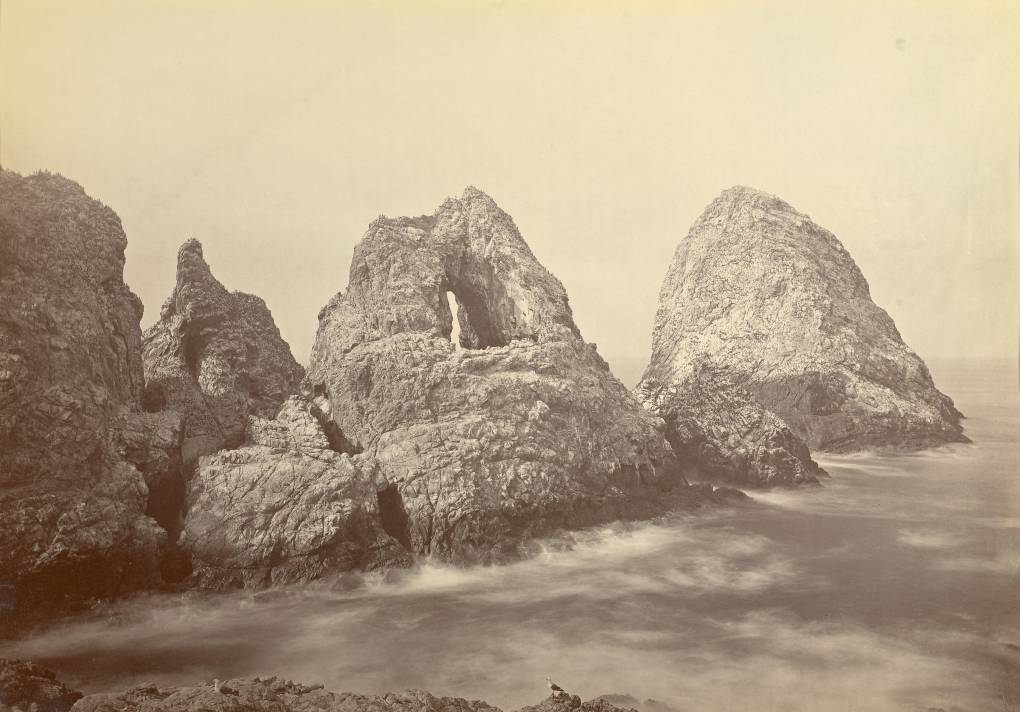
window.__IS_SSR__=true
window.__INITIAL_STATE__={
"attachmentsReducer": {
"audio_0": {
"type": "attachments",
"id": "audio_0",
"imgSizes": {
"kqedFullSize": {
"file": "https://ww2.kqed.org/news/wp-content/themes/KQED-unified/img/audio_bgs/background0.jpg"
}
}
},
"audio_1": {
"type": "attachments",
"id": "audio_1",
"imgSizes": {
"kqedFullSize": {
"file": "https://ww2.kqed.org/news/wp-content/themes/KQED-unified/img/audio_bgs/background1.jpg"
}
}
},
"audio_2": {
"type": "attachments",
"id": "audio_2",
"imgSizes": {
"kqedFullSize": {
"file": "https://ww2.kqed.org/news/wp-content/themes/KQED-unified/img/audio_bgs/background2.jpg"
}
}
},
"audio_3": {
"type": "attachments",
"id": "audio_3",
"imgSizes": {
"kqedFullSize": {
"file": "https://ww2.kqed.org/news/wp-content/themes/KQED-unified/img/audio_bgs/background3.jpg"
}
}
},
"audio_4": {
"type": "attachments",
"id": "audio_4",
"imgSizes": {
"kqedFullSize": {
"file": "https://ww2.kqed.org/news/wp-content/themes/KQED-unified/img/audio_bgs/background4.jpg"
}
}
},
"placeholder": {
"type": "attachments",
"id": "placeholder",
"imgSizes": {
"thumbnail": {
"file": "https://cdn.kqed.org/wp-content/uploads/2024/12/KQED-Default-Image-816638274-2000x1333-1-160x107.jpg",
"width": 160,
"height": 107,
"mimeType": "image/jpeg"
},
"medium": {
"file": "https://cdn.kqed.org/wp-content/uploads/2024/12/KQED-Default-Image-816638274-2000x1333-1-800x533.jpg",
"width": 800,
"height": 533,
"mimeType": "image/jpeg"
},
"medium_large": {
"file": "https://cdn.kqed.org/wp-content/uploads/2024/12/KQED-Default-Image-816638274-2000x1333-1-768x512.jpg",
"width": 768,
"height": 512,
"mimeType": "image/jpeg"
},
"large": {
"file": "https://cdn.kqed.org/wp-content/uploads/2024/12/KQED-Default-Image-816638274-2000x1333-1-1020x680.jpg",
"width": 1020,
"height": 680,
"mimeType": "image/jpeg"
},
"1536x1536": {
"file": "https://cdn.kqed.org/wp-content/uploads/2024/12/KQED-Default-Image-816638274-2000x1333-1-1536x1024.jpg",
"width": 1536,
"height": 1024,
"mimeType": "image/jpeg"
},
"fd-lrg": {
"file": "https://cdn.kqed.org/wp-content/uploads/2024/12/KQED-Default-Image-816638274-2000x1333-1-1536x1024.jpg",
"width": 1536,
"height": 1024,
"mimeType": "image/jpeg"
},
"fd-med": {
"file": "https://cdn.kqed.org/wp-content/uploads/2024/12/KQED-Default-Image-816638274-2000x1333-1-1020x680.jpg",
"width": 1020,
"height": 680,
"mimeType": "image/jpeg"
},
"fd-sm": {
"file": "https://cdn.kqed.org/wp-content/uploads/2024/12/KQED-Default-Image-816638274-2000x1333-1-800x533.jpg",
"width": 800,
"height": 533,
"mimeType": "image/jpeg"
},
"post-thumbnail": {
"file": "https://cdn.kqed.org/wp-content/uploads/2024/12/KQED-Default-Image-816638274-2000x1333-1-672x372.jpg",
"width": 672,
"height": 372,
"mimeType": "image/jpeg"
},
"twentyfourteen-full-width": {
"file": "https://cdn.kqed.org/wp-content/uploads/2024/12/KQED-Default-Image-816638274-2000x1333-1-1038x576.jpg",
"width": 1038,
"height": 576,
"mimeType": "image/jpeg"
},
"xxsmall": {
"file": "https://cdn.kqed.org/wp-content/uploads/2024/12/KQED-Default-Image-816638274-2000x1333-1-160x107.jpg",
"width": 160,
"height": 107,
"mimeType": "image/jpeg"
},
"xsmall": {
"file": "https://cdn.kqed.org/wp-content/uploads/2024/12/KQED-Default-Image-816638274-2000x1333-1-672x372.jpg",
"width": 672,
"height": 372,
"mimeType": "image/jpeg"
},
"small": {
"file": "https://cdn.kqed.org/wp-content/uploads/2024/12/KQED-Default-Image-816638274-2000x1333-1-672x372.jpg",
"width": 672,
"height": 372,
"mimeType": "image/jpeg"
},
"xlarge": {
"file": "https://cdn.kqed.org/wp-content/uploads/2024/12/KQED-Default-Image-816638274-2000x1333-1-1020x680.jpg",
"width": 1020,
"height": 680,
"mimeType": "image/jpeg"
},
"full-width": {
"file": "https://cdn.kqed.org/wp-content/uploads/2024/12/KQED-Default-Image-816638274-2000x1333-1-1920x1280.jpg",
"width": 1920,
"height": 1280,
"mimeType": "image/jpeg"
},
"guest-author-32": {
"file": "https://cdn.kqed.org/wp-content/uploads/2025/01/KQED-Default-Image-816638274-1333x1333-1-160x160.jpg",
"width": 32,
"height": 32,
"mimeType": "image/jpeg"
},
"guest-author-50": {
"file": "https://cdn.kqed.org/wp-content/uploads/2025/01/KQED-Default-Image-816638274-1333x1333-1-160x160.jpg",
"width": 50,
"height": 50,
"mimeType": "image/jpeg"
},
"guest-author-64": {
"file": "https://cdn.kqed.org/wp-content/uploads/2025/01/KQED-Default-Image-816638274-1333x1333-1-160x160.jpg",
"width": 64,
"height": 64,
"mimeType": "image/jpeg"
},
"guest-author-96": {
"file": "https://cdn.kqed.org/wp-content/uploads/2025/01/KQED-Default-Image-816638274-1333x1333-1-160x160.jpg",
"width": 96,
"height": 96,
"mimeType": "image/jpeg"
},
"guest-author-128": {
"file": "https://cdn.kqed.org/wp-content/uploads/2025/01/KQED-Default-Image-816638274-1333x1333-1-160x160.jpg",
"width": 128,
"height": 128,
"mimeType": "image/jpeg"
},
"detail": {
"file": "https://cdn.kqed.org/wp-content/uploads/2025/01/KQED-Default-Image-816638274-1333x1333-1-160x160.jpg",
"width": 160,
"height": 160,
"mimeType": "image/jpeg"
},
"kqedFullSize": {
"file": "https://cdn.kqed.org/wp-content/uploads/2024/12/KQED-Default-Image-816638274-2000x1333-1.jpg",
"width": 2000,
"height": 1333
}
}
},
"arts_13959241": {
"type": "attachments",
"id": "arts_13959241",
"meta": {
"index": "attachments_1716263798",
"site": "arts",
"id": "13959241",
"found": true
},
"title": "The Sugarloaf Islands of the Farallons, as they were seen by Carleton Watkins in 1869.",
"publishDate": 1717552602,
"status": "inherit",
"parent": 13959142,
"modified": 1717634537,
"caption": "The Sugarloaf Islands of the Farallons, as they were seen by Carleton Watkins in 1869. ",
"credit": "Sepia Times/ Universal Images Group via Getty Images",
"altTag": "A sepia toned photo of tall rocky land masses surrounded by foamy sea water.",
"description": null,
"imgSizes": {
"medium": {
"file": "https://cdn.kqed.org/wp-content/uploads/sites/2/2024/06/GettyImages-1157997959-800x559.jpg",
"width": 800,
"height": 559,
"mimeType": "image/jpeg"
},
"large": {
"file": "https://cdn.kqed.org/wp-content/uploads/sites/2/2024/06/GettyImages-1157997959-1020x712.jpg",
"width": 1020,
"height": 712,
"mimeType": "image/jpeg"
},
"thumbnail": {
"file": "https://cdn.kqed.org/wp-content/uploads/sites/2/2024/06/GettyImages-1157997959-160x112.jpg",
"width": 160,
"height": 112,
"mimeType": "image/jpeg"
},
"medium_large": {
"file": "https://cdn.kqed.org/wp-content/uploads/sites/2/2024/06/GettyImages-1157997959-768x536.jpg",
"width": 768,
"height": 536,
"mimeType": "image/jpeg"
},
"1536x1536": {
"file": "https://cdn.kqed.org/wp-content/uploads/sites/2/2024/06/GettyImages-1157997959-1536x1072.jpg",
"width": 1536,
"height": 1072,
"mimeType": "image/jpeg"
},
"2048x2048": {
"file": "https://cdn.kqed.org/wp-content/uploads/sites/2/2024/06/GettyImages-1157997959-2048x1430.jpg",
"width": 2048,
"height": 1430,
"mimeType": "image/jpeg"
},
"post-thumbnail": {
"file": "https://cdn.kqed.org/wp-content/uploads/sites/2/2024/06/GettyImages-1157997959-672x372.jpg",
"width": 672,
"height": 372,
"mimeType": "image/jpeg"
},
"twentyfourteen-full-width": {
"file": "https://cdn.kqed.org/wp-content/uploads/sites/2/2024/06/GettyImages-1157997959-1038x576.jpg",
"width": 1038,
"height": 576,
"mimeType": "image/jpeg"
},
"full-width": {
"file": "https://cdn.kqed.org/wp-content/uploads/sites/2/2024/06/GettyImages-1157997959-1920x1341.jpg",
"width": 1920,
"height": 1341,
"mimeType": "image/jpeg"
},
"kqedFullSize": {
"file": "https://cdn.kqed.org/wp-content/uploads/sites/2/2024/06/GettyImages-1157997959-scaled-e1717552749442.jpg",
"width": 1920,
"height": 1340
}
},
"isLoading": false,
"fetchFailed": false
},
"arts_13957664": {
"type": "attachments",
"id": "arts_13957664",
"meta": {
"index": "attachments_1716263798",
"site": "arts",
"id": "13957664",
"found": true
},
"parent": 13957514,
"imgSizes": {
"twentyfourteen-full-width": {
"file": "https://cdn.kqed.org/wp-content/uploads/sites/2/2024/05/Screen-Shot-2024-05-10-at-2.40.57-PM-1038x576.png",
"width": 1038,
"mimeType": "image/png",
"height": 576
},
"thumbnail": {
"file": "https://cdn.kqed.org/wp-content/uploads/sites/2/2024/05/Screen-Shot-2024-05-10-at-2.40.57-PM-160x93.png",
"width": 160,
"mimeType": "image/png",
"height": 93
},
"post-thumbnail": {
"file": "https://cdn.kqed.org/wp-content/uploads/sites/2/2024/05/Screen-Shot-2024-05-10-at-2.40.57-PM-672x372.png",
"width": 672,
"mimeType": "image/png",
"height": 372
},
"kqedFullSize": {
"file": "https://cdn.kqed.org/wp-content/uploads/sites/2/2024/05/Screen-Shot-2024-05-10-at-2.40.57-PM.png",
"width": 1584,
"height": 916
},
"large": {
"file": "https://cdn.kqed.org/wp-content/uploads/sites/2/2024/05/Screen-Shot-2024-05-10-at-2.40.57-PM-1020x590.png",
"width": 1020,
"mimeType": "image/png",
"height": 590
},
"1536x1536": {
"file": "https://cdn.kqed.org/wp-content/uploads/sites/2/2024/05/Screen-Shot-2024-05-10-at-2.40.57-PM-1536x888.png",
"width": 1536,
"mimeType": "image/png",
"height": 888
},
"medium": {
"file": "https://cdn.kqed.org/wp-content/uploads/sites/2/2024/05/Screen-Shot-2024-05-10-at-2.40.57-PM-800x463.png",
"width": 800,
"mimeType": "image/png",
"height": 463
},
"medium_large": {
"file": "https://cdn.kqed.org/wp-content/uploads/sites/2/2024/05/Screen-Shot-2024-05-10-at-2.40.57-PM-768x444.png",
"width": 768,
"mimeType": "image/png",
"height": 444
}
},
"publishDate": 1715377288,
"modified": 1715377334,
"caption": "A rendition of the airship seen in the skies above Sacramento, as illustrated in ‘The San Francisco Call and Post’ on Nov. 29, 1896.",
"description": null,
"title": "A rendition of the airship seen in the skies above Sacramento, as illustrated in ‘The San Francisco Call and Post’ on Nov. 29, 1896.",
"credit": "The San Francisco Call and Post",
"status": "inherit",
"altTag": "A Victorian illustration of two men watching an airship with wings and spotlights flying near the top of the Capitol building.",
"isLoading": false,
"fetchFailed": false
},
"arts_13936011": {
"type": "attachments",
"id": "arts_13936011",
"meta": {
"index": "attachments_1716263798",
"site": "arts",
"id": "13936011",
"found": true
},
"parent": 13935838,
"imgSizes": {
"twentyfourteen-full-width": {
"file": "https://ww2.kqed.org/app/uploads/sites/2/2023/10/It-came-e1696642620235-1038x576.png",
"width": 1038,
"mimeType": "image/png",
"height": 576
},
"thumbnail": {
"file": "https://ww2.kqed.org/app/uploads/sites/2/2023/10/It-came-e1696642620235-160x107.png",
"width": 160,
"mimeType": "image/png",
"height": 107
},
"post-thumbnail": {
"file": "https://ww2.kqed.org/app/uploads/sites/2/2023/10/It-came-e1696642620235-672x372.png",
"width": 672,
"mimeType": "image/png",
"height": 372
},
"kqedFullSize": {
"file": "https://ww2.kqed.org/app/uploads/sites/2/2023/10/It-came-e1696642620235.png",
"width": 1920,
"height": 1286
},
"2048x2048": {
"file": "https://ww2.kqed.org/app/uploads/sites/2/2023/10/It-came-2048x1372.png",
"width": 2048,
"mimeType": "image/png",
"height": 1372
},
"large": {
"file": "https://ww2.kqed.org/app/uploads/sites/2/2023/10/It-came-e1696642620235-1020x683.png",
"width": 1020,
"mimeType": "image/png",
"height": 683
},
"1536x1536": {
"file": "https://ww2.kqed.org/app/uploads/sites/2/2023/10/It-came-e1696642620235-1536x1029.png",
"width": 1536,
"mimeType": "image/png",
"height": 1029
},
"full-width": {
"file": "https://ww2.kqed.org/app/uploads/sites/2/2023/10/It-came-1920x1286.png",
"width": 1920,
"mimeType": "image/png",
"height": 1286
},
"medium": {
"file": "https://ww2.kqed.org/app/uploads/sites/2/2023/10/It-came-e1696642620235-800x536.png",
"width": 800,
"mimeType": "image/png",
"height": 536
},
"medium_large": {
"file": "https://ww2.kqed.org/app/uploads/sites/2/2023/10/It-came-e1696642620235-768x514.png",
"width": 768,
"mimeType": "image/png",
"height": 514
}
},
"publishDate": 1696642386,
"modified": 1696642635,
"caption": "A moment from a History Channel documentary about deep sea monsters. Just kidding! It's a still from ‘It Came From Beneath the Sea.’ Actual sea monsters have been reported in Tahoe, Monterey and Santa Cruz though.",
"description": null,
"title": "A moment from a History Channel documentary about deep sea monsters. Just kidding! It's a still from ‘It Came From Beneath the Sea.’ Actual sea monsters have been reported in Tahoe, Monterey and Santa Cruz though.",
"credit": "Columbia Pictures",
"status": "inherit",
"altTag": null,
"isLoading": false,
"fetchFailed": false
},
"arts_13934229": {
"type": "attachments",
"id": "arts_13934229",
"meta": {
"index": "attachments_1716263798",
"site": "arts",
"id": "13934229",
"found": true
},
"parent": 13934227,
"imgSizes": {
"twentyfourteen-full-width": {
"file": "https://ww2.kqed.org/app/uploads/sites/2/2023/08/opensfhistory_wnp14.4363-1000x576.jpg",
"width": 1000,
"mimeType": "image/jpeg",
"height": 576
},
"thumbnail": {
"file": "https://ww2.kqed.org/app/uploads/sites/2/2023/08/opensfhistory_wnp14.4363-160x93.jpg",
"width": 160,
"mimeType": "image/jpeg",
"height": 93
},
"post-thumbnail": {
"file": "https://ww2.kqed.org/app/uploads/sites/2/2023/08/opensfhistory_wnp14.4363-672x372.jpg",
"width": 672,
"mimeType": "image/jpeg",
"height": 372
},
"kqedFullSize": {
"file": "https://ww2.kqed.org/app/uploads/sites/2/2023/08/opensfhistory_wnp14.4363.jpg",
"width": 1000,
"height": 584
},
"medium": {
"file": "https://ww2.kqed.org/app/uploads/sites/2/2023/08/opensfhistory_wnp14.4363-800x467.jpg",
"width": 800,
"mimeType": "image/jpeg",
"height": 467
},
"medium_large": {
"file": "https://ww2.kqed.org/app/uploads/sites/2/2023/08/opensfhistory_wnp14.4363-768x449.jpg",
"width": 768,
"mimeType": "image/jpeg",
"height": 449
}
},
"publishDate": 1693527915,
"modified": 1694459753,
"caption": "We're not saying that any of these kids ever did anything with dynamite but, based on records, if they had, no one would have been all that surprised. Merced Heights, 1928.",
"description": null,
"title": "We're not saying that any of these kids ever did anything with dynamite but, based on records, if they had, no one would have been all that surprised. Merced Heights, 1928.",
"credit": "OpenSFHistory / wnp14.4363",
"status": "inherit",
"altTag": "Ten small boys, between the ages of approximately 8 and 14 stand in the street in the 1920s. Most look sullen.",
"isLoading": false,
"fetchFailed": false
},
"arts_13934002": {
"type": "attachments",
"id": "arts_13934002",
"meta": {
"index": "attachments_1716263798",
"site": "arts",
"id": "13934002",
"found": true
},
"parent": 13933318,
"imgSizes": {
"twentyfourteen-full-width": {
"file": "https://ww2.kqed.org/app/uploads/sites/2/2023/08/Screen-Shot-2023-08-28-at-6.16.15-PM-1038x576.png",
"width": 1038,
"mimeType": "image/png",
"height": 576
},
"thumbnail": {
"file": "https://ww2.kqed.org/app/uploads/sites/2/2023/08/Screen-Shot-2023-08-28-at-6.16.15-PM-160x107.png",
"width": 160,
"mimeType": "image/png",
"height": 107
},
"post-thumbnail": {
"file": "https://ww2.kqed.org/app/uploads/sites/2/2023/08/Screen-Shot-2023-08-28-at-6.16.15-PM-672x372.png",
"width": 672,
"mimeType": "image/png",
"height": 372
},
"kqedFullSize": {
"file": "https://ww2.kqed.org/app/uploads/sites/2/2023/08/Screen-Shot-2023-08-28-at-6.16.15-PM.png",
"width": 1432,
"height": 954
},
"large": {
"file": "https://ww2.kqed.org/app/uploads/sites/2/2023/08/Screen-Shot-2023-08-28-at-6.16.15-PM-1020x680.png",
"width": 1020,
"mimeType": "image/png",
"height": 680
},
"medium": {
"file": "https://ww2.kqed.org/app/uploads/sites/2/2023/08/Screen-Shot-2023-08-28-at-6.16.15-PM-800x533.png",
"width": 800,
"mimeType": "image/png",
"height": 533
},
"medium_large": {
"file": "https://ww2.kqed.org/app/uploads/sites/2/2023/08/Screen-Shot-2023-08-28-at-6.16.15-PM-768x512.png",
"width": 768,
"mimeType": "image/png",
"height": 512
}
},
"publishDate": 1693271788,
"modified": 1693518329,
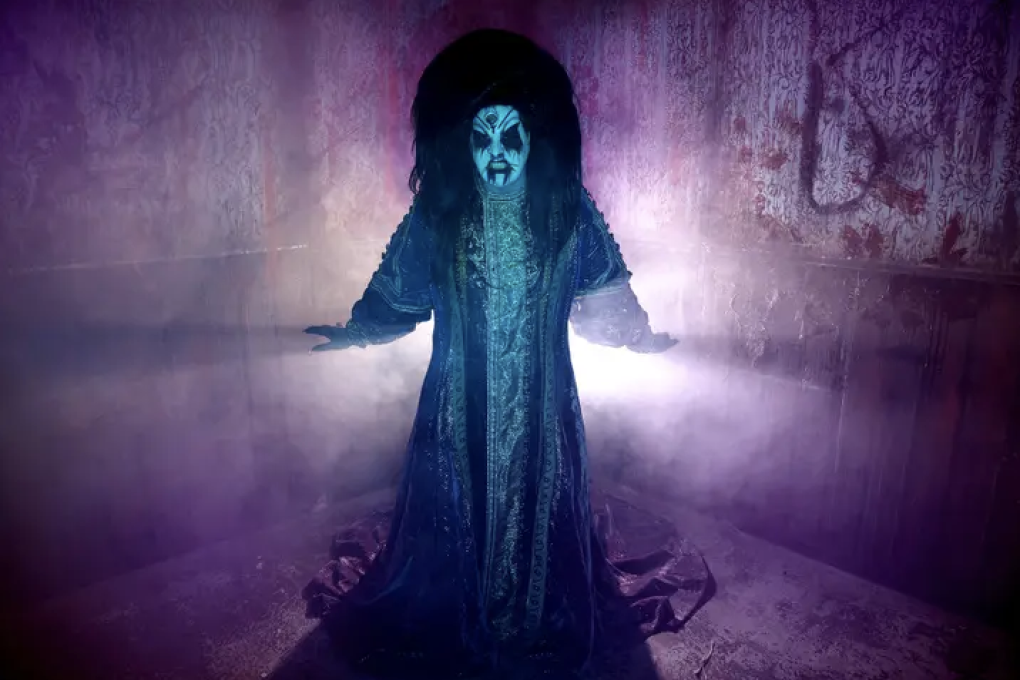
"caption": "Are you ready to put your faith in cult horde savior, Peaches Christ?",
"description": null,
"title": "Are you ready to put your faith in cult horde savior, Peaches Christ?",
"credit": "‘Into the Dark: The Initiation’",
"status": "inherit",
"altTag": "A drag queen wearing white facepaint and elaborate robes stands backlit in a purple foggy room",
"isLoading": false,
"fetchFailed": false
},
"arts_13931220": {
"type": "attachments",
"id": "arts_13931220",
"meta": {
"index": "attachments_1716263798",
"site": "arts",
"id": "13931220",
"found": true
},
"parent": 13931210,
"imgSizes": {
"twentyfourteen-full-width": {
"file": "https://ww2.kqed.org/app/uploads/sites/2/2023/07/GettyImages-3063885-scaled-e1688604552821-1038x576.jpg",
"width": 1038,
"mimeType": "image/jpeg",
"height": 576
},
"thumbnail": {
"file": "https://ww2.kqed.org/app/uploads/sites/2/2023/07/GettyImages-3063885-scaled-e1688604552821-160x113.jpg",
"width": 160,
"mimeType": "image/jpeg",
"height": 113
},
"post-thumbnail": {
"file": "https://ww2.kqed.org/app/uploads/sites/2/2023/07/GettyImages-3063885-scaled-e1688604552821-672x372.jpg",
"width": 672,
"mimeType": "image/jpeg",
"height": 372
},
"kqedFullSize": {
"file": "https://ww2.kqed.org/app/uploads/sites/2/2023/07/GettyImages-3063885-scaled-e1688604552821.jpg",
"width": 1920,
"height": 1352
},
"2048x2048": {
"file": "https://ww2.kqed.org/app/uploads/sites/2/2023/07/GettyImages-3063885-2048x1442.jpg",
"width": 2048,
"mimeType": "image/jpeg",
"height": 1442
},
"large": {
"file": "https://ww2.kqed.org/app/uploads/sites/2/2023/07/GettyImages-3063885-scaled-e1688604552821-1020x718.jpg",
"width": 1020,
"mimeType": "image/jpeg",
"height": 718
},
"1536x1536": {
"file": "https://ww2.kqed.org/app/uploads/sites/2/2023/07/GettyImages-3063885-scaled-e1688604552821-1536x1082.jpg",
"width": 1536,
"mimeType": "image/jpeg",
"height": 1082
},
"full-width": {
"file": "https://ww2.kqed.org/app/uploads/sites/2/2023/07/GettyImages-3063885-1920x1352.jpg",
"width": 1920,
"mimeType": "image/jpeg",
"height": 1352
},
"medium": {
"file": "https://ww2.kqed.org/app/uploads/sites/2/2023/07/GettyImages-3063885-scaled-e1688604552821-800x563.jpg",
"width": 800,
"mimeType": "image/jpeg",
"height": 563
},
"medium_large": {
"file": "https://ww2.kqed.org/app/uploads/sites/2/2023/07/GettyImages-3063885-scaled-e1688604552821-768x541.jpg",
"width": 768,
"mimeType": "image/jpeg",
"height": 541
}
},
"publishDate": 1688604530,
"modified": 1688624372,
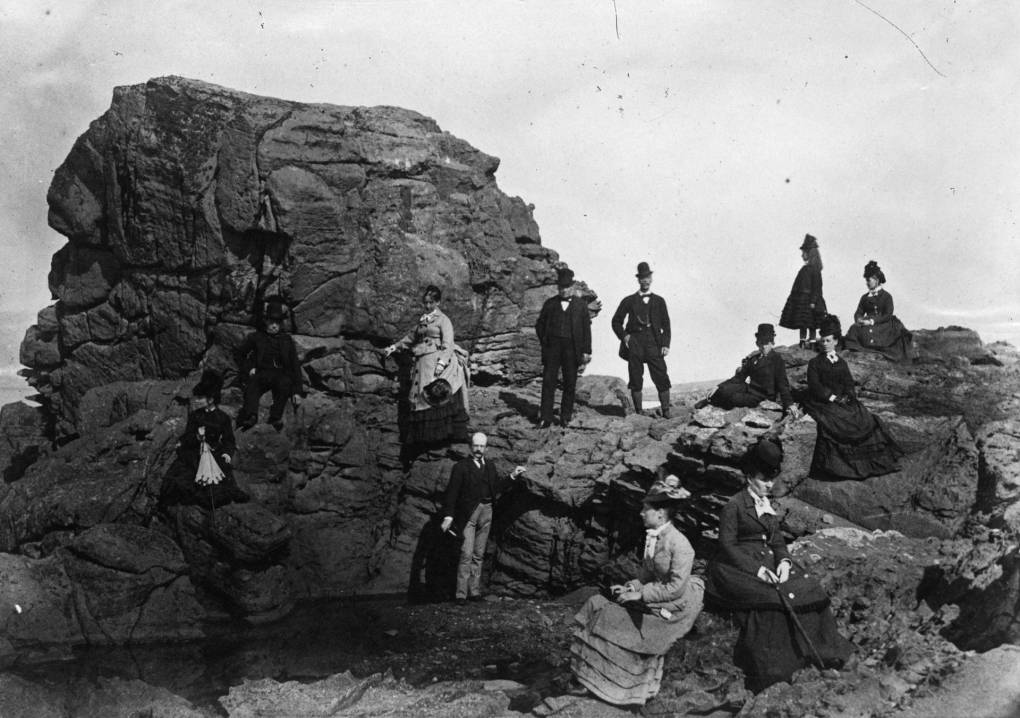
"caption": "Victorians, probably contemplating how to destroy the thing they're all hanging out on.",
"description": null,
"title": "Victorians, probably contemplating how to destroy the thing they're all hanging out on.",
"credit": "General Photographic Agency/Getty Images",
"status": "inherit",
"altTag": "Four men, six women and a child, all dressed in Victorian era clothing sit and stand on a rocky outcrop.",
"isLoading": false,
"fetchFailed": false
},
"arts_13927591": {
"type": "attachments",
"id": "arts_13927591",
"meta": {
"index": "attachments_1716263798",
"site": "arts",
"id": "13927591",
"found": true
},
"parent": 13927540,
"imgSizes": {
"twentyfourteen-full-width": {
"file": "https://ww2.kqed.org/app/uploads/sites/2/2023/04/Fred-and-Qued_1970s-scaled-e1682365502428-1038x576.jpg",
"width": 1038,
"mimeType": "image/jpeg",
"height": 576
},
"thumbnail": {
"file": "https://ww2.kqed.org/app/uploads/sites/2/2023/04/Fred-and-Qued_1970s-scaled-e1682365502428-160x87.jpg",
"width": 160,
"mimeType": "image/jpeg",
"height": 87
},
"post-thumbnail": {
"file": "https://ww2.kqed.org/app/uploads/sites/2/2023/04/Fred-and-Qued_1970s-scaled-e1682365502428-672x372.jpg",
"width": 672,
"mimeType": "image/jpeg",
"height": 372
},
"kqedFullSize": {
"file": "https://ww2.kqed.org/app/uploads/sites/2/2023/04/Fred-and-Qued_1970s-scaled-e1682365502428.jpg",
"width": 1920,
"height": 1043
},
"2048x2048": {
"file": "https://ww2.kqed.org/app/uploads/sites/2/2023/04/Fred-and-Qued_1970s-2048x1113.jpg",
"width": 2048,
"mimeType": "image/jpeg",
"height": 1113
},
"large": {
"file": "https://ww2.kqed.org/app/uploads/sites/2/2023/04/Fred-and-Qued_1970s-scaled-e1682365502428-1020x554.jpg",
"width": 1020,
"mimeType": "image/jpeg",
"height": 554
},
"1536x1536": {
"file": "https://ww2.kqed.org/app/uploads/sites/2/2023/04/Fred-and-Qued_1970s-scaled-e1682365502428-1536x834.jpg",
"width": 1536,
"mimeType": "image/jpeg",
"height": 834
},
"full-width": {
"file": "https://ww2.kqed.org/app/uploads/sites/2/2023/04/Fred-and-Qued_1970s-1920x1043.jpg",
"width": 1920,
"mimeType": "image/jpeg",
"height": 1043
},
"medium": {
"file": "https://ww2.kqed.org/app/uploads/sites/2/2023/04/Fred-and-Qued_1970s-scaled-e1682365502428-800x435.jpg",
"width": 800,
"mimeType": "image/jpeg",
"height": 435
},
"medium_large": {
"file": "https://ww2.kqed.org/app/uploads/sites/2/2023/04/Fred-and-Qued_1970s-scaled-e1682365502428-768x417.jpg",
"width": 768,
"mimeType": "image/jpeg",
"height": 417
}
},
"publishDate": 1681157106,
"modified": 1682365531,
"caption": "Qued, a red dragon-like monster being led by Phred, a guy who looks like the Monopoly man sold his soul to Satan.",
"description": null,
"title": "Qued, a red dragon-like monster being led by Phred, a guy who looks like the Monopoly man sold his soul to Satan.",
"credit": null,
"status": "inherit",
"altTag": "An illustration showing a little man in a black top hat leading a huge red monster around. on a leash.",
"isLoading": false,
"fetchFailed": false
},
"arts_13927169": {
"type": "attachments",
"id": "arts_13927169",
"meta": {
"index": "attachments_1716263798",
"site": "arts",
"id": "13927169",
"found": true
},
"parent": 13927137,
"imgSizes": {
"twentyfourteen-full-width": {
"file": "https://ww2.kqed.org/app/uploads/sites/2/2023/03/opensfhistory_wnp26.2055-1000x576.jpg",
"width": 1000,
"mimeType": "image/jpeg",
"height": 576
},
"thumbnail": {
"file": "https://ww2.kqed.org/app/uploads/sites/2/2023/03/opensfhistory_wnp26.2055-160x103.jpg",
"width": 160,
"mimeType": "image/jpeg",
"height": 103
},
"post-thumbnail": {
"file": "https://ww2.kqed.org/app/uploads/sites/2/2023/03/opensfhistory_wnp26.2055-672x372.jpg",
"width": 672,
"mimeType": "image/jpeg",
"height": 372
},
"kqedFullSize": {
"file": "https://ww2.kqed.org/app/uploads/sites/2/2023/03/opensfhistory_wnp26.2055.jpg",
"width": 1000,
"height": 644
},
"medium": {
"file": "https://ww2.kqed.org/app/uploads/sites/2/2023/03/opensfhistory_wnp26.2055-800x515.jpg",
"width": 800,
"mimeType": "image/jpeg",
"height": 515
},
"medium_large": {
"file": "https://ww2.kqed.org/app/uploads/sites/2/2023/03/opensfhistory_wnp26.2055-768x495.jpg",
"width": 768,
"mimeType": "image/jpeg",
"height": 495
}
},
"publishDate": 1680210829,
"modified": 1680222205,
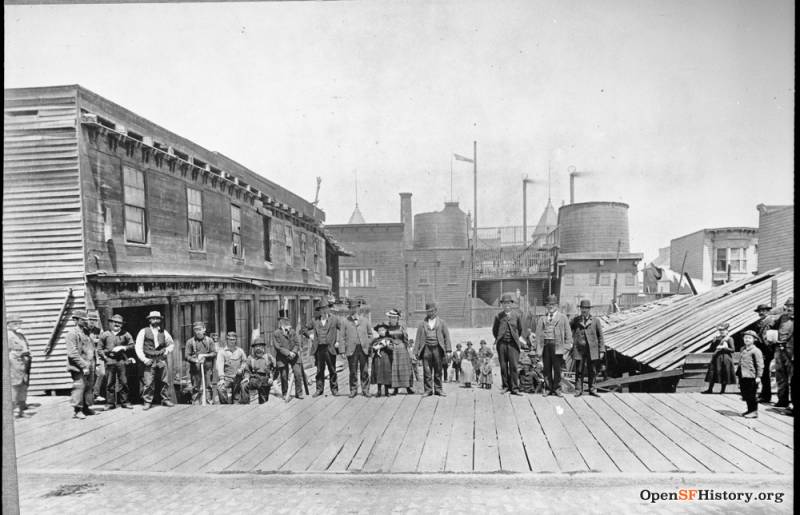
"caption": "Patrons gather outside the Cobweb Palace, a legendary old tavern that stood for 40 years on Francisco Street between Powell and Mason. ",
"description": null,
"title": "Patrons gather outside the Cobweb Palace, a legendary old tavern that stood for 40 years on Francisco Street between Powell and Mason.",
"credit": "OpenSFHistory / wnp26.2055",
"status": "inherit",
"altTag": "A line of men and women dressed in Victorian clothing stand outside a ramshackle wooden building.",
"isLoading": false,
"fetchFailed": false
},
"arts_13926073": {
"type": "attachments",
"id": "arts_13926073",
"meta": {
"index": "attachments_1716263798",
"site": "arts",
"id": "13926073",
"found": true
},
"parent": 13926069,
"imgSizes": {
"twentyfourteen-full-width": {
"file": "https://ww2.kqed.org/app/uploads/sites/2/2023/03/Screen-Shot-2023-03-09-at-2.54.47-PM-1038x576.png",
"width": 1038,
"mimeType": "image/png",
"height": 576
},
"thumbnail": {
"file": "https://ww2.kqed.org/app/uploads/sites/2/2023/03/Screen-Shot-2023-03-09-at-2.54.47-PM-160x94.png",
"width": 160,
"mimeType": "image/png",
"height": 94
},
"post-thumbnail": {
"file": "https://ww2.kqed.org/app/uploads/sites/2/2023/03/Screen-Shot-2023-03-09-at-2.54.47-PM-672x372.png",
"width": 672,
"mimeType": "image/png",
"height": 372
},
"kqedFullSize": {
"file": "https://ww2.kqed.org/app/uploads/sites/2/2023/03/Screen-Shot-2023-03-09-at-2.54.47-PM.png",
"width": 2018,
"height": 1188
},
"large": {
"file": "https://ww2.kqed.org/app/uploads/sites/2/2023/03/Screen-Shot-2023-03-09-at-2.54.47-PM-1020x600.png",
"width": 1020,
"mimeType": "image/png",
"height": 600
},
"1536x1536": {
"file": "https://ww2.kqed.org/app/uploads/sites/2/2023/03/Screen-Shot-2023-03-09-at-2.54.47-PM-1536x904.png",
"width": 1536,
"mimeType": "image/png",
"height": 904
},
"full-width": {
"file": "https://ww2.kqed.org/app/uploads/sites/2/2023/03/Screen-Shot-2023-03-09-at-2.54.47-PM-1920x1130.png",
"width": 1920,
"mimeType": "image/png",
"height": 1130
},
"medium": {
"file": "https://ww2.kqed.org/app/uploads/sites/2/2023/03/Screen-Shot-2023-03-09-at-2.54.47-PM-800x471.png",
"width": 800,
"mimeType": "image/png",
"height": 471
},
"medium_large": {
"file": "https://ww2.kqed.org/app/uploads/sites/2/2023/03/Screen-Shot-2023-03-09-at-2.54.47-PM-768x452.png",
"width": 768,
"mimeType": "image/png",
"height": 452
}
},
"publishDate": 1678404566,
"modified": 1678404637,
"caption": "Isabella J. Martin, a truly crappy criminal.",
"description": null,
"title": "Isabella J. Martin, a truly crappy criminal.",
"credit": null,
"status": "inherit",
"altTag": "A white woman with ruddy features stands, wearing a hat, facing the camera.",
"isLoading": false,
"fetchFailed": false
},
"arts_13919696": {
"type": "attachments",
"id": "arts_13919696",
"meta": {
"index": "attachments_1716263798",
"site": "arts",
"id": "13919696",
"found": true
},
"parent": 13919589,
"imgSizes": {
"twentyfourteen-full-width": {
"file": "https://ww2.kqed.org/app/uploads/sites/2/2022/09/opensfhistory_wnp26.1404-1000x576.jpg",
"width": 1000,
"mimeType": "image/jpeg",
"height": 576
},
"thumbnail": {
"file": "https://ww2.kqed.org/app/uploads/sites/2/2022/09/opensfhistory_wnp26.1404-160x125.jpg",
"width": 160,
"mimeType": "image/jpeg",
"height": 125
},
"post-thumbnail": {
"file": "https://ww2.kqed.org/app/uploads/sites/2/2022/09/opensfhistory_wnp26.1404-672x372.jpg",
"width": 672,
"mimeType": "image/jpeg",
"height": 372
},
"kqedFullSize": {
"file": "https://ww2.kqed.org/app/uploads/sites/2/2022/09/opensfhistory_wnp26.1404.jpg",
"width": 1000,
"height": 782
},
"medium": {
"file": "https://ww2.kqed.org/app/uploads/sites/2/2022/09/opensfhistory_wnp26.1404-800x626.jpg",
"width": 800,
"mimeType": "image/jpeg",
"height": 626
},
"medium_large": {
"file": "https://ww2.kqed.org/app/uploads/sites/2/2022/09/opensfhistory_wnp26.1404-768x601.jpg",
"width": 768,
"mimeType": "image/jpeg",
"height": 601
}
},
"publishDate": 1664304872,
"modified": 1666121274,
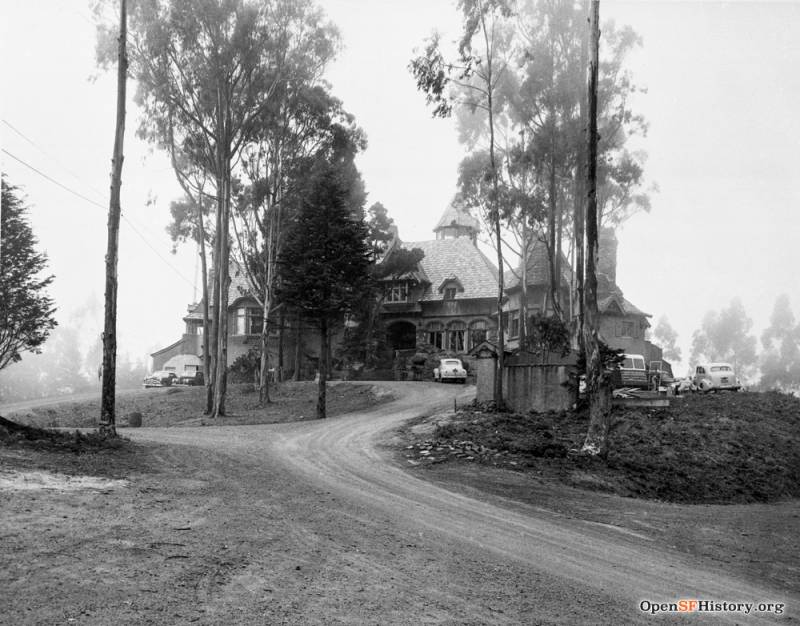
"caption": "Adolph Sutro's grandson lived in the mansion with his mother for 18 years.",
"description": null,
"title": "Adolph Sutro's grandson lived in the mansion with his mother for 18 years.",
"credit": "OpenSFHistory / wnp26.1404",
"status": "inherit",
"altTag": "A creepy and sprawling mansion lies under a blanket of fog at the end of a winding path.",
"isLoading": false,
"fetchFailed": false
},
"arts_13918923": {
"type": "attachments",
"id": "arts_13918923",
"meta": {
"index": "attachments_1716263798",
"site": "arts",
"id": "13918923",
"found": true
},
"parent": 13916388,
"imgSizes": {
"twentyfourteen-full-width": {
"file": "https://ww2.kqed.org/app/uploads/sites/2/2022/09/GettyImages-1350543137-1038x576.jpg",
"width": 1038,
"mimeType": "image/jpeg",
"height": 576
},
"thumbnail": {
"file": "https://ww2.kqed.org/app/uploads/sites/2/2022/09/GettyImages-1350543137-160x107.jpg",
"width": 160,
"mimeType": "image/jpeg",
"height": 107
},
"post-thumbnail": {
"file": "https://ww2.kqed.org/app/uploads/sites/2/2022/09/GettyImages-1350543137-672x372.jpg",
"width": 672,
"mimeType": "image/jpeg",
"height": 372
},
"kqedFullSize": {
"file": "https://ww2.kqed.org/app/uploads/sites/2/2022/09/GettyImages-1350543137-e1662679187908.jpg",
"width": 1920,
"height": 1280
},
"2048x2048": {
"file": "https://ww2.kqed.org/app/uploads/sites/2/2022/09/GettyImages-1350543137-2048x1365.jpg",
"width": 2048,
"mimeType": "image/jpeg",
"height": 1365
},
"large": {
"file": "https://ww2.kqed.org/app/uploads/sites/2/2022/09/GettyImages-1350543137-1020x680.jpg",
"width": 1020,
"mimeType": "image/jpeg",
"height": 680
},
"1536x1536": {
"file": "https://ww2.kqed.org/app/uploads/sites/2/2022/09/GettyImages-1350543137-1536x1024.jpg",
"width": 1536,
"mimeType": "image/jpeg",
"height": 1024
},
"full-width": {
"file": "https://ww2.kqed.org/app/uploads/sites/2/2022/09/GettyImages-1350543137-1920x1280.jpg",
"width": 1920,
"mimeType": "image/jpeg",
"height": 1280
},
"medium": {
"file": "https://ww2.kqed.org/app/uploads/sites/2/2022/09/GettyImages-1350543137-800x533.jpg",
"width": 800,
"mimeType": "image/jpeg",
"height": 533
},
"medium_large": {
"file": "https://ww2.kqed.org/app/uploads/sites/2/2022/09/GettyImages-1350543137-768x512.jpg",
"width": 768,
"mimeType": "image/jpeg",
"height": 512
}
},
"publishDate": 1662679171,
"modified": 1662679323,
"caption": "Dressed as Maleficent, Stefanie Brizuela of Santa Cruz watches over the final day of Outside Lands on Halloween 2021.",
"description": null,
"title": "Dressed as Maleficent, Stefanie Brizuela of Santa Cruz watches over the final day of Outside Lands on Halloween 2021.",
"credit": "Brontë Wittpenn/San Francisco Chronicle via Getty Images",
"status": "inherit",
"altTag": "A woman wearing black goat-like horns on her head and elaborate black wings stands firmly before a tree.",
"isLoading": false,
"fetchFailed": false
},
"arts_13917388": {
"type": "attachments",
"id": "arts_13917388",
"meta": {
"index": "attachments_1716263798",
"site": "arts",
"id": "13917388",
"found": true
},
"parent": 13917340,
"imgSizes": {
"twentyfourteen-full-width": {
"file": "https://ww2.kqed.org/app/uploads/sites/2/2022/08/GettyImages-1298760638-1038x576.jpg",
"width": 1038,
"mimeType": "image/jpeg",
"height": 576
},
"thumbnail": {
"file": "https://ww2.kqed.org/app/uploads/sites/2/2022/08/GettyImages-1298760638-160x106.jpg",
"width": 160,
"mimeType": "image/jpeg",
"height": 106
},
"post-thumbnail": {
"file": "https://ww2.kqed.org/app/uploads/sites/2/2022/08/GettyImages-1298760638-672x372.jpg",
"width": 672,
"mimeType": "image/jpeg",
"height": 372
},
"kqedFullSize": {
"file": "https://ww2.kqed.org/app/uploads/sites/2/2022/08/GettyImages-1298760638-scaled.jpg",
"width": 2560,
"height": 1703
},
"2048x2048": {
"file": "https://ww2.kqed.org/app/uploads/sites/2/2022/08/GettyImages-1298760638-2048x1363.jpg",
"width": 2048,
"mimeType": "image/jpeg",
"height": 1363
},
"large": {
"file": "https://ww2.kqed.org/app/uploads/sites/2/2022/08/GettyImages-1298760638-1020x679.jpg",
"width": 1020,
"mimeType": "image/jpeg",
"height": 679
},
"1536x1536": {
"file": "https://ww2.kqed.org/app/uploads/sites/2/2022/08/GettyImages-1298760638-1536x1022.jpg",
"width": 1536,
"mimeType": "image/jpeg",
"height": 1022
},
"full-width": {
"file": "https://ww2.kqed.org/app/uploads/sites/2/2022/08/GettyImages-1298760638-1920x1278.jpg",
"width": 1920,
"mimeType": "image/jpeg",
"height": 1278
},
"medium": {
"file": "https://ww2.kqed.org/app/uploads/sites/2/2022/08/GettyImages-1298760638-800x532.jpg",
"width": 800,
"mimeType": "image/jpeg",
"height": 532
},
"medium_large": {
"file": "https://ww2.kqed.org/app/uploads/sites/2/2022/08/GettyImages-1298760638-768x511.jpg",
"width": 768,
"mimeType": "image/jpeg",
"height": 511
}
},
"publishDate": 1660153765,
"modified": 1660154023,
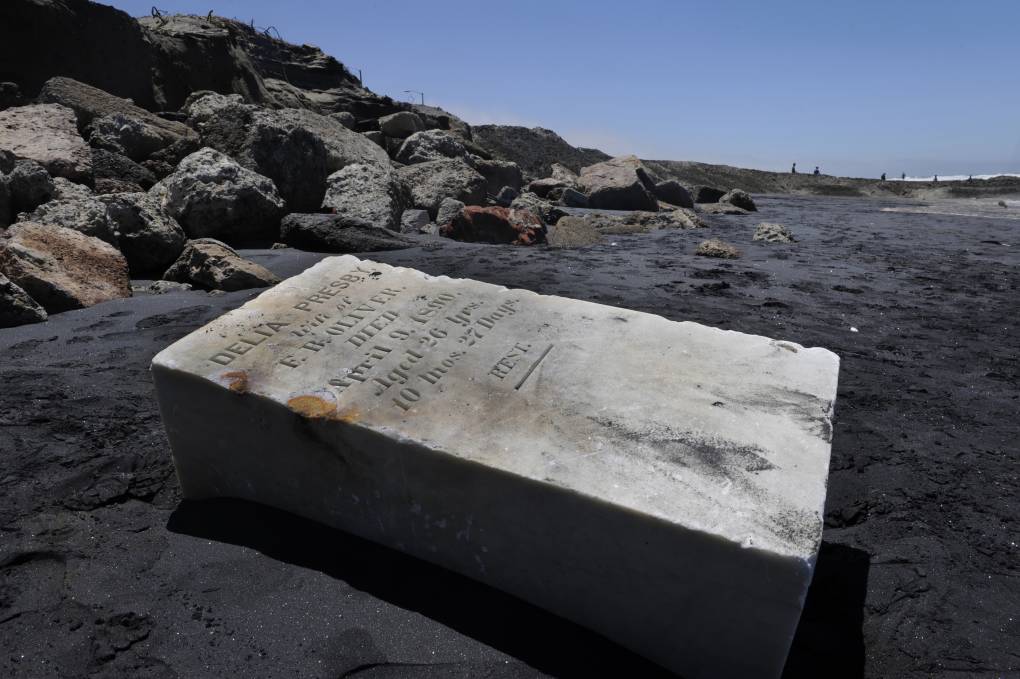
"caption": "The 122-year-old tombstone of Delia Presby lies on the sand at Ocean Beach in June 2012, apparently uncovered by wind and erosion.",
"description": null,
"title": "The 122-year-old tombstone of Delia Presby lies on the sand at Ocean Beach in June 2012, apparently uncovered by wind and erosion.",
"credit": "Megan Farmer/San Francisco Chronicle via Getty Images",
"status": "inherit",
"altTag": null,
"isLoading": false,
"fetchFailed": false
}
},
"audioPlayerReducer": {
"postId": "stream_live",
"isPaused": true,
"isPlaying": false,
"pfsActive": false,
"pledgeModalIsOpen": true,
"playerDrawerIsOpen": false,
"liveAudioPlayStartedAt": 0,
"liveAudioPlayContext": ""
},
"authorsReducer": {
"ralexandra": {
"type": "authors",
"id": "11242",
"meta": {
"index": "authors_1716337520",
"id": "11242",
"found": true
},
"name": "Rae Alexandra",
"firstName": "Rae",
"lastName": "Alexandra",
"slug": "ralexandra",
"email": "ralexandra@kqed.org",
"display_author_email": true,
"staff_mastheads": [
"arts"
],
"title": "Reporter/Producer",
"bio": "Rae Alexandra is a Reporter/Producer for KQED Arts & Culture, and the creator/author of the \u003ca href=\"https://www.kqed.org/arts/program/rebel-girls-from-bay-area-history\">Rebel Girls From Bay Area History\u003c/a> and \u003ca href=\"https://www.kqed.org/bizarrebayarea\">Bizarre Bay Area\u003c/a> series. Her debut book, \u003ca href=\"https://citylights.com/politics-current-events-history/unsung-heroines35-women-who-changed/\">Unsung Heroines: 35 Women Who Changed the Bay Area\u003c/a> was published by City Lights in March 2026. In 2023, Rae was awarded an SPJ Excellence in Journalism Award for Arts & Culture. Rae was born and raised in Wales and subsequently — even after two decades in Northern California — still uses phrases that regularly baffle her coworkers.",
"avatar": "https://secure.gravatar.com/avatar/edfee8176c80cc0a382b051190f5341997df378a934a5774dcb0977732dfd401?s=600&d=blank&r=g",
"twitter": null,
"bluesky": null,
"facebook": null,
"instagram": null,
"linkedin": null,
"sites": [
{
"site": "arts",
"roles": [
"editor"
]
},
{
"site": "news",
"roles": [
"editor"
]
},
{
"site": "pop",
"roles": [
"editor"
]
},
{
"site": "bayareabites",
"roles": [
"editor"
]
},
{
"site": "science",
"roles": [
"editor"
]
}
],
"headData": {
"title": "Rae Alexandra | KQED",
"description": "Reporter/Producer",
"ogImgSrc": "https://secure.gravatar.com/avatar/edfee8176c80cc0a382b051190f5341997df378a934a5774dcb0977732dfd401?s=600&d=blank&r=g",
"twImgSrc": "https://secure.gravatar.com/avatar/edfee8176c80cc0a382b051190f5341997df378a934a5774dcb0977732dfd401?s=600&d=blank&r=g"
},
"isLoading": false,
"link": "/author/ralexandra"
}
},
"pagesReducer": {
"arts_tag_bizarrebayarea": {
"type": "terms",
"id": "arts_14353",
"meta": {
"index": "terms_1716263798",
"site": "arts",
"id": "14353",
"score": 9.889565
},
"featImg": null,
"name": "bizarrebayarea",
"description": null,
"taxonomy": "tag",
"headData": {
"twImgId": null,
"twTitle": null,
"ogTitle": null,
"ogImgId": null,
"twDescription": null,
"description": null,
"title": "bizarrebayarea Archives | KQED Arts",
"ogDescription": null
},
"ttid": 14365,
"slug": "bizarrebayarea",
"isLoading": false,
"title": "bizarrebayarea",
"pageMeta": {
"site": "arts",
"WpPageTemplate": "page-topic-editorial",
"currentPage": 2
},
"blocks": [
{
"blockName": "kqed/post-list",
"attrs": {
"layout": "cardArticle2",
"query": "posts/arts?tag=bizarrebayarea",
"seeMore": false,
"paginated": true,
"page": 2
}
},
{
"blockName": "kqed/ad"
}
]
}
},
"pfsSessionReducer": {},
"postsReducer": {
"stream_live": {
"type": "live",
"id": "stream_live",
"audioUrl": "https://streams.kqed.org/kqedradio",
"title": "Live Stream",
"excerpt": "Live Stream information currently unavailable.",
"link": "/radio",
"featImg": "",
"label": {
"name": "KQED Live",
"link": "/"
}
},
"stream_kqedNewscast": {
"type": "posts",
"id": "stream_kqedNewscast",
"audioUrl": "https://www.kqed.org/.stream/anon/radio/RDnews/newscast.mp3?_=1",
"title": "KQED Newscast",
"featImg": "",
"label": {
"name": "88.5 FM",
"link": "/"
}
},
"arts_13959142": {
"type": "posts",
"id": "arts_13959142",
"meta": {
"index": "posts_1716263798",
"site": "arts",
"id": "13959142",
"score": null,
"sort": [
1717776023000
]
},
"guestAuthors": [],
"slug": "the-bleak-and-menacing-history-of-san-franciscos-farallon-islands",
"title": "The Bleak and Menacing History of San Francisco’s Farallon Islands",
"publishDate": 1717776023,
"format": "standard",
"headTitle": "The Bleak and Menacing History of San Francisco’s Farallon Islands | KQED",
"labelTerm": {
"site": "arts"
},
"content": "\u003cp>The Farallon Islands have always had proverbial dark clouds hanging over them. The rocky outcrops 28 miles west of San Francisco have long held ominous nicknames, including “Islands of the Dead” and “the Devil’s Teeth.” Take even a passing glimpse at the islands’ history and both of those titles feel perfectly justified — and not just because of the more than \u003ca href=\"https://farallones.noaa.gov/heritage/shipwrecks.html\">400 shipwrecks\u003c/a> they’ve caused.\u003c/p>\n\u003cp>Today, the Farallons are only accessible to birds, animals and biologists. This is undoubtedly a good thing — any time humans get close to the islands, terrible things seem to occur.\u003c/p>\n\u003cp>Some examples of note:\u003c/p>\n\u003cdiv class=\"mceTemp\">\u003c/div>\n\u003cfigure id=\"attachment_13959242\" class=\"wp-caption aligncenter\" style=\"max-width: 2560px\">\u003cimg loading=\"lazy\" decoding=\"async\" class=\"size-full wp-image-13959242\" src=\"https://cdn.kqed.org/wp-content/uploads/sites/2/2024/06/GettyImages-1303665858-scaled.jpg\" alt=\"A large rabbit with thin legs and very large ears faces forward. It has very wide eyes.\" width=\"2560\" height=\"1672\" srcset=\"https://cdn.kqed.org/wp-content/uploads/sites/2/2024/06/GettyImages-1303665858-scaled.jpg 2560w, https://cdn.kqed.org/wp-content/uploads/sites/2/2024/06/GettyImages-1303665858-800x523.jpg 800w, https://cdn.kqed.org/wp-content/uploads/sites/2/2024/06/GettyImages-1303665858-1020x666.jpg 1020w, https://cdn.kqed.org/wp-content/uploads/sites/2/2024/06/GettyImages-1303665858-160x105.jpg 160w, https://cdn.kqed.org/wp-content/uploads/sites/2/2024/06/GettyImages-1303665858-768x502.jpg 768w, https://cdn.kqed.org/wp-content/uploads/sites/2/2024/06/GettyImages-1303665858-1536x1003.jpg 1536w, https://cdn.kqed.org/wp-content/uploads/sites/2/2024/06/GettyImages-1303665858-2048x1338.jpg 2048w, https://cdn.kqed.org/wp-content/uploads/sites/2/2024/06/GettyImages-1303665858-1920x1254.jpg 1920w\" sizes=\"(max-width: 2560px) 100vw, 2560px\">\u003cfigcaption class=\"wp-caption-text\">Russians brought rabbits to the Farallon Islands in the early 1800s. \u003ccite>(Getty Images Plus/ Darren415)\u003c/cite>\u003c/figcaption>\u003c/figure>\n\u003ch2>Furious rabbits\u003c/h2>\n\u003cp>A party of Russian seal hunters landed on South Farallon in the early 1800s, bringing with them a handful of rabbits. Nothing good came of it.\u003c/p>\n\u003cp>Occupying stone houses they built along Fort Ross, the hunters went about systematically annihilating the local populations of fur seals, sea lions and sea otters for their pelts. Elephant seals were killed for their blubber. As the hunters were busy focusing on murdering the sea-life, their rabbits multiplied unimpeded and took shelter in a large, 20-foot-high cave on the southeast slope of Lighthouse Hill. The ragtag army of bunnies eventually overran the island.\u003c/p>\n\u003cp>[ad fullwidth]\u003c/p>\n\u003cp>“[The rabbits of South Farallon] devoured what meager vegetation there once was,” one 1960 \u003cem>Examiner\u003c/em> article reported. “[They] ate dead fish, seaweed and each other … According to reports, they were the meanest, ugliest rabbits in the world.”\u003c/p>\n\u003cp>Once the settlers had destroyed the local animal communities to the point that hunting was no longer profitable, they abandoned the Farallons in 1840. The rabbits, however, stuck around. Several attempts were made to thin their numbers over the years, but the efforts came to naught. That is, until 1972, when biologists from Point Reyes Bird Observatory arrived to assess avian numbers and concluded that the rabbits, as an invasive species, were negatively impacting the bird population.\u003c/p>\n\u003cp>The scientists subsequently spent years killing off the rabbits. The population was eventually wiped out in 1975. Today, a similar mass slaughter is being considered for house mice thriving on the islands. Apparently, everyone who sets foot on the Farallons wants to immediately kill anything with fur.\u003c/p>\n\u003cfigure id=\"attachment_13959240\" class=\"wp-caption aligncenter\" style=\"max-width: 750px\">\u003cimg loading=\"lazy\" decoding=\"async\" class=\"wp-image-13959240 size-full\" src=\"https://cdn.kqed.org/wp-content/uploads/sites/2/2024/06/opensfhistory_wnp4_wnp4.1097.jpg\" alt=\"A black and white image showing men walking along a rocky island, each holding a large basket.\" width=\"750\" height=\"633\" srcset=\"https://cdn.kqed.org/wp-content/uploads/sites/2/2024/06/opensfhistory_wnp4_wnp4.1097.jpg 750w, https://cdn.kqed.org/wp-content/uploads/sites/2/2024/06/opensfhistory_wnp4_wnp4.1097-160x135.jpg 160w\" sizes=\"(max-width: 750px) 100vw, 750px\">\u003cfigcaption class=\"wp-caption-text\">Egg gatherers in the 1870s, spread out and keen to steal the offspring of every murre bird on the island. \u003ccite>(OpenSFHistory/ wnp4/wnp4.1097)\u003c/cite>\u003c/figcaption>\u003c/figure>\n\u003ch2>Egg wars\u003c/h2>\n\u003cp>Turns out animals with feathers haven’t always fared well on the islands either. In the late 1840s and throughout the 1850s, the influx of gold-seekers to San Francisco caused a population boom that put a massive strain on local agriculture.\u003c/p>\n\u003cp>In 1949, the food scarcity inspired a pharmacist named Doc Robinson to sail to the Farallons with his brother-in-law and raid the eggs of the murre birds that nested on the islands. After their first egg haul netted them $3,000 (about $122,000 in 2024 money), crews of other egg hunters quickly followed suit. In the four decades that followed, approximately 14 million murre eggs were stolen and sent to San Francisco, and rival crews of poachers went to war with each other. Guns and even canons were fired as the egg thieves fought. Several were shot and killed. Tensions were so high that even the local lighthouse keepers were assaulted.\u003c/p>\n\u003cp>The egg wars continued until the end of the 19th century, and were ultimately brought to an end not by the authorities, but by the establishment of Petaluma as an egg farming hub. By then, the murre population had been decimated. Despite the Farallons’ current status as a bird sanctuary, murre numbers have never recovered. Their population remains only a quarter of its pre-Gold Rush size.\u003c/p>\n\u003cfigure id=\"attachment_13959243\" class=\"wp-caption aligncenter\" style=\"max-width: 1920px\">\u003cimg loading=\"lazy\" decoding=\"async\" class=\"size-full wp-image-13959243\" src=\"https://cdn.kqed.org/wp-content/uploads/sites/2/2024/06/GettyImages-615317046-scaled-e1717554138747.jpg\" alt=\"A war ship in unrecognizable, blackened ruins.\" width=\"1920\" height=\"1496\">\u003cfigcaption class=\"wp-caption-text\">The USS Independence (CVL 22) on July 2, 1946 after it was hit with an atomic explosion, and before its radioactive scrap was buried in the Bay near the Farallons. \u003ccite>(CORBIS/ Corbis via Getty Images)\u003c/cite>\u003c/figcaption>\u003c/figure>\n\u003ch2>Nuclear waste\u003c/h2>\n\u003cp>Back in 1951, the Farallons were chosen as the final resting place for an aircraft carrier called USS Independence (CVL-22). At the time it was sunk with torpedos, the vessel was extremely radioactive, having been used in the now-infamous \u003ca href=\"https://en.wikipedia.org/wiki/Nuclear_testing_at_Bikini_Atoll\">1946 nuclear tests at Bikini Atoll\u003c/a>.\u003c/p>\n\u003cp>To make matters even more toxic, between 1946 and 1970, at least 47,500 barrels of radioactive waste were ditched in a 540-square-mile area, starting just south of the Farallons. Those barrels were notoriously unstable and by 1990, investigators reported that many of them had broken open. A multitude more could not even be located. By then, the problem was well-established. In 1982, Governor Jerry Brown made a statement to the House Subcommittee on Oceanography to point out the dangers of dumping nuclear waste in the ocean.\u003c/p>\n\u003cp>“In California,” he wrote, “we have learned from our experience with the Farallon Islands nuclear dumpsite that remedial action is virtually impossible when unforeseen problems arise. The specter of leaking barrels of plutonium now lurks on the ocean bottom less than 50 miles from the Golden Gate.”\u003c/p>\n\u003cdiv class=\"mceTemp\">\u003c/div>\n\u003cfigure id=\"attachment_13959338\" class=\"wp-caption aligncenter\" style=\"max-width: 2560px\">\u003cimg loading=\"lazy\" decoding=\"async\" class=\"size-full wp-image-13959338\" src=\"https://cdn.kqed.org/wp-content/uploads/sites/2/2024/06/GettyImages-515553802-1-scaled.jpg\" alt=\"\" width=\"2560\" height=\"2533\" srcset=\"https://cdn.kqed.org/wp-content/uploads/sites/2/2024/06/GettyImages-515553802-1-scaled.jpg 2560w, https://cdn.kqed.org/wp-content/uploads/sites/2/2024/06/GettyImages-515553802-1-800x792.jpg 800w, https://cdn.kqed.org/wp-content/uploads/sites/2/2024/06/GettyImages-515553802-1-1020x1009.jpg 1020w, https://cdn.kqed.org/wp-content/uploads/sites/2/2024/06/GettyImages-515553802-1-160x158.jpg 160w, https://cdn.kqed.org/wp-content/uploads/sites/2/2024/06/GettyImages-515553802-1-768x760.jpg 768w, https://cdn.kqed.org/wp-content/uploads/sites/2/2024/06/GettyImages-515553802-1-1536x1520.jpg 1536w, https://cdn.kqed.org/wp-content/uploads/sites/2/2024/06/GettyImages-515553802-1-2048x2027.jpg 2048w, https://cdn.kqed.org/wp-content/uploads/sites/2/2024/06/GettyImages-515553802-1-1920x1900.jpg 1920w\" sizes=\"(max-width: 2560px) 100vw, 2560px\">\u003cfigcaption class=\"wp-caption-text\">A 21-year-old man from Burlingame named John Rochette is wheeled away from a coast guard rescue helicopter after being attacked by “a huge shark” while diving near the Farallon Islands in 1963. Both his legs sustained very serious injuries. \u003ccite>(Bettmann/ Getty Images)\u003c/cite>\u003c/figcaption>\u003c/figure>\n\u003ch2>Shark attacks\u003c/h2>\n\u003cp>In 1990, a headline in the \u003cem>Examiner\u003c/em> declared: “Bay Area Becoming Shark Attack Capital.” The story followed a series of attacks in which humans had near misses with gigantic sharks — some reportedly 18 feet long.\u003c/p>\n\u003cp>The attacks near the Farallons during that period were plentiful: Concord scuba diver LeRoy French was saved from serious injury when the attacking shark was scared off by his oxygen tank. Mark Tiserand from San Francisco wound up with teeth embedded in his leg that had to be removed by doctors. A paddle boarder named Rodney Orr was flipped off his board and immediately found his head in the mouth of a shark. He escaped with “bite gashes around his left eye and neck” after clubbing the animal with a spear gun.\u003c/p>\n\u003cp>At the time, Steinhart Aquarium scientist John McCosker said that attacks were most likely to happen in what he called “The Red Triangle” — a patch of water 25 miles west of the islands where sharks\u003ca href=\"https://www.youtube.com/watch?v=jpuTQzjfpB0\"> hunt sea lions and harbor seals\u003c/a>.\u003c/p>\n\u003cfigure id=\"attachment_13959244\" class=\"wp-caption aligncenter\" style=\"max-width: 1196px\">\u003cimg loading=\"lazy\" decoding=\"async\" class=\"wp-image-13959244 size-full\" src=\"https://cdn.kqed.org/wp-content/uploads/sites/2/2024/06/Ted-swims.png\" alt=\"A man in 1960s-era swimming cap and goggles swims aggressively in the ocean.\" width=\"1196\" height=\"1070\" srcset=\"https://cdn.kqed.org/wp-content/uploads/sites/2/2024/06/Ted-swims.png 1196w, https://cdn.kqed.org/wp-content/uploads/sites/2/2024/06/Ted-swims-800x716.png 800w, https://cdn.kqed.org/wp-content/uploads/sites/2/2024/06/Ted-swims-1020x913.png 1020w, https://cdn.kqed.org/wp-content/uploads/sites/2/2024/06/Ted-swims-160x143.png 160w, https://cdn.kqed.org/wp-content/uploads/sites/2/2024/06/Ted-swims-768x687.png 768w\" sizes=\"(max-width: 1196px) 100vw, 1196px\">\u003cfigcaption class=\"wp-caption-text\">It took Ted Erikson three attempts to swim from the Farallones to Marin. He finally succeeded in 1967. \u003ccite>(San Francisco Examiner/ Newspapers.com)\u003c/cite>\u003c/figcaption>\u003c/figure>\n\u003ch2>The worst swimming on Earth\u003c/h2>\n\u003cp>In 1965, Ted Erikson took it upon himself to swim the English channel between France and the U.K., and then turn around and go right back again. The roundtrip took him 30 hours and three minutes and set a record. And yet, when it came to swimming the span from the Farallon Islands to Marin, he struggled, succeeding only on his third attempt.\u003c/p>\n\u003cp>His first jaunt from the Farallons was an outright failure. His second in 1966 ended 17 hours in, with him being pulled from the water in the middle of the night, almost unconscious and “swimming in all directions.” A multitude of swimmers before him — including a 15-year-old girl named Myra Thompson — had suffered similar endings on their masochistic swim journeys.\u003c/p>\n\u003cp>Bizarrely, before his third swim, Erikson had contacted “various marine life keepers” and asked them to donate a dolphin to swim alongside him. According to the \u003cem>Examiner\u003c/em>, he believed this would “discourage the sharks.” In the end, he was forced to make the journey sans dolphin. Sharks were discouraged the good old-fashioned way — gunshots.\u003c/p>\n\u003cp>Erikson, a 38-year-old research chemist from Chicago, finally completed his journey on Sept. 17, 1967, boosted by mild weather and “relatively warm water.” After successfully finishing his 14-hour, 38-minute swim, Erikson — like an absolute maniac — referred to his victory as “a lark.”\u003c/p>\n\u003cp>[ad floatright]\u003c/p>\n\u003cp>More than a half-century later, it’s clear very little about the Farallons should be described in such a way.\u003c/p>\n\n",
"blocks": [],
"excerpt": "Radioactive warships. Furious rabbits. Murders for eggs. The Farallons aren't nicknamed the Islands of the Dead for nothin'...",
"status": "publish",
"parent": 0,
"modified": 1726770919,
"stats": {
"hasAudio": false,
"hasVideo": false,
"hasChartOrMap": false,
"iframeSrcs": [],
"hasGoogleForm": false,
"hasGallery": false,
"hasHearkenModule": false,
"hasPolis": false,
"paragraphCount": 24,
"wordCount": 1390
},
"headData": {
"title": "The Bleak and Menacing History of San Francisco’s Farallon Islands | KQED",
"description": "Radioactive warships. Furious rabbits. Murders for eggs. The Farallons aren't nicknamed the Islands of the Dead for nothin'...",
"ogTitle": "",
"ogDescription": "",
"ogImgId": "",
"twTitle": "",
"twDescription": "",
"twImgId": "",
"schema": {
"@context": "https://schema.org",
"@type": "Article",
"headline": "The Bleak and Menacing History of San Francisco’s Farallon Islands",
"datePublished": "2024-06-07T09:00:23-07:00",
"dateModified": "2024-09-19T11:35:19-07:00",
"image": "https://cdn.kqed.org/wp-content/uploads/2020/02/KQED-OG-Image@1x.png"
}
},
"audioUrl": "https://traffic.omny.fm/d/clips/0af137ef-751e-4b19-a055-aaef00d2d578/ffca7e9f-6831-4[…]f-aaef00f5a073/eac01fe8-a175-4a45-9cc1-b18d016901cc/audio.mp3",
"sticky": false,
"nprStoryId": "kqed-13959142",
"templateType": "standard",
"featuredImageType": "standard",
"excludeFromSiteSearch": "Include",
"articleAge": "0",
"path": "/arts/13959142/the-bleak-and-menacing-history-of-san-franciscos-farallon-islands",
"audioTrackLength": null,
"parsedContent": [
{
"type": "contentString",
"content": "\u003cdiv class=\"post-body\">\u003cp>\u003cp>The Farallon Islands have always had proverbial dark clouds hanging over them. The rocky outcrops 28 miles west of San Francisco have long held ominous nicknames, including “Islands of the Dead” and “the Devil’s Teeth.” Take even a passing glimpse at the islands’ history and both of those titles feel perfectly justified — and not just because of the more than \u003ca href=\"https://farallones.noaa.gov/heritage/shipwrecks.html\">400 shipwrecks\u003c/a> they’ve caused.\u003c/p>\n\u003cp>Today, the Farallons are only accessible to birds, animals and biologists. This is undoubtedly a good thing — any time humans get close to the islands, terrible things seem to occur.\u003c/p>\n\u003cp>Some examples of note:\u003c/p>\n\u003cdiv class=\"mceTemp\">\u003c/div>\n\u003cfigure id=\"attachment_13959242\" class=\"wp-caption aligncenter\" style=\"max-width: 2560px\">\u003cimg loading=\"lazy\" decoding=\"async\" class=\"size-full wp-image-13959242\" src=\"https://cdn.kqed.org/wp-content/uploads/sites/2/2024/06/GettyImages-1303665858-scaled.jpg\" alt=\"A large rabbit with thin legs and very large ears faces forward. It has very wide eyes.\" width=\"2560\" height=\"1672\" srcset=\"https://cdn.kqed.org/wp-content/uploads/sites/2/2024/06/GettyImages-1303665858-scaled.jpg 2560w, https://cdn.kqed.org/wp-content/uploads/sites/2/2024/06/GettyImages-1303665858-800x523.jpg 800w, https://cdn.kqed.org/wp-content/uploads/sites/2/2024/06/GettyImages-1303665858-1020x666.jpg 1020w, https://cdn.kqed.org/wp-content/uploads/sites/2/2024/06/GettyImages-1303665858-160x105.jpg 160w, https://cdn.kqed.org/wp-content/uploads/sites/2/2024/06/GettyImages-1303665858-768x502.jpg 768w, https://cdn.kqed.org/wp-content/uploads/sites/2/2024/06/GettyImages-1303665858-1536x1003.jpg 1536w, https://cdn.kqed.org/wp-content/uploads/sites/2/2024/06/GettyImages-1303665858-2048x1338.jpg 2048w, https://cdn.kqed.org/wp-content/uploads/sites/2/2024/06/GettyImages-1303665858-1920x1254.jpg 1920w\" sizes=\"(max-width: 2560px) 100vw, 2560px\">\u003cfigcaption class=\"wp-caption-text\">Russians brought rabbits to the Farallon Islands in the early 1800s. \u003ccite>(Getty Images Plus/ Darren415)\u003c/cite>\u003c/figcaption>\u003c/figure>\n\u003ch2>Furious rabbits\u003c/h2>\n\u003cp>A party of Russian seal hunters landed on South Farallon in the early 1800s, bringing with them a handful of rabbits. Nothing good came of it.\u003c/p>\n\u003cp>Occupying stone houses they built along Fort Ross, the hunters went about systematically annihilating the local populations of fur seals, sea lions and sea otters for their pelts. Elephant seals were killed for their blubber. As the hunters were busy focusing on murdering the sea-life, their rabbits multiplied unimpeded and took shelter in a large, 20-foot-high cave on the southeast slope of Lighthouse Hill. The ragtag army of bunnies eventually overran the island.\u003c/p>\n\u003cp>\u003c/p>\u003c/div>",
"attributes": {
"named": {},
"numeric": []
}
},
{
"type": "component",
"content": "",
"name": "ad",
"attributes": {
"named": {
"label": "fullwidth"
},
"numeric": [
"fullwidth"
]
}
},
{
"type": "contentString",
"content": "\u003cdiv class=\"post-body\">\u003cp>\u003c/p>\n\u003cp>“[The rabbits of South Farallon] devoured what meager vegetation there once was,” one 1960 \u003cem>Examiner\u003c/em> article reported. “[They] ate dead fish, seaweed and each other … According to reports, they were the meanest, ugliest rabbits in the world.”\u003c/p>\n\u003cp>Once the settlers had destroyed the local animal communities to the point that hunting was no longer profitable, they abandoned the Farallons in 1840. The rabbits, however, stuck around. Several attempts were made to thin their numbers over the years, but the efforts came to naught. That is, until 1972, when biologists from Point Reyes Bird Observatory arrived to assess avian numbers and concluded that the rabbits, as an invasive species, were negatively impacting the bird population.\u003c/p>\n\u003cp>The scientists subsequently spent years killing off the rabbits. The population was eventually wiped out in 1975. Today, a similar mass slaughter is being considered for house mice thriving on the islands. Apparently, everyone who sets foot on the Farallons wants to immediately kill anything with fur.\u003c/p>\n\u003cfigure id=\"attachment_13959240\" class=\"wp-caption aligncenter\" style=\"max-width: 750px\">\u003cimg loading=\"lazy\" decoding=\"async\" class=\"wp-image-13959240 size-full\" src=\"https://cdn.kqed.org/wp-content/uploads/sites/2/2024/06/opensfhistory_wnp4_wnp4.1097.jpg\" alt=\"A black and white image showing men walking along a rocky island, each holding a large basket.\" width=\"750\" height=\"633\" srcset=\"https://cdn.kqed.org/wp-content/uploads/sites/2/2024/06/opensfhistory_wnp4_wnp4.1097.jpg 750w, https://cdn.kqed.org/wp-content/uploads/sites/2/2024/06/opensfhistory_wnp4_wnp4.1097-160x135.jpg 160w\" sizes=\"(max-width: 750px) 100vw, 750px\">\u003cfigcaption class=\"wp-caption-text\">Egg gatherers in the 1870s, spread out and keen to steal the offspring of every murre bird on the island. \u003ccite>(OpenSFHistory/ wnp4/wnp4.1097)\u003c/cite>\u003c/figcaption>\u003c/figure>\n\u003ch2>Egg wars\u003c/h2>\n\u003cp>Turns out animals with feathers haven’t always fared well on the islands either. In the late 1840s and throughout the 1850s, the influx of gold-seekers to San Francisco caused a population boom that put a massive strain on local agriculture.\u003c/p>\n\u003cp>In 1949, the food scarcity inspired a pharmacist named Doc Robinson to sail to the Farallons with his brother-in-law and raid the eggs of the murre birds that nested on the islands. After their first egg haul netted them $3,000 (about $122,000 in 2024 money), crews of other egg hunters quickly followed suit. In the four decades that followed, approximately 14 million murre eggs were stolen and sent to San Francisco, and rival crews of poachers went to war with each other. Guns and even canons were fired as the egg thieves fought. Several were shot and killed. Tensions were so high that even the local lighthouse keepers were assaulted.\u003c/p>\n\u003cp>The egg wars continued until the end of the 19th century, and were ultimately brought to an end not by the authorities, but by the establishment of Petaluma as an egg farming hub. By then, the murre population had been decimated. Despite the Farallons’ current status as a bird sanctuary, murre numbers have never recovered. Their population remains only a quarter of its pre-Gold Rush size.\u003c/p>\n\u003cfigure id=\"attachment_13959243\" class=\"wp-caption aligncenter\" style=\"max-width: 1920px\">\u003cimg loading=\"lazy\" decoding=\"async\" class=\"size-full wp-image-13959243\" src=\"https://cdn.kqed.org/wp-content/uploads/sites/2/2024/06/GettyImages-615317046-scaled-e1717554138747.jpg\" alt=\"A war ship in unrecognizable, blackened ruins.\" width=\"1920\" height=\"1496\">\u003cfigcaption class=\"wp-caption-text\">The USS Independence (CVL 22) on July 2, 1946 after it was hit with an atomic explosion, and before its radioactive scrap was buried in the Bay near the Farallons. \u003ccite>(CORBIS/ Corbis via Getty Images)\u003c/cite>\u003c/figcaption>\u003c/figure>\n\u003ch2>Nuclear waste\u003c/h2>\n\u003cp>Back in 1951, the Farallons were chosen as the final resting place for an aircraft carrier called USS Independence (CVL-22). At the time it was sunk with torpedos, the vessel was extremely radioactive, having been used in the now-infamous \u003ca href=\"https://en.wikipedia.org/wiki/Nuclear_testing_at_Bikini_Atoll\">1946 nuclear tests at Bikini Atoll\u003c/a>.\u003c/p>\n\u003cp>To make matters even more toxic, between 1946 and 1970, at least 47,500 barrels of radioactive waste were ditched in a 540-square-mile area, starting just south of the Farallons. Those barrels were notoriously unstable and by 1990, investigators reported that many of them had broken open. A multitude more could not even be located. By then, the problem was well-established. In 1982, Governor Jerry Brown made a statement to the House Subcommittee on Oceanography to point out the dangers of dumping nuclear waste in the ocean.\u003c/p>\n\u003cp>“In California,” he wrote, “we have learned from our experience with the Farallon Islands nuclear dumpsite that remedial action is virtually impossible when unforeseen problems arise. The specter of leaking barrels of plutonium now lurks on the ocean bottom less than 50 miles from the Golden Gate.”\u003c/p>\n\u003cdiv class=\"mceTemp\">\u003c/div>\n\u003cfigure id=\"attachment_13959338\" class=\"wp-caption aligncenter\" style=\"max-width: 2560px\">\u003cimg loading=\"lazy\" decoding=\"async\" class=\"size-full wp-image-13959338\" src=\"https://cdn.kqed.org/wp-content/uploads/sites/2/2024/06/GettyImages-515553802-1-scaled.jpg\" alt=\"\" width=\"2560\" height=\"2533\" srcset=\"https://cdn.kqed.org/wp-content/uploads/sites/2/2024/06/GettyImages-515553802-1-scaled.jpg 2560w, https://cdn.kqed.org/wp-content/uploads/sites/2/2024/06/GettyImages-515553802-1-800x792.jpg 800w, https://cdn.kqed.org/wp-content/uploads/sites/2/2024/06/GettyImages-515553802-1-1020x1009.jpg 1020w, https://cdn.kqed.org/wp-content/uploads/sites/2/2024/06/GettyImages-515553802-1-160x158.jpg 160w, https://cdn.kqed.org/wp-content/uploads/sites/2/2024/06/GettyImages-515553802-1-768x760.jpg 768w, https://cdn.kqed.org/wp-content/uploads/sites/2/2024/06/GettyImages-515553802-1-1536x1520.jpg 1536w, https://cdn.kqed.org/wp-content/uploads/sites/2/2024/06/GettyImages-515553802-1-2048x2027.jpg 2048w, https://cdn.kqed.org/wp-content/uploads/sites/2/2024/06/GettyImages-515553802-1-1920x1900.jpg 1920w\" sizes=\"(max-width: 2560px) 100vw, 2560px\">\u003cfigcaption class=\"wp-caption-text\">A 21-year-old man from Burlingame named John Rochette is wheeled away from a coast guard rescue helicopter after being attacked by “a huge shark” while diving near the Farallon Islands in 1963. Both his legs sustained very serious injuries. \u003ccite>(Bettmann/ Getty Images)\u003c/cite>\u003c/figcaption>\u003c/figure>\n\u003ch2>Shark attacks\u003c/h2>\n\u003cp>In 1990, a headline in the \u003cem>Examiner\u003c/em> declared: “Bay Area Becoming Shark Attack Capital.” The story followed a series of attacks in which humans had near misses with gigantic sharks — some reportedly 18 feet long.\u003c/p>\n\u003cp>The attacks near the Farallons during that period were plentiful: Concord scuba diver LeRoy French was saved from serious injury when the attacking shark was scared off by his oxygen tank. Mark Tiserand from San Francisco wound up with teeth embedded in his leg that had to be removed by doctors. A paddle boarder named Rodney Orr was flipped off his board and immediately found his head in the mouth of a shark. He escaped with “bite gashes around his left eye and neck” after clubbing the animal with a spear gun.\u003c/p>\n\u003cp>At the time, Steinhart Aquarium scientist John McCosker said that attacks were most likely to happen in what he called “The Red Triangle” — a patch of water 25 miles west of the islands where sharks\u003ca href=\"https://www.youtube.com/watch?v=jpuTQzjfpB0\"> hunt sea lions and harbor seals\u003c/a>.\u003c/p>\n\u003cfigure id=\"attachment_13959244\" class=\"wp-caption aligncenter\" style=\"max-width: 1196px\">\u003cimg loading=\"lazy\" decoding=\"async\" class=\"wp-image-13959244 size-full\" src=\"https://cdn.kqed.org/wp-content/uploads/sites/2/2024/06/Ted-swims.png\" alt=\"A man in 1960s-era swimming cap and goggles swims aggressively in the ocean.\" width=\"1196\" height=\"1070\" srcset=\"https://cdn.kqed.org/wp-content/uploads/sites/2/2024/06/Ted-swims.png 1196w, https://cdn.kqed.org/wp-content/uploads/sites/2/2024/06/Ted-swims-800x716.png 800w, https://cdn.kqed.org/wp-content/uploads/sites/2/2024/06/Ted-swims-1020x913.png 1020w, https://cdn.kqed.org/wp-content/uploads/sites/2/2024/06/Ted-swims-160x143.png 160w, https://cdn.kqed.org/wp-content/uploads/sites/2/2024/06/Ted-swims-768x687.png 768w\" sizes=\"(max-width: 1196px) 100vw, 1196px\">\u003cfigcaption class=\"wp-caption-text\">It took Ted Erikson three attempts to swim from the Farallones to Marin. He finally succeeded in 1967. \u003ccite>(San Francisco Examiner/ Newspapers.com)\u003c/cite>\u003c/figcaption>\u003c/figure>\n\u003ch2>The worst swimming on Earth\u003c/h2>\n\u003cp>In 1965, Ted Erikson took it upon himself to swim the English channel between France and the U.K., and then turn around and go right back again. The roundtrip took him 30 hours and three minutes and set a record. And yet, when it came to swimming the span from the Farallon Islands to Marin, he struggled, succeeding only on his third attempt.\u003c/p>\n\u003cp>His first jaunt from the Farallons was an outright failure. His second in 1966 ended 17 hours in, with him being pulled from the water in the middle of the night, almost unconscious and “swimming in all directions.” A multitude of swimmers before him — including a 15-year-old girl named Myra Thompson — had suffered similar endings on their masochistic swim journeys.\u003c/p>\n\u003cp>Bizarrely, before his third swim, Erikson had contacted “various marine life keepers” and asked them to donate a dolphin to swim alongside him. According to the \u003cem>Examiner\u003c/em>, he believed this would “discourage the sharks.” In the end, he was forced to make the journey sans dolphin. Sharks were discouraged the good old-fashioned way — gunshots.\u003c/p>\n\u003cp>Erikson, a 38-year-old research chemist from Chicago, finally completed his journey on Sept. 17, 1967, boosted by mild weather and “relatively warm water.” After successfully finishing his 14-hour, 38-minute swim, Erikson — like an absolute maniac — referred to his victory as “a lark.”\u003c/p>\n\u003cp>\u003c/p>\u003c/div>",
"attributes": {
"named": {},
"numeric": []
}
},
{
"type": "component",
"content": "",
"name": "ad",
"attributes": {
"named": {
"label": "floatright"
},
"numeric": [
"floatright"
]
}
},
{
"type": "contentString",
"content": "\u003cdiv class=\"post-body\">\u003cp>\u003c/p>\n\u003cp>More than a half-century later, it’s clear very little about the Farallons should be described in such a way.\u003c/p>\n\n\u003c/div>\u003c/p>",
"attributes": {
"named": {},
"numeric": []
}
}
],
"link": "/arts/13959142/the-bleak-and-menacing-history-of-san-franciscos-farallon-islands",
"authors": [
"11242"
],
"categories": [
"arts_1",
"arts_7862"
],
"tags": [
"arts_14353",
"arts_10278",
"arts_9695"
],
"featImg": "arts_13959241",
"label": "arts"
},
"arts_13957514": {
"type": "posts",
"id": "arts_13957514",
"meta": {
"index": "posts_1716263798",
"site": "arts",
"id": "13957514",
"score": null,
"sort": [
1715374318000
]
},
"guestAuthors": [],
"slug": "1896-mystery-airship-bay-area-ufo-history-victorian-aliens",
"title": "In 1896, a Mysterious UFO Brought Northern California to a Mesmerized Halt",
"publishDate": 1715374318,
"format": "aside",
"headTitle": "In 1896, a Mysterious UFO Brought Northern California to a Mesmerized Halt | KQED",
"labelTerm": {
"site": "arts"
},
"content": "\u003cfigure id=\"attachment_13957590\" class=\"wp-caption aligncenter\" style=\"max-width: 1130px\">\u003cimg loading=\"lazy\" decoding=\"async\" class=\"size-full wp-image-13957590\" src=\"https://cdn.kqed.org/wp-content/uploads/sites/2/2024/05/Screen-Shot-2024-05-09-at-4.30.03-PM.png\" alt=\"A Victorian illustration of two men watching an airship with wings and spotlights flying near the top of the Capitol building.\" width=\"1130\" height=\"994\">\u003cfigcaption class=\"wp-caption-text\">A rendition of the airship seen in the skies above Sacramento, as illustrated in ‘The San Francisco Call and Post’ on Nov. 29, 1896.\u003c/figcaption>\u003c/figure>\n\u003cp>In the 1890s, Northern California was in flux — living with Victorian sensibilities, but surrounded by remnants of the gold rush. \u003ca href=\"https://www.kqed.org/arts/13912657/gum-girls-midwinter-fair-san-francisco-history-golden-gate-park\">San Francisco’s Midwinter Fair\u003c/a> in 1894 had ushered in an age of electricity-fueled modernity, but \u003ca href=\"https://www.kqed.org/arts/13932525/mother-thompson-san-francisco-tavern-owner-bay-area-history\">sailors were still brawling\u003c/a> it out down on the Embarcadero. New-fangled ways to have fun — like the \u003ca href=\"https://www.kqed.org/arts/13909983/victorian-attractions-san-francisco-chutes-gravity-railroad-woodwards-gardens-bonet-tower-auditorium-skating\">Haight Street Chutes\u003c/a> and home \u003ca href=\"https://www.kqed.org/arts/13924208/uc-santa-barbara-edison-phonograph-audio-cylinder-archive-vaudeville-racism\">phonographs\u003c/a> — were all the rage, but, for most, life revolved around basic necessities.\u003c/p>\n\u003cp>In November 1896, however, the entire region was excited and united by one thing: a mysterious “airship” that was spotted repeatedly in the skies over San Francisco, Oakland and Sacramento. At the time, airships had been invented but they were flown primarily in Europe and had yet to make a West Coast debut. To see an airship over the Bay Area in 1896 wasn’t just unusual, it was entirely unheard of — and yet, suddenly, hundreds of witnesses began reporting just that.\u003c/p>\n\u003cp>[aside postid='arts_13917340']Making these sightings all the more perplexing was the fact that they only happened at night, and the aircraft in question reportedly had wings, making it unlike any airship that existed at the time. Multiple passengers on an Oakland streetcar one November night described the craft hovering over Fruitvale as “resembling a huge bird in its outlines … which seemed to rise and fall in its course.”\u003c/p>\n\u003cp>That night, the streetcar’s conductor said the ship had one powerful headlight and several smaller lights on board. This was a welcome elaboration, as many witnesses around the Bay had reported seeing only bright lights in the sky. The day after the sighting on the streetcar, \u003cem>The San Francisco Call and Post\u003c/em> reported that:\u003c/p>\n\u003cblockquote>\u003cp>[The airship] was high in the heavens and appeared to be of huge size. When first seen, it seemed to be floating over San Leandro. It moved rapidly, going at least twenty miles an hour. It shot across the skies in the northwest, then turned quickly and disappeared in the direction of Hayward.\u003c/p>\u003c/blockquote>\n\u003cp>The newspaper was particularly invested in the story, since its very own advertising manager, Samuel Foltz, had seen the craft from his Parnassus Heights home in San Francisco. He wasn’t the only one. Colonel W. H. Menton of the Southern Pacific Railroad Company saw the airship from the Supreme Court building at Larkin and McAllister. “The light was far brighter than any of the electric lights I saw just below, in and about the park,” he also told \u003cem>The Call\u003c/em>.\u003c/p>\n\u003cp>[ad fullwidth]\u003c/p>\n\u003cp>Another witness cited in the newspaper that day was Mayor Adolph Sutro, who had several employees who’d seen the craft days before newspapers had even begun reporting the sightings. “I certainly think that some shrewd inventor has solved the problem of aerial navigation,” Sutro said, “and that we will hear all about it within a short time.”\u003c/p>\n\u003cp>[aside postid='arts_13919589']Here, then, is where the mystery deepens.\u003c/p>\n\u003cp>No such inventor ever came forward. And no winged airship was ever patented and produced. In fact, the first gas-powered Zeppelin didn’t fly until July 1900, and its maiden voyage was in Germany. Airships weren’t even used by the US Army until 1908. So what were so many people seeing in the skies around the Bay in 1896?\u003c/p>\n\u003cfigure id=\"attachment_13957579\" class=\"wp-caption aligncenter\" style=\"max-width: 1598px\">\u003cimg loading=\"lazy\" decoding=\"async\" class=\"size-full wp-image-13957579\" src=\"https://cdn.kqed.org/wp-content/uploads/sites/2/2024/05/Screen-Shot-2024-05-09-at-2.01.52-PM.png\" alt=\"A Victorian illustration of a man gazing up at dark skies, astonished to see a clipper ship there.\" width=\"1598\" height=\"1246\" srcset=\"https://cdn.kqed.org/wp-content/uploads/sites/2/2024/05/Screen-Shot-2024-05-09-at-2.01.52-PM.png 1598w, https://cdn.kqed.org/wp-content/uploads/sites/2/2024/05/Screen-Shot-2024-05-09-at-2.01.52-PM-800x624.png 800w, https://cdn.kqed.org/wp-content/uploads/sites/2/2024/05/Screen-Shot-2024-05-09-at-2.01.52-PM-1020x795.png 1020w, https://cdn.kqed.org/wp-content/uploads/sites/2/2024/05/Screen-Shot-2024-05-09-at-2.01.52-PM-160x125.png 160w, https://cdn.kqed.org/wp-content/uploads/sites/2/2024/05/Screen-Shot-2024-05-09-at-2.01.52-PM-768x599.png 768w, https://cdn.kqed.org/wp-content/uploads/sites/2/2024/05/Screen-Shot-2024-05-09-at-2.01.52-PM-1536x1198.png 1536w\" sizes=\"(max-width: 1598px) 100vw, 1598px\">\u003cfigcaption class=\"wp-caption-text\">This cartoon, referencing renowned ship builder and inventor Irving M. Scott, appeared in ‘The San Francisco Call’ in Nov. 1896, during the peak of the UFO sightings. \u003ccite>(The San Francisco Call and Post/ Newspapers.com)\u003c/cite>\u003c/figcaption>\u003c/figure>\n\u003cp>At the time, newspapers swirled with conjecture about whether or not a patent attorney named George Collins knew who the inventor of the mysterious craft was. Collins publicly spoke of being visited by a man who was seeking a patent for a new airship that he claimed had been spotted over Sacramento. Collins told the man he could not provide a patent without first seeing a model of the aircraft. With that, Collins told reporters, the client was gone, never to be seen again. “I know nothing about the airship,” the attorney said. “I do not know what it is made of, what power propels it, nor where its inventor now is.”\u003c/p>\n\u003cp>Frustrated by Collins’ lack of information, rumors began swirling around San Francisco that the mysterious inventor was a 34-year-old dentist named E. H. Benjamin. Dr. Benjamin had patented a variety of dental equipment through Collins and also acted as his dentist. But when a \u003cem>Call\u003c/em> reporter tracked him down, the dentist simply said: “I only wish I was the inventor. But I am inclined to think I would be afraid to go up in it.”\u003c/p>\n\u003cp>[aside postid='arts_13935838']By the end of 1896, Bay Area airship sightings had stopped altogether. The confounding thing is, they quickly started up in other parts of the country — first Nebraska in Feb. 1897, followed by Illinois, Michigan, Wisconsin, Iowa, Missouri and Kansas. The craft seen in Marshfield, Wisconsin was described as “cone-shaped with glaring headlights,” moving up to 70 mph — very similar to what had been seen in California.\u003c/p>\n\u003cp>Many newspapers of the era described credible sightings, alongside hoax attempts. Fake photos of a flying airship — made using images of a painted canvas on wires — were reported in Rogers Park, Illinois. Groups of men in Omaha, Nebraska and Burlington, Iowa confessed to sending up huge balloons to confuse people actively looking for the airship. And on April 2, 1897, the K\u003cem>ansas City Journal, \u003c/em>mindful that what it was describing may have been an April Fool’s prank, nevertheless reported a:\u003c/p>\n\u003cp>“Flying machine in view for more than an hour … [Witnesses] assert that the floating power seemed to be in a mammoth bag, supposedly filled with gas. To this were attached four light wings of triangular form, two on either side and from the great bag was suspended a cage or car. This car was canoe-shaped and appeared to be from twenty-five to thirty feet long. A few declared that the ship had red lights hung over the edges of the car.”\u003c/p>\n\u003cp>No one was quite sure what to believe, as is evidenced by the following words gingerly printed in Pennsylvania newspaper \u003cem>The York Dispatch\u003c/em> in May 1897:\u003c/p>\n\u003cblockquote>\u003cp>Recently, the newspapers of the whole country have been exploiting stories of airships seen hovering over various towns and country places in districts very far apart. The testimony seems unimpeachable, especially in the face of so many witnesses, but certain details are always lacking to complete the evidence.\u003c/p>\u003c/blockquote>\n\u003cp>[ad floatright]\u003c/p>\n\u003cp>In the end, the origins of 1896’s unidentified flying airship were never revealed. Theories posited in the century since have included: a mass media hoax, actual bonafide aliens visiting Earth and delusional witnesses (perhaps inspired by the recent publication of H. G. Wells’ \u003cem>The Time Machine\u003c/em>) confusing the planet Venus for an aircraft. The fact that no one ever took ownership of the aircraft leaves its existence tantalizingly open to interpretation. It all just depends on how much you want to believe.\u003c/p>\n\n",
"blocks": [],
"excerpt": "For weeks, witnesses in San Francisco, Oakland and Sacramento saw a mysterious \"airship.\" Then it disappeared.",
"status": "publish",
"parent": 0,
"modified": 1726770947,
"stats": {
"hasAudio": false,
"hasVideo": false,
"hasChartOrMap": false,
"iframeSrcs": [],
"hasGoogleForm": false,
"hasGallery": false,
"hasHearkenModule": false,
"hasPolis": false,
"paragraphCount": 19,
"wordCount": 1231
},
"headData": {
"title": "The 1896 UFO That Stunned Bay Area Victorians | KQED",
"description": "For weeks, witnesses in San Francisco, Oakland and Sacramento saw a mysterious "airship." Then it disappeared.",
"ogTitle": "In 1896, a Mysterious UFO Brought Northern California to a Mesmerized Halt",
"ogDescription": "",
"ogImgId": "",
"twTitle": "In 1896, a Mysterious UFO Brought Northern California to a Mesmerized Halt",
"twDescription": "",
"twImgId": "",
"socialTitle": "The 1896 UFO That Stunned Bay Area Victorians%%page%% %%sep%% KQED",
"schema": {
"@context": "https://schema.org",
"@type": "Article",
"headline": "In 1896, a Mysterious UFO Brought Northern California to a Mesmerized Halt",
"datePublished": "2024-05-10T13:51:58-07:00",
"dateModified": "2024-09-19T11:35:47-07:00",
"image": "https://cdn.kqed.org/wp-content/uploads/2020/02/KQED-OG-Image@1x.png"
}
},
"audioUrl": "https://traffic.omny.fm/d/clips/0af137ef-751e-4b19-a055-aaef00d2d578/ffca7e9f-6831-4[…]f-aaef00f5a073/96fcc9c3-c4fd-4ac9-a9f1-b178014e6444/audio.mp3",
"sticky": false,
"nprStoryId": "kqed-13957514",
"templateType": "standard",
"featuredImageType": "standard",
"excludeFromSiteSearch": "Include",
"articleAge": "0",
"path": "/arts/13957514/1896-mystery-airship-bay-area-ufo-history-victorian-aliens",
"audioTrackLength": null,
"parsedContent": [
{
"type": "contentString",
"content": "\u003cdiv class=\"post-body\">\u003cp>\u003cfigure id=\"attachment_13957590\" class=\"wp-caption aligncenter\" style=\"max-width: 1130px\">\u003cimg loading=\"lazy\" decoding=\"async\" class=\"size-full wp-image-13957590\" src=\"https://cdn.kqed.org/wp-content/uploads/sites/2/2024/05/Screen-Shot-2024-05-09-at-4.30.03-PM.png\" alt=\"A Victorian illustration of two men watching an airship with wings and spotlights flying near the top of the Capitol building.\" width=\"1130\" height=\"994\">\u003cfigcaption class=\"wp-caption-text\">A rendition of the airship seen in the skies above Sacramento, as illustrated in ‘The San Francisco Call and Post’ on Nov. 29, 1896.\u003c/figcaption>\u003c/figure>\n\u003cp>In the 1890s, Northern California was in flux — living with Victorian sensibilities, but surrounded by remnants of the gold rush. \u003ca href=\"https://www.kqed.org/arts/13912657/gum-girls-midwinter-fair-san-francisco-history-golden-gate-park\">San Francisco’s Midwinter Fair\u003c/a> in 1894 had ushered in an age of electricity-fueled modernity, but \u003ca href=\"https://www.kqed.org/arts/13932525/mother-thompson-san-francisco-tavern-owner-bay-area-history\">sailors were still brawling\u003c/a> it out down on the Embarcadero. New-fangled ways to have fun — like the \u003ca href=\"https://www.kqed.org/arts/13909983/victorian-attractions-san-francisco-chutes-gravity-railroad-woodwards-gardens-bonet-tower-auditorium-skating\">Haight Street Chutes\u003c/a> and home \u003ca href=\"https://www.kqed.org/arts/13924208/uc-santa-barbara-edison-phonograph-audio-cylinder-archive-vaudeville-racism\">phonographs\u003c/a> — were all the rage, but, for most, life revolved around basic necessities.\u003c/p>\n\u003cp>In November 1896, however, the entire region was excited and united by one thing: a mysterious “airship” that was spotted repeatedly in the skies over San Francisco, Oakland and Sacramento. At the time, airships had been invented but they were flown primarily in Europe and had yet to make a West Coast debut. To see an airship over the Bay Area in 1896 wasn’t just unusual, it was entirely unheard of — and yet, suddenly, hundreds of witnesses began reporting just that.\u003c/p>\n\u003cp>\u003c/p>\u003c/div>",
"attributes": {
"named": {},
"numeric": []
}
},
{
"type": "component",
"content": "",
"name": "aside",
"attributes": {
"named": {
"postid": "arts_13917340",
"label": ""
},
"numeric": []
}
},
{
"type": "contentString",
"content": "\u003cdiv class=\"post-body\">\u003cp>Making these sightings all the more perplexing was the fact that they only happened at night, and the aircraft in question reportedly had wings, making it unlike any airship that existed at the time. Multiple passengers on an Oakland streetcar one November night described the craft hovering over Fruitvale as “resembling a huge bird in its outlines … which seemed to rise and fall in its course.”\u003c/p>\n\u003cp>That night, the streetcar’s conductor said the ship had one powerful headlight and several smaller lights on board. This was a welcome elaboration, as many witnesses around the Bay had reported seeing only bright lights in the sky. The day after the sighting on the streetcar, \u003cem>The San Francisco Call and Post\u003c/em> reported that:\u003c/p>\n\u003cblockquote>\u003cp>[The airship] was high in the heavens and appeared to be of huge size. When first seen, it seemed to be floating over San Leandro. It moved rapidly, going at least twenty miles an hour. It shot across the skies in the northwest, then turned quickly and disappeared in the direction of Hayward.\u003c/p>\u003c/blockquote>\n\u003cp>The newspaper was particularly invested in the story, since its very own advertising manager, Samuel Foltz, had seen the craft from his Parnassus Heights home in San Francisco. He wasn’t the only one. Colonel W. H. Menton of the Southern Pacific Railroad Company saw the airship from the Supreme Court building at Larkin and McAllister. “The light was far brighter than any of the electric lights I saw just below, in and about the park,” he also told \u003cem>The Call\u003c/em>.\u003c/p>\n\u003cp>\u003c/p>\u003c/div>",
"attributes": {
"named": {},
"numeric": []
}
},
{
"type": "component",
"content": "",
"name": "ad",
"attributes": {
"named": {
"label": "fullwidth"
},
"numeric": [
"fullwidth"
]
}
},
{
"type": "contentString",
"content": "\u003cdiv class=\"post-body\">\u003cp>\u003c/p>\n\u003cp>Another witness cited in the newspaper that day was Mayor Adolph Sutro, who had several employees who’d seen the craft days before newspapers had even begun reporting the sightings. “I certainly think that some shrewd inventor has solved the problem of aerial navigation,” Sutro said, “and that we will hear all about it within a short time.”\u003c/p>\n\u003cp>\u003c/p>\u003c/div>",
"attributes": {
"named": {},
"numeric": []
}
},
{
"type": "component",
"content": "",
"name": "aside",
"attributes": {
"named": {
"postid": "arts_13919589",
"label": ""
},
"numeric": []
}
},
{
"type": "contentString",
"content": "\u003cdiv class=\"post-body\">\u003cp>Here, then, is where the mystery deepens.\u003c/p>\n\u003cp>No such inventor ever came forward. And no winged airship was ever patented and produced. In fact, the first gas-powered Zeppelin didn’t fly until July 1900, and its maiden voyage was in Germany. Airships weren’t even used by the US Army until 1908. So what were so many people seeing in the skies around the Bay in 1896?\u003c/p>\n\u003cfigure id=\"attachment_13957579\" class=\"wp-caption aligncenter\" style=\"max-width: 1598px\">\u003cimg loading=\"lazy\" decoding=\"async\" class=\"size-full wp-image-13957579\" src=\"https://cdn.kqed.org/wp-content/uploads/sites/2/2024/05/Screen-Shot-2024-05-09-at-2.01.52-PM.png\" alt=\"A Victorian illustration of a man gazing up at dark skies, astonished to see a clipper ship there.\" width=\"1598\" height=\"1246\" srcset=\"https://cdn.kqed.org/wp-content/uploads/sites/2/2024/05/Screen-Shot-2024-05-09-at-2.01.52-PM.png 1598w, https://cdn.kqed.org/wp-content/uploads/sites/2/2024/05/Screen-Shot-2024-05-09-at-2.01.52-PM-800x624.png 800w, https://cdn.kqed.org/wp-content/uploads/sites/2/2024/05/Screen-Shot-2024-05-09-at-2.01.52-PM-1020x795.png 1020w, https://cdn.kqed.org/wp-content/uploads/sites/2/2024/05/Screen-Shot-2024-05-09-at-2.01.52-PM-160x125.png 160w, https://cdn.kqed.org/wp-content/uploads/sites/2/2024/05/Screen-Shot-2024-05-09-at-2.01.52-PM-768x599.png 768w, https://cdn.kqed.org/wp-content/uploads/sites/2/2024/05/Screen-Shot-2024-05-09-at-2.01.52-PM-1536x1198.png 1536w\" sizes=\"(max-width: 1598px) 100vw, 1598px\">\u003cfigcaption class=\"wp-caption-text\">This cartoon, referencing renowned ship builder and inventor Irving M. Scott, appeared in ‘The San Francisco Call’ in Nov. 1896, during the peak of the UFO sightings. \u003ccite>(The San Francisco Call and Post/ Newspapers.com)\u003c/cite>\u003c/figcaption>\u003c/figure>\n\u003cp>At the time, newspapers swirled with conjecture about whether or not a patent attorney named George Collins knew who the inventor of the mysterious craft was. Collins publicly spoke of being visited by a man who was seeking a patent for a new airship that he claimed had been spotted over Sacramento. Collins told the man he could not provide a patent without first seeing a model of the aircraft. With that, Collins told reporters, the client was gone, never to be seen again. “I know nothing about the airship,” the attorney said. “I do not know what it is made of, what power propels it, nor where its inventor now is.”\u003c/p>\n\u003cp>Frustrated by Collins’ lack of information, rumors began swirling around San Francisco that the mysterious inventor was a 34-year-old dentist named E. H. Benjamin. Dr. Benjamin had patented a variety of dental equipment through Collins and also acted as his dentist. But when a \u003cem>Call\u003c/em> reporter tracked him down, the dentist simply said: “I only wish I was the inventor. But I am inclined to think I would be afraid to go up in it.”\u003c/p>\n\u003cp>\u003c/p>\u003c/div>",
"attributes": {
"named": {},
"numeric": []
}
},
{
"type": "component",
"content": "",
"name": "aside",
"attributes": {
"named": {
"postid": "arts_13935838",
"label": ""
},
"numeric": []
}
},
{
"type": "contentString",
"content": "\u003cdiv class=\"post-body\">\u003cp>By the end of 1896, Bay Area airship sightings had stopped altogether. The confounding thing is, they quickly started up in other parts of the country — first Nebraska in Feb. 1897, followed by Illinois, Michigan, Wisconsin, Iowa, Missouri and Kansas. The craft seen in Marshfield, Wisconsin was described as “cone-shaped with glaring headlights,” moving up to 70 mph — very similar to what had been seen in California.\u003c/p>\n\u003cp>Many newspapers of the era described credible sightings, alongside hoax attempts. Fake photos of a flying airship — made using images of a painted canvas on wires — were reported in Rogers Park, Illinois. Groups of men in Omaha, Nebraska and Burlington, Iowa confessed to sending up huge balloons to confuse people actively looking for the airship. And on April 2, 1897, the K\u003cem>ansas City Journal, \u003c/em>mindful that what it was describing may have been an April Fool’s prank, nevertheless reported a:\u003c/p>\n\u003cp>“Flying machine in view for more than an hour … [Witnesses] assert that the floating power seemed to be in a mammoth bag, supposedly filled with gas. To this were attached four light wings of triangular form, two on either side and from the great bag was suspended a cage or car. This car was canoe-shaped and appeared to be from twenty-five to thirty feet long. A few declared that the ship had red lights hung over the edges of the car.”\u003c/p>\n\u003cp>No one was quite sure what to believe, as is evidenced by the following words gingerly printed in Pennsylvania newspaper \u003cem>The York Dispatch\u003c/em> in May 1897:\u003c/p>\n\u003cblockquote>\u003cp>Recently, the newspapers of the whole country have been exploiting stories of airships seen hovering over various towns and country places in districts very far apart. The testimony seems unimpeachable, especially in the face of so many witnesses, but certain details are always lacking to complete the evidence.\u003c/p>\u003c/blockquote>\n\u003cp>\u003c/p>\u003c/div>",
"attributes": {
"named": {},
"numeric": []
}
},
{
"type": "component",
"content": "",
"name": "ad",
"attributes": {
"named": {
"label": "floatright"
},
"numeric": [
"floatright"
]
}
},
{
"type": "contentString",
"content": "\u003cdiv class=\"post-body\">\u003cp>\u003c/p>\n\u003cp>In the end, the origins of 1896’s unidentified flying airship were never revealed. Theories posited in the century since have included: a mass media hoax, actual bonafide aliens visiting Earth and delusional witnesses (perhaps inspired by the recent publication of H. G. Wells’ \u003cem>The Time Machine\u003c/em>) confusing the planet Venus for an aircraft. The fact that no one ever took ownership of the aircraft leaves its existence tantalizingly open to interpretation. It all just depends on how much you want to believe.\u003c/p>\n\n\u003c/div>\u003c/p>",
"attributes": {
"named": {},
"numeric": []
}
}
],
"link": "/arts/13957514/1896-mystery-airship-bay-area-ufo-history-victorian-aliens",
"authors": [
"11242"
],
"categories": [
"arts_1",
"arts_7862"
],
"tags": [
"arts_14353",
"arts_1143",
"arts_5779",
"arts_1146"
],
"featImg": "arts_13957664",
"label": "arts"
},
"arts_13935838": {
"type": "posts",
"id": "arts_13935838",
"meta": {
"index": "posts_1716263798",
"site": "arts",
"id": "13935838",
"score": null,
"sort": [
1697036417000
]
},
"guestAuthors": [],
"slug": "sacramento-mothman-tahoe-tessie-antioch-bigfoot-kooki-davis-vampire-halloween",
"title": "5 Real-Life Monsters That Have (Allegedly) Stalked Northern California",
"publishDate": 1697036417,
"format": "standard",
"headTitle": "5 Real-Life Monsters That Have (Allegedly) Stalked Northern California | KQED",
"labelTerm": {
"site": "arts"
},
"content": "\u003cp>Ask Northern Californians what local monsters they think about the most, and invariably you will hear a list of very bad people. \u003ca href=\"https://www.kqed.org/pop/17396/are-you-a-gentrifier-this-quiz-can-tell-you\">Gentrifiers\u003c/a>! The people who spread lies about San Francisco being \u003cem>The Purge\u003c/em> now! That one guy who hoses down homeless people! Folks who move in next door to music venues, then make noise complaints! Erratic \u003ca href=\"https://www.kqed.org/news/11959303/sf-activists-protest-immobilize-driverless-cars-with-traffic-cones\">ghost cars\u003c/a>! You get the gist.\u003c/p>\n\u003cp>It’s Halloween season at the moment, though, so it’s the perfect time to think beyond the usual suspects and venture into our region’s very real history of dealing with \u003cem>actual\u003c/em> monsters. The mysterious kind. The kind that people laugh at witnesses for reporting in the first place.\u003c/p>\n\u003cp>Here are five major ones you might not have realized were ever in our midst.\u003c/p>\n\u003cfigure id=\"attachment_13935927\" class=\"wp-caption aligncenter\" style=\"max-width: 1920px\">\u003cimg loading=\"lazy\" decoding=\"async\" class=\"size-full wp-image-13935927\" src=\"https://ww2.kqed.org/app/uploads/sites/2/2023/10/GettyImages-1319248043-scaled-e1696541239104.jpg\" alt=\"A mysterious bigfoot figure, walking through a foggy forest and silhouetted against trees.\" width=\"1920\" height=\"1277\" srcset=\"https://cdn.kqed.org/wp-content/uploads/sites/2/2023/10/GettyImages-1319248043-scaled-e1696541239104.jpg 1920w, https://cdn.kqed.org/wp-content/uploads/sites/2/2023/10/GettyImages-1319248043-scaled-e1696541239104-800x532.jpg 800w, https://cdn.kqed.org/wp-content/uploads/sites/2/2023/10/GettyImages-1319248043-scaled-e1696541239104-1020x678.jpg 1020w, https://cdn.kqed.org/wp-content/uploads/sites/2/2023/10/GettyImages-1319248043-scaled-e1696541239104-160x106.jpg 160w, https://cdn.kqed.org/wp-content/uploads/sites/2/2023/10/GettyImages-1319248043-scaled-e1696541239104-768x511.jpg 768w, https://cdn.kqed.org/wp-content/uploads/sites/2/2023/10/GettyImages-1319248043-scaled-e1696541239104-1536x1022.jpg 1536w\" sizes=\"(max-width: 1920px) 100vw, 1920px\">\u003cfigcaption class=\"wp-caption-text\">Bigfoot, doing his thing. \u003ccite>(David Wall/ Getty Images)\u003c/cite>\u003c/figcaption>\u003c/figure>\n\u003ch2>Bigfoot in Antioch\u003c/h2>\n\u003cp>Back in 1869, an unsuspecting hunter wandered back to his campsite in Antioch one evening to find his belongings in disarray. As he tried to make sense of the scene, he noticed something else — enormous footprints that closely resembled the shape of a man’s foot, rather than an animal’s.\u003c/p>\n\u003cp>The hunter was so confounded that, rather than clean up the mess, he opted to hide out in some bushes 20 yards away and stake out whatever had paid the camp an earlier visit. After two hours, the mysterious beast did indeed come back and the hunter was able to observe a bonafide Bigfoot for about 20 minutes. The hunter later reported that the creature was:\u003c/p>\n\u003cp>[ad fullwidth]\u003c/p>\n\u003cp>“5 feet high and disproportionately broad and square at the shoulders with arms of great length. The legs were very short and the body long. The head was small compared to the rest of the creature and appeared to be set upon his shoulders without a neck. The whole was covered with dark brown and cinnamon-colored hair.”\u003c/p>\n\u003cp>So… a tall Ewok then? (Sign me up!)\u003c/p>\n\u003cp>[aside postid='arts_13904911']The hunter hung around long enough to see Overgrown Wicket meet up with another Bigfoot that was “unmistakenly female.” (That means boobs, probably?) To his surprise, after telling other hunters in the area what he had witnessed, the Bigfoot-spotter found that almost no one was surprised. Most other folks reported seeing the signature giant footprints and at least one other man had seen the furry fam as well.\u003c/p>\n\u003cp>Rupert Matthews, author of \u003cem>Bigfoot: True-Life Encounters With Legendary Ape-Men\u003c/em> notes that: “This acceptance of the reality of the creatures by those who spent a lot time in the forested hills is a feature of early cases [of Bigfoot sightings] that surfaces again and again. ”\u003c/p>\n\u003cfigure id=\"attachment_13935928\" class=\"wp-caption aligncenter\" style=\"max-width: 1920px\">\u003cimg loading=\"lazy\" decoding=\"async\" class=\"size-full wp-image-13935928\" src=\"https://ww2.kqed.org/app/uploads/sites/2/2023/10/GettyImages-1251586077-scaled-e1696542414253.jpg\" alt=\"A gorgeous blue lake surrounded by green pine trees. A small green island sits in the center of the water.\" width=\"1920\" height=\"1253\" srcset=\"https://cdn.kqed.org/wp-content/uploads/sites/2/2023/10/GettyImages-1251586077-scaled-e1696542414253.jpg 1920w, https://cdn.kqed.org/wp-content/uploads/sites/2/2023/10/GettyImages-1251586077-scaled-e1696542414253-800x522.jpg 800w, https://cdn.kqed.org/wp-content/uploads/sites/2/2023/10/GettyImages-1251586077-scaled-e1696542414253-1020x666.jpg 1020w, https://cdn.kqed.org/wp-content/uploads/sites/2/2023/10/GettyImages-1251586077-scaled-e1696542414253-160x104.jpg 160w, https://cdn.kqed.org/wp-content/uploads/sites/2/2023/10/GettyImages-1251586077-scaled-e1696542414253-768x501.jpg 768w, https://cdn.kqed.org/wp-content/uploads/sites/2/2023/10/GettyImages-1251586077-scaled-e1696542414253-1536x1002.jpg 1536w\" sizes=\"(max-width: 1920px) 100vw, 1920px\">\u003cfigcaption class=\"wp-caption-text\">Emerald Bay, Lake Tahoe: May or may not be home to a giant serpent monster. \u003ccite>(Anjelika Gretskaia/ Getty Images)\u003c/cite>\u003c/figcaption>\u003c/figure>\n\u003ch2>Tahoe Tessie\u003c/h2>\n\u003cp>It sounds like a bad joke set-up: Two nuns, a couple of cops, one optometrist and 10 USPS workers walk into the countryside… yadda-yadda-yadda… punchline about a sea serpent.\u003c/p>\n\u003cp>Except, that is the actual list of people who reported seeing some kind of aquatic monster in the waters of Lake Tahoe in the mid-1980s. One of the cops, Reno’s Kris Beebe, said the creature — nicknamed “Tahoe Tessie” for funsies — was “dark gray or black” and “a minimum of 10 feet long.” The other witnesses described a featureless body that was “fast-moving and undulating, but strangely devoid of identifying attributes.”\u003c/p>\n\u003cp>Noting that nothing of that size had ever been proven to live in the 1,590-foot-deep lake, fishing guide Mickey Daniels told the \u003cem>San Francisco Examiner:\u003c/em> “I think there’s something there. I’ve talked to about a hundred people who’ve seen it. What do I do — call them liars?”\u003c/p>\n\u003cfigure id=\"attachment_13935929\" class=\"wp-caption aligncenter\" style=\"max-width: 2560px\">\u003cimg loading=\"lazy\" decoding=\"async\" class=\"size-full wp-image-13935929\" src=\"https://ww2.kqed.org/app/uploads/sites/2/2023/10/GettyImages-491791494-scaled.jpg\" alt=\"Female, red vampire lips with dripping blood, viewed in close-up.\" width=\"2560\" height=\"1491\" srcset=\"https://cdn.kqed.org/wp-content/uploads/sites/2/2023/10/GettyImages-491791494-scaled.jpg 2560w, https://cdn.kqed.org/wp-content/uploads/sites/2/2023/10/GettyImages-491791494-800x466.jpg 800w, https://cdn.kqed.org/wp-content/uploads/sites/2/2023/10/GettyImages-491791494-1020x594.jpg 1020w, https://cdn.kqed.org/wp-content/uploads/sites/2/2023/10/GettyImages-491791494-160x93.jpg 160w, https://cdn.kqed.org/wp-content/uploads/sites/2/2023/10/GettyImages-491791494-768x447.jpg 768w, https://cdn.kqed.org/wp-content/uploads/sites/2/2023/10/GettyImages-491791494-1536x894.jpg 1536w, https://cdn.kqed.org/wp-content/uploads/sites/2/2023/10/GettyImages-491791494-2048x1193.jpg 2048w, https://cdn.kqed.org/wp-content/uploads/sites/2/2023/10/GettyImages-491791494-1920x1118.jpg 1920w\" sizes=\"(max-width: 2560px) 100vw, 2560px\">\u003cfigcaption class=\"wp-caption-text\">In 1978, a Daly City resident named Kooki Davis claimed publicly to be a full-fledged vampire. \u003ccite>(Remains/ Getty Images)\u003c/cite>\u003c/figcaption>\u003c/figure>\n\u003ch2>Vampires in Daly City\u003c/h2>\n\u003cp>In 1978, the \u003cem>San Francisco Examiner\u003c/em> dedicated a story to Kooki Davis, a Daly City-dwelling hair stylist from Trinidad, who was living full-time as a vampire. “She has long fangs, razor-sharp fingernails and blood dripping from her lips,” the paper reported, like that was perfectly normal. “She speaks with a Transylvania twang and her ‘come hither’ stare sends icy fingers up and down your spine.”\u003c/p>\n\u003cp>[aside postid='arts_13904118']In the story, Davis explained that she’d become a “certified” vampire five years ago. And if you’re wondering what \u003cem>that\u003c/em> exam involves, she elaborated: “To become a vampire, you have to be bitten by a vampire. Once bitten, you become a victim. Victims have to serve an apprenticeship to learn the ropes … There’s a lot of activity in San Francisco, so you can earn your merit badges pretty fast — as opposed to Dubuque or Wichita.”\u003c/p>\n\u003cp>(This is the value of newspapers, friends. Movies never tell anyone that in order to rid oneself of a vampire problem, moving to Iowa or Kansas will solve it, but here we are.)\u003c/p>\n\u003cp>Of her interactions with the general public, Davis noted that at work, at the end of each haircut, her “trademark” was to give each of her customers a “gentle bite” on the neck.\u003c/p>\n\u003cp>Man, that salon must have had amazing insurance.\u003c/p>\n\u003cfigure id=\"attachment_13935930\" class=\"wp-caption aligncenter\" style=\"max-width: 1920px\">\u003cimg loading=\"lazy\" decoding=\"async\" class=\"size-full wp-image-13935930\" src=\"https://ww2.kqed.org/app/uploads/sites/2/2023/10/GettyImages-1327260846-scaled-e1696543232911.jpg\" alt=\"A man looks up at a flying mothman figure in the sky that's silhouetted against the moon at night.\" width=\"1920\" height=\"1280\" srcset=\"https://cdn.kqed.org/wp-content/uploads/sites/2/2023/10/GettyImages-1327260846-scaled-e1696543232911.jpg 1920w, https://cdn.kqed.org/wp-content/uploads/sites/2/2023/10/GettyImages-1327260846-scaled-e1696543232911-800x533.jpg 800w, https://cdn.kqed.org/wp-content/uploads/sites/2/2023/10/GettyImages-1327260846-scaled-e1696543232911-1020x680.jpg 1020w, https://cdn.kqed.org/wp-content/uploads/sites/2/2023/10/GettyImages-1327260846-scaled-e1696543232911-160x107.jpg 160w, https://cdn.kqed.org/wp-content/uploads/sites/2/2023/10/GettyImages-1327260846-scaled-e1696543232911-768x512.jpg 768w, https://cdn.kqed.org/wp-content/uploads/sites/2/2023/10/GettyImages-1327260846-scaled-e1696543232911-1536x1024.jpg 1536w\" sizes=\"(max-width: 1920px) 100vw, 1920px\">\u003cfigcaption class=\"wp-caption-text\">Someone spotted this guy on top of Sacramento’s Tower Bridge. Not cool, Mothman. Not cool. \u003ccite>(David Wall/ Getty Images)\u003c/cite>\u003c/figcaption>\u003c/figure>\n\u003ch2>The Sacramento Mothman\u003c/h2>\n\u003cp>As all good cryptid nerds know, Mothman primarily enjoys hanging out in West Virginia. (Probably because 80% of the state is forested, and also because approximately 80% of people who don’t live in West Virginia assume that everyone who does is crazy.) For decades there, witnesses have been describing a 7-foot-tall man with red eyes and wings, with a wingspan between 10 and 15 feet wide, who can fly at speeds too fast to catch on camera.\u003c/p>\n\u003cp>Well, Mothman must have had himself a little Californian vacation in 2009, because a photographer named Lamont Greer claims to have seen the humanoid hanging around on top of Sacramento’s Tower Bridge one night. Greer had been taking photos of the bridge at the time and was stunned by what he saw.\u003c/p>\n\u003cp>[aside postid='arts_13933318']“I had just finished filming the back side of the bridge so I was bent down putting my camera back in my camera bag,” Greer told The History Channel’s \u003cem>MonsterQuest\u003c/em>, “and I kind of felt something looking at me. When I first saw it, I didn’t know what it was … but then my eyes kind of focused on it a bit better. It spread wings and then started flying off. It wasn’t a man, it wasn’t a bird. It was absolutely strange and unique. If it wanted to come down and hurt someone — attack — it absolutely could cause damage.”\u003c/p>\n\u003cp>The Sacramento sighting is not the only time Mothman has showed up in a city. In 2017, a bunch of people reported seeing him hanging around Chicago — including at the airport. A moth’s gotta vacation, you guys. A moth’s gotta vacation.\u003c/p>\n\u003cfigure id=\"attachment_13935936\" class=\"wp-caption aligncenter\" style=\"max-width: 1920px\">\u003cimg loading=\"lazy\" decoding=\"async\" class=\"size-full wp-image-13935936\" src=\"https://ww2.kqed.org/app/uploads/sites/2/2023/10/GettyImages-147219986-scaled-e1696546415739.jpg\" alt=\"Two slender sea monsters with long tails and small fins make turns in the ocean as light streams through from the sky.\" width=\"1920\" height=\"1382\" srcset=\"https://cdn.kqed.org/wp-content/uploads/sites/2/2023/10/GettyImages-147219986-scaled-e1696546415739.jpg 1920w, https://cdn.kqed.org/wp-content/uploads/sites/2/2023/10/GettyImages-147219986-scaled-e1696546415739-800x576.jpg 800w, https://cdn.kqed.org/wp-content/uploads/sites/2/2023/10/GettyImages-147219986-scaled-e1696546415739-1020x734.jpg 1020w, https://cdn.kqed.org/wp-content/uploads/sites/2/2023/10/GettyImages-147219986-scaled-e1696546415739-160x115.jpg 160w, https://cdn.kqed.org/wp-content/uploads/sites/2/2023/10/GettyImages-147219986-scaled-e1696546415739-768x553.jpg 768w, https://cdn.kqed.org/wp-content/uploads/sites/2/2023/10/GettyImages-147219986-scaled-e1696546415739-1536x1106.jpg 1536w\" sizes=\"(max-width: 1920px) 100vw, 1920px\">\u003cfigcaption class=\"wp-caption-text\">Multiple fishermen in Santa Cruz and Monterey used to report a sea serpent lurking in the water. They nicknamed it ‘The Old Man of Monterey Bay’ and also, for some reason, ‘Bobo.’ \u003ccite>( Victor Habbick Visions/ Getty Images)\u003c/cite>\u003c/figcaption>\u003c/figure>\n\u003ch2>The Old Man of Monterey Bay\u003c/h2>\n\u003cp>About a hundred years ago, the fishermen of Monterey Bay and the Santa Cruz waterfront started reporting seeing an alarming dragon-like creature circling their boats. Some witnesses said the strange beast had a very large head, extremely long tail and a series of pointed spines along its back. A Monterey man named Dominic Costanza said the creature was about four feet in width and had “what looked like the face of a very old man or a monkey … with two eyes the size of breakfast buns.”\u003c/p>\n\u003cp>(Never mind the creature — what the hell is a breakfast bun?)\u003c/p>\n\u003cp>By March 1940, the creature had two nicknames — “The Old Man of Monterey Bay” or “Bobo,” depending on your preference — and it had prompted around 30 fishing captains to make reports to the \u003cem>Santa Cruz Sentinel\u003c/em>.\u003c/p>\n\u003cp>Years later, Geoffrey Dunn — a man whose family had been in Santa Cruz for generations — wrote in \u003cem>Santa Cruz Style\u003c/em> that:\u003c/p>\n\u003cblockquote>\u003cp>Several of my uncles and cousins reportedly encountered the monster while fishing in their small, double-ended fishing vessels … My late uncle Mario Stagnaro once recounted for me the afternoon that a badly shaken fisherman, Bill Totten, returned to the docks following a day of fishing in June of 1941. ‘I saw that serpent or monster out there!’ he screamed. ‘Get me out of here!’\u003c/p>\u003c/blockquote>\n\u003cp>Totten apparently did not return to the wharf for some time. Play nice, Bobo!\u003c/p>\n\u003cp>[ad floatright]\u003c/p>\n\u003cp>Be careful out there, folks — and have a happy Halloween.\u003c/p>\n\n",
"blocks": [],
"excerpt": "Sacramento Mothman! Antioch Bigfoot! At least one vampire in Daly City! You don't need movies to find monsters around here...",
"status": "publish",
"parent": 0,
"modified": 1726771066,
"stats": {
"hasAudio": false,
"hasVideo": false,
"hasChartOrMap": false,
"iframeSrcs": [],
"hasGoogleForm": false,
"hasGallery": false,
"hasHearkenModule": false,
"hasPolis": false,
"paragraphCount": 30,
"wordCount": 1553
},
"headData": {
"title": "Sacramento Mothman (and a Host of Other Californian Monsters) | KQED",
"description": "Sacramento Mothman! Antioch Bigfoot! At least one vampire in Daly City! You don't need movies to find monsters around here...",
"ogTitle": "5 Real-Life Monsters That Have (Apparently) Stalked Northern California",
"ogDescription": "",
"ogImgId": "",
"twTitle": "5 Real-Life Monsters That Have (Apparently) Stalked Northern California",
"twDescription": "",
"twImgId": "",
"socialTitle": "Sacramento Mothman (and a Host of Other Californian Monsters) %%page%% %%sep%% KQED",
"schema": {
"@context": "https://schema.org",
"@type": "Article",
"headline": "5 Real-Life Monsters That Have (Allegedly) Stalked Northern California",
"datePublished": "2023-10-11T08:00:17-07:00",
"dateModified": "2024-09-19T11:37:46-07:00",
"image": "https://cdn.kqed.org/wp-content/uploads/2020/02/KQED-OG-Image@1x.png"
}
},
"audioUrl": "https://traffic.omny.fm/d/clips/0af137ef-751e-4b19-a055-aaef00d2d578/ffca7e9f-6831-4[…]f-aaef00f5a073/0ea742c7-c75c-4b17-b05b-b0c0016cf6e9/audio.mp3",
"sticky": false,
"templateType": "standard",
"featuredImageType": "standard",
"excludeFromSiteSearch": "Include",
"articleAge": "0",
"path": "/arts/13935838/sacramento-mothman-tahoe-tessie-antioch-bigfoot-kooki-davis-vampire-halloween",
"audioTrackLength": null,
"parsedContent": [
{
"type": "contentString",
"content": "\u003cdiv class=\"post-body\">\u003cp>\u003cp>Ask Northern Californians what local monsters they think about the most, and invariably you will hear a list of very bad people. \u003ca href=\"https://www.kqed.org/pop/17396/are-you-a-gentrifier-this-quiz-can-tell-you\">Gentrifiers\u003c/a>! The people who spread lies about San Francisco being \u003cem>The Purge\u003c/em> now! That one guy who hoses down homeless people! Folks who move in next door to music venues, then make noise complaints! Erratic \u003ca href=\"https://www.kqed.org/news/11959303/sf-activists-protest-immobilize-driverless-cars-with-traffic-cones\">ghost cars\u003c/a>! You get the gist.\u003c/p>\n\u003cp>It’s Halloween season at the moment, though, so it’s the perfect time to think beyond the usual suspects and venture into our region’s very real history of dealing with \u003cem>actual\u003c/em> monsters. The mysterious kind. The kind that people laugh at witnesses for reporting in the first place.\u003c/p>\n\u003cp>Here are five major ones you might not have realized were ever in our midst.\u003c/p>\n\u003cfigure id=\"attachment_13935927\" class=\"wp-caption aligncenter\" style=\"max-width: 1920px\">\u003cimg loading=\"lazy\" decoding=\"async\" class=\"size-full wp-image-13935927\" src=\"https://ww2.kqed.org/app/uploads/sites/2/2023/10/GettyImages-1319248043-scaled-e1696541239104.jpg\" alt=\"A mysterious bigfoot figure, walking through a foggy forest and silhouetted against trees.\" width=\"1920\" height=\"1277\" srcset=\"https://cdn.kqed.org/wp-content/uploads/sites/2/2023/10/GettyImages-1319248043-scaled-e1696541239104.jpg 1920w, https://cdn.kqed.org/wp-content/uploads/sites/2/2023/10/GettyImages-1319248043-scaled-e1696541239104-800x532.jpg 800w, https://cdn.kqed.org/wp-content/uploads/sites/2/2023/10/GettyImages-1319248043-scaled-e1696541239104-1020x678.jpg 1020w, https://cdn.kqed.org/wp-content/uploads/sites/2/2023/10/GettyImages-1319248043-scaled-e1696541239104-160x106.jpg 160w, https://cdn.kqed.org/wp-content/uploads/sites/2/2023/10/GettyImages-1319248043-scaled-e1696541239104-768x511.jpg 768w, https://cdn.kqed.org/wp-content/uploads/sites/2/2023/10/GettyImages-1319248043-scaled-e1696541239104-1536x1022.jpg 1536w\" sizes=\"(max-width: 1920px) 100vw, 1920px\">\u003cfigcaption class=\"wp-caption-text\">Bigfoot, doing his thing. \u003ccite>(David Wall/ Getty Images)\u003c/cite>\u003c/figcaption>\u003c/figure>\n\u003ch2>Bigfoot in Antioch\u003c/h2>\n\u003cp>Back in 1869, an unsuspecting hunter wandered back to his campsite in Antioch one evening to find his belongings in disarray. As he tried to make sense of the scene, he noticed something else — enormous footprints that closely resembled the shape of a man’s foot, rather than an animal’s.\u003c/p>\n\u003cp>The hunter was so confounded that, rather than clean up the mess, he opted to hide out in some bushes 20 yards away and stake out whatever had paid the camp an earlier visit. After two hours, the mysterious beast did indeed come back and the hunter was able to observe a bonafide Bigfoot for about 20 minutes. The hunter later reported that the creature was:\u003c/p>\n\u003cp>\u003c/p>\u003c/div>",
"attributes": {
"named": {},
"numeric": []
}
},
{
"type": "component",
"content": "",
"name": "ad",
"attributes": {
"named": {
"label": "fullwidth"
},
"numeric": [
"fullwidth"
]
}
},
{
"type": "contentString",
"content": "\u003cdiv class=\"post-body\">\u003cp>\u003c/p>\n\u003cp>“5 feet high and disproportionately broad and square at the shoulders with arms of great length. The legs were very short and the body long. The head was small compared to the rest of the creature and appeared to be set upon his shoulders without a neck. The whole was covered with dark brown and cinnamon-colored hair.”\u003c/p>\n\u003cp>So… a tall Ewok then? (Sign me up!)\u003c/p>\n\u003cp>\u003c/p>\u003c/div>",
"attributes": {
"named": {},
"numeric": []
}
},
{
"type": "component",
"content": "",
"name": "aside",
"attributes": {
"named": {
"postid": "arts_13904911",
"label": ""
},
"numeric": []
}
},
{
"type": "contentString",
"content": "\u003cdiv class=\"post-body\">\u003cp>The hunter hung around long enough to see Overgrown Wicket meet up with another Bigfoot that was “unmistakenly female.” (That means boobs, probably?) To his surprise, after telling other hunters in the area what he had witnessed, the Bigfoot-spotter found that almost no one was surprised. Most other folks reported seeing the signature giant footprints and at least one other man had seen the furry fam as well.\u003c/p>\n\u003cp>Rupert Matthews, author of \u003cem>Bigfoot: True-Life Encounters With Legendary Ape-Men\u003c/em> notes that: “This acceptance of the reality of the creatures by those who spent a lot time in the forested hills is a feature of early cases [of Bigfoot sightings] that surfaces again and again. ”\u003c/p>\n\u003cfigure id=\"attachment_13935928\" class=\"wp-caption aligncenter\" style=\"max-width: 1920px\">\u003cimg loading=\"lazy\" decoding=\"async\" class=\"size-full wp-image-13935928\" src=\"https://ww2.kqed.org/app/uploads/sites/2/2023/10/GettyImages-1251586077-scaled-e1696542414253.jpg\" alt=\"A gorgeous blue lake surrounded by green pine trees. A small green island sits in the center of the water.\" width=\"1920\" height=\"1253\" srcset=\"https://cdn.kqed.org/wp-content/uploads/sites/2/2023/10/GettyImages-1251586077-scaled-e1696542414253.jpg 1920w, https://cdn.kqed.org/wp-content/uploads/sites/2/2023/10/GettyImages-1251586077-scaled-e1696542414253-800x522.jpg 800w, https://cdn.kqed.org/wp-content/uploads/sites/2/2023/10/GettyImages-1251586077-scaled-e1696542414253-1020x666.jpg 1020w, https://cdn.kqed.org/wp-content/uploads/sites/2/2023/10/GettyImages-1251586077-scaled-e1696542414253-160x104.jpg 160w, https://cdn.kqed.org/wp-content/uploads/sites/2/2023/10/GettyImages-1251586077-scaled-e1696542414253-768x501.jpg 768w, https://cdn.kqed.org/wp-content/uploads/sites/2/2023/10/GettyImages-1251586077-scaled-e1696542414253-1536x1002.jpg 1536w\" sizes=\"(max-width: 1920px) 100vw, 1920px\">\u003cfigcaption class=\"wp-caption-text\">Emerald Bay, Lake Tahoe: May or may not be home to a giant serpent monster. \u003ccite>(Anjelika Gretskaia/ Getty Images)\u003c/cite>\u003c/figcaption>\u003c/figure>\n\u003ch2>Tahoe Tessie\u003c/h2>\n\u003cp>It sounds like a bad joke set-up: Two nuns, a couple of cops, one optometrist and 10 USPS workers walk into the countryside… yadda-yadda-yadda… punchline about a sea serpent.\u003c/p>\n\u003cp>Except, that is the actual list of people who reported seeing some kind of aquatic monster in the waters of Lake Tahoe in the mid-1980s. One of the cops, Reno’s Kris Beebe, said the creature — nicknamed “Tahoe Tessie” for funsies — was “dark gray or black” and “a minimum of 10 feet long.” The other witnesses described a featureless body that was “fast-moving and undulating, but strangely devoid of identifying attributes.”\u003c/p>\n\u003cp>Noting that nothing of that size had ever been proven to live in the 1,590-foot-deep lake, fishing guide Mickey Daniels told the \u003cem>San Francisco Examiner:\u003c/em> “I think there’s something there. I’ve talked to about a hundred people who’ve seen it. What do I do — call them liars?”\u003c/p>\n\u003cfigure id=\"attachment_13935929\" class=\"wp-caption aligncenter\" style=\"max-width: 2560px\">\u003cimg loading=\"lazy\" decoding=\"async\" class=\"size-full wp-image-13935929\" src=\"https://ww2.kqed.org/app/uploads/sites/2/2023/10/GettyImages-491791494-scaled.jpg\" alt=\"Female, red vampire lips with dripping blood, viewed in close-up.\" width=\"2560\" height=\"1491\" srcset=\"https://cdn.kqed.org/wp-content/uploads/sites/2/2023/10/GettyImages-491791494-scaled.jpg 2560w, https://cdn.kqed.org/wp-content/uploads/sites/2/2023/10/GettyImages-491791494-800x466.jpg 800w, https://cdn.kqed.org/wp-content/uploads/sites/2/2023/10/GettyImages-491791494-1020x594.jpg 1020w, https://cdn.kqed.org/wp-content/uploads/sites/2/2023/10/GettyImages-491791494-160x93.jpg 160w, https://cdn.kqed.org/wp-content/uploads/sites/2/2023/10/GettyImages-491791494-768x447.jpg 768w, https://cdn.kqed.org/wp-content/uploads/sites/2/2023/10/GettyImages-491791494-1536x894.jpg 1536w, https://cdn.kqed.org/wp-content/uploads/sites/2/2023/10/GettyImages-491791494-2048x1193.jpg 2048w, https://cdn.kqed.org/wp-content/uploads/sites/2/2023/10/GettyImages-491791494-1920x1118.jpg 1920w\" sizes=\"(max-width: 2560px) 100vw, 2560px\">\u003cfigcaption class=\"wp-caption-text\">In 1978, a Daly City resident named Kooki Davis claimed publicly to be a full-fledged vampire. \u003ccite>(Remains/ Getty Images)\u003c/cite>\u003c/figcaption>\u003c/figure>\n\u003ch2>Vampires in Daly City\u003c/h2>\n\u003cp>In 1978, the \u003cem>San Francisco Examiner\u003c/em> dedicated a story to Kooki Davis, a Daly City-dwelling hair stylist from Trinidad, who was living full-time as a vampire. “She has long fangs, razor-sharp fingernails and blood dripping from her lips,” the paper reported, like that was perfectly normal. “She speaks with a Transylvania twang and her ‘come hither’ stare sends icy fingers up and down your spine.”\u003c/p>\n\u003cp>\u003c/p>\u003c/div>",
"attributes": {
"named": {},
"numeric": []
}
},
{
"type": "component",
"content": "",
"name": "aside",
"attributes": {
"named": {
"postid": "arts_13904118",
"label": ""
},
"numeric": []
}
},
{
"type": "contentString",
"content": "\u003cdiv class=\"post-body\">\u003cp>In the story, Davis explained that she’d become a “certified” vampire five years ago. And if you’re wondering what \u003cem>that\u003c/em> exam involves, she elaborated: “To become a vampire, you have to be bitten by a vampire. Once bitten, you become a victim. Victims have to serve an apprenticeship to learn the ropes … There’s a lot of activity in San Francisco, so you can earn your merit badges pretty fast — as opposed to Dubuque or Wichita.”\u003c/p>\n\u003cp>(This is the value of newspapers, friends. Movies never tell anyone that in order to rid oneself of a vampire problem, moving to Iowa or Kansas will solve it, but here we are.)\u003c/p>\n\u003cp>Of her interactions with the general public, Davis noted that at work, at the end of each haircut, her “trademark” was to give each of her customers a “gentle bite” on the neck.\u003c/p>\n\u003cp>Man, that salon must have had amazing insurance.\u003c/p>\n\u003cfigure id=\"attachment_13935930\" class=\"wp-caption aligncenter\" style=\"max-width: 1920px\">\u003cimg loading=\"lazy\" decoding=\"async\" class=\"size-full wp-image-13935930\" src=\"https://ww2.kqed.org/app/uploads/sites/2/2023/10/GettyImages-1327260846-scaled-e1696543232911.jpg\" alt=\"A man looks up at a flying mothman figure in the sky that's silhouetted against the moon at night.\" width=\"1920\" height=\"1280\" srcset=\"https://cdn.kqed.org/wp-content/uploads/sites/2/2023/10/GettyImages-1327260846-scaled-e1696543232911.jpg 1920w, https://cdn.kqed.org/wp-content/uploads/sites/2/2023/10/GettyImages-1327260846-scaled-e1696543232911-800x533.jpg 800w, https://cdn.kqed.org/wp-content/uploads/sites/2/2023/10/GettyImages-1327260846-scaled-e1696543232911-1020x680.jpg 1020w, https://cdn.kqed.org/wp-content/uploads/sites/2/2023/10/GettyImages-1327260846-scaled-e1696543232911-160x107.jpg 160w, https://cdn.kqed.org/wp-content/uploads/sites/2/2023/10/GettyImages-1327260846-scaled-e1696543232911-768x512.jpg 768w, https://cdn.kqed.org/wp-content/uploads/sites/2/2023/10/GettyImages-1327260846-scaled-e1696543232911-1536x1024.jpg 1536w\" sizes=\"(max-width: 1920px) 100vw, 1920px\">\u003cfigcaption class=\"wp-caption-text\">Someone spotted this guy on top of Sacramento’s Tower Bridge. Not cool, Mothman. Not cool. \u003ccite>(David Wall/ Getty Images)\u003c/cite>\u003c/figcaption>\u003c/figure>\n\u003ch2>The Sacramento Mothman\u003c/h2>\n\u003cp>As all good cryptid nerds know, Mothman primarily enjoys hanging out in West Virginia. (Probably because 80% of the state is forested, and also because approximately 80% of people who don’t live in West Virginia assume that everyone who does is crazy.) For decades there, witnesses have been describing a 7-foot-tall man with red eyes and wings, with a wingspan between 10 and 15 feet wide, who can fly at speeds too fast to catch on camera.\u003c/p>\n\u003cp>Well, Mothman must have had himself a little Californian vacation in 2009, because a photographer named Lamont Greer claims to have seen the humanoid hanging around on top of Sacramento’s Tower Bridge one night. Greer had been taking photos of the bridge at the time and was stunned by what he saw.\u003c/p>\n\u003cp>\u003c/p>\u003c/div>",
"attributes": {
"named": {},
"numeric": []
}
},
{
"type": "component",
"content": "",
"name": "aside",
"attributes": {
"named": {
"postid": "arts_13933318",
"label": ""
},
"numeric": []
}
},
{
"type": "contentString",
"content": "\u003cdiv class=\"post-body\">\u003cp>“I had just finished filming the back side of the bridge so I was bent down putting my camera back in my camera bag,” Greer told The History Channel’s \u003cem>MonsterQuest\u003c/em>, “and I kind of felt something looking at me. When I first saw it, I didn’t know what it was … but then my eyes kind of focused on it a bit better. It spread wings and then started flying off. It wasn’t a man, it wasn’t a bird. It was absolutely strange and unique. If it wanted to come down and hurt someone — attack — it absolutely could cause damage.”\u003c/p>\n\u003cp>The Sacramento sighting is not the only time Mothman has showed up in a city. In 2017, a bunch of people reported seeing him hanging around Chicago — including at the airport. A moth’s gotta vacation, you guys. A moth’s gotta vacation.\u003c/p>\n\u003cfigure id=\"attachment_13935936\" class=\"wp-caption aligncenter\" style=\"max-width: 1920px\">\u003cimg loading=\"lazy\" decoding=\"async\" class=\"size-full wp-image-13935936\" src=\"https://ww2.kqed.org/app/uploads/sites/2/2023/10/GettyImages-147219986-scaled-e1696546415739.jpg\" alt=\"Two slender sea monsters with long tails and small fins make turns in the ocean as light streams through from the sky.\" width=\"1920\" height=\"1382\" srcset=\"https://cdn.kqed.org/wp-content/uploads/sites/2/2023/10/GettyImages-147219986-scaled-e1696546415739.jpg 1920w, https://cdn.kqed.org/wp-content/uploads/sites/2/2023/10/GettyImages-147219986-scaled-e1696546415739-800x576.jpg 800w, https://cdn.kqed.org/wp-content/uploads/sites/2/2023/10/GettyImages-147219986-scaled-e1696546415739-1020x734.jpg 1020w, https://cdn.kqed.org/wp-content/uploads/sites/2/2023/10/GettyImages-147219986-scaled-e1696546415739-160x115.jpg 160w, https://cdn.kqed.org/wp-content/uploads/sites/2/2023/10/GettyImages-147219986-scaled-e1696546415739-768x553.jpg 768w, https://cdn.kqed.org/wp-content/uploads/sites/2/2023/10/GettyImages-147219986-scaled-e1696546415739-1536x1106.jpg 1536w\" sizes=\"(max-width: 1920px) 100vw, 1920px\">\u003cfigcaption class=\"wp-caption-text\">Multiple fishermen in Santa Cruz and Monterey used to report a sea serpent lurking in the water. They nicknamed it ‘The Old Man of Monterey Bay’ and also, for some reason, ‘Bobo.’ \u003ccite>( Victor Habbick Visions/ Getty Images)\u003c/cite>\u003c/figcaption>\u003c/figure>\n\u003ch2>The Old Man of Monterey Bay\u003c/h2>\n\u003cp>About a hundred years ago, the fishermen of Monterey Bay and the Santa Cruz waterfront started reporting seeing an alarming dragon-like creature circling their boats. Some witnesses said the strange beast had a very large head, extremely long tail and a series of pointed spines along its back. A Monterey man named Dominic Costanza said the creature was about four feet in width and had “what looked like the face of a very old man or a monkey … with two eyes the size of breakfast buns.”\u003c/p>\n\u003cp>(Never mind the creature — what the hell is a breakfast bun?)\u003c/p>\n\u003cp>By March 1940, the creature had two nicknames — “The Old Man of Monterey Bay” or “Bobo,” depending on your preference — and it had prompted around 30 fishing captains to make reports to the \u003cem>Santa Cruz Sentinel\u003c/em>.\u003c/p>\n\u003cp>Years later, Geoffrey Dunn — a man whose family had been in Santa Cruz for generations — wrote in \u003cem>Santa Cruz Style\u003c/em> that:\u003c/p>\n\u003cblockquote>\u003cp>Several of my uncles and cousins reportedly encountered the monster while fishing in their small, double-ended fishing vessels … My late uncle Mario Stagnaro once recounted for me the afternoon that a badly shaken fisherman, Bill Totten, returned to the docks following a day of fishing in June of 1941. ‘I saw that serpent or monster out there!’ he screamed. ‘Get me out of here!’\u003c/p>\u003c/blockquote>\n\u003cp>Totten apparently did not return to the wharf for some time. Play nice, Bobo!\u003c/p>\n\u003cp>\u003c/p>\u003c/div>",
"attributes": {
"named": {},
"numeric": []
}
},
{
"type": "component",
"content": "",
"name": "ad",
"attributes": {
"named": {
"label": "floatright"
},
"numeric": [
"floatright"
]
}
},
{
"type": "contentString",
"content": "\u003cdiv class=\"post-body\">\u003cp>\u003c/p>\n\u003cp>Be careful out there, folks — and have a happy Halloween.\u003c/p>\n\n\u003c/div>\u003c/p>",
"attributes": {
"named": {},
"numeric": []
}
}
],
"link": "/arts/13935838/sacramento-mothman-tahoe-tessie-antioch-bigfoot-kooki-davis-vampire-halloween",
"authors": [
"11242"
],
"categories": [
"arts_1",
"arts_7862",
"arts_75"
],
"tags": [
"arts_14353",
"arts_10278",
"arts_1206",
"arts_5087"
],
"featImg": "arts_13936011",
"label": "arts"
},
"arts_13934227": {
"type": "posts",
"id": "arts_13934227",
"meta": {
"index": "posts_1716263798",
"site": "arts",
"id": "13934227",
"score": null,
"sort": [
1695661223000
]
},
"guestAuthors": [],
"slug": "history-kids-weapons-dynamite-30s-40s-50s-tweens-with-bombs",
"title": "What Was Your Great-Grandpa's Favorite Toy? Dynamite, Probably",
"publishDate": 1695661223,
"format": "standard",
"headTitle": "What Was Your Great-Grandpa’s Favorite Toy? Dynamite, Probably | KQED",
"labelTerm": {
"site": "arts"
},
"content": "\u003cp>Today, TikTok is filled to the brim with videos about the unmonitored childhoods that Gen Xers casually endured in the 1980s. Back then, kids were out, roaming the streets, setting off fireworks, cracking their heads on concrete playgrounds, swimming in factory waste and smoking a pack of Camels a day before they’d even turned 12. No small humans were tougher. Or, at least, that’s the popular narrative on social media.\u003c/p>\n\u003cp>And yet: Step aside, feral mall children of the 1980s, for local news archives tell us that there once existed generations of kids who make Gen X look like absolute wusses. These tiny maniacs grew up in the first half of the 20th century and, let me tell you, they were armed, dangerous and would not — though their lives literally depended on it — stop playing with deadly knickknacks. These kids had actual, bonafide TNT, nitroglycerine and — sure, why not? — teeny tiny weapons.\u003c/p>\n\u003cp>Did they get injured? Of course! Did anyone learn a lesson? Nope!\u003c/p>\n\u003cp>Please now allow me to regale you with tales of the toughest Bay Area offspring from last century and, of course, their weapons of choice.\u003c/p>\n\u003ch2>The dynamite kids\u003c/h2>\n\u003cp>[aside postid='arts_13931210']Which is worse? Deciding at the age of 12 to “blow up the Berkeley school” with your friends using 12 sticks of stolen dynamite? (This was in 1936 and, thankfully, the Danville boy responsible got busted before his crew could light any fuses.) \u003cem>Or\u003c/em>, heading to school in 1940, aged 13, and “roaming a crowded [Oakland] school playground during recess” waving a stick of dynamite around? It’s hard to say which child was more likely to murder someone, but the fact that Northern California kids like these two just happened to keep stumbling across this very specific type of explosive is even more of a head-scratcher.\u003c/p>\n\u003cp>[ad fullwidth]\u003c/p>\n\u003cp>In Chico in 1915, an 11-year-old named George Simpson saved the life of a 10-year-old girl who was about to bash two dynamite sticks on a rock to “play Fourth of July.” In 1922, a 6-year-old and a 3-year from Hayward did themselves serious damage after finding dynamite in one of their dad’s barns and lighting it up. Try not to think too hard on the fact that these kids, according to newspaper reports, were too young to read the “Danger!” warning on the box, but somehow old enough to proficiently light matches.\u003c/p>\n\u003cp>As late as 1959, kids were still in full Wile E. Coyote mode and trying to blow crap up. One dynamite explosion set off by teens in Walnut Creek that year broke a square-mile’s worth of windows, started a two-acre grass fire, blew a three-foot-deep hole in the ground and scared the crap out of people as far as 20 miles away. The dynamite had been stolen from a nearby storehouse. Rebels without a cause, indeed.\u003c/p>\n\u003cfigure id=\"attachment_13934556\" class=\"wp-caption aligncenter\" style=\"max-width: 800px\">\u003cimg loading=\"lazy\" decoding=\"async\" class=\"size-medium wp-image-13934556\" src=\"https://ww2.kqed.org/app/uploads/sites/2/2023/09/GettyImages-1450837772-scaled-e1694206484580-800x637.jpg\" alt=\"A toddler wearing a onesie covered in safety pins stands outside next to a sign that reads Safety First. A woman stands behind the child.\" width=\"800\" height=\"637\" srcset=\"https://cdn.kqed.org/wp-content/uploads/sites/2/2023/09/GettyImages-1450837772-scaled-e1694206484580-800x637.jpg 800w, https://cdn.kqed.org/wp-content/uploads/sites/2/2023/09/GettyImages-1450837772-scaled-e1694206484580-1020x812.jpg 1020w, https://cdn.kqed.org/wp-content/uploads/sites/2/2023/09/GettyImages-1450837772-scaled-e1694206484580-160x127.jpg 160w, https://cdn.kqed.org/wp-content/uploads/sites/2/2023/09/GettyImages-1450837772-scaled-e1694206484580-768x612.jpg 768w, https://cdn.kqed.org/wp-content/uploads/sites/2/2023/09/GettyImages-1450837772-scaled-e1694206484580-1536x1223.jpg 1536w, https://cdn.kqed.org/wp-content/uploads/sites/2/2023/09/GettyImages-1450837772-scaled-e1694206484580.jpg 1920w\" sizes=\"(max-width: 800px) 100vw, 800px\">\u003cfigcaption class=\"wp-caption-text\">The rare sight of a child in 1935 not actively trying to blow themselves up. \u003ccite>(Daily Mirror/ Mirrorpix via Getty Images)\u003c/cite>\u003c/figcaption>\u003c/figure>\n\u003ch2>The ‘toy’ cannon lovers\u003c/h2>\n\u003cp>Unless there’s a game in which actively attempting to hurt one’s playmates and pets is a thing, it’s really hard to figure out how exactly one “plays” with a toy cannon.\u003c/p>\n\u003cp>The 2013 book \u003cem>Britain’s Secret Treasures \u003c/em>has some clues as to the operations of such items, stating that, back in the day, “Many households would have had musket powder that could be used to fire a toy cannon … Buckshot could have been used for cannonballs, or any household item that could be fashioned into a hard, round projectile … It is doubtful that these little cannon were sold with instructions, so a trial and error approach was required.”\u003c/p>\n\u003cp>[aside postid='arts_13909983']And those errors, friends, could result in some very not good things. In 1903, a 14-year-old Berkeley boy named Will Bass managed to shoot his left index finger off with a toy cannon. (He was in the middle of trying to repair it at the time.) A single edition of the \u003cem>San Francisco Call\u003c/em> newspaper later that year listed two separate incidents of boys getting severe face burns “while trying to find out why a brass cannon did not explode.” (One was an 11-year-old Tenderloin boy. The other was 8 and playing in Golden Gate Park at the time.)\u003c/p>\n\u003cp>Also in that issue of \u003cem>The Call\u003c/em>? A 17-year-old Civic Center resident who had injured “the palm of his left hand terribly” after his cannon went off prematurely. (The exact same thing happened to a 14-year-old San Franciscan the following year.) All of which makes even \u003ca href=\"https://www.vintagegaragechicago.com/jarts/\">Jarts — an unhinged “missile game”\u003c/a> from the 1960s and ’70s — look positively tame.\u003c/p>\n\u003ch2>This one kid who made nitroglycerine\u003c/h2>\n\u003cp>I’m not going to be able to say this any better than Herb Caen did in a 1951 column for the \u003cem>San Francisco Examiner, \u003c/em>so let’s just use his words:\u003c/p>\n\u003cblockquote>\u003cp>Bob Zwieg, 15-year-old … made up his mind months ago that he was going to produce the biggest Fourth of July explosion in San Anselmo, where his family has a summer place. ‘Yup, I’m gonna make me some nitroglycerine’ he kept saying, and his mother humored him. ‘You go right ahead, sonny,’ she soothed as he pored over chemistry books and fiddled with laboratory doo-dads.\u003c/p>\n\u003cp>Wednesday morning he announced, ‘I’m ready to make the big noise.’ He put the gloop in a pot, began stirring it and — wham! The roar was still fading away while young Bob was being rushed to Ross Hospital with burns, singed eyebrows and slight shock. Anyway, it was the biggest noise in San Anselmo on July Fourth.\u003c/p>\u003c/blockquote>\n\u003cp>This is what happens when we underestimate the determination of our young people.\u003c/p>\n\u003cfigure id=\"attachment_13934557\" class=\"wp-caption aligncenter\" style=\"max-width: 800px\">\u003cimg loading=\"lazy\" decoding=\"async\" class=\"size-medium wp-image-13934557\" src=\"https://ww2.kqed.org/app/uploads/sites/2/2023/09/GettyImages-1450837708-scaled-e1694207054260-800x528.jpg\" alt=\"Two small boys boxing inside a ring surrounded by middle aged men wearing overcoats and suits.\" width=\"800\" height=\"528\" srcset=\"https://cdn.kqed.org/wp-content/uploads/sites/2/2023/09/GettyImages-1450837708-scaled-e1694207054260-800x528.jpg 800w, https://cdn.kqed.org/wp-content/uploads/sites/2/2023/09/GettyImages-1450837708-scaled-e1694207054260-1020x673.jpg 1020w, https://cdn.kqed.org/wp-content/uploads/sites/2/2023/09/GettyImages-1450837708-scaled-e1694207054260-160x106.jpg 160w, https://cdn.kqed.org/wp-content/uploads/sites/2/2023/09/GettyImages-1450837708-scaled-e1694207054260-768x507.jpg 768w, https://cdn.kqed.org/wp-content/uploads/sites/2/2023/09/GettyImages-1450837708-scaled-e1694207054260-1536x1014.jpg 1536w, https://cdn.kqed.org/wp-content/uploads/sites/2/2023/09/GettyImages-1450837708-scaled-e1694207054260.jpg 1920w\" sizes=\"(max-width: 800px) 100vw, 800px\">\u003cfigcaption class=\"wp-caption-text\">At a certain point, it’s fairly impossible to not just blame the adults in the room… \u003ccite>(B Alfieri/ Mirrorpix via Getty Images)\u003c/cite>\u003c/figcaption>\u003c/figure>\n\u003ch2>The ‘toy’ gun tinkerers\u003c/h2>\n\u003cp>In 1903, one Clarence Ito of Grayson St. in West Berkeley found himself with a toy gun that was refusing to fire. He, naturally, responded to this by staring down the barrel of the weapon and pulling the trigger. According to an issue of \u003cem>The Call\u003c/em> at the time, Clarence was left with “a big hole in his cheek, just a little below the eye, and it required the services of a physician and a large amount of thread to sew it together again.”\u003c/p>\n\u003cp>Thirty-five years later, toy guns and the kids that owned them were still doing each other dirty. A 1938 edition of \u003cem>The Examiner\u003c/em> reported that a 14-year-old Hayward boy had a .22 caliber bullet lodged in his jaw after he and two friends decided to shove the ammo into an air gun and see what would happen. The injured kid’s condition was described as “not serious,” but would \u003cem>you\u003c/em> want a bullet lodged in your jaw? I’m gonna go with nope.\u003c/p>\n\u003ch2>The blasting cap hoarders\u003c/h2>\n\u003cp>For those of you without a working knowledge of the history of demolition, blasting (or dynamite) caps were basically detonators designed to set off small explosions in order to ignite bigger ones. And apparently, in the ’30s and ’40s, they were just lying around willy-nilly.\u003c/p>\n\u003cp>In 1948, Tony Martin found a box of blasting caps on San Mateo’s Rockaway Beach. He would later tell staff of the Mission Emergency Hospital that he “knew they were dangerous after [he] read about them in the newspaper,” but decided to throw a rock at one anyway. He was treated for burns and shock.\u003c/p>\n\u003cp>[aside postid='arts_13927540']Twelve-year-old Billy Douglas got off a little easier in 1937 after San Francisco cops raided his home to confiscate Billy’s large collection of dynamite caps. They removed the detonators without anyone getting hurt, and Billy was transparent about the fact that he had been planning a large explosion on his street (Geary, incidentally) for Fourth of July celebrations.\u003c/p>\n\u003cp>Even worse than Billy were the six high school friends who got shaken down by cops in 1947 after it was discovered that they had managed to collect a bunch of dynamite, a box of blasting caps and 10 pounds of blasting powder. The kids — students from Balboa High School and Horace Mann Junior High — had been stashing the explosives in their parents’ basements. No word on what exactly this band of hooligans were planning to do with it all, but the students all got off with warnings.\u003c/p>\n\u003cp>[ad floatright]\u003c/p>\n\u003cp>Take that, Gen X!\u003c/p>\n\n",
"blocks": [],
"excerpt": "TikTok says Gen X was the most feral generation. The kids who played with cannons and explosives would like a word.",
"status": "publish",
"parent": 0,
"modified": 1726771072,
"stats": {
"hasAudio": false,
"hasVideo": false,
"hasChartOrMap": false,
"iframeSrcs": [],
"hasGoogleForm": false,
"hasGallery": false,
"hasHearkenModule": false,
"hasPolis": false,
"paragraphCount": 24,
"wordCount": 1505
},
"headData": {
"title": "What Was Your Great-Grandpa's Favorite Toy? Dynamite, Probably | KQED",
"description": "TikTok says Gen X was the most feral generation. The kids who played with cannons and explosives would like a word.",
"ogTitle": "",
"ogDescription": "",
"ogImgId": "",
"twTitle": "",
"twDescription": "",
"twImgId": "",
"schema": {
"@context": "https://schema.org",
"@type": "Article",
"headline": "What Was Your Great-Grandpa's Favorite Toy? Dynamite, Probably",
"datePublished": "2023-09-25T10:00:23-07:00",
"dateModified": "2024-09-19T11:37:52-07:00",
"image": "https://cdn.kqed.org/wp-content/uploads/2020/02/KQED-OG-Image@1x.png"
}
},
"audioUrl": "https:// https://traffic.omny.fm/d/clips/0af137ef-751e-4b19-a055-aaef00d2d578/ffca7e9f-6831-4[…]f-aaef00f5a073/b3de8cd9-5dc3-4760-89d5-b08100ff0a32/audio.mp3",
"sticky": false,
"templateType": "standard",
"featuredImageType": "standard",
"excludeFromSiteSearch": "Include",
"articleAge": "0",
"path": "/arts/13934227/history-kids-weapons-dynamite-30s-40s-50s-tweens-with-bombs",
"audioTrackLength": null,
"parsedContent": [
{
"type": "contentString",
"content": "\u003cdiv class=\"post-body\">\u003cp>\u003cp>Today, TikTok is filled to the brim with videos about the unmonitored childhoods that Gen Xers casually endured in the 1980s. Back then, kids were out, roaming the streets, setting off fireworks, cracking their heads on concrete playgrounds, swimming in factory waste and smoking a pack of Camels a day before they’d even turned 12. No small humans were tougher. Or, at least, that’s the popular narrative on social media.\u003c/p>\n\u003cp>And yet: Step aside, feral mall children of the 1980s, for local news archives tell us that there once existed generations of kids who make Gen X look like absolute wusses. These tiny maniacs grew up in the first half of the 20th century and, let me tell you, they were armed, dangerous and would not — though their lives literally depended on it — stop playing with deadly knickknacks. These kids had actual, bonafide TNT, nitroglycerine and — sure, why not? — teeny tiny weapons.\u003c/p>\n\u003cp>Did they get injured? Of course! Did anyone learn a lesson? Nope!\u003c/p>\n\u003cp>Please now allow me to regale you with tales of the toughest Bay Area offspring from last century and, of course, their weapons of choice.\u003c/p>\n\u003ch2>The dynamite kids\u003c/h2>\n\u003cp>\u003c/p>\u003c/div>",
"attributes": {
"named": {},
"numeric": []
}
},
{
"type": "component",
"content": "",
"name": "aside",
"attributes": {
"named": {
"postid": "arts_13931210",
"label": ""
},
"numeric": []
}
},
{
"type": "contentString",
"content": "\u003cdiv class=\"post-body\">\u003cp>Which is worse? Deciding at the age of 12 to “blow up the Berkeley school” with your friends using 12 sticks of stolen dynamite? (This was in 1936 and, thankfully, the Danville boy responsible got busted before his crew could light any fuses.) \u003cem>Or\u003c/em>, heading to school in 1940, aged 13, and “roaming a crowded [Oakland] school playground during recess” waving a stick of dynamite around? It’s hard to say which child was more likely to murder someone, but the fact that Northern California kids like these two just happened to keep stumbling across this very specific type of explosive is even more of a head-scratcher.\u003c/p>\n\u003cp>\u003c/p>\u003c/div>",
"attributes": {
"named": {},
"numeric": []
}
},
{
"type": "component",
"content": "",
"name": "ad",
"attributes": {
"named": {
"label": "fullwidth"
},
"numeric": [
"fullwidth"
]
}
},
{
"type": "contentString",
"content": "\u003cdiv class=\"post-body\">\u003cp>\u003c/p>\n\u003cp>In Chico in 1915, an 11-year-old named George Simpson saved the life of a 10-year-old girl who was about to bash two dynamite sticks on a rock to “play Fourth of July.” In 1922, a 6-year-old and a 3-year from Hayward did themselves serious damage after finding dynamite in one of their dad’s barns and lighting it up. Try not to think too hard on the fact that these kids, according to newspaper reports, were too young to read the “Danger!” warning on the box, but somehow old enough to proficiently light matches.\u003c/p>\n\u003cp>As late as 1959, kids were still in full Wile E. Coyote mode and trying to blow crap up. One dynamite explosion set off by teens in Walnut Creek that year broke a square-mile’s worth of windows, started a two-acre grass fire, blew a three-foot-deep hole in the ground and scared the crap out of people as far as 20 miles away. The dynamite had been stolen from a nearby storehouse. Rebels without a cause, indeed.\u003c/p>\n\u003cfigure id=\"attachment_13934556\" class=\"wp-caption aligncenter\" style=\"max-width: 800px\">\u003cimg loading=\"lazy\" decoding=\"async\" class=\"size-medium wp-image-13934556\" src=\"https://ww2.kqed.org/app/uploads/sites/2/2023/09/GettyImages-1450837772-scaled-e1694206484580-800x637.jpg\" alt=\"A toddler wearing a onesie covered in safety pins stands outside next to a sign that reads Safety First. A woman stands behind the child.\" width=\"800\" height=\"637\" srcset=\"https://cdn.kqed.org/wp-content/uploads/sites/2/2023/09/GettyImages-1450837772-scaled-e1694206484580-800x637.jpg 800w, https://cdn.kqed.org/wp-content/uploads/sites/2/2023/09/GettyImages-1450837772-scaled-e1694206484580-1020x812.jpg 1020w, https://cdn.kqed.org/wp-content/uploads/sites/2/2023/09/GettyImages-1450837772-scaled-e1694206484580-160x127.jpg 160w, https://cdn.kqed.org/wp-content/uploads/sites/2/2023/09/GettyImages-1450837772-scaled-e1694206484580-768x612.jpg 768w, https://cdn.kqed.org/wp-content/uploads/sites/2/2023/09/GettyImages-1450837772-scaled-e1694206484580-1536x1223.jpg 1536w, https://cdn.kqed.org/wp-content/uploads/sites/2/2023/09/GettyImages-1450837772-scaled-e1694206484580.jpg 1920w\" sizes=\"(max-width: 800px) 100vw, 800px\">\u003cfigcaption class=\"wp-caption-text\">The rare sight of a child in 1935 not actively trying to blow themselves up. \u003ccite>(Daily Mirror/ Mirrorpix via Getty Images)\u003c/cite>\u003c/figcaption>\u003c/figure>\n\u003ch2>The ‘toy’ cannon lovers\u003c/h2>\n\u003cp>Unless there’s a game in which actively attempting to hurt one’s playmates and pets is a thing, it’s really hard to figure out how exactly one “plays” with a toy cannon.\u003c/p>\n\u003cp>The 2013 book \u003cem>Britain’s Secret Treasures \u003c/em>has some clues as to the operations of such items, stating that, back in the day, “Many households would have had musket powder that could be used to fire a toy cannon … Buckshot could have been used for cannonballs, or any household item that could be fashioned into a hard, round projectile … It is doubtful that these little cannon were sold with instructions, so a trial and error approach was required.”\u003c/p>\n\u003cp>\u003c/p>\u003c/div>",
"attributes": {
"named": {},
"numeric": []
}
},
{
"type": "component",
"content": "",
"name": "aside",
"attributes": {
"named": {
"postid": "arts_13909983",
"label": ""
},
"numeric": []
}
},
{
"type": "contentString",
"content": "\u003cdiv class=\"post-body\">\u003cp>And those errors, friends, could result in some very not good things. In 1903, a 14-year-old Berkeley boy named Will Bass managed to shoot his left index finger off with a toy cannon. (He was in the middle of trying to repair it at the time.) A single edition of the \u003cem>San Francisco Call\u003c/em> newspaper later that year listed two separate incidents of boys getting severe face burns “while trying to find out why a brass cannon did not explode.” (One was an 11-year-old Tenderloin boy. The other was 8 and playing in Golden Gate Park at the time.)\u003c/p>\n\u003cp>Also in that issue of \u003cem>The Call\u003c/em>? A 17-year-old Civic Center resident who had injured “the palm of his left hand terribly” after his cannon went off prematurely. (The exact same thing happened to a 14-year-old San Franciscan the following year.) All of which makes even \u003ca href=\"https://www.vintagegaragechicago.com/jarts/\">Jarts — an unhinged “missile game”\u003c/a> from the 1960s and ’70s — look positively tame.\u003c/p>\n\u003ch2>This one kid who made nitroglycerine\u003c/h2>\n\u003cp>I’m not going to be able to say this any better than Herb Caen did in a 1951 column for the \u003cem>San Francisco Examiner, \u003c/em>so let’s just use his words:\u003c/p>\n\u003cblockquote>\u003cp>Bob Zwieg, 15-year-old … made up his mind months ago that he was going to produce the biggest Fourth of July explosion in San Anselmo, where his family has a summer place. ‘Yup, I’m gonna make me some nitroglycerine’ he kept saying, and his mother humored him. ‘You go right ahead, sonny,’ she soothed as he pored over chemistry books and fiddled with laboratory doo-dads.\u003c/p>\n\u003cp>Wednesday morning he announced, ‘I’m ready to make the big noise.’ He put the gloop in a pot, began stirring it and — wham! The roar was still fading away while young Bob was being rushed to Ross Hospital with burns, singed eyebrows and slight shock. Anyway, it was the biggest noise in San Anselmo on July Fourth.\u003c/p>\u003c/blockquote>\n\u003cp>This is what happens when we underestimate the determination of our young people.\u003c/p>\n\u003cfigure id=\"attachment_13934557\" class=\"wp-caption aligncenter\" style=\"max-width: 800px\">\u003cimg loading=\"lazy\" decoding=\"async\" class=\"size-medium wp-image-13934557\" src=\"https://ww2.kqed.org/app/uploads/sites/2/2023/09/GettyImages-1450837708-scaled-e1694207054260-800x528.jpg\" alt=\"Two small boys boxing inside a ring surrounded by middle aged men wearing overcoats and suits.\" width=\"800\" height=\"528\" srcset=\"https://cdn.kqed.org/wp-content/uploads/sites/2/2023/09/GettyImages-1450837708-scaled-e1694207054260-800x528.jpg 800w, https://cdn.kqed.org/wp-content/uploads/sites/2/2023/09/GettyImages-1450837708-scaled-e1694207054260-1020x673.jpg 1020w, https://cdn.kqed.org/wp-content/uploads/sites/2/2023/09/GettyImages-1450837708-scaled-e1694207054260-160x106.jpg 160w, https://cdn.kqed.org/wp-content/uploads/sites/2/2023/09/GettyImages-1450837708-scaled-e1694207054260-768x507.jpg 768w, https://cdn.kqed.org/wp-content/uploads/sites/2/2023/09/GettyImages-1450837708-scaled-e1694207054260-1536x1014.jpg 1536w, https://cdn.kqed.org/wp-content/uploads/sites/2/2023/09/GettyImages-1450837708-scaled-e1694207054260.jpg 1920w\" sizes=\"(max-width: 800px) 100vw, 800px\">\u003cfigcaption class=\"wp-caption-text\">At a certain point, it’s fairly impossible to not just blame the adults in the room… \u003ccite>(B Alfieri/ Mirrorpix via Getty Images)\u003c/cite>\u003c/figcaption>\u003c/figure>\n\u003ch2>The ‘toy’ gun tinkerers\u003c/h2>\n\u003cp>In 1903, one Clarence Ito of Grayson St. in West Berkeley found himself with a toy gun that was refusing to fire. He, naturally, responded to this by staring down the barrel of the weapon and pulling the trigger. According to an issue of \u003cem>The Call\u003c/em> at the time, Clarence was left with “a big hole in his cheek, just a little below the eye, and it required the services of a physician and a large amount of thread to sew it together again.”\u003c/p>\n\u003cp>Thirty-five years later, toy guns and the kids that owned them were still doing each other dirty. A 1938 edition of \u003cem>The Examiner\u003c/em> reported that a 14-year-old Hayward boy had a .22 caliber bullet lodged in his jaw after he and two friends decided to shove the ammo into an air gun and see what would happen. The injured kid’s condition was described as “not serious,” but would \u003cem>you\u003c/em> want a bullet lodged in your jaw? I’m gonna go with nope.\u003c/p>\n\u003ch2>The blasting cap hoarders\u003c/h2>\n\u003cp>For those of you without a working knowledge of the history of demolition, blasting (or dynamite) caps were basically detonators designed to set off small explosions in order to ignite bigger ones. And apparently, in the ’30s and ’40s, they were just lying around willy-nilly.\u003c/p>\n\u003cp>In 1948, Tony Martin found a box of blasting caps on San Mateo’s Rockaway Beach. He would later tell staff of the Mission Emergency Hospital that he “knew they were dangerous after [he] read about them in the newspaper,” but decided to throw a rock at one anyway. He was treated for burns and shock.\u003c/p>\n\u003cp>\u003c/p>\u003c/div>",
"attributes": {
"named": {},
"numeric": []
}
},
{
"type": "component",
"content": "",
"name": "aside",
"attributes": {
"named": {
"postid": "arts_13927540",
"label": ""
},
"numeric": []
}
},
{
"type": "contentString",
"content": "\u003cdiv class=\"post-body\">\u003cp>Twelve-year-old Billy Douglas got off a little easier in 1937 after San Francisco cops raided his home to confiscate Billy’s large collection of dynamite caps. They removed the detonators without anyone getting hurt, and Billy was transparent about the fact that he had been planning a large explosion on his street (Geary, incidentally) for Fourth of July celebrations.\u003c/p>\n\u003cp>Even worse than Billy were the six high school friends who got shaken down by cops in 1947 after it was discovered that they had managed to collect a bunch of dynamite, a box of blasting caps and 10 pounds of blasting powder. The kids — students from Balboa High School and Horace Mann Junior High — had been stashing the explosives in their parents’ basements. No word on what exactly this band of hooligans were planning to do with it all, but the students all got off with warnings.\u003c/p>\n\u003cp>\u003c/p>\u003c/div>",
"attributes": {
"named": {},
"numeric": []
}
},
{
"type": "component",
"content": "",
"name": "ad",
"attributes": {
"named": {
"label": "floatright"
},
"numeric": [
"floatright"
]
}
},
{
"type": "contentString",
"content": "\u003cdiv class=\"post-body\">\u003cp>\u003c/p>\n\u003cp>Take that, Gen X!\u003c/p>\n\n\u003c/div>\u003c/p>",
"attributes": {
"named": {},
"numeric": []
}
}
],
"link": "/arts/13934227/history-kids-weapons-dynamite-30s-40s-50s-tweens-with-bombs",
"authors": [
"11242"
],
"categories": [
"arts_1",
"arts_7862"
],
"tags": [
"arts_6660",
"arts_14353",
"arts_10278"
],
"featImg": "arts_13934229",
"label": "arts"
},
"arts_13933318": {
"type": "posts",
"id": "arts_13933318",
"meta": {
"index": "posts_1716263798",
"site": "arts",
"id": "13933318",
"score": null,
"sort": [
1694631631000
]
},
"guestAuthors": [],
"slug": "best-bay-area-halloween-events-2023-san-francisco-oakland-san-jose",
"title": "Monsters, Movies and a Maniacal Maze: 10 Bay Area Halloween Events for 2023",
"publishDate": 1694631631,
"format": "aside",
"headTitle": "Monsters, Movies and a Maniacal Maze: 10 Bay Area Halloween Events for 2023 | KQED",
"labelTerm": {},
"content": "\u003cp>For some, Halloween is a simple time of pumpkin carving, family fun and trick or treating. For others, it’s an opportunity to get outlandish with likeminded misfits and fly the biggest freak flag you can find, all month long. For 2023, we’ve put together a Halloween guide that incorporates both ends of the spectrum and everything in between.\u003c/p>\n\u003cp>Now go get weird, Bay Area.\u003c/p>\n\u003cfigure id=\"attachment_13934002\" class=\"wp-caption aligncenter\" style=\"max-width: 800px\">\u003cimg loading=\"lazy\" decoding=\"async\" class=\"size-medium wp-image-13934002\" src=\"https://ww2.kqed.org/app/uploads/sites/2/2023/08/Screen-Shot-2023-08-28-at-6.16.15-PM-800x533.png\" alt=\"A drag queen wearing white facepaint and elaborate robes stands backlit in a purple foggy room\" width=\"800\" height=\"533\" srcset=\"https://cdn.kqed.org/wp-content/uploads/sites/2/2023/08/Screen-Shot-2023-08-28-at-6.16.15-PM-800x533.png 800w, https://cdn.kqed.org/wp-content/uploads/sites/2/2023/08/Screen-Shot-2023-08-28-at-6.16.15-PM-1020x680.png 1020w, https://cdn.kqed.org/wp-content/uploads/sites/2/2023/08/Screen-Shot-2023-08-28-at-6.16.15-PM-160x107.png 160w, https://cdn.kqed.org/wp-content/uploads/sites/2/2023/08/Screen-Shot-2023-08-28-at-6.16.15-PM-768x512.png 768w, https://cdn.kqed.org/wp-content/uploads/sites/2/2023/08/Screen-Shot-2023-08-28-at-6.16.15-PM.png 1432w\" sizes=\"auto, (max-width: 800px) 100vw, 800px\">\u003cfigcaption class=\"wp-caption-text\">Are you ready to put your faith in cult horde savior, Peaches Christ? \u003ccite>(‘Into the Dark: The Initiation’)\u003c/cite>\u003c/figcaption>\u003c/figure>\n\u003ch2>\u003ca href=\"https://www.intothedarksf.com/\">Into the Dark: The Initiation\u003c/a>\u003c/h2>\n\u003cp>\u003cem>The Mint, San Francisco \u003c/em>\u003cbr>\n\u003cem>Sept. 29—Oct. 31, Show times vary\u003c/em>\u003c/p>\n\u003cp>You might have questions about this one. Such as: Is it a haunted maze? Is it a play? Is it a drag performance? Well, let’s just say that Peaches Christ is one of the masterminds behind \u003cem>The Initiation\u003c/em> so the answer to those questions is, of course, yes, yes and yes.\u003c/p>\n\u003cp>After the success of 2022’s \u003cem>The Summoning\u003c/em>, this year’s Into the Dark experience promises to plunge visitors into the world of cults. Inspired by infamous Bay Area figures like Anton LaVey, Jim Jones and the Symbionese Liberation Army, curious souls (aged 18 and over) will go on a hair-raising journey of initiation — and apparently not everyone will make the cut.\u003c/p>\n\u003cp>[ad fullwidth]\u003c/p>\n\u003cp>If you do somehow survive \u003cem>The Initiation\u003c/em>‘s menacing ceremonies (and its 87 cast members!) and find yourself still wanting to “drink the Kool-Aid,” however, you literally can. Because Fang Bang — the ’80s vampire goth bar situated in the Mint’s vault — will be serving (what else?) Kool-Aid vodka shots. (Try not to think too hard on that one…)\u003c/p>\n\u003cfigure id=\"attachment_13933884\" class=\"wp-caption aligncenter\" style=\"max-width: 736px\">\u003cimg loading=\"lazy\" decoding=\"async\" class=\"size-full wp-image-13933884\" src=\"https://ww2.kqed.org/app/uploads/sites/2/2023/08/3b6c32552237f8ee29690d2520f84b2d-laurel-et-hardy-stan-laurel.jpg\" alt=\"Two white men in 1930s-era suits and ties sit on the knees of a person wearing a white sheet, black hat and skeleton face paint. The men are wearing graduation caps.\" width=\"736\" height=\"580\" srcset=\"https://cdn.kqed.org/wp-content/uploads/sites/2/2023/08/3b6c32552237f8ee29690d2520f84b2d-laurel-et-hardy-stan-laurel.jpg 736w, https://cdn.kqed.org/wp-content/uploads/sites/2/2023/08/3b6c32552237f8ee29690d2520f84b2d-laurel-et-hardy-stan-laurel-160x126.jpg 160w\" sizes=\"auto, (max-width: 736px) 100vw, 736px\">\u003cfigcaption class=\"wp-caption-text\">Laurel and Hardy meet a scary friend. \u003ccite>(‘A Chump at Oxford’ )\u003c/cite>\u003c/figcaption>\u003c/figure>\n\u003ch2>\u003ca href=\"https://nilesfilmmuseum.org/?tv=6176182645293056\">Halloween With Laurel and Hardy\u003c/a>\u003c/h2>\n\u003cp>\u003cem>Niles Essanay Silent Film Museum, Niles\u003c/em>\u003cbr>\n\u003cem>Oct. 8, 3 p.m.\u003c/em>\u003c/p>\n\u003cp>The Niles Silent Film Museum is a treat any day of the year, honoring and preserving a movie period rarely given a look in at other theaters. To get everyone in the mood for Halloween 2023, there will be Sunday afternoon entertainment dedicated to some light-hearted short thrillers from the start of the talkies era.\u003c/p>\n\u003cp>Though 1930’s \u003ca href=\"https://www.imdb.com/title/tt0021054/?ref_=fn_al_tt_1\">\u003cem>The Laurel-Hardy Murder Case\u003c/em>\u003c/a> and 1931’s \u003ca href=\"https://www.imdb.com/title/tt0021738/?ref_=fn_al_tt_1\">\u003cem>Chickens Come Home \u003c/em>\u003c/a>will both be showcased, there are joys on the bill outside of Ollie and Stan too. The Little Rascals’ \u003ca href=\"https://www.imdb.com/title/tt0030232/?ref_=fn_al_tt_2\">\u003cem>Hide and Shriek\u003c/em>\u003c/a> (1938) will offer some nostalgic fun, but the real treat will be 1935’s \u003ca href=\"https://www.imdb.com/title/tt0027112/?ref_=nv_sr_srsg_0_tt_8_nm_0_q_the%2520tin%2520man\">\u003cem>The Tin Man\u003c/em>\u003c/a>. This delightful little caper involves a creepy mansion, a crazed scientist and two gorgeous (and hilarious) dames dining with a robot. It alone will be worth the day trip.\u003c/p>\n\u003cfigure id=\"attachment_13934001\" class=\"wp-caption aligncenter\" style=\"max-width: 800px\">\u003cimg loading=\"lazy\" decoding=\"async\" class=\"size-medium wp-image-13934001\" src=\"https://ww2.kqed.org/app/uploads/sites/2/2023/08/museums-victoria-HLvV5_BLs_k-unsplash-scaled-e1693266641287-800x467.jpg\" alt=\"A 1940s-era sailor in uniform sits at a table writing letters, with a pipe in his mouth, surrounded by photographs of loved ones.\" width=\"800\" height=\"467\" srcset=\"https://cdn.kqed.org/wp-content/uploads/sites/2/2023/08/museums-victoria-HLvV5_BLs_k-unsplash-scaled-e1693266641287-800x467.jpg 800w, https://cdn.kqed.org/wp-content/uploads/sites/2/2023/08/museums-victoria-HLvV5_BLs_k-unsplash-scaled-e1693266641287-1020x595.jpg 1020w, https://cdn.kqed.org/wp-content/uploads/sites/2/2023/08/museums-victoria-HLvV5_BLs_k-unsplash-scaled-e1693266641287-160x93.jpg 160w, https://cdn.kqed.org/wp-content/uploads/sites/2/2023/08/museums-victoria-HLvV5_BLs_k-unsplash-scaled-e1693266641287-768x448.jpg 768w, https://cdn.kqed.org/wp-content/uploads/sites/2/2023/08/museums-victoria-HLvV5_BLs_k-unsplash-scaled-e1693266641287-1536x896.jpg 1536w, https://cdn.kqed.org/wp-content/uploads/sites/2/2023/08/museums-victoria-HLvV5_BLs_k-unsplash-scaled-e1693266641287.jpg 1920w\" sizes=\"auto, (max-width: 800px) 100vw, 800px\">\u003cfigcaption class=\"wp-caption-text\">Multiple witnesses and employees swear that the USS Hornet is haunted by the spirits of sailors who once journeyed on the aircraft carrier. \u003ccite>(Unsplash/ Museums Victoria)\u003c/cite>\u003c/figcaption>\u003c/figure>\n\u003ch2>\u003ca href=\"https://uss-hornet.doubleknot.com/event/history-mystery-october-2023/2972667\">History Mystery Tour\u003c/a> / \u003ca href=\"https://www.eventbrite.com/e/monsters-bash-onboard-the-uss-hornet-tickets-703722241167\">Monster Bash\u003c/a>\u003c/h2>\n\u003cp>USS Hornet, Alameda\u003cbr>\nOct. 13, 7 p.m. / Oct. 28, 7 p.m.\u003c/p>\n\u003cp>While Alameda’s USS Hornet is a fascinating sea, air and space museum by day, by night it’s said to take on a life all of its own. So many visitors to the imposing aircraft carrier have had paranormal experiences over the years, \u003ca href=\"https://www.its.caltech.edu/~drmiles/ghost_stories.html\">the California Institute of Technology used to regularly document them\u003c/a> on a website that remains online today. Apparitions, disembodied voices, strange light anomalies and objects moving on their own have all been reported — usually by visitors who stay aboard after the sun goes down.\u003c/p>\n\u003cp>[aside postid='arts_13933420']In the spirit of Halloween this year, the Hornet will be offering a special after-dark tour. The three-hour exploration will take daredevils (age 13 and over) to areas that are usually off-limits, including several that have documented paranormal activity. Ticket holders are asked to bring their own flashlights for the scary sojourn — even though museum employees have previously admitted to having a problem with flashlights turning off on their own.\u003c/p>\n\u003cp>For folks who want to visit the ship in a slightly less nerve-rattling way, there’s also Oct. 28’s \u003ca href=\"https://www.eventbrite.com/e/monsters-bash-onboard-the-uss-hornet-tickets-703722241167\">Monster Bash\u003c/a>. The themed dance party will feature live music from \u003ca href=\"http://thecocktailmonkeys.com/\">The Cocktail Monkeys\u003c/a>, a costume competition with big prizes, and mini tours of the ship’s Sick Bay — for those brave enough to venture off the dance floor anyway.\u003c/p>\n\u003cp>\u003cimg loading=\"lazy\" decoding=\"async\" class=\"size-medium wp-image-13934252 aligncenter\" src=\"https://ww2.kqed.org/app/uploads/sites/2/2023/09/Screen-Shot-2023-09-01-at-11.17.19-AM-800x502.png\" alt=\"\" width=\"800\" height=\"502\" srcset=\"https://cdn.kqed.org/wp-content/uploads/sites/2/2023/09/Screen-Shot-2023-09-01-at-11.17.19-AM-800x502.png 800w, https://cdn.kqed.org/wp-content/uploads/sites/2/2023/09/Screen-Shot-2023-09-01-at-11.17.19-AM-1020x640.png 1020w, https://cdn.kqed.org/wp-content/uploads/sites/2/2023/09/Screen-Shot-2023-09-01-at-11.17.19-AM-160x100.png 160w, https://cdn.kqed.org/wp-content/uploads/sites/2/2023/09/Screen-Shot-2023-09-01-at-11.17.19-AM-768x482.png 768w, https://cdn.kqed.org/wp-content/uploads/sites/2/2023/09/Screen-Shot-2023-09-01-at-11.17.19-AM-1536x964.png 1536w, https://cdn.kqed.org/wp-content/uploads/sites/2/2023/09/Screen-Shot-2023-09-01-at-11.17.19-AM.png 1568w\" sizes=\"auto, (max-width: 800px) 100vw, 800px\">\u003c/p>\n\u003ch2>\u003ca href=\"https://thefoxoakland.com/events/spooked-live-231013\">‘Spooked’ Live\u003c/a>\u003c/h2>\n\u003cp>\u003cem>Fox Theater, Oakland\u003c/em>\u003cbr>\n\u003cem>Oct. 13, 7 p.m.\u003c/em>\u003c/p>\n\u003cp>For mysterious host \u003ca href=\"https://en.wikipedia.org/wiki/Glynn_Washington\">Glynn Washington\u003c/a> and the producers of the\u003ca href=\"https://spookedpodcast.org/\">\u003cem> Spooked\u003c/em> podcast\u003c/a>, scary stories are for every week of the year, not just Halloween. And as any \u003cem>Spooked\u003c/em> listener could well tell you, the most frightening thing of all is that every spine-chilling story featured in the series is true.\u003c/p>\n\u003cp>For this special KQED Live event on (when else?) Friday the 13th, special guests will be sharing real-life tales of supernatural happenings, ghostly goings on and ominous incidents that defy explanation. Be sure to get plenty of rest the night before this one because restful sleep might be a little evasive afterwards…\u003c/p>\n\u003cfigure id=\"attachment_13933859\" class=\"wp-caption aligncenter\" style=\"max-width: 800px\">\u003cimg loading=\"lazy\" decoding=\"async\" class=\"size-medium wp-image-13933859\" src=\"https://ww2.kqed.org/app/uploads/sites/2/2023/08/iStock-1022073248-800x533.jpg\" alt=\"Portrait of cute Staffordshire terrier wearing a witch's hat. There is a broom next to the dog, standing upright.\" width=\"800\" height=\"533\" srcset=\"https://cdn.kqed.org/wp-content/uploads/sites/2/2023/08/iStock-1022073248-800x533.jpg 800w, https://cdn.kqed.org/wp-content/uploads/sites/2/2023/08/iStock-1022073248-1020x680.jpg 1020w, https://cdn.kqed.org/wp-content/uploads/sites/2/2023/08/iStock-1022073248-160x107.jpg 160w, https://cdn.kqed.org/wp-content/uploads/sites/2/2023/08/iStock-1022073248-768x512.jpg 768w, https://cdn.kqed.org/wp-content/uploads/sites/2/2023/08/iStock-1022073248.jpg 1254w\" sizes=\"auto, (max-width: 800px) 100vw, 800px\">\u003cfigcaption class=\"wp-caption-text\">‘It’s all just a bunch of hocus pocus.’ \u003ccite>(Photoboyko/ iStock)\u003c/cite>\u003c/figcaption>\u003c/figure>\n\u003ch2>\u003ca href=\"https://www.facebook.com/events/1144141602936632\">DogFest Bay Area 2023\u003c/a>\u003c/h2>\n\u003cp>\u003cem>Jack London Square, Oakland\u003c/em>\u003cbr>\n\u003cem>Oct. 20, 11 a.m.\u003c/em>\u003c/p>\n\u003cp>Everything is better with dogs, especially Halloween. (Dogs in wigs! Dogs with fake limbs! Dogs with weapons!) If you’re one of those people who can’t get through the season without seeing at least one doggy costume contest, this year’s DogFest has just what you need. Get ready for furry fiends, muttly monsters and creepy canine clowns.\u003c/p>\n\u003cp>There will also be local vendors, treats and tricks and plenty of puppy play activities. Best of all, the entire day is a benefit for \u003ca href=\"https://p2p.onecause.com/dogfestbayarea23?_ga=2.139885747.1432370833.1692911813-291472660.1692911813&_gl=1*1k6ibm1*_ga*MjkxNDcyNjYwLjE2OTI5MTE4MTM.*_ga_R0H844EJY6*MTY5MjkxMTgxMy4xLjEuMTY5MjkxMTg1Ny4wLjAuMA..\">Canine Companions\u003c/a>, an organization that provides free service dogs to people with disabilities.\u003c/p>\n\u003cfigure id=\"attachment_13934061\" class=\"wp-caption aligncenter\" style=\"max-width: 800px\">\u003cimg loading=\"lazy\" decoding=\"async\" class=\"size-medium wp-image-13934061\" src=\"https://ww2.kqed.org/app/uploads/sites/2/2023/08/Screen-Shot-2023-08-30-at-11.28.31-AM-800x477.png\" alt=\"A slender woman in a corset decorated like a human skeleton wears a skull mask and white-blond wig. She is gesturing theatrically.\" width=\"800\" height=\"477\" srcset=\"https://cdn.kqed.org/wp-content/uploads/sites/2/2023/08/Screen-Shot-2023-08-30-at-11.28.31-AM-800x477.png 800w, https://cdn.kqed.org/wp-content/uploads/sites/2/2023/08/Screen-Shot-2023-08-30-at-11.28.31-AM-1020x608.png 1020w, https://cdn.kqed.org/wp-content/uploads/sites/2/2023/08/Screen-Shot-2023-08-30-at-11.28.31-AM-160x95.png 160w, https://cdn.kqed.org/wp-content/uploads/sites/2/2023/08/Screen-Shot-2023-08-30-at-11.28.31-AM-768x457.png 768w, https://cdn.kqed.org/wp-content/uploads/sites/2/2023/08/Screen-Shot-2023-08-30-at-11.28.31-AM-1536x915.png 1536w, https://cdn.kqed.org/wp-content/uploads/sites/2/2023/08/Screen-Shot-2023-08-30-at-11.28.31-AM.png 1652w\" sizes=\"auto, (max-width: 800px) 100vw, 800px\">\u003cfigcaption class=\"wp-caption-text\">Kat Robichaud will be leading her band of darling misfits at a series of Monster Bashes this Halloween. \u003ccite>(Instagram/ @krmisfitcabaret)\u003c/cite>\u003c/figcaption>\u003c/figure>\n\u003ch2>\u003ca href=\"https://www.eventbrite.com/e/misfit-cabaret-monster-bash-1020-tickets-636335666107?aff=ebdssbdestsearch\">Misfit Cabaret Monster Bash\u003c/a>\u003c/h2>\n\u003cp>\u003cem>Alcazar Theater, San Francisco\u003c/em>\u003cbr>\n\u003cem>Oct. 20—28, 8 p.m.\u003c/em>\u003c/p>\n\u003cp>\u003ca href=\"https://www.instagram.com/katrowbeeshow\">Kat Robichaud\u003c/a>‘s Misfit Cabaret is not an organization that takes too kindly to limitations. The group’s whirlwind live shows encompass drag, burlesque, acrobatics, live music, comedy and yes, traditional cabaret. This multitalented troupe always likes to err on the side of creepy (their Christmas show featured far more Gremlins than most), so their Halloween spectacular promises to take guests for an even brisker walk on the wild side.\u003c/p>\n\u003cp>The Monster Bash promises to bring puppets to terrifying life on stage, with aerialist ghosts circling overhead and even a (*checks notes*) zombie Jazzercise instructor. Oh! And there’s a costume contest for everyone in the audience, so dress to impress your misfit hosts.\u003c/p>\n\u003cfigure id=\"attachment_13934033\" class=\"wp-caption aligncenter\" style=\"max-width: 800px\">\u003cimg loading=\"lazy\" decoding=\"async\" class=\"size-medium wp-image-13934033\" src=\"https://ww2.kqed.org/app/uploads/sites/2/2023/08/Trapxart-800x485.png\" alt=\"A beautiful young Black woman faces the camera, holding out a chunk of her long curled hair. Half of her face is obscured in disfiguring purple make-up.\" width=\"800\" height=\"485\" srcset=\"https://cdn.kqed.org/wp-content/uploads/sites/2/2023/08/Trapxart-800x485.png 800w, https://cdn.kqed.org/wp-content/uploads/sites/2/2023/08/Trapxart-1020x619.png 1020w, https://cdn.kqed.org/wp-content/uploads/sites/2/2023/08/Trapxart-160x97.png 160w, https://cdn.kqed.org/wp-content/uploads/sites/2/2023/08/Trapxart-768x466.png 768w, https://cdn.kqed.org/wp-content/uploads/sites/2/2023/08/Trapxart-1536x932.png 1536w, https://cdn.kqed.org/wp-content/uploads/sites/2/2023/08/Trapxart-2048x1242.png 2048w, https://cdn.kqed.org/wp-content/uploads/sites/2/2023/08/Trapxart-1920x1164.png 1920w\" sizes=\"auto, (max-width: 800px) 100vw, 800px\">\u003cfigcaption class=\"wp-caption-text\">A still from ‘Trapped, The Halloween Short Film!’ \u003ccite>(Trapxart TV/ YouTube)\u003c/cite>\u003c/figcaption>\u003c/figure>\n\u003ch2>\u003ca href=\"https://www.trapxart.com/about\">Trapxart Halloween Party\u003c/a>\u003c/h2>\n\u003cp>\u003cem>Complex Oakland, Oakland\u003c/em>\u003cbr>\n\u003cem>Oct. 27, 10 p.m.\u003c/em>\u003c/p>\n\u003cp>For a decade now, Jesse and Amina Brooks — the married couple behind Trapxart — have been helping young creatives network, get art out into the world and, frankly, have a damn good time doing it.\u003c/p>\n\u003cp>The regular Trapxart parties that happen all over the country are always a vibrant hybrid that’s one part art exhibit, one part dance party, one part fashion show and one part marketplace. The Oakland events are particularly special, probably because the town was where Trapxart all started. With attendees being encouraged to come in fashion-forward costumes, this year’s Halloween-themed event promises to one-up even the Oakland originals. Get ready to slay and be slayed.\u003c/p>\n\u003cfigure id=\"attachment_13933871\" class=\"wp-caption aligncenter\" style=\"max-width: 800px\">\u003cimg loading=\"lazy\" decoding=\"async\" class=\"size-medium wp-image-13933871\" src=\"https://ww2.kqed.org/app/uploads/sites/2/2023/08/GettyImages-618788228-scaled-e1692917366124-800x533.jpg\" alt=\"A white barn owl stands nobly on a carved pumpkin, a stone wall behind it.\" width=\"800\" height=\"533\" srcset=\"https://cdn.kqed.org/wp-content/uploads/sites/2/2023/08/GettyImages-618788228-scaled-e1692917366124-800x533.jpg 800w, https://cdn.kqed.org/wp-content/uploads/sites/2/2023/08/GettyImages-618788228-scaled-e1692917366124-1020x680.jpg 1020w, https://cdn.kqed.org/wp-content/uploads/sites/2/2023/08/GettyImages-618788228-scaled-e1692917366124-160x107.jpg 160w, https://cdn.kqed.org/wp-content/uploads/sites/2/2023/08/GettyImages-618788228-scaled-e1692917366124-768x512.jpg 768w, https://cdn.kqed.org/wp-content/uploads/sites/2/2023/08/GettyImages-618788228-scaled-e1692917366124-1536x1024.jpg 1536w, https://cdn.kqed.org/wp-content/uploads/sites/2/2023/08/GettyImages-618788228-scaled-e1692917366124.jpg 1920w\" sizes=\"auto, (max-width: 800px) 100vw, 800px\">\u003cfigcaption class=\"wp-caption-text\">The Palo Alto Junior Museum & Zoo will be showcasing live owls at Gamble Garden the Saturday before Halloween. \u003ccite>(MARCO BERTORELLO/ AFP via Getty Images)\u003c/cite>\u003c/figcaption>\u003c/figure>\n\u003ch2>\u003ca href=\"https://www.gamblegarden.org/event/halloween-2023/\">Owls in the Garden\u003c/a>\u003c/h2>\n\u003cp>\u003cem>Gamble Garden, Palo Alto\u003c/em>\u003cbr>\n\u003cem>Oct. 28, 10 a.m.\u003c/em>\u003c/p>\n\u003cp>Ah, the owl. Nocturnal denizen of forest labyrinths! Be-taloned harbinger of mouse consumption! Feathered figure that was also truly terrifying in \u003cem>Twin Peaks\u003c/em>!\u003c/p>\n\u003cp>[aside postid='arts_13933239']Okay, okay. Not really. While owls used to be commonly associated with all things otherworldly (including Halloween), these days kids are more likely to link them to \u003cem>Harry Potter —\u003c/em> a series that painted owls more as messengers than menaces. That’s why the Palo Alto Junior Museum and Zoo will be showcasing a live owl display at Gamble Garden for Halloween this year.\u003c/p>\n\u003cp>While the owls will be the main attraction, this fundraiser also promises crafting fun, balloon art and sweet snacks you don’t even have to trick and treat for. Organizers are encouraging attendees to don their best \u003cem>Harry Potter\u003c/em>-themed attire before immersing themselves in the world of the owls. Don’t forget your wands!\u003c/p>\n\u003cp>\u003cimg loading=\"lazy\" decoding=\"async\" class=\"size-medium wp-image-13933851 aligncenter\" style=\"font-weight: bold;background-color: transparent;color: #767676\" src=\"https://ww2.kqed.org/app/uploads/sites/2/2023/08/SFGhostHunt_ChristianCagigal2_photo_credit_AlexanderRazo-Myers_hi-res-800x534.jpeg\" alt=\"A mixed race man with a short white beard talks to a gathering of people in front of Victorian houses in San Francisco. He is wearing period clothing, including a tall bowler hat and black overcoat.\" width=\"800\" height=\"534\" srcset=\"https://cdn.kqed.org/wp-content/uploads/sites/2/2023/08/SFGhostHunt_ChristianCagigal2_photo_credit_AlexanderRazo-Myers_hi-res-800x534.jpeg 800w, https://cdn.kqed.org/wp-content/uploads/sites/2/2023/08/SFGhostHunt_ChristianCagigal2_photo_credit_AlexanderRazo-Myers_hi-res-1020x681.jpeg 1020w, https://cdn.kqed.org/wp-content/uploads/sites/2/2023/08/SFGhostHunt_ChristianCagigal2_photo_credit_AlexanderRazo-Myers_hi-res-160x107.jpeg 160w, https://cdn.kqed.org/wp-content/uploads/sites/2/2023/08/SFGhostHunt_ChristianCagigal2_photo_credit_AlexanderRazo-Myers_hi-res-768x513.jpeg 768w, https://cdn.kqed.org/wp-content/uploads/sites/2/2023/08/SFGhostHunt_ChristianCagigal2_photo_credit_AlexanderRazo-Myers_hi-res-1536x1025.jpeg 1536w, https://cdn.kqed.org/wp-content/uploads/sites/2/2023/08/SFGhostHunt_ChristianCagigal2_photo_credit_AlexanderRazo-Myers_hi-res-1920x1282.jpeg 1920w, https://cdn.kqed.org/wp-content/uploads/sites/2/2023/08/SFGhostHunt_ChristianCagigal2_photo_credit_AlexanderRazo-Myers_hi-res.jpeg 2000w\" sizes=\"auto, (max-width: 800px) 100vw, 800px\">\u003cspan style=\"font-size: 12px;font-style: italic;background-color: transparent;color: #767676\">Magician and ‘ghost host’ Christian Cagigal leads one of his walking tours through Pacific Heights.\u003c/span>\u003c/p>\n\u003ch2>\u003ca href=\"https://www.sfghosthunt.com/\">San Francisco Ghost Hunt’s ‘The 13’\u003c/a>\u003c/h2>\n\u003cp>\u003cem>Octavia and Bush Streets, San Francisco\u003c/em>\u003cbr>\n\u003cem>Oct. 28—31, 8 p.m.\u003c/em>\u003c/p>\n\u003cp>Since 2016, Christian Cagigal has been leading nighttime excursions of huddled, excited groups around Pacific Heights, sharing stories of San Francisco history and the mysterious hauntings left in its wake. The tour — originally started in 1998 by Cagigal’s friend Jim Fassbinder — begins at the site of Mary Ellen Pleasant’s old mansion and weaves its way around the neighborhood. There are astonishing anecdotes, legends and fascinating local information at every turn.\u003c/p>\n\u003cp>Cagigal is a knowledgable and charmingly skeptical host with solid jokes and some literal tricks up his sleeve — the history lover, it turns out, is also a magician. Cagigal will be fully utilizing those skills on his special Halloween tours, taking guests on his usual route, but bringing 13 VIPs into an eerie magic show at a nearby haunted hotel afterwards. There’s nothing hokey or predictable about Cagigal’s ghost tour. If his magic is anywhere near as surprising, his special guests will be in for a real treat.\u003c/p>\n\u003cfigure id=\"attachment_13933865\" class=\"wp-caption aligncenter\" style=\"max-width: 800px\">\u003cimg loading=\"lazy\" decoding=\"async\" class=\"size-medium wp-image-13933865\" src=\"https://ww2.kqed.org/app/uploads/sites/2/2023/08/GettyImages-1408762157-scaled-e1692916359799-800x533.jpg\" alt=\"A Dia de los Muertos display including a skeleton woman dancing in a yellow dress.\" width=\"800\" height=\"533\" srcset=\"https://cdn.kqed.org/wp-content/uploads/sites/2/2023/08/GettyImages-1408762157-scaled-e1692916359799-800x533.jpg 800w, https://cdn.kqed.org/wp-content/uploads/sites/2/2023/08/GettyImages-1408762157-scaled-e1692916359799-1020x680.jpg 1020w, https://cdn.kqed.org/wp-content/uploads/sites/2/2023/08/GettyImages-1408762157-scaled-e1692916359799-160x107.jpg 160w, https://cdn.kqed.org/wp-content/uploads/sites/2/2023/08/GettyImages-1408762157-scaled-e1692916359799-768x512.jpg 768w, https://cdn.kqed.org/wp-content/uploads/sites/2/2023/08/GettyImages-1408762157-scaled-e1692916359799-1536x1024.jpg 1536w, https://cdn.kqed.org/wp-content/uploads/sites/2/2023/08/GettyImages-1408762157-scaled-e1692916359799.jpg 1920w\" sizes=\"auto, (max-width: 800px) 100vw, 800px\">\u003cfigcaption class=\"wp-caption-text\">The SF Symphony event curated by Martha Rodríguez-Salazar will include lobby installations by local artists. \u003ccite>(Paul Chinn/ The San Francisco Chronicle via Getty Images)\u003c/cite>\u003c/figcaption>\u003c/figure>\n\u003ch2>\u003ca href=\"https://www.sfsymphony.org/Buy-Tickets/2023-24/DIA-DE-LOS-MUERTOS\">Día de los Muertos at the San Francisco Symphony\u003c/a>\u003c/h2>\n\u003cp>\u003cem>Davies Symphony Hall, San Francisco\u003c/em>\u003cbr>\n\u003cem>Nov. 4, 2 p.m.\u003c/em>\u003c/p>\n\u003cp>The incomparable \u003ca href=\"https://www.ednavazquez.com/edna-vazquez/\">Edna Vazquez\u003c/a> will be bringing her commanding presence and stirring vocal prowess to this special program of traditional and contemporary Latin American compositions. Guided by Texas-based Peruvian conductor \u003ca href=\"https://www.miguelharth-bedoya.com/new-page\">Miguel Harth-Bedoya\u003c/a>, music will include pieces by composers — living and dead — including \u003ca href=\"http://arturosmusic.com/\">Arturo Rodríguez\u003c/a> and \u003ca href=\"https://en.wikipedia.org/wiki/Silvestre_Revueltas\">Silvestre Revueltas\u003c/a>.\u003c/p>\n\u003cp>[ad floatright]\u003c/p>\n\u003cp>Before the concert begins, there will be activities to engage the whole family, alongside an array of traditional Día de Muertos artworks, altars and installations in the lobby of the Symphony Hall. Those works have been curated by \u003ca href=\"https://www.kqed.org/stateofhealth/14388/in-san-francisco-seniors-are-singing-for-science\">Martha Rodríguez-Salazar\u003c/a> — one of the Bay Area’s foremost experts on Latin American folk, classical and contemporary music. The final result will honor the Day of the Dead holiday and, of course, the souls of the recently departed. Get there early to soak up the magic.\u003c/p>\n\n",
"blocks": [],
"excerpt": "Between a ghostly stroll, aerialist apparitions and dastardly dogs, this Halloween has something for everyone.",
"status": "publish",
"parent": 0,
"modified": 1784411515,
"stats": {
"hasAudio": false,
"hasVideo": false,
"hasChartOrMap": false,
"iframeSrcs": [],
"hasGoogleForm": false,
"hasGallery": false,
"hasHearkenModule": false,
"hasPolis": false,
"paragraphCount": 39,
"wordCount": 1871
},
"headData": {
"title": "10 Amazing Bay Area Halloween Events for 2023| KQED",
"description": "Between a ghostly stroll, aerialist apparitions and dastardly dogs, this Halloween has something for everyone.",
"ogTitle": "Monsters, Movies and a Maniacal Maze: 10 Bay Area Halloween Events for 2023",
"ogDescription": "",
"ogImgId": "",
"twTitle": "Monsters, Movies and a Maniacal Maze: 10 Bay Area Halloween Events for 2023",
"twDescription": "",
"twImgId": "",
"socialTitle": "10 Amazing Bay Area Halloween Events for 2023%%sep%% KQED",
"schema": {
"@context": "https://schema.org",
"@type": "Article",
"headline": "Monsters, Movies and a Maniacal Maze: 10 Bay Area Halloween Events for 2023",
"datePublished": "2023-09-13T12:00:31-07:00",
"dateModified": "2026-07-18T14:51:55-07:00",
"image": "https://cdn.kqed.org/wp-content/uploads/2020/02/KQED-OG-Image@1x.png"
}
},
"primaryCategory": {
"termId": 1,
"slug": "arts",
"name": "Arts"
},
"source": "fall guide 2023",
"sourceUrl": "https://www.kqed.org/fallguide2023",
"sticky": false,
"templateType": "standard",
"featuredImageType": "standard",
"excludeFromSiteSearch": "Include",
"articleAge": "0",
"path": "/arts/13933318/best-bay-area-halloween-events-2023-san-francisco-oakland-san-jose",
"audioTrackLength": null,
"parsedContent": [
{
"type": "contentString",
"content": "\u003cdiv class=\"post-body\">\u003cp>\u003cp>For some, Halloween is a simple time of pumpkin carving, family fun and trick or treating. For others, it’s an opportunity to get outlandish with likeminded misfits and fly the biggest freak flag you can find, all month long. For 2023, we’ve put together a Halloween guide that incorporates both ends of the spectrum and everything in between.\u003c/p>\n\u003cp>Now go get weird, Bay Area.\u003c/p>\n\u003cfigure id=\"attachment_13934002\" class=\"wp-caption aligncenter\" style=\"max-width: 800px\">\u003cimg loading=\"lazy\" decoding=\"async\" class=\"size-medium wp-image-13934002\" src=\"https://ww2.kqed.org/app/uploads/sites/2/2023/08/Screen-Shot-2023-08-28-at-6.16.15-PM-800x533.png\" alt=\"A drag queen wearing white facepaint and elaborate robes stands backlit in a purple foggy room\" width=\"800\" height=\"533\" srcset=\"https://cdn.kqed.org/wp-content/uploads/sites/2/2023/08/Screen-Shot-2023-08-28-at-6.16.15-PM-800x533.png 800w, https://cdn.kqed.org/wp-content/uploads/sites/2/2023/08/Screen-Shot-2023-08-28-at-6.16.15-PM-1020x680.png 1020w, https://cdn.kqed.org/wp-content/uploads/sites/2/2023/08/Screen-Shot-2023-08-28-at-6.16.15-PM-160x107.png 160w, https://cdn.kqed.org/wp-content/uploads/sites/2/2023/08/Screen-Shot-2023-08-28-at-6.16.15-PM-768x512.png 768w, https://cdn.kqed.org/wp-content/uploads/sites/2/2023/08/Screen-Shot-2023-08-28-at-6.16.15-PM.png 1432w\" sizes=\"auto, (max-width: 800px) 100vw, 800px\">\u003cfigcaption class=\"wp-caption-text\">Are you ready to put your faith in cult horde savior, Peaches Christ? \u003ccite>(‘Into the Dark: The Initiation’)\u003c/cite>\u003c/figcaption>\u003c/figure>\n\u003ch2>\u003ca href=\"https://www.intothedarksf.com/\">Into the Dark: The Initiation\u003c/a>\u003c/h2>\n\u003cp>\u003cem>The Mint, San Francisco \u003c/em>\u003cbr>\n\u003cem>Sept. 29—Oct. 31, Show times vary\u003c/em>\u003c/p>\n\u003cp>You might have questions about this one. Such as: Is it a haunted maze? Is it a play? Is it a drag performance? Well, let’s just say that Peaches Christ is one of the masterminds behind \u003cem>The Initiation\u003c/em> so the answer to those questions is, of course, yes, yes and yes.\u003c/p>\n\u003cp>After the success of 2022’s \u003cem>The Summoning\u003c/em>, this year’s Into the Dark experience promises to plunge visitors into the world of cults. Inspired by infamous Bay Area figures like Anton LaVey, Jim Jones and the Symbionese Liberation Army, curious souls (aged 18 and over) will go on a hair-raising journey of initiation — and apparently not everyone will make the cut.\u003c/p>\n\u003cp>\u003c/p>\u003c/div>",
"attributes": {
"named": {},
"numeric": []
}
},
{
"type": "component",
"content": "",
"name": "ad",
"attributes": {
"named": {
"label": "fullwidth"
},
"numeric": [
"fullwidth"
]
}
},
{
"type": "contentString",
"content": "\u003cdiv class=\"post-body\">\u003cp>\u003c/p>\n\u003cp>If you do somehow survive \u003cem>The Initiation\u003c/em>‘s menacing ceremonies (and its 87 cast members!) and find yourself still wanting to “drink the Kool-Aid,” however, you literally can. Because Fang Bang — the ’80s vampire goth bar situated in the Mint’s vault — will be serving (what else?) Kool-Aid vodka shots. (Try not to think too hard on that one…)\u003c/p>\n\u003cfigure id=\"attachment_13933884\" class=\"wp-caption aligncenter\" style=\"max-width: 736px\">\u003cimg loading=\"lazy\" decoding=\"async\" class=\"size-full wp-image-13933884\" src=\"https://ww2.kqed.org/app/uploads/sites/2/2023/08/3b6c32552237f8ee29690d2520f84b2d-laurel-et-hardy-stan-laurel.jpg\" alt=\"Two white men in 1930s-era suits and ties sit on the knees of a person wearing a white sheet, black hat and skeleton face paint. The men are wearing graduation caps.\" width=\"736\" height=\"580\" srcset=\"https://cdn.kqed.org/wp-content/uploads/sites/2/2023/08/3b6c32552237f8ee29690d2520f84b2d-laurel-et-hardy-stan-laurel.jpg 736w, https://cdn.kqed.org/wp-content/uploads/sites/2/2023/08/3b6c32552237f8ee29690d2520f84b2d-laurel-et-hardy-stan-laurel-160x126.jpg 160w\" sizes=\"auto, (max-width: 736px) 100vw, 736px\">\u003cfigcaption class=\"wp-caption-text\">Laurel and Hardy meet a scary friend. \u003ccite>(‘A Chump at Oxford’ )\u003c/cite>\u003c/figcaption>\u003c/figure>\n\u003ch2>\u003ca href=\"https://nilesfilmmuseum.org/?tv=6176182645293056\">Halloween With Laurel and Hardy\u003c/a>\u003c/h2>\n\u003cp>\u003cem>Niles Essanay Silent Film Museum, Niles\u003c/em>\u003cbr>\n\u003cem>Oct. 8, 3 p.m.\u003c/em>\u003c/p>\n\u003cp>The Niles Silent Film Museum is a treat any day of the year, honoring and preserving a movie period rarely given a look in at other theaters. To get everyone in the mood for Halloween 2023, there will be Sunday afternoon entertainment dedicated to some light-hearted short thrillers from the start of the talkies era.\u003c/p>\n\u003cp>Though 1930’s \u003ca href=\"https://www.imdb.com/title/tt0021054/?ref_=fn_al_tt_1\">\u003cem>The Laurel-Hardy Murder Case\u003c/em>\u003c/a> and 1931’s \u003ca href=\"https://www.imdb.com/title/tt0021738/?ref_=fn_al_tt_1\">\u003cem>Chickens Come Home \u003c/em>\u003c/a>will both be showcased, there are joys on the bill outside of Ollie and Stan too. The Little Rascals’ \u003ca href=\"https://www.imdb.com/title/tt0030232/?ref_=fn_al_tt_2\">\u003cem>Hide and Shriek\u003c/em>\u003c/a> (1938) will offer some nostalgic fun, but the real treat will be 1935’s \u003ca href=\"https://www.imdb.com/title/tt0027112/?ref_=nv_sr_srsg_0_tt_8_nm_0_q_the%2520tin%2520man\">\u003cem>The Tin Man\u003c/em>\u003c/a>. This delightful little caper involves a creepy mansion, a crazed scientist and two gorgeous (and hilarious) dames dining with a robot. It alone will be worth the day trip.\u003c/p>\n\u003cfigure id=\"attachment_13934001\" class=\"wp-caption aligncenter\" style=\"max-width: 800px\">\u003cimg loading=\"lazy\" decoding=\"async\" class=\"size-medium wp-image-13934001\" src=\"https://ww2.kqed.org/app/uploads/sites/2/2023/08/museums-victoria-HLvV5_BLs_k-unsplash-scaled-e1693266641287-800x467.jpg\" alt=\"A 1940s-era sailor in uniform sits at a table writing letters, with a pipe in his mouth, surrounded by photographs of loved ones.\" width=\"800\" height=\"467\" srcset=\"https://cdn.kqed.org/wp-content/uploads/sites/2/2023/08/museums-victoria-HLvV5_BLs_k-unsplash-scaled-e1693266641287-800x467.jpg 800w, https://cdn.kqed.org/wp-content/uploads/sites/2/2023/08/museums-victoria-HLvV5_BLs_k-unsplash-scaled-e1693266641287-1020x595.jpg 1020w, https://cdn.kqed.org/wp-content/uploads/sites/2/2023/08/museums-victoria-HLvV5_BLs_k-unsplash-scaled-e1693266641287-160x93.jpg 160w, https://cdn.kqed.org/wp-content/uploads/sites/2/2023/08/museums-victoria-HLvV5_BLs_k-unsplash-scaled-e1693266641287-768x448.jpg 768w, https://cdn.kqed.org/wp-content/uploads/sites/2/2023/08/museums-victoria-HLvV5_BLs_k-unsplash-scaled-e1693266641287-1536x896.jpg 1536w, https://cdn.kqed.org/wp-content/uploads/sites/2/2023/08/museums-victoria-HLvV5_BLs_k-unsplash-scaled-e1693266641287.jpg 1920w\" sizes=\"auto, (max-width: 800px) 100vw, 800px\">\u003cfigcaption class=\"wp-caption-text\">Multiple witnesses and employees swear that the USS Hornet is haunted by the spirits of sailors who once journeyed on the aircraft carrier. \u003ccite>(Unsplash/ Museums Victoria)\u003c/cite>\u003c/figcaption>\u003c/figure>\n\u003ch2>\u003ca href=\"https://uss-hornet.doubleknot.com/event/history-mystery-october-2023/2972667\">History Mystery Tour\u003c/a> / \u003ca href=\"https://www.eventbrite.com/e/monsters-bash-onboard-the-uss-hornet-tickets-703722241167\">Monster Bash\u003c/a>\u003c/h2>\n\u003cp>USS Hornet, Alameda\u003cbr>\nOct. 13, 7 p.m. / Oct. 28, 7 p.m.\u003c/p>\n\u003cp>While Alameda’s USS Hornet is a fascinating sea, air and space museum by day, by night it’s said to take on a life all of its own. So many visitors to the imposing aircraft carrier have had paranormal experiences over the years, \u003ca href=\"https://www.its.caltech.edu/~drmiles/ghost_stories.html\">the California Institute of Technology used to regularly document them\u003c/a> on a website that remains online today. Apparitions, disembodied voices, strange light anomalies and objects moving on their own have all been reported — usually by visitors who stay aboard after the sun goes down.\u003c/p>\n\u003cp>\u003c/p>\u003c/div>",
"attributes": {
"named": {},
"numeric": []
}
},
{
"type": "component",
"content": "",
"name": "aside",
"attributes": {
"named": {
"postid": "arts_13933420",
"label": ""
},
"numeric": []
}
},
{
"type": "contentString",
"content": "\u003cdiv class=\"post-body\">\u003cp>In the spirit of Halloween this year, the Hornet will be offering a special after-dark tour. The three-hour exploration will take daredevils (age 13 and over) to areas that are usually off-limits, including several that have documented paranormal activity. Ticket holders are asked to bring their own flashlights for the scary sojourn — even though museum employees have previously admitted to having a problem with flashlights turning off on their own.\u003c/p>\n\u003cp>For folks who want to visit the ship in a slightly less nerve-rattling way, there’s also Oct. 28’s \u003ca href=\"https://www.eventbrite.com/e/monsters-bash-onboard-the-uss-hornet-tickets-703722241167\">Monster Bash\u003c/a>. The themed dance party will feature live music from \u003ca href=\"http://thecocktailmonkeys.com/\">The Cocktail Monkeys\u003c/a>, a costume competition with big prizes, and mini tours of the ship’s Sick Bay — for those brave enough to venture off the dance floor anyway.\u003c/p>\n\u003cp>\u003cimg loading=\"lazy\" decoding=\"async\" class=\"size-medium wp-image-13934252 aligncenter\" src=\"https://ww2.kqed.org/app/uploads/sites/2/2023/09/Screen-Shot-2023-09-01-at-11.17.19-AM-800x502.png\" alt=\"\" width=\"800\" height=\"502\" srcset=\"https://cdn.kqed.org/wp-content/uploads/sites/2/2023/09/Screen-Shot-2023-09-01-at-11.17.19-AM-800x502.png 800w, https://cdn.kqed.org/wp-content/uploads/sites/2/2023/09/Screen-Shot-2023-09-01-at-11.17.19-AM-1020x640.png 1020w, https://cdn.kqed.org/wp-content/uploads/sites/2/2023/09/Screen-Shot-2023-09-01-at-11.17.19-AM-160x100.png 160w, https://cdn.kqed.org/wp-content/uploads/sites/2/2023/09/Screen-Shot-2023-09-01-at-11.17.19-AM-768x482.png 768w, https://cdn.kqed.org/wp-content/uploads/sites/2/2023/09/Screen-Shot-2023-09-01-at-11.17.19-AM-1536x964.png 1536w, https://cdn.kqed.org/wp-content/uploads/sites/2/2023/09/Screen-Shot-2023-09-01-at-11.17.19-AM.png 1568w\" sizes=\"auto, (max-width: 800px) 100vw, 800px\">\u003c/p>\n\u003ch2>\u003ca href=\"https://thefoxoakland.com/events/spooked-live-231013\">‘Spooked’ Live\u003c/a>\u003c/h2>\n\u003cp>\u003cem>Fox Theater, Oakland\u003c/em>\u003cbr>\n\u003cem>Oct. 13, 7 p.m.\u003c/em>\u003c/p>\n\u003cp>For mysterious host \u003ca href=\"https://en.wikipedia.org/wiki/Glynn_Washington\">Glynn Washington\u003c/a> and the producers of the\u003ca href=\"https://spookedpodcast.org/\">\u003cem> Spooked\u003c/em> podcast\u003c/a>, scary stories are for every week of the year, not just Halloween. And as any \u003cem>Spooked\u003c/em> listener could well tell you, the most frightening thing of all is that every spine-chilling story featured in the series is true.\u003c/p>\n\u003cp>For this special KQED Live event on (when else?) Friday the 13th, special guests will be sharing real-life tales of supernatural happenings, ghostly goings on and ominous incidents that defy explanation. Be sure to get plenty of rest the night before this one because restful sleep might be a little evasive afterwards…\u003c/p>\n\u003cfigure id=\"attachment_13933859\" class=\"wp-caption aligncenter\" style=\"max-width: 800px\">\u003cimg loading=\"lazy\" decoding=\"async\" class=\"size-medium wp-image-13933859\" src=\"https://ww2.kqed.org/app/uploads/sites/2/2023/08/iStock-1022073248-800x533.jpg\" alt=\"Portrait of cute Staffordshire terrier wearing a witch's hat. There is a broom next to the dog, standing upright.\" width=\"800\" height=\"533\" srcset=\"https://cdn.kqed.org/wp-content/uploads/sites/2/2023/08/iStock-1022073248-800x533.jpg 800w, https://cdn.kqed.org/wp-content/uploads/sites/2/2023/08/iStock-1022073248-1020x680.jpg 1020w, https://cdn.kqed.org/wp-content/uploads/sites/2/2023/08/iStock-1022073248-160x107.jpg 160w, https://cdn.kqed.org/wp-content/uploads/sites/2/2023/08/iStock-1022073248-768x512.jpg 768w, https://cdn.kqed.org/wp-content/uploads/sites/2/2023/08/iStock-1022073248.jpg 1254w\" sizes=\"auto, (max-width: 800px) 100vw, 800px\">\u003cfigcaption class=\"wp-caption-text\">‘It’s all just a bunch of hocus pocus.’ \u003ccite>(Photoboyko/ iStock)\u003c/cite>\u003c/figcaption>\u003c/figure>\n\u003ch2>\u003ca href=\"https://www.facebook.com/events/1144141602936632\">DogFest Bay Area 2023\u003c/a>\u003c/h2>\n\u003cp>\u003cem>Jack London Square, Oakland\u003c/em>\u003cbr>\n\u003cem>Oct. 20, 11 a.m.\u003c/em>\u003c/p>\n\u003cp>Everything is better with dogs, especially Halloween. (Dogs in wigs! Dogs with fake limbs! Dogs with weapons!) If you’re one of those people who can’t get through the season without seeing at least one doggy costume contest, this year’s DogFest has just what you need. Get ready for furry fiends, muttly monsters and creepy canine clowns.\u003c/p>\n\u003cp>There will also be local vendors, treats and tricks and plenty of puppy play activities. Best of all, the entire day is a benefit for \u003ca href=\"https://p2p.onecause.com/dogfestbayarea23?_ga=2.139885747.1432370833.1692911813-291472660.1692911813&_gl=1*1k6ibm1*_ga*MjkxNDcyNjYwLjE2OTI5MTE4MTM.*_ga_R0H844EJY6*MTY5MjkxMTgxMy4xLjEuMTY5MjkxMTg1Ny4wLjAuMA..\">Canine Companions\u003c/a>, an organization that provides free service dogs to people with disabilities.\u003c/p>\n\u003cfigure id=\"attachment_13934061\" class=\"wp-caption aligncenter\" style=\"max-width: 800px\">\u003cimg loading=\"lazy\" decoding=\"async\" class=\"size-medium wp-image-13934061\" src=\"https://ww2.kqed.org/app/uploads/sites/2/2023/08/Screen-Shot-2023-08-30-at-11.28.31-AM-800x477.png\" alt=\"A slender woman in a corset decorated like a human skeleton wears a skull mask and white-blond wig. She is gesturing theatrically.\" width=\"800\" height=\"477\" srcset=\"https://cdn.kqed.org/wp-content/uploads/sites/2/2023/08/Screen-Shot-2023-08-30-at-11.28.31-AM-800x477.png 800w, https://cdn.kqed.org/wp-content/uploads/sites/2/2023/08/Screen-Shot-2023-08-30-at-11.28.31-AM-1020x608.png 1020w, https://cdn.kqed.org/wp-content/uploads/sites/2/2023/08/Screen-Shot-2023-08-30-at-11.28.31-AM-160x95.png 160w, https://cdn.kqed.org/wp-content/uploads/sites/2/2023/08/Screen-Shot-2023-08-30-at-11.28.31-AM-768x457.png 768w, https://cdn.kqed.org/wp-content/uploads/sites/2/2023/08/Screen-Shot-2023-08-30-at-11.28.31-AM-1536x915.png 1536w, https://cdn.kqed.org/wp-content/uploads/sites/2/2023/08/Screen-Shot-2023-08-30-at-11.28.31-AM.png 1652w\" sizes=\"auto, (max-width: 800px) 100vw, 800px\">\u003cfigcaption class=\"wp-caption-text\">Kat Robichaud will be leading her band of darling misfits at a series of Monster Bashes this Halloween. \u003ccite>(Instagram/ @krmisfitcabaret)\u003c/cite>\u003c/figcaption>\u003c/figure>\n\u003ch2>\u003ca href=\"https://www.eventbrite.com/e/misfit-cabaret-monster-bash-1020-tickets-636335666107?aff=ebdssbdestsearch\">Misfit Cabaret Monster Bash\u003c/a>\u003c/h2>\n\u003cp>\u003cem>Alcazar Theater, San Francisco\u003c/em>\u003cbr>\n\u003cem>Oct. 20—28, 8 p.m.\u003c/em>\u003c/p>\n\u003cp>\u003ca href=\"https://www.instagram.com/katrowbeeshow\">Kat Robichaud\u003c/a>‘s Misfit Cabaret is not an organization that takes too kindly to limitations. The group’s whirlwind live shows encompass drag, burlesque, acrobatics, live music, comedy and yes, traditional cabaret. This multitalented troupe always likes to err on the side of creepy (their Christmas show featured far more Gremlins than most), so their Halloween spectacular promises to take guests for an even brisker walk on the wild side.\u003c/p>\n\u003cp>The Monster Bash promises to bring puppets to terrifying life on stage, with aerialist ghosts circling overhead and even a (*checks notes*) zombie Jazzercise instructor. Oh! And there’s a costume contest for everyone in the audience, so dress to impress your misfit hosts.\u003c/p>\n\u003cfigure id=\"attachment_13934033\" class=\"wp-caption aligncenter\" style=\"max-width: 800px\">\u003cimg loading=\"lazy\" decoding=\"async\" class=\"size-medium wp-image-13934033\" src=\"https://ww2.kqed.org/app/uploads/sites/2/2023/08/Trapxart-800x485.png\" alt=\"A beautiful young Black woman faces the camera, holding out a chunk of her long curled hair. Half of her face is obscured in disfiguring purple make-up.\" width=\"800\" height=\"485\" srcset=\"https://cdn.kqed.org/wp-content/uploads/sites/2/2023/08/Trapxart-800x485.png 800w, https://cdn.kqed.org/wp-content/uploads/sites/2/2023/08/Trapxart-1020x619.png 1020w, https://cdn.kqed.org/wp-content/uploads/sites/2/2023/08/Trapxart-160x97.png 160w, https://cdn.kqed.org/wp-content/uploads/sites/2/2023/08/Trapxart-768x466.png 768w, https://cdn.kqed.org/wp-content/uploads/sites/2/2023/08/Trapxart-1536x932.png 1536w, https://cdn.kqed.org/wp-content/uploads/sites/2/2023/08/Trapxart-2048x1242.png 2048w, https://cdn.kqed.org/wp-content/uploads/sites/2/2023/08/Trapxart-1920x1164.png 1920w\" sizes=\"auto, (max-width: 800px) 100vw, 800px\">\u003cfigcaption class=\"wp-caption-text\">A still from ‘Trapped, The Halloween Short Film!’ \u003ccite>(Trapxart TV/ YouTube)\u003c/cite>\u003c/figcaption>\u003c/figure>\n\u003ch2>\u003ca href=\"https://www.trapxart.com/about\">Trapxart Halloween Party\u003c/a>\u003c/h2>\n\u003cp>\u003cem>Complex Oakland, Oakland\u003c/em>\u003cbr>\n\u003cem>Oct. 27, 10 p.m.\u003c/em>\u003c/p>\n\u003cp>For a decade now, Jesse and Amina Brooks — the married couple behind Trapxart — have been helping young creatives network, get art out into the world and, frankly, have a damn good time doing it.\u003c/p>\n\u003cp>The regular Trapxart parties that happen all over the country are always a vibrant hybrid that’s one part art exhibit, one part dance party, one part fashion show and one part marketplace. The Oakland events are particularly special, probably because the town was where Trapxart all started. With attendees being encouraged to come in fashion-forward costumes, this year’s Halloween-themed event promises to one-up even the Oakland originals. Get ready to slay and be slayed.\u003c/p>\n\u003cfigure id=\"attachment_13933871\" class=\"wp-caption aligncenter\" style=\"max-width: 800px\">\u003cimg loading=\"lazy\" decoding=\"async\" class=\"size-medium wp-image-13933871\" src=\"https://ww2.kqed.org/app/uploads/sites/2/2023/08/GettyImages-618788228-scaled-e1692917366124-800x533.jpg\" alt=\"A white barn owl stands nobly on a carved pumpkin, a stone wall behind it.\" width=\"800\" height=\"533\" srcset=\"https://cdn.kqed.org/wp-content/uploads/sites/2/2023/08/GettyImages-618788228-scaled-e1692917366124-800x533.jpg 800w, https://cdn.kqed.org/wp-content/uploads/sites/2/2023/08/GettyImages-618788228-scaled-e1692917366124-1020x680.jpg 1020w, https://cdn.kqed.org/wp-content/uploads/sites/2/2023/08/GettyImages-618788228-scaled-e1692917366124-160x107.jpg 160w, https://cdn.kqed.org/wp-content/uploads/sites/2/2023/08/GettyImages-618788228-scaled-e1692917366124-768x512.jpg 768w, https://cdn.kqed.org/wp-content/uploads/sites/2/2023/08/GettyImages-618788228-scaled-e1692917366124-1536x1024.jpg 1536w, https://cdn.kqed.org/wp-content/uploads/sites/2/2023/08/GettyImages-618788228-scaled-e1692917366124.jpg 1920w\" sizes=\"auto, (max-width: 800px) 100vw, 800px\">\u003cfigcaption class=\"wp-caption-text\">The Palo Alto Junior Museum & Zoo will be showcasing live owls at Gamble Garden the Saturday before Halloween. \u003ccite>(MARCO BERTORELLO/ AFP via Getty Images)\u003c/cite>\u003c/figcaption>\u003c/figure>\n\u003ch2>\u003ca href=\"https://www.gamblegarden.org/event/halloween-2023/\">Owls in the Garden\u003c/a>\u003c/h2>\n\u003cp>\u003cem>Gamble Garden, Palo Alto\u003c/em>\u003cbr>\n\u003cem>Oct. 28, 10 a.m.\u003c/em>\u003c/p>\n\u003cp>Ah, the owl. Nocturnal denizen of forest labyrinths! Be-taloned harbinger of mouse consumption! Feathered figure that was also truly terrifying in \u003cem>Twin Peaks\u003c/em>!\u003c/p>\n\u003cp>\u003c/p>\u003c/div>",
"attributes": {
"named": {},
"numeric": []
}
},
{
"type": "component",
"content": "",
"name": "aside",
"attributes": {
"named": {
"postid": "arts_13933239",
"label": ""
},
"numeric": []
}
},
{
"type": "contentString",
"content": "\u003cdiv class=\"post-body\">\u003cp>Okay, okay. Not really. While owls used to be commonly associated with all things otherworldly (including Halloween), these days kids are more likely to link them to \u003cem>Harry Potter —\u003c/em> a series that painted owls more as messengers than menaces. That’s why the Palo Alto Junior Museum and Zoo will be showcasing a live owl display at Gamble Garden for Halloween this year.\u003c/p>\n\u003cp>While the owls will be the main attraction, this fundraiser also promises crafting fun, balloon art and sweet snacks you don’t even have to trick and treat for. Organizers are encouraging attendees to don their best \u003cem>Harry Potter\u003c/em>-themed attire before immersing themselves in the world of the owls. Don’t forget your wands!\u003c/p>\n\u003cp>\u003cimg loading=\"lazy\" decoding=\"async\" class=\"size-medium wp-image-13933851 aligncenter\" style=\"font-weight: bold;background-color: transparent;color: #767676\" src=\"https://ww2.kqed.org/app/uploads/sites/2/2023/08/SFGhostHunt_ChristianCagigal2_photo_credit_AlexanderRazo-Myers_hi-res-800x534.jpeg\" alt=\"A mixed race man with a short white beard talks to a gathering of people in front of Victorian houses in San Francisco. He is wearing period clothing, including a tall bowler hat and black overcoat.\" width=\"800\" height=\"534\" srcset=\"https://cdn.kqed.org/wp-content/uploads/sites/2/2023/08/SFGhostHunt_ChristianCagigal2_photo_credit_AlexanderRazo-Myers_hi-res-800x534.jpeg 800w, https://cdn.kqed.org/wp-content/uploads/sites/2/2023/08/SFGhostHunt_ChristianCagigal2_photo_credit_AlexanderRazo-Myers_hi-res-1020x681.jpeg 1020w, https://cdn.kqed.org/wp-content/uploads/sites/2/2023/08/SFGhostHunt_ChristianCagigal2_photo_credit_AlexanderRazo-Myers_hi-res-160x107.jpeg 160w, https://cdn.kqed.org/wp-content/uploads/sites/2/2023/08/SFGhostHunt_ChristianCagigal2_photo_credit_AlexanderRazo-Myers_hi-res-768x513.jpeg 768w, https://cdn.kqed.org/wp-content/uploads/sites/2/2023/08/SFGhostHunt_ChristianCagigal2_photo_credit_AlexanderRazo-Myers_hi-res-1536x1025.jpeg 1536w, https://cdn.kqed.org/wp-content/uploads/sites/2/2023/08/SFGhostHunt_ChristianCagigal2_photo_credit_AlexanderRazo-Myers_hi-res-1920x1282.jpeg 1920w, https://cdn.kqed.org/wp-content/uploads/sites/2/2023/08/SFGhostHunt_ChristianCagigal2_photo_credit_AlexanderRazo-Myers_hi-res.jpeg 2000w\" sizes=\"auto, (max-width: 800px) 100vw, 800px\">\u003cspan style=\"font-size: 12px;font-style: italic;background-color: transparent;color: #767676\">Magician and ‘ghost host’ Christian Cagigal leads one of his walking tours through Pacific Heights.\u003c/span>\u003c/p>\n\u003ch2>\u003ca href=\"https://www.sfghosthunt.com/\">San Francisco Ghost Hunt’s ‘The 13’\u003c/a>\u003c/h2>\n\u003cp>\u003cem>Octavia and Bush Streets, San Francisco\u003c/em>\u003cbr>\n\u003cem>Oct. 28—31, 8 p.m.\u003c/em>\u003c/p>\n\u003cp>Since 2016, Christian Cagigal has been leading nighttime excursions of huddled, excited groups around Pacific Heights, sharing stories of San Francisco history and the mysterious hauntings left in its wake. The tour — originally started in 1998 by Cagigal’s friend Jim Fassbinder — begins at the site of Mary Ellen Pleasant’s old mansion and weaves its way around the neighborhood. There are astonishing anecdotes, legends and fascinating local information at every turn.\u003c/p>\n\u003cp>Cagigal is a knowledgable and charmingly skeptical host with solid jokes and some literal tricks up his sleeve — the history lover, it turns out, is also a magician. Cagigal will be fully utilizing those skills on his special Halloween tours, taking guests on his usual route, but bringing 13 VIPs into an eerie magic show at a nearby haunted hotel afterwards. There’s nothing hokey or predictable about Cagigal’s ghost tour. If his magic is anywhere near as surprising, his special guests will be in for a real treat.\u003c/p>\n\u003cfigure id=\"attachment_13933865\" class=\"wp-caption aligncenter\" style=\"max-width: 800px\">\u003cimg loading=\"lazy\" decoding=\"async\" class=\"size-medium wp-image-13933865\" src=\"https://ww2.kqed.org/app/uploads/sites/2/2023/08/GettyImages-1408762157-scaled-e1692916359799-800x533.jpg\" alt=\"A Dia de los Muertos display including a skeleton woman dancing in a yellow dress.\" width=\"800\" height=\"533\" srcset=\"https://cdn.kqed.org/wp-content/uploads/sites/2/2023/08/GettyImages-1408762157-scaled-e1692916359799-800x533.jpg 800w, https://cdn.kqed.org/wp-content/uploads/sites/2/2023/08/GettyImages-1408762157-scaled-e1692916359799-1020x680.jpg 1020w, https://cdn.kqed.org/wp-content/uploads/sites/2/2023/08/GettyImages-1408762157-scaled-e1692916359799-160x107.jpg 160w, https://cdn.kqed.org/wp-content/uploads/sites/2/2023/08/GettyImages-1408762157-scaled-e1692916359799-768x512.jpg 768w, https://cdn.kqed.org/wp-content/uploads/sites/2/2023/08/GettyImages-1408762157-scaled-e1692916359799-1536x1024.jpg 1536w, https://cdn.kqed.org/wp-content/uploads/sites/2/2023/08/GettyImages-1408762157-scaled-e1692916359799.jpg 1920w\" sizes=\"auto, (max-width: 800px) 100vw, 800px\">\u003cfigcaption class=\"wp-caption-text\">The SF Symphony event curated by Martha Rodríguez-Salazar will include lobby installations by local artists. \u003ccite>(Paul Chinn/ The San Francisco Chronicle via Getty Images)\u003c/cite>\u003c/figcaption>\u003c/figure>\n\u003ch2>\u003ca href=\"https://www.sfsymphony.org/Buy-Tickets/2023-24/DIA-DE-LOS-MUERTOS\">Día de los Muertos at the San Francisco Symphony\u003c/a>\u003c/h2>\n\u003cp>\u003cem>Davies Symphony Hall, San Francisco\u003c/em>\u003cbr>\n\u003cem>Nov. 4, 2 p.m.\u003c/em>\u003c/p>\n\u003cp>The incomparable \u003ca href=\"https://www.ednavazquez.com/edna-vazquez/\">Edna Vazquez\u003c/a> will be bringing her commanding presence and stirring vocal prowess to this special program of traditional and contemporary Latin American compositions. Guided by Texas-based Peruvian conductor \u003ca href=\"https://www.miguelharth-bedoya.com/new-page\">Miguel Harth-Bedoya\u003c/a>, music will include pieces by composers — living and dead — including \u003ca href=\"http://arturosmusic.com/\">Arturo Rodríguez\u003c/a> and \u003ca href=\"https://en.wikipedia.org/wiki/Silvestre_Revueltas\">Silvestre Revueltas\u003c/a>.\u003c/p>\n\u003cp>\u003c/p>\u003c/div>",
"attributes": {
"named": {},
"numeric": []
}
},
{
"type": "component",
"content": "",
"name": "ad",
"attributes": {
"named": {
"label": "floatright"
},
"numeric": [
"floatright"
]
}
},
{
"type": "contentString",
"content": "\u003cdiv class=\"post-body\">\u003cp>\u003c/p>\n\u003cp>Before the concert begins, there will be activities to engage the whole family, alongside an array of traditional Día de Muertos artworks, altars and installations in the lobby of the Symphony Hall. Those works have been curated by \u003ca href=\"https://www.kqed.org/stateofhealth/14388/in-san-francisco-seniors-are-singing-for-science\">Martha Rodríguez-Salazar\u003c/a> — one of the Bay Area’s foremost experts on Latin American folk, classical and contemporary music. The final result will honor the Day of the Dead holiday and, of course, the souls of the recently departed. Get there early to soak up the magic.\u003c/p>\n\n\u003c/div>\u003c/p>",
"attributes": {
"named": {},
"numeric": []
}
}
],
"link": "/arts/13933318/best-bay-area-halloween-events-2023-san-francisco-oakland-san-jose",
"authors": [
"11242"
],
"programs": [
"arts_140"
],
"categories": [
"arts_1"
],
"tags": [
"arts_14353",
"arts_21522",
"arts_1006",
"arts_1206",
"arts_585"
],
"featImg": "arts_13934002",
"label": "source_arts_13933318"
},
"arts_13931210": {
"type": "posts",
"id": "arts_13931210",
"meta": {
"index": "posts_1716263798",
"site": "arts",
"id": "13931210",
"score": null,
"sort": [
1688677399000
]
},
"guestAuthors": [],
"slug": "san-francisco-bay-shag-arch-blossom-rock-dynamite-exploded",
"title": "Victorians Sure Liked Blowing Up Islands in the Bay Back in the Day",
"publishDate": 1688677399,
"format": "standard",
"headTitle": "Victorians Sure Liked Blowing Up Islands in the Bay Back in the Day | KQED",
"labelTerm": {
"site": "arts"
},
"content": "\u003cp>You know that old stereotype about Victorians being genteel and of restrained dispositions? Lies. All lies. Turns out that nothing got these cats more excited than blowing stuff up.\u003c/p>\n\u003cp>[aside postid='arts_13909983']Let’s not forget that in 1896, Golden Gate Park horticulturalist John McLaren decided that exploding \u003ca href=\"https://www.kqed.org/arts/13909983/victorian-attractions-san-francisco-chutes-gravity-railroad-woodwards-gardens-bonet-tower-auditorium-skating\">Bonet’s Electric Tower\u003c/a> into a gazillion pieces would be way more fun than the city having its very own Eiffel Tower forever. Then there’s the mortifying fact that much of the destruction from the 1906 earthquake was caused by the doofuses who decided that dynamiting the streets was the best way to stop the spread of fire. (Obviously the situation was desperate but come on, people…)\u003c/p>\n\u003cp>Make no mistake: If ever there was an excuse to make something explode, humans at the turn of the century damn well used it. And once these maniacs set their sights on the Bay waters, a series of islands minding their own business providing perches for seagulls and whatnot just didn’t stand a chance. Considering them obstructions that posed a danger to passing ships, the Victorians quickly concluded that dramatically obliterating them into airborne shrapnel was the best possible solution.\u003c/p>\n\u003cp>What’s more, we know — thanks to some extremely diligent and detailed reporting at the time — that the relish everyone in the region took in all that wanton destruction was immense. Please now journey back with us as we examine just how much this unhinged generation of people enjoyed blowing crap up.\u003c/p>\n\u003ch2>Blossom Rock\u003c/h2>\n\u003cfigure id=\"attachment_13931214\" class=\"wp-caption aligncenter\" style=\"max-width: 800px\">\u003cimg loading=\"lazy\" decoding=\"async\" class=\"size-medium wp-image-13931214\" src=\"https://ww2.kqed.org/app/uploads/sites/2/2023/07/Screen-Shot-2023-07-05-at-4.00.21-PM-1-800x609.png\" alt=\"A line drawing shows a cheering crowd facing a water column shooting up from a bay. Text above it reads: THE LAST OF BLOSSOM ROCK.\" width=\"800\" height=\"609\" srcset=\"https://cdn.kqed.org/wp-content/uploads/sites/2/2023/07/Screen-Shot-2023-07-05-at-4.00.21-PM-1-800x609.png 800w, https://cdn.kqed.org/wp-content/uploads/sites/2/2023/07/Screen-Shot-2023-07-05-at-4.00.21-PM-1-1020x776.png 1020w, https://cdn.kqed.org/wp-content/uploads/sites/2/2023/07/Screen-Shot-2023-07-05-at-4.00.21-PM-1-160x122.png 160w, https://cdn.kqed.org/wp-content/uploads/sites/2/2023/07/Screen-Shot-2023-07-05-at-4.00.21-PM-1-768x584.png 768w, https://cdn.kqed.org/wp-content/uploads/sites/2/2023/07/Screen-Shot-2023-07-05-at-4.00.21-PM-1.png 1296w\" sizes=\"(max-width: 800px) 100vw, 800px\">\u003cfigcaption class=\"wp-caption-text\">Blossom Rock, as depicted in ‘The San Francisco Examiner’ in a nostalgic story from July 1930. \u003ccite>(The San Francisco Examiner)\u003c/cite>\u003c/figcaption>\u003c/figure>\n\u003cp>When Blossom Rock got blown to pieces by Colonel A. W. von Schmidt in 1870, the city of San Francisco collectively lost its damn mind. \u003cem>The San Francisco Examiner\u003c/em> later reported:\u003c/p>\n\u003cblockquote>\u003cp>For days and weeks the public was in a state of expectancy, and when the moment arrived, excitement was keyed up to the highest pitch. The occasion was made a holiday in the city. The entire town seemed to be on the bay or at the water front. Telegraph Hill never before held such a crowd. A big crowd scrambled on to the roof of an observatory and the roof collapsed, resulting in injuries to many. Out on the bay, everything that could get up steam or rig a sail and hold together was pressed into service, and all the craft was crowded with excursionists.\u003c/p>\u003c/blockquote>\n\u003cp>It wasn’t just the public that approached the end of Blossom Rock with zeal. Colonel von Schmidt went so hard, one can’t help but wonder if he had personal business with the outcrop. The San Francisco local had managed to win the contract to destroy Blossom Rock after coming up with a budget that was a quarter of the projected cost. Then he went about hollowing out the rock and jamming it full of explosives.\u003c/p>\n\u003cp>[ad fullwidth]\u003c/p>\n\u003cp>The column of water and debris that shot up after the island was detonated was 300 feet high and prompted the gathered, over-excited crowds to cheer with delight.\u003c/p>\n\u003cp>Psychopaths, one and all.\u003c/p>\n\u003ch2>Shag Rock\u003c/h2>\n\u003cfigure id=\"attachment_13931217\" class=\"wp-caption aligncenter\" style=\"max-width: 800px\">\u003cimg loading=\"lazy\" decoding=\"async\" class=\"size-medium wp-image-13931217\" src=\"https://ww2.kqed.org/app/uploads/sites/2/2023/07/The-San-Francisco-Examiner-27-Apr-1900-800x683.png\" alt=\"\" width=\"800\" height=\"683\" srcset=\"https://cdn.kqed.org/wp-content/uploads/sites/2/2023/07/The-San-Francisco-Examiner-27-Apr-1900-800x683.png 800w, https://cdn.kqed.org/wp-content/uploads/sites/2/2023/07/The-San-Francisco-Examiner-27-Apr-1900-1020x871.png 1020w, https://cdn.kqed.org/wp-content/uploads/sites/2/2023/07/The-San-Francisco-Examiner-27-Apr-1900-160x137.png 160w, https://cdn.kqed.org/wp-content/uploads/sites/2/2023/07/The-San-Francisco-Examiner-27-Apr-1900-768x656.png 768w, https://cdn.kqed.org/wp-content/uploads/sites/2/2023/07/The-San-Francisco-Examiner-27-Apr-1900.png 1288w\" sizes=\"(max-width: 800px) 100vw, 800px\">\u003cfigcaption class=\"wp-caption-text\">Rough diagrams comparing the destruction methods used on Blossom Rock and Shag Rock, as seen in ‘The San Francisco Examiner’ on April 27, 1900. \u003ccite>(The San Francisco Examiner)\u003c/cite>\u003c/figcaption>\u003c/figure>\n\u003cp>Though very much appreciated by everyone who witnessed its destruction, the end of Blossom Rock was positively quaint compared to what happened to Shag Rock.\u003c/p>\n\u003cp>The 2,192-square-foot island met its end just after 3 p.m. on April 30, 1900, and the resulting explosion shot up 981 feet into the air. \u003cem>The San Francisco Call\u003c/em> described it as “one of the most beautiful and impressive sights ever seen on the bay of San Francisco,” and went on:\u003c/p>\n\u003cblockquote>\u003cp>In the twinkling of an eye, a huge mass of rock and water and splintered lumber … were flying heavenward. Long before the water had ceased mounting upward, the rock was falling back into the water and the splash, splash, splash of the huge pieces could be heard a mile away … The water over the spot once marked by Shag Rock continued its boil for nearly 15 minutes.\u003c/p>\u003c/blockquote>\n\u003cp>Thousands of spectators on Alcatraz, Angel Island, Telegraph and Russian Hills and at the Presidio marveled at the sight, and around 100 boats sailed out to see what was left of Shag Rock. “They witnessed one of the grandest sights ever seen on the bay of San Francisco,” \u003cem>The Call\u003c/em> reported the following day.\u003c/p>\n\u003cp>Within days, people had already started to wonder if Shag Rock was blown up enough. “Nearly all the rock that got blown into the air fell back into the hole again and this has now to be removed,” one \u003cem>Call\u003c/em> reporter wrote on May 4, 1900. “If divers and dredgers cannot do the work, then torpedoes will be used.”\u003c/p>\n\u003cp>These people were bonkers.\u003c/p>\n\u003ch2>Shag Rock No. 2\u003c/h2>\n\u003cfigure id=\"attachment_13931218\" class=\"wp-caption alignright\" style=\"max-width: 596px\">\u003cimg loading=\"lazy\" decoding=\"async\" class=\"size-full wp-image-13931218\" src=\"https://ww2.kqed.org/app/uploads/sites/2/2023/07/The-San-Francisco-Call-06-Sep-1900.png\" alt=\"\" width=\"596\" height=\"1042\" srcset=\"https://cdn.kqed.org/wp-content/uploads/sites/2/2023/07/The-San-Francisco-Call-06-Sep-1900.png 596w, https://cdn.kqed.org/wp-content/uploads/sites/2/2023/07/The-San-Francisco-Call-06-Sep-1900-160x280.png 160w\" sizes=\"(max-width: 596px) 100vw, 596px\">\u003cfigcaption class=\"wp-caption-text\">A depiction of the water column that shot out of the Bay when Shag Rock No. 2 was destroyed, as seen in ‘The San Francisco Call’ on Sept. 6, 1900. \u003ccite>(The San Francisco Call)\u003c/cite>\u003c/figcaption>\u003c/figure>\n\u003cp>The first Shag Rock had been considered a major shipping hazard, but No. 2, located half a mile north of Alcatraz, was almost more hated because the 1,863-square-foot rectangle of rock lay entirely underwater.\u003c/p>\n\u003cp>Once the first Shag Rock (150 feet from where No. 2 was) had gone, No. 2 was even easier to hit by boat, making it all the more treacherous. Within six months, the sandstone, quartz and basalt structure had, rather unsurprisingly, been annihilated by whooping Victorians. And this time, the explosion — made by 10 tons of nitro-gelatin spread across 150 charges — made it all the way up to 1,106 feet.\u003c/p>\n\u003cp>\u003cem>The San Francisco Examiner\u003c/em> described the sight thusly: “From an artistic standpoint, the blowing up of Shag rock No. 2 was a perfect success.”\u003c/p>\n\u003cp>\u003cem>The Chronicle\u003c/em> called it “one of the grandest spectacles ever witnessed in this part of the world,” and noted:\u003c/p>\n\u003cblockquote>\u003cp>Impressive as was … the blowing up of Shag Rock … could not be compared in majestic beauty with yesterday’s display. Not only did the amount of explosive materials used yesterday exceed by an entire ton the quantity used in leveling the first rock, but the column of water which shot upward from the depths was unspotted by the earthen crust of the shattered rock and for several seconds after reaching its greatest height shone splendidly in the bright sun like a gigantic marble column.\u003c/p>\u003c/blockquote>\n\u003cp>Newspapers also happily reported on all the fish murdered by the explosion. Waiting fishermen rushed in afterwards to retrieve cod, perch, sardines and one 45-pound sea bass. Waste not want not, I guess?\u003c/p>\n\u003ch2>Arch Rock\u003c/h2>\n\u003cfigure id=\"attachment_13931216\" class=\"wp-caption aligncenter\" style=\"max-width: 800px\">\u003cimg loading=\"lazy\" decoding=\"async\" class=\"size-medium wp-image-13931216\" src=\"https://ww2.kqed.org/app/uploads/sites/2/2023/07/Screen-Shot-2023-07-05-at-4.39.55-PM-800x612.png\" alt=\"A black and white illustration showing a small island surrounded by boats and construction.\" width=\"800\" height=\"612\" srcset=\"https://cdn.kqed.org/wp-content/uploads/sites/2/2023/07/Screen-Shot-2023-07-05-at-4.39.55-PM-800x612.png 800w, https://cdn.kqed.org/wp-content/uploads/sites/2/2023/07/Screen-Shot-2023-07-05-at-4.39.55-PM-1020x781.png 1020w, https://cdn.kqed.org/wp-content/uploads/sites/2/2023/07/Screen-Shot-2023-07-05-at-4.39.55-PM-160x122.png 160w, https://cdn.kqed.org/wp-content/uploads/sites/2/2023/07/Screen-Shot-2023-07-05-at-4.39.55-PM-768x588.png 768w, https://cdn.kqed.org/wp-content/uploads/sites/2/2023/07/Screen-Shot-2023-07-05-at-4.39.55-PM.png 1390w\" sizes=\"(max-width: 800px) 100vw, 800px\">\u003cfigcaption class=\"wp-caption-text\">An illustration of Arch Rock, as seen in ‘The San Francisco Call’ on Sept. 19, 1900. \u003ccite>(The San Francisco Call)\u003c/cite>\u003c/figcaption>\u003c/figure>\n\u003cp>The destruction of the 30-foot-high Arch Rock was at least a little controversial. Sausalito and Tiburon residents were most attached to the picturesque rock formation and begged local authorities to attach a beacon light to the land to make it safer, rather than removing it altogether. Predictably, those in charge opted for a solution involving 35 tons of gelatin packed into 250 charges instead. But not before the man responsible for that handiwork, Robert Axman, had allowed some ladies onto the explosives-laden rock formation to play with the charges.\u003c/p>\n\u003cp>On Aug. 16, 1901, \u003cem>The San Francisco Examiner\u003c/em> reported:\u003c/p>\n\u003cblockquote>\u003cp>Twenty-five members of the Technical Society of the Pacific Coast, civil mechanical and mining engineers, accompanied by the ladies of their families, visited Arch Rock yesterday morning on a tug as the guests of Robert Axman … The ladies stuck their fingers into this mountain-moving explosive yesterday afternoon. They probed and poked when the man in charge told them that it would not go off unless severely kicked. It comes in a black tar-coated package the size of a stove pipe and quivers to the touch like new cheese.\u003c/p>\u003c/blockquote>\n\u003cp>Nothing to see here!\u003c/p>\n\u003cp>Shortly afterwards, Axman had his daughter Florence detonate the explosives using “a tiny knob” on a barge that floated 4,000 feet away from the Arch. The public started gathering to watch a full two hours before the island was destroyed.\u003c/p>\n\u003cp>On Aug. 16, 1901, \u003cem>The San Francisco Call\u003c/em> provided an elaborate description of the bomb:\u003c/p>\n\u003cblockquote>\u003cp>With a low rumble and a sharp subsequent explosion this landmark of the northern bay flew helter-skelter into space … The emulsion of sea water towered aloft and hung like a grim, huge specter over the scene of destruction. It remained long enough for the sun to play upon it and produce glimmering, scintillating light effects … Timbers, rock and sea water beat into a foam spread for a half-mile around the one-time jutting rock. A small-sized tidal wave was kicked up.\u003c/p>\u003c/blockquote>\n\u003cp>A month later, the same newspaper made another, rather bleaker, observation. “All the shags and sea fowl that used to congregate on Shag and Arch rocks have disappeared since the work of destruction began. Seafaring men are now wondering what new abode they have found.”\u003c/p>\n\u003cp>[ad floatright]\u003c/p>\n\u003cp>Imagine that.\u003c/p>\n\n",
"blocks": [],
"excerpt": "Citing them as shipping obstructions, turn-of-the-century folks opted to blow up multiple rock formations, seagulls be damned.",
"status": "publish",
"parent": 0,
"modified": 1726771096,
"stats": {
"hasAudio": false,
"hasVideo": false,
"hasChartOrMap": false,
"iframeSrcs": [],
"hasGoogleForm": false,
"hasGallery": false,
"hasHearkenModule": false,
"hasPolis": false,
"paragraphCount": 32,
"wordCount": 1573
},
"headData": {
"title": "The San Francisco Bay Islands Blown Up by Victorians | KQED",
"description": "Citing them as shipping obstructions, turn-of-the-century folks opted to blow up multiple rock formations, seagulls be damned.",
"ogTitle": "Victorians Sure Liked Blowing Up Islands in the Bay Back in the Day",
"ogDescription": "",
"ogImgId": "",
"twTitle": "Victorians Sure Liked Blowing Up Islands in the Bay Back in the Day",
"twDescription": "",
"twImgId": "",
"socialTitle": "The San Francisco Bay Islands Blown Up by Victorians %%page%% %%sep%% KQED",
"schema": {
"@context": "https://schema.org",
"@type": "Article",
"headline": "Victorians Sure Liked Blowing Up Islands in the Bay Back in the Day",
"datePublished": "2023-07-06T14:03:19-07:00",
"dateModified": "2024-09-19T11:38:16-07:00",
"image": "https://cdn.kqed.org/wp-content/uploads/2020/02/KQED-OG-Image@1x.png"
}
},
"audioUrl": "https://traffic.omny.fm/d/clips/0af137ef-751e-4b19-a055-aaef00d2d578/ffca7e9f-6831-4[…]f-aaef00f5a073/3127284f-fb7b-43f1-886a-b03d01777fc1/audio.mp3",
"sticky": false,
"templateType": "standard",
"featuredImageType": "standard",
"excludeFromSiteSearch": "Include",
"articleAge": "0",
"path": "/arts/13931210/san-francisco-bay-shag-arch-blossom-rock-dynamite-exploded",
"audioTrackLength": null,
"parsedContent": [
{
"type": "contentString",
"content": "\u003cdiv class=\"post-body\">\u003cp>\u003cp>You know that old stereotype about Victorians being genteel and of restrained dispositions? Lies. All lies. Turns out that nothing got these cats more excited than blowing stuff up.\u003c/p>\n\u003cp>\u003c/p>\u003c/div>",
"attributes": {
"named": {},
"numeric": []
}
},
{
"type": "component",
"content": "",
"name": "aside",
"attributes": {
"named": {
"postid": "arts_13909983",
"label": ""
},
"numeric": []
}
},
{
"type": "contentString",
"content": "\u003cdiv class=\"post-body\">\u003cp>Let’s not forget that in 1896, Golden Gate Park horticulturalist John McLaren decided that exploding \u003ca href=\"https://www.kqed.org/arts/13909983/victorian-attractions-san-francisco-chutes-gravity-railroad-woodwards-gardens-bonet-tower-auditorium-skating\">Bonet’s Electric Tower\u003c/a> into a gazillion pieces would be way more fun than the city having its very own Eiffel Tower forever. Then there’s the mortifying fact that much of the destruction from the 1906 earthquake was caused by the doofuses who decided that dynamiting the streets was the best way to stop the spread of fire. (Obviously the situation was desperate but come on, people…)\u003c/p>\n\u003cp>Make no mistake: If ever there was an excuse to make something explode, humans at the turn of the century damn well used it. And once these maniacs set their sights on the Bay waters, a series of islands minding their own business providing perches for seagulls and whatnot just didn’t stand a chance. Considering them obstructions that posed a danger to passing ships, the Victorians quickly concluded that dramatically obliterating them into airborne shrapnel was the best possible solution.\u003c/p>\n\u003cp>What’s more, we know — thanks to some extremely diligent and detailed reporting at the time — that the relish everyone in the region took in all that wanton destruction was immense. Please now journey back with us as we examine just how much this unhinged generation of people enjoyed blowing crap up.\u003c/p>\n\u003ch2>Blossom Rock\u003c/h2>\n\u003cfigure id=\"attachment_13931214\" class=\"wp-caption aligncenter\" style=\"max-width: 800px\">\u003cimg loading=\"lazy\" decoding=\"async\" class=\"size-medium wp-image-13931214\" src=\"https://ww2.kqed.org/app/uploads/sites/2/2023/07/Screen-Shot-2023-07-05-at-4.00.21-PM-1-800x609.png\" alt=\"A line drawing shows a cheering crowd facing a water column shooting up from a bay. Text above it reads: THE LAST OF BLOSSOM ROCK.\" width=\"800\" height=\"609\" srcset=\"https://cdn.kqed.org/wp-content/uploads/sites/2/2023/07/Screen-Shot-2023-07-05-at-4.00.21-PM-1-800x609.png 800w, https://cdn.kqed.org/wp-content/uploads/sites/2/2023/07/Screen-Shot-2023-07-05-at-4.00.21-PM-1-1020x776.png 1020w, https://cdn.kqed.org/wp-content/uploads/sites/2/2023/07/Screen-Shot-2023-07-05-at-4.00.21-PM-1-160x122.png 160w, https://cdn.kqed.org/wp-content/uploads/sites/2/2023/07/Screen-Shot-2023-07-05-at-4.00.21-PM-1-768x584.png 768w, https://cdn.kqed.org/wp-content/uploads/sites/2/2023/07/Screen-Shot-2023-07-05-at-4.00.21-PM-1.png 1296w\" sizes=\"(max-width: 800px) 100vw, 800px\">\u003cfigcaption class=\"wp-caption-text\">Blossom Rock, as depicted in ‘The San Francisco Examiner’ in a nostalgic story from July 1930. \u003ccite>(The San Francisco Examiner)\u003c/cite>\u003c/figcaption>\u003c/figure>\n\u003cp>When Blossom Rock got blown to pieces by Colonel A. W. von Schmidt in 1870, the city of San Francisco collectively lost its damn mind. \u003cem>The San Francisco Examiner\u003c/em> later reported:\u003c/p>\n\u003cblockquote>\u003cp>For days and weeks the public was in a state of expectancy, and when the moment arrived, excitement was keyed up to the highest pitch. The occasion was made a holiday in the city. The entire town seemed to be on the bay or at the water front. Telegraph Hill never before held such a crowd. A big crowd scrambled on to the roof of an observatory and the roof collapsed, resulting in injuries to many. Out on the bay, everything that could get up steam or rig a sail and hold together was pressed into service, and all the craft was crowded with excursionists.\u003c/p>\u003c/blockquote>\n\u003cp>It wasn’t just the public that approached the end of Blossom Rock with zeal. Colonel von Schmidt went so hard, one can’t help but wonder if he had personal business with the outcrop. The San Francisco local had managed to win the contract to destroy Blossom Rock after coming up with a budget that was a quarter of the projected cost. Then he went about hollowing out the rock and jamming it full of explosives.\u003c/p>\n\u003cp>\u003c/p>\u003c/div>",
"attributes": {
"named": {},
"numeric": []
}
},
{
"type": "component",
"content": "",
"name": "ad",
"attributes": {
"named": {
"label": "fullwidth"
},
"numeric": [
"fullwidth"
]
}
},
{
"type": "contentString",
"content": "\u003cdiv class=\"post-body\">\u003cp>\u003c/p>\n\u003cp>The column of water and debris that shot up after the island was detonated was 300 feet high and prompted the gathered, over-excited crowds to cheer with delight.\u003c/p>\n\u003cp>Psychopaths, one and all.\u003c/p>\n\u003ch2>Shag Rock\u003c/h2>\n\u003cfigure id=\"attachment_13931217\" class=\"wp-caption aligncenter\" style=\"max-width: 800px\">\u003cimg loading=\"lazy\" decoding=\"async\" class=\"size-medium wp-image-13931217\" src=\"https://ww2.kqed.org/app/uploads/sites/2/2023/07/The-San-Francisco-Examiner-27-Apr-1900-800x683.png\" alt=\"\" width=\"800\" height=\"683\" srcset=\"https://cdn.kqed.org/wp-content/uploads/sites/2/2023/07/The-San-Francisco-Examiner-27-Apr-1900-800x683.png 800w, https://cdn.kqed.org/wp-content/uploads/sites/2/2023/07/The-San-Francisco-Examiner-27-Apr-1900-1020x871.png 1020w, https://cdn.kqed.org/wp-content/uploads/sites/2/2023/07/The-San-Francisco-Examiner-27-Apr-1900-160x137.png 160w, https://cdn.kqed.org/wp-content/uploads/sites/2/2023/07/The-San-Francisco-Examiner-27-Apr-1900-768x656.png 768w, https://cdn.kqed.org/wp-content/uploads/sites/2/2023/07/The-San-Francisco-Examiner-27-Apr-1900.png 1288w\" sizes=\"(max-width: 800px) 100vw, 800px\">\u003cfigcaption class=\"wp-caption-text\">Rough diagrams comparing the destruction methods used on Blossom Rock and Shag Rock, as seen in ‘The San Francisco Examiner’ on April 27, 1900. \u003ccite>(The San Francisco Examiner)\u003c/cite>\u003c/figcaption>\u003c/figure>\n\u003cp>Though very much appreciated by everyone who witnessed its destruction, the end of Blossom Rock was positively quaint compared to what happened to Shag Rock.\u003c/p>\n\u003cp>The 2,192-square-foot island met its end just after 3 p.m. on April 30, 1900, and the resulting explosion shot up 981 feet into the air. \u003cem>The San Francisco Call\u003c/em> described it as “one of the most beautiful and impressive sights ever seen on the bay of San Francisco,” and went on:\u003c/p>\n\u003cblockquote>\u003cp>In the twinkling of an eye, a huge mass of rock and water and splintered lumber … were flying heavenward. Long before the water had ceased mounting upward, the rock was falling back into the water and the splash, splash, splash of the huge pieces could be heard a mile away … The water over the spot once marked by Shag Rock continued its boil for nearly 15 minutes.\u003c/p>\u003c/blockquote>\n\u003cp>Thousands of spectators on Alcatraz, Angel Island, Telegraph and Russian Hills and at the Presidio marveled at the sight, and around 100 boats sailed out to see what was left of Shag Rock. “They witnessed one of the grandest sights ever seen on the bay of San Francisco,” \u003cem>The Call\u003c/em> reported the following day.\u003c/p>\n\u003cp>Within days, people had already started to wonder if Shag Rock was blown up enough. “Nearly all the rock that got blown into the air fell back into the hole again and this has now to be removed,” one \u003cem>Call\u003c/em> reporter wrote on May 4, 1900. “If divers and dredgers cannot do the work, then torpedoes will be used.”\u003c/p>\n\u003cp>These people were bonkers.\u003c/p>\n\u003ch2>Shag Rock No. 2\u003c/h2>\n\u003cfigure id=\"attachment_13931218\" class=\"wp-caption alignright\" style=\"max-width: 596px\">\u003cimg loading=\"lazy\" decoding=\"async\" class=\"size-full wp-image-13931218\" src=\"https://ww2.kqed.org/app/uploads/sites/2/2023/07/The-San-Francisco-Call-06-Sep-1900.png\" alt=\"\" width=\"596\" height=\"1042\" srcset=\"https://cdn.kqed.org/wp-content/uploads/sites/2/2023/07/The-San-Francisco-Call-06-Sep-1900.png 596w, https://cdn.kqed.org/wp-content/uploads/sites/2/2023/07/The-San-Francisco-Call-06-Sep-1900-160x280.png 160w\" sizes=\"(max-width: 596px) 100vw, 596px\">\u003cfigcaption class=\"wp-caption-text\">A depiction of the water column that shot out of the Bay when Shag Rock No. 2 was destroyed, as seen in ‘The San Francisco Call’ on Sept. 6, 1900. \u003ccite>(The San Francisco Call)\u003c/cite>\u003c/figcaption>\u003c/figure>\n\u003cp>The first Shag Rock had been considered a major shipping hazard, but No. 2, located half a mile north of Alcatraz, was almost more hated because the 1,863-square-foot rectangle of rock lay entirely underwater.\u003c/p>\n\u003cp>Once the first Shag Rock (150 feet from where No. 2 was) had gone, No. 2 was even easier to hit by boat, making it all the more treacherous. Within six months, the sandstone, quartz and basalt structure had, rather unsurprisingly, been annihilated by whooping Victorians. And this time, the explosion — made by 10 tons of nitro-gelatin spread across 150 charges — made it all the way up to 1,106 feet.\u003c/p>\n\u003cp>\u003cem>The San Francisco Examiner\u003c/em> described the sight thusly: “From an artistic standpoint, the blowing up of Shag rock No. 2 was a perfect success.”\u003c/p>\n\u003cp>\u003cem>The Chronicle\u003c/em> called it “one of the grandest spectacles ever witnessed in this part of the world,” and noted:\u003c/p>\n\u003cblockquote>\u003cp>Impressive as was … the blowing up of Shag Rock … could not be compared in majestic beauty with yesterday’s display. Not only did the amount of explosive materials used yesterday exceed by an entire ton the quantity used in leveling the first rock, but the column of water which shot upward from the depths was unspotted by the earthen crust of the shattered rock and for several seconds after reaching its greatest height shone splendidly in the bright sun like a gigantic marble column.\u003c/p>\u003c/blockquote>\n\u003cp>Newspapers also happily reported on all the fish murdered by the explosion. Waiting fishermen rushed in afterwards to retrieve cod, perch, sardines and one 45-pound sea bass. Waste not want not, I guess?\u003c/p>\n\u003ch2>Arch Rock\u003c/h2>\n\u003cfigure id=\"attachment_13931216\" class=\"wp-caption aligncenter\" style=\"max-width: 800px\">\u003cimg loading=\"lazy\" decoding=\"async\" class=\"size-medium wp-image-13931216\" src=\"https://ww2.kqed.org/app/uploads/sites/2/2023/07/Screen-Shot-2023-07-05-at-4.39.55-PM-800x612.png\" alt=\"A black and white illustration showing a small island surrounded by boats and construction.\" width=\"800\" height=\"612\" srcset=\"https://cdn.kqed.org/wp-content/uploads/sites/2/2023/07/Screen-Shot-2023-07-05-at-4.39.55-PM-800x612.png 800w, https://cdn.kqed.org/wp-content/uploads/sites/2/2023/07/Screen-Shot-2023-07-05-at-4.39.55-PM-1020x781.png 1020w, https://cdn.kqed.org/wp-content/uploads/sites/2/2023/07/Screen-Shot-2023-07-05-at-4.39.55-PM-160x122.png 160w, https://cdn.kqed.org/wp-content/uploads/sites/2/2023/07/Screen-Shot-2023-07-05-at-4.39.55-PM-768x588.png 768w, https://cdn.kqed.org/wp-content/uploads/sites/2/2023/07/Screen-Shot-2023-07-05-at-4.39.55-PM.png 1390w\" sizes=\"(max-width: 800px) 100vw, 800px\">\u003cfigcaption class=\"wp-caption-text\">An illustration of Arch Rock, as seen in ‘The San Francisco Call’ on Sept. 19, 1900. \u003ccite>(The San Francisco Call)\u003c/cite>\u003c/figcaption>\u003c/figure>\n\u003cp>The destruction of the 30-foot-high Arch Rock was at least a little controversial. Sausalito and Tiburon residents were most attached to the picturesque rock formation and begged local authorities to attach a beacon light to the land to make it safer, rather than removing it altogether. Predictably, those in charge opted for a solution involving 35 tons of gelatin packed into 250 charges instead. But not before the man responsible for that handiwork, Robert Axman, had allowed some ladies onto the explosives-laden rock formation to play with the charges.\u003c/p>\n\u003cp>On Aug. 16, 1901, \u003cem>The San Francisco Examiner\u003c/em> reported:\u003c/p>\n\u003cblockquote>\u003cp>Twenty-five members of the Technical Society of the Pacific Coast, civil mechanical and mining engineers, accompanied by the ladies of their families, visited Arch Rock yesterday morning on a tug as the guests of Robert Axman … The ladies stuck their fingers into this mountain-moving explosive yesterday afternoon. They probed and poked when the man in charge told them that it would not go off unless severely kicked. It comes in a black tar-coated package the size of a stove pipe and quivers to the touch like new cheese.\u003c/p>\u003c/blockquote>\n\u003cp>Nothing to see here!\u003c/p>\n\u003cp>Shortly afterwards, Axman had his daughter Florence detonate the explosives using “a tiny knob” on a barge that floated 4,000 feet away from the Arch. The public started gathering to watch a full two hours before the island was destroyed.\u003c/p>\n\u003cp>On Aug. 16, 1901, \u003cem>The San Francisco Call\u003c/em> provided an elaborate description of the bomb:\u003c/p>\n\u003cblockquote>\u003cp>With a low rumble and a sharp subsequent explosion this landmark of the northern bay flew helter-skelter into space … The emulsion of sea water towered aloft and hung like a grim, huge specter over the scene of destruction. It remained long enough for the sun to play upon it and produce glimmering, scintillating light effects … Timbers, rock and sea water beat into a foam spread for a half-mile around the one-time jutting rock. A small-sized tidal wave was kicked up.\u003c/p>\u003c/blockquote>\n\u003cp>A month later, the same newspaper made another, rather bleaker, observation. “All the shags and sea fowl that used to congregate on Shag and Arch rocks have disappeared since the work of destruction began. Seafaring men are now wondering what new abode they have found.”\u003c/p>\n\u003cp>\u003c/p>\u003c/div>",
"attributes": {
"named": {},
"numeric": []
}
},
{
"type": "component",
"content": "",
"name": "ad",
"attributes": {
"named": {
"label": "floatright"
},
"numeric": [
"floatright"
]
}
},
{
"type": "contentString",
"content": "\u003cdiv class=\"post-body\">\u003cp>\u003c/p>\n\u003cp>Imagine that.\u003c/p>\n\n\u003c/div>\u003c/p>",
"attributes": {
"named": {},
"numeric": []
}
}
],
"link": "/arts/13931210/san-francisco-bay-shag-arch-blossom-rock-dynamite-exploded",
"authors": [
"11242"
],
"categories": [
"arts_1",
"arts_7862"
],
"tags": [
"arts_6660",
"arts_14353",
"arts_10278"
],
"featImg": "arts_13931220",
"label": "arts"
},
"arts_13927540": {
"type": "posts",
"id": "arts_13927540",
"meta": {
"index": "posts_1716263798",
"site": "arts",
"id": "13927540",
"score": null,
"sort": [
1682373943000
]
},
"guestAuthors": [],
"slug": "qued-and-phred-weird-kqed-auction-mascots-devil",
"title": "Remembering Qued and Phred, the Weirdest Mascots in KQED History",
"publishDate": 1682373943,
"format": "standard",
"headTitle": "Remembering Qued and Phred, the Weirdest Mascots in KQED History | KQED",
"labelTerm": {
"site": "arts"
},
"content": "\u003cp>If you’re an old-school KQED viewer, you might remember Qued and Phred — the very strange mascots of the now-defunct annual KQED auction. Qued is a mischievous-looking giant red devil creature who walks on all fours and often carries a “sold” sign in his mouth. Phred, who can usually be seen leading Qued on a leash, is what would happen if the Monopoly man had a baby with \u003ca href=\"https://en.wikipedia.org/wiki/The_Babadook\">the Babadook\u003c/a>.\u003c/p>\n\u003cp>For reasons that are fairly unfathomable now, these two “Monster Mash”-looking weirdos were an integral part of mainstream KQED culture between 1960 and 1990. Qued and Phred’s images adorned T-shirts, belt buckles, advertisements and studio backdrops. Now and again, we as a TV channel even made volunteers climb into mascot costumes in Qued and Phred’s likenesses.\u003c/p>\n\u003cp>“I remember the first time I saw [the Qued costume],” says former auction worker Marianne Fu-Petroni. “It was a real big, human-sized costume. I was like ‘Somebody gets into there?!’ You know, you can’t really keep it clean after so many years…”\u003c/p>\n\u003cfigure id=\"attachment_13928126\" class=\"wp-caption aligncenter\" style=\"max-width: 800px\">\u003cimg loading=\"lazy\" decoding=\"async\" class=\"size-medium wp-image-13928126\" src=\"https://ww2.kqed.org/app/uploads/sites/2/2023/04/Screen-Shot-2023-04-20-at-6.08.51-PM-800x1011.png\" alt=\"A man and woman stand between a table and a lined board with a list of items on it. They are surrounded by random objects including a clock, painting of flowers, carving of an Indigenous person, and full-sized figures of a devil and a man in a top hat.\" width=\"800\" height=\"1011\" srcset=\"https://cdn.kqed.org/wp-content/uploads/sites/2/2023/04/Screen-Shot-2023-04-20-at-6.08.51-PM-800x1011.png 800w, https://cdn.kqed.org/wp-content/uploads/sites/2/2023/04/Screen-Shot-2023-04-20-at-6.08.51-PM-160x202.png 160w, https://cdn.kqed.org/wp-content/uploads/sites/2/2023/04/Screen-Shot-2023-04-20-at-6.08.51-PM-768x971.png 768w, https://cdn.kqed.org/wp-content/uploads/sites/2/2023/04/Screen-Shot-2023-04-20-at-6.08.51-PM.png 932w\" sizes=\"(max-width: 800px) 100vw, 800px\">\u003cfigcaption class=\"wp-caption-text\">Qued and Phred looming terrifyingly over a KQED auction scene. \u003ccite>(KQED Archives)\u003c/cite>\u003c/figcaption>\u003c/figure>\n\u003cp>The design for Qued and Phred arrived in 1960, five years after the first live auction was launched to keep KQED’s lights on. The characters came into being when a volunteer named Frannie Fleishhacker (wife of prominent Bay Area businessman \u003ca href=\"https://www.fleishhackerfoundation.org/about/history\">Mortimer Fleishhacker\u003c/a>) decided to seek out an eye-catching logo for the auction. Frannie reached out to Oakland advertising company \u003ca href=\"https://en.wikipedia.org/wiki/Foster_%26_Kleiser\">Foster & Kleiser\u003c/a> to see if anyone would be willing to create a design, gratis.\u003c/p>\n\u003cp>[aside postid='arts_13909983']A young illustrator named John DeBonis answered the call and took it upon himself to draw “a weird guy — you might even call him villainous — who goes to the auction and brings home something equally weird,” DeBonis later explained. “It seemed like it would be kind of fun. Not too deadly serious.”\u003c/p>\n\u003cp>[ad fullwidth]\u003c/p>\n\u003cp>One of the reasons DeBonis’ design was so seemingly out of step with the idea of public media is because he had almost no idea what KQED was. “It was a little peanut of a station in those days,” he told the \u003cem>San Francisco Chronicle\u003c/em> in 1971. “We didn’t even have a television set at the time and I had never seen their programs. The initial reaction [to Qued and Phred] at KQED was a pleasant one but I don’t recall that anyone jumped up and down…”\u003c/p>\n\u003cp>Still, the Qued character garnered a solid following fairly quickly. By the time the \u003cem>Chronicle\u003c/em> sat down with DeBonis for that interview, the paper was reporting that, despite Qued having “a slightly lewd expression … it’s impossible not to return his grin.”\u003c/p>\n\u003cfigure id=\"attachment_13928124\" class=\"wp-caption aligncenter\" style=\"max-width: 800px\">\u003cimg loading=\"lazy\" decoding=\"async\" class=\"size-medium wp-image-13928124\" src=\"https://ww2.kqed.org/app/uploads/sites/2/2023/04/20230420_172205-scaled-e1682039140934-800x627.jpg\" alt=\"Two stuffed toys. One is a white-faced figure with red eyes and grin of fangs, wearing a black suit and top hat. The other is a grinning red devil with pointed tail.\" width=\"800\" height=\"627\" srcset=\"https://cdn.kqed.org/wp-content/uploads/sites/2/2023/04/20230420_172205-scaled-e1682039140934-800x627.jpg 800w, https://cdn.kqed.org/wp-content/uploads/sites/2/2023/04/20230420_172205-scaled-e1682039140934-1020x800.jpg 1020w, https://cdn.kqed.org/wp-content/uploads/sites/2/2023/04/20230420_172205-scaled-e1682039140934-160x125.jpg 160w, https://cdn.kqed.org/wp-content/uploads/sites/2/2023/04/20230420_172205-scaled-e1682039140934-768x602.jpg 768w, https://cdn.kqed.org/wp-content/uploads/sites/2/2023/04/20230420_172205-scaled-e1682039140934-1536x1204.jpg 1536w, https://cdn.kqed.org/wp-content/uploads/sites/2/2023/04/20230420_172205-scaled-e1682039140934.jpg 1920w\" sizes=\"(max-width: 800px) 100vw, 800px\">\u003cfigcaption class=\"wp-caption-text\">Phred and Qued in stuffy form. These toys were once available to buy at auction — and they didn’t come cheap. \u003ccite>(Rae Alexandra)\u003c/cite>\u003c/figcaption>\u003c/figure>\n\u003cp>While Qued had a title from the time of his inception, it would take Phred a full 16 years to get his own name. That happened in May 1976, when KQED decided to hold — and please do marvel at how creative this title is — “A Contest to Name the Little Guy Who Leads Around the Qued Monster.”\u003c/p>\n\u003cp>\u003cem>The Berkeley Gazette\u003c/em> happily reported later that month that:\u003c/p>\n\u003cblockquote>\u003cp>The winner was Peggy Fuson of Pinole who has christened the little man ‘King Phrederick IX, Pretender to the Throne of Bryant Street.’ Ms. Fuson, who wrote a ballad to go along with the new name is willing to let the monster man be called Phred for short.\u003c/p>\u003c/blockquote>\n\u003cp>(So yes, people were definitely doing a lot of drugs in the 1970s.)\u003c/p>\n\u003cfigure id=\"attachment_13928123\" class=\"wp-caption aligncenter\" style=\"max-width: 800px\">\u003cimg loading=\"lazy\" decoding=\"async\" class=\"size-medium wp-image-13928123\" src=\"https://ww2.kqed.org/app/uploads/sites/2/2023/04/Swag-final-scaled-e1682038954623-800x600.jpg\" alt=\"Three separate images: One of four gold belt buckles, all depicting different versions of the same devil monster. One of a white watch with the devil monster on the clock face. One yellow t-shirt featuring the monster as seen on an auction broadcast.\" width=\"800\" height=\"600\" srcset=\"https://cdn.kqed.org/wp-content/uploads/sites/2/2023/04/Swag-final-scaled-e1682038954623-800x600.jpg 800w, https://cdn.kqed.org/wp-content/uploads/sites/2/2023/04/Swag-final-scaled-e1682038954623-1020x765.jpg 1020w, https://cdn.kqed.org/wp-content/uploads/sites/2/2023/04/Swag-final-scaled-e1682038954623-160x120.jpg 160w, https://cdn.kqed.org/wp-content/uploads/sites/2/2023/04/Swag-final-scaled-e1682038954623-768x576.jpg 768w, https://cdn.kqed.org/wp-content/uploads/sites/2/2023/04/Swag-final-scaled-e1682038954623-1536x1152.jpg 1536w, https://cdn.kqed.org/wp-content/uploads/sites/2/2023/04/Swag-final-scaled-e1682038954623.jpg 1920w\" sizes=\"(max-width: 800px) 100vw, 800px\">\u003cfigcaption class=\"wp-caption-text\">Qued merch from decades past. \u003ccite>(Rae Alexandra)\u003c/cite>\u003c/figcaption>\u003c/figure>\n\u003cp>As a representative of an unusual auction item, Qued wasn’t far off from reality. The KQED auction was indeed, a \u003ca href=\"https://www.youtube.com/watch?v=1CdG334I_Ew\">hodgepodge of anything and everything\u003c/a> you could possibly think of.\u003c/p>\n\u003cp>[aside postid='arts_13910308']Auction items were gathered by volunteers and “auction solicitors” literally going door-to-door and calling around asking for donations. Paintings, clothing, food and wine, office, garden and pool equipment and even some houses (\u003cem>houses!\u003c/em>) were sold off alongside gift certificates for restaurants and other Bay Area businesses. In the late ’60s, Qued toys were so sought after, they sold for an impressive $100 (about $800 today).\u003c/p>\n\u003cp>The auction also featured so-called “priceless items” — experiences you couldn’t buy anywhere else. In 1970, a dinner with beloved \u003cem>Chronicle\u003c/em> columnist Herb Caen was auctioned for $300 (about $2,300 in 2023 money). That same year, dinners with Giants legends Willie Mays and Willie McCovey went for $350. On another occasion, Martin Yan of PBS’s \u003cem>\u003ca href=\"https://yancancook.com/home/\">Yan Can Cook\u003c/a>\u003c/em> offered up a homemade dinner for 12 people. He was stunned when someone bid $10,000.\u003c/p>\n\u003cp>One of the most shocking things, looking back, is that living animals were also auctioned off on the air. These included an English bulldog donated by the Charter Bank of London and livestock. One year, a steer that had been raised on then-presidential candidate Lyndon B. Johnson’s Texas ranch found itself on the auction block.\u003c/p>\n\u003cfigure id=\"attachment_13928125\" class=\"wp-caption aligncenter\" style=\"max-width: 800px\">\u003cimg loading=\"lazy\" decoding=\"async\" class=\"size-medium wp-image-13928125\" src=\"https://ww2.kqed.org/app/uploads/sites/2/2023/04/20230420_174117-800x1043.jpg\" alt=\"A model wearing a 1950s-style gown stands, smiling broadly, in front of a TV camera. At her side is a calf.\" width=\"800\" height=\"1043\" srcset=\"https://cdn.kqed.org/wp-content/uploads/sites/2/2023/04/20230420_174117-800x1043.jpg 800w, https://cdn.kqed.org/wp-content/uploads/sites/2/2023/04/20230420_174117-1020x1330.jpg 1020w, https://cdn.kqed.org/wp-content/uploads/sites/2/2023/04/20230420_174117-160x209.jpg 160w, https://cdn.kqed.org/wp-content/uploads/sites/2/2023/04/20230420_174117-768x1001.jpg 768w, https://cdn.kqed.org/wp-content/uploads/sites/2/2023/04/20230420_174117-1178x1536.jpg 1178w, https://cdn.kqed.org/wp-content/uploads/sites/2/2023/04/20230420_174117-1571x2048.jpg 1571w, https://cdn.kqed.org/wp-content/uploads/sites/2/2023/04/20230420_174117-1920x2503.jpg 1920w, https://cdn.kqed.org/wp-content/uploads/sites/2/2023/04/20230420_174117-scaled.jpg 1964w\" sizes=\"(max-width: 800px) 100vw, 800px\">\u003cfigcaption class=\"wp-caption-text\">A cow. Up for auction. In the KQED studio. Next to a woman in a gown. Yeah. \u003ccite>(KQED Archives)\u003c/cite>\u003c/figcaption>\u003c/figure>\n\u003cp>What started in 1955 as a 12-hour auction morphed, over the years, into a grueling 10-day marathon at the Cow Palace.\u003c/p>\n\u003cp>[aside postid='arts_13927137']“The auction generally went from 8 a.m. to midnight,” recalls KQED’s Fu-Petroni, now executive director of membership operations. “In 1988 though, on the last night of the auction, they didn’t stop at midnight. They were just grabbing random stuff to auction! \u003ca href=\"https://emmysf.tv/circles/gold-circle-members/scalem-jim/\">Jimmy Scalem\u003c/a> was one of the auctioneers and he could just talk and talk and talk. Right around four in the morning, the phone rang on one of the desks and it was my mother asking when I was coming home.”\u003c/p>\n\u003cp>[ad floatright]\u003c/p>\n\u003cp>The KQED auction peaked in 1985, earning a final (astonishing) tally of $1.5 million. By 1990, however, it was calculated that for every dollar earned, 50 cents was being spent on organizing the auction. That, along with plummeting viewing figures (and an audience that wasn’t sticking around for regular KQED programming) led the station to axe auctions in favor of pledge drives. When the wacky fundraiser went away, so too did Qued and Phred — a sadly unceremonious end to the oddest pairing in KQED history.\u003c/p>\n\n",
"blocks": [],
"excerpt": "Ever wonder why KQED once had a devil and a creepy little weirdo as mascots? Same!",
"status": "publish",
"parent": 0,
"modified": 1726771115,
"stats": {
"hasAudio": false,
"hasVideo": false,
"hasChartOrMap": false,
"iframeSrcs": [],
"hasGoogleForm": false,
"hasGallery": false,
"hasHearkenModule": false,
"hasPolis": false,
"paragraphCount": 20,
"wordCount": 1127
},
"headData": {
"title": "KQED Mascots Qued and Phred Were Truly Bizarre | KQED",
"description": "Ever wonder why KQED once had a devil and a creepy little weirdo as mascots? Same!",
"ogTitle": "Remembering Qued and Phred, the Weirdest Mascots in KQED History",
"ogDescription": "",
"ogImgId": "",
"twTitle": "Remembering Qued and Phred, the Weirdest Mascots in KQED History",
"twDescription": "",
"twImgId": "",
"socialTitle": "KQED Mascots Qued and Phred Were Truly Bizarre %%page%% %%sep%% KQED",
"schema": {
"@context": "https://schema.org",
"@type": "Article",
"headline": "Remembering Qued and Phred, the Weirdest Mascots in KQED History",
"datePublished": "2023-04-24T15:05:43-07:00",
"dateModified": "2024-09-19T11:38:35-07:00",
"image": "https://cdn.kqed.org/wp-content/uploads/2020/02/KQED-OG-Image@1x.png"
}
},
"audioUrl": "https://traffic.omny.fm/d/clips/0af137ef-751e-4b19-a055-aaef00d2d578/ffca7e9f-6831-4[…]f-aaef00f5a073/1520d59a-f7ff-469b-8ede-affe016b47de/audio.mp3",
"sticky": false,
"templateType": "standard",
"featuredImageType": "standard",
"excludeFromSiteSearch": "Include",
"articleAge": "0",
"path": "/arts/13927540/qued-and-phred-weird-kqed-auction-mascots-devil",
"audioTrackLength": null,
"parsedContent": [
{
"type": "contentString",
"content": "\u003cdiv class=\"post-body\">\u003cp>\u003cp>If you’re an old-school KQED viewer, you might remember Qued and Phred — the very strange mascots of the now-defunct annual KQED auction. Qued is a mischievous-looking giant red devil creature who walks on all fours and often carries a “sold” sign in his mouth. Phred, who can usually be seen leading Qued on a leash, is what would happen if the Monopoly man had a baby with \u003ca href=\"https://en.wikipedia.org/wiki/The_Babadook\">the Babadook\u003c/a>.\u003c/p>\n\u003cp>For reasons that are fairly unfathomable now, these two “Monster Mash”-looking weirdos were an integral part of mainstream KQED culture between 1960 and 1990. Qued and Phred’s images adorned T-shirts, belt buckles, advertisements and studio backdrops. Now and again, we as a TV channel even made volunteers climb into mascot costumes in Qued and Phred’s likenesses.\u003c/p>\n\u003cp>“I remember the first time I saw [the Qued costume],” says former auction worker Marianne Fu-Petroni. “It was a real big, human-sized costume. I was like ‘Somebody gets into there?!’ You know, you can’t really keep it clean after so many years…”\u003c/p>\n\u003cfigure id=\"attachment_13928126\" class=\"wp-caption aligncenter\" style=\"max-width: 800px\">\u003cimg loading=\"lazy\" decoding=\"async\" class=\"size-medium wp-image-13928126\" src=\"https://ww2.kqed.org/app/uploads/sites/2/2023/04/Screen-Shot-2023-04-20-at-6.08.51-PM-800x1011.png\" alt=\"A man and woman stand between a table and a lined board with a list of items on it. They are surrounded by random objects including a clock, painting of flowers, carving of an Indigenous person, and full-sized figures of a devil and a man in a top hat.\" width=\"800\" height=\"1011\" srcset=\"https://cdn.kqed.org/wp-content/uploads/sites/2/2023/04/Screen-Shot-2023-04-20-at-6.08.51-PM-800x1011.png 800w, https://cdn.kqed.org/wp-content/uploads/sites/2/2023/04/Screen-Shot-2023-04-20-at-6.08.51-PM-160x202.png 160w, https://cdn.kqed.org/wp-content/uploads/sites/2/2023/04/Screen-Shot-2023-04-20-at-6.08.51-PM-768x971.png 768w, https://cdn.kqed.org/wp-content/uploads/sites/2/2023/04/Screen-Shot-2023-04-20-at-6.08.51-PM.png 932w\" sizes=\"(max-width: 800px) 100vw, 800px\">\u003cfigcaption class=\"wp-caption-text\">Qued and Phred looming terrifyingly over a KQED auction scene. \u003ccite>(KQED Archives)\u003c/cite>\u003c/figcaption>\u003c/figure>\n\u003cp>The design for Qued and Phred arrived in 1960, five years after the first live auction was launched to keep KQED’s lights on. The characters came into being when a volunteer named Frannie Fleishhacker (wife of prominent Bay Area businessman \u003ca href=\"https://www.fleishhackerfoundation.org/about/history\">Mortimer Fleishhacker\u003c/a>) decided to seek out an eye-catching logo for the auction. Frannie reached out to Oakland advertising company \u003ca href=\"https://en.wikipedia.org/wiki/Foster_%26_Kleiser\">Foster & Kleiser\u003c/a> to see if anyone would be willing to create a design, gratis.\u003c/p>\n\u003cp>\u003c/p>\u003c/div>",
"attributes": {
"named": {},
"numeric": []
}
},
{
"type": "component",
"content": "",
"name": "aside",
"attributes": {
"named": {
"postid": "arts_13909983",
"label": ""
},
"numeric": []
}
},
{
"type": "contentString",
"content": "\u003cdiv class=\"post-body\">\u003cp>A young illustrator named John DeBonis answered the call and took it upon himself to draw “a weird guy — you might even call him villainous — who goes to the auction and brings home something equally weird,” DeBonis later explained. “It seemed like it would be kind of fun. Not too deadly serious.”\u003c/p>\n\u003cp>\u003c/p>\u003c/div>",
"attributes": {
"named": {},
"numeric": []
}
},
{
"type": "component",
"content": "",
"name": "ad",
"attributes": {
"named": {
"label": "fullwidth"
},
"numeric": [
"fullwidth"
]
}
},
{
"type": "contentString",
"content": "\u003cdiv class=\"post-body\">\u003cp>\u003c/p>\n\u003cp>One of the reasons DeBonis’ design was so seemingly out of step with the idea of public media is because he had almost no idea what KQED was. “It was a little peanut of a station in those days,” he told the \u003cem>San Francisco Chronicle\u003c/em> in 1971. “We didn’t even have a television set at the time and I had never seen their programs. The initial reaction [to Qued and Phred] at KQED was a pleasant one but I don’t recall that anyone jumped up and down…”\u003c/p>\n\u003cp>Still, the Qued character garnered a solid following fairly quickly. By the time the \u003cem>Chronicle\u003c/em> sat down with DeBonis for that interview, the paper was reporting that, despite Qued having “a slightly lewd expression … it’s impossible not to return his grin.”\u003c/p>\n\u003cfigure id=\"attachment_13928124\" class=\"wp-caption aligncenter\" style=\"max-width: 800px\">\u003cimg loading=\"lazy\" decoding=\"async\" class=\"size-medium wp-image-13928124\" src=\"https://ww2.kqed.org/app/uploads/sites/2/2023/04/20230420_172205-scaled-e1682039140934-800x627.jpg\" alt=\"Two stuffed toys. One is a white-faced figure with red eyes and grin of fangs, wearing a black suit and top hat. The other is a grinning red devil with pointed tail.\" width=\"800\" height=\"627\" srcset=\"https://cdn.kqed.org/wp-content/uploads/sites/2/2023/04/20230420_172205-scaled-e1682039140934-800x627.jpg 800w, https://cdn.kqed.org/wp-content/uploads/sites/2/2023/04/20230420_172205-scaled-e1682039140934-1020x800.jpg 1020w, https://cdn.kqed.org/wp-content/uploads/sites/2/2023/04/20230420_172205-scaled-e1682039140934-160x125.jpg 160w, https://cdn.kqed.org/wp-content/uploads/sites/2/2023/04/20230420_172205-scaled-e1682039140934-768x602.jpg 768w, https://cdn.kqed.org/wp-content/uploads/sites/2/2023/04/20230420_172205-scaled-e1682039140934-1536x1204.jpg 1536w, https://cdn.kqed.org/wp-content/uploads/sites/2/2023/04/20230420_172205-scaled-e1682039140934.jpg 1920w\" sizes=\"(max-width: 800px) 100vw, 800px\">\u003cfigcaption class=\"wp-caption-text\">Phred and Qued in stuffy form. These toys were once available to buy at auction — and they didn’t come cheap. \u003ccite>(Rae Alexandra)\u003c/cite>\u003c/figcaption>\u003c/figure>\n\u003cp>While Qued had a title from the time of his inception, it would take Phred a full 16 years to get his own name. That happened in May 1976, when KQED decided to hold — and please do marvel at how creative this title is — “A Contest to Name the Little Guy Who Leads Around the Qued Monster.”\u003c/p>\n\u003cp>\u003cem>The Berkeley Gazette\u003c/em> happily reported later that month that:\u003c/p>\n\u003cblockquote>\u003cp>The winner was Peggy Fuson of Pinole who has christened the little man ‘King Phrederick IX, Pretender to the Throne of Bryant Street.’ Ms. Fuson, who wrote a ballad to go along with the new name is willing to let the monster man be called Phred for short.\u003c/p>\u003c/blockquote>\n\u003cp>(So yes, people were definitely doing a lot of drugs in the 1970s.)\u003c/p>\n\u003cfigure id=\"attachment_13928123\" class=\"wp-caption aligncenter\" style=\"max-width: 800px\">\u003cimg loading=\"lazy\" decoding=\"async\" class=\"size-medium wp-image-13928123\" src=\"https://ww2.kqed.org/app/uploads/sites/2/2023/04/Swag-final-scaled-e1682038954623-800x600.jpg\" alt=\"Three separate images: One of four gold belt buckles, all depicting different versions of the same devil monster. One of a white watch with the devil monster on the clock face. One yellow t-shirt featuring the monster as seen on an auction broadcast.\" width=\"800\" height=\"600\" srcset=\"https://cdn.kqed.org/wp-content/uploads/sites/2/2023/04/Swag-final-scaled-e1682038954623-800x600.jpg 800w, https://cdn.kqed.org/wp-content/uploads/sites/2/2023/04/Swag-final-scaled-e1682038954623-1020x765.jpg 1020w, https://cdn.kqed.org/wp-content/uploads/sites/2/2023/04/Swag-final-scaled-e1682038954623-160x120.jpg 160w, https://cdn.kqed.org/wp-content/uploads/sites/2/2023/04/Swag-final-scaled-e1682038954623-768x576.jpg 768w, https://cdn.kqed.org/wp-content/uploads/sites/2/2023/04/Swag-final-scaled-e1682038954623-1536x1152.jpg 1536w, https://cdn.kqed.org/wp-content/uploads/sites/2/2023/04/Swag-final-scaled-e1682038954623.jpg 1920w\" sizes=\"(max-width: 800px) 100vw, 800px\">\u003cfigcaption class=\"wp-caption-text\">Qued merch from decades past. \u003ccite>(Rae Alexandra)\u003c/cite>\u003c/figcaption>\u003c/figure>\n\u003cp>As a representative of an unusual auction item, Qued wasn’t far off from reality. The KQED auction was indeed, a \u003ca href=\"https://www.youtube.com/watch?v=1CdG334I_Ew\">hodgepodge of anything and everything\u003c/a> you could possibly think of.\u003c/p>\n\u003cp>\u003c/p>\u003c/div>",
"attributes": {
"named": {},
"numeric": []
}
},
{
"type": "component",
"content": "",
"name": "aside",
"attributes": {
"named": {
"postid": "arts_13910308",
"label": ""
},
"numeric": []
}
},
{
"type": "contentString",
"content": "\u003cdiv class=\"post-body\">\u003cp>Auction items were gathered by volunteers and “auction solicitors” literally going door-to-door and calling around asking for donations. Paintings, clothing, food and wine, office, garden and pool equipment and even some houses (\u003cem>houses!\u003c/em>) were sold off alongside gift certificates for restaurants and other Bay Area businesses. In the late ’60s, Qued toys were so sought after, they sold for an impressive $100 (about $800 today).\u003c/p>\n\u003cp>The auction also featured so-called “priceless items” — experiences you couldn’t buy anywhere else. In 1970, a dinner with beloved \u003cem>Chronicle\u003c/em> columnist Herb Caen was auctioned for $300 (about $2,300 in 2023 money). That same year, dinners with Giants legends Willie Mays and Willie McCovey went for $350. On another occasion, Martin Yan of PBS’s \u003cem>\u003ca href=\"https://yancancook.com/home/\">Yan Can Cook\u003c/a>\u003c/em> offered up a homemade dinner for 12 people. He was stunned when someone bid $10,000.\u003c/p>\n\u003cp>One of the most shocking things, looking back, is that living animals were also auctioned off on the air. These included an English bulldog donated by the Charter Bank of London and livestock. One year, a steer that had been raised on then-presidential candidate Lyndon B. Johnson’s Texas ranch found itself on the auction block.\u003c/p>\n\u003cfigure id=\"attachment_13928125\" class=\"wp-caption aligncenter\" style=\"max-width: 800px\">\u003cimg loading=\"lazy\" decoding=\"async\" class=\"size-medium wp-image-13928125\" src=\"https://ww2.kqed.org/app/uploads/sites/2/2023/04/20230420_174117-800x1043.jpg\" alt=\"A model wearing a 1950s-style gown stands, smiling broadly, in front of a TV camera. At her side is a calf.\" width=\"800\" height=\"1043\" srcset=\"https://cdn.kqed.org/wp-content/uploads/sites/2/2023/04/20230420_174117-800x1043.jpg 800w, https://cdn.kqed.org/wp-content/uploads/sites/2/2023/04/20230420_174117-1020x1330.jpg 1020w, https://cdn.kqed.org/wp-content/uploads/sites/2/2023/04/20230420_174117-160x209.jpg 160w, https://cdn.kqed.org/wp-content/uploads/sites/2/2023/04/20230420_174117-768x1001.jpg 768w, https://cdn.kqed.org/wp-content/uploads/sites/2/2023/04/20230420_174117-1178x1536.jpg 1178w, https://cdn.kqed.org/wp-content/uploads/sites/2/2023/04/20230420_174117-1571x2048.jpg 1571w, https://cdn.kqed.org/wp-content/uploads/sites/2/2023/04/20230420_174117-1920x2503.jpg 1920w, https://cdn.kqed.org/wp-content/uploads/sites/2/2023/04/20230420_174117-scaled.jpg 1964w\" sizes=\"(max-width: 800px) 100vw, 800px\">\u003cfigcaption class=\"wp-caption-text\">A cow. Up for auction. In the KQED studio. Next to a woman in a gown. Yeah. \u003ccite>(KQED Archives)\u003c/cite>\u003c/figcaption>\u003c/figure>\n\u003cp>What started in 1955 as a 12-hour auction morphed, over the years, into a grueling 10-day marathon at the Cow Palace.\u003c/p>\n\u003cp>\u003c/p>\u003c/div>",
"attributes": {
"named": {},
"numeric": []
}
},
{
"type": "component",
"content": "",
"name": "aside",
"attributes": {
"named": {
"postid": "arts_13927137",
"label": ""
},
"numeric": []
}
},
{
"type": "contentString",
"content": "\u003cdiv class=\"post-body\">\u003cp>“The auction generally went from 8 a.m. to midnight,” recalls KQED’s Fu-Petroni, now executive director of membership operations. “In 1988 though, on the last night of the auction, they didn’t stop at midnight. They were just grabbing random stuff to auction! \u003ca href=\"https://emmysf.tv/circles/gold-circle-members/scalem-jim/\">Jimmy Scalem\u003c/a> was one of the auctioneers and he could just talk and talk and talk. Right around four in the morning, the phone rang on one of the desks and it was my mother asking when I was coming home.”\u003c/p>\n\u003cp>\u003c/p>\u003c/div>",
"attributes": {
"named": {},
"numeric": []
}
},
{
"type": "component",
"content": "",
"name": "ad",
"attributes": {
"named": {
"label": "floatright"
},
"numeric": [
"floatright"
]
}
},
{
"type": "contentString",
"content": "\u003cdiv class=\"post-body\">\u003cp>\u003c/p>\n\u003cp>The KQED auction peaked in 1985, earning a final (astonishing) tally of $1.5 million. By 1990, however, it was calculated that for every dollar earned, 50 cents was being spent on organizing the auction. That, along with plummeting viewing figures (and an audience that wasn’t sticking around for regular KQED programming) led the station to axe auctions in favor of pledge drives. When the wacky fundraiser went away, so too did Qued and Phred — a sadly unceremonious end to the oddest pairing in KQED history.\u003c/p>\n\n\u003c/div>\u003c/p>",
"attributes": {
"named": {},
"numeric": []
}
}
],
"link": "/arts/13927540/qued-and-phred-weird-kqed-auction-mascots-devil",
"authors": [
"11242"
],
"categories": [
"arts_1",
"arts_7862"
],
"tags": [
"arts_1331",
"arts_6660",
"arts_14353",
"arts_10342",
"arts_10278"
],
"featImg": "arts_13927591",
"label": "arts"
},
"arts_13927137": {
"type": "posts",
"id": "arts_13927137",
"meta": {
"index": "posts_1716263798",
"site": "arts",
"id": "13927137",
"score": null,
"sort": [
1680285757000
]
},
"guestAuthors": [],
"slug": "san-francisco-bars-monas-440-cobweb-palace-chinese-pagoda-elite-varieties",
"title": "5 Supremely Entertaining San Francisco Bars From History We Wish Still Existed",
"publishDate": 1680285757,
"format": "standard",
"headTitle": "5 Supremely Entertaining San Francisco Bars From History We Wish Still Existed | KQED",
"labelTerm": {
"site": "arts"
},
"content": "\u003cp>San Francisco is blessed with a \u003ca href=\"https://youtube.com/shorts/JpdIhxNOz60\">whole bunch of bars\u003c/a> that have been hanging around for almost as long as the city itself. There’s the \u003ca href=\"https://www.oldshipsaloonsf.com/\">Old Ship Saloon\u003c/a>, named for the fact that it was originally housed inside a ship that ran aground in 1851. There’s \u003ca href=\"https://www.elixirsf.com/\">Elixir\u003c/a> in the Mission, first established in 1858. And let’s not forget North Beach’s \u003ca href=\"https://www.yelp.com/biz/the-saloon-san-francisco\">Saloon\u003c/a>, which has been there since 1861.\u003c/p>\n\u003cp>But not all of the great ones survived. Here are five rip-roarin’ bars that, had they stuck around, would be regularly making all of our lives better.\u003c/p>\n\u003ch2>The Cobweb Palace\u003c/h2>\n\u003cfigure id=\"attachment_13927138\" class=\"wp-caption aligncenter\" style=\"max-width: 800px\">\u003cimg loading=\"lazy\" decoding=\"async\" class=\"size-medium wp-image-13927138\" src=\"https://ww2.kqed.org/app/uploads/sites/2/2023/03/opensfhistory_wnp33.00557-800x615.jpg\" alt=\"An old gold rush era tavern with cluttered walls, a bar at the back of the room and a ceiling thoroughly covered in thick cobwebs.\" width=\"800\" height=\"615\" srcset=\"https://cdn.kqed.org/wp-content/uploads/sites/2/2023/03/opensfhistory_wnp33.00557-800x615.jpg 800w, https://cdn.kqed.org/wp-content/uploads/sites/2/2023/03/opensfhistory_wnp33.00557-160x123.jpg 160w, https://cdn.kqed.org/wp-content/uploads/sites/2/2023/03/opensfhistory_wnp33.00557-768x591.jpg 768w, https://cdn.kqed.org/wp-content/uploads/sites/2/2023/03/opensfhistory_wnp33.00557.jpg 1000w\" sizes=\"(max-width: 800px) 100vw, 800px\">\u003cfigcaption class=\"wp-caption-text\">The Cobweb Palace was a haven for spiders, parrots, monkeys and, for some reason, weapons from around the world. Proprietor Abe Warner can be seen behind the bar here. Two of his beloved parrots swing on a perch in the center. \u003ccite>(OpenSFHistory / wnp33.00557)\u003c/cite>\u003c/figcaption>\u003c/figure>\n\u003cp>Abe Warner was a bona fide weirdo, but, in classic San Francisco fashion, the whole city loved him for it. Warner opened his ramshackle bar in 1856 on Francisco Street between Powell and Mason Streets, not far from where \u003ca href=\"http://www.sweetiesartbar.com/\">Sweetie’s Art Bar\u003c/a> stands today.\u003c/p>\n\u003cp>[aside postid='arts_13911589']The Cobweb Palace was full of taxidermy and weapons from around the world, including bone spears, harpoons, lances, Maori knives, axes, darts, bows, snares and jackknives. What Warner was best known for, however, was his love of small creatures. Monkeys and parrots roamed free at the bar, and the venue was named for the spider paradise that Warner allowed to form on his ceiling.\u003c/p>\n\u003cp>The Cobweb Palace stayed open for almost 40 years, and during that time Warner steadfastly refused to clean his ceiling out of respect for his arachnid friends. In a description published after Warner’s 1896 death at age 88, it was said that:\u003c/p>\n\u003cblockquote>\u003cp>Enormous strings of silky webs, which had become dark and heavy with the dust of years, hung from the ceiling and festooned the strange curios and pictures that adorned the wall. Some of these cobwebs were more than a yard in length and had not been disturbed for a quarter of a century or more. Old Warner seemed to regard the webs with as much pride as a collector bestows on rare and beautiful antiques. Every precaution was taken to keep them intact and a person could always get the proprietor into a good natured chat by remarking their size and evident age. The shelves of the saloon were laden with cobwebbed bottles counting all sorts of spirits and liquors.\u003c/p>\u003c/blockquote>\n\u003cp>Take that, health and sanitation rules!\u003c/p>\n\u003ch2>Mona’s 440 Club\u003c/h2>\n\u003cfigure id=\"attachment_13927167\" class=\"wp-caption aligncenter\" style=\"max-width: 466px\">\u003cimg loading=\"lazy\" decoding=\"async\" class=\"size-full wp-image-13927167\" src=\"https://ww2.kqed.org/app/uploads/sites/2/2023/03/GettyImages-1395607689.jpg\" alt=\"A large Black woman wearing a white tuxedo, top hat and gloves, as she holds a cane.\" width=\"466\" height=\"594\" srcset=\"https://cdn.kqed.org/wp-content/uploads/sites/2/2023/03/GettyImages-1395607689.jpg 466w, https://cdn.kqed.org/wp-content/uploads/sites/2/2023/03/GettyImages-1395607689-160x204.jpg 160w\" sizes=\"(max-width: 466px) 100vw, 466px\">\u003cfigcaption class=\"wp-caption-text\">Blues singer and pianist Gladys Bentley was the star performer at Mona’s 440 Club — a bar that embraced lesbians and crossdressing in the 1930s. \u003ccite>(Soibelman Syndicate Collection/Visual Studies Workshop/Getty Images)\u003c/cite>\u003c/figcaption>\u003c/figure>\n\u003cp>When married couple Mona and Jimmie Sargeant first opened Mona’s, they envisioned a free-spirited hangout for local writers and artists. To their (probable) surprise, the people they actually attracted were predominantly — wouldn’t you know it? — genderfluid lesbians.\u003c/p>\n\u003cp>[ad fullwidth]\u003c/p>\n\u003cp>The Sargeants embraced their best customers with gusto, employing drag king waitstaff and a variety of entertainers who were out, out, out. The bar openly advertised itself as a place “where girls can be boys.” Some ads told potential patrons to: “Join the carefree spirit and gayness.”\u003c/p>\n\u003cp>[aside postid='arts_13924268']Major entertainers like \u003ca href=\"https://en.wikipedia.org/wiki/Moms_Mabley\">Moms Mabley\u003c/a>, \u003ca href=\"https://en.wikipedia.org/wiki/Beverly_Shaw\">Beverly Shaw\u003c/a> and \u003ca href=\"https://en.wikipedia.org/wiki/Midge_Williams\">Midge Williams\u003c/a> made appearances at Mona’s, but a typical show was more likely to feature the likes of \u003ca href=\"https://www.digitaltransgenderarchive.net/files/g732d917n\">Miss Jimmy Reynard\u003c/a>, Rose O’Neill (aka the “female Fred Astaire”) and \u003ca href=\"https://www.digitaltransgenderarchive.net/files/r494vk370\">Butch Minton\u003c/a> “singing gay songs.” One frequent headliner was pianist and blues singer \u003ca href=\"https://en.wikipedia.org/wiki/Gladys_Bentley\">Gladys Bentley,\u003c/a> who was known for performing while wearing striking top hat and tails.\u003c/p>\n\u003cp>Sadly, after the Sargeants sold the club at 440 Broadway in the 1950s, the new owner, \u003ca href=\"https://www.queermusicheritage.com/jul2011ad.html\">Ann Dee\u003c/a>, shifted away from Mona’s sapphic central theme into much straighter territory — Johnny Mathis became one of its most popular performers. (Try not to boo.)\u003c/p>\n\u003ch2>Techau Tavern\u003c/h2>\n\u003cfigure id=\"attachment_13927139\" class=\"wp-caption aligncenter\" style=\"max-width: 800px\">\u003cimg loading=\"lazy\" decoding=\"async\" class=\"size-medium wp-image-13927139\" src=\"https://ww2.kqed.org/app/uploads/sites/2/2023/03/opensfhistory_wnp33.03290-800x600.jpg\" alt=\"A busy Victorian-era street lined with hotels and taverns. People in clothing of the era cross the street behind a classic San Francisco trolley.\" width=\"800\" height=\"600\" srcset=\"https://cdn.kqed.org/wp-content/uploads/sites/2/2023/03/opensfhistory_wnp33.03290-800x600.jpg 800w, https://cdn.kqed.org/wp-content/uploads/sites/2/2023/03/opensfhistory_wnp33.03290-160x120.jpg 160w, https://cdn.kqed.org/wp-content/uploads/sites/2/2023/03/opensfhistory_wnp33.03290-768x576.jpg 768w, https://cdn.kqed.org/wp-content/uploads/sites/2/2023/03/opensfhistory_wnp33.03290.jpg 1000w\" sizes=\"(max-width: 800px) 100vw, 800px\">\u003cfigcaption class=\"wp-caption-text\">The Techau Tavern, near Ellis Street. \u003ccite>(OpenSFHistory / wnp33.03290)\u003c/cite>\u003c/figcaption>\u003c/figure>\n\u003cp>Techau Tavern was a big, fancy joint that had three different locations in downtown San Francisco in its lifetime. It was established in 1900 on Mason Street near Powell, then destroyed by the 1906 earthquake. It moved to 1321 Sutter near Van Ness for three years and finally wound up at 247 Powell. And, boy oh boy, was it luxurious. The entrance hall was marble, the dining room seated 600 people, the oval dance floor was solid mahogany and the walls were decorated with intricate murals and friezes. Crystal mirrors and chandeliers completed the ambiance.\u003c/p>\n\u003cp>[aside postid='arts_13925848']The reason Techau was truly awesome, though, was that it just loved giving its customers prizes (bribes?) for going there. The dance floor was decorated with numbers, and if you landed on the right one at the end of a song, you won something. The venue had a display window full of merchandise from men’s clothing store, the \u003ca href=\"https://pcad.lib.washington.edu/building/18362/\">Roos Brothers\u003c/a>. As such, the male clientele of the tavern often won all sorts of swag from there.\u003c/p>\n\u003cp>The best competition Techau ever held took place in 1919. The tavern decided to give away a car — specifically, a \u003ca href=\"https://en.wikipedia.org/wiki/Flanders_Automobile_Company\">Flanders electric automobile\u003c/a> — to one lucky lady. Every day, every woman who showed up at the bar between 3:30 and 5:30 p.m., and from 9:30 p.m. to closing, was given a coupon. The first number drawn won the car and nine other numbers gave chosen coupon holders yet more prizes.\u003c/p>\n\u003cp>You’re lucky to even get free bar snacks these days, for crying out loud.\u003c/p>\n\u003ch2>The Chinese Pagoda\u003c/h2>\n\u003cfigure id=\"attachment_13927147\" class=\"wp-caption aligncenter\" style=\"max-width: 800px\">\u003cimg loading=\"lazy\" decoding=\"async\" class=\"size-medium wp-image-13927147\" src=\"https://ww2.kqed.org/app/uploads/sites/2/2023/03/opensfhistory_wnp25.3957-800x539.jpg\" alt=\"A block in San Francisco's Chinatown with many bars.\" width=\"800\" height=\"539\" srcset=\"https://cdn.kqed.org/wp-content/uploads/sites/2/2023/03/opensfhistory_wnp25.3957-800x539.jpg 800w, https://cdn.kqed.org/wp-content/uploads/sites/2/2023/03/opensfhistory_wnp25.3957-160x108.jpg 160w, https://cdn.kqed.org/wp-content/uploads/sites/2/2023/03/opensfhistory_wnp25.3957-768x518.jpg 768w, https://cdn.kqed.org/wp-content/uploads/sites/2/2023/03/opensfhistory_wnp25.3957.jpg 1000w\" sizes=\"(max-width: 800px) 100vw, 800px\">\u003cfigcaption class=\"wp-caption-text\">The Chinese Pagoda, visible on the right, in the center of the block. June 1964. \u003ccite>(OpenSFHistory / wnp25.3957)\u003c/cite>\u003c/figcaption>\u003c/figure>\n\u003cp>Look. We all love Li Po Lounge. Li Po Lounge is fantastic. But Chinatown would be an even more magical place if the Chinese Pagoda had survived too. The old bar at 830 Grant Avenue was one of the first to open up after the end of prohibition and predates Li Po by a couple of years.\u003c/p>\n\u003cp>[aside postid='arts_13914487']Though the Chinese Pagoda promised a “real oriental atmosphere” in its ads, it was actually a place where Eastern aesthetics met Western entertainment. Their waitstaff was made up of Asian Americans singing the songs of the day. One cocktail waitress, \u003ca href=\"https://www.kqed.org/arts/13914487/the-chinatown-nightclub-dancer-who-helped-squash-asian-stereotypes\">Mary Mammon\u003c/a> — a singer and dancer better known for her performances at Forbidden City (America’s first Chinese nightclub) — did a rendition of Ella Fitzgerald classic “\u003ca href=\"https://www.youtube.com/watch?v=fJcdNr-WIvA\" target=\"_blank\" rel=\"noopener noreferrer\">A-Tisket, A-Tasket\u003c/a>” that brought the house down every night.\u003c/p>\n\u003cp>Before the Chinese Pagoda, most white Americans had never seen Asian folks performing anything other than traditional Chinese opera. As such, the Pagoda was a game-changer.\u003c/p>\n\u003cp>Today, no trace remains that a bar was ever at 830 Grant. If you want to see it, its facade makes a blink-and-you’ll-miss-it appearance in the 1960 film \u003ca href=\"https://www.imdb.com/title/tt0054197/?ref_=fn_al_tt_1\" target=\"_blank\" rel=\"noopener noreferrer\">\u003cem>Portrait in Black\u003c/em>\u003c/a>. It’ll make you wish it were still around today.\u003c/p>\n\u003ch2>Elite Varieties\u003c/h2>\n\u003cfigure id=\"attachment_13925405\" class=\"wp-caption aligncenter\" style=\"max-width: 800px\">\u003cimg loading=\"lazy\" decoding=\"async\" class=\"size-medium wp-image-13925405\" src=\"https://ww2.kqed.org/app/uploads/sites/2/2023/02/opensfhistory_wnp24.187a-800x797.jpg\" alt=\"A sepia-toned image of a Chinese market with awning from the 19th century.\" width=\"800\" height=\"797\" srcset=\"https://cdn.kqed.org/wp-content/uploads/sites/2/2023/02/opensfhistory_wnp24.187a-800x797.jpg 800w, https://cdn.kqed.org/wp-content/uploads/sites/2/2023/02/opensfhistory_wnp24.187a-160x159.jpg 160w, https://cdn.kqed.org/wp-content/uploads/sites/2/2023/02/opensfhistory_wnp24.187a-768x765.jpg 768w, https://cdn.kqed.org/wp-content/uploads/sites/2/2023/02/opensfhistory_wnp24.187a.jpg 1000w\" sizes=\"(max-width: 800px) 100vw, 800px\">\u003cfigcaption class=\"wp-caption-text\">The Northeast corner of Dupont Street (now Grant Avenue) and Clay in the 1880s. Dupont was awash with notorious dive bars at the time — but none was more infamous than Elite Varieties. \u003ccite>(OpenSFHistory / wnp24.187a)\u003c/cite>\u003c/figcaption>\u003c/figure>\n\u003cp>Sure, you took your life in your hands hanging out at Elite Varieties, but man, there was never a dull moment. Described as a dive by anyone who ever smelled the joint, Elite was one of the roughest bars in the whole city. Situated on the Northwest corner of Dupont (now Grant Avenue) and Geary Boulevard, the activities of everyone hanging around Elite often made headlines.\u003c/p>\n\u003cp>The venue, which hosted “theatrical presentations” was described thusly by the \u003cem>San Francisco Examiner\u003c/em>:\u003c/p>\n\u003cblockquote>\u003cp>Ten or twelve boxes curtained off and furnished with lockable doors are ranged along the side of the auditorium and in these boxes waitresses entice fast young clerks and verdant countrymen to spent their cash for drinks, which are supplied from two bars — one in front and one in the rear of the boxes.\u003c/p>\u003c/blockquote>\n\u003cp>On Feb. 12, 1884, police arrested a 17-year-old named Nellie Hart who had been living in one of those boxes for three weeks. The \u003cem>Examiner\u003c/em> reported that Hart was found, “Her hair banged and her face made hideous with paints and powders.” Her mother had reportedly ratted her out.\u003c/p>\n\u003cp>The following week, a cop in the bar broke his own club over the head of a sailor he was arresting for fighting.\u003c/p>\n\u003cp>A week after that, a man named Warren Chapman was convicted of shooting a guy named John Moore inside Elite Varieties in an argument over a woman who had been seeing them both.\u003c/p>\n\u003cp>[aside postid='arts_13926069']A few weeks after that, when one of the bar’s patrons was arrested for murder, one of the actresses that worked at Elite filed a complaint with the police that — I’m not making this up — he’d stolen her opium pipe after the two had smoked from it together.\u003c/p>\n\u003cp>Elite Varieties was completely bananas.\u003c/p>\n\u003cp>As the years passed, things at the bar only got crazier. In 1887, a couple of ne’er-do-wells named Henry McLaughlin and Michael Hurley decided it would be an excellent idea to go grab a drink there, knowing full well that Hurley had been 86’d. (You have to wonder how one gets banned from such a place.) When the bartender recognized Hurley and ordered him outside, a brief scuffle erupted and a door guy was forced to intervene. Hurley, naturally, responded to this by shooting at the bouncer. (McLaughlin and Hurley were later convicted of the crime.)\u003c/p>\n\u003cp>[ad floatright]\u003c/p>\n\u003cp>In 1889, Elite’s proprietor George H. Rice was murdered inside his business by his own bouncer — shot four times, in fact. It’s unclear how long the bar stayed open after that, but it was surely wildly entertaining — and not a little dangerous — for as long as it lasted.\u003c/p>\n\n",
"blocks": [],
"excerpt": "A look back at a 19th-century, cobweb-infested shack, a 1930s lesbian wonderland and other party spots of yore.",
"status": "publish",
"parent": 0,
"modified": 1726771123,
"stats": {
"hasAudio": false,
"hasVideo": false,
"hasChartOrMap": false,
"iframeSrcs": [],
"hasGoogleForm": false,
"hasGallery": false,
"hasHearkenModule": false,
"hasPolis": false,
"paragraphCount": 31,
"wordCount": 1718
},
"headData": {
"title": "San Francisco History: 5 Long-Lost Taverns, Inns and Dives | KQED",
"description": "A look back at a 19th-century, cobweb-infested shack, a 1930s lesbian wonderland and other party spots of yore.",
"ogTitle": "5 Wild San Francisco Bars From History We Wish Still Existed",
"ogDescription": "",
"ogImgId": "",
"twTitle": "5 Wild San Francisco Bars From History We Wish Still Existed",
"twDescription": "",
"twImgId": "",
"socialTitle": "San Francisco History: 5 Long-Lost Taverns, Inns and Dives %%page%% %%sep%% KQED",
"schema": {
"@context": "https://schema.org",
"@type": "Article",
"headline": "5 Supremely Entertaining San Francisco Bars From History We Wish Still Existed",
"datePublished": "2023-03-31T11:02:37-07:00",
"dateModified": "2024-09-19T11:38:43-07:00",
"image": "https://cdn.kqed.org/wp-content/uploads/2020/02/KQED-OG-Image@1x.png"
}
},
"audioUrl": "https://traffic.omny.fm/d/clips/0af137ef-751e-4b19-a055-aaef00d2d578/ffca7e9f-6831-4[…]f-aaef00f5a073/e68fcbd9-5a8c-4cb7-a85c-afe3017bf2d2/audio.mp3",
"sticky": false,
"templateType": "standard",
"featuredImageType": "standard",
"excludeFromSiteSearch": "Include",
"articleAge": "0",
"path": "/arts/13927137/san-francisco-bars-monas-440-cobweb-palace-chinese-pagoda-elite-varieties",
"audioTrackLength": null,
"parsedContent": [
{
"type": "contentString",
"content": "\u003cdiv class=\"post-body\">\u003cp>\u003cp>San Francisco is blessed with a \u003ca href=\"https://youtube.com/shorts/JpdIhxNOz60\">whole bunch of bars\u003c/a> that have been hanging around for almost as long as the city itself. There’s the \u003ca href=\"https://www.oldshipsaloonsf.com/\">Old Ship Saloon\u003c/a>, named for the fact that it was originally housed inside a ship that ran aground in 1851. There’s \u003ca href=\"https://www.elixirsf.com/\">Elixir\u003c/a> in the Mission, first established in 1858. And let’s not forget North Beach’s \u003ca href=\"https://www.yelp.com/biz/the-saloon-san-francisco\">Saloon\u003c/a>, which has been there since 1861.\u003c/p>\n\u003cp>But not all of the great ones survived. Here are five rip-roarin’ bars that, had they stuck around, would be regularly making all of our lives better.\u003c/p>\n\u003ch2>The Cobweb Palace\u003c/h2>\n\u003cfigure id=\"attachment_13927138\" class=\"wp-caption aligncenter\" style=\"max-width: 800px\">\u003cimg loading=\"lazy\" decoding=\"async\" class=\"size-medium wp-image-13927138\" src=\"https://ww2.kqed.org/app/uploads/sites/2/2023/03/opensfhistory_wnp33.00557-800x615.jpg\" alt=\"An old gold rush era tavern with cluttered walls, a bar at the back of the room and a ceiling thoroughly covered in thick cobwebs.\" width=\"800\" height=\"615\" srcset=\"https://cdn.kqed.org/wp-content/uploads/sites/2/2023/03/opensfhistory_wnp33.00557-800x615.jpg 800w, https://cdn.kqed.org/wp-content/uploads/sites/2/2023/03/opensfhistory_wnp33.00557-160x123.jpg 160w, https://cdn.kqed.org/wp-content/uploads/sites/2/2023/03/opensfhistory_wnp33.00557-768x591.jpg 768w, https://cdn.kqed.org/wp-content/uploads/sites/2/2023/03/opensfhistory_wnp33.00557.jpg 1000w\" sizes=\"(max-width: 800px) 100vw, 800px\">\u003cfigcaption class=\"wp-caption-text\">The Cobweb Palace was a haven for spiders, parrots, monkeys and, for some reason, weapons from around the world. Proprietor Abe Warner can be seen behind the bar here. Two of his beloved parrots swing on a perch in the center. \u003ccite>(OpenSFHistory / wnp33.00557)\u003c/cite>\u003c/figcaption>\u003c/figure>\n\u003cp>Abe Warner was a bona fide weirdo, but, in classic San Francisco fashion, the whole city loved him for it. Warner opened his ramshackle bar in 1856 on Francisco Street between Powell and Mason Streets, not far from where \u003ca href=\"http://www.sweetiesartbar.com/\">Sweetie’s Art Bar\u003c/a> stands today.\u003c/p>\n\u003cp>\u003c/p>\u003c/div>",
"attributes": {
"named": {},
"numeric": []
}
},
{
"type": "component",
"content": "",
"name": "aside",
"attributes": {
"named": {
"postid": "arts_13911589",
"label": ""
},
"numeric": []
}
},
{
"type": "contentString",
"content": "\u003cdiv class=\"post-body\">\u003cp>The Cobweb Palace was full of taxidermy and weapons from around the world, including bone spears, harpoons, lances, Maori knives, axes, darts, bows, snares and jackknives. What Warner was best known for, however, was his love of small creatures. Monkeys and parrots roamed free at the bar, and the venue was named for the spider paradise that Warner allowed to form on his ceiling.\u003c/p>\n\u003cp>The Cobweb Palace stayed open for almost 40 years, and during that time Warner steadfastly refused to clean his ceiling out of respect for his arachnid friends. In a description published after Warner’s 1896 death at age 88, it was said that:\u003c/p>\n\u003cblockquote>\u003cp>Enormous strings of silky webs, which had become dark and heavy with the dust of years, hung from the ceiling and festooned the strange curios and pictures that adorned the wall. Some of these cobwebs were more than a yard in length and had not been disturbed for a quarter of a century or more. Old Warner seemed to regard the webs with as much pride as a collector bestows on rare and beautiful antiques. Every precaution was taken to keep them intact and a person could always get the proprietor into a good natured chat by remarking their size and evident age. The shelves of the saloon were laden with cobwebbed bottles counting all sorts of spirits and liquors.\u003c/p>\u003c/blockquote>\n\u003cp>Take that, health and sanitation rules!\u003c/p>\n\u003ch2>Mona’s 440 Club\u003c/h2>\n\u003cfigure id=\"attachment_13927167\" class=\"wp-caption aligncenter\" style=\"max-width: 466px\">\u003cimg loading=\"lazy\" decoding=\"async\" class=\"size-full wp-image-13927167\" src=\"https://ww2.kqed.org/app/uploads/sites/2/2023/03/GettyImages-1395607689.jpg\" alt=\"A large Black woman wearing a white tuxedo, top hat and gloves, as she holds a cane.\" width=\"466\" height=\"594\" srcset=\"https://cdn.kqed.org/wp-content/uploads/sites/2/2023/03/GettyImages-1395607689.jpg 466w, https://cdn.kqed.org/wp-content/uploads/sites/2/2023/03/GettyImages-1395607689-160x204.jpg 160w\" sizes=\"(max-width: 466px) 100vw, 466px\">\u003cfigcaption class=\"wp-caption-text\">Blues singer and pianist Gladys Bentley was the star performer at Mona’s 440 Club — a bar that embraced lesbians and crossdressing in the 1930s. \u003ccite>(Soibelman Syndicate Collection/Visual Studies Workshop/Getty Images)\u003c/cite>\u003c/figcaption>\u003c/figure>\n\u003cp>When married couple Mona and Jimmie Sargeant first opened Mona’s, they envisioned a free-spirited hangout for local writers and artists. To their (probable) surprise, the people they actually attracted were predominantly — wouldn’t you know it? — genderfluid lesbians.\u003c/p>\n\u003cp>\u003c/p>\u003c/div>",
"attributes": {
"named": {},
"numeric": []
}
},
{
"type": "component",
"content": "",
"name": "ad",
"attributes": {
"named": {
"label": "fullwidth"
},
"numeric": [
"fullwidth"
]
}
},
{
"type": "contentString",
"content": "\u003cdiv class=\"post-body\">\u003cp>\u003c/p>\n\u003cp>The Sargeants embraced their best customers with gusto, employing drag king waitstaff and a variety of entertainers who were out, out, out. The bar openly advertised itself as a place “where girls can be boys.” Some ads told potential patrons to: “Join the carefree spirit and gayness.”\u003c/p>\n\u003cp>\u003c/p>\u003c/div>",
"attributes": {
"named": {},
"numeric": []
}
},
{
"type": "component",
"content": "",
"name": "aside",
"attributes": {
"named": {
"postid": "arts_13924268",
"label": ""
},
"numeric": []
}
},
{
"type": "contentString",
"content": "\u003cdiv class=\"post-body\">\u003cp>Major entertainers like \u003ca href=\"https://en.wikipedia.org/wiki/Moms_Mabley\">Moms Mabley\u003c/a>, \u003ca href=\"https://en.wikipedia.org/wiki/Beverly_Shaw\">Beverly Shaw\u003c/a> and \u003ca href=\"https://en.wikipedia.org/wiki/Midge_Williams\">Midge Williams\u003c/a> made appearances at Mona’s, but a typical show was more likely to feature the likes of \u003ca href=\"https://www.digitaltransgenderarchive.net/files/g732d917n\">Miss Jimmy Reynard\u003c/a>, Rose O’Neill (aka the “female Fred Astaire”) and \u003ca href=\"https://www.digitaltransgenderarchive.net/files/r494vk370\">Butch Minton\u003c/a> “singing gay songs.” One frequent headliner was pianist and blues singer \u003ca href=\"https://en.wikipedia.org/wiki/Gladys_Bentley\">Gladys Bentley,\u003c/a> who was known for performing while wearing striking top hat and tails.\u003c/p>\n\u003cp>Sadly, after the Sargeants sold the club at 440 Broadway in the 1950s, the new owner, \u003ca href=\"https://www.queermusicheritage.com/jul2011ad.html\">Ann Dee\u003c/a>, shifted away from Mona’s sapphic central theme into much straighter territory — Johnny Mathis became one of its most popular performers. (Try not to boo.)\u003c/p>\n\u003ch2>Techau Tavern\u003c/h2>\n\u003cfigure id=\"attachment_13927139\" class=\"wp-caption aligncenter\" style=\"max-width: 800px\">\u003cimg loading=\"lazy\" decoding=\"async\" class=\"size-medium wp-image-13927139\" src=\"https://ww2.kqed.org/app/uploads/sites/2/2023/03/opensfhistory_wnp33.03290-800x600.jpg\" alt=\"A busy Victorian-era street lined with hotels and taverns. People in clothing of the era cross the street behind a classic San Francisco trolley.\" width=\"800\" height=\"600\" srcset=\"https://cdn.kqed.org/wp-content/uploads/sites/2/2023/03/opensfhistory_wnp33.03290-800x600.jpg 800w, https://cdn.kqed.org/wp-content/uploads/sites/2/2023/03/opensfhistory_wnp33.03290-160x120.jpg 160w, https://cdn.kqed.org/wp-content/uploads/sites/2/2023/03/opensfhistory_wnp33.03290-768x576.jpg 768w, https://cdn.kqed.org/wp-content/uploads/sites/2/2023/03/opensfhistory_wnp33.03290.jpg 1000w\" sizes=\"(max-width: 800px) 100vw, 800px\">\u003cfigcaption class=\"wp-caption-text\">The Techau Tavern, near Ellis Street. \u003ccite>(OpenSFHistory / wnp33.03290)\u003c/cite>\u003c/figcaption>\u003c/figure>\n\u003cp>Techau Tavern was a big, fancy joint that had three different locations in downtown San Francisco in its lifetime. It was established in 1900 on Mason Street near Powell, then destroyed by the 1906 earthquake. It moved to 1321 Sutter near Van Ness for three years and finally wound up at 247 Powell. And, boy oh boy, was it luxurious. The entrance hall was marble, the dining room seated 600 people, the oval dance floor was solid mahogany and the walls were decorated with intricate murals and friezes. Crystal mirrors and chandeliers completed the ambiance.\u003c/p>\n\u003cp>\u003c/p>\u003c/div>",
"attributes": {
"named": {},
"numeric": []
}
},
{
"type": "component",
"content": "",
"name": "aside",
"attributes": {
"named": {
"postid": "arts_13925848",
"label": ""
},
"numeric": []
}
},
{
"type": "contentString",
"content": "\u003cdiv class=\"post-body\">\u003cp>The reason Techau was truly awesome, though, was that it just loved giving its customers prizes (bribes?) for going there. The dance floor was decorated with numbers, and if you landed on the right one at the end of a song, you won something. The venue had a display window full of merchandise from men’s clothing store, the \u003ca href=\"https://pcad.lib.washington.edu/building/18362/\">Roos Brothers\u003c/a>. As such, the male clientele of the tavern often won all sorts of swag from there.\u003c/p>\n\u003cp>The best competition Techau ever held took place in 1919. The tavern decided to give away a car — specifically, a \u003ca href=\"https://en.wikipedia.org/wiki/Flanders_Automobile_Company\">Flanders electric automobile\u003c/a> — to one lucky lady. Every day, every woman who showed up at the bar between 3:30 and 5:30 p.m., and from 9:30 p.m. to closing, was given a coupon. The first number drawn won the car and nine other numbers gave chosen coupon holders yet more prizes.\u003c/p>\n\u003cp>You’re lucky to even get free bar snacks these days, for crying out loud.\u003c/p>\n\u003ch2>The Chinese Pagoda\u003c/h2>\n\u003cfigure id=\"attachment_13927147\" class=\"wp-caption aligncenter\" style=\"max-width: 800px\">\u003cimg loading=\"lazy\" decoding=\"async\" class=\"size-medium wp-image-13927147\" src=\"https://ww2.kqed.org/app/uploads/sites/2/2023/03/opensfhistory_wnp25.3957-800x539.jpg\" alt=\"A block in San Francisco's Chinatown with many bars.\" width=\"800\" height=\"539\" srcset=\"https://cdn.kqed.org/wp-content/uploads/sites/2/2023/03/opensfhistory_wnp25.3957-800x539.jpg 800w, https://cdn.kqed.org/wp-content/uploads/sites/2/2023/03/opensfhistory_wnp25.3957-160x108.jpg 160w, https://cdn.kqed.org/wp-content/uploads/sites/2/2023/03/opensfhistory_wnp25.3957-768x518.jpg 768w, https://cdn.kqed.org/wp-content/uploads/sites/2/2023/03/opensfhistory_wnp25.3957.jpg 1000w\" sizes=\"(max-width: 800px) 100vw, 800px\">\u003cfigcaption class=\"wp-caption-text\">The Chinese Pagoda, visible on the right, in the center of the block. June 1964. \u003ccite>(OpenSFHistory / wnp25.3957)\u003c/cite>\u003c/figcaption>\u003c/figure>\n\u003cp>Look. We all love Li Po Lounge. Li Po Lounge is fantastic. But Chinatown would be an even more magical place if the Chinese Pagoda had survived too. The old bar at 830 Grant Avenue was one of the first to open up after the end of prohibition and predates Li Po by a couple of years.\u003c/p>\n\u003cp>\u003c/p>\u003c/div>",
"attributes": {
"named": {},
"numeric": []
}
},
{
"type": "component",
"content": "",
"name": "aside",
"attributes": {
"named": {
"postid": "arts_13914487",
"label": ""
},
"numeric": []
}
},
{
"type": "contentString",
"content": "\u003cdiv class=\"post-body\">\u003cp>Though the Chinese Pagoda promised a “real oriental atmosphere” in its ads, it was actually a place where Eastern aesthetics met Western entertainment. Their waitstaff was made up of Asian Americans singing the songs of the day. One cocktail waitress, \u003ca href=\"https://www.kqed.org/arts/13914487/the-chinatown-nightclub-dancer-who-helped-squash-asian-stereotypes\">Mary Mammon\u003c/a> — a singer and dancer better known for her performances at Forbidden City (America’s first Chinese nightclub) — did a rendition of Ella Fitzgerald classic “\u003ca href=\"https://www.youtube.com/watch?v=fJcdNr-WIvA\" target=\"_blank\" rel=\"noopener noreferrer\">A-Tisket, A-Tasket\u003c/a>” that brought the house down every night.\u003c/p>\n\u003cp>Before the Chinese Pagoda, most white Americans had never seen Asian folks performing anything other than traditional Chinese opera. As such, the Pagoda was a game-changer.\u003c/p>\n\u003cp>Today, no trace remains that a bar was ever at 830 Grant. If you want to see it, its facade makes a blink-and-you’ll-miss-it appearance in the 1960 film \u003ca href=\"https://www.imdb.com/title/tt0054197/?ref_=fn_al_tt_1\" target=\"_blank\" rel=\"noopener noreferrer\">\u003cem>Portrait in Black\u003c/em>\u003c/a>. It’ll make you wish it were still around today.\u003c/p>\n\u003ch2>Elite Varieties\u003c/h2>\n\u003cfigure id=\"attachment_13925405\" class=\"wp-caption aligncenter\" style=\"max-width: 800px\">\u003cimg loading=\"lazy\" decoding=\"async\" class=\"size-medium wp-image-13925405\" src=\"https://ww2.kqed.org/app/uploads/sites/2/2023/02/opensfhistory_wnp24.187a-800x797.jpg\" alt=\"A sepia-toned image of a Chinese market with awning from the 19th century.\" width=\"800\" height=\"797\" srcset=\"https://cdn.kqed.org/wp-content/uploads/sites/2/2023/02/opensfhistory_wnp24.187a-800x797.jpg 800w, https://cdn.kqed.org/wp-content/uploads/sites/2/2023/02/opensfhistory_wnp24.187a-160x159.jpg 160w, https://cdn.kqed.org/wp-content/uploads/sites/2/2023/02/opensfhistory_wnp24.187a-768x765.jpg 768w, https://cdn.kqed.org/wp-content/uploads/sites/2/2023/02/opensfhistory_wnp24.187a.jpg 1000w\" sizes=\"(max-width: 800px) 100vw, 800px\">\u003cfigcaption class=\"wp-caption-text\">The Northeast corner of Dupont Street (now Grant Avenue) and Clay in the 1880s. Dupont was awash with notorious dive bars at the time — but none was more infamous than Elite Varieties. \u003ccite>(OpenSFHistory / wnp24.187a)\u003c/cite>\u003c/figcaption>\u003c/figure>\n\u003cp>Sure, you took your life in your hands hanging out at Elite Varieties, but man, there was never a dull moment. Described as a dive by anyone who ever smelled the joint, Elite was one of the roughest bars in the whole city. Situated on the Northwest corner of Dupont (now Grant Avenue) and Geary Boulevard, the activities of everyone hanging around Elite often made headlines.\u003c/p>\n\u003cp>The venue, which hosted “theatrical presentations” was described thusly by the \u003cem>San Francisco Examiner\u003c/em>:\u003c/p>\n\u003cblockquote>\u003cp>Ten or twelve boxes curtained off and furnished with lockable doors are ranged along the side of the auditorium and in these boxes waitresses entice fast young clerks and verdant countrymen to spent their cash for drinks, which are supplied from two bars — one in front and one in the rear of the boxes.\u003c/p>\u003c/blockquote>\n\u003cp>On Feb. 12, 1884, police arrested a 17-year-old named Nellie Hart who had been living in one of those boxes for three weeks. The \u003cem>Examiner\u003c/em> reported that Hart was found, “Her hair banged and her face made hideous with paints and powders.” Her mother had reportedly ratted her out.\u003c/p>\n\u003cp>The following week, a cop in the bar broke his own club over the head of a sailor he was arresting for fighting.\u003c/p>\n\u003cp>A week after that, a man named Warren Chapman was convicted of shooting a guy named John Moore inside Elite Varieties in an argument over a woman who had been seeing them both.\u003c/p>\n\u003cp>\u003c/p>\u003c/div>",
"attributes": {
"named": {},
"numeric": []
}
},
{
"type": "component",
"content": "",
"name": "aside",
"attributes": {
"named": {
"postid": "arts_13926069",
"label": ""
},
"numeric": []
}
},
{
"type": "contentString",
"content": "\u003cdiv class=\"post-body\">\u003cp>A few weeks after that, when one of the bar’s patrons was arrested for murder, one of the actresses that worked at Elite filed a complaint with the police that — I’m not making this up — he’d stolen her opium pipe after the two had smoked from it together.\u003c/p>\n\u003cp>Elite Varieties was completely bananas.\u003c/p>\n\u003cp>As the years passed, things at the bar only got crazier. In 1887, a couple of ne’er-do-wells named Henry McLaughlin and Michael Hurley decided it would be an excellent idea to go grab a drink there, knowing full well that Hurley had been 86’d. (You have to wonder how one gets banned from such a place.) When the bartender recognized Hurley and ordered him outside, a brief scuffle erupted and a door guy was forced to intervene. Hurley, naturally, responded to this by shooting at the bouncer. (McLaughlin and Hurley were later convicted of the crime.)\u003c/p>\n\u003cp>\u003c/p>\u003c/div>",
"attributes": {
"named": {},
"numeric": []
}
},
{
"type": "component",
"content": "",
"name": "ad",
"attributes": {
"named": {
"label": "floatright"
},
"numeric": [
"floatright"
]
}
},
{
"type": "contentString",
"content": "\u003cdiv class=\"post-body\">\u003cp>\u003c/p>\n\u003cp>In 1889, Elite’s proprietor George H. Rice was murdered inside his business by his own bouncer — shot four times, in fact. It’s unclear how long the bar stayed open after that, but it was surely wildly entertaining — and not a little dangerous — for as long as it lasted.\u003c/p>\n\n\u003c/div>\u003c/p>",
"attributes": {
"named": {},
"numeric": []
}
}
],
"link": "/arts/13927137/san-francisco-bars-monas-440-cobweb-palace-chinese-pagoda-elite-varieties",
"authors": [
"11242"
],
"categories": [
"arts_1",
"arts_7862"
],
"tags": [
"arts_6660",
"arts_14353",
"arts_10342",
"arts_10278",
"arts_21529",
"arts_20172"
],
"featImg": "arts_13927169",
"label": "arts"
},
"arts_13926069": {
"type": "posts",
"id": "arts_13926069",
"meta": {
"index": "posts_1716263798",
"site": "arts",
"id": "13926069",
"score": null,
"sort": [
1680098412000
]
},
"guestAuthors": [],
"slug": "meet-isabella-j-martin-the-crappiest-criminal-in-bay-area-history",
"title": "Meet Isabella J. Martin, the Crappiest Criminal in Bay Area History",
"publishDate": 1680098412,
"format": "aside",
"headTitle": "Meet Isabella J. Martin, the Crappiest Criminal in Bay Area History | KQED",
"labelTerm": {
"site": "arts"
},
"content": "\u003cfigure id=\"attachment_13925406\" class=\"wp-caption aligncenter\" style=\"max-width: 800px\">\u003cimg loading=\"lazy\" decoding=\"async\" class=\"size-medium wp-image-13925406\" src=\"https://ww2.kqed.org/app/uploads/sites/2/2023/02/Screen-Shot-2023-02-22-at-4.11.31-PM-800x1048.png\" alt=\"A sour-faced white woman in high collared Victorian clothing and feathered hat stands with a numbered card attached to her chest.\" width=\"800\" height=\"1048\" srcset=\"https://cdn.kqed.org/wp-content/uploads/sites/2/2023/02/Screen-Shot-2023-02-22-at-4.11.31-PM-800x1048.png 800w, https://cdn.kqed.org/wp-content/uploads/sites/2/2023/02/Screen-Shot-2023-02-22-at-4.11.31-PM-160x210.png 160w, https://cdn.kqed.org/wp-content/uploads/sites/2/2023/02/Screen-Shot-2023-02-22-at-4.11.31-PM-768x1006.png 768w, https://cdn.kqed.org/wp-content/uploads/sites/2/2023/02/Screen-Shot-2023-02-22-at-4.11.31-PM.png 812w\" sizes=\"(max-width: 800px) 100vw, 800px\">\u003cfigcaption class=\"wp-caption-text\">Isabella J. Martin after her 1908 arrest.\u003c/figcaption>\u003c/figure>\n\u003cp>She was deceitful, she was depraved, and she might have been truly dangerous if she’d ever stopped being so dim.\u003c/p>\n\u003cp>This was Isabella J. Martin, a woman whose attempted crimes spanned locations from San Francisco and Oakland all the way up to Weaverville, a small Gold Rush town 200 miles north of Sacramento. In her lifetime, Isabella committed a lot of offenses. They just rarely gave her the result she’d been hoping for.\u003c/p>\n\u003cp>[aside postid='arts_13925848']A New Yorker by birth, Isabella became California’s problem in 1882, when she turned 21 and moved west to Weaverville. Four years later, Isabella married a wealthy mine owner named John Martin who was 30 years her senior. A year into their marriage, Isabella came home from a trip to New York with a baby son and claimed he was John’s. She even named the child after him. A year after that, John Sr. was dead in mysterious circumstances and his brother Henry suspected Isabella had poisoned him. No one ever proved the murder either way, but the accusation thoroughly infuriated Isabella. So much so that when Henry, a San Francisco resident with his own family, died in 1893, Isabella came up with a preposterous scheme to try and get her hands on some of his cash.\u003c/p>\n\u003cp>In 1894, Isabella sued Henry’s family, presenting them with a forged will that said Henry wanted to leave her and John Jr. a third of his estate. She did this despite Henry’s family already being in possession of his actual will — one that he had written alongside his wife. Isabella repeatedly insinuated that John Jr. was really Henry’s son, the result of an illicit affair. She made this claim despite the fact that Henry had openly despised, badmouthed and actively avoided Isabella when he was alive.\u003c/p>\n\u003cp>At this point, Isabella was no doubt spurred on by the fact that she had used a child to extort money out of someone before. In 1885, she’d managed to convince a former lover named Andrew Crawford that she’d given birth to his baby. He sent her $1,000 to disappear. It would appear to be the first and last time one of Isabella’s crimes went according to plan.\u003c/p>\n\u003cfigure id=\"attachment_13927045\" class=\"wp-caption aligncenter\" style=\"max-width: 568px\">\u003cimg loading=\"lazy\" decoding=\"async\" class=\"size-full wp-image-13927045\" src=\"https://ww2.kqed.org/app/uploads/sites/2/2023/03/Screen-Shot-2023-03-28-at-12.12.39-PM.png\" alt=\"A black and white courtroom sketch from the turn of the century depicting a stern looking woman, wearing dark suit and hat.\" width=\"568\" height=\"647\" srcset=\"https://cdn.kqed.org/wp-content/uploads/sites/2/2023/03/Screen-Shot-2023-03-28-at-12.12.39-PM.png 568w, https://cdn.kqed.org/wp-content/uploads/sites/2/2023/03/Screen-Shot-2023-03-28-at-12.12.39-PM-160x182.png 160w\" sizes=\"(max-width: 568px) 100vw, 568px\">\u003cfigcaption class=\"wp-caption-text\">Isabella J. Martin, as sketched in court. She reportedly wore a different outfit every day of her high profile trial against Henry Martin’s family.\u003c/figcaption>\u003c/figure>\n\u003cp>Isabella’s court case against Henry’s family dragged on for three months — and the public couldn’t have been happier about it. Hundreds of spectators packed the court daily and San Francisco newspapers had a field day reporting on every tiny detail. Isabella’s self-confidence remained steadfast throughout the trial, despite her reputation getting torn to shreds in both the courtroom and the press on a daily basis. She was prone to violent outbursts that disrupted testimony. She also insisted on bringing her three-year-old son to the court every day — at one point even suggesting that the judge might like to take care of John Jr.\u003c/p>\n\u003cp>[ad fullwidth]\u003c/p>\n\u003cp>“My goodness, no!” Judge Coffey exclaimed, according to a \u003cem>San Francisco Call\u003c/em> report at the time. “I’m too busy! I’ve got work to do! Take the child anywhere. Put him on the desk, put him on the roof, but don’t bring him to me.”\u003c/p>\n\u003cp>By the end of the case, Isabella was a laughingstock. Having learned absolutely nothing from any of it, in 1895 Isabella decided to go after Arthur Rodgers, the attorney who had exposed her lies in court. Isabella sued him for defamation of character because of Rodgers’ suggestion at the trial that John Jr. was, in fact, secretly adopted and was neither the biological son of John Sr. \u003cem>or\u003c/em> Henry.\u003c/p>\n\u003cp>[aside postid='arts_13924208']Isabella filed a second suit on behalf of John Jr. alleging that Rodgers had “defamed the child by attempting to bastardize him.” All told, she asked for $1 million in compensation — that’s almost $36 million in today’s money. While all of this was going on, Isabella was also sending Rodgers’ wife vaguely threatening letters. (“Arthur Rodgers can never, while life lasts, undertake or attempt anything that will not be closely followed by myself,” Isabella wrote in one.)\u003c/p>\n\u003cp>Needless to say, Isabella didn’t win a penny. Moreover, the suits against Rodgers took on a whole new level of absurdity in 1907 when Isabella began claiming that John Jr. was, in fact, the biological son of the \u003ca href=\"https://en.wikipedia.org/wiki/Clara_Ward,_Princesse_de_Caraman-Chimay\">Princess de Chimay\u003c/a>— a Detroit socialite named Clara Ward who’d married into Belgian royalty. Isabella of course, thought this assertion might entitle her to some of Ward’s money. It did not.\u003c/p>\n\u003cp>At that point, Martin could’ve cut her losses and given up on her life of failed schemes. But she wasn’t done. In 1901, she forced her son to burn down two Oakland cottages she owned so she could collect the insurance money. When the Westchester Fire Insurance company refused to pay out, rightfully suspecting arson, Isabella — the genius! — sued them. That case was dismissed four years later by a judge named Frank B. Ogden who also suspected Isabella of foul play.\u003c/p>\n\u003cp>It is at this point that Isabella left the neighborhood of money-hungry scam artist and flew headlong into unhinged maniac territory.\u003c/p>\n\u003cp>Two years after Judge Ogden threw her case out, Isabella hatched a plot to kill him and perhaps his family. One night, Isabella invited over a male admirer so she would have an alibi. She then gave John Jr. “an oil-skin coat and overalls” to wear, handed him a bomb she had made, and demanded he leave the device at Judge Ogden’s Alice Street home in Oakland. John Jr. lived in fear of his abusive mother, so did as he was told.\u003c/p>\n\u003cp>Not wishing to have blood on his hands, however, John Jr. did not put the bomb at the front of the house, as his mother had instructed. Seeing Ogden’s family gathered in the parlor there, John Jr. instead took the device around to the back of the house and left it on their veranda. When the bomb detonated, the veranda was destroyed and a portion of Judge Ogden’s house badly damaged, but nobody got hurt.\u003c/p>\n\u003cp>Isabella’s house of cards really started collapsing after John Jr. (now 16) was arrested after attempting to burn down a Weaverville barn on her behalf. He later told police that the man living in the barn had once failed to give Isabella “permission to stop in the New York Hotel on the ground that there was no room,” and that she still felt slighted by the incident.\u003c/p>\n\u003cp>[aside postid='arts_13863165']Once John Jr. was in police custody, he sang like a bird, relieved to finally be away from his domineering mother. He revealed that Isabella was in the process of building a bomb for another judge, George Samuels, because Samuels had once given Isabella what she considered bad legal advice. John Jr. even took the cops to his mom’s dynamite stashes to prove it.\u003c/p>\n\u003cp>John Jr. also revealed details about the time that he and his mom had poisoned a barrel of sugar with lead powder at Hansen’s, an Oakland grocery store. “She had no grievance against Hansen,” John Jr. later testified, “but she wanted to get every person in town; she wanted to poison every man, woman and child in this city.”\u003c/p>\n\u003cp>The lead-in-the-sugar incident wasn’t the first time Isabella had sought to murder an entire community either. At one point, she had also put a combination of acetate and arsenic into what she thought was Weaverville’s water supply. In classic Isabella style, she put the poison in the wrong water spring. No humans were harmed.\u003c/p>\n\u003cp>On another occasion, Isabella had forced John Jr. to throw phosphorus onto the home and property of some neighbors she was having a spat with.\u003c/p>\n\u003cp>In December 1908, a jury took just a few hours to convict Isabella of the bomb plot to kill Judge Ogden. Her defense during the trial was simply to blame her son for everything. Isabella testified against John Jr. at great length, emphasizing:\u003c/p>\n\u003cblockquote>\u003cp>He has been insane from his earlier youth. My life has been terrible watching him. I have seen him pin my canary to a fence and dance and clap his hands until the canary died… He has always played with fire… All his habits of life are those of a degenerate… He was born that way. I do not know to whom in heredity this reprehensible conduct is to be charged, but I do know it is not to me.\u003c/p>\u003c/blockquote>\n\u003cp>The jury believed none of it. Isabella was sentenced to life in prison, the latter half of which was served in a Napa mental institution — though, as far as records indicate, she never received a formal diagnosis. John Jr. went on to lead a good, law-abiding life once out of the clutches of his mother. Isabella wound up being one of the most ambitious but somehow least successful criminals in California history.\u003c/p>\n\u003cp>[ad floatright]\u003c/p>\n\u003cp>Isabella J. Martin spent her whole life wanting to watch the whole world burn. Fortunately, she never quite figured out how to light the match.\u003c/p>\n\n",
"blocks": [],
"excerpt": "Isabella J. Martin tried extortion, arson, poisoning and bomb plots — and she sucked at all of it.",
"status": "publish",
"parent": 0,
"modified": 1726771125,
"stats": {
"hasAudio": false,
"hasVideo": false,
"hasChartOrMap": false,
"iframeSrcs": [],
"hasGoogleForm": false,
"hasGallery": false,
"hasHearkenModule": false,
"hasPolis": false,
"paragraphCount": 25,
"wordCount": 1623
},
"headData": {
"title": "Bay Area True Crime: Isabella J. Martin Wished Death on Oakland | KQED",
"description": "Isabella J. Martin tried extortion, arson, poisoning and bomb plots — and she sucked at all of it.",
"ogTitle": "Introducing Isabella J. Martin: the Crappiest Criminal in Bay Area History",
"ogDescription": "",
"ogImgId": "",
"twTitle": "Introducing Isabella J. Martin: the Crappiest Criminal in Bay Area History",
"twDescription": "",
"twImgId": "",
"socialTitle": "Bay Area True Crime: Isabella J. Martin Wished Death on Oakland %%page%% %%sep%% KQED",
"schema": {
"@context": "https://schema.org",
"@type": "Article",
"headline": "Meet Isabella J. Martin, the Crappiest Criminal in Bay Area History",
"datePublished": "2023-03-29T07:00:12-07:00",
"dateModified": "2024-09-19T11:38:45-07:00",
"image": "https://cdn.kqed.org/wp-content/uploads/2020/02/KQED-OG-Image@1x.png"
}
},
"audioUrl": "https://traffic.omny.fm/d/clips/0af137ef-751e-4b19-a055-aaef00d2d578/ffca7e9f-6831-4[…]f-aaef00f5a073/b99544af-03bb-4bfa-83f0-afe9013fed12/audio.mp3",
"sticky": false,
"templateType": "standard",
"featuredImageType": "standard",
"excludeFromSiteSearch": "Include",
"articleAge": "0",
"path": "/arts/13926069/meet-isabella-j-martin-the-crappiest-criminal-in-bay-area-history",
"audioTrackLength": null,
"parsedContent": [
{
"type": "contentString",
"content": "\u003cdiv class=\"post-body\">\u003cp>\u003cfigure id=\"attachment_13925406\" class=\"wp-caption aligncenter\" style=\"max-width: 800px\">\u003cimg loading=\"lazy\" decoding=\"async\" class=\"size-medium wp-image-13925406\" src=\"https://ww2.kqed.org/app/uploads/sites/2/2023/02/Screen-Shot-2023-02-22-at-4.11.31-PM-800x1048.png\" alt=\"A sour-faced white woman in high collared Victorian clothing and feathered hat stands with a numbered card attached to her chest.\" width=\"800\" height=\"1048\" srcset=\"https://cdn.kqed.org/wp-content/uploads/sites/2/2023/02/Screen-Shot-2023-02-22-at-4.11.31-PM-800x1048.png 800w, https://cdn.kqed.org/wp-content/uploads/sites/2/2023/02/Screen-Shot-2023-02-22-at-4.11.31-PM-160x210.png 160w, https://cdn.kqed.org/wp-content/uploads/sites/2/2023/02/Screen-Shot-2023-02-22-at-4.11.31-PM-768x1006.png 768w, https://cdn.kqed.org/wp-content/uploads/sites/2/2023/02/Screen-Shot-2023-02-22-at-4.11.31-PM.png 812w\" sizes=\"(max-width: 800px) 100vw, 800px\">\u003cfigcaption class=\"wp-caption-text\">Isabella J. Martin after her 1908 arrest.\u003c/figcaption>\u003c/figure>\n\u003cp>She was deceitful, she was depraved, and she might have been truly dangerous if she’d ever stopped being so dim.\u003c/p>\n\u003cp>This was Isabella J. Martin, a woman whose attempted crimes spanned locations from San Francisco and Oakland all the way up to Weaverville, a small Gold Rush town 200 miles north of Sacramento. In her lifetime, Isabella committed a lot of offenses. They just rarely gave her the result she’d been hoping for.\u003c/p>\n\u003cp>\u003c/p>\u003c/div>",
"attributes": {
"named": {},
"numeric": []
}
},
{
"type": "component",
"content": "",
"name": "aside",
"attributes": {
"named": {
"postid": "arts_13925848",
"label": ""
},
"numeric": []
}
},
{
"type": "contentString",
"content": "\u003cdiv class=\"post-body\">\u003cp>A New Yorker by birth, Isabella became California’s problem in 1882, when she turned 21 and moved west to Weaverville. Four years later, Isabella married a wealthy mine owner named John Martin who was 30 years her senior. A year into their marriage, Isabella came home from a trip to New York with a baby son and claimed he was John’s. She even named the child after him. A year after that, John Sr. was dead in mysterious circumstances and his brother Henry suspected Isabella had poisoned him. No one ever proved the murder either way, but the accusation thoroughly infuriated Isabella. So much so that when Henry, a San Francisco resident with his own family, died in 1893, Isabella came up with a preposterous scheme to try and get her hands on some of his cash.\u003c/p>\n\u003cp>In 1894, Isabella sued Henry’s family, presenting them with a forged will that said Henry wanted to leave her and John Jr. a third of his estate. She did this despite Henry’s family already being in possession of his actual will — one that he had written alongside his wife. Isabella repeatedly insinuated that John Jr. was really Henry’s son, the result of an illicit affair. She made this claim despite the fact that Henry had openly despised, badmouthed and actively avoided Isabella when he was alive.\u003c/p>\n\u003cp>At this point, Isabella was no doubt spurred on by the fact that she had used a child to extort money out of someone before. In 1885, she’d managed to convince a former lover named Andrew Crawford that she’d given birth to his baby. He sent her $1,000 to disappear. It would appear to be the first and last time one of Isabella’s crimes went according to plan.\u003c/p>\n\u003cfigure id=\"attachment_13927045\" class=\"wp-caption aligncenter\" style=\"max-width: 568px\">\u003cimg loading=\"lazy\" decoding=\"async\" class=\"size-full wp-image-13927045\" src=\"https://ww2.kqed.org/app/uploads/sites/2/2023/03/Screen-Shot-2023-03-28-at-12.12.39-PM.png\" alt=\"A black and white courtroom sketch from the turn of the century depicting a stern looking woman, wearing dark suit and hat.\" width=\"568\" height=\"647\" srcset=\"https://cdn.kqed.org/wp-content/uploads/sites/2/2023/03/Screen-Shot-2023-03-28-at-12.12.39-PM.png 568w, https://cdn.kqed.org/wp-content/uploads/sites/2/2023/03/Screen-Shot-2023-03-28-at-12.12.39-PM-160x182.png 160w\" sizes=\"(max-width: 568px) 100vw, 568px\">\u003cfigcaption class=\"wp-caption-text\">Isabella J. Martin, as sketched in court. She reportedly wore a different outfit every day of her high profile trial against Henry Martin’s family.\u003c/figcaption>\u003c/figure>\n\u003cp>Isabella’s court case against Henry’s family dragged on for three months — and the public couldn’t have been happier about it. Hundreds of spectators packed the court daily and San Francisco newspapers had a field day reporting on every tiny detail. Isabella’s self-confidence remained steadfast throughout the trial, despite her reputation getting torn to shreds in both the courtroom and the press on a daily basis. She was prone to violent outbursts that disrupted testimony. She also insisted on bringing her three-year-old son to the court every day — at one point even suggesting that the judge might like to take care of John Jr.\u003c/p>\n\u003cp>\u003c/p>\u003c/div>",
"attributes": {
"named": {},
"numeric": []
}
},
{
"type": "component",
"content": "",
"name": "ad",
"attributes": {
"named": {
"label": "fullwidth"
},
"numeric": [
"fullwidth"
]
}
},
{
"type": "contentString",
"content": "\u003cdiv class=\"post-body\">\u003cp>\u003c/p>\n\u003cp>“My goodness, no!” Judge Coffey exclaimed, according to a \u003cem>San Francisco Call\u003c/em> report at the time. “I’m too busy! I’ve got work to do! Take the child anywhere. Put him on the desk, put him on the roof, but don’t bring him to me.”\u003c/p>\n\u003cp>By the end of the case, Isabella was a laughingstock. Having learned absolutely nothing from any of it, in 1895 Isabella decided to go after Arthur Rodgers, the attorney who had exposed her lies in court. Isabella sued him for defamation of character because of Rodgers’ suggestion at the trial that John Jr. was, in fact, secretly adopted and was neither the biological son of John Sr. \u003cem>or\u003c/em> Henry.\u003c/p>\n\u003cp>\u003c/p>\u003c/div>",
"attributes": {
"named": {},
"numeric": []
}
},
{
"type": "component",
"content": "",
"name": "aside",
"attributes": {
"named": {
"postid": "arts_13924208",
"label": ""
},
"numeric": []
}
},
{
"type": "contentString",
"content": "\u003cdiv class=\"post-body\">\u003cp>Isabella filed a second suit on behalf of John Jr. alleging that Rodgers had “defamed the child by attempting to bastardize him.” All told, she asked for $1 million in compensation — that’s almost $36 million in today’s money. While all of this was going on, Isabella was also sending Rodgers’ wife vaguely threatening letters. (“Arthur Rodgers can never, while life lasts, undertake or attempt anything that will not be closely followed by myself,” Isabella wrote in one.)\u003c/p>\n\u003cp>Needless to say, Isabella didn’t win a penny. Moreover, the suits against Rodgers took on a whole new level of absurdity in 1907 when Isabella began claiming that John Jr. was, in fact, the biological son of the \u003ca href=\"https://en.wikipedia.org/wiki/Clara_Ward,_Princesse_de_Caraman-Chimay\">Princess de Chimay\u003c/a>— a Detroit socialite named Clara Ward who’d married into Belgian royalty. Isabella of course, thought this assertion might entitle her to some of Ward’s money. It did not.\u003c/p>\n\u003cp>At that point, Martin could’ve cut her losses and given up on her life of failed schemes. But she wasn’t done. In 1901, she forced her son to burn down two Oakland cottages she owned so she could collect the insurance money. When the Westchester Fire Insurance company refused to pay out, rightfully suspecting arson, Isabella — the genius! — sued them. That case was dismissed four years later by a judge named Frank B. Ogden who also suspected Isabella of foul play.\u003c/p>\n\u003cp>It is at this point that Isabella left the neighborhood of money-hungry scam artist and flew headlong into unhinged maniac territory.\u003c/p>\n\u003cp>Two years after Judge Ogden threw her case out, Isabella hatched a plot to kill him and perhaps his family. One night, Isabella invited over a male admirer so she would have an alibi. She then gave John Jr. “an oil-skin coat and overalls” to wear, handed him a bomb she had made, and demanded he leave the device at Judge Ogden’s Alice Street home in Oakland. John Jr. lived in fear of his abusive mother, so did as he was told.\u003c/p>\n\u003cp>Not wishing to have blood on his hands, however, John Jr. did not put the bomb at the front of the house, as his mother had instructed. Seeing Ogden’s family gathered in the parlor there, John Jr. instead took the device around to the back of the house and left it on their veranda. When the bomb detonated, the veranda was destroyed and a portion of Judge Ogden’s house badly damaged, but nobody got hurt.\u003c/p>\n\u003cp>Isabella’s house of cards really started collapsing after John Jr. (now 16) was arrested after attempting to burn down a Weaverville barn on her behalf. He later told police that the man living in the barn had once failed to give Isabella “permission to stop in the New York Hotel on the ground that there was no room,” and that she still felt slighted by the incident.\u003c/p>\n\u003cp>\u003c/p>\u003c/div>",
"attributes": {
"named": {},
"numeric": []
}
},
{
"type": "component",
"content": "",
"name": "aside",
"attributes": {
"named": {
"postid": "arts_13863165",
"label": ""
},
"numeric": []
}
},
{
"type": "contentString",
"content": "\u003cdiv class=\"post-body\">\u003cp>Once John Jr. was in police custody, he sang like a bird, relieved to finally be away from his domineering mother. He revealed that Isabella was in the process of building a bomb for another judge, George Samuels, because Samuels had once given Isabella what she considered bad legal advice. John Jr. even took the cops to his mom’s dynamite stashes to prove it.\u003c/p>\n\u003cp>John Jr. also revealed details about the time that he and his mom had poisoned a barrel of sugar with lead powder at Hansen’s, an Oakland grocery store. “She had no grievance against Hansen,” John Jr. later testified, “but she wanted to get every person in town; she wanted to poison every man, woman and child in this city.”\u003c/p>\n\u003cp>The lead-in-the-sugar incident wasn’t the first time Isabella had sought to murder an entire community either. At one point, she had also put a combination of acetate and arsenic into what she thought was Weaverville’s water supply. In classic Isabella style, she put the poison in the wrong water spring. No humans were harmed.\u003c/p>\n\u003cp>On another occasion, Isabella had forced John Jr. to throw phosphorus onto the home and property of some neighbors she was having a spat with.\u003c/p>\n\u003cp>In December 1908, a jury took just a few hours to convict Isabella of the bomb plot to kill Judge Ogden. Her defense during the trial was simply to blame her son for everything. Isabella testified against John Jr. at great length, emphasizing:\u003c/p>\n\u003cblockquote>\u003cp>He has been insane from his earlier youth. My life has been terrible watching him. I have seen him pin my canary to a fence and dance and clap his hands until the canary died… He has always played with fire… All his habits of life are those of a degenerate… He was born that way. I do not know to whom in heredity this reprehensible conduct is to be charged, but I do know it is not to me.\u003c/p>\u003c/blockquote>\n\u003cp>The jury believed none of it. Isabella was sentenced to life in prison, the latter half of which was served in a Napa mental institution — though, as far as records indicate, she never received a formal diagnosis. John Jr. went on to lead a good, law-abiding life once out of the clutches of his mother. Isabella wound up being one of the most ambitious but somehow least successful criminals in California history.\u003c/p>\n\u003cp>\u003c/p>\u003c/div>",
"attributes": {
"named": {},
"numeric": []
}
},
{
"type": "component",
"content": "",
"name": "ad",
"attributes": {
"named": {
"label": "floatright"
},
"numeric": [
"floatright"
]
}
},
{
"type": "contentString",
"content": "\u003cdiv class=\"post-body\">\u003cp>\u003c/p>\n\u003cp>Isabella J. Martin spent her whole life wanting to watch the whole world burn. Fortunately, she never quite figured out how to light the match.\u003c/p>\n\n\u003c/div>\u003c/p>",
"attributes": {
"named": {},
"numeric": []
}
}
],
"link": "/arts/13926069/meet-isabella-j-martin-the-crappiest-criminal-in-bay-area-history",
"authors": [
"11242"
],
"categories": [
"arts_1",
"arts_7862"
],
"tags": [
"arts_6660",
"arts_14353",
"arts_10278",
"arts_1143",
"arts_1146",
"arts_8366"
],
"featImg": "arts_13926073",
"label": "arts"
},
"arts_13919589": {
"type": "posts",
"id": "arts_13919589",
"meta": {
"index": "posts_1716263798",
"site": "arts",
"id": "13919589",
"score": null,
"sort": [
1666127832000
]
},
"guestAuthors": [],
"slug": "haunted-mansion-sutro-tower-kgo-television",
"title": "A ‘Haunted Mansion’ Once Stood Directly Under Sutro Tower",
"publishDate": 1666127832,
"format": "standard",
"headTitle": "A ‘Haunted Mansion’ Once Stood Directly Under Sutro Tower | KQED",
"labelTerm": {
"site": "arts"
},
"content": "\u003cp>In 1930, Adolph Gilbert Sutro decided to build a mansion on land that had been in his family since his more famous grandfather purchased it in the 1870s.\u003c/p>\n\u003cp>The plot of land, though it came with views of San Francisco and the East Bay stretching all the way to Mount Diablo, was a cold and uninviting place that got swallowed by thick fog on a daily basis. It had but one hidden entrance, at the end of a narrow lane, encased on all sides by dense rows of trees and tangled blackberry vines. Still, Sutro decided that this isolated southern crest of Mount Sutro would be the perfect place to build his dream home. A mansion that, 40 years later, more closely resembled something out of a nightmare.\u003c/p>\n\u003cp>[aside postid='arts_13881990']Sutro’s mansion, dubbed La Avanzada, cost $250,000 to build (about $5.4 million in 2022 money) and was designed by English architect \u003ca href=\"https://en.wikipedia.org/wiki/Harold_G._Stoner\">Harold G. Stoner\u003c/a>. It had three stories, 15 rooms, a footprint of 15,000 square feet, and several turrets. It had unusual features like big stone lions at its entrance, a door completely covered with animal hide, and wall sconces that could accommodate torches. Each room was decorated elaborately with wood panels, stained glass and spider-web motifs. One room even resembled a Swiss chalet.\u003c/p>\n\u003cp>Sutro lived in the mansion with his mother for 18 years, but when they left, they did so in a hurry. In August 1948, Sutro sold his home for less than half of what he had spent on building it. The buyer? A brand-new television station, KGO-TV.\u003c/p>\n\u003cfigure id=\"attachment_13919697\" class=\"wp-caption aligncenter\" style=\"max-width: 795px\">\u003cimg loading=\"lazy\" decoding=\"async\" class=\"size-full wp-image-13919697\" src=\"https://ww2.kqed.org/app/uploads/sites/2/2022/09/opensfhistory_wnp26.1405.jpg\" alt=\"An old mansion with turrets and multiple levels sits incongruously with a giant communications tower emerging from directly behind it.\" width=\"795\" height=\"1000\" srcset=\"https://cdn.kqed.org/wp-content/uploads/sites/2/2022/09/opensfhistory_wnp26.1405.jpg 795w, https://cdn.kqed.org/wp-content/uploads/sites/2/2022/09/opensfhistory_wnp26.1405-160x201.jpg 160w, https://cdn.kqed.org/wp-content/uploads/sites/2/2022/09/opensfhistory_wnp26.1405-768x966.jpg 768w\" sizes=\"(max-width: 795px) 100vw, 795px\">\u003cfigcaption class=\"wp-caption-text\">When KGO-TV moved into the mansion, it was responsible for putting up the first tower and antenna on Mount Sutro. \u003ccite>(OpenSFHistory / wnp26.1405)\u003c/cite>\u003c/figcaption>\u003c/figure>\n\u003cp>KGO Radio had long operated out of 420 Taylor St. in downtown San Francisco, but those studios were not equipped to accommodate a TV station. KGO’s chief engineer A. E. “Shorty” Evans scouted suitable locations and landed on the Sutro mansion as the perfect place to build out a studio. (In 1949, the \u003cem>San Francisco Examiner\u003c/em> called it “the finest site in the Bay Area for the purpose.”) A director of engineering for Channel 7 named Harry Jacobs was brought in to build a 500-foot transmission tower for KGO-TV. It took a year to construct and had a range of 60 miles.\u003c/p>\n\u003cp>[ad fullwidth]\u003c/p>\n\u003cp>KGO agreed to terms in its real estate contract that forbade the company from altering the mansion’s exterior or cutting down trees on the property’s five acres, unless it was absolutely necessary. The TV station even agreed to have no more than 25 people on the land at any given time. In the channel’s earliest days, that was doable — it broadcast for only 12 hours per week. (Within a year, that amount had increased to 35 hours.)\u003c/p>\n\u003cp>Inside the house, the former library acted as a rehearsal studio. The mansion’s ballroom hosted variety shows. Its great hall was used as an “auxiliary studio for live telecasts.” The lounges were remodeled for office use, and the bedrooms were locked up altogether. It didn’t take long for Sutro’s former house to get a creepy reputation. KGO-TV staff members nicknamed it “the haunted mansion” and complained about working in such strange environs.\u003c/p>\n\u003cp>In a 1977 \u003cem>Berkeley Gazette\u003c/em> column, a former employee named George Tashman recalled:\u003c/p>\n\u003cblockquote>\u003cp>I did some telecasting for KGO-TV at the time, and driving up the curving, tortuous road to the mansion — which resembled nothing so much as Castle Dracula — was a dreadful job. But coming out after a broadcast, and finding the entire road socked in by fog made driving down a two-man operation: one to drive and one to stand next to the left fender and walk on the white line for guidance.\u003c/p>\u003c/blockquote>\n\u003cp>Still, local people and media held a fascination with the mansion. “Imagination could have a splendid time making [the house] an eerie background for thrills and excitement,” the \u003cem>Oakland Tribune\u003c/em> reported in 1969. “Especially on a dark night with the wind whipping the tall eucalyptus trees and the fog curling up the hill to blot out the lights below.” The newspaper described the property as “brooding and baffling.”\u003c/p>\n\u003cp>KGO-TV endured only four years — between 1949 and 1953 — of filming and broadcasting in the mansion. At that time, the studios temporarily moved to Taylor Street, before arriving in 1954 at their new headquarters at 277 Golden Gate Ave. Only KGO-TV’s trusty engineers remained behind at the house.\u003c/p>\n\u003cfigure id=\"attachment_13919698\" class=\"wp-caption aligncenter\" style=\"max-width: 788px\">\u003cimg loading=\"lazy\" decoding=\"async\" class=\"size-full wp-image-13919698\" src=\"https://ww2.kqed.org/app/uploads/sites/2/2022/09/opensfhistory_wnp14.4746.jpg\" alt=\"The KGO-TV mansion, as viewed from beneath, with a TV truck parked outside, and giant transmission tower stretching up into the sky.\" width=\"788\" height=\"1000\" srcset=\"https://cdn.kqed.org/wp-content/uploads/sites/2/2022/09/opensfhistory_wnp14.4746.jpg 788w, https://cdn.kqed.org/wp-content/uploads/sites/2/2022/09/opensfhistory_wnp14.4746-160x203.jpg 160w, https://cdn.kqed.org/wp-content/uploads/sites/2/2022/09/opensfhistory_wnp14.4746-768x975.jpg 768w\" sizes=\"(max-width: 788px) 100vw, 788px\">\u003cfigcaption class=\"wp-caption-text\">The KGO-TV mansion, as viewed from beneath, with a ramshackle TV truck parked outside, and giant transmission tower thrusting up into the sky. \u003ccite>(OpenSFHistory / wnp14.4746)\u003c/cite>\u003c/figcaption>\u003c/figure>\n\u003cp>By the end of the ’60s, the city had decided the mysterious old mansion had to go. Arguments, hearings and legal battles about how and where to build a better transmitter and higher tower for the Bay Area’s television stations had been dragging on since 1956. The Federal Aviation Agency objected to Mount San Bruno as a location because of its close proximity to the airport, so Mount Sutro became the chosen place. The new $4 million tower was intended to eliminate the frequency with which Bay Area television viewers needed to adjust their TV antennas.\u003c/p>\n\u003cp>[aside postid='arts_13917340']In 1969, ground was broken for the construction of the Sutro Tower as we know it today. Adolph G. Sutro’s once protected home was deemed a fire hazard, eyesore and vandal attraction — by then, the windows were regularly broken by thrill seekers and had long been boarded up. The now-dilapidated mansion was unceremoniously demolished.\u003c/p>\n\u003cp>That is, except for the two lions that once greeted visitors at the front of Adolph G. Sutro’s house — which originally come from his grandfather’s Virginia City home. As the mansion was destroyed, the lions were gifted to San Francisco Parks and Recreation and moved to Meadow Park at Fort Mason. It’s unclear now where they ultimately ended up. (The lion currently at Sutro Heights Park came from the original Sutro mansion that overlooked Sutro Baths.)\u003c/p>\n\u003cp>Today, all that remains of the mansion is a set of stone stairs that sits within a restricted area underneath Sutro Tower. KQED Network Systems Engineer Michael Kadel had to brave steep slopes and a group of beehives to get the photo below.\u003c/p>\n\u003cfigure id=\"attachment_13920496\" class=\"wp-caption aligncenter\" style=\"max-width: 800px\">\u003cimg loading=\"lazy\" decoding=\"async\" class=\"size-medium wp-image-13920496\" src=\"https://ww2.kqed.org/app/uploads/sites/2/2022/10/2022-10-18-07.08.57-800x450.jpg\" alt=\"An old set of stone stairs hidden under leaves and overgrowth.\" width=\"800\" height=\"450\">\u003cfigcaption class=\"wp-caption-text\">The mansion’s old front steps as they look today. \u003ccite>(Michael Kadel)\u003c/cite>\u003c/figcaption>\u003c/figure>\n\u003cp>[aside postid='arts_13883118']As construction neared its end, the new Sutro Tower — with its 3.5 million pounds of steel, anchored by 15 million pounds of cement — was considered by neighbors to be far uglier than the mansion ever had been. In 1972, just months away from the tower’s completion, the \u003cem>San Francisco Examiner\u003c/em> called it an “ungainly, ugly, iron atrocity” — a far cry from how the structure is viewed today.\u003c/p>\n\u003cp>[ad floatright]\u003c/p>\n\u003cp>As for Adolph G. Sutro? After selling his mansion to KGO-TV, he resided in San Luis Rey near San Diego until his mother’s death in 1961. At that point, he moved to the Portuguese island of Madeira where he died in 1981. According to newspaper reports, he also owned a mysterious mansion there, though no trace of it can be found today — a fate that befell so many of his family’s homes.\u003c/p>\n\n",
"blocks": [],
"excerpt": "Adolph Sutro’s grandson owned a mansion in Twin Peaks until he sold to KGO in 1948. Twenty years later, it was gone.",
"status": "publish",
"parent": 0,
"modified": 1726771170,
"stats": {
"hasAudio": false,
"hasVideo": false,
"hasChartOrMap": false,
"iframeSrcs": [],
"hasGoogleForm": false,
"hasGallery": false,
"hasHearkenModule": false,
"hasPolis": false,
"paragraphCount": 19,
"wordCount": 1274
},
"headData": {
"title": "A ‘Haunted Mansion’ Once Stood Directly Under Sutro Tower | KQED",
"description": "Adolph Sutro’s grandson owned a mansion in Twin Peaks until he sold to KGO in 1948. Twenty years later, it was gone.",
"ogTitle": "",
"ogDescription": "",
"ogImgId": "",
"twTitle": "",
"twDescription": "",
"twImgId": "",
"schema": {
"@context": "https://schema.org",
"@type": "Article",
"headline": "A ‘Haunted Mansion’ Once Stood Directly Under Sutro Tower",
"datePublished": "2022-10-18T14:17:12-07:00",
"dateModified": "2024-09-19T11:39:30-07:00",
"image": "https://cdn.kqed.org/wp-content/uploads/2020/02/KQED-OG-Image@1x.png"
}
},
"audioUrl": "https://traffic.omny.fm/d/clips/0af137ef-751e-4b19-a055-aaef00d2d578/ffca7e9f-6831-4[…]f-aaef00f5a073/46b06dde-7a2e-4ac0-86ab-af5001371fe9/audio.mp3",
"sticky": false,
"templateType": "standard",
"featuredImageType": "standard",
"excludeFromSiteSearch": "Include",
"articleAge": "0",
"path": "/arts/13919589/haunted-mansion-sutro-tower-kgo-television",
"audioTrackLength": null,
"parsedContent": [
{
"type": "contentString",
"content": "\u003cdiv class=\"post-body\">\u003cp>\u003cp>In 1930, Adolph Gilbert Sutro decided to build a mansion on land that had been in his family since his more famous grandfather purchased it in the 1870s.\u003c/p>\n\u003cp>The plot of land, though it came with views of San Francisco and the East Bay stretching all the way to Mount Diablo, was a cold and uninviting place that got swallowed by thick fog on a daily basis. It had but one hidden entrance, at the end of a narrow lane, encased on all sides by dense rows of trees and tangled blackberry vines. Still, Sutro decided that this isolated southern crest of Mount Sutro would be the perfect place to build his dream home. A mansion that, 40 years later, more closely resembled something out of a nightmare.\u003c/p>\n\u003cp>\u003c/p>\u003c/div>",
"attributes": {
"named": {},
"numeric": []
}
},
{
"type": "component",
"content": "",
"name": "aside",
"attributes": {
"named": {
"postid": "arts_13881990",
"label": ""
},
"numeric": []
}
},
{
"type": "contentString",
"content": "\u003cdiv class=\"post-body\">\u003cp>Sutro’s mansion, dubbed La Avanzada, cost $250,000 to build (about $5.4 million in 2022 money) and was designed by English architect \u003ca href=\"https://en.wikipedia.org/wiki/Harold_G._Stoner\">Harold G. Stoner\u003c/a>. It had three stories, 15 rooms, a footprint of 15,000 square feet, and several turrets. It had unusual features like big stone lions at its entrance, a door completely covered with animal hide, and wall sconces that could accommodate torches. Each room was decorated elaborately with wood panels, stained glass and spider-web motifs. One room even resembled a Swiss chalet.\u003c/p>\n\u003cp>Sutro lived in the mansion with his mother for 18 years, but when they left, they did so in a hurry. In August 1948, Sutro sold his home for less than half of what he had spent on building it. The buyer? A brand-new television station, KGO-TV.\u003c/p>\n\u003cfigure id=\"attachment_13919697\" class=\"wp-caption aligncenter\" style=\"max-width: 795px\">\u003cimg loading=\"lazy\" decoding=\"async\" class=\"size-full wp-image-13919697\" src=\"https://ww2.kqed.org/app/uploads/sites/2/2022/09/opensfhistory_wnp26.1405.jpg\" alt=\"An old mansion with turrets and multiple levels sits incongruously with a giant communications tower emerging from directly behind it.\" width=\"795\" height=\"1000\" srcset=\"https://cdn.kqed.org/wp-content/uploads/sites/2/2022/09/opensfhistory_wnp26.1405.jpg 795w, https://cdn.kqed.org/wp-content/uploads/sites/2/2022/09/opensfhistory_wnp26.1405-160x201.jpg 160w, https://cdn.kqed.org/wp-content/uploads/sites/2/2022/09/opensfhistory_wnp26.1405-768x966.jpg 768w\" sizes=\"(max-width: 795px) 100vw, 795px\">\u003cfigcaption class=\"wp-caption-text\">When KGO-TV moved into the mansion, it was responsible for putting up the first tower and antenna on Mount Sutro. \u003ccite>(OpenSFHistory / wnp26.1405)\u003c/cite>\u003c/figcaption>\u003c/figure>\n\u003cp>KGO Radio had long operated out of 420 Taylor St. in downtown San Francisco, but those studios were not equipped to accommodate a TV station. KGO’s chief engineer A. E. “Shorty” Evans scouted suitable locations and landed on the Sutro mansion as the perfect place to build out a studio. (In 1949, the \u003cem>San Francisco Examiner\u003c/em> called it “the finest site in the Bay Area for the purpose.”) A director of engineering for Channel 7 named Harry Jacobs was brought in to build a 500-foot transmission tower for KGO-TV. It took a year to construct and had a range of 60 miles.\u003c/p>\n\u003cp>\u003c/p>\u003c/div>",
"attributes": {
"named": {},
"numeric": []
}
},
{
"type": "component",
"content": "",
"name": "ad",
"attributes": {
"named": {
"label": "fullwidth"
},
"numeric": [
"fullwidth"
]
}
},
{
"type": "contentString",
"content": "\u003cdiv class=\"post-body\">\u003cp>\u003c/p>\n\u003cp>KGO agreed to terms in its real estate contract that forbade the company from altering the mansion’s exterior or cutting down trees on the property’s five acres, unless it was absolutely necessary. The TV station even agreed to have no more than 25 people on the land at any given time. In the channel’s earliest days, that was doable — it broadcast for only 12 hours per week. (Within a year, that amount had increased to 35 hours.)\u003c/p>\n\u003cp>Inside the house, the former library acted as a rehearsal studio. The mansion’s ballroom hosted variety shows. Its great hall was used as an “auxiliary studio for live telecasts.” The lounges were remodeled for office use, and the bedrooms were locked up altogether. It didn’t take long for Sutro’s former house to get a creepy reputation. KGO-TV staff members nicknamed it “the haunted mansion” and complained about working in such strange environs.\u003c/p>\n\u003cp>In a 1977 \u003cem>Berkeley Gazette\u003c/em> column, a former employee named George Tashman recalled:\u003c/p>\n\u003cblockquote>\u003cp>I did some telecasting for KGO-TV at the time, and driving up the curving, tortuous road to the mansion — which resembled nothing so much as Castle Dracula — was a dreadful job. But coming out after a broadcast, and finding the entire road socked in by fog made driving down a two-man operation: one to drive and one to stand next to the left fender and walk on the white line for guidance.\u003c/p>\u003c/blockquote>\n\u003cp>Still, local people and media held a fascination with the mansion. “Imagination could have a splendid time making [the house] an eerie background for thrills and excitement,” the \u003cem>Oakland Tribune\u003c/em> reported in 1969. “Especially on a dark night with the wind whipping the tall eucalyptus trees and the fog curling up the hill to blot out the lights below.” The newspaper described the property as “brooding and baffling.”\u003c/p>\n\u003cp>KGO-TV endured only four years — between 1949 and 1953 — of filming and broadcasting in the mansion. At that time, the studios temporarily moved to Taylor Street, before arriving in 1954 at their new headquarters at 277 Golden Gate Ave. Only KGO-TV’s trusty engineers remained behind at the house.\u003c/p>\n\u003cfigure id=\"attachment_13919698\" class=\"wp-caption aligncenter\" style=\"max-width: 788px\">\u003cimg loading=\"lazy\" decoding=\"async\" class=\"size-full wp-image-13919698\" src=\"https://ww2.kqed.org/app/uploads/sites/2/2022/09/opensfhistory_wnp14.4746.jpg\" alt=\"The KGO-TV mansion, as viewed from beneath, with a TV truck parked outside, and giant transmission tower stretching up into the sky.\" width=\"788\" height=\"1000\" srcset=\"https://cdn.kqed.org/wp-content/uploads/sites/2/2022/09/opensfhistory_wnp14.4746.jpg 788w, https://cdn.kqed.org/wp-content/uploads/sites/2/2022/09/opensfhistory_wnp14.4746-160x203.jpg 160w, https://cdn.kqed.org/wp-content/uploads/sites/2/2022/09/opensfhistory_wnp14.4746-768x975.jpg 768w\" sizes=\"(max-width: 788px) 100vw, 788px\">\u003cfigcaption class=\"wp-caption-text\">The KGO-TV mansion, as viewed from beneath, with a ramshackle TV truck parked outside, and giant transmission tower thrusting up into the sky. \u003ccite>(OpenSFHistory / wnp14.4746)\u003c/cite>\u003c/figcaption>\u003c/figure>\n\u003cp>By the end of the ’60s, the city had decided the mysterious old mansion had to go. Arguments, hearings and legal battles about how and where to build a better transmitter and higher tower for the Bay Area’s television stations had been dragging on since 1956. The Federal Aviation Agency objected to Mount San Bruno as a location because of its close proximity to the airport, so Mount Sutro became the chosen place. The new $4 million tower was intended to eliminate the frequency with which Bay Area television viewers needed to adjust their TV antennas.\u003c/p>\n\u003cp>\u003c/p>\u003c/div>",
"attributes": {
"named": {},
"numeric": []
}
},
{
"type": "component",
"content": "",
"name": "aside",
"attributes": {
"named": {
"postid": "arts_13917340",
"label": ""
},
"numeric": []
}
},
{
"type": "contentString",
"content": "\u003cdiv class=\"post-body\">\u003cp>In 1969, ground was broken for the construction of the Sutro Tower as we know it today. Adolph G. Sutro’s once protected home was deemed a fire hazard, eyesore and vandal attraction — by then, the windows were regularly broken by thrill seekers and had long been boarded up. The now-dilapidated mansion was unceremoniously demolished.\u003c/p>\n\u003cp>That is, except for the two lions that once greeted visitors at the front of Adolph G. Sutro’s house — which originally come from his grandfather’s Virginia City home. As the mansion was destroyed, the lions were gifted to San Francisco Parks and Recreation and moved to Meadow Park at Fort Mason. It’s unclear now where they ultimately ended up. (The lion currently at Sutro Heights Park came from the original Sutro mansion that overlooked Sutro Baths.)\u003c/p>\n\u003cp>Today, all that remains of the mansion is a set of stone stairs that sits within a restricted area underneath Sutro Tower. KQED Network Systems Engineer Michael Kadel had to brave steep slopes and a group of beehives to get the photo below.\u003c/p>\n\u003cfigure id=\"attachment_13920496\" class=\"wp-caption aligncenter\" style=\"max-width: 800px\">\u003cimg loading=\"lazy\" decoding=\"async\" class=\"size-medium wp-image-13920496\" src=\"https://ww2.kqed.org/app/uploads/sites/2/2022/10/2022-10-18-07.08.57-800x450.jpg\" alt=\"An old set of stone stairs hidden under leaves and overgrowth.\" width=\"800\" height=\"450\">\u003cfigcaption class=\"wp-caption-text\">The mansion’s old front steps as they look today. \u003ccite>(Michael Kadel)\u003c/cite>\u003c/figcaption>\u003c/figure>\n\u003cp>\u003c/p>\u003c/div>",
"attributes": {
"named": {},
"numeric": []
}
},
{
"type": "component",
"content": "",
"name": "aside",
"attributes": {
"named": {
"postid": "arts_13883118",
"label": ""
},
"numeric": []
}
},
{
"type": "contentString",
"content": "\u003cdiv class=\"post-body\">\u003cp>As construction neared its end, the new Sutro Tower — with its 3.5 million pounds of steel, anchored by 15 million pounds of cement — was considered by neighbors to be far uglier than the mansion ever had been. In 1972, just months away from the tower’s completion, the \u003cem>San Francisco Examiner\u003c/em> called it an “ungainly, ugly, iron atrocity” — a far cry from how the structure is viewed today.\u003c/p>\n\u003cp>\u003c/p>\u003c/div>",
"attributes": {
"named": {},
"numeric": []
}
},
{
"type": "component",
"content": "",
"name": "ad",
"attributes": {
"named": {
"label": "floatright"
},
"numeric": [
"floatright"
]
}
},
{
"type": "contentString",
"content": "\u003cdiv class=\"post-body\">\u003cp>\u003c/p>\n\u003cp>As for Adolph G. Sutro? After selling his mansion to KGO-TV, he resided in San Luis Rey near San Diego until his mother’s death in 1961. At that point, he moved to the Portuguese island of Madeira where he died in 1981. According to newspaper reports, he also owned a mysterious mansion there, though no trace of it can be found today — a fate that befell so many of his family’s homes.\u003c/p>\n\n\u003c/div>\u003c/p>",
"attributes": {
"named": {},
"numeric": []
}
}
],
"link": "/arts/13919589/haunted-mansion-sutro-tower-kgo-television",
"authors": [
"11242"
],
"categories": [
"arts_1",
"arts_7862"
],
"tags": [
"arts_6660",
"arts_14353",
"arts_10342",
"arts_10278",
"arts_15375"
],
"featImg": "arts_13919696",
"label": "arts"
},
"arts_13916388": {
"type": "posts",
"id": "arts_13916388",
"meta": {
"index": "posts_1716263798",
"site": "arts",
"id": "13916388",
"score": null,
"sort": [
1663018011000
]
},
"guestAuthors": [],
"slug": "bay-area-halloween-events-guide-2022-sf-oakland-san-jose-sausalito",
"title": "Things That Go Bump in the Bay: 9 Halloween Events for 2022",
"publishDate": 1663018011,
"format": "standard",
"headTitle": "Things That Go Bump in the Bay: 9 Halloween Events for 2022 | KQED",
"labelTerm": {},
"content": "\u003cp>We know, we know. There’s too much to be done already. There’s a hay maze on the horizon and pumpkins to spend four hours picking out, only to carve them up into oblivion. There are costumes to plan and candy to buy and decorations to hang and your local neighborhood Spirit store to run amok in. But once all of that’s done, you have to actually pick some events to go to. Which is where this handy guide comes in.\u003c/p>\n\u003cp>There is something for everyone this year, whether you’re a screaming (drag) queen, a movie buff, a rock ’n’ roller, or a pet with a wardrobe. Altogether now! \u003cem>It’s creepy and it’s kooky / Mysterious and spooky / It’s all together ooky / Bay Area Halloween!\u003c/em>\u003c/p>\n\u003cfigure id=\"attachment_13918559\" class=\"wp-caption aligncenter\" style=\"max-width: 800px\">\u003cimg loading=\"lazy\" decoding=\"async\" class=\"size-medium wp-image-13918559\" src=\"https://ww2.kqed.org/app/uploads/sites/2/2022/09/Screen-Shot-2022-09-01-at-1.16.43-PM-800x485.png\" alt=\"A woman wearing a corset, knee high socks and rat-like face paint sits next to a figure in a black cloak and rat mask, holding a scythe.\" width=\"800\" height=\"485\" srcset=\"https://cdn.kqed.org/wp-content/uploads/sites/2/2022/09/Screen-Shot-2022-09-01-at-1.16.43-PM-800x485.png 800w, https://cdn.kqed.org/wp-content/uploads/sites/2/2022/09/Screen-Shot-2022-09-01-at-1.16.43-PM-1020x619.png 1020w, https://cdn.kqed.org/wp-content/uploads/sites/2/2022/09/Screen-Shot-2022-09-01-at-1.16.43-PM-160x97.png 160w, https://cdn.kqed.org/wp-content/uploads/sites/2/2022/09/Screen-Shot-2022-09-01-at-1.16.43-PM-768x466.png 768w, https://cdn.kqed.org/wp-content/uploads/sites/2/2022/09/Screen-Shot-2022-09-01-at-1.16.43-PM-1536x931.png 1536w, https://cdn.kqed.org/wp-content/uploads/sites/2/2022/09/Screen-Shot-2022-09-01-at-1.16.43-PM.png 1814w\" sizes=\"auto, (max-width: 800px) 100vw, 800px\">\u003cfigcaption class=\"wp-caption-text\">This year’s Halloween Meltdown will include a haunted house and a costume contest. Contestants—like these two from last year—are encouraged to get as weird as possible. \u003ccite>(Grant Kerber/ Halloween Meltdown)\u003c/cite>\u003c/figcaption>\u003c/figure>\n\u003ch2>\u003ca href=\"https://halloweenmeltdown.net/\" target=\"_blank\" rel=\"noopener noreferrer\">Halloween Meltdown\u003c/a>\u003c/h2>\n\u003cp>\u003cem>Mosswood Park, Oakland\u003c/em>\u003cbr>\n\u003cem>Oct. 8 and 9, 12–10pm\u003c/em>\u003c/p>\n\u003cp>Most people will come to the Halloween Meltdown for the music: sets from \u003ca href=\"https://www.kqed.org/arts/13916142/halloween-meltdown-line-up-mosswood-john-waters-amyl-shannon\" target=\"_blank\" rel=\"noopener noreferrer\">Amyl and the Sniffers, Lydia Lunch, Josie Cotton and many more\u003c/a>. But for a smaller, creepier bunch, the weekend will be all about the costume contest (there was a $500 prize last year!) and much-anticipated on-site haunted house. Artist and horror enthusiast \u003ca href=\"https://www.robfletcherisneat.com/aboutrobfletcherart\" target=\"_blank\" rel=\"noopener noreferrer\">Rob Fletcher\u003c/a> has been meticulously designing the tented attraction for months.\u003c/p>\n\u003cp>“The Haunt is going to be a throwback to 1960s and ’70s-style dark carnival rides, but very much centered around trash culture,” Fletcher tells KQED Arts. “There will be gore. There will be vulgarity. There will be lobsters! If all goes according to plan, it should be total chaos.”\u003c/p>\n\u003cfigure id=\"attachment_13918547\" class=\"wp-caption aligncenter\" style=\"max-width: 800px\">\u003cimg loading=\"lazy\" decoding=\"async\" class=\"size-medium wp-image-13918547\" src=\"https://ww2.kqed.org/app/uploads/sites/2/2022/09/Screen-Shot-2022-09-01-at-11.13.17-AM-800x536.png\" alt=\"A beautiful woman with long dark hair points at something on the horizon. To her side, a hunched over man with distorted features and bulging eyes.\" width=\"800\" height=\"536\">\u003cfigcaption class=\"wp-caption-text\">Patsy Ruth Miller and Lon Chaney star as Esmeralda and Quasimodo in 1923’s ‘The Hunchback of Notre Dame.’\u003c/figcaption>\u003c/figure>\n\u003ch2>\u003ca href=\"https://www.sfjazz.org/tickets/productions/the-hunchback-of-notre-dame/\" target=\"_blank\" rel=\"noopener noreferrer\">‘The Hunchback of Notre Dame’\u003c/a>\u003c/h2>\n\u003cp>\u003cem>Grace Cathedral, San Francisco\u003c/em>\u003cbr>\n\u003cem>Oct. 31, 7:30pm\u003c/em>\u003c/p>\n\u003cp>[ad fullwidth]\u003c/p>\n\u003cp>You’d be hard pressed to find a better venue than Grace Cathedral for a screening of 1923’s \u003cem>Hunchback of Notre Dame\u003c/em>—save for the real life Parisian cathedral, of course. Everything about Wallace Worsley’s silent masterpiece is epic: its detailed replica of the real-life Notre-Dame, the thousands of extras used on set and, best of all, Lon Chaney bringing pathos (and not a little athleticism) to a monstrous visage.\u003c/p>\n\u003cp>As an \u003ca href=\"https://www.sfjazz.org/smartseat/?performanceNumber=15609#/\" target=\"_blank\" rel=\"noopener noreferrer\">SFJazz presentation\u003c/a>, organist and composer \u003ca href=\"https://www.dorothypapadakos.com/\" target=\"_blank\" rel=\"noopener noreferrer\">Dorothy Papadakos\u003c/a> will live score the horror classic. Papadakos has been passionate about using her musical prowess to bring old classics to life for years now, with previous presentations of \u003cem>Phantom of the Opera\u003c/em>, \u003cem>Dr. Jekyll and Mr. Hyde\u003c/em> and \u003cem>Nosferatu\u003c/em>. Papadakos will even provide a brief history of the film before she takes her seat behind the 7,500-pipes of Grace’s 88-year-old Aeolian-Skinner organ.\u003c/p>\n\u003cfigure id=\"attachment_13918776\" class=\"wp-caption aligncenter\" style=\"max-width: 800px\">\u003cimg loading=\"lazy\" decoding=\"async\" class=\"size-medium wp-image-13918776\" src=\"https://ww2.kqed.org/app/uploads/sites/2/2022/09/Unhinged_1280x960_2022-800x600.jpg\" alt=\"An artist's rendering of the Winchester Mystery House is depicted from above, with green light streaming from its many windows. A woman's green eyes hover above its roof. A clawed hand reaches up from underneath.\" width=\"800\" height=\"600\" srcset=\"https://cdn.kqed.org/wp-content/uploads/sites/2/2022/09/Unhinged_1280x960_2022-800x600.jpg 800w, https://cdn.kqed.org/wp-content/uploads/sites/2/2022/09/Unhinged_1280x960_2022-1020x765.jpg 1020w, https://cdn.kqed.org/wp-content/uploads/sites/2/2022/09/Unhinged_1280x960_2022-160x120.jpg 160w, https://cdn.kqed.org/wp-content/uploads/sites/2/2022/09/Unhinged_1280x960_2022-768x576.jpg 768w, https://cdn.kqed.org/wp-content/uploads/sites/2/2022/09/Unhinged_1280x960_2022.jpg 1280w\" sizes=\"auto, (max-width: 800px) 100vw, 800px\">\u003cfigcaption class=\"wp-caption-text\">The Winchester Mystery House’s ‘Unhinged: Nightshades Curse’ event will blur the lines between fiction and reality within the wall’s of San Jose’s weirdest house. \u003ccite>(Courtesy of Winchester Mystery House)\u003c/cite>\u003c/figcaption>\u003c/figure>\n\u003ch2>\u003ca href=\"https://winchestermysteryhouse.com/unhinged/\" target=\"_blank\" rel=\"noopener noreferrer\">Winchester Mystery House—Unhinged: Nightshades Curse\u003c/a>\u003c/h2>\n\u003cp>\u003cem>Winchester Mystery House, San Jose\u003c/em>\u003cbr>\n\u003cem>Sept. 13—Oct. 31 (16 select dates)\u003c/em>\u003c/p>\n\u003cp>There’s plenty to be creeped out by in the Winchester Mystery House on any given day. The seance room full of one-way doors. The preponderance of the number 13 in the windows and decorative features. That damn door on the second floor that would send you plummeting to death or serious injury if you walked through it. But for Halloween, the Mystery House is ramping things up even further with 16 immersive evenings that step beyond the \u003ca href=\"https://en.wikipedia.org/wiki/Sarah_Winchester\" target=\"_blank\" rel=\"noopener noreferrer\">Sarah Winchester\u003c/a> legend.\u003c/p>\n\u003cp>The \u003cem>Nightshade’s Curse\u003c/em> event is set in 1949. A fictitious carnival owner and paranormal investigator named Madame Nightshade has temporarily taken over the property to ghost hunt within the house. Meanwhile, her small carnival has set up on the grounds to entertain guests with games and tricks, plus food offerings and a bar. There will be self-guided tours of the labyrinthian home throughout the evening, and not all routes will be the same. A word of warning before you go: Guests shouldn’t be surprised to run into a ghost or two…\u003c/p>\n\u003cfigure id=\"attachment_13918563\" class=\"wp-caption aligncenter\" style=\"max-width: 800px\">\u003cimg loading=\"lazy\" decoding=\"async\" class=\"size-medium wp-image-13918563\" src=\"https://ww2.kqed.org/app/uploads/sites/2/2022/09/GettyImages-1049883642-800x533.jpg\" alt=\"Two dogs sit side-by-side on an outdoor step. They are draped in sheets with eyes and nose holes cut out so they look like cartoon ghosts. They are surrounded by pumpkins.\" width=\"800\" height=\"533\">\u003cfigcaption class=\"wp-caption-text\">This is what Halloween is all about, people. Dogs dressed as ghosts. \u003ccite>(Getty Images)\u003c/cite>\u003c/figcaption>\u003c/figure>\n\u003ch2>\u003ca href=\"https://www.sausalito.gov/departments/parks-and-recreation/events/halloween-sausalito\" target=\"_blank\" rel=\"noopener noreferrer\">Howl’O’Ween Dog Costume Contest\u003c/a>\u003c/h2>\n\u003cp>\u003cem>Robin Sweeny Park, Sausalito\u003c/em>\u003cbr>\n\u003cem>Oct. 31, 6:30pm\u003c/em>\u003c/p>\n\u003cp>There are two things that we all absolutely, fundamentally deserve on Halloween. The first is candy. The second is dogs wearing costumes. That’s it. Everything else is incidental. (I said what I said.)\u003c/p>\n\u003cp>There’s a lot going on in Sausalito this Halloween for kids, grown-ups and pets. A parade starts at 6pm at the Station 1 Firehouse and ends at a special Trick or Treat Lane. The City Hall Game Room hosts a haunted house. But the most important thing of all is that the Howl’O’Ween Dog Costume Contest is happening. It’s free to enter and there are three prize categories: best little dog (under 35 lbs.), best big dog (over 35 lbs.) and best couple (human and dog). In all, perfect for those who like their Halloween to be more heartwarming than bone-chilling.\u003c/p>\n\u003cp>(And if you can’t wait that long to see dogs in outfits, you might also want to stop by the \u003ca href=\"https://www.eventbrite.com/e/paws-for-a-cause-dog-festival-halloween-costume-contest-tickets-349013196867\" target=\"_blank\" rel=\"noopener noreferrer\">Paws For a Cause Dog Festival and Halloween Costume Contest\u003c/a> at San Francisco’s Marina Green, Oct. 15, 11am–4pm.)\u003c/p>\n\u003cfigure id=\"attachment_13918779\" class=\"wp-caption aligncenter\" style=\"max-width: 800px\">\u003cimg loading=\"lazy\" decoding=\"async\" class=\"size-medium wp-image-13918779\" src=\"https://ww2.kqed.org/app/uploads/sites/2/2022/09/GettyImages-511722458-800x533.jpg\" alt=\"A stalking cap, handcuffs, magnifying glass, pipe, key and piece of rolled up paper lie on top of an old sepia-toned map.\" width=\"800\" height=\"533\" srcset=\"https://cdn.kqed.org/wp-content/uploads/sites/2/2022/09/GettyImages-511722458-800x533.jpg 800w, https://cdn.kqed.org/wp-content/uploads/sites/2/2022/09/GettyImages-511722458-1020x680.jpg 1020w, https://cdn.kqed.org/wp-content/uploads/sites/2/2022/09/GettyImages-511722458-160x107.jpg 160w, https://cdn.kqed.org/wp-content/uploads/sites/2/2022/09/GettyImages-511722458-768x512.jpg 768w, https://cdn.kqed.org/wp-content/uploads/sites/2/2022/09/GettyImages-511722458-1536x1024.jpg 1536w, https://cdn.kqed.org/wp-content/uploads/sites/2/2022/09/GettyImages-511722458-2048x1365.jpg 2048w, https://cdn.kqed.org/wp-content/uploads/sites/2/2022/09/GettyImages-511722458-1920x1280.jpg 1920w\" sizes=\"auto, (max-width: 800px) 100vw, 800px\">\u003cfigcaption class=\"wp-caption-text\">Camron-Stanford House needs your assistance in solving a murder mystery… \u003ccite>(Getty Images)\u003c/cite>\u003c/figcaption>\u003c/figure>\n\u003ch2>\u003ca href=\"https://www.cshouse.org/visit\" target=\"_blank\" rel=\"noopener noreferrer\">Murder in Old Oakland: A Victorian Whodunit Game\u003c/a>\u003c/h2>\n\u003cp>\u003cem>Camron-Stanford House, Oakland\u003c/em>\u003cbr>\n\u003cem>Oct. 21, 7pm\u003c/em>\u003c/p>\n\u003cp>October is always a good time to visit the Camron-Stanford House. Every year, this Lake Merritt gem puts on its creepiest finery and gets into the Halloween spirit, Victorian-style. (Which, as we all know, is the scariest kind, on account of the Victorian obsession with trying to conjure dead people every five minutes.)\u003c/p>\n\u003cp>This year is no different. Camron-Stanford is offering a new exhibit, \u003cem>Ghoulish & Ghastly: 19th Century Monsters in Popular Culture\u003c/em> starting Oct. 2, as well as \u003ca href=\"https://www.cshouse.org/events/the-haunted-garden-2022\" target=\"_blank\" rel=\"noopener noreferrer\">the Haunted Garden\u003c/a>, an annual, family-friendly Halloween party on Oct. 30. In addition this year, amateur sleuths are invited to come to the house and help solve a murder in a \u003cem>Clue\u003c/em>-style game that encourages Victorian cosplay.\u003c/p>\n\u003cp>This Oct. 21 whodunit will begin in 1890 at a memorial reception for a recently murdered wealthy Oakland man. The evening’s hosts, Franklina and William will offer clues to help you catch the killer before they get the chance to strike again. Adding to the fun? The game includes characters based on real people from Oakland history, so everyone will learn a little something too.\u003c/p>\n\u003cfigure id=\"attachment_13918983\" class=\"wp-caption aligncenter\" style=\"max-width: 800px\">\u003cimg loading=\"lazy\" decoding=\"async\" class=\"size-medium wp-image-13918983\" src=\"https://ww2.kqed.org/app/uploads/sites/2/2022/09/Screen-Shot-2022-09-09-at-1.54.12-PM-800x561.png\" alt=\"A conductor in action, arm flexed out before him, before a black background. He is wearing a casual black t-shirt, rather than a suit.\" width=\"800\" height=\"561\" srcset=\"https://cdn.kqed.org/wp-content/uploads/sites/2/2022/09/Screen-Shot-2022-09-09-at-1.54.12-PM-800x561.png 800w, https://cdn.kqed.org/wp-content/uploads/sites/2/2022/09/Screen-Shot-2022-09-09-at-1.54.12-PM-1020x715.png 1020w, https://cdn.kqed.org/wp-content/uploads/sites/2/2022/09/Screen-Shot-2022-09-09-at-1.54.12-PM-160x112.png 160w, https://cdn.kqed.org/wp-content/uploads/sites/2/2022/09/Screen-Shot-2022-09-09-at-1.54.12-PM-768x538.png 768w, https://cdn.kqed.org/wp-content/uploads/sites/2/2022/09/Screen-Shot-2022-09-09-at-1.54.12-PM-1536x1077.png 1536w, https://cdn.kqed.org/wp-content/uploads/sites/2/2022/09/Screen-Shot-2022-09-09-at-1.54.12-PM-1920x1346.png 1920w, https://cdn.kqed.org/wp-content/uploads/sites/2/2022/09/Screen-Shot-2022-09-09-at-1.54.12-PM.png 1994w\" sizes=\"auto, (max-width: 800px) 100vw, 800px\">\u003cfigcaption class=\"wp-caption-text\">San Francisco Symphony’s music director Esa-Pekka Salonen, in action. \u003ccite>(Minna Hatinen)\u003c/cite>\u003c/figcaption>\u003c/figure>\n\u003ch2>\u003ca href=\"https://www.sfsymphony.org/\" target=\"_blank\" rel=\"noopener noreferrer\">The SF Symphony Explores Myth, Magic and Horror\u003c/a>\u003c/h2>\n\u003cp>\u003cem>Zellerbach Hall, Berkeley and Davies Symphony Hall, San Francisco \u003c/em>\u003cbr>\n\u003cem>Oct. 21–29, times vary\u003c/em>\u003c/p>\n\u003cp>SF Symphony’s Music Director \u003ca href=\"https://www.esapekkasalonen.com/\" target=\"_blank\" rel=\"noopener noreferrer\">Esa-Pekka Salonen\u003c/a> is conducting special programs scattered throughout October that lean into themes of magic, myth and horror—and there are three distinct Halloween highlights.\u003c/p>\n\u003cp>The first is Modest Mussorgsky’s “\u003ca href=\"https://secure.calperformances.org/17600\" target=\"_blank\" rel=\"noopener noreferrer\">Night on Bald Mountain\u003c/a>” (Oct. 21) performed at Berkeley’s Zellerbach Hall. The plot includes witches, demons, serpents, dark spirits and even Satan himself. Then, back in San Francisco, Salonen leads three nights (Oct. 27–29) combining \u003ca href=\"https://www.sfsymphony.org/Buy-Tickets/2022-23/Frankenstein-Psycho\" target=\"_blank\" rel=\"noopener noreferrer\">H.K. Gruber’s \u003cem>Frankenstein!!\u003c/em> and Bernard Herrmann’s suite from \u003cem>Psycho\u003c/em>\u003c/a>. Finally, and for those who need something a little more kid-friendly, there’s \u003ca href=\"https://www.sfsymphony.org/Buy-Tickets/2022-23/Hocus-Pocus\" target=\"_blank\" rel=\"noopener noreferrer\">a special presentation of \u003cem>Hocus Pocus\u003c/em>\u003c/a> on Oct. 25, with the symphony live scoring the proceedings.\u003c/p>\n\u003cp>Who says orchestras have to be stuffy?\u003c/p>\n\u003cfigure id=\"attachment_13917779\" class=\"wp-caption aligncenter\" style=\"max-width: 800px\">\u003cimg loading=\"lazy\" decoding=\"async\" class=\"size-medium wp-image-13917779\" src=\"https://ww2.kqed.org/app/uploads/sites/2/2022/08/Screen-Shot-2022-08-17-at-5.15.41-PM-800x534.png\" alt=\"A drag queen with exaggerated facial features stands in a cave-like setting wearing a black lace high-collared gown. Behind her are multiple mannequin torsos, one of which is wearing tassled pasties.\" width=\"800\" height=\"534\" srcset=\"https://cdn.kqed.org/wp-content/uploads/sites/2/2022/08/Screen-Shot-2022-08-17-at-5.15.41-PM-800x534.png 800w, https://cdn.kqed.org/wp-content/uploads/sites/2/2022/08/Screen-Shot-2022-08-17-at-5.15.41-PM-1020x680.png 1020w, https://cdn.kqed.org/wp-content/uploads/sites/2/2022/08/Screen-Shot-2022-08-17-at-5.15.41-PM-160x107.png 160w, https://cdn.kqed.org/wp-content/uploads/sites/2/2022/08/Screen-Shot-2022-08-17-at-5.15.41-PM-768x512.png 768w, https://cdn.kqed.org/wp-content/uploads/sites/2/2022/08/Screen-Shot-2022-08-17-at-5.15.41-PM-1536x1025.png 1536w, https://cdn.kqed.org/wp-content/uploads/sites/2/2022/08/Screen-Shot-2022-08-17-at-5.15.41-PM.png 1838w\" sizes=\"auto, (max-width: 800px) 100vw, 800px\">\u003cfigcaption class=\"wp-caption-text\">From the twisted brain of Peaches Christ (and friends): ‘Into the Dark: The Summoning.’ \u003ccite>(Courtesy of: 'The Summoning')\u003c/cite>\u003c/figcaption>\u003c/figure>\n\u003ch2>\u003ca href=\"https://www.intothedarksf.com/\" target=\"_blank\" rel=\"noopener noreferrer\">\u003cb data-stringify-type=\"bold\">Into the Dark: The Summoning\u003c/b>\u003c/a>\u003c/h2>\n\u003cp>\u003cem>The San Francisco Mint, San Francisco\u003c/em>\u003cbr>\n\u003cem>Oct. 7–Nov. 5\u003c/em>\u003c/p>\n\u003cp>The official description for this drag-fueled, \u003ca href=\"https://www.youtube.com/watch?v=LLSQUyXWlkE&t=142s\" target=\"_blank\" rel=\"noopener noreferrer\">Peaches Christ\u003c/a>-starring haunted house experience is so magnificent, it bears repeating in its original form:\u003c/p>\n\u003cblockquote>\u003cp>Guests will participate in a real live seance that rips a hole into the supernatural world and takes them on a terrifying adventure! Prepare to come face-to-face with demonic spirits while you attempt to retrieve the severed head of an unethical vampire queen.\u003c/p>\u003c/blockquote>\n\u003cp>(Because presumably, unethical vampire queens are the worst kinds of vampire queens…)\u003c/p>\n\u003cp>Everything about \u003cem>The Summoning\u003c/em> promises to be extra-extra. Groups of 11 guests at a time will be guided through the experience, which will include (*deep breath*): nudity, gore, “4-D effects,” mazes, theatrical segments and a cast of 78. (\u003cem>Seventy-eight!\u003c/em>) Peaches and friends ask that you leave your high heels and Halloween masks at home, but feel free to grab a drink at the on-site ’80s goth pop-up bar afterwards. It’s called (*checks notes*) Fang Bang. Like I said: \u003cem>extra\u003c/em>-extra.\u003c/p>\n\u003cfigure id=\"attachment_13918788\" class=\"wp-caption aligncenter\" style=\"max-width: 800px\">\u003cimg loading=\"lazy\" decoding=\"async\" class=\"size-medium wp-image-13918788\" src=\"https://ww2.kqed.org/app/uploads/sites/2/2022/09/Screen-Shot-2022-09-06-at-5.42.03-PM-800x435.png\" alt=\"The side view of a hunched over vulture perching ominously. Behind the bird, a cartoon rendition of a glowing yellow moon, orange sky and flying bats.\" width=\"800\" height=\"435\">\u003cfigcaption class=\"wp-caption-text\">Boo at the Zoo is coming for you… \u003ccite>(Courtesy of Oakland Zoo)\u003c/cite>\u003c/figcaption>\u003c/figure>\n\u003ch2>Boo at the Zoo\u003c/h2>\n\u003cp>\u003cem>\u003ca href=\"https://www.oaklandzoo.org/centennial/events\" target=\"_blank\" rel=\"noopener noreferrer\">Oakland Zoo\u003c/a> / \u003ca href=\"https://www.sfzoo.org/boo-at-the-zoo-featuring-sloth-oween/\" target=\"_blank\" rel=\"noopener noreferrer\">San Francisco Zoo\u003c/a>\u003c/em>\u003cbr>\n\u003cem>Oct. 22–31 / Oct. 23–30\u003c/em>\u003c/p>\n\u003cp>Both Oakland and San Francisco are holding kid-thrilling Boo at the Zoo events this year.\u003c/p>\n\u003cp>Oakland Zoo is offering a fun-filled animal-themed scavenger hunt across its grounds. Costumes are encouraged; choosing to use the zoo’s collection of snakes, scorpions, spiders and other delightful creepy crawlies as inspiration is optional.\u003c/p>\n\u003cp>San Francisco Zoo is holding a costume parade and contest at noon on event days, and is also offering a self-guided, sloth-themed jaunt around a variety of haunted houses on the zoo’s grounds. Houses include “Count Dracu-sloth’s Fortress” and the “House of Franken-sloth.” Get ready to squee!\u003c/p>\n\u003cp>A heads up: Both of these events usually sell out fast, so families are encouraged to book in advance.\u003c/p>\n\u003cfigure id=\"attachment_13919010\" class=\"wp-caption aligncenter\" style=\"max-width: 800px\">\u003cimg loading=\"lazy\" decoding=\"async\" class=\"size-medium wp-image-13919010\" src=\"https://ww2.kqed.org/app/uploads/sites/2/2022/09/19-130-800x450.jpg\" alt=\"A teenage girl, green light glowing across her eyes, looks at something off in the distance with great horror.\" width=\"800\" height=\"450\" srcset=\"https://cdn.kqed.org/wp-content/uploads/sites/2/2022/09/19-130-800x450.jpg 800w, https://cdn.kqed.org/wp-content/uploads/sites/2/2022/09/19-130-1020x574.jpg 1020w, https://cdn.kqed.org/wp-content/uploads/sites/2/2022/09/19-130-160x90.jpg 160w, https://cdn.kqed.org/wp-content/uploads/sites/2/2022/09/19-130-768x432.jpg 768w, https://cdn.kqed.org/wp-content/uploads/sites/2/2022/09/19-130.jpg 1280w\" sizes=\"auto, (max-width: 800px) 100vw, 800px\">\u003cfigcaption class=\"wp-caption-text\">Winona Ryder in ‘Beetlejuice’.\u003c/figcaption>\u003c/figure>\n\u003ch2>\u003ca href=\"https://drafthouse.com/sf\" target=\"_blank\" rel=\"noopener noreferrer\">Horror at the Alamo\u003c/a>\u003c/h2>\n\u003cp>\u003cem>Alamo Drafthouse, San Francisco\u003c/em>\u003cbr>\n\u003cem>Oct. 1–31\u003c/em>\u003c/p>\n\u003cp>[aside postid='arts_13904911']Truth be told, the Alamo is never \u003cem>not\u003c/em> doing Halloween, thanks to Terror Tuesdays, Weird Wednesdays and a general commitment to digging up old horror movies and putting them back on the big screen. But while the Mission movie theater is always a reliable source of jump scares, it’s ramping up the horror content for the entire month of October.\u003c/p>\n\u003cp>You can expect classics, including \u003ca href=\"https://drafthouse.com/sf/show/psycho-1960\" target=\"_blank\" rel=\"noopener noreferrer\">\u003cem>Psycho\u003c/em> on Oct. 24\u003c/a> and Werner Herzog’s 1979 remake of \u003ca href=\"https://drafthouse.com/sf/show/terror-tuesday-nosferatu\" target=\"_blank\" rel=\"noopener noreferrer\">\u003cem>Nosferatu\u003c/em>\u003c/a> on Oct. 18. (The 1922 vampire original is showing \u003ca href=\"https://drafthouse.com/sf/show/nosferatu-with-invincible-czars\" target=\"_blank\" rel=\"noopener noreferrer\">with a live score by Invincible Czars\u003c/a> on Sept. 21.) There is kitsch, including Andy Warhol’s \u003cem>Flesh For Frankenstein\u003c/em> on Oct. 5, \u003ca href=\"https://drafthouse.com/sf/show/bride-of-chucky1\" target=\"_blank\" rel=\"noopener noreferrer\">\u003cem>Bride of Chucky\u003c/em> on Oct. 10\u003c/a>, and a special Halloween-night screening of \u003cem>\u003ca href=\"https://drafthouse.com/sf/event/graveyard-shift-trick-r-treat\" target=\"_blank\" rel=\"noopener noreferrer\">Trick ’r Treat\u003c/a>. \u003c/em>\u003c/p>\n\u003cp>[ad floatright]\u003c/p>\n\u003cp>And if parents need something that younger eyeballs can feast upon, look for \u003ca href=\"https://drafthouse.com/sf/event/movie-party-ghostbusters-1984\" target=\"_blank\" rel=\"noopener noreferrer\">\u003cem>Ghostbusters\u003c/em> on Oct. 4\u003c/a> and \u003ca href=\"https://drafthouse.com/sf/event/movie-party-beetlejuice\" target=\"_blank\" rel=\"noopener noreferrer\">\u003cem>Beetlejuice \u003c/em>on Oct. 12\u003c/a>—both of which will be full-blown parties. The \u003cem>Ghostbusters\u003c/em> one will include Slimer slime, Stay Puft marshmallows, and glow necklaces “you can wave around anytime the Ghostbusters use their proton packs.” May “\u003cem>I ain’t ’fraid o’ no ghost\u003c/em>” be your mantra for the evening.\u003c/p>\n\n",
"blocks": [],
"excerpt": "The Bay Area pulls out the stops for Halloween this year with haunted houses, pet costume contests, concerts and more!",
"status": "publish",
"parent": 0,
"modified": 1784411557,
"stats": {
"hasAudio": false,
"hasVideo": false,
"hasChartOrMap": false,
"iframeSrcs": [],
"hasGoogleForm": false,
"hasGallery": false,
"hasHearkenModule": false,
"hasPolis": false,
"paragraphCount": 39,
"wordCount": 1951
},
"headData": {
"title": "Your 2022 Guide to Halloween in the Bay Area | KQED",
"description": "The Bay Area pulls out the stops for Halloween this year with haunted houses, pet costume contests, concerts and more!",
"ogTitle": "Things That Go Bump in the Bay: 9 Halloween Events for 2022",
"ogDescription": "",
"ogImgId": "",
"twTitle": "Things That Go Bump in the Bay: 9 Halloween Events for 2022",
"twDescription": "",
"twImgId": "",
"socialTitle": "Your 2022 Guide to Halloween in the Bay Area %%page%% %%sep%% KQED",
"schema": {
"@context": "https://schema.org",
"@type": "Article",
"headline": "Things That Go Bump in the Bay: 9 Halloween Events for 2022",
"datePublished": "2022-09-12T14:26:51-07:00",
"dateModified": "2026-07-18T14:52:37-07:00",
"image": "https://cdn.kqed.org/wp-content/uploads/2020/02/KQED-OG-Image@1x.png"
}
},
"primaryCategory": {
"termId": 1,
"slug": "arts",
"name": "Arts"
},
"source": "Fall Arts Guide 2022",
"sourceUrl": "https://www.kqed.org/fallarts2022",
"audioUrl": "https://traffic.omny.fm/d/clips/0af137ef-751e-4b19-a055-aaef00d2d578/ffca7e9f-6831-4[…]f-aaef00f5a073/1f82da8c-54ea-45e0-968b-af310174c2e3/audio.mp3",
"sticky": false,
"templateType": "standard",
"featuredImageType": "standard",
"excludeFromSiteSearch": "Include",
"articleAge": "0",
"path": "/arts/13916388/bay-area-halloween-events-guide-2022-sf-oakland-san-jose-sausalito",
"audioTrackLength": null,
"parsedContent": [
{
"type": "contentString",
"content": "\u003cdiv class=\"post-body\">\u003cp>\u003cp>We know, we know. There’s too much to be done already. There’s a hay maze on the horizon and pumpkins to spend four hours picking out, only to carve them up into oblivion. There are costumes to plan and candy to buy and decorations to hang and your local neighborhood Spirit store to run amok in. But once all of that’s done, you have to actually pick some events to go to. Which is where this handy guide comes in.\u003c/p>\n\u003cp>There is something for everyone this year, whether you’re a screaming (drag) queen, a movie buff, a rock ’n’ roller, or a pet with a wardrobe. Altogether now! \u003cem>It’s creepy and it’s kooky / Mysterious and spooky / It’s all together ooky / Bay Area Halloween!\u003c/em>\u003c/p>\n\u003cfigure id=\"attachment_13918559\" class=\"wp-caption aligncenter\" style=\"max-width: 800px\">\u003cimg loading=\"lazy\" decoding=\"async\" class=\"size-medium wp-image-13918559\" src=\"https://ww2.kqed.org/app/uploads/sites/2/2022/09/Screen-Shot-2022-09-01-at-1.16.43-PM-800x485.png\" alt=\"A woman wearing a corset, knee high socks and rat-like face paint sits next to a figure in a black cloak and rat mask, holding a scythe.\" width=\"800\" height=\"485\" srcset=\"https://cdn.kqed.org/wp-content/uploads/sites/2/2022/09/Screen-Shot-2022-09-01-at-1.16.43-PM-800x485.png 800w, https://cdn.kqed.org/wp-content/uploads/sites/2/2022/09/Screen-Shot-2022-09-01-at-1.16.43-PM-1020x619.png 1020w, https://cdn.kqed.org/wp-content/uploads/sites/2/2022/09/Screen-Shot-2022-09-01-at-1.16.43-PM-160x97.png 160w, https://cdn.kqed.org/wp-content/uploads/sites/2/2022/09/Screen-Shot-2022-09-01-at-1.16.43-PM-768x466.png 768w, https://cdn.kqed.org/wp-content/uploads/sites/2/2022/09/Screen-Shot-2022-09-01-at-1.16.43-PM-1536x931.png 1536w, https://cdn.kqed.org/wp-content/uploads/sites/2/2022/09/Screen-Shot-2022-09-01-at-1.16.43-PM.png 1814w\" sizes=\"auto, (max-width: 800px) 100vw, 800px\">\u003cfigcaption class=\"wp-caption-text\">This year’s Halloween Meltdown will include a haunted house and a costume contest. Contestants—like these two from last year—are encouraged to get as weird as possible. \u003ccite>(Grant Kerber/ Halloween Meltdown)\u003c/cite>\u003c/figcaption>\u003c/figure>\n\u003ch2>\u003ca href=\"https://halloweenmeltdown.net/\" target=\"_blank\" rel=\"noopener noreferrer\">Halloween Meltdown\u003c/a>\u003c/h2>\n\u003cp>\u003cem>Mosswood Park, Oakland\u003c/em>\u003cbr>\n\u003cem>Oct. 8 and 9, 12–10pm\u003c/em>\u003c/p>\n\u003cp>Most people will come to the Halloween Meltdown for the music: sets from \u003ca href=\"https://www.kqed.org/arts/13916142/halloween-meltdown-line-up-mosswood-john-waters-amyl-shannon\" target=\"_blank\" rel=\"noopener noreferrer\">Amyl and the Sniffers, Lydia Lunch, Josie Cotton and many more\u003c/a>. But for a smaller, creepier bunch, the weekend will be all about the costume contest (there was a $500 prize last year!) and much-anticipated on-site haunted house. Artist and horror enthusiast \u003ca href=\"https://www.robfletcherisneat.com/aboutrobfletcherart\" target=\"_blank\" rel=\"noopener noreferrer\">Rob Fletcher\u003c/a> has been meticulously designing the tented attraction for months.\u003c/p>\n\u003cp>“The Haunt is going to be a throwback to 1960s and ’70s-style dark carnival rides, but very much centered around trash culture,” Fletcher tells KQED Arts. “There will be gore. There will be vulgarity. There will be lobsters! If all goes according to plan, it should be total chaos.”\u003c/p>\n\u003cfigure id=\"attachment_13918547\" class=\"wp-caption aligncenter\" style=\"max-width: 800px\">\u003cimg loading=\"lazy\" decoding=\"async\" class=\"size-medium wp-image-13918547\" src=\"https://ww2.kqed.org/app/uploads/sites/2/2022/09/Screen-Shot-2022-09-01-at-11.13.17-AM-800x536.png\" alt=\"A beautiful woman with long dark hair points at something on the horizon. To her side, a hunched over man with distorted features and bulging eyes.\" width=\"800\" height=\"536\">\u003cfigcaption class=\"wp-caption-text\">Patsy Ruth Miller and Lon Chaney star as Esmeralda and Quasimodo in 1923’s ‘The Hunchback of Notre Dame.’\u003c/figcaption>\u003c/figure>\n\u003ch2>\u003ca href=\"https://www.sfjazz.org/tickets/productions/the-hunchback-of-notre-dame/\" target=\"_blank\" rel=\"noopener noreferrer\">‘The Hunchback of Notre Dame’\u003c/a>\u003c/h2>\n\u003cp>\u003cem>Grace Cathedral, San Francisco\u003c/em>\u003cbr>\n\u003cem>Oct. 31, 7:30pm\u003c/em>\u003c/p>\n\u003cp>\u003c/p>\u003c/div>",
"attributes": {
"named": {},
"numeric": []
}
},
{
"type": "component",
"content": "",
"name": "ad",
"attributes": {
"named": {
"label": "fullwidth"
},
"numeric": [
"fullwidth"
]
}
},
{
"type": "contentString",
"content": "\u003cdiv class=\"post-body\">\u003cp>\u003c/p>\n\u003cp>You’d be hard pressed to find a better venue than Grace Cathedral for a screening of 1923’s \u003cem>Hunchback of Notre Dame\u003c/em>—save for the real life Parisian cathedral, of course. Everything about Wallace Worsley’s silent masterpiece is epic: its detailed replica of the real-life Notre-Dame, the thousands of extras used on set and, best of all, Lon Chaney bringing pathos (and not a little athleticism) to a monstrous visage.\u003c/p>\n\u003cp>As an \u003ca href=\"https://www.sfjazz.org/smartseat/?performanceNumber=15609#/\" target=\"_blank\" rel=\"noopener noreferrer\">SFJazz presentation\u003c/a>, organist and composer \u003ca href=\"https://www.dorothypapadakos.com/\" target=\"_blank\" rel=\"noopener noreferrer\">Dorothy Papadakos\u003c/a> will live score the horror classic. Papadakos has been passionate about using her musical prowess to bring old classics to life for years now, with previous presentations of \u003cem>Phantom of the Opera\u003c/em>, \u003cem>Dr. Jekyll and Mr. Hyde\u003c/em> and \u003cem>Nosferatu\u003c/em>. Papadakos will even provide a brief history of the film before she takes her seat behind the 7,500-pipes of Grace’s 88-year-old Aeolian-Skinner organ.\u003c/p>\n\u003cfigure id=\"attachment_13918776\" class=\"wp-caption aligncenter\" style=\"max-width: 800px\">\u003cimg loading=\"lazy\" decoding=\"async\" class=\"size-medium wp-image-13918776\" src=\"https://ww2.kqed.org/app/uploads/sites/2/2022/09/Unhinged_1280x960_2022-800x600.jpg\" alt=\"An artist's rendering of the Winchester Mystery House is depicted from above, with green light streaming from its many windows. A woman's green eyes hover above its roof. A clawed hand reaches up from underneath.\" width=\"800\" height=\"600\" srcset=\"https://cdn.kqed.org/wp-content/uploads/sites/2/2022/09/Unhinged_1280x960_2022-800x600.jpg 800w, https://cdn.kqed.org/wp-content/uploads/sites/2/2022/09/Unhinged_1280x960_2022-1020x765.jpg 1020w, https://cdn.kqed.org/wp-content/uploads/sites/2/2022/09/Unhinged_1280x960_2022-160x120.jpg 160w, https://cdn.kqed.org/wp-content/uploads/sites/2/2022/09/Unhinged_1280x960_2022-768x576.jpg 768w, https://cdn.kqed.org/wp-content/uploads/sites/2/2022/09/Unhinged_1280x960_2022.jpg 1280w\" sizes=\"auto, (max-width: 800px) 100vw, 800px\">\u003cfigcaption class=\"wp-caption-text\">The Winchester Mystery House’s ‘Unhinged: Nightshades Curse’ event will blur the lines between fiction and reality within the wall’s of San Jose’s weirdest house. \u003ccite>(Courtesy of Winchester Mystery House)\u003c/cite>\u003c/figcaption>\u003c/figure>\n\u003ch2>\u003ca href=\"https://winchestermysteryhouse.com/unhinged/\" target=\"_blank\" rel=\"noopener noreferrer\">Winchester Mystery House—Unhinged: Nightshades Curse\u003c/a>\u003c/h2>\n\u003cp>\u003cem>Winchester Mystery House, San Jose\u003c/em>\u003cbr>\n\u003cem>Sept. 13—Oct. 31 (16 select dates)\u003c/em>\u003c/p>\n\u003cp>There’s plenty to be creeped out by in the Winchester Mystery House on any given day. The seance room full of one-way doors. The preponderance of the number 13 in the windows and decorative features. That damn door on the second floor that would send you plummeting to death or serious injury if you walked through it. But for Halloween, the Mystery House is ramping things up even further with 16 immersive evenings that step beyond the \u003ca href=\"https://en.wikipedia.org/wiki/Sarah_Winchester\" target=\"_blank\" rel=\"noopener noreferrer\">Sarah Winchester\u003c/a> legend.\u003c/p>\n\u003cp>The \u003cem>Nightshade’s Curse\u003c/em> event is set in 1949. A fictitious carnival owner and paranormal investigator named Madame Nightshade has temporarily taken over the property to ghost hunt within the house. Meanwhile, her small carnival has set up on the grounds to entertain guests with games and tricks, plus food offerings and a bar. There will be self-guided tours of the labyrinthian home throughout the evening, and not all routes will be the same. A word of warning before you go: Guests shouldn’t be surprised to run into a ghost or two…\u003c/p>\n\u003cfigure id=\"attachment_13918563\" class=\"wp-caption aligncenter\" style=\"max-width: 800px\">\u003cimg loading=\"lazy\" decoding=\"async\" class=\"size-medium wp-image-13918563\" src=\"https://ww2.kqed.org/app/uploads/sites/2/2022/09/GettyImages-1049883642-800x533.jpg\" alt=\"Two dogs sit side-by-side on an outdoor step. They are draped in sheets with eyes and nose holes cut out so they look like cartoon ghosts. They are surrounded by pumpkins.\" width=\"800\" height=\"533\">\u003cfigcaption class=\"wp-caption-text\">This is what Halloween is all about, people. Dogs dressed as ghosts. \u003ccite>(Getty Images)\u003c/cite>\u003c/figcaption>\u003c/figure>\n\u003ch2>\u003ca href=\"https://www.sausalito.gov/departments/parks-and-recreation/events/halloween-sausalito\" target=\"_blank\" rel=\"noopener noreferrer\">Howl’O’Ween Dog Costume Contest\u003c/a>\u003c/h2>\n\u003cp>\u003cem>Robin Sweeny Park, Sausalito\u003c/em>\u003cbr>\n\u003cem>Oct. 31, 6:30pm\u003c/em>\u003c/p>\n\u003cp>There are two things that we all absolutely, fundamentally deserve on Halloween. The first is candy. The second is dogs wearing costumes. That’s it. Everything else is incidental. (I said what I said.)\u003c/p>\n\u003cp>There’s a lot going on in Sausalito this Halloween for kids, grown-ups and pets. A parade starts at 6pm at the Station 1 Firehouse and ends at a special Trick or Treat Lane. The City Hall Game Room hosts a haunted house. But the most important thing of all is that the Howl’O’Ween Dog Costume Contest is happening. It’s free to enter and there are three prize categories: best little dog (under 35 lbs.), best big dog (over 35 lbs.) and best couple (human and dog). In all, perfect for those who like their Halloween to be more heartwarming than bone-chilling.\u003c/p>\n\u003cp>(And if you can’t wait that long to see dogs in outfits, you might also want to stop by the \u003ca href=\"https://www.eventbrite.com/e/paws-for-a-cause-dog-festival-halloween-costume-contest-tickets-349013196867\" target=\"_blank\" rel=\"noopener noreferrer\">Paws For a Cause Dog Festival and Halloween Costume Contest\u003c/a> at San Francisco’s Marina Green, Oct. 15, 11am–4pm.)\u003c/p>\n\u003cfigure id=\"attachment_13918779\" class=\"wp-caption aligncenter\" style=\"max-width: 800px\">\u003cimg loading=\"lazy\" decoding=\"async\" class=\"size-medium wp-image-13918779\" src=\"https://ww2.kqed.org/app/uploads/sites/2/2022/09/GettyImages-511722458-800x533.jpg\" alt=\"A stalking cap, handcuffs, magnifying glass, pipe, key and piece of rolled up paper lie on top of an old sepia-toned map.\" width=\"800\" height=\"533\" srcset=\"https://cdn.kqed.org/wp-content/uploads/sites/2/2022/09/GettyImages-511722458-800x533.jpg 800w, https://cdn.kqed.org/wp-content/uploads/sites/2/2022/09/GettyImages-511722458-1020x680.jpg 1020w, https://cdn.kqed.org/wp-content/uploads/sites/2/2022/09/GettyImages-511722458-160x107.jpg 160w, https://cdn.kqed.org/wp-content/uploads/sites/2/2022/09/GettyImages-511722458-768x512.jpg 768w, https://cdn.kqed.org/wp-content/uploads/sites/2/2022/09/GettyImages-511722458-1536x1024.jpg 1536w, https://cdn.kqed.org/wp-content/uploads/sites/2/2022/09/GettyImages-511722458-2048x1365.jpg 2048w, https://cdn.kqed.org/wp-content/uploads/sites/2/2022/09/GettyImages-511722458-1920x1280.jpg 1920w\" sizes=\"auto, (max-width: 800px) 100vw, 800px\">\u003cfigcaption class=\"wp-caption-text\">Camron-Stanford House needs your assistance in solving a murder mystery… \u003ccite>(Getty Images)\u003c/cite>\u003c/figcaption>\u003c/figure>\n\u003ch2>\u003ca href=\"https://www.cshouse.org/visit\" target=\"_blank\" rel=\"noopener noreferrer\">Murder in Old Oakland: A Victorian Whodunit Game\u003c/a>\u003c/h2>\n\u003cp>\u003cem>Camron-Stanford House, Oakland\u003c/em>\u003cbr>\n\u003cem>Oct. 21, 7pm\u003c/em>\u003c/p>\n\u003cp>October is always a good time to visit the Camron-Stanford House. Every year, this Lake Merritt gem puts on its creepiest finery and gets into the Halloween spirit, Victorian-style. (Which, as we all know, is the scariest kind, on account of the Victorian obsession with trying to conjure dead people every five minutes.)\u003c/p>\n\u003cp>This year is no different. Camron-Stanford is offering a new exhibit, \u003cem>Ghoulish & Ghastly: 19th Century Monsters in Popular Culture\u003c/em> starting Oct. 2, as well as \u003ca href=\"https://www.cshouse.org/events/the-haunted-garden-2022\" target=\"_blank\" rel=\"noopener noreferrer\">the Haunted Garden\u003c/a>, an annual, family-friendly Halloween party on Oct. 30. In addition this year, amateur sleuths are invited to come to the house and help solve a murder in a \u003cem>Clue\u003c/em>-style game that encourages Victorian cosplay.\u003c/p>\n\u003cp>This Oct. 21 whodunit will begin in 1890 at a memorial reception for a recently murdered wealthy Oakland man. The evening’s hosts, Franklina and William will offer clues to help you catch the killer before they get the chance to strike again. Adding to the fun? The game includes characters based on real people from Oakland history, so everyone will learn a little something too.\u003c/p>\n\u003cfigure id=\"attachment_13918983\" class=\"wp-caption aligncenter\" style=\"max-width: 800px\">\u003cimg loading=\"lazy\" decoding=\"async\" class=\"size-medium wp-image-13918983\" src=\"https://ww2.kqed.org/app/uploads/sites/2/2022/09/Screen-Shot-2022-09-09-at-1.54.12-PM-800x561.png\" alt=\"A conductor in action, arm flexed out before him, before a black background. He is wearing a casual black t-shirt, rather than a suit.\" width=\"800\" height=\"561\" srcset=\"https://cdn.kqed.org/wp-content/uploads/sites/2/2022/09/Screen-Shot-2022-09-09-at-1.54.12-PM-800x561.png 800w, https://cdn.kqed.org/wp-content/uploads/sites/2/2022/09/Screen-Shot-2022-09-09-at-1.54.12-PM-1020x715.png 1020w, https://cdn.kqed.org/wp-content/uploads/sites/2/2022/09/Screen-Shot-2022-09-09-at-1.54.12-PM-160x112.png 160w, https://cdn.kqed.org/wp-content/uploads/sites/2/2022/09/Screen-Shot-2022-09-09-at-1.54.12-PM-768x538.png 768w, https://cdn.kqed.org/wp-content/uploads/sites/2/2022/09/Screen-Shot-2022-09-09-at-1.54.12-PM-1536x1077.png 1536w, https://cdn.kqed.org/wp-content/uploads/sites/2/2022/09/Screen-Shot-2022-09-09-at-1.54.12-PM-1920x1346.png 1920w, https://cdn.kqed.org/wp-content/uploads/sites/2/2022/09/Screen-Shot-2022-09-09-at-1.54.12-PM.png 1994w\" sizes=\"auto, (max-width: 800px) 100vw, 800px\">\u003cfigcaption class=\"wp-caption-text\">San Francisco Symphony’s music director Esa-Pekka Salonen, in action. \u003ccite>(Minna Hatinen)\u003c/cite>\u003c/figcaption>\u003c/figure>\n\u003ch2>\u003ca href=\"https://www.sfsymphony.org/\" target=\"_blank\" rel=\"noopener noreferrer\">The SF Symphony Explores Myth, Magic and Horror\u003c/a>\u003c/h2>\n\u003cp>\u003cem>Zellerbach Hall, Berkeley and Davies Symphony Hall, San Francisco \u003c/em>\u003cbr>\n\u003cem>Oct. 21–29, times vary\u003c/em>\u003c/p>\n\u003cp>SF Symphony’s Music Director \u003ca href=\"https://www.esapekkasalonen.com/\" target=\"_blank\" rel=\"noopener noreferrer\">Esa-Pekka Salonen\u003c/a> is conducting special programs scattered throughout October that lean into themes of magic, myth and horror—and there are three distinct Halloween highlights.\u003c/p>\n\u003cp>The first is Modest Mussorgsky’s “\u003ca href=\"https://secure.calperformances.org/17600\" target=\"_blank\" rel=\"noopener noreferrer\">Night on Bald Mountain\u003c/a>” (Oct. 21) performed at Berkeley’s Zellerbach Hall. The plot includes witches, demons, serpents, dark spirits and even Satan himself. Then, back in San Francisco, Salonen leads three nights (Oct. 27–29) combining \u003ca href=\"https://www.sfsymphony.org/Buy-Tickets/2022-23/Frankenstein-Psycho\" target=\"_blank\" rel=\"noopener noreferrer\">H.K. Gruber’s \u003cem>Frankenstein!!\u003c/em> and Bernard Herrmann’s suite from \u003cem>Psycho\u003c/em>\u003c/a>. Finally, and for those who need something a little more kid-friendly, there’s \u003ca href=\"https://www.sfsymphony.org/Buy-Tickets/2022-23/Hocus-Pocus\" target=\"_blank\" rel=\"noopener noreferrer\">a special presentation of \u003cem>Hocus Pocus\u003c/em>\u003c/a> on Oct. 25, with the symphony live scoring the proceedings.\u003c/p>\n\u003cp>Who says orchestras have to be stuffy?\u003c/p>\n\u003cfigure id=\"attachment_13917779\" class=\"wp-caption aligncenter\" style=\"max-width: 800px\">\u003cimg loading=\"lazy\" decoding=\"async\" class=\"size-medium wp-image-13917779\" src=\"https://ww2.kqed.org/app/uploads/sites/2/2022/08/Screen-Shot-2022-08-17-at-5.15.41-PM-800x534.png\" alt=\"A drag queen with exaggerated facial features stands in a cave-like setting wearing a black lace high-collared gown. Behind her are multiple mannequin torsos, one of which is wearing tassled pasties.\" width=\"800\" height=\"534\" srcset=\"https://cdn.kqed.org/wp-content/uploads/sites/2/2022/08/Screen-Shot-2022-08-17-at-5.15.41-PM-800x534.png 800w, https://cdn.kqed.org/wp-content/uploads/sites/2/2022/08/Screen-Shot-2022-08-17-at-5.15.41-PM-1020x680.png 1020w, https://cdn.kqed.org/wp-content/uploads/sites/2/2022/08/Screen-Shot-2022-08-17-at-5.15.41-PM-160x107.png 160w, https://cdn.kqed.org/wp-content/uploads/sites/2/2022/08/Screen-Shot-2022-08-17-at-5.15.41-PM-768x512.png 768w, https://cdn.kqed.org/wp-content/uploads/sites/2/2022/08/Screen-Shot-2022-08-17-at-5.15.41-PM-1536x1025.png 1536w, https://cdn.kqed.org/wp-content/uploads/sites/2/2022/08/Screen-Shot-2022-08-17-at-5.15.41-PM.png 1838w\" sizes=\"auto, (max-width: 800px) 100vw, 800px\">\u003cfigcaption class=\"wp-caption-text\">From the twisted brain of Peaches Christ (and friends): ‘Into the Dark: The Summoning.’ \u003ccite>(Courtesy of: 'The Summoning')\u003c/cite>\u003c/figcaption>\u003c/figure>\n\u003ch2>\u003ca href=\"https://www.intothedarksf.com/\" target=\"_blank\" rel=\"noopener noreferrer\">\u003cb data-stringify-type=\"bold\">Into the Dark: The Summoning\u003c/b>\u003c/a>\u003c/h2>\n\u003cp>\u003cem>The San Francisco Mint, San Francisco\u003c/em>\u003cbr>\n\u003cem>Oct. 7–Nov. 5\u003c/em>\u003c/p>\n\u003cp>The official description for this drag-fueled, \u003ca href=\"https://www.youtube.com/watch?v=LLSQUyXWlkE&t=142s\" target=\"_blank\" rel=\"noopener noreferrer\">Peaches Christ\u003c/a>-starring haunted house experience is so magnificent, it bears repeating in its original form:\u003c/p>\n\u003cblockquote>\u003cp>Guests will participate in a real live seance that rips a hole into the supernatural world and takes them on a terrifying adventure! Prepare to come face-to-face with demonic spirits while you attempt to retrieve the severed head of an unethical vampire queen.\u003c/p>\u003c/blockquote>\n\u003cp>(Because presumably, unethical vampire queens are the worst kinds of vampire queens…)\u003c/p>\n\u003cp>Everything about \u003cem>The Summoning\u003c/em> promises to be extra-extra. Groups of 11 guests at a time will be guided through the experience, which will include (*deep breath*): nudity, gore, “4-D effects,” mazes, theatrical segments and a cast of 78. (\u003cem>Seventy-eight!\u003c/em>) Peaches and friends ask that you leave your high heels and Halloween masks at home, but feel free to grab a drink at the on-site ’80s goth pop-up bar afterwards. It’s called (*checks notes*) Fang Bang. Like I said: \u003cem>extra\u003c/em>-extra.\u003c/p>\n\u003cfigure id=\"attachment_13918788\" class=\"wp-caption aligncenter\" style=\"max-width: 800px\">\u003cimg loading=\"lazy\" decoding=\"async\" class=\"size-medium wp-image-13918788\" src=\"https://ww2.kqed.org/app/uploads/sites/2/2022/09/Screen-Shot-2022-09-06-at-5.42.03-PM-800x435.png\" alt=\"The side view of a hunched over vulture perching ominously. Behind the bird, a cartoon rendition of a glowing yellow moon, orange sky and flying bats.\" width=\"800\" height=\"435\">\u003cfigcaption class=\"wp-caption-text\">Boo at the Zoo is coming for you… \u003ccite>(Courtesy of Oakland Zoo)\u003c/cite>\u003c/figcaption>\u003c/figure>\n\u003ch2>Boo at the Zoo\u003c/h2>\n\u003cp>\u003cem>\u003ca href=\"https://www.oaklandzoo.org/centennial/events\" target=\"_blank\" rel=\"noopener noreferrer\">Oakland Zoo\u003c/a> / \u003ca href=\"https://www.sfzoo.org/boo-at-the-zoo-featuring-sloth-oween/\" target=\"_blank\" rel=\"noopener noreferrer\">San Francisco Zoo\u003c/a>\u003c/em>\u003cbr>\n\u003cem>Oct. 22–31 / Oct. 23–30\u003c/em>\u003c/p>\n\u003cp>Both Oakland and San Francisco are holding kid-thrilling Boo at the Zoo events this year.\u003c/p>\n\u003cp>Oakland Zoo is offering a fun-filled animal-themed scavenger hunt across its grounds. Costumes are encouraged; choosing to use the zoo’s collection of snakes, scorpions, spiders and other delightful creepy crawlies as inspiration is optional.\u003c/p>\n\u003cp>San Francisco Zoo is holding a costume parade and contest at noon on event days, and is also offering a self-guided, sloth-themed jaunt around a variety of haunted houses on the zoo’s grounds. Houses include “Count Dracu-sloth’s Fortress” and the “House of Franken-sloth.” Get ready to squee!\u003c/p>\n\u003cp>A heads up: Both of these events usually sell out fast, so families are encouraged to book in advance.\u003c/p>\n\u003cfigure id=\"attachment_13919010\" class=\"wp-caption aligncenter\" style=\"max-width: 800px\">\u003cimg loading=\"lazy\" decoding=\"async\" class=\"size-medium wp-image-13919010\" src=\"https://ww2.kqed.org/app/uploads/sites/2/2022/09/19-130-800x450.jpg\" alt=\"A teenage girl, green light glowing across her eyes, looks at something off in the distance with great horror.\" width=\"800\" height=\"450\" srcset=\"https://cdn.kqed.org/wp-content/uploads/sites/2/2022/09/19-130-800x450.jpg 800w, https://cdn.kqed.org/wp-content/uploads/sites/2/2022/09/19-130-1020x574.jpg 1020w, https://cdn.kqed.org/wp-content/uploads/sites/2/2022/09/19-130-160x90.jpg 160w, https://cdn.kqed.org/wp-content/uploads/sites/2/2022/09/19-130-768x432.jpg 768w, https://cdn.kqed.org/wp-content/uploads/sites/2/2022/09/19-130.jpg 1280w\" sizes=\"auto, (max-width: 800px) 100vw, 800px\">\u003cfigcaption class=\"wp-caption-text\">Winona Ryder in ‘Beetlejuice’.\u003c/figcaption>\u003c/figure>\n\u003ch2>\u003ca href=\"https://drafthouse.com/sf\" target=\"_blank\" rel=\"noopener noreferrer\">Horror at the Alamo\u003c/a>\u003c/h2>\n\u003cp>\u003cem>Alamo Drafthouse, San Francisco\u003c/em>\u003cbr>\n\u003cem>Oct. 1–31\u003c/em>\u003c/p>\n\u003cp>\u003c/p>\u003c/div>",
"attributes": {
"named": {},
"numeric": []
}
},
{
"type": "component",
"content": "",
"name": "aside",
"attributes": {
"named": {
"postid": "arts_13904911",
"label": ""
},
"numeric": []
}
},
{
"type": "contentString",
"content": "\u003cdiv class=\"post-body\">\u003cp>Truth be told, the Alamo is never \u003cem>not\u003c/em> doing Halloween, thanks to Terror Tuesdays, Weird Wednesdays and a general commitment to digging up old horror movies and putting them back on the big screen. But while the Mission movie theater is always a reliable source of jump scares, it’s ramping up the horror content for the entire month of October.\u003c/p>\n\u003cp>You can expect classics, including \u003ca href=\"https://drafthouse.com/sf/show/psycho-1960\" target=\"_blank\" rel=\"noopener noreferrer\">\u003cem>Psycho\u003c/em> on Oct. 24\u003c/a> and Werner Herzog’s 1979 remake of \u003ca href=\"https://drafthouse.com/sf/show/terror-tuesday-nosferatu\" target=\"_blank\" rel=\"noopener noreferrer\">\u003cem>Nosferatu\u003c/em>\u003c/a> on Oct. 18. (The 1922 vampire original is showing \u003ca href=\"https://drafthouse.com/sf/show/nosferatu-with-invincible-czars\" target=\"_blank\" rel=\"noopener noreferrer\">with a live score by Invincible Czars\u003c/a> on Sept. 21.) There is kitsch, including Andy Warhol’s \u003cem>Flesh For Frankenstein\u003c/em> on Oct. 5, \u003ca href=\"https://drafthouse.com/sf/show/bride-of-chucky1\" target=\"_blank\" rel=\"noopener noreferrer\">\u003cem>Bride of Chucky\u003c/em> on Oct. 10\u003c/a>, and a special Halloween-night screening of \u003cem>\u003ca href=\"https://drafthouse.com/sf/event/graveyard-shift-trick-r-treat\" target=\"_blank\" rel=\"noopener noreferrer\">Trick ’r Treat\u003c/a>. \u003c/em>\u003c/p>\n\u003cp>\u003c/p>\u003c/div>",
"attributes": {
"named": {},
"numeric": []
}
},
{
"type": "component",
"content": "",
"name": "ad",
"attributes": {
"named": {
"label": "floatright"
},
"numeric": [
"floatright"
]
}
},
{
"type": "contentString",
"content": "\u003cdiv class=\"post-body\">\u003cp>\u003c/p>\n\u003cp>And if parents need something that younger eyeballs can feast upon, look for \u003ca href=\"https://drafthouse.com/sf/event/movie-party-ghostbusters-1984\" target=\"_blank\" rel=\"noopener noreferrer\">\u003cem>Ghostbusters\u003c/em> on Oct. 4\u003c/a> and \u003ca href=\"https://drafthouse.com/sf/event/movie-party-beetlejuice\" target=\"_blank\" rel=\"noopener noreferrer\">\u003cem>Beetlejuice \u003c/em>on Oct. 12\u003c/a>—both of which will be full-blown parties. The \u003cem>Ghostbusters\u003c/em> one will include Slimer slime, Stay Puft marshmallows, and glow necklaces “you can wave around anytime the Ghostbusters use their proton packs.” May “\u003cem>I ain’t ’fraid o’ no ghost\u003c/em>” be your mantra for the evening.\u003c/p>\n\n\u003c/div>\u003c/p>",
"attributes": {
"named": {},
"numeric": []
}
}
],
"link": "/arts/13916388/bay-area-halloween-events-guide-2022-sf-oakland-san-jose-sausalito",
"authors": [
"11242"
],
"categories": [
"arts_1"
],
"tags": [
"arts_14353",
"arts_1556",
"arts_18294",
"arts_18457",
"arts_10278",
"arts_1626",
"arts_1206",
"arts_12528",
"arts_1694",
"arts_1143",
"arts_585"
],
"featImg": "arts_13918923",
"label": "source_arts_13916388"
},
"arts_13917340": {
"type": "posts",
"id": "arts_13917340",
"meta": {
"index": "posts_1716263798",
"site": "arts",
"id": "13917340",
"score": null,
"sort": [
1660591370000
]
},
"guestAuthors": [],
"slug": "hidden-old-tombstones-guide-san-francisco-history",
"title": "Beyond the Grave: How Old Tombstones Became Part of the Fabric of San Francisco",
"publishDate": 1660591370,
"format": "standard",
"headTitle": "Beyond the Grave: How Old Tombstones Became Part of the Fabric of San Francisco | KQED",
"labelTerm": {
"site": "arts"
},
"content": "\u003cp>At first glance, San Francisco is strangely devoid of gravestones. It’s been illegal to bury new bodies in the city for over 120 years. And, as most Bay Area residents already know, the city was emptied of the vast majority of its dead back in the 1930s, when bodies were moved en masse to Colma.\u003c/p>\n\u003cp>Twenty-six thousand occupants of the Odd Fellows Cemetery—today’s \u003ca href=\"https://sfrecpark.org/1000/Rossi-Playground-Picnic-Area\" target=\"_blank\" rel=\"noopener noreferrer\">Rossi Park\u003c/a> and surrounding areas—ended up in \u003ca href=\"https://www.greenlawnmemorialpark.com/history\" target=\"_blank\" rel=\"noopener noreferrer\">Greenlawn Memorial Park\u003c/a>, for example. Those bodies are now buried in a part of the Colma cemetery not open to the public.\u003c/p>\n\u003cfigure id=\"attachment_13917413\" class=\"wp-caption aligncenter\" style=\"max-width: 800px\">\u003cimg loading=\"lazy\" decoding=\"async\" class=\"size-medium wp-image-13917413\" src=\"https://ww2.kqed.org/app/uploads/sites/2/2022/08/opensfhistory_wnp15.208-800x502.jpg\" alt=\"A woman in black Victorian mourning dress gazes down upon a graveyard full of marble monuments and gravestones.\" width=\"800\" height=\"502\" srcset=\"https://cdn.kqed.org/wp-content/uploads/sites/2/2022/08/opensfhistory_wnp15.208-800x502.jpg 800w, https://cdn.kqed.org/wp-content/uploads/sites/2/2022/08/opensfhistory_wnp15.208-160x100.jpg 160w, https://cdn.kqed.org/wp-content/uploads/sites/2/2022/08/opensfhistory_wnp15.208-768x482.jpg 768w, https://cdn.kqed.org/wp-content/uploads/sites/2/2022/08/opensfhistory_wnp15.208.jpg 1000w\" sizes=\"(max-width: 800px) 100vw, 800px\">\u003cfigcaption class=\"wp-caption-text\">Odd Fellows Cemetery as it was in the 1900s. The Columbarium on the right of the shot is the only thing that remains today. \u003ccite>(OpenSFHistory / wnp15.208)\u003c/cite>\u003c/figcaption>\u003c/figure>\n\u003cfigure id=\"attachment_13917412\" class=\"wp-caption aligncenter\" style=\"max-width: 800px\">\u003cimg loading=\"lazy\" decoding=\"async\" class=\"size-medium wp-image-13917412\" src=\"https://ww2.kqed.org/app/uploads/sites/2/2022/08/opensfhistory_wnp14.2426-800x636.jpg\" alt=\"\" width=\"800\" height=\"636\" srcset=\"https://cdn.kqed.org/wp-content/uploads/sites/2/2022/08/opensfhistory_wnp14.2426-800x636.jpg 800w, https://cdn.kqed.org/wp-content/uploads/sites/2/2022/08/opensfhistory_wnp14.2426-160x127.jpg 160w, https://cdn.kqed.org/wp-content/uploads/sites/2/2022/08/opensfhistory_wnp14.2426-768x611.jpg 768w, https://cdn.kqed.org/wp-content/uploads/sites/2/2022/08/opensfhistory_wnp14.2426.jpg 1000w\" sizes=\"(max-width: 800px) 100vw, 800px\">\u003cfigcaption class=\"wp-caption-text\">Workers in the process of converting Odd Fellows Cemetery into Rossi Playground in December 1933. \u003ccite>(OpenSFHistory / wnp14.2426)\u003c/cite>\u003c/figcaption>\u003c/figure>\n\u003cp>While almost all of San Francisco’s dead were moved to Colma, many of their headstones and mausoleums remained in the city. That’s because even when relatives of the deceased were successfully contacted, they frequently couldn’t afford to have grave markers moved. (The mass eviction happened during the Great Depression, after all.) The thousands of gravestones left behind were inherited by the Department of Public Works, who started using them in city infrastructure projects.\u003c/p>\n\u003cp>As a result, the north and west sides of San Francisco are still awash with tombstones. They ended up on that side of the city in large part because of where San Francisco’s four largest burial plots were originally located. The Laurel Hill, Masonic, Odd Fellows and Calvary cemeteries once dominated the area around Geary and Masonic. (Laurel Hill Cemetery alone covered 54 acres.)\u003c/p>\n\u003cp>Here’s where you can still find glimpses of what’s left of the grave markers in our midst.\u003c/p>\n\u003ch2>Ocean Beach / The Great Highway\u003c/h2>\n\u003cfigure id=\"attachment_13917358\" class=\"wp-caption aligncenter\" style=\"max-width: 800px\">\u003cimg loading=\"lazy\" decoding=\"async\" class=\"size-medium wp-image-13917358\" src=\"https://ww2.kqed.org/app/uploads/sites/2/2022/08/GettyImages-1298760629-800x532.jpg\" alt=\"\" width=\"800\" height=\"532\" srcset=\"https://cdn.kqed.org/wp-content/uploads/sites/2/2022/08/GettyImages-1298760629-800x532.jpg 800w, https://cdn.kqed.org/wp-content/uploads/sites/2/2022/08/GettyImages-1298760629-1020x679.jpg 1020w, https://cdn.kqed.org/wp-content/uploads/sites/2/2022/08/GettyImages-1298760629-160x106.jpg 160w, https://cdn.kqed.org/wp-content/uploads/sites/2/2022/08/GettyImages-1298760629-768x511.jpg 768w, https://cdn.kqed.org/wp-content/uploads/sites/2/2022/08/GettyImages-1298760629-1536x1022.jpg 1536w, https://cdn.kqed.org/wp-content/uploads/sites/2/2022/08/GettyImages-1298760629-2048x1363.jpg 2048w, https://cdn.kqed.org/wp-content/uploads/sites/2/2022/08/GettyImages-1298760629-1920x1278.jpg 1920w\" sizes=\"(max-width: 800px) 100vw, 800px\">\u003cfigcaption class=\"wp-caption-text\">A small dog hangs out on part of an old mausoleum, half submerged in sand. The former burial chamber showed up at the intersection of Rivera St. and the Great Highway in 2012. \u003ccite>(Megan Farmer/San Francisco Chronicle via Getty Images)\u003c/cite>\u003c/figcaption>\u003c/figure>\n\u003cp>When the 35,000 bodies in Laurel Hill Cemetery were exhumed and removed, their once distinguished burial monuments were smashed up into more manageable slabs and transported to the beach. Some of the largest pieces were then piled up into fortifying, erosion-reducing diagonal walls along Ocean Beach. Some of the gravestones were also used as bedding in the Great Highway—the road the new walls were intended to protect.\u003c/p>\n\u003cp>[ad fullwidth]\u003c/p>\n\u003cp>Entirely intact headstones with perfectly legible epitaphs have since been uncovered at sporadic intervals on the shoreline. In 1977, \u003cem>The Chronicle\u003c/em> talked to beachgoers who were stunned to find headstones in the sand. In 2012, grave markers from 1876 and 1890 showed up on the beach within weeks of each other. Brace yourself after inclement weather, then—there’s undoubtedly more where these came from.\u003c/p>\n\u003ch2>Buena Vista Park’s Gutters\u003c/h2>\n\u003cfigure id=\"attachment_13917441\" class=\"wp-caption aligncenter\" style=\"max-width: 800px\">\u003cimg loading=\"lazy\" decoding=\"async\" class=\"size-medium wp-image-13917441\" src=\"https://ww2.kqed.org/app/uploads/sites/2/2022/08/buena-vista-800x495.jpg\" alt=\"\" width=\"800\" height=\"495\" srcset=\"https://cdn.kqed.org/wp-content/uploads/sites/2/2022/08/buena-vista-800x495.jpg 800w, https://cdn.kqed.org/wp-content/uploads/sites/2/2022/08/buena-vista-1020x631.jpg 1020w, https://cdn.kqed.org/wp-content/uploads/sites/2/2022/08/buena-vista-160x99.jpg 160w, https://cdn.kqed.org/wp-content/uploads/sites/2/2022/08/buena-vista-768x475.jpg 768w, https://cdn.kqed.org/wp-content/uploads/sites/2/2022/08/buena-vista-1536x951.jpg 1536w, https://cdn.kqed.org/wp-content/uploads/sites/2/2022/08/buena-vista-2048x1267.jpg 2048w, https://cdn.kqed.org/wp-content/uploads/sites/2/2022/08/buena-vista-1920x1188.jpg 1920w\" sizes=\"(max-width: 800px) 100vw, 800px\">\u003cfigcaption class=\"wp-caption-text\">(R, L) Pieces of headstones in Buena Vista Park’s rain gutters, (C) How the gutters look from the path. \u003ccite>(Rae Alexandra)\u003c/cite>\u003c/figcaption>\u003c/figure>\n\u003cp>While many of the Ocean Beach tombstones stayed intact, the marble ones that made it to Buena Vista Park were smashed up into small fragments and used to line rain gutters. Tantalizing small portions of names and dates are still visible in places, though the vast majority of the stones were positioned with their epitaphs facing down.\u003c/p>\n\u003cp>[aside postid='arts_13883118']While Buena Vista is the oldest park in San Francisco (it was established in 1867), the gravestone gutters were a direct result of Franklin D. Roosevelt’s solution to the Great Depression in 1935. Roosevelt introduced the \u003ca href=\"https://www.history.com/topics/great-depression/works-progress-administration\" target=\"_blank\" rel=\"noopener noreferrer\">Works Progress Administration\u003c/a> to improve and beautify public spaces while also providing millions of people with jobs—8.3 million people over eight years, in fact. It was some of those WPA workers who constructed the gutters.\u003c/p>\n\u003cp>To visit the former headstones, enter near the playground at Waller. The gutters run directly opposite and can be followed from there.\u003c/p>\n\u003ch2>Aquatic Park’s Sea Wall\u003c/h2>\n\u003cfigure id=\"attachment_13917437\" class=\"wp-caption aligncenter\" style=\"max-width: 800px\">\u003cimg loading=\"lazy\" decoding=\"async\" class=\"size-medium wp-image-13917437\" src=\"https://ww2.kqed.org/app/uploads/sites/2/2022/08/aquatic-park-800x533.jpg\" alt=\"\" width=\"800\" height=\"533\" srcset=\"https://cdn.kqed.org/wp-content/uploads/sites/2/2022/08/aquatic-park-800x533.jpg 800w, https://cdn.kqed.org/wp-content/uploads/sites/2/2022/08/aquatic-park-1020x680.jpg 1020w, https://cdn.kqed.org/wp-content/uploads/sites/2/2022/08/aquatic-park-160x107.jpg 160w, https://cdn.kqed.org/wp-content/uploads/sites/2/2022/08/aquatic-park-768x512.jpg 768w, https://cdn.kqed.org/wp-content/uploads/sites/2/2022/08/aquatic-park-1536x1024.jpg 1536w, https://cdn.kqed.org/wp-content/uploads/sites/2/2022/08/aquatic-park-2048x1365.jpg 2048w, https://cdn.kqed.org/wp-content/uploads/sites/2/2022/08/aquatic-park-1920x1280.jpg 1920w\" sizes=\"(max-width: 800px) 100vw, 800px\">\u003cfigcaption class=\"wp-caption-text\">Remnants of gravestones and pieces of tombs seen next to Aquatic Park’s seawall during low tide. \u003ccite>(Rae Alexandra)\u003c/cite>\u003c/figcaption>\u003c/figure>\n\u003cp>The WPA was responsible for more than just city maintenance in the 1930s. Workers also constructed schools, hospitals and recreation areas. Aquatic Park’s sea wall—to the left of the beach and on the walk towards the long, curved pier that helps keeps the waters calm—was one of these projects. And it utilized unclaimed gravestones from Odd Fellows Cemetery in order to save money on construction.\u003c/p>\n\u003cp>At low tide, the tombstones at Aquatic Park are remarkably visible once you start actively looking for them. What’s left of the rectangular gravestones stands out starkly against the Bay’s natural detritus.\u003c/p>\n\u003ch2>The Wave Organ\u003c/h2>\n\u003cfigure id=\"attachment_13917454\" class=\"wp-caption aligncenter\" style=\"max-width: 800px\">\u003cimg loading=\"lazy\" decoding=\"async\" class=\"size-medium wp-image-13917454\" src=\"https://ww2.kqed.org/app/uploads/sites/2/2022/08/wave-organ-800x800.jpg\" alt=\"\" width=\"800\" height=\"800\" srcset=\"https://cdn.kqed.org/wp-content/uploads/sites/2/2022/08/wave-organ-800x800.jpg 800w, https://cdn.kqed.org/wp-content/uploads/sites/2/2022/08/wave-organ-1020x1020.jpg 1020w, https://cdn.kqed.org/wp-content/uploads/sites/2/2022/08/wave-organ-160x160.jpg 160w, https://cdn.kqed.org/wp-content/uploads/sites/2/2022/08/wave-organ-768x768.jpg 768w, https://cdn.kqed.org/wp-content/uploads/sites/2/2022/08/wave-organ-1536x1536.jpg 1536w, https://cdn.kqed.org/wp-content/uploads/sites/2/2022/08/wave-organ-2048x2048.jpg 2048w, https://cdn.kqed.org/wp-content/uploads/sites/2/2022/08/wave-organ-1920x1920.jpg 1920w\" sizes=\"(max-width: 800px) 100vw, 800px\">\u003cfigcaption class=\"wp-caption-text\">Details of the Wave Organ clearly show large segments of old mausoleums and tombs. \u003ccite>(Rae Alexandra)\u003c/cite>\u003c/figcaption>\u003c/figure>\n\u003cp>Behind St. Francis Yacht Club, at the end of a jetty, a strange sculpture stands, amplifying the sounds of the waves below. \u003cem>The Wave Organ\u003c/em> was designed by artist Peter Richards in 1986, constructed by sculptor and stone mason George Gonzales, and sponsored by the Exploratorium. (Both men had previously been artists-in-residence at the museum.)\u003c/p>\n\u003cp>The organ is made from cement tubes, 25 PVC organ pipes, found bricks and, yes, large chunks of abandoned turn-of-the-century crypts and mausoleums. Roman numerals are still visible in several parts of \u003cem>The Wave Organ\u003c/em>.\u003c/p>\n\u003cfigure id=\"attachment_13917455\" class=\"wp-caption aligncenter\" style=\"max-width: 800px\">\u003cimg loading=\"lazy\" decoding=\"async\" class=\"size-medium wp-image-13917455\" src=\"https://ww2.kqed.org/app/uploads/sites/2/2022/08/wave-organ-numerals-800x533.jpg\" alt=\"\" width=\"800\" height=\"533\" srcset=\"https://cdn.kqed.org/wp-content/uploads/sites/2/2022/08/wave-organ-numerals-800x533.jpg 800w, https://cdn.kqed.org/wp-content/uploads/sites/2/2022/08/wave-organ-numerals-1020x680.jpg 1020w, https://cdn.kqed.org/wp-content/uploads/sites/2/2022/08/wave-organ-numerals-160x107.jpg 160w, https://cdn.kqed.org/wp-content/uploads/sites/2/2022/08/wave-organ-numerals-768x512.jpg 768w, https://cdn.kqed.org/wp-content/uploads/sites/2/2022/08/wave-organ-numerals-1536x1024.jpg 1536w, https://cdn.kqed.org/wp-content/uploads/sites/2/2022/08/wave-organ-numerals-2048x1365.jpg 2048w, https://cdn.kqed.org/wp-content/uploads/sites/2/2022/08/wave-organ-numerals-1920x1280.jpg 1920w\" sizes=\"(max-width: 800px) 100vw, 800px\">\u003cfigcaption class=\"wp-caption-text\">Inscriptions of old roman numerals on the Wave Organ. \u003ccite>(Rae Alexandra)\u003c/cite>\u003c/figcaption>\u003c/figure>\n\u003cp>The walk along the jetty up to the sculpture is also littered with old graveyard remnants. Parts of gravestones and unusual corners of crypts and tombs are clearly visible on either side of the path.\u003c/p>\n\u003cfigure id=\"attachment_13917457\" class=\"wp-caption aligncenter\" style=\"max-width: 800px\">\u003cimg loading=\"lazy\" decoding=\"async\" class=\"size-medium wp-image-13917457\" src=\"https://ww2.kqed.org/app/uploads/sites/2/2022/08/wave-organ-approach-800x533.jpg\" alt=\"\" width=\"800\" height=\"533\" srcset=\"https://cdn.kqed.org/wp-content/uploads/sites/2/2022/08/wave-organ-approach-800x533.jpg 800w, https://cdn.kqed.org/wp-content/uploads/sites/2/2022/08/wave-organ-approach-1020x680.jpg 1020w, https://cdn.kqed.org/wp-content/uploads/sites/2/2022/08/wave-organ-approach-160x107.jpg 160w, https://cdn.kqed.org/wp-content/uploads/sites/2/2022/08/wave-organ-approach-768x512.jpg 768w, https://cdn.kqed.org/wp-content/uploads/sites/2/2022/08/wave-organ-approach-1536x1024.jpg 1536w, https://cdn.kqed.org/wp-content/uploads/sites/2/2022/08/wave-organ-approach-2048x1365.jpg 2048w, https://cdn.kqed.org/wp-content/uploads/sites/2/2022/08/wave-organ-approach-1920x1280.jpg 1920w\" sizes=\"(max-width: 800px) 100vw, 800px\">\u003cfigcaption class=\"wp-caption-text\">Large pieces of old grave monuments are dotted along either side of the jetty approaching the Wave Organ. \u003ccite>(Rae Alexandra)\u003c/cite>\u003c/figcaption>\u003c/figure>\n\u003cp>The fact that there were still so many of these cemetery relics available in the 1980s to construct \u003cem>The Wave Organ\u003c/em> demonstrates just how much was left behind in the 1930s.\u003c/p>\n\u003ch2>Marina District’s Yacht Harbor\u003c/h2>\n\u003cfigure id=\"attachment_13917444\" class=\"wp-caption aligncenter\" style=\"max-width: 800px\">\u003cimg loading=\"lazy\" decoding=\"async\" class=\"size-medium wp-image-13917444\" src=\"https://ww2.kqed.org/app/uploads/sites/2/2022/08/Screen-Shot-2022-08-11-at-10.30.24-AM-800x591.png\" alt=\"\" width=\"800\" height=\"591\" srcset=\"https://cdn.kqed.org/wp-content/uploads/sites/2/2022/08/Screen-Shot-2022-08-11-at-10.30.24-AM-800x591.png 800w, https://cdn.kqed.org/wp-content/uploads/sites/2/2022/08/Screen-Shot-2022-08-11-at-10.30.24-AM-1020x753.png 1020w, https://cdn.kqed.org/wp-content/uploads/sites/2/2022/08/Screen-Shot-2022-08-11-at-10.30.24-AM-160x118.png 160w, https://cdn.kqed.org/wp-content/uploads/sites/2/2022/08/Screen-Shot-2022-08-11-at-10.30.24-AM-768x567.png 768w, https://cdn.kqed.org/wp-content/uploads/sites/2/2022/08/Screen-Shot-2022-08-11-at-10.30.24-AM-1536x1134.png 1536w, https://cdn.kqed.org/wp-content/uploads/sites/2/2022/08/Screen-Shot-2022-08-11-at-10.30.24-AM.png 1734w\" sizes=\"(max-width: 800px) 100vw, 800px\">\u003cfigcaption class=\"wp-caption-text\">The white portions of the wall at the Marina’s yacht club are likely made up of old gravestones. \u003ccite>(Rae Alexandra)\u003c/cite>\u003c/figcaption>\u003c/figure>\n\u003cp>In November 1934, piles of discarded gravestones arrived in the Marina District and construction crews began turning them into a sea wall for the yacht harbor. Photos from the time show workers organizing small uniform rectangles of white slabs. The white stones in the harbor wall still stand out next to the bricks and darker stones.\u003c/p>\n\u003cp>[aside postid='arts_13894837']Not all of the abandoned gravestones in San Francisco found themselves utilized in such a fashion. Over the years, random tombstones have been uncovered in a variety of unexpected places. In July 1977, a group of Miraloma Park children called the police after they found a collection of turn-of-the-century headstones while playing on Mount Davidson. In 1998, a rototiller working at Turk and Arguello hit the gravestone of a saloon owner named Pierre Giraud who had died in 1878, aged 39. And in 2017, electricians working on an Iris Avenue home in Laurel Heights found a 155-year-old headstone etched with the names of an entire family, including an infant son.\u003c/p>\n\u003cp>[ad floatright]\u003c/p>\n\u003cp>Though few graves remain in the city—the Columbarium and cemeteries at the Presidio and Mission Dolores are all that’s left—the memories of the evicted dead are harder to scrub from the city. Their memorials, after all, make up the very fabric of it.\u003c/p>\n\n",
"blocks": [],
"excerpt": "When San Francisco’s dead were moved to Colma, their gravestones stayed put. Here’s where to find them today.",
"status": "publish",
"parent": 0,
"modified": 1726771182,
"stats": {
"hasAudio": false,
"hasVideo": false,
"hasChartOrMap": false,
"iframeSrcs": [],
"hasGoogleForm": false,
"hasGallery": false,
"hasHearkenModule": false,
"hasPolis": false,
"paragraphCount": 21,
"wordCount": 1282
},
"headData": {
"title": "A Guide to Finding Hidden Tombstones in San Francisco | KQED",
"description": "When San Francisco’s dead were moved to Colma, their gravestones stayed put. Here’s where to find them today.",
"ogTitle": "Beyond the Grave: How Old Tombstones Became Part of the Fabric of San Francisco",
"ogDescription": "",
"ogImgId": "",
"twTitle": "Beyond the Grave: How Old Tombstones Became Part of the Fabric of San Francisco",
"twDescription": "",
"twImgId": "",
"socialTitle": "A Guide to Finding Hidden Tombstones in San Francisco %%page%% %%sep%% KQED",
"schema": {
"@context": "https://schema.org",
"@type": "Article",
"headline": "Beyond the Grave: How Old Tombstones Became Part of the Fabric of San Francisco",
"datePublished": "2022-08-15T12:22:50-07:00",
"dateModified": "2024-09-19T11:39:42-07:00",
"image": "https://cdn.kqed.org/wp-content/uploads/2020/02/KQED-OG-Image@1x.png"
}
},
"audioUrl": "https://traffic.omny.fm/d/clips/0af137ef-751e-4b19-a055-aaef00d2d578/ffca7e9f-6831-4[…]f-aaef00f5a073/9449c6a8-4357-462d-9f3b-af00014a369f/audio.mp3",
"sticky": false,
"templateType": "standard",
"featuredImageType": "standard",
"excludeFromSiteSearch": "Include",
"articleAge": "0",
"path": "/arts/13917340/hidden-old-tombstones-guide-san-francisco-history",
"audioTrackLength": null,
"parsedContent": [
{
"type": "contentString",
"content": "\u003cdiv class=\"post-body\">\u003cp>\u003cp>At first glance, San Francisco is strangely devoid of gravestones. It’s been illegal to bury new bodies in the city for over 120 years. And, as most Bay Area residents already know, the city was emptied of the vast majority of its dead back in the 1930s, when bodies were moved en masse to Colma.\u003c/p>\n\u003cp>Twenty-six thousand occupants of the Odd Fellows Cemetery—today’s \u003ca href=\"https://sfrecpark.org/1000/Rossi-Playground-Picnic-Area\" target=\"_blank\" rel=\"noopener noreferrer\">Rossi Park\u003c/a> and surrounding areas—ended up in \u003ca href=\"https://www.greenlawnmemorialpark.com/history\" target=\"_blank\" rel=\"noopener noreferrer\">Greenlawn Memorial Park\u003c/a>, for example. Those bodies are now buried in a part of the Colma cemetery not open to the public.\u003c/p>\n\u003cfigure id=\"attachment_13917413\" class=\"wp-caption aligncenter\" style=\"max-width: 800px\">\u003cimg loading=\"lazy\" decoding=\"async\" class=\"size-medium wp-image-13917413\" src=\"https://ww2.kqed.org/app/uploads/sites/2/2022/08/opensfhistory_wnp15.208-800x502.jpg\" alt=\"A woman in black Victorian mourning dress gazes down upon a graveyard full of marble monuments and gravestones.\" width=\"800\" height=\"502\" srcset=\"https://cdn.kqed.org/wp-content/uploads/sites/2/2022/08/opensfhistory_wnp15.208-800x502.jpg 800w, https://cdn.kqed.org/wp-content/uploads/sites/2/2022/08/opensfhistory_wnp15.208-160x100.jpg 160w, https://cdn.kqed.org/wp-content/uploads/sites/2/2022/08/opensfhistory_wnp15.208-768x482.jpg 768w, https://cdn.kqed.org/wp-content/uploads/sites/2/2022/08/opensfhistory_wnp15.208.jpg 1000w\" sizes=\"(max-width: 800px) 100vw, 800px\">\u003cfigcaption class=\"wp-caption-text\">Odd Fellows Cemetery as it was in the 1900s. The Columbarium on the right of the shot is the only thing that remains today. \u003ccite>(OpenSFHistory / wnp15.208)\u003c/cite>\u003c/figcaption>\u003c/figure>\n\u003cfigure id=\"attachment_13917412\" class=\"wp-caption aligncenter\" style=\"max-width: 800px\">\u003cimg loading=\"lazy\" decoding=\"async\" class=\"size-medium wp-image-13917412\" src=\"https://ww2.kqed.org/app/uploads/sites/2/2022/08/opensfhistory_wnp14.2426-800x636.jpg\" alt=\"\" width=\"800\" height=\"636\" srcset=\"https://cdn.kqed.org/wp-content/uploads/sites/2/2022/08/opensfhistory_wnp14.2426-800x636.jpg 800w, https://cdn.kqed.org/wp-content/uploads/sites/2/2022/08/opensfhistory_wnp14.2426-160x127.jpg 160w, https://cdn.kqed.org/wp-content/uploads/sites/2/2022/08/opensfhistory_wnp14.2426-768x611.jpg 768w, https://cdn.kqed.org/wp-content/uploads/sites/2/2022/08/opensfhistory_wnp14.2426.jpg 1000w\" sizes=\"(max-width: 800px) 100vw, 800px\">\u003cfigcaption class=\"wp-caption-text\">Workers in the process of converting Odd Fellows Cemetery into Rossi Playground in December 1933. \u003ccite>(OpenSFHistory / wnp14.2426)\u003c/cite>\u003c/figcaption>\u003c/figure>\n\u003cp>While almost all of San Francisco’s dead were moved to Colma, many of their headstones and mausoleums remained in the city. That’s because even when relatives of the deceased were successfully contacted, they frequently couldn’t afford to have grave markers moved. (The mass eviction happened during the Great Depression, after all.) The thousands of gravestones left behind were inherited by the Department of Public Works, who started using them in city infrastructure projects.\u003c/p>\n\u003cp>As a result, the north and west sides of San Francisco are still awash with tombstones. They ended up on that side of the city in large part because of where San Francisco’s four largest burial plots were originally located. The Laurel Hill, Masonic, Odd Fellows and Calvary cemeteries once dominated the area around Geary and Masonic. (Laurel Hill Cemetery alone covered 54 acres.)\u003c/p>\n\u003cp>Here’s where you can still find glimpses of what’s left of the grave markers in our midst.\u003c/p>\n\u003ch2>Ocean Beach / The Great Highway\u003c/h2>\n\u003cfigure id=\"attachment_13917358\" class=\"wp-caption aligncenter\" style=\"max-width: 800px\">\u003cimg loading=\"lazy\" decoding=\"async\" class=\"size-medium wp-image-13917358\" src=\"https://ww2.kqed.org/app/uploads/sites/2/2022/08/GettyImages-1298760629-800x532.jpg\" alt=\"\" width=\"800\" height=\"532\" srcset=\"https://cdn.kqed.org/wp-content/uploads/sites/2/2022/08/GettyImages-1298760629-800x532.jpg 800w, https://cdn.kqed.org/wp-content/uploads/sites/2/2022/08/GettyImages-1298760629-1020x679.jpg 1020w, https://cdn.kqed.org/wp-content/uploads/sites/2/2022/08/GettyImages-1298760629-160x106.jpg 160w, https://cdn.kqed.org/wp-content/uploads/sites/2/2022/08/GettyImages-1298760629-768x511.jpg 768w, https://cdn.kqed.org/wp-content/uploads/sites/2/2022/08/GettyImages-1298760629-1536x1022.jpg 1536w, https://cdn.kqed.org/wp-content/uploads/sites/2/2022/08/GettyImages-1298760629-2048x1363.jpg 2048w, https://cdn.kqed.org/wp-content/uploads/sites/2/2022/08/GettyImages-1298760629-1920x1278.jpg 1920w\" sizes=\"(max-width: 800px) 100vw, 800px\">\u003cfigcaption class=\"wp-caption-text\">A small dog hangs out on part of an old mausoleum, half submerged in sand. The former burial chamber showed up at the intersection of Rivera St. and the Great Highway in 2012. \u003ccite>(Megan Farmer/San Francisco Chronicle via Getty Images)\u003c/cite>\u003c/figcaption>\u003c/figure>\n\u003cp>When the 35,000 bodies in Laurel Hill Cemetery were exhumed and removed, their once distinguished burial monuments were smashed up into more manageable slabs and transported to the beach. Some of the largest pieces were then piled up into fortifying, erosion-reducing diagonal walls along Ocean Beach. Some of the gravestones were also used as bedding in the Great Highway—the road the new walls were intended to protect.\u003c/p>\n\u003cp>\u003c/p>\u003c/div>",
"attributes": {
"named": {},
"numeric": []
}
},
{
"type": "component",
"content": "",
"name": "ad",
"attributes": {
"named": {
"label": "fullwidth"
},
"numeric": [
"fullwidth"
]
}
},
{
"type": "contentString",
"content": "\u003cdiv class=\"post-body\">\u003cp>\u003c/p>\n\u003cp>Entirely intact headstones with perfectly legible epitaphs have since been uncovered at sporadic intervals on the shoreline. In 1977, \u003cem>The Chronicle\u003c/em> talked to beachgoers who were stunned to find headstones in the sand. In 2012, grave markers from 1876 and 1890 showed up on the beach within weeks of each other. Brace yourself after inclement weather, then—there’s undoubtedly more where these came from.\u003c/p>\n\u003ch2>Buena Vista Park’s Gutters\u003c/h2>\n\u003cfigure id=\"attachment_13917441\" class=\"wp-caption aligncenter\" style=\"max-width: 800px\">\u003cimg loading=\"lazy\" decoding=\"async\" class=\"size-medium wp-image-13917441\" src=\"https://ww2.kqed.org/app/uploads/sites/2/2022/08/buena-vista-800x495.jpg\" alt=\"\" width=\"800\" height=\"495\" srcset=\"https://cdn.kqed.org/wp-content/uploads/sites/2/2022/08/buena-vista-800x495.jpg 800w, https://cdn.kqed.org/wp-content/uploads/sites/2/2022/08/buena-vista-1020x631.jpg 1020w, https://cdn.kqed.org/wp-content/uploads/sites/2/2022/08/buena-vista-160x99.jpg 160w, https://cdn.kqed.org/wp-content/uploads/sites/2/2022/08/buena-vista-768x475.jpg 768w, https://cdn.kqed.org/wp-content/uploads/sites/2/2022/08/buena-vista-1536x951.jpg 1536w, https://cdn.kqed.org/wp-content/uploads/sites/2/2022/08/buena-vista-2048x1267.jpg 2048w, https://cdn.kqed.org/wp-content/uploads/sites/2/2022/08/buena-vista-1920x1188.jpg 1920w\" sizes=\"(max-width: 800px) 100vw, 800px\">\u003cfigcaption class=\"wp-caption-text\">(R, L) Pieces of headstones in Buena Vista Park’s rain gutters, (C) How the gutters look from the path. \u003ccite>(Rae Alexandra)\u003c/cite>\u003c/figcaption>\u003c/figure>\n\u003cp>While many of the Ocean Beach tombstones stayed intact, the marble ones that made it to Buena Vista Park were smashed up into small fragments and used to line rain gutters. Tantalizing small portions of names and dates are still visible in places, though the vast majority of the stones were positioned with their epitaphs facing down.\u003c/p>\n\u003cp>\u003c/p>\u003c/div>",
"attributes": {
"named": {},
"numeric": []
}
},
{
"type": "component",
"content": "",
"name": "aside",
"attributes": {
"named": {
"postid": "arts_13883118",
"label": ""
},
"numeric": []
}
},
{
"type": "contentString",
"content": "\u003cdiv class=\"post-body\">\u003cp>While Buena Vista is the oldest park in San Francisco (it was established in 1867), the gravestone gutters were a direct result of Franklin D. Roosevelt’s solution to the Great Depression in 1935. Roosevelt introduced the \u003ca href=\"https://www.history.com/topics/great-depression/works-progress-administration\" target=\"_blank\" rel=\"noopener noreferrer\">Works Progress Administration\u003c/a> to improve and beautify public spaces while also providing millions of people with jobs—8.3 million people over eight years, in fact. It was some of those WPA workers who constructed the gutters.\u003c/p>\n\u003cp>To visit the former headstones, enter near the playground at Waller. The gutters run directly opposite and can be followed from there.\u003c/p>\n\u003ch2>Aquatic Park’s Sea Wall\u003c/h2>\n\u003cfigure id=\"attachment_13917437\" class=\"wp-caption aligncenter\" style=\"max-width: 800px\">\u003cimg loading=\"lazy\" decoding=\"async\" class=\"size-medium wp-image-13917437\" src=\"https://ww2.kqed.org/app/uploads/sites/2/2022/08/aquatic-park-800x533.jpg\" alt=\"\" width=\"800\" height=\"533\" srcset=\"https://cdn.kqed.org/wp-content/uploads/sites/2/2022/08/aquatic-park-800x533.jpg 800w, https://cdn.kqed.org/wp-content/uploads/sites/2/2022/08/aquatic-park-1020x680.jpg 1020w, https://cdn.kqed.org/wp-content/uploads/sites/2/2022/08/aquatic-park-160x107.jpg 160w, https://cdn.kqed.org/wp-content/uploads/sites/2/2022/08/aquatic-park-768x512.jpg 768w, https://cdn.kqed.org/wp-content/uploads/sites/2/2022/08/aquatic-park-1536x1024.jpg 1536w, https://cdn.kqed.org/wp-content/uploads/sites/2/2022/08/aquatic-park-2048x1365.jpg 2048w, https://cdn.kqed.org/wp-content/uploads/sites/2/2022/08/aquatic-park-1920x1280.jpg 1920w\" sizes=\"(max-width: 800px) 100vw, 800px\">\u003cfigcaption class=\"wp-caption-text\">Remnants of gravestones and pieces of tombs seen next to Aquatic Park’s seawall during low tide. \u003ccite>(Rae Alexandra)\u003c/cite>\u003c/figcaption>\u003c/figure>\n\u003cp>The WPA was responsible for more than just city maintenance in the 1930s. Workers also constructed schools, hospitals and recreation areas. Aquatic Park’s sea wall—to the left of the beach and on the walk towards the long, curved pier that helps keeps the waters calm—was one of these projects. And it utilized unclaimed gravestones from Odd Fellows Cemetery in order to save money on construction.\u003c/p>\n\u003cp>At low tide, the tombstones at Aquatic Park are remarkably visible once you start actively looking for them. What’s left of the rectangular gravestones stands out starkly against the Bay’s natural detritus.\u003c/p>\n\u003ch2>The Wave Organ\u003c/h2>\n\u003cfigure id=\"attachment_13917454\" class=\"wp-caption aligncenter\" style=\"max-width: 800px\">\u003cimg loading=\"lazy\" decoding=\"async\" class=\"size-medium wp-image-13917454\" src=\"https://ww2.kqed.org/app/uploads/sites/2/2022/08/wave-organ-800x800.jpg\" alt=\"\" width=\"800\" height=\"800\" srcset=\"https://cdn.kqed.org/wp-content/uploads/sites/2/2022/08/wave-organ-800x800.jpg 800w, https://cdn.kqed.org/wp-content/uploads/sites/2/2022/08/wave-organ-1020x1020.jpg 1020w, https://cdn.kqed.org/wp-content/uploads/sites/2/2022/08/wave-organ-160x160.jpg 160w, https://cdn.kqed.org/wp-content/uploads/sites/2/2022/08/wave-organ-768x768.jpg 768w, https://cdn.kqed.org/wp-content/uploads/sites/2/2022/08/wave-organ-1536x1536.jpg 1536w, https://cdn.kqed.org/wp-content/uploads/sites/2/2022/08/wave-organ-2048x2048.jpg 2048w, https://cdn.kqed.org/wp-content/uploads/sites/2/2022/08/wave-organ-1920x1920.jpg 1920w\" sizes=\"(max-width: 800px) 100vw, 800px\">\u003cfigcaption class=\"wp-caption-text\">Details of the Wave Organ clearly show large segments of old mausoleums and tombs. \u003ccite>(Rae Alexandra)\u003c/cite>\u003c/figcaption>\u003c/figure>\n\u003cp>Behind St. Francis Yacht Club, at the end of a jetty, a strange sculpture stands, amplifying the sounds of the waves below. \u003cem>The Wave Organ\u003c/em> was designed by artist Peter Richards in 1986, constructed by sculptor and stone mason George Gonzales, and sponsored by the Exploratorium. (Both men had previously been artists-in-residence at the museum.)\u003c/p>\n\u003cp>The organ is made from cement tubes, 25 PVC organ pipes, found bricks and, yes, large chunks of abandoned turn-of-the-century crypts and mausoleums. Roman numerals are still visible in several parts of \u003cem>The Wave Organ\u003c/em>.\u003c/p>\n\u003cfigure id=\"attachment_13917455\" class=\"wp-caption aligncenter\" style=\"max-width: 800px\">\u003cimg loading=\"lazy\" decoding=\"async\" class=\"size-medium wp-image-13917455\" src=\"https://ww2.kqed.org/app/uploads/sites/2/2022/08/wave-organ-numerals-800x533.jpg\" alt=\"\" width=\"800\" height=\"533\" srcset=\"https://cdn.kqed.org/wp-content/uploads/sites/2/2022/08/wave-organ-numerals-800x533.jpg 800w, https://cdn.kqed.org/wp-content/uploads/sites/2/2022/08/wave-organ-numerals-1020x680.jpg 1020w, https://cdn.kqed.org/wp-content/uploads/sites/2/2022/08/wave-organ-numerals-160x107.jpg 160w, https://cdn.kqed.org/wp-content/uploads/sites/2/2022/08/wave-organ-numerals-768x512.jpg 768w, https://cdn.kqed.org/wp-content/uploads/sites/2/2022/08/wave-organ-numerals-1536x1024.jpg 1536w, https://cdn.kqed.org/wp-content/uploads/sites/2/2022/08/wave-organ-numerals-2048x1365.jpg 2048w, https://cdn.kqed.org/wp-content/uploads/sites/2/2022/08/wave-organ-numerals-1920x1280.jpg 1920w\" sizes=\"(max-width: 800px) 100vw, 800px\">\u003cfigcaption class=\"wp-caption-text\">Inscriptions of old roman numerals on the Wave Organ. \u003ccite>(Rae Alexandra)\u003c/cite>\u003c/figcaption>\u003c/figure>\n\u003cp>The walk along the jetty up to the sculpture is also littered with old graveyard remnants. Parts of gravestones and unusual corners of crypts and tombs are clearly visible on either side of the path.\u003c/p>\n\u003cfigure id=\"attachment_13917457\" class=\"wp-caption aligncenter\" style=\"max-width: 800px\">\u003cimg loading=\"lazy\" decoding=\"async\" class=\"size-medium wp-image-13917457\" src=\"https://ww2.kqed.org/app/uploads/sites/2/2022/08/wave-organ-approach-800x533.jpg\" alt=\"\" width=\"800\" height=\"533\" srcset=\"https://cdn.kqed.org/wp-content/uploads/sites/2/2022/08/wave-organ-approach-800x533.jpg 800w, https://cdn.kqed.org/wp-content/uploads/sites/2/2022/08/wave-organ-approach-1020x680.jpg 1020w, https://cdn.kqed.org/wp-content/uploads/sites/2/2022/08/wave-organ-approach-160x107.jpg 160w, https://cdn.kqed.org/wp-content/uploads/sites/2/2022/08/wave-organ-approach-768x512.jpg 768w, https://cdn.kqed.org/wp-content/uploads/sites/2/2022/08/wave-organ-approach-1536x1024.jpg 1536w, https://cdn.kqed.org/wp-content/uploads/sites/2/2022/08/wave-organ-approach-2048x1365.jpg 2048w, https://cdn.kqed.org/wp-content/uploads/sites/2/2022/08/wave-organ-approach-1920x1280.jpg 1920w\" sizes=\"(max-width: 800px) 100vw, 800px\">\u003cfigcaption class=\"wp-caption-text\">Large pieces of old grave monuments are dotted along either side of the jetty approaching the Wave Organ. \u003ccite>(Rae Alexandra)\u003c/cite>\u003c/figcaption>\u003c/figure>\n\u003cp>The fact that there were still so many of these cemetery relics available in the 1980s to construct \u003cem>The Wave Organ\u003c/em> demonstrates just how much was left behind in the 1930s.\u003c/p>\n\u003ch2>Marina District’s Yacht Harbor\u003c/h2>\n\u003cfigure id=\"attachment_13917444\" class=\"wp-caption aligncenter\" style=\"max-width: 800px\">\u003cimg loading=\"lazy\" decoding=\"async\" class=\"size-medium wp-image-13917444\" src=\"https://ww2.kqed.org/app/uploads/sites/2/2022/08/Screen-Shot-2022-08-11-at-10.30.24-AM-800x591.png\" alt=\"\" width=\"800\" height=\"591\" srcset=\"https://cdn.kqed.org/wp-content/uploads/sites/2/2022/08/Screen-Shot-2022-08-11-at-10.30.24-AM-800x591.png 800w, https://cdn.kqed.org/wp-content/uploads/sites/2/2022/08/Screen-Shot-2022-08-11-at-10.30.24-AM-1020x753.png 1020w, https://cdn.kqed.org/wp-content/uploads/sites/2/2022/08/Screen-Shot-2022-08-11-at-10.30.24-AM-160x118.png 160w, https://cdn.kqed.org/wp-content/uploads/sites/2/2022/08/Screen-Shot-2022-08-11-at-10.30.24-AM-768x567.png 768w, https://cdn.kqed.org/wp-content/uploads/sites/2/2022/08/Screen-Shot-2022-08-11-at-10.30.24-AM-1536x1134.png 1536w, https://cdn.kqed.org/wp-content/uploads/sites/2/2022/08/Screen-Shot-2022-08-11-at-10.30.24-AM.png 1734w\" sizes=\"(max-width: 800px) 100vw, 800px\">\u003cfigcaption class=\"wp-caption-text\">The white portions of the wall at the Marina’s yacht club are likely made up of old gravestones. \u003ccite>(Rae Alexandra)\u003c/cite>\u003c/figcaption>\u003c/figure>\n\u003cp>In November 1934, piles of discarded gravestones arrived in the Marina District and construction crews began turning them into a sea wall for the yacht harbor. Photos from the time show workers organizing small uniform rectangles of white slabs. The white stones in the harbor wall still stand out next to the bricks and darker stones.\u003c/p>\n\u003cp>\u003c/p>\u003c/div>",
"attributes": {
"named": {},
"numeric": []
}
},
{
"type": "component",
"content": "",
"name": "aside",
"attributes": {
"named": {
"postid": "arts_13894837",
"label": ""
},
"numeric": []
}
},
{
"type": "contentString",
"content": "\u003cdiv class=\"post-body\">\u003cp>Not all of the abandoned gravestones in San Francisco found themselves utilized in such a fashion. Over the years, random tombstones have been uncovered in a variety of unexpected places. In July 1977, a group of Miraloma Park children called the police after they found a collection of turn-of-the-century headstones while playing on Mount Davidson. In 1998, a rototiller working at Turk and Arguello hit the gravestone of a saloon owner named Pierre Giraud who had died in 1878, aged 39. And in 2017, electricians working on an Iris Avenue home in Laurel Heights found a 155-year-old headstone etched with the names of an entire family, including an infant son.\u003c/p>\n\u003cp>\u003c/p>\u003c/div>",
"attributes": {
"named": {},
"numeric": []
}
},
{
"type": "component",
"content": "",
"name": "ad",
"attributes": {
"named": {
"label": "floatright"
},
"numeric": [
"floatright"
]
}
},
{
"type": "contentString",
"content": "\u003cdiv class=\"post-body\">\u003cp>\u003c/p>\n\u003cp>Though few graves remain in the city—the Columbarium and cemeteries at the Presidio and Mission Dolores are all that’s left—the memories of the evicted dead are harder to scrub from the city. Their memorials, after all, make up the very fabric of it.\u003c/p>\n\n\u003c/div>\u003c/p>",
"attributes": {
"named": {},
"numeric": []
}
}
],
"link": "/arts/13917340/hidden-old-tombstones-guide-san-francisco-history",
"authors": [
"11242"
],
"categories": [
"arts_1",
"arts_7862"
],
"tags": [
"arts_6660",
"arts_14353",
"arts_10342",
"arts_1146"
],
"featImg": "arts_13917388",
"label": "arts"
}
},
"podcastsReducer": {
"isFetching": false,
"fetchFailed": false,
"hasFetched": false,
"podcasts": {}
},
"radioProgramsReducer": {
"isFetching": false,
"fetchFailed": false,
"hasFetched": false,
"radioPrograms": {}
},
"programsReducer": {
"all-things-considered": {
"id": "all-things-considered",
"title": "All Things Considered",
"info": "Every weekday, \u003cem>All Things Considered\u003c/em> hosts Robert Siegel, Audie Cornish, Ari Shapiro, and Kelly McEvers present the program's trademark mix of news, interviews, commentaries, reviews, and offbeat features. Michel Martin hosts on the weekends.",
"airtime": "MON-FRI 1pm-2pm, 4:30pm-6:30pm\u003cbr />SAT-SUN 5pm-6pm",
"imageSrc": "https://cdn.kqed.org/wp-content/uploads/2024/04/All-Things-Considered-Podcast-Tile-360x360-1.jpg",
"officialWebsiteLink": "https://www.npr.org/programs/all-things-considered/",
"meta": {
"site": "news",
"source": "npr"
},
"link": "/radio/program/all-things-considered"
},
"american-suburb-podcast": {
"id": "american-suburb-podcast",
"title": "American Suburb: The Podcast",
"tagline": "The flip side of gentrification, told through one town",
"info": "Gentrification is changing cities across America, forcing people from neighborhoods they have long called home. Call them the displaced. Now those priced out of the Bay Area are looking for a better life in an unlikely place. American Suburb follows this migration to one California town along the Delta, 45 miles from San Francisco. But is this once sleepy suburb ready for them?",
"imageSrc": "https://cdn.kqed.org/wp-content/uploads/2024/04/American-Suburb-Podcast-Tile-703x703-1.jpg",
"officialWebsiteLink": "/news/series/american-suburb-podcast",
"meta": {
"site": "news",
"source": "kqed",
"order": 19
},
"link": "/news/series/american-suburb-podcast/",
"subscribe": {
"npr": "https://rpb3r.app.goo.gl/RBrW",
"apple": "https://itunes.apple.com/WebObjects/MZStore.woa/wa/viewPodcast?mt=2&id=1287748328",
"tuneIn": "https://tunein.com/radio/American-Suburb-p1086805/",
"rss": "https://ww2.kqed.org/news/series/american-suburb-podcast/feed/podcast",
"google": "https://podcasts.google.com/feed/aHR0cHM6Ly9mZWVkcy5tZWdhcGhvbmUuZm0vS1FJTkMzMDExODgxNjA5"
}
},
"baycurious": {
"id": "baycurious",
"title": "Bay Curious",
"tagline": "Exploring the Bay Area, one question at a time",
"info": "KQED’s new podcast, Bay Curious, gets to the bottom of the mysteries — both profound and peculiar — that give the Bay Area its unique identity. And we’ll do it with your help! You ask the questions. You decide what Bay Curious investigates. And you join us on the journey to find the answers.",
"imageSrc": "https://cdn.kqed.org/wp-content/uploads/2024/04/Bay-Curious-Podcast-Tile-703x703-1.jpg",
"imageAlt": "KQED Bay Curious",
"officialWebsiteLink": "/news/series/baycurious",
"meta": {
"site": "news",
"source": "kqed",
"order": 3
},
"link": "/podcasts/baycurious",
"subscribe": {
"apple": "https://podcasts.apple.com/us/podcast/bay-curious/id1172473406",
"npr": "https://www.npr.org/podcasts/500557090/bay-curious",
"rss": "https://ww2.kqed.org/news/category/bay-curious-podcast/feed/podcast",
"amazon": "https://music.amazon.com/podcasts/9a90d476-aa04-455d-9a4c-0871ed6216d4/bay-curious",
"stitcher": "https://www.stitcher.com/podcast/kqed/bay-curious",
"spotify": "https://open.spotify.com/show/6O76IdmhixfijmhTZLIJ8k"
}
},
"bbc-world-service": {
"id": "bbc-world-service",
"title": "BBC World Service",
"info": "The day's top stories from BBC News compiled twice daily in the week, once at weekends.",
"airtime": "MON-FRI 9pm-10pm, TUE-FRI 1am-2am",
"imageSrc": "https://cdn.kqed.org/wp-content/uploads/2024/04/BBC-World-Service-Podcast-Tile-360x360-1.jpg",
"officialWebsiteLink": "https://www.bbc.co.uk/sounds/play/live:bbc_world_service",
"meta": {
"site": "news",
"source": "BBC World Service"
},
"link": "/radio/program/bbc-world-service",
"subscribe": {
"apple": "https://itunes.apple.com/us/podcast/global-news-podcast/id135067274?mt=2",
"tuneIn": "https://tunein.com/radio/BBC-World-Service-p455581/",
"rss": "https://podcasts.files.bbci.co.uk/p02nq0gn.rss"
}
},
"californiareport": {
"id": "californiareport",
"title": "The California Report",
"tagline": "California, day by day",
"info": "KQED’s statewide radio news program providing daily coverage of issues, trends and public policy decisions.",
"imageSrc": "https://cdn.kqed.org/wp-content/uploads/2024/04/The-California-Report-Podcast-Tile-703x703-1.jpg",
"imageAlt": "KQED The California Report",
"officialWebsiteLink": "/californiareport",
"meta": {
"site": "news",
"source": "kqed",
"order": 8
},
"link": "/californiareport",
"subscribe": {
"apple": "https://podcasts.apple.com/us/podcast/kqeds-the-california-report/id79681292",
"amazon": "https://music.amazon.com/podcasts/26099305-72af-4542-9dde-ac1807fe36d5/kqed-s-the-california-report",
"npr": "https://www.npr.org/podcasts/432285393/the-california-report",
"stitcher": "https://www.stitcher.com/podcast/kqedfm-kqeds-the-california-report-podcast-8838",
"rss": "https://ww2.kqed.org/news/tag/tcram/feed/podcast"
}
},
"californiareportmagazine": {
"id": "californiareportmagazine",
"title": "The California Report Magazine",
"tagline": "Your state, your stories",
"info": "Every week, The California Report Magazine takes you on a road trip for the ears: to visit the places and meet the people who make California unique. The in-depth storytelling podcast from the California Report.",
"airtime": "FRI 4:30pm-5pm, 6:30pm-7pm, 11pm-11:30pm",
"imageSrc": "https://cdn.kqed.org/wp-content/uploads/2024/04/The-California-Report-Magazine-Podcast-Tile-703x703-1.jpg",
"imageAlt": "KQED The California Report Magazine",
"officialWebsiteLink": "/californiareportmagazine",
"meta": {
"site": "news",
"source": "kqed",
"order": 10
},
"link": "/californiareportmagazine",
"subscribe": {
"apple": "https://podcasts.apple.com/us/podcast/the-california-report-magazine/id1314750545",
"google": "https://podcasts.google.com/feed/aHR0cHM6Ly9mZWVkcy5tZWdhcGhvbmUuZm0vS1FJTkM3NjkwNjk1OTAz",
"npr": "https://www.npr.org/podcasts/564733126/the-california-report-magazine",
"stitcher": "https://www.stitcher.com/podcast/kqed/the-california-report-magazine",
"rss": "https://ww2.kqed.org/news/tag/tcrmag/feed/podcast"
}
},
"city-arts": {
"id": "city-arts",
"title": "City Arts & Lectures",
"info": "A one-hour radio program to hear celebrated writers, artists and thinkers address contemporary ideas and values, often discussing the creative process. Please note: tapes or transcripts are not available",
"imageSrc": "https://ww2.kqed.org/radio/wp-content/uploads/sites/50/2018/05/cityartsandlecture-300x300.jpg",
"officialWebsiteLink": "https://www.cityarts.net/",
"airtime": "SUN 1pm-2pm, TUE 10pm, WED 1am",
"meta": {
"site": "news",
"source": "City Arts & Lectures"
},
"link": "https://www.cityarts.net",
"subscribe": {
"tuneIn": "https://tunein.com/radio/City-Arts-and-Lectures-p692/",
"rss": "https://www.cityarts.net/feed/"
}
},
"closealltabs": {
"id": "closealltabs",
"title": "Close All Tabs",
"tagline": "Your irreverent guide to the trends redefining our world",
"info": "Close All Tabs breaks down how digital culture shapes our world through thoughtful insights and irreverent humor.",
"imageSrc": "https://cdn.kqed.org/wp-content/uploads/2025/02/CAT_2_Tile-scaled.jpg",
"imageAlt": "KQED Close All Tabs",
"officialWebsiteLink": "/podcasts/closealltabs",
"meta": {
"site": "news",
"source": "kqed",
"order": 1
},
"link": "/podcasts/closealltabs",
"subscribe": {
"apple": "https://podcasts.apple.com/us/podcast/close-all-tabs/id214663465",
"rss": "https://feeds.megaphone.fm/KQINC6993880386",
"amazon": "https://music.amazon.com/podcasts/92d9d4ac-67a3-4eed-b10a-fb45d45b1ef2/close-all-tabs",
"spotify": "https://open.spotify.com/show/6LAJFHnGK1pYXYzv6SIol6?si=deb0cae19813417c"
}
},
"code-switch-life-kit": {
"id": "code-switch-life-kit",
"title": "Code Switch / Life Kit",
"info": "\u003cem>Code Switch\u003c/em>, which listeners will hear in the first part of the hour, has fearless and much-needed conversations about race. Hosted by journalists of color, the show tackles the subject of race head-on, exploring how it impacts every part of society — from politics and pop culture to history, sports and more.\u003cbr />\u003cbr />\u003cem>Life Kit\u003c/em>, which will be in the second part of the hour, guides you through spaces and feelings no one prepares you for — from finances to mental health, from workplace microaggressions to imposter syndrome, from relationships to parenting. The show features experts with real world experience and shares their knowledge. Because everyone needs a little help being human.\u003cbr />\u003cbr />\u003ca href=\"https://www.npr.org/podcasts/510312/codeswitch\">\u003cem>Code Switch\u003c/em> offical site and podcast\u003c/a>\u003cbr />\u003ca href=\"https://www.npr.org/lifekit\">\u003cem>Life Kit\u003c/em> offical site and podcast\u003c/a>\u003cbr />",
"airtime": "SUN 9pm-10pm",
"imageSrc": "https://cdn.kqed.org/wp-content/uploads/2024/04/Code-Switch-Life-Kit-Podcast-Tile-360x360-1.jpg",
"meta": {
"site": "radio",
"source": "npr"
},
"link": "/radio/program/code-switch-life-kit",
"subscribe": {
"apple": "https://podcasts.apple.com/podcast/1112190608?mt=2&at=11l79Y&ct=nprdirectory",
"google": "https://podcasts.google.com/feed/aHR0cHM6Ly93d3cubnByLm9yZy9yc3MvcG9kY2FzdC5waHA_aWQ9NTEwMzEy",
"spotify": "https://open.spotify.com/show/3bExJ9JQpkwNhoHvaIIuyV",
"rss": "https://feeds.npr.org/510312/podcast.xml"
}
},
"commonwealth-club": {
"id": "commonwealth-club",
"title": "Commonwealth Club of California Podcast",
"info": "The Commonwealth Club of California is the nation's oldest and largest public affairs forum. As a non-partisan forum, The Club brings to the public airwaves diverse viewpoints on important topics. The Club's weekly radio broadcast - the oldest in the U.S., dating back to 1924 - is carried across the nation on public radio stations and is now podcasting. Our website archive features audio of our recent programs, as well as selected speeches from our long and distinguished history. This podcast feed is usually updated twice a week and is always un-edited.",
"airtime": "THU 10pm, FRI 1am",
"imageSrc": "https://cdn.kqed.org/wp-content/uploads/2024/04/Commonwealth-Club-Podcast-Tile-360x360-1.jpg",
"officialWebsiteLink": "https://www.commonwealthclub.org/podcasts",
"meta": {
"site": "news",
"source": "Commonwealth Club of California"
},
"link": "/radio/program/commonwealth-club",
"subscribe": {
"apple": "https://itunes.apple.com/us/podcast/commonwealth-club-of-california-podcast/id976334034?mt=2",
"google": "https://podcasts.google.com/feed/aHR0cDovL3d3dy5jb21tb253ZWFsdGhjbHViLm9yZy9hdWRpby9wb2RjYXN0L3dlZWtseS54bWw",
"tuneIn": "https://tunein.com/radio/Commonwealth-Club-of-California-p1060/"
}
},
"forum": {
"id": "forum",
"title": "Forum",
"tagline": "The conversation starts here",
"info": "KQED’s live call-in program discussing local, state, national and international issues, as well as in-depth interviews.",
"airtime": "MON-FRI 9am-11am, 10pm-11pm",
"imageSrc": "https://cdn.kqed.org/wp-content/uploads/2024/04/Forum-Podcast-Tile-703x703-1.jpg",
"imageAlt": "KQED Forum with Mina Kim and Alexis Madrigal",
"officialWebsiteLink": "/forum",
"meta": {
"site": "news",
"source": "kqed",
"order": 9
},
"link": "/forum",
"subscribe": {
"apple": "https://podcasts.apple.com/us/podcast/kqeds-forum/id73329719",
"google": "https://podcasts.google.com/feed/aHR0cHM6Ly9mZWVkcy5tZWdhcGhvbmUuZm0vS1FJTkM5NTU3MzgxNjMz",
"npr": "https://www.npr.org/podcasts/432307980/forum",
"stitcher": "https://www.stitcher.com/podcast/kqedfm-kqeds-forum-podcast",
"rss": "https://feeds.megaphone.fm/KQINC9557381633"
}
},
"freakonomics-radio": {
"id": "freakonomics-radio",
"title": "Freakonomics Radio",
"info": "Freakonomics Radio is a one-hour award-winning podcast and public-radio project hosted by Stephen Dubner, with co-author Steve Levitt as a regular guest. It is produced in partnership with WNYC.",
"imageSrc": "https://ww2.kqed.org/news/wp-content/uploads/sites/10/2018/05/freakonomicsRadio.png",
"officialWebsiteLink": "http://freakonomics.com/",
"airtime": "SUN 1am-2am, SAT 3pm-4pm",
"meta": {
"site": "radio",
"source": "WNYC"
},
"link": "/radio/program/freakonomics-radio",
"subscribe": {
"npr": "https://rpb3r.app.goo.gl/4s8b",
"apple": "https://itunes.apple.com/us/podcast/freakonomics-radio/id354668519",
"tuneIn": "https://tunein.com/podcasts/WNYC-Podcasts/Freakonomics-Radio-p272293/",
"rss": "https://feeds.feedburner.com/freakonomicsradio"
}
},
"fresh-air": {
"id": "fresh-air",
"title": "Fresh Air",
"info": "Hosted by Terry Gross, \u003cem>Fresh Air from WHYY\u003c/em> is the Peabody Award-winning weekday magazine of contemporary arts and issues. One of public radio's most popular programs, Fresh Air features intimate conversations with today's biggest luminaries.",
"airtime": "MON-FRI 7pm-8pm",
"imageSrc": "https://cdn.kqed.org/wp-content/uploads/2024/04/Fresh-Air-Podcast-Tile-360x360-1.jpg",
"officialWebsiteLink": "https://www.npr.org/programs/fresh-air/",
"meta": {
"site": "radio",
"source": "npr"
},
"link": "/radio/program/fresh-air",
"subscribe": {
"npr": "https://rpb3r.app.goo.gl/4s8b",
"apple": "https://itunes.apple.com/WebObjects/MZStore.woa/wa/viewPodcast?s=143441&mt=2&id=214089682&at=11l79Y&ct=nprdirectory",
"tuneIn": "https://tunein.com/radio/Fresh-Air-p17/",
"rss": "https://feeds.npr.org/381444908/podcast.xml"
}
},
"here-and-now": {
"id": "here-and-now",
"title": "Here & Now",
"info": "A live production of NPR and WBUR Boston, in collaboration with stations across the country, Here & Now reflects the fluid world of news as it's happening in the middle of the day, with timely, in-depth news, interviews and conversation. Hosted by Robin Young, Jeremy Hobson and Tonya Mosley.",
"airtime": "MON-THU 11am-12pm",
"imageSrc": "https://cdn.kqed.org/wp-content/uploads/2024/04/Here-And-Now-Podcast-Tile-360x360-1.jpg",
"officialWebsiteLink": "http://www.wbur.org/hereandnow",
"meta": {
"site": "news",
"source": "npr"
},
"link": "/radio/program/here-and-now",
"subsdcribe": {
"apple": "https://itunes.apple.com/WebObjects/MZStore.woa/wa/viewPodcast?mt=2&id=426698661",
"tuneIn": "https://tunein.com/radio/Here--Now-p211/",
"rss": "https://feeds.npr.org/510051/podcast.xml"
}
},
"hidden-brain": {
"id": "hidden-brain",
"title": "Hidden Brain",
"info": "Shankar Vedantam uses science and storytelling to reveal the unconscious patterns that drive human behavior, shape our choices and direct our relationships.",
"imageSrc": "https://ww2.kqed.org/radio/wp-content/uploads/sites/50/2018/05/hiddenbrain.jpg",
"officialWebsiteLink": "https://www.npr.org/series/423302056/hidden-brain",
"airtime": "SUN 7pm-8pm",
"meta": {
"site": "news",
"source": "NPR"
},
"link": "/radio/program/hidden-brain",
"subscribe": {
"apple": "https://itunes.apple.com/us/podcast/hidden-brain/id1028908750?mt=2",
"tuneIn": "https://tunein.com/podcasts/Science-Podcasts/Hidden-Brain-p787503/",
"rss": "https://feeds.npr.org/510308/podcast.xml"
}
},
"how-i-built-this": {
"id": "how-i-built-this",
"title": "How I Built This with Guy Raz",
"info": "Guy Raz dives into the stories behind some of the world's best known companies. How I Built This weaves a narrative journey about innovators, entrepreneurs and idealists—and the movements they built.",
"imageSrc": "https://ww2.kqed.org/news/wp-content/uploads/sites/10/2018/05/howIBuiltThis.png",
"officialWebsiteLink": "https://www.npr.org/podcasts/510313/how-i-built-this",
"airtime": "SUN 7:30pm-8pm",
"meta": {
"site": "news",
"source": "npr"
},
"link": "/radio/program/how-i-built-this",
"subscribe": {
"npr": "https://rpb3r.app.goo.gl/3zxy",
"apple": "https://itunes.apple.com/us/podcast/how-i-built-this-with-guy-raz/id1150510297?mt=2",
"tuneIn": "https://tunein.com/podcasts/Arts--Culture-Podcasts/How-I-Built-This-p910896/",
"rss": "https://feeds.npr.org/510313/podcast.xml"
}
},
"hyphenacion": {
"id": "hyphenacion",
"title": "Hyphenación",
"tagline": "Where conversation and cultura meet",
"info": "What kind of no sabo word is Hyphenación? For us, it’s about living within a hyphenation. Like being a third-gen Mexican-American from the Texas border now living that Bay Area Chicano life. Like Xorje! Each week we bring together a couple of hyphenated Latinos to talk all about personal life choices: family, careers, relationships, belonging … everything is on the table. ",
"imageSrc": "https://cdn.kqed.org/wp-content/uploads/2025/03/Hyphenacion_FinalAssets_PodcastTile.png",
"imageAlt": "KQED Hyphenación",
"officialWebsiteLink": "/podcasts/hyphenacion",
"meta": {
"site": "news",
"source": "kqed",
"order": 15
},
"link": "/podcasts/hyphenacion",
"subscribe": {
"apple": "https://podcasts.apple.com/us/podcast/hyphenaci%C3%B3n/id1191591838",
"spotify": "https://open.spotify.com/show/2p3Fifq96nw9BPcmFdIq0o?si=39209f7b25774f38",
"youtube": "https://www.youtube.com/c/kqedarts",
"amazon": "https://music.amazon.com/podcasts/6c3dd23c-93fb-4aab-97ba-1725fa6315f1/hyphenaci%C3%B3n",
"rss": "https://feeds.megaphone.fm/KQINC2275451163"
}
},
"jerrybrown": {
"id": "jerrybrown",
"title": "The Political Mind of Jerry Brown",
"tagline": "Lessons from a lifetime in politics",
"info": "The Political Mind of Jerry Brown brings listeners the wisdom of the former Governor, Mayor, and presidential candidate. Scott Shafer interviewed Brown for more than 40 hours, covering the former governor's life and half-century in the political game – and Brown has some lessons he'd like to share. ",
"imageSrc": "https://cdn.kqed.org/wp-content/uploads/2024/04/The-Political-Mind-of-Jerry-Brown-Podcast-Tile-703x703-1.jpg",
"imageAlt": "KQED The Political Mind of Jerry Brown",
"officialWebsiteLink": "/podcasts/jerrybrown",
"meta": {
"site": "news",
"source": "kqed",
"order": 18
},
"link": "/podcasts/jerrybrown",
"subscribe": {
"npr": "https://www.npr.org/podcasts/790253322/the-political-mind-of-jerry-brown",
"apple": "https://itunes.apple.com/us/podcast/id1492194549",
"rss": "https://ww2.kqed.org/news/series/jerrybrown/feed/podcast/",
"tuneIn": "http://tun.in/pjGcK",
"stitcher": "https://www.stitcher.com/podcast/kqed/the-political-mind-of-jerry-brown",
"spotify": "https://open.spotify.com/show/54C1dmuyFyKMFttY6X2j6r?si=K8SgRCoISNK6ZbjpXrX5-w",
"amazon": "https://music.amazon.com/podcasts/44420f75-3b0e-4301-ab3b-16da6b09e543/the-political-mind-of-jerry-brown"
}
},
"latino-usa": {
"id": "latino-usa",
"title": "Latino USA",
"airtime": "MON 1am-2am, SUN 6pm-7pm",
"info": "Latino USA, the radio journal of news and culture, is the only national, English-language radio program produced from a Latino perspective.",
"imageSrc": "https://ww2.kqed.org/radio/wp-content/uploads/sites/50/2018/04/latinoUsa.jpg",
"officialWebsiteLink": "http://latinousa.org/",
"meta": {
"site": "news",
"source": "npr"
},
"link": "/radio/program/latino-usa",
"subscribe": {
"npr": "https://rpb3r.app.goo.gl/xtTd",
"apple": "https://itunes.apple.com/WebObjects/MZStore.woa/wa/viewPodcast?s=143441&mt=2&id=79681317&at=11l79Y&ct=nprdirectory",
"tuneIn": "https://tunein.com/radio/Latino-USA-p621/",
"rss": "https://feeds.npr.org/510016/podcast.xml"
}
},
"marketplace": {
"id": "marketplace",
"title": "Marketplace",
"info": "Our flagship program, helmed by Kai Ryssdal, examines what the day in money delivered, through stories, conversations, newsworthy numbers and more. Updated Monday through Friday at about 3:30 p.m. PT.",
"airtime": "MON-FRI 4pm-4:30pm, MON-WED 6:30pm-7pm",
"imageSrc": "https://cdn.kqed.org/wp-content/uploads/2024/04/Marketplace-Podcast-Tile-360x360-1.jpg",
"officialWebsiteLink": "https://www.marketplace.org/",
"meta": {
"site": "news",
"source": "American Public Media"
},
"link": "/radio/program/marketplace",
"subscribe": {
"apple": "https://itunes.apple.com/WebObjects/MZStore.woa/wa/viewPodcast?s=143441&mt=2&id=201853034&at=11l79Y&ct=nprdirectory",
"tuneIn": "https://tunein.com/radio/APM-Marketplace-p88/",
"rss": "https://feeds.publicradio.org/public_feeds/marketplace-pm/rss/rss"
}
},
"masters-of-scale": {
"id": "masters-of-scale",
"title": "Masters of Scale",
"info": "Masters of Scale is an original podcast in which LinkedIn co-founder and Greylock Partner Reid Hoffman sets out to describe and prove theories that explain how great entrepreneurs take their companies from zero to a gazillion in ingenious fashion.",
"airtime": "Every other Wednesday June 12 through October 16 at 8pm (repeats Thursdays at 2am)",
"imageSrc": "https://cdn.kqed.org/wp-content/uploads/2024/04/Masters-of-Scale-Podcast-Tile-360x360-1.jpg",
"officialWebsiteLink": "https://mastersofscale.com/",
"meta": {
"site": "radio",
"source": "WaitWhat"
},
"link": "/radio/program/masters-of-scale",
"subscribe": {
"apple": "http://mastersofscale.app.link/",
"rss": "https://rss.art19.com/masters-of-scale"
}
},
"mindshift": {
"id": "mindshift",
"title": "MindShift",
"tagline": "A podcast about the future of learning and how we raise our kids",
"info": "The MindShift podcast explores the innovations in education that are shaping how kids learn. Hosts Ki Sung and Katrina Schwartz introduce listeners to educators, researchers, parents and students who are developing effective ways to improve how kids learn. We cover topics like how fed-up administrators are developing surprising tactics to deal with classroom disruptions; how listening to podcasts are helping kids develop reading skills; the consequences of overparenting; and why interdisciplinary learning can engage students on all ends of the traditional achievement spectrum. This podcast is part of the MindShift education site, a division of KQED News. KQED is an NPR/PBS member station based in San Francisco. You can also visit the MindShift website for episodes and supplemental blog posts or tweet us \u003ca href=\"https://twitter.com/MindShiftKQED\">@MindShiftKQED\u003c/a> or visit us at \u003ca href=\"/mindshift\">MindShift.KQED.org\u003c/a>",
"imageSrc": "https://cdn.kqed.org/wp-content/uploads/2024/04/Mindshift-Podcast-Tile-703x703-1.jpg",
"imageAlt": "KQED MindShift: How We Will Learn",
"officialWebsiteLink": "/mindshift/",
"meta": {
"site": "news",
"source": "kqed",
"order": 12
},
"link": "/podcasts/mindshift",
"subscribe": {
"apple": "https://podcasts.apple.com/us/podcast/mindshift-podcast/id1078765985",
"google": "https://podcasts.google.com/feed/aHR0cHM6Ly9mZWVkcy5tZWdhcGhvbmUuZm0vS1FJTkM1NzY0NjAwNDI5",
"npr": "https://www.npr.org/podcasts/464615685/mind-shift-podcast",
"stitcher": "https://www.stitcher.com/podcast/kqed/stories-teachers-share",
"spotify": "https://open.spotify.com/show/0MxSpNYZKNprFLCl7eEtyx"
}
},
"morning-edition": {
"id": "morning-edition",
"title": "Morning Edition",
"info": "\u003cem>Morning Edition\u003c/em> takes listeners around the country and the world with multi-faceted stories and commentaries every weekday. Hosts Steve Inskeep, David Greene and Rachel Martin bring you the latest breaking news and features to prepare you for the day.",
"airtime": "MON-FRI 3am-9am",
"imageSrc": "https://cdn.kqed.org/wp-content/uploads/2024/04/Morning-Edition-Podcast-Tile-360x360-1.jpg",
"officialWebsiteLink": "https://www.npr.org/programs/morning-edition/",
"meta": {
"site": "news",
"source": "npr"
},
"link": "/radio/program/morning-edition"
},
"onourwatch": {
"id": "onourwatch",
"title": "On Our Watch",
"tagline": "Deeply-reported investigative journalism",
"info": "For decades, the process for how police police themselves has been inconsistent – if not opaque. In some states, like California, these proceedings were completely hidden. After a new police transparency law unsealed scores of internal affairs files, our reporters set out to examine these cases and the shadow world of police discipline. On Our Watch brings listeners into the rooms where officers are questioned and witnesses are interrogated to find out who this system is really protecting. Is it the officers, or the public they've sworn to serve?",
"imageSrc": "https://cdn.kqed.org/wp-content/uploads/2024/04/On-Our-Watch-Podcast-Tile-703x703-1.jpg",
"imageAlt": "On Our Watch from NPR and KQED",
"officialWebsiteLink": "/podcasts/onourwatch",
"meta": {
"site": "news",
"source": "kqed",
"order": 11
},
"link": "/podcasts/onourwatch",
"subscribe": {
"apple": "https://podcasts.apple.com/podcast/id1567098962",
"google": "https://podcasts.google.com/feed/aHR0cHM6Ly9mZWVkcy5ucHIub3JnLzUxMDM2MC9wb2RjYXN0LnhtbD9zYz1nb29nbGVwb2RjYXN0cw",
"npr": "https://rpb3r.app.goo.gl/onourwatch",
"spotify": "https://open.spotify.com/show/0OLWoyizopu6tY1XiuX70x",
"tuneIn": "https://tunein.com/radio/On-Our-Watch-p1436229/",
"stitcher": "https://www.stitcher.com/show/on-our-watch",
"rss": "https://feeds.npr.org/510360/podcast.xml"
}
},
"on-the-media": {
"id": "on-the-media",
"title": "On The Media",
"info": "Our weekly podcast explores how the media 'sausage' is made, casts an incisive eye on fluctuations in the marketplace of ideas, and examines threats to the freedom of information and expression in America and abroad. For one hour a week, the show tries to lift the veil from the process of \"making media,\" especially news media, because it's through that lens that we see the world and the world sees us",
"airtime": "SUN 2pm-3pm, MON 12am-1am",
"imageSrc": "https://ww2.kqed.org/radio/wp-content/uploads/sites/50/2018/04/onTheMedia.png",
"officialWebsiteLink": "https://www.wnycstudios.org/shows/otm",
"meta": {
"site": "news",
"source": "wnyc"
},
"link": "/radio/program/on-the-media",
"subscribe": {
"apple": "https://itunes.apple.com/us/podcast/on-the-media/id73330715?mt=2",
"tuneIn": "https://tunein.com/radio/On-the-Media-p69/",
"rss": "http://feeds.wnyc.org/onthemedia"
}
},
"pbs-newshour": {
"id": "pbs-newshour",
"title": "PBS NewsHour",
"info": "Analysis, background reports and updates from the PBS NewsHour putting today's news in context.",
"airtime": "MON-FRI 3pm-4pm",
"imageSrc": "https://cdn.kqed.org/wp-content/uploads/2024/04/PBS-News-Hour-Podcast-Tile-360x360-1.jpg",
"officialWebsiteLink": "https://www.pbs.org/newshour/",
"meta": {
"site": "news",
"source": "pbs"
},
"link": "/radio/program/pbs-newshour",
"subscribe": {
"apple": "https://itunes.apple.com/us/podcast/pbs-newshour-full-show/id394432287?mt=2",
"tuneIn": "https://tunein.com/radio/PBS-NewsHour---Full-Show-p425698/",
"rss": "https://www.pbs.org/newshour/feeds/rss/podcasts/show"
}
},
"perspectives": {
"id": "perspectives",
"title": "Perspectives",
"tagline": "KQED's series of daily listener commentaries since 1991",
"info": "KQED's series of daily listener commentaries since 1991.",
"imageSrc": "https://cdn.kqed.org/wp-content/uploads/2025/01/Perspectives_Tile_Final.jpg",
"imageAlt": "KQED Perspectives",
"officialWebsiteLink": "/perspectives/",
"meta": {
"site": "radio",
"source": "kqed",
"order": 14
},
"link": "/perspectives",
"subscribe": {
"apple": "https://podcasts.apple.com/us/podcast/id73801135",
"npr": "https://www.npr.org/podcasts/432309616/perspectives",
"rss": "https://ww2.kqed.org/perspectives/category/perspectives/feed/",
"google": "https://podcasts.google.com/feed/aHR0cHM6Ly93dzIua3FlZC5vcmcvcGVyc3BlY3RpdmVzL2NhdGVnb3J5L3BlcnNwZWN0aXZlcy9mZWVkLw"
}
},
"planet-money": {
"id": "planet-money",
"title": "Planet Money",
"info": "The economy explained. Imagine you could call up a friend and say, Meet me at the bar and tell me what's going on with the economy. Now imagine that's actually a fun evening.",
"airtime": "SUN 3pm-4pm",
"imageSrc": "https://ww2.kqed.org/radio/wp-content/uploads/sites/50/2018/04/planetmoney.jpg",
"officialWebsiteLink": "https://www.npr.org/sections/money/",
"meta": {
"site": "news",
"source": "npr"
},
"link": "/radio/program/planet-money",
"subscribe": {
"npr": "https://rpb3r.app.goo.gl/M4f5",
"apple": "https://itunes.apple.com/us/podcast/planet-money/id290783428?mt=2",
"tuneIn": "https://tunein.com/podcasts/Business--Economics-Podcasts/Planet-Money-p164680/",
"rss": "https://feeds.npr.org/510289/podcast.xml"
}
},
"politicalbreakdown": {
"id": "politicalbreakdown",
"title": "Political Breakdown",
"tagline": "Politics from a personal perspective",
"info": "Political Breakdown is a new series that explores the political intersection of California and the nation. Each week hosts Scott Shafer and Marisa Lagos are joined with a new special guest to unpack politics -- with personality — and offer an insider’s glimpse at how politics happens.",
"airtime": "THU 6:30pm-7pm",
"imageSrc": "https://cdn.kqed.org/wp-content/uploads/2024/04/Political-Breakdown-2024-Podcast-Tile-703x703-1.jpg",
"imageAlt": "KQED Political Breakdown",
"officialWebsiteLink": "/podcasts/politicalbreakdown",
"meta": {
"site": "radio",
"source": "kqed",
"order": 5
},
"link": "/podcasts/politicalbreakdown",
"subscribe": {
"apple": "https://podcasts.apple.com/us/podcast/political-breakdown/id1327641087",
"amazon": "https://music.amazon.com/podcasts/e0c2d153-ad36-4c8d-901d-f1da6a724824/political-breakdown",
"npr": "https://www.npr.org/podcasts/572155894/political-breakdown",
"stitcher": "https://www.stitcher.com/podcast/kqed/political-breakdown",
"spotify": "https://open.spotify.com/show/07RVyIjIdk2WDuVehvBMoN",
"rss": "https://ww2.kqed.org/news/tag/political-breakdown/feed/podcast"
}
},
"possible": {
"id": "possible",
"title": "Possible",
"info": "Possible is hosted by entrepreneur Reid Hoffman and writer Aria Finger. Together in Possible, Hoffman and Finger lead enlightening discussions about building a brighter collective future. The show features interviews with visionary guests like Trevor Noah, Sam Altman and Janette Sadik-Khan. Possible paints an optimistic portrait of the world we can create through science, policy, business, art and our shared humanity. It asks: What if everything goes right for once? How can we get there? Each episode also includes a short fiction story generated by advanced AI GPT-4, serving as a thought-provoking springboard to speculate how humanity could leverage technology for good.",
"airtime": "SUN 2pm",
"imageSrc": "https://cdn.kqed.org/wp-content/uploads/2024/04/Possible-Podcast-Tile-360x360-1.jpg",
"officialWebsiteLink": "https://www.possible.fm/",
"meta": {
"site": "news",
"source": "Possible"
},
"link": "/radio/program/possible",
"subscribe": {
"apple": "https://podcasts.apple.com/us/podcast/possible/id1677184070",
"spotify": "https://open.spotify.com/show/730YpdUSNlMyPQwNnyjp4k"
}
},
"pri-the-world": {
"id": "pri-the-world",
"title": "PRI's The World: Latest Edition",
"info": "Each weekday, host Marco Werman and his team of producers bring you the world's most interesting stories in an hour of radio that reminds us just how small our planet really is.",
"airtime": "MON-FRI 2pm-3pm",
"imageSrc": "https://cdn.kqed.org/wp-content/uploads/2024/04/The-World-Podcast-Tile-360x360-1.jpg",
"officialWebsiteLink": "https://www.pri.org/programs/the-world",
"meta": {
"site": "news",
"source": "PRI"
},
"link": "/radio/program/pri-the-world",
"subscribe": {
"apple": "https://itunes.apple.com/us/podcast/pris-the-world-latest-edition/id278196007?mt=2",
"tuneIn": "https://tunein.com/podcasts/News--Politics-Podcasts/PRIs-The-World-p24/",
"rss": "http://feeds.feedburner.com/pri/theworld"
}
},
"radiolab": {
"id": "radiolab",
"title": "Radiolab",
"info": "A two-time Peabody Award-winner, Radiolab is an investigation told through sounds and stories, and centered around one big idea. In the Radiolab world, information sounds like music and science and culture collide. Hosted by Jad Abumrad and Robert Krulwich, the show is designed for listeners who demand skepticism, but appreciate wonder. WNYC Studios is the producer of other leading podcasts including Freakonomics Radio, Death, Sex & Money, On the Media and many more.",
"airtime": "SUN 12am-1am, SAT 2pm-3pm",
"imageSrc": "https://ww2.kqed.org/radio/wp-content/uploads/sites/50/2018/04/radiolab1400.png",
"officialWebsiteLink": "https://www.wnycstudios.org/shows/radiolab/",
"meta": {
"site": "science",
"source": "WNYC"
},
"link": "/radio/program/radiolab",
"subscribe": {
"apple": "https://itunes.apple.com/us/podcast/radiolab/id152249110?mt=2",
"tuneIn": "https://tunein.com/radio/RadioLab-p68032/",
"rss": "https://feeds.wnyc.org/radiolab"
}
},
"reveal": {
"id": "reveal",
"title": "Reveal",
"info": "Created by The Center for Investigative Reporting and PRX, Reveal is public radios first one-hour weekly radio show and podcast dedicated to investigative reporting. Credible, fact based and without a partisan agenda, Reveal combines the power and artistry of driveway moment storytelling with data-rich reporting on critically important issues. The result is stories that inform and inspire, arming our listeners with information to right injustices, hold the powerful accountable and improve lives.Reveal is hosted by Al Letson and showcases the award-winning work of CIR and newsrooms large and small across the nation. In a radio and podcast market crowded with choices, Reveal focuses on important and often surprising stories that illuminate the world for our listeners.",
"airtime": "SAT 4pm-5pm",
"imageSrc": "https://ww2.kqed.org/radio/wp-content/uploads/sites/50/2018/04/reveal300px.png",
"officialWebsiteLink": "https://www.revealnews.org/episodes/",
"meta": {
"site": "news",
"source": "npr"
},
"link": "/radio/program/reveal",
"subscribe": {
"apple": "https://itunes.apple.com/us/podcast/reveal/id886009669",
"tuneIn": "https://tunein.com/radio/Reveal-p679597/",
"rss": "http://feeds.revealradio.org/revealpodcast"
}
},
"rightnowish": {
"id": "rightnowish",
"title": "Rightnowish",
"tagline": "Art is where you find it",
"info": "Rightnowish digs into life in the Bay Area right now… ish. Journalist Pendarvis Harshaw takes us to galleries painted on the sides of liquor stores in West Oakland. We'll dance in warehouses in the Bayview, make smoothies with kids in South Berkeley, and listen to classical music in a 1984 Cutlass Supreme in Richmond. Every week, Pen talks to movers and shakers about how the Bay Area shapes what they create, and how they shape the place we call home.",
"imageSrc": "https://cdn.kqed.org/wp-content/uploads/2024/04/Rightnowish-Podcast-Tile-500x500-1.jpg",
"imageAlt": "KQED Rightnowish with Pendarvis Harshaw",
"officialWebsiteLink": "/podcasts/rightnowish",
"meta": {
"site": "arts",
"source": "kqed",
"order": 16
},
"link": "/podcasts/rightnowish",
"subscribe": {
"npr": "https://www.npr.org/podcasts/721590300/rightnowish",
"rss": "https://ww2.kqed.org/arts/programs/rightnowish/feed/podcast",
"apple": "https://podcasts.apple.com/us/podcast/rightnowish/id1482187648",
"stitcher": "https://www.stitcher.com/podcast/kqed/rightnowish",
"google": "https://podcasts.google.com/feed/aHR0cHM6Ly9mZWVkcy5tZWdhcGhvbmUuZm0vS1FJTkMxMjU5MTY3NDc4",
"spotify": "https://open.spotify.com/show/7kEJuafTzTVan7B78ttz1I"
}
},
"science-friday": {
"id": "science-friday",
"title": "Science Friday",
"info": "Science Friday is a weekly science talk show, broadcast live over public radio stations nationwide. Each week, the show focuses on science topics that are in the news and tries to bring an educated, balanced discussion to bear on the scientific issues at hand. Panels of expert guests join host Ira Flatow, a veteran science journalist, to discuss science and to take questions from listeners during the call-in portion of the program.",
"airtime": "FRI 11am-1pm",
"imageSrc": "https://cdn.kqed.org/wp-content/uploads/2024/04/Science-Friday-Podcast-Tile-360x360-1.jpg",
"officialWebsiteLink": "https://www.wnycstudios.org/shows/science-friday",
"meta": {
"site": "news",
"source": "npr"
},
"link": "/radio/program/science-friday",
"subscribe": {
"apple": "https://itunes.apple.com/WebObjects/MZStore.woa/wa/viewPodcast?s=143441&mt=2&id=73329284&at=11l79Y&ct=nprdirectory",
"tuneIn": "https://tunein.com/radio/Science-Friday-p394/",
"rss": "http://feeds.wnyc.org/science-friday"
}
},
"snap-judgment": {
"id": "snap-judgment",
"title": "Snap Judgment",
"tagline": "Real stories with killer beats",
"info": "The Snap Judgment radio show and podcast mixes real stories with killer beats to produce cinematic, dramatic radio. Snap's musical brand of storytelling dares listeners to see the world through the eyes of another. This is storytelling... with a BEAT!! Snap first aired on public radio stations nationwide in July 2010. Today, Snap Judgment airs on over 450 public radio stations and is brought to the airwaves by KQED & PRX.",
"airtime": "SAT 1pm-2pm, 9pm-10pm",
"imageSrc": "https://cdn.kqed.org/wp-content/uploads/2024/05/Snap-Judgment-Podcast-Tile-703x703-1.jpg",
"imageAlt": "KQED Snap Judgment",
"officialWebsiteLink": "https://snapjudgment.org",
"meta": {
"site": "arts",
"source": "kqed",
"order": 4
},
"link": "https://snapjudgment.org",
"subscribe": {
"apple": "https://podcasts.apple.com/us/podcast/snap-judgment/id283657561",
"npr": "https://www.npr.org/podcasts/449018144/snap-judgment",
"stitcher": "https://www.pandora.com/podcast/snap-judgment/PC:241?source=stitcher-sunset",
"spotify": "https://open.spotify.com/show/3Cct7ZWmxHNAtLgBTqjC5v",
"rss": "https://snap.feed.snapjudgment.org/"
}
},
"soldout": {
"id": "soldout",
"title": "SOLD OUT: Rethinking Housing in America",
"tagline": "A new future for housing",
"info": "Sold Out: Rethinking Housing in America",
"imageSrc": "https://cdn.kqed.org/wp-content/uploads/2024/04/Sold-Out-Podcast-Tile-703x703-1.jpg",
"imageAlt": "KQED Sold Out: Rethinking Housing in America",
"officialWebsiteLink": "/podcasts/soldout",
"meta": {
"site": "news",
"source": "kqed",
"order": 13
},
"link": "/podcasts/soldout",
"subscribe": {
"npr": "https://www.npr.org/podcasts/911586047/s-o-l-d-o-u-t-a-new-future-for-housing",
"apple": "https://podcasts.apple.com/us/podcast/introducing-sold-out-rethinking-housing-in-america/id1531354937",
"rss": "https://feeds.megaphone.fm/soldout",
"spotify": "https://open.spotify.com/show/38dTBSk2ISFoPiyYNoKn1X",
"stitcher": "https://www.stitcher.com/podcast/kqed/sold-out-rethinking-housing-in-america",
"tunein": "https://tunein.com/radio/SOLD-OUT-Rethinking-Housing-in-America-p1365871/"
}
},
"spooked": {
"id": "spooked",
"title": "Spooked",
"tagline": "True-life supernatural stories",
"info": "",
"imageSrc": "https://cdn.kqed.org/wp-content/uploads/2024/10/Spooked-Podcast-Tile-703x703-1.jpg",
"imageAlt": "KQED Spooked",
"officialWebsiteLink": "https://spookedpodcast.org/",
"meta": {
"site": "news",
"source": "kqed",
"order": 7
},
"link": "https://spookedpodcast.org/",
"subscribe": {
"apple": "https://podcasts.apple.com/us/podcast/spooked/id1279361017",
"npr": "https://www.npr.org/podcasts/549547848/snap-judgment-presents-spooked",
"spotify": "https://open.spotify.com/show/76571Rfl3m7PLJQZKQIGCT",
"rss": "https://feeds.simplecast.com/TBotaapn"
}
},
"tech-nation": {
"id": "tech-nation",
"title": "Tech Nation Radio Podcast",
"info": "Tech Nation is a weekly public radio program, hosted by Dr. Moira Gunn. Founded in 1993, it has grown from a simple interview show to a multi-faceted production, featuring conversations with noted technology and science leaders, and a weekly science and technology-related commentary.",
"airtime": "FRI 10pm",
"imageSrc": "https://cdn.kqed.org/wp-content/uploads/2024/04/Tech-Nation-Radio-Podcast-Tile-360x360-1.jpg",
"officialWebsiteLink": "http://technation.podomatic.com/",
"meta": {
"site": "science",
"source": "Tech Nation Media"
},
"link": "/radio/program/tech-nation",
"subscribe": {
"rss": "https://technation.podomatic.com/rss2.xml"
}
},
"ted-radio-hour": {
"id": "ted-radio-hour",
"title": "TED Radio Hour",
"info": "The TED Radio Hour is a journey through fascinating ideas, astonishing inventions, fresh approaches to old problems, and new ways to think and create.",
"airtime": "SUN 3pm-4pm, SAT 10pm-11pm",
"imageSrc": "https://ww2.kqed.org/radio/wp-content/uploads/sites/50/2018/04/tedRadioHour.jpg",
"officialWebsiteLink": "https://www.npr.org/programs/ted-radio-hour/?showDate=2018-06-22",
"meta": {
"site": "news",
"source": "npr"
},
"link": "/radio/program/ted-radio-hour",
"subscribe": {
"npr": "https://rpb3r.app.goo.gl/8vsS",
"apple": "https://itunes.apple.com/WebObjects/MZStore.woa/wa/viewPodcast?s=143441&mt=2&id=523121474&at=11l79Y&ct=nprdirectory",
"tuneIn": "https://tunein.com/radio/TED-Radio-Hour-p418021/",
"rss": "https://feeds.npr.org/510298/podcast.xml"
}
},
"thebay": {
"id": "thebay",
"title": "The Bay",
"tagline": "Local news to keep you rooted",
"info": "Host Devin Katayama walks you through the biggest story of the day with reporters and newsmakers.",
"imageSrc": "https://cdn.kqed.org/wp-content/uploads/2024/04/The-Bay-Podcast-Tile-703x703-1.jpg",
"imageAlt": "KQED The Bay",
"officialWebsiteLink": "/podcasts/thebay",
"meta": {
"site": "radio",
"source": "kqed",
"order": 2
},
"link": "/podcasts/thebay",
"subscribe": {
"apple": "https://podcasts.apple.com/us/podcast/the-bay/id1350043452",
"amazon": "https://music.amazon.com/podcasts/d800ea4c-7a2c-42f2-b861-edaf78a5db0b/the-bay",
"npr": "https://www.npr.org/podcasts/586725995/the-bay",
"stitcher": "https://www.stitcher.com/podcast/kqed/the-bay",
"spotify": "https://open.spotify.com/show/4BIKBKIujizLHlIlBNaAqQ",
"rss": "https://feeds.megaphone.fm/KQINC8259786327"
}
},
"thelatest": {
"id": "thelatest",
"title": "The Latest",
"tagline": "Trusted local news in real time",
"info": "",
"imageSrc": "https://cdn.kqed.org/wp-content/uploads/2025/05/The-Latest-2025-Podcast-Tile-703x703-1.jpg",
"imageAlt": "KQED The Latest",
"officialWebsiteLink": "/thelatest",
"meta": {
"site": "news",
"source": "kqed",
"order": 6
},
"link": "/thelatest",
"subscribe": {
"apple": "https://podcasts.apple.com/us/podcast/the-latest-from-kqed/id1197721799",
"npr": "https://www.npr.org/podcasts/1257949365/the-latest-from-k-q-e-d",
"spotify": "https://open.spotify.com/show/5KIIXMgM9GTi5AepwOYvIZ?si=bd3053fec7244dba",
"rss": "https://feeds.megaphone.fm/KQINC9137121918"
}
},
"theleap": {
"id": "theleap",
"title": "The Leap",
"tagline": "What if you closed your eyes, and jumped?",
"info": "Stories about people making dramatic, risky changes, told by award-winning public radio reporter Judy Campbell.",
"imageSrc": "https://cdn.kqed.org/wp-content/uploads/2024/04/The-Leap-Podcast-Tile-703x703-1.jpg",
"imageAlt": "KQED The Leap",
"officialWebsiteLink": "/podcasts/theleap",
"meta": {
"site": "news",
"source": "kqed",
"order": 17
},
"link": "/podcasts/theleap",
"subscribe": {
"apple": "https://podcasts.apple.com/us/podcast/the-leap/id1046668171",
"npr": "https://www.npr.org/podcasts/447248267/the-leap",
"stitcher": "https://www.stitcher.com/podcast/kqed/the-leap",
"spotify": "https://open.spotify.com/show/3sSlVHHzU0ytLwuGs1SD1U",
"rss": "https://ww2.kqed.org/news/programs/the-leap/feed/podcast"
}
},
"the-moth-radio-hour": {
"id": "the-moth-radio-hour",
"title": "The Moth Radio Hour",
"info": "Since its launch in 1997, The Moth has presented thousands of true stories, told live and without notes, to standing-room-only crowds worldwide. Moth storytellers stand alone, under a spotlight, with only a microphone and a roomful of strangers. The storyteller and the audience embark on a high-wire act of shared experience which is both terrifying and exhilarating. Since 2008, The Moth podcast has featured many of our favorite stories told live on Moth stages around the country. For information on all of our programs and live events, visit themoth.org.",
"airtime": "SAT 8pm-9pm and SUN 11am-12pm",
"imageSrc": "https://ww2.kqed.org/radio/wp-content/uploads/sites/50/2018/04/theMoth.jpg",
"officialWebsiteLink": "https://themoth.org/",
"meta": {
"site": "arts",
"source": "prx"
},
"link": "/radio/program/the-moth-radio-hour",
"subscribe": {
"apple": "https://itunes.apple.com/us/podcast/the-moth-podcast/id275699983?mt=2",
"tuneIn": "https://tunein.com/radio/The-Moth-p273888/",
"rss": "http://feeds.themoth.org/themothpodcast"
}
},
"the-new-yorker-radio-hour": {
"id": "the-new-yorker-radio-hour",
"title": "The New Yorker Radio Hour",
"info": "The New Yorker Radio Hour is a weekly program presented by the magazine's editor, David Remnick, and produced by WNYC Studios and The New Yorker. Each episode features a diverse mix of interviews, profiles, storytelling, and an occasional burst of humor inspired by the magazine, and shaped by its writers, artists, and editors. This isn't a radio version of a magazine, but something all its own, reflecting the rich possibilities of audio storytelling and conversation. Theme music for the show was composed and performed by Merrill Garbus of tUnE-YArDs.",
"airtime": "SAT 10am-11am",
"imageSrc": "https://cdn.kqed.org/wp-content/uploads/2024/04/The-New-Yorker-Podcast-Tile-360x360-1.jpg",
"officialWebsiteLink": "https://www.wnycstudios.org/shows/tnyradiohour",
"meta": {
"site": "arts",
"source": "WNYC"
},
"link": "/radio/program/the-new-yorker-radio-hour",
"subscribe": {
"apple": "https://itunes.apple.com/us/podcast/id1050430296",
"tuneIn": "https://tunein.com/podcasts/WNYC-Podcasts/New-Yorker-Radio-Hour-p803804/",
"rss": "https://feeds.feedburner.com/newyorkerradiohour"
}
},
"the-sam-sanders-show": {
"id": "the-sam-sanders-show",
"title": "The Sam Sanders Show",
"info": "One of public radio's most dynamic voices, Sam Sanders helped launch The NPR Politics Podcast and hosted NPR's hit show It's Been A Minute. Now, the award-winning host returns with something brand new, The Sam Sanders Show. Every week, Sam Sanders and friends dig into the culture that shapes our lives: what's driving the biggest trends, how artists really think, and even the memes you can't stop scrolling past. Sam is beloved for his way of unpacking the world and bringing you up close to fresh currents and engaging conversations. The Sam Sanders Show is smart, funny and always a good time.",
"airtime": "FRI 12-1pm AND SAT 11am-12pm",
"imageSrc": "https://cdn.kqed.org/wp-content/uploads/2025/11/The-Sam-Sanders-Show-Podcast-Tile-400x400-1.jpg",
"officialWebsiteLink": "https://www.kcrw.com/shows/the-sam-sanders-show/latest",
"meta": {
"site": "arts",
"source": "KCRW"
},
"link": "https://www.kcrw.com/shows/the-sam-sanders-show/latest",
"subscribe": {
"rss": "https://feed.cdnstream1.com/zjb/feed/download/ac/28/59/ac28594c-e1d0-4231-8728-61865cdc80e8.xml"
}
},
"the-splendid-table": {
"id": "the-splendid-table",
"title": "The Splendid Table",
"info": "\u003cem>The Splendid Table\u003c/em> hosts our nation's conversations about cooking, sustainability and food culture.",
"imageSrc": "https://cdn.kqed.org/wp-content/uploads/2024/04/The-Splendid-Table-Podcast-Tile-360x360-1.jpg",
"officialWebsiteLink": "https://www.splendidtable.org/",
"airtime": "SUN 10-11 pm",
"meta": {
"site": "radio",
"source": "npr"
},
"link": "/radio/program/the-splendid-table"
},
"this-american-life": {
"id": "this-american-life",
"title": "This American Life",
"info": "This American Life is a weekly public radio show, heard by 2.2 million people on more than 500 stations. Another 2.5 million people download the weekly podcast. It is hosted by Ira Glass, produced in collaboration with Chicago Public Media, delivered to stations by PRX The Public Radio Exchange, and has won all of the major broadcasting awards.",
"airtime": "SAT 12pm-1pm, 7pm-8pm",
"imageSrc": "https://ww2.kqed.org/radio/wp-content/uploads/sites/50/2018/04/thisAmericanLife.png",
"officialWebsiteLink": "https://www.thisamericanlife.org/",
"meta": {
"site": "news",
"source": "wbez"
},
"link": "/radio/program/this-american-life",
"subscribe": {
"apple": "https://itunes.apple.com/WebObjects/MZStore.woa/wa/viewPodcast?s=143441&mt=2&id=201671138&at=11l79Y&ct=nprdirectory",
"rss": "https://www.thisamericanlife.org/podcast/rss.xml"
}
},
"tinydeskradio": {
"id": "tinydeskradio",
"title": "Tiny Desk Radio",
"info": "We're bringing the best of Tiny Desk to the airwaves, only on public radio.",
"airtime": "SUN 8pm and SAT 9pm",
"imageSrc": "https://cdn.kqed.org/wp-content/uploads/2025/04/300x300-For-Member-Station-Logo-Tiny-Desk-Radio-@2x.png",
"officialWebsiteLink": "https://www.npr.org/series/g-s1-52030/tiny-desk-radio",
"meta": {
"site": "news",
"source": "npr"
},
"link": "/radio/program/tinydeskradio",
"subscribe": {
"rss": "https://feeds.npr.org/g-s1-52030/rss.xml"
}
},
"wait-wait-dont-tell-me": {
"id": "wait-wait-dont-tell-me",
"title": "Wait Wait... Don't Tell Me!",
"info": "Peter Sagal and Bill Kurtis host the weekly NPR News quiz show alongside some of the best and brightest news and entertainment personalities.",
"airtime": "SUN 10am-11am, SAT 11am-12pm, SAT 6pm-7pm",
"imageSrc": "https://cdn.kqed.org/wp-content/uploads/2024/04/Wait-Wait-Podcast-Tile-300x300-1.jpg",
"officialWebsiteLink": "https://www.npr.org/programs/wait-wait-dont-tell-me/",
"meta": {
"site": "news",
"source": "npr"
},
"link": "/radio/program/wait-wait-dont-tell-me",
"subscribe": {
"npr": "https://rpb3r.app.goo.gl/Xogv",
"apple": "https://itunes.apple.com/WebObjects/MZStore.woa/wa/viewPodcast?s=143441&mt=2&id=121493804&at=11l79Y&ct=nprdirectory",
"tuneIn": "https://tunein.com/radio/Wait-Wait-Dont-Tell-Me-p46/",
"rss": "https://feeds.npr.org/344098539/podcast.xml"
}
},
"weekend-edition-saturday": {
"id": "weekend-edition-saturday",
"title": "Weekend Edition Saturday",
"info": "Weekend Edition Saturday wraps up the week's news and offers a mix of analysis and features on a wide range of topics, including arts, sports, entertainment, and human interest stories. The two-hour program is hosted by NPR's Peabody Award-winning Scott Simon.",
"airtime": "SAT 5am-10am",
"imageSrc": "https://cdn.kqed.org/wp-content/uploads/2024/04/Weekend-Edition-Podcast-Tile-360x360-1.jpg",
"officialWebsiteLink": "https://www.npr.org/programs/weekend-edition-saturday/",
"meta": {
"site": "news",
"source": "npr"
},
"link": "/radio/program/weekend-edition-saturday"
},
"weekend-edition-sunday": {
"id": "weekend-edition-sunday",
"title": "Weekend Edition Sunday",
"info": "Weekend Edition Sunday features interviews with newsmakers, artists, scientists, politicians, musicians, writers, theologians and historians. The program has covered news events from Nelson Mandela's 1990 release from a South African prison to the capture of Saddam Hussein.",
"airtime": "SUN 5am-10am",
"imageSrc": "https://cdn.kqed.org/wp-content/uploads/2024/04/Weekend-Edition-Podcast-Tile-360x360-1.jpg",
"officialWebsiteLink": "https://www.npr.org/programs/weekend-edition-sunday/",
"meta": {
"site": "news",
"source": "npr"
},
"link": "/radio/program/weekend-edition-sunday"
}
},
"racesReducer": {},
"racesGenElectionReducer": {},
"racesGenElection2026Reducer": {},
"radioSchedulesReducer": {},
"listsReducer": {
"posts/arts?tag=bizarrebayarea": {
"isFetching": false,
"latestQuery": {
"from": 12,
"size": 12
},
"vitalsOnly": false,
"totalRequested": 12,
"isLoading": false,
"isLoadingMore": true,
"total": {
"value": 36,
"relation": "eq"
},
"items": [
"arts_13959142",
"arts_13957514",
"arts_13935838",
"arts_13934227",
"arts_13933318",
"arts_13931210",
"arts_13927540",
"arts_13927137",
"arts_13926069",
"arts_13919589",
"arts_13916388",
"arts_13917340"
],
"complete": true
}
},
"recallGuideReducer": {
"intros": {},
"policy": {},
"candidates": {}
},
"savedArticleReducer": {
"articles": [],
"status": {}
},
"newslettersReducer": {
"isFetching": false,
"fetchFailed": false,
"hasFetched": false,
"newsletters": {},
"isSubscribing": false,
"isUnsubscribing": false,
"subscribedNewsletters": {}
},
"termsReducer": {
"about": {
"name": "About",
"type": "terms",
"id": "about",
"slug": "about",
"link": "/about",
"taxonomy": "site"
},
"arts": {
"name": "Arts & Culture",
"grouping": [
"arts",
"pop",
"trulyca"
],
"description": "KQED Arts provides daily in-depth coverage of the Bay Area's music, art, film, performing arts, literature and arts news, as well as cultural commentary and criticism.",
"type": "terms",
"id": "arts",
"slug": "arts",
"link": "/arts",
"taxonomy": "site"
},
"artschool": {
"name": "Art School",
"parent": "arts",
"type": "terms",
"id": "artschool",
"slug": "artschool",
"link": "/artschool",
"taxonomy": "site"
},
"bayareabites": {
"name": "KQED food",
"grouping": [
"food",
"bayareabites",
"checkplease"
],
"parent": "food",
"type": "terms",
"id": "bayareabites",
"slug": "bayareabites",
"link": "/food",
"taxonomy": "site"
},
"bayareahiphop": {
"name": "Bay Area Hiphop",
"type": "terms",
"id": "bayareahiphop",
"slug": "bayareahiphop",
"link": "/bayareahiphop",
"taxonomy": "site"
},
"campaign21": {
"name": "Campaign 21",
"type": "terms",
"id": "campaign21",
"slug": "campaign21",
"link": "/campaign21",
"taxonomy": "site"
},
"careers": {
"name": "Careers",
"type": "terms",
"id": "careers",
"slug": "careers",
"link": "/careers",
"taxonomy": "site"
},
"checkplease": {
"name": "KQED food",
"grouping": [
"food",
"bayareabites",
"checkplease"
],
"parent": "food",
"type": "terms",
"id": "checkplease",
"slug": "checkplease",
"link": "/food",
"taxonomy": "site"
},
"education": {
"name": "Education",
"grouping": [
"education"
],
"type": "terms",
"id": "education",
"slug": "education",
"link": "/education",
"taxonomy": "site"
},
"elections": {
"name": "Elections",
"type": "terms",
"id": "elections",
"slug": "elections",
"link": "/elections",
"taxonomy": "site"
},
"events": {
"name": "Events",
"type": "terms",
"id": "events",
"slug": "events",
"link": "/events",
"taxonomy": "site"
},
"event": {
"name": "Event",
"alias": "events",
"type": "terms",
"id": "event",
"slug": "event",
"link": "/event",
"taxonomy": "site"
},
"filmschoolshorts": {
"name": "Film School Shorts",
"type": "terms",
"id": "filmschoolshorts",
"slug": "filmschoolshorts",
"link": "/filmschoolshorts",
"taxonomy": "site"
},
"food": {
"name": "KQED food",
"grouping": [
"food",
"bayareabites",
"checkplease"
],
"type": "terms",
"id": "food",
"slug": "food",
"link": "/food",
"taxonomy": "site"
},
"forum": {
"name": "Forum",
"relatedContentQuery": "posts/forum?",
"parent": "news",
"type": "terms",
"id": "forum",
"slug": "forum",
"link": "/forum",
"taxonomy": "site"
},
"futureofyou": {
"name": "Future of You",
"grouping": [
"science",
"futureofyou"
],
"parent": "science",
"type": "terms",
"id": "futureofyou",
"slug": "futureofyou",
"link": "/futureofyou",
"taxonomy": "site"
},
"jpepinheart": {
"name": "KQED food",
"relatedContentQuery": "posts/food,bayareabites,checkplease",
"parent": "food",
"type": "terms",
"id": "jpepinheart",
"slug": "jpepinheart",
"link": "/food",
"taxonomy": "site"
},
"liveblog": {
"name": "Live Blog",
"type": "terms",
"id": "liveblog",
"slug": "liveblog",
"link": "/liveblog",
"taxonomy": "site"
},
"livetv": {
"name": "Live TV",
"parent": "tv",
"type": "terms",
"id": "livetv",
"slug": "livetv",
"link": "/livetv",
"taxonomy": "site"
},
"lowdown": {
"name": "The Lowdown",
"relatedContentQuery": "posts/lowdown?",
"parent": "news",
"type": "terms",
"id": "lowdown",
"slug": "lowdown",
"link": "/lowdown",
"taxonomy": "site"
},
"mindshift": {
"name": "Mindshift",
"parent": "news",
"description": "MindShift explores the future of education by highlighting the innovative – and sometimes counterintuitive – ways educators and parents are helping all children succeed.",
"type": "terms",
"id": "mindshift",
"slug": "mindshift",
"link": "/mindshift",
"taxonomy": "site"
},
"news": {
"name": "News",
"grouping": [
"news",
"forum"
],
"type": "terms",
"id": "news",
"slug": "news",
"link": "/news",
"taxonomy": "site"
},
"newsletters": {
"name": "newsletters",
"type": "terms",
"id": "newsletters",
"slug": "newsletters",
"link": "/newsletters",
"taxonomy": "site"
},
"perspectives": {
"name": "Perspectives",
"parent": "radio",
"type": "terms",
"id": "perspectives",
"slug": "perspectives",
"link": "/perspectives",
"taxonomy": "site"
},
"podcasts": {
"name": "Podcasts",
"type": "terms",
"id": "podcasts",
"slug": "podcasts",
"link": "/podcasts",
"taxonomy": "site"
},
"pop": {
"name": "Pop",
"parent": "arts",
"type": "terms",
"id": "pop",
"slug": "pop",
"link": "/pop",
"taxonomy": "site"
},
"pressroom": {
"name": "Pressroom",
"type": "terms",
"id": "pressroom",
"slug": "pressroom",
"link": "/pressroom",
"taxonomy": "site"
},
"quest": {
"name": "Quest",
"parent": "science",
"type": "terms",
"id": "quest",
"slug": "quest",
"link": "/quest",
"taxonomy": "site"
},
"radio": {
"name": "Radio",
"grouping": [
"forum",
"perspectives"
],
"description": "Listen to KQED Public Radio – home of Forum and The California Report – on 88.5 FM in San Francisco, 89.3 FM in Sacramento, 88.3 FM in Santa Rosa and 88.1 FM in Martinez.",
"type": "terms",
"id": "radio",
"slug": "radio",
"link": "/radio",
"taxonomy": "site"
},
"root": {
"name": "KQED",
"image": "https://ww2.kqed.org/app/uploads/2020/02/KQED-OG-Image@1x.png",
"imageWidth": 1200,
"imageHeight": 630,
"headData": {
"title": "KQED | News, Radio, Podcasts, TV | Public Media for Northern California",
"description": "KQED provides public radio, television, and independent reporting on issues that matter to the Bay Area. We’re the NPR and PBS member station for Northern California."
},
"type": "terms",
"id": "root",
"slug": "root",
"link": "/root",
"taxonomy": "site"
},
"science": {
"name": "Science",
"grouping": [
"science",
"futureofyou"
],
"description": "KQED Science brings you award-winning science and environment coverage from the Bay Area and beyond.",
"type": "terms",
"id": "science",
"slug": "science",
"link": "/science",
"taxonomy": "site"
},
"stateofhealth": {
"name": "State of Health",
"parent": "science",
"type": "terms",
"id": "stateofhealth",
"slug": "stateofhealth",
"link": "/stateofhealth",
"taxonomy": "site"
},
"support": {
"name": "Support",
"type": "terms",
"id": "support",
"slug": "support",
"link": "/support",
"taxonomy": "site"
},
"thedolist": {
"name": "The Do List",
"parent": "arts",
"type": "terms",
"id": "thedolist",
"slug": "thedolist",
"link": "/thedolist",
"taxonomy": "site"
},
"trulyca": {
"name": "Truly CA",
"grouping": [
"arts",
"pop",
"trulyca"
],
"parent": "arts",
"type": "terms",
"id": "trulyca",
"slug": "trulyca",
"link": "/trulyca",
"taxonomy": "site"
},
"tv": {
"name": "TV",
"type": "terms",
"id": "tv",
"slug": "tv",
"link": "/tv",
"taxonomy": "site"
},
"voterguide": {
"name": "Voter Guide",
"parent": "elections",
"alias": "elections",
"type": "terms",
"id": "voterguide",
"slug": "voterguide",
"link": "/voterguide",
"taxonomy": "site"
},
"guiaelectoral": {
"name": "Guia Electoral",
"parent": "elections",
"alias": "elections",
"type": "terms",
"id": "guiaelectoral",
"slug": "guiaelectoral",
"link": "/guiaelectoral",
"taxonomy": "site"
},
"arts_tag_bizarrebayarea": {
"isLoading": true
},
"arts_14353": {
"type": "terms",
"id": "arts_14353",
"meta": {
"index": "terms_1716263798",
"site": "arts",
"id": "14353",
"found": true
},
"relationships": {},
"featImg": null,
"name": "bizarrebayarea",
"description": null,
"taxonomy": "tag",
"headData": {
"twImgId": null,
"twTitle": null,
"ogTitle": null,
"ogImgId": null,
"twDescription": null,
"description": null,
"title": "bizarrebayarea Archives | KQED Arts",
"ogDescription": null
},
"ttid": 14365,
"slug": "bizarrebayarea",
"isLoading": false,
"link": "/arts/tag/bizarrebayarea"
},
"source_arts_13933318": {
"type": "terms",
"id": "source_arts_13933318",
"meta": {
"override": true
},
"name": "fall guide 2023",
"link": "https://www.kqed.org/fallguide2023",
"isLoading": false
},
"source_arts_13916388": {
"type": "terms",
"id": "source_arts_13916388",
"meta": {
"override": true
},
"name": "Fall Arts Guide 2022",
"link": "https://www.kqed.org/fallarts2022",
"isLoading": false
},
"arts_1": {
"type": "terms",
"id": "arts_1",
"meta": {
"index": "terms_1716263798",
"site": "arts",
"id": "1",
"found": true
},
"relationships": {},
"featImg": null,
"name": "Arts",
"description": null,
"taxonomy": "category",
"headData": {
"twImgId": null,
"twTitle": null,
"ogTitle": null,
"ogImgId": null,
"twDescription": null,
"description": null,
"title": "Arts Archives | KQED Arts",
"ogDescription": null
},
"ttid": 1,
"slug": "arts",
"isLoading": false,
"link": "/arts/category/arts"
},
"arts_7862": {
"type": "terms",
"id": "arts_7862",
"meta": {
"index": "terms_1716263798",
"site": "arts",
"id": "7862",
"found": true
},
"relationships": {},
"featImg": null,
"name": "History",
"description": null,
"taxonomy": "category",
"headData": {
"twImgId": null,
"twTitle": null,
"ogTitle": null,
"ogImgId": null,
"twDescription": null,
"description": null,
"title": "History Archives | KQED Arts",
"ogDescription": null
},
"ttid": 7874,
"slug": "history",
"isLoading": false,
"link": "/arts/category/history"
},
"arts_10278": {
"type": "terms",
"id": "arts_10278",
"meta": {
"index": "terms_1716263798",
"site": "arts",
"id": "10278",
"found": true
},
"relationships": {},
"featImg": null,
"name": "featured-arts",
"description": null,
"taxonomy": "tag",
"headData": {
"twImgId": null,
"twTitle": null,
"ogTitle": null,
"ogImgId": null,
"twDescription": null,
"description": null,
"title": "featured-arts Archives | KQED Arts",
"ogDescription": null
},
"ttid": 10290,
"slug": "featured-arts",
"isLoading": false,
"link": "/arts/tag/featured-arts"
},
"arts_9695": {
"type": "terms",
"id": "arts_9695",
"meta": {
"index": "terms_1716263798",
"site": "arts",
"id": "9695",
"found": true
},
"relationships": {},
"featImg": null,
"name": "geography",
"description": null,
"taxonomy": "tag",
"headData": {
"twImgId": null,
"twTitle": null,
"ogTitle": null,
"ogImgId": null,
"twDescription": null,
"description": null,
"title": "geography Archives | KQED Arts",
"ogDescription": null
},
"ttid": 9707,
"slug": "geography",
"isLoading": false,
"link": "/arts/tag/geography"
},
"arts_21866": {
"type": "terms",
"id": "arts_21866",
"meta": {
"index": "terms_1716263798",
"site": "arts",
"id": "21866",
"found": true
},
"relationships": {},
"featImg": null,
"name": "Arts and Culture",
"description": null,
"taxonomy": "interest",
"headData": {
"twImgId": null,
"twTitle": null,
"ogTitle": null,
"ogImgId": null,
"twDescription": null,
"description": null,
"title": "Arts and Culture Archives | KQED Arts",
"ogDescription": null
},
"ttid": 21878,
"slug": "arts-and-culture",
"isLoading": false,
"link": "/arts/interest/arts-and-culture"
},
"arts_21868": {
"type": "terms",
"id": "arts_21868",
"meta": {
"index": "terms_1716263798",
"site": "arts",
"id": "21868",
"found": true
},
"relationships": {},
"featImg": null,
"name": "California",
"description": null,
"taxonomy": "interest",
"headData": {
"twImgId": null,
"twTitle": null,
"ogTitle": null,
"ogImgId": null,
"twDescription": null,
"description": null,
"title": "California Archives | KQED Arts",
"ogDescription": null
},
"ttid": 21880,
"slug": "california",
"isLoading": false,
"link": "/arts/interest/california"
},
"arts_21859": {
"type": "terms",
"id": "arts_21859",
"meta": {
"index": "terms_1716263798",
"site": "arts",
"id": "21859",
"found": true
},
"relationships": {},
"featImg": null,
"name": "San Francisco",
"description": null,
"taxonomy": "interest",
"headData": {
"twImgId": null,
"twTitle": null,
"ogTitle": null,
"ogImgId": null,
"twDescription": null,
"description": null,
"title": "San Francisco Archives | KQED Arts",
"ogDescription": null
},
"ttid": 21871,
"slug": "san-francisco",
"isLoading": false,
"link": "/arts/interest/san-francisco"
},
"arts_1143": {
"type": "terms",
"id": "arts_1143",
"meta": {
"index": "terms_1716263798",
"site": "arts",
"id": "1143",
"found": true
},
"relationships": {},
"featImg": null,
"name": "Oakland",
"description": null,
"taxonomy": "tag",
"headData": {
"twImgId": null,
"twTitle": null,
"ogTitle": null,
"ogImgId": null,
"twDescription": null,
"description": null,
"title": "Oakland Archives | KQED Arts",
"ogDescription": null
},
"ttid": 692,
"slug": "oakland",
"isLoading": false,
"link": "/arts/tag/oakland"
},
"arts_5779": {
"type": "terms",
"id": "arts_5779",
"meta": {
"index": "terms_1716263798",
"site": "arts",
"id": "5779",
"found": true
},
"relationships": {},
"featImg": null,
"name": "sacramento",
"description": null,
"taxonomy": "tag",
"headData": {
"twImgId": null,
"twTitle": null,
"ogTitle": null,
"ogImgId": null,
"twDescription": null,
"description": null,
"title": "sacramento Archives | KQED Arts",
"ogDescription": null
},
"ttid": 5791,
"slug": "sacramento",
"isLoading": false,
"link": "/arts/tag/sacramento"
},
"arts_1146": {
"type": "terms",
"id": "arts_1146",
"meta": {
"index": "terms_1716263798",
"site": "arts",
"id": "1146",
"found": true
},
"relationships": {},
"featImg": null,
"name": "San Francisco",
"description": null,
"taxonomy": "tag",
"headData": {
"twImgId": null,
"twTitle": null,
"ogTitle": null,
"ogImgId": null,
"twDescription": null,
"description": null,
"title": "San Francisco Archives | KQED Arts",
"ogDescription": null
},
"ttid": 701,
"slug": "san-francisco",
"isLoading": false,
"link": "/arts/tag/san-francisco"
},
"arts_21860": {
"type": "terms",
"id": "arts_21860",
"meta": {
"index": "terms_1716263798",
"site": "arts",
"id": "21860",
"found": true
},
"relationships": {},
"featImg": null,
"name": "Oakland",
"description": null,
"taxonomy": "interest",
"headData": {
"twImgId": null,
"twTitle": null,
"ogTitle": null,
"ogImgId": null,
"twDescription": null,
"description": null,
"title": "Oakland Archives | KQED Arts",
"ogDescription": null
},
"ttid": 21872,
"slug": "oakland",
"isLoading": false,
"link": "/arts/interest/oakland"
},
"arts_75": {
"type": "terms",
"id": "arts_75",
"meta": {
"index": "terms_1716263798",
"site": "arts",
"id": "75",
"found": true
},
"relationships": {},
"featImg": null,
"name": "Pop Culture",
"description": null,
"taxonomy": "category",
"headData": {
"twImgId": null,
"twTitle": null,
"ogTitle": null,
"ogImgId": null,
"twDescription": null,
"description": null,
"title": "Pop Culture Archives | KQED Arts",
"ogDescription": null
},
"ttid": 76,
"slug": "popculture",
"isLoading": false,
"link": "/arts/category/popculture"
},
"arts_1206": {
"type": "terms",
"id": "arts_1206",
"meta": {
"index": "terms_1716263798",
"site": "arts",
"id": "1206",
"found": true
},
"relationships": {},
"featImg": null,
"name": "halloween",
"description": null,
"taxonomy": "tag",
"headData": {
"twImgId": null,
"twTitle": null,
"ogTitle": null,
"ogImgId": null,
"twDescription": null,
"description": null,
"title": "halloween Archives | KQED Arts",
"ogDescription": null
},
"ttid": 1218,
"slug": "halloween",
"isLoading": false,
"link": "/arts/tag/halloween"
},
"arts_5087": {
"type": "terms",
"id": "arts_5087",
"meta": {
"index": "terms_1716263798",
"site": "arts",
"id": "5087",
"found": true
},
"relationships": {},
"featImg": null,
"name": "horror",
"description": null,
"taxonomy": "tag",
"headData": {
"twImgId": null,
"twTitle": null,
"ogTitle": null,
"ogImgId": null,
"twDescription": null,
"description": null,
"title": "horror Archives | KQED Arts",
"ogDescription": null
},
"ttid": 5099,
"slug": "horror",
"isLoading": false,
"link": "/arts/tag/horror"
},
"arts_6660": {
"type": "terms",
"id": "arts_6660",
"meta": {
"index": "terms_1716263798",
"site": "arts",
"id": "6660",
"found": true
},
"relationships": {},
"featImg": null,
"name": "bay area history",
"description": null,
"taxonomy": "tag",
"headData": {
"twImgId": null,
"twTitle": null,
"ogTitle": null,
"ogImgId": null,
"twDescription": null,
"description": null,
"title": "bay area history Archives | KQED Arts",
"ogDescription": null
},
"ttid": 6672,
"slug": "bay-area-history",
"isLoading": false,
"link": "/arts/tag/bay-area-history"
},
"arts_140": {
"type": "terms",
"id": "arts_140",
"meta": {
"index": "terms_1716263798",
"site": "arts",
"id": "140",
"found": true
},
"relationships": {},
"name": "The Do List",
"slug": "the-do-list",
"taxonomy": "program",
"description": null,
"featImg": "https://cdn.kqed.org/wp-content/uploads/sites/2/2015/11/The-Do-LIst-logo-2014-horizontal-015.png",
"headData": {
"title": "The Do List Archives | KQED Arts",
"description": null,
"ogTitle": null,
"ogDescription": null,
"ogImgId": null,
"twTitle": null,
"twDescription": null,
"twImgId": null
},
"ttid": 141,
"isLoading": false,
"link": "/arts/program/the-do-list"
},
"arts_21522": {
"type": "terms",
"id": "arts_21522",
"meta": {
"index": "terms_1716263798",
"site": "arts",
"id": "21522",
"found": true
},
"relationships": {},
"featImg": null,
"name": "fallguide2023",
"description": null,
"taxonomy": "tag",
"headData": {
"twImgId": null,
"twTitle": null,
"ogTitle": null,
"ogImgId": null,
"twDescription": null,
"description": null,
"title": "fallguide2023 Archives | KQED Arts",
"ogDescription": null
},
"ttid": 21534,
"slug": "fallguide2023",
"isLoading": false,
"link": "/arts/tag/fallguide2023"
},
"arts_1006": {
"type": "terms",
"id": "arts_1006",
"meta": {
"index": "terms_1716263798",
"site": "arts",
"id": "1006",
"found": true
},
"relationships": {},
"featImg": null,
"name": "guide",
"description": null,
"taxonomy": "tag",
"headData": {
"twImgId": null,
"twTitle": null,
"ogTitle": null,
"ogImgId": null,
"twDescription": null,
"description": null,
"title": "guide Archives | KQED Arts",
"ogDescription": null
},
"ttid": 1023,
"slug": "guide",
"isLoading": false,
"link": "/arts/tag/guide"
},
"arts_585": {
"type": "terms",
"id": "arts_585",
"meta": {
"index": "terms_1716263798",
"site": "arts",
"id": "585",
"found": true
},
"relationships": {},
"featImg": null,
"name": "thedolist",
"description": null,
"taxonomy": "tag",
"headData": {
"twImgId": null,
"twTitle": null,
"ogTitle": null,
"ogImgId": null,
"twDescription": null,
"description": null,
"title": "thedolist Archives | KQED Arts",
"ogDescription": null
},
"ttid": 590,
"slug": "thedolist",
"isLoading": false,
"link": "/arts/tag/thedolist"
},
"arts_1331": {
"type": "terms",
"id": "arts_1331",
"meta": {
"index": "terms_1716263798",
"site": "arts",
"id": "1331",
"found": true
},
"relationships": {},
"featImg": null,
"name": "bay area",
"description": null,
"taxonomy": "tag",
"headData": {
"twImgId": null,
"twTitle": null,
"ogTitle": null,
"ogImgId": null,
"twDescription": null,
"description": null,
"title": "bay area Archives | KQED Arts",
"ogDescription": null
},
"ttid": 1343,
"slug": "bay-area",
"isLoading": false,
"link": "/arts/tag/bay-area"
},
"arts_10342": {
"type": "terms",
"id": "arts_10342",
"meta": {
"index": "terms_1716263798",
"site": "arts",
"id": "10342",
"found": true
},
"relationships": {},
"featImg": null,
"name": "editorspick",
"description": null,
"taxonomy": "tag",
"headData": {
"twImgId": null,
"twTitle": null,
"ogTitle": null,
"ogImgId": null,
"twDescription": null,
"description": null,
"title": "editorspick Archives | KQED Arts",
"ogDescription": null
},
"ttid": 10354,
"slug": "editorspick",
"isLoading": false,
"link": "/arts/tag/editorspick"
},
"arts_21529": {
"type": "terms",
"id": "arts_21529",
"meta": {
"index": "terms_1716263798",
"site": "arts",
"id": "21529",
"found": true
},
"relationships": {},
"featImg": null,
"name": "historic bay area bars",
"description": null,
"taxonomy": "tag",
"headData": {
"twImgId": null,
"twTitle": null,
"ogTitle": null,
"ogImgId": null,
"twDescription": null,
"description": null,
"title": "historic bay area bars Archives | KQED Arts",
"ogDescription": null
},
"ttid": 21541,
"slug": "historic-bay-area-bars",
"isLoading": false,
"link": "/arts/tag/historic-bay-area-bars"
},
"arts_20172": {
"type": "terms",
"id": "arts_20172",
"meta": {
"index": "terms_1716263798",
"site": "arts",
"id": "20172",
"found": true
},
"relationships": {},
"featImg": null,
"name": "saloon",
"description": null,
"taxonomy": "tag",
"headData": {
"twImgId": null,
"twTitle": null,
"ogTitle": null,
"ogImgId": null,
"twDescription": null,
"description": null,
"title": "saloon Archives | KQED Arts",
"ogDescription": null
},
"ttid": 20184,
"slug": "saloon",
"isLoading": false,
"link": "/arts/tag/saloon"
},
"arts_8366": {
"type": "terms",
"id": "arts_8366",
"meta": {
"index": "terms_1716263798",
"site": "arts",
"id": "8366",
"found": true
},
"relationships": {},
"featImg": null,
"name": "true crime",
"description": null,
"taxonomy": "tag",
"headData": {
"twImgId": null,
"twTitle": null,
"ogTitle": null,
"ogImgId": null,
"twDescription": null,
"description": null,
"title": "true crime Archives | KQED Arts",
"ogDescription": null
},
"ttid": 8378,
"slug": "true-crime",
"isLoading": false,
"link": "/arts/tag/true-crime"
},
"arts_15375": {
"type": "terms",
"id": "arts_15375",
"meta": {
"index": "terms_1716263798",
"site": "arts",
"id": "15375",
"found": true
},
"relationships": {},
"featImg": null,
"name": "KGO-TV",
"description": null,
"taxonomy": "tag",
"headData": {
"twImgId": null,
"twTitle": null,
"ogTitle": null,
"ogImgId": null,
"twDescription": null,
"description": null,
"title": "KGO-TV Archives | KQED Arts",
"ogDescription": null
},
"ttid": 15387,
"slug": "kgo-tv",
"isLoading": false,
"link": "/arts/tag/kgo-tv"
},
"arts_1556": {
"type": "terms",
"id": "arts_1556",
"meta": {
"index": "terms_1716263798",
"site": "arts",
"id": "1556",
"found": true
},
"relationships": {},
"featImg": null,
"name": "drag",
"description": null,
"taxonomy": "tag",
"headData": {
"twImgId": null,
"twTitle": null,
"ogTitle": null,
"ogImgId": null,
"twDescription": null,
"description": null,
"title": "drag Archives | KQED Arts",
"ogDescription": null
},
"ttid": 1568,
"slug": "drag",
"isLoading": false,
"link": "/arts/tag/drag"
},
"arts_18294": {
"type": "terms",
"id": "arts_18294",
"meta": {
"index": "terms_1716263798",
"site": "arts",
"id": "18294",
"found": true
},
"relationships": {},
"featImg": null,
"name": "fall arts 2022",
"description": null,
"taxonomy": "tag",
"headData": {
"twImgId": null,
"twTitle": null,
"ogTitle": null,
"ogImgId": null,
"twDescription": null,
"description": null,
"title": "fall arts 2022 Archives | KQED Arts",
"ogDescription": null
},
"ttid": 18306,
"slug": "fall-arts-2022",
"isLoading": false,
"link": "/arts/tag/fall-arts-2022"
},
"arts_18457": {
"type": "terms",
"id": "arts_18457",
"meta": {
"index": "terms_1716263798",
"site": "arts",
"id": "18457",
"found": true
},
"relationships": {},
"featImg": null,
"name": "fallarts2022",
"description": null,
"taxonomy": "tag",
"headData": {
"twImgId": null,
"twTitle": null,
"ogTitle": null,
"ogImgId": null,
"twDescription": null,
"description": null,
"title": "fallarts2022 Archives | KQED Arts",
"ogDescription": null
},
"ttid": 18469,
"slug": "fallarts2022",
"isLoading": false,
"link": "/arts/tag/fallarts2022"
},
"arts_1626": {
"type": "terms",
"id": "arts_1626",
"meta": {
"index": "terms_1716263798",
"site": "arts",
"id": "1626",
"found": true
},
"relationships": {},
"featImg": null,
"name": "Grace Cathedral",
"description": null,
"taxonomy": "tag",
"headData": {
"twImgId": null,
"twTitle": null,
"ogTitle": null,
"ogImgId": null,
"twDescription": null,
"description": null,
"title": "Grace Cathedral Archives | KQED Arts",
"ogDescription": null
},
"ttid": 1638,
"slug": "grace-cathedral",
"isLoading": false,
"link": "/arts/tag/grace-cathedral"
},
"arts_12528": {
"type": "terms",
"id": "arts_12528",
"meta": {
"index": "terms_1716263798",
"site": "arts",
"id": "12528",
"found": true
},
"relationships": {},
"featImg": null,
"name": "haunted",
"description": null,
"taxonomy": "tag",
"headData": {
"twImgId": null,
"twTitle": null,
"ogTitle": null,
"ogImgId": null,
"twDescription": null,
"description": null,
"title": "haunted Archives | KQED Arts",
"ogDescription": null
},
"ttid": 12540,
"slug": "haunted",
"isLoading": false,
"link": "/arts/tag/haunted"
},
"arts_1694": {
"type": "terms",
"id": "arts_1694",
"meta": {
"index": "terms_1716263798",
"site": "arts",
"id": "1694",
"found": true
},
"relationships": {},
"featImg": null,
"name": "music festivals",
"description": null,
"taxonomy": "tag",
"headData": {
"twImgId": null,
"twTitle": null,
"ogTitle": null,
"ogImgId": null,
"twDescription": null,
"description": null,
"title": "music festivals Archives | KQED Arts",
"ogDescription": null
},
"ttid": 1706,
"slug": "music-festivals",
"isLoading": false,
"link": "/arts/tag/music-festivals"
}
},
"userPermissionsReducer": {
"wpLoggedIn": false
},
"eventsReducer": {},
"fssReducer": {},
"tvDailyScheduleReducer": {},
"tvWeeklyScheduleReducer": {},
"tvPrimetimeScheduleReducer": {},
"tvMonthlyScheduleReducer": {},
"userAccountReducer": {
"user": {
"email": null,
"emailStatus": "EMAIL_UNVALIDATED",
"loggedStatus": "LOGGED_OUT",
"loggingChecked": false,
"articles": [],
"firstName": null,
"lastName": null,
"phoneNumber": null,
"fetchingMembership": false,
"membershipError": false,
"memberships": [
{
"id": null,
"startDate": null,
"firstName": null,
"lastName": null,
"familyNumber": null,
"memberNumber": null,
"memberSince": null,
"expirationDate": null,
"pfsEligible": false,
"isSustaining": false,
"membershipLevel": "Prospect",
"membershipStatus": "Non Member",
"lastGiftDate": null,
"renewalDate": null,
"lastDonationAmount": null
}
]
},
"authModal": {
"isOpen": false,
"view": "LANDING_VIEW"
},
"error": null
},
"youthMediaReducer": {},
"checkPleaseReducer": {
"filterData": {
"region": {
"key": "Restaurant Region",
"filters": [
"Any Region"
]
},
"cuisine": {
"key": "Restaurant Cuisine",
"filters": [
"Any Cuisine"
]
}
},
"restaurantDataById": {},
"restaurantIdsSorted": [],
"error": null
},
"userAgentReducer": {
"userAgent": "Mozilla/5.0 AppleWebKit/537.36 (KHTML, like Gecko; compatible; ClaudeBot/1.0; +claudebot@anthropic.com)",
"isBot": true
}
}