window.__IS_SSR__=true
window.__INITIAL_STATE__={
"attachmentsReducer": {
"audio_0": {
"type": "attachments",
"id": "audio_0",
"imgSizes": {
"kqedFullSize": {
"file": "https://ww2.kqed.org/news/wp-content/themes/KQED-unified/img/audio_bgs/background0.jpg"
}
}
},
"audio_1": {
"type": "attachments",
"id": "audio_1",
"imgSizes": {
"kqedFullSize": {
"file": "https://ww2.kqed.org/news/wp-content/themes/KQED-unified/img/audio_bgs/background1.jpg"
}
}
},
"audio_2": {
"type": "attachments",
"id": "audio_2",
"imgSizes": {
"kqedFullSize": {
"file": "https://ww2.kqed.org/news/wp-content/themes/KQED-unified/img/audio_bgs/background2.jpg"
}
}
},
"audio_3": {
"type": "attachments",
"id": "audio_3",
"imgSizes": {
"kqedFullSize": {
"file": "https://ww2.kqed.org/news/wp-content/themes/KQED-unified/img/audio_bgs/background3.jpg"
}
}
},
"audio_4": {
"type": "attachments",
"id": "audio_4",
"imgSizes": {
"kqedFullSize": {
"file": "https://ww2.kqed.org/news/wp-content/themes/KQED-unified/img/audio_bgs/background4.jpg"
}
}
},
"placeholder": {
"type": "attachments",
"id": "placeholder",
"imgSizes": {
"thumbnail": {
"file": "https://cdn.kqed.org/wp-content/uploads/2024/12/KQED-Default-Image-816638274-2000x1333-1-160x107.jpg",
"width": 160,
"height": 107,
"mimeType": "image/jpeg"
},
"medium": {
"file": "https://cdn.kqed.org/wp-content/uploads/2024/12/KQED-Default-Image-816638274-2000x1333-1-800x533.jpg",
"width": 800,
"height": 533,
"mimeType": "image/jpeg"
},
"medium_large": {
"file": "https://cdn.kqed.org/wp-content/uploads/2024/12/KQED-Default-Image-816638274-2000x1333-1-768x512.jpg",
"width": 768,
"height": 512,
"mimeType": "image/jpeg"
},
"large": {
"file": "https://cdn.kqed.org/wp-content/uploads/2024/12/KQED-Default-Image-816638274-2000x1333-1-1020x680.jpg",
"width": 1020,
"height": 680,
"mimeType": "image/jpeg"
},
"1536x1536": {
"file": "https://cdn.kqed.org/wp-content/uploads/2024/12/KQED-Default-Image-816638274-2000x1333-1-1536x1024.jpg",
"width": 1536,
"height": 1024,
"mimeType": "image/jpeg"
},
"fd-lrg": {
"file": "https://cdn.kqed.org/wp-content/uploads/2024/12/KQED-Default-Image-816638274-2000x1333-1-1536x1024.jpg",
"width": 1536,
"height": 1024,
"mimeType": "image/jpeg"
},
"fd-med": {
"file": "https://cdn.kqed.org/wp-content/uploads/2024/12/KQED-Default-Image-816638274-2000x1333-1-1020x680.jpg",
"width": 1020,
"height": 680,
"mimeType": "image/jpeg"
},
"fd-sm": {
"file": "https://cdn.kqed.org/wp-content/uploads/2024/12/KQED-Default-Image-816638274-2000x1333-1-800x533.jpg",
"width": 800,
"height": 533,
"mimeType": "image/jpeg"
},
"post-thumbnail": {
"file": "https://cdn.kqed.org/wp-content/uploads/2024/12/KQED-Default-Image-816638274-2000x1333-1-672x372.jpg",
"width": 672,
"height": 372,
"mimeType": "image/jpeg"
},
"twentyfourteen-full-width": {
"file": "https://cdn.kqed.org/wp-content/uploads/2024/12/KQED-Default-Image-816638274-2000x1333-1-1038x576.jpg",
"width": 1038,
"height": 576,
"mimeType": "image/jpeg"
},
"xxsmall": {
"file": "https://cdn.kqed.org/wp-content/uploads/2024/12/KQED-Default-Image-816638274-2000x1333-1-160x107.jpg",
"width": 160,
"height": 107,
"mimeType": "image/jpeg"
},
"xsmall": {
"file": "https://cdn.kqed.org/wp-content/uploads/2024/12/KQED-Default-Image-816638274-2000x1333-1-672x372.jpg",
"width": 672,
"height": 372,
"mimeType": "image/jpeg"
},
"small": {
"file": "https://cdn.kqed.org/wp-content/uploads/2024/12/KQED-Default-Image-816638274-2000x1333-1-672x372.jpg",
"width": 672,
"height": 372,
"mimeType": "image/jpeg"
},
"xlarge": {
"file": "https://cdn.kqed.org/wp-content/uploads/2024/12/KQED-Default-Image-816638274-2000x1333-1-1020x680.jpg",
"width": 1020,
"height": 680,
"mimeType": "image/jpeg"
},
"full-width": {
"file": "https://cdn.kqed.org/wp-content/uploads/2024/12/KQED-Default-Image-816638274-2000x1333-1-1920x1280.jpg",
"width": 1920,
"height": 1280,
"mimeType": "image/jpeg"
},
"guest-author-32": {
"file": "https://cdn.kqed.org/wp-content/uploads/2025/01/KQED-Default-Image-816638274-1333x1333-1-160x160.jpg",
"width": 32,
"height": 32,
"mimeType": "image/jpeg"
},
"guest-author-50": {
"file": "https://cdn.kqed.org/wp-content/uploads/2025/01/KQED-Default-Image-816638274-1333x1333-1-160x160.jpg",
"width": 50,
"height": 50,
"mimeType": "image/jpeg"
},
"guest-author-64": {
"file": "https://cdn.kqed.org/wp-content/uploads/2025/01/KQED-Default-Image-816638274-1333x1333-1-160x160.jpg",
"width": 64,
"height": 64,
"mimeType": "image/jpeg"
},
"guest-author-96": {
"file": "https://cdn.kqed.org/wp-content/uploads/2025/01/KQED-Default-Image-816638274-1333x1333-1-160x160.jpg",
"width": 96,
"height": 96,
"mimeType": "image/jpeg"
},
"guest-author-128": {
"file": "https://cdn.kqed.org/wp-content/uploads/2025/01/KQED-Default-Image-816638274-1333x1333-1-160x160.jpg",
"width": 128,
"height": 128,
"mimeType": "image/jpeg"
},
"detail": {
"file": "https://cdn.kqed.org/wp-content/uploads/2025/01/KQED-Default-Image-816638274-1333x1333-1-160x160.jpg",
"width": 160,
"height": 160,
"mimeType": "image/jpeg"
},
"kqedFullSize": {
"file": "https://cdn.kqed.org/wp-content/uploads/2024/12/KQED-Default-Image-816638274-2000x1333-1.jpg",
"width": 2000,
"height": 1333
}
}
},
"news_11915590": {
"type": "attachments",
"id": "news_11915590",
"meta": {
"index": "attachments_1716263798",
"site": "news",
"id": "11915590",
"found": true
},
"title": "RS19790_GettyImages-493193647-qut",
"publishDate": 1654035304,
"status": "inherit",
"parent": 11915565,
"modified": 1724977959,
"caption": "Students ride bikes past Hoover Tower on the Stanford University campus. Stanford plans to phase out nearly two dozen creative writing instructors over two years — one of whom says they represent lecturers who requested a pay raise last year. Over a thousand people have signed a petition urging the university to reinstate them.",
"credit": "Justin Sullivan/Getty Images",
"altTag": "Students ride bikes on a tree-lined street on the campus of Stanford University.",
"description": null,
"imgSizes": {
"medium": {
"file": "https://cdn.kqed.org/wp-content/uploads/sites/10/2022/05/RS19790_GettyImages-493193647-qut-800x551.jpg",
"width": 800,
"height": 551,
"mimeType": "image/jpeg"
},
"large": {
"file": "https://cdn.kqed.org/wp-content/uploads/sites/10/2022/05/RS19790_GettyImages-493193647-qut-1020x702.jpg",
"width": 1020,
"height": 702,
"mimeType": "image/jpeg"
},
"thumbnail": {
"file": "https://cdn.kqed.org/wp-content/uploads/sites/10/2022/05/RS19790_GettyImages-493193647-qut-160x110.jpg",
"width": 160,
"height": 110,
"mimeType": "image/jpeg"
},
"1536x1536": {
"file": "https://cdn.kqed.org/wp-content/uploads/sites/10/2022/05/RS19790_GettyImages-493193647-qut-1536x1058.jpg",
"width": 1536,
"height": 1058,
"mimeType": "image/jpeg"
},
"post-thumbnail": {
"file": "https://cdn.kqed.org/wp-content/uploads/sites/10/2022/05/RS19790_GettyImages-493193647-qut-672x372.jpg",
"width": 672,
"height": 372,
"mimeType": "image/jpeg"
},
"twentyfourteen-full-width": {
"file": "https://cdn.kqed.org/wp-content/uploads/sites/10/2022/05/RS19790_GettyImages-493193647-qut-1038x576.jpg",
"width": 1038,
"height": 576,
"mimeType": "image/jpeg"
},
"kqedFullSize": {
"file": "https://cdn.kqed.org/wp-content/uploads/sites/10/2022/05/RS19790_GettyImages-493193647-qut.jpg",
"width": 1920,
"height": 1322
}
},
"isLoading": false,
"fetchFailed": false
},
"news_12001145": {
"type": "attachments",
"id": "news_12001145",
"meta": {
"index": "attachments_1716263798",
"site": "news",
"id": "12001145",
"found": true
},
"title": "New Minimum Wage Law In California Goes In Effect Raising Workers Pay To 20 Dollars An Hour",
"publishDate": 1724263730,
"status": "inherit",
"parent": 12001133,
"modified": 1724268529,
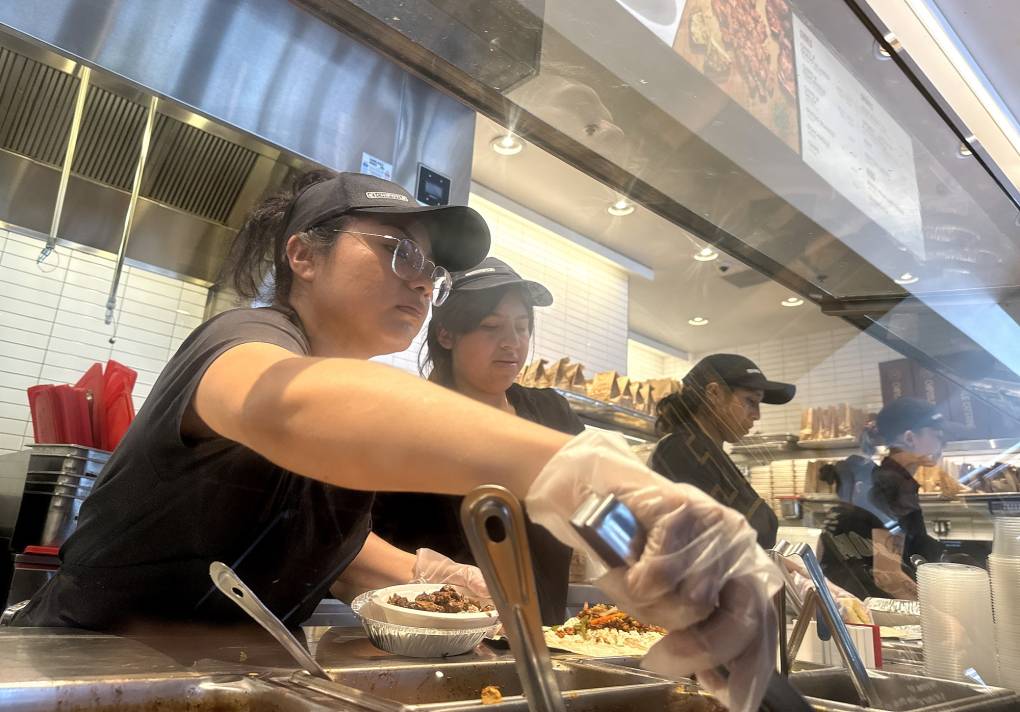
"caption": "Workers fill food orders at a Chipotle restaurant on April 1, 2024, in San Rafael, California. The state's new minimum wage law calls for fast food restaurants with at least 60 locations nationwide to pay employees a minimum of $20 per hour at California stores. On Tuesday, Gov. Gavin Newsom highlighted federal data that shows the industry grew to a record 750,500 jobs in July. Yet, economists say it's still too soon to fully assess the impact of the wage hike from $16 per hour. ",
"credit": "Justin Sullivan/Getty Images",
"altTag": null,
"description": null,
"imgSizes": {
"medium": {
"file": "https://cdn.kqed.org/wp-content/uploads/sites/10/2024/08/FastFoodWorkersGetty1-800x559.jpg",
"width": 800,
"height": 559,
"mimeType": "image/jpeg"
},
"large": {
"file": "https://cdn.kqed.org/wp-content/uploads/sites/10/2024/08/FastFoodWorkersGetty1-1020x712.jpg",
"width": 1020,
"height": 712,
"mimeType": "image/jpeg"
},
"thumbnail": {
"file": "https://cdn.kqed.org/wp-content/uploads/sites/10/2024/08/FastFoodWorkersGetty1-160x112.jpg",
"width": 160,
"height": 112,
"mimeType": "image/jpeg"
},
"1536x1536": {
"file": "https://cdn.kqed.org/wp-content/uploads/sites/10/2024/08/FastFoodWorkersGetty1-1536x1073.jpg",
"width": 1536,
"height": 1073,
"mimeType": "image/jpeg"
},
"post-thumbnail": {
"file": "https://cdn.kqed.org/wp-content/uploads/sites/10/2024/08/FastFoodWorkersGetty1-672x372.jpg",
"width": 672,
"height": 372,
"mimeType": "image/jpeg"
},
"twentyfourteen-full-width": {
"file": "https://cdn.kqed.org/wp-content/uploads/sites/10/2024/08/FastFoodWorkersGetty1-1038x576.jpg",
"width": 1038,
"height": 576,
"mimeType": "image/jpeg"
},
"full-width": {
"file": "https://cdn.kqed.org/wp-content/uploads/sites/10/2024/08/FastFoodWorkersGetty1-1920x1341.jpg",
"width": 1920,
"height": 1341,
"mimeType": "image/jpeg"
},
"kqedFullSize": {
"file": "https://cdn.kqed.org/wp-content/uploads/sites/10/2024/08/FastFoodWorkersGetty1.jpg",
"width": 2000,
"height": 1397
}
},
"isLoading": false,
"fetchFailed": false
},
"news_12000262": {
"type": "attachments",
"id": "news_12000262",
"meta": {
"index": "attachments_1716263798",
"site": "news",
"id": "12000262",
"found": true
},
"title": "Owners Of The Hilton San Francisco And The Parc 55 Hotel To Default On Their Payments",
"publishDate": 1723675934,
"status": "inherit",
"parent": 12000247,
"modified": 1723677094,
"caption": "The Hilton San Francisco Union Square stands in front of the Parc 55 by Hilton Hotel on June 6, 2023, in San Francisco, California. On Wednesday, San José workers at five hotels voted to authorize their union’s bargaining team to call a work stoppage, joining colleagues in San Francisco and other cities in approving potential strikes.",
"credit": "Justin Sullivan/Getty Images",
"altTag": null,
"description": null,
"imgSizes": {
"medium": {
"file": "https://cdn.kqed.org/wp-content/uploads/sites/10/2024/08/HiltonSF-800x522.jpg",
"width": 800,
"height": 522,
"mimeType": "image/jpeg"
},
"large": {
"file": "https://cdn.kqed.org/wp-content/uploads/sites/10/2024/08/HiltonSF-1020x665.jpg",
"width": 1020,
"height": 665,
"mimeType": "image/jpeg"
},
"thumbnail": {
"file": "https://cdn.kqed.org/wp-content/uploads/sites/10/2024/08/HiltonSF-160x104.jpg",
"width": 160,
"height": 104,
"mimeType": "image/jpeg"
},
"1536x1536": {
"file": "https://cdn.kqed.org/wp-content/uploads/sites/10/2024/08/HiltonSF-1536x1001.jpg",
"width": 1536,
"height": 1001,
"mimeType": "image/jpeg"
},
"post-thumbnail": {
"file": "https://cdn.kqed.org/wp-content/uploads/sites/10/2024/08/HiltonSF-672x372.jpg",
"width": 672,
"height": 372,
"mimeType": "image/jpeg"
},
"twentyfourteen-full-width": {
"file": "https://cdn.kqed.org/wp-content/uploads/sites/10/2024/08/HiltonSF-1038x576.jpg",
"width": 1038,
"height": 576,
"mimeType": "image/jpeg"
},
"full-width": {
"file": "https://cdn.kqed.org/wp-content/uploads/sites/10/2024/08/HiltonSF-1920x1252.jpg",
"width": 1920,
"height": 1252,
"mimeType": "image/jpeg"
},
"kqedFullSize": {
"file": "https://cdn.kqed.org/wp-content/uploads/sites/10/2024/08/HiltonSF.jpg",
"width": 2000,
"height": 1304
}
},
"isLoading": false,
"fetchFailed": false
},
"news_11999965": {
"type": "attachments",
"id": "news_11999965",
"meta": {
"index": "attachments_1716263798",
"site": "news",
"id": "11999965",
"found": true
},
"title": "National Audubon Society Strike",
"publishDate": 1723568253,
"status": "inherit",
"parent": 11999964,
"modified": 1723592017,
"caption": "Workers and supporters with the Bird Union-CW-1180 pose for a photo in front of the Audubon Oakland office after a practice picket on Saturday, Aug. 10, 2024.",
"credit": "Lakshmi Sarah/KQED",
"altTag": null,
"description": null,
"imgSizes": {
"medium": {
"file": "https://cdn.kqed.org/wp-content/uploads/sites/10/2024/08/National-Audubon-Society-Strike-800x600.jpg",
"width": 800,
"height": 600,
"mimeType": "image/jpeg"
},
"large": {
"file": "https://cdn.kqed.org/wp-content/uploads/sites/10/2024/08/National-Audubon-Society-Strike-1020x765.jpg",
"width": 1020,
"height": 765,
"mimeType": "image/jpeg"
},
"thumbnail": {
"file": "https://cdn.kqed.org/wp-content/uploads/sites/10/2024/08/National-Audubon-Society-Strike-160x120.jpg",
"width": 160,
"height": 120,
"mimeType": "image/jpeg"
},
"1536x1536": {
"file": "https://cdn.kqed.org/wp-content/uploads/sites/10/2024/08/National-Audubon-Society-Strike-1536x1152.jpg",
"width": 1536,
"height": 1152,
"mimeType": "image/jpeg"
},
"post-thumbnail": {
"file": "https://cdn.kqed.org/wp-content/uploads/sites/10/2024/08/National-Audubon-Society-Strike-672x372.jpg",
"width": 672,
"height": 372,
"mimeType": "image/jpeg"
},
"twentyfourteen-full-width": {
"file": "https://cdn.kqed.org/wp-content/uploads/sites/10/2024/08/National-Audubon-Society-Strike-1038x576.jpg",
"width": 1038,
"height": 576,
"mimeType": "image/jpeg"
},
"full-width": {
"file": "https://cdn.kqed.org/wp-content/uploads/sites/10/2024/08/National-Audubon-Society-Strike-1920x1440.jpg",
"width": 1920,
"height": 1440,
"mimeType": "image/jpeg"
},
"kqedFullSize": {
"file": "https://cdn.kqed.org/wp-content/uploads/sites/10/2024/08/National-Audubon-Society-Strike.jpg",
"width": 2000,
"height": 1500
}
},
"isLoading": false,
"fetchFailed": false
},
"news_11990912": {
"type": "attachments",
"id": "news_11990912",
"meta": {
"index": "attachments_1716263798",
"site": "news",
"id": "11990912",
"found": true
},
"title": "Grand Opening Of Amazon Fulfillment Center Features State Of The Art Technology",
"publishDate": 1718735000,
"status": "inherit",
"parent": 11990881,
"modified": 1718741486,
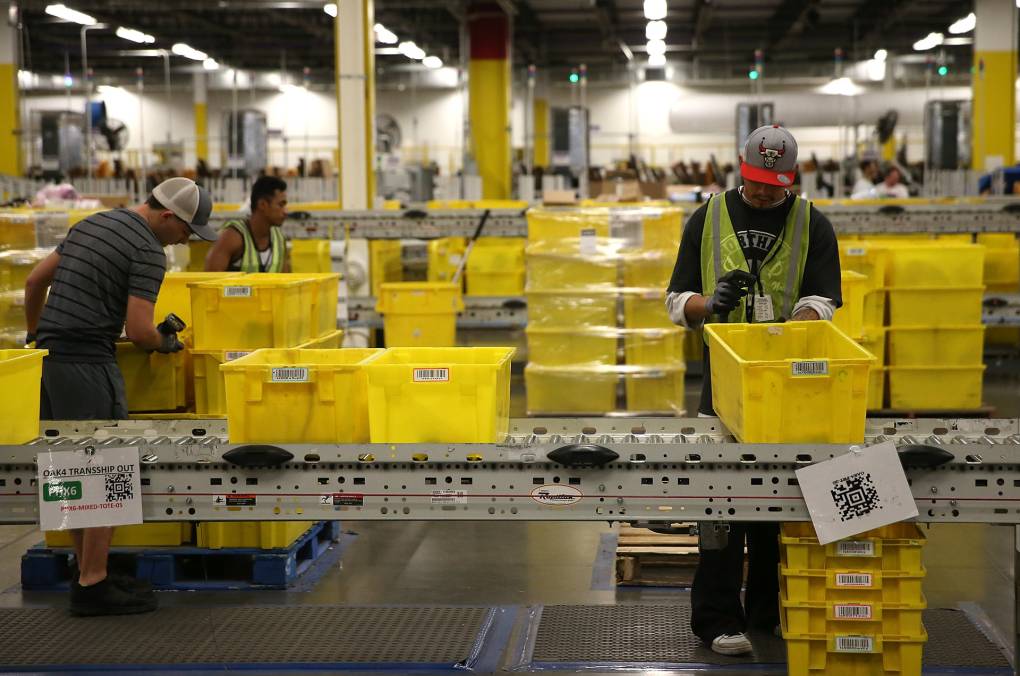
"caption": "Amazon.com workers pack orders at an Amazon fulfillment center on Jan. 20, 2015 in Tracy, California.",
"credit": "Justin Sullivan/Getty Images",
"altTag": null,
"description": null,
"imgSizes": {
"medium": {
"file": "https://cdn.kqed.org/wp-content/uploads/sites/10/2024/06/GettyImages-461843616_qut-800x530.jpg",
"width": 800,
"height": 530,
"mimeType": "image/jpeg"
},
"large": {
"file": "https://cdn.kqed.org/wp-content/uploads/sites/10/2024/06/GettyImages-461843616_qut-1020x676.jpg",
"width": 1020,
"height": 676,
"mimeType": "image/jpeg"
},
"thumbnail": {
"file": "https://cdn.kqed.org/wp-content/uploads/sites/10/2024/06/GettyImages-461843616_qut-160x106.jpg",
"width": 160,
"height": 106,
"mimeType": "image/jpeg"
},
"1536x1536": {
"file": "https://cdn.kqed.org/wp-content/uploads/sites/10/2024/06/GettyImages-461843616_qut-1536x1018.jpg",
"width": 1536,
"height": 1018,
"mimeType": "image/jpeg"
},
"post-thumbnail": {
"file": "https://cdn.kqed.org/wp-content/uploads/sites/10/2024/06/GettyImages-461843616_qut-672x372.jpg",
"width": 672,
"height": 372,
"mimeType": "image/jpeg"
},
"twentyfourteen-full-width": {
"file": "https://cdn.kqed.org/wp-content/uploads/sites/10/2024/06/GettyImages-461843616_qut-1038x576.jpg",
"width": 1038,
"height": 576,
"mimeType": "image/jpeg"
},
"kqedFullSize": {
"file": "https://cdn.kqed.org/wp-content/uploads/sites/10/2024/06/GettyImages-461843616_qut.jpg",
"width": 1920,
"height": 1272
}
},
"isLoading": false,
"fetchFailed": false
},
"news_11989996": {
"type": "attachments",
"id": "news_11989996",
"meta": {
"index": "attachments_1716263798",
"site": "news",
"id": "11989996",
"found": true
},
"title": "TacoBellWalkOutSanJose01",
"publishDate": 1718225619,
"status": "inherit",
"parent": 11989975,
"modified": 1718225694,
"caption": "Taco Bell and KFC workers in San José walked off the job on Wednesday, June 12, 2024, protesting unsafe working conditions and cuts to their hours.",
"credit": "Courtesy the California Fast Food Workers Union",
"altTag": "Fast food workers from KFC and Taco Bell march behind a huge red and yellow banner that reads, \"San Joe fast food workers.\" Some demonstrators hold flags and signs.",
"description": null,
"imgSizes": {
"medium": {
"file": "https://cdn.kqed.org/wp-content/uploads/sites/10/2024/06/TacoBellWalkOutSanJose01-800x600.jpg",
"width": 800,
"height": 600,
"mimeType": "image/jpeg"
},
"large": {
"file": "https://cdn.kqed.org/wp-content/uploads/sites/10/2024/06/TacoBellWalkOutSanJose01-1020x765.jpg",
"width": 1020,
"height": 765,
"mimeType": "image/jpeg"
},
"thumbnail": {
"file": "https://cdn.kqed.org/wp-content/uploads/sites/10/2024/06/TacoBellWalkOutSanJose01-160x120.jpg",
"width": 160,
"height": 120,
"mimeType": "image/jpeg"
},
"1536x1536": {
"file": "https://cdn.kqed.org/wp-content/uploads/sites/10/2024/06/TacoBellWalkOutSanJose01-1536x1152.jpg",
"width": 1536,
"height": 1152,
"mimeType": "image/jpeg"
},
"post-thumbnail": {
"file": "https://cdn.kqed.org/wp-content/uploads/sites/10/2024/06/TacoBellWalkOutSanJose01-672x372.jpg",
"width": 672,
"height": 372,
"mimeType": "image/jpeg"
},
"twentyfourteen-full-width": {
"file": "https://cdn.kqed.org/wp-content/uploads/sites/10/2024/06/TacoBellWalkOutSanJose01-1038x576.jpg",
"width": 1038,
"height": 576,
"mimeType": "image/jpeg"
},
"kqedFullSize": {
"file": "https://cdn.kqed.org/wp-content/uploads/sites/10/2024/06/TacoBellWalkOutSanJose01.jpg",
"width": 1920,
"height": 1440
}
},
"isLoading": false,
"fetchFailed": false
},
"news_11984826": {
"type": "attachments",
"id": "news_11984826",
"meta": {
"index": "attachments_1716263798",
"site": "news",
"id": "11984826",
"found": true
},
"parent": 11984819,
"imgSizes": {
"twentyfourteen-full-width": {
"file": "https://cdn.kqed.org/wp-content/uploads/sites/10/2024/05/CareWorkers_02-1038x576.jpg",
"width": 1038,
"mimeType": "image/jpeg",
"height": 576
},
"thumbnail": {
"file": "https://cdn.kqed.org/wp-content/uploads/sites/10/2024/05/CareWorkers_02-160x110.jpg",
"width": 160,
"mimeType": "image/jpeg",
"height": 110
},
"post-thumbnail": {
"file": "https://cdn.kqed.org/wp-content/uploads/sites/10/2024/05/CareWorkers_02-672x372.jpg",
"width": 672,
"mimeType": "image/jpeg",
"height": 372
},
"kqedFullSize": {
"file": "https://cdn.kqed.org/wp-content/uploads/sites/10/2024/05/CareWorkers_02-scaled.jpg",
"width": 2560,
"height": 1762
},
"2048x2048": {
"file": "https://cdn.kqed.org/wp-content/uploads/sites/10/2024/05/CareWorkers_02-2048x1409.jpg",
"width": 2048,
"mimeType": "image/jpeg",
"height": 1409
},
"large": {
"file": "https://cdn.kqed.org/wp-content/uploads/sites/10/2024/05/CareWorkers_02-1020x702.jpg",
"width": 1020,
"mimeType": "image/jpeg",
"height": 702
},
"1536x1536": {
"file": "https://cdn.kqed.org/wp-content/uploads/sites/10/2024/05/CareWorkers_02-1536x1057.jpg",
"width": 1536,
"mimeType": "image/jpeg",
"height": 1057
},
"full-width": {
"file": "https://cdn.kqed.org/wp-content/uploads/sites/10/2024/05/CareWorkers_02-1920x1321.jpg",
"width": 1920,
"mimeType": "image/jpeg",
"height": 1321
},
"medium": {
"file": "https://cdn.kqed.org/wp-content/uploads/sites/10/2024/05/CareWorkers_02-800x551.jpg",
"width": 800,
"mimeType": "image/jpeg",
"height": 551
}
},
"publishDate": 1714681633,
"modified": 1714681817,
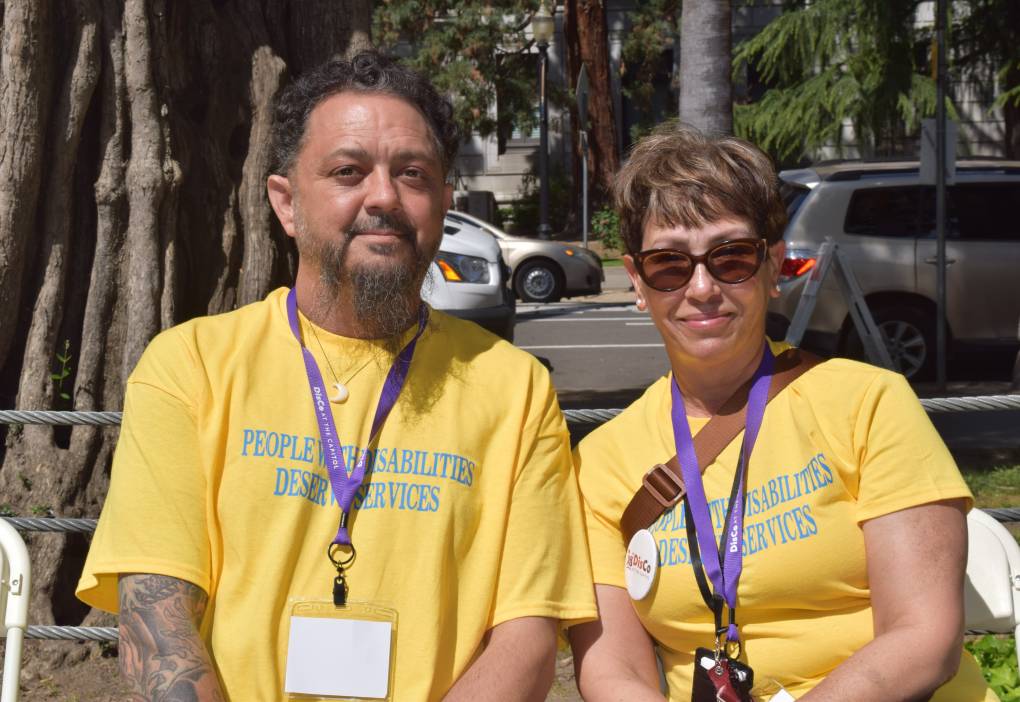
"caption": "Disability care workers Ricardo Zegri and Niurka Sureda-Jackson sit outside the California state Capitol on April 10. Zegri says Taco Bell would pay him more than the $19 an hour he makes as a disability care worker in a supervisory position. ",
"description": null,
"title": "CareWorkers_02",
"credit": "Vanessa G. Sánchez/KFF Health News",
"status": "inherit",
"altTag": "A man and woman wearing yellow shirts with purple lanyards sit next to each other outside.",
"isLoading": false,
"fetchFailed": false
},
"news_11974807": {
"type": "attachments",
"id": "news_11974807",
"meta": {
"index": "attachments_1716263798",
"site": "news",
"id": "11974807",
"found": true
},
"parent": 11974782,
"imgSizes": {
"twentyfourteen-full-width": {
"file": "https://cdn.kqed.org/wp-content/uploads/sites/10/2024/02/UCSF-Strike-1038x576.jpg",
"width": 1038,
"mimeType": "image/jpeg",
"height": 576
},
"thumbnail": {
"file": "https://cdn.kqed.org/wp-content/uploads/sites/10/2024/02/UCSF-Strike-160x107.jpg",
"width": 160,
"mimeType": "image/jpeg",
"height": 107
},
"post-thumbnail": {
"file": "https://cdn.kqed.org/wp-content/uploads/sites/10/2024/02/UCSF-Strike-672x372.jpg",
"width": 672,
"mimeType": "image/jpeg",
"height": 372
},
"kqedFullSize": {
"file": "https://cdn.kqed.org/wp-content/uploads/sites/10/2024/02/UCSF-Strike.jpg",
"width": 1920,
"height": 1280
},
"large": {
"file": "https://cdn.kqed.org/wp-content/uploads/sites/10/2024/02/UCSF-Strike-1020x680.jpg",
"width": 1020,
"mimeType": "image/jpeg",
"height": 680
},
"1536x1536": {
"file": "https://cdn.kqed.org/wp-content/uploads/sites/10/2024/02/UCSF-Strike-1536x1024.jpg",
"width": 1536,
"mimeType": "image/jpeg",
"height": 1024
},
"medium": {
"file": "https://cdn.kqed.org/wp-content/uploads/sites/10/2024/02/UCSF-Strike-800x533.jpg",
"width": 800,
"mimeType": "image/jpeg",
"height": 533
}
},
"publishDate": 1707239255,
"modified": 1707243826,
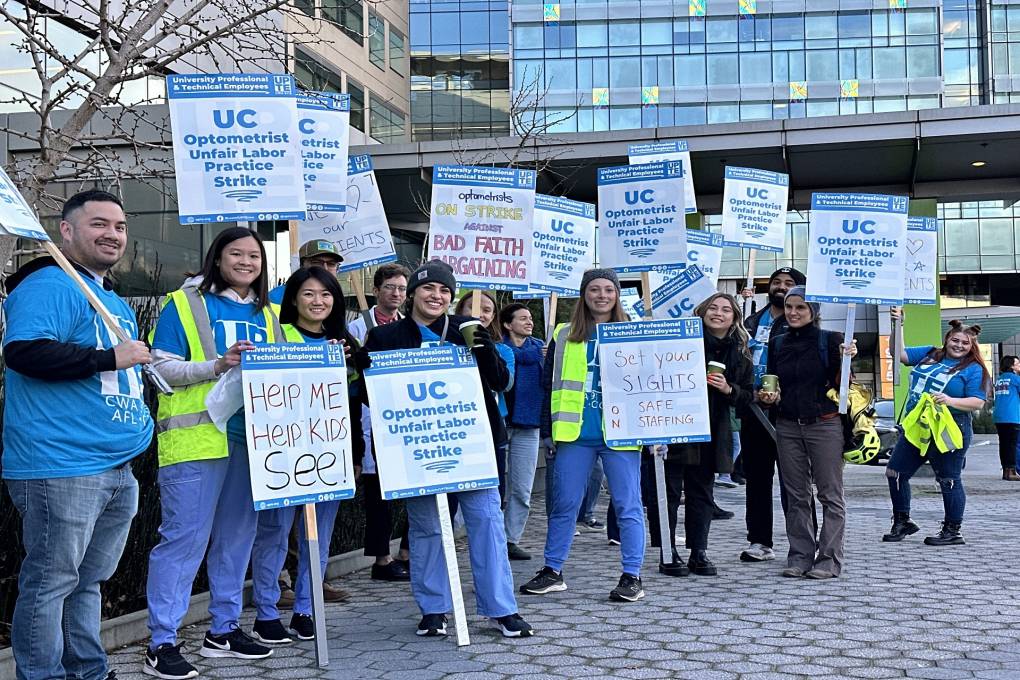
"caption": "UCSF optometrists, who see about 12 to 14 patients daily and are striking for two days, manage a variety of ocular diseases and eye infections in patients often referred to the hospital from as far away as Eureka, Modesto and Stockton.",
"description": null,
"title": "UCSF Strike",
"credit": "Courtesy of University Professional and Technical Employees, Communication Workers of America Local 9119",
"status": "inherit",
"altTag": "UC optometrists are seen holding signs as they strike for better wages and working conditions.",
"isLoading": false,
"fetchFailed": false
},
"news_11926221": {
"type": "attachments",
"id": "news_11926221",
"meta": {
"index": "attachments_1716263798",
"site": "news",
"id": "11926221",
"found": true
},
"parent": 11926218,
"imgSizes": {
"twentyfourteen-full-width": {
"file": "https://ww2.kqed.org/app/uploads/sites/10/2022/09/RS58737_IMG_1418-qut-1038x576.jpg",
"width": 1038,
"mimeType": "image/jpeg",
"height": 576
},
"thumbnail": {
"file": "https://ww2.kqed.org/app/uploads/sites/10/2022/09/RS58737_IMG_1418-qut-160x114.jpg",
"width": 160,
"mimeType": "image/jpeg",
"height": 114
},
"post-thumbnail": {
"file": "https://ww2.kqed.org/app/uploads/sites/10/2022/09/RS58737_IMG_1418-qut-672x372.jpg",
"width": 672,
"mimeType": "image/jpeg",
"height": 372
},
"kqedFullSize": {
"file": "https://ww2.kqed.org/app/uploads/sites/10/2022/09/RS58737_IMG_1418-qut.jpg",
"width": 1920,
"height": 1371
},
"large": {
"file": "https://ww2.kqed.org/app/uploads/sites/10/2022/09/RS58737_IMG_1418-qut-1020x728.jpg",
"width": 1020,
"mimeType": "image/jpeg",
"height": 728
},
"1536x1536": {
"file": "https://ww2.kqed.org/app/uploads/sites/10/2022/09/RS58737_IMG_1418-qut-1536x1097.jpg",
"width": 1536,
"mimeType": "image/jpeg",
"height": 1097
},
"medium": {
"file": "https://ww2.kqed.org/app/uploads/sites/10/2022/09/RS58737_IMG_1418-qut-800x571.jpg",
"width": 800,
"mimeType": "image/jpeg",
"height": 571
}
},
"publishDate": 1663626783,
"modified": 1663635030,
"caption": "Staff at Compass Family Services (from left, Melani Gomez, Alex Arauz, Jamie Lang and daughter Rosie Talton, Juliana Dunn, and Amy Huntley) pose for a portrait outside the organization in San Francisco on Sept. 18, 2022.",
"description": null,
"title": "RS58737_IMG_1418-qut",
"credit": "Beth LaBerge/KQED",
"status": "inherit",
"altTag": "Five adults with four wearing blue shirts and one in a red shirt, stand outside with their right fists raised. The person in the middle is holding a child.",
"isLoading": false,
"fetchFailed": false
},
"news_11918458": {
"type": "attachments",
"id": "news_11918458",
"meta": {
"index": "attachments_1716263798",
"site": "news",
"id": "11918458",
"found": true
},
"parent": 11918450,
"imgSizes": {
"twentyfourteen-full-width": {
"file": "https://ww2.kqed.org/app/uploads/sites/10/2022/06/RS20460_GettyImages-583816238-qut-1038x576.jpg",
"width": 1038,
"mimeType": "image/jpeg",
"height": 576
},
"thumbnail": {
"file": "https://ww2.kqed.org/app/uploads/sites/10/2022/06/RS20460_GettyImages-583816238-qut-160x107.jpg",
"width": 160,
"mimeType": "image/jpeg",
"height": 107
},
"post-thumbnail": {
"file": "https://ww2.kqed.org/app/uploads/sites/10/2022/06/RS20460_GettyImages-583816238-qut-672x372.jpg",
"width": 672,
"mimeType": "image/jpeg",
"height": 372
},
"kqedFullSize": {
"file": "https://ww2.kqed.org/app/uploads/sites/10/2022/06/RS20460_GettyImages-583816238-qut.jpg",
"width": 1920,
"height": 1283
},
"large": {
"file": "https://ww2.kqed.org/app/uploads/sites/10/2022/06/RS20460_GettyImages-583816238-qut-1020x682.jpg",
"width": 1020,
"mimeType": "image/jpeg",
"height": 682
},
"1536x1536": {
"file": "https://ww2.kqed.org/app/uploads/sites/10/2022/06/RS20460_GettyImages-583816238-qut-1536x1026.jpg",
"width": 1536,
"mimeType": "image/jpeg",
"height": 1026
},
"medium": {
"file": "https://ww2.kqed.org/app/uploads/sites/10/2022/06/RS20460_GettyImages-583816238-qut-800x535.jpg",
"width": 800,
"mimeType": "image/jpeg",
"height": 535
}
},
"publishDate": 1656548139,
"modified": 1656619581,
"caption": "Gov. Gavin Newsom speaks during Day Three of the Democratic National Convention at the Wells Fargo Center in Philadelphia, Pennsylvania, July 27, 2016.",
"description": null,
"title": "RS20460_GettyImages-583816238-qut",
"credit": "Nicholas Kamm/AFP/Getty Images",
"status": "inherit",
"altTag": "A man in a business suit stands at a podium with his left hand raised.",
"isLoading": false,
"fetchFailed": false
},
"news_11911125": {
"type": "attachments",
"id": "news_11911125",
"meta": {
"index": "attachments_1716263798",
"site": "news",
"id": "11911125",
"found": true
},
"parent": 11911064,
"imgSizes": {
"twentyfourteen-full-width": {
"file": "https://ww2.kqed.org/app/uploads/sites/10/2022/04/GettyImages-1301233143-1038x576.jpg",
"width": 1038,
"mimeType": "image/jpeg",
"height": 576
},
"thumbnail": {
"file": "https://ww2.kqed.org/app/uploads/sites/10/2022/04/GettyImages-1301233143-160x107.jpg",
"width": 160,
"mimeType": "image/jpeg",
"height": 107
},
"post-thumbnail": {
"file": "https://ww2.kqed.org/app/uploads/sites/10/2022/04/GettyImages-1301233143-672x372.jpg",
"width": 672,
"mimeType": "image/jpeg",
"height": 372
},
"kqedFullSize": {
"file": "https://ww2.kqed.org/app/uploads/sites/10/2022/04/GettyImages-1301233143.jpg",
"width": 2120,
"height": 1414
},
"2048x2048": {
"file": "https://ww2.kqed.org/app/uploads/sites/10/2022/04/GettyImages-1301233143-2048x1366.jpg",
"width": 2048,
"mimeType": "image/jpeg",
"height": 1366
},
"large": {
"file": "https://ww2.kqed.org/app/uploads/sites/10/2022/04/GettyImages-1301233143-1020x680.jpg",
"width": 1020,
"mimeType": "image/jpeg",
"height": 680
},
"1536x1536": {
"file": "https://ww2.kqed.org/app/uploads/sites/10/2022/04/GettyImages-1301233143-1536x1024.jpg",
"width": 1536,
"mimeType": "image/jpeg",
"height": 1024
},
"full-width": {
"file": "https://ww2.kqed.org/app/uploads/sites/10/2022/04/GettyImages-1301233143-1920x1281.jpg",
"width": 1920,
"mimeType": "image/jpeg",
"height": 1281
},
"medium": {
"file": "https://ww2.kqed.org/app/uploads/sites/10/2022/04/GettyImages-1301233143-800x534.jpg",
"width": 800,
"mimeType": "image/jpeg",
"height": 534
}
},
"publishDate": 1649963932,
"modified": 1649971421,
"caption": null,
"description": null,
"title": "Woman using laptop to check time table working",
"credit": "Getty Images",
"status": "inherit",
"altTag": "A person's hand is on a laptop keyboard that displays a calendar on a desk.",
"isLoading": false,
"fetchFailed": false
},
"news_11835783": {
"type": "attachments",
"id": "news_11835783",
"meta": {
"index": "attachments_1716263798",
"site": "news",
"id": "11835783",
"found": true
},
"parent": 0,
"imgSizes": {
"apple_news_ca_landscape_5_5": {
"file": "https://ww2.kqed.org/app/uploads/sites/10/2020/08/RS44638_016_KQED_Oakland_AleydaRebelo_08262020-qut-1044x783.jpg",
"width": 1044,
"mimeType": "image/jpeg",
"height": 783
},
"apple_news_ca_square_4_0": {
"file": "https://ww2.kqed.org/app/uploads/sites/10/2020/08/RS44638_016_KQED_Oakland_AleydaRebelo_08262020-qut-470x470.jpg",
"width": 470,
"mimeType": "image/jpeg",
"height": 470
},
"twentyfourteen-full-width": {
"file": "https://ww2.kqed.org/app/uploads/sites/10/2020/08/RS44638_016_KQED_Oakland_AleydaRebelo_08262020-qut-1038x576.jpg",
"width": 1038,
"mimeType": "image/jpeg",
"height": 576
},
"thumbnail": {
"file": "https://ww2.kqed.org/app/uploads/sites/10/2020/08/RS44638_016_KQED_Oakland_AleydaRebelo_08262020-qut-160x107.jpg",
"width": 160,
"mimeType": "image/jpeg",
"height": 107
},
"post-thumbnail": {
"file": "https://ww2.kqed.org/app/uploads/sites/10/2020/08/RS44638_016_KQED_Oakland_AleydaRebelo_08262020-qut-672x372.jpg",
"width": 672,
"mimeType": "image/jpeg",
"height": 372
},
"kqedFullSize": {
"file": "https://ww2.kqed.org/app/uploads/sites/10/2020/08/RS44638_016_KQED_Oakland_AleydaRebelo_08262020-qut.jpg",
"width": 1920,
"height": 1280
},
"apple_news_ca_landscape_4_7": {
"file": "https://ww2.kqed.org/app/uploads/sites/10/2020/08/RS44638_016_KQED_Oakland_AleydaRebelo_08262020-qut-632x474.jpg",
"width": 632,
"mimeType": "image/jpeg",
"height": 474
},
"large": {
"file": "https://ww2.kqed.org/app/uploads/sites/10/2020/08/RS44638_016_KQED_Oakland_AleydaRebelo_08262020-qut-1020x680.jpg",
"width": 1020,
"mimeType": "image/jpeg",
"height": 680
},
"apple_news_ca_landscape_4_0": {
"file": "https://ww2.kqed.org/app/uploads/sites/10/2020/08/RS44638_016_KQED_Oakland_AleydaRebelo_08262020-qut-536x402.jpg",
"width": 536,
"mimeType": "image/jpeg",
"height": 402
},
"apple_news_ca_portrait_12_9": {
"file": "https://ww2.kqed.org/app/uploads/sites/10/2020/08/RS44638_016_KQED_Oakland_AleydaRebelo_08262020-qut-1122x1280.jpg",
"width": 1122,
"mimeType": "image/jpeg",
"height": 1280
},
"medium": {
"file": "https://ww2.kqed.org/app/uploads/sites/10/2020/08/RS44638_016_KQED_Oakland_AleydaRebelo_08262020-qut-800x533.jpg",
"width": 800,
"mimeType": "image/jpeg",
"height": 533
},
"apple_news_ca_portrait_4_0": {
"file": "https://ww2.kqed.org/app/uploads/sites/10/2020/08/RS44638_016_KQED_Oakland_AleydaRebelo_08262020-qut-354x472.jpg",
"width": 354,
"mimeType": "image/jpeg",
"height": 472
},
"apple_news_ca_portrait_9_7": {
"file": "https://ww2.kqed.org/app/uploads/sites/10/2020/08/RS44638_016_KQED_Oakland_AleydaRebelo_08262020-qut-840x1120.jpg",
"width": 840,
"mimeType": "image/jpeg",
"height": 1120
},
"apple_news_ca_landscape_12_9": {
"file": "https://ww2.kqed.org/app/uploads/sites/10/2020/08/RS44638_016_KQED_Oakland_AleydaRebelo_08262020-qut-1832x1280.jpg",
"width": 1832,
"mimeType": "image/jpeg",
"height": 1280
},
"apple_news_ca_square_9_7": {
"file": "https://ww2.kqed.org/app/uploads/sites/10/2020/08/RS44638_016_KQED_Oakland_AleydaRebelo_08262020-qut-1104x1104.jpg",
"width": 1104,
"mimeType": "image/jpeg",
"height": 1104
},
"1536x1536": {
"file": "https://ww2.kqed.org/app/uploads/sites/10/2020/08/RS44638_016_KQED_Oakland_AleydaRebelo_08262020-qut-1536x1024.jpg",
"width": 1536,
"mimeType": "image/jpeg",
"height": 1024
},
"apple_news_ca_portrait_4_7": {
"file": "https://ww2.kqed.org/app/uploads/sites/10/2020/08/RS44638_016_KQED_Oakland_AleydaRebelo_08262020-qut-414x552.jpg",
"width": 414,
"mimeType": "image/jpeg",
"height": 552
},
"apple_news_ca_square_12_9": {
"file": "https://ww2.kqed.org/app/uploads/sites/10/2020/08/RS44638_016_KQED_Oakland_AleydaRebelo_08262020-qut-1472x1280.jpg",
"width": 1472,
"mimeType": "image/jpeg",
"height": 1280
},
"apple_news_ca_portrait_5_5": {
"file": "https://ww2.kqed.org/app/uploads/sites/10/2020/08/RS44638_016_KQED_Oakland_AleydaRebelo_08262020-qut-687x916.jpg",
"width": 687,
"mimeType": "image/jpeg",
"height": 916
},
"apple_news_ca_square_4_7": {
"file": "https://ww2.kqed.org/app/uploads/sites/10/2020/08/RS44638_016_KQED_Oakland_AleydaRebelo_08262020-qut-550x550.jpg",
"width": 550,
"mimeType": "image/jpeg",
"height": 550
},
"apple_news_ca_landscape_9_7": {
"file": "https://ww2.kqed.org/app/uploads/sites/10/2020/08/RS44638_016_KQED_Oakland_AleydaRebelo_08262020-qut-1376x1032.jpg",
"width": 1376,
"mimeType": "image/jpeg",
"height": 1032
},
"apple_news_ca_square_5_5": {
"file": "https://ww2.kqed.org/app/uploads/sites/10/2020/08/RS44638_016_KQED_Oakland_AleydaRebelo_08262020-qut-912x912.jpg",
"width": 912,
"mimeType": "image/jpeg",
"height": 912
}
},
"publishDate": 1598640347,
"modified": 1598642026,
"caption": "Aleyda Rebelo (second from left) with her family at their home in Oakland on Aug. 26, 2020.",
"description": null,
"title": "evictionmoratorium",
"credit": "Beth LaBerge/KQED",
"status": "inherit",
"isLoading": false,
"fetchFailed": false
}
},
"audioPlayerReducer": {
"postId": "stream_live",
"isPaused": true,
"isPlaying": false,
"pfsActive": false,
"pledgeModalIsOpen": true,
"playerDrawerIsOpen": false,
"liveAudioPlayStartedAt": 0,
"liveAudioPlayContext": ""
},
"authorsReducer": {
"byline_news_11984819": {
"type": "authors",
"id": "byline_news_11984819",
"meta": {
"override": true
},
"slug": "byline_news_11984819",
"name": "Vanessa G. Sánchez, KFF Health News",
"isLoading": false
},
"fjhabvala": {
"type": "authors",
"id": "8659",
"meta": {
"index": "authors_1716337520",
"id": "8659",
"found": true
},
"name": "Farida Jhabvala Romero",
"firstName": "Farida",
"lastName": "Jhabvala Romero",
"slug": "fjhabvala",
"email": "fjhabvala@kqed.org",
"display_author_email": true,
"staff_mastheads": [
"news"
],
"title": "KQED Contributor",
"bio": "Farida Jhabvala Romero is a Labor Correspondent for KQED. She previously covered immigration. Farida was \u003ca href=\"https://www.ccnma.org/2022-most-influential-latina-journalists\">named\u003c/a> one of the 10 Most Influential Latina Journalists in California in 2022 by the California Chicano News Media Association. Her work has won awards from the Society of Professional Journalists (Northern California), as well as a national and regional Edward M. Murrow Award for the collaborative reporting projects “Dangerous Air” and “Graying California.” Before joining KQED, Farida worked as a producer at Radio Bilingüe, a national public radio network. Farida earned her master’s degree in journalism from Stanford University.",
"avatar": "https://secure.gravatar.com/avatar/f9f022d4e2609741874222a1e9d41f48fea74011aa7c615eef91d9a50c944ebe?s=600&d=blank&r=g",
"twitter": "FaridaJhabvala",
"bluesky": null,
"facebook": null,
"instagram": null,
"linkedin": "https://www.linkedin.com/in/faridajhabvala/",
"sites": [
{
"site": "news",
"roles": [
"editor"
]
},
{
"site": "stateofhealth",
"roles": [
"author"
]
},
{
"site": "liveblog",
"roles": [
"author"
]
}
],
"headData": {
"title": "Farida Jhabvala Romero | KQED",
"description": "KQED Contributor",
"ogImgSrc": "https://secure.gravatar.com/avatar/f9f022d4e2609741874222a1e9d41f48fea74011aa7c615eef91d9a50c944ebe?s=600&d=blank&r=g",
"twImgSrc": "https://secure.gravatar.com/avatar/f9f022d4e2609741874222a1e9d41f48fea74011aa7c615eef91d9a50c944ebe?s=600&d=blank&r=g"
},
"isLoading": false,
"link": "/author/fjhabvala"
},
"lsarah": {
"type": "authors",
"id": "11626",
"meta": {
"index": "authors_1716337520",
"id": "11626",
"found": true
},
"name": "Lakshmi Sarah",
"firstName": "Lakshmi",
"lastName": "Sarah",
"slug": "lsarah",
"email": "lsarah@kqed.org",
"display_author_email": false,
"staff_mastheads": [],
"title": "Digital Producer",
"bio": "Lakshmi Sarah is an educator, author and journalist with a focus on innovative storytelling. She has worked with newspapers, radio and magazines from Ahmedabad, India to Los Angeles, California. She has written and produced for Die Zeit, Global Voices, AJ+, KQED, Fusion Media Group and the New York Times.",
"avatar": "https://secure.gravatar.com/avatar/652dcaecd8b28826fc17a8b2d6bb4e93?s=600&d=blank&r=g",
"twitter": "lakitalki",
"facebook": null,
"instagram": "https://www.instagram.com/laki.talki/",
"linkedin": "https://www.linkedin.com/in/lakisarah/",
"sites": [
{
"site": "arts",
"roles": []
},
{
"site": "news",
"roles": []
},
{
"site": "bayareabites",
"roles": []
},
{
"site": "science",
"roles": []
}
],
"headData": {
"title": "Lakshmi Sarah | KQED",
"description": "Digital Producer",
"ogImgSrc": "https://secure.gravatar.com/avatar/652dcaecd8b28826fc17a8b2d6bb4e93?s=600&d=blank&r=g",
"twImgSrc": "https://secure.gravatar.com/avatar/652dcaecd8b28826fc17a8b2d6bb4e93?s=600&d=blank&r=g"
},
"isLoading": false,
"link": "/author/lsarah"
},
"hmcdede": {
"type": "authors",
"id": "11635",
"meta": {
"index": "authors_1716337520",
"id": "11635",
"found": true
},
"name": "Holly McDede",
"firstName": "Holly",
"lastName": "McDede",
"slug": "hmcdede",
"email": "hmcdede@KQED.org",
"display_author_email": false,
"staff_mastheads": [],
"title": "KQED Contributor",
"bio": null,
"avatar": "https://secure.gravatar.com/avatar/999d9bf31bb3a2f0511932d99526cb3e?s=600&d=blank&r=g",
"twitter": null,
"facebook": null,
"instagram": null,
"linkedin": null,
"sites": [
{
"site": "arts",
"roles": [
"editor"
]
},
{
"site": "news",
"roles": [
"edit_others_posts",
"editor"
]
},
{
"site": "science",
"roles": [
"editor"
]
},
{
"site": "forum",
"roles": [
"editor"
]
},
{
"site": "perspectives",
"roles": [
"administrator"
]
}
],
"headData": {
"title": "Holly McDede | KQED",
"description": "KQED Contributor",
"ogImgSrc": "https://secure.gravatar.com/avatar/999d9bf31bb3a2f0511932d99526cb3e?s=600&d=blank&r=g",
"twImgSrc": "https://secure.gravatar.com/avatar/999d9bf31bb3a2f0511932d99526cb3e?s=600&d=blank&r=g"
},
"isLoading": false,
"link": "/author/hmcdede"
},
"swhitney": {
"type": "authors",
"id": "11784",
"meta": {
"index": "authors_1716337520",
"id": "11784",
"found": true
},
"name": "Spencer Whitney",
"firstName": "Spencer",
"lastName": "Whitney",
"slug": "swhitney",
"email": "swhitney@kqed.org",
"display_author_email": false,
"staff_mastheads": [],
"title": "KQED Digital Editor",
"bio": "Spencer Whitney is currently a Digital Editor for KQED News. Prior to joining KQED News, Spencer worked as the Multimedia Editor at the Oakland Post and an Assistant Editor in the Editorial department at the San Francisco Chronicle. He attended Howard University as an undergraduate and interned with SiriusXM. He also attended UC Berkeley's Graduate School of Journalism and had the opportunity to write for the hyperlocal news sites Richmond Confidential and Oakland North.",
"avatar": "https://secure.gravatar.com/avatar/e33ff4fd8b8f0d2796f36472fb32607ca8fc46ef5e537dcfdbdee688d8ea5b80?s=600&d=mm&r=g",
"twitter": null,
"bluesky": null,
"facebook": null,
"instagram": null,
"linkedin": null,
"sites": [
{
"site": "arts",
"roles": [
"editor"
]
},
{
"site": "news",
"roles": [
"editor"
]
},
{
"site": "science",
"roles": [
"editor"
]
},
{
"site": "perspectives",
"roles": [
"editor"
]
}
],
"headData": {
"title": "Spencer Whitney | KQED",
"description": "KQED Digital Editor",
"ogImgSrc": "https://secure.gravatar.com/avatar/e33ff4fd8b8f0d2796f36472fb32607ca8fc46ef5e537dcfdbdee688d8ea5b80?s=600&d=mm&r=g",
"twImgSrc": "https://secure.gravatar.com/avatar/e33ff4fd8b8f0d2796f36472fb32607ca8fc46ef5e537dcfdbdee688d8ea5b80?s=600&d=mm&r=g"
},
"isLoading": false,
"link": "/author/swhitney"
},
"kdebenedetti": {
"type": "authors",
"id": "11913",
"meta": {
"index": "authors_1716337520",
"id": "11913",
"found": true
},
"name": "Katie DeBenedetti",
"firstName": "Katie",
"lastName": "DeBenedetti",
"slug": "kdebenedetti",
"email": "kdebenedetti@kqed.org",
"display_author_email": false,
"staff_mastheads": [
"news",
"science"
],
"title": "KQED Contributor",
"bio": "Katie DeBenedetti is a digital reporter covering daily news for the Express Desk. Prior to joining KQED as a culture reporting intern in January 2024, she covered education and city government for the Napa Valley Register.",
"avatar": "https://secure.gravatar.com/avatar/6e31073cb8f7e4214ab03f42771d0f45?s=600&d=blank&r=g",
"twitter": null,
"facebook": null,
"instagram": null,
"linkedin": null,
"sites": [
{
"site": "news",
"roles": [
"author"
]
},
{
"site": "science",
"roles": [
"author"
]
},
{
"site": "liveblog",
"roles": [
"author"
]
}
],
"headData": {
"title": "Katie DeBenedetti | KQED",
"description": "KQED Contributor",
"ogImgSrc": "https://secure.gravatar.com/avatar/6e31073cb8f7e4214ab03f42771d0f45?s=600&d=blank&r=g",
"twImgSrc": "https://secure.gravatar.com/avatar/6e31073cb8f7e4214ab03f42771d0f45?s=600&d=blank&r=g"
},
"isLoading": false,
"link": "/author/kdebenedetti"
}
},
"pagesReducer": {
"news_tag_wages": {
"type": "terms",
"id": "news_3733",
"meta": {
"index": "terms_1716263798",
"site": "news",
"id": "3733",
"score": 9.555889
},
"featImg": null,
"name": "wages",
"description": null,
"taxonomy": "tag",
"headData": {
"twImgId": null,
"twTitle": null,
"ogTitle": null,
"ogImgId": null,
"twDescription": null,
"description": null,
"title": "wages Archives | KQED News",
"ogDescription": null
},
"ttid": 3751,
"slug": "wages",
"isLoading": false,
"title": "wages",
"pageMeta": {
"site": "news",
"WpPageTemplate": "page-topic-editorial",
"currentPage": 4
},
"blocks": [
{
"blockName": "kqed/post-list",
"attrs": {
"layout": "cardArticle2",
"query": "posts/news?tag=wages",
"seeMore": false,
"paginated": true,
"page": 4
}
},
{
"blockName": "kqed/ad"
}
]
}
},
"pfsSessionReducer": {},
"postsReducer": {
"stream_live": {
"type": "live",
"id": "stream_live",
"audioUrl": "https://streams.kqed.org/kqedradio",
"title": "Live Stream",
"excerpt": "Live Stream information currently unavailable.",
"link": "/radio",
"featImg": "",
"label": {
"name": "KQED Live",
"link": "/"
}
},
"stream_kqedNewscast": {
"type": "posts",
"id": "stream_kqedNewscast",
"audioUrl": "https://www.kqed.org/.stream/anon/radio/RDnews/newscast.mp3?_=1",
"title": "KQED Newscast",
"featImg": "",
"label": {
"name": "88.5 FM",
"link": "/"
}
},
"news_12002172": {
"type": "posts",
"id": "news_12002172",
"meta": {
"index": "posts_1716263798",
"site": "news",
"id": "12002172",
"score": null,
"sort": [
1725028249000
]
},
"guestAuthors": [],
"slug": "stanford-sparks-literary-backlash-by-phasing-out-creative-writing-lecturers-jobs",
"title": "Stanford Sparks Literary Backlash by Phasing Out Creative Writing Lecturers’ Jobs",
"publishDate": 1725028249,
"format": "standard",
"headTitle": "Stanford Sparks Literary Backlash by Phasing Out Creative Writing Lecturers’ Jobs | KQED",
"labelTerm": {
"site": "news"
},
"content": "\u003cp>Sarah Frisch starts each of her creative writing courses at \u003ca href=\"https://www.kqed.org/news/tag/stanford\">Stanford\u003c/a> University by letting her students know the classroom is a working community.\u003c/p>\n\u003cp>Stanford can be a difficult, high-pressure space, and Frisch said creative writing courses can be a respite.\u003c/p>\n\u003cp>“Students read this incredible literature, and they meet people they ordinarily just read about,” Frisch said. “But I think the part that’s really powerful is to see that writers are ordinary people. Writers write within friendships, and they get plugged into that community.”\u003c/p>\n\u003cp>Now, Frisch and other lecturers worry that the job security and lecturer longevity that make those relationships possible will disappear. During a video meeting last week, Frisch and her colleagues learned the Stanford Creative Writing Program’s nearly two dozen lecturers would lose their current positions over the next two years.\u003c/p>\n\u003cp>[ad fullwidth]\u003c/p>\n\u003cp>Instead, a faculty working group recommended the program’s lectureships consist of one-year appointments with the possibility of renewal for a limited period of up to five years.\u003c/p>\n\u003cp>Many of the current lecturers have taught at the university for more than a decade.\u003c/p>\n\u003cp>“I feel like our students were betrayed,” said Frisch, who has been a Stanford lecturer since 2009. “The whole program is going to be based on temporary labor, and that is a sea change from the program that we have. And that means that the program we have no longer exists.”\u003c/p>\n\u003ch2>Transitioning to short-term futures\u003c/h2>\n\u003cp>In a \u003ca href=\"https://creativewriting.stanford.edu/news/stanford-creative-writing-program\">statement\u003c/a> posted on the university’s website on Wednesday, the School of Humanities and Sciences and Creative Writing Program leadership defended the changes, arguing that the lectureship program, known as Jones lectureships, was originally intended for limited-term appointments.\u003c/p>\n\u003cp>[aside postID=news_11951849 hero='https://ww2.kqed.org/app/uploads/sites/10/2023/06/RS65953_003_KQED_StanfordGradUnion_05302023-qut-1020x680.jpg']\u003c/p>\n\u003cp>“We plan for there to be as many lecturers in the Program in five years as there are today, and we expect to offer more classes then than now,” the statement reads. “The university, school, and numerous generous donors are committed to not only the excellence of the program but also its growth.”\u003c/p>\n\u003cp>Colleagues credit the Creative Writing Program’s success and popularity to support for lecturers from the late Eavan Boland, a distinguished poet and former director of the program. Boland, who died in 2020, encouraged lecturers to develop their own ambitious classes and foster deep mentoring relationships with undergraduates.\u003c/p>\n\u003cp>“She empowered lecturers not only to have job longevity but to use that time to innovate in the classroom,” said Nina Schloesser Tárano, who has been teaching in the Creative Writing Program since 2012.\u003c/p>\n\u003cp>“This is being treated as a luxury — my ability to be there for the entirety of somebody’s career as an undergraduate. But it’s my job, and it should be,” Schloesser Tárano said.\u003c/p>\n\u003ch2>Students, alums and writers sound off\u003c/h2>\n\u003cp>The changes to Stanford’s Creative Writing Program quickly generated widespread outrage online. In a \u003ca href=\"https://medium.com/@tom.kealey/more-details-in-the-stanford-creative-writing-scandal-5a91193a4ab6\">Medium post\u003c/a>, lecturer Tom Kealey noted that the changes come a year after lecturers, who made around $52,000, asked for a pay increase.\u003c/p>\n\u003cp>\u003ca href=\"https://x.com/JoyceCarolOates/status/1828529858923606156\">Writer Joyce Carol Oates wrote on X\u003c/a>, “I am puzzled most by the lack of simple collegiality & generosity at one of the most wealthy universities in the world. Stanford’s endowment could support an entire nation.”\u003c/p>\n\u003cp>[aside postID=news_11989520 hero='https://cdn.kqed.org/wp-content/uploads/sites/10/2024/06/240605-STANFORD-JG-14-1-1020x680.jpg']\u003c/p>\n\u003cp>Kyle Wang, who graduated from Stanford in 2023 with a master’s in the modern thought and literature program, started a \u003ca href=\"https://docs.google.com/document/d/10PoTTX9UtWr9-fCm6Rk-JyBl2tmwpInAyaFEyTSp_B8/mobilebasic\">petition\u003c/a> calling on the university to change course and reinstate the lecturers whose contracts will be phased out.\u003c/p>\n\u003cp>Wang said the lecturers in the Creative Writing Program changed his life.\u003c/p>\n\u003cp>When Wang first came to Stanford, he was unsure what to study. He had grown up in Silicon Valley, “where everyone and their mother” worked in tech or tech-adjacent fields. He took computer science class after computer science class. Then, in January 2019, he took his first creative writing class.\u003c/p>\n\u003cp>“A couple of weeks later, I think I knew deep down that I was going to be studying English,” Wang said. “Every single class that I’ve taken with a Jones lecturer has, in some new way, shape, or form, not only pushed me as a writer and thinker — it showed me a different way of imagining that a life in writing and a life in the arts could be possible.”\u003c/p>\n\u003cp>He worries for future generations of students who may not be able to build those same life-changing relationships with lecturers and about the institutional knowledge that could be lost.\u003c/p>\n\u003cp>Sarah Frisch is not sure what’s next when her lectureship ends. Classes start again next month, and she said in the meantime, she will focus on her students.\u003c/p>\n\u003cp>“I just want them to know those of us who are in this crappy position see and hear them,” Frisch said. “We’re willing to fight for their experience and their futures.”\u003c/p>\n\u003cp>\u003c/p>\n",
"blocks": [],
"excerpt": "Stanford creative writing lecturers will lose their positions within the next two years as the program shifts to short-term appointments.",
"status": "publish",
"parent": 0,
"modified": 1725056237,
"stats": {
"hasAudio": false,
"hasVideo": false,
"hasChartOrMap": false,
"iframeSrcs": [],
"hasGoogleForm": false,
"hasGallery": false,
"hasHearkenModule": false,
"hasPolis": false,
"paragraphCount": 25,
"wordCount": 882
},
"headData": {
"title": "Stanford Sparks Literary Backlash by Phasing Out Creative Writing Lecturers’ Jobs | KQED",
"description": "Stanford creative writing lecturers will lose their positions within the next two years as the program shifts to short-term appointments.",
"ogTitle": "",
"ogDescription": "",
"ogImgId": "",
"twTitle": "",
"twDescription": "",
"twImgId": "",
"schema": {
"@context": "https://schema.org",
"@type": "NewsArticle",
"headline": "Stanford Sparks Literary Backlash by Phasing Out Creative Writing Lecturers’ Jobs",
"datePublished": "2024-08-30T07:30:49-07:00",
"dateModified": "2024-08-30T15:17:17-07:00",
"image": "https://cdn.kqed.org/wp-content/uploads/2020/02/KQED-OG-Image@1x.png",
"isAccessibleForFree": "True",
"publisher": {
"@type": "NewsMediaOrganization",
"@id": "https://www.kqed.org/#organization",
"name": "KQED",
"logo": "https://cdn.kqed.org/wp-content/uploads/2020/02/KQED-OG-Image@1x.png",
"url": "https://www.kqed.org",
"sameAs": [
"https://www.facebook.com/KQED",
"https://twitter.com/KQED",
"https://www.instagram.com/kqed/",
"https://www.tiktok.com/@kqedofficial",
"https://www.linkedin.com/company/kqed",
"https://www.youtube.com/channel/UCeC0IOo7i1P_61zVUWbJ4nw"
]
}
}
},
"sticky": false,
"nprStoryId": "kqed-12002172",
"excludeFromSiteSearch": "Include",
"articleAge": "0",
"path": "/news/12002172/stanford-sparks-literary-backlash-by-phasing-out-creative-writing-lecturers-jobs",
"audioTrackLength": null,
"parsedContent": [
{
"type": "contentString",
"content": "\u003cdiv class=\"post-body\">\u003cp>\u003cp>Sarah Frisch starts each of her creative writing courses at \u003ca href=\"https://www.kqed.org/news/tag/stanford\">Stanford\u003c/a> University by letting her students know the classroom is a working community.\u003c/p>\n\u003cp>Stanford can be a difficult, high-pressure space, and Frisch said creative writing courses can be a respite.\u003c/p>\n\u003cp>“Students read this incredible literature, and they meet people they ordinarily just read about,” Frisch said. “But I think the part that’s really powerful is to see that writers are ordinary people. Writers write within friendships, and they get plugged into that community.”\u003c/p>\n\u003cp>Now, Frisch and other lecturers worry that the job security and lecturer longevity that make those relationships possible will disappear. During a video meeting last week, Frisch and her colleagues learned the Stanford Creative Writing Program’s nearly two dozen lecturers would lose their current positions over the next two years.\u003c/p>\n\u003cp>\u003c/p>\u003c/div>",
"attributes": {
"named": {},
"numeric": []
}
},
{
"type": "component",
"content": "",
"name": "ad",
"attributes": {
"named": {
"label": "fullwidth"
},
"numeric": [
"fullwidth"
]
}
},
{
"type": "contentString",
"content": "\u003cdiv class=\"post-body\">\u003cp>\u003c/p>\n\u003cp>Instead, a faculty working group recommended the program’s lectureships consist of one-year appointments with the possibility of renewal for a limited period of up to five years.\u003c/p>\n\u003cp>Many of the current lecturers have taught at the university for more than a decade.\u003c/p>\n\u003cp>“I feel like our students were betrayed,” said Frisch, who has been a Stanford lecturer since 2009. “The whole program is going to be based on temporary labor, and that is a sea change from the program that we have. And that means that the program we have no longer exists.”\u003c/p>\n\u003ch2>Transitioning to short-term futures\u003c/h2>\n\u003cp>In a \u003ca href=\"https://creativewriting.stanford.edu/news/stanford-creative-writing-program\">statement\u003c/a> posted on the university’s website on Wednesday, the School of Humanities and Sciences and Creative Writing Program leadership defended the changes, arguing that the lectureship program, known as Jones lectureships, was originally intended for limited-term appointments.\u003c/p>\n\u003cp>\u003c/p>\u003c/div>",
"attributes": {
"named": {},
"numeric": []
}
},
{
"type": "component",
"content": "",
"name": "aside",
"attributes": {
"named": {
"postid": "news_11951849",
"hero": "https://ww2.kqed.org/app/uploads/sites/10/2023/06/RS65953_003_KQED_StanfordGradUnion_05302023-qut-1020x680.jpg",
"label": ""
},
"numeric": []
}
},
{
"type": "contentString",
"content": "\u003cdiv class=\"post-body\">\u003cp>\u003c/p>\n\u003cp>“We plan for there to be as many lecturers in the Program in five years as there are today, and we expect to offer more classes then than now,” the statement reads. “The university, school, and numerous generous donors are committed to not only the excellence of the program but also its growth.”\u003c/p>\n\u003cp>Colleagues credit the Creative Writing Program’s success and popularity to support for lecturers from the late Eavan Boland, a distinguished poet and former director of the program. Boland, who died in 2020, encouraged lecturers to develop their own ambitious classes and foster deep mentoring relationships with undergraduates.\u003c/p>\n\u003cp>“She empowered lecturers not only to have job longevity but to use that time to innovate in the classroom,” said Nina Schloesser Tárano, who has been teaching in the Creative Writing Program since 2012.\u003c/p>\n\u003cp>“This is being treated as a luxury — my ability to be there for the entirety of somebody’s career as an undergraduate. But it’s my job, and it should be,” Schloesser Tárano said.\u003c/p>\n\u003ch2>Students, alums and writers sound off\u003c/h2>\n\u003cp>The changes to Stanford’s Creative Writing Program quickly generated widespread outrage online. In a \u003ca href=\"https://medium.com/@tom.kealey/more-details-in-the-stanford-creative-writing-scandal-5a91193a4ab6\">Medium post\u003c/a>, lecturer Tom Kealey noted that the changes come a year after lecturers, who made around $52,000, asked for a pay increase.\u003c/p>\n\u003cp>\u003ca href=\"https://x.com/JoyceCarolOates/status/1828529858923606156\">Writer Joyce Carol Oates wrote on X\u003c/a>, “I am puzzled most by the lack of simple collegiality & generosity at one of the most wealthy universities in the world. Stanford’s endowment could support an entire nation.”\u003c/p>\n\u003cp>\u003c/p>\u003c/div>",
"attributes": {
"named": {},
"numeric": []
}
},
{
"type": "component",
"content": "",
"name": "aside",
"attributes": {
"named": {
"postid": "news_11989520",
"hero": "https://cdn.kqed.org/wp-content/uploads/sites/10/2024/06/240605-STANFORD-JG-14-1-1020x680.jpg",
"label": ""
},
"numeric": []
}
},
{
"type": "contentString",
"content": "\u003cdiv class=\"post-body\">\u003cp>\u003c/p>\n\u003cp>Kyle Wang, who graduated from Stanford in 2023 with a master’s in the modern thought and literature program, started a \u003ca href=\"https://docs.google.com/document/d/10PoTTX9UtWr9-fCm6Rk-JyBl2tmwpInAyaFEyTSp_B8/mobilebasic\">petition\u003c/a> calling on the university to change course and reinstate the lecturers whose contracts will be phased out.\u003c/p>\n\u003cp>Wang said the lecturers in the Creative Writing Program changed his life.\u003c/p>\n\u003cp>When Wang first came to Stanford, he was unsure what to study. He had grown up in Silicon Valley, “where everyone and their mother” worked in tech or tech-adjacent fields. He took computer science class after computer science class. Then, in January 2019, he took his first creative writing class.\u003c/p>\n\u003cp>“A couple of weeks later, I think I knew deep down that I was going to be studying English,” Wang said. “Every single class that I’ve taken with a Jones lecturer has, in some new way, shape, or form, not only pushed me as a writer and thinker — it showed me a different way of imagining that a life in writing and a life in the arts could be possible.”\u003c/p>\n\u003cp>He worries for future generations of students who may not be able to build those same life-changing relationships with lecturers and about the institutional knowledge that could be lost.\u003c/p>\n\u003cp>Sarah Frisch is not sure what’s next when her lectureship ends. Classes start again next month, and she said in the meantime, she will focus on her students.\u003c/p>\n\u003cp>“I just want them to know those of us who are in this crappy position see and hear them,” Frisch said. “We’re willing to fight for their experience and their futures.”\u003c/p>\n\u003cp>\u003c/p>\n\u003c/div>\u003c/p>",
"attributes": {
"named": {},
"numeric": []
}
}
],
"link": "/news/12002172/stanford-sparks-literary-backlash-by-phasing-out-creative-writing-lecturers-jobs",
"authors": [
"11635"
],
"categories": [
"news_31795",
"news_18540",
"news_8"
],
"tags": [
"news_18538",
"news_20013",
"news_19904",
"news_178",
"news_3733"
],
"featImg": "news_11915590",
"label": "news"
},
"news_12001133": {
"type": "posts",
"id": "news_12001133",
"meta": {
"index": "posts_1716263798",
"site": "news",
"id": "12001133",
"score": null,
"sort": [
1724267463000
]
},
"guestAuthors": [],
"slug": "california-governor-touts-fast-food-job-growth-with-higher-minimum-wage",
"title": "California Governor Touts Fast Food Job Growth With Higher Minimum Wage",
"publishDate": 1724267463,
"format": "standard",
"headTitle": "California Governor Touts Fast Food Job Growth With Higher Minimum Wage | KQED",
"labelTerm": {
"site": "news"
},
"content": "\u003cp>As California considered and then mandated a minimum wage raise at most fast-food restaurants, opponents warned the controversial legislation could be a job killer. On Tuesday, before \u003ca href=\"https://www.kqed.org/news/12001032/at-dnc-roll-call-california-shines-as-harris-seals-nomination\">appearing at the Democratic National Convention\u003c/a>, Gov. Gavin Newsom highlighted new employment data pointing to a different picture: a growing industry.\u003c/p>\n\u003cp>Quick-service restaurants have consistently added thousands of jobs every month this year in California, reaching a record employment total of 750,500 in July, according to \u003ca href=\"https://www.documentcloud.org/documents/25054159-seriesreport-20240820150338_c0f56c\">preliminary data\u003c/a> released by the U.S. Bureau of Labor Statistics. The figures show 11,000 additional fast-food jobs since April, when the wages were hiked to at least $20 per hour.\u003c/p>\n\u003cp>“What’s good for workers is good for business, and as California’s fast food industry continues booming every single month, our workers are finally getting the pay they deserve,” Newsom said in \u003ca href=\"https://www.gov.ca.gov/2024/08/20/icymi-after-raising-minimum-wage-california-has-more-fast-food-jobs-than-ever-before/\">a statement\u003c/a>. “Despite those who pedaled lies about how this would doom the industry, California’s economy and workers are again proving them wrong.”\u003c/p>\n\u003cp>Newsom’s comments are the latest salvo in the closely watched \u003ca href=\"https://www.dir.ca.gov/dlse/Fast-Food-Minimum-Wage-FAQ.htm\">wage bump\u003c/a> for hundreds of thousands of fast-food employees. Newsom signed the increase into law last September. The legislation also created a first-of-its-kind Fast Food Council that allows workers to participate in the development of job standards. The council’s nine voting members can increase the hourly minimum wage by up to 3.5% annually.\u003c/p>\n\u003cp>[ad fullwidth]\u003c/p>\n\u003cp>Critics of the state law, which only applies to chains with more than 60 stores nationwide, argue that employers have cut employee hours and jobs to cope with more expensive payroll costs. They argue that a separate BLS jobs data set is more reliable because it’s \u003ca href=\"https://www.bls.gov/opub/hom/topic/seasonal-adjustment.htm\">adjusted for seasonal\u003c/a> economic influences, and it shows gains of just hundreds of jobs in the industry since April.\u003c/p>\n\u003cp>Most of California’s fast-food employees are adult women of color who previously made close to $16 an hour, the state’s general minimum wage, according to the UC Berkeley Labor Center. Increasing their ability to afford food, rent and other basics will improve their family’s lives and decrease reliance on taxpayer-funded aid programs, the law’s proponents argued.\u003c/p>\n\u003cp>Economists contacted by KQED agreed that more evidence is needed to assess the full impact of the wage increase.\u003c/p>\n\u003cp>Michael Reich, who chairs the Center on Wage and Employment Dynamics at UC Berkeley, said that higher wages could attract more workers to fast-food jobs, which traditionally have high turnover rates. He believes the job figures celebrated by the governor represent the best evidence yet that the industry is growing.\u003c/p>\n\u003cp>\u003cspan style=\"font-weight: 400\">[aside postID=news_11991314 hero='https://cdn.kqed.org/wp-content/uploads/sites/10/2024/06/240509-MENUDO-KING-MD-13-KQED-1020x680.jpg']\u003c/span>\u003c/p>\n\u003cp>“I don’t think minimum wage (increases) kill jobs; I think they kill job vacancies,” Reich said. “When the minimum wage goes up, more workers are attracted to those jobs and they are more likely to stay in them. The numbers do show that wages can be much higher, and yet the business can do well, and workers can do well.”\u003c/p>\n\u003cp>Reich’s preliminary \u003ca href=\"https://irle.berkeley.edu/wp-content/uploads/2024/08/CAs-fast-food-MW-early-evidence.pdf\">research\u003c/a> suggests that McDonald’s restaurants increased hamburger prices by less than 2% in California after the minimum wage increase.\u003c/p>\n\u003cp>Most fast-food restaurant owners are franchisees who pay large corporations such as Wendy’s or Taco Bell to represent their brand. A spokesperson with the International Franchise Association, a trade group representing fast-food franchisees and franchisors, said the net job data is misleading. The organization, which fought the raise, has warned that it would hurt small business owners, workers and consumers.\u003c/p>\n\u003cp>“Every day you see headlines of restaurant closures, employee job losses and hours cut, and rising food prices for consumers,” the spokesperson said in a statement. “Local restaurant owners in California are already struggling to cope with the $20/hour wage, as the Fast Food Council considers additional wage increases. All the while, workers and consumers are feeling the pinch.”\u003c/p>\n\u003cp>Rebekah Paxton, research director for the Employment Policies Institute, a nonprofit research organization funded partly by the restaurant industry, said seasonally adjusted employment bureau figures reflect a more reliable picture. According to that \u003ca href=\"https://fred.stlouisfed.org/series/SMU06000007072259001SA\">BLS data\u003c/a>, fast-food jobs decreased statewide by 2,700 between January and July but increased by about 400 since April.\u003c/p>\n\u003cp>Paxton pointed to her organization’s \u003ca href=\"https://epionline.org/studies/crisis-in-california/#:~:text=A%20majority%20of%20restaurants%20say,or%20consolidated%20positions%20(70%25).\">recent survey\u003c/a> of more than 180 fast-food operators in California, which found most have trimmed staff and cut employee hours while raising consumer prices.\u003c/p>\n\u003cp>“This is certainly not the rosy picture that the governor is portraying,” Paxton said. “Fast-food restaurant employment is stagnating and even going down. There’s a trend that is getting worse as this minimum wage policy continues.”\u003c/p>\n\u003cp>Even with some job losses, the new minimum wage has not materialized the catastrophic impacts on employment opponents predicted so far, said John Logan, the director of labor and employment studies at San Francisco State University.\u003c/p>\n\u003cp>“For the most part, it’s good news for supporters of the legislation. There’s no evidence of a disastrous impact on jobs,” Logan said. “In fact, the signs seem to be that the California fast food sector is continuing to grow.”\u003c/p>\n\u003cp>\u003c/p>\n",
"blocks": [],
"excerpt": "Newsom pointed to new employment data, which he said dispelled gloomy predictions of massive job losses for the industry.",
"status": "publish",
"parent": 0,
"modified": 1740182199,
"stats": {
"hasAudio": false,
"hasVideo": false,
"hasChartOrMap": false,
"iframeSrcs": [],
"hasGoogleForm": false,
"hasGallery": false,
"hasHearkenModule": false,
"hasPolis": false,
"paragraphCount": 20,
"wordCount": 905
},
"headData": {
"title": "California Governor Touts Fast Food Job Growth With Higher Minimum Wage | KQED",
"description": "Newsom pointed to new employment data, which he said dispelled gloomy predictions of massive job losses for the industry.",
"ogTitle": "",
"ogDescription": "",
"ogImgId": "",
"twTitle": "",
"twDescription": "",
"twImgId": "",
"schema": {
"@context": "https://schema.org",
"@type": "NewsArticle",
"headline": "California Governor Touts Fast Food Job Growth With Higher Minimum Wage",
"datePublished": "2024-08-21T12:11:03-07:00",
"dateModified": "2025-02-21T15:56:39-08:00",
"image": "https://cdn.kqed.org/wp-content/uploads/2020/02/KQED-OG-Image@1x.png",
"isAccessibleForFree": "True",
"publisher": {
"@type": "NewsMediaOrganization",
"@id": "https://www.kqed.org/#organization",
"name": "KQED",
"logo": "https://cdn.kqed.org/wp-content/uploads/2020/02/KQED-OG-Image@1x.png",
"url": "https://www.kqed.org",
"sameAs": [
"https://www.facebook.com/KQED",
"https://twitter.com/KQED",
"https://www.instagram.com/kqed/",
"https://www.tiktok.com/@kqedofficial",
"https://www.linkedin.com/company/kqed",
"https://www.youtube.com/channel/UCeC0IOo7i1P_61zVUWbJ4nw"
]
}
}
},
"audioUrl": "https://traffic.omny.fm/d/clips/0af137ef-751e-4b19-a055-aaef00d2d578/ffca7e9f-6831-41c5-bcaf-aaef00f5a073/d7cbad01-c1d0-4bb3-98d5-b1d301099ef4/audio.mp3",
"sticky": false,
"nprStoryId": "kqed-12001133",
"excludeFromSiteSearch": "Include",
"articleAge": "0",
"path": "/news/12001133/california-governor-touts-fast-food-job-growth-with-higher-minimum-wage",
"audioTrackLength": null,
"parsedContent": [
{
"type": "contentString",
"content": "\u003cdiv class=\"post-body\">\u003cp>\u003cp>As California considered and then mandated a minimum wage raise at most fast-food restaurants, opponents warned the controversial legislation could be a job killer. On Tuesday, before \u003ca href=\"https://www.kqed.org/news/12001032/at-dnc-roll-call-california-shines-as-harris-seals-nomination\">appearing at the Democratic National Convention\u003c/a>, Gov. Gavin Newsom highlighted new employment data pointing to a different picture: a growing industry.\u003c/p>\n\u003cp>Quick-service restaurants have consistently added thousands of jobs every month this year in California, reaching a record employment total of 750,500 in July, according to \u003ca href=\"https://www.documentcloud.org/documents/25054159-seriesreport-20240820150338_c0f56c\">preliminary data\u003c/a> released by the U.S. Bureau of Labor Statistics. The figures show 11,000 additional fast-food jobs since April, when the wages were hiked to at least $20 per hour.\u003c/p>\n\u003cp>“What’s good for workers is good for business, and as California’s fast food industry continues booming every single month, our workers are finally getting the pay they deserve,” Newsom said in \u003ca href=\"https://www.gov.ca.gov/2024/08/20/icymi-after-raising-minimum-wage-california-has-more-fast-food-jobs-than-ever-before/\">a statement\u003c/a>. “Despite those who pedaled lies about how this would doom the industry, California’s economy and workers are again proving them wrong.”\u003c/p>\n\u003cp>Newsom’s comments are the latest salvo in the closely watched \u003ca href=\"https://www.dir.ca.gov/dlse/Fast-Food-Minimum-Wage-FAQ.htm\">wage bump\u003c/a> for hundreds of thousands of fast-food employees. Newsom signed the increase into law last September. The legislation also created a first-of-its-kind Fast Food Council that allows workers to participate in the development of job standards. The council’s nine voting members can increase the hourly minimum wage by up to 3.5% annually.\u003c/p>\n\u003cp>\u003c/p>\u003c/div>",
"attributes": {
"named": {},
"numeric": []
}
},
{
"type": "component",
"content": "",
"name": "ad",
"attributes": {
"named": {
"label": "fullwidth"
},
"numeric": [
"fullwidth"
]
}
},
{
"type": "contentString",
"content": "\u003cdiv class=\"post-body\">\u003cp>\u003c/p>\n\u003cp>Critics of the state law, which only applies to chains with more than 60 stores nationwide, argue that employers have cut employee hours and jobs to cope with more expensive payroll costs. They argue that a separate BLS jobs data set is more reliable because it’s \u003ca href=\"https://www.bls.gov/opub/hom/topic/seasonal-adjustment.htm\">adjusted for seasonal\u003c/a> economic influences, and it shows gains of just hundreds of jobs in the industry since April.\u003c/p>\n\u003cp>Most of California’s fast-food employees are adult women of color who previously made close to $16 an hour, the state’s general minimum wage, according to the UC Berkeley Labor Center. Increasing their ability to afford food, rent and other basics will improve their family’s lives and decrease reliance on taxpayer-funded aid programs, the law’s proponents argued.\u003c/p>\n\u003cp>Economists contacted by KQED agreed that more evidence is needed to assess the full impact of the wage increase.\u003c/p>\n\u003cp>Michael Reich, who chairs the Center on Wage and Employment Dynamics at UC Berkeley, said that higher wages could attract more workers to fast-food jobs, which traditionally have high turnover rates. He believes the job figures celebrated by the governor represent the best evidence yet that the industry is growing.\u003c/p>\n\u003cp>\u003cspan style=\"font-weight: 400\">\u003c/p>\u003c/div>",
"attributes": {
"named": {},
"numeric": []
}
},
{
"type": "component",
"content": "",
"name": "aside",
"attributes": {
"named": {
"postid": "news_11991314",
"hero": "https://cdn.kqed.org/wp-content/uploads/sites/10/2024/06/240509-MENUDO-KING-MD-13-KQED-1020x680.jpg",
"label": ""
},
"numeric": []
}
},
{
"type": "contentString",
"content": "\u003cdiv class=\"post-body\">\u003cp>\u003c/span>\u003c/p>\n\u003cp>“I don’t think minimum wage (increases) kill jobs; I think they kill job vacancies,” Reich said. “When the minimum wage goes up, more workers are attracted to those jobs and they are more likely to stay in them. The numbers do show that wages can be much higher, and yet the business can do well, and workers can do well.”\u003c/p>\n\u003cp>Reich’s preliminary \u003ca href=\"https://irle.berkeley.edu/wp-content/uploads/2024/08/CAs-fast-food-MW-early-evidence.pdf\">research\u003c/a> suggests that McDonald’s restaurants increased hamburger prices by less than 2% in California after the minimum wage increase.\u003c/p>\n\u003cp>Most fast-food restaurant owners are franchisees who pay large corporations such as Wendy’s or Taco Bell to represent their brand. A spokesperson with the International Franchise Association, a trade group representing fast-food franchisees and franchisors, said the net job data is misleading. The organization, which fought the raise, has warned that it would hurt small business owners, workers and consumers.\u003c/p>\n\u003cp>“Every day you see headlines of restaurant closures, employee job losses and hours cut, and rising food prices for consumers,” the spokesperson said in a statement. “Local restaurant owners in California are already struggling to cope with the $20/hour wage, as the Fast Food Council considers additional wage increases. All the while, workers and consumers are feeling the pinch.”\u003c/p>\n\u003cp>Rebekah Paxton, research director for the Employment Policies Institute, a nonprofit research organization funded partly by the restaurant industry, said seasonally adjusted employment bureau figures reflect a more reliable picture. According to that \u003ca href=\"https://fred.stlouisfed.org/series/SMU06000007072259001SA\">BLS data\u003c/a>, fast-food jobs decreased statewide by 2,700 between January and July but increased by about 400 since April.\u003c/p>\n\u003cp>Paxton pointed to her organization’s \u003ca href=\"https://epionline.org/studies/crisis-in-california/#:~:text=A%20majority%20of%20restaurants%20say,or%20consolidated%20positions%20(70%25).\">recent survey\u003c/a> of more than 180 fast-food operators in California, which found most have trimmed staff and cut employee hours while raising consumer prices.\u003c/p>\n\u003cp>“This is certainly not the rosy picture that the governor is portraying,” Paxton said. “Fast-food restaurant employment is stagnating and even going down. There’s a trend that is getting worse as this minimum wage policy continues.”\u003c/p>\n\u003cp>Even with some job losses, the new minimum wage has not materialized the catastrophic impacts on employment opponents predicted so far, said John Logan, the director of labor and employment studies at San Francisco State University.\u003c/p>\n\u003cp>“For the most part, it’s good news for supporters of the legislation. There’s no evidence of a disastrous impact on jobs,” Logan said. “In fact, the signs seem to be that the California fast food sector is continuing to grow.”\u003c/p>\n\u003cp>\u003c/p>\n\u003c/div>\u003c/p>",
"attributes": {
"named": {},
"numeric": []
}
}
],
"link": "/news/12001133/california-governor-touts-fast-food-job-growth-with-higher-minimum-wage",
"authors": [
"8659"
],
"categories": [
"news_34551",
"news_8"
],
"tags": [
"news_18538",
"news_19904",
"news_2141",
"news_3733"
],
"featImg": "news_12001145",
"label": "news"
},
"news_12000247": {
"type": "posts",
"id": "news_12000247",
"meta": {
"index": "posts_1716263798",
"site": "news",
"id": "12000247",
"score": null,
"sort": [
1723676759000
]
},
"guestAuthors": [],
"slug": "hundreds-of-san-jose-hotel-workers-set-to-walk-out-over-contract-disputes",
"title": "Hundreds of San José Hotel Workers Set to Walk Out Over Contract Disputes",
"publishDate": 1723676759,
"format": "standard",
"headTitle": "Hundreds of San José Hotel Workers Set to Walk Out Over Contract Disputes | KQED",
"labelTerm": {
"site": "news"
},
"content": "\u003cp>Hundreds of hotel staffers in \u003ca href=\"https://www.kqed.org/news/tag/san-jose\">San José\u003c/a> are prepared to walk off the job over wages and staffing levels as their union negotiates contracts with some of the industry’s largest companies.\u003c/p>\n\u003cp>Hilton, Hyatt and Marriott employees in San José could start picketing as early as this week. The strike authorization vote on Monday passed with 98% support, according to Unite Here Local 19. On Friday, \u003ca href=\"https://www.kqed.org/news/11999702/san-francisco-hotel-workers-vote-yes-to-potential-strike\">thousands of San Francisco hotel workers approved a potential strike\u003c/a>.\u003c/p>\n\u003cp>Contracts covering 650 cooks, room attendants, bartenders, bellmen and other employees at the five San José hotels expired on June 30. The union said it began negotiating with management at the three companies last month.\u003c/p>\n\u003cp>[ad fullwidth]\u003c/p>\n\u003cp>Thousands of hotel workers in Honolulu, Boston and other cities have also supported potential walkouts, which are part of a Unite Here campaign for substantially higher wages and reversing what they call pandemic-era staffing cuts.\u003c/p>\n\u003cp>Ana Maria Rodriguez, a room attendant at the Hilton San José for 23 years, said she would walk off the job if needed because she doesn’t want her family to keep living paycheck to paycheck.\u003c/p>\n\u003cp>\u003cspan style=\"font-weight: 400\">[aside postID=news_11999978 hero='https://cdn.kqed.org/wp-content/uploads/sites/10/2024/08/10Sandra-fields9_qed-1020x680.jpg']\u003c/span>\u003c/p>\n\u003cp>“After giving the company so many years of my life, I should be able to afford my groceries and my PG&E bills,” Rodriguez said in a statement. “It’s the bare minimum.”\u003c/p>\n\u003cp>Hilton, Hyatt and Marriott did not immediately respond to requests for comment. Last week, a Hyatt executive told KQED that the company offers competitive wages and benefits and considers the well-being of employees a top priority.\u003c/p>\n\u003cp>The Bay Area hotel industry is still recovering from the pandemic, though there are glimmers of improvement. In San José, demand for hotel rooms is at 95% of pre-pandemic levels, but revenue continues to be lower as some downtown hotels shuttered even as others opened in less expensive areas, according to Team San José, a nonprofit tourism bureau for the city.\u003c/p>\n\u003cp>According to the San José Office of Economic Development and Cultural Affairs, the city estimates it will collect $54.6 million in hotel tax revenue this fiscal year, which is 25% less than in fiscal year 2018-2019.\u003c/p>\n\u003cp>\u003c/p>\n",
"blocks": [],
"excerpt": "San José workers at five hotels voted to authorize their union’s bargaining team to call a work stoppage, joining colleagues in San Francisco and other cities in approving potential strikes.",
"status": "publish",
"parent": 0,
"modified": 1723681601,
"stats": {
"hasAudio": false,
"hasVideo": false,
"hasChartOrMap": false,
"iframeSrcs": [],
"hasGoogleForm": false,
"hasGallery": false,
"hasHearkenModule": false,
"hasPolis": false,
"paragraphCount": 12,
"wordCount": 389
},
"headData": {
"title": "Hundreds of San José Hotel Workers Set to Walk Out Over Contract Disputes | KQED",
"description": "San José workers at five hotels voted to authorize their union’s bargaining team to call a work stoppage, joining colleagues in San Francisco and other cities in approving potential strikes.",
"ogTitle": "",
"ogDescription": "",
"ogImgId": "",
"twTitle": "",
"twDescription": "",
"twImgId": "",
"schema": {
"@context": "https://schema.org",
"@type": "NewsArticle",
"headline": "Hundreds of San José Hotel Workers Set to Walk Out Over Contract Disputes",
"datePublished": "2024-08-14T16:05:59-07:00",
"dateModified": "2024-08-14T17:26:41-07:00",
"image": "https://cdn.kqed.org/wp-content/uploads/2020/02/KQED-OG-Image@1x.png",
"isAccessibleForFree": "True",
"publisher": {
"@type": "NewsMediaOrganization",
"@id": "https://www.kqed.org/#organization",
"name": "KQED",
"logo": "https://cdn.kqed.org/wp-content/uploads/2020/02/KQED-OG-Image@1x.png",
"url": "https://www.kqed.org",
"sameAs": [
"https://www.facebook.com/KQED",
"https://twitter.com/KQED",
"https://www.instagram.com/kqed/",
"https://www.tiktok.com/@kqedofficial",
"https://www.linkedin.com/company/kqed",
"https://www.youtube.com/channel/UCeC0IOo7i1P_61zVUWbJ4nw"
]
}
}
},
"sticky": false,
"nprStoryId": "kqed-12000247",
"excludeFromSiteSearch": "Include",
"articleAge": "0",
"path": "/news/12000247/hundreds-of-san-jose-hotel-workers-set-to-walk-out-over-contract-disputes",
"audioTrackLength": null,
"parsedContent": [
{
"type": "contentString",
"content": "\u003cdiv class=\"post-body\">\u003cp>\u003cp>Hundreds of hotel staffers in \u003ca href=\"https://www.kqed.org/news/tag/san-jose\">San José\u003c/a> are prepared to walk off the job over wages and staffing levels as their union negotiates contracts with some of the industry’s largest companies.\u003c/p>\n\u003cp>Hilton, Hyatt and Marriott employees in San José could start picketing as early as this week. The strike authorization vote on Monday passed with 98% support, according to Unite Here Local 19. On Friday, \u003ca href=\"https://www.kqed.org/news/11999702/san-francisco-hotel-workers-vote-yes-to-potential-strike\">thousands of San Francisco hotel workers approved a potential strike\u003c/a>.\u003c/p>\n\u003cp>Contracts covering 650 cooks, room attendants, bartenders, bellmen and other employees at the five San José hotels expired on June 30. The union said it began negotiating with management at the three companies last month.\u003c/p>\n\u003cp>\u003c/p>\u003c/div>",
"attributes": {
"named": {},
"numeric": []
}
},
{
"type": "component",
"content": "",
"name": "ad",
"attributes": {
"named": {
"label": "fullwidth"
},
"numeric": [
"fullwidth"
]
}
},
{
"type": "contentString",
"content": "\u003cdiv class=\"post-body\">\u003cp>\u003c/p>\n\u003cp>Thousands of hotel workers in Honolulu, Boston and other cities have also supported potential walkouts, which are part of a Unite Here campaign for substantially higher wages and reversing what they call pandemic-era staffing cuts.\u003c/p>\n\u003cp>Ana Maria Rodriguez, a room attendant at the Hilton San José for 23 years, said she would walk off the job if needed because she doesn’t want her family to keep living paycheck to paycheck.\u003c/p>\n\u003cp>\u003cspan style=\"font-weight: 400\">\u003c/p>\u003c/div>",
"attributes": {
"named": {},
"numeric": []
}
},
{
"type": "component",
"content": "",
"name": "aside",
"attributes": {
"named": {
"postid": "news_11999978",
"hero": "https://cdn.kqed.org/wp-content/uploads/sites/10/2024/08/10Sandra-fields9_qed-1020x680.jpg",
"label": ""
},
"numeric": []
}
},
{
"type": "contentString",
"content": "\u003cdiv class=\"post-body\">\u003cp>\u003c/span>\u003c/p>\n\u003cp>“After giving the company so many years of my life, I should be able to afford my groceries and my PG&E bills,” Rodriguez said in a statement. “It’s the bare minimum.”\u003c/p>\n\u003cp>Hilton, Hyatt and Marriott did not immediately respond to requests for comment. Last week, a Hyatt executive told KQED that the company offers competitive wages and benefits and considers the well-being of employees a top priority.\u003c/p>\n\u003cp>The Bay Area hotel industry is still recovering from the pandemic, though there are glimmers of improvement. In San José, demand for hotel rooms is at 95% of pre-pandemic levels, but revenue continues to be lower as some downtown hotels shuttered even as others opened in less expensive areas, according to Team San José, a nonprofit tourism bureau for the city.\u003c/p>\n\u003cp>According to the San José Office of Economic Development and Cultural Affairs, the city estimates it will collect $54.6 million in hotel tax revenue this fiscal year, which is 25% less than in fiscal year 2018-2019.\u003c/p>\n\u003cp>\u003c/p>\n\u003c/div>\u003c/p>",
"attributes": {
"named": {},
"numeric": []
}
}
],
"link": "/news/12000247/hundreds-of-san-jose-hotel-workers-set-to-walk-out-over-contract-disputes",
"authors": [
"8659"
],
"categories": [
"news_8"
],
"tags": [
"news_32885",
"news_6114",
"news_19904",
"news_24590",
"news_20482",
"news_18541",
"news_21285",
"news_3733"
],
"featImg": "news_12000262",
"label": "news"
},
"news_11999964": {
"type": "posts",
"id": "news_11999964",
"meta": {
"index": "posts_1716263798",
"site": "news",
"id": "11999964",
"score": null,
"sort": [
1723633253000
]
},
"guestAuthors": [],
"slug": "unionized-bird-workers-with-audubon-society-prepare-for-potential-strike",
"title": "Unionized Bird Workers with Audubon Society Prepare for Potential Strike",
"publishDate": 1723633253,
"format": "standard",
"headTitle": "Unionized Bird Workers with Audubon Society Prepare for Potential Strike | KQED",
"labelTerm": {
"site": "news"
},
"content": "\u003cp>Dressed in red T-shirts and waving signs reading “Birds of a feather stick together,” “Owl in for a fair contract” and “Withholding benefits is looney,” about 20 supporters and unionized \u003ca href=\"https://www.kqed.org/news/tag/workers\">workers\u003c/a> for the National Audubon Society in the Bay Area flocked to a picket line in Oakland.\u003c/p>\n\u003cp>In front of the Oakland Audubon office across from Snow Park near Lake Merritt — the \u003ca href=\"http://www.oaklandnet.com/parks/parks/lakemerritt_wildlifesanctuary.asp\">first designated wildlife refuge in North America\u003c/a> — they chanted slogans: “What’s disgusting? Union-busting!”\u003c/p>\n\u003cp>The practice picket over the weekend was preparation for a nationwide day of action this Saturday that will include pickets across the country and a coordinated Zoom call. It came days after the roughly 260 workers represented by the Bird Union-CWA Local 1180, who have been at the bargaining table for their first contract for over two years, voted to authorize a strike.\u003c/p>\n\u003cp>“We’re very serious about getting the contract settled,” said Emily Ohman, who works for a bird sanctuary in Tiburon.\u003c/p>\n\u003cp>[ad fullwidth]\u003c/p>\n\u003cp>The union alleges the Audubon Society violated federal labor laws by denying union members benefits that were given to non-union staff — including only two weeks of parental leave for union members versus enhanced leave for non-union staff — and refusing to bargain over minimum salaries.\u003c/p>\n\u003cp>“It’s just not sustainable anymore to tolerate the things that we have been tolerating,” Ohman said. The 24-year-old added she had to stop seeing specialists for her chronic pain because of a change in the health care system after she joined the union.\u003c/p>\n\u003cp>William Gould, former chairman of the National Labor Relations Board, said there had been a “renewed surge of union organizing,” focusing on nonprofits, museums and cultural institutions.\u003c/p>\n\u003cp>\u003cspan style=\"font-weight: 400\">[aside postID=news_11999702 hero='https://cdn.kqed.org/wp-content/uploads/sites/10/2024/08/GettyImages-1298781702-1020x733.jpg']\u003c/span>\u003c/p>\n\u003cp>But he also said it’s a little too early to know what will come of this effort. It has not translated to a greater union presence in the workforce, “this is still early days,” Gould said.\u003c/p>\n\u003cp>The share of U.S. workers who belong to a union has \u003ca href=\"https://www.pewresearch.org/fact-tank/2014/02/20/for-american-unions-membership-trails-far-behind-public-support/\">fallen since 1983\u003c/a>, when about 20% of American workers were union members, according to the Pew Research Center.\u003c/p>\n\u003cp>“In nonprofits and environmental nonprofits, the stakes of our work couldn’t be higher,” said Ohman, who got into birding during the pandemic and loves peregrine falcons.\u003c/p>\n\u003cp>Biologists and scientists are on the front lines of bird conservation, habitat restorations and biological surveys, Ohman said — adding that underscores the importance of a fair contract.\u003c/p>\n\u003cp>Ohman works two freelance roles in addition to her full-time job with Audubon, “Just to get by,” she said, noting the most food-insecure times have been while working there.\u003c/p>\n\u003cp>“Ultimately, what we stand for is just a fairer, better future,” she said.\u003c/p>\n\u003cp>The Audubon Society said it is committed to ensuring its workplace is one where all employees are respected, valued and empowered.\u003c/p>\n\u003cp>“We remain committed to our negotiation process and will continue to work constructively with the Union to achieve a mutually agreeable contract so we can further our work to halt and ultimately reverse the decline of birds across the Americas,” the nonprofit wrote in a statement to KQED.\u003c/p>\n\u003cp>Ian Souza-Cole, an Audubon program manager in Sacramento, said management withheld cost-of-living increases and merit-based raises for union employees, him included.\u003c/p>\n\u003cp>“It’s important for any organization to show that they value their workers and treat them fairly,” Souza-Cole said. “Fundamental to having a good workplace is for the workers to feel valued.”\u003c/p>\n\u003cp>After alleging unfair labor practices by the Audubon Society, last week’s vote authorizes union leadership to call a strike if Audubon “continues to violate the workers’ rights under federal labor laws,” the union said in a press release.\u003c/p>\n\u003cp>“I don’t think anybody really wants to go on strike,” Souza-Cole said. “But we’re willing to do it to show that we mean business.”\u003c/p>\n\u003cp>\u003c/p>\n",
"blocks": [],
"excerpt": "After voting to authorize a strike, the National Audubon Society union is launching a day of action this Saturday.",
"status": "publish",
"parent": 0,
"modified": 1727905108,
"stats": {
"hasAudio": false,
"hasVideo": false,
"hasChartOrMap": false,
"iframeSrcs": [],
"hasGoogleForm": false,
"hasGallery": false,
"hasHearkenModule": false,
"hasPolis": false,
"paragraphCount": 22,
"wordCount": 709
},
"headData": {
"title": "Unionized Bird Workers with Audubon Society Prepare for Potential Strike | KQED",
"description": "After voting to authorize a strike, the National Audubon Society union is launching a day of action this Saturday.",
"ogTitle": "",
"ogDescription": "",
"ogImgId": "",
"twTitle": "",
"twDescription": "",
"twImgId": "",
"schema": {
"@context": "https://schema.org",
"@type": "NewsArticle",
"headline": "Unionized Bird Workers with Audubon Society Prepare for Potential Strike",
"datePublished": "2024-08-14T04:00:53-07:00",
"dateModified": "2024-10-02T14:38:28-07:00",
"image": "https://cdn.kqed.org/wp-content/uploads/2020/02/KQED-OG-Image@1x.png",
"isAccessibleForFree": "True",
"publisher": {
"@type": "NewsMediaOrganization",
"@id": "https://www.kqed.org/#organization",
"name": "KQED",
"logo": "https://cdn.kqed.org/wp-content/uploads/2020/02/KQED-OG-Image@1x.png",
"url": "https://www.kqed.org",
"sameAs": [
"https://www.facebook.com/KQED",
"https://twitter.com/KQED",
"https://www.instagram.com/kqed/",
"https://www.tiktok.com/@kqedofficial",
"https://www.linkedin.com/company/kqed",
"https://www.youtube.com/channel/UCeC0IOo7i1P_61zVUWbJ4nw"
]
}
}
},
"sticky": false,
"nprStoryId": "kqed-11999964",
"excludeFromSiteSearch": "Include",
"articleAge": "0",
"path": "/news/11999964/unionized-bird-workers-with-audubon-society-prepare-for-potential-strike",
"audioTrackLength": null,
"parsedContent": [
{
"type": "contentString",
"content": "\u003cdiv class=\"post-body\">\u003cp>\u003cp>Dressed in red T-shirts and waving signs reading “Birds of a feather stick together,” “Owl in for a fair contract” and “Withholding benefits is looney,” about 20 supporters and unionized \u003ca href=\"https://www.kqed.org/news/tag/workers\">workers\u003c/a> for the National Audubon Society in the Bay Area flocked to a picket line in Oakland.\u003c/p>\n\u003cp>In front of the Oakland Audubon office across from Snow Park near Lake Merritt — the \u003ca href=\"http://www.oaklandnet.com/parks/parks/lakemerritt_wildlifesanctuary.asp\">first designated wildlife refuge in North America\u003c/a> — they chanted slogans: “What’s disgusting? Union-busting!”\u003c/p>\n\u003cp>The practice picket over the weekend was preparation for a nationwide day of action this Saturday that will include pickets across the country and a coordinated Zoom call. It came days after the roughly 260 workers represented by the Bird Union-CWA Local 1180, who have been at the bargaining table for their first contract for over two years, voted to authorize a strike.\u003c/p>\n\u003cp>“We’re very serious about getting the contract settled,” said Emily Ohman, who works for a bird sanctuary in Tiburon.\u003c/p>\n\u003cp>\u003c/p>\u003c/div>",
"attributes": {
"named": {},
"numeric": []
}
},
{
"type": "component",
"content": "",
"name": "ad",
"attributes": {
"named": {
"label": "fullwidth"
},
"numeric": [
"fullwidth"
]
}
},
{
"type": "contentString",
"content": "\u003cdiv class=\"post-body\">\u003cp>\u003c/p>\n\u003cp>The union alleges the Audubon Society violated federal labor laws by denying union members benefits that were given to non-union staff — including only two weeks of parental leave for union members versus enhanced leave for non-union staff — and refusing to bargain over minimum salaries.\u003c/p>\n\u003cp>“It’s just not sustainable anymore to tolerate the things that we have been tolerating,” Ohman said. The 24-year-old added she had to stop seeing specialists for her chronic pain because of a change in the health care system after she joined the union.\u003c/p>\n\u003cp>William Gould, former chairman of the National Labor Relations Board, said there had been a “renewed surge of union organizing,” focusing on nonprofits, museums and cultural institutions.\u003c/p>\n\u003cp>\u003cspan style=\"font-weight: 400\">\u003c/p>\u003c/div>",
"attributes": {
"named": {},
"numeric": []
}
},
{
"type": "component",
"content": "",
"name": "aside",
"attributes": {
"named": {
"postid": "news_11999702",
"hero": "https://cdn.kqed.org/wp-content/uploads/sites/10/2024/08/GettyImages-1298781702-1020x733.jpg",
"label": ""
},
"numeric": []
}
},
{
"type": "contentString",
"content": "\u003cdiv class=\"post-body\">\u003cp>\u003c/span>\u003c/p>\n\u003cp>But he also said it’s a little too early to know what will come of this effort. It has not translated to a greater union presence in the workforce, “this is still early days,” Gould said.\u003c/p>\n\u003cp>The share of U.S. workers who belong to a union has \u003ca href=\"https://www.pewresearch.org/fact-tank/2014/02/20/for-american-unions-membership-trails-far-behind-public-support/\">fallen since 1983\u003c/a>, when about 20% of American workers were union members, according to the Pew Research Center.\u003c/p>\n\u003cp>“In nonprofits and environmental nonprofits, the stakes of our work couldn’t be higher,” said Ohman, who got into birding during the pandemic and loves peregrine falcons.\u003c/p>\n\u003cp>Biologists and scientists are on the front lines of bird conservation, habitat restorations and biological surveys, Ohman said — adding that underscores the importance of a fair contract.\u003c/p>\n\u003cp>Ohman works two freelance roles in addition to her full-time job with Audubon, “Just to get by,” she said, noting the most food-insecure times have been while working there.\u003c/p>\n\u003cp>“Ultimately, what we stand for is just a fairer, better future,” she said.\u003c/p>\n\u003cp>The Audubon Society said it is committed to ensuring its workplace is one where all employees are respected, valued and empowered.\u003c/p>\n\u003cp>“We remain committed to our negotiation process and will continue to work constructively with the Union to achieve a mutually agreeable contract so we can further our work to halt and ultimately reverse the decline of birds across the Americas,” the nonprofit wrote in a statement to KQED.\u003c/p>\n\u003cp>Ian Souza-Cole, an Audubon program manager in Sacramento, said management withheld cost-of-living increases and merit-based raises for union employees, him included.\u003c/p>\n\u003cp>“It’s important for any organization to show that they value their workers and treat them fairly,” Souza-Cole said. “Fundamental to having a good workplace is for the workers to feel valued.”\u003c/p>\n\u003cp>After alleging unfair labor practices by the Audubon Society, last week’s vote authorizes union leadership to call a strike if Audubon “continues to violate the workers’ rights under federal labor laws,” the union said in a press release.\u003c/p>\n\u003cp>“I don’t think anybody really wants to go on strike,” Souza-Cole said. “But we’re willing to do it to show that we mean business.”\u003c/p>\n\u003cp>\u003c/p>\n\u003c/div>\u003c/p>",
"attributes": {
"named": {},
"numeric": []
}
}
],
"link": "/news/11999964/unionized-bird-workers-with-audubon-society-prepare-for-potential-strike",
"authors": [
"11626"
],
"categories": [
"news_34165",
"news_8"
],
"tags": [
"news_1386",
"news_2426",
"news_19204",
"news_20023",
"news_18299",
"news_32885",
"news_24590",
"news_20482",
"news_34054",
"news_3733"
],
"featImg": "news_11999965",
"label": "news"
},
"news_11990881": {
"type": "posts",
"id": "news_11990881",
"meta": {
"index": "posts_1716263798",
"site": "news",
"id": "11990881",
"score": null,
"sort": [
1718741331000
]
},
"guestAuthors": [],
"slug": "california-fines-amazon-nearly-6-million-for-breaking-warehouse-worker-safety-rules",
"title": "California Fines Amazon Nearly $6 Million for Breaking Warehouse Worker Safety Rules",
"publishDate": 1718741331,
"format": "standard",
"headTitle": "California Fines Amazon Nearly $6 Million for Breaking Warehouse Worker Safety Rules | KQED",
"labelTerm": {
"site": "news"
},
"content": "\u003cp>California cited \u003ca href=\"https://www.kqed.org/news/tag/amazon\">Amazon\u003c/a> $5.9 million for violating labor protections that aim to reduce worker injuries in the warehousing industry, state regulators \u003ca href=\"https://www.dir.ca.gov/DIRNews/2024/2024-46.html\">announced\u003c/a> Tuesday.\u003c/p>\n\u003cp>The online retail giant failed to give thousands of employees at two Inland Empire fulfillment centers written descriptions of production quotas, as required by state law, according to citations issued by the California Labor Commissioner’s Office.\u003c/p>\n\u003cp>Uncertainty among workers about how fast they are expected to complete tasks fuels a competitive and hurried environment that increases the risk of repetitive motion and other injuries, according to safety advocates.\u003c/p>\n\u003cp>[ad fullwidth]\u003c/p>\n\u003cp>Labor Commissioner Lilia García-Brower said the citations resulted from an industry-wide operation in which her agency communicated with more than 1,000 employers and gave those out of compliance with the quota law an opportunity to correct their practices. But Amazon “declined to engage,” she added.\u003c/p>\n\u003cp>“We are not playing a game of ‘gotcha’ here,” García-Brower said during a press conference where she stood alongside Amazon warehouse workers who aided the investigation. “Workers have unfortunately been exposed to unsafe working conditions in the violations of [the law], which only reiterates the importance for workers to understand you’re not alone.\u003cem>”\u003c/em>\u003c/p>\n\u003cp>Since 2022, California has \u003ca href=\"https://leginfo.legislature.ca.gov/faces/billNavClient.xhtml?bill_id=202120220AB701\">required\u003c/a> large warehouse employers to provide workers with information about quotas and the potential consequences if they fail to meet them. Under the regulation, work speeds must not be dangerous or prevent employees from using the bathroom or taking meal and rest breaks.[aside postID=news_11989975 hero='https://cdn.kqed.org/wp-content/uploads/sites/10/2024/06/TacoBellWalkOutSanJose01-1020x765.jpg']New York, Oregon and Washington are among the states that have since adopted similar regulations. A federal \u003ca href=\"https://www.congress.gov/bill/118th-congress/senate-bill/4260/text?s=1&r=1&q=%7B%22search%22%3A%22Warehouse+Worker+protection+Act%22%7D\">bill\u003c/a> introduced in Congress last month would extend the protections to warehouse workers nationwide.\u003c/p>\n\u003cp>Investigators with the California Labor Commissioner found violations at the Amazon.com Services LLC facilities in Moreno Valley and Redlands, impacting nearly 3,000 workers between October 2023 and March 2024. The agency assessed penalties against the company in May for $4.7 million and $1.2 million for the two warehouses.\u003c/p>\n\u003cp>Amazon has appealed the proposed penalties and is awaiting a hearing.\u003c/p>\n\u003cp>“The truth is, we don’t have fixed quotas. At Amazon, individual performance is evaluated over a long period of time in relation to how the entire site’s team is performing,” Amazon spokesperson Maureen Lynch Vogel said in a statement. “Employees can — and are encouraged to — review their performance whenever they wish. They can always talk to a manager if they’re having trouble finding the information.”\u003c/p>\n\u003cp>García-Brower countered that Amazon’s \u003ca href=\"https://www.aboutamazon.com/news/workplace/amazon-fulfillment-centers-employee-safety-well-being\">peer-to-peer evaluation\u003c/a> system is “exactly the kind of system that the warehouse quotas law was put in place to prevent.”\u003c/p>\n\u003cp>In 2021, then-CEO Jeff Bezos announced Amazon would try to become the “\u003ca href=\"https://www.aboutamazon.com/news/operations/update-on-our-vision-to-be-earths-best-employer-and-earths-safest-place-to-work\">Earth’s Safest Place to Work\u003c/a>.” The latest California citations, however, signal the company is falling short of its goal, Mindy Acevedo, an attorney with the Warehouse Worker Resource Center, told KQED.\u003c/p>\n\u003cp>“They keep pushing for faster and faster delivery windows, and they have not actually addressed what’s causing such high injury rates,” said Acevedo, who helped workers alert state authorities about quota concerns. “If they’re not complying with just the notices, then what does that say about their compliance with the rest of the law? Like, can we really trust that their quotas are safe enough?”\u003c/p>\n\u003cp>Studies have shown that workers at Amazon, the largest warehouse employer nationwide, face more dangerous conditions than other companies.\u003c/p>\n\u003cp>In 2023, Amazon employed 35% of all U.S. warehouse workers but was responsible for 53% of all serious injuries in the industry, according to an \u003ca href=\"https://thesoc.org/wp-content/uploads/2024/05/SOC_Same-Day-Injury-Report-May-2024.pdf\">analysis\u003c/a> by the Strategic Organizing Center. The union-backed center found that injury levels spiked during the company’s busiest periods, such as Prime Day and the holiday shopping season.\u003c/p>\n\u003cp>During the press conference on Tuesday, Amazon employees said they worked in fear of losing their jobs if they didn’t move fast enough but were often unaware of what production targets they were expected to meet.\u003c/p>\n\u003cp>“We are humans. Our safety is important to us. But they treat us like one of their robots,” said Nannette Plascencia, 46, who works at the Moreno Valley facility moving large amounts of freight. “These citations give me hope that it is possible to hold Amazon accountable to the people who make their corporation so successful.\u003cem>”\u003c/em>\u003c/p>\n\u003cp>\u003c/p>\n",
"blocks": [],
"excerpt": "In 2021, then-CEO Jeff Bezos announced Amazon would try to become the ‘Earth’s Safest Place to Work.’ But labor advocates say the latest California citations signal the nation’s largest warehouse employer is falling short of its goal.",
"status": "publish",
"parent": 0,
"modified": 1727903291,
"stats": {
"hasAudio": false,
"hasVideo": false,
"hasChartOrMap": false,
"iframeSrcs": [],
"hasGoogleForm": false,
"hasGallery": false,
"hasHearkenModule": false,
"hasPolis": false,
"paragraphCount": 18,
"wordCount": 778
},
"headData": {
"title": "California Fines Amazon Nearly $6 Million for Breaking Warehouse Worker Safety Rules | KQED",
"description": "In 2021, then-CEO Jeff Bezos announced Amazon would try to become the ‘Earth’s Safest Place to Work.’ But labor advocates say the latest California citations signal the nation’s largest warehouse employer is falling short of its goal.",
"ogTitle": "",
"ogDescription": "",
"ogImgId": "",
"twTitle": "",
"twDescription": "",
"twImgId": "",
"schema": {
"@context": "https://schema.org",
"@type": "NewsArticle",
"headline": "California Fines Amazon Nearly $6 Million for Breaking Warehouse Worker Safety Rules",
"datePublished": "2024-06-18T13:08:51-07:00",
"dateModified": "2024-10-02T14:08:11-07:00",
"image": "https://cdn.kqed.org/wp-content/uploads/2020/02/KQED-OG-Image@1x.png",
"isAccessibleForFree": "True",
"publisher": {
"@type": "NewsMediaOrganization",
"@id": "https://www.kqed.org/#organization",
"name": "KQED",
"logo": "https://cdn.kqed.org/wp-content/uploads/2020/02/KQED-OG-Image@1x.png",
"url": "https://www.kqed.org",
"sameAs": [
"https://www.facebook.com/KQED",
"https://twitter.com/KQED",
"https://www.instagram.com/kqed/",
"https://www.tiktok.com/@kqedofficial",
"https://www.linkedin.com/company/kqed",
"https://www.youtube.com/channel/UCeC0IOo7i1P_61zVUWbJ4nw"
]
}
}
},
"sticky": false,
"nprStoryId": "kqed-11990881",
"excludeFromSiteSearch": "Include",
"articleAge": "0",
"path": "/news/11990881/california-fines-amazon-nearly-6-million-for-breaking-warehouse-worker-safety-rules",
"audioTrackLength": null,
"parsedContent": [
{
"type": "contentString",
"content": "\u003cdiv class=\"post-body\">\u003cp>\u003cp>California cited \u003ca href=\"https://www.kqed.org/news/tag/amazon\">Amazon\u003c/a> $5.9 million for violating labor protections that aim to reduce worker injuries in the warehousing industry, state regulators \u003ca href=\"https://www.dir.ca.gov/DIRNews/2024/2024-46.html\">announced\u003c/a> Tuesday.\u003c/p>\n\u003cp>The online retail giant failed to give thousands of employees at two Inland Empire fulfillment centers written descriptions of production quotas, as required by state law, according to citations issued by the California Labor Commissioner’s Office.\u003c/p>\n\u003cp>Uncertainty among workers about how fast they are expected to complete tasks fuels a competitive and hurried environment that increases the risk of repetitive motion and other injuries, according to safety advocates.\u003c/p>\n\u003cp>\u003c/p>\u003c/div>",
"attributes": {
"named": {},
"numeric": []
}
},
{
"type": "component",
"content": "",
"name": "ad",
"attributes": {
"named": {
"label": "fullwidth"
},
"numeric": [
"fullwidth"
]
}
},
{
"type": "contentString",
"content": "\u003cdiv class=\"post-body\">\u003cp>\u003c/p>\n\u003cp>Labor Commissioner Lilia García-Brower said the citations resulted from an industry-wide operation in which her agency communicated with more than 1,000 employers and gave those out of compliance with the quota law an opportunity to correct their practices. But Amazon “declined to engage,” she added.\u003c/p>\n\u003cp>“We are not playing a game of ‘gotcha’ here,” García-Brower said during a press conference where she stood alongside Amazon warehouse workers who aided the investigation. “Workers have unfortunately been exposed to unsafe working conditions in the violations of [the law], which only reiterates the importance for workers to understand you’re not alone.\u003cem>”\u003c/em>\u003c/p>\n\u003cp>Since 2022, California has \u003ca href=\"https://leginfo.legislature.ca.gov/faces/billNavClient.xhtml?bill_id=202120220AB701\">required\u003c/a> large warehouse employers to provide workers with information about quotas and the potential consequences if they fail to meet them. Under the regulation, work speeds must not be dangerous or prevent employees from using the bathroom or taking meal and rest breaks.\u003c/p>\u003c/div>",
"attributes": {
"named": {},
"numeric": []
}
},
{
"type": "component",
"content": "",
"name": "aside",
"attributes": {
"named": {
"postid": "news_11989975",
"hero": "https://cdn.kqed.org/wp-content/uploads/sites/10/2024/06/TacoBellWalkOutSanJose01-1020x765.jpg",
"label": ""
},
"numeric": []
}
},
{
"type": "contentString",
"content": "\u003cdiv class=\"post-body\">\u003cp>New York, Oregon and Washington are among the states that have since adopted similar regulations. A federal \u003ca href=\"https://www.congress.gov/bill/118th-congress/senate-bill/4260/text?s=1&r=1&q=%7B%22search%22%3A%22Warehouse+Worker+protection+Act%22%7D\">bill\u003c/a> introduced in Congress last month would extend the protections to warehouse workers nationwide.\u003c/p>\n\u003cp>Investigators with the California Labor Commissioner found violations at the Amazon.com Services LLC facilities in Moreno Valley and Redlands, impacting nearly 3,000 workers between October 2023 and March 2024. The agency assessed penalties against the company in May for $4.7 million and $1.2 million for the two warehouses.\u003c/p>\n\u003cp>Amazon has appealed the proposed penalties and is awaiting a hearing.\u003c/p>\n\u003cp>“The truth is, we don’t have fixed quotas. At Amazon, individual performance is evaluated over a long period of time in relation to how the entire site’s team is performing,” Amazon spokesperson Maureen Lynch Vogel said in a statement. “Employees can — and are encouraged to — review their performance whenever they wish. They can always talk to a manager if they’re having trouble finding the information.”\u003c/p>\n\u003cp>García-Brower countered that Amazon’s \u003ca href=\"https://www.aboutamazon.com/news/workplace/amazon-fulfillment-centers-employee-safety-well-being\">peer-to-peer evaluation\u003c/a> system is “exactly the kind of system that the warehouse quotas law was put in place to prevent.”\u003c/p>\n\u003cp>In 2021, then-CEO Jeff Bezos announced Amazon would try to become the “\u003ca href=\"https://www.aboutamazon.com/news/operations/update-on-our-vision-to-be-earths-best-employer-and-earths-safest-place-to-work\">Earth’s Safest Place to Work\u003c/a>.” The latest California citations, however, signal the company is falling short of its goal, Mindy Acevedo, an attorney with the Warehouse Worker Resource Center, told KQED.\u003c/p>\n\u003cp>“They keep pushing for faster and faster delivery windows, and they have not actually addressed what’s causing such high injury rates,” said Acevedo, who helped workers alert state authorities about quota concerns. “If they’re not complying with just the notices, then what does that say about their compliance with the rest of the law? Like, can we really trust that their quotas are safe enough?”\u003c/p>\n\u003cp>Studies have shown that workers at Amazon, the largest warehouse employer nationwide, face more dangerous conditions than other companies.\u003c/p>\n\u003cp>In 2023, Amazon employed 35% of all U.S. warehouse workers but was responsible for 53% of all serious injuries in the industry, according to an \u003ca href=\"https://thesoc.org/wp-content/uploads/2024/05/SOC_Same-Day-Injury-Report-May-2024.pdf\">analysis\u003c/a> by the Strategic Organizing Center. The union-backed center found that injury levels spiked during the company’s busiest periods, such as Prime Day and the holiday shopping season.\u003c/p>\n\u003cp>During the press conference on Tuesday, Amazon employees said they worked in fear of losing their jobs if they didn’t move fast enough but were often unaware of what production targets they were expected to meet.\u003c/p>\n\u003cp>“We are humans. Our safety is important to us. But they treat us like one of their robots,” said Nannette Plascencia, 46, who works at the Moreno Valley facility moving large amounts of freight. “These citations give me hope that it is possible to hold Amazon accountable to the people who make their corporation so successful.\u003cem>”\u003c/em>\u003c/p>\n\u003cp>\u003c/p>\n\u003c/div>\u003c/p>",
"attributes": {
"named": {},
"numeric": []
}
}
],
"link": "/news/11990881/california-fines-amazon-nearly-6-million-for-breaking-warehouse-worker-safety-rules",
"authors": [
"8659"
],
"categories": [
"news_8"
],
"tags": [
"news_1611",
"news_18538",
"news_27626",
"news_18180",
"news_19904",
"news_21308",
"news_5556",
"news_3733",
"news_23063"
],
"featImg": "news_11990912",
"label": "news"
},
"news_11989975": {
"type": "posts",
"id": "news_11989975",
"meta": {
"index": "posts_1716263798",
"site": "news",
"id": "11989975",
"score": null,
"sort": [
1718231703000
]
},
"guestAuthors": [],
"slug": "taco-bell-kfc-workers-in-san-jose-walk-out-over-hot-dangerous-conditions",
"title": "Taco Bell, KFC Workers in San José Walk Out Over Hot, Dangerous Conditions",
"publishDate": 1718231703,
"format": "standard",
"headTitle": "Taco Bell, KFC Workers in San José Walk Out Over Hot, Dangerous Conditions | KQED",
"labelTerm": {
"site": "news"
},
"content": "\u003cp>Employees at a Taco Bell and KFC location in San José walked off the job Wednesday afternoon, protesting high kitchen temperatures and other unsafe working conditions ahead of a vote by state regulators on indoor heat protections for workers.\u003c/p>\n\u003cp>Staff members at the joint franchise allege that they have been forced to work in unsafe conditions, including 90-degree kitchen temperatures and a potential gas leak, and faced shift reductions since California \u003ca href=\"https://www.kqed.org/news/11985277/impact-of-california-fast-food-worker-wage-increase-still-too-early-to-gauge\">increased fast-food workers’ minimum wage\u003c/a> to $20 an hour in April.\u003c/p>\n\u003cp>Employees Marcelo Tagle and Daisy Arrano alleged in a complaint filed Tuesday with the California Division of Occupational Safety and Health, or Cal/OSHA, that the kitchen temperature reached 90 degrees this month. This is the third complaint the workers have lodged with Cal/OSHA over excessive heat since last August.\u003c/p>\n\u003cp>[ad fullwidth]\u003c/p>\n\u003cp>“The kitchen can get so hot that [Tagle] feels suffocated like he cannot get enough air, and [Arrano] feels like it is often hotter inside than it is outside,” the complaint reads.\u003c/p>\n\u003cp>It alleges that management told employees the air conditioner in KFC and Taco Bell’s shared kitchen was repaired following the initial complaints, but temperatures remain high.\u003c/p>\n\u003cp>In a statement, Taco Bell told KQED that “the safety and well-being of team members is our top priority at Taco Bell. The franchise owner and operator of this location is currently looking into and working to address any team member concerns.”\u003c/p>\n\u003cfigure id=\"attachment_11989997\" class=\"wp-caption alignleft\" style=\"max-width: 600px\">\u003cimg loading=\"lazy\" decoding=\"async\" class=\"size-full wp-image-11989997\" src=\"https://cdn.kqed.org/wp-content/uploads/sites/10/2024/06/tacobell2.png\" alt='Two workers at a Taco Bell-KFC stand outside the location protesting unsafe working conditions. They hold signs that read, \"Huelga, Huelga, Huela\" and \"On Strike.\"' width=\"600\" height=\"800\" srcset=\"https://cdn.kqed.org/wp-content/uploads/sites/10/2024/06/tacobell2.png 600w, https://cdn.kqed.org/wp-content/uploads/sites/10/2024/06/tacobell2-160x213.png 160w\" sizes=\"(max-width: 600px) 100vw, 600px\">\u003cfigcaption class=\"wp-caption-text\">Marcelo Tagle (left) and Daisy Arrano (right) stand outside of a Taco Bell-KFC location in San José on June 12. The workers allege that unsafe heat conditions have made them feel suffocated and resulted in visibly red and clammy skin. \u003ccite>(Courtesy the California Fast Food Workers Union)\u003c/cite>\u003c/figcaption>\u003c/figure>\n\u003cp>The franchise owners, Harman Management Corp. and KFC did not immediately respond to requests for comment.\u003c/p>\n\u003cp>The walkout comes as a California safety board is \u003ca href=\"https://www.dir.ca.gov/oshsb/documents/agendaJun2024.pdf\">set to vote\u003c/a> next week on new indoor heat illness prevention rules. The standards from the Occupational Safety and Health Standards Board would prohibit workplaces from having indoor temperatures exceeding 87 degrees Fahrenheit.\u003c/p>\n\u003cp>These standards have been expected since 2019, when state workplace safety regulators were \u003ca href=\"https://www.kqed.org/news/11983396/prison-workers-excluded-from-indoor-heat-protections-by-california-regulators\">supposed\u003c/a> to propose a set of rules to protect tens of thousands of workers at risk of heat hazards at warehouses, restaurants, packing houses and other indoor workplaces. They missed that deadline, and the debate surrounding the rules has continued for five years since.\u003c/p>\n\u003cp>In March, the board was expected to finally vote on protections, but it delayed a decision due to last-minute cost estimates. If the standards pass on June 20, workplaces will be required to maintain lower indoor temperatures and provide cooling zones when temperatures are over 82 degrees.\u003c/p>\n\u003cp>“I ask those officials to vote in support of those rules because they’re very important for us workers,” Tagle told KQED. “A lot of people think working in a restaurant is easy, but it’s a job that’s difficult, and you often have to deal with uncomfortable temperatures because owners don’t put enough attention into the problems in their companies.”\u003c/p>\n\u003cp>Heat illness, when the body struggles to cope with high temperatures, can lead to cramps, exhaustion, dizziness, stroke and even death. In California, at least \u003ca href=\"https://www.rand.org/pubs/working_papers/WRA1386-1.html\">seven workers died\u003c/a> from causes related to indoor heat exposure between 2010 and 2017.[aside postID=news_11989885 hero='https://cdn.kqed.org/wp-content/uploads/sites/10/2024/03/240322-INDOOR-HEAT-GETTY-02-KQED-1020x623.jpg']The Taco Bell employees are requesting repairs to the store’s air conditioner, cooling and water breaks, and training to prevent, identify, and respond to heat-related illnesses. Their complaint also calls on Cal/OSHA to investigate a potential gas leak the employees have detected, citing a smell of gas near the kitchen’s water heater.\u003c/p>\n\u003cp>They are also calling for their work hours to be restored. A second complaint against the same location was filed Monday with San José’s Office of Equality Assurance, accusing KFC of reducing employees’ hours while hiring four new workers. Tagle and Luis Mendez allege that their hours have been cut since shortly after California raised the statewide \u003ca href=\"https://leginfo.legislature.ca.gov/faces/billTextClient.xhtml?bill_id=202320240AB1228\">minimum wage\u003c/a> for fast-food workers to $20 an hour in April.\u003c/p>\n\u003cp>“We expected our incomes would go up,” the complaint states. “Management cut our schedules and illegally gave our hours to newly-hired workers.”\u003c/p>\n\u003cp>Tagle said that his schedule has been gradually reduced from 25 hours a week to just one day a week since April, while four new employees have recently been hired at the location. He and Mendez believe that it violates San José’s “Opportunity to Work” ordinance for current employees to not be offered increased hours before hiring new staff or to have their hours reduced while the restaurant takes on new employees.\u003c/p>\n\u003cp>Wednesday’s walkout comes just two days after employees at a McDonald’s in San José \u003ca href=\"https://twitter.com/CAFastFoodUnion/status/1800235720495559090\">walked off the job\u003c/a>, also protesting hours reductions.\u003c/p>\n\u003cp>\u003cem>KQED’s \u003ca href=\"https://www.kqed.org/author/jlara\">Juan Carlos Lara\u003c/a> contributed to this report \u003ci>\u003cspan style=\"font-weight: 400;\">and \u003ca href=\"https://www.kqed.org/author/fjhabvala\">Farida Jhabvala Romero\u003c/a> contributed to this report\u003c/span>\u003c/i>. \u003c/em>\u003c/p>\n\u003cp>\u003c/p>\n",
"blocks": [],
"excerpt": "The employees, who also allege their hours were cut after California increased fast-food workers’ minimum wage, walked out ahead of a state board’s vote on workplace heat rules.",
"status": "publish",
"parent": 0,
"modified": 1719343518,
"stats": {
"hasAudio": false,
"hasVideo": false,
"hasChartOrMap": false,
"iframeSrcs": [],
"hasGoogleForm": false,
"hasGallery": false,
"hasHearkenModule": false,
"hasPolis": false,
"paragraphCount": 19,
"wordCount": 872
},
"headData": {
"title": "Taco Bell, KFC Workers in San José Walk Out Over Hot, Dangerous Conditions | KQED",
"description": "The employees, who also allege their hours were cut after California increased fast-food workers’ minimum wage, walked out ahead of a state board’s vote on workplace heat rules.",
"ogTitle": "",
"ogDescription": "",
"ogImgId": "",
"twTitle": "",
"twDescription": "",
"twImgId": "",
"schema": {
"@context": "https://schema.org",
"@type": "NewsArticle",
"headline": "Taco Bell, KFC Workers in San José Walk Out Over Hot, Dangerous Conditions",
"datePublished": "2024-06-12T15:35:03-07:00",
"dateModified": "2024-06-25T12:25:18-07:00",
"image": "https://cdn.kqed.org/wp-content/uploads/2020/02/KQED-OG-Image@1x.png",
"isAccessibleForFree": "True",
"publisher": {
"@type": "NewsMediaOrganization",
"@id": "https://www.kqed.org/#organization",
"name": "KQED",
"logo": "https://cdn.kqed.org/wp-content/uploads/2020/02/KQED-OG-Image@1x.png",
"url": "https://www.kqed.org",
"sameAs": [
"https://www.facebook.com/KQED",
"https://twitter.com/KQED",
"https://www.instagram.com/kqed/",
"https://www.tiktok.com/@kqedofficial",
"https://www.linkedin.com/company/kqed",
"https://www.youtube.com/channel/UCeC0IOo7i1P_61zVUWbJ4nw"
]
}
}
},
"sticky": false,
"nprStoryId": "kqed-11989975",
"excludeFromSiteSearch": "Include",
"showOnAuthorArchivePages": "No",
"articleAge": "0",
"path": "/news/11989975/taco-bell-kfc-workers-in-san-jose-walk-out-over-hot-dangerous-conditions",
"audioTrackLength": null,
"parsedContent": [
{
"type": "contentString",
"content": "\u003cdiv class=\"post-body\">\u003cp>\u003cp>Employees at a Taco Bell and KFC location in San José walked off the job Wednesday afternoon, protesting high kitchen temperatures and other unsafe working conditions ahead of a vote by state regulators on indoor heat protections for workers.\u003c/p>\n\u003cp>Staff members at the joint franchise allege that they have been forced to work in unsafe conditions, including 90-degree kitchen temperatures and a potential gas leak, and faced shift reductions since California \u003ca href=\"https://www.kqed.org/news/11985277/impact-of-california-fast-food-worker-wage-increase-still-too-early-to-gauge\">increased fast-food workers’ minimum wage\u003c/a> to $20 an hour in April.\u003c/p>\n\u003cp>Employees Marcelo Tagle and Daisy Arrano alleged in a complaint filed Tuesday with the California Division of Occupational Safety and Health, or Cal/OSHA, that the kitchen temperature reached 90 degrees this month. This is the third complaint the workers have lodged with Cal/OSHA over excessive heat since last August.\u003c/p>\n\u003cp>\u003c/p>\u003c/div>",
"attributes": {
"named": {},
"numeric": []
}
},
{
"type": "component",
"content": "",
"name": "ad",
"attributes": {
"named": {
"label": "fullwidth"
},
"numeric": [
"fullwidth"
]
}
},
{
"type": "contentString",
"content": "\u003cdiv class=\"post-body\">\u003cp>\u003c/p>\n\u003cp>“The kitchen can get so hot that [Tagle] feels suffocated like he cannot get enough air, and [Arrano] feels like it is often hotter inside than it is outside,” the complaint reads.\u003c/p>\n\u003cp>It alleges that management told employees the air conditioner in KFC and Taco Bell’s shared kitchen was repaired following the initial complaints, but temperatures remain high.\u003c/p>\n\u003cp>In a statement, Taco Bell told KQED that “the safety and well-being of team members is our top priority at Taco Bell. The franchise owner and operator of this location is currently looking into and working to address any team member concerns.”\u003c/p>\n\u003cfigure id=\"attachment_11989997\" class=\"wp-caption alignleft\" style=\"max-width: 600px\">\u003cimg loading=\"lazy\" decoding=\"async\" class=\"size-full wp-image-11989997\" src=\"https://cdn.kqed.org/wp-content/uploads/sites/10/2024/06/tacobell2.png\" alt='Two workers at a Taco Bell-KFC stand outside the location protesting unsafe working conditions. They hold signs that read, \"Huelga, Huelga, Huela\" and \"On Strike.\"' width=\"600\" height=\"800\" srcset=\"https://cdn.kqed.org/wp-content/uploads/sites/10/2024/06/tacobell2.png 600w, https://cdn.kqed.org/wp-content/uploads/sites/10/2024/06/tacobell2-160x213.png 160w\" sizes=\"(max-width: 600px) 100vw, 600px\">\u003cfigcaption class=\"wp-caption-text\">Marcelo Tagle (left) and Daisy Arrano (right) stand outside of a Taco Bell-KFC location in San José on June 12. The workers allege that unsafe heat conditions have made them feel suffocated and resulted in visibly red and clammy skin. \u003ccite>(Courtesy the California Fast Food Workers Union)\u003c/cite>\u003c/figcaption>\u003c/figure>\n\u003cp>The franchise owners, Harman Management Corp. and KFC did not immediately respond to requests for comment.\u003c/p>\n\u003cp>The walkout comes as a California safety board is \u003ca href=\"https://www.dir.ca.gov/oshsb/documents/agendaJun2024.pdf\">set to vote\u003c/a> next week on new indoor heat illness prevention rules. The standards from the Occupational Safety and Health Standards Board would prohibit workplaces from having indoor temperatures exceeding 87 degrees Fahrenheit.\u003c/p>\n\u003cp>These standards have been expected since 2019, when state workplace safety regulators were \u003ca href=\"https://www.kqed.org/news/11983396/prison-workers-excluded-from-indoor-heat-protections-by-california-regulators\">supposed\u003c/a> to propose a set of rules to protect tens of thousands of workers at risk of heat hazards at warehouses, restaurants, packing houses and other indoor workplaces. They missed that deadline, and the debate surrounding the rules has continued for five years since.\u003c/p>\n\u003cp>In March, the board was expected to finally vote on protections, but it delayed a decision due to last-minute cost estimates. If the standards pass on June 20, workplaces will be required to maintain lower indoor temperatures and provide cooling zones when temperatures are over 82 degrees.\u003c/p>\n\u003cp>“I ask those officials to vote in support of those rules because they’re very important for us workers,” Tagle told KQED. “A lot of people think working in a restaurant is easy, but it’s a job that’s difficult, and you often have to deal with uncomfortable temperatures because owners don’t put enough attention into the problems in their companies.”\u003c/p>\n\u003cp>Heat illness, when the body struggles to cope with high temperatures, can lead to cramps, exhaustion, dizziness, stroke and even death. In California, at least \u003ca href=\"https://www.rand.org/pubs/working_papers/WRA1386-1.html\">seven workers died\u003c/a> from causes related to indoor heat exposure between 2010 and 2017.\u003c/p>\u003c/div>",
"attributes": {
"named": {},
"numeric": []
}
},
{
"type": "component",
"content": "",
"name": "aside",
"attributes": {
"named": {
"postid": "news_11989885",
"hero": "https://cdn.kqed.org/wp-content/uploads/sites/10/2024/03/240322-INDOOR-HEAT-GETTY-02-KQED-1020x623.jpg",
"label": ""
},
"numeric": []
}
},
{
"type": "contentString",
"content": "\u003cdiv class=\"post-body\">\u003cp>The Taco Bell employees are requesting repairs to the store’s air conditioner, cooling and water breaks, and training to prevent, identify, and respond to heat-related illnesses. Their complaint also calls on Cal/OSHA to investigate a potential gas leak the employees have detected, citing a smell of gas near the kitchen’s water heater.\u003c/p>\n\u003cp>They are also calling for their work hours to be restored. A second complaint against the same location was filed Monday with San José’s Office of Equality Assurance, accusing KFC of reducing employees’ hours while hiring four new workers. Tagle and Luis Mendez allege that their hours have been cut since shortly after California raised the statewide \u003ca href=\"https://leginfo.legislature.ca.gov/faces/billTextClient.xhtml?bill_id=202320240AB1228\">minimum wage\u003c/a> for fast-food workers to $20 an hour in April.\u003c/p>\n\u003cp>“We expected our incomes would go up,” the complaint states. “Management cut our schedules and illegally gave our hours to newly-hired workers.”\u003c/p>\n\u003cp>Tagle said that his schedule has been gradually reduced from 25 hours a week to just one day a week since April, while four new employees have recently been hired at the location. He and Mendez believe that it violates San José’s “Opportunity to Work” ordinance for current employees to not be offered increased hours before hiring new staff or to have their hours reduced while the restaurant takes on new employees.\u003c/p>\n\u003cp>Wednesday’s walkout comes just two days after employees at a McDonald’s in San José \u003ca href=\"https://twitter.com/CAFastFoodUnion/status/1800235720495559090\">walked off the job\u003c/a>, also protesting hours reductions.\u003c/p>\n\u003cp>\u003cem>KQED’s \u003ca href=\"https://www.kqed.org/author/jlara\">Juan Carlos Lara\u003c/a> contributed to this report \u003ci>\u003cspan style=\"font-weight: 400;\">and \u003ca href=\"https://www.kqed.org/author/fjhabvala\">Farida Jhabvala Romero\u003c/a> contributed to this report\u003c/span>\u003c/i>. \u003c/em>\u003c/p>\n\u003cp>\u003c/p>\n\u003c/div>\u003c/p>",
"attributes": {
"named": {},
"numeric": []
}
}
],
"link": "/news/11989975/taco-bell-kfc-workers-in-san-jose-walk-out-over-hot-dangerous-conditions",
"authors": [
"11913"
],
"categories": [
"news_8"
],
"tags": [
"news_32236",
"news_29044",
"news_27626",
"news_333",
"news_31551",
"news_18541",
"news_18208",
"news_3733",
"news_23063",
"news_33132"
],
"featImg": "news_11989996",
"label": "news"
},
"news_11984819": {
"type": "posts",
"id": "news_11984819",
"meta": {
"index": "posts_1716263798",
"site": "news",
"id": "11984819",
"score": null,
"sort": [
1714683635000
]
},
"guestAuthors": [],
"slug": "california-disability-workers-raises-at-risk-as-gov-newsom-faces-deficit",
"title": "California Disability Workers’ Raises at Risk as Gov. Newsom Faces Deficit",
"publishDate": 1714683635,
"format": "standard",
"headTitle": "California Disability Workers’ Raises at Risk as Gov. Newsom Faces Deficit | KQED",
"labelTerm": {},
"content": "\u003cp>Families of people with intellectual and developmental disabilities say Gov. Gavin Newsom is reneging on a scheduled raise for the workers who care for their loved ones, and advocates warn of potential lawsuits if disability services become harder to get.\u003c/p>\n\u003cp>Citing California’s budget deficit, the Democratic governor wants to save around \u003ca href=\"https://abgt.assembly.ca.gov/system/files/2024-02/asm-budget-sub-2-agenda-feb-28-2024-dds-and-dor.pdf#page=20\">$613 million\u003c/a> in state funds by delaying pay increases for a year for about 150,000 disability care workers. The state will forgo an additional $408 million in Medicaid reimbursements, reducing funding by over $1 billion.\u003c/p>\n\u003cp>Some lawmakers say this decision will increase staff turnover and vacancies, leaving thousands of children and adults with disabilities without critical services at home and in residential facilities. Disability advocates warn it could violate the \u003ca href=\"https://www.dds.ca.gov/transparency/laws-regulations/lanterman-act-and-related-laws/\">Lanterman Act\u003c/a>, California’s landmark law that says the state must provide services and resources to people with disabilities and their families.\u003c/p>\n\u003cp>Newsom is “breaking a promise,” says Felisa Strickland, 60, who has been searching for more than a year for a day program for her 23-year-old daughter, Lily, who has autism and cerebral palsy. “It’s creating a lot of physical and mental health problems for people, and it’s a lot of undue stress on aging parent caregivers like myself.”\u003c/p>\n\u003cp>Disability care workers, known as direct support professionals, provide daily, hands-on caregiving to help children and adults with intellectual and developmental disabilities, such as autism, cerebral palsy, and epilepsy, remain independent and integrated into their communities.\u003c/p>\n\u003cp>[ad fullwidth]\u003c/p>\n\u003cp>In California, \u003ca href=\"https://www.gov.ca.gov/2024/03/01/governor-newsom-proclaims-developmental-disabilities-awareness-month/\">more than 400,000 people\u003c/a> with disabilities need accommodation, and this population, along with seniors, is increasing. It’s unclear how big the worker shortage is because the state hasn’t released workforce data. As the demand for these workers grows generally, \u003ca href=\"https://www.chcf.org/wp-content/uploads/2022/12/CaliforniaDirectCareWorkforce.pdf\">experts predict\u003c/a> a shortage of between 600,000 and 3.2 million direct care workers by 2030.\u003c/p>\n\u003cp>Advocates say California pays most providers from \u003ca href=\"https://thearcca.org/direct-support-professionals-overlooked-for-wage-increases-by-governor-and-legislature/#:~:text=Meanwhile%2C%20California's%20100%2C000%20direct%20support,without%20any%20guarantee%20of%20increases\">$16 to $20 an hour\u003c/a>, which meets the state’s minimum wage but falls short of what some economists consider a \u003ca href=\"https://livingwage.mit.edu/states/06\">living wage\u003c/a>. In 2021, the state committed to raising wages after identifying a \u003ca href=\"https://www.burnshealthpolicy.com/wp-content/uploads/2019/03/DDS-Vendor-Rate-Study-Report.pdf#=page8\">$1.8 billion gap\u003c/a> between the rates received by nonprofits that contract with the state to provide care and the rates deemed adequate.\u003c/p>\n\u003cp>[aside postID=\"news_11980719,news_11984163\" label=\"Related Stories\"]Thus far, the state has provided around half that total, most of which has gone to raising wages and benefits. Workers had been expecting one more increase of $2–$4 an hour in July until Newsom proposed a delay.\u003c/p>\n\u003cp>Also, nonprofits say California has made it harder to compete for workers after raising wages in other service and health industries. Newsom approved a \u003ca href=\"https://www.dir.ca.gov/dlse/Fast-Food-Minimum-Wage-FAQ.htm\">$20 minimum wage for fast-food workers\u003c/a> that went into effect in April, and he struck a deal last year with unions and hospitals to begin raising health care workers’ wages to a minimum of \u003ca href=\"https://kffhealthnews.org/news/article/california-lawmakers-approve-nation-leading-25-minimum-wage-for-health-workers/\">$25 an hour\u003c/a>.\u003c/p>\n\u003cp>Ricardo Zegri says Taco Bell would pay him more than the $19 an hour he makes as a disability care worker in a supervisory position.\u003c/p>\n\u003cp>“Every paycheck, it’s a discussion at home about what bills we need to prioritize and whether it’s time to start looking for work that pays more,” says Zegri, who works a second job as a musician in the San Francisco Bay Area.\u003c/p>\n\u003cfigure id=\"attachment_11984827\" class=\"wp-caption aligncenter\" style=\"max-width: 2083px\">\u003ca href=\"https://cdn.kqed.org/wp-content/uploads/sites/10/2024/05/Sign_01-scaled.jpg\">\u003cimg loading=\"lazy\" decoding=\"async\" class=\"size-full wp-image-11984827\" src=\"https://cdn.kqed.org/wp-content/uploads/sites/10/2024/05/Sign_01-scaled.jpg\" alt='A woman wearing a hat, glasses and a pink shirt holds a sign in from of her that reads \"Reject the Guts\" with a stop sign at the bottom.' width=\"2083\" height=\"2560\" srcset=\"https://cdn.kqed.org/wp-content/uploads/sites/10/2024/05/Sign_01-scaled.jpg 2083w, https://cdn.kqed.org/wp-content/uploads/sites/10/2024/05/Sign_01-800x983.jpg 800w, https://cdn.kqed.org/wp-content/uploads/sites/10/2024/05/Sign_01-1020x1254.jpg 1020w, https://cdn.kqed.org/wp-content/uploads/sites/10/2024/05/Sign_01-160x197.jpg 160w, https://cdn.kqed.org/wp-content/uploads/sites/10/2024/05/Sign_01-1250x1536.jpg 1250w, https://cdn.kqed.org/wp-content/uploads/sites/10/2024/05/Sign_01-1666x2048.jpg 1666w, https://cdn.kqed.org/wp-content/uploads/sites/10/2024/05/Sign_01-1920x2360.jpg 1920w\" sizes=\"(max-width: 2083px) 100vw, 2083px\">\u003c/a>\u003cfigcaption class=\"wp-caption-text\">Gov. Gavin Newsom has proposed delaying pay increases for disability care workers, but advocates warn it would increase turnover and vacancies, leaving thousands of people with disabilities without critical services at home and in residential facilities. \u003ccite>(Vanessa G. Sánchez/KFF Health News)\u003c/cite>\u003c/figcaption>\u003c/figure>\n\u003cp>Newsom wants \u003ca href=\"https://ebudget.ca.gov/2024-25/pdf/BudgetSummary/HealthandHumanServices.pdf\">to preserve key health initiatives\u003c/a>, including the state expansion of Medi-Cal to low-income immigrants regardless of legal status, and CalAIM, an ambitious $12 billion experiment to transform Medi-Cal into both a health insurer and a social services provider. However, the rate delay for providing disability care is the largest savings in the Health and Human Services budget as Newsom and legislative leaders look to \u003ca href=\"https://www.latimes.com/california/story/2024-04-04/newsom-and-democratic-lawmakers-release-17b-plan-to-cut-budget\">cuts, delays, and shifts in funding\u003c/a> to close a deficit estimated between \u003ca href=\"https://www.latimes.com/california/story/2024-03-21/newsom-and-lawmakers-announce-plan-to-cut-at-least-12-billion-off-deficit-with-no-details\">$38 billion\u003c/a> and \u003ca href=\"https://lao.ca.gov/Publications/Report/4850?utm_source=substack&utm_medium=email\">$73 billion\u003c/a>.\u003c/p>\n\u003cp>Dozens of legislators from both parties are asking Newsom and legislative leaders to preserve the increase. Assemblymember Stephanie Nguyen, a Democrat from Elk Grove, signed a \u003ca href=\"https://californiahealthline.org/wp-content/uploads/sites/3/2024/04/Disability-Service-Provider-Rate-Budget-Request-Letter.pdf\">letter supporting the raise\u003c/a>. Although lawmakers are negotiating with the administration, she says reversing the decision to delay the pay boost is unlikely. Everybody “has to take a hit somewhere,” Nguyen says.\u003c/p>\n\u003cp>Krystyne McComb, a spokesperson for the Department of Developmental Services, says that even though the state would lose federal matching funds this year, it would resume drawing funds when it reinstates the plan in 2025.\u003c/p>\n\u003cp>The department did not respond to questions about how it plans to retain workers and fill vacancies.\u003c/p>\n\u003cp>Newsom’s proposal risks a collapse of the disability service system, which would violate the Lanterman Act and make the state vulnerable to lawsuits, says Jordan Lindsey, executive director of the Arc of California, a statewide disability rights advocacy organization.\u003c/p>\n\u003cp>Families say the state has already fallen short of the services they need. Strickland quit her job to care for Lily, the Santa Barbara mother, says. “It’s not reasonable to expect someone to care for somebody else 24 hours a day, seven days a week,” she says.\u003c/p>\n\u003cp>Lily graduated from high school and, in 2022, completed a program that prepares youth with disabilities to transition into adult life. She had been looking forward to joining a day program to make new friends but has yet to find a spot. And due to a shortage of workers, Lily receives only four hours a week at home with a provider, who is paid around $16 an hour.\u003c/p>\n\u003cp>When Lily hangs out with the provider, her demeanor changes to the happy person she used to be, Strickland says.\u003c/p>\n\u003cp>“The system is already in crisis,” she says. “There are tons and tons of people that are sitting at home because there’s nowhere for them to go.”\u003c/p>\n\u003cp>\u003c/p>\n\u003cp>\u003cem>\u003ca href=\"https://kffhealthnews.org/about-us\">KFF Health News\u003c/a> is a national newsroom that produces in-depth journalism about health issues and is one of the core operating programs at KFF—an independent source of health policy research, polling, and journalism. Learn more about\u003c/em> \u003ca href=\"https://www.kff.org/about-us\">KFF\u003c/a>.\u003c/p>\n\n",
"blocks": [],
"excerpt": "Families of people with disabilities say Gov. Gavin Newsom is reneging on a raise for the workers who care for their loved ones, and advocates warn of potential lawsuits if disability services become harder to get.",
"status": "publish",
"parent": 0,
"modified": 1726004388,
"stats": {
"hasAudio": false,
"hasVideo": false,
"hasChartOrMap": false,
"iframeSrcs": [],
"hasGoogleForm": false,
"hasGallery": false,
"hasHearkenModule": false,
"hasPolis": false,
"paragraphCount": 23,
"wordCount": 1060
},
"headData": {
"title": "California Disability Workers’ Raises at Risk as Gov. Newsom Faces Deficit | KQED",
"description": "Families of people with disabilities say Gov. Gavin Newsom is reneging on a raise for the workers who care for their loved ones, and advocates warn of potential lawsuits if disability services become harder to get.",
"ogTitle": "",
"ogDescription": "",
"ogImgId": "",
"twTitle": "",
"twDescription": "",
"twImgId": "",
"schema": {
"@context": "https://schema.org",
"@type": "NewsArticle",
"headline": "California Disability Workers’ Raises at Risk as Gov. Newsom Faces Deficit",
"datePublished": "2024-05-02T14:00:35-07:00",
"dateModified": "2024-09-10T14:39:48-07:00",
"image": "https://cdn.kqed.org/wp-content/uploads/2020/02/KQED-OG-Image@1x.png",
"isAccessibleForFree": "True",
"publisher": {
"@type": "NewsMediaOrganization",
"@id": "https://www.kqed.org/#organization",
"name": "KQED",
"logo": "https://cdn.kqed.org/wp-content/uploads/2020/02/KQED-OG-Image@1x.png",
"url": "https://www.kqed.org",
"sameAs": [
"https://www.facebook.com/KQED",
"https://twitter.com/KQED",
"https://www.instagram.com/kqed/",
"https://www.tiktok.com/@kqedofficial",
"https://www.linkedin.com/company/kqed",
"https://www.youtube.com/channel/UCeC0IOo7i1P_61zVUWbJ4nw"
]
}
}
},
"source": "KFF Health News",
"sourceUrl": "https://kffhealthnews.org",
"sticky": false,
"nprByline": "Vanessa G. Sánchez, KFF Health News",
"nprStoryId": "kqed-11984819",
"excludeFromSiteSearch": "Include",
"showOnAuthorArchivePages": "No",
"articleAge": "0",
"path": "/news/11984819/california-disability-workers-raises-at-risk-as-gov-newsom-faces-deficit",
"audioTrackLength": null,
"parsedContent": [
{
"type": "contentString",
"content": "\u003cdiv class=\"post-body\">\u003cp>\u003cp>Families of people with intellectual and developmental disabilities say Gov. Gavin Newsom is reneging on a scheduled raise for the workers who care for their loved ones, and advocates warn of potential lawsuits if disability services become harder to get.\u003c/p>\n\u003cp>Citing California’s budget deficit, the Democratic governor wants to save around \u003ca href=\"https://abgt.assembly.ca.gov/system/files/2024-02/asm-budget-sub-2-agenda-feb-28-2024-dds-and-dor.pdf#page=20\">$613 million\u003c/a> in state funds by delaying pay increases for a year for about 150,000 disability care workers. The state will forgo an additional $408 million in Medicaid reimbursements, reducing funding by over $1 billion.\u003c/p>\n\u003cp>Some lawmakers say this decision will increase staff turnover and vacancies, leaving thousands of children and adults with disabilities without critical services at home and in residential facilities. Disability advocates warn it could violate the \u003ca href=\"https://www.dds.ca.gov/transparency/laws-regulations/lanterman-act-and-related-laws/\">Lanterman Act\u003c/a>, California’s landmark law that says the state must provide services and resources to people with disabilities and their families.\u003c/p>\n\u003cp>Newsom is “breaking a promise,” says Felisa Strickland, 60, who has been searching for more than a year for a day program for her 23-year-old daughter, Lily, who has autism and cerebral palsy. “It’s creating a lot of physical and mental health problems for people, and it’s a lot of undue stress on aging parent caregivers like myself.”\u003c/p>\n\u003cp>Disability care workers, known as direct support professionals, provide daily, hands-on caregiving to help children and adults with intellectual and developmental disabilities, such as autism, cerebral palsy, and epilepsy, remain independent and integrated into their communities.\u003c/p>\n\u003cp>\u003c/p>\u003c/div>",
"attributes": {
"named": {},
"numeric": []
}
},
{
"type": "component",
"content": "",
"name": "ad",
"attributes": {
"named": {
"label": "fullwidth"
},
"numeric": [
"fullwidth"
]
}
},
{
"type": "contentString",
"content": "\u003cdiv class=\"post-body\">\u003cp>\u003c/p>\n\u003cp>In California, \u003ca href=\"https://www.gov.ca.gov/2024/03/01/governor-newsom-proclaims-developmental-disabilities-awareness-month/\">more than 400,000 people\u003c/a> with disabilities need accommodation, and this population, along with seniors, is increasing. It’s unclear how big the worker shortage is because the state hasn’t released workforce data. As the demand for these workers grows generally, \u003ca href=\"https://www.chcf.org/wp-content/uploads/2022/12/CaliforniaDirectCareWorkforce.pdf\">experts predict\u003c/a> a shortage of between 600,000 and 3.2 million direct care workers by 2030.\u003c/p>\n\u003cp>Advocates say California pays most providers from \u003ca href=\"https://thearcca.org/direct-support-professionals-overlooked-for-wage-increases-by-governor-and-legislature/#:~:text=Meanwhile%2C%20California's%20100%2C000%20direct%20support,without%20any%20guarantee%20of%20increases\">$16 to $20 an hour\u003c/a>, which meets the state’s minimum wage but falls short of what some economists consider a \u003ca href=\"https://livingwage.mit.edu/states/06\">living wage\u003c/a>. In 2021, the state committed to raising wages after identifying a \u003ca href=\"https://www.burnshealthpolicy.com/wp-content/uploads/2019/03/DDS-Vendor-Rate-Study-Report.pdf#=page8\">$1.8 billion gap\u003c/a> between the rates received by nonprofits that contract with the state to provide care and the rates deemed adequate.\u003c/p>\n\u003cp>\u003c/p>\u003c/div>",
"attributes": {
"named": {},
"numeric": []
}
},
{
"type": "component",
"content": "",
"name": "aside",
"attributes": {
"named": {
"postid": "news_11980719,news_11984163",
"label": "Related Stories "
},
"numeric": []
}
},
{
"type": "contentString",
"content": "\u003cdiv class=\"post-body\">\u003cp>Thus far, the state has provided around half that total, most of which has gone to raising wages and benefits. Workers had been expecting one more increase of $2–$4 an hour in July until Newsom proposed a delay.\u003c/p>\n\u003cp>Also, nonprofits say California has made it harder to compete for workers after raising wages in other service and health industries. Newsom approved a \u003ca href=\"https://www.dir.ca.gov/dlse/Fast-Food-Minimum-Wage-FAQ.htm\">$20 minimum wage for fast-food workers\u003c/a> that went into effect in April, and he struck a deal last year with unions and hospitals to begin raising health care workers’ wages to a minimum of \u003ca href=\"https://kffhealthnews.org/news/article/california-lawmakers-approve-nation-leading-25-minimum-wage-for-health-workers/\">$25 an hour\u003c/a>.\u003c/p>\n\u003cp>Ricardo Zegri says Taco Bell would pay him more than the $19 an hour he makes as a disability care worker in a supervisory position.\u003c/p>\n\u003cp>“Every paycheck, it’s a discussion at home about what bills we need to prioritize and whether it’s time to start looking for work that pays more,” says Zegri, who works a second job as a musician in the San Francisco Bay Area.\u003c/p>\n\u003cfigure id=\"attachment_11984827\" class=\"wp-caption aligncenter\" style=\"max-width: 2083px\">\u003ca href=\"https://cdn.kqed.org/wp-content/uploads/sites/10/2024/05/Sign_01-scaled.jpg\">\u003cimg loading=\"lazy\" decoding=\"async\" class=\"size-full wp-image-11984827\" src=\"https://cdn.kqed.org/wp-content/uploads/sites/10/2024/05/Sign_01-scaled.jpg\" alt='A woman wearing a hat, glasses and a pink shirt holds a sign in from of her that reads \"Reject the Guts\" with a stop sign at the bottom.' width=\"2083\" height=\"2560\" srcset=\"https://cdn.kqed.org/wp-content/uploads/sites/10/2024/05/Sign_01-scaled.jpg 2083w, https://cdn.kqed.org/wp-content/uploads/sites/10/2024/05/Sign_01-800x983.jpg 800w, https://cdn.kqed.org/wp-content/uploads/sites/10/2024/05/Sign_01-1020x1254.jpg 1020w, https://cdn.kqed.org/wp-content/uploads/sites/10/2024/05/Sign_01-160x197.jpg 160w, https://cdn.kqed.org/wp-content/uploads/sites/10/2024/05/Sign_01-1250x1536.jpg 1250w, https://cdn.kqed.org/wp-content/uploads/sites/10/2024/05/Sign_01-1666x2048.jpg 1666w, https://cdn.kqed.org/wp-content/uploads/sites/10/2024/05/Sign_01-1920x2360.jpg 1920w\" sizes=\"(max-width: 2083px) 100vw, 2083px\">\u003c/a>\u003cfigcaption class=\"wp-caption-text\">Gov. Gavin Newsom has proposed delaying pay increases for disability care workers, but advocates warn it would increase turnover and vacancies, leaving thousands of people with disabilities without critical services at home and in residential facilities. \u003ccite>(Vanessa G. Sánchez/KFF Health News)\u003c/cite>\u003c/figcaption>\u003c/figure>\n\u003cp>Newsom wants \u003ca href=\"https://ebudget.ca.gov/2024-25/pdf/BudgetSummary/HealthandHumanServices.pdf\">to preserve key health initiatives\u003c/a>, including the state expansion of Medi-Cal to low-income immigrants regardless of legal status, and CalAIM, an ambitious $12 billion experiment to transform Medi-Cal into both a health insurer and a social services provider. However, the rate delay for providing disability care is the largest savings in the Health and Human Services budget as Newsom and legislative leaders look to \u003ca href=\"https://www.latimes.com/california/story/2024-04-04/newsom-and-democratic-lawmakers-release-17b-plan-to-cut-budget\">cuts, delays, and shifts in funding\u003c/a> to close a deficit estimated between \u003ca href=\"https://www.latimes.com/california/story/2024-03-21/newsom-and-lawmakers-announce-plan-to-cut-at-least-12-billion-off-deficit-with-no-details\">$38 billion\u003c/a> and \u003ca href=\"https://lao.ca.gov/Publications/Report/4850?utm_source=substack&utm_medium=email\">$73 billion\u003c/a>.\u003c/p>\n\u003cp>Dozens of legislators from both parties are asking Newsom and legislative leaders to preserve the increase. Assemblymember Stephanie Nguyen, a Democrat from Elk Grove, signed a \u003ca href=\"https://californiahealthline.org/wp-content/uploads/sites/3/2024/04/Disability-Service-Provider-Rate-Budget-Request-Letter.pdf\">letter supporting the raise\u003c/a>. Although lawmakers are negotiating with the administration, she says reversing the decision to delay the pay boost is unlikely. Everybody “has to take a hit somewhere,” Nguyen says.\u003c/p>\n\u003cp>Krystyne McComb, a spokesperson for the Department of Developmental Services, says that even though the state would lose federal matching funds this year, it would resume drawing funds when it reinstates the plan in 2025.\u003c/p>\n\u003cp>The department did not respond to questions about how it plans to retain workers and fill vacancies.\u003c/p>\n\u003cp>Newsom’s proposal risks a collapse of the disability service system, which would violate the Lanterman Act and make the state vulnerable to lawsuits, says Jordan Lindsey, executive director of the Arc of California, a statewide disability rights advocacy organization.\u003c/p>\n\u003cp>Families say the state has already fallen short of the services they need. Strickland quit her job to care for Lily, the Santa Barbara mother, says. “It’s not reasonable to expect someone to care for somebody else 24 hours a day, seven days a week,” she says.\u003c/p>\n\u003cp>Lily graduated from high school and, in 2022, completed a program that prepares youth with disabilities to transition into adult life. She had been looking forward to joining a day program to make new friends but has yet to find a spot. And due to a shortage of workers, Lily receives only four hours a week at home with a provider, who is paid around $16 an hour.\u003c/p>\n\u003cp>When Lily hangs out with the provider, her demeanor changes to the happy person she used to be, Strickland says.\u003c/p>\n\u003cp>“The system is already in crisis,” she says. “There are tons and tons of people that are sitting at home because there’s nowhere for them to go.”\u003c/p>\n\u003cp>\u003c/p>\n\u003cp>\u003cem>\u003ca href=\"https://kffhealthnews.org/about-us\">KFF Health News\u003c/a> is a national newsroom that produces in-depth journalism about health issues and is one of the core operating programs at KFF—an independent source of health policy research, polling, and journalism. Learn more about\u003c/em> \u003ca href=\"https://www.kff.org/about-us\">KFF\u003c/a>.\u003c/p>\n\n\u003c/div>\u003c/p>",
"attributes": {
"named": {},
"numeric": []
}
}
],
"link": "/news/11984819/california-disability-workers-raises-at-risk-as-gov-newsom-faces-deficit",
"authors": [
"byline_news_11984819"
],
"categories": [
"news_457",
"news_8"
],
"tags": [
"news_21845",
"news_16",
"news_18543",
"news_3733"
],
"featImg": "news_11984826",
"label": "source_news_11984819"
},
"news_11974782": {
"type": "posts",
"id": "news_11974782",
"meta": {
"index": "posts_1716263798",
"site": "news",
"id": "11974782",
"score": null,
"sort": [
1707237111000
]
},
"guestAuthors": [],
"slug": "uc-optometrists-2-day-strike-could-delay-hundreds-of-patient-appointments",
"title": "UC Optometrists' 2-Day Strike Could Delay Hundreds of Patient Appointments",
"publishDate": 1707237111,
"format": "standard",
"headTitle": "UC Optometrists’ 2-Day Strike Could Delay Hundreds of Patient Appointments | KQED",
"labelTerm": {
"term": 72,
"site": "news"
},
"content": "\u003cp>Optometrists at University of California campuses started a two-day strike on Tuesday over what they call labor law violations by their employer during negotiations for salaries and benefits. Hundreds of patients with appointments this week may have to reschedule.\u003c/p>\n\u003cp>The \u003ca href=\"https://drive.google.com/file/d/1HhlJjh9pipFhzWpXzBHW3VEY4vUUporQ/view\">work stoppage\u003c/a> comes as UC and the University Professional and Technical Employees, Communication Workers of America Local 9119, have failed over a year to agree on the terms of employment for more than 80 optometrists who joined the union in 2022. Both parties have recently filed unfair labor practice charges against each other with state regulators.[pullquote size=\"medium\" align=\"right\" citation=\"Dr. Nicole Mercho, optometrist, UCSF Health\"]‘We love our patients. But it just feels like this strike is the only option that we have left.’[/pullquote]\u003c/p>\n\u003cp>Union representatives said noncompetitive compensation and lack of career growth opportunities contribute to the recruitment of new talent and retention problems.\u003c/p>\n\u003cp>As a result, at UCSF Health, one of the nation’s top-ranked ophthalmology hospitals, some patients wait six to eight months for an appointment, said Dr. Nicole Mercho, 29, who works at the hospital’s Glaucoma Clinic.\u003c/p>\n\u003cp>UCSF optometrists, who see about 12 to 14 patients daily on a regular schedule, manage a variety of ocular diseases and eye infections in patients often referred to the hospital from as far away as Eureka, Modesto and Stockton.\u003c/p>\n\u003cp>“We love our patients. But it just feels like this strike is the only option that we have left,” Mercho said. “It’s very frustrating that UC has not really bargained in good faith. They’re kind of dragging their feet. They are not taking it seriously.”\u003c/p>\n\u003cp>[ad fullwidth]\u003c/p>\n\u003cp>A spokesperson for UC told KQED that each location would handle notifications for impacted patients by the work stoppage.\u003c/p>\n\u003cp>Since January 2023, the union and UC representatives have met nearly a dozen times to work through issues to integrate the newly represented optometrists into an existing contract agreement that covers 6,500 \u003ca href=\"https://ucnet.universityofcalifornia.edu/labor/bargaining-units/hx/index.html\">health care professional unit members\u003c/a>. But that process has come to a standstill, according to union representatives.\u003c/p>\n\u003cp>Last month, the union took its case to the California Public Employment Relations Board, \u003ca href=\"https://drive.google.com/file/d/1L11KqGzxt-O3EyMGns9lsuOCYjhqiPB5/view\">accusing\u003c/a> the university of violations that include refusing to disclose “essential” data for bargaining on wages and withholding contact information for new unit members for months.\u003c/p>\n\u003cfigure id=\"attachment_11974804\" class=\"wp-caption aligncenter\" style=\"max-width: 1920px\">\u003cimg loading=\"lazy\" decoding=\"async\" class=\"size-full wp-image-11974804\" src=\"https://cdn.kqed.org/wp-content/uploads/sites/10/2024/02/UCSFHealth.jpg\" alt=\"The exterior shot of the UCSF Health building in San Francisco.\" width=\"1920\" height=\"1280\" srcset=\"https://cdn.kqed.org/wp-content/uploads/sites/10/2024/02/UCSFHealth.jpg 1920w, https://cdn.kqed.org/wp-content/uploads/sites/10/2024/02/UCSFHealth-800x533.jpg 800w, https://cdn.kqed.org/wp-content/uploads/sites/10/2024/02/UCSFHealth-1020x680.jpg 1020w, https://cdn.kqed.org/wp-content/uploads/sites/10/2024/02/UCSFHealth-160x107.jpg 160w, https://cdn.kqed.org/wp-content/uploads/sites/10/2024/02/UCSFHealth-1536x1024.jpg 1536w\" sizes=\"auto, (max-width: 1920px) 100vw, 1920px\">\u003cfigcaption class=\"wp-caption-text\">The outside of UCSF Health, one of the nation’s top-ranked ophthalmology hospitals. \u003ccite>(Smith Collection/Gado/Getty Images)\u003c/cite>\u003c/figcaption>\u003c/figure>\n\u003cp>Matias Campos, executive vice president at UPTE CWA Local 9119, said UC’s conduct undermines collective bargaining.\u003c/p>\n\u003cp>“We all have an interest in making sure that large public employers like the University of California are conducting themselves in an appropriate manner under labor law,” Campos told KQED. “And if a public institution like the university, that is subject to oversight, [and a] recipient of a tremendous amount of public resources, thinks that they can get away with committing unfair labor practices at the bargaining table, that should be alarming to every worker in California and every taxpayer in California.”[aside tag=\"uc-strike,union\" label=\"More Related Coverage\"]\u003c/p>\n\u003cp>UC responded by filing its own unfair labor practice \u003ca href=\"https://s3.documentcloud.org/documents/24409156/2024-02-02-uc-v-upte-perb.pdf\">charges\u003c/a> against UPTE CWA Local 9119 last week, rejecting the union’s accusations.\u003c/p>\n\u003cp>The university argued that it is simply insisting that the terms of a collective bargaining agreement that already applies to healthcare professionals in the unit also apply to optometrists and that this week’s work stoppage represented an “unlawful pre-impasse strike.”\u003c/p>\n\u003cp>“The University of California respects the rights of employees to organize and is committed to good-faith bargaining across our system with unions, including the University Professional and Technical Employees Union (UPTE),” said a UC spokesperson in a statement. “The University believes the planned UPTE action related to this limited group of employees is an unlawful exercise by the union.”\u003c/p>\n\u003cp>The spokesperson added that the two parties had reached tentative agreements on incentive compensation and other issues during the bargaining process.\u003c/p>\n\u003cp>The San Francisco Board of Supervisors is scheduled to vote Tuesday on \u003ca href=\"https://sfgov.legistar.com/LegislationDetail.aspx?ID=6503388&GUID=DC407C91-30E9-4BAA-A937-277B932BD49A\">a resolution\u003c/a>, sponsored by six members, supporting UPTE-CWA Local 9119 optometrists and urging UC’s administration to swiftly reach an agreement that recognizes the issues raised by the employees.\u003c/p>\n\u003cp>Optometrists plan to hold a picket line outside UC medical centers in San Francisco, Los Angeles, San Diego and Davis. San Francisco Supervisors Dean Preston and Hillary Ronen are expected to speak at a strike rally on Wednesday at UCSF.\u003c/p>\n\u003cp>\u003c/p>\n",
"blocks": [],
"excerpt": "Optometrists at University of California campuses are striking for two days this week over what they call unfair labor practices by their employer during negotiations for salaries and benefits. ",
"status": "publish",
"parent": 0,
"modified": 1740699813,
"stats": {
"hasAudio": false,
"hasVideo": false,
"hasChartOrMap": false,
"iframeSrcs": [],
"hasGoogleForm": false,
"hasGallery": false,
"hasHearkenModule": false,
"hasPolis": false,
"paragraphCount": 19,
"wordCount": 766
},
"headData": {
"title": "UC Optometrists' 2-Day Strike Could Delay Hundreds of Patient Appointments | KQED",
"description": "Optometrists at University of California campuses are striking for two days this week over what they call unfair labor practices by their employer during negotiations for salaries and benefits. ",
"ogTitle": "",
"ogDescription": "",
"ogImgId": "",
"twTitle": "",
"twDescription": "",
"twImgId": "",
"schema": {
"@context": "https://schema.org",
"@type": "NewsArticle",
"headline": "UC Optometrists' 2-Day Strike Could Delay Hundreds of Patient Appointments",
"datePublished": "2024-02-06T08:31:51-08:00",
"dateModified": "2025-02-27T15:43:33-08:00",
"image": "https://cdn.kqed.org/wp-content/uploads/2020/02/KQED-OG-Image@1x.png",
"isAccessibleForFree": "True",
"publisher": {
"@type": "NewsMediaOrganization",
"@id": "https://www.kqed.org/#organization",
"name": "KQED",
"logo": "https://cdn.kqed.org/wp-content/uploads/2020/02/KQED-OG-Image@1x.png",
"url": "https://www.kqed.org",
"sameAs": [
"https://www.facebook.com/KQED",
"https://twitter.com/KQED",
"https://www.instagram.com/kqed/",
"https://www.tiktok.com/@kqedofficial",
"https://www.linkedin.com/company/kqed",
"https://www.youtube.com/channel/UCeC0IOo7i1P_61zVUWbJ4nw"
]
}
}
},
"audioUrl": "https://traffic.omny.fm/d/clips/0af137ef-751e-4b19-a055-aaef00d2d578/ffca7e9f-6831-4[…]f-aaef00f5a073/d5903250-7112-4675-9a57-b10e012b361d/audio.mp3",
"sticky": false,
"excludeFromSiteSearch": "Include",
"articleAge": "0",
"path": "/news/11974782/uc-optometrists-2-day-strike-could-delay-hundreds-of-patient-appointments",
"audioTrackLength": null,
"parsedContent": [
{
"type": "contentString",
"content": "\u003cdiv class=\"post-body\">\u003cp>\u003cp>Optometrists at University of California campuses started a two-day strike on Tuesday over what they call labor law violations by their employer during negotiations for salaries and benefits. Hundreds of patients with appointments this week may have to reschedule.\u003c/p>\n\u003cp>The \u003ca href=\"https://drive.google.com/file/d/1HhlJjh9pipFhzWpXzBHW3VEY4vUUporQ/view\">work stoppage\u003c/a> comes as UC and the University Professional and Technical Employees, Communication Workers of America Local 9119, have failed over a year to agree on the terms of employment for more than 80 optometrists who joined the union in 2022. Both parties have recently filed unfair labor practice charges against each other with state regulators.\u003c/p>\u003c/div>",
"attributes": {
"named": {},
"numeric": []
}
},
{
"type": "component",
"content": "‘We love our patients. But it just feels like this strike is the only option that we have left.’",
"name": "pullquote",
"attributes": {
"named": {
"size": "medium",
"align": "right",
"citation": "Dr. Nicole Mercho, optometrist, UCSF Health",
"label": ""
},
"numeric": []
}
},
{
"type": "contentString",
"content": "\u003cdiv class=\"post-body\">\u003cp>\u003c/p>\n\u003cp>Union representatives said noncompetitive compensation and lack of career growth opportunities contribute to the recruitment of new talent and retention problems.\u003c/p>\n\u003cp>As a result, at UCSF Health, one of the nation’s top-ranked ophthalmology hospitals, some patients wait six to eight months for an appointment, said Dr. Nicole Mercho, 29, who works at the hospital’s Glaucoma Clinic.\u003c/p>\n\u003cp>UCSF optometrists, who see about 12 to 14 patients daily on a regular schedule, manage a variety of ocular diseases and eye infections in patients often referred to the hospital from as far away as Eureka, Modesto and Stockton.\u003c/p>\n\u003cp>“We love our patients. But it just feels like this strike is the only option that we have left,” Mercho said. “It’s very frustrating that UC has not really bargained in good faith. They’re kind of dragging their feet. They are not taking it seriously.”\u003c/p>\n\u003cp>\u003c/p>\u003c/div>",
"attributes": {
"named": {},
"numeric": []
}
},
{
"type": "component",
"content": "",
"name": "ad",
"attributes": {
"named": {
"label": "fullwidth"
},
"numeric": [
"fullwidth"
]
}
},
{
"type": "contentString",
"content": "\u003cdiv class=\"post-body\">\u003cp>\u003c/p>\n\u003cp>A spokesperson for UC told KQED that each location would handle notifications for impacted patients by the work stoppage.\u003c/p>\n\u003cp>Since January 2023, the union and UC representatives have met nearly a dozen times to work through issues to integrate the newly represented optometrists into an existing contract agreement that covers 6,500 \u003ca href=\"https://ucnet.universityofcalifornia.edu/labor/bargaining-units/hx/index.html\">health care professional unit members\u003c/a>. But that process has come to a standstill, according to union representatives.\u003c/p>\n\u003cp>Last month, the union took its case to the California Public Employment Relations Board, \u003ca href=\"https://drive.google.com/file/d/1L11KqGzxt-O3EyMGns9lsuOCYjhqiPB5/view\">accusing\u003c/a> the university of violations that include refusing to disclose “essential” data for bargaining on wages and withholding contact information for new unit members for months.\u003c/p>\n\u003cfigure id=\"attachment_11974804\" class=\"wp-caption aligncenter\" style=\"max-width: 1920px\">\u003cimg loading=\"lazy\" decoding=\"async\" class=\"size-full wp-image-11974804\" src=\"https://cdn.kqed.org/wp-content/uploads/sites/10/2024/02/UCSFHealth.jpg\" alt=\"The exterior shot of the UCSF Health building in San Francisco.\" width=\"1920\" height=\"1280\" srcset=\"https://cdn.kqed.org/wp-content/uploads/sites/10/2024/02/UCSFHealth.jpg 1920w, https://cdn.kqed.org/wp-content/uploads/sites/10/2024/02/UCSFHealth-800x533.jpg 800w, https://cdn.kqed.org/wp-content/uploads/sites/10/2024/02/UCSFHealth-1020x680.jpg 1020w, https://cdn.kqed.org/wp-content/uploads/sites/10/2024/02/UCSFHealth-160x107.jpg 160w, https://cdn.kqed.org/wp-content/uploads/sites/10/2024/02/UCSFHealth-1536x1024.jpg 1536w\" sizes=\"auto, (max-width: 1920px) 100vw, 1920px\">\u003cfigcaption class=\"wp-caption-text\">The outside of UCSF Health, one of the nation’s top-ranked ophthalmology hospitals. \u003ccite>(Smith Collection/Gado/Getty Images)\u003c/cite>\u003c/figcaption>\u003c/figure>\n\u003cp>Matias Campos, executive vice president at UPTE CWA Local 9119, said UC’s conduct undermines collective bargaining.\u003c/p>\n\u003cp>“We all have an interest in making sure that large public employers like the University of California are conducting themselves in an appropriate manner under labor law,” Campos told KQED. “And if a public institution like the university, that is subject to oversight, [and a] recipient of a tremendous amount of public resources, thinks that they can get away with committing unfair labor practices at the bargaining table, that should be alarming to every worker in California and every taxpayer in California.”\u003c/p>\u003c/div>",
"attributes": {
"named": {},
"numeric": []
}
},
{
"type": "component",
"content": "",
"name": "aside",
"attributes": {
"named": {
"tag": "uc-strike,union",
"label": "More Related Coverage "
},
"numeric": []
}
},
{
"type": "contentString",
"content": "\u003cdiv class=\"post-body\">\u003cp>\u003c/p>\n\u003cp>UC responded by filing its own unfair labor practice \u003ca href=\"https://s3.documentcloud.org/documents/24409156/2024-02-02-uc-v-upte-perb.pdf\">charges\u003c/a> against UPTE CWA Local 9119 last week, rejecting the union’s accusations.\u003c/p>\n\u003cp>The university argued that it is simply insisting that the terms of a collective bargaining agreement that already applies to healthcare professionals in the unit also apply to optometrists and that this week’s work stoppage represented an “unlawful pre-impasse strike.”\u003c/p>\n\u003cp>“The University of California respects the rights of employees to organize and is committed to good-faith bargaining across our system with unions, including the University Professional and Technical Employees Union (UPTE),” said a UC spokesperson in a statement. “The University believes the planned UPTE action related to this limited group of employees is an unlawful exercise by the union.”\u003c/p>\n\u003cp>The spokesperson added that the two parties had reached tentative agreements on incentive compensation and other issues during the bargaining process.\u003c/p>\n\u003cp>The San Francisco Board of Supervisors is scheduled to vote Tuesday on \u003ca href=\"https://sfgov.legistar.com/LegislationDetail.aspx?ID=6503388&GUID=DC407C91-30E9-4BAA-A937-277B932BD49A\">a resolution\u003c/a>, sponsored by six members, supporting UPTE-CWA Local 9119 optometrists and urging UC’s administration to swiftly reach an agreement that recognizes the issues raised by the employees.\u003c/p>\n\u003cp>Optometrists plan to hold a picket line outside UC medical centers in San Francisco, Los Angeles, San Diego and Davis. San Francisco Supervisors Dean Preston and Hillary Ronen are expected to speak at a strike rally on Wednesday at UCSF.\u003c/p>\n\u003cp>\u003c/p>\n\u003c/div>\u003c/p>",
"attributes": {
"named": {},
"numeric": []
}
}
],
"link": "/news/11974782/uc-optometrists-2-day-strike-could-delay-hundreds-of-patient-appointments",
"authors": [
"8659"
],
"programs": [
"news_72"
],
"categories": [
"news_18540",
"news_457",
"news_34551",
"news_8",
"news_33520"
],
"tags": [
"news_18545",
"news_20013",
"news_27626",
"news_18543",
"news_19904",
"news_19960",
"news_23180",
"news_794",
"news_3733"
],
"featImg": "news_11974807",
"label": "news_72"
},
"news_11926218": {
"type": "posts",
"id": "news_11926218",
"meta": {
"index": "posts_1716263798",
"site": "news",
"id": "11926218",
"score": null,
"sort": [
1663631727000
]
},
"guestAuthors": [],
"slug": "we-dont-want-to-be-dismissed-workers-at-compass-family-services-in-san-francisco-plan-vote-to-unionize",
"title": "'We Don't Want to Be Dismissed': Workers at Compass Family Services in San Francisco Plan Vote to Unionize",
"publishDate": 1663631727,
"format": "standard",
"headTitle": "‘We Don’t Want to Be Dismissed’: Workers at Compass Family Services in San Francisco Plan Vote to Unionize | KQED",
"labelTerm": {
"site": "news"
},
"content": "\u003cp>\u003cspan style=\"font-weight: 400\">Workers at Compass Family Services, a nonprofit that helps families in San Francisco who face housing insecurity or homelessness, are planning to vote to unionize later this year. \u003c/span>\u003c/p>\n\u003cp>\u003cspan style=\"font-weight: 400\">Calling themselves Better Compass for All, the more than 100 staff members, who provide services for more than 6,500 parents, guardians and children in San Francisco, say they’re organizing to have more bargaining power. They want better wages and benefits, and to push for better working conditions without fear of retaliation. \u003c/span>\u003c/p>\n\u003cp>\u003cspan style=\"font-weight: 400\">“Over the past year, staff across every department have gathered to discuss what we love about our work and how our current workplace conditions negatively impact our ability to carry out Compass’ mission,” a letter signed by dozens of staff and sent to Erica Kisch, chief executive officer at Compass, on Friday reads. \u003c/span>[pullquote size=\"medium\" align=\"right\" citation=\"Juliana Dunn, bilingual after-school program and after-care case manager, Compass Clara House\"]‘Most of us can’t afford to live in the city where we help people find housing.’[/pullquote]\u003c/p>\n\u003cp>\u003cspan style=\"font-weight: 400\">Employees said management declined to voluntarily recognize their membership in the Office and Professional Employees International Union Local 29 during a tense town hall on Friday. According to workers who spoke with KQED, Kisch told staff that a letter with a list of names was not sufficient to show unionizing was not an “actual, uncoerced decision on the part of each employee listed.” \u003c/span>\u003c/p>\n\u003cp>\u003cspan style=\"font-weight: 400\">Even without that recognition, workers will soon move forward with a ballot election. \u003c/span>\u003c/p>\n\u003cp>\u003cspan style=\"font-weight: 400\">“Most of us can’t afford to live in the city where we help people find housing,” said Juliana Dunn, who works with kids at Compass Clara House, a transitional housing program. “And we want to have a voice in that. We want to have a seat at the negotiation table. We don’t want to be dismissed.” \u003c/span>\u003c/p>\n\u003cp>\u003cspan style=\"font-weight: 400\">In a written statement to KQED, Kisch said that she respected the right of staff to decide whether to bring in a labor organization to represent them in collective bargaining. \u003c/span>\u003c/p>\n\u003cp>\u003cspan style=\"font-weight: 400\">“For more than 100 years Compass Family Services has been devoted to serving the homeless families in our community, including new arrivals,” she wrote in the statement. “If a majority of our staff decide that is in their best interest, we will honor that decision.”\u003c/span>\u003c/p>\n\u003cp>Dunn said employees began talking about the need to improve working conditions around the fall of 2021. They were worried at the time that hybrid work options were ending, and staff would need to return to work in person five days a week.\u003c/p>\n\u003cp>\u003cspan style=\"font-weight: 400\">Jobs at Compass can be both fast-paced and high stress, with workers having difficult conversations over the phone, sometimes in multiple languages at once. That can make working in the office uncomfortable, and can place an unnecessary burden on Compass staff already struggling to balance child care on top of the secondary trauma of working with families experiencing homelessness. Staff at Compass are also overwhelmingly people of color. \u003c/span>\u003c/p>\n\u003cp>\u003cspan style=\"font-weight: 400\">Dunn said that when staff attempted to share their concerns about equity, workers felt dismissed. They said the work environment became even more uncomfortable because of microaggressions, like glares on the job or suggestions that they were replaceable. After that, workers began researching what union membership could look like. \u003c/span>\u003c/p>\n\u003cp>\u003cspan style=\"font-weight: 400\">Compass is not the only city nonprofit to see labor strife recently. Employees at the Tenderloin Housing Clinic, another San Francisco transitional housing provider, \u003c/span>\u003ca href=\"https://www.kqed.org/news/11920638/tenderloin-housing-clinic-workers-strike-in-demand-for-higher-wages\">\u003cspan style=\"font-weight: 400\">went on strike over the summer\u003c/span>\u003c/a>\u003cspan style=\"font-weight: 400\"> for the first time in history and ratified a contract for higher wages earlier this month. Staff at Hotel Whitcomb, one of the city’s hotels housing vulnerable residents under the state’s Project Roomkey program, have described the mental health toll on the job of\u003c/span> \u003ca href=\"https://www.kqed.org/news/11910405/staff-at-a-san-francisco-hotel-battle-an-overdose-crisis\">regularly\u003c/a> responding to drug overdoses.\u003c/p>\n\u003cp>\u003cspan style=\"font-weight: 400\">Melani Gomez is currently a case manager at Compass. She previously was a client for about seven years. She relied on services through SF HOME, a program with Compass that provides rental subsidies and case management. Gomez said she went through about seven case managers during the years she used their services. \u003c/span>\u003c/p>\n\u003cp>\u003cspan style=\"font-weight: 400\">“You have to tell your story again and again and again. And sometimes you get tired,” Gomez said, adding that now she understands why so many of her case managers left. “Being a client really helped me grow and be where I am right now. But seeing the other side of that coin, they’re not very supportive of their own families who are working for them.” \u003c/span>\u003c/p>\n\u003cp>\u003cspan style=\"font-weight: 400\">Alex Arauz works at Compass’ Central City Access Point, one of the first points of contact for families experiencing homelessness. His official job title is “problem solver.” He said that without Compass, many families would be lost, calling every agency to see where they could receive help. \u003c/span>\u003c/p>\n\u003cp>\u003cspan style=\"font-weight: 400\">Before he worked at Compass, he worked at a union shop, Catholic Charities, but was looking for somewhere more progressive that embraced harm-reduction services. When he started in August, he said he heard murmurs of unionizing and workers who were scared. \u003c/span>\u003c/p>\n\u003cp>\u003cspan style=\"font-weight: 400\">“I have never experienced a workplace where every single worker was scared of what administration could do. And it shook me,” he said. “To be scared of this agency that said, ‘We’re all a family, we’re all here.’ That’s not something that I want to feel from an agency that says they have my back, and I thought we were all moving towards the same goals.” \u003c/span>\u003c/p>\n\u003cp>[ad fullwidth]\u003c/p>\n\u003cp>\u003c/p>\n",
"blocks": [],
"excerpt": "Workers at Compass Family Services, a nonprofit that helps families in San Francisco who face housing insecurity or homelessness, are planning to vote to unionize later this year. ",
"status": "publish",
"parent": 0,
"modified": 1740699870,
"stats": {
"hasAudio": false,
"hasVideo": false,
"hasChartOrMap": false,
"iframeSrcs": [],
"hasGoogleForm": false,
"hasGallery": false,
"hasHearkenModule": false,
"hasPolis": false,
"paragraphCount": 19,
"wordCount": 952
},
"headData": {
"title": "'We Don't Want to Be Dismissed': Workers at Compass Family Services in San Francisco Plan Vote to Unionize | KQED",
"description": "Workers at Compass Family Services, a nonprofit that helps families in San Francisco who face housing insecurity or homelessness, are planning to vote to unionize later this year. ",
"ogTitle": "",
"ogDescription": "",
"ogImgId": "",
"twTitle": "",
"twDescription": "",
"twImgId": "",
"schema": {
"@context": "https://schema.org",
"@type": "NewsArticle",
"headline": "'We Don't Want to Be Dismissed': Workers at Compass Family Services in San Francisco Plan Vote to Unionize",
"datePublished": "2022-09-19T16:55:27-07:00",
"dateModified": "2025-02-27T15:44:30-08:00",
"image": "https://cdn.kqed.org/wp-content/uploads/2020/02/KQED-OG-Image@1x.png",
"isAccessibleForFree": "True",
"publisher": {
"@type": "NewsMediaOrganization",
"@id": "https://www.kqed.org/#organization",
"name": "KQED",
"logo": "https://cdn.kqed.org/wp-content/uploads/2020/02/KQED-OG-Image@1x.png",
"url": "https://www.kqed.org",
"sameAs": [
"https://www.facebook.com/KQED",
"https://twitter.com/KQED",
"https://www.instagram.com/kqed/",
"https://www.tiktok.com/@kqedofficial",
"https://www.linkedin.com/company/kqed",
"https://www.youtube.com/channel/UCeC0IOo7i1P_61zVUWbJ4nw"
]
}
}
},
"sticky": false,
"excludeFromSiteSearch": "Include",
"path": "/news/11926218/we-dont-want-to-be-dismissed-workers-at-compass-family-services-in-san-francisco-plan-vote-to-unionize",
"audioTrackLength": null,
"parsedContent": [
{
"type": "contentString",
"content": "\u003cdiv class=\"post-body\">\u003cp>\u003cp>\u003cspan style=\"font-weight: 400\">Workers at Compass Family Services, a nonprofit that helps families in San Francisco who face housing insecurity or homelessness, are planning to vote to unionize later this year. \u003c/span>\u003c/p>\n\u003cp>\u003cspan style=\"font-weight: 400\">Calling themselves Better Compass for All, the more than 100 staff members, who provide services for more than 6,500 parents, guardians and children in San Francisco, say they’re organizing to have more bargaining power. They want better wages and benefits, and to push for better working conditions without fear of retaliation. \u003c/span>\u003c/p>\n\u003cp>\u003cspan style=\"font-weight: 400\">“Over the past year, staff across every department have gathered to discuss what we love about our work and how our current workplace conditions negatively impact our ability to carry out Compass’ mission,” a letter signed by dozens of staff and sent to Erica Kisch, chief executive officer at Compass, on Friday reads. \u003c/span>\u003c/p>\u003c/div>",
"attributes": {
"named": {},
"numeric": []
}
},
{
"type": "component",
"content": "‘Most of us can’t afford to live in the city where we help people find housing.’",
"name": "pullquote",
"attributes": {
"named": {
"size": "medium",
"align": "right",
"citation": "Juliana Dunn, bilingual after-school program and after-care case manager, Compass Clara House",
"label": ""
},
"numeric": []
}
},
{
"type": "contentString",
"content": "\u003cdiv class=\"post-body\">\u003cp>\u003c/p>\n\u003cp>\u003cspan style=\"font-weight: 400\">Employees said management declined to voluntarily recognize their membership in the Office and Professional Employees International Union Local 29 during a tense town hall on Friday. According to workers who spoke with KQED, Kisch told staff that a letter with a list of names was not sufficient to show unionizing was not an “actual, uncoerced decision on the part of each employee listed.” \u003c/span>\u003c/p>\n\u003cp>\u003cspan style=\"font-weight: 400\">Even without that recognition, workers will soon move forward with a ballot election. \u003c/span>\u003c/p>\n\u003cp>\u003cspan style=\"font-weight: 400\">“Most of us can’t afford to live in the city where we help people find housing,” said Juliana Dunn, who works with kids at Compass Clara House, a transitional housing program. “And we want to have a voice in that. We want to have a seat at the negotiation table. We don’t want to be dismissed.” \u003c/span>\u003c/p>\n\u003cp>\u003cspan style=\"font-weight: 400\">In a written statement to KQED, Kisch said that she respected the right of staff to decide whether to bring in a labor organization to represent them in collective bargaining. \u003c/span>\u003c/p>\n\u003cp>\u003cspan style=\"font-weight: 400\">“For more than 100 years Compass Family Services has been devoted to serving the homeless families in our community, including new arrivals,” she wrote in the statement. “If a majority of our staff decide that is in their best interest, we will honor that decision.”\u003c/span>\u003c/p>\n\u003cp>Dunn said employees began talking about the need to improve working conditions around the fall of 2021. They were worried at the time that hybrid work options were ending, and staff would need to return to work in person five days a week.\u003c/p>\n\u003cp>\u003cspan style=\"font-weight: 400\">Jobs at Compass can be both fast-paced and high stress, with workers having difficult conversations over the phone, sometimes in multiple languages at once. That can make working in the office uncomfortable, and can place an unnecessary burden on Compass staff already struggling to balance child care on top of the secondary trauma of working with families experiencing homelessness. Staff at Compass are also overwhelmingly people of color. \u003c/span>\u003c/p>\n\u003cp>\u003cspan style=\"font-weight: 400\">Dunn said that when staff attempted to share their concerns about equity, workers felt dismissed. They said the work environment became even more uncomfortable because of microaggressions, like glares on the job or suggestions that they were replaceable. After that, workers began researching what union membership could look like. \u003c/span>\u003c/p>\n\u003cp>\u003cspan style=\"font-weight: 400\">Compass is not the only city nonprofit to see labor strife recently. Employees at the Tenderloin Housing Clinic, another San Francisco transitional housing provider, \u003c/span>\u003ca href=\"https://www.kqed.org/news/11920638/tenderloin-housing-clinic-workers-strike-in-demand-for-higher-wages\">\u003cspan style=\"font-weight: 400\">went on strike over the summer\u003c/span>\u003c/a>\u003cspan style=\"font-weight: 400\"> for the first time in history and ratified a contract for higher wages earlier this month. Staff at Hotel Whitcomb, one of the city’s hotels housing vulnerable residents under the state’s Project Roomkey program, have described the mental health toll on the job of\u003c/span> \u003ca href=\"https://www.kqed.org/news/11910405/staff-at-a-san-francisco-hotel-battle-an-overdose-crisis\">regularly\u003c/a> responding to drug overdoses.\u003c/p>\n\u003cp>\u003cspan style=\"font-weight: 400\">Melani Gomez is currently a case manager at Compass. She previously was a client for about seven years. She relied on services through SF HOME, a program with Compass that provides rental subsidies and case management. Gomez said she went through about seven case managers during the years she used their services. \u003c/span>\u003c/p>\n\u003cp>\u003cspan style=\"font-weight: 400\">“You have to tell your story again and again and again. And sometimes you get tired,” Gomez said, adding that now she understands why so many of her case managers left. “Being a client really helped me grow and be where I am right now. But seeing the other side of that coin, they’re not very supportive of their own families who are working for them.” \u003c/span>\u003c/p>\n\u003cp>\u003cspan style=\"font-weight: 400\">Alex Arauz works at Compass’ Central City Access Point, one of the first points of contact for families experiencing homelessness. His official job title is “problem solver.” He said that without Compass, many families would be lost, calling every agency to see where they could receive help. \u003c/span>\u003c/p>\n\u003cp>\u003cspan style=\"font-weight: 400\">Before he worked at Compass, he worked at a union shop, Catholic Charities, but was looking for somewhere more progressive that embraced harm-reduction services. When he started in August, he said he heard murmurs of unionizing and workers who were scared. \u003c/span>\u003c/p>\n\u003cp>\u003cspan style=\"font-weight: 400\">“I have never experienced a workplace where every single worker was scared of what administration could do. And it shook me,” he said. “To be scared of this agency that said, ‘We’re all a family, we’re all here.’ That’s not something that I want to feel from an agency that says they have my back, and I thought we were all moving towards the same goals.” \u003c/span>\u003c/p>\n\u003cp>\u003c/p>\u003c/div>",
"attributes": {
"named": {},
"numeric": []
}
},
{
"type": "component",
"content": "",
"name": "ad",
"attributes": {
"named": {
"label": "fullwidth"
},
"numeric": [
"fullwidth"
]
}
},
{
"type": "contentString",
"content": "\u003cdiv class=\"post-body\">\u003cp>\u003c/p>\n\u003cp>\u003c/p>\n\u003c/div>\u003c/p>",
"attributes": {
"named": {},
"numeric": []
}
}
],
"link": "/news/11926218/we-dont-want-to-be-dismissed-workers-at-compass-family-services-in-san-francisco-plan-vote-to-unionize",
"authors": [
"11635"
],
"categories": [
"news_8"
],
"tags": [
"news_31080",
"news_794",
"news_3733"
],
"featImg": "news_11926221",
"label": "news"
},
"news_11918450": {
"type": "posts",
"id": "news_11918450",
"meta": {
"index": "posts_1716263798",
"site": "news",
"id": "11918450",
"score": null,
"sort": [
1656621621000
]
},
"guestAuthors": [],
"slug": "workers-wont-get-expanded-paid-family-leave-disability-under-california-budget-agreement",
"title": "No Expanded Paid Family Leave, Disability Under Latest California Budget Agreement",
"publishDate": 1656621621,
"format": "standard",
"headTitle": "No Expanded Paid Family Leave, Disability Under Latest California Budget Agreement | KQED",
"labelTerm": {
"site": "news"
},
"content": "\u003cp>\u003cspan style=\"font-weight: 400\">When Rosalba Contreras delivered her second baby, she had a C-section, a surgical procedure where an incision is made in the abdomen. \u003c/span>\u003c/p>\n\u003cp>\u003cspan style=\"font-weight: 400\">Contreras developed a serious infection from the procedure, which required a second surgery and kept her hospitalized for about six weeks. She was unable to see her baby for most of that time, she said. \u003c/span>[pullquote size=\"medium\" align=\"right\" citation=\"Rosalba Contreras\"]‘I wish I would have been able to afford to stay home longer and bond with my baby, because bonding with her for only two weeks was really nothing.’[/pullquote]\u003c/p>\n\u003cp>\u003cspan style=\"font-weight: 400\">Then, after being released from the hospital, Contreras made the heart-wrenching decision to spend just two weeks at home with her daughter before going back to work as an administrative assistant. \u003c/span>\u003c/p>\n\u003cp>\u003cspan style=\"font-weight: 400\">She remembers crying almost daily at the office.\u003c/span>\u003c/p>\n\u003cp>\u003cspan style=\"font-weight: 400\">“It was very, very traumatic. I was really heartbroken,” said Contreras, 37, who lives in San Bernardino County. “I wish I would have been able to afford to stay home longer and bond with my baby, because bonding with her for only two weeks was really nothing.”\u003c/span>\u003c/p>\n\u003cfigure id=\"attachment_11918459\" class=\"wp-caption aligncenter\" style=\"max-width: 800px\">\u003ca href=\"https://ww2.kqed.org/app/uploads/sites/10/2022/06/IMG_7940.jpg\">\u003cimg loading=\"lazy\" decoding=\"async\" class=\"wp-image-11918459 size-medium\" src=\"https://ww2.kqed.org/app/uploads/sites/10/2022/06/IMG_7940-e1656626199105-800x722.jpg\" alt=\"A woman holds a baby while sitting on a couch in front of a cake with a lit candle on top.\" width=\"800\" height=\"722\" srcset=\"https://cdn.kqed.org/wp-content/uploads/sites/10/2022/06/IMG_7940-e1656626199105-800x722.jpg 800w, https://cdn.kqed.org/wp-content/uploads/sites/10/2022/06/IMG_7940-e1656626199105-1020x921.jpg 1020w, https://cdn.kqed.org/wp-content/uploads/sites/10/2022/06/IMG_7940-e1656626199105-160x144.jpg 160w, https://cdn.kqed.org/wp-content/uploads/sites/10/2022/06/IMG_7940-e1656626199105.jpg 1284w\" sizes=\"(max-width: 800px) 100vw, 800px\">\u003c/a>\u003cfigcaption class=\"wp-caption-text\">Rosalba Contreras celebrates the first birthday of her daughter Jayleen at home in Fontana, on Dec. 27, 2018. Contreras, who worked as an administrative assistant when she had Jayleen, says wage replacement rates for disability insurance and paid family leave are too low. \u003ccite>(Courtesy of Rosalba Contreras)\u003c/cite>\u003c/figcaption>\u003c/figure>\n\u003cp>\u003cspan style=\"font-weight: 400\">Contreras was eligible for at least eight more weeks of paid leave under state programs that support employees who lose income because they take time off to bond with a new child, to care for an ill relative or for personal health reasons. But the benefits offer just a fraction of a person’s wages, often 60%, and Contreras couldn’t subsist on just over half her salary for two more months.\u003c/span>\u003c/p>\n\u003cp>\u003cspan style=\"font-weight: 400\">“I had to borrow money from family and friends until I could go back” to work, said Contreras, whose medical bills skyrocketed to about $1,000 per month due to the second surgery and subsequent treatment. Her leave benefits offered less than $1,500 per month. \u003c/span>\u003c/p>\n\u003cp>\u003cspan style=\"font-weight: 400\">“The people who make less money get less pay from the benefits because it’s based on a percentage of what you make,” she said.\u003c/span>\u003c/p>\n\u003cp>\u003cspan style=\"font-weight: 400\">A bid by lawmakers to significantly increase the California State Disability Insurance and Paid Family Leave wage replacement benefits, especially for lower-income Californians, was left out of the \u003ca href=\"https://abgt.assembly.ca.gov/sites/abgt.assembly.ca.gov/files/Floor%20Report%20of%20the%202022-23%20Budget%20%28Updated%20June%2027%2C%202022%29.pdf\">$300 billion state \u003c/a>\u003c/span>\u003cspan style=\"font-weight: 400\">spending plan\u003c/span>\u003cspan style=\"font-weight: 400\"> Gov. Gavin Newsom and legislative leaders unveiled Sunday.\u003c/span>[aside postID=\"news_11914051,news_11913643\" label=\"Related Posts\"]\u003cspan style=\"font-weight: 400\">The budget item would have boosted benefits to between 70% and 90% of a person’s wages, offering the higher rate to employees making under $57,000 per year. The plan could still be implemented as part of trailer bills, according to legislative staffers. \u003c/span>\u003c/p>\n\u003cp>\u003cspan style=\"font-weight: 400\">An alternative path for the proposal to reach the governor’s desk is a bill that would raise the programs’ wage replacement rates starting in 2025\u003c/span>\u003cspan style=\"font-weight: 400\">.\u003c/span> \u003ca href=\"https://leginfo.legislature.ca.gov/faces/billNavClient.xhtml?bill_id=202120220SB951\">\u003cspan style=\"font-weight: 400\">SB 951\u003c/span>\u003c/a>\u003cspan style=\"font-weight: 400\">, by State Sen. Maria Elena Durazo (D-Los Angeles), is advancing in the Legislature.\u003c/span>\u003c/p>\n\u003cp>\u003cspan style=\"font-weight: 400\">Without any budgetary or legislative action, hundreds of thousands of Californians each year are set to see their \u003c/span>\u003ca href=\"https://edd.ca.gov/en/Disability/Disability_Insurance\">\u003cspan style=\"font-weight: 400\">disability\u003c/span>\u003c/a>\u003cspan style=\"font-weight: 400\"> and \u003c/span>\u003ca href=\"https://edd.ca.gov/disability/paid-family-leave/\">\u003cspan style=\"font-weight: 400\">family leave\u003c/span>\u003c/a>\u003cspan style=\"font-weight: 400\"> payments shrink to just 55% of their wages in 2023, due to the sunset of a bill that raised the rates to current levels. That will make the critical benefits even less affordable for lower-income workers, according to Kristin Schumacher, a policy analyst with the California Budget and Policy Center, a nonpartisan research nonprofit.\u003c/span>\u003c/p>\n\u003cp>\u003cspan style=\"font-weight: 400\">“Gov. Newsom has pitched himself as a champion of paid family leave, but he has ignored the largest barrier California workers face in taking time off — the benefit levels,” said Schumacher. \u003c/span>\u003cspan style=\"font-weight: 400\">“\u003c/span>\u003cspan style=\"font-weight: 400\">Newsom could still opt to do the right thing and increase the payment rates for paid family leave and the disability insurance program.” \u003c/span>\u003c/p>\n\u003cp>\u003cspan style=\"font-weight: 400\">Most California workers pay for these programs through a mandatory SDI payroll tax of 1.1%. The state uses those funds to provide workers partial wage replacement, which aims to ensure the SDI fund stays solvent. Workers are eligible to receive \u003c/span>\u003cspan style=\"font-weight: 400\">a maximum of \u003c/span>\u003cspan style=\"font-weight: 400\">52 weeks for disability insurance and up to eight weeks for paid family leave. \u003c/span>\u003c/p>\n\u003cp>\u003cspan style=\"font-weight: 400\">The SDI fund, which also pays family leave benefits, is forecasted to pay a total of \u003ca href=\"https://edd.ca.gov/siteassets/files/about_edd/pdf/edddiforecastoct21.pdf\">$10.6 billion in claims by the end of the year while maintaining a healthy balance of $2.4 billion\u003c/a>, according to the most recent \u003c/span>\u003cspan style=\"font-weight: 400\">estimates\u003c/span>\u003cspan style=\"font-weight: 400\"> by the Employment Development Department, which manages the programs.\u003c/span>\u003c/p>\n\u003cp>\u003cspan style=\"font-weight: 400\">Lower-income employees, who are disproportionately women and people of color, are much less likely to take advantage of the critical benefits even though they are taxed for them, state data shows. Paid family leave is linked to lower infant care costs for parents and \u003c/span>\u003ca href=\"https://www.newamerica.org/better-life-lab/reports/paid-family-leave-how-much-time-enough/maternal-health-and-wellbeing/\">\u003cspan style=\"font-weight: 400\">better health for babies and mothers\u003c/span>\u003c/a>.\u003c/p>\n\u003cp>\u003cspan style=\"font-weight: 400\">“We know that it’s not humane or cost-efficient to force back to work new parents, folks who are sick or injured, or their family caregivers before they’re ready,” said Katie Wutchiett, a staff attorney with Legal Aid at Work. “But by having a state disability insurance and paid family leave system that doesn’t provide enough income for families to live on, that’s exactly what we’re doing.”\u003c/span>\u003c/p>\n\u003cp>\u003cspan style=\"font-weight: 400\">\u003ca href=\"https://calbudgetcenter.org/resources/paid-family-leave-program-is-out-of-reach-for-many-californians/\">Californians with less than $20,000 in annual wages represented 37% of the workers who paid into the fund in 2020, but only 14% of those who used paid family leave\u003c/a>, according to a California Budget and Policy Center \u003c/span>\u003cspan style=\"font-weight: 400\">analysis\u003c/span>\u003cspan style=\"font-weight: 400\">.\u003c/span>\u003c/p>\n\u003cp>\u003cspan style=\"font-weight: 400\">The governor’s office declined to comment on the budget proposal or any negotiations. Last year, \u003ca href=\"https://www.gov.ca.gov/wp-content/uploads/2021/09/AB-123-PDF.pdf\">Newsom vetoed a bill that would have raised benefit payment rates\u003c/a>, arguing it was too costly. \u003c/span>\u003c/p>\n\u003cp>\u003cspan style=\"font-weight: 400\">This year, however, Durazo and other lawmakers offered a potential fix to raise more funds: eliminating \u003c/span>\u003cspan style=\"font-weight: 400\">a ceiling for taxable contributions that allows higher-income earners to stop paying the SDI tax on wages beyond $146,000. Under the new proposal, all eligible workers would keep paying the tax throughout the year, no matter how much they make. \u003c/span>\u003c/p>\n\u003cp>\u003cspan style=\"font-weight: 400\">An analysis \u003c/span>\u003cspan style=\"font-weight: 400\">by the Legislative Analyst’s Office estimates \u003c/span>\u003cspan style=\"font-weight: 400\">the change would likely offset new costs from higher wage replacement levels, although it’s uncertain how many more people would seek the benefits.\u003c/span>\u003cspan style=\"font-weight: 400\"> \u003c/span>\u003c/p>\n\u003cp>\u003cspan style=\"font-weight: 400\">“Right now, \u003c/span>\u003cspan style=\"font-weight: 400\">low-wage workers are essentially financing the leaves of more highly paid workers,” Wutchiett said. \u003c/span>\u003cspan style=\"font-weight: 400\">“\u003c/span>\u003cspan style=\"font-weight: 400\">Requiring wealthy people to pay the same percentage as the lowest-income workers seems pretty reasonable.” \u003c/span>\u003c/p>\n\u003cp>\u003cspan style=\"font-weight: 400\">It’s unclear whether Newsom agrees. \u003c/span>\u003c/p>\n\u003cp>\u003cspan style=\"font-weight: 400\">In May, Newsom offered to extend for a year the current benefit rates of 70% for very-low-income, part-time workers making under $27,000 annually, and 60% for all other employees. But that extension, which advocates like Wutchiett argue is insufficient, also was not included in the recent budget agreement with lawmakers.\u003c/span>\u003c/p>\n\u003cp>\u003cspan style=\"font-weight: 400\">Meanwhile, the consequences of not taking needed time off can be deadly, said Dr. Sharad Jain, a primary care doctor at the Sacramento County Health Center, which serves mostly lower-income patients. \u003c/span>\u003c/p>\n\u003cp>\u003cspan style=\"font-weight: 400\">Jain remembers a Latino man, a construction worker in his 50s, who should have applied for disability insurance to make the time for a lung biopsy, a CAT scan and treatment, but the patient was deterred because he believed the wage replacement rate was too low. \u003c/span>\u003c/p>\n\u003cp>\u003cspan style=\"font-weight: 400\">“When he spoke with our social worker, he said, ‘I have to go to work. Because if I don’t make my full salary, I’m not going to be able to support my family,’” Jain, a professor at the UC Davis School of Medicine, recalled.\u003c/span>\u003c/p>\n\u003cp>\u003cspan style=\"font-weight: 400\">That patient ended up receiving a cancer diagnosis too late, and he died prematurely, according to Jain, leaving his children and family without his support. That’s why Jain supports an increase in disability benefit payments, particularly for lower-wage workers.\u003c/span>\u003c/p>\n\u003cp>\u003cspan style=\"font-weight: 400\"> \u003c/span>\u003cspan style=\"font-weight: 400\">“I think that would do a huge amount to provide them with the freedom to make decisions that would optimize their health,” he said. “And for me, as a provider, I would love to see that happen because I think that would lead to a healthier community and ultimately lower cost to the system by early diagnosis and treatment.”\u003c/span>\u003c/p>\n\u003cp>[ad fullwidth]\u003c/p>\n\u003cp>[ad floatright]\u003c/p>\n",
"blocks": [],
"excerpt": "Without action, hundreds of thousands of Californians each year could see their disability insurance and paid family leave payments shrink to just 55% of their regular wages.",
"status": "publish",
"parent": 0,
"modified": 1721133819,
"stats": {
"hasAudio": false,
"hasVideo": false,
"hasChartOrMap": false,
"iframeSrcs": [],
"hasGoogleForm": false,
"hasGallery": false,
"hasHearkenModule": false,
"hasPolis": false,
"paragraphCount": 29,
"wordCount": 1419
},
"headData": {
"title": "No Expanded Paid Family Leave, Disability Under Latest California Budget Agreement | KQED",
"description": "Without action, hundreds of thousands of Californians each year could see their disability insurance and paid family leave payments shrink to just 55% of their regular wages.",
"ogTitle": "",
"ogDescription": "",
"ogImgId": "",
"twTitle": "",
"twDescription": "",
"twImgId": "",
"schema": {
"@context": "https://schema.org",
"@type": "NewsArticle",
"headline": "No Expanded Paid Family Leave, Disability Under Latest California Budget Agreement",
"datePublished": "2022-06-30T13:40:21-07:00",
"dateModified": "2024-07-16T05:43:39-07:00",
"image": "https://cdn.kqed.org/wp-content/uploads/2020/02/KQED-OG-Image@1x.png",
"isAccessibleForFree": "True",
"publisher": {
"@type": "NewsMediaOrganization",
"@id": "https://www.kqed.org/#organization",
"name": "KQED",
"logo": "https://cdn.kqed.org/wp-content/uploads/2020/02/KQED-OG-Image@1x.png",
"url": "https://www.kqed.org",
"sameAs": [
"https://www.facebook.com/KQED",
"https://twitter.com/KQED",
"https://www.instagram.com/kqed/",
"https://www.tiktok.com/@kqedofficial",
"https://www.linkedin.com/company/kqed",
"https://www.youtube.com/channel/UCeC0IOo7i1P_61zVUWbJ4nw"
]
}
}
},
"audioUrl": "https://traffic.omny.fm/d/clips/0af137ef-751e-4b19-a055-aaef00d2d578/ffca7e9f-6831-4[…]f-aaef00f5a073/e6c63216-5433-489d-beca-aec2010d9016/audio.mp3",
"sticky": false,
"excludeFromSiteSearch": "Include",
"path": "/news/11918450/workers-wont-get-expanded-paid-family-leave-disability-under-california-budget-agreement",
"audioTrackLength": null,
"parsedContent": [
{
"type": "contentString",
"content": "\u003cdiv class=\"post-body\">\u003cp>\u003cp>\u003cspan style=\"font-weight: 400\">When Rosalba Contreras delivered her second baby, she had a C-section, a surgical procedure where an incision is made in the abdomen. \u003c/span>\u003c/p>\n\u003cp>\u003cspan style=\"font-weight: 400\">Contreras developed a serious infection from the procedure, which required a second surgery and kept her hospitalized for about six weeks. She was unable to see her baby for most of that time, she said. \u003c/span>\u003c/p>\u003c/div>",
"attributes": {
"named": {},
"numeric": []
}
},
{
"type": "component",
"content": "‘I wish I would have been able to afford to stay home longer and bond with my baby, because bonding with her for only two weeks was really nothing.’",
"name": "pullquote",
"attributes": {
"named": {
"size": "medium",
"align": "right",
"citation": "Rosalba Contreras",
"label": ""
},
"numeric": []
}
},
{
"type": "contentString",
"content": "\u003cdiv class=\"post-body\">\u003cp>\u003c/p>\n\u003cp>\u003cspan style=\"font-weight: 400\">Then, after being released from the hospital, Contreras made the heart-wrenching decision to spend just two weeks at home with her daughter before going back to work as an administrative assistant. \u003c/span>\u003c/p>\n\u003cp>\u003cspan style=\"font-weight: 400\">She remembers crying almost daily at the office.\u003c/span>\u003c/p>\n\u003cp>\u003cspan style=\"font-weight: 400\">“It was very, very traumatic. I was really heartbroken,” said Contreras, 37, who lives in San Bernardino County. “I wish I would have been able to afford to stay home longer and bond with my baby, because bonding with her for only two weeks was really nothing.”\u003c/span>\u003c/p>\n\u003cfigure id=\"attachment_11918459\" class=\"wp-caption aligncenter\" style=\"max-width: 800px\">\u003ca href=\"https://ww2.kqed.org/app/uploads/sites/10/2022/06/IMG_7940.jpg\">\u003cimg loading=\"lazy\" decoding=\"async\" class=\"wp-image-11918459 size-medium\" src=\"https://ww2.kqed.org/app/uploads/sites/10/2022/06/IMG_7940-e1656626199105-800x722.jpg\" alt=\"A woman holds a baby while sitting on a couch in front of a cake with a lit candle on top.\" width=\"800\" height=\"722\" srcset=\"https://cdn.kqed.org/wp-content/uploads/sites/10/2022/06/IMG_7940-e1656626199105-800x722.jpg 800w, https://cdn.kqed.org/wp-content/uploads/sites/10/2022/06/IMG_7940-e1656626199105-1020x921.jpg 1020w, https://cdn.kqed.org/wp-content/uploads/sites/10/2022/06/IMG_7940-e1656626199105-160x144.jpg 160w, https://cdn.kqed.org/wp-content/uploads/sites/10/2022/06/IMG_7940-e1656626199105.jpg 1284w\" sizes=\"(max-width: 800px) 100vw, 800px\">\u003c/a>\u003cfigcaption class=\"wp-caption-text\">Rosalba Contreras celebrates the first birthday of her daughter Jayleen at home in Fontana, on Dec. 27, 2018. Contreras, who worked as an administrative assistant when she had Jayleen, says wage replacement rates for disability insurance and paid family leave are too low. \u003ccite>(Courtesy of Rosalba Contreras)\u003c/cite>\u003c/figcaption>\u003c/figure>\n\u003cp>\u003cspan style=\"font-weight: 400\">Contreras was eligible for at least eight more weeks of paid leave under state programs that support employees who lose income because they take time off to bond with a new child, to care for an ill relative or for personal health reasons. But the benefits offer just a fraction of a person’s wages, often 60%, and Contreras couldn’t subsist on just over half her salary for two more months.\u003c/span>\u003c/p>\n\u003cp>\u003cspan style=\"font-weight: 400\">“I had to borrow money from family and friends until I could go back” to work, said Contreras, whose medical bills skyrocketed to about $1,000 per month due to the second surgery and subsequent treatment. Her leave benefits offered less than $1,500 per month. \u003c/span>\u003c/p>\n\u003cp>\u003cspan style=\"font-weight: 400\">“The people who make less money get less pay from the benefits because it’s based on a percentage of what you make,” she said.\u003c/span>\u003c/p>\n\u003cp>\u003cspan style=\"font-weight: 400\">A bid by lawmakers to significantly increase the California State Disability Insurance and Paid Family Leave wage replacement benefits, especially for lower-income Californians, was left out of the \u003ca href=\"https://abgt.assembly.ca.gov/sites/abgt.assembly.ca.gov/files/Floor%20Report%20of%20the%202022-23%20Budget%20%28Updated%20June%2027%2C%202022%29.pdf\">$300 billion state \u003c/a>\u003c/span>\u003cspan style=\"font-weight: 400\">spending plan\u003c/span>\u003cspan style=\"font-weight: 400\"> Gov. Gavin Newsom and legislative leaders unveiled Sunday.\u003c/span>\u003c/p>\u003c/div>",
"attributes": {
"named": {},
"numeric": []
}
},
{
"type": "component",
"content": "",
"name": "aside",
"attributes": {
"named": {
"postid": "news_11914051,news_11913643",
"label": "Related Posts "
},
"numeric": []
}
},
{
"type": "contentString",
"content": "\u003cdiv class=\"post-body\">\u003cp>\u003cspan style=\"font-weight: 400\">The budget item would have boosted benefits to between 70% and 90% of a person’s wages, offering the higher rate to employees making under $57,000 per year. The plan could still be implemented as part of trailer bills, according to legislative staffers. \u003c/span>\u003c/p>\n\u003cp>\u003cspan style=\"font-weight: 400\">An alternative path for the proposal to reach the governor’s desk is a bill that would raise the programs’ wage replacement rates starting in 2025\u003c/span>\u003cspan style=\"font-weight: 400\">.\u003c/span> \u003ca href=\"https://leginfo.legislature.ca.gov/faces/billNavClient.xhtml?bill_id=202120220SB951\">\u003cspan style=\"font-weight: 400\">SB 951\u003c/span>\u003c/a>\u003cspan style=\"font-weight: 400\">, by State Sen. Maria Elena Durazo (D-Los Angeles), is advancing in the Legislature.\u003c/span>\u003c/p>\n\u003cp>\u003cspan style=\"font-weight: 400\">Without any budgetary or legislative action, hundreds of thousands of Californians each year are set to see their \u003c/span>\u003ca href=\"https://edd.ca.gov/en/Disability/Disability_Insurance\">\u003cspan style=\"font-weight: 400\">disability\u003c/span>\u003c/a>\u003cspan style=\"font-weight: 400\"> and \u003c/span>\u003ca href=\"https://edd.ca.gov/disability/paid-family-leave/\">\u003cspan style=\"font-weight: 400\">family leave\u003c/span>\u003c/a>\u003cspan style=\"font-weight: 400\"> payments shrink to just 55% of their wages in 2023, due to the sunset of a bill that raised the rates to current levels. That will make the critical benefits even less affordable for lower-income workers, according to Kristin Schumacher, a policy analyst with the California Budget and Policy Center, a nonpartisan research nonprofit.\u003c/span>\u003c/p>\n\u003cp>\u003cspan style=\"font-weight: 400\">“Gov. Newsom has pitched himself as a champion of paid family leave, but he has ignored the largest barrier California workers face in taking time off — the benefit levels,” said Schumacher. \u003c/span>\u003cspan style=\"font-weight: 400\">“\u003c/span>\u003cspan style=\"font-weight: 400\">Newsom could still opt to do the right thing and increase the payment rates for paid family leave and the disability insurance program.” \u003c/span>\u003c/p>\n\u003cp>\u003cspan style=\"font-weight: 400\">Most California workers pay for these programs through a mandatory SDI payroll tax of 1.1%. The state uses those funds to provide workers partial wage replacement, which aims to ensure the SDI fund stays solvent. Workers are eligible to receive \u003c/span>\u003cspan style=\"font-weight: 400\">a maximum of \u003c/span>\u003cspan style=\"font-weight: 400\">52 weeks for disability insurance and up to eight weeks for paid family leave. \u003c/span>\u003c/p>\n\u003cp>\u003cspan style=\"font-weight: 400\">The SDI fund, which also pays family leave benefits, is forecasted to pay a total of \u003ca href=\"https://edd.ca.gov/siteassets/files/about_edd/pdf/edddiforecastoct21.pdf\">$10.6 billion in claims by the end of the year while maintaining a healthy balance of $2.4 billion\u003c/a>, according to the most recent \u003c/span>\u003cspan style=\"font-weight: 400\">estimates\u003c/span>\u003cspan style=\"font-weight: 400\"> by the Employment Development Department, which manages the programs.\u003c/span>\u003c/p>\n\u003cp>\u003cspan style=\"font-weight: 400\">Lower-income employees, who are disproportionately women and people of color, are much less likely to take advantage of the critical benefits even though they are taxed for them, state data shows. Paid family leave is linked to lower infant care costs for parents and \u003c/span>\u003ca href=\"https://www.newamerica.org/better-life-lab/reports/paid-family-leave-how-much-time-enough/maternal-health-and-wellbeing/\">\u003cspan style=\"font-weight: 400\">better health for babies and mothers\u003c/span>\u003c/a>.\u003c/p>\n\u003cp>\u003cspan style=\"font-weight: 400\">“We know that it’s not humane or cost-efficient to force back to work new parents, folks who are sick or injured, or their family caregivers before they’re ready,” said Katie Wutchiett, a staff attorney with Legal Aid at Work. “But by having a state disability insurance and paid family leave system that doesn’t provide enough income for families to live on, that’s exactly what we’re doing.”\u003c/span>\u003c/p>\n\u003cp>\u003cspan style=\"font-weight: 400\">\u003ca href=\"https://calbudgetcenter.org/resources/paid-family-leave-program-is-out-of-reach-for-many-californians/\">Californians with less than $20,000 in annual wages represented 37% of the workers who paid into the fund in 2020, but only 14% of those who used paid family leave\u003c/a>, according to a California Budget and Policy Center \u003c/span>\u003cspan style=\"font-weight: 400\">analysis\u003c/span>\u003cspan style=\"font-weight: 400\">.\u003c/span>\u003c/p>\n\u003cp>\u003cspan style=\"font-weight: 400\">The governor’s office declined to comment on the budget proposal or any negotiations. Last year, \u003ca href=\"https://www.gov.ca.gov/wp-content/uploads/2021/09/AB-123-PDF.pdf\">Newsom vetoed a bill that would have raised benefit payment rates\u003c/a>, arguing it was too costly. \u003c/span>\u003c/p>\n\u003cp>\u003cspan style=\"font-weight: 400\">This year, however, Durazo and other lawmakers offered a potential fix to raise more funds: eliminating \u003c/span>\u003cspan style=\"font-weight: 400\">a ceiling for taxable contributions that allows higher-income earners to stop paying the SDI tax on wages beyond $146,000. Under the new proposal, all eligible workers would keep paying the tax throughout the year, no matter how much they make. \u003c/span>\u003c/p>\n\u003cp>\u003cspan style=\"font-weight: 400\">An analysis \u003c/span>\u003cspan style=\"font-weight: 400\">by the Legislative Analyst’s Office estimates \u003c/span>\u003cspan style=\"font-weight: 400\">the change would likely offset new costs from higher wage replacement levels, although it’s uncertain how many more people would seek the benefits.\u003c/span>\u003cspan style=\"font-weight: 400\"> \u003c/span>\u003c/p>\n\u003cp>\u003cspan style=\"font-weight: 400\">“Right now, \u003c/span>\u003cspan style=\"font-weight: 400\">low-wage workers are essentially financing the leaves of more highly paid workers,” Wutchiett said. \u003c/span>\u003cspan style=\"font-weight: 400\">“\u003c/span>\u003cspan style=\"font-weight: 400\">Requiring wealthy people to pay the same percentage as the lowest-income workers seems pretty reasonable.” \u003c/span>\u003c/p>\n\u003cp>\u003cspan style=\"font-weight: 400\">It’s unclear whether Newsom agrees. \u003c/span>\u003c/p>\n\u003cp>\u003cspan style=\"font-weight: 400\">In May, Newsom offered to extend for a year the current benefit rates of 70% for very-low-income, part-time workers making under $27,000 annually, and 60% for all other employees. But that extension, which advocates like Wutchiett argue is insufficient, also was not included in the recent budget agreement with lawmakers.\u003c/span>\u003c/p>\n\u003cp>\u003cspan style=\"font-weight: 400\">Meanwhile, the consequences of not taking needed time off can be deadly, said Dr. Sharad Jain, a primary care doctor at the Sacramento County Health Center, which serves mostly lower-income patients. \u003c/span>\u003c/p>\n\u003cp>\u003cspan style=\"font-weight: 400\">Jain remembers a Latino man, a construction worker in his 50s, who should have applied for disability insurance to make the time for a lung biopsy, a CAT scan and treatment, but the patient was deterred because he believed the wage replacement rate was too low. \u003c/span>\u003c/p>\n\u003cp>\u003cspan style=\"font-weight: 400\">“When he spoke with our social worker, he said, ‘I have to go to work. Because if I don’t make my full salary, I’m not going to be able to support my family,’” Jain, a professor at the UC Davis School of Medicine, recalled.\u003c/span>\u003c/p>\n\u003cp>\u003cspan style=\"font-weight: 400\">That patient ended up receiving a cancer diagnosis too late, and he died prematurely, according to Jain, leaving his children and family without his support. That’s why Jain supports an increase in disability benefit payments, particularly for lower-wage workers.\u003c/span>\u003c/p>\n\u003cp>\u003cspan style=\"font-weight: 400\"> \u003c/span>\u003cspan style=\"font-weight: 400\">“I think that would do a huge amount to provide them with the freedom to make decisions that would optimize their health,” he said. “And for me, as a provider, I would love to see that happen because I think that would lead to a healthier community and ultimately lower cost to the system by early diagnosis and treatment.”\u003c/span>\u003c/p>\n\u003cp>\u003c/p>\u003c/div>",
"attributes": {
"named": {},
"numeric": []
}
},
{
"type": "component",
"content": "",
"name": "ad",
"attributes": {
"named": {
"label": "fullwidth"
},
"numeric": [
"fullwidth"
]
}
},
{
"type": "contentString",
"content": "\u003cdiv class=\"post-body\">\u003cp>\u003c/p>\n\u003cp>\u003c/p>\u003c/div>",
"attributes": {
"named": {},
"numeric": []
}
},
{
"type": "component",
"content": "",
"name": "ad",
"attributes": {
"named": {
"label": "floatright"
},
"numeric": [
"floatright"
]
}
},
{
"type": "contentString",
"content": "\u003cdiv class=\"post-body\">\u003cp>\u003c/p>\n\u003c/div>\u003c/p>",
"attributes": {
"named": {},
"numeric": []
}
}
],
"link": "/news/11918450/workers-wont-get-expanded-paid-family-leave-disability-under-california-budget-agreement",
"authors": [
"8659"
],
"categories": [
"news_1169",
"news_8"
],
"tags": [
"news_31080",
"news_29228",
"news_25405",
"news_3733"
],
"featImg": "news_11918458",
"label": "news"
},
"news_11911064": {
"type": "posts",
"id": "news_11911064",
"meta": {
"index": "posts_1716263798",
"site": "news",
"id": "11911064",
"score": null,
"sort": [
1649972543000
]
},
"parent": 0,
"labelTerm": {
"site": "news"
},
"blocks": [],
"publishDate": 1649972543,
"format": "standard",
"disqusTitle": "32-Hour Workweek? New Bill Gains Traction in Sacramento",
"title": "32-Hour Workweek? New Bill Gains Traction in Sacramento",
"headTitle": "KQED News",
"content": "\u003cp>A shortened workweek for Californians could become the norm with a recently proposed bill aimed at reducing the regular 40-hour week down to 32.\u003c/p>\n\u003cp>The proposed legislation, AB 2932 — co-sponsored by Assemblymembers Cristina Garcia and Evan Low — would apply to around 20% of the state's workforce, with more than 500 employees at the national level. According to the \u003ca href=\"https://www.labormarketinfo.edd.ca.gov/file/indsize/Chart_SOB2021_2.pdf\">Employment Development Department\u003c/a>, the bill would affect around 2,600 companies.\u003c/p>\n\u003cp>Any work that's done past the 32-hour cutoff would require employers to pay time and a half to workers, and work that extends past 12 hours a day would be paid at double the regular wage. However, unionized workforces would not be included.[pullquote size=\"medium\" align=\"right\" citation=\"Alex Soojung-Kim Pang, author, 'Shorter'\"]'For companies, the move to a four-day week is one that forces them to think a lot about how they use technology, how they use time to encourage greater collaboration, and cooperation between employees to look for efficiencies or to get rid of inefficiencies.'[/pullquote]\u003c/p>\n\u003cp>The proposed legislation has been met with pushback from private industry groups. The California Chamber of Commerce added AB 2932 to its \u003ca href=\"https://advocacy.calchamber.com/2022/04/06/job-killer-update-calchamber-identifies-4-more-job-killer-bills/\">\"job killer\" list\u003c/a>, writing that the bill \"significantly increases labor costs.\" A similar bill has been introduced at the federal level by Riverside County Congressmember Mark Takano.\u003c/p>\n\u003cp>Saul Gonzalez of The California Report sat down with writer and futurist Alex Soojung-Kim Pang to discuss working fewer hours a week, which he recently wrote about in his book \"Shorter.\"\u003c/p>\n\u003cp>\u003cem>This interview has been edited for length and clarity.\u003c/em>\u003c/p>\n\u003cp>\u003cstrong>SAUL GONZALEZ: What's the very best single argument for reducing the American and California workweek?\u003c/strong>\u003c/p>\n\u003cp>\u003cstrong>ALEX SOOJUNG-KIM PANG\u003c/strong>: The single best argument is that it's good for workers, it's good for companies, it's good for economies and the environment, which might be four answers in one. But the reality is it's not something that is a concession, like, wrestled from companies or for managers. It's actually something that we have seen around the world in a variety of industries, benefiting everybody equally.\u003c/p>\n\u003cp>\u003cstrong>And why, in particular, is it good for those workers and the companies they work for?\u003c/strong>\u003c/p>\n\u003cp>For companies, the move to a four-day week is one that forces them to think a lot about how they use technology, how they use time to encourage greater collaboration, and cooperation between employees to look for efficiencies or to get rid of inefficiencies. The end result is that almost all companies find that they're able to do in four days what previously had taken them five or more — while at the same time, sometimes, [they are] reducing their electricity bills, their carbon footprints, ending up with a happier workforce, with people who are less stressed, less likely to burn out, and often also with managers or founders and CEOs who also share the benefits of better work-life balance, greater resilience and lower levels of stress.\u003c/p>\n\u003cp>\u003cstrong>You know, private industry has blasted these ideas. The California Chamber of Commerce is calling this California bill a job killer. We don't need to get into the particulars of their arguments, but do you at least acknowledge that it would be tougher for some industries to do this and some kind of workers versus other kind of workers? \u003c/strong>\u003c/p>\n\u003cp>It's certainly the case that, for example, seasonal workers, it's harder to implement a four-day week, right? If you are working construction and there’s not a lot happening in the Rocky Mountains on building sites in December and January anyway, figuring out how to implement a four-day week may be a little bit more difficult. However, I think that we have seen enough examples across restaurants, nursing homes and factories doing so with the support and often sort of inspiration from top management. Richard Nixon in 1956 talked about how the four-day week was just around the corner, thanks to great Republican stewardship of the economy.\u003c/p>\n\u003cp>\u003cstrong>How many hours a week do you work? \u003c/strong>\u003c/p>\n\u003cp>I tend to work more like four or five solid hours, six or seven days, because I've got clients in Europe. I've got two collaborators, in New Zealand and in Asia. So I tend to be sort of time-shifting a little bit more.\u003c/p>\n\u003cp>[ad fullwidth]\u003c/p>\n\u003cp>\u003c/p>\n",
"disqusIdentifier": "11911064 https://ww2.kqed.org/news/?p=11911064",
"disqusUrl": "https://ww2.kqed.org/news/2022/04/14/32-hour-workweek-new-bill-gains-traction-in-sacramento/",
"stats": {
"hasVideo": false,
"hasChartOrMap": false,
"hasAudio": false,
"hasPolis": false,
"wordCount": 734,
"hasGoogleForm": false,
"hasGallery": false,
"hasHearkenModule": false,
"iframeSrcs": [],
"paragraphCount": 16
},
"modified": 1649972543,
"excerpt": "A shortened workweek for Californians could become the norm with a recently proposed bill aimed at reducing the regular 40-hour week to 32.\r\n",
"headData": {
"twImgId": "",
"twTitle": "",
"ogTitle": "",
"ogImgId": "",
"twDescription": "",
"description": "A shortened workweek for Californians could become the norm with a recently proposed bill aimed at reducing the regular 40-hour week to 32.\r\n",
"title": "32-Hour Workweek? New Bill Gains Traction in Sacramento | KQED",
"ogDescription": "",
"schema": {
"@context": "https://schema.org",
"@type": "NewsArticle",
"headline": "32-Hour Workweek? New Bill Gains Traction in Sacramento",
"datePublished": "2022-04-14T14:42:23-07:00",
"dateModified": "2022-04-14T14:42:23-07:00",
"image": "https://cdn.kqed.org/wp-content/uploads/2020/02/KQED-OG-Image@1x.png",
"isAccessibleForFree": "True",
"publisher": {
"@type": "NewsMediaOrganization",
"@id": "https://www.kqed.org/#organization",
"name": "KQED",
"logo": "https://cdn.kqed.org/wp-content/uploads/2020/02/KQED-OG-Image@1x.png",
"url": "https://www.kqed.org",
"sameAs": [
"https://www.facebook.com/KQED",
"https://twitter.com/KQED",
"https://www.instagram.com/kqed/",
"https://www.tiktok.com/@kqedofficial",
"https://www.linkedin.com/company/kqed",
"https://www.youtube.com/channel/UCeC0IOo7i1P_61zVUWbJ4nw"
]
}
}
},
"guestAuthors": [],
"slug": "32-hour-workweek-new-bill-gains-traction-in-sacramento",
"status": "publish",
"audioUrl": "https://traffic.omny.fm/d/clips/0af137ef-751e-4b19-a055-aaef00d2d578/ffca7e9f-6831-4[…]f-aaef00f5a073/09d20d36-b14c-412b-b2e2-ae7600ee5353/audio.mp3",
"excludeFromSiteSearch": "Include",
"path": "/news/11911064/32-hour-workweek-new-bill-gains-traction-in-sacramento",
"audioTrackLength": null,
"parsedContent": [
{
"type": "contentString",
"content": "\u003cdiv class=\"post-body\">\u003cp>\u003cp>A shortened workweek for Californians could become the norm with a recently proposed bill aimed at reducing the regular 40-hour week down to 32.\u003c/p>\n\u003cp>The proposed legislation, AB 2932 — co-sponsored by Assemblymembers Cristina Garcia and Evan Low — would apply to around 20% of the state's workforce, with more than 500 employees at the national level. According to the \u003ca href=\"https://www.labormarketinfo.edd.ca.gov/file/indsize/Chart_SOB2021_2.pdf\">Employment Development Department\u003c/a>, the bill would affect around 2,600 companies.\u003c/p>\n\u003cp>Any work that's done past the 32-hour cutoff would require employers to pay time and a half to workers, and work that extends past 12 hours a day would be paid at double the regular wage. However, unionized workforces would not be included.\u003c/p>\u003c/div>",
"attributes": {
"named": {},
"numeric": []
}
},
{
"type": "component",
"content": "'For companies, the move to a four-day week is one that forces them to think a lot about how they use technology, how they use time to encourage greater collaboration, and cooperation between employees to look for efficiencies or to get rid of inefficiencies.'",
"name": "pullquote",
"attributes": {
"named": {
"size": "medium",
"align": "right",
"citation": "Alex Soojung-Kim Pang, author, 'Shorter'",
"label": ""
},
"numeric": []
}
},
{
"type": "contentString",
"content": "\u003cdiv class=\"post-body\">\u003cp>\u003c/p>\n\u003cp>The proposed legislation has been met with pushback from private industry groups. The California Chamber of Commerce added AB 2932 to its \u003ca href=\"https://advocacy.calchamber.com/2022/04/06/job-killer-update-calchamber-identifies-4-more-job-killer-bills/\">\"job killer\" list\u003c/a>, writing that the bill \"significantly increases labor costs.\" A similar bill has been introduced at the federal level by Riverside County Congressmember Mark Takano.\u003c/p>\n\u003cp>Saul Gonzalez of The California Report sat down with writer and futurist Alex Soojung-Kim Pang to discuss working fewer hours a week, which he recently wrote about in his book \"Shorter.\"\u003c/p>\n\u003cp>\u003cem>This interview has been edited for length and clarity.\u003c/em>\u003c/p>\n\u003cp>\u003cstrong>SAUL GONZALEZ: What's the very best single argument for reducing the American and California workweek?\u003c/strong>\u003c/p>\n\u003cp>\u003cstrong>ALEX SOOJUNG-KIM PANG\u003c/strong>: The single best argument is that it's good for workers, it's good for companies, it's good for economies and the environment, which might be four answers in one. But the reality is it's not something that is a concession, like, wrestled from companies or for managers. It's actually something that we have seen around the world in a variety of industries, benefiting everybody equally.\u003c/p>\n\u003cp>\u003cstrong>And why, in particular, is it good for those workers and the companies they work for?\u003c/strong>\u003c/p>\n\u003cp>For companies, the move to a four-day week is one that forces them to think a lot about how they use technology, how they use time to encourage greater collaboration, and cooperation between employees to look for efficiencies or to get rid of inefficiencies. The end result is that almost all companies find that they're able to do in four days what previously had taken them five or more — while at the same time, sometimes, [they are] reducing their electricity bills, their carbon footprints, ending up with a happier workforce, with people who are less stressed, less likely to burn out, and often also with managers or founders and CEOs who also share the benefits of better work-life balance, greater resilience and lower levels of stress.\u003c/p>\n\u003cp>\u003cstrong>You know, private industry has blasted these ideas. The California Chamber of Commerce is calling this California bill a job killer. We don't need to get into the particulars of their arguments, but do you at least acknowledge that it would be tougher for some industries to do this and some kind of workers versus other kind of workers? \u003c/strong>\u003c/p>\n\u003cp>It's certainly the case that, for example, seasonal workers, it's harder to implement a four-day week, right? If you are working construction and there’s not a lot happening in the Rocky Mountains on building sites in December and January anyway, figuring out how to implement a four-day week may be a little bit more difficult. However, I think that we have seen enough examples across restaurants, nursing homes and factories doing so with the support and often sort of inspiration from top management. Richard Nixon in 1956 talked about how the four-day week was just around the corner, thanks to great Republican stewardship of the economy.\u003c/p>\n\u003cp>\u003cstrong>How many hours a week do you work? \u003c/strong>\u003c/p>\n\u003cp>I tend to work more like four or five solid hours, six or seven days, because I've got clients in Europe. I've got two collaborators, in New Zealand and in Asia. So I tend to be sort of time-shifting a little bit more.\u003c/p>\n\u003cp>\u003c/p>\u003c/div>",
"attributes": {
"named": {},
"numeric": []
}
},
{
"type": "component",
"content": "",
"name": "ad",
"attributes": {
"named": {
"label": "fullwidth"
},
"numeric": [
"fullwidth"
]
}
},
{
"type": "contentString",
"content": "\u003cdiv class=\"post-body\">\u003cp>\u003c/p>\n\u003cp>\u003c/p>\n\u003c/div>\u003c/p>",
"attributes": {
"named": {},
"numeric": []
}
}
],
"link": "/news/11911064/32-hour-workweek-new-bill-gains-traction-in-sacramento",
"authors": [
"11784"
],
"categories": [
"news_1758",
"news_8"
],
"tags": [
"news_21749",
"news_3733",
"news_30928"
],
"featImg": "news_11911125",
"label": "news"
},
"news_11835767": {
"type": "posts",
"id": "news_11835767",
"meta": {
"index": "posts_1716263798",
"site": "news",
"id": "11835767",
"score": null,
"sort": [
1598652977000
]
},
"guestAuthors": [],
"slug": "what-am-i-going-to-do-for-families-losing-wages-bay-area-rents-are-now-a-crisis",
"title": "‘What Am I Going to Do?' For Families Losing Wages, Bay Area Rents Are Now a Crisis",
"publishDate": 1598652977,
"format": "standard",
"headTitle": "‘What Am I Going to Do?’ For Families Losing Wages, Bay Area Rents Are Now a Crisis | KQED",
"labelTerm": {
"term": 6944,
"site": "news"
},
"content": "\u003cp>Aleyda Rebelo hasn’t slept well since the pandemic began.\u003c/p>\n\u003cp>Many nights, she tosses and turns in bed, anxious about how she’ll pay the $1,200 monthly rent on the house she shares with her family in Oakland’s Fruitvale neighborhood.\u003c/p>\n\u003cp>“I’m so worried because my family depends on me. If I don’t make money, it’s very difficult,” said Rebelo, 35, in Spanish.\u003c/p>\n\u003cp>The mother of four became the main breadwinner in her household about five years ago, she said, after her husband was disabled at his last job.\u003c/p>\n\u003cp>Rebelo cleans homes in San Francisco and the Oakland hills but, since March, she has lost several clients and more than half of her earnings, she said.\u003c/p>\n\u003cp>Rebelo is one of hundreds of thousands of Bay Area \u003ca href=\"https://ternercenter.berkeley.edu/blog/covid-19-and-vulnerable-renters-california\">renters who saw their incomes drop\u003c/a> during the pandemic, as shelter-in-place and social distancing measures became the norm. The economic slowdown has compounded the stress on families for whom the regional housing market was already unaffordable — and the strain is felt especially in lower-income areas like Fruitvale.\u003c/p>\n\u003cp>At the same time, the health of people in the neighborhood has been battered by the coronavirus. A cluster of three ZIP codes there, including 94601 — where Rebelo lives — has the highest case rates of COVID-19 in Alameda County, according to its\u003ca href=\"https://covid-19.acgov.org/data.page?\"> public health department\u003c/a>.\u003c/p>\n\u003cfigure id=\"attachment_11835785\" class=\"wp-caption alignnone\" style=\"max-width: 1920px\">\u003cimg loading=\"lazy\" decoding=\"async\" class=\"size-full wp-image-11835785\" src=\"https://ww2.kqed.org/app/uploads/sites/10/2020/08/RS44635_013_KQED_Oakland_AleydaRebelo_08262020-qut.jpg\" alt=\"\" width=\"1920\" height=\"1280\" srcset=\"https://cdn.kqed.org/wp-content/uploads/sites/10/2020/08/RS44635_013_KQED_Oakland_AleydaRebelo_08262020-qut.jpg 1920w, https://cdn.kqed.org/wp-content/uploads/sites/10/2020/08/RS44635_013_KQED_Oakland_AleydaRebelo_08262020-qut-800x533.jpg 800w, https://cdn.kqed.org/wp-content/uploads/sites/10/2020/08/RS44635_013_KQED_Oakland_AleydaRebelo_08262020-qut-1020x680.jpg 1020w, https://cdn.kqed.org/wp-content/uploads/sites/10/2020/08/RS44635_013_KQED_Oakland_AleydaRebelo_08262020-qut-160x107.jpg 160w, https://cdn.kqed.org/wp-content/uploads/sites/10/2020/08/RS44635_013_KQED_Oakland_AleydaRebelo_08262020-qut-1536x1024.jpg 1536w\" sizes=\"(max-width: 1920px) 100vw, 1920px\">\u003cfigcaption class=\"wp-caption-text\">Aleyda Rebelo at her home in Oakland on Aug. 26, 2020. \u003ccite>(Beth LaBerge/KQED)\u003c/cite>\u003c/figcaption>\u003c/figure>\n\u003cp>\u003cspan style=\"font-weight: 400;\">[pullquote size='medium' align='right' citation=\"Aleyda Rebelo\"]‘I’m so worried because my family depends on me.’[/pullquote]\u003c/span>\u003c/p>\n\u003cp>Rebelo said her 2-year-old niece, whose family lives in the neighborhood, tested positive for COVID-19 this month. And Rebelo worries about bringing the virus home to her husband, who she said suffered lung damage by inhaling chemicals used to treat wood floors at his job.\u003c/p>\n\u003cp>“If my husband gets the virus he could die, because he already has a more delicate health condition,” said Rebelo, an immigrant from El Salvador. “So, it’s a huge stress having to go out.”\u003c/p>\n\u003cp>Like Rebelo, most of the residents in ZIP code 94601 work in jobs that can’t be done from home, so they are at higher risk for contracting the virus. And wages for Rebelo and her neighbors tend to be low.\u003c/p>\n\u003cp>As a consequence, more than 28% of people in the ZIP code live in poverty — twice the state average, \u003ca href=\"https://censusreporter.org/profiles/86000US94601-94601/\">according to census figures\u003c/a>.\u003c/p>\n\u003ch3>‘We’ve Just Seen the Need Intensify’\u003c/h3>\n\u003cp>Even before the pandemic, many in Fruitvale and adjacent parts of East Oakland were already spending a big share of their paychecks on rent and had no financial cushion to cope with lost income, said Carolina Reid, an assistant professor in city and regional planning at UC Berkeley.\u003c/p>\n\u003cp>“It’s hard to come up with the words that are sufficient to describe what a crisis this must be for some households in terms of concerns over their health … concerns over paying rent,” said Reid, a researcher at UC Berkeley’s \u003ca href=\"https://ternercenter.berkeley.edu\">Terner Center for Housing Innovation\u003c/a>.\u003c/p>\n\u003cfigure id=\"attachment_11835784\" class=\"wp-caption alignnone\" style=\"max-width: 1920px\">\u003cimg loading=\"lazy\" decoding=\"async\" class=\"size-full wp-image-11835784\" src=\"https://ww2.kqed.org/app/uploads/sites/10/2020/08/RS44627_005_KQED_Oakland_AleydaRebelo_08262020-qut.jpg\" alt=\"\" width=\"1920\" height=\"1280\" srcset=\"https://cdn.kqed.org/wp-content/uploads/sites/10/2020/08/RS44627_005_KQED_Oakland_AleydaRebelo_08262020-qut.jpg 1920w, https://cdn.kqed.org/wp-content/uploads/sites/10/2020/08/RS44627_005_KQED_Oakland_AleydaRebelo_08262020-qut-800x533.jpg 800w, https://cdn.kqed.org/wp-content/uploads/sites/10/2020/08/RS44627_005_KQED_Oakland_AleydaRebelo_08262020-qut-1020x680.jpg 1020w, https://cdn.kqed.org/wp-content/uploads/sites/10/2020/08/RS44627_005_KQED_Oakland_AleydaRebelo_08262020-qut-160x107.jpg 160w, https://cdn.kqed.org/wp-content/uploads/sites/10/2020/08/RS44627_005_KQED_Oakland_AleydaRebelo_08262020-qut-1536x1024.jpg 1536w\" sizes=\"(max-width: 1920px) 100vw, 1920px\">\u003cfigcaption class=\"wp-caption-text\">Raphael, 3, Jessalyn, 2, and Genesis 7, play outside of the home of Aleyda Rebelo in Oakland on Aug. 26, 2020. \u003ccite>(Beth LaBerge/KQED)\u003c/cite>\u003c/figcaption>\u003c/figure>\n\u003cp>For now, local and state eviction moratoriums have been a lifeline for renters like Rebelo. But once those policies end, tenants may still have to pay landlords the full amount of their back rent.\u003c/p>\n\u003cp>Reid and others worry that could lead to an unprecedented wave of evictions, especially hitting low-income renters of color. As many as 5.4 million people in California are at risk of eviction, according to \u003ca href=\"https://www.aspeninstitute.org/blog-posts/the-covid-19-eviction-crisis-an-estimated-30-40-million-people-in-america-are-at-risk/\">estimates by the Aspen Institute\u003c/a>.\u003c/p>\n\u003cp>\u003cspan style=\"font-weight: 400;\">[pullquote size='medium' align='right' citation=\"Carolina Reid, UC Berkeley.\"]‘It’s hard to come up with the words that are sufficient to describe what a crisis this must be for some households.’[/pullquote]\u003c/span>\u003c/p>\n\u003cp>“It’s going to increase homelessness and it’s also going to have an impact on our ability to have economic recovery,” Reid said. “We are in for a prolonged recession, if not worse, if we can’t get people back on their feet.”\u003c/p>\n\u003cp>To avoid massive evictions, Reid said, the federal government must continue to provide cash assistance to people who’ve been financially hurt by the pandemic, so they can pay for rent, groceries and other basic needs — and help keep the larger economy afloat.\u003c/p>\n\u003cp>On Friday, Gov. Gavin Newsom \u003ca href=\"https://www.kqed.org/news/11835565/newsom-announces-new-statewide-eviction-moratorium-but-major-concessions-may-threaten-tenants\">announced a plan for a new eviction moratorium\u003c/a> that could protect millions of renters in the state, if the Legislature approves it.\u003c/p>\n\u003cp>[aside postID=\"news_11812172\" label=\"Pandemic finance resources\"]\u003c/p>\n\u003cp>Though the bill, Assembly Bill 3088, does not go as far as tenants’ groups had hoped, it would prevent landlords from evicting tenants for missing rent between March 1 and Aug. 31. Unpaid rent from that period would be converted to civil debt, meaning landlords could take tenants to small claims court to try to recover the amount.\u003c/p>\n\u003cp>For rents missed between Sept. 1 and Jan. 31, tenants would have to pay at least 25% of what they owe or face eviction. The remaining amount would be converted to civil debt.\u003c/p>\n\u003cfigure id=\"attachment_11835786\" class=\"wp-caption alignnone\" style=\"max-width: 1920px\">\u003cimg loading=\"lazy\" decoding=\"async\" class=\"size-full wp-image-11835786\" src=\"https://ww2.kqed.org/app/uploads/sites/10/2020/08/RS44624_002_KQED_Oakland_AleydaRebelo_08262020-qut-1.jpg\" alt=\"\" width=\"1920\" height=\"1280\" srcset=\"https://cdn.kqed.org/wp-content/uploads/sites/10/2020/08/RS44624_002_KQED_Oakland_AleydaRebelo_08262020-qut-1.jpg 1920w, https://cdn.kqed.org/wp-content/uploads/sites/10/2020/08/RS44624_002_KQED_Oakland_AleydaRebelo_08262020-qut-1-800x533.jpg 800w, https://cdn.kqed.org/wp-content/uploads/sites/10/2020/08/RS44624_002_KQED_Oakland_AleydaRebelo_08262020-qut-1-1020x680.jpg 1020w, https://cdn.kqed.org/wp-content/uploads/sites/10/2020/08/RS44624_002_KQED_Oakland_AleydaRebelo_08262020-qut-1-160x107.jpg 160w, https://cdn.kqed.org/wp-content/uploads/sites/10/2020/08/RS44624_002_KQED_Oakland_AleydaRebelo_08262020-qut-1-1536x1024.jpg 1536w\" sizes=\"(max-width: 1920px) 100vw, 1920px\">\u003cfigcaption class=\"wp-caption-text\">Christopher, 12, and Raphael, 3, the children of Aleyda Rebelo, play basketball outside of their home in Oakland on Aug. 26, 2020.\u003c/figcaption>\u003c/figure>\n\u003cp>Meanwhile, in Oakland, a program called \u003ca href=\"https://www.keepoaklandhoused.org\">Keep Oakland Housed\u003c/a> has been channeling private donations to provide emergency assistance to people in need.\u003c/p>\n\u003cp>The program has been around for two years, but since the pandemic started it has received hundreds more calls for help, said Jonathan Russell, who directs housing strategy for Bay Area Community Services, one the nonprofits that run it.\u003c/p>\n\u003cp>“We’ve just seen the need intensify,” Russell said. “What was already an extremely difficult and expensive market … we’ve just seen that exacerbated and worsened.”\u003c/p>\n\u003cp>\u003cspan style=\"font-weight: 400;\">[ad fullwidth]\u003c/span>\u003c/p>\n\u003ch3>“What Am I Going to Do?”\u003c/h3>\n\u003cp>The Keep Oakland Housed program helped Aleyda Rebelo pay a PG&E bill, car repairs and more than $4,000 in rent payments on her family’s Fruitvale home that she had missed from May to August.\u003c/p>\n\u003cp>“The reality is, it doesn’t fix September,” Russell said of the aid Rebelo received. “But it puts September in a context where the burden of rent — that would otherwise compound in the future — is gone. And the car is working.”\u003c/p>\n\u003cfigure id=\"attachment_11835804\" class=\"wp-caption alignnone\" style=\"max-width: 1920px\">\u003cimg loading=\"lazy\" decoding=\"async\" class=\"size-full wp-image-11835804\" src=\"https://ww2.kqed.org/app/uploads/sites/10/2020/08/RS44636_014_KQED_Oakland_AleydaRebelo_08262020-qut.jpg\" alt=\"\" width=\"1920\" height=\"1280\" srcset=\"https://cdn.kqed.org/wp-content/uploads/sites/10/2020/08/RS44636_014_KQED_Oakland_AleydaRebelo_08262020-qut.jpg 1920w, https://cdn.kqed.org/wp-content/uploads/sites/10/2020/08/RS44636_014_KQED_Oakland_AleydaRebelo_08262020-qut-800x533.jpg 800w, https://cdn.kqed.org/wp-content/uploads/sites/10/2020/08/RS44636_014_KQED_Oakland_AleydaRebelo_08262020-qut-1020x680.jpg 1020w, https://cdn.kqed.org/wp-content/uploads/sites/10/2020/08/RS44636_014_KQED_Oakland_AleydaRebelo_08262020-qut-160x107.jpg 160w, https://cdn.kqed.org/wp-content/uploads/sites/10/2020/08/RS44636_014_KQED_Oakland_AleydaRebelo_08262020-qut-1536x1024.jpg 1536w\" sizes=\"(max-width: 1920px) 100vw, 1920px\">\u003cfigcaption class=\"wp-caption-text\">Aleyda Rebelo and her son Raphael Roque, 3, at their home in Oakland on Aug. 26, 2020. \u003ccite>(Beth LaBerge/KQED)\u003c/cite>\u003c/figcaption>\u003c/figure>\n\u003cp>Rebelo said the financial help was a huge relief that gave her and her family an emotional and financial break during the crisis.\u003c/p>\n\u003cp>But many others she knows who have lost jobs, like her sister, haven’t been able to find help, she said. And Rebelo is still anxious, because she doesn’t know when she’ll be able to work full time again to cover her rent and bills.\u003c/p>\n\u003cp>“I still don’t have all my work, the way I had it before the pandemic,” she said. “And it’s like, what am I going to do?”\u003c/p>\n\u003cp>[ad floatright]\u003c/p>\n",
"blocks": [],
"excerpt": "With no financial cushion, eviction is a real fear for Aleyda Rebelo and other low-wage workers in places like Oakland's Fruitvale neighborhood.",
"status": "publish",
"parent": 0,
"modified": 1725928158,
"stats": {
"hasAudio": false,
"hasVideo": false,
"hasChartOrMap": false,
"iframeSrcs": [],
"hasGoogleForm": false,
"hasGallery": false,
"hasHearkenModule": false,
"hasPolis": false,
"paragraphCount": 33,
"wordCount": 1237
},
"headData": {
"title": "‘What Am I Going to Do?' For Families Losing Wages, Bay Area Rents Are Now a Crisis | KQED",
"description": "With no financial cushion, eviction is a real fear for Aleyda Rebelo and other low-wage workers in places like Oakland's Fruitvale neighborhood.",
"ogTitle": "",
"ogDescription": "",
"ogImgId": "",
"twTitle": "",
"twDescription": "",
"twImgId": "",
"schema": {
"@context": "https://schema.org",
"@type": "NewsArticle",
"headline": "‘What Am I Going to Do?' For Families Losing Wages, Bay Area Rents Are Now a Crisis",
"datePublished": "2020-08-28T15:16:17-07:00",
"dateModified": "2024-09-09T17:29:18-07:00",
"image": "https://cdn.kqed.org/wp-content/uploads/2020/02/KQED-OG-Image@1x.png",
"isAccessibleForFree": "True",
"publisher": {
"@type": "NewsMediaOrganization",
"@id": "https://www.kqed.org/#organization",
"name": "KQED",
"logo": "https://cdn.kqed.org/wp-content/uploads/2020/02/KQED-OG-Image@1x.png",
"url": "https://www.kqed.org",
"sameAs": [
"https://www.facebook.com/KQED",
"https://twitter.com/KQED",
"https://www.instagram.com/kqed/",
"https://www.tiktok.com/@kqedofficial",
"https://www.linkedin.com/company/kqed",
"https://www.youtube.com/channel/UCeC0IOo7i1P_61zVUWbJ4nw"
]
}
}
},
"audioUrl": "https://traffic.omny.fm/d/clips/0af137ef-751e-4b19-a055-aaef00d2d578/ffca7e9f-6831-41c5-bcaf-aaef00f5a073/9d04cd18-24dc-4572-a2e2-ac2401289cc0/audio.mp3",
"sticky": false,
"path": "/news/11835767/what-am-i-going-to-do-for-families-losing-wages-bay-area-rents-are-now-a-crisis",
"audioTrackLength": null,
"parsedContent": [
{
"type": "contentString",
"content": "\u003cdiv class=\"post-body\">\u003cp>\u003cp>Aleyda Rebelo hasn’t slept well since the pandemic began.\u003c/p>\n\u003cp>Many nights, she tosses and turns in bed, anxious about how she’ll pay the $1,200 monthly rent on the house she shares with her family in Oakland’s Fruitvale neighborhood.\u003c/p>\n\u003cp>“I’m so worried because my family depends on me. If I don’t make money, it’s very difficult,” said Rebelo, 35, in Spanish.\u003c/p>\n\u003cp>The mother of four became the main breadwinner in her household about five years ago, she said, after her husband was disabled at his last job.\u003c/p>\n\u003cp>Rebelo cleans homes in San Francisco and the Oakland hills but, since March, she has lost several clients and more than half of her earnings, she said.\u003c/p>\n\u003cp>Rebelo is one of hundreds of thousands of Bay Area \u003ca href=\"https://ternercenter.berkeley.edu/blog/covid-19-and-vulnerable-renters-california\">renters who saw their incomes drop\u003c/a> during the pandemic, as shelter-in-place and social distancing measures became the norm. The economic slowdown has compounded the stress on families for whom the regional housing market was already unaffordable — and the strain is felt especially in lower-income areas like Fruitvale.\u003c/p>\n\u003cp>At the same time, the health of people in the neighborhood has been battered by the coronavirus. A cluster of three ZIP codes there, including 94601 — where Rebelo lives — has the highest case rates of COVID-19 in Alameda County, according to its\u003ca href=\"https://covid-19.acgov.org/data.page?\"> public health department\u003c/a>.\u003c/p>\n\u003cfigure id=\"attachment_11835785\" class=\"wp-caption alignnone\" style=\"max-width: 1920px\">\u003cimg loading=\"lazy\" decoding=\"async\" class=\"size-full wp-image-11835785\" src=\"https://ww2.kqed.org/app/uploads/sites/10/2020/08/RS44635_013_KQED_Oakland_AleydaRebelo_08262020-qut.jpg\" alt=\"\" width=\"1920\" height=\"1280\" srcset=\"https://cdn.kqed.org/wp-content/uploads/sites/10/2020/08/RS44635_013_KQED_Oakland_AleydaRebelo_08262020-qut.jpg 1920w, https://cdn.kqed.org/wp-content/uploads/sites/10/2020/08/RS44635_013_KQED_Oakland_AleydaRebelo_08262020-qut-800x533.jpg 800w, https://cdn.kqed.org/wp-content/uploads/sites/10/2020/08/RS44635_013_KQED_Oakland_AleydaRebelo_08262020-qut-1020x680.jpg 1020w, https://cdn.kqed.org/wp-content/uploads/sites/10/2020/08/RS44635_013_KQED_Oakland_AleydaRebelo_08262020-qut-160x107.jpg 160w, https://cdn.kqed.org/wp-content/uploads/sites/10/2020/08/RS44635_013_KQED_Oakland_AleydaRebelo_08262020-qut-1536x1024.jpg 1536w\" sizes=\"(max-width: 1920px) 100vw, 1920px\">\u003cfigcaption class=\"wp-caption-text\">Aleyda Rebelo at her home in Oakland on Aug. 26, 2020. \u003ccite>(Beth LaBerge/KQED)\u003c/cite>\u003c/figcaption>\u003c/figure>\n\u003cp>\u003cspan style=\"font-weight: 400;\">\u003c/p>\u003c/div>",
"attributes": {
"named": {},
"numeric": []
}
},
{
"type": "component",
"content": "‘I’m so worried because my family depends on me.’",
"name": "pullquote",
"attributes": {
"named": {
"size": "medium",
"align": "right",
"citation": "Aleyda Rebelo",
"label": ""
},
"numeric": []
}
},
{
"type": "contentString",
"content": "\u003cdiv class=\"post-body\">\u003cp>\u003c/span>\u003c/p>\n\u003cp>Rebelo said her 2-year-old niece, whose family lives in the neighborhood, tested positive for COVID-19 this month. And Rebelo worries about bringing the virus home to her husband, who she said suffered lung damage by inhaling chemicals used to treat wood floors at his job.\u003c/p>\n\u003cp>“If my husband gets the virus he could die, because he already has a more delicate health condition,” said Rebelo, an immigrant from El Salvador. “So, it’s a huge stress having to go out.”\u003c/p>\n\u003cp>Like Rebelo, most of the residents in ZIP code 94601 work in jobs that can’t be done from home, so they are at higher risk for contracting the virus. And wages for Rebelo and her neighbors tend to be low.\u003c/p>\n\u003cp>As a consequence, more than 28% of people in the ZIP code live in poverty — twice the state average, \u003ca href=\"https://censusreporter.org/profiles/86000US94601-94601/\">according to census figures\u003c/a>.\u003c/p>\n\u003ch3>‘We’ve Just Seen the Need Intensify’\u003c/h3>\n\u003cp>Even before the pandemic, many in Fruitvale and adjacent parts of East Oakland were already spending a big share of their paychecks on rent and had no financial cushion to cope with lost income, said Carolina Reid, an assistant professor in city and regional planning at UC Berkeley.\u003c/p>\n\u003cp>“It’s hard to come up with the words that are sufficient to describe what a crisis this must be for some households in terms of concerns over their health … concerns over paying rent,” said Reid, a researcher at UC Berkeley’s \u003ca href=\"https://ternercenter.berkeley.edu\">Terner Center for Housing Innovation\u003c/a>.\u003c/p>\n\u003cfigure id=\"attachment_11835784\" class=\"wp-caption alignnone\" style=\"max-width: 1920px\">\u003cimg loading=\"lazy\" decoding=\"async\" class=\"size-full wp-image-11835784\" src=\"https://ww2.kqed.org/app/uploads/sites/10/2020/08/RS44627_005_KQED_Oakland_AleydaRebelo_08262020-qut.jpg\" alt=\"\" width=\"1920\" height=\"1280\" srcset=\"https://cdn.kqed.org/wp-content/uploads/sites/10/2020/08/RS44627_005_KQED_Oakland_AleydaRebelo_08262020-qut.jpg 1920w, https://cdn.kqed.org/wp-content/uploads/sites/10/2020/08/RS44627_005_KQED_Oakland_AleydaRebelo_08262020-qut-800x533.jpg 800w, https://cdn.kqed.org/wp-content/uploads/sites/10/2020/08/RS44627_005_KQED_Oakland_AleydaRebelo_08262020-qut-1020x680.jpg 1020w, https://cdn.kqed.org/wp-content/uploads/sites/10/2020/08/RS44627_005_KQED_Oakland_AleydaRebelo_08262020-qut-160x107.jpg 160w, https://cdn.kqed.org/wp-content/uploads/sites/10/2020/08/RS44627_005_KQED_Oakland_AleydaRebelo_08262020-qut-1536x1024.jpg 1536w\" sizes=\"(max-width: 1920px) 100vw, 1920px\">\u003cfigcaption class=\"wp-caption-text\">Raphael, 3, Jessalyn, 2, and Genesis 7, play outside of the home of Aleyda Rebelo in Oakland on Aug. 26, 2020. \u003ccite>(Beth LaBerge/KQED)\u003c/cite>\u003c/figcaption>\u003c/figure>\n\u003cp>For now, local and state eviction moratoriums have been a lifeline for renters like Rebelo. But once those policies end, tenants may still have to pay landlords the full amount of their back rent.\u003c/p>\n\u003cp>Reid and others worry that could lead to an unprecedented wave of evictions, especially hitting low-income renters of color. As many as 5.4 million people in California are at risk of eviction, according to \u003ca href=\"https://www.aspeninstitute.org/blog-posts/the-covid-19-eviction-crisis-an-estimated-30-40-million-people-in-america-are-at-risk/\">estimates by the Aspen Institute\u003c/a>.\u003c/p>\n\u003cp>\u003cspan style=\"font-weight: 400;\">\u003c/p>\u003c/div>",
"attributes": {
"named": {},
"numeric": []
}
},
{
"type": "component",
"content": "‘It’s hard to come up with the words that are sufficient to describe what a crisis this must be for some households.’",
"name": "pullquote",
"attributes": {
"named": {
"size": "medium",
"align": "right",
"citation": "Carolina Reid, UC Berkeley.",
"label": ""
},
"numeric": []
}
},
{
"type": "contentString",
"content": "\u003cdiv class=\"post-body\">\u003cp>\u003c/span>\u003c/p>\n\u003cp>“It’s going to increase homelessness and it’s also going to have an impact on our ability to have economic recovery,” Reid said. “We are in for a prolonged recession, if not worse, if we can’t get people back on their feet.”\u003c/p>\n\u003cp>To avoid massive evictions, Reid said, the federal government must continue to provide cash assistance to people who’ve been financially hurt by the pandemic, so they can pay for rent, groceries and other basic needs — and help keep the larger economy afloat.\u003c/p>\n\u003cp>On Friday, Gov. Gavin Newsom \u003ca href=\"https://www.kqed.org/news/11835565/newsom-announces-new-statewide-eviction-moratorium-but-major-concessions-may-threaten-tenants\">announced a plan for a new eviction moratorium\u003c/a> that could protect millions of renters in the state, if the Legislature approves it.\u003c/p>\n\u003cp>\u003c/p>\u003c/div>",
"attributes": {
"named": {},
"numeric": []
}
},
{
"type": "component",
"content": "",
"name": "aside",
"attributes": {
"named": {
"postid": "news_11812172",
"label": "Pandemic finance resources "
},
"numeric": []
}
},
{
"type": "contentString",
"content": "\u003cdiv class=\"post-body\">\u003cp>\u003c/p>\n\u003cp>Though the bill, Assembly Bill 3088, does not go as far as tenants’ groups had hoped, it would prevent landlords from evicting tenants for missing rent between March 1 and Aug. 31. Unpaid rent from that period would be converted to civil debt, meaning landlords could take tenants to small claims court to try to recover the amount.\u003c/p>\n\u003cp>For rents missed between Sept. 1 and Jan. 31, tenants would have to pay at least 25% of what they owe or face eviction. The remaining amount would be converted to civil debt.\u003c/p>\n\u003cfigure id=\"attachment_11835786\" class=\"wp-caption alignnone\" style=\"max-width: 1920px\">\u003cimg loading=\"lazy\" decoding=\"async\" class=\"size-full wp-image-11835786\" src=\"https://ww2.kqed.org/app/uploads/sites/10/2020/08/RS44624_002_KQED_Oakland_AleydaRebelo_08262020-qut-1.jpg\" alt=\"\" width=\"1920\" height=\"1280\" srcset=\"https://cdn.kqed.org/wp-content/uploads/sites/10/2020/08/RS44624_002_KQED_Oakland_AleydaRebelo_08262020-qut-1.jpg 1920w, https://cdn.kqed.org/wp-content/uploads/sites/10/2020/08/RS44624_002_KQED_Oakland_AleydaRebelo_08262020-qut-1-800x533.jpg 800w, https://cdn.kqed.org/wp-content/uploads/sites/10/2020/08/RS44624_002_KQED_Oakland_AleydaRebelo_08262020-qut-1-1020x680.jpg 1020w, https://cdn.kqed.org/wp-content/uploads/sites/10/2020/08/RS44624_002_KQED_Oakland_AleydaRebelo_08262020-qut-1-160x107.jpg 160w, https://cdn.kqed.org/wp-content/uploads/sites/10/2020/08/RS44624_002_KQED_Oakland_AleydaRebelo_08262020-qut-1-1536x1024.jpg 1536w\" sizes=\"(max-width: 1920px) 100vw, 1920px\">\u003cfigcaption class=\"wp-caption-text\">Christopher, 12, and Raphael, 3, the children of Aleyda Rebelo, play basketball outside of their home in Oakland on Aug. 26, 2020.\u003c/figcaption>\u003c/figure>\n\u003cp>Meanwhile, in Oakland, a program called \u003ca href=\"https://www.keepoaklandhoused.org\">Keep Oakland Housed\u003c/a> has been channeling private donations to provide emergency assistance to people in need.\u003c/p>\n\u003cp>The program has been around for two years, but since the pandemic started it has received hundreds more calls for help, said Jonathan Russell, who directs housing strategy for Bay Area Community Services, one the nonprofits that run it.\u003c/p>\n\u003cp>“We’ve just seen the need intensify,” Russell said. “What was already an extremely difficult and expensive market … we’ve just seen that exacerbated and worsened.”\u003c/p>\n\u003cp>\u003cspan style=\"font-weight: 400;\">\u003c/p>\u003c/div>",
"attributes": {
"named": {},
"numeric": []
}
},
{
"type": "component",
"content": "",
"name": "ad",
"attributes": {
"named": {
"label": "fullwidth"
},
"numeric": [
"fullwidth"
]
}
},
{
"type": "contentString",
"content": "\u003cdiv class=\"post-body\">\u003cp>\u003c/span>\u003c/p>\n\u003ch3>“What Am I Going to Do?”\u003c/h3>\n\u003cp>The Keep Oakland Housed program helped Aleyda Rebelo pay a PG&E bill, car repairs and more than $4,000 in rent payments on her family’s Fruitvale home that she had missed from May to August.\u003c/p>\n\u003cp>“The reality is, it doesn’t fix September,” Russell said of the aid Rebelo received. “But it puts September in a context where the burden of rent — that would otherwise compound in the future — is gone. And the car is working.”\u003c/p>\n\u003cfigure id=\"attachment_11835804\" class=\"wp-caption alignnone\" style=\"max-width: 1920px\">\u003cimg loading=\"lazy\" decoding=\"async\" class=\"size-full wp-image-11835804\" src=\"https://ww2.kqed.org/app/uploads/sites/10/2020/08/RS44636_014_KQED_Oakland_AleydaRebelo_08262020-qut.jpg\" alt=\"\" width=\"1920\" height=\"1280\" srcset=\"https://cdn.kqed.org/wp-content/uploads/sites/10/2020/08/RS44636_014_KQED_Oakland_AleydaRebelo_08262020-qut.jpg 1920w, https://cdn.kqed.org/wp-content/uploads/sites/10/2020/08/RS44636_014_KQED_Oakland_AleydaRebelo_08262020-qut-800x533.jpg 800w, https://cdn.kqed.org/wp-content/uploads/sites/10/2020/08/RS44636_014_KQED_Oakland_AleydaRebelo_08262020-qut-1020x680.jpg 1020w, https://cdn.kqed.org/wp-content/uploads/sites/10/2020/08/RS44636_014_KQED_Oakland_AleydaRebelo_08262020-qut-160x107.jpg 160w, https://cdn.kqed.org/wp-content/uploads/sites/10/2020/08/RS44636_014_KQED_Oakland_AleydaRebelo_08262020-qut-1536x1024.jpg 1536w\" sizes=\"(max-width: 1920px) 100vw, 1920px\">\u003cfigcaption class=\"wp-caption-text\">Aleyda Rebelo and her son Raphael Roque, 3, at their home in Oakland on Aug. 26, 2020. \u003ccite>(Beth LaBerge/KQED)\u003c/cite>\u003c/figcaption>\u003c/figure>\n\u003cp>Rebelo said the financial help was a huge relief that gave her and her family an emotional and financial break during the crisis.\u003c/p>\n\u003cp>But many others she knows who have lost jobs, like her sister, haven’t been able to find help, she said. And Rebelo is still anxious, because she doesn’t know when she’ll be able to work full time again to cover her rent and bills.\u003c/p>\n\u003cp>“I still don’t have all my work, the way I had it before the pandemic,” she said. “And it’s like, what am I going to do?”\u003c/p>\n\u003cp>\u003c/p>\u003c/div>",
"attributes": {
"named": {},
"numeric": []
}
},
{
"type": "component",
"content": "",
"name": "ad",
"attributes": {
"named": {
"label": "floatright"
},
"numeric": [
"floatright"
]
}
},
{
"type": "contentString",
"content": "\u003cdiv class=\"post-body\">\u003cp>\u003c/p>\n\u003c/div>\u003c/p>",
"attributes": {
"named": {},
"numeric": []
}
}
],
"link": "/news/11835767/what-am-i-going-to-do-for-families-losing-wages-bay-area-rents-are-now-a-crisis",
"authors": [
"8659"
],
"programs": [
"news_6944"
],
"categories": [
"news_1758",
"news_6266",
"news_1169",
"news_8"
],
"tags": [
"news_24805",
"news_27350",
"news_27504",
"news_20013",
"news_21883",
"news_27701",
"news_27626",
"news_85",
"news_1775",
"news_27208",
"news_21358",
"news_20265",
"news_17708",
"news_27707",
"news_3733"
],
"featImg": "news_11835783",
"label": "news_6944"
}
},
"podcastsReducer": {
"isFetching": false,
"fetchFailed": false,
"hasFetched": false,
"podcasts": {}
},
"radioProgramsReducer": {
"isFetching": false,
"fetchFailed": false,
"hasFetched": false,
"radioPrograms": {}
},
"radioSearchSegmentsReducer": {},
"programsReducer": {
"all-things-considered": {
"id": "all-things-considered",
"title": "All Things Considered",
"info": "Every weekday, \u003cem>All Things Considered\u003c/em> hosts Robert Siegel, Audie Cornish, Ari Shapiro, and Kelly McEvers present the program's trademark mix of news, interviews, commentaries, reviews, and offbeat features. Michel Martin hosts on the weekends.",
"airtime": "MON-FRI 1pm-2pm, 4:30pm-6:30pm\u003cbr />SAT-SUN 5pm-6pm",
"imageSrc": "https://cdn.kqed.org/wp-content/uploads/2024/04/All-Things-Considered-Podcast-Tile-360x360-1.jpg",
"officialWebsiteLink": "https://www.npr.org/programs/all-things-considered/",
"meta": {
"site": "news",
"source": "npr"
},
"link": "/radio/program/all-things-considered"
},
"american-suburb-podcast": {
"id": "american-suburb-podcast",
"title": "American Suburb: The Podcast",
"tagline": "The flip side of gentrification, told through one town",
"info": "Gentrification is changing cities across America, forcing people from neighborhoods they have long called home. Call them the displaced. Now those priced out of the Bay Area are looking for a better life in an unlikely place. American Suburb follows this migration to one California town along the Delta, 45 miles from San Francisco. But is this once sleepy suburb ready for them?",
"imageSrc": "https://cdn.kqed.org/wp-content/uploads/2024/04/American-Suburb-Podcast-Tile-703x703-1.jpg",
"officialWebsiteLink": "/news/series/american-suburb-podcast",
"meta": {
"site": "news",
"source": "kqed",
"order": 19
},
"link": "/news/series/american-suburb-podcast/",
"subscribe": {
"npr": "https://rpb3r.app.goo.gl/RBrW",
"apple": "https://itunes.apple.com/WebObjects/MZStore.woa/wa/viewPodcast?mt=2&id=1287748328",
"tuneIn": "https://tunein.com/radio/American-Suburb-p1086805/",
"rss": "https://ww2.kqed.org/news/series/american-suburb-podcast/feed/podcast",
"google": "https://podcasts.google.com/feed/aHR0cHM6Ly9mZWVkcy5tZWdhcGhvbmUuZm0vS1FJTkMzMDExODgxNjA5"
}
},
"baycurious": {
"id": "baycurious",
"title": "Bay Curious",
"tagline": "Exploring the Bay Area, one question at a time",
"info": "KQED’s new podcast, Bay Curious, gets to the bottom of the mysteries — both profound and peculiar — that give the Bay Area its unique identity. And we’ll do it with your help! You ask the questions. You decide what Bay Curious investigates. And you join us on the journey to find the answers.",
"imageSrc": "https://cdn.kqed.org/wp-content/uploads/2024/04/Bay-Curious-Podcast-Tile-703x703-1.jpg",
"imageAlt": "KQED Bay Curious",
"officialWebsiteLink": "/news/series/baycurious",
"meta": {
"site": "news",
"source": "kqed",
"order": 3
},
"link": "/podcasts/baycurious",
"subscribe": {
"apple": "https://podcasts.apple.com/us/podcast/bay-curious/id1172473406",
"npr": "https://www.npr.org/podcasts/500557090/bay-curious",
"rss": "https://ww2.kqed.org/news/category/bay-curious-podcast/feed/podcast",
"amazon": "https://music.amazon.com/podcasts/9a90d476-aa04-455d-9a4c-0871ed6216d4/bay-curious",
"stitcher": "https://www.stitcher.com/podcast/kqed/bay-curious",
"spotify": "https://open.spotify.com/show/6O76IdmhixfijmhTZLIJ8k"
}
},
"bbc-world-service": {
"id": "bbc-world-service",
"title": "BBC World Service",
"info": "The day's top stories from BBC News compiled twice daily in the week, once at weekends.",
"airtime": "MON-FRI 9pm-10pm, TUE-FRI 1am-2am",
"imageSrc": "https://cdn.kqed.org/wp-content/uploads/2024/04/BBC-World-Service-Podcast-Tile-360x360-1.jpg",
"officialWebsiteLink": "https://www.bbc.co.uk/sounds/play/live:bbc_world_service",
"meta": {
"site": "news",
"source": "BBC World Service"
},
"link": "/radio/program/bbc-world-service",
"subscribe": {
"apple": "https://itunes.apple.com/us/podcast/global-news-podcast/id135067274?mt=2",
"tuneIn": "https://tunein.com/radio/BBC-World-Service-p455581/",
"rss": "https://podcasts.files.bbci.co.uk/p02nq0gn.rss"
}
},
"californiareport": {
"id": "californiareport",
"title": "The California Report",
"tagline": "California, day by day",
"info": "KQED’s statewide radio news program providing daily coverage of issues, trends and public policy decisions.",
"imageSrc": "https://cdn.kqed.org/wp-content/uploads/2024/04/The-California-Report-Podcast-Tile-703x703-1.jpg",
"imageAlt": "KQED The California Report",
"officialWebsiteLink": "/californiareport",
"meta": {
"site": "news",
"source": "kqed",
"order": 8
},
"link": "/californiareport",
"subscribe": {
"apple": "https://podcasts.apple.com/us/podcast/kqeds-the-california-report/id79681292",
"amazon": "https://music.amazon.com/podcasts/26099305-72af-4542-9dde-ac1807fe36d5/kqed-s-the-california-report",
"npr": "https://www.npr.org/podcasts/432285393/the-california-report",
"stitcher": "https://www.stitcher.com/podcast/kqedfm-kqeds-the-california-report-podcast-8838",
"rss": "https://ww2.kqed.org/news/tag/tcram/feed/podcast"
}
},
"californiareportmagazine": {
"id": "californiareportmagazine",
"title": "The California Report Magazine",
"tagline": "Your state, your stories",
"info": "Every week, The California Report Magazine takes you on a road trip for the ears: to visit the places and meet the people who make California unique. The in-depth storytelling podcast from the California Report.",
"airtime": "FRI 4:30pm-5pm, 6:30pm-7pm, 11pm-11:30pm",
"imageSrc": "https://cdn.kqed.org/wp-content/uploads/2024/04/The-California-Report-Magazine-Podcast-Tile-703x703-1.jpg",
"imageAlt": "KQED The California Report Magazine",
"officialWebsiteLink": "/californiareportmagazine",
"meta": {
"site": "news",
"source": "kqed",
"order": 10
},
"link": "/californiareportmagazine",
"subscribe": {
"apple": "https://podcasts.apple.com/us/podcast/the-california-report-magazine/id1314750545",
"google": "https://podcasts.google.com/feed/aHR0cHM6Ly9mZWVkcy5tZWdhcGhvbmUuZm0vS1FJTkM3NjkwNjk1OTAz",
"npr": "https://www.npr.org/podcasts/564733126/the-california-report-magazine",
"stitcher": "https://www.stitcher.com/podcast/kqed/the-california-report-magazine",
"rss": "https://ww2.kqed.org/news/tag/tcrmag/feed/podcast"
}
},
"city-arts": {
"id": "city-arts",
"title": "City Arts & Lectures",
"info": "A one-hour radio program to hear celebrated writers, artists and thinkers address contemporary ideas and values, often discussing the creative process. Please note: tapes or transcripts are not available",
"imageSrc": "https://ww2.kqed.org/radio/wp-content/uploads/sites/50/2018/05/cityartsandlecture-300x300.jpg",
"officialWebsiteLink": "https://www.cityarts.net/",
"airtime": "SUN 1pm-2pm, TUE 10pm, WED 1am",
"meta": {
"site": "news",
"source": "City Arts & Lectures"
},
"link": "https://www.cityarts.net",
"subscribe": {
"tuneIn": "https://tunein.com/radio/City-Arts-and-Lectures-p692/",
"rss": "https://www.cityarts.net/feed/"
}
},
"closealltabs": {
"id": "closealltabs",
"title": "Close All Tabs",
"tagline": "Your irreverent guide to the trends redefining our world",
"info": "Close All Tabs breaks down how digital culture shapes our world through thoughtful insights and irreverent humor.",
"imageSrc": "https://cdn.kqed.org/wp-content/uploads/2025/02/CAT_2_Tile-scaled.jpg",
"imageAlt": "KQED Close All Tabs",
"officialWebsiteLink": "/podcasts/closealltabs",
"meta": {
"site": "news",
"source": "kqed",
"order": 1
},
"link": "/podcasts/closealltabs",
"subscribe": {
"apple": "https://podcasts.apple.com/us/podcast/close-all-tabs/id214663465",
"rss": "https://feeds.megaphone.fm/KQINC6993880386",
"amazon": "https://music.amazon.com/podcasts/92d9d4ac-67a3-4eed-b10a-fb45d45b1ef2/close-all-tabs",
"spotify": "https://open.spotify.com/show/6LAJFHnGK1pYXYzv6SIol6?si=deb0cae19813417c"
}
},
"code-switch-life-kit": {
"id": "code-switch-life-kit",
"title": "Code Switch / Life Kit",
"info": "\u003cem>Code Switch\u003c/em>, which listeners will hear in the first part of the hour, has fearless and much-needed conversations about race. Hosted by journalists of color, the show tackles the subject of race head-on, exploring how it impacts every part of society — from politics and pop culture to history, sports and more.\u003cbr />\u003cbr />\u003cem>Life Kit\u003c/em>, which will be in the second part of the hour, guides you through spaces and feelings no one prepares you for — from finances to mental health, from workplace microaggressions to imposter syndrome, from relationships to parenting. The show features experts with real world experience and shares their knowledge. Because everyone needs a little help being human.\u003cbr />\u003cbr />\u003ca href=\"https://www.npr.org/podcasts/510312/codeswitch\">\u003cem>Code Switch\u003c/em> offical site and podcast\u003c/a>\u003cbr />\u003ca href=\"https://www.npr.org/lifekit\">\u003cem>Life Kit\u003c/em> offical site and podcast\u003c/a>\u003cbr />",
"airtime": "SUN 9pm-10pm",
"imageSrc": "https://cdn.kqed.org/wp-content/uploads/2024/04/Code-Switch-Life-Kit-Podcast-Tile-360x360-1.jpg",
"meta": {
"site": "radio",
"source": "npr"
},
"link": "/radio/program/code-switch-life-kit",
"subscribe": {
"apple": "https://podcasts.apple.com/podcast/1112190608?mt=2&at=11l79Y&ct=nprdirectory",
"google": "https://podcasts.google.com/feed/aHR0cHM6Ly93d3cubnByLm9yZy9yc3MvcG9kY2FzdC5waHA_aWQ9NTEwMzEy",
"spotify": "https://open.spotify.com/show/3bExJ9JQpkwNhoHvaIIuyV",
"rss": "https://feeds.npr.org/510312/podcast.xml"
}
},
"commonwealth-club": {
"id": "commonwealth-club",
"title": "Commonwealth Club of California Podcast",
"info": "The Commonwealth Club of California is the nation's oldest and largest public affairs forum. As a non-partisan forum, The Club brings to the public airwaves diverse viewpoints on important topics. The Club's weekly radio broadcast - the oldest in the U.S., dating back to 1924 - is carried across the nation on public radio stations and is now podcasting. Our website archive features audio of our recent programs, as well as selected speeches from our long and distinguished history. This podcast feed is usually updated twice a week and is always un-edited.",
"airtime": "THU 10pm, FRI 1am",
"imageSrc": "https://cdn.kqed.org/wp-content/uploads/2024/04/Commonwealth-Club-Podcast-Tile-360x360-1.jpg",
"officialWebsiteLink": "https://www.commonwealthclub.org/podcasts",
"meta": {
"site": "news",
"source": "Commonwealth Club of California"
},
"link": "/radio/program/commonwealth-club",
"subscribe": {
"apple": "https://itunes.apple.com/us/podcast/commonwealth-club-of-california-podcast/id976334034?mt=2",
"google": "https://podcasts.google.com/feed/aHR0cDovL3d3dy5jb21tb253ZWFsdGhjbHViLm9yZy9hdWRpby9wb2RjYXN0L3dlZWtseS54bWw",
"tuneIn": "https://tunein.com/radio/Commonwealth-Club-of-California-p1060/"
}
},
"forum": {
"id": "forum",
"title": "Forum",
"tagline": "The conversation starts here",
"info": "KQED’s live call-in program discussing local, state, national and international issues, as well as in-depth interviews.",
"airtime": "MON-FRI 9am-11am, 10pm-11pm",
"imageSrc": "https://cdn.kqed.org/wp-content/uploads/2024/04/Forum-Podcast-Tile-703x703-1.jpg",
"imageAlt": "KQED Forum with Mina Kim and Alexis Madrigal",
"officialWebsiteLink": "/forum",
"meta": {
"site": "news",
"source": "kqed",
"order": 9
},
"link": "/forum",
"subscribe": {
"apple": "https://podcasts.apple.com/us/podcast/kqeds-forum/id73329719",
"google": "https://podcasts.google.com/feed/aHR0cHM6Ly9mZWVkcy5tZWdhcGhvbmUuZm0vS1FJTkM5NTU3MzgxNjMz",
"npr": "https://www.npr.org/podcasts/432307980/forum",
"stitcher": "https://www.stitcher.com/podcast/kqedfm-kqeds-forum-podcast",
"rss": "https://feeds.megaphone.fm/KQINC9557381633"
}
},
"freakonomics-radio": {
"id": "freakonomics-radio",
"title": "Freakonomics Radio",
"info": "Freakonomics Radio is a one-hour award-winning podcast and public-radio project hosted by Stephen Dubner, with co-author Steve Levitt as a regular guest. It is produced in partnership with WNYC.",
"imageSrc": "https://ww2.kqed.org/news/wp-content/uploads/sites/10/2018/05/freakonomicsRadio.png",
"officialWebsiteLink": "http://freakonomics.com/",
"airtime": "SUN 1am-2am, SAT 3pm-4pm",
"meta": {
"site": "radio",
"source": "WNYC"
},
"link": "/radio/program/freakonomics-radio",
"subscribe": {
"npr": "https://rpb3r.app.goo.gl/4s8b",
"apple": "https://itunes.apple.com/us/podcast/freakonomics-radio/id354668519",
"tuneIn": "https://tunein.com/podcasts/WNYC-Podcasts/Freakonomics-Radio-p272293/",
"rss": "https://feeds.feedburner.com/freakonomicsradio"
}
},
"fresh-air": {
"id": "fresh-air",
"title": "Fresh Air",
"info": "Hosted by Terry Gross, \u003cem>Fresh Air from WHYY\u003c/em> is the Peabody Award-winning weekday magazine of contemporary arts and issues. One of public radio's most popular programs, Fresh Air features intimate conversations with today's biggest luminaries.",
"airtime": "MON-FRI 7pm-8pm",
"imageSrc": "https://cdn.kqed.org/wp-content/uploads/2024/04/Fresh-Air-Podcast-Tile-360x360-1.jpg",
"officialWebsiteLink": "https://www.npr.org/programs/fresh-air/",
"meta": {
"site": "radio",
"source": "npr"
},
"link": "/radio/program/fresh-air",
"subscribe": {
"npr": "https://rpb3r.app.goo.gl/4s8b",
"apple": "https://itunes.apple.com/WebObjects/MZStore.woa/wa/viewPodcast?s=143441&mt=2&id=214089682&at=11l79Y&ct=nprdirectory",
"tuneIn": "https://tunein.com/radio/Fresh-Air-p17/",
"rss": "https://feeds.npr.org/381444908/podcast.xml"
}
},
"here-and-now": {
"id": "here-and-now",
"title": "Here & Now",
"info": "A live production of NPR and WBUR Boston, in collaboration with stations across the country, Here & Now reflects the fluid world of news as it's happening in the middle of the day, with timely, in-depth news, interviews and conversation. Hosted by Robin Young, Jeremy Hobson and Tonya Mosley.",
"airtime": "MON-THU 11am-12pm",
"imageSrc": "https://cdn.kqed.org/wp-content/uploads/2024/04/Here-And-Now-Podcast-Tile-360x360-1.jpg",
"officialWebsiteLink": "http://www.wbur.org/hereandnow",
"meta": {
"site": "news",
"source": "npr"
},
"link": "/radio/program/here-and-now",
"subsdcribe": {
"apple": "https://itunes.apple.com/WebObjects/MZStore.woa/wa/viewPodcast?mt=2&id=426698661",
"tuneIn": "https://tunein.com/radio/Here--Now-p211/",
"rss": "https://feeds.npr.org/510051/podcast.xml"
}
},
"hidden-brain": {
"id": "hidden-brain",
"title": "Hidden Brain",
"info": "Shankar Vedantam uses science and storytelling to reveal the unconscious patterns that drive human behavior, shape our choices and direct our relationships.",
"imageSrc": "https://ww2.kqed.org/radio/wp-content/uploads/sites/50/2018/05/hiddenbrain.jpg",
"officialWebsiteLink": "https://www.npr.org/series/423302056/hidden-brain",
"airtime": "SUN 7pm-8pm",
"meta": {
"site": "news",
"source": "NPR"
},
"link": "/radio/program/hidden-brain",
"subscribe": {
"apple": "https://itunes.apple.com/us/podcast/hidden-brain/id1028908750?mt=2",
"tuneIn": "https://tunein.com/podcasts/Science-Podcasts/Hidden-Brain-p787503/",
"rss": "https://feeds.npr.org/510308/podcast.xml"
}
},
"how-i-built-this": {
"id": "how-i-built-this",
"title": "How I Built This with Guy Raz",
"info": "Guy Raz dives into the stories behind some of the world's best known companies. How I Built This weaves a narrative journey about innovators, entrepreneurs and idealists—and the movements they built.",
"imageSrc": "https://ww2.kqed.org/news/wp-content/uploads/sites/10/2018/05/howIBuiltThis.png",
"officialWebsiteLink": "https://www.npr.org/podcasts/510313/how-i-built-this",
"airtime": "SUN 7:30pm-8pm",
"meta": {
"site": "news",
"source": "npr"
},
"link": "/radio/program/how-i-built-this",
"subscribe": {
"npr": "https://rpb3r.app.goo.gl/3zxy",
"apple": "https://itunes.apple.com/us/podcast/how-i-built-this-with-guy-raz/id1150510297?mt=2",
"tuneIn": "https://tunein.com/podcasts/Arts--Culture-Podcasts/How-I-Built-This-p910896/",
"rss": "https://feeds.npr.org/510313/podcast.xml"
}
},
"hyphenacion": {
"id": "hyphenacion",
"title": "Hyphenación",
"tagline": "Where conversation and cultura meet",
"info": "What kind of no sabo word is Hyphenación? For us, it’s about living within a hyphenation. Like being a third-gen Mexican-American from the Texas border now living that Bay Area Chicano life. Like Xorje! Each week we bring together a couple of hyphenated Latinos to talk all about personal life choices: family, careers, relationships, belonging … everything is on the table. ",
"imageSrc": "https://cdn.kqed.org/wp-content/uploads/2025/03/Hyphenacion_FinalAssets_PodcastTile.png",
"imageAlt": "KQED Hyphenación",
"officialWebsiteLink": "/podcasts/hyphenacion",
"meta": {
"site": "news",
"source": "kqed",
"order": 15
},
"link": "/podcasts/hyphenacion",
"subscribe": {
"apple": "https://podcasts.apple.com/us/podcast/hyphenaci%C3%B3n/id1191591838",
"spotify": "https://open.spotify.com/show/2p3Fifq96nw9BPcmFdIq0o?si=39209f7b25774f38",
"youtube": "https://www.youtube.com/c/kqedarts",
"amazon": "https://music.amazon.com/podcasts/6c3dd23c-93fb-4aab-97ba-1725fa6315f1/hyphenaci%C3%B3n",
"rss": "https://feeds.megaphone.fm/KQINC2275451163"
}
},
"jerrybrown": {
"id": "jerrybrown",
"title": "The Political Mind of Jerry Brown",
"tagline": "Lessons from a lifetime in politics",
"info": "The Political Mind of Jerry Brown brings listeners the wisdom of the former Governor, Mayor, and presidential candidate. Scott Shafer interviewed Brown for more than 40 hours, covering the former governor's life and half-century in the political game – and Brown has some lessons he'd like to share. ",
"imageSrc": "https://cdn.kqed.org/wp-content/uploads/2024/04/The-Political-Mind-of-Jerry-Brown-Podcast-Tile-703x703-1.jpg",
"imageAlt": "KQED The Political Mind of Jerry Brown",
"officialWebsiteLink": "/podcasts/jerrybrown",
"meta": {
"site": "news",
"source": "kqed",
"order": 18
},
"link": "/podcasts/jerrybrown",
"subscribe": {
"npr": "https://www.npr.org/podcasts/790253322/the-political-mind-of-jerry-brown",
"apple": "https://itunes.apple.com/us/podcast/id1492194549",
"rss": "https://ww2.kqed.org/news/series/jerrybrown/feed/podcast/",
"tuneIn": "http://tun.in/pjGcK",
"stitcher": "https://www.stitcher.com/podcast/kqed/the-political-mind-of-jerry-brown",
"spotify": "https://open.spotify.com/show/54C1dmuyFyKMFttY6X2j6r?si=K8SgRCoISNK6ZbjpXrX5-w",
"amazon": "https://music.amazon.com/podcasts/44420f75-3b0e-4301-ab3b-16da6b09e543/the-political-mind-of-jerry-brown"
}
},
"latino-usa": {
"id": "latino-usa",
"title": "Latino USA",
"airtime": "MON 1am-2am, SUN 6pm-7pm",
"info": "Latino USA, the radio journal of news and culture, is the only national, English-language radio program produced from a Latino perspective.",
"imageSrc": "https://ww2.kqed.org/radio/wp-content/uploads/sites/50/2018/04/latinoUsa.jpg",
"officialWebsiteLink": "http://latinousa.org/",
"meta": {
"site": "news",
"source": "npr"
},
"link": "/radio/program/latino-usa",
"subscribe": {
"npr": "https://rpb3r.app.goo.gl/xtTd",
"apple": "https://itunes.apple.com/WebObjects/MZStore.woa/wa/viewPodcast?s=143441&mt=2&id=79681317&at=11l79Y&ct=nprdirectory",
"tuneIn": "https://tunein.com/radio/Latino-USA-p621/",
"rss": "https://feeds.npr.org/510016/podcast.xml"
}
},
"marketplace": {
"id": "marketplace",
"title": "Marketplace",
"info": "Our flagship program, helmed by Kai Ryssdal, examines what the day in money delivered, through stories, conversations, newsworthy numbers and more. Updated Monday through Friday at about 3:30 p.m. PT.",
"airtime": "MON-FRI 4pm-4:30pm, MON-WED 6:30pm-7pm",
"imageSrc": "https://cdn.kqed.org/wp-content/uploads/2024/04/Marketplace-Podcast-Tile-360x360-1.jpg",
"officialWebsiteLink": "https://www.marketplace.org/",
"meta": {
"site": "news",
"source": "American Public Media"
},
"link": "/radio/program/marketplace",
"subscribe": {
"apple": "https://itunes.apple.com/WebObjects/MZStore.woa/wa/viewPodcast?s=143441&mt=2&id=201853034&at=11l79Y&ct=nprdirectory",
"tuneIn": "https://tunein.com/radio/APM-Marketplace-p88/",
"rss": "https://feeds.publicradio.org/public_feeds/marketplace-pm/rss/rss"
}
},
"masters-of-scale": {
"id": "masters-of-scale",
"title": "Masters of Scale",
"info": "Masters of Scale is an original podcast in which LinkedIn co-founder and Greylock Partner Reid Hoffman sets out to describe and prove theories that explain how great entrepreneurs take their companies from zero to a gazillion in ingenious fashion.",
"airtime": "Every other Wednesday June 12 through October 16 at 8pm (repeats Thursdays at 2am)",
"imageSrc": "https://cdn.kqed.org/wp-content/uploads/2024/04/Masters-of-Scale-Podcast-Tile-360x360-1.jpg",
"officialWebsiteLink": "https://mastersofscale.com/",
"meta": {
"site": "radio",
"source": "WaitWhat"
},
"link": "/radio/program/masters-of-scale",
"subscribe": {
"apple": "http://mastersofscale.app.link/",
"rss": "https://rss.art19.com/masters-of-scale"
}
},
"mindshift": {
"id": "mindshift",
"title": "MindShift",
"tagline": "A podcast about the future of learning and how we raise our kids",
"info": "The MindShift podcast explores the innovations in education that are shaping how kids learn. Hosts Ki Sung and Katrina Schwartz introduce listeners to educators, researchers, parents and students who are developing effective ways to improve how kids learn. We cover topics like how fed-up administrators are developing surprising tactics to deal with classroom disruptions; how listening to podcasts are helping kids develop reading skills; the consequences of overparenting; and why interdisciplinary learning can engage students on all ends of the traditional achievement spectrum. This podcast is part of the MindShift education site, a division of KQED News. KQED is an NPR/PBS member station based in San Francisco. You can also visit the MindShift website for episodes and supplemental blog posts or tweet us \u003ca href=\"https://twitter.com/MindShiftKQED\">@MindShiftKQED\u003c/a> or visit us at \u003ca href=\"/mindshift\">MindShift.KQED.org\u003c/a>",
"imageSrc": "https://cdn.kqed.org/wp-content/uploads/2024/04/Mindshift-Podcast-Tile-703x703-1.jpg",
"imageAlt": "KQED MindShift: How We Will Learn",
"officialWebsiteLink": "/mindshift/",
"meta": {
"site": "news",
"source": "kqed",
"order": 12
},
"link": "/podcasts/mindshift",
"subscribe": {
"apple": "https://podcasts.apple.com/us/podcast/mindshift-podcast/id1078765985",
"google": "https://podcasts.google.com/feed/aHR0cHM6Ly9mZWVkcy5tZWdhcGhvbmUuZm0vS1FJTkM1NzY0NjAwNDI5",
"npr": "https://www.npr.org/podcasts/464615685/mind-shift-podcast",
"stitcher": "https://www.stitcher.com/podcast/kqed/stories-teachers-share",
"spotify": "https://open.spotify.com/show/0MxSpNYZKNprFLCl7eEtyx"
}
},
"morning-edition": {
"id": "morning-edition",
"title": "Morning Edition",
"info": "\u003cem>Morning Edition\u003c/em> takes listeners around the country and the world with multi-faceted stories and commentaries every weekday. Hosts Steve Inskeep, David Greene and Rachel Martin bring you the latest breaking news and features to prepare you for the day.",
"airtime": "MON-FRI 3am-9am",
"imageSrc": "https://cdn.kqed.org/wp-content/uploads/2024/04/Morning-Edition-Podcast-Tile-360x360-1.jpg",
"officialWebsiteLink": "https://www.npr.org/programs/morning-edition/",
"meta": {
"site": "news",
"source": "npr"
},
"link": "/radio/program/morning-edition"
},
"onourwatch": {
"id": "onourwatch",
"title": "On Our Watch",
"tagline": "Deeply-reported investigative journalism",
"info": "For decades, the process for how police police themselves has been inconsistent – if not opaque. In some states, like California, these proceedings were completely hidden. After a new police transparency law unsealed scores of internal affairs files, our reporters set out to examine these cases and the shadow world of police discipline. On Our Watch brings listeners into the rooms where officers are questioned and witnesses are interrogated to find out who this system is really protecting. Is it the officers, or the public they've sworn to serve?",
"imageSrc": "https://cdn.kqed.org/wp-content/uploads/2024/04/On-Our-Watch-Podcast-Tile-703x703-1.jpg",
"imageAlt": "On Our Watch from NPR and KQED",
"officialWebsiteLink": "/podcasts/onourwatch",
"meta": {
"site": "news",
"source": "kqed",
"order": 11
},
"link": "/podcasts/onourwatch",
"subscribe": {
"apple": "https://podcasts.apple.com/podcast/id1567098962",
"google": "https://podcasts.google.com/feed/aHR0cHM6Ly9mZWVkcy5ucHIub3JnLzUxMDM2MC9wb2RjYXN0LnhtbD9zYz1nb29nbGVwb2RjYXN0cw",
"npr": "https://rpb3r.app.goo.gl/onourwatch",
"spotify": "https://open.spotify.com/show/0OLWoyizopu6tY1XiuX70x",
"tuneIn": "https://tunein.com/radio/On-Our-Watch-p1436229/",
"stitcher": "https://www.stitcher.com/show/on-our-watch",
"rss": "https://feeds.npr.org/510360/podcast.xml"
}
},
"on-the-media": {
"id": "on-the-media",
"title": "On The Media",
"info": "Our weekly podcast explores how the media 'sausage' is made, casts an incisive eye on fluctuations in the marketplace of ideas, and examines threats to the freedom of information and expression in America and abroad. For one hour a week, the show tries to lift the veil from the process of \"making media,\" especially news media, because it's through that lens that we see the world and the world sees us",
"airtime": "SUN 2pm-3pm, MON 12am-1am",
"imageSrc": "https://ww2.kqed.org/radio/wp-content/uploads/sites/50/2018/04/onTheMedia.png",
"officialWebsiteLink": "https://www.wnycstudios.org/shows/otm",
"meta": {
"site": "news",
"source": "wnyc"
},
"link": "/radio/program/on-the-media",
"subscribe": {
"apple": "https://itunes.apple.com/us/podcast/on-the-media/id73330715?mt=2",
"tuneIn": "https://tunein.com/radio/On-the-Media-p69/",
"rss": "http://feeds.wnyc.org/onthemedia"
}
},
"pbs-newshour": {
"id": "pbs-newshour",
"title": "PBS NewsHour",
"info": "Analysis, background reports and updates from the PBS NewsHour putting today's news in context.",
"airtime": "MON-FRI 3pm-4pm",
"imageSrc": "https://cdn.kqed.org/wp-content/uploads/2024/04/PBS-News-Hour-Podcast-Tile-360x360-1.jpg",
"officialWebsiteLink": "https://www.pbs.org/newshour/",
"meta": {
"site": "news",
"source": "pbs"
},
"link": "/radio/program/pbs-newshour",
"subscribe": {
"apple": "https://itunes.apple.com/us/podcast/pbs-newshour-full-show/id394432287?mt=2",
"tuneIn": "https://tunein.com/radio/PBS-NewsHour---Full-Show-p425698/",
"rss": "https://www.pbs.org/newshour/feeds/rss/podcasts/show"
}
},
"perspectives": {
"id": "perspectives",
"title": "Perspectives",
"tagline": "KQED's series of daily listener commentaries since 1991",
"info": "KQED's series of daily listener commentaries since 1991.",
"imageSrc": "https://cdn.kqed.org/wp-content/uploads/2025/01/Perspectives_Tile_Final.jpg",
"imageAlt": "KQED Perspectives",
"officialWebsiteLink": "/perspectives/",
"meta": {
"site": "radio",
"source": "kqed",
"order": 14
},
"link": "/perspectives",
"subscribe": {
"apple": "https://podcasts.apple.com/us/podcast/id73801135",
"npr": "https://www.npr.org/podcasts/432309616/perspectives",
"rss": "https://ww2.kqed.org/perspectives/category/perspectives/feed/",
"google": "https://podcasts.google.com/feed/aHR0cHM6Ly93dzIua3FlZC5vcmcvcGVyc3BlY3RpdmVzL2NhdGVnb3J5L3BlcnNwZWN0aXZlcy9mZWVkLw"
}
},
"planet-money": {
"id": "planet-money",
"title": "Planet Money",
"info": "The economy explained. Imagine you could call up a friend and say, Meet me at the bar and tell me what's going on with the economy. Now imagine that's actually a fun evening.",
"airtime": "SUN 3pm-4pm",
"imageSrc": "https://ww2.kqed.org/radio/wp-content/uploads/sites/50/2018/04/planetmoney.jpg",
"officialWebsiteLink": "https://www.npr.org/sections/money/",
"meta": {
"site": "news",
"source": "npr"
},
"link": "/radio/program/planet-money",
"subscribe": {
"npr": "https://rpb3r.app.goo.gl/M4f5",
"apple": "https://itunes.apple.com/us/podcast/planet-money/id290783428?mt=2",
"tuneIn": "https://tunein.com/podcasts/Business--Economics-Podcasts/Planet-Money-p164680/",
"rss": "https://feeds.npr.org/510289/podcast.xml"
}
},
"politicalbreakdown": {
"id": "politicalbreakdown",
"title": "Political Breakdown",
"tagline": "Politics from a personal perspective",
"info": "Political Breakdown is a new series that explores the political intersection of California and the nation. Each week hosts Scott Shafer and Marisa Lagos are joined with a new special guest to unpack politics -- with personality — and offer an insider’s glimpse at how politics happens.",
"airtime": "THU 6:30pm-7pm",
"imageSrc": "https://cdn.kqed.org/wp-content/uploads/2024/04/Political-Breakdown-2024-Podcast-Tile-703x703-1.jpg",
"imageAlt": "KQED Political Breakdown",
"officialWebsiteLink": "/podcasts/politicalbreakdown",
"meta": {
"site": "radio",
"source": "kqed",
"order": 5
},
"link": "/podcasts/politicalbreakdown",
"subscribe": {
"apple": "https://podcasts.apple.com/us/podcast/political-breakdown/id1327641087",
"amazon": "https://music.amazon.com/podcasts/e0c2d153-ad36-4c8d-901d-f1da6a724824/political-breakdown",
"npr": "https://www.npr.org/podcasts/572155894/political-breakdown",
"stitcher": "https://www.stitcher.com/podcast/kqed/political-breakdown",
"spotify": "https://open.spotify.com/show/07RVyIjIdk2WDuVehvBMoN",
"rss": "https://ww2.kqed.org/news/tag/political-breakdown/feed/podcast"
}
},
"possible": {
"id": "possible",
"title": "Possible",
"info": "Possible is hosted by entrepreneur Reid Hoffman and writer Aria Finger. Together in Possible, Hoffman and Finger lead enlightening discussions about building a brighter collective future. The show features interviews with visionary guests like Trevor Noah, Sam Altman and Janette Sadik-Khan. Possible paints an optimistic portrait of the world we can create through science, policy, business, art and our shared humanity. It asks: What if everything goes right for once? How can we get there? Each episode also includes a short fiction story generated by advanced AI GPT-4, serving as a thought-provoking springboard to speculate how humanity could leverage technology for good.",
"airtime": "SUN 2pm",
"imageSrc": "https://cdn.kqed.org/wp-content/uploads/2024/04/Possible-Podcast-Tile-360x360-1.jpg",
"officialWebsiteLink": "https://www.possible.fm/",
"meta": {
"site": "news",
"source": "Possible"
},
"link": "/radio/program/possible",
"subscribe": {
"apple": "https://podcasts.apple.com/us/podcast/possible/id1677184070",
"spotify": "https://open.spotify.com/show/730YpdUSNlMyPQwNnyjp4k"
}
},
"pri-the-world": {
"id": "pri-the-world",
"title": "PRI's The World: Latest Edition",
"info": "Each weekday, host Marco Werman and his team of producers bring you the world's most interesting stories in an hour of radio that reminds us just how small our planet really is.",
"airtime": "MON-FRI 2pm-3pm",
"imageSrc": "https://cdn.kqed.org/wp-content/uploads/2024/04/The-World-Podcast-Tile-360x360-1.jpg",
"officialWebsiteLink": "https://www.pri.org/programs/the-world",
"meta": {
"site": "news",
"source": "PRI"
},
"link": "/radio/program/pri-the-world",
"subscribe": {
"apple": "https://itunes.apple.com/us/podcast/pris-the-world-latest-edition/id278196007?mt=2",
"tuneIn": "https://tunein.com/podcasts/News--Politics-Podcasts/PRIs-The-World-p24/",
"rss": "http://feeds.feedburner.com/pri/theworld"
}
},
"radiolab": {
"id": "radiolab",
"title": "Radiolab",
"info": "A two-time Peabody Award-winner, Radiolab is an investigation told through sounds and stories, and centered around one big idea. In the Radiolab world, information sounds like music and science and culture collide. Hosted by Jad Abumrad and Robert Krulwich, the show is designed for listeners who demand skepticism, but appreciate wonder. WNYC Studios is the producer of other leading podcasts including Freakonomics Radio, Death, Sex & Money, On the Media and many more.",
"airtime": "SUN 12am-1am, SAT 2pm-3pm",
"imageSrc": "https://ww2.kqed.org/radio/wp-content/uploads/sites/50/2018/04/radiolab1400.png",
"officialWebsiteLink": "https://www.wnycstudios.org/shows/radiolab/",
"meta": {
"site": "science",
"source": "WNYC"
},
"link": "/radio/program/radiolab",
"subscribe": {
"apple": "https://itunes.apple.com/us/podcast/radiolab/id152249110?mt=2",
"tuneIn": "https://tunein.com/radio/RadioLab-p68032/",
"rss": "https://feeds.wnyc.org/radiolab"
}
},
"reveal": {
"id": "reveal",
"title": "Reveal",
"info": "Created by The Center for Investigative Reporting and PRX, Reveal is public radios first one-hour weekly radio show and podcast dedicated to investigative reporting. Credible, fact based and without a partisan agenda, Reveal combines the power and artistry of driveway moment storytelling with data-rich reporting on critically important issues. The result is stories that inform and inspire, arming our listeners with information to right injustices, hold the powerful accountable and improve lives.Reveal is hosted by Al Letson and showcases the award-winning work of CIR and newsrooms large and small across the nation. In a radio and podcast market crowded with choices, Reveal focuses on important and often surprising stories that illuminate the world for our listeners.",
"airtime": "SAT 4pm-5pm",
"imageSrc": "https://ww2.kqed.org/radio/wp-content/uploads/sites/50/2018/04/reveal300px.png",
"officialWebsiteLink": "https://www.revealnews.org/episodes/",
"meta": {
"site": "news",
"source": "npr"
},
"link": "/radio/program/reveal",
"subscribe": {
"apple": "https://itunes.apple.com/us/podcast/reveal/id886009669",
"tuneIn": "https://tunein.com/radio/Reveal-p679597/",
"rss": "http://feeds.revealradio.org/revealpodcast"
}
},
"rightnowish": {
"id": "rightnowish",
"title": "Rightnowish",
"tagline": "Art is where you find it",
"info": "Rightnowish digs into life in the Bay Area right now… ish. Journalist Pendarvis Harshaw takes us to galleries painted on the sides of liquor stores in West Oakland. We'll dance in warehouses in the Bayview, make smoothies with kids in South Berkeley, and listen to classical music in a 1984 Cutlass Supreme in Richmond. Every week, Pen talks to movers and shakers about how the Bay Area shapes what they create, and how they shape the place we call home.",
"imageSrc": "https://cdn.kqed.org/wp-content/uploads/2024/04/Rightnowish-Podcast-Tile-500x500-1.jpg",
"imageAlt": "KQED Rightnowish with Pendarvis Harshaw",
"officialWebsiteLink": "/podcasts/rightnowish",
"meta": {
"site": "arts",
"source": "kqed",
"order": 16
},
"link": "/podcasts/rightnowish",
"subscribe": {
"npr": "https://www.npr.org/podcasts/721590300/rightnowish",
"rss": "https://ww2.kqed.org/arts/programs/rightnowish/feed/podcast",
"apple": "https://podcasts.apple.com/us/podcast/rightnowish/id1482187648",
"stitcher": "https://www.stitcher.com/podcast/kqed/rightnowish",
"google": "https://podcasts.google.com/feed/aHR0cHM6Ly9mZWVkcy5tZWdhcGhvbmUuZm0vS1FJTkMxMjU5MTY3NDc4",
"spotify": "https://open.spotify.com/show/7kEJuafTzTVan7B78ttz1I"
}
},
"science-friday": {
"id": "science-friday",
"title": "Science Friday",
"info": "Science Friday is a weekly science talk show, broadcast live over public radio stations nationwide. Each week, the show focuses on science topics that are in the news and tries to bring an educated, balanced discussion to bear on the scientific issues at hand. Panels of expert guests join host Ira Flatow, a veteran science journalist, to discuss science and to take questions from listeners during the call-in portion of the program.",
"airtime": "FRI 11am-1pm",
"imageSrc": "https://cdn.kqed.org/wp-content/uploads/2024/04/Science-Friday-Podcast-Tile-360x360-1.jpg",
"officialWebsiteLink": "https://www.wnycstudios.org/shows/science-friday",
"meta": {
"site": "news",
"source": "npr"
},
"link": "/radio/program/science-friday",
"subscribe": {
"apple": "https://itunes.apple.com/WebObjects/MZStore.woa/wa/viewPodcast?s=143441&mt=2&id=73329284&at=11l79Y&ct=nprdirectory",
"tuneIn": "https://tunein.com/radio/Science-Friday-p394/",
"rss": "http://feeds.wnyc.org/science-friday"
}
},
"snap-judgment": {
"id": "snap-judgment",
"title": "Snap Judgment",
"tagline": "Real stories with killer beats",
"info": "The Snap Judgment radio show and podcast mixes real stories with killer beats to produce cinematic, dramatic radio. Snap's musical brand of storytelling dares listeners to see the world through the eyes of another. This is storytelling... with a BEAT!! Snap first aired on public radio stations nationwide in July 2010. Today, Snap Judgment airs on over 450 public radio stations and is brought to the airwaves by KQED & PRX.",
"airtime": "SAT 1pm-2pm, 9pm-10pm",
"imageSrc": "https://cdn.kqed.org/wp-content/uploads/2024/05/Snap-Judgment-Podcast-Tile-703x703-1.jpg",
"imageAlt": "KQED Snap Judgment",
"officialWebsiteLink": "https://snapjudgment.org",
"meta": {
"site": "arts",
"source": "kqed",
"order": 4
},
"link": "https://snapjudgment.org",
"subscribe": {
"apple": "https://podcasts.apple.com/us/podcast/snap-judgment/id283657561",
"npr": "https://www.npr.org/podcasts/449018144/snap-judgment",
"stitcher": "https://www.pandora.com/podcast/snap-judgment/PC:241?source=stitcher-sunset",
"spotify": "https://open.spotify.com/show/3Cct7ZWmxHNAtLgBTqjC5v",
"rss": "https://snap.feed.snapjudgment.org/"
}
},
"soldout": {
"id": "soldout",
"title": "SOLD OUT: Rethinking Housing in America",
"tagline": "A new future for housing",
"info": "Sold Out: Rethinking Housing in America",
"imageSrc": "https://cdn.kqed.org/wp-content/uploads/2024/04/Sold-Out-Podcast-Tile-703x703-1.jpg",
"imageAlt": "KQED Sold Out: Rethinking Housing in America",
"officialWebsiteLink": "/podcasts/soldout",
"meta": {
"site": "news",
"source": "kqed",
"order": 13
},
"link": "/podcasts/soldout",
"subscribe": {
"npr": "https://www.npr.org/podcasts/911586047/s-o-l-d-o-u-t-a-new-future-for-housing",
"apple": "https://podcasts.apple.com/us/podcast/introducing-sold-out-rethinking-housing-in-america/id1531354937",
"rss": "https://feeds.megaphone.fm/soldout",
"spotify": "https://open.spotify.com/show/38dTBSk2ISFoPiyYNoKn1X",
"stitcher": "https://www.stitcher.com/podcast/kqed/sold-out-rethinking-housing-in-america",
"tunein": "https://tunein.com/radio/SOLD-OUT-Rethinking-Housing-in-America-p1365871/"
}
},
"spooked": {
"id": "spooked",
"title": "Spooked",
"tagline": "True-life supernatural stories",
"info": "",
"imageSrc": "https://cdn.kqed.org/wp-content/uploads/2024/10/Spooked-Podcast-Tile-703x703-1.jpg",
"imageAlt": "KQED Spooked",
"officialWebsiteLink": "https://spookedpodcast.org/",
"meta": {
"site": "news",
"source": "kqed",
"order": 7
},
"link": "https://spookedpodcast.org/",
"subscribe": {
"apple": "https://podcasts.apple.com/us/podcast/spooked/id1279361017",
"npr": "https://www.npr.org/podcasts/549547848/snap-judgment-presents-spooked",
"spotify": "https://open.spotify.com/show/76571Rfl3m7PLJQZKQIGCT",
"rss": "https://feeds.simplecast.com/TBotaapn"
}
},
"tech-nation": {
"id": "tech-nation",
"title": "Tech Nation Radio Podcast",
"info": "Tech Nation is a weekly public radio program, hosted by Dr. Moira Gunn. Founded in 1993, it has grown from a simple interview show to a multi-faceted production, featuring conversations with noted technology and science leaders, and a weekly science and technology-related commentary.",
"airtime": "FRI 10pm",
"imageSrc": "https://cdn.kqed.org/wp-content/uploads/2024/04/Tech-Nation-Radio-Podcast-Tile-360x360-1.jpg",
"officialWebsiteLink": "http://technation.podomatic.com/",
"meta": {
"site": "science",
"source": "Tech Nation Media"
},
"link": "/radio/program/tech-nation",
"subscribe": {
"rss": "https://technation.podomatic.com/rss2.xml"
}
},
"ted-radio-hour": {
"id": "ted-radio-hour",
"title": "TED Radio Hour",
"info": "The TED Radio Hour is a journey through fascinating ideas, astonishing inventions, fresh approaches to old problems, and new ways to think and create.",
"airtime": "SUN 3pm-4pm, SAT 10pm-11pm",
"imageSrc": "https://ww2.kqed.org/radio/wp-content/uploads/sites/50/2018/04/tedRadioHour.jpg",
"officialWebsiteLink": "https://www.npr.org/programs/ted-radio-hour/?showDate=2018-06-22",
"meta": {
"site": "news",
"source": "npr"
},
"link": "/radio/program/ted-radio-hour",
"subscribe": {
"npr": "https://rpb3r.app.goo.gl/8vsS",
"apple": "https://itunes.apple.com/WebObjects/MZStore.woa/wa/viewPodcast?s=143441&mt=2&id=523121474&at=11l79Y&ct=nprdirectory",
"tuneIn": "https://tunein.com/radio/TED-Radio-Hour-p418021/",
"rss": "https://feeds.npr.org/510298/podcast.xml"
}
},
"thebay": {
"id": "thebay",
"title": "The Bay",
"tagline": "Local news to keep you rooted",
"info": "Host Devin Katayama walks you through the biggest story of the day with reporters and newsmakers.",
"imageSrc": "https://cdn.kqed.org/wp-content/uploads/2024/04/The-Bay-Podcast-Tile-703x703-1.jpg",
"imageAlt": "KQED The Bay",
"officialWebsiteLink": "/podcasts/thebay",
"meta": {
"site": "radio",
"source": "kqed",
"order": 2
},
"link": "/podcasts/thebay",
"subscribe": {
"apple": "https://podcasts.apple.com/us/podcast/the-bay/id1350043452",
"amazon": "https://music.amazon.com/podcasts/d800ea4c-7a2c-42f2-b861-edaf78a5db0b/the-bay",
"npr": "https://www.npr.org/podcasts/586725995/the-bay",
"stitcher": "https://www.stitcher.com/podcast/kqed/the-bay",
"spotify": "https://open.spotify.com/show/4BIKBKIujizLHlIlBNaAqQ",
"rss": "https://feeds.megaphone.fm/KQINC8259786327"
}
},
"thelatest": {
"id": "thelatest",
"title": "The Latest",
"tagline": "Trusted local news in real time",
"info": "",
"imageSrc": "https://cdn.kqed.org/wp-content/uploads/2025/05/The-Latest-2025-Podcast-Tile-703x703-1.jpg",
"imageAlt": "KQED The Latest",
"officialWebsiteLink": "/thelatest",
"meta": {
"site": "news",
"source": "kqed",
"order": 6
},
"link": "/thelatest",
"subscribe": {
"apple": "https://podcasts.apple.com/us/podcast/the-latest-from-kqed/id1197721799",
"npr": "https://www.npr.org/podcasts/1257949365/the-latest-from-k-q-e-d",
"spotify": "https://open.spotify.com/show/5KIIXMgM9GTi5AepwOYvIZ?si=bd3053fec7244dba",
"rss": "https://feeds.megaphone.fm/KQINC9137121918"
}
},
"theleap": {
"id": "theleap",
"title": "The Leap",
"tagline": "What if you closed your eyes, and jumped?",
"info": "Stories about people making dramatic, risky changes, told by award-winning public radio reporter Judy Campbell.",
"imageSrc": "https://cdn.kqed.org/wp-content/uploads/2024/04/The-Leap-Podcast-Tile-703x703-1.jpg",
"imageAlt": "KQED The Leap",
"officialWebsiteLink": "/podcasts/theleap",
"meta": {
"site": "news",
"source": "kqed",
"order": 17
},
"link": "/podcasts/theleap",
"subscribe": {
"apple": "https://podcasts.apple.com/us/podcast/the-leap/id1046668171",
"npr": "https://www.npr.org/podcasts/447248267/the-leap",
"stitcher": "https://www.stitcher.com/podcast/kqed/the-leap",
"spotify": "https://open.spotify.com/show/3sSlVHHzU0ytLwuGs1SD1U",
"rss": "https://ww2.kqed.org/news/programs/the-leap/feed/podcast"
}
},
"the-moth-radio-hour": {
"id": "the-moth-radio-hour",
"title": "The Moth Radio Hour",
"info": "Since its launch in 1997, The Moth has presented thousands of true stories, told live and without notes, to standing-room-only crowds worldwide. Moth storytellers stand alone, under a spotlight, with only a microphone and a roomful of strangers. The storyteller and the audience embark on a high-wire act of shared experience which is both terrifying and exhilarating. Since 2008, The Moth podcast has featured many of our favorite stories told live on Moth stages around the country. For information on all of our programs and live events, visit themoth.org.",
"airtime": "SAT 8pm-9pm and SUN 11am-12pm",
"imageSrc": "https://ww2.kqed.org/radio/wp-content/uploads/sites/50/2018/04/theMoth.jpg",
"officialWebsiteLink": "https://themoth.org/",
"meta": {
"site": "arts",
"source": "prx"
},
"link": "/radio/program/the-moth-radio-hour",
"subscribe": {
"apple": "https://itunes.apple.com/us/podcast/the-moth-podcast/id275699983?mt=2",
"tuneIn": "https://tunein.com/radio/The-Moth-p273888/",
"rss": "http://feeds.themoth.org/themothpodcast"
}
},
"the-new-yorker-radio-hour": {
"id": "the-new-yorker-radio-hour",
"title": "The New Yorker Radio Hour",
"info": "The New Yorker Radio Hour is a weekly program presented by the magazine's editor, David Remnick, and produced by WNYC Studios and The New Yorker. Each episode features a diverse mix of interviews, profiles, storytelling, and an occasional burst of humor inspired by the magazine, and shaped by its writers, artists, and editors. This isn't a radio version of a magazine, but something all its own, reflecting the rich possibilities of audio storytelling and conversation. Theme music for the show was composed and performed by Merrill Garbus of tUnE-YArDs.",
"airtime": "SAT 10am-11am",
"imageSrc": "https://cdn.kqed.org/wp-content/uploads/2024/04/The-New-Yorker-Podcast-Tile-360x360-1.jpg",
"officialWebsiteLink": "https://www.wnycstudios.org/shows/tnyradiohour",
"meta": {
"site": "arts",
"source": "WNYC"
},
"link": "/radio/program/the-new-yorker-radio-hour",
"subscribe": {
"apple": "https://itunes.apple.com/us/podcast/id1050430296",
"tuneIn": "https://tunein.com/podcasts/WNYC-Podcasts/New-Yorker-Radio-Hour-p803804/",
"rss": "https://feeds.feedburner.com/newyorkerradiohour"
}
},
"the-sam-sanders-show": {
"id": "the-sam-sanders-show",
"title": "The Sam Sanders Show",
"info": "One of public radio's most dynamic voices, Sam Sanders helped launch The NPR Politics Podcast and hosted NPR's hit show It's Been A Minute. Now, the award-winning host returns with something brand new, The Sam Sanders Show. Every week, Sam Sanders and friends dig into the culture that shapes our lives: what's driving the biggest trends, how artists really think, and even the memes you can't stop scrolling past. Sam is beloved for his way of unpacking the world and bringing you up close to fresh currents and engaging conversations. The Sam Sanders Show is smart, funny and always a good time.",
"airtime": "FRI 12-1pm AND SAT 11am-12pm",
"imageSrc": "https://cdn.kqed.org/wp-content/uploads/2025/11/The-Sam-Sanders-Show-Podcast-Tile-400x400-1.jpg",
"officialWebsiteLink": "https://www.kcrw.com/shows/the-sam-sanders-show/latest",
"meta": {
"site": "arts",
"source": "KCRW"
},
"link": "https://www.kcrw.com/shows/the-sam-sanders-show/latest",
"subscribe": {
"rss": "https://feed.cdnstream1.com/zjb/feed/download/ac/28/59/ac28594c-e1d0-4231-8728-61865cdc80e8.xml"
}
},
"the-splendid-table": {
"id": "the-splendid-table",
"title": "The Splendid Table",
"info": "\u003cem>The Splendid Table\u003c/em> hosts our nation's conversations about cooking, sustainability and food culture.",
"imageSrc": "https://cdn.kqed.org/wp-content/uploads/2024/04/The-Splendid-Table-Podcast-Tile-360x360-1.jpg",
"officialWebsiteLink": "https://www.splendidtable.org/",
"airtime": "SUN 10-11 pm",
"meta": {
"site": "radio",
"source": "npr"
},
"link": "/radio/program/the-splendid-table"
},
"this-american-life": {
"id": "this-american-life",
"title": "This American Life",
"info": "This American Life is a weekly public radio show, heard by 2.2 million people on more than 500 stations. Another 2.5 million people download the weekly podcast. It is hosted by Ira Glass, produced in collaboration with Chicago Public Media, delivered to stations by PRX The Public Radio Exchange, and has won all of the major broadcasting awards.",
"airtime": "SAT 12pm-1pm, 7pm-8pm",
"imageSrc": "https://ww2.kqed.org/radio/wp-content/uploads/sites/50/2018/04/thisAmericanLife.png",
"officialWebsiteLink": "https://www.thisamericanlife.org/",
"meta": {
"site": "news",
"source": "wbez"
},
"link": "/radio/program/this-american-life",
"subscribe": {
"apple": "https://itunes.apple.com/WebObjects/MZStore.woa/wa/viewPodcast?s=143441&mt=2&id=201671138&at=11l79Y&ct=nprdirectory",
"rss": "https://www.thisamericanlife.org/podcast/rss.xml"
}
},
"tinydeskradio": {
"id": "tinydeskradio",
"title": "Tiny Desk Radio",
"info": "We're bringing the best of Tiny Desk to the airwaves, only on public radio.",
"airtime": "SUN 8pm and SAT 9pm",
"imageSrc": "https://cdn.kqed.org/wp-content/uploads/2025/04/300x300-For-Member-Station-Logo-Tiny-Desk-Radio-@2x.png",
"officialWebsiteLink": "https://www.npr.org/series/g-s1-52030/tiny-desk-radio",
"meta": {
"site": "news",
"source": "npr"
},
"link": "/radio/program/tinydeskradio",
"subscribe": {
"rss": "https://feeds.npr.org/g-s1-52030/rss.xml"
}
},
"wait-wait-dont-tell-me": {
"id": "wait-wait-dont-tell-me",
"title": "Wait Wait... Don't Tell Me!",
"info": "Peter Sagal and Bill Kurtis host the weekly NPR News quiz show alongside some of the best and brightest news and entertainment personalities.",
"airtime": "SUN 10am-11am, SAT 11am-12pm, SAT 6pm-7pm",
"imageSrc": "https://cdn.kqed.org/wp-content/uploads/2024/04/Wait-Wait-Podcast-Tile-300x300-1.jpg",
"officialWebsiteLink": "https://www.npr.org/programs/wait-wait-dont-tell-me/",
"meta": {
"site": "news",
"source": "npr"
},
"link": "/radio/program/wait-wait-dont-tell-me",
"subscribe": {
"npr": "https://rpb3r.app.goo.gl/Xogv",
"apple": "https://itunes.apple.com/WebObjects/MZStore.woa/wa/viewPodcast?s=143441&mt=2&id=121493804&at=11l79Y&ct=nprdirectory",
"tuneIn": "https://tunein.com/radio/Wait-Wait-Dont-Tell-Me-p46/",
"rss": "https://feeds.npr.org/344098539/podcast.xml"
}
},
"weekend-edition-saturday": {
"id": "weekend-edition-saturday",
"title": "Weekend Edition Saturday",
"info": "Weekend Edition Saturday wraps up the week's news and offers a mix of analysis and features on a wide range of topics, including arts, sports, entertainment, and human interest stories. The two-hour program is hosted by NPR's Peabody Award-winning Scott Simon.",
"airtime": "SAT 5am-10am",
"imageSrc": "https://cdn.kqed.org/wp-content/uploads/2024/04/Weekend-Edition-Podcast-Tile-360x360-1.jpg",
"officialWebsiteLink": "https://www.npr.org/programs/weekend-edition-saturday/",
"meta": {
"site": "news",
"source": "npr"
},
"link": "/radio/program/weekend-edition-saturday"
},
"weekend-edition-sunday": {
"id": "weekend-edition-sunday",
"title": "Weekend Edition Sunday",
"info": "Weekend Edition Sunday features interviews with newsmakers, artists, scientists, politicians, musicians, writers, theologians and historians. The program has covered news events from Nelson Mandela's 1990 release from a South African prison to the capture of Saddam Hussein.",
"airtime": "SUN 5am-10am",
"imageSrc": "https://cdn.kqed.org/wp-content/uploads/2024/04/Weekend-Edition-Podcast-Tile-360x360-1.jpg",
"officialWebsiteLink": "https://www.npr.org/programs/weekend-edition-sunday/",
"meta": {
"site": "news",
"source": "npr"
},
"link": "/radio/program/weekend-edition-sunday"
}
},
"racesReducer": {},
"racesGenElectionReducer": {},
"racesGenElection2026Reducer": {},
"radioSchedulesReducer": {},
"listsReducer": {
"posts/news?tag=wages": {
"isFetching": false,
"latestQuery": {
"from": 36,
"size": 12
},
"vitalsOnly": false,
"totalRequested": 12,
"isLoading": false,
"isLoadingMore": true,
"total": {
"value": 55,
"relation": "eq"
},
"items": [
"news_12002172",
"news_12001133",
"news_12000247",
"news_11999964",
"news_11990881",
"news_11989975",
"news_11984819",
"news_11974782",
"news_11926218",
"news_11918450",
"news_11911064",
"news_11835767"
],
"complete": true
}
},
"recallGuideReducer": {
"intros": {},
"policy": {},
"candidates": {}
},
"savedArticleReducer": {
"articles": [],
"status": {}
},
"newslettersReducer": {
"isFetching": false,
"fetchFailed": false,
"hasFetched": false,
"newsletters": {},
"isSubscribing": false,
"isUnsubscribing": false,
"subscribedNewsletters": {}
},
"termsReducer": {
"about": {
"name": "About",
"type": "terms",
"id": "about",
"slug": "about",
"link": "/about",
"taxonomy": "site"
},
"arts": {
"name": "Arts & Culture",
"grouping": [
"arts",
"pop",
"trulyca"
],
"description": "KQED Arts provides daily in-depth coverage of the Bay Area's music, art, film, performing arts, literature and arts news, as well as cultural commentary and criticism.",
"type": "terms",
"id": "arts",
"slug": "arts",
"link": "/arts",
"taxonomy": "site"
},
"artschool": {
"name": "Art School",
"parent": "arts",
"type": "terms",
"id": "artschool",
"slug": "artschool",
"link": "/artschool",
"taxonomy": "site"
},
"bayareabites": {
"name": "KQED food",
"grouping": [
"food",
"bayareabites",
"checkplease"
],
"parent": "food",
"type": "terms",
"id": "bayareabites",
"slug": "bayareabites",
"link": "/food",
"taxonomy": "site"
},
"bayareahiphop": {
"name": "Bay Area Hiphop",
"type": "terms",
"id": "bayareahiphop",
"slug": "bayareahiphop",
"link": "/bayareahiphop",
"taxonomy": "site"
},
"campaign21": {
"name": "Campaign 21",
"type": "terms",
"id": "campaign21",
"slug": "campaign21",
"link": "/campaign21",
"taxonomy": "site"
},
"careers": {
"name": "Careers",
"type": "terms",
"id": "careers",
"slug": "careers",
"link": "/careers",
"taxonomy": "site"
},
"checkplease": {
"name": "KQED food",
"grouping": [
"food",
"bayareabites",
"checkplease"
],
"parent": "food",
"type": "terms",
"id": "checkplease",
"slug": "checkplease",
"link": "/food",
"taxonomy": "site"
},
"education": {
"name": "Education",
"grouping": [
"education"
],
"type": "terms",
"id": "education",
"slug": "education",
"link": "/education",
"taxonomy": "site"
},
"elections": {
"name": "Elections",
"type": "terms",
"id": "elections",
"slug": "elections",
"link": "/elections",
"taxonomy": "site"
},
"events": {
"name": "Events",
"type": "terms",
"id": "events",
"slug": "events",
"link": "/events",
"taxonomy": "site"
},
"event": {
"name": "Event",
"alias": "events",
"type": "terms",
"id": "event",
"slug": "event",
"link": "/event",
"taxonomy": "site"
},
"filmschoolshorts": {
"name": "Film School Shorts",
"type": "terms",
"id": "filmschoolshorts",
"slug": "filmschoolshorts",
"link": "/filmschoolshorts",
"taxonomy": "site"
},
"food": {
"name": "KQED food",
"grouping": [
"food",
"bayareabites",
"checkplease"
],
"type": "terms",
"id": "food",
"slug": "food",
"link": "/food",
"taxonomy": "site"
},
"forum": {
"name": "Forum",
"relatedContentQuery": "posts/forum?",
"parent": "news",
"type": "terms",
"id": "forum",
"slug": "forum",
"link": "/forum",
"taxonomy": "site"
},
"futureofyou": {
"name": "Future of You",
"grouping": [
"science",
"futureofyou"
],
"parent": "science",
"type": "terms",
"id": "futureofyou",
"slug": "futureofyou",
"link": "/futureofyou",
"taxonomy": "site"
},
"jpepinheart": {
"name": "KQED food",
"relatedContentQuery": "posts/food,bayareabites,checkplease",
"parent": "food",
"type": "terms",
"id": "jpepinheart",
"slug": "jpepinheart",
"link": "/food",
"taxonomy": "site"
},
"liveblog": {
"name": "Live Blog",
"type": "terms",
"id": "liveblog",
"slug": "liveblog",
"link": "/liveblog",
"taxonomy": "site"
},
"livetv": {
"name": "Live TV",
"parent": "tv",
"type": "terms",
"id": "livetv",
"slug": "livetv",
"link": "/livetv",
"taxonomy": "site"
},
"lowdown": {
"name": "The Lowdown",
"relatedContentQuery": "posts/lowdown?",
"parent": "news",
"type": "terms",
"id": "lowdown",
"slug": "lowdown",
"link": "/lowdown",
"taxonomy": "site"
},
"mindshift": {
"name": "Mindshift",
"parent": "news",
"description": "MindShift explores the future of education by highlighting the innovative – and sometimes counterintuitive – ways educators and parents are helping all children succeed.",
"type": "terms",
"id": "mindshift",
"slug": "mindshift",
"link": "/mindshift",
"taxonomy": "site"
},
"news": {
"name": "News",
"grouping": [
"news",
"forum"
],
"type": "terms",
"id": "news",
"slug": "news",
"link": "/news",
"taxonomy": "site"
},
"newsletters": {
"name": "newsletters",
"type": "terms",
"id": "newsletters",
"slug": "newsletters",
"link": "/newsletters",
"taxonomy": "site"
},
"perspectives": {
"name": "Perspectives",
"parent": "radio",
"type": "terms",
"id": "perspectives",
"slug": "perspectives",
"link": "/perspectives",
"taxonomy": "site"
},
"podcasts": {
"name": "Podcasts",
"type": "terms",
"id": "podcasts",
"slug": "podcasts",
"link": "/podcasts",
"taxonomy": "site"
},
"pop": {
"name": "Pop",
"parent": "arts",
"type": "terms",
"id": "pop",
"slug": "pop",
"link": "/pop",
"taxonomy": "site"
},
"pressroom": {
"name": "Pressroom",
"type": "terms",
"id": "pressroom",
"slug": "pressroom",
"link": "/pressroom",
"taxonomy": "site"
},
"quest": {
"name": "Quest",
"parent": "science",
"type": "terms",
"id": "quest",
"slug": "quest",
"link": "/quest",
"taxonomy": "site"
},
"radio": {
"name": "Radio",
"grouping": [
"forum",
"perspectives"
],
"description": "Listen to KQED Public Radio – home of Forum and The California Report – on 88.5 FM in San Francisco, 89.3 FM in Sacramento, 88.3 FM in Santa Rosa and 88.1 FM in Martinez.",
"type": "terms",
"id": "radio",
"slug": "radio",
"link": "/radio",
"taxonomy": "site"
},
"root": {
"name": "KQED",
"image": "https://ww2.kqed.org/app/uploads/2020/02/KQED-OG-Image@1x.png",
"imageWidth": 1200,
"imageHeight": 630,
"headData": {
"title": "KQED | News, Radio, Podcasts, TV | Public Media for Northern California",
"description": "KQED provides public radio, television, and independent reporting on issues that matter to the Bay Area. We’re the NPR and PBS member station for Northern California."
},
"type": "terms",
"id": "root",
"slug": "root",
"link": "/root",
"taxonomy": "site"
},
"science": {
"name": "Science",
"grouping": [
"science",
"futureofyou"
],
"description": "KQED Science brings you award-winning science and environment coverage from the Bay Area and beyond.",
"type": "terms",
"id": "science",
"slug": "science",
"link": "/science",
"taxonomy": "site"
},
"stateofhealth": {
"name": "State of Health",
"parent": "science",
"type": "terms",
"id": "stateofhealth",
"slug": "stateofhealth",
"link": "/stateofhealth",
"taxonomy": "site"
},
"support": {
"name": "Support",
"type": "terms",
"id": "support",
"slug": "support",
"link": "/support",
"taxonomy": "site"
},
"thedolist": {
"name": "The Do List",
"parent": "arts",
"type": "terms",
"id": "thedolist",
"slug": "thedolist",
"link": "/thedolist",
"taxonomy": "site"
},
"trulyca": {
"name": "Truly CA",
"grouping": [
"arts",
"pop",
"trulyca"
],
"parent": "arts",
"type": "terms",
"id": "trulyca",
"slug": "trulyca",
"link": "/trulyca",
"taxonomy": "site"
},
"tv": {
"name": "TV",
"type": "terms",
"id": "tv",
"slug": "tv",
"link": "/tv",
"taxonomy": "site"
},
"voterguide": {
"name": "Voter Guide",
"parent": "elections",
"alias": "elections",
"type": "terms",
"id": "voterguide",
"slug": "voterguide",
"link": "/voterguide",
"taxonomy": "site"
},
"guiaelectoral": {
"name": "Guia Electoral",
"parent": "elections",
"alias": "elections",
"type": "terms",
"id": "guiaelectoral",
"slug": "guiaelectoral",
"link": "/guiaelectoral",
"taxonomy": "site"
},
"news_tag_wages": {
"isLoading": true
},
"news_3733": {
"type": "terms",
"id": "news_3733",
"meta": {
"index": "terms_1716263798",
"site": "news",
"id": "3733",
"found": true
},
"relationships": {},
"featImg": null,
"name": "wages",
"description": null,
"taxonomy": "tag",
"headData": {
"twImgId": null,
"twTitle": null,
"ogTitle": null,
"ogImgId": null,
"twDescription": null,
"description": null,
"title": "wages Archives | KQED News",
"ogDescription": null
},
"ttid": 3751,
"slug": "wages",
"isLoading": false,
"link": "/news/tag/wages"
},
"source_news_11984819": {
"type": "terms",
"id": "source_news_11984819",
"meta": {
"override": true
},
"name": "KFF Health News",
"link": "https://kffhealthnews.org",
"isLoading": false
},
"news_31795": {
"type": "terms",
"id": "news_31795",
"meta": {
"index": "terms_1716263798",
"site": "news",
"id": "31795",
"found": true
},
"relationships": {},
"featImg": null,
"name": "California",
"description": null,
"taxonomy": "category",
"headData": {
"twImgId": null,
"twTitle": null,
"ogTitle": null,
"ogImgId": null,
"twDescription": null,
"description": null,
"title": "California Archives | KQED News",
"ogDescription": null
},
"ttid": 31812,
"slug": "california",
"isLoading": false,
"link": "/news/category/california"
},
"news_18540": {
"type": "terms",
"id": "news_18540",
"meta": {
"index": "terms_1716263798",
"site": "news",
"id": "18540",
"found": true
},
"relationships": {},
"featImg": null,
"name": "Education",
"description": null,
"taxonomy": "category",
"headData": {
"twImgId": null,
"twTitle": null,
"ogTitle": null,
"ogImgId": null,
"twDescription": null,
"description": null,
"title": "Education Archives | KQED News",
"ogDescription": null
},
"ttid": 2595,
"slug": "education",
"isLoading": false,
"link": "/news/category/education"
},
"news_8": {
"type": "terms",
"id": "news_8",
"meta": {
"index": "terms_1716263798",
"site": "news",
"id": "8",
"found": true
},
"relationships": {},
"featImg": null,
"name": "News",
"description": null,
"taxonomy": "category",
"headData": {
"twImgId": null,
"twTitle": null,
"ogTitle": null,
"ogImgId": null,
"twDescription": null,
"description": null,
"title": "News Archives | KQED News",
"ogDescription": null
},
"ttid": 8,
"slug": "news",
"isLoading": false,
"link": "/news/category/news"
},
"news_18538": {
"type": "terms",
"id": "news_18538",
"meta": {
"index": "terms_1716263798",
"site": "news",
"id": "18538",
"found": true
},
"relationships": {},
"featImg": null,
"name": "California",
"description": null,
"taxonomy": "tag",
"headData": {
"twImgId": null,
"twTitle": null,
"ogTitle": null,
"ogImgId": null,
"twDescription": null,
"description": null,
"title": "California Archives | KQED News",
"ogDescription": null
},
"ttid": 31,
"slug": "california",
"isLoading": false,
"link": "/news/tag/california"
},
"news_20013": {
"type": "terms",
"id": "news_20013",
"meta": {
"index": "terms_1716263798",
"site": "news",
"id": "20013",
"found": true
},
"relationships": {},
"featImg": null,
"name": "education",
"description": null,
"taxonomy": "tag",
"headData": {
"twImgId": null,
"twTitle": null,
"ogTitle": null,
"ogImgId": null,
"twDescription": null,
"description": null,
"title": "education Archives | KQED News",
"ogDescription": null
},
"ttid": 20030,
"slug": "education",
"isLoading": false,
"link": "/news/tag/education"
},
"news_19904": {
"type": "terms",
"id": "news_19904",
"meta": {
"index": "terms_1716263798",
"site": "news",
"id": "19904",
"found": true
},
"relationships": {},
"name": "Labor",
"slug": "labor",
"taxonomy": "tag",
"description": null,
"featImg": null,
"headData": {
"title": "Labor | KQED News",
"description": null,
"ogTitle": null,
"ogDescription": null,
"ogImgId": null,
"twTitle": null,
"twDescription": null,
"twImgId": null
},
"ttid": 19921,
"isLoading": false,
"link": "/news/tag/labor"
},
"news_178": {
"type": "terms",
"id": "news_178",
"meta": {
"index": "terms_1716263798",
"site": "news",
"id": "178",
"found": true
},
"relationships": {},
"featImg": null,
"name": "Stanford",
"description": null,
"taxonomy": "tag",
"headData": {
"twImgId": null,
"twTitle": null,
"ogTitle": null,
"ogImgId": null,
"twDescription": null,
"description": null,
"title": "Stanford Archives | KQED News",
"ogDescription": null
},
"ttid": 185,
"slug": "stanford",
"isLoading": false,
"link": "/news/tag/stanford"
},
"news_33738": {
"type": "terms",
"id": "news_33738",
"meta": {
"index": "terms_1716263798",
"site": "news",
"id": "33738",
"found": true
},
"relationships": {},
"featImg": null,
"name": "California",
"description": null,
"taxonomy": "interest",
"headData": {
"twImgId": null,
"twTitle": null,
"ogTitle": null,
"ogImgId": null,
"twDescription": null,
"description": null,
"title": "California Archives | KQED News",
"ogDescription": null
},
"ttid": 33755,
"slug": "california",
"isLoading": false,
"link": "/news/interest/california"
},
"news_33746": {
"type": "terms",
"id": "news_33746",
"meta": {
"index": "terms_1716263798",
"site": "news",
"id": "33746",
"found": true
},
"relationships": {},
"featImg": null,
"name": "Education",
"description": null,
"taxonomy": "interest",
"headData": {
"twImgId": null,
"twTitle": null,
"ogTitle": null,
"ogImgId": null,
"twDescription": null,
"description": null,
"title": "Education Archives | KQED News",
"ogDescription": null
},
"ttid": 33763,
"slug": "education",
"isLoading": false,
"link": "/news/interest/education"
},
"news_33733": {
"type": "terms",
"id": "news_33733",
"meta": {
"index": "terms_1716263798",
"site": "news",
"id": "33733",
"found": true
},
"relationships": {},
"featImg": null,
"name": "News",
"description": null,
"taxonomy": "interest",
"headData": {
"twImgId": null,
"twTitle": null,
"ogTitle": null,
"ogImgId": null,
"twDescription": null,
"description": null,
"title": "News Archives | KQED News",
"ogDescription": null
},
"ttid": 33750,
"slug": "news",
"isLoading": false,
"link": "/news/interest/news"
},
"news_34551": {
"type": "terms",
"id": "news_34551",
"meta": {
"index": "terms_1716263798",
"site": "news",
"id": "34551",
"found": true
},
"relationships": {},
"name": "Labor",
"slug": "labor",
"taxonomy": "category",
"description": "We examine worker safety, workplace regulation, employment trends and union organizing.",
"featImg": null,
"headData": {
"title": "Labor | KQED News",
"description": "We examine worker safety, workplace regulation, employment trends and union organizing.",
"ogTitle": null,
"ogDescription": null,
"ogImgId": null,
"twTitle": null,
"twDescription": null,
"twImgId": null
},
"ttid": 34568,
"isLoading": false,
"link": "/news/category/labor"
},
"news_2141": {
"type": "terms",
"id": "news_2141",
"meta": {
"index": "terms_1716263798",
"site": "news",
"id": "2141",
"found": true
},
"relationships": {},
"featImg": null,
"name": "minimum wage",
"description": null,
"taxonomy": "tag",
"headData": {
"twImgId": null,
"twTitle": null,
"ogTitle": null,
"ogImgId": null,
"twDescription": null,
"description": null,
"title": "minimum wage Archives | KQED News",
"ogDescription": null
},
"ttid": 2156,
"slug": "minimum-wage",
"isLoading": false,
"link": "/news/tag/minimum-wage"
},
"news_32885": {
"type": "terms",
"id": "news_32885",
"meta": {
"index": "terms_1716263798",
"site": "news",
"id": "32885",
"found": true
},
"relationships": {},
"featImg": null,
"name": "higher wages",
"description": null,
"taxonomy": "tag",
"headData": {
"twImgId": null,
"twTitle": null,
"ogTitle": null,
"ogImgId": null,
"twDescription": null,
"description": null,
"title": "higher wages Archives | KQED News",
"ogDescription": null
},
"ttid": 32902,
"slug": "higher-wages",
"isLoading": false,
"link": "/news/tag/higher-wages"
},
"news_6114": {
"type": "terms",
"id": "news_6114",
"meta": {
"index": "terms_1716263798",
"site": "news",
"id": "6114",
"found": true
},
"relationships": {},
"featImg": null,
"name": "hotels",
"description": null,
"taxonomy": "tag",
"headData": {
"twImgId": null,
"twTitle": null,
"ogTitle": null,
"ogImgId": null,
"twDescription": null,
"description": null,
"title": "hotels Archives | KQED News",
"ogDescription": null
},
"ttid": 6138,
"slug": "hotels",
"isLoading": false,
"link": "/news/tag/hotels"
},
"news_24590": {
"type": "terms",
"id": "news_24590",
"meta": {
"index": "terms_1716263798",
"site": "news",
"id": "24590",
"found": true
},
"relationships": {},
"featImg": null,
"name": "labor strikes",
"description": null,
"taxonomy": "tag",
"headData": {
"twImgId": null,
"twTitle": null,
"ogTitle": null,
"ogImgId": null,
"twDescription": null,
"description": null,
"title": "labor strikes Archives | KQED News",
"ogDescription": null
},
"ttid": 24607,
"slug": "labor-strikes",
"isLoading": false,
"link": "/news/tag/labor-strikes"
},
"news_20482": {
"type": "terms",
"id": "news_20482",
"meta": {
"index": "terms_1716263798",
"site": "news",
"id": "20482",
"found": true
},
"relationships": {},
"featImg": null,
"name": "labor unions",
"description": null,
"taxonomy": "tag",
"headData": {
"twImgId": null,
"twTitle": null,
"ogTitle": null,
"ogImgId": null,
"twDescription": null,
"description": null,
"title": "labor unions Archives | KQED News",
"ogDescription": null
},
"ttid": 20499,
"slug": "labor-unions",
"isLoading": false,
"link": "/news/tag/labor-unions"
},
"news_18541": {
"type": "terms",
"id": "news_18541",
"meta": {
"index": "terms_1716263798",
"site": "news",
"id": "18541",
"found": true
},
"relationships": {},
"featImg": null,
"name": "San Jose",
"description": null,
"taxonomy": "tag",
"headData": {
"twImgId": null,
"twTitle": null,
"ogTitle": null,
"ogImgId": null,
"twDescription": null,
"description": null,
"title": "San Jose Archives | KQED News",
"ogDescription": null
},
"ttid": 91,
"slug": "san-jose",
"isLoading": false,
"link": "/news/tag/san-jose"
},
"news_21285": {
"type": "terms",
"id": "news_21285",
"meta": {
"index": "terms_1716263798",
"site": "news",
"id": "21285",
"found": true
},
"relationships": {},
"featImg": null,
"name": "South Bay",
"description": null,
"taxonomy": "tag",
"headData": {
"twImgId": null,
"twTitle": null,
"ogTitle": null,
"ogImgId": null,
"twDescription": null,
"description": null,
"title": "South Bay Archives | KQED News",
"ogDescription": null
},
"ttid": 21302,
"slug": "south-bay",
"isLoading": false,
"link": "/news/tag/south-bay"
},
"news_33731": {
"type": "terms",
"id": "news_33731",
"meta": {
"index": "terms_1716263798",
"site": "news",
"id": "33731",
"found": true
},
"relationships": {},
"featImg": null,
"name": "South Bay",
"description": null,
"taxonomy": "interest",
"headData": {
"twImgId": null,
"twTitle": null,
"ogTitle": null,
"ogImgId": null,
"twDescription": null,
"description": null,
"title": "South Bay Archives | KQED News",
"ogDescription": null
},
"ttid": 33748,
"slug": "south-bay",
"isLoading": false,
"link": "/news/interest/south-bay"
},
"news_34165": {
"type": "terms",
"id": "news_34165",
"meta": {
"index": "terms_1716263798",
"site": "news",
"id": "34165",
"found": true
},
"relationships": {},
"name": "Climate",
"slug": "climate",
"taxonomy": "category",
"description": null,
"featImg": null,
"headData": {
"title": "Climate Archives | KQED News",
"description": null,
"ogTitle": null,
"ogDescription": null,
"ogImgId": null,
"twTitle": null,
"twDescription": null,
"twImgId": null
},
"ttid": 34182,
"isLoading": false,
"link": "/news/category/climate"
},
"news_1386": {
"type": "terms",
"id": "news_1386",
"meta": {
"index": "terms_1716263798",
"site": "news",
"id": "1386",
"found": true
},
"relationships": {},
"featImg": null,
"name": "Bay Area",
"description": null,
"taxonomy": "tag",
"headData": {
"twImgId": null,
"twTitle": null,
"ogTitle": null,
"ogImgId": null,
"twDescription": null,
"description": null,
"title": "Bay Area Archives | KQED News",
"ogDescription": null
},
"ttid": 1398,
"slug": "bay-area",
"isLoading": false,
"link": "/news/tag/bay-area"
},
"news_2426": {
"type": "terms",
"id": "news_2426",
"meta": {
"index": "terms_1716263798",
"site": "news",
"id": "2426",
"found": true
},
"relationships": {},
"featImg": null,
"name": "birds",
"description": null,
"taxonomy": "tag",
"headData": {
"twImgId": null,
"twTitle": null,
"ogTitle": null,
"ogImgId": null,
"twDescription": null,
"description": null,
"title": "birds Archives | KQED News",
"ogDescription": null
},
"ttid": 2441,
"slug": "birds",
"isLoading": false,
"link": "/news/tag/birds"
},
"news_19204": {
"type": "terms",
"id": "news_19204",
"meta": {
"index": "terms_1716263798",
"site": "news",
"id": "19204",
"found": true
},
"relationships": {},
"featImg": null,
"name": "climate",
"description": null,
"taxonomy": "tag",
"headData": {
"twImgId": null,
"twTitle": null,
"ogTitle": null,
"ogImgId": null,
"twDescription": null,
"description": null,
"title": "climate Archives | KQED News",
"ogDescription": null
},
"ttid": 19221,
"slug": "climate",
"isLoading": false,
"link": "/news/tag/climate"
},
"news_20023": {
"type": "terms",
"id": "news_20023",
"meta": {
"index": "terms_1716263798",
"site": "news",
"id": "20023",
"found": true
},
"relationships": {},
"featImg": null,
"name": "environment",
"description": null,
"taxonomy": "tag",
"headData": {
"twImgId": null,
"twTitle": null,
"ogTitle": null,
"ogImgId": null,
"twDescription": null,
"description": null,
"title": "environment Archives | KQED News",
"ogDescription": null
},
"ttid": 20040,
"slug": "environment",
"isLoading": false,
"link": "/news/tag/environment"
},
"news_18299": {
"type": "terms",
"id": "news_18299",
"meta": {
"index": "terms_1716263798",
"site": "news",
"id": "18299",
"found": true
},
"relationships": {},
"featImg": null,
"name": "environmental justice",
"description": null,
"taxonomy": "tag",
"headData": {
"twImgId": null,
"twTitle": null,
"ogTitle": null,
"ogImgId": null,
"twDescription": null,
"description": null,
"title": "environmental justice Archives | KQED News",
"ogDescription": null
},
"ttid": 18333,
"slug": "environmental-justice",
"isLoading": false,
"link": "/news/tag/environmental-justice"
},
"news_34054": {
"type": "terms",
"id": "news_34054",
"meta": {
"index": "terms_1716263798",
"site": "news",
"id": "34054",
"found": true
},
"relationships": {},
"featImg": null,
"name": "oakland",
"description": null,
"taxonomy": "tag",
"headData": {
"twImgId": null,
"twTitle": null,
"ogTitle": null,
"ogImgId": null,
"twDescription": null,
"description": null,
"title": "oakland Archives | KQED News",
"ogDescription": null
},
"ttid": 34071,
"slug": "oakland",
"isLoading": false,
"link": "/news/tag/oakland"
},
"news_33750": {
"type": "terms",
"id": "news_33750",
"meta": {
"index": "terms_1716263798",
"site": "news",
"id": "33750",
"found": true
},
"relationships": {},
"featImg": null,
"name": "Climate",
"description": null,
"taxonomy": "interest",
"headData": {
"twImgId": null,
"twTitle": null,
"ogTitle": null,
"ogImgId": null,
"twDescription": null,
"description": null,
"title": "Climate Archives | KQED News",
"ogDescription": null
},
"ttid": 33767,
"slug": "climate",
"isLoading": false,
"link": "/news/interest/climate"
},
"news_1611": {
"type": "terms",
"id": "news_1611",
"meta": {
"index": "terms_1716263798",
"site": "news",
"id": "1611",
"found": true
},
"relationships": {},
"featImg": null,
"name": "Amazon",
"description": null,
"taxonomy": "tag",
"headData": {
"twImgId": null,
"twTitle": null,
"ogTitle": null,
"ogImgId": null,
"twDescription": null,
"description": null,
"title": "Amazon Archives | KQED News",
"ogDescription": null
},
"ttid": 1623,
"slug": "amazon",
"isLoading": false,
"link": "/news/tag/amazon"
},
"news_27626": {
"type": "terms",
"id": "news_27626",
"meta": {
"index": "terms_1716263798",
"site": "news",
"id": "27626",
"found": true
},
"relationships": {},
"featImg": null,
"name": "featured-news",
"description": null,
"taxonomy": "tag",
"headData": {
"twImgId": null,
"twTitle": null,
"ogTitle": null,
"ogImgId": null,
"twDescription": null,
"description": null,
"title": "featured-news Archives | KQED News",
"ogDescription": null
},
"ttid": 27643,
"slug": "featured-news",
"isLoading": false,
"link": "/news/tag/featured-news"
},
"news_18180": {
"type": "terms",
"id": "news_18180",
"meta": {
"index": "terms_1716263798",
"site": "news",
"id": "18180",
"found": true
},
"relationships": {},
"featImg": null,
"name": "Inland Empire",
"description": null,
"taxonomy": "tag",
"headData": {
"twImgId": null,
"twTitle": null,
"ogTitle": null,
"ogImgId": null,
"twDescription": null,
"description": null,
"title": "Inland Empire Archives | KQED News",
"ogDescription": null
},
"ttid": 18214,
"slug": "inland-empire",
"isLoading": false,
"link": "/news/tag/inland-empire"
},
"news_21308": {
"type": "terms",
"id": "news_21308",
"meta": {
"index": "terms_1716263798",
"site": "news",
"id": "21308",
"found": true
},
"relationships": {},
"featImg": null,
"name": "low-income",
"description": null,
"taxonomy": "tag",
"headData": {
"twImgId": null,
"twTitle": null,
"ogTitle": null,
"ogImgId": null,
"twDescription": null,
"description": null,
"title": "low-income Archives | KQED News",
"ogDescription": null
},
"ttid": 21325,
"slug": "low-income",
"isLoading": false,
"link": "/news/tag/low-income"
},
"news_5556": {
"type": "terms",
"id": "news_5556",
"meta": {
"index": "terms_1716263798",
"site": "news",
"id": "5556",
"found": true
},
"relationships": {},
"name": "wage law",
"slug": "wage-law",
"taxonomy": "tag",
"description": null,
"featImg": null,
"headData": {
"title": "wage law | KQED News",
"description": null,
"ogTitle": null,
"ogDescription": null,
"ogImgId": null,
"twTitle": null,
"twDescription": null,
"twImgId": null,
"metaRobotsNoIndex": "noindex"
},
"ttid": 5579,
"isLoading": false,
"link": "/news/tag/wage-law"
},
"news_23063": {
"type": "terms",
"id": "news_23063",
"meta": {
"index": "terms_1716263798",
"site": "news",
"id": "23063",
"found": true
},
"relationships": {},
"featImg": null,
"name": "workplace safety",
"description": null,
"taxonomy": "tag",
"headData": {
"twImgId": null,
"twTitle": null,
"ogTitle": null,
"ogImgId": null,
"twDescription": null,
"description": null,
"title": "workplace safety Archives | KQED News",
"ogDescription": null
},
"ttid": 23080,
"slug": "workplace-safety",
"isLoading": false,
"link": "/news/tag/workplace-safety"
},
"news_32236": {
"type": "terms",
"id": "news_32236",
"meta": {
"index": "terms_1716263798",
"site": "news",
"id": "32236",
"found": true
},
"relationships": {},
"featImg": null,
"name": "fast food wages",
"description": null,
"taxonomy": "tag",
"headData": {
"twImgId": null,
"twTitle": null,
"ogTitle": null,
"ogImgId": null,
"twDescription": null,
"description": null,
"title": "fast food wages Archives | KQED News",
"ogDescription": null
},
"ttid": 32253,
"slug": "fast-food-wages",
"isLoading": false,
"link": "/news/tag/fast-food-wages"
},
"news_29044": {
"type": "terms",
"id": "news_29044",
"meta": {
"index": "terms_1716263798",
"site": "news",
"id": "29044",
"found": true
},
"relationships": {},
"featImg": null,
"name": "fast food workers",
"description": null,
"taxonomy": "tag",
"headData": {
"twImgId": null,
"twTitle": null,
"ogTitle": null,
"ogImgId": null,
"twDescription": null,
"description": null,
"title": "fast food workers Archives | KQED News",
"ogDescription": null
},
"ttid": 29061,
"slug": "fast-food-workers",
"isLoading": false,
"link": "/news/tag/fast-food-workers"
},
"news_333": {
"type": "terms",
"id": "news_333",
"meta": {
"index": "terms_1716263798",
"site": "news",
"id": "333",
"found": true
},
"relationships": {},
"featImg": null,
"name": "Food",
"description": null,
"taxonomy": "tag",
"headData": {
"twImgId": null,
"twTitle": null,
"ogTitle": null,
"ogImgId": null,
"twDescription": null,
"description": null,
"title": "Food Archives | KQED News",
"ogDescription": null
},
"ttid": 341,
"slug": "food",
"isLoading": false,
"link": "/news/tag/food"
},
"news_31551": {
"type": "terms",
"id": "news_31551",
"meta": {
"index": "terms_1716263798",
"site": "news",
"id": "31551",
"found": true
},
"relationships": {},
"featImg": null,
"name": "heat illness",
"description": null,
"taxonomy": "tag",
"headData": {
"twImgId": null,
"twTitle": null,
"ogTitle": null,
"ogImgId": null,
"twDescription": null,
"description": null,
"title": "heat illness Archives | KQED News",
"ogDescription": null
},
"ttid": 31568,
"slug": "heat-illness",
"isLoading": false,
"link": "/news/tag/heat-illness"
},
"news_18208": {
"type": "terms",
"id": "news_18208",
"meta": {
"index": "terms_1716263798",
"site": "news",
"id": "18208",
"found": true
},
"relationships": {},
"featImg": null,
"name": "wage theft",
"description": null,
"taxonomy": "tag",
"headData": {
"twImgId": null,
"twTitle": null,
"ogTitle": null,
"ogImgId": null,
"twDescription": null,
"description": null,
"title": "wage theft Archives | KQED News",
"ogDescription": null
},
"ttid": 18242,
"slug": "wage-theft",
"isLoading": false,
"link": "/news/tag/wage-theft"
},
"news_33132": {
"type": "terms",
"id": "news_33132",
"meta": {
"index": "terms_1716263798",
"site": "news",
"id": "33132",
"found": true
},
"relationships": {},
"name": "workplace violence",
"slug": "workplace-violence",
"taxonomy": "tag",
"description": null,
"featImg": null,
"headData": {
"title": "workplace violence | KQED News",
"description": null,
"ogTitle": null,
"ogDescription": null,
"ogImgId": null,
"twTitle": null,
"twDescription": null,
"twImgId": null,
"metaRobotsNoIndex": "noindex"
},
"ttid": 33149,
"isLoading": false,
"link": "/news/tag/workplace-violence"
},
"news_33735": {
"type": "terms",
"id": "news_33735",
"meta": {
"index": "terms_1716263798",
"site": "news",
"id": "33735",
"found": true
},
"relationships": {},
"featImg": null,
"name": "Food and Drink",
"description": null,
"taxonomy": "interest",
"headData": {
"twImgId": null,
"twTitle": null,
"ogTitle": null,
"ogImgId": null,
"twDescription": null,
"description": null,
"title": "Food and Drink Archives | KQED News",
"ogDescription": null
},
"ttid": 33752,
"slug": "food-and-drink",
"isLoading": false,
"link": "/news/interest/food-and-drink"
},
"news_457": {
"type": "terms",
"id": "news_457",
"meta": {
"index": "terms_1716263798",
"site": "news",
"id": "457",
"found": true
},
"relationships": {},
"featImg": null,
"name": "Health",
"description": null,
"taxonomy": "category",
"headData": {
"twImgId": null,
"twTitle": null,
"ogTitle": null,
"ogImgId": null,
"twDescription": null,
"description": null,
"title": "Health Archives | KQED News",
"ogDescription": null
},
"ttid": 16998,
"slug": "health",
"isLoading": false,
"link": "/news/category/health"
},
"news_21845": {
"type": "terms",
"id": "news_21845",
"meta": {
"index": "terms_1716263798",
"site": "news",
"id": "21845",
"found": true
},
"relationships": {},
"featImg": null,
"name": "disability",
"description": null,
"taxonomy": "tag",
"headData": {
"twImgId": null,
"twTitle": null,
"ogTitle": null,
"ogImgId": null,
"twDescription": null,
"description": null,
"title": "disability Archives | KQED News",
"ogDescription": null
},
"ttid": 21862,
"slug": "disability",
"isLoading": false,
"link": "/news/tag/disability"
},
"news_16": {
"type": "terms",
"id": "news_16",
"meta": {
"index": "terms_1716263798",
"site": "news",
"id": "16",
"found": true
},
"relationships": {},
"featImg": null,
"name": "Gavin Newsom",
"description": null,
"taxonomy": "tag",
"headData": {
"twImgId": null,
"twTitle": null,
"ogTitle": null,
"ogImgId": null,
"twDescription": null,
"description": null,
"title": "Gavin Newsom Archives | KQED News",
"ogDescription": null
},
"ttid": 16,
"slug": "gavin-newsom",
"isLoading": false,
"link": "/news/tag/gavin-newsom"
},
"news_18543": {
"type": "terms",
"id": "news_18543",
"meta": {
"index": "terms_1716263798",
"site": "news",
"id": "18543",
"found": true
},
"relationships": {},
"featImg": null,
"name": "Health",
"description": null,
"taxonomy": "tag",
"headData": {
"twImgId": null,
"twTitle": null,
"ogTitle": null,
"ogImgId": null,
"twDescription": null,
"description": null,
"title": "Health Archives | KQED News",
"ogDescription": null
},
"ttid": 466,
"slug": "health",
"isLoading": false,
"link": "/news/tag/health"
},
"news_33747": {
"type": "terms",
"id": "news_33747",
"meta": {
"index": "terms_1716263798",
"site": "news",
"id": "33747",
"found": true
},
"relationships": {},
"featImg": null,
"name": "Health",
"description": null,
"taxonomy": "interest",
"headData": {
"twImgId": null,
"twTitle": null,
"ogTitle": null,
"ogImgId": null,
"twDescription": null,
"description": null,
"title": "Health Archives | KQED News",
"ogDescription": null
},
"ttid": 33764,
"slug": "health",
"isLoading": false,
"link": "/news/interest/health"
},
"news_72": {
"type": "terms",
"id": "news_72",
"meta": {
"index": "terms_1716263798",
"site": "news",
"id": "72",
"found": true
},
"relationships": {},
"featImg": "https://ww2.kqed.org/app/uploads/sites/10/2014/10/TCR-2-Logo-Web-Banners-03.png",
"name": "The California Report",
"description": null,
"taxonomy": "program",
"headData": {
"twImgId": null,
"twTitle": null,
"ogTitle": null,
"ogImgId": null,
"twDescription": null,
"description": null,
"title": "The California Report Archives | KQED News",
"ogDescription": null
},
"ttid": 6969,
"slug": "the-california-report",
"isLoading": false,
"link": "/news/program/the-california-report"
},
"news_33520": {
"type": "terms",
"id": "news_33520",
"meta": {
"index": "terms_1716263798",
"site": "news",
"id": "33520",
"found": true
},
"relationships": {},
"featImg": null,
"name": "Podcast",
"description": null,
"taxonomy": "category",
"headData": {
"twImgId": null,
"twTitle": null,
"ogTitle": null,
"ogImgId": null,
"twDescription": null,
"description": null,
"title": "Podcast Archives | KQED News",
"ogDescription": null
},
"ttid": 33537,
"slug": "podcast",
"isLoading": false,
"link": "/news/category/podcast"
},
"news_18545": {
"type": "terms",
"id": "news_18545",
"meta": {
"index": "terms_1716263798",
"site": "news",
"id": "18545",
"found": true
},
"relationships": {},
"featImg": null,
"name": "Economy",
"description": null,
"taxonomy": "tag",
"headData": {
"twImgId": null,
"twTitle": null,
"ogTitle": null,
"ogImgId": null,
"twDescription": null,
"description": null,
"title": "Economy Archives | KQED News",
"ogDescription": null
},
"ttid": 1771,
"slug": "economy",
"isLoading": false,
"link": "/news/tag/economy"
},
"news_19960": {
"type": "terms",
"id": "news_19960",
"meta": {
"index": "terms_1716263798",
"site": "news",
"id": "19960",
"found": true
},
"relationships": {},
"featImg": null,
"name": "public health",
"description": null,
"taxonomy": "tag",
"headData": {
"twImgId": null,
"twTitle": null,
"ogTitle": null,
"ogImgId": null,
"twDescription": null,
"description": null,
"title": "public health Archives | KQED News",
"ogDescription": null
},
"ttid": 19977,
"slug": "public-health",
"isLoading": false,
"link": "/news/tag/public-health"
},
"news_23180": {
"type": "terms",
"id": "news_23180",
"meta": {
"index": "terms_1716263798",
"site": "news",
"id": "23180",
"found": true
},
"relationships": {},
"featImg": null,
"name": "UC strike",
"description": null,
"taxonomy": "tag",
"headData": {
"twImgId": null,
"twTitle": null,
"ogTitle": null,
"ogImgId": null,
"twDescription": null,
"description": null,
"title": "UC strike Archives | KQED News",
"ogDescription": null
},
"ttid": 23197,
"slug": "uc-strike",
"isLoading": false,
"link": "/news/tag/uc-strike"
},
"news_794": {
"type": "terms",
"id": "news_794",
"meta": {
"index": "terms_1716263798",
"site": "news",
"id": "794",
"found": true
},
"relationships": {},
"name": "Unions",
"slug": "unions",
"taxonomy": "tag",
"description": null,
"featImg": null,
"headData": {
"title": "Unions | KQED News",
"description": null,
"ogTitle": null,
"ogDescription": null,
"ogImgId": null,
"twTitle": null,
"twDescription": null,
"twImgId": null
},
"ttid": 804,
"isLoading": false,
"link": "/news/tag/unions"
},
"news_31080": {
"type": "terms",
"id": "news_31080",
"meta": {
"index": "terms_1716263798",
"site": "news",
"id": "31080",
"found": true
},
"relationships": {},
"featImg": null,
"name": "benefits",
"description": null,
"taxonomy": "tag",
"headData": {
"twImgId": null,
"twTitle": null,
"ogTitle": null,
"ogImgId": null,
"twDescription": null,
"description": null,
"title": "benefits Archives | KQED News",
"ogDescription": null
},
"ttid": 31097,
"slug": "benefits",
"isLoading": false,
"link": "/news/tag/benefits"
},
"news_1169": {
"type": "terms",
"id": "news_1169",
"meta": {
"index": "terms_1716263798",
"site": "news",
"id": "1169",
"found": true
},
"relationships": {},
"featImg": null,
"name": "Immigration",
"description": null,
"taxonomy": "category",
"headData": {
"twImgId": null,
"twTitle": null,
"ogTitle": null,
"ogImgId": null,
"twDescription": null,
"description": null,
"title": "Immigration Archives | KQED News",
"ogDescription": null
},
"ttid": 1180,
"slug": "immigration",
"isLoading": false,
"link": "/news/category/immigration"
},
"news_29228": {
"type": "terms",
"id": "news_29228",
"meta": {
"index": "terms_1716263798",
"site": "news",
"id": "29228",
"found": true
},
"relationships": {},
"featImg": null,
"name": "disability community",
"description": null,
"taxonomy": "tag",
"headData": {
"twImgId": null,
"twTitle": null,
"ogTitle": null,
"ogImgId": null,
"twDescription": null,
"description": null,
"title": "disability community Archives | KQED News",
"ogDescription": null
},
"ttid": 29245,
"slug": "disability-community",
"isLoading": false,
"link": "/news/tag/disability-community"
},
"news_25405": {
"type": "terms",
"id": "news_25405",
"meta": {
"index": "terms_1716263798",
"site": "news",
"id": "25405",
"found": true
},
"relationships": {},
"featImg": null,
"name": "Paid Family Leave",
"description": null,
"taxonomy": "tag",
"headData": {
"twImgId": null,
"twTitle": null,
"ogTitle": null,
"ogImgId": null,
"twDescription": null,
"description": null,
"title": "Paid Family Leave Archives | KQED News",
"ogDescription": null
},
"ttid": 25422,
"slug": "paid-family-leave",
"isLoading": false,
"link": "/news/tag/paid-family-leave"
},
"news_1758": {
"type": "terms",
"id": "news_1758",
"meta": {
"index": "terms_1716263798",
"site": "news",
"id": "1758",
"found": true
},
"relationships": {},
"featImg": null,
"name": "Economy",
"description": null,
"taxonomy": "category",
"headData": {
"twImgId": null,
"twTitle": null,
"ogTitle": null,
"ogImgId": null,
"twDescription": null,
"description": "Full coverage of the economy",
"title": "Economy Archives | KQED News",
"ogDescription": null
},
"ttid": 2648,
"slug": "economy",
"isLoading": false,
"link": "/news/category/economy"
},
"news_21749": {
"type": "terms",
"id": "news_21749",
"meta": {
"index": "terms_1716263798",
"site": "news",
"id": "21749",
"found": true
},
"relationships": {},
"featImg": null,
"name": "employment",
"description": null,
"taxonomy": "tag",
"headData": {
"twImgId": null,
"twTitle": null,
"ogTitle": null,
"ogImgId": null,
"twDescription": null,
"description": null,
"title": "employment Archives | KQED News",
"ogDescription": null
},
"ttid": 21766,
"slug": "employment",
"isLoading": false,
"link": "/news/tag/employment"
},
"news_6944": {
"type": "terms",
"id": "news_6944",
"meta": {
"index": "terms_1716263798",
"site": "news",
"id": "6944",
"found": true
},
"relationships": {},
"featImg": "https://ww2.kqed.org/app/uploads/sites/10/2014/10/News-Fix-Logo-Web-Banners-04.png",
"name": "News Fix",
"description": null,
"taxonomy": "program",
"headData": {
"twImgId": null,
"twTitle": null,
"ogTitle": null,
"ogImgId": null,
"twDescription": null,
"description": "The News Fix is a daily news podcast from KQED that breaks down the latest headlines and provides in-depth analysis of the stories that matter to the Bay Area.",
"title": "News Fix - Daily Dose of Bay Area News | KQED",
"ogDescription": null
},
"ttid": 6968,
"slug": "news-fix",
"isLoading": false,
"link": "/news/program/news-fix"
},
"news_6266": {
"type": "terms",
"id": "news_6266",
"meta": {
"index": "terms_1716263798",
"site": "news",
"id": "6266",
"found": true
},
"relationships": {},
"featImg": null,
"name": "Housing",
"description": null,
"taxonomy": "category",
"headData": {
"twImgId": null,
"twTitle": null,
"ogTitle": null,
"ogImgId": null,
"twDescription": null,
"description": null,
"title": "Housing Archives | KQED News",
"ogDescription": null
},
"ttid": 6290,
"slug": "housing",
"isLoading": false,
"link": "/news/category/housing"
},
"news_24805": {
"type": "terms",
"id": "news_24805",
"meta": {
"index": "terms_1716263798",
"site": "news",
"id": "24805",
"found": true
},
"relationships": {},
"featImg": null,
"name": "affordable housing crisis",
"description": null,
"taxonomy": "tag",
"headData": {
"twImgId": null,
"twTitle": null,
"ogTitle": null,
"ogImgId": null,
"twDescription": null,
"description": null,
"title": "affordable housing crisis Archives | KQED News",
"ogDescription": null
},
"ttid": 24822,
"slug": "affordable-housing-crisis",
"isLoading": false,
"link": "/news/tag/affordable-housing-crisis"
},
"news_27350": {
"type": "terms",
"id": "news_27350",
"meta": {
"index": "terms_1716263798",
"site": "news",
"id": "27350",
"found": true
},
"relationships": {},
"featImg": null,
"name": "coronavirus",
"description": null,
"taxonomy": "tag",
"headData": {
"twImgId": null,
"twTitle": null,
"ogTitle": null,
"ogImgId": null,
"twDescription": null,
"description": null,
"title": "coronavirus Archives | KQED News",
"ogDescription": null
},
"ttid": 27367,
"slug": "coronavirus",
"isLoading": false,
"link": "/news/tag/coronavirus"
},
"news_27504": {
"type": "terms",
"id": "news_27504",
"meta": {
"index": "terms_1716263798",
"site": "news",
"id": "27504",
"found": true
},
"relationships": {},
"featImg": null,
"name": "covid-19",
"description": null,
"taxonomy": "tag",
"headData": {
"twImgId": null,
"twTitle": null,
"ogTitle": null,
"ogImgId": null,
"twDescription": null,
"description": null,
"title": "covid-19 Archives | KQED News",
"ogDescription": null
},
"ttid": 27521,
"slug": "covid-19",
"isLoading": false,
"link": "/news/tag/covid-19"
},
"news_21883": {
"type": "terms",
"id": "news_21883",
"meta": {
"index": "terms_1716263798",
"site": "news",
"id": "21883",
"found": true
},
"relationships": {},
"featImg": null,
"name": "eviction",
"description": null,
"taxonomy": "tag",
"headData": {
"twImgId": null,
"twTitle": null,
"ogTitle": null,
"ogImgId": null,
"twDescription": null,
"description": null,
"title": "eviction Archives | KQED News",
"ogDescription": null
},
"ttid": 21900,
"slug": "eviction",
"isLoading": false,
"link": "/news/tag/eviction"
},
"news_27701": {
"type": "terms",
"id": "news_27701",
"meta": {
"index": "terms_1716263798",
"site": "news",
"id": "27701",
"found": true
},
"relationships": {},
"featImg": null,
"name": "eviction moratorium",
"description": null,
"taxonomy": "tag",
"headData": {
"twImgId": null,
"twTitle": null,
"ogTitle": null,
"ogImgId": null,
"twDescription": null,
"description": null,
"title": "eviction moratorium Archives | KQED News",
"ogDescription": null
},
"ttid": 27718,
"slug": "eviction-moratorium",
"isLoading": false,
"link": "/news/tag/eviction-moratorium"
},
"news_85": {
"type": "terms",
"id": "news_85",
"meta": {
"index": "terms_1716263798",
"site": "news",
"id": "85",
"found": true
},
"relationships": {},
"featImg": null,
"name": "Fruitvale",
"description": null,
"taxonomy": "tag",
"headData": {
"twImgId": null,
"twTitle": null,
"ogTitle": null,
"ogImgId": null,
"twDescription": null,
"description": null,
"title": "Fruitvale Archives | KQED News",
"ogDescription": null
},
"ttid": 87,
"slug": "fruitvale",
"isLoading": false,
"link": "/news/tag/fruitvale"
},
"news_1775": {
"type": "terms",
"id": "news_1775",
"meta": {
"index": "terms_1716263798",
"site": "news",
"id": "1775",
"found": true
},
"relationships": {},
"featImg": null,
"name": "housing",
"description": null,
"taxonomy": "tag",
"headData": {
"twImgId": null,
"twTitle": null,
"ogTitle": null,
"ogImgId": null,
"twDescription": null,
"description": null,
"title": "housing Archives | KQED News",
"ogDescription": null
},
"ttid": 1790,
"slug": "housing",
"isLoading": false,
"link": "/news/tag/housing"
},
"news_27208": {
"type": "terms",
"id": "news_27208",
"meta": {
"index": "terms_1716263798",
"site": "news",
"id": "27208",
"found": true
},
"relationships": {},
"featImg": null,
"name": "housing affordability",
"description": null,
"taxonomy": "tag",
"headData": {
"twImgId": null,
"twTitle": null,
"ogTitle": null,
"ogImgId": null,
"twDescription": null,
"description": null,
"title": "housing affordability Archives | KQED News",
"ogDescription": null
},
"ttid": 27225,
"slug": "housing-affordability",
"isLoading": false,
"link": "/news/tag/housing-affordability"
},
"news_21358": {
"type": "terms",
"id": "news_21358",
"meta": {
"index": "terms_1716263798",
"site": "news",
"id": "21358",
"found": true
},
"relationships": {},
"featImg": null,
"name": "housing crisis",
"description": null,
"taxonomy": "tag",
"headData": {
"twImgId": null,
"twTitle": null,
"ogTitle": null,
"ogImgId": null,
"twDescription": null,
"description": null,
"title": "housing crisis Archives | KQED News",
"ogDescription": null
},
"ttid": 21375,
"slug": "housing-crisis",
"isLoading": false,
"link": "/news/tag/housing-crisis"
},
"news_20265": {
"type": "terms",
"id": "news_20265",
"meta": {
"index": "terms_1716263798",
"site": "news",
"id": "20265",
"found": true
},
"relationships": {},
"featImg": null,
"name": "housing insecurity",
"description": null,
"taxonomy": "tag",
"headData": {
"twImgId": null,
"twTitle": null,
"ogTitle": null,
"ogImgId": null,
"twDescription": null,
"description": null,
"title": "housing insecurity Archives | KQED News",
"ogDescription": null
},
"ttid": 20282,
"slug": "housing-insecurity",
"isLoading": false,
"link": "/news/tag/housing-insecurity"
},
"news_17708": {
"type": "terms",
"id": "news_17708",
"meta": {
"index": "terms_1716263798",
"site": "news",
"id": "17708",
"found": true
},
"relationships": {},
"featImg": null,
"name": "immigrants",
"description": null,
"taxonomy": "tag",
"headData": {
"twImgId": null,
"twTitle": null,
"ogTitle": null,
"ogImgId": null,
"twDescription": null,
"description": null,
"title": "immigrants Archives | KQED News",
"ogDescription": null
},
"ttid": 17742,
"slug": "immigrants",
"isLoading": false,
"link": "/news/tag/immigrants"
},
"news_27707": {
"type": "terms",
"id": "news_27707",
"meta": {
"index": "terms_1716263798",
"site": "news",
"id": "27707",
"found": true
},
"relationships": {},
"featImg": null,
"name": "tenants",
"description": null,
"taxonomy": "tag",
"headData": {
"twImgId": null,
"twTitle": null,
"ogTitle": null,
"ogImgId": null,
"twDescription": null,
"description": null,
"title": "tenants Archives | KQED News",
"ogDescription": null
},
"ttid": 27724,
"slug": "tenants",
"isLoading": false,
"link": "/news/tag/tenants"
}
},
"userPermissionsReducer": {
"wpLoggedIn": false
},
"eventsReducer": {},
"fssReducer": {},
"tvDailyScheduleReducer": {},
"tvWeeklyScheduleReducer": {},
"tvPrimetimeScheduleReducer": {},
"tvMonthlyScheduleReducer": {},
"userAccountReducer": {
"user": {
"email": null,
"emailStatus": "EMAIL_UNVALIDATED",
"loggedStatus": "LOGGED_OUT",
"loggingChecked": false,
"articles": [],
"firstName": null,
"lastName": null,
"phoneNumber": null,
"fetchingMembership": false,
"membershipError": false,
"memberships": [
{
"id": null,
"startDate": null,
"firstName": null,
"lastName": null,
"familyNumber": null,
"memberNumber": null,
"memberSince": null,
"expirationDate": null,
"pfsEligible": false,
"isSustaining": false,
"membershipLevel": "Prospect",
"membershipStatus": "Non Member",
"lastGiftDate": null,
"renewalDate": null,
"lastDonationAmount": null
}
]
},
"authModal": {
"isOpen": false,
"view": "LANDING_VIEW"
},
"error": null
},
"youthMediaReducer": {},
"checkPleaseReducer": {
"filterData": {
"region": {
"key": "Restaurant Region",
"filters": [
"Any Region"
]
},
"cuisine": {
"key": "Restaurant Cuisine",
"filters": [
"Any Cuisine"
]
}
},
"restaurantDataById": {},
"restaurantIdsSorted": [],
"error": null
},
"userAgentReducer": {
"userAgent": "Mozilla/5.0 AppleWebKit/537.36 (KHTML, like Gecko; compatible; ClaudeBot/1.0; +claudebot@anthropic.com)",
"isBot": true
},
"requestOutcomesReducer": {
"notFound": []
}
}