window.__IS_SSR__=true
window.__INITIAL_STATE__={
"attachmentsReducer": {
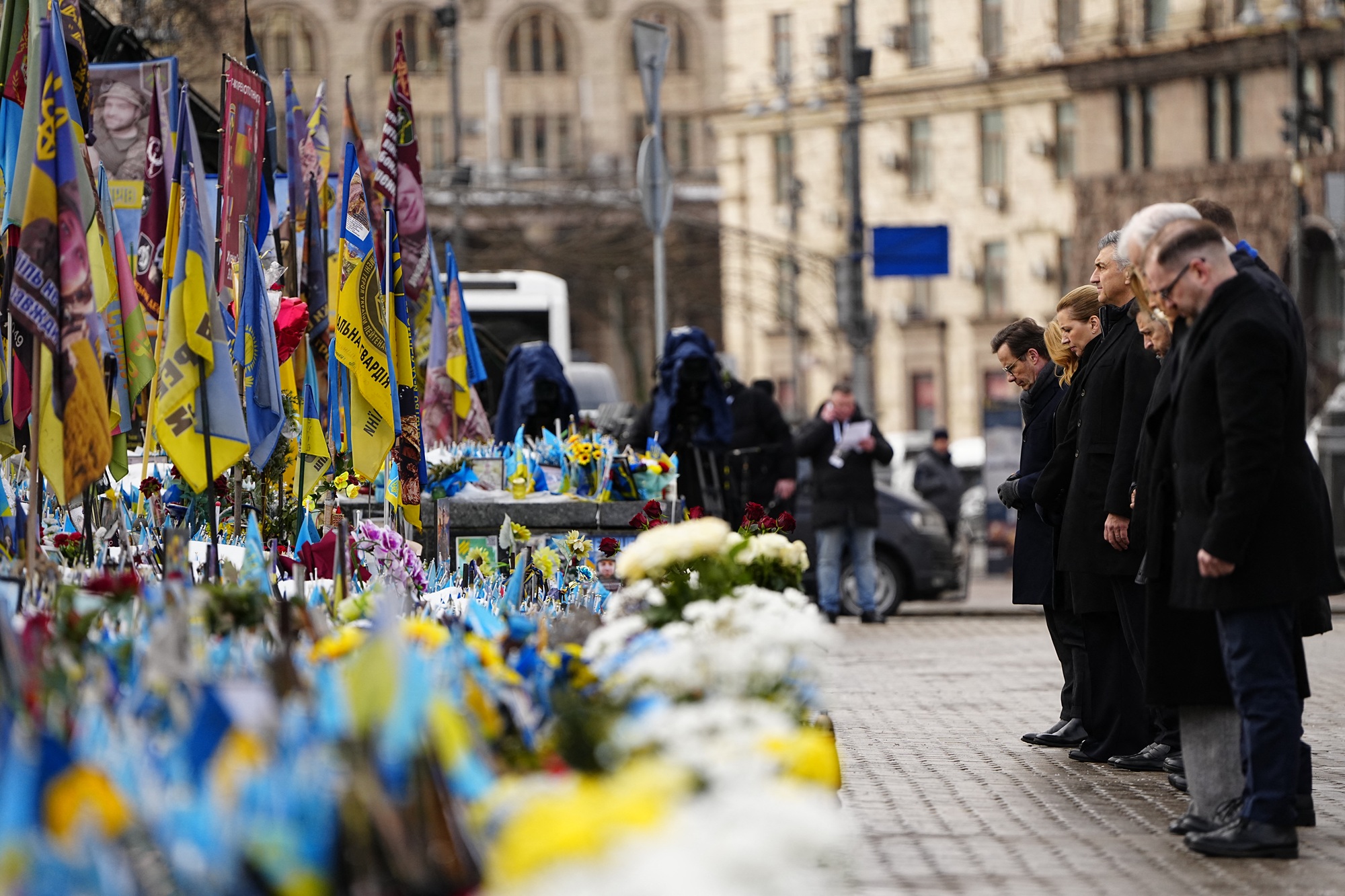
"audio_0": {
"type": "attachments",
"id": "audio_0",
"imgSizes": {
"kqedFullSize": {
"file": "https://ww2.kqed.org/news/wp-content/themes/KQED-unified/img/audio_bgs/background0.jpg"
}
}
},
"audio_1": {
"type": "attachments",
"id": "audio_1",
"imgSizes": {
"kqedFullSize": {
"file": "https://ww2.kqed.org/news/wp-content/themes/KQED-unified/img/audio_bgs/background1.jpg"
}
}
},
"audio_2": {
"type": "attachments",
"id": "audio_2",
"imgSizes": {
"kqedFullSize": {
"file": "https://ww2.kqed.org/news/wp-content/themes/KQED-unified/img/audio_bgs/background2.jpg"
}
}
},
"audio_3": {
"type": "attachments",
"id": "audio_3",
"imgSizes": {
"kqedFullSize": {
"file": "https://ww2.kqed.org/news/wp-content/themes/KQED-unified/img/audio_bgs/background3.jpg"
}
}
},
"audio_4": {
"type": "attachments",
"id": "audio_4",
"imgSizes": {
"kqedFullSize": {
"file": "https://ww2.kqed.org/news/wp-content/themes/KQED-unified/img/audio_bgs/background4.jpg"
}
}
},
"placeholder": {
"type": "attachments",
"id": "placeholder",
"imgSizes": {
"thumbnail": {
"file": "https://cdn.kqed.org/wp-content/uploads/2024/12/KQED-Default-Image-816638274-2000x1333-1-160x107.jpg",
"width": 160,
"height": 107,
"mimeType": "image/jpeg"
},
"medium": {
"file": "https://cdn.kqed.org/wp-content/uploads/2024/12/KQED-Default-Image-816638274-2000x1333-1-800x533.jpg",
"width": 800,
"height": 533,
"mimeType": "image/jpeg"
},
"medium_large": {
"file": "https://cdn.kqed.org/wp-content/uploads/2024/12/KQED-Default-Image-816638274-2000x1333-1-768x512.jpg",
"width": 768,
"height": 512,
"mimeType": "image/jpeg"
},
"large": {
"file": "https://cdn.kqed.org/wp-content/uploads/2024/12/KQED-Default-Image-816638274-2000x1333-1-1020x680.jpg",
"width": 1020,
"height": 680,
"mimeType": "image/jpeg"
},
"1536x1536": {
"file": "https://cdn.kqed.org/wp-content/uploads/2024/12/KQED-Default-Image-816638274-2000x1333-1-1536x1024.jpg",
"width": 1536,
"height": 1024,
"mimeType": "image/jpeg"
},
"fd-lrg": {
"file": "https://cdn.kqed.org/wp-content/uploads/2024/12/KQED-Default-Image-816638274-2000x1333-1-1536x1024.jpg",
"width": 1536,
"height": 1024,
"mimeType": "image/jpeg"
},
"fd-med": {
"file": "https://cdn.kqed.org/wp-content/uploads/2024/12/KQED-Default-Image-816638274-2000x1333-1-1020x680.jpg",
"width": 1020,
"height": 680,
"mimeType": "image/jpeg"
},
"fd-sm": {
"file": "https://cdn.kqed.org/wp-content/uploads/2024/12/KQED-Default-Image-816638274-2000x1333-1-800x533.jpg",
"width": 800,
"height": 533,
"mimeType": "image/jpeg"
},
"post-thumbnail": {
"file": "https://cdn.kqed.org/wp-content/uploads/2024/12/KQED-Default-Image-816638274-2000x1333-1-672x372.jpg",
"width": 672,
"height": 372,
"mimeType": "image/jpeg"
},
"twentyfourteen-full-width": {
"file": "https://cdn.kqed.org/wp-content/uploads/2024/12/KQED-Default-Image-816638274-2000x1333-1-1038x576.jpg",
"width": 1038,
"height": 576,
"mimeType": "image/jpeg"
},
"xxsmall": {
"file": "https://cdn.kqed.org/wp-content/uploads/2024/12/KQED-Default-Image-816638274-2000x1333-1-160x107.jpg",
"width": 160,
"height": 107,
"mimeType": "image/jpeg"
},
"xsmall": {
"file": "https://cdn.kqed.org/wp-content/uploads/2024/12/KQED-Default-Image-816638274-2000x1333-1-672x372.jpg",
"width": 672,
"height": 372,
"mimeType": "image/jpeg"
},
"small": {
"file": "https://cdn.kqed.org/wp-content/uploads/2024/12/KQED-Default-Image-816638274-2000x1333-1-672x372.jpg",
"width": 672,
"height": 372,
"mimeType": "image/jpeg"
},
"xlarge": {
"file": "https://cdn.kqed.org/wp-content/uploads/2024/12/KQED-Default-Image-816638274-2000x1333-1-1020x680.jpg",
"width": 1020,
"height": 680,
"mimeType": "image/jpeg"
},
"full-width": {
"file": "https://cdn.kqed.org/wp-content/uploads/2024/12/KQED-Default-Image-816638274-2000x1333-1-1920x1280.jpg",
"width": 1920,
"height": 1280,
"mimeType": "image/jpeg"
},
"guest-author-32": {
"file": "https://cdn.kqed.org/wp-content/uploads/2025/01/KQED-Default-Image-816638274-1333x1333-1-160x160.jpg",
"width": 32,
"height": 32,
"mimeType": "image/jpeg"
},
"guest-author-50": {
"file": "https://cdn.kqed.org/wp-content/uploads/2025/01/KQED-Default-Image-816638274-1333x1333-1-160x160.jpg",
"width": 50,
"height": 50,
"mimeType": "image/jpeg"
},
"guest-author-64": {
"file": "https://cdn.kqed.org/wp-content/uploads/2025/01/KQED-Default-Image-816638274-1333x1333-1-160x160.jpg",
"width": 64,
"height": 64,
"mimeType": "image/jpeg"
},
"guest-author-96": {
"file": "https://cdn.kqed.org/wp-content/uploads/2025/01/KQED-Default-Image-816638274-1333x1333-1-160x160.jpg",
"width": 96,
"height": 96,
"mimeType": "image/jpeg"
},
"guest-author-128": {
"file": "https://cdn.kqed.org/wp-content/uploads/2025/01/KQED-Default-Image-816638274-1333x1333-1-160x160.jpg",
"width": 128,
"height": 128,
"mimeType": "image/jpeg"
},
"detail": {
"file": "https://cdn.kqed.org/wp-content/uploads/2025/01/KQED-Default-Image-816638274-1333x1333-1-160x160.jpg",
"width": 160,
"height": 160,
"mimeType": "image/jpeg"
},
"kqedFullSize": {
"file": "https://cdn.kqed.org/wp-content/uploads/2024/12/KQED-Default-Image-816638274-2000x1333-1.jpg",
"width": 2000,
"height": 1333
}
}
},
"news_12074405": {
"type": "attachments",
"id": "news_12074405",
"meta": {
"index": "attachments_1716263798",
"site": "news",
"id": "12074405",
"found": true
},
"title": "UKRAINE-RUSSIA-WAR-CONFLICT",
"publishDate": 1771960784,
"status": "inherit",
"parent": 12074367,
"modified": 1771967959,
"caption": "Danish Prime Minister Mette Frederiksen (center) participates together with Ukraine's President, Volodymyr Zelensky, in a memorial ceremony for fallen soldiers at Maidan Square in Kyiv, Ukraine, on Feb. 24, 2026. ",
"credit": "Mads Claus Rasmussen/Ritzau Scanpix/AFP via Getty Images/Denmark OUT",
"altTag": null,
"description": null,
"imgSizes": {
"thumbnail": {
"file": "https://cdn.kqed.org/wp-content/uploads/sites/10/2026/02/MaidanUkraineMemorialGetty1-160x107.jpg",
"width": 160,
"height": 107,
"mimeType": "image/jpeg"
},
"1536x1536": {
"file": "https://cdn.kqed.org/wp-content/uploads/sites/10/2026/02/MaidanUkraineMemorialGetty1-1536x1024.jpg",
"width": 1536,
"height": 1024,
"mimeType": "image/jpeg"
},
"post-thumbnail": {
"file": "https://cdn.kqed.org/wp-content/uploads/sites/10/2026/02/MaidanUkraineMemorialGetty1-672x372.jpg",
"width": 672,
"height": 372,
"mimeType": "image/jpeg"
},
"twentyfourteen-full-width": {
"file": "https://cdn.kqed.org/wp-content/uploads/sites/10/2026/02/MaidanUkraineMemorialGetty1-1038x576.jpg",
"width": 1038,
"height": 576,
"mimeType": "image/jpeg"
},
"npr-cds-wide": {
"file": "https://cdn.kqed.org/wp-content/uploads/sites/10/2026/02/MaidanUkraineMemorialGetty1-1200x675.jpg",
"width": 1200,
"height": 675,
"mimeType": "image/jpeg"
},
"kqedFullSize": {
"file": "https://cdn.kqed.org/wp-content/uploads/sites/10/2026/02/MaidanUkraineMemorialGetty1.jpg",
"width": 2000,
"height": 1333
}
},
"fetchFailed": false,
"isLoading": false
},
"news_12070605": {
"type": "attachments",
"id": "news_12070605",
"meta": {
"index": "attachments_1716263798",
"site": "news",
"id": "12070605",
"found": true
},
"title": "Orphans Evacuate From Zaporizhzhia To Western Ukraine",
"publishDate": 1769024061,
"status": "inherit",
"parent": 12070573,
"modified": 1769026246,
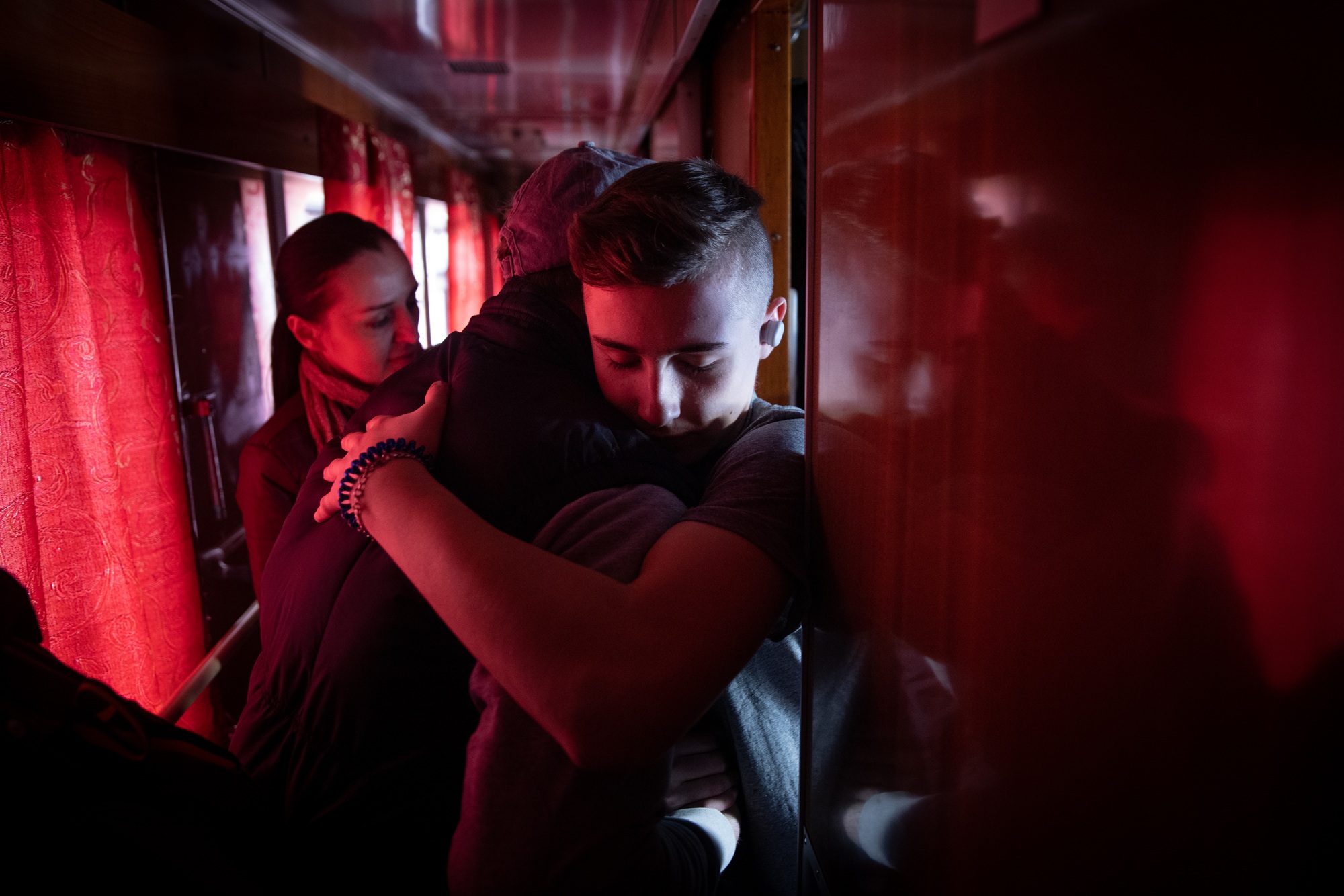
"caption": "An orphan boy hugs a volunteer goodbye after fleeing the town of Polohy, which has come under Russian control, before evacuating on a train from Zaporizhzhia to western Ukraine on March 26, 2022, in Zaporizhzhia, Ukraine. Tens of thousands of people remain trapped in Mariupol, a port city that has faced weeks of heavy bombardment by Russian forces. Civilians from Mariupol and the surrounding areas have fled to evacuation points in towns like Zaporizhzhia in Ukrainian-controlled territory, before moving on to safer areas in the western part of the country. ",
"credit": "Chris McGrath/Getty Images",
"altTag": null,
"description": null,
"imgSizes": {
"thumbnail": {
"file": "https://cdn.kqed.org/wp-content/uploads/sites/10/2026/01/Ukraine1-160x107.jpg",
"width": 160,
"height": 107,
"mimeType": "image/jpeg"
},
"1536x1536": {
"file": "https://cdn.kqed.org/wp-content/uploads/sites/10/2026/01/Ukraine1-1536x1025.jpg",
"width": 1536,
"height": 1025,
"mimeType": "image/jpeg"
},
"post-thumbnail": {
"file": "https://cdn.kqed.org/wp-content/uploads/sites/10/2026/01/Ukraine1-672x372.jpg",
"width": 672,
"height": 372,
"mimeType": "image/jpeg"
},
"twentyfourteen-full-width": {
"file": "https://cdn.kqed.org/wp-content/uploads/sites/10/2026/01/Ukraine1-1038x576.jpg",
"width": 1038,
"height": 576,
"mimeType": "image/jpeg"
},
"npr-cds-wide": {
"file": "https://cdn.kqed.org/wp-content/uploads/sites/10/2026/01/Ukraine1-1200x675.jpg",
"width": 1200,
"height": 675,
"mimeType": "image/jpeg"
},
"kqedFullSize": {
"file": "https://cdn.kqed.org/wp-content/uploads/sites/10/2026/01/Ukraine1.jpg",
"width": 2000,
"height": 1334
}
},
"fetchFailed": false,
"isLoading": false
},
"news_12067099": {
"type": "attachments",
"id": "news_12067099",
"meta": {
"index": "attachments_1716263798",
"site": "news",
"id": "12067099",
"found": true
},
"title": "Protests In Kyiv Against Bill Increasing Liability Of Soldiers For Disobedience",
"publishDate": 1765819334,
"status": "inherit",
"parent": 12066997,
"modified": 1765819439,
"caption": "A young man holds a banner reading, “A soldier is not a slave. We fight for your freedom, and you take it away from us,” during a protest in Kyiv on Sept. 5, 2025. Demonstrators gathered on Maidan Nezalezhnosti to oppose draft law No. 13452, which would increase liability for military personnel who disobey orders, chanting slogans including, “Repression is not discipline,” “Protect the rights of the military” and “Service is not slavery.”",
"credit": "Artem Gvozdkov/Global Images Ukraine via Getty Images",
"altTag": null,
"description": null,
"imgSizes": {
"thumbnail": {
"file": "https://cdn.kqed.org/wp-content/uploads/sites/10/2025/12/UkraineGetty1-160x140.jpg",
"width": 160,
"height": 140,
"mimeType": "image/jpeg"
},
"1536x1536": {
"file": "https://cdn.kqed.org/wp-content/uploads/sites/10/2025/12/UkraineGetty1-1536x1346.jpg",
"width": 1536,
"height": 1346,
"mimeType": "image/jpeg"
},
"post-thumbnail": {
"file": "https://cdn.kqed.org/wp-content/uploads/sites/10/2025/12/UkraineGetty1-672x372.jpg",
"width": 672,
"height": 372,
"mimeType": "image/jpeg"
},
"twentyfourteen-full-width": {
"file": "https://cdn.kqed.org/wp-content/uploads/sites/10/2025/12/UkraineGetty1-1038x576.jpg",
"width": 1038,
"height": 576,
"mimeType": "image/jpeg"
},
"npr-cds-wide": {
"file": "https://cdn.kqed.org/wp-content/uploads/sites/10/2025/12/UkraineGetty1-1200x675.jpg",
"width": 1200,
"height": 675,
"mimeType": "image/jpeg"
},
"kqedFullSize": {
"file": "https://cdn.kqed.org/wp-content/uploads/sites/10/2025/12/UkraineGetty1.jpg",
"width": 2000,
"height": 1753
}
},
"fetchFailed": false,
"isLoading": false
},
"news_12066818": {
"type": "attachments",
"id": "news_12066818",
"meta": {
"index": "attachments_1716263798",
"site": "news",
"id": "12066818",
"found": true
},
"title": "UAV Crew Of The 26th Artillery Brigade Work In Donetsk Oblast",
"publishDate": 1765487490,
"status": "inherit",
"parent": 12066758,
"modified": 1765487540,
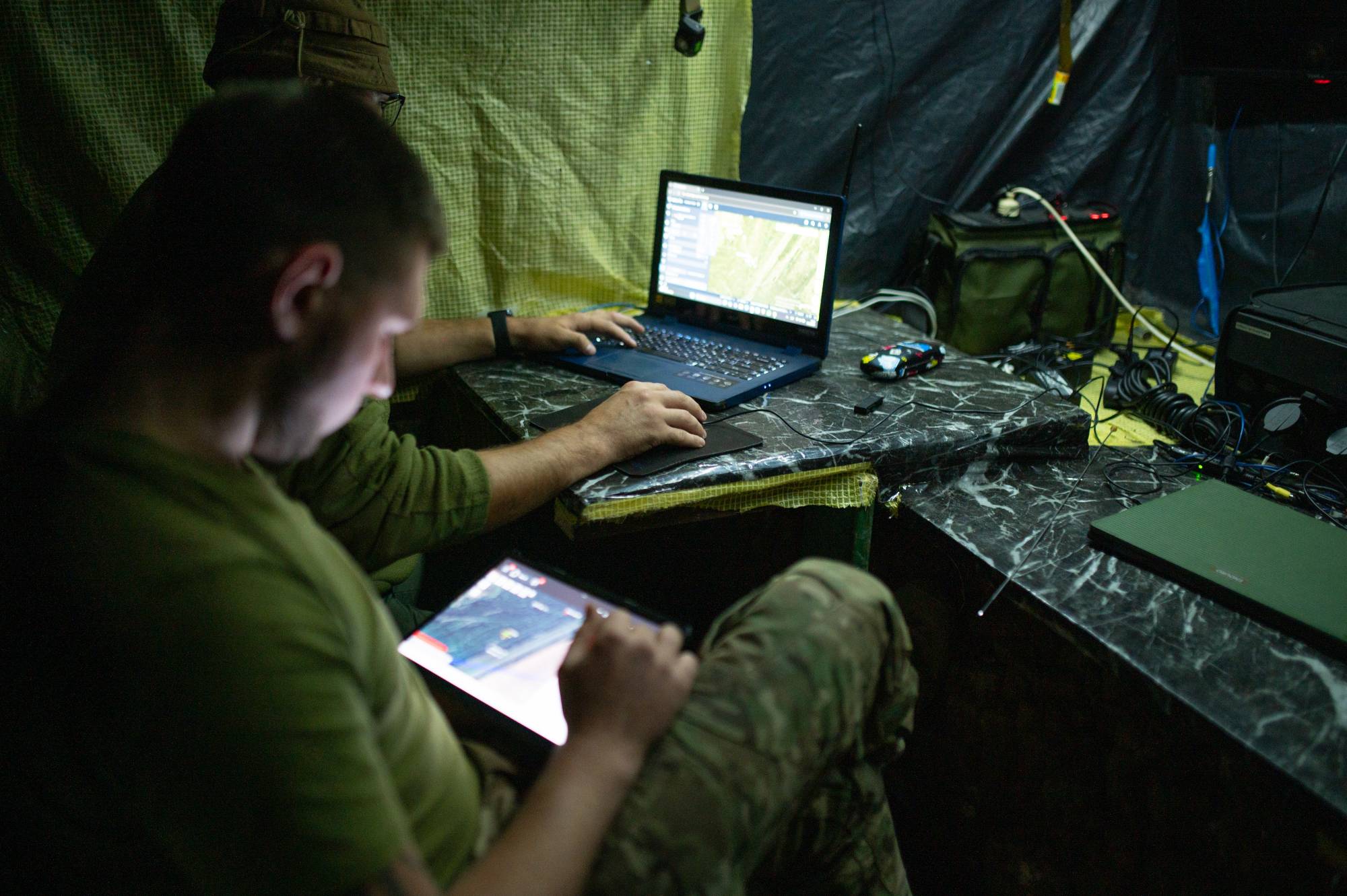
"caption": "DONETSK OBLAST, UKRAINE - AUGUST 19: Soldiers of the 26th Artillery Brigade watch the drone's flight from laptops while sitting in cover on August 19, 2025 in Donetsk Oblast, Ukraine. Donetsk Oblast continues to be the place of most fierce battles since the beginning of the full-scale Russian invasion. On 24 February 2022, Russia invaded Ukraine in an escalation of the Russian-Ukrainian war that started in 2014. ",
"credit": "(Photo by Maks Muravsky/Global Images Ukraine via Getty Images)",
"altTag": null,
"description": null,
"imgSizes": {
"medium": {
"file": "https://cdn.kqed.org/wp-content/uploads/sites/10/2025/12/GettyImages-2235693645-2000x1331.jpg",
"width": 2000,
"height": 1331,
"mimeType": "image/jpeg"
},
"large": {
"file": "https://cdn.kqed.org/wp-content/uploads/sites/10/2025/12/GettyImages-2235693645-2000x1331.jpg",
"width": 2000,
"height": 1331,
"mimeType": "image/jpeg"
},
"thumbnail": {
"file": "https://cdn.kqed.org/wp-content/uploads/sites/10/2025/12/GettyImages-2235693645-160x106.jpg",
"width": 160,
"height": 106,
"mimeType": "image/jpeg"
},
"1536x1536": {
"file": "https://cdn.kqed.org/wp-content/uploads/sites/10/2025/12/GettyImages-2235693645-1536x1022.jpg",
"width": 1536,
"height": 1022,
"mimeType": "image/jpeg"
},
"2048x2048": {
"file": "https://cdn.kqed.org/wp-content/uploads/sites/10/2025/12/GettyImages-2235693645-2048x1363.jpg",
"width": 2048,
"height": 1363,
"mimeType": "image/jpeg"
},
"post-thumbnail": {
"file": "https://cdn.kqed.org/wp-content/uploads/sites/10/2025/12/GettyImages-2235693645-672x372.jpg",
"width": 672,
"height": 372,
"mimeType": "image/jpeg"
},
"twentyfourteen-full-width": {
"file": "https://cdn.kqed.org/wp-content/uploads/sites/10/2025/12/GettyImages-2235693645-1038x576.jpg",
"width": 1038,
"height": 576,
"mimeType": "image/jpeg"
},
"full-width": {
"file": "https://cdn.kqed.org/wp-content/uploads/sites/10/2025/12/GettyImages-2235693645-2000x1331.jpg",
"width": 2000,
"height": 1331,
"mimeType": "image/jpeg"
},
"npr-cds-wide": {
"file": "https://cdn.kqed.org/wp-content/uploads/sites/10/2025/12/GettyImages-2235693645-1200x675.jpg",
"width": 1200,
"height": 675,
"mimeType": "image/jpeg"
},
"kqedFullSize": {
"file": "https://cdn.kqed.org/wp-content/uploads/sites/10/2025/12/GettyImages-2235693645-scaled.jpg",
"width": 2560,
"height": 1703
}
},
"fetchFailed": false,
"isLoading": false
},
"news_12064677": {
"type": "attachments",
"id": "news_12064677",
"meta": {
"index": "attachments_1716263798",
"site": "news",
"id": "12064677",
"found": true
},
"title": "CAT Geeks of War_img",
"publishDate": 1763524148,
"status": "inherit",
"parent": 12064670,
"modified": 1763524292,
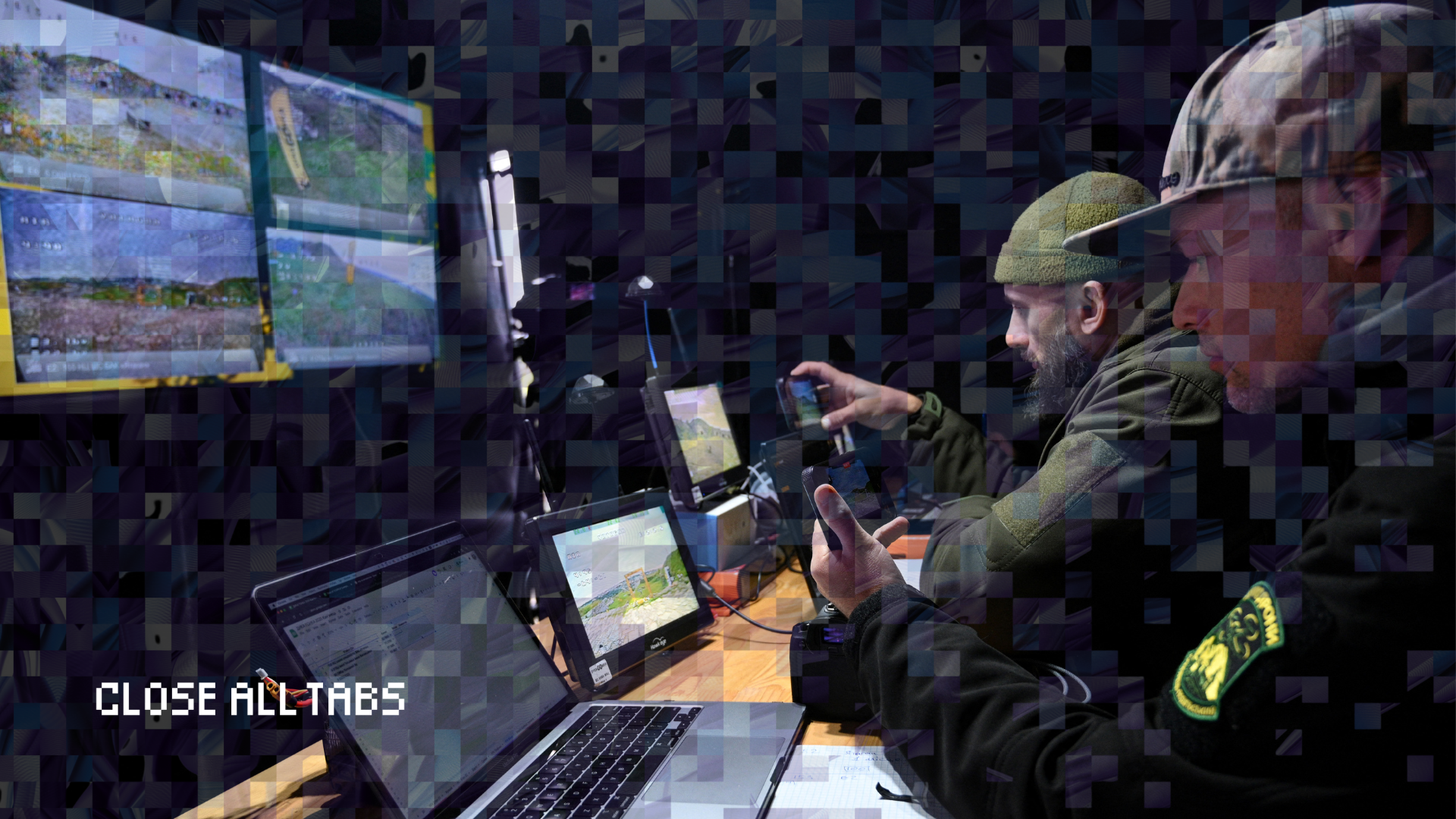
"caption": "A drone-racing event simulating combat conditions in Kamianets-Podilskyi, Ukraine, on Oct. 5, 2025. Drone technology has become increasingly central to the conflict. ",
"credit": "Photo by YURIY DYACHYSHYN/AFP via Getty Images",
"altTag": "Two Ukrainian service members sit inside a dimly lit mobile command center, monitoring several screens showing drone footage. Laptops, monitors, and handheld devices cover the desk in front of them. A pixelated overlay obscures parts of the image, and the ‘Close All Tabs’ logo appears in the lower left corner.",
"description": null,
"imgSizes": {
"thumbnail": {
"file": "https://cdn.kqed.org/wp-content/uploads/sites/10/2025/11/CAT-Geeks-of-War_img-160x90.png",
"width": 160,
"height": 90,
"mimeType": "image/png"
},
"1536x1536": {
"file": "https://cdn.kqed.org/wp-content/uploads/sites/10/2025/11/CAT-Geeks-of-War_img-1536x864.png",
"width": 1536,
"height": 864,
"mimeType": "image/png"
},
"post-thumbnail": {
"file": "https://cdn.kqed.org/wp-content/uploads/sites/10/2025/11/CAT-Geeks-of-War_img-672x372.png",
"width": 672,
"height": 372,
"mimeType": "image/png"
},
"twentyfourteen-full-width": {
"file": "https://cdn.kqed.org/wp-content/uploads/sites/10/2025/11/CAT-Geeks-of-War_img-1038x576.png",
"width": 1038,
"height": 576,
"mimeType": "image/png"
},
"npr-cds-wide": {
"file": "https://cdn.kqed.org/wp-content/uploads/sites/10/2025/11/CAT-Geeks-of-War_img-1200x675.png",
"width": 1200,
"height": 675,
"mimeType": "image/png"
},
"kqedFullSize": {
"file": "https://cdn.kqed.org/wp-content/uploads/sites/10/2025/11/CAT-Geeks-of-War_img.png",
"width": 1920,
"height": 1080
}
},
"fetchFailed": false,
"isLoading": false
},
"news_12029091": {
"type": "attachments",
"id": "news_12029091",
"meta": {
"index": "attachments_1716263798",
"site": "news",
"id": "12029091",
"found": true
},
"title": "FRANCE-POLITICS-ELYSEE-MACRON-TRUMP-ZELENSKY",
"publishDate": 1740699972,
"status": "inherit",
"parent": 12029087,
"modified": 1740762769,
"caption": "France's President Emmanuel Macron, US President Donald Trump and Ukraine's President Volodymyr Zelensky after a meeting at The Elysee Palace in Paris, France on Dec. 7, 2024. ",
"credit": "MATHILDE KACZKOWSKI/Hans Lucas/AFP via Getty Images",
"altTag": null,
"description": null,
"imgSizes": {
"medium": {
"file": "https://cdn.kqed.org/wp-content/uploads/sites/10/2025/02/GettyImages-2188150561-800x533.jpg",
"width": 800,
"height": 533,
"mimeType": "image/jpeg"
},
"large": {
"file": "https://cdn.kqed.org/wp-content/uploads/sites/10/2025/02/GettyImages-2188150561-1020x680.jpg",
"width": 1020,
"height": 680,
"mimeType": "image/jpeg"
},
"thumbnail": {
"file": "https://cdn.kqed.org/wp-content/uploads/sites/10/2025/02/GettyImages-2188150561-160x107.jpg",
"width": 160,
"height": 107,
"mimeType": "image/jpeg"
},
"1536x1536": {
"file": "https://cdn.kqed.org/wp-content/uploads/sites/10/2025/02/GettyImages-2188150561-1536x1024.jpg",
"width": 1536,
"height": 1024,
"mimeType": "image/jpeg"
},
"2048x2048": {
"file": "https://cdn.kqed.org/wp-content/uploads/sites/10/2025/02/GettyImages-2188150561-2048x1365.jpg",
"width": 2048,
"height": 1365,
"mimeType": "image/jpeg"
},
"post-thumbnail": {
"file": "https://cdn.kqed.org/wp-content/uploads/sites/10/2025/02/GettyImages-2188150561-672x372.jpg",
"width": 672,
"height": 372,
"mimeType": "image/jpeg"
},
"twentyfourteen-full-width": {
"file": "https://cdn.kqed.org/wp-content/uploads/sites/10/2025/02/GettyImages-2188150561-1038x576.jpg",
"width": 1038,
"height": 576,
"mimeType": "image/jpeg"
},
"full-width": {
"file": "https://cdn.kqed.org/wp-content/uploads/sites/10/2025/02/GettyImages-2188150561-1920x1280.jpg",
"width": 1920,
"height": 1280,
"mimeType": "image/jpeg"
},
"kqedFullSize": {
"file": "https://cdn.kqed.org/wp-content/uploads/sites/10/2025/02/GettyImages-2188150561-scaled.jpg",
"width": 2560,
"height": 1706
}
},
"fetchFailed": false,
"isLoading": false
},
"news_12004473": {
"type": "attachments",
"id": "news_12004473",
"meta": {
"index": "attachments_1716263798",
"site": "news",
"id": "12004473",
"found": true
},
"title": "Larry McKinney, fills in his ballot in a booth at the polling place at Boba Guys on Fillmore Street on Tuesday, November 3, 2020 in San Francisco, Calif.",
"publishDate": 1726098392,
"status": "inherit",
"parent": 12004468,
"modified": 1726098392,
"caption": "Larry McKinney, fills in his ballot in a booth at the polling place at Boba Guys on Fillmore Street on Tuesday, November 3, 2020 in San Francisco, Calif. (Photo By Lea Suzuki/The San Francisco Chronicle via Getty Images)",
"credit": null,
"altTag": null,
"description": null,
"imgSizes": {
"medium": {
"file": "https://cdn.kqed.org/wp-content/uploads/sites/10/2024/09/GettyImages-1322395033-800x533.jpg",
"width": 800,
"height": 533,
"mimeType": "image/jpeg"
},
"large": {
"file": "https://cdn.kqed.org/wp-content/uploads/sites/10/2024/09/GettyImages-1322395033-1020x680.jpg",
"width": 1020,
"height": 680,
"mimeType": "image/jpeg"
},
"thumbnail": {
"file": "https://cdn.kqed.org/wp-content/uploads/sites/10/2024/09/GettyImages-1322395033-160x107.jpg",
"width": 160,
"height": 107,
"mimeType": "image/jpeg"
},
"1536x1536": {
"file": "https://cdn.kqed.org/wp-content/uploads/sites/10/2024/09/GettyImages-1322395033-1536x1024.jpg",
"width": 1536,
"height": 1024,
"mimeType": "image/jpeg"
},
"2048x2048": {
"file": "https://cdn.kqed.org/wp-content/uploads/sites/10/2024/09/GettyImages-1322395033-2048x1365.jpg",
"width": 2048,
"height": 1365,
"mimeType": "image/jpeg"
},
"post-thumbnail": {
"file": "https://cdn.kqed.org/wp-content/uploads/sites/10/2024/09/GettyImages-1322395033-672x372.jpg",
"width": 672,
"height": 372,
"mimeType": "image/jpeg"
},
"twentyfourteen-full-width": {
"file": "https://cdn.kqed.org/wp-content/uploads/sites/10/2024/09/GettyImages-1322395033-1038x576.jpg",
"width": 1038,
"height": 576,
"mimeType": "image/jpeg"
},
"full-width": {
"file": "https://cdn.kqed.org/wp-content/uploads/sites/10/2024/09/GettyImages-1322395033-1920x1280.jpg",
"width": 1920,
"height": 1280,
"mimeType": "image/jpeg"
},
"kqedFullSize": {
"file": "https://cdn.kqed.org/wp-content/uploads/sites/10/2024/09/GettyImages-1322395033-scaled.jpg",
"width": 2560,
"height": 1707
}
},
"fetchFailed": false,
"isLoading": false
},
"news_11988247": {
"type": "attachments",
"id": "news_11988247",
"meta": {
"index": "attachments_1716263798",
"site": "news",
"id": "11988247",
"found": true
},
"title": "Screenshot 2024-05-30 at 1.01.54 PM",
"publishDate": 1717099326,
"status": "inherit",
"parent": 11988245,
"modified": 1717099379,
"caption": "OpenAI, the company behind generative artificial intelligence tools such as ChatGPT, announced Thursday that it had taken down influence operations tied to Russia, China and Iran.",
"credit": "Stefani Reynolds/AFP via Getty Images",
"altTag": "A smartphone screen reflects the image and logo of OpenAI.",
"description": null,
"imgSizes": {
"medium": {
"file": "https://cdn.kqed.org/wp-content/uploads/sites/10/2024/05/Screenshot-2024-05-30-at-1.01.54 PM-800x601.png",
"width": 800,
"height": 601,
"mimeType": "image/png"
},
"large": {
"file": "https://cdn.kqed.org/wp-content/uploads/sites/10/2024/05/Screenshot-2024-05-30-at-1.01.54 PM-1020x767.png",
"width": 1020,
"height": 767,
"mimeType": "image/png"
},
"thumbnail": {
"file": "https://cdn.kqed.org/wp-content/uploads/sites/10/2024/05/Screenshot-2024-05-30-at-1.01.54 PM-160x120.png",
"width": 160,
"height": 120,
"mimeType": "image/png"
},
"post-thumbnail": {
"file": "https://cdn.kqed.org/wp-content/uploads/sites/10/2024/05/Screenshot-2024-05-30-at-1.01.54 PM-672x372.png",
"width": 672,
"height": 372,
"mimeType": "image/png"
},
"twentyfourteen-full-width": {
"file": "https://cdn.kqed.org/wp-content/uploads/sites/10/2024/05/Screenshot-2024-05-30-at-1.01.54 PM-1038x576.png",
"width": 1038,
"height": 576,
"mimeType": "image/png"
},
"kqedFullSize": {
"file": "https://cdn.kqed.org/wp-content/uploads/sites/10/2024/05/Screenshot-2024-05-30-at-1.01.54 PM.png",
"width": 1288,
"height": 968
}
},
"fetchFailed": false,
"isLoading": false
},
"news_11910298": {
"type": "attachments",
"id": "news_11910298",
"meta": {
"index": "attachments_1716263798",
"site": "news",
"id": "11910298",
"found": true
},
"parent": 11910077,
"imgSizes": {
"twentyfourteen-full-width": {
"file": "https://ww2.kqed.org/app/uploads/sites/10/2022/04/KNR_Assembly-1038x576.jpg",
"width": 1038,
"mimeType": "image/jpeg",
"height": 576
},
"thumbnail": {
"file": "https://ww2.kqed.org/app/uploads/sites/10/2022/04/KNR_Assembly-160x90.jpg",
"width": 160,
"mimeType": "image/jpeg",
"height": 90
},
"post-thumbnail": {
"file": "https://ww2.kqed.org/app/uploads/sites/10/2022/04/KNR_Assembly-672x372.jpg",
"width": 672,
"mimeType": "image/jpeg",
"height": 372
},
"kqedFullSize": {
"file": "https://ww2.kqed.org/app/uploads/sites/10/2022/04/KNR_Assembly.jpg",
"width": 1920,
"height": 1080
},
"large": {
"file": "https://ww2.kqed.org/app/uploads/sites/10/2022/04/KNR_Assembly-1020x574.jpg",
"width": 1020,
"mimeType": "image/jpeg",
"height": 574
},
"1536x1536": {
"file": "https://ww2.kqed.org/app/uploads/sites/10/2022/04/KNR_Assembly-1536x864.jpg",
"width": 1536,
"mimeType": "image/jpeg",
"height": 864
},
"medium": {
"file": "https://ww2.kqed.org/app/uploads/sites/10/2022/04/KNR_Assembly-800x450.jpg",
"width": 800,
"mimeType": "image/jpeg",
"height": 450
}
},
"publishDate": 1649104555,
"modified": 1649104555,
"caption": null,
"description": null,
"title": "KNR_Assembly",
"credit": null,
"status": "inherit",
"altTag": null,
"fetchFailed": false,
"isLoading": false
}
},
"audioPlayerReducer": {
"postId": "stream_live",
"isPaused": true,
"isPlaying": false,
"pfsActive": false,
"pledgeModalIsOpen": true,
"playerDrawerIsOpen": false
},
"authorsReducer": {
"byline_news_12074367": {
"type": "authors",
"id": "byline_news_12074367",
"meta": {
"override": true
},
"slug": "byline_news_12074367",
"name": "Lizzie Johnson and Serhii Korolchuk",
"isLoading": false
},
"byline_news_12070573": {
"type": "authors",
"id": "byline_news_12070573",
"meta": {
"override": true
},
"slug": "byline_news_12070573",
"name": "Maria Kostenko and Anna Nemtsova",
"isLoading": false
},
"byline_news_12066997": {
"type": "authors",
"id": "byline_news_12066997",
"meta": {
"override": true
},
"slug": "byline_news_12066997",
"name": "Maria Kostenko, Anna Nemtsova and Evelina Riabenko ",
"isLoading": false
},
"byline_news_12066758": {
"type": "authors",
"id": "byline_news_12066758",
"meta": {
"override": true
},
"slug": "byline_news_12066758",
"name": "Ericka Cruz Guevarra and Erica Hellerstein",
"isLoading": false
},
"byline_news_12064670": {
"type": "authors",
"id": "byline_news_12064670",
"meta": {
"override": true
},
"slug": "byline_news_12064670",
"name": "Erica Hellerstein",
"isLoading": false
},
"byline_news_11988245": {
"type": "authors",
"id": "byline_news_11988245",
"meta": {
"override": true
},
"slug": "byline_news_11988245",
"name": "Shannon Bond, NPR",
"isLoading": false
},
"kqed": {
"type": "authors",
"id": "236",
"meta": {
"index": "authors_1716337520",
"id": "236",
"found": true
},
"name": "KQED News Staff",
"firstName": "KQED News Staff",
"lastName": null,
"slug": "kqed",
"email": "faq@kqed.org",
"display_author_email": false,
"staff_mastheads": [],
"title": null,
"bio": null,
"avatar": "https://secure.gravatar.com/avatar/ef0e801a68c4c54afa9180db14084167?s=600&d=blank&r=g",
"twitter": null,
"facebook": null,
"instagram": null,
"linkedin": null,
"sites": [
{
"site": "arts",
"roles": [
"contributor"
]
},
{
"site": "news",
"roles": [
"editor"
]
},
{
"site": "futureofyou",
"roles": [
"author"
]
}
],
"headData": {
"title": "KQED News Staff | KQED",
"description": null,
"ogImgSrc": "https://secure.gravatar.com/avatar/ef0e801a68c4c54afa9180db14084167?s=600&d=blank&r=g",
"twImgSrc": "https://secure.gravatar.com/avatar/ef0e801a68c4c54afa9180db14084167?s=600&d=blank&r=g"
},
"isLoading": false,
"link": "/author/kqed"
},
"scottshafer": {
"type": "authors",
"id": "255",
"meta": {
"index": "authors_1716337520",
"id": "255",
"found": true
},
"name": "Scott Shafer",
"firstName": "Scott",
"lastName": "Shafer",
"slug": "scottshafer",
"email": "sshafer@kqed.org",
"display_author_email": false,
"staff_mastheads": [
"news"
],
"title": "KQED Contributor",
"bio": "Scott Shafer is a senior editor with the KQED Politics and Government desk. He is co-host of Political Breakdown, the award-winning radio show and podcast with a personal take on the world of politics. Scott came to KQED in 1998 to host the statewide\u003cem> California Report\u003c/em>. Prior to that he had extended stints in politics and government\u003cem>.\u003c/em> He uses that inside experience at KQED in his, reporting, hosting and analysis for the politics desk. Scott collaborated \u003cem>Political Breakdown a\u003c/em>nd on \u003cem>The Political Mind of Jerry Brown, \u003c/em>an eight-part series about the life and extraordinary political career of the former governor. For fun, he plays water polo with the San Francisco Tsunami.",
"avatar": "https://secure.gravatar.com/avatar/a62ebae45b79d7aed1a39a0e3bf68104?s=600&d=blank&r=g",
"twitter": "scottshafer",
"bluesky": null,
"facebook": null,
"instagram": null,
"linkedin": null,
"sites": [
{
"site": "news",
"roles": [
"editor"
]
},
{
"site": "stateofhealth",
"roles": [
"author"
]
},
{
"site": "science",
"roles": [
"author"
]
},
{
"site": "forum",
"roles": [
"subscriber"
]
},
{
"site": "liveblog",
"roles": [
"author"
]
}
],
"headData": {
"title": "Scott Shafer | KQED",
"description": "KQED Contributor",
"ogImgSrc": "https://secure.gravatar.com/avatar/a62ebae45b79d7aed1a39a0e3bf68104?s=600&d=blank&r=g",
"twImgSrc": "https://secure.gravatar.com/avatar/a62ebae45b79d7aed1a39a0e3bf68104?s=600&d=blank&r=g"
},
"isLoading": false,
"link": "/author/scottshafer"
},
"mlagos": {
"type": "authors",
"id": "3239",
"meta": {
"index": "authors_1716337520",
"id": "3239",
"found": true
},
"name": "Marisa Lagos",
"firstName": "Marisa",
"lastName": "Lagos",
"slug": "mlagos",
"email": "mlagos@kqed.org",
"display_author_email": false,
"staff_mastheads": [
"news"
],
"title": "KQED Contributor",
"bio": "Marisa Lagos is a correspondent for KQED’s California Politics and Government Desk and co-hosts the award-winning show and podcast, Political Breakdown. At KQED, Lagos also conducts reporting, analysis and investigations into state, local and national politics for radio, TV, online and onstage. In 2022, she and co-host, Scott Shafer, moderated the only gubernatorial debate in California. In 2020, the \u003ci>Washington Post\u003c/i> named her one of the top political journalists in California; she was nominated for a Peabody and won several other awards for her work investigating the 2017 California wildfires. She has worked at the \u003ci>San Francisco Chronicle\u003c/i>, \u003ci>San Francisco Examiner\u003c/i> and \u003ci>Los Angeles Times\u003c/i>. A UC Santa Barbara graduate, she lives in San Francisco with her two sons and husband.",
"avatar": "https://secure.gravatar.com/avatar/a261a0d3696fc066871ef96b85b5e7d2?s=600&d=blank&r=g",
"twitter": "@mlagos",
"facebook": null,
"instagram": null,
"linkedin": null,
"sites": [
{
"site": "arts",
"roles": [
"author"
]
},
{
"site": "news",
"roles": [
"editor"
]
},
{
"site": "science",
"roles": [
"editor"
]
},
{
"site": "forum",
"roles": [
"author"
]
},
{
"site": "liveblog",
"roles": [
"author"
]
}
],
"headData": {
"title": "Marisa Lagos | KQED",
"description": "KQED Contributor",
"ogImgSrc": "https://secure.gravatar.com/avatar/a261a0d3696fc066871ef96b85b5e7d2?s=600&d=blank&r=g",
"twImgSrc": "https://secure.gravatar.com/avatar/a261a0d3696fc066871ef96b85b5e7d2?s=600&d=blank&r=g"
},
"isLoading": false,
"link": "/author/mlagos"
}
},
"breakingNewsReducer": {},
"pagesReducer": {},
"postsReducer": {
"stream_live": {
"type": "live",
"id": "stream_live",
"audioUrl": "https://streams.kqed.org/kqedradio",
"title": "Live Stream",
"excerpt": "Live Stream information currently unavailable.",
"link": "/radio",
"featImg": "",
"label": {
"name": "KQED Live",
"link": "/"
}
},
"stream_kqedNewscast": {
"type": "posts",
"id": "stream_kqedNewscast",
"audioUrl": "https://www.kqed.org/.stream/anon/radio/RDnews/newscast.mp3?_=1",
"title": "KQED Newscast",
"featImg": "",
"label": {
"name": "88.5 FM",
"link": "/"
}
},
"news_12074367": {
"type": "posts",
"id": "news_12074367",
"meta": {
"index": "posts_1716263798",
"site": "news",
"id": "12074367",
"score": null,
"sort": [
1772029836000
]
},
"guestAuthors": [],
"slug": "amid-war-and-grief-kyiv-caretaker-preserves-memory-of-ukraines-fallen-soldiers",
"title": "Amid War and Grief, Kyiv Caretaker Preserves Memory of Ukraine’s Fallen Soldiers",
"publishDate": 1772029836,
"format": "standard",
"headTitle": "Amid War and Grief, Kyiv Caretaker Preserves Memory of Ukraine’s Fallen Soldiers | KQED",
"labelTerm": {
"site": "news"
},
"content": "\u003cp>KYIV — What started with a few \u003ca href=\"https://www.kqed.org/news/tag/ukraine\">Ukrainian\u003c/a> flags staked in the grass at Maidan, or Independence Square, has turned into a sprawling repository for a country’s grief, with flowerbeds dedicated to individual battalions, duvet-sized flags draped in the firs and hard-packed trails winding through it all.\u003c/p>\n\u003cp>Four years into a \u003ca href=\"https://www.kqed.org/news/tag/war-in-ukraine\">war\u003c/a> that shows no end in sight, Natalia Klymiuk again took the metro eight stops to tend to the memorial that never stopped growing. Russia’s full-scale invasion has officially entered its fifth year — a grim milestone marked by visiting dignitaries, including senior European officials, military commanders, and Ukrainian President Volodymyr Zelensky. Klymiuk’s volunteer badge wasn’t enough to gain her access to the anniversary proceedings, so she waited across Khreshchatyk Street for the procession to leave.\u003c/p>\n\u003cp>She couldn’t see much. But beyond the wall of security vehicles, the officials stood in a line of black winter coats, red votive candles in hand. They took in the portraits of fallen soldiers, standing in the snow like headstones, then placed the candles nearby.\u003c/p>\n\u003cp>“We cherish the memory of … those who gave their most precious thing for a free Ukraine,” \u003ca href=\"https://t.me/V_Zelenskiy_official/18084\">Zelensky said\u003c/a>. “And we will definitely preserve what they fought for.”\u003c/p>\n\u003cp>[ad fullwidth]\u003c/p>\n\u003cp>Finally, they left. It was around 11 a.m.\u003c/p>\n\u003cp>Klymiuk was now hours behind schedule.\u003c/p>\n\u003cp>She snapped on yellow gloves and unfurled a trash bag, dragging it behind her through puddles of snowmelt. She moved in quick, short bursts, snatching wilted carnations and soggy roses off the unsanctioned memorial, then flicking them into the trash bag.\u003c/p>\n\u003cfigure id=\"attachment_12074407\" class=\"wp-caption aligncenter\" style=\"max-width: 2000px\">\u003cimg loading=\"lazy\" decoding=\"async\" class=\"size-full wp-image-12074407\" src=\"https://cdn.kqed.org/wp-content/uploads/sites/10/2026/02/MaidanUkraineMemorialGetty2.jpg\" alt=\"\" width=\"2000\" height=\"1334\" srcset=\"https://cdn.kqed.org/wp-content/uploads/sites/10/2026/02/MaidanUkraineMemorialGetty2.jpg 2000w, https://cdn.kqed.org/wp-content/uploads/sites/10/2026/02/MaidanUkraineMemorialGetty2-160x107.jpg 160w, https://cdn.kqed.org/wp-content/uploads/sites/10/2026/02/MaidanUkraineMemorialGetty2-1536x1025.jpg 1536w\" sizes=\"auto, (max-width: 2000px) 100vw, 2000px\">\u003cfigcaption class=\"wp-caption-text\">A man in military uniform walks past the memorial area with photographs of fallen soldiers and flowers placed in remembrance at Maidan Nezalezhnosti in Kyiv, Ukraine, on Feb. 24, 2026. The image captures a moment of quiet public tribute during the anniversary commemoration of the war. \u003ccite>(Daniel Yovkov/Hans Lucas/AFP via Getty Images)\u003c/cite>\u003c/figcaption>\u003c/figure>\n\u003cp>The 52-year-old former psychologist has been caretaking the monument since the spring of 2022, when an American named Ryan Routh — now infamous for his 2024 \u003ca href=\"https://www.justice.gov/opa/pr/ryan-wesley-routh-sentenced-life-prison-attempted-assassination-president-donald-j-trump-and\">assassination attempt\u003c/a> on President Donald Trump on a Florida golf course — pitched a tent on the lawn near the Tchaikovsky Academy of Music with a poster: “My girlfriend was killed by Putin. If you know someone who was killed by Putin, put up a flag.”\u003c/p>\n\u003cp>A few flags, inked with the ages and call signs of fallen soldiers, turned into thousands. Klymiuk felt like she had no choice but to help. She’d been volunteering for over a decade, since the Maidan Revolution in 2014. So she kept showing up, taking the metro an hour each way from her home on Kyiv’s Left Bank. Days turned into weeks and then years. Though another woman, Tetyana Prantenko, also helps, Klymiuk and her partner, Oleg Karas, have become known as the memorial’s main caretakers. Visitors recognize Klymiuk by her hair, dyed red and scraped into pigtails.\u003c/p>\n\u003cp>“You see how all the flowers are damp and wet?” Klymiuk said, pointing at another limp bouquet — the previous day’s sorrows becoming today’s task. “I wanted to clean it up yesterday, but I didn’t have a chance.”\u003c/p>\n\u003cp>***\u003c/p>\n\u003cp>She darted ahead with her trash bag.\u003c/p>\n\u003cp>Pausing, she plucked slivers of shattered glass from the snow. Though the coldest winter in more than a decade — exacerbated by Russia’s repeated assault on Ukraine’s energy system — had left her without heat or power at home, she was mostly worried about the photo frames, some of which were shattered by subzero temperatures.\u003c/p>\n\u003cp>The pictures inside were warped and weathered, only the outlines of faces left. She wanted to find replacements before the men faded entirely.\u003c/p>\n\u003cfigure id=\"attachment_12074419\" class=\"wp-caption aligncenter\" style=\"max-width: 2000px\">\u003cimg loading=\"lazy\" decoding=\"async\" class=\"size-full wp-image-12074419\" src=\"https://cdn.kqed.org/wp-content/uploads/sites/10/2026/02/MaidanUkraineMemorialGetty4.jpg\" alt=\"\" width=\"2000\" height=\"1334\" srcset=\"https://cdn.kqed.org/wp-content/uploads/sites/10/2026/02/MaidanUkraineMemorialGetty4.jpg 2000w, https://cdn.kqed.org/wp-content/uploads/sites/10/2026/02/MaidanUkraineMemorialGetty4-160x107.jpg 160w, https://cdn.kqed.org/wp-content/uploads/sites/10/2026/02/MaidanUkraineMemorialGetty4-1536x1025.jpg 1536w\" sizes=\"auto, (max-width: 2000px) 100vw, 2000px\">\u003cfigcaption class=\"wp-caption-text\">Flowers are placed near photos of fallen soldiers covered by snow and surrounded by Ukrainian flags at Maidan Nezalezhnosti in Kyiv, Ukraine, on Feb. 24, 2026. The scene reflects the public commemoration of the fourth anniversary of the full-scale invasion and honors soldiers who lost their lives in the war. \u003ccite>(Daniel Yovkov/Hans Lucas/AFP via Getty Images)\u003c/cite>\u003c/figcaption>\u003c/figure>\n\u003cp>She and Karas did a little of everything. While municipal workers mostly kept to the sidewalks, sweeping the pavement clean, the couple repaired broken flags with electrical tape, sprayed pesticides on the grass, raked the leaves in the fall, and carved paths through others’ grief.\u003c/p>\n\u003cp>In his backpack, Karas kept a pre-packaged lunch, trash bags, permanent markers, zip ties, two-sided tape, a screw driver, a box cutter, a hammer and Ukrainian flags and braided ribbons, both of which he sold. He said he donated the money to the military to buy drones and a hospital in Kyiv that treats wounded soldiers.\u003c/p>\n\u003cp>“We arrive at 8 a.m. and leave at 5 p.m.,” he said. “We take off maybe one weekend a year, just to sleep.”[aside postID=news_12066997 hero='https://cdn.kqed.org/wp-content/uploads/sites/10/2025/12/UkraineGetty1.jpg']Spotting a photojournalist with her lens raised, Klymiuk darted through the maze of flags, down a path of beaten-down snow, to confront her. She didn’t like attention and didn’t want photos taken while she was cleaning. She asked her to focus on the monument.\u003c/p>\n\u003cp>Peeling off her yellow gloves to reveal a pale manicure, Klymiuk set off to continue her rounds. She hadn’t gone far when she stumbled upon a woman in leather pants, a red handbag slung over her shoulder, looking for a spot to jab two flags into the snow. There was no more empty ground, no place to deposit her pain. Her eyes were wet with tears.\u003c/p>\n\u003cp>Klymiuk stopped and asked if she needed assistance. If she knew the men’s brigades, she could direct her there. Or if they were foreign fighters, Klymiuk could walk her to the proper countries’ locations. Even though she got lost here sometimes, she still knew the memorial better than anyone else.\u003c/p>\n\u003cp>“Don’t just put the flags just anywhere,” she warned. “You’ll lose them.”\u003c/p>\n\u003cp>The woman, Yulia Bloshchuk, 30, thanked her. From Kyiv, she wanted to honor two friends — Andrii Bozhko and Yuriy Felipenko — who’d made the decision to fight for her freedom at the cost of their lives. Andrii was a classmate. Yuriy was a former colleague from the film industry.\u003c/p>\n\u003cp>“I can’t remember the life we once had,” she said.\u003c/p>\n\u003cp>***\u003c/p>\n\u003cp>Klymiuk doesn’t want to talk about this on the anniversary, but somewhere in the sea of faces and flags is one she knows well.\u003c/p>\n\u003cp>Her nephew.\u003c/p>\n\u003cp>She’s talked about it in interviews with other journalists. Oleksandr was killed in January 2023 in Ukraine’s Donetsk region — the white-hot center of ongoing, American-led peace talks about how to end the war and what Ukraine should sacrifice to Russia’s maximalist demands. Zelensky told reporters he wished he could bring Trump here, to this memorial, to see Ukrainian suffering for himself.\u003c/p>\n\u003cfigure id=\"attachment_12074409\" class=\"wp-caption aligncenter\" style=\"max-width: 2000px\">\u003cimg loading=\"lazy\" decoding=\"async\" class=\"size-full wp-image-12074409\" src=\"https://cdn.kqed.org/wp-content/uploads/sites/10/2026/02/MaidanUkraineMemorialGetty3.jpg\" alt=\"\" width=\"2000\" height=\"1500\" srcset=\"https://cdn.kqed.org/wp-content/uploads/sites/10/2026/02/MaidanUkraineMemorialGetty3.jpg 2000w, https://cdn.kqed.org/wp-content/uploads/sites/10/2026/02/MaidanUkraineMemorialGetty3-160x120.jpg 160w, https://cdn.kqed.org/wp-content/uploads/sites/10/2026/02/MaidanUkraineMemorialGetty3-1536x1152.jpg 1536w\" sizes=\"auto, (max-width: 2000px) 100vw, 2000px\">\u003cfigcaption class=\"wp-caption-text\">A child clears snow in front of the memorial photographs at the Maidan memorial in Kyiv, Ukraine, on Feb. 20, 2026. The commemorative ceremonies for the Day of the Heavenly Hundred Heroes are being held nearby to honor those killed during the 2014 Revolution of Dignity. \u003ccite>(Iveta Doneva/Hans Lucas/AFP via Getty Images)\u003c/cite>\u003c/figcaption>\u003c/figure>\n\u003cp>“Only then can one truly understand what this war is really about,” Zelensky said.\u003c/p>\n\u003cp>Klymiuk doesn’t bring Oleksandr up; her partner does. Before Karas can share any more details, Klymiuk has yelled at him to get back to work.\u003c/p>\n\u003cp>A woman, unwrapping a metal-engraved portrait of her son from a sleeve of bubble wrap, needs him to hammer a stake into the frozen ground. Karas chips away at the snow with a shovel to no avail. Klymiuk hands him an axe, the sales sticker peeling off the handle.\u003c/p>\n\u003cp>“He’s the muscle here,” she jokes.[aside postID=news_12070573 hero='https://cdn.kqed.org/wp-content/uploads/sites/10/2026/01/Ukraine1.jpg']But still the stake won’t go in. The woman is distraught.\u003c/p>\n\u003cp>On the sidewalk, film crews are setting up their cameras for the day. A man in military green lights a candle. A gust of wind sends the flags rippling, and on Khreshchatyk Street, traffic whooshes by.\u003c/p>\n\u003cp>What can be made of four years of grief?\u003c/p>\n\u003cp>This portrait.\u003c/p>\n\u003cp>A tiny Christmas tree, strung with pine cones and silver bells. A bucket of orange carnations. Picture frames supported by metal kabob skewers. Flags — small and large, for individuals and brigades and countries, some new and others faded — obscuring the horizon.\u003c/p>\n\u003cp>A take-away mug of a drunken cherry cocktail. A plastic-wrapped croissant and a can of French beer. A plush cat in a pink shirt. A string of paper angels, strung from a tree. A stem of blooming cotton. Colorfully-wrapped chocolates. A yellow plastic bracelet. All these talismans left behind.\u003c/p>\n\u003cp>And a memory of a nephew that can’t be touched.\u003c/p>\n\u003cp>\u003cem>\u003ca href=\"https://www.lizziejohnson.net/\">Lizzie Johnson\u003c/a> is the\u003c/em>\u003cem> former Ukraine correspondent\u003c/em>\u003cem> at The Washington Post, currently based in Kyiv. Serhii Korolchuk is a local producer in Kyiv.\u003c/em>\u003c/p>\n\u003cp>[ad floatright]\u003c/p>\n",
"blocks": [],
"excerpt": "Kyiv volunteer Natalia Klymiuk tends Maidan memorial, honoring Ukraine’s soldiers killed in Russia’s ongoing invasion.",
"status": "publish",
"parent": 0,
"modified": 1772057004,
"stats": {
"hasAudio": false,
"hasVideo": false,
"hasChartOrMap": false,
"iframeSrcs": [],
"hasGoogleForm": false,
"hasGallery": false,
"hasHearkenModule": false,
"hasPolis": false,
"paragraphCount": 39,
"wordCount": 1579
},
"headData": {
"title": "Amid War and Grief, Kyiv Caretaker Preserves Memory of Ukraine’s Fallen Soldiers | KQED",
"description": "Kyiv volunteer Natalia Klymiuk tends Maidan memorial, honoring Ukraine’s soldiers killed in Russia’s ongoing invasion.",
"ogTitle": "",
"ogDescription": "",
"ogImgId": "",
"twTitle": "",
"twDescription": "",
"twImgId": "",
"schema": {
"@context": "https://schema.org",
"@type": "NewsArticle",
"headline": "Amid War and Grief, Kyiv Caretaker Preserves Memory of Ukraine’s Fallen Soldiers",
"datePublished": "2026-02-25T06:30:36-08:00",
"dateModified": "2026-02-25T14:03:24-08:00",
"image": "https://cdn.kqed.org/wp-content/uploads/2020/02/KQED-OG-Image@1x.png",
"isAccessibleForFree": "True",
"publisher": {
"@type": "NewsMediaOrganization",
"@id": "https://www.kqed.org/#organization",
"name": "KQED",
"logo": "https://cdn.kqed.org/wp-content/uploads/2020/02/KQED-OG-Image@1x.png",
"url": "https://www.kqed.org",
"sameAs": [
"https://www.facebook.com/KQED",
"https://twitter.com/KQED",
"https://www.instagram.com/kqed/",
"https://www.tiktok.com/@kqedofficial",
"https://www.linkedin.com/company/kqed",
"https://www.youtube.com/channel/UCeC0IOo7i1P_61zVUWbJ4nw"
]
}
}
},
"primaryCategory": {
"termId": 13,
"slug": "politics",
"name": "Politics"
},
"sticky": false,
"nprByline": "Lizzie Johnson and Serhii Korolchuk",
"nprStoryId": "kqed-12074367",
"templateType": "standard",
"featuredImageType": "standard",
"excludeFromSiteSearch": "Include",
"showOnAuthorArchivePages": "No",
"articleAge": "0",
"path": "/news/12074367/amid-war-and-grief-kyiv-caretaker-preserves-memory-of-ukraines-fallen-soldiers",
"audioTrackLength": null,
"parsedContent": [
{
"type": "contentString",
"content": "\u003cdiv class=\"post-body\">\u003cp>\u003cp>KYIV — What started with a few \u003ca href=\"https://www.kqed.org/news/tag/ukraine\">Ukrainian\u003c/a> flags staked in the grass at Maidan, or Independence Square, has turned into a sprawling repository for a country’s grief, with flowerbeds dedicated to individual battalions, duvet-sized flags draped in the firs and hard-packed trails winding through it all.\u003c/p>\n\u003cp>Four years into a \u003ca href=\"https://www.kqed.org/news/tag/war-in-ukraine\">war\u003c/a> that shows no end in sight, Natalia Klymiuk again took the metro eight stops to tend to the memorial that never stopped growing. Russia’s full-scale invasion has officially entered its fifth year — a grim milestone marked by visiting dignitaries, including senior European officials, military commanders, and Ukrainian President Volodymyr Zelensky. Klymiuk’s volunteer badge wasn’t enough to gain her access to the anniversary proceedings, so she waited across Khreshchatyk Street for the procession to leave.\u003c/p>\n\u003cp>She couldn’t see much. But beyond the wall of security vehicles, the officials stood in a line of black winter coats, red votive candles in hand. They took in the portraits of fallen soldiers, standing in the snow like headstones, then placed the candles nearby.\u003c/p>\n\u003cp>“We cherish the memory of … those who gave their most precious thing for a free Ukraine,” \u003ca href=\"https://t.me/V_Zelenskiy_official/18084\">Zelensky said\u003c/a>. “And we will definitely preserve what they fought for.”\u003c/p>\n\u003cp>\u003c/p>\u003c/div>",
"attributes": {
"named": {},
"numeric": []
}
},
{
"type": "component",
"content": "",
"name": "ad",
"attributes": {
"named": {
"label": "fullwidth"
},
"numeric": [
"fullwidth"
]
}
},
{
"type": "contentString",
"content": "\u003cdiv class=\"post-body\">\u003cp>\u003c/p>\n\u003cp>Finally, they left. It was around 11 a.m.\u003c/p>\n\u003cp>Klymiuk was now hours behind schedule.\u003c/p>\n\u003cp>She snapped on yellow gloves and unfurled a trash bag, dragging it behind her through puddles of snowmelt. She moved in quick, short bursts, snatching wilted carnations and soggy roses off the unsanctioned memorial, then flicking them into the trash bag.\u003c/p>\n\u003cfigure id=\"attachment_12074407\" class=\"wp-caption aligncenter\" style=\"max-width: 2000px\">\u003cimg loading=\"lazy\" decoding=\"async\" class=\"size-full wp-image-12074407\" src=\"https://cdn.kqed.org/wp-content/uploads/sites/10/2026/02/MaidanUkraineMemorialGetty2.jpg\" alt=\"\" width=\"2000\" height=\"1334\" srcset=\"https://cdn.kqed.org/wp-content/uploads/sites/10/2026/02/MaidanUkraineMemorialGetty2.jpg 2000w, https://cdn.kqed.org/wp-content/uploads/sites/10/2026/02/MaidanUkraineMemorialGetty2-160x107.jpg 160w, https://cdn.kqed.org/wp-content/uploads/sites/10/2026/02/MaidanUkraineMemorialGetty2-1536x1025.jpg 1536w\" sizes=\"auto, (max-width: 2000px) 100vw, 2000px\">\u003cfigcaption class=\"wp-caption-text\">A man in military uniform walks past the memorial area with photographs of fallen soldiers and flowers placed in remembrance at Maidan Nezalezhnosti in Kyiv, Ukraine, on Feb. 24, 2026. The image captures a moment of quiet public tribute during the anniversary commemoration of the war. \u003ccite>(Daniel Yovkov/Hans Lucas/AFP via Getty Images)\u003c/cite>\u003c/figcaption>\u003c/figure>\n\u003cp>The 52-year-old former psychologist has been caretaking the monument since the spring of 2022, when an American named Ryan Routh — now infamous for his 2024 \u003ca href=\"https://www.justice.gov/opa/pr/ryan-wesley-routh-sentenced-life-prison-attempted-assassination-president-donald-j-trump-and\">assassination attempt\u003c/a> on President Donald Trump on a Florida golf course — pitched a tent on the lawn near the Tchaikovsky Academy of Music with a poster: “My girlfriend was killed by Putin. If you know someone who was killed by Putin, put up a flag.”\u003c/p>\n\u003cp>A few flags, inked with the ages and call signs of fallen soldiers, turned into thousands. Klymiuk felt like she had no choice but to help. She’d been volunteering for over a decade, since the Maidan Revolution in 2014. So she kept showing up, taking the metro an hour each way from her home on Kyiv’s Left Bank. Days turned into weeks and then years. Though another woman, Tetyana Prantenko, also helps, Klymiuk and her partner, Oleg Karas, have become known as the memorial’s main caretakers. Visitors recognize Klymiuk by her hair, dyed red and scraped into pigtails.\u003c/p>\n\u003cp>“You see how all the flowers are damp and wet?” Klymiuk said, pointing at another limp bouquet — the previous day’s sorrows becoming today’s task. “I wanted to clean it up yesterday, but I didn’t have a chance.”\u003c/p>\n\u003cp>***\u003c/p>\n\u003cp>She darted ahead with her trash bag.\u003c/p>\n\u003cp>Pausing, she plucked slivers of shattered glass from the snow. Though the coldest winter in more than a decade — exacerbated by Russia’s repeated assault on Ukraine’s energy system — had left her without heat or power at home, she was mostly worried about the photo frames, some of which were shattered by subzero temperatures.\u003c/p>\n\u003cp>The pictures inside were warped and weathered, only the outlines of faces left. She wanted to find replacements before the men faded entirely.\u003c/p>\n\u003cfigure id=\"attachment_12074419\" class=\"wp-caption aligncenter\" style=\"max-width: 2000px\">\u003cimg loading=\"lazy\" decoding=\"async\" class=\"size-full wp-image-12074419\" src=\"https://cdn.kqed.org/wp-content/uploads/sites/10/2026/02/MaidanUkraineMemorialGetty4.jpg\" alt=\"\" width=\"2000\" height=\"1334\" srcset=\"https://cdn.kqed.org/wp-content/uploads/sites/10/2026/02/MaidanUkraineMemorialGetty4.jpg 2000w, https://cdn.kqed.org/wp-content/uploads/sites/10/2026/02/MaidanUkraineMemorialGetty4-160x107.jpg 160w, https://cdn.kqed.org/wp-content/uploads/sites/10/2026/02/MaidanUkraineMemorialGetty4-1536x1025.jpg 1536w\" sizes=\"auto, (max-width: 2000px) 100vw, 2000px\">\u003cfigcaption class=\"wp-caption-text\">Flowers are placed near photos of fallen soldiers covered by snow and surrounded by Ukrainian flags at Maidan Nezalezhnosti in Kyiv, Ukraine, on Feb. 24, 2026. The scene reflects the public commemoration of the fourth anniversary of the full-scale invasion and honors soldiers who lost their lives in the war. \u003ccite>(Daniel Yovkov/Hans Lucas/AFP via Getty Images)\u003c/cite>\u003c/figcaption>\u003c/figure>\n\u003cp>She and Karas did a little of everything. While municipal workers mostly kept to the sidewalks, sweeping the pavement clean, the couple repaired broken flags with electrical tape, sprayed pesticides on the grass, raked the leaves in the fall, and carved paths through others’ grief.\u003c/p>\n\u003cp>In his backpack, Karas kept a pre-packaged lunch, trash bags, permanent markers, zip ties, two-sided tape, a screw driver, a box cutter, a hammer and Ukrainian flags and braided ribbons, both of which he sold. He said he donated the money to the military to buy drones and a hospital in Kyiv that treats wounded soldiers.\u003c/p>\n\u003cp>“We arrive at 8 a.m. and leave at 5 p.m.,” he said. “We take off maybe one weekend a year, just to sleep.”\u003c/p>\u003c/div>",
"attributes": {
"named": {},
"numeric": []
}
},
{
"type": "component",
"content": "",
"name": "aside",
"attributes": {
"named": {
"postid": "news_12066997",
"hero": "https://cdn.kqed.org/wp-content/uploads/sites/10/2025/12/UkraineGetty1.jpg",
"label": ""
},
"numeric": []
}
},
{
"type": "contentString",
"content": "\u003cdiv class=\"post-body\">\u003cp>Spotting a photojournalist with her lens raised, Klymiuk darted through the maze of flags, down a path of beaten-down snow, to confront her. She didn’t like attention and didn’t want photos taken while she was cleaning. She asked her to focus on the monument.\u003c/p>\n\u003cp>Peeling off her yellow gloves to reveal a pale manicure, Klymiuk set off to continue her rounds. She hadn’t gone far when she stumbled upon a woman in leather pants, a red handbag slung over her shoulder, looking for a spot to jab two flags into the snow. There was no more empty ground, no place to deposit her pain. Her eyes were wet with tears.\u003c/p>\n\u003cp>Klymiuk stopped and asked if she needed assistance. If she knew the men’s brigades, she could direct her there. Or if they were foreign fighters, Klymiuk could walk her to the proper countries’ locations. Even though she got lost here sometimes, she still knew the memorial better than anyone else.\u003c/p>\n\u003cp>“Don’t just put the flags just anywhere,” she warned. “You’ll lose them.”\u003c/p>\n\u003cp>The woman, Yulia Bloshchuk, 30, thanked her. From Kyiv, she wanted to honor two friends — Andrii Bozhko and Yuriy Felipenko — who’d made the decision to fight for her freedom at the cost of their lives. Andrii was a classmate. Yuriy was a former colleague from the film industry.\u003c/p>\n\u003cp>“I can’t remember the life we once had,” she said.\u003c/p>\n\u003cp>***\u003c/p>\n\u003cp>Klymiuk doesn’t want to talk about this on the anniversary, but somewhere in the sea of faces and flags is one she knows well.\u003c/p>\n\u003cp>Her nephew.\u003c/p>\n\u003cp>She’s talked about it in interviews with other journalists. Oleksandr was killed in January 2023 in Ukraine’s Donetsk region — the white-hot center of ongoing, American-led peace talks about how to end the war and what Ukraine should sacrifice to Russia’s maximalist demands. Zelensky told reporters he wished he could bring Trump here, to this memorial, to see Ukrainian suffering for himself.\u003c/p>\n\u003cfigure id=\"attachment_12074409\" class=\"wp-caption aligncenter\" style=\"max-width: 2000px\">\u003cimg loading=\"lazy\" decoding=\"async\" class=\"size-full wp-image-12074409\" src=\"https://cdn.kqed.org/wp-content/uploads/sites/10/2026/02/MaidanUkraineMemorialGetty3.jpg\" alt=\"\" width=\"2000\" height=\"1500\" srcset=\"https://cdn.kqed.org/wp-content/uploads/sites/10/2026/02/MaidanUkraineMemorialGetty3.jpg 2000w, https://cdn.kqed.org/wp-content/uploads/sites/10/2026/02/MaidanUkraineMemorialGetty3-160x120.jpg 160w, https://cdn.kqed.org/wp-content/uploads/sites/10/2026/02/MaidanUkraineMemorialGetty3-1536x1152.jpg 1536w\" sizes=\"auto, (max-width: 2000px) 100vw, 2000px\">\u003cfigcaption class=\"wp-caption-text\">A child clears snow in front of the memorial photographs at the Maidan memorial in Kyiv, Ukraine, on Feb. 20, 2026. The commemorative ceremonies for the Day of the Heavenly Hundred Heroes are being held nearby to honor those killed during the 2014 Revolution of Dignity. \u003ccite>(Iveta Doneva/Hans Lucas/AFP via Getty Images)\u003c/cite>\u003c/figcaption>\u003c/figure>\n\u003cp>“Only then can one truly understand what this war is really about,” Zelensky said.\u003c/p>\n\u003cp>Klymiuk doesn’t bring Oleksandr up; her partner does. Before Karas can share any more details, Klymiuk has yelled at him to get back to work.\u003c/p>\n\u003cp>A woman, unwrapping a metal-engraved portrait of her son from a sleeve of bubble wrap, needs him to hammer a stake into the frozen ground. Karas chips away at the snow with a shovel to no avail. Klymiuk hands him an axe, the sales sticker peeling off the handle.\u003c/p>\n\u003cp>“He’s the muscle here,” she jokes.\u003c/p>\u003c/div>",
"attributes": {
"named": {},
"numeric": []
}
},
{
"type": "component",
"content": "",
"name": "aside",
"attributes": {
"named": {
"postid": "news_12070573",
"hero": "https://cdn.kqed.org/wp-content/uploads/sites/10/2026/01/Ukraine1.jpg",
"label": ""
},
"numeric": []
}
},
{
"type": "contentString",
"content": "\u003cdiv class=\"post-body\">\u003cp>But still the stake won’t go in. The woman is distraught.\u003c/p>\n\u003cp>On the sidewalk, film crews are setting up their cameras for the day. A man in military green lights a candle. A gust of wind sends the flags rippling, and on Khreshchatyk Street, traffic whooshes by.\u003c/p>\n\u003cp>What can be made of four years of grief?\u003c/p>\n\u003cp>This portrait.\u003c/p>\n\u003cp>A tiny Christmas tree, strung with pine cones and silver bells. A bucket of orange carnations. Picture frames supported by metal kabob skewers. Flags — small and large, for individuals and brigades and countries, some new and others faded — obscuring the horizon.\u003c/p>\n\u003cp>A take-away mug of a drunken cherry cocktail. A plastic-wrapped croissant and a can of French beer. A plush cat in a pink shirt. A string of paper angels, strung from a tree. A stem of blooming cotton. Colorfully-wrapped chocolates. A yellow plastic bracelet. All these talismans left behind.\u003c/p>\n\u003cp>And a memory of a nephew that can’t be touched.\u003c/p>\n\u003cp>\u003cem>\u003ca href=\"https://www.lizziejohnson.net/\">Lizzie Johnson\u003c/a> is the\u003c/em>\u003cem> former Ukraine correspondent\u003c/em>\u003cem> at The Washington Post, currently based in Kyiv. Serhii Korolchuk is a local producer in Kyiv.\u003c/em>\u003c/p>\n\u003cp>\u003c/p>\u003c/div>",
"attributes": {
"named": {},
"numeric": []
}
},
{
"type": "component",
"content": "",
"name": "ad",
"attributes": {
"named": {
"label": "floatright"
},
"numeric": [
"floatright"
]
}
},
{
"type": "contentString",
"content": "\u003cdiv class=\"post-body\">\u003cp>\u003c/p>\n\u003c/div>\u003c/p>",
"attributes": {
"named": {},
"numeric": []
}
}
],
"link": "/news/12074367/amid-war-and-grief-kyiv-caretaker-preserves-memory-of-ukraines-fallen-soldiers",
"authors": [
"byline_news_12074367"
],
"categories": [
"news_13"
],
"tags": [
"news_27626",
"news_17968",
"news_20279",
"news_26723",
"news_30818"
],
"featImg": "news_12074405",
"label": "news"
},
"news_12070573": {
"type": "posts",
"id": "news_12070573",
"meta": {
"index": "posts_1716263798",
"site": "news",
"id": "12070573",
"score": null,
"sort": [
1769094035000
]
},
"guestAuthors": [],
"slug": "a-generation-orphaned-by-war-ukrainian-children-grow-up-amid-loss-and-recovery",
"title": "A Generation Orphaned by War: Ukrainian Children Grow Up Amid Loss and Recovery",
"publishDate": 1769094035,
"format": "standard",
"headTitle": "A Generation Orphaned by War: Ukrainian Children Grow Up Amid Loss and Recovery | KQED",
"labelTerm": {
"site": "news"
},
"content": "\u003cp>\u003ca href=\"http://Tune%20in%20to%20Forum%20to%20understand%20how%20the%20war%20in%20Ukraine%20is%20shaping%20lives%20%E2%80%94%20and%20the%20future.\">\u003cem>Listen to the Jan. 22 edition of Forum to understand how the war in Ukraine is shaping lives — and the future\u003c/em>\u003c/a>.\u003c/p>\n\u003cp>Kyiv, Ukraine — They say time helps to heal, but months have passed, and Alina Skytsko still struggles to talk about Nov. 2, 2024 — the day her mother was killed in the Russian shelling of Kherson.\u003c/p>\n\u003cp>There were nine explosions that night. Alina, her two cousins and her mother were hiding in a bathroom in Alina’s grandmother’s house when, in a flash, everything was covered in dirt and dust. Wounded in both legs, the 16-year-old shielded her mother, not realizing she had already died.\u003c/p>\n\u003cp>Nearly four years after Russia’s invasion, which reached its anniversary in February, thousands of children in Ukraine have been orphaned, many wounded, displaced or thrust into adult roles as caregivers and witnesses. As the fighting drags on, their lives unfold across hospitals, courtrooms and temporary homes, revealing the long-term human cost of the conflict far from the front lines.\u003c/p>\n\u003cp>[ad fullwidth]\u003c/p>\n\u003cp>This reporting draws on interviews with orphaned Ukrainian children in Kyiv, Odesa and Uzhhorod, many of whom witnessed their mothers being killed by Russian forces. From Kherson to Kramatorsk to Mariupol, their lives trace the war’s long aftershocks — a generation forced to recover, testify and raise siblings long before adulthood.\u003c/p>\n\u003cp>Russian forces have also been accused of forcibly removing Ukrainian children from occupied territories and transferring them to Russia or Russia-controlled areas. Researchers at the Yale School of Medicine’s Humanitarian Research Lab say more than 19,000 Ukrainian children have been deported, with just over 1,200 returned, and warn the true number may be higher. The lab has documented thousands of children placed in institutions, foster care or adoptive families, often cut off from Ukrainian language and identity, as relatives search for them across borders and through courts.\u003c/p>\n\u003cfigure id=\"attachment_12070607\" class=\"wp-caption aligncenter\" style=\"max-width: 2000px\">\u003cimg loading=\"lazy\" decoding=\"async\" class=\"wp-image-12070607 size-full\" src=\"https://cdn.kqed.org/wp-content/uploads/sites/10/2026/01/Ukraine2.jpg\" alt=\"\" width=\"2000\" height=\"1334\" srcset=\"https://cdn.kqed.org/wp-content/uploads/sites/10/2026/01/Ukraine2.jpg 2000w, https://cdn.kqed.org/wp-content/uploads/sites/10/2026/01/Ukraine2-160x107.jpg 160w, https://cdn.kqed.org/wp-content/uploads/sites/10/2026/01/Ukraine2-1536x1025.jpg 1536w\" sizes=\"auto, (max-width: 2000px) 100vw, 2000px\">\u003cfigcaption class=\"wp-caption-text\">An orphan boy hugs a soft toy as he waits on a train after fleeing the town of Polohy, which has come under Russian control, before evacuating on a train from Zaporizhzhia to western Ukraine, on March 26, 2022, in Zaporizhzhia, Ukraine. \u003ccite>(Chris McGrath/Getty Images)\u003c/cite>\u003c/figcaption>\u003c/figure>\n\u003cp>Alina is one of about 2,000 Ukrainian children orphaned by the war, according to SOS Children’s Villages, a Vienna-based nongovernmental nonprofit that supports children without parental care.\u003c/p>\n\u003cp>Alina’s recovery and rehabilitation remain long and difficult. Books and online school classes no longer interest her. Both of her legs are skin and bones from the injuries. Another surgery is scheduled soon at Ukraine’s largest children’s hospital, Okhmatdyt. On New Year’s Eve, she wished the war would end, that she would walk again and maybe return to her war-torn hometown on the Black Sea.\u003c/p>\n\u003cp>We met Alina on her hospital ward in September. The night before the interview, she said she woke to the howling air-raid sirens. Her father helped her into a wheelchair, and they took the elevator to the basement. Hospital staff treat air alerts seriously, after the Russian missile strike in July 2024 destroyed several Okhmatdyt buildings, killing two people and injuring 16.\u003c/p>\n\u003cp>Alina said her wounds were painful. A nerve was damaged in her right leg, and shrapnel tore a piece of muscle from it. Her shoulder was still sore and might also require surgery. A metal plate had been removed from her right arm. She had dyed her hair purple.[aside postID=news_12066997 hero='https://cdn.kqed.org/wp-content/uploads/sites/10/2025/12/UkraineGetty1.jpg']“That is life now. It’s hard to think of the future,” Alina said, shaking her head. She is relearning to walk on her thin, wounded legs, one step at a time. She wrote “loser” on her cast, then corrected “s” to “v.”\u003c/p>\n\u003cp>Questions about the future annoy her. There was only one thing that clearly made her happy, she said: music. “I am a music lover. Music helps. I prefer rap — the heavier the better,” she told us with a modest smile.\u003c/p>\n\u003cp>In November, hospital volunteer Natalia Zabolotna helped arrange Alina’s monthlong rehabilitation at the Koziavkin center in Truskavets, where Alina took her first steps. Wearing a hat with two furry ears, she likes to sit outside in her wheelchair, scrolling through social media or enjoying the rare sunshine.\u003c/p>\n\u003cp>“Alina hopes she will be able to walk better after the next surgery,” Zabolotna said in an interview. “We offered Alina psychological aid, but she firmly rejected it. For now, Alina sees the world mostly out of the hospital window.”\u003c/p>\n\u003cp>Sixteen-year-old Kateryna Iorhu knows what Alina is going through. She was wounded in a Russian bombing and witnessed her mother’s death on April 8, 2022, when a ballistic missile with a cluster munition warhead exploded over a train station in Kramatorsk, according to a Human Rights Watch report.\u003c/p>\n\u003cp>Kateryna, who goes by Katia, and her sister, Yulia, keep a picture of their smiling mother holding a plastic cup of tea, taken minutes before the blast as they waited for an evacuation train. The explosion killed and wounded dozens. Katia tried to crawl to her mother across ground covered with victims’ bodies, but could not — she was badly wounded.\u003c/p>\n\u003cp>For weeks, Katia would not talk to anybody.\u003c/p>\n\u003cfigure id=\"attachment_12070589\" class=\"wp-caption aligncenter\" style=\"max-width: 2000px\">\u003cimg loading=\"lazy\" decoding=\"async\" class=\"size-full wp-image-12070589\" src=\"https://cdn.kqed.org/wp-content/uploads/sites/10/2026/01/KatiaUkraineGetty.jpg\" alt=\"\" width=\"2000\" height=\"1444\" srcset=\"https://cdn.kqed.org/wp-content/uploads/sites/10/2026/01/KatiaUkraineGetty.jpg 2000w, https://cdn.kqed.org/wp-content/uploads/sites/10/2026/01/KatiaUkraineGetty-160x116.jpg 160w, https://cdn.kqed.org/wp-content/uploads/sites/10/2026/01/KatiaUkraineGetty-1536x1109.jpg 1536w\" sizes=\"auto, (max-width: 2000px) 100vw, 2000px\">\u003cfigcaption class=\"wp-caption-text\">Hospital patient Kateryna Iorhu from Druzhkivka, Donetsk region, during the celebration of the 130th anniversary of the National Children’s Specialized Hospital “Okhmatdyt,” Kyiv. \u003ccite>(Volodymyr Tarasov/Ukrinform/Future Publishing via Getty Images)\u003c/cite>\u003c/figcaption>\u003c/figure>\n\u003cp>“I totally understand Alina not wanting to talk to a psychologist about her loss, her wounds,” she said. “But she should know that at some point it helps to make friends with the right psychologist, who she’d be able to watch animations with or discuss books, or play and chat about everything.”\u003c/p>\n\u003cp>Specialists said the details of such tragedies may fade over time. “We try not to bother the orphans until they are willing to speak with us,” said Valentyna Lutsenko, a senior doctor at Okhmatdyt.\u003c/p>\n\u003cp>Lutsenko met Katia and Yulia in 2022, months after their mother was killed. Katia did not speak then. She moved through the hospital in a wheelchair or sat in her ward making bracelets of beads for doctors and nurses.\u003c/p>\n\u003cp>We later met with the sisters in Kyiv’s Botanical Garden with their aunt and grandmother. With help from volunteers and private donors, Katia and Yulia, 11, live in a rented three-room apartment. Katia attends a design college in Kyiv, where she studies composition and painting and she ranks at the top of her class. Painting calms her, she said.[aside postID=news_12047685 hero='https://cdn.kqed.org/wp-content/uploads/sites/10/2025/07/UkraineMahjong1.jpg']But fear returns at night. “We don’t have a bomb shelter near our house, so we were just sitting on the floor in the corridor all night,” Katia said.\u003c/p>\n\u003cp>Since losing their mother, Yulia has spent hours online playing Roblox. To get Yulia away from screens, the family enrolled her in aikido classes. “Right now, it’s too slippery to go out — the roads are covered in ice — and we also have bad nights of shelling,” Katia said in an interview earlier this month.\u003c/p>\n\u003cp>Programs and safe spaces outside the home, such as those offered by the Chabad Orphanage in Odesa, provide support for children coping with trauma. When we visited the Mishpacha Children’s Home, a Chabad-run institution that provides care for Jewish orphans in late September, Chaya Wolff, Mishpacha’s director, was playing with children on the playground, then mediated a dispute among teenagers.\u003c/p>\n\u003cp>Children from across Ukraine come to the orphanage to learn Hebrew, observe Shabbat customs and live as siblings. Two children, ages 2 and 4, chased each other on the playground. According to Wolff, their father had nearly killed their mother after returning from the front.\u003c/p>\n\u003cp>Their sister Sarah left this month to attend school in Israel. “Hopefully, the war in Israel is over soon,” Sarah, 16, said. “My parents abandoned me when I was 5. I feel for the children who lost their parents in this war in Ukraine. One day, I hope to become a teacher here and help Ukrainian children learn.”\u003c/p>\n\u003cp>For some Ukrainian children, the war has meant not only the loss of parents, but also being uprooted and taken far from home by Russian forces. Ilya Matviyenko was 10 when his mother, Natalia, was mortally wounded during shelling in Mariupol in southeastern Ukraine on March 20, 2022.\u003c/p>\n\u003cfigure id=\"attachment_12070612\" class=\"wp-caption aligncenter\" style=\"max-width: 2000px\">\u003cimg loading=\"lazy\" decoding=\"async\" class=\"size-full wp-image-12070612\" src=\"https://cdn.kqed.org/wp-content/uploads/sites/10/2026/01/Ukraine4.jpg\" alt=\"\" width=\"2000\" height=\"1333\" srcset=\"https://cdn.kqed.org/wp-content/uploads/sites/10/2026/01/Ukraine4.jpg 2000w, https://cdn.kqed.org/wp-content/uploads/sites/10/2026/01/Ukraine4-160x107.jpg 160w, https://cdn.kqed.org/wp-content/uploads/sites/10/2026/01/Ukraine4-1536x1024.jpg 1536w\" sizes=\"auto, (max-width: 2000px) 100vw, 2000px\">\u003cfigcaption class=\"wp-caption-text\">Civilians gather at the train station to be evacuated from combat zones in Kramatorsk, Donetsk Oblast, in eastern Ukraine on April 6, 2022. Civilians search to board the first available train headed west. \u003ccite>(Andrea Carrubba/Anadolu Agency via Getty Images)\u003c/cite>\u003c/figcaption>\u003c/figure>\n\u003cp>“We were walking across our courtyard when a missile blew up nearby. We were both badly wounded,” Ilya told us during a September interview in Uzhhorod in Western Ukraine, the city he now calls home. “I believe that many more people should know what happened to us.”\u003c/p>\n\u003cp>His mother pulled him into a neighbor’s house. There was no hospital or doctor nearby. Ilya held his mother, listening to her hoarse breathing. She died in his arms and was buried in the yard the next morning.\u003c/p>\n\u003cp>Ilya suffered wounds to his hip and legs. Russian forces took him across the front line to Russia-occupied Donetsk, where he spent nearly a month alone in a hospital. His grandmother, Olena, traveled through four countries to bring Ilya to Kyiv, carrying him out because he was too weak to walk.\u003c/p>\n\u003cp>Weeks later, Ukrainian President Volodymyr Zelensky visited Ilya at Okhmatdyt and gave him an iPad. His case drew attention as one of the first Ukrainian children to be returned from occupied territory after Russia’s full-scale invasion.\u003c/p>\n\u003cfigure id=\"attachment_12070609\" class=\"wp-caption aligncenter\" style=\"max-width: 2000px\">\u003cimg loading=\"lazy\" decoding=\"async\" class=\"size-full wp-image-12070609\" src=\"https://cdn.kqed.org/wp-content/uploads/sites/10/2026/01/Ukraine3.jpg\" alt=\"\" width=\"2000\" height=\"1333\" srcset=\"https://cdn.kqed.org/wp-content/uploads/sites/10/2026/01/Ukraine3.jpg 2000w, https://cdn.kqed.org/wp-content/uploads/sites/10/2026/01/Ukraine3-160x107.jpg 160w, https://cdn.kqed.org/wp-content/uploads/sites/10/2026/01/Ukraine3-1536x1024.jpg 1536w\" sizes=\"auto, (max-width: 2000px) 100vw, 2000px\">\u003cfigcaption class=\"wp-caption-text\">A view of the scene after over 30 people were killed and more than 100 injured in a Russian attack on a railway station in eastern Ukraine on April 8, 2022. Two rockets hit a station in Kramatorsk, a city in the Donetsk region, where scores of people were waiting to be evacuated to safer areas, according to Ukrainian Railways. \u003ccite>(Andrea Carrubba/Anadolu Agency via Getty Images)\u003c/cite>\u003c/figcaption>\u003c/figure>\n\u003cp>Ilya now calls his new role “diplomatic.” He and his grandmother have traveled across Europe and to the United States. The war, his loss and his wounds have made him seem older than his years. Now 13, Ilya has new friends in Uzhhorod. They play in the courtyard, and Ilya likes football.\u003c/p>\n\u003cp>“My friend Eldar already has a mustache — me too. I’m 5 feet tall, already taller than my grandmother,” he said proudly.\u003c/p>\n\u003cp>Ilya was among the orphans who testified at the International Court of Justice in The Hague, telling the world about atrocities in Ukraine. He told us he hoped to meet with President Donald Trump later this year. He sees his role as an “ambassador for Ukrainian children” wounded or orphaned in the war.\u003c/p>\n\u003cp>“It’s a major mission, but I’m not getting carried away,” he said. “I’m just doing what needs to be done. I think it’s important to share this.”\u003c/p>\n\u003cp>Elsewhere in Uzhhorod, near the banks of the Tysa River, there is a popular cafe called Lypa. We met there with Viacheslav Yalov, 21, and his three siblings in September.\u003c/p>\n\u003cfigure id=\"attachment_12067007\" class=\"wp-caption aligncenter\" style=\"max-width: 2000px\">\u003cimg loading=\"lazy\" decoding=\"async\" class=\"size-full wp-image-12067007\" src=\"https://cdn.kqed.org/wp-content/uploads/sites/10/2025/12/Viacheslav_Yalov_2.jpg\" alt=\"\" width=\"2000\" height=\"1333\" srcset=\"https://cdn.kqed.org/wp-content/uploads/sites/10/2025/12/Viacheslav_Yalov_2.jpg 2000w, https://cdn.kqed.org/wp-content/uploads/sites/10/2025/12/Viacheslav_Yalov_2-160x107.jpg 160w, https://cdn.kqed.org/wp-content/uploads/sites/10/2025/12/Viacheslav_Yalov_2-1536x1024.jpg 1536w\" sizes=\"auto, (max-width: 2000px) 100vw, 2000px\">\u003cfigcaption class=\"wp-caption-text\">Viacheslav Yalov, second from left, poses with three of his siblings — from left, Olivia, Nicole and Tymur. After losing their mother to a Russian shelling in Donetsk when he was 18, Viacheslav became the legal guardian of his four younger siblings. \u003ccite>(Courtesy of Mykhailo Melnychenko)\u003c/cite>\u003c/figcaption>\u003c/figure>\n\u003cp>Viacheslav’smother died from injuries sustained during shelling in the town of Verkhniotoretske in the Donetsk region in March 2022. She was 37. Viacheslav, who was 18 at the time, was left to care for his four younger brothers and sisters. He managed to evacuate himself and the children as the town came under attack.\u003c/p>\n\u003cp>His struggle did not end there. Viacheslav went through several court proceedings to win custody of his siblings. “Because the most important thing for me was to keep my family together. I’m doing this for our mother. She always did everything and anything for us,” he said.\u003c/p>\n\u003cp>After fleeing the Donetsk region, the family moved through Lviv, Kyiv and Dnipro, and finally Uzhhorod. For now, it is the safest place in the country, and Viacheslav works to protect his siblings’ sense of peace.\u003c/p>\n\u003cp>His brother, Danil, is now over 18 and studies in Kyiv. Viacheslav cares for the younger three: sisters Nicole and Olivia and brother Timur.\u003c/p>\n\u003cfigure id=\"attachment_12067008\" class=\"wp-caption aligncenter\" style=\"max-width: 2000px\">\u003cimg loading=\"lazy\" decoding=\"async\" class=\"size-full wp-image-12067008\" src=\"https://cdn.kqed.org/wp-content/uploads/sites/10/2025/12/Viacheslav_Yalov_1-scaled-e1765582964804.jpg\" alt=\"\" width=\"2000\" height=\"1334\">\u003cfigcaption class=\"wp-caption-text\">Viacheslav Yalov hugs his sister, Olivia, one of the four siblings he has cared for since their mother was killed in a Russian shelling in Donetsk. \u003ccite>(Courtesy of Mykhailo Melnychenko)\u003c/cite>\u003c/figcaption>\u003c/figure>\n\u003cp>Nicole loves dancing, especially jazz and funk, but said she wants to become a lawyer. Olivia plays the piano and has learned \u003cem>The Pink Panther\u003c/em> and several Michael Jackson songs. Viacheslav plans to enroll Timur in robotics classes.[aside postID=forum_2010101912711 hero='https://cdn.kqed.org/wp-content/uploads/sites/10/2022/02/Image-from-iOS-16.jpg']Before the invasion, Viacheslav studied medicine and completed two of three years of training to become a paramedic. He now works several jobs to support his family and volunteers with a charity, but his focus remains on his siblings. They have lunch together once a week. On Sundays, they share what they didn’t have time to talk about during the week.\u003c/p>\n\u003cp>“They are all I have, and they are my motivation to keep going,” he said, gesturing to his siblings as they ate pastries and fruit tea. “Times are tough for everyone right now. There’s no time to sit around and complain.”\u003c/p>\n\u003cp>“I want the best not only for myself, but also for others,” he continued. “Ukraine will need to be rebuilt. The country will need young people who want to do something.”\u003c/p>\n\u003cp>\u003cem>Maria Kostenko is a freelance journalist who has worked with CNN since the early days of Russia’s full-scale invasion of Ukraine, researching and reporting on the war. She and the CNN Worldwide Ukraine team received the Dupont Columbia Award for broadcast, documentary and online journalism. She is an \u003c/em>\u003cem>International Women’s Media Foundation\u003c/em>\u003cem> grantee this year.\u003c/em>\u003c/p>\n\u003cp>\u003cem>Anna Nemtsova is The Daily Beast’s Eastern Europe correspondent and a contributing writer for The Atlantic. Her Ukraine reporting has also appeared in The Washington Post, Newsweek, Rolling Stone, USA Today and Politico. She is a recipient of the Persephone Miel Fellowship and the International Women’s Media Foundation’s Courage in Journalism Award, and is an IWMF grantee this year.\u003c/em>\u003c/p>\n\u003cp>[ad floatright]\u003c/p>\n",
"blocks": [],
"excerpt": "As Russia’s war in Ukraine nears its fourth year, children orphaned by Russian shelling describe surviving injuries, displacement and loss while growing up in hospitals, courtrooms and makeshift homes across the country.",
"status": "publish",
"parent": 0,
"modified": 1771357025,
"stats": {
"hasAudio": false,
"hasVideo": false,
"hasChartOrMap": false,
"iframeSrcs": [],
"hasGoogleForm": false,
"hasGallery": false,
"hasHearkenModule": false,
"hasPolis": false,
"paragraphCount": 45,
"wordCount": 2539
},
"headData": {
"title": "A Generation Orphaned by War: Ukrainian Children Grow Up Amid Loss and Recovery | KQED",
"description": "As Russia’s war in Ukraine nears its fourth year, children orphaned by Russian shelling describe surviving injuries, displacement and loss while growing up in hospitals, courtrooms and makeshift homes across the country.",
"ogTitle": "",
"ogDescription": "",
"ogImgId": "",
"twTitle": "",
"twDescription": "",
"twImgId": "",
"schema": {
"@context": "https://schema.org",
"@type": "NewsArticle",
"headline": "A Generation Orphaned by War: Ukrainian Children Grow Up Amid Loss and Recovery",
"datePublished": "2026-01-22T07:00:35-08:00",
"dateModified": "2026-02-17T11:37:05-08:00",
"image": "https://cdn.kqed.org/wp-content/uploads/2020/02/KQED-OG-Image@1x.png",
"isAccessibleForFree": "True",
"publisher": {
"@type": "NewsMediaOrganization",
"@id": "https://www.kqed.org/#organization",
"name": "KQED",
"logo": "https://cdn.kqed.org/wp-content/uploads/2020/02/KQED-OG-Image@1x.png",
"url": "https://www.kqed.org",
"sameAs": [
"https://www.facebook.com/KQED",
"https://twitter.com/KQED",
"https://www.instagram.com/kqed/",
"https://www.tiktok.com/@kqedofficial",
"https://www.linkedin.com/company/kqed",
"https://www.youtube.com/channel/UCeC0IOo7i1P_61zVUWbJ4nw"
]
}
}
},
"primaryCategory": {
"termId": 8,
"slug": "news",
"name": "News"
},
"sticky": false,
"nprByline": "Maria Kostenko and Anna Nemtsova",
"nprStoryId": "kqed-12070573",
"templateType": "standard",
"featuredImageType": "standard",
"excludeFromSiteSearch": "Include",
"showOnAuthorArchivePages": "No",
"articleAge": "0",
"path": "/news/12070573/a-generation-orphaned-by-war-ukrainian-children-grow-up-amid-loss-and-recovery",
"audioTrackLength": null,
"parsedContent": [
{
"type": "contentString",
"content": "\u003cdiv class=\"post-body\">\u003cp>\u003cp>\u003ca href=\"http://Tune%20in%20to%20Forum%20to%20understand%20how%20the%20war%20in%20Ukraine%20is%20shaping%20lives%20%E2%80%94%20and%20the%20future.\">\u003cem>Listen to the Jan. 22 edition of Forum to understand how the war in Ukraine is shaping lives — and the future\u003c/em>\u003c/a>.\u003c/p>\n\u003cp>Kyiv, Ukraine — They say time helps to heal, but months have passed, and Alina Skytsko still struggles to talk about Nov. 2, 2024 — the day her mother was killed in the Russian shelling of Kherson.\u003c/p>\n\u003cp>There were nine explosions that night. Alina, her two cousins and her mother were hiding in a bathroom in Alina’s grandmother’s house when, in a flash, everything was covered in dirt and dust. Wounded in both legs, the 16-year-old shielded her mother, not realizing she had already died.\u003c/p>\n\u003cp>Nearly four years after Russia’s invasion, which reached its anniversary in February, thousands of children in Ukraine have been orphaned, many wounded, displaced or thrust into adult roles as caregivers and witnesses. As the fighting drags on, their lives unfold across hospitals, courtrooms and temporary homes, revealing the long-term human cost of the conflict far from the front lines.\u003c/p>\n\u003cp>\u003c/p>\u003c/div>",
"attributes": {
"named": {},
"numeric": []
}
},
{
"type": "component",
"content": "",
"name": "ad",
"attributes": {
"named": {
"label": "fullwidth"
},
"numeric": [
"fullwidth"
]
}
},
{
"type": "contentString",
"content": "\u003cdiv class=\"post-body\">\u003cp>\u003c/p>\n\u003cp>This reporting draws on interviews with orphaned Ukrainian children in Kyiv, Odesa and Uzhhorod, many of whom witnessed their mothers being killed by Russian forces. From Kherson to Kramatorsk to Mariupol, their lives trace the war’s long aftershocks — a generation forced to recover, testify and raise siblings long before adulthood.\u003c/p>\n\u003cp>Russian forces have also been accused of forcibly removing Ukrainian children from occupied territories and transferring them to Russia or Russia-controlled areas. Researchers at the Yale School of Medicine’s Humanitarian Research Lab say more than 19,000 Ukrainian children have been deported, with just over 1,200 returned, and warn the true number may be higher. The lab has documented thousands of children placed in institutions, foster care or adoptive families, often cut off from Ukrainian language and identity, as relatives search for them across borders and through courts.\u003c/p>\n\u003cfigure id=\"attachment_12070607\" class=\"wp-caption aligncenter\" style=\"max-width: 2000px\">\u003cimg loading=\"lazy\" decoding=\"async\" class=\"wp-image-12070607 size-full\" src=\"https://cdn.kqed.org/wp-content/uploads/sites/10/2026/01/Ukraine2.jpg\" alt=\"\" width=\"2000\" height=\"1334\" srcset=\"https://cdn.kqed.org/wp-content/uploads/sites/10/2026/01/Ukraine2.jpg 2000w, https://cdn.kqed.org/wp-content/uploads/sites/10/2026/01/Ukraine2-160x107.jpg 160w, https://cdn.kqed.org/wp-content/uploads/sites/10/2026/01/Ukraine2-1536x1025.jpg 1536w\" sizes=\"auto, (max-width: 2000px) 100vw, 2000px\">\u003cfigcaption class=\"wp-caption-text\">An orphan boy hugs a soft toy as he waits on a train after fleeing the town of Polohy, which has come under Russian control, before evacuating on a train from Zaporizhzhia to western Ukraine, on March 26, 2022, in Zaporizhzhia, Ukraine. \u003ccite>(Chris McGrath/Getty Images)\u003c/cite>\u003c/figcaption>\u003c/figure>\n\u003cp>Alina is one of about 2,000 Ukrainian children orphaned by the war, according to SOS Children’s Villages, a Vienna-based nongovernmental nonprofit that supports children without parental care.\u003c/p>\n\u003cp>Alina’s recovery and rehabilitation remain long and difficult. Books and online school classes no longer interest her. Both of her legs are skin and bones from the injuries. Another surgery is scheduled soon at Ukraine’s largest children’s hospital, Okhmatdyt. On New Year’s Eve, she wished the war would end, that she would walk again and maybe return to her war-torn hometown on the Black Sea.\u003c/p>\n\u003cp>We met Alina on her hospital ward in September. The night before the interview, she said she woke to the howling air-raid sirens. Her father helped her into a wheelchair, and they took the elevator to the basement. Hospital staff treat air alerts seriously, after the Russian missile strike in July 2024 destroyed several Okhmatdyt buildings, killing two people and injuring 16.\u003c/p>\n\u003cp>Alina said her wounds were painful. A nerve was damaged in her right leg, and shrapnel tore a piece of muscle from it. Her shoulder was still sore and might also require surgery. A metal plate had been removed from her right arm. She had dyed her hair purple.\u003c/p>\u003c/div>",
"attributes": {
"named": {},
"numeric": []
}
},
{
"type": "component",
"content": "",
"name": "aside",
"attributes": {
"named": {
"postid": "news_12066997",
"hero": "https://cdn.kqed.org/wp-content/uploads/sites/10/2025/12/UkraineGetty1.jpg",
"label": ""
},
"numeric": []
}
},
{
"type": "contentString",
"content": "\u003cdiv class=\"post-body\">\u003cp>“That is life now. It’s hard to think of the future,” Alina said, shaking her head. She is relearning to walk on her thin, wounded legs, one step at a time. She wrote “loser” on her cast, then corrected “s” to “v.”\u003c/p>\n\u003cp>Questions about the future annoy her. There was only one thing that clearly made her happy, she said: music. “I am a music lover. Music helps. I prefer rap — the heavier the better,” she told us with a modest smile.\u003c/p>\n\u003cp>In November, hospital volunteer Natalia Zabolotna helped arrange Alina’s monthlong rehabilitation at the Koziavkin center in Truskavets, where Alina took her first steps. Wearing a hat with two furry ears, she likes to sit outside in her wheelchair, scrolling through social media or enjoying the rare sunshine.\u003c/p>\n\u003cp>“Alina hopes she will be able to walk better after the next surgery,” Zabolotna said in an interview. “We offered Alina psychological aid, but she firmly rejected it. For now, Alina sees the world mostly out of the hospital window.”\u003c/p>\n\u003cp>Sixteen-year-old Kateryna Iorhu knows what Alina is going through. She was wounded in a Russian bombing and witnessed her mother’s death on April 8, 2022, when a ballistic missile with a cluster munition warhead exploded over a train station in Kramatorsk, according to a Human Rights Watch report.\u003c/p>\n\u003cp>Kateryna, who goes by Katia, and her sister, Yulia, keep a picture of their smiling mother holding a plastic cup of tea, taken minutes before the blast as they waited for an evacuation train. The explosion killed and wounded dozens. Katia tried to crawl to her mother across ground covered with victims’ bodies, but could not — she was badly wounded.\u003c/p>\n\u003cp>For weeks, Katia would not talk to anybody.\u003c/p>\n\u003cfigure id=\"attachment_12070589\" class=\"wp-caption aligncenter\" style=\"max-width: 2000px\">\u003cimg loading=\"lazy\" decoding=\"async\" class=\"size-full wp-image-12070589\" src=\"https://cdn.kqed.org/wp-content/uploads/sites/10/2026/01/KatiaUkraineGetty.jpg\" alt=\"\" width=\"2000\" height=\"1444\" srcset=\"https://cdn.kqed.org/wp-content/uploads/sites/10/2026/01/KatiaUkraineGetty.jpg 2000w, https://cdn.kqed.org/wp-content/uploads/sites/10/2026/01/KatiaUkraineGetty-160x116.jpg 160w, https://cdn.kqed.org/wp-content/uploads/sites/10/2026/01/KatiaUkraineGetty-1536x1109.jpg 1536w\" sizes=\"auto, (max-width: 2000px) 100vw, 2000px\">\u003cfigcaption class=\"wp-caption-text\">Hospital patient Kateryna Iorhu from Druzhkivka, Donetsk region, during the celebration of the 130th anniversary of the National Children’s Specialized Hospital “Okhmatdyt,” Kyiv. \u003ccite>(Volodymyr Tarasov/Ukrinform/Future Publishing via Getty Images)\u003c/cite>\u003c/figcaption>\u003c/figure>\n\u003cp>“I totally understand Alina not wanting to talk to a psychologist about her loss, her wounds,” she said. “But she should know that at some point it helps to make friends with the right psychologist, who she’d be able to watch animations with or discuss books, or play and chat about everything.”\u003c/p>\n\u003cp>Specialists said the details of such tragedies may fade over time. “We try not to bother the orphans until they are willing to speak with us,” said Valentyna Lutsenko, a senior doctor at Okhmatdyt.\u003c/p>\n\u003cp>Lutsenko met Katia and Yulia in 2022, months after their mother was killed. Katia did not speak then. She moved through the hospital in a wheelchair or sat in her ward making bracelets of beads for doctors and nurses.\u003c/p>\n\u003cp>We later met with the sisters in Kyiv’s Botanical Garden with their aunt and grandmother. With help from volunteers and private donors, Katia and Yulia, 11, live in a rented three-room apartment. Katia attends a design college in Kyiv, where she studies composition and painting and she ranks at the top of her class. Painting calms her, she said.\u003c/p>\u003c/div>",
"attributes": {
"named": {},
"numeric": []
}
},
{
"type": "component",
"content": "",
"name": "aside",
"attributes": {
"named": {
"postid": "news_12047685",
"hero": "https://cdn.kqed.org/wp-content/uploads/sites/10/2025/07/UkraineMahjong1.jpg",
"label": ""
},
"numeric": []
}
},
{
"type": "contentString",
"content": "\u003cdiv class=\"post-body\">\u003cp>But fear returns at night. “We don’t have a bomb shelter near our house, so we were just sitting on the floor in the corridor all night,” Katia said.\u003c/p>\n\u003cp>Since losing their mother, Yulia has spent hours online playing Roblox. To get Yulia away from screens, the family enrolled her in aikido classes. “Right now, it’s too slippery to go out — the roads are covered in ice — and we also have bad nights of shelling,” Katia said in an interview earlier this month.\u003c/p>\n\u003cp>Programs and safe spaces outside the home, such as those offered by the Chabad Orphanage in Odesa, provide support for children coping with trauma. When we visited the Mishpacha Children’s Home, a Chabad-run institution that provides care for Jewish orphans in late September, Chaya Wolff, Mishpacha’s director, was playing with children on the playground, then mediated a dispute among teenagers.\u003c/p>\n\u003cp>Children from across Ukraine come to the orphanage to learn Hebrew, observe Shabbat customs and live as siblings. Two children, ages 2 and 4, chased each other on the playground. According to Wolff, their father had nearly killed their mother after returning from the front.\u003c/p>\n\u003cp>Their sister Sarah left this month to attend school in Israel. “Hopefully, the war in Israel is over soon,” Sarah, 16, said. “My parents abandoned me when I was 5. I feel for the children who lost their parents in this war in Ukraine. One day, I hope to become a teacher here and help Ukrainian children learn.”\u003c/p>\n\u003cp>For some Ukrainian children, the war has meant not only the loss of parents, but also being uprooted and taken far from home by Russian forces. Ilya Matviyenko was 10 when his mother, Natalia, was mortally wounded during shelling in Mariupol in southeastern Ukraine on March 20, 2022.\u003c/p>\n\u003cfigure id=\"attachment_12070612\" class=\"wp-caption aligncenter\" style=\"max-width: 2000px\">\u003cimg loading=\"lazy\" decoding=\"async\" class=\"size-full wp-image-12070612\" src=\"https://cdn.kqed.org/wp-content/uploads/sites/10/2026/01/Ukraine4.jpg\" alt=\"\" width=\"2000\" height=\"1333\" srcset=\"https://cdn.kqed.org/wp-content/uploads/sites/10/2026/01/Ukraine4.jpg 2000w, https://cdn.kqed.org/wp-content/uploads/sites/10/2026/01/Ukraine4-160x107.jpg 160w, https://cdn.kqed.org/wp-content/uploads/sites/10/2026/01/Ukraine4-1536x1024.jpg 1536w\" sizes=\"auto, (max-width: 2000px) 100vw, 2000px\">\u003cfigcaption class=\"wp-caption-text\">Civilians gather at the train station to be evacuated from combat zones in Kramatorsk, Donetsk Oblast, in eastern Ukraine on April 6, 2022. Civilians search to board the first available train headed west. \u003ccite>(Andrea Carrubba/Anadolu Agency via Getty Images)\u003c/cite>\u003c/figcaption>\u003c/figure>\n\u003cp>“We were walking across our courtyard when a missile blew up nearby. We were both badly wounded,” Ilya told us during a September interview in Uzhhorod in Western Ukraine, the city he now calls home. “I believe that many more people should know what happened to us.”\u003c/p>\n\u003cp>His mother pulled him into a neighbor’s house. There was no hospital or doctor nearby. Ilya held his mother, listening to her hoarse breathing. She died in his arms and was buried in the yard the next morning.\u003c/p>\n\u003cp>Ilya suffered wounds to his hip and legs. Russian forces took him across the front line to Russia-occupied Donetsk, where he spent nearly a month alone in a hospital. His grandmother, Olena, traveled through four countries to bring Ilya to Kyiv, carrying him out because he was too weak to walk.\u003c/p>\n\u003cp>Weeks later, Ukrainian President Volodymyr Zelensky visited Ilya at Okhmatdyt and gave him an iPad. His case drew attention as one of the first Ukrainian children to be returned from occupied territory after Russia’s full-scale invasion.\u003c/p>\n\u003cfigure id=\"attachment_12070609\" class=\"wp-caption aligncenter\" style=\"max-width: 2000px\">\u003cimg loading=\"lazy\" decoding=\"async\" class=\"size-full wp-image-12070609\" src=\"https://cdn.kqed.org/wp-content/uploads/sites/10/2026/01/Ukraine3.jpg\" alt=\"\" width=\"2000\" height=\"1333\" srcset=\"https://cdn.kqed.org/wp-content/uploads/sites/10/2026/01/Ukraine3.jpg 2000w, https://cdn.kqed.org/wp-content/uploads/sites/10/2026/01/Ukraine3-160x107.jpg 160w, https://cdn.kqed.org/wp-content/uploads/sites/10/2026/01/Ukraine3-1536x1024.jpg 1536w\" sizes=\"auto, (max-width: 2000px) 100vw, 2000px\">\u003cfigcaption class=\"wp-caption-text\">A view of the scene after over 30 people were killed and more than 100 injured in a Russian attack on a railway station in eastern Ukraine on April 8, 2022. Two rockets hit a station in Kramatorsk, a city in the Donetsk region, where scores of people were waiting to be evacuated to safer areas, according to Ukrainian Railways. \u003ccite>(Andrea Carrubba/Anadolu Agency via Getty Images)\u003c/cite>\u003c/figcaption>\u003c/figure>\n\u003cp>Ilya now calls his new role “diplomatic.” He and his grandmother have traveled across Europe and to the United States. The war, his loss and his wounds have made him seem older than his years. Now 13, Ilya has new friends in Uzhhorod. They play in the courtyard, and Ilya likes football.\u003c/p>\n\u003cp>“My friend Eldar already has a mustache — me too. I’m 5 feet tall, already taller than my grandmother,” he said proudly.\u003c/p>\n\u003cp>Ilya was among the orphans who testified at the International Court of Justice in The Hague, telling the world about atrocities in Ukraine. He told us he hoped to meet with President Donald Trump later this year. He sees his role as an “ambassador for Ukrainian children” wounded or orphaned in the war.\u003c/p>\n\u003cp>“It’s a major mission, but I’m not getting carried away,” he said. “I’m just doing what needs to be done. I think it’s important to share this.”\u003c/p>\n\u003cp>Elsewhere in Uzhhorod, near the banks of the Tysa River, there is a popular cafe called Lypa. We met there with Viacheslav Yalov, 21, and his three siblings in September.\u003c/p>\n\u003cfigure id=\"attachment_12067007\" class=\"wp-caption aligncenter\" style=\"max-width: 2000px\">\u003cimg loading=\"lazy\" decoding=\"async\" class=\"size-full wp-image-12067007\" src=\"https://cdn.kqed.org/wp-content/uploads/sites/10/2025/12/Viacheslav_Yalov_2.jpg\" alt=\"\" width=\"2000\" height=\"1333\" srcset=\"https://cdn.kqed.org/wp-content/uploads/sites/10/2025/12/Viacheslav_Yalov_2.jpg 2000w, https://cdn.kqed.org/wp-content/uploads/sites/10/2025/12/Viacheslav_Yalov_2-160x107.jpg 160w, https://cdn.kqed.org/wp-content/uploads/sites/10/2025/12/Viacheslav_Yalov_2-1536x1024.jpg 1536w\" sizes=\"auto, (max-width: 2000px) 100vw, 2000px\">\u003cfigcaption class=\"wp-caption-text\">Viacheslav Yalov, second from left, poses with three of his siblings — from left, Olivia, Nicole and Tymur. After losing their mother to a Russian shelling in Donetsk when he was 18, Viacheslav became the legal guardian of his four younger siblings. \u003ccite>(Courtesy of Mykhailo Melnychenko)\u003c/cite>\u003c/figcaption>\u003c/figure>\n\u003cp>Viacheslav’smother died from injuries sustained during shelling in the town of Verkhniotoretske in the Donetsk region in March 2022. She was 37. Viacheslav, who was 18 at the time, was left to care for his four younger brothers and sisters. He managed to evacuate himself and the children as the town came under attack.\u003c/p>\n\u003cp>His struggle did not end there. Viacheslav went through several court proceedings to win custody of his siblings. “Because the most important thing for me was to keep my family together. I’m doing this for our mother. She always did everything and anything for us,” he said.\u003c/p>\n\u003cp>After fleeing the Donetsk region, the family moved through Lviv, Kyiv and Dnipro, and finally Uzhhorod. For now, it is the safest place in the country, and Viacheslav works to protect his siblings’ sense of peace.\u003c/p>\n\u003cp>His brother, Danil, is now over 18 and studies in Kyiv. Viacheslav cares for the younger three: sisters Nicole and Olivia and brother Timur.\u003c/p>\n\u003cfigure id=\"attachment_12067008\" class=\"wp-caption aligncenter\" style=\"max-width: 2000px\">\u003cimg loading=\"lazy\" decoding=\"async\" class=\"size-full wp-image-12067008\" src=\"https://cdn.kqed.org/wp-content/uploads/sites/10/2025/12/Viacheslav_Yalov_1-scaled-e1765582964804.jpg\" alt=\"\" width=\"2000\" height=\"1334\">\u003cfigcaption class=\"wp-caption-text\">Viacheslav Yalov hugs his sister, Olivia, one of the four siblings he has cared for since their mother was killed in a Russian shelling in Donetsk. \u003ccite>(Courtesy of Mykhailo Melnychenko)\u003c/cite>\u003c/figcaption>\u003c/figure>\n\u003cp>Nicole loves dancing, especially jazz and funk, but said she wants to become a lawyer. Olivia plays the piano and has learned \u003cem>The Pink Panther\u003c/em> and several Michael Jackson songs. Viacheslav plans to enroll Timur in robotics classes.\u003c/p>\u003c/div>",
"attributes": {
"named": {},
"numeric": []
}
},
{
"type": "component",
"content": "",
"name": "aside",
"attributes": {
"named": {
"postid": "forum_2010101912711",
"hero": "https://cdn.kqed.org/wp-content/uploads/sites/10/2022/02/Image-from-iOS-16.jpg",
"label": ""
},
"numeric": []
}
},
{
"type": "contentString",
"content": "\u003cdiv class=\"post-body\">\u003cp>Before the invasion, Viacheslav studied medicine and completed two of three years of training to become a paramedic. He now works several jobs to support his family and volunteers with a charity, but his focus remains on his siblings. They have lunch together once a week. On Sundays, they share what they didn’t have time to talk about during the week.\u003c/p>\n\u003cp>“They are all I have, and they are my motivation to keep going,” he said, gesturing to his siblings as they ate pastries and fruit tea. “Times are tough for everyone right now. There’s no time to sit around and complain.”\u003c/p>\n\u003cp>“I want the best not only for myself, but also for others,” he continued. “Ukraine will need to be rebuilt. The country will need young people who want to do something.”\u003c/p>\n\u003cp>\u003cem>Maria Kostenko is a freelance journalist who has worked with CNN since the early days of Russia’s full-scale invasion of Ukraine, researching and reporting on the war. She and the CNN Worldwide Ukraine team received the Dupont Columbia Award for broadcast, documentary and online journalism. She is an \u003c/em>\u003cem>International Women’s Media Foundation\u003c/em>\u003cem> grantee this year.\u003c/em>\u003c/p>\n\u003cp>\u003cem>Anna Nemtsova is The Daily Beast’s Eastern Europe correspondent and a contributing writer for The Atlantic. Her Ukraine reporting has also appeared in The Washington Post, Newsweek, Rolling Stone, USA Today and Politico. She is a recipient of the Persephone Miel Fellowship and the International Women’s Media Foundation’s Courage in Journalism Award, and is an IWMF grantee this year.\u003c/em>\u003c/p>\n\u003cp>\u003c/p>\u003c/div>",
"attributes": {
"named": {},
"numeric": []
}
},
{
"type": "component",
"content": "",
"name": "ad",
"attributes": {
"named": {
"label": "floatright"
},
"numeric": [
"floatright"
]
}
},
{
"type": "contentString",
"content": "\u003cdiv class=\"post-body\">\u003cp>\u003c/p>\n\u003c/div>\u003c/p>",
"attributes": {
"named": {},
"numeric": []
}
}
],
"link": "/news/12070573/a-generation-orphaned-by-war-ukrainian-children-grow-up-amid-loss-and-recovery",
"authors": [
"byline_news_12070573"
],
"categories": [
"news_1169",
"news_8",
"news_13"
],
"tags": [
"news_2043",
"news_23333",
"news_27626",
"news_20202",
"news_17968",
"news_20279",
"news_26723",
"news_30818"
],
"featImg": "news_12070605",
"label": "news"
},
"news_12066997": {
"type": "posts",
"id": "news_12066997",
"meta": {
"index": "posts_1716263798",
"site": "news",
"id": "12066997",
"score": null,
"sort": [
1765886455000
]
},
"guestAuthors": [],
"slug": "on-the-edge-of-25-ukraines-young-men-confront-war-and-hard-choices",
"title": "On the Edge of 25, Ukraine’s Young Men Confront War and Hard Choices",
"publishDate": 1765886455,
"format": "standard",
"headTitle": "On the Edge of 25, Ukraine’s Young Men Confront War and Hard Choices | KQED",
"labelTerm": {
"site": "news"
},
"content": "\u003cp>We reported what we call \u003cem>Project 25\u003c/em>, focusing on young men across \u003ca href=\"https://www.kqed.org/news/tag/ukraine\">Ukraine\u003c/a> — in Kyiv, Uzhhorod, Irpin and Odesa — whose 25th birthdays are approaching the draft age. As we spoke with them, we heard the same tension again and again: they’re torn between a sense of patriotism and the devastating reality of war, often living with profound disillusionment and fear. Many told us they have to stay busy just to avoid being consumed by thoughts of dying.\u003c/p>\n\u003cp>Russia launched a full-scale invasion of Ukraine in February 2022. Repeated ceasefire efforts and diplomatic bids to end the war have so far failed to produce a lasting settlement.\u003c/p>\n\u003cp>In Kyiv, Irpin and Odesa, young men described the moment the war forced them to grow up fast: signing military contracts with no expiration dates; waking to drones buzzing over the city; sleeping on floors that shook with explosions; watching friends or parents head to the front; or, like one aspiring philosopher in Kyiv, trying to write through the fear while drones swarmed overhead. Others shared the heartbreak of losing relationships, losing a sense of self or losing the lives they imagined for themselves long before turning 25.\u003c/p>\n\u003cp>[ad fullwidth]\u003c/p>\n\u003cp>And then there was Ivan, who fled to Europe rather than risk being drafted — a choice that cost him community, certainty and, in many ways, the identity he’d built in Ukraine. His story sits alongside those who stayed: a wounded soldier in Irpin who learned to walk again on titanium prosthetics; an aircraft engine maintenance technician in Kyiv who has remained to develop drones; a 21-year-old in Uzhhorod suddenly raising his four younger siblings after his mother was killed by Russian shelling.\u003c/p>\n\u003cp>Together, their decisions — to fight, to rebuild, to serve in other ways or to leave — reveal the impossible calculus facing young men on the edge of adulthood, trying to build futures for themselves and for Ukraine.\u003c/p>\n\u003cp>\u003cstrong>Ivan, 24\u003c/strong>\u003c/p>\n\u003cp>\u003cem>Bratislava\u003c/em>\u003c/p>\n\u003cp>The point in his life when he would have to join the army, signing a military contract without an expiration date, is coming in a few months. The pressure built until he could not bear it any longer. Ivan, who graduated from a border guard training academy, escaped across Ukraine’s border with the European Union — the border he was supposed to protect.\u003c/p>\n\u003cp>Now in Europe, he is confused and lost. He regrets his actions.\u003c/p>\n\u003cp>The West has been asking Ukraine why young men aged 18 to 25 are not being mobilized.\u003c/p>\n\u003cp>This year, President Volodymyr Zelensky allowed men between the ages of 18 and 22 to travel abroad. The Polish data service revealed that more than 40,000 Ukrainian men of that age crossed into Poland in just three weeks following Zelensky’s decision in August. But Ukrainian authorities stick to their decision, thinking that giving freedom would encourage young men to stay patriotic.\u003c/p>\n\u003cp>Ivan was 23 when he escaped the country, breaking the law. (He requested that his last name not be used, as he left the country illegally.) Looking back at the past year of his life in Europe, he hates the truth: he is a deserter. His girlfriend, who stayed in Ukraine, has left him.[aside postID=news_12047685 hero='https://cdn.kqed.org/wp-content/uploads/sites/10/2025/07/UkraineMahjong1.jpg']He does not have a job in Slovakia’s capital city, his new home.\u003c/p>\n\u003cp>Ukraine’s state border meant a lot to Ivan. His father was a border guard. Following his father’s footsteps, Ivan joined the academy in 2019 after completing a yearlong exchange program in the United States. Ivan spent his entire four years of training for the border guard service, wanting to quit.\u003c/p>\n\u003cp>“I was close to quitting before the full-scale invasion, but my father convinced me to stay,” he told us in a recent interview.\u003c/p>\n\u003cp>He wore his uniform when the war began.\u003c/p>\n\u003cp>“The academy students served on campus and outside at checkpoints,” he said. “All of us students were armed with rocket-propelled grenades. All of us slept with grenades. I had no idea whether and when I would be transferred to a combat unit,” he said.\u003c/p>\n\u003cp>He was increasingly annoyed by the army rules for one and a half years of his service during the war, he said, before deserting Ukraine by jumping over a fence on the border.\u003c/p>\n\u003cp>“Looking back, I see that I should have stood my ground and not listened to those around me. Now that I’m in Europe, I fully understand this: here I am stuck. In Ukraine, I’m a criminal, but no one needs me here. Everything is complicated.”\u003c/p>\n\u003cp>Zelensky was criticized for letting young men leave the country.\u003c/p>\n\u003cp>“This is a rather poor decision, both from a demographic and social and political perspective. I do not consider any of the justifications I have heard to be serious,” said Oleksandr Hladun, deputy director for scientific affairs. “This age group is the most active contingent. The departure of these people abroad is a loss for the labor market.”\u003c/p>\n\u003cp>But there was another story in Ukraine, the story of men who remain in the country that has no choice but to fight, to survive.\u003c/p>\n\u003cp>\u003cstrong>Oleksandr Tolochenko, 24\u003c/strong>\u003c/p>\n\u003cp>\u003cem>Irpin \u003c/em>\u003c/p>\n\u003cp>There is a sign on the rusty, black SUV he drove in to meet us: “Tytanovi,” which translates as titanium. When he was 21, Oleksandr dreamed of falling in love and finding his “ other half.”\u003c/p>\n\u003cp>Three draft notices arrived at once when the full-scale invasion began. Just recently, he was drinking beer with his friends, traveling to Poland and Germany to make money on construction projects, cracking jokes at family dinners or going on dates. His father and brother left their home to go to the front line.\u003c/p>\n\u003cfigure id=\"attachment_12067002\" class=\"wp-caption aligncenter\" style=\"max-width: 2000px\">\u003cimg loading=\"lazy\" decoding=\"async\" class=\"size-full wp-image-12067002\" src=\"https://cdn.kqed.org/wp-content/uploads/sites/10/2025/12/Oleksandr_Tolochenko_photo_by_Caroline_Gutman.jpg\" alt=\"\" width=\"2000\" height=\"1499\" srcset=\"https://cdn.kqed.org/wp-content/uploads/sites/10/2025/12/Oleksandr_Tolochenko_photo_by_Caroline_Gutman.jpg 2000w, https://cdn.kqed.org/wp-content/uploads/sites/10/2025/12/Oleksandr_Tolochenko_photo_by_Caroline_Gutman-160x120.jpg 160w, https://cdn.kqed.org/wp-content/uploads/sites/10/2025/12/Oleksandr_Tolochenko_photo_by_Caroline_Gutman-1536x1151.jpg 1536w\" sizes=\"auto, (max-width: 2000px) 100vw, 2000px\">\u003cfigcaption class=\"wp-caption-text\">Oleksandr Tolochenko stands in shorts, showing the titanium legs he received after an anti-personnel mine blast in May 2023, which cost him both limbs. Once deemed too young to serve, he volunteered anyway, survived a 17-hour evacuation and an eight-day coma, and now works with Tytanovi Rehab helping other wounded Ukrainian soldiers. \u003ccite>(Courtesy of Caroline Gutman)\u003c/cite>\u003c/figcaption>\u003c/figure>\n\u003cp>The army rejected him at first, telling him he was too young and inexperienced. After nine months in combat, his father had two heart attacks. His father’s heart was the reason that pushed Oleksandr out of his home to fight.\u003c/p>\n\u003cp>“I could have chosen not to go to war. But it was my duty now,” he said.\u003c/p>\n\u003cp>In January 2023, he joined an assault battalion. His service lasted five months.\u003c/p>\n\u003cp>“On May 11, 2023, during one of our assaults, we got hit by an anti-personnel mine,” Oleksandr told us. “My left leg was blown off at the knee, and my right leg was injured,” Oleksandr said.\u003c/p>\n\u003cp>Both the time and place were wrong, he said.\u003c/p>\n\u003cp>“My evacuation to the hospital took 17 hours, because we were working in the enemy’s territory. It took too long. I was in a coma for eight days. And when I woke up, I realized that both my legs were gone. For many weeks, I had severe phantom pains in my legs as if they were still there,” he recalled.[aside postID=news_12064670 hero='https://cdn.kqed.org/wp-content/uploads/sites/10/2025/11/CAT-Geeks-of-War_img.png']The sun went down; it smelled of fall. In September, we sat down on a bench by a playground full of cheerful kids going up and down a slope. It was chilly, but Oleksandr wore shorts, so we could see his titanium prosthetic legs. His smile was shy. We were prepared to hear a gut-turning story. Nearly every Ukrainian man we had interviewed for this project told us about their deep sadness and disillusionment at losing a sense of their ordinary selves.\u003c/p>\n\u003cp>Against all odds, Oleksandr’s life story turned out to be the most uplifting.\u003c/p>\n\u003cp>In 2023, he was transferred from hospital to hospital, rarely coming across another soldier with wounds like his.\u003c/p>\n\u003cp>“It was hard for me to come to terms with why I didn’t see any other amputees. I thought I was the only one without legs; only when I met guys like me in Lviv, it eased my mind a little,” he said.\u003c/p>\n\u003cp>His amputation was high on his leg. No doctor could figure out how to fit him with a prosthesis.\u003c/p>\n\u003cp>Last year, “a miracle happened”: Oleksandr met the head of the Tytanovi Rehab, Vyacheslav Zaporozhets, who found sponsors for the titanium implants. Surgeons anchored his prosthesis directly to the bone. Eleven months later, Oleksandr was back on his feet, decommissioned and legally allowed to travel the world. But\u003c/p>\n\u003cp>He chose to stay in Ukraine. Tytanovi Rehab gave him a job and a sense of purpose. He now works helping wounded soldiers.\u003c/p>\n\u003cp>“I tell them I live the best version of myself,” he said. “There are too many amputations, unfortunately. We need years of help, but our specialists become so experienced that even Western doctors come to Ukraine to learn from them.”\u003c/p>\n\u003cp>Ukraine counts up to 100,000 amputations. Oleksandr drives his rusty SUV to hospitals scattered around the country.\u003c/p>\n\u003cp>“I support young people, because when I was wounded, I suffered from not knowing anything about prosthetics, what awaits me in the future,” he said.\u003c/p>\n\u003cp>Many Ukrainian mothers have been taking their teen sons abroad, away from the war-torn country. Some have returned home “after failing to adapt to the new conditions in Europe, they realized that Europe and Ukraine were different,” Kateryna Urus, a Kyiv-based psychologist, said.\u003c/p>\n\u003cp>“Those who are under 25 years of age, with a few years to spare before military service, hope that the fighting will end after all, before they turn 25,” she continued.\u003c/p>\n\u003cp>Mothers approach Urus, seeking her assistance in persuading their sons to leave. “The guys share with me if they don’t want to leave the country, we talk about their choices,” Urus told us. “Some teenagers now seem to feel as if they have no real prospects, no future growth here. Still, more guys under 25 are socially active; they hurry to live a full life.”\u003c/p>\n\u003cp>\u003cstrong>Dmytro Prymachenko 24\u003c/strong>\u003c/p>\n\u003cp>\u003cem>Kyiv\u003c/em>\u003c/p>\n\u003cp>Night was falling. The sky above Kyiv was filled with the high-pitched buzzing of drones — another Russian attack on this city.\u003c/p>\n\u003cp>Wrapped in a blanket, Dmytro moved to his laptop on the desk by the window. Outside, naked trees waved their branches in the wind. He reread the first part of his manuscript on how to help people see value in books, thinking over ideas by his favorite authors, Umberto Eco and Albert Camus.\u003c/p>\n\u003cfigure id=\"attachment_12067003\" class=\"wp-caption alignleft\" style=\"max-width: 1201px\">\u003cimg loading=\"lazy\" decoding=\"async\" class=\"size-full wp-image-12067003\" src=\"https://cdn.kqed.org/wp-content/uploads/sites/10/2025/12/Dmytro_Prymachenko.jpeg\" alt=\"\" width=\"1201\" height=\"1600\" srcset=\"https://cdn.kqed.org/wp-content/uploads/sites/10/2025/12/Dmytro_Prymachenko.jpeg 1201w, https://cdn.kqed.org/wp-content/uploads/sites/10/2025/12/Dmytro_Prymachenko-160x213.jpeg 160w, https://cdn.kqed.org/wp-content/uploads/sites/10/2025/12/Dmytro_Prymachenko-1153x1536.jpeg 1153w\" sizes=\"auto, (max-width: 1201px) 100vw, 1201px\">\u003cfigcaption class=\"wp-caption-text\">Time has never felt more precious to 24-year-old Dmytro Prymachenko, a philosophy graduate who leans on absurdism as he approaches draft age and an uncertain future. \u003ccite>(Courtesy of Dmytro Prymachenko)\u003c/cite>\u003c/figcaption>\u003c/figure>\n\u003cp>Sipping his tea, he added a new sentence: “Books are still relevant; books are as reliable as scissors or hammers.”\u003c/p>\n\u003cp>He moved back to his mattress — he slept on the floor because of his injured back. Every time drones or missiles exploded nearby, he bounced with the mattress. He told us that on the floor, he “felt naked in his insecurity of being constantly woken up by unending booming sounds and vibrations.”\u003c/p>\n\u003cp>Time has become more valuable than ever. He needed to learn more; he needed time to finish his book. With a BA in philosophy, he thought about continuing his studies in Boston or California.\u003c/p>\n\u003cp>But his 25th birthday was six months away, and he was bound to stay in his home country. That hard decision — whether to stay or leave —he made in February 2022, right in his room. Just like today, the trees were moving their naked branches in the wind.\u003c/p>\n\u003cp>The deeper he analyzed Greek philosophy, the more he realized that all the events in his life were predetermined by fate and that issues highlighted in books thousands of years ago were still relevant today.\u003c/p>\n\u003cp>“We need to be able to say everything as it is, using common language, to be heard, to see justice even as a common man,” he told us. “It’s pretty obvious that it is not working.”\u003c/p>\n\u003cp>This was one reason he decided to write his book, hoping he had enough time to finish. He was in his cozy room with his favorite octopus toy, remembering his childhood. We asked Dmytro to define his love for absurdity.\u003c/p>\n\u003cp>“We cannot ever comprehend the absolute truth, since we are human,” he said. “Absurdism is the philosophy that allows me to function, to live despite the realization that there is no higher meaning for everything.”\u003c/p>\n\u003cp>Some questions were hard to ask. Yes, he was in love, but he tried not to get consumed by the feeling, since his girlfriend was in Europe and he would not like her to experience the nights full of buzzing sounds of death. And no, he was not exempt from military service. Absurdity and hard work helped him not to go insane from the pressure.\u003c/p>\n\u003cp>\u003cstrong>Oleksandr Zhytynskyi, 21\u003c/strong>\u003c/p>\n\u003cp>\u003cem>Kyiv\u003c/em>\u003c/p>\n\u003cp>Pilots and planes always fascinated him. His grandfather was a commander of the Poltava Long-Range Aviation Airfield. As a boy, he spent weekends surrounded by the “incredible atmosphere of airplanes, of freedom,” Oleksandr said.\u003c/p>\n\u003cp>He dreamed of becoming a pilot, but when he turned 17, he decided to build planes instead of flying them and went to study aircraft engine maintenance.\u003c/p>\n\u003cp>The war changed everything.\u003c/p>\n\u003cfigure id=\"attachment_12067005\" class=\"wp-caption aligncenter\" style=\"max-width: 2000px\">\u003cimg loading=\"lazy\" decoding=\"async\" class=\"size-full wp-image-12067005\" src=\"https://cdn.kqed.org/wp-content/uploads/sites/10/2025/12/Oleksandr_Zhytynskyi.jpeg\" alt=\"\" width=\"2000\" height=\"1333\" srcset=\"https://cdn.kqed.org/wp-content/uploads/sites/10/2025/12/Oleksandr_Zhytynskyi.jpeg 2000w, https://cdn.kqed.org/wp-content/uploads/sites/10/2025/12/Oleksandr_Zhytynskyi-160x107.jpeg 160w, https://cdn.kqed.org/wp-content/uploads/sites/10/2025/12/Oleksandr_Zhytynskyi-1536x1024.jpeg 1536w\" sizes=\"auto, (max-width: 2000px) 100vw, 2000px\">\u003cfigcaption class=\"wp-caption-text\">In the gear he uses to fly drones, Oleksandr Zhytynskyi has stayed in Ukraine to develop new reconnaissance and FPV models with Vyriy, dedicating most of his life to the work as he prepares for what he calls a “responsible” next five years for his country. \u003ccite>(Courtesy of Oleksandr Zhytynskyi)\u003c/cite>\u003c/figcaption>\u003c/figure>\n\u003cp>“In the first months of the war, I thought I should be a volunteer soldier. My parents were against it. Then I realized that I could be more useful designing drones,” he said.\u003c/p>\n\u003cp>Today, Oleksandr is a drone developer. Since the beginning of the war in 2022, he’s been designing new models of reconnaissance and FPV drones. He can still leave Ukraine anytime if he wants, but he chose to stay in his home city of Kyiv. In late 2022, he joined Vyriy, a Kyiv-based drone manufacturer.\u003c/p>\n\u003cp>When Oleksandr talks about his work, his eyes sparkle with enthusiasm: he made the right choice.\u003c/p>\n\u003cp>“If I felt that I was of no use here, I wouldn’t have stayed,” he said. He has matured faster. “I don’t have any close friends — friendship requires effort and time, which I don’t have. I have a girlfriend, parents and a job, which takes about 80% of my life.”\u003c/p>\n\u003cp>Oleksandr studies on his own, watching Harvard lectures and reading books on engineering and management to improve his skills in assembling drones. He worries about the future of his country and grows serious when he speaks about it.\u003c/p>\n\u003cp>“The next five years is a very responsible period for us. We will not be able to sort the war out for a long time. I see myself as one of those people who will sort it out,” he said.\u003c/p>\n\u003cp>\u003cstrong>Sviatoslav Chubarev, 25\u003c/strong>\u003c/p>\n\u003cp>\u003cem>Kyiv\u003c/em>\u003c/p>\n\u003cp>Sviatoslav is tall and handsome. He is in love, and he is angry. He recently reached a dreadful point in his life: he turned 25. The ministry of sports, where he works, exempts him from military service, but the exemption is temporary, and his future is uncertain.\u003c/p>\n\u003cfigure id=\"attachment_12067006\" class=\"wp-caption alignleft\" style=\"max-width: 1920px\">\u003cimg loading=\"lazy\" decoding=\"async\" class=\"size-full wp-image-12067006\" src=\"https://cdn.kqed.org/wp-content/uploads/sites/10/2025/12/Sviatoslav_Chubarev-scaled.jpg\" alt=\"\" width=\"1920\" height=\"2560\" srcset=\"https://cdn.kqed.org/wp-content/uploads/sites/10/2025/12/Sviatoslav_Chubarev-scaled.jpg 1920w, https://cdn.kqed.org/wp-content/uploads/sites/10/2025/12/Sviatoslav_Chubarev-160x213.jpg 160w, https://cdn.kqed.org/wp-content/uploads/sites/10/2025/12/Sviatoslav_Chubarev-1152x1536.jpg 1152w, https://cdn.kqed.org/wp-content/uploads/sites/10/2025/12/Sviatoslav_Chubarev-1536x2048.jpg 1536w\" sizes=\"auto, (max-width: 1920px) 100vw, 1920px\">\u003cfigcaption class=\"wp-caption-text\">At 25, Sviatoslav Chubarev stands in the woods grappling with a temporary military exemption, a girlfriend he can’t join abroad and a mobilization system he says is rife with corruption. Working three jobs, he wishes for a Ukraine where people are free to choose their own path. \u003ccite>(Courtesy of Caroline Gutman)\u003c/cite>\u003c/figcaption>\u003c/figure>\n\u003cp>“I think the government made a bad decision with mobilization. If the government motivated people with a good salary and conditions, many would like to fight, I think,” he told us in an interview at a café in the center of Kyiv. He is angry with the foreign press. “Why don’t you tell your readers more about corruption in the mobilizing services?”\u003c/p>\n\u003cp>Unlike most young Ukrainian men, Sviatoslav is not afraid to express his opinion.\u003c/p>\n\u003cp>In August, his school friend was picked by recruitment officers from a street in Odesa. “He had to pay an $800 bribe for them to release him,” he said.\u003c/p>\n\u003cp>Some bribes in Odesa can be over $5,000. “This situation with mobilization is great for corruption,” Sviatoslav said. “The moment you are lifted, you pay one amount of money; once you are inside their bus, you pay more. Once they bring you to a recruitment office, you pay double.”\u003c/p>\n\u003cp>We met with Sviatoslav when his girlfriend was on vacation abroad. Ukrainian men between 23 and 60 are prohibited from leaving the country, so he could not join her and stayed behind, waiting, “like a hostage.”\u003c/p>\n\u003cp>Sviatoslav works three jobs: at the ministry of sports, at the World Bank and as a taxi driver at night. He wished he lived in an uncorrupted democratic state, where people had the right to express their opinion, to be free to choose.\u003c/p>\n\u003cp>“To me, democracy is when the government does not interfere with people’s lives. The government is failing to fight that corruption, yes. I tell you this truth, though I realize it might be bad for Ukraine’s reputation.”\u003c/p>\n\u003cp>\u003cstrong>Viacheslav Yalov, 21\u003c/strong>\u003c/p>\n\u003cp>\u003cem>Uzhhorod \u003c/em>\u003c/p>\n\u003cp>He is young and could pack up and go abroad, but he does not even consider that option.\u003c/p>\n\u003cp>Nearly three years had gone by, but Viacheslav still swallowed tears telling us about the biggest tragedy in his life: his “angel” mother was mortally wounded by shrapnel in Russia’s shelling of Verkhniotoretske, Donetsk region, now occupied by Russia. She died in his arms when he was just 18.\u003c/p>\n\u003cfigure id=\"attachment_12067007\" class=\"wp-caption aligncenter\" style=\"max-width: 2000px\">\u003cimg loading=\"lazy\" decoding=\"async\" class=\"size-full wp-image-12067007\" src=\"https://cdn.kqed.org/wp-content/uploads/sites/10/2025/12/Viacheslav_Yalov_2.jpg\" alt=\"\" width=\"2000\" height=\"1333\" srcset=\"https://cdn.kqed.org/wp-content/uploads/sites/10/2025/12/Viacheslav_Yalov_2.jpg 2000w, https://cdn.kqed.org/wp-content/uploads/sites/10/2025/12/Viacheslav_Yalov_2-160x107.jpg 160w, https://cdn.kqed.org/wp-content/uploads/sites/10/2025/12/Viacheslav_Yalov_2-1536x1024.jpg 1536w\" sizes=\"auto, (max-width: 2000px) 100vw, 2000px\">\u003cfigcaption class=\"wp-caption-text\">Viacheslav Yalov, second from left, poses with three of his siblings — from left, Olivia, Nicole and Tymur. After losing their mother to a Russian shelling in Donetsk when he was 18, Viacheslav became the legal guardian of his four younger siblings. \u003ccite>(Courtesy of Mykhailo Melnychenko)\u003c/cite>\u003c/figcaption>\u003c/figure>\n\u003cp>Furious, heartbroken and desperate, his first intention was to rush to the front and avenge his mother. His tragedy forced him to take on responsibilities that not every adult could bear — taking legal guardianship of his four underage siblings, who had no one else.\u003c/p>\n\u003cp>“I wanted to save what our mom had built,” he said. “She dedicated her life to us. I’ll do everything to keep our family for her.”\u003c/p>\n\u003cp>Viacheslav received two court denials for custody of his siblings, but he didn’t give up. He eventually convinced the judge that he could be a responsible father. “I am the only one who can give them a happy childhood, the future,” he said.\u003c/p>\n\u003cp>First, he moved them to the safest town in Ukraine, then he took on three jobs to support his family. We spoke with Viacheslav and his three underage siblings in a café on a Sunday morning in Uzhhorod, the westernmost city in Ukraine, bordering Slovakia.\u003c/p>\n\u003cfigure id=\"attachment_12067008\" class=\"wp-caption aligncenter\" style=\"max-width: 2000px\">\u003cimg loading=\"lazy\" decoding=\"async\" class=\"size-full wp-image-12067008\" src=\"https://cdn.kqed.org/wp-content/uploads/sites/10/2025/12/Viacheslav_Yalov_1-scaled-e1765582964804.jpg\" alt=\"\" width=\"2000\" height=\"1334\">\u003cfigcaption class=\"wp-caption-text\">Viacheslav Yalov hugs his sister, Olivia, one of the four siblings he has cared for since a Russian shelling in Donetsk killed their mother. \u003ccite>(Courtesy of Mykhailo Melnychenko)\u003c/cite>\u003c/figcaption>\u003c/figure>\n\u003cp>Viacheslav said their mother was amazing. Despite working several jobs, she always managed to look her best. He couldn’t show weakness to his children.\u003c/p>\n\u003cp>“I put the children to bed, go out onto the balcony and sob with tears that I can’t describe to you. Sometimes, I don’t understand what to do next, but I keep trying,” he said.\u003c/p>\n\u003cp>Viacheslav is ambitious. He wants to become a Ukrainian politician and is looking into enrolling in a leadership course to pursue his dreams while staying in Ukraine.\u003c/p>\n\u003cp>He said he “would have trained for a military medic if it was not for his underaged, orphaned siblings.”\u003c/p>\n\u003cp>\u003cstrong>Kirilo Shvets, 21\u003c/strong>\u003c/p>\n\u003cp>\u003cem>Odesa\u003c/em>\u003c/p>\n\u003cp>He stopped singing as the rehearsal ended and stepped out of the theater onto streets blanketed with autumn leaves.\u003c/p>\n\u003cp>Kirilo, an opera and musical theater performer, was born and raised in Odesa, where he spent years training in arts schools and performing in theaters.\u003c/p>\n\u003cp>“War or no war, arts are the meaning of life in our family: my great-grandfather was an actor; my grandfather, my father, my uncle are all musicians,” Kirilo said in an interview backstage at Odesa’s musical comedy theater. “My uncle took me to all his performances when I was a kid.\u003c/p>\n\u003cfigure id=\"attachment_12067009\" class=\"wp-caption aligncenter\" style=\"max-width: 2000px\">\u003cimg loading=\"lazy\" decoding=\"async\" class=\"size-full wp-image-12067009\" src=\"https://cdn.kqed.org/wp-content/uploads/sites/10/2025/12/Kirilo_Shvets-scaled-e1765583052418.jpg\" alt=\"\" width=\"2000\" height=\"1500\">\u003cfigcaption class=\"wp-caption-text\">Kirilo Shvets poses at the Odesa Academic Theatre of Musical Comedy. He channels his art into processing love, loss and the pressures of wartime, saying, “We are hostages of this period. But despite the war, we must live, love and give birth.” \u003ccite>(Courtesy of Caroline Gutman)\u003c/cite>\u003c/figcaption>\u003c/figure>\n\u003cp>Kirilo is a tenor. He performs at the Young Theater, Ukrainian Theater, Drama Theater and the Musical Comedy. “My dream is to sing Judas’ part in the \u003cem>Jesus Christ Superstar\u003c/em>,” he said, laughing. Even his laughter is musical.\u003c/p>\n\u003cp>In late November, he had Romeo and Juliet on his schedule, a rock opera full of acrobatic tricks and impressive battles between the Montagues and Capulets.\u003c/p>\n\u003cp>Kirilo grows serious, talking about love and hate, loyalty and betrayal, life and death. It was all close to home: his neighbor and his best friend’s brother were serving on the front line. He associated Shakespeare’s play with the reality outside.\u003c/p>\n\u003cp>“Undoubtedly, there is an intertwining,” he said. “As young people, we should not experience this enmity, violence, the result of older Montagues’ and Capulets’ failures — my youth is passing during wartime.\u003c/p>\n\u003cp>“We are hostages of this period. But despite the war, we must live, love and give birth, of course.”\u003c/p>\n\u003cp>\u003cstrong>\u003cem>Editor’s note:\u003c/em>\u003c/strong>\u003cem> This reporting was supported by the \u003c/em>\u003ca href=\"http://iwmf.org/\">\u003cem>International Women’s Media Foundation’s\u003c/em>\u003c/a>\u003cem> Women on the Ground: Reporting from Ukraine’s Unseen Frontlines Initiative, in partnership with the Howard G. Buffett Foundation.\u003c/em>\u003c/p>\n\u003cp>\u003cstrong>Maria Kostenko\u003c/strong> is a freelance journalist who has worked with CNN since the early days of Russia’s full-scale invasion of Ukraine, researching and reporting on the war. She and the CNN Worldwide Ukraine team received the Dupont Columbia Award for broadcast, documentary and online journalism. She is an IWMF grantee this year.\u003c/p>\n\u003cp>\u003cstrong>Anna Nemtsova\u003c/strong> is The Daily Beast’s Eastern Europe correspondent and a contributing writer for \u003cem>The Atlantic\u003c/em>. Her Ukraine reporting has also appeared in \u003cem>The Washington Post\u003c/em>, \u003cem>Newsweek\u003c/em>, \u003cem>Rolling Stone\u003c/em>, \u003cem>USA Today\u003c/em> and \u003cem>Politico\u003c/em>. She is a recipient of the Persephone Miel Fellowship and the IWMF Courage in Journalism Award, and is an IWMF grantee this year.\u003c/p>\n\u003cp>\u003cstrong>Evelina Riabenko\u003c/strong> is a freelance journalist who has been producing and reporting for \u003cem>The New York Times\u003c/em> since the start of Russia’s full-scale invasion in 2022. In 2023, she was named a finalist for the Martin Adler Prize, part of the Rory Peck Awards. She is an IWMF grantee this year.\u003c/p>\n\u003cp>[ad floatright]\u003c/p>\n",
"blocks": [],
"excerpt": "As their 25th birthdays approach, young Ukrainian men wrestle with the choice to stay, fight, rebuild or flee, navigating fear, patriotism and a life interrupted by war.",
"status": "publish",
"parent": 0,
"modified": 1766078373,
"stats": {
"hasAudio": false,
"hasVideo": false,
"hasChartOrMap": false,
"iframeSrcs": [],
"hasGoogleForm": false,
"hasGallery": false,
"hasHearkenModule": false,
"hasPolis": false,
"paragraphCount": 105,
"wordCount": 3979
},
"headData": {
"title": "On the Edge of 25, Ukraine’s Young Men Confront War and Hard Choices | KQED",
"description": "As their 25th birthdays approach, young Ukrainian men wrestle with the choice to stay, fight, rebuild or flee, navigating fear, patriotism and a life interrupted by war.",
"ogTitle": "",
"ogDescription": "",
"ogImgId": "",
"twTitle": "",
"twDescription": "",
"twImgId": "",
"schema": {
"@context": "https://schema.org",
"@type": "NewsArticle",
"headline": "On the Edge of 25, Ukraine’s Young Men Confront War and Hard Choices",
"datePublished": "2025-12-16T04:00:55-08:00",
"dateModified": "2025-12-18T09:19:33-08:00",
"image": "https://cdn.kqed.org/wp-content/uploads/2020/02/KQED-OG-Image@1x.png",
"isAccessibleForFree": "True",
"publisher": {
"@type": "NewsMediaOrganization",
"@id": "https://www.kqed.org/#organization",
"name": "KQED",
"logo": "https://cdn.kqed.org/wp-content/uploads/2020/02/KQED-OG-Image@1x.png",
"url": "https://www.kqed.org",
"sameAs": [
"https://www.facebook.com/KQED",
"https://twitter.com/KQED",
"https://www.instagram.com/kqed/",
"https://www.tiktok.com/@kqedofficial",
"https://www.linkedin.com/company/kqed",
"https://www.youtube.com/channel/UCeC0IOo7i1P_61zVUWbJ4nw"
]
}
}
},
"primaryCategory": {
"termId": 13,
"slug": "politics",
"name": "Politics"
},
"sticky": false,
"nprByline": "Maria Kostenko, Anna Nemtsova and Evelina Riabenko ",
"nprStoryId": "kqed-12066997",
"templateType": "standard",
"featuredImageType": "standard",
"excludeFromSiteSearch": "Include",
"showOnAuthorArchivePages": "No",
"articleAge": "0",
"path": "/news/12066997/on-the-edge-of-25-ukraines-young-men-confront-war-and-hard-choices",
"audioTrackLength": null,
"parsedContent": [
{
"type": "contentString",
"content": "\u003cdiv class=\"post-body\">\u003cp>\u003cp>We reported what we call \u003cem>Project 25\u003c/em>, focusing on young men across \u003ca href=\"https://www.kqed.org/news/tag/ukraine\">Ukraine\u003c/a> — in Kyiv, Uzhhorod, Irpin and Odesa — whose 25th birthdays are approaching the draft age. As we spoke with them, we heard the same tension again and again: they’re torn between a sense of patriotism and the devastating reality of war, often living with profound disillusionment and fear. Many told us they have to stay busy just to avoid being consumed by thoughts of dying.\u003c/p>\n\u003cp>Russia launched a full-scale invasion of Ukraine in February 2022. Repeated ceasefire efforts and diplomatic bids to end the war have so far failed to produce a lasting settlement.\u003c/p>\n\u003cp>In Kyiv, Irpin and Odesa, young men described the moment the war forced them to grow up fast: signing military contracts with no expiration dates; waking to drones buzzing over the city; sleeping on floors that shook with explosions; watching friends or parents head to the front; or, like one aspiring philosopher in Kyiv, trying to write through the fear while drones swarmed overhead. Others shared the heartbreak of losing relationships, losing a sense of self or losing the lives they imagined for themselves long before turning 25.\u003c/p>\n\u003cp>\u003c/p>\u003c/div>",
"attributes": {
"named": {},
"numeric": []
}
},
{
"type": "component",
"content": "",
"name": "ad",
"attributes": {
"named": {
"label": "fullwidth"
},
"numeric": [
"fullwidth"
]
}
},
{
"type": "contentString",
"content": "\u003cdiv class=\"post-body\">\u003cp>\u003c/p>\n\u003cp>And then there was Ivan, who fled to Europe rather than risk being drafted — a choice that cost him community, certainty and, in many ways, the identity he’d built in Ukraine. His story sits alongside those who stayed: a wounded soldier in Irpin who learned to walk again on titanium prosthetics; an aircraft engine maintenance technician in Kyiv who has remained to develop drones; a 21-year-old in Uzhhorod suddenly raising his four younger siblings after his mother was killed by Russian shelling.\u003c/p>\n\u003cp>Together, their decisions — to fight, to rebuild, to serve in other ways or to leave — reveal the impossible calculus facing young men on the edge of adulthood, trying to build futures for themselves and for Ukraine.\u003c/p>\n\u003cp>\u003cstrong>Ivan, 24\u003c/strong>\u003c/p>\n\u003cp>\u003cem>Bratislava\u003c/em>\u003c/p>\n\u003cp>The point in his life when he would have to join the army, signing a military contract without an expiration date, is coming in a few months. The pressure built until he could not bear it any longer. Ivan, who graduated from a border guard training academy, escaped across Ukraine’s border with the European Union — the border he was supposed to protect.\u003c/p>\n\u003cp>Now in Europe, he is confused and lost. He regrets his actions.\u003c/p>\n\u003cp>The West has been asking Ukraine why young men aged 18 to 25 are not being mobilized.\u003c/p>\n\u003cp>This year, President Volodymyr Zelensky allowed men between the ages of 18 and 22 to travel abroad. The Polish data service revealed that more than 40,000 Ukrainian men of that age crossed into Poland in just three weeks following Zelensky’s decision in August. But Ukrainian authorities stick to their decision, thinking that giving freedom would encourage young men to stay patriotic.\u003c/p>\n\u003cp>Ivan was 23 when he escaped the country, breaking the law. (He requested that his last name not be used, as he left the country illegally.) Looking back at the past year of his life in Europe, he hates the truth: he is a deserter. His girlfriend, who stayed in Ukraine, has left him.\u003c/p>\u003c/div>",
"attributes": {
"named": {},
"numeric": []
}
},
{
"type": "component",
"content": "",
"name": "aside",
"attributes": {
"named": {
"postid": "news_12047685",
"hero": "https://cdn.kqed.org/wp-content/uploads/sites/10/2025/07/UkraineMahjong1.jpg",
"label": ""
},
"numeric": []
}
},
{
"type": "contentString",
"content": "\u003cdiv class=\"post-body\">\u003cp>He does not have a job in Slovakia’s capital city, his new home.\u003c/p>\n\u003cp>Ukraine’s state border meant a lot to Ivan. His father was a border guard. Following his father’s footsteps, Ivan joined the academy in 2019 after completing a yearlong exchange program in the United States. Ivan spent his entire four years of training for the border guard service, wanting to quit.\u003c/p>\n\u003cp>“I was close to quitting before the full-scale invasion, but my father convinced me to stay,” he told us in a recent interview.\u003c/p>\n\u003cp>He wore his uniform when the war began.\u003c/p>\n\u003cp>“The academy students served on campus and outside at checkpoints,” he said. “All of us students were armed with rocket-propelled grenades. All of us slept with grenades. I had no idea whether and when I would be transferred to a combat unit,” he said.\u003c/p>\n\u003cp>He was increasingly annoyed by the army rules for one and a half years of his service during the war, he said, before deserting Ukraine by jumping over a fence on the border.\u003c/p>\n\u003cp>“Looking back, I see that I should have stood my ground and not listened to those around me. Now that I’m in Europe, I fully understand this: here I am stuck. In Ukraine, I’m a criminal, but no one needs me here. Everything is complicated.”\u003c/p>\n\u003cp>Zelensky was criticized for letting young men leave the country.\u003c/p>\n\u003cp>“This is a rather poor decision, both from a demographic and social and political perspective. I do not consider any of the justifications I have heard to be serious,” said Oleksandr Hladun, deputy director for scientific affairs. “This age group is the most active contingent. The departure of these people abroad is a loss for the labor market.”\u003c/p>\n\u003cp>But there was another story in Ukraine, the story of men who remain in the country that has no choice but to fight, to survive.\u003c/p>\n\u003cp>\u003cstrong>Oleksandr Tolochenko, 24\u003c/strong>\u003c/p>\n\u003cp>\u003cem>Irpin \u003c/em>\u003c/p>\n\u003cp>There is a sign on the rusty, black SUV he drove in to meet us: “Tytanovi,” which translates as titanium. When he was 21, Oleksandr dreamed of falling in love and finding his “ other half.”\u003c/p>\n\u003cp>Three draft notices arrived at once when the full-scale invasion began. Just recently, he was drinking beer with his friends, traveling to Poland and Germany to make money on construction projects, cracking jokes at family dinners or going on dates. His father and brother left their home to go to the front line.\u003c/p>\n\u003cfigure id=\"attachment_12067002\" class=\"wp-caption aligncenter\" style=\"max-width: 2000px\">\u003cimg loading=\"lazy\" decoding=\"async\" class=\"size-full wp-image-12067002\" src=\"https://cdn.kqed.org/wp-content/uploads/sites/10/2025/12/Oleksandr_Tolochenko_photo_by_Caroline_Gutman.jpg\" alt=\"\" width=\"2000\" height=\"1499\" srcset=\"https://cdn.kqed.org/wp-content/uploads/sites/10/2025/12/Oleksandr_Tolochenko_photo_by_Caroline_Gutman.jpg 2000w, https://cdn.kqed.org/wp-content/uploads/sites/10/2025/12/Oleksandr_Tolochenko_photo_by_Caroline_Gutman-160x120.jpg 160w, https://cdn.kqed.org/wp-content/uploads/sites/10/2025/12/Oleksandr_Tolochenko_photo_by_Caroline_Gutman-1536x1151.jpg 1536w\" sizes=\"auto, (max-width: 2000px) 100vw, 2000px\">\u003cfigcaption class=\"wp-caption-text\">Oleksandr Tolochenko stands in shorts, showing the titanium legs he received after an anti-personnel mine blast in May 2023, which cost him both limbs. Once deemed too young to serve, he volunteered anyway, survived a 17-hour evacuation and an eight-day coma, and now works with Tytanovi Rehab helping other wounded Ukrainian soldiers. \u003ccite>(Courtesy of Caroline Gutman)\u003c/cite>\u003c/figcaption>\u003c/figure>\n\u003cp>The army rejected him at first, telling him he was too young and inexperienced. After nine months in combat, his father had two heart attacks. His father’s heart was the reason that pushed Oleksandr out of his home to fight.\u003c/p>\n\u003cp>“I could have chosen not to go to war. But it was my duty now,” he said.\u003c/p>\n\u003cp>In January 2023, he joined an assault battalion. His service lasted five months.\u003c/p>\n\u003cp>“On May 11, 2023, during one of our assaults, we got hit by an anti-personnel mine,” Oleksandr told us. “My left leg was blown off at the knee, and my right leg was injured,” Oleksandr said.\u003c/p>\n\u003cp>Both the time and place were wrong, he said.\u003c/p>\n\u003cp>“My evacuation to the hospital took 17 hours, because we were working in the enemy’s territory. It took too long. I was in a coma for eight days. And when I woke up, I realized that both my legs were gone. For many weeks, I had severe phantom pains in my legs as if they were still there,” he recalled.\u003c/p>\u003c/div>",
"attributes": {
"named": {},
"numeric": []
}
},
{
"type": "component",
"content": "",
"name": "aside",
"attributes": {
"named": {
"postid": "news_12064670",
"hero": "https://cdn.kqed.org/wp-content/uploads/sites/10/2025/11/CAT-Geeks-of-War_img.png",
"label": ""
},
"numeric": []
}
},
{
"type": "contentString",
"content": "\u003cdiv class=\"post-body\">\u003cp>The sun went down; it smelled of fall. In September, we sat down on a bench by a playground full of cheerful kids going up and down a slope. It was chilly, but Oleksandr wore shorts, so we could see his titanium prosthetic legs. His smile was shy. We were prepared to hear a gut-turning story. Nearly every Ukrainian man we had interviewed for this project told us about their deep sadness and disillusionment at losing a sense of their ordinary selves.\u003c/p>\n\u003cp>Against all odds, Oleksandr’s life story turned out to be the most uplifting.\u003c/p>\n\u003cp>In 2023, he was transferred from hospital to hospital, rarely coming across another soldier with wounds like his.\u003c/p>\n\u003cp>“It was hard for me to come to terms with why I didn’t see any other amputees. I thought I was the only one without legs; only when I met guys like me in Lviv, it eased my mind a little,” he said.\u003c/p>\n\u003cp>His amputation was high on his leg. No doctor could figure out how to fit him with a prosthesis.\u003c/p>\n\u003cp>Last year, “a miracle happened”: Oleksandr met the head of the Tytanovi Rehab, Vyacheslav Zaporozhets, who found sponsors for the titanium implants. Surgeons anchored his prosthesis directly to the bone. Eleven months later, Oleksandr was back on his feet, decommissioned and legally allowed to travel the world. But\u003c/p>\n\u003cp>He chose to stay in Ukraine. Tytanovi Rehab gave him a job and a sense of purpose. He now works helping wounded soldiers.\u003c/p>\n\u003cp>“I tell them I live the best version of myself,” he said. “There are too many amputations, unfortunately. We need years of help, but our specialists become so experienced that even Western doctors come to Ukraine to learn from them.”\u003c/p>\n\u003cp>Ukraine counts up to 100,000 amputations. Oleksandr drives his rusty SUV to hospitals scattered around the country.\u003c/p>\n\u003cp>“I support young people, because when I was wounded, I suffered from not knowing anything about prosthetics, what awaits me in the future,” he said.\u003c/p>\n\u003cp>Many Ukrainian mothers have been taking their teen sons abroad, away from the war-torn country. Some have returned home “after failing to adapt to the new conditions in Europe, they realized that Europe and Ukraine were different,” Kateryna Urus, a Kyiv-based psychologist, said.\u003c/p>\n\u003cp>“Those who are under 25 years of age, with a few years to spare before military service, hope that the fighting will end after all, before they turn 25,” she continued.\u003c/p>\n\u003cp>Mothers approach Urus, seeking her assistance in persuading their sons to leave. “The guys share with me if they don’t want to leave the country, we talk about their choices,” Urus told us. “Some teenagers now seem to feel as if they have no real prospects, no future growth here. Still, more guys under 25 are socially active; they hurry to live a full life.”\u003c/p>\n\u003cp>\u003cstrong>Dmytro Prymachenko 24\u003c/strong>\u003c/p>\n\u003cp>\u003cem>Kyiv\u003c/em>\u003c/p>\n\u003cp>Night was falling. The sky above Kyiv was filled with the high-pitched buzzing of drones — another Russian attack on this city.\u003c/p>\n\u003cp>Wrapped in a blanket, Dmytro moved to his laptop on the desk by the window. Outside, naked trees waved their branches in the wind. He reread the first part of his manuscript on how to help people see value in books, thinking over ideas by his favorite authors, Umberto Eco and Albert Camus.\u003c/p>\n\u003cfigure id=\"attachment_12067003\" class=\"wp-caption alignleft\" style=\"max-width: 1201px\">\u003cimg loading=\"lazy\" decoding=\"async\" class=\"size-full wp-image-12067003\" src=\"https://cdn.kqed.org/wp-content/uploads/sites/10/2025/12/Dmytro_Prymachenko.jpeg\" alt=\"\" width=\"1201\" height=\"1600\" srcset=\"https://cdn.kqed.org/wp-content/uploads/sites/10/2025/12/Dmytro_Prymachenko.jpeg 1201w, https://cdn.kqed.org/wp-content/uploads/sites/10/2025/12/Dmytro_Prymachenko-160x213.jpeg 160w, https://cdn.kqed.org/wp-content/uploads/sites/10/2025/12/Dmytro_Prymachenko-1153x1536.jpeg 1153w\" sizes=\"auto, (max-width: 1201px) 100vw, 1201px\">\u003cfigcaption class=\"wp-caption-text\">Time has never felt more precious to 24-year-old Dmytro Prymachenko, a philosophy graduate who leans on absurdism as he approaches draft age and an uncertain future. \u003ccite>(Courtesy of Dmytro Prymachenko)\u003c/cite>\u003c/figcaption>\u003c/figure>\n\u003cp>Sipping his tea, he added a new sentence: “Books are still relevant; books are as reliable as scissors or hammers.”\u003c/p>\n\u003cp>He moved back to his mattress — he slept on the floor because of his injured back. Every time drones or missiles exploded nearby, he bounced with the mattress. He told us that on the floor, he “felt naked in his insecurity of being constantly woken up by unending booming sounds and vibrations.”\u003c/p>\n\u003cp>Time has become more valuable than ever. He needed to learn more; he needed time to finish his book. With a BA in philosophy, he thought about continuing his studies in Boston or California.\u003c/p>\n\u003cp>But his 25th birthday was six months away, and he was bound to stay in his home country. That hard decision — whether to stay or leave —he made in February 2022, right in his room. Just like today, the trees were moving their naked branches in the wind.\u003c/p>\n\u003cp>The deeper he analyzed Greek philosophy, the more he realized that all the events in his life were predetermined by fate and that issues highlighted in books thousands of years ago were still relevant today.\u003c/p>\n\u003cp>“We need to be able to say everything as it is, using common language, to be heard, to see justice even as a common man,” he told us. “It’s pretty obvious that it is not working.”\u003c/p>\n\u003cp>This was one reason he decided to write his book, hoping he had enough time to finish. He was in his cozy room with his favorite octopus toy, remembering his childhood. We asked Dmytro to define his love for absurdity.\u003c/p>\n\u003cp>“We cannot ever comprehend the absolute truth, since we are human,” he said. “Absurdism is the philosophy that allows me to function, to live despite the realization that there is no higher meaning for everything.”\u003c/p>\n\u003cp>Some questions were hard to ask. Yes, he was in love, but he tried not to get consumed by the feeling, since his girlfriend was in Europe and he would not like her to experience the nights full of buzzing sounds of death. And no, he was not exempt from military service. Absurdity and hard work helped him not to go insane from the pressure.\u003c/p>\n\u003cp>\u003cstrong>Oleksandr Zhytynskyi, 21\u003c/strong>\u003c/p>\n\u003cp>\u003cem>Kyiv\u003c/em>\u003c/p>\n\u003cp>Pilots and planes always fascinated him. His grandfather was a commander of the Poltava Long-Range Aviation Airfield. As a boy, he spent weekends surrounded by the “incredible atmosphere of airplanes, of freedom,” Oleksandr said.\u003c/p>\n\u003cp>He dreamed of becoming a pilot, but when he turned 17, he decided to build planes instead of flying them and went to study aircraft engine maintenance.\u003c/p>\n\u003cp>The war changed everything.\u003c/p>\n\u003cfigure id=\"attachment_12067005\" class=\"wp-caption aligncenter\" style=\"max-width: 2000px\">\u003cimg loading=\"lazy\" decoding=\"async\" class=\"size-full wp-image-12067005\" src=\"https://cdn.kqed.org/wp-content/uploads/sites/10/2025/12/Oleksandr_Zhytynskyi.jpeg\" alt=\"\" width=\"2000\" height=\"1333\" srcset=\"https://cdn.kqed.org/wp-content/uploads/sites/10/2025/12/Oleksandr_Zhytynskyi.jpeg 2000w, https://cdn.kqed.org/wp-content/uploads/sites/10/2025/12/Oleksandr_Zhytynskyi-160x107.jpeg 160w, https://cdn.kqed.org/wp-content/uploads/sites/10/2025/12/Oleksandr_Zhytynskyi-1536x1024.jpeg 1536w\" sizes=\"auto, (max-width: 2000px) 100vw, 2000px\">\u003cfigcaption class=\"wp-caption-text\">In the gear he uses to fly drones, Oleksandr Zhytynskyi has stayed in Ukraine to develop new reconnaissance and FPV models with Vyriy, dedicating most of his life to the work as he prepares for what he calls a “responsible” next five years for his country. \u003ccite>(Courtesy of Oleksandr Zhytynskyi)\u003c/cite>\u003c/figcaption>\u003c/figure>\n\u003cp>“In the first months of the war, I thought I should be a volunteer soldier. My parents were against it. Then I realized that I could be more useful designing drones,” he said.\u003c/p>\n\u003cp>Today, Oleksandr is a drone developer. Since the beginning of the war in 2022, he’s been designing new models of reconnaissance and FPV drones. He can still leave Ukraine anytime if he wants, but he chose to stay in his home city of Kyiv. In late 2022, he joined Vyriy, a Kyiv-based drone manufacturer.\u003c/p>\n\u003cp>When Oleksandr talks about his work, his eyes sparkle with enthusiasm: he made the right choice.\u003c/p>\n\u003cp>“If I felt that I was of no use here, I wouldn’t have stayed,” he said. He has matured faster. “I don’t have any close friends — friendship requires effort and time, which I don’t have. I have a girlfriend, parents and a job, which takes about 80% of my life.”\u003c/p>\n\u003cp>Oleksandr studies on his own, watching Harvard lectures and reading books on engineering and management to improve his skills in assembling drones. He worries about the future of his country and grows serious when he speaks about it.\u003c/p>\n\u003cp>“The next five years is a very responsible period for us. We will not be able to sort the war out for a long time. I see myself as one of those people who will sort it out,” he said.\u003c/p>\n\u003cp>\u003cstrong>Sviatoslav Chubarev, 25\u003c/strong>\u003c/p>\n\u003cp>\u003cem>Kyiv\u003c/em>\u003c/p>\n\u003cp>Sviatoslav is tall and handsome. He is in love, and he is angry. He recently reached a dreadful point in his life: he turned 25. The ministry of sports, where he works, exempts him from military service, but the exemption is temporary, and his future is uncertain.\u003c/p>\n\u003cfigure id=\"attachment_12067006\" class=\"wp-caption alignleft\" style=\"max-width: 1920px\">\u003cimg loading=\"lazy\" decoding=\"async\" class=\"size-full wp-image-12067006\" src=\"https://cdn.kqed.org/wp-content/uploads/sites/10/2025/12/Sviatoslav_Chubarev-scaled.jpg\" alt=\"\" width=\"1920\" height=\"2560\" srcset=\"https://cdn.kqed.org/wp-content/uploads/sites/10/2025/12/Sviatoslav_Chubarev-scaled.jpg 1920w, https://cdn.kqed.org/wp-content/uploads/sites/10/2025/12/Sviatoslav_Chubarev-160x213.jpg 160w, https://cdn.kqed.org/wp-content/uploads/sites/10/2025/12/Sviatoslav_Chubarev-1152x1536.jpg 1152w, https://cdn.kqed.org/wp-content/uploads/sites/10/2025/12/Sviatoslav_Chubarev-1536x2048.jpg 1536w\" sizes=\"auto, (max-width: 1920px) 100vw, 1920px\">\u003cfigcaption class=\"wp-caption-text\">At 25, Sviatoslav Chubarev stands in the woods grappling with a temporary military exemption, a girlfriend he can’t join abroad and a mobilization system he says is rife with corruption. Working three jobs, he wishes for a Ukraine where people are free to choose their own path. \u003ccite>(Courtesy of Caroline Gutman)\u003c/cite>\u003c/figcaption>\u003c/figure>\n\u003cp>“I think the government made a bad decision with mobilization. If the government motivated people with a good salary and conditions, many would like to fight, I think,” he told us in an interview at a café in the center of Kyiv. He is angry with the foreign press. “Why don’t you tell your readers more about corruption in the mobilizing services?”\u003c/p>\n\u003cp>Unlike most young Ukrainian men, Sviatoslav is not afraid to express his opinion.\u003c/p>\n\u003cp>In August, his school friend was picked by recruitment officers from a street in Odesa. “He had to pay an $800 bribe for them to release him,” he said.\u003c/p>\n\u003cp>Some bribes in Odesa can be over $5,000. “This situation with mobilization is great for corruption,” Sviatoslav said. “The moment you are lifted, you pay one amount of money; once you are inside their bus, you pay more. Once they bring you to a recruitment office, you pay double.”\u003c/p>\n\u003cp>We met with Sviatoslav when his girlfriend was on vacation abroad. Ukrainian men between 23 and 60 are prohibited from leaving the country, so he could not join her and stayed behind, waiting, “like a hostage.”\u003c/p>\n\u003cp>Sviatoslav works three jobs: at the ministry of sports, at the World Bank and as a taxi driver at night. He wished he lived in an uncorrupted democratic state, where people had the right to express their opinion, to be free to choose.\u003c/p>\n\u003cp>“To me, democracy is when the government does not interfere with people’s lives. The government is failing to fight that corruption, yes. I tell you this truth, though I realize it might be bad for Ukraine’s reputation.”\u003c/p>\n\u003cp>\u003cstrong>Viacheslav Yalov, 21\u003c/strong>\u003c/p>\n\u003cp>\u003cem>Uzhhorod \u003c/em>\u003c/p>\n\u003cp>He is young and could pack up and go abroad, but he does not even consider that option.\u003c/p>\n\u003cp>Nearly three years had gone by, but Viacheslav still swallowed tears telling us about the biggest tragedy in his life: his “angel” mother was mortally wounded by shrapnel in Russia’s shelling of Verkhniotoretske, Donetsk region, now occupied by Russia. She died in his arms when he was just 18.\u003c/p>\n\u003cfigure id=\"attachment_12067007\" class=\"wp-caption aligncenter\" style=\"max-width: 2000px\">\u003cimg loading=\"lazy\" decoding=\"async\" class=\"size-full wp-image-12067007\" src=\"https://cdn.kqed.org/wp-content/uploads/sites/10/2025/12/Viacheslav_Yalov_2.jpg\" alt=\"\" width=\"2000\" height=\"1333\" srcset=\"https://cdn.kqed.org/wp-content/uploads/sites/10/2025/12/Viacheslav_Yalov_2.jpg 2000w, https://cdn.kqed.org/wp-content/uploads/sites/10/2025/12/Viacheslav_Yalov_2-160x107.jpg 160w, https://cdn.kqed.org/wp-content/uploads/sites/10/2025/12/Viacheslav_Yalov_2-1536x1024.jpg 1536w\" sizes=\"auto, (max-width: 2000px) 100vw, 2000px\">\u003cfigcaption class=\"wp-caption-text\">Viacheslav Yalov, second from left, poses with three of his siblings — from left, Olivia, Nicole and Tymur. After losing their mother to a Russian shelling in Donetsk when he was 18, Viacheslav became the legal guardian of his four younger siblings. \u003ccite>(Courtesy of Mykhailo Melnychenko)\u003c/cite>\u003c/figcaption>\u003c/figure>\n\u003cp>Furious, heartbroken and desperate, his first intention was to rush to the front and avenge his mother. His tragedy forced him to take on responsibilities that not every adult could bear — taking legal guardianship of his four underage siblings, who had no one else.\u003c/p>\n\u003cp>“I wanted to save what our mom had built,” he said. “She dedicated her life to us. I’ll do everything to keep our family for her.”\u003c/p>\n\u003cp>Viacheslav received two court denials for custody of his siblings, but he didn’t give up. He eventually convinced the judge that he could be a responsible father. “I am the only one who can give them a happy childhood, the future,” he said.\u003c/p>\n\u003cp>First, he moved them to the safest town in Ukraine, then he took on three jobs to support his family. We spoke with Viacheslav and his three underage siblings in a café on a Sunday morning in Uzhhorod, the westernmost city in Ukraine, bordering Slovakia.\u003c/p>\n\u003cfigure id=\"attachment_12067008\" class=\"wp-caption aligncenter\" style=\"max-width: 2000px\">\u003cimg loading=\"lazy\" decoding=\"async\" class=\"size-full wp-image-12067008\" src=\"https://cdn.kqed.org/wp-content/uploads/sites/10/2025/12/Viacheslav_Yalov_1-scaled-e1765582964804.jpg\" alt=\"\" width=\"2000\" height=\"1334\">\u003cfigcaption class=\"wp-caption-text\">Viacheslav Yalov hugs his sister, Olivia, one of the four siblings he has cared for since a Russian shelling in Donetsk killed their mother. \u003ccite>(Courtesy of Mykhailo Melnychenko)\u003c/cite>\u003c/figcaption>\u003c/figure>\n\u003cp>Viacheslav said their mother was amazing. Despite working several jobs, she always managed to look her best. He couldn’t show weakness to his children.\u003c/p>\n\u003cp>“I put the children to bed, go out onto the balcony and sob with tears that I can’t describe to you. Sometimes, I don’t understand what to do next, but I keep trying,” he said.\u003c/p>\n\u003cp>Viacheslav is ambitious. He wants to become a Ukrainian politician and is looking into enrolling in a leadership course to pursue his dreams while staying in Ukraine.\u003c/p>\n\u003cp>He said he “would have trained for a military medic if it was not for his underaged, orphaned siblings.”\u003c/p>\n\u003cp>\u003cstrong>Kirilo Shvets, 21\u003c/strong>\u003c/p>\n\u003cp>\u003cem>Odesa\u003c/em>\u003c/p>\n\u003cp>He stopped singing as the rehearsal ended and stepped out of the theater onto streets blanketed with autumn leaves.\u003c/p>\n\u003cp>Kirilo, an opera and musical theater performer, was born and raised in Odesa, where he spent years training in arts schools and performing in theaters.\u003c/p>\n\u003cp>“War or no war, arts are the meaning of life in our family: my great-grandfather was an actor; my grandfather, my father, my uncle are all musicians,” Kirilo said in an interview backstage at Odesa’s musical comedy theater. “My uncle took me to all his performances when I was a kid.\u003c/p>\n\u003cfigure id=\"attachment_12067009\" class=\"wp-caption aligncenter\" style=\"max-width: 2000px\">\u003cimg loading=\"lazy\" decoding=\"async\" class=\"size-full wp-image-12067009\" src=\"https://cdn.kqed.org/wp-content/uploads/sites/10/2025/12/Kirilo_Shvets-scaled-e1765583052418.jpg\" alt=\"\" width=\"2000\" height=\"1500\">\u003cfigcaption class=\"wp-caption-text\">Kirilo Shvets poses at the Odesa Academic Theatre of Musical Comedy. He channels his art into processing love, loss and the pressures of wartime, saying, “We are hostages of this period. But despite the war, we must live, love and give birth.” \u003ccite>(Courtesy of Caroline Gutman)\u003c/cite>\u003c/figcaption>\u003c/figure>\n\u003cp>Kirilo is a tenor. He performs at the Young Theater, Ukrainian Theater, Drama Theater and the Musical Comedy. “My dream is to sing Judas’ part in the \u003cem>Jesus Christ Superstar\u003c/em>,” he said, laughing. Even his laughter is musical.\u003c/p>\n\u003cp>In late November, he had Romeo and Juliet on his schedule, a rock opera full of acrobatic tricks and impressive battles between the Montagues and Capulets.\u003c/p>\n\u003cp>Kirilo grows serious, talking about love and hate, loyalty and betrayal, life and death. It was all close to home: his neighbor and his best friend’s brother were serving on the front line. He associated Shakespeare’s play with the reality outside.\u003c/p>\n\u003cp>“Undoubtedly, there is an intertwining,” he said. “As young people, we should not experience this enmity, violence, the result of older Montagues’ and Capulets’ failures — my youth is passing during wartime.\u003c/p>\n\u003cp>“We are hostages of this period. But despite the war, we must live, love and give birth, of course.”\u003c/p>\n\u003cp>\u003cstrong>\u003cem>Editor’s note:\u003c/em>\u003c/strong>\u003cem> This reporting was supported by the \u003c/em>\u003ca href=\"http://iwmf.org/\">\u003cem>International Women’s Media Foundation’s\u003c/em>\u003c/a>\u003cem> Women on the Ground: Reporting from Ukraine’s Unseen Frontlines Initiative, in partnership with the Howard G. Buffett Foundation.\u003c/em>\u003c/p>\n\u003cp>\u003cstrong>Maria Kostenko\u003c/strong> is a freelance journalist who has worked with CNN since the early days of Russia’s full-scale invasion of Ukraine, researching and reporting on the war. She and the CNN Worldwide Ukraine team received the Dupont Columbia Award for broadcast, documentary and online journalism. She is an IWMF grantee this year.\u003c/p>\n\u003cp>\u003cstrong>Anna Nemtsova\u003c/strong> is The Daily Beast’s Eastern Europe correspondent and a contributing writer for \u003cem>The Atlantic\u003c/em>. Her Ukraine reporting has also appeared in \u003cem>The Washington Post\u003c/em>, \u003cem>Newsweek\u003c/em>, \u003cem>Rolling Stone\u003c/em>, \u003cem>USA Today\u003c/em> and \u003cem>Politico\u003c/em>. She is a recipient of the Persephone Miel Fellowship and the IWMF Courage in Journalism Award, and is an IWMF grantee this year.\u003c/p>\n\u003cp>\u003cstrong>Evelina Riabenko\u003c/strong> is a freelance journalist who has been producing and reporting for \u003cem>The New York Times\u003c/em> since the start of Russia’s full-scale invasion in 2022. In 2023, she was named a finalist for the Martin Adler Prize, part of the Rory Peck Awards. She is an IWMF grantee this year.\u003c/p>\n\u003cp>\u003c/p>\u003c/div>",
"attributes": {
"named": {},
"numeric": []
}
},
{
"type": "component",
"content": "",
"name": "ad",
"attributes": {
"named": {
"label": "floatright"
},
"numeric": [
"floatright"
]
}
},
{
"type": "contentString",
"content": "\u003cdiv class=\"post-body\">\u003cp>\u003c/p>\n\u003c/div>\u003c/p>",
"attributes": {
"named": {},
"numeric": []
}
}
],
"link": "/news/12066997/on-the-edge-of-25-ukraines-young-men-confront-war-and-hard-choices",
"authors": [
"byline_news_12066997"
],
"categories": [
"news_8",
"news_13"
],
"tags": [
"news_27626",
"news_34377",
"news_17968",
"news_20279",
"news_26723",
"news_30818"
],
"featImg": "news_12067099",
"label": "news"
},
"news_12066758": {
"type": "posts",
"id": "news_12066758",
"meta": {
"index": "posts_1716263798",
"site": "news",
"id": "12066758",
"score": null,
"sort": [
1765537209000
]
},
"guestAuthors": [],
"slug": "ukraines-surprising-ties-to-silicon-valley",
"title": "Ukraine’s Surprising Ties to Silicon Valley",
"publishDate": 1765537209,
"format": "audio",
"headTitle": "Ukraine’s Surprising Ties to Silicon Valley | KQED",
"labelTerm": {},
"content": "\u003cp>The Ukraine-Russia war has been called the most technologically advanced war in history. In an episode from KQED’s \u003ca href=\"https://www.kqed.org/podcasts/closealltabs\">\u003ci>Close All Tabs\u003c/i> \u003c/a>podcast, Bay Area journalist Erica Hellerstein visits Ukraine to learn about how the nation’s culture of tech innovation — and its surprising ties to Silicon Valley — are fueling the country’s resistance through an army of engineers, coders, hackers, and tinkerers.\u003c/p>\n\u003cp>\u003c!-- iframe plugin v.4.3 wordpress.org/plugins/iframe/ -->\u003cbr>\n\u003ciframe loading=\"lazy\" frameborder=\"0\" height=\"200\" scrolling=\"no\" src=\"https://playlist.megaphone.fm?e=KQINC4654111507\" width=\"100%\" class=\"iframe-class\">\u003c/iframe>\u003c/p>\n\u003cp>\u003ci>Some members of the KQED podcast team are represented by The Screen Actors Guild, American Federation of Television and Radio Artists, San Francisco-Northern California Local.\u003c/i>\u003c/p>\n\u003cp>\u003ci>\u003cspan style=\"font-weight: 400\">This is a computer-generated transcript. While our team has reviewed it, there may be errors.\u003c/span>\u003c/i>\u003c/p>\n\u003cp>\u003cb>Morgan Sung, Host: \u003c/b>\u003cspan style=\"font-weight: 400\">Here on Close All Tabs, we cover all different sides of tech and the internet — the good, the bad, and the gray areas in between. Today, we’re doing something different, and taking our deep dive abroad. \u003c/span>\u003c/p>\n\u003cp>[ad fullwidth]\u003c/p>\n\u003cp>\u003cspan style=\"font-weight: 400\">The tech industry is increasingly intertwined with global conflict. Like how Silicon Valley’s AI obsession has fueled the automated warfare in Israel’s attacks on Gaza, or US bomb strikes in Iraq and Syria. So-called “defense tech” startups are attracting billions in funding. And like we’ve talked about on this show before, the Pentagon’s Cold War investments actually built Silicon Valley. This startup approach to weaponry has some pretty concerning implications for the future of war. And we’ve seen, in real time, the way these advancements in surveillance and automated warfare are being used to oppress people — like Palestinians in Gaza. \u003c/span>\u003c/p>\n\u003cp>\u003cspan style=\"font-weight: 400\">At the same time in another region plagued by conflict, Ukraine, tech culture has become a vital part of the country’s resistance against Russian aggression. \u003c/span>\u003c/p>\n\u003cp>\u003cspan style=\"font-weight: 400\">That’s the kind of story that Erica Hellerstein stumbled upon, as she prepared for her own trip to Ukraine. Erica is a Bay Area investigative journalist who reports on human rights, politics, and tech. Back in June, she spent three weeks around Kyiv on a reporting trip, working on a project about her own family’s roots in the country. \u003c/span>\u003c/p>\n\u003cp>\u003cspan style=\"font-weight: 400\">Just before her trip, she heard a story about a Ukrainian engineer who had worked for a Bay Area tech company, but left his job to join his country’s defense forces. It got her thinking about the connection between Silicon Valley and the Ukrainian fight against Russian occupation. She started digging and according to the people she talked to, the tech sector is part of the reason Ukraine is still standing today. \u003c/span>\u003c/p>\n\u003cp>\u003cspan style=\"font-weight: 400\">These are the Geeks of War — that’s what one Ukrainian drone operator nicknamed the group. Ukraine actually has a long history of technological innovation that is still alive today, and is fueling the country’s resistance through an army of engineers, coders, hackers, and tinkerers.\u003c/span>\u003c/p>\n\u003cp>\u003cspan style=\"font-weight: 400\">In this special episode, Erica will introduce us to a few of these “Geeks” and we’ll explore how this new generation is blurring the lines between the digital and physical battlefield — reshaping the next generation of conflict, and maybe even the future of war itself. I’ll let Erica take it from here. \u003c/span>\u003c/p>\n\u003cp>\u003cb>Erica Hellerstein, Reporter\u003c/b>\u003cspan style=\"font-weight: 400\">:\u003c/span> \u003cspan style=\"font-weight: 400\">It’s around 11:55 pm when the first alarm goes off.\u003c/span>\u003c/p>\n\u003cp>\u003ci>\u003cspan style=\"font-weight: 400\">[Alarm sounding from Air Alert app]\u003c/span>\u003c/i>\u003c/p>\n\u003cp>\u003cb>Erica Hellerstein\u003c/b>\u003cspan style=\"font-weight: 400\">:\u003c/span> \u003cspan style=\"font-weight: 400\">The noise shatters any illusion I had that my first night in Kyiv would be quiet or peaceful. I’ve been doomscrolling on my phone in a bomb shelter connected to my hotel in Kyiv. It’s surprisingly nice, with wifi, beverages, even bean bag chairs. On heavy nights of bombardment, like tonight, these sirens can go off multiple times and last for hours. \u003c/span>\u003c/p>\n\u003cp>\u003cspan style=\"font-weight: 400\">But most of the time I’m in Ukraine, I’m hearing these alarms digitally through an app on my phone called Air Alert. The Ukrainian government developed the app towards the beginning of the war, and it’s now been downloaded at least 27 million times. That’s in a country of 39 million people. \u003c/span>\u003cspan style=\"font-weight: 400\">\u003cbr>\n\u003c/span>\u003cspan style=\"font-weight: 400\">\u003cbr>\n\u003c/span>\u003cspan style=\"font-weight: 400\">Air Alert sounds a loud, jarring alarm whenever a Russian missile strike, or drone attack is detected in your region. And the voice telling you to find the nearest shelter? None other than Jedi master Luke Skywalker. \u003c/span>\u003c/p>\n\u003cp>\u003ci>\u003cspan style=\"font-weight: 400\">[Mark Hammill from Air Alert app]\u003c/span>\u003c/i>\u003ci>\u003cspan style=\"font-weight: 400\">\u003cbr>\n\u003c/span>\u003c/i>\u003ci>\u003cspan style=\"font-weight: 400\">Attention. Air raid alert. Proceed to the nearest shelter. \u003c/span>\u003c/i>\u003c/p>\n\u003cp>\u003cb>Erica Hellerstein\u003c/b>\u003cspan style=\"font-weight: 400\">: Or rather, Mark Hamill, the actor who \u003c/span>\u003ci>\u003cspan style=\"font-weight: 400\">played\u003c/span>\u003c/i>\u003cspan style=\"font-weight: 400\"> the beloved character in Star Wars. Hamill’s a vocal supporter of Ukraine so he pitched in to voice the English language version of the app.\u003c/span>\u003c/p>\n\u003cp>\u003ci>\u003cspan style=\"font-weight: 400\">[Mark Hammill from Air Alert app] \u003c/span>\u003c/i>\u003ci>\u003cspan style=\"font-weight: 400\">\u003cbr>\n\u003c/span>\u003c/i>\u003ci>\u003cspan style=\"font-weight: 400\">Don’t be careless. Your overconfidence is your weakness.\u003c/span>\u003c/i>\u003c/p>\n\u003cp>\u003cb>Erica Hellerstein\u003c/b>\u003cspan style=\"font-weight: 400\">: I’ve learned, though, that the app only gives you basic information. To get details, I go to a different app, Telegram, where I follow a volunteer-run channel that gives updates about what kinds of missiles, or drones, are in the air.\u003c/span>\u003c/p>\n\u003cp>\u003cspan style=\"font-weight: 400\">As if two apps aren’t enough, I’m also on WhatsApp messaging a group of journalists who are also in Kyiv. Some are in the same hotel shelter, others are sheltering in the hallways of their apartment buildings or metro stations. Everyone is sharing updates. “Drone flew right over our roof,” someone writes around 1 am. Another, two minutes later: “Loud explosion not far from my place.”\u003c/span>\u003c/p>\n\u003cp>\u003cspan style=\"font-weight: 400\">Finally, around 6am, another alert goes off. Once again, I hear a familiar voice.\u003c/span>\u003c/p>\n\u003cp>\u003ci>\u003cspan style=\"font-weight: 400\">[Mark Hammill from Air Alert app]\u003c/span>\u003c/i>\u003ci>\u003cspan style=\"font-weight: 400\">\u003cbr>\n\u003c/span>\u003c/i>\u003ci>\u003cspan style=\"font-weight: 400\">Attention. The air alert is over. May the Force be with you.\u003c/span>\u003c/i>\u003c/p>\n\u003cp>\u003cb>Erica Hellerstein\u003c/b>\u003cspan style=\"font-weight: 400\">:\u003c/span> \u003cspan style=\"font-weight: 400\">That means, at least for now, the skies in Kyiv are safe. But as dawn breaks, the scale of the destruction starts to come into focus. About two miles from where I’m staying, an apartment building was hit by a ballistic missile and reduced to rubble – there are reports of people still trapped inside. A Kyiv metro station and university were also hit. All told, ten people, including a child, were killed in the onslaught.\u003c/span>\u003c/p>\n\u003cp>\u003cspan style=\"font-weight: 400\">This has become a regular occurrence in Ukraine. People have been living through these kinds of attacks for years. Unable to sleep through the wails of the sirens, reading news about buildings blown up, civilians killed and then somehow, still managing to go about their daily lives – going to work, picking up their kids, celebrating birthday parties, getting married.\u003c/span>\u003c/p>\n\u003cp>\u003cspan style=\"font-weight: 400\">And beyond the apps like Air Alert, technology has become a centerpiece in this war — hacking software, killer drones, medical robots delivering supplies to the frontlines. It’s transforming how people experience war. Now, every aspect of our lives, including conflict, is mediated by our digital world. \u003c/span>\u003cspan style=\"font-weight: 400\">\u003cbr>\n\u003c/span>\u003cspan style=\"font-weight: 400\">\u003cbr>\n\u003c/span>\u003cspan style=\"font-weight: 400\">But the people behind the screens can be a little mysterious. I wanted to learn more about them. To understand the workers and whizzes changing what warfare looks like, with major implications for the rest of the world. I wanted to meet the self-styled “Geeks of War.” \u003c/span>\u003c/p>\n\u003cp>\u003cspan style=\"font-weight: 400\">And for that, we’ll need to open a new tab: \u003c/span>\u003ci>\u003cspan style=\"font-weight: 400\">[Typing sounds] \u003c/span>\u003c/i>\u003cspan style=\"font-weight: 400\">Meet the Geeks\u003c/span>\u003c/p>\n\u003cp>\u003cb>Erica Hellerstein\u003c/b>\u003cspan style=\"font-weight: 400\">: My first guide to the geeks is a couple I met in Lviv, which is a Western city in Ukraine. Dimko and Iryna Zhluktenko. They’re the co-founders of Dzyga’s Paw. It’s a Ukrainian nonprofit that donates defense technology to the frontlines. Both Iryna and Dimko used to work in tech. Dimko was a software engineer, Iryna a product analyst for the San Francisco-based tech company, JustAnswer. But after Russia invaded Ukraine, they quit their jobs and threw themselves into Dzyga’s Paw, which, by the way, is named after their adorable little fox-faced pup, Dzyga.\u003c/span>\u003c/p>\n\u003cp>\u003cspan style=\"font-weight: 400\">I stop by the organization’s headquarters one night. They greet me with a tour of the space. \u003c/span>\u003c/p>\n\u003cp>\u003cb>Iryna Zhluktenko: \u003c/b>\u003cspan style=\"font-weight: 400\">You can just come like this. So we used to live here, so this is actually, like a normal house location, but very old one is from 1906, so it’s more than 100 years old, and here you have our main working, like a little open space.\u003c/span>\u003c/p>\n\u003cp>\u003cb>Erica Hellerstein\u003c/b>\u003cspan style=\"font-weight: 400\">: There’s a small party happening, with some women playing an intimidating-looking card game in the kitchen.\u003c/span>\u003c/p>\n\u003cp>\u003cb>Iryna Zhluktenko: \u003c/b>\u003cspan style=\"font-weight: 400\">The girls are playing [inaudible] Do you know this game? No, you should try. \u003c/span>\u003c/p>\n\u003cp>\u003cb>Erica Hellerstein in tape: \u003c/b>\u003cspan style=\"font-weight: 400\">Okay, I’m horrible at cards.\u003c/span>\u003c/p>\n\u003cp>\u003cb>Erica Hellerstein: \u003c/b>\u003cspan style=\"font-weight: 400\">We pass an entire wall full of framed thank you letters from different military units. There’s another wall, too, full of patches from soldiers and volunteer fighters, some coming from the other side of the world.\u003c/span>\u003c/p>\n\u003cp>\u003cb>Erica Hellerstein in tape: \u003c/b>\u003cspan style=\"font-weight: 400\">Wow, I see Argentina. That’s far.\u003c/span>\u003c/p>\n\u003cp>\u003cb>Iryna Zhluktenko: \u003c/b>\u003cspan style=\"font-weight: 400\">That’s from, yeah, from international volunteer who’s fighting here in Ukraine, from Argentina. This is a Estonian one from Estonian cyber defense forces. \u003c/span>\u003c/p>\n\u003cp>\u003cb>Erica Hellerstein: \u003c/b>\u003cspan style=\"font-weight: 400\">Iryna shows me another decoration tacked to the wall: A downed Russian drone. And it’s in really good shape. So she decides to give it a whirl.\u003c/span>\u003c/p>\n\u003cp>\u003cb>Iryna Zhluktenko: \u003c/b>\u003cspan style=\"font-weight: 400\">Let me try to do it. So it turns on. And if I had a controller, if I had a like TX controller, I could launch it and start it, probably.\u003c/span>\u003c/p>\n\u003cp>\u003cb>Erica Hellerstein in tape:\u003c/b>\u003cspan style=\"font-weight: 400\"> So this is like a war treasure?\u003c/span>\u003c/p>\n\u003cp>\u003cb>Iryna Zhluktenko: \u003c/b>\u003cspan style=\"font-weight: 400\">Looted from Russians. Yes.\u003c/span>\u003c/p>\n\u003cp>\u003cb>Erica Hellerstein:\u003c/b>\u003cspan style=\"font-weight: 400\"> Once I tear myself away from the shiny objects, I sit down with Dimko, Iryna, and of course, Dzyga, who has extreme zoomies. \u003c/span>\u003c/p>\n\u003cp>\u003cb>Iryna Zhluktenko: \u003c/b>\u003cspan style=\"font-weight: 400\">She is the boss of the operation.\u003c/span>\u003ci>\u003cspan style=\"font-weight: 400\"> [Laughs]\u003c/span>\u003c/i>\u003c/p>\n\u003cp>\u003ci>\u003cspan style=\"font-weight: 400\">[Dzyga barks]\u003c/span>\u003c/i>\u003c/p>\n\u003cp>\u003cb>Erica Hellerstein:\u003c/b>\u003cspan style=\"font-weight: 400\"> They tell me that the project came about in the early months of the war. Of course, like so many other Ukrainians, they wanted to help. And they started to think about what they could bring to the table. And that’s when Dimko and Iryna, had their \u003c/span>\u003ci>\u003cspan style=\"font-weight: 400\">a-ha\u003c/span>\u003c/i>\u003cspan style=\"font-weight: 400\"> moment. “We’re nerds!” \u003c/span>\u003c/p>\n\u003cp>\u003cb>Dimko Zhluktenko\u003c/b>\u003cspan style=\"font-weight: 400\"> We’ve decided that well, we might just use our, uh, tech experience, our tech geekiness, uh, to, uh, innovate. Some of the approaches on the battlefield.\u003c/span>\u003c/p>\n\u003cp>\u003cb>Iryna Zhluktenko:\u003c/b>\u003cspan style=\"font-weight: 400\"> We figured out, okay, we can help better when our expertise is. So basically we started looking more into more advanced equipment. We started looking into drone and things like that and because we had friends in the military, uh, it was like our first point of contact because like we had people we could trust. And we started, you know, buying and supplying some tech devices.\u003c/span>\u003c/p>\n\u003cp>\u003cb>Erica Hellerstein:\u003c/b>\u003cspan style=\"font-weight: 400\"> They started with what their friends in the military really needed: equipment. Drones, Starlink units — which provide remote internet access – long-range encrypted radios, thermal cameras. Dzyga’s paw has since grown from a scrappy idea into a multi-million dollar nonprofit. In October alone, they delivered over $230,000 worth of equipment to the military, according to the organization. \u003c/span>\u003c/p>\n\u003cp>\u003cspan style=\"font-weight: 400\">And all of this high tech gear goes to soldiers and drone operators who are stationed near the frontlines.\u003c/span>\u003c/p>\n\u003cp>\u003cspan style=\"font-weight: 400\">They often work in hideouts, or command centers, miles from the front, flying drones by remote control while wearing a headset that shows exactly what the device sees through its camera. Other soldiers sit beside them, watching live maps on screens, calling out targets and coordinates in real time.\u003c/span>\u003c/p>\n\u003cp>\u003cspan style=\"font-weight: 400\">Dimko explains what these command centers look like in action.\u003c/span>\u003c/p>\n\u003cp>\u003cb>Dimko Zhluktenko:\u003c/b>\u003cspan style=\"font-weight: 400\"> Basically an underground shelter with, uh, tons of, uh, big ass four screen TVs or something. Uh, and guys looking like they just finished the MIT or something. \u003c/span>\u003c/p>\n\u003cp>\u003cspan style=\"font-weight: 400\">So literally geeks of the war, sitting in those command centers and analyzing what is happening at the battlefield, and then suggesting what decisions should be taken to be the most effective.\u003c/span>\u003c/p>\n\u003cp>\u003cb>Erica Hellerstein:\u003c/b>\u003cspan style=\"font-weight: 400\"> About a year ago, Dimko also enlisted as a drone operator for a Ukrainian military unit. \u003c/span>\u003c/p>\n\u003cp>\u003cb>Dimko Zhluktenko:\u003c/b>\u003cspan style=\"font-weight: 400\"> Because this is my chance to, uh, well defend my home, defend my family, and, uh, in the end defend my country.\u003c/span>\u003c/p>\n\u003cp>\u003cspan style=\"font-weight: 400\">Basically the job is to do the reconnaissance. Um, you have this big UAV that, uh, like a fixed wing kind of a thing that you launch in the air.\u003c/span>\u003c/p>\n\u003cp>\u003cb>Erica Hellerstein:\u003c/b>\u003cspan style=\"font-weight: 400\"> Drone warfare has quickly become one of the defining characteristics of this conflict. The kind Dimko pilots are called UAVs — or unmanned aerial vehicles. They look like small airplanes, and like Dimko said, they’re mainly used for reconnaissance.\u003c/span>\u003c/p>\n\u003cp>\u003cb>Dimko Zhluktenko: \u003c/b>\u003cspan style=\"font-weight: 400\">It has the radio connection, so you have the radio signal link, uh, to it. And, uh, you have the live stream from that, you stream that footage into one of the IT systems that we have, uh, in the armed forces.\u003c/span>\u003c/p>\n\u003cp>\u003cb>Erica Hellerstein in tape:\u003c/b>\u003cspan style=\"font-weight: 400\"> Okay \u003c/span>\u003c/p>\n\u003cp>\u003cb>Dimko Zhluktenko: \u003c/b>\u003cspan style=\"font-weight: 400\">So all of the people interested in the situation in the area. Can watch that live stream. \u003c/span>\u003c/p>\n\u003cp>\u003cb>Erica Hellerstein:\u003c/b>\u003cspan style=\"font-weight: 400\"> Then there’s this other kind of drone, called an FPV. That stands for first-person-view. They’re some of the most common drones on the battlefield right now. Once upon a time, these drones were mainly the toys of hobbyists and creatives. You know that insufferable wedding reel you saw on Instagram? Probably shot on an FPV drone.\u003c/span>\u003c/p>\n\u003cp>\u003cspan style=\"font-weight: 400\">When Russia invaded, the Ukrainian military started rolling them out on a massive scale. They cost next to nothing. They’re endlessly scalable, and for a country like Ukraine, with far fewer resources and manpower than Russia, they’ve been a game-changer. Drones that can be bought for just a few hundred dollars are now taking out Russian tanks and artillery worth millions.\u003c/span>\u003c/p>\n\u003cp>\u003cspan style=\"font-weight: 400\">There are swarms of these things buzzing around now on the front, some with cameras for spying, others loaded with explosives to detonate on their targets. And they’re responsible for massive damage. Drones now account for as much as seventy percent of casualties on both sides, according to Ukrainian officials.\u003c/span>\u003c/p>\n\u003cp>\u003cspan style=\"font-weight: 400\">Experts are already warning that this rapid, wide-scale shift could dramatically change the future of conflict. Other countries are likely to learn from or maybe adopt the technologies and tactics deployed in this war. And It’s not just militaries that can repurpose these technologies. Paramilitaries, militias, and extremist groups can all easily purchase and deploy drone technology. \u003c/span>\u003c/p>\n\u003cp>\u003cspan style=\"font-weight: 400\">As drone warfare becomes more lethal on the battlefield, Dimko tells me that his work is also getting more treacherous as the war progresses.\u003c/span>\u003c/p>\n\u003cp>\u003cb>Dimko Zhluktenko:\u003c/b>\u003cspan style=\"font-weight: 400\"> It is very and very dangerous because the kill zone is getting wider and wider because of the danger of FPV drones there in our direction.\u003c/span>\u003c/p>\n\u003cp>\u003cspan style=\"font-weight: 400\">We have a lot of, uh, Russian groups there, specifically hunting pilots like us.\u003c/span>\u003c/p>\n\u003cp>\u003cb>Erica Hellerstein:\u003c/b>\u003cspan style=\"font-weight: 400\"> But even though Dimko is now an official member of the Ukrainian military, the organization he helps run, Dzyga’s Paw, started completely outside of that system as a grassroots, volunteer mission. And now it’s directly helping units like his and this is really common. \u003c/span>\u003cspan style=\"font-weight: 400\">\u003cbr>\n\u003c/span>\u003cspan style=\"font-weight: 400\">\u003cbr>\n\u003c/span>\u003cspan style=\"font-weight: 400\">Ukraine is heavily dependent on volunteers. People like the Dzyga’s Paw team, delivering supplies to the frontlines, volunteer air defense groups that shoot down Russian drones in the middle of the night, or Ukrainian tech companies building safety apps for civilians. All of this experimentation, this volunteer work – it’s been a really important part of Ukraine’s survival. \u003c/span>\u003c/p>\n\u003cp>\u003cb>Iryna Zhluktenko: \u003c/b>\u003cspan style=\"font-weight: 400\">In a classic battlefield, it’d fail. But, um, it’s a constant competition of technology again and I still feel we are more rapid. We are more fast in terms of inventing something new. I wanna believe at least that, um, it all comes from our initial desire to survive and to fight for our country ’cause uh, there were many different people with different careers and professions, but, uh, huge part of them switched to thinking in this direction. \u003c/span>\u003c/p>\n\u003cp>\u003cb>Erica Hellerstein:\u003c/b>\u003cspan style=\"font-weight: 400\"> And this bottom-up, grassroots approach represents a fundamental difference between how Ukraine and Russia operate.\u003c/span>\u003c/p>\n\u003cp>\u003cb>Iryna Zhluktenko: \u003c/b>\u003cspan style=\"font-weight: 400\">Compared to Russia, it’s like they don’t have a, they like, everything is very like, top down. It’s controlled from the,yeah, from the state. So, indeed they have great engineers, but they are given like a task to develop something, to come up with a solution. While in Ukraine, it’s more of a like, grassroots thing and sometimes something brilliant just comes out of nowhere.\u003c/span>\u003c/p>\n\u003cp>\u003cb>Erica Hellerstein:\u003c/b>\u003cspan style=\"font-weight: 400\"> So how did Ukraine get here to this nimble and adaptive space for innovation and experimentation? And why does it all remind me so much of the tech culture in the Bay Area? We’ll get into that after this break. \u003c/span>\u003c/p>\n\u003cp>\u003cspan style=\"font-weight: 400\">Ok, we’re back. Time to open a new tab: [\u003c/span>\u003ci>\u003cspan style=\"font-weight: 400\">Typing sounds] \u003c/span>\u003c/i>\u003cspan style=\"font-weight: 400\">Ukraine’s culture of tech innovation.\u003c/span>\u003cspan style=\"font-weight: 400\">\u003cbr>\n\u003c/span>\u003cspan style=\"font-weight: 400\">\u003cbr>\n\u003c/span>\u003cspan style=\"font-weight: 400\">To help us understand Ukraine’s tech culture, we’re taking a visit to MacPaw — one of the most successful tech companies to come out of Ukraine before the war. They created the CleanMyMac software. I’m at the company’s headquarters in Kyiv.\u003c/span>\u003c/p>\n\u003cp>\u003cspan style=\"font-weight: 400\">This building was actually hit by a Russian missile back in December. There are still some traces of the attack around the building: Window glass damaged, parts of the exterior crumbling. Here’s MacPaw CEO Oleksandr Kosovan describing that day:\u003c/span>\u003c/p>\n\u003cp>\u003cb>Oleksandr Kosovan: \u003c/b>\u003cspan style=\"font-weight: 400\">The rockets were very powerful so they destroyed all the facade of the building. All the windows were shattered. A lot of damage inside the office, but nothing super critical. We were very lucky in that none of our employees were injured. It was scary.\u003c/span>\u003c/p>\n\u003cp>\u003cb>Erica Hellerstein:\u003c/b>\u003cspan style=\"font-weight: 400\"> MacPaw has built several digital tools to support Ukraine during the war, including an app to help Ukrainian companies check on employees after attacks, software that helps computers identify Russian malware, and a special VPN to help people in occupied territories circumvent Russian censorship.\u003c/span>\u003c/p>\n\u003cp>\u003cspan style=\"font-weight: 400\">While getting a tour of the MacPaw office, something catches my eye. It’s a wall filled with a collection of old Apple products from across the ages. It’s got ancient looking grey computers, and those bulky, colorful desktops that always felt to me like the computer version of a jolly rancher. \u003c/span>\u003c/p>\n\u003cp>\u003cb>Erica Hellerstein in tape:\u003c/b> \u003cb> \u003c/b>\u003cspan style=\"font-weight: 400\">I remember having these in school. It brings me back. Very nostalgic. \u003c/span>\u003c/p>\n\u003cp>\u003cb>Erica Hellerstein: \u003c/b>\u003cspan style=\"font-weight: 400\">Oleksandr created this wall as an homage to Apple, which has always been an inspiration to him. Before the war, he wanted to create a museum full of the company’s products. For now, this wall is a little shrine in the middle of the MacPaw office.\u003c/span>\u003c/p>\n\u003cp>\u003cspan style=\"font-weight: 400\">As a Bay Area resident, it’s kind of funny, being here and seeing traces of where I’m from all over the tech industry here. Granted, Silicon Valley is hugely influential but what surprises me is just how intertwined Silicon Valley and Ukraine’s tech industries are. Like how Iryna of Dzyga’s Paw worked for a San Francisco startup.\u003c/span>\u003c/p>\n\u003cp>\u003cspan style=\"font-weight: 400\">And this is not unusual I’m learning. \u003c/span>\u003cspan style=\"font-weight: 400\">For years, tech companies from San Francisco to San Jose have relied on Ukrainian engineers for their technical skills, English fluency, and lower labor costs. Companies like Google, Grammarly (which was founded by Ukrainians), Ring, JetBridge, and Caspio all had employees based in Ukraine when Russia began its full-scale invasion.\u003c/span>\u003c/p>\n\u003cp>\u003cspan style=\"font-weight: 400\">There’s a general cultural ethos here that feels familiar to my Bay Area sensibilities, like the food trucks, ping pong tables, and hoodies I see all over tech campuses in Kyiv. There was one friendship bracelet-wearing tech worker I talk to who tells me all about her recent ayahuasca healing journey in South America. I felt like I was back at home.\u003c/span>\u003c/p>\n\u003cp>\u003cspan style=\"font-weight: 400\">And then there are all the personal connections I notice with the Ukrainians I meet. Some worked for Bay Area companies. Or, have friends who live there for work. \u003c/span>\u003cspan style=\"font-weight: 400\">And since the war began, these transnational ties have become a quiet but meaningful network of support for Ukraine. \u003c/span>\u003cspan style=\"font-weight: 400\">The Silicon Valley–based nonprofit Nova Ukraine, which was co-founded by a former Facebook and Google employee from Kharkiv, has raised over $160 million in humanitarian aid.\u003c/span>\u003cspan style=\"font-weight: 400\">\u003cbr>\n\u003c/span>\u003cspan style=\"font-weight: 400\">\u003cbr>\n\u003c/span>\u003cspan style=\"font-weight: 400\">Iryna’s old employer, JustAnswer, \u003c/span>\u003cspan style=\"font-weight: 400\">has expanded its Ukrainian workforce. It funded a pediatric mental health center in the country as well. Caspio \u003c/span>\u003cspan style=\"font-weight: 400\">helped relocate dozens of Ukrainian staffers safely out of the country, and\u003c/span>\u003cspan style=\"font-weight: 400\"> continues supporting staff remotely. Sometimes, \u003c/span>\u003cspan style=\"font-weight: 400\">company Zoom calls will be interrupted by the wail of a siren telling Ukrainian workers to go to a bomb shelter. \u003c/span>\u003c/p>\n\u003cp>\u003cspan style=\"font-weight: 400\">While there’s a lot of overlap between these two parts of the world, the innovation mindset that runs through Ukraine’s tech sector has deep roots. It started long before Steve Jobs or Silicon Valley exploded onto the global scene, like, decades before.\u003c/span>\u003c/p>\n\u003cp>\u003cspan style=\"font-weight: 400\">In 1951, when Ukraine was still part of the USSR, engineers on the outskirts of Kyiv developed the first computer in all of Europe. They worked around the clock, under tough conditions, in a crumbling old building that was ravaged by bombing during WWII. The people who made this computer, they’re considered the godfathers of Ukrainian IT. \u003c/span>\u003cspan style=\"font-weight: 400\">Here’s Oleksandr again.\u003c/span>\u003c/p>\n\u003cp>\u003cb>Oleksandr Kosovan: \u003c/b>\u003cspan style=\"font-weight: 400\">Most of the, uh [inaudible] or IT on that era was actually originated from Ukraine. And um, beside that, there were like so many engineers, like my father was an engineer. There are so, so many great engineers that were working for this industry back then. And, and this basically were like the birth of the modern IT industry in Ukraine. So when the USSR collapsed, this talent and this, uh, uh, knowledge, uh, stayed in, in Ukraine.\u003c/span>\u003c/p>\n\u003cp>\u003cb>Erica Hellerstein:\u003c/b>\u003cspan style=\"font-weight: 400\"> And today, the industry those engineers helped to create now plays a significant role in Ukraine’s economy. In 2024, Ukraine’s IT sector contributed 3.4% to Ukraine’s GDP, behind only the agricultural industry, according to a report published by the IT Association of Ukraine. \u003c/span>\u003c/p>\n\u003cp>\u003cb>Oleksandr Kosovan: \u003c/b>\u003cspan style=\"font-weight: 400\">Literally hundreds of thousands of people joined, uh, Ukrainian army. They started to bring their experience and their, like, creative, uh, vision and approach, uh, to the Army. And they started to apply, uh, some changes from, from bottom up. Uh, because, uh, these generals here, they probably know how to, uh, find the war of previous era, uh, but they don’t, uh, definitely understand how they can apply these technologies in order to, to receive some, some advantage. \u003c/span>\u003c/p>\n\u003cp>\u003cb>Erica Hellerstein:\u003c/b>\u003cspan style=\"font-weight: 400\"> To this point, we’ve been mostly talking about the physical battlefield, like drones attacking targets in the real world. But a new frontline has emerged in this war — the internet. And the tools and tactics needed to fight in these spaces look completely different. \u003c/span>\u003c/p>\n\u003cp>\u003cspan style=\"font-weight: 400\">Let’s open a new tab. \u003c/span>\u003ci>\u003cspan style=\"font-weight: 400\">[Typing sounds] \u003c/span>\u003c/i>\u003cspan style=\"font-weight: 400\">The new digital battlefield.\u003cbr>\n\u003c/span>\u003cspan style=\"font-weight: 400\">\u003cbr>\n\u003c/span>\u003cspan style=\"font-weight: 400\">Our guide to this world is David Kirichenko, a fellow journalist who splits his time between the U.S. and Ukraine. \u003c/span>\u003c/p>\n\u003cp>\u003cb>David Kirichenko:\u003c/b>\u003cspan style=\"font-weight: 400\"> I’m a war journalist and since 2022, I’ve been working on the front lines, um, in Ukraine.\u003c/span>\u003c/p>\n\u003cp>\u003cb>Erica Hellerstein:\u003c/b>\u003cspan style=\"font-weight: 400\"> But he’s also been reporting on another front: the digital fight between the two countries. Because the information space between Russia and Ukraine has become its own proxy war, with each vying for support at home and abroad.\u003c/span>\u003c/p>\n\u003cp>\u003cb>David Kirichenko: \u003c/b>\u003cspan style=\"font-weight: 400\">It certainly has, I think, a very big impact on what goes on the physical battlefield just from the amount of influence and impact that you can have. \u003c/span>\u003cspan style=\"font-weight: 400\">\u003cbr>\n\u003c/span>\u003cspan style=\"font-weight: 400\">\u003cbr>\n\u003c/span>\u003cb>Erica Hellerstein: \u003c/b>\u003cspan style=\"font-weight: 400\">Russia’s a country long known for its sophisticated cyber warfare campaigns. In the current conflict, it’s been deploying vast amounts of disinformation online to weaken support for Ukraine around the world — on social media, fake news sites, even video games. This practice, as David points out, has deep roots, going back to the Cold War.\u003c/span>\u003c/p>\n\u003cp>\u003cb>David Kirichenko:\u003c/b>\u003cspan style=\"font-weight: 400\"> Even since the 1980s, the Russians first started out by building like a newspaper in India. It prints a fake story and then you have a, a more slightly more credible one, print that, and then everyone just starts citing it and it circulates around the world. And an MIT study showed that, um, like the fake news it it spreads like six, seven times faster than the truth.\u003c/span>\u003c/p>\n\u003cp>\u003cb>Erica Hellerstein: \u003c/b>\u003cspan style=\"font-weight: 400\">Enter: The Fellas. They’re a niche online community that has come together to fight Russian disinformation. They call themselves the North Atlantic Fellas Organization, or NAFO, for short. And because it’s the internet, their entire social media “army” has adopted the likeness of one very good boy: A Shiba Inu.\u003c/span>\u003c/p>\n\u003cp>\u003cspan style=\"font-weight: 400\">The members of this online battalion, who like to be called the Fellas, usually identify themselves on Twitter, or X, with a cartoon Shiba avatar. And they have one major purpose: To take up digital arms against Russian propaganda. \u003c/span>\u003c/p>\n\u003cp>\u003cspan style=\"font-weight: 400\">When a pro-Russian narrative pops up on social media, The Fellas leap into action. Their objective is to distract, mock and debunk the Kremlin’s talking points. Politico called the group “a sh*t posting, Twitter-trolling, dog-deploying social media army taking on Putin one meme at a time.” \u003c/span>\u003cspan style=\"font-weight: 400\">\u003cbr>\n\u003c/span>\u003cspan style=\"font-weight: 400\">\u003cbr>\n\u003c/span>\u003cspan style=\"font-weight: 400\">There are now thousands of Fellas out there in the digital dog fight. They’re an organic phenomenon, borne out of internet culture. And they make anyone who earnestly tries to engage with their trolling look ridiculous. “Oh, you’re fighting with a cartoon Shiba at 3 pm on a Tuesday? Don’t you have anything better to do?”\u003c/span>\u003c/p>\n\u003cp>\u003cb>David Kirichenko:\u003c/b>\u003cspan style=\"font-weight: 400\"> The best way to counter Russia propaganda is by mocking it, ridiculing it, and showing that like, this is how ridiculous it is. And like you just make a joke at it yourself by sharing it. Just the fact that, you know, over the years you had all these high-ranking Russian and then other officials engaging with cartoon dogs on, on Twitter.\u003c/span>\u003c/p>\n\u003cp>\u003cb>Erica Hellerstein: \u003c/b>\u003cspan style=\"font-weight: 400\">A less cheeky example of digital warfare is the IT Army of Ukraine. They’re a collective of volunteer hackers around the world who coordinate cyber attacks against Russia. They’ve attacked thousands of targets since the war began, from Russian banks to media outlets, and power grids. In June 2024, the group claimed responsibility for a large-scale cyberattack against Russia’s banking system, reportedly causing outages on banking websites, apps, and payment systems. \u003c/span>\u003c/p>\n\u003cp>\u003cspan style=\"font-weight: 400\">The IT Army of Ukraine isn’t a traditional military unit. It’s a sprawling, loosely organized network that runs primarily online. They post updates and send communications on their Telegram channel, where they have nearly 115,000 subscribers. They also have a website that lays out more information about their work and how to get involved. One page, for example, is titled: “Instructions for setting up attacks on the enemy country.”\u003c/span>\u003c/p>\n\u003cp>\u003cspan style=\"font-weight: 400\">David has also been reporting on this group. The IT Army’s spokesperson told him last year that its volunteer hackers had caused something like a billion dollars in damage from these attacks. David explains the anatomy of an attack.\u003c/span>\u003c/p>\n\u003cp>\u003cb>David Kirichenko:\u003c/b>\u003cspan style=\"font-weight: 400\"> You typically have people that you have the toolkit installed so it doesn’t interfere with your, your Netflix or slow down your internet. You couldn’t set it to, I want to run from like 12:00 AM to 6:00 PM, I’m gonna leave my computer on. So if the IT army, like, runs the botnet and wants to direct an attack, it has the access to the compute to be able to run it and send pings from a lot of different places to overwhelm, um, a system. \u003c/span>\u003cspan style=\"font-weight: 400\">\u003cbr>\n\u003c/span>\u003cspan style=\"font-weight: 400\">\u003cbr>\n\u003c/span>\u003cspan style=\"font-weight: 400\">And so they like posted the, the toolkit onto their website so anyone’s able to go and, and download it. And it’s pretty, pretty simple to install it. And, uh, all you gotta do is just make sure that your computer is running and contributing your compute power to the botnet so that it’s overwhelming, like services when the attack begins.\u003c/span>\u003c/p>\n\u003cp>\u003cspan style=\"font-weight: 400\">I’ve met people that said like, even my 12-year-old child is like doing these, uh, cyber attacks against Russia. They just download the toolkit and, you know, you set, you can even set a timer, allow your computer to participate in this botnet\u003c/span>\u003c/p>\n\u003cp>\u003cb>Erica Hellerstein: \u003c/b>\u003cspan style=\"font-weight: 400\">But these IT soldiers operate in a legally murky zone. There’s obviously something troubling about kids participating in cyberwar against another country. And, if someone participates in an attack from their couch on the other side of the world, are they breaking any laws?\u003c/span>\u003c/p>\n\u003cp>\u003cb>David Kirichenko:\u003c/b>\u003cspan style=\"font-weight: 400\"> It is a gray space. How do governments prepare to legislate for this. Like, are you a combatant If you’re engaging in like cyber warfare? Are you breaking any laws? Should governments build a cyber reserve or some sort of like legal framework for their, like, people to be able to participate in this stuff? I mean, it, you know what, if you’re in Poland and then you’re conducting some cyber attacks and the Russians are very upset and they can launch a missile and they claim that you’re an enemy combatant. And yeah, just it’s, it’s a very challenging space and for I think lawmakers.\u003c/span>\u003c/p>\n\u003cp>\u003cb>Erica Hellerstein: \u003c/b>\u003cspan style=\"font-weight: 400\">For all the reasons he just laid out, most of the people I spoke with wouldn’t talk openly about participating in the IT Army. Though one person told me that “literally everyone with a laptop did.” \u003c/span>\u003c/p>\n\u003cp>\u003cspan style=\"font-weight: 400\">Regardless, all these IT Army volunteers are having a real impact, David says. And this theme of a decentralized, grassroots approach as part of Ukraine’s strategy — chaotic with flashes of ingenuity — it keeps coming up. \u003c/span>\u003c/p>\n\u003cp>\u003cb>David Kirichenko:\u003c/b>\u003cspan style=\"font-weight: 400\"> It ties back to Ukraine’s, wider story of, it’s a volunteer driven war effort. Like Ukrainian soldiers across the frontline are just dependent on online communities and, and volunteers. And so just people around the world have had such a big impact, both in information space, getting supplies to soldiers. Um, and one of the other ways has been on the cyber realm. \u003c/span>\u003c/p>\n\u003cp>\u003cb>Erica Hellerstein: \u003c/b>\u003cspan style=\"font-weight: 400\">This grassroots system is pretty much the opposite of how \u003c/span>\u003ci>\u003cspan style=\"font-weight: 400\">Russia\u003c/span>\u003c/i>\u003cspan style=\"font-weight: 400\"> does things. Which is centralized, top down, structured. Just a few solutions, scaled across every single military unit. They’re two competing philosophies fueling this technological arms race between Russia and Ukraine. A war of who’s quicker to out-innovate the other side. \u003c/span>\u003c/p>\n\u003cp>\u003cb>David Kirichenko:\u003c/b>\u003cspan style=\"font-weight: 400\"> Ukraine is so decentralized, it’s kind of its biggest strength and biggest weaknesses. You have a zoo of solutions of every volunteer group. They’re making, they’re iterating, but then there’s so many different technologies and, and weapons, that everyone’s using different things and it’s hard to standardize, but then it also makes it very effective. But then the Russians learn what’s working and over time they can steer \u003c/span>\u003cspan style=\"font-weight: 400\">the\u003c/span>\u003cspan style=\"font-weight: 400\">, the whole war machine to focus on a, on a few things, and it’s sharing those lessons. \u003c/span>\u003c/p>\n\u003cp>\u003cb>Erica Hellerstein: \u003c/b>\u003cspan style=\"font-weight: 400\">And no matter how things end, what they’re coming up with is changing what war looks like altogether. With major implications.\u003c/span>\u003c/p>\n\u003cp>\u003cb>David Kirichenko:\u003c/b>\u003cspan style=\"font-weight: 400\"> Drones dominate not just the, the frontline itself, but it’s changed like naval warfare. Ukrainians’ naval drones have helped to neutralize a third of Russia’s Black Sea fleet, and they’re basically blockading Russia’s fleet that had to retreat from occupied Crimea. Ukraine has built, right, these ground robots that are becoming like mechanical medics, and the naval drones help shoot down multiple Russian helicopters, a couple of fighter jets. And those two fighter jets that were lost in Mayra, um, each like 50 million. So you can have a sea drone worth like 200, $300,000 with the, uh, missile worth that much or less, shooting down something that’s $50 million.\u003c/span>\u003c/p>\n\u003cp>\u003cspan style=\"font-weight: 400\">And so we’re going to continue to see the proliferation of like, cheaper, faster tech. And we gotta learn what, you know, how do we prepare for that?\u003c/span>\u003c/p>\n\u003cp>\u003cb>Erica Hellerstein: \u003c/b>\u003cspan style=\"font-weight: 400\">Technology is fundamentally a gray area. It’s built on these bursts of genius and promise, and also shows up in our modern world in dark and scary ways. It’s that first European computer, created out of the ashes of a bombed-out building in the Soviet Union. It’s Silicon Valley revolutionizing the world we now inhabit. For better, in some ways and in many ways, for worse: consolidating power, money, data, and influence, on an unimaginable scale.\u003c/span>\u003c/p>\n\u003cp>\u003cspan style=\"font-weight: 400\">And that’s the real story of the geeks of war. There are the lifesaving apps, like Air Alert, Telegram channels with real-time information about missiles and drones, VPNs connecting people in occupied territories to a bigger, broader, information ecosystem- Tools that are keeping people safe, connected and alive.\u003c/span>\u003c/p>\n\u003cp>\u003cspan style=\"font-weight: 400\">But there are also new technologies that are killing people, and the potentially catastrophic consequences of cyber saber-rattling. Destroyer drones, yes, they can give an underdog country like Ukraine an edge, but when you stop and think about their capabilities, the damage that can be unleashed with a tool literally anyone can buy for just a few hundred dollars, it’s terrifying. And then of course, there’s cyberwarfare, which can take down a whole country’s infrastructure, cripple power grids, communication networks, financial systems and thrust us all into completely uncharted geopolitical territory. \u003c/span>\u003c/p>\n\u003cp>\u003cspan style=\"font-weight: 400\">It reminds me of the early days of social media. When Google was still telling us not to be evil. When social networks were described as a revolutionary, democratizing force, helping to topple authoritarian regimes, organize mass protest, connect people all over the world. But we all know what actually happened was a lot more complicated than Big Tech’s aspirational mottos. The lens flipped. The narrative cracked. And now we’re living on the other side. \u003c/span>\u003c/p>\n\u003cp>\u003cspan style=\"font-weight: 400\">So what will be the story we tell about all these tools 10, 20 years from now? The technology we’re seeing in this war is opening up a new frontier. But who knows where it will be deployed next: What it will look like, who it will target. The geeks are showing us the future we just don’t know where it will lead.\u003c/span>\u003c/p>\n\u003cp>\u003cb>Morgan Sung, Host: \u003c/b>\u003cspan style=\"font-weight: 400\">Thanks to Erica Hellerstein for her reporting and collaboration on this episode. Erica’s reporting was supported by a fellowship through the International Women’s Media Foundation’s Women on the Ground: Reporting from Ukraine’s Unseen Frontlines Initiative in partnership with the Howard G. Buffett Foundation.\u003c/span>\u003c/p>\n\u003cp>\u003cspan style=\"font-weight: 400\">With that, it’s time to close all these tabs.\u003c/span>\u003c/p>\n\u003cp>\u003cspan style=\"font-weight: 400\">Close All Tabs is a production of KQED Studios in San Francisco, and is hosted by me, Morgan Sung.\u003c/span>\u003c/p>\n\u003cp>\u003cspan style=\"font-weight: 400\">This episode was produced by Maya Cueva and edited by Chris Egusa, who also composed our theme song and credits music. Additional music by APM. \u003c/span>\u003cspan style=\"font-weight: 400\">Chris Hambrick is our editor. Brendan Willard is our audio engineer.\u003c/span>\u003c/p>\n\u003cp>\u003cspan style=\"font-weight: 400\">Audience engagement support from Maha Sanad. Jen Chien is KQED’s director of podcasts. Katie Sprenger is our podcast operations manager, and Ethan Toven-Lindsey is our editor in chief.\u003c/span>\u003c/p>\n\u003cp>\u003cspan style=\"font-weight: 400\">Some members of the KQED podcast team are represented by the Screen Actors Guild, American Federation of Television and Radio Artists, San Francisco, Northern California local.\u003c/span>\u003c/p>\n\u003cp>\u003cspan style=\"font-weight: 400\">Keyboard sounds were recorded on my purple and pink dust silver K84 wired mechanical keyboard with Gateron red switches.\u003c/span>\u003c/p>\n\u003cp>\u003cspan style=\"font-weight: 400\">OK, and I know it’s a podcast cliche, but if you like these deep dives and want us to keep making more, it would really help us out if you could rate and review us on Spotify, Apple Podcasts, or wherever you listen to the show.\u003c/span>\u003c/p>\n\u003cp>[ad floatright]\u003c/p>\n\u003cp>\u003cspan style=\"font-weight: 400\">Thanks for listening.\u003c/span>\u003c/p>\n\n",
"blocks": [],
"excerpt": "Bay Area journalist Erica Hellerstein visits Ukraine to learn about how the nation’s culture of tech innovation — and its surprising ties to Silicon Valley — are fueling the country’s resistance through an army of engineers, coders, hackers, and tinkerers.",
"status": "publish",
"parent": 0,
"modified": 1765834891,
"stats": {
"hasAudio": true,
"hasVideo": false,
"hasChartOrMap": false,
"iframeSrcs": [],
"hasGoogleForm": false,
"hasGallery": false,
"hasHearkenModule": false,
"hasPolis": false,
"paragraphCount": 127,
"wordCount": 6135
},
"headData": {
"title": "Ukraine’s Surprising Ties to Silicon Valley | KQED",
"description": "Bay Area journalist Erica Hellerstein visits Ukraine to learn about how the nation’s culture of tech innovation — and its surprising ties to Silicon Valley — are fueling the country’s resistance through an army of engineers, coders, hackers, and tinkerers.",
"ogTitle": "",
"ogDescription": "",
"ogImgId": "",
"twTitle": "",
"twDescription": "",
"twImgId": "",
"schema": {
"@context": "https://schema.org",
"@type": "NewsArticle",
"headline": "Ukraine’s Surprising Ties to Silicon Valley",
"datePublished": "2025-12-12T03:00:09-08:00",
"dateModified": "2025-12-15T13:41:31-08:00",
"image": "https://cdn.kqed.org/wp-content/uploads/2020/02/KQED-OG-Image@1x.png",
"isAccessibleForFree": "True",
"publisher": {
"@type": "NewsMediaOrganization",
"@id": "https://www.kqed.org/#organization",
"name": "KQED",
"logo": "https://cdn.kqed.org/wp-content/uploads/2020/02/KQED-OG-Image@1x.png",
"url": "https://www.kqed.org",
"sameAs": [
"https://www.facebook.com/KQED",
"https://twitter.com/KQED",
"https://www.instagram.com/kqed/",
"https://www.tiktok.com/@kqedofficial",
"https://www.linkedin.com/company/kqed",
"https://www.youtube.com/channel/UCeC0IOo7i1P_61zVUWbJ4nw"
]
}
}
},
"primaryCategory": {
"termId": 8,
"slug": "news",
"name": "News"
},
"source": "The Bay",
"sourceUrl": "https://www.kqed.org/podcasts/thebay",
"audioUrl": "https://www.podtrac.com/pts/redirect.mp3/traffic.megaphone.fm/KQINC4654111507.mp3",
"sticky": false,
"nprByline": "Ericka Cruz Guevarra and Erica Hellerstein",
"nprStoryId": "kqed-12066758",
"templateType": "standard",
"featuredImageType": "standard",
"excludeFromSiteSearch": "Include",
"showOnAuthorArchivePages": "No",
"articleAge": "0",
"path": "/news/12066758/ukraines-surprising-ties-to-silicon-valley",
"audioTrackLength": null,
"parsedContent": [
{
"type": "contentString",
"content": "\u003cdiv class=\"post-body\">\u003cp>\u003cp>The Ukraine-Russia war has been called the most technologically advanced war in history. In an episode from KQED’s \u003ca href=\"https://www.kqed.org/podcasts/closealltabs\">\u003ci>Close All Tabs\u003c/i> \u003c/a>podcast, Bay Area journalist Erica Hellerstein visits Ukraine to learn about how the nation’s culture of tech innovation — and its surprising ties to Silicon Valley — are fueling the country’s resistance through an army of engineers, coders, hackers, and tinkerers.\u003c/p>\n\u003cp>\u003c!-- iframe plugin v.4.3 wordpress.org/plugins/iframe/ -->\u003cbr>\n\u003ciframe loading=\"lazy\" frameborder=\"0\" height=\"200\" scrolling=\"no\" src=\"https://playlist.megaphone.fm?e=KQINC4654111507\" width=\"100%\" class=\"iframe-class\">\u003c/iframe>\u003c/p>\n\u003cp>\u003ci>Some members of the KQED podcast team are represented by The Screen Actors Guild, American Federation of Television and Radio Artists, San Francisco-Northern California Local.\u003c/i>\u003c/p>\n\u003cp>\u003ci>\u003cspan style=\"font-weight: 400\">This is a computer-generated transcript. While our team has reviewed it, there may be errors.\u003c/span>\u003c/i>\u003c/p>\n\u003cp>\u003cb>Morgan Sung, Host: \u003c/b>\u003cspan style=\"font-weight: 400\">Here on Close All Tabs, we cover all different sides of tech and the internet — the good, the bad, and the gray areas in between. Today, we’re doing something different, and taking our deep dive abroad. \u003c/span>\u003c/p>\n\u003cp>\u003c/p>\u003c/div>",
"attributes": {
"named": {},
"numeric": []
}
},
{
"type": "component",
"content": "",
"name": "ad",
"attributes": {
"named": {
"label": "fullwidth"
},
"numeric": [
"fullwidth"
]
}
},
{
"type": "contentString",
"content": "\u003cdiv class=\"post-body\">\u003cp>\u003c/p>\n\u003cp>\u003cspan style=\"font-weight: 400\">The tech industry is increasingly intertwined with global conflict. Like how Silicon Valley’s AI obsession has fueled the automated warfare in Israel’s attacks on Gaza, or US bomb strikes in Iraq and Syria. So-called “defense tech” startups are attracting billions in funding. And like we’ve talked about on this show before, the Pentagon’s Cold War investments actually built Silicon Valley. This startup approach to weaponry has some pretty concerning implications for the future of war. And we’ve seen, in real time, the way these advancements in surveillance and automated warfare are being used to oppress people — like Palestinians in Gaza. \u003c/span>\u003c/p>\n\u003cp>\u003cspan style=\"font-weight: 400\">At the same time in another region plagued by conflict, Ukraine, tech culture has become a vital part of the country’s resistance against Russian aggression. \u003c/span>\u003c/p>\n\u003cp>\u003cspan style=\"font-weight: 400\">That’s the kind of story that Erica Hellerstein stumbled upon, as she prepared for her own trip to Ukraine. Erica is a Bay Area investigative journalist who reports on human rights, politics, and tech. Back in June, she spent three weeks around Kyiv on a reporting trip, working on a project about her own family’s roots in the country. \u003c/span>\u003c/p>\n\u003cp>\u003cspan style=\"font-weight: 400\">Just before her trip, she heard a story about a Ukrainian engineer who had worked for a Bay Area tech company, but left his job to join his country’s defense forces. It got her thinking about the connection between Silicon Valley and the Ukrainian fight against Russian occupation. She started digging and according to the people she talked to, the tech sector is part of the reason Ukraine is still standing today. \u003c/span>\u003c/p>\n\u003cp>\u003cspan style=\"font-weight: 400\">These are the Geeks of War — that’s what one Ukrainian drone operator nicknamed the group. Ukraine actually has a long history of technological innovation that is still alive today, and is fueling the country’s resistance through an army of engineers, coders, hackers, and tinkerers.\u003c/span>\u003c/p>\n\u003cp>\u003cspan style=\"font-weight: 400\">In this special episode, Erica will introduce us to a few of these “Geeks” and we’ll explore how this new generation is blurring the lines between the digital and physical battlefield — reshaping the next generation of conflict, and maybe even the future of war itself. I’ll let Erica take it from here. \u003c/span>\u003c/p>\n\u003cp>\u003cb>Erica Hellerstein, Reporter\u003c/b>\u003cspan style=\"font-weight: 400\">:\u003c/span> \u003cspan style=\"font-weight: 400\">It’s around 11:55 pm when the first alarm goes off.\u003c/span>\u003c/p>\n\u003cp>\u003ci>\u003cspan style=\"font-weight: 400\">[Alarm sounding from Air Alert app]\u003c/span>\u003c/i>\u003c/p>\n\u003cp>\u003cb>Erica Hellerstein\u003c/b>\u003cspan style=\"font-weight: 400\">:\u003c/span> \u003cspan style=\"font-weight: 400\">The noise shatters any illusion I had that my first night in Kyiv would be quiet or peaceful. I’ve been doomscrolling on my phone in a bomb shelter connected to my hotel in Kyiv. It’s surprisingly nice, with wifi, beverages, even bean bag chairs. On heavy nights of bombardment, like tonight, these sirens can go off multiple times and last for hours. \u003c/span>\u003c/p>\n\u003cp>\u003cspan style=\"font-weight: 400\">But most of the time I’m in Ukraine, I’m hearing these alarms digitally through an app on my phone called Air Alert. The Ukrainian government developed the app towards the beginning of the war, and it’s now been downloaded at least 27 million times. That’s in a country of 39 million people. \u003c/span>\u003cspan style=\"font-weight: 400\">\u003cbr>\n\u003c/span>\u003cspan style=\"font-weight: 400\">\u003cbr>\n\u003c/span>\u003cspan style=\"font-weight: 400\">Air Alert sounds a loud, jarring alarm whenever a Russian missile strike, or drone attack is detected in your region. And the voice telling you to find the nearest shelter? None other than Jedi master Luke Skywalker. \u003c/span>\u003c/p>\n\u003cp>\u003ci>\u003cspan style=\"font-weight: 400\">[Mark Hammill from Air Alert app]\u003c/span>\u003c/i>\u003ci>\u003cspan style=\"font-weight: 400\">\u003cbr>\n\u003c/span>\u003c/i>\u003ci>\u003cspan style=\"font-weight: 400\">Attention. Air raid alert. Proceed to the nearest shelter. \u003c/span>\u003c/i>\u003c/p>\n\u003cp>\u003cb>Erica Hellerstein\u003c/b>\u003cspan style=\"font-weight: 400\">: Or rather, Mark Hamill, the actor who \u003c/span>\u003ci>\u003cspan style=\"font-weight: 400\">played\u003c/span>\u003c/i>\u003cspan style=\"font-weight: 400\"> the beloved character in Star Wars. Hamill’s a vocal supporter of Ukraine so he pitched in to voice the English language version of the app.\u003c/span>\u003c/p>\n\u003cp>\u003ci>\u003cspan style=\"font-weight: 400\">[Mark Hammill from Air Alert app] \u003c/span>\u003c/i>\u003ci>\u003cspan style=\"font-weight: 400\">\u003cbr>\n\u003c/span>\u003c/i>\u003ci>\u003cspan style=\"font-weight: 400\">Don’t be careless. Your overconfidence is your weakness.\u003c/span>\u003c/i>\u003c/p>\n\u003cp>\u003cb>Erica Hellerstein\u003c/b>\u003cspan style=\"font-weight: 400\">: I’ve learned, though, that the app only gives you basic information. To get details, I go to a different app, Telegram, where I follow a volunteer-run channel that gives updates about what kinds of missiles, or drones, are in the air.\u003c/span>\u003c/p>\n\u003cp>\u003cspan style=\"font-weight: 400\">As if two apps aren’t enough, I’m also on WhatsApp messaging a group of journalists who are also in Kyiv. Some are in the same hotel shelter, others are sheltering in the hallways of their apartment buildings or metro stations. Everyone is sharing updates. “Drone flew right over our roof,” someone writes around 1 am. Another, two minutes later: “Loud explosion not far from my place.”\u003c/span>\u003c/p>\n\u003cp>\u003cspan style=\"font-weight: 400\">Finally, around 6am, another alert goes off. Once again, I hear a familiar voice.\u003c/span>\u003c/p>\n\u003cp>\u003ci>\u003cspan style=\"font-weight: 400\">[Mark Hammill from Air Alert app]\u003c/span>\u003c/i>\u003ci>\u003cspan style=\"font-weight: 400\">\u003cbr>\n\u003c/span>\u003c/i>\u003ci>\u003cspan style=\"font-weight: 400\">Attention. The air alert is over. May the Force be with you.\u003c/span>\u003c/i>\u003c/p>\n\u003cp>\u003cb>Erica Hellerstein\u003c/b>\u003cspan style=\"font-weight: 400\">:\u003c/span> \u003cspan style=\"font-weight: 400\">That means, at least for now, the skies in Kyiv are safe. But as dawn breaks, the scale of the destruction starts to come into focus. About two miles from where I’m staying, an apartment building was hit by a ballistic missile and reduced to rubble – there are reports of people still trapped inside. A Kyiv metro station and university were also hit. All told, ten people, including a child, were killed in the onslaught.\u003c/span>\u003c/p>\n\u003cp>\u003cspan style=\"font-weight: 400\">This has become a regular occurrence in Ukraine. People have been living through these kinds of attacks for years. Unable to sleep through the wails of the sirens, reading news about buildings blown up, civilians killed and then somehow, still managing to go about their daily lives – going to work, picking up their kids, celebrating birthday parties, getting married.\u003c/span>\u003c/p>\n\u003cp>\u003cspan style=\"font-weight: 400\">And beyond the apps like Air Alert, technology has become a centerpiece in this war — hacking software, killer drones, medical robots delivering supplies to the frontlines. It’s transforming how people experience war. Now, every aspect of our lives, including conflict, is mediated by our digital world. \u003c/span>\u003cspan style=\"font-weight: 400\">\u003cbr>\n\u003c/span>\u003cspan style=\"font-weight: 400\">\u003cbr>\n\u003c/span>\u003cspan style=\"font-weight: 400\">But the people behind the screens can be a little mysterious. I wanted to learn more about them. To understand the workers and whizzes changing what warfare looks like, with major implications for the rest of the world. I wanted to meet the self-styled “Geeks of War.” \u003c/span>\u003c/p>\n\u003cp>\u003cspan style=\"font-weight: 400\">And for that, we’ll need to open a new tab: \u003c/span>\u003ci>\u003cspan style=\"font-weight: 400\">[Typing sounds] \u003c/span>\u003c/i>\u003cspan style=\"font-weight: 400\">Meet the Geeks\u003c/span>\u003c/p>\n\u003cp>\u003cb>Erica Hellerstein\u003c/b>\u003cspan style=\"font-weight: 400\">: My first guide to the geeks is a couple I met in Lviv, which is a Western city in Ukraine. Dimko and Iryna Zhluktenko. They’re the co-founders of Dzyga’s Paw. It’s a Ukrainian nonprofit that donates defense technology to the frontlines. Both Iryna and Dimko used to work in tech. Dimko was a software engineer, Iryna a product analyst for the San Francisco-based tech company, JustAnswer. But after Russia invaded Ukraine, they quit their jobs and threw themselves into Dzyga’s Paw, which, by the way, is named after their adorable little fox-faced pup, Dzyga.\u003c/span>\u003c/p>\n\u003cp>\u003cspan style=\"font-weight: 400\">I stop by the organization’s headquarters one night. They greet me with a tour of the space. \u003c/span>\u003c/p>\n\u003cp>\u003cb>Iryna Zhluktenko: \u003c/b>\u003cspan style=\"font-weight: 400\">You can just come like this. So we used to live here, so this is actually, like a normal house location, but very old one is from 1906, so it’s more than 100 years old, and here you have our main working, like a little open space.\u003c/span>\u003c/p>\n\u003cp>\u003cb>Erica Hellerstein\u003c/b>\u003cspan style=\"font-weight: 400\">: There’s a small party happening, with some women playing an intimidating-looking card game in the kitchen.\u003c/span>\u003c/p>\n\u003cp>\u003cb>Iryna Zhluktenko: \u003c/b>\u003cspan style=\"font-weight: 400\">The girls are playing [inaudible] Do you know this game? No, you should try. \u003c/span>\u003c/p>\n\u003cp>\u003cb>Erica Hellerstein in tape: \u003c/b>\u003cspan style=\"font-weight: 400\">Okay, I’m horrible at cards.\u003c/span>\u003c/p>\n\u003cp>\u003cb>Erica Hellerstein: \u003c/b>\u003cspan style=\"font-weight: 400\">We pass an entire wall full of framed thank you letters from different military units. There’s another wall, too, full of patches from soldiers and volunteer fighters, some coming from the other side of the world.\u003c/span>\u003c/p>\n\u003cp>\u003cb>Erica Hellerstein in tape: \u003c/b>\u003cspan style=\"font-weight: 400\">Wow, I see Argentina. That’s far.\u003c/span>\u003c/p>\n\u003cp>\u003cb>Iryna Zhluktenko: \u003c/b>\u003cspan style=\"font-weight: 400\">That’s from, yeah, from international volunteer who’s fighting here in Ukraine, from Argentina. This is a Estonian one from Estonian cyber defense forces. \u003c/span>\u003c/p>\n\u003cp>\u003cb>Erica Hellerstein: \u003c/b>\u003cspan style=\"font-weight: 400\">Iryna shows me another decoration tacked to the wall: A downed Russian drone. And it’s in really good shape. So she decides to give it a whirl.\u003c/span>\u003c/p>\n\u003cp>\u003cb>Iryna Zhluktenko: \u003c/b>\u003cspan style=\"font-weight: 400\">Let me try to do it. So it turns on. And if I had a controller, if I had a like TX controller, I could launch it and start it, probably.\u003c/span>\u003c/p>\n\u003cp>\u003cb>Erica Hellerstein in tape:\u003c/b>\u003cspan style=\"font-weight: 400\"> So this is like a war treasure?\u003c/span>\u003c/p>\n\u003cp>\u003cb>Iryna Zhluktenko: \u003c/b>\u003cspan style=\"font-weight: 400\">Looted from Russians. Yes.\u003c/span>\u003c/p>\n\u003cp>\u003cb>Erica Hellerstein:\u003c/b>\u003cspan style=\"font-weight: 400\"> Once I tear myself away from the shiny objects, I sit down with Dimko, Iryna, and of course, Dzyga, who has extreme zoomies. \u003c/span>\u003c/p>\n\u003cp>\u003cb>Iryna Zhluktenko: \u003c/b>\u003cspan style=\"font-weight: 400\">She is the boss of the operation.\u003c/span>\u003ci>\u003cspan style=\"font-weight: 400\"> [Laughs]\u003c/span>\u003c/i>\u003c/p>\n\u003cp>\u003ci>\u003cspan style=\"font-weight: 400\">[Dzyga barks]\u003c/span>\u003c/i>\u003c/p>\n\u003cp>\u003cb>Erica Hellerstein:\u003c/b>\u003cspan style=\"font-weight: 400\"> They tell me that the project came about in the early months of the war. Of course, like so many other Ukrainians, they wanted to help. And they started to think about what they could bring to the table. And that’s when Dimko and Iryna, had their \u003c/span>\u003ci>\u003cspan style=\"font-weight: 400\">a-ha\u003c/span>\u003c/i>\u003cspan style=\"font-weight: 400\"> moment. “We’re nerds!” \u003c/span>\u003c/p>\n\u003cp>\u003cb>Dimko Zhluktenko\u003c/b>\u003cspan style=\"font-weight: 400\"> We’ve decided that well, we might just use our, uh, tech experience, our tech geekiness, uh, to, uh, innovate. Some of the approaches on the battlefield.\u003c/span>\u003c/p>\n\u003cp>\u003cb>Iryna Zhluktenko:\u003c/b>\u003cspan style=\"font-weight: 400\"> We figured out, okay, we can help better when our expertise is. So basically we started looking more into more advanced equipment. We started looking into drone and things like that and because we had friends in the military, uh, it was like our first point of contact because like we had people we could trust. And we started, you know, buying and supplying some tech devices.\u003c/span>\u003c/p>\n\u003cp>\u003cb>Erica Hellerstein:\u003c/b>\u003cspan style=\"font-weight: 400\"> They started with what their friends in the military really needed: equipment. Drones, Starlink units — which provide remote internet access – long-range encrypted radios, thermal cameras. Dzyga’s paw has since grown from a scrappy idea into a multi-million dollar nonprofit. In October alone, they delivered over $230,000 worth of equipment to the military, according to the organization. \u003c/span>\u003c/p>\n\u003cp>\u003cspan style=\"font-weight: 400\">And all of this high tech gear goes to soldiers and drone operators who are stationed near the frontlines.\u003c/span>\u003c/p>\n\u003cp>\u003cspan style=\"font-weight: 400\">They often work in hideouts, or command centers, miles from the front, flying drones by remote control while wearing a headset that shows exactly what the device sees through its camera. Other soldiers sit beside them, watching live maps on screens, calling out targets and coordinates in real time.\u003c/span>\u003c/p>\n\u003cp>\u003cspan style=\"font-weight: 400\">Dimko explains what these command centers look like in action.\u003c/span>\u003c/p>\n\u003cp>\u003cb>Dimko Zhluktenko:\u003c/b>\u003cspan style=\"font-weight: 400\"> Basically an underground shelter with, uh, tons of, uh, big ass four screen TVs or something. Uh, and guys looking like they just finished the MIT or something. \u003c/span>\u003c/p>\n\u003cp>\u003cspan style=\"font-weight: 400\">So literally geeks of the war, sitting in those command centers and analyzing what is happening at the battlefield, and then suggesting what decisions should be taken to be the most effective.\u003c/span>\u003c/p>\n\u003cp>\u003cb>Erica Hellerstein:\u003c/b>\u003cspan style=\"font-weight: 400\"> About a year ago, Dimko also enlisted as a drone operator for a Ukrainian military unit. \u003c/span>\u003c/p>\n\u003cp>\u003cb>Dimko Zhluktenko:\u003c/b>\u003cspan style=\"font-weight: 400\"> Because this is my chance to, uh, well defend my home, defend my family, and, uh, in the end defend my country.\u003c/span>\u003c/p>\n\u003cp>\u003cspan style=\"font-weight: 400\">Basically the job is to do the reconnaissance. Um, you have this big UAV that, uh, like a fixed wing kind of a thing that you launch in the air.\u003c/span>\u003c/p>\n\u003cp>\u003cb>Erica Hellerstein:\u003c/b>\u003cspan style=\"font-weight: 400\"> Drone warfare has quickly become one of the defining characteristics of this conflict. The kind Dimko pilots are called UAVs — or unmanned aerial vehicles. They look like small airplanes, and like Dimko said, they’re mainly used for reconnaissance.\u003c/span>\u003c/p>\n\u003cp>\u003cb>Dimko Zhluktenko: \u003c/b>\u003cspan style=\"font-weight: 400\">It has the radio connection, so you have the radio signal link, uh, to it. And, uh, you have the live stream from that, you stream that footage into one of the IT systems that we have, uh, in the armed forces.\u003c/span>\u003c/p>\n\u003cp>\u003cb>Erica Hellerstein in tape:\u003c/b>\u003cspan style=\"font-weight: 400\"> Okay \u003c/span>\u003c/p>\n\u003cp>\u003cb>Dimko Zhluktenko: \u003c/b>\u003cspan style=\"font-weight: 400\">So all of the people interested in the situation in the area. Can watch that live stream. \u003c/span>\u003c/p>\n\u003cp>\u003cb>Erica Hellerstein:\u003c/b>\u003cspan style=\"font-weight: 400\"> Then there’s this other kind of drone, called an FPV. That stands for first-person-view. They’re some of the most common drones on the battlefield right now. Once upon a time, these drones were mainly the toys of hobbyists and creatives. You know that insufferable wedding reel you saw on Instagram? Probably shot on an FPV drone.\u003c/span>\u003c/p>\n\u003cp>\u003cspan style=\"font-weight: 400\">When Russia invaded, the Ukrainian military started rolling them out on a massive scale. They cost next to nothing. They’re endlessly scalable, and for a country like Ukraine, with far fewer resources and manpower than Russia, they’ve been a game-changer. Drones that can be bought for just a few hundred dollars are now taking out Russian tanks and artillery worth millions.\u003c/span>\u003c/p>\n\u003cp>\u003cspan style=\"font-weight: 400\">There are swarms of these things buzzing around now on the front, some with cameras for spying, others loaded with explosives to detonate on their targets. And they’re responsible for massive damage. Drones now account for as much as seventy percent of casualties on both sides, according to Ukrainian officials.\u003c/span>\u003c/p>\n\u003cp>\u003cspan style=\"font-weight: 400\">Experts are already warning that this rapid, wide-scale shift could dramatically change the future of conflict. Other countries are likely to learn from or maybe adopt the technologies and tactics deployed in this war. And It’s not just militaries that can repurpose these technologies. Paramilitaries, militias, and extremist groups can all easily purchase and deploy drone technology. \u003c/span>\u003c/p>\n\u003cp>\u003cspan style=\"font-weight: 400\">As drone warfare becomes more lethal on the battlefield, Dimko tells me that his work is also getting more treacherous as the war progresses.\u003c/span>\u003c/p>\n\u003cp>\u003cb>Dimko Zhluktenko:\u003c/b>\u003cspan style=\"font-weight: 400\"> It is very and very dangerous because the kill zone is getting wider and wider because of the danger of FPV drones there in our direction.\u003c/span>\u003c/p>\n\u003cp>\u003cspan style=\"font-weight: 400\">We have a lot of, uh, Russian groups there, specifically hunting pilots like us.\u003c/span>\u003c/p>\n\u003cp>\u003cb>Erica Hellerstein:\u003c/b>\u003cspan style=\"font-weight: 400\"> But even though Dimko is now an official member of the Ukrainian military, the organization he helps run, Dzyga’s Paw, started completely outside of that system as a grassroots, volunteer mission. And now it’s directly helping units like his and this is really common. \u003c/span>\u003cspan style=\"font-weight: 400\">\u003cbr>\n\u003c/span>\u003cspan style=\"font-weight: 400\">\u003cbr>\n\u003c/span>\u003cspan style=\"font-weight: 400\">Ukraine is heavily dependent on volunteers. People like the Dzyga’s Paw team, delivering supplies to the frontlines, volunteer air defense groups that shoot down Russian drones in the middle of the night, or Ukrainian tech companies building safety apps for civilians. All of this experimentation, this volunteer work – it’s been a really important part of Ukraine’s survival. \u003c/span>\u003c/p>\n\u003cp>\u003cb>Iryna Zhluktenko: \u003c/b>\u003cspan style=\"font-weight: 400\">In a classic battlefield, it’d fail. But, um, it’s a constant competition of technology again and I still feel we are more rapid. We are more fast in terms of inventing something new. I wanna believe at least that, um, it all comes from our initial desire to survive and to fight for our country ’cause uh, there were many different people with different careers and professions, but, uh, huge part of them switched to thinking in this direction. \u003c/span>\u003c/p>\n\u003cp>\u003cb>Erica Hellerstein:\u003c/b>\u003cspan style=\"font-weight: 400\"> And this bottom-up, grassroots approach represents a fundamental difference between how Ukraine and Russia operate.\u003c/span>\u003c/p>\n\u003cp>\u003cb>Iryna Zhluktenko: \u003c/b>\u003cspan style=\"font-weight: 400\">Compared to Russia, it’s like they don’t have a, they like, everything is very like, top down. It’s controlled from the,yeah, from the state. So, indeed they have great engineers, but they are given like a task to develop something, to come up with a solution. While in Ukraine, it’s more of a like, grassroots thing and sometimes something brilliant just comes out of nowhere.\u003c/span>\u003c/p>\n\u003cp>\u003cb>Erica Hellerstein:\u003c/b>\u003cspan style=\"font-weight: 400\"> So how did Ukraine get here to this nimble and adaptive space for innovation and experimentation? And why does it all remind me so much of the tech culture in the Bay Area? We’ll get into that after this break. \u003c/span>\u003c/p>\n\u003cp>\u003cspan style=\"font-weight: 400\">Ok, we’re back. Time to open a new tab: [\u003c/span>\u003ci>\u003cspan style=\"font-weight: 400\">Typing sounds] \u003c/span>\u003c/i>\u003cspan style=\"font-weight: 400\">Ukraine’s culture of tech innovation.\u003c/span>\u003cspan style=\"font-weight: 400\">\u003cbr>\n\u003c/span>\u003cspan style=\"font-weight: 400\">\u003cbr>\n\u003c/span>\u003cspan style=\"font-weight: 400\">To help us understand Ukraine’s tech culture, we’re taking a visit to MacPaw — one of the most successful tech companies to come out of Ukraine before the war. They created the CleanMyMac software. I’m at the company’s headquarters in Kyiv.\u003c/span>\u003c/p>\n\u003cp>\u003cspan style=\"font-weight: 400\">This building was actually hit by a Russian missile back in December. There are still some traces of the attack around the building: Window glass damaged, parts of the exterior crumbling. Here’s MacPaw CEO Oleksandr Kosovan describing that day:\u003c/span>\u003c/p>\n\u003cp>\u003cb>Oleksandr Kosovan: \u003c/b>\u003cspan style=\"font-weight: 400\">The rockets were very powerful so they destroyed all the facade of the building. All the windows were shattered. A lot of damage inside the office, but nothing super critical. We were very lucky in that none of our employees were injured. It was scary.\u003c/span>\u003c/p>\n\u003cp>\u003cb>Erica Hellerstein:\u003c/b>\u003cspan style=\"font-weight: 400\"> MacPaw has built several digital tools to support Ukraine during the war, including an app to help Ukrainian companies check on employees after attacks, software that helps computers identify Russian malware, and a special VPN to help people in occupied territories circumvent Russian censorship.\u003c/span>\u003c/p>\n\u003cp>\u003cspan style=\"font-weight: 400\">While getting a tour of the MacPaw office, something catches my eye. It’s a wall filled with a collection of old Apple products from across the ages. It’s got ancient looking grey computers, and those bulky, colorful desktops that always felt to me like the computer version of a jolly rancher. \u003c/span>\u003c/p>\n\u003cp>\u003cb>Erica Hellerstein in tape:\u003c/b> \u003cb> \u003c/b>\u003cspan style=\"font-weight: 400\">I remember having these in school. It brings me back. Very nostalgic. \u003c/span>\u003c/p>\n\u003cp>\u003cb>Erica Hellerstein: \u003c/b>\u003cspan style=\"font-weight: 400\">Oleksandr created this wall as an homage to Apple, which has always been an inspiration to him. Before the war, he wanted to create a museum full of the company’s products. For now, this wall is a little shrine in the middle of the MacPaw office.\u003c/span>\u003c/p>\n\u003cp>\u003cspan style=\"font-weight: 400\">As a Bay Area resident, it’s kind of funny, being here and seeing traces of where I’m from all over the tech industry here. Granted, Silicon Valley is hugely influential but what surprises me is just how intertwined Silicon Valley and Ukraine’s tech industries are. Like how Iryna of Dzyga’s Paw worked for a San Francisco startup.\u003c/span>\u003c/p>\n\u003cp>\u003cspan style=\"font-weight: 400\">And this is not unusual I’m learning. \u003c/span>\u003cspan style=\"font-weight: 400\">For years, tech companies from San Francisco to San Jose have relied on Ukrainian engineers for their technical skills, English fluency, and lower labor costs. Companies like Google, Grammarly (which was founded by Ukrainians), Ring, JetBridge, and Caspio all had employees based in Ukraine when Russia began its full-scale invasion.\u003c/span>\u003c/p>\n\u003cp>\u003cspan style=\"font-weight: 400\">There’s a general cultural ethos here that feels familiar to my Bay Area sensibilities, like the food trucks, ping pong tables, and hoodies I see all over tech campuses in Kyiv. There was one friendship bracelet-wearing tech worker I talk to who tells me all about her recent ayahuasca healing journey in South America. I felt like I was back at home.\u003c/span>\u003c/p>\n\u003cp>\u003cspan style=\"font-weight: 400\">And then there are all the personal connections I notice with the Ukrainians I meet. Some worked for Bay Area companies. Or, have friends who live there for work. \u003c/span>\u003cspan style=\"font-weight: 400\">And since the war began, these transnational ties have become a quiet but meaningful network of support for Ukraine. \u003c/span>\u003cspan style=\"font-weight: 400\">The Silicon Valley–based nonprofit Nova Ukraine, which was co-founded by a former Facebook and Google employee from Kharkiv, has raised over $160 million in humanitarian aid.\u003c/span>\u003cspan style=\"font-weight: 400\">\u003cbr>\n\u003c/span>\u003cspan style=\"font-weight: 400\">\u003cbr>\n\u003c/span>\u003cspan style=\"font-weight: 400\">Iryna’s old employer, JustAnswer, \u003c/span>\u003cspan style=\"font-weight: 400\">has expanded its Ukrainian workforce. It funded a pediatric mental health center in the country as well. Caspio \u003c/span>\u003cspan style=\"font-weight: 400\">helped relocate dozens of Ukrainian staffers safely out of the country, and\u003c/span>\u003cspan style=\"font-weight: 400\"> continues supporting staff remotely. Sometimes, \u003c/span>\u003cspan style=\"font-weight: 400\">company Zoom calls will be interrupted by the wail of a siren telling Ukrainian workers to go to a bomb shelter. \u003c/span>\u003c/p>\n\u003cp>\u003cspan style=\"font-weight: 400\">While there’s a lot of overlap between these two parts of the world, the innovation mindset that runs through Ukraine’s tech sector has deep roots. It started long before Steve Jobs or Silicon Valley exploded onto the global scene, like, decades before.\u003c/span>\u003c/p>\n\u003cp>\u003cspan style=\"font-weight: 400\">In 1951, when Ukraine was still part of the USSR, engineers on the outskirts of Kyiv developed the first computer in all of Europe. They worked around the clock, under tough conditions, in a crumbling old building that was ravaged by bombing during WWII. The people who made this computer, they’re considered the godfathers of Ukrainian IT. \u003c/span>\u003cspan style=\"font-weight: 400\">Here’s Oleksandr again.\u003c/span>\u003c/p>\n\u003cp>\u003cb>Oleksandr Kosovan: \u003c/b>\u003cspan style=\"font-weight: 400\">Most of the, uh [inaudible] or IT on that era was actually originated from Ukraine. And um, beside that, there were like so many engineers, like my father was an engineer. There are so, so many great engineers that were working for this industry back then. And, and this basically were like the birth of the modern IT industry in Ukraine. So when the USSR collapsed, this talent and this, uh, uh, knowledge, uh, stayed in, in Ukraine.\u003c/span>\u003c/p>\n\u003cp>\u003cb>Erica Hellerstein:\u003c/b>\u003cspan style=\"font-weight: 400\"> And today, the industry those engineers helped to create now plays a significant role in Ukraine’s economy. In 2024, Ukraine’s IT sector contributed 3.4% to Ukraine’s GDP, behind only the agricultural industry, according to a report published by the IT Association of Ukraine. \u003c/span>\u003c/p>\n\u003cp>\u003cb>Oleksandr Kosovan: \u003c/b>\u003cspan style=\"font-weight: 400\">Literally hundreds of thousands of people joined, uh, Ukrainian army. They started to bring their experience and their, like, creative, uh, vision and approach, uh, to the Army. And they started to apply, uh, some changes from, from bottom up. Uh, because, uh, these generals here, they probably know how to, uh, find the war of previous era, uh, but they don’t, uh, definitely understand how they can apply these technologies in order to, to receive some, some advantage. \u003c/span>\u003c/p>\n\u003cp>\u003cb>Erica Hellerstein:\u003c/b>\u003cspan style=\"font-weight: 400\"> To this point, we’ve been mostly talking about the physical battlefield, like drones attacking targets in the real world. But a new frontline has emerged in this war — the internet. And the tools and tactics needed to fight in these spaces look completely different. \u003c/span>\u003c/p>\n\u003cp>\u003cspan style=\"font-weight: 400\">Let’s open a new tab. \u003c/span>\u003ci>\u003cspan style=\"font-weight: 400\">[Typing sounds] \u003c/span>\u003c/i>\u003cspan style=\"font-weight: 400\">The new digital battlefield.\u003cbr>\n\u003c/span>\u003cspan style=\"font-weight: 400\">\u003cbr>\n\u003c/span>\u003cspan style=\"font-weight: 400\">Our guide to this world is David Kirichenko, a fellow journalist who splits his time between the U.S. and Ukraine. \u003c/span>\u003c/p>\n\u003cp>\u003cb>David Kirichenko:\u003c/b>\u003cspan style=\"font-weight: 400\"> I’m a war journalist and since 2022, I’ve been working on the front lines, um, in Ukraine.\u003c/span>\u003c/p>\n\u003cp>\u003cb>Erica Hellerstein:\u003c/b>\u003cspan style=\"font-weight: 400\"> But he’s also been reporting on another front: the digital fight between the two countries. Because the information space between Russia and Ukraine has become its own proxy war, with each vying for support at home and abroad.\u003c/span>\u003c/p>\n\u003cp>\u003cb>David Kirichenko: \u003c/b>\u003cspan style=\"font-weight: 400\">It certainly has, I think, a very big impact on what goes on the physical battlefield just from the amount of influence and impact that you can have. \u003c/span>\u003cspan style=\"font-weight: 400\">\u003cbr>\n\u003c/span>\u003cspan style=\"font-weight: 400\">\u003cbr>\n\u003c/span>\u003cb>Erica Hellerstein: \u003c/b>\u003cspan style=\"font-weight: 400\">Russia’s a country long known for its sophisticated cyber warfare campaigns. In the current conflict, it’s been deploying vast amounts of disinformation online to weaken support for Ukraine around the world — on social media, fake news sites, even video games. This practice, as David points out, has deep roots, going back to the Cold War.\u003c/span>\u003c/p>\n\u003cp>\u003cb>David Kirichenko:\u003c/b>\u003cspan style=\"font-weight: 400\"> Even since the 1980s, the Russians first started out by building like a newspaper in India. It prints a fake story and then you have a, a more slightly more credible one, print that, and then everyone just starts citing it and it circulates around the world. And an MIT study showed that, um, like the fake news it it spreads like six, seven times faster than the truth.\u003c/span>\u003c/p>\n\u003cp>\u003cb>Erica Hellerstein: \u003c/b>\u003cspan style=\"font-weight: 400\">Enter: The Fellas. They’re a niche online community that has come together to fight Russian disinformation. They call themselves the North Atlantic Fellas Organization, or NAFO, for short. And because it’s the internet, their entire social media “army” has adopted the likeness of one very good boy: A Shiba Inu.\u003c/span>\u003c/p>\n\u003cp>\u003cspan style=\"font-weight: 400\">The members of this online battalion, who like to be called the Fellas, usually identify themselves on Twitter, or X, with a cartoon Shiba avatar. And they have one major purpose: To take up digital arms against Russian propaganda. \u003c/span>\u003c/p>\n\u003cp>\u003cspan style=\"font-weight: 400\">When a pro-Russian narrative pops up on social media, The Fellas leap into action. Their objective is to distract, mock and debunk the Kremlin’s talking points. Politico called the group “a sh*t posting, Twitter-trolling, dog-deploying social media army taking on Putin one meme at a time.” \u003c/span>\u003cspan style=\"font-weight: 400\">\u003cbr>\n\u003c/span>\u003cspan style=\"font-weight: 400\">\u003cbr>\n\u003c/span>\u003cspan style=\"font-weight: 400\">There are now thousands of Fellas out there in the digital dog fight. They’re an organic phenomenon, borne out of internet culture. And they make anyone who earnestly tries to engage with their trolling look ridiculous. “Oh, you’re fighting with a cartoon Shiba at 3 pm on a Tuesday? Don’t you have anything better to do?”\u003c/span>\u003c/p>\n\u003cp>\u003cb>David Kirichenko:\u003c/b>\u003cspan style=\"font-weight: 400\"> The best way to counter Russia propaganda is by mocking it, ridiculing it, and showing that like, this is how ridiculous it is. And like you just make a joke at it yourself by sharing it. Just the fact that, you know, over the years you had all these high-ranking Russian and then other officials engaging with cartoon dogs on, on Twitter.\u003c/span>\u003c/p>\n\u003cp>\u003cb>Erica Hellerstein: \u003c/b>\u003cspan style=\"font-weight: 400\">A less cheeky example of digital warfare is the IT Army of Ukraine. They’re a collective of volunteer hackers around the world who coordinate cyber attacks against Russia. They’ve attacked thousands of targets since the war began, from Russian banks to media outlets, and power grids. In June 2024, the group claimed responsibility for a large-scale cyberattack against Russia’s banking system, reportedly causing outages on banking websites, apps, and payment systems. \u003c/span>\u003c/p>\n\u003cp>\u003cspan style=\"font-weight: 400\">The IT Army of Ukraine isn’t a traditional military unit. It’s a sprawling, loosely organized network that runs primarily online. They post updates and send communications on their Telegram channel, where they have nearly 115,000 subscribers. They also have a website that lays out more information about their work and how to get involved. One page, for example, is titled: “Instructions for setting up attacks on the enemy country.”\u003c/span>\u003c/p>\n\u003cp>\u003cspan style=\"font-weight: 400\">David has also been reporting on this group. The IT Army’s spokesperson told him last year that its volunteer hackers had caused something like a billion dollars in damage from these attacks. David explains the anatomy of an attack.\u003c/span>\u003c/p>\n\u003cp>\u003cb>David Kirichenko:\u003c/b>\u003cspan style=\"font-weight: 400\"> You typically have people that you have the toolkit installed so it doesn’t interfere with your, your Netflix or slow down your internet. You couldn’t set it to, I want to run from like 12:00 AM to 6:00 PM, I’m gonna leave my computer on. So if the IT army, like, runs the botnet and wants to direct an attack, it has the access to the compute to be able to run it and send pings from a lot of different places to overwhelm, um, a system. \u003c/span>\u003cspan style=\"font-weight: 400\">\u003cbr>\n\u003c/span>\u003cspan style=\"font-weight: 400\">\u003cbr>\n\u003c/span>\u003cspan style=\"font-weight: 400\">And so they like posted the, the toolkit onto their website so anyone’s able to go and, and download it. And it’s pretty, pretty simple to install it. And, uh, all you gotta do is just make sure that your computer is running and contributing your compute power to the botnet so that it’s overwhelming, like services when the attack begins.\u003c/span>\u003c/p>\n\u003cp>\u003cspan style=\"font-weight: 400\">I’ve met people that said like, even my 12-year-old child is like doing these, uh, cyber attacks against Russia. They just download the toolkit and, you know, you set, you can even set a timer, allow your computer to participate in this botnet\u003c/span>\u003c/p>\n\u003cp>\u003cb>Erica Hellerstein: \u003c/b>\u003cspan style=\"font-weight: 400\">But these IT soldiers operate in a legally murky zone. There’s obviously something troubling about kids participating in cyberwar against another country. And, if someone participates in an attack from their couch on the other side of the world, are they breaking any laws?\u003c/span>\u003c/p>\n\u003cp>\u003cb>David Kirichenko:\u003c/b>\u003cspan style=\"font-weight: 400\"> It is a gray space. How do governments prepare to legislate for this. Like, are you a combatant If you’re engaging in like cyber warfare? Are you breaking any laws? Should governments build a cyber reserve or some sort of like legal framework for their, like, people to be able to participate in this stuff? I mean, it, you know what, if you’re in Poland and then you’re conducting some cyber attacks and the Russians are very upset and they can launch a missile and they claim that you’re an enemy combatant. And yeah, just it’s, it’s a very challenging space and for I think lawmakers.\u003c/span>\u003c/p>\n\u003cp>\u003cb>Erica Hellerstein: \u003c/b>\u003cspan style=\"font-weight: 400\">For all the reasons he just laid out, most of the people I spoke with wouldn’t talk openly about participating in the IT Army. Though one person told me that “literally everyone with a laptop did.” \u003c/span>\u003c/p>\n\u003cp>\u003cspan style=\"font-weight: 400\">Regardless, all these IT Army volunteers are having a real impact, David says. And this theme of a decentralized, grassroots approach as part of Ukraine’s strategy — chaotic with flashes of ingenuity — it keeps coming up. \u003c/span>\u003c/p>\n\u003cp>\u003cb>David Kirichenko:\u003c/b>\u003cspan style=\"font-weight: 400\"> It ties back to Ukraine’s, wider story of, it’s a volunteer driven war effort. Like Ukrainian soldiers across the frontline are just dependent on online communities and, and volunteers. And so just people around the world have had such a big impact, both in information space, getting supplies to soldiers. Um, and one of the other ways has been on the cyber realm. \u003c/span>\u003c/p>\n\u003cp>\u003cb>Erica Hellerstein: \u003c/b>\u003cspan style=\"font-weight: 400\">This grassroots system is pretty much the opposite of how \u003c/span>\u003ci>\u003cspan style=\"font-weight: 400\">Russia\u003c/span>\u003c/i>\u003cspan style=\"font-weight: 400\"> does things. Which is centralized, top down, structured. Just a few solutions, scaled across every single military unit. They’re two competing philosophies fueling this technological arms race between Russia and Ukraine. A war of who’s quicker to out-innovate the other side. \u003c/span>\u003c/p>\n\u003cp>\u003cb>David Kirichenko:\u003c/b>\u003cspan style=\"font-weight: 400\"> Ukraine is so decentralized, it’s kind of its biggest strength and biggest weaknesses. You have a zoo of solutions of every volunteer group. They’re making, they’re iterating, but then there’s so many different technologies and, and weapons, that everyone’s using different things and it’s hard to standardize, but then it also makes it very effective. But then the Russians learn what’s working and over time they can steer \u003c/span>\u003cspan style=\"font-weight: 400\">the\u003c/span>\u003cspan style=\"font-weight: 400\">, the whole war machine to focus on a, on a few things, and it’s sharing those lessons. \u003c/span>\u003c/p>\n\u003cp>\u003cb>Erica Hellerstein: \u003c/b>\u003cspan style=\"font-weight: 400\">And no matter how things end, what they’re coming up with is changing what war looks like altogether. With major implications.\u003c/span>\u003c/p>\n\u003cp>\u003cb>David Kirichenko:\u003c/b>\u003cspan style=\"font-weight: 400\"> Drones dominate not just the, the frontline itself, but it’s changed like naval warfare. Ukrainians’ naval drones have helped to neutralize a third of Russia’s Black Sea fleet, and they’re basically blockading Russia’s fleet that had to retreat from occupied Crimea. Ukraine has built, right, these ground robots that are becoming like mechanical medics, and the naval drones help shoot down multiple Russian helicopters, a couple of fighter jets. And those two fighter jets that were lost in Mayra, um, each like 50 million. So you can have a sea drone worth like 200, $300,000 with the, uh, missile worth that much or less, shooting down something that’s $50 million.\u003c/span>\u003c/p>\n\u003cp>\u003cspan style=\"font-weight: 400\">And so we’re going to continue to see the proliferation of like, cheaper, faster tech. And we gotta learn what, you know, how do we prepare for that?\u003c/span>\u003c/p>\n\u003cp>\u003cb>Erica Hellerstein: \u003c/b>\u003cspan style=\"font-weight: 400\">Technology is fundamentally a gray area. It’s built on these bursts of genius and promise, and also shows up in our modern world in dark and scary ways. It’s that first European computer, created out of the ashes of a bombed-out building in the Soviet Union. It’s Silicon Valley revolutionizing the world we now inhabit. For better, in some ways and in many ways, for worse: consolidating power, money, data, and influence, on an unimaginable scale.\u003c/span>\u003c/p>\n\u003cp>\u003cspan style=\"font-weight: 400\">And that’s the real story of the geeks of war. There are the lifesaving apps, like Air Alert, Telegram channels with real-time information about missiles and drones, VPNs connecting people in occupied territories to a bigger, broader, information ecosystem- Tools that are keeping people safe, connected and alive.\u003c/span>\u003c/p>\n\u003cp>\u003cspan style=\"font-weight: 400\">But there are also new technologies that are killing people, and the potentially catastrophic consequences of cyber saber-rattling. Destroyer drones, yes, they can give an underdog country like Ukraine an edge, but when you stop and think about their capabilities, the damage that can be unleashed with a tool literally anyone can buy for just a few hundred dollars, it’s terrifying. And then of course, there’s cyberwarfare, which can take down a whole country’s infrastructure, cripple power grids, communication networks, financial systems and thrust us all into completely uncharted geopolitical territory. \u003c/span>\u003c/p>\n\u003cp>\u003cspan style=\"font-weight: 400\">It reminds me of the early days of social media. When Google was still telling us not to be evil. When social networks were described as a revolutionary, democratizing force, helping to topple authoritarian regimes, organize mass protest, connect people all over the world. But we all know what actually happened was a lot more complicated than Big Tech’s aspirational mottos. The lens flipped. The narrative cracked. And now we’re living on the other side. \u003c/span>\u003c/p>\n\u003cp>\u003cspan style=\"font-weight: 400\">So what will be the story we tell about all these tools 10, 20 years from now? The technology we’re seeing in this war is opening up a new frontier. But who knows where it will be deployed next: What it will look like, who it will target. The geeks are showing us the future we just don’t know where it will lead.\u003c/span>\u003c/p>\n\u003cp>\u003cb>Morgan Sung, Host: \u003c/b>\u003cspan style=\"font-weight: 400\">Thanks to Erica Hellerstein for her reporting and collaboration on this episode. Erica’s reporting was supported by a fellowship through the International Women’s Media Foundation’s Women on the Ground: Reporting from Ukraine’s Unseen Frontlines Initiative in partnership with the Howard G. Buffett Foundation.\u003c/span>\u003c/p>\n\u003cp>\u003cspan style=\"font-weight: 400\">With that, it’s time to close all these tabs.\u003c/span>\u003c/p>\n\u003cp>\u003cspan style=\"font-weight: 400\">Close All Tabs is a production of KQED Studios in San Francisco, and is hosted by me, Morgan Sung.\u003c/span>\u003c/p>\n\u003cp>\u003cspan style=\"font-weight: 400\">This episode was produced by Maya Cueva and edited by Chris Egusa, who also composed our theme song and credits music. Additional music by APM. \u003c/span>\u003cspan style=\"font-weight: 400\">Chris Hambrick is our editor. Brendan Willard is our audio engineer.\u003c/span>\u003c/p>\n\u003cp>\u003cspan style=\"font-weight: 400\">Audience engagement support from Maha Sanad. Jen Chien is KQED’s director of podcasts. Katie Sprenger is our podcast operations manager, and Ethan Toven-Lindsey is our editor in chief.\u003c/span>\u003c/p>\n\u003cp>\u003cspan style=\"font-weight: 400\">Some members of the KQED podcast team are represented by the Screen Actors Guild, American Federation of Television and Radio Artists, San Francisco, Northern California local.\u003c/span>\u003c/p>\n\u003cp>\u003cspan style=\"font-weight: 400\">Keyboard sounds were recorded on my purple and pink dust silver K84 wired mechanical keyboard with Gateron red switches.\u003c/span>\u003c/p>\n\u003cp>\u003cspan style=\"font-weight: 400\">OK, and I know it’s a podcast cliche, but if you like these deep dives and want us to keep making more, it would really help us out if you could rate and review us on Spotify, Apple Podcasts, or wherever you listen to the show.\u003c/span>\u003c/p>\n\u003cp>\u003c/p>\u003c/div>",
"attributes": {
"named": {},
"numeric": []
}
},
{
"type": "component",
"content": "",
"name": "ad",
"attributes": {
"named": {
"label": "floatright"
},
"numeric": [
"floatright"
]
}
},
{
"type": "contentString",
"content": "\u003cdiv class=\"post-body\">\u003cp>\u003c/p>\n\u003cp>\u003cspan style=\"font-weight: 400\">Thanks for listening.\u003c/span>\u003c/p>\n\n\u003c/div>\u003c/p>",
"attributes": {
"named": {},
"numeric": []
}
}
],
"link": "/news/12066758/ukraines-surprising-ties-to-silicon-valley",
"authors": [
"byline_news_12066758"
],
"categories": [
"news_8"
],
"tags": [
"news_33812",
"news_20279",
"news_22598",
"news_26723"
],
"featImg": "news_12066818",
"label": "source_news_12066758"
},
"news_12064670": {
"type": "posts",
"id": "news_12064670",
"meta": {
"index": "posts_1716263798",
"site": "news",
"id": "12064670",
"score": null,
"sort": [
1763550028000
]
},
"guestAuthors": [],
"slug": "meet-ukraines-geeks-of-war",
"title": "Meet Ukraine’s ‘Geeks of War’",
"publishDate": 1763550028,
"format": "audio",
"headTitle": "Meet Ukraine’s ‘Geeks of War’ | KQED",
"labelTerm": {},
"content": "\u003cp>\u003ca href=\"#episode-transcript\">\u003ci>View the full episode transcript.\u003c/i>\u003c/a>\u003c/p>\n\u003cp>The Ukraine-Russia war has been called the most technologically advanced war in history. Ukrainian citizens receive notifications about incoming missile and drone attacks through apps on their phones; remote-controlled drones swarm the front lines; and volunteer cyberwarfare units target Russian digital infrastructure. It’s all part of what some have dubbed Ukraine’s “Geeks of War.”\u003c/p>\n\u003cp>In this episode, investigative reporter Erica Hellerstein takes us to the digital front line. On a recent trip to Ukraine, she met a husband-and-wife duo running a DIY nonprofit that supplies tech to defense forces, toured the recently-bombed headquarters of one of the country’s biggest tech companies, and explored how a swarm of online accounts with Shiba Inu avatars is countering Russian propaganda.\u003c/p>\n\u003cp>Throughout, she looks at how Ukraine’s culture of tech innovation — and its surprising ties to Silicon Valley — are fueling the country’s resistance through an army of engineers, coders, hackers, and tinkerers.\u003c/p>\n\u003cp>\u003c!-- iframe plugin v.4.3 wordpress.org/plugins/iframe/ -->\u003cbr>\n\u003ciframe loading=\"lazy\" frameborder=\"0\" height=\"200\" scrolling=\"no\" src=\"https://playlist.megaphone.fm?e=KQINC5459549472\" width=\"100%\" class=\"iframe-class\">\u003c/iframe>\u003c/p>\n\u003cp>\u003cstrong>Guest: \u003c/strong>\u003c/p>\n\u003cul>\n\u003cli>\u003ca href=\"https://www.ericahellerstein.com/\">\u003cspan style=\"font-weight: 400\">Erica Hellerstein\u003c/span>\u003c/a>\u003cspan style=\"font-weight: 400\">, investigative journalist and feature writer\u003c/span>\u003c/li>\n\u003c/ul>\n\u003cp>\u003cstrong>Further Reading/Listening:\u003c/strong>\u003c/p>\n\u003cul>\n\u003cli>\u003ca href=\"https://www.wnycstudios.org/podcasts/tnyradiohour/articles/dexter-filkins-on-drones-and-the-future-of-warfare?tab=transcript\">\u003cspan style=\"font-weight: 400\">Dexter Filkins on Drones and the Future of Warfare\u003c/span>\u003c/a>\u003cspan style=\"font-weight: 400\"> — Adam Howard, \u003c/span>\u003ci>\u003cspan style=\"font-weight: 400\">WNYC\u003c/span>\u003c/i>\u003c/li>\n\u003cli>\u003ca href=\"https://www.kyivpost.com/post/47836\">\u003cspan style=\"font-weight: 400\">Lessons From the World’s First Full-Scale Cyberwar\u003c/span>\u003c/a>\u003cspan style=\"font-weight: 400\"> — David Kirichenko, \u003c/span>\u003ci>\u003cspan style=\"font-weight: 400\">Kyiv Post\u003c/span>\u003c/i>\u003c/li>\n\u003cli>\u003ca href=\"https://www.nytimes.com/2023/07/30/technology/russia-propaganda-video-games.html\">\u003cspan style=\"font-weight: 400\">Russia Takes Its Ukraine Information War Into Video Games\u003c/span>\u003c/a>\u003cspan style=\"font-weight: 400\"> — Steven Lee Myers and Kellen Browning, \u003c/span>\u003ci>\u003cspan style=\"font-weight: 400\">The New York Times\u003c/span>\u003c/i>\u003c/li>\n\u003cli>\u003ca href=\"https://www.politico.com/news/magazine/2025/08/27/ukraine-drones-war-russia-00514712?utm_source=perplexity\">\u003cspan style=\"font-weight: 400\">Why Ukraine remains the world’s most innovative war machine\u003c/span>\u003c/a>\u003cspan style=\"font-weight: 400\"> — Ibrahim Naber, \u003c/span>\u003ci>\u003cspan style=\"font-weight: 400\">Politico\u003c/span>\u003c/i>\u003c/li>\n\u003cli>\u003ca href=\"https://www.nytimes.com/interactive/2025/03/03/world/europe/ukraine-russia-war-drones-deaths.html\">\u003cspan style=\"font-weight: 400\">A Thousand Snipers in the Sky: The New War in Ukraine\u003c/span>\u003c/a>\u003cspan style=\"font-weight: 400\"> — Marc Santora, Lara Jakes, Andrew E. Kramer, Marco Hernandez and Liubov Sholudko, \u003c/span>\u003ci>\u003cspan style=\"font-weight: 400\">The New York Times\u003c/span>\u003c/i>\u003c/li>\n\u003c/ul>\n\u003cp>Want to give us feedback on the show? Shoot us an email at \u003ca href=\"mailto:CloseAllTabs@KQED.org\">CloseAllTabs@KQED.org\u003c/a>\u003c/p>\n\u003cp>\u003ca href=\"https://www.instagram.com/closealltabspod/\">Follow us on Instagram\u003c/a>\u003c/p>\n\u003cp>[ad fullwidth]\u003c/p>\n\u003ch2 id=\"episode-transcript\">Episode Transcript\u003c/h2>\n\u003cp>\u003ci>\u003cspan style=\"font-weight: 400\">This is a computer-generated transcript. While our team has reviewed it, there may be errors.\u003c/span>\u003c/i>\u003c/p>\n\u003cp>\u003cb>Morgan Sung, Host: \u003c/b>\u003cspan style=\"font-weight: 400\">Here on Close All Tabs, we cover all different sides of tech and the internet — the good, the bad, and the gray areas in between. Today, we’re doing something different, and taking our deep dive abroad. \u003c/span>\u003c/p>\n\u003cp>\u003cspan style=\"font-weight: 400\">The tech industry is increasingly intertwined with global conflict. Like how Silicon Valley’s AI obsession has fueled the automated warfare in Israel’s attacks on Gaza, or US bomb strikes in Iraq and Syria. So-called “defense tech” startups are attracting billions in funding. And like we’ve talked about on this show before, the Pentagon’s Cold War investments actually built Silicon Valley. This startup approach to weaponry has some pretty concerning implications for the future of war. And we’ve seen, in real time, the way these advancements in surveillance and automated warfare are being used to oppress people — like Palestinians in Gaza. \u003c/span>\u003c/p>\n\u003cp>\u003cspan style=\"font-weight: 400\">At the same time in another region plagued by conflict, Ukraine, tech culture has become a vital part of the country’s resistance against Russian aggression. \u003c/span>\u003c/p>\n\u003cp>\u003cspan style=\"font-weight: 400\">That’s the kind of story that Erica Hellerstein stumbled upon, as she prepared for her own trip to Ukraine. Erica is a Bay Area investigative journalist who reports on human rights, politics, and tech. Back in June, she spent three weeks around Kyiv on a reporting trip, working on a project about her own family’s roots in the country. \u003c/span>\u003c/p>\n\u003cp>\u003cspan style=\"font-weight: 400\">Just before her trip, she heard a story about a Ukrainian engineer who had worked for a Bay Area tech company, but left his job to join his country’s defense forces. It got her thinking about the connection between Silicon Valley and the Ukrainian fight against Russian occupation. She started digging and according to the people she talked to, the tech sector is part of the reason Ukraine is still standing today. \u003c/span>\u003c/p>\n\u003cp>\u003cspan style=\"font-weight: 400\">These are the Geeks of War — that’s what one Ukrainian drone operator nicknamed the group. Ukraine actually has a long history of technological innovation that is still alive today, and is fueling the country’s resistance through an army of engineers, coders, hackers, and tinkerers.\u003c/span>\u003c/p>\n\u003cp>\u003cspan style=\"font-weight: 400\">In this special episode, Erica will introduce us to a few of these “Geeks” and we’ll explore how this new generation is blurring the lines between the digital and physical battlefield — reshaping the next generation of conflict, and maybe even the future of war itself. I’ll let Erica take it from here. \u003c/span>\u003c/p>\n\u003cp>\u003cb>Erica Hellerstein, Reporter\u003c/b>\u003cspan style=\"font-weight: 400\">:\u003c/span> \u003cspan style=\"font-weight: 400\">It’s around 11:55 pm when the first alarm goes off.\u003c/span>\u003c/p>\n\u003cp>\u003ci>\u003cspan style=\"font-weight: 400\">[Alarm sounding from Air Alert app]\u003c/span>\u003c/i>\u003c/p>\n\u003cp>\u003cb>Erica Hellerstein\u003c/b>\u003cspan style=\"font-weight: 400\">:\u003c/span> \u003cspan style=\"font-weight: 400\">The noise shatters any illusion I had that my first night in Kyiv would be quiet or peaceful. I’ve been doomscrolling on my phone in a bomb shelter connected to my hotel in Kyiv. It’s surprisingly nice, with wifi, beverages, even bean bag chairs. On heavy nights of bombardment, like tonight, these sirens can go off multiple times and last for hours. \u003c/span>\u003c/p>\n\u003cp>\u003cspan style=\"font-weight: 400\">But most of the time I’m in Ukraine, I’m hearing these alarms digitally through an app on my phone called Air Alert. The Ukrainian government developed the app towards the beginning of the war, and it’s now been downloaded at least 27 million times. That’s in a country of 39 million people. \u003c/span>\u003cspan style=\"font-weight: 400\">\u003cbr>\n\u003c/span>\u003cspan style=\"font-weight: 400\">\u003cbr>\n\u003c/span>\u003cspan style=\"font-weight: 400\">Air Alert sounds a loud, jarring alarm whenever a Russian missile strike, or drone attack is detected in your region. And the voice telling you to find the nearest shelter? None other than Jedi master Luke Skywalker. \u003c/span>\u003c/p>\n\u003cp>\u003ci>\u003cspan style=\"font-weight: 400\">[Mark Hammill from Air Alert app]\u003c/span>\u003c/i>\u003ci>\u003cspan style=\"font-weight: 400\">\u003cbr>\n\u003c/span>\u003c/i>\u003ci>\u003cspan style=\"font-weight: 400\">Attention. Air raid alert. Proceed to the nearest shelter. \u003c/span>\u003c/i>\u003c/p>\n\u003cp>\u003cb>Erica Hellerstein\u003c/b>\u003cspan style=\"font-weight: 400\">: Or rather, Mark Hamill, the actor who \u003c/span>\u003ci>\u003cspan style=\"font-weight: 400\">played\u003c/span>\u003c/i>\u003cspan style=\"font-weight: 400\"> the beloved character in Star Wars. Hamill’s a vocal supporter of Ukraine so he pitched in to voice the English language version of the app.\u003c/span>\u003c/p>\n\u003cp>\u003ci>\u003cspan style=\"font-weight: 400\">[Mark Hammill from Air Alert app] \u003c/span>\u003c/i>\u003ci>\u003cspan style=\"font-weight: 400\">\u003cbr>\n\u003c/span>\u003c/i>\u003ci>\u003cspan style=\"font-weight: 400\">Don’t be careless. Your overconfidence is your weakness.\u003c/span>\u003c/i>\u003c/p>\n\u003cp>\u003cb>Erica Hellerstein\u003c/b>\u003cspan style=\"font-weight: 400\">: I’ve learned, though, that the app only gives you basic information. To get details, I go to a different app, Telegram, where I follow a volunteer-run channel that gives updates about what kinds of missiles, or drones, are in the air.\u003c/span>\u003c/p>\n\u003cp>\u003cspan style=\"font-weight: 400\">As if two apps aren’t enough, I’m also on WhatsApp messaging a group of journalists who are also in Kyiv. Some are in the same hotel shelter, others are sheltering in the hallways of their apartment buildings or metro stations. Everyone is sharing updates. “Drone flew right over our roof,” someone writes around 1 am. Another, two minutes later: “Loud explosion not far from my place.”\u003c/span>\u003c/p>\n\u003cp>\u003cspan style=\"font-weight: 400\">Finally, around 6am, another alert goes off. Once again, I hear a familiar voice.\u003c/span>\u003c/p>\n\u003cp>\u003ci>\u003cspan style=\"font-weight: 400\">[Mark Hammill from Air Alert app]\u003c/span>\u003c/i>\u003ci>\u003cspan style=\"font-weight: 400\">\u003cbr>\n\u003c/span>\u003c/i>\u003ci>\u003cspan style=\"font-weight: 400\">Attention. The air alert is over. May the Force be with you.\u003c/span>\u003c/i>\u003c/p>\n\u003cp>\u003cb>Erica Hellerstein\u003c/b>\u003cspan style=\"font-weight: 400\">:\u003c/span> \u003cspan style=\"font-weight: 400\">That means, at least for now, the skies in Kyiv are safe. But as dawn breaks, the scale of the destruction starts to come into focus. About two miles from where I’m staying, an apartment building was hit by a ballistic missile and reduced to rubble – there are reports of people still trapped inside. A Kyiv metro station and university were also hit. All told, ten people, including a child, were killed in the onslaught.\u003c/span>\u003c/p>\n\u003cp>\u003cspan style=\"font-weight: 400\">This has become a regular occurrence in Ukraine. People have been living through these kinds of attacks for years. Unable to sleep through the wails of the sirens, reading news about buildings blown up, civilians killed and then somehow, still managing to go about their daily lives – going to work, picking up their kids, celebrating birthday parties, getting married.\u003c/span>\u003c/p>\n\u003cp>\u003cspan style=\"font-weight: 400\">And beyond the apps like Air Alert, technology has become a centerpiece in this war — hacking software, killer drones, medical robots delivering supplies to the frontlines. It’s transforming how people experience war. Now, every aspect of our lives, including conflict, is mediated by our digital world. \u003c/span>\u003cspan style=\"font-weight: 400\">\u003cbr>\n\u003c/span>\u003cspan style=\"font-weight: 400\">\u003cbr>\n\u003c/span>\u003cspan style=\"font-weight: 400\">But the people behind the screens can be a little mysterious. I wanted to learn more about them. To understand the workers and whizzes changing what warfare looks like, with major implications for the rest of the world. I wanted to meet the self-styled “Geeks of War.” \u003c/span>\u003c/p>\n\u003cp>\u003cspan style=\"font-weight: 400\">And for that, we’ll need to open a new tab: \u003c/span>\u003ci>\u003cspan style=\"font-weight: 400\">[Typing sounds] \u003c/span>\u003c/i>\u003cspan style=\"font-weight: 400\">Meet the Geeks\u003c/span>\u003c/p>\n\u003cp>\u003cb>Erica Hellerstein\u003c/b>\u003cspan style=\"font-weight: 400\">: My first guide to the geeks is a couple I met in Lviv, which is a Western city in Ukraine. Dimko and Iryna Zhluktenko. They’re the co-founders of Dzyga’s Paw. It’s a Ukrainian nonprofit that donates defense technology to the frontlines. Both Iryna and Dimko used to work in tech. Dimko was a software engineer, Iryna a product analyst for the San Francisco-based tech company, JustAnswer. But after Russia invaded Ukraine, they quit their jobs and threw themselves into Dzyga’s Paw, which, by the way, is named after their adorable little fox-faced pup, Dzyga.\u003c/span>\u003c/p>\n\u003cp>\u003cspan style=\"font-weight: 400\">I stop by the organization’s headquarters one night. They greet me with a tour of the space. \u003c/span>\u003c/p>\n\u003cp>\u003cb>Iryna Zhluktenko: \u003c/b>\u003cspan style=\"font-weight: 400\">You can just come like this. So we used to live here, so this is actually, like a normal house location, but very old one is from 1906, so it’s more than 100 years old, and here you have our main working, like a little open space.\u003c/span>\u003c/p>\n\u003cp>\u003cb>Erica Hellerstein\u003c/b>\u003cspan style=\"font-weight: 400\">: There’s a small party happening, with some women playing an intimidating-looking card game in the kitchen.\u003c/span>\u003c/p>\n\u003cp>\u003cb>Iryna Zhluktenko: \u003c/b>\u003cspan style=\"font-weight: 400\">The girls are playing [inaudible] Do you know this game? No, you should try. \u003c/span>\u003c/p>\n\u003cp>\u003cb>Erica Hellerstein in tape: \u003c/b>\u003cspan style=\"font-weight: 400\">Okay, I’m horrible at cards.\u003c/span>\u003c/p>\n\u003cp>\u003cb>Erica Hellerstein: \u003c/b>\u003cspan style=\"font-weight: 400\">We pass an entire wall full of framed thank you letters from different military units. There’s another wall, too, full of patches from soldiers and volunteer fighters, some coming from the other side of the world.\u003c/span>\u003c/p>\n\u003cp>\u003cb>Erica Hellerstein in tape: \u003c/b>\u003cspan style=\"font-weight: 400\">Wow, I see Argentina. That’s far.\u003c/span>\u003c/p>\n\u003cp>\u003cb>Iryna Zhluktenko: \u003c/b>\u003cspan style=\"font-weight: 400\">That’s from, yeah, from international volunteer who’s fighting here in Ukraine, from Argentina. This is a Estonian one from Estonian cyber defense forces. \u003c/span>\u003c/p>\n\u003cp>\u003cb>Erica Hellerstein: \u003c/b>\u003cspan style=\"font-weight: 400\">Iryna shows me another decoration tacked to the wall: A downed Russian drone. And it’s in really good shape. So she decides to give it a whirl.\u003c/span>\u003c/p>\n\u003cp>\u003cb>Iryna Zhluktenko: \u003c/b>\u003cspan style=\"font-weight: 400\">Let me try to do it. So it turns on. And if I had a controller, if I had a like TX controller, I could launch it and start it, probably.\u003c/span>\u003c/p>\n\u003cp>\u003cb>Erica Hellerstein in tape:\u003c/b>\u003cspan style=\"font-weight: 400\"> So this is like a war treasure?\u003c/span>\u003c/p>\n\u003cp>\u003cb>Iryna Zhluktenko: \u003c/b>\u003cspan style=\"font-weight: 400\">Looted from Russians. Yes.\u003c/span>\u003c/p>\n\u003cp>\u003cb>Erica Hellerstein:\u003c/b>\u003cspan style=\"font-weight: 400\"> Once I tear myself away from the shiny objects, I sit down with Dimko, Iryna, and of course, Dzyga, who has extreme zoomies. \u003c/span>\u003c/p>\n\u003cp>\u003cb>Iryna Zhluktenko: \u003c/b>\u003cspan style=\"font-weight: 400\">She is the boss of the operation.\u003c/span>\u003ci>\u003cspan style=\"font-weight: 400\"> [Laughs]\u003c/span>\u003c/i>\u003c/p>\n\u003cp>\u003ci>\u003cspan style=\"font-weight: 400\">[Dzyga barks]\u003c/span>\u003c/i>\u003c/p>\n\u003cp>\u003cb>Erica Hellerstein:\u003c/b>\u003cspan style=\"font-weight: 400\"> They tell me that the project came about in the early months of the war. Of course, like so many other Ukrainians, they wanted to help. And they started to think about what they could bring to the table. And that’s when Dimko and Iryna, had their \u003c/span>\u003ci>\u003cspan style=\"font-weight: 400\">a-ha\u003c/span>\u003c/i>\u003cspan style=\"font-weight: 400\"> moment. “We’re nerds!” \u003c/span>\u003c/p>\n\u003cp>\u003cb>Dimko Zhluktenko\u003c/b>\u003cspan style=\"font-weight: 400\"> We’ve decided that well, we might just use our, uh, tech experience, our tech geekiness, uh, to, uh, innovate. Some of the approaches on the battlefield.\u003c/span>\u003c/p>\n\u003cp>\u003cb>Iryna Zhluktenko:\u003c/b>\u003cspan style=\"font-weight: 400\"> We figured out, okay, we can help better when our expertise is. So basically we started looking more into more advanced equipment. We started looking into drone and things like that and because we had friends in the military, uh, it was like our first point of contact because like we had people we could trust. And we started, you know, buying and supplying some tech devices.\u003c/span>\u003c/p>\n\u003cp>\u003cb>Erica Hellerstein:\u003c/b>\u003cspan style=\"font-weight: 400\"> They started with what their friends in the military really needed: equipment. Drones, Starlink units — which provide remote internet access – long-range encrypted radios, thermal cameras. Dzyga’s paw has since grown from a scrappy idea into a multi-million dollar nonprofit. In October alone, they delivered over $230,000 worth of equipment to the military, according to the organization. \u003c/span>\u003c/p>\n\u003cp>\u003cspan style=\"font-weight: 400\">And all of this high tech gear goes to soldiers and drone operators who are stationed near the frontlines.\u003c/span>\u003c/p>\n\u003cp>\u003cspan style=\"font-weight: 400\">They often work in hideouts, or command centers, miles from the front, flying drones by remote control while wearing a headset that shows exactly what the device sees through its camera. Other soldiers sit beside them, watching live maps on screens, calling out targets and coordinates in real time.\u003c/span>\u003c/p>\n\u003cp>\u003cspan style=\"font-weight: 400\">Dimko explains what these command centers look like in action.\u003c/span>\u003c/p>\n\u003cp>\u003cb>Dimko Zhluktenko:\u003c/b>\u003cspan style=\"font-weight: 400\"> Basically an underground shelter with, uh, tons of, uh, big ass four screen TVs or something. Uh, and guys looking like they just finished the MIT or something. \u003c/span>\u003c/p>\n\u003cp>\u003cspan style=\"font-weight: 400\">So literally geeks of the war, sitting in those command centers and analyzing what is happening at the battlefield, and then suggesting what decisions should be taken to be the most effective.\u003c/span>\u003c/p>\n\u003cp>\u003cb>Erica Hellerstein:\u003c/b>\u003cspan style=\"font-weight: 400\"> About a year ago, Dimko also enlisted as a drone operator for a Ukrainian military unit. \u003c/span>\u003c/p>\n\u003cp>\u003cb>Dimko Zhluktenko:\u003c/b>\u003cspan style=\"font-weight: 400\"> Because this is my chance to, uh, well defend my home, defend my family, and, uh, in the end defend my country.\u003c/span>\u003c/p>\n\u003cp>\u003cspan style=\"font-weight: 400\">Basically the job is to do the reconnaissance. Um, you have this big UAV that, uh, like a fixed wing kind of a thing that you launch in the air.\u003c/span>\u003c/p>\n\u003cp>\u003cb>Erica Hellerstein:\u003c/b>\u003cspan style=\"font-weight: 400\"> Drone warfare has quickly become one of the defining characteristics of this conflict. The kind Dimko pilots are called UAVs — or unmanned aerial vehicles. They look like small airplanes, and like Dimko said, they’re mainly used for reconnaissance.\u003c/span>\u003c/p>\n\u003cp>\u003cb>Dimko Zhluktenko: \u003c/b>\u003cspan style=\"font-weight: 400\">It has the radio connection, so you have the radio signal link, uh, to it. And, uh, you have the live stream from that, you stream that footage into one of the IT systems that we have, uh, in the armed forces.\u003c/span>\u003c/p>\n\u003cp>\u003cb>Erica Hellerstein in tape:\u003c/b>\u003cspan style=\"font-weight: 400\"> Okay \u003c/span>\u003c/p>\n\u003cp>\u003cb>Dimko Zhluktenko: \u003c/b>\u003cspan style=\"font-weight: 400\">So all of the people interested in the situation in the area. Can watch that live stream. \u003c/span>\u003c/p>\n\u003cp>\u003cb>Erica Hellerstein:\u003c/b>\u003cspan style=\"font-weight: 400\"> Then there’s this other kind of drone, called an FPV. That stands for first-person-view. They’re some of the most common drones on the battlefield right now. Once upon a time, these drones were mainly the toys of hobbyists and creatives. You know that insufferable wedding reel you saw on Instagram? Probably shot on an FPV drone.\u003c/span>\u003c/p>\n\u003cp>\u003cspan style=\"font-weight: 400\">When Russia invaded, the Ukrainian military started rolling them out on a massive scale. They cost next to nothing. They’re endlessly scalable, and for a country like Ukraine, with far fewer resources and manpower than Russia, they’ve been a game-changer. Drones that can be bought for just a few hundred dollars are now taking out Russian tanks and artillery worth millions.\u003c/span>\u003c/p>\n\u003cp>\u003cspan style=\"font-weight: 400\">There are swarms of these things buzzing around now on the front, some with cameras for spying, others loaded with explosives to detonate on their targets. And they’re responsible for massive damage. Drones now account for as much as seventy percent of casualties on both sides, according to Ukrainian officials.\u003c/span>\u003c/p>\n\u003cp>\u003cspan style=\"font-weight: 400\">Experts are already warning that this rapid, wide-scale shift could dramatically change the future of conflict. Other countries are likely to learn from or maybe adopt the technologies and tactics deployed in this war. And It’s not just militaries that can repurpose these technologies. Paramilitaries, militias, and extremist groups can all easily purchase and deploy drone technology. \u003c/span>\u003c/p>\n\u003cp>\u003cspan style=\"font-weight: 400\">As drone warfare becomes more lethal on the battlefield, Dimko tells me that his work is also getting more treacherous as the war progresses.\u003c/span>\u003c/p>\n\u003cp>\u003cb>Dimko Zhluktenko:\u003c/b>\u003cspan style=\"font-weight: 400\"> It is very and very dangerous because the kill zone is getting wider and wider because of the danger of FPV drones there in our direction.\u003c/span>\u003c/p>\n\u003cp>\u003cspan style=\"font-weight: 400\">We have a lot of, uh, Russian groups there, specifically hunting pilots like us.\u003c/span>\u003c/p>\n\u003cp>\u003cb>Erica Hellerstein:\u003c/b>\u003cspan style=\"font-weight: 400\"> But even though Dimko is now an official member of the Ukrainian military, the organization he helps run, Dzyga’s Paw, started completely outside of that system as a grassroots, volunteer mission. And now it’s directly helping units like his and this is really common. \u003c/span>\u003cspan style=\"font-weight: 400\">\u003cbr>\n\u003c/span>\u003cspan style=\"font-weight: 400\">\u003cbr>\n\u003c/span>\u003cspan style=\"font-weight: 400\">Ukraine is heavily dependent on volunteers. People like the Dzyga’s Paw team, delivering supplies to the frontlines, volunteer air defense groups that shoot down Russian drones in the middle of the night, or Ukrainian tech companies building safety apps for civilians. All of this experimentation, this volunteer work – it’s been a really important part of Ukraine’s survival. \u003c/span>\u003c/p>\n\u003cp>\u003cb>Iryna Zhluktenko: \u003c/b>\u003cspan style=\"font-weight: 400\">In a classic battlefield, it’d fail. But, um, it’s a constant competition of technology again and I still feel we are more rapid. We are more fast in terms of inventing something new. I wanna believe at least that, um, it all comes from our initial desire to survive and to fight for our country ’cause uh, there were many different people with different careers and professions, but, uh, huge part of them switched to thinking in this direction. \u003c/span>\u003c/p>\n\u003cp>\u003cb>Erica Hellerstein:\u003c/b>\u003cspan style=\"font-weight: 400\"> And this bottom-up, grassroots approach represents a fundamental difference between how Ukraine and Russia operate.\u003c/span>\u003c/p>\n\u003cp>\u003cb>Iryna Zhluktenko: \u003c/b>\u003cspan style=\"font-weight: 400\">Compared to Russia, it’s like they don’t have a, they like, everything is very like, top down. It’s controlled from the,yeah, from the state. So, indeed they have great engineers, but they are given like a task to develop something, to come up with a solution. While in Ukraine, it’s more of a like, grassroots thing and sometimes something brilliant just comes out of nowhere.\u003c/span>\u003c/p>\n\u003cp>\u003cb>Erica Hellerstein:\u003c/b>\u003cspan style=\"font-weight: 400\"> So how did Ukraine get here to this nimble and adaptive space for innovation and experimentation? And why does it all remind me so much of the tech culture in the Bay Area? We’ll get into that after this break. \u003c/span>\u003c/p>\n\u003cp>\u003cspan style=\"font-weight: 400\">Ok, we’re back. Time to open a new tab: [\u003c/span>\u003ci>\u003cspan style=\"font-weight: 400\">Typing sounds] \u003c/span>\u003c/i>\u003cspan style=\"font-weight: 400\">Ukraine’s culture of tech innovation.\u003c/span>\u003cspan style=\"font-weight: 400\">\u003cbr>\n\u003c/span>\u003cspan style=\"font-weight: 400\">\u003cbr>\n\u003c/span>\u003cspan style=\"font-weight: 400\">To help us understand Ukraine’s tech culture, we’re taking a visit to MacPaw — one of the most successful tech companies to come out of Ukraine before the war. They created the CleanMyMac software. I’m at the company’s headquarters in Kyiv.\u003c/span>\u003c/p>\n\u003cp>\u003cspan style=\"font-weight: 400\">This building was actually hit by a Russian missile back in December. There are still some traces of the attack around the building: Window glass damaged, parts of the exterior crumbling. Here’s MacPaw CEO Oleksandr Kosovan describing that day:\u003c/span>\u003c/p>\n\u003cp>\u003cb>Oleksandr Kosovan: \u003c/b>\u003cspan style=\"font-weight: 400\">The rockets were very powerful so they destroyed all the facade of the building. All the windows were shattered. A lot of damage inside the office, but nothing super critical. We were very lucky in that none of our employees were injured. It was scary.\u003c/span>\u003c/p>\n\u003cp>\u003cb>Erica Hellerstein:\u003c/b>\u003cspan style=\"font-weight: 400\"> MacPaw has built several digital tools to support Ukraine during the war, including an app to help Ukrainian companies check on employees after attacks, software that helps computers identify Russian malware, and a special VPN to help people in occupied territories circumvent Russian censorship.\u003c/span>\u003c/p>\n\u003cp>\u003cspan style=\"font-weight: 400\">While getting a tour of the MacPaw office, something catches my eye. It’s a wall filled with a collection of old Apple products from across the ages. It’s got ancient looking grey computers, and those bulky, colorful desktops that always felt to me like the computer version of a jolly rancher. \u003c/span>\u003c/p>\n\u003cp>\u003cb>Erica Hellerstein in tape:\u003c/b> \u003cb> \u003c/b>\u003cspan style=\"font-weight: 400\">I remember having these in school. It brings me back. Very nostalgic. \u003c/span>\u003c/p>\n\u003cp>\u003cb>Erica Hellerstein: \u003c/b>\u003cspan style=\"font-weight: 400\">Oleksandr created this wall as an homage to Apple, which has always been an inspiration to him. Before the war, he wanted to create a museum full of the company’s products. For now, this wall is a little shrine in the middle of the MacPaw office.\u003c/span>\u003c/p>\n\u003cp>\u003cspan style=\"font-weight: 400\">As a Bay Area resident, it’s kind of funny, being here and seeing traces of where I’m from all over the tech industry here. Granted, Silicon Valley is hugely influential but what surprises me is just how intertwined Silicon Valley and Ukraine’s tech industries are. Like how Iryna of Dzyga’s Paw worked for a San Francisco startup.\u003c/span>\u003c/p>\n\u003cp>\u003cspan style=\"font-weight: 400\">And this is not unusual I’m learning. \u003c/span>\u003cspan style=\"font-weight: 400\">For years, tech companies from San Francisco to San Jose have relied on Ukrainian engineers for their technical skills, English fluency, and lower labor costs. Companies like Google, Grammarly (which was founded by Ukrainians), Ring, JetBridge, and Caspio all had employees based in Ukraine when Russia began its full-scale invasion.\u003c/span>\u003c/p>\n\u003cp>\u003cspan style=\"font-weight: 400\">There’s a general cultural ethos here that feels familiar to my Bay Area sensibilities, like the food trucks, ping pong tables, and hoodies I see all over tech campuses in Kyiv. There was one friendship bracelet-wearing tech worker I talk to who tells me all about her recent ayahuasca healing journey in South America. I felt like I was back at home.\u003c/span>\u003c/p>\n\u003cp>\u003cspan style=\"font-weight: 400\">And then there are all the personal connections I notice with the Ukrainians I meet. Some worked for Bay Area companies. Or, have friends who live there for work. \u003c/span>\u003cspan style=\"font-weight: 400\">And since the war began, these transnational ties have become a quiet but meaningful network of support for Ukraine. \u003c/span>\u003cspan style=\"font-weight: 400\">The Silicon Valley–based nonprofit Nova Ukraine, which was co-founded by a former Facebook and Google employee from Kharkiv, has raised over $160 million in humanitarian aid.\u003c/span>\u003cspan style=\"font-weight: 400\">\u003cbr>\n\u003c/span>\u003cspan style=\"font-weight: 400\">\u003cbr>\n\u003c/span>\u003cspan style=\"font-weight: 400\">Iryna’s old employer, JustAnswer, \u003c/span>\u003cspan style=\"font-weight: 400\">has expanded its Ukrainian workforce. It funded a pediatric mental health center in the country as well. Caspio \u003c/span>\u003cspan style=\"font-weight: 400\">helped relocate dozens of Ukrainian staffers safely out of the country, and\u003c/span>\u003cspan style=\"font-weight: 400\"> continues supporting staff remotely. Sometimes, \u003c/span>\u003cspan style=\"font-weight: 400\">company Zoom calls will be interrupted by the wail of a siren telling Ukrainian workers to go to a bomb shelter. \u003c/span>\u003c/p>\n\u003cp>\u003cspan style=\"font-weight: 400\">While there’s a lot of overlap between these two parts of the world, the innovation mindset that runs through Ukraine’s tech sector has deep roots. It started long before Steve Jobs or Silicon Valley exploded onto the global scene, like, decades before.\u003c/span>\u003c/p>\n\u003cp>\u003cspan style=\"font-weight: 400\">In 1951, when Ukraine was still part of the USSR, engineers on the outskirts of Kyiv developed the first computer in all of Europe. They worked around the clock, under tough conditions, in a crumbling old building that was ravaged by bombing during WWII. The people who made this computer, they’re considered the godfathers of Ukrainian IT. \u003c/span>\u003cspan style=\"font-weight: 400\">Here’s Oleksandr again.\u003c/span>\u003c/p>\n\u003cp>\u003cb>Oleksandr Kosovan: \u003c/b>\u003cspan style=\"font-weight: 400\">Most of the, uh [inaudible] or IT on that era was actually originated from Ukraine. And um, beside that, there were like so many engineers, like my father was an engineer. There are so, so many great engineers that were working for this industry back then. And, and this basically were like the birth of the modern IT industry in Ukraine. So when the USSR collapsed, this talent and this, uh, uh, knowledge, uh, stayed in, in Ukraine.\u003c/span>\u003c/p>\n\u003cp>\u003cb>Erica Hellerstein:\u003c/b>\u003cspan style=\"font-weight: 400\"> And today, the industry those engineers helped to create now plays a significant role in Ukraine’s economy. In 2024, Ukraine’s IT sector contributed 3.4% to Ukraine’s GDP, behind only the agricultural industry, according to a report published by the IT Association of Ukraine. \u003c/span>\u003c/p>\n\u003cp>\u003cb>Oleksandr Kosovan: \u003c/b>\u003cspan style=\"font-weight: 400\">Literally hundreds of thousands of people joined, uh, Ukrainian army. They started to bring their experience and their, like, creative, uh, vision and approach, uh, to the Army. And they started to apply, uh, some changes from, from bottom up. Uh, because, uh, these generals here, they probably know how to, uh, find the war of previous era, uh, but they don’t, uh, definitely understand how they can apply these technologies in order to, to receive some, some advantage. \u003c/span>\u003c/p>\n\u003cp>\u003cb>Erica Hellerstein:\u003c/b>\u003cspan style=\"font-weight: 400\"> To this point, we’ve been mostly talking about the physical battlefield, like drones attacking targets in the real world. But a new frontline has emerged in this war — the internet. And the tools and tactics needed to fight in these spaces look completely different. \u003c/span>\u003c/p>\n\u003cp>\u003cspan style=\"font-weight: 400\">Let’s open a new tab. \u003c/span>\u003ci>\u003cspan style=\"font-weight: 400\">[Typing sounds] \u003c/span>\u003c/i>\u003cspan style=\"font-weight: 400\">The new digital battlefield.\u003cbr>\n\u003c/span>\u003cspan style=\"font-weight: 400\">\u003cbr>\n\u003c/span>\u003cspan style=\"font-weight: 400\">Our guide to this world is David Kirichenko, a fellow journalist who splits his time between the U.S. and Ukraine. \u003c/span>\u003c/p>\n\u003cp>\u003cb>David Kirichenko:\u003c/b>\u003cspan style=\"font-weight: 400\"> I’m a war journalist and since 2022, I’ve been working on the front lines, um, in Ukraine.\u003c/span>\u003cspan style=\"font-weight: 400\">\u003c/span>\u003c/p>\n\u003cp>\u003cb>Erica Hellerstein:\u003c/b>\u003cspan style=\"font-weight: 400\"> But he’s also been reporting on another front: the digital fight between the two countries. Because the information space between Russia and Ukraine has become its own proxy war, with each vying for support at home and abroad.\u003c/span>\u003c/p>\n\u003cp>\u003cb>David Kirichenko: \u003c/b>\u003cspan style=\"font-weight: 400\">It certainly has, I think, a very big impact on what goes on the physical battlefield just from the amount of influence and impact that you can have. \u003c/span>\u003cspan style=\"font-weight: 400\">\u003cbr>\n\u003c/span>\u003cspan style=\"font-weight: 400\">\u003cbr>\n\u003c/span>\u003cb>Erica Hellerstein: \u003c/b>\u003cspan style=\"font-weight: 400\">Russia’s a country long known for its sophisticated cyber warfare campaigns. In the current conflict, it’s been deploying vast amounts of disinformation online to weaken support for Ukraine around the world — on social media, fake news sites, even video games. This practice, as David points out, has deep roots, going back to the Cold War.\u003c/span>\u003c/p>\n\u003cp>\u003cb>David Kirichenko:\u003c/b>\u003cspan style=\"font-weight: 400\"> Even since the 1980s, the Russians first started out by building like a newspaper in India. It prints a fake story and then you have a, a more slightly more credible one, print that, and then everyone just starts citing it and it circulates around the world. And an MIT study showed that, um, like the fake news it it spreads like six, seven times faster than the truth.\u003c/span>\u003c/p>\n\u003cp>\u003cb>Erica Hellerstein: \u003c/b>\u003cspan style=\"font-weight: 400\">Enter: The Fellas. They’re a niche online community that has come together to fight Russian disinformation. They call themselves the North Atlantic Fellas Organization, or NAFO, for short. And because it’s the internet, their entire social media “army” has adopted the likeness of one very good boy: A Shiba Inu.\u003c/span>\u003c/p>\n\u003cp>\u003cspan style=\"font-weight: 400\">The members of this online battalion, who like to be called the Fellas, usually identify themselves on Twitter, or X, with a cartoon Shiba avatar. And they have one major purpose: To take up digital arms against Russian propaganda. \u003c/span>\u003c/p>\n\u003cp>\u003cspan style=\"font-weight: 400\">When a pro-Russian narrative pops up on social media, The Fellas leap into action. Their objective is to distract, mock and debunk the Kremlin’s talking points. Politico called the group “a sh*t posting, Twitter-trolling, dog-deploying social media army taking on Putin one meme at a time.” \u003c/span>\u003cspan style=\"font-weight: 400\">\u003cbr>\n\u003c/span>\u003cspan style=\"font-weight: 400\">\u003cbr>\n\u003c/span>\u003cspan style=\"font-weight: 400\">There are now thousands of Fellas out there in the digital dog fight. They’re an organic phenomenon, borne out of internet culture. And they make anyone who earnestly tries to engage with their trolling look ridiculous. “Oh, you’re fighting with a cartoon Shiba at 3 pm on a Tuesday? Don’t you have anything better to do?”\u003c/span>\u003c/p>\n\u003cp>\u003cb>David Kirichenko:\u003c/b>\u003cspan style=\"font-weight: 400\"> The best way to counter Russia propaganda is by mocking it, ridiculing it, and showing that like, this is how ridiculous it is. And like you just make a joke at it yourself by sharing it. Just the fact that, you know, over the years you had all these high-ranking Russian and then other officials engaging with cartoon dogs on, on Twitter.\u003c/span>\u003c/p>\n\u003cp>\u003cb>Erica Hellerstein: \u003c/b>\u003cspan style=\"font-weight: 400\">A less cheeky example of digital warfare is the IT Army of Ukraine. They’re a collective of volunteer hackers around the world who coordinate cyber attacks against Russia. They’ve attacked thousands of targets since the war began, from Russian banks to media outlets, and power grids. In June 2024, the group claimed responsibility for a large-scale cyberattack against Russia’s banking system, reportedly causing outages on banking websites, apps, and payment systems. \u003c/span>\u003c/p>\n\u003cp>\u003cspan style=\"font-weight: 400\">The IT Army of Ukraine isn’t a traditional military unit. It’s a sprawling, loosely organized network that runs primarily online. They post updates and send communications on their Telegram channel, where they have nearly 115,000 subscribers. They also have a website that lays out more information about their work and how to get involved. One page, for example, is titled: “Instructions for setting up attacks on the enemy country.”\u003c/span>\u003c/p>\n\u003cp>\u003cspan style=\"font-weight: 400\">David has also been reporting on this group. The IT Army’s spokesperson told him last year that its volunteer hackers had caused something like a billion dollars in damage from these attacks. David explains the anatomy of an attack.\u003c/span>\u003c/p>\n\u003cp>\u003cb>David Kirichenko:\u003c/b>\u003cspan style=\"font-weight: 400\"> You typically have people that you have the toolkit installed so it doesn’t interfere with your, your Netflix or slow down your internet. You couldn’t set it to, I want to run from like 12:00 AM to 6:00 PM, I’m gonna leave my computer on. So if the IT army, like, runs the botnet and wants to direct an attack, it has the access to the compute to be able to run it and send pings from a lot of different places to overwhelm, um, a system. \u003c/span>\u003cspan style=\"font-weight: 400\">\u003cbr>\n\u003c/span>\u003cspan style=\"font-weight: 400\">\u003cbr>\n\u003c/span>\u003cspan style=\"font-weight: 400\">And so they like posted the, the toolkit onto their website so anyone’s able to go and, and download it. And it’s pretty, pretty simple to install it. And, uh, all you gotta do is just make sure that your computer is running and contributing your compute power to the botnet so that it’s overwhelming, like services when the attack begins.\u003c/span>\u003c/p>\n\u003cp>\u003cspan style=\"font-weight: 400\">I’ve met people that said like, even my 12-year-old child is like doing these, uh, cyber attacks against Russia. They just download the toolkit and, you know, you set, you can even set a timer, allow your computer to participate in this botnet\u003c/span>\u003c/p>\n\u003cp>\u003cb>Erica Hellerstein: \u003c/b>\u003cspan style=\"font-weight: 400\">But these IT soldiers operate in a legally murky zone. There’s obviously something troubling about kids participating in cyberwar against another country. And, if someone participates in an attack from their couch on the other side of the world, are they breaking any laws?\u003c/span>\u003c/p>\n\u003cp>\u003cb>David Kirichenko:\u003c/b>\u003cspan style=\"font-weight: 400\"> It is a gray space. How do governments prepare to legislate for this. Like, are you a combatant If you’re engaging in like cyber warfare? Are you breaking any laws? Should governments build a cyber reserve or some sort of like legal framework for their, like, people to be able to participate in this stuff? I mean, it, you know what, if you’re in Poland and then you’re conducting some cyber attacks and the Russians are very upset and they can launch a missile and they claim that you’re an enemy combatant. And yeah, just it’s, it’s a very challenging space and for I think lawmakers.\u003c/span>\u003c/p>\n\u003cp>\u003cb>Erica Hellerstein: \u003c/b>\u003cspan style=\"font-weight: 400\">For all the reasons he just laid out, most of the people I spoke with wouldn’t talk openly about participating in the IT Army. Though one person told me that “literally everyone with a laptop did.” \u003c/span>\u003c/p>\n\u003cp>\u003cspan style=\"font-weight: 400\">Regardless, all these IT Army volunteers are having a real impact, David says. And this theme of a decentralized, grassroots approach as part of Ukraine’s strategy — chaotic with flashes of ingenuity — it keeps coming up. \u003c/span>\u003c/p>\n\u003cp>\u003cb>David Kirichenko:\u003c/b>\u003cspan style=\"font-weight: 400\"> It ties back to Ukraine’s, wider story of, it’s a volunteer driven war effort. Like Ukrainian soldiers across the frontline are just dependent on online communities and, and volunteers. And so just people around the world have had such a big impact, both in information space, getting supplies to soldiers. Um, and one of the other ways has been on the cyber realm. \u003c/span>\u003c/p>\n\u003cp>\u003cb>Erica Hellerstein: \u003c/b>\u003cspan style=\"font-weight: 400\">This grassroots system is pretty much the opposite of how \u003c/span>\u003ci>\u003cspan style=\"font-weight: 400\">Russia\u003c/span>\u003c/i>\u003cspan style=\"font-weight: 400\"> does things. Which is centralized, top down, structured. Just a few solutions, scaled across every single military unit. They’re two competing philosophies fueling this technological arms race between Russia and Ukraine. A war of who’s quicker to out-innovate the other side. \u003c/span>\u003c/p>\n\u003cp>\u003cb>David Kirichenko:\u003c/b>\u003cspan style=\"font-weight: 400\"> Ukraine is so decentralized, it’s kind of its biggest strength and biggest weaknesses. You have a zoo of solutions of every volunteer group. They’re making, they’re iterating, but then there’s so many different technologies and, and weapons, that everyone’s using different things and it’s hard to standardize, but then it also makes it very effective. But then the Russians learn what’s working and over time they can steer \u003c/span>\u003cspan style=\"font-weight: 400\">the\u003c/span>\u003cspan style=\"font-weight: 400\">, the whole war machine to focus on a, on a few things, and it’s sharing those lessons. \u003c/span>\u003c/p>\n\u003cp>\u003cb>Erica Hellerstein: \u003c/b>\u003cspan style=\"font-weight: 400\">And no matter how things end, what they’re coming up with is changing what war looks like altogether. With major implications.\u003c/span>\u003c/p>\n\u003cp>\u003cb>David Kirichenko:\u003c/b>\u003cspan style=\"font-weight: 400\"> Drones dominate not just the, the frontline itself, but it’s changed like naval warfare. Ukrainians’ naval drones have helped to neutralize a third of Russia’s Black Sea fleet, and they’re basically blockading Russia’s fleet that had to retreat from occupied Crimea. Ukraine has built, right, these ground robots that are becoming like mechanical medics, and the naval drones help shoot down multiple Russian helicopters, a couple of fighter jets. And those two fighter jets that were lost in Mayra, um, each like 50 million. So you can have a sea drone worth like 200, $300,000 with the, uh, missile worth that much or less, shooting down something that’s $50 million.\u003c/span>\u003c/p>\n\u003cp>\u003cspan style=\"font-weight: 400\">And so we’re going to continue to see the proliferation of like, cheaper, faster tech. And we gotta learn what, you know, how do we prepare for that?\u003c/span>\u003c/p>\n\u003cp>\u003cb>Erica Hellerstein: \u003c/b>\u003cspan style=\"font-weight: 400\">Technology is fundamentally a gray area. It’s built on these bursts of genius and promise, and also shows up in our modern world in dark and scary ways. It’s that first European computer, created out of the ashes of a bombed-out building in the Soviet Union. It’s Silicon Valley revolutionizing the world we now inhabit. For better, in some ways and in many ways, for worse: consolidating power, money, data, and influence, on an unimaginable scale.\u003c/span>\u003c/p>\n\u003cp>\u003cspan style=\"font-weight: 400\">And that’s the real story of the geeks of war. There are the lifesaving apps, like Air Alert, Telegram channels with real-time information about missiles and drones, VPNs connecting people in occupied territories to a bigger, broader, information ecosystem- Tools that are keeping people safe, connected and alive.\u003c/span>\u003c/p>\n\u003cp>\u003cspan style=\"font-weight: 400\">But there are also new technologies that are killing people, and the potentially catastrophic consequences of cyber saber-rattling. Destroyer drones, yes, they can give an underdog country like Ukraine an edge, but when you stop and think about their capabilities, the damage that can be unleashed with a tool literally anyone can buy for just a few hundred dollars, it’s terrifying. And then of course, there’s cyberwarfare, which can take down a whole country’s infrastructure, cripple power grids, communication networks, financial systems and thrust us all into completely uncharted geopolitical territory. \u003c/span>\u003c/p>\n\u003cp>\u003cspan style=\"font-weight: 400\">It reminds me of the early days of social media. When Google was still telling us not to be evil. When social networks were described as a revolutionary, democratizing force, helping to topple authoritarian regimes, organize mass protest, connect people all over the world. But we all know what actually happened was a lot more complicated than Big Tech’s aspirational mottos. The lens flipped. The narrative cracked. And now we’re living on the other side. \u003c/span>\u003c/p>\n\u003cp>\u003cspan style=\"font-weight: 400\">So what will be the story we tell about all these tools 10, 20 years from now? The technology we’re seeing in this war is opening up a new frontier. But who knows where it will be deployed next: What it will look like, who it will target. The geeks are showing us the future we just don’t know where it will lead.\u003c/span>\u003c/p>\n\u003cp>\u003cb>Morgan Sung, Host: \u003c/b>\u003cspan style=\"font-weight: 400\">Thanks to Erica Hellerstein for her reporting and collaboration on this episode. Erica’s reporting was supported by a fellowship through the International Women’s Media Foundation’s Women on the Ground: Reporting from Ukraine’s Unseen Frontlines Initiative in partnership with the Howard G. Buffett Foundation.\u003c/span>\u003c/p>\n\u003cp>\u003cspan style=\"font-weight: 400\">With that, it’s time to close all these tabs.\u003c/span>\u003c/p>\n\u003cp>\u003cspan style=\"font-weight: 400\">Close All Tabs is a production of KQED Studios in San Francisco, and is hosted by me, Morgan Sung.\u003c/span>\u003c/p>\n\u003cp>\u003cspan style=\"font-weight: 400\">This episode was produced by Maya Cueva and edited by Chris Egusa, who also composed our theme song and credits music. Additional music by APM. \u003c/span>\u003cspan style=\"font-weight: 400\">Chris Hambrick is our editor. Brendan Willard is our audio engineer.\u003c/span>\u003c/p>\n\u003cp>\u003cspan style=\"font-weight: 400\">Audience engagement support from Maha Sanad. Jen Chien is KQED’s director of podcasts. Katie Sprenger is our podcast operations manager, and Ethan Toven-Lindsey is our editor in chief.\u003c/span>\u003c/p>\n\u003cp>\u003cspan style=\"font-weight: 400\">Some members of the KQED podcast team are represented by the Screen Actors Guild, American Federation of Television and Radio Artists, San Francisco, Northern California local.\u003c/span>\u003c/p>\n\u003cp>\u003cspan style=\"font-weight: 400\">Keyboard sounds were recorded on my purple and pink dust silver K84 wired mechanical keyboard with Gateron red switches.\u003c/span>\u003c/p>\n\u003cp>\u003cspan style=\"font-weight: 400\">OK, and I know it’s a podcast cliche, but if you like these deep dives and want us to keep making more, it would really help us out if you could rate and review us on Spotify, Apple Podcasts, or wherever you listen to the show.\u003c/span>\u003c/p>\n\u003cp>\u003cspan style=\"font-weight: 400\">Thanks for listening.\u003c/span>\u003c/p>\n\u003cp>[ad floatright]\u003c/p>\n",
"blocks": [],
"excerpt": "How Ukraine’s engineers, coders, and DIY hackers are reshaping the war through drones, cyber attacks, and digital tools.",
"status": "publish",
"parent": 0,
"modified": 1763975736,
"stats": {
"hasAudio": true,
"hasVideo": false,
"hasChartOrMap": false,
"iframeSrcs": [],
"hasGoogleForm": false,
"hasGallery": false,
"hasHearkenModule": false,
"hasPolis": false,
"paragraphCount": 133,
"wordCount": 6337
},
"headData": {
"title": "Meet Ukraine’s ‘Geeks of War’ | KQED",
"description": "The Ukraine-Russia war has been called the most technologically advanced war in history. Ukrainian citizens receive notifications about incoming missile and drone attacks through apps on their phones; remote-controlled drones swarm the front lines; and volunteer cyberwarfare units target Russian digital infrastructure. It’s all part of what some have dubbed Ukraine’s “Geeks of War.”In this episode, investigative reporter Erica Hellerstein takes us to the digital front line. On a recent trip to Ukraine, she met a husband-and-wife duo running a DIY nonprofit that supplies tech to defense forces, toured the recently-bombed headquarters of one of the country’s biggest tech companies, and explored how a swarm of online accounts with Shiba Inu avatars is countering Russian propaganda. Throughout, she looks at how Ukraine’s culture of tech innovation — and its surprising ties to Silicon Valley — are fueling the country’s resistance through an army of engineers, coders, hackers, and tinkerers.",
"ogTitle": "",
"ogDescription": "",
"ogImgId": "",
"twTitle": "",
"twDescription": "",
"twImgId": "",
"socialDescription": "The Ukraine-Russia war has been called the most technologically advanced war in history. Ukrainian citizens receive notifications about incoming missile and drone attacks through apps on their phones; remote-controlled drones swarm the front lines; and volunteer cyberwarfare units target Russian digital infrastructure. It’s all part of what some have dubbed Ukraine’s “Geeks of War.”In this episode, investigative reporter Erica Hellerstein takes us to the digital front line. On a recent trip to Ukraine, she met a husband-and-wife duo running a DIY nonprofit that supplies tech to defense forces, toured the recently-bombed headquarters of one of the country’s biggest tech companies, and explored how a swarm of online accounts with Shiba Inu avatars is countering Russian propaganda. Throughout, she looks at how Ukraine’s culture of tech innovation — and its surprising ties to Silicon Valley — are fueling the country’s resistance through an army of engineers, coders, hackers, and tinkerers.",
"schema": {
"@context": "https://schema.org",
"@type": "NewsArticle",
"headline": "Meet Ukraine’s ‘Geeks of War’",
"datePublished": "2025-11-19T03:00:28-08:00",
"dateModified": "2025-11-24T01:15:36-08:00",
"image": "https://cdn.kqed.org/wp-content/uploads/2020/02/KQED-OG-Image@1x.png",
"isAccessibleForFree": "True",
"publisher": {
"@type": "NewsMediaOrganization",
"@id": "https://www.kqed.org/#organization",
"name": "KQED",
"logo": "https://cdn.kqed.org/wp-content/uploads/2020/02/KQED-OG-Image@1x.png",
"url": "https://www.kqed.org",
"sameAs": [
"https://www.facebook.com/KQED",
"https://twitter.com/KQED",
"https://www.instagram.com/kqed/",
"https://www.tiktok.com/@kqedofficial",
"https://www.linkedin.com/company/kqed",
"https://www.youtube.com/channel/UCeC0IOo7i1P_61zVUWbJ4nw"
]
}
}
},
"primaryCategory": {
"termId": 33520,
"slug": "podcast",
"name": "Podcast"
},
"source": "Close All Tabs",
"sourceUrl": "https://www.kqed.org/podcasts/closealltabs",
"audioUrl": "https://chrt.fm/track/G6C7C3/traffic.megaphone.fm/KQINC5459549472.mp3?updated=1763524379",
"sticky": false,
"nprByline": "Erica Hellerstein",
"nprStoryId": "kqed-12064670",
"templateType": "standard",
"featuredImageType": "standard",
"excludeFromSiteSearch": "Include",
"showOnAuthorArchivePages": "No",
"articleAge": "0",
"path": "/news/12064670/meet-ukraines-geeks-of-war",
"audioTrackLength": null,
"parsedContent": [
{
"type": "contentString",
"content": "\u003cdiv class=\"post-body\">\u003cp>\u003cp>\u003ca href=\"#episode-transcript\">\u003ci>View the full episode transcript.\u003c/i>\u003c/a>\u003c/p>\n\u003cp>The Ukraine-Russia war has been called the most technologically advanced war in history. Ukrainian citizens receive notifications about incoming missile and drone attacks through apps on their phones; remote-controlled drones swarm the front lines; and volunteer cyberwarfare units target Russian digital infrastructure. It’s all part of what some have dubbed Ukraine’s “Geeks of War.”\u003c/p>\n\u003cp>In this episode, investigative reporter Erica Hellerstein takes us to the digital front line. On a recent trip to Ukraine, she met a husband-and-wife duo running a DIY nonprofit that supplies tech to defense forces, toured the recently-bombed headquarters of one of the country’s biggest tech companies, and explored how a swarm of online accounts with Shiba Inu avatars is countering Russian propaganda.\u003c/p>\n\u003cp>Throughout, she looks at how Ukraine’s culture of tech innovation — and its surprising ties to Silicon Valley — are fueling the country’s resistance through an army of engineers, coders, hackers, and tinkerers.\u003c/p>\n\u003cp>\u003c!-- iframe plugin v.4.3 wordpress.org/plugins/iframe/ -->\u003cbr>\n\u003ciframe loading=\"lazy\" frameborder=\"0\" height=\"200\" scrolling=\"no\" src=\"https://playlist.megaphone.fm?e=KQINC5459549472\" width=\"100%\" class=\"iframe-class\">\u003c/iframe>\u003c/p>\n\u003cp>\u003cstrong>Guest: \u003c/strong>\u003c/p>\n\u003cul>\n\u003cli>\u003ca href=\"https://www.ericahellerstein.com/\">\u003cspan style=\"font-weight: 400\">Erica Hellerstein\u003c/span>\u003c/a>\u003cspan style=\"font-weight: 400\">, investigative journalist and feature writer\u003c/span>\u003c/li>\n\u003c/ul>\n\u003cp>\u003cstrong>Further Reading/Listening:\u003c/strong>\u003c/p>\n\u003cul>\n\u003cli>\u003ca href=\"https://www.wnycstudios.org/podcasts/tnyradiohour/articles/dexter-filkins-on-drones-and-the-future-of-warfare?tab=transcript\">\u003cspan style=\"font-weight: 400\">Dexter Filkins on Drones and the Future of Warfare\u003c/span>\u003c/a>\u003cspan style=\"font-weight: 400\"> — Adam Howard, \u003c/span>\u003ci>\u003cspan style=\"font-weight: 400\">WNYC\u003c/span>\u003c/i>\u003c/li>\n\u003cli>\u003ca href=\"https://www.kyivpost.com/post/47836\">\u003cspan style=\"font-weight: 400\">Lessons From the World’s First Full-Scale Cyberwar\u003c/span>\u003c/a>\u003cspan style=\"font-weight: 400\"> — David Kirichenko, \u003c/span>\u003ci>\u003cspan style=\"font-weight: 400\">Kyiv Post\u003c/span>\u003c/i>\u003c/li>\n\u003cli>\u003ca href=\"https://www.nytimes.com/2023/07/30/technology/russia-propaganda-video-games.html\">\u003cspan style=\"font-weight: 400\">Russia Takes Its Ukraine Information War Into Video Games\u003c/span>\u003c/a>\u003cspan style=\"font-weight: 400\"> — Steven Lee Myers and Kellen Browning, \u003c/span>\u003ci>\u003cspan style=\"font-weight: 400\">The New York Times\u003c/span>\u003c/i>\u003c/li>\n\u003cli>\u003ca href=\"https://www.politico.com/news/magazine/2025/08/27/ukraine-drones-war-russia-00514712?utm_source=perplexity\">\u003cspan style=\"font-weight: 400\">Why Ukraine remains the world’s most innovative war machine\u003c/span>\u003c/a>\u003cspan style=\"font-weight: 400\"> — Ibrahim Naber, \u003c/span>\u003ci>\u003cspan style=\"font-weight: 400\">Politico\u003c/span>\u003c/i>\u003c/li>\n\u003cli>\u003ca href=\"https://www.nytimes.com/interactive/2025/03/03/world/europe/ukraine-russia-war-drones-deaths.html\">\u003cspan style=\"font-weight: 400\">A Thousand Snipers in the Sky: The New War in Ukraine\u003c/span>\u003c/a>\u003cspan style=\"font-weight: 400\"> — Marc Santora, Lara Jakes, Andrew E. Kramer, Marco Hernandez and Liubov Sholudko, \u003c/span>\u003ci>\u003cspan style=\"font-weight: 400\">The New York Times\u003c/span>\u003c/i>\u003c/li>\n\u003c/ul>\n\u003cp>Want to give us feedback on the show? Shoot us an email at \u003ca href=\"mailto:CloseAllTabs@KQED.org\">CloseAllTabs@KQED.org\u003c/a>\u003c/p>\n\u003cp>\u003ca href=\"https://www.instagram.com/closealltabspod/\">Follow us on Instagram\u003c/a>\u003c/p>\n\u003cp>\u003c/p>\u003c/div>",
"attributes": {
"named": {},
"numeric": []
}
},
{
"type": "component",
"content": "",
"name": "ad",
"attributes": {
"named": {
"label": "fullwidth"
},
"numeric": [
"fullwidth"
]
}
},
{
"type": "contentString",
"content": "\u003cdiv class=\"post-body\">\u003c/div>",
"attributes": {
"named": {},
"numeric": []
}
},
{
"type": "contentString",
"content": "\u003cdiv class=\"post-content post-body\">\u003ch2 id=\"episode-transcript\">Episode Transcript\u003c/h2>\n\u003cp>\u003ci>\u003cspan style=\"font-weight: 400\">This is a computer-generated transcript. While our team has reviewed it, there may be errors.\u003c/span>\u003c/i>\u003c/p>\n\u003cp>\u003cb>Morgan Sung, Host: \u003c/b>\u003cspan style=\"font-weight: 400\">Here on Close All Tabs, we cover all different sides of tech and the internet — the good, the bad, and the gray areas in between. Today, we’re doing something different, and taking our deep dive abroad. \u003c/span>\u003c/p>\n\u003cp>\u003cspan style=\"font-weight: 400\">The tech industry is increasingly intertwined with global conflict. Like how Silicon Valley’s AI obsession has fueled the automated warfare in Israel’s attacks on Gaza, or US bomb strikes in Iraq and Syria. So-called “defense tech” startups are attracting billions in funding. And like we’ve talked about on this show before, the Pentagon’s Cold War investments actually built Silicon Valley. This startup approach to weaponry has some pretty concerning implications for the future of war. And we’ve seen, in real time, the way these advancements in surveillance and automated warfare are being used to oppress people — like Palestinians in Gaza. \u003c/span>\u003c/p>\n\u003cp>\u003cspan style=\"font-weight: 400\">At the same time in another region plagued by conflict, Ukraine, tech culture has become a vital part of the country’s resistance against Russian aggression. \u003c/span>\u003c/p>\n\u003cp>\u003cspan style=\"font-weight: 400\">That’s the kind of story that Erica Hellerstein stumbled upon, as she prepared for her own trip to Ukraine. Erica is a Bay Area investigative journalist who reports on human rights, politics, and tech. Back in June, she spent three weeks around Kyiv on a reporting trip, working on a project about her own family’s roots in the country. \u003c/span>\u003c/p>\n\u003cp>\u003cspan style=\"font-weight: 400\">Just before her trip, she heard a story about a Ukrainian engineer who had worked for a Bay Area tech company, but left his job to join his country’s defense forces. It got her thinking about the connection between Silicon Valley and the Ukrainian fight against Russian occupation. She started digging and according to the people she talked to, the tech sector is part of the reason Ukraine is still standing today. \u003c/span>\u003c/p>\n\u003cp>\u003cspan style=\"font-weight: 400\">These are the Geeks of War — that’s what one Ukrainian drone operator nicknamed the group. Ukraine actually has a long history of technological innovation that is still alive today, and is fueling the country’s resistance through an army of engineers, coders, hackers, and tinkerers.\u003c/span>\u003c/p>\n\u003cp>\u003cspan style=\"font-weight: 400\">In this special episode, Erica will introduce us to a few of these “Geeks” and we’ll explore how this new generation is blurring the lines between the digital and physical battlefield — reshaping the next generation of conflict, and maybe even the future of war itself. I’ll let Erica take it from here. \u003c/span>\u003c/p>\n\u003cp>\u003cb>Erica Hellerstein, Reporter\u003c/b>\u003cspan style=\"font-weight: 400\">:\u003c/span> \u003cspan style=\"font-weight: 400\">It’s around 11:55 pm when the first alarm goes off.\u003c/span>\u003c/p>\n\u003cp>\u003ci>\u003cspan style=\"font-weight: 400\">[Alarm sounding from Air Alert app]\u003c/span>\u003c/i>\u003c/p>\n\u003cp>\u003cb>Erica Hellerstein\u003c/b>\u003cspan style=\"font-weight: 400\">:\u003c/span> \u003cspan style=\"font-weight: 400\">The noise shatters any illusion I had that my first night in Kyiv would be quiet or peaceful. I’ve been doomscrolling on my phone in a bomb shelter connected to my hotel in Kyiv. It’s surprisingly nice, with wifi, beverages, even bean bag chairs. On heavy nights of bombardment, like tonight, these sirens can go off multiple times and last for hours. \u003c/span>\u003c/p>\n\u003cp>\u003cspan style=\"font-weight: 400\">But most of the time I’m in Ukraine, I’m hearing these alarms digitally through an app on my phone called Air Alert. The Ukrainian government developed the app towards the beginning of the war, and it’s now been downloaded at least 27 million times. That’s in a country of 39 million people. \u003c/span>\u003cspan style=\"font-weight: 400\">\u003cbr>\n\u003c/span>\u003cspan style=\"font-weight: 400\">\u003cbr>\n\u003c/span>\u003cspan style=\"font-weight: 400\">Air Alert sounds a loud, jarring alarm whenever a Russian missile strike, or drone attack is detected in your region. And the voice telling you to find the nearest shelter? None other than Jedi master Luke Skywalker. \u003c/span>\u003c/p>\n\u003cp>\u003ci>\u003cspan style=\"font-weight: 400\">[Mark Hammill from Air Alert app]\u003c/span>\u003c/i>\u003ci>\u003cspan style=\"font-weight: 400\">\u003cbr>\n\u003c/span>\u003c/i>\u003ci>\u003cspan style=\"font-weight: 400\">Attention. Air raid alert. Proceed to the nearest shelter. \u003c/span>\u003c/i>\u003c/p>\n\u003cp>\u003cb>Erica Hellerstein\u003c/b>\u003cspan style=\"font-weight: 400\">: Or rather, Mark Hamill, the actor who \u003c/span>\u003ci>\u003cspan style=\"font-weight: 400\">played\u003c/span>\u003c/i>\u003cspan style=\"font-weight: 400\"> the beloved character in Star Wars. Hamill’s a vocal supporter of Ukraine so he pitched in to voice the English language version of the app.\u003c/span>\u003c/p>\n\u003cp>\u003ci>\u003cspan style=\"font-weight: 400\">[Mark Hammill from Air Alert app] \u003c/span>\u003c/i>\u003ci>\u003cspan style=\"font-weight: 400\">\u003cbr>\n\u003c/span>\u003c/i>\u003ci>\u003cspan style=\"font-weight: 400\">Don’t be careless. Your overconfidence is your weakness.\u003c/span>\u003c/i>\u003c/p>\n\u003cp>\u003cb>Erica Hellerstein\u003c/b>\u003cspan style=\"font-weight: 400\">: I’ve learned, though, that the app only gives you basic information. To get details, I go to a different app, Telegram, where I follow a volunteer-run channel that gives updates about what kinds of missiles, or drones, are in the air.\u003c/span>\u003c/p>\n\u003cp>\u003cspan style=\"font-weight: 400\">As if two apps aren’t enough, I’m also on WhatsApp messaging a group of journalists who are also in Kyiv. Some are in the same hotel shelter, others are sheltering in the hallways of their apartment buildings or metro stations. Everyone is sharing updates. “Drone flew right over our roof,” someone writes around 1 am. Another, two minutes later: “Loud explosion not far from my place.”\u003c/span>\u003c/p>\n\u003cp>\u003cspan style=\"font-weight: 400\">Finally, around 6am, another alert goes off. Once again, I hear a familiar voice.\u003c/span>\u003c/p>\n\u003cp>\u003ci>\u003cspan style=\"font-weight: 400\">[Mark Hammill from Air Alert app]\u003c/span>\u003c/i>\u003ci>\u003cspan style=\"font-weight: 400\">\u003cbr>\n\u003c/span>\u003c/i>\u003ci>\u003cspan style=\"font-weight: 400\">Attention. The air alert is over. May the Force be with you.\u003c/span>\u003c/i>\u003c/p>\n\u003cp>\u003cb>Erica Hellerstein\u003c/b>\u003cspan style=\"font-weight: 400\">:\u003c/span> \u003cspan style=\"font-weight: 400\">That means, at least for now, the skies in Kyiv are safe. But as dawn breaks, the scale of the destruction starts to come into focus. About two miles from where I’m staying, an apartment building was hit by a ballistic missile and reduced to rubble – there are reports of people still trapped inside. A Kyiv metro station and university were also hit. All told, ten people, including a child, were killed in the onslaught.\u003c/span>\u003c/p>\n\u003cp>\u003cspan style=\"font-weight: 400\">This has become a regular occurrence in Ukraine. People have been living through these kinds of attacks for years. Unable to sleep through the wails of the sirens, reading news about buildings blown up, civilians killed and then somehow, still managing to go about their daily lives – going to work, picking up their kids, celebrating birthday parties, getting married.\u003c/span>\u003c/p>\n\u003cp>\u003cspan style=\"font-weight: 400\">And beyond the apps like Air Alert, technology has become a centerpiece in this war — hacking software, killer drones, medical robots delivering supplies to the frontlines. It’s transforming how people experience war. Now, every aspect of our lives, including conflict, is mediated by our digital world. \u003c/span>\u003cspan style=\"font-weight: 400\">\u003cbr>\n\u003c/span>\u003cspan style=\"font-weight: 400\">\u003cbr>\n\u003c/span>\u003cspan style=\"font-weight: 400\">But the people behind the screens can be a little mysterious. I wanted to learn more about them. To understand the workers and whizzes changing what warfare looks like, with major implications for the rest of the world. I wanted to meet the self-styled “Geeks of War.” \u003c/span>\u003c/p>\n\u003cp>\u003cspan style=\"font-weight: 400\">And for that, we’ll need to open a new tab: \u003c/span>\u003ci>\u003cspan style=\"font-weight: 400\">[Typing sounds] \u003c/span>\u003c/i>\u003cspan style=\"font-weight: 400\">Meet the Geeks\u003c/span>\u003c/p>\n\u003cp>\u003cb>Erica Hellerstein\u003c/b>\u003cspan style=\"font-weight: 400\">: My first guide to the geeks is a couple I met in Lviv, which is a Western city in Ukraine. Dimko and Iryna Zhluktenko. They’re the co-founders of Dzyga’s Paw. It’s a Ukrainian nonprofit that donates defense technology to the frontlines. Both Iryna and Dimko used to work in tech. Dimko was a software engineer, Iryna a product analyst for the San Francisco-based tech company, JustAnswer. But after Russia invaded Ukraine, they quit their jobs and threw themselves into Dzyga’s Paw, which, by the way, is named after their adorable little fox-faced pup, Dzyga.\u003c/span>\u003c/p>\n\u003cp>\u003cspan style=\"font-weight: 400\">I stop by the organization’s headquarters one night. They greet me with a tour of the space. \u003c/span>\u003c/p>\n\u003cp>\u003cb>Iryna Zhluktenko: \u003c/b>\u003cspan style=\"font-weight: 400\">You can just come like this. So we used to live here, so this is actually, like a normal house location, but very old one is from 1906, so it’s more than 100 years old, and here you have our main working, like a little open space.\u003c/span>\u003c/p>\n\u003cp>\u003cb>Erica Hellerstein\u003c/b>\u003cspan style=\"font-weight: 400\">: There’s a small party happening, with some women playing an intimidating-looking card game in the kitchen.\u003c/span>\u003c/p>\n\u003cp>\u003cb>Iryna Zhluktenko: \u003c/b>\u003cspan style=\"font-weight: 400\">The girls are playing [inaudible] Do you know this game? No, you should try. \u003c/span>\u003c/p>\n\u003cp>\u003cb>Erica Hellerstein in tape: \u003c/b>\u003cspan style=\"font-weight: 400\">Okay, I’m horrible at cards.\u003c/span>\u003c/p>\n\u003cp>\u003cb>Erica Hellerstein: \u003c/b>\u003cspan style=\"font-weight: 400\">We pass an entire wall full of framed thank you letters from different military units. There’s another wall, too, full of patches from soldiers and volunteer fighters, some coming from the other side of the world.\u003c/span>\u003c/p>\n\u003cp>\u003cb>Erica Hellerstein in tape: \u003c/b>\u003cspan style=\"font-weight: 400\">Wow, I see Argentina. That’s far.\u003c/span>\u003c/p>\n\u003cp>\u003cb>Iryna Zhluktenko: \u003c/b>\u003cspan style=\"font-weight: 400\">That’s from, yeah, from international volunteer who’s fighting here in Ukraine, from Argentina. This is a Estonian one from Estonian cyber defense forces. \u003c/span>\u003c/p>\n\u003cp>\u003cb>Erica Hellerstein: \u003c/b>\u003cspan style=\"font-weight: 400\">Iryna shows me another decoration tacked to the wall: A downed Russian drone. And it’s in really good shape. So she decides to give it a whirl.\u003c/span>\u003c/p>\n\u003cp>\u003cb>Iryna Zhluktenko: \u003c/b>\u003cspan style=\"font-weight: 400\">Let me try to do it. So it turns on. And if I had a controller, if I had a like TX controller, I could launch it and start it, probably.\u003c/span>\u003c/p>\n\u003cp>\u003cb>Erica Hellerstein in tape:\u003c/b>\u003cspan style=\"font-weight: 400\"> So this is like a war treasure?\u003c/span>\u003c/p>\n\u003cp>\u003cb>Iryna Zhluktenko: \u003c/b>\u003cspan style=\"font-weight: 400\">Looted from Russians. Yes.\u003c/span>\u003c/p>\n\u003cp>\u003cb>Erica Hellerstein:\u003c/b>\u003cspan style=\"font-weight: 400\"> Once I tear myself away from the shiny objects, I sit down with Dimko, Iryna, and of course, Dzyga, who has extreme zoomies. \u003c/span>\u003c/p>\n\u003cp>\u003cb>Iryna Zhluktenko: \u003c/b>\u003cspan style=\"font-weight: 400\">She is the boss of the operation.\u003c/span>\u003ci>\u003cspan style=\"font-weight: 400\"> [Laughs]\u003c/span>\u003c/i>\u003c/p>\n\u003cp>\u003ci>\u003cspan style=\"font-weight: 400\">[Dzyga barks]\u003c/span>\u003c/i>\u003c/p>\n\u003cp>\u003cb>Erica Hellerstein:\u003c/b>\u003cspan style=\"font-weight: 400\"> They tell me that the project came about in the early months of the war. Of course, like so many other Ukrainians, they wanted to help. And they started to think about what they could bring to the table. And that’s when Dimko and Iryna, had their \u003c/span>\u003ci>\u003cspan style=\"font-weight: 400\">a-ha\u003c/span>\u003c/i>\u003cspan style=\"font-weight: 400\"> moment. “We’re nerds!” \u003c/span>\u003c/p>\n\u003cp>\u003cb>Dimko Zhluktenko\u003c/b>\u003cspan style=\"font-weight: 400\"> We’ve decided that well, we might just use our, uh, tech experience, our tech geekiness, uh, to, uh, innovate. Some of the approaches on the battlefield.\u003c/span>\u003c/p>\n\u003cp>\u003cb>Iryna Zhluktenko:\u003c/b>\u003cspan style=\"font-weight: 400\"> We figured out, okay, we can help better when our expertise is. So basically we started looking more into more advanced equipment. We started looking into drone and things like that and because we had friends in the military, uh, it was like our first point of contact because like we had people we could trust. And we started, you know, buying and supplying some tech devices.\u003c/span>\u003c/p>\n\u003cp>\u003cb>Erica Hellerstein:\u003c/b>\u003cspan style=\"font-weight: 400\"> They started with what their friends in the military really needed: equipment. Drones, Starlink units — which provide remote internet access – long-range encrypted radios, thermal cameras. Dzyga’s paw has since grown from a scrappy idea into a multi-million dollar nonprofit. In October alone, they delivered over $230,000 worth of equipment to the military, according to the organization. \u003c/span>\u003c/p>\n\u003cp>\u003cspan style=\"font-weight: 400\">And all of this high tech gear goes to soldiers and drone operators who are stationed near the frontlines.\u003c/span>\u003c/p>\n\u003cp>\u003cspan style=\"font-weight: 400\">They often work in hideouts, or command centers, miles from the front, flying drones by remote control while wearing a headset that shows exactly what the device sees through its camera. Other soldiers sit beside them, watching live maps on screens, calling out targets and coordinates in real time.\u003c/span>\u003c/p>\n\u003cp>\u003cspan style=\"font-weight: 400\">Dimko explains what these command centers look like in action.\u003c/span>\u003c/p>\n\u003cp>\u003cb>Dimko Zhluktenko:\u003c/b>\u003cspan style=\"font-weight: 400\"> Basically an underground shelter with, uh, tons of, uh, big ass four screen TVs or something. Uh, and guys looking like they just finished the MIT or something. \u003c/span>\u003c/p>\n\u003cp>\u003cspan style=\"font-weight: 400\">So literally geeks of the war, sitting in those command centers and analyzing what is happening at the battlefield, and then suggesting what decisions should be taken to be the most effective.\u003c/span>\u003c/p>\n\u003cp>\u003cb>Erica Hellerstein:\u003c/b>\u003cspan style=\"font-weight: 400\"> About a year ago, Dimko also enlisted as a drone operator for a Ukrainian military unit. \u003c/span>\u003c/p>\n\u003cp>\u003cb>Dimko Zhluktenko:\u003c/b>\u003cspan style=\"font-weight: 400\"> Because this is my chance to, uh, well defend my home, defend my family, and, uh, in the end defend my country.\u003c/span>\u003c/p>\n\u003cp>\u003cspan style=\"font-weight: 400\">Basically the job is to do the reconnaissance. Um, you have this big UAV that, uh, like a fixed wing kind of a thing that you launch in the air.\u003c/span>\u003c/p>\n\u003cp>\u003cb>Erica Hellerstein:\u003c/b>\u003cspan style=\"font-weight: 400\"> Drone warfare has quickly become one of the defining characteristics of this conflict. The kind Dimko pilots are called UAVs — or unmanned aerial vehicles. They look like small airplanes, and like Dimko said, they’re mainly used for reconnaissance.\u003c/span>\u003c/p>\n\u003cp>\u003cb>Dimko Zhluktenko: \u003c/b>\u003cspan style=\"font-weight: 400\">It has the radio connection, so you have the radio signal link, uh, to it. And, uh, you have the live stream from that, you stream that footage into one of the IT systems that we have, uh, in the armed forces.\u003c/span>\u003c/p>\n\u003cp>\u003cb>Erica Hellerstein in tape:\u003c/b>\u003cspan style=\"font-weight: 400\"> Okay \u003c/span>\u003c/p>\n\u003cp>\u003cb>Dimko Zhluktenko: \u003c/b>\u003cspan style=\"font-weight: 400\">So all of the people interested in the situation in the area. Can watch that live stream. \u003c/span>\u003c/p>\n\u003cp>\u003cb>Erica Hellerstein:\u003c/b>\u003cspan style=\"font-weight: 400\"> Then there’s this other kind of drone, called an FPV. That stands for first-person-view. They’re some of the most common drones on the battlefield right now. Once upon a time, these drones were mainly the toys of hobbyists and creatives. You know that insufferable wedding reel you saw on Instagram? Probably shot on an FPV drone.\u003c/span>\u003c/p>\n\u003cp>\u003cspan style=\"font-weight: 400\">When Russia invaded, the Ukrainian military started rolling them out on a massive scale. They cost next to nothing. They’re endlessly scalable, and for a country like Ukraine, with far fewer resources and manpower than Russia, they’ve been a game-changer. Drones that can be bought for just a few hundred dollars are now taking out Russian tanks and artillery worth millions.\u003c/span>\u003c/p>\n\u003cp>\u003cspan style=\"font-weight: 400\">There are swarms of these things buzzing around now on the front, some with cameras for spying, others loaded with explosives to detonate on their targets. And they’re responsible for massive damage. Drones now account for as much as seventy percent of casualties on both sides, according to Ukrainian officials.\u003c/span>\u003c/p>\n\u003cp>\u003cspan style=\"font-weight: 400\">Experts are already warning that this rapid, wide-scale shift could dramatically change the future of conflict. Other countries are likely to learn from or maybe adopt the technologies and tactics deployed in this war. And It’s not just militaries that can repurpose these technologies. Paramilitaries, militias, and extremist groups can all easily purchase and deploy drone technology. \u003c/span>\u003c/p>\n\u003cp>\u003cspan style=\"font-weight: 400\">As drone warfare becomes more lethal on the battlefield, Dimko tells me that his work is also getting more treacherous as the war progresses.\u003c/span>\u003c/p>\n\u003cp>\u003cb>Dimko Zhluktenko:\u003c/b>\u003cspan style=\"font-weight: 400\"> It is very and very dangerous because the kill zone is getting wider and wider because of the danger of FPV drones there in our direction.\u003c/span>\u003c/p>\n\u003cp>\u003cspan style=\"font-weight: 400\">We have a lot of, uh, Russian groups there, specifically hunting pilots like us.\u003c/span>\u003c/p>\n\u003cp>\u003cb>Erica Hellerstein:\u003c/b>\u003cspan style=\"font-weight: 400\"> But even though Dimko is now an official member of the Ukrainian military, the organization he helps run, Dzyga’s Paw, started completely outside of that system as a grassroots, volunteer mission. And now it’s directly helping units like his and this is really common. \u003c/span>\u003cspan style=\"font-weight: 400\">\u003cbr>\n\u003c/span>\u003cspan style=\"font-weight: 400\">\u003cbr>\n\u003c/span>\u003cspan style=\"font-weight: 400\">Ukraine is heavily dependent on volunteers. People like the Dzyga’s Paw team, delivering supplies to the frontlines, volunteer air defense groups that shoot down Russian drones in the middle of the night, or Ukrainian tech companies building safety apps for civilians. All of this experimentation, this volunteer work – it’s been a really important part of Ukraine’s survival. \u003c/span>\u003c/p>\n\u003cp>\u003cb>Iryna Zhluktenko: \u003c/b>\u003cspan style=\"font-weight: 400\">In a classic battlefield, it’d fail. But, um, it’s a constant competition of technology again and I still feel we are more rapid. We are more fast in terms of inventing something new. I wanna believe at least that, um, it all comes from our initial desire to survive and to fight for our country ’cause uh, there were many different people with different careers and professions, but, uh, huge part of them switched to thinking in this direction. \u003c/span>\u003c/p>\n\u003cp>\u003cb>Erica Hellerstein:\u003c/b>\u003cspan style=\"font-weight: 400\"> And this bottom-up, grassroots approach represents a fundamental difference between how Ukraine and Russia operate.\u003c/span>\u003c/p>\n\u003cp>\u003cb>Iryna Zhluktenko: \u003c/b>\u003cspan style=\"font-weight: 400\">Compared to Russia, it’s like they don’t have a, they like, everything is very like, top down. It’s controlled from the,yeah, from the state. So, indeed they have great engineers, but they are given like a task to develop something, to come up with a solution. While in Ukraine, it’s more of a like, grassroots thing and sometimes something brilliant just comes out of nowhere.\u003c/span>\u003c/p>\n\u003cp>\u003cb>Erica Hellerstein:\u003c/b>\u003cspan style=\"font-weight: 400\"> So how did Ukraine get here to this nimble and adaptive space for innovation and experimentation? And why does it all remind me so much of the tech culture in the Bay Area? We’ll get into that after this break. \u003c/span>\u003c/p>\n\u003cp>\u003cspan style=\"font-weight: 400\">Ok, we’re back. Time to open a new tab: [\u003c/span>\u003ci>\u003cspan style=\"font-weight: 400\">Typing sounds] \u003c/span>\u003c/i>\u003cspan style=\"font-weight: 400\">Ukraine’s culture of tech innovation.\u003c/span>\u003cspan style=\"font-weight: 400\">\u003cbr>\n\u003c/span>\u003cspan style=\"font-weight: 400\">\u003cbr>\n\u003c/span>\u003cspan style=\"font-weight: 400\">To help us understand Ukraine’s tech culture, we’re taking a visit to MacPaw — one of the most successful tech companies to come out of Ukraine before the war. They created the CleanMyMac software. I’m at the company’s headquarters in Kyiv.\u003c/span>\u003c/p>\n\u003cp>\u003cspan style=\"font-weight: 400\">This building was actually hit by a Russian missile back in December. There are still some traces of the attack around the building: Window glass damaged, parts of the exterior crumbling. Here’s MacPaw CEO Oleksandr Kosovan describing that day:\u003c/span>\u003c/p>\n\u003cp>\u003cb>Oleksandr Kosovan: \u003c/b>\u003cspan style=\"font-weight: 400\">The rockets were very powerful so they destroyed all the facade of the building. All the windows were shattered. A lot of damage inside the office, but nothing super critical. We were very lucky in that none of our employees were injured. It was scary.\u003c/span>\u003c/p>\n\u003cp>\u003cb>Erica Hellerstein:\u003c/b>\u003cspan style=\"font-weight: 400\"> MacPaw has built several digital tools to support Ukraine during the war, including an app to help Ukrainian companies check on employees after attacks, software that helps computers identify Russian malware, and a special VPN to help people in occupied territories circumvent Russian censorship.\u003c/span>\u003c/p>\n\u003cp>\u003cspan style=\"font-weight: 400\">While getting a tour of the MacPaw office, something catches my eye. It’s a wall filled with a collection of old Apple products from across the ages. It’s got ancient looking grey computers, and those bulky, colorful desktops that always felt to me like the computer version of a jolly rancher. \u003c/span>\u003c/p>\n\u003cp>\u003cb>Erica Hellerstein in tape:\u003c/b> \u003cb> \u003c/b>\u003cspan style=\"font-weight: 400\">I remember having these in school. It brings me back. Very nostalgic. \u003c/span>\u003c/p>\n\u003cp>\u003cb>Erica Hellerstein: \u003c/b>\u003cspan style=\"font-weight: 400\">Oleksandr created this wall as an homage to Apple, which has always been an inspiration to him. Before the war, he wanted to create a museum full of the company’s products. For now, this wall is a little shrine in the middle of the MacPaw office.\u003c/span>\u003c/p>\n\u003cp>\u003cspan style=\"font-weight: 400\">As a Bay Area resident, it’s kind of funny, being here and seeing traces of where I’m from all over the tech industry here. Granted, Silicon Valley is hugely influential but what surprises me is just how intertwined Silicon Valley and Ukraine’s tech industries are. Like how Iryna of Dzyga’s Paw worked for a San Francisco startup.\u003c/span>\u003c/p>\n\u003cp>\u003cspan style=\"font-weight: 400\">And this is not unusual I’m learning. \u003c/span>\u003cspan style=\"font-weight: 400\">For years, tech companies from San Francisco to San Jose have relied on Ukrainian engineers for their technical skills, English fluency, and lower labor costs. Companies like Google, Grammarly (which was founded by Ukrainians), Ring, JetBridge, and Caspio all had employees based in Ukraine when Russia began its full-scale invasion.\u003c/span>\u003c/p>\n\u003cp>\u003cspan style=\"font-weight: 400\">There’s a general cultural ethos here that feels familiar to my Bay Area sensibilities, like the food trucks, ping pong tables, and hoodies I see all over tech campuses in Kyiv. There was one friendship bracelet-wearing tech worker I talk to who tells me all about her recent ayahuasca healing journey in South America. I felt like I was back at home.\u003c/span>\u003c/p>\n\u003cp>\u003cspan style=\"font-weight: 400\">And then there are all the personal connections I notice with the Ukrainians I meet. Some worked for Bay Area companies. Or, have friends who live there for work. \u003c/span>\u003cspan style=\"font-weight: 400\">And since the war began, these transnational ties have become a quiet but meaningful network of support for Ukraine. \u003c/span>\u003cspan style=\"font-weight: 400\">The Silicon Valley–based nonprofit Nova Ukraine, which was co-founded by a former Facebook and Google employee from Kharkiv, has raised over $160 million in humanitarian aid.\u003c/span>\u003cspan style=\"font-weight: 400\">\u003cbr>\n\u003c/span>\u003cspan style=\"font-weight: 400\">\u003cbr>\n\u003c/span>\u003cspan style=\"font-weight: 400\">Iryna’s old employer, JustAnswer, \u003c/span>\u003cspan style=\"font-weight: 400\">has expanded its Ukrainian workforce. It funded a pediatric mental health center in the country as well. Caspio \u003c/span>\u003cspan style=\"font-weight: 400\">helped relocate dozens of Ukrainian staffers safely out of the country, and\u003c/span>\u003cspan style=\"font-weight: 400\"> continues supporting staff remotely. Sometimes, \u003c/span>\u003cspan style=\"font-weight: 400\">company Zoom calls will be interrupted by the wail of a siren telling Ukrainian workers to go to a bomb shelter. \u003c/span>\u003c/p>\n\u003cp>\u003cspan style=\"font-weight: 400\">While there’s a lot of overlap between these two parts of the world, the innovation mindset that runs through Ukraine’s tech sector has deep roots. It started long before Steve Jobs or Silicon Valley exploded onto the global scene, like, decades before.\u003c/span>\u003c/p>\n\u003cp>\u003cspan style=\"font-weight: 400\">In 1951, when Ukraine was still part of the USSR, engineers on the outskirts of Kyiv developed the first computer in all of Europe. They worked around the clock, under tough conditions, in a crumbling old building that was ravaged by bombing during WWII. The people who made this computer, they’re considered the godfathers of Ukrainian IT. \u003c/span>\u003cspan style=\"font-weight: 400\">Here’s Oleksandr again.\u003c/span>\u003c/p>\n\u003cp>\u003cb>Oleksandr Kosovan: \u003c/b>\u003cspan style=\"font-weight: 400\">Most of the, uh [inaudible] or IT on that era was actually originated from Ukraine. And um, beside that, there were like so many engineers, like my father was an engineer. There are so, so many great engineers that were working for this industry back then. And, and this basically were like the birth of the modern IT industry in Ukraine. So when the USSR collapsed, this talent and this, uh, uh, knowledge, uh, stayed in, in Ukraine.\u003c/span>\u003c/p>\n\u003cp>\u003cb>Erica Hellerstein:\u003c/b>\u003cspan style=\"font-weight: 400\"> And today, the industry those engineers helped to create now plays a significant role in Ukraine’s economy. In 2024, Ukraine’s IT sector contributed 3.4% to Ukraine’s GDP, behind only the agricultural industry, according to a report published by the IT Association of Ukraine. \u003c/span>\u003c/p>\n\u003cp>\u003cb>Oleksandr Kosovan: \u003c/b>\u003cspan style=\"font-weight: 400\">Literally hundreds of thousands of people joined, uh, Ukrainian army. They started to bring their experience and their, like, creative, uh, vision and approach, uh, to the Army. And they started to apply, uh, some changes from, from bottom up. Uh, because, uh, these generals here, they probably know how to, uh, find the war of previous era, uh, but they don’t, uh, definitely understand how they can apply these technologies in order to, to receive some, some advantage. \u003c/span>\u003c/p>\n\u003cp>\u003cb>Erica Hellerstein:\u003c/b>\u003cspan style=\"font-weight: 400\"> To this point, we’ve been mostly talking about the physical battlefield, like drones attacking targets in the real world. But a new frontline has emerged in this war — the internet. And the tools and tactics needed to fight in these spaces look completely different. \u003c/span>\u003c/p>\n\u003cp>\u003cspan style=\"font-weight: 400\">Let’s open a new tab. \u003c/span>\u003ci>\u003cspan style=\"font-weight: 400\">[Typing sounds] \u003c/span>\u003c/i>\u003cspan style=\"font-weight: 400\">The new digital battlefield.\u003cbr>\n\u003c/span>\u003cspan style=\"font-weight: 400\">\u003cbr>\n\u003c/span>\u003cspan style=\"font-weight: 400\">Our guide to this world is David Kirichenko, a fellow journalist who splits his time between the U.S. and Ukraine. \u003c/span>\u003c/p>\n\u003cp>\u003cb>David Kirichenko:\u003c/b>\u003cspan style=\"font-weight: 400\"> I’m a war journalist and since 2022, I’ve been working on the front lines, um, in Ukraine.\u003c/span>\u003cspan style=\"font-weight: 400\">\u003c/span>\u003c/p>\n\u003cp>\u003cb>Erica Hellerstein:\u003c/b>\u003cspan style=\"font-weight: 400\"> But he’s also been reporting on another front: the digital fight between the two countries. Because the information space between Russia and Ukraine has become its own proxy war, with each vying for support at home and abroad.\u003c/span>\u003c/p>\n\u003cp>\u003cb>David Kirichenko: \u003c/b>\u003cspan style=\"font-weight: 400\">It certainly has, I think, a very big impact on what goes on the physical battlefield just from the amount of influence and impact that you can have. \u003c/span>\u003cspan style=\"font-weight: 400\">\u003cbr>\n\u003c/span>\u003cspan style=\"font-weight: 400\">\u003cbr>\n\u003c/span>\u003cb>Erica Hellerstein: \u003c/b>\u003cspan style=\"font-weight: 400\">Russia’s a country long known for its sophisticated cyber warfare campaigns. In the current conflict, it’s been deploying vast amounts of disinformation online to weaken support for Ukraine around the world — on social media, fake news sites, even video games. This practice, as David points out, has deep roots, going back to the Cold War.\u003c/span>\u003c/p>\n\u003cp>\u003cb>David Kirichenko:\u003c/b>\u003cspan style=\"font-weight: 400\"> Even since the 1980s, the Russians first started out by building like a newspaper in India. It prints a fake story and then you have a, a more slightly more credible one, print that, and then everyone just starts citing it and it circulates around the world. And an MIT study showed that, um, like the fake news it it spreads like six, seven times faster than the truth.\u003c/span>\u003c/p>\n\u003cp>\u003cb>Erica Hellerstein: \u003c/b>\u003cspan style=\"font-weight: 400\">Enter: The Fellas. They’re a niche online community that has come together to fight Russian disinformation. They call themselves the North Atlantic Fellas Organization, or NAFO, for short. And because it’s the internet, their entire social media “army” has adopted the likeness of one very good boy: A Shiba Inu.\u003c/span>\u003c/p>\n\u003cp>\u003cspan style=\"font-weight: 400\">The members of this online battalion, who like to be called the Fellas, usually identify themselves on Twitter, or X, with a cartoon Shiba avatar. And they have one major purpose: To take up digital arms against Russian propaganda. \u003c/span>\u003c/p>\n\u003cp>\u003cspan style=\"font-weight: 400\">When a pro-Russian narrative pops up on social media, The Fellas leap into action. Their objective is to distract, mock and debunk the Kremlin’s talking points. Politico called the group “a sh*t posting, Twitter-trolling, dog-deploying social media army taking on Putin one meme at a time.” \u003c/span>\u003cspan style=\"font-weight: 400\">\u003cbr>\n\u003c/span>\u003cspan style=\"font-weight: 400\">\u003cbr>\n\u003c/span>\u003cspan style=\"font-weight: 400\">There are now thousands of Fellas out there in the digital dog fight. They’re an organic phenomenon, borne out of internet culture. And they make anyone who earnestly tries to engage with their trolling look ridiculous. “Oh, you’re fighting with a cartoon Shiba at 3 pm on a Tuesday? Don’t you have anything better to do?”\u003c/span>\u003c/p>\n\u003cp>\u003cb>David Kirichenko:\u003c/b>\u003cspan style=\"font-weight: 400\"> The best way to counter Russia propaganda is by mocking it, ridiculing it, and showing that like, this is how ridiculous it is. And like you just make a joke at it yourself by sharing it. Just the fact that, you know, over the years you had all these high-ranking Russian and then other officials engaging with cartoon dogs on, on Twitter.\u003c/span>\u003c/p>\n\u003cp>\u003cb>Erica Hellerstein: \u003c/b>\u003cspan style=\"font-weight: 400\">A less cheeky example of digital warfare is the IT Army of Ukraine. They’re a collective of volunteer hackers around the world who coordinate cyber attacks against Russia. They’ve attacked thousands of targets since the war began, from Russian banks to media outlets, and power grids. In June 2024, the group claimed responsibility for a large-scale cyberattack against Russia’s banking system, reportedly causing outages on banking websites, apps, and payment systems. \u003c/span>\u003c/p>\n\u003cp>\u003cspan style=\"font-weight: 400\">The IT Army of Ukraine isn’t a traditional military unit. It’s a sprawling, loosely organized network that runs primarily online. They post updates and send communications on their Telegram channel, where they have nearly 115,000 subscribers. They also have a website that lays out more information about their work and how to get involved. One page, for example, is titled: “Instructions for setting up attacks on the enemy country.”\u003c/span>\u003c/p>\n\u003cp>\u003cspan style=\"font-weight: 400\">David has also been reporting on this group. The IT Army’s spokesperson told him last year that its volunteer hackers had caused something like a billion dollars in damage from these attacks. David explains the anatomy of an attack.\u003c/span>\u003c/p>\n\u003cp>\u003cb>David Kirichenko:\u003c/b>\u003cspan style=\"font-weight: 400\"> You typically have people that you have the toolkit installed so it doesn’t interfere with your, your Netflix or slow down your internet. You couldn’t set it to, I want to run from like 12:00 AM to 6:00 PM, I’m gonna leave my computer on. So if the IT army, like, runs the botnet and wants to direct an attack, it has the access to the compute to be able to run it and send pings from a lot of different places to overwhelm, um, a system. \u003c/span>\u003cspan style=\"font-weight: 400\">\u003cbr>\n\u003c/span>\u003cspan style=\"font-weight: 400\">\u003cbr>\n\u003c/span>\u003cspan style=\"font-weight: 400\">And so they like posted the, the toolkit onto their website so anyone’s able to go and, and download it. And it’s pretty, pretty simple to install it. And, uh, all you gotta do is just make sure that your computer is running and contributing your compute power to the botnet so that it’s overwhelming, like services when the attack begins.\u003c/span>\u003c/p>\n\u003cp>\u003cspan style=\"font-weight: 400\">I’ve met people that said like, even my 12-year-old child is like doing these, uh, cyber attacks against Russia. They just download the toolkit and, you know, you set, you can even set a timer, allow your computer to participate in this botnet\u003c/span>\u003c/p>\n\u003cp>\u003cb>Erica Hellerstein: \u003c/b>\u003cspan style=\"font-weight: 400\">But these IT soldiers operate in a legally murky zone. There’s obviously something troubling about kids participating in cyberwar against another country. And, if someone participates in an attack from their couch on the other side of the world, are they breaking any laws?\u003c/span>\u003c/p>\n\u003cp>\u003cb>David Kirichenko:\u003c/b>\u003cspan style=\"font-weight: 400\"> It is a gray space. How do governments prepare to legislate for this. Like, are you a combatant If you’re engaging in like cyber warfare? Are you breaking any laws? Should governments build a cyber reserve or some sort of like legal framework for their, like, people to be able to participate in this stuff? I mean, it, you know what, if you’re in Poland and then you’re conducting some cyber attacks and the Russians are very upset and they can launch a missile and they claim that you’re an enemy combatant. And yeah, just it’s, it’s a very challenging space and for I think lawmakers.\u003c/span>\u003c/p>\n\u003cp>\u003cb>Erica Hellerstein: \u003c/b>\u003cspan style=\"font-weight: 400\">For all the reasons he just laid out, most of the people I spoke with wouldn’t talk openly about participating in the IT Army. Though one person told me that “literally everyone with a laptop did.” \u003c/span>\u003c/p>\n\u003cp>\u003cspan style=\"font-weight: 400\">Regardless, all these IT Army volunteers are having a real impact, David says. And this theme of a decentralized, grassroots approach as part of Ukraine’s strategy — chaotic with flashes of ingenuity — it keeps coming up. \u003c/span>\u003c/p>\n\u003cp>\u003cb>David Kirichenko:\u003c/b>\u003cspan style=\"font-weight: 400\"> It ties back to Ukraine’s, wider story of, it’s a volunteer driven war effort. Like Ukrainian soldiers across the frontline are just dependent on online communities and, and volunteers. And so just people around the world have had such a big impact, both in information space, getting supplies to soldiers. Um, and one of the other ways has been on the cyber realm. \u003c/span>\u003c/p>\n\u003cp>\u003cb>Erica Hellerstein: \u003c/b>\u003cspan style=\"font-weight: 400\">This grassroots system is pretty much the opposite of how \u003c/span>\u003ci>\u003cspan style=\"font-weight: 400\">Russia\u003c/span>\u003c/i>\u003cspan style=\"font-weight: 400\"> does things. Which is centralized, top down, structured. Just a few solutions, scaled across every single military unit. They’re two competing philosophies fueling this technological arms race between Russia and Ukraine. A war of who’s quicker to out-innovate the other side. \u003c/span>\u003c/p>\n\u003cp>\u003cb>David Kirichenko:\u003c/b>\u003cspan style=\"font-weight: 400\"> Ukraine is so decentralized, it’s kind of its biggest strength and biggest weaknesses. You have a zoo of solutions of every volunteer group. They’re making, they’re iterating, but then there’s so many different technologies and, and weapons, that everyone’s using different things and it’s hard to standardize, but then it also makes it very effective. But then the Russians learn what’s working and over time they can steer \u003c/span>\u003cspan style=\"font-weight: 400\">the\u003c/span>\u003cspan style=\"font-weight: 400\">, the whole war machine to focus on a, on a few things, and it’s sharing those lessons. \u003c/span>\u003c/p>\n\u003cp>\u003cb>Erica Hellerstein: \u003c/b>\u003cspan style=\"font-weight: 400\">And no matter how things end, what they’re coming up with is changing what war looks like altogether. With major implications.\u003c/span>\u003c/p>\n\u003cp>\u003cb>David Kirichenko:\u003c/b>\u003cspan style=\"font-weight: 400\"> Drones dominate not just the, the frontline itself, but it’s changed like naval warfare. Ukrainians’ naval drones have helped to neutralize a third of Russia’s Black Sea fleet, and they’re basically blockading Russia’s fleet that had to retreat from occupied Crimea. Ukraine has built, right, these ground robots that are becoming like mechanical medics, and the naval drones help shoot down multiple Russian helicopters, a couple of fighter jets. And those two fighter jets that were lost in Mayra, um, each like 50 million. So you can have a sea drone worth like 200, $300,000 with the, uh, missile worth that much or less, shooting down something that’s $50 million.\u003c/span>\u003c/p>\n\u003cp>\u003cspan style=\"font-weight: 400\">And so we’re going to continue to see the proliferation of like, cheaper, faster tech. And we gotta learn what, you know, how do we prepare for that?\u003c/span>\u003c/p>\n\u003cp>\u003cb>Erica Hellerstein: \u003c/b>\u003cspan style=\"font-weight: 400\">Technology is fundamentally a gray area. It’s built on these bursts of genius and promise, and also shows up in our modern world in dark and scary ways. It’s that first European computer, created out of the ashes of a bombed-out building in the Soviet Union. It’s Silicon Valley revolutionizing the world we now inhabit. For better, in some ways and in many ways, for worse: consolidating power, money, data, and influence, on an unimaginable scale.\u003c/span>\u003c/p>\n\u003cp>\u003cspan style=\"font-weight: 400\">And that’s the real story of the geeks of war. There are the lifesaving apps, like Air Alert, Telegram channels with real-time information about missiles and drones, VPNs connecting people in occupied territories to a bigger, broader, information ecosystem- Tools that are keeping people safe, connected and alive.\u003c/span>\u003c/p>\n\u003cp>\u003cspan style=\"font-weight: 400\">But there are also new technologies that are killing people, and the potentially catastrophic consequences of cyber saber-rattling. Destroyer drones, yes, they can give an underdog country like Ukraine an edge, but when you stop and think about their capabilities, the damage that can be unleashed with a tool literally anyone can buy for just a few hundred dollars, it’s terrifying. And then of course, there’s cyberwarfare, which can take down a whole country’s infrastructure, cripple power grids, communication networks, financial systems and thrust us all into completely uncharted geopolitical territory. \u003c/span>\u003c/p>\n\u003cp>\u003cspan style=\"font-weight: 400\">It reminds me of the early days of social media. When Google was still telling us not to be evil. When social networks were described as a revolutionary, democratizing force, helping to topple authoritarian regimes, organize mass protest, connect people all over the world. But we all know what actually happened was a lot more complicated than Big Tech’s aspirational mottos. The lens flipped. The narrative cracked. And now we’re living on the other side. \u003c/span>\u003c/p>\n\u003cp>\u003cspan style=\"font-weight: 400\">So what will be the story we tell about all these tools 10, 20 years from now? The technology we’re seeing in this war is opening up a new frontier. But who knows where it will be deployed next: What it will look like, who it will target. The geeks are showing us the future we just don’t know where it will lead.\u003c/span>\u003c/p>\n\u003cp>\u003cb>Morgan Sung, Host: \u003c/b>\u003cspan style=\"font-weight: 400\">Thanks to Erica Hellerstein for her reporting and collaboration on this episode. Erica’s reporting was supported by a fellowship through the International Women’s Media Foundation’s Women on the Ground: Reporting from Ukraine’s Unseen Frontlines Initiative in partnership with the Howard G. Buffett Foundation.\u003c/span>\u003c/p>\n\u003cp>\u003cspan style=\"font-weight: 400\">With that, it’s time to close all these tabs.\u003c/span>\u003c/p>\n\u003cp>\u003cspan style=\"font-weight: 400\">Close All Tabs is a production of KQED Studios in San Francisco, and is hosted by me, Morgan Sung.\u003c/span>\u003c/p>\n\u003cp>\u003cspan style=\"font-weight: 400\">This episode was produced by Maya Cueva and edited by Chris Egusa, who also composed our theme song and credits music. Additional music by APM. \u003c/span>\u003cspan style=\"font-weight: 400\">Chris Hambrick is our editor. Brendan Willard is our audio engineer.\u003c/span>\u003c/p>\n\u003cp>\u003cspan style=\"font-weight: 400\">Audience engagement support from Maha Sanad. Jen Chien is KQED’s director of podcasts. Katie Sprenger is our podcast operations manager, and Ethan Toven-Lindsey is our editor in chief.\u003c/span>\u003c/p>\n\u003cp>\u003cspan style=\"font-weight: 400\">Some members of the KQED podcast team are represented by the Screen Actors Guild, American Federation of Television and Radio Artists, San Francisco, Northern California local.\u003c/span>\u003c/p>\n\u003cp>\u003cspan style=\"font-weight: 400\">Keyboard sounds were recorded on my purple and pink dust silver K84 wired mechanical keyboard with Gateron red switches.\u003c/span>\u003c/p>\n\u003cp>\u003cspan style=\"font-weight: 400\">OK, and I know it’s a podcast cliche, but if you like these deep dives and want us to keep making more, it would really help us out if you could rate and review us on Spotify, Apple Podcasts, or wherever you listen to the show.\u003c/span>\u003c/p>\n\u003cp>\u003cspan style=\"font-weight: 400\">Thanks for listening.\u003c/span>\u003c/p>\n\u003cp>\u003c/p>\n\u003c/div>"
}
],
"link": "/news/12064670/meet-ukraines-geeks-of-war",
"authors": [
"byline_news_12064670"
],
"programs": [
"news_35082"
],
"categories": [
"news_33520"
],
"tags": [
"news_3137",
"news_34646",
"news_80",
"news_34545",
"news_20279",
"news_34586",
"news_1631",
"news_26723",
"news_30818"
],
"featImg": "news_12064677",
"label": "source_news_12064670"
},
"news_12029087": {
"type": "posts",
"id": "news_12029087",
"meta": {
"index": "posts_1716263798",
"site": "news",
"id": "12029087",
"score": null,
"sort": [
1740705153000
]
},
"guestAuthors": [],
"slug": "where-does-trumps-pivot-to-russia-leave-europe-nato-and-ukraine",
"title": "Where Does Trump’s Pivot to Russia Leave Europe, NATO and Ukraine?",
"publishDate": 1740705153,
"format": "audio",
"headTitle": "Where Does Trump’s Pivot to Russia Leave Europe, NATO and Ukraine? | KQED",
"labelTerm": {},
"content": "\u003cp>\u003cspan style=\"font-weight: 400;\">On the eve of Ukrainian President Volodymyr Zelensky’s visit to the White House, Marisa and Scott check in on how a shift in U.S. policy is impacting the Ukraine-Russia War as well as Europe and America’s allies more broadly. They’re joined by Eric Bazail-Eimil, a national security reporter and co-author of Politico’s “National Security Daily” newsletter.\u003c/span>\u003c/p>\n\u003cp>[ad fullwidth]\u003c/p>\u003cp>\u003c/p>\n",
"blocks": [],
"excerpt": null,
"status": "publish",
"parent": 0,
"modified": 1740762773,
"stats": {
"hasAudio": false,
"hasVideo": false,
"hasChartOrMap": false,
"iframeSrcs": [],
"hasGoogleForm": false,
"hasGallery": false,
"hasHearkenModule": false,
"hasPolis": false,
"paragraphCount": 3,
"wordCount": 72
},
"headData": {
"title": "Where Does Trump’s Pivot to Russia Leave Europe, NATO and Ukraine? | KQED",
"description": "On the eve of Ukrainian President Volodymyr Zelensky’s visit to the White House, Marisa and Scott check in on how a shift in U.S. policy is impacting the Ukraine-Russia War as well as Europe and America's allies more broadly. They're joined by Eric Bazail-Eimil, a national security reporter and co-author of Politico's "National Security Daily" newsletter.",
"ogTitle": "",
"ogDescription": "",
"ogImgId": "",
"twTitle": "",
"twDescription": "",
"twImgId": "",
"schema": {
"@context": "https://schema.org",
"@type": "NewsArticle",
"headline": "Where Does Trump’s Pivot to Russia Leave Europe, NATO and Ukraine?",
"datePublished": "2025-02-27T17:12:33-08:00",
"dateModified": "2025-02-28T09:12:53-08:00",
"image": "https://cdn.kqed.org/wp-content/uploads/2020/02/KQED-OG-Image@1x.png",
"isAccessibleForFree": "True",
"publisher": {
"@type": "NewsMediaOrganization",
"@id": "https://www.kqed.org/#organization",
"name": "KQED",
"logo": "https://cdn.kqed.org/wp-content/uploads/2020/02/KQED-OG-Image@1x.png",
"url": "https://www.kqed.org",
"sameAs": [
"https://www.facebook.com/KQED",
"https://twitter.com/KQED",
"https://www.instagram.com/kqed/",
"https://www.tiktok.com/@kqedofficial",
"https://www.linkedin.com/company/kqed",
"https://www.youtube.com/channel/UCeC0IOo7i1P_61zVUWbJ4nw"
]
}
}
},
"source": "Political Breakdown",
"audioUrl": "https://www.podtrac.com/pts/redirect.mp3/chrt.fm/track/G6C7C3/traffic.megaphone.fm/KQINC8220196567.mp3?updated=1740702830",
"sticky": false,
"nprStoryId": "kqed-12029087",
"templateType": "standard",
"featuredImageType": "standard",
"excludeFromSiteSearch": "Include",
"articleAge": "0",
"path": "/news/12029087/where-does-trumps-pivot-to-russia-leave-europe-nato-and-ukraine",
"audioTrackLength": null,
"parsedContent": [
{
"type": "contentString",
"content": "\u003cdiv class=\"post-body\">\u003cp>\u003cp>\u003cspan style=\"font-weight: 400;\">On the eve of Ukrainian President Volodymyr Zelensky’s visit to the White House, Marisa and Scott check in on how a shift in U.S. policy is impacting the Ukraine-Russia War as well as Europe and America’s allies more broadly. They’re joined by Eric Bazail-Eimil, a national security reporter and co-author of Politico’s “National Security Daily” newsletter.\u003c/span>\u003c/p>\n\u003cp>\u003c/p>\u003c/div>",
"attributes": {
"named": {},
"numeric": []
}
},
{
"type": "component",
"content": "",
"name": "ad",
"attributes": {
"named": {
"label": "fullwidth"
},
"numeric": [
"fullwidth"
]
}
},
{
"type": "contentString",
"content": "\u003cdiv class=\"post-body\">\u003cp>\u003c/p>\u003cp>\u003c/p>\n\u003c/div>\u003c/p>",
"attributes": {
"named": {},
"numeric": []
}
}
],
"link": "/news/12029087/where-does-trumps-pivot-to-russia-leave-europe-nato-and-ukraine",
"authors": [
"3239",
"255"
],
"programs": [
"news_33544"
],
"categories": [
"news_8"
],
"tags": [
"news_35115",
"news_22235",
"news_17968",
"news_34624",
"news_20279",
"news_26723"
],
"featImg": "news_12029091",
"label": "source_news_12029087"
},
"news_12004468": {
"type": "posts",
"id": "news_12004468",
"meta": {
"index": "posts_1716263798",
"site": "news",
"id": "12004468",
"score": null,
"sort": [
1726185919000
]
},
"guestAuthors": [],
"slug": "can-the-u-s-head-off-election-interference-from-international-adversaries",
"title": "Can the U.S. Head Off Election Interference from International Adversaries?",
"publishDate": 1726185919,
"format": "standard",
"headTitle": "Can the U.S. Head Off Election Interference from International Adversaries? | KQED",
"labelTerm": {},
"content": "\u003cp>With the presidential election fast approaching, foreign adversaries are working hard behind the scenes to sow chaos and influence U.S. public opinion. Marisa and Scott are joined by Emily Harding, who has worked for the CIA, led the Senate investigation into 2016 Russian election interference and now works at the at the Center for Strategic and International Studies.\u003c/p>\n\u003cp>[ad fullwidth]\u003c/p>\u003cp>\u003c/p>\n",
"blocks": [],
"excerpt": null,
"status": "publish",
"parent": 0,
"modified": 1728427121,
"stats": {
"hasAudio": false,
"hasVideo": false,
"hasChartOrMap": false,
"iframeSrcs": [],
"hasGoogleForm": false,
"hasGallery": false,
"hasHearkenModule": false,
"hasPolis": false,
"paragraphCount": 3,
"wordCount": 61
},
"headData": {
"title": "Can the U.S. Head Off Election Interference from International Adversaries? | KQED",
"description": "With the presidential election fast approaching, foreign adversaries are working hard behind the scenes to sow chaos and influence U.S. public opinion. Marisa and Scott are joined by Emily Harding, who has worked for the CIA, led the Senate investigation into 2016 Russian election interference and now works at the at the Center for Strategic and International Studies.",
"ogTitle": "",
"ogDescription": "",
"ogImgId": "",
"twTitle": "",
"twDescription": "",
"twImgId": "",
"schema": {
"@context": "https://schema.org",
"@type": "NewsArticle",
"headline": "Can the U.S. Head Off Election Interference from International Adversaries?",
"datePublished": "2024-09-12T17:05:19-07:00",
"dateModified": "2024-10-08T15:38:41-07:00",
"image": "https://cdn.kqed.org/wp-content/uploads/2020/02/KQED-OG-Image@1x.png",
"isAccessibleForFree": "True",
"publisher": {
"@type": "NewsMediaOrganization",
"@id": "https://www.kqed.org/#organization",
"name": "KQED",
"logo": "https://cdn.kqed.org/wp-content/uploads/2020/02/KQED-OG-Image@1x.png",
"url": "https://www.kqed.org",
"sameAs": [
"https://www.facebook.com/KQED",
"https://twitter.com/KQED",
"https://www.instagram.com/kqed/",
"https://www.tiktok.com/@kqedofficial",
"https://www.linkedin.com/company/kqed",
"https://www.youtube.com/channel/UCeC0IOo7i1P_61zVUWbJ4nw"
]
}
}
},
"source": "Political Breakdown",
"audioUrl": "https://www.podtrac.com/pts/redirect.mp3/chrt.fm/track/G6C7C3/traffic.megaphone.fm/KQINC6239684164.mp3?updated=1726097860",
"sticky": false,
"excludeFromSiteSearch": "Include",
"articleAge": "0",
"path": "/news/12004468/can-the-u-s-head-off-election-interference-from-international-adversaries",
"audioTrackLength": null,
"parsedContent": [
{
"type": "contentString",
"content": "\u003cdiv class=\"post-body\">\u003cp>\u003cp>With the presidential election fast approaching, foreign adversaries are working hard behind the scenes to sow chaos and influence U.S. public opinion. Marisa and Scott are joined by Emily Harding, who has worked for the CIA, led the Senate investigation into 2016 Russian election interference and now works at the at the Center for Strategic and International Studies.\u003c/p>\n\u003cp>\u003c/p>\u003c/div>",
"attributes": {
"named": {},
"numeric": []
}
},
{
"type": "component",
"content": "",
"name": "ad",
"attributes": {
"named": {
"label": "fullwidth"
},
"numeric": [
"fullwidth"
]
}
},
{
"type": "contentString",
"content": "\u003cdiv class=\"post-body\">\u003cp>\u003c/p>\u003cp>\u003c/p>\n\u003c/div>\u003c/p>",
"attributes": {
"named": {},
"numeric": []
}
}
],
"link": "/news/12004468/can-the-u-s-head-off-election-interference-from-international-adversaries",
"authors": [
"3239",
"255"
],
"programs": [
"news_33544"
],
"categories": [
"news_8",
"news_33520"
],
"tags": [
"news_18378",
"news_32839",
"news_34377",
"news_34527",
"news_339",
"news_22235",
"news_20279"
],
"featImg": "news_12004473",
"label": "source_news_12004468"
},
"news_11988245": {
"type": "posts",
"id": "news_11988245",
"meta": {
"index": "posts_1716263798",
"site": "news",
"id": "11988245",
"score": null,
"sort": [
1717099948000
]
},
"guestAuthors": [],
"slug": "openai-thwarts-influence-operations-by-russia-china-and-israel",
"title": "OpenAI Thwarts Influence Operations by Russia, China and Israel",
"publishDate": 1717099948,
"format": "standard",
"headTitle": "OpenAI Thwarts Influence Operations by Russia, China and Israel | KQED",
"labelTerm": {
"term": 253,
"site": "news"
},
"content": "\u003cp>Online influence operations based in Russia, \u003ca href=\"https://www.npr.org/2024/04/26/1247347363/china-tiktok-national-security\">China\u003c/a>, Iran and Israel are using artificial intelligence in their efforts to manipulate the public, according to a new report from OpenAI.\u003c/p>\n\u003cp>Bad actors have used OpenAI’s tools, which include ChatGPT, to generate social media comments in multiple languages, make up names and bios for fake accounts, create cartoons and other images and debug code.\u003c/p>\n\u003cp>[aside postID=\"news_11985949,news_11988031,news_11985769\" label=\"Related Stories\"]OpenAI’s \u003ca href=\"http://openai.com/index/disrupting-deceptive-uses-of-AI-by-covert-influence-operations\">report\u003c/a> is the first of its kind from the company, which has swiftly become one of the leading players in AI. ChatGPT has gained more than 100 million users since its public launch in November 2022.\u003c/p>\n\u003cp>But even though AI tools have helped the people behind influence operations produce more content, make fewer errors and create the appearance of engagement with their posts, OpenAI said the operations it found didn’t gain significant traction with real people or reach large audiences. In some cases, the little authentic engagement their posts got was from users calling them out as fake.\u003c/p>\n\u003cp>“These operations may be using new technology, but they’re still struggling with the old problem of how to get people to fall for it,” said Ben Nimmo, principal investigator on OpenAI’s intelligence and investigations team.\u003c/p>\n\u003cp>[ad fullwidth]\u003c/p>\n\u003cp>That echoes Facebook owner Meta’s \u003ca href=\"https://scontent-sjc3-1.xx.fbcdn.net/v/t39.8562-6/445235204_402858536059630_7403303878106178024_n.pdf?_nc_cat=100&ccb=1-7&_nc_sid=b8d81d&_nc_ohc=rLBTJHhbAdkQ7kNvgHJT95G&_nc_ht=scontent-sjc3-1.xx&oh=00_AYCX-M6MawEAAaBIxVvn69EvhyDvrhIEgYPgGBk9I0B1QA&oe=665DC5BF\">quarterly threat report\u003c/a> published on Wednesday. Meta’s report said that several of the covert operations it recently took down used AI to generate images, video and text but that the use of the cutting-edge technology hasn’t affected the company’s ability to disrupt efforts to manipulate people.\u003c/p>\n\u003cp>The boom in generative artificial intelligence, which can quickly and easily produce realistic audio, video, images and text, is creating new avenues for fraud, scams and \u003ca href=\"https://www.npr.org/2024/02/08/1229641751/ai-deepfakes-election-risks-lawmakers-tech-companies-artificial-intelligence\">manipulation\u003c/a>. In particular, the potential for AI fakes to \u003ca href=\"https://www.npr.org/2024/02/16/1232001889/ai-deepfakes-election-tech-accord\">disrupt elections\u003c/a> is fueling fears as billions of people around the world \u003ca href=\"https://www.npr.org/2023/12/29/1220087754/2024-elections-targets-foes-democracy-disinformation\">head to the polls\u003c/a> this year, including in the \u003ca href=\"https://www.npr.org/2024/05/15/1251684195/election-interference-russia-china-senate-aritifical-intelligence\">U.S.\u003c/a>, India and the European Union.\u003c/p>\n\u003cp>In the past three months, OpenAI banned accounts linked to five covert influence operations, which it defines as “attempt[s] to manipulate public opinion or influence political outcomes without revealing the true identity or intentions of the actors behind them.”\u003c/p>\n\u003cp>That includes two operations well known to social media companies and researchers: Russia’s Doppelganger and a sprawling Chinese network dubbed \u003ca href=\"https://www.npr.org/2023/08/29/1196117574/meta-says-chinese-russian-influence-operations-are-among-the-biggest-its-taken-d\">Spamouflage\u003c/a>.\u003c/p>\n\u003cp>Doppelganger, which has been \u003ca href=\"https://therecord.media/russians-sanctioned-disinformation-social-design-agency-company-group-structura\">linked to the Kremlin\u003c/a> by the U.S. Treasury Department, is known for \u003ca href=\"https://www.npr.org/2022/09/27/1125217316/facebook-takes-down-russian-network-impersonating-european-news-outlets\">spoofing legitimate news websites\u003c/a> to undermine support for Ukraine. Spamouflage operates across a wide range of social media platforms and internet forums, pushing pro-China messages and attacking critics of Beijing. Last year, Facebook owner Meta said Spamouflage is the largest covert influence operation it’s ever disrupted and linked it to Chinese law enforcement.\u003c/p>\n\u003cp>Both Doppelganger and Spamouflage used OpenAI tools to generate comments in multiple languages that were posted across social media sites. The Russian network also used AI to translate articles from Russian into English and French and to turn website articles into Facebook posts.\u003c/p>\n\u003cp>The Spamouflage accounts used AI to debug code for a website targeting Chinese dissidents, to analyze social media posts, and to research news and current events. Some posts from fake Spamouflage accounts only received replies from other fake accounts in the same network.\u003c/p>\n\u003cp>Another previously unreported Russian network banned by OpenAI focused its efforts on spamming \u003ca href=\"https://www.npr.org/2022/03/14/1086483703/telegram-ukraine-war-russia\">the messaging app Telegram\u003c/a>. It used OpenAI tools to debug code for a program that automatically posted on Telegram and used AI to generate the comments its accounts posted on the app. Like Doppelganger, the operation’s efforts were broadly aimed at undermining support for Ukraine via posts that weighed in on politics in the U.S. and Moldova.\u003c/p>\n\u003cp>Another campaign that both OpenAI and Meta said they disrupted in recent months traced back to a political marketing firm in Tel Aviv called Stoic. Fake accounts posed as Jewish students, African Americans and concerned citizens. They posted about the war in Gaza, praised Israel’s military and criticized college antisemitism and the U.N. relief agency for Palestinian refugees in the Gaza Strip, according to Meta. The posts were aimed at audiences in the U.S., Canada and Israel. Meta banned Stoic from its platforms and sent the company a cease and desist letter.\u003c/p>\n\u003cp>OpenAI said the Israeli operation used AI to generate and edit articles and comments posted across Instagram, Facebook and X, formerly Twitter, as well as to create fictitious personas and bios for fake accounts. It also found some activity from the network targeting elections in India.\u003c/p>\n\u003cp>None of the operations OpenAI disrupted only used AI-generated content. “This wasn’t a case of giving up on human generation and shifting to AI but of mixing the two,” Nimmo said.\u003c/p>\n\u003cp>He said that while AI does offer threat actors some benefits, including boosting the volume of what they can produce and improving translations across languages, it doesn’t help them overcome the main challenge of distribution.\u003c/p>\n\u003cp>“You can generate the content, but if you don’t have the distribution systems to land it in front of people in a way that seems credible, then you’re going to struggle getting it across,” Nimmo said. “And really, what we’re seeing here is that dynamic playing out.”\u003c/p>\n\u003cp>\u003c/p>\n\u003cp>But companies like OpenAI must stay vigilant, he added. “This is not the time for complacency. History shows that influence operations which spent years failing to get anywhere can suddenly break out if nobody’s looking for them.”\u003c/p>\n\n",
"blocks": [],
"excerpt": "AI tools have helped the people behind influence operations produce more content, but OpenAI says the operations it disrupted didn’t gain traction with real people or reach large audiences.",
"status": "publish",
"parent": 0,
"modified": 1726245077,
"stats": {
"hasAudio": false,
"hasVideo": false,
"hasChartOrMap": false,
"iframeSrcs": [],
"hasGoogleForm": false,
"hasGallery": false,
"hasHearkenModule": false,
"hasPolis": false,
"paragraphCount": 21,
"wordCount": 950
},
"headData": {
"title": "OpenAI Thwarts Influence Operations by Russia, China and Israel | KQED",
"description": "AI tools have helped the people behind influence operations produce more content, but OpenAI says the operations it disrupted didn’t gain traction with real people or reach large audiences.",
"ogTitle": "",
"ogDescription": "",
"ogImgId": "",
"twTitle": "",
"twDescription": "",
"twImgId": "",
"schema": {
"@context": "https://schema.org",
"@type": "NewsArticle",
"headline": "OpenAI Thwarts Influence Operations by Russia, China and Israel",
"datePublished": "2024-05-30T13:12:28-07:00",
"dateModified": "2024-09-13T09:31:17-07:00",
"image": "https://cdn.kqed.org/wp-content/uploads/2020/02/KQED-OG-Image@1x.png",
"isAccessibleForFree": "True",
"publisher": {
"@type": "NewsMediaOrganization",
"@id": "https://www.kqed.org/#organization",
"name": "KQED",
"logo": "https://cdn.kqed.org/wp-content/uploads/2020/02/KQED-OG-Image@1x.png",
"url": "https://www.kqed.org",
"sameAs": [
"https://www.facebook.com/KQED",
"https://twitter.com/KQED",
"https://www.instagram.com/kqed/",
"https://www.tiktok.com/@kqedofficial",
"https://www.linkedin.com/company/kqed",
"https://www.youtube.com/channel/UCeC0IOo7i1P_61zVUWbJ4nw"
]
}
}
},
"sticky": false,
"nprByline": "Shannon Bond, NPR",
"nprStoryId": "g-s1-1670",
"nprHtmlLink": "https://www.npr.org/2024/05/30/g-s1-1670/openai-influence-operations-china-russia-israel",
"nprRetrievedStory": "1",
"nprPubDate": "2024-05-30T13:02:47.059-04:00",
"nprStoryDate": "2024-05-30T13:02:47.059-04:00",
"nprLastModifiedDate": "2024-05-30T14:54:22.842-04:00",
"excludeFromSiteSearch": "Include",
"showOnAuthorArchivePages": "No",
"articleAge": "0",
"path": "/news/11988245/openai-thwarts-influence-operations-by-russia-china-and-israel",
"audioTrackLength": null,
"parsedContent": [
{
"type": "contentString",
"content": "\u003cdiv class=\"post-body\">\u003cp>\u003cp>Online influence operations based in Russia, \u003ca href=\"https://www.npr.org/2024/04/26/1247347363/china-tiktok-national-security\">China\u003c/a>, Iran and Israel are using artificial intelligence in their efforts to manipulate the public, according to a new report from OpenAI.\u003c/p>\n\u003cp>Bad actors have used OpenAI’s tools, which include ChatGPT, to generate social media comments in multiple languages, make up names and bios for fake accounts, create cartoons and other images and debug code.\u003c/p>\n\u003cp>\u003c/p>\u003c/div>",
"attributes": {
"named": {},
"numeric": []
}
},
{
"type": "component",
"content": "",
"name": "aside",
"attributes": {
"named": {
"postid": "news_11985949,news_11988031,news_11985769",
"label": "Related Stories "
},
"numeric": []
}
},
{
"type": "contentString",
"content": "\u003cdiv class=\"post-body\">\u003cp>OpenAI’s \u003ca href=\"http://openai.com/index/disrupting-deceptive-uses-of-AI-by-covert-influence-operations\">report\u003c/a> is the first of its kind from the company, which has swiftly become one of the leading players in AI. ChatGPT has gained more than 100 million users since its public launch in November 2022.\u003c/p>\n\u003cp>But even though AI tools have helped the people behind influence operations produce more content, make fewer errors and create the appearance of engagement with their posts, OpenAI said the operations it found didn’t gain significant traction with real people or reach large audiences. In some cases, the little authentic engagement their posts got was from users calling them out as fake.\u003c/p>\n\u003cp>“These operations may be using new technology, but they’re still struggling with the old problem of how to get people to fall for it,” said Ben Nimmo, principal investigator on OpenAI’s intelligence and investigations team.\u003c/p>\n\u003cp>\u003c/p>\u003c/div>",
"attributes": {
"named": {},
"numeric": []
}
},
{
"type": "component",
"content": "",
"name": "ad",
"attributes": {
"named": {
"label": "fullwidth"
},
"numeric": [
"fullwidth"
]
}
},
{
"type": "contentString",
"content": "\u003cdiv class=\"post-body\">\u003cp>\u003c/p>\n\u003cp>That echoes Facebook owner Meta’s \u003ca href=\"https://scontent-sjc3-1.xx.fbcdn.net/v/t39.8562-6/445235204_402858536059630_7403303878106178024_n.pdf?_nc_cat=100&ccb=1-7&_nc_sid=b8d81d&_nc_ohc=rLBTJHhbAdkQ7kNvgHJT95G&_nc_ht=scontent-sjc3-1.xx&oh=00_AYCX-M6MawEAAaBIxVvn69EvhyDvrhIEgYPgGBk9I0B1QA&oe=665DC5BF\">quarterly threat report\u003c/a> published on Wednesday. Meta’s report said that several of the covert operations it recently took down used AI to generate images, video and text but that the use of the cutting-edge technology hasn’t affected the company’s ability to disrupt efforts to manipulate people.\u003c/p>\n\u003cp>The boom in generative artificial intelligence, which can quickly and easily produce realistic audio, video, images and text, is creating new avenues for fraud, scams and \u003ca href=\"https://www.npr.org/2024/02/08/1229641751/ai-deepfakes-election-risks-lawmakers-tech-companies-artificial-intelligence\">manipulation\u003c/a>. In particular, the potential for AI fakes to \u003ca href=\"https://www.npr.org/2024/02/16/1232001889/ai-deepfakes-election-tech-accord\">disrupt elections\u003c/a> is fueling fears as billions of people around the world \u003ca href=\"https://www.npr.org/2023/12/29/1220087754/2024-elections-targets-foes-democracy-disinformation\">head to the polls\u003c/a> this year, including in the \u003ca href=\"https://www.npr.org/2024/05/15/1251684195/election-interference-russia-china-senate-aritifical-intelligence\">U.S.\u003c/a>, India and the European Union.\u003c/p>\n\u003cp>In the past three months, OpenAI banned accounts linked to five covert influence operations, which it defines as “attempt[s] to manipulate public opinion or influence political outcomes without revealing the true identity or intentions of the actors behind them.”\u003c/p>\n\u003cp>That includes two operations well known to social media companies and researchers: Russia’s Doppelganger and a sprawling Chinese network dubbed \u003ca href=\"https://www.npr.org/2023/08/29/1196117574/meta-says-chinese-russian-influence-operations-are-among-the-biggest-its-taken-d\">Spamouflage\u003c/a>.\u003c/p>\n\u003cp>Doppelganger, which has been \u003ca href=\"https://therecord.media/russians-sanctioned-disinformation-social-design-agency-company-group-structura\">linked to the Kremlin\u003c/a> by the U.S. Treasury Department, is known for \u003ca href=\"https://www.npr.org/2022/09/27/1125217316/facebook-takes-down-russian-network-impersonating-european-news-outlets\">spoofing legitimate news websites\u003c/a> to undermine support for Ukraine. Spamouflage operates across a wide range of social media platforms and internet forums, pushing pro-China messages and attacking critics of Beijing. Last year, Facebook owner Meta said Spamouflage is the largest covert influence operation it’s ever disrupted and linked it to Chinese law enforcement.\u003c/p>\n\u003cp>Both Doppelganger and Spamouflage used OpenAI tools to generate comments in multiple languages that were posted across social media sites. The Russian network also used AI to translate articles from Russian into English and French and to turn website articles into Facebook posts.\u003c/p>\n\u003cp>The Spamouflage accounts used AI to debug code for a website targeting Chinese dissidents, to analyze social media posts, and to research news and current events. Some posts from fake Spamouflage accounts only received replies from other fake accounts in the same network.\u003c/p>\n\u003cp>Another previously unreported Russian network banned by OpenAI focused its efforts on spamming \u003ca href=\"https://www.npr.org/2022/03/14/1086483703/telegram-ukraine-war-russia\">the messaging app Telegram\u003c/a>. It used OpenAI tools to debug code for a program that automatically posted on Telegram and used AI to generate the comments its accounts posted on the app. Like Doppelganger, the operation’s efforts were broadly aimed at undermining support for Ukraine via posts that weighed in on politics in the U.S. and Moldova.\u003c/p>\n\u003cp>Another campaign that both OpenAI and Meta said they disrupted in recent months traced back to a political marketing firm in Tel Aviv called Stoic. Fake accounts posed as Jewish students, African Americans and concerned citizens. They posted about the war in Gaza, praised Israel’s military and criticized college antisemitism and the U.N. relief agency for Palestinian refugees in the Gaza Strip, according to Meta. The posts were aimed at audiences in the U.S., Canada and Israel. Meta banned Stoic from its platforms and sent the company a cease and desist letter.\u003c/p>\n\u003cp>OpenAI said the Israeli operation used AI to generate and edit articles and comments posted across Instagram, Facebook and X, formerly Twitter, as well as to create fictitious personas and bios for fake accounts. It also found some activity from the network targeting elections in India.\u003c/p>\n\u003cp>None of the operations OpenAI disrupted only used AI-generated content. “This wasn’t a case of giving up on human generation and shifting to AI but of mixing the two,” Nimmo said.\u003c/p>\n\u003cp>He said that while AI does offer threat actors some benefits, including boosting the volume of what they can produce and improving translations across languages, it doesn’t help them overcome the main challenge of distribution.\u003c/p>\n\u003cp>“You can generate the content, but if you don’t have the distribution systems to land it in front of people in a way that seems credible, then you’re going to struggle getting it across,” Nimmo said. “And really, what we’re seeing here is that dynamic playing out.”\u003c/p>\n\u003cp>\u003c/p>\n\u003cp>But companies like OpenAI must stay vigilant, he added. “This is not the time for complacency. History shows that influence operations which spent years failing to get anywhere can suddenly break out if nobody’s looking for them.”\u003c/p>\n\n\u003c/div>\u003c/p>",
"attributes": {
"named": {},
"numeric": []
}
}
],
"link": "/news/11988245/openai-thwarts-influence-operations-by-russia-china-and-israel",
"authors": [
"byline_news_11988245"
],
"categories": [
"news_8",
"news_248"
],
"tags": [
"news_25184",
"news_18378",
"news_33542",
"news_20279"
],
"affiliates": [
"news_253"
],
"featImg": "news_11988247",
"label": "news_253"
},
"news_11910077": {
"type": "posts",
"id": "news_11910077",
"meta": {
"index": "posts_1716263798",
"site": "news",
"id": "11910077",
"score": null,
"sort": [
1648855357000
]
},
"guestAuthors": [],
"slug": "sf-assembly-race-congressmember-eric-swalwell",
"title": "SF Assembly Race | Congressmember Eric Swalwell",
"publishDate": 1648855357,
"format": "video",
"headTitle": "SF Assembly Race | Congressmember Eric Swalwell | KQED",
"labelTerm": {},
"content": "\u003cp>\u003cb>U.S. Response to Conflict in Ukraine\u003cbr>\n\u003c/b>\u003cspan style=\"font-weight: 400\">A group of lawmakers from the House Intelligence Committee recently traveled to the Ukrainian border for a firsthand look at the devastation. Among the bipartisan group was Bay Area Congressmember Eric Swalwell. He’s calling on President Biden to accept more refugees and apply more stringent economic sanctions on Russia.\u003c/span>\u003c/p>\n\u003cp>\u003cspan style=\"font-weight: 400\">Guest:\u003c/span>\u003c/p>\n\u003cul>\n\u003cli style=\"font-weight: 400\">\u003cspan style=\"font-weight: 400\">U.S. Rep. Eric Swalwell, D-Calif.\u003c/span>\u003c/li>\n\u003c/ul>\n\u003cp>\u003cb>San Francisco Assembly Race\u003cbr>\n\u003c/b>\u003cspan style=\"font-weight: 400\">In just over two weeks, San Francisco voters will decide who’s going to replace David Chiu as the state Assemblymember representing the eastern half of the city. The choices are San Francisco Supervisor Matt Haney and former Supervisor David Campos. Both are Democrats but only one will head to Sacramento to tackle issues like affordable housing, health care, homelessness and more.\u003c/span>\u003c/p>\n\u003cp>\u003cspan style=\"font-weight: 400\">Guest:\u003c/span>\u003c/p>\n\u003cul>\n\u003cli style=\"font-weight: 400\">\u003cspan style=\"font-weight: 400\">David Campos, former supervisor, D-San Francisco\u003c/span>\u003c/li>\n\u003cli style=\"font-weight: 400\">\u003cspan style=\"font-weight: 400\">Matt Haney, supervisor, D-San Francisco\u003c/span>\u003c/li>\n\u003c/ul>\n\u003cp>\u003cb>Something Beautiful: Golden Gate Fortune Cookie Factory\u003cbr>\n\u003c/b>\u003cspan style=\"font-weight: 400\">Did you know that fortune cookies have California roots? We look at San Francisco’s Golden Gate Fortune Cookie Factory in this week’s edition of Something Beautiful.\u003c/span>\u003c/p>\n\u003cp>[ad fullwidth]\u003c/p>\u003cp>\u003c/p>\n",
"blocks": [],
"excerpt": null,
"status": "publish",
"parent": 0,
"modified": 1727130521,
"stats": {
"hasAudio": false,
"hasVideo": false,
"hasChartOrMap": false,
"iframeSrcs": [],
"hasGoogleForm": false,
"hasGallery": false,
"hasHearkenModule": false,
"hasPolis": false,
"paragraphCount": 7,
"wordCount": 186
},
"headData": {
"title": "SF Assembly Race | Congressmember Eric Swalwell | KQED",
"description": "U.S. Response to Conflict in Ukraine A group of lawmakers from the House Intelligence Committee recently traveled to the Ukrainian border for a firsthand look at the devastation. Among the bipartisan group was Bay Area Congressmember Eric Swalwell. He's calling on President Biden to accept more refugees and apply more stringent economic sanctions on Russia. Guest: U.S. Rep. Eric Swalwell, D-Calif. San Francisco Assembly Race In just over two weeks, San Francisco voters will decide who's going to replace David Chiu as the state Assemblymember representing the eastern half of the city. The choices are San Francisco Supervisor Matt Haney",
"ogTitle": "",
"ogDescription": "",
"ogImgId": "",
"twTitle": "",
"twDescription": "",
"twImgId": "",
"schema": {
"@context": "https://schema.org",
"@type": "NewsArticle",
"headline": "SF Assembly Race | Congressmember Eric Swalwell",
"datePublished": "2022-04-01T16:22:37-07:00",
"dateModified": "2024-09-23T15:28:41-07:00",
"image": "https://cdn.kqed.org/wp-content/uploads/2020/02/KQED-OG-Image@1x.png",
"isAccessibleForFree": "True",
"publisher": {
"@type": "NewsMediaOrganization",
"@id": "https://www.kqed.org/#organization",
"name": "KQED",
"logo": "https://cdn.kqed.org/wp-content/uploads/2020/02/KQED-OG-Image@1x.png",
"url": "https://www.kqed.org",
"sameAs": [
"https://www.facebook.com/KQED",
"https://twitter.com/KQED",
"https://www.instagram.com/kqed/",
"https://www.tiktok.com/@kqedofficial",
"https://www.linkedin.com/company/kqed",
"https://www.youtube.com/channel/UCeC0IOo7i1P_61zVUWbJ4nw"
]
}
}
},
"videoEmbed": "https://youtu.be/NpD6PhPUnng",
"source": "Food",
"sourceUrl": "/food/",
"sticky": false,
"excludeFromSiteSearch": "Include",
"path": "/news/11910077/sf-assembly-race-congressmember-eric-swalwell",
"audioTrackLength": null,
"parsedContent": [
{
"type": "contentString",
"content": "\u003cdiv class=\"post-body\">\u003cp>\u003cp>\u003cb>U.S. Response to Conflict in Ukraine\u003cbr>\n\u003c/b>\u003cspan style=\"font-weight: 400\">A group of lawmakers from the House Intelligence Committee recently traveled to the Ukrainian border for a firsthand look at the devastation. Among the bipartisan group was Bay Area Congressmember Eric Swalwell. He’s calling on President Biden to accept more refugees and apply more stringent economic sanctions on Russia.\u003c/span>\u003c/p>\n\u003cp>\u003cspan style=\"font-weight: 400\">Guest:\u003c/span>\u003c/p>\n\u003cul>\n\u003cli style=\"font-weight: 400\">\u003cspan style=\"font-weight: 400\">U.S. Rep. Eric Swalwell, D-Calif.\u003c/span>\u003c/li>\n\u003c/ul>\n\u003cp>\u003cb>San Francisco Assembly Race\u003cbr>\n\u003c/b>\u003cspan style=\"font-weight: 400\">In just over two weeks, San Francisco voters will decide who’s going to replace David Chiu as the state Assemblymember representing the eastern half of the city. The choices are San Francisco Supervisor Matt Haney and former Supervisor David Campos. Both are Democrats but only one will head to Sacramento to tackle issues like affordable housing, health care, homelessness and more.\u003c/span>\u003c/p>\n\u003cp>\u003cspan style=\"font-weight: 400\">Guest:\u003c/span>\u003c/p>\n\u003cul>\n\u003cli style=\"font-weight: 400\">\u003cspan style=\"font-weight: 400\">David Campos, former supervisor, D-San Francisco\u003c/span>\u003c/li>\n\u003cli style=\"font-weight: 400\">\u003cspan style=\"font-weight: 400\">Matt Haney, supervisor, D-San Francisco\u003c/span>\u003c/li>\n\u003c/ul>\n\u003cp>\u003cb>Something Beautiful: Golden Gate Fortune Cookie Factory\u003cbr>\n\u003c/b>\u003cspan style=\"font-weight: 400\">Did you know that fortune cookies have California roots? We look at San Francisco’s Golden Gate Fortune Cookie Factory in this week’s edition of Something Beautiful.\u003c/span>\u003c/p>\n\u003cp>\u003c/p>\u003c/div>",
"attributes": {
"named": {},
"numeric": []
}
},
{
"type": "component",
"content": "",
"name": "ad",
"attributes": {
"named": {
"label": "fullwidth"
},
"numeric": [
"fullwidth"
]
}
},
{
"type": "contentString",
"content": "\u003cdiv class=\"post-body\">\u003cp>\u003c/p>\u003cp>\u003c/p>\n\u003c/div>\u003c/p>",
"attributes": {
"named": {},
"numeric": []
}
}
],
"link": "/news/11910077/sf-assembly-race-congressmember-eric-swalwell",
"authors": [
"236"
],
"programs": [
"news_7052"
],
"categories": [
"news_1758",
"news_24114",
"news_457",
"news_6266",
"news_1169",
"news_28250",
"news_13"
],
"tags": [
"news_1386",
"news_4367",
"news_167",
"news_20910",
"news_20742",
"news_717",
"news_20297",
"news_19177",
"news_25468",
"news_20279",
"news_95",
"news_26723"
],
"featImg": "news_11910298",
"label": "source_news_11910077"
}
},
"programsReducer": {
"all-things-considered": {
"id": "all-things-considered",
"title": "All Things Considered",
"info": "Every weekday, \u003cem>All Things Considered\u003c/em> hosts Robert Siegel, Audie Cornish, Ari Shapiro, and Kelly McEvers present the program's trademark mix of news, interviews, commentaries, reviews, and offbeat features. Michel Martin hosts on the weekends.",
"airtime": "MON-FRI 1pm-2pm, 4:30pm-6:30pm\u003cbr />SAT-SUN 5pm-6pm",
"imageSrc": "https://cdn.kqed.org/wp-content/uploads/2024/04/All-Things-Considered-Podcast-Tile-360x360-1.jpg",
"officialWebsiteLink": "https://www.npr.org/programs/all-things-considered/",
"meta": {
"site": "news",
"source": "npr"
},
"link": "/radio/program/all-things-considered"
},
"american-suburb-podcast": {
"id": "american-suburb-podcast",
"title": "American Suburb: The Podcast",
"tagline": "The flip side of gentrification, told through one town",
"info": "Gentrification is changing cities across America, forcing people from neighborhoods they have long called home. Call them the displaced. Now those priced out of the Bay Area are looking for a better life in an unlikely place. American Suburb follows this migration to one California town along the Delta, 45 miles from San Francisco. But is this once sleepy suburb ready for them?",
"imageSrc": "https://cdn.kqed.org/wp-content/uploads/2024/04/American-Suburb-Podcast-Tile-703x703-1.jpg",
"officialWebsiteLink": "/news/series/american-suburb-podcast",
"meta": {
"site": "news",
"source": "kqed",
"order": 19
},
"link": "/news/series/american-suburb-podcast/",
"subscribe": {
"npr": "https://rpb3r.app.goo.gl/RBrW",
"apple": "https://itunes.apple.com/WebObjects/MZStore.woa/wa/viewPodcast?mt=2&id=1287748328",
"tuneIn": "https://tunein.com/radio/American-Suburb-p1086805/",
"rss": "https://ww2.kqed.org/news/series/american-suburb-podcast/feed/podcast",
"google": "https://podcasts.google.com/feed/aHR0cHM6Ly9mZWVkcy5tZWdhcGhvbmUuZm0vS1FJTkMzMDExODgxNjA5"
}
},
"baycurious": {
"id": "baycurious",
"title": "Bay Curious",
"tagline": "Exploring the Bay Area, one question at a time",
"info": "KQED’s new podcast, Bay Curious, gets to the bottom of the mysteries — both profound and peculiar — that give the Bay Area its unique identity. And we’ll do it with your help! You ask the questions. You decide what Bay Curious investigates. And you join us on the journey to find the answers.",
"imageSrc": "https://cdn.kqed.org/wp-content/uploads/2024/04/Bay-Curious-Podcast-Tile-703x703-1.jpg",
"imageAlt": "\"KQED Bay Curious",
"officialWebsiteLink": "/news/series/baycurious",
"meta": {
"site": "news",
"source": "kqed",
"order": 3
},
"link": "/podcasts/baycurious",
"subscribe": {
"apple": "https://podcasts.apple.com/us/podcast/bay-curious/id1172473406",
"npr": "https://www.npr.org/podcasts/500557090/bay-curious",
"rss": "https://ww2.kqed.org/news/category/bay-curious-podcast/feed/podcast",
"google": "https://podcasts.google.com/feed/aHR0cHM6Ly93dzIua3FlZC5vcmcvbmV3cy9jYXRlZ29yeS9iYXktY3VyaW91cy1wb2RjYXN0L2ZlZWQvcG9kY2FzdA",
"stitcher": "https://www.stitcher.com/podcast/kqed/bay-curious",
"spotify": "https://open.spotify.com/show/6O76IdmhixfijmhTZLIJ8k"
}
},
"bbc-world-service": {
"id": "bbc-world-service",
"title": "BBC World Service",
"info": "The day's top stories from BBC News compiled twice daily in the week, once at weekends.",
"airtime": "MON-FRI 9pm-10pm, TUE-FRI 1am-2am",
"imageSrc": "https://cdn.kqed.org/wp-content/uploads/2024/04/BBC-World-Service-Podcast-Tile-360x360-1.jpg",
"officialWebsiteLink": "https://www.bbc.co.uk/sounds/play/live:bbc_world_service",
"meta": {
"site": "news",
"source": "BBC World Service"
},
"link": "/radio/program/bbc-world-service",
"subscribe": {
"apple": "https://itunes.apple.com/us/podcast/global-news-podcast/id135067274?mt=2",
"tuneIn": "https://tunein.com/radio/BBC-World-Service-p455581/",
"rss": "https://podcasts.files.bbci.co.uk/p02nq0gn.rss"
}
},
"californiareport": {
"id": "californiareport",
"title": "The California Report",
"tagline": "California, day by day",
"info": "KQED’s statewide radio news program providing daily coverage of issues, trends and public policy decisions.",
"imageSrc": "https://cdn.kqed.org/wp-content/uploads/2024/04/The-California-Report-Podcast-Tile-703x703-1.jpg",
"imageAlt": "KQED The California Report",
"officialWebsiteLink": "/californiareport",
"meta": {
"site": "news",
"source": "kqed",
"order": 8
},
"link": "/californiareport",
"subscribe": {
"apple": "https://podcasts.apple.com/us/podcast/kqeds-the-california-report/id79681292",
"google": "https://podcasts.google.com/feed/aHR0cHM6Ly9mZWVkcy5tZWdhcGhvbmUuZm0vS1FJTkM1MDAyODE4NTgz",
"npr": "https://www.npr.org/podcasts/432285393/the-california-report",
"stitcher": "https://www.stitcher.com/podcast/kqedfm-kqeds-the-california-report-podcast-8838",
"rss": "https://ww2.kqed.org/news/tag/tcram/feed/podcast"
}
},
"californiareportmagazine": {
"id": "californiareportmagazine",
"title": "The California Report Magazine",
"tagline": "Your state, your stories",
"info": "Every week, The California Report Magazine takes you on a road trip for the ears: to visit the places and meet the people who make California unique. The in-depth storytelling podcast from the California Report.",
"airtime": "FRI 4:30pm-5pm, 6:30pm-7pm, 11pm-11:30pm",
"imageSrc": "https://cdn.kqed.org/wp-content/uploads/2024/04/The-California-Report-Magazine-Podcast-Tile-703x703-1.jpg",
"imageAlt": "KQED The California Report Magazine",
"officialWebsiteLink": "/californiareportmagazine",
"meta": {
"site": "news",
"source": "kqed",
"order": 10
},
"link": "/californiareportmagazine",
"subscribe": {
"apple": "https://podcasts.apple.com/us/podcast/the-california-report-magazine/id1314750545",
"google": "https://podcasts.google.com/feed/aHR0cHM6Ly9mZWVkcy5tZWdhcGhvbmUuZm0vS1FJTkM3NjkwNjk1OTAz",
"npr": "https://www.npr.org/podcasts/564733126/the-california-report-magazine",
"stitcher": "https://www.stitcher.com/podcast/kqed/the-california-report-magazine",
"rss": "https://ww2.kqed.org/news/tag/tcrmag/feed/podcast"
}
},
"city-arts": {
"id": "city-arts",
"title": "City Arts & Lectures",
"info": "A one-hour radio program to hear celebrated writers, artists and thinkers address contemporary ideas and values, often discussing the creative process. Please note: tapes or transcripts are not available",
"imageSrc": "https://ww2.kqed.org/radio/wp-content/uploads/sites/50/2018/05/cityartsandlecture-300x300.jpg",
"officialWebsiteLink": "https://www.cityarts.net/",
"airtime": "SUN 1pm-2pm, TUE 10pm, WED 1am",
"meta": {
"site": "news",
"source": "City Arts & Lectures"
},
"link": "https://www.cityarts.net",
"subscribe": {
"tuneIn": "https://tunein.com/radio/City-Arts-and-Lectures-p692/",
"rss": "https://www.cityarts.net/feed/"
}
},
"closealltabs": {
"id": "closealltabs",
"title": "Close All Tabs",
"tagline": "Your irreverent guide to the trends redefining our world",
"info": "Close All Tabs breaks down how digital culture shapes our world through thoughtful insights and irreverent humor.",
"imageSrc": "https://cdn.kqed.org/wp-content/uploads/2025/02/CAT_2_Tile-scaled.jpg",
"imageAlt": "\"KQED Close All Tabs",
"officialWebsiteLink": "/podcasts/closealltabs",
"meta": {
"site": "news",
"source": "kqed",
"order": 1
},
"link": "/podcasts/closealltabs",
"subscribe": {
"apple": "https://podcasts.apple.com/us/podcast/close-all-tabs/id214663465",
"rss": "https://feeds.megaphone.fm/KQINC6993880386",
"amazon": "https://music.amazon.com/podcasts/92d9d4ac-67a3-4eed-b10a-fb45d45b1ef2/close-all-tabs",
"spotify": "https://open.spotify.com/show/6LAJFHnGK1pYXYzv6SIol6?si=deb0cae19813417c"
}
},
"code-switch-life-kit": {
"id": "code-switch-life-kit",
"title": "Code Switch / Life Kit",
"info": "\u003cem>Code Switch\u003c/em>, which listeners will hear in the first part of the hour, has fearless and much-needed conversations about race. Hosted by journalists of color, the show tackles the subject of race head-on, exploring how it impacts every part of society — from politics and pop culture to history, sports and more.\u003cbr />\u003cbr />\u003cem>Life Kit\u003c/em>, which will be in the second part of the hour, guides you through spaces and feelings no one prepares you for — from finances to mental health, from workplace microaggressions to imposter syndrome, from relationships to parenting. The show features experts with real world experience and shares their knowledge. Because everyone needs a little help being human.\u003cbr />\u003cbr />\u003ca href=\"https://www.npr.org/podcasts/510312/codeswitch\">\u003cem>Code Switch\u003c/em> offical site and podcast\u003c/a>\u003cbr />\u003ca href=\"https://www.npr.org/lifekit\">\u003cem>Life Kit\u003c/em> offical site and podcast\u003c/a>\u003cbr />",
"airtime": "SUN 9pm-10pm",
"imageSrc": "https://cdn.kqed.org/wp-content/uploads/2024/04/Code-Switch-Life-Kit-Podcast-Tile-360x360-1.jpg",
"meta": {
"site": "radio",
"source": "npr"
},
"link": "/radio/program/code-switch-life-kit",
"subscribe": {
"apple": "https://podcasts.apple.com/podcast/1112190608?mt=2&at=11l79Y&ct=nprdirectory",
"google": "https://podcasts.google.com/feed/aHR0cHM6Ly93d3cubnByLm9yZy9yc3MvcG9kY2FzdC5waHA_aWQ9NTEwMzEy",
"spotify": "https://open.spotify.com/show/3bExJ9JQpkwNhoHvaIIuyV",
"rss": "https://feeds.npr.org/510312/podcast.xml"
}
},
"commonwealth-club": {
"id": "commonwealth-club",
"title": "Commonwealth Club of California Podcast",
"info": "The Commonwealth Club of California is the nation's oldest and largest public affairs forum. As a non-partisan forum, The Club brings to the public airwaves diverse viewpoints on important topics. The Club's weekly radio broadcast - the oldest in the U.S., dating back to 1924 - is carried across the nation on public radio stations and is now podcasting. Our website archive features audio of our recent programs, as well as selected speeches from our long and distinguished history. This podcast feed is usually updated twice a week and is always un-edited.",
"airtime": "THU 10pm, FRI 1am",
"imageSrc": "https://cdn.kqed.org/wp-content/uploads/2024/04/Commonwealth-Club-Podcast-Tile-360x360-1.jpg",
"officialWebsiteLink": "https://www.commonwealthclub.org/podcasts",
"meta": {
"site": "news",
"source": "Commonwealth Club of California"
},
"link": "/radio/program/commonwealth-club",
"subscribe": {
"apple": "https://itunes.apple.com/us/podcast/commonwealth-club-of-california-podcast/id976334034?mt=2",
"google": "https://podcasts.google.com/feed/aHR0cDovL3d3dy5jb21tb253ZWFsdGhjbHViLm9yZy9hdWRpby9wb2RjYXN0L3dlZWtseS54bWw",
"tuneIn": "https://tunein.com/radio/Commonwealth-Club-of-California-p1060/"
}
},
"forum": {
"id": "forum",
"title": "Forum",
"tagline": "The conversation starts here",
"info": "KQED’s live call-in program discussing local, state, national and international issues, as well as in-depth interviews.",
"airtime": "MON-FRI 9am-11am, 10pm-11pm",
"imageSrc": "https://cdn.kqed.org/wp-content/uploads/2024/04/Forum-Podcast-Tile-703x703-1.jpg",
"imageAlt": "KQED Forum with Mina Kim and Alexis Madrigal",
"officialWebsiteLink": "/forum",
"meta": {
"site": "news",
"source": "kqed",
"order": 9
},
"link": "/forum",
"subscribe": {
"apple": "https://podcasts.apple.com/us/podcast/kqeds-forum/id73329719",
"google": "https://podcasts.google.com/feed/aHR0cHM6Ly9mZWVkcy5tZWdhcGhvbmUuZm0vS1FJTkM5NTU3MzgxNjMz",
"npr": "https://www.npr.org/podcasts/432307980/forum",
"stitcher": "https://www.stitcher.com/podcast/kqedfm-kqeds-forum-podcast",
"rss": "https://feeds.megaphone.fm/KQINC9557381633"
}
},
"freakonomics-radio": {
"id": "freakonomics-radio",
"title": "Freakonomics Radio",
"info": "Freakonomics Radio is a one-hour award-winning podcast and public-radio project hosted by Stephen Dubner, with co-author Steve Levitt as a regular guest. It is produced in partnership with WNYC.",
"imageSrc": "https://ww2.kqed.org/news/wp-content/uploads/sites/10/2018/05/freakonomicsRadio.png",
"officialWebsiteLink": "http://freakonomics.com/",
"airtime": "SUN 1am-2am, SAT 3pm-4pm",
"meta": {
"site": "radio",
"source": "WNYC"
},
"link": "/radio/program/freakonomics-radio",
"subscribe": {
"npr": "https://rpb3r.app.goo.gl/4s8b",
"apple": "https://itunes.apple.com/us/podcast/freakonomics-radio/id354668519",
"tuneIn": "https://tunein.com/podcasts/WNYC-Podcasts/Freakonomics-Radio-p272293/",
"rss": "https://feeds.feedburner.com/freakonomicsradio"
}
},
"fresh-air": {
"id": "fresh-air",
"title": "Fresh Air",
"info": "Hosted by Terry Gross, \u003cem>Fresh Air from WHYY\u003c/em> is the Peabody Award-winning weekday magazine of contemporary arts and issues. One of public radio's most popular programs, Fresh Air features intimate conversations with today's biggest luminaries.",
"airtime": "MON-FRI 7pm-8pm",
"imageSrc": "https://cdn.kqed.org/wp-content/uploads/2024/04/Fresh-Air-Podcast-Tile-360x360-1.jpg",
"officialWebsiteLink": "https://www.npr.org/programs/fresh-air/",
"meta": {
"site": "radio",
"source": "npr"
},
"link": "/radio/program/fresh-air",
"subscribe": {
"npr": "https://rpb3r.app.goo.gl/4s8b",
"apple": "https://itunes.apple.com/WebObjects/MZStore.woa/wa/viewPodcast?s=143441&mt=2&id=214089682&at=11l79Y&ct=nprdirectory",
"tuneIn": "https://tunein.com/radio/Fresh-Air-p17/",
"rss": "https://feeds.npr.org/381444908/podcast.xml"
}
},
"here-and-now": {
"id": "here-and-now",
"title": "Here & Now",
"info": "A live production of NPR and WBUR Boston, in collaboration with stations across the country, Here & Now reflects the fluid world of news as it's happening in the middle of the day, with timely, in-depth news, interviews and conversation. Hosted by Robin Young, Jeremy Hobson and Tonya Mosley.",
"airtime": "MON-THU 11am-12pm",
"imageSrc": "https://cdn.kqed.org/wp-content/uploads/2024/04/Here-And-Now-Podcast-Tile-360x360-1.jpg",
"officialWebsiteLink": "http://www.wbur.org/hereandnow",
"meta": {
"site": "news",
"source": "npr"
},
"link": "/radio/program/here-and-now",
"subsdcribe": {
"apple": "https://itunes.apple.com/WebObjects/MZStore.woa/wa/viewPodcast?mt=2&id=426698661",
"tuneIn": "https://tunein.com/radio/Here--Now-p211/",
"rss": "https://feeds.npr.org/510051/podcast.xml"
}
},
"hidden-brain": {
"id": "hidden-brain",
"title": "Hidden Brain",
"info": "Shankar Vedantam uses science and storytelling to reveal the unconscious patterns that drive human behavior, shape our choices and direct our relationships.",
"imageSrc": "https://ww2.kqed.org/radio/wp-content/uploads/sites/50/2018/05/hiddenbrain.jpg",
"officialWebsiteLink": "https://www.npr.org/series/423302056/hidden-brain",
"airtime": "SUN 7pm-8pm",
"meta": {
"site": "news",
"source": "NPR"
},
"link": "/radio/program/hidden-brain",
"subscribe": {
"apple": "https://itunes.apple.com/us/podcast/hidden-brain/id1028908750?mt=2",
"tuneIn": "https://tunein.com/podcasts/Science-Podcasts/Hidden-Brain-p787503/",
"rss": "https://feeds.npr.org/510308/podcast.xml"
}
},
"how-i-built-this": {
"id": "how-i-built-this",
"title": "How I Built This with Guy Raz",
"info": "Guy Raz dives into the stories behind some of the world's best known companies. How I Built This weaves a narrative journey about innovators, entrepreneurs and idealists—and the movements they built.",
"imageSrc": "https://ww2.kqed.org/news/wp-content/uploads/sites/10/2018/05/howIBuiltThis.png",
"officialWebsiteLink": "https://www.npr.org/podcasts/510313/how-i-built-this",
"airtime": "SUN 7:30pm-8pm",
"meta": {
"site": "news",
"source": "npr"
},
"link": "/radio/program/how-i-built-this",
"subscribe": {
"npr": "https://rpb3r.app.goo.gl/3zxy",
"apple": "https://itunes.apple.com/us/podcast/how-i-built-this-with-guy-raz/id1150510297?mt=2",
"tuneIn": "https://tunein.com/podcasts/Arts--Culture-Podcasts/How-I-Built-This-p910896/",
"rss": "https://feeds.npr.org/510313/podcast.xml"
}
},
"hyphenacion": {
"id": "hyphenacion",
"title": "Hyphenación",
"tagline": "Where conversation and cultura meet",
"info": "What kind of no sabo word is Hyphenación? For us, it’s about living within a hyphenation. Like being a third-gen Mexican-American from the Texas border now living that Bay Area Chicano life. Like Xorje! Each week we bring together a couple of hyphenated Latinos to talk all about personal life choices: family, careers, relationships, belonging … everything is on the table. ",
"imageSrc": "https://cdn.kqed.org/wp-content/uploads/2025/03/Hyphenacion_FinalAssets_PodcastTile.png",
"imageAlt": "KQED Hyphenación",
"officialWebsiteLink": "/podcasts/hyphenacion",
"meta": {
"site": "news",
"source": "kqed",
"order": 15
},
"link": "/podcasts/hyphenacion",
"subscribe": {
"apple": "https://podcasts.apple.com/us/podcast/hyphenaci%C3%B3n/id1191591838",
"spotify": "https://open.spotify.com/show/2p3Fifq96nw9BPcmFdIq0o?si=39209f7b25774f38",
"youtube": "https://www.youtube.com/c/kqedarts",
"amazon": "https://music.amazon.com/podcasts/6c3dd23c-93fb-4aab-97ba-1725fa6315f1/hyphenaci%C3%B3n",
"rss": "https://feeds.megaphone.fm/KQINC2275451163"
}
},
"jerrybrown": {
"id": "jerrybrown",
"title": "The Political Mind of Jerry Brown",
"tagline": "Lessons from a lifetime in politics",
"info": "The Political Mind of Jerry Brown brings listeners the wisdom of the former Governor, Mayor, and presidential candidate. Scott Shafer interviewed Brown for more than 40 hours, covering the former governor's life and half-century in the political game – and Brown has some lessons he'd like to share. ",
"imageSrc": "https://cdn.kqed.org/wp-content/uploads/2024/04/The-Political-Mind-of-Jerry-Brown-Podcast-Tile-703x703-1.jpg",
"imageAlt": "KQED The Political Mind of Jerry Brown",
"officialWebsiteLink": "/podcasts/jerrybrown",
"meta": {
"site": "news",
"source": "kqed",
"order": 18
},
"link": "/podcasts/jerrybrown",
"subscribe": {
"npr": "https://www.npr.org/podcasts/790253322/the-political-mind-of-jerry-brown",
"apple": "https://itunes.apple.com/us/podcast/id1492194549",
"rss": "https://ww2.kqed.org/news/series/jerrybrown/feed/podcast/",
"tuneIn": "http://tun.in/pjGcK",
"stitcher": "https://www.stitcher.com/podcast/kqed/the-political-mind-of-jerry-brown",
"spotify": "https://open.spotify.com/show/54C1dmuyFyKMFttY6X2j6r?si=K8SgRCoISNK6ZbjpXrX5-w",
"google": "https://podcasts.google.com/feed/aHR0cHM6Ly93dzIua3FlZC5vcmcvbmV3cy9zZXJpZXMvamVycnlicm93bi9mZWVkL3BvZGNhc3Qv"
}
},
"latino-usa": {
"id": "latino-usa",
"title": "Latino USA",
"airtime": "MON 1am-2am, SUN 6pm-7pm",
"info": "Latino USA, the radio journal of news and culture, is the only national, English-language radio program produced from a Latino perspective.",
"imageSrc": "https://ww2.kqed.org/radio/wp-content/uploads/sites/50/2018/04/latinoUsa.jpg",
"officialWebsiteLink": "http://latinousa.org/",
"meta": {
"site": "news",
"source": "npr"
},
"link": "/radio/program/latino-usa",
"subscribe": {
"npr": "https://rpb3r.app.goo.gl/xtTd",
"apple": "https://itunes.apple.com/WebObjects/MZStore.woa/wa/viewPodcast?s=143441&mt=2&id=79681317&at=11l79Y&ct=nprdirectory",
"tuneIn": "https://tunein.com/radio/Latino-USA-p621/",
"rss": "https://feeds.npr.org/510016/podcast.xml"
}
},
"marketplace": {
"id": "marketplace",
"title": "Marketplace",
"info": "Our flagship program, helmed by Kai Ryssdal, examines what the day in money delivered, through stories, conversations, newsworthy numbers and more. Updated Monday through Friday at about 3:30 p.m. PT.",
"airtime": "MON-FRI 4pm-4:30pm, MON-WED 6:30pm-7pm",
"imageSrc": "https://cdn.kqed.org/wp-content/uploads/2024/04/Marketplace-Podcast-Tile-360x360-1.jpg",
"officialWebsiteLink": "https://www.marketplace.org/",
"meta": {
"site": "news",
"source": "American Public Media"
},
"link": "/radio/program/marketplace",
"subscribe": {
"apple": "https://itunes.apple.com/WebObjects/MZStore.woa/wa/viewPodcast?s=143441&mt=2&id=201853034&at=11l79Y&ct=nprdirectory",
"tuneIn": "https://tunein.com/radio/APM-Marketplace-p88/",
"rss": "https://feeds.publicradio.org/public_feeds/marketplace-pm/rss/rss"
}
},
"masters-of-scale": {
"id": "masters-of-scale",
"title": "Masters of Scale",
"info": "Masters of Scale is an original podcast in which LinkedIn co-founder and Greylock Partner Reid Hoffman sets out to describe and prove theories that explain how great entrepreneurs take their companies from zero to a gazillion in ingenious fashion.",
"airtime": "Every other Wednesday June 12 through October 16 at 8pm (repeats Thursdays at 2am)",
"imageSrc": "https://cdn.kqed.org/wp-content/uploads/2024/04/Masters-of-Scale-Podcast-Tile-360x360-1.jpg",
"officialWebsiteLink": "https://mastersofscale.com/",
"meta": {
"site": "radio",
"source": "WaitWhat"
},
"link": "/radio/program/masters-of-scale",
"subscribe": {
"apple": "http://mastersofscale.app.link/",
"rss": "https://rss.art19.com/masters-of-scale"
}
},
"mindshift": {
"id": "mindshift",
"title": "MindShift",
"tagline": "A podcast about the future of learning and how we raise our kids",
"info": "The MindShift podcast explores the innovations in education that are shaping how kids learn. Hosts Ki Sung and Katrina Schwartz introduce listeners to educators, researchers, parents and students who are developing effective ways to improve how kids learn. We cover topics like how fed-up administrators are developing surprising tactics to deal with classroom disruptions; how listening to podcasts are helping kids develop reading skills; the consequences of overparenting; and why interdisciplinary learning can engage students on all ends of the traditional achievement spectrum. This podcast is part of the MindShift education site, a division of KQED News. KQED is an NPR/PBS member station based in San Francisco. You can also visit the MindShift website for episodes and supplemental blog posts or tweet us \u003ca href=\"https://twitter.com/MindShiftKQED\">@MindShiftKQED\u003c/a> or visit us at \u003ca href=\"/mindshift\">MindShift.KQED.org\u003c/a>",
"imageSrc": "https://cdn.kqed.org/wp-content/uploads/2024/04/Mindshift-Podcast-Tile-703x703-1.jpg",
"imageAlt": "KQED MindShift: How We Will Learn",
"officialWebsiteLink": "/mindshift/",
"meta": {
"site": "news",
"source": "kqed",
"order": 12
},
"link": "/podcasts/mindshift",
"subscribe": {
"apple": "https://podcasts.apple.com/us/podcast/mindshift-podcast/id1078765985",
"google": "https://podcasts.google.com/feed/aHR0cHM6Ly9mZWVkcy5tZWdhcGhvbmUuZm0vS1FJTkM1NzY0NjAwNDI5",
"npr": "https://www.npr.org/podcasts/464615685/mind-shift-podcast",
"stitcher": "https://www.stitcher.com/podcast/kqed/stories-teachers-share",
"spotify": "https://open.spotify.com/show/0MxSpNYZKNprFLCl7eEtyx"
}
},
"morning-edition": {
"id": "morning-edition",
"title": "Morning Edition",
"info": "\u003cem>Morning Edition\u003c/em> takes listeners around the country and the world with multi-faceted stories and commentaries every weekday. Hosts Steve Inskeep, David Greene and Rachel Martin bring you the latest breaking news and features to prepare you for the day.",
"airtime": "MON-FRI 3am-9am",
"imageSrc": "https://cdn.kqed.org/wp-content/uploads/2024/04/Morning-Edition-Podcast-Tile-360x360-1.jpg",
"officialWebsiteLink": "https://www.npr.org/programs/morning-edition/",
"meta": {
"site": "news",
"source": "npr"
},
"link": "/radio/program/morning-edition"
},
"onourwatch": {
"id": "onourwatch",
"title": "On Our Watch",
"tagline": "Deeply-reported investigative journalism",
"info": "For decades, the process for how police police themselves has been inconsistent – if not opaque. In some states, like California, these proceedings were completely hidden. After a new police transparency law unsealed scores of internal affairs files, our reporters set out to examine these cases and the shadow world of police discipline. On Our Watch brings listeners into the rooms where officers are questioned and witnesses are interrogated to find out who this system is really protecting. Is it the officers, or the public they've sworn to serve?",
"imageSrc": "https://cdn.kqed.org/wp-content/uploads/2024/04/On-Our-Watch-Podcast-Tile-703x703-1.jpg",
"imageAlt": "On Our Watch from NPR and KQED",
"officialWebsiteLink": "/podcasts/onourwatch",
"meta": {
"site": "news",
"source": "kqed",
"order": 11
},
"link": "/podcasts/onourwatch",
"subscribe": {
"apple": "https://podcasts.apple.com/podcast/id1567098962",
"google": "https://podcasts.google.com/feed/aHR0cHM6Ly9mZWVkcy5ucHIub3JnLzUxMDM2MC9wb2RjYXN0LnhtbD9zYz1nb29nbGVwb2RjYXN0cw",
"npr": "https://rpb3r.app.goo.gl/onourwatch",
"spotify": "https://open.spotify.com/show/0OLWoyizopu6tY1XiuX70x",
"tuneIn": "https://tunein.com/radio/On-Our-Watch-p1436229/",
"stitcher": "https://www.stitcher.com/show/on-our-watch",
"rss": "https://feeds.npr.org/510360/podcast.xml"
}
},
"on-the-media": {
"id": "on-the-media",
"title": "On The Media",
"info": "Our weekly podcast explores how the media 'sausage' is made, casts an incisive eye on fluctuations in the marketplace of ideas, and examines threats to the freedom of information and expression in America and abroad. For one hour a week, the show tries to lift the veil from the process of \"making media,\" especially news media, because it's through that lens that we see the world and the world sees us",
"airtime": "SUN 2pm-3pm, MON 12am-1am",
"imageSrc": "https://ww2.kqed.org/radio/wp-content/uploads/sites/50/2018/04/onTheMedia.png",
"officialWebsiteLink": "https://www.wnycstudios.org/shows/otm",
"meta": {
"site": "news",
"source": "wnyc"
},
"link": "/radio/program/on-the-media",
"subscribe": {
"apple": "https://itunes.apple.com/us/podcast/on-the-media/id73330715?mt=2",
"tuneIn": "https://tunein.com/radio/On-the-Media-p69/",
"rss": "http://feeds.wnyc.org/onthemedia"
}
},
"pbs-newshour": {
"id": "pbs-newshour",
"title": "PBS NewsHour",
"info": "Analysis, background reports and updates from the PBS NewsHour putting today's news in context.",
"airtime": "MON-FRI 3pm-4pm",
"imageSrc": "https://cdn.kqed.org/wp-content/uploads/2024/04/PBS-News-Hour-Podcast-Tile-360x360-1.jpg",
"officialWebsiteLink": "https://www.pbs.org/newshour/",
"meta": {
"site": "news",
"source": "pbs"
},
"link": "/radio/program/pbs-newshour",
"subscribe": {
"apple": "https://itunes.apple.com/us/podcast/pbs-newshour-full-show/id394432287?mt=2",
"tuneIn": "https://tunein.com/radio/PBS-NewsHour---Full-Show-p425698/",
"rss": "https://www.pbs.org/newshour/feeds/rss/podcasts/show"
}
},
"perspectives": {
"id": "perspectives",
"title": "Perspectives",
"tagline": "KQED's series of daily listener commentaries since 1991",
"info": "KQED's series of daily listener commentaries since 1991.",
"imageSrc": "https://cdn.kqed.org/wp-content/uploads/2025/01/Perspectives_Tile_Final.jpg",
"officialWebsiteLink": "/perspectives/",
"meta": {
"site": "radio",
"source": "kqed",
"order": 14
},
"link": "/perspectives",
"subscribe": {
"apple": "https://podcasts.apple.com/us/podcast/id73801135",
"npr": "https://www.npr.org/podcasts/432309616/perspectives",
"rss": "https://ww2.kqed.org/perspectives/category/perspectives/feed/",
"google": "https://podcasts.google.com/feed/aHR0cHM6Ly93dzIua3FlZC5vcmcvcGVyc3BlY3RpdmVzL2NhdGVnb3J5L3BlcnNwZWN0aXZlcy9mZWVkLw"
}
},
"planet-money": {
"id": "planet-money",
"title": "Planet Money",
"info": "The economy explained. Imagine you could call up a friend and say, Meet me at the bar and tell me what's going on with the economy. Now imagine that's actually a fun evening.",
"airtime": "SUN 3pm-4pm",
"imageSrc": "https://ww2.kqed.org/radio/wp-content/uploads/sites/50/2018/04/planetmoney.jpg",
"officialWebsiteLink": "https://www.npr.org/sections/money/",
"meta": {
"site": "news",
"source": "npr"
},
"link": "/radio/program/planet-money",
"subscribe": {
"npr": "https://rpb3r.app.goo.gl/M4f5",
"apple": "https://itunes.apple.com/us/podcast/planet-money/id290783428?mt=2",
"tuneIn": "https://tunein.com/podcasts/Business--Economics-Podcasts/Planet-Money-p164680/",
"rss": "https://feeds.npr.org/510289/podcast.xml"
}
},
"politicalbreakdown": {
"id": "politicalbreakdown",
"title": "Political Breakdown",
"tagline": "Politics from a personal perspective",
"info": "Political Breakdown is a new series that explores the political intersection of California and the nation. Each week hosts Scott Shafer and Marisa Lagos are joined with a new special guest to unpack politics -- with personality — and offer an insider’s glimpse at how politics happens.",
"airtime": "THU 6:30pm-7pm",
"imageSrc": "https://cdn.kqed.org/wp-content/uploads/2024/04/Political-Breakdown-2024-Podcast-Tile-703x703-1.jpg",
"imageAlt": "KQED Political Breakdown",
"officialWebsiteLink": "/podcasts/politicalbreakdown",
"meta": {
"site": "radio",
"source": "kqed",
"order": 5
},
"link": "/podcasts/politicalbreakdown",
"subscribe": {
"apple": "https://podcasts.apple.com/us/podcast/political-breakdown/id1327641087",
"google": "https://podcasts.google.com/feed/aHR0cHM6Ly9mZWVkcy5tZWdhcGhvbmUuZm0vS1FJTkM5Nzk2MzI2MTEx",
"npr": "https://www.npr.org/podcasts/572155894/political-breakdown",
"stitcher": "https://www.stitcher.com/podcast/kqed/political-breakdown",
"spotify": "https://open.spotify.com/show/07RVyIjIdk2WDuVehvBMoN",
"rss": "https://ww2.kqed.org/news/tag/political-breakdown/feed/podcast"
}
},
"possible": {
"id": "possible",
"title": "Possible",
"info": "Possible is hosted by entrepreneur Reid Hoffman and writer Aria Finger. Together in Possible, Hoffman and Finger lead enlightening discussions about building a brighter collective future. The show features interviews with visionary guests like Trevor Noah, Sam Altman and Janette Sadik-Khan. Possible paints an optimistic portrait of the world we can create through science, policy, business, art and our shared humanity. It asks: What if everything goes right for once? How can we get there? Each episode also includes a short fiction story generated by advanced AI GPT-4, serving as a thought-provoking springboard to speculate how humanity could leverage technology for good.",
"airtime": "SUN 2pm",
"imageSrc": "https://cdn.kqed.org/wp-content/uploads/2024/04/Possible-Podcast-Tile-360x360-1.jpg",
"officialWebsiteLink": "https://www.possible.fm/",
"meta": {
"site": "news",
"source": "Possible"
},
"link": "/radio/program/possible",
"subscribe": {
"apple": "https://podcasts.apple.com/us/podcast/possible/id1677184070",
"spotify": "https://open.spotify.com/show/730YpdUSNlMyPQwNnyjp4k"
}
},
"pri-the-world": {
"id": "pri-the-world",
"title": "PRI's The World: Latest Edition",
"info": "Each weekday, host Marco Werman and his team of producers bring you the world's most interesting stories in an hour of radio that reminds us just how small our planet really is.",
"airtime": "MON-FRI 2pm-3pm",
"imageSrc": "https://cdn.kqed.org/wp-content/uploads/2024/04/The-World-Podcast-Tile-360x360-1.jpg",
"officialWebsiteLink": "https://www.pri.org/programs/the-world",
"meta": {
"site": "news",
"source": "PRI"
},
"link": "/radio/program/pri-the-world",
"subscribe": {
"apple": "https://itunes.apple.com/us/podcast/pris-the-world-latest-edition/id278196007?mt=2",
"tuneIn": "https://tunein.com/podcasts/News--Politics-Podcasts/PRIs-The-World-p24/",
"rss": "http://feeds.feedburner.com/pri/theworld"
}
},
"radiolab": {
"id": "radiolab",
"title": "Radiolab",
"info": "A two-time Peabody Award-winner, Radiolab is an investigation told through sounds and stories, and centered around one big idea. In the Radiolab world, information sounds like music and science and culture collide. Hosted by Jad Abumrad and Robert Krulwich, the show is designed for listeners who demand skepticism, but appreciate wonder. WNYC Studios is the producer of other leading podcasts including Freakonomics Radio, Death, Sex & Money, On the Media and many more.",
"airtime": "SUN 12am-1am, SAT 2pm-3pm",
"imageSrc": "https://ww2.kqed.org/radio/wp-content/uploads/sites/50/2018/04/radiolab1400.png",
"officialWebsiteLink": "https://www.wnycstudios.org/shows/radiolab/",
"meta": {
"site": "science",
"source": "WNYC"
},
"link": "/radio/program/radiolab",
"subscribe": {
"apple": "https://itunes.apple.com/us/podcast/radiolab/id152249110?mt=2",
"tuneIn": "https://tunein.com/radio/RadioLab-p68032/",
"rss": "https://feeds.wnyc.org/radiolab"
}
},
"reveal": {
"id": "reveal",
"title": "Reveal",
"info": "Created by The Center for Investigative Reporting and PRX, Reveal is public radios first one-hour weekly radio show and podcast dedicated to investigative reporting. Credible, fact based and without a partisan agenda, Reveal combines the power and artistry of driveway moment storytelling with data-rich reporting on critically important issues. The result is stories that inform and inspire, arming our listeners with information to right injustices, hold the powerful accountable and improve lives.Reveal is hosted by Al Letson and showcases the award-winning work of CIR and newsrooms large and small across the nation. In a radio and podcast market crowded with choices, Reveal focuses on important and often surprising stories that illuminate the world for our listeners.",
"airtime": "SAT 4pm-5pm",
"imageSrc": "https://ww2.kqed.org/radio/wp-content/uploads/sites/50/2018/04/reveal300px.png",
"officialWebsiteLink": "https://www.revealnews.org/episodes/",
"meta": {
"site": "news",
"source": "npr"
},
"link": "/radio/program/reveal",
"subscribe": {
"apple": "https://itunes.apple.com/us/podcast/reveal/id886009669",
"tuneIn": "https://tunein.com/radio/Reveal-p679597/",
"rss": "http://feeds.revealradio.org/revealpodcast"
}
},
"rightnowish": {
"id": "rightnowish",
"title": "Rightnowish",
"tagline": "Art is where you find it",
"info": "Rightnowish digs into life in the Bay Area right now… ish. Journalist Pendarvis Harshaw takes us to galleries painted on the sides of liquor stores in West Oakland. We'll dance in warehouses in the Bayview, make smoothies with kids in South Berkeley, and listen to classical music in a 1984 Cutlass Supreme in Richmond. Every week, Pen talks to movers and shakers about how the Bay Area shapes what they create, and how they shape the place we call home.",
"imageSrc": "https://cdn.kqed.org/wp-content/uploads/2024/04/Rightnowish-Podcast-Tile-500x500-1.jpg",
"imageAlt": "KQED Rightnowish with Pendarvis Harshaw",
"officialWebsiteLink": "/podcasts/rightnowish",
"meta": {
"site": "arts",
"source": "kqed",
"order": 16
},
"link": "/podcasts/rightnowish",
"subscribe": {
"npr": "https://www.npr.org/podcasts/721590300/rightnowish",
"rss": "https://ww2.kqed.org/arts/programs/rightnowish/feed/podcast",
"apple": "https://podcasts.apple.com/us/podcast/rightnowish/id1482187648",
"stitcher": "https://www.stitcher.com/podcast/kqed/rightnowish",
"google": "https://podcasts.google.com/feed/aHR0cHM6Ly9mZWVkcy5tZWdhcGhvbmUuZm0vS1FJTkMxMjU5MTY3NDc4",
"spotify": "https://open.spotify.com/show/7kEJuafTzTVan7B78ttz1I"
}
},
"science-friday": {
"id": "science-friday",
"title": "Science Friday",
"info": "Science Friday is a weekly science talk show, broadcast live over public radio stations nationwide. Each week, the show focuses on science topics that are in the news and tries to bring an educated, balanced discussion to bear on the scientific issues at hand. Panels of expert guests join host Ira Flatow, a veteran science journalist, to discuss science and to take questions from listeners during the call-in portion of the program.",
"airtime": "FRI 11am-1pm",
"imageSrc": "https://cdn.kqed.org/wp-content/uploads/2024/04/Science-Friday-Podcast-Tile-360x360-1.jpg",
"officialWebsiteLink": "https://www.wnycstudios.org/shows/science-friday",
"meta": {
"site": "news",
"source": "npr"
},
"link": "/radio/program/science-friday",
"subscribe": {
"apple": "https://itunes.apple.com/WebObjects/MZStore.woa/wa/viewPodcast?s=143441&mt=2&id=73329284&at=11l79Y&ct=nprdirectory",
"tuneIn": "https://tunein.com/radio/Science-Friday-p394/",
"rss": "http://feeds.wnyc.org/science-friday"
}
},
"snap-judgment": {
"id": "snap-judgment",
"title": "Snap Judgment",
"tagline": "Real stories with killer beats",
"info": "The Snap Judgment radio show and podcast mixes real stories with killer beats to produce cinematic, dramatic radio. Snap's musical brand of storytelling dares listeners to see the world through the eyes of another. This is storytelling... with a BEAT!! Snap first aired on public radio stations nationwide in July 2010. Today, Snap Judgment airs on over 450 public radio stations and is brought to the airwaves by KQED & PRX.",
"airtime": "SAT 1pm-2pm, 9pm-10pm",
"imageSrc": "https://cdn.kqed.org/wp-content/uploads/2024/05/Snap-Judgment-Podcast-Tile-703x703-1.jpg",
"officialWebsiteLink": "https://snapjudgment.org",
"meta": {
"site": "arts",
"source": "kqed",
"order": 4
},
"link": "https://snapjudgment.org",
"subscribe": {
"apple": "https://podcasts.apple.com/us/podcast/snap-judgment/id283657561",
"npr": "https://www.npr.org/podcasts/449018144/snap-judgment",
"stitcher": "https://www.pandora.com/podcast/snap-judgment/PC:241?source=stitcher-sunset",
"spotify": "https://open.spotify.com/show/3Cct7ZWmxHNAtLgBTqjC5v",
"rss": "https://snap.feed.snapjudgment.org/"
}
},
"soldout": {
"id": "soldout",
"title": "SOLD OUT: Rethinking Housing in America",
"tagline": "A new future for housing",
"info": "Sold Out: Rethinking Housing in America",
"imageSrc": "https://cdn.kqed.org/wp-content/uploads/2024/04/Sold-Out-Podcast-Tile-703x703-1.jpg",
"imageAlt": "KQED Sold Out: Rethinking Housing in America",
"officialWebsiteLink": "/podcasts/soldout",
"meta": {
"site": "news",
"source": "kqed",
"order": 13
},
"link": "/podcasts/soldout",
"subscribe": {
"npr": "https://www.npr.org/podcasts/911586047/s-o-l-d-o-u-t-a-new-future-for-housing",
"apple": "https://podcasts.apple.com/us/podcast/introducing-sold-out-rethinking-housing-in-america/id1531354937",
"rss": "https://feeds.megaphone.fm/soldout",
"spotify": "https://open.spotify.com/show/38dTBSk2ISFoPiyYNoKn1X",
"stitcher": "https://www.stitcher.com/podcast/kqed/sold-out-rethinking-housing-in-america",
"tunein": "https://tunein.com/radio/SOLD-OUT-Rethinking-Housing-in-America-p1365871/",
"google": "https://podcasts.google.com/feed/aHR0cHM6Ly9mZWVkcy5tZWdhcGhvbmUuZm0vc29sZG91dA"
}
},
"spooked": {
"id": "spooked",
"title": "Spooked",
"tagline": "True-life supernatural stories",
"info": "",
"imageSrc": "https://cdn.kqed.org/wp-content/uploads/2024/10/Spooked-Podcast-Tile-703x703-1.jpg",
"imageAlt": "",
"officialWebsiteLink": "https://spookedpodcast.org/",
"meta": {
"site": "news",
"source": "kqed",
"order": 7
},
"link": "https://spookedpodcast.org/",
"subscribe": {
"apple": "https://podcasts.apple.com/us/podcast/spooked/id1279361017",
"npr": "https://www.npr.org/podcasts/549547848/snap-judgment-presents-spooked",
"spotify": "https://open.spotify.com/show/76571Rfl3m7PLJQZKQIGCT",
"rss": "https://feeds.simplecast.com/TBotaapn"
}
},
"tech-nation": {
"id": "tech-nation",
"title": "Tech Nation Radio Podcast",
"info": "Tech Nation is a weekly public radio program, hosted by Dr. Moira Gunn. Founded in 1993, it has grown from a simple interview show to a multi-faceted production, featuring conversations with noted technology and science leaders, and a weekly science and technology-related commentary.",
"airtime": "FRI 10pm",
"imageSrc": "https://cdn.kqed.org/wp-content/uploads/2024/04/Tech-Nation-Radio-Podcast-Tile-360x360-1.jpg",
"officialWebsiteLink": "http://technation.podomatic.com/",
"meta": {
"site": "science",
"source": "Tech Nation Media"
},
"link": "/radio/program/tech-nation",
"subscribe": {
"rss": "https://technation.podomatic.com/rss2.xml"
}
},
"ted-radio-hour": {
"id": "ted-radio-hour",
"title": "TED Radio Hour",
"info": "The TED Radio Hour is a journey through fascinating ideas, astonishing inventions, fresh approaches to old problems, and new ways to think and create.",
"airtime": "SUN 3pm-4pm, SAT 10pm-11pm",
"imageSrc": "https://ww2.kqed.org/radio/wp-content/uploads/sites/50/2018/04/tedRadioHour.jpg",
"officialWebsiteLink": "https://www.npr.org/programs/ted-radio-hour/?showDate=2018-06-22",
"meta": {
"site": "news",
"source": "npr"
},
"link": "/radio/program/ted-radio-hour",
"subscribe": {
"npr": "https://rpb3r.app.goo.gl/8vsS",
"apple": "https://itunes.apple.com/WebObjects/MZStore.woa/wa/viewPodcast?s=143441&mt=2&id=523121474&at=11l79Y&ct=nprdirectory",
"tuneIn": "https://tunein.com/radio/TED-Radio-Hour-p418021/",
"rss": "https://feeds.npr.org/510298/podcast.xml"
}
},
"thebay": {
"id": "thebay",
"title": "The Bay",
"tagline": "Local news to keep you rooted",
"info": "Host Devin Katayama walks you through the biggest story of the day with reporters and newsmakers.",
"imageSrc": "https://cdn.kqed.org/wp-content/uploads/2024/04/The-Bay-Podcast-Tile-703x703-1.jpg",
"imageAlt": "KQED The Bay",
"officialWebsiteLink": "/podcasts/thebay",
"meta": {
"site": "radio",
"source": "kqed",
"order": 2
},
"link": "/podcasts/thebay",
"subscribe": {
"apple": "https://podcasts.apple.com/us/podcast/the-bay/id1350043452",
"google": "https://podcasts.google.com/feed/aHR0cHM6Ly9mZWVkcy5tZWdhcGhvbmUuZm0vS1FJTkM4MjU5Nzg2MzI3",
"npr": "https://www.npr.org/podcasts/586725995/the-bay",
"stitcher": "https://www.stitcher.com/podcast/kqed/the-bay",
"spotify": "https://open.spotify.com/show/4BIKBKIujizLHlIlBNaAqQ",
"rss": "https://feeds.megaphone.fm/KQINC8259786327"
}
},
"thelatest": {
"id": "thelatest",
"title": "The Latest",
"tagline": "Trusted local news in real time",
"info": "",
"imageSrc": "https://cdn.kqed.org/wp-content/uploads/2025/05/The-Latest-2025-Podcast-Tile-703x703-1.jpg",
"imageAlt": "KQED The Latest",
"officialWebsiteLink": "/thelatest",
"meta": {
"site": "news",
"source": "kqed",
"order": 6
},
"link": "/thelatest",
"subscribe": {
"apple": "https://podcasts.apple.com/us/podcast/the-latest-from-kqed/id1197721799",
"npr": "https://www.npr.org/podcasts/1257949365/the-latest-from-k-q-e-d",
"spotify": "https://open.spotify.com/show/5KIIXMgM9GTi5AepwOYvIZ?si=bd3053fec7244dba",
"rss": "https://feeds.megaphone.fm/KQINC9137121918"
}
},
"theleap": {
"id": "theleap",
"title": "The Leap",
"tagline": "What if you closed your eyes, and jumped?",
"info": "Stories about people making dramatic, risky changes, told by award-winning public radio reporter Judy Campbell.",
"imageSrc": "https://cdn.kqed.org/wp-content/uploads/2024/04/The-Leap-Podcast-Tile-703x703-1.jpg",
"imageAlt": "KQED The Leap",
"officialWebsiteLink": "/podcasts/theleap",
"meta": {
"site": "news",
"source": "kqed",
"order": 17
},
"link": "/podcasts/theleap",
"subscribe": {
"apple": "https://podcasts.apple.com/us/podcast/the-leap/id1046668171",
"google": "https://podcasts.google.com/feed/aHR0cHM6Ly9mZWVkcy5tZWdhcGhvbmUuZm0vS1FJTkM0NTcwODQ2MjY2",
"npr": "https://www.npr.org/podcasts/447248267/the-leap",
"stitcher": "https://www.stitcher.com/podcast/kqed/the-leap",
"spotify": "https://open.spotify.com/show/3sSlVHHzU0ytLwuGs1SD1U",
"rss": "https://ww2.kqed.org/news/programs/the-leap/feed/podcast"
}
},
"the-moth-radio-hour": {
"id": "the-moth-radio-hour",
"title": "The Moth Radio Hour",
"info": "Since its launch in 1997, The Moth has presented thousands of true stories, told live and without notes, to standing-room-only crowds worldwide. Moth storytellers stand alone, under a spotlight, with only a microphone and a roomful of strangers. The storyteller and the audience embark on a high-wire act of shared experience which is both terrifying and exhilarating. Since 2008, The Moth podcast has featured many of our favorite stories told live on Moth stages around the country. For information on all of our programs and live events, visit themoth.org.",
"airtime": "SAT 8pm-9pm and SUN 11am-12pm",
"imageSrc": "https://ww2.kqed.org/radio/wp-content/uploads/sites/50/2018/04/theMoth.jpg",
"officialWebsiteLink": "https://themoth.org/",
"meta": {
"site": "arts",
"source": "prx"
},
"link": "/radio/program/the-moth-radio-hour",
"subscribe": {
"apple": "https://itunes.apple.com/us/podcast/the-moth-podcast/id275699983?mt=2",
"tuneIn": "https://tunein.com/radio/The-Moth-p273888/",
"rss": "http://feeds.themoth.org/themothpodcast"
}
},
"the-new-yorker-radio-hour": {
"id": "the-new-yorker-radio-hour",
"title": "The New Yorker Radio Hour",
"info": "The New Yorker Radio Hour is a weekly program presented by the magazine's editor, David Remnick, and produced by WNYC Studios and The New Yorker. Each episode features a diverse mix of interviews, profiles, storytelling, and an occasional burst of humor inspired by the magazine, and shaped by its writers, artists, and editors. This isn't a radio version of a magazine, but something all its own, reflecting the rich possibilities of audio storytelling and conversation. Theme music for the show was composed and performed by Merrill Garbus of tUnE-YArDs.",
"airtime": "SAT 10am-11am",
"imageSrc": "https://cdn.kqed.org/wp-content/uploads/2024/04/The-New-Yorker-Podcast-Tile-360x360-1.jpg",
"officialWebsiteLink": "https://www.wnycstudios.org/shows/tnyradiohour",
"meta": {
"site": "arts",
"source": "WNYC"
},
"link": "/radio/program/the-new-yorker-radio-hour",
"subscribe": {
"apple": "https://itunes.apple.com/us/podcast/id1050430296",
"tuneIn": "https://tunein.com/podcasts/WNYC-Podcasts/New-Yorker-Radio-Hour-p803804/",
"rss": "https://feeds.feedburner.com/newyorkerradiohour"
}
},
"the-sam-sanders-show": {
"id": "the-sam-sanders-show",
"title": "The Sam Sanders Show",
"info": "One of public radio's most dynamic voices, Sam Sanders helped launch The NPR Politics Podcast and hosted NPR's hit show It's Been A Minute. Now, the award-winning host returns with something brand new, The Sam Sanders Show. Every week, Sam Sanders and friends dig into the culture that shapes our lives: what's driving the biggest trends, how artists really think, and even the memes you can't stop scrolling past. Sam is beloved for his way of unpacking the world and bringing you up close to fresh currents and engaging conversations. The Sam Sanders Show is smart, funny and always a good time.",
"airtime": "FRI 12-1pm AND SAT 11am-12pm",
"imageSrc": "https://cdn.kqed.org/wp-content/uploads/2025/11/The-Sam-Sanders-Show-Podcast-Tile-400x400-1.jpg",
"officialWebsiteLink": "https://www.kcrw.com/shows/the-sam-sanders-show/latest",
"meta": {
"site": "arts",
"source": "KCRW"
},
"link": "https://www.kcrw.com/shows/the-sam-sanders-show/latest",
"subscribe": {
"rss": "https://feed.cdnstream1.com/zjb/feed/download/ac/28/59/ac28594c-e1d0-4231-8728-61865cdc80e8.xml"
}
},
"the-splendid-table": {
"id": "the-splendid-table",
"title": "The Splendid Table",
"info": "\u003cem>The Splendid Table\u003c/em> hosts our nation's conversations about cooking, sustainability and food culture.",
"imageSrc": "https://cdn.kqed.org/wp-content/uploads/2024/04/The-Splendid-Table-Podcast-Tile-360x360-1.jpg",
"officialWebsiteLink": "https://www.splendidtable.org/",
"airtime": "SUN 10-11 pm",
"meta": {
"site": "radio",
"source": "npr"
},
"link": "/radio/program/the-splendid-table"
},
"this-american-life": {
"id": "this-american-life",
"title": "This American Life",
"info": "This American Life is a weekly public radio show, heard by 2.2 million people on more than 500 stations. Another 2.5 million people download the weekly podcast. It is hosted by Ira Glass, produced in collaboration with Chicago Public Media, delivered to stations by PRX The Public Radio Exchange, and has won all of the major broadcasting awards.",
"airtime": "SAT 12pm-1pm, 7pm-8pm",
"imageSrc": "https://ww2.kqed.org/radio/wp-content/uploads/sites/50/2018/04/thisAmericanLife.png",
"officialWebsiteLink": "https://www.thisamericanlife.org/",
"meta": {
"site": "news",
"source": "wbez"
},
"link": "/radio/program/this-american-life",
"subscribe": {
"apple": "https://itunes.apple.com/WebObjects/MZStore.woa/wa/viewPodcast?s=143441&mt=2&id=201671138&at=11l79Y&ct=nprdirectory",
"rss": "https://www.thisamericanlife.org/podcast/rss.xml"
}
},
"tinydeskradio": {
"id": "tinydeskradio",
"title": "Tiny Desk Radio",
"info": "We're bringing the best of Tiny Desk to the airwaves, only on public radio.",
"airtime": "SUN 8pm and SAT 9pm",
"imageSrc": "https://cdn.kqed.org/wp-content/uploads/2025/04/300x300-For-Member-Station-Logo-Tiny-Desk-Radio-@2x.png",
"officialWebsiteLink": "https://www.npr.org/series/g-s1-52030/tiny-desk-radio",
"meta": {
"site": "news",
"source": "npr"
},
"link": "/radio/program/tinydeskradio",
"subscribe": {
"rss": "https://feeds.npr.org/g-s1-52030/rss.xml"
}
},
"wait-wait-dont-tell-me": {
"id": "wait-wait-dont-tell-me",
"title": "Wait Wait... Don't Tell Me!",
"info": "Peter Sagal and Bill Kurtis host the weekly NPR News quiz show alongside some of the best and brightest news and entertainment personalities.",
"airtime": "SUN 10am-11am, SAT 11am-12pm, SAT 6pm-7pm",
"imageSrc": "https://cdn.kqed.org/wp-content/uploads/2024/04/Wait-Wait-Podcast-Tile-300x300-1.jpg",
"officialWebsiteLink": "https://www.npr.org/programs/wait-wait-dont-tell-me/",
"meta": {
"site": "news",
"source": "npr"
},
"link": "/radio/program/wait-wait-dont-tell-me",
"subscribe": {
"npr": "https://rpb3r.app.goo.gl/Xogv",
"apple": "https://itunes.apple.com/WebObjects/MZStore.woa/wa/viewPodcast?s=143441&mt=2&id=121493804&at=11l79Y&ct=nprdirectory",
"tuneIn": "https://tunein.com/radio/Wait-Wait-Dont-Tell-Me-p46/",
"rss": "https://feeds.npr.org/344098539/podcast.xml"
}
},
"weekend-edition-saturday": {
"id": "weekend-edition-saturday",
"title": "Weekend Edition Saturday",
"info": "Weekend Edition Saturday wraps up the week's news and offers a mix of analysis and features on a wide range of topics, including arts, sports, entertainment, and human interest stories. The two-hour program is hosted by NPR's Peabody Award-winning Scott Simon.",
"airtime": "SAT 5am-10am",
"imageSrc": "https://cdn.kqed.org/wp-content/uploads/2024/04/Weekend-Edition-Podcast-Tile-360x360-1.jpg",
"officialWebsiteLink": "https://www.npr.org/programs/weekend-edition-saturday/",
"meta": {
"site": "news",
"source": "npr"
},
"link": "/radio/program/weekend-edition-saturday"
},
"weekend-edition-sunday": {
"id": "weekend-edition-sunday",
"title": "Weekend Edition Sunday",
"info": "Weekend Edition Sunday features interviews with newsmakers, artists, scientists, politicians, musicians, writers, theologians and historians. The program has covered news events from Nelson Mandela's 1990 release from a South African prison to the capture of Saddam Hussein.",
"airtime": "SUN 5am-10am",
"imageSrc": "https://cdn.kqed.org/wp-content/uploads/2024/04/Weekend-Edition-Podcast-Tile-360x360-1.jpg",
"officialWebsiteLink": "https://www.npr.org/programs/weekend-edition-sunday/",
"meta": {
"site": "news",
"source": "npr"
},
"link": "/radio/program/weekend-edition-sunday"
}
},
"racesReducer": {},
"racesGenElectionReducer": {},
"radioSchedulesReducer": {},
"listsReducer": {
"posts/news?tag=russia": {
"isFetching": false,
"latestQuery": {
"from": 0,
"postsToRender": 9
},
"tag": null,
"vitalsOnly": true,
"totalRequested": 9,
"isLoading": false,
"isLoadingMore": true,
"total": {
"value": 103,
"relation": "eq"
},
"items": [
"news_12074367",
"news_12070573",
"news_12066997",
"news_12066758",
"news_12064670",
"news_12029087",
"news_12004468",
"news_11988245",
"news_11910077"
]
}
},
"recallGuideReducer": {
"intros": {},
"policy": {},
"candidates": {}
},
"savedArticleReducer": {
"articles": [],
"status": {}
},
"pfsSessionReducer": {},
"subscriptionsReducer": {},
"termsReducer": {
"about": {
"name": "About",
"type": "terms",
"id": "about",
"slug": "about",
"link": "/about",
"taxonomy": "site"
},
"arts": {
"name": "Arts & Culture",
"grouping": [
"arts",
"pop",
"trulyca"
],
"description": "KQED Arts provides daily in-depth coverage of the Bay Area's music, art, film, performing arts, literature and arts news, as well as cultural commentary and criticism.",
"type": "terms",
"id": "arts",
"slug": "arts",
"link": "/arts",
"taxonomy": "site"
},
"artschool": {
"name": "Art School",
"parent": "arts",
"type": "terms",
"id": "artschool",
"slug": "artschool",
"link": "/artschool",
"taxonomy": "site"
},
"bayareabites": {
"name": "KQED food",
"grouping": [
"food",
"bayareabites",
"checkplease"
],
"parent": "food",
"type": "terms",
"id": "bayareabites",
"slug": "bayareabites",
"link": "/food",
"taxonomy": "site"
},
"bayareahiphop": {
"name": "Bay Area Hiphop",
"type": "terms",
"id": "bayareahiphop",
"slug": "bayareahiphop",
"link": "/bayareahiphop",
"taxonomy": "site"
},
"campaign21": {
"name": "Campaign 21",
"type": "terms",
"id": "campaign21",
"slug": "campaign21",
"link": "/campaign21",
"taxonomy": "site"
},
"checkplease": {
"name": "KQED food",
"grouping": [
"food",
"bayareabites",
"checkplease"
],
"parent": "food",
"type": "terms",
"id": "checkplease",
"slug": "checkplease",
"link": "/food",
"taxonomy": "site"
},
"education": {
"name": "Education",
"grouping": [
"education"
],
"type": "terms",
"id": "education",
"slug": "education",
"link": "/education",
"taxonomy": "site"
},
"elections": {
"name": "Elections",
"type": "terms",
"id": "elections",
"slug": "elections",
"link": "/elections",
"taxonomy": "site"
},
"events": {
"name": "Events",
"type": "terms",
"id": "events",
"slug": "events",
"link": "/events",
"taxonomy": "site"
},
"event": {
"name": "Event",
"alias": "events",
"type": "terms",
"id": "event",
"slug": "event",
"link": "/event",
"taxonomy": "site"
},
"filmschoolshorts": {
"name": "Film School Shorts",
"type": "terms",
"id": "filmschoolshorts",
"slug": "filmschoolshorts",
"link": "/filmschoolshorts",
"taxonomy": "site"
},
"food": {
"name": "KQED food",
"grouping": [
"food",
"bayareabites",
"checkplease"
],
"type": "terms",
"id": "food",
"slug": "food",
"link": "/food",
"taxonomy": "site"
},
"forum": {
"name": "Forum",
"relatedContentQuery": "posts/forum?",
"parent": "news",
"type": "terms",
"id": "forum",
"slug": "forum",
"link": "/forum",
"taxonomy": "site"
},
"futureofyou": {
"name": "Future of You",
"grouping": [
"science",
"futureofyou"
],
"parent": "science",
"type": "terms",
"id": "futureofyou",
"slug": "futureofyou",
"link": "/futureofyou",
"taxonomy": "site"
},
"jpepinheart": {
"name": "KQED food",
"relatedContentQuery": "posts/food,bayareabites,checkplease",
"parent": "food",
"type": "terms",
"id": "jpepinheart",
"slug": "jpepinheart",
"link": "/food",
"taxonomy": "site"
},
"liveblog": {
"name": "Live Blog",
"type": "terms",
"id": "liveblog",
"slug": "liveblog",
"link": "/liveblog",
"taxonomy": "site"
},
"livetv": {
"name": "Live TV",
"parent": "tv",
"type": "terms",
"id": "livetv",
"slug": "livetv",
"link": "/livetv",
"taxonomy": "site"
},
"lowdown": {
"name": "The Lowdown",
"relatedContentQuery": "posts/lowdown?",
"parent": "news",
"type": "terms",
"id": "lowdown",
"slug": "lowdown",
"link": "/lowdown",
"taxonomy": "site"
},
"mindshift": {
"name": "Mindshift",
"parent": "news",
"description": "MindShift explores the future of education by highlighting the innovative – and sometimes counterintuitive – ways educators and parents are helping all children succeed.",
"type": "terms",
"id": "mindshift",
"slug": "mindshift",
"link": "/mindshift",
"taxonomy": "site"
},
"news": {
"name": "News",
"grouping": [
"news",
"forum"
],
"type": "terms",
"id": "news",
"slug": "news",
"link": "/news",
"taxonomy": "site"
},
"perspectives": {
"name": "Perspectives",
"parent": "radio",
"type": "terms",
"id": "perspectives",
"slug": "perspectives",
"link": "/perspectives",
"taxonomy": "site"
},
"podcasts": {
"name": "Podcasts",
"type": "terms",
"id": "podcasts",
"slug": "podcasts",
"link": "/podcasts",
"taxonomy": "site"
},
"pop": {
"name": "Pop",
"parent": "arts",
"type": "terms",
"id": "pop",
"slug": "pop",
"link": "/pop",
"taxonomy": "site"
},
"pressroom": {
"name": "Pressroom",
"type": "terms",
"id": "pressroom",
"slug": "pressroom",
"link": "/pressroom",
"taxonomy": "site"
},
"quest": {
"name": "Quest",
"parent": "science",
"type": "terms",
"id": "quest",
"slug": "quest",
"link": "/quest",
"taxonomy": "site"
},
"radio": {
"name": "Radio",
"grouping": [
"forum",
"perspectives"
],
"description": "Listen to KQED Public Radio – home of Forum and The California Report – on 88.5 FM in San Francisco, 89.3 FM in Sacramento, 88.3 FM in Santa Rosa and 88.1 FM in Martinez.",
"type": "terms",
"id": "radio",
"slug": "radio",
"link": "/radio",
"taxonomy": "site"
},
"root": {
"name": "KQED",
"image": "https://ww2.kqed.org/app/uploads/2020/02/KQED-OG-Image@1x.png",
"imageWidth": 1200,
"imageHeight": 630,
"headData": {
"title": "KQED | News, Radio, Podcasts, TV | Public Media for Northern California",
"description": "KQED provides public radio, television, and independent reporting on issues that matter to the Bay Area. We’re the NPR and PBS member station for Northern California."
},
"type": "terms",
"id": "root",
"slug": "root",
"link": "/root",
"taxonomy": "site"
},
"science": {
"name": "Science",
"grouping": [
"science",
"futureofyou"
],
"description": "KQED Science brings you award-winning science and environment coverage from the Bay Area and beyond.",
"type": "terms",
"id": "science",
"slug": "science",
"link": "/science",
"taxonomy": "site"
},
"stateofhealth": {
"name": "State of Health",
"parent": "science",
"type": "terms",
"id": "stateofhealth",
"slug": "stateofhealth",
"link": "/stateofhealth",
"taxonomy": "site"
},
"support": {
"name": "Support",
"type": "terms",
"id": "support",
"slug": "support",
"link": "/support",
"taxonomy": "site"
},
"thedolist": {
"name": "The Do List",
"parent": "arts",
"type": "terms",
"id": "thedolist",
"slug": "thedolist",
"link": "/thedolist",
"taxonomy": "site"
},
"trulyca": {
"name": "Truly CA",
"grouping": [
"arts",
"pop",
"trulyca"
],
"parent": "arts",
"type": "terms",
"id": "trulyca",
"slug": "trulyca",
"link": "/trulyca",
"taxonomy": "site"
},
"tv": {
"name": "TV",
"type": "terms",
"id": "tv",
"slug": "tv",
"link": "/tv",
"taxonomy": "site"
},
"voterguide": {
"name": "Voter Guide",
"parent": "elections",
"alias": "elections",
"type": "terms",
"id": "voterguide",
"slug": "voterguide",
"link": "/voterguide",
"taxonomy": "site"
},
"guiaelectoral": {
"name": "Guia Electoral",
"parent": "elections",
"alias": "elections",
"type": "terms",
"id": "guiaelectoral",
"slug": "guiaelectoral",
"link": "/guiaelectoral",
"taxonomy": "site"
},
"news_20279": {
"type": "terms",
"id": "news_20279",
"meta": {
"index": "terms_1716263798",
"site": "news",
"id": "20279",
"found": true
},
"relationships": {},
"featImg": null,
"name": "Russia",
"description": null,
"taxonomy": "tag",
"headData": {
"twImgId": null,
"twTitle": null,
"ogTitle": null,
"ogImgId": null,
"twDescription": null,
"description": null,
"title": "Russia Archives | KQED News",
"ogDescription": null,
"imageData": {
"ogImageSize": {
"file": "https://cdn.kqed.org/wp-content/uploads/2020/02/KQED-OG-Image@1x.png",
"width": 1200,
"height": 630
},
"twImageSize": {
"file": "https://cdn.kqed.org/wp-content/uploads/2020/02/KQED-OG-Image@1x.png"
},
"twitterCard": "summary_large_image"
}
},
"ttid": 20296,
"slug": "russia",
"isLoading": false,
"link": "/news/tag/russia"
},
"source_news_12066758": {
"type": "terms",
"id": "source_news_12066758",
"meta": {
"override": true
},
"name": "The Bay",
"link": "https://www.kqed.org/podcasts/thebay",
"isLoading": false
},
"source_news_12064670": {
"type": "terms",
"id": "source_news_12064670",
"meta": {
"override": true
},
"name": "Close All Tabs",
"link": "https://www.kqed.org/podcasts/closealltabs",
"isLoading": false
},
"source_news_12029087": {
"type": "terms",
"id": "source_news_12029087",
"meta": {
"override": true
},
"name": "Political Breakdown",
"isLoading": false
},
"source_news_12004468": {
"type": "terms",
"id": "source_news_12004468",
"meta": {
"override": true
},
"name": "Political Breakdown",
"isLoading": false
},
"source_news_11910077": {
"type": "terms",
"id": "source_news_11910077",
"meta": {
"override": true
},
"name": "Food",
"link": "/food/",
"isLoading": false
},
"news_13": {
"type": "terms",
"id": "news_13",
"meta": {
"index": "terms_1716263798",
"site": "news",
"id": "13",
"found": true
},
"relationships": {},
"name": "Politics",
"slug": "politics",
"taxonomy": "category",
"description": null,
"featImg": null,
"headData": {
"title": "Politics | KQED News",
"description": null,
"ogTitle": null,
"ogDescription": null,
"ogImgId": null,
"twTitle": null,
"twDescription": null,
"twImgId": null
},
"ttid": 13,
"isLoading": false,
"link": "/news/category/politics"
},
"news_27626": {
"type": "terms",
"id": "news_27626",
"meta": {
"index": "terms_1716263798",
"site": "news",
"id": "27626",
"found": true
},
"relationships": {},
"featImg": null,
"name": "featured-news",
"description": null,
"taxonomy": "tag",
"headData": {
"twImgId": null,
"twTitle": null,
"ogTitle": null,
"ogImgId": null,
"twDescription": null,
"description": null,
"title": "featured-news Archives | KQED News",
"ogDescription": null
},
"ttid": 27643,
"slug": "featured-news",
"isLoading": false,
"link": "/news/tag/featured-news"
},
"news_17968": {
"type": "terms",
"id": "news_17968",
"meta": {
"index": "terms_1716263798",
"site": "news",
"id": "17968",
"found": true
},
"relationships": {},
"name": "Politics",
"slug": "politics",
"taxonomy": "tag",
"description": null,
"featImg": null,
"headData": {
"title": "Politics | KQED News",
"description": null,
"ogTitle": null,
"ogDescription": null,
"ogImgId": null,
"twTitle": null,
"twDescription": null,
"twImgId": null
},
"ttid": 18002,
"isLoading": false,
"link": "/news/tag/politics"
},
"news_26723": {
"type": "terms",
"id": "news_26723",
"meta": {
"index": "terms_1716263798",
"site": "news",
"id": "26723",
"found": true
},
"relationships": {},
"featImg": null,
"name": "ukraine",
"description": null,
"taxonomy": "tag",
"headData": {
"twImgId": null,
"twTitle": null,
"ogTitle": null,
"ogImgId": null,
"twDescription": null,
"description": null,
"title": "ukraine Archives | KQED News",
"ogDescription": null
},
"ttid": 26740,
"slug": "ukraine",
"isLoading": false,
"link": "/news/tag/ukraine"
},
"news_30818": {
"type": "terms",
"id": "news_30818",
"meta": {
"index": "terms_1716263798",
"site": "news",
"id": "30818",
"found": true
},
"relationships": {},
"featImg": null,
"name": "war in ukraine",
"description": null,
"taxonomy": "tag",
"headData": {
"twImgId": null,
"twTitle": null,
"ogTitle": null,
"ogImgId": null,
"twDescription": null,
"description": null,
"title": "war in ukraine Archives | KQED News",
"ogDescription": null
},
"ttid": 30835,
"slug": "war-in-ukraine",
"isLoading": false,
"link": "/news/tag/war-in-ukraine"
},
"news_33734": {
"type": "terms",
"id": "news_33734",
"meta": {
"index": "terms_1716263798",
"site": "news",
"id": "33734",
"found": true
},
"relationships": {},
"featImg": null,
"name": "Local Politics",
"description": null,
"taxonomy": "interest",
"headData": {
"twImgId": null,
"twTitle": null,
"ogTitle": null,
"ogImgId": null,
"twDescription": null,
"description": null,
"title": "Local Politics Archives | KQED News",
"ogDescription": null
},
"ttid": 33751,
"slug": "local-politics",
"isLoading": false,
"link": "/news/interest/local-politics"
},
"news_33733": {
"type": "terms",
"id": "news_33733",
"meta": {
"index": "terms_1716263798",
"site": "news",
"id": "33733",
"found": true
},
"relationships": {},
"featImg": null,
"name": "News",
"description": null,
"taxonomy": "interest",
"headData": {
"twImgId": null,
"twTitle": null,
"ogTitle": null,
"ogImgId": null,
"twDescription": null,
"description": null,
"title": "News Archives | KQED News",
"ogDescription": null
},
"ttid": 33750,
"slug": "news",
"isLoading": false,
"link": "/news/interest/news"
},
"news_1169": {
"type": "terms",
"id": "news_1169",
"meta": {
"index": "terms_1716263798",
"site": "news",
"id": "1169",
"found": true
},
"relationships": {},
"featImg": null,
"name": "Immigration",
"description": null,
"taxonomy": "category",
"headData": {
"twImgId": null,
"twTitle": null,
"ogTitle": null,
"ogImgId": null,
"twDescription": null,
"description": null,
"title": "Immigration Archives | KQED News",
"ogDescription": null
},
"ttid": 1180,
"slug": "immigration",
"isLoading": false,
"link": "/news/category/immigration"
},
"news_8": {
"type": "terms",
"id": "news_8",
"meta": {
"index": "terms_1716263798",
"site": "news",
"id": "8",
"found": true
},
"relationships": {},
"featImg": null,
"name": "News",
"description": null,
"taxonomy": "category",
"headData": {
"twImgId": null,
"twTitle": null,
"ogTitle": null,
"ogImgId": null,
"twDescription": null,
"description": null,
"title": "News Archives | KQED News",
"ogDescription": null
},
"ttid": 8,
"slug": "news",
"isLoading": false,
"link": "/news/category/news"
},
"news_2043": {
"type": "terms",
"id": "news_2043",
"meta": {
"index": "terms_1716263798",
"site": "news",
"id": "2043",
"found": true
},
"relationships": {},
"featImg": null,
"name": "children",
"description": null,
"taxonomy": "tag",
"headData": {
"twImgId": null,
"twTitle": null,
"ogTitle": null,
"ogImgId": null,
"twDescription": null,
"description": null,
"title": "children Archives | KQED News",
"ogDescription": null
},
"ttid": 2058,
"slug": "children",
"isLoading": false,
"link": "/news/tag/children"
},
"news_23333": {
"type": "terms",
"id": "news_23333",
"meta": {
"index": "terms_1716263798",
"site": "news",
"id": "23333",
"found": true
},
"relationships": {},
"featImg": null,
"name": "families",
"description": null,
"taxonomy": "tag",
"headData": {
"twImgId": null,
"twTitle": null,
"ogTitle": null,
"ogImgId": null,
"twDescription": null,
"description": null,
"title": "families Archives | KQED News",
"ogDescription": null
},
"ttid": 23350,
"slug": "families",
"isLoading": false,
"link": "/news/tag/families"
},
"news_20202": {
"type": "terms",
"id": "news_20202",
"meta": {
"index": "terms_1716263798",
"site": "news",
"id": "20202",
"found": true
},
"relationships": {},
"featImg": null,
"name": "immigration",
"description": null,
"taxonomy": "tag",
"headData": {
"twImgId": null,
"twTitle": null,
"ogTitle": null,
"ogImgId": null,
"twDescription": null,
"description": null,
"title": "immigration Archives | KQED News",
"ogDescription": null
},
"ttid": 20219,
"slug": "immigration",
"isLoading": false,
"link": "/news/tag/immigration"
},
"news_33748": {
"type": "terms",
"id": "news_33748",
"meta": {
"index": "terms_1716263798",
"site": "news",
"id": "33748",
"found": true
},
"relationships": {},
"featImg": null,
"name": "Immigration",
"description": null,
"taxonomy": "interest",
"headData": {
"twImgId": null,
"twTitle": null,
"ogTitle": null,
"ogImgId": null,
"twDescription": null,
"description": null,
"title": "Immigration Archives | KQED News",
"ogDescription": null
},
"ttid": 33765,
"slug": "immigration",
"isLoading": false,
"link": "/news/interest/immigration"
},
"news_34377": {
"type": "terms",
"id": "news_34377",
"meta": {
"index": "terms_1716263798",
"site": "news",
"id": "34377",
"found": true
},
"relationships": {},
"name": "featured-politics",
"slug": "featured-politics",
"taxonomy": "tag",
"description": null,
"featImg": null,
"headData": {
"title": "featured-politics Archives | KQED News",
"description": null,
"ogTitle": null,
"ogDescription": null,
"ogImgId": null,
"twTitle": null,
"twDescription": null,
"twImgId": null
},
"ttid": 34394,
"isLoading": false,
"link": "/news/tag/featured-politics"
},
"news_33812": {
"type": "terms",
"id": "news_33812",
"meta": {
"index": "terms_1716263798",
"site": "news",
"id": "33812",
"found": true
},
"relationships": {},
"featImg": null,
"name": "Interests",
"description": null,
"taxonomy": "tag",
"headData": {
"twImgId": null,
"twTitle": null,
"ogTitle": null,
"ogImgId": null,
"twDescription": null,
"description": null,
"title": "Interests Archives | KQED News",
"ogDescription": null
},
"ttid": 33829,
"slug": "interests",
"isLoading": false,
"link": "/news/tag/interests"
},
"news_22598": {
"type": "terms",
"id": "news_22598",
"meta": {
"index": "terms_1716263798",
"site": "news",
"id": "22598",
"found": true
},
"relationships": {},
"featImg": null,
"name": "The Bay",
"description": "\u003cimg class=\"alignnone size-medium wp-image-11638190\" src=\"https://ww2.kqed.org/news/wp-content/uploads/sites/10/2018/02/TheBay_1200x6301.png\" alt=\"\" />\r\n\u003cbr/>\r\n\r\nEvery good story starts local. So that’s where we start. \u003ci>The Bay\u003c/i> is storytelling for daily news. KQED host Devin Katayama talks with reporters to help us make sense of what’s happening in the Bay Area. One story. One conversation. One idea.\r\n\r\n\u003cstrong>Subscribe to The Bay:\u003c/strong>\r\n\r\n\u003ca href=\"https://itunes.apple.com/us/podcast/the-bay/id1350043452?mt=2\">\u003cimg src=\"https://ww2.kqed.org/news/wp-content/uploads/sites/10/2018/01/Listen_on_Apple_Podcasts_sRGB_US-e1515635079510.png\" />\u003c/a>",
"taxonomy": "tag",
"headData": {
"twImgId": null,
"twTitle": null,
"ogTitle": null,
"ogImgId": null,
"twDescription": null,
"description": "Every good story starts local. So that’s where we start. The Bay is storytelling for daily news. KQED host Devin Katayama talks with reporters to help us make sense of what’s happening in the Bay Area. One story. One conversation. One idea. Subscribe to The Bay:",
"title": "The Bay Archives | KQED News",
"ogDescription": null
},
"ttid": 22615,
"slug": "the-bay",
"isLoading": false,
"link": "/news/tag/the-bay"
},
"news_35082": {
"type": "terms",
"id": "news_35082",
"meta": {
"index": "terms_1716263798",
"site": "news",
"id": "35082",
"found": true
},
"relationships": {},
"name": "Close All Tabs",
"slug": "close-all-tabs",
"taxonomy": "program",
"description": null,
"featImg": null,
"headData": {
"title": "Close All Tabs | KQED News",
"description": null,
"ogTitle": null,
"ogDescription": null,
"ogImgId": null,
"twTitle": null,
"twDescription": null,
"twImgId": null
},
"ttid": 35099,
"isLoading": false,
"link": "/news/program/close-all-tabs"
},
"news_33520": {
"type": "terms",
"id": "news_33520",
"meta": {
"index": "terms_1716263798",
"site": "news",
"id": "33520",
"found": true
},
"relationships": {},
"featImg": null,
"name": "Podcast",
"description": null,
"taxonomy": "category",
"headData": {
"twImgId": null,
"twTitle": null,
"ogTitle": null,
"ogImgId": null,
"twDescription": null,
"description": null,
"title": "Podcast Archives | KQED News",
"ogDescription": null
},
"ttid": 33537,
"slug": "podcast",
"isLoading": false,
"link": "/news/category/podcast"
},
"news_3137": {
"type": "terms",
"id": "news_3137",
"meta": {
"index": "terms_1716263798",
"site": "news",
"id": "3137",
"found": true
},
"relationships": {},
"featImg": null,
"name": "internet",
"description": null,
"taxonomy": "tag",
"headData": {
"twImgId": null,
"twTitle": null,
"ogTitle": null,
"ogImgId": null,
"twDescription": null,
"description": null,
"title": "internet Archives | KQED News",
"ogDescription": null
},
"ttid": 3155,
"slug": "internet",
"isLoading": false,
"link": "/news/tag/internet"
},
"news_34646": {
"type": "terms",
"id": "news_34646",
"meta": {
"index": "terms_1716263798",
"site": "news",
"id": "34646",
"found": true
},
"relationships": {},
"name": "internet culture",
"slug": "internet-culture",
"taxonomy": "tag",
"description": null,
"featImg": null,
"headData": {
"title": "internet culture | KQED News",
"description": null,
"ogTitle": null,
"ogDescription": null,
"ogImgId": null,
"twTitle": null,
"twDescription": null,
"twImgId": null
},
"ttid": 34663,
"isLoading": false,
"link": "/news/tag/internet-culture"
},
"news_80": {
"type": "terms",
"id": "news_80",
"meta": {
"index": "terms_1716263798",
"site": "news",
"id": "80",
"found": true
},
"relationships": {},
"featImg": null,
"name": "Military",
"description": null,
"taxonomy": "tag",
"headData": {
"twImgId": null,
"twTitle": null,
"ogTitle": null,
"ogImgId": null,
"twDescription": null,
"description": null,
"title": "Military Archives | KQED News",
"ogDescription": null
},
"ttid": 81,
"slug": "military",
"isLoading": false,
"link": "/news/tag/military"
},
"news_34545": {
"type": "terms",
"id": "news_34545",
"meta": {
"index": "terms_1716263798",
"site": "news",
"id": "34545",
"found": true
},
"relationships": {},
"name": "military equipment",
"slug": "military-equipment",
"taxonomy": "tag",
"description": null,
"featImg": null,
"headData": {
"title": "military equipment | KQED News",
"description": null,
"ogTitle": null,
"ogDescription": null,
"ogImgId": null,
"twTitle": null,
"twDescription": null,
"twImgId": null,
"metaRobotsNoIndex": "noindex"
},
"ttid": 34562,
"isLoading": false,
"link": "/news/tag/military-equipment"
},
"news_34586": {
"type": "terms",
"id": "news_34586",
"meta": {
"index": "terms_1716263798",
"site": "news",
"id": "34586",
"found": true
},
"relationships": {},
"name": "Silicon Valley",
"slug": "silicon-valley",
"taxonomy": "tag",
"description": null,
"featImg": null,
"headData": {
"title": "Silicon Valley | KQED News",
"description": null,
"ogTitle": null,
"ogDescription": null,
"ogImgId": null,
"twTitle": null,
"twDescription": null,
"twImgId": null
},
"ttid": 34603,
"isLoading": false,
"link": "/news/tag/silicon-valley"
},
"news_1631": {
"type": "terms",
"id": "news_1631",
"meta": {
"index": "terms_1716263798",
"site": "news",
"id": "1631",
"found": true
},
"relationships": {},
"name": "Technology",
"slug": "technology",
"taxonomy": "tag",
"description": null,
"featImg": null,
"headData": {
"title": "Technology | KQED News",
"description": null,
"ogTitle": null,
"ogDescription": null,
"ogImgId": null,
"twTitle": null,
"twDescription": null,
"twImgId": null
},
"ttid": 1643,
"isLoading": false,
"link": "/news/tag/technology"
},
"news_33732": {
"type": "terms",
"id": "news_33732",
"meta": {
"index": "terms_1716263798",
"site": "news",
"id": "33732",
"found": true
},
"relationships": {},
"featImg": null,
"name": "Technology",
"description": null,
"taxonomy": "interest",
"headData": {
"twImgId": null,
"twTitle": null,
"ogTitle": null,
"ogImgId": null,
"twDescription": null,
"description": null,
"title": "Technology Archives | KQED News",
"ogDescription": null
},
"ttid": 33749,
"slug": "technology",
"isLoading": false,
"link": "/news/interest/technology"
},
"news_33544": {
"type": "terms",
"id": "news_33544",
"meta": {
"index": "terms_1716263798",
"site": "news",
"id": "33544",
"found": true
},
"relationships": {},
"featImg": null,
"name": "Political Breakdown",
"description": null,
"taxonomy": "program",
"headData": {
"twImgId": null,
"twTitle": null,
"ogTitle": null,
"ogImgId": null,
"twDescription": null,
"description": null,
"title": "Political Breakdown Archives | KQED News",
"ogDescription": null
},
"ttid": 33561,
"slug": "political-breakdown",
"isLoading": false,
"link": "/news/program/political-breakdown"
},
"news_35115": {
"type": "terms",
"id": "news_35115",
"meta": {
"index": "terms_1716263798",
"site": "news",
"id": "35115",
"found": true
},
"relationships": {},
"name": "NATO",
"slug": "nato",
"taxonomy": "tag",
"description": null,
"featImg": null,
"headData": {
"title": "NATO | KQED News",
"description": null,
"ogTitle": null,
"ogDescription": null,
"ogImgId": null,
"twTitle": null,
"twDescription": null,
"twImgId": null
},
"ttid": 35132,
"isLoading": false,
"link": "/news/tag/nato"
},
"news_22235": {
"type": "terms",
"id": "news_22235",
"meta": {
"index": "terms_1716263798",
"site": "news",
"id": "22235",
"found": true
},
"relationships": {},
"featImg": null,
"name": "Political Breakdown",
"description": "\u003cimg class=\"alignnone size-medium wp-image-11638190\" src=\"https://ww2.kqed.org/news/wp-content/uploads/sites/10/2018/01/PB-for-FB-links.png\" alt=\"\" />\r\n\r\nJoin hosts\u003cstrong> Scott Shafer\u003c/strong> and \u003cstrong>Marisa Lagos\u003c/strong> as they unpack the week in politics with a California perspective. Featuring interviews with reporters and other insiders involved in the craft of politics—including elected officials, candidates, pollsters, campaign managers, fundraisers, and other political players—\u003ci>Political Breakdown \u003c/i>pulls back the curtain to offer an insider’s glimpse at how politics works today.\r\n\r\n\u003ca href=\"https://itunes.apple.com/us/podcast/political-breakdown/id1327641087?mt=2\">\u003cimg src=\"https://ww2.kqed.org/news/wp-content/uploads/sites/10/2018/01/Listen_on_Apple_Podcasts_sRGB_US-e1515635079510.png\" />\u003c/a>",
"taxonomy": "tag",
"headData": {
"twImgId": null,
"twTitle": null,
"ogTitle": null,
"ogImgId": null,
"twDescription": null,
"description": "Join hosts Scott Shafer and Marisa Lagos as they unpack the week in politics with a California perspective. Featuring interviews with reporters and other insiders involved in the craft of politics—including elected officials, candidates, pollsters, campaign managers, fundraisers, and other political players—Political Breakdown pulls back the curtain to offer an insider’s glimpse at how politics works today.",
"title": "Political Breakdown Archives | KQED News",
"ogDescription": null
},
"ttid": 22252,
"slug": "political-breakdown",
"isLoading": false,
"link": "/news/tag/political-breakdown"
},
"news_34624": {
"type": "terms",
"id": "news_34624",
"meta": {
"index": "terms_1716263798",
"site": "news",
"id": "34624",
"found": true
},
"relationships": {},
"name": "politics featured",
"slug": "politics-featured",
"taxonomy": "tag",
"description": null,
"featImg": null,
"headData": {
"title": "politics featured | KQED News",
"description": null,
"ogTitle": null,
"ogDescription": null,
"ogImgId": null,
"twTitle": null,
"twDescription": null,
"twImgId": null
},
"ttid": 34641,
"isLoading": false,
"link": "/news/tag/politics-featured"
},
"news_18378": {
"type": "terms",
"id": "news_18378",
"meta": {
"index": "terms_1716263798",
"site": "news",
"id": "18378",
"found": true
},
"relationships": {},
"featImg": null,
"name": "China",
"description": null,
"taxonomy": "tag",
"headData": {
"twImgId": null,
"twTitle": null,
"ogTitle": null,
"ogImgId": null,
"twDescription": null,
"description": null,
"title": "China Archives | KQED News",
"ogDescription": null
},
"ttid": 18412,
"slug": "china",
"isLoading": false,
"link": "/news/tag/china"
},
"news_32839": {
"type": "terms",
"id": "news_32839",
"meta": {
"index": "terms_1716263798",
"site": "news",
"id": "32839",
"found": true
},
"relationships": {},
"featImg": null,
"name": "Election 2024",
"description": null,
"taxonomy": "tag",
"headData": {
"twImgId": null,
"twTitle": null,
"ogTitle": null,
"ogImgId": null,
"twDescription": null,
"description": null,
"title": "Election 2024 Archives | KQED News",
"ogDescription": null
},
"ttid": 32856,
"slug": "election-2024",
"isLoading": false,
"link": "/news/tag/election-2024"
},
"news_34527": {
"type": "terms",
"id": "news_34527",
"meta": {
"index": "terms_1716263798",
"site": "news",
"id": "34527",
"found": true
},
"relationships": {},
"name": "foreign interference",
"slug": "foreign-interference",
"taxonomy": "tag",
"description": null,
"featImg": null,
"headData": {
"title": "foreign interference | KQED News",
"description": null,
"ogTitle": null,
"ogDescription": null,
"ogImgId": null,
"twTitle": null,
"twDescription": null,
"twImgId": null,
"metaRobotsNoIndex": "noindex"
},
"ttid": 34544,
"isLoading": false,
"link": "/news/tag/foreign-interference"
},
"news_339": {
"type": "terms",
"id": "news_339",
"meta": {
"index": "terms_1716263798",
"site": "news",
"id": "339",
"found": true
},
"relationships": {},
"featImg": null,
"name": "Iran",
"description": null,
"taxonomy": "tag",
"headData": {
"twImgId": null,
"twTitle": null,
"ogTitle": null,
"ogImgId": null,
"twDescription": null,
"description": null,
"title": "Iran Archives | KQED News",
"ogDescription": null
},
"ttid": 347,
"slug": "iran",
"isLoading": false,
"link": "/news/tag/iran"
},
"news_248": {
"type": "terms",
"id": "news_248",
"meta": {
"index": "terms_1716263798",
"site": "news",
"id": "248",
"found": true
},
"relationships": {},
"featImg": null,
"name": "Technology",
"description": null,
"taxonomy": "category",
"headData": {
"twImgId": null,
"twTitle": null,
"ogTitle": null,
"ogImgId": null,
"twDescription": null,
"description": null,
"title": "Technology Archives | KQED News",
"ogDescription": null
},
"ttid": 256,
"slug": "technology",
"isLoading": false,
"link": "/news/category/technology"
},
"news_25184": {
"type": "terms",
"id": "news_25184",
"meta": {
"index": "terms_1716263798",
"site": "news",
"id": "25184",
"found": true
},
"relationships": {},
"featImg": null,
"name": "AI",
"description": null,
"taxonomy": "tag",
"headData": {
"twImgId": null,
"twTitle": null,
"ogTitle": null,
"ogImgId": null,
"twDescription": null,
"description": null,
"title": "AI Archives | KQED News",
"ogDescription": null
},
"ttid": 25201,
"slug": "ai",
"isLoading": false,
"link": "/news/tag/ai"
},
"news_33542": {
"type": "terms",
"id": "news_33542",
"meta": {
"index": "terms_1716263798",
"site": "news",
"id": "33542",
"found": true
},
"relationships": {},
"featImg": null,
"name": "OpenAI",
"description": null,
"taxonomy": "tag",
"headData": {
"twImgId": null,
"twTitle": null,
"ogTitle": null,
"ogImgId": null,
"twDescription": null,
"description": null,
"title": "OpenAI Archives | KQED News",
"ogDescription": null
},
"ttid": 33559,
"slug": "openai",
"isLoading": false,
"link": "/news/tag/openai"
},
"news_253": {
"type": "terms",
"id": "news_253",
"meta": {
"index": "terms_1716263798",
"site": "news",
"id": "253",
"found": true
},
"relationships": {},
"featImg": null,
"name": "NPR",
"description": null,
"taxonomy": "affiliate",
"headData": {
"twImgId": null,
"twTitle": null,
"ogTitle": null,
"ogImgId": null,
"twDescription": null,
"description": "KQED is the NPR station for the Bay Area, providing award-winning news, programming, and community engagement.",
"title": "NPR Archives - Get the Latest News and Reports from California | KQED",
"ogDescription": null
},
"ttid": 7083,
"slug": "npr",
"isLoading": false,
"link": "/news/affiliate/npr"
},
"news_7052": {
"type": "terms",
"id": "news_7052",
"meta": {
"index": "terms_1716263798",
"site": "news",
"id": "7052",
"found": true
},
"relationships": {
"ogImgId": {
"data": {
"type": "attachments",
"id": "news_117396"
}
}
},
"featImg": "https://ww2.kqed.org/app/uploads/sites/10/2014/10/KQED-Newsroom-Logo-Web-Banners-051.png",
"name": "KQED Newsroom",
"description": null,
"taxonomy": "program",
"headData": {
"twImgId": null,
"twTitle": null,
"ogTitle": "KQED Newsroom",
"ogImgId": "news_117396",
"twDescription": null,
"description": "KQED Newsroom airs every Friday on KQED-9",
"title": "KQED Newsroom | KQED Arts",
"ogDescription": "KQED Newsroom is our weekly show highlighting the issues that matter most to the people of Northern California."
},
"ttid": 7078,
"slug": "kqed-newsroom",
"isLoading": false,
"link": "/news/program/kqed-newsroom"
},
"news_1758": {
"type": "terms",
"id": "news_1758",
"meta": {
"index": "terms_1716263798",
"site": "news",
"id": "1758",
"found": true
},
"relationships": {},
"featImg": null,
"name": "Economy",
"description": null,
"taxonomy": "category",
"headData": {
"twImgId": null,
"twTitle": null,
"ogTitle": null,
"ogImgId": null,
"twDescription": null,
"description": "Full coverage of the economy",
"title": "Economy Archives | KQED News",
"ogDescription": null
},
"ttid": 2648,
"slug": "economy",
"isLoading": false,
"link": "/news/category/economy"
},
"news_24114": {
"type": "terms",
"id": "news_24114",
"meta": {
"index": "terms_1716263798",
"site": "news",
"id": "24114",
"found": true
},
"relationships": {},
"featImg": null,
"name": "Food",
"description": null,
"taxonomy": "category",
"headData": {
"twImgId": null,
"twTitle": null,
"ogTitle": null,
"ogImgId": null,
"twDescription": null,
"description": null,
"title": "Food Archives | KQED News",
"ogDescription": null
},
"ttid": 24131,
"slug": "food",
"isLoading": false,
"link": "/news/category/food"
},
"news_457": {
"type": "terms",
"id": "news_457",
"meta": {
"index": "terms_1716263798",
"site": "news",
"id": "457",
"found": true
},
"relationships": {},
"featImg": null,
"name": "Health",
"description": null,
"taxonomy": "category",
"headData": {
"twImgId": null,
"twTitle": null,
"ogTitle": null,
"ogImgId": null,
"twDescription": null,
"description": null,
"title": "Health Archives | KQED News",
"ogDescription": null
},
"ttid": 16998,
"slug": "health",
"isLoading": false,
"link": "/news/category/health"
},
"news_6266": {
"type": "terms",
"id": "news_6266",
"meta": {
"index": "terms_1716263798",
"site": "news",
"id": "6266",
"found": true
},
"relationships": {},
"featImg": null,
"name": "Housing",
"description": null,
"taxonomy": "category",
"headData": {
"twImgId": null,
"twTitle": null,
"ogTitle": null,
"ogImgId": null,
"twDescription": null,
"description": null,
"title": "Housing Archives | KQED News",
"ogDescription": null
},
"ttid": 6290,
"slug": "housing",
"isLoading": false,
"link": "/news/category/housing"
},
"news_28250": {
"type": "terms",
"id": "news_28250",
"meta": {
"index": "terms_1716263798",
"site": "news",
"id": "28250",
"found": true
},
"relationships": {},
"featImg": null,
"name": "Local",
"description": null,
"taxonomy": "category",
"headData": {
"twImgId": null,
"twTitle": null,
"ogTitle": null,
"ogImgId": null,
"twDescription": null,
"description": null,
"title": "Local Archives | KQED News",
"ogDescription": null
},
"ttid": 28267,
"slug": "local",
"isLoading": false,
"link": "/news/category/local"
},
"news_1386": {
"type": "terms",
"id": "news_1386",
"meta": {
"index": "terms_1716263798",
"site": "news",
"id": "1386",
"found": true
},
"relationships": {},
"featImg": null,
"name": "Bay Area",
"description": null,
"taxonomy": "tag",
"headData": {
"twImgId": null,
"twTitle": null,
"ogTitle": null,
"ogImgId": null,
"twDescription": null,
"description": null,
"title": "Bay Area Archives | KQED News",
"ogDescription": null
},
"ttid": 1398,
"slug": "bay-area",
"isLoading": false,
"link": "/news/tag/bay-area"
},
"news_4367": {
"type": "terms",
"id": "news_4367",
"meta": {
"index": "terms_1716263798",
"site": "news",
"id": "4367",
"found": true
},
"relationships": {},
"featImg": null,
"name": "David Campos",
"description": null,
"taxonomy": "tag",
"headData": {
"twImgId": null,
"twTitle": null,
"ogTitle": null,
"ogImgId": null,
"twDescription": null,
"description": null,
"title": "David Campos Archives | KQED News",
"ogDescription": null
},
"ttid": 4386,
"slug": "david-campos",
"isLoading": false,
"link": "/news/tag/david-campos"
},
"news_167": {
"type": "terms",
"id": "news_167",
"meta": {
"index": "terms_1716263798",
"site": "news",
"id": "167",
"found": true
},
"relationships": {},
"featImg": null,
"name": "David Chiu",
"description": null,
"taxonomy": "tag",
"headData": {
"twImgId": null,
"twTitle": null,
"ogTitle": null,
"ogImgId": null,
"twDescription": null,
"description": null,
"title": "David Chiu Archives | KQED News",
"ogDescription": null
},
"ttid": 174,
"slug": "david-chiu",
"isLoading": false,
"link": "/news/tag/david-chiu"
},
"news_20910": {
"type": "terms",
"id": "news_20910",
"meta": {
"index": "terms_1716263798",
"site": "news",
"id": "20910",
"found": true
},
"relationships": {},
"featImg": null,
"name": "Eric Swalwell",
"description": null,
"taxonomy": "tag",
"headData": {
"twImgId": null,
"twTitle": null,
"ogTitle": null,
"ogImgId": null,
"twDescription": null,
"description": null,
"title": "Eric Swalwell Archives | KQED News",
"ogDescription": null
},
"ttid": 20927,
"slug": "eric-swalwell",
"isLoading": false,
"link": "/news/tag/eric-swalwell"
},
"news_20742": {
"type": "terms",
"id": "news_20742",
"meta": {
"index": "terms_1716263798",
"site": "news",
"id": "20742",
"found": true
},
"relationships": {},
"featImg": null,
"name": "House Intelligence Committee",
"description": null,
"taxonomy": "tag",
"headData": {
"twImgId": null,
"twTitle": null,
"ogTitle": null,
"ogImgId": null,
"twDescription": null,
"description": null,
"title": "House Intelligence Committee Archives | KQED News",
"ogDescription": null
},
"ttid": 20759,
"slug": "house-intelligence-committee",
"isLoading": false,
"link": "/news/tag/house-intelligence-committee"
},
"news_717": {
"type": "terms",
"id": "news_717",
"meta": {
"index": "terms_1716263798",
"site": "news",
"id": "717",
"found": true
},
"relationships": {},
"featImg": null,
"name": "Joe Biden",
"description": null,
"taxonomy": "tag",
"headData": {
"twImgId": null,
"twTitle": null,
"ogTitle": null,
"ogImgId": null,
"twDescription": null,
"description": null,
"title": "Joe Biden Archives | KQED News",
"ogDescription": null
},
"ttid": 726,
"slug": "joe-biden",
"isLoading": false,
"link": "/news/tag/joe-biden"
},
"news_20297": {
"type": "terms",
"id": "news_20297",
"meta": {
"index": "terms_1716263798",
"site": "news",
"id": "20297",
"found": true
},
"relationships": {},
"featImg": "https://ww2.kqed.org/app/uploads/sites/10/2014/10/KQED-Newsroom-Logo-Web-Banners-051.png",
"name": "KQED Newsroom Full Episodes",
"description": null,
"taxonomy": "tag",
"headData": {
"twImgId": null,
"twTitle": null,
"ogTitle": null,
"ogImgId": null,
"twDescription": null,
"description": null,
"title": "KQED Newsroom Full Episodes Archives | KQED News",
"ogDescription": null
},
"ttid": 20314,
"slug": "kqed-newsroom-episode",
"isLoading": false,
"link": "/news/tag/kqed-newsroom-episode"
},
"news_19177": {
"type": "terms",
"id": "news_19177",
"meta": {
"index": "terms_1716263798",
"site": "news",
"id": "19177",
"found": true
},
"relationships": {},
"featImg": null,
"name": "kqed-newsroom-featured",
"description": null,
"taxonomy": "tag",
"headData": {
"twImgId": null,
"twTitle": null,
"ogTitle": null,
"ogImgId": null,
"twDescription": null,
"description": null,
"title": "kqed-newsroom-featured Archives | KQED News",
"ogDescription": null
},
"ttid": 19194,
"slug": "kqed-newsroom-featured",
"isLoading": false,
"link": "/news/tag/kqed-newsroom-featured"
},
"news_25468": {
"type": "terms",
"id": "news_25468",
"meta": {
"index": "terms_1716263798",
"site": "news",
"id": "25468",
"found": true
},
"relationships": {},
"featImg": null,
"name": "Matt Haney",
"description": null,
"taxonomy": "tag",
"headData": {
"twImgId": null,
"twTitle": null,
"ogTitle": null,
"ogImgId": null,
"twDescription": null,
"description": null,
"title": "Matt Haney Archives | KQED News",
"ogDescription": null
},
"ttid": 25485,
"slug": "matt-haney",
"isLoading": false,
"link": "/news/tag/matt-haney"
},
"news_95": {
"type": "terms",
"id": "news_95",
"meta": {
"index": "terms_1716263798",
"site": "news",
"id": "95",
"found": true
},
"relationships": {},
"featImg": null,
"name": "Sacramento",
"description": null,
"taxonomy": "tag",
"headData": {
"twImgId": null,
"twTitle": null,
"ogTitle": null,
"ogImgId": null,
"twDescription": null,
"description": null,
"title": "Sacramento Archives | KQED News",
"ogDescription": null
},
"ttid": 411,
"slug": "sacramento",
"isLoading": false,
"link": "/news/tag/sacramento"
}
},
"userAgentReducer": {
"userAgent": "Mozilla/5.0 AppleWebKit/537.36 (KHTML, like Gecko; compatible; ClaudeBot/1.0; +claudebot@anthropic.com)",
"isBot": true
},
"userPermissionsReducer": {
"wpLoggedIn": false
},
"localStorageReducer": {},
"browserHistoryReducer": [],
"eventsReducer": {},
"fssReducer": {},
"tvDailyScheduleReducer": {},
"tvWeeklyScheduleReducer": {},
"tvPrimetimeScheduleReducer": {},
"tvMonthlyScheduleReducer": {},
"userAccountReducer": {
"user": {
"email": null,
"emailStatus": "EMAIL_UNVALIDATED",
"loggedStatus": "LOGGED_OUT",
"loggingChecked": false,
"articles": [],
"firstName": null,
"lastName": null,
"phoneNumber": null,
"fetchingMembership": false,
"membershipError": false,
"memberships": [
{
"id": null,
"startDate": null,
"firstName": null,
"lastName": null,
"familyNumber": null,
"memberNumber": null,
"memberSince": null,
"expirationDate": null,
"pfsEligible": false,
"isSustaining": false,
"membershipLevel": "Prospect",
"membershipStatus": "Non Member",
"lastGiftDate": null,
"renewalDate": null,
"lastDonationAmount": null
}
]
},
"authModal": {
"isOpen": false,
"view": "LANDING_VIEW"
},
"error": null
},
"youthMediaReducer": {},
"checkPleaseReducer": {
"filterData": {
"region": {
"key": "Restaurant Region",
"filters": [
"Any Region"
]
},
"cuisine": {
"key": "Restaurant Cuisine",
"filters": [
"Any Cuisine"
]
}
},
"restaurantDataById": {},
"restaurantIdsSorted": [],
"error": null
},
"location": {
"pathname": "/news/tag/russia",
"previousPathname": "/"
}
}